JP7437894B2 - Fiber processing articles consisting of fiber processing products and fragrance-containing products - Google Patents
Fiber processing articles consisting of fiber processing products and fragrance-containing products Download PDFInfo
- Publication number
- JP7437894B2 JP7437894B2 JP2019145025A JP2019145025A JP7437894B2 JP 7437894 B2 JP7437894 B2 JP 7437894B2 JP 2019145025 A JP2019145025 A JP 2019145025A JP 2019145025 A JP2019145025 A JP 2019145025A JP 7437894 B2 JP7437894 B2 JP 7437894B2
- Authority
- JP
- Japan
- Prior art keywords
- carbon atoms
- fatty acid
- component
- group
- composition
- Prior art date
- Legal status (The legal status is an assumption and is not a legal conclusion. Google has not performed a legal analysis and makes no representation as to the accuracy of the status listed.)
- Active
Links
Landscapes
- Treatments For Attaching Organic Compounds To Fibrous Goods (AREA)
Description
本発明は、繊維処理用物品に関する。詳細には、本発明は、香料が繊維にむらづきするのを抑えて残香性を向上させた繊維処理用物品に関する。 FIELD OF THE INVENTION The present invention relates to articles for treating fibers. Specifically, the present invention relates to an article for treating fibers that suppresses uneven distribution of fragrance on fibers and improves fragrance retention.
近年、洗濯中、洗濯後の衣類の使用中に、柔軟剤の香りを楽しむ生活者は増加しており、香りのバリエーションが多いこと、香り強度が調整できることが求められる。バリエーションを楽しむために複数の柔軟剤を購入して混合したり、強度を調整するために使用量を増減する方法があるが、生活者の洗濯用物品を置くスペースも洗濯機投入口のサイズも大きさが限られるため好ましくない。
また、香りづけを目的とした技術としては、洗浄用製品と香料含有製品を別々に使用する方法(特許文献1)や、香料をポリエチレングリコールに含浸させた香錠剤を使用量を調整して洗濯に適用することで香り強度を調整できる方法(特許文献2)が提案されている。
In recent years, an increasing number of people enjoy the scent of fabric softeners while washing and using clothes after washing, and there is a need for fabric softeners to have a wide variety of scents and to be able to adjust the scent intensity. There are ways to purchase and mix multiple fabric softeners to enjoy variety, or increase or decrease the amount used to adjust the strength, but the space for consumers to place laundry items and the size of the washing machine slot are limited. Unfavorable because of its limited size.
In addition, as techniques for adding fragrance, there is a method in which a cleaning product and a fragrance-containing product are used separately (Patent Document 1), and a method in which perfume tablets impregnated with polyethylene glycol are used to wash clothes by adjusting the amount used. A method (Patent Document 2) has been proposed in which the fragrance intensity can be adjusted by applying the method to
しかしながら、無香性/微香性の柔軟剤と香料高濃度の着香剤を混合して用いる方法及び製品はこれまで知られていなかった。
また、洗浄時に香料を加える場合と比べ、柔軟剤使用時(すすぎ時)に香料を添加する方が、香料を繊維に残すことができ、効率よく香り強度が調節できる一方で、香料が繊維にむらづきする課題が見出された。
However, a method and a product using a mixture of an unscented/slightly scented fabric softener and a highly concentrated flavoring agent have not been known so far.
In addition, compared to adding fragrance during washing, adding fragrance when using fabric softener (when rinsing) allows the fragrance to remain on the fibers, allowing for more efficient adjustment of fragrance intensity; A problem was found that was inconsistent.
本発明は、下記〔1〕~〔4〕に関するものである。
〔1〕繊維処理剤組成物を包装容器中に含有してなる繊維処理用製品の1種以上と、該繊維処理用製品とは別の、香料を包装容器中に含有してなる香料含有製品の1種以上との組み合わせからなる、繊維処理用物品。
〔2〕前記繊維処理用製品中の繊維処理剤組成物が、(A)柔軟成分を含む柔軟剤組成物であり、かつ前記香料含有製品が、(B)香料組成物及び(C)希釈剤を含む液体着香剤組成物を含有する、前記〔1〕に記載の繊維処理用物品。
〔3〕(A)成分が3級アミン又は4級アンモニウム塩であり、かつ前記柔軟剤組成物が、(D)ノニオン界面活性剤及び(E)無機塩を更に含む、前記〔2〕に記載の繊維処理用物品。
〔4〕(C)成分が、以下の(C-1)~(C-9)のうちから選ばれる1種又は複数の成分である、前記〔2〕又は〔3〕に記載の繊維処理用物品。
(C-1)
下記構造式で表されるアルコールアルコキシレート
Ra-O(RbO)na-H
(式中、Raは、炭素数6~20の炭化水素基であり、Rbは、炭素数2~4のアルキレン基であり、na=2~80である。)
(C-2)
下記構造式で表されるノニオン界面活性剤
Rc-(A1O)nb-Rc
(式中、Rcはそれぞれ独立に、炭素数6~22の脂肪酸由来のアシル基又はアシルオキシ基、H又はCH3であり、Rcの少なくとも1つは炭素数6~22の脂肪酸由来のアシル基又はアシルオキシ基であり、A1Oは炭素数2~4のオキシアルキレン基であり、nb=2~100である。)
(C-3)
下記構造式で表されるポリソルベート

(C-4)
下記構造式で表されるポリオキシアルキレングリセリン脂肪酸エステル

(C-5)
炭素数3~20の脂肪酸と炭素数2~20のアルコールからなるエステル化合物
(C-6)
炭素数6~24の炭化水素及び/又は流動パラフィン
(C-7)
溶剤
(C-8)
ポリオキシアルキレン硬化ヒマシ油
(C-9)
下記構造式で表されるポリオキシアルキレンソルビット脂肪酸エステル

[1] One or more types of fiber treatment products that contain a fiber treatment agent composition in a packaging container, and a fragrance-containing product that contains a fragrance in a packaging container that is different from the fiber treatment product. A fiber processing article consisting of a combination of one or more of the following.
[2] The fiber treatment agent composition in the fiber treatment product is (A) a softener composition containing a softening component, and the fragrance-containing product comprises (B) a fragrance composition and (C) a diluent. The article for textile treatment according to [1] above, which contains a liquid flavoring composition comprising:
[3] As described in [2] above, the component (A) is a tertiary amine or a quaternary ammonium salt, and the softener composition further contains (D) a nonionic surfactant and (E) an inorganic salt. Articles for textile processing.
[4] The fiber treatment method according to [2] or [3] above, wherein the component (C) is one or more components selected from the following (C-1) to (C-9). Goods.
(C-1)
Alcohol alkoxylate represented by the following structural formula R a -O(R b O) na -H
(In the formula, R a is a hydrocarbon group having 6 to 20 carbon atoms, R b is an alkylene group having 2 to 4 carbon atoms, and na = 2 to 80.)
(C-2)
Nonionic surfactant represented by the following structural formula R c - (A 1 O) nb - R c
(In the formula, R c is each independently an acyl group or acyloxy group derived from a fatty acid having 6 to 22 carbon atoms, H or CH 3 , and at least one of R c is an acyl group derived from a fatty acid having 6 to 22 carbon atoms. or acyloxy group, A 1 O is an oxyalkylene group having 2 to 4 carbon atoms, and nb = 2 to 100.)
(C-3)
Polysorbate represented by the structural formula below
(C-4)
Polyoxyalkylene glycerin fatty acid ester represented by the following structural formula
(C-5)
Ester compound (C-6) consisting of fatty acid with 3 to 20 carbon atoms and alcohol with 2 to 20 carbon atoms
Hydrocarbons having 6 to 24 carbon atoms and/or liquid paraffin (C-7)
Solvent (C-8)
Polyoxyalkylene hydrogenated castor oil (C-9)
Polyoxyalkylene sorbitol fatty acid ester represented by the following structural formula
本発明の一態様によれば、無香性/微香性の柔軟剤と香料高濃度の着香剤を洗濯機投入口で直接、又は洗濯機投入口へ添加前に混合するため、着香剤を複数混合したり、使用量を増減することができる。また、洗浄時に香料を加える場合と比べ、柔軟剤使用時に香料を添加する方が、香料を繊維に残すことができ、効率よく香り強度が調節できる。
本発明の一態様によれば、香料が繊維にむらづきするのを抑えて残香性を向上させた繊維処理用物品とすることができる。
According to one aspect of the present invention, an unscented/slightly scented fabric softener and a high-concentration flavoring agent are mixed directly at the washing machine inlet or before being added to the washing machine inlet. You can mix multiple types or increase or decrease the amount used. Furthermore, compared to adding a fragrance during washing, adding a fragrance when using a fabric softener allows the fragrance to remain on the fibers, and the fragrance intensity can be adjusted more efficiently.
According to one aspect of the present invention, it is possible to provide an article for treating fibers that suppresses uneven distribution of fragrance on fibers and improves fragrance retention.
本発明の繊維処理用物品は、繊維処理剤組成物を包装容器中に含有してなる繊維処理用製品の1種以上と、該繊維処理用製品とは別の、香料を包装容器中に含有してなる香料含有製品の1種以上との組み合わせからなる。本発明の繊維処理用物品は、繊維処理用製品と香料含有製品以外のものを更に含んでもよい。
繊維処理剤組成物とは、繊維に対して特定の用途で用いられるものであって、好ましくは柔軟剤組成物である。柔軟剤組成物は、下記の(A)成分を含む。
繊維処理剤組成物を含有させる又は充填するための包装容器としては、特に限定されるものではなく、本発明の技術分野において周知のものを使用することができる。香料を含有させる又は充填するための包装容器についても同様に、特に限定されるものではなく、本発明の技術分野において周知のものを使用することができる。繊維処理用製品の包装容器と香料含有製品の包装容器は、同じ材質のものであっても異なる材質のものであってもよい。
The fiber treatment article of the present invention contains one or more fiber treatment products containing a fiber treatment agent composition in a packaging container, and a fragrance separate from the fiber treatment product in the packaging container. combination with one or more fragrance-containing products. The fiber treatment article of the present invention may further include other than fiber treatment products and fragrance-containing products.
The fiber treatment composition is used for specific purposes on fibers, and is preferably a softener composition. The softener composition contains the following component (A).
The packaging container for containing or filling the fiber treatment agent composition is not particularly limited, and any packaging container known in the technical field of the present invention can be used. Similarly, the packaging container for containing or filling the fragrance is not particularly limited, and those well known in the technical field of the present invention can be used. The packaging container for the fiber treatment product and the packaging container for the fragrance-containing product may be made of the same material or different materials.
〔繊維処理用製品中の繊維処理剤組成物(柔軟剤組成物)〕
[(A)成分]
(A)成分は、繊維処理剤組成物、例えば、柔軟剤組成物中に含有される柔軟成分である。柔軟成分は、繊維への柔軟性(風合い)付与及び/又は組成物の構造粘性付与の目的で配合され得る。
柔軟成分としては、例えば、
(A-1)成分:3級アミン又は4級アンモニウム塩
(A-2)成分:シリコーン化合物
が挙げられる。
[Fiber treatment agent composition (softener composition) in fiber treatment products]
[(A) Component]
Component (A) is a softening component contained in a fiber treatment composition, for example, a softener composition. The soft component may be blended for the purpose of imparting flexibility (texture) to the fibers and/or imparting structural viscosity to the composition.
Examples of soft ingredients include:
(A-1) Component: Tertiary amine or quaternary ammonium salt (A-2) Component: Silicone compound.
(A-1)成分としては、「エステル基(-COO-)及び/又はアミド基(-NHCO-)で分断されていてもよい、炭素数10~26の炭化水素基を分子内に1~3個有するアミン化合物、その塩及びその4級化物からなる群から選ばれる少なくとも1種の化合物」である、カチオン界面活性剤が挙げられる。
炭素数10~26の炭化水素基(以下、本明細書において「長鎖炭化水素基」ということがある)の炭素数は10~26であり、17~26が好ましく、19~24がより好ましい。炭素数が10以上であると柔軟性付与効果が良好であり、26以下であると液体柔軟剤組成物のハンドリング性が良好である。
長鎖炭化水素基は、飽和であっても不飽和であってもよい。長鎖炭化水素基が不飽和である場合、二重結合の位置はいずれの箇所にあっても構わないが、二重結合が1個の場合には、その二重結合の位置は長鎖炭化水素基の中央であるか、中央周辺に存在していることが好ましい。
長鎖炭化水素基は、鎖状の炭化水素基であっても、構造中に環を含む炭化水素基であってもよく、好ましくは鎖状の炭化水素基である。鎖状の炭化水素基は、直鎖状、分岐鎖状のいずれであってもよい。鎖状の炭化水素基としては、アルキル基またはアルケニル基が好ましく、アルキル基がより好ましい。
As the component (A-1), "1 to 1 to 26 hydrocarbon groups having 10 to 26 carbon atoms in the molecule, which may be separated by an ester group (-COO-) and/or an amide group (-NHCO-)," Examples include cationic surfactants that are "at least one compound selected from the group consisting of three amine compounds, salts thereof, and quaternized products thereof."
The carbon number of the hydrocarbon group having 10 to 26 carbon atoms (hereinafter sometimes referred to as "long chain hydrocarbon group" in this specification) is 10 to 26, preferably 17 to 26, and more preferably 19 to 24. . When the number of carbon atoms is 10 or more, the softening effect is good, and when it is 26 or less, the liquid softener composition has good handling properties.
Long chain hydrocarbon groups may be saturated or unsaturated. If the long chain hydrocarbon group is unsaturated, the double bond may be located at any position, but if there is only one double bond, the position of the double bond is in the long chain carbon group. Preferably, it is present at the center of the hydrogen group or around the center.
The long-chain hydrocarbon group may be a chain hydrocarbon group or a hydrocarbon group containing a ring in its structure, and is preferably a chain hydrocarbon group. The chain hydrocarbon group may be either linear or branched. As the chain hydrocarbon group, an alkyl group or an alkenyl group is preferable, and an alkyl group is more preferable.
長鎖炭化水素基は、エステル基(-COO-)及び/又はアミド基(-NHCO-)で分断されていてもよい。すなわち、長鎖炭化水素基は、その炭素鎖中に、エステル基及びアミド基からなる群から選択される少なくとも1種の分断基を有し、該分断基によって炭素鎖が分断されたものであってもよい。該分断基を有すると、生分解性が向上する等の点から好ましい。
該分断基を有する場合、1つの長鎖炭化水素基が有する分断基の数は1つであっても2つ以上であってもよい。すなわち、長鎖炭化水素基は、分断基によって1ヶ所が分断されていてもよく、2ヶ所以上が分断されていてもよい。分断基を2つ以上有する場合、各分断基は、同じであっても異なっていてもよい。
なお、長鎖炭化水素基がその炭素鎖中に分断基を有する場合、分断基が有する炭素原子は、長鎖炭化水素基の炭素数にカウントするものとする。
長鎖炭化水素基は、通常、工業的に使用される牛脂由来の未水添脂肪酸、不飽和部を水添もしくは部分水添して得られる脂肪酸、パーム椰子、油椰子などの植物由来の未水添脂肪酸もしくは脂肪酸エステル、あるいは不飽和部を水添もしくは部分水添して得られる脂肪酸又は脂肪酸エステル等を使用することにより導入される。
アミン化合物としては、2級アミン化合物(長鎖炭化水素基の数が2個)又は3級アミン化合物(長鎖炭化水素基の数が3個)が好ましく、3級アミン化合物がより好ましい。
The long chain hydrocarbon group may be interrupted by an ester group (-COO-) and/or an amide group (-NHCO-). That is, a long-chain hydrocarbon group has at least one type of cleaving group selected from the group consisting of an ester group and an amide group in its carbon chain, and the carbon chain is fragmented by the cleaving group. You can. It is preferable to have such a dividing group from the viewpoint of improving biodegradability.
When the long-chain hydrocarbon group has such a dividing group, the number of dividing groups contained in one long-chain hydrocarbon group may be one or two or more. That is, the long-chain hydrocarbon group may be divided at one location or at two or more locations by the division group. When having two or more dividing groups, each dividing group may be the same or different.
In addition, when a long-chain hydrocarbon group has a splitting group in its carbon chain, the carbon atoms that the splitting group has shall be counted in the number of carbon atoms in the long-chain hydrocarbon group.
Long-chain hydrocarbon groups are usually industrially used unhydrogenated fatty acids derived from beef tallow, fatty acids obtained by hydrogenating or partially hydrogenating unsaturated parts, and unhydrogenated fatty acids derived from plants such as palm and oil palm. It is introduced by using hydrogenated fatty acids or fatty acid esters, or fatty acids or fatty acid esters obtained by hydrogenating or partially hydrogenating unsaturated parts.
The amine compound is preferably a secondary amine compound (having two long-chain hydrocarbon groups) or a tertiary amine compound (having three long-chain hydrocarbon groups), and more preferably a tertiary amine compound.
アミン化合物としては、下記一般式(A1)で表される化合物が挙げられる。

R1~R3のうちの少なくとも1つは、炭素数10~26の炭化水素基、-CH2CH(Y)OCOR4、又は-(CH2)nNHCOR5である。]
Examples of the amine compound include compounds represented by the following general formula (A1).
At least one of R 1 to R 3 is a hydrocarbon group having 10 to 26 carbon atoms, -CH 2 CH(Y)OCOR 4 or -(CH 2 ) n NHCOR 5 . ]
一般式(A1)中、R1~R3における炭素数10~26の炭化水素基の炭素数は、17~26が好ましく、19~24がより好ましい。該炭化水素基は、飽和であっても不飽和であってもよい。該炭化水素基としては、アルキル基又はアルケニル基が好ましい。
-CH2CH(Y)OCOR4中、Yは水素原子又はCH3であり、水素原子が特に好ましい。R4は炭素数7~21の炭化水素基、好ましくは炭素数15~19の炭化水素基である。一般式(A1)で表される化合物中にR4が複数存在するとき、該複数のR4は互いに同一であってもよく、それぞれ異なっていても構わない。
In the general formula (A1), the number of carbon atoms in the hydrocarbon group having 10 to 26 carbon atoms in R 1 to R 3 is preferably 17 to 26, more preferably 19 to 24. The hydrocarbon group may be saturated or unsaturated. The hydrocarbon group is preferably an alkyl group or an alkenyl group.
In -CH 2 CH(Y)OCOR 4 , Y is a hydrogen atom or CH 3 , with a hydrogen atom being particularly preferred. R 4 is a hydrocarbon group having 7 to 21 carbon atoms, preferably a hydrocarbon group having 15 to 19 carbon atoms. When a plurality of R 4s exist in the compound represented by general formula (A1), the plurality of R 4s may be the same or different.
R4の炭化水素基は、炭素数8~22の脂肪酸(R4COOH)からカルボキシ基を除いた残基(脂肪酸残基)であり、R4のもととなる脂肪酸(R4COOH)は、飽和脂肪酸でも不飽和脂肪酸でもよく、また、直鎖脂肪酸でも分岐脂肪酸でもよい。なかでも、飽和又は不飽和の直鎖脂肪酸が好ましい。柔軟処理した衣類に良好な吸水性を付与するために、R4のもととなる脂肪酸の飽和/不飽和比率(質量比)は、90/10~0/100が好ましく、80/20~0/100がより好ましい。
R4が不飽和脂肪酸残基である場合、シス体とトランス体が存在するが、シス体/トランス体の質量比率は、40/60~100/0が好ましく、70/30~90/10が特に好ましい。
The hydrocarbon group of R 4 is a residue (fatty acid residue) obtained by removing the carboxy group from a fatty acid having 8 to 22 carbon atoms (R 4 COOH), and the fatty acid (R 4 COOH) that is the basis of R 4 is , may be saturated fatty acids or unsaturated fatty acids, and may be straight chain fatty acids or branched fatty acids. Among these, saturated or unsaturated straight chain fatty acids are preferred. In order to impart good water absorbency to softened clothing, the saturated/unsaturated ratio (mass ratio) of the fatty acid that is the source of R 4 is preferably 90/10 to 0/100, and 80/20 to 0. /100 is more preferable.
When R 4 is an unsaturated fatty acid residue, cis form and trans form exist, and the mass ratio of cis form/trans form is preferably 40/60 to 100/0, and 70/30 to 90/10. Particularly preferred.
R4のもととなる脂肪酸として具体的には、ステアリン酸、パルミチン酸、ミリスチン酸、ラウリン酸、オレイン酸、エライジン酸、リノール酸、部分水添パーム油脂肪酸(ヨウ素価10~60)や、部分水添牛脂脂肪酸(ヨウ素価10~60)などが挙げられる。中でも、ステアリン酸、パルミチン酸、ミリスチン酸、オレイン酸、エライジン酸、およびリノール酸から選ばれる2種以上を所定量ずつ組み合わせて、以下の条件(a)~(c)を満たすように調整した脂肪酸組成物を用いることが好ましい。
(a)飽和脂肪酸/不飽和脂肪酸の比率(質量比)が90/10~0/100、より好ましくは80/20~0/100である。
(b)シス体/トランス体の比率(質量比)が40/60~100/0、より好ましくは70/30~90/10である。
(c)炭素数18の脂肪酸が60質量%以上、好ましくは80質量%以上であり、炭素数20の脂肪酸が2質量%未満であり、炭素数21~22の脂肪酸が1質量%未満である。
Specifically, the fatty acids that form the basis of R 4 include stearic acid, palmitic acid, myristic acid, lauric acid, oleic acid, elaidic acid, linoleic acid, partially hydrogenated palm oil fatty acid (iodine value 10 to 60), Examples include partially hydrogenated beef tallow fatty acids (iodine value 10-60). Among them, fatty acids prepared by combining predetermined amounts of two or more selected from stearic acid, palmitic acid, myristic acid, oleic acid, elaidic acid, and linoleic acid so as to satisfy the following conditions (a) to (c). Preferably, a composition is used.
(a) The ratio (mass ratio) of saturated fatty acid/unsaturated fatty acid is 90/10 to 0/100, more preferably 80/20 to 0/100.
(b) The ratio (mass ratio) of cis isomer/trans isomer is 40/60 to 100/0, more preferably 70/30 to 90/10.
(c) Fatty acids having 18 carbon atoms account for 60% by mass or more, preferably 80% by weight or more, fatty acids having 20 carbon atoms account for less than 2% by weight, and fatty acids having 21 to 22 carbon atoms account for less than 1% by weight. .
一般式(A1)における、基「-(CH2)nNHCOR5」中、nは2又は3であり、3が特に好ましい。
R5は炭素数7~21の炭化水素基、好ましくは炭素数15~19の炭化水素基である。一般式(A1)で表される化合物中にR5が複数存在するとき、該複数のR5は互いに同一であってもよく、それぞれ異なっていても構わない。
R5としては、R4と同様のものが具体的に挙げられる。
In the group "-(CH 2 ) n NHCOR 5 " in general formula (A1), n is 2 or 3, with 3 being particularly preferred.
R 5 is a hydrocarbon group having 7 to 21 carbon atoms, preferably a hydrocarbon group having 15 to 19 carbon atoms. When a plurality of R 5s exist in the compound represented by the general formula (A1), the plurality of R 5s may be the same or different.
Specific examples of R 5 include those similar to R 4 .
一般式(A1)において、R1~R3のうち、少なくとも1つは長鎖炭化水素基(炭素数10~26の炭化水素基)、-CH2CH(Y)OCOR4、又は-(CH2)nNHCOR5)であり、2つが長鎖炭化水素基であることが好ましい。
R1~R3のうち、1つ又は2つが長鎖炭化水素基である場合、残りの2つ又は1つは、水素原子、炭素数1~4のアルキル基、-CH2CH(Y)OH、又は-(CH2)nNH2であり、炭素数1~4のアルキル基、-CH2CH(Y)OH、又は-(CH2)nNH2であることが好ましい。ここで、炭素数1~4のアルキル基としては、メチル基又はエチル基が好ましく、メチル基が特に好ましい。-CH2CH(Y)OHにおけるYは、-CH2CH(Y)OCOR4中のYと同様である。-(CH2)nNH2におけるnは、-(CH2)nNHCOR5中のnと同様である。
In general formula (A1), at least one of R 1 to R 3 is a long-chain hydrocarbon group (hydrocarbon group having 10 to 26 carbon atoms), -CH 2 CH(Y)OCOR 4 , or -(CH 2 ) n NHCOR 5 ), preferably two of which are long-chain hydrocarbon groups.
When one or two of R 1 to R 3 is a long-chain hydrocarbon group, the remaining two or one are a hydrogen atom, an alkyl group having 1 to 4 carbon atoms, -CH 2 CH (Y) OH or -(CH 2 ) n NH 2 , preferably an alkyl group having 1 to 4 carbon atoms, -CH 2 CH(Y)OH, or -(CH 2 ) n NH 2 . Here, as the alkyl group having 1 to 4 carbon atoms, a methyl group or an ethyl group is preferable, and a methyl group is particularly preferable. Y in -CH 2 CH(Y)OH is the same as Y in -CH 2 CH(Y)OCOR 4 . n in -(CH 2 ) n NH 2 is the same as n in -(CH 2 ) n NHCOR 5 .
一般式(A1)で表される化合物の好ましい例として、下記一般式(A1-1)~(A1-8)で表される化合物が挙げられる。

R7及びR8における炭化水素基としては、前記一般式(A1)のR1~R3における炭素数10~26の炭化水素基と同様のものが挙げられる。
R9及びR10における炭素数7~21の炭化水素基としては、前記一般式(A1)のR4における炭素数7~21の炭化水素基と同様のものが挙げられる。なお、式中にR9が複数存在するとき、該複数のR9は互いに同一であってもよく、それぞれ異なっていても構わない。
Examples of the hydrocarbon group for R 7 and R 8 include the same hydrocarbon groups having 10 to 26 carbon atoms as for R 1 to R 3 of the general formula (A1).
Examples of the hydrocarbon group having 7 to 21 carbon atoms in R 9 and R 10 include those similar to the hydrocarbon group having 7 to 21 carbon atoms in R 4 of the general formula (A1). In addition, when a plurality of R 9s exist in the formula, the plurality of R 9s may be the same or different.
(A)成分は、アミン化合物の塩であってもよい。
アミン化合物の塩は、該アミン化合物を酸で中和することにより得られる。アミン化合物の中和に用いる酸としては、有機酸でも無機酸でもよく、例えば塩酸、硫酸や、メチル硫酸等が挙げられる。アミン化合物の中和は、公知の方法により実施できる。
Component (A) may be a salt of an amine compound.
A salt of an amine compound can be obtained by neutralizing the amine compound with an acid. The acid used to neutralize the amine compound may be an organic acid or an inorganic acid, such as hydrochloric acid, sulfuric acid, methyl sulfuric acid, and the like. Neutralization of the amine compound can be carried out by a known method.
(A)成分は、アミン化合物の4級化物であってもよい。
アミン化合物の4級化物は、該アミン化合物に4級化剤を反応させて得られる。アミン化合物の4級化に用いる4級化剤としては、例えば、塩化メチル等のハロゲン化アルキルや、ジメチル硫酸等のジアルキル硫酸などが挙げられる。これらの4級化剤をアミン化合物と反応させると、アミン化合物の窒素原子に4級化剤のアルキル基が導入され、4級アンモニウムイオンとハロゲンイオン又はモノアルキル硫酸イオンとの塩が形成される。4級化剤により導入されるアルキル基は、炭素数1~4のアルキル基が好ましく、メチル基又はエチル基がより好ましく、メチル基が特に好ましい。アミン化合物の4級化は、公知の方法により実施できる。
Component (A) may be a quaternized amine compound.
A quaternized product of an amine compound is obtained by reacting the amine compound with a quaternizing agent. Examples of the quaternizing agent used for quaternizing the amine compound include alkyl halides such as methyl chloride, dialkyl sulfates such as dimethyl sulfate, and the like. When these quaternizing agents are reacted with an amine compound, the alkyl group of the quaternizing agent is introduced into the nitrogen atom of the amine compound, and a salt of a quaternary ammonium ion and a halogen ion or a monoalkyl sulfate ion is formed. . The alkyl group introduced by the quaternizing agent is preferably an alkyl group having 1 to 4 carbon atoms, more preferably a methyl group or an ethyl group, and particularly preferably a methyl group. Quaternization of the amine compound can be carried out by a known method.
(A)成分としては、
一般式(A1)で表される化合物、その塩及びその4級化物からなる群から選ばれる少なくとも1種が好ましく、
一般式(A1-1)~(A1-8)で表される化合物、その塩及びその4級化物からなる群から選ばれる少なくとも1種がより好ましく、
一般式(A1-4)~(A1-6)で表される化合物、その塩及びその4級化物からなる群から選ばれる少なくとも1種が特に好ましい。
特に、一般式(A1-4)で表される化合物の4級化物と、(A1-5)で表される化合物の4級化物と、(A1-6)で表される化合物の4級化物とを併用することが好ましい。
(A) As the component,
At least one selected from the group consisting of a compound represented by general formula (A1), a salt thereof, and a quaternized product thereof is preferable,
More preferably, at least one selected from the group consisting of compounds represented by general formulas (A1-1) to (A1-8), salts thereof, and quaternized products thereof,
Particularly preferred is at least one selected from the group consisting of compounds represented by general formulas (A1-4) to (A1-6), salts thereof, and quaternized products thereof.
In particular, a quaternized product of the compound represented by general formula (A1-4), a quaternized product of the compound represented by (A1-5), and a quaternized product of the compound represented by (A1-6) It is preferable to use them together.
一般式(A1)及び(A1-1)~(A1-8)で表される化合物、その塩及びその4級化物は、市販のものを用いてもよく、公知の方法により製造したものを用いてもよい。 As the compounds represented by general formulas (A1) and (A1-1) to (A1-8), salts thereof, and quaternized products thereof, commercially available ones may be used, or those produced by known methods may be used. You can.
例えば、一般式(A1-2)で表される化合物(以下「化合物(A1-2)」という)と、一般式(A1-3)で表される化合物(以下「化合物(A1-3)」という)とを含む組成物は、一般式(A1)のR4の欄で説明した脂肪酸組成物、または該脂肪酸組成物における脂肪酸を該脂肪酸のメチルエステルに置き換えた脂肪酸メチルエステル組成物と、メチルジエタノールアミンとの縮合反応により合成することができる。その際、柔軟性付与を良好にする観点から、「化合物(A1-2)/化合物(A1-3)」で表される存在比率が、質量比で99/1~50/50となるように合成することが好ましい。
更に、その4級化物を用いる場合には、4級化剤としてジメチル硫酸を用いることがより好ましい。その際、柔軟性付与の観点から「化合物(A1-2)の4級化物/化合物(A1-3)の4級化物」で表される存在比率が、質量比で99/1~50/50となるように合成することが好ましい。
For example, a compound represented by general formula (A1-2) (hereinafter referred to as "compound (A1-2)") and a compound represented by general formula (A1-3) (hereinafter referred to as "compound (A1-3)") A composition containing the fatty acid composition described in the column R4 of general formula (A1), or a fatty acid methyl ester composition in which the fatty acid in the fatty acid composition is replaced with a methyl ester of the fatty acid, and a methyl It can be synthesized by a condensation reaction with diethanolamine. At that time, from the viewpoint of imparting good flexibility, the abundance ratio expressed by "compound (A1-2)/compound (A1-3)" should be 99/1 to 50/50 in mass ratio. Synthesis is preferred.
Furthermore, when using the quaternized product, it is more preferable to use dimethyl sulfate as the quaternizing agent. At that time, from the viewpoint of imparting flexibility, the abundance ratio expressed as "quaternized product of compound (A1-2)/quaternized product of compound (A1-3)" is 99/1 to 50/50 in mass ratio. It is preferable to synthesize it so that
一般式(A1-4)で表される化合物(以下「化合物(A1-4)」という)と、一般式(A1-5)で表される化合物(以下「化合物(A1-5)」という)と、一般式(A1-6)で表される化合物(以下「化合物(A1-6)」という)とを含む組成物は、一般式(A1)のR4の欄で説明した脂肪酸組成物または脂肪酸メチルエステル組成物とトリエタノールアミンとの縮合反応により合成することができる。その際、化合物(A1-4)、(A1-5)及び(A1-6)の合計質量に対する個々の成分の含有比率は、柔軟性付与の観点から、化合物(A1-4)が1~60質量%、化合物(A1-5)が5~98質量%、化合物(A1-6)が0.1~40質量%であることが好ましく、化合物(A1-4)が30~60質量%、化合物(A1-5)が10~55質量%、化合物(A1-6)が5~35質量%であることがより好ましい。
また、その4級化物を用いる場合には、4級化反応を十分に進行させる点で、4級化剤としてジメチル硫酸を用いることがより好ましい。化合物(A1-4)、(A1-5)及び(A1-6)の各4級化物の存在比率は、柔軟性付与の観点から質量比で、化合物(A1-4)の4級化物が1~60質量%、化合物(A1-5)の4級化物が5~98質量%、化合物(A1-6)の4級化物が0.1~40質量%であることが好ましく、化合物(A1-4)の4級化物が30~60質量%、化合物(A1-5)の4級化物が10~55質量%、化合物(A1-6)の4級化物が5~35質量%であることがより好ましい。
なお、化合物(A1-4)、(A1-5)及び(A1-6)を4級化する場合、一般的に4級化反応後も4級化されていないエステルアミンが残留する。その際、「4級化物/4級化されていないエステルアミン」の比率は70/30~99/1の質量比率の範囲内であることが好ましい。
A compound represented by general formula (A1-4) (hereinafter referred to as "compound (A1-4)") and a compound represented by general formula (A1-5) (hereinafter referred to as "compound (A1-5)") and a compound represented by general formula (A1-6) (hereinafter referred to as "compound (A1-6)"), the fatty acid composition or It can be synthesized by a condensation reaction between a fatty acid methyl ester composition and triethanolamine. At that time, the content ratio of each component to the total mass of compounds (A1-4), (A1-5) and (A1-6) is from 1 to 60% from the viewpoint of imparting flexibility. It is preferable that the compound (A1-5) is 5 to 98 mass %, the compound (A1-6) is 0.1 to 40 mass %, the compound (A1-4) is 30 to 60 mass %, and the compound (A1-4) is 30 to 60 mass %. It is more preferable that (A1-5) is 10 to 55% by mass and that compound (A1-6) is 5 to 35% by mass.
Moreover, when using the quaternized product, it is more preferable to use dimethyl sulfate as the quaternizing agent in terms of sufficiently advancing the quaternizing reaction. The abundance ratio of each quaternized product of compounds (A1-4), (A1-5), and (A1-6) is determined by mass ratio from the viewpoint of imparting flexibility, where the quaternized product of compound (A1-4) is 1 Preferably, the content of the quaternized product of compound (A1-5) is 5 to 98% by mass, and the content of the quaternized product of compound (A1-6) is 0.1 to 40% by mass. The quaternized product of 4) is 30 to 60% by mass, the quaternized product of compound (A1-5) is 10 to 55% by mass, and the quaternized product of compound (A1-6) is 5 to 35% by mass. More preferred.
Note that when compounds (A1-4), (A1-5), and (A1-6) are quaternized, ester amines that have not been quaternized generally remain even after the quaternization reaction. At that time, the ratio of "quaternized product/non-quaternized ester amine" is preferably within a mass ratio of 70/30 to 99/1.
一般式(A1-7)で表される化合物(以下「化合物(A1-7)」という)及び一般式(A1-8)で表される化合物(以下「化合物(A1-8)」という)は、一般式(A1)のR4の欄で説明した脂肪酸組成物と、N-メチルエタノールアミンとアクリロニトリルの付加物より、J.Org.Chem.,26,3409(1960)に記載の公知の方法で合成したN-(2-ヒドロキシエチル)-N-メチル-1,3-プロピレンジアミンとの縮合反応により合成することができる。その際、「化合物(A1-7)/化合物(A1-8)」で表される存在比率が質量比で99/1~50/50となるように合成することが好ましい。
またその4級化物を用いる場合には、4級化剤として塩化メチルを用いることが好ましく、「化合物(A1-7)の4級化物/化合物(A1-8)の4級化物」で表される存在比率が、質量比で99/1~50/50となるように合成することが好ましい。
The compound represented by general formula (A1-7) (hereinafter referred to as "compound (A1-7)") and the compound represented by general formula (A1-8) (hereinafter referred to as "compound (A1-8)") are , from the fatty acid composition explained in the R 4 column of general formula (A1) and the adduct of N-methylethanolamine and acrylonitrile, J. Org. Chem. It can be synthesized by a condensation reaction with N-(2-hydroxyethyl)-N-methyl-1,3-propylenediamine synthesized by a known method described in , 26, 3409 (1960). At that time, it is preferable to synthesize so that the abundance ratio represented by "compound (A1-7)/compound (A1-8)" is 99/1 to 50/50 in terms of mass ratio.
In addition, when using the quaternized product, it is preferable to use methyl chloride as the quaternizing agent, and it is expressed as "quaternized product of compound (A1-7)/quaternized product of compound (A1-8)". It is preferable that the synthesis be performed such that the abundance ratio of the two is in the range of 99/1 to 50/50 in terms of mass ratio.
(A)成分は、1種類のアミン化合物、その塩又はその4級化物を単独で用いてもよく、2種類以上からなる混合物、例えば、一般式(A1-4)~(A1-6)で表される化合物の混合物として用いてもよい。 As component (A), one type of amine compound, its salt, or its quaternized product may be used alone, or a mixture of two or more types, for example, general formulas (A1-4) to (A1-6). The compounds represented may also be used as mixtures.
(A-2)成分としては、公知のシリコーン化合物を用いることができ、シリコーン化合物は、繊維製品に吸着した時に、柔軟性、滑らかさ、ドレープ性を付与することが可能であれば特に限定されない。一般的に繊維処理に使用されているシリコーン化合物としては、ジメチルシリコーン、ポリエーテル変性シリコーン、メチルフェニルシリコーン、アルキル変性シリコーン、高級脂肪酸変性シリコーン、メチルハイドロジェンシリコーン、フッ素変性シリコーン、エポキシ変性シリコーン、カルボキシ変性シリコーン、カルビノール変性シリコーン、及びアミノ変性シリコーンなどが挙げられ、これらの1種を単独で又は2種以上の混合物として使用することができる。 As the component (A-2), a known silicone compound can be used, and the silicone compound is not particularly limited as long as it can impart flexibility, smoothness, and drapability when adsorbed to textile products. . Silicone compounds commonly used for fiber treatment include dimethyl silicone, polyether-modified silicone, methylphenyl silicone, alkyl-modified silicone, higher fatty acid-modified silicone, methylhydrogen silicone, fluorine-modified silicone, epoxy-modified silicone, and carboxylic acid-modified silicone. Examples include modified silicones, carbinol-modified silicones, and amino-modified silicones, and one of these can be used alone or as a mixture of two or more.
このシリコーン化合物の分子構造は、直鎖状であっても分岐や架橋していてもよい。また、変性シリコーン化合物は1種類の有機官能基により変性されていても構わないし、2種以上の有機官能基により変性されていてもよい。 The molecular structure of this silicone compound may be linear, branched, or crosslinked. Further, the modified silicone compound may be modified with one type of organic functional group, or may be modified with two or more types of organic functional groups.
シリコーン化合物はオイルとして使用でき、また任意の乳化剤によって分散された乳化物としても使用できる。特に、柔軟処理した繊維製品の黄変を防止するために、アミノ基を含有しないシリコーン化合物であることが好ましい。更に、繊維処理剤組成物(柔軟剤組成物)が、カチオン性を有する水溶性高分子化合物を含有する場合、シリコーン化合物を繊維へ吸着させる効果を高め、柔軟性、滑らかさ、ドレープ性を高める点から、シリコーン化合物は、非イオン性であることが好ましく、より好ましい例としては、ジメチルシリコーン、カルビノール変性シリコーン、エポキシ変性シリコーン、ポリエーテル変性シリコーンが挙げられる。 The silicone compound can be used as an oil or as an emulsion dispersed with an optional emulsifier. In particular, in order to prevent yellowing of textile products subjected to softening treatment, silicone compounds that do not contain amino groups are preferred. Furthermore, when the fiber treatment agent composition (softener composition) contains a water-soluble polymer compound having cationic properties, the effect of adsorbing the silicone compound to the fibers is enhanced, and flexibility, smoothness, and drapability are improved. From this point of view, the silicone compound is preferably nonionic, and more preferred examples include dimethyl silicone, carbinol-modified silicone, epoxy-modified silicone, and polyether-modified silicone.
このなかでも特に好ましいシリコーン化合物として、柔軟性付与及び液体柔軟剤組成物を透明にし、容器(特にキャップ接合部)や家庭用電気洗濯機の自動投入口に固着物を発生させず、商品価値を高めることができるなどの観点から、ポリエーテル変性シリコーンを挙げることができる。本シリコーンは、ポリエーテル基を有しないジメチルシリコーンに比べ、キシミ感が少なく良好な柔軟性を有するとともに、透明な液体柔軟剤組成物を得るのに好適である。更に、静電気防止性や吸水性を得るのにも好適である。好ましいポリエーテル変性シリコーンとしては、アルキル(炭素数1~3)シロキサンとポリオキシアルキレン(アルキレン基の炭素数2~5が好ましい)の共重合体が挙げられる。このうち、ジメチルシロキサンとポリオキシアルキレンの共重合体が好ましい。なお、ポリオキシアルキレンとは、ポリオキシエチレン、ポリオキシプロピレン、ポリオキシエチレンとポリオキシプロピレンとのランダム又はブロック重合体を示す。このようなものとして、下記一般式(I)で表される化合物が挙げられる。 Among these, silicone compounds are particularly preferable because they impart flexibility and make liquid softener compositions transparent, do not form stuck substances in containers (particularly at the cap joint) or in the automatic loading slot of household electric washing machines, and increase commercial value. Polyether-modified silicone can be mentioned from the viewpoint of being able to increase the temperature. This silicone has less squeaky feeling and good flexibility than dimethyl silicone which does not have a polyether group, and is suitable for obtaining a transparent liquid softener composition. Furthermore, it is suitable for obtaining antistatic properties and water absorption properties. Preferred polyether-modified silicones include copolymers of alkyl (having 1 to 3 carbon atoms) siloxane and polyoxyalkylene (alkylene groups preferably have 2 to 5 carbon atoms). Among these, a copolymer of dimethylsiloxane and polyoxyalkylene is preferred. Note that polyoxyalkylene refers to polyoxyethylene, polyoxypropylene, and a random or block polymer of polyoxyethylene and polyoxypropylene. Examples of such compounds include compounds represented by the following general formula (I).

ここで、Mは10~10000、Nは1~1000、かつM>Nであることが好ましく、Mは10~1000、Nは1~50、かつM>Nであることが更に好ましい。Mが大きいほど柔軟性は良好となるが、シリコーン化合物の粘度が高くなるため柔軟剤組成物製造時の作業性が悪くなる場合がある。aは2~100、bは0~50が好ましい。Rとしては水素又は炭素数1~4のアルキル基が好ましい。 Here, M is preferably 10 to 10,000, N is 1 to 1,000, and M>N, and more preferably M is 10 to 1,000, N is 1 to 50, and M>N. The larger M is, the better the flexibility will be, but the higher the viscosity of the silicone compound may be, the greater the workability during production of the softener composition. Preferably, a is from 2 to 100, and b is from 0 to 50. R is preferably hydrogen or an alkyl group having 1 to 4 carbon atoms.
本発明で用いるポリエーテル変性シリコーンオイルの具体的な例としては、東レ・ダウ コーニング・シリコーン(株)製のSH3772M、SH3775M、SH3748、SH3749、SF8410、SH8700、BY22-008、BY22-012、SF8421、信越化学工業(株)製のKF352A、KF6008、KF615A、KF6016、KF6017、GE東芝シリコーン(株)製のTSF4450、TSF4452、日本ユニカー(株)製のSILWET L-7001、SILWET L-7002、SILWET L-7602、SILWET L-7604、SILWET FZ-2104、SILWET FZ-2120、SILWET FZ-2161、SILWET FZ-2162、SILWET FZ-2164、SILWET FZ-2171等が挙げられ、これらを1種単独で又は2種以上の混合物として用いることができる。 Specific examples of the polyether-modified silicone oil used in the present invention include SH3772M, SH3775M, SH3748, SH3749, SF8410, SH8700, BY22-008, BY22-012, SF8421 manufactured by Dow Toray Corning Silicone Co., Ltd. KF352A, KF6008, KF615A, KF6016, KF6017 manufactured by Shin-Etsu Chemical Co., Ltd., TSF4450, TSF4452 manufactured by GE Toshiba Silicone Co., Ltd., SILWET L-7001, SILWET L-7002, SILWET L- manufactured by Nippon Unicar Co., Ltd. 7602, SILWET L-7604, SILWET FZ-2104, SILWET FZ-2120, SILWET FZ-2161, SILWET FZ-2162, SILWET FZ-2164, SILWET FZ-2171, etc. and one or two of these It can be used as a mixture of the above.
(A)成分の含量は、配合目的を達成できる量である限り特に限定されないが、柔軟剤組成物の総質量に対し、好ましくは1~30質量%、より好ましくは5~20質量%、さらに好ましくは6~15質量%である。(A)成分の含量が1質量%以上であると充分な柔軟性が付与でき、30質量%以下であると凍結復元後の増粘を抑制できる。 The content of component (A) is not particularly limited as long as it can achieve the blending purpose, but it is preferably 1 to 30% by mass, more preferably 5 to 20% by mass, and more preferably 5 to 20% by mass, based on the total mass of the softener composition. Preferably it is 6 to 15% by mass. When the content of component (A) is 1% by mass or more, sufficient flexibility can be imparted, and when the content is 30% by mass or less, thickening after freezing and restoration can be suppressed.
[(D)成分]
柔軟剤組成物は、(D)成分としてノニオン界面活性剤を含み得る。(D)成分は、柔軟剤組成物の保存安定性の向上のために配合され得る。
ノニオン界面活性剤としては、柔軟剤組成物に一般的に使用されているものを特に制限なく使用することができる。例えば、アルコール又は脂肪酸のアルキレンオキサイド付加物等を用いることができる。
アルコール又は脂肪酸のアルキレンオキサイド付加物において、アルコール及び脂肪酸の各炭素鎖部分は、分岐していてもよく直鎖であってもよく、又、不飽和があってもよい。また、炭素鎖に分布があってもよい。炭素鎖の炭素数は、好ましくは6~20、より好ましくは8~18である。炭素鎖が直鎖である場合には、その炭素数は好ましくは6~14、より好ましくは8~12、最も好ましくは10~12である。炭素鎖が分岐鎖である場合には、その炭素数は好ましくは6~18、より好ましくは9~18、最も好ましくは13である。
ノニオン界面活性剤の原料としては、エクソンモービル社製エクサール、BASF社製LUTENSOL(ルテンゾール)シリーズ、協和発酵工業製オキソコールや、Shell社製DOBANOLシリーズなどを使用することができる。ノニオン界面活性剤がアルコールのアルキレンオキシド付加物である場合には、1級アルコール及び2級アルコールのいずれも使用することができる。炭素数13のアルコールは、例えばドデセンを原料として製造されるが、その出発原料としてはブチレンでもプロピレンでもよい。
炭素鎖が不飽和基を含む場合、その炭素数は18であるものが特に好ましい。不飽和基の立体異性体構造は、シス体又はトランス体であっても、両者の混合物であってもよいが、特にシス体/トランス体の比率が25/75~100/0(質量比)であることが好ましい。
アルキレンオキサイドとしては、エチレンオキサイド(EO)が好ましいが、EOとともにプロピレンオキサイド(PO)またはブチレンオキサイド(BO)を付加したものであってもよい。EOの平均付加モル数としては10~100モルが好適であり、より好ましくは20~80モル、特に好ましくは40~70モルである。また、EOとともに付加するPO又はBOの平均付加モル数としては1~5が好適であり、より好ましくは1~3モルである。この際、EOを付加した後、PO又はBOを付加しても、あるいはPO又はBOを付加した後、EOを付加してもよい。
ノニオン界面活性剤の具体例としては、ノニルアルコールの平均EO9PO1付加物、一級イソノニルアルコールの平均EO40モル付加物、一級イソデシルアルコールの平均EO20モル付加物、ラウリルアルコールの平均EO20モル付加物、ラウリルアルコールの平均EO30モル付加物、一級イソへキサデシルアルコールの平均EO60モル付加物、一級イソトリデシルアルコールの平均EO60モル付加物、トリデシルアルコールの平均EO50モル付加物や、ラウリン酸の平均EO20モル付加物などが挙げられる。市販品としては、日本エマルジョン製エマレックスシリーズ、三洋化成製エマルミンシリーズ、ライオン化学製TDAシリーズ、日本触媒製ソフタノールシリーズや、BASF社製LUTESOLシリーズなどを使用することができる。
[(D) Component]
The softener composition may contain a nonionic surfactant as component (D). Component (D) may be added to improve the storage stability of the softener composition.
As the nonionic surfactant, those commonly used in softener compositions can be used without particular limitation. For example, an alkylene oxide adduct of alcohol or fatty acid can be used.
In the alkylene oxide adduct of alcohol or fatty acid, each carbon chain portion of the alcohol and fatty acid may be branched or straight chain, or may be unsaturated. Further, the carbon chains may have a distribution. The number of carbon atoms in the carbon chain is preferably 6 to 20, more preferably 8 to 18. When the carbon chain is straight, it preferably has 6 to 14 carbon atoms, more preferably 8 to 12 carbon atoms, and most preferably 10 to 12 carbon atoms. When the carbon chain is branched, it preferably has 6 to 18 carbon atoms, more preferably 9 to 18 carbon atoms, and most preferably 13 carbon atoms.
As a raw material for the nonionic surfactant, Exal manufactured by ExxonMobil, LUTENSOL series manufactured by BASF, Oxocol manufactured by Kyowa Hakko Kogyo, DOBANOL series manufactured by Shell, etc. can be used. When the nonionic surfactant is an alkylene oxide adduct of alcohol, both primary alcohols and secondary alcohols can be used. Alcohol having 13 carbon atoms is produced using, for example, dodecene as a raw material, but the starting material may be butylene or propylene.
When the carbon chain contains an unsaturated group, it is particularly preferable that the number of carbon atoms is 18. The stereoisomeric structure of the unsaturated group may be a cis form, a trans form, or a mixture of both, but in particular, the cis form/trans form ratio is 25/75 to 100/0 (mass ratio). It is preferable that
As the alkylene oxide, ethylene oxide (EO) is preferred, but propylene oxide (PO) or butylene oxide (BO) may be added together with EO. The average number of moles of EO added is preferably 10 to 100 moles, more preferably 20 to 80 moles, particularly preferably 40 to 70 moles. Further, the average number of moles of PO or BO added together with EO is preferably 1 to 5, more preferably 1 to 3 moles. At this time, after adding EO, PO or BO may be added, or after adding PO or BO, EO may be added.
Specific examples of nonionic surfactants include an average EO 9 PO 1 adduct of nonyl alcohol, an average EO 40 mol adduct of primary isononyl alcohol, an average EO 20 mol adduct of primary isodecyl alcohol, an average EO 20 mol adduct of lauryl alcohol, and lauryl alcohol. Average EO 30 mole adduct of alcohol, average EO 60 mole adduct of primary isohexadecyl alcohol, average EO 60 mole adduct of primary isotridecyl alcohol, average EO 50 mole adduct of tridecyl alcohol, average EO 20 mole of lauric acid. Examples include additives. As commercially available products, the Emmalex series manufactured by Nippon Emulsion, the Emulmin series manufactured by Sanyo Chemical, the TDA series manufactured by Lion Chemical, the Softanol series manufactured by Nippon Shokubai, the LUTESOL series manufactured by BASF, etc. can be used.
(D)成分は市場において容易に入手可能であるか、又は、公知の方法によって合成可能である。 Component (D) is easily available on the market or can be synthesized by known methods.
(D)成分は1種類を単独で用いてもよく、2種類以上を組み合わせて用いてもよい。 Component (D) may be used alone or in combination of two or more.
(D)成分の含量は、配合目的を達成できる限り特に限定されないが、柔軟剤組成物の総質量に対して、好ましくは0.1~10質量%、より好ましくは0.5~8質量%、さらに好ましくは1~6質量%である。(D)成分の含量が0.1質量%以上であると柔軟剤組成物の保存安定性が向上し、10質量%以下であると柔軟剤組成物の粘度の上昇を抑えて、使用性の面で良好なものとすることができる。 The content of component (D) is not particularly limited as long as it can achieve the blending purpose, but is preferably 0.1 to 10% by mass, more preferably 0.5 to 8% by mass based on the total mass of the softener composition. , more preferably 1 to 6% by mass. When the content of component (D) is 0.1% by mass or more, the storage stability of the softener composition is improved, and when it is 10% by mass or less, the increase in viscosity of the softener composition is suppressed, and the usability is improved. It can be made in good condition.
[(E)成分]
柔軟剤組成物は、(E)成分として無機塩を含み得る。(E)成分は、柔軟剤組成物の使用性向上のために配合され得る。また、(E)成分は、繊維処理用物品の使用において香料が繊維にむらづきすることを抑制し、残香性を向上させるために配合され得る。
(E)成分の具体例としては、塩化ナトリウム、硫酸ナトリウム、塩化カルシウムや、塩化マグネシウム等が挙げられる。これらの中でも、塩化ナトリウム、硫酸ナトリウム、塩化カルシウム及び塩化マグネシウムが好ましく、塩化カルシウム及び塩化マグネシウムが特に好ましい。
(E)成分は、1種類の無機塩を単独で用いてもよく、2種類以上からなる混合物として用いてもよい。
なお、(E)成分以外の成分(例えば、脂肪酸塩類などの界面活性剤)の中には、ナトリウム塩やカリウム塩を含むものがあるが、前記ナトリウム塩やカリウム塩の混入は、上記の(E)成分の配合量を制限するものではない。
[(E) component]
The softener composition may contain an inorganic salt as component (E). Component (E) may be added to improve the usability of the softener composition. In addition, component (E) may be blended in order to suppress the unevenness of the fragrance on the fibers and improve the fragrance retention when the fiber treatment article is used.
Specific examples of component (E) include sodium chloride, sodium sulfate, calcium chloride, and magnesium chloride. Among these, sodium chloride, sodium sulfate, calcium chloride and magnesium chloride are preferred, and calcium chloride and magnesium chloride are particularly preferred.
As component (E), one type of inorganic salt may be used alone, or a mixture of two or more types may be used.
Note that some components other than component (E) (for example, surfactants such as fatty acid salts) contain sodium salts and potassium salts, but the contamination of the sodium salts and potassium salts is E) There is no restriction on the amount of the component.
(E)成分の含量は、配合目的を達成できる量である限り特に限定されないが、柔軟剤組成物の総質量に対し、好ましくは0.001~5質量%、より好ましくは0.01~2質量%、さらに好ましくは0.1~1質量%である。(E)成分の含量が0.001質量%以上であると柔軟剤組成物の粘度の上昇を抑えて、使用性の面で良好なものとすることができ、また着香剤組成物との混合性をより向上することができる。 The content of component (E) is not particularly limited as long as it can achieve the purpose of blending, but it is preferably 0.001 to 5% by mass, more preferably 0.01 to 2% by mass based on the total mass of the softener composition. % by mass, more preferably 0.1 to 1% by mass. When the content of component (E) is 0.001% by mass or more, the increase in viscosity of the softener composition can be suppressed and the composition can be easily used. Mixability can be further improved.
[任意成分]
柔軟剤組成物には、本発明の効果を損なわない範囲で、必要に応じて前記(A)、(D)及び(E)成分以外の下記の任意成分を配合してもよい。
(カチオン性を有する水溶性高分子化合物)
カチオン性を有する水溶性高分子化合物は、(A)成分がシリコーン化合物の場合、シリコーン化合物を繊維へ吸着させる効果を有する。カチオン性を有する水溶性高分子化合物としては、水に溶解した時にカチオン性を有するものが使用し得るが、特にカチオン性を有する水溶性高分子化合物としては、アミノ基、アミン基、第4級アンモニウム基から選ばれる1種又は2種以上のカチオン性基を有する水溶性高分子化合物が好ましい。なお、本発明において、水溶性高分子とは、25℃の水100gに対し、水溶性高分子化合物1gを加えたときに、その液が濁らず透明であるものをいう。
カチオン性を有する水溶性高分子化合物は、カチオン化度が0.1%以上のものが好ましく、特に2.5%以上が好ましい。カチオン化度が0.1%未満のものでは、共存するシリコーン化合物を繊維へ吸着させる効果が小さくなり、多量の配合が必要となって経済的でない場合がある。また、高分子化合物自身が繊維製品に対し剛性を付与する性質を持っている場合は、多量に配合されると柔軟効果の低下がともなう場合がある。
ここで、カチオン化度とは、高分子化合物がカチオン性モノマーの重合体、カチオン性モノマーとノニオン性モノマーの共重合体、及びノニオン性重合体の一部をカチオン性基で変性又は置換したもの(カチオン化セルロースなど)の場合には下記式(1)により、また、高分子化合物がカチオン性モノマーとアニオン性モノマーの共重合体、及びカチオン性モノマーとアニオン性モノマーとノニオン性モノマーの共重合体の場合には、下記式(2)により算出される値と定義する。
カチオン化度(%)=X×Y×100 …式(1)
(X:高分子化合物のカチオン性基中のカチオン化された原子(窒素等)の原子量
Y:高分子化合物1g中に含まれるカチオン性基のモル数)
カチオン化度(%)=X×(Y-Z)×100 …式(2)
[X:高分子化合物のカチオン性基中のカチオン化された原子(窒素等)の原子量
Y:高分子化合物1g中に含まれるカチオン性基のモル数
Z:高分子化合物1g中に含まれるアニオン性基のモル数
(Zのアニオン性基とは、高分子鎖中のモノマー単位に含まれるカルボキシル基、スルホン酸基などが挙げられる。具体的には、アクリル酸中のカルボン酸などである。ただし、カチオン性基の対イオンは含まない。)]
[Optional ingredients]
If necessary, the following optional components other than the components (A), (D), and (E) may be added to the softener composition within a range that does not impair the effects of the present invention.
(Water-soluble polymer compound with cationic properties)
When component (A) is a silicone compound, the water-soluble polymer compound having cationic properties has the effect of adsorbing the silicone compound to the fibers. As water-soluble polymer compounds having cationic properties, those having cationic properties when dissolved in water can be used. In particular, water-soluble polymer compounds having cationic properties include amino groups, amine groups, quaternary A water-soluble polymer compound having one or more cationic groups selected from ammonium groups is preferred. In the present invention, the term "water-soluble polymer" refers to one in which when 1 g of water-soluble polymer compound is added to 100 g of water at 25° C., the liquid is not cloudy and transparent.
The water-soluble polymer compound having cationic properties preferably has a degree of cationization of 0.1% or more, particularly preferably 2.5% or more. If the degree of cationization is less than 0.1%, the effect of adsorbing the coexisting silicone compound onto the fibers will be reduced, and a large amount may be required to be blended, which may be uneconomical. Furthermore, if the polymer compound itself has the property of imparting stiffness to textile products, if a large amount is blended, the softening effect may be reduced.
Here, the degree of cationization refers to polymers in which the polymer compound is a cationic monomer, a copolymer of a cationic monomer and a nonionic monomer, and a nonionic polymer partially modified or substituted with a cationic group. (such as cationized cellulose), the following formula (1) indicates that the polymer compound is a copolymer of a cationic monomer and an anionic monomer, or a copolymer of a cationic monomer, an anionic monomer, and a nonionic monomer. In the case of combination, it is defined as a value calculated by the following formula (2).
Degree of cationization (%)=X×Y×100...Formula (1)
(X: Atomic weight of cationized atoms (nitrogen, etc.) in the cationic group of the polymer compound Y: Number of moles of the cationic group contained in 1 g of the polymer compound)
Degree of cationization (%) = X x (Y-Z) x 100...Formula (2)
[X: Atomic weight of cationized atoms (nitrogen, etc.) in the cationic group of the polymer compound Y: Number of moles of the cationic group contained in 1 g of the polymer compound Z: Anion contained in 1 g of the polymer compound The number of moles of the functional group (the anionic group of Z includes a carboxyl group, a sulfonic acid group, etc. contained in a monomer unit in a polymer chain. Specifically, it is a carboxylic acid in acrylic acid, etc.). However, counter ions of cationic groups are not included.)
カチオン化度の算出例として、下記式で表されるMERQUAT280(calgon社製)の場合を示す。
X:14(窒素原子の原子量)
Y:4.95×10⁻³(カチオン性基の1g中の重量:0.8gとカチオン性基の分子量より算出)
Z:2.78×10⁻³(アニオン性基の1g中の重量:0.2gとアニオン性基の分子量より算出)
式(2)より、
カチオン化度(%)=
14×(4.95×10-3-2.78×10-3)×100=3.0
である。
As an example of calculating the degree of cationization, the case of MERQUAT280 (manufactured by Calgon) represented by the following formula will be shown.
X: 14 (atomic weight of nitrogen atom)
Y: 4.95×10 -3 (calculated from the weight of cationic group in 1 g: 0.8 g and the molecular weight of cationic group)
Z: 2.78×10 -3 (calculated from the weight of the anionic group in 1 g: 0.2 g and the molecular weight of the anionic group)
From formula (2),
Degree of cationization (%) =
14 x (4.95 x 10 -3 -2.78 x 10 -3 ) x 100 = 3.0
It is.

塩化ジメチルジアリルアンモニウムとアクリル酸との質量比=80:20
よって、上記記載のカチオン化度の算出法によれば、ノニオン性モノマーの重合体やアニオン性モノマーの重合体のカチオン化度は0となる。
Mass ratio of dimethyldiallylammonium chloride and acrylic acid = 80:20
Therefore, according to the method for calculating the degree of cationization described above, the degree of cationization of a polymer of nonionic monomers and a polymer of anionic monomers is zero.
水溶性高分子は、ポリエチレングリコールを標準物質としてゲルパーメーションクロマトグラフィ法で測定される重量平均分子量が、1,000~5,000,000であることが好ましく、より好ましくは3,000~1,000,000であり、更に好ましくは5,000~500,000である。1,000未満だと臭気の点で好ましくない場合があり、5,000,000を超えると組成物の粘性が高くなり、使用性が低下する場合がある。
カチオン性を有する水溶性高分子化合物の例としては、MERQUAT100(Calgon社製)、アデカカチオエースPD-50(旭電化工業(株)製)、ダイドールEC-004、ダイドールHEC、ダイドールEC(大同化成工業(株)製)等の塩化ジメチルジアリルアンモニウムの重合体、MERQUAT550 JL5(Calgon社製)等の塩化ジメチルジアリルアンモニウム・アクリルアミド共重合体、MERQUAT280(Calgon社製)等の塩化ジメチルジアリルアンモニウム・アクリル酸共重合体、レオガードKGP(ライオン(株)製)等のカチオン化セルロース、LUVIQUAT-FC905(B・A・S・F社製)等の塩化イミダゾリウム・ビニルピロリドン共重合体、LUGALVAN-G15000(B・A・S・F社製)等のポリエチレンイミン、ポバールCM318((株)クラレ製)等のカチオン化ポリビニルアルコール、キトサン等のアミノ基を有する天然系の高分子誘導体、ジエチルアミノメタクリレート・エチレンオキシド等が付加された親水基を有するビニルモノマーとの共重合体等が挙げられるが、水に溶解時にカチオン性を有する高分子化合物であればよく、本例に限定されるものではない。
この中で、シリコーンの付与する柔軟性などの風合いを妨げない観点から、カチオン性を有する水溶性高分子化合物単独で吸着した時に繊維に付与する剛性の小さいものが好ましい。
特に好ましい高分子としては、下記一般式(II)に示すジメチルジアリルアンモニウム塩を重合して得られるカチオン性高分子である。この高分子の構造は、通常、下記一般式(III-1)又は下記一般式(III-2)で表わされる。また、一般式(III-1)の構造単位と一般式(III-2)の構造単位が共に含まれていてもよい。
The water-soluble polymer preferably has a weight average molecular weight of 1,000 to 5,000,000, more preferably 3,000 to 1,000, as measured by gel permeation chromatography using polyethylene glycol as a standard substance. 000,000, more preferably 5,000 to 500,000. If it is less than 1,000, it may be unfavorable in terms of odor, and if it exceeds 5,000,000, the viscosity of the composition may become high and the usability may deteriorate.
Examples of water-soluble polymer compounds with cationic properties include MERQUAT100 (manufactured by Calgon), ADEKA CATION Ace PD-50 (manufactured by Asahi Denka Kogyo Co., Ltd.), Dyedor EC-004, Dyedol HEC, and Dyedor EC (made by Daido Kasei Co., Ltd.). Polymers of dimethyldiallylammonium chloride (manufactured by Kogyo Co., Ltd.), dimethyldiallylammonium chloride/acrylamide copolymers such as MERQUAT550 JL5 (manufactured by Calgon), dimethyldiallylammonium chloride/acrylic acid such as MERQUAT280 (manufactured by Calgon) Copolymers, cationized cellulose such as Leogard KGP (manufactured by Lion Corporation), imidazolium chloride/vinylpyrrolidone copolymers such as LUVIQUAT-FC905 (manufactured by B.A.S.F.), LUGALVAN-G15000 (B・Polyethyleneimine such as A・S・F), cationized polyvinyl alcohol such as Poval CM318 (manufactured by Kuraray Co., Ltd.), natural polymer derivatives with amino groups such as chitosan, diethylaminomethacrylate/ethylene oxide, etc. Examples include copolymers with vinyl monomers having added hydrophilic groups, but any polymer compound that has cationic properties when dissolved in water may be used, and is not limited to this example.
Among these, from the viewpoint of not interfering with the texture such as flexibility imparted by silicone, a cationic water-soluble polymer compound that imparts low rigidity to fibers when adsorbed alone is preferred.
A particularly preferred polymer is a cationic polymer obtained by polymerizing a dimethyldiallylammonium salt represented by the following general formula (II). The structure of this polymer is usually represented by the following general formula (III-1) or the following general formula (III-2). Furthermore, both the structural unit of general formula (III-1) and the structural unit of general formula (III-2) may be included.


このような高分子の例としては、MERQUAT100(Calgon社製)、アデカカチオエースPD-50(旭電化工業(株)製)、ダイドールEC-004、ダイドールHEC、ダイドールEC(大同化成工業(株)製)等が挙げられる。
カチオン性を有する水溶性高分子化合物としては、上記のカチオン性を有する水溶性高分子化合物を1種単独で用いてもよいし、2種以上を混合物として用いることもできる。
カチオン性を有する水溶性高分子化合物の配合量は特に限定されないが、繊維製品に剛性を付与しない範囲で、液体製品の場合は組成物中に0.1~30質量%配合され、更に好ましくは0.5~10質量%配合される。0.1質量%未満ではシリコーンの吸着促進効果が小さくなるため柔軟性、滑らかさ、ドレープ性などの効果が不充分であり、30質量%を超えると組成物の粘度が高くなり使用性の面で好ましくない。
液体柔軟剤組成物中において、(A)成分としてのシリコーン化合物:カチオン性を有する水溶性高分子化合物の質量比は、99:1~50:50の範囲内である。好ましくは95:5~60:40、更に好ましくは90:10~70:30の範囲であり、この範囲内で、ポリエステル、綿等の衣類に対し柔軟性、滑らかさ、ドレープ性等の優れた機能が得られる。カチオン性を有する水溶性高分子化合物の割合がこの範囲を超えて多くなる場合は、シリコーン化合物の付与する柔軟性、滑らかさ等の風合いが損なわれ、好ましくない。特に、カチオン性を有する水溶性高分子化合物単独で繊維に対し剛性を付与する高分子の場合は、シリコーン化合物の付与する柔軟性、滑らかさを損なわせないため、この範囲内でカチオン性を有する水溶性高分子化合物の割合はできる限り少ないほうが好ましい。一方、カチオン性を有する水溶性高分子化合物の割合がこの範囲より少ない場合は、シリコーンの繊維への吸着性が低下し、好ましくない。
Examples of such polymers include MERQUAT100 (manufactured by Calgon), ADEKA CATIO ACE PD-50 (manufactured by Asahi Denka Kogyo Co., Ltd.), Dyedor EC-004, Dyedor HEC, and Dyedor EC (made by Daido Kasei Kogyo Co., Ltd.). ), etc.
As the water-soluble polymer compound having cationic properties, one type of the above-mentioned water-soluble polymer compounds having cationic properties may be used alone, or two or more types may be used as a mixture.
The amount of the cationic water-soluble polymer compound is not particularly limited, but it is preferably 0.1 to 30% by mass in the composition for liquid products, as long as it does not impart rigidity to the textile product. It is blended in an amount of 0.5 to 10% by mass. If it is less than 0.1% by mass, the adsorption promotion effect of silicone will be reduced, resulting in insufficient effects such as flexibility, smoothness, and drapability, and if it exceeds 30% by mass, the viscosity of the composition will become high, resulting in poor usability. So it's not desirable.
In the liquid softener composition, the mass ratio of the silicone compound as component (A) to the water-soluble polymer compound having cationic properties is within the range of 99:1 to 50:50. It is preferably in the range of 95:5 to 60:40, more preferably 90:10 to 70:30, and within this range, it has excellent flexibility, smoothness, drapability, etc. for clothing made of polyester, cotton, etc. Functionality is obtained. If the proportion of the water-soluble polymer compound having cationic properties increases beyond this range, the softness, smoothness, and other textures imparted by the silicone compound will be impaired, which is not preferable. In particular, in the case of a polymer that imparts stiffness to fibers by itself, a water-soluble polymer compound having cationic properties has cationic properties within this range so as not to impair the flexibility and smoothness imparted by silicone compounds. It is preferable that the proportion of the water-soluble polymer compound be as small as possible. On the other hand, if the proportion of the water-soluble polymer compound having cationic properties is less than this range, the adsorption of silicone to fibers will decrease, which is not preferable.
(糖系化合物)
糖系化合物は、柔軟剤組成物の安定性の更なる向上、特に凍結復元性の更なる向上のために配合され得る。
糖系化合物としては、糖骨格の繰り返し単位の数(重合度)が1~40のものが好ましく、1~20が更に好ましく、1~5(すなわち、単糖及び重合度1超5以下のオリゴ糖)が特に好ましい。好ましい糖系化合物としては、単糖、二糖、オリゴ糖や糖アルコールが挙げられる。
糖の具体例としては、グルコース、フルクトース、ガラクトース、アラビノース、リボース、マルトース、イソマルトース、セロビオース、ラクトース、スクロース、トレハロース、タロース、マルトトリオース、イソマルトトリオース、及び、天然多糖の部分加水分解から得られるオリゴ糖、並びに、これらの糖に置換基を導入した化合物(糖誘導体)が挙げられる。導入可能な置換基としては、アルキル基、アルケニル基、アルコキシ基、ヒドロキシアルキル基、アミン基、4級アンモニウム基や、カルボキシル基等が挙げられ、これらの中でも、特にアルキル基、アルケニル基、アルコキシ基が挙げられる。置換基としては、炭素数1~18のアルキル基、アルケニル基又はアルコキシ基が好ましく、炭素数1~12のアルキル基、アルケニル基又はアルコキシ基がより好ましく、炭素数1~6のアルキル基がさらに好ましく、炭素数1~3のアルキル基が最も好ましい。
糖としては、重合度が1~5の単糖及びオリゴ糖、並びに、重合度が1~5の単糖及びオリゴ糖において少なくとも一つの水酸基の水素原子がアルキル基で置換された化合物から選ばれる1種以上が好ましい。上記に挙げた中でも、凍結復元性の観点からは、トレハロースが好ましい。
糖アルコールとしては、エリトリトール、トレイトール、ペンチトール、ヘキシトール、ダルシトール、ソルビトール、マンニトール、ボレミトール、ペルセイユトール、キシリトール、マルチトール、ラクチトール等が挙げられる。
糖系化合物は、1種類を単独で用いてもよく、2種類以上からなる混合物として用いてもよい。
糖系化合物の含量は、配合目的を達成できる量である限り特に限定されないが、柔軟剤組成物の総質量に対し、0.01~10質量%、好ましくは0.05~7質量%、より好ましくは0.1~5質量%である。
(sugar compound)
A sugar compound may be added to further improve the stability of the softener composition, particularly to further improve the freeze-restoreability.
The sugar-based compound preferably has a sugar skeleton with a repeating unit number (degree of polymerization) of 1 to 40, more preferably 1 to 20, and 1 to 5 (that is, monosaccharides and oligomers with a degree of polymerization of more than 1 and less than 5). Sugar) is particularly preferred. Preferred sugar compounds include monosaccharides, disaccharides, oligosaccharides, and sugar alcohols.
Specific examples of sugars include glucose, fructose, galactose, arabinose, ribose, maltose, isomaltose, cellobiose, lactose, sucrose, trehalose, talose, maltotriose, isomaltotriose, and partial hydrolysis of natural polysaccharides. Examples include the obtained oligosaccharides and compounds (sugar derivatives) in which substituents have been introduced into these sugars. Examples of substituents that can be introduced include alkyl groups, alkenyl groups, alkoxy groups, hydroxyalkyl groups, amine groups, quaternary ammonium groups, and carboxyl groups. can be mentioned. The substituent is preferably an alkyl group, alkenyl group or alkoxy group having 1 to 18 carbon atoms, more preferably an alkyl group, alkenyl group or alkoxy group having 1 to 12 carbon atoms, and more preferably an alkyl group having 1 to 6 carbon atoms. Preferably, an alkyl group having 1 to 3 carbon atoms is most preferable.
The sugar is selected from monosaccharides and oligosaccharides with a degree of polymerization of 1 to 5, and compounds in which at least one hydrogen atom of a hydroxyl group in monosaccharides and oligosaccharides with a degree of polymerization of 1 to 5 is replaced with an alkyl group. One or more types are preferred. Among those listed above, trehalose is preferred from the viewpoint of freeze-restorability.
Examples of the sugar alcohol include erythritol, threitol, pentitol, hexitol, dulcitol, sorbitol, mannitol, boremitol, perseiltol, xylitol, maltitol, lactitol, and the like.
The sugar compounds may be used singly or as a mixture of two or more.
The content of the sugar-based compound is not particularly limited as long as it can achieve the purpose of blending, but it is from 0.01 to 10% by mass, preferably from 0.05 to 7% by mass, based on the total mass of the softener composition. Preferably it is 0.1 to 5% by mass.
(染料及び/又は顔料)
染料及び顔料は、それぞれ柔軟剤組成物の外観を向上するために配合され得る。
染料及び顔料共に、柔軟剤組成物分野において公知の成分を特に制限なく用いることができる。添加できる染料の具体例は、染料便覧(有機合成化学協会編,昭和45年7月20日発行,丸善株式会社)などに記載されている。また、特開平6-123081号公報、特開平6-123082号公報、特開平7-18573号公報、特開平8-27669号公報、特開平9-250085号公報、特開平10-77576号公報、特開平11-43865号公報、特開2001-181972号公報や特開2001-348784号公報などに記載されている染料も用いることができる。
好ましくは、酸性染料、直接染料、塩基性染料、反応性染料及び媒染・酸性媒染染料から選ばれる、赤色、青色、黄色もしくは紫色系の水溶性染料の1種以上である。
液体柔軟剤組成物の保存安定性や繊維に対する染着性の観点からは、分子内に水酸基、スルホン酸基、アミノ基及びアミド基から選ばれる少なくとも1種類の官能基を有する酸性染料、直接染料又は反応性染料が好ましい。
染料及び顔料のそれぞれについて、1種類を単独で用いてもよく、2種類以上からなる混合物として用いてもよい。また、染料と顔料とを併用してもよい。
染料及び顔料の各含量は、配合目的を達成できる量である限り特に限定されないが、柔軟剤組成物の総質量に対し、好ましくは1~50ppm、より好ましくは1~30ppmである。
(dye and/or pigment)
Dyes and pigments can each be included to enhance the appearance of the softener composition.
For both dyes and pigments, components known in the field of softener compositions can be used without particular limitation. Specific examples of dyes that can be added are described in the Dye Handbook (edited by the Organic Synthetic Chemistry Association, published July 20, 1970, Maruzen Co., Ltd.). Also, JP-A-6-123081, JP-A-6-123082, JP-A-7-18573, JP-A-8-27669, JP-A-9-250085, JP-A-10-77576, Dyes described in JP-A-11-43865, JP-A 2001-181972, JP-A 2001-348784, etc. can also be used.
Preferably, one or more red, blue, yellow, or violet water-soluble dyes selected from acid dyes, direct dyes, basic dyes, reactive dyes, and mordants/acid mordant dyes are used.
From the viewpoint of storage stability of the liquid softener composition and dyeability to fibers, acid dyes and direct dyes having at least one kind of functional group selected from hydroxyl group, sulfonic acid group, amino group, and amide group in the molecule are preferred. Or reactive dyes are preferred.
Each of the dyes and pigments may be used singly or as a mixture of two or more. Further, a dye and a pigment may be used together.
The respective contents of the dye and pigment are not particularly limited as long as they can achieve the purpose of blending, but are preferably 1 to 50 ppm, more preferably 1 to 30 ppm, based on the total mass of the softener composition.
(防腐剤)
防腐剤は、主に、柔軟剤組成物の防腐力や殺菌力を強化し、長期保存中の防腐性を保つために配合され得る。
防腐剤としては、柔軟剤組成物分野において公知の成分を特に制限なく用いることができる。具体例としては、例えば、イソチアゾロン系の有機硫黄化合物、ベンズイソチアゾロン系の有機硫黄化合物、安息香酸類、2-ブロモ-2-ニトロ-1,3-プロパンジオール等が挙げられる。
イソチアゾロン系の有機硫黄化合物としては、5-クロロ-2-メチル-4-イソチアゾリン-3-オン、2-n-ブチル-3-イソチアゾロン、2-ベンジル-3-イソチアゾロン、2-フェニル-3-イソチアゾロン、2-メチル-4,5-ジクロロイソチアゾロン、5-クロロ-2-メチル-3-イソチアゾロン、2-メチル-4-イソチアゾリン-3-オンや、これらの混合物などが挙げられる。なかでも、5-クロロ-2-メチル-4-イソチアゾリン-3-オン、2-メチル-4-イソチアゾリン-3-オンが好ましく、5-クロロ-2-メチル-4-イソチアゾリン-3-オンと2-メチル-4-イソチアゾリン-3-オンとの混合物がより好ましく、前者が約77質量%と後者が約23質量%との混合物やその希釈液(例えば、イソチアゾロン液)が特に好ましく、具体的には、ダウケミカル社製のケーソンCG-ICPなどが挙げられる。
ベンズイソチアゾロン系の有機硫黄化合物としては、1,2-ベンズイソチアゾリン-3-オン、2-メチル-4,5-トリメチレン-4-イソチアゾリン-3-オン、類縁化合物としてジチオ-2,2-ビス(ベンズメチルアミド)や、これらの混合物などが挙げられる。中でも、1,2-ベンズイソチアゾリン-3-オンが特に好ましく、具体的には、クラリアント(株)製のニッパサイド、(株)ロンザ製のプロキセルBDN、プロキセルGXL、プロキセルXL、プロキセルLV、プロキセルCRL、プロキセルNBZ、プロキセルAMや、プロキセルB20などが挙げられる。
安息香酸類としては、安息香酸又はその塩、パラヒドロキシ安息香酸又はその塩、パラオキシ安息香酸メチル、パラオキシ安息香酸エチル、パラオキシ安息香酸プロピル、パラオキシ安息香酸ブチルや、パラオキシ安息香酸ベンジル等が挙げられる。
防腐剤の含量は、配合目的を達成できる量である限り特に限定されないが、柔軟剤組成物の総質量に対し、好ましくは0.0001~1質量%である。0.0001質量%以上であると、防腐剤の配合効果が十分に得られ、1質量%以下であると、柔軟剤組成物の高い保存安定性を十分に維持することができる。
(Preservative)
A preservative may be added mainly to enhance the preservative power and bactericidal power of the softener composition and to maintain the preservative property during long-term storage.
As the preservative, any component known in the field of softener compositions can be used without particular limitation. Specific examples include isothiazolone-based organic sulfur compounds, benzisothiazolone-based organic sulfur compounds, benzoic acids, 2-bromo-2-nitro-1,3-propanediol, and the like.
Examples of isothiazolone-based organic sulfur compounds include 5-chloro-2-methyl-4-isothiazolin-3-one, 2-n-butyl-3-isothiazolone, 2-benzyl-3-isothiazolone, and 2-phenyl-3-isothiazolone. , 2-methyl-4,5-dichloroisothiazolone, 5-chloro-2-methyl-3-isothiazolone, 2-methyl-4-isothiazolin-3-one, and mixtures thereof. Among them, 5-chloro-2-methyl-4-isothiazolin-3-one and 2-methyl-4-isothiazolin-3-one are preferred, and 5-chloro-2-methyl-4-isothiazolin-3-one and 2-chloro-2-methyl-4-isothiazolin-3-one are preferred. -Mixtures with methyl-4-isothiazolin-3-one are more preferred, and mixtures of about 77% by mass of the former and about 23% by mass of the latter, and diluted solutions thereof (for example, isothiazolone solutions) are particularly preferred, and specifically Examples include Caisson CG-ICP manufactured by Dow Chemical Company.
Examples of benzisothiazolone-based organic sulfur compounds include 1,2-benzisothiazolin-3-one, 2-methyl-4,5-trimethylene-4-isothiazolin-3-one, and related compounds such as dithio-2,2-bis( benzmethylamide) and mixtures thereof. Among them, 1,2-benzisothiazolin-3-one is particularly preferred, and specifically, Nippercide manufactured by Clariant Co., Ltd., Proxel BDN, Proxel GXL, Proxel XL, Proxel LV, Proxel CRL manufactured by Lonza Co., Ltd. , Proxel NBZ, Proxel AM, and Proxel B20.
Examples of the benzoic acids include benzoic acid or a salt thereof, parahydroxybenzoic acid or a salt thereof, methyl parahydroxybenzoate, ethyl parahydroxybenzoate, propyl parahydroxybenzoate, butyl parahydroxybenzoate, benzyl parahydroxybenzoate, and the like.
The content of the preservative is not particularly limited as long as it can achieve the purpose of formulation, but is preferably 0.0001 to 1% by mass based on the total mass of the softener composition. When the content is 0.0001% by mass or more, the effect of incorporating the preservative can be sufficiently obtained, and when the content is 1% by mass or less, the high storage stability of the softener composition can be sufficiently maintained.
(紫外線吸収剤)
紫外線吸収剤は、柔軟剤組成物を紫外線から保護するために配合され得る。
紫外線吸収剤は、紫外線を吸収し、赤外線や可視光線等に変換して放出することで、紫外線防御効果を発揮する成分である。
紫外線吸収剤としては、柔軟剤組成物分野において公知の成分を特に制限なく用いることができる。具体例としては、例えば、p-アミノ安息香酸、p-アミノ安息香酸エチル、p-アミノ安息香酸グリセリルや、p-ジメチルアミノ安息香酸アミル等のアミノ安息香酸誘導体;サリチル酸エチレングリコール、サリチル酸ジプロピレングリコール、サリチル酸オクチルや、サリチル酸ミリスチル等のサリチル酸誘導体;ジイソプロピルケイ皮酸メチル、p-メトキシケイ皮酸エチル、p-メトキシケイ皮酸イソプロピル、p-メトキシケイ皮酸-2-エチルヘキシルや、p-メトキシケイ皮酸ブチル等のケイ皮酸誘導体;2-ヒドロキシ-4-メトキシベンゾフェノン、2-ヒドロキシ-4-メトキシベンゾフェノン-5-スルホン酸や、2、2'-ジヒドロキシ-4-メトキシベンゾフェノン等のベンゾフェノン誘導体;ウロカニン酸や、ウロカニン酸エチル等のアゾール系化合物;4-t-ブチル-4'-メトキシベンゾイルメタン等が挙げられる。
紫外線吸収剤の含量は、配合目的を達成できる量である限り特に限定されないが、柔軟剤組成物の総質量に対し、好ましくは0.001~5質量%である。
(Ultraviolet absorber)
Ultraviolet absorbers may be included to protect the softener composition from ultraviolet radiation.
A UV absorber is a component that exerts a UV protection effect by absorbing UV rays, converting them into infrared rays, visible rays, etc. and emitting them.
As the ultraviolet absorber, any component known in the field of softener compositions can be used without particular limitation. Specific examples include aminobenzoic acid derivatives such as p-aminobenzoic acid, ethyl p-aminobenzoate, glyceryl p-aminobenzoate, and amyl p-dimethylaminobenzoate; ethylene glycol salicylate, dipropylene glycol salicylate. , octyl salicylate, and salicylic acid derivatives such as myristyl salicylate; methyl diisopropylcinnamate, ethyl p-methoxycinnamate, isopropyl p-methoxycinnamate, 2-ethylhexyl p-methoxycinnamate, and p-methoxycinnamate. Cinnamic acid derivatives such as butyl enamate; benzophenone derivatives such as 2-hydroxy-4-methoxybenzophenone, 2-hydroxy-4-methoxybenzophenone-5-sulfonic acid, and 2,2'-dihydroxy-4-methoxybenzophenone; Examples include azole compounds such as urocanic acid and ethyl urocanate; and 4-t-butyl-4'-methoxybenzoylmethane.
The content of the ultraviolet absorber is not particularly limited as long as it can achieve the purpose of formulation, but it is preferably 0.001 to 5% by mass based on the total mass of the softener composition.
(抗菌剤)
抗菌剤は、柔軟剤組成物の保存性を高めるために配合され得る。
抗菌剤としては、柔軟剤組成物分野において公知の成分を特に制限なく用いることができる。具体例としては、例えば、ダイクロサン、トリクロサン、塩化ベンザルコニウム、ビス-(2-ピリジルチオ-1-オキシド)亜鉛、8-オキシキノリン、ビグアニド系化合物(例えば、ポリヘキサメチレンビグアニド)、塩酸クロロヘキシジンや、ポリリジン等が挙げられる。これらの中でも、塩化ベンザルコニウム、ビグアニド系化合物や、塩酸クロロヘキシジンが好ましい。
抗菌剤の含量は、配合目的を達成できる量である限り特に限定されないが、柔軟剤組成物の総質量に対し、好ましくは0.001~5質量%である。
(antibacterial agent)
Antimicrobial agents may be included to enhance the shelf life of the softener composition.
As the antibacterial agent, components known in the field of fabric softener compositions can be used without particular limitation. Specific examples include diclosan, triclosan, benzalkonium chloride, bis-(2-pyridylthio-1-oxide)zinc, 8-oxyquinoline, biguanide compounds (for example, polyhexamethylene biguanide), chlorohexidine hydrochloride, and , polylysine, and the like. Among these, benzalkonium chloride, biguanide compounds, and chlorohexidine hydrochloride are preferred.
The content of the antibacterial agent is not particularly limited as long as it can achieve the purpose of formulation, but is preferably 0.001 to 5% by weight based on the total weight of the softener composition.
前記の任意成分以外にも、柔軟剤組成物の香気や色調の安定性を向上させるための酸化防止剤や還元剤、乳濁剤(ポリスチレンエマルジョンなど)、不透明剤、縮み防止剤、洗濯じわ防止剤、形状保持剤、ドレープ性保持剤、アイロン性向上剤、酸素漂白防止剤、増白剤、白化剤、布地柔軟化クレイ、帯電防止剤、移染防止剤(ポリビニルピロリドンなど)、高分子分散剤、汚れ剥離剤、スカム分散剤、蛍光増白剤(4,4-ビス(2-スルホスチリル)ビフェニルジナトリウム(チバスペシャルティケミカルズ製チノパールCBS-X)など)、染料固定剤、退色防止剤(1,4-ビス(3-アミノプロピル)ピペラジンなど)、染み抜き剤、繊維表面改質剤(セルラーゼ、アミラーゼ、プロテアーゼ、リパーゼや、ケラチナーゼなどの酵素)、抑泡剤、水分吸放出性など絹の風合い・機能を付与する成分(シルクプロテインパウダー、それらの表面改質物、乳化分散液、具体的にはK-50、K-30、K-10、A-705、S-702、L-710、FPシリーズ(出光石油化学)、加水分解シルク液(上毛)、シルクゲンGソルブルS(一丸ファルコス))や、汚染防止剤(アルキレンテレフタレート及び/又はアルキレンイソフタレート単位とポリオキシアルキレン単位とからなる非イオン性高分子化合物、例えば、互応化学工業製FR627、クラリアントジャパン製SRC-1など)などを適宜配合することができる。 In addition to the above-mentioned optional ingredients, antioxidants and reducing agents, emulsifying agents (such as polystyrene emulsion), opacifying agents, anti-shrinking agents, and washing wrinkles are added to improve the stability of the fragrance and color tone of the softener composition. Inhibitor, shape retention agent, drapability retention agent, ironability improver, oxygen bleach inhibitor, whitening agent, whitening agent, fabric softening clay, antistatic agent, dye transfer prevention agent (polyvinylpyrrolidone, etc.), polymer Dispersants, stain removers, scum dispersants, optical brighteners (4,4-bis(2-sulfostyryl)biphenyldisodium (Tinopal CBS-X, manufactured by Ciba Specialty Chemicals), etc.), dye fixatives, antifading agents (1,4-bis(3-aminopropyl)piperazine, etc.), stain removers, fiber surface modifiers (enzymes such as cellulases, amylases, proteases, lipases, and keratinase), foam inhibitors, moisture absorbing and releasing properties, etc. Ingredients that impart texture and function (silk protein powder, their surface modified products, emulsified dispersions, specifically K-50, K-30, K-10, A-705, S-702, L-710) , FP series (Idemitsu Petrochemical), hydrolyzed silk liquid (Jomo), Silkgen G Soluble S (Ichimaru Falcos)), and anti-fouling agents (consisting of alkylene terephthalate and/or alkylene isophthalate units and polyoxyalkylene units) Nonionic polymer compounds such as FR627 manufactured by Gooh Kagaku Kogyo Co., Ltd. and SRC-1 manufactured by Clariant Japan Co., Ltd.) may be appropriately blended.
(水)
柔軟剤組成物は、好ましくは水を含む液体状の水性組成物である。
水としては、水道水、イオン交換水、純水、蒸留水など、いずれも用いることができる。なかでもイオン交換水が好適である。
(water)
The softener composition is preferably a liquid aqueous composition containing water.
As water, tap water, ion exchange water, pure water, distilled water, etc. can all be used. Among these, ion-exchanged water is preferred.
(水溶性溶剤)
水溶性溶剤は、柔軟剤組成物の安定性の向上、特に凍結復元性の向上のために配合され得る。
水溶性溶剤としては、炭素数1~4のアルコール、グリコールエーテル系溶剤、多価アルコールからなる群から選ばれる1種又は2種以上が好ましい。具体的には、エタノール、イソプロパノール、ジエチレングリコール、ジプロピレングリコール、ヘキシレングリコール、ポリオキシエチレンフェニルエーテル、及び、下記一般式(X)で表わされる水溶性溶剤から選ばれる溶媒成分を配合することが好ましい。
R6-O-(C2H4O)y-(C3H6O)Z-H ・・・(X)
(式中、R6は、炭素数1~6、好ましくは2~4のアルキル基又はアルケニル基であり、yおよびzはそれぞれ平均付加モル数であり、yは1~10、好ましくは2~5であり、zは0~5、好ましくは0~2である。)
上記に挙げた中でも、エタノール、ブチルカルビトール、ジプロピレングリコールモノメチルエーテルや、ジエチレングリコールモノブチルエーテルが好ましい。
水溶性溶剤の含量は特に限定されないが、柔軟剤組成物の総質量に対し、好ましくは0~30質量%、より好ましくは0.01~25質量%、さらに好ましくは0.1~20質量%である。
(Water-soluble solvent)
A water-soluble solvent may be added to improve the stability of the softener composition, particularly to improve the freeze-restoreability.
The water-soluble solvent is preferably one or more selected from the group consisting of alcohols having 1 to 4 carbon atoms, glycol ether solvents, and polyhydric alcohols. Specifically, it is preferable to blend a solvent component selected from ethanol, isopropanol, diethylene glycol, dipropylene glycol, hexylene glycol, polyoxyethylene phenyl ether, and a water-soluble solvent represented by the following general formula (X). .
R 6 -O-(C 2 H 4 O) y -(C 3 H 6 O) Z -H...(X)
(In the formula, R 6 is an alkyl group or alkenyl group having 1 to 6 carbon atoms, preferably 2 to 4 carbon atoms, y and z are each the average number of added moles, and y is 1 to 10, preferably 2 to 4 carbon atoms. 5, and z is 0 to 5, preferably 0 to 2.)
Among those listed above, ethanol, butyl carbitol, dipropylene glycol monomethyl ether, and diethylene glycol monobutyl ether are preferred.
The content of the water-soluble solvent is not particularly limited, but is preferably 0 to 30% by mass, more preferably 0.01 to 25% by mass, and even more preferably 0.1 to 20% by mass based on the total mass of the softener composition. It is.
(香料組成物)
柔軟剤組成物には、本発明の効果を損なわない範囲で(下記の着香剤組成物の香りを邪魔しない範囲で)、香料組成物を含んでもよい。柔軟成分自体の臭いをマスキングする意味では、柔軟剤組成物にも香料組成物を含める方が好ましい。
香料の種類に特に制限はなく、柔軟剤組成物に一般的に使用される香料成分を、目的に応じて適宜選択することができる。香料は、1種類の香料成分であってもよく、複数種類の香料成分の混合物であってもよい。また、香料は、香料成分単独であってもよく、香料成分と他の成分(例えば、溶剤)とを含む香料組成物であってもよい。
香料成分の具体例としては、例えば、アルデヒド類、フェノール類、アルコール類、エーテル類、エステル類、ハイドロカーボン類、ケトン類、ラクトン類、ムスク類、テルペン骨格を有する香料、天然香料、動物性香料などが挙げられる。
各香料の具体例は以下の通りである。
(Fragrance composition)
The softener composition may contain a fragrance composition to the extent that it does not impair the effects of the present invention (as long as it does not interfere with the fragrance of the fragrance composition described below). In order to mask the odor of the softening component itself, it is preferable that the softener composition also contains a fragrance composition.
There is no particular restriction on the type of fragrance, and fragrance components commonly used in fabric softener compositions can be appropriately selected depending on the purpose. The fragrance may be one type of fragrance ingredient or a mixture of multiple types of fragrance ingredients. Further, the fragrance may be a fragrance component alone, or may be a fragrance composition containing a fragrance component and other components (for example, a solvent).
Specific examples of fragrance ingredients include aldehydes, phenols, alcohols, ethers, esters, hydrocarbons, ketones, lactones, musks, fragrances with a terpene skeleton, natural fragrances, and animal fragrances. Examples include.
Specific examples of each fragrance are as follows.
アルデヒド類としては、特に制限はなく、目的に応じて適宜選択することができ、例えば、ウンデシレンアルデヒド、ラウリルアルデヒド、アルデヒドC-12MNA、ミラックアルデヒド、α-アミルシンナミックアルデヒド、シクラメンアルデヒド、シトラール、シトロネラール、エチルバニリン、ヘリオトロピン、アニスアルデヒド、α-ヘキシルシンナミックアルデヒド、オクタナール、リグストラール、リリアール、リラール、トリプラール、バニリンや、ヘリオナールなどが挙げられる。 The aldehydes are not particularly limited and can be selected as appropriate depending on the purpose; for example, undecylenaldehyde, laurylaldehyde, aldehyde C-12MNA, miracaldehyde, α-amylcinnamic aldehyde, cyclamenaldehyde, citral, Examples include citronellal, ethylvanillin, heliotropin, anisaldehyde, α-hexylcinnamic aldehyde, octanal, ligustral, lilyal, lyral, tripral, vanillin, helional, and the like.
フェノール類としては、特に制限はなく、目的に応じて適宜選択することができ、例えば、オイゲノールや、イソオイゲノールなどが挙げられる。
アルコール類としては、特に制限はなく、目的に応じて適宜選択することができ、例えば、シトロネロール、ジハイドロミルセノール、ジハイドロリナロール、ゲラニオール、リナロール、ネロール、サンダロール、サンタレックス、ターピネオール、テトラハイドロリナロール、メントール、ボルネオール、1-デカナール、バクダノールや、フェニルエチルアルコールなどが挙げられる。
エーテル類としては、特に制限はなく、目的に応じて適宜選択することができ、例えば、セドランバー、グリサルバ、メチルオイゲノールや、メチルイソオイゲノールなどが挙げられる。
Phenols are not particularly limited and can be appropriately selected depending on the purpose, and include, for example, eugenol, isoeugenol, and the like.
The alcohol is not particularly limited and can be selected as appropriate depending on the purpose, for example, citronellol, dihydromircenol, dihydrolinalool, geraniol, linalool, nerol, sandalol, Santarex, terpineol, tetra Examples include hydrolinalool, menthol, borneol, 1-decanal, bakudanol, and phenylethyl alcohol.
The ethers are not particularly limited and can be appropriately selected depending on the purpose, and include, for example, cedlambar, grisalva, methyleugenol, methylisoeugenol, and the like.
エステル類としては、特に制限はなく、目的に応じて適宜選択することができ、例えば、シス-3-ヘキセニルアセテート、シス-3-ヘキセニルプロピオネート、シス-3-ヘキセニルサリシレート、p-クレジルアセテート、p-t-ブチルシクロヘキシルアセテート、アミルアセテート、メチルジヒドロジャスモネート、アミルサリシレート、ベンジルサリシレート、ベンジルベンゾエート、ベンジルアセテート、セドリルアセテート、シトロネリルアセテート、デカハイドロ-β-ナフチルアセテート、ジメチルベンジルカルビニルアセテート、エリカプロピオネート、エチルアセトアセテート、エリカアセテート、ゲラニルアセテート、ゲラニルフォーメート、ヘディオン、リナリルアセテート、β-フェニルエチルアセテート、ヘキシルサリシレート、スチラリルアセテート、ターピニルアセテート、ベチベリルアセテート、o-t-ブチルシクロヘキシルアセテート、マンザネートや、アリルヘプタノエートなどが挙げられる。 The esters are not particularly limited and can be appropriately selected depending on the purpose, such as cis-3-hexenyl acetate, cis-3-hexenylpropionate, cis-3-hexenyl salicylate, p-cresyl Acetate, pt-butylcyclohexyl acetate, amyl acetate, methyl dihydrojasmonate, amyl salicylate, benzyl salicylate, benzyl benzoate, benzyl acetate, cedryl acetate, citronellyl acetate, decahydro-β-naphthyl acetate, dimethylbenzylcal Vinyl acetate, erica propionate, ethyl acetoacetate, erica acetate, geranyl acetate, geranyl formate, hedione, linalyl acetate, β-phenylethyl acetate, hexyl salicylate, styralyl acetate, terpinyl acetate, vetiveryl acetate, o Examples include -t-butylcyclohexyl acetate, manzanate, and allylheptanoate.
ハイドロカーボン類としては、特に制限はなく、目的に応じて適宜選択することができ、例えば、リモネン(特に、d-リモネン)、α-ピネン、β-ピネン、ミルセン、カンフェンや、テルピノーレン等が挙げられる。
ケトン類としては、特に制限はなく、目的に応じて適宜選択することができ、例えば、α-ヨノン、β-ヨノン、メチル-β-ナフチルケトン、α-ダマスコン、β-ダマスコン、δ-ダマスコン、ダマセノン、シス-ジャスモン、メチルヨノン、アリルヨノン、カシュメラン、ジハイドロジャスモン、イソイースーパー、ベルトフィックス、イソロンジフォラノン、コアボン、カルボン、ローズフェノン、ラズベリーケトン、ダイナスコンやマルトールなどが挙げられる。
Hydrocarbons are not particularly limited and can be selected as appropriate depending on the purpose; examples include limonene (especially d-limonene), α-pinene, β-pinene, myrcene, camphene, and terpinolene. It will be done.
Ketones are not particularly limited and can be selected as appropriate depending on the purpose, such as α-ionone, β-ionone, methyl-β-naphthyl ketone, α-damascone, β-damascone, δ-damascone, Examples include damascenone, cis-jasmone, methylionone, allylionone, cashmeran, dihydrojasmone, isoesuper, Beltfix, isolone diphoranone, coavone, carvone, rosephenone, raspberry ketone, dynascone and maltol.
ラクトン類としては、特に制限はなく、目的に応じて適宜選択することができ、例えば、γ-デカラクトン、γ-ウンデカラクトン、γ-ノナラクトン、γ-ドデカラクトン、クマリンや、アンブロキサンなどが挙げられる。
ムスク類としては、特に制限はなく、目的に応じて適宜選択することができ、例えば、シクロペンタデカノライド、エチレンブラシレート、ガラクソライド、ムスクケトン、トナリッド、トナライドや、ニトロムスク類などが挙げられる。
テルペン骨格を有する香料としては、特に制限はなく、目的に応じて適宜選択することができ、例えば、ゲラニオール(ゼラニオール)、ネロール、リナロール、シトラール、シトロネロール、メントール、ミント、シトロネラール、ミルセン、α-ピネン、β-ピネン、リモネン、テレピネロール、カルボン、ヨノン(例えばβ-ヨノン)、カンフェンや、ボルネオールなどが挙げられる。
The lactones are not particularly limited and can be selected as appropriate depending on the purpose; examples include γ-decalactone, γ-undecalactone, γ-nonalactone, γ-dodecalactone, coumarin, and ambroxan. It will be done.
The musks are not particularly limited and can be appropriately selected depending on the purpose, and include, for example, cyclopentadecanolide, ethylene brasylate, galaxolide, musk ketone, tonalide, tonalide, nitro musks, and the like.
Flavors having a terpene skeleton are not particularly limited and can be selected as appropriate depending on the purpose, such as geraniol (geraniol), nerol, linalool, citral, citronellol, menthol, mint, citronellal, myrcene, α-pinene. , β-pinene, limonene, terepineol, carvone, ionone (eg β-ionone), camphene, and borneol.
天然香料としては、特に制限はなく、目的に応じて適宜選択することができ、例えば、オレンジ油、レモン油、ライム油、プチグレン油、ユズ油、ネロリ油、ベルガモット油、ラベンダー油、ラバンジン油、アビエス油、アニス油、ベイ油、ボアドローズ油、イランイラン油、シトロネラ油、ゼラニウム油、ペパーミント油、ハッカ油、スペアミント油、ユーカリ油、レモングラス油、パチュリ油、ジャスミン油、ローズ油、シダー油、ベチバー油、ガルバナム油、オークモス油、パイン油、樟脳油、白檀油、芳樟油、テレピン油、クローブ油、クローブリーフ油、カシア油、ナツメッグ油、カナンガ油や、タイム油などの精油が挙げられる。
動物性香料としては、特に制限はなく、目的に応じて適宜選択することができ、例えば、じゃ香、霊猫香、海狸香や、竜涎香などが挙げられる。
The natural fragrance is not particularly limited and can be selected as appropriate depending on the purpose; for example, orange oil, lemon oil, lime oil, petitgrain oil, yuzu oil, neroli oil, bergamot oil, lavender oil, lavandin oil, Avies oil, anise oil, bay oil, bore rose oil, ylang ylang oil, citronella oil, geranium oil, peppermint oil, peppermint oil, spearmint oil, eucalyptus oil, lemongrass oil, patchouli oil, jasmine oil, rose oil, cedar oil, Essential oils include vetiver oil, galbanum oil, oakmoss oil, pine oil, camphor oil, sandalwood oil, camphor oil, turpentine oil, clove oil, clove leaf oil, cassia oil, nutmeg oil, cananga oil, and thyme oil. .
The animal fragrance is not particularly limited and can be appropriately selected depending on the purpose, and includes, for example, musk incense, neko incense, beaver incense, and dragonfly incense.
香料としては、アルデヒド類、ケトン類及びハイドロカーボン類の香料成分を含有する香料組成物が好ましい。この好ましい香料組成物の具体例としては、下記の香料成分を含むものが挙げられる。 As the fragrance, a fragrance composition containing fragrance ingredients such as aldehydes, ketones, and hydrocarbons is preferred. Specific examples of this preferred fragrance composition include those containing the following fragrance ingredients.
アルデヒド類:
ウンデシレンアルデヒド、ラウリルアルデヒド、アルデヒドC-12MNA、ミラックアルデヒド、α-アミルシンナミックアルデヒド、シクラメンアルデヒド、シトラール、シトロネラール、ヘリオトロピン、アニスアルデヒド、α-ヘキシルシンナミックアルデヒド、オクタナール、リグストラール、リリアール、リラール、トリプラール、バニリン、エチルバニリン、ヘリオナール
Aldehydes:
Undecylenaldehyde, laurylaldehyde, aldehyde C-12MNA, miracaldehyde, α-amylcinnamic aldehyde, cyclamenaldehyde, citral, citronellal, heliotropin, anisaldehyde, α-hexylcinnamic aldehyde, octanal, ligustral, lilyal, lyral, Tripral, vanillin, ethylvanillin, helional
ケトン類:
α-ヨノン、β-ヨノン、メチル-β-ナフチルケトン、α-ダマスコン、β-ダマスコン、δ-ダマスコン、シス-ジャスモン、メチルヨノン(メチルイオノン)、アリルヨノン(アリルイオノン)、カシュメラン、ジハイドロジャスモン、イソイースーパー、ベルトフィックス、イソロンジフォラノン、コアボン、ローズフェノン、ラズベリーケトン、ダイナスコン、マルトール
ハイドロカーボン類:
リモネン、α-ピネン、β-ピネン、ミルセン、テルピノーレン
Ketones:
α-ionone, β-ionone, methyl-β-naphthylketone, α-damascone, β-damascone, δ-damascone, cis-jasmone, methylionone (methyl ionone), allylionone (allylionone), cashmeran, dihydrojasmone, isoesuper , Beltfix, Isolone Diphoranone, Corebon, Rosephenone, Raspberry Ketone, Dynascon, Maltol Hydrocarbons:
Limonene, α-pinene, β-pinene, myrcene, terpinolene
より好ましい香料組成物の具体例としては、α-アミルシンナミックアルデヒド、アニスアルデヒド、オクタナール、バニリン、エチルバニリン、ヘリオナール、β-ヨノン、α-ダマスコン、β-ダマスコン、ラズベリーケトン、マルトール、リモネン、α-ピネン、β-ピネン及びミルセンを含むものが挙げられる。
更に好ましい香料組成物の具体例としては、α-アミルシンナミックアルデヒド、アニスアルデヒド、オクタナール、バニリン、ヘリオナール及びマルトールを含むものが挙げられる。
香料組成物が、香料成分としてアルデヒド類と、ケトン類と、ハイドロカーボン類とを含む場合、凍結復元性の観点で、これらの香料成分の総質量は、香料組成物の総質量に対して、好ましくは10質量%以上、より好ましくは30質量%以上、特に好ましくは50質量%以上である。
Specific examples of more preferred fragrance compositions include α-amylcinnamic aldehyde, anisaldehyde, octanal, vanillin, ethylvanillin, helional, β-ionone, α-damascone, β-damascone, raspberry ketone, maltol, limonene, α- Included are those containing pinene, β-pinene and myrcene.
Specific examples of more preferred fragrance compositions include those containing α-amylcinnamic aldehyde, anisaldehyde, octanal, vanillin, helional and maltol.
When a fragrance composition contains aldehydes, ketones, and hydrocarbons as fragrance ingredients, from the viewpoint of freeze-restoreability, the total mass of these fragrance ingredients is, relative to the total mass of the fragrance composition, Preferably it is 10% by mass or more, more preferably 30% by mass or more, particularly preferably 50% by mass or more.
香料組成物には、液体柔軟剤組成物(例えば、繊維製品用仕上げ剤組成物又は柔軟剤組成物)に一般的に使用される溶剤を配合してもよい。香料用溶剤としては、エタノール、アセチン(トリアセチン)、MMBアセテート(3-メトキシ-3-メチルブチルアセテート)、スクロースジアセテートヘキサイソブチレート、エチレングリコールジブチレート、ヘキシレングリコール、ジブチルセバケート、デルチールエキストラ(イソプロピルミリステート)、メチルカルビトール(ジエチレングリコールモノメチルエーテル)、カルビトール(ジエチレングリコールモノエチルエーテル)、TEG(トリエチレングリコール)、安息香酸ベンジル(BB)、プロピレングリコール、フタル酸ジエチル、トリプロピレングリコール、アボリン(ジメチルフタレート)、デルチルプライム(イソプロピルパルミテート)、ジプロピレングリコール(DPG)、ファルネセン、ジオクチルアジペート、トリブチリン(グリセリルトリブタノエート)、ヒドロライト-5(1,2-ペンタンジオール)、プロピレングリコールジアセテート、セチルアセテート(ヘキサデシルアセテート)、エチルアビエテート、アバリン(メチルアビエテート)、シトロフレックスA-2(アセチルトリエチルシトレート)、シトロフレックスA-4(トリブチルアセチルシトレート)、シトロフレックスNo.2(トリエチルシトレート)、シトロフレックスNo.4(トリブチルシトレート)、ドゥラフィックス(メチルジヒドロアビエテート)、MITD(イソトリデシルミリステート)、ポリリモネン(リモネンポリマー)や、1,3-ブチレングリコール等が挙げられる。
溶剤の含量は、香料組成物の総質量に対して、例えば0.1~30質量%、好ましくは1~20質量%である。
The perfume composition may contain solvents commonly used in liquid softener compositions (eg, textile finish compositions or softener compositions). Solvents for fragrances include ethanol, acetin (triacetin), MMB acetate (3-methoxy-3-methylbutyl acetate), sucrose diacetate hexisobutyrate, ethylene glycol dibutyrate, hexylene glycol, dibutyl sebacate, deltyl. Extra (isopropyl myristate), methyl carbitol (diethylene glycol monomethyl ether), carbitol (diethylene glycol monoethyl ether), TEG (triethylene glycol), benzyl benzoate (BB), propylene glycol, diethyl phthalate, tripropylene glycol, Avoline (dimethyl phthalate), deltyl prime (isopropyl palmitate), dipropylene glycol (DPG), farnesene, dioctyl adipate, tributyrin (glyceryl tributanoate), Hydrolyte-5 (1,2-pentanediol), propylene glycol Diacetate, cetyl acetate (hexadecyl acetate), ethyl abietate, Avaline (methyl abietate), Citroflex A-2 (acetyl triethyl citrate), Citroflex A-4 (tributylacetyl citrate), Citroflex No. 2 (triethyl citrate), Citroflex No. 4 (tributyl citrate), Durafix (methyl dihydroabietate), MITD (isotridecyl myristate), polylimonene (limonene polymer), and 1,3-butylene glycol.
The content of the solvent is, for example, 0.1 to 30% by weight, preferably 1 to 20% by weight, based on the total weight of the perfume composition.
香料組成物には、液体柔軟剤組成物(例えば、繊維製品用仕上げ剤組成物又は柔軟剤組成物)に一般的に使用される酸化防止剤を配合してもよい。香料用酸化防止剤としては、2,6-ジ-t-ジブチル-4-ヒドロキシトルエン(BHT)、t-ブチル-p-ヒドロキシアニソール(BHA)、p-メトキシフェノール、β-ナフトール、フェニル-α-ナフチルアミン、テトラメチルジアミノジフェニルメタン、γ-オリザノール、ビタミンE(α-トコフェロール、β-トコフェロール、γ-トコフェロール、δ-トコフェロール)、2,2’-エチリデンビス(4,6-ジ-t-ブチルフェノール)、トリス(テトラメチルヒドロキシピペリジノール)・1/3クエン酸塩、ビス(2,2,6,6-テトラメチル-4-ピペリジル)セバケート、クェルセチンや、4,4’-ビス(α,α-ジメチルベンジル)ジフェニルアミン等が挙げられる。好ましくは2,6-ジ-t-ジブチル-4-ヒドロキシトルエンである。
酸化防止剤の含量は、香料組成物の総質量に対して、例えば0.001~10質量%、好ましくは0.01~5質量%である。
The fragrance composition may include antioxidants commonly used in liquid softener compositions (eg, textile finish compositions or softener compositions). Antioxidants for fragrance include 2,6-di-t-dibutyl-4-hydroxytoluene (BHT), t-butyl-p-hydroxyanisole (BHA), p-methoxyphenol, β-naphthol, and phenyl-α. - Naphthylamine, tetramethyldiaminodiphenylmethane, γ-oryzanol, vitamin E (α-tocopherol, β-tocopherol, γ-tocopherol, δ-tocopherol), 2,2'-ethylidenebis (4,6-di-t-butylphenol) , tris(tetramethylhydroxypiperidinol) 1/3 citrate, bis(2,2,6,6-tetramethyl-4-piperidyl) sebacate, quercetin, and 4,4'-bis(α,α -dimethylbenzyl)diphenylamine and the like. Preferably it is 2,6-di-t-dibutyl-4-hydroxytoluene.
The content of the antioxidant is, for example, 0.001 to 10% by weight, preferably 0.01 to 5% by weight, based on the total weight of the perfume composition.
香料の含量は、配合目的を達成できる量である限り特に限定されないが、柔軟剤組成物の総質量に対し、0.1~4質量%、好ましくは0.5~3質量%、より好ましくは0.5~2質量%である。 The content of the fragrance is not particularly limited as long as it can achieve the purpose of blending, but it is 0.1 to 4% by mass, preferably 0.5 to 3% by mass, more preferably 0.1 to 4% by mass, based on the total mass of the softener composition. It is 0.5 to 2% by mass.
[柔軟剤組成物のpH]
柔軟剤組成物のpHは特に限定されないが、(A)成分が(A-1)の場合、保存経日に伴う(A-1)成分の加水分解抑制の観点から、より酸性側のpHが好ましく、25℃におけるpHが1~6の範囲内であることが好ましく、1.5~5の範囲内であることがより好ましく、2~4の範囲内であることがさらに好ましい。
pH調整には、塩酸、硫酸、リン酸、アルキル硫酸、安息香酸、パラトルエンスルホン酸、クエン酸、リンゴ酸、コハク酸、乳酸、グリコール酸、ヒドロキシエタンジホスホン酸、フィチン酸、エチレンジアミン四酢酸、ジメチルアミン等の短鎖アミン化合物、水酸化ナトリウム等のアルカリ金属水酸化物、アルカリ金属炭酸塩や、アルカリ金属珪酸塩などのpH調整剤を用いることができる。
(A)成分が(A-2)の場合、25℃におけるpHが3~10の範囲であることが好ましく、4~7の範囲であることがより好ましい。必要に応じて、塩酸、硫酸、リン酸、アルキル硫酸、安息香酸、パラトルエンスルホン酸、クエン酸、リンゴ酸、コハク酸、乳酸、グリコール酸、ヒドロキシエタンジホスホン酸、フィチン酸、エチレンジアミン四酢酸、トリエタノールアミン、ジエタノールアミン、ジメチルアミン、N-メチルエタノールアミン、N-メチルジエタノールアミンなどの短鎖アミン化合物、水酸化ナトリウムなどのアルカリ金属水酸化物、アルカリ金属炭酸塩、アルカリ金属珪酸塩などのpH調整剤を用いることができる。
[pH of softener composition]
The pH of the softener composition is not particularly limited, but when component (A) is (A-1), from the viewpoint of suppressing hydrolysis of component (A-1) over time of storage, it is preferable that the pH is on the more acidic side. Preferably, the pH at 25° C. is within the range of 1 to 6, more preferably within the range of 1.5 to 5, and even more preferably within the range of 2 to 4.
For pH adjustment, hydrochloric acid, sulfuric acid, phosphoric acid, alkyl sulfuric acid, benzoic acid, para-toluenesulfonic acid, citric acid, malic acid, succinic acid, lactic acid, glycolic acid, hydroxyethanediphosphonic acid, phytic acid, ethylenediaminetetraacetic acid, pH adjusters such as short-chain amine compounds such as dimethylamine, alkali metal hydroxides such as sodium hydroxide, alkali metal carbonates, and alkali metal silicates can be used.
When component (A) is (A-2), the pH at 25°C is preferably in the range of 3 to 10, more preferably in the range of 4 to 7. Hydrochloric acid, sulfuric acid, phosphoric acid, alkyl sulfuric acid, benzoic acid, para-toluenesulfonic acid, citric acid, malic acid, succinic acid, lactic acid, glycolic acid, hydroxyethanediphosphonic acid, phytic acid, ethylenediaminetetraacetic acid, pH adjustment of short chain amine compounds such as triethanolamine, diethanolamine, dimethylamine, N-methylethanolamine, N-methyldiethanolamine, alkali metal hydroxides such as sodium hydroxide, alkali metal carbonates, alkali metal silicates, etc. Agents can be used.
[柔軟剤組成物の粘度]
柔軟剤組成物の粘度は、その使用性を損なわない限り特に限定されないが、1000mPa・s未満であることが好ましい。
本発明における液体柔軟剤組成物の粘度とは、B型粘度計(例えば、ブルックフィールド社のアナログ粘度計T)の30rpmの粘度値(25℃)をいう。
保存経日による粘度上昇を考慮すると、製造直後の粘度は800mPa・s未満であるのがより好ましく、500mPa・s未満であるのがさらに好ましい。800mPa・s未満であると、洗濯機への投入の際のハンドリング性等の使用性が良好である。使用性の観点からは粘度の下限は特に制限されない。
なお、(E)成分には、柔軟剤組成物の粘度をコントロールする作用もあり、この目的で(E)成分を用いてもよい。
[Viscosity of softener composition]
The viscosity of the softener composition is not particularly limited as long as its usability is not impaired, but it is preferably less than 1000 mPa·s.
The viscosity of the liquid softener composition in the present invention refers to the viscosity value at 30 rpm (25° C.) measured by a B-type viscometer (for example, Brookfield's Analog Viscometer T).
Considering the increase in viscosity over time of storage, the viscosity immediately after production is more preferably less than 800 mPa·s, and even more preferably less than 500 mPa·s. When it is less than 800 mPa·s, usability such as handling properties when putting it into a washing machine is good. From the viewpoint of usability, the lower limit of the viscosity is not particularly limited.
Note that component (E) also has the effect of controlling the viscosity of the softener composition, and component (E) may be used for this purpose.
[柔軟剤組成物の製造方法]
柔軟剤組成物の調製方法は特に限定されない。柔軟剤組成物の公知の調製方法、例えば、(A)成分が、(A-1)に分類されるカチオン界面活性剤を用いる従来の柔軟剤組成物の調製方法と同様の方法により製造することができる。
例えば、(A)成分と(D)成分を含む油相と、水を含む水相とを、(A)成分の融点以上の温度条件下で混合して乳化物を調製し、その後得られた乳化物に対し、必要に応じて残りの(D)成分、(E)成分や、その他の成分を添加、混合することにより製造することができる。
油相は、(A)成分の融点以上の温度で、(A)成分、(D)成分、必要に応じて任意成分とを混合することにより調製することができる。
水相は、水と、必要に応じて任意成分とを混合することにより調製できる。
尚、(E)成分の添加方法は上記の添加方法に限定されず、水相へ添加してもよい。
[Method for producing softener composition]
The method for preparing the softener composition is not particularly limited. Produced by a known method for preparing a softener composition, for example, by a method similar to the method for preparing a conventional softener composition in which component (A) uses a cationic surfactant classified as (A-1). Can be done.
For example, an emulsion is prepared by mixing an oil phase containing components (A) and (D) and an aqueous phase containing water at a temperature equal to or higher than the melting point of component (A). It can be produced by adding and mixing the remaining components (D), (E), and other components to the emulsion as necessary.
The oil phase can be prepared by mixing component (A), component (D), and optional components as necessary at a temperature equal to or higher than the melting point of component (A).
The aqueous phase can be prepared by mixing water and, if necessary, optional ingredients.
Note that the method of adding component (E) is not limited to the above-mentioned method, and the component (E) may be added to the aqueous phase.
[柔軟剤組成物の使用方法]
柔軟剤組成物の1回の使用量は、特に限定されないが、水30Lに対し、1~50mlが好ましく、2~20mlがより好ましい。また、すすぎ液中の(A)成分の濃度は、特に限定されないが、0.01~1000ppmが好ましく、0.1~300ppmがより好ましく、1~100ppmが更に好ましい。
[How to use the softener composition]
The amount of the softener composition used at one time is not particularly limited, but is preferably 1 to 50 ml, more preferably 2 to 20 ml, per 30 L of water. Further, the concentration of component (A) in the rinsing liquid is not particularly limited, but is preferably 0.01 to 1000 ppm, more preferably 0.1 to 300 ppm, and even more preferably 1 to 100 ppm.
〔香料含有製品中の香料〕
香料含有製品は、下記(B)成分において記載の香料を含有し得る。また、香料含有製品は、香料を、(B)香料組成物及び(C)希釈剤を含む液体着香剤組成物として含有し得る。
[(B)成分]
(B)成分は香料組成物であり、本発明の繊維処理用物品における残香性向上のために配合され得る。
香料の種類に特に制限はなく、柔軟剤組成物に一般的に使用される香料成分を、目的に応じて適宜選択することができる。香料は、1種類の香料成分であってもよく、複数種類の香料成分の混合物であってもよい。また、香料は、香料成分単独であってもよく、香料成分と他の成分(例えば、溶剤)とを含む香料組成物であってもよい。
香料成分の具体例としては、例えば、アルデヒド類、フェノール類、アルコール類、エーテル類、エステル類、ハイドロカーボン類、ケトン類、ラクトン類、ムスク類、テルペン骨格を有する香料、天然香料、動物性香料などが挙げられる。
各香料の具体例は以下の通りである。
[Fragrances in fragrance-containing products]
The fragrance-containing product may contain the fragrance described below in component (B). The perfume-containing product may also contain the perfume as a liquid perfume composition comprising (B) a perfume composition and (C) a diluent.
[(B) Component]
Component (B) is a fragrance composition, which may be blended to improve the fragrance retention in the article for treating fibers of the present invention.
There is no particular restriction on the type of fragrance, and fragrance components commonly used in fabric softener compositions can be appropriately selected depending on the purpose. The fragrance may be one type of fragrance ingredient or a mixture of multiple types of fragrance ingredients. Further, the fragrance may be a fragrance component alone, or may be a fragrance composition containing a fragrance component and other components (for example, a solvent).
Specific examples of fragrance ingredients include aldehydes, phenols, alcohols, ethers, esters, hydrocarbons, ketones, lactones, musks, fragrances with a terpene skeleton, natural fragrances, and animal fragrances. Examples include.
Specific examples of each fragrance are as follows.
アルデヒド類としては、特に制限はなく、目的に応じて適宜選択することができ、例えば、ウンデシレンアルデヒド、ラウリルアルデヒド、アルデヒドC-12MNA、ミラックアルデヒド、α-アミルシンナミックアルデヒド、シクラメンアルデヒド、シトラール、シトロネラール、エチルバニリン、ヘリオトロピン、アニスアルデヒド、α-ヘキシルシンナミックアルデヒド、オクタナール、リグストラール、リリアール、リラール、トリプラール、バニリンや、ヘリオナールなどが挙げられる。 The aldehydes are not particularly limited and can be selected as appropriate depending on the purpose; for example, undecylenaldehyde, laurylaldehyde, aldehyde C-12MNA, miracaldehyde, α-amylcinnamic aldehyde, cyclamenaldehyde, citral, Examples include citronellal, ethylvanillin, heliotropin, anisaldehyde, α-hexylcinnamic aldehyde, octanal, ligustral, lilyal, lyral, tripral, vanillin, helional, and the like.
フェノール類としては、特に制限はなく、目的に応じて適宜選択することができ、例えば、オイゲノールや、イソオイゲノールなどが挙げられる。
アルコール類としては、特に制限はなく、目的に応じて適宜選択することができ、例えば、シトロネロール、ジハイドロミルセノール、ジハイドロリナロール、ゲラニオール、リナロール、ネロール、サンダロール、サンタレックス、ターピネオール、テトラハイドロリナロール、メントール、ボルネオール、1-デカナール、バクダノールや、フェニルエチルアルコールなどが挙げられる。
エーテル類としては、特に制限はなく、目的に応じて適宜選択することができ、例えば、セドランバー、グリサルバ、メチルオイゲノールや、メチルイソオイゲノールなどが挙げられる。
Phenols are not particularly limited and can be appropriately selected depending on the purpose, and include, for example, eugenol, isoeugenol, and the like.
The alcohol is not particularly limited and can be selected as appropriate depending on the purpose, for example, citronellol, dihydromircenol, dihydrolinalool, geraniol, linalool, nerol, sandalol, Santarex, terpineol, tetra Examples include hydrolinalool, menthol, borneol, 1-decanal, bakudanol, and phenylethyl alcohol.
The ethers are not particularly limited and can be appropriately selected depending on the purpose, and include, for example, cedlambar, grisalva, methyleugenol, methylisoeugenol, and the like.
エステル類としては、特に制限はなく、目的に応じて適宜選択することができ、例えば、シス-3-ヘキセニルアセテート、シス-3-ヘキセニルプロピオネート、シス-3-ヘキセニルサリシレート、p-クレジルアセテート、p-t-ブチルシクロヘキシルアセテート、アミルアセテート、メチルジヒドロジャスモネート、アミルサリシレート、ベンジルサリシレート、ベンジルベンゾエート、ベンジルアセテート、セドリルアセテート、シトロネリルアセテート、デカハイドロ-β-ナフチルアセテート、ジメチルベンジルカルビニルアセテート、エリカプロピオネート、エチルアセトアセテート、エリカアセテート、ゲラニルアセテート、ゲラニルフォーメート、ヘディオン、リナリルアセテート、β-フェニルエチルアセテート、ヘキシルサリシレート、スチラリルアセテート、ターピニルアセテート、ベチベリルアセテート、o-t-ブチルシクロヘキシルアセテート、マンザネートや、アリルヘプタノエートなどが挙げられる。 The esters are not particularly limited and can be appropriately selected depending on the purpose, such as cis-3-hexenyl acetate, cis-3-hexenylpropionate, cis-3-hexenyl salicylate, p-cresyl Acetate, pt-butylcyclohexyl acetate, amyl acetate, methyl dihydrojasmonate, amyl salicylate, benzyl salicylate, benzyl benzoate, benzyl acetate, cedryl acetate, citronellyl acetate, decahydro-β-naphthyl acetate, dimethylbenzylcal Vinyl acetate, erica propionate, ethyl acetoacetate, erica acetate, geranyl acetate, geranyl formate, hedione, linalyl acetate, β-phenylethyl acetate, hexyl salicylate, styralyl acetate, terpinyl acetate, vetiveryl acetate, o Examples include -t-butylcyclohexyl acetate, manzanate, and allylheptanoate.
ハイドロカーボン類としては、特に制限はなく、目的に応じて適宜選択することができ、例えば、リモネン(特に、d-リモネン)、α-ピネン、β-ピネン、ミルセン、カンフェンや、テルピノーレン等が挙げられる。
ケトン類としては、特に制限はなく、目的に応じて適宜選択することができ、例えば、α-ヨノン、β-ヨノン、メチル-β-ナフチルケトン、α-ダマスコン、β-ダマスコン、δ-ダマスコン、ダマセノン、シス-ジャスモン、メチルヨノン、アリルヨノン、カシュメラン、ジハイドロジャスモン、イソイースーパー、ベルトフィックス、イソロンジフォラノン、コアボン、カルボン、ローズフェノン、ラズベリーケトン、ダイナスコンやマルトールなどが挙げられる。
Hydrocarbons are not particularly limited and can be selected as appropriate depending on the purpose; examples include limonene (especially d-limonene), α-pinene, β-pinene, myrcene, camphene, and terpinolene. It will be done.
The ketones are not particularly limited and can be selected as appropriate depending on the purpose, such as α-ionone, β-ionone, methyl-β-naphthyl ketone, α-damascone, β-damascone, δ-damascone, Examples include damascenone, cis-jasmone, methylionone, allylionone, cashmeran, dihydrojasmone, isoesuper, Beltfix, isolone diphoranone, coavone, carvone, rosephenone, raspberry ketone, dynascone, and maltol.
ラクトン類としては、特に制限はなく、目的に応じて適宜選択することができ、例えば、γ-デカラクトン、γ-ウンデカラクトン、γ-ノナラクトン、γ-ドデカラクトン、クマリンや、アンブロキサンなどが挙げられる。
ムスク類としては、特に制限はなく、目的に応じて適宜選択することができ、例えば、シクロペンタデカノライド、エチレンブラシレート、ガラクソライド、ムスクケトン、トナリッド、トナライドや、ニトロムスク類などが挙げられる。
テルペン骨格を有する香料としては、特に制限はなく、目的に応じて適宜選択することができ、例えば、ゲラニオール(ゼラニオール)、ネロール、リナロール、シトラール、シトロネロール、メントール、ミント、シトロネラール、ミルセン、α-ピネン、β-ピネン、リモネン、テレピネロール、カルボン、ヨノン(例えばβ-ヨノン)、カンフェンや、ボルネオールなどが挙げられる。
The lactones are not particularly limited and can be selected as appropriate depending on the purpose; examples include γ-decalactone, γ-undecalactone, γ-nonalactone, γ-dodecalactone, coumarin, and ambroxan. It will be done.
The musks are not particularly limited and can be appropriately selected depending on the purpose, and include, for example, cyclopentadecanolide, ethylene brasylate, galaxolide, musk ketone, tonalide, tonalide, nitro musks, and the like.
Flavors having a terpene skeleton are not particularly limited and can be selected as appropriate depending on the purpose, such as geraniol (geraniol), nerol, linalool, citral, citronellol, menthol, mint, citronellal, myrcene, α-pinene. , β-pinene, limonene, terepineol, carvone, ionone (eg β-ionone), camphene, and borneol.
天然香料としては、特に制限はなく、目的に応じて適宜選択することができ、例えば、オレンジ油、レモン油、ライム油、プチグレン油、ユズ油、ネロリ油、ベルガモット油、ラベンダー油、ラバンジン油、アビエス油、アニス油、ベイ油、ボアドローズ油、イランイラン油、シトロネラ油、ゼラニウム油、ペパーミント油、ハッカ油、スペアミント油、ユーカリ油、レモングラス油、パチュリ油、ジャスミン油、ローズ油、シダー油、ベチバー油、ガルバナム油、オークモス油、パイン油、樟脳油、白檀油、芳樟油、テレピン油、クローブ油、クローブリーフ油、カシア油、ナツメッグ油、カナンガ油や、タイム油などの精油が挙げられる。
動物性香料としては、特に制限はなく、目的に応じて適宜選択することができ、例えば、じゃ香、霊猫香、海狸香や、竜涎香などが挙げられる。
The natural fragrance is not particularly limited and can be selected as appropriate depending on the purpose; for example, orange oil, lemon oil, lime oil, petitgrain oil, yuzu oil, neroli oil, bergamot oil, lavender oil, lavandin oil, Avies oil, anise oil, bay oil, bore rose oil, ylang ylang oil, citronella oil, geranium oil, peppermint oil, peppermint oil, spearmint oil, eucalyptus oil, lemongrass oil, patchouli oil, jasmine oil, rose oil, cedar oil, Essential oils include vetiver oil, galbanum oil, oakmoss oil, pine oil, camphor oil, sandalwood oil, camphor oil, turpentine oil, clove oil, clove leaf oil, cassia oil, nutmeg oil, cananga oil, and thyme oil. .
The animal fragrance is not particularly limited and can be appropriately selected depending on the purpose, and includes, for example, musk incense, neko incense, beaver incense, and dragonfly incense.
香料組成物には、液体柔軟剤組成物(例えば、繊維製品用仕上げ剤組成物又は柔軟剤組成物)に一般的に使用される酸化防止剤を配合してもよい。香料用酸化防止剤としては、2,6-ジ-t-ジブチル-4-ヒドロキシトルエン(BHT)、t-ブチル-p-ヒドロキシアニソール(BHA)、p-メトキシフェノール、β-ナフトール、フェニル-α-ナフチルアミン、テトラメチルジアミノジフェニルメタン、γ-オリザノール、ビタミンE(α-トコフェロール、β-トコフェロール、γ-トコフェロール、δ-トコフェロール)、2,2’-エチリデンビス(4,6-ジ-t-ブチルフェノール)、トリス(テトラメチルヒドロキシピペリジノール)・1/3クエン酸塩、ビス(2,2,6,6-テトラメチル-4-ピペリジル)セバケート、クェルセチンや、4,4’-ビス(α,α-ジメチルベンジル)ジフェニルアミン等が挙げられる。好ましくは2,6-ジ-t-ジブチル-4-ヒドロキシトルエンである。
酸化防止剤の含量は、香料組成物の総質量に対して、例えば0.001~10質量%、好ましくは0.01~5質量%である。
The fragrance composition may include antioxidants commonly used in liquid softener compositions (eg, textile finish compositions or softener compositions). Antioxidants for fragrance include 2,6-di-t-dibutyl-4-hydroxytoluene (BHT), t-butyl-p-hydroxyanisole (BHA), p-methoxyphenol, β-naphthol, and phenyl-α. - Naphthylamine, tetramethyldiaminodiphenylmethane, γ-oryzanol, vitamin E (α-tocopherol, β-tocopherol, γ-tocopherol, δ-tocopherol), 2,2'-ethylidenebis (4,6-di-t-butylphenol) , tris(tetramethylhydroxypiperidinol) 1/3 citrate, bis(2,2,6,6-tetramethyl-4-piperidyl) sebacate, quercetin, and 4,4'-bis(α,α -dimethylbenzyl)diphenylamine and the like. Preferably it is 2,6-di-t-dibutyl-4-hydroxytoluene.
The content of the antioxidant is, for example, 0.001 to 10% by weight, preferably 0.01 to 5% by weight, based on the total weight of the perfume composition.
(B)成分の含量は、配合目的を達成できる量である限り特に限定されないが、液体着香剤組成物の総質量に対し、1~99質量%、好ましくは20~80質量%、より好ましくは30~60質量%である。(B)成分の含量が1質量%以上であると残香性がより良好になる。 The content of component (B) is not particularly limited as long as it can achieve the purpose of blending, but is 1 to 99% by mass, preferably 20 to 80% by mass, more preferably 20 to 80% by mass based on the total mass of the liquid flavoring composition. is 30 to 60% by mass. When the content of component (B) is 1% by mass or more, the fragrance retention will be better.
[(C)成分]
(C)成分は希釈剤であり、繊維処理用物品の使用において香料が繊維にむらづきすることを抑制し、残香性を向上させるために配合され得る。
(C)成分は、例えば、以下の(C-1)~(C-9)のうちから選ばれる1種又は複数の成分であるが、これらに限定されるものではない。特に、(C-1)~(C-4)は、むらづき抑制効果に優れているため好ましい。(C-1)~(C-9)のいずれも公知物質であり、市場において容易に入手することができるか、又は調製可能である。
[(C) Component]
Component (C) is a diluent, and may be blended in order to suppress uneven distribution of fragrance on fibers and improve fragrance retention when the fiber treatment article is used.
Component (C) is, for example, one or more components selected from the following (C-1) to (C-9), but is not limited thereto. In particular, (C-1) to (C-4) are preferable because they are excellent in suppressing unevenness. All of (C-1) to (C-9) are known substances and can be easily obtained or prepared on the market.
(C-1)下記構造式で表されるアルコールアルコキシレート
Ra-O(RbO)na-H
(式中、Raは、炭素数6~20の炭化水素基であり、Rbは、炭素数2~4のアルキレン基であり、na=2~80である。)
Raとしての炭素数6~20の炭化水素基は、直鎖であっても分岐鎖であってもよく、二重結合や三重結合を含んでもよい。好ましくは、アルキル基又はアルケニル基であり、より好ましくはアルキル基である。当該炭化水素基の炭素数は、好ましくは6~20であり、より好ましくは10~13である。
Rbとしての炭素数2~4のアルキレン基は、好ましくは炭素数2~3のアルキレン基、より好ましくはエチレン基である。1つのRbにおいて、エチレン基とプロピレン基など、複数種のアルキレン基を含んでもよい。
naは、好ましくは2~80であり、より好ましくは5~60である。
(C-1)の具体例としては、ポリオキシエチレンイソトリデシルエーテル(EO7モル)、ポリオキシエチレンイソトリデシルエーテル(EO60モル)、ポリオキシエチレンラウリルエーテル(EO20モル)、ポリオキシエチレンラウリルエーテル(EO30モル)等が挙げられる。
(C-1) Alcohol alkoxylate represented by the following structural formula R a -O(R b O) na -H
(In the formula, R a is a hydrocarbon group having 6 to 20 carbon atoms, R b is an alkylene group having 2 to 4 carbon atoms, and na = 2 to 80.)
The hydrocarbon group having 6 to 20 carbon atoms as R a may be linear or branched, and may contain a double bond or triple bond. Preferably it is an alkyl group or an alkenyl group, more preferably an alkyl group. The number of carbon atoms in the hydrocarbon group is preferably 6 to 20, more preferably 10 to 13.
The alkylene group having 2 to 4 carbon atoms as R b is preferably an alkylene group having 2 to 3 carbon atoms, more preferably an ethylene group. One R b may contain multiple types of alkylene groups such as an ethylene group and a propylene group.
na is preferably 2-80, more preferably 5-60.
Specific examples of (C-1) include polyoxyethylene isotridecyl ether (7 moles of EO), polyoxyethylene isotridecyl ether (60 moles of EO), polyoxyethylene lauryl ether (20 moles of EO), polyoxyethylene lauryl ether (30 moles of EO) and the like.
(C-2)下記構造式で表されるノニオン界面活性剤
Rc-(A1O)nb-Rc
(式中、Rcはそれぞれ独立に、炭素数6~22の脂肪酸由来のアシル基又はアシルオキシ基、H又はCH3であり、Rcの少なくとも1つは炭素数6~22の脂肪酸由来のアシル基又はアシルオキシ基であり、A1Oは炭素数2~4のオキシアルキレン基であり、nb=2~100である。)
Rcとしての炭素数6~22の脂肪酸由来のアシル基又はアシルオキシ基は、直鎖であっても分岐鎖であってもよく、二重結合や三重結合を含んでもよい。当該アシル基又はアシルオキシ基の炭素数は、好ましくは10~20であり、より好ましくは12~18である。
Rcの基となる脂肪酸としては、具体的に、オレイン酸、ステアリン酸、ラウリン酸、イソステアリン酸、ヤシ油脂肪酸、カプリル酸等が挙げられる。
A1Oは、例えば、オキシエチレン基、オキシプロピレン基、オキシブチレン基である。1つのA1Oにおいて、オキシエチレン基とオキシプロピレン基など、複数種のオキシアルキレン基を含んでもよい。
nbは、好ましくは3~80であり、より好ましくは4~20である。
(C-2)の具体例としては、MEE(ヤシ油脂肪酸ポリオキシエチレンメチルエーテル)、ジイソステアリン酸PEG12、ジオレイン酸PEG12、ジラウリン酸PEG75、ラウリン酸PEG4等が挙げられる。
(C-2) Nonionic surfactant represented by the following structural formula R c -(A 1 O) nb - R c
(In the formula, R c is each independently an acyl group or acyloxy group derived from a fatty acid having 6 to 22 carbon atoms, H or CH 3 , and at least one of R c is an acyl group derived from a fatty acid having 6 to 22 carbon atoms. or acyloxy group, A 1 O is an oxyalkylene group having 2 to 4 carbon atoms, and nb = 2 to 100.)
The acyl group or acyloxy group derived from a fatty acid having 6 to 22 carbon atoms as R c may be linear or branched, and may contain a double bond or triple bond. The number of carbon atoms in the acyl group or acyloxy group is preferably 10 to 20, more preferably 12 to 18.
Specific examples of the fatty acid serving as a base for R c include oleic acid, stearic acid, lauric acid, isostearic acid, coconut oil fatty acid, and caprylic acid.
A 1 O is, for example, an oxyethylene group, an oxypropylene group, or an oxybutylene group. One A 1 O may contain multiple types of oxyalkylene groups, such as an oxyethylene group and an oxypropylene group.
nb is preferably 3-80, more preferably 4-20.
Specific examples of (C-2) include MEE (coconut oil fatty acid polyoxyethylene methyl ether), PEG12 diisostearate, PEG12 dioleate, PEG75 dilaurate, PEG4 laurate, and the like.
(C-3)下記構造式で表されるポリソルベート

Rとしての炭素数6~22の脂肪酸由来のアシル基は、直鎖であっても分岐鎖であってもよく、二重結合や三重結合を含んでもよい。当該アシル基の炭素数は、好ましくは10~20であり、より好ましくは12~18である。
Rの基となる脂肪酸としては、具体的に、オレイン酸、ステアリン酸、ラウリン酸等が挙げられる。
A2O及びOA2は、例えば、それぞれ独立に、オキシエチレン基、オキシプロピレン基、オキシブチレン基である。1つのA2OやOA2において、オキシエチレン基とオキシプロピレン基など、複数種のオキシアルキレン基を含んでもよい。
w、x、y及びzは、合計で1~100であり、好ましくは10~30、より好ましくは20である。
(C-3)の具体例としては、トリオレイン酸ポリオキシエチレンソルビタン(EO20)、モノオレイン酸ポリオキシエチレンソルビタン(EO20)、モノラウリン酸ポリオキシエチレンソルビタン(EO20)、モノステアリン酸ポリオキシエチレンソルビタン等が挙げられる。
(C-3) Polysorbate represented by the following structural formula
The acyl group derived from a fatty acid having 6 to 22 carbon atoms as R may be linear or branched, and may contain a double bond or triple bond. The number of carbon atoms in the acyl group is preferably 10 to 20, more preferably 12 to 18.
Specific examples of the fatty acid serving as a group for R include oleic acid, stearic acid, and lauric acid.
A 2 O and OA 2 are, for example, each independently an oxyethylene group, an oxypropylene group, or an oxybutylene group. One A 2 O or OA 2 may contain multiple types of oxyalkylene groups such as an oxyethylene group and an oxypropylene group.
w, x, y and z are 1 to 100 in total, preferably 10 to 30, more preferably 20.
Specific examples of (C-3) include polyoxyethylene sorbitan trioleate (EO20), polyoxyethylene sorbitan monooleate (EO20), polyoxyethylene sorbitan monolaurate (EO20), and polyoxyethylene sorbitan monostearate. etc.
(C-4)下記構造式で表されるポリオキシアルキレングリセリン脂肪酸エステル

Rxとしての炭素数6~22の脂肪酸由来のアシルオキシ基は、直鎖であっても分岐鎖であってもよく、二重結合や三重結合を含んでもよい。当該アシルオキシ基の炭素数は、好ましくは8~20であり、より好ましくは8~18である。
Rxの基となる脂肪酸としては、具体的に、オレイン酸、ステアリン酸、イソステアリン酸、カプリル酸、ヤシ脂肪酸等が挙げられる。
OA3は、例えば、それぞれ独立に、オキシエチレン基、オキシプロピレン基、オキシブチレン基である。1つのOA3において、オキシエチレン基とオキシプロピレン基など、複数種のオキシアルキレン基を含んでもよい。
m、n及びpは、それぞれ独立して、好ましくは2~30であり、より好ましくは5~20である。
(C-4)の具体例としては、モノオレイン酸POE5グリセリル、モノオレイン酸POE15グリセリル、モノステアリン酸POE5グリセリル、モノステアリン酸POE15グリセリル、ヤシ油脂肪酸PEG-7グリセリル、カプリル/カプリン酸POE8グリセリル、トリイソステアリン酸PEG-20グリセリル等が挙げられる。
(C-4) Polyoxyalkylene glycerin fatty acid ester represented by the following structural formula
The acyloxy group derived from a fatty acid having 6 to 22 carbon atoms as R x may be linear or branched, and may contain a double bond or triple bond. The number of carbon atoms in the acyloxy group is preferably 8 to 20, more preferably 8 to 18.
Specific examples of the fatty acid serving as the group for R x include oleic acid, stearic acid, isostearic acid, caprylic acid, and coconut fatty acid.
OA 3 is, for example, each independently an oxyethylene group, an oxypropylene group, or an oxybutylene group. One OA 3 may contain multiple types of oxyalkylene groups, such as an oxyethylene group and an oxypropylene group.
m, n and p are each independently preferably from 2 to 30, more preferably from 5 to 20.
Specific examples of (C-4) include POE5 glyceryl monooleate, POE15 glyceryl monooleate, POE5 glyceryl monostearate, POE15 glyceryl monostearate, coconut oil fatty acid PEG-7 glyceryl, caprylic/capric acid POE8 glyceryl, Examples include PEG-20 glyceryl triisostearate.
(C-5)炭素数3~20の脂肪酸と炭素数2~20のアルコールからなるエステル化合物
これは、炭素数3~20の脂肪酸と炭素数2~20のアルコールとを反応させてできるエステル化合物を意味する。脂肪酸は、直鎖であっても分岐鎖であってもよく、二重結合や三重結合を含んでもよい。アルコールは、直鎖であっても分岐鎖であってもよく、二重結合や三重結合を含んでもよい。脂肪酸の炭素数は、好ましくは5~15であり、より好ましくは7~10である。アルコールの炭素数は、好ましくは5~18であり、より好ましくは10~16である。
脂肪酸の具体例としては、2-エチルヘキサン酸等が挙げられる。
アルコールの具体例としては、セタノール等が挙げられる。
(C-5)の具体例としては、2-エチルヘキサン酸セチル、ミリスチン酸イソプロピル、ミリスチン酸オクチルドデシル等が挙げられる。
(C-5) Ester compound consisting of a fatty acid with 3 to 20 carbon atoms and an alcohol with 2 to 20 carbon atoms This is an ester compound formed by reacting a fatty acid with 3 to 20 carbon atoms and an alcohol with 2 to 20 carbon atoms. means. Fatty acids may be linear or branched, and may contain double bonds or triple bonds. The alcohol may be linear or branched, and may contain double bonds or triple bonds. The number of carbon atoms in the fatty acid is preferably 5 to 15, more preferably 7 to 10. The alcohol preferably has 5 to 18 carbon atoms, more preferably 10 to 16 carbon atoms.
Specific examples of fatty acids include 2-ethylhexanoic acid.
Specific examples of alcohol include cetanol and the like.
Specific examples of (C-5) include cetyl 2-ethylhexanoate, isopropyl myristate, octyldodecyl myristate, and the like.
(C-6)炭素数6~24の炭化水素及び/又は流動パラフィン
炭化水素は、鎖式又は環式の何れであってもよく、直鎖又は分岐鎖のいずれであっても
よく、また、飽和型又は不飽和型のいずれであってもよい。
炭化水素の炭素数は平均炭素数であり、好ましくは9~20、より好ましくは10~18である。
(C-6)としての炭化水素は、炭化水素を単独で用いてもよく、2種類以上の炭化水素からなる混合物として用いることもできる。炭化水素の混合物を用いる場合、その炭素数は混合物中に含まれる炭化水素の炭素数の平均値となる。例えば、一般式:CnHxで表される炭化水素と、一般式:CmHyで表される炭化水素とを質量比a:bで混合してなる混合物の場合、当該混合物の平均炭素数は下記式に従い計算することができる。
平均炭素数=(an+bm)/(a+b)
(C-6) Hydrocarbon having 6 to 24 carbon atoms and/or liquid paraffin The hydrocarbon may be either chain or cyclic, linear or branched, and It may be either saturated or unsaturated.
The average number of carbon atoms in the hydrocarbon is preferably 9 to 20, more preferably 10 to 18.
The hydrocarbon as (C-6) may be used alone or as a mixture of two or more types of hydrocarbons. When a mixture of hydrocarbons is used, the carbon number is the average value of the carbon numbers of the hydrocarbons contained in the mixture. For example, in the case of a mixture formed by mixing a hydrocarbon represented by the general formula: CnHx and a hydrocarbon represented by the general formula: CmHy at a mass ratio of a:b, the average carbon number of the mixture is determined according to the following formula: can be calculated.
Average number of carbons = (an+bm)/(a+b)
炭化水素の融点は、好ましくは、常圧において20℃以下である。融点は、当該技術分野で慣用されている炭化水素の融点の測定方法、例えば示差走査熱量測定法(DSC)法等により測定することができる。具体的には、示差走査熱量計(例えば、DSC120(セイコーインスツル(SII)社製))を用いて測定することができる。
(C-6)の具体例としては、n-オクタン(炭素数8)、n-デカン(炭素数10)、n-ヘキサデカン(炭素数16)等の飽和炭化水素や、1-オクタデセンのような不飽和炭化水素等が挙げられる。これらの中では、保存後の柔軟性・残香性をより高める観点からn-デカンやn-ヘキサデカンが好ましい。
The melting point of the hydrocarbon is preferably 20° C. or lower at normal pressure. The melting point can be measured by a method for measuring the melting point of hydrocarbons that is commonly used in the art, such as differential scanning calorimetry (DSC). Specifically, it can be measured using a differential scanning calorimeter (for example, DSC120 (manufactured by Seiko Instruments (SII)).
Specific examples of (C-6) include saturated hydrocarbons such as n-octane (8 carbon atoms), n-decane (10 carbon atoms), n-hexadecane (16 carbon atoms), and 1-octadecene. Examples include unsaturated hydrocarbons. Among these, n-decane and n-hexadecane are preferred from the viewpoint of further improving flexibility and odor retention after storage.
流動パラフィンとは、石油から芳香族炭化水素や硫黄化合物などの不純物を取り除くことで得られる常温で液体の石油潤滑油留分であり、一般的に炭素数20以上の鎖式飽和炭化水素の混合物の総称である。
(C-6)として、炭化水素や流動パラフィンは、液体着香剤組成物の外観を透明に保つためにオレフィン含有量が多いものが好ましい。
Liquid paraffin is a petroleum lubricating oil fraction that is liquid at room temperature and is obtained by removing impurities such as aromatic hydrocarbons and sulfur compounds from petroleum, and is generally a mixture of chain saturated hydrocarbons with a carbon number of 20 or more. It is a general term for
As (C-6), the hydrocarbon or liquid paraffin preferably has a high olefin content in order to keep the appearance of the liquid flavoring composition transparent.
(C-7)溶剤
溶剤としては、香料用に一般的に使用される溶剤を配合することができる。具体的には、エタノール、アセチン(トリアセチン)、フェノキシエタノール、ソルフィット(3-メトキシ-3-メチル-1-ブタノール)、MMBアセテート(3-メトキシ-3-メチルブチルアセテート)、スクロースジアセテートヘキサイソブチレート、エチレングリコールジブチレート、ヘキシレングリコール、ジブチルセバケート、メチルカルビトール(ジエチレングリコールモノメチルエーテル)、カルビトール(ジエチレングリコールモノエチルエーテル)、ブチルカルビトール(ジエチレングリコールモノブチルエーテル)、TEG(トリエチレングリコール)、安息香酸ベンジル(BB)、プロピレングリコール、エチレングリコール、グリセリン、フタル酸ジエチル、トリプロピレングリコール、アボリン(ジメチルフタレート)、デルチルプライム(イソプロピルパルミテート)、ジプロピレングリコール(DPG)、ファルネセン、ジオクチルアジペート、トリブチリン(グリセリルトリブタノエート)、ヒドロライト-5(1,2-ペンタンジオール)、プロピレングリコールジアセテート、セチルアセテート(ヘキサデシルアセテート)、エチルアビエテート、アバリン(メチルアビエテート)、シトロフレックスA-2(アセチルトリエチルシトレート)、シトロフレックスA-4(トリブチルアセチルシトレート)、シトロフレックスNo.2(トリエチルシトレート)、シトロフレックスNo.4(トリブチルシトレート)、ドゥラフィックス(メチルジヒドロアビエテート)、MITD(イソトリデシルミリステート)、ポリリモネン(リモネンポリマー)や、1,3-ブチレングリコール等が挙げられる。
また、上記具体例になく、炭素数1~4のアルコール、グリコールエーテル系溶剤、多価アルコール及び、下記一般式(X)に含まれるものも挙げられる。
R6-O-(C2H4O)y-(C3H6O)Z-H ・・・(X)
(式中、R6は、炭素数1~6、好ましくは2~4のアルキル基又はアルケニル基であり
、yおよびzはそれぞれ平均付加モル数であり、yは1~10、好ましくは2~5であり
、zは0~5、好ましくは0~2である。)
(C-7) Solvent As the solvent, solvents commonly used for fragrances can be blended. Specifically, ethanol, acetin (triacetin), phenoxyethanol, solfit (3-methoxy-3-methyl-1-butanol), MMB acetate (3-methoxy-3-methylbutyl acetate), sucrose diacetate hexisobutyl rate, ethylene glycol dibutyrate, hexylene glycol, dibutyl sebacate, methyl carbitol (diethylene glycol monomethyl ether), carbitol (diethylene glycol monoethyl ether), butyl carbitol (diethylene glycol monobutyl ether), TEG (triethylene glycol), benzoin Benzyl acid (BB), propylene glycol, ethylene glycol, glycerin, diethyl phthalate, tripropylene glycol, avoline (dimethyl phthalate), deltyl prime (isopropyl palmitate), dipropylene glycol (DPG), farnesene, dioctyl adipate, tributyline (glyceryl tributanoate), Hydrolyte-5 (1,2-pentanediol), propylene glycol diacetate, cetyl acetate (hexadecyl acetate), ethyl abietate, Avaline (methyl abietate), Citroflex A-2 ( Acetyl triethyl citrate), Citroflex A-4 (tributylacetyl citrate), Citroflex No. 2 (triethyl citrate), Citroflex No. 4 (tributyl citrate), Durafix (methyl dihydroabietate), MITD (isotridecyl myristate), polylimonene (limonene polymer), and 1,3-butylene glycol.
In addition, those not included in the above specific examples include alcohols having 1 to 4 carbon atoms, glycol ether solvents, polyhydric alcohols, and those included in the following general formula (X).
R 6 -O-(C 2 H 4 O) y -(C 3 H 6 O) Z -H...(X)
(In the formula, R 6 is an alkyl group or alkenyl group having 1 to 6 carbon atoms, preferably 2 to 4 carbon atoms, y and z are each the average number of added moles, and y is 1 to 10, preferably 2 to 5, and z is 0 to 5, preferably 0 to 2.)
(C-8)ポリオキシアルキレン硬化ヒマシ油
ポリオキシエチレン硬化ヒマシ油におけるオキシアルキレン基は、炭素数2~4のオキシアルキレン基であり、平均付加モル数は20~60モルが好ましく、20~50モルがより好ましく、30~40モルが特に好ましい。
(C-8)の具体例としては、ポリオキシエチレン硬化ヒマシ油EO20、ポリオキシエチレン硬化ヒマシ油EO40、ポリオキシエチレン硬化ヒマシ油EO60等が挙げられる。
(C-8) Polyoxyalkylene hydrogenated castor oil The oxyalkylene group in the polyoxyethylene hydrogenated castor oil is an oxyalkylene group having 2 to 4 carbon atoms, and the average number of moles added is preferably 20 to 60 moles, and 20 to 50 moles. The amount is more preferably mol, particularly preferably 30 to 40 mol.
Specific examples of (C-8) include polyoxyethylene hydrogenated castor oil EO20, polyoxyethylene hydrogenated castor oil EO40, polyoxyethylene hydrogenated castor oil EO60, and the like.
(C-9)下記構造式で表されるポリオキシアルキレンソルビット脂肪酸エステル

Rとしての炭素数6~22の脂肪酸由来のアシル基は、直鎖であっても分岐鎖であってもよく、二重結合や三重結合を含んでもよい。当該アシル基の炭素数は、好ましくは10~20であり、より好ましくは12~18である。
Rの基となる脂肪酸としては、具体的に、オレイン酸、ステアリン酸、ラウリン酸等が挙げられる。
A2O及は、例えば、それぞれ独立に、オキシエチレン基、オキシプロピレン基、オキシブチレン基である。1つのA2Oにおいて、オキシエチレン基とオキシプロピレン基など、複数種のオキシアルキレン基を含んでもよい。
x、y及びzは、合計で1~100であり、好ましくは10~30、より好ましくは20である。
なお、[CH-O-(A2O)y-R]4は、左端の各炭素原子を介して4つの[CH-O-(A2O)y-R]が連なった構造を示すものである。
(C-9)の具体例としては、テトラオレイン酸ポリオキシエチレンソルビットEO30、テトラオレイン酸ポリオキシエチレンソルビットEO40、テトラオレイン酸ポリオキシエチレンソルビットEO60等が挙げられる。
(C-9) Polyoxyalkylene sorbitol fatty acid ester represented by the following structural formula
The acyl group derived from a fatty acid having 6 to 22 carbon atoms as R may be linear or branched, and may contain a double bond or triple bond. The number of carbon atoms in the acyl group is preferably 10 to 20, more preferably 12 to 18.
Specific examples of the fatty acid serving as a group for R include oleic acid, stearic acid, and lauric acid.
A 2 O and each independently represent, for example, an oxyethylene group, an oxypropylene group, or an oxybutylene group. One A 2 O may contain multiple types of oxyalkylene groups, such as an oxyethylene group and an oxypropylene group.
x, y and z are 1 to 100 in total, preferably 10 to 30, more preferably 20.
Note that [CH-O-(A 2 O)y-R] 4 indicates a structure in which four [CH-O-(A 2 O)y-R] are connected via each carbon atom on the left end. It is.
Specific examples of (C-9) include polyoxyethylene sorbitol tetraoleate EO30, polyoxyethylene sorbitol tetraoleate EO40, polyoxyethylene sorbitol tetraoleate EO60, and the like.
(C)成分の含量は、配合目的を達成できる量である限り特に限定されないが、液体着香剤組成物の総質量に対し、1~99質量%、好ましくは40~90質量%、より好ましくは50~80質量%である。(C)成分の含量が1質量%以上であると、繊維への香料のむらづきが抑制され、残香性がより向上する。
液体着香剤組成物において、(C)成分に対する(B)成分の質量比B/Cは、好ましくは0.01~99、より好ましくは0.1~2、さらに好ましくは0.2~1である。
The content of component (C) is not particularly limited as long as it can achieve the purpose of blending, but it is 1 to 99% by mass, preferably 40 to 90% by mass, more preferably 40 to 90% by mass, based on the total mass of the liquid flavoring composition. is 50 to 80% by mass. When the content of component (C) is 1% by mass or more, the unevenness of the fragrance on the fibers is suppressed, and the fragrance retention property is further improved.
In the liquid flavor composition, the mass ratio B/C of component (B) to component (C) is preferably 0.01 to 99, more preferably 0.1 to 2, and even more preferably 0.2 to 1. It is.
[任意成分]
液体着香剤組成物には、本発明の効果を損なわない範囲で、必要に応じて前記(B)及び(C)成分以外の下記の任意成分を配合してもよい。
(シリコーン化合物)
液体着香剤組成物には、シリコーン化合物を配合することができ、その種類に特に制限はなく適宜選択することができる。本発明において用いられるシリコーン化合物の分子構造は、直鎖状であってもよいし、分岐状であってもよいし、また、架橋していてもよい。また、シリコーン化合物は変性シリコーン化合物であってもよく、前記変性シリコーン化合物は、1種の有機官能基により変性されたものであってもよいし、2種以上の有機官能基により変性されたものであってもよい。
シリコーン化合物は、オイルの状態で使用することができ、また任意の乳化剤によって分散された乳化物の状態でも使用することができる。
シリコーン化合物の具体例としては、例えば、ジメチルシリコーン、ポリエーテル変性シリコーン、メチルフェニルシリコーン、アルキル変性シリコーン、高級脂肪酸変性シリコーン、メチルハイドロジェンシリコーン、フッ素変性シリコーン、エポキシ変性シリコーン、カルボキシ変性シリコーン、カルビノール変性シリコーンや、アミノ変性シリコーン等が挙げられる。
これらの中でも、ポリエーテル変性シリコーン、アミノ変性シリコーン及びジメチルシリコーンが好ましい。
[Optional ingredients]
If necessary, the following optional components other than the components (B) and (C) may be added to the liquid flavoring composition as long as the effects of the present invention are not impaired.
(Silicone compound)
A silicone compound can be blended into the liquid flavoring composition, and the type thereof is not particularly limited and can be appropriately selected. The molecular structure of the silicone compound used in the present invention may be linear, branched, or crosslinked. Further, the silicone compound may be a modified silicone compound, and the modified silicone compound may be one modified with one kind of organic functional group, or one modified with two or more kinds of organic functional groups. It may be.
The silicone compound can be used in the form of an oil or in the form of an emulsion dispersed with an optional emulsifier.
Specific examples of silicone compounds include dimethyl silicone, polyether-modified silicone, methylphenyl silicone, alkyl-modified silicone, higher fatty acid-modified silicone, methyl hydrogen silicone, fluorine-modified silicone, epoxy-modified silicone, carboxy-modified silicone, and carbinol. Examples include modified silicone and amino-modified silicone.
Among these, polyether-modified silicone, amino-modified silicone and dimethyl silicone are preferred.
ポリエーテル変性シリコーンの具体例としては、例えば、アルキルシロキサンとポリオキシアルキレンとの共重合体などが挙げられる。なお、前記アルキルシロキサンのアルキル基の炭素数としては、1~3が好ましく、また、前記ポリオキシアルキレンのアルキレン基の炭素数としては、2~5が好ましい。これらの中でも、前記ポリエーテル変性シリコーンとしては、ジメチルシロキサンとポリオキシアルキレン(ポリオキシエチレン、ポリオキシプロピレン、エチレンオキシドとプロピレンオキシドとのランダム又はブロック共重合体等)との共重合体が好ましい。このようなポリエーテル変性シリコーンの具体例としては、例えば、下記一般式(I)で表される化合物、下記一般式(II)で表される化合物などが挙げられる。 Specific examples of polyether-modified silicones include copolymers of alkylsiloxane and polyoxyalkylene. The number of carbon atoms in the alkyl group of the alkylsiloxane is preferably 1 to 3, and the number of carbon atoms in the alkylene group of the polyoxyalkylene is preferably 2 to 5. Among these, copolymers of dimethylsiloxane and polyoxyalkylene (polyoxyethylene, polyoxypropylene, random or block copolymers of ethylene oxide and propylene oxide, etc.) are preferred as the polyether-modified silicone. Specific examples of such polyether-modified silicones include compounds represented by the following general formula (I) and compounds represented by the following general formula (II).
一般式(I):

前記一般式(I)中、M、N、a、及びbは、平均重合度を表し、Rは、水素又はアルキル基を表す。ここで、Mは10~10000、Nは1~1000、かつM>Nであることが好ましく、Mは10~1000、Nは1~50、かつM>Nであることが更に好ましい。aは2~100、bは0~50が好ましい。Rとしては水素又は炭素数1~4のアルキル基が好ましい。 In the general formula (I), M, N, a, and b represent the average degree of polymerization, and R represents hydrogen or an alkyl group. Here, M is preferably 10 to 10,000, N is 1 to 1,000, and M>N, and more preferably M is 10 to 1,000, N is 1 to 50, and M>N. Preferably, a is 2 to 100, and b is 0 to 50. R is preferably hydrogen or an alkyl group having 1 to 4 carbon atoms.
前記一般式(I)で表されるポリエーテル変性シリコーンは、一般に、Si-H基を有するオルガノハイドロジェンポリシロキサンと、例えば、ポリオキシアルキレンアリルエーテル等の炭素-炭素二重結合を末端に有するポリオキシアルキレンアルキルエーテルとを、白金触媒下、付加反応させることにより製造することができる。したがって、前記ポリエーテル変性シリコーン中には未反応のポリオキシアルキレンアルキルエーテルやSi-H基を有するオルガノハイドロジェンポリシロキサンがわずかに含まれる場合がある。Si-H基を有するオルガノハイドロジェンポリシロキサンは反応性が高いため、前記ポリエーテル変性シリコーン中での存在量としては、30ppm以下(Si-Hの量として)であることが好ましい。 The polyether-modified silicone represented by the general formula (I) generally has an organohydrogenpolysiloxane having a Si-H group and a carbon-carbon double bond at the end, such as polyoxyalkylene allyl ether. It can be produced by carrying out an addition reaction with polyoxyalkylene alkyl ether under a platinum catalyst. Therefore, the polyether-modified silicone may contain a small amount of unreacted polyoxyalkylene alkyl ether or organohydrogenpolysiloxane having a Si--H group. Since the organohydrogenpolysiloxane having Si--H groups has high reactivity, the amount present in the polyether-modified silicone is preferably 30 ppm or less (as the amount of Si--H).
一般式(II):

前記一般式(II)中、
A、B、h、及びiは、平均重合度であり、
Rは、アルキル基を表し、
R’は、水素又はアルキル基を表す。
ここで、Aは、5~10,000であり、Bは、2~10,000である。hは、2~100であり、iは、0~50である。Rは、炭素数1~5のアルキル基であることが好ましい。R’は、水素又は炭素数1~4のアルキル基であることが好ましい。
In the general formula (II),
A, B, h, and i are average degrees of polymerization,
R represents an alkyl group,
R' represents hydrogen or an alkyl group.
Here, A is 5 to 10,000 and B is 2 to 10,000. h is 2-100, and i is 0-50. R is preferably an alkyl group having 1 to 5 carbon atoms. R' is preferably hydrogen or an alkyl group having 1 to 4 carbon atoms.
前記一般式(II)で表される線状ポリシロキサン-ポリオキシアルキレンブロック共重合体は、反応性末端基を有するポリオキシアルキレン化合物と、該化合物の反応性末端基と反応する末端基を有するジヒドロカルビルシロキサンとを反応させることにより製造することができる。このようなポリエーテル変性シリコーンは、側鎖のポリオキシアルキレン鎖が長く、ポリシロキサン鎖の重合度が大きいものほど粘度が高くなるので、製造時の作業性改善及び組成物への配合を容易にするために、水溶性有機溶剤とのプレミックスの形で配合に供することが好ましい。該有機溶剤としては、例えば、エタノール、ジプロピレングリコール、ブチルカルビトール等が挙げられる。 The linear polysiloxane-polyoxyalkylene block copolymer represented by the general formula (II) has a polyoxyalkylene compound having a reactive terminal group and a terminal group that reacts with the reactive terminal group of the compound. It can be produced by reacting with dihydrocarbylsiloxane. Such polyether-modified silicones have longer polyoxyalkylene side chains, and the greater the degree of polymerization of the polysiloxane chain, the higher the viscosity, so they can be easily incorporated into compositions and improve workability during manufacturing. In order to achieve this, it is preferable to provide the compound in the form of a premix with a water-soluble organic solvent. Examples of the organic solvent include ethanol, dipropylene glycol, butyl carbitol, and the like.
前記ポリエーテル変性シリコーンとしては、より具体的には、例えば、東レ・ダウコーニング(株)製の、SH3772M、SH3775M、FZ-2166、FZ-2120、L-720、SH8700、L-7002、L-7001、SF8410、FZ-2164、FZ-2203、FZ-2208、信越化学工業(株)製の、KF352A、KF615A、X-22-6191、X-22-4515、KF-6012、KF-6004等、モメンティブ・パフォーマンス・マテリアルズ・ジャパン合同会社製のTSF4440、TSF4441、TSF4445、TSF4450、TSF4446、TSF4452、TSF4460等が挙げられる。 More specifically, the polyether-modified silicone includes, for example, SH3772M, SH3775M, FZ-2166, FZ-2120, L-720, SH8700, L-7002, and L- manufactured by Dow Corning Toray Co., Ltd. 7001, SF8410, FZ-2164, FZ-2203, FZ-2208, KF352A, KF615A, X-22-6191, X-22-4515, KF-6012, KF-6004, etc. manufactured by Shin-Etsu Chemical Co., Ltd. Examples include TSF4440, TSF4441, TSF4445, TSF4450, TSF4446, TSF4452, and TSF4460 manufactured by Momentive Performance Materials Japan LLC.
アミノ変性シリコーンは、ジメチルシリコーン骨格の末端あるいは側鎖にアミノ基を導入したシリコーンオイルであり、アミノ基以外に水酸基、アルキル基、フェニル基等の置換基が導入されていてもよい。また、アミノ変性シリコーンは、オイルの形態でも良く、ノニオン界面活性剤やカチオン界面活性剤を乳化剤として乳化させたアミノ変性シリコーンエマルジョンの形態でも良い。
好ましいアミノ変性シリコーンのオイルまたは、エマルジョンの場合の基油オイルは、次の一般式(III)で表される。

A preferred amino-modified silicone oil or base oil in the case of an emulsion is represented by the following general formula (III).
式(III)中、R1、R6は互いに同一でも、異なっていてもよく、メチル基、水酸基、水素のいずれかを表す。R2は、-(CH2)n-A1、及び-(CH2)n-NHCO-(CH2)m-A1のいずれかを表す。A1は、-N(R3)(R4)、及び-N+(R3)(R4)(R5)・X-のいずれかを表す。R3~R5は、互いに同一であってもよいし、異なっていてもよく、水素原子、炭素数1~12のアルキル基、フェニル基、及び-(CH2)n-NH2のいずれかを表す。X-は、フッ素イオン、塩素イオン、臭素イオン、ヨウ素イオン、硫酸メチルイオン、及び硫酸エチルイオンのうちのいずれかを表す。m及びnの値は、互いに同一であってもよいし、異なっていてもよく、0~12の整数を表す。p及びqの値は、ポリシロキサンの重合度を表し、互いに同一であってもよいし、異なっていてもよく、pは0~20000、好ましくは10~10000、qは1~500、好ましくは1~100を表す。 In formula (III), R 1 and R 6 may be the same or different and represent any one of a methyl group, a hydroxyl group, and hydrogen. R 2 represents either -(CH 2 ) n -A 1 or -(CH 2 ) n -NHCO-(CH 2 ) m -A 1 . A 1 represents either -N(R 3 )(R 4 ) or -N + (R 3 )(R 4 )(R 5 )·X - . R 3 to R 5 may be the same or different, and are any one of a hydrogen atom, an alkyl group having 1 to 12 carbon atoms, a phenyl group, and -(CH 2 ) n -NH 2 represents. X − represents any one of a fluorine ion, a chlorine ion, a bromide ion, an iodine ion, a methyl sulfate ion, and an ethyl sulfate ion. The values of m and n may be the same or different, and represent integers from 0 to 12. The values of p and q represent the degree of polymerization of the polysiloxane and may be the same or different from each other, p is 0 to 20,000, preferably 10 to 10,000, and q is 1 to 500, preferably Represents 1 to 100.
アミノ変性シリコーンのオイルを用いる場合、25℃における動粘度が50~20000mm2/sであることが好ましく、100~10000mm2/sであることがより好ましい。動粘度がこの範囲にあると、高い配合効果が発現されるとともに、製造性が良好であり、組成物の取り扱いも容易になるため好ましい。
アミノ変性シリコーンとしては商業的に入手できるものを使用することができ、例えば、アミノ変性シリコーンオイルとしては、東レ・ダウコーニング株式会社から、SF―8417、BY16-892、BY16-890で販売されているもの、信越化学工業株式会社から、KF-864、KF-860、KF-8004、KF-8002、KF-8005、KF-867、KF-861、KF-880、KF-867Sなどが挙げられる。
アミノ変性シリコーンエマルジョンタイプのものとしては、東レ・ダウコーニング株式会社から、SM8904、BY22-079、FZ-4671、FZ-4672で販売されているもの、信越化学工業株式会社から、Polonシリーズで販売されているPolonMF-14、PolonMF-29、PolonMF-14D、PolonMF-44、PolonMF-14EC、PolonMF-52があげられる。
When using amino-modified silicone oil, the kinematic viscosity at 25° C. is preferably 50 to 20,000 mm 2 /s, more preferably 100 to 10,000 mm 2 /s. It is preferable that the kinematic viscosity is within this range, since a high blending effect is exhibited, the manufacturability is good, and the composition is easy to handle.
Commercially available amino-modified silicones can be used. For example, amino-modified silicone oils include those sold by Dow Corning Toray Co., Ltd. as SF-8417, BY16-892, and BY16-890. Examples include KF-864, KF-860, KF-8004, KF-8002, KF-8005, KF-867, KF-861, KF-880, and KF-867S from Shin-Etsu Chemical Co., Ltd.
Amino-modified silicone emulsion types are sold by Dow Corning Toray Co., Ltd. as SM8904, BY22-079, FZ-4671, and FZ-4672, and Shin-Etsu Chemical Co., Ltd. sells them as the Polon series. Examples include PolonMF-14, PolonMF-29, PolonMF-14D, PolonMF-44, PolonMF-14EC, and PolonMF-52.
ジメチルシリコーンを用いる場合、その動粘度(25℃)に特に制限はなく、1~100,000,000mm2/sが好ましく、10~10,000,000mm2/sがより好ましく、100~1,000,000mm2/sが更に好ましい。また、メチルシリコーンはオイルであってもよく、エマルジョンであってもよい。
ジメチルシリコーンとしては商業的に入手できるものを使用することができる。ジメチルシリコーンとしては、例えば、東レ・ダウコーニング株式会社から、BY 22-050 Aで販売されているものが挙げられる。
When dimethyl silicone is used, its kinematic viscosity (25°C) is not particularly limited, and is preferably 1 to 100,000,000 mm 2 /s, more preferably 10 to 10,000,000 mm 2 /s, and 100 to 1,000 mm 2 /s. 000,000 mm 2 /s is more preferred. Moreover, methyl silicone may be an oil or an emulsion.
Commercially available dimethyl silicone can be used. Examples of dimethyl silicone include those sold by Dow Corning Toray Co., Ltd. as BY 22-050 A.
シリコーン化合物は、1種類を単独で用いてもよく、2種以上を適宜組み合わせてもよい。 One type of silicone compound may be used alone, or two or more types may be appropriately combined.
シリコーン化合物の配合量は、配合目的を達成できる量である限り特に限定されないが、液体着香剤組成物の総質量に対し、好ましくは0.01~10質量%である。 The amount of the silicone compound to be blended is not particularly limited as long as the purpose of blending can be achieved, but it is preferably 0.01 to 10% by mass based on the total mass of the liquid flavoring composition.
(油剤)
液体着香剤組成物には、(B)及び(C)成分以外の油剤を配合することができ、その種類に特に制限はなく適宜選択することができる。本発明において用いられる油剤は、液体着香剤組成物の外観を透明に維持するために用いられる。例えば、パルミチン酸、ステアリン酸のような脂肪酸、ステアリルアルコールのような炭素数10以上の脂肪族アルコール、ペンタエリスリトール脂肪酸エステルやトリグリセリドのような多価アルコールと脂肪酸のエステル化物等が挙げられる。但し、(C-3)や(C-4)に該当するものについては、本発明において、油剤とはせず、(C-3)や(C-4)とする。
(Oil agent)
The liquid flavoring composition may contain an oil agent other than the components (B) and (C), and the type thereof is not particularly limited and can be appropriately selected. The oil agent used in the present invention is used to maintain the transparent appearance of the liquid flavoring composition. Examples include fatty acids such as palmitic acid and stearic acid, aliphatic alcohols having 10 or more carbon atoms such as stearyl alcohol, and esters of polyhydric alcohols and fatty acids such as pentaerythritol fatty acid esters and triglycerides. However, in the present invention, those corresponding to (C-3) and (C-4) are not treated as oil agents, but are referred to as (C-3) and (C-4).
[液体着香剤組成物の使用方法]
液体着香剤組成物の1回の使用量は、特に限定されないが、水30Lに対し、0.05~1mlが好ましく、0.1~0.5mlがより好ましい。また、すすぎ液中での(B)成分の濃度は、特に限定されないが、0.03~400ppmが好ましく、0.3~40ppmがより好ましい。
[How to use liquid flavoring composition]
The amount of the liquid flavoring composition used at one time is not particularly limited, but is preferably 0.05 to 1 ml, more preferably 0.1 to 0.5 ml, per 30 L of water. Further, the concentration of component (B) in the rinsing liquid is not particularly limited, but is preferably 0.03 to 400 ppm, more preferably 0.3 to 40 ppm.
[液体着香剤組成物の製造方法]
液体着香剤組成物の製造方法は特に限定されず、組成物の製造方法として公知の方法により製造できる。例えば、(B)成分、(C)成分、任意成分を、常温にて混合する方法で調製してもよい。
[Method for producing liquid flavoring composition]
The method for producing the liquid flavoring composition is not particularly limited, and it can be produced by any known method for producing a composition. For example, it may be prepared by mixing component (B), component (C), and optional components at room temperature.
[液体着香剤組成物の容器]
液体着香剤組成物を充填する容器は、特に限定されないが、液体着香剤組成物を収容する容器の材質は、プラスチック、ガラス、陶器、金属等が挙げられる。容器の容量は、5~100mlが好ましく、5~50mLがより好ましい。
液体着香剤組成物の容器は、容器から直接液体着香剤組成物を滴下するもの、スポイト付きのキャップを備えた容器、ポンプディスペンサーを備えた容器等が使用でき、例えば、特開2018-167840に記載のスポイト付きのキャップを備えた容器、特開2005-132466に記載のポンプディスペンサーを備えた容器等が挙げられる。
[Container for liquid flavoring composition]
The container filled with the liquid flavoring composition is not particularly limited, but examples of the material of the container containing the liquid flavoring composition include plastic, glass, ceramics, metal, and the like. The capacity of the container is preferably 5 to 100 ml, more preferably 5 to 50 ml.
The container for the liquid flavoring composition can be one that allows the liquid flavoring composition to be dropped directly from the container, a container equipped with a cap with a dropper, a container equipped with a pump dispenser, etc. Examples include a container equipped with a cap with a dropper as described in JP-A No. 167840, a container equipped with a pump dispenser as described in JP-A No. 2005-132466, and the like.
[柔軟剤組成物と液体着香剤組成物の使用方法]
液体着香剤組成物は、高濃度の香料濃縮物であるため、使用量を変更することで容易に香りの強度を調整可能であり、また複数の香りの液体着香剤組成物を組み合せることで、好みの香りを家庭で作り上げる楽しみが得られるものである。使用方法の一例としては、以下のような2工程の手順である。
工程1:洗濯機投入口で直接、あるいは別容器の中で事前に、柔軟剤組成物と着香剤組成物を混合する工程
工程2:洗濯のすすぎの段階(1回すすぎの洗剤を用いてもよく、その場合は1回目のすすぎの段階)ですすぎ水に工程1で得た混合物を溶解させて繊維製品を柔軟処理する工程。あるいは、たらいのような容器中の水に工程1で得た混合物を溶解させ、更に繊維製品を入れて浸漬処理する工程。
前記のように工程1で得た混合物を水に希釈して使用する場合、浴比(繊維製品に対する質量比)は3~100倍、特に5~50倍であることが好ましい。具体的には、柔軟処理では、全使用水量に対し、(A)成分の濃度が好ましくは0.01ppm~1000ppm、より好ましくは0.1ppm~300ppm、更に好ましくは1~100ppmとなるような量で使用することが好ましい。
柔軟剤組成物の添加量/液体着香剤組成物の添加量は、特に限定されないが、1~500が好ましく、10~100がより好ましく、20~60が更に好ましい。
[How to use the softener composition and liquid flavoring composition]
Since the liquid flavor composition is a highly concentrated fragrance concentrate, the intensity of the scent can be easily adjusted by changing the amount used, and liquid flavor compositions with multiple scents can be combined. This allows you to enjoy creating your favorite scent at home. An example of the method of use is the following two-step procedure.
Step 1: Mixing the fabric softener composition and fragrance composition directly in the washing machine input or in advance in a separate container Step 2: Rinse stage of laundry (using a single-rinse detergent In this case, the mixture obtained in step 1 is dissolved in the rinsing water (in the first rinsing step) to soften the textile product. Alternatively, the mixture obtained in step 1 is dissolved in water in a container such as a basin, and the textile product is further added thereto for immersion treatment.
When the mixture obtained in step 1 is diluted with water and used as described above, the bath ratio (mass ratio to the textile product) is preferably 3 to 100 times, particularly 5 to 50 times. Specifically, in the softening treatment, the concentration of component (A) is preferably 0.01 ppm to 1000 ppm, more preferably 0.1 ppm to 300 ppm, and even more preferably 1 to 100 ppm, based on the total amount of water used. It is preferable to use it in
The amount of softener composition added/the amount of liquid flavoring composition added is not particularly limited, but is preferably from 1 to 500, more preferably from 10 to 100, even more preferably from 20 to 60.
本発明の繊維処理用物品により処理され得る繊維製品は、特に制限されるものではなく、例えば、衣類、カーテン、ソファー、カーペット、タオル、ハンカチ、シーツ、マクラカバー等が挙げられる。また、対象とする繊維製品の素材も、特に限定されないが、例えば、綿、絹、麻、ウール等の天然繊維でもよいし、ポリエステル、ナイロン、アクリル等の化学繊維でもよい。 The textile products that can be treated with the textile treatment article of the present invention are not particularly limited, and include, for example, clothing, curtains, sofas, carpets, towels, handkerchiefs, sheets, pillow covers, and the like. Furthermore, the material of the target textile product is not particularly limited, but may be, for example, natural fibers such as cotton, silk, linen, wool, etc., or chemical fibers such as polyester, nylon, acrylic, etc.
以下、実施例により本発明を更に詳細に説明するが、本発明はこれに限定されるものではない。尚、実施例において、成分配合量はすべて質量%(指定のある場合を除き、純分換算)を示す。 EXAMPLES Hereinafter, the present invention will be explained in more detail with reference to Examples, but the present invention is not limited thereto. In the examples, all component amounts are expressed in mass % (unless otherwise specified, in terms of pure content).
〔柔軟剤組成物〕
[(A)成分]
下記の柔軟成分を使用した。
・A-1-1:特開2003-12471号公報の実施例4に記載のカチオン界面活性剤。これは、一般式(A1-4)、(A1-5)及び(A1-6)で表される化合物(各式中、R9は炭素数15~17のアルキル基及びアルケニル基である)をジメチル硫酸で4級化したものを含む組成物である。
・A-1-2:特表2013-525617、段落[0059]の実施例Iの反応生成物
・A-2-1:ポリエーテル変性シリコーン(SH3775M、東レ・ダウコーニング・シリコーン(株))
[Softener composition]
[(A) Component]
The following softening ingredients were used.
- A-1-1: Cationic surfactant described in Example 4 of JP-A-2003-12471. This refers to compounds represented by general formulas (A1-4), (A1-5), and (A1-6) (in each formula, R 9 is an alkyl group or alkenyl group having 15 to 17 carbon atoms). This is a composition containing a product quaternized with dimethyl sulfate.
・A-1-2: Reaction product of Example I of Special Table 2013-525617, paragraph [0059] ・A-2-1: Polyether modified silicone (SH3775M, Toray Dow Corning Silicone Co., Ltd.)
[共通成分]
・(D)成分:ポリオキシエチレンイソトリデシルエーテルEO60モル(ライオンケミカル(株)社製) 2%
・(E)成分:塩化カルシウム((株)トクヤマ製、商品名:粒状塩化カルシウム)
0.5%
・水溶性溶剤:95%合成エタノール(純正化学株式会社製) 2%
・防腐剤:1,2-ベンズイソチアゾリン-3-オン(クラリアントジャパン株式会社製、商品名:Nipacide BIT20) 0.01%
なお、実施例13の柔軟剤組成物においては、塩化ジメチルジアリルアンモニウム重合体(ダイドールEC-004、大同化成工業(株)を2%、C.I. Acid Blue 9(ブリリアントブルーFCF、ダイワ化成(株))を5%、ブチル化ヒドロキシトルエン(SUMILIZER BHT、住友化学(株))を0.1%、99%合成無変性エタノール(日本エタノール(株))を10%添加した。
[Common ingredients]
・Component (D): Polyoxyethylene isotridecyl ether EO 60 mol (manufactured by Lion Chemical Co., Ltd.) 2%
・(E) Component: Calcium chloride (manufactured by Tokuyama Co., Ltd., product name: granular calcium chloride)
0.5%
・Water-soluble solvent: 95% synthetic ethanol (manufactured by Junsei Kagaku Co., Ltd.) 2%
・Preservative: 1,2-benzisothiazolin-3-one (manufactured by Clariant Japan Co., Ltd., product name: Nipacide BIT20) 0.01%
In the softener composition of Example 13, 2% dimethyldiallylammonium chloride polymer (Dydol EC-004, Daido Kasei Co., Ltd.) and CI Acid Blue 9 (Brilliant Blue FCF, Daiwa Kasei Co., Ltd.) were used. 0.1% of butylated hydroxytoluene (SUMILIZER BHT, Sumitomo Chemical Co., Ltd.), and 10% of 99% synthetic undenatured ethanol (Japan Ethanol Co., Ltd.) were added.
〔着香剤組成物〕
[(B)成分]
下記表1~表7で示される香料組成物を使用した。

[(B) Component]
The fragrance compositions shown in Tables 1 to 7 below were used.


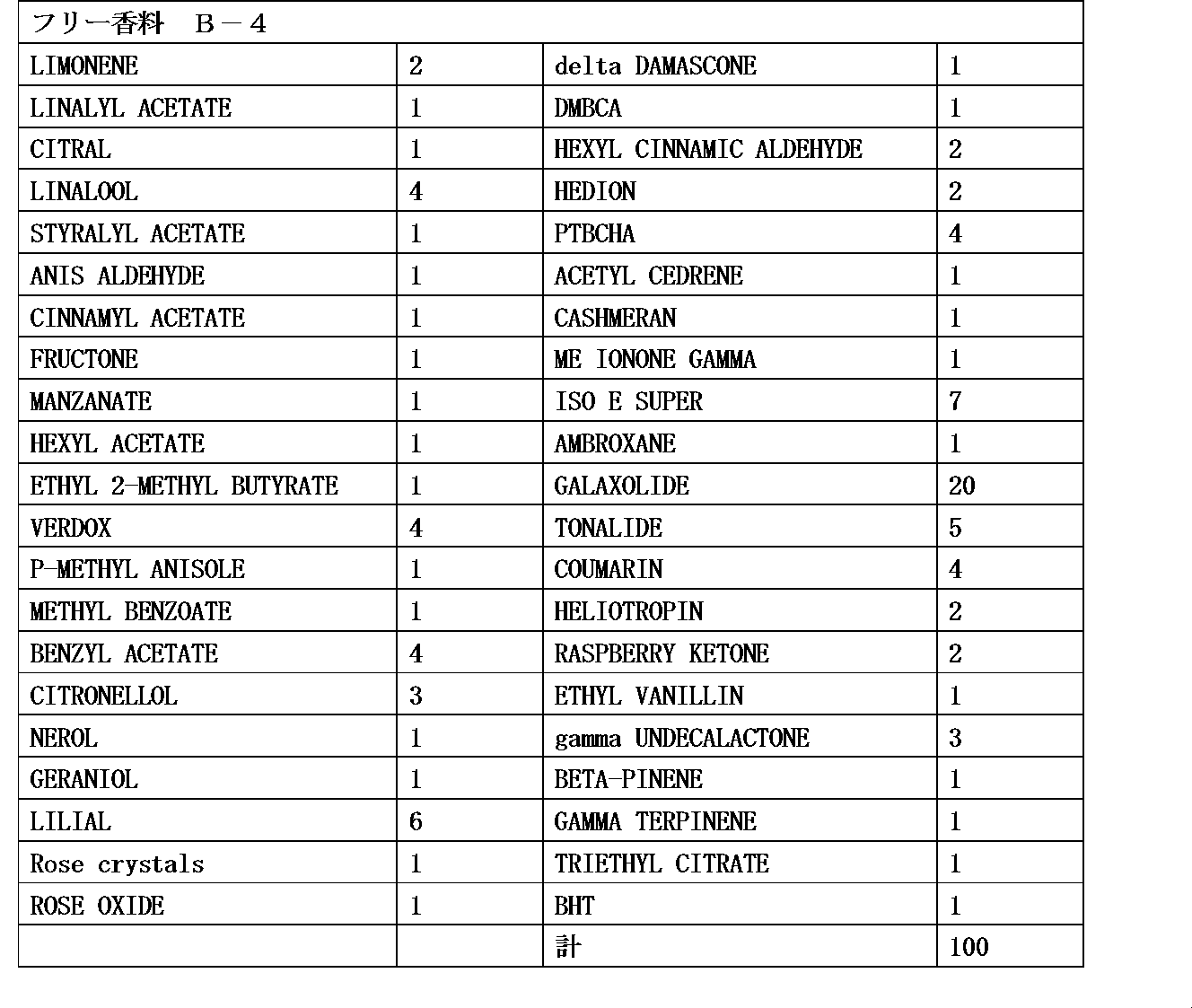


[(C)成分]
(C-1)ポリオキシエチレンイソトリデシルエーテル(EO7モル)(ライオンケミカル株式会社製)
(C-2)ジイソステアリン酸ポリエチレングリコール(日本エマルジョン株式会社製、商品名「EMALEX 600di―ISEX」)
(C-2)は、ジイソステアリン酸PEG12とも言う。
(C-5-1)2-エチルヘキサン酸セチル(日本エマルジョン株式会社製、商品名「EMALEX CC168」)
(C-5-2)ミリスチン酸イソプロピル(Oleon社製、商品名「RADIA 7730」)
(C-6)流動パラフィン(関東化学株式会社製)
(C-7)95%合成エタノール(純正化学株式会社製)
[(C) Component]
(C-1) Polyoxyethylene isotridecyl ether (EO7 mol) (manufactured by Lion Chemical Co., Ltd.)
(C-2) Polyethylene glycol diisostearate (manufactured by Nippon Emulsion Co., Ltd., product name "EMALEX 600di-ISEX")
(C-2) is also referred to as PEG12 diisostearate.
(C-5-1) Cetyl 2-ethylhexanoate (manufactured by Nippon Emulsion Co., Ltd., product name "EMALEX CC168")
(C-5-2) Isopropyl myristate (manufactured by Oleon, product name "RADIA 7730")
(C-6) Liquid paraffin (manufactured by Kanto Kagaku Co., Ltd.)
(C-7) 95% synthetic ethanol (manufactured by Junsei Kagaku Co., Ltd.)
〔柔軟剤組成物の調製方法〕
(実施例1~12、比較例1,2)
内径100mm、高さ150mmのガラス容器と、攪拌機(アジターSJ型、島津製作所製)を用い、各成分の配合量を、下記表8に記載の通り調整して、次の手順により柔軟剤組成物を調製した。
まず、(A)成分、(D)成分、エタノールを混合攪拌して、油相混合物を得た。一方、防腐剤をバランス用イオン交換水に溶解させて水相混合物を得た。ここで、バランス用イオン交換水の質量は、980gから油相混合物と(E)成分の合計量を差し引いた残部に相当する。
次に、(A)成分の融点以上に加温した油相混合物をガラス容器に収納して攪拌しながら、(A)成分の融点以上に加温した水相混合物を2度に分割して添加し、攪拌した。ここで、水相混合物の分割比率は30:70(質量比)とし、攪拌は回転速度1,000rpmで、1回目の水相混合物添加後に2分間、2回目の水相混合物添加後に2分間行った。しかる後、(E)成分を添加し、必要に応じて、塩酸(試薬1mol/L、関東化学)、または水酸化ナトリウム(試薬1mol/L、関東化学)を適量添加してpH2.5に調整し、更に全体質量が1,000gになるようにイオン交換水を添加して、目的の液体柔軟剤組成物を得た。
(実施例13)
各成分の配合量を、下記表8に記載の通り調整して、次の手順により柔軟剤組成物を調製した。
(A)成分、ブチル化ヒドロキシトルエン、及びエタノールを1000mLビーカーにとり、攪拌羽根を用いて充分に攪拌した。次に、攪拌しながらイオン交換水を添加し、更に攪拌しながら塩化ジメチルジアリルアンモニウム重合体を添加し攪拌後、更に、C.I. Acid Blue 9を添加し、均一になるまで充分に攪拌して、800gの液体柔軟剤組成物を得た。
[Method for preparing softener composition]
(Examples 1 to 12, Comparative Examples 1 and 2)
Using a glass container with an inner diameter of 100 mm and a height of 150 mm and a stirrer (Agitator SJ type, manufactured by Shimadzu Corporation), the amounts of each component were adjusted as shown in Table 8 below, and the softener composition was prepared by the following procedure. was prepared.
First, component (A), component (D), and ethanol were mixed and stirred to obtain an oil phase mixture. On the other hand, a preservative was dissolved in ion-exchanged water for balance to obtain an aqueous phase mixture. Here, the mass of the balance ion exchange water corresponds to the remainder obtained by subtracting the total amount of the oil phase mixture and component (E) from 980 g.
Next, the oil phase mixture heated above the melting point of component (A) is stored in a glass container and, while stirring, the water phase mixture heated above the melting point of component (A) is added in two portions. and stirred. Here, the division ratio of the aqueous phase mixture was 30:70 (mass ratio), and stirring was performed at a rotation speed of 1,000 rpm for 2 minutes after the first addition of the aqueous phase mixture and for 2 minutes after the second addition of the aqueous phase mixture. Ta. After that, component (E) is added, and if necessary, an appropriate amount of hydrochloric acid (reagent 1 mol/L, Kanto Kagaku) or sodium hydroxide (reagent 1 mol/L, Kanto Kagaku) is added to adjust the pH to 2.5. Then, ion-exchanged water was added so that the total mass was 1,000 g to obtain the desired liquid softener composition.
(Example 13)
The blending amount of each component was adjusted as shown in Table 8 below, and a softener composition was prepared according to the following procedure.
Component (A), butylated hydroxytoluene, and ethanol were placed in a 1000 mL beaker and thoroughly stirred using a stirring blade. Next, add ion-exchanged water while stirring, add dimethyldiallylammonium chloride polymer while stirring, and after stirring, add CI Acid Blue 9, stir thoroughly until uniform, and add 800 g. A liquid softener composition was obtained.
〔着香剤組成物の調製方法〕
下記表8に記載の通り、(B)成分40gと(C)成分合計60gを室温でマグネッティックスターラーを用いて混合した。
[Method for preparing flavoring composition]
As shown in Table 8 below, 40 g of component (B) and a total of 60 g of component (C) were mixed at room temperature using a magnetic stirrer.
〔評価方法〕
得られた柔軟剤組成物、着香剤組成物を用いて、繊維処理、残香性評価、むらづき評価を行った。
1.繊維処理
[評価用布の前処理]
市販の綿タオル(東進社製)について、市販洗剤「トッププラチナクリア」(ライオン社製)により、二槽式洗濯機(東芝製VH-30S)を用いて、以下の前処理を3回行った。
前処理:洗剤標準使用量、浴比30倍、45℃の水道水、10分間の洗浄、続いて10分間の注水すすぎを2回。
〔Evaluation methods〕
Using the obtained softener composition and flavoring composition, fiber treatment, odor retention evaluation, and unevenness evaluation were performed.
1. Fiber treatment [Pre-treatment of evaluation fabric]
Commercially available cotton towels (manufactured by Toshinsha) were subjected to the following pretreatment three times using a commercially available detergent "Top Platinum Clear" (manufactured by Lion) using a two-tub washing machine (VH-30S, manufactured by Toshiba). .
Pretreatment: Standard amount of detergent used, bath ratio 30 times, tap water at 45°C, washing for 10 minutes, followed by rinsing with water for 10 minutes twice.
[柔軟剤組成物と着香剤組成物との混合物の準備]
50mLビーカー中に、柔軟剤組成物10mLを測り取った後、着香剤組成物0.25mLを測り取った。なお、比較例1では柔軟剤組成物を使用しないため、着香剤組成物0.25mLのみを用いた。
[Preparation of mixture of softener composition and flavoring composition]
After measuring out 10 mL of the softener composition into a 50 mL beaker, 0.25 mL of the flavoring composition was measured out. In addition, in Comparative Example 1, since no softener composition was used, only 0.25 mL of the flavoring composition was used.
[洗濯時すすぎ工程での処理]
前処理洗浄した綿タオル(東進社製)1.5kgを、二槽式洗濯機(東芝製VH-30S)を用いて、市販洗剤「トッププラチナクリア」(ライオン社製)で10分間洗浄し(標準使用量、標準コース、浴比30倍、25℃の水道水使用)、その後、1回目のすすぎを3分間行った。1回目のすすぎに続いて2回目のすすぎを3分間行った。この2回目のすすぎの開始時に、上記のとおり得た柔軟剤組成物と着香剤組成物との混合物を添加して、3分間の柔軟処理(浴比20倍、25℃の水道水使用)を行った。洗浄、すすぎの各工程間で脱水を1分間行った。
処理後、二槽式洗濯機から綿タオルを取出し、25℃、40%RHの恒温恒湿条件下で24時間乾燥させ、評価用処理布とした。
[Processing in the rinsing process during washing]
1.5 kg of pre-washed cotton towels (manufactured by Toshinsha Co., Ltd.) were washed for 10 minutes with commercially available detergent "Top Platinum Clear" (manufactured by Lion Corporation) using a two-tub washing machine (VH-30S, manufactured by Toshiba). Standard usage amount, standard course, bath ratio 30 times, tap water at 25°C), and then the first rinse was performed for 3 minutes. The first rinse was followed by a second rinse for 3 minutes. At the beginning of this second rinse, the mixture of the fabric softener composition and flavoring composition obtained as described above was added and softened for 3 minutes (bath ratio 20 times, using tap water at 25°C). I did it. Dehydration was performed for 1 minute between each washing and rinsing process.
After the treatment, the cotton towel was taken out of the two-tub washing machine and dried under constant temperature and humidity conditions of 25° C. and 40% RH for 24 hours to obtain a treated cloth for evaluation.
2.残香性評価
25℃、40%RHの恒温恒湿条件下で24時間乾燥させた後の評価用処理布の香気強度を、下記の6段階臭気強度表示法に準拠し官能評価した。専門パネラー8人の平均点により、下記判定基準で香り持続性(残香性)を判定した。商品価値上、○以上を合格とした。結果を下記の表8に示す。
<6段階臭気強度表示法>
0:無臭。
1:やっと検知できる程度の香り。
2:何の香りか分かる程度の香り。
3:楽に感知できる香り。
4:強い香り。
5:強烈な香り。
<判定基準>
◎:3.5点以上。
○:3.0点以上3.5点未満。
△:2.0点以上3.0点未満。
×:2.0点未満。
2. Evaluation of Persistent Fragrance The aroma intensity of the treated fabric for evaluation after drying for 24 hours under constant temperature and humidity conditions of 25° C. and 40% RH was sensory evaluated in accordance with the following 6-level odor intensity display method. Fragrance persistence (persistence) was determined based on the average score of eight expert panelists using the following criteria. In terms of product value, ○ or above was considered a pass. The results are shown in Table 8 below.
<6-step odor intensity display method>
0: Odorless.
1: Barely detectable scent.
2: Smell that you can tell what kind of scent it is.
3: A scent that can be easily detected.
4: Strong scent.
5: Strong scent.
<Judgment criteria>
◎: 3.5 points or more.
○: 3.0 points or more and less than 3.5 points.
△: 2.0 points or more and less than 3.0 points.
×: Less than 2.0 points.
3.むらづき評価
25℃、40%RHの恒温恒湿条件下で24時間乾燥させた後の評価用処理布3枚の香気強度を、下記の6段階臭気強度表示法に準拠し官能評価し、各処理布毎に専門パネラー8人の平均点を算出した。3枚の処理布の平均点から、エクセル関数STDEV.Pを用いて標準誤差を算出し、下記判定基準でむらづきを判定した。商品価値上、○以上を合格とした。結果を下記の表8に示す。
<6段階臭気強度表示法>
0:無臭。
1:やっと検知できる程度の香り。
2:何の香りか分かる程度の香り。
3:楽に感知できる香り。
4:強い香り。
5:強烈な香り。
<判定基準>
◎:標準誤差が0.05未満
○:標準誤差が0.05以上0.1未満
△:標準誤差が0.1以上0.5未満
×:標準誤差が0.5以上
-:無香のため判定なし
3. Evaluation of unevenness After drying for 24 hours under constant temperature and humidity conditions of 25°C and 40% RH, the aroma intensity of three treated evaluation cloths was sensory evaluated according to the following 6-level odor intensity display method. The average score of eight expert panelists was calculated for each treated fabric. From the average score of the three treated cloths, the Excel function STDEV. The standard error was calculated using P, and unevenness was determined using the following criteria. In terms of product value, ○ or above was considered a pass. The results are shown in Table 8 below.
<6-step odor intensity display method>
0: Odorless.
1: Barely detectable scent.
2: Smell that you can tell what kind of scent it is.
3: A scent that can be easily detected.
4: Strong scent.
5: Strong scent.
<Judgment criteria>
◎: Standard error is less than 0.05 ○: Standard error is 0.05 or more and less than 0.1 △: Standard error is 0.1 or more and less than 0.5 ×: Standard error is 0.5 or more -: Unscented No judgment

Claims (5)
前記繊維処理剤組成物が、(A)柔軟成分として、
(A-1)成分:3級アミン又は4級アンモニウム塩、及び
(A-2)成分:シリコーン化合物
から選択される少なくとも1種を含む柔軟剤組成物であり、
前記香料含有製品が、(B)香料組成物及び(C)希釈剤を含む液体着香剤組成物を含有し、(C)成分が、以下の(C-1)~(C-6)、(C-8)及び(C-9):
(C-1)
下記構造式で表されるアルコールアルコキシレート
R a -O(R b O) na -H
(式中、R a は、炭素数6~20の炭化水素基であり、R b は、炭素数2~4のアルキレン基であり、na=2~80である。)
(C-2)
下記構造式で表されるノニオン界面活性剤
R c -(A 1 O) nb -R c
(式中、R c はそれぞれ独立に、炭素数6~22の脂肪酸由来のアシル基又はアシルオキシ基、H又はCH 3 であり、R c の少なくとも1つは炭素数6~22の脂肪酸由来のアシル基又はアシルオキシ基であり、A 1 Oは炭素数2~4のオキシアルキレン基であり、nb=2~100である。)
(C-3)
下記構造式で表されるポリソルベート

(式中、Rはそれぞれ独立に、炭素数6~22の脂肪酸由来のアシル基、H又はCH 3 であり、Rの少なくとも1つは炭素数6~22の脂肪酸由来のアシル基であり、A 2 O及びOA 2 は、それぞれ独立に、炭素数2~4のオキシアルキレン基であり、w+x+y+z=1~100である。)
(C-4)
下記構造式で表されるポリオキシアルキレングリセリン脂肪酸エステル

(式中、R x はそれぞれ独立に、炭素数6~22の脂肪酸由来のアシルオキシ基、H又はCH 3 であり、R x の少なくとも1つは炭素数6~22の脂肪酸由来のアシルオキシ基であり、OA 3 はそれぞれ独立に、炭素数2~4のオキシアルキレン基であり、m=2~100であり、n=2~100であり、p=2~100である。)
(C-5)
炭素数3~20の脂肪酸と炭素数2~20のアルコールからなるエステル化合物
(C-6)
炭素数6~24の炭化水素及び/又は流動パラフィン
(C-8)
ポリオキシアルキレン硬化ヒマシ油
(C-9)
下記構造式で表されるポリオキシアルキレンソルビット脂肪酸エステル

(式中、Rはそれぞれ独立に、炭素数6~22の脂肪酸由来のアシル基、H又はCH 3 であり、Rの少なくとも1つは炭素数6~22の脂肪酸由来のアシル基であり、A 2 Oは、それぞれ独立に、炭炭素数2~4のオキシアルキレン基であり、x+y+z=1~100である。)
のうちから選ばれる1種又は複数の成分であり、
前記液体着香剤組成物の総質量に対する(C)成分の含量が40~90質量%である、繊維処理用物品。 One or more types of fiber treatment products that contain a fiber treatment agent composition in a packaging container, and one type of fragrance-containing product that contains a fragrance in a packaging container that is different from the fiber treatment product. A fiber processing article consisting of a combination of the above,
The fiber treatment agent composition includes (A) as a soft component;
(A-1) Component: tertiary amine or quaternary ammonium salt, and
(A-2) Component: silicone compound
A softener composition comprising at least one selected from
The fragrance-containing product contains a liquid fragrance composition including (B) a fragrance composition and (C) a diluent, and the component (C) is the following (C-1) to (C-6), (C-8) and (C-9):
(C-1)
Alcohol alkoxylate represented by the structural formula below
R a -O(R b O) na -H
(In the formula, R a is a hydrocarbon group having 6 to 20 carbon atoms, R b is an alkylene group having 2 to 4 carbon atoms, and na = 2 to 80.)
(C-2)
Nonionic surfactant represented by the following structural formula
R c -(A 1 O) nb - R c
(In the formula, R c is each independently an acyl group or acyloxy group derived from a fatty acid having 6 to 22 carbon atoms, H or CH 3 , and at least one of R c is an acyl group derived from a fatty acid having 6 to 22 carbon atoms. or acyloxy group, A 1 O is an oxyalkylene group having 2 to 4 carbon atoms, and nb = 2 to 100.)
(C-3)
Polysorbate represented by the structural formula below
(In the formula, each R is independently an acyl group derived from a fatty acid having 6 to 22 carbon atoms, H or CH 3 , at least one R is an acyl group derived from a fatty acid having 6 to 22 carbon atoms, and A 2 O and OA 2 are each independently an oxyalkylene group having 2 to 4 carbon atoms, and w+x+y+z=1 to 100.)
(C-4)
Polyoxyalkylene glycerin fatty acid ester represented by the following structural formula
(In the formula, each R x is independently an acyloxy group derived from a fatty acid having 6 to 22 carbon atoms, H or CH 3 , and at least one of R x is an acyloxy group derived from a fatty acid having 6 to 22 carbon atoms. , OA 3 are each independently an oxyalkylene group having 2 to 4 carbon atoms, m = 2 to 100, n = 2 to 100, and p = 2 to 100.)
(C-5)
Ester compound consisting of fatty acid with 3 to 20 carbon atoms and alcohol with 2 to 20 carbon atoms
(C-6)
Hydrocarbons having 6 to 24 carbon atoms and/or liquid paraffin
(C-8)
Polyoxyalkylene hydrogenated castor oil
(C-9)
Polyoxyalkylene sorbitol fatty acid ester represented by the following structural formula
(In the formula, each R is independently an acyl group derived from a fatty acid having 6 to 22 carbon atoms, H or CH 3 , at least one R is an acyl group derived from a fatty acid having 6 to 22 carbon atoms, and A 2 O's each independently represent an oxyalkylene group having 2 to 4 carbon atoms, and x+y+z=1 to 100.)
One or more components selected from
An article for fiber treatment, wherein the content of component (C) is 40 to 90% by mass based on the total mass of the liquid flavoring composition .
工程1:洗濯機投入口で直接、あるいは別容器の中で事前に、柔軟剤組成物と液体着香剤組成物を混合する工程、及び
工程2:洗濯のすすぎの段階ですすぎ水に工程1で得た混合物を溶解させて繊維製品を柔軟処理する工程、又は容器中の水に工程1で得た混合物を溶解させ、更に繊維製品を当該容器中に入れて浸漬させ柔軟処理する工程
を含み、
前記柔軟剤組成物の添加量/液体着香剤組成物の添加量が1~500であり、
前記柔軟剤組成物が、(A)柔軟成分として、
(A-1)成分:3級アミン又は4級アンモニウム塩、及び
(A-2)成分:シリコーン化合物
から選択される少なくとも1種を含み、
前記液体着香剤組成物が、(B)香料組成物及び(C)希釈剤を含み、(C)成分が、以下の(C-1)~(C-6)、(C-8)及び(C-9):
(C-1)
下記構造式で表されるアルコールアルコキシレート
R a -O(R b O) na -H
(式中、R a は、炭素数6~20の炭化水素基であり、R b は、炭素数2~4のアルキレン基であり、na=2~80である。)
(C-2)
下記構造式で表されるノニオン界面活性剤
R c -(A 1 O) nb -R c
(式中、R c はそれぞれ独立に、炭素数6~22の脂肪酸由来のアシル基又はアシルオキシ基、H又はCH 3 であり、R c の少なくとも1つは炭素数6~22の脂肪酸由来のアシル基又はアシルオキシ基であり、A 1 Oは炭素数2~4のオキシアルキレン基であり、nb=2~100である。)
(C-3)
下記構造式で表されるポリソルベート

(式中、Rはそれぞれ独立に、炭素数6~22の脂肪酸由来のアシル基、H又はCH 3 であり、Rの少なくとも1つは炭素数6~22の脂肪酸由来のアシル基であり、A 2 O及びOA 2 は、それぞれ独立に、炭素数2~4のオキシアルキレン基であり、w+x+y+z=1~100である。)
(C-4)
下記構造式で表されるポリオキシアルキレングリセリン脂肪酸エステル

(式中、R x はそれぞれ独立に、炭素数6~22の脂肪酸由来のアシルオキシ基、H又はCH 3 であり、R x の少なくとも1つは炭素数6~22の脂肪酸由来のアシルオキシ基であり、OA 3 はそれぞれ独立に、炭素数2~4のオキシアルキレン基であり、m=2~100であり、n=2~100であり、p=2~100である。)
(C-5)
炭素数3~20の脂肪酸と炭素数2~20のアルコールからなるエステル化合物
(C-6)
炭素数6~24の炭化水素及び/又は流動パラフィン
(C-8)
ポリオキシアルキレン硬化ヒマシ油
(C-9)
下記構造式で表されるポリオキシアルキレンソルビット脂肪酸エステル

(式中、Rはそれぞれ独立に、炭素数6~22の脂肪酸由来のアシル基、H又はCH 3 であり、Rの少なくとも1つは炭素数6~22の脂肪酸由来のアシル基であり、A 2 Oは、それぞれ独立に、炭炭素数2~4のオキシアルキレン基であり、x+y+z=1~100である。)
のうちから選ばれる1種又は複数の成分であり、
前記液体着香剤組成物の総質量に対する(C)成分の含量が40~90質量%である、
方法。 A method for softening textile products, the method comprising:
Step 1: mixing the fabric softener composition and the liquid fragrance composition directly in the washing machine input or in advance in a separate container, and
Step 2: A step in which the mixture obtained in Step 1 is dissolved in rinse water during the rinsing stage of washing to soften the textile product, or a step in which the mixture obtained in Step 1 is dissolved in water in a container and the textile product is softened. The process of placing it in the container and soaking it for softening treatment.
including;
The amount of the softener composition added/the amount of the liquid flavoring composition added is 1 to 500,
The softener composition includes (A) as a softening component;
(A-1) Component: tertiary amine or quaternary ammonium salt, and
(A-2) Component: silicone compound
including at least one selected from
The liquid flavor composition includes (B) a flavor composition and (C) a diluent, and the component (C) includes the following (C-1) to (C-6), (C-8) and (C-9):
(C-1)
Alcohol alkoxylate represented by the structural formula below
R a -O(R b O) na -H
(In the formula, R a is a hydrocarbon group having 6 to 20 carbon atoms, R b is an alkylene group having 2 to 4 carbon atoms, and na = 2 to 80.)
(C-2)
Nonionic surfactant represented by the following structural formula
R c - (A 1 O) nb - R c
(In the formula, R c is each independently an acyl group or acyloxy group derived from a fatty acid having 6 to 22 carbon atoms, H or CH 3 , and at least one of R c is an acyl group derived from a fatty acid having 6 to 22 carbon atoms. or acyloxy group, A 1 O is an oxyalkylene group having 2 to 4 carbon atoms, and nb = 2 to 100.)
(C-3)
Polysorbate represented by the structural formula below
(In the formula, each R is independently an acyl group derived from a fatty acid having 6 to 22 carbon atoms, H or CH 3 , at least one R is an acyl group derived from a fatty acid having 6 to 22 carbon atoms, and A 2 O and OA 2 are each independently an oxyalkylene group having 2 to 4 carbon atoms, and w+x+y+z=1 to 100.)
(C-4)
Polyoxyalkylene glycerin fatty acid ester represented by the following structural formula
(In the formula, each R x is independently an acyloxy group derived from a fatty acid having 6 to 22 carbon atoms, H or CH 3 , and at least one of R x is an acyloxy group derived from a fatty acid having 6 to 22 carbon atoms. , OA 3 are each independently an oxyalkylene group having 2 to 4 carbon atoms, m = 2 to 100, n = 2 to 100, and p = 2 to 100.)
(C-5)
Ester compound consisting of fatty acid with 3 to 20 carbon atoms and alcohol with 2 to 20 carbon atoms
(C-6)
Hydrocarbons having 6 to 24 carbon atoms and/or liquid paraffin
(C-8)
Polyoxyalkylene hydrogenated castor oil
(C-9)
Polyoxyalkylene sorbitol fatty acid ester represented by the following structural formula
(In the formula, each R is independently an acyl group derived from a fatty acid having 6 to 22 carbon atoms, H or CH 3 , at least one R is an acyl group derived from a fatty acid having 6 to 22 carbon atoms, and A 2 O's each independently represent an oxyalkylene group having 2 to 4 carbon atoms, and x+y+z=1 to 100.)
One or more components selected from
The content of component (C) with respect to the total mass of the liquid flavoring composition is 40 to 90% by mass,
Method.
Applications Claiming Priority (2)
| Application Number | Priority Date | Filing Date | Title |
|---|---|---|---|
| JP2018148405 | 2018-08-07 | ||
| JP2018148405 | 2018-08-07 |
Publications (2)
| Publication Number | Publication Date |
|---|---|
| JP2020023776A JP2020023776A (en) | 2020-02-13 |
| JP7437894B2 true JP7437894B2 (en) | 2024-02-26 |
Family
ID=69618336
Family Applications (1)
| Application Number | Title | Priority Date | Filing Date |
|---|---|---|---|
| JP2019145025A Active JP7437894B2 (en) | 2018-08-07 | 2019-08-07 | Fiber processing articles consisting of fiber processing products and fragrance-containing products |
Country Status (1)
| Country | Link |
|---|---|
| JP (1) | JP7437894B2 (en) |
Families Citing this family (8)
| Publication number | Priority date | Publication date | Assignee | Title |
|---|---|---|---|---|
| JP7676140B2 (en) * | 2019-12-25 | 2025-05-14 | ライオン株式会社 | Liquid composition and textile article |
| JP7768679B2 (en) * | 2020-02-12 | 2025-11-12 | ライオン株式会社 | Liquid Flavoring Composition |
| WO2021162043A1 (en) | 2020-02-14 | 2021-08-19 | 住友重機械工業株式会社 | Injection molding machine system and injection molding machine |
| JP7713825B2 (en) * | 2021-07-29 | 2025-07-28 | 花王株式会社 | Method for imparting fragrance to textile products |
| JP2023058945A (en) * | 2021-10-14 | 2023-04-26 | ライオン株式会社 | Liquid softener composition |
| JP2023096515A (en) * | 2021-12-27 | 2023-07-07 | ライオン株式会社 | Fiber treatment composition |
| JP2023098218A (en) * | 2021-12-28 | 2023-07-10 | ライオン株式会社 | Textile treatment article comprising a transparent liquid softener composition and a fragrance composition filled in a separate container, and a method for using the same |
| JP2025139991A (en) * | 2024-03-13 | 2025-09-29 | 花王株式会社 | Liquid fabric softener composition for washing machine provided with softener automatic measurement meter and automatic dispensing tank |
Citations (3)
| Publication number | Priority date | Publication date | Assignee | Title |
|---|---|---|---|---|
| JP3169583B2 (en) | 1998-12-08 | 2001-05-28 | 花王株式会社 | Laundry goods |
| JP2009506819A (en) | 2005-09-02 | 2009-02-19 | ザ プロクター アンド ギャンブル カンパニー | Customizing the scent of laundry |
| WO2017102876A1 (en) | 2015-12-18 | 2017-06-22 | Henkel Ag & Co. Kgaa | Combination product for conditioning laundry items |
-
2019
- 2019-08-07 JP JP2019145025A patent/JP7437894B2/en active Active
Patent Citations (3)
| Publication number | Priority date | Publication date | Assignee | Title |
|---|---|---|---|---|
| JP3169583B2 (en) | 1998-12-08 | 2001-05-28 | 花王株式会社 | Laundry goods |
| JP2009506819A (en) | 2005-09-02 | 2009-02-19 | ザ プロクター アンド ギャンブル カンパニー | Customizing the scent of laundry |
| WO2017102876A1 (en) | 2015-12-18 | 2017-06-22 | Henkel Ag & Co. Kgaa | Combination product for conditioning laundry items |
Also Published As
| Publication number | Publication date |
|---|---|
| JP2020023776A (en) | 2020-02-13 |
Similar Documents
| Publication | Publication Date | Title |
|---|---|---|
| JP7437894B2 (en) | Fiber processing articles consisting of fiber processing products and fragrance-containing products | |
| JP6494460B2 (en) | Liquid softener composition | |
| JP6902364B2 (en) | Liquid fabric softener composition | |
| KR101945801B1 (en) | Treatment agent composition for fiber product | |
| JP2024093127A (en) | Liquid fabric softener composition | |
| JP2023051098A (en) | Liquid softener composition | |
| JP2023051097A (en) | Liquid softener composition | |
| JP6565030B2 (en) | Liquid softener composition | |
| JP2018178329A (en) | Liquid softener composition | |
| JP6101988B2 (en) | Liquid softener composition | |
| JP6688594B2 (en) | Liquid softener composition | |
| JP6444300B2 (en) | Liquid treatment composition for textile products | |
| JP6197207B2 (en) | Liquid softener composition | |
| JP6905333B2 (en) | Bag-shaped fabric softener article | |
| JP7005329B2 (en) | Liquid fabric softener composition | |
| JP7523226B2 (en) | Liquid fabric softener composition | |
| JP6171200B2 (en) | Textile treatment composition | |
| JP6171233B2 (en) | Textile treatment composition | |
| JP6929118B2 (en) | Treatment agent composition for textile products | |
| JP2022102289A (en) | Liquid fabric softener articles | |
| JP2017101343A (en) | Liquid softener composition | |
| JP2024089919A (en) | Fiber treatment article comprising fiber treatment composition and fragrance composition | |
| JP7805159B2 (en) | Liquid fabric softener composition | |
| JP2023098218A (en) | Textile treatment article comprising a transparent liquid softener composition and a fragrance composition filled in a separate container, and a method for using the same | |
| JP7106359B2 (en) | Liquid softener composition |
Legal Events
| Date | Code | Title | Description |
|---|---|---|---|
| A621 | Written request for application examination |
Free format text: JAPANESE INTERMEDIATE CODE: A621 Effective date: 20220804 |
|
| A131 | Notification of reasons for refusal |
Free format text: JAPANESE INTERMEDIATE CODE: A131 Effective date: 20230629 |
|
| A977 | Report on retrieval |
Free format text: JAPANESE INTERMEDIATE CODE: A971007 Effective date: 20230630 |
|
| A601 | Written request for extension of time |
Free format text: JAPANESE INTERMEDIATE CODE: A601 Effective date: 20230825 |
|
| A521 | Request for written amendment filed |
Free format text: JAPANESE INTERMEDIATE CODE: A523 Effective date: 20231027 |
|
| TRDD | Decision of grant or rejection written | ||
| A01 | Written decision to grant a patent or to grant a registration (utility model) |
Free format text: JAPANESE INTERMEDIATE CODE: A01 Effective date: 20240111 |
|
| A61 | First payment of annual fees (during grant procedure) |
Free format text: JAPANESE INTERMEDIATE CODE: A61 Effective date: 20240213 |
|
| R150 | Certificate of patent or registration of utility model |
Ref document number: 7437894 Country of ref document: JP Free format text: JAPANESE INTERMEDIATE CODE: R150 |