JP7306828B2 - Crystalline (2S,4R)-5-(5′-chloro-2′-fluoro-[1,1′-biphenyl]-4-yl)-2-(ethoxymethyl)-4-(3-hydroxyisoxazole -5-carboxamido)-2-methylpentanoic acid and uses thereof - Google Patents
Crystalline (2S,4R)-5-(5′-chloro-2′-fluoro-[1,1′-biphenyl]-4-yl)-2-(ethoxymethyl)-4-(3-hydroxyisoxazole -5-carboxamido)-2-methylpentanoic acid and uses thereof Download PDFInfo
- Publication number
- JP7306828B2 JP7306828B2 JP2018546864A JP2018546864A JP7306828B2 JP 7306828 B2 JP7306828 B2 JP 7306828B2 JP 2018546864 A JP2018546864 A JP 2018546864A JP 2018546864 A JP2018546864 A JP 2018546864A JP 7306828 B2 JP7306828 B2 JP 7306828B2
- Authority
- JP
- Japan
- Prior art keywords
- compound
- composition
- crystalline form
- acid
- administered
- Prior art date
- Legal status (The legal status is an assumption and is not a legal conclusion. Google has not performed a legal analysis and makes no representation as to the accuracy of the status listed.)
- Active
Links
Images




Classifications
-
- C—CHEMISTRY; METALLURGY
- C07—ORGANIC CHEMISTRY
- C07D—HETEROCYCLIC COMPOUNDS
- C07D261/00—Heterocyclic compounds containing 1,2-oxazole or hydrogenated 1,2-oxazole rings
- C07D261/02—Heterocyclic compounds containing 1,2-oxazole or hydrogenated 1,2-oxazole rings not condensed with other rings
- C07D261/06—Heterocyclic compounds containing 1,2-oxazole or hydrogenated 1,2-oxazole rings not condensed with other rings having two or more double bonds between ring members or between ring members and non-ring members
- C07D261/10—Heterocyclic compounds containing 1,2-oxazole or hydrogenated 1,2-oxazole rings not condensed with other rings having two or more double bonds between ring members or between ring members and non-ring members with hetero atoms or with carbon atoms having three bonds to hetero atoms with at the most one bond to halogen, e.g. ester or nitrile radicals, directly attached to ring carbon atoms
- C07D261/18—Carbon atoms having three bonds to hetero atoms, with at the most one bond to halogen
-
- A—HUMAN NECESSITIES
- A61—MEDICAL OR VETERINARY SCIENCE; HYGIENE
- A61K—PREPARATIONS FOR MEDICAL, DENTAL OR TOILETRY PURPOSES
- A61K31/00—Medicinal preparations containing organic active ingredients
- A61K31/33—Heterocyclic compounds
- A61K31/395—Heterocyclic compounds having nitrogen as a ring hetero atom, e.g. guanethidine or rifamycins
- A61K31/41—Heterocyclic compounds having nitrogen as a ring hetero atom, e.g. guanethidine or rifamycins having five-membered rings with two or more ring hetero atoms, at least one of which being nitrogen, e.g. tetrazole
- A61K31/415—1,2-Diazoles
-
- A—HUMAN NECESSITIES
- A61—MEDICAL OR VETERINARY SCIENCE; HYGIENE
- A61K—PREPARATIONS FOR MEDICAL, DENTAL OR TOILETRY PURPOSES
- A61K31/00—Medicinal preparations containing organic active ingredients
- A61K31/33—Heterocyclic compounds
- A61K31/395—Heterocyclic compounds having nitrogen as a ring hetero atom, e.g. guanethidine or rifamycins
- A61K31/41—Heterocyclic compounds having nitrogen as a ring hetero atom, e.g. guanethidine or rifamycins having five-membered rings with two or more ring hetero atoms, at least one of which being nitrogen, e.g. tetrazole
- A61K31/42—Oxazoles
-
- A—HUMAN NECESSITIES
- A61—MEDICAL OR VETERINARY SCIENCE; HYGIENE
- A61K—PREPARATIONS FOR MEDICAL, DENTAL OR TOILETRY PURPOSES
- A61K45/00—Medicinal preparations containing active ingredients not provided for in groups A61K31/00 - A61K41/00
- A61K45/06—Mixtures of active ingredients without chemical characterisation, e.g. antiphlogistics and cardiaca
-
- A—HUMAN NECESSITIES
- A61—MEDICAL OR VETERINARY SCIENCE; HYGIENE
- A61K—PREPARATIONS FOR MEDICAL, DENTAL OR TOILETRY PURPOSES
- A61K9/00—Medicinal preparations characterised by special physical form
- A61K9/0012—Galenical forms characterised by the site of application
- A61K9/0053—Mouth and digestive tract, i.e. intraoral and peroral administration
-
- A—HUMAN NECESSITIES
- A61—MEDICAL OR VETERINARY SCIENCE; HYGIENE
- A61K—PREPARATIONS FOR MEDICAL, DENTAL OR TOILETRY PURPOSES
- A61K9/00—Medicinal preparations characterised by special physical form
- A61K9/48—Preparations in capsules, e.g. of gelatin, of chocolate
- A61K9/4816—Wall or shell material
-
- A—HUMAN NECESSITIES
- A61—MEDICAL OR VETERINARY SCIENCE; HYGIENE
- A61P—SPECIFIC THERAPEUTIC ACTIVITY OF CHEMICAL COMPOUNDS OR MEDICINAL PREPARATIONS
- A61P13/00—Drugs for disorders of the urinary system
- A61P13/12—Drugs for disorders of the urinary system of the kidneys
-
- A—HUMAN NECESSITIES
- A61—MEDICAL OR VETERINARY SCIENCE; HYGIENE
- A61P—SPECIFIC THERAPEUTIC ACTIVITY OF CHEMICAL COMPOUNDS OR MEDICINAL PREPARATIONS
- A61P43/00—Drugs for specific purposes, not provided for in groups A61P1/00-A61P41/00
-
- A—HUMAN NECESSITIES
- A61—MEDICAL OR VETERINARY SCIENCE; HYGIENE
- A61P—SPECIFIC THERAPEUTIC ACTIVITY OF CHEMICAL COMPOUNDS OR MEDICINAL PREPARATIONS
- A61P9/00—Drugs for disorders of the cardiovascular system
-
- A—HUMAN NECESSITIES
- A61—MEDICAL OR VETERINARY SCIENCE; HYGIENE
- A61P—SPECIFIC THERAPEUTIC ACTIVITY OF CHEMICAL COMPOUNDS OR MEDICINAL PREPARATIONS
- A61P9/00—Drugs for disorders of the cardiovascular system
- A61P9/04—Inotropic agents, i.e. stimulants of cardiac contraction; Drugs for heart failure
-
- A—HUMAN NECESSITIES
- A61—MEDICAL OR VETERINARY SCIENCE; HYGIENE
- A61P—SPECIFIC THERAPEUTIC ACTIVITY OF CHEMICAL COMPOUNDS OR MEDICINAL PREPARATIONS
- A61P9/00—Drugs for disorders of the cardiovascular system
- A61P9/12—Antihypertensives
-
- C—CHEMISTRY; METALLURGY
- C07—ORGANIC CHEMISTRY
- C07B—GENERAL METHODS OF ORGANIC CHEMISTRY; APPARATUS THEREFOR
- C07B2200/00—Indexing scheme relating to specific properties of organic compounds
- C07B2200/13—Crystalline forms, e.g. polymorphs
Landscapes
- Health & Medical Sciences (AREA)
- Chemical & Material Sciences (AREA)
- Organic Chemistry (AREA)
- Veterinary Medicine (AREA)
- General Health & Medical Sciences (AREA)
- Medicinal Chemistry (AREA)
- Pharmacology & Pharmacy (AREA)
- Public Health (AREA)
- Life Sciences & Earth Sciences (AREA)
- Animal Behavior & Ethology (AREA)
- Bioinformatics & Cheminformatics (AREA)
- Engineering & Computer Science (AREA)
- Nuclear Medicine, Radiotherapy & Molecular Imaging (AREA)
- Chemical Kinetics & Catalysis (AREA)
- General Chemical & Material Sciences (AREA)
- Epidemiology (AREA)
- Cardiology (AREA)
- Heart & Thoracic Surgery (AREA)
- Urology & Nephrology (AREA)
- Hospice & Palliative Care (AREA)
- Physiology (AREA)
- Nutrition Science (AREA)
- Pharmaceuticals Containing Other Organic And Inorganic Compounds (AREA)
- Heterocyclic Carbon Compounds Containing A Hetero Ring Having Nitrogen And Oxygen As The Only Ring Hetero Atoms (AREA)
- Medicinal Preparation (AREA)
- Medicines That Contain Protein Lipid Enzymes And Other Medicines (AREA)
- Low-Molecular Organic Synthesis Reactions Using Catalysts (AREA)
Description
(関連出願への相互参照)
本出願は、2016年3月8日および2016年6月6日にそれぞれ出願された米国仮出願番号第62/305,393号および同62/346,336号の利益を主張しており、これら仮出願の全体の開示は、参考として本明細書中に援用される。
(Cross reference to related application)
This application claims the benefit of U.S. Provisional Application Nos. 62/305,393 and 62/346,336, filed March 8, 2016 and June 6, 2016, respectively, which The entire disclosure of the provisional application is incorporated herein by reference.
(発明の背景)
(発明の分野)
本発明は、ネプリライシン阻害活性を有する新規結晶性形態に関する。本発明はまた、化合物を含む薬学的組成物、化合物を調製するためのプロセス、ならびに高血圧、心不全、および腎疾患などの疾患を処置するために化合物を使用する方法に関する。
(Background of the invention)
(Field of Invention)
The present invention relates to novel crystalline forms with neprilysin inhibitory activity. The invention also relates to pharmaceutical compositions comprising the compounds, processes for preparing the compounds, and methods of using the compounds to treat diseases such as hypertension, heart failure, and kidney disease.
(技術水準)
ネプリライシン(中性エンドペプチダーゼ、EC3.4.24.11)(NEP)は、脳、腎臓、肺、消化管、心臓、および末梢血管系を含めた多くの器官および組織に見出される内皮膜結合Zn2+メタロペプチダーゼである。NEPは、いくつかの内因性ペプチド、例えば、エンケファリン、循環ブラジキニン、アンジオテンシンペプチド、およびナトリウム利尿ペプチド(これらのうち後者は、例えば、血管拡張およびナトリウム排泄増加/利尿、ならびに心肥大および心室線維症の阻害を含めた、いくつかの作用を有する)を分解および不活化する。したがって、NEPは、血圧恒常性および心血管の健康において重要な役割を果たす。
(technical level)
Neprilysin (neutral endopeptidase, EC 3.4.24.11) (NEP) is an endothelial membrane-bound Zn 2+ metallopeptidase. NEP is associated with several endogenous peptides, such as enkephalins, circulating bradykinins, angiotensin peptides, and natriuretic peptides (the latter of which are responsible for, for example, vasodilation and natriuresis/diuresis, and cardiac hypertrophy and ventricular fibrosis). have several actions, including inhibition). Therefore, NEP plays an important role in blood pressure homeostasis and cardiovascular health.
NEP阻害剤、例えばチオルファン、カンドキサトリル、およびカンドキサトリラトなどが、潜在的な治療剤として研究されてきた。NEPおよびアンジオテンシン-I変換酵素(ACE)の両方を阻害する化合物もまた公知であり、オマパトリラト、ジェムパトリラト、およびサムパトリラトが挙げられる。バソペプチダーゼ阻害剤と呼ばれる、この後者のクラスの化合物は、Roblら、(1999年)Exp. Opin. Ther. Patents 9巻(12号):1665~1677頁に記載されている。 NEP inhibitors such as thiorphan, candoxatril, and candoxatrilat have been investigated as potential therapeutic agents. Compounds that inhibit both NEP and angiotensin-I converting enzyme (ACE) are also known and include omapatrilat, gempatrilat, and sampatrilat. This latter class of compounds, called vasopeptidase inhibitors, is described in Robl et al. (1999) Exp. Opin. Ther. Patents 9(12):1665-1677.
多くのNEP阻害剤が、Fleuryらによる米国特許第9,126,956号に記載されている。これらの化合物の多くは、1つまたは複数の望ましい特性を有する。しかし、NEP阻害剤化合物を治療剤として有効に使用するためには、容易に製造することができ、許容される化学的および物理的安定性を有する固体状態形態であることが望ましいであろう。例えば、適度に高い温度で熱安定性を有することにより材料の加工および保存が容易になる物理的形態、ならびに溶解、生物学的利用能および吸収を増加させることにより好ましい薬物送達特性を可能にする小さな結晶サイズを有することが非常に望ましいであろう。結晶性固体は、製品の純度および安定性を高めるため、一般的に非晶質形態よりも好ましい。しかし、有機化合物の結晶性形態の形成は、極めて予測不可能である。もし結晶性になる有機化合物の形態があったとしても、どの有機化合物の形態が結晶性になるのかを予測するための信頼できる方法は存在しない。さらに、薬剤としての使用に望ましい物理的特性を有する結晶性形態があったとしても、どの結晶性形態がその物理的特性を有するのかを予測するための方法は存在しない。したがって、適度に高い融点および小さな結晶サイズを有する安定な結晶性形態に対する必要性が存在する。 A number of NEP inhibitors are described in US Pat. No. 9,126,956 by Fleury et al. Many of these compounds have one or more desirable properties. However, for effective use of NEP inhibitor compounds as therapeutic agents, it would be desirable to have a solid state form that can be easily manufactured and that has acceptable chemical and physical stability. For example, thermal stability at moderately high temperatures allows for physical forms that facilitate material processing and storage, and favorable drug delivery properties by increasing dissolution, bioavailability and absorption. It would be highly desirable to have a small crystal size. Crystalline solids are generally preferred over amorphous forms because they increase product purity and stability. However, the formation of crystalline forms of organic compounds is highly unpredictable. There is no reliable method for predicting which, if any, forms of an organic compound will become crystalline. Furthermore, even if there is a crystalline form that has the physical properties that are desirable for use as a drug, there is no way to predict which crystalline form will have that physical property. Therefore, there is a need for stable crystalline forms with moderately high melting points and small crystal sizes.
(発明の要旨)
本発明は、ネプリライシン(NEP)酵素阻害活性を保有することが判明した、化合物Iの新規結晶性形態を提供する。したがって、この化合物は、高血圧、肺高血圧、心不全および腎疾患などの状態を処置するための治療剤として有用および有利であると予期される。化合物Iの構造は、
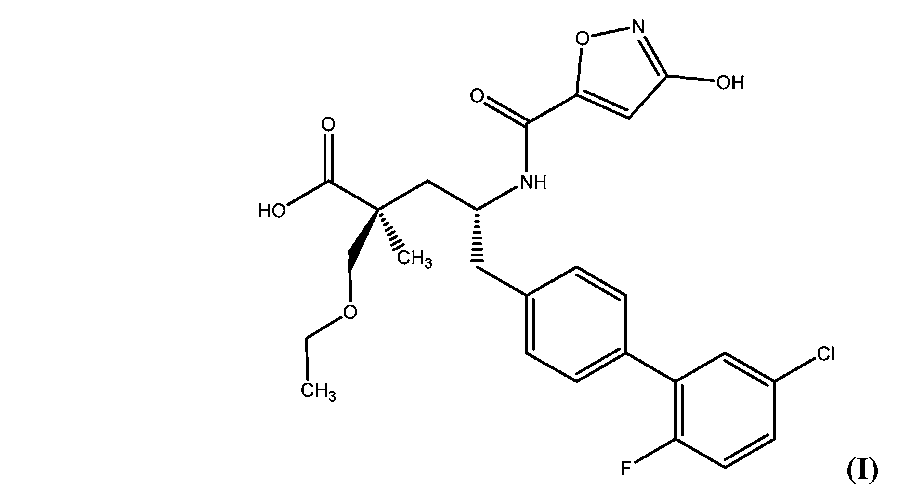
The present invention provides novel crystalline forms of Compound I that have been found to possess neprilysin (NEP) enzyme inhibitory activity. The compounds are therefore expected to be useful and advantageous as therapeutic agents for treating conditions such as hypertension, pulmonary hypertension, heart failure and renal disease. The structure of compound I is
本発明の一態様は、(2S,4R)-5-(5’-クロロ-2’-フルオロ-[1,1’-ビフェニル]-4-イル)-2-(エトキシメチル)-4-(3-ヒドロキシイソオキサゾール-5-カルボキサミド)-2-メチルペンタン酸(化合物I’)の結晶性遊離酸形態に関する。一実施形態では、化合物I’は、無水、非吸湿性またはその両方である。化合物I’はまた、結晶性形態I’と呼ぶこともできる。 One aspect of the present invention is (2S,4R)-5-(5′-chloro-2′-fluoro-[1,1′-biphenyl]-4-yl)-2-(ethoxymethyl)-4-( It relates to the crystalline free acid form of 3-hydroxyisoxazole-5-carboxamido)-2-methylpentanoic acid (Compound I'). In one embodiment, compound I' is anhydrous, non-hygroscopic, or both. Compound I' can also be referred to as crystalline Form I'.
本発明の別の態様は、1つまたは複数の薬学的に許容される担体と、化合物I’とを含む薬学的組成物に関する。このような組成物は、これらに限定されないが、AT1受容体アンタゴニスト、アンジオテンシン変換酵素阻害剤、ホスホジエステラーゼ(PDE)阻害剤、レニン阻害剤、利尿剤、またはこれらの組合せを含めた、他の治療剤を必要に応じて含有してもよい。 Another aspect of the invention relates to pharmaceutical compositions comprising one or more pharmaceutically acceptable carriers and Compound I'. Such compositions include, but are not limited to, ATI receptor antagonists, angiotensin converting enzyme inhibitors, phosphodiesterase (PDE) inhibitors, renin inhibitors, diuretics, or other therapeutic agents, or combinations thereof. Agents may be included as needed.
本発明の化合物I’は、NEP酵素阻害活性を保有し、したがって、NEP酵素を阻害することによってまたはそのペプチド基質のレベルを増加させることによって処置される疾患または障害に罹患している患者を処置するための治療剤として有用であると予期される。したがって、本発明の一態様は、NEP酵素を阻害することによって処置される疾患または障害に罹患している患者を処置する方法であって、患者に化合物I’の治療有効量を投与するステップを含む方法に関する。本発明の別の態様は、高血圧、肺高血圧、心不全、または腎疾患を処置する方法であって、対象に化合物I’の治療有効量を投与するステップを含む方法に関する。本発明のさらなる別の態様は、対象におけるNEP酵素を阻害するための方法であって、対象に化合物I’のNEP酵素阻害量を投与するステップを含む方法に関する。 Compound I' of the present invention possesses NEP enzyme inhibitory activity and thus treats patients suffering from diseases or disorders that are treated by inhibiting the NEP enzyme or by increasing levels of its peptide substrates. It is expected to be useful as a therapeutic agent for Accordingly, one aspect of the present invention is a method of treating a patient suffering from a disease or disorder treated by inhibiting the NEP enzyme comprising administering to the patient a therapeutically effective amount of Compound I' Regarding the method of containing. Another aspect of the invention relates to a method of treating hypertension, pulmonary hypertension, heart failure, or renal disease comprising administering to a subject a therapeutically effective amount of Compound I'. Yet another aspect of the invention relates to a method for inhibiting a NEP enzyme in a subject comprising administering to the subject a NEP enzyme-inhibiting amount of Compound I'.
本発明のさらに別の態様は、化合物Iおよびその結晶性形態、化合物I’を調製するのに有用なプロセスに関する。 Yet another aspect of the invention relates to a process useful for preparing Compound I and its crystalline form, Compound I'.
本発明のさらに別の態様は、医薬の製造のための、特に高血圧、心不全、または腎疾患を処置するのに有用な医薬の製造のための、化合物Iおよびその結晶性形態、化合物I’の使用に関する。本発明の別の態様は、対象におけるNEP酵素を阻害するための化合物Iまたは化合物I’の使用に関する。本発明の他の態様および実施形態は、本明細書中に開示されている。 Yet another aspect of the present invention is compound I and its crystalline form, compound I', for the manufacture of a medicament, in particular for the manufacture of a medicament useful for treating hypertension, heart failure, or renal disease. Regarding use. Another aspect of the invention relates to the use of Compound I or Compound I' for inhibiting the NEP enzyme in a subject. Other aspects and embodiments of the invention are disclosed herein.
本発明の様々な態様は、添付図面を参照することにより例示される。 Various aspects of the invention are illustrated by reference to the accompanying drawings.
(発明の詳細な説明)
一態様では、本発明は、結晶性の(2S,4R)-5-(5’-クロロ-2’-フルオロ-[1,1’-ビフェニル]-4-イル)-2-(エトキシメチル)-4-(3-ヒドロキシイソオキサゾール-5-カルボキサミド)-2-メチルペンタン酸(I’)に関する。
(Detailed description of the invention)
In one aspect, the present invention provides crystalline (2S,4R)-5-(5′-chloro-2′-fluoro-[1,1′-biphenyl]-4-yl)-2-(ethoxymethyl) -4-(3-hydroxyisoxazole-5-carboxamido)-2-methylpentanoic acid (I').
本発明の化合物I’は、2つのキラル中心を含有し、したがって、このような構造の化合物は、様々な立体異性形態で存在し得る。具体的には、炭素原子は、ある特定の(R,R)、(S,S)、(S,R)、もしくは(R,S)配置を有し得るか、またはこのような配置を有する立体異性形態を豊富に含む。化合物I’は、示され名付けられている通り、(2S,4R)配置である。他に指摘されない限り、より少ない量の他の立体異性体が本発明の組成物中に存在し得るが、ただし、全体としての組成物の有用性はこのような他の異性体の存在により排除されないものとすることを当業者であれば理解されよう。個々の立体異性体は、当技術分野で周知の多くの方法により得ることができるが、これらの方法には、適切なキラルな固定相もしくは担体を使用するキラルクロマトグラフィー、またはこれらをジアステレオ異性体へと化学的に変換し、これらのジアステレオ異性体を従来の手段、例えばクロマトグラフィーもしくは再結晶などで分離し、次いで元の立体異性体を再生することが含まれる。 Compound I' of the present invention contains two chiral centers and therefore compounds of such structure may exist in various stereoisomeric forms. Specifically, the carbon atoms may have a particular (R,R), (S,S), (S,R), or (R,S) configuration or have such a configuration Rich in stereoisomeric forms. Compound I' is of the (2S,4R) configuration as shown and named. Unless otherwise indicated, lesser amounts of other stereoisomers may be present in the compositions of the invention, provided that the usefulness of the composition as a whole is precluded by the presence of such other isomers. It will be understood by those skilled in the art that this shall not be the case. Individual stereoisomers can be obtained by a number of methods well known in the art, these methods include chiral chromatography using suitable chiral stationary phases or supports, or their separation into diastereoisomeric separation of these diastereoisomers by conventional means, such as chromatography or recrystallization, and then regenerating the original stereoisomers.
本発明の化合物I’はネプリライシン(NEP)阻害活性を保有する、すなわち、本化合物は酵素触媒活性を阻害することができる。NEP活性を阻害する化合物の能力の1つの尺度が、阻害定数(pKi)である。pKi値は、10を底とする解離定数(Ki)の負の対数であり、通常、モル単位で報告される。本発明の化合物は、NEPにおいて≧9.0のpKiを有する。化合物I’の他の特性および有用性は、特に、米国特許第9,126,956号に記載されているものを含めた、当業者に周知のインビトロおよびインビボのアッセイを使用して実証することができる。 The compounds I' of the present invention possess neprilysin (NEP) inhibitory activity, ie they are capable of inhibiting enzyme catalytic activity. One measure of a compound's ability to inhibit NEP activity is the inhibition constant (pK i ). The pK i value is the negative logarithm of the base 10 dissociation constant (K i ) and is usually reported in molar units. Compounds of the invention have a pK i of ≧9.0 at NEP. Other properties and utilities of Compound I' are demonstrated using in vitro and in vivo assays well known to those skilled in the art, including, among other things, those described in US Pat. No. 9,126,956. can be done.
化合物I’、ならびにその合成に使用される化合物は、同位体標識された化合物、すなわち、1つまたは複数の原子が、主に自然界に見られる原子質量とは異なる原子質量を有する原子を豊富に含む化合物もまた含む。本発明に記載されている化合物に組み込むことができるアイソトープの例は、例えば、これらに限定されないが、2H、3H、13C、14C、15N、18O、17O、35S、36Cl、および18Fなどである。特に興味深いのは、トリチウムまたは炭素-14を豊富に含む化合物I’(これらは、例えば、組織分布研究に使用することができる)、特に代謝の部位において重水素を豊富に含む化合物I’(例えば、より高い代謝安定性を有する化合物をもたらす)、および陽電子を放射するアイソトープ、例えば11C、18F、15Oおよび13Nなどを豊富に含む化合物I’(これらは、例えば、陽電子放射断層撮影法(PET)研究において使用することができる)などである。 Compound I', as well as the compounds used in its synthesis, are isotopically labeled compounds, i.e. atoms enriched in which one or more atoms have an atomic mass different from that found predominantly in nature. It also includes compounds that contain. Examples of isotopes that can be incorporated into compounds described in the present invention include, but are not limited to, 2 H, 3 H, 13 C, 14 C, 15 N, 18 O, 17 O, 35 S, 36 Cl, and 18 F, and the like. Of particular interest are tritium- or carbon-14-rich compounds I' (which can be used, for example, in tissue distribution studies), especially deuterium-rich compounds I' at sites of metabolism (e.g. , leading to compounds with higher metabolic stability), and compounds I′ enriched with positron-emitting isotopes such as 11 C, 18 F, 15 O and 13 N (which can be used, for example, in positron emission tomography). (can be used in PET studies).
化学構造は、本明細書では、ChemDrawソフトウェア(Perkin Elmer,Inc.、Cambridge、MA)で実行される通りのIUPAC規則に従って命名する。 Chemical structures are named herein according to IUPAC conventions as implemented in the ChemDraw software (Perkin Elmer, Inc., Cambridge, Mass.).
定義
本発明の化合物、組成物、方法およびプロセスを記載する場合、他に指摘されない限り以下の用語は、以下の意味を有する。さらに、本明細書で使用する場合、単数の形態「a」、「an」および「the」は、使用されている文脈が明らかに他を指示していない限り、対応する複数の形態を含む。「含む(comprising)」、「含む(including)」および「有する」という用語は、包括的であることが意図され、列挙した要素以外のさらなる要素も存在し得ることを意味する。本明細書中で使用された成分の量、特性、例えば分子量、反応条件などを表現するすべての数は、他に指摘されない限り、すべての場合において、「約」という用語で修飾されているものと理解されたい。したがって、本明細書中に記述された数は、本発明により得ようとされている所望の特性に応じて異なり得る近似値である。少なくとも、しかも特許請求の範囲の同等物の原理の適用を限定しようと試みることなく、各数は、少なくとも、報告された有効数字を考慮して、かつ普通の丸め技法を適用することによって解釈すべきである。
Definitions When describing the compounds, compositions, methods and processes of the present invention, the following terms have the following meanings, unless otherwise indicated. Further, as used herein, the singular forms "a,""an," and "the" include the corresponding plural forms unless the context of use clearly dictates otherwise. The terms "comprising,""including," and "having" are intended to be inclusive and mean that there may be additional elements other than the listed elements. All numbers expressing amounts of ingredients, properties, e.g. molecular weights, reaction conditions, etc. used herein are modified in all instances by the term "about" unless otherwise indicated. be understood. Accordingly, the numbers set forth herein are approximations that may vary depending on the desired properties sought to be obtained by the present invention. At a minimum, and without attempting to limit the application of the principle of equivalence of the claims, each number may be interpreted at least by considering the reported significant digits and applying common rounding techniques. should.
「約(about)」または「およそ(approximately)」という用語は、化合物I’の熱挙動の文脈で使用する場合、±1~3℃と定義される。「およその(approximate)」という用語は、尿中に排泄された化合物I’の用量%の文脈で使用する場合、通常、標準偏差の約2倍または95パーセント信頼区間の半分の幅である誤差限界によって定義される。本開示の他の領域における「およその」という用語は、1組のデータ値の標準偏差または変動もしくは分散の量を示すのに使用され得る。 The terms "about" or "approximately" when used in the context of the thermal behavior of Compound I' are defined as ±1-3°C. The term "approximate", when used in the context of % dose of Compound I' excreted in urine, usually has an error of about twice the standard deviation or half the width of the 95 percent confidence interval. Defined by limits. The term "approximately" in other areas of the disclosure may be used to indicate the standard deviation or amount of variation or variance of a set of data values.
本明細書で使用する「制御性放出」という用語は、持続性放出および延長性放出と同義であり、対象において、延長された期間にわたって送達される薬物の量に関する。一般的に、制御性放出錠剤およびカプセル剤は、約8、12、16、および24時間の期間にわたって活性物を対象に放出する。他方、「即時性放出」という用語は、短い期間内、通常、約30分未満で、活性物が対象において放出されることを指す。「遅延性放出」という用語は、所定の期間後に薬学的用量を放出する錠剤およびカプセル剤を対象とする。これらの剤形は、胃での放出は防ぐが腸管での放出は可能とするために、通常、腸溶コーティングされている。 As used herein, the term "controlled release" is synonymous with sustained release and extended release and relates to the amount of drug delivered over an extended period of time in a subject. Controlled-release tablets and capsules generally release the active agent to the subject over a period of about 8, 12, 16, and 24 hours. On the other hand, the term "immediate release" refers to release of the active in the subject within a short period of time, usually less than about 30 minutes. The term "delayed release" covers tablets and capsules that release a pharmaceutical dose after a predetermined period of time. These dosage forms are usually enteric coated to prevent release in the stomach but allow release in the intestinal tract.
本明細書で使用する場合、「式の」または「式を有する」または「構造を有する」という語句は、限定的であることは意図されておらず、「含む」という用語が一般的に使用されるのと同じように使用される。例えば、1つの構造が描写されている場合、別途述べられていない限り、すべての立体異性体および互変異性体の形態が包含されることを理解されたい。 As used herein, the phrases "of the formula" or "having the formula" or "having the structure" are not intended to be limiting and the term "comprising" is commonly used used in the same way as For example, when one structure is depicted, it is understood to encompass all stereoisomeric and tautomeric forms unless otherwise stated.
一般的に、薬学的固体を記載する際、「非溶媒和」という用語は、「溶媒なし」を含意する。したがって、本発明の結晶性形態が「非溶媒和」であると記載されている場合、これは、結晶性粒子が本質的に(2S,4R)-5-(5’-クロロ-2’-フルオロ-[1,1’-ビフェニル]-4-イル)-2-(エトキシメチル)-4-(3-ヒドロキシイソオキサゾール-5-カルボキサミド)-2-メチルペンタン酸分子のみを含有すること;この形態が、格子を含む他の溶媒分子を有意な量含有していない、または言い換えれば、溶媒が結晶格子に有意に組み込まれていないことを意味する。水が溶媒である場合、「非溶媒和」という用語は、「非水和」という用語と同義である。「無水」という用語は、結晶が、水、特に結晶水を、無視できる程度しか、ないし全く含有していないことを意味する。無視できる量の水は、水を測定できる検出の限界を意味する。例えば、本出願においてKarl Fischer(%w/w)により含水率を測定するには、0.20%w/wの定量化限界(LOQ)があり得る。したがって、化合物I’に見出される水の量は、<LOQまたは<0.20%w/wとして報告されることがある。さらに、吸湿性物質は、吸収または吸着のいずれかによって、その周囲から水を容易に引き寄せる物質である。「非吸湿性」という用語は、その表面に水分を吸着させる、またはその結晶格子に水を吸収する傾向がほとんどないし全くない結晶を記載するのに使用される。 Generally, when describing pharmaceutical solids, the term "unsolvated" implies "without solvent". Thus, when the crystalline forms of the invention are described as being "unsolvated", this means that the crystalline particles consist essentially of (2S,4R)-5-(5'-chloro-2'- containing only fluoro-[1,1′-biphenyl]-4-yl)-2-(ethoxymethyl)-4-(3-hydroxyisoxazole-5-carboxamido)-2-methylpentanoic acid molecules; It means that the form does not contain significant amounts of other solvent molecules comprising the lattice, or in other words the solvent is not significantly incorporated into the crystal lattice. When water is the solvent, the term "non-solvated" is synonymous with the term "non-hydrated." The term "anhydrous" means that the crystals contain negligible to no water, especially water of crystallization. A negligible amount of water means the limit of detection at which water can be measured. For example, to measure moisture content by Karl Fischer (% w/w) in this application, there may be a limit of quantification (LOQ) of 0.20% w/w. Therefore, the amount of water found in compound I' is sometimes reported as <LOQ or <0.20% w/w. Additionally, a hygroscopic material is one that readily attracts water from its surroundings, either by absorption or adsorption. The term "non-hygroscopic" is used to describe a crystal that has little to no tendency to adsorb water on its surface or absorb water into its crystal lattice.
本明細書で使用する「融点」という用語は、固体から液体への相変化に対応する熱転移のため、最大の吸熱熱流が示差走査熱量測定によって観察される温度を意味する。 As used herein, the term "melting point" means the temperature at which maximum endothermic heat flow is observed by differential scanning calorimetry due to the heat transition corresponding to the phase change from solid to liquid.
「薬学的に許容される」という用語は、本発明で使用する場合、生物学的に、または別の点で、許容不可能ではない物質を指す。例えば「薬学的に許容される担体」という用語は、組成物に組み込むことができ、許容できない生物学的作用を引き起こすことなく、または組成物の他の構成成分と許容できない形で相互作用することなく、患者に投与される物質を指す。このような薬学的に許容される物質は通常、毒物学的試験および製造試験の必要とされる基準を満たし、米国食品医薬品局によって適切な不活性成分として特定される物質を含む。 The term "pharmaceutically acceptable" as used herein refers to substances that are not biologically or otherwise unacceptable. For example, the term "pharmaceutically acceptable carrier" means that a carrier can be incorporated into the composition and not cause unacceptable biological effects or interact unacceptably with other components of the composition. It refers to a substance that is administered to a patient without Such pharmaceutically acceptable substances typically meet the required standards of toxicological and manufacturing testing and include substances identified by the US Food and Drug Administration as suitable inactive ingredients.
「薬学的に許容される塩」という用語は、患者、例えば哺乳動物などへの投与が許容される塩基または酸から調製した塩を意味する(例えば塩は、所与の投与計画に対して許容される哺乳動物の安全性を有する)。しかし、本発明に包含される塩は、薬学的に許容される塩である必要はないこと、例えば患者への投与を目的としない中間体化合物の塩などであることを理解されたい。薬学的に許容される塩は、薬学的に許容される無機塩基または有機塩基から、および薬学的に許容される無機酸または有機酸から誘導することができる。さらに、化合物が塩基性部分、例えばアミン、ピリジンまたはイミダゾールなどと、酸性部分、例えばカルボン酸またはテトラゾールなどの両方を含有する場合、双性イオンを形成することができ、これは本明細書で使用する「塩」という用語に含まれる。薬学的に許容される無機塩基から誘導される塩として、アンモニウム塩、カルシウム塩、銅塩、第二鉄塩、第一鉄塩、リチウム塩、マグネシウム塩、マンガン塩、第一マンガン塩、カリウム塩、ナトリウム塩、および亜鉛塩などが挙げられる。薬学的に許容される有機塩基から誘導される塩として、置換アミン、環式アミン、天然由来のアミンなどを含めた第一級、第二級および第三級アミン、例えばアルギニン、ベタイン、カフェイン、コリン、N,N’-ジベンジルエチレンジアミン、ジエチルアミン、2-ジエチルアミノエタノール、2-ジメチルアミノエタノール、エタノールアミン、エチレンジアミン、N-エチルモルホリン、N-エチルピペリジン、グルカミン、グルコサミン、ヒスチジン、ヒドラバミン、イソプロピルアミン、リジン、メチルグルカミン、モルホリン、ピペラジン(piperazine)、ピペラジン(piperadine)、ポリアミン樹脂、プロカイン、プリン、テオブロミン、トリエチルアミン、トリメチルアミン、トリプロピルアミン、トロメタミンなどの塩が挙げられる。薬学的に許容される無機酸から誘導される塩として、ホウ酸、炭酸、ハロゲン化水素酸(臭化水素酸、塩化水素酸、フッ化水素酸またはヨウ化水素酸)、硝酸、リン酸、スルファミン酸および硫酸の塩が挙げられる。薬学的に許容される有機酸から誘導される塩として、脂肪族ヒドロキシル酸(例えば、クエン酸、グルコン酸、グリコール酸、乳酸、ラクトビオン酸、リンゴ酸、および酒石酸)、脂肪族モノカルボン酸(例えば、酢酸、酪酸、ギ酸、プロピオン酸およびトリフルオロ酢酸)、アミノ酸(例えば、アスパラギン酸およびグルタミン酸)、芳香族カルボン酸(例えば安息香酸、p-クロロ安息香酸、ジフェニル酢酸、ゲンチシン酸、馬尿酸、およびトリフェニル酢酸)、芳香族ヒドロキシル酸(例えば、o-ヒドロキシ安息香酸、p-ヒドロキシ安息香酸、1-ヒドロキシナフタレン-2-カルボン酸および3-ヒドロキシナフタレン-2-カルボン酸)、アスコルビン酸、ジカルボン酸(例えば、フマル酸、マレイン酸、シュウ酸およびコハク酸)、グルクロン(glucoronic)酸、マンデル酸、ムチン酸、ニコチン酸、オロト酸、パモン酸、パントテン酸、スルホン酸(例えば、ベンゼンスルホン酸、カンファースルホン酸、エジシル酸、エタンスルホン酸、イセチオン酸、メタンスルホン酸、ナフタレンスルホン酸、ナフタレン-1,5-ジスルホン酸、ナフタレン-2,6-ジスルホン酸およびp-トルエンスルホン酸)、キシナホ酸などの塩が挙げられる。 The term "pharmaceutically acceptable salt" means a salt prepared from a base or acid that is acceptable for administration to a patient, e.g. approved mammalian safety). However, it should be understood that salts encompassed by the present invention need not be pharmaceutically acceptable salts, such as salts of intermediate compounds not intended for administration to a patient. Pharmaceutically acceptable salts can be derived from pharmaceutically acceptable inorganic or organic bases and from pharmaceutically acceptable inorganic or organic acids. Additionally, when a compound contains both a basic moiety such as an amine, pyridine or imidazole and an acidic moiety such as a carboxylic acid or tetrazole, it can form a zwitterion, which is used herein. included in the term "salt" Salts derived from pharmaceutically acceptable inorganic bases include ammonium salts, calcium salts, copper salts, ferric salts, ferrous salts, lithium salts, magnesium salts, manganese salts, manganous salts, and potassium salts. , sodium salts, and zinc salts. Primary, secondary and tertiary amines, including substituted amines, cyclic amines, naturally occurring amines, etc., including salts derived from pharmaceutically acceptable organic bases, e.g. arginine, betaine, caffeine , choline, N,N'-dibenzylethylenediamine, diethylamine, 2-diethylaminoethanol, 2-dimethylaminoethanol, ethanolamine, ethylenediamine, N-ethylmorpholine, N-ethylpiperidine, glucamine, glucosamine, histidine, hydrabamine, isopropylamine , lysine, methylglucamine, morpholine, piperazine, piperazine, polyamine resins, procaine, purines, theobromine, triethylamine, trimethylamine, tripropylamine, tromethamine, and the like. Salts derived from pharmaceutically acceptable inorganic acids such as boric acid, carbonic acid, hydrohalic acid (hydrobromic acid, hydrochloric acid, hydrofluoric acid or hydroiodic acid), nitric acid, phosphoric acid, Sulfamic acid and sulfuric acid salts are included. Salts derived from pharmaceutically acceptable organic acids include aliphatic hydroxyl acids (e.g. citric, gluconic, glycolic, lactic, lactobionic, malic, and tartaric), aliphatic monocarboxylic acids (e.g. , acetic acid, butyric acid, formic acid, propionic acid and trifluoroacetic acid), amino acids (e.g. aspartic acid and glutamic acid), aromatic carboxylic acids (e.g. benzoic acid, p-chlorobenzoic acid, diphenylacetic acid, gentisic acid, hippuric acid, and triphenylacetic acid), aromatic hydroxyl acids (e.g. o-hydroxybenzoic acid, p-hydroxybenzoic acid, 1-hydroxynaphthalene-2-carboxylic acid and 3-hydroxynaphthalene-2-carboxylic acid), ascorbic acid, dicarboxylic acids (e.g. fumaric acid, maleic acid, oxalic acid and succinic acid), glucoronic acid, mandelic acid, mucic acid, nicotinic acid, orotic acid, pamonic acid, pantothenic acid, sulfonic acids (e.g. benzenesulfonic acid, camphor sulfonic acid, edisylic acid, ethanesulfonic acid, isethionic acid, methanesulfonic acid, naphthalenesulfonic acid, naphthalene-1,5-disulfonic acid, naphthalene-2,6-disulfonic acid and p-toluenesulfonic acid), xinafoic acid, etc. salt.
「治療有効量」という用語は、処置を必要とする患者に投与した場合、処置を実行するのに十分な量、すなわち所望の治療効果を得るのに必要とされる薬物の量を意味する。例えば高血圧を処置するための治療有効量は、例えば、高血圧の症状を減少させる、抑制する、排除する、もしくは予防する、または根底にある高血圧の原因を処置するのに必要とされる化合物の量である。一実施形態では、治療有効量は、血圧を減少させるのに必要とされる薬物の量、または正常な血圧を維持するために必要とされる薬物の量である。他方では、「有効量」という用語は、所望の結果を得るのに十分な量を意味するが、この所望の結果とは、必ずしも治療的結果でなくてもよい。例えば、NEP酵素を含む系を研究する場合、「有効量」は、酵素を阻害するために必要とされる量であってよい。 The term "therapeutically effective amount" means an amount of drug required to effect treatment, ie, the desired therapeutic effect, when administered to a patient in need of treatment. A therapeutically effective amount, e.g., to treat hypertension, is, e.g., the amount of compound required to reduce, suppress, eliminate, or prevent symptoms of hypertension, or to treat the underlying cause of hypertension. is. In one embodiment, a therapeutically effective amount is the amount of drug needed to reduce blood pressure or the amount of drug needed to maintain normal blood pressure. The term "effective amount," on the other hand, means an amount sufficient to obtain the desired result, which need not necessarily be a therapeutic result. For example, when studying a system containing the NEP enzyme, an "effective amount" may be the amount required to inhibit the enzyme.
「処置する」または「処置」という用語は、本明細書で使用する場合、哺乳動物(特にヒト)などの患者における疾患または医学的状態(例えば高血圧)を処置すること、または処置を意味し、以下のうちの1つまたは複数を含む:(a)疾患または医学的状態が生じるのを予防する、すなわち、疾患もしくは医学的状態の再発を予防すること、または疾患もしくは医学的状態になる傾向がある患者の予防的処置;(b)疾患または医学的状態を改善する、すなわち、患者における疾患または医学的状態を排除することまたは退化を引き起こすこと;(c)疾患または医学的状態を抑制すること、すなわち患者における疾患または医学的状態の進行を遅延させるまたは止めること;あるいは(d)患者における疾患または医学的状態の症状を軽減すること。例えば、「高血圧を処置する」という用語では、高血圧が生じるのを予防する、高血圧を改善する、高血圧を抑制する、および高血圧の症状を軽減する(例えば、血圧を低下させる)ことを含むことになる。「対象」または「患者」という用語は、処置もしくは疾患予防を必要とする、または特定の疾患もしくは医学的状態の疾患の予防もしくは処置のために現在処置を受けている、ならびにアッセイにおいて結晶性化合物が評価されている、または使用されている試験対象、例えば動物モデルなどである、ヒトなどの哺乳動物を含むことが意図される。 The term "treat" or "treatment" as used herein means treating or treating a disease or medical condition (e.g. hypertension) in a patient, such as a mammal (particularly a human), Including one or more of the following: (a) preventing the disease or medical condition from occurring, i.e. preventing the recurrence of the disease or medical condition, or predisposing to the disease or medical condition; prophylactic treatment of a patient; (b) ameliorating the disease or medical condition, i.e., eliminating or causing regression of the disease or medical condition in the patient; (c) suppressing the disease or medical condition , ie slowing or arresting the progression of a disease or medical condition in a patient; or (d) alleviating the symptoms of a disease or medical condition in a patient. For example, the term "treating hypertension" is meant to include preventing hypertension from occurring, ameliorating hypertension, inhibiting hypertension, and alleviating symptoms of hypertension (e.g., lowering blood pressure). Become. The term "subject" or "patient" refers to a crystalline compound in an assay in need of treatment or disease prevention, or currently undergoing treatment for disease prevention or treatment of a particular disease or medical condition. is intended to include mammals, such as humans, that are test subjects, such as animal models, in which is being evaluated or used.
本明細書中で使用される他のすべての用語は、これらが関連する技術分野の当業者であれば理解されるようなこれらの普通の意味を有することが意図される。
一般的合成手順
All other terms used herein are intended to have their ordinary meaning as understood by those of ordinary skill in the art to which they pertain.
General synthetic procedure
本発明の化合物Iの結晶性形態は、容易に入手可能な出発物質から、以下および実施例に記載されている通りに合成することができる。通常のまたは好ましいプロセス条件(すなわち、反応温度、結晶化温度、回数、反応物質のモル比、溶媒、圧力など)が与えられている場合、他に述べられていない限り、他のプロセス条件もまた使用することができることを理解されたい。場合によっては、反応または結晶化は室温で行われ、実際の温度測定は行われなかった。室温は、実験室環境内の周辺温度に一般的に伴う範囲内の温度を意味し、通常約15℃~約30℃、例えば約20℃~約25℃などの範囲であることを理解されたい。他の場合には、反応または結晶化は室温で行い、温度を実際に測定し、記録した。 The crystalline forms of Compound I of the present invention can be synthesized from readily available starting materials as described below and in the Examples. Where normal or preferred process conditions (i.e., reaction temperatures, crystallization temperatures, times, molar ratios of reactants, solvents, pressures, etc.) are given, other process conditions may also be used unless otherwise stated. It should be understood that it is possible to use In some cases, reactions or crystallizations were performed at room temperature and no actual temperature measurements were taken. Room temperature is understood to mean a temperature within the range commonly associated with ambient temperature in a laboratory environment, typically in the range of about 15°C to about 30°C, such as about 20°C to about 25°C. . In other cases, the reaction or crystallization was performed at room temperature and the temperature was actually measured and recorded.
本発明の方法に記載されている任意のモル比は、当業者に入手可能な様々な方法によって容易に決定することができる。例えば、このようなモル比は、1H NMRによって容易に決定することができる。あるいは、元素分析およびHPLC法を使用して、モル比を決定することができる。 Any molar ratio described in the methods of the invention can be readily determined by a variety of methods available to those skilled in the art. For example, such molar ratios can be readily determined by 1 H NMR. Alternatively, elemental analysis and HPLC methods can be used to determine molar ratios.
一実施形態では、化合物Iは、(a)ベンジル(2S,4R)-4-アミノ-5-(5’-クロロ-2’-フルオロ-[1,1’-ビフェニル]-4-イル)-2-(エトキシメチル)-2-メチルペンタノエート塩酸塩を、溶媒中で、およそ1:1のモル比で3-((4-メトキシベンジル)オキシ)イソオキサゾール-5-カルボン酸とカップリングして、ベンジル(2S,4R)-5-(5’-クロロ-2’-フルオロ-[1,1’-ビフェニル]-4-イル)-2-(エトキシメチル)-4-(3-((4-メトキシベンジル)オキシ)イソオキサゾール-5-カルボキサミド)-2-メチルペンタノエートを得るステップ、および(b)ベンジル(2S,4R)-5-(5’-クロロ-2’-フルオロ-[1,1’-ビフェニル]-4-イル)-2-(エトキシメチル)-4-(3-((4-メトキシベンジル)オキシ)イソオキサゾール-5-カルボキサミド)-2-メチルペンタノエートを脱保護して、(2S,4R)-5-(5’-クロロ-2’-フルオロ-[1,1’-ビフェニル]-4-イル)-2-(エトキシメチル)-4-(3-ヒドロキシイソオキサゾール-5-カルボキサミド)-2-メチルペンタン酸(I)を形成するステップにより調製することができる。 In one embodiment, compound I is (a) benzyl(2S,4R)-4-amino-5-(5′-chloro-2′-fluoro-[1,1′-biphenyl]-4-yl)- 2-(Ethoxymethyl)-2-methylpentanoate hydrochloride is coupled with 3-((4-methoxybenzyl)oxy)isoxazole-5-carboxylic acid in an approximate 1:1 molar ratio in a solvent. benzyl(2S,4R)-5-(5′-chloro-2′-fluoro-[1,1′-biphenyl]-4-yl)-2-(ethoxymethyl)-4-(3-( (4-methoxybenzyl)oxy)isoxazole-5-carboxamido)-2-methylpentanoate and (b) benzyl(2S,4R)-5-(5′-chloro-2′-fluoro- [1,1′-Biphenyl]-4-yl)-2-(ethoxymethyl)-4-(3-((4-methoxybenzyl)oxy)isoxazole-5-carboxamido)-2-methylpentanoate After deprotection, (2S,4R)-5-(5′-chloro-2′-fluoro-[1,1′-biphenyl]-4-yl)-2-(ethoxymethyl)-4-(3- hydroxyisoxazole-5-carboxamido)-2-methylpentanoic acid (I).
一実施形態では、ステップ(a)は、ペプチドカップリング剤および塩基を、およそ1:3:1:1のカップリング剤対塩基対ベンジル(2S,4R)-4-アミノ-5-(5’-クロロ-2’-フルオロ-[1,1’-ビフェニル]-4-イル)-2-(エトキシメチル)-2-メチルペンタノエート塩酸塩対3-((4-メトキシベンジル)オキシ)イソオキサゾール-5-カルボン酸のモル比で加えるステップをさらに含む。ペプチドカップリング剤の代表的な例として、これらに限定されないが、O-(ベンゾトリアゾール-1-イル)-N,N,N’,N’-テトラメチルウロニウムヘキサフルオロホスフェート(HBTU)、O-(ベンゾトリアゾール-1-イル)-N,N,N’,N’-テトラメチルウロニウムテトラフルオロボレート(TBTU)、O-(7-アザベンゾトリアゾール-1-イル)-N,N,N’,N’-テトラメチルウロニウムヘキサフルオロホスフェート(HATU)、O-(7-アザベンゾトリアゾール-1-イル)-N,N,N’,N’-テトラメチルウロニウムテトラフルオロボレート(TATU)、O-(6-クロロベンゾトリアゾール-1-イル)-N,N,N’,N’-テトラメチルウロニウムヘキサフルオロホスフェート(HCTU)、およびO-[(エトキシカルボニル)シアノメチレンアミノ]-N,N,N’,N’-テトラメチルウロニウムテトラフルオロボレート(TOTU)が挙げられる。好ましい実施形態では、ペプチドカップリング剤は、HATU、HBTUおよびHCTUであり、HCTUが最も好ましい。反応において使用することができる塩基の例は、DIPEAである。 In one embodiment, step (a) comprises combining the peptide coupling agent and the base in approximately 1:3:1:1 coupling agent to base pair benzyl(2S,4R)-4-amino-5-(5′) -chloro-2′-fluoro-[1,1′-biphenyl]-4-yl)-2-(ethoxymethyl)-2-methylpentanoate hydrochloride versus 3-((4-methoxybenzyl)oxy)iso Further comprising adding in a molar ratio of oxazole-5-carboxylic acid. Representative examples of peptide coupling agents include, but are not limited to, O-(benzotriazol-1-yl)-N,N,N',N'-tetramethyluronium hexafluorophosphate (HBTU), O -(benzotriazol-1-yl)-N,N,N',N'-tetramethyluronium tetrafluoroborate (TBTU), O-(7-azabenzotriazol-1-yl)-N,N,N ',N'-tetramethyluronium hexafluorophosphate (HATU), O-(7-azabenzotriazol-1-yl)-N,N,N',N'-tetramethyluronium tetrafluoroborate (TATU) , O-(6-chlorobenzotriazol-1-yl)-N,N,N',N'-tetramethyluronium hexafluorophosphate (HCTU), and O-[(ethoxycarbonyl)cyanomethyleneamino]-N , N,N′,N′-tetramethyluronium tetrafluoroborate (TOTU). In preferred embodiments, the peptide coupling agents are HATU, HBTU and HCTU, with HCTU being most preferred. An example of a base that can be used in the reaction is DIPEA.
別の実施形態では、脱保護ステップ(b)を、パラジウム触媒、例えばパラジウム担持炭素(5%または10%w/w)、および水素ガスを用いて実施する。さらなる実施形態では、以下のステップをステップ(b)の後に実施してもよい。パラジウム触媒を除去し、続いて過酸化水素などの酸化剤を加える。次いで、反応物を約20℃~30℃の間の温度で少なくとも1時間、または好ましくは2時間撹拌してもよい。このステップに続いて、1回または複数回蒸留および洗浄をし、必要に応じて冷却およびエージングをしてから、化合物Iを単離してもよい。 In another embodiment, the deprotection step (b) is carried out using a palladium catalyst such as palladium on carbon (5% or 10% w/w) and hydrogen gas. In further embodiments, the following steps may be performed after step (b). The palladium catalyst is removed, followed by the addition of an oxidizing agent such as hydrogen peroxide. The reaction may then be stirred at a temperature between about 20° C. and 30° C. for at least 1 hour, or preferably 2 hours. This step may be followed by one or more distillations and washings, and optional cooling and aging prior to isolation of compound I.
一実施形態では、本発明は、(2S,4R)-5-(5’-クロロ-2’-フルオロ-[1,1’-ビフェニル]-4-イル)-2-(エトキシメチル)-4-(3-ヒドロキシイソオキサゾール-5-カルボキサミド)-2-メチルペンタン酸の結晶性形態(I’)に関する。別の実施形態では、結晶性形態は、無水、非吸湿性またはその両方である。 In one embodiment, the present invention provides (2S,4R)-5-(5′-chloro-2′-fluoro-[1,1′-biphenyl]-4-yl)-2-(ethoxymethyl)-4 -(3-Hydroxyisoxazole-5-carboxamido)-2-methylpentanoic acid in crystalline form (I'). In another embodiment, the crystalline form is anhydrous, non-hygroscopic, or both.
結晶性形態I’の調製は、一般的に、適切な不活性希釈剤中で行われ、これらの例として、これらに限定されないが、必要に応じて水を含有する、アセトン、アセトニトリル、酢酸エチル、メチルエチルケトン、メタノール、エタノール、イソプロパノール、イソブタノール、ジクロロメタン、メチルt-ブチルエーテル、シクロペンチルメチルエーテル、ヘキサンなど、およびこれらの混合物が挙げられる。不活性希釈剤の混合物(溶媒系とも呼ばれる)として、水を加えたアセトン、水を加えたアセトニトリル、エタノールおよび酢酸エチル、酢酸エチルおよびヘキサン、ならびに水を加えた低級アルコール(C1~6アルキル-OH)、例えば、メタノールおよび水と、イソプロパノールおよび水が挙げられる。特に適切な溶媒系として、酢酸エチルおよび水が挙げられる。結晶化の完了時には、結晶性化合物は、沈殿、濾過、濃縮、遠心分離、減圧乾燥などの任意の従来の手段によって、反応混合物から単離することができる。 Preparation of crystalline Form I' is generally carried out in a suitable inert diluent such as, but not limited to, acetone, acetonitrile, ethyl acetate, optionally containing water. , methyl ethyl ketone, methanol, ethanol, isopropanol, isobutanol, dichloromethane, methyl t-butyl ether, cyclopentyl methyl ether, hexane, etc., and mixtures thereof. As mixtures of inert diluents (also called solvent systems), water plus acetone, water plus acetonitrile, ethanol and ethyl acetate, ethyl acetate and hexane, and water plus lower alcohols (C 1-6 alkyl- OH), such as methanol and water and isopropanol and water. A particularly suitable solvent system includes ethyl acetate and water. Upon completion of crystallization, the crystalline compound can be isolated from the reaction mixture by any conventional means such as precipitation, filtration, concentration, centrifugation, vacuum drying, and the like.
一実施形態では、結晶性形態I’は、(a)必要に応じて金属捕集剤を含有する、溶媒と共に(2S,4R)-5-(5’-クロロ-2’-フルオロ-[1,1’-ビフェニル]-4-イル)-2-(エトキシメチル)-4-(3-ヒドロキシイソオキサゾール-5-カルボキサミド)-2-メチルペンタン酸(化合物I)を含む溶液を高い温度で形成するステップ、(b)溶液を約-20℃~5℃の間の温度に冷却するステップ、および(c)得られた固体を単離して、結晶性形態I’を得るステップにより調製することができる。別の実施形態では、本プロセスは、溶液を約-20℃~5℃の間の温度で撹拌するステップまたはかき混ぜるステップをさらに含む。 In one embodiment, crystalline Form I′ is (a) (2S,4R)-5-(5′-chloro-2′-fluoro-[1 ,1′-biphenyl]-4-yl)-2-(ethoxymethyl)-4-(3-hydroxyisoxazole-5-carboxamido)-2-methylpentanoic acid (Compound I) at elevated temperature. (b) cooling the solution to a temperature between about −20° C. and 5° C.; and (c) isolating the resulting solid to obtain crystalline Form I′. can. In another embodiment, the process further comprises stirring or stirring the solution at a temperature between about -20°C and 5°C.
ステップ(a)は一般的に、極性溶媒中で、室温で行われる。極性溶媒は、プロトン性または非プロトン性であり得、例えば、酢酸エチルと水との混合物、酢酸エチル、またはエタノールが挙げられる。ステップ(a)における高い温度は通常、約60℃~95℃の間、好ましくは70℃~85℃、70℃~80℃、または75℃~85℃の間である。単離ステップ(c)は、濾過するステップ、1種もしくは複数の溶媒で洗浄するステップ、空気中もしくは減圧下で乾燥させるステップ、またはこれらのステップの組合せを含む。化合物I’または結晶性形態I’を減圧下で乾燥させる場合、これは、25℃~70℃の間の、好ましくは30℃~60℃、30℃~50℃、40℃~60℃、または40℃~50℃の間の温度で行ってもよい。 Step (a) is generally performed at room temperature in a polar solvent. Polar solvents can be protic or aprotic and include, for example, ethyl acetate and water mixtures, ethyl acetate, or ethanol. The elevated temperature in step (a) is typically between about 60°C and 95°C, preferably between 70°C and 85°C, 70°C and 80°C, or 75°C and 85°C. Isolating step (c) comprises filtering, washing with one or more solvents, drying in air or under reduced pressure, or a combination of these steps. When compound I′ or crystalline Form I′ is dried under reduced pressure, it is between 25° C. and 70° C., preferably between 30° C. and 60° C., between 30° C. and 50° C., between 40° C. and 60° C., or Temperatures between 40°C and 50°C may be used.
別の実施形態では、本プロセスは、混合物を0℃~30℃の間の温度で少なくとも5分間撹拌してから、温度を約60℃~95℃の間に上昇させるステップをさらに含む。あるいは、撹拌を25℃~35℃の間の温度で少なくとも1時間実施してもよい。 In another embodiment, the process further comprises stirring the mixture at a temperature between 0°C and 30°C for at least 5 minutes before increasing the temperature to between about 60°C and 95°C. Alternatively, stirring may be carried out at a temperature between 25°C and 35°C for at least 1 hour.
さらに別の実施形態では、混合物をさらに沈降させ、上方の非水相を単離してから、温度を上昇させる。あるいは、混合物を濾過し、すすぎ、容量を減少させてから、温度を上昇させる。 In yet another embodiment, the mixture is further allowed to settle and the upper non-aqueous phase is isolated before raising the temperature. Alternatively, the mixture is filtered, rinsed, reduced in volume, and then the temperature is raised.
さらに別の実施形態では、上記プロセスのステップ(b)における温度は、独立して-15℃~-5℃の間、あるいは独立して-5℃~5℃の間である。
結晶特性
In yet another embodiment, the temperature in step (b) of the above process is independently between -15°C and -5°C, or independently between -5°C and 5°C.
Crystal properties
粉末X線回折(PXRD)分析の分野で周知のように、PXRDパターンの相対ピーク高さは、試料調製および装置の形状に関連するいくつかの要素に依存するが、ピーク位置は、実験の詳細に比較的影響を受けにくい。PXRD、示差走査熱量測定(DSC)、熱重量分析(TGA)、および動的水分収着(DMS)評価(水分収着-脱着分析としても公知)を、本明細書に記載されている通りに実施した。 As is well known in the field of powder X-ray diffraction (PXRD) analysis, the relative peak heights of a PXRD pattern depend on several factors related to sample preparation and instrument geometry, whereas peak positions depend on experimental details. relatively insensitive to PXRD, differential scanning calorimetry (DSC), thermogravimetric analysis (TGA), and dynamic moisture sorption (DMS) evaluation (also known as moisture sorption-desorption analysis) were performed as described herein. carried out.
一態様では、本発明は、(2S,4R)-5-(5’-クロロ-2’-フルオロ-[1,1’-ビフェニル]-4-イル)-2-(エトキシメチル)-4-(3-ヒドロキシイソオキサゾール-5-カルボキサミド)-2-メチルペンタン酸の結晶性形態(I’)に関し、ピーク位置が図1に示すものと実質的に一致するPXRDパターンによって特徴付けられる。 In one aspect, the present invention provides (2S,4R)-5-(5′-chloro-2′-fluoro-[1,1′-biphenyl]-4-yl)-2-(ethoxymethyl)-4- For the crystalline form (I′) of (3-hydroxyisoxazole-5-carboxamido)-2-methylpentanoic acid, it is characterized by a PXRD pattern with peak positions substantially matching those shown in FIG.
面積で1%より大きい相対強度を有するピークを、以下の表に列挙する。このパターンは、2θが5~35°の範囲において鋭い回折ピークを示す。回折パターンにおけるこれらおよび他のピークを使用して、この形態を特定することができる。


したがって、一実施形態では、結晶性形態I’は、6.51±0.20、11.62±0.20、13.05±0.20、15.07±0.20、および23.28±0.20の2θ値に回折ピークを含むPXRDパターンによって特徴付けられる。 Thus, in one embodiment, crystalline Form I' has Characterized by a PXRD pattern containing diffraction peaks at 2-theta values of ±0.20.
別の実施形態では、結晶性形態I’は、6.51±0.20、11.62±0.20、13.05±0.20、15.07±0.20、17.12±0.20、23.28±0.20、および26.19±0.20の2θ値に回折ピークを含むPXRDパターンによって特徴付けられる。 In another embodiment, crystalline Form I' is It is characterized by a PXRD pattern containing diffraction peaks at 2θ values of 0.20, 23.28±0.20, and 26.19±0.20.
別の実施形態では、結晶性形態I’は、6.51±0.20、11.62±0.20、13.05±0.20、15.07±0.20、15.72±0.20、17.12±0.20、20.79±0.20、21.10±0.20、23.28±0.20、24.48±0.20、25.81±0.20、および26.19±0.20から選択される2θ値に1つまたは複数の追加の回折ピークを有することによってさらに特徴付けられ、さらに別の実施形態では、結晶性化合物は、3つまたはそれを超えるこのような追加の回折ピークを有することによってさらに特徴付けられる。 In another embodiment, crystalline Form I' is .20, 17.12±0.20, 20.79±0.20, 21.10±0.20, 23.28±0.20, 24.48±0.20, 25.81±0.20 , and one or more additional diffraction peaks at 2-theta values selected from 26.19±0.20, and in yet another embodiment, the crystalline compound comprises three or more is further characterized by having such additional diffraction peaks exceeding .
一実施形態では、結晶性形態I’は、図2に示すものと実質的に一致するDSCサーモグラムまたは示差走査熱量測定トレースによって特徴付けられる。結晶性形態I’は、毎分10℃の加熱速度で記録した示差走査熱量測定トレースが、約214℃~約218℃の間の温度で吸熱熱流の最大値を示すことによって特徴付けられる。DSCサーモグラムまたは示差走査熱量測定トレースには、約216.1℃にピークを有し、214.2℃で始まり、吸熱下面積が107.2J/gと一致する融解吸熱が示される。化合物の分解は融解と同時に起こり、融解エンタルピーに対する107.2J/gの寄与は確定していない。 In one embodiment, crystalline Form I' is characterized by a DSC thermogram or differential scanning calorimetry trace substantially consistent with that shown in FIG. Crystalline Form I' is characterized by a differential scanning calorimetry trace recorded at a heating rate of 10°C per minute showing an endothermic heat flow maximum at temperatures between about 214°C and about 218°C. A DSC thermogram or differential scanning calorimetry trace shows a melting endotherm with a peak at about 216.1°C and an onset at 214.2°C, consistent with an area under the endotherm of 107.2 J/g. Decomposition of the compound occurs simultaneously with melting and the contribution of 107.2 J/g to the melting enthalpy is undetermined.
一実施形態では、結晶性形態I’は、図3のTGAプロファイルによって特徴付けられる。このプロファイルは約240℃まで質量損失を示さず、およそ242℃の開始で生じる有意な重量損失からわかる通り、結晶化合物は融解後に分解する。分解温度までは質量の追加的損失がなく、このことは水などの吸着分子の欠如を示している。 In one embodiment, crystalline Form I' is characterized by the TGA profile of FIG. The profile shows no mass loss up to about 240°C, and the crystalline compound decomposes after melting, as evidenced by the significant weight loss occurring at onset of approximately 242°C. There is no additional loss of mass up to the decomposition temperature, indicating a lack of adsorbed molecules such as water.
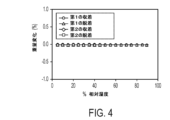
一実施形態では、結晶性形態I’は、図4のDMS等温線によって特徴付けられる。この形態は、非吸湿性固体である。5%~90%の相対湿度に曝露した場合、観察される合計水分増加は、0.02重量%未満である。2つの連続する収着-脱着サイクル間に、有意なヒステリシスは見出されない。収着-脱着サイクル後に得た固体は、出発物質と同じPXRDパターンを示し、この実験後に形態の変化がないことを示している。これらのデータは、結晶性形態I’が水の存在下で水和形態に変換しないことを示している。結晶性形態I’は非吸湿性のままであり、したがって、無水、非吸湿性またはその両方であると特徴付けることができる。 In one embodiment, crystalline Form I' is characterized by the DMS isotherm of FIG. This form is a non-hygroscopic solid. When exposed to relative humidity from 5% to 90%, the total moisture gain observed is less than 0.02% by weight. No significant hysteresis is found between two consecutive sorption-desorption cycles. The solid obtained after the sorption-desorption cycles showed the same PXRD pattern as the starting material, indicating no change in morphology after this experiment. These data indicate that crystalline Form I' does not convert to the hydrated form in the presence of water. Crystalline Form I' remains non-hygroscopic and can therefore be characterized as being anhydrous, non-hygroscopic or both.
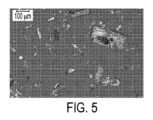
結晶性形態I’は、この形態が結晶性、複屈折の板状粒子であることを示す、図5のPLM像によって特徴付けることができる。
有用性
Crystalline Form I′ can be characterized by the PLM image of FIG. 5, which shows that this form is a crystalline, birefringent platelet-like particle.
Usefulness
対象における薬物挙動のインビトロからインビボへの外挿は、向上し続けている(例えば、Chibaら、AAPS J.、2009年6月、11巻(2号):262~276頁を参照されたい)。本発明では、化合物Iおよび結晶性形態I’のネプリライシン阻害活性を決定するために、インビトロヒトネプリライシン阻害剤活性を評価した。pKi≧9.0の閾値に達した。しかし、対象における化合物Iおよび結晶性形態I’の挙動をより正確に予測するために、追加のインビボ実験をさらに実施した。 Extrapolation of drug behavior in subjects from in vitro to in vivo continues to improve (see, e.g., Chiba et al., AAPS J., June 2009, 11(2):262-276). . In the present invention, in vitro human neprilysin inhibitor activity was evaluated to determine the neprilysin inhibitory activity of Compound I and crystalline Form I'. A threshold of pK i ≧9.0 was reached. However, additional in vivo experiments were also performed to more accurately predict the behavior of Compound I and crystalline Form I' in subjects.
インビボ挙動に関しては、必要な治療的利益を達成するのに十分な量の薬物が血漿に送達されるかどうかの評価を行う際に有用であるいくつかの特性、例えば、試験されるすべての種にわたる低い血漿クリアランス、高い経口生物学的利用能、環状グアノシン一リン酸(cGMP)応答の好ましい増強、および腎機能が損なわれている対象のための低い腎クリアランスがある。 With regard to in vivo behavior, several properties are useful in assessing whether sufficient amounts of drug are delivered to the plasma to achieve the desired therapeutic benefit, e.g. There is low plasma clearance over a wide period of time, high oral bioavailability, favorable enhancement of cyclic guanosine monophosphate (cGMP) responses, and low renal clearance for subjects with impaired renal function.
本発明については、ラット、イヌ、およびサルの種において経口および静脈内薬動学研究を行って、化合物I、すなわち、化合物I’の可溶性形態の経口生物学的利用能を決定した(アッセイ1)。このアッセイを使用して、これらの化合物についての血漿クリアランスの速度も決定した;低いクリアランス速度は、化合物が循環に残存すると予期される時間、すなわち、そのインビボ安定性および持続性を、関与する個々の排出プロセスを特定することなく予測させるものであると考えられる。 For the present invention, oral and intravenous pharmacokinetic studies were conducted in the rat, dog, and monkey species to determine the oral bioavailability of Compound I, the soluble form of Compound I' (Assay 1 ). This assay was also used to determine the rate of plasma clearance for these compounds; low clearance rates affect the amount of time a compound is expected to remain in the circulation, i.e., its in vivo stability and persistence. It is considered that it allows us to predict the emission process without specifying it.
ヒトにおいて薬動学/薬力学研究を行って、化合物Iで得られるネプリライシン阻害のレベルを決定した(アッセイ3)。このアッセイで、環状グアノシン一リン酸(cGMP)のレベルを測定した。cGMPは、ナトリウム利尿ペプチド受容体結合の下流エフェクター分子であり、したがって、ナトリウム利尿ペプチド活性の有効なインビボバイオマーカーとして機能する。動物にネプリライシン阻害剤を投与した場合、プラセボと比較して、cGMPのレベルは増加する。本発明の一実施形態は、高血圧、心不全、または腎疾患を有する対象において、心房性ナトリウム利尿ペプチド(ANP)またはcGMPの基底レベルを増加させる方法であって、対象に化合物Iまたは結晶性形態I’の治療有効量を投与するステップを含む方法に関する。ANPおよびcGMPのレベルは、対象における尿中もしくは血漿中のいずれか、またはその両方で測定される。別の実施形態では、化合物1または結晶性形態I’の治療有効量を投与した場合、ANPまたはcGMPのレベルは、対象において24時間の期間にわたり少なくとも≧1.1倍、≧1.2倍、≧1.3倍、≧1.4倍、≧1.5倍、≧2倍、≧3倍、≧4倍、または≧5倍に上昇する。別の態様では、本発明は、ヒトの血漿中の環状グアノシン一リン酸の量を増加させるための方法であって、ヒトに、の結晶性遊離酸形態を投与するステップを含む方法に関する。一態様では、本発明は、ヒトにおいて血圧を減少させるステップであって、ヒトに、血圧を減少させる量の(2S,4R)-5-(5’-クロロ-2’-フルオロ-[1,1’-ビフェニル]-4-イル)-2-(エトキシメチル)-4-(3-ヒドロキシイソオキサゾール-5-カルボキサミド)-2-メチルペンタン酸の結晶性遊離酸形態を投与するステップを含む方法に関する。
A pharmacokinetic/pharmacodynamic study was performed in humans to determine the level of neprilysin inhibition obtained with Compound I (Assay 3). This assay measured levels of cyclic guanosine monophosphate (cGMP). cGMP is a downstream effector molecule of natriuretic peptide receptor binding and thus serves as a valid in vivo biomarker of natriuretic peptide activity. Levels of cGMP are increased when animals are administered a neprilysin inhibitor compared to placebo. One embodiment of the present invention is a method of increasing basal levels of atrial natriuretic peptide (ANP) or cGMP in a subject with hypertension, heart failure, or renal disease, comprising administering Compound I or crystalline Form I to the subject ', comprising administering a therapeutically effective amount of '. Levels of ANP and cGMP are measured in either urine or plasma, or both, in the subject. In another embodiment, upon administration of a therapeutically effective amount of
溶解して、その可溶性形態、化合物Iとなる結晶性形態I’は、対象において、NEP酵素を阻害し、したがって、NEP阻害に応答して医学的状態の処置および/または予防に対して有用であることが予期されている。したがって、NEP酵素を阻害することによって、またはそのペプチド基質のレベルを増加させることによって処置される疾患または障害に罹患している患者は、化合物Iまたは結晶性形態I’の治療有効量を投与することによって、処置され得ることが予期されている。例えば、NEPを阻害することによって、化合物Iまたは結晶性形態I’は、NEPによって代謝される内因性ペプチド、例えば、ナトリウム利尿ペプチド、ボンベシン、ブラジキニン、カルシトニン、エンドセリン、エンケファリン、ニューロテンシン、物質Pおよび血管作用性腸ペプチドなどの生物学的作用を増強することが予期される。したがって、この化合物は、例えば、腎臓、中枢神経、生殖および消化器系などに対する他の生理学的作用を有すると予期されている。 Crystalline Form I′, which dissolves into its soluble form, Compound I, inhibits the NEP enzyme in a subject and is therefore useful for the treatment and/or prevention of medical conditions in response to NEP inhibition. Something is expected. Accordingly, a patient suffering from a disease or disorder treated by inhibiting the NEP enzyme or by increasing levels of its peptide substrate is administered a therapeutically effective amount of Compound I or crystalline Form I' It is expected that it can be treated by For example, by inhibiting NEP, Compound I or crystalline Form I' can be used to inhibit endogenous peptides metabolized by NEP, such as natriuretic peptides, bombesin, bradykinin, calcitonin, endothelins, enkephalins, neurotensins, substance P and It is expected to enhance the biological effects of vasoactive intestinal peptides and the like. Therefore, this compound is expected to have other physiological effects, such as on the kidney, central nervous system, reproductive and digestive systems.
薬物は、排泄および生体内変換として一般的に分類される様々な排出プロセスによって、対象身体から除去される。排泄は、主に腎臓による、膀胱、尿への、無傷の不揮発性薬物の除去に関連するが、排泄の他の経路として、胆汁(肝臓)、汗、唾液、乳汁(乳汁分泌による)、または他の体液が挙げられる。アルコールおよび気体麻酔剤などの揮発性薬物は、肺を介して呼気へと排泄される。他方では、生体内変換または薬物代謝は、体内で代謝産物へと化学的に変換される薬物に関連し、通常、酵素的プロセスである。これに対する例外は、薬物が非酵素的に化学変化する場合、例えば、エステル加水分解である。薬物の生体内変換に関与する酵素は、主に肝臓に位置する。腎臓、肺、小腸、皮膚などの他の組織もまた、代謝酵素を含む。 Drugs are removed from the subject's body by various elimination processes commonly classified as excretion and biotransformation. Excretion involves removal of intact nonvolatile drug into the bladder, urine, primarily by the kidneys, but other routes of elimination include bile (liver), sweat, saliva, milk (via lactation), or Other bodily fluids are included. Volatile drugs such as alcohol and gaseous anesthetics are excreted via the lungs into the exhaled breath. Biotransformation or drug metabolism, on the other hand, relates to drugs being chemically transformed into metabolites in the body and is usually an enzymatic process. An exception to this is when the drug is chemically altered non-enzymatically, eg ester hydrolysis. The enzymes involved in drug biotransformation are primarily located in the liver. Other tissues such as kidney, lung, small intestine and skin also contain metabolic enzymes.
薬動学研究を使用して、対象における排出経路、例えば、腎クリアランスを、経時的な尿中の投与された薬物の排泄を介して調査することもできる。ラット、イヌおよびサルの種ならびにヒトにおける、化合物Iの腎排泄を行って、排出経路としての腎排泄を評価した(アッセイ2および4)。この排出経路は、腎機能が損なわれており、腎排泄では最小限しか取り除かれない治療を必要とする対象にとって重要である。一実施形態では、対象における化合物Iまたは結晶性形態I’の腎排泄は、24時間で、投与された用量のおよそ≦15%、≦10%、≦5%、≦3%、≦2%、≦1%、または≦0.5%である。
Pharmacokinetic studies can also be used to investigate the pathway of elimination in a subject, eg, renal clearance, via excretion of an administered drug in the urine over time. Renal excretion of Compound I in rat, dog and monkey species and humans was performed to assess renal excretion as an elimination route (
以下のアッセイのセクションにおいて記載する通り、複数の動物種における血漿クリアランス、経口生物学的利用能、および腎排泄のインビボ決定を行った。化合物Iまたは結晶性形態I’は、疾患の治療に特定の有用性をもたらすことが予期される、高いヒトネプリライシン阻害活性、高い経口生物学的利用能、低い血漿クリアランス、cGMPの増強増加、および低い腎排泄を示した。 In vivo determinations of plasma clearance, oral bioavailability, and renal excretion in multiple animal species were performed as described in the Assays section below. Compound I or crystalline Form I′ is expected to have particular utility in the treatment of diseases with high human neprilysin inhibitory activity, high oral bioavailability, low plasma clearance, enhanced cGMP enhancement, and It showed low renal excretion.
心血管疾患
ナトリウム利尿ペプチドおよびブラジキニンのような血管作用性ペプチドの作用を増強することによって、化合物Iおよび結晶形態I’に、心血管疾患などの医学的状態を処置および/または予防することにおいて有用性が見出されると予期されている。例えば、Roquesら、(1993年)Pharmacol. Rev.45巻:87~146頁およびDempseyら、(2009年)Amer. J. of Pathology、174巻(3号):782~796頁を参照されたい。特に興味深い心血管疾患として、高血圧および心不全が挙げられる。高血圧は、例示として、これらに限定されずに、以下が挙げられる:原発性高血圧(これはまた本態性高血圧または特発性高血圧とも呼ばれる);続発性高血圧;付随的腎疾患を伴う高血圧;付随的腎疾患を伴う、または伴わない重症の高血圧;肺高血圧(肺動脈高血圧を含む);および治療抵抗性高血圧。心不全は、例示として、これらに限定されずに、以下が挙げられる:うっ血性心不全;急性心不全;慢性心不全、例えば左室駆出率の減少を有するもの(収縮期心不全とも呼ばれる)または左室駆出率が保たれているもの(拡張期心不全ともと呼ばれる);ならびに急性および慢性の非代償性心不全。したがって、本発明の一実施形態は、患者に化合物Iまたは結晶形態I’の治療有効量を投与することを含む、高血圧、特に原発性高血圧、肺動脈高血圧、慢性血栓塞栓性肺高血圧症(CTEPH)、または腎動脈狭窄を伴う高血圧を処置する方法に関する。
Cardiovascular Disease By potentiating the action of vasoactive peptides such as natriuretic peptides and bradykinin, Compound I and crystalline Form I' are useful in treating and/or preventing medical conditions such as cardiovascular disease. It is expected that gender will be found. See, eg, Roques et al. (1993) Pharmacol. Rev. 45:87-146 and Dempsey et al. (2009) Amer. J. of Pathology, 174(3):782-796. Cardiovascular diseases of particular interest include hypertension and heart failure. Hypertension includes, by way of example and without limitation: primary hypertension (also called essential or idiopathic hypertension); secondary hypertension; hypertension with concomitant renal disease; Severe hypertension with or without renal disease; pulmonary hypertension (including pulmonary arterial hypertension); and refractory hypertension. Heart failure includes, by way of example and without limitation: congestive heart failure; acute heart failure; chronic heart failure, such as those with reduced left ventricular ejection fraction (also called systolic heart failure) or left ventricular ejection preserved output (also called diastolic heart failure); and acute and chronic decompensated heart failure. Accordingly, one embodiment of the present invention treats hypertension, particularly primary hypertension, pulmonary arterial hypertension, chronic thromboembolic pulmonary hypertension (CTEPH), comprising administering to a patient a therapeutically effective amount of Compound I or crystalline Form I'. , or to a method of treating hypertension associated with renal artery stenosis.
原発性高血圧の処置に関して、治療有効量は通常、患者の血圧を低下させるのに十分な量である。一態様では、本発明は、ヒトにおいて血圧を減少させるステップであって、ヒトに、血圧を減少させる量の(2S,4R)-5-(5’-クロロ-2’-フルオロ-[1,1’-ビフェニル]-4-イル)-2-(エトキシメチル)-4-(3-ヒドロキシイソオキサゾール-5-カルボキサミド)-2-メチルペンタン酸の結晶性遊離酸形態を投与するステップを含む方法に関する。これは、軽度から中等度の高血圧および重症の高血圧の両方の処置を含む。高血圧を処置するために使用する場合、化合物Iまたは結晶形態I’は、他の治療剤、例えばアルドステロンアンタゴニスト、アルドステロンシンターゼ阻害剤、アンジオテンシン変換酵素阻害剤および二重作用性アンジオテンシン変換酵素/ネプリライシン阻害剤、アンジオテンシン変換酵素2(ACE2)アクチベーターおよび刺激物質、アンジオテンシン-IIワクチン、抗糖尿病剤、抗脂質剤、抗血栓剤、AT1受容体アンタゴニストおよび二重作用性AT1受容体アンタゴニスト/ネプリライシン阻害剤、β1-アドレナリン受容体アンタゴニスト、二重作用性β-アドレナリン受容体アンタゴニスト/α1-受容体アンタゴニスト、カルシウムチャネル遮断剤、利尿剤、エンドセリン受容体アンタゴニスト、エンドセリン変換酵素阻害剤、ネプリライシン阻害剤、ナトリウム利尿ペプチドおよびこれらの類似体、ナトリウム利尿ペプチドクリアランス受容体アンタゴニスト、一酸化窒素ドナー、非ステロイド性抗炎症剤、ホスホジエステラーゼ阻害剤(具体的にはPDE-V阻害剤)、プロスタグランジン受容体アゴニスト、レニン阻害剤、可溶性グアニル酸シクラーゼ刺激物質およびアクチベーターならびにこれらの組合せなどと組み合わせて投与することができる。本発明の1つの特定の実施形態では、本発明の化合物は、AT1受容体アンタゴニスト、カルシウムチャネル遮断剤、利尿剤、またはこれらの組合せと組み合わせて、原発性高血圧を処置するために使用される。本発明の別の特定の実施形態では、本発明の化合物は、AT1受容体アンタゴニストと組み合わせて、付随的腎疾患を伴う高血圧を処置するために使用される。治療抵抗性高血圧を処置するために使用する場合、本化合物は、アルドステロンシンターゼ阻害剤などの他の治療剤と組み合わせて投与することができる。 For treatment of primary hypertension, a therapeutically effective amount is usually an amount sufficient to lower the patient's blood pressure. In one aspect, the invention provides a step of reducing blood pressure in a human comprising administering to the human a blood pressure reducing amount of (2S,4R)-5-(5′-chloro-2′-fluoro-[1, A method comprising administering a crystalline free acid form of 1′-biphenyl]-4-yl)-2-(ethoxymethyl)-4-(3-hydroxyisoxazole-5-carboxamido)-2-methylpentanoic acid Regarding. This includes treatment of both mild to moderate and severe hypertension. When used to treat hypertension, Compound I or crystalline Form I' may be combined with other therapeutic agents such as aldosterone antagonists, aldosterone synthase inhibitors, angiotensin-converting enzyme inhibitors and dual-acting angiotensin-converting enzyme/neprilysin inhibitors. , angiotensin-converting enzyme 2 (ACE2) activators and stimulants, angiotensin-II vaccines, anti-diabetic agents, anti-lipid agents, anti-thrombotic agents, AT 1 receptor antagonists and dual-acting AT 1 receptor antagonists/neprilysin inhibitors , β 1 -adrenergic receptor antagonists, dual-acting β-adrenergic receptor antagonists/α 1 -receptor antagonists, calcium channel blockers, diuretics, endothelin receptor antagonists, endothelin converting enzyme inhibitors, neprilysin inhibitors, Natriuretic peptides and their analogues, natriuretic peptide clearance receptor antagonists, nitric oxide donors, non-steroidal anti-inflammatory agents, phosphodiesterase inhibitors (specifically PDE-V inhibitors), prostaglandin receptor agonists , renin inhibitors, soluble guanylate cyclase stimulators and activators, and combinations thereof and the like. In one specific embodiment of the invention, the compounds of the invention are used in combination with AT1 receptor antagonists, calcium channel blockers, diuretics, or combinations thereof to treat primary hypertension. . In another specific embodiment of the invention, compounds of the invention are used in combination with an AT1 receptor antagonist to treat hypertension with concomitant renal disease. When used to treat refractory hypertension, the compounds can be administered in combination with other therapeutic agents such as aldosterone synthase inhibitors.
肺動脈高血圧の処置に関して、治療有効量は通常、肺血管の抵抗性を低下させるのに十分な量である。療法の他の目的は、患者の運動能力を改善することである。例えば、臨床的な状況では、治療有効量は、6分間の間快適に歩行するように(約20~40メートルの距離にわたり)患者の能力を改善する量とすることができる。肺動脈高血圧を処置するために使用する場合、化合物Iまたは結晶形態I’は、他の治療剤、例えばα-アドレナリン受容体アンタゴニスト、β1-アドレナリン受容体アンタゴニスト、β2-アドレナリン受容体アゴニスト、アンジオテンシン変換酵素阻害剤、抗凝血剤、カルシウムチャネル遮断剤、利尿剤、エンドセリン受容体アンタゴニスト、PDE-V阻害剤、プロスタグランジン類似体、選択的セロトニン再取り込み阻害剤、およびこれらの組合せと組み合わせて投与することができる。本発明の1つの特定の実施形態では、化合物Iまたは結晶形態I’は、PDE-V阻害剤または選択的セロトニン再取り込み阻害剤と組み合わせて、肺動脈高血圧を処置するために使用される。 For the treatment of pulmonary arterial hypertension, a therapeutically effective amount is generally an amount sufficient to reduce pulmonary vascular resistance. Another goal of therapy is to improve the patient's exercise capacity. For example, in a clinical setting, a therapeutically effective amount can be an amount that improves a patient's ability to walk comfortably (over a distance of about 20-40 meters) for 6 minutes. When used to treat pulmonary arterial hypertension, Compound I or crystalline Form I' may be combined with other therapeutic agents such as α-adrenergic receptor antagonists, β 1 -adrenergic receptor antagonists, β 2 -adrenergic receptor agonists, angiotensin in combination with convertase inhibitors, anticoagulants, calcium channel blockers, diuretics, endothelin receptor antagonists, PDE-V inhibitors, prostaglandin analogs, selective serotonin reuptake inhibitors, and combinations thereof can be administered. In one particular embodiment of the invention, Compound I or crystalline Form I' is used in combination with a PDE-V inhibitor or a selective serotonin reuptake inhibitor to treat pulmonary arterial hypertension.
慢性血栓塞栓性肺高血圧の処置に関して、治療有効量は、対象において肺塞栓症が形成されているか否かにかかわらず、通常、肺動脈において血圧を減少させるのに十分な量である。 For treatment of chronic thromboembolic pulmonary hypertension, a therapeutically effective amount is usually an amount sufficient to reduce blood pressure in the pulmonary arteries, regardless of whether a pulmonary embolism has formed in the subject.
さらに、腎動脈狭窄を伴う高血圧の処置に関して、治療有効量は、通常、血圧を低下させるのに十分な量である。腎動脈狭窄を有する対象に関して、動脈は、アテローム性動脈硬化症に起因して狭窄している。次に、これにより身体は、腎臓に達する血液が少なくなっていることを検知し、これを低血圧であると解釈し、次に、血圧を上げるためのホルモンの放出をシグナル伝達する。時間の経過と共に、これは腎不全につながる可能性がある。 Furthermore, for treatment of hypertension associated with renal artery stenosis, a therapeutically effective amount is usually an amount sufficient to lower blood pressure. For subjects with renal artery stenosis, the artery is narrowed due to atherosclerosis. This in turn causes the body to detect that less blood is reaching the kidneys, interpret this as low blood pressure, and then signal the release of hormones to raise blood pressure. Over time, this can lead to kidney failure.
本発明の別の実施形態は、患者に化合物Iまたは結晶形態I’の治療有効量を投与することを含む、心不全、特にうっ血性心不全(心臓収縮期と心臓拡張期の両方のうっ血性心不全を含む)を処置するための方法に関する。通常、治療有効量は、血圧を低下させ、そして/または腎機能を改善するのに十分な量である。臨床的な状況において、治療有効量は、心臓の血流力学を改善する、例えば楔入圧、右心房圧、充満圧、および血管抵抗性における減少などに十分な量とすることができる。一実施形態では、化合物は静脈内投与形態として投与される。心不全を処置するために使用する場合、化合物Iまたは結晶形態I’は、他の治療剤、例えばアデノシン受容体アンタゴニスト、進行糖化終末産物ブレーカー、アルドステロンアンタゴニスト、AT1受容体アンタゴニスト、β1-アドレナリン受容体アンタゴニスト、二重作用性β-アドレナリン受容体アンタゴニスト/α1-受容体アンタゴニスト、キマーゼ阻害剤、ジゴキシン、利尿剤、エンドセリン変換酵素(ECE)阻害剤、エンドセリン受容体アンタゴニスト、ナトリウム利尿ペプチドおよびこれらの類似体、ナトリウム利尿ペプチドクリアランス受容体アンタゴニスト、一酸化窒素ドナー、プロスタグランジン類似体、PDE-V阻害剤、可溶性グアニル酸シクラーゼアクチベーターおよび刺激物質、ならびにバソプレッシン受容体アンタゴニストなどと組み合わせて投与することができる。本発明の1つの特定の実施形態では、化合物Iまたは結晶形態I’は、アルドステロンアンタゴニスト、β1-アドレナリン受容体アンタゴニスト、AT1受容体アンタゴニスト、または利尿剤と併用し、うっ血性心不全を処置するために使用される。 Another embodiment of the present invention relates to heart failure, particularly congestive heart failure (both systolic and diastolic congestive heart failure), comprising administering to a patient a therapeutically effective amount of Compound I or crystalline Form I'. including ). Generally, a therapeutically effective amount is an amount sufficient to lower blood pressure and/or improve renal function. In a clinical setting, a therapeutically effective amount can be an amount sufficient to improve the hemodynamics of the heart, such as reducing wedge pressure, right atrial pressure, filling pressure, and vascular resistance. In one embodiment, the compound is administered as an intravenous dosage form. When used to treat heart failure, Compound I or crystalline Form I' may be combined with other therapeutic agents such as adenosine receptor antagonists, advanced glycation end product breakers, aldosterone antagonists, AT 1 receptor antagonists, β 1 -adrenergic receptors. dual-acting β-adrenergic receptor antagonists/α 1 -receptor antagonists, chymase inhibitors, digoxin, diuretics, endothelin-converting enzyme (ECE) inhibitors, endothelin receptor antagonists, natriuretic peptides and these Administration in combination with analogs, natriuretic peptide clearance receptor antagonists, nitric oxide donors, prostaglandin analogs, PDE-V inhibitors, soluble guanylate cyclase activators and stimulators, vasopressin receptor antagonists, and the like can be done. In one particular embodiment of the invention, Compound I or crystalline Form I' is used in combination with an aldosterone antagonist, a β 1 -adrenergic receptor antagonist, an AT 1 receptor antagonist, or a diuretic to treat congestive heart failure. used for
下痢
NEP阻害剤として、化合物Iまたは結晶形態I’は、内因性エンケファリンの分解を阻害することが予期され、したがってこのような化合物に、伝染性および分泌性/水様性の下痢を含めた下痢の処置に対しても有用性を見出すことができる。例えば、Baumerら、(1992年)Gut、33巻:753~758頁;Farthing(2006年)Digestive Diseases、24巻:47~58頁;およびMarcais-Collado(1987年)Eur. J. Pharmacol.144巻(2号):125~132頁を参照されたい。下痢を処置するために使用する場合、化合物Iまたは結晶形態I’は、1つまたは複数の追加の止瀉薬と併用することができる。
Diarrhea As NEP inhibitors, Compound I or crystalline Form I' is expected to inhibit the degradation of endogenous enkephalins and thus such compounds may be used to treat diarrhea, including contagious and secretory/watery diarrhea. may also find utility for the treatment of See, eg, Baumer et al. (1992) Gut 33:753-758; Farthing (2006) Digestive Diseases 24:47-58; and Marcais-Collado (1987) Eur. J. Pharmacol. 144(2): 125-132. When used to treat diarrhea, Compound I or crystalline Form I' may be used in combination with one or more additional antidiarrheal agents.
腎疾患
ナトリウム利尿ペプチドおよびブラジキニンなどの血管作用性ペプチドの作用を増強させることによって、化合物Iまたは結晶性形態I’に、腎機能を向上させ(Chenら、(1999年)Circulation 100巻:2443~2448頁;Lipkinら、(1997年)Kidney Int. 52巻:792~801頁;およびDussauleら、(1993年)Clin. Sci. 84巻:31~39頁を参照されたい)、腎障害のある対象における腎疾患の処置および/または予防における有用性を見出すことが予期されている。特に興味深い腎疾患として、糖尿病性腎症、慢性腎疾患、タンパク質尿、および特に急性腎臓傷害(例えば、心血管手術、化学療法、または医学的画像撮影における造影染料の使用により引き起こされる)または急性腎不全が挙げられる(Sharkovskaら、(2011年)Clin. Lab. 57巻:507~515頁およびNewazら、(2010年)Renal Failure 32巻:384~390頁を参照されたい)。特に興味深い他の腎疾患として、ネフローゼ症候群、巣状分節性糸球体硬化症(FSGS)および多発性嚢胞腎疾患(PKD)が挙げられる。
Renal Disease By potentiating the action of vasoactive peptides such as natriuretic peptides and bradykinin, Compound I or crystalline Form I' has been shown to improve renal function (Chen et al. (1999) Circulation 100:2443-24). 2448; Lipkin et al. (1997) Kidney Int. 52:792-801; and Dussaule et al. (1993) Clin. It is expected to find utility in treating and/or preventing kidney disease in a subject. Kidney diseases of particular interest include diabetic nephropathy, chronic kidney disease, proteinuria, and especially acute kidney injury (e.g., caused by cardiovascular surgery, chemotherapy, or the use of contrast dyes in medical imaging) or acute kidney disease. (2011) Clin. Lab. 57:507-515 and Newaz et al. (2010) Renal Failure 32:384-390). Other kidney diseases of particular interest include nephrotic syndrome, focal segmental glomerulosclerosis (FSGS) and polycystic kidney disease (PKD).
慢性腎臓病(CKD)を有する、腎障害のある対象は、National Kidney Foundation Kidney Disease Outcomes Quality Initiative(NKF KDOQI)ガイドラインに従って分類することができる。慢性腎臓病、すなわち、3ヶ月間以上の腎臓損傷または糸球体濾過量(GFR)60mL/分/1.73m2未満が確定されたら、疾患の段階を、KDOQI CKD分類に従って割り当てることができる。これらには、ステージ1(GFRが正常または増加している腎臓損傷):GFR≧90;ステージ2(GFRが軽度に低下している腎臓損傷):GFR60~89;ステージ3(GFRの中程度の低下):GFR30~59;ステージ4(GFRの重度の低下):GFR15~29;およびステージ5(腎不全):GFR<15(または透析)が含まれる。GFRは、mL/分/1.73m2の単位で定義される。 Kidney-impaired subjects with chronic kidney disease (CKD) can be classified according to the National Kidney Foundation Kidney Disease Outcomes Quality Initiative (NKF KDOQI) guidelines. Once established chronic kidney disease, ie, kidney damage for ≥3 months or glomerular filtration rate (GFR) less than 60 mL/min/1.73 m 2 , disease stage can be assigned according to the KDOQI CKD classification. These include Stage 1 (kidney injury with normal or increased GFR): GFR≧90; Stage 2 (kidney injury with mildly decreased GFR): GFR 60-89; Stage 3 (kidney injury with moderate GFR); Stage 4 (severely decreased GFR): GFR 15-29; and Stage 5 (renal failure): GFR<15 (or dialysis). GFR is defined in units of mL/min/1.73 m 2 .
一実施形態は、腎障害のある対象を処置する方法であって、化合物Iまたは結晶性形態I’の治療有効量を投与するステップを含む方法を含む。この方法は、高血圧または心不全を有する腎障害のある対象を処置するステップをさらに含む。腎疾患を処置するために使用する場合、化合物Iまたは結晶性形態I’は、アンジオテンシン変換酵素阻害剤、AT1受容体アンタゴニスト、および利尿剤などの他の治療剤と組み合わせて投与してもよい。 One embodiment includes a method of treating a subject with renal impairment comprising administering a therapeutically effective amount of Compound I or crystalline Form I'. The method further comprises treating a renal-impaired subject with hypertension or heart failure. When used to treat kidney disease, Compound I or crystalline Form I' may be administered in combination with other therapeutic agents such as angiotensin converting enzyme inhibitors, AT1 receptor antagonists, and diuretics. .
別の実施形態は、推定糸球体濾過量(eGFR)が60mL/分/1.73m2~15mL/分/1.73m2の間である慢性腎臓病を有する腎障害のある対象を処置する方法であって、患者に化合物Iまたは結晶性形態I’の治療有効量を投与するステップを含む方法を含む。別の実施形態は、推定糸球体濾過量(eGFR)≧90mL/分/1.73m2(ステージ1)またはeGFR<15mL/分/1.73m2(ステージ5)である慢性腎臓病を有する腎障害のある対象を処置する方法であって、患者に化合物Iまたは結晶性形態I’の治療有効量を投与するステップを含む方法を含む。本発明の目的のために、重度の腎臓病は、eGFR<30mL/分/1.73m2として分類することができる。さらに別の実施形態には、ステージ1、ステージ2、ステージ3、ステージ4、ステージ5として、またはこれらのステージの1つもしくは複数を網羅するeGFR範囲として分類される慢性腎臓病を有する腎障害のある対象を、化合物Iまたは結晶性形態I’で処置する方法が含まれる。
Another embodiment is a method of treating a renal impaired subject with chronic kidney disease who has an estimated glomerular filtration rate (eGFR) between 60 mL/min/1.73 m 2 and 15 mL/min/1.73 m 2 and comprising administering to the patient a therapeutically effective amount of Compound I or crystalline Form I'. Another embodiment is a kidney with chronic kidney disease with an estimated glomerular filtration rate (eGFR)≧90 mL/min/1.73 m 2 (stage 1) or eGFR<15 mL/min/1.73 m 2 (stage 5). A method of treating a subject with a disorder, comprising administering to the patient a therapeutically effective amount of Compound I or crystalline Form I'. For purposes of the present invention, severe renal disease can be classified as eGFR<30 mL/min/1.73 m 2 . In yet another embodiment, renal impairment with chronic kidney disease classified as
予防療法
ナトリウム利尿ペプチドの作用を増強させることによって、化合物1はまた、予防療法において、ナトリウム利尿ペプチドの抗肥大性および抗線維性作用により(Potterら、(2009年)Handbook of Experimental Pharmacology、191巻:341~366頁を参照されたい)、例えば心筋梗塞後の心機能不全の進行を予防すること、血管形成後の動脈再狭窄を予防すること、血管手術後の血管壁の増粘を予防すること、アテローム性動脈硬化症を予防すること、および糖尿病の脈管症を予防することにおいて有用であることも予期されている。
Prophylactic Therapy By potentiating the action of natriuretic peptides,
緑内障
ナトリウム利尿ペプチドの作用を増強させることによって、化合物Iまたは結晶形態I’は、緑内障を処置するのに有用であると予期されている。例えば、Diestelhorstら、(1989年)International Ophthalmology、12巻:99~101頁を参照されたい。緑内障を処置するために使用する場合、化合物1は、1つまたは複数の追加の抗緑内障剤と併用することができる。
Glaucoma By potentiating the action of natriuretic peptides, Compound I or crystalline Form I' is expected to be useful in treating glaucoma. See, eg, Diestelhorst et al. (1989) International Ophthalmology 12:99-101. When used to treat glaucoma,
疼痛緩和
NEP阻害剤として、化合物Iまたは結晶形態I’は、内因性エンケファリンの分解を阻害すると予期されており、したがってこのような化合物に、鎮痛剤としての有用性を見出すこともできる。例えば、Roquesら、(1980年)Nature、288巻:286~288頁およびThanawalaら、(2008年)Current Drug Targets、9巻:887~894頁を参照されたい。疼痛を処置するために使用する場合、化合物Iまたは結晶形態I’は、1つまたは複数の追加の抗侵害受容性薬物、例えばアミノペプチダーゼNまたはジペプチジルペプチダーゼIII阻害剤、非ステロイド性抗炎症剤、モノアミン再取り込み阻害剤、筋弛緩剤、NMDA受容体アンタゴニスト、オピオイド受容体アゴニスト、5-HT1Dセロトニン受容体アゴニストおよび三環式抗うつ剤などと併用することができる。
Pain Relief As NEP inhibitors, Compound I or crystalline Form I' is expected to inhibit the breakdown of endogenous enkephalins, and thus such compounds may also find utility as analgesics. See, eg, Roques et al. (1980) Nature 288:286-288 and Thanawala et al. (2008) Current Drug Targets 9:887-894. When used to treat pain, Compound I or crystalline Form I' may be combined with one or more additional antinociceptive drugs such as aminopeptidase N or dipeptidyl peptidase III inhibitors, non-steroidal anti-inflammatory agents. , monoamine reuptake inhibitors, muscle relaxants, NMDA receptor antagonists, opioid receptor agonists, 5-HT 1D serotonin receptor agonists and tricyclic antidepressants.
他の有用性
これらのNEP阻害特性に起因して、化合物Iまたは結晶形態I’はまた、鎮咳剤として有用であることも予期され、ならびに肝硬変に伴う門脈圧亢進症(Sansoeら、(2005年)J. Hepatol.43巻:791~798頁を参照されたい)、がん(Vesely、(2005年)J. Investigative Med.53巻:360~365頁を参照されたい)、うつ病(Nobleら、(2007年)Exp. Opin. Ther. Targets、11巻:145~159頁を参照されたい)、月経障害、早期陣痛、子癇前症、子宮内膜症、繁殖障害(例えば、男性および女性の不妊、多嚢胞性卵巣症候群、着床不全)、ならびに男性の勃起不全および女性の性的興奮障害を含めた男性および女性の性機能不全の処置における有用性が見出されている。さらに具体的には、化合物Iまたは結晶形態I’は、女性の性機能不全を処置するのに有用であると予期されており(Prydeら、(2006年)J. Med. Chem.49巻:4409~4424頁を参照されたい)、この性機能不全とは、多くの場合、女性患者が、性的表現に満足を見出すことが困難であること、またはできないことと定義される。性機能不全は、様々な多様な女性の性的疾患をカバーし、例示として、これらに限定されずに、性的欲求低下障害、性的興奮障害、オルガスム障害および性的疼痛障害が挙げられる。このような疾患、特に女性の性機能不全を処置するために使用する場合、本発明の化合物は、以下の第2の剤のうちの1つまたは複数と併用してもよい:PDE-V阻害剤、ドーパミンアゴニスト、エストロゲン受容体アゴニストおよび/またはアンタゴニスト、アンドロゲン、ならびにエストロゲン。これらのNEP阻害特性に起因して、化合物Iまたは結晶形態I’はまた、抗炎症特性を有することが予期され、よって、特にスタチンと組み合わせて使用する場合、有用性を有することが予期される。
Other Utilities Due to their NEP inhibitory properties, Compound I or crystalline Form I' is also expected to be useful as an antitussive agent, as well as portal hypertension associated with liver cirrhosis (Sansoe et al., 2005). ) J. Hepatol. 43:791-798), cancer (see Vesely, (2005) J. Investigative Med. 53:360-365), depression (see Noble et al. (2007) Exp. Opin. Ther. Targets 11:145-159), menstrual disorders, preterm labor, preeclampsia, endometriosis, reproductive disorders It has found utility in treating male and female sexual dysfunctions, including infertility, polycystic ovary syndrome, implantation failure), and male erectile dysfunction and female sexual arousal disorders. More specifically, Compound I or crystalline Form I' is expected to be useful for treating female sexual dysfunction (Pryde et al. (2006) J. Med. Chem. 49: 4409-4424), this sexual dysfunction is often defined as the difficulty or inability of a female patient to find satisfaction in sexual expression. Sexual dysfunction covers a wide variety of female sexual disorders and includes, but is not limited to, hypoactive sexual desire disorder, sexual arousal disorder, orgasmic disorder and sexual pain disorder. When used to treat such disorders, particularly female sexual dysfunction, the compounds of the invention may be combined with one or more of the following secondary agents: PDE-V inhibition agents, dopamine agonists, estrogen receptor agonists and/or antagonists, androgens, and estrogens. Due to these NEP inhibitory properties, compound I or crystalline Form I' is also expected to have anti-inflammatory properties and thus is expected to have utility, especially when used in combination with statins. .
最近の研究は、NEPがインスリン分泌低下型糖尿病および食生活誘発性肥満において神経機能を調整する役割を果たしていることを示唆している。Coppeyら、(2011年)Neuropharmacology、60巻:259~266頁。したがって、これらのNEP阻害特性に起因して、化合物Iまたは結晶形態I’はまた、糖尿病または食生活誘発性肥満により引き起こされる神経機能障害に対する保護を提供するのに有用であると予期されている。 Recent studies suggest that NEP plays a role in modulating neuronal function in hypoinsulin secretory diabetes and diet-induced obesity. Coppey et al. (2011) Neuropharmacology 60:259-266. Therefore, due to their NEP inhibitory properties, Compound I or crystalline Form I' is also expected to be useful in providing protection against neuronal dysfunction caused by diabetes or diet-induced obesity. .
化合物Iまたは結晶形態I’の1回あたり投与される量または一日あたり投与される総量は、既定であってもよいし、または患者の状態の性質および重症度、処置を受けている状態、患者の年齢、体重、および全般的健康状態、活性剤に対する患者の耐性、投与経路、薬理学的考慮、例えば投与される化合物および任意の第2の剤の活性、効力、薬動学および毒性学プロファイルなどを含めた多くの要素を考慮に入れることによって、個々の患者ベースで決定してもよい。疾患または医学的状態(例えば高血圧など)に罹患している患者の処置は、既定の用量または処置する医師によって決定された用量を用いて開始することができ、疾患または医学的状態の症状を予防、改善、抑制、または軽減するのに必要な一時期の間継続することになる。このような処置を受ける患者は通常、日常的にモニターすることによって、療法の有効性を決定する。例えば、高血圧の処置において、血圧測定を使用することによって、処置の有効性を決定することができる。本明細書中に記載されている他の疾患および状態に対する同様の指標は、周知であり、処置する医師にとっては容易に入手可能である。医師による連続的なモニタリングによって、化合物Iまたは結晶形態I’の最適な量が任意の所定の時間に投与されること、ならびに処置期間の決定が促進されることが保証される。第2の剤も投与される場合には、これらの選択、用量、および療法の期間の調整が必要とされることもあるので、これが特に重要となる。こうして、処置レジメンおよび投薬計画は、所望の有効性を示す最低量の活性剤が投与され、さらに、疾患または医学的状態の処置を成功させるのに必要な期間だけ投与が継続するように、療法コースにわたって調整することができる。 The amount administered per dose or the total amount administered per day of Compound I or crystalline Form I' may be predetermined or may depend on the nature and severity of the patient's condition, the condition being treated, Age, weight, and general health of the patient, patient tolerance to the active agent, route of administration, pharmacological considerations such as activity, potency, pharmacokinetics and toxicology of the administered compound and any second agent. It may be determined on an individual patient basis by taking into account many factors, including profile and the like. Treatment of a patient suffering from a disease or medical condition (such as hypertension) can be initiated using a prescribed dose or a dose determined by the treating physician to prevent symptoms of the disease or medical condition. , will continue for a period of time necessary to ameliorate, suppress, or alleviate. Patients undergoing such treatment are routinely monitored to determine efficacy of therapy. For example, in treating hypertension, blood pressure measurements can be used to determine the effectiveness of treatment. Similar indicators for the other diseases and conditions described herein are well known and readily available to the treating physician. Continuous monitoring by a physician ensures that an optimal amount of Compound I or crystalline Form I' is administered at any given time and facilitates determination of treatment duration. This is of particular importance if a second agent is also administered, as adjustments to their selection, dosage, and duration of therapy may be required. Thus, treatment regimens and dosing regimens are designed such that the lowest amount of active agent that exhibits the desired efficacy is administered and that administration continues for as long as necessary to successfully treat the disease or medical condition. Can be adjusted across the course.
化合物Iは、例えば結晶性形態I’を含めた化合物Iの結晶性形態の調製に有用な中間体としても有用性がある。 Compound I also has utility as an intermediate useful, for example, in the preparation of crystalline forms of Compound I, including crystalline Form I'.
リサーチツール
化合物Iまたは結晶形態I’は、NEP酵素阻害活性を有するので、これらは、NEP酵素を有する生物学的系または試料を調査または研究する、例えば、NEP酵素またはそのペプチド基質がある役割を果たしている疾患を研究するためのリサーチツールとしても有用である。NEP酵素を有する任意の適切な生物学的系または試料を、インビトロまたはインビボのいずれかで行うことができるような研究において利用することができる。このような研究に対して適切な代表的な生物学的系または試料として、これらに限定されないが、細胞、細胞抽出物、原形質膜、組織試料、単離した器官、哺乳動物(例えばマウス、ラット、モルモット、ウサギ、イヌ、ブタ、ヒトなど)などが挙げられ、哺乳動物が特に興味深い。本発明の1つの特定の実施形態では、哺乳動物におけるNEP酵素活性は、化合物Iまたは結晶形態I’のNEP阻害量を投与することによって阻害される。
Research Tools Since Compound I or Crystalline Form I' have NEP enzyme inhibitory activity, they may be used to investigate or study biological systems or samples that have the NEP enzyme, e.g. It is also useful as a research tool for studying diseases that play a role. Any suitable biological system or sample having a NEP enzyme can be utilized in such studies, which can be performed either in vitro or in vivo. Representative biological systems or samples suitable for such studies include, but are not limited to, cells, cell extracts, plasma membranes, tissue samples, isolated organs, mammals (e.g., mice, rats, guinea pigs, rabbits, dogs, pigs, humans, etc.), with mammals being of particular interest. In one particular embodiment of the invention, NEP enzymatic activity in a mammal is inhibited by administering a NEP-inhibiting amount of Compound I or crystalline Form I'.
リサーチツールとして使用する場合、通常、NEP酵素を含む生物学的系または試料を、化合物Iまたは結晶形態I’のNEP酵素阻害量と接触させる。生物学的系または試料を化合物に曝露した後、従来の手順および機器を使用して、例えば結合アッセイで受容体結合を測定することにより、または機能アッセイでリガンドが媒介する変化を測定することにより、NEP酵素を阻害する作用を判定する。曝露は、細胞または組織を化合物に接触させること、例えばi.p.、p.o、i.v.、s.c.、または吸入による投与などにより化合物を哺乳動物に投与することを包含する。この判定ステップは、応答(定量分析)を測定するステップを含むことができるか、または観察(定性分析)を行うステップを含むことができる。応答を測定するステップは、例えば、従来の手順および機器、例えば酵素活性アッセイなどを使用して生物学的系または試料に対する化合物の作用を判定すること、ならびに機能アッセイで酵素基質または生成物が媒介する変化を測定することなどを含む。アッセイの結果を使用して、活性レベルならびに所望の結果を達成するのに必要な化合物の量、すなわち、NEP酵素阻害量を判定することができる。通常、この判定ステップは、NEP酵素を阻害する作用を判定することを含むことになる。 When used as a research tool, a biological system or sample containing the NEP enzyme is typically contacted with a NEP enzyme-inhibiting amount of Compound I or crystalline Form I'. After exposure of a biological system or sample to a compound, conventional procedures and instrumentation are used, for example, by measuring receptor binding in binding assays or by measuring ligand-mediated changes in functional assays. , to determine the effect of inhibiting the NEP enzyme. Exposure involves contacting a cell or tissue with a compound, eg i. p. , p. o, i. v. , s. c. or administering the compound to a mammal such as by administration by inhalation. This determination step may involve measuring a response (quantitative analysis) or may involve making an observation (qualitative analysis). Measuring a response includes, for example, determining the effect of a compound on a biological system or sample using conventional procedures and instrumentation, such as enzymatic activity assays, and enzymatic substrate or product-mediated reactions in functional assays. including measuring changes in The results of the assay can be used to determine the level of activity as well as the amount of compound required to achieve the desired result, ie, the amount of NEP enzyme inhibition. Typically, this determining step will involve determining the effect of inhibiting the NEP enzyme.
さらに、化合物Iまたは結晶性形態I’は、他の化学物質を評価するためのリサーチツールとして使用することができ、したがって、例えば、NEP阻害活性を有する新規化合物を発見するためのスクリーニングアッセイにおいても有用である。このように、化合物Iまたは結晶性形態I’は、アッセイにおいて標準として使用されることによって、試験化合物を用いて、および化合物Iまたは結晶性形態I’を用いて得た結果を比較して、もしある場合には、ほぼ等しいまたは優れた活性を有するような試験化合物を特定することを可能にする。例えば、試験化合物または試験化合物群のpKiデータを、化合物Iまたは結晶性形態I’のpKiデータと比較して、所望の特性を有するような試験化合物、例えば、本発明の化合物と等しいか、またはより優れたpKi値を有する試験化合物を特定する。本発明のこの態様は、興味深い試験化合物を特定するための、比較データの生成(適当なアッセイを使用して)と、試験データの分析との両方を別々の実施形態として含む。したがって、試験化合物は、生物学的アッセイにおいて、(a)試験化合物を用いて生物学的アッセイを行って、第1のアッセイ値を得るステップと、(b)化合物Iまたは結晶性形態I’を用いて生物学的アッセイを行って、第2のアッセイ値を得るステップと、(c)ステップ(a)で得た第1のアッセイ値を、ステップ(b)で得た第2のアッセイ値と比較するステップとを含み、ステップ(a)が、ステップ(b)の前もしくは後、またはそれと同時に行われる方法によって、評価することができる。典型的な生物学的アッセイは、NEP酵素阻害アッセイを含む。 Additionally, Compound I or crystalline Form I' can be used as a research tool to evaluate other chemical entities, and thus also in screening assays to discover novel compounds with NEP inhibitory activity, for example. Useful. Thus, Compound I or crystalline Form I' is used as a standard in the assay to compare the results obtained with test compounds and with Compound I or crystalline Form I', In some cases, it allows the identification of those test compounds that have similar or superior activity. For example, the pK i data for a test compound or group of test compounds is compared to the pK i data for Compound I or crystalline Form I′ to determine if it is equal to the test compound, e.g., a compound of the invention, that has the desired properties. , or test compounds with better pK i values. This aspect of the invention includes, as separate embodiments, both the generation of comparative data (using appropriate assays) and the analysis of test data to identify interesting test compounds. Thus, a test compound can be used in a biological assay by: (a) performing a biological assay with the test compound to obtain a first assay value; and (b) compound I or crystalline Form I' (c) combining the first assay value obtained in step (a) with the second assay value obtained in step (b); and comparing, and step (a) can be evaluated by a method in which step (a) is performed before, after, or at the same time as step (b). Typical biological assays include NEP enzyme inhibition assays.
本発明のさらなる別の態様は、NEP酵素を含む生物学的系または試料を研究する方法であって、(a)前記生物学的系または試料を化合物Iまたは結晶形態I’に接触させるステップと、(b)生物学的系または試料に対する、前記化合物により引き起こされた作用を決定するステップとを含む方法に関する。 Yet another aspect of the present invention is a method of studying a biological system or sample comprising a NEP enzyme, comprising the steps of: (a) contacting said biological system or sample with Compound I or Crystalline Form I' , (b) determining the effect caused by said compound on a biological system or sample.
薬学的組成物および製剤
化合物Iまたは結晶形態I’は通常、薬学的組成物または製剤の形態で患者に投与される。このような薬学的組成物は、これらに限定されないが、経口、直腸、経膣、鼻、吸入、局所用(経皮的を含む)、眼、および非経口モードの投与を含めた、任意の許容される投与経路で患者に投与され得る。さらに、化合物Iまたは結晶形態I’は、例えば経口的に、一日あたり複数回投与(例えば、毎日、2、3、または4回)するか、一日量を単回で投与するか、または週間用量を単回で投与することができる。特定のモードの投与に対して適切な化合物Iまたは結晶形態I’の任意の形態(すなわち、遊離塩基、遊離酸、薬学的に許容される塩、溶媒和物など)が、本明細書中で考察された薬学的組成物で使用することができることを理解されたい。
Pharmaceutical Compositions and Formulations Compound I or crystalline Form I' is typically administered to a patient in the form of a pharmaceutical composition or formulation. Such pharmaceutical compositions may be administered in any mode, including, but not limited to, oral, rectal, vaginal, nasal, inhalation, topical (including transdermal), ocular, and parenteral modes of administration. It can be administered to the patient by any acceptable route of administration. Additionally, Compound I or crystalline Form I' may be administered, eg orally, in multiple doses per day (eg, 2, 3, or 4 times daily), or in a single daily dose, or A single weekly dose can be administered. Any form of Compound I or crystalline Form I' suitable for the particular mode of administration (i.e., free base, free acid, pharmaceutically acceptable salts, solvates, etc.) is herein It should be understood that they can be used in the pharmaceutical compositions discussed.
したがって、一実施形態では、本発明は、薬学的に許容される担体および化合物1を含む薬学的組成物に関する。組成物は、所望する場合、他の治療剤および/または配合剤を含有してもよい。組成物を考察する場合、「化合物Iまたは結晶形態I’」はまた、本明細書中で「活性剤」として言及されてもよく、製剤の他の成分、例えば担体などからこれを区別することもできる。したがって、「活性剤」という用語は、化合物Iまたは結晶形態I’ならびにその薬学的に許容される塩を含むことを理解されたい。
Accordingly, in one embodiment, the present invention relates to pharmaceutical compositions comprising a pharmaceutically acceptable carrier and
本発明の薬学的組成物は通常、化合物Iまたは結晶形態I’の治療有効量を含有する。しかし、当業者であれば、薬学的組成物は、例えばバルク組成物などは、治療有効量よりも多い量を含有してもよく、または治療有効量よりも少ない量、すなわち、複数の投与により治療有効量を達成するように計画されている個々の単位用量を含有してもよいことを認識されよう。通常、組成物は、約0.01~99重量%の活性剤を含有することになり、実際の量は、製剤それ自体、投与経路、投薬頻度などに依存する。一実施形態では、経口投与剤形に対して適切な組成物は、例えば、約10~99重量%、または約50~99重量%の活性剤を含有してもよい。 The pharmaceutical compositions of the invention typically contain a therapeutically effective amount of Compound I or crystalline Form I'. However, it will be appreciated by those skilled in the art that a pharmaceutical composition, such as a bulk composition, may contain a greater than therapeutically effective amount, or a less than therapeutically effective amount, i.e., by multiple administrations. It will be appreciated that individual unit doses designed to achieve a therapeutically effective dose may be included. Generally, compositions will contain from about 0.01 to 99% by weight of active agent, with the actual amount depending on the formulation itself, route of administration, frequency of dosing, and the like. In one embodiment, a composition suitable for an oral dosage form may contain, for example, about 10-99%, or about 50-99% by weight of active agent.
任意の従来の担体または賦形剤を、本発明の薬学的組成物に使用することができる。ある特定の担体もしくは賦形剤、または担体もしくは賦形剤の組合せの選択は、ある特定の患者または種類の医学的状態もしくは疾患状態を処置するために使用されている投与の形式に依存することになる。この点について、ある特定の形式の投与に対して適切な組成物の調製は、十分に薬学的技術分野の当業者の範囲内にある。さらに、このような組成物において使用される担体または賦形剤は市販されている。さらなる例示として、従来の製剤技法は、Remington: The Science and Practice of Pharmacy、第20版、Lippincott Williams & White、Baltimore、Maryland(2000年);およびH. C. Anselら、Pharmaceutical Dosage Forms and Drug Delivery Systems、第7版、Lippincott Williams & White、Baltimore、Maryland(1999年)に記載されている。 Any conventional carrier or excipient can be used in the pharmaceutical compositions of the invention. The selection of a particular carrier or excipient, or combination of carriers or excipients, will depend upon the mode of administration being used to treat the particular patient or class of medical or disease condition. become. In this regard, the preparation of a suitable composition for a particular mode of administration is well within the scope of those skilled in the pharmaceutical arts. Additionally, carriers or excipients used in such compositions are commercially available. By way of further illustration, conventional formulation techniques are described in Remington: The Science and Practice of Pharmacy, 20th Edition, Lippincott Williams & White, Baltimore, Maryland (2000); C. Ansel et al., Pharmaceutical Dosage Forms and Drug Delivery Systems, 7th Edition, Lippincott Williams & White, Baltimore, Maryland (1999).
薬学的に許容される担体として機能できる物質の代表的な例として、これらに限定されないが、以下が挙げられる:糖、例えばラクトース、グルコースおよびスクロースなど;デンプン、例えばコーンスターチおよびジャガイモデンプンなど;セルロース、例えば微結晶性セルロース、およびその誘導体、例えばカルボキシメチルセルロースナトリウム、エチルセルロースおよび酢酸セルロースなど;脂肪酸塩、例えばステアリン酸マグネシウムなど;粉末トラガント;麦芽;ゼラチン;タルク;賦形剤、例えばココアバターおよび坐剤ワックスなど;油、例えばピーナッツ油、綿実油、ベニバナ油、ゴマ油、オリーブ油、トウモロコシ油およびダイズ油など;グリコール、例えばプロピレングリコール;ポリオール、例えばグリセリン、ソルビトール、マンニトールおよびポリエチレングリコールなど;エステル、例えばオレイン酸エチルおよびラウリン酸エチルなど;寒天;緩衝剤、例えば水酸化マグネシウムおよび水酸化アルミニウムなど;アルギン酸;発熱物質を含まない水;等張生理食塩水;リンガー溶液;エチルアルコール;リン酸塩緩衝液;圧縮された噴霧剤気体、例えばクロロフルオロ炭素およびヒドロフルオロカーボンなど;ならびに薬学的組成物に利用される他の無毒性の相容性物質。 Representative examples of substances that can serve as pharmaceutically acceptable carriers include, but are not limited to: sugars such as lactose, glucose and sucrose; starches such as cornstarch and potato starch; cellulose, For example microcrystalline cellulose, and its derivatives such as sodium carboxymethylcellulose, ethylcellulose and cellulose acetate; fatty acid salts such as magnesium stearate; powdered tragacanth; malt; oils such as peanut, cottonseed, safflower, sesame, olive, corn and soybean oils; glycols such as propylene glycol; polyols such as glycerin, sorbitol, mannitol and polyethylene glycol; esters such as ethyl oleate and agar; buffers such as magnesium hydroxide and aluminum hydroxide; alginic acid; pyrogen-free water; Propellant gases such as chlorofluorocarbons and hydrofluorocarbons; and other nontoxic compatible substances utilized in pharmaceutical compositions.
本発明の一実施形態では、薬学的に許容される担体は、ステアリン酸マグネシウムである。例えば、薬学的組成物は、化合物Iまたは結晶性形態I’とステアリン酸マグネシウムとを、約3:1~約10:1の化合物Iまたは結晶性形態I’対ステアリン酸マグネシウムの比率で含んでもよい。化合物Iまたは結晶性形態I’対ステアリン酸マグネシウムの他の比率として、これらに限定されないが、1:1、5:1、15:1、20:1、25:1、30:1、および50:1が挙げられる。別の実施形態では、化合物Iまたは結晶性形態I’対ステアリン酸マグネシウムの量は、重量%として表現されてもよい。例えば、薬学的組成物は、99重量%の化合物Iまたは結晶性形態I’と1重量%のステアリン酸マグネシウムとから構成されてもよい。別の実施形態では、化合物Iまたは結晶性形態I’対ステアリン酸マグネシウムの重量比は、それぞれ85:15~99:1の間である。好ましい実施形態では、化合物Iまたは結晶性形態I’対ステアリン酸マグネシウムの重量比は、95:5~99:1の間、好ましくは99:1である。 In one embodiment of the invention the pharmaceutically acceptable carrier is magnesium stearate. For example, the pharmaceutical composition may comprise Compound I or crystalline Form I' and magnesium stearate in a ratio of Compound I or crystalline Form I' to magnesium stearate of from about 3:1 to about 10:1. good. Other ratios of Compound I or crystalline Form I' to magnesium stearate include, but are not limited to, 1:1, 5:1, 15:1, 20:1, 25:1, 30:1, and 50. : 1 can be mentioned. In another embodiment, the amount of Compound I or crystalline Form I' to magnesium stearate may be expressed as weight percent. For example, the pharmaceutical composition may consist of 99% by weight Compound I or crystalline Form I' and 1% by weight magnesium stearate. In another embodiment, the weight ratio of Compound I or crystalline Form I' to magnesium stearate is between 85:15 and 99:1, respectively. In a preferred embodiment, the weight ratio of Compound I or crystalline Form I' to magnesium stearate is between 95:5 and 99:1, preferably 99:1.
薬学的組成物は通常、活性剤と、薬学的に許容される担体および1つまたは複数の任意の成分とを、十分におよび密に混合またはブレンドすることによって調製する。次いで、生成された、均一にブレンドされた混合物は、従来の手順および機器を使用して、錠剤、カプセル剤、丸剤、キャニスター、カートリッジ、ディスペンサーなどへと成形または充填することができる。 Pharmaceutical compositions are generally prepared by thoroughly and intimately mixing or blending the active agent with a pharmaceutically acceptable carrier and one or more optional ingredients. The resulting homogeneously blended mixture can then be formed or filled into tablets, capsules, pills, canisters, cartridges, dispensers, etc. using conventional procedures and equipment.
一実施形態では、薬学的組成物は、経口投与に対して適切である。経口投与に対して適切な組成物は、カプセル剤、錠剤、丸剤、ロゼンジ剤、カシェ剤、糖衣錠、散剤、粒剤;水性または非水性の液体中の溶液または懸濁液;水中油型または油中水型の液体エマルジョン;エリキシル剤またはシロップ剤などの形態であってよく、それぞれが既定の量の活性剤を含有する。 In one embodiment, the pharmaceutical composition is suitable for oral administration. Suitable compositions for oral administration include capsules, tablets, pills, lozenges, cachets, dragees, powders, granules; solutions or suspensions in aqueous or non-aqueous liquids; They may be in such forms as water-in-oil liquid emulsions; elixirs or syrups, each containing a predetermined amount of the active agent.
固形剤形(カプセル剤、錠剤、丸剤など)での経口投与を目的とする場合、組成物は通常、活性剤と、1つまたは複数の薬学的に許容される担体、例えばクエン酸ナトリウム、第二リン酸カルシウムまたはステアリン酸マグネシウムなどを含むことになる。固形剤形はまた、以下を含んでもよい:充填剤または増量剤、例えばデンプン、微結晶性セルロース、ラクトース、スクロース、グルコース、マンニトール、および/またはケイ酸など;バインダー、例えばカルボキシメチルセルロース、アルギン酸塩、ゼラチン、ポリビニルピロリドン、スクロースおよび/またはアカシアなど;保湿剤、例えばグリセロールなど;崩壊剤、例えば寒天、炭酸カルシウム、ジャガイモもしくはタピオカデンプン、アルギン酸、特定のシリケート、および/または炭酸ナトリウムなど;溶解遅延剤、例えばパラフィンなど;吸収促進剤、例えば第四級アンモニウム化合物など;湿潤剤、例えばセチルアルコールおよび/またはモノステアリン酸グリセロールなど;吸収剤、例えばカオリンおよび/またはベントナイト粘土など;滑沢剤、例えばタルク、ステアリン酸カルシウム、ステアリン酸マグネシウム、固体ポリエチレングリコール、ラウリル硫酸ナトリウム、および/またはこれらの混合物など;着色剤;ならびに緩衝剤。本発明の目的では、「薬学的に許容される担体」という用語には、上記の担体、充填剤または増量剤、バインダー、保湿剤、溶解遅延剤、湿潤剤、吸収剤、滑沢剤、着色剤、緩衝剤などのすべての用語が含まれる。 When intended for oral administration in solid dosage form (capsules, tablets, pills, etc.), the composition typically comprises the active agent and one or more pharmaceutically acceptable carriers such as sodium citrate, Such as dicalcium phosphate or magnesium stearate will be included. Solid dosage forms may also include: fillers or extenders such as starch, microcrystalline cellulose, lactose, sucrose, glucose, mannitol, and/or silicic acid; binders such as carboxymethylcellulose, alginates, gelatin, polyvinylpyrrolidone, sucrose and/or acacia; moisturizing agents such as glycerol; disintegrating agents such as agar, calcium carbonate, potato or tapioca starch, alginic acid, certain silicates, and/or sodium carbonate; absorption enhancers such as quaternary ammonium compounds; wetting agents such as cetyl alcohol and/or glycerol monostearate; absorbent agents such as kaolin and/or bentonite clay; lubricants such as talc, such as calcium stearate, magnesium stearate, solid polyethylene glycol, sodium lauryl sulfate, and/or mixtures thereof; coloring agents; and buffering agents. For the purposes of the present invention, the term "pharmaceutically acceptable carrier" includes the above carriers, fillers or extenders, binders, humectants, dissolution retardants, wetting agents, absorbents, lubricants, coloring agents. All terms such as agent, buffering agent, etc. are included.
剥離剤、湿潤剤、コーティング剤、甘味剤、香味剤および芳香剤、保存剤ならびに抗酸化剤もまた薬学的組成物中に存在し得る。錠剤、カプセル剤、丸剤などに対する典型的コーティング剤として、腸溶コーティングに対して使用されるもの、例えば酢酸フタル酸セルロース、ポリビニルアセテートフタレート、ヒドロキシプロピルメチルセルロースフタレート、メタクリル酸-メタクリル酸エステルコポリマー、トリメリト酸酢酸セルロース、カルボキシメチルエチルセルロース、ヒドロキシプロピルメチルセルロースアセテートスクシネートなどが挙げられる。薬学的に許容される抗酸化剤の例として、以下が挙げられる:水溶性抗酸化剤、例えばアスコルビン酸、システイン塩酸塩、重硫酸ナトリウム、メタ重硫酸ナトリウム、亜硫酸ナトリウムなど;油溶性抗酸化剤、例えばパルミチン酸アスコルビル、ブチル化ヒドロキシアニソール、ブチルヒドロキシトルエン、レシチン、没食子酸プロピル、αトコフェロールなど;および金属キレート剤、例えばクエン酸、エチレンジアミン四酢酸、ソルビトール、酒石酸、リン酸など。 Exfoliating agents, wetting agents, coating agents, sweetening, flavoring and perfuming agents, preservatives and antioxidants can also be present in the pharmaceutical composition. Typical coatings for tablets, capsules, pills, etc., used for enteric coatings such as cellulose acetate phthalate, polyvinyl acetate phthalate, hydroxypropyl methylcellulose phthalate, methacrylic acid-methacrylic acid ester copolymers, trimellit. cellulose acetate, carboxymethylethylcellulose, hydroxypropylmethylcellulose acetate succinate and the like. Examples of pharmaceutically acceptable antioxidants include: water-soluble antioxidants such as ascorbic acid, cysteine hydrochloride, sodium bisulfate, sodium metabisulfate, sodium sulfite, etc.; oil-soluble antioxidants. , such as ascorbyl palmitate, butylated hydroxyanisole, butylhydroxytoluene, lecithin, propyl gallate, alpha-tocopherol, and the like; and metal chelating agents such as citric acid, ethylenediaminetetraacetic acid, sorbitol, tartaric acid, phosphoric acid, and the like.
組成物はまた、例として、様々な割合のヒドロキシプロピルメチルセルロースまたは他のポリマーマトリクス、リポソームおよび/もしくはミクロスフェアなどを使用して、活性剤の徐放性または制御性放出を提供するように製剤化され得る。さらに、本発明の薬学的組成物は、乳白剤を含有してもよく、また、本発明の薬学的組成物は、活性剤を、消化管の特定の部分のみでまたはそこで優先的に、必要に応じて遅延型の形式で放出するように製剤化されてもよい。使用することができる包埋組成物の例として、ポリマー物質およびワックスが挙げられる。活性剤はまた、必要に応じて1つまたは複数の上記賦形剤を用いてマイクロカプセル化した形態にすることもできる。 Compositions may also be formulated to provide sustained or controlled release of the active agent using, for example, varying proportions of hydroxypropylmethylcellulose or other polymeric matrices, liposomes and/or microspheres, and the like. can be In addition, the pharmaceutical compositions of the invention may contain opacifiers, and the pharmaceutical compositions of the invention may contain active agents only or preferentially in certain parts of the gastrointestinal tract where they are needed. It may be formulated to release in a delayed fashion depending on the dose. Examples of embedding compositions that can be used include polymeric substances and waxes. The active agent can also be in micro-encapsulated form, if desired, with one or more of the above excipients.
本発明の一実施形態は、カプセル剤、錠剤、液体剤、または懸濁液剤中に化合物Iまたは結晶性形態I’を含む経口投与剤形を含む。本発明の別の実施形態は、対象における化合物Iまたは結晶性形態I’の放出が、即時性放出、制御性放出、または遅延性放出である経口投与剤形に関する。カプセル剤を経口投与剤形として使用する場合、別の実施形態は、ゼラチン、多糖類、または合成ポリマーからなるカプセル剤を含む。ある特定の実施形態では、カプセル剤は、ヒドロキシプロピルメチルセルロースを含む。 One embodiment of the invention includes an oral dosage form comprising Compound I or crystalline Form I' in a capsule, tablet, liquid, or suspension. Another embodiment of the present invention relates to oral dosage forms wherein the release of Compound I or crystalline Form I' in a subject is immediate release, controlled release, or delayed release. When capsules are used as the oral dosage form, another embodiment includes capsules made of gelatin, polysaccharides, or synthetic polymers. In certain embodiments, the capsule comprises hydroxypropylmethylcellulose.
本発明による適切なカプセル材料は、ゼラチン、セルロース誘導体、デンプン、デンプン誘導体、キトサン、および合成プラスチックから選択される。ゼラチンをカプセル材料として使用する場合、これはポリエチレングリコール(PEG)、グリセロール、ソルビトール、ポリプロピレングリコール、PEO-PPOブロックコポリマー、ならびに他のポリアルコールおよびポリエーテルから選択される他の添加剤と混合して使用することができる。セルロース誘導体をカプセル材料として使用する場合、ヒドロキシプロピルメチルセルロース、ヒドロキシプロピルセルロース、メチルセルロース、ヒドロキシメチルセルロース、およびヒドロキシエチルセルロースが、好ましいポリマーである。合成プラスチックをカプセル材料として使用する場合、ポリエチレン、ポリカーボネート、ポリエステル、ポリプロピレン、およびポリエチレンテレフタレートが、好ましい材料である。特に好ましいのは、ポリエチレン、ポリカーボネート、またはポリエチレンテレフタレートである。 Suitable capsule materials according to the invention are selected from gelatin, cellulose derivatives, starch, starch derivatives, chitosan and synthetic plastics. When gelatin is used as capsule material, it is mixed with other additives selected from polyethylene glycol (PEG), glycerol, sorbitol, polypropylene glycol, PEO-PPO block copolymers, and other polyalcohols and polyethers. can be used. Hydroxypropylmethylcellulose, hydroxypropylcellulose, methylcellulose, hydroxymethylcellulose and hydroxyethylcellulose are preferred polymers when cellulose derivatives are used as capsule materials. When synthetic plastics are used as encapsulants, polyethylene, polycarbonate, polyester, polypropylene and polyethylene terephthalate are preferred materials. Especially preferred are polyethylene, polycarbonate or polyethylene terephthalate.
経口投与に対して適切な液体剤形は、例示として、薬学的に許容されるエマルジョン、マイクロエマルジョン、溶液、懸濁液、シロップ剤およびエリキシル剤が挙げられる。液体剤形は通常、活性剤と不活性希釈剤、例えば水または他の溶媒、可溶化剤および乳化剤、例えばエチルアルコール、イソプロピルアルコール、炭酸エチル、酢酸エチル、ベンジルアルコール、安息香酸ベンジル、プロピレングリコール、1,3-ブチレングリコール、油(例えば綿実油、ラッカセイ油、トウモロコシ油、胚芽油、オリーブ油、ヒマシ油およびゴマ油)、グリセロール、テトラヒドロフリルアルコール、ポリエチレングリコールおよびソルビタンの脂肪酸エステル、ならびにこれらの混合物を含む。懸濁液は、懸濁剤、例えばエトキシ化イソステアリルアルコール、ポリオキシエチレンソルビトールおよびソルビタンエステル、微結晶性セルロース、アルミニウムメタヒドロオキシド、ベントナイト、寒天およびトラガント、ならびにこれらの混合物を含有してもよい。 Liquid dosage forms suitable for oral administration include, by way of example, pharmaceutically acceptable emulsions, microemulsions, solutions, suspensions, syrups and elixirs. Liquid dosage forms usually contain active agents and inert diluents such as water or other solvents, solubilizers and emulsifiers such as ethyl alcohol, isopropyl alcohol, ethyl carbonate, ethyl acetate, benzyl alcohol, benzyl benzoate, propylene glycol, 1,3-butylene glycol, oils (eg, cottonseed, peanut, corn, germ, olive, castor and sesame), glycerol, tetrahydrofuryl alcohol, polyethylene glycol and fatty acid esters of sorbitan, and mixtures thereof. Suspensions may contain suspending agents such as ethoxylated isostearyl alcohols, polyoxyethylene sorbitol and sorbitan esters, microcrystalline cellulose, aluminum metahydroxide, bentonite, agar and tragacanth, and mixtures thereof. .
経口投与を目的とする場合、本発明の薬学的組成物は、単位剤形で包装されていてもよい。「単位剤形」という用語は、患者への投薬に対して適切な物理的に別個の単位を指し、すなわち、各単位が、単独で、または1つもしくは複数の追加の単位と組み合わせて、所望の治療効果が生じるように計算された既定の量の活性剤を含有している。例えば、このような単位剤形は、カプセル剤、錠剤、丸剤などであってよい。 When intended for oral administration, the pharmaceutical composition of the invention may be packaged in unit dosage form. The term "dosage unit form" refers to a physically discrete unit suitable for patient administration, i.e., each unit containing, alone or in combination with one or more additional units, the desired dose. containing a predetermined amount of active agent calculated to produce a therapeutic effect of For example, such unit dosage forms may be capsules, tablets, pills, and the like.
別の実施形態では、本発明の組成物は、吸入による投与に対して適切であり、通常エアゾール剤または散剤の形態である。このような組成物は一般的に、周知のデリバリーデバイス、例えばネブライザー、ドライパウダー、または計量式吸入器などを使用して投与される。ネブライザーデバイスは、高速の空気の流れを生成し、これにより組成物がミストとして噴霧され、このミストが患者の呼吸器内へ運ばれる。典型的なネブライザー製剤は、担体に溶解して溶液を形成する活性剤、または微粉化され、担体と混合されて、呼吸に適したサイズの微粉化粒子の懸濁液を形成する活性剤を含む。ドライパウダー吸入器は、自由流動性粉末として活性剤を投与するが、この自由流動性粉末は吸息の間に患者の空気流の中に分散する。典型的なドライパウダー製剤は、ラクトース、デンプン、マンニトール、デキストロース、ポリ乳酸、ポリ乳酸-co-グリコリド、およびこれらの組合せなどの賦形剤とドライブレンドした活性剤を含む。計量式吸入器は、圧縮された噴霧剤気体を使用して測定した量の活性剤を放出する。典型的な定量製剤は、液化性噴霧剤、例えばクロロフルオロ炭素またはヒドロフルオロアルカンなどの中に活性剤の溶液または懸濁液を含む。このような製剤の任意の構成成分は、共溶媒、例えばエタノールまたはペンタンなど、ならびに界面活性剤、例えばトリオレイン酸ソルビタン、オレイン酸、レシチン、グリセリン、およびラウリル硫酸ナトリウムなどを含む。このような組成物は通常、冷却または加圧したヒドロフルオロアルカンを、活性剤、エタノール(存在する場合)および界面活性剤(存在する場合)を含有する適切な容器に加えることによって調製する。懸濁液を調製するため、活性剤を、微粉化し、次いで噴霧剤と合わせる。あるいは、懸濁液製剤は、界面活性剤のコーティングを、活性剤の微粉化した粒子上にスプレー乾燥することによって調製することもできる。次いでこの製剤を、吸入器の一部を形成するエアゾールキャニスターに充填する。 In another embodiment, compositions of the invention are suitable for administration by inhalation, usually in the form of an aerosol or powder. Such compositions are generally administered using well-known delivery devices such as nebulizers, dry powder, or metered dose inhalers. A nebulizer device produces a high velocity stream of air that nebulizes the composition as a mist that is carried into the patient's respiratory tract. A typical nebulizer formulation contains an active agent dissolved in a carrier to form a solution, or an active agent that is micronized and mixed with the carrier to form a suspension of finely divided particles of respirable size. . Dry powder inhalers administer the active agent as a free-flowing powder that disperses into the patient's air-stream during inspiration. A typical dry powder formulation contains the active agent dry blended with excipients such as lactose, starch, mannitol, dextrose, polylactic acid, polylactic-co-glycolide, and combinations thereof. Metered dose inhalers use compressed propellant gas to deliver a measured amount of active agent. Typical metered dose formulations comprise a solution or suspension of the active agent in a liquefied propellant such as a chlorofluorocarbon or hydrofluoroalkane. Optional components of such formulations include co-solvents such as ethanol or pentane, and surfactants such as sorbitan trioleate, oleic acid, lecithin, glycerin, and sodium lauryl sulfate. Such compositions are typically prepared by adding the chilled or pressurized hydrofluoroalkane to a suitable vessel containing the active agent, ethanol (if present) and surfactant (if present). To prepare a suspension, the active agent is finely divided and then combined with the propellant. Alternatively, a suspension formulation can be prepared by spray drying a coating of surfactant onto finely divided particles of the active agent. This formulation is then filled into an aerosol canister forming part of the inhaler.
化合物Iまたは結晶形態I’およびそれらの組成物はまた、非経口的(例えば、皮下、静脈内、筋肉内、または腹腔内注射)に投与することができる。このような投与に関して、活性剤は、無菌溶液、懸濁液、またはエマルジョン中で提供される。このような製剤を調製するための典型的な溶媒として、水、生理食塩水、電解液、低分子量アルコール、例えばプロピレングリコール、ポリエチレングリコール、油、アミノ酸、ゼラチン、糖、脂肪酸エステル、例えばオレイン酸エチルなどが挙げられる。非経口製剤はまた、1つまたは複数の抗酸化剤、可溶化剤、安定剤、保存剤、湿潤剤、乳化剤および分散剤を含有してもよい。界面活性剤、追加の安定化剤またはpH調整剤(酸、塩基または緩衝剤)および抗酸化剤は、製剤に安定性を提供する、例えば、化合物中に存在し得るエステルおよびアミド結合の加水分解を最小限に抑えるかまたは回避するのに、特に有用である。これらの製剤は、無菌注射用媒体、滅菌剤、濾過、照射、または熱の使用により無菌にすることができる。 Compound I or crystalline Form I' and compositions thereof can also be administered parenterally (eg, by subcutaneous, intravenous, intramuscular, or intraperitoneal injection). For such administration, the active agent is provided in a sterile solution, suspension, or emulsion. Typical solvents for preparing such formulations include water, saline, electrolytes, low molecular weight alcohols such as propylene glycol, polyethylene glycol, oils, amino acids, gelatin, sugars, fatty acid esters such as ethyl oleate. etc. Parenteral formulations may also contain one or more antioxidants, solubilizers, stabilizers, preservatives, wetting agents, emulsifying agents and dispersing agents. Surfactants, additional stabilizers or pH modifiers (acids, bases or buffers) and antioxidants provide stability to the formulation, e.g. hydrolysis of ester and amide bonds that may be present in the compound. is particularly useful for minimizing or avoiding These formulations can be rendered sterilized by the use of sterile injectable media, sterilants, filtration, irradiation, or heat.
生理学的に許容される代表的な水性担体には、例として、注射用滅菌水、USP;デキストロース注射液、USP(例えば、5%デキストロース注射液(D5/W)を含めた、2.5、5.0、10、20%デキストロース);デキストロースおよび塩化ナトリウム注射液、USP(例えば、2.5から10%まで変動するデキストロースおよび0.12(19ミリ当量のナトリウム)から0.9%(154ミリ当量のナトリウム)まで変動する塩化ナトリウム);マンニトール注射液、USP(例えば、5、10、15、20、および25%マンニトール);リンゲル注射液、USP(例えば、1リットルあたり147ミリ当量のナトリウム、4ミリ当量のカリウム、4.5ミリ当量のカルシウム、および156ミリ当量の塩化物);乳酸化リンゲル注射液、USP(例えば、1リットルあたり2.7ミリ当量のカルシウム、4ミリ当量のカリウム、130ミリ当量のナトリウム、および28ミリ当量の乳酸塩);塩化ナトリウム注射液、USP(例えば、0.9%塩化ナトリウム)などが含まれる。 Representative physiologically acceptable aqueous carriers include, by way of example, Sterile Water for Injection, USP; Dextrose Injection, USP (e.g., 5% Dextrose Injection (D5/W), 2.5, 5.0, 10, 20% dextrose); dextrose and sodium chloride injection, USP (e.g. dextrose varying from 2.5 to 10% and 0.12 (19 meq sodium) to 0.9% (154 Mannitol Injection, USP (e.g., 5, 10, 15, 20, and 25% mannitol); Ringer's Injection, USP (e.g., 147 milliequivalents of sodium per liter) , 4 meq potassium, 4.5 meq calcium, and 156 meq chloride); Lactated Ringer's Injection, USP (e.g., 2.7 meq calcium, 4 meq potassium per liter) , 130 meq sodium, and 28 meq lactate); sodium chloride injection, USP (eg, 0.9% sodium chloride);
患者に投与される場合、化合物Iまたは結晶性形態I’は、通常、化合物Iまたは結晶性形態I’の1mgあたり約0.5mL~約10mL、例えば、1mgあたり約0.6~約8mLの水性担体中に希釈される。 When administered to a patient, Compound I or crystalline Form I' will generally be present in an amount of about 0.5 mL to about 10 mL per mg of Compound I or crystalline Form I', such as about 0.6 to about 8 mL per mg. Diluted in an aqueous carrier.
1つの特定の実施形態では、非経口製剤は、薬学的に許容される担体としてシクロデキストリン水溶液を含む。適切なシクロデキストリンとして、アミラーゼ、β-シクロデキストリンまたはシクロヘプタアミロースなどの場合のように、連結により1,4位で連結されている6つ以上のα-D-グルコピラノース単位を含有する環状分子が挙げられる。典型的なシクロデキストリンとして、シクロデキストリン誘導体、例えばヒドロキシプロピルシクロデキストリンおよびスルホブチルエーテルシクロデキストリン、例えばヒドロキシプロピル-β-シクロデキストリンおよびスルホブチルエーテルβ-シクロデキストリンなどが挙げられる。このような製剤に対する典型的な緩衝剤として、カルボン酸ベースの緩衝剤、例えばクエン酸緩衝液、乳酸緩衝液およびマレイン酸緩衝液などが挙げられる。本発明の一実施形態では、静脈内投与形態は、緩衝溶液中に化合物Iまたは結晶性形態I’を含む。 In one particular embodiment, the parenteral formulation comprises aqueous cyclodextrin as a pharmaceutically acceptable carrier. Suitable cyclodextrins are cyclic molecules containing 6 or more α-D-glucopyranose units linked in the 1,4 positions by linkages, as in amylase, β-cyclodextrin or cycloheptaamylose. are mentioned. Typical cyclodextrins include cyclodextrin derivatives such as hydroxypropyl cyclodextrin and sulfobutyl ether cyclodextrins such as hydroxypropyl-β-cyclodextrin and sulfobutyl ether β-cyclodextrin. Typical buffers for such formulations include carboxylic acid-based buffers such as citrate, lactate and maleate buffers. In one embodiment of the invention, the intravenous dosage form comprises Compound I or crystalline Form I' in a buffered solution.
一実施形態では、化合物Iもしくは結晶性形態I’またはそれらの薬学的組成物は、凍結乾燥粉末である。通常、凍結乾燥粉末は、滅菌されており、密封されたバイアルもしくはアンプルまたは同様の容器に包装される。 In one embodiment, Compound I or crystalline Form I' or pharmaceutical compositions thereof is a lyophilized powder. Lyophilized powders are usually sterile and packaged in sealed vials or ampoules or similar containers.
化合物Iまたは結晶形態I’はまた、公知の経皮的デリバリーシステムおよび賦形剤を使用して経皮的に投与され得る。例えば、化合物Iまたは結晶形態I’は、透過促進剤、例えばプロピレングリコール、ポリエチレングリコールモノラウレート、アザシクロアルカン-2-オンなどと混和することができ、パッチまたは同様のデリバリーシステムに組み込むことができる。所望する場合、ゲル化剤、乳化剤および緩衝剤を含めた追加の賦形剤をこのような経皮的組成物に使用することができる。 Compound I or crystalline Form I' can also be administered transdermally using known transdermal delivery systems and excipients. For example, Compound I or crystalline Form I' can be mixed with permeation enhancers such as propylene glycol, polyethylene glycol monolaurate, azacycloalkane-2-ones, etc., and incorporated into patches or similar delivery systems. can. Additional excipients including gelling agents, emulsifying agents and buffers can be used in such transdermal compositions if desired.
第2の剤
化合物Iまたは結晶形態I’は、疾患の単独処置として有用であってもよいし、または所望の治療効果を得るための1つもしくは複数の追加の治療剤と併用してもよい。したがって、一実施形態では、本発明の薬学的組成物は、化合物Iまたは結晶形態I’と共投与される他の薬物を含有する。例えば、組成物は、1つまたは複数の薬物(また「第2の剤(複数可)」とも呼ばれる)をさらに含んでもよい。このような治療剤は、当技術分野で周知であり、アデノシン受容体アンタゴニスト、α-アドレナリン受容体アンタゴニスト、β1-アドレナリン受容体アンタゴニスト、β2-アドレナリン受容体アゴニスト、二重作用性β-アドレナリン受容体アンタゴニスト/α1-受容体アンタゴニスト、進行糖化終末産物ブレーカー、アルドステロンアンタゴニスト、アルドステロンシンターゼ阻害剤、アミノペプチダーゼN阻害剤、アンドロゲン、アンジオテンシン変換酵素阻害剤および二重作用性アンジオテンシン変換酵素/ネプリライシン阻害剤、アンジオテンシン変換酵素2アクチベーターおよび刺激物質、アンジオテンシン-IIワクチン、抗凝血剤、抗糖尿病剤、下痢止剤、抗緑内障剤、抗脂質剤、抗侵害受容性剤、抗血栓剤、AT1受容体アンタゴニストおよび二重作用性AT1受容体アンタゴニスト/ネプリライシン阻害剤および多官能性アンジオテンシン受容体遮断剤、ブラジキニン受容体アンタゴニスト、カルシウムチャネル遮断剤、キマーゼ阻害剤、ジゴキシン、利尿剤、ドーパミンアゴニスト、エンドセリン変換酵素阻害剤、エンドセリン受容体アンタゴニスト、HMG-CoA還元酵素阻害剤、エストロゲン、エストロゲン受容体アゴニストおよび/またはアンタゴニスト、鉱質コルチコイド受容体アンタゴニスト、モノアミン再取り込み阻害剤、筋弛緩剤、ナトリウム利尿ペプチドおよびこれらの類似体、ナトリウム利尿ペプチドクリアランス受容体アンタゴニスト、ネプリライシン阻害剤、一酸化窒素ドナー、非ステロイド性抗炎症剤、N-メチルd-アスパラギン酸受容体アンタゴニスト、オピオイド受容体アゴニスト、ホスホジエステラーゼ阻害剤(例えば、PDE5およびPDE9)、プロスタグランジン類似体、プロスタグランジン受容体アゴニスト、レニン阻害剤、選択的セロトニン再取り込み阻害剤、ナトリウムチャネル遮断剤、可溶性グアニル酸シクラーゼ刺激物質およびアクチベーター、三環式抗うつ剤、バソプレッシン受容体アンタゴニスト、ならびにこれらの組合せが挙げられる。これら剤の具体例は、本明細書中で詳述されている。
Second Agent Compound I or crystalline Form I' may be useful as a single treatment for a disease or may be combined with one or more additional therapeutic agents to achieve a desired therapeutic effect. . Accordingly, in one embodiment, the pharmaceutical compositions of the invention contain other drugs that are co-administered with Compound I or crystalline Form I'. For example, the composition may further include one or more drugs (also referred to as "second agent(s)"). Such therapeutic agents are well known in the art and include adenosine receptor antagonists, α-adrenergic receptor antagonists, β 1 -adrenergic receptor antagonists, β 2 -adrenergic receptor agonists, dual-acting β-adrenergic Receptor antagonists/α 1 -receptor antagonists, advanced glycation endproduct breakers, aldosterone antagonists, aldosterone synthase inhibitors, aminopeptidase N inhibitors, androgens, angiotensin-converting enzyme inhibitors and dual-acting angiotensin-converting enzyme/neprilysin inhibitors , angiotensin converting enzyme 2 activator and stimulator, angiotensin-II vaccine, anticoagulant, antidiabetic, antidiarrheal, antiglaucoma, antilipid, antinociceptive, antithrombotic, AT 1 receptor body antagonists and dual-acting AT1 receptor antagonists/neprilysin inhibitors and multifunctional angiotensin receptor blockers, bradykinin receptor antagonists, calcium channel blockers, chymase inhibitors, digoxin, diuretics, dopamine agonists, endothelin-converting Enzyme inhibitors, endothelin receptor antagonists, HMG-CoA reductase inhibitors, estrogens, estrogen receptor agonists and/or antagonists, mineralocorticoid receptor antagonists, monoamine reuptake inhibitors, muscle relaxants, natriuretic peptides and these analogs of, natriuretic peptide clearance receptor antagonists, neprilysin inhibitors, nitric oxide donors, non-steroidal anti-inflammatory agents, N-methyl d-aspartate receptor antagonists, opioid receptor agonists, phosphodiesterase inhibitors (e.g. PDE5 and PDE9), prostaglandin analogs, prostaglandin receptor agonists, renin inhibitors, selective serotonin reuptake inhibitors, sodium channel blockers, soluble guanylate cyclase stimulators and activators, tricyclic antidepressants agents, vasopressin receptor antagonists, and combinations thereof. Specific examples of these agents are detailed herein.
特定の実施形態は、化合物Iもしくは結晶性形態I’またはその結晶性形態と、AT1受容体アンタゴニスト、アンジオテンシン変換酵素阻害剤、ホスホジエステラーゼ(PDE)阻害剤、レニン阻害剤、利尿剤、またはこれらの組合せと、必要に応じて1つまたは複数の薬学的に許容される担体とを含む薬学的組成物を含む。 A specific embodiment is the combination of Compound I or crystalline Form I' or a crystalline form thereof with an AT1 receptor antagonist, angiotensin converting enzyme inhibitor, phosphodiesterase (PDE) inhibitor, renin inhibitor, diuretic, or It includes a pharmaceutical composition comprising the combination and optionally one or more pharmaceutically acceptable carriers.
したがって、本発明のさらに別の態様では、薬学的組成物は、化合物Iまたは結晶形態I’と、第2の活性剤と、薬学的に許容される担体とを含む。第3、第4などの活性剤も組成物中に含まれていてもよい。併用療法では、投与される化合物Iまたは結晶形態I’の量、ならびに第2の剤の量は、単剤療法(monotherapy)で通常投与される量より少なくてもよい。 Thus, in yet another aspect of the invention, a pharmaceutical composition comprises Compound I or crystalline Form I', a second active agent, and a pharmaceutically acceptable carrier. A third, fourth, etc. active agent may also be included in the composition. In combination therapy, the amount of Compound I or crystalline Form I' administered, as well as the amount of the second agent, may be less than the amount normally administered in monotherapy.
化合物Iまたは結晶形態I’は、第2の活性剤と物理的に混合することによって、両方の剤を含有する組成物を形成することもでき、または各剤が、患者に同時にもしくは別々の時間に投与される、別々の異なる組成物の中に存在してもよい。例えば、化合物Iまたは結晶形態I’は、従来の手順および機器を使用して、第2の活性剤と併用することによって、化合物Iまたは結晶形態I’と第2の活性剤とを含む、活性剤を組合せたものを形成することができる。さらに、活性剤を、薬学的に許容される担体と併用することによって、化合物Iまたは結晶形態I’と、第2の活性剤と、薬学的に許容される担体とを含む薬学的組成物を形成することができる。本実施形態では、組成物の構成成分は通常、混合またはブレンドして、物理的混合物を作り出す。次いで物理的混合物は、本明細書中に記載されている経路のいずれかを使用して治療有効量で投与する。 Compound I or crystalline Form I' can also be physically mixed with a second active agent to form a composition containing both agents, or each agent can be administered to a patient at the same time or at different times. may be present in separate and different compositions that are administered to the For example, Compound I or crystalline Form I' can be combined with a second active agent, using conventional procedures and equipment, to obtain an active ingredient comprising Compound I or crystalline Form I' and the second active agent. A combination of agents can be formed. Furthermore, by combining the active agent with a pharmaceutically acceptable carrier, a pharmaceutical composition comprising compound I or crystalline form I', a second active agent, and a pharmaceutically acceptable carrier is produced. can be formed. In this embodiment, the components of the composition are typically mixed or blended to create a physical mixture. The physical mixture is then administered in a therapeutically effective amount using any of the routes described herein.
あるいは、活性剤は、患者への投与前、別々に、およびはっきりと区別されたままであってもよい。本実施形態では、剤は、投与前に一つに物理的に混合されることはなく、同時にまたは別々の時間に別々の組成物として投与される。このような組成物は、別々に包装することもできるし、またはキット内で一緒に包装することもできる。別々の時間に投与する場合、第2の剤は、化合物Iまたは結晶形態I’の投与後24時間より短い時間で、つまり本発明の化合物の投与と同時刻から、投与後約24時間までの範囲のどこかの時点で、通常投与されることになる。これは連続投与とも呼ばれる。したがって、各活性剤を1つの錠剤にして、2つの錠剤を使用し、化合物Iまたは結晶形態I’を別の活性剤と共に、同時または逐次的に経口投与することができ、この場合逐次とは、本化合物Iまたは結晶形態I’の投与の直後、またはいくらかの既定の時間後に(例えば、1時間後または3時間後)投与することを意味し得る。第2の剤が、化合物Iまたは結晶形態I’の投与から24時間超後に投与し得ることも想定される。あるいは、この組合せは、異なる投与経路により投与してもよい、すなわち、一方は経口的に、他方は吸入により投与してもよい。 Alternatively, the active agents may remain separate and distinct prior to administration to the patient. In this embodiment, the agents are not physically mixed together prior to administration and are administered as separate compositions at the same time or at separate times. Such compositions can be packaged separately or together in a kit. When administered at separate times, the second agent is administered less than 24 hours after administration of Compound I or crystalline Form I', i. It will usually be administered at some point in the range. This is also called continuous dosing. Thus, one tablet of each active agent may be used, and two tablets may be used to administer Compound I or crystalline Form I' orally with another active agent, either simultaneously or sequentially, where sequential is , can mean administration immediately after administration of the Compound I or crystalline Form I′, or after some predetermined time (eg, 1 hour or 3 hours). It is also envisioned that the second agent may be administered more than 24 hours after administration of Compound I or crystalline Form I'. Alternatively, the combination may be administered by different routes of administration, one orally and the other by inhalation.
一実施形態では、キットは、化合物Iまたは結晶形態I’を含む第1の剤形と、本明細書中に記述された1つまたは複数の第2の剤を含む少なくとも1つの追加の剤形とを、本発明の方法を実行するのに十分な量で含む。第1の剤形および第2(または第3など)の剤形は一緒になって、患者における疾患または医学的状態の処置または予防のための治療有効量の活性剤を含む。 In one embodiment, the kit comprises a first dosage form comprising Compound I or crystalline Form I' and at least one additional dosage form comprising one or more secondary agents described herein. and in an amount sufficient to carry out the method of the present invention. The first dosage form and the second (or third, etc.) dosage form together comprise a therapeutically effective amount of an active agent for the treatment or prevention of a disease or medical condition in a patient.
第2の剤(複数可)は、含まれるとすれば、本発明の化合物Iまたは結晶形態I’と共投与された場合、治療上有利な作用を生じる量でこれらが通常投与されるように、治療有効量で存在する。第2の剤は、薬学的に許容される塩、溶媒和物、光学的に純粋な立体異性体などの形態とすることができる。第2の剤はまた、プロドラッグ、例えばエステル化したカルボン酸基を有する化合物の形態であってもよい。したがって、本明細書中に列挙した第2の剤は、すべてのこのような形態を含むことが意図され、市販されているか、または従来の手順および試薬を使用して調製することができる。 The second agent(s), if included, such that they are normally administered in amounts that produce a therapeutically beneficial effect when co-administered with Compound I or crystalline Form I' of this invention. , is present in a therapeutically effective amount. The second agent can be in the form of pharmaceutically acceptable salts, solvates, optically pure stereoisomers, and the like. The second agent may also be in the form of a prodrug, eg, a compound with an esterified carboxylic acid group. Accordingly, the second agents recited herein are intended to include all such forms and can be obtained commercially or prepared using conventional procedures and reagents.
一実施形態では、化合物Iまたは結晶形態I’は、アデノシン受容体アンタゴニストと組み合わせて投与される。これらの例として、ナキシフィリン、ロロフィリン、SLV-320、テオフィリン、およびトナポフィリンが挙げられる。 In one embodiment, Compound I or crystalline Form I' is administered in combination with an adenosine receptor antagonist. Examples of these include naxifylline, rolofylline, SLV-320, theophylline, and tonapophylline.
一実施形態では、化合物Iまたは結晶形態I’は、α-アドレナリン受容体アンタゴニストと組み合わせて投与される。これらの例として、ドキサゾシン、プラゾシン、タムスロシン、およびテラゾシンが挙げられる。 In one embodiment, Compound I or crystalline Form I' is administered in combination with an α-adrenergic receptor antagonist. Examples of these include doxazosin, prazosin, tamsulosin, and terazosin.
化合物Iまたは結晶形態I’はまたβ1-アドレナリン受容体アンタゴニスト(「β1遮断剤」)と組み合わせて投与することができる。これらの例として、アセブトロール、アルプレノロール、アモスラロール、アロチノロール、アテノロール、ベフノロール、ベタキソロール、ベバントロール、ビソプロロール、ボピンドロール、ブシンドロール、ブクモロール、ブフェトロール、ブフラロール、ブニトロロール、ブプラノロール、ブブリジン、ブトフィロロール、カラゾロール、カルテオロール、カルベジロール、セリプロロール、セタモロール、クロラノロール、ジレバロール、エパノロール、エスモロール、インデノロール、ラベトロール、レボブノロール、メピンドロール、メチプラノロール、メトプロロール、例えばコハク酸メトプロロールおよび酒石酸メトプロロール、モプロロール、ナドロール、ナドキソロール、ネビバロール、ニプラジロール、オクスプレノロール、ペンブトロール、ペルブトロール、ピンドロール、プラクトロール、プロネタロール、プロプラノロール、ソタロール、スフィナロール、タルインドール、テルタトロール、チリソロール、チモロール、トリプロロール、キシベノロール、ならびにこれらの組合せが挙げられる。1つの特定の実施形態では、β1-アンタゴニストは、アテノロール、ビソプロロール、メトプロロール、プロプラノロール、ソタロール、およびこれらの組合せから選択される。通常、β1遮断剤は、投与1回あたり約2~900mgを提供するのに十分な量で投与される。 Compound I or crystalline Form I' can also be administered in combination with a β 1 -adrenergic receptor antagonist (“β 1 -blocker”). Examples of these include acebutolol, alprenolol, amosulolol, arotinolol, atenolol, befunolol, betaxolol, bevantolol, bisoprolol, bopindolol, bucindolol, bucumolol, bufetrol, bufuralol, bunitrolol, bupranolol, bubulidine, butofylolol, carazolol, carte olol, carvedilol, celiprolol, cetamolol, chloranolol, gilevalol, epanolol, esmolol, indenolol, labetolol, levonolol, mepindolol, metipranolol, metoprolol such as metoprolol succinate and metoprolol tartrate, moprolol, nadolol, nadoxolol, nebivalol, nipradilol, Oxprenolol, penbutolol, perbutolol, pindolol, practolol, pronetalol, propranolol, sotalol, sphinalol, talindole, tertatolol, tilisolol, timolol, triprolol, xibenolol, and combinations thereof. In one particular embodiment, the β 1 -antagonist is selected from atenolol, bisoprolol, metoprolol, propranolol, sotalol, and combinations thereof. The β 1 -blocker is typically administered in an amount sufficient to provide about 2-900 mg per dose.
一実施形態では、化合物Iまたは結晶形態I’は、β2-アドレナリン受容体アゴニストと組み合わせて投与される。これらの例として、アルブテロール、ビトルテロール、フェノテロール、ホルモテロール、インダカテロール、イソエタリン、レバルブテロール、メタプロテレノール、ピルブテロール、サルブタモール、サルメファモール、サルメテロール、テルブタリン、ビランテロールなどが挙げられる。通常、β2-アドレナリン受容体アゴニストは、投与1回あたり約0.05~500μgを提供するのに十分な量で投与される。 In one embodiment, Compound I or crystalline Form I' is administered in combination with a β 2 -adrenergic receptor agonist. Examples of these include albuterol, bitolterol, fenoterol, formoterol, indacaterol, isoetaline, levalbuterol, metaproterol, pirbuterol, salbutamol, salmefamol, salmeterol, terbutaline, vilanterol, and the like. Generally, the β 2 -adrenergic receptor agonist is administered in an amount sufficient to provide about 0.05-500 μg per dose.
一実施形態では、化合物Iまたは結晶形態I’は、進行糖化終末産物(AGE)ブレーカーと組み合わせて投与され、これらの例として、アラゲブリウム(またはALT-711)およびTRC4149が挙げられる。 In one embodiment, Compound I or crystalline Form I' is administered in combination with an advanced glycation endproduct (AGE) breaker, examples of which include Alageburium (or ALT-711) and TRC4149.
別の実施形態では、化合物Iまたは結晶形態I’は、アルドステロンアンタゴニストと組み合わせて投与される。これらの例として、エプレレノン、スピロノラクトン、およびこれらの組合せが挙げられる。通常、アルドステロンアンタゴニストは、一日あたり約5~300mgを提供するのに十分な量で投与される。 In another embodiment, Compound I or crystalline Form I' is administered in combination with an aldosterone antagonist. Examples of these include eplerenone, spironolactone, and combinations thereof. Aldosterone antagonists are typically administered in amounts sufficient to provide about 5-300 mg per day.
一実施形態では、化合物Iまたは結晶形態I’は、アミノペプチダーゼNまたはジペプチジルペプチダーゼIII阻害剤と組み合わせて投与され、これらの例として、ベスタチンおよびPC18(2-アミノ-4-メチルスルホニルブタンチオール、メチオニンチオール)が挙げられる。 In one embodiment, Compound I or crystalline Form I' is administered in combination with an aminopeptidase N or dipeptidyl peptidase III inhibitor, examples of which include bestatin and PC18 (2-amino-4-methylsulfonylbutanethiol, methionine thiol).
化合物Iまたは結晶形態I’はまた、アンジオテンシン変換酵素(ACE)阻害剤と組み合わせて投与することができる。これらの例として、アキュプリル、アラセプリル、ベナゼプリル、ベナゼプリラト、カプトプリル、セラナプリル、シラザプリル、デラプリル、エナラプリル、エナラプリラート、ホシノプリル、ホシノプリラト、イミダプリル、リシノプリル、モエキシプリル、モノプリル、モベルトプリル、ペントプリル、ペリンドプリル、キナプリル、キナプリラト、ラミプリル、ラミプリラト、酢酸サララシン、スピラプリル、テモカプリル、トランドラプリル、ゾフェノプリル、およびこれらの組合せが挙げられる。ある特定の実施形態では、ACE阻害剤は、ベナゼプリル、カプトプリル、エナラプリル、リシノプリル、ラミプリル、およびこれらの組合せから選択される。通常、ACE阻害剤は、一日あたり約1~150mgを提供するのに十分な量で投与される。 Compound I or crystalline Form I' can also be administered in combination with an angiotensin converting enzyme (ACE) inhibitor. Examples of these include acupril, alacepril, benazepril, benazeprilat, captopril, selanapril, cilazapril, delapril, enalapril, enalaprilate, fosinopril, fosinoprilat, imidapril, lisinopril, moexipril, monopril, mobeltopril, pentopril, perindopril, quinapril, quinapril, ramipril, ramiprilat , salalacin acetate, spirapril, temocapril, trandolapril, zofenopril, and combinations thereof. In certain embodiments, the ACE inhibitor is selected from benazepril, captopril, enalapril, lisinopril, ramipril, and combinations thereof. Generally, ACE inhibitors are administered in amounts sufficient to provide about 1-150 mg per day.
別の実施形態では、化合物Iまたは結晶形態I’は、二重作用性アンジオテンシン変換酵素/ネプリライシン(ACE/NEP)阻害剤と組み合わせて投与される。これらの例として、以下が挙げられる:AVE-0848((4S,7S,12bR)-7-[3-メチル-2(S)-スルファニルブチルアミド]-6-オキソ-1,2,3,4,6,7,8,12b-オクタヒドロピリド[2,1-a][2]-ベンゾアゼピン-4-カルボン酸);AVE-7688(イレパトリル)およびその親化合物;BMS-182657(2-[2-オキソ-3(S)-[3-フェニル-2(S)-スルファニルプロピオンアミド]-2,3,4,5-テトラヒドロ-1H-1-ベンゾアゼピン-1-イル]酢酸);CGS-35601(N-[1-[4-メチル-2(S)-スルファニルペンタンアミド]シクロペンチル-カルボニル]-L-トリプトファン);ファシドトリル;ファシドトリレート;エナラプリラート;ER-32935((3R,6S,9aR)-6-[3(S)-メチル-2(S)-スルファニルペンタンアミド]-5-オキソパーヒドロチアゾロ[3,2-a]アゼピン-3-カルボン酸);ジェムパトリラト;MDL-101264((4S,7S,12bR)-7-[2(S)-(2-モルホリノアセチルチオ)-3-フェニルプロピオンアミド]-6-オキソ-1,2,3,4,6,7,8,12b-オクタヒドロピリド[2,1-a][2]ベンゾアゼピン-4-カルボン酸);MDL-101287([4S-[4α,7α(R*),12bβ]]-7-[2-(カルボキシメチル)-3-フェニルプロピオンアミド]-6-オキソ-1,2,3,4,6,7,8,12b-オクタヒドロピリド[2,1-a][2]ベンゾアゼピン-4-カルボン酸);オマパトリラト;RB-105(N-[2(S)-(メルカプトメチル)-3(R)-フェニルブチル]-L-アラニン);サムパトリラト;SA-898((2R,4R)-N-[2-(2-ヒドロキシフェニル)-3-(3-メルカプトプロピオニル)チアゾリジン-4-イルカルボニル]-L-フェニルアラニン);Sch-50690(N-[1(S)-カルボキシ-2-[N2-(メタンスルホニル)-L-リシルアミノ]エチル]-L-バリル-L-チロシン);およびこれらの組合せもまた含まれていてもよい。1つの特定の実施形態では、ACE/NEP阻害剤は、AVE-7688、エナラプリラート、ファシドトリル、ファシドトリレート、オマパトリラト、サムパトリラト、およびこれらの組合せから選択される。 In another embodiment, Compound I or crystalline Form I' is administered in combination with a dual-acting angiotensin-converting enzyme/neprilysin (ACE/NEP) inhibitor. Examples of these include: AVE-0848 ((4S,7S,12bR)-7-[3-methyl-2(S)-sulfanylbutyramido]-6-oxo-1,2,3,4 AVE-7688 (ilepatril) and its parent compound; BMS-182657 (2- [2-oxo-3(S)-[3-phenyl-2(S)-sulfanylpropionamido]-2,3,4,5-tetrahydro-1H-1-benzazepin-1-yl]acetic acid); CGS -35601 (N-[1-[4-methyl-2(S)-sulfanylpentanamido]cyclopentyl-carbonyl]-L-tryptophan); Fasidotril; Fasidotrilate; Enalaprilate; ER-32935 ((3R,6S, 9aR)-6-[3(S)-methyl-2(S)-sulfanylpentanamide]-5-oxoperhydrothiazolo[3,2-a]azepine-3-carboxylic acid); Gempatrilat; MDL -101264 ((4S,7S,12bR)-7-[2(S)-(2-morpholinoacetylthio)-3-phenylpropionamido]-6-oxo-1,2,3,4,6,7, 8,12b-octahydropyrido[2,1-a][2]benzazepine-4-carboxylic acid); MDL-101287 ([4S-[4α,7α(R * ),12bβ]]-7-[ 2-(Carboxymethyl)-3-phenylpropionamido]-6-oxo-1,2,3,4,6,7,8,12b-octahydropyrido[2,1-a][2]benzazepine -4-carboxylic acid); Omapatrilat; RB-105 (N-[2(S)-(mercaptomethyl)-3(R)-phenylbutyl]-L-alanine); Sampatrilat; SA-898 ((2R,4R )-N-[2-(2-hydroxyphenyl)-3-(3-mercaptopropionyl)thiazolidin-4-ylcarbonyl]-L-phenylalanine); Sch-50690 (N-[1(S)-carboxy-2 -[N2-(methanesulfonyl)-L-lysylamino]ethyl]-L-valyl-L-tyrosine); and combinations thereof. In one particular embodiment, the ACE/NEP inhibitor is selected from AVE-7688, enalaprilat, fasidotril, fasidotrilate, omapatrilat, sampatrilat, and combinations thereof.
一実施形態では、化合物Iまたは結晶形態I’は、アンジオテンシン変換酵素2(ACE2)アクチベーターまたは刺激物質と組み合わせて投与される。 In one embodiment, Compound I or crystalline Form I' is administered in combination with an angiotensin converting enzyme 2 (ACE2) activator or stimulator.
一実施形態では、化合物Iまたは結晶形態I’は、アンジオテンシン-IIワクチンと組み合わせて投与される。これらの例として、ATR12181およびCYT006-AngQbが挙げられる。 In one embodiment, Compound I or crystalline Form I' is administered in combination with an angiotensin-II vaccine. Examples of these include ATR12181 and CYT006-AngQb.
一実施形態では、化合物Iまたは結晶形態I’は、抗凝血剤と組み合わせて投与される。これらの例として、クマリン、例えばワルファリンなど;ヘパリン;ならびにダイレクトトロンビン阻害剤、例えばアルガトロバン、ビバリルジン、ダビガトラン、およびレピルジンなどが挙げられる。 In one embodiment, Compound I or crystalline Form I' is administered in combination with an anticoagulant. Examples of these include coumarins such as warfarin; heparin; and direct thrombin inhibitors such as argatroban, bivalirudin, dabigatran, and lepirudin.
さらに別の実施形態では、化合物Iまたは結晶形態I’は、抗糖尿病剤と組み合わせて投与される。これらの例として、注射用薬物ならびに経口的に効果的な薬物、およびこれらの組合せが挙げられる。注射用薬物の例として、インスリンおよびインスリン誘導体が挙げられる。経口的に効果的な薬物の例として:ビグアナイド、例えばメトホルミンなど;グルカゴンアンタゴニスト;α-グルコシダーゼ阻害剤、例えばアカルボースおよびミグリトールなど;ジペプチジルペプチダーゼIV阻害剤(DPP-IV阻害剤)例えばアログリプチン、デナグリプチン、リナグリプチン、サキサグリプチン、シタグリプチン、およびビルダグリプチンなど;メグリチニド、例えばレパグリニドなど;オキサジアゾリジンジオン;スルホニル尿素、例えばクロルプロパミド、グリメピリド、グリピジド、グリブリド、およびトラザミドなど;チアゾリジンジオン、例えばピオグリタゾンおよびロシグリタゾンなど;ならびにこれらの組合せが挙げられる。 In yet another embodiment, Compound I or crystalline Form I' is administered in combination with an antidiabetic agent. Examples of these include injectable drugs and orally effective drugs, and combinations thereof. Examples of injectable drugs include insulin and insulin derivatives. Examples of orally effective drugs include: biguanides such as metformin; glucagon antagonists; α-glucosidase inhibitors such as acarbose and miglitol; dipeptidyl peptidase IV inhibitors (DPP-IV inhibitors) such as alogliptin, denagliptin, linagliptin, saxagliptin, sitagliptin, and vildagliptin; meglitinides such as repaglinide; oxadiazolidinediones; sulfonylureas such as chlorpropamide, glimepiride, glipizide, glyburide, and tolazamide; thiazolidinediones such as pioglitazone and rosiglitazone; Combinations of these are included.
別の実施形態では、化合物Iまたは結晶形態I’は、抗下痢処置と組み合わせて投与される。代表的な処置の選択肢として、経口の水分補給用飲料(ORS)、ロペラミド、ジフェノキシラート、および次サリチル酸ビスマスが挙げられる。 In another embodiment, Compound I or crystalline Form I' is administered in combination with antidiarrheal treatment. Typical treatment options include oral rehydration drinks (ORS), loperamide, diphenoxylate, and bismuth subsalicylate.
さらに別の実施形態では、化合物Iまたは結晶形態I’は、抗緑内障剤と組み合わせて投与される。これらの例として:α-アドレナリンアゴニスト、例えばブリモニジンなど;β1-アドレナリン受容体アンタゴニスト;局所用β1遮断剤、例えばベタキソロール、レボブノロール、およびチモロールなど;カルボニックアンヒドラーゼ阻害剤、例えばアセタゾラミド、ブリンゾラミド、またはドルゾラミドなど;コリン作用性アゴニスト、例えばセビメリンおよびDMXB-アナバシンなど;エピネフリィン化合物;縮瞳剤、例えばピロカルピンなど;ならびにプロスタグランジン類似体などが挙げられる。 In yet another embodiment, Compound I or crystalline Form I' is administered in combination with an anti-glaucoma agent. Examples of these include: α-adrenergic agonists such as brimonidine; β 1 -adrenergic receptor antagonists; topical β 1 -blockers such as betaxolol, levonolol, and timolol; carbonic anhydrase inhibitors such as acetazolamide, brinzolamide, or dorzolamide; cholinergic agonists such as cevimeline and DMXB-anabasine; epinephrine compounds; miotic agents such as pilocarpine;
さらに別の実施形態では、化合物Iまたは結晶形態I’は、抗脂質剤と組み合わせて投与される。これらの例として、コレステリルエステル移動タンパク質阻害剤(CETP)、例えばアナセトラピブ、ダルセトラピブ、およびトルセトラピブ;スタチン、例えばアトルバスタチン、フルバスタチン、ロバスタチン、プラバスタチン、ロスバスタチンおよびシンバスタチン;ならびにこれらの組合せが挙げられる。 In yet another embodiment, Compound I or crystalline Form I' is administered in combination with an antilipid agent. Examples of these include cholesteryl ester transfer protein inhibitors (CETPs) such as anacetrapib, dalcetrapib, and torcetrapib; statins such as atorvastatin, fluvastatin, lovastatin, pravastatin, rosuvastatin and simvastatin; and combinations thereof.
一実施形態では、化合物Iまたは結晶形態I’は、抗血栓剤と組み合わせて投与される。これらの例として、アスピリン;抗血小板剤、例えばクロピドグレル、プラスグレル、およびチクロピジン;ヘパリン、ならびにこれらの組合せが挙げられる。 In one embodiment, Compound I or crystalline Form I' is administered in combination with an antithrombotic agent. Examples of these include aspirin; antiplatelet agents such as clopidogrel, prasugrel, and ticlopidine; heparin, and combinations thereof.
一実施形態では、化合物Iまたは結晶形態I’は、アンジオテンシンII型受容体遮断剤(ARB)としても公知のAT1受容体アンタゴニストと組み合わせて投与される。代表的なARBとして、アビテサルタン、アジルサルタン(例えば、アジルサルタンメドキソミル)、ベンジルロサルタン、カンデサルタン、カンデサルタンシレキセチル、エリサルタン、エムブサルタン、エノールタソサルタン、エプロサルタン、EXP3174、フォンサルタン、フォラサルタン、グリシルロサルタン、イルベサルタン、イソテオリン、ロサルタン、メドキソミル、ミファサルタン、オルメサルタン(例えば、オルメサルタンメドキソミル)、オポミサルタン、プラトサルタン、リピサルタン、サプリサルタン、サララシン、サルメシン、TAK-591、タソサルタン、テルミサルタン、バルサルタン、ゾラサルタン、およびこれらの組合せが挙げられる。ある特定の実施形態では、ARBは、アジルサルタンメドキソミル、カンデサルタンシレキセチル、エプロサルタン、イルベサルタン、ロサルタン、オルメサルタンメドキソミル、イルベサルタン、サプリサルタン、タソサルタン、テルミサルタン、バルサルタン、およびこれらの組合せから選択される。典型的な塩および/またはプロドラッグとして、カンデサルタンシレキセチル、メシル酸エプロサルタン、ロサルタンカリウム塩、およびオルメサルタンメドキソミルが挙げられる。通常、ARBは、投与1回あたり約4~600mgを提供するのに十分な量で投与され、典型的な毎日の用量は、一日あたり20~320mgの範囲である。 In one embodiment, Compound I or crystalline Form I' is administered in combination with an AT1 receptor antagonist, also known as angiotensin type II receptor blockers (ARBs). Representative ARBs include abitesartan, azilsartan (eg, azilsartan medoxomil), benzyllosartan, candesartan, candesartan cilexetil, erysartan, embsartan, enoltasosartan, eprosartan, EXP3174, fonsartan, folasartan, glycyl Losartan, irbesartan, isoteolin, losartan, medoxomil, mifasartan, olmesartan (e.g., olmesartan medoxomil), opomisartan, pratosartan, lipisartan, suprisartan, salalacin, salmesin, TAK-591, tasosartan, telmisartan, valsartan, zolasartan, and these A combination is included. In certain embodiments, the ARB is selected from azilsartan medoxomil, candesartan cilexetil, eprosartan, irbesartan, losartan, olmesartan medoxomil, irbesartan, suplisartan, tasosartan, telmisartan, valsartan, and combinations thereof. Exemplary salts and/or prodrugs include candesartan cilexetil, eprosartan mesylate, losartan potassium salt, and olmesartan medoxomil. ARBs are usually administered in amounts sufficient to provide about 4-600 mg per dose, with typical daily doses ranging from 20-320 mg per day.
化合物Iまたは結晶形態I’はまた、二重作用性剤、例えばAT1受容体アンタゴニスト/ネプリライシン阻害剤(ARB/NEP)阻害剤などと組み合わせて投与することもでき、これらの例として、米国特許第7,879,896号および第8,013,005号(両方ともAllegrettiらによる)に記載されている化合物、例えば化合物、4’-{2-エトキシ-4-エチル-5-[((S)-2-メルカプト-4-メチルペンタノイルアミノ)-メチル]イミダゾール-1-イルメチル}-3’-フルオロビフェニル-2-カルボン酸などが挙げられる。 Compound I or crystalline Form I' can also be administered in combination with dual-acting agents such as AT1 receptor antagonist/neprilysin inhibitor (ARB/NEP) inhibitors, examples of which are described in US Pat. Nos. 7,879,896 and 8,013,005 (both by Allegretti et al.), such as the compound 4′-{2-ethoxy-4-ethyl-5-[((S )-2-mercapto-4-methylpentanoylamino)-methyl]imidazol-1-ylmethyl}-3′-fluorobiphenyl-2-carboxylic acid and the like.
化合物Iまたは結晶形態I’はまた、Kurtz & Klein(2009年)、Hypertension Research、32巻:826~834頁に記載されているような多官能性アンジオテンシン受容体遮断剤と組み合わせて投与してもよい。 Compound I or crystalline Form I' may also be administered in combination with a multifunctional angiotensin receptor blocker as described in Kurtz & Klein (2009) Hypertension Research 32:826-834. good.
一実施形態では、化合物Iまたは結晶形態I’は、ブラジキニン受容体アンタゴニスト、例えば、イカチバント(HOE-140)などと組み合わせて投与する。本併用療法は、血管性浮腫またはブラジキニンレベルの上昇の他の望ましくない結果を予防するという利点を提示することができると予期されている。 In one embodiment, Compound I or crystalline Form I' is administered in combination with a bradykinin receptor antagonist such as icatibant (HOE-140). It is anticipated that this combination therapy may offer the advantage of preventing angioedema or other undesirable consequences of elevated bradykinin levels.
一実施形態では、化合物Iまたは結晶形態I’は、カルシウムチャネル遮断剤と組み合わせて投与される。これらの例として、アムロジピン、アニパミル、アラニピン、バルニジピン、ベンシクラン、ベニジピン、ベプリジル、クレンチアゼム、シルニジピン、シンナリジン、ジルチアゼム、エホニジピン、エルゴジピン、エタフェノン、フェロジピン、フェンジリン、フルナリジン、ガロパミル、イスラジピン、ラシジピン、レルカニジピン、リドフラジン、ロメリジン、マニジピン、ミベフラジル、ニカルジピン、ニフェジピン、ニグルジピン、ニルジピン、ニルバジピン、ニモジピン、ニソルジピン、ニトレンジピン、ニバルジピン、ペルヘキシリン、プレニラミン、リオシジン、セモチアジル、テロジリン、チアパミル、ベラパミル、およびこれらの組合せが挙げられる。ある特定の実施形態では、カルシウムチャネル遮断剤は、アムロジピン、ベプリジル、ジルチアゼム、フェロジピン、イスラジピン、ラシジピン、ニカルジピン、ニフェジピン、ニグルジピン、ニルジピン、ニモジピン、ニソルジピン、リオシジン、ベラパミル、およびこれらの組合せから選択される。通常、カルシウムチャネル遮断剤は、投与1回あたり約2~500mgを提供するのに十分な量で投与される。 In one embodiment, Compound I or crystalline Form I' is administered in combination with a calcium channel blocker. Examples of these include amlodipine, anipamil, alanipine, varnidipine, bencyclane, benidipine, bepridil, clenchazem, cilnidipine, cinnarizine, diltiazem, efonidipine, ergodipine, etafenone, felodipine, fendiline, flunarizine, gallopamil, isradipine, lacidipine, lercanidipine, lidoflazine, lomerizine, manidipine, mibefradil, nicardipine, nifedipine, nigludipine, nildipine, nilvadipine, nimodipine, nisoldipine, nitrendipine, nivaldipine, perhexiline, preniramine, riocidin, cemotiazil, terodiline, tiapamil, verapamil, and combinations thereof. In certain embodiments, the calcium channel blocker is selected from amlodipine, bepridil, diltiazem, felodipine, isradipine, lacidipine, nicardipine, nifedipine, nigludipine, nildipine, nimodipine, nisoldipine, riocidin, verapamil, and combinations thereof. Calcium channel blockers are typically administered in amounts sufficient to provide about 2-500 mg per dose.
一実施形態では、化合物Iまたは結晶形態I’は、キマーゼ阻害剤、例えばTPC-806および2-(5-ホルミルアミノ-6-オキソ-2-フェニル-1,6-ジヒドロピリミジン-1-イル)-N-[{3,4-ジオキソ-1-フェニル-7-(2-ピリジルオキシ)}-2-ヘプチル]アセトアミド(NK3201)などと組み合わせて投与される。 In one embodiment, Compound I or crystalline Form I′ is a chymase inhibitor such as TPC-806 and 2-(5-formylamino-6-oxo-2-phenyl-1,6-dihydropyrimidin-1-yl) -N-[{3,4-dioxo-1-phenyl-7-(2-pyridyloxy)}-2-heptyl]acetamide (NK3201) and the like are administered in combination.
一実施形態では、化合物Iまたは結晶形態I’は、利尿剤と組み合わせて投与される。これらの例として:カルボニックアンヒドラーゼ阻害剤、例えばアセタゾラミドおよびジクロルフェナミドなど;ループ利尿剤、これには、スルホンアミド誘導体、例えばアセタゾラミド、アンブシド、アゾセミド、ブメタニド、ブタゾラミド、クロラミノフェナミド、クロフェナミド、クロパミド、クロレキソロン、ジスルファミド、エトキスゾラミド、フロセミド、メフルシド、メタゾラミド、ピレタニド、トルセミド、トリパミド、およびキシパミドなどが挙げられる;ならびに非スルホンアミド利尿剤、例えばエタクリン酸および他のフェノキシ酢酸化合物、例えばチエニル酸、インダクリノンおよびキンカルバート;浸透圧利尿剤、例えばマンニトール;カリウム保持性利尿剤、これにはアルドステロンアンタゴニスト、例えばスピロノラクトン、およびNa+チャネル阻害剤、例えばアミロリドおよびトリアムテレンなどが挙げられる;チアジドおよびチアジド様利尿剤、例えばアルチアジド、ベンドロフルメチアジド、ベンジルヒドロクロロチアジド、ベンゾチアジド、ブチアジド、クロルタリドン、クロロチアジド、シクロペンチアジド、シクロチアジド、エピチアジド、エチアジド、フェンキゾン、フルメチアジド、ヒドロクロロチアジド、ヒドロフルメチアジド、インダパミド、メチルクロチアジド、メチクラン、メトラゾン、パラフルチジド、ポリチアジド、キネサゾン、テクロチアジド、およびトリクロロメチアジド;ならびにこれらの組合せが挙げられる。ある特定の実施形態では、利尿剤は、アミロリド、ブメタニド、クロロチアジド、クロルタリドン、ジクロルフェナミド、エタクリン酸、フロセミド、ヒドロクロロチアジド、ヒドロフルメチアジド、インダパミド、メチルクロチアジド、メトラゾン、トルセミド、トリアムテレン、およびこれらの組合せから選択される。利尿剤は、一日あたり約5~50mg、さらに通常一日あたり6~25mgを提供するのに十分な量で投与され、一般的な用量は、一日あたり6.25mg、12.5mgまたは25mgである。 In one embodiment, Compound I or crystalline Form I' is administered in combination with a diuretic. Examples of these include: carbonic anhydrase inhibitors such as acetazolamide and dichlorphenamide; loop diuretics including sulfonamide derivatives such as acetazolamide, ambuside, azosemide, bumetanide, butazolamide, chloraminophenamide, clofenamide. , clopamide, chlorexolone, disulfamide, ethoxzolamide, furosemide, mefluside, methazolamide, piretanide, torsemide, tripamide, and xipamide; and non-sulfonamide diuretics such as ethacrynic acid and other phenoxyacetic acid compounds such as thienylic acid, indacrinone and quincalvert; osmotic diuretics, such as mannitol; potassium-sparing diuretics, including aldosterone antagonists, such as spironolactone, and Na + channel blockers, such as amiloride and triamterene; thiazide and thiazide-like diuretics, For example althiazide, bendroflumethiazide, benzylhydrochlorothiazide, benzothiazide, buthiazide, chlorthalidone, chlorothiazide, cyclopenthiazide, cyclothiazide, epithiazide, ethiazide, fenquizone, flumethiazide, hydrochlorothiazide, hydroflumethiazide, indapamide, methylclothiazide, meticrane, metolazone, paraflutidide, polythiazide, kineshazone, teclothiazide, and trichloromethiazide; and combinations thereof. In certain embodiments, the diuretic is amiloride, bumetanide, chlorothiazide, chlorthalidone, dichlorphenamide, ethacrynic acid, furosemide, hydrochlorothiazide, hydroflumethiazide, indapamide, methylclothiazide, metolazone, torsemide, triamterene, and these selected from a combination of Diuretics are administered in amounts sufficient to provide about 5-50 mg per day, more usually 6-25 mg per day, with typical doses being 6.25 mg, 12.5 mg or 25 mg per day. is.
化合物Iまたは結晶形態I’はまた、エンドセリン変換酵素(ECE)阻害剤と組み合わせて投与することができ、これらの例として、ホスホラミドン、CGS26303、およびこれらの組合せが挙げられる。 Compound I or crystalline Form I' can also be administered in combination with an endothelin-converting enzyme (ECE) inhibitor, examples of which include phosphoramidon, CGS26303, and combinations thereof.
ある特定の実施形態では、化合物Iまたは結晶形態I’は、エンドセリン受容体アンタゴニストと組み合わせて投与される。これらの例として:エンドセリンA受容体に影響を及ぼす選択的エンドセリン受容体アンタゴニスト、例えばアボセンタン、アンブリセンタン、アトラセンタン、BQ-123、クラゾセンタン、ダルセンタン、シタキセンタン、およびジボテンタン;ならびにエンドセリンA受容体とB受容体の両方に影響を及ぼす二重エンドセリン受容体アンタゴニスト、例えばボセンタン、マシテンタン、およびテゾセンタンなどが挙げられる。 In certain embodiments, Compound I or crystalline Form I' is administered in combination with an endothelin receptor antagonist. Examples of these include: selective endothelin receptor antagonists that affect endothelin A receptors, such as avosentan, ambrisentan, atrasentan, BQ-123, clazosentan, darusentan, sitaxentan, and zibotentan; and endothelin A and B receptors. dual endothelin receptor antagonists that affect both bodies, such as bosentan, macitentan, and tezosentan.
さらに別の実施形態では、化合物Iまたは結晶形態I’は、スタチンとしても公知の、1つまたは複数のHMG-CoA還元酵素阻害剤と組み合わせて投与される。代表的なスタチンとして、アトルバスタチン、フルバスタチン、ロバスタチン、ピタバスタチン、プラバスタチン、ロスバスタチンおよびシンバスタチンが挙げられる。 In yet another embodiment, Compound I or crystalline Form I' is administered in combination with one or more HMG-CoA reductase inhibitors, also known as statins. Representative statins include atorvastatin, fluvastatin, lovastatin, pitavastatin, pravastatin, rosuvastatin and simvastatin.
一実施形態では、化合物Iまたは結晶形態I’は、モノアミン再取り込み阻害剤と組み合わせて投与され、これらの例として、ノルエピネフリン再取り込み阻害剤、例えばアトモキセチン、ブプロプリオンおよびブプロプリオンメタボライトヒドロキシブプロプリオン、マプロチリン、レボキセチン、ならびにビロキサジン;選択的セロトニン再取り込み阻害剤(SSRI)、例えばシタロプラムおよびシタロプラムメタボライトデスメチルシタロプラム、ダポキセチン、エスシタロプラム(例えば、シュウ酸エスシタロプラム)、フルオキセチンおよびフルオキセチンデスメチルメタボライトノルフルオキセチン、フルボキサミン(例えば、マレイン酸フルボキサミン)、パロキセチン、セルトラリンならびにセルトラリンメタボライトデメチルセルトラリン;二重セロトニン-ノルエピネフリン再取り込み阻害剤(SNRI)、例えばビシファジン、デュロキセチン、ミルナシプラン、ネファゾドン、およびベンラファキシン;ならびにこれらの組合せが挙げられる。 In one embodiment, Compound I or crystalline Form I' is administered in combination with a monoamine reuptake inhibitor, examples of which are norepinephrine reuptake inhibitors such as atomoxetine, buproprion and buproprion metabolites hydroxybuproprion , maprotiline, reboxetine, and viloxazine; selective serotonin reuptake inhibitors (SSRIs) such as citalopram and citalopram metabolite desmethylcitalopram, dapoxetine, escitalopram (e.g. escitalopram oxalate), fluoxetine and fluoxetine desmethyl metabolite norfluoxetine, fluvoxamine (e.g. fluvoxamine maleate), paroxetine, sertraline and sertraline metabolite demethylsertraline; dual serotonin-norepinephrine reuptake inhibitors (SNRIs) such as bicifadine, duloxetine, milnacipran, nefazodone, and venlafaxine; Combinations of these are included.
別の実施形態では、化合物Iまたは結晶形態I’は、筋弛緩剤と組み合わせて投与される。これらの例として:カリソプロドール、クロルゾキサゾン、シクロベンザプリン、ジフルニサル、メタキサロン、メトカルバモール、およびこれらの組合せが挙げられる。 In another embodiment, Compound I or crystalline Form I' is administered in combination with a muscle relaxant. Examples of these include: carisoprodol, chlorzoxazone, cyclobenzaprine, diflunisal, metaxalone, methocarbamol, and combinations thereof.
一実施形態では、化合物Iまたは結晶形態I’は、ナトリウム利尿ペプチドまたは類似体と組み合わせて投与される。これらの例として:カルペリチド、CD-NP(Nile療法)、CU-NP、ネシリチド、PL-3994(Palatin Technologies,Inc.)、ウラリチド、センデリチド、およびOgawaら、(2004年)J. Biol. Chem.279巻:28625~31頁に記載されている化合物が挙げられる。これらの化合物はまた、ナトリウム利尿ペプチド受容体-A(NPR-A)アゴニストとも呼ばれる。別の実施形態では、化合物Iまたは結晶形態I’は、ナトリウム利尿ペプチドクリアランス受容体(NPR-C)アンタゴニスト、例えばSC-46542、cANF(4-23)、およびAP-811(Veale(2000年)Bioorg Med Chem Lett、10巻:1949~52頁)と組み合わせて投与される。例えば、AP-811は、NEP阻害剤、チオルファン(Wegner(1995年)Clin. Exper. Hypert.17巻:861~876頁)と併用した場合、相乗効果を示す。 In one embodiment, Compound I or crystalline Form I' is administered in combination with a natriuretic peptide or analogue. Examples of these include: carperitide, CD-NP (Nile therapy), CU-NP, nesiritide, PL-3994 (Palatin Technologies, Inc.), ularitide, senderitide, and Ogawa et al. (2004) J. Am. Biol. Chem. 279:28625-31. These compounds are also called natriuretic peptide receptor-A (NPR-A) agonists. In another embodiment, Compound I or crystalline Form I' is a natriuretic peptide clearance receptor (NPR-C) antagonist, such as SC-46542, cANF(4-23), and AP-811 (Veale (2000)). Bioorg Med Chem Lett, 10:1949-52). For example, AP-811 exhibits a synergistic effect when combined with the NEP inhibitor, thiorphan (Wegner (1995) Clin. Expert. Hypert. 17:861-876).
別の実施形態では、化合物Iまたは結晶形態I’は、ネプリライシン(NEP)阻害剤と組み合わせて投与される。これらの例として:AHU-377;カンドキサトリル;カンドキサトリラト;デキセカドトリル((+)-N-[2(R)-(アセチルチオメチル)-3-フェニルプロピオニル]グリシンベンジルエステル);CGS-24128(3-[3-(ビフェニル-4-イル)-2-(ホスホノメチルアミノ)プロピオンアミド]プロピオン酸);CGS-24592((S)-3-[3-(ビフェニル-4-イル)-2-(ホスホノメチルアミノ)プロピオンアミド]プロピオン酸);CGS-25155(N-[9(R)-(アセチルチオメチル)-10-オキソ-1-アザシクロデカン-2(S)-イルカルボニル]-4(R)-ヒドロキシ-L-プロリンベンジルエステル);3-(1-カルバモイルシクロヘキシル)プロピオン酸誘導体(Pfizer Inc.)(HepworthらのWO2006/027680に記載);JMV-390-1(2(R)-ベンジル-3-(N-ヒドロキシカルバモイル)プロピオニル-L-イソロイシル-L-ロイシン);エカドトリル;ホスホラミドン;レトロチオルファン;RU-42827(2-(メルカプトメチル)-N-(4-ピリジニル)ベンゼンプロピオンアミド);RU-44004(N-(4-モルホリニル)-3-フェニル-2-(スルファニルメチル)プロピオンアミド);SCH-32615((S)-N-[N-(1-カルボキシ-2-フェニルエチル)-L-フェニルアラニル]-β-アラニン)およびそのプロドラッグSCH-34826((S)-N-[N-[1-[[(2,2-ジメチル-1,3-ジオキソラン-4-イル)メトキシ]カルボニル]-2-フェニルエチル]-L-フェニルアラニル]-β-アラニン);シアロルフィン;SCH-42495(N-[2(S)-(アセチルスルファニルメチル)-3-(2-メチルフェニル)プロピオニル]-L-メチオニンエチルエステル);スピノルフィン;SQ-28132(N-[2-(メルカプトメチル)-1-オキソ-3-フェニルプロピル]ロイシン);SQ-28603(N-[2-(メルカプトメチル)-1-オキソ-3-フェニルプロピル]-β-アラニン);SQ-29072(7-[[2-(メルカプトメチル)-1-オキソ-3-フェニルプロピル]アミノ]ヘプタン酸);チオルファンおよびそのプロドラッグ、ラセカドトリル;UK-69578(cis-4-[[[1-[2-カルボキシ-3-(2-メトキシエトキシ)プロピル]シクロペンチル]カルボニル]アミノ]シクロヘキサンカルボン酸);UK-447,841(2-{1-[3-(4-クロロフェニル)プロピルカルバモイル]-シクロペンチルメチル}-4-メトキシ酪酸);UK-505,749((R)-2-メチル-3-{1-[3-(2-メチルベンゾチアゾール-6-イル)プロピルカルバモイル]シクロペンチル}プロピオン酸);5-ビフェニル-4-イル-4-(3-カルボキシプロピオニルアミノ)-2-メチルペンタン酸および5-ビフェニル-4-イル-4-(3-カルボキシプロピオニルアミノ)-2-メチルペンタン酸エチルエステル(WO2007/056546);ダグルトリル[(3S,2’R)-3-{1-[2’-(エトキシカルボニル)-4’-フェニルブチル]-シクロペンタン-1-カルボニルアミノ}-2,3,4,5-テトラヒドロ-2-オキソ-1H-1-ベンゾアゼピン-1-酢酸](Novartis AG)(KhderらのWO2007/106708に記載);ならびにこれらの組合せが挙げられる。ある特定の実施形態では、NEP阻害剤は、AHU-377、カンドキサトリル、カンドキサトリラト、CGS-24128、ホスホラミドン、SCH-32615、SCH-34826、SQ-28603、チオルファン、およびこれらの組合せから選択される。ある特定の実施形態では、NEP阻害剤は、ダグルトリルまたはCGS-26303([N-[2-(ビフェニル-4-イル)-1(S)-(1H-テトラゾール-5-イル)エチル]アミノ]メチルホスホン酸)などの化合物であり、これらは、エンドセリン変換酵素(ECE)とNEPの両方の阻害剤としての活性を有する。他の二重作用性ECE/NEP化合物もまた使用することができる。NEP阻害剤は、一日あたり約20~800mgを提供するのに十分な量で投与され、通常の毎日の用量は一日あたり50~700mgの範囲であり、さらに一般的には一日あたり100~600または100~300mgの範囲である。 In another embodiment, Compound I or crystalline Form I' is administered in combination with a neprilysin (NEP) inhibitor. Candoxatrilate; Dexecadotril ((+)-N-[2(R)-(acetylthiomethyl)-3-phenylpropionyl]glycine benzyl ester); CGS-24128 ( 3-[3-(biphenyl-4-yl)-2-(phosphonomethylamino)propionamido]propionic acid); CGS-24592 ((S)-3-[3-(biphenyl-4-yl)-2 -(phosphonomethylamino)propionamido]propionic acid); CGS-25155 (N-[9(R)-(acetylthiomethyl)-10-oxo-1-azacyclodecane-2(S)-ylcarbonyl] -4(R)-hydroxy-L-proline benzyl ester); 3-(1-carbamoylcyclohexyl)propionic acid derivative (Pfizer Inc.) (described in Hepworth et al., WO2006/027680); JMV-390-1 (2 ( R)-benzyl-3-(N-hydroxycarbamoyl)propionyl-L-isoleucyl-L-leucine); ecadotril; benzenepropionamide); RU-44004 (N-(4-morpholinyl)-3-phenyl-2-(sulfanylmethyl)propionamide); SCH-32615 ((S)-N-[N-(1-carboxy-2 -phenylethyl)-L-phenylalanyl]-β-alanine) and its prodrug SCH-34826 ((S)-N-[N-[1-[[(2,2-dimethyl-1,3-dioxolane) -4-yl)methoxy]carbonyl]-2-phenylethyl]-L-phenylalanyl]-β-alanine); sialorphine; SCH-42495 (N-[2(S)-(acetylsulfanylmethyl)-3- (2-methylphenyl)propionyl]-L-methionine ethyl ester); spinorphin; SQ-28132 (N-[2-(mercaptomethyl)-1-oxo-3-phenylpropyl]leucine); SQ-28603 (N -[2-(mercaptomethyl)-1-oxo-3-phenylpropyl]-β-alanine); SQ-29072 (7-[[2-(mercaptomethyl)-1-oxo-3-phenylpropyl]amino] heptanoic acid); thiorphan and its prodrug, racecadotril; UK-69578 (cis-4-[[[1-[2-carboxy-3-(2-methoxyethoxy)propyl]cyclopentyl]carbonyl]amino]cyclohexanecarboxylic acid) UK-447,841 (2-{1-[3-(4-chlorophenyl)propylcarbamoyl]-cyclopentylmethyl}-4-methoxybutyric acid); UK-505,749 ((R)-2-methyl-3- {1-[3-(2-methylbenzothiazol-6-yl)propylcarbamoyl]cyclopentyl}propionic acid); 5-biphenyl-4-yl-4-(3-carboxypropionylamino)-2-methylpentanoic acid and 5-biphenyl-4-yl-4-(3-carboxypropionylamino)-2-methylpentanoic acid ethyl ester (WO2007/056546); daglutolyl [(3S,2'R)-3-{1-[2'- (Ethoxycarbonyl)-4′-phenylbutyl]-cyclopentane-1-carbonylamino}-2,3,4,5-tetrahydro-2-oxo-1H-1-benzazepine-1-acetic acid] (Novartis AG) (described in WO2007/106708 to Khder et al.); and combinations thereof. In certain embodiments, the NEP inhibitor is selected from AHU-377, candoxatril, candoxatrilat, CGS-24128, phosphoramidon, SCH-32615, SCH-34826, SQ-28603, thiorphan, and combinations thereof. be. In certain embodiments, the NEP inhibitor is daglutolil or CGS-26303 ([N-[2-(biphenyl-4-yl)-1(S)-(1H-tetrazol-5-yl)ethyl]amino] methylphosphonic acid), which have activity as inhibitors of both endothelin-converting enzyme (ECE) and NEP. Other dual acting ECE/NEP compounds can also be used. NEP inhibitors are administered in amounts sufficient to provide about 20-800 mg per day, with typical daily doses ranging from 50-700 mg per day, more commonly 100 mg per day. ~600 or 100-300 mg.
一実施形態では、化合物Iまたは結晶形態I’は、一酸化窒素ドナーと組み合わせて投与される。これらの例として、これらに限定されないが、ニコランジル;有機ナイトレート(nitrate)、例えば四硝酸ペンタエリスリトールなど;ならびにシドノンイミン、例えばリンシドミンおよびモルシドミンなどが挙げられる。 In one embodiment, Compound I or crystalline Form I' is administered in combination with a nitric oxide donor. Examples of these include, but are not limited to, nicorandil; organic nitrates such as pentaerythritol tetranitrate; and sydnonimines such as linsidomine and molsidomine.
さらに別の実施形態では、本発明の化合物は、非ステロイド性抗炎症剤(NSAID)と組み合わせて投与される。これらの例として:アセメタシン、アセチルサリチル酸、アルクロフェナク、アルミノプロフェン、アンフェナク、アミプリロース、アロキシプリン、アニロラク、アパゾン、アザプロパゾン、ベノリレート、ベノキサプロフェン、ベズピペリロン、ブロペラモール、ブクロキシン酸、カルプロフェン、クリダナク、ジクロフェナク、ジフルニサル、ジフタロン、エノリカム、エトドラク、エトリコキシブ、フェンブフェン、フェンクロフェナク、フェンクロズ酸、フェノプロフェン、フェンチアザク、フェプラゾン、フルフェナム酸、フルフェニサル、フルプロフェン、フルルビプロフェン、フロフェナク、イブフェナク、イブプロフェン、インドメタシン、インドプロフェン、イソキセパク、イソキシカム、ケトプロフェン、ケトロラック、ロフェミゾール、ロルノキシカム、メクロフェナメート、メクロフェナム酸、メフェナム酸、メロキシカム、メサラミン、ミロプロフェン、モフェブタゾン、ナブメトン、ナプロキセン、ニフルム酸、オキサプロジン、オキシピナク、オキシフェンブタゾン、フェニルブタゾン、ピロキシカム、ピルプロフェン、プラノプロフェン、サルサレート、スドキシカム、スルファサラジン、スリンダク、スプロフェン、テノキシカム、チオピナク、チアプロフェン酸、チオキサプロフェン、トルフェナム酸、トルメチン、トリフルミデート、ジドメタシン、ゾメピラック、およびこれらの組合せが挙げられる。ある特定の実施形態では、NSAIDは、エトドラク、フルルビプロフェン、イブプロフェン、インドメタシン、ケトプロフェン、ケトロラック、メロキシカム、ナプロキセン、オキサプロジン、ピロキシカム、およびこれらの組合せから選択される。 In yet another embodiment, compounds of the invention are administered in combination with a non-steroidal anti-inflammatory drug (NSAID). Examples of these are: acemethacin, acetylsalicylic acid, alclofenac, aluminoprofen, amfenac, amiprilose, alloxiprine, anilorac, apazone, azapropazone, benorylate, benoxaprofen, bezupiperilone, broperamol, bucroxic acid, carprofen, clidanac, diclofenac, diflunisal. , diphthalone, enolicum, etodolac, etoricoxib, fenbufen, fenclofenac, fenclozic acid, fenoprofen, fentiazac, feprazone, flufenamic acid, flufenisal, fluprofen, flurbiprofen, furofenac, ibufenac, ibuprofen, indomethacin, indoprofen Fen, isoxepac, isoxicam, ketoprofen, ketorolac, lofemizole, lornoxicam, meclofenamate, meclofenamic acid, mefenamic acid, meloxicam, mesalamine, miroprofen, mofebutazone, nabumetone, naproxen, niflumic acid, oxaprozin, oxypinac, oxyphenbutazone, phenyl butazone, piroxicam, pirprofen, pranoprofen, salsalate, sudoxicam, sulfasalazine, sulindac, suprofen, tenoxicam, thiopinac, tiaprofenic acid, thioxaprofen, tolfenamic acid, tolmetin, triflumidate, didmethacin, zomepirac, and these A combination is included. In certain embodiments, the NSAID is selected from etodolac, flurbiprofen, ibuprofen, indomethacin, ketoprofen, ketorolac, meloxicam, naproxen, oxaprozin, piroxicam, and combinations thereof.
一実施形態では、化合物Iまたは結晶形態I’は、N-メチルd-アスパラギン酸塩(NMDA)受容体アンタゴニストと組み合わせて投与され、これらの例として、アマンタジン、デキストロメトルファン、デキストロプロポキシフェン、ケタミン、ケトベミドン、メマンチン、メタドンなどを含めたものが挙げられる。 In one embodiment, Compound I or crystalline Form I' is administered in combination with an N-methyl d-aspartate (NMDA) receptor antagonist, examples of which are amantadine, dextromethorphan, dextropropoxyphene, Including ketamine, ketobemidone, memantine, methadone, and the like.
さらなる別の実施形態では、化合物Iまたは結晶形態I’は、オピオイド受容体アゴニスト(オピオイド鎮痛剤とも呼ばれる)と組み合わせて投与される。代表的なオピオイド受容体アゴニストとして:ブプレノルフィン、ブトルファノール、コデイン、ジヒドロコデイン、フェンタニル、ハイドロコドン、ヒドロモルホン、レバロルファン、レボルファノール、メペリジン、メタドン、モルヒネ、ナルブフィン、ナルメフェン、ナロルフィン、ナロキソン、ナルトレキソン、ナロルフィン、オキシコドン、オキシモルホン、ペンタゾシン、プロポキシフェン、トラマドール、およびこれらの組合せが挙げられる。特定の実施形態では、オピオイド受容体アゴニストは、コデイン、ジヒドロコデイン、ハイドロコドン、ヒドロモルホン、モルヒネ、オキシコドン、オキシモルホン、トラマドール、およびこれらの組合せから選択される。 In yet another embodiment, Compound I or crystalline Form I' is administered in combination with an opioid receptor agonist (also called an opioid analgesic). Representative opioid receptor agonists include: buprenorphine, butorphanol, codeine, dihydrocodeine, fentanyl, hydrocodone, hydromorphone, levallorphan, levorphanol, meperidine, methadone, morphine, nalbuphine, nalmefene, nalorphine, naloxone, naltrexone, nalorphine, oxycodone, Oxymorphone, pentazocine, propoxyphene, tramadol, and combinations thereof. In certain embodiments, the opioid receptor agonist is selected from codeine, dihydrocodeine, hydrocodone, hydromorphone, morphine, oxycodone, oxymorphone, tramadol, and combinations thereof.
ある特定の実施形態では、化合物Iまたは結晶形態I’は、ホスホジエステラーゼ(PDE)阻害剤、特にPDE-V阻害剤と組み合わせて投与される。代表的なPDE-V阻害剤として、アバナフィル、ロデナフィル、ミロデナフィル、シルデナフィル(Revatio(登録商標))、タダラフィル(Adcirca(登録商標))、バルデナフィル(Levitra(登録商標))、およびウデナフィルが挙げられる。 In certain embodiments, Compound I or crystalline Form I' is administered in combination with a phosphodiesterase (PDE) inhibitor, particularly a PDE-V inhibitor. Representative PDE-V inhibitors include avanafil, lodenafil, milodenafil, sildenafil (Revatio®), tadalafil (Adcirca®), vardenafil (Levitra®), and udenafil.
別の実施形態では、化合物Iまたは結晶形態I’は、プロスタグランジン類似体(プロスタノイドまたはプロスタサイクリン類似体とも呼ばれる)と組み合わせて投与される。代表的なプロスタグランジン類似体として、ベラプロストナトリウム、ビマトプロスト、エポプロステノール、イロプロスト、ラタノプロスト、タフルプロスト、トラボプロスト、およびトレプロスチニルが挙げられ、特に興味深いのはビマトプロスト、ラタノプロスト、およびタフルプロストである。 In another embodiment, Compound I or crystalline Form I' is administered in combination with a prostaglandin analogue (also called a prostanoid or prostacyclin analogue). Representative prostaglandin analogs include beraprost sodium, bimatoprost, epoprostenol, iloprost, latanoprost, tafluprost, travoprost, and treprostinil, of particular interest are bimatoprost, latanoprost, and tafluprost.
さらに別の実施形態では、化合物Iまたは結晶形態I’は、プロスタグランジン受容体アゴニストと組み合わせて投与される。これらの例として、ビマトプロスト、ラタノプロスト、トラボプロストなどが挙げられる。 In yet another embodiment, Compound I or crystalline Form I' is administered in combination with a prostaglandin receptor agonist. Examples of these include bimatoprost, latanoprost, travoprost, and the like.
化合物Iまたは結晶形態I’はまた、レニン阻害剤と組み合わせて投与されてもよい。これらの例として、アリスキレン、エナルキレン、レミキレン、およびこれらの組合せが挙げられる。 Compound I or crystalline Form I' may also be administered in combination with a renin inhibitor. Examples of these include aliskiren, enalkylene, remikiren, and combinations thereof.
別の実施形態では、化合物Iまたは結晶形態I’は、選択的セロトニン再取り込み阻害剤(SSRI)と組み合わせて投与される。これらの例として:シタロプラムおよびシタロプラムメタボライトデスメチルシタロプラム、ダポキセチン、エスシタロプラム(例えば、シュウ酸エスシタロプラム)、フルオキセチンおよびフルオキセチンデスメチルメタボライトノルフルオキセチン、フルボキサミン(例えば、マレイン酸フルボキサミン)、パロキセチン、セルトラリンおよびセルトラリンメタボライトデメチルセルトラリン、ならびにこれらの組合せが挙げられる。 In another embodiment, Compound I or crystalline Form I' is administered in combination with a selective serotonin reuptake inhibitor (SSRI). Examples of these are: citalopram and citalopram metabolites desmethylcitalopram, dapoxetine, escitalopram (e.g. escitalopram oxalate), fluoxetine and fluoxetine desmethyl metabolites norfluoxetine, fluvoxamine (e.g. fluvoxamine maleate), paroxetine, sertraline and sertraline metabolite Light demethylsertraline, as well as combinations thereof.
一実施形態では、化合物Iまたは結晶形態I’は、5-HT1Dセロトニン受容体アゴニストと組み合わせて投与され、これらの例として、トリプタン、例えばアルモトリプタン、アビトリプタン、エレトリプタン、フロバトリプタン、ナラトリプタンリザトリプタン、スマトリプタン、およびゾルミトリプタンが挙げられる。 In one embodiment, Compound I or crystalline Form I' is administered in combination with a 5-HT 1D serotonin receptor agonist, examples of which are triptans such as almotriptan, abitriptan, eletriptan, frovatriptan, nala Triptans rizatriptan, sumatriptan, and zolmitriptan.
一実施形態では、化合物Iまたは結晶形態I’は、ナトリウムチャネル遮断剤と組み合わせて投与され、これらの例として、カルバマゼピン、ホスフェニトイン、ラモトリジン、リドカイン、メキシレチン、オキシカルバゼピン、フェニトイン、およびこれらの組合せが挙げられる。 In one embodiment, Compound I or crystalline Form I' is administered in combination with a sodium channel blocker, examples of which include carbamazepine, fosphenytoin, lamotrigine, lidocaine, mexiletine, oxcarbazepine, phenytoin, and A combination is included.
一実施形態では、化合物Iまたは結晶形態I’は、可溶性グアニル酸シクラーゼ刺激物質またはアクチベーターと組み合わせて投与される。これらの例として、アタシグアト、リオシグアト、およびこれらの組合せが挙げられる。 In one embodiment, Compound I or crystalline Form I' is administered in combination with a soluble guanylate cyclase stimulator or activator. Examples of these include atasiguat, riociguat, and combinations thereof.
一実施形態では、化合物Iまたは結晶形態I’は、三環式抗うつ剤(TCA)と組み合わせて投与され、これらの例にとして、アミトリプチリン、アミトリプチリノキシド、ブトリプチリン、クロミプラミン、デメキシプチリン、デシプラミン、ジベンゼピン、ジメタクリン、ドスレピン、ドキセピン、イミプラミン、イミプラミノキシド、ロフェプラミン、メリトラセン、メタプラミン、ニトロザゼピン、ノルトリプチリン、ノキシプチリン、ピポフェジン、プロピゼピン、プロトリプチリン、キヌプラミン、およびこれらの組合せが挙げられる。 In one embodiment, Compound I or crystalline Form I' is administered in combination with a tricyclic antidepressant (TCA), examples of which include amitriptyline, amitriptylinoxide, buttriptyline, clomipramine, demexiptyline, desipramine. , dibenzepine, dimethacrine, dosulepin, doxepin, imipramine, imipraminoxide, lofepramine, melitracene, metapramine, nitrozazepine, nortriptyline, noxiptiline, pipofezin, propizepine, protriptyline, quinupramine, and combinations thereof.
一実施形態では、化合物Iまたは結晶形態I’は、バソプレッシン受容体アンタゴニストと組み合わせて投与され、これらの例として、コニバプタンおよびトルバプタンが挙げられる。 In one embodiment, Compound I or crystalline Form I' is administered in combination with a vasopressin receptor antagonist, examples of which include conivaptan and tolvaptan.
併用される第2の治療剤は、本発明の化合物とのさらなる併用療法においても役立つことができる。例えば、本発明の化合物は、利尿剤とARB、またはカルシウムチャネル遮断剤とARB、または利尿剤とACE阻害剤、またはカルシウムチャネル遮断剤とスタチンを併用することができる。具体例として、ACE阻害剤エナラプリル(マレイン酸塩形態)と利尿剤ヒドロクロロチアジド(Vaseretic(登録商標)というマークの下で販売されている)の組合せ、またはカルシウムチャネル遮断剤アムロジピン(ベシル酸塩形態)とARBオルメサルタン(メドキソミルプロドラッグ形態)の組合せ、またはカルシウムチャネル遮断剤とスタチンの組合せが挙げられ、これらはすべて化合物Iと共に使用することができる。他の治療剤、例えばα2-アドレナリン受容体アゴニストおよびバソプレッシン受容体アンタゴニストなどもまた、併用療法に役立ち得る。典型的なα2-アドレナリン受容体アゴニストとして、クロニジン、デクスメデトミジン、およびグアンファシンが挙げられる。 A second therapeutic agent that is combined can also be useful in further combination therapy with the compounds of this invention. For example, the compounds of the invention can be used in combination with a diuretic and an ARB, or a calcium channel blocker and an ARB, or a diuretic and an ACE inhibitor, or a calcium channel blocker and a statin. Specific examples include the combination of the ACE inhibitor enalapril (maleate salt form) and the diuretic hydrochlorothiazide (sold under the mark Vaseetic®), or the calcium channel blocker amlodipine (besylate form). Combinations of ARBs olmesartan (medoxomil prodrug form) or combinations of calcium channel blockers and statins, all of which can be used with Compound I. Other therapeutic agents, such as α 2 -adrenergic receptor agonists and vasopressin receptor antagonists, may also be useful in combination therapy. Typical α 2 -adrenergic receptor agonists include clonidine, dexmedetomidine, and guanfacine.
以下の製剤は、本発明の代表的な薬学的組成物を例示している。 The following formulations illustrate representative pharmaceutical compositions of this invention.
典型的な経口投与用硬質ゼラチンカプセル
本発明の化合物(50g)、スプレー乾燥したラクトース440gおよびステアリン酸マグネシウム10gを十分にブレンドする。次いで得られた組成物を硬質ゼラチンカプセルに充填する(カプセル剤1個あたり組成物500mg)。あるいは、化合物Iまたは結晶形態I’(20mg)をデンプン(89mg)、微結晶性セルロース(89mg)およびステアリン酸マグネシウム(2mg)と十分にブレンドする。次いでこの混合物を米国製の45番メッシュの篩に通し、硬質ゼラチンカプセルに充填する(カプセル剤1個あたり組成物200mg)。
Typical Hard Gelatin Capsule for Oral Administration A compound of the present invention (50 g), 440 g spray dried lactose and 10 g magnesium stearate are blended thoroughly. The resulting composition is then filled into hard gelatin capsules (500 mg of composition per capsule). Alternatively, Compound I or crystalline Form I' (20 mg) is thoroughly blended with starch (89 mg), microcrystalline cellulose (89 mg) and magnesium stearate (2 mg). The mixture is then passed through a No. 45 mesh US sieve and filled into hard gelatin capsules (200 mg of composition per capsule).
あるいは、化合物Iまたは結晶形態I’(30g)、第2の剤(20g)、スプレー乾燥したラクトース440gおよびステアリン酸マグネシウム10gを十分にブレンドし、上記のように処理する。 Alternatively, Compound I or crystalline Form I' (30 g), second agent (20 g), 440 g spray dried lactose and 10 g magnesium stearate are thoroughly blended and processed as above.
典型的な経口投与用ゼラチンカプセル製剤
化合物Iまたは結晶形態I’(100mg)を、ポリオキシエチレンソルビタンモノオレエート(50mg)およびデンプン粉末(250mg)と十分にブレンドする。次いでこの混合物をゼラチンカプセル剤に充填する(カプセル剤1個あたり組成物400mg)。あるいは、化合物I(70mg)および第2の剤(30mg)をポリオキシエチレンソルビタンモノオレエート(50mg)およびデンプン粉末(250mg)と十分にブレンドし、得られた混合物をゼラチンカプセル剤に充填する(カプセル剤1個あたり組成物400mg)。
Typical Gelatin Capsule Formulation for Oral Administration Compound I or crystalline Form I' (100 mg) is thoroughly blended with polyoxyethylene sorbitan monooleate (50 mg) and starch powder (250 mg). This mixture is then filled into gelatin capsules (400 mg of composition per capsule). Alternatively, compound I (70 mg) and second agent (30 mg) are thoroughly blended with polyoxyethylene sorbitan monooleate (50 mg) and starch powder (250 mg) and the resulting mixture is filled into gelatin capsules ( 400 mg of composition per capsule).
あるいは、化合物Iまたは結晶形態I’(40mg)を、微結晶性セルロース(アビセルPH103;259.2mg)およびステアリン酸マグネシウム(0.8mg)と十分にブレンドする。次いでこの混合物をゼラチンカプセル剤(サイズ#1、白色、不透明)に充填する(カプセル剤1個あたり組成物300mg)。
Alternatively, Compound I or crystalline Form I' (40 mg) is thoroughly blended with microcrystalline cellulose (Avicel PH 103; 259.2 mg) and magnesium stearate (0.8 mg). This mixture is then filled into gelatin capsules (
典型的な経口投与用ヒドロキシプロピルメチルセルロース(HPMC)カプセル剤
化合物Iまたは結晶性形態I’(50mgまたは100mg)を、HPMCカプセルに直接充填する。
Typical Oral Hydroxypropyl Methylcellulose (HPMC) Capsules Compound I or crystalline Form I' (50 mg or 100 mg) is directly filled into HPMC capsules.
典型的な経口投与用錠剤製剤
化合物Iまたは結晶形態I’(10mg)、デンプン(45mg)および微結晶性セルロース(35mg)を米国製20番メッシュの篩に通し、十分混合する。こうして生成された粒剤を50~60℃で乾燥させ、米国製16番メッシュの篩に通す。ポリビニルピロリドン溶液(4mgを滅菌水中の10%溶液として)を、カルボキシメチルデンプンナトリウム(4.5mg)、ステアリン酸マグネシウム(0.5mg)、およびタルク(1mg)と混合し、次いでこの混合物を、米国製16番メッシュの篩に通す。次いでカルボキシメチルデンプンナトリウム、ステアリン酸マグネシウムおよびタルクをこの粒剤に加える。混合後、この混合物を錠剤機上で圧縮して、重さ100mgの錠剤を生成する。
Typical Tablet Formulation for Oral Administration Compound I or crystalline Form I' (10 mg), starch (45 mg) and microcrystalline cellulose (35 mg) are passed through a No. 20 mesh US sieve and mixed well. The granules so produced are dried at 50-60° C. and passed through a No. 16 mesh US sieve. Polyvinylpyrrolidone solution (4 mg as a 10% solution in sterile water) was mixed with sodium carboxymethyl starch (4.5 mg), magnesium stearate (0.5 mg), and talc (1 mg), and the mixture was then shipped to the United States. Pass through a No. 16 mesh sieve. Sodium carboxymethyl starch, magnesium stearate and talc are then added to the granules. After mixing, the mixture is compressed on a tablet press to produce tablets weighing 100 mg.
あるいは、化合物Iまたは結晶形態I’(250mg)を、微結晶性セルロース(400mg)、ヒュームド二酸化ケイ素(10mg)、およびステアリン酸(5mg)と十分にブレンドする。次いでこの混合物を圧縮して、錠剤を形成する(錠剤一錠あたり組成物665mg)。 Alternatively, Compound I or crystalline Form I' (250 mg) is thoroughly blended with microcrystalline cellulose (400 mg), fumed silicon dioxide (10 mg), and stearic acid (5 mg). This mixture is then compressed to form tablets (665 mg of composition per tablet).
あるいは、化合物Iまたは結晶形態I’(400mg)を、コーンスターチ(50mg)、クロスカルメロースナトリウム(25mg)、ラクトース(120mg)、およびステアリン酸マグネシウム(5mg)と十分にブレンドする。次いでこの混合物を圧縮して、単一の分割錠を形成する(錠剤一錠あたり組成物600mg)。 Alternatively, Compound I or crystalline Form I' (400 mg) is thoroughly blended with cornstarch (50 mg), croscarmellose sodium (25 mg), lactose (120 mg), and magnesium stearate (5 mg). This mixture is then compressed to form single scored tablets (600 mg of composition per tablet).
あるいは、化合物Iまたは結晶形態I’(100mg)を、コーンスターチ(100mg)と、ゼラチン(20mg)水溶液と共に十分にブレンドする。この混合物を乾燥させ、粉砕して微細な粉末にする。次いで微結晶性セルロース(50mg)およびステアリン酸マグネシウム(5mg)をゼラチン製剤と混和し、顆粒化し、得られた混合物を圧縮して、錠剤を形成する(錠剤一錠あたり本発明の化合物100mg)。 Alternatively, Compound I or crystalline Form I' (100 mg) is thoroughly blended with cornstarch (100 mg) and gelatin (20 mg) in water. The mixture is dried and ground to a fine powder. Microcrystalline cellulose (50 mg) and magnesium stearate (5 mg) are then blended with the gelatin preparation, granulated and the resulting mixture is compressed to form tablets (100 mg of a compound of the invention per tablet).
典型的な経口投与用懸濁製剤
以下の成分を混合して、懸濁液10mLあたり、100mgの化合物Iまたは結晶性形態I’を含有する懸濁液を形成する。
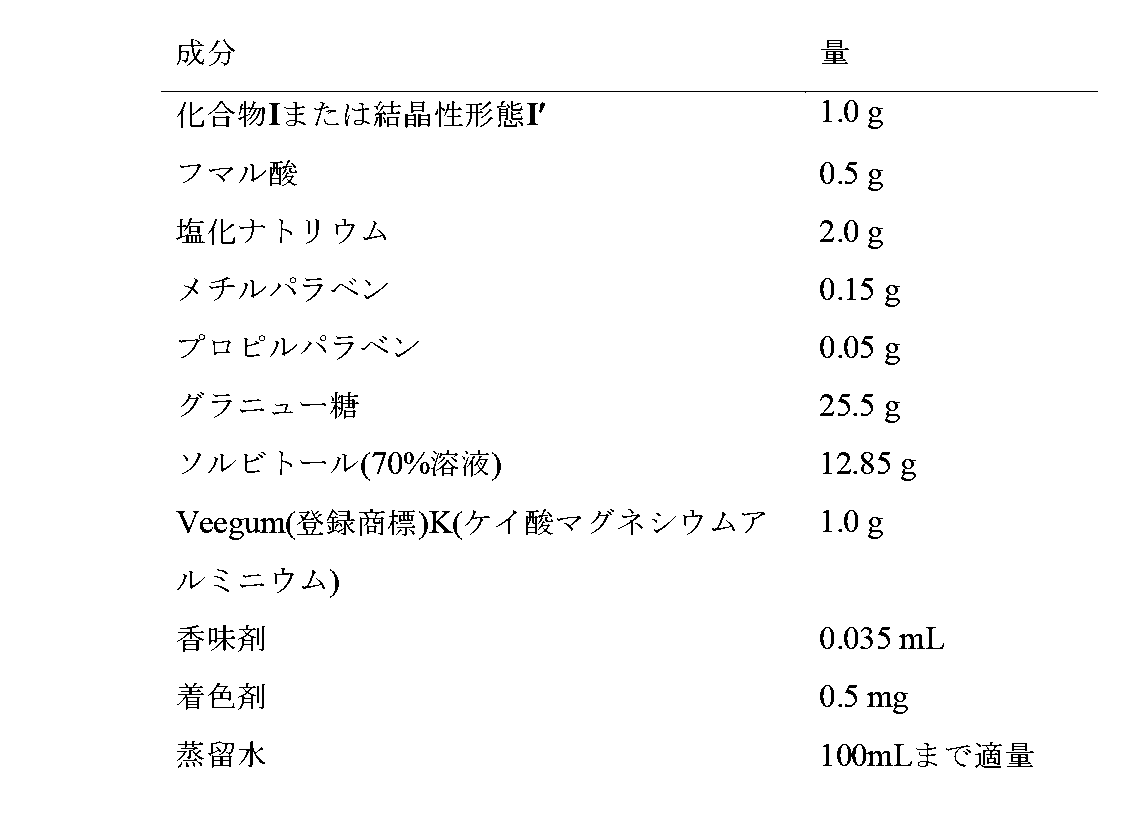
典型的な経口投与用液体製剤
適切な液体製剤は、カルボン酸ベースの緩衝剤、例えばクエン酸緩衝液、乳酸緩衝液およびマレイン酸緩衝液などを用いたものである。例えば、化合物Iまたは結晶形態I’(DMSOと予備混合しておいてもよい)を、100mMクエン酸アンモニウム緩衝剤とブレンドし、pHをpH5に調整するか、または100mMクエン酸溶液とブレンドし、pHをpH2に調整する。このような溶液はまた、シクロデキストリンなどの可溶化賦形剤を含んでもよく、例えば溶液は、10重量%のヒドロキシプロピル-β-シクロデキストリンを含んでもよい。
Typical Oral Liquid Formulations Suitable liquid formulations are those with carboxylic acid-based buffers such as citrate, lactate and maleate buffers. For example, compound I or crystalline form I′ (which may be premixed with DMSO) is blended with 100 mM ammonium citrate buffer and the pH adjusted to pH 5, or blended with 100 mM citric acid solution, Adjust the pH to pH2. Such solutions may also contain solubilizing excipients such as cyclodextrins, for example the solution may contain 10% by weight hydroxypropyl-β-cyclodextrin.
他の適切な製剤としては、シクロデキストリンを伴うかまたは伴わない5%NaHCO3溶液が挙げられる。 Other suitable formulations include 5% NaHCO3 solution with or without cyclodextrin.
注射による投与のための典型的な非経口IV製剤
化合物Iまたは結晶形態I’(0.2g)を、0.4M酢酸ナトリウム緩衝液(2.0mL)とブレンドする。必要に応じて、0.5N水性の塩酸または0.5N水性の水酸化ナトリウムを使用して、得られた溶液のpHをpH4に調整し、次いで注射のための十分な水を加えて、総容量を20mLとする。次いでこの混合物を、無菌フィルター(0.22ミクロン)を通す濾過をして、注射による投与に対して適切な無菌溶液を得る。
Typical Parenteral IV Formulation for Administration by Injection Compound I or crystalline Form I' (0.2 g) is blended with 0.4 M sodium acetate buffer (2.0 mL). If necessary, the pH of the resulting solution is adjusted to pH 4 using 0.5N aqueous hydrochloric acid or 0.5N aqueous sodium hydroxide and then sufficient water for injection is added to bring the total Bring the volume to 20 mL. The mixture is then filtered through a sterile filter (0.22 micron) to yield a sterile solution suitable for administration by injection.
以下の製剤は、本発明の代表的な薬学的組成物を例示している。
製剤例A
The following formulations illustrate representative pharmaceutical compositions of this invention.
Formulation example A
注射用溶液を調製するのに適切な凍結した溶液を、以下の通りに調製する。

製剤例B
A frozen solution suitable for preparing injectable solutions is prepared as follows.
Formulation example B
注射用溶液を調製するのに適切な凍結乾燥粉末または結晶性固体を、以下の通りに調製する。

代表的手順:もしある場合には、賦形剤および/または緩衝剤を、約60%の注射用水中に溶解させる。活性化合物IまたはI’を加え、溶解させ、pHを1M水酸化ナトリウムで3~4.5に調整し、容量を、注射用水で最終容量の95%に調整する。pHをチェックし、必要に応じて調整し、容量を、注射用水で最終容量に調整する。次いで、製剤を、0.22ミクロンのフィルターを通す滅菌濾過をし、無菌条件下で滅菌バイアルに入れる。次いで、製剤を、適切な凍結乾燥サイクルを使用して凍結乾燥する。バイアルに蓋をし(必要に応じて部分減圧または乾燥窒素下で)、ラベルを付け、冷蔵下で保存した。
製剤例C
Typical Procedure: Dissolve excipients and/or buffers, if any, in about 60% water for injection. The active compound I or I' is added and dissolved, the pH is adjusted to 3-4.5 with 1M sodium hydroxide and the volume is adjusted to 95% of the final volume with water for injection. Check pH, adjust if necessary, and adjust volume to final volume with water for injection. The formulation is then sterile filtered through a 0.22 micron filter into sterile vials under aseptic conditions. The formulation is then lyophilized using a suitable lyophilization cycle. The vials were capped (under partial vacuum or dry nitrogen as needed), labeled and stored under refrigeration.
Formulation example C
患者への静脈内投与のための注射用溶液を、上記製剤例Bから以下の通りに調製する。 An injectable solution for intravenous administration to a patient is prepared from Formulation B above as follows.
代表的手順:製剤例Bの凍結乾燥粉末(例えば、10~1000mgの活性化合物IまたはI’を含有する)を、20mLの滅菌水で再構成し、得られた溶液を、100mLの注入バッグ中の80mLの滅菌生理食塩水でさらに希釈する。次いで、希釈した溶液を、患者に30~120分間にわたり静脈内投与する。 Representative Procedure: A lyophilized powder of Formulation Example B (containing, for example, 10-1000 mg of active compound I or I') is reconstituted with 20 mL of sterile water and the resulting solution is dispensed into 100 mL infusion bags. 80 mL of sterile saline. The diluted solution is then administered intravenously to the patient over 30-120 minutes.
吸入による投与のための典型的な組成物
化合物IまたはI’(0.2mg)を微粉化し、次いでラクトース(25mg)とブレンドする。次いでこのブレンドした混合物をゼラチン吸入カートリッジに充填する。カートリッジの内容物を、例えばドライパウダー吸入器を使用して投与する。
Typical Composition for Administration by Inhalation Compound I or I' (0.2 mg) is micronized and then blended with lactose (25 mg). This blended mixture is then loaded into gelatin inhalation cartridges. The contents of the cartridge are administered using, for example, a dry powder inhaler.
あるいは、脱塩水(200mL)中にレシチン(0.2g)を溶解することによって調製した溶液中に、微粉化した化合物IまたはI’(10g)を分散させる。得られた懸濁液をスプレー乾燥し、次いで微粉化して、平均直径が約1.5μm未満の粒子を含む微粉化組成物を形成する。次いで微粉化組成物を、吸入器で投与した場合に投与1回あたり本発明の化合物約10μg~約500μgを提供するのに十分な量で、加圧した1,1,1,2-テトラフルオロエタンを含有する計量式吸入器カートリッジに充填する。 Alternatively, micronized compound I or I' (10 g) is dispersed in a solution prepared by dissolving lecithin (0.2 g) in demineralized water (200 mL). The resulting suspension is spray dried and then micronized to form a micronized composition comprising particles having an average diameter of less than about 1.5 μm. The micronized composition is then pressurized with 1,1,1,2-tetrafluoro in an amount sufficient to provide from about 10 μg to about 500 μg of a compound of the invention per dose when administered by an inhaler. Fill a metered dose inhaler cartridge containing ethane.
あるいは、化合物IまたはI’(25mg)を、クエン酸緩衝化(pH5)等張生理食塩水(125mL)に溶解させる。この混合物を撹拌し、化合物が溶解するまで超音波処理する。溶液のpHをチェックし、必要に応じて、水性の1N NaOHをゆっくりと加えることによってpH5に調整する。溶液はネブライザーデバイスを使用して投与し、このネブライザーデバイスは、投与1回あたり、化合物IまたはI’約10μg~約500μgを提供する。 Alternatively, compound I or I' (25 mg) is dissolved in citrate buffered (pH 5) isotonic saline (125 mL). The mixture is stirred and sonicated until the compound is dissolved. Check the pH of the solution and, if necessary, adjust to pH 5 by slowly adding aqueous 1N NaOH. The solution is administered using a nebulizer device, which provides about 10 μg to about 500 μg of Compound I or I' per administration.
以下の反応スキーム/調製および実施例は、本発明の特定の実施形態を例示するために提供されている。しかしこれらの特定の実施形態は、具体的に指摘されていない限り、本発明の範囲を限定することを決して意図するものではない。 The following reaction schemes/preparations and examples are provided to illustrate certain embodiments of the invention. However, these specific embodiments are in no way intended to limit the scope of the invention unless specifically pointed out.
以下の略語は、他に指摘されない限り、以下の意味を有し、本明細書中で使用され、定義されていない任意の他の略語は、これらの標準的で、一般的に受け入れられた意味を有する。
ACN=アセトニトリル
CPME=シクロペンチルメチルエーテル
d=日
DCC=N,N’-ジシクロヘキシルカルボジイミド
DCM=ジクロロメタンまたは塩化メチレン
DIPE=ジイソプロピルエーテル
DIPEA=N,N-ジイソプロピルエチルアミン
DMF=N,N-ジメチルホルムアミド
EDTA=エチレンジアミン四酢酸
EtOH=エタノール
EtOAc=酢酸エチル
g=グラム
h=時間
H2=水素ガス
H2O2=過酸化水素
HCTU=2-(6-クロロ-1H-ベンゾ[d][1,2,3]トリアゾール-1-イル)-1,1,3,3-テトラメチルウロニウムヘキサフルオロホスフェート(V)
HATU=N,N,N’,N’-テトラメチル-O-(7-アザベンゾトリアゾール-1-イル)ウロニウムヘキサフルオロホスフェート
HCl=塩化水素
NaBH4=水素化ホウ素ナトリウム
NaCl=塩化ナトリウム
NaHCO3=重炭酸ナトリウム
Na2CO3=炭酸ナトリウム
NaHMDS=ナトリウムビス(トリメチルシリル)アミドまたはナトリウムヘキサメチルジシラジド
NaOH=水酸化ナトリウム
Na2SO4=硫酸ナトリウム
NH4Cl=塩化アンモニウム
NMM=n-メチルモルホリン
MeI=ヨウ化メチル
MeOH=メタノール
min=分
MgSO4=硫酸マグネシウム
Pd(PPh3)4=テトラキス(トリフェニルホスフィン)パラジウム(0)
Pd/C=パラジウム担持活性炭、担持率10%
PE=石油エーテル
SiO2=二酸化ケイ素またはシリカ
TFA=トリフルオロ酢酸
THF=テトラヒドロフラン
The following abbreviations have the following meanings unless otherwise indicated and any other abbreviations used and not defined herein shall have their standard, generally accepted meanings. have
ACN = acetonitrile CPME = cyclopentyl methyl ether d = day DCC = N,N'-dicyclohexylcarbodiimide DCM = dichloromethane or methylene chloride DIPE = diisopropyl ether DIPEA = N,N-diisopropylethylamine DMF = N,N-dimethylformamide EDTA = ethylenediaminetetra acetic acid EtOH = ethanol EtOAc = ethyl acetate g = grams h = hours H 2 = hydrogen gas H 2 O 2 = hydrogen peroxide HCTU = 2-(6-chloro-1H-benzo[d][1,2,3]triazole -1-yl)-1,1,3,3-tetramethyluronium hexafluorophosphate (V)
HATU = N,N,N',N'-tetramethyl-O-(7-azabenzotriazol-1-yl)uronium hexafluorophosphate HCl = hydrogen chloride NaBH 4 = sodium borohydride NaCl = sodium chloride NaHCO 3 = sodium bicarbonate Na 2 CO 3 = sodium carbonate NaHMDS = sodium bis(trimethylsilyl)amide or sodium hexamethyldisilazide NaOH = sodium hydroxide Na 2 SO 4 = sodium sulfate NH 4 Cl = ammonium chloride NMM = n-methylmorpholine MeI = methyl iodide MeOH = methanol min = minutes MgSO4 = magnesium sulfate Pd( PPh3 ) 4 = tetrakis(triphenylphosphine)palladium(0)
Pd/C = palladium on activated carbon, 10% loading
PE = petroleum ether SiO2 = silicon dioxide or silica TFA = trifluoroacetic acid THF = tetrahydrofuran
特に示されていない限り、すべての材料、例えば試薬、出発物質および溶媒などは、民間の供給者(例えばSigma-Aldrich、Fluka Riedel-de Haenなど)から購入し、さらなる精製なしで使用した。 Unless otherwise indicated, all materials, such as reagents, starting materials and solvents, etc., were purchased from commercial suppliers (eg Sigma-Aldrich, Fluka Riedel-de Haen, etc.) and used without further purification.
特に示されていない限り、反応は、窒素雰囲気下で行った。反応の進行は、薄層クロマトグラフィー(TLC)、分析用高速液体クロマトグラフィー(分析HPLC)、および質量分析法でモニターし、これらの詳細は具体例において示されている。代表的な分析用HPLC条件は、以下の通りであった。
A.分析用HPLC条件-方法A
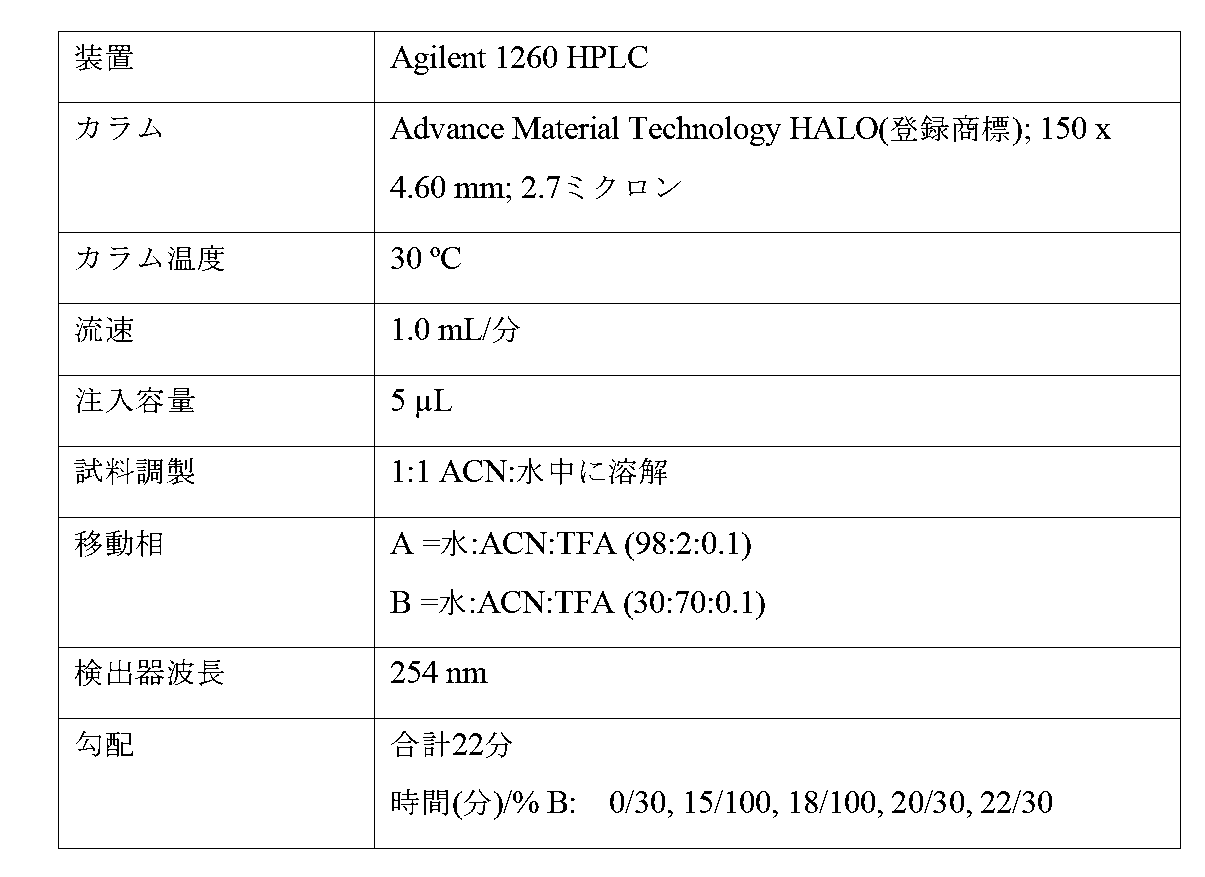

A. Analytical HPLC Conditions - Method A
各調製において具体的に記載されているように反応の後処理を行った。例えば、一般的には、抽出および他の精製方法、例えば温度依存性、および溶媒依存性の結晶化、および沈殿などによって、反応混合物を精製した。さらに、反応混合物は、通常Microsorb C18およびMicrosorb BDSカラム充填材料ならびに従来の溶離液を使用して、分取HPLCにより規定通りに精製した。反応の進行は、通常液体クロマトグラフィー質量分析法(LCMS)で測定した。異性体の特徴付けは、核オーバーハウザー効果スペクトロスコピー(NOE)で行った。反応生成物の特徴付けを質量分析法および1H-NMR分光分析で規定通りに行った。NMR測定のため、試料を重水素化溶媒(CD3OD、CDCl3、またはDMSO-d6)に溶解させ、標準的な観察条件下、Varian Gemini2000装置(400MHz)を用いて、1H-NMRスペクトルを取得した。質量分析による化合物の同定は通常、エレクトロスプレーイオン化方法(ESMS)を使用して、Applied Biosystems(Foster City、CA)モデルAPI150EX装置またはAgilent(Palo Alto、CA)モデル1200LC/MSD装置を用いて行った。
測定技法
粉末X線回折
Reactions were worked up as specified in each preparation. For example, reaction mixtures were generally purified by extraction and other purification methods such as temperature- and solvent-dependent crystallization and precipitation. In addition, reaction mixtures were routinely purified by preparative HPLC using Microsorb C18 and Microsorb BDS column packing materials and conventional eluents. Reaction progress was typically measured by liquid chromatography-mass spectrometry (LCMS). Isomer characterization was performed by nuclear Overhauser effect spectroscopy (NOE). Characterization of reaction products was routinely performed by mass spectrometry and 1 H-NMR spectroscopy. For NMR measurements, samples were dissolved in deuterated solvents (CD 3 OD, CDCl 3 , or DMSO-d 6 ) and 1 H-NMR was analyzed using a Varian Gemini 2000 instrument (400 MHz) under standard observation conditions. A spectrum was acquired. Compound identification by mass spectrometry was typically performed using an Applied Biosystems (Foster City, Calif.) model API 150EX instrument or an Agilent (Palo Alto, Calif.) model 1200 LC/MSD instrument using the electrospray ionization method (ESMS). .
Measurement technique Powder X-ray diffraction
粉末X線回折分析は、Bruker D8-Advance X線回折計を使用して実施した。X線源は、40kVの出力電圧および40mAの電流でのCu-Kα放射とした。装置をBragg-Brentanoの幾何学的配置で操作し、Goebel Mirrorを使用して、平行X線ビームを得た。ビームにおけるいかなる発散も、線源における0.2°の縦の発散スリットと、線源および検出器におけるソーラースリット(2.5°)とによって制限した。測定のために、少量の粉末(5~25mg)を、ゼロバックグラウンドのケイ素試料ホルダー上に穏やかにプレスして、滑らかな表面を形成し、X線に曝露させた。試料は、2θの2°から35°までを、0.02°のステップサイズ、および1ステップあたり0.3秒の走査速度で、連結θ-2θモードで走査した。データ取得をBruker DiffracSuiteソフトウェアによって制御し、Jadeソフトウェア(バージョン7.5.1)によって分析した。装置は、コランダム標準を用いて±0.02°2θ角内で較正した。 Powder X-ray diffraction analysis was performed using a Bruker D8-Advance X-ray diffractometer. The X-ray source was Cu-Kα radiation at an output voltage of 40 kV and a current of 40 mA. The instrument was operated in Bragg-Brentano geometry and a parallel X-ray beam was obtained using a Goebel Mirror. Any divergence in the beam was limited by a 0.2° vertical divergence slit at the source and a Soller slit (2.5°) at the source and detector. For measurements, a small amount of powder (5-25 mg) was gently pressed onto a zero background silicon sample holder to form a smooth surface and exposed to X-rays. Samples were scanned from 2° to 35° of 2-theta in coupled theta-2-theta mode with a step size of 0.02° and a scan speed of 0.3 seconds per step. Data acquisition was controlled by Bruker DiffracSuite software and analyzed by Jade software (version 7.5.1). The instrument was calibrated to within ±0.02° two-theta angle using corundum standards.
データ収集で使用したBragg-Brentanoの幾何学的配置は、優先配向の傾向があることに留意すべきである。これらの条件下では、回折ピークの相対強度は、球状粒子の理想的な分布から、または単結晶データからシミュレートされる回折パターンから得られるであろう、真の相対強度を表さない可能性がある。また、広範な優先配向に起因して、一部の回折パターンでは一部のピークが見られない可能性もある。
示差走査熱量測定
It should be noted that the Bragg-Brentano geometry used in data collection is prone to preferred orientations. Under these conditions, the relative intensities of the diffraction peaks may not represent the true relative intensities that would be obtained from ideal distributions of spherical particles or from diffraction patterns simulated from single crystal data. There is It is also possible that some peaks are missing in some diffraction patterns due to a wide range of preferred orientations.
Differential scanning calorimetry
DSC測定は、TA Instruments Model Q-100モジュールをThermal Analystコントローラーと共に使用して実施した。データを、TA Instruments Universal Analysisソフトウェアを使用して、収集および分析した。試料を、正確に秤量して、覆いをしたアルミニウムパンに入れた。5℃で5分間の等温平衡期間の後、試料を、0℃から250℃まで10℃/分の線形加熱傾斜を使用して加熱した。
熱重量分析
DSC measurements were performed using a TA Instruments Model Q-100 module with a Thermal Analyst controller. Data were collected and analyzed using TA Instruments Universal Analysis software. Samples were accurately weighed into covered aluminum pans. After an isothermal equilibration period of 5 min at 5°C, the sample was heated from 0°C to 250°C using a linear heating ramp of 10°C/min.
Thermogravimetric analysis
熱重量測定は、高分解能を備えたTA Instruments Model Q-500モジュールを使用して実施した。データは、TA Instruments Thermal Analystコントローラーを使用して収集し、TA Instruments Universal Analysisソフトウェアを使用して分析した。秤量した試料を白金パンに載せ、周囲温度から300℃まで10℃/分の加熱速度で走査した。天秤室および炉室は、使用中に窒素流でパージした。
偏光顕微鏡法
Thermogravimetric measurements were performed using a TA Instruments Model Q-500 module with high resolution. Data were collected using a TA Instruments Thermal Analyst controller and analyzed using TA Instruments Universal Analysis software. The weighed sample was placed in a platinum pan and scanned from ambient temperature to 300°C at a heating rate of 10°C/min. The balance and furnace chambers were purged with a stream of nitrogen during use.
polarized light microscopy
偏光顕微鏡(PLM)研究については、試料を、交差偏光フィルターを用いて光学顕微鏡(Olympus BX51)下で検査した。PaxIt Imagingソフトウェア(バージョン6.4)により制御されるPaxCamカメラで、像を収集した。試料を、浸漬媒体として軽鉱油を用いてガラススライド上に調製した。粒子のサイズに応じて、4×、10×、または20×の対物レンズを拡大に使用した。
動的水分収着評価
For polarized light microscopy (PLM) studies, samples were examined under an optical microscope (Olympus BX51) with crossed polarizing filters. Images were collected with a PaxCam camera controlled by PaxIt Imaging software (version 6.4). Samples were prepared on glass slides using light mineral oil as the immersion medium. A 4×, 10×, or 20× objective was used for magnification, depending on the size of the particles.
Dynamic moisture sorption evaluation
DMS測定は、VTI大気微量天秤、SGA-100システム(VTI Corp.、Hialeah、FL 33016)を使用して実施した。秤量した試料を使用し、分析の開始時に、湿度を、可能な限り最も低い値(相対湿度0%近く)とした。DMS分析は、5~90%の全湿度範囲にわたり、相対湿度5%/ステップの走査速度からなるものとした。DMSの実行は、25℃で等温的に実施した。
合成反応スキーム
DMS measurements were performed using a VTI Atmospheric Microbalance, SGA-100 system (VTI Corp., Hialeah, FL 33016). Weighed samples were used and the humidity was taken to the lowest possible value (near 0% relative humidity) at the start of the analysis. The DMS analysis consisted of a scan rate of 5% relative humidity/step over the entire humidity range of 5-90%. DMS runs were performed isothermally at 25°C.
Synthetic reaction scheme
本発明において利用される(3S,5R)-5-[[4-(5-クロロ-2-フルオロフェニル)フェニル]メチル]-3-(ヒドロキシメチル)-3-メチルピロリジン-2-オン(A)は、出発物質および試薬から、実施例1に記載されている手順を使用して、スキームAにおいて示されているように調製することができる。

スキームAにおける一般的反応ステップは、以下の通りである。1を、不活性雰囲気下、低温で、水性塩基を加えた溶媒中に溶解し、続いて溶媒中のアミン保護剤を室温で加えてから、単離することによって、化合物1のアミン基を最初に保護する。およそ1:2:1のモル当量の1対塩基対アミン保護剤を使用することができる。1とアミン保護剤との反応に使用することができる溶媒として、これらに限定されないが、アセトニトリルなどの極性非プロトン性溶媒が挙げられる。塩基として、これらに限定されないが、LiOH、NaOH、およびKOHを含めた強塩基が挙げられる。低温は通常、-10℃またはそれより下である。
The general reaction steps in Scheme A are as follows. The amine group of
次に、不活性雰囲気下、両性化合物、例えば、水中NaHCO3と、Pd(PPh3)4などの触媒とを加えて、化合物2を溶媒中で3とカップリングする。これは誘導体4をもたらし、次いでこれを不活性雰囲気下、求核触媒を加えた非プロトン性溶媒中で5と反応させる。ペプチドカップリング剤をさらに使用することによって、化合物6を形成する。次いで、化合物6を不活性雰囲気下、弱酸を加えた溶媒に入れ、還元剤を低温で(-5℃またはそれより下で)加える。この混合物を数時間撹拌した後、ブラインでクエンチする。次いで、化合物7を弱塩基の溶液による抽出によって単離し、乾燥剤で乾燥させてから、減圧下で濃縮する。
次に、化合物7を、MeIなどのメチル化剤を使用して、弱塩基を加えた非プロトン性溶媒中でメチル化する。形成される固体を単離し、溶媒中にさらに溶解してから、乾燥剤で乾燥させ、減圧下で濃縮することによって、化合物8を得る。化合物8をエーテル溶媒中で酸とさらに反応させることによって、化合物9を得、次いでこれを濃縮し、追加の溶媒で洗浄することによって、化合物9’を得る。次いで、化合物9’を不活性雰囲気下で極性非プロトン性溶媒に入れ、低温(<-5℃)で10と反応させることによって、中間体11を得る。11を有機塩基と反応させ、続いて低温で10と反応させ、還元剤で還元することによって、化合物Aを形成する。
本発明において利用される(2S,4R)-ベンジル4-アミノ-5-(5’-クロロ-2’-フルオロ-[1,1’-ビフェニル]-4-イル)-2-(エトキシメチル)-2-メチルペンタノエート(B)は、以前に作製した出発物質(A)および試薬から、実施例2に記載されている手順を使用して、スキームBにおいて示されているように調製することができる。
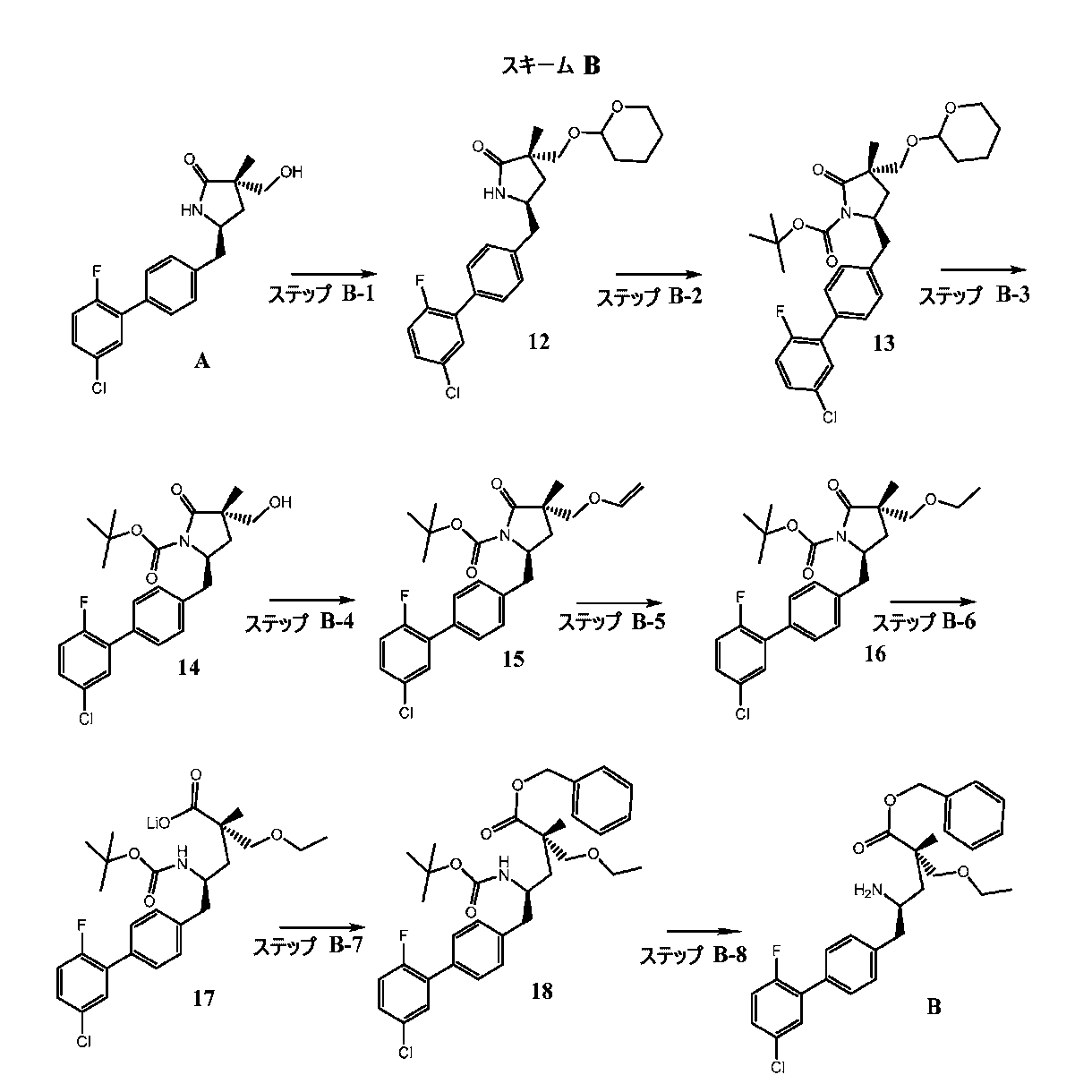
スキームBにおける一般的反応ステップは、以下の通りである。最初に、化合物Aを、酸を含有する溶媒中で3,4-ジヒドロ-2H-ピランと反応させてから、中和および単離を行う。得られる粗混合物をエーテル溶媒に入れ、低温で撹拌することによって、スラリーを形成する。スラリーをさらにすすぎ、乾燥させ、濃縮することによって、粘性の油12を得てから、環窒素を二炭酸ジ-tert-ブチルで保護することによって、標準的な条件下で13を形成する。13中のエーテル基を強酸でさらに切断することによって、14において示されている通りのアルコール基を形成する。次いで、複素環式有機リガンド、例えば、1,10-フェナントロリンを不活性雰囲気中で加え、続いて金属触媒、例えば、パラジウム触媒を加えることにより、化合物14をエチルビニルエーテルと反応させる。精製した生成物15中のアルケン基を、例えば、H2および10%Pd/Cを使用して還元することによって、16を得る。16中のピロリドンの開環(鹸化)を水性塩基により達成してから、精製および単離を行うことによって、化合物17を得る。17中のカルボキシレート基を、標準的な条件下、例えば、臭化ベンジルでさらに保護することによって、18を形成する。これを行ってから、18のアミン基を脱保護することによって、化合物Bを形成する。
The general reaction steps in Scheme B are as follows. First, compound A is reacted with 3,4-dihydro-2H-pyran in a solvent containing acid, followed by neutralization and isolation. The resulting crude mixture is placed in an ethereal solvent and stirred at low temperature to form a slurry. Further rinsing, drying and concentration of the slurry gives a
上述の通り、スキームAおよびBのための典型的な反応条件を、以下の実施例1および2にそれぞれ記載する。
(実施例1)
(3S,5R)-5-[[4-(5-クロロ-2-フルオロフェニル)フェニル]メチル]-3-(ヒドロキシメチル)-3-メチルピロリジン-2-オン(A)の合成
ステップA-1:
As noted above, typical reaction conditions for Schemes A and B are described below in Examples 1 and 2, respectively.
(Example 1)
Synthesis of (3S,5R)-5-[[4-(5-chloro-2-fluorophenyl)phenyl]methyl]-3-(hydroxymethyl)-3-methylpyrrolidin-2-one (A) Step A- 1:
(2R)-2-アミノ-3-(4-ブロモフェニル)プロパン酸(1)(3300g、13.52mol)のアセトニトリル(46.2L)中溶液を、窒素の不活性雰囲気でパージおよび維持した250Lの反応器に入れた。NaOH(1081g、27.02mol)の水(46.2L)中溶液を、いくつかのバッチに分けて-10℃で加えた。これに続いて、二炭酸ジ-tert-ブチル(2948g、13.51mol)のACN(6.6L)中溶液を加えた。得られた溶液を室温で一晩撹拌し、減圧下でさらに濃縮した。この得られた溶液を45Lの水/氷で希釈し、溶液のpH値を1N HClでpH2に調整した。次いで、得られた溶液を3×50LのDCMで抽出し、有機層を合わせた。得られた混合物を1×50Lのブラインで洗浄し、無水MgSO4上で乾燥させ、減圧下で濃縮した。これは、白色の固体として、3720g(80%)の(2R)-3-(4-ブロモフェニル)-2-[[(tert-ブトキシ)カルボニル]アミノ]プロパン酸(2)をもたらした。
ステップA-2:
A solution of (2R)-2-amino-3-(4-bromophenyl)propanoic acid (1) (3300 g, 13.52 mol) in acetonitrile (46.2 L) was purged and maintained under an inert atmosphere of nitrogen in 250 L. was placed in the reactor. A solution of NaOH (1081 g, 27.02 mol) in water (46.2 L) was added in batches at -10°C. This was followed by the addition of a solution of di-tert-butyl dicarbonate (2948 g, 13.51 mol) in ACN (6.6 L). The resulting solution was stirred overnight at room temperature and further concentrated under reduced pressure. The resulting solution was diluted with 45 L of water/ice and the pH value of the solution was adjusted to
Step A-2:
(2R)-3-(4-ブロモフェニル)-2-[[(tert-ブトキシ)カルボニル]アミノ]プロパン酸(2)(530g、1.54mol)のジオキサン(9.54L)中溶液、(5-クロロ-2-フルオロフェニル)ボロン酸(3)(348g、2.00mol)、Na2CO3(228g、2.15mol)の水(1.06L)中溶液、およびPd(PPh3)4(8.89g、7.69mmol)を、窒素の不活性雰囲気でパージおよび維持した20Lの四口丸底フラスコに入れた。得られた溶液を油浴中で2.5時間加熱還流し、次いで水/氷浴で室温に冷却した。得られた溶液を15LのEtOAcで希釈し、1×5Lの1N HClおよび4×5Lのブラインで洗浄した。合わせた有機抽出物を無水MgSO4上で乾燥させ、減圧下で濃縮した。残渣を2×1LのPEで洗浄した。これは、褐色の油として、510g(84%)の(2R)-2-[[(tert-ブトキシ)カルボニル]アミノ]-3-[4-(5-クロロ-2-フルオロフェニル)フェニル]プロパン酸(4)をもたらした。
ステップA-3:
(2R)-3-(4-bromophenyl)-2-[[(tert-butoxy)carbonyl]amino]propanoic acid (2) (530 g, 1.54 mol) in dioxane (9.54 L), (5 -chloro-2-fluorophenyl)boronic acid (3) (348 g, 2.00 mol), a solution of Na 2 CO 3 (228 g, 2.15 mol) in water (1.06 L), and Pd(PPh 3 ) 4 ( 8.89 g, 7.69 mmol) was placed in a 20 L four necked round bottom flask purged and maintained with an inert atmosphere of nitrogen. The resulting solution was heated to reflux in an oil bath for 2.5 hours, then cooled to room temperature in a water/ice bath. The resulting solution was diluted with 15 L of EtOAc and washed with 1 x 5 L of 1N HCl and 4 x 5 L of brine. The combined organic extracts were dried over anhydrous MgSO4 and concentrated under reduced pressure. The residue was washed with 2 x 1 L of PE. This was obtained as a brown oil, 510 g (84%) of (2R)-2-[[(tert-butoxy)carbonyl]amino]-3-[4-(5-chloro-2-fluorophenyl)phenyl]propane Resulted in acid (4).
Step A-3:
(2R)-2-[[(tert-ブトキシ)カルボニル]アミノ]-3-[4-(5-クロロ-2-フルオロフェニル)フェニル]プロパン酸(4)(510g、1.29mol)のDCM(5000mL)中溶液、2,2-ジメチル-1,3-ジオキサン-4,6-ジオン(5)(205g、1.42mol)、および4-ジメチルアミノピリジン(237g、1.94mol)を、窒素の不活性雰囲気でパージおよび維持した10Lの四口丸底フラスコに入れた。これに続いて、-10℃で撹拌しながら、DCC(294g、1.43mol)のDCM(600mL)中溶液を滴加した。得られた溶液を室温で一晩撹拌し、固体を濾過により除去した。濾液を1N HCl(2L)およびブライン(3L)で洗浄した。合わせた有機抽出物を無水MgSO4上で乾燥させ、固体を濾過により除去した。濾液であるtert-ブチルN-[(2R)-3-[4-(5-クロロ-2-フルオロフェニル)フェニル]-1-(2,2-ジメチル-4,6-ジオキソ-1,3-ジオキサン-5-イル)-1-オキソプロパン-2-イル]カルバメート(6)を、さらなる精製なしで次のステップでそのまま使用した。
ステップA-4:
(2R)-2-[[(tert-butoxy)carbonyl]amino]-3-[4-(5-chloro-2-fluorophenyl)phenyl]propanoic acid (4) (510 g, 1.29 mol) in DCM ( 5000 mL) solution, 2,2-dimethyl-1,3-dioxane-4,6-dione (5) (205 g, 1.42 mol), and 4-dimethylaminopyridine (237 g, 1.94 mol) in a nitrogen atmosphere. Placed in a 10 L 4 neck round bottom flask purged and maintained with an inert atmosphere. This was followed by the dropwise addition of a solution of DCC (294 g, 1.43 mol) in DCM (600 mL) while stirring at -10°C. The resulting solution was stirred overnight at room temperature and solids were removed by filtration. The filtrate was washed with 1N HCl (2 L) and brine (3 L). The combined organic extracts were dried over anhydrous MgSO4 and solids were removed by filtration. The filtrate, tert-butyl N-[(2R)-3-[4-(5-chloro-2-fluorophenyl)phenyl]-1-(2,2-dimethyl-4,6-dioxo-1,3- Dioxan-5-yl)-1-oxopropan-2-yl]carbamate (6) was used as is in the next step without further purification.
Step A-4:
tert-ブチルN-[(2R)-3-[4-(5-クロロ-2-フルオロフェニル)フェニル]-1-(2,2-ジメチル-4,6-ジオキソ-1,3-ジオキサン-5-イル)-1-オキソプロパン-2-イル]カルバメート(6)のDCM(7L)およびAcOH(600mL)中溶液を、窒素の不活性雰囲気でパージおよび維持した20Lの四口丸底フラスコに入れた。これに続いて、NaBH4(88.8g、2.35mol)をいくつかのバッチに分けて-5℃で加えた。得られた溶液を、氷/塩浴中で、-5℃で3時間撹拌し、次いで滴下の形式で1Lのブラインを加えることによってクエンチした。得られた溶液を2Lのブラインで希釈し、2×2Lの水および1×1LのNa2CO3および1×2Lのブラインで洗浄した。合わせた有機抽出物を無水MgSO4上で乾燥させ、減圧下で濃縮した。これは、黄色の油として、520g(79%)のtert-ブチルN-[(2S)-1-[4-(5-クロロ-2-フルオロフェニル)フェニル]-3-(2,2-ジメチル-4,6-ジオキソ-1,3-ジオキサン-5-イル)プロパン-2-イル]カルバメート(7)をもたらした。
ステップA-5:
tert-butyl N-[(2R)-3-[4-(5-chloro-2-fluorophenyl)phenyl]-1-(2,2-dimethyl-4,6-dioxo-1,3-dioxane-5 -yl)-1-oxopropan-2-yl]carbamate (6) in DCM (7 L) and AcOH (600 mL) was placed in a 20 L four necked round bottom flask purged and maintained with an inert atmosphere of nitrogen. rice field. This was followed by the addition of NaBH 4 (88.8 g, 2.35 mol) in batches at -5°C. The resulting solution was stirred in an ice/salt bath at −5° C. for 3 hours and then quenched by the dropwise addition of 1 L of brine. The resulting solution was diluted with 2 L of brine and washed with 2 x 2 L of water and 1 x 1 L of Na2CO3 and 1 x 2 L of brine. The combined organic extracts were dried over anhydrous MgSO4 and concentrated under reduced pressure. This was obtained as a yellow oil, 520 g (79%) of tert-butyl N-[(2S)-1-[4-(5-chloro-2-fluorophenyl)phenyl]-3-(2,2-dimethyl -4,6-dioxo-1,3-dioxan-5-yl)propan-2-yl]carbamate (7).
Step A-5:
tert-ブチルN-[(2S)-1-[4-(5-クロロ-2-フルオロフェニル)フェニル]-3-(2,2-ジメチル-4,6-ジオキソ-1,3-ジオキサン-5-イル)プロパン-2-イル]カルバメート(7)(520g、1.03mol)のアセトン/DMF(1:1)(5.2L)中溶液、Na2CO3(163g、1.54mol)、およびMeI(219g、1.54mol)を、窒素の不活性雰囲気でパージおよび維持した10Lの四口丸底フラスコに入れた。得られた溶液を室温で一晩撹拌し、次いで15Lの水で希釈した。1時間撹拌後、固体を濾過により収集した。残渣を5LのDCM中に溶解した。合わせた有機抽出物を無水MgSO4上で乾燥させ、減圧下で濃縮した。これは、黄色の固体として、520g(97%)のtert-ブチルN-[(2R)-1-[4-(5-クロロ-2-フルオロフェニル)フェニル]-3-(2,2,5-トリメチル-4,6-ジオキソ-1,3-ジオキサン-5-イル)プロパン-2-イル]カルバメート(8)をもたらした。
ステップA-6およびA-7:
tert-butyl N-[(2S)-1-[4-(5-chloro-2-fluorophenyl)phenyl]-3-(2,2-dimethyl-4,6-dioxo-1,3-dioxane-5 -yl)propan-2-yl]carbamate (7) (520 g, 1.03 mol) in acetone/DMF (1:1) (5.2 L), Na 2 CO 3 (163 g, 1.54 mol), and MeI (219 g, 1.54 mol) was placed in a 10 L four necked round bottom flask purged and maintained with an inert atmosphere of nitrogen. The resulting solution was stirred overnight at room temperature and then diluted with 15 L of water. After stirring for 1 hour, solids were collected by filtration. The residue was dissolved in 5 L of DCM. The combined organic extracts were dried over anhydrous MgSO4 and concentrated under reduced pressure. This was obtained as a yellow solid in 520 g (97%) of tert-butyl N-[(2R)-1-[4-(5-chloro-2-fluorophenyl)phenyl]-3-(2,2,5 -trimethyl-4,6-dioxo-1,3-dioxan-5-yl)propan-2-yl]carbamate (8).
Steps A-6 and A-7:
tert-ブチルN-[(2R)-1-[4-(5-クロロ-2-フルオロフェニル)フェニル]-3-(2,2,5-トリメチル-4,6-ジオキソ-1,3-ジオキサン-5-イル)プロパン-2-イル]カルバメート(8)(520g、1.00mol、1.00当量)のCPME(2.6L)中溶液を、窒素の不活性雰囲気でパージおよび維持した10Lの四口丸底フラスコに入れた。これに続いて、HCl/CPME(4N)(2.6L)を-5℃で加えた。得られた溶液を室温で一晩撹拌した。得られた混合物を減圧下で半分の容量まで濃縮した。固体を濾過により収集し、EtOAc/DIPE(1:2)でさらに洗浄した。これは、オフホワイト色の固体として、220g(61%)の(3R,5R)-5-[[4-(5-クロロ-2-フルオロフェニル)フェニル]メチル]-3-メチル-2-オキソピロリジン-3-カルボン酸(9’)をもたらした。
ステップA-8およびA-9:
tert-butyl N-[(2R)-1-[4-(5-chloro-2-fluorophenyl)phenyl]-3-(2,2,5-trimethyl-4,6-dioxo-1,3-dioxane -5-yl)propan-2-yl]carbamate (8) (520 g, 1.00 mol, 1.00 equiv) in CPME (2.6 L) was purged and maintained with an inert atmosphere of nitrogen in 10 L of placed in a four-necked round-bottomed flask. This was followed by the addition of HCl/CPME (4N) (2.6L) at -5°C. The resulting solution was stirred overnight at room temperature. The resulting mixture was concentrated under reduced pressure to half its volume. The solid was collected by filtration and further washed with EtOAc/DIPE (1:2). This was obtained as an off-white solid, 220 g (61%) of (3R,5R)-5-[[4-(5-chloro-2-fluorophenyl)phenyl]methyl]-3-methyl-2-oxo yielded pyrrolidine-3-carboxylic acid (9').
Steps A-8 and A-9:
(3R,5R)-5-[[4-(5-クロロ-2-フルオロフェニル)フェニル]メチル]-3-メチル-2-オキソピロリジン-3-カルボン酸(9’)(218g、602.55mmol)のTHF(4L)中溶液、NMM(170g、1.68mol)を、窒素の不活性雰囲気でパージおよび維持した10Lの四口丸底フラスコに入れた。これに続いて、-5℃で撹拌しながら2-メチルプロピルクロロホルメート(164.4g、1.20mol)を滴加した。得られた溶液を氷/塩浴中で、-5℃でさらに20分間撹拌した。-5℃で撹拌しながらNaBH4(91.5g、2.42mol)の水(400mL)中溶液をさらに滴加し、室温でさらに1時間撹拌した。次いで、反応を2.6Lの1N HClの滴加によってクエンチした。得られた混合物をさらに1時間撹拌し、次いで減圧下で濃縮することによって、THFを除去した。次いで、残渣混合物をさらに1時間撹拌し、次いで固体を濾過により収集した。固体を水で洗浄し、THF中に溶解し、無水Na2SO4上で乾燥させ、減圧下で濃縮した。これは、白色の固体として、170g(81%)の(3S,5R)-5-[[4-(5-クロロ-2-フルオロフェニル)フェニル]メチル]-3-(ヒドロキシメチル)-3-メチルピロリジン-2-オン(A)をもたらした。
(実施例2)
(2S,4R)-ベンジル4-アミノ-5-(5’-クロロ-2’-フルオロ-[1,1’-ビフェニル]-4-イル)-2-(エトキシメチル)-2-メチルペンタノエート(B)の合成
ステップB-1:
(3R,5R)-5-[[4-(5-chloro-2-fluorophenyl)phenyl]methyl]-3-methyl-2-oxopyrrolidine-3-carboxylic acid (9′) (218 g, 602.55 mmol ) in THF (4 L), NMM (170 g, 1.68 mol) was placed in a 10 L four necked round bottom flask purged and maintained with an inert atmosphere of nitrogen. This was followed by the dropwise addition of 2-methylpropyl chloroformate (164.4 g, 1.20 mol) with stirring at -5°C. The resulting solution was stirred at −5° C. in an ice/salt bath for an additional 20 minutes. A further solution of NaBH 4 (91.5 g, 2.42 mol) in water (400 mL) was added dropwise with stirring at −5° C. and stirred at room temperature for another hour. The reaction was then quenched by the dropwise addition of 2.6 L of 1N HCl. The resulting mixture was stirred for an additional hour and then concentrated under reduced pressure to remove THF. The residue mixture was then stirred for an additional hour and then the solids were collected by filtration. The solid was washed with water, dissolved in THF, dried over anhydrous Na2SO4 and concentrated under reduced pressure . This was obtained as a white solid, 170 g (81%) of (3S,5R)-5-[[4-(5-chloro-2-fluorophenyl)phenyl]methyl]-3-(hydroxymethyl)-3- This resulted in methylpyrrolidin-2-one (A).
(Example 2)
(2S,4R)-benzyl 4-amino-5-(5′-chloro-2′-fluoro-[1,1′-biphenyl]-4-yl)-2-(ethoxymethyl)-2-methylpentano Synthesis step B-1 of ate (B):
5000mLのジャケット付き丸底フラスコ中に、(3S,5R)-5-((5’-クロロ-2’-フルオロ-[1,1’-ビフェニル]-4-イル)メチル)-3-(ヒドロキシメチル)-3-メチルピロリジン-2-オン(A)(121.0g、348mmol)およびDCM(2420mL)を加えることによって、均質で透明な溶液を得、次いでこれを撹拌しながら0℃に冷却した。3,4-ジヒドロ-2H-ピラン(71.0mL、783mmol)および4-メチルベンゼンスルホン酸(20.97g、122mmol)を加え、反応混合物を18.5℃で一晩撹拌することによって、>98%変換を達成した。次いで、反応混合物を2420mLの飽和NaHCO3でクエンチし、相をゆっくりと分離し、有機層を硫酸ナトリウム上で乾燥させ、濾過し、溶媒を除去した。次いで、粗混合物を、21℃で1時間にわたり撹拌しながらDIPE(1815mL)に入れ、次いで0~5℃で5時間にわたり冷却および撹拌することによって、白色のスラリーを得た。スラリーを濾過し、1×容量の冷たい(0℃)DIPEですすぎ、濾過した。得られた固体を一晩乾燥させることによって、113.8g;HPLC純度99.1%を得た。濾液をさらに乾燥させることによって、重さ24gの高粘度の油を得た。DIPE(96mL)を加え、混合物を0~5℃で一晩撹拌することによって、(3S,5R)-5-((5’-クロロ-2’-フルオロ-[1,1’-ビフェニル]-4-イル)メチル)-3-メチル-3-(((テトラヒドロ-2H-ピラン-2-イル)オキシ)メチル)ピロリジン-2-オン(12)を得た。
ステップB-2:
(3S,5R)-5-((5′-Chloro-2′-fluoro-[1,1′-biphenyl]-4-yl)methyl)-3-(hydroxy Methyl)-3-methylpyrrolidin-2-one (A) (121.0 g, 348 mmol) and DCM (2420 mL) were added to give a homogeneous and clear solution, which was then cooled to 0° C. with stirring. . >98° C. by adding 3,4-dihydro-2H-pyran (71.0 mL, 783 mmol) and 4-methylbenzenesulfonic acid (20.97 g, 122 mmol) and stirring the reaction mixture at 18.5° C. overnight. % conversion achieved. The reaction mixture was then quenched with 2420 mL of saturated NaHCO 3 , the phases were slowly separated, the organic layer was dried over sodium sulfate, filtered and the solvent was removed. The crude mixture was then taken into DIPE (1815 mL) with stirring at 21° C. for 1 hour, then cooled and stirred at 0-5° C. for 5 hours to give a white slurry. The slurry was filtered, rinsed with 1× volume of cold (0° C.) DIPE, and filtered. The resulting solid was dried overnight to yield 113.8 g; HPLC purity 99.1%. Further drying of the filtrate gave a thick oil weighing 24 g. (3S,5R)-5-((5'-Chloro-2'-fluoro-[1,1'-biphenyl]- was obtained by adding DIPE (96 mL) and stirring the mixture at 0-5°C overnight. 4-yl)methyl)-3-methyl-3-(((tetrahydro-2H-pyran-2-yl)oxy)methyl)pyrrolidin-2-one (12) was obtained.
Step B-2:
5000mLのジャケット付き丸底フラスコ中に、撹拌しながら(3S,5R)-5-((5’-クロロ-2’-フルオロ-[1,1’-ビフェニル]-4-イル)メチル)-3-メチル-3-(((テトラヒドロ-2H-ピラン-2-イル)オキシ)メチル)ピロリジン-2-オン(12)(113.8g、263mmol)およびTHF(1707mL)を加えることによって、透明均質な溶液を得、これを窒素でパージし、-10℃に冷却した。THF(290mL、290mmol)中1M NaHMDSを0℃より下の温度で滴加し、反応混合物を30分間撹拌した。二炭酸ジ-tert-ブチル(69.0g、316mmol)を、その3倍容量で、THF(207mL)中、10℃より下の温度で滴加することによって溶解した。反応混合物を20℃で一晩撹拌し、20%塩化アンモニウム溶液(2731mL)でクエンチした。EtOAc(1821mL)を加え、相を水層(pH9)と有機層とに分離した。有機層をブライン(2731mL)で洗浄し、相を水相(pH7)と有機層とに再度分離し、ここで、有機層をNa2SO4上で乾燥させてから、濾過した。溶媒を除去し、高粘度の油を得た。一晩さらに乾燥させると、(3S,5R)-tert-ブチル5-((5’-クロロ-2’-フルオロ-[1,1’-ビフェニル]-4-イル)メチル)-3-メチル-2-オキソ-3-(((テトラヒドロ-2H-ピラン-2-イル)オキシ)メチル)ピロリジン-1-カルボキシレート(13)の泡含有固体が生成された(146.5g、275mmol、収率105%、純度98.76%)。
ステップB-3:
(3S,5R)-5-((5′-Chloro-2′-fluoro-[1,1′-biphenyl]-4-yl)methyl)-3 was added to a 5000 mL jacketed round bottom flask with stirring. -Methyl-3-(((tetrahydro-2H-pyran-2-yl)oxy)methyl)pyrrolidin-2-one (12) (113.8 g, 263 mmol) and THF (1707 mL) were added to give a clear homogeneous solution. A solution was obtained, which was purged with nitrogen and cooled to -10°C. 1 M NaHMDS in THF (290 mL, 290 mmol) was added dropwise at below 0° C. and the reaction mixture was stirred for 30 minutes. Di-tert-butyl dicarbonate (69.0 g, 316 mmol) was dissolved in three times its volume in THF (207 mL) at a temperature below 10° C. by dropwise addition. The reaction mixture was stirred at 20° C. overnight and quenched with 20% ammonium chloride solution (2731 mL). EtOAc (1821 mL) was added and the phases were separated into aqueous (pH 9) and organic layers. The organic layer was washed with brine (2731 mL) and the phases were again separated into aqueous (pH 7) and organic layers, whereupon the organic layer was dried over Na 2 SO 4 and filtered. Solvent was removed to give a thick oil. Further drying overnight gave (3S,5R)-tert-butyl 5-((5′-chloro-2′-fluoro-[1,1′-biphenyl]-4-yl)methyl)-3-methyl- A foamy solid of 2-oxo-3-(((tetrahydro-2H-pyran-2-yl)oxy)methyl)pyrrolidine-1-carboxylate (13) was produced (146.5 g, 275 mmol, yield 105 %, 98.76% purity).
Step B-3:
(3S,5R)-tert-ブチル5-((5’-クロロ-2’-フルオロ-[1,1’-ビフェニル]-4-イル)メチル)-3-メチル-2-オキソ-3-(((テトラヒドロ-2H-ピラン-2-イル)オキシ)メチル)ピロリジン-1-カルボキシレート(13)(146.5g、275mmol)およびMeOH(1465mL)を、3000mLの丸底フラスコに加えた。4-メチルベンゼンスルホン酸、H2O(3.93g、20.65mmol)をさらに加え、反応混合物を0℃で16時間撹拌することによって、>97%変換を達成した。完了した反応物に、EtOAc(2930mL)を加え、続いて30℃より下の浴温度で蒸留することによって、およそ293mLへの総容量の低減を達成した。濃縮した溶液に、EtOAc(2930mL)を再度加え、およそ293mLまで蒸留した。最終洗浄を、EtOAc(2930mL)を加えることによって完了させ、1465mLの最終容量まで蒸留することによって、あらゆる残渣メタノールを完全に除去した。30分間にわたり≦21℃の温度で撹拌しながら、上記最終容量(1465mL)を、10%NaHCO3を含有するEtOAc(1465mL)で洗浄することによって、残存する酸をクエンチした。撹拌を止めることによって、層を分離させた(水層、pH約7)。有機層を1465mLのブラインで洗浄し、分離させた(水層、pH=7)。次いで、酢酸エチル層を約146.5mLまで減圧乾燥させた後、1465mLのヘキサンを曇り点までゆっくりと加えた。溶液を1時間静置させ、続いて1465mLのヘキサンを加えた。混合物を0℃で一晩撹拌し、固体を濾過し、293mLのヘキサンで洗浄した。残存する固体を高減圧下で一晩乾燥させることによって、98.4gの(3S,5R)-tert-ブチル5-((5’-クロロ-2’-フルオロ-[1,1’-ビフェニル]-4-イル)メチル)-3-(ヒドロキシメチル)-3-メチル-2-オキソピロリジン-1-カルボキシレート(14);収率80%;HPLC純度99.3%を得た。
ステップB-4:
(3S,5R)-tert-butyl 5-((5′-chloro-2′-fluoro-[1,1′-biphenyl]-4-yl)methyl)-3-methyl-2-oxo-3-( ((Tetrahydro-2H-pyran-2-yl)oxy)methyl)pyrrolidine-1-carboxylate (13) (146.5 g, 275 mmol) and MeOH (1465 mL) were added to a 3000 mL round bottom flask. More 4-methylbenzenesulfonic acid, H 2 O (3.93 g, 20.65 mmol) was added and the reaction mixture was stirred at 0° C. for 16 h to achieve >97% conversion. To the completed reaction was added EtOAc (2930 mL) followed by distillation at a bath temperature below 30° C. to achieve a total volume reduction to approximately 293 mL. To the concentrated solution was added EtOAc (2930 mL) again and distilled to approximately 293 mL. A final wash was completed by adding EtOAc (2930 mL) and any residual methanol was completely removed by distillation to a final volume of 1465 mL. Residual acid was quenched by washing the final volume (1465 mL) with EtOAc containing 10% NaHCO 3 (1465 mL) while stirring at a temperature of ≦21° C. for 30 min. The layers were separated (aqueous layer, pH ~7) by stopping the stirring. The organic layer was washed with 1465 mL of brine and separated (aqueous layer, pH=7). The ethyl acetate layer was then vacuum dried to about 146.5 mL and then slowly added 1465 mL of hexane to the cloud point. The solution was allowed to stand for 1 hour, followed by the addition of 1465 mL of hexane. The mixture was stirred overnight at 0° C. and the solid was filtered and washed with 293 mL of hexane. The remaining solid was dried under high vacuum overnight to give 98.4 g of (3S,5R)-tert-butyl 5-((5′-chloro-2′-fluoro-[1,1′-biphenyl] -4-yl)methyl)-3-(hydroxymethyl)-3-methyl-2-oxopyrrolidine-1-carboxylate (14);
Step B-4:
(3S,5R)-tert-ブチル5-((5’-クロロ-2’-フルオロ-[1,1’-ビフェニル]-4-イル)メチル)-3-(ヒドロキシメチル)-3-メチル-2-オキソピロリジン-1-カルボキシレート(14)(118.2g、264mmol)およびDCM(591mL)を100mLの丸底フラスコに加えることによって、無色の溶液を形成した。エチルビニルエーテル(761mL、7916mmol)および1,10-フェナントロリン(4.76g、26.4mmol)を容器に加え、N2でパージし、続いて酢酸Pd(II)(8.89g、39.6mmol)を加えた。反応混合物を室温で20時間撹拌することによって、約81%変換を達成した。溶媒を回転蒸発により除去することによって、粗生成物を得、これをカラムクロマトグラフィーで精製した。カラムを100%ヘキサンで予め調整し、粗生成物(30g/1回の実行)をDCM中に溶解し、300gのシリカゲル充填カラム上に充填した。40%酢酸エチル/ヘキサンでの定組成勾配を使用することによって、化合物を溶出し、91.25gの精製された(3S,5R)-tert-ブチル5-((5’-クロロ-2’-フルオロ-[1,1’-ビフェニル]-4-イル)メチル)-3-メチル-2-オキソ-3-((ビニルオキシ)メチル)ピロリジン-1-カルボキシレート(15)を得た。
ステップB-5:
(3S,5R)-tert-butyl 5-((5′-chloro-2′-fluoro-[1,1′-biphenyl]-4-yl)methyl)-3-(hydroxymethyl)-3-methyl- 2-oxopyrrolidine-1-carboxylate (14) (118.2 g, 264 mmol) and DCM (591 mL) were added to a 100 mL round bottom flask to form a colorless solution. Ethyl vinyl ether (761 mL, 7916 mmol) and 1,10-phenanthroline (4.76 g, 26.4 mmol) were added to the vessel and purged with N2 followed by Pd(II) acetate (8.89 g, 39.6 mmol). added. About 81% conversion was achieved by stirring the reaction mixture at room temperature for 20 hours. Removal of the solvent by rotary evaporation gave the crude product, which was purified by column chromatography. The column was preconditioned with 100% hexanes and the crude product (30 g/run) was dissolved in DCM and loaded onto a 300 g silica gel packed column. The compound was eluted by using an isocratic gradient with 40% ethyl acetate/hexanes to give 91.25 g of purified (3S,5R)-tert-butyl 5-((5'-chloro-2'- Fluoro-[1,1′-biphenyl]-4-yl)methyl)-3-methyl-2-oxo-3-((vinyloxy)methyl)pyrrolidine-1-carboxylate (15) was obtained.
Step B-5:
(3S,5R)-tert-ブチル5-((5’-クロロ-2’-フルオロ-[1,1’-ビフェニル]-4-イル)メチル)-3-メチル-2-オキソ-3-((ビニルオキシ)メチル)ピロリジン-1-カルボキシレート(15)(185g、390mmol)をTHF(1900mL)中に溶解し、酢酸(11.17mL)を加え、続いて10分間にわたりN2でパージした。次いで、混合物をH2でバブリングし、10%Pd/C(または18.5g)を加えた。HPLCによる測定で反応が完了に達するまで、ゆっくりとしたH2(ガス)パージを22℃で一晩継続した。反応混合物を、セライトを通す濾過をすることによって、均質な溶液を得た。次いで、濾液を、高減圧下、ポンプで乾燥させることによって、185グラムの(3S,5R)-tert-ブチル5-((5’-クロロ-2’-フルオロ-[1,1’-ビフェニル]-4-イル)メチル)-3-(エトキシメチル)-3-メチル-2-オキソピロリジン-1-カルボキシレート(16);89%HPLC;収率99%を得た。
ステップB-6:
(3S,5R)-tert-butyl 5-((5′-chloro-2′-fluoro-[1,1′-biphenyl]-4-yl)methyl)-3-methyl-2-oxo-3-( (Vinyloxy)methyl)pyrrolidine-1-carboxylate (15) (185 g, 390 mmol) was dissolved in THF (1900 mL) and acetic acid (11.17 mL) was added followed by purging with N 2 for 10 minutes. The mixture was then bubbled with H2 and 10% Pd/C (or 18.5 g) was added. A slow H 2 (gas) purge was continued at 22° C. overnight until the reaction reached completion as determined by HPLC. The reaction mixture was filtered through celite to obtain a homogeneous solution. The filtrate was then pumped to dryness under high vacuum to give 185 grams of (3S,5R)-tert-butyl 5-((5′-chloro-2′-fluoro-[1,1′-biphenyl] -4-yl)methyl)-3-(ethoxymethyl)-3-methyl-2-oxopyrrolidine-1-carboxylate (16); 89% HPLC; yield 99%.
Step B-6:
(3S,5R)-tert-ブチル5-((5’-クロロ-2’-フルオロ-[1,1’-ビフェニル]-4-イル)メチル)-3-(エトキシメチル)-3-メチル-2-オキソピロリジン-1-カルボキシレート(16)(185g、389mmol)および約1205mLのTHFを3000mLの丸底フラスコ中に加えることによって、無色の溶液を得た。およそ1205mLのH2O中1M LiOHを加え、反応混合物を室温で一晩撹拌することによって、鹸化を完了させた。およそ1205mLのEtOAcを一晩の反応混合物(pH=13)に加え、次いでおよそ1205mLの飽和水性NH4Clで洗浄した。相を水相(pH=8)と有機相とに分離し、生成物は有機層中に残存した。次いで、有機層をブラインで洗浄し、層を再度分離し、有機層をNa2SO4上で乾燥させた後、濾過し、減圧乾燥させることによって、リチウム(2S,4R)-4-((tert-ブトキシカルボニル)アミノ)-5-(5’-クロロ-2’-フルオロ-[1,1’-ビフェニル]-4-イル)-2-(エトキシメチル)-2-メチルペンタノエート(17)(213g、426mmol、収率94.6%)を得た。
ステップB-7:
(3S,5R)-tert-butyl 5-((5′-chloro-2′-fluoro-[1,1′-biphenyl]-4-yl)methyl)-3-(ethoxymethyl)-3-methyl- A colorless solution was obtained by adding 2-oxopyrrolidine-1-carboxylate (16) (185 g, 389 mmol) and about 1205 mL of THF into a 3000 mL round bottom flask. Saponification was completed by adding approximately 1205 mL of 1 M LiOH in H 2 O and stirring the reaction mixture at room temperature overnight. Approximately 1205 mL of EtOAc was added to the overnight reaction mixture (pH=13) and then washed with approximately 1205 mL of saturated aqueous NH 4 Cl. The phases were separated into an aqueous phase (pH=8) and an organic phase, the product remaining in the organic layer. The organic layer was then washed with brine, the layers were separated again, and the organic layer was dried over Na 2 SO 4 before being filtered and dried under vacuum to yield lithium (2S,4R)-4-(( tert-butoxycarbonyl)amino)-5-(5′-chloro-2′-fluoro-[1,1′-biphenyl]-4-yl)-2-(ethoxymethyl)-2-methylpentanoate (17 ) (213 g, 426 mmol, 94.6% yield).
Step B-7:
リチウム(2S,4R)-4-((tert-ブトキシカルボニル)アミノ)-5-(5’-クロロ-2’-フルオロ-[1,1’-ビフェニル]-4-イル)-2-(エトキシメチル)-2-メチルペンタノエート(17)(194.0g、393mmol)および約650mLのDMFを2Lの丸底フラスコに入れることによって、無色の溶液を得た。K2CO3(81g、589mmol)を加え、反応混合物を室温で15分間撹拌した。次いで、臭化ベンジル(56.1mL、471mmol)を一度に加え、反応混合物をおよそ22℃で一晩撹拌した。完全な変換を、LCMSまたはTLCによる測定で20時間後に達成した。およそ3900mLのNH4Clおよびおよそ650mLのEtOAcを加え、15分間にわたり撹拌し、相を分離した。有機層を約3900mLのブラインで洗浄し、層を再度分離し、有機層を硫酸ナトリウムで乾燥させ、続いて溶媒を除去した。粗生成物をSiO2 0~25%EtOAc/ヘキサン上で精製し、合わせた精製された画分により、(2S,4R)-ベンジル4-((tert-ブトキシカルボニル)アミノ)-5-(5’-クロロ-2’-フルオロ-[1,1’-ビフェニル]-4-イル)-2-(エトキシメチル)-2-メチルペンタノエート(18)(190g、322mmol、収率82%)を得た。MS m/z{M+H]+:C33H39ClFNO5の計算値、584.118;実測値 584.12。
ステップB-8:
Lithium (2S,4R)-4-((tert-butoxycarbonyl)amino)-5-(5′-chloro-2′-fluoro-[1,1′-biphenyl]-4-yl)-2-(ethoxy A colorless solution was obtained by placing methyl)-2-methylpentanoate (17) (194.0 g, 393 mmol) and approximately 650 mL of DMF in a 2 L round bottom flask. K 2 CO 3 (81 g, 589 mmol) was added and the reaction mixture was stirred at room temperature for 15 minutes. Benzyl bromide (56.1 mL, 471 mmol) was then added in one portion and the reaction mixture was stirred at approximately 22° C. overnight. Complete conversion was achieved after 20 hours as determined by LCMS or TLC. Approximately 3900 mL of NH 4 Cl and approximately 650 mL of EtOAc were added, stirred for 15 minutes and the phases were separated. The organic layer was washed with approximately 3900 mL of brine, the layers were separated again and the organic layer was dried over sodium sulfate followed by solvent removal. The crude product was purified on SiO 2 0-25% EtOAc/hexanes and the combined purified fractions gave (2S,4R)-benzyl 4-((tert-butoxycarbonyl)amino)-5-(5 '-Chloro-2'-fluoro-[1,1'-biphenyl]-4-yl)-2-(ethoxymethyl)-2-methylpentanoate (18) (190 g, 322 mmol, 82% yield). Obtained. MS m / z { M+H] <+ > calcd for C33H39ClFNO5 , 584.118; found 584.12.
Step B-8:
(2S,4R)-ベンジル4-((tert-ブトキシカルボニル)アミノ)-5-(5’-クロロ-2’-フルオロ-[1,1’-ビフェニル]-4-イル)-2-(エトキシメチル)-2-メチルペンタノエート(18)を3Lの丸底フラスコに入れ、加えた(190.0g、325mmol)。CPME(1084mL、3253mmol)中3M HClを加え、反応混合物を室温で50時間にわたり撹拌することによって、スラリーを>99%変換で得た。およそ1084mLの新たなCPMEを加え、得られたスラリーを3時間にわたり撹拌してから、濾過した。固体を約250mLの冷たい(0℃)CPMEですすいだ。次いで、固体をN2ガス下で乾燥させることによって、(2S,4R)-ベンジル4-アミノ-5-(5’-クロロ-2’-フルオロ-[1,1’-ビフェニル]-4-イル)-2-(エトキシメチル)-2-メチルペンタノエート(B)、HCl(150g、288mmol、収率89%、純度99.5%)として、白色の固体を得た。MS m/z{M+H]+:C28H31ClFNO3の計算値、484.00;実測値 520.46(HCl塩)。
(実施例3)
(2S,4R)-5-(5’-クロロ-2’-フルオロ-[1,1’-ビフェニル]-4-イル)-2-(エトキシメチル)-4-(3-ヒドロキシイソオキサゾール-5-カルボキサミド)-2-メチルペンタン酸(化合物I)

(Example 3)
(2S,4R)-5-(5′-chloro-2′-fluoro-[1,1′-biphenyl]-4-yl)-2-(ethoxymethyl)-4-(3-hydroxyisoxazole-5 -carboxamido)-2-methylpentanoic acid (compound I)
ベンジル(2S,4R)-4-アミノ-5-(5’-クロロ-2’-フルオロ-[1,1’-ビフェニル]-4-イル)-2-(エトキシメチル)-2-メチルペンタノエート塩酸塩(B)(2.95kg、5668mmol)を、THF(26.64kg)中でHCTU(2.71kg、6551mmol)およびDIPEA(0.28kg、2180mmol)を使用して、3-((4-メトキシベンジル)オキシ)イソオキサゾール-5-カルボン酸(19)(1.48kg、5939mmol)とカップリングした。混合物を<10℃に冷却した。次いで、DIPEA(2.24kg、17.332mmol)を混合物に10℃より下の温度で加え、混合物を20℃±10℃の温度に調整し、少なくとも1時間完了まで撹拌した。次に、EtOAc(26.55kg)を混合物に加え、続いてUSP水(29.5kg)を30℃より下の温度で加えた。次いで、混合物を少なくとも30分間20℃±10℃の温度で撹拌し、少なくとも30分間沈降させた。下方の水層を容器に分けた。5w/w%NaHCO3溶液(30.4kg)を混合物に30℃より下の温度で加え、20℃±10℃の温度で少なくとも30分間さらに撹拌し、少なくとも30分間沈降させた。下方の水層を容器に分けた。NaHCO3ステップをさらに2回繰り返し、次いで混合物を6-クロロ-1-ヒドロキシベンゾトリアゾール内容物について試料採取した。10w/v%NaCl(31.6kg)溶液を混合物に30℃より下の温度で加え、20℃±10℃の温度で少なくとも30分間撹拌し、次いで少なくとも30分間沈降させた。下方の水層を容器に分けた。バッチ温度を30℃より下に維持しながら、残存する層を約9Lまで蒸留した。次いで、EtOAc(39.8kg)を混合物に加え、バッチ温度を30℃より下に維持しながら、減圧蒸留を使用することによって、混合物の容量を約9Lに減少させた。EtOAc(10.3kg)を混合物に再度加え、混合物を少なくとも10分間撹拌した。次いで、第1の反応容器中の混合物をインラインフィルターに通して第2の反応容器に移した。EtOAc(5.6kg)を使用することによって、第1の反応容器をすすぎ、インラインフィルターに通して第2の反応容器に移した。反応容器2中の生成物、ベンジル(2S,4R)-5-(5’-クロロ-2’-フルオロ-[1,1’-ビフェニル]-4-イル)-2-(エトキシメチル)-4-(3-((4-メトキシベンジル)オキシ)イソオキサゾール-5-カルボキサミド)-2-メチルペンタノエート(20)(4.05kg;5663mmol)を少なくとも10分間混合し、滅菌Nalgene容器中に排出し、さらなる処理まで0~10℃の間で保存した。
ステップ2:
benzyl(2S,4R)-4-amino-5-(5'-chloro-2'-fluoro-[1,1'-biphenyl]-4-yl)-2-(ethoxymethyl)-2-methylpentano The ate hydrochloride (B) (2.95 kg, 5668 mmol) was prepared in 3-((4 -Methoxybenzyl)oxy)isoxazole-5-carboxylic acid (19) (1.48 kg, 5939 mmol). The mixture was cooled to <10°C. DIPEA (2.24 kg, 17.332 mmol) was then added to the mixture at a temperature below 10°C and the mixture was adjusted to a temperature of 20°C ± 10°C and stirred until completion for at least 1 hour. EtOAc (26.55 kg) was then added to the mixture followed by USP water (29.5 kg) at a temperature below 30°C. The mixture was then stirred for at least 30 minutes at a temperature of 20° C.±10° C. and allowed to settle for at least 30 minutes. The lower aqueous layer was separated into containers. A 5 w/w % NaHCO 3 solution (30.4 kg) was added to the mixture at a temperature below 30° C., further stirred at a temperature of 20° C.±10° C. for at least 30 minutes, and allowed to settle for at least 30 minutes. The lower aqueous layer was separated into containers. The NaHCO 3 step was repeated two more times, then the mixture was sampled for 6-chloro-1-hydroxybenzotriazole content. A 10 w/v % NaCl (31.6 kg) solution was added to the mixture at a temperature below 30° C., stirred at a temperature of 20° C.±10° C. for at least 30 minutes, and then allowed to settle for at least 30 minutes. The lower aqueous layer was separated into containers. The remaining layers were distilled to about 9 L while maintaining the batch temperature below 30°C. EtOAc (39.8 kg) was then added to the mixture and the volume of the mixture was reduced to approximately 9 L by using vacuum distillation while maintaining the batch temperature below 30°C. EtOAc (10.3 kg) was added to the mixture again and the mixture was stirred for at least 10 minutes. The mixture in the first reaction vessel was then passed through an in-line filter and transferred to the second reaction vessel. The first reactor was rinsed using EtOAc (5.6 kg) and transferred through an in-line filter to the second reactor. Product in
Step 2:
Pd/C、10%w/w(0.42kg)を、ベンジル(2S,4R)-5-(5’-クロロ-2’-フルオロ-[1,1’-ビフェニル]-4-イル)-2-(エトキシメチル)-4-(3-((4-メトキシベンジル)オキシ)イソオキサゾール-5-カルボキサミド)-2-メチルペンタノエート(20)(4.05kg;5663mmol)と共に反応容器1に入れた。次いで、変性エタノール(27.5kg)を反応容器1に加え、構成成分を20~30℃で少なくとも5分間混合した。NaOHを含有するスクラバーを使用することによって、このステップの間に発生したHClガスを処理した。<30℃の温度を維持しながら6M HCl(3.1kg)を反応物に加え、少なくとも5分間混合した。減圧を適用し、同時に窒素を供給することによって、混合物を脱気した。次いで、混合物の温度を20~30℃に調整し、反応容器を排気した。反応が完了するまでH2(5.0超高純度)を混合物にバブリングした。水素供給を停止し、混合物を窒素でパージし、インラインフィルターに通して第2の反応容器に移した。変性エタノール(6.5kg)をすすぎ液として第1の反応容器に入れ、インラインフィルターに通して第2の反応容器に移した。次いで、温度を30℃より下に維持しながら、第2の反応容器中の混合物を、減圧を使用して約41Lまで蒸留した。温度を20~30℃に調整し、30%w/wのH2O2溶液(0.36kg)を、温度を<25℃に維持しながら第2の反応容器中の混合物に加えた。混合物を、反応完了まで20~30℃で少なくとも16時間撹拌した。温度を30℃より下に維持しながら、第2の反応容器中の混合物を、減圧を使用して約12Lまで蒸留した。次いで、ACN(40.1kg)をこの混合物に加え、温度を30℃より下に維持しながら、混合物を、減圧を使用して約12Lまで蒸留した(このステップを繰り返した)。次に、ACN(3.2kg)を第2の反応容器中の混合物に再度加え、40~50℃に少なくとも1時間加熱した。混合物を少なくとも1.5時間にわたり15~25℃に冷却し、その温度で少なくともさらに2時間維持した後、遠心分離機により濾過した。次いで、ACN(13.0kg)を第1の反応容器に加え、使用することによって、遠心分離した固体を洗浄した。次いで、遠心分離した固体を減圧下、20~30℃で少なくとも16時間乾燥させることによって、(2S,4R)-5-(5’-クロロ-2’-フルオロ-[1,1’-ビフェニル]-4-イル)-2-(エトキシメチル)-4-(3-ヒドロキシイソオキサゾール-5-カルボキサミド)-2-メチルペンタン酸(4,218mmol;2.13kg;収率74.5%;純度97.5%)を得た。
(実施例4)
結晶性の(2S,4R)-5-(5’-クロロ-2’-フルオロ-[1,1’-ビフェニル]-4-イル)-2-(エトキシメチル)-4-(3-ヒドロキシイソオキサゾール-5-カルボキサミド)-2-メチルペンタン酸(化合物I’)の調製

(Example 4)
Crystalline (2S,4R)-5-(5′-chloro-2′-fluoro-[1,1′-biphenyl]-4-yl)-2-(ethoxymethyl)-4-(3-hydroxyiso Preparation of oxazole-5-carboxamido)-2-methylpentanoic acid (Compound I')
化合物I(2.0kg;3961mmol)、EtOAc(36.0kg)およびUSP水(20kg)を反応容器Aに加え、得られた混合物を20±10℃で少なくとも30分間撹拌した。次いで、バッチを少なくともさらに30分間沈降させた。下方の水層は分離し、容器中に保存しつつ、残存する非水相はインラインフィルターに通して反応容器Bに移した。EtOAc(3.6kg)を反応容器Aに加えることによって、すすぎ、インラインフィルターに通して反応容器B中の混合物に移した。次いで、反応容器B中の混合物を減圧蒸留して容量を減少させた(6L)。追加量のEtOAc(25.2kg)を反応容器Aに加え、インラインフィルターに通して反応容器B中の混合物に移した。次いで、反応容器B中の混合物を75±5℃の温度に加熱し、固体が溶解するまで少なくとも5分間撹拌した。次いで、この混合物を少なくとも6時間にわたり-10±5℃に冷却し、-10±5℃で少なくとも12時間さらに撹拌してから、フィルターC上に濾過した。追加量のEtOAc(5.4kg)を反応容器Aに入れ、インラインフィルターに通して反応容器Bにさらに移し、-10±10℃に冷却した。次いで、この溶媒を使用することによって、フィルターC上の濾液を洗浄した。次いで、濾液および洗液を容器中に収集した。濾液または湿潤ケーキを減圧下、40℃±10℃で少なくとも16時間乾燥させ、次いで純度について試料採取した。化合物I’はHPLCによる測定で純度が≧98.0%であり、EtOAcはガスクロマトグラフィーによる測定で≦2.5%w/w存在した。結晶化後の化合物I’の収量は(1.05kg;2079mmol;収率52.5%;純度98.5%)であった。
(実施例5)
結晶性の(2S,4R)-5-(5’-クロロ-2’-フルオロ-[1,1’-ビフェニル]-4-イル)-2-(エトキシメチル)-4-(3-ヒドロキシイソオキサゾール-5-カルボキサミド)-2-メチルペンタン酸(化合物I’)の代替的調製
Compound I (2.0 kg; 3961 mmol), EtOAc (36.0 kg) and USP water (20 kg) were added to reaction vessel A and the resulting mixture was stirred at 20±10° C. for at least 30 minutes. The batch was then allowed to settle for at least an additional 30 minutes. The lower aqueous layer was separated and retained in a vessel while the remaining non-aqueous phase was transferred to reaction vessel B through an in-line filter. EtOAc (3.6 kg) was added to Reaction Vessel A to rinse and pass through an in-line filter to the mixture in Reaction Vessel B. The mixture in reaction vessel B was then vacuum distilled to reduce the volume (6 L). An additional amount of EtOAc (25.2 kg) was added to reaction vessel A and transferred to the mixture in reaction vessel B through an in-line filter. The mixture in reaction vessel B was then heated to a temperature of 75±5° C. and stirred for at least 5 minutes until the solid dissolved. The mixture was then cooled to −10±5° C. over at least 6 hours and further stirred at −10±5° C. for at least 12 hours before being filtered onto filter C. An additional amount of EtOAc (5.4 kg) was charged to reaction vessel A, passed through an in-line filter and further transferred to reaction vessel B and cooled to -10±10°C. The filtrate on filter C was then washed by using this solvent. The filtrate and washings were then collected in containers. The filtrate or wet cake was dried under vacuum at 40° C.±10° C. for at least 16 hours and then sampled for purity. Compound I' was ≧98.0% pure as determined by HPLC and EtOAc was present ≦2.5% w/w as determined by gas chromatography. The yield of compound I' after crystallization was (1.05 kg; 2079 mmol; 52.5% yield; 98.5% purity).
(Example 5)
Crystalline (2S,4R)-5-(5′-chloro-2′-fluoro-[1,1′-biphenyl]-4-yl)-2-(ethoxymethyl)-4-(3-hydroxyiso Alternative preparation of oxazole-5-carboxamido)-2-methylpentanoic acid (compound I')
化合物I(4.9kg;9705mmol)、SiliaMetS(登録商標)チオール(1.62kg)およびEtOH(200プルーフ、54.9kg)を反応容器Aに加え、得られた混合物を約25℃~35℃の間の温度で少なくとも1時間撹拌した。次いで、混合物を、セライトを通す濾過をし、EtOH(200プルーフ、7.8kg)で洗浄し、インライン0.22μmフィルターを使用して反応容器Bに移し、EtOH(200プルーフ、7.8kg)ですすいだ。容器B中の混合物をその元の容量の約10%まで約40℃~60℃の間の温度でさらに減圧蒸留した。残存する混合物を含有する容器を>50℃に調整してから、濾過した(0.22μm)USP精製水(49kg)を加えた。次に、混合物を、生成物が完全に溶解するまで撹拌しながら約75℃~85℃の間の温度に加熱した。混合物を少なくとも4時間にわたり約-5℃~5℃の間の温度に冷却し、同じ温度で少なくともさらに16時間撹拌した。次いで、得られた混合物を濾過し、EtOH(200プルーフ、9.8kg)とUSP水(12.3kg)との予め冷却した混合物で洗浄した。予め冷却した溶媒混合物の温度を約0℃~10℃の間に調整した。残存する濾液を減圧下、約40℃~60℃の間の温度で少なくとも16時間乾燥させ、次いで溶媒、およびHPLCによる純度について試料採取した。結晶化後の化合物I’の収率は90%(4.6kg;9110mmol;純度≧97.0%)であった。
(実施例6)
結晶性の(2S,4R)-5-(5’-クロロ-2’-フルオロ-[1,1’-ビフェニル]-4-イル)-2-(エトキシメチル)-4-(3-ヒドロキシイソオキサゾール-5-カルボキサミド)-2-メチルペンタン酸(I’)の安定性研究
Compound I (4.9 kg; 9705 mmol), SiliaMetS® thiol (1.62 kg) and EtOH (200 proof, 54.9 kg) were added to reaction vessel A and the resulting mixture was heated to about 25°C to 35°C. Stir for at least 1 hour at an intermediate temperature. The mixture was then filtered through Celite, washed with EtOH (200 proof, 7.8 kg) and transferred to reaction vessel B using an in-line 0.22 μm filter with EtOH (200 proof, 7.8 kg). Water. The mixture in Vessel B was further vacuum distilled at a temperature between about 40°C and 60°C to about 10% of its original volume. The vessel containing the remaining mixture was adjusted to >50° C. before adding filtered (0.22 μm) USP purified water (49 kg). The mixture was then heated to a temperature between about 75° C. and 85° C. with stirring until the product was completely dissolved. The mixture was cooled to a temperature between about −5° C. and 5° C. over at least 4 hours and stirred at the same temperature for at least another 16 hours. The resulting mixture was then filtered and washed with a pre-chilled mixture of EtOH (200 proof, 9.8 kg) and USP water (12.3 kg). The temperature of the pre-chilled solvent mixture was adjusted to between about 0°C and 10°C. The remaining filtrate was dried under reduced pressure at a temperature between about 40° C. and 60° C. for at least 16 hours, then sampled for solvent and purity by HPLC. The yield of compound I' after crystallization was 90% (4.6 kg; 9110 mmol; purity > 97.0%).
(Example 6)
Crystalline (2S,4R)-5-(5′-chloro-2′-fluoro-[1,1′-biphenyl]-4-yl)-2-(ethoxymethyl)-4-(3-hydroxyiso Stability study of oxazole-5-carboxamido)-2-methylpentanoic acid (I')
医薬品開発における1つの課題は、適度に高い融点を有する安定した結晶性形態の薬物を発見することに関する。本発明の1つの課題は、上述の好ましい物理的特性を有する、化合物Iの遊離酸の小さな結晶を得ることが困難であることであった。これを達成すると、小さな結晶は216℃付近で融解し、化合物I’の加速安定性研究を、以下で報告する温度および相対湿度(RH)%で行った。
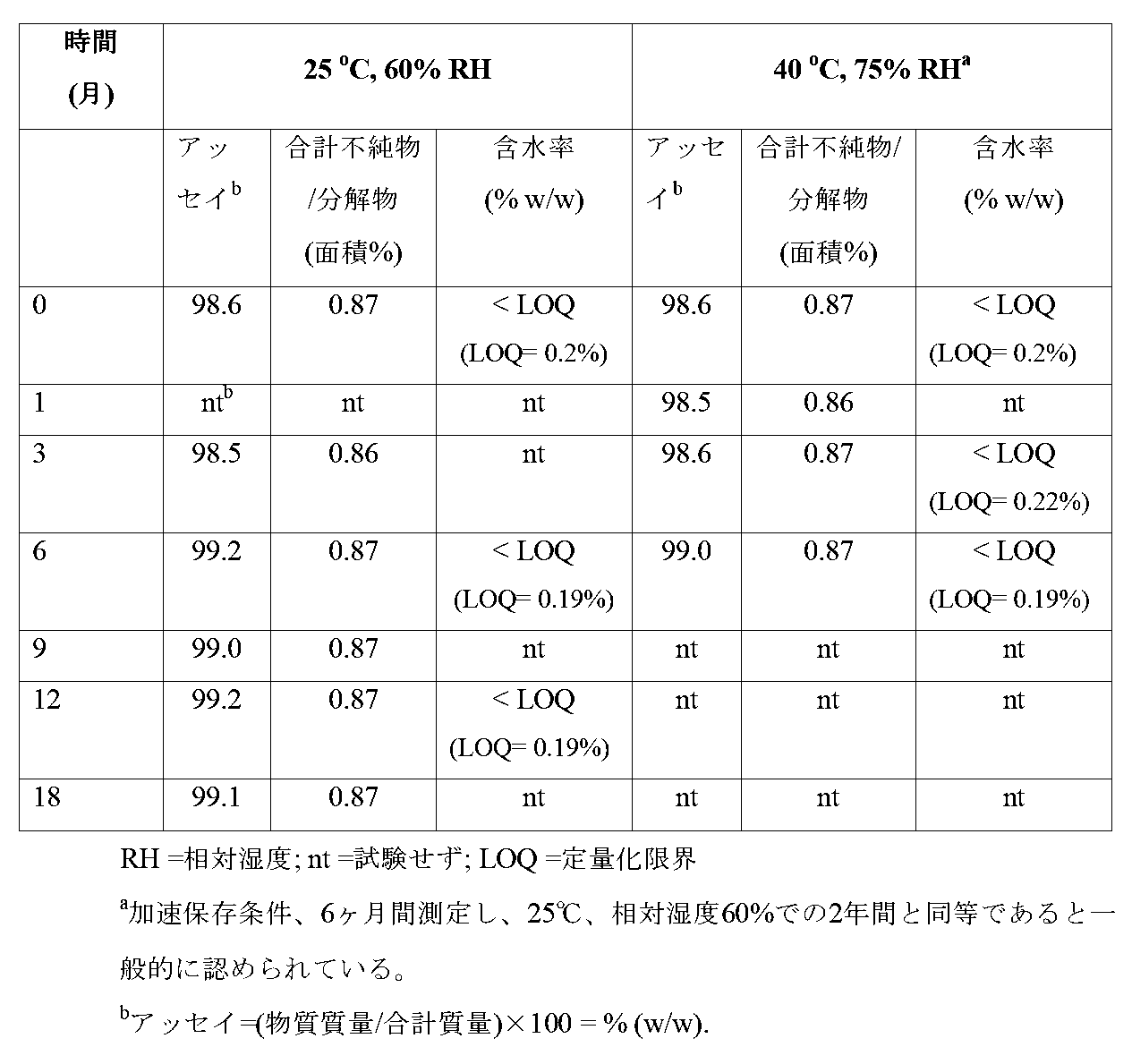
これらのデータは、化合物I’が、25℃、60%RHで少なくとも18ヶ月間、および40℃、75%RHの加速条件による測定で少なくとも2年間は安定したままであることを実証している。これらのデータはまた、定量化可能量の水が12ヶ月目で検出されていないことも示し、したがって、結晶がその期間にわたり非吸湿性のままであることを示している。さらに、これらのデータは、1%を超える合計不純物/分解物が、18ヶ月(25℃、60%RH)または2年間(40℃、75%RHの加速条件)にわたり検出されていないことを示している。
アッセイ
アッセイ1:ラット、イヌおよびサルにおけるIV/PO薬動学研究
These data demonstrate that compound I' remains stable for at least 18 months at 25°C, 60% RH and for at least 2 years measured by accelerated conditions at 40°C, 75% RH. . These data also show that no quantifiable amount of water is detected at 12 months, thus indicating that the crystals remain non-hygroscopic over that period. Furthermore, these data show that >1% total impurities/degradants have not been detected for 18 months (25°C, 60% RH) or 2 years (40°C, 75% RH accelerated conditions). ing.
Assays Assay 1: IV/PO pharmacokinetic studies in rats, dogs and monkeys
ラット、イヌまたはサルの各PK研究を、試験化合物の製剤化から始めた。適切な質量の各試験化合物を、各化合物の最終濃度が投薬に適当となるような容量のビヒクル(例えば、H2O中5%重炭酸ナトリウム、5%デキストロース)中に加えた。経口投薬には均質な懸濁物が許容されるが、静脈内投薬溶液を投薬前に滅菌濾過(0.2μm)して、微粒子が投与されないことを確実にした。 Each PK study in rats, dogs or monkeys began with the formulation of the test compound. An appropriate mass of each test compound was added in a volume of vehicle (eg, 5% sodium bicarbonate, 5% dextrose in H 2 O) such that the final concentration of each compound was suitable for dosing. Although a homogenous suspension is acceptable for oral dosing, intravenous dosing solutions were sterile filtered (0.2 μm) prior to dosing to ensure that no particulates were administered.
ラットの研究では、予めカニューレ挿入された雄性Sprague-Dawleyラット(1経路あたり3匹)をHarlan LaboratoriesまたはCharles Rivers Laboratoriesから入手した。ラットに、シリンジおよび栄養補給チューブを使用して胃の中に送達される経口用量、または静脈内(外側尾静脈からの)用量のいずれかの投薬溶液を与えた。最終用量は、0.5mg/kgとした。投与後3分、15分、30分、1時間、2時間、4時間、6時間、および24時間の時点で、逐次的な血液試料を、頚静脈に植え込まれたカニューレから採取した。試料採取は、手作業で、または自動採血器を使用して実施した。試料は、EDTAを抗凝血剤として含有するmicrotainerチューブ内に収集し、低温遠心分離によって血漿に加工した。 For rat studies, pre-cannulated male Sprague-Dawley rats (3 per track) were obtained from Harlan Laboratories or Charles Rivers Laboratories. Rats were given either an oral dose delivered into the stomach using a syringe and feeding tube, or an intravenous (via the lateral tail vein) dosing solution. The final dose was 0.5 mg/kg. Serial blood samples were taken from a cannula implanted in the jugular vein at 3, 15, 30, 1, 2, 4, 6, and 24 hours after dosing. Sampling was performed manually or using an automated blood collector. Samples were collected in microtainer tubes containing EDTA as anticoagulant and processed into plasma by cryocentrifugation.
イヌの研究では、Agilux Laboratories(Worcester、MA)で飼育され、体重が9~14kgの間である雄性非ナイーブビーグル犬(1経路あたり3匹)に、経口または静脈内用量のいずれかを与えた。経口用量は、シリンジおよび栄養補給チューブを使用して胃の中に送達し、続いておよそ10mLの水フラッシュを行った。経口用量は2mL/kgの容量で投与した。静脈内用量は、伏在静脈(sphenous vein)に入れた経皮カテーテルを介して投与し、続いておよそ3mLの生理食塩水フラッシュを行った。静脈内用量は0.5mL/kgの容量で投与した。IVまたはPOのための最終用量は、0.1mg/kgとした。投与後3分、15分、30分、1時間、2時間、4時間、6時間、8時間、12時間、および24時間の時点で、逐次的な血液試料を直接静脈穿刺によって採取した。試料はすべて、EDTAを抗凝血剤として含有するmicrotainerチューブ内に手作業で収集し、低温遠心分離によって血漿に加工した。 In a canine study, male non-naive beagle dogs (3 per route) housed at Agilux Laboratories (Worcester, Mass.) weighing between 9 and 14 kg were given either oral or intravenous doses. . Oral doses were delivered into the stomach using a syringe and feeding tube, followed by an approximately 10 mL water flush. Oral doses were administered in a volume of 2 mL/kg. Intravenous doses were administered via a percutaneous catheter placed in the sphenous vein, followed by an approximately 3 mL saline flush. Intravenous doses were administered in a volume of 0.5 mL/kg. The final dose for IV or PO was 0.1 mg/kg. Serial blood samples were taken by direct venipuncture at 3 minutes, 15 minutes, 30 minutes, 1 hour, 2 hours, 4 hours, 6 hours, 8 hours, 12 hours, and 24 hours after dosing. All samples were collected manually into microtainer tubes containing EDTA as anticoagulant and processed into plasma by cryocentrifugation.
IVおよびPOの両方について最終濃度が1.0mg/mLで投薬されるような容量のビヒクル(例えば、経口およびIVには、H2O中5%重炭酸ナトリウム、5%デキストロース、pH7.4、IVには、0.22μM PDVFシリンジを通す濾過)中の適切な質量の化合物Iを用いて、サルのPK研究を実施した。 Volume of vehicle (e.g., 5% sodium bicarbonate, 5% dextrose, pH 7.4, pH 7.4, in H 2 O for oral and IV) to be dosed at a final concentration of 1.0 mg/mL for both IV and PO. For IV, monkey PK studies were performed using appropriate masses of Compound I in 0.22 μM PDVF syringes (filtration through syringes).
Xenometrics(Stilwell、KS)で飼育された雄性カニクイザル(1経路あたり3匹)に、1または2mg/kgのIV用量またはPO用量の化合物Iを与えた。静脈内用量の化合物Iは、橈側皮静脈内の留置カテーテルを介して投与し、続いておよそ3mLの生理食塩水フラッシュを行った。静脈内用量は1mL/kgの容量で投与した。経口用量は、シリンジおよび栄養補給チューブを使用して胃の中に送達し、続いておよそ10mLの水フラッシュを行った。経口用量は2mL/kgの容量で投与した。48時間を通じて各時点(投与前、0.083時間、0.25時間、0.5時間、1時間、2時間、4時間、6時間、8時間、12時間、および24時間)で、各動物から橈側皮静脈、大腿静脈、または伏在静脈を介して、血液試料を収集した。試料はすべて、K2EDTAチューブ内に収集し、氷上に置いた。試料を遠心分離(3200rpm、10分間、5℃)によって血漿に加工し、最終濃度2%の酢酸で酸性化した。生体分析の前に、血漿のアリコートを96ウェルプレートチューブに移し、凍結保存した(-70℃)。 Male cynomolgus monkeys (3 per route) housed on Xenometrics (Stilwell, Kans.) were given IV or PO doses of Compound I of 1 or 2 mg/kg. Intravenous doses of Compound I were administered via an indwelling catheter in the cephalic vein, followed by approximately 3 mL of saline flush. Intravenous doses were administered in a volume of 1 mL/kg. Oral doses were delivered into the stomach using a syringe and feeding tube, followed by an approximately 10 mL water flush. Oral doses were administered in a volume of 2 mL/kg. Each animal at each time point (predose, 0.083, 0.25, 0.5, 1, 2, 4, 6, 8, 12, and 24 hours) throughout 48 hours. Blood samples were collected via the cephalic, femoral, or saphenous veins. All samples were collected in K2EDTA tubes and kept on ice. Samples were processed into plasma by centrifugation (3200 rpm, 10 min, 5° C.) and acidified with acetic acid to a final concentration of 2%. Prior to bioanalysis, aliquots of plasma were transferred to 96-well plate tubes and stored frozen (-70°C).
化合物Iの血漿濃度は、LC/MS/MSによって決定した。血漿研究試料にボルテックスをかけ、それを96ウェルプレートに入れた。試料を、内部標準と共に200μLのアセトニトリルで抽出した。抽出物を2809RPMで10分間遠心分離し、50μLの上清を200μLの水中0.2%ギ酸と混合した。試料(10~15μL)をThermoFisher HyPURITY(商標)(C18 50×2.1mm)カラムに0.35mL/分の流速で注入した。移動相Aは、水:アセトニトリル:ギ酸(95:5:0.1、v:v:v)からなるものとし、移動相Bは、メタノール:アセトニトリル:ギ酸(50:50:0.1、v:v:v)からなるものとした(イヌ)。移動相Aは、水中0.2%ギ酸からなるものとし、移動相Bは、アセトニトリル中0.2%ギ酸からなるものとした(ラットおよびサル)。化合物Iの薬動学パラメーターは、Phoenix WinNonlinバージョン6.3(Certara、Sunnyvale、CA)を使用し、1処置群あたり3匹の動物からの個々の血漿濃度時間プロファイルを使用して、非コンパートメント分析(IVおよびPO投与について、それぞれモデル201およびモデル200)によって決定した。
Plasma concentrations of Compound I were determined by LC/MS/MS. The plasma study sample was vortexed and placed in a 96-well plate. Samples were extracted with 200 μL of acetonitrile along with an internal standard. Extracts were centrifuged at 2809 RPM for 10 minutes and 50 μL of supernatant was mixed with 200 μL of 0.2% formic acid in water. Samples (10-15 μL) were injected onto a ThermoFisher HyPURITY™ (
血漿クリアランスは、静脈内研究アームから決定され、血漿から薬物が取り除かれる速度を表す。これは、用量を血漿濃度-時間曲線下面積で割ったものに等しい。血漿クリアランスに加えて、経口投与された薬物が、経口送達後に有効な全身レベルに到達することも不可欠である。経口生物学的利用能は、静脈内投与の結果としての曝露と比較した、経口投与の結果としての血漿曝露の測定値である。

このラットのデータは、化合物Iが、0.5mg/kgの用量でおよそ33%の経口生物学的利用能を有することを示している。より高い用量(30~1000mg/kg)では、平均生物学的利用能は、ラットにおいて49~79%の範囲であった(データは示さず)。化合物Iはまた、ラット種においてアジルサルタンと共に投与された(データは示さず)。このイヌのデータは、化合物Iがおよそ17%の限定的な経口生物学的利用能を有することを示している。より高い用量(100~300mg/kg)では、平均生物学的利用能は、7~13%の範囲であった(データは示さず)。サルのデータは、化合物Iがおよそ42%の経口生物学的利用能を有することを示している。より高い用量(30および100mg/kg)では、3つの異なる製剤についての平均生物学的利用能は、55~83%の範囲であった(データは示さず)。
アッセイ2:ラット、イヌおよびサルの種における化合物Iの腎排泄
The rat data indicate that Compound I has an oral bioavailability of approximately 33% at a dose of 0.5 mg/kg. At higher doses (30-1000 mg/kg), mean bioavailability ranged from 49-79% in rats (data not shown). Compound I was also co-administered with azilsartan in rat strains (data not shown). The dog data indicate that Compound I has a limited oral bioavailability of approximately 17%. At higher doses (100-300 mg/kg), mean bioavailability ranged from 7-13% (data not shown). Monkey data indicate that Compound I has an oral bioavailability of approximately 42%. At higher doses (30 and 100 mg/kg), mean bioavailability for the three different formulations ranged from 55-83% (data not shown).
Assay 2: Renal Excretion of Compound I in Rat, Dog and Monkey Species
患者において適切な長期の薬物投薬および適正な定常状態薬物濃度を保証するための重要な要素が、薬物クリアランスである。一般に、薬物クリアランスが低下すると、薬物濃度はより高くなり、薬物の効果はより強まる。化合物Iの腎クリアランスを理解するために、1回のIV用量の結果として尿中に回収される投与用量のパーセントを、3つの動物種において評価した。雄性Sprague Dawleyラット、雄性ビーグル犬および雄性カニクイザルにおける3つの別個の研究をそれぞれ行い、手順および実験結果を以下に記載する。 A key factor in ensuring adequate long-term drug dosing and adequate steady-state drug concentrations in patients is drug clearance. In general, the lower the drug clearance, the higher the drug concentration and the stronger the drug's effect. To understand renal clearance of Compound I, the percent of administered dose recovered in urine as a result of a single IV dose was evaluated in three animal species. Three separate studies in male Sprague Dawley rats, male beagle dogs and male cynomolgus monkeys were each performed and the procedures and experimental results are described below.
体重が297~316gおよび294~311gである雄性Sprague Dawleyラット(N=6、1群3匹で2群)に、0.5mg/kg(群I)および3.0mg/kg(群II)のIV用量の化合物Iを投薬カセットの一部として与えた。化合物Iを、D5W中5%NaHCO3(水中5%デキストロース、pH7.8)中に0.25mg/mLの濃度で溶解し、1.0mg/mLの最終合計濃度を得て、0.5mg/kgの静脈内用量を送達した。さらに、化合物Iを、D5W中5%NaHCO3(水中5%デキストロース、pH7.4)中に1.5mg/mLの濃度で溶解して、3mg/kgの静脈内用量を送達した。両方の製剤を、静脈内投与前に滅菌濾過した。化合物Iの投与の前後に、ラットの通常の給餌スケジュールに従ってラットを食餌にアクセスさせた。0.5mg/kgの化合物Iを与えられたコホートについては、尿をドライアイス上に収集した。24時間の尿収集期間の後、尿試料を解凍し、容量を記録し、試料を混合した後、生体分析のためにアリコート(約700μL)を取り出した。3.0mg/kgの化合物Iを与えられたコホートについては、尿を上記の通り収集したが、氷酢酸を、収集した尿アリコートに加えることによって、最終濃度2%の酢酸を得た。生体分析の前に、試料をすべて、凍結保存した(-70℃)。 Male Sprague Dawley rats (N=6, two groups of three each) weighing 297-316 g and 294-311 g were dosed with 0.5 mg/kg (group I) and 3.0 mg/kg (group II). An IV dose of Compound I was given as part of a dosing cassette. Compound I was dissolved in 5% NaHCO 3 in D5W (5% dextrose in water, pH 7.8) at a concentration of 0.25 mg/mL to give a final total concentration of 1.0 mg/mL and 0.5 mg/mL. An intravenous dose of kg was delivered. Additionally, Compound I was dissolved in 5% NaHCO 3 in D5W (5% dextrose in water, pH 7.4) at a concentration of 1.5 mg/mL to deliver an intravenous dose of 3 mg/kg. Both formulations were sterile filtered prior to intravenous administration. Before and after administration of Compound I, rats were allowed access to food according to their normal feeding schedule. For the cohort receiving 0.5 mg/kg Compound I, urine was collected on dry ice. After the 24 hour urine collection period, the urine samples were thawed, the volume recorded, and an aliquot (approximately 700 μL) removed for bioanalysis after sample mixing. For the cohort receiving 3.0 mg/kg Compound I, urine was collected as above, but glacial acetic acid was added to the collected urine aliquots to give a final concentration of 2% acetic acid. All samples were stored frozen (-70°C) prior to bioanalysis.
化合物Iのラット尿中濃度は、LC/MS/MSによって決定した。尿試料を解凍し、K2EDTAラット血漿中に5倍希釈した。希釈した尿の50μLのアリコートを96ウェルプレートに移し、内部標準を含有する200μLのアセトニトリルで抽出した。96ウェルプレートを2809RPMで10分間遠心分離し、上清を水中0.2%ギ酸で5倍希釈し、新たな96ウェルプレートに移した。上清を水中0.2%ギ酸中に希釈した。試料(10~15μL)をThermo Hypurity(C18 50×2.1mm)カラムに0.30または0.35mL/分の流速で注入した。移動相Aは、水中0.2%ギ酸からなるものとし、移動相Bは、アセトニトリル中0.2%ギ酸からなるものとした。化合物Iのアッセイ範囲は、0.0125~25μg/mL(0.5mg/kgコホート)および0.0058~25μg/mL(3.0mg/kgコホート)とした。
Rat urine concentrations of Compound I were determined by LC/MS/MS. Urine samples were thawed and diluted 5-fold into K 2 EDTA rat plasma. A 50 μL aliquot of diluted urine was transferred to a 96-well plate and extracted with 200 μL of acetonitrile containing an internal standard. The 96-well plate was centrifuged at 2809 RPM for 10 minutes and the supernatant was diluted 5-fold with 0.2% formic acid in water and transferred to a new 96-well plate. The supernatant was diluted in 0.2% formic acid in water. Samples (10-15 μL) were injected onto a Thermo Hypurity (
体重が9.00~11.1kgおよび10.6~13.4kgである雄性非ナイーブビーグル犬(N=6、1群3匹で2群)に、0.1mg/kg(群I)および1.0mg/kg(群II)のIV用量の化合物Iを投薬カセットの一部として与えた。化合物Iを、0.1mg/kgでの投薬用に0.2mg/mLの濃度で、または1mg/kgでの静脈内投薬用に2mg/mLの濃度でPEG-200:エタノール:水(40:10:50)中に溶解し、投与前に滅菌濾過した。化合物Iの投与の前後に、イヌの通常の給餌スケジュールでイヌを食餌にアクセスさせた。尿試料は、湿潤氷または冷たいパック上で、氷酢酸を予め充填した予め秤量した容器内に収集した。試料を再度秤量し、追加の氷酢酸を必要に応じて最終濃度2%まで加えた。生体分析の前に、試料を凍結させ、保存した(-80℃)。 Male non-naive beagle dogs weighing 9.00-11.1 kg and 10.6-13.4 kg (N=6, 2 groups of 3 per group) were dosed with 0.1 mg/kg (group I) and 1 An IV dose of Compound I of .0 mg/kg (Group II) was given as part of a dosing cassette. Compound I was added in PEG-200:ethanol:water (40: 10:50) and sterile filtered prior to administration. Before and after administration of Compound I, the dogs were allowed access to food on their normal feeding schedule. Urine samples were collected in pre-weighed containers pre-filled with glacial acetic acid on wet ice or cold packs. Samples were reweighed and additional glacial acetic acid was added as needed to a final concentration of 2%. Samples were frozen and stored (-80°C) prior to bioanalysis.
化合物Iのイヌ尿中濃度は、LC/MS/MSによって決定した。尿研究試料(K2EDTAビーグル犬血漿(Biochemed、Winchester、VA)中に希釈した)を解凍し、ボルテックスをかけ、10または20μLのいずれかを96ウェルプレートに入れた。試料を、内部標準のクリシンまたはグリブリドと共に、6倍大きな容量のアセトニトリル(60または120μL)で抽出した。抽出物を3000RPMで5分間遠心分離し、約70%の上清(50または100μL)を新たな96ウェルプレートに移し、等容量の水と合わせた。試料をMac Mod Ace C18(2.1×50mm、3μm)またはWaters Acquity UPLC BEH C18(50×2.1mm、1.7μm)カラムのいずれかに0.8または0.9mL/分いずれかの流速で注入した。移動相Aは、95:5:0.1(v:v:v)の水:アセトニトリル:ギ酸からなるものとし、移動相Bは、50:50:0.1(v:v:v)のメタノール:アセトニトリル:ギ酸からなるものとした。尿における化合物Iのアッセイ範囲は、0.0002~1.00μg/mLとした。 Dog urine concentrations of Compound I were determined by LC/MS/MS. Urine study samples (diluted in K 2 EDTA beagle dog plasma (Biochemed, Winchester, Va.)) were thawed, vortexed, and either 10 or 20 μL were placed in 96-well plates. Samples were extracted with a 6-fold larger volume of acetonitrile (60 or 120 μL) with chrysine or glyburide as internal standards. Extracts were centrifuged at 3000 RPM for 5 minutes and approximately 70% of the supernatant (50 or 100 μL) was transferred to a new 96-well plate and combined with an equal volume of water. Samples were loaded onto either a Mac Mod Ace C18 (2.1 x 50 mm, 3 µm) or Waters Acquity UPLC BEH C18 (50 x 2.1 mm, 1.7 µm) column at a flow rate of either 0.8 or 0.9 mL/min. injected with Mobile phase A consisted of 95:5:0.1 (v:v:v) water:acetonitrile:formic acid and mobile phase B consisted of 50:50:0.1 (v:v:v) It consisted of methanol: acetonitrile: formic acid. The assay range for Compound I in urine was 0.0002-1.00 μg/mL.
体重が2.87~3.61kgである雄性非ナイーブカニクイザル(N=3)に、1mg/kgのIV用量の化合物Iを与えた。投与前に、化合物IをD5W中5%NaHCO3(pH7.4)中に溶解し、0.22μMポリビニルジフルオリド(PVDF)シリンジフィルター(Millipore Millex-GV、SLGV033RB)を通す濾過をした。製剤は投薬の前の日に調製し、-70℃で一晩保存し、投薬の前に解凍した。静脈内用量の化合物Iは、橈側皮静脈内の留置カテーテルを介して投与し、続いておよそ3mLの生理食塩水フラッシュを行った。静脈内用量は1mL/kgの容量で投与した。尿試料を、湿潤氷または冷たいパック上で、氷酢酸を含有するチューブ内に収集することによって、任意の潜在的なグルクロニド抱合体を安定化させた。合計尿試料容量を重量測定法で推定し、アリコートを得、生体分析の前に凍結させた(-70℃)。 Male non-naive cynomolgus monkeys (N=3) weighing 2.87-3.61 kg were given an IV dose of Compound I of 1 mg/kg. Prior to dosing, Compound I was dissolved in 5% NaHCO 3 (pH 7.4) in D5W and filtered through a 0.22 μM polyvinyl difluoride (PVDF) syringe filter (Millipore Millex-GV, SLGV033RB). Formulations were prepared the day prior to dosing, stored overnight at −70° C., and thawed prior to dosing. Intravenous doses of Compound I were administered via an indwelling catheter in the cephalic vein, followed by approximately 3 mL of saline flush. Intravenous doses were administered in a volume of 1 mL/kg. Any potential glucuronide conjugates were stabilized by collecting urine samples on wet ice or cold packs in tubes containing glacial acetic acid. Total urine sample volume was estimated gravimetrically and aliquoted and frozen (-70°C) prior to bioanalysis.
化合物Iのサル尿中濃度は、LC/MS/MSによって決定した。尿試料を解凍し、K2EDTAサル血漿(Bioreclamation、Westbury、NY)中に5倍希釈した。試料にボルテックスをかけ、50μLを96ウェルプレートに移した。次いで、試料を内部標準と共に200μLのアセトニトリルで抽出した。抽出物を2809RPMで10分間遠心分離し、50μLの上清を200μLの水中0.2%ギ酸に加えた。試料(10~15μL)をThermoFisher HyPURITY(商標)(C18 50×2.1mm)カラムに0.35mL/分の流速で注入した。移動相Aは、水中0.2%ギ酸からなるものとし、移動相Bは、アセトニトリル中0.2%ギ酸からなるものとした。化合物Iのアッセイ範囲は、0.00125~5μg/mLとした。
Monkey urine concentrations of Compound I were determined by LC/MS/MS. Urine samples were thawed and diluted 5-fold into K 2 EDTA monkey plasma (Bioreclamation, Westbury, NY). Samples were vortexed and 50 μL transferred to a 96-well plate. Samples were then extracted with 200 μL of acetonitrile along with an internal standard. Extracts were centrifuged at 2809 RPM for 10 minutes and 50 μL of supernatant was added to 200 μL of 0.2% formic acid in water. Samples (10-15 μL) were injected onto a ThermoFisher HyPURITY™ (
24時間の収集期間にわたり排泄された尿の平均量および尿中に排泄された投与用量の概算%を以下の表に示す。

化合物Iの腎排泄率は、ラットにおいて、投与された用量の0.02%未満または0.03%未満、イヌにおいて、投与された用量の0.02%未満または0.001%未満、サルにおいて、投与された用量のおよそ0.670%±0.593%であった。これらのデータは、化合物Iは、試験した3つの種において腎排泄率が低いことを示している。
アッセイ3:第1相単回漸増用量研究
Renal excretion of Compound I was less than 0.02% or less than 0.03% of the administered dose in rats, less than 0.02% or less than 0.001% of the administered dose in dogs, and , was approximately 0.670% ± 0.593% of the administered dose. These data indicate that Compound I has a low rate of renal excretion in the three species tested.
Assay 3:
化合物I’(形態I)(これは体内でその可溶性形態である化合物Iに変換するか、または溶解して化合物Iをもたらす)の第1相単回漸増用量(SAD)臨床試験を、例えば、慢性腎疾患、糖尿病性腎症、急性および慢性心不全、駆出率の減少を有する心不全、駆出率が保たれている心不全、心筋梗塞後無症候性左心室機能不全(MI後無症候性LVD)、亜急性心不全ならびに抵抗性および孤立性収縮期高血圧を含めた、様々な心血管および腎疾患の処置に対するネプリライシン阻害を評価するために行った。安全性および耐容性、薬動学(QD/BID投薬および非腎排泄に対する支援)、薬力学(ターゲットエンゲージメントバイオマーカーcGMPおよびANPに関する試験)、食物の影響、および絶対経口生物学的利用能、ならびに14C静脈内マイクロトレーサーを使用する腎排出を、特に試験した。
第1相研究は、4:1の比率で無作為化した健康な男女のボランティアにおける二重盲験、無作為化プラセボ対照単回漸増用量研究とした。研究では、50mg、100mg、200mg、400mgおよび600mgの単回漸増用量を投与されたコホート(n=10/活性8人およびプラセボ2人のコホート)を含んだ、漸増用量部分に関する複数週にわたる56人の健康なボランティアを登録した。第6のコホート(n=6)には、i.v.マイクロトレーサーならびにそれぞれ10μgおよび100mgの経口用量を投与した。SAD臨床試験データは、化合物Iが600mgまでの単回投与後、耐容性良好であることを部分的に実証した。
アッセイ3.1:ヒトにおけるNEP活性(cGMP)
The
Assay 3.1: NEP activity in humans (cGMP)
本研究の1つの目的は、ヒトに投薬した後の化合物Iの作用の機序/継続時間を決定することであった。これを行うために、ネプリライシンターゲットエンゲージメントのバイオマーカーであるcGMPのレベルを、化合物I’を用いた投薬の後に測定することによって、化合物Iの生物学的効果の証拠を得た。例えば、血漿クリアランス値が薬動学的持続性を実証していることと類似して、投薬24時間後の血漿cGMPレベルの上昇は、薬理効果の持続時間を示している。
One objective of this study was to determine the mechanism/duration of action of Compound I after dosing in humans. To do this, evidence of the biological effect of Compound I was obtained by measuring levels of cGMP, a biomarker of neprilysin target engagement, after dosing with Compound I'. For example, similar to plasma clearance values demonstrating pharmacokinetic persistence, an increase in
図6は、試験した用量におけるベースラインからの平均血漿cGMPの変化(nM)対時間を例示する。このデータは、化合物Iが単回投与後24時間にわたり平均血漿cGMPの持続的な増加をもたらし、cGMPの最大レベルが8時間~24時間の範囲で発生し、8~12時間のウィンドウで最高のcGMPレベルになることを実証している。さらに、血漿cGMP用量応答は、用量範囲の下端における、すなわち、≧100mgの用量レベルにおける最大に近い効果を実証している(図7を参照されたい)。
アッセイ3.2 ヒトにおける化合物I’のPKプロファイル、経口生物学的利用能および腎排泄
FIG. 6 illustrates the change in mean plasma cGMP from baseline (nM) versus time at the doses tested. The data show that Compound I produced a sustained increase in mean plasma cGMP over 24 hours after a single dose, with maximal levels of cGMP occurring in the 8- to 24-hour range and peaking in the 8- to 12-hour window. It has been demonstrated to be cGMP level. Moreover, the plasma cGMP dose response demonstrates a near-maximal effect at the lower end of the dose range, ie, at dose levels of ≧100 mg (see FIG. 7).
Assay 3.2 PK Profile, Oral Bioavailability and Renal Excretion of Compound I' in Humans
化合物Iの薬動学プロファイルは用量に比例し(図8を参照されたい)、化合物Iは高い経口生物学的利用能(80%付近)を有することが示された。SAD臨床試験からのデータはまた、低レベルの腎排出、すなわち、合計化合物I’投与用量の1%未満が、静脈内マイクロトレーサー試験技術により確認された通り、腎臓を介して排出されたことも示唆した。 The pharmacokinetic profile of Compound I was dose proportional (see Figure 8), indicating that Compound I has a high oral bioavailability (around 80%). Data from the SAD clinical trial also demonstrated low levels of renal excretion, i.e. less than 1% of the total Compound I' administered dose was excreted via the kidney as confirmed by the intravenous microtracer test technique. suggested.
興味深いことに、PKプロファイル(例えば、化合物IのCmax)およびPDプロファイル(例えば、cGMPmax)は異なる時間ウィンドウ内でピーク値を実証した。SAD臨床試験からのデータは、血漿cGMPのレベルの用量関連増加、ならびに血漿および尿の両方における24時間にわたるcGMPの持続的上昇を示唆し、化合物Iまたは化合物I’の使用を1日1回の投薬について支持するものであった。
アッセイ3.3:標準的処置との区別
Interestingly, PK profiles (eg C max of Compound I) and PD profiles (eg cGMP max ) demonstrated peak values within different time windows. Data from the SAD clinical trial suggest a dose-related increase in levels of plasma cGMP and a sustained elevation of cGMP over 24 hours in both plasma and urine, suggesting that the use of Compound I or Compound I' Advocated for medication.
Assay 3.3: Differentiation from Standard Treatment
現在のところ、サクビトリルをバルサルタンと組み合わせて使用することにより、慢性心不全および駆出率減少を有する患者における、心不全に関する心血管死および入院のリスクが減少することが示されている。サクビトリル(ネプリライシン阻害剤)と化合物Iとの比較は、腎排出および24時間ターゲットエンゲージメントにおける重要な区別を実証している。例えば、サクビトリルは、大部分が腎臓を介して排出される(60%腎排出)のに対して、化合物Iはそうではない(<1%腎排出)(図9を参照されたい)。これは、心疾患を有するかまたは有しない腎臓が損なわれている患者の処置にとって重要となる可能性がある。さらに、サクビトリルの投与後24時間の時点でcGMPのレベル(すなわち、ターゲットエンゲージメント)は上昇しないのに対して、化合物I’を用いた投薬の後にはcGMPのレベルが上昇する。これにより、潜在的に化合物Iまたは化合物I’を1日1回投薬することが可能となり、これは、1日2回の投薬レジメンである、バルサルタンと組み合わせたサクビトリルには当てはまらない。
アッセイ4:第1相複数回漸増用量研究
Currently, the use of sacubitril in combination with valsartan has been shown to reduce the risk of heart failure-related cardiovascular death and hospitalization in patients with chronic heart failure and reduced ejection fraction. A comparison of Sacubitril (a neprilysin inhibitor) and Compound I demonstrates important distinctions in renal excretion and 24-hour target engagement. For example, Sacubitril is largely excreted via the kidney (60% renal excretion), whereas Compound I is not (<1% renal excretion) (see Figure 9). This can be important for the treatment of renal compromised patients with or without heart disease. Furthermore, cGMP levels (ie, target engagement) are not elevated 24 hours after administration of Sacubitril, whereas cGMP levels are elevated after dosing with Compound I'. This potentially allows once-daily dosing of Compound I or Compound I', which is not the case for sacubitril in combination with valsartan, which is a twice-daily dosing regimen.
Assay 4:
化合物I’(形態I)の第1相複数回漸増用量(MAD)臨床試験は、健康な成人および高齢の対象における、化合物Iおよびその代謝産物の安全性、耐容性、薬動学、化合物Iの薬力学、化合物I’の複数回漸増経口用量の食物の影響、絶対経口生物学的利用能および腎排出をさらに評価するために行った。後述の通り、報告されたデータは、SAD臨床試験から得られる結果を確証している。
A
第1相研究は、4:1の比率で無作為化した健康な男女のボランティアにおける二重盲験、無作為化プラセボ対照複数回漸増用量研究とした。研究では、(1)50mg、100mg、および200mgの漸増用量、(2)PK/PKのために200mgと並行して研究した10mgの用量、ならびに(3)1つの高齢者コホート用の100mgの用量を投与されたコホート(n=10/活性8人およびプラセボ2人のコホート)を含んだ、漸増用量部分に関する複数週にわたる50人の健康な成人(19~55歳)および高齢者(65~80歳)のボランティアを登録した。MAD臨床試験データは、化合物Iが、14日間までの複数回経口投与後、一般的に耐容性良好であることを部分的に実証した。さらに、複数回投薬後、化合物Iの腎排出は無視できるものであり、例えば、<1%が1日目および14日目にすべての対象について観察された。
アッセイ4.1:ヒトにおけるNEP活性(cGMP)、および標準的処置との区別
The
Assay 4.1: NEP activity (cGMP) in humans and differentiation from standard treatment
MAD臨床研究の一部は、ヒトに投薬した後の化合物Iの作用の機序/継続時間を決定することであった。これを行うために、ネプリライシンターゲットエンゲージメントのバイオマーカーであるcGMPのレベルを、化合物I’を用いた投薬の後に測定することによって、化合物Iの生物学的効果の証拠を得た。例えば、血漿クリアランス値が薬動学的持続性を実証していることと類似して、投薬24時間後の血漿cGMPレベルの上昇は、薬理効果の持続時間を示している。
Part of the MAD clinical study was to determine the mechanism/duration of action of Compound I after dosing in humans. To do this, evidence of the biological effect of Compound I was obtained by measuring levels of cGMP, a biomarker of neprilysin target engagement, after dosing with Compound I'. For example, similar to plasma clearance values demonstrating pharmacokinetic persistence, an increase in
図10は、試験した用量におけるベースラインからの平均血漿cGMPの変化(nM)対時間を例示する。このデータは、化合物Iが24時間にわたり平均血漿cGMPの持続的な増加をもたらすことを実証する。重要な結果が図10に示されている。このデータは、臨床研究の14日目に、化合物I’の1日1回用量について、トラフ期(0時間)におけるすべての用量、ならびに24時間までに測定されたすべての用量のターゲットエンゲージメントが存在したことを例示する。これは、1日2回の投薬レジメンでトラフ期および24時間においてターゲットエンゲージメントがほとんどないし全くない標準的処置とは対照的である(Guら、J. Clin. Pharmacol.、2010年、50巻、4号、401~414頁の411頁を参照されたい)。 FIG. 10 illustrates the change in mean plasma cGMP from baseline (nM) versus time at the doses tested. This data demonstrates that Compound I produces a sustained increase in mean plasma cGMP over 24 hours. Important results are shown in FIG. This data demonstrates that there is target engagement for all doses in the trough phase (0 hours) as well as all doses measured up to 24 hours for once-daily doses of Compound I' on day 14 of the clinical study. Give an example of what you did. This is in contrast to standard treatment with twice-daily dosing regimens with little to no target engagement in the trough phase and 24 hours (Gu et al., J. Clin. Pharmacol. 2010, 50. 4, 401-414, page 411).
本発明は、その特定の態様または実施形態を参照して記載してきたが、当業者であれば、本発明の真の趣旨および範囲から逸脱することなく、様々な変更を行うことができ、または等価物に置き換えることができることを理解されよう。さらに、適用可能な特許法および規則で許される程度まで、本明細書中に引用されたすべての刊行物、特許および特許出願は、まるで各文書が個々に参考として本明細書中に援用されているのと同程度まで、これら全体が参考として本明細書に援用されている。
本発明の実施形態の一部の例として、以下の項目が挙げられる。
(項目1)
(2S,4R)-5-(5’-クロロ-2’-フルオロ-[1,1’-ビフェニル]-4-イル)-2-(エトキシメチル)-4-(3-ヒドロキシイソオキサゾール-5-カルボキサミド)-2-メチルペンタン酸(I’)の結晶性遊離酸形態。
(項目2)
6.51±0.20、11.62±0.20、13.05±0.20、15.07±0.20、および23.28±0.20の2θ値に回折ピークを含む粉末X線回折パターンによって特徴付けられる、項目1に記載の結晶性形態。
(項目3)
6.51±0.20、11.62±0.20、13.05±0.20、15.07±0.20、17.12±0.20、23.28±0.20、および26.19±0.20の2θ値に回折ピークを含む粉末X線回折パターンによって特徴付けられる、項目1に記載の結晶性形態。
(項目4)
6.51±0.20、11.62±0.20、13.05±0.20、15.07±0.20、15.72±0.20、17.12±0.20、20.79±0.20、21.10±0.20、23.28±0.20、24.48±0.20、25.81±0.20、および26.19±0.20から選択される2θ値に1つまたは複数の追加の回折ピークを有することによって特徴付けられる、項目1に記載の結晶性形態。
(項目5)
ピーク位置が図1に示すパターンのピーク位置と実質的に一致する粉末X線回折パターンによって特徴付けられる、項目1に記載の結晶性形態。
(項目6)
毎分10℃の加熱速度で記録した示差走査熱量測定トレースが、約214℃~約218℃の間の温度で吸熱熱流の最大値を示すことによって特徴付けられる、項目1に記載の結晶性形態。
(項目7)
図2に示すものと実質的に一致する示差走査熱量測定トレースによって特徴付けられる、項目1に記載の結晶性形態。
(項目8)
項目1から7のいずれか一項に記載の結晶性形態と、薬学的に許容される担体とを含む薬学的組成物。
(項目9)
前記薬学的に許容される担体が、ステアリン酸マグネシウムである、項目8に記載の薬学的組成物。
(項目10)
項目1から7のいずれか一項に記載の結晶性形態と、AT
1
受容体アンタゴニスト、ホスホジエステラーゼ阻害剤、レニン阻害剤、可溶性グアニル酸シクラーゼ阻害剤、ミネラルコルチコイド受容体アンタゴニスト、利尿剤、またはこれらの組合せとを含む薬学的組成物。
(項目11)
薬学的に許容される担体をさらに含む、項目10に記載の薬学的組成物。
(項目12)
カプセル剤、錠剤、または懸濁液剤中に、項目1から7のいずれか一項に記載の結晶性形態を含む経口投与剤形。
(項目13)
対象における前記結晶性形態の放出が、即時性放出、制御性放出、または遅延性放出である、項目12に記載の経口投与剤形。
(項目14)
前記カプセル剤の材料が、ゼラチン、多糖、キトサン、または合成ポリマーである、項目12に記載の経口投与剤形。
(項目15)
硬質カプセル剤が、ゼラチン、多糖、または合成ポリマーを含む、項目12に記載の経口投与剤形。
(項目16)
前記カプセル剤が、ヒドロキシプロピルメチルセルロースを含む、項目12に記載の経口投与剤形。
(項目17)
療法での使用のための、項目1から7のいずれか一項に記載の結晶性形態。
(項目18)
高血圧、心不全、または腎疾患の処置における使用のための、項目17に記載の結晶性形態。
(項目19)
高血圧、心不全、または腎疾患を処置するための医薬の製造のための、項目1から7のいずれか一項に記載の化合物の使用。
(項目20)
高血圧、心不全、または腎疾患を処置するための方法であって、(2S,4R)-5-(5’-クロロ-2’-フルオロ-[1,1’-ビフェニル]-4-イル)-2-(エトキシメチル)-4-(3-ヒドロキシイソオキサゾール-5-カルボキサミド)-2-メチルペンタン酸(I)、例えば、項目1から7のいずれか一項に記載の化合物を、患者に1日1回投与するステップを含む方法。
(項目21)
高血圧が、原発性高血圧、肺動脈高血圧、慢性血栓塞栓性肺高血圧、または腎動脈狭窄を伴う高血圧である、項目20に記載の方法。
(項目22)
腎疾患が、糖尿病性腎症、慢性腎疾患、タンパク質尿、急性腎臓傷害、ネフローゼ症候群、巣状分節性糸球体硬化症、または多発性嚢胞腎疾患である、項目20に記載の方法。
(項目23)
腎障害のある患者における高血圧、心不全、または腎疾患を処置する方法であって、前記(2S,4R)-5-(5’-クロロ-2’-フルオロ-[1,1’-ビフェニル]-4-イル)-2-(エトキシメチル)-4-(3-ヒドロキシイソオキサゾール-5-カルボキサミド)-2-メチルペンタン酸(I)、例えば、項目1から7のいずれか一項に記載の化合物の治療有効量を、前記患者に1日1回投与するステップを含む方法。
(項目24)
前記腎障害のある患者が、推定糸球体濾過量(eGFR)が60mL/分/1.73m
2
~15mL/分/1.73m
2
の間である慢性腎臓病を有する、項目23に記載の方法。
(項目25)
ヒトにおいて少なくとも24時間、心房性ナトリウム利尿ペプチド(ANP)または環状グアノシン一リン酸(cGMP)のレベルを増加させる方法であって、前記ヒトに、ANPまたはcGMPを増加させる量の(2S,4R)-5-(5’-クロロ-2’-フルオロ-[1,1’-ビフェニル]-4-イル)-2-(エトキシメチル)-4-(3-ヒドロキシイソオキサゾール-5-カルボキサミド)-2-メチルペンタン酸(I)、例えば、項目1から7のいずれか一項に記載の化合物を1日1回投与するステップを含む方法。
(項目26)
ANPおよびcGMPのレベルが、前記ヒトにおける尿中もしくは血漿中のいずれか、またはその両方で測定される、項目25に記載の方法。
(項目27)
(2S,4R)-5-(5’-クロロ-2’-フルオロ-[1,1’-ビフェニル]-4-イル)-2-(エトキシメチル)-4-(3-ヒドロキシイソオキサゾール-5-カルボキサミド)-2-メチルペンタン酸(I)、例えば、項目1から7のいずれか一項に記載の化合物が、非経口的に投与される、項目20、23または25のいずれか一項に記載の方法。
(項目28)
(2S,4R)-5-(5’-クロロ-2’-フルオロ-[1,1’-ビフェニル]-4-イル)-2-(エトキシメチル)-4-(3-ヒドロキシイソオキサゾール-5-カルボキサミド)-2-メチルペンタン酸(I)を調製するためのプロセスであって、
(a)ベンジル(2S,4R)-4-アミノ-5-(5’-クロロ-2’-フルオロ-[1,1’-ビフェニル]-4-イル)-2-(エトキシメチル)-2-メチルペンタノエート塩酸塩を、溶媒中で、およそ1:1のモル比で3-((4-メトキシベンジル)オキシ)イソオキサゾール-5-カルボン酸とカップリングして、ベンジル(2S,4R)-5-(5’-クロロ-2’-フルオロ-[1,1’-ビフェニル]-4-イル)-2-(エトキシメチル)-4-(3-((4-メトキシベンジル)オキシ)イソオキサゾール-5-カルボキサミド)-2-メチルペンタノエートを得るステップと、
(b)ベンジル(2S,4R)-5-(5’-クロロ-2’-フルオロ-[1,1’-ビフェニル]-4-イル)-2-(エトキシメチル)-4-(3-((4-メトキシベンジル)オキシ)イソオキサゾール-5-カルボキサミド)-2-メチルペンタノエートを脱保護して、(2S,4R)-5-(5’-クロロ-2’-フルオロ-[1,1’-ビフェニル]-4-イル)-2-(エトキシメチル)-4-(3-ヒドロキシイソオキサゾール-5-カルボキサミド)-2-メチルペンタン酸(I)を形成するステップと
を含むプロセス。
(項目29)
ステップ(a)が、ペプチドカップリング剤および塩基を、およそ1:3:1:1のカップリング剤対塩基対ベンジル(2S,4R)-4-アミノ-5-(5’-クロロ-2’-フルオロ-[1,1’-ビフェニル]-4-イル)-2-(エトキシメチル)-2-メチルペンタノエート塩酸塩対3-((4-メトキシベンジル)オキシ)イソオキサゾール-5-カルボン酸のモル比でさらに含む、項目28に記載のプロセス。
(項目30)
前記カップリング剤が、2-(6-クロロ-1H-ベンゾ[d][1,2,3]トリアゾール-1-イル)-1,1,3,3-テトラメチルウロニウムヘキサフルオロホスフェート(V)であり、前記塩基が、N,N-ジイソプロピルエチルアミンである、項目29に記載のプロセス。
(項目31)
前記脱保護ステップ(b)が、パラジウム触媒および水素ガスを用いて実施される、項目28に記載のプロセス。
(項目32)
項目1に記載の結晶性形態を調製するためのプロセスであって、
(a)必要に応じて金属捕集剤と共に、(2S,4R)-5-(5’-クロロ-2’-フルオロ-[1,1’-ビフェニル]-4-イル)-2-(エトキシメチル)-4-(3-ヒドロキシイソオキサゾール-5-カルボキサミド)-2-メチルペンタン酸および溶媒を含む溶液を高温で形成するステップと、
(b)前記溶液を約-20℃~5℃の間の温度に冷却するステップと、
(c)前記結晶性形態を得るために、得られた固体を単離するステップと
を含むプロセス。
(項目33)
ステップ(a)における前記溶媒が、極性溶媒である、項目32に記載のプロセス。
(項目34)
前記溶媒が、酢酸エチルと水との混合物、酢酸エチル、またはエタノールである、項目33に記載のプロセス。
(項目35)
ステップ(a)における前記温度が、約60℃~95℃の間である、項目32に記載のプロセス。
(項目36)
前記温度が、約70℃~85℃の間である、項目35に記載のプロセス。
(項目37)
ステップ(c)において前記固体を単離するステップが、濾過すること、1種もしくは複数の溶媒で洗浄すること、空気中もしくは減圧下で乾燥させること、またはこれらの組合せを含む、項目29に記載のプロセス。
(項目38)
前記溶媒が、酢酸エチルおよび水、酢酸エチル、またはエタノールである、項目37に記載のプロセス。
(項目39)
減圧下で乾燥させることが、25℃~70℃の間の温度で実施される、項目37に記載のプロセス。
Although the invention has been described with reference to particular aspects or embodiments thereof, various modifications can be made by those skilled in the art without departing from the true spirit and scope of the invention, or It will be appreciated that equivalents may be substituted. Further, to the extent permitted by applicable patent laws and regulations, all publications, patents and patent applications cited herein are referred to as if each document were individually incorporated herein by reference. to the same extent that they are incorporated herein by reference in their entireties.
Some examples of embodiments of the present invention include the following items.
(Item 1)
(2S,4R)-5-(5′-chloro-2′-fluoro-[1,1′-biphenyl]-4-yl)-2-(ethoxymethyl)-4-(3-hydroxyisoxazole-5 -carboxamido)-2-methylpentanoic acid (I') in the crystalline free acid form.
(Item 2)
Powder X containing diffraction peaks at 2θ values of 6.51±0.20, 11.62±0.20, 13.05±0.20, 15.07±0.20, and 23.28±0.20 The crystalline form of
(Item 3)
6.51 ± 0.20, 11.62 ± 0.20, 13.05 ± 0.20, 15.07 ± 0.20, 17.12 ± 0.20, 23.28 ± 0.20, and 26 The crystalline form of
(Item 4)
6.51±0.20, 11.62±0.20, 13.05±0.20, 15.07±0.20, 15.72±0.20, 17.12±0.20, 20. selected from 79±0.20, 21.10±0.20, 23.28±0.20, 24.48±0.20, 25.81±0.20, and 26.19±0.20 2. The crystalline form of
(Item 5)
2. The crystalline form of
(Item 6)
The crystalline form of
(Item 7)
2. The crystalline form of
(Item 8)
A pharmaceutical composition comprising the crystalline form of any one of
(Item 9)
9. The pharmaceutical composition according to item 8, wherein said pharmaceutically acceptable carrier is magnesium stearate.
(Item 10)
A crystalline form of any one of
(Item 11)
11. The pharmaceutical composition of
(Item 12)
8. An oral dosage form comprising the crystalline form of any one of
(Item 13)
13. The oral dosage form of
(Item 14)
13. Oral dosage form according to
(Item 15)
13. An oral dosage form according to
(Item 16)
13. An oral dosage form according to
(Item 17)
8. A crystalline form according to any one of
(Item 18)
18. A crystalline form according to item 17 for use in the treatment of hypertension, heart failure or renal disease.
(Item 19)
Use of a compound according to any one of
(Item 20)
A method for treating hypertension, heart failure, or renal disease, comprising (2S,4R)-5-(5'-chloro-2'-fluoro-[1,1'-biphenyl]-4-yl)- 2-(Ethoxymethyl)-4-(3-hydroxyisoxazole-5-carboxamido)-2-methylpentanoic acid (I), for example a compound according to any one of
(Item 21)
21. The method of
(Item 22)
21. The method of
(Item 23)
A method of treating hypertension, heart failure, or renal disease in a patient with renal impairment, said (2S,4R)-5-(5′-chloro-2′-fluoro-[1,1′-biphenyl]- 4-yl)-2-(ethoxymethyl)-4-(3-hydroxyisoxazole-5-carboxamido)-2-methylpentanoic acid (I), for example a compound according to any one of
(Item 24)
24. The method of
(Item 25)
1. A method of increasing atrial natriuretic peptide (ANP) or cyclic guanosine monophosphate (cGMP) levels in a human for at least 24 hours, comprising administering to said human an ANP or cGMP increasing amount of (2S,4R). -5-(5′-chloro-2′-fluoro-[1,1′-biphenyl]-4-yl)-2-(ethoxymethyl)-4-(3-hydroxyisoxazole-5-carboxamide)-2 - a method comprising administering methylpentanoic acid (I), eg a compound according to any one of
(Item 26)
26. The method of item 25, wherein the levels of ANP and cGMP are measured in either urine or plasma, or both, in said human.
(Item 27)
(2S,4R)-5-(5′-chloro-2′-fluoro-[1,1′-biphenyl]-4-yl)-2-(ethoxymethyl)-4-(3-hydroxyisoxazole-5 -carboxamido)-2-methylpentanoic acid (I), for example according to any one of
(Item 28)
(2S,4R)-5-(5′-chloro-2′-fluoro-[1,1′-biphenyl]-4-yl)-2-(ethoxymethyl)-4-(3-hydroxyisoxazole-5 -carboxamido)-2-methylpentanoic acid (I), comprising:
(a) benzyl(2S,4R)-4-amino-5-(5′-chloro-2′-fluoro-[1,1′-biphenyl]-4-yl)-2-(ethoxymethyl)-2- Methyl pentanoate hydrochloride is coupled with 3-((4-methoxybenzyl)oxy)isoxazole-5-carboxylic acid in an approximate 1:1 molar ratio in a solvent to give benzyl (2S,4R) -5-(5′-chloro-2′-fluoro-[1,1′-biphenyl]-4-yl)-2-(ethoxymethyl)-4-(3-((4-methoxybenzyl)oxy)iso obtaining oxazole-5-carboxamido)-2-methylpentanoate;
(b) benzyl (2S,4R)-5-(5′-chloro-2′-fluoro-[1,1′-biphenyl]-4-yl)-2-(ethoxymethyl)-4-(3-( (4-Methoxybenzyl)oxy)isoxazole-5-carboxamido)-2-methylpentanoate is deprotected to give (2S,4R)-5-(5′-chloro-2′-fluoro-[1, forming 1′-biphenyl]-4-yl)-2-(ethoxymethyl)-4-(3-hydroxyisoxazole-5-carboxamido)-2-methylpentanoic acid (I);
process including.
(Item 29)
Step (a) combines the peptide coupling agent and base in approximately 1:3:1:1 coupling agent to base pair benzyl (2S,4R)-4-amino-5-(5′-chloro-2′) -fluoro-[1,1′-biphenyl]-4-yl)-2-(ethoxymethyl)-2-methylpentanoate hydrochloride versus 3-((4-methoxybenzyl)oxy)isoxazole-5-carvone 29. The process of item 28, further comprising a molar ratio of acid.
(Item 30)
The coupling agent is 2-(6-chloro-1H-benzo[d][1,2,3]triazol-1-yl)-1,1,3,3-tetramethyluronium hexafluorophosphate (V ) and the base is N,N-diisopropylethylamine.
(Item 31)
29. The process of item 28, wherein said deprotection step (b) is performed using a palladium catalyst and hydrogen gas.
(Item 32)
A process for preparing the crystalline form of
(a) (2S,4R)-5-(5′-chloro-2′-fluoro-[1,1′-biphenyl]-4-yl)-2-(ethoxy, optionally with a metal scavenger; forming a solution comprising methyl)-4-(3-hydroxyisoxazole-5-carboxamido)-2-methylpentanoic acid and a solvent at an elevated temperature;
(b) cooling the solution to a temperature between about -20°C and 5°C;
(c) isolating the resulting solid to obtain said crystalline form;
process including.
(Item 33)
33. The process of item 32, wherein the solvent in step (a) is a polar solvent.
(Item 34)
34. The process of item 33, wherein the solvent is a mixture of ethyl acetate and water, ethyl acetate, or ethanol.
(Item 35)
33. The process of item 32, wherein the temperature in step (a) is between about 60°C and 95°C.
(Item 36)
36. The process of
(Item 37)
30. The method of claim 29, wherein isolating the solid in step (c) comprises filtering, washing with one or more solvents, drying in air or under reduced pressure, or combinations thereof. process.
(Item 38)
38. The process of item 37, wherein the solvent is ethyl acetate and water, ethyl acetate, or ethanol.
(Item 39)
38. The process according to item 37, wherein drying under reduced pressure is performed at a temperature between 25°C and 70°C.
Claims (31)
(a)必要に応じて金属捕集剤と共に、(2S,4R)-5-(5’-クロロ-2’-フルオロ-[1,1’-ビフェニル]-4-イル)-2-(エトキシメチル)-4-(3-ヒドロキシイソオキサゾール-5-カルボキサミド)-2-メチルペンタン酸および溶媒を含む溶液を60℃~95℃の間の温度で形成するステップと、
(b)前記溶液を-20℃~5℃の間の温度に冷却するステップと、
(c)前記結晶を得るために、得られた固体を単離するステップと
を含むプロセス。 A process for preparing the crystal of claim 1, comprising:
(a) (2S,4R)-5-(5′-chloro-2′-fluoro-[1,1′-biphenyl]-4-yl)-2-(ethoxy, optionally with a metal scavenger; forming a solution comprising methyl)-4-(3-hydroxyisoxazole-5-carboxamido)-2-methylpentanoic acid and a solvent at a temperature between 60° C. and 95° C.;
(b) cooling the solution to a temperature between -20°C and 5°C;
(c) isolating the resulting solid to obtain said crystals.
Priority Applications (1)
| Application Number | Priority Date | Filing Date | Title |
|---|---|---|---|
| JP2021177448A JP2022017433A (en) | 2016-03-08 | 2021-10-29 | Crystalline(2s,4r)-5-(5'-chloro-2'-fluoro-[1,1'-biphenyl]-4-yl)-2-(ethoxymethyl)-4-(3-hydroxyisoxazole-5-carboxamido)-2-methylpentanoic acid and uses thereof |
Applications Claiming Priority (5)
| Application Number | Priority Date | Filing Date | Title |
|---|---|---|---|
| US201662305393P | 2016-03-08 | 2016-03-08 | |
| US62/305,393 | 2016-03-08 | ||
| US201662346336P | 2016-06-06 | 2016-06-06 | |
| US62/346,336 | 2016-06-06 | ||
| PCT/US2017/021172 WO2017156009A1 (en) | 2016-03-08 | 2017-03-07 | Crystalline(2s,4r)-5-(5'-chloro-2'-fluoro-[1,1'-biphenyl]-4-yl)-2-(ethoxymethyl)-4-(3-hydroxyisoxazole-5-carboxamido)-2-methylpentanoic acid and uses thereof |
Related Child Applications (1)
| Application Number | Title | Priority Date | Filing Date |
|---|---|---|---|
| JP2021177448A Division JP2022017433A (en) | 2016-03-08 | 2021-10-29 | Crystalline(2s,4r)-5-(5'-chloro-2'-fluoro-[1,1'-biphenyl]-4-yl)-2-(ethoxymethyl)-4-(3-hydroxyisoxazole-5-carboxamido)-2-methylpentanoic acid and uses thereof |
Publications (3)
| Publication Number | Publication Date |
|---|---|
| JP2019509286A JP2019509286A (en) | 2019-04-04 |
| JP2019509286A5 JP2019509286A5 (en) | 2020-04-02 |
| JP7306828B2 true JP7306828B2 (en) | 2023-07-11 |
Family
ID=58387911
Family Applications (2)
| Application Number | Title | Priority Date | Filing Date |
|---|---|---|---|
| JP2018546864A Active JP7306828B2 (en) | 2016-03-08 | 2017-03-07 | Crystalline (2S,4R)-5-(5′-chloro-2′-fluoro-[1,1′-biphenyl]-4-yl)-2-(ethoxymethyl)-4-(3-hydroxyisoxazole -5-carboxamido)-2-methylpentanoic acid and uses thereof |
| JP2021177448A Pending JP2022017433A (en) | 2016-03-08 | 2021-10-29 | Crystalline(2s,4r)-5-(5'-chloro-2'-fluoro-[1,1'-biphenyl]-4-yl)-2-(ethoxymethyl)-4-(3-hydroxyisoxazole-5-carboxamido)-2-methylpentanoic acid and uses thereof |
Family Applications After (1)
| Application Number | Title | Priority Date | Filing Date |
|---|---|---|---|
| JP2021177448A Pending JP2022017433A (en) | 2016-03-08 | 2021-10-29 | Crystalline(2s,4r)-5-(5'-chloro-2'-fluoro-[1,1'-biphenyl]-4-yl)-2-(ethoxymethyl)-4-(3-hydroxyisoxazole-5-carboxamido)-2-methylpentanoic acid and uses thereof |
Country Status (30)
| Country | Link |
|---|---|
| US (6) | US10100021B2 (en) |
| EP (1) | EP3408260B1 (en) |
| JP (2) | JP7306828B2 (en) |
| KR (2) | KR20220035991A (en) |
| CN (1) | CN108779084A (en) |
| AU (1) | AU2017229466C1 (en) |
| CA (1) | CA3015505C (en) |
| CL (1) | CL2018002539A1 (en) |
| CO (1) | CO2018010568A2 (en) |
| CY (1) | CY1124397T1 (en) |
| DK (1) | DK3408260T3 (en) |
| ES (1) | ES2880123T3 (en) |
| HR (1) | HRP20211169T1 (en) |
| HU (1) | HUE055546T2 (en) |
| IL (1) | IL261244B (en) |
| LT (1) | LT3408260T (en) |
| MX (1) | MX377177B (en) |
| MY (1) | MY198185A (en) |
| PH (1) | PH12018501876A1 (en) |
| PL (1) | PL3408260T3 (en) |
| PT (1) | PT3408260T (en) |
| RS (1) | RS62172B1 (en) |
| RU (1) | RU2756223C2 (en) |
| SA (1) | SA518392325B1 (en) |
| SG (1) | SG11201807591VA (en) |
| SI (1) | SI3408260T1 (en) |
| SM (1) | SMT202100434T1 (en) |
| TW (1) | TWI731943B (en) |
| WO (1) | WO2017156009A1 (en) |
| ZA (1) | ZA201805840B (en) |
Families Citing this family (3)
| Publication number | Priority date | Publication date | Assignee | Title |
|---|---|---|---|---|
| JP7306828B2 (en) | 2016-03-08 | 2023-07-11 | セラヴァンス バイオファーマ アール&ディー アイピー, エルエルシー | Crystalline (2S,4R)-5-(5′-chloro-2′-fluoro-[1,1′-biphenyl]-4-yl)-2-(ethoxymethyl)-4-(3-hydroxyisoxazole -5-carboxamido)-2-methylpentanoic acid and uses thereof |
| CN115487175B (en) | 2019-09-20 | 2024-05-14 | 深圳信立泰药业股份有限公司 | Use of a complex of angiotensin II receptor antagonist metabolite and NEP inhibitor in treating heart failure |
| KR102485499B1 (en) * | 2022-07-15 | 2023-01-09 | 오가노이드사이언스 주식회사 | Composition for treating or preventing kidney disease |
Family Cites Families (49)
| Publication number | Priority date | Publication date | Assignee | Title |
|---|---|---|---|---|
| US4189604A (en) | 1975-07-22 | 1980-02-19 | Zaidan Hojin Biseibutsu Kagaku Kenkyu Kai | Bestatin |
| US4206232A (en) | 1976-05-10 | 1980-06-03 | E. R. Squibb & Sons, Inc. | Relieving hypertension with carboxyalkylacylamino acids |
| IL58849A (en) | 1978-12-11 | 1983-03-31 | Merck & Co Inc | Carboxyalkyl dipeptides and derivatives thereof,their preparation and pharmaceutical compositions containing them |
| FR2480747A1 (en) | 1980-04-17 | 1981-10-23 | Roques Bernard | AMINO ACID DERIVATIVES AND THEIR THERAPEUTIC APPLICATION |
| US4906615A (en) | 1980-12-18 | 1990-03-06 | Schering Corporation | Substituted dipeptides as inhibitors of enkephalinases |
| US4722810A (en) | 1984-08-16 | 1988-02-02 | E. R. Squibb & Sons, Inc. | Enkephalinase inhibitors |
| US4939261A (en) | 1984-06-08 | 1990-07-03 | Ciba-Geigy Corporation | N-substituted butyramide derivatives useful for treatment of conditions responsive to inhibition of enkephalinase |
| EP0225292A3 (en) | 1985-12-06 | 1988-11-30 | Ciba-Geigy Ag | Certain n-substituted butyramide derivatives |
| US4929641B1 (en) | 1988-05-11 | 1994-08-30 | Schering Corp | Mercapto-acylamino acid antihypertensives |
| KR880007441A (en) | 1986-12-11 | 1988-08-27 | 알렌 제이.스피겔 | Spiro-Substituted Glutaramide Diuretics |
| FR2623498B1 (en) | 1987-11-24 | 1990-04-06 | Bioprojet Soc Civ | NOVEL ENANTIOMERIC COMPOUNDS DERIVED FROM AMINO ACIDS, PROCESS FOR THEIR PREPARATION AND THERAPEUTIC APPLICATIONS |
| GB8820844D0 (en) | 1988-09-05 | 1988-10-05 | Pfizer Ltd | Therapeutic agents |
| US5599951A (en) | 1989-09-15 | 1997-02-04 | Societe Civile Bioprojet | Amino acid derivatives, the process for their preparation and their applications to therapy |
| US5294632A (en) | 1991-05-01 | 1994-03-15 | Ciba-Geigy Corporation | Phosphono/biaryl substituted dipetide derivatives |
| US5155100A (en) | 1991-05-01 | 1992-10-13 | Ciba-Geigy Corporation | Phosphono/biaryl substituted dipeptide derivatives |
| US5217996A (en) | 1992-01-22 | 1993-06-08 | Ciba-Geigy Corporation | Biaryl substituted 4-amino-butyric acid amides |
| US5508272A (en) | 1993-06-15 | 1996-04-16 | Bristol-Myers Squibb Company | Compounds containing a fused bicycle ring and processes therefor |
| DE19510566A1 (en) | 1995-03-23 | 1996-09-26 | Kali Chemie Pharma Gmbh | Benzazepine, benzoxazepine and benzothiazepine N-acetic acid derivatives and process for their preparation and medicaments containing these compounds |
| US5977075A (en) | 1995-04-21 | 1999-11-02 | Novartis Ag | N-aroylamino acid amides as endothelin inhibitors |
| US6660756B2 (en) | 2001-03-28 | 2003-12-09 | Pfizer Inc. | N-phenpropylcyclopentyl-substituted glutaramide derivatives as inhibitors of neutral endopeptidase |
| GB0119305D0 (en) | 2001-04-12 | 2001-10-03 | Aventis Pharma Gmbh | Mercaptoacetylamide derivatives,a process for their preparation and their use |
| WO2006027680A1 (en) | 2004-09-10 | 2006-03-16 | Pfizer Limited | 3-(1-carbamoylcyclohexyl) propionic acid derivatives as inhibitors of neutral endopeptidase enzyme |
| AR057882A1 (en) | 2005-11-09 | 2007-12-26 | Novartis Ag | DOUBLE ACTION COMPOUNDS OF ANGIOTENSIN RECEPTOR BLOCKERS AND NEUTRAL ENDOPEPTIDASE INHIBITORS |
| WO2007098042A2 (en) | 2006-02-17 | 2007-08-30 | Monsanto Technology Llc | Chimeric regulatory sequences comprising introns from dicotyledons for plant gene expression |
| WO2007106708A2 (en) | 2006-03-10 | 2007-09-20 | Novartis Ag | Combinations of the angiotensin ii antagonist valsartan and the nep inhibitor daglutril |
| PH12012502091A1 (en) | 2007-01-12 | 2019-06-14 | Novartis Ag | Process for preparing 5-biphenyl-4-amino-2-methyl pentanoic acid |
| TWI448284B (en) | 2007-04-24 | 2014-08-11 | Theravance Inc | Dual-acting antihypertensive agents |
| AR070176A1 (en) | 2008-01-17 | 2010-03-17 | Novartis Ag | SYNTHESIS PROCESSES OF NEP INHIBITORS, INTERMEDIATE COMPOUNDS AND USE OF THE SAME IN SYNTHESIS |
| SG176009A1 (en) * | 2009-05-28 | 2011-12-29 | Novartis Ag | Substituted aminopropionic derivatives as neprilysin inhibitors |
| JP5466759B2 (en) | 2009-05-28 | 2014-04-09 | ノバルティス アーゲー | Substituted aminobutyric acid derivatives as neprilysin inhibitors |
| JO2967B1 (en) | 2009-11-20 | 2016-03-15 | نوفارتس ايه جي | Substituted carbamoylmethylamino acetic acid derivatives as novel NEP inhibitors |
| AU2011207020B2 (en) | 2010-01-22 | 2014-04-17 | Novartis Ag | Intermediates of neutral endopeptidase inhibitors and preparation method thereof |
| US8993631B2 (en) | 2010-11-16 | 2015-03-31 | Novartis Ag | Method of treating contrast-induced nephropathy |
| US8673974B2 (en) | 2010-11-16 | 2014-03-18 | Novartis Ag | Substituted amino bisphenyl pentanoic acid derivatives as NEP inhibitors |
| CA2819153A1 (en) | 2010-12-15 | 2012-06-21 | Theravance, Inc. | Neprilysin inhibitors |
| HUE028051T2 (en) | 2010-12-15 | 2016-11-28 | Theravance Biopharma R&D Ip Llc | Neprilizin Inhibitors |
| JP5959065B2 (en) * | 2011-02-17 | 2016-08-02 | セラヴァンス バイオファーマ アール&ディー アイピー, エルエルシー | Substituted aminobutyric acid derivatives as neprilysin inhibitors |
| JP5959066B2 (en) | 2011-02-17 | 2016-08-02 | セラヴァンス バイオファーマ アール&ディー アイピー, エルエルシー | Substituted aminobutyric acid derivatives as neprilysin inhibitors |
| JP5959074B2 (en) | 2011-05-31 | 2016-08-02 | セラヴァンス バイオファーマ アール&ディー アイピー, エルエルシー | Neprilysin inhibitor |
| CN103748070B (en) | 2011-05-31 | 2015-06-24 | 施万生物制药研发Ip有限责任公司 | Neprilysin inhibitors |
| CN103582630B (en) | 2011-05-31 | 2016-08-17 | 施万生物制药研发Ip有限责任公司 | Enkephalinase inhibitor |
| TWI560172B (en) | 2011-11-02 | 2016-12-01 | Theravance Biopharma R&D Ip Llc | Neprilysin inhibitors |
| CA2871292A1 (en) | 2012-05-31 | 2013-12-05 | Theravance Biopharma R&D Ip, Llc | Nitric oxide donor neprilysin inhibitors |
| WO2013184898A1 (en) | 2012-06-08 | 2013-12-12 | Theravance, Inc. | Neprilysin inhibitors |
| SMT201700306T1 (en) | 2012-06-08 | 2017-07-18 | Theravance Biopharma R&D Ip Llc | Neprilysin inhibitors |
| MX366149B (en) * | 2012-08-08 | 2019-06-28 | Theravance Biopharma R&D Ip Llc | Neprilysin inhibitors. |
| KR101811549B1 (en) * | 2013-06-19 | 2017-12-26 | 에프. 호프만-라 로슈 아게 | Indolin-2-one or pyrrolo-pyridin/pyrimidin-2-one derivatives |
| CA2934936A1 (en) * | 2014-01-30 | 2015-08-06 | Theravance Biopharma R&D Ip, Llc | Neprilysin inhibitors |
| JP7306828B2 (en) | 2016-03-08 | 2023-07-11 | セラヴァンス バイオファーマ アール&ディー アイピー, エルエルシー | Crystalline (2S,4R)-5-(5′-chloro-2′-fluoro-[1,1′-biphenyl]-4-yl)-2-(ethoxymethyl)-4-(3-hydroxyisoxazole -5-carboxamido)-2-methylpentanoic acid and uses thereof |
-
2017
- 2017-03-07 JP JP2018546864A patent/JP7306828B2/en active Active
- 2017-03-07 KR KR1020227008251A patent/KR20220035991A/en not_active Ceased
- 2017-03-07 ES ES17712605T patent/ES2880123T3/en active Active
- 2017-03-07 US US15/452,333 patent/US10100021B2/en active Active
- 2017-03-07 AU AU2017229466A patent/AU2017229466C1/en active Active
- 2017-03-07 SI SI201730845T patent/SI3408260T1/en unknown
- 2017-03-07 LT LTEP17712605.9T patent/LT3408260T/en unknown
- 2017-03-07 PL PL17712605T patent/PL3408260T3/en unknown
- 2017-03-07 HR HRP20211169TT patent/HRP20211169T1/en unknown
- 2017-03-07 SM SM20210434T patent/SMT202100434T1/en unknown
- 2017-03-07 MY MYPI2018702868A patent/MY198185A/en unknown
- 2017-03-07 RU RU2018135072A patent/RU2756223C2/en active
- 2017-03-07 WO PCT/US2017/021172 patent/WO2017156009A1/en not_active Ceased
- 2017-03-07 PT PT177126059T patent/PT3408260T/en unknown
- 2017-03-07 HU HUE17712605A patent/HUE055546T2/en unknown
- 2017-03-07 EP EP17712605.9A patent/EP3408260B1/en active Active
- 2017-03-07 TW TW106107450A patent/TWI731943B/en active
- 2017-03-07 CN CN201780016076.5A patent/CN108779084A/en active Pending
- 2017-03-07 CA CA3015505A patent/CA3015505C/en active Active
- 2017-03-07 MX MX2018010727A patent/MX377177B/en active IP Right Grant
- 2017-03-07 KR KR1020187028757A patent/KR20180114225A/en not_active Ceased
- 2017-03-07 RS RS20210963A patent/RS62172B1/en unknown
- 2017-03-07 SG SG11201807591VA patent/SG11201807591VA/en unknown
- 2017-03-07 DK DK17712605.9T patent/DK3408260T3/en active
-
2018
- 2018-08-20 IL IL261244A patent/IL261244B/en unknown
- 2018-08-30 ZA ZA2018/05840A patent/ZA201805840B/en unknown
- 2018-09-02 SA SA518392325A patent/SA518392325B1/en unknown
- 2018-09-03 PH PH12018501876A patent/PH12018501876A1/en unknown
- 2018-09-05 CL CL2018002539A patent/CL2018002539A1/en unknown
- 2018-09-10 US US16/125,991 patent/US10472335B2/en active Active
- 2018-10-02 CO CONC2018/0010568A patent/CO2018010568A2/en unknown
-
2019
- 2019-09-25 US US16/582,051 patent/US10752599B2/en active Active
-
2020
- 2020-07-14 US US16/928,206 patent/US11230536B2/en active Active
-
2021
- 2021-07-30 CY CY20211100685T patent/CY1124397T1/en unknown
- 2021-10-29 JP JP2021177448A patent/JP2022017433A/en active Pending
- 2021-12-14 US US17/550,564 patent/US11718591B2/en active Active
-
2024
- 2024-02-15 US US18/442,885 patent/US12351561B2/en active Active
Non-Patent Citations (3)
| Title |
|---|
| 松岡 正邦,結晶多形の基礎と応用,株式会社 シーエムシー出版,2010年10月22日,普及版 第1刷,第105~117頁、第181~191頁 |
| 特表2015-524476号公報 |
| 芦澤 一英、他,医薬品の多形現象と晶析の科学,丸善プラネット株式会社,2002年 9月20日,第305-317頁 |
Also Published As
Similar Documents
| Publication | Publication Date | Title |
|---|---|---|
| US12351561B2 (en) | Crystalline (2S,4R)-5-(5'-chloro-2'-fluoro-[1,1'-biphenyl]-4-yl)-2-(ethoxymethyl)-4-(3-hydroxyisoxazole-5-carboxamido)-2-methylpentanoic acid and uses thereof | |
| US11033533B2 (en) | (2R,4R)-5-(5′-chloro-2′-fluorobiphenyl-4-yl)-2-hydroxy-4-[(5-methyloxazole-2-carbonyl)amino]pentanoic acid | |
| JP2020180147A (en) | (2S, 4R) -5- (5'-chloro-2'-fluorobiphenyl-4-yl) -4- (ethoxyoxalylamino) -2-hydroxymethyl-2-methylpentanoic acid as a neprilysin inhibitor | |
| BR112018068170B1 (en) | ACID-FREE CRYSTALLINE FORM OF ACID (2S,4R)-5-(5'-CHLORO-2'-FLUORINE-[1,1'- BIPHENYL]-4-YL)-2-(ETHOXYMETHYL)-4-(3 -HYDROXY-ISOXAZOLE-5-CARBOXAMIDO)-2- METHYLPENTANOIC, PHARMACEUTICAL COMPOSITION, ORAL DOSAGE FORM, CRYSTALLINE FORM, USE AND PROCESS FOR THE PREPARATION OF SAID CRYSTALLINE FORM | |
| HK40001155B (en) | Crystalline (2s,4r)-5-(5’-chloro-2-fluoro-[1,1’-biphenyl]-4-yl)-2-(ethoxymethyl)-4-(3-hydroxyisoxazole-5-carboxamido)-2-methylpentanoic acid and uses thereof |
Legal Events
| Date | Code | Title | Description |
|---|---|---|---|
| A521 | Request for written amendment filed |
Free format text: JAPANESE INTERMEDIATE CODE: A523 Effective date: 20181107 |
|
| A521 | Request for written amendment filed |
Free format text: JAPANESE INTERMEDIATE CODE: A523 Effective date: 20200219 |
|
| A621 | Written request for application examination |
Free format text: JAPANESE INTERMEDIATE CODE: A621 Effective date: 20200219 |
|
| A131 | Notification of reasons for refusal |
Free format text: JAPANESE INTERMEDIATE CODE: A131 Effective date: 20210201 |
|
| A977 | Report on retrieval |
Free format text: JAPANESE INTERMEDIATE CODE: A971007 Effective date: 20210204 |
|
| A521 | Request for written amendment filed |
Free format text: JAPANESE INTERMEDIATE CODE: A523 Effective date: 20210419 |
|
| A02 | Decision of refusal |
Free format text: JAPANESE INTERMEDIATE CODE: A02 Effective date: 20210701 |
|
| A521 | Request for written amendment filed |
Free format text: JAPANESE INTERMEDIATE CODE: A523 Effective date: 20211029 |
|
| C60 | Trial request (containing other claim documents, opposition documents) |
Free format text: JAPANESE INTERMEDIATE CODE: C60 Effective date: 20211029 |
|
| C11 | Written invitation by the commissioner to file amendments |
Free format text: JAPANESE INTERMEDIATE CODE: C11 Effective date: 20211110 |
|
| A911 | Transfer to examiner for re-examination before appeal (zenchi) |
Free format text: JAPANESE INTERMEDIATE CODE: A911 Effective date: 20211217 |
|
| C21 | Notice of transfer of a case for reconsideration by examiners before appeal proceedings |
Free format text: JAPANESE INTERMEDIATE CODE: C21 Effective date: 20211220 |
|
| A912 | Re-examination (zenchi) completed and case transferred to appeal board |
Free format text: JAPANESE INTERMEDIATE CODE: A912 Effective date: 20220304 |
|
| C211 | Notice of termination of reconsideration by examiners before appeal proceedings |
Free format text: JAPANESE INTERMEDIATE CODE: C211 Effective date: 20220308 |
|
| C22 | Notice of designation (change) of administrative judge |
Free format text: JAPANESE INTERMEDIATE CODE: C22 Effective date: 20221102 |
|
| A61 | First payment of annual fees (during grant procedure) |
Free format text: JAPANESE INTERMEDIATE CODE: A61 Effective date: 20230629 |
|
| R150 | Certificate of patent or registration of utility model |
Ref document number: 7306828 Country of ref document: JP Free format text: JAPANESE INTERMEDIATE CODE: R150 |