JP6942346B2 - Method for producing cycloalkanol and cycloalkanone - Google Patents
Method for producing cycloalkanol and cycloalkanone Download PDFInfo
- Publication number
- JP6942346B2 JP6942346B2 JP2017231010A JP2017231010A JP6942346B2 JP 6942346 B2 JP6942346 B2 JP 6942346B2 JP 2017231010 A JP2017231010 A JP 2017231010A JP 2017231010 A JP2017231010 A JP 2017231010A JP 6942346 B2 JP6942346 B2 JP 6942346B2
- Authority
- JP
- Japan
- Prior art keywords
- cycloalkanol
- cycloalkane
- cycloalkanone
- cyclohexanol
- cyclohexanone
- Prior art date
- Legal status (The legal status is an assumption and is not a legal conclusion. Google has not performed a legal analysis and makes no representation as to the accuracy of the status listed.)
- Active
Links
Images


Landscapes
- Organic Low-Molecular-Weight Compounds And Preparation Thereof (AREA)
- Electrodes For Compound Or Non-Metal Manufacture (AREA)
- Electrolytic Production Of Non-Metals, Compounds, Apparatuses Therefor (AREA)
Description
本発明は、シクロアルカンの酸化によるシクロアルカノール及びシクロアルカノンを含む混合物の製造法に関するものである。 The present invention relates to a method for producing a mixture containing cycloalkanol and cycloalkanol by oxidation of cycloalkane.
有機化合物の酸化反応は、有機合成化学において最も重要かつ一般的な反応の一つであり、目的有機化合物に応じて種々の方法が報告されている。中でも、シクロヘキサンの酸化反応は、ナイロン類を製造する際の合成中間体などとして有用なシクロヘキサノール及びシクロヘキサノンを生成するため、産業上重要な位置を占めている。 The oxidation reaction of an organic compound is one of the most important and common reactions in synthetic organic chemistry, and various methods have been reported depending on the target organic compound. Among them, the oxidation reaction of cyclohexane occupies an important industrial position because it produces cyclohexanol and cyclohexanone, which are useful as synthetic intermediates in the production of nylons.
有機化合物の酸化手法の一つとして、不溶性の固体触媒や溶解性の化合物触媒と、分子状酸素又は空気を酸化剤として用いるものが知られている。例えば、特許文献1には、 コバルト化合物及びルテニウム化合物からなる不溶性の固体触媒存在下において、酸素と接触させてシクロヘキサン等のシクロアルカンを酸化することが記載されている。特許文献2には、水への溶解度が所定以上の窒素原子含有化合物触媒の存在下、分子状酸素を酸化剤として用い水系溶媒を含む2相系でシクロアルカンを酸化してシクロアルカノールやシクロアルカノン等の酸化生成物を製造することが記載されている。 As one of the methods for oxidizing an organic compound, an insoluble solid catalyst, a soluble compound catalyst, and a method using molecular oxygen or air as an oxidizing agent are known. For example, Patent Document 1 describes that cycloalkanes such as cyclohexane are oxidized by contact with oxygen in the presence of an insoluble solid catalyst composed of a cobalt compound and a ruthenium compound. Patent Document 2 describes cycloalkane and cycloalkane by oxidizing cycloalkane in a two-phase system containing an aqueous solvent using molecular oxygen as an oxidizing agent in the presence of a nitrogen atom-containing compound catalyst having a solubility in water of a predetermined value or higher. It is described to produce oxidation products such as canon.
また、有機化合物の酸化手法の一つとして、電解反応を利用したものも知られている。例えば、非特許文献1には、2.5Mのトリフルオロ酢酸、0.05Mのテトラブチルアンモニウムヘキサフルオロフォスフェートを含むジクロロメタン溶液中で、シクロヘキサンを電解酸化してシクロヘキシルトリフルオロ酢酸(91%)、シクロヘキシルクロライド(4%)等を生成することが記載されている。 Further, as one of the oxidation methods for organic compounds, one using an electrolytic reaction is also known. For example, Non-Patent Document 1 describes cyclohexane trifluoroacetic acid (91%), which is obtained by electrolytically oxidizing cyclohexane in a dichloromethane solution containing 2.5 M trifluoroacetic acid and 0.05 M tetrabutylammonium hexafluorophosphate. It is described to produce cyclohexyl chloride (4%) and the like.
また、電解法により、シクロヘキサンからシクロヘキサノール及びシクロヘキサノンを製造する方法として、水の電解により生成する酸素活性種を利用する方法が提案されている(例えば、特許文献3、4、非特許文献2)。 Further, as a method for producing cyclohexanol and cyclohexanone from cyclohexane by an electrolysis method, a method using an oxygen-active species produced by electrolysis of water has been proposed (for example, Patent Documents 3 and 4, Non-Patent Document 2). ..
一方、電解反応を利用しない系ではあるが、光触媒を用いたシクロヘキサンの酸化によるシクロヘキサノール及びシクロヘキサノンを製造する方法が報告されている(例えば、非特許文献3)。 On the other hand, although it is a system that does not utilize an electrolytic reaction, a method for producing cyclohexanol and cyclohexanone by oxidizing cyclohexane using a photocatalyst has been reported (for example, Non-Patent Document 3).
また、シクロヘキサノール及びシクロヘキサノンの製造方法とは異なるが、水の電気化学反応による過酸化水素の製造方法において、半導体光電極に光を照射して電圧を低減する製造方法及び製造装置が提案されている(例えば、特許文献5)。 Further, although different from the method for producing cyclohexanol and cyclohexanone, in the method for producing hydrogen hydrogen by an electrochemical reaction of water, a production method and a production apparatus for irradiating a semiconductor photoelectrode with light to reduce a voltage have been proposed. (For example, Patent Document 5).
本発明者は、上述のような従来技術について検討したが、それぞれ以下に述べるような問題点が存在することを認識した。
不溶性の固体触媒や溶解性の化合物触媒と分子状酸素又は空気を酸化剤として用いるものは、通常、高温高圧といった過酷な条件が要求されるし、また、副反応を抑制するため、シクロヘキサンの転化率が大きく抑制されるという問題点がある。
非特許文献1に記載されたような電解反応では、電気エネルギーにより活性化を行うため、一般的に常温常圧で反応を行うことが可能であり、また、印加する電気エネルギーを制御することにより、選択的に目的生成物を得ることができる。しかしながら、陽極として汎用される金属電極、並びに炭素電極を用いた場合、炭化水素は電解反応を受けづらく、シクロヘキサンを直接的に電解し、シクロヘキサノール及びシクロヘキサノンを製造することは困難であるという問題点がある。
水の電解により生成する酸素活性種を利用してシクロヘキサンからシクロヘキサノール及びシクロヘキサノンを製造する方法は、含水量が70mol%を超える電解液を用い、水の電解により生成する酸素活性種はシクロヘキサンを酸化するだけでなく、生成したシクロヘキサノール及びシクロヘキサノンをも更に酸化し、副生成物の生成量が増大する、水を含む溶液をシクロヘキサンと均一に混和させることは難しく、シクロヘキサンの濃度が限られるなどの問題点がある。
電解反応を利用せずに光触媒を用いた光触媒反応では、光エネルギーにより活性化を行うため、一般的に常温常圧で反応を行うことが可能である。しかしながら、シクロヘキサノール及びシクロヘキサノンの生成速度が非常に遅く、実用性に乏しいという問題点がある。
The present inventor has examined the above-mentioned conventional techniques, but has recognized that each of them has the following problems.
Those using an insoluble solid catalyst or a soluble compound catalyst and molecular oxygen or air as an oxidant usually require harsh conditions such as high temperature and high pressure, and conversion of cyclohexane to suppress side reactions. There is a problem that the rate is greatly suppressed.
In an electrolytic reaction as described in Non-Patent Document 1, since activation is performed by electric energy, it is generally possible to carry out the reaction at normal temperature and pressure, and by controlling the applied electric energy. , The target product can be selectively obtained. However, when a metal electrode and a carbon electrode, which are widely used as anodes, are used, hydrocarbons are difficult to undergo an electrolytic reaction, and it is difficult to directly electrolyze cyclohexane to produce cyclohexanol and cyclohexanone. There is.
The method for producing cyclohexanol and cyclohexanone from cyclohexane using oxygen-active species produced by electrolysis of water uses an electrolytic solution having a water content of more than 70 mol%, and the oxygen-active species produced by electrolysis of water oxidizes cyclohexane. In addition to this, the produced cyclohexanol and cyclohexanone are further oxidized to increase the amount of by-products produced, it is difficult to uniformly mix the solution containing water with cyclohexane, and the concentration of cyclohexane is limited. There is a problem.
In a photocatalytic reaction using a photocatalyst without using an electrolytic reaction, activation is performed by light energy, so that the reaction can generally be carried out at normal temperature and pressure. However, there is a problem that the production rate of cyclohexanol and cyclohexanone is very slow and the practicality is poor.
本発明は、上記のような従来技術やそれらの問題点についての本発明者の認識を背景としたものであり、シクロアルカンの電解酸化により比較的効率よくシクロアルカノール及びシクロアルカノンを製造することのできる新規な製造方法を提供することを課題としている。 The present invention is based on the present invention's recognition of the above-mentioned prior arts and their problems, and relatively efficiently produces cycloalkanol and cycloalkanene by electrolytic oxidation of cycloalkane. The challenge is to provide a new manufacturing method that can be used.
本発明者らは、シクロアルカンと支持電解質と有機溶媒を含有し、含水量が少ない均一な電解液中において、金属酸化物電極を陽極とし、電解酸化を行うことで、温和な条件下かつ特別な酸化剤を用いることなくシクロアルカンからシクロアルカノール及びシクロアルカノンを製造できることを見出した。 The present inventors perform electrolytic oxidation using a metal oxide electrode as an anode in a uniform electrolytic solution containing cycloalkane, supporting electrolyte, and organic solvent and having a low water content, under mild conditions and special. It has been found that cycloalkanol and cycloalkanone can be produced from cycloalkane without using a simple oxidizing agent.
即ち、本発明では、支持電解質とシクロアルカンを有機溶媒に均一に混和させ、含水率が15mol%以下の電解液中において、シクロアルカンを直接電解酸化する。本発明者らは、前記酸化方法では、水の酸化により生成する酸素活性種は原理的に必要なく、シクロアルカノール及びシクロアルカノンが選択的に製造できることを見出した。
また、本発明者らは、金属酸化物アノード電極として、光応答性n型半導体電極を用い、光照射下で同手法を行うことで、反応に必要とされる印加電圧を大幅に低減できることを見出した。
That is, in the present invention, the supporting electrolyte and cycloalkane are uniformly mixed with an organic solvent, and cycloalkane is directly electrolytically oxidized in an electrolytic solution having a water content of 15 mol% or less. The present inventors have found that in the above-mentioned oxidation method, oxygen-active species produced by oxidation of water is not required in principle, and cycloalkanol and cycloalkanone can be selectively produced.
Further, the present inventors have found that the applied voltage required for the reaction can be significantly reduced by using a photoresponsive n-type semiconductor electrode as the metal oxide anode electrode and performing the same method under light irradiation. I found it.
本発明は、これらの知見に基づいて完成に至ったものであり、具体的には以下のことを特徴としている。
<1>シクロアルカンと支持電解質と有機溶媒を含有し、含水量が15mol%以下である均一電解液中において、金属酸化物アノード電極を用いてシクロアルカンを電解酸化することを含む、シクロアルカノール及びシクロアルカノンの製造方法。
<2>前記金属酸化物アノード電極が、表面にフッ素ドープ酸化スズ(FTO)、スズドープ酸化インジウム(ITO)から選択される1種又は2種以上の導電性金属酸化物を有するものである<1>に記載のシクロアルカノール及びシクロアルカノンの製造方法。
<3>前記金属酸化物アノード電極が、表面にSi、Ti、Zr、Nb、Ta、Wから選択される1種又は2種以上の金属元素の酸化物を有するものである<1>に記載のシクロアルカノール及びシクロアルカノンの製造方法。
<4>前記金属酸化物アノード電極が表面にWO3、BiVO4、TiO2から選択される1種又は2種以上の光応答性n型半導体を有するものである<1>に記載のシクロアルカノール及びシクロアルカノンの製造方法。
<5>前記光応答性n型半導体に光照射することを含む<4>に記載のシクロアルカノール及びシクロアルカノンの製造方法。
<6>前記支持電解質が硝酸であり、前記有機溶媒がt−ブチルアルコールである<1>〜<5>のいずれか1項に記載のシクロアルカノール及びシクロアルカノンの製造方法。
<7>前記シクロアルカンが、次の一般式(1)
<1> Cycloalkane and cycloalkane, which comprises electrolytically oxidizing cycloalkane using a metal oxide anode electrode in a uniform electrolytic solution containing cycloalkane, supporting electrolyte and an organic solvent and having a water content of 15 mol% or less. Method for producing cycloalkane.
<2> The metal oxide anode electrode has one or more conductive metal oxides selected from fluorine-doped tin oxide (FTO) and tin-doped indium oxide (ITO) on the surface. <1 > The method for producing cycloalkanol and cycloalkanone.
<3> The metal oxide anode electrode has an oxide of one or more metal elements selected from Si, Ti, Zr, Nb, Ta, and W on the surface. <1>. Cycloalkanol and cycloalkanone production method.
<4> The cycloalkanol according to <1>, wherein the metal oxide anode electrode has one or more photoresponsive n-type semiconductors selected from WO 3 , BiVO 4 , and TiO 2 on the surface. And a method for producing cycloalkanone.
<5> The method for producing cycloalkanol and cycloalkanone according to <4>, which comprises irradiating the photoresponsive n-type semiconductor with light.
<6> The method for producing cycloalkanol and cycloalkanol according to any one of <1> to <5>, wherein the supporting electrolyte is nitric acid and the organic solvent is t-butyl alcohol.
<7> The cycloalkane is based on the following general formula (1).
本発明によれば、ナイロン類の合成中間体などとして用いられる有用な一般式(2)で表されるシクロヘキサノール及びシクロヘキサノン等のシクロアルカノール及びシクロアルカノンを比較的効率よく製造できる。 According to the present invention, cyclohexanol and cyclohexanone such as cyclohexanol and cyclohexanone represented by a useful general formula (2) used as synthetic intermediates for nylons and the like can be produced relatively efficiently.
以下、本発明の一般式(2)で表されるシクロヘキサノール及びシクロヘキサノン等のシクロアルカノール及びシクロアルカノンの製造方法について、図面を参照しながら実施形態と実施例に基づいて詳細に説明する。なお、重複説明は適宜省略する。 Hereinafter, a method for producing cyclohexanol and cyclohexanone such as cyclohexanol and cyclohexanone represented by the general formula (2) of the present invention will be described in detail based on embodiments and examples with reference to the drawings. The duplicate description will be omitted as appropriate.
図1に示す本発明の実施形態の一般式(2)で表されるシクロヘキサノール及びシクロヘキサノン等のシクロアルカノール及びシクロアルカノンの製造は、金属酸化物アノード電極とカソード電極を備え、一般式(1)で表されるシクロヘキサン等のシクロアルカン、及び支持電解質を溶解した有機溶媒からなる電解液を収容した電解槽において行う。金属酸化物アノード電極とカソード電極は直流電源を介して電気的に接続し、電解酸化反応を行う。定電位にて電解酸化反応を行う場合、金属酸化物アノード電極とカソード電極に加え参照電極を用いる。電解槽は図1のような一室型でも、隔膜を有する二室型のものでも良い。 The production of cycloalkanol and cycloalkanol such as cyclohexanol and cyclohexanone represented by the general formula (2) of the embodiment of the present invention shown in FIG. 1 includes a metal oxide anode electrode and a cathode electrode, and is provided with the general formula (1). ), And an electrolytic cell containing an electrolytic solution composed of an organic solvent in which a supporting electrolyte is dissolved. The metal oxide anode electrode and the cathode electrode are electrically connected via a DC power source to perform an electrolytic oxidation reaction. When the electrolytic oxidation reaction is carried out at a constant potential, a reference electrode is used in addition to the metal oxide anode electrode and the cathode electrode. The electrolytic cell may be a one-chamber type as shown in FIG. 1 or a two-chamber type having a diaphragm.
図2に示す本発明の実施形態の一般式(2)で表されるシクロヘキサノール及びシクロヘキサノン等のシクロアルカノール及びシクロアルカノンの製造は、光応答性n型半導体金属酸化物アノード電極とカソード電極を備え、一般式(1)で表されるシクロヘキサン等のシクロアルカン、及び支持電解質を溶解した有機溶媒からなる電解液を収容した電解槽において光照射下で行う。光応答性n型半導体金属酸化物アノード電極とカソード電極は直流電源を介して電気的に接続し、光電解酸化反応を行う。定電位にて電解酸化反応を行う場合、光応答性n型半導体金属酸化物アノード電極とカソード電極に加え参照電極を用いる。電解槽は図2のような一室型でも、隔膜を有する二室型のものでも良い。 In the production of cycloalkanol and cycloalkanol such as cyclohexanol and cyclohexanone represented by the general formula (2) of the embodiment of the present invention shown in FIG. 2, a photoresponsive n-type semiconductor metal oxide anode electrode and a cathode electrode are used. It is carried out under light irradiation in an electrolytic cell containing an electrolytic solution composed of a cycloalkane such as cyclohexane represented by the general formula (1) and an organic solvent in which a supporting electrolyte is dissolved. Photoresponsive n-type semiconductor metal oxide The anode electrode and the cathode electrode are electrically connected via a DC power source to perform a photoelectrolytic oxidation reaction. When the electrolytic oxidation reaction is carried out at a constant potential, a reference electrode is used in addition to the photoresponsive n-type semiconductor metal oxide anode electrode and cathode electrode. The electrolytic cell may be a one-chamber type as shown in FIG. 2 or a two-chamber type having a diaphragm.
本発明で原料として使用するシクロアルカンは、通常3〜12員環(好ましくは3〜10員環、より好ましくは4〜8員環)のものであり、例えば、シクロプロパン、シクロブタン、シクロペンタン、シクロヘキサン、シクロオクタン、シクロデカン、シクロドデカンなどが挙げられ、特にシクロヘキサンが好ましい。
前記シクロアルカンは、反応を阻害しない範囲で置換基を有していてもよい。このような置換基として、例えば、アルキル基(例えば、メチル基、エチル基、イソプロピル基等)、ハロゲン原子、オキソ基などが挙げられる。
The cycloalkane used as a raw material in the present invention is usually a 3- to 12-membered ring (preferably a 3- to 10-membered ring, more preferably a 4- to 8-membered ring), and is, for example, cyclopropane, cyclobutane, cyclopentane, and the like. Cyclohexane, cyclooctane, cyclodecane, cyclododecane and the like can be mentioned, with cyclohexane being particularly preferable.
The cycloalkane may have a substituent as long as it does not inhibit the reaction. Examples of such a substituent include an alkyl group (for example, a methyl group, an ethyl group, an isopropyl group, etc.), a halogen atom, an oxo group, and the like.
以下では、主に、シクロアルカンとしてシクロヘキサンを用い、シクロヘキサノール及びシクロヘキサノンを製造する場合を例に挙げて説明する。
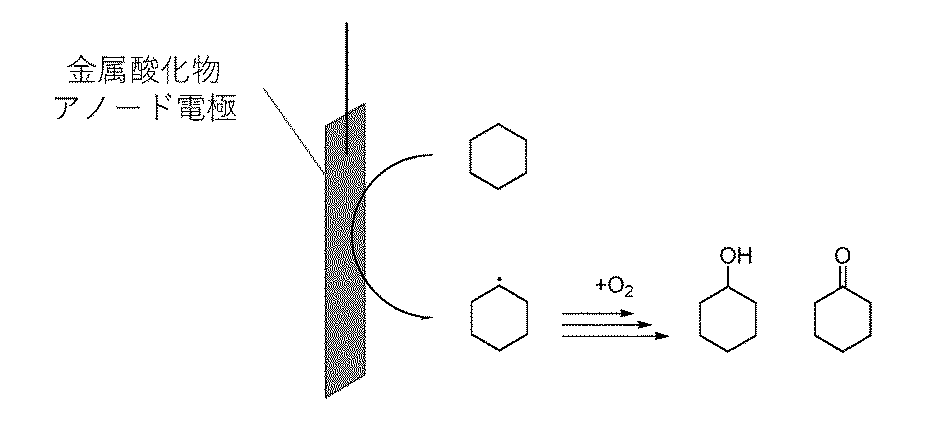
図3において、金属酸化物アノード電極上では一般式(1)で表されるシクロヘキサンが直接電解酸化され酸化中間体を生成する。この酸化中間体が分子状酸素と反応することで、一般式(2)で表されるシクロヘキサノール及びシクロヘキサノンを生成する。
電解酸化反応は、常温常圧下で行うことが経済性の点で望ましいが、100℃以下の加熱下や適宜の圧力下で行うことも可能である。
In the following, a case where cyclohexanol and cyclohexanone are produced mainly by using cyclohexane as a cycloalkane will be described as an example.
In FIG. 3, cyclohexane represented by the general formula (1) is directly electrolytically oxidized on the metal oxide anode electrode to form an oxidation intermediate. When this oxidation intermediate reacts with molecular oxygen, cyclohexanol and cyclohexanone represented by the general formula (2) are produced.
The electrolytic oxidation reaction is preferably carried out under normal temperature and pressure from the viewpoint of economy, but it can also be carried out under heating at 100 ° C. or lower or under an appropriate pressure.
反応に利用される分子状の酸素は、大気などの雰囲気中の酸素が電解液中に溶解する程度の濃度で十分であるが、電解液中の酸素濃度を維持するため、電解液中に酸素含有ガスを吹き込むことも可能である。
なお、比較例4のように、窒素雰囲気等の非酸素雰囲気中で電解を行った場合にはシクロヘキサノール及びシクロヘキサノンをほとんど生成しなかったことから、本発明は、図3に示されたような、シクロヘキサンの直接酸化による酸化中間体の生成、及び、この酸化中間体の分子状酸素との反応に基づくものであることが明らかである。
電解液に酸素含有ガスを吹き込まない場合の雰囲気としては、大気などの酸素含有雰囲気であればよい。
本発明では、含水量が少ない電解液を用い、水の電解により生じる酸素活性種を用いるものではないので、生成したシクロヘキサノールやシクロヘキサノンがさらに酸化されて副生成物となることが大幅に抑制される。
The molecular oxygen used in the reaction is sufficient to have a concentration at which oxygen in an atmosphere such as the atmosphere dissolves in the electrolytic solution, but in order to maintain the oxygen concentration in the electrolytic solution, oxygen is contained in the electrolytic solution. It is also possible to blow in the contained gas.
As in Comparative Example 4, when electrolysis was performed in a non-oxygen atmosphere such as a nitrogen atmosphere, cyclohexanol and cyclohexanone were hardly produced. Therefore, the present invention is as shown in FIG. , It is clear that it is based on the formation of an oxidation intermediate by the direct oxidation of cyclohexane and the reaction of this oxidation intermediate with molecular oxygen.
The atmosphere when the oxygen-containing gas is not blown into the electrolytic solution may be an oxygen-containing atmosphere such as the atmosphere.
In the present invention, an electrolytic solution having a low water content is used, and an oxygen-active species generated by electrolysis of water is not used. Therefore, it is greatly suppressed that the produced cyclohexanol or cyclohexanone is further oxidized to become a by-product. NS.
本発明の金属酸化物アノード電極は、表面に金属酸化物を有するものである。該金属酸化物としては、FTO、ITO等のように導電性金属酸化物を用いて良いし、導電性基材上に備えられた半導体性金属酸化物を用いることもできる。使用する導電性基材としては、FTO、ITOなどの導電性ガラス基材や金属基材などが挙げられる。電極の安定性や効率よく一般式(2)で表されるシクロヘキサノール及びシクロヘキサノンを製造するための観点から、導電性ガラス基材を使用することがより好ましい。導電性基材の形状は限定されないが、板状のものを好適に使用することができる。 The metal oxide anode electrode of the present invention has a metal oxide on its surface. As the metal oxide, a conductive metal oxide such as FTO or ITO may be used, or a semiconductor metal oxide provided on the conductive base material may be used. Examples of the conductive base material used include a conductive glass base material such as FTO and ITO, and a metal base material. It is more preferable to use a conductive glass base material from the viewpoint of electrode stability and efficient production of cyclohexanol and cyclohexanone represented by the general formula (2). The shape of the conductive base material is not limited, but a plate-like material can be preferably used.
導電性基材上に備えられる金属酸化物としては、Si、Ti、Zr、Nb、Ta、Wから選択される1種又は2種以上の金属元素の酸化物を用いることができるし、また、光応答性n型半導体を用いることもできる。光応答性n型半導体としては、具体的には、Bi、V、W、Tiの中から選択される1種以上の元素を含むものが好ましく、可視光応答性を示し安定に使用できるWO3を用いることが特に好ましい。 As the metal oxide provided on the conductive substrate, an oxide of one or more kinds of metal elements selected from Si, Ti, Zr, Nb, Ta, and W can be used, and an oxide of one or more kinds of metal elements can be used. Photoresponsive n-type semiconductors can also be used. Specifically, as the photoresponsive n-type semiconductor, those containing one or more elements selected from Bi, V, W, and Ti are preferable, and WO 3 which exhibits visible light responsiveness and can be used stably. Is particularly preferable.
本発明の導電性基材に備えた酸化物は、熱分解法や混合粉末の焼結法、電着法あるいはスパッタリングなどのような気相成膜法などの各種の方法により製造可能であるが、なかでも、製造方法が簡便な観点から、熱分解法で作製することが好ましい。例えば、薄膜形状で基材に担持する場合の塗布熱分解法については詳細を実施例において説明する。この熱分解法では元素を含む溶液(場合によってはコロイド溶液や懸濁液など)をよく混合して原料液を調製し、それを焼成することで担持物を作製する。熱分解法には、溶液で混合するので均一な組成物を作製できる利点があるが、特に、熱分解法の一種である塗布熱分解法では、薄膜を形成する場合に、塗布と焼成を繰り返して積層することで精密なものが作製できるなどの利点もある。本発明に用いる熱分解法は、元素を含む溶液を混合して焼成する方法ならばよく、ゾルゲル法、錯体重合法、有機金属分解法なども挙げることができる。溶液粘度や薄膜の多孔性を制御するためにポリエチレングリコールやエチルセルロースなどポリマーや有機物を溶液に添加しても良い。 The oxide provided in the conductive substrate of the present invention can be produced by various methods such as a thermal decomposition method, a mixed powder sintering method, an electrodeposition method, and a vapor deposition method such as sputtering. Above all, from the viewpoint of simple manufacturing method, it is preferable to manufacture by a thermal decomposition method. For example, the coating thermal decomposition method when the film is supported on the substrate in the form of a thin film will be described in detail in Examples. In this pyrolysis method, a solution containing an element (in some cases, a colloidal solution, a suspension, etc.) is well mixed to prepare a raw material solution, which is then calcined to prepare a carrier. The thermal decomposition method has an advantage that a uniform composition can be prepared because it is mixed with a solution. In particular, in the coating thermal decomposition method, which is a kind of thermal decomposition method, coating and firing are repeated when forming a thin film. There is also an advantage that a precise product can be manufactured by laminating. The thermal decomposition method used in the present invention may be any method as long as it is a method of mixing and firing a solution containing an element, and examples thereof include a sol-gel method, a complex polymerization method, and an organic metal decomposition method. Polymers and organic substances such as polyethylene glycol and ethyl cellulose may be added to the solution in order to control the viscosity of the solution and the porosity of the thin film.
本発明に使用する電解液は、シクロヘキサン等のシクロアルカンと支持電解質と有機溶媒を含有し、含水量が15mol%以下の均一な溶液である。均一な電解液であることは、(ア)目視による透明性の確認、及び、(イ)光学測定(UV測定等)による、少なくとも350nm以上の大きさの粒子や液滴が存在しないことの確認(エマルション状でないことの確認)、により判定することができる。
前記支持電解質としては、特に限定されず、有機溶媒、及び一般式(1)で表すことのできるシクロヘキサン等のシクロアルカンに溶解するものであれば用いることができる。有機溶媒やシクロヘキサンに対する溶解性や電解液の含水量を15mol%以下とできる点で硝酸であることが特に好ましい。
The electrolytic solution used in the present invention is a uniform solution containing cycloalkane such as cyclohexane, a supporting electrolyte, and an organic solvent and having a water content of 15 mol% or less. The uniform electrolyte is (a) visually confirmed for transparency, and (b) confirmed by optical measurement (UV measurement, etc.) that there are no particles or droplets with a size of at least 350 nm or more. (Confirmation that it is not in the form of an emulsion).
The supporting electrolyte is not particularly limited, and any one that dissolves in an organic solvent and cycloalkane such as cyclohexane that can be represented by the general formula (1) can be used. Nitric acid is particularly preferable because it is soluble in an organic solvent or cyclohexane and the water content of the electrolytic solution can be 15 mol% or less.
本発明に使用する電解液の有機溶媒としては、一般式(1)で表されるシクロヘキサン等のシクロアルカン及び支持電解質を溶解するものであれば特に限定されず、t−ブチルアルコールが特に好ましい。
本発明に使用する電解液は、シクロアルカンと支持電解質と有機溶媒、及び、15mol%以下の水分からなるものが最も好ましいが、含水量が15mol%以下の均一な溶液となり、シクロアルカンの電解酸化を大きく妨げないのであれば、それ以外の成分を多少(例えば、10mol%以下、好ましくは5mol%以下、より好ましくは1mol%以下)含有することも許容される。
電解液がシクロヘキサン、t−ブチルアルコール、及び、濃度が1Mの硝酸を含有するものである場合、含水量が15mol%を超えると二相に分離し、均一な溶液とはならない。
The organic solvent of the electrolytic solution used in the present invention is not particularly limited as long as it dissolves cycloalkane such as cyclohexane represented by the general formula (1) and the supporting electrolyte, and t-butyl alcohol is particularly preferable.
The electrolytic solution used in the present invention is most preferably composed of cycloalkane, supporting electrolyte, organic solvent, and water content of 15 mol% or less, but a uniform solution having a water content of 15 mol% or less is obtained, and electrolytic oxidation of cycloalkane is performed. It is also permissible to contain some other components (for example, 10 mol% or less, preferably 5 mol% or less, more preferably 1 mol% or less) as long as it does not significantly interfere with the above.
When the electrolytic solution contains cyclohexane, t-butyl alcohol, and nitric acid having a concentration of 1 M, if the water content exceeds 15 mol%, it separates into two phases and does not form a uniform solution.
本発明のカソード電極材料としては、限定されず、例えば、白金、金、銀、パラジウム、カーボンなどが挙げられるが、効率よく一般式(2)で表されるシクロヘキサノール及びシクロヘキサノンを製造するための観点から、白金を用いることが好ましい。 The cathode electrode material of the present invention is not limited, and examples thereof include platinum, gold, silver, palladium, and carbon. For efficiently producing cyclohexanol and cyclohexanone represented by the general formula (2). From the viewpoint, it is preferable to use platinum.
以下、実施例によって本発明をさらに具体的に説明するが、本発明はこれらの実施例によって何ら限定されるものではない。 Hereinafter, the present invention will be described in more detail with reference to Examples, but the present invention is not limited to these Examples.
(実施例1)
支持電解質として濃硝酸(濃度70%)を2mL、有機溶媒としてt−ブチルアルコールを12mL、反応基質としてシクロヘキサンの18mLを混合し、電解液(含水量約12.7mol%)を調製した。一室型電解槽のアノードにFTO電極を、カソードに白金からなるカソード電極をそれぞれ設置し、直流電源のポテンシオ/ガルバノスタットを介してこれらの電極を電気的に接続した。一室型電解槽に調製した電解液を注入し、常温常圧下、2mAの一定電流で25Cの電気量を流した。
(Example 1)
An electrolytic solution (water content of about 12.7 mol%) was prepared by mixing 2 mL of concentrated nitrate (concentration 70%) as a supporting electrolyte, 12 mL of t-butyl alcohol as an organic solvent, and 18 mL of cyclohexane as a reaction substrate. An FTO electrode was installed at the anode of the one-chamber electrolytic cell, and a cathode electrode made of platinum was installed at the cathode, and these electrodes were electrically connected via a DC power supply potencio / galvanostat. The prepared electrolytic solution was injected into a one-chamber electrolytic cell, and an electric amount of 25 C was passed at a constant current of 2 mA under normal temperature and pressure.
電解酸化反応後、電解液200μLを採取し、ジエチルエーテルとイオン交換水にて分液処理を行い、有機層をガスクロマトグラフにより分析したところ、一般式(2)で表されるシクロヘキサノールが10.3μmоl・h-1、シクロヘキサノンが26.5μmоl・h-1で得られたことを確認した。 After the electrolytic oxidation reaction, 200 μL of the electrolytic solution was collected, subjected to liquid separation treatment with diethyl ether and ion-exchanged water, and the organic layer was analyzed by gas chromatography. As a result, cyclohexanol represented by the general formula (2) was found to be 10. It was confirmed that 3 μmоl ・ h -1 and cyclohexanone were obtained at 26.5 μmоl ・ h -1.
(比較例1)
アノードとして炭素電極を用いたことを除いて実施例1と同様に電解酸化反応を行ったところ、シクロヘキサノール及びシクロヘキサノンは得られなかった。
(Comparative Example 1)
When the electrolytic oxidation reaction was carried out in the same manner as in Example 1 except that a carbon electrode was used as the anode, cyclohexanol and cyclohexanone were not obtained.
(比較例2)
アノードとして白金電極を用いたことを除いて実施例1と同様に電解酸化反応を行ったところ、シクロヘキサノール及びシクロヘキサノンは得られなかった。
(Comparative Example 2)
When the electrolytic oxidation reaction was carried out in the same manner as in Example 1 except that a platinum electrode was used as the anode, cyclohexanol and cyclohexanone were not obtained.
(実施例2)
Si、Ti、Zr、Nb、Ta、Wから選択される1種からなる金属の酸化物前駆体塗布液(高純度化学研究所製、EMOD塗布型材料)、及び増粘剤としてエチルセルロースを溶解した酢酸ブチルからなる溶液(濃度各0.04M)400μLを、FTO導電性基板の表面に500rpmでスピンコートした。これを550℃にて空気焼成し、金属酸化物が積層した各種金属酸化物アノード電極を作製した。
(Example 2)
An oxide precursor coating solution of a metal selected from Si, Ti, Zr, Nb, Ta, and W (manufactured by High Purity Chemical Laboratory, EMOD coating type material) and ethyl cellulose as a thickener were dissolved. 400 μL of a solution consisting of butyl acetate (concentration of 0.04 M each) was spin-coated on the surface of the FTO conductive substrate at 500 rpm. This was air-fired at 550 ° C. to prepare various metal oxide anode electrodes on which metal oxides were laminated.
表1に示すように、各金属種の酸化物アノード電極を用いたことを除いて実施例1と同様に電解酸化反応を行ったところ、シクロヘキサン及びシクロヘキサノールが得られたことを確認した。 As shown in Table 1, it was confirmed that cyclohexane and cyclohexanol were obtained when the electrolytic oxidation reaction was carried out in the same manner as in Example 1 except that the oxide anode electrodes of each metal species were used.
(実施例3)
0.50Mに調製したタングステン酸ナトリウム水溶液を、強酸性陽イオン交換樹脂を充填したカラムに通し、タングステン酸水溶液を調製した。調製したタングステン酸水溶液、増粘剤としてポリエチレングリコールからなる溶液をエバポレーターで水を留去し、導電性基板のFTO膜の表面にスピンコートした後、550℃で空気焼成することで、WO3膜を作成した。上記スピンコートと空気焼成を適宜繰り返すことで、WO3可視光応答性光アノード電極を作製した。
(Example 3)
An aqueous solution of sodium tungstate prepared at 0.50 M was passed through a column packed with a strongly acidic cation exchange resin to prepare an aqueous solution of tungstic acid. The prepared tungstic acid aqueous solution and a solution consisting of polyethylene glycol as a thickener are distilled off with an evaporator, spin-coated on the surface of the FTO film of the conductive substrate, and then air-baked at 550 ° C. to form a WO 3 film. It was created. The WO 3 visible light responsive optical anode electrode was prepared by appropriately repeating the above spin coating and air firing.
支持電解質として濃硝酸(濃度70%)を2mL、有機溶媒としてt−ブチルアルコールを12mL、反応基質としてシクロヘキサンの18mLを混合し、電解液(含水量約12.7mol%)を調製した。一室型電解槽のアノードにWO3可視光応答性光アノード電極を、カソードに白金からなるカソード電極をそれぞれ設置し、直流電源のポテンシオ/ガルバノスタットを介してこれらの電極を電気的に接続した。一室型電解槽に調製した電解液を注入し、常温常圧下、ソーラーシュミレーターを用いて疑似太陽光(AM1.5)を照射して1mAの一定電流で25Cの電気量を流した。光照射下では、光非照射下と比較して必要な印加電圧が約2.1V低減された(光照射下:0.7V;光非照射下:2.8V)。 An electrolytic solution (water content of about 12.7 mol%) was prepared by mixing 2 mL of concentrated nitrate (concentration 70%) as a supporting electrolyte, 12 mL of t-butyl alcohol as an organic solvent, and 18 mL of cyclohexane as a reaction substrate. A WO 3 visible light responsive photoanode electrode was installed at the anode of the one-chamber electrolytic cell, and a cathode electrode made of platinum was installed at the cathode, and these electrodes were electrically connected via a DC power supply potentio / galvanostat. .. The prepared electrolytic solution was injected into a one-chamber electrolytic cell, irradiated with pseudo-sunlight (AM1.5) using a solar simulator under normal temperature and pressure, and an electric amount of 25C was passed at a constant current of 1 mA. Under light irradiation, the required applied voltage was reduced by about 2.1 V as compared with under light irradiation (under light irradiation: 0.7 V; under light non-irradiation: 2.8 V).
光電解酸化反応後、電解液200μLを採取し、ジエチルエーテルとイオン交換水にて分液処理を行い、有機層をガスクロマトグラフにより分析したところ、一般式(2)で表されるシクロヘキサノールが4.9μmоl・h-1、シクロヘキサノンが6.7μmоl・h-1で得られたことを確認した。 After the photoelectrolytic oxidation reaction, 200 μL of the electrolytic solution was collected, subjected to liquid separation treatment with diethyl ether and ion-exchanged water, and the organic layer was analyzed by gas chromatography. As a result, cyclohexanol represented by the general formula (2) was 4 It was confirmed that .9 μmоl ・ h -1 and cyclohexanone were obtained at 6.7 μmоl ・ h -1.
(実施例4)
TiO2光アノード電極を用いたことを除いて実施例3と同様に光電解酸化反応を行ったところ、シクロヘキサノールが3.8μmоl・h-1、シクロヘキサノンが9.7μmоl・h-1で得られたことを確認した。
(Example 4)
When the photoelectrolytic oxidation reaction was carried out in the same manner as in Example 3 except that the TiO 2 photoanode electrode was used, cyclohexanol was obtained at 3.8 μmоl ・ h -1 and cyclohexanone was obtained at 9.7 μmоl ・ h -1. I confirmed that.
(比較例3)
電流を印加しないことを除いて実施例3と同様に反応を行ったところ、シクロヘキサノール及びシクロヘキサノンは得られなかった。
(Comparative Example 3)
When the reaction was carried out in the same manner as in Example 3 except that no current was applied, cyclohexanol and cyclohexanone were not obtained.
(比較例4)
上記電解槽の雰囲気を大気雰囲気とする替わりに窒素雰囲気とした以外は上記実施例1と同様に電解酸化反応を行ったところ、シクロヘキサノール及びシクロヘキサノンの生成量はごく僅かであった。
(Comparative Example 4)
When the electrolytic oxidation reaction was carried out in the same manner as in Example 1 except that the atmosphere of the electrolytic cell was changed to the atmosphere of nitrogen instead of the atmosphere of the atmosphere, the amounts of cyclohexanol and cyclohexanone produced were very small.
本発明は、副反応を抑制し、シクロヘキサノール及びシクロヘキサノン等のシクロアルカノール及びシクロアルカノンを比較的効率よく製造することができるので、6,6ナイロン等の各種化学製品を合成する際の中間原料の供給手段などとして有効に活用することが期待できる。 Since the present invention can suppress side reactions and relatively efficiently produce cyclohexanol and cyclohexanone such as cyclohexanol and cyclohexanone, it is an intermediate raw material for synthesizing various chemical products such as 6,6 nylon. It can be expected to be effectively used as a means of supply.
Claims (7)
Priority Applications (1)
| Application Number | Priority Date | Filing Date | Title |
|---|---|---|---|
| JP2017231010A JP6942346B2 (en) | 2017-11-30 | 2017-11-30 | Method for producing cycloalkanol and cycloalkanone |
Applications Claiming Priority (1)
| Application Number | Priority Date | Filing Date | Title |
|---|---|---|---|
| JP2017231010A JP6942346B2 (en) | 2017-11-30 | 2017-11-30 | Method for producing cycloalkanol and cycloalkanone |
Publications (2)
| Publication Number | Publication Date |
|---|---|
| JP2019099861A JP2019099861A (en) | 2019-06-24 |
| JP6942346B2 true JP6942346B2 (en) | 2021-09-29 |
Family
ID=66976100
Family Applications (1)
| Application Number | Title | Priority Date | Filing Date |
|---|---|---|---|
| JP2017231010A Active JP6942346B2 (en) | 2017-11-30 | 2017-11-30 | Method for producing cycloalkanol and cycloalkanone |
Country Status (1)
| Country | Link |
|---|---|
| JP (1) | JP6942346B2 (en) |
Cited By (1)
| Publication number | Priority date | Publication date | Assignee | Title |
|---|---|---|---|---|
| JP2021143367A (en) * | 2020-03-11 | 2021-09-24 | 国立研究開発法人産業技術総合研究所 | Insoluble photocatalyst, photo-electrolysis reaction device, and method of synthesizing useful chemical |
Families Citing this family (5)
| Publication number | Priority date | Publication date | Assignee | Title |
|---|---|---|---|---|
| EP4253602A1 (en) * | 2022-03-28 | 2023-10-04 | Evonik Operations GmbH | Electrochemical oxidation of cycloalkenes and cycloalkanes to alpha, omega-dicarboxylic acids or ketocarboxylic acids and cycloalkanone compounds |
| EP4253604A1 (en) * | 2022-03-28 | 2023-10-04 | Evonik Operations GmbH | Electrochemical oxidation of fatty acids and fatty acid esters to monocarboxylic acids and alpha, omega-dicarboxylic acids |
| EP4253603A1 (en) * | 2022-03-28 | 2023-10-04 | Evonik Operations GmbH | Electrochemical oxidation of cycloalkanes to cycloalkanone compounds |
| EP4253605A1 (en) | 2022-03-28 | 2023-10-04 | Evonik Operations GmbH | Electrochemical oxidation of cycloalkenes to alpha, omega-dicarboxylic acids and ketocarboxylic acids |
| CN115094448B (en) * | 2022-05-20 | 2023-07-28 | 北京化工大学 | Photoelectrocatalytic method for preparing cyclohexanone from cyclohexane |
Family Cites Families (2)
| Publication number | Priority date | Publication date | Assignee | Title |
|---|---|---|---|---|
| JPS62263988A (en) * | 1986-05-12 | 1987-11-16 | Agency Of Ind Science & Technol | Electrochemical production of cyclohexanol or its ester |
| CN104032327B (en) * | 2014-06-26 | 2016-06-15 | 天津工业大学 | A kind of method that electrochemical catalytic oxidation hexamethylene prepares Hexalin and Ketohexamethylene |
-
2017
- 2017-11-30 JP JP2017231010A patent/JP6942346B2/en active Active
Cited By (1)
| Publication number | Priority date | Publication date | Assignee | Title |
|---|---|---|---|---|
| JP2021143367A (en) * | 2020-03-11 | 2021-09-24 | 国立研究開発法人産業技術総合研究所 | Insoluble photocatalyst, photo-electrolysis reaction device, and method of synthesizing useful chemical |
Also Published As
| Publication number | Publication date |
|---|---|
| JP2019099861A (en) | 2019-06-24 |
Similar Documents
| Publication | Publication Date | Title |
|---|---|---|
| JP6942346B2 (en) | Method for producing cycloalkanol and cycloalkanone | |
| Liu et al. | Bromide-mediated photoelectrochemical epoxidation of alkenes using water as an oxygen source with conversion efficiency and selectivity up to 100% | |
| Luo et al. | Selective activation of benzyl alcohol coupled with photoelectrochemical water oxidation via a radical relay strategy | |
| Tateno et al. | Photo‐electrochemical C− H bond activation of cyclohexane using a WO3 photoanode and visible light | |
| Xiao et al. | High selective oxidation of benzyl alcohol to benzylaldehyde and benzoic acid with surface oxygen vacancies on W18O49/holey ultrathin g-C3N4 nanosheets | |
| Amrillah et al. | MXene-based photocatalysts and electrocatalysts for CO2 conversion to chemicals | |
| Naya et al. | One-step selective aerobic oxidation of amines to imines by gold nanoparticle-loaded rutile titanium (IV) oxide plasmon photocatalyst | |
| Guschakowski et al. | Direct and indirect Electrooxidation of glycerol to value‐added products | |
| Li et al. | Electrolytic CO2 reduction in tandem with oxidative organic chemistry | |
| Sasaki et al. | Solar water splitting using powdered photocatalysts driven by Z-schematic interparticle electron transfer without an electron mediator | |
| US9080240B2 (en) | Electrochemical co-production of a glycol and an alkene employing recycled halide | |
| Lee et al. | Electrocatalytic semihydrogenation of alkynes with [Ni (bpy) 3] 2+ | |
| CN104032327B (en) | A kind of method that electrochemical catalytic oxidation hexamethylene prepares Hexalin and Ketohexamethylene | |
| Song et al. | Advances in clean fuel ethanol production from electro-, photo-and photoelectro-catalytic CO2 reduction | |
| Kim et al. | Photoconversion of carbon dioxide into fuels using semiconductors | |
| CN104640814A (en) | Electrochemical co-production of products with carbon-based reactant feed to anode | |
| JP7154595B2 (en) | Method for producing cycloalkenone using photoelectrochemical reaction system | |
| Zhao et al. | Engineering reaction pathway to harmonize the competition between NRR and HER for efficient photocatalytic ammonia synthesis | |
| Kohtani et al. | Photocatalytic Hydrogenation | |
| Mehmood et al. | Photoelectrochemical conversion of methane into value-added products | |
| Zhang et al. | Mixed-valent cobalt-modulated tungsten trioxide nanorod arrays for improved photocatalytic N2 fixation | |
| Xi et al. | Advancing photoelectrochemical systems for sustainable energy and chemical production: challenges and opportunities | |
| Shi et al. | Photoelectrocatalytic Valorization of Biomass-Derived Succinic Acid into Ethylene Coupled with Hydrogen Production over an Ultrathin BiO x-Covered TiO2 | |
| Li et al. | Mechanistic insights into glycerol oxidation to high-value chemicals via metal-based catalysts | |
| JP2017039981A (en) | Method and apparatus for producing hydrogen peroxide |
Legal Events
| Date | Code | Title | Description |
|---|---|---|---|
| A621 | Written request for application examination |
Free format text: JAPANESE INTERMEDIATE CODE: A621 Effective date: 20200522 |
|
| A977 | Report on retrieval |
Free format text: JAPANESE INTERMEDIATE CODE: A971007 Effective date: 20210226 |
|
| A131 | Notification of reasons for refusal |
Free format text: JAPANESE INTERMEDIATE CODE: A131 Effective date: 20210310 |
|
| A601 | Written request for extension of time |
Free format text: JAPANESE INTERMEDIATE CODE: A601 Effective date: 20210407 |
|
| TRDD | Decision of grant or rejection written | ||
| A01 | Written decision to grant a patent or to grant a registration (utility model) |
Free format text: JAPANESE INTERMEDIATE CODE: A01 Effective date: 20210825 |
|
| A61 | First payment of annual fees (during grant procedure) |
Free format text: JAPANESE INTERMEDIATE CODE: A61 Effective date: 20210901 |
|
| R150 | Certificate of patent or registration of utility model |
Ref document number: 6942346 Country of ref document: JP Free format text: JAPANESE INTERMEDIATE CODE: R150 |
|
| R250 | Receipt of annual fees |
Free format text: JAPANESE INTERMEDIATE CODE: R250 |
|
| R250 | Receipt of annual fees |
Free format text: JAPANESE INTERMEDIATE CODE: R250 |