JP6654698B2 - Ultra-high-strength steel sheet excellent in formability and hole expandability and method for producing the same - Google Patents
Ultra-high-strength steel sheet excellent in formability and hole expandability and method for producing the same Download PDFInfo
- Publication number
- JP6654698B2 JP6654698B2 JP2018522028A JP2018522028A JP6654698B2 JP 6654698 B2 JP6654698 B2 JP 6654698B2 JP 2018522028 A JP2018522028 A JP 2018522028A JP 2018522028 A JP2018522028 A JP 2018522028A JP 6654698 B2 JP6654698 B2 JP 6654698B2
- Authority
- JP
- Japan
- Prior art keywords
- steel sheet
- less
- excluding
- hot
- ultra
- Prior art date
- Legal status (The legal status is an assumption and is not a legal conclusion. Google has not performed a legal analysis and makes no representation as to the accuracy of the status listed.)
- Active
Links
Images




Classifications
-
- C—CHEMISTRY; METALLURGY
- C22—METALLURGY; FERROUS OR NON-FERROUS ALLOYS; TREATMENT OF ALLOYS OR NON-FERROUS METALS
- C22C—ALLOYS
- C22C38/00—Ferrous alloys, e.g. steel alloys
- C22C38/14—Ferrous alloys, e.g. steel alloys containing titanium or zirconium
-
- B—PERFORMING OPERATIONS; TRANSPORTING
- B32—LAYERED PRODUCTS
- B32B—LAYERED PRODUCTS, i.e. PRODUCTS BUILT-UP OF STRATA OF FLAT OR NON-FLAT, e.g. CELLULAR OR HONEYCOMB, FORM
- B32B15/00—Layered products comprising a layer of metal
- B32B15/01—Layered products comprising a layer of metal all layers being exclusively metallic
- B32B15/013—Layered products comprising a layer of metal all layers being exclusively metallic one layer being formed of an iron alloy or steel, another layer being formed of a metal other than iron or aluminium
-
- C—CHEMISTRY; METALLURGY
- C21—METALLURGY OF IRON
- C21D—MODIFYING THE PHYSICAL STRUCTURE OF FERROUS METALS; GENERAL DEVICES FOR HEAT TREATMENT OF FERROUS OR NON-FERROUS METALS OR ALLOYS; MAKING METAL MALLEABLE, e.g. BY DECARBURISATION OR TEMPERING
- C21D6/00—Heat treatment of ferrous alloys
- C21D6/005—Heat treatment of ferrous alloys containing Mn
-
- C—CHEMISTRY; METALLURGY
- C21—METALLURGY OF IRON
- C21D—MODIFYING THE PHYSICAL STRUCTURE OF FERROUS METALS; GENERAL DEVICES FOR HEAT TREATMENT OF FERROUS OR NON-FERROUS METALS OR ALLOYS; MAKING METAL MALLEABLE, e.g. BY DECARBURISATION OR TEMPERING
- C21D6/00—Heat treatment of ferrous alloys
- C21D6/008—Heat treatment of ferrous alloys containing Si
-
- C—CHEMISTRY; METALLURGY
- C21—METALLURGY OF IRON
- C21D—MODIFYING THE PHYSICAL STRUCTURE OF FERROUS METALS; GENERAL DEVICES FOR HEAT TREATMENT OF FERROUS OR NON-FERROUS METALS OR ALLOYS; MAKING METAL MALLEABLE, e.g. BY DECARBURISATION OR TEMPERING
- C21D8/00—Modifying the physical properties of ferrous metals or ferrous alloys by deformation combined with, or followed by, heat treatment
- C21D8/02—Modifying the physical properties of ferrous metals or ferrous alloys by deformation combined with, or followed by, heat treatment during manufacturing of plates or strips
-
- C—CHEMISTRY; METALLURGY
- C21—METALLURGY OF IRON
- C21D—MODIFYING THE PHYSICAL STRUCTURE OF FERROUS METALS; GENERAL DEVICES FOR HEAT TREATMENT OF FERROUS OR NON-FERROUS METALS OR ALLOYS; MAKING METAL MALLEABLE, e.g. BY DECARBURISATION OR TEMPERING
- C21D8/00—Modifying the physical properties of ferrous metals or ferrous alloys by deformation combined with, or followed by, heat treatment
- C21D8/02—Modifying the physical properties of ferrous metals or ferrous alloys by deformation combined with, or followed by, heat treatment during manufacturing of plates or strips
- C21D8/0221—Modifying the physical properties of ferrous metals or ferrous alloys by deformation combined with, or followed by, heat treatment during manufacturing of plates or strips characterised by the working steps
- C21D8/0226—Hot rolling
-
- C—CHEMISTRY; METALLURGY
- C21—METALLURGY OF IRON
- C21D—MODIFYING THE PHYSICAL STRUCTURE OF FERROUS METALS; GENERAL DEVICES FOR HEAT TREATMENT OF FERROUS OR NON-FERROUS METALS OR ALLOYS; MAKING METAL MALLEABLE, e.g. BY DECARBURISATION OR TEMPERING
- C21D8/00—Modifying the physical properties of ferrous metals or ferrous alloys by deformation combined with, or followed by, heat treatment
- C21D8/02—Modifying the physical properties of ferrous metals or ferrous alloys by deformation combined with, or followed by, heat treatment during manufacturing of plates or strips
- C21D8/0221—Modifying the physical properties of ferrous metals or ferrous alloys by deformation combined with, or followed by, heat treatment during manufacturing of plates or strips characterised by the working steps
- C21D8/0236—Cold rolling
-
- C—CHEMISTRY; METALLURGY
- C21—METALLURGY OF IRON
- C21D—MODIFYING THE PHYSICAL STRUCTURE OF FERROUS METALS; GENERAL DEVICES FOR HEAT TREATMENT OF FERROUS OR NON-FERROUS METALS OR ALLOYS; MAKING METAL MALLEABLE, e.g. BY DECARBURISATION OR TEMPERING
- C21D8/00—Modifying the physical properties of ferrous metals or ferrous alloys by deformation combined with, or followed by, heat treatment
- C21D8/02—Modifying the physical properties of ferrous metals or ferrous alloys by deformation combined with, or followed by, heat treatment during manufacturing of plates or strips
- C21D8/0247—Modifying the physical properties of ferrous metals or ferrous alloys by deformation combined with, or followed by, heat treatment during manufacturing of plates or strips characterised by the heat treatment
-
- C—CHEMISTRY; METALLURGY
- C21—METALLURGY OF IRON
- C21D—MODIFYING THE PHYSICAL STRUCTURE OF FERROUS METALS; GENERAL DEVICES FOR HEAT TREATMENT OF FERROUS OR NON-FERROUS METALS OR ALLOYS; MAKING METAL MALLEABLE, e.g. BY DECARBURISATION OR TEMPERING
- C21D8/00—Modifying the physical properties of ferrous metals or ferrous alloys by deformation combined with, or followed by, heat treatment
- C21D8/02—Modifying the physical properties of ferrous metals or ferrous alloys by deformation combined with, or followed by, heat treatment during manufacturing of plates or strips
- C21D8/0247—Modifying the physical properties of ferrous metals or ferrous alloys by deformation combined with, or followed by, heat treatment during manufacturing of plates or strips characterised by the heat treatment
- C21D8/0273—Final recrystallisation annealing
-
- C—CHEMISTRY; METALLURGY
- C21—METALLURGY OF IRON
- C21D—MODIFYING THE PHYSICAL STRUCTURE OF FERROUS METALS; GENERAL DEVICES FOR HEAT TREATMENT OF FERROUS OR NON-FERROUS METALS OR ALLOYS; MAKING METAL MALLEABLE, e.g. BY DECARBURISATION OR TEMPERING
- C21D9/00—Heat treatment, e.g. annealing, hardening, quenching or tempering, adapted for particular articles; Furnaces therefor
- C21D9/46—Heat treatment, e.g. annealing, hardening, quenching or tempering, adapted for particular articles; Furnaces therefor for sheet metals
-
- C—CHEMISTRY; METALLURGY
- C22—METALLURGY; FERROUS OR NON-FERROUS ALLOYS; TREATMENT OF ALLOYS OR NON-FERROUS METALS
- C22C—ALLOYS
- C22C38/00—Ferrous alloys, e.g. steel alloys
- C22C38/001—Ferrous alloys, e.g. steel alloys containing N
-
- C—CHEMISTRY; METALLURGY
- C22—METALLURGY; FERROUS OR NON-FERROUS ALLOYS; TREATMENT OF ALLOYS OR NON-FERROUS METALS
- C22C—ALLOYS
- C22C38/00—Ferrous alloys, e.g. steel alloys
- C22C38/002—Ferrous alloys, e.g. steel alloys containing In, Mg, or other elements not provided for in one single group C22C38/001 - C22C38/60
-
- C—CHEMISTRY; METALLURGY
- C22—METALLURGY; FERROUS OR NON-FERROUS ALLOYS; TREATMENT OF ALLOYS OR NON-FERROUS METALS
- C22C—ALLOYS
- C22C38/00—Ferrous alloys, e.g. steel alloys
- C22C38/02—Ferrous alloys, e.g. steel alloys containing silicon
-
- C—CHEMISTRY; METALLURGY
- C22—METALLURGY; FERROUS OR NON-FERROUS ALLOYS; TREATMENT OF ALLOYS OR NON-FERROUS METALS
- C22C—ALLOYS
- C22C38/00—Ferrous alloys, e.g. steel alloys
- C22C38/04—Ferrous alloys, e.g. steel alloys containing manganese
-
- C—CHEMISTRY; METALLURGY
- C22—METALLURGY; FERROUS OR NON-FERROUS ALLOYS; TREATMENT OF ALLOYS OR NON-FERROUS METALS
- C22C—ALLOYS
- C22C38/00—Ferrous alloys, e.g. steel alloys
- C22C38/06—Ferrous alloys, e.g. steel alloys containing aluminium
-
- C—CHEMISTRY; METALLURGY
- C22—METALLURGY; FERROUS OR NON-FERROUS ALLOYS; TREATMENT OF ALLOYS OR NON-FERROUS METALS
- C22C—ALLOYS
- C22C38/00—Ferrous alloys, e.g. steel alloys
- C22C38/12—Ferrous alloys, e.g. steel alloys containing tungsten, tantalum, molybdenum, vanadium, or niobium
-
- C—CHEMISTRY; METALLURGY
- C23—COATING METALLIC MATERIAL; COATING MATERIAL WITH METALLIC MATERIAL; CHEMICAL SURFACE TREATMENT; DIFFUSION TREATMENT OF METALLIC MATERIAL; COATING BY VACUUM EVAPORATION, BY SPUTTERING, BY ION IMPLANTATION OR BY CHEMICAL VAPOUR DEPOSITION, IN GENERAL; INHIBITING CORROSION OF METALLIC MATERIAL OR INCRUSTATION IN GENERAL
- C23C—COATING METALLIC MATERIAL; COATING MATERIAL WITH METALLIC MATERIAL; SURFACE TREATMENT OF METALLIC MATERIAL BY DIFFUSION INTO THE SURFACE, BY CHEMICAL CONVERSION OR SUBSTITUTION; COATING BY VACUUM EVAPORATION, BY SPUTTERING, BY ION IMPLANTATION OR BY CHEMICAL VAPOUR DEPOSITION, IN GENERAL
- C23C2/00—Hot-dipping or immersion processes for applying the coating material in the molten state without affecting the shape; Apparatus therefor
- C23C2/003—Apparatus
- C23C2/0038—Apparatus characterised by the pre-treatment chambers located immediately upstream of the bath or occurring locally before the dipping process
-
- C—CHEMISTRY; METALLURGY
- C23—COATING METALLIC MATERIAL; COATING MATERIAL WITH METALLIC MATERIAL; CHEMICAL SURFACE TREATMENT; DIFFUSION TREATMENT OF METALLIC MATERIAL; COATING BY VACUUM EVAPORATION, BY SPUTTERING, BY ION IMPLANTATION OR BY CHEMICAL VAPOUR DEPOSITION, IN GENERAL; INHIBITING CORROSION OF METALLIC MATERIAL OR INCRUSTATION IN GENERAL
- C23C—COATING METALLIC MATERIAL; COATING MATERIAL WITH METALLIC MATERIAL; SURFACE TREATMENT OF METALLIC MATERIAL BY DIFFUSION INTO THE SURFACE, BY CHEMICAL CONVERSION OR SUBSTITUTION; COATING BY VACUUM EVAPORATION, BY SPUTTERING, BY ION IMPLANTATION OR BY CHEMICAL VAPOUR DEPOSITION, IN GENERAL
- C23C2/00—Hot-dipping or immersion processes for applying the coating material in the molten state without affecting the shape; Apparatus therefor
- C23C2/02—Pretreatment of the material to be coated, e.g. for coating on selected surface areas
-
- C—CHEMISTRY; METALLURGY
- C23—COATING METALLIC MATERIAL; COATING MATERIAL WITH METALLIC MATERIAL; CHEMICAL SURFACE TREATMENT; DIFFUSION TREATMENT OF METALLIC MATERIAL; COATING BY VACUUM EVAPORATION, BY SPUTTERING, BY ION IMPLANTATION OR BY CHEMICAL VAPOUR DEPOSITION, IN GENERAL; INHIBITING CORROSION OF METALLIC MATERIAL OR INCRUSTATION IN GENERAL
- C23C—COATING METALLIC MATERIAL; COATING MATERIAL WITH METALLIC MATERIAL; SURFACE TREATMENT OF METALLIC MATERIAL BY DIFFUSION INTO THE SURFACE, BY CHEMICAL CONVERSION OR SUBSTITUTION; COATING BY VACUUM EVAPORATION, BY SPUTTERING, BY ION IMPLANTATION OR BY CHEMICAL VAPOUR DEPOSITION, IN GENERAL
- C23C2/00—Hot-dipping or immersion processes for applying the coating material in the molten state without affecting the shape; Apparatus therefor
- C23C2/02—Pretreatment of the material to be coated, e.g. for coating on selected surface areas
- C23C2/022—Pretreatment of the material to be coated, e.g. for coating on selected surface areas by heating
- C23C2/0224—Two or more thermal pretreatments
-
- C—CHEMISTRY; METALLURGY
- C23—COATING METALLIC MATERIAL; COATING MATERIAL WITH METALLIC MATERIAL; CHEMICAL SURFACE TREATMENT; DIFFUSION TREATMENT OF METALLIC MATERIAL; COATING BY VACUUM EVAPORATION, BY SPUTTERING, BY ION IMPLANTATION OR BY CHEMICAL VAPOUR DEPOSITION, IN GENERAL; INHIBITING CORROSION OF METALLIC MATERIAL OR INCRUSTATION IN GENERAL
- C23C—COATING METALLIC MATERIAL; COATING MATERIAL WITH METALLIC MATERIAL; SURFACE TREATMENT OF METALLIC MATERIAL BY DIFFUSION INTO THE SURFACE, BY CHEMICAL CONVERSION OR SUBSTITUTION; COATING BY VACUUM EVAPORATION, BY SPUTTERING, BY ION IMPLANTATION OR BY CHEMICAL VAPOUR DEPOSITION, IN GENERAL
- C23C2/00—Hot-dipping or immersion processes for applying the coating material in the molten state without affecting the shape; Apparatus therefor
- C23C2/02—Pretreatment of the material to be coated, e.g. for coating on selected surface areas
- C23C2/024—Pretreatment of the material to be coated, e.g. for coating on selected surface areas by cleaning or etching
-
- C—CHEMISTRY; METALLURGY
- C23—COATING METALLIC MATERIAL; COATING MATERIAL WITH METALLIC MATERIAL; CHEMICAL SURFACE TREATMENT; DIFFUSION TREATMENT OF METALLIC MATERIAL; COATING BY VACUUM EVAPORATION, BY SPUTTERING, BY ION IMPLANTATION OR BY CHEMICAL VAPOUR DEPOSITION, IN GENERAL; INHIBITING CORROSION OF METALLIC MATERIAL OR INCRUSTATION IN GENERAL
- C23C—COATING METALLIC MATERIAL; COATING MATERIAL WITH METALLIC MATERIAL; SURFACE TREATMENT OF METALLIC MATERIAL BY DIFFUSION INTO THE SURFACE, BY CHEMICAL CONVERSION OR SUBSTITUTION; COATING BY VACUUM EVAPORATION, BY SPUTTERING, BY ION IMPLANTATION OR BY CHEMICAL VAPOUR DEPOSITION, IN GENERAL
- C23C2/00—Hot-dipping or immersion processes for applying the coating material in the molten state without affecting the shape; Apparatus therefor
- C23C2/04—Hot-dipping or immersion processes for applying the coating material in the molten state without affecting the shape; Apparatus therefor characterised by the coating material
- C23C2/06—Zinc or cadmium or alloys based thereon
-
- C—CHEMISTRY; METALLURGY
- C23—COATING METALLIC MATERIAL; COATING MATERIAL WITH METALLIC MATERIAL; CHEMICAL SURFACE TREATMENT; DIFFUSION TREATMENT OF METALLIC MATERIAL; COATING BY VACUUM EVAPORATION, BY SPUTTERING, BY ION IMPLANTATION OR BY CHEMICAL VAPOUR DEPOSITION, IN GENERAL; INHIBITING CORROSION OF METALLIC MATERIAL OR INCRUSTATION IN GENERAL
- C23C—COATING METALLIC MATERIAL; COATING MATERIAL WITH METALLIC MATERIAL; SURFACE TREATMENT OF METALLIC MATERIAL BY DIFFUSION INTO THE SURFACE, BY CHEMICAL CONVERSION OR SUBSTITUTION; COATING BY VACUUM EVAPORATION, BY SPUTTERING, BY ION IMPLANTATION OR BY CHEMICAL VAPOUR DEPOSITION, IN GENERAL
- C23C2/00—Hot-dipping or immersion processes for applying the coating material in the molten state without affecting the shape; Apparatus therefor
- C23C2/26—After-treatment
- C23C2/28—Thermal after-treatment, e.g. treatment in oil bath
-
- C—CHEMISTRY; METALLURGY
- C23—COATING METALLIC MATERIAL; COATING MATERIAL WITH METALLIC MATERIAL; CHEMICAL SURFACE TREATMENT; DIFFUSION TREATMENT OF METALLIC MATERIAL; COATING BY VACUUM EVAPORATION, BY SPUTTERING, BY ION IMPLANTATION OR BY CHEMICAL VAPOUR DEPOSITION, IN GENERAL; INHIBITING CORROSION OF METALLIC MATERIAL OR INCRUSTATION IN GENERAL
- C23C—COATING METALLIC MATERIAL; COATING MATERIAL WITH METALLIC MATERIAL; SURFACE TREATMENT OF METALLIC MATERIAL BY DIFFUSION INTO THE SURFACE, BY CHEMICAL CONVERSION OR SUBSTITUTION; COATING BY VACUUM EVAPORATION, BY SPUTTERING, BY ION IMPLANTATION OR BY CHEMICAL VAPOUR DEPOSITION, IN GENERAL
- C23C2/00—Hot-dipping or immersion processes for applying the coating material in the molten state without affecting the shape; Apparatus therefor
- C23C2/34—Hot-dipping or immersion processes for applying the coating material in the molten state without affecting the shape; Apparatus therefor characterised by the shape of the material to be treated
- C23C2/36—Elongated material
- C23C2/40—Plates; Strips
-
- C—CHEMISTRY; METALLURGY
- C21—METALLURGY OF IRON
- C21D—MODIFYING THE PHYSICAL STRUCTURE OF FERROUS METALS; GENERAL DEVICES FOR HEAT TREATMENT OF FERROUS OR NON-FERROUS METALS OR ALLOYS; MAKING METAL MALLEABLE, e.g. BY DECARBURISATION OR TEMPERING
- C21D2211/00—Microstructure comprising significant phases
- C21D2211/001—Austenite
-
- C—CHEMISTRY; METALLURGY
- C21—METALLURGY OF IRON
- C21D—MODIFYING THE PHYSICAL STRUCTURE OF FERROUS METALS; GENERAL DEVICES FOR HEAT TREATMENT OF FERROUS OR NON-FERROUS METALS OR ALLOYS; MAKING METAL MALLEABLE, e.g. BY DECARBURISATION OR TEMPERING
- C21D2211/00—Microstructure comprising significant phases
- C21D2211/008—Martensite
Landscapes
- Chemical & Material Sciences (AREA)
- Engineering & Computer Science (AREA)
- Mechanical Engineering (AREA)
- Materials Engineering (AREA)
- Metallurgy (AREA)
- Organic Chemistry (AREA)
- Physics & Mathematics (AREA)
- Thermal Sciences (AREA)
- Crystallography & Structural Chemistry (AREA)
- Chemical Kinetics & Catalysis (AREA)
- Oil, Petroleum & Natural Gas (AREA)
- Heat Treatment Of Sheet Steel (AREA)
Description
本発明は、自動車用超高強度鋼板に関するもので、より詳細には、成形性及び穴拡げ性に優れた超高強度鋼板及びその製造方法に関する。 The present invention relates to an ultra-high-strength steel sheet for automobiles, and more particularly, to an ultra-high-strength steel sheet excellent in formability and hole expandability and a method for manufacturing the same.
自動車鋼板の軽量化のためには、鋼板の厚さを薄くする必要がある反面、衝突安定性の確保のためには、鋼板の厚さを厚くしたり、強度を大きく向上させる必要があるため、互いに矛盾する側面を有する。 In order to reduce the weight of automobile steel plates, it is necessary to reduce the thickness of the steel plates, but on the other hand, in order to ensure collision stability, it is necessary to increase the thickness of the steel plates or significantly increase the strength , Have aspects that contradict each other.
これを解決するためには、素材の強度を上げながら成形性を向上させなければならないが、それに相応する鋼板としては、AHSS(Advanced High Strength Steel)として知られている二相組織鋼(Dual Phase Steel;DP鋼)、変態誘起塑性鋼(Transformation Induced Plasticity Steel;TRIP鋼)、複合組織鋼(Complex Phase Steel;CP鋼)といった多様な自動車用鋼板が可能であると知られている。 In order to solve this problem, the formability must be improved while increasing the strength of the material. However, as a steel plate corresponding to this, a dual phase steel (Dual Phase Steel) known as AHSS (Advanced High Strength Steel) is used. It is known that a variety of steel sheets for automobiles are possible, such as Steel (DP steel), Transformation Induced Plasticity Steel (TRIP steel), and Composite Structure Steel (Complex Phase Steel; CP steel).
このように進歩した高強度鋼は、炭素量又は合金成分を追加することで、強度をより一層高めることができるが、点溶接性などの実用的な側面を考慮すると、実現可能な引張強度は約1200MPa級水準が限界である。 Such advanced high-strength steel can further increase its strength by adding a carbon content or an alloy component, but in consideration of practical aspects such as spot weldability, the achievable tensile strength is The limit is about 1200 MPa class level.
この点に関し、より高強度を実現させるためには、マルテンサイト(Martensite)組織を積極的に活用するマルテンサイト鋼(Martensite steel)があるが、この場合、伸び率が低すぎて、単純な形状のロールフォーミング部品のみに適用されるという限界がある。 In this regard, in order to realize higher strength, there is a martensite steel (Martensite steel) that actively utilizes a martensite structure, but in this case, the elongation is too low and a simple shape is obtained. Has a limitation that it can be applied to only the roll forming parts.
一方、衝突安定性を確保するために、構造部材に適用できる鋼板としては、高温で成形した後、水冷、即ち、ダイ(Die)との直接接触による急冷によって、最終強度を確保する熱間プレス成形(Hot Press Forming;HPF)鋼が注目を浴びているが、設備投資費用の過多、及び熱処理と工程費用の増加のため、適用の拡大が容易ではない。 On the other hand, as a steel sheet applicable to a structural member in order to secure the collision stability, a hot press that secures the final strength by forming at a high temperature and then water-cooling, that is, rapid cooling by direct contact with a die (Die). Although hot press forming (HPF) steel has been receiving attention, it is not easy to expand the application due to excessive capital investment and increased heat treatment and process costs.
このことから、熱間プレス成形よりも安価な冷間プレス成形が可能な素材に対する要求が高まってきている。 For this reason, there is an increasing demand for a material that can be cold-pressed at a lower cost than hot press-forming.
従来より、引張強度と伸び率との積を25,000MPa%以上に実現するための技術が種々開発されてきた。 Conventionally, various techniques for realizing the product of the tensile strength and the elongation at 25,000 MPa% or more have been developed.
例えば、特許文献1では、Mnを3.5〜9.0%含む鋼を活用して、引張強度と伸び率との積が30,000MPa%以上である非常に優れた物性を確保しているが、降伏比が0.43〜0.65水準と低く、最高降伏強度も720MPa水準と低いため、熱処理後の降伏強度が1050MPa水準である通常の1.5GPa級熱間プレス成形(HPF)鋼との競争が容易ではないという短所がある。 For example, in Patent Literature 1, a steel containing 3.5 to 9.0% Mn is used to secure extremely excellent physical properties in which the product of tensile strength and elongation is 30,000 MPa% or more. However, since the yield ratio is as low as 0.43 to 0.65 and the maximum yield strength is as low as 720 MPa, the normal 1.5 GPa class hot press forming (HPF) steel having the yield strength after heat treatment at the level of 1050 MPa. There is a disadvantage that competition with is not easy.
また、特許文献2は、Mnを2〜9%含み、逆変態によって得られた2相組織鋼を100℃〜Ac1+50℃の温度区間で熱変形させて、結晶粒を微細化することにより、低温靭性を向上させる技術に関するもので、その結果、降伏強度は向上するが、温間変形を製造工程の最後の段階で行わなければならないという短所がある。 Patent Document 2 discloses that a two-phase steel obtained by reverse transformation containing 2 to 9% of Mn is thermally deformed in a temperature range of 100 ° C. to Ac1 + 50 ° C. to refine crystal grains, thereby lowering the temperature. It relates to a technique for improving toughness, and as a result, yield strength is improved, but has the disadvantage that warm deformation must be performed at the last stage of the manufacturing process.
さらに、上記特許文献1及び2には、プレス成形時に伸びフランジ部における成形性を確保できる穴拡げ性又は伸びフランジ性、エッジ延性(Edge ductility)に関する評価結果が開示されておらず、これらを改善しようとする方案についても示唆されていない。 Further, Patent Documents 1 and 2 do not disclose evaluation results on hole expandability or stretch flangeability and edge ductility (Edge ductility) which can ensure the formability of the stretch flange portion at the time of press molding. No suggestion has been made regarding the measures to be taken.
しかしながら、多様な成形モードが適用される実際のプレス成形を考慮すると、絞り性と伸び特性を示す伸び率はもちろん、曲げ性及びエッジ延性をともに評価できる、穴拡げ性を改善した製品の開発が必要となる。 However, considering the actual press forming to which various forming modes are applied, the development of a product with improved hole expandability that can evaluate both the bending property and the edge ductility, as well as the elongation percentage showing the drawability and the elongation property, has been developed. Required.
一方、特許文献3では、Mnを3〜7%含有する鋼にAlを加えることで、Ac1温度を上げて、連続焼鈍が可能な方法が提案されており、引張強度と伸び率との積が高いという長所を有するが、穴拡げ性の改善については開示されていないため、プレス成形性の確保が明らかではないという短所がある。 On the other hand, Patent Literature 3 proposes a method capable of increasing the Ac1 temperature by adding Al to steel containing 3 to 7% of Mn to enable continuous annealing, and the product of the tensile strength and the elongation is proposed. Although it has the advantage of being high, there is a disadvantage that it is not clear how to ensure press formability, because it does not disclose improvement in hole expandability.
また、特許文献4及び5では、Mnを3.5〜10%含有する鋼を活用して引張強度が980MPa以上、引張強度と伸び率との積が24,000MPa%以上である高強度鋼板を製造する方法が提供されているが、熱延後巻取されたコイルの熱処理をAc1変態点以下で行うことで、Mnの優先分配(Partitioning)によるオーステナイトの増加と焼鈍マルテンサイトの形成を抑制し、冷間変形性を効率的に確保できないという短所があり、さらに、最終焼鈍及び中間焼鈍などが2相域のみで行われることによって、最終組織におけるフェライトとその他の相(Phase)との硬度差が非常に大きいと予想され、これによって、最終製品の降伏強度及び穴拡げ性が劣化する可能性が高くなる。さらに、これらの文献には、降伏強度及び穴拡げ性の改善について開示されておらず、曲げ性についてのみ評価されていることから、実際の単純部品の成形には適しているが、複雑なプレス成形には適した方案が提示されていない。
In
本発明は、降伏強度に優れるため、衝突構造部材への適用が容易であり、さらに、穴拡げ性に優れるため、優れたプレス成形性を確保できる超高強度鋼板及びその製造方法を提供することを一目的とする。 An object of the present invention is to provide an ultra-high-strength steel sheet which is excellent in yield strength, can be easily applied to a collision structural member, and is excellent in hole expandability, and can ensure excellent press-formability, and a method for producing the same. For one purpose.
本発明の一側面は、重量%で、炭素(C):0.04〜0.17%、ケイ素(Si):2%以下、マンガン(Mn):4〜10%、リン(P):0.05%以下(0%を含まない)、硫黄(S):0.02%以下(0%を含まない)、アルミニウム(Al):0.5%以下(0%を含まない)、窒素(N):0.02%以下(0%を含まない)、残部Fe及びその他の不可避不純物を含み、上記C及びMnは下記関係式1を満たし、微細組織として、体積分率20%以上の残留オーステナイト及び50%以上の焼鈍マルテンサイトを含む、成形性及び穴拡げ性に優れた超高強度鋼板を提供する。 According to an aspect of the present invention, carbon (C): 0.04 to 0.17%, silicon (Si): 2% or less, manganese (Mn): 4 to 10%, and phosphorus (P): 0% by weight. 0.05% or less (excluding 0%), sulfur (S): 0.02% or less (excluding 0%), aluminum (Al): 0.5% or less (excluding 0%), nitrogen ( N): 0.02% or less (not including 0%), the balance including Fe and other unavoidable impurities, the above C and Mn satisfy the following relational expression 1, and as a fine structure, a residual having a volume fraction of 20% or more as a fine structure. Provided is an ultrahigh-strength steel sheet containing austenite and 50% or more of annealed martensite and having excellent formability and hole expandability.
[関係式1]
C+(Mn/25)≦0.46
[Relational expression 1]
C + (Mn / 25) ≦ 0.46
本発明の他の一側面は、上述した成分組成及び関係式を満たす鋼スラブを1100〜1300℃の温度範囲に再加熱する段階と、上記再加熱された鋼スラブをAr3〜1000℃の温度範囲で仕上げ熱間圧延して熱延鋼板を製造する段階と、上記熱延鋼板を720℃以下の温度で巻取する段階と、上記巻取された熱延鋼板をAc1〜Ac1+((Ac3−Ac1)/2)の温度範囲で30分間以上熱処理する段階と、上記熱処理された熱延鋼板を酸洗及び冷間圧延して冷延鋼板を製造する段階と、上記製造された冷延鋼板をAc3以上の温度で30秒間以上の1次焼鈍熱処理を行った後に冷却する段階と、上記1次焼鈍熱処理及び冷却された冷延鋼板を550〜620℃の温度範囲で30分間以上の2次焼鈍熱処理を行う段階と、を含む、成形性及び穴拡げ性に優れた超高強度鋼板の製造方法を提供する。 According to another aspect of the present invention, a step of reheating a steel slab satisfying the above-described composition and relational expression to a temperature range of 1100 to 1300 ° C, and a step of heating the reheated steel slab to a temperature range of Ar3 to 1000 ° C. Producing a hot-rolled steel sheet by finish hot rolling at a temperature of 720 ° C. or less; and rolling the hot-rolled steel sheet at a temperature of 720 ° C. or less from Ac1 to Ac1 + ((Ac3−Ac1). ) / 2) a heat treatment in a temperature range of 30 minutes or more; pickling and cold rolling of the heat-treated hot-rolled steel sheet to produce a cold-rolled steel sheet; Cooling after performing a primary annealing heat treatment for 30 seconds or more at the above temperature, and a secondary annealing heat treatment for 30 minutes or more in the temperature range of 550 to 620 ° C. Performing, and To provide a production method excellent ultrahigh-strength steel sheet sex and hole expandability.
本発明によると、自動車構造部材で要求される衝突性能及び成形性を向上させるための機械的物性、即ち、降伏強度、伸び率、及び穴拡げ性の全てに優れた超高強度鋼板を提供するという効果がある。 According to the present invention, there is provided an ultra-high-strength steel sheet excellent in mechanical properties for improving collision performance and formability required for automobile structural members, that is, all of yield strength, elongation, and hole expandability. This has the effect.
このような本発明の超高強度鋼板は、冷間プレス成形に適した長所があり、既存の熱間プレス成形部品を低コストの冷間プレス成形部品に置き換えることができ、高温成形時におけるCO2発生などを抑制することで、環境に優しい素材として有利な効果がある。 Such an ultra-high-strength steel sheet of the present invention has an advantage suitable for cold press forming, and can replace an existing hot press formed part with a low-cost cold press formed part. By suppressing the generation of 2, etc., there is an advantageous effect as an environmentally friendly material.
本発明者らは、既存の熱間プレス成形(Hot Press Forming)に比べてコストダウンが可能な冷間プレス成形に適し、かつ、熱間プレス成形部品に比べて同等以上の機械的物性を有する鋼材を開発するために鋭意研究を重ねた結果、鋼成分組成及び製造条件の最適化から冷間プレス成形性に適した微細組織を有する鋼板を提供することができることを見出し、本発明を完成するに至った。 The present inventors are suitable for cold press forming, which can reduce costs as compared with existing hot press forming (Hot Press Forming), and have mechanical properties equal to or higher than hot press formed parts. As a result of intensive studies to develop steel materials, they have found that it is possible to provide a steel sheet having a microstructure suitable for cold press formability through optimization of steel composition and production conditions, and complete the present invention. Reached.
以下、本発明について詳細に説明する。 Hereinafter, the present invention will be described in detail.
本発明の一側面である成形性及び穴拡げ性に優れた超高強度鋼板は、重量%で、炭素(C):0.04〜0.17%、ケイ素(Si):2%以下、マンガン(Mn):4〜10%、リン(P):0.05%以下(0%を含まない)、硫黄(S):0.02%以下(0%を含まない)、アルミニウム(Al):0.5%以下(0%を含まない)、窒素(N):0.02%以下(0%を含まない)、残部Fe及びその他の不可避不純物を含み、上記C及びMnは下記関係式1を満たすことが好ましい。 The ultra-high-strength steel sheet excellent in formability and hole expandability according to one aspect of the present invention is, by weight%, 0.04 to 0.17% of carbon (C), 2% or less of silicon (Si), and manganese. (Mn): 4 to 10%, phosphorus (P): 0.05% or less (excluding 0%), sulfur (S): 0.02% or less (excluding 0%), aluminum (Al): 0.5% or less (excluding 0%), nitrogen (N): 0.02% or less (excluding 0%), the balance including Fe and other unavoidable impurities, and the above C and Mn are represented by the following relational formula 1. It is preferable to satisfy the following.
[関係式1]
C+(Mn/25)≦0.46
[Relational expression 1]
C + (Mn / 25) ≦ 0.46
以下では、本発明で提供する超高強度鋼板の合金成分組成を上記のように制限する理由について具体的に説明する。ここで、各成分の含量は、特に言及しない限り、重量%を意味する。 Hereinafter, the reason why the alloy component composition of the ultra-high strength steel sheet provided in the present invention is limited as described above will be specifically described. Here, the content of each component means% by weight unless otherwise specified.
C:0.04〜0.17%
炭素(C)は、残留オーステナイトの安定化のために添加される重要な元素であり、このためには、0.04%以上添加されることが好ましい。しかしながら、その含量が0.17%を超えると、Mnとの関係が本発明で提案する範囲を満たさず、自動車構造部材の主な接合技術である点溶接性が劣化するという問題がある。
C: 0.04 to 0.17%
Carbon (C) is an important element added for stabilizing retained austenite, and for this purpose, it is preferable to add 0.04% or more. However, if the content exceeds 0.17%, the relationship with Mn does not satisfy the range proposed in the present invention, and there is a problem that the spot weldability, which is a main joining technique of automobile structural members, deteriorates.
よって、本発明におけるCの含量は0.04〜0.17%に制限することが好ましい。 Therefore, the content of C in the present invention is preferably limited to 0.04 to 0.17%.
Si:2%以下
ケイ素(Si)は、フェライト中の炭化物の析出を抑制し、フェライト中の炭素がオーステナイトに拡散することを助長する元素で、残留オーステナイトの安定化に寄与する。このようなSiの含量が2%を超えると、熱間及び冷間圧延性が非常に劣化し、鋼の表面にSi酸化物を形成して溶融めっき性を阻害するため、その含量は2%以下に制限することが好ましい。
Si: 2% or less Silicon (Si) is an element which suppresses precipitation of carbides in ferrite and promotes diffusion of carbon in ferrite into austenite, and contributes to stabilization of retained austenite. If the content of such Si exceeds 2%, the hot and cold rolling properties are extremely deteriorated, and a Si oxide is formed on the surface of the steel to impair hot-dip plating properties. It is preferable to limit to the following.
一方、本発明では、上記したSiの含量が0%であってもよいが、これは、後述するように、Mnを多く含有すると、Siを添加しなくても残留オーステナイトの安定性の確保が容易になるためである。 On the other hand, in the present invention, the above-mentioned Si content may be 0%. However, as described later, when the content of Mn is large, the stability of the retained austenite can be ensured without adding Si. This is because it becomes easy.
Mn:4〜10%
マンガン(Mn)は、残留オーステナイトの形成及び安定化とともに、冷却時にフェライト変態を抑制するために、変態組織鋼における必須元素である。このようなMnを4%未満添加すると、フェライト変態が発生しやすくなり、オーステナイトの確保が十分ではないため、引張強度と伸び率との積の値を25,000MPa%以上に確保することが難しくなる。一方、Mnを10%を超えて添加すると、Cとの関係が本発明で提案する範囲を満たさないという問題がある。
Mn: 4 to 10%
Manganese (Mn) is an essential element in the transformed microstructure steel in order to form and stabilize retained austenite and to suppress ferrite transformation during cooling. If such Mn is added in an amount of less than 4%, ferrite transformation is likely to occur, and austenite is not sufficiently secured. Therefore, it is difficult to secure a value of the product of tensile strength and elongation at 25,000 MPa% or more. Become. On the other hand, when Mn exceeds 10%, there is a problem that the relationship with C does not satisfy the range proposed in the present invention.
よって、本発明におけるMnの含量は4〜10%に制限することが好ましい。 Therefore, the content of Mn in the present invention is preferably limited to 4 to 10%.
一方、本発明は、上記C及びMnの関係が下記関係式1を満たすことが好ましいが、下記値が0.46を超えると、穴拡げ性(HER)を安定して確保できなくなるため、下記関係式1の値は0.46以下を満たすことが好ましい。 On the other hand, in the present invention, it is preferable that the relationship between C and Mn satisfies the following relational expression 1. However, if the following value exceeds 0.46, the hole expandability (HER) cannot be stably ensured. It is preferable that the value of the relational expression 1 satisfies 0.46 or less.
[関係式1]
C+(Mn/25)≦0.46
[Relational expression 1]
C + (Mn / 25) ≦ 0.46
P:0.05%以下(0%を含まない)
リン(P)は固溶強化元素であるが、その含量が0.05%を超えると、溶接性が低下し、鋼の脆性が発生する恐れが大きくなる。そのため、その上限を0.05%に限定することが好ましく、より好ましくは0.02%に制限することが好ましい。
P: 0.05% or less (excluding 0%)
Phosphorus (P) is a solid solution strengthening element, but if its content exceeds 0.05%, the weldability is reduced and the risk of brittleness of the steel is increased. Therefore, the upper limit is preferably limited to 0.05%, and more preferably to 0.02%.
S:0.02%以下(0%を含まない)
硫黄(S)は、鋼中の不純物元素で、鋼板の延性及び溶接性を阻害する元素である。その含量が0.02%を超えると、鋼板の延性及び溶接性を阻害する可能性が高くなるため、その上限を0.02%に限定することが好ましい。
S: 0.02% or less (excluding 0%)
Sulfur (S) is an impurity element in steel and is an element that inhibits ductility and weldability of a steel sheet. If the content exceeds 0.02%, there is a high possibility that the ductility and weldability of the steel sheet will be impaired, so it is preferable to limit the upper limit to 0.02%.
Al:0.5%以下(0%を含まない)
アルミニウム(Al)も、フェライト中の炭化物の生成を抑制することで、残留オーステナイトの安定化に寄与する。しかしながら、その含量が多いと、鋳造時にモールドフラックスとの反応によって、健全なスラブの製造が難しくなり、表面酸化物を形成して溶融めっき性を阻害するという問題がある。また、AlはAc1を引き上げる元素であるため、その含量を0.5%以下に制限することが好ましい。
Al: 0.5% or less (excluding 0%)
Aluminum (Al) also contributes to stabilization of retained austenite by suppressing generation of carbides in ferrite. However, when the content is large, there is a problem that a reaction with the mold flux at the time of casting makes it difficult to produce a sound slab and forms a surface oxide to inhibit hot-dipability. In addition, since Al is an element that raises Ac1, its content is preferably limited to 0.5% or less.
N:0.02%以下(0%を含まない)
窒素(N)は、オーステナイトを安定化させるのに有効な作用をもつ成分であるが、その含量が0.02%を超えると、脆性が発生する恐れが大きくなり、Alと結合してAlNを過多析出し、連鋳品質を低下させるため、その上限を0.02%に制限することが好ましい。
N: 0.02% or less (excluding 0%)
Nitrogen (N) is a component having an effective action to stabilize austenite, but if its content exceeds 0.02%, the risk of brittleness increases, and it combines with Al to form AlN. In order to cause excessive precipitation and lower the continuous casting quality, it is preferable to limit the upper limit to 0.02%.
本発明の超高強度鋼板は、上述の成分の他にも、機械的性質などを向上させるために、次のような成分をさらに含むことができる。 The ultra-high strength steel sheet of the present invention may further include the following components in order to improve mechanical properties and the like, in addition to the above components.
まず、Mo、Ti、Nb、及びVのうち1種以上をさらに含むことができる。 First, one or more of Mo, Ti, Nb, and V may be further included.
Mo:0.5%以下(0%を含まない)
モリブデン(Mo)は、鋼の硬化能を高めてフェライトの形成を抑制するのに有効であり、さらに、焼鈍後の冷却時にフェライトの形成を抑制するという効果がある。また、微細な炭化物を形成することによる強度増加への寄与も大きい。このようなMoの含量が0.5%を超えると、合金投入量の過多によって、合金鉄のコストアップに繋がるため、その含量を0.5%以下に制限することが好ましい。
Mo: 0.5% or less (excluding 0%)
Molybdenum (Mo) is effective in increasing the hardening ability of steel to suppress the formation of ferrite, and has the effect of suppressing the formation of ferrite during cooling after annealing. Further, the formation of fine carbides greatly contributes to an increase in strength. If the content of Mo exceeds 0.5%, an excessive amount of the alloy leads to an increase in the cost of ferroalloys. Therefore, it is preferable to limit the content to 0.5% or less.
Ti:0.1%以下(0%を含まない)
チタン(Ti)は、微細な炭化物を形成して強度の確保に寄与する元素である。また、Tiは窒化物形成元素であって、鋼中のNをTiNとして析出させてスカベンジング(Scavenging)を行い、AlN析出を抑制することで、連続鋳造時にクラックが発生する恐れを低下させるという長所がある。このようなTiは、化学当量的に48/14*[N]以上添加することが好ましいが、その含量が0.1%を超えると、炭化物の粗大析出及び鋼中炭素量の低減によって強度が減少し、連続鋳造時にノズルが詰まる原因にもなるという問題がある。
Ti: 0.1% or less (excluding 0%)
Titanium (Ti) is an element that forms fine carbides and contributes to securing strength. Further, Ti is a nitride-forming element, and it is said that N in steel is precipitated as TiN to perform scavenging, thereby suppressing the precipitation of AlN, thereby reducing the possibility of cracks occurring during continuous casting. There are advantages. Such Ti is preferably added in a chemical equivalent of 48/14 * [N] or more, but if its content exceeds 0.1%, the strength is increased due to coarse precipitation of carbides and reduction of carbon content in steel. This causes a problem that the nozzle may be clogged during continuous casting.
Nb:0.1%以下(0%を含まない)
ニオブ(Nb)は、オーステナイト粒界に偏析し、焼鈍熱処理時にオーステナイト結晶粒の粗大化を抑制し、微細な炭化物の形成によって強度を増加させる元素である。このようなNbの含量が0.1%を超えると、炭化物の粗大析出及び鋼中炭素量の低減によって強度が減少することがあり、合金投入量の過多によって合金鉄のコストアップを招くという問題がある。
Nb: 0.1% or less (excluding 0%)
Niobium (Nb) is an element that segregates at austenite grain boundaries, suppresses coarsening of austenite crystal grains during annealing heat treatment, and increases strength by forming fine carbides. If the Nb content exceeds 0.1%, the strength may be reduced due to coarse precipitation of carbides and a reduction in the amount of carbon in the steel, and an excessive amount of alloy may increase the cost of ferroalloys. There is.
V:0.2%以下(0%を含まない)
バナジウム(V)は、低温析出物を形成することによって強度の増加に寄与する元素である。このようなVの含量が0.2%を超えると、炭化物の粗大析出及び鋼中炭素量の低減によって強度が減少することがあり、合金投入量の過多によって合金鉄のコストアップを招くため、好ましくない。
V: 0.2% or less (excluding 0%)
Vanadium (V) is an element that contributes to an increase in strength by forming a low-temperature precipitate. If the content of V exceeds 0.2%, the strength may decrease due to coarse precipitation of carbides and a reduction in the amount of carbon in the steel, and an excessive amount of the alloy leads to an increase in the cost of ferroalloys. Not preferred.
また、本発明は、Zr及びWのうち1種以上をさらに含むことができる。 Further, the present invention may further include one or more of Zr and W.
Zr:0.001〜0.1%及びW:0.001〜0.5%のうち1種以上
ジルコニウム(Zr)とタングステン(W)は、上記Ti、Nb、V、及びMoと同様に、鋼板の析出強化及び結晶粒の微細化に有効な元素である。上記Zr及びWの含量がそれぞれ0.001%未満であると、上述の効果を確保することが難しくなり、Zrの含量が0.1%、Wの含量が0.5%を超えると、上記効果が飽和し、製造コストが上昇し、さらに、析出物が過多に形成され、延性を低下させる恐れがある。
One or more of Zr: 0.001 to 0.1% and W: 0.001 to 0.5% Zirconium (Zr) and tungsten (W) are, like Ti, Nb, V, and Mo, It is an element effective for strengthening precipitation of steel sheets and refining crystal grains. When the contents of Zr and W are each less than 0.001%, it is difficult to secure the above-mentioned effects, and when the content of Zr exceeds 0.1% and the content of W exceeds 0.5%, The effect is saturated, the production cost is increased, and moreover, the precipitates may be excessively formed, and the ductility may be reduced.
また、Ni、Cu、及びCrのうち1種以上をさらに含むことができる。 In addition, one or more of Ni, Cu, and Cr can be further included.
Ni:1%以下(0%を含まない)、Cu:0.5%以下(0%を含まない)、及びCr:1%以下(0%を含まない)のうち1種以上
ニッケル(Ni)、銅(Cu)及びクロム(Cr)は、残留オーステナイトの安定化に寄与する元素で、上記C、Si、Mn、及びAlなどとともに複合作用し、オーステナイトの安定化に寄与する。しかしながら、Ni、Cu、及びCrの含量がそれぞれ1%、0.5%、1%を超えると、製造コストが過度に上昇するという問題がある。
Ni: 1% or less (not including 0%), Cu: 0.5% or less (not including 0%), and Cr: 1% or less (not including 0%) Nickel (Ni) , Copper (Cu) and chromium (Cr) are elements that contribute to stabilization of retained austenite, and act together with C, Si, Mn, and Al, and contribute to stabilization of austenite. However, when the contents of Ni, Cu, and Cr exceed 1%, 0.5%, and 1%, respectively, there is a problem that manufacturing costs are excessively increased.
その中でも、Cuは、熱延時に脆性をもたらす恐れがあるため、上記Cuが添加される場合にはNiを複合添加することがより好ましい。 Among them, Cu may cause brittleness at the time of hot rolling. Therefore, when Cu is added, it is more preferable to add Ni in combination.
また、Sb、Ca、及びBのうち1種以上をさらに含むことができる。 Further, one or more of Sb, Ca, and B can be further included.
Sb:0.04%以下(0%を含まない)、Ca:0.01%以下(0%を含まない)、及びB:0.01%以下(0%を含まない)のうち1種以上
アンチモン(Sb)は、粒界偏析によるSi、Alなどの表面酸化元素の移動を阻害し、めっき表面品質を向上させるという効果があるが、その含量が0.04%を超えると、効果が飽和する。
Sb: at least one of 0.04% or less (excluding 0%), Ca: 0.01% or less (excluding 0%), and B: 0.01% or less (excluding 0%) Antimony (Sb) has the effect of inhibiting the movement of surface oxidizing elements such as Si and Al due to grain boundary segregation and improving the plating surface quality. However, when the content exceeds 0.04%, the effect is saturated. I do.
カルシウム(Ca)は、硫化物の形態を制御して加工性を向上させるのに有効な元素であり、その含量が0.01%を超えると、上述の効果が飽和する。 Calcium (Ca) is an element effective for controlling the form of sulfide and improving workability. When the content exceeds 0.01%, the above-mentioned effects are saturated.
また、ホウ素(B)は、Mn、Crなどとの複合効果によって焼入れ性を向上させ、高温での冷却時に軟質フェライト変態を抑制するという長所があるが、その含量が0.01%を超えると、めっき鋼板に製造するとき、表面に過多のBが濃化してめっき密着性を劣化させる恐れがあるため、その上限を0.01%に限定することが好ましい。 Further, boron (B) has the advantage of improving quenchability by a combined effect with Mn, Cr and the like, and suppressing the transformation of soft ferrite during cooling at a high temperature, but when its content exceeds 0.01%. When manufacturing a plated steel sheet, excessive B may be concentrated on the surface to deteriorate the plating adhesion, so that the upper limit is preferably limited to 0.01%.
本発明の残りの成分は鉄(Fe)である。但し、通常の鉄鋼製造過程では原料又は周囲環境から意図しない不純物が不可避に混入される可能性があり、これを排除することはできない。これらの不純物は、通常の鉄鋼製造過程における技術者であれば、だれでも分かるものであるため、それについての全ての内容は本明細書で言及しない。 The remaining component of the present invention is iron (Fe). However, in a normal steel manufacturing process, unintended impurities may be inevitably mixed from the raw material or the surrounding environment, and this cannot be excluded. Since these impurities are obvious to those skilled in the ordinary steel making process, the entire contents thereof are not described herein.
上述した成分組成を満たす本発明の超高強度鋼板は、微細組織として、体積分率20%以上の残留オーステナイト、及び50%以上の焼鈍マルテンサイトを含むことが好ましく、残部としては、フレッシュマルテンサイト(Fresh martensite)及びイプシロンマルテンサイト(ε−martensite)を含むその他の相で構成されることができる。 The ultra-high-strength steel sheet of the present invention that satisfies the above-described component composition preferably contains, as a microstructure, retained austenite having a volume fraction of 20% or more, and annealed martensite of 50% or more, and the balance being fresh martensite. (Fresh martensite) and other phases including epsilon martensite (ε-martensite).
このように、本発明は、残留オーステナイトと焼鈍マルテンサイトを複合的に含むことで、引張強度980MPa以上でありながら、降伏強度に優れるため、降伏比(降伏強度/引張強度)を0.6以上に確保することができ、さらに、引張強度と伸び率との積が25,000MPa%以上であり、穴拡げ性を15%以上に確保することができる。 As described above, the present invention is excellent in yield strength while having a tensile strength of 980 MPa or more by compositely containing retained austenite and annealed martensite, so that the yield ratio (yield strength / tensile strength) is 0.6 or more. In addition, the product of the tensile strength and the elongation is 25,000 MPa% or more, and the hole expandability can be secured at 15% or more.
若し、残留オーステナイトが20%未満であるか、或いは、焼鈍マルテンサイトが50%未満であると、超高強度だけでなく、延性及び穴拡げ性を安定して確保できないという問題がある。 If the retained austenite is less than 20% or the annealed martensite is less than 50%, there is a problem that not only ultra-high strength but also ductility and hole expandability cannot be stably secured.
一方、本発明に係る超高強度鋼板は、後述する製造工程によって製造されるが、1次焼鈍段階後の微細組織、即ち、2次焼鈍段階前の微細組織は、マルテンサイトと残留オーステナイトの2相を含むことが好ましく、このとき、残留オーステナイトを1%以上含むことが好ましい。 On the other hand, the ultra-high-strength steel sheet according to the present invention is manufactured by a manufacturing process described below, but the microstructure after the primary annealing step, that is, the microstructure before the secondary annealing step, is composed of martensite and retained austenite. It is preferable to contain a phase, and at this time, it is preferable to contain 1% or more of retained austenite.
これは、冷間圧延された鋼板を焼鈍処理する際に生じる再結晶に起因した相間の硬度差を抑制するためであるとともに、2次焼鈍段階でオーステナイトの形成を促進することで、最終組織内の残留オーステナイトの分率を高めるためである。 This is to suppress the difference in hardness between the phases caused by recrystallization that occurs during the annealing treatment of the cold-rolled steel sheet, and to promote the formation of austenite in the secondary annealing stage, so that the final structure in the This is for increasing the fraction of retained austenite.
上述した成分組成と微細組織を有する本発明の鋼板は、冷延鋼板だけでなく、溶融亜鉛めっき鋼板又は合金化溶融亜鉛めっき鋼板であることができる。 The steel sheet of the present invention having the above-described component composition and microstructure can be not only a cold-rolled steel sheet but also a hot-dip galvanized steel sheet or an alloyed hot-dip galvanized steel sheet.
以下、本発明の一側面による成形性及び穴拡げ性に優れた超高強度鋼板を製造する方法について詳細に説明する。 Hereinafter, a method of manufacturing an ultra-high strength steel sheet having excellent formability and hole expandability according to one aspect of the present invention will be described in detail.
先ず、本発明に係る鋼板のうち、冷延鋼板を製造する方法について詳細に説明する。 First, among the steel sheets according to the present invention, a method for manufacturing a cold-rolled steel sheet will be described in detail.
本発明に係る冷延鋼板は、本発明で提案する成分組成及び成分の関係を満たす鋼スラブを、再加熱−熱間圧延−巻取り−熱処理−冷間圧延−多段焼鈍工程を経ることによって製造されることができ、以下では、それぞれの工程条件について詳細に説明する。 The cold-rolled steel sheet according to the present invention is manufactured by subjecting a steel slab satisfying the composition of the components and the relationship of the components proposed in the present invention to a reheating-hot rolling-winding-heat treatment-cold rolling-multi-stage annealing process. Hereinafter, each process condition will be described in detail.
(鋼スラブの再加熱)
本発明では、熱間圧延を行う前に、鋼スラブを再加熱して均質化処理する工程を行うことが好ましく、このとき、1100〜1300℃で再加熱工程を行うことが好ましい。
(Reheating of steel slab)
In the present invention, it is preferable to perform a step of reheating and homogenizing the steel slab before performing the hot rolling. At this time, it is preferable to perform a reheating step at 1100 to 1300 ° C.
再加熱温度が1100℃未満であると、後続する熱間圧延時に荷重が急激に増加するという問題がある。一方、1300℃を超えると、表面スケールの量が増加して材料の損失に繋がり、Mnが多く含有された場合には、液相が存在することがあるため、1100〜1300℃に制限することが好ましい。 If the reheating temperature is lower than 1100 ° C., there is a problem that the load increases rapidly during the subsequent hot rolling. On the other hand, when the temperature exceeds 1300 ° C., the amount of the surface scale increases, which leads to loss of the material. When a large amount of Mn is contained, a liquid phase may be present. Is preferred.
(熱間圧延)
上記再加熱された鋼スラブを熱間圧延して熱延鋼板として製造することが好ましく、このとき、Ar3以上1000℃以下の温度で仕上げ熱間圧延を行うことが好ましい。
(Hot rolling)
The reheated steel slab is preferably hot-rolled to produce a hot-rolled steel sheet. At this time, it is preferable to perform finish hot rolling at a temperature of Ar 3 or more and 1000 ° C. or less.
仕上げ熱間圧延温度がAr3(冷却時にオーステナイトがフェライトに変態し始める温度)未満であると、フェライト+オーステナイトの2相域又はフェライト域における圧延が行われて混粒組織が形成され、熱間圧延荷重の変動による誤作動が起きる恐れがあるため、好ましくない。一方、仕上げ熱間圧延温度が1000℃を超えると、スケールによる表面欠陥を誘発する可能性が高くなるため、好ましくない。 When the finish hot rolling temperature is lower than Ar3 (the temperature at which austenite starts to transform into ferrite during cooling), rolling is performed in a two-phase region or a ferrite region of ferrite + austenite to form a mixed grain structure, and hot rolling is performed. It is not preferable because a malfunction may occur due to a change in load. On the other hand, if the finishing hot rolling temperature exceeds 1000 ° C., the possibility of inducing surface defects due to scale increases, which is not preferable.
(巻取り)
上記のように製造された熱延鋼板を720℃以下の温度で巻取することが好ましい。
(Winding)
It is preferable to wind the hot-rolled steel sheet manufactured as described above at a temperature of 720 ° C. or lower.
上記において、巻取り温度が720℃を超えると、鋼板表面の酸化膜が過多に形成され、欠陥を誘発する可能性があるため、その上限を720℃に制限することが好ましい。 In the above description, if the winding temperature exceeds 720 ° C., an oxide film on the surface of the steel sheet is excessively formed, which may induce defects. Therefore, it is preferable to limit the upper limit to 720 ° C.
一方、巻取り温度が低くなるほど、熱延鋼板の強度が高くなり、後工程である冷間圧延の圧延荷重が高くなるという短所があり、本発明のようにMnが多く含有される場合には、増加された焼入れ性によって、熱延巻取り後の常温への冷却時に、フェライトなどの軟質な相に変態することなく、マルテンサイトが多く導入され、熱延強度が非常に高くなる。そこで、本発明では、冷間圧延を行う前に、次のような熱処理を行う。このように熱処理を行う場合には、上記巻取り温度が低くても問題にはならないため、その下限温度については特に制限しない。 On the other hand, the lower the winding temperature, the higher the strength of the hot-rolled steel sheet, there is a disadvantage that the rolling load of the cold rolling, which is a subsequent step, is high, and when a large amount of Mn is contained as in the present invention, Due to the increased hardenability, a large amount of martensite is introduced without being transformed into a soft phase such as ferrite at the time of cooling to room temperature after hot rolling and the hot rolling strength is extremely increased. Therefore, in the present invention, the following heat treatment is performed before performing the cold rolling. When the heat treatment is performed as described above, since there is no problem even if the above-mentioned winding temperature is low, the lower limit temperature is not particularly limited.
(熱処理)
上記巻取された熱延鋼板を冷間圧延する前に、一定の温度範囲で熱処理を行うことが好ましい。このとき、Ac1〜Ac1+((Ac3−Ac1)/2)の温度範囲で30分間以上行うことが好ましい。
(Heat treatment)
It is preferable to perform heat treatment in a certain temperature range before cold rolling the rolled hot-rolled steel sheet. At this time, it is preferable that the heating is performed for 30 minutes or more in a temperature range of Ac1 to Ac1 + ((Ac3−Ac1) / 2).
ここで、Ac1は、低温から昇温する場合にオーステナイトが出現し始める温度であり、Ac3は、昇温時にオーステナイトが100%変態する温度を意味する。これらは、相平衡温度ではない実際の昇温時における相変態速度(kinetic)を考慮した温度である。 Here, Ac1 is a temperature at which austenite starts to appear when the temperature rises from a low temperature, and Ac3 means a temperature at which austenite is transformed by 100% at the time of temperature rise. These temperatures are not phase equilibrium temperatures, but take into account the phase transformation rate (kinetic) at the time of actual temperature rise.
本発明では、鋼中に含有された多量のMnに起因して熱延巻取り後にマルテンサイトが多く形成され、高合金に起因したオーステナイトが一部存在する。このような熱延鋼板を昇温する場合、マルテンサイトの焼戻しによって強度が減少するが、焼戻しだけでは、強度を効果的に低減するのに限界がある。よって、Ac1以上に熱処理を行うことによって、オーステナイトが追加的に出現し、BCC構造であるマルテンサイトからオーステナイトに炭素が効果的に移動しながら強度が低くなる。しかし、熱処理温度が高くなると、オーステナイトが過度に出現するようになり、この場合、冷間圧延時にマルテンサイトに多く変態することによって、却って冷間圧延荷重が高くなるという短所がある。そのため、本発明では、巻取り後に冷間圧延を行う前に、Ac1〜Ac1+((Ac3−Ac1)/2)の温度範囲で冷延前熱処理を行うことが好ましい。 In the present invention, a lot of martensite is formed after hot rolling and winding due to a large amount of Mn contained in steel, and austenite due to a high alloy is partially present. When the temperature of such a hot-rolled steel sheet is increased, the strength is reduced by tempering martensite, but there is a limit in reducing the strength effectively only by tempering. Therefore, by performing the heat treatment on Ac1 or more, austenite additionally appears, and the strength decreases while carbon effectively moves from martensite having a BCC structure to austenite. However, when the heat treatment temperature is increased, austenite appears excessively. In this case, a large amount of austenite is transformed into martensite at the time of cold rolling, so that the cold rolling load is rather increased. Therefore, in the present invention, it is preferable to perform a pre-cold rolling heat treatment in a temperature range of Ac1 to Ac1 + ((Ac3−Ac1) / 2) before performing cold rolling after winding.
(酸洗及び冷間圧延)
上記熱処理された熱延鋼板は、酸洗処理して酸化層を除去した後、鋼板の形状及び厚さを合わせるために、冷間圧延を行うことで冷延鋼板を製造することが好ましい。
(Pickling and cold rolling)
It is preferable to manufacture the cold-rolled steel sheet by subjecting the heat-treated hot-rolled steel sheet to a pickling treatment to remove an oxide layer and then performing cold rolling in order to adjust the shape and thickness of the steel sheet.
上記冷間圧延は、顧客が要求する厚さを確保するための工程であり、このとき、圧下率は特に制限しない。通常、後続する焼鈍工程における再結晶を考慮して、冷間圧下率の下限を限定するが、本発明では、1次焼鈍時にAc3以上でオーステナイト単相焼鈍を行うため、制限しない。 The cold rolling is a process for securing a thickness required by a customer, and at this time, the rolling reduction is not particularly limited. Usually, the lower limit of the cold rolling reduction is limited in consideration of recrystallization in the subsequent annealing step. However, in the present invention, the austenite single-phase annealing is performed at Ac3 or more during the primary annealing, and thus there is no limitation.
(焼鈍)
本発明は、降伏強度、伸び率、及び穴拡げ性にともに優れた超高強度鋼板を製造するためのもので、このような鋼板を得るためには、後続する焼鈍工程を制御することが重要である。
(Annealing)
The present invention is for producing an ultra-high-strength steel sheet excellent in both yield strength, elongation, and hole expandability. In order to obtain such a steel sheet, it is important to control a subsequent annealing process. It is.
特に、最終微細組織として、残留オーステナイトと焼鈍マルテンサイトを複合して確保し、これから意図する機械的物性を持たせるためには、最終焼鈍(後述する2次焼鈍熱処理に該当する)における温度範囲が非常に重要となる。 In particular, as a final microstructure, in order to secure a composite of retained austenite and annealed martensite, and to have the intended mechanical properties from now on, the temperature range in the final annealing (corresponding to the secondary annealing heat treatment described later) must be set. Very important.
1次焼鈍熱処理
上記のように製造された冷延鋼板は、Ac3以上の温度で30秒間以上焼鈍熱処理し、その後、冷却工程を行うことが好ましい。
Primary annealing heat treatment It is preferable that the cold-rolled steel sheet manufactured as described above is subjected to an annealing heat treatment at a temperature of Ac3 or more for 30 seconds or more, and then to perform a cooling step.
本発明において、上記のように1次焼鈍熱処理を行うのは、最終焼鈍(後述する2次焼鈍熱処理に該当する)後に焼鈍マルテンサイトと残留オーステナイトの2相組織を主相として確保するためである。また、冷間圧延された鋼板を1次焼鈍熱処理することなく最終焼鈍する場合に冷間圧延時に導入された変形した焼鈍マルテンサイトが最終焼鈍時に再結晶されることによって発生する相間の硬度差を抑制するためである。よって、1次焼鈍熱処理時には、単相域焼鈍を行うことが好ましく、少なくとも30秒間以上行うことが好ましい。 In the present invention, the primary annealing heat treatment is performed as described above in order to secure a two-phase structure of annealed martensite and retained austenite as a main phase after final annealing (corresponding to a secondary annealing heat treatment described later). . Further, when the cold-rolled steel sheet is finally annealed without performing the primary annealing heat treatment, the hardness difference between phases caused by the recrystallization of the deformed annealed martensite introduced during the cold rolling during the final annealing is considered. This is for suppressing. Therefore, in the first annealing heat treatment, it is preferable to perform single-phase region annealing, and it is preferable to perform annealing for at least 30 seconds or more.
2次焼鈍熱処理
上記1次焼鈍熱処理及び冷却された冷延鋼板は、2相域の温度範囲で焼鈍熱処理することが好ましく、より好ましくは、550〜620℃の温度範囲で30分間以上の2次焼鈍熱処理を行うことが好ましい。
Secondary Annealing Heat Treatment The primary annealing heat treatment and the cooled cold-rolled steel sheet are preferably subjected to an annealing heat treatment in a temperature range of a two-phase region, more preferably in a temperature range of 550 to 620 ° C. for 30 minutes or more. Preferably, an annealing heat treatment is performed.
上記2次焼鈍熱処理に際して、その温度が550℃未満であると、オーステナイトが十分に形成できず、強度及び延性を安定して確保することができなくなるという問題があり、620℃を超えると、強度及び延性は十分に確保できるが、過度に多く形成されたオーステナイトへのC、Mnなどの分配が過度になって、相間の硬度差が大きくなり、穴拡げ性が劣化するという問題がある。 If the temperature is lower than 550 ° C. in the above-mentioned secondary annealing heat treatment, austenite cannot be formed sufficiently, and there is a problem that it is not possible to secure strength and ductility stably. Although sufficient ductility can be ensured, there is a problem that the distribution of C, Mn, and the like to the excessively formed austenite becomes excessive, the hardness difference between the phases increases, and the hole expandability deteriorates.
また、上記2次焼鈍熱処理時間が30分間未満であると、残留オーステナイト相が20%未満に形成され、意図する機械的物性を全て確保できなくなるという問題があるため、30分間以上行うことが好ましい。 Further, if the secondary annealing heat treatment time is less than 30 minutes, the residual austenite phase is formed to less than 20%, and there is a problem that it is not possible to secure all intended mechanical properties. .
本発明に係る焼鈍工程を適用する場合、既存の熱間プレス成形の代わりに、相対的に安価な冷間プレス成形を行っても、成形後の加工硬化によって部品の降伏強度水準が高いため、熱間プレス成形部品に適用が可能であり、伸び率が数%水準である熱間プレス成形部品に比べて高い伸び率を有することで、部品製造後の衝突エネルギーの吸収能に非常に優れるという長所がある。 When applying the annealing step according to the present invention, instead of the existing hot press forming, even if performing relatively inexpensive cold press forming, because the yield strength level of the part is high due to work hardening after forming, It can be applied to hot stamped parts and has a high elongation compared to hot stamped parts, which have an elongation of several percent. There are advantages.
一方、上記の工程を全て経て製造された冷延鋼板を亜鉛めっき浴又は亜鉛合金めっき浴に浸漬することで、溶融亜鉛めっき層又は溶融亜鉛合金めっき層を有するめっき鋼板を製造することができる。 On the other hand, by immersing the cold-rolled steel sheet manufactured through all the above steps in a zinc plating bath or a zinc alloy plating bath, a plated steel sheet having a hot-dip galvanized layer or a hot-dip zinc alloy plated layer can be manufactured.
このとき、亜鉛合金めっき浴としては、亜鉛−アルミニウムめっき浴、亜鉛−アルミニウム−マグネシウムめっき浴などを用いることができる。 At this time, a zinc-aluminum plating bath, a zinc-aluminum-magnesium plating bath, or the like can be used as the zinc alloy plating bath.
それ以外にも、アルミニウム−ケイ素めっき浴、アルミニウム−ケイ素−マグネシウムめっき浴を用いてめっき鋼板を製造することもできる。 In addition, a plated steel sheet can be produced using an aluminum-silicon plating bath or an aluminum-silicon-magnesium plating bath.
さらに、上述のめっき層を有するめっき鋼板を480〜600℃の温度で合金化熱処理することで、合金化めっき鋼板を製造することができる。 Further, an alloyed plated steel sheet can be manufactured by subjecting a plated steel sheet having the above-described plating layer to alloying heat treatment at a temperature of 480 to 600 ° C.
以下、実施例を通じて本発明をより具体的に説明する。但し、下記実施例は、本発明を例示してより詳細に説明するためのものであるだけで、本発明の権利範囲を限定するためのものではないことに留意する必要がある。これは、本発明の権利範囲が特許請求の範囲に記載された事項とそこから合理的に類推される事項によって決定されるためである。 Hereinafter, the present invention will be described more specifically with reference to examples. However, it should be noted that the following examples are only for illustrating the present invention in more detail and not for limiting the scope of the present invention. This is because the scope of the present invention is determined by the matters described in the claims and the matters reasonably inferred therefrom.
下記表1の成分組成を有する鋼を30kgのインゴットとして真空溶解した後、これを1200℃の温度で1時間維持し、熱間圧延して900℃で仕上げ圧延を完了した。次いで、600℃に予め加熱された炉に挿入して1時間維持し、炉冷することで熱延巻取りを模写した。次に、試片を常温まで冷却した後、600℃で10時間熱処理を行い、これらを酸洗及び50%冷間圧下率で冷間圧延して冷延鋼板を製造した。 A steel having the composition shown in Table 1 below was vacuum-melted as a 30 kg ingot, which was then maintained at a temperature of 1200 ° C. for 1 hour, hot-rolled, and finished at 900 ° C. Then, it was inserted into a furnace preheated to 600 ° C., maintained for 1 hour, and cooled in the furnace to replicate hot-rolling winding. Next, the test pieces were cooled to room temperature, and then heat-treated at 600 ° C. for 10 hours. These were pickled and cold-rolled at a 50% cold reduction to produce cold-rolled steel sheets.
上記製造された冷延鋼板を下記表2に示された条件にて焼鈍熱処理(最終焼鈍のみ、又は、1次及び2次(最終焼鈍)の全て)を行った後、各試片に対して機械的物性を測定した結果を下記表2に示した。 After performing the annealing heat treatment (final annealing only or all of primary and secondary (final annealing)) on the manufactured cold-rolled steel sheet under the conditions shown in Table 2 below, The results of measuring the mechanical properties are shown in Table 2 below.

本発明では、上記表2において、穴拡げ性を評価した試料を活用して、TS*HER回帰式を次のように導出した。ここで、独立変数としては、成分組成(重量%)、2次焼鈍熱処理温度(℃)、及び時間(hour)を利用した。 In the present invention, the TS * HER regression equation was derived as follows by utilizing the sample evaluated for the hole expandability in Table 2 above. Here, as the independent variables, component composition (% by weight), secondary annealing heat treatment temperature (° C.), and time (hour) were used.
[TS*HER回帰式]
TS*HER=365359−(28706*C)−(1000*Si)−(5205*Mn)−(194664*Ti)+(153908*Nb)+(44019*V)−(20397*Mo)−(11305*Al)−(4410759*P)+(259652*S)+(1510558*N)−(442*温度)−(537*時間)
[TS * HER regression equation]
TS * HER = 365359- (28706 * C)-(1000 * Si)-(5205 * Mn)-(194664 * Ti) + (153908 * Nb) + (44019 * V)-(20397 * Mo)-(11305) * Al)-(4410759 * P) + (259652 * S) + (1510558 * N)-(442 * temperature)-(537 * hours)
また、本発明では、上記回帰式でHERを決定する主な因子の1つであるC及びMnに対して相互間の影響を確認し、関係式1を導出した。 Further, in the present invention, the influence of each other on C and Mn, which are one of the main factors determining HER in the regression equation, was confirmed, and Relational Equation 1 was derived.
より具体的には、上記CとMnの係数を、それぞれの原子量である12と54.9で割ると、それぞれ2392.2と94.8が得られる。これは、CがMnに比べて約25倍の影響を有することを示しており、これを反映して、C+(Mn/25)の値を、本発明で要求する強度及び穴拡げ性を同時に確保できる因子として活用した。 More specifically, when the coefficients of C and Mn are divided by their respective atomic weights of 12 and 54.9, 2392.2 and 94.8 are obtained, respectively. This indicates that C has about 25 times the effect of Mn, and reflecting this, the value of C + (Mn / 25) is simultaneously adjusted to the strength and hole expandability required in the present invention. Utilized as a factor that can be secured.
特に、本発明で提案する合金成分を満たしていない比較鋼では、C+(Mn/25)の値がいずれも0.468以上を示していることから、強度及び穴拡げ性を同時に達成しようとする本発明では、C+(Mn/25)の値が0.46以下を満たす必要がある。 In particular, in the comparative steels not satisfying the alloy components proposed in the present invention, since the values of C + (Mn / 25) are all 0.468 or more, it is intended to simultaneously achieve strength and hole expandability. In the present invention, the value of C + (Mn / 25) needs to satisfy 0.46 or less.
上記表1及び2から分かるように、本発明の合金成分組成及び製造条件を全て満たす発明例1〜22では、1000MPa以上の引張強度だけでなく、降伏強度を700MPa以上に確保することができ、0.6以上の降伏比を有する鋼板を得ることができる。また、伸び率を21%以上に確保することで、TS*Elの値が25,000MPa%以上になるとともに、穴拡げ性を15%以上に確保することができ、プレス成形性に有利な効果がある。 As can be seen from Tables 1 and 2, in Inventive Examples 1 to 22 satisfying all of the alloy component composition and the production conditions of the present invention, not only the tensile strength of 1000 MPa or more, but also the yield strength can be secured to 700 MPa or more, A steel sheet having a yield ratio of 0.6 or more can be obtained. Also, by securing the elongation at 21% or more, the value of TS * El becomes 25,000 MPa% or more, and the hole expandability can be secured at 15% or more, which is an advantageous effect on press formability. There is.
しかしながら、本発明の成分組成を満たしていても、焼鈍熱処理条件が本発明から外れた場合(比較例3〜4、7〜9、17〜31)には、本発明で要求する物性を満たすことができなかった。 However, even if the component composition of the present invention is satisfied, when the annealing heat treatment conditions deviate from the present invention (Comparative Examples 3 to 4, 7 to 9, and 17 to 31), the physical properties required by the present invention are satisfied. Could not.
特に、焼鈍熱処理時に、最終焼鈍のみを行った比較例4、8、23〜25、28〜29、及び31では、強度、延性、及び穴拡げ性のいずれか1つ以上の物性が劣位であった。 In particular, in Comparative Examples 4, 8, 23 to 25, 28 to 29, and 31 in which only the final annealing was performed during the annealing heat treatment, one or more of the physical properties of strength, ductility, and hole expandability were inferior. Was.
また、1次及び2次焼鈍熱処理を全て行っても、最終焼鈍時の温度が620℃を超えると(比較例3、7、9、17、22、26、27、及び30)、いずれの場合であっても穴拡げ性が劣位であったが、最終焼鈍時の温度が550℃未満(比較例18〜20)及び最終焼鈍時雄の時間が30分間未満(比較例21)であると、延性が不十分なため、TS*Elの値が25,000MPa%未満であり、穴拡げ性の評価が不要な程度であった。 Also, even if all of the primary and secondary annealing heat treatments are performed, if the temperature at the time of final annealing exceeds 620 ° C. (Comparative Examples 3, 7, 9, 17, 22, 26, 27, and 30), Although the hole expandability was inferior even when the temperature was lower than 550 ° C. in the final annealing (Comparative Examples 18 to 20) and the time of the male during the final annealing was less than 30 minutes (Comparative Example 21), the ductility was low. Was insufficient, the value of TS * El was less than 25,000 MPa%, and the evaluation of hole expandability was unnecessary.
さらに、鋼成分組成が本発明を満たしていない鋼種を用いた場合、製造条件が本発明を満たしていても、鋼成分組成が本発明を満たしていない比較例1及び2では、強度が不十分なため、TS*Elの値を25,000MPa%以上に確保することができず、穴拡げ性の評価が不要な程度であった。 Furthermore, when a steel type whose steel component composition does not satisfy the present invention is used, even if the production conditions satisfy the present invention, the strength is insufficient in Comparative Examples 1 and 2 in which the steel component composition does not satisfy the present invention. Therefore, the value of TS * El could not be secured to 25,000 MPa% or more, and the evaluation of hole expandability was unnecessary.
また、比較例12、32〜33では、強度及び延性を確保することはできたが、穴拡げ性が劣位であり、比較例34では、強度、延性、及び穴拡げ性のいずれにおいても劣位であった。 In Comparative Examples 12, 32 to 33, the strength and ductility could be secured, but the hole expandability was inferior. In Comparative Example 34, the strength, ductility, and hole expandability were all inferior. there were.
鋼成分組成及び製造条件をいずれも満たしていない比較例5、10〜11、及び13〜16では、いずれも穴拡げ性が劣位であった。 In Comparative Examples 5, 10 to 11, and 13 to 16 in which none of the steel component composition and the production conditions were satisfied, the hole expandability was inferior.
一方、発明鋼4の成分組成を有する冷延鋼板を750℃で3時間熱処理(1次焼鈍)した素材を、更に300〜630℃で3時間熱処理(2次焼鈍)した後、物性を評価した結果を図1に示した。
On the other hand, a material obtained by heat-treating a cold-rolled steel sheet having the composition of
その結果、2次焼鈍時に、500℃以下で熱処理した試料はTS*El値が25,000MPa%未満の値を示しており、それぞれ600℃と630℃で熱処理した試料は非常に高いTS*El値を示しており、YRもいずれも0.6以上であった。しかし、穴拡げ性の側面から、630℃で熱処理した試料は、HER値が5%であったが、600℃で熱処理した試料は28%と非常に高いHER値を示していることが確認できる。 As a result, during the secondary annealing, the sample heat-treated at 500 ° C. or lower shows a TS * El value of less than 25,000 MPa%, and the samples heat-treated at 600 ° C. and 630 ° C. respectively have extremely high TS * El. The values of YR were 0.6 or more. However, from the side of hole expandability, it can be confirmed that the sample heat-treated at 630 ° C. had a HER value of 5%, whereas the sample heat-treated at 600 ° C. showed a very high HER value of 28%. .
特に、図1から分かるように、2次焼鈍時に熱処理温度が上昇するにつれて引張強度が徐々に低くなり、再び高くなる挙動を示しているが、300〜500℃の熱処理は、1次熱処理(1次焼鈍)において形成されたマルテンサイトの焼戻しによる強度の低下及び伸び率の増加によるものと考えられる。 In particular, as can be seen from FIG. 1, the tensile strength gradually decreases and increases again as the heat treatment temperature increases during the secondary annealing. However, the heat treatment at 300 to 500 ° C. is the first heat treatment (1). This is considered to be due to a decrease in strength and an increase in elongation due to tempering of the martensite formed in the next annealing).
また、300〜500℃の低温度での2次焼鈍時に、3時間よりも遥かに長い時間熱処理を行う場合には、図2の平衡状態図に示すように、FCC構造のオーステナイトが多く形成されることがあるものの、オーステナイト中にC、Mnなどが分配されることによって、相間の硬度差が発生し、HERが低くなると考えられる。 Further, when the heat treatment is performed for a much longer time than 3 hours during the secondary annealing at a low temperature of 300 to 500 ° C., as shown in the equilibrium diagram of FIG. 2, a lot of austenite having the FCC structure is formed. However, it is considered that the distribution of C, Mn, and the like in the austenite causes a difference in hardness between phases and lowers HER.
さらに、2次熱処理温度を500℃を超える温度に高めることで、伸び率が急激に増加するが、630℃で熱処理する場合は、600℃に比べて引張強度も再び増加する傾向にある。これは、焼鈍温度が高いために2次焼鈍熱処理時にオーステナイトの量が増加し、焼鈍マルテンサイトの強度が低くなることによる相間の硬度差が増加し、穴拡げ性が劣化するものである。 Further, by increasing the temperature of the second heat treatment to a temperature exceeding 500 ° C., the elongation increases sharply. However, when the heat treatment is performed at 630 ° C., the tensile strength tends to increase again as compared with 600 ° C. This is because the amount of austenite increases during the second annealing heat treatment due to the high annealing temperature, the hardness difference between the phases due to the decrease in the strength of the annealing martensite increases, and the hole expandability deteriorates.
これに加えて、発明鋼7の成分組成を有する冷延鋼板を用いて最終熱処理(2次焼鈍)時の温度変化による物性変化を図3に示した。 In addition to this, FIG. 3 shows a change in physical properties due to a temperature change during the final heat treatment (secondary annealing) using a cold-rolled steel sheet having the composition of Invention Steel 7.
その結果、図3に示すように、570℃と600℃で熱処理を行った場合に比べて、630℃で熱処理を行う場合に引張強度が増加しており、TS*El値も向上する傾向にあった。これは、上記発明鋼4を用いた場合と同様である。また、穴拡げ性(HER)においても、570℃と600℃で熱処理を行った場合は非常に優れた値を示したが、630℃で熱処理を行った場合は急激に低下した。
As a result, as shown in FIG. 3, as compared with the case where the heat treatment was performed at 570 ° C. and 600 ° C., the tensile strength increased when the heat treatment was performed at 630 ° C., and the TS * El value also tended to increase. there were. This is the same as when the above-mentioned
上記発明鋼7は、Moをさらに含む鋼種であって、Moが添加されていない鋼である発明鋼4に比べて高い降伏強度を示すことを確認することができる。これは、発明鋼7を用いた発明例16の微細組織をTEMで観察することによって明らかに確認できるが、図4aに示したように、30nm以下の非常に微細な炭化物、即ち、(Ti,Nb,Mo)Cの形成に起因したものである。
It can be confirmed that the invention steel 7 is a steel type further containing Mo and has a higher yield strength than the
このとき、TEM測定のための試片は、炭素薄膜抽出法を用いて作製した。 At this time, the specimen for the TEM measurement was prepared by using a carbon thin film extraction method.
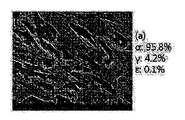
一方、本発明者らは、発明鋼7の成分組成を用いた発明例16に対する熱延〜最終焼鈍熱処理(2次焼鈍)までのSEM微細組織及び相分率の変化を観察し、その結果を図5に示した。このとき、SEM観察時のエッチングとしてはナイタルエッチングを活用したが、微細組織が非常に微細で、相の区別が容易でなかったため、相分率の測定はX−ray法を活用して測定した。相分率において、αは、BCC構造を有するマルテンサイト、焼鈍マルテンサイト、フェライトを全て表現するものである。 On the other hand, the present inventors observed changes in SEM microstructure and phase fraction from hot rolling to final annealing heat treatment (secondary annealing) for Invention Example 16 using the component composition of Invention Steel 7 and observed the results. As shown in FIG. At this time, the etching at the time of SEM observation was performed by using the nital etching. However, since the fine structure was very fine and it was not easy to distinguish the phases, the phase fraction was measured using the X-ray method. did. In the phase fraction, α represents all of martensite, annealed martensite, and ferrite having a BCC structure.
図5に示したように、熱間圧延後の冷却時にマルテンサイトへの変態が進行することが確認できるが、これは、上記発明鋼7がMnを7%以上(7.16%)含む鋼種であり、高い硬化能(hardenability)に起因する。 As shown in FIG. 5, it can be confirmed that the transformation to martensite progresses during cooling after hot rolling. This is because the invention steel 7 contains Mn of 7% or more (7.16%). And is due to high hardenability.
特に、熱延鋼板の場合、マルテンサイト相が95.8%と高いマルテンサイト相分率であることにより、熱延鋼板の引張強度が1500MPa以上となり、冷間圧延が難しい。しかしながら、本発明では、上記熱延鋼板に対して一定の温度範囲で30分間以上の熱処理(冷延前熱処理)を行うことで、熱処理後、高い分率の残留オーステナイト相を得ることができ、熱延鋼板で観察されたマルテンサイト相が逆変態して、一部がオーステナイトに変態し、残部は焼鈍マルテンサイト組織に変態したことが確認できる。 In particular, in the case of a hot-rolled steel sheet, the tensile strength of the hot-rolled steel sheet becomes 1500 MPa or more due to the high martensite phase fraction of 95.8%, making cold rolling difficult. However, in the present invention, a high fraction of retained austenite phase can be obtained after the heat treatment by performing a heat treatment (heat treatment before cold rolling) on the hot-rolled steel sheet in a certain temperature range for 30 minutes or more. It can be confirmed that the martensite phase observed in the hot-rolled steel sheet was reversely transformed, a part was transformed into austenite, and the rest was transformed into an annealed martensite structure.
その後、顧客社で要求する厚さに冷間圧延を行った場合は、オーステナイトのほとんどが変形によってマルテンサイトに変態し、焼鈍マルテンサイトは冷間変形によって転位密度が高くなる。即ち、冷間圧延後に98.4%の分率として示されるαは、オーステナイトの変形によってマルテンサイトに変態したものと、焼鈍マルテンサイトが冷間変形によって転位密度が高くなったものとがそれぞれ、約1/2ずつで構成される。 Thereafter, when cold rolling is performed to the thickness required by the customer company, most of the austenite is transformed into martensite by deformation, and the dislocation density of the annealed martensite is increased by cold deformation. That is, α, which is expressed as a fraction of 98.4% after cold rolling, is defined as a case where austenite is transformed into martensite by deformation and a case where annealed martensite has a high dislocation density due to cold deformation. It is composed of about 1/2 each.
本発明では、このような冷延鋼板に対して1次焼鈍熱処理を行うが、Ac3以上で熱処理することで、12.2%の残留オーステナイトが残存することが確認でき、その後、600℃で3時間の最終焼鈍熱処理を行った場合、オーステナイトの形成が促進し、35.8%の分率を確保することが確認できる。 In the present invention, such a cold-rolled steel sheet is subjected to a primary annealing heat treatment. By performing the heat treatment at Ac3 or more, it can be confirmed that 12.2% of retained austenite remains. When the final annealing heat treatment is performed for a long time, it can be confirmed that austenite formation is promoted and a fraction of 35.8% is secured.
上述した工程別微細組織相分率の観察結果から、4〜10%のMnを含有する本発明では、冷間圧延時の強度を低くする必要があり、そのためには、冷延前熱処理を行うことが好ましいが、Mnの含量によってAc1が変わるため、適正な温度範囲で熱処理を行うことが好ましい。 From the above observation results of the microstructure phase fraction by process, in the present invention containing 4 to 10% Mn, it is necessary to lower the strength during cold rolling, and for that purpose, heat treatment before cold rolling is performed. However, since Ac1 changes depending on the Mn content, it is preferable to perform the heat treatment in an appropriate temperature range.
上記図1から分かるように、最終焼鈍熱処理時に600℃と630℃で熱処理を行うにあたり、HER値が急激に変化する傾向は、多様な成分系において同様に示されるが、発明鋼1を用いた発明例1と比較例3、発明鋼2を用いた発明例2と比較例7、発明鋼3を用いた発明例3と比較例9、発明鋼6を用いた発明例14、比較例27において同様の結果となることが確認できる。 As can be seen from FIG. 1 above, when the heat treatment is performed at 600 ° C. and 630 ° C. during the final annealing heat treatment, the tendency that the HER value changes rapidly is similarly shown in various component systems. Inventive Example 1 and Comparative Example 3, Inventive Example 2 and Comparative Example 7 using Inventive Steel 2, Inventive Example 3 and Comparative Example 9 using Inventive Steel 3, Inventive Example 14 using Inventive Steel 6, and Comparative Example 27 It can be confirmed that a similar result is obtained.
しかし、600℃で最終焼鈍熱処理を行った比較鋼7と、比較鋼8を用いた比較例32〜34では、C含量が類似しているにもかかわらず、非常に低いHER値となっているが、これは、Mn含量が過度に多く、C+(Mn/25)値がそれぞれ0.47及び0.51となり、本発明を満たしていないためである。一方、C含量が低くてMn含量が高い発明鋼11では、C+(Mn/25)値が0.409と低く、穴拡げ性に優れていることが確認できる。
However, the comparative steel 7 subjected to the final annealing heat treatment at 600 ° C. and the comparative examples 32 to 34 using the
発明鋼4と発明鋼5の成分組成を有する冷延鋼板を用いて最終焼鈍熱処理時における時間の影響を検討したところ、発明例7〜9と比較例21から分かるように、最終焼鈍時に熱処理時間が10分と短い比較例21では、伸び率と穴拡げ性が劣位であったが、熱処理時間が長い発明例7〜9では、いずれにおいても優れた伸び率及び穴拡げ性が得られた。このことから、最終焼鈍熱処理時には、温度だけでなく、時間も最適に制御しなければならない。
When the influence of the time during the final annealing heat treatment was examined using cold-rolled steel sheets having the component compositions of
また、Cの含量が比較的高い比較鋼5の成分組成を有する冷延鋼板を用いながら、最終焼鈍熱処理時の温度を変化させた比較例12と比較例13においても、上記発明鋼と類似した結果が得られた。即ち、600℃で熱処理した素材は630℃で熱処理した素材に比べて優れた穴拡げ性を示したが、本発明で目標とする15%には至らず、さらに、Cの含量が高いため、自動車構造部材用鋼材において重要とされている点溶接性が劣位となる短所がある。
Comparative Examples 12 and 13 in which the temperature at the time of the final annealing heat treatment was changed while using a cold-rolled steel sheet having the component composition of
本発明では、降伏強度及び引張強度はもちろん、優れた延性及び穴拡げ性を得るために、冷間圧延後に焼鈍熱処理を段階的に行うことを必須条件として提案することが好ましい。 In the present invention, in order to obtain not only yield strength and tensile strength but also excellent ductility and hole expandability, it is preferable to propose that annealing heat treatment be performed stepwise after cold rolling as an essential condition.
これについては、実施例から明確に確認できるが、発明鋼4の成分組成を有する冷延鋼板を用いた発明例7と比較例24から分かるように、オーステナイト単相領域での熱処理、即ち、1次焼鈍熱処理を行わない比較例24では、最終焼鈍熱処理を600℃で行うことで優れた穴拡げ性が得られたが、0.2%のオフセットで決定された降伏強度が引張強度よりも高く、延性が非常に低いため、本発明で要求するTS*El値が25,000MPa%以上を満たしていないことが確認された。これは、冷間圧延された素材を直ちに最終焼鈍することによって発生する変形組織の再結晶が完全に行われていないためである。また、1次焼鈍熱処理することなく、最終焼鈍熱処理を630℃で行う比較例25においても、優れた強度及び延性が得られたが、穴拡げ性が非常に劣位となり、このような場合は、冷間プレス成形性が劣位であるため、自動車構造部材への冷間プレス成形用素材として適さない。
This can be clearly confirmed from the Examples, but as can be seen from Inventive Example 7 using the cold-rolled steel sheet having the composition of
一方、Mnの含量が4%未満と低い比較鋼1と比較鋼2では、本発明のように段階的に焼鈍熱処理を行っても、伸び率が低いため、本発明で要求するTS*El値が25,000MPa%以上を満たしていない。一方、発明鋼9と10のように、それぞれMnを6.18%、5.21%含有する場合には、TS*El値が25,000MPa%以上を満たしていることが確認できる。
On the other hand, in Comparative Steel 1 and Comparative Steel 2 in which the content of Mn is as low as less than 4%, even if the annealing heat treatment is performed stepwise as in the present invention, the elongation percentage is low. Does not satisfy 25,000 MPa% or more. On the other hand, when Mn is contained in 6.18% and 5.21%, respectively, as in
Claims (13)
微細組織として、体積分率20%以上の残留オーステナイト及び50%以上の焼鈍マルテンサイトを含み、
引張強度が980MPa以上であり、降伏比(降伏強度/引張強度)が0.6以上であり、引張強度と伸び率との積が25,000MPa%以上であり、かつ、15%以上の穴拡げ性を有する、
成形性及び穴拡げ性に優れた超高強度鋼板。
[関係式1]
C+(Mn/25)≦0.46 % By weight, carbon (C): 0.04 to 0.17%, silicon (Si): 2% or less, manganese (Mn): 4 to 10%, phosphorus (P): 0.05% or less (0% , Sulfur (S): 0.02% or less (excluding 0%), aluminum (Al): 0.5% or less (excluding 0%), nitrogen (N): 0.02% In the following (excluding 0%), the balance consists of Fe and other unavoidable impurities , and the C and Mn satisfy the following relational expression 1,
As microstructure, viewed contains a volume fraction of 20% or more of residual austenite and 50% or more of the annealing martensite,
Tensile strength is 980 MPa or more, yield ratio (yield strength / tensile strength) is 0.6 or more, product of tensile strength and elongation is 25,000 MPa% or more, and hole expansion is 15% or more. Having the property
Ultra high strength steel sheet with excellent formability and hole expandability.
[Relational expression 1]
C + (Mn / 25) ≦ 0.46
前記再加熱された鋼スラブをAr3〜1000℃の温度範囲で仕上げ熱間圧延して熱延鋼板を製造する段階と、
前記熱延鋼板を720℃以下の温度で巻取する段階と、
前記巻取された熱延鋼板を常温まで冷却した後、Ac1〜Ac1+((Ac3−Ac1)/2)の温度範囲で30分間以上熱処理する段階と、
前記熱処理された熱延鋼板を酸洗及び冷間圧延して冷延鋼板を製造する段階と、
前記製造された冷延鋼板をAc3以上の温度で30秒間以上の1次焼鈍熱処理を行った後に冷却する段階と、
前記1次焼鈍熱処理及び冷却された冷延鋼板に対して550〜620℃の温度範囲で30分間以上の2次焼鈍熱処理を行う段階と、
を含む、
微細組織として体積分率20%以上の残留オーステナイト及び50%以上の焼鈍マルテンサイトを含み成形性及び穴拡げ性に優れた超高強度鋼板の製造方法。
[関係式1]
C+(Mn/25)≦0.46 % By weight, carbon (C): 0.04 to 0.17%, silicon (Si): 2% or less, manganese (Mn): 4 to 10%, phosphorus (P): 0.05% or less (0% , Sulfur (S): 0.02% or less (excluding 0%), aluminum (Al): 0.5% or less (excluding 0%), nitrogen (N): 0.02% or less (not including 0%), and the balance Fe and other unavoidable impurities, wherein the C and Mn the steps of reheating a steel slab satisfying the following relationships 1 to a temperature range of 1100 to 1300 ° C.,
Producing a hot-rolled steel sheet by finish hot rolling the reheated steel slab in a temperature range of Ar 3 to 1000 ° C .;
Winding the hot-rolled steel sheet at a temperature of 720 ° C. or less;
Cooling the rolled hot-rolled steel sheet to room temperature, and heat -treating the rolled hot-rolled steel sheet at a temperature range of Ac1 to Ac1 + ((Ac3-Ac1) / 2) for 30 minutes or more;
Pickling and cold rolling the heat-treated hot-rolled steel sheet to produce a cold-rolled steel sheet;
Cooling the manufactured cold-rolled steel sheet after performing a primary annealing heat treatment for 30 seconds or more at a temperature of Ac3 or more;
Performing a primary annealing heat treatment and a secondary annealing heat treatment on the cooled cold-rolled steel sheet in a temperature range of 550 to 620 ° C. for 30 minutes or more;
including,
A method for producing an ultra-high-strength steel sheet which contains 20% or more of retained austenite as a microstructure and 50% or more of annealed martensite and has excellent formability and hole expandability.
[Relational expression 1]
C + (Mn / 25) ≦ 0.46
Applications Claiming Priority (3)
| Application Number | Priority Date | Filing Date | Title |
|---|---|---|---|
| KR10-2015-0153195 | 2015-11-02 | ||
| KR1020150153195A KR101677396B1 (en) | 2015-11-02 | 2015-11-02 | Ultra high strength steel sheet having excellent formability and expandability, and method for manufacturing the same |
| PCT/KR2016/011143 WO2017078278A1 (en) | 2015-11-02 | 2016-10-05 | Ultra-high strength steel plate having excellent formability and hole-expandability, and method for manufacturing same |
Publications (2)
| Publication Number | Publication Date |
|---|---|
| JP2018536764A JP2018536764A (en) | 2018-12-13 |
| JP6654698B2 true JP6654698B2 (en) | 2020-02-26 |
Family
ID=57537684
Family Applications (1)
| Application Number | Title | Priority Date | Filing Date |
|---|---|---|---|
| JP2018522028A Active JP6654698B2 (en) | 2015-11-02 | 2016-10-05 | Ultra-high-strength steel sheet excellent in formability and hole expandability and method for producing the same |
Country Status (6)
| Country | Link |
|---|---|
| US (1) | US11203795B2 (en) |
| EP (1) | EP3372703B1 (en) |
| JP (1) | JP6654698B2 (en) |
| KR (1) | KR101677396B1 (en) |
| CN (1) | CN108350546B (en) |
| WO (1) | WO2017078278A1 (en) |
Families Citing this family (30)
| Publication number | Priority date | Publication date | Assignee | Title |
|---|---|---|---|---|
| EP3222734A1 (en) * | 2016-03-23 | 2017-09-27 | Voestalpine Stahl GmbH | Method for temperature treating a manganese steel interim product and steel interim product put through corresponding temperature treatment |
| KR101839235B1 (en) * | 2016-10-24 | 2018-03-16 | 주식회사 포스코 | Ultra high strength steel sheet having excellent hole expansion ratio and yield ratio, and method for manufacturing the same |
| EP3569727A4 (en) * | 2017-01-16 | 2020-07-15 | Nippon Steel Corporation | STEEL PLATE AND MANUFACTURING METHOD THEREFOR |
| KR101940912B1 (en) | 2017-06-30 | 2019-01-22 | 주식회사 포스코 | Steel sheet having excellent liquid metal embrittlement cracking resistance and method of manufacturing the same |
| KR101940919B1 (en) | 2017-08-08 | 2019-01-22 | 주식회사 포스코 | Hot rolled steel sheet having excellent strength and elongation and method of manufacturing the same |
| CN114369768A (en) * | 2017-11-02 | 2022-04-19 | 重庆哈工易成形钢铁科技有限公司 | Steel material for hot press forming, hot press forming process, and formed member |
| KR101977491B1 (en) * | 2017-11-08 | 2019-05-10 | 주식회사 포스코 | Ultra-high strength and high-ductility steel sheet having excellent cold formability, and method for manufacturing thereof |
| WO2019122964A1 (en) * | 2017-12-19 | 2019-06-27 | Arcelormittal | Steel sheet having excellent toughness, ductility and strength, and manufacturing method thereof |
| KR102020411B1 (en) | 2017-12-22 | 2019-09-10 | 주식회사 포스코 | High-strength steel sheet having excellent workablity and method for manufacturing thereof |
| KR102109265B1 (en) | 2018-09-04 | 2020-05-11 | 주식회사 포스코 | Ultra high strength and high ductility steel sheet having excellent yield ratio and manufacturing method for the same |
| KR102098501B1 (en) * | 2018-10-18 | 2020-04-07 | 주식회사 포스코 | High-manganese steel having excellent vibration-proof properties and formability, and method for manufacturing thereof |
| KR102209552B1 (en) * | 2018-12-19 | 2021-01-28 | 주식회사 포스코 | High strength hot-rolled steel sheet having excellent hole expansion ratio and manufacturing method for the same |
| JP7192554B2 (en) * | 2019-02-14 | 2022-12-20 | 日本製鉄株式会社 | Wear-resistant thick steel plate |
| KR102231344B1 (en) * | 2019-05-17 | 2021-03-24 | 주식회사 포스코 | Ultra-high strength steel sheet having excellent hole-expandability and ductility, and method for manufacturing thereof |
| KR102264344B1 (en) * | 2019-09-30 | 2021-06-11 | 현대제철 주식회사 | Steel sheet having high strength and high formability and method for manufacturing the same |
| WO2021070640A1 (en) | 2019-10-11 | 2021-04-15 | Jfeスチール株式会社 | High-strength steel sheet, shock-absorbing member, and method for producing high-strength steel sheet |
| JP6950850B2 (en) | 2019-10-11 | 2021-10-13 | Jfeスチール株式会社 | Manufacturing method of high-strength steel plate, shock absorbing member and high-strength steel plate |
| KR102285523B1 (en) * | 2019-11-20 | 2021-08-03 | 현대제철 주식회사 | Steel sheet having high strength and high formability and method for manufacturing the same |
| KR102275916B1 (en) * | 2019-12-09 | 2021-07-13 | 현대제철 주식회사 | Galva-annealed steel sheet having ultra high strength with high formability and manufacturing method thereof |
| KR102360396B1 (en) * | 2020-04-28 | 2022-02-08 | 현대제철 주식회사 | Steel sheet having high strength and high formability and method for manufacturing the same |
| KR102404738B1 (en) * | 2020-07-15 | 2022-06-07 | 현대제철 주식회사 | Steel sheet having high strength and high formability and method for manufacturing the same |
| KR102404739B1 (en) * | 2020-07-16 | 2022-06-08 | 현대제철 주식회사 | Galva-annealed steel sheet having ultra high strength with high formability and manufacturing method thereof |
| WO2022018500A1 (en) | 2020-07-24 | 2022-01-27 | Arcelormittal | Cold rolled and double annealed steel sheet |
| CN114107794B (en) * | 2020-08-31 | 2023-08-11 | 宝山钢铁股份有限公司 | A 980MPa-level ultra-low carbon martensite plus paraausic ultra-high reaming steel and its manufacturing method |
| CN112251679B (en) * | 2020-09-18 | 2022-04-26 | 东南大学 | A kind of dual-phase high-strength steel and preparation method thereof |
| KR102478807B1 (en) * | 2020-11-12 | 2022-12-19 | 현대제철 주식회사 | Steel sheet having high strength and high formability and method for manufacturing the same |
| KR102468036B1 (en) * | 2020-11-12 | 2022-11-17 | 주식회사 포스코 | High-strength hot-dip galvanized steel sheet with excellent formability and process for producing same |
| KR102518675B1 (en) | 2020-12-16 | 2023-04-06 | 주식회사 포스코 | High strength cold-rolled steel sheet with excellent formability and mathod of manufacturing the same |
| KR102830816B1 (en) | 2023-04-04 | 2025-07-04 | 한양대학교 에리카산학협력단 | Room-temperature q&p processed medium manganese steel containing vanadium carbide precipitates with superior strength-ductility balance and manufacturing method for the same |
| CN120350209B (en) * | 2025-04-23 | 2025-11-18 | 广东宝盛兴实业有限公司 | A pickling steel plate with high hole expansion performance and its production method |
Family Cites Families (24)
| Publication number | Priority date | Publication date | Assignee | Title |
|---|---|---|---|---|
| JP2876968B2 (en) * | 1993-12-27 | 1999-03-31 | 日本鋼管株式会社 | High-strength steel sheet having high ductility and method for producing the same |
| KR20000043762A (en) | 1998-12-29 | 2000-07-15 | 이구택 | Method of manufacturing super high-strength cold-rolled steel sheet improved in ductility |
| EP2671960B1 (en) * | 2005-03-31 | 2017-11-01 | Kabushiki Kaisha Kobe Seiko Sho | High strength cold-rolled steel sheet and automobile components of steel having excellent properties in coating film adhesion, workability, and hydrogen embrittlement resistivity |
| KR101027250B1 (en) * | 2008-05-20 | 2011-04-06 | 주식회사 포스코 | High strength cold rolled steel with excellent ductility and delayed fracture resistance, molten zinc plated steel sheet and manufacturing method |
| CN101638749B (en) * | 2009-08-12 | 2011-01-26 | 钢铁研究总院 | A kind of low-cost high-strength high-strength plastic product automotive steel and its preparation method |
| JP5287770B2 (en) * | 2010-03-09 | 2013-09-11 | Jfeスチール株式会社 | High strength steel plate and manufacturing method thereof |
| KR101243002B1 (en) | 2010-12-22 | 2013-03-12 | 주식회사 포스코 | High strength steel sheet having excellent elongation and method for manufacturing the same |
| KR101253885B1 (en) | 2010-12-27 | 2013-04-16 | 주식회사 포스코 | Steel sheet fir formed member, formed member having excellent ductility and method for manufacturing the same |
| KR20130027794A (en) | 2011-09-08 | 2013-03-18 | 현대하이스코 주식회사 | Ultra high strength cold-rolled steel sheet and hot dip plated steel sheet with low yield ratio and method of manufacturing the same |
| JP5440672B2 (en) | 2011-09-16 | 2014-03-12 | Jfeスチール株式会社 | High-strength steel sheet with excellent workability and method for producing the same |
| US9617614B2 (en) | 2011-10-24 | 2017-04-11 | Jfe Steel Corporation | Method for manufacturing high strength steel sheet having excellent formability |
| KR101382981B1 (en) * | 2011-11-07 | 2014-04-09 | 주식회사 포스코 | Steel sheet for warm press forming, warm press formed parts and method for manufacturing thereof |
| KR20130056051A (en) * | 2011-11-21 | 2013-05-29 | 주식회사 포스코 | Ultra high strength steel sheet without crack of slab corner and manufacturing method of the same |
| KR101353787B1 (en) * | 2011-12-26 | 2014-01-22 | 주식회사 포스코 | Ultra high strength colde rolled steel sheet having excellent weldability and bendability and method for manufacturing the same |
| JP5857905B2 (en) * | 2012-07-25 | 2016-02-10 | 新日鐵住金株式会社 | Steel material and manufacturing method thereof |
| WO2014020640A1 (en) | 2012-07-31 | 2014-02-06 | Jfeスチール株式会社 | High-strength hot-dip galvanized steel sheet having excellent moldability and shape fixability, and method for manufacturing same |
| CN102912219A (en) | 2012-10-23 | 2013-02-06 | 鞍钢股份有限公司 | TRIP steel plate with high product of strength and elongation and preparation method thereof |
| KR101228711B1 (en) | 2012-12-24 | 2013-02-01 | 주식회사 포스코 | Steel for hot press forming, Forming part by using the same and Manufacturing method thereof |
| CN103060678B (en) | 2012-12-25 | 2016-04-27 | 钢铁研究总院 | A kind of warm-working nanometer austenite strengthens plasticising steel and preparation method thereof |
| WO2015001367A1 (en) | 2013-07-04 | 2015-01-08 | Arcelormittal Investigación Y Desarrollo Sl | Cold rolled steel sheet, method of manufacturing and vehicle |
| ES2745428T3 (en) | 2014-01-06 | 2020-03-02 | Nippon Steel Corp | Steel and method to make it |
| JP6314520B2 (en) * | 2014-02-13 | 2018-04-25 | 新日鐵住金株式会社 | High-strength steel sheet having a maximum tensile strength of 1300 MPa or more, excellent formability, high-strength hot-dip galvanized steel sheet, high-strength galvannealed steel sheet, and methods for producing them |
| KR101909839B1 (en) | 2014-07-18 | 2018-10-18 | 신닛테츠스미킨 카부시키카이샤 | Steel material and method for producing same |
| KR101638749B1 (en) | 2015-12-02 | 2016-07-11 | 이광섭 | Method for manufacturing elbow used in connecting high pressure pipe |
-
2015
- 2015-11-02 KR KR1020150153195A patent/KR101677396B1/en active Active
-
2016
- 2016-10-05 CN CN201680063842.9A patent/CN108350546B/en active Active
- 2016-10-05 JP JP2018522028A patent/JP6654698B2/en active Active
- 2016-10-05 WO PCT/KR2016/011143 patent/WO2017078278A1/en not_active Ceased
- 2016-10-05 EP EP16862296.7A patent/EP3372703B1/en active Active
- 2016-10-05 US US15/769,924 patent/US11203795B2/en active Active
Also Published As
| Publication number | Publication date |
|---|---|
| CN108350546B (en) | 2020-02-25 |
| CN108350546A (en) | 2018-07-31 |
| KR101677396B9 (en) | 2021-07-26 |
| KR101677396B1 (en) | 2016-11-18 |
| WO2017078278A1 (en) | 2017-05-11 |
| EP3372703A4 (en) | 2018-09-12 |
| US20200248281A1 (en) | 2020-08-06 |
| JP2018536764A (en) | 2018-12-13 |
| EP3372703A1 (en) | 2018-09-12 |
| EP3372703B1 (en) | 2021-04-07 |
| US11203795B2 (en) | 2021-12-21 |
Similar Documents
| Publication | Publication Date | Title |
|---|---|---|
| JP6654698B2 (en) | Ultra-high-strength steel sheet excellent in formability and hole expandability and method for producing the same | |
| JP6766190B2 (en) | Ultra-high-strength, high-ductility steel sheet with excellent yield strength and its manufacturing method | |
| JP6043801B2 (en) | Steel plate for warm press forming, warm press forming member, and manufacturing method thereof | |
| JP6383808B2 (en) | High-strength cold-rolled steel sheet having excellent ductility, hot-dip galvanized steel sheet, and production methods thereof | |
| JP5402191B2 (en) | Ultra-high-strength cold-rolled steel sheet with excellent stretch flangeability and manufacturing method thereof | |
| JP6762415B2 (en) | Hot forming member with excellent crack propagation resistance and ductility, and its manufacturing method | |
| JP5042232B2 (en) | High-strength cold-rolled steel sheet excellent in formability and plating characteristics, galvanized steel sheet using the same, and method for producing the same | |
| JP6779320B2 (en) | Clad steel sheet with excellent strength and formability and its manufacturing method | |
| KR101569977B1 (en) | High-strength cold-rolled steel sheet with high yield ratio having excellent formability and method for producing the same | |
| JP2010275627A (en) | High-strength steel sheet and high-strength hot-dip galvanized steel sheet excellent in workability and methods for producing them | |
| JP5082649B2 (en) | High-strength cold-rolled steel sheet with excellent manufacturing stability and manufacturing method thereof | |
| JP6858253B2 (en) | Ultra-high-strength steel sheet with excellent hole expansion and yield ratio and its manufacturing method | |
| JP6723377B2 (en) | Ultra high strength and high ductility steel sheet with excellent yield ratio and method for producing the same | |
| JP7698043B2 (en) | Ultra-high strength steel plate with excellent ductility and manufacturing method thereof | |
| JP4528137B2 (en) | Manufacturing method of high strength and high ductility steel sheet with excellent hole expandability | |
| JP5397141B2 (en) | Alloyed hot-dip galvanized steel sheet and method for producing the same | |
| JP5678695B2 (en) | High strength steel plate and manufacturing method thereof | |
| JP7022825B2 (en) | Ultra-high-strength, high-ductility steel sheet with excellent cold formability and its manufacturing method | |
| JP7648620B2 (en) | Steel material for hot forming, hot forming member, and manufacturing method thereof | |
| JP5151227B2 (en) | High strength steel plate and manufacturing method thereof | |
| JP7554827B2 (en) | High-strength steel plate with excellent workability and manufacturing method thereof | |
| JP5429331B2 (en) | High-strength cold-rolled steel sheet with excellent manufacturing stability and manufacturing method thereof | |
| JP7554828B2 (en) | High-strength steel plate with excellent workability and manufacturing method thereof | |
| KR102231344B1 (en) | Ultra-high strength steel sheet having excellent hole-expandability and ductility, and method for manufacturing thereof | |
| JP2025533651A (en) | Steel plate and its manufacturing method |
Legal Events
| Date | Code | Title | Description |
|---|---|---|---|
| A621 | Written request for application examination |
Free format text: JAPANESE INTERMEDIATE CODE: A621 Effective date: 20180611 |
|
| A977 | Report on retrieval |
Free format text: JAPANESE INTERMEDIATE CODE: A971007 Effective date: 20190520 |
|
| A131 | Notification of reasons for refusal |
Free format text: JAPANESE INTERMEDIATE CODE: A131 Effective date: 20190604 |
|
| A521 | Request for written amendment filed |
Free format text: JAPANESE INTERMEDIATE CODE: A523 Effective date: 20190903 |
|
| TRDD | Decision of grant or rejection written | ||
| A01 | Written decision to grant a patent or to grant a registration (utility model) |
Free format text: JAPANESE INTERMEDIATE CODE: A01 Effective date: 20200107 |
|
| A61 | First payment of annual fees (during grant procedure) |
Free format text: JAPANESE INTERMEDIATE CODE: A61 Effective date: 20200130 |
|
| R150 | Certificate of patent or registration of utility model |
Ref document number: 6654698 Country of ref document: JP Free format text: JAPANESE INTERMEDIATE CODE: R150 |
|
| S531 | Written request for registration of change of domicile |
Free format text: JAPANESE INTERMEDIATE CODE: R313531 |
|
| S533 | Written request for registration of change of name |
Free format text: JAPANESE INTERMEDIATE CODE: R313533 |
|
| R350 | Written notification of registration of transfer |
Free format text: JAPANESE INTERMEDIATE CODE: R350 |
|
| S111 | Request for change of ownership or part of ownership |
Free format text: JAPANESE INTERMEDIATE CODE: R313113 |
|
| R250 | Receipt of annual fees |
Free format text: JAPANESE INTERMEDIATE CODE: R250 |
|
| R371 | Transfer withdrawn |
Free format text: JAPANESE INTERMEDIATE CODE: R371 |
|
| S111 | Request for change of ownership or part of ownership |
Free format text: JAPANESE INTERMEDIATE CODE: R313113 |
|
| R350 | Written notification of registration of transfer |
Free format text: JAPANESE INTERMEDIATE CODE: R350 |
|
| R250 | Receipt of annual fees |
Free format text: JAPANESE INTERMEDIATE CODE: R250 |
|
| R250 | Receipt of annual fees |
Free format text: JAPANESE INTERMEDIATE CODE: R250 |
|
| R250 | Receipt of annual fees |
Free format text: JAPANESE INTERMEDIATE CODE: R250 |