JP6551544B2 - Toner, developer, and image forming apparatus - Google Patents
Toner, developer, and image forming apparatus Download PDFInfo
- Publication number
- JP6551544B2 JP6551544B2 JP2017562860A JP2017562860A JP6551544B2 JP 6551544 B2 JP6551544 B2 JP 6551544B2 JP 2017562860 A JP2017562860 A JP 2017562860A JP 2017562860 A JP2017562860 A JP 2017562860A JP 6551544 B2 JP6551544 B2 JP 6551544B2
- Authority
- JP
- Japan
- Prior art keywords
- toner
- polyester resin
- resin
- acid
- electrostatic latent
- Prior art date
- Legal status (The legal status is an assumption and is not a legal conclusion. Google has not performed a legal analysis and makes no representation as to the accuracy of the status listed.)
- Active
Links
Images


Classifications
-
- G—PHYSICS
- G03—PHOTOGRAPHY; CINEMATOGRAPHY; ANALOGOUS TECHNIQUES USING WAVES OTHER THAN OPTICAL WAVES; ELECTROGRAPHY; HOLOGRAPHY
- G03G—ELECTROGRAPHY; ELECTROPHOTOGRAPHY; MAGNETOGRAPHY
- G03G9/00—Developers
- G03G9/08—Developers with toner particles
- G03G9/087—Binders for toner particles
- G03G9/08742—Binders for toner particles comprising macromolecular compounds obtained otherwise than by reactions only involving carbon-to-carbon unsaturated bonds
- G03G9/08755—Polyesters
-
- G—PHYSICS
- G03—PHOTOGRAPHY; CINEMATOGRAPHY; ANALOGOUS TECHNIQUES USING WAVES OTHER THAN OPTICAL WAVES; ELECTROGRAPHY; HOLOGRAPHY
- G03G—ELECTROGRAPHY; ELECTROPHOTOGRAPHY; MAGNETOGRAPHY
- G03G15/00—Apparatus for electrographic processes using a charge pattern
- G03G15/06—Apparatus for electrographic processes using a charge pattern for developing
- G03G15/08—Apparatus for electrographic processes using a charge pattern for developing using a solid developer, e.g. powder developer
- G03G15/0822—Arrangements for preparing, mixing, supplying or dispensing developer
- G03G15/0865—Arrangements for supplying new developer
-
- G—PHYSICS
- G03—PHOTOGRAPHY; CINEMATOGRAPHY; ANALOGOUS TECHNIQUES USING WAVES OTHER THAN OPTICAL WAVES; ELECTROGRAPHY; HOLOGRAPHY
- G03G—ELECTROGRAPHY; ELECTROPHOTOGRAPHY; MAGNETOGRAPHY
- G03G15/00—Apparatus for electrographic processes using a charge pattern
- G03G15/20—Apparatus for electrographic processes using a charge pattern for fixing, e.g. by using heat
- G03G15/2003—Apparatus for electrographic processes using a charge pattern for fixing, e.g. by using heat using heat
- G03G15/2014—Apparatus for electrographic processes using a charge pattern for fixing, e.g. by using heat using heat using contact heat
- G03G15/2064—Apparatus for electrographic processes using a charge pattern for fixing, e.g. by using heat using heat using contact heat combined with pressure
-
- G—PHYSICS
- G03—PHOTOGRAPHY; CINEMATOGRAPHY; ANALOGOUS TECHNIQUES USING WAVES OTHER THAN OPTICAL WAVES; ELECTROGRAPHY; HOLOGRAPHY
- G03G—ELECTROGRAPHY; ELECTROPHOTOGRAPHY; MAGNETOGRAPHY
- G03G9/00—Developers
- G03G9/08—Developers with toner particles
-
- G—PHYSICS
- G03—PHOTOGRAPHY; CINEMATOGRAPHY; ANALOGOUS TECHNIQUES USING WAVES OTHER THAN OPTICAL WAVES; ELECTROGRAPHY; HOLOGRAPHY
- G03G—ELECTROGRAPHY; ELECTROPHOTOGRAPHY; MAGNETOGRAPHY
- G03G9/00—Developers
- G03G9/08—Developers with toner particles
- G03G9/087—Binders for toner particles
-
- G—PHYSICS
- G03—PHOTOGRAPHY; CINEMATOGRAPHY; ANALOGOUS TECHNIQUES USING WAVES OTHER THAN OPTICAL WAVES; ELECTROGRAPHY; HOLOGRAPHY
- G03G—ELECTROGRAPHY; ELECTROPHOTOGRAPHY; MAGNETOGRAPHY
- G03G9/00—Developers
- G03G9/08—Developers with toner particles
- G03G9/087—Binders for toner particles
- G03G9/08784—Macromolecular material not specially provided for in a single one of groups G03G9/08702 - G03G9/08775
- G03G9/08786—Graft polymers
-
- G—PHYSICS
- G03—PHOTOGRAPHY; CINEMATOGRAPHY; ANALOGOUS TECHNIQUES USING WAVES OTHER THAN OPTICAL WAVES; ELECTROGRAPHY; HOLOGRAPHY
- G03G—ELECTROGRAPHY; ELECTROPHOTOGRAPHY; MAGNETOGRAPHY
- G03G9/00—Developers
- G03G9/08—Developers with toner particles
- G03G9/087—Binders for toner particles
- G03G9/08784—Macromolecular material not specially provided for in a single one of groups G03G9/08702 - G03G9/08775
- G03G9/08788—Block polymers
-
- G—PHYSICS
- G03—PHOTOGRAPHY; CINEMATOGRAPHY; ANALOGOUS TECHNIQUES USING WAVES OTHER THAN OPTICAL WAVES; ELECTROGRAPHY; HOLOGRAPHY
- G03G—ELECTROGRAPHY; ELECTROPHOTOGRAPHY; MAGNETOGRAPHY
- G03G9/00—Developers
- G03G9/08—Developers with toner particles
- G03G9/087—Binders for toner particles
- G03G9/08784—Macromolecular material not specially provided for in a single one of groups G03G9/08702 - G03G9/08775
- G03G9/08791—Macromolecular material not specially provided for in a single one of groups G03G9/08702 - G03G9/08775 characterised by the presence of specified groups or side chains
-
- G—PHYSICS
- G03—PHOTOGRAPHY; CINEMATOGRAPHY; ANALOGOUS TECHNIQUES USING WAVES OTHER THAN OPTICAL WAVES; ELECTROGRAPHY; HOLOGRAPHY
- G03G—ELECTROGRAPHY; ELECTROPHOTOGRAPHY; MAGNETOGRAPHY
- G03G9/00—Developers
- G03G9/08—Developers with toner particles
- G03G9/087—Binders for toner particles
- G03G9/08784—Macromolecular material not specially provided for in a single one of groups G03G9/08702 - G03G9/08775
- G03G9/08795—Macromolecular material not specially provided for in a single one of groups G03G9/08702 - G03G9/08775 characterised by their chemical properties, e.g. acidity, molecular weight, sensitivity to reactants
-
- G—PHYSICS
- G03—PHOTOGRAPHY; CINEMATOGRAPHY; ANALOGOUS TECHNIQUES USING WAVES OTHER THAN OPTICAL WAVES; ELECTROGRAPHY; HOLOGRAPHY
- G03G—ELECTROGRAPHY; ELECTROPHOTOGRAPHY; MAGNETOGRAPHY
- G03G9/00—Developers
- G03G9/08—Developers with toner particles
- G03G9/087—Binders for toner particles
- G03G9/08784—Macromolecular material not specially provided for in a single one of groups G03G9/08702 - G03G9/08775
- G03G9/08797—Macromolecular material not specially provided for in a single one of groups G03G9/08702 - G03G9/08775 characterised by their physical properties, e.g. viscosity, solubility, melting temperature, softening temperature, glass transition temperature
Landscapes
- Physics & Mathematics (AREA)
- General Physics & Mathematics (AREA)
- Spectroscopy & Molecular Physics (AREA)
- Chemical & Material Sciences (AREA)
- Chemical Kinetics & Catalysis (AREA)
- Developing Agents For Electrophotography (AREA)
Description
本発明は、トナー、現像剤、及び画像形成装置に関する。 The present invention relates to a toner, a developer, and an image forming apparatus.
近年、トナーには、出力画像の高品質化のための小粒径化、及び耐高温オフセット性、省エネルギー化のための低温定着性、並びに製造後の保管時や運搬時における高温高湿に耐えうる耐熱保存性が要求されている。特に、定着時における消費電力は画像形成工程における消費電力の多くを占めるため、低温定着性の向上は非常に重要である。 In recent years, toners have been able to withstand high temperature and high humidity during storage and transportation after production, as well as reduction in particle size for high quality output images, high temperature offset resistance, low temperature fixability for energy saving. High heat-resistant storage stability is required. In particular, since power consumption during fixing accounts for much of the power consumption in the image forming process, it is very important to improve low-temperature fixability.
従来、混練粉砕法で作製されたトナーが使用されてきた。混練粉砕法で作製されたトナーは、小粒径化が困難であると共に、その形状が不定形かつ粒径分布がブロードであることから出力画像の品質が十分ではないこと、定着エネルギーが高いことなどの問題点があった。また、定着性向上のためにワックス(離型剤)を添加している場合、混練粉砕法で作製されたトナーは、粉砕の際にワックスの界面で割れるために、ワックスがトナー表面に多く存在してしまう。そのため、離型効果が出る一方で、キャリア、感光体及びブレードへのトナーの付着(フィルミング)が起こりやすくなり、全体的な性能としては、満足のいくものではないとう問題点があった。 Heretofore, toners produced by a kneading and pulverizing method have been used. The toner produced by the kneading and pulverization method is difficult to reduce the particle size, the shape is irregular and the particle size distribution is broad, so the quality of the output image is not sufficient, and the fixing energy is high. There were problems such as. In addition, when a wax (release agent) is added to improve the fixability, the toner produced by the kneading and pulverization method cracks at the interface of the wax during pulverization, so that a large amount of wax exists on the toner surface. Resulting in. Therefore, while the releasing effect is obtained, the toner adhesion (filming) to the carrier, the photosensitive member and the blade tends to occur, and there is a problem that the overall performance is not satisfactory.
そこで、混練粉砕法による上述の問題点を克服するために、重合法によるトナーの製造方法が提案されている。重合法で製造されたトナーは、小粒径化が容易であり、粒度分布も粉砕法で製造されたトナーの粒度分布に比べてシャープであり、さらに、離型剤の内包化も可能である。重合法によるトナーの製造方法としては、低温定着性の改良及び耐高温オフセット性の改良を目的として、トナーバインダーとして、ウレタン変性されたポリエステルの伸長反応物からトナーを製造する方法が開示されている(例えば、特許文献1)。 Therefore, in order to overcome the above-mentioned problems caused by the kneading and pulverizing method, a toner manufacturing method by a polymerization method has been proposed. The toner manufactured by the polymerization method can be easily reduced in particle size, the particle size distribution is sharper than the particle size distribution of the toner manufactured by the pulverization method, and further, the inclusion of the releasing agent is also possible. . As a method for producing a toner by a polymerization method, for the purpose of improving low-temperature fixability and improving high-temperature offset resistance, a method of producing a toner from an extension reaction product of urethane-modified polyester as a toner binder is disclosed. (For example, patent document 1).
また、小粒径トナーとした場合の粉体流動性及び転写性に優れると共に、耐熱保存性、低温定着性及び耐高温オフセット性のいずれにも優れたトナーの製造方法が開示されている(例えば、特許文献2、3)。また、安定した分子量分布のトナーバインダーを製造し、低温定着性及び耐高温オフセット性を両立させるための、熟成工程を有するトナーの製造方法が開示されている(例えば、特許文献4、5)。 In addition, a method for producing a toner is disclosed which is excellent in powder flowability and transferability in the case of using a small particle size toner, and which is excellent in any of heat resistance storage stability, low temperature fixability and high temperature offset resistance. Patent Documents 2 and 3). Also, a method for producing a toner having an aging step for producing a toner binder having a stable molecular weight distribution and achieving both low-temperature fixability and high-temperature offset resistance is disclosed (for example, Patent Documents 4 and 5).
高いレベルの低温定着性を得る目的で、結晶性ポリエステル樹脂を含む樹脂、及び離型剤を含有し、樹脂とワックスが互いに非相溶で海島状の相分離構造を有するトナーが提案されている(例えば、特許文献6)。
また、結晶性ポリエステル樹脂、離型剤及びグラフト重合体を含有するトナーが提案されている(例えば、特許文献7)。In order to obtain a high level of low-temperature fixability, a toner containing a resin containing a crystalline polyester resin and a release agent and having a sea-island-like phase separation structure in which the resin and the wax are incompatible with each other has been proposed. (For example, patent document 6).
In addition, a toner containing a crystalline polyester resin, a release agent, and a graft polymer has been proposed (for example, Patent Document 7).
そこで、フィルミングがなく、高いレベルの低温定着性、耐熱保存性、及び耐高温オフセット性を得る目的で、グラフト変性ポリマーを含有するトナーが提案されている (例えば、特許文献8) 。 Therefore, a toner containing a graft modified polymer has been proposed for the purpose of obtaining a high level of low temperature fixability, heat resistant storage stability and high temperature offset resistance without filming (for example, Patent Document 8).
特許文献4、5記載のトナーは近年要求される高いレベルの低温定着性を満足するものでない。また、特許文献6〜8記載のトナーは耐熱保存性、耐高温オフセット性、及び低温定着性が得られるものの、ポリエステル樹脂、及び離型剤の分散性が十分ではないため、表面偏在を防げていないことから、フィルミングが発生するという問題があり、また、近年要求される、高いレベルの耐熱保存性、及び耐ストレス性を満足するものではない。
したがって、フィルミングがなく、優れた低温定着性、耐高温オフセット性、耐ストレス性、及び耐熱保存性を有するトナー、並びに該トナーを含む現像剤が求められているのが現状である。The toners described in Patent Documents 4 and 5 do not satisfy the high level of low temperature fixability required in recent years. In addition, although the toners described in Patent Documents 6 to 8 can obtain heat resistant storage stability, high temperature offset resistance, and low temperature fixability, they do not have sufficient dispersibility of the polyester resin and the release agent, thereby preventing uneven surface distribution. Therefore, there is a problem that filming occurs, and it does not satisfy the high level of heat storage stability and stress resistance required in recent years.
Therefore, the present situation is that there is a demand for a toner having no filming and having excellent low-temperature fixability, high-temperature offset resistance, stress resistance, and heat-resistant storage, and a developer containing the toner.
本発明は、以下の目的を達成することを課題とする。即ち、本発明は、フィルミングがなく、優れた低温定着性、耐高温オフセット性、耐ストレス性、及び耐熱保存性を有するトナーを提供することを目的とする。 An object of the present invention is to achieve the following objects. That is, an object of the present invention is to provide a toner that has no filming and has excellent low-temperature fixability, high-temperature offset resistance, stress resistance, and heat-resistant storage stability.
前記課題を解決するための本発明は下記<1>に記載の通りのトナーに係るものである。
<1>飽和脂肪族ジカルボン酸に由来する構成単位と、飽和脂肪族ジオールに由来する構成単位とを有する結晶性ポリエステル樹脂、非晶質ハイブリッド樹脂、非晶質ポリエステル樹脂、離型剤、及び着色剤を含有してなるトナーであって、
前記結晶性ポリエステル樹脂は、前記飽和脂肪族ジカルボン酸に由来する構成単位としてセバシン酸に由来する構成単位を含み、
前記非晶質ハイブリッド樹脂が、ポリエステル系樹脂ユニットとスチレン系樹脂ユニットとを含む複合樹脂であることを特徴とするトナー。The present invention for solving the above problems relates to a toner as described in <1> below.
<1> Crystalline polyester resin, amorphous hybrid resin, amorphous polyester resin, release agent, and coloring having a structural unit derived from a saturated aliphatic dicarboxylic acid and a structural unit derived from a saturated aliphatic diol A toner containing an agent,
The crystalline polyester resin contains a structural unit derived from sebacic acid as a structural unit derived from the saturated aliphatic dicarboxylic acid,
The toner characterized in that the amorphous hybrid resin is a composite resin containing a polyester resin unit and a styrene resin unit.
本発明によると、フィルミングがなく、優れた低温定着性、耐高温オフセット性、耐ストレス性、及び耐熱保存性を有するトナーを提供することができる。 According to the present invention, it is possible to provide a toner which does not have filming and which has excellent low temperature fixability, high temperature offset resistance, stress resistance, and heat resistant storage stability.
また、上記本発明<1>の実施の形態には、次の<2>〜<6>も含まれるので、これらについても併せて説明する。
<2> 前記結晶性ポリエステル樹脂が、前記飽和脂肪族ジオールに由来する構成単位として、炭素数2〜8の直鎖脂肪族ジオールに由来する構成単位を含有してなる、<1>に記載のトナー。
<3> 前記結晶性ポリエステル樹脂のSP値をSP1、前記非晶質ポリエステル樹脂のSP値をSP2、前記非晶質ハイブリッド樹脂のSP値をSP3、とした際に、前記SP1からSP3が以下の式(1)から式(3)の関係を満たす<1>又は<2>に記載のトナー。
式(1) SP1<SP3<SP2
式(2) 0.4<SP2−SP1<1.1
式(3) 0.1<SP3−SP1<1.0
<4> 示差走査熱量測定(DSC)の昇温1回目のDSC曲線から求められるガラス転移温度(Tg1st)が、45℃〜55℃である<1>から<3>のいずれかに記載のトナー。
<5> <1>から<4>のいずれかに記載のトナーを含むことを特徴とする現像剤。
<6> 静電潜像担持体と、前記静電潜像担持体上に静電潜像を形成する静電潜像形成手段と、前記静電潜像担持体に形成された前記静電潜像を現像して可視像を形成する、トナーを備える現像手段を有し、前記トナーが、<1>から<4>のいずれかに記載のトナーであることを特徴とする画像形成装置。Further, since the following <2> to <6> are also included in the embodiment of the present invention <1>, these will also be described together.
≪ 2 > The crystalline polyester resin according to < 1 >, wherein the structural unit derived from a C2-C8 linear aliphatic diol is contained as a structural unit derived from the saturated aliphatic diol. toner.
When the SP value of the crystalline polyester resin is SP1, the SP value of the amorphous polyester resin is SP2, and the SP value of the amorphous hybrid resin is SP3, the SP1 to SP3 are as follows: The toner according to <1> or <2>, which satisfies the relationship of Formula (1) to Formula (3).
Formula (1) SP1 <SP3 <SP2
Formula (2) 0.4 <SP2-SP1 <1.1
Formula (3) 0.1 <SP3-SP1 <1.0
<4> The toner according to any one of <1> to <3>, wherein a glass transition temperature (Tg1st) obtained from a first DSC curve in differential scanning calorimetry (DSC) is 45 ° C. to 55 ° C. .
<5> A developer comprising the toner according to any one of <1> to <4>.
<6> An electrostatic latent image carrier, electrostatic latent image forming means for forming an electrostatic latent image on the electrostatic latent image carrier, and the electrostatic latent image formed on the electrostatic latent image carrier An image forming apparatus, comprising: developing means provided with toner for developing an image to form a visible image, wherein the toner is the toner according to any one of <1> to <4>.
(トナー)
本発明のトナーは、非晶質ポリエステル樹脂と、結晶性ポリエステル樹脂と、非晶質ハイブリッド樹脂と、着色剤と、離型剤と、を少なくとも含有し、更に必要に応じて、その他の成分を含有する。
前記結晶性ポリエステル樹脂は、飽和脂肪族ジカルボン酸に由来する構成単位と、飽和脂肪族ジオールに由来する構成単位を有する結晶性ポリエステル樹脂であり、前記飽和脂肪族ジカルボン酸に由来する構成単位として、セバシン酸に由来する構成単位を含む。前記非晶質ハイブリッド樹脂は、ポリエステル系樹脂ユニットとスチレン系樹脂ユニットとを含む複合樹脂である。(toner)
The toner of the present invention contains at least an amorphous polyester resin, a crystalline polyester resin, an amorphous hybrid resin, a colorant, and a releasing agent, and further contains other components as necessary. contains.
The crystalline polyester resin is a crystalline polyester resin having a structural unit derived from a saturated aliphatic dicarboxylic acid and a structural unit derived from a saturated aliphatic diol, and as the structural unit derived from the saturated aliphatic dicarboxylic acid, Contains structural units derived from sebacic acid. The amorphous hybrid resin is a composite resin including a polyester resin unit and a styrene resin unit.
前記トナーは、前記結晶性ポリエステル樹脂のSP値をSP1、前記非晶質ポリエステル樹脂のSP値をSP2、前記非晶質ハイブリッド樹脂のSP値をSP3、とした際に、前記SP1からSP3が以下の式(1)から式(3)の関係を満たすことが好ましい。
式(1) SP1<SP3<SP2
式(2) 0.4<SP2−SP1<1.1
式(3) 0.1<SP3−SP1<1.0In the toner, the SP value of the crystalline polyester resin is SP1, the SP value of the amorphous polyester resin is SP2, and the SP value of the amorphous hybrid resin is SP3. It is preferable to satisfy the relationship of the formulas (1) to (3).
Formula (1) SP1 <SP3 <SP2
Formula (2) 0.4 <SP2-SP1 <1.1
Formula (3) 0.1 <SP3-SP1 <1.0
前記式(1)から式(3)の関係のように、前記非晶質ハイブリッド樹脂のSP値(SP3)を、前記結晶性ポリエステル樹脂のSP値(SP1)と前記非晶質ポリエステル樹脂のSP値(SP2)の中間極性となるSP値であり、かつ、SP2及びSP1、並びに、SP3及びSP1をそれぞれ適度なSP値差となるSP値に選択することにより、前記結晶性ポリエステル樹脂のトナー中での分散性を改良することができる。このことにより、前記結晶性ポリエステル樹脂が均一にトナー内部に微分散することが可能となり、前記結晶性ポリエステル樹脂のフィルミングを高度に防止し、耐ストレス性をより改良し、かつより優れたトナーの低温定着性が達成できる。 The SP value (SP3) of the amorphous hybrid resin, the SP value (SP1) of the crystalline polyester resin, and the SP of the amorphous polyester resin, as in the relation of the formula (1) to the formula (3) In the toner of the crystalline polyester resin, the SP value is an intermediate polarity of the value (SP2), and SP2 and SP1 and SP3 and SP1 are respectively selected to be SP values that are appropriate SP value differences. The dispersibility can be improved. As a result, the crystalline polyester resin can be uniformly finely dispersed in the toner, filming of the crystalline polyester resin can be highly prevented, the stress resistance can be further improved, and the toner can be more excellent. Low temperature fixability can be achieved.
[SP2≦SP3]の場合、前記非晶質ハイブリッド樹脂の前記結晶性ポリエステル樹脂に対する分散効果が低下し、前記結晶性ポリエステル樹脂の分散径が大きくなり、トナー表面に前記ポリエステル樹脂Aが偏在しやすくなり、結晶性ポリエステル樹脂のフィルミング、及び汚染が生じやすくなる。 In the case of [SP2 ≦ SP3], the dispersion effect of the amorphous hybrid resin to the crystalline polyester resin is reduced, the dispersion diameter of the crystalline polyester resin is increased, and the polyester resin A is easily unevenly distributed on the toner surface. As a result, filming and contamination of the crystalline polyester resin are likely to occur.
[SP3≦SP1]の場合、前記非晶質ハイブリッド樹脂の前記結晶性ポリエステル樹脂に対する分散効果が低下し、前記結晶性ポリエステル樹脂の分散径が大きくなり、トナー表面に前記結晶性ポリエステル樹脂が偏在しやすくなり、結晶性ポリエステル樹脂のフィルミング、及び汚染が生じやすくなる。 In the case of [SP3 ≦ SP1], the dispersion effect of the amorphous hybrid resin to the crystalline polyester resin is reduced, the dispersion diameter of the crystalline polyester resin is increased, and the crystalline polyester resin is unevenly distributed on the toner surface. It is easy to cause filming and contamination of the crystalline polyester resin.
[SP2−SP1]が0.4以下の場合、前記結晶性ポリエステル樹脂と前記非晶質ポリエステル樹脂の相溶性が高くなり、トナー中の前記結晶性ポリエステル樹脂はトナー内部に分散するが、前記ポ結晶性ポリエステル樹脂の結晶化度が下がり、耐熱保存性が悪化してしまう恐れがある。 When [SP2-SP1] is 0.4 or less, the compatibility between the crystalline polyester resin and the amorphous polyester resin is increased, and the crystalline polyester resin in the toner is dispersed inside the toner, but the polymer The crystallinity of the crystalline polyester resin may be lowered to deteriorate the heat resistant storage stability.
[SP2−SP1]が1.1以上の場合、前記結晶性ポリエステル樹脂と、前記非晶質ポリエステル樹脂のSP値差が大きくなり、極性の相互作用により、トナー中の前記結晶性ポリエステル樹脂がトナー表面付近に偏在してしまい、低温定着性、耐熱保存性、及び耐ストレス性が悪化する恐れがある。 When [SP2-SP1] is 1.1 or more, the difference in SP value between the crystalline polyester resin and the amorphous polyester resin becomes large, and the crystalline polyester resin in the toner becomes a toner by the interaction of polarity. It may be unevenly distributed in the vicinity of the surface, and the low temperature fixability, the heat resistant storage stability, and the stress resistance may be deteriorated.
[SP3−SP1]が0.1以下の場合、前記非晶質ハイブリッド樹脂と前記結晶性ポリエステル樹脂が相溶しすぎるため、前記結晶性ポリエステル樹脂の軟化効果が充分出ず、低温定着性に劣る恐れがある。 When [SP3-SP1] is 0.1 or less, the above-mentioned amorphous hybrid resin and the above-mentioned crystalline polyester resin are too compatible, so the softening effect of the above-mentioned crystalline polyester resin is not sufficiently obtained and the low temperature fixing property is inferior. There is a fear.
[SP3−SP1]が1.0以上の場合、前記結晶性ポリエステル樹脂に対する非晶質ハイブリッド樹脂の分散効果が充分に出ず、前記結晶性ポリエステル樹脂の分散径が大きくなり、トナー表面に前記ポリエステル樹脂Aが偏在しやすくなり、フィルミング、及び汚染が生じる恐れがある。 When [SP3-SP1] is 1.0 or more, the dispersion effect of the amorphous hybrid resin with respect to the crystalline polyester resin is not sufficiently obtained, the dispersion diameter of the crystalline polyester resin becomes large, and the polyester is formed on the toner surface. Resin A tends to be unevenly distributed, and filming and contamination may occur.
前記結晶性ポリエステル樹脂の平均粒子径としては、0.1μm〜2.0μmが好ましい。前記結晶性ポリエステル樹脂の平均粒子径が大きくなと、前記結晶性ポリエステル樹脂のトナー表面への露出が多くなり、フィルミングが悪化することがある。前記平均粒子径はトナー断面を走査型電子顕微鏡(SEM)などにより観察することで測定できる。 The average particle diameter of the crystalline polyester resin is preferably 0.1 μm to 2.0 μm. If the average particle size of the crystalline polyester resin is large, the crystalline polyester resin is more exposed on the toner surface, and filming may deteriorate. The average particle size can be measured by observing the cross section of the toner with a scanning electron microscope (SEM) or the like.
<非晶質ポリエステル樹脂>
前記非晶質ポリエステル樹脂は、多価アルコール成分と、多価カルボン酸、多価カルボン酸無水物、多価カルボン酸エステルなどの多価カルボン酸成分とを用いて得られる。
なお、本発明において非晶質ポリエステル樹脂とは、上記のごとく、多価アルコール成分と、多価カルボン酸、多価カルボン酸無水物、多価カルボン酸エステルなどの多価カルボン酸成分とを用いて得られるものを指し、ポリエステル樹脂を変性したもの(例えば、後述するプレポリマー、及びそのプレポリマーを架橋及び/又は伸長反応させて得られる樹脂)、及び前記非晶質ハイブリッド樹脂は、前記非晶質ポリエステル樹脂には属さない。<Amorphous polyester resin>
The amorphous polyester resin is obtained using a polyhydric alcohol component and a polyvalent carboxylic acid component such as a polyvalent carboxylic acid, a polyvalent carboxylic acid anhydride, or a polyvalent carboxylic acid ester.
In the present invention, as described above, the amorphous polyester resin uses a polyhydric alcohol component and a polyvalent carboxylic acid component such as a polyvalent carboxylic acid, a polyvalent carboxylic acid anhydride, or a polyvalent carboxylic acid ester. Those obtained by modifying a polyester resin (for example, a prepolymer to be described later, and a resin obtained by crosslinking and / or elongating the prepolymer), and the above-mentioned non-crystalline hybrid resin, It does not belong to crystalline polyester resin.
前記多価アルコール成分としては、例えば、ポリオキシプロピレン(2.2)−2,2−ビス(4−ヒドロキシフェニル)プロパン、ポリオキシエチレン(2.2)−2,2−ビス(4−ヒドロキシフェニル)プロパン等のビスフェノールAのアルキレン(炭素数2〜3)オキサイド(平均付加モル数1〜10)付加物;エチレングリコール、プロピレングリコール、ネオペンチルグリコール、グリセリン、ペンタエリスリトール、トリメチロールプロパン、水添ビスフェノールA、ソルビトール、又はそれらのアルキレン(炭素数2〜3)オキサイド(平均付加モル数1〜10)付加物等が挙げられる。これらは、1種単独で使用してもよいし、2種以上を併用してもよい。 Examples of the polyhydric alcohol component include polyoxypropylene (2.2) -2,2-bis (4-hydroxyphenyl) propane and polyoxyethylene (2.2) -2,2-bis (4-hydroxy). Alkylene) (2 to 3 carbon atoms) oxide (average number of added moles 1 to 10) adduct of bisphenol A such as phenyl) propane; ethylene glycol, propylene glycol, neopentyl glycol, glycerin, pentaerythritol, trimethylolpropane, hydrogenated Bisphenol A, sorbitol, or their alkylene (C2-C3) oxide (average addition mole number 1-10) adduct etc. are mentioned. These may be used alone or in combination of two or more.
前記多価カルボン酸成分としては、例えば、アジピン酸、フタル酸、イソフタル酸、テレフタル酸、フマル酸、マレイン酸等のジカルボン酸;ドデセニルコハク酸、オクチルコハク酸等の炭素数1〜20のアルキル基又は炭素数2〜20のアルケニル基で置換されたコハク酸;トリメリット酸、ピロメリット酸;それらの酸の無水物及びそれらの酸のアルキル(炭素数1〜8)エステル等が挙げられる。これらは、1種単独で使用してもよいし、2種以上を併用してもよい。 Examples of the polyvalent carboxylic acid component include dicarboxylic acids such as adipic acid, phthalic acid, isophthalic acid, terephthalic acid, fumaric acid and maleic acid; alkyl groups having 1 to 20 carbon atoms such as dodecenyl succinic acid and octyl succinic acid; Examples thereof include succinic acid substituted with an alkenyl group having 2 to 20 carbon atoms; trimellitic acid, pyromellitic acid; anhydrides of these acids and alkyl (C1 to C8) esters of these acids. These may be used alone or in combination of two or more.
前記非晶質ポリエステル樹脂と、後述するプレポリマー並びにこのプレポリマーを架橋及び/又は伸長反応させて得られる樹脂とは、少なくとも一部が相溶していることが好ましい。これらが相溶していることにより、低温定着性及び耐高温オフセット性を向上させることができる。このため、非晶質ポリエステル樹脂を構成する多価アルコール成分及び多価カルボン酸成分と、後述するプレポリマーを構成する多価アルコール成分及び多価カルボン酸成分とは、類似の組成であることが好ましい。 It is preferable that at least a part of the amorphous polyester resin, and a prepolymer to be described later, and a resin obtained by cross-linking and / or elongating the prepolymer be compatible with each other. The compatibility between these components can improve the low temperature fixability and the high temperature offset resistance. Therefore, the polyhydric alcohol component and the polyhydric carboxylic acid component constituting the amorphous polyester resin and the polyhydric alcohol component and the polyhydric carboxylic acid component constituting the prepolymer described later have similar compositions. preferable.
前記非晶質ポリエステル樹脂の分子量としては、特に制限はなく、目的に応じて適宜選択することができるが、分子量が低すぎる場合、トナーの耐熱保存性、現像器内での攪拌等のストレスに対する耐久性に劣る場合があり、分子量が高すぎる場合、トナーの溶融時の粘弾性が高くなり低温定着性に劣る場合があることから、GPC測定において、重量平均分子量(Mw)2,500〜10,000、数平均分子量(Mn)1,000〜4,000、及びMw/Mn1.0〜4.0であることが好ましい。
さらには、重量平均分子量(Mw)3,000〜6,000、数平均分子量(Mn)1,500〜3,000、及びMw/Mn1.0〜3.5であることが好ましい。The molecular weight of the amorphous polyester resin is not particularly limited and may be appropriately selected depending on the intended purpose. However, if the molecular weight is too low, the toner is resistant to heat resistance and stress such as stirring in the developing device. In some cases, the durability is inferior, and when the molecular weight is too high, the viscoelasticity at the time of melting of the toner becomes high and the low-temperature fixability may be inferior. And a number average molecular weight (Mn) of 1,000 to 4,000, and Mw / Mn of 1.0 to 4.0.
Furthermore, it is preferable that they are weight average molecular weight (Mw) 3,000-6,000, number average molecular weight (Mn) 1,500-3,000, and Mw / Mn 1.0-3.5.
前記非晶質ポリエステル樹脂の酸価としては、特に制限はなく、目的に応じて適宜選択することができるが、1mgKOH/g〜50mgKOH/gが好ましく、5mgKOH/g〜30mgKOH/gがより好ましい。前記酸価が、1mgKOH/g以上であることにより、トナーが負帯電性となりやすく、さらには、紙への定着時に、紙とトナーの親和性が良くなり、低温定着性を向上させることができる。前記酸価が、50mgKOH/g以下であることにより、帯電安定性、特に環境変動に対する帯電安定性が低下することがない。 There is no restriction | limiting in particular as an acid value of the said amorphous polyester resin, Although it can select suitably according to the objective, 1 mgKOH / g-50 mgKOH / g are preferable, and 5 mgKOH / g-30 mgKOH / g are more preferable. When the acid value is 1 mgKOH / g or more, the toner is likely to be negatively charged, and further, the affinity between the paper and the toner is improved when fixing to paper, and the low-temperature fixability can be improved. . When the acid value is 50 mg KOH / g or less, the charge stability, in particular, the charge stability against environmental fluctuations does not decrease.
前記非晶質ポリエステル樹脂の水酸基価としては、特に制限はなく、目的に応じて適宜選択することができるが、5mgKOH/g以上であることが好ましい。 There is no restriction | limiting in particular as a hydroxyl value of the said amorphous polyester resin, Although it can select suitably according to the objective, It is preferable that it is 5 mgKOH / g or more.
前記非晶質ポリエステル樹脂のガラス転移温度(Tg)としては、特に制限はなく、目的に応じて適宜選択することができるが、Tgが低すぎる場合、トナーの耐熱保存性、及び現像器内での攪拌等のストレスに対する耐久性に劣る場合があり、Tgが高すぎる場合、トナーの溶融時の粘弾性が高くなり低温定着性に劣る場合があることから、40℃〜70℃が好ましく、45℃〜60℃がより好ましい。 There is no restriction | limiting in particular as a glass transition temperature (Tg) of the said amorphous polyester resin, Although it can select suitably according to the objective, When Tg is too low, The heat resistant storage stability of a toner, and in a developing device When the Tg is too high, the viscoelasticity at the time of melting of the toner may be high and the low-temperature fixability may be poor. More preferably, the temperature is from 60 ° C to 60 ° C.
前記非晶質ポリエステル樹脂の含有量としては、特に制限はなく、目的に応じて適宜選択することができるが、前記トナー100質量部に対して、50質量部〜95質量部が好ましく、60質量部〜90質量部がより好ましい。前記含有量が、50質量部未満であると、トナー中の顔料、離型剤の分散性が悪化し、画像のかぶり、乱れを生じやすくなることがあり、95質量部を超えると、結晶性ポリエステルの含有量が少なくなるため、低温定着性に劣ることがある。前記含有量が、前記より好ましい範囲であると、高画質、高安定、低温定着性の全てに優れる点で有利である。 There is no restriction | limiting in particular as content of the said amorphous polyester resin, Although it can select suitably according to the objective, 50 mass parts-95 mass parts are preferable with respect to 100 mass parts of said toners, 60 mass Part to 90 parts by mass is more preferable. When the content is less than 50 parts by mass, the dispersibility of the pigment and the releasing agent in the toner may be deteriorated to easily cause fog and disturbance of the image, and when it exceeds 95 parts by mass, the crystallinity is Since the content of polyester is reduced, the low temperature fixability may be poor. When the content is in the above-mentioned preferable range, it is advantageous in that all of the high image quality, the high stability, and the low temperature fixability are excellent.
前記非晶質ポリエステル樹脂の分子構造は、溶液や固体によるNMR測定の他、X線回折、GC/MS、LC/MS、IR測定などにより確認することができる。簡便には赤外線吸収スペクトルにおいて、965±10cm−1及び990±10cm−1にオレフィンのδCH(面外変角振動)に基づく吸収を有しないものを非晶質ポリエステル樹脂として検出する方法が挙げられる。The molecular structure of the amorphous polyester resin can be confirmed by X-ray diffraction, GC / MS, LC / MS, IR measurement, etc. in addition to NMR measurement by solution or solid. At a convenient infrared absorption spectrum, and a method of detecting the 965 ± 10 cm -1 and 990 ± 10 cm -1 and having no absorption based on olefin? Ch (out-of-plane deformation vibration) as an amorphous polyester resin .
<結晶性ポリエステル樹脂>
結晶性ポリエステル樹脂は飽和脂肪族ジカルボン酸に由来する構成単位と、飽和脂肪族ジオールに由来する構成単位とを有し、飽和脂肪族ジカルボン酸に由来する構成単位としてセバシン酸に由来する構成単位を含む。
飽和脂肪族ジオールとしては炭素数2〜12の直鎖脂肪族ジオールを含有するアルコール成分を用いることが好ましく、炭素数2〜8の直鎖脂肪族ジオールを含有することがより好ましい。
前記結晶性ポリエステル樹脂として、炭素数2〜8の直鎖脂肪族ジオールを含有するアルコール成分と、セバシン酸とを含むものを選択すると、前記結晶性ポリエステル樹脂のトナー中での分散性をより改良することができる。このことにより、前記結晶性ポリエステル樹脂が均一にトナー内部に微分散することが可能となり、前記ポリエステル樹脂Aのフィルミングを防止し、耐ストレス性を改良し、かつトナーの低温定着性が達成できる。<Crystalline polyester resin>
The crystalline polyester resin has a structural unit derived from a saturated aliphatic dicarboxylic acid and a structural unit derived from a saturated aliphatic diol, and a structural unit derived from sebacic acid as a structural unit derived from a saturated aliphatic dicarboxylic acid. Including.
As the saturated aliphatic diol, an alcohol component containing a linear aliphatic diol having 2 to 12 carbon atoms is preferably used, and more preferably containing a linear aliphatic diol having 2 to 8 carbon atoms.
When the crystalline polyester resin is selected to contain an alcohol component containing a linear aliphatic diol having 2 to 8 carbon atoms and sebacic acid, the dispersibility of the crystalline polyester resin in the toner is further improved. can do. As a result, the crystalline polyester resin can be uniformly finely dispersed in the toner, filming of the polyester resin A can be prevented, stress resistance can be improved, and low temperature fixability of the toner can be achieved. .
また、前記結晶性ポリエステル樹脂として、炭素数2〜8の直鎖脂肪族ジオールを含有するアルコール成分と、セバシン酸とを含むものを選択した場合には、前記非晶質ハイブリッド樹脂の前記結晶性ポリエステル樹脂に対する分散効果が向上し、前記結晶性ポリエステル樹脂の分散径が大きくなることがなく、トナー表面に前記結晶性ポリエステル樹脂が偏在せず、結晶性ポリエステル樹脂のフィルミング、汚染が生じにくくなる。 When the crystalline polyester resin is selected to contain an alcohol component containing a linear aliphatic diol having 2 to 8 carbon atoms and sebacic acid, the crystallinity of the amorphous hybrid resin may be selected. The dispersion effect on the polyester resin is improved, the dispersion diameter of the crystalline polyester resin is not increased, the crystalline polyester resin is not unevenly distributed on the toner surface, and filming and contamination of the crystalline polyester resin are less likely to occur. .
前記結晶性ポリエステル樹脂は、高い結晶性をもつために、定着開始温度付近において急激な粘度低下を示す熱溶融特性を示す。このような特性を有する前記結晶性ポリエステル樹脂を前記トナーに用いることで、溶融開始温度直前までは結晶性による耐熱保存性がよく、溶融開始温度では急激な粘度低下(シャープメルト性)を起こし定着することから、良好な耐熱保存性と低温定着性とを兼ね備えたトナーが得られる。また、離型幅(定着下限温度とホットオフセット発生温度との差)についても、良好な結果を示す。 Since the crystalline polyester resin has high crystallinity, it exhibits a heat-melting characteristic that exhibits a sudden viscosity drop near the fixing start temperature. By using the crystalline polyester resin having such characteristics for the toner, the heat-resistant storage property is excellent due to crystallinity until just before the melting start temperature, and a rapid viscosity decrease (sharp melt property) occurs at the melting start temperature and fixing As a result, it is possible to obtain a toner having both excellent heat resistant storage stability and low temperature fixability. Also, good results are shown for the release width (the difference between the lower limit fixing temperature and the hot offset occurrence temperature).
前記結晶性ポリエステル樹脂は、多価アルコール成分と、多価カルボン酸、多価カルボン酸無水物、多価カルボン酸エステルなどの多価カルボン酸成分とを用いて得られる。
なお、本発明において結晶性ポリエステル樹脂とは、上記のごとく、多価アルコール成分と、多価カルボン酸、多価カルボン酸無水物、多価カルボン酸エステルなどの多価カルボン酸成分とを用いて得られるものを指し、結晶性ポリエステル樹脂を変性したもの、例えば、後述するプレポリマー、及びそのプレポリマーを架橋及び/又は伸長反応させて得られる樹脂は、前記結晶性ポリエステル樹脂には属さない。The crystalline polyester resin is obtained using a polyhydric alcohol component and a polyvalent carboxylic acid component such as a polyvalent carboxylic acid, a polyvalent carboxylic acid anhydride, or a polyvalent carboxylic acid ester.
In the present invention, the crystalline polyester resin, as described above, uses a polyhydric alcohol component and a polyvalent carboxylic acid component such as a polyvalent carboxylic acid, a polyvalent carboxylic acid anhydride, or a polyvalent carboxylic acid ester. The crystalline polyester resin that is obtained by modifying the crystalline polyester resin, for example, a prepolymer described later and a resin obtained by crosslinking and / or elongation reaction of the prepolymer does not belong to the crystalline polyester resin.
−多価アルコール成分−
前記多価アルコール成分としては、特に制限はなく、目的に応じて適宜選択することができ、例えば、ジオール、3価以上のアルコールが挙げられる。
前記ジオールとしては、例えば、飽和脂肪族ジオールが挙げられる。前記飽和脂肪族ジオールとしては、直鎖型飽和脂肪族ジオール、分岐型飽和脂肪族ジオールが挙げられるが、これらの中でも、直鎖型飽和脂肪族ジオールが好ましく、炭素数が2〜12である直鎖型飽和脂肪族ジオールがより好ましい。前記飽和脂肪族ジオールが分岐型であると、前記ポリエステル樹脂Aの結晶性が低下し、融点が低下してしまうことがある。また、主鎖部分の炭素数が2未満であると、芳香族ジカルボン酸と縮重合させる場合に、融解温度が高くなり、低温定着が困難となることがある。一方、炭素数が12を超えると、実用上の材料の入手が困難となる。炭素数としては8以下であることがより好ましい。-Polyhydric alcohol component-
There is no restriction | limiting in particular as said polyhydric-alcohol component, According to the objective, it can select suitably, For example, diol and the alcohol more than trivalence are mentioned.
As said diol, a saturated aliphatic diol is mentioned, for example. Examples of the saturated aliphatic diols include linear saturated aliphatic diols and branched saturated aliphatic diols. Among these, linear saturated aliphatic diols are preferable, and the carbon number is preferably 2 to 12 A chain saturated aliphatic diol is more preferred. When the saturated aliphatic diol is a branched type, the crystallinity of the polyester resin A may be reduced, and the melting point may be reduced. When the number of carbon atoms in the main chain is less than 2, the melting temperature may be high when condensation polymerization is performed with an aromatic dicarboxylic acid, and low temperature fixing may be difficult. On the other hand, when the number of carbon atoms exceeds 12, it is difficult to obtain practical materials. The number of carbon atoms is more preferably 8 or less.
前記飽和脂肪族ジオールとしては、例えば、エチレングリコール、1,3−プロパンジオール、1,4−ブタンジオール、1,5−ペンタンジオール、1,6−ヘキサンジオール、1,7−ヘプタンジオール、1,8−オクタンジオール、1,9−ノナンジオール、1,10−デカンジオール、1,11−ウンデカンジオール、1,12−ドデカンジオール、1,13−トリデカンジオール、1,14−テトラデカンジオール、1,18−オクタデカンジオール、1,14−エイコサンデカンジオールなどが挙げられる。これらの中でも、前記ポリエステル樹脂Aの結晶性が高く、シャープメルト性に優れる点で、エチレングリコール、1,3−プロパンジオール、1,4−ブタンジオール、1,6−ヘキサンジオール、1,8−オクタンジオール、1,10−デカンジオール、1,12−ドデカンジオールが好ましい。
前記3価以上のアルコールとしては、例えば、グリセリン、トリメチロールエタン、トリメチロールプロパン、ペンタエリスリトールなどが挙げられる。
これらは1種単独で使用してもよいし、2種以上を併用してもよい。Examples of the saturated aliphatic diol include ethylene glycol, 1,3-propanediol, 1,4-butanediol, 1,5-pentanediol, 1,6-hexanediol, 1,7-heptanediol, and the like. 8-octanediol, 1,9-nonanediol, 1,10-decanediol, 1,11-undecanediol, 1,12-dodecanediol, 1,13-tridecanediol, 1,14-tetradecanediol, 1, 18-octadecanediol, 1,14-eicosanedecanediol, etc. are mentioned. Among these, the polyester resin A has high crystallinity and is excellent in sharp melt properties, so that ethylene glycol, 1,3-propanediol, 1,4-butanediol, 1,6-hexanediol, 1,8- Octanediol, 1,10-decanediol and 1,12-dodecanediol are preferred.
Examples of the trihydric or higher alcohol include glycerin, trimethylolethane, trimethylolpropane, and pentaerythritol.
These may be used alone or in combination of two or more.
−多価カルボン酸成分−
前記多価カルボン酸成分としては、セバシン酸を用いるが、目的に応じて他の2価のカルボン酸、3価以上のカルボン酸を併用することができる。
前記2価のカルボン酸としては、例えば、シュウ酸、コハク酸、グルタル酸、アジピン酸、スペリン酸、アゼライン酸、セバシン酸、1,9−ノナンジカルボン酸、1,10−デカンジカルボン酸、1,12−ドデカンジカルボン酸、1,14−テトラデカンジカルボン酸、1,18−オクタデカンジカルボン酸等の飽和脂肪族ジカルボン酸;フタル酸、イソフタル酸、テレフタル酸、ナフタレン−2,6−ジカルボン酸、マロン酸、メサコニン酸等の二塩基酸等の芳香族ジカルボン酸;などが挙げられ、さらに、これらの無水物やこれらの低級アルキルエステルも挙げられる。-Polyvalent carboxylic acid component-
Although sebacic acid is used as the polyvalent carboxylic acid component, other divalent carboxylic acids and trivalent or higher carboxylic acids can be used in combination depending on the purpose.
Examples of the divalent carboxylic acid include oxalic acid, succinic acid, glutaric acid, adipic acid, speric acid, azelaic acid, sebacic acid, 1,9-nonanedicarboxylic acid, 1,10-decanedicarboxylic acid, and the like. Saturated aliphatic dicarboxylic acids such as 12-dodecanedicarboxylic acid, 1,14-tetradecanedicarboxylic acid, 1,18-octadecanedicarboxylic acid; phthalic acid, isophthalic acid, terephthalic acid, naphthalene-2,6-dicarboxylic acid, malonic acid, Aromatic dicarboxylic acids such as dibasic acids such as mesaconic acid; and the like, and anhydrides and lower alkyl esters thereof.
前記3価以上のカルボン酸としては、例えば、1,2,4−ベンゼントリカルボン酸、1,2,5−ベンゼントリカルボン酸、1,2,4−ナフタレントリカルボン酸等、及びこれらの無水物やこれらの低級アルキルエステルなどが挙げられる。
また、多価カルボン酸成分としては、前記飽和脂肪族ジカルボン酸や芳香族ジカルボン酸の他に、スルホン酸基を持つジカルボン酸成分が含まれていてもよい。さらに、前記飽和脂肪族ジカルボン酸や芳香族ジカルボン酸の他に、2重結合を持つジカルボン酸成分を含有してもよい。
これらは1種単独で使用してもよいし、2種以上を併用してもよい。Examples of the trivalent or higher carboxylic acids include 1,2,4-benzenetricarboxylic acid, 1,2,5-benzenetricarboxylic acid, 1,2,4-naphthalenetricarboxylic acid, etc., and anhydrides thereof, and the like. And lower alkyl esters of
In addition to the saturated aliphatic dicarboxylic acid and the aromatic dicarboxylic acid, a dicarboxylic acid component having a sulfonic acid group may be contained as the polyvalent carboxylic acid component. Further, in addition to the saturated aliphatic dicarboxylic acid and aromatic dicarboxylic acid, a dicarboxylic acid component having a double bond may be contained.
These may be used alone or in combination of two or more.
なお、前記結晶性ポリエステル樹脂の成分として、マレイン酸、コハク酸、フマル酸、テレフル酸及びそれらの誘導体などを用いた場合、結晶性ポリエステル樹脂は得られるものの、得られる結晶性ポリエステル樹脂のSP値は概して高くなり、前記トナーにおける前記式(1)、前記式(2)、及び前記式(3)の関係を満たすことは困難となる。 In addition, although a crystalline polyester resin is obtained when maleic acid, a succinic acid, fumaric acid, a teleflic acid, those derivatives etc. are used as a component of the said crystalline polyester resin, SP value of the crystalline polyester resin obtained is obtained. Is generally high, and it is difficult to satisfy the relationship of the formula (1), the formula (2), and the formula (3) in the toner.
前記結晶性ポリエステル樹脂としては、飽和脂肪族ジカルボン酸に由来する構成単位と、飽和脂肪族ジオールに由来する構成単位とを有することが、結晶性が高く、シャープメルト性に優れることから、優れた低温定着性を発揮できる点で好ましい。 As the crystalline polyester resin, having a structural unit derived from a saturated aliphatic dicarboxylic acid and a structural unit derived from a saturated aliphatic diol is excellent because it is high in crystallinity and excellent in sharp melt properties. This is preferable in that it can exhibit low-temperature fixability.
前記結晶性ポリエステル樹脂の融点としては、特に制限はなく、目的に応じて適宜選択することができるが、60℃以上80℃未満であることが好ましい。前記融点が、60℃未満であると、結晶性ポリエステル樹脂が低温で溶融しやすく、トナーの耐熱保存性が低下することがあり、80℃以上であると、定着時の加熱による結晶性ポリエステル樹脂の溶融が不十分で、低温定着性が低下することがある。
前記融点は、示差走査熱量計(DSC)測定におけるDSCチャートの吸熱ピーク値により測定することができる。There is no restriction | limiting in particular as melting | fusing point of the said crystalline polyester resin, Although it can select suitably according to the objective, It is preferable that they are 60 degreeC or more and less than 80 degreeC. When the melting point is less than 60 ° C., the crystalline polyester resin is easily melted at a low temperature and the heat-resistant storage stability of the toner may be lowered. Insufficient melting may cause low temperature fixability.
The melting point can be measured by an endothermic peak value of a DSC chart in a differential scanning calorimeter (DSC) measurement.
前記結晶性ポリエステル樹脂の分子量としては、特に制限はなく、目的に応じて適宜選択することができるが、分子量分布がシャープで低分子量のものが低温定着性に優れ、かつ分子量が低い成分が多いと耐熱保存性が悪化するという観点から、前記ポリエステル樹脂Aのオルトジクロロベンゼンの可溶分が、GPC測定において、重量平均分子量(Mw)3,000〜30,000、数平均分子量(Mn)1,000〜10,000、及びMw/Mn1.0〜10であることが好ましい。
さらには、重量平均分子量(Mw)5,000〜15,000、数平均分子量(Mn)2,000〜10,000、及びMw/Mn1.0〜5.0であることが好ましい。There is no restriction | limiting in particular as molecular weight of the said crystalline polyester resin, Although it can select suitably according to the objective, The thing of sharp molecular weight distribution and low molecular weight is excellent in low-temperature fixability, and there are many components with low molecular weight. And the soluble component of the ortho-dichlorobenzene of the polyester resin A has a weight average molecular weight (Mw) of 3,000 to 30,000, and a number average molecular weight (Mn) of 1 in GPC measurement. It is preferable that they are 1,000-10,000, and Mw / Mn 1.0-10.
Furthermore, it is preferable that they are weight average molecular weight (Mw) 5,000-15,000, number average molecular weight (Mn) 2,000-10,000, and Mw / Mn 1.0-5.0.
前記結晶性ポリエステル樹脂の酸価としては、特に制限はなく、目的に応じて適宜選択することができるが、紙と樹脂との親和性の観点から、所望の低温定着性を達成するためには、5mgKOH/g以上が好ましく、10mgKOH/g以上がより好ましい。一方、耐高温オフセット性を向上させるには、45mgKOH/g以下が好ましい。 There is no restriction | limiting in particular as an acid value of the said crystalline polyester resin, Although it can select suitably according to the objective, From the viewpoint of the affinity of paper and resin, in order to achieve desired low temperature fixability 5 mgKOH / g or more is preferable and 10 mgKOH / g or more is more preferable. On the other hand, in order to improve the high temperature offset resistance, 45 mgKOH / g or less is preferable.
前記結晶性ポリエステル樹脂の水酸基価としては、特に制限はなく、目的に応じて適宜選択することができるが、所望の温定着性を達成し、かつ良好な帯電特性を達成するためには、0mgKOH/g〜50mgKOH/gが好ましく、5mgKOH/g〜50mgKOH/gがより好ましい。 There is no restriction | limiting in particular as a hydroxyl value of the said crystalline polyester resin, Although it can select suitably according to the objective, In order to achieve desired heat-fixing property and achieve a favorable charging characteristic, 0 mgKOH / G to 50 mg KOH / g is preferable, and 5 mg KOH / g to 50 mg KOH / g is more preferable.
前記結晶性ポリエステル樹脂の分子構造は、溶液や固体によるNMR測定の他、X線回折、GC/MS、LC/MS、IR測定などにより確認することができる。簡便には赤外線吸収スペクトルにおいて、965±10cm−1又は990±10cm−1にオレフィンのδCH(面外変角振動)に基づく吸収を有するものを結晶性ポリエステル樹脂として検出する方法が挙げられる。The molecular structure of the crystalline polyester resin can be confirmed by X-ray diffraction, GC / MS, LC / MS, IR measurement, etc. in addition to NMR measurement by solution or solid. As a simple example, there is a method of detecting, as a crystalline polyester resin, an infrared absorption spectrum having an absorption based on δCH (out-of-plane variable vibration) of olefin at 965 ± 10 cm −1 or 990 ± 10 cm −1 .
前記結晶性ポリエステル樹脂の含有量としては、特に制限はなく、目的に応じて適宜選択することができるが、前記トナー100質量部に対して、2質量部〜20質量部が好ましく、5質量部〜15質量部がより好ましい。前記含有量が、2質量部未満であると、結晶性ポリエステル樹脂によるシャープメルト化が不十分なため低温定着性に劣ることがあり、20質量部を超えると、耐熱保存性の悪化すること、及び画像のかぶりが生じやすくなることがある。前記含有量が、前記より好ましい範囲であると、高画質、高安定、及び低温定着性の全てに優れる点で有利である。 There is no restriction | limiting in particular as content of the said crystalline polyester resin, Although it can select suitably according to the objective, 2 mass parts-20 mass parts are preferable with respect to 100 mass parts of said toners, 5 mass parts -15 mass parts is more preferable. If the content is less than 2 parts by mass, sharp melt formation by the crystalline polyester resin may be insufficient and the low temperature fixability may be poor. If it exceeds 20 parts by mass, the heat resistant storage stability may be deteriorated. And fogging of the image may occur. When the content is in the above-mentioned preferable range, it is advantageous in that all of the high image quality, the high stability, and the low temperature fixability are excellent.
<離型剤>
前記離型剤としては、特に制限はなく、公知のものの中から適宜選択することができる。
ロウ類及びワックス類の離型剤としては、例えば、カルナウバワックス、綿ロウ、木ロウ、ライスワックス等の植物系ワックス;ミツロウ、ラノリン等の動物系ワックス;オゾケライト、セルシン等の鉱物系ワックス;パラフィン、マイクロクリスタリン、ペトロラタム等の石油ワックス;などの天然ワックスが挙げられる。<Release agent>
There is no restriction | limiting in particular as said mold release agent, It can select suitably from well-known things.
Examples of mold release agents for waxes and waxes include plant-based waxes such as carnauba wax, cotton wax, wood wax and rice wax; animal-based waxes such as beeswax and lanolin; mineral-based waxes such as ozokerite and cercin; Natural waxes such as paraffin, microcrystalline, petroleum waxes such as petrolatum; and the like.
また、これら天然ワックスのほか、フィッシャー・トロプシュワックス、ポリエチレン、ポリプロピレン等の合成炭化水素ワックス;エステル、ケトン、エーテル等の合成ワックス;などが挙げられる。
さらに、12−ヒドロキシステアリン酸アミド、ステアリン酸アミド、無水フタル酸イミド、塩素化炭化水素等の脂肪酸アミド系化合物;低分子量の結晶性高分子樹脂である、ポリ−n−ステアリルメタクリレート、ポリ−n−ラウリルメタクリレート等のポリアクリレートのホモ重合体あるいは共重合体(例えば、n−ステアリルアクリレート−エチルメタクリレートの共重合体等);側鎖に長いアルキル基を有する結晶性高分子、などを用いてもよい。
これらの中でも、パラフィンワックス、マイクロクリスタリンワックス、フィッシャー・トロプシュワックス、ポリエチレンワックス、ポリプロピレンワックスなどの炭化水素系ワックスが好ましい。In addition to these natural waxes, synthetic hydrocarbon waxes such as Fischer-Tropsch wax, polyethylene, and polypropylene; synthetic waxes such as esters, ketones, and ethers;
Furthermore, fatty acid amide compounds such as 12-hydroxystearic acid amide, stearic acid amide, phthalic anhydride imide, and chlorinated hydrocarbons; low molecular weight crystalline polymer resin, poly-n-stearyl methacrylate, poly-n -Polyacrylate homopolymer or copolymer such as lauryl methacrylate (eg, n-stearyl acrylate-ethyl methacrylate copolymer); crystalline polymer having a long alkyl group in the side chain, etc. Good.
Among these, hydrocarbon waxes such as paraffin wax, microcrystalline wax, Fischer-Tropsch wax, polyethylene wax, and polypropylene wax are preferable.
前記離型剤の融点としては、特に制限はなく、目的に応じて適宜選択することができるが、60℃以上95℃未満が好ましい。 There is no restriction | limiting in particular as melting | fusing point of the said mold release agent, Although it can select suitably according to the objective, 60 degreeC or more and less than 95 degreeC are preferable.
前記離型剤としては、融点が60℃以上95℃未満の炭化水素系ワックスであることがより好ましい。このような離型剤は、定着ローラとトナー界面との間で離型剤として効果的に作用することができるため、定着ローラにオイル等の離型剤を塗布しなくても耐高温オフセット性を向上させることができる。
特に、炭化水素系ワックスは、前記結晶性ポリエステル樹脂との相溶性がほとんど無く、互いに独立して機能することができるため、結晶性ポリエステル樹脂の結着樹脂としての軟化効果、及び離型剤のオフセット性を損なうことがないため、好ましい。
前記離型剤の融点が60℃未満であると、低温で離型剤が溶融しやすく、トナーの耐熱保存性が劣ることがある。前記離型剤の融点が95℃以上であると、定着時の加熱による離型剤の溶融が不十分で、充分なオフセット性が得られない場合がある。The release agent is more preferably a hydrocarbon wax having a melting point of 60 ° C. or higher and lower than 95 ° C. Such a release agent can effectively act as a release agent between the fixing roller and the toner interface, so that high temperature offset resistance can be obtained without applying a release agent such as oil to the fixing roller. Can be improved.
In particular, hydrocarbon-based waxes have little compatibility with the crystalline polyester resin and can function independently of each other, so that the softening effect of the crystalline polyester resin as a binder resin and the release agent It is preferable because the offset property is not impaired.
When the melting point of the releasing agent is less than 60 ° C., the releasing agent is easily melted at a low temperature, and the heat resistant storage stability of the toner may be deteriorated. When the melting point of the releasing agent is 95 ° C. or more, the melting of the releasing agent due to heating at the time of fixing may be insufficient, and sufficient offset property may not be obtained.
前記離型剤の含有量としては、特に制限はなく、目的に応じて適宜選択することができるが、前記トナー100質量部に対して、2質量部〜10質量部が好ましく、3質量部〜8質量部がより好ましい。前記含有量が、2質量部未満であると、定着時の耐高温オフセット性、及び低温定着性に劣ることがあり、10質量部を超えると、耐熱保存性が悪化すること、及び画像のかぶりなどが生じやすくなることがある。前記含有量が、前記より好ましい範囲であると、高画質化、及び定着安定性を向上させる点で有利である。 There is no restriction | limiting in particular as content of the said mold release agent, Although it can select suitably according to the objective, 2 mass parts-10 mass parts are preferable with respect to 100 mass parts of said toner, 3 mass parts- 8 parts by mass is more preferable. When the content is less than 2 parts by mass, the high temperature offset resistance during fixing and the low temperature fixability may be poor, and when it exceeds 10 parts by mass, the heat resistant storage stability may be deteriorated, and the fogging of the image. Etc. may occur easily. When the content is in the more preferable range, it is advantageous in terms of improving the image quality and improving the fixing stability.
<非晶質ハイブリッド樹脂>
前記非晶質ハイブリッド樹脂としてはポリエステル系樹脂成分とスチレン系樹脂成分とを含む複合樹脂を用いる。
非晶質ハイブリッド樹脂はポリエステル系樹脂成分(ポリエステル系樹脂ユニット)とスチレン系樹脂成分(スチレン系樹脂ユニット)とが部分的に化学結合して成る複合樹脂である。
非晶質ハイブリッド樹脂がポリエステル系樹脂ユニットを有することにより、前記結晶性ポリエステル樹脂のトナー中での分散性を改良することができる。このことにより、前記結晶性ポリエステル樹脂が均一にトナー内部に微分散することが可能となり、前記結晶性ポリエステル樹脂と、前記離型剤のフィルミングを防止し、耐ストレス性を改良し、かつトナーの低温定着性が達成できる。
前記非晶質ハイブリッド樹脂に含まれるスチレン系樹脂ユニットは、スチレン−アクリル樹脂であることが好ましい。スチレン−アクリル樹脂を含むことで、非晶質ポリエステル樹脂との親和性が高くなり、前記結晶性ポリエステル樹脂に対する分散効果が向上し、前記結晶性ポリエステル樹脂がトナー内部で微分散しやすくなる。<Amorphous hybrid resin>
As the amorphous hybrid resin, a composite resin containing a polyester resin component and a styrene resin component is used.
The amorphous hybrid resin is a composite resin in which a polyester resin component (polyester resin unit) and a styrene resin component (styrene resin unit) are partially chemically bonded.
When the amorphous hybrid resin has a polyester resin unit, the dispersibility of the crystalline polyester resin in the toner can be improved. This enables the crystalline polyester resin to be uniformly finely dispersed in the toner, preventing filming of the crystalline polyester resin and the release agent, improving stress resistance, and toner. Low temperature fixability can be achieved.
The styrenic resin unit contained in the amorphous hybrid resin is preferably a styrene-acrylic resin. By including the styrene-acrylic resin, the affinity with the amorphous polyester resin is increased, the dispersion effect on the crystalline polyester resin is improved, and the crystalline polyester resin is easily finely dispersed inside the toner.
非晶質ハイブリッド樹脂としては、ポリエステル系樹脂ユニット及びスチレン系樹脂ユニットの二つの重合系樹脂の原料モノマーの混合物に加えて、さらに原料モノマーの一つとして該二つの重合系樹脂の原料モノマーのいずれとも反応し得るモノマー(両反応性モノマー)を混合して得られた樹脂が好ましい。 As an amorphous hybrid resin, in addition to a mixture of raw material monomers of two polymerization type resins of polyester resin unit and styrene type resin unit, any one of raw material monomers of the two polymerization type resins as one of raw material monomers. A resin obtained by mixing monomers capable of reacting together (both reactive monomers) is preferred.
両反応性モノマーは、分子内に、水酸基、カルボキシル基、エポキシ基、第1級アミノ基および第2級アミノ基からなる群より選ばれた少なくとも1種の官能基と、エチレン性不飽和結合とを有するモノマーであることが好ましく、このような両反応性モノマーを用いることにより、分散相となる樹脂の分散性を向上させることができる。両反応性モノマーの具体例としては、例えば、アクリル酸、フマル酸、メタクリル酸、シトラコン酸、マレイン酸等が挙げられ、これらのなかではアクリル酸、メタクリル酸及びフマル酸が好ましい。 The dual reactive monomer has, in its molecule, at least one functional group selected from the group consisting of a hydroxyl group, a carboxyl group, an epoxy group, a primary amino group and a secondary amino group, and an ethylenically unsaturated bond It is preferable to use a monomer having such a property, and by using such a bireactive monomer, it is possible to improve the dispersibility of the resin to be a dispersed phase. Specific examples of the dual reactive monomer include, for example, acrylic acid, fumaric acid, methacrylic acid, citraconic acid, and maleic acid. Among these, acrylic acid, methacrylic acid and fumaric acid are preferable.
両反応性モノマーの使用量は、ポリエステル系樹脂の原料モノマー100質量部に対して、0.1質量部〜10質量部が好ましい。なお、本発明において、両反応性モノマーはその性能の特異性から、ポリエステル系樹脂の原料モノマー、付加重合系樹脂の原料モノマーとは別のモノマーとして扱う。 The amount of the both reactive monomers used is preferably 0.1 to 10 parts by mass with respect to 100 parts by mass of the raw material monomer for the polyester resin. In the present invention, the bi-reactive monomer is treated as a monomer different from the raw material monomer for the polyester-based resin and the raw material monomer for the addition-polymerized resin because of the specificity of the performance.
本発明において、非晶質ハイブリッド樹脂を、以上の原料モノマー混合物及び両反応性モノマーを用いて、該二つの重合反応を行わせることにより得る際には、重合反応の進行及び完結が時間的に同時である必要はなく、それぞれの反応機構に応じて反応温度及び時間を適当に選択し、反応を進行、完結させればよい。 In the present invention, when an amorphous hybrid resin is obtained by carrying out the two polymerization reactions using the above raw material monomer mixture and both reactive monomers, the progress and completion of the polymerization reaction are temporally It is not necessary to be simultaneous, and reaction temperature and time may be appropriately selected according to each reaction mechanism to proceed and complete the reaction.
例えば、本発明における非晶質ハイブリッド樹脂の製造方法では、ポリエステル系樹脂の原料モノマー、付加重合系樹脂の原料モノマー、両反応性モノマー、重合開始剤等の触媒等を混合し、まず、主として50℃〜180℃でラジカル重合反応により縮重合反応が可能な官能基を有する付加重合系樹脂成分を得、次いで反応温度を190℃〜270℃に上昇させた後、主として縮重合反応によりポリエステル系樹脂成分の形成を行わせることが好ましい。 For example, in the method for producing an amorphous hybrid resin according to the present invention, a raw material monomer of a polyester resin, a raw material monomer of an addition polymerization resin, a bireactive monomer, and a catalyst such as a polymerization initiator are mixed. C. to 180.degree. C. to obtain an addition polymerization resin component having a functional group capable of polycondensation reaction by radical polymerization reaction, and then raising the reaction temperature to 190.degree. C. to 270.degree. It is preferred to have the components formed.
非晶質ハイブリッド樹脂の軟化点は、80℃〜170℃、好ましくは90℃〜160℃、より好ましくは95℃〜155℃であるのが望ましい。 The softening point of the amorphous hybrid resin is desirably 80 ° C. to 170 ° C., preferably 90 ° C. to 160 ° C., and more preferably 95 ° C. to 155 ° C.
前記結晶性ポリエステル樹脂と前記非晶質ハイブリッド樹脂の質量比には特に制限はないが、前記結晶性ポリエステル樹脂:前記非晶質ハイブリッド樹脂の質量比が50/100〜200/100(結晶性ポリエステル樹脂/非晶質ハイブリッド樹脂)が好ましい。 The mass ratio of the crystalline polyester resin to the amorphous hybrid resin is not particularly limited, but the mass ratio of the crystalline polyester resin to the amorphous hybrid resin is 50/100 to 200/100 (crystalline polyester Resin / amorphous hybrid resin) is preferred.
非晶質ハイブリッド樹脂を構成するポリエステル系樹脂の原料モノマーとしては、結晶性ポリエステル樹脂の原料モノマーと同様のものを用いることができるがカルボン酸成分として、コハク酸系誘導体が用いられていることが好ましい。非晶質ハイブリッド樹脂を構成するスチレン系樹脂の原料モノマーとしては、スチレン、α−メチルスチレン、ビニルトルエン等のスチレン誘導体が用いられる。
スチレン誘導体の含有量は、スチレン系樹脂の原料モノマー中、50質量%以上が好ましく、70質量%以上がより好ましく、80質量%以上がさらに好ましい。As the raw material monomer of the polyester resin constituting the amorphous hybrid resin, the same raw material monomer as that of the crystalline polyester resin can be used, but a succinic acid derivative is used as the carboxylic acid component. preferable. As a raw material monomer of styrenic resin which comprises amorphous hybrid resin, styrene derivatives, such as styrene, alpha methyl styrene, and vinyl toluene, are used.
The content of the styrene derivative is preferably 50% by mass or more, more preferably 70% by mass or more, and still more preferably 80% by mass or more in the raw material monomer of the styrene resin.
スチレン誘導体以外に用いられ得るスチレン系樹脂の原料モノマーとしては、(メタ)アクリル酸アルキルエステル;エチレン、プロピレン等のエチレン性不飽和モノオレフィン類;ブタジエン等のジオレフィン類;塩化ビニル等のハロビニル類;酢酸ビニル、プロピオン酸ビニル等のビニルエステル類;(メタ)アクリル酸ジメチルアミノエチル等のエチレン性モノカルボン酸のエステル;ビニルメチルエーテル等のビニルエーテル類;ビニリデンクロリド等のビニリデンハロゲン化物;N−ビニルピロリドン等のN−ビニル化合物類等が挙げられる。 As a raw material monomer of styrenic resin which can be used other than a styrene derivative, (meth) acrylic acid alkyl ester; Ethylenically unsaturated monoolefins such as ethylene and propylene; Diolefins such as butadiene; Halovinyls such as vinyl chloride Vinyl esters such as vinyl acetate and vinyl propionate; esters of ethylenic monocarboxylic acids such as dimethylaminoethyl (meth) acrylate; vinyl ethers such as vinyl methyl ether; vinylidene halides such as vinylidene chloride; N-vinyl N-vinyl compounds such as pyrrolidone and the like can be mentioned.
これらの中では、トナーの低温定着性及び帯電安定性の観点から、(メタ)アクリル酸アルキルエステルが好ましい。(メタ)アクリル酸アルキルエステルにおけるアルキル基の炭素数は、上記の観点から、1〜22が好ましく、8〜18がより好ましい。なお、該アルキルエステルの炭素数は、エステルを構成するアルコール成分由来の炭素数を言う。具体的には、メチル(メタ)アクリレート、エチル(メタ)アクリレート、(イソ)プロピル(メタ)アクリレート、2−ヒドロキシエチル(メタ)アクリレート、(イソ又はターシャリー)ブチル(メタ)アクリレート、2−エチルヘキシル(メタ)アクリレート、(イソ)オクチル(メタ)アクリレート、(イソ)デシル(メタ)アクリレート、(イソ)ステアリル(メタ)アクリレート等が挙げられる。 Of these, (meth) acrylic acid alkyl esters are preferred from the viewpoint of low-temperature fixability and charge stability of the toner. From the above viewpoint, the number of carbon atoms of the alkyl group in the (meth) acrylic acid alkyl ester is preferably 1 to 22, and more preferably 8 to 18. In addition, carbon number of this alkyl ester says carbon number derived from the alcohol component which comprises ester. Specifically, methyl (meth) acrylate, ethyl (meth) acrylate, (iso) propyl (meth) acrylate, 2-hydroxyethyl (meth) acrylate, (iso or tertiary) butyl (meth) acrylate, 2-ethylhexyl Examples include (meth) acrylate, (iso) octyl (meth) acrylate, (iso) decyl (meth) acrylate, and (iso) stearyl (meth) acrylate.
(メタ)アクリル酸アルキルエステルの含有量は、トナーの低温定着性、保存性及び帯電安定性の観点から、スチレン系樹脂の原料モノマー中、50質量%以下が好ましく、30質量%以下がより好ましく、20質量%以下がさらに好ましい。
The content of the (meth) acrylic acid alkyl ester is preferably 50% by mass or less, and more preferably 30% by mass or less, based on the raw material monomer of the styrene resin, from the viewpoint of low temperature fixability, storage stability and
<着色剤>
前記着色剤としては、特に制限はなく、目的に応じて適宜選択することができ、例えばカーボンブラック、ニグロシン染料、鉄黒、ナフトールイエローS、ハンザイエロー(10G、5G、G)、カドミュウムイエロー、黄色酸化鉄、黄土、黄鉛、チタン黄、ポリアゾイエロー、オイルイエロー、ハンザイエロー(GR、A、RN、R)、ピグメントイエローL、ベンジジンイエロー(G、GR)、パーマネントイエロー(NCG)、バルカンファストイエロー(5G、R)、タートラジンレーキ、キノリンイエローレーキ、アンスラザンイエローBGL、イソインドリノンイエロー、ベンガラ、鉛丹、鉛朱、カドミュウムレッド、カドミュウムマーキュリレッド、アンチモン朱、パーマネントレッド4R、パラレッド、ファイセーレッド、パラクロルオルトニトロアニリンレッド、リソールファストスカーレットG、ブリリアントファストスカーレット、ブリリアントカーンミンBS、パーマネントレッド(F2R、F4R、FRL、FRLL、F4RH)、ファストスカーレットVD、ベルカンファストルビンB、ブリリアントスカーレットG、リソールルビンGX、パーマネントレッドF5R、ブリリアントカーミン6B、ピグメントスカーレット3B、ボルドー5B、トルイジンマルーン、パーマネントボルドーF2K、ヘリオボルドーBL、ボルドー10B、ボンマルーンライト、ボンマルーンメジアム、エオシンレーキ、ローダミンレーキB、ローダミンレーキY、アリザリンレーキ、チオインジゴレッドB、チオインジゴマルーン、オイルレッド、キナクリドンレッド、ピラゾロンレッド、ポリアゾレッド、クロームバーミリオン、ベンジジンオレンジ、ペリノンオレンジ、オイルオレンジ、コバルトブルー、セルリアンブルー、アルカリブルーレーキ、ピーコックブルーレーキ、ビクトリアブルーレーキ、無金属フタロシアニンブルー、フタロシアニンブルー、ファストスカイブルー、インダンスレンブルー(RS、BC)、インジゴ、群青、紺青、アントラキノンブルー、ファストバイオレットB、メチルバイオレットレーキ、コバルト紫、マンガン紫、ジオキサンバイオレット、アントラキノンバイオレット、クロムグリーン、ジンクグリーン、酸化クロム、ピリジアン、エメラルドグリーン、ピグメントグリーンB、ナフトールグリーンB、グリーンゴールド、アシッドグリーンレーキ、マラカイトグリーンレーキ、フタロシアニングリーン、アントラキノングリーン、酸化チタン、亜鉛華、リトボンなどが挙げられる。
前記着色剤の含有量としては、特に制限はなく、目的に応じて適宜選択することができるが、前記トナー100質量部に対して、1質量部〜15質量部が好ましく、3質量部〜10質量部がより好ましい。<Colorant>
There is no restriction | limiting in particular as said coloring agent, According to the objective, it can select suitably, For example, carbon black, nigrosine dye, iron black, naphthol yellow S, Hansa yellow (10G, 5G, G), cadmium yellow Yellow iron oxide, yellow earth, yellow lead, titanium yellow, polyazo yellow, oil yellow, Hansa yellow (GR, A, RN, R), pigment yellow L, benzidine yellow (G, GR), permanent yellow (NCG), Vulcan fast yellow (5G, R), tartrazine lake, quinoline yellow lake, anthrazan yellow BGL, isoindolinone yellow, bengala, red lead, lead moth, cadmium red, cadmium mercury red, antimony moth, permanent Red 4R, Parared, Faisaedred, Lachlor ortho nitro aniline red, lisor fast scarlet G, brilliant fast scarlet, brilliant carn min BS, permanent mantread (F2R, F4R, FRL, FRLL, F4RH), fast scarlet VD, velcan fast rubin B, brilean tos carlet G, lisor Rubin GX Permanentred F5R, Brilliant Carmine 6B, Pigment Scarlet 3B, Bordeaux 5B, Toluidine Maroon, Permanent Bordeaux F2K, Helio Bordeaux BL, Bordeaux 10 B, Bon Maroon Light, Bon Maroon Medium, Eosin Shine, Rhodamine Lake B, Rhodamine Lake Y, Alizarin Lake, Thioindigo Red B, Thioindigo Maroon, Oil Red, Quinacridone Red , Pyrazolone red, polyazo red, chrome vermillion, benzidine orange, perinone orange, oil orange, cobalt blue, cerulean blue, alkali blue lake, peacock blue lake, Victoria blue lake, metal free phthalocyanine blue, phthalocyanine blue, fast sky blue, Indanthrene Blue (RS, BC), Indigo, Ultramarine Blue, Anthraquinone Blue, Fast Violet B, Methyl Violet Lake, Cobalt Purple, Manganese Purple, Dioxane Violet, Anthraquinone Violet, Chrome Green, Zinc Green, Chromium Oxide, Pyridian, Emerald green, pigment green B, naphthol green B, green gold, acid green lake, malachite Green lake, phthalocyanine green, anthraquinone green, titanium oxide, zinc flower, lithobon, etc. may be mentioned.
There is no restriction | limiting in particular as content of the said coloring agent, Although it can select suitably according to the objective, 1 mass part-15 mass parts are preferable with respect to 100 mass parts of said toners, and 3 mass parts-10 parts. Part by mass is more preferable.
前記着色剤は、樹脂と複合化されたマスターバッチとして用いることもできる。マスターバッチの製造又はマスターバッチとともに混練される樹脂としては、例えば、前記非晶質ポリエステル樹脂の他にポリスチレン、ポリp−クロロスチレン、ポリビニルトルエン等のスチレン又はその置換体の重合体;スチレン−p−クロロスチレン共重合体、スチレン−プロピレン共重合体、スチレン−ビニルトルエン共重合体、スチレン−ビニルナフタリン共重合体、スチレン−アクリル酸メチル共重合体、スチレン−アクリル酸エチル共重合体、スチレン−アクリル酸ブチル共重合体、スチレン−アクリル酸オクチル共重合体、スチレン−メタクリル酸メチル共重合体、スチレン−メタクリル酸エチル共重合体、スチレン−メタクリル酸ブチル共重合体、スチレン−α−クロルメタクリル酸メチル共重合体、スチレン−アクリロニトリル共重合体、スチレン−ビニルメチルケトン共重合体、スチレン−ブタジエン共重合体、スチレン−イソプレン共重合体、スチレン−アクリロニトリル−インデン共重合体、スチレン−マレイン酸共重合体、スチレン−マレイン酸エステル共重合体等のスチレン系共重合体;ポリメチルメタクリレート、ポリブチルメタクリレート、ポリ塩化ビニル、ポリ酢酸ビニル、ポリエチレン、ポリプロピレン、ポリエステル、エポキシ樹脂、エポキシポリオール樹脂、ポリウレタン、ポリアミド、ポリビニルブチラール、ポリアクリル酸樹脂、ロジン、変性ロジン、テルペン樹脂、脂肪族又は脂環族炭化水素樹脂、芳香族系石油樹脂、塩素化パラフィン、パラフィンワックスなどが挙げられる。これらは、1種単独で使用してもよいし、2種以上を併用してもよい。 The colorant can also be used as a master batch combined with a resin. Examples of the resin to be kneaded with the production or masterbatch of the masterbatch include, in addition to the above-mentioned amorphous polyester resin, polymers of styrene such as polystyrene, poly p-chlorostyrene, polyvinyl toluene and the like or substituted products thereof; styrene-p -Chlorostyrene copolymer, styrene-propylene copolymer, styrene-vinyl toluene copolymer, styrene-vinyl naphthalene copolymer, styrene-methyl acrylate copolymer, styrene-ethyl acrylate copolymer, styrene- Butyl acrylate copolymer, styrene-octyl acrylate copolymer, styrene-methyl methacrylate copolymer, styrene-ethyl methacrylate copolymer, styrene-butyl methacrylate copolymer, styrene-α-chloromethacrylic acid Methyl copolymer, styrene-acrylo Tolyl copolymer, styrene-vinyl methyl ketone copolymer, styrene-butadiene copolymer, styrene-isoprene copolymer, styrene-acrylonitrile-indene copolymer, styrene-maleic acid copolymer, styrene-maleic acid ester Styrene copolymers such as copolymers; polymethyl methacrylate, polybutyl methacrylate, polyvinyl chloride, polyvinyl acetate, polyethylene, polypropylene, polyester, epoxy resin, epoxy polyol resin, polyurethane, polyamide, polyvinyl butyral, polyacrylic acid Examples thereof include resins, rosins, modified rosins, terpene resins, aliphatic or alicyclic hydrocarbon resins, aromatic petroleum resins, chlorinated paraffins, and paraffin waxes. These may be used alone or in combination of two or more.
前記マスターバッチはマスターバッチ用の樹脂と着色剤とを高せん断力をかけて混合し、混練してマスターバッチを得ることができる。この際着色剤と樹脂の相互作用を高めるために、有機溶剤を用いることができる。また、いわゆるフラッシング法と呼ばれる着色剤の水を含んだ水性ペーストを樹脂と有機溶剤とともに混合混練を行い、着色剤を樹脂側に移行させ、水分と有機溶剤成分を除去する方法も着色剤のウエットケーキをそのまま用いることができるため乾燥する必要がなく、好ましく用いられる。混合混練するには3本ロールミル等の高せん断分散装置が好ましく用いられる。 The masterbatch can be obtained by mixing a masterbatch resin and a colorant under high shear force and kneading to obtain a masterbatch. In this case, an organic solvent can be used in order to enhance the interaction between the colorant and the resin. Also, the so-called flushing method is a method of mixing and kneading an aqueous paste containing water of a coloring agent with a resin and an organic solvent, transferring the coloring agent to the resin side, and removing water and organic solvent components. Since the cake can be used as it is, it does not need to be dried and is preferably used. For mixing and kneading, a high shear dispersion device such as a three-roll mill is preferably used.
<その他の成分>
前記その他の成分としては、特に制限はなく、目的に応じて適宜選択することができ、例えば、活性水素基含有化合物と反応可能な部位を有する重合体、活性水素基含有化合物、帯電制御剤、外添剤、流動性向上剤、クリーニング性向上剤、磁性材料などが挙げられる。<Other ingredients>
There is no restriction | limiting in particular as said other component, According to the objective, it can select suitably, For example, the polymer which has a site | part which can react with an active hydrogen group containing compound, an active hydrogen group containing compound, a charge control agent, External additives, fluidity improvers, cleanability improvers, magnetic materials, etc. may be mentioned.
−活性水素基含有化合物と反応可能な部位を有する重合体(プレポリマー)−
前記活性水素基含有化合物と反応可能な部位を有する重合体(「プレポリマー」と称することがある。)としては、特に制限はなく、目的に応じて適宜選択することができ、例えば、ポリオール樹脂、ポリアクリル樹脂、ポリエステル樹脂、エポキシ樹脂、これらの誘導体、などが挙げられる。これらは、1種単独で使用してもよいし、2種以上を併用してもよい。
これらの中でも、溶融時の高流動性及び透明性の点で、ポリエステル樹脂が好ましい。-Polymer having a site capable of reacting with active hydrogen group-containing compound (prepolymer)-
The polymer having a site capable of reacting with the active hydrogen group-containing compound (sometimes referred to as “prepolymer”) is not particularly limited and may be appropriately selected depending on the intended purpose. For example, a polyol resin , Polyacrylic resin, polyester resin, epoxy resin, derivatives thereof, and the like. These may be used alone or in combination of two or more.
Among these, a polyester resin is preferable in terms of high fluidity and transparency at the time of melting.
前記プレポリマーが有する活性水素基含有化合物と反応可能な部位としては、イソシアネート基、エポキシ基、カルボンキシル基、−COClで示される官能基、などが挙げられる。これらは、1種単独で使用してもよいし、2種以上を併用してもよい。
これらの中でも、イソシアネート基が好ましい。Examples of the site capable of reacting with the active hydrogen group-containing compound of the prepolymer include an isocyanate group, an epoxy group, a carboxyl group, and a functional group represented by -COCl. These may be used alone or in combination of two or more.
Among these, an isocyanate group is preferable.
前記プレポリマーとしては、特に制限はなく、目的に応じて適宜選択することができるが、高分子成分の分子量を調節し易く、乾式トナーにおけるオイルレス低温定着特性、特に、定着用加熱媒体への離型オイル塗布機構が無い場合でも、良好な離型性及び定着性を確保できる点で、ウレア結合を生成することが可能なイソシアネート基等を有するポリエステル樹脂が好ましい。 The prepolymer is not particularly limited and may be appropriately selected according to the purpose, but it is easy to adjust the molecular weight of the polymer component, and the oilless low temperature fixing characteristics in dry toner, particularly to the heating medium for fixing. Even in the absence of a release oil application mechanism, a polyester resin having an isocyanate group or the like capable of generating a urea bond is preferable in terms of ensuring good release properties and fixing properties.
−活性水素基含有化合物−
前記活性水素基含有化合物は、前記活性水素基含有化合物と反応可能な部位を有する重合体が、水系媒体中で伸長反応、架橋反応等する際の伸長剤、架橋剤等として作用する。-Active hydrogen group containing compound-
The active hydrogen group-containing compound acts as an extender, a crosslinking agent, etc. when a polymer having a site capable of reacting with the active hydrogen group-containing compound undergoes an elongation reaction, a crosslinking reaction, etc. in an aqueous medium.
前記活性水素基としては、特に制限はなく、目的に応じて適宜選択することができ、例えば、水酸基(アルコール性水酸基及びフェノール性水酸基)、アミノ基、カルボキシル基、メルカプト基、などが挙げられる。これらは、1種単独で使用してもよいし、2種以上を併用してもよい。 There is no restriction | limiting in particular as said active hydrogen group, According to the objective, it can select suitably, For example, a hydroxyl group (alcoholic hydroxyl group and phenolic hydroxyl group), an amino group, a carboxyl group, a mercapto group etc. are mentioned. These may be used alone or in combination of two or more.
前記活性水素基含有化合物としては、特に制限はなく、目的に応じて適宜選択することができるが、前記活性水素基含有化合物と反応可能な部位を有する重合体がイソシアネート基を含有するポリエステル樹脂である場合には、該ポリエステル樹脂と伸長反応、架橋反応等により高分子量化できる点で、アミン類が好ましい。
前記アミン類としては、特に制限はなく、目的に応じて適宜選択することができ、例えば、ジアミン、三価以上のアミン、アミノアルコール、アミノメルカプタン、アミノ酸、これらのアミノ基をブロックしたもの、などが挙げられる。これらは、1種単独で使用してもよいし、2種以上を併用してもよい。
これらの中でも、ジアミン、ジアミンと少量の三価以上のアミンとの混合物が好ましい。There is no restriction | limiting in particular as said active hydrogen group containing compound, Although it can select suitably according to the objective, The polymer which has a site | part which can react with said active hydrogen group containing compound is polyester resin containing an isocyanate group. In some cases, amines are preferred because they can be polymerized with the polyester resin by elongation reaction, crosslinking reaction, or the like.
There is no restriction | limiting in particular as said amines, According to the objective, it can select suitably, For example, what blocked the amino group, such as diamine, trivalent or more amine, amino alcohol, amino mercaptan, amino acids, etc. Can be mentioned. These may be used alone or in combination of two or more.
Among these, diamine and a mixture of a diamine and a small amount of trivalent or higher amine are preferable.
前記ジアミンとしては、特に制限はなく、目的に応じて適宜選択することができ、例えば、芳香族ジアミン、脂環式ジアミン、脂肪族ジアミン、などが挙げられる。前記芳香族ジアミンとしては、特に制限はなく、目的に応じて適宜選択することができ、例えば、フェニレンジアミン、ジエチルトルエンジアミン、4,4’−ジアミノジフェニルメタン、などが挙げられる。前記脂環式ジアミンとしては、特に制限はなく、目的に応じて適宜選択することができ、例えば、4,4’−ジアミノ−3,3’−ジメチルジシクロヘキシルメタン、ジアミノシクロヘキサン、イソホロンジアミン、などが挙げられる。前記脂肪族ジアミンとしては、特に制限はなく、目的に応じて適宜選択することができ、例えば、エチレンジアミン、テトラメチレンジアミン、ヘキサメチレンジアミン、などが挙げられる。 There is no restriction | limiting in particular as said diamine, According to the objective, it can select suitably, For example, aromatic diamine, alicyclic diamine, aliphatic diamine, etc. are mentioned. There is no restriction | limiting in particular as said aromatic diamine, According to the objective, it can select suitably, For example, phenylenediamine, diethyltoluenediamine, 4,4'- diaminodiphenylmethane, etc. are mentioned. The alicyclic diamine is not particularly limited and may be appropriately selected depending on the intended purpose. Examples thereof include 4,4′-diamino-3,3′-dimethyldicyclohexylmethane, diaminocyclohexane and isophorone diamine. Can be mentioned. There is no restriction | limiting in particular as said aliphatic diamine, According to the objective, it can select suitably, For example, ethylenediamine, tetramethylenediamine, hexamethylenediamine, etc. are mentioned.
前記三価以上のアミンとしては、特に制限はなく、目的に応じて適宜選択することができ、例えば、ジエチレントリアミン、トリエチレンテトラミン、などが挙げられる。 There is no restriction | limiting in particular as said trivalent or more amine, According to the objective, it can select suitably, For example, diethylene triamine, triethylene tetramine, etc. are mentioned.
前記アミノアルコールとしては、特に制限はなく、目的に応じて適宜選択することができ、例えば、エタノールアミン、ヒドロキシエチルアニリン、などが挙げられる。
前記アミノメルカプタンとしては、特に制限はなく、目的に応じて適宜選択することができ、例えば、アミノエチルメルカプタン、アミノプロピルメルカプタン、などが挙げられる。The amino alcohol is not particularly limited and may be appropriately selected depending on the intended purpose. Examples thereof include ethanolamine and hydroxyethylaniline.
The amino mercaptan is not particularly limited and may be appropriately selected depending on the intended purpose. Examples thereof include aminoethyl mercaptan and aminopropyl mercaptan.
前記アミノ酸としては、特に制限はなく、目的に応じて適宜選択することができ、例えば、アミノプロピオン酸、アミノカプロン酸、などが挙げられる。
前記アミノ基をブロックしたものとしては、特に制限はなく、目的に応じて適宜選択することができ、例えば、アミノ基を、アセトン、メチルエチルケトン、メチルイソブチルケトン等のケトン類でブロックすることにより得られるケチミン化合物、オキサゾリゾン化合物、などが挙げられる。There is no restriction | limiting in particular as said amino acid, According to the objective, it can select suitably, For example, amino propionic acid, amino caproic acid, etc. are mentioned.
There is no restriction | limiting in particular as what blocked the said amino group, According to the objective, it can select suitably, For example, it is obtained by blocking an amino group with ketones, such as acetone, methyl ethyl ketone, and methyl isobutyl ketone. Examples thereof include ketimine compounds and oxazolidone compounds.
−イソシアネート基を含有するポリエステル樹脂−
前記イソシアネート基を含有するポリエステル樹脂(以下、「イソシアネート基を有するポリエステルプレポリマー」と称することがある)としては、特に制限はなく、目的に応じて適宜選択することができ、例えば、ポリオールとポリカルボン酸を重縮合することにより得られる活性水素基を有するポリエステル樹脂とポリイソシアネートとの反応生成物、などが挙げられる。-Polyester resin containing isocyanate groups-
The polyester resin containing an isocyanate group (hereinafter sometimes referred to as “polyester prepolymer having an isocyanate group”) is not particularly limited and may be appropriately selected depending on the intended purpose. Examples thereof include a reaction product of a polyester resin having an active hydrogen group obtained by polycondensation of a carboxylic acid and a polyisocyanate.
−ポリオール−
前記ポリオールとしては、特に制限はなく、目的に応じて適宜選択することができ、例えば、ジオール、三価以上のアルコール、ジオールと三価以上のアルコールの混合物、などが挙げられる。これらは、1種単独で使用してもよいし、2種以上を併用してもよい。
これらの中でも、ジオール、ジオールと少量の三価以上のアルコールとの混合物が好ましい。-Polyol-
There is no restriction | limiting in particular as said polyol, According to the objective, it can select suitably, For example, diol, the alcohol more than trivalent, the mixture of diol and alcohol more than trivalent, etc. are mentioned. These may be used alone or in combination of two or more.
Among these, diol, and a mixture of diol and a small amount of trihydric or higher alcohol are preferable.
前記ジオールとしては、特に制限はなく、目的に応じて適宜選択することができ、例えば、エチレングリコール、1,2−プロピレングリコール、1,3−プロピレングリコール、1,4−ブタンジオール、1,6−ヘキサンジオール等のアルキレングリコール;ジエチレングリコール、トリエチレングリコール、ジプロピレングリコール、ポリエチレングリコール、ポリプロピレングリコール、ポリテトラメチレングリコール等のオキシアルキレン基を有するジオール;1,4−シクロヘキサンジメタノール、水素添加ビスフェノールA等の脂環式ジオール;脂環式ジオールに、エチレンオキシド、プロピレンオキシド、ブチレンオキシド等のアルキレンオキシドを付加したもの;ビスフェノールA、ビスフェノールF、ビスフェノールS等のビスフェノール類;ビスフェノール類に、エチレンオキシド、プロピレンオキシド、ブチレンオキシド等のアルキレンオキシドを付加したもの等のビスフェノール類のアルキレンオキシド付加物;などが挙げられる。なお、前記アルキレングリコールの炭素数としては、特に制限はなく、目的に応じて適宜選択することができるが、2〜12が好ましい。
これらの中でも、炭素数が2〜12であるアルキレングリコール、ビスフェノール類のアルキレンオキシド付加物が好ましく、ビスフェノール類のアルキレンオキシド付加物、ビスフェノール類のアルキレンオキシド付加物と炭素数が2〜12のアルキレングリコールとの混合物がより好ましい。There is no restriction | limiting in particular as said diol, According to the objective, it can select suitably, For example, ethylene glycol, 1, 2- propylene glycol, 1, 3- propylene glycol, 1, 4- butanediol, 1, 6 -Alkylene glycol such as hexanediol; diol having an oxyalkylene group such as diethylene glycol, triethylene glycol, dipropylene glycol, polyethylene glycol, polypropylene glycol, polytetramethylene glycol; 1,4-cyclohexanedimethanol, hydrogenated bisphenol A, etc. Alicyclic diols; adducts of alkylene oxides such as ethylene oxide, propylene oxide, butylene oxide with alicyclic diols; bisphenol A, bisphenol F, bisphenol S Bisphenols; the bisphenols include ethylene oxide, propylene oxide, alkylene oxide adducts of bisphenols such as those obtained by adding alkylene oxides such as butylene oxide; and the like. In addition, there is no restriction | limiting in particular as carbon number of the said alkylene glycol, Although it can select suitably according to the objective, 2-12 are preferable.
Among these, alkylene glycols having 2 to 12 carbon atoms and alkylene oxide adducts of bisphenols are preferable, alkylene oxide adducts of bisphenols, alkylene oxide adducts of bisphenols and alkylene glycols having 2 to 12 carbon atoms. And a mixture thereof is more preferable.
前記三価以上のアルコールとしては、特に制限はなく、目的に応じて適宜選択することができ、例えば、三価以上の脂肪族アルコール、三価以上のポリフェノール類、三価以上のポリフェノール類のアルキレンオキシド付加物、などが挙げられる。
前記三価以上の脂肪族アルコールとしては、特に制限はなく、目的に応じて適宜選択することができ、例えば、グリセリン、トリメチロールエタン、トリメチロールプロパン、ペンタエリスリトール、ソルビトール、などが挙げられる。
前記三価以上のポリフェノール類としては、特に制限はなく、目的に応じて適宜選択することができ、例えば、トリスフェノールPA、フェノールノボラック、クレゾールノボラック、などが挙げられる。
前記三価以上のポリフェノール類のアルキレンオキシド付加物としては、三価以上のポリフェノール類に、エチレンオキシド、プロピレンオキシド、ブチレンオキシド等のアルキレンオキシドを付加したもの、などが挙げられる。
前記ジオールと前記三価以上のアルコールを混合して用いる場合、ジオールに対する三価以上のアルコールの質量比としては、特に制限はなく、目的に応じて適宜選択することができるが、0.01質量%〜10質量%が好ましく、0.01質量%〜1質量%がより好ましい。There is no restriction | limiting in particular as said trivalent or more alcohol, According to the objective, it can select suitably, For example, trivalent or more aliphatic alcohol, trivalent or more polyphenols, and alkylene of trivalent or more polyphenols Oxide adducts and the like.
The trihydric or higher aliphatic alcohol is not particularly limited and may be appropriately selected depending on the purpose. Examples thereof include glycerin, trimethylolethane, trimethylolpropane, pentaerythritol, and sorbitol.
There is no restriction | limiting in particular as said trivalent or more polyphenols, According to the objective, it can select suitably, For example, trisphenol PA, a phenol novolak, a cresol novolak etc. are mentioned.
Examples of the alkylene oxide adducts of trihydric or higher polyphenols include those obtained by adding alkylene oxides such as ethylene oxide, propylene oxide, and butylene oxide to trihydric or higher polyphenols.
When a mixture of the diol and the trivalent or higher alcohol is used, the mass ratio of the trivalent or higher alcohol to the diol is not particularly limited and may be appropriately selected depending on the purpose, but is 0.01 mass. % To 10% by mass is preferable, and 0.01% to 1% by mass is more preferable.
−ポリカルボン酸−
前記ポリカルボン酸としては、特に制限はなく、目的に応じて適宜選択することができ、例えば、ジカルボン酸、三価以上のカルボン酸、ジカルボン酸と三価以上のカルボン酸の混合物、などが挙げられる。これらは、1種単独で使用してもよいし、2種以上を併用してもよい。
これらの中でも、ジカルボン酸、ジカルボン酸と少量の三価以上のポリカルボン酸との混合物が好ましい。-Polycarboxylic acid-
There is no restriction | limiting in particular as said polycarboxylic acid, According to the objective, it can select suitably, For example, the dicarboxylic acid, the carboxylic acid more than trivalence, the mixture of dicarboxylic acid and carboxylic acid more than trivalence, etc. are mentioned. Be These may be used alone or in combination of two or more.
Among these, a dicarboxylic acid and a mixture of a dicarboxylic acid and a small amount of a trivalent or higher polycarboxylic acid are preferable.
前記ジカルボン酸としては、特に制限はなく、目的に応じて適宜選択することができ、例えば、二価のアルカン酸、二価のアルケン酸、芳香族ジカルボン酸、などが挙げられる。
前記二価のアルカン酸としては、特に制限はなく、目的に応じて適宜選択することができ、例えば、コハク酸、アジピン酸、セバシン酸等が挙げられる。
前記二価のアルケン酸としては、特に制限はなく、目的に応じて適宜選択することができるが炭素数4〜20の二価のアルケン酸が好ましい。前記炭素数4〜20の二価のアルケン酸としては、特に制限はなく、目的に応じて適宜選択することができ、例えば、マレイン酸、フマル酸、などが挙げられる。
前記芳香族ジカルボン酸としては、特に制限はなく、目的に応じて適宜選択することができるが、炭素数8〜20の芳香族ジカルボン酸が好ましい。前記炭素数8〜20の芳香族ジカルボン酸としては、特に制限はなく、目的に応じて適宜選択することができ、例えば、フタル酸、イソフタル酸、テレフタル酸、ナフタレンジカルボン酸、などが挙げられる。There is no restriction | limiting in particular as said dicarboxylic acid, According to the objective, it can select suitably, For example, bivalent alkane acid, bivalent alkenoic acid, aromatic dicarboxylic acid etc. are mentioned.
The divalent alkanoic acid is not particularly limited and may be appropriately selected depending on the intended purpose. Examples thereof include succinic acid, adipic acid and sebacic acid.
There is no restriction | limiting in particular as said divalent alkenoic acid, Although it can select suitably according to the objective, C4-C20 bivalent alkenoic acid is preferable. There is no restriction | limiting in particular as said C4-C20 bivalent alkenoic acid, According to the objective, it can select suitably, For example, a maleic acid, a fumaric acid, etc. are mentioned.
There is no restriction | limiting in particular as said aromatic dicarboxylic acid, Although it can select suitably according to the objective, C8-C20 aromatic dicarboxylic acid is preferable. There is no restriction | limiting in particular as said C8-C20 aromatic dicarboxylic acid, According to the objective, it can select suitably, For example, phthalic acid, isophthalic acid, a terephthalic acid, naphthalene dicarboxylic acid etc. are mentioned.
前記三価以上のカルボン酸としては、特に制限はなく、目的に応じて適宜選択することができ、例えば、三価以上の芳香族カルボン酸、などが挙げられる。
前記三価以上の芳香族カルボン酸としては、特に制限はなく、目的に応じて適宜選択することができるが、炭素数9〜20の三価以上の芳香族カルボン酸が好ましい。前記炭素数9〜20の三価以上の芳香族カルボン酸としては、特に制限はなく、目的に応じて適宜選択することができ、例えば、トリメリット酸、ピロメリット酸、などが挙げられる。The trivalent or higher carboxylic acid is not particularly limited and may be appropriately selected depending on the intended purpose. Examples thereof include trivalent or higher aromatic carboxylic acids.
There is no restriction | limiting in particular as said trivalent or more aromatic carboxylic acid, Although it can select suitably according to the objective, C9-C20 trivalent or more aromatic carboxylic acid is preferable. There is no restriction | limiting in particular as said C9-C20 trivalent or more aromatic carboxylic acid, According to the objective, it can select suitably, For example, trimellitic acid, pyromellitic acid, etc. are mentioned.
前記ポリカルボン酸として、ジカルボン酸、三価以上のカルボン酸、及びジカルボン酸と三価以上のカルボン酸との混合物のいずれかの酸無水物又は低級アルキルエステルを用いることもできる。
前記低級アルキルエステルとしては、特に制限はなく、目的に応じて適宜選択することができ、例えば、メチルエステル、エチルエステル、イソプロピルエステル、などが挙げられる。
前記ジカルボン酸と前記三価以上のカルボン酸とを混合して用いる場合、ジカルボン酸に対する三価以上のカルボン酸の質量比としては、特に制限はなく、目的に応じて適宜選択することができるが、0.01質量%〜10質量%が好ましく、0.01質量%〜1質量%がより好ましい。As the polycarboxylic acid, any acid anhydride or lower alkyl ester of dicarboxylic acid, trivalent or higher carboxylic acid, and a mixture of dicarboxylic acid and trivalent or higher carboxylic acid can also be used.
There is no restriction | limiting in particular as said lower alkyl ester, According to the objective, it can select suitably, For example, methyl ester, ethyl ester, isopropyl ester, etc. are mentioned.
When the dicarboxylic acid and the trivalent or higher carboxylic acid are mixed and used, the mass ratio of the trivalent or higher carboxylic acid to the dicarboxylic acid is not particularly limited and can be appropriately selected depending on the purpose. 0.01 mass%-10 mass% are preferable, and 0.01 mass%-1 mass% are more preferable.
前記ポリオールと前記ポリカルボン酸とを重縮合させる際の、前記ポリカルボン酸のカルボキシル基に対するポリオールの水酸基の当量比としては、特に制限はなく、目的に応じて適宜選択することができるが、1〜2が好ましく、1〜1.5がより好ましく、1.02〜1.3が特に好ましい。 The equivalent ratio of the hydroxyl group of the polyol to the carboxyl group of the polycarboxylic acid in the polycondensation of the polyol and the polycarboxylic acid is not particularly limited and may be appropriately selected depending on the intended purpose. -2 are preferable, 1-1.5 are more preferable, and 1.02-1.3 are especially preferable.
前記イソシアネート基を有するポリエステルプレポリマー中のポリオール由来の構成単位の含有量としては、特に制限はなく、目的に応じて適宜選択することができるが、0.5質量%〜40質量%が好ましく、1質量%〜30質量%がより好ましく、2質量%〜20質量%が特に好ましい。
前記含有量が、0.5質量%未満であると、耐高温オフセット性が低下し、トナーの耐熱保存性と低温定着性との両立が困難となることがあり、40質量%を超えると、低温定着性が低下することがある。There is no restriction | limiting in particular as content of the structural unit derived from the polyol in the polyester prepolymer which has the said isocyanate group, Although it can select suitably according to the objective, 0.5 mass%-40 mass% are preferable, 1 mass%-30 mass% are more preferable, and 2 mass%-20 mass% are especially preferable.
When the content is less than 0.5% by mass, the high temperature offset resistance may be lowered, and it may be difficult to achieve both the heat resistant storage stability of the toner and the low temperature fixability, and when it exceeds 40% by mass, Low temperature fixability may decrease.
−ポリイソシアネート−
前記ポリイソシアネートとしては、特に制限はなく、目的に応じて適宜選択することができ、例えば、脂肪族ジイソシアネート、脂環式ジイソシアネート、芳香族ジイソシアネート、芳香脂肪族ジイソシアネート、イソシアヌレート類、これらをフェノール誘導体、オキシム、カプロラクタム等でブロックしたもの、などが挙げられる。-Polyisocyanate-
The polyisocyanate is not particularly limited and may be appropriately selected depending on the intended purpose. Examples thereof include aliphatic diisocyanates, alicyclic diisocyanates, aromatic diisocyanates, araliphatic diisocyanates, isocyanurates, and phenol derivatives thereof. , Oxime, caprolactam and the like blocked.
前記脂肪族ジイソシアネートとしては、特に制限はなく、目的に応じて適宜選択することができ、例えば、テトラメチレンジイソシアネート、ヘキサメチレンジイソシアネート、2,6−ジイソシアナトカプロン酸メチル、オクタメチレンジイソシアネート、デカメチレンジイソシアネート、ドデカメチレンジイソシアネート、テトラデカメチレンジイソシアネート、トリメチルヘキサンジイソシアネート、テトラメチルヘキサンジイソシアネート、などが挙げられる。 The aliphatic diisocyanate is not particularly limited and may be appropriately selected depending on the purpose. Examples thereof include tetramethylene diisocyanate, hexamethylene diisocyanate, methyl 2,6-diisocyanatocaproate, octamethylene diisocyanate and decamethylene. Diisocyanate, dodecamethylene diisocyanate, tetradecamethylene diisocyanate, trimethylhexane diisocyanate, tetramethylhexane diisocyanate, etc. may be mentioned.
前記脂環式ジイソシアネートとしては、特に制限はなく、目的に応じて適宜選択することができ、例えば、イソホロンジイソシアネート、シクロヘキシルメタンジイソシアネート、などが挙げられる。 There is no restriction | limiting in particular as said alicyclic diisocyanate, According to the objective, it can select suitably, For example, isophorone diisocyanate, a cyclohexyl methane diisocyanate, etc. are mentioned.
前記芳香族ジイソシアネートとしては、特に制限はなく、目的に応じて適宜選択することができ、例えば、トリレンジイソシアネート、ジイソシアナトジフェニルメタン、1,5−ナフチレンジイソシアネート、4,4’−ジイソシアナトジフェニル、4,4’−ジイソシアナト−3,3’−ジメチルジフェニル、4,4’−ジイソシアナト−3−メチルジフェニルメタン、4,4’−ジイソシアナト−ジフェニルエーテル、などが挙げられる。 The aromatic diisocyanate is not particularly limited and may be appropriately selected depending on the intended purpose. For example, tolylene diisocyanate, diisocyanatodiphenylmethane, 1,5-naphthylene diisocyanate, 4,4′-diisocyanato Diphenyl, 4,4'-diisocyanato-3,3'-dimethyldiphenyl, 4,4'-diisocyanato-3-methyldiphenylmethane, 4,4'-diisocyanato-diphenylether, etc. may be mentioned.
前記芳香脂肪族ジイソシアネートとしては、特に制限はなく、目的に応じて適宜選択することができ、例えば、α,α,α’,α’−テトラメチルキシリレンジイソシアネート、などが挙げられる。
前記イソシアヌレート類としては、特に制限はなく、目的に応じて適宜選択することができ、例えば、トリス(イソシアナトアルキル)イソシアヌレート、トリス(イソシアナトシクロアルキル)イソシアヌレート、などが挙げられる。これらは、1種単独で使用してもよいし、2種以上を併用してもよい。There is no restriction | limiting in particular as said aromatic aliphatic diisocyanate, According to the objective, it can select suitably, For example, alpha, alpha, alpha ', alpha'- tetramethyl xylylene diisocyanate etc. are mentioned.
There is no restriction | limiting in particular as said isocyanurate, According to the objective, it can select suitably, For example, tris (isocyanato alkyl) isocyanurate, tris (isocyanato cycloalkyl) isocyanurate, etc. are mentioned. These may be used alone or in combination of two or more.
前記ポリイソシアネートと、水酸基を有するポリエステル樹脂を反応させる場合、前記ポリエステル樹脂の水酸基に対する前記ポリイソシアネートのイソシアネート基の当量比としては、特に制限はなく、目的に応じて適宜選択することができるが、1〜5が好ましく、1.2〜4がより好ましく、1.5〜3が特に好ましい。前記当量比が、1未満であると、耐オフセット性が低下することがあり、5を超えると、低温定着性が低下することがある。 When the polyisocyanate and the polyester resin having a hydroxyl group are reacted, the equivalent ratio of the isocyanate group of the polyisocyanate to the hydroxyl group of the polyester resin is not particularly limited and can be appropriately selected according to the purpose. 1 to 5 are preferable, 1.2 to 4 are more preferable, and 1.5 to 3 are particularly preferable. When the equivalent ratio is less than 1, offset resistance may be lowered. When the equivalent ratio is more than 5, low-temperature fixability may be lowered.
前記イソシアネート基を有するポリエステルプレポリマー中のポリイソシアネート由来の構成単位の含有量としては、特に制限はなく、目的に応じて適宜選択することができるが、0.5質量%〜40質量%が好ましく、1質量%〜30質量%がより好ましく、2質量%〜20質量%が特に好ましい。前記含有量が、0.5質量%未満であると、耐高温オフセット性が低下することがあり、40質量%を超えると、低温定着性が低下することがある。 There is no restriction | limiting in particular as content of the structural unit derived from the polyisocyanate in the polyester prepolymer which has the said isocyanate group, Although it can select suitably according to the objective, 0.5 mass%-40 mass% are preferable 1 mass%-30 mass% are more preferable, and 2 mass%-20 mass% are especially preferable. When the content is less than 0.5% by mass, the high temperature offset resistance may be decreased. When the content is more than 40% by mass, the low temperature fixability may be reduced.
前記イソシアネート基を有するポリエステルプレポリマーが一分子当たりに有するイソシアネート基の平均数としては、特に制限はなく、目的に応じて適宜選択することができるが、1以上が好ましく、1.2〜5がより好ましく、1.5〜4が特に好ましい。前記平均数が、1未満であると、ウレア変性ポリエステル系樹脂の分子量が低くなり、耐高温オフセット性が低下することがある。 There is no restriction | limiting in particular as an average number of the isocyanate group which the polyester prepolymer which has the said isocyanate group has per molecule, Although it can select suitably according to the objective, 1 or more is preferable, 1.2-5 are More preferably, 1.5-4 is especially preferable. When the average number is less than 1, the molecular weight of the urea-modified polyester resin is lowered, and the high temperature offset resistance may be lowered.
前記多価アルコール成分中にビスフェノール類のプロピレンオキサイド付加物を50モル%以上含有し、特定の水酸基価と酸価を有するポリエステル樹脂に対する、イソシアネート基を有するポリエステルプレポリマーの質量比としては、特に制限はなく、目的に応じて適宜選択することができるが、5/95〜25/75が好ましく、10/90〜25/75がより好ましい。前記質量比が、5/95未満であると、耐高温オフセット性が低下することがあり、25/75を超えると、低温定着性や画像の光沢性が低下することがある。 The mass ratio of the polyester prepolymer having an isocyanate group to the polyester resin containing a propylene oxide adduct of bisphenol in the polyhydric alcohol component and having a specific hydroxyl value and an acid value is particularly limited. Although it may be suitably selected according to the purpose, 5 / 95-25 / 75 is preferable and 10 / 90-25 / 75 is more preferable. When the mass ratio is less than 5/95, the high temperature offset resistance may be lowered, and when it exceeds 25/75, the low temperature fixability and the glossiness of the image may be lowered.
−帯電制御剤−
前記帯電制御剤としては、特に制限はなく、目的に応じて適宜選択することができ、例えば、ニグロシン系染料、トリフェニルメタン系染料、クロム含有金属錯体染料、モリブデン酸キレート顔料、ローダミン系染料、アルコキシ系アミン、4級アンモニウム塩(フッ素変性4級アンモニウム塩を含む)、アルキルアミド、燐の単体又は化合物、タングステンの単体又は化合物、フッ素系活性剤、サリチル酸金属塩及び、サリチル酸誘導体の金属塩等である。具体的にはニグロシン系染料のボントロン03、第四級アンモニウム塩のボントロンP−51、含金属アゾ染料のボントロンS−34、オキシナフトエ酸系金属錯体のE−82、サリチル酸系金属錯体のE−84、フェノール系縮合物のE−89(以上、オリエント化学工業株式会社製)、第四級アンモニウム塩モリブデン錯体のTP−302、TP−415(以上、保土谷化学工業株式会社製)、LRA−901、ホウ素錯体であるLR−147(日本カーリット社製)、銅フタロシアニン、ペリレン、キナクリドン、アゾ系顔料、その他スルホン酸基、カルボキシル基、四級アンモニウム塩等の官能基を有する高分子系の化合物が挙げられる。-Charge control agent-
The charge control agent is not particularly limited and may be appropriately selected according to the purpose. Examples thereof include nigrosine dyes, triphenylmethane dyes, chromium-containing metal complex dyes, molybdate chelate pigments, rhodamine dyes, Alkoxy amine, quaternary ammonium salt (including fluorine modified quaternary ammonium salt), alkylamide, simple substance or compound of phosphorus, single substance or compound of tungsten, fluorochemical activator, metal salt of salicylic acid, metal salt of salicylic acid derivative, etc. It is. Specifically, Bontron 03 of nigrosine dye, Bontron P-51 of quaternary ammonium salt, Bontron S-34 of metal-containing azo dye, E-82 of oxynaphthoic acid metal complex, E- of salicylic acid metal complex 84, E-89 (above, made by Orient Chemical Industry Co., Ltd.) of a phenol condensation product, TP-302, TP-415 (above, made by Hodogaya Chemical Industry Co., Ltd.), quaternary ammonium salt molybdenum complex, LRA- 901, LR-147 (manufactured by Nippon Carlit Co., Ltd.) which is a boron complex, copper phthalocyanine, perylene, quinacridone, azo pigments, and other polymeric compounds having functional groups such as sulfonic acid groups, carboxyl groups, quaternary ammonium salts and the like Is mentioned.
前記帯電制御剤の含有量としては、特に制限はなく、目的に応じて適宜選択することができるが、前記トナー100質量部に対して、0.1質量部〜10質量部が好ましく、0.2質量部〜5質量部がより好ましい。前記含有量が、10質量部を超えると、トナーの帯電性が大きすぎ、主帯電制御剤の効果を減退させ、現像ローラとの静電的吸引力が増大し、現像剤の流動性低下や、画像濃度の低下を招くことがある。これらの帯電制御剤はマスターバッチ、樹脂とともに溶融混練した後溶解分散させることもできるし、もちろん有機溶剤に直接溶解、分散する際に加えてもよいし、トナー表面にトナー粒子作製後固定化させてもよい。 The content of the charge control agent is not particularly limited and may be appropriately selected depending on the intended purpose, but is preferably 0.1 parts by mass to 10 parts by mass with respect to 100 parts by mass of the toner. 2 mass parts-5 mass parts are more preferable. When the content exceeds 10 parts by mass, the chargeability of the toner is too large, the effect of the main charge control agent is diminished, the electrostatic attraction with the developing roller is increased, and the flowability of the developer is decreased. The image density may be reduced. These charge control agents can be dissolved and dispersed after being melt-kneaded with a masterbatch and resin, or of course, may be added when directly dissolving or dispersing in an organic solvent, or may be fixed on the toner surface after preparation of toner particles. May be.
−外添剤−
前記外添剤としては酸化物微粒子の他に、無機微粒子や疎水化処理無機微粒子を併用することができるが、疎水化処理された一次粒子の平均粒径は1nm〜100nmが好ましく、5nm〜70nmの無機微粒子がより好ましい。
また、疎水化処理された一次粒子の平均粒径が20nm以下の無機微粒子を少なくとも1種類以上含み、かつ30nm以上の無機微粒子を少なくとも1種類含むことが好ましい。また、BET法による比表面積は、20m2/g〜500m2/gであることが好ましい。-External additive-
As the external additive, in addition to oxide fine particles, inorganic fine particles and hydrophobized inorganic particles can be used in combination, but the average particle size of the hydrophobized primary particles is preferably 1 nm to 100 nm, and 5 nm to 70 nm. Inorganic fine particles are more preferable.
Further, it is preferable that at least one type of inorganic fine particles having an average particle diameter of 20 nm or less and at least one type of inorganic fine particles having a diameter of 30 nm or more be included. In addition, the specific surface area by BET method is preferably 20m 2 / g~500m 2 / g.
前記外添剤としては、特に制限はなく、目的に応じて適宜選択することができ、例えば、シリカ微粒子、疎水性シリカ、脂肪酸金属塩(例えばステアリン酸亜鉛、ステアリン酸アルミニウムなど)、金属酸化物(例えばチタニア、アルミナ、酸化錫、酸化アンチモンなど)、フルオロポリマー、などが挙げられる。 There is no restriction | limiting in particular as said external additive, According to the objective, it can select suitably, For example, a silica particle, hydrophobic silica, fatty acid metal salt (for example, zinc stearate, aluminum stearate etc.), metal oxide (For example, titania, alumina, tin oxide, antimony oxide, etc.), fluoropolymer, etc. may be mentioned.
好適な添加剤としては、疎水化されたシリカ、チタニア、酸化チタン、アルミナ微粒子があげられる。シリカ微粒子としては、例えばR972、R974、RX200、RY200、R202、R805、R812(いずれも、日本アエロジル社製)などが挙げられる。また、チタニア微粒子としては、例えばP−25(日本アエロジル社製)、STT−30、STT−65C−S(いずれも、チタン工業株式会社製)、TAF−140(富士チタン工業株式会社製)、MT−150W、MT−500B、MT−600B、MT−150A(いずれも、テイカ株式会社製)、などが挙げられる。 Suitable additives include hydrophobized silica, titania, titanium oxide, and alumina fine particles. As a silica particle, R972, R974, RX200, RY200, R202, R805, R812 (all are Nippon Aerosil Co., Ltd. make) etc. are mentioned, for example. Further, as the fine particles of titania, for example, P-25 (manufactured by Nippon Aerosil Co., Ltd.), STT-30, STT-65C-S (all manufactured by Titanium Kogyo Co., Ltd.), TAF-140 (manufactured by Fuji Titanium Co., Ltd.), MT-150W, MT-500B, MT-600B, MT-150A (all are made by Tayka Co., Ltd.), etc. are mentioned.
疎水化処理された酸化チタン微粒子としては、例えばT−805(日本アエロジル株式会社製)、STT−30A、STT−65S−S(いずれも、チタン工業株式会社製)、TAF−500T、TAF−1500T(いずれも、富士チタン工業株式会社製)、MT−100S、MT−100T(いずれも、テイカ株式会社製)、IT−S(石原産業株式会社製)、などが挙げられる。 Examples of the hydrophobized titanium oxide fine particles include T-805 (manufactured by Nippon Aerosil Co., Ltd.), STT-30A, STT-65S-S (all manufactured by Titanium Industry Co., Ltd.), TAF-500T, and TAF-1500T. (All are Fuji titanium industry Co., Ltd.), MT-100S, MT-100T (all are Tayca Co., Ltd.), IT-S (Ishihara Sangyo Co., Ltd.), etc. are mentioned.
疎水化処理された酸化物微粒子、疎水化処理されたシリカ微粒子、疎水化処理されたチタニア微粒子、疎水化処理されたアルミナ微粒子を得るためには、親水性の微粒子をメチルトリメトキシシランやメチルトリエトキシシラン、オクチルトリメトキシシランなどのシランカップリング剤で処理して得ることができる。またシリコーンオイルを必要ならば熱を加えて無機微粒子に処理した、シリコーンオイル処理酸化物微粒子、無機微粒子も好適である。 In order to obtain hydrophobized oxide microparticles, hydrophobized silica microparticles, hydrophobized titania microparticles, and hydrophobized alumina microparticles, hydrophilic microparticles can be obtained using methyltrimethoxysilane or methyltrimethylsilane. It can be obtained by treatment with a silane coupling agent such as ethoxysilane or octyltrimethoxysilane. In addition, silicone oil-treated oxide fine particles and inorganic fine particles are also suitable, in which silicone oil is treated with heat if necessary to form inorganic fine particles.
前記シリコーンオイルとしては、例えばジメチルシリコーンオイル、メチルフェニルシリコーンオイル、クロルフェニルシリコーンオイル、メチルハイドロジェンシリコーンオイル、アルキル変性シリコーンオイル、フッ素変性シリコーンオイル、ポリエーテル変性シリコーンオイル、アルコール変性シリコーンオイル、アミノ変性シリコーンオイル、エポキシ変性シリコーンオイル、エポキシ・ポリエーテル変性シリコーンオイル、フェノール変性シリコーンオイル、カルボキシル変性シリコーンオイル、メルカプト変性シリコーンオイル、アクリル、メタクリル変性シリコーンオイル、α−メチルスチレン変性シリコーンオイル等が使用できる。無機微粒子としては、例えばシリカ、アルミナ、酸化チタン、チタン酸バリウム、チタン酸マグネシウム、チタン酸カルシウム、チタン酸ストロンチウム、酸化鉄、酸化銅、酸化亜鉛、酸化スズ、ケイ砂、クレー、雲母、ケイ灰石、ケイソウ土、酸化クロム、酸化セリウム、ペンガラ、三酸化アンチモン、酸化マグネシウム、酸化ジルコニウム、硫酸パリウム、炭酸バリウム、炭酸カルシウム、炭化ケイ素、窒化ケイ素などを挙げることができる。これらの中でも、シリカと二酸化チタンが特に好ましい。 Examples of the silicone oil include dimethyl silicone oil, methylphenyl silicone oil, chlorophenyl silicone oil, methyl hydrogen silicone oil, alkyl modified silicone oil, fluorine modified silicone oil, polyether modified silicone oil, alcohol modified silicone oil, amino modified Silicone oil, epoxy modified silicone oil, epoxy polyether modified silicone oil, phenol modified silicone oil, carboxyl modified silicone oil, mercapto modified silicone oil, acrylic, methacryl modified silicone oil, α-methylstyrene modified silicone oil and the like can be used. Examples of the inorganic fine particles include silica, alumina, titanium oxide, barium titanate, magnesium titanate, calcium titanate, strontium titanate, iron oxide, copper oxide, zinc oxide, tin oxide, quartz sand, clay, mica, and silica ash. Examples thereof include stone, diatomaceous earth, chromium oxide, cerium oxide, pengala, antimony trioxide, magnesium oxide, zirconium oxide, parium sulfate, barium carbonate, calcium carbonate, silicon carbide, and silicon nitride. Among these, silica and titanium dioxide are particularly preferable.
前記外添剤の含有量としては、特に制限はなく、目的に応じて適宜選択することができるが、前記トナーに対し0.1質量%〜5質量%が好ましく、0.3質量%〜3質量%がより好ましい。
前記無機微粒子の一次粒子の平均粒径としては、特に制限はなく、目的に応じて適宜選択することができるが、100nm以下が好ましく、3nm以上70nm以下がより好ましい。この範囲より小さいと、無機微粒子がトナー中に埋没し、その機能が有効に発揮されにくい。またこの範囲より大きいと、感光体表面を不均一に傷つけ好ましくない。There is no restriction | limiting in particular as content of the said external additive, Although it can select suitably according to the objective, 0.1 mass%-5 mass% are preferable with respect to the said toner, 0.3 mass%-3 The mass% is more preferable.
There is no restriction | limiting in particular as an average particle diameter of the primary particle of the said inorganic fine particle, Although it can select suitably according to the objective, 100 nm or less is preferable and 3 nm or more and 70 nm or less are more preferable. If it is smaller than this range, the inorganic fine particles will be buried in the toner and the function thereof will not be effectively exhibited. If it is larger than this range, the surface of the photoreceptor is unevenly damaged.
−流動性向上剤−
前記流動性向上剤は、表面処理を行って、疎水性を上げ、高湿度下においても流動特性や帯電特性の悪化を防止可能なものであれば、特に制限はなく、目的に応じて適宜選択することができ、例えば、シランカップリング剤、シリル化剤、フッ化アルキル基を有するシランカップリング剤、有機チタネート系カップリング剤、アルミニウム系のカップリング剤、シリコーンオイル、変性シリコーンオイル、等が挙げられる。前記シリカ、前記酸化チタンは、このような流動性向上剤により表面処理行い、疎水性シリカ、疎水性酸化チタンとして使用するのが特に好ましい。-Fluidity improver-
The fluidity improver is not particularly limited as long as it is surface-treated to increase hydrophobicity and prevent deterioration of flow characteristics and charging characteristics even under high humidity, and is appropriately selected according to the purpose. For example, silane coupling agents, silylating agents, silane coupling agents having a fluorinated alkyl group, organic titanate coupling agents, aluminum coupling agents, silicone oils, modified silicone oils, etc. Can be mentioned. The silica and the titanium oxide are surface-treated with such a fluidity improver, and it is particularly preferable to use as the hydrophobic silica and the hydrophobic titanium oxide.
−クリーニング性向上剤−
前記クリーニング性向上剤は、感光体や一次転写媒体に残存する転写後の現像剤を除去するために前記トナーに添加されるものであれば、特に制限はなく、目的に応じて適宜選択することができ、例えば、ステアリン酸亜鉛、ステアリン酸カルシウム、ステアリン酸等の脂肪酸金属塩、ポリメチルメタクリレート微粒子、ポリスチレン微粒子等のソープフリー乳化重合により製造されたポリマー微粒子、などが挙げられる。該ポリマー微粒子は、比較的粒度分布が狭いものが好ましく、体積平均粒径が0.01μm〜1μmのものが好適である。-Cleaning improver-
The cleaning property improver is not particularly limited as long as it is added to the toner to remove the developer after transfer remaining on the photosensitive member and the primary transfer medium, and may be appropriately selected according to the purpose. For example, fatty acid metal salts such as zinc stearate, calcium stearate and stearic acid, polymethyl methacrylate particles, polymer particles produced by soap-free emulsion polymerization such as polystyrene particles, and the like can be mentioned. The polymer fine particles preferably have a relatively narrow particle size distribution, and those having a volume average particle size of 0.01 μm to 1 μm are suitable.
−磁性材料−
前記磁性材料としては、特に制限はなく、目的に応じて適宜選択することができ、例えば、鉄粉、マグネタイト、フェライトなどが挙げられる。これらの中でも、色調の点で白色のものが好ましい。-Magnetic material-
There is no restriction | limiting in particular as said magnetic material, According to the objective, it can select suitably, For example, iron powder, magnetite, a ferrite, etc. are mentioned. Among these, white is preferable in terms of color tone.
前記トナーの酸価としては、特に制限はなく、目的に応じて適宜選択することができるが、低温定着性(定着下限温度)、ホットオフセット発生温度等を制御する点から、0.5mgKOH/g〜40mgKOH/gであることが好ましい。前記酸価が、0.5mgKOH/g未満であると、製造時の塩基による分散安定性を向上させる効果が得られなくなったり、前記プレポリマーを用いた場合に伸長反応及び/又は架橋反応が進行しやすくなったりして、製造安定性が低下することがある。前記酸価が、40mgKOH/gを超えると、前記プレポリマーを用いた場合に伸長反応及び/又は架橋反応が不十分となり、耐高温オフセット性が低下することがある。 The acid value of the toner is not particularly limited and may be appropriately selected according to the purpose. However, from the viewpoint of controlling low temperature fixability (fixing lower limit temperature), hot offset generation temperature, etc., 0.5 mg KOH / g It is preferably ˜40 mg KOH / g. When the acid value is less than 0.5 mg KOH / g, the effect of improving the dispersion stability by the base at the time of production can not be obtained, or when the prepolymer is used, the elongation reaction and / or the crosslinking reaction proceed In some cases, the production stability may be reduced. When the acid value exceeds 40 mg KOH / g, when the prepolymer is used, the elongation reaction and / or the crosslinking reaction may be insufficient, and the high temperature offset resistance may be reduced.
前記トナーのガラス転移温度(Tg)としては、特に制限はなく、目的に応じて適宜選択することができるが、DSC測定において昇温一回目に算出されるガラス転移温度(Tg1st)が、45℃以上65℃未満であることが好ましく、45℃以上55℃以下であることがより好ましい。これにより、低温定着性、耐熱保存性及び高耐久性を得ることができる。前記Tg1stが、45℃未満であると、現像機内でのブロッキングや感光体へのフィルミングが発生することがあり、65℃以上であると、低温定着性が低下することがある。
また、前記トナーのDSC測定において昇温二回目に算出されるガラス転移温度(Tg2nd)は、20℃以上40℃未満であることが好ましい。前記Tg2ndが20℃未満であると、現像機内でのブロッキングや感光体へのフィルミングが発生することがあり、40℃を超えると、低温定着性が低下することがある。There is no restriction | limiting in particular as a glass transition temperature (Tg) of the said toner, Although it can select suitably according to the objective, The glass transition temperature (Tg1st) calculated by temperature rising 1st in DSC measurement is 45 degreeC It is preferable that it is above 65 degreeC, and it is more preferable that it is 45 degreeC or more and 55 degrees C or less. Thereby, low temperature fixability, heat resistant storage stability and high durability can be obtained. When the Tg1st is less than 45 ° C., blocking in a developing machine or filming to a photoreceptor may occur, and when the Tg1st is 65 ° C. or more, low-temperature fixability may be deteriorated.
The glass transition temperature (Tg2nd) calculated at the second temperature increase in the DSC measurement of the toner is preferably 20 ° C. or higher and lower than 40 ° C. If the Tg2nd is less than 20 ° C., blocking in the developing machine or filming on the photoreceptor may occur, and if it exceeds 40 ° C., the low-temperature fixability may be deteriorated.
前記トナーの体積平均粒径としては、特に制限はなく、目的に応じて適宜選択することができるが、3μm以上7μm以下であることが好ましい。また、個数平均粒径に対する体積平均粒径の比は1.2以下であることが好ましい。また、体積平均粒径が2μm以下である成分を1個数%以上10個数%以下含有することが好ましい。 The volume average particle diameter of the toner is not particularly limited and may be appropriately selected depending on the intended purpose, but is preferably 3 μm or more and 7 μm or less. The ratio of the volume average particle diameter to the number average particle diameter is preferably 1.2 or less. Further, it is preferable to contain 1% by number or more and 10% by number or less of a component having a volume average particle diameter of 2 μm or less.
<トナー及びトナー構成成分の各種特性の算出方法及び分析方法>
<<SP値>>
前記SP値(溶解性パラメータ/Solubility Parameter)について説明する。
前記SP値とは、溶解性パラメータと言われるもので、どれだけ互いが溶けやすいかということを数値化したものである。前記SP値は、互いの分子間の引き合う力、すなわち凝集エネルギー密度CED(Cohesive Energy Density)の平方根で表される。なお、前記CEDとは、1mLのものを蒸発させるのに要するエネルギー量である。<Calculation method and analysis method of various characteristics of toner and toner component>
<< SP value >>
The SP value (solubility parameter / Solubility Parameter) will be described.
The SP value is called a solubility parameter, and is a numerical value of how easily each other is soluble. The SP value is expressed as a square root of an attractive force between molecules, that is, a cohesive energy density (CED). The CED is the amount of energy required to evaporate 1 mL.
本発明における前記SP値の計算は、Fedors法により下記式(I)を用いて行うことができる。
SP値(溶解パラメータ)=(CED値)1/2=(E/V)1/2 ・・式(I)
前記式(I)において、Eは分子凝集エネルギー(cal/mol)、Vは分子容(cm3/mol)であり、原子団の蒸発エネルギーをΔei、モル体積をΔviとしたとき、各々下式(II)、式(III)で表される。
E=ΣΔei ・・・式(II)
V=ΣΔvi ・・・式(III)The calculation of the SP value in the present invention can be performed by the Fedors method using the following formula (I).
SP value (dissolution parameter) = (CED value) 1/2 = (E / V) 1/2 · · · Formula (I)
In the above formula (I), E is the molecular aggregation energy (cal / mol), V is the molecular volume (cm 3 / mol), the evaporation energy of the atomic group is Δei, and the molar volume is Δvi, respectively, (II), represented by formula (III).
E = ΣΔei ··· Formula (II)
V = ΣΔvi formula (III)
SP値の計算方法は諸説あるが、本発明においては一般的に用いられているFedorsの方法を用いた。
本計算方法、各原子団の蒸発エネルギーΔei及びモル体積Δviの諸データは、「接着の基礎理論」(井本稔著、高分子刊行会発行、第5章)に記載のデータを用いる。
また、−CF3基等示されていないものに関しては、R.F.Fedors,Polym.Eng.Sci.14,147(1974)を参照する。
なお、参考までに、式(I)で示されるSP値を(J/cm3)1/2に換算する場合には2.046を、SI単位(J/m3)1/2に換算する場合には、2,046を乗ずればよい。
例えば、前記非晶質ポリエステル樹脂、前記結晶性ポリエステル樹脂、前記非晶質ハイブリッド樹脂それぞれを合成・混合した場合、これらのSP値は、上記のようにして、容易に算出できる。There are various methods of calculating the SP value, but in the present invention, the method of Fedors generally used is used.
The data described in “Basic Theory of Adhesion” (Akira Imoto, published by Kobunshi Shuppankai, Chapter 5) are used for this calculation method and various data of evaporation energy Δei and molar volume Δvi of each atomic group.
For those not shown such as -CF 3 group, R.I. F. Fedors, Polym. Eng. Sci. 14, 147 (1974).
For reference, when converting the SP value shown by the formula (I) into (J / cm 3 ) 1/2 , convert 2.046 into SI unit (J / m 3 ) 1/2 In that case, it may be multiplied by 2,046.
For example, when the amorphous polyester resin, the crystalline polyester resin, and the amorphous hybrid resin are synthesized and mixed, their SP values can be easily calculated as described above.
通常、重合途中でモノマーを追加し樹脂骨格を変化させた樹脂などでは、仕込み組成比からのSP値の算出は困難となる。また、トナーに含まれる成分についても、一般にその組成が不明であることが多くSP値の算出は困難である。 Usually, it is difficult to calculate the SP value from the charged composition ratio in a resin in which a monomer is added during the polymerization to change the resin skeleton. In addition, the composition of the components contained in the toner is generally unknown, and it is difficult to calculate the SP value.
ところが、前記Fedors法によるSP値の算出は、樹脂などを構成するモノマーの種類と比率とを特定すれば算出が可能となる。
例えば、前記非晶質ポリエステル樹脂、前記結晶性ポリエステル樹脂、前記非晶質ハイブリッド樹脂などを混合したものについて、GPCにより分離を行い、その分離した各成分について後述の分析手法を採ることで、前記SP値の算出が可能となる。However, the calculation of the SP value by the Fedors method can be made by specifying the type and ratio of the monomers constituting the resin or the like.
For example, the mixture of the amorphous polyester resin, the crystalline polyester resin, the amorphous hybrid resin, etc. is separated by GPC, and the analysis method described below is applied to the separated components. It becomes possible to calculate the SP value.
すなわち、THF(テトラヒドロフラン)を移動相としたGPC測定において、溶出液についてフラクションコレクターなどにより分取を行い、溶出曲線の全面積分のうちの所望の分子量部分に相当するフラクションをまとめる。
このまとめた溶出液をエバポレーターなどにより濃縮・乾燥した後、固形分を重クロロホルム又は重THFなどの重溶媒に溶解させ、1H−NMR測定を行い、各元素の積分比率から、溶出成分における樹脂の構成モノマー比率を算出することができる。
また、他の手法としては、溶出液を濃縮後、水酸化ナトリウムなどにより加水分解を行い、分解生成物を高速液体クロマトグラフィー(HPLC)などにより定性定量分析することでも構成モノマー比率を算出することができる。That is, in the GPC measurement using THF (tetrahydrofuran) as a mobile phase, the eluate is fractionated by a fraction collector or the like, and fractions corresponding to the desired molecular weight portion in the integral of the elution curve are put together.
The concentrated eluate is concentrated and dried by an evaporator or the like, then the solid content is dissolved in a heavy solvent such as deuterated chloroform or deuterated THF, and 1 H-NMR measurement is carried out. The ratio of constituent monomers of can be calculated.
As another method, the eluate may be concentrated and then hydrolyzed with sodium hydroxide or the like, and the decomposition product may be qualitatively analyzed by high performance liquid chromatography (HPLC) or the like to calculate the ratio of constituent monomers. Can.
前記Fedors法によるSP値の算出は、樹脂を構成するモノマーの種類と比率とを特定すれば算出が可能となるが、本発明におけるSP値は、上記分析によりモノマー種が特定された場合、比率が高いものから順に各々の組成比を加算していき、その総和が全体の90モル%に達した時点でのモノマー構成から算出したものである(すなわち、残余のモノマーについてはSP値の算出に加算しないこととした)。 Calculation of the SP value by the Fedors method can be made by specifying the type and ratio of the monomers constituting the resin, but the SP value in the present invention is the ratio when the monomer type is specified by the above analysis. Each composition ratio is added sequentially from the one with the highest value, and the sum is calculated from the monomer constitution when the total reaches 90 mol% of the whole (that is, for the calculation of the SP value for the remaining monomers) We decided not to add).
<<トナーの成分分析>>
前記トナーを分析して前記SP値を算出する際などの分析手段を示す。
まず、トナー1gを100mLのTHF中に投入し、25℃の条件下、30分間攪拌しながら可溶分が溶解した溶解液を得る。
これを目開き0.2μmのメンブランフィルターにてろ過し、トナー中のTHF可溶分を得る。
次いで、これをTHFに溶解してGPC測定用の試料とし、前述の各樹脂の分子量測定に用いるGPCに注入する。
一方、GPCの溶出液排出口にフラクションコレクターを配置して、所定のカウントごとに溶出液を分取しておき、溶出曲線の溶出開始(曲線の立ち上がり)から面積率で5%毎に溶出液を得る。
次いで、各溶出分について、1mLの重クロロホルムに30mgのサンプルを溶解させ、基準物質として0.05体積%のテトラメチルシラン(TMS)を添加する。
溶液を5mm径のNMR測定用ガラス管に充填し、核磁気共鳴装置(日本電子株式会社製JNM−AL400)を用い、23℃〜25℃の温度下、128回の積算を行い、スペクトルを得る。
トナーに含まれる前記非晶質ポリエステル樹脂、前記ポリエステル樹脂A、前記非晶質ハイブリッド樹脂のモノマー組成、及び構成比率は得られたスペクトルのピーク積分比率から求めることができる。<< Component Analysis of Toner >>
An analysis means for analyzing the toner and calculating the SP value is shown.
First, 1 g of a toner is placed in 100 mL of THF, and a soluble solution is obtained while stirring for 30 minutes at 25 ° C. to obtain a dissolved solution.
This is filtered with a 0.2 μm membrane filter to obtain THF soluble matter in the toner.
Next, this is dissolved in THF to make a sample for GPC measurement, and injected into GPC used for measuring the molecular weight of each resin described above.
On the other hand, a fraction collector is placed at the eluate discharge port of GPC, and the eluate is collected every predetermined count, and the eluate is eluted every 5% in area ratio from the elution curve elution start (curve rise). Get.
Next, for each eluate, 30 mg of a sample is dissolved in 1 mL of heavy chloroform, and 0.05% by volume of tetramethylsilane (TMS) is added as a reference substance.
The solution is filled in a 5 mm diameter glass tube for NMR measurement, and a spectrum is obtained by performing integration 128 times at a temperature of 23 ° C. to 25 ° C. using a nuclear magnetic resonance apparatus (JNM-AL400 manufactured by JEOL Ltd.). .
The monomer composition and composition ratio of the amorphous polyester resin, the polyester resin A, and the amorphous hybrid resin contained in the toner can be determined from the peak integral ratio of the obtained spectrum.
例えば、以下のようにピークの帰属を行い、それぞれの積分比から構成モノマーの成分比率を求める。
ピークの帰属は、例えば、
8.25ppm付近:トリメリット酸のベンゼン環由来(水素1個分)
8.07ppm〜8.10ppm付近:テレフタル酸のベンゼン環由来(水素4個分)
7.1ppm〜7.25ppm付近:ビスフェノールAのベンゼン環由来(水素4個分)
6.8ppm付近:ビスフェノールAのベンゼン環由来(水素4個分)及びフマル酸の二重結合由来(水素2個分)
5.2ppm〜5.4ppm付近:ビスフェノールAプロピレンオキサイド付加物のメチン由来(水素1個分)
3.7ppm〜4.7ppm付近:ビスフェノールAプロピレンオキサイド付加物のメチレン由来(水素2個分)及びビスフェノールAエチレンオキサイド付加物のメチレン由来(水素4個分)
1.6ppm付近:ビスフェノールAのメチル基由来(水素6個分)とすることができる。
これらの結果から、前記式(I)により前記ポリエステル樹脂A、前記非晶質ハイブリッド樹脂のSP値を算出することができる。For example, peak assignment is performed as follows, and the component ratio of the constituent monomer is determined from each integral ratio.
The attribution of the peak is, for example,
Near 8.25 ppm: derived from benzene ring of trimellitic acid (for one hydrogen)
8.07 ppm to around 8.10 ppm: derived from benzene ring of terephthalic acid (for 4 hydrogens)
7.1 ppm to 7.25 ppm vicinity: derived from benzene ring of bisphenol A (for 4 hydrogens)
Near 6.8 ppm: derived from benzene ring of bisphenol A (4 hydrogens) and from double bond of fumaric acid (2 hydrogens)
5.2 ppm to around 5.4 ppm: methine derived from bisphenol A propylene oxide adduct (one hydrogen)
3.7 ppm to around 4.7 ppm: bisphenol A propylene oxide adduct derived from methylene (for 2 hydrogens) and bisphenol A ethylene oxide adduct derived from methylene (for 4 hydrogens)
Around 1.6 ppm: It can be derived from the methyl group of bisphenol A (for 6 hydrogen atoms).
From these results, it is possible to calculate the SP value of the polyester resin A and the amorphous hybrid resin according to the formula (I).
<<酸価、水酸基価の測定方法>>
水酸基価は、JIS K0070−1966に準拠した方法を用いて測定することができる。
具体的には、まず、試料0.5gを100mLのメスフラスコに精秤し、これにアセチル化試薬5mLを加える。次に、100±5℃の温浴中で1時間〜2時間加熱した後、フラスコを温浴から取り出して放冷する。さらに、水を加えて振り動かして無水酢酸を分解する。次に、無水酢酸を完全に分解させるために、再びフラスコを温浴中で10分以上加熱して放冷した後、有機溶剤でフラスコの壁を十分に洗う。
さらに、電位差自動滴定装置DL−53 Titrator(メトラー・トレド社製)及び電極DG113−SC(メトラー・トレド社製)を用いて、23℃で水酸基価を測定し、解析ソフトLabX Light Version 1.00.000を用いて解析する。なお、装置の校正には、トルエン120mLとエタノール30mLの混合溶媒を用
いる。
このとき、測定条件は、以下の通りである。<< Method of measuring acid number and hydroxyl number >>
The hydroxyl value can be measured using a method based on JIS K0070-1966.
Specifically, first, 0.5 g of a sample is precisely weighed into a 100 mL measuring flask, and 5 mL of an acetylation reagent is added thereto. Next, after heating in a 100 ± 5 ° C. water bath for 1 to 2 hours, the flask is removed from the water bath and allowed to cool. Further, water is added and shaken to decompose acetic anhydride. Next, in order to completely decompose acetic anhydride, the flask is again heated in a warm bath for 10 minutes or more and allowed to cool, and then the wall of the flask is thoroughly washed with an organic solvent.
Furthermore, the hydroxyl value is measured at 23 ° C. using a potentiometric automatic titrator DL-53 Titrator (manufactured by METTLER TOLEDO) and an electrode DG113-SC (manufactured by METTLER TOLEDO), and analysis software LabX Light Version 1.00 Analyze using. For calibration of the apparatus, a mixed solvent of 120 mL of toluene and 30 mL of ethanol is used.
At this time, the measurement conditions are as follows.
〔測定条件〕
Stir
Speed[%] 25
Time[s] 15
EQP titration
Titrant/Sensor
Titrant CH3ONa
Concentration[mol/L] 0.1
Sensor DG115
Unit of measurement mV
Predispensing to volume
Volume[mL] 1.0
Wait time[s] 0
Titrant addition Dynamic
dE(set)[mV] 8.0
dV(min)[mL] 0.03
dV(max)[mL] 0.5
Measure mode Equilibrium controlled
dE[mV] 0.5
dt[s] 1.0
t(min)[s] 2.0
t(max)[s] 20.0
Recognition
Threshold 100.0
Steepest jump only No
Range No
Tendency None
Termination
at maximum volume[mL] 10.0
at potential No
at slope No
after number EQPs Yes
n=1
comb.termination conditions No
Evaluation
Procedure Standard
Potential1 No
Potential2 No
Stop for reevaluation No〔Measurement condition〕
Stir
Speed [%] 25
Time [s] 15
EQP titration
Titrant / Sensor
Titrant CH 3 ONa
Concentration [mol / L] 0.1
Sensor DG115
Unit of measurement mV
Predispensing to volume
Volume [mL] 1.0
Wait time [s] 0
Titrant addition Dynamic
dE (set) [mV] 8.0
dV (min) [mL] 0.03
dV (max) [mL] 0.5
Measure mode Equilibrium controlled
dE [mV] 0.5
dt [s] 1.0
t (min) [s] 2.0
t (max) [s] 20.0
Recognition
Threshold 100.0
Steepest jump only No
Range No
Tendency None
Termination
at maximum volume [mL] 10.0
at potential No
at slope No
after number EQPs Yes
n = 1
comb. termination conditions No
Evaluation
Procedure Standard
Potential1 No
Potentialial No
Stop for revaluation No
酸価は、JIS K0070−1992に準拠した方法を用いて測定することができる。
具体的には、まず、試料0.5g(酢酸エチル可溶分では0.3g)をトルエン120mLに添加して、23℃で約10時間撹拌することにより溶解させる。次に、エタノール30mLを添加して試料溶液とする。なお、試料が溶解しない場合は、ジオキサン、テトラヒドロフラン等の溶媒を用いる。さらに、電位差自動滴定装置DL−53 Titrator(メトラー・トレド社製)及び電極DG113−SC(メトラー・トレド社製)を用いて、23℃で酸価を測定し、解析ソフトLabX Light Version 1.00.000を用いて解析する。なお、装置の校正には、トルエン120mLとエタノール30mLの混合溶媒を用いる。
このとき、測定条件は、上記した水酸基価の場合と同様である。An acid value can be measured using the method based on JISK0070-1992.
Specifically, first, 0.5 g of a sample (0.3 g for ethyl acetate soluble matter) is added to 120 mL of toluene and dissolved by stirring at 23 ° C. for about 10 hours. Next, 30 mL of ethanol is added to prepare a sample solution. When the sample does not dissolve, a solvent such as dioxane or tetrahydrofuran is used. Furthermore, the acid value is measured at 23 ° C. using a potentiometric automatic titrator DL-53 Titrator (manufactured by METTLER TOLEDO) and an electrode DG113-SC (manufactured by METTLER TOLEDO), and analysis software LabX Light Version 1.00 Analyze using. For calibration of the apparatus, a mixed solvent of 120 mL of toluene and 30 mL of ethanol is used.
At this time, the measurement conditions are the same as in the case of the hydroxyl value described above.
酸価は、以上のようにして測定することができるが、具体的には、予め標定された0.1N水酸化カリウム/アルコール溶液で滴定し、滴定量から、酸価[mgKOH/g]=滴定量[mL]×N×56.1[mg/mL]/試料質量[g](ただし、Nは、0.1N水酸化カリウム/アルコール溶液のファクター)により酸価を算出する。 The acid value can be measured as described above, but specifically, titration with a 0.1N potassium hydroxide / alcohol solution which has been standardized in advance, and from the titration amount, the acid value [mg KOH / g] = The acid value is calculated by titration [mL] × N × 56.1 [mg / mL] / sample mass [g] (where N is a factor of 0.1 N potassium hydroxide / alcohol solution).
<<融点、及びガラス転移温度(Tg)の測定方法>>
本発明における融点、ガラス転移温度(Tg)は、例えば、DSCシステム(示差走査熱量計)(「DSC−60」、島津製作所社製)を用いて測定することができる。
具体的には、対象試料の融点、ガラス転移温度は、下記手順により測定できる。
まず、対象試料約5.0mgをアルミニウム製の試料容器に入れ、試料容器をホルダーユニットに載せ、電気炉中にセットする。次いで、窒素雰囲気下、0℃から昇温速度10℃/minにて150℃まで加熱する。その後、150℃から降温速度10℃/minにて0℃まで冷却させ、更に昇温速度10℃/minにて150℃まで加熱し、示差走査熱量計(「DSC−60」、島津製作所社製)を用いてDSC曲線を計測する。
得られるDSC曲線から、DSC−60システム中の解析プログラム『吸熱ショルダー温度』を用いて、一回目の昇温時におけるDSC曲線を選択し、対象試料の昇温一回目におけるガラス転移温度を求めることができる。また、『吸熱ショルダー温度』を用いて、二回目の昇温時におけるDSC曲線を選択し、対象試料の昇温二回目におけるガラス転移温度を求めることができる。
また、得られるDSC曲線から、DSC−60システム中の解析プログラム『吸熱ピーク温度』を用いて、一回目の昇温時におけるDSC曲線を選択し、対象試料の昇温一回目における融点を求めることができる。また、『吸熱ピーク温度』を用いて、二回目の昇温時におけるDSC曲線を選択し、対象試料の昇温二回目における融点を求めることができる。<< Method of measuring melting point and glass transition temperature (Tg) >>
The melting point and the glass transition temperature (Tg) in the present invention can be measured, for example, using a DSC system (differential scanning calorimeter) (“DSC-60”, manufactured by Shimadzu Corporation).
Specifically, the melting point and the glass transition temperature of the target sample can be measured by the following procedure.
First, about 5.0 mg of a target sample is placed in an aluminum sample container, and the sample container is placed on a holder unit and set in an electric furnace. Then, it is heated to 150 ° C. at a temperature rising rate of 10 ° C./min from 0 ° C. in a nitrogen atmosphere. Then, it is cooled to 0 ° C. at a temperature lowering rate of 10 ° C./min from 150 ° C., and further heated to 150 ° C. at a temperature rising rate of 10 ° C./min, differential scanning calorimeter (“DSC-60”, manufactured by Shimadzu Corporation) ) To measure the DSC curve.
From the DSC curve obtained, select the DSC curve at the first temperature rise using the analysis program "endothermic shoulder temperature" in the DSC-60 system, and find the glass transition temperature at the first temperature rise of the target sample Can do. Further, by using the “endothermic shoulder temperature”, it is possible to select a DSC curve at the time of the second temperature rise and obtain the glass transition temperature at the second temperature rise of the target sample.
Also, from the obtained DSC curve, select the DSC curve at the time of the first temperature rise using the analysis program “endothermic peak temperature” in the DSC-60 system, and determine the melting point at the first temperature rise of the target sample Can do. In addition, using the “endothermic peak temperature”, the DSC curve at the second temperature rise can be selected to determine the melting point at the second temperature rise of the target sample.
本発明では、対象試料としてトナーを用いた際の一回目昇温時におけるガラス転移温度をTg1st、同二回目昇温時におけるガラス転移温度をTg2ndとする。
また本発明では、各構成成分の二回目昇温時における融点、Tgを各対象試料の融点、Tgとする。In the present invention, the glass transition temperature at the time of the first temperature rise when toner is used as the target sample is Tg1st, and the glass transition temperature at the second temperature rise is Tg2nd.
In the present invention, the melting point and Tg at the second temperature rise of each constituent component are taken as the melting point and Tg of each target sample.
<<粒度分布の測定方法>>
前記トナーの体積平均粒径(D4)と個数平均粒径(Dn)、その比(D4/Dn)は、例えば、コールターカウンターTA−II、コールターマルチサイザーII(いずれもコールター社製)等を用いて測定することができる。本発明ではコールターマルチサイザーIIを使用した。以下に測定方法について述べる。
まず、電解水溶液100mL〜150mL中に分散剤として界面活性剤(好ましくはポリオキシエチレンアルキルエーテル(非イオン性の界面活性剤))を0.1mL〜5mL加える。ここで、電解水溶液とは1級塩化ナトリウムを用いて1質量%NaCl水溶液を調製したもので、例えばISOTON−II(コールター社製)が使用できる。ここで、更に測定試料を2mg〜20mg加える。試料を懸濁した電解水溶液は、超音波分散器で約1分間〜3分間分散処理を行ない、前記測定装置により、アパーチャーとして100μmアパーチャーを用いて、トナー粒子又はトナーの体積、個数を測定して、体積分布と個数分布を算出する。得られた分布から、トナーの体積平均粒径(D4)、個数平均粒径(Dn)を求めることができる。
チャンネルとしては、2.00μm以上2.52μm未満;2.52μm以上3.17μm未満;3.17μm以上4.00μm未満;4.00μm以上5.04μm未満;5.04μm以上6.35μm未満;6.35μm以上8.00μm未満;8.00μm以上10.08μm未満;10.08μm以上12.70μm未満;12.70μm以上16.00μm未満;16.00μm以上20.20μm未満;20.20μm以上25.40μm未満;25.40μm以上32.00μm未満;32.00μm以上40.30μm未満の13チャンネルを使用し、粒径2.00μm以上40.30μm未満の粒子を対象とする。<< Measurement method of particle size distribution >>
The volume average particle diameter (D4), the number average particle diameter (Dn), and the ratio (D4 / Dn) of the toner are, for example, Coulter Counter TA-II, Coulter Multisizer II (all manufactured by Coulter, Inc.), etc. Can be measured. In the present invention, Coulter Multisizer II is used. The measurement method is described below.
First, 0.1 mL to 5 mL of a surfactant (preferably polyoxyethylene alkyl ether (nonionic surfactant)) is added as a dispersant to 100 mL to 150 mL of an electrolytic aqueous solution. Here, the electrolytic aqueous solution is a 1% by mass aqueous NaCl solution prepared using first-grade sodium chloride, and for example, ISOTON-II (manufactured by Coulter, Inc.) can be used. Here, 2 mg to 20 mg of a measurement sample is further added. The electrolytic aqueous solution in which the sample is suspended is subjected to dispersion processing for about 1 minute to 3 minutes with an ultrasonic disperser, and the volume and number of toner particles or toner are measured using the 100 μm aperture as an aperture with the measuring device. , Volume distribution and number distribution are calculated. From the obtained distribution, the volume average particle diameter (D4) and the number average particle diameter (Dn) of the toner can be determined.
As a channel, it is 2.00 micrometers or more and less than 2.52 micrometers; 2.52 micrometers or more and less than 3.17 micrometers; 3.17 micrometers or more and less than 4.00 micrometers; 4.00 micrometers or more and less than 5.04 micrometers; 5.04 micrometers or more and less than 6.35 micrometers; .35 μm or more and less than 8.00 μm; 8.00 μm or more and less than 10.08 μm; 10.08 μm or more and less than 12.70 μm; 12.70 μm or more and less than 16.00 μm; 16.00 μm or more and less than 20.20 μm; Using 13 channels less than 40 μm; 25.40 μm or more but less than 32.00 μm; 32.00 μm or more but less than 40.30 μm, particles of 2.00 μm or more but less than 40.30 μm are targeted.
<トナーの製造方法>
前記トナーの製造方法としては、特に制限はなく、目的に応じて適宜選択することができるが、前記トナーは、少なくとも前記非晶質ポリエステル樹脂、前記結晶性ポリエステル樹脂、前記離型剤、前記非晶質ハイブリッド樹脂、及び前記着色剤を含む油相を水系媒体中で分散させることにより造粒されることが好ましい。
このような前記トナーの製造方法の一例としては、公知の溶解懸濁法が挙げられる。
また、前記トナーの製造方法の他の一例として、前記活性水素基含有化合物と該活性水素基含有化合物と反応可能な部位を有する重合体との伸長反応及び/又は架橋反応により生成するもの(以下、「接着性基材」と称することがある)を生成しながら、トナー母粒子を形成する方法を以下に示す。このような方法においては、水系媒体の調製、トナー材料を含有する油相の調製、トナー材料の乳化乃至分散、有機溶媒の除去等を行う。<Method of manufacturing toner>
The method for producing the toner is not particularly limited and may be appropriately selected according to the purpose. However, the toner includes at least the amorphous polyester resin, the crystalline polyester resin, the release agent, It is preferable to granulate by dispersing the crystalline hybrid resin and the oil phase containing the colorant in an aqueous medium.
As an example of such a method for producing the toner, a known dissolution and suspension method can be mentioned.
In addition, as another example of the method for producing the toner, one produced by an extension reaction and / or a crosslinking reaction of the active hydrogen group-containing compound and a polymer having a site capable of reacting with the active hydrogen group-containing compound A method for forming toner base particles while producing an “adhesive substrate”) is shown below. In such a method, preparation of an aqueous medium, preparation of an oil phase containing a toner material, emulsification or dispersion of the toner material, removal of an organic solvent, and the like are performed.
−水系媒体(水相)の調製−
前記水系媒体の調製は、例えば、樹脂粒子を水系媒体に分散させることにより行うことができる。前記樹脂粒子の水系媒体中の添加量は、特に制限はなく、目的に応じて適宜選択することができるが、0.5質量%〜10質量%が好ましい。前記樹脂粒子としては、特に制限はなく、目的に応じて適宜選択することができ、たとえば、界面活性剤、難水溶性の無機化合物分散剤、高分子系保護コロイドなどが挙げられる。これらは1種単独で使用してもよいし、2種以上を併用してもよい、これらの中でも、界面活性剤が好ましい。-Preparation of aqueous medium (aqueous phase)-
The aqueous medium can be prepared, for example, by dispersing resin particles in an aqueous medium. There is no restriction | limiting in particular in the addition amount in the aqueous medium of the said resin particle, Although it can select suitably according to the objective, 0.5 mass%-10 mass% are preferable. There is no restriction | limiting in particular as said resin particle, According to the objective, it can select suitably, For example, surfactant, a slightly water-soluble inorganic compound dispersing agent, a polymeric protective colloid, etc. are mentioned. These may be used individually by 1 type and may use 2 or more types together, Among these, surfactant is preferable.
前記水系媒体としては、特に制限はなく、目的に応じて適宜選択することができ、例えば、水、水と混和可能な溶媒、これらの混合物、などが挙げられる。これらは、1種単独で使用してもよいし、2種以上を併用してもよい。
これらの中でも、水が好ましい。
前記水と混和可能な溶媒としては、特に制限はなく、目的に応じて適宜選択することができ、例えば、アルコール、ジメチルホルムアミド、テトラヒドロフラン、セロソルブ類、低級ケトン類、などが挙げられる。前記アルコールとしては、特に制限はなく、目的に応じて適宜選択することができ、例えば、メタノール、イソプロパノール、エチレングリコール、などが挙げられる。前記低級ケトン類としては、特に制限はなく、目的に応じて適宜選択することができ、例えば、アセトン、メチルエチルケトン、などが挙げられる。There is no restriction | limiting in particular as said aqueous medium, According to the objective, it can select suitably, For example, the solvent miscible with water, water, these mixtures, etc. are mentioned. These may be used alone or in combination of two or more.
Among these, water is preferable.
The solvent miscible with water is not particularly limited and may be appropriately selected depending on the purpose. Examples thereof include alcohols, dimethylformamide, tetrahydrofuran, cellosolves, and lower ketones. There is no restriction | limiting in particular as said alcohol, According to the objective, it can select suitably, For example, methanol, isopropanol, ethylene glycol, etc. are mentioned. The lower ketones are not particularly limited and may be appropriately selected depending on the purpose. Examples thereof include acetone and methyl ethyl ketone.
−油相の調製−
前記トナー材料を含有する油相の調製は、有機溶媒中に、前記活性水素基含有化合物、前記活性水素基含有化合物と反応可能な部位を有する重合体、前記ポリエステル樹脂A、前記非晶質ポリエステル樹脂、前記離型剤、前記非晶質ハイブリッド樹脂、及び前記着色剤などを含むトナー材料を、溶解乃至分散させることにより行うことができる。-Preparation of oil phase-
The oil phase containing the toner material is prepared by preparing the active hydrogen group-containing compound, a polymer having a site capable of reacting with the active hydrogen group-containing compound, the polyester resin A, and the amorphous polyester in an organic solvent. It can be carried out by dissolving or dispersing a toner material containing a resin, the releasing agent, the amorphous hybrid resin, the coloring agent and the like.
前記有機溶媒としては、特に制限はなく、目的に応じて適宜選択することができるが、除去が容易である点で、沸点が150℃未満の有機溶媒が好ましい。
前記沸点が150℃未満の有機溶媒としては、特に制限はなく、目的に応じて適宜選択することができ、例えば、トルエン、キシレン、ベンゼン、四塩化炭素、塩化メチレン、1,2−ジクロロエタン、1,1,2−トリクロロエタン、トリクロロエチレン、クロロホルム、モノクロロベンゼン、ジクロロエチリデン、酢酸メチル、酢酸エチル、メチルエチルケトン、メチルイソブチルケトン、などが挙げられる。これらは、1種単独で使用してもよいし、2種以上を併用してもよい。
これらの中でも、酢酸エチル、トルエン、キシレン、ベンゼン、塩化メチレン、1,2−ジクロロエタン、クロロホルム、四塩化炭素等が好ましく、酢酸エチルがより好ましい。There is no restriction | limiting in particular as said organic solvent, Although it can select suitably according to the objective, The organic solvent whose boiling point is less than 150 degreeC is preferable at the point which is easy to remove.
The organic solvent having a boiling point of less than 150 ° C. is not particularly limited and may be appropriately selected depending on the purpose. Examples thereof include toluene, xylene, benzene, carbon tetrachloride, methylene chloride, 1,2-dichloroethane, 1 , 1,2-trichloroethane, trichloroethylene, chloroform, monochlorobenzene, dichloroethylidene, methyl acetate, ethyl acetate, methyl ethyl ketone, methyl isobutyl ketone, and the like. These may be used alone or in combination of two or more.
Among these, ethyl acetate, toluene, xylene, benzene, methylene chloride, 1,2-dichloroethane, chloroform, carbon tetrachloride and the like are preferable, and ethyl acetate is more preferable.
−乳化乃至分散−
前記トナー材料の乳化乃至分散は、前記トナー材料を含有する油相を、前記水系媒体中に分散させることにより行うことができる。そして、前記トナー材料を乳化乃至分散させる際に、活性水素基含有化合物と活性水素基含有化合物と反応可能な部位を有する重合体を伸長反応及び/又は架橋反応させることにより、接着性基材が生成する。-Emulsification or dispersion-
The emulsification or dispersion of the toner material can be carried out by dispersing an oil phase containing the toner material in the aqueous medium. Then, when the toner material is emulsified or dispersed, the adhesive base material is subjected to an elongation reaction and / or a crosslinking reaction by causing a polymer having a portion capable of reacting with the active hydrogen group-containing compound and the active hydrogen group-containing compound. Generate.
前記接着性基材は、例えば、イソシアネート基を有するポリエステルプレポリマー等の活性水素基に対する反応性を有する重合体を含有する油相を、アミン類等の活性水素基を含有する化合物と共に、水系媒体中で乳化又は分散させ、水系媒体中で両者を伸長反応及び/又は架橋反応させることにより生成させてもよく、トナー材料を含有する油相を、予め活性水素基を有する化合物を添加した水系媒体中で乳化又は分散させ、水系媒体中で両者を伸長反応及び/又は架橋反応させることにより生成させてもよく、トナー材料を含有する油相を水系媒体中で乳化又は分散させた後で、活性水素基を有する化合物を添加し、水系媒体中で粒子界面から両者を伸長反応及び/又は架橋反応させることにより生成させてもよい。なお、粒子界面から両者を伸長反応及び/又は架橋反応させる場合、生成するトナーの表面に優先的にウレア変性ポリエステル樹脂が形成され、トナー中にウレア変性ポリエステル樹脂の濃度勾配を設けることもできる。 The adhesive substrate comprises, for example, an oil phase containing a polymer having reactivity to an active hydrogen group such as a polyester prepolymer having an isocyanate group, together with a compound containing an active hydrogen group such as amines, and an aqueous medium May be produced by emulsifying or dispersing in an aqueous solution, and extending the reaction and / or crosslinking reaction in an aqueous medium, and an oil phase containing a toner material is an aqueous medium to which a compound having an active hydrogen group is added in advance. May be produced by emulsifying or dispersing in an aqueous medium and causing both to undergo an extension reaction and / or a crosslinking reaction in an aqueous medium, and it is active after the oil phase containing the toner material is emulsified or dispersed in an aqueous medium. You may produce | generate by adding the compound which has a hydrogen group, and carrying out an elongation reaction and / or a crosslinking reaction of both from a particle interface in an aqueous medium. In addition, when both are subjected to an extension reaction and / or a crosslinking reaction from the particle interface, the urea modified polyester resin is preferentially formed on the surface of the toner to be produced, and a concentration gradient of the urea modified polyester resin can be provided in the toner.
前記接着性基材を生成させるための反応条件(反応時間、反応温度)としては、特に制限はなく、活性水素基含有化合物と、該活性水素基含有化合物と反応可能な部位を有する重合体との組み合わせに応じて、適宜選択することができる。
前記反応時間としては、特に制限はなく、目的に応じて適宜選択することができるが、10分間〜40時間が好ましく、2時間〜24時間がより好ましい。
前記反応温度としては、特に制限はなく、目的に応じて適宜選択することができるが、0℃〜150℃が好ましく、40℃〜98℃がより好ましい。The reaction conditions (reaction time, reaction temperature) for producing the adhesive substrate are not particularly limited, and an active hydrogen group-containing compound, a polymer having a site capable of reacting with the active hydrogen group-containing compound, According to the combination of, it can select suitably.
There is no restriction | limiting in particular as said reaction time, Although it can select suitably according to the objective, 10 minutes-40 hours are preferable, and 2 hours-24 hours are more preferable.
There is no restriction | limiting in particular as said reaction temperature, Although it can select suitably according to the objective, 0 to 150 degreeC is preferable and 40 to 98 degreeC is more preferable.
前記水系媒体中において、イソシアネート基を有するポリエステルプレポリマー等の活性水素基含有化合物と反応可能な部位を有する重合体を含有する分散液を安定に形成する方法としては、特に制限はなく、目的に応じて適宜選択することができ、例えば、水系媒体相中に、トナー材料を溶媒に溶解乃至分散させて調製した油相を添加し、せん断力により分散させる方法、などが挙げられる。 There is no particular limitation on a method for stably forming a dispersion containing a polymer having a site capable of reacting with an active hydrogen group-containing compound such as a polyester prepolymer having an isocyanate group in the aqueous medium, and there is no particular limitation. The method can be appropriately selected according to necessity. For example, a method of adding an oil phase prepared by dissolving or dispersing a toner material in a solvent into an aqueous medium phase and dispersing it by shear force can be mentioned.
前記分散のための分散機としては、特に制限はなく、目的に応じて適宜選択することができ、例えば、低速せん断式分散機、高速せん断式分散機、摩擦式分散機、高圧ジェット式分散機、超音波分散機、などが挙げられる。
これらの中でも、分散体(油滴)の粒子径を2μm〜20μmに制御することができる点で、高速せん断式分散機が好ましい。
前記高速せん断式分散機を用いた場合、回転数、分散時間、分散温度等の条件は、目的に応じて適宜選択することができる。
前記回転数としては、特に制限はなく、目的に応じて適宜選択することができるが、1,000rpm〜30,000rpmが好ましく、5,000rpm〜20,000rpmがより好ましい。
前記分散時間としては、特に制限はなく、目的に応じて適宜選択することができるが、バッチ方式の場合、0.1分間〜5分間が好ましい。
前記分散温度としては、特に制限はなく、目的に応じて適宜選択することができるが、加圧下において、0℃〜150℃が好ましく、40℃〜98℃がより好ましい。なお、一般に、前記分散温度が高温である方が分散は容易である。There is no restriction | limiting in particular as a dispersion machine for the said dispersion | distribution, According to the objective, it can select suitably, For example, a low speed shearing type dispersing machine, a high speed shearing type dispersing machine, a friction type dispersing machine, a high pressure jet type dispersing machine And an ultrasonic disperser.
Among these, a high-speed shearing disperser is preferable in that the particle diameter of the dispersion (oil droplets) can be controlled to 2 μm to 20 μm.
When the high-speed shearing disperser is used, conditions such as the number of rotations, the dispersion time, and the dispersion temperature can be appropriately selected according to the purpose.
There is no restriction | limiting in particular as said rotational speed, Although it can select suitably according to the objective, 1,000-30,000 rpm is preferable and 5,000-20,000 rpm is more preferable.
There is no restriction | limiting in particular as said dispersion | distribution time, Although it can select suitably according to the objective, In the case of a batch system, 0.1 minute-5 minutes are preferable.
There is no restriction | limiting in particular as said dispersion | distribution temperature, Although it can select suitably according to the objective, 0 degreeC-150 degreeC is preferable under pressure, and 40 degreeC-98 degreeC is more preferable. Generally, the higher the dispersion temperature, the easier the dispersion.
前記トナー材料を乳化乃至分散させる際の、水系媒体の使用量としては、特に制限はなく、目的に応じて適宜選択することができるが、トナー材料100質量部に対して、50質量部〜2,000質量部が好ましく、100質量部〜1,000質量部がより好ましい。
前記水系媒体の使用量が、50質量部未満であると、前記トナー材料の分散状態が悪くなって、所定の粒子径のトナー母粒子が得られないことがあり、2,000質量部を超えると、生産コストが高くなることがある。The amount of the aqueous medium used when emulsifying or dispersing the toner material is not particularly limited and may be appropriately selected depending on the intended purpose. It is 50 to 2 parts by mass with respect to 100 parts by mass of the toner material. 1,000 parts by mass is preferable, and 100 parts by mass to 1,000 parts by mass is more preferable.
When the amount of the aqueous medium used is less than 50 parts by mass, the dispersion state of the toner material is deteriorated, and toner mother particles having a predetermined particle diameter may not be obtained, and the amount exceeds 2,000 parts by mass. And the production cost may be high.
前記トナー材料を含有する油相を乳化乃至分散する際には、油滴等の分散体を安定化させ、所望の形状にすると共に粒度分布をシャープにする観点から、分散剤を用いることが好ましい。
前記分散剤としては、特に制限はなく、目的に応じて適宜選択することができ、例えば、界面活性剤、難水溶性の無機化合物分散剤、高分子系保護コロイド、などが挙げられる。これらは、1種単独で使用してもよいし、2種以上を併用してもよい。
これらの中でも、界面活性剤が好ましい。When emulsifying or dispersing the oil phase containing the toner material, it is preferable to use a dispersant from the viewpoint of stabilizing the dispersion such as oil droplets to obtain a desired shape and sharpening the particle size distribution. .
There is no restriction | limiting in particular as said dispersing agent, According to the objective, it can select suitably, For example, surfactant, a poorly water-soluble inorganic compound dispersing agent, a polymeric protective colloid, etc. are mentioned. These may be used alone or in combination of two or more.
Among these, surfactants are preferable.
前記界面活性剤としては、特に制限はなく、目的に応じて適宜選択することができ、例えば、陰イオン界面活性剤、陽イオン界面活性剤、非イオン界面活性剤、両性界面活性剤、などを用いることができる。
前記陰イオン界面活性剤としては、特に制限はなく、目的に応じて適宜選択することができ、えば、アルキルベンゼンスルホン酸塩、α−オレフィンスルホン酸塩、リン酸エステル、などが挙げられる。
これらの中でも、フルオロアルキル基を有するものが好ましい。The surfactant is not particularly limited and may be appropriately selected depending on the intended purpose. For example, an anionic surfactant, a cationic surfactant, a nonionic surfactant, an amphoteric surfactant, etc. Can be used.
There is no restriction | limiting in particular as said anionic surfactant, According to the objective, it can select suitably, For example, alkylbenzene sulfonate, (alpha) -olefin sulfonate, phosphate ester, etc. are mentioned.
Among these, those having a fluoroalkyl group are preferable.
前記接着性基材を生成させる際の伸長反応及び/又は架橋反応には、触媒を用いることができる。
前記触媒としては、特に制限はなく、目的に応じて適宜選択することができ、例えば、ジブチルスズラウレート、ジオクチルスズラウレート、などが挙げられる。A catalyst can be used for the elongation reaction and / or the cross-linking reaction in producing the adhesive substrate.
There is no restriction | limiting in particular as said catalyst, According to the objective, it can select suitably, For example, dibutyltin laurate, dioctyltin laurate, etc. are mentioned.
−有機溶媒の除去−
前記乳化スラリー等の分散液から有機溶媒を除去する方法としては、特に制限はなく、目的に応じて適宜選択することができ、例えば、反応系全体を徐々に昇温させて、油滴中の有機溶媒を蒸発させる方法、分散液を乾燥雰囲気中に噴霧して、油滴中の有機溶媒を除去する方法、などが挙げられる。
前記有機溶媒が除去されると、トナー母粒子が形成される。トナー母粒子に対しては、洗浄、乾燥等を行うことができ、さらに分級等を行うことができる。前記分級は、液中でサイクロン、デカンター、遠心分離、などにより、微粒子部分を取り除くことにより行ってもよいし、乾燥後に分級操作を行ってもよい。-Removal of organic solvent-
There is no restriction | limiting in particular as a method to remove an organic solvent from dispersion liquid, such as the said emulsification slurry, According to the objective, it can select suitably, For example, the whole reaction system is made to heat up gradually, Examples thereof include a method of evaporating the organic solvent, a method of spraying the dispersion liquid in a dry atmosphere, and removing the organic solvent in the oil droplets.
When the organic solvent is removed, toner base particles are formed. The toner base particles can be washed, dried, etc., and further classified. The classification may be performed by removing fine particle portions in a liquid by a cyclone, a decanter, centrifugation, or the like, or may be performed after drying.
前記得られたトナー母粒子は、前記外添剤、前記帯電制御剤等の粒子と混合してもよい。このとき、機械的衝撃力を印加することにより、トナー母粒子の表面から前記外添剤等の粒子が脱離するのを抑制することができる。
前記機械的衝撃力を印加する方法としては、特に制限はなく、目的に応じて適宜選択することができ、例えば、高速で回転する羽根を用いて混合物に衝撃力を印加する方法、高速気流中に混合物を投入し、加速させて粒子同士又は粒子を適当な衝突板に衝突させる方法、などが挙げられる。
前記方法に用いる装置としては、特に制限はなく、目的に応じて適宜選択することができ、例えば、オングミル(ホソカワミクロン社製)、I式ミル(日本ニューマチック社製)を改造して粉砕エアー圧力を下げた装置、ハイブリダイゼイションシステム(奈良機械製作所製)、クリプトロンシステム(川崎重工業社製)、自動乳鉢、などが挙げられる。The obtained toner base particles may be mixed with particles such as the external additive and the charge control agent. At this time, by applying a mechanical impact force, it is possible to prevent the particles such as the external additive from detaching from the surface of the toner base particles.
There is no restriction | limiting in particular as a method of applying the said mechanical impact force, According to the objective, it can select suitably, For example, the method of applying an impact force to a mixture using the blade | wing rotated at high speed And a method of causing the particles to collide with each other or a suitable collision plate.
There is no restriction | limiting in particular as an apparatus used for the said method, According to the objective, it can select suitably, For example, Ong mill (made by Hosokawa micron company), I type mill (made by Nippon Pneumatic Mfg. Co., , A hybridization system (manufactured by Nara Machinery Co., Ltd.), a Cryptoron system (manufactured by Kawasaki Heavy Industries, Ltd.), an automatic mortar, and the like.
(現像剤)
本発明の現像剤は、少なくとも前記トナーを含み、必要に応じてキャリア等の適宜選択されるその他の成分を含む。
このため、転写性、帯電性等に優れ、高画質な画像を安定に形成することができる。なお、現像剤は、一成分現像剤であってもよいし、二成分現像剤であってもよいが、近年の情報処理速度の向上に対応した高速プリンタ等に使用する場合には、寿命が向上することから、二成分現像剤が好ましい。
前記現像剤を一成分現像剤として用いる場合、トナーの収支が行われても、トナーの粒子径の変動が少なく、現像ローラへのトナーのフィルミングや、トナーを薄層化するブレード等の部材へのトナーの融着が少なく、現像装置における長期の攪拌においても、良好で安定した現像性及び画像が得られる。
前記現像剤を二成分現像剤として用いる場合、長期にわたるトナーの収支が行われても、トナーの粒子径の変動が少なく、現像装置における長期の撹拌においても、良好で安定した現像性及び画像が得られる。
前記トナーを二成分系現像剤に用いる場合には、前記キャリアと混合して用いればよい。前記二成分現像剤中の前記キャリアの含有量としては、特に制限はなく、目的に応じて適宜選択することができるが、90質量%〜98質量%が好ましく、93質量%〜97質量%がより好ましい。(Developer)
The developer of the present invention contains at least the toner, and optionally contains other components such as a carrier appropriately selected.
For this reason, it is excellent in transferability, chargeability, etc., and a high quality image can be formed stably. The developer may be a one-component developer or a two-component developer. However, when used in a high-speed printer or the like that supports an increase in information processing speed in recent years, the lifetime is shortened. A two-component developer is preferred because it improves.
When the developer is used as a one-component developer, even if the balance of the toner is performed, there is little fluctuation in the particle size of the toner, and members such as a filming of the toner on the developing roller and a blade for thinning the toner There is little adhesion of toner to the toner, and good and stable developability and an image can be obtained even on long-term stirring in a developing device.
When the developer is used as a two-component developer, even if the toner balance for a long period of time is performed, the fluctuation of the toner particle diameter is small, and good and stable developability and images can be obtained even with long-term stirring in the developing device. can get.
When the toner is used for a two-component developer, it may be used by mixing with the carrier. The content of the carrier in the two-component developer is not particularly limited and may be appropriately selected depending on the intended purpose. It is preferably 90% by mass to 98% by mass, and 93% by mass to 97% by mass. More preferred.
<キャリア>
前記キャリアとしては、特に制限はなく、目的に応じて適宜選択することができるが、芯材と、芯材を被覆する樹脂層を有するものが好ましい。<Carrier>
There is no restriction | limiting in particular as said carrier, Although it can select suitably according to the objective, What has a core material and the resin layer which coat | covers a core material is preferable.
−芯材−
前記芯材の材料としては、特に制限はなく、目的に応じて適宜選択することができ、例えば、50emu/g〜90emu/gのマンガン−ストロンチウム系材料、マンガン−マグネシウム系材料、などが挙げられる。また、画像濃度を確保するためには、100emu/g以上の鉄粉、75emu/g〜120emu/gのマグネタイト等の高磁化材料を用いることが好ましい。また、穂立ち状態となっている現像剤の感光体に対する衝撃を緩和でき、高画質化に有利であることから、30emu/g〜80emu/gの銅−亜鉛系等の低磁化材料を用いることが好ましい。
これらは、1種単独で使用してもよいし、2種以上を併用してもよい。−Core material−
There is no restriction | limiting in particular as a material of the said core material, According to the objective, it can select suitably, For example, manganese-strontium type material of 50 emu / g-90 emu / g, manganese- magnesium type material, etc. are mentioned . In order to ensure the image density, it is preferable to use a highly magnetized material such as iron powder of 100 emu / g or more and magnetite of 75 emu / g to 120 emu / g. In addition, it is possible to reduce the impact of the developer in a brushed state on the photosensitive member, and it is advantageous for achieving high image quality, so use a copper-zinc-based low magnetization material of 30 emu / g to 80 emu / g. Is preferred.
These may be used alone or in combination of two or more.
前記芯材の体積平均粒子径としては、特に制限はなく、目的に応じて適宜選択することができるが、10μm〜150μmが好ましく、40μm〜100μmがより好ましい。前記体積平均粒子径が10μm未満であると、キャリア中に微粉が多くなり、一粒子当たりの磁化が低下してキャリアの飛散が生じることがあり、150μmを超えると、比表面積が低下し、トナーの飛散が生じることがあり、ベタ部分の多いフルカラーでは、特に、ベタ部の再現が悪くなることがある。 There is no restriction | limiting in particular as a volume average particle diameter of the said core material, Although it can select suitably according to the objective, 10 micrometers-150 micrometers are preferable, and 40 micrometers-100 micrometers are more preferable. When the volume average particle size is less than 10 μm, fine powder may increase in the carrier, the magnetization per particle may decrease, and scattering of the carrier may occur. When the volume average particle size exceeds 150 μm, the specific surface area decreases, In the case of full color with many solid parts, in particular, reproduction of the solid part may be deteriorated.
−樹脂層−
前記樹脂層の材料としては、特に制限はなく、公知の樹脂の中から目的に応じて適宜選択することができ、例えば、アミノ系樹脂、ポリビニル系樹脂、ポリスチレン系樹脂、ポリハロゲン化オレフィン、ポリエステル系樹脂、ポリカーボネート系樹脂、ポリエチレン、ポリフッ化ビニル、ポリフッ化ビニリデン、ポリトリフルオロエチレン、ポリヘキサフルオロプロピレン、フッ化ビニリデンとアクリルモノマーの共重合体、フッ化ビニリデンとフッ化ビニルの共重合体、テトラフルオロエチレンとフッ化ビニリデンとフルオロ基を有さないモノマーの共重合体等のフルオロターポリマー、シリコーン樹脂、などが挙げられる。
これらは、1種単独で使用してもよいし、2種以上を併用してもよい。-Resin layer-
There is no restriction | limiting in particular as a material of the said resin layer, According to the objective, it can select suitably from well-known resin, For example, amino resin, polyvinyl-type resin, polystyrene-type resin, polyhalogenated olefin, polyester Resin, polycarbonate resin, polyethylene, polyvinyl fluoride, polyvinylidene fluoride, polytrifluoroethylene, polyhexafluoropropylene, copolymer of vinylidene fluoride and acrylic monomer, copolymer of vinylidene fluoride and vinyl fluoride, Examples thereof include fluoroterpolymers such as copolymers of tetrafluoroethylene, vinylidene fluoride and monomers having no fluoro group, silicone resins, and the like.
These may be used alone or in combination of two or more.
前記アミノ系樹脂としては、特に制限はなく、目的に応じて適宜選択することができ、例えば、尿素−ホルムアルデヒド樹脂、メラミン樹脂、ベンゾグアナミン樹脂、尿素樹脂、ポリアミド樹脂、エポキシ樹脂などが挙げられる。
前記ポリビニル系樹脂としては、特に制限はなく、目的に応じて適宜選択することができ、例えば、アクリル樹脂、ポリメタクリル酸メチル、ポリアクリロニトリル、ポリ酢酸ビニル、ポリビニルアルコール、ポリビニルブチラール、などが挙げられる。
前記ポリスチレン系樹脂としては、特に制限はなく、目的に応じて適宜選択することができ、例えば、ポリスチレン、スチレン−アクリル共重合体、などが挙げられる。
前記ポリハロゲン化オレフィンとしては、特に制限はなく、目的に応じて適宜選択することができ、例えば、ポリ塩化ビニル、などが挙げられる。
前記ポリエステル系樹脂としては、特に制限はなく、目的に応じて適宜選択することができ、例えば、ポリエチレンテレフタレート、ポリブチレンテレフタレート、などが挙げられる。There is no restriction | limiting in particular as said amino-type resin, According to the objective, it can select suitably, For example, a urea-formaldehyde resin, a melamine resin, a benzoguanamine resin, a urea resin, a polyamide resin, an epoxy resin etc. are mentioned.
There is no restriction | limiting in particular as said polyvinyl-type resin, According to the objective, it can select suitably, For example, an acrylic resin, polymethyl methacrylate, polyacrylonitrile, polyvinyl acetate, polyvinyl alcohol, polyvinyl butyral, etc. are mentioned. .
There is no restriction | limiting in particular as said polystyrene-type resin, According to the objective, it can select suitably, For example, a polystyrene, a styrene- acryl copolymer, etc. are mentioned.
There is no restriction | limiting in particular as said polyhalogenated olefin, According to the objective, it can select suitably, For example, a polyvinyl chloride etc. are mentioned.
There is no restriction | limiting in particular as said polyester-type resin, According to the objective, it can select suitably, For example, a polyethylene terephthalate, a polybutylene terephthalate, etc. are mentioned.
前記樹脂層は、必要に応じて、導電粉等を含有してもよい。前記導電粉としては、特に制限はなく、目的に応じて適宜選択することができ、例えば、金属粉、カーボンブラック、酸化チタン、酸化スズ、酸化亜鉛、などが挙げられる。前記導電粉の平均粒子径は、1μm以下であることが好ましい。平均粒子径が1μmを超えると、電気抵抗の制御が困難になることがある。 The resin layer may contain a conductive powder and the like, as necessary. There is no restriction | limiting in particular as said electrically conductive powder, According to the objective, it can select suitably, For example, metal powder, carbon black, titanium oxide, tin oxide, zinc oxide, etc. are mentioned. The average particle diameter of the conductive powder is preferably 1 μm or less. When the average particle size exceeds 1 μm, control of the electrical resistance may be difficult.
前記樹脂層は、シリコーン樹脂等を溶媒に溶解させて塗布液を調製した後、塗布液を芯材の表面に公知の塗布方法を用いて塗布、乾燥した後、焼き付けを行うことにより形成することができる。
前記塗布方法としては、特に制限はなく、目的に応じて適宜選択することができ、例えば、浸漬塗工法、スプレー法、ハケ塗り法、などを用いることができる。
前記溶媒としては、特に制限はなく、目的に応じて適宜選択することができ、例えば、トルエン、キシレン、メチルエチルケトン、メチルイソブチルケトン、酢酸ブチルセロソルブ、などが挙げられる。
前記焼き付けは、外部加熱方式であってもよいし、内部加熱方式であってもよく、例えば、固定式電気炉、流動式電気炉、ロータリー式電気炉、バーナー炉等を用いる方法、マイクロ波を用いる方法、などが挙げられる。The resin layer is formed by dissolving a silicone resin or the like in a solvent to prepare a coating solution, applying the coating solution to the surface of the core using a known coating method, drying it, and baking it. Can.
There is no restriction | limiting in particular as said application | coating method, According to the objective, it can select suitably, For example, a dip coating method, a spray method, a brush coating method etc. can be used.
The solvent is not particularly limited and may be appropriately selected depending on the intended purpose. Examples thereof include toluene, xylene, methyl ethyl ketone, methyl isobutyl ketone and butyl cellosolve acetate.
The baking may be performed by an external heating method or an internal heating method. For example, a method using a fixed electric furnace, a fluidized electric furnace, a rotary electric furnace, a burner furnace, etc., microwave The method to use, etc. are mentioned.
前記キャリア中の樹脂層の含有量としては、特に制限はなく、目的に応じて適宜選択することができるが、0.01質量%〜5.0質量%が好ましい。前記含有量が、0.01質量%未満であると、芯材の表面に均一な樹脂層を形成することができないことがあり、5.0質量%を超えると、樹脂層が厚いためにキャリア同士の融着が起こり、キャリアの均一性が低下することがある。 There is no restriction | limiting in particular as content of the resin layer in the said carrier, Although it can select suitably according to the objective, 0.01 mass%-5.0 mass% are preferable. When the content is less than 0.01% by mass, a uniform resin layer may not be formed on the surface of the core material, and when it exceeds 5.0% by mass, the resin layer is thick because the resin layer is thick. Bonding may occur and the uniformity of the carrier may be reduced.
(トナー収容ユニット)
本発明におけるトナー収容ユニットとは、トナーを収容する機能を有するユニットに、トナーを収容したものをいう。ここで、トナー収容ユニットの態様としては、例えばトナー収容容器、現像器、プロセスカートリッジなどが挙げられる。
前記トナー収容容器とは、トナーを収容した容器をいう。
前記現像器は、トナーを収容し現像する手段を有するものをいう。
前記プロセスカートリッジとは、少なくとも像担持体と現像手段とを一体とし、トナーを収容し、画像形成装置に対して着脱可能であるものをいう。前記プロセスカートリッジは、更に帯電手段、露光手段、クリーニング手段のから選ばれる少なくとも一つを備えてもよい。(Toner storage unit)
The toner storage unit in the present invention refers to a unit in which toner is stored in a unit having a function of storing toner. Here, examples of the toner storage unit include a toner storage container, a developing device, and a process cartridge.
The toner container refers to a container containing toner.
The developing device refers to one having a means for containing and developing toner.
The process cartridge is a cartridge in which at least the image carrier and the developing unit are integrated, accommodates toner, and is detachable from the image forming apparatus. The process cartridge may further include at least one selected from a charging unit, an exposure unit, and a cleaning unit.
次に、前記プロセスカートリッジの一実施形態を図1に示す。本実施形態のプロセスカートリッジは、図1に示すように、潜像担持体101を内蔵し、帯電装置102、現像装置104、クリーニング部107を含み、さらに必要に応じてその他の手段を有する。図1中、符号103は露光装置からの露光、符号105は記録紙をそれぞれ示す。
潜像担持体101としては、後述する画像形成装置における静電潜像担持体と同様なものを用いることができる。また帯電装置102には、任意の帯電部材が用いられる。
図1に示すプロセスカートリッジによる画像形成プロセスについては、潜像担持体101は、矢印方向に回転しながら、帯電装置102による帯電、露光手段(図示せず)による露光103により、その表面に露光像に対応する静電潜像が形成される。
この静電潜像は、現像装置104でトナー現像され、該トナー現像は転写ローラ108により、記録紙105に転写され、プリントアウトされる。次いで、像転写後の潜像担持体表面は、クリーニング部107によりクリーニングされ、さらに除電手段(図示せず)により除電されて、再び、以上の操作を繰り返すものである。Next, one embodiment of the process cartridge is shown in FIG. As shown in FIG. 1, the process cartridge according to this embodiment includes a latent image carrier 101, includes a charging device 102, a developing
As the latent image carrier 101, the same one as an electrostatic latent image carrier in an image forming apparatus described later can be used. For the charging device 102, any charging member is used.
In the image forming process using the process cartridge shown in FIG. 1, the latent image carrier 101 rotates on the surface in the direction of the arrow while charging by the charging device 102 and
The electrostatic latent image is developed with toner by the developing
本発明のトナー収容ユニットを、画像形成装置に装着して画像形成することで、本発明の前記トナーを用いて画像形成が行われるため、フィルミングがなく、優れた低温定着性、耐高温オフセット性、耐ストレス性、及び耐熱保存性を有するトナーを備えるトナー収容ユニットが得られる。 By mounting the toner storage unit of the present invention in an image forming apparatus and forming an image, an image is formed using the toner of the present invention, so there is no filming and excellent low temperature fixing property, high temperature resistant offset Toner storage unit including toner having heat resistance, stress resistance, and heat storage stability is obtained.
(画像形成方法及び画像形成装置)
本発明の画像形成装置は、静電潜像担持体(以下、「感光体」と称することがある。)と、静電潜像形成手段と、現像手段とを少なくとも有し、更に必要に応じて、除電手段、クリーニング手段、リサイクル手段、制御手段などのその他の手段を有する。
本発明の画像形成方法は、静電潜像形成工程と、現像工程とを少なくとも含み、更に必要に応じて、除電工程、クリーニング工程、リサイクル工程、制御工程などのその他の工程を含む。
前記画像形成方法は、前記画像形成装置により好適に行うことができ、前記静電潜像形成工程は、前記静電潜像形成手段により好適に行うことができ、前記現像工程は、前記現像手段により好適に行うことができ、前記その他の工程は、前記その他の手段により好適に行うことができる。(Image forming method and image forming apparatus)
The image forming apparatus of the present invention comprises at least an electrostatic latent image carrier (hereinafter may be referred to as "photosensitive member"), an electrostatic latent image forming unit, and a developing unit, and further may be used if necessary. And other means such as charge removing means, cleaning means, recycling means, and control means.
The image forming method of the present invention includes at least an electrostatic latent image forming step and a developing step, and further includes other steps such as a static elimination step, a cleaning step, a recycling step, and a control step as necessary.
The image forming method can be suitably performed by the image forming apparatus, the electrostatic latent image forming step can be suitably performed by the electrostatic latent image forming unit, and the developing step is the developing unit The other steps can be preferably performed by the other means.
−静電潜像形成工程及び静電潜像形成手段−
前記静電潜像形成工程は、静電潜像担持体上に静電潜像を形成する工程である。
前記静電潜像担持体(「電子写真感光体」、「感光体」と称することがある)としては、その材質、形状、構造、大きさ、等について特に制限はなく、公知のものの中から適宜選択することができるが、その形状としてはドラム状が好適に挙げられ、その材質としては、例えばアモルファスシリコン、セレン等の無機感光体、ポリシラン、フタロポリメチン等の有機感光体(OPC)、等が挙げられる。これらの中でも、より高精細な画像が得られる点で、有機感光体(OPC)が好ましい。-Electrostatic latent image forming step and electrostatic latent image forming means-
The electrostatic latent image forming step is a step of forming an electrostatic latent image on an electrostatic latent image carrier.
The electrostatic latent image carrier (sometimes referred to as “electrophotographic photosensitive member” or “photosensitive member”) is not particularly limited in terms of material, shape, structure, size, etc. Although it can be selected as appropriate, the shape thereof is preferably a drum shape, and examples of the material thereof include inorganic photoreceptors such as amorphous silicon and selenium, organic photoreceptors (OPC) such as polysilane and phthalopolymethine, and the like. Is mentioned. Among these, organic photoreceptors (OPCs) are preferred in that higher-definition images can be obtained.
前記静電潜像の形成は、例えば、前記静電潜像担持体の表面を一様に帯電させた後、像様に露光することにより行うことができ、静電潜像形成手段により行うことができる。
前記静電潜像形成手段は、例えば、前記静電潜像担持体の表面を一様に帯電させる帯電手段(帯電器)と、前記静電潜像担持体の表面を像様に露光する露光手段(露光器)とを少なくとも備える。The formation of the electrostatic latent image can be performed, for example, by uniformly charging the surface of the electrostatic latent image carrier and then performing imagewise exposure, and is performed by electrostatic latent image forming means. Can.
The electrostatic latent image forming unit includes, for example, a charging unit (charger) that uniformly charges the surface of the electrostatic latent image carrier, and an exposure that exposes the surface of the electrostatic latent image carrier imagewise. Means (exposure device) at least.
前記帯電は、例えば、前記帯電器を用いて前記静電潜像担持体の表面に電圧を印加することにより行うことができる。
前記帯電器としては、特に制限はなく、目的に応じて適宜選択することができるが、例えば、導電性又は半導電性のロール、ブラシ、フィルム、ゴムブレード等を備えたそれ自体公知の接触帯電器、コロトロン、スコロトロン等のコロナ放電を利用した非接触帯電器、等が挙げられる。
前記帯電器としては、静電潜像担持体に接触乃至非接触状態で配置され、直流及び交流電圧を重畳印加することによって静電潜像担持体表面を帯電するものが好ましい。
また、前記帯電器が、静電潜像担持体にギャップテープを介して非接触に近接配置された帯電ローラであり、該帯電ローラに直流並びに交流電圧を重畳印加することによって静電潜像担持体表面を帯電するものが好ましい。The charging can be performed, for example, by applying a voltage to the surface of the electrostatic latent image carrier using the charger.
There is no restriction | limiting in particular as said charging device, Although it can select suitably according to the objective, For example, the contact charge known per se provided with the electroconductive or semiconductive roll, a brush, a film, a rubber blade etc. Non-contact chargers using corona discharge, such as a container, corotron, scorotron, etc., and the like.
It is preferable that the charging device be disposed in a contact or non-contact state with the electrostatic latent image carrier, and charge the surface of the electrostatic latent image carrier by applying a direct current voltage and an AC voltage in a superimposed manner.
Further, the charger is a charging roller disposed in a non-contact proximity to the electrostatic latent image carrier via a gap tape, and the electrostatic latent image is carried by applying a direct current and an alternating voltage to the charging roller. Those which charge the body surface are preferred.
前記露光は、例えば、前記露光器を用いて前記静電潜像担持体の表面を像様に露光することにより行うことができる。
前記露光器としては、前記帯電器により帯電された前記静電潜像担持体の表面に、形成すべき像様に露光を行うことができる限り特に制限はなく、目的に応じて適宜選択することができるが、例えば、複写光学系、ロッドレンズアレイ系、レーザー光学系、液晶シャッタ光学系、等の各種露光器が挙げられる。
なお、本発明においては、前記静電潜像担持体の裏面側から像様に露光を行う光背面方式を採用してもよい。The exposure can be performed, for example, by exposing the surface of the latent electrostatic image bearing member imagewise using the exposure device.
The exposure device is not particularly limited as long as it can expose the surface of the electrostatic latent image carrier charged by the charger so as to form an image to be formed, and is appropriately selected according to the purpose. For example, various exposure devices such as a copying optical system, a rod lens array system, a laser optical system, and a liquid crystal shutter optical system can be used.
In the present invention, a back light system in which imagewise exposure is performed from the back side of the electrostatic latent image carrier may be employed.
−現像工程及び現像手段−
前記現像工程は、前記静電潜像を、前記トナーを用いて現像して可視像を形成する工程である。
前記可視像の形成は、例えば、前記静電潜像を前記トナーを用いて現像することにより行うことができ、前記現像手段により行うことができる。
前記現像手段は、例えば、前記トナーを収容し、前記静電潜像に該トナーを接触又は非接触的に付与可能な現像器を少なくとも有するものが好適であり、トナー入り容器を備えた現像器等がより好ましい。-Development step and developing means-
The developing step is a step of developing the electrostatic latent image with the toner to form a visible image.
The visible image can be formed, for example, by developing the electrostatic latent image using the toner, and can be performed by the developing unit.
The developing unit preferably contains, for example, the toner, and at least includes a developing unit capable of applying the toner to the electrostatic latent image in contact or non-contact with the electrostatic latent image. Etc. is more preferable.
前記現像器は、単色用現像器であってもよいし、多色用現像器であってもよく、例えば、前記トナーを摩擦攪拌させて帯電させる攪拌器と、回転可能なマグネットローラとを有するもの等が好適に挙げられる。
前記現像器内では、例えば、前記トナーと前記キャリアとが混合攪拌され、その際の摩擦により該トナーが帯電し、回転するマグネットローラの表面に穂立ち状態で保持され、磁気ブラシが形成される。該マグネットローラは、前記静電潜像担持体(感光体)近傍に配置されているため、該マグネットローラの表面に形成された前記磁気ブラシを構成する前記トナーの一部は、電気的な吸引力によって該静電潜像担持体(感光体)の表面に移動する。その結果、前記静電潜像が該トナーにより現像されて該静電潜像担持体(感光体)の表面に該トナーによる可視像が形成される。The developing device may be a monochromatic developing device or a multi-color developing device, and has, for example, an agitator that frictionally agitates and charges the toner and a rotatable magnet roller. The thing etc. are mentioned suitably.
In the developing device, for example, the toner and the carrier are mixed and agitated, and the toner is charged by friction at that time, and held on the surface of the rotating magnet roller in a raised state to form a magnetic brush. . Since the magnet roller is disposed in the vicinity of the electrostatic latent image carrier (photoconductor), a part of the toner constituting the magnetic brush formed on the surface of the magnet roller is electrically attracted. It moves to the surface of the electrostatic latent image carrier (photoconductor) by force. As a result, the electrostatic latent image is developed with the toner, and a visible image is formed with the toner on the surface of the electrostatic latent image carrier (photoconductor).
−転写工程及び転写手段−
前記転写工程は、前記可視像を記録媒体に転写する工程であるが、中間転写体を用い、該中間転写体上に可視像を一次転写した後、該可視像を前記記録媒体上に二次転写する態様が好ましく、前記トナーとして二色以上、好ましくはフルカラートナーを用い、可視像を中間転写体上に転写して複合転写像を形成する第一次転写工程と、該複合転写像を記録媒体上に転写する第二次転写工程とを含む態様がより好ましい。
前記転写は、例えば、前記可視像を転写帯電器を用いて前記静電潜像担持体(感光体)を帯電することにより行うことができ、前記転写手段により行うことができる。前記転写手段としては、可視像を中間転写体上に転写して複合転写像を形成する第一次転写手段と、該複合転写像を記録媒体上に転写する第二次転写手段とを有する態様が好ましい。
なお、前記中間転写体としては、特に制限はなく、目的に応じて公知の転写体の中から適宜選択することができ、例えば、転写ベルト等が好適に挙げられる。-Transfer process and transfer means-
The transfer step is a step of transferring the visible image to a recording medium, wherein after the primary transfer of the visible image onto the intermediate transfer body using an intermediate transfer member, the visible image is transferred onto the recording medium In the first transfer process, a visible image is transferred onto an intermediate transfer member to form a composite transfer image by using a secondary transfer mode, and using two or more colors, preferably full color toner, as the toner. It is more preferable to include a second transfer step of transferring the transfer image onto the recording medium.
The transfer can be performed, for example, by charging the electrostatic latent image carrier (photosensitive member) using the transfer charger with the visible image, and can be performed by the transfer unit. The transfer means includes a first transfer means for transferring a visible image onto an intermediate transfer body to form a composite transfer image, and a second transfer means for transferring the composite transfer image onto a recording medium. Embodiments are preferred.
The intermediate transfer member is not particularly limited and may be appropriately selected from known transfer members according to the purpose, and suitable examples include a transfer belt and the like.
前記転写手段(前記第一次転写手段、前記第二次転写手段)は、前記静電潜像担持体(感光体)上に形成された前記可視像を前記記録媒体側へ剥離帯電させる転写器を少なくとも有するのが好ましい。前記転写手段は1つであってもよいし、2以上であってもよい。
前記転写器としては、コロナ放電によるコロナ転写器、転写ベルト、転写ローラ、圧力転写ローラ、粘着転写器、等が挙げられる。
なお、前記記録媒体としては、特に制限はなく、公知の記録媒体(記録紙)の中から適宜選択することができる。The transfer means (the primary transfer means and the secondary transfer means) is a transfer for peeling and charging the visible image formed on the electrostatic latent image carrier (photoconductor) to the recording medium side. It is preferred to have at least a container. The number of the transfer means may be one, or two or more.
Examples of the transfer device include a corona transfer device using corona discharge, a transfer belt, a transfer roller, a pressure transfer roller, and an adhesive transfer device.
The recording medium is not particularly limited, and can be appropriately selected from known recording media (recording paper).
−定着工程及び定着手段−
前記定着工程は、記録媒体に転写された可視像を定着装置を用いて定着させる工程であり、各色の現像剤に対し前記記録媒体に転写する毎に行ってもよいし、各色の現像剤に対しこれを積層した状態で一度に同時に行ってもよい。
前記定着装置としては、特に制限はなく、目的に応じて適宜選択することができるが、公知の加熱加圧手段が好適である。前記加熱加圧手段としては、加熱ローラと加圧ローラとの組合せ、加熱ローラと加圧ローラと無端ベルトとの組合せ、等が挙げられる。
前記定着装置が、発熱体を具備する加熱体と、該加熱体と接触するフィルムと、該フィルムを介して前記加熱体と圧接する加圧部材とを有し、前記フィルムと前記加圧部材の間に未定着画像を形成させた記録媒体を通過させて加熱定着する手段であることが好ましい。前記加熱加圧手段における加熱は、通常、80℃〜200℃が好ましい。
なお、本発明においては、目的に応じて、前記定着工程及び定着手段と共にあるいはこれらに代えて、例えば、公知の光定着器を用いてもよい。-Fixing process and fixing means-
The fixing step is a step of fixing the visible image transferred to the recording medium using a fixing device, and may be performed each time the developer of each color is transferred to the recording medium, or the developer of each color. On the other hand, it may be simultaneously carried out at the same time in the state of laminating them.
There is no restriction | limiting in particular as said fixing device, Although it can select suitably according to the objective, A well-known heat-and-pressing means is suitable. Examples of the heating and pressurizing unit include a combination of a heating roller and a pressure roller, a combination of a heating roller, a pressure roller and an endless belt, and the like.
The fixing device includes a heating body including a heating element, a film in contact with the heating body, and a pressure member in pressure contact with the heating body through the film, and the film and the pressure member It is preferably a unit that heats and fixes a recording medium on which an unfixed image is formed. The heating in the heating and pressing means is usually preferably 80 ° C to 200 ° C.
In the present invention, depending on the purpose, for example, a known light fixing device may be used together with or instead of the fixing step and the fixing means.
前記除電工程は、前記静電潜像担持体に対し除電バイアスを印加して除電を行う工程であり、除電手段により好適に行うことができる。
前記除電手段としては、特に制限はなく、前記静電潜像担持体に対し除電バイアスを印加することができればよく、公知の除電器の中から適宜選択することができ、例えば、除電ランプ等が好適に挙げられる。The neutralization step is a step of performing neutralization by applying a neutralization bias to the electrostatic latent image carrier, and can be suitably performed by a neutralization unit.
The neutralization means is not particularly limited, and may be appropriately selected from known neutralizers as long as it can apply a neutralization bias to the electrostatic latent image carrier. Preferably mentioned.
前記クリーニング工程は、前記静電潜像担持体上に残留する前記トナーを除去する工程であり、クリーニング手段により好適に行うことができる。
前記クリーニング手段としては、特に制限はなく、前記静電潜像担持体上に残留する前記トナーを除去することができればよく、公知のクリーナの中から適宜選択することができ、例えば、磁気ブラシクリーナ、静電ブラシクリーナ、磁気ローラクリーナ、ブレードクリーナ、ブラシクリーナ、ウエブクリーナ等が好適に挙げられる。The cleaning step is a step of removing the toner remaining on the electrostatic latent image carrier and can be suitably performed by a cleaning unit.
The cleaning unit is not particularly limited as long as it can remove the toner remaining on the electrostatic latent image carrier, and can be appropriately selected from known cleaners, for example, a magnetic brush cleaner Suitable examples include electrostatic brush cleaners, magnetic roller cleaners, blade cleaners, brush cleaners, web cleaners, and the like.
前記リサイクル工程は、前記クリーニング工程により除去した前記トナーを前記現像手段にリサイクルさせる工程であり、リサイクル手段により好適に行うことができる。前記リサイクル手段としては、特に制限はなく、公知の搬送手段等が挙げられる。
前記制御工程は、前記各工程を制御する工程であり、各工程は制御手段により好適に行うことができる。
前記制御手段としては、前記各手段の動きを制御することができる限り特に制限はなく、目的に応じて適宜選択することができ、例えば、シークエンサー、コンピュータ等の機器が挙げられる。The recycling step is a step of recycling the toner removed in the cleaning step to the developing unit, and can be suitably performed by the recycling unit. There is no restriction | limiting in particular as said recycling means, A well-known conveyance means etc. are mentioned.
The control step is a step of controlling each step, and each step can be suitably performed by a control means.
The control means is not particularly limited as long as the movement of each means can be controlled, and can be appropriately selected according to the purpose. Examples thereof include equipment such as sequencers and computers.
図2に、本発明の画像形成装置の第一例を示す。画像形成装置100Aは、感光体ドラム10と、帯電ローラ20と、露光装置と、現像装置40と、中間転写ベルト50と、クリーニングブレードを有するクリーニング装置60と、除電ランプ70とを備える。
FIG. 2 shows a first example of the image forming apparatus of the present invention. The image forming apparatus 100A includes a
中間転写ベルト50は、内側に配置されている3個のローラ51で張架されている無端ベルトであり、図中、矢印方向に移動することができる。3個のローラ51の一部は、中間転写ベルト50に転写バイアス(一次転写バイアス)を印加することが可能な転写バイアスローラとしても機能する。また、中間転写ベルト50の近傍に、クリーニングブレードを有するクリーニング装置90が配置されている。さらに、転写紙95にトナー像を転写するための転写バイアス(二次転写バイアス)を印加することが可能な転写ローラ80が中間転写ベルト50と対向して配置されている。
The
また、中間転写ベルト50の周囲には、中間転写ベルト50に転写されたトナー像に電荷を付与するためのコロナ帯電装置58が、中間転写ベルト50の回転方向に対して、感光体ドラム10と中間転写ベルト50の接触部と、中間転写ベルト50と転写紙95の接触部との間に配置されている。
Further, a
現像装置40は、現像ベルト41と、現像ベルト41の周囲に併設したブラック現像ユニット45K、イエロー現像ユニット45Y、マゼンタ現像ユニット45M及びシアン現像ユニット45Cから構成されている。なお、各色の現像ユニット45は、現像剤収容部42、現像剤供給ローラ43及び現像ローラ(現像剤担持体)44を備える。また、現像ベルト41は、複数のベルトローラで張架されている無端ベルトであり、図中、矢印方向に移動することができる。さらに、現像ベルト41の一部が感光体ドラム10と接触している。
The developing
次に、画像形成装置100Aを用いて画像を形成する方法について説明する。まず、帯電ローラ20を用いて、感光体ドラム10の表面を一様に帯電させた後、露光装置(不図示)を用いて、感光体ドラム10に露光光Lを露光し、静電潜像を形成する。次に、感光体ドラム10上に形成された静電潜像を、現像装置40から供給されたトナーで現像してトナー像を形成する。さらに、感光体ドラム10上に形成されたトナー像が、ローラ51から印加された転写バイアスにより、中間転写ベルト50上に転写(一次転写)された後、転写ローラ80から印加された転写バイアスにより、転写紙95上に転写(二次転写)される。一方、トナー像が中間転写ベルト50に転写された感光体ドラム10は、表面に残留したトナーがクリーニング装置60により除去された後、除電ランプ70により除電される。
Next, a method of forming an image using the image forming apparatus 100A will be described. First, after uniformly charging the surface of the
図3に、本発明で用いられる画像形成装置の第二例を示す。画像形成装置100Bは、現像ベルト41を設けずに、感光体ドラム10の周囲に、ブラック現像ユニット45K、イエロー現像ユニット45Y、マゼンタ現像ユニット45M及びシアン現像ユニット45Cが直接対向して配置されている以外は、画像形成装置100Aと同様の構成を有する。
FIG. 3 shows a second example of the image forming apparatus used in the present invention. In the image forming apparatus 100B, the black developing
図4に、本発明で用いられる画像形成装置の第三例を示す。画像形成装置100Cは、タンデム型カラー画像形成装置であり、複写装置本体150と、給紙テーブル200と、スキャナ300と、原稿自動搬送装置(ADF)400とを備える。
FIG. 4 shows a third example of the image forming apparatus used in the present invention. The image forming apparatus 100C is a tandem-type color image forming apparatus, and includes a copying apparatus
複写装置本体150の中央部に設けられている中間転写ベルト50は、3個のローラ14、15及び16に張架されている無端ベルトであり、図中、矢印方向に移動することができる。ローラ15の近傍には、トナー像が記録紙に転写された中間転写ベルト50上に残留したトナーを除去するためのクリーニングブレードを有するクリーニング装置17が配置されている。ローラ14及び15により張架された中間転写ベルト50に対向すると共に、搬送方向に沿って、イエロー、シアン、マゼンタ及びブラックの画像形成ユニット120Y、120C、120M及び120Kが並置されている。
An
また、画像形成ユニット120の近傍には、露光装置21が配置されている。さらに、中間転写ベルト50の画像形成ユニット120が配置されている側とは反対側には、二次転写ベルト24が配置されている。なお、二次転写ベルト24は、一対のローラ23に張架されている無端ベルトであり、二次転写ベルト24上を搬送される記録紙と中間転写ベルト50は、ローラ16と23の間で接触することができる。
Further, in the vicinity of the
また、二次転写ベルト24の近傍には、一対のローラに張架されている無端ベルトである定着ベルト26と、定着ベルト26に押圧されて配置された加圧ローラ27とを備える定着装置25が配置されている。なお、二次転写ベルト24及び定着装置25の近傍に、記録紙の両面に画像を形成する場合に、記録紙を反転させるためのシート反転装置28が配置されている。
Further, in the vicinity of the
次に、画像形成装置100Cを用いて、フルカラー画像を形成する方法について説明する。まず、原稿自動搬送装置(ADF)400の原稿台130上に、カラー原稿をセットするか、原稿自動搬送装置400を開いてスキャナ300のコンタクトガラス32上に、カラー原稿をセットし、原稿自動搬送装置400を閉じる。スタートスイッチを押すと、原稿自動搬送装置400に原稿をセットした場合は、原稿が搬送されてコンタクトガラス32上へと移動された後で、一方、コンタクトガラス32上に原稿をセットした場合は、直ちに、スキャナ300が駆動し、光源を備える第1走行体33及びミラーを備える第2走行体34が走行する。このとき、第1走行体33から照射された光の原稿面からの反射光を第2走行体34で反射した後、結像レンズ35を介して、読み取りセンサ36で受光することにより、原稿が読み取られ、ブラック、イエロー、マゼンタ及びシアンの画像情報が得られる。
Next, a method for forming a full-color image using the image forming apparatus 100C will be described. First, a color document is set on the document table 130 of the automatic document feeder (ADF) 400, or the
各色の画像情報は、各色の画像形成ユニット120における各画像形成手段18に伝達され、各色のトナー像が形成される。各色の画像形成ユニット120は、図5に示すように、それぞれ、感光体ドラム10と、感光体ドラム10を一様に帯電させる帯電ローラ160と、各色の画像情報に基づいて、感光体ドラム10に露光光Lを露光し、各色の静電潜像を形成する露光装置と、静電潜像を各色の現像剤で現像して各色のトナー像を形成する現像装置61と、トナー像を中間転写ベルト50上に転写させるための転写ローラ62と、クリーニングブレードを有するクリーニング装置63と、除電ランプ64とを備える。
The image information of each color is transmitted to each image forming means 18 in the
各色の画像形成ユニット120で形成された各色のトナー像は、ローラ14、15及び16に張架されて移動する中間転写ベルト50上に順次転写(一次転写)され、重ね合わされて複合トナー像が形成される。
The toner images of the respective colors formed by the
一方、給紙テーブル200においては、給紙ローラ142の一つを選択的に回転させ、ペーパーバンク143に多段に備える給紙カセット144の一つから記録紙を繰り出し、分離ローラ145で1枚ずつ分離して給紙路146に送出し、搬送ローラ147で搬送して複写装置本体150内の給紙路148に導き、レジストローラ49に突き当てて止める。あるいは、給紙ローラを回転して手差しトレイ54上の記録紙を繰り出し、分離ローラ52で1枚ずつ分離して手差し給紙路53に導き、レジストローラ49に突き当てて止める。
On the other hand, in the paper feed table 200, one of the
なお、レジストローラ49は、一般には接地されて使用されるが、記録紙の紙粉を除去するためにバイアスが印加された状態で使用されてもよい。次に、中間転写ベルト50上に形成された複合トナー像にタイミングを合わせてレジストローラ49を回転させることにより、中間転写ベルト50と二次転写ベルト24との間に記録紙を送出させ、複合トナー像を記録紙上に転写(二次転写)する。なお、複合トナー像を転写した中間転写ベルト50上に残留したトナーは、クリーニング装置17により除去される。
Although the
複合トナー像が転写された記録紙は、二次転写ベルト24により搬送された後、定着装置25により複合トナー像が定着される。次に、記録紙は、切換爪55により搬送経路が切り換えられ、排出ローラ56により排紙トレイ57上に排出される。あるいは、記録紙は、切換爪55により搬送経路が切り換えられ、シート反転装置28により反転され、裏面にも同様にして画像が形成された後、排出ローラ56により排紙トレイ57上に排出される。
The recording paper on which the composite toner image has been transferred is conveyed by the
以下、本発明の実施例について説明するが、本発明は下記実施例に何ら限定されるものではない。なお、以下の記載中「部」及び「%」はそれぞれ「質量部」及び「質量%」を表す。 EXAMPLES Hereinafter, examples of the present invention will be described, but the present invention is not limited to the following examples. In the following description, "part" and "%" represent "part by mass" and "% by mass", respectively.
(製造例1−1)
<ポリエステル樹脂A1の合成>
窒素導入管、脱水管、攪拌器及び熱電対を装備した5Lの四つ口フラスコに、セバシン酸2,120g、1,9−ノナンジカルボン酸0.021g、及び1,6−ヘキサンジオール1,200g、を入れ、180℃で10時間反応させた後、200℃に昇温して3時間反応させ、さらに8.3kPaの圧力にて2時間反応させて結晶性ポリエステル樹脂A1(ポリエステル樹脂A1)を得た。
ポリエステル樹脂A1のSP値は9.85、融点は68.5℃であった。
ポリエステル樹脂A1のオルトジクロロベンゼンの可溶分をGPC測定したところ、Mwが30,000、Mnが6,900、Mw/Mnが4.4であった。(Production Example 1-1)
<Synthesis of Polyester Resin A1>
In a 5 L four-necked flask equipped with a nitrogen introduction tube, a dehydration tube, a stirrer, and a thermocouple, sebacic acid 2,120 g, 1,9-nonanedicarboxylic acid 0.021 g, and 1,6-hexanediol 1,200 g The reaction is carried out at 180 ° C. for 10 hours, then the temperature is raised to 200 ° C. and the reaction is carried out for 3 hours, and the reaction is further carried out at a pressure of 8.3 kPa for 2 hours to obtain crystalline polyester resin A1 Obtained.
The SP value of the polyester resin A1 was 9.85, and the melting point was 68.5 ° C.
When the soluble matter of the ortho-dichlorobenzene of polyester resin A1 was measured by GPC, Mw was 30,000, Mn was 6,900, and Mw / Mn was 4.4.
(製造例1−2)
<ポリエステル樹脂A2の合成>
窒素導入管、脱水管、攪拌器及び熱電対を装備した5Lの四つ口フラスコに、セバシン酸2,120g、1,9−ノナンジカルボン酸0.021g、及び1,2−エタンジオール1,200g、を入れ、180℃で10時間反応させた後、200℃に昇温して3時間反応させ、さらに8.3kPaの圧力にて2時間反応させて結晶性ポリエステル樹脂A2(ポリエステル樹脂A2)を得た。
ポリエステル樹脂A2のSP値は10.20、融点は69.0℃であった。
ポリエステル樹脂A2のオルトジクロロベンゼンの可溶分をGPC測定したところ、Mwが15,000、Mnが4,900、Mw/Mnが3.1であった。(Production Example 1-2)
<Synthesis of polyester resin A2>
In a 5 L four-necked flask equipped with a nitrogen introduction tube, a dehydration tube, a stirrer and a thermocouple, 2,120 g of sebacic acid, 0.021 g of 1,9-nonanedicarboxylic acid, and 1,200 g of 1,2-ethanediol , And reacted at 180 ° C. for 10 hours, then heated to 200 ° C. and reacted for 3 hours, and further reacted at a pressure of 8.3 kPa for 2 hours to obtain crystalline polyester resin A2 (polyester resin A2). Obtained.
The SP value of the polyester resin A2 was 10.20 and the melting point was 69.0 ° C.
When the soluble matter of the ortho dichlorobenzene of polyester resin A2 was measured by GPC, Mw was 15,000, Mn was 4,900, and Mw / Mn was 3.1.
(製造例1−3)
<ポリエステル樹脂A3の合成>
窒素導入管、脱水管、攪拌器及び熱電対を装備した5Lの四つ口フラスコに、1、10−デカンジカルボン酸2,120g、1,8−オクタンジオール1,000g、1,4−ブタンジオール1,520g、及びハイドロキノン3.9gを入れ、180℃で10時間反応させた後、200℃に昇温して3時間反応させ、さらに8.3kPaの圧力にて2時間反応させて結晶性ポリエステル樹脂A3(ポリエステル樹脂A3)を得た。
結晶性ポリエステル樹脂A3のSP値は9.90、融点は67.0℃であった。
結晶性ポリエステル樹脂A3のオルトジクロロベンゼンの可溶分をGPC測定したところ、Mwが15,000、Mnが5,000、Mw/Mnが3.0であった。(Production Example 1-3)
<Synthesis of polyester resin A3>
To a 5 L four-necked flask equipped with a nitrogen introduction tube, a dehydration tube, a stirrer and a thermocouple, 2,120 g of 1,10-decanedicarboxylic acid, 1,000 g of 1,8-octanediol, 1,4-butanediol 1,520 g and hydroquinone 3.9 g were added, reacted at 180 ° C. for 10 hours, heated to 200 ° C. for 3 hours, and further reacted at a pressure of 8.3 kPa for 2 hours to obtain a crystalline polyester. Resin A3 (polyester resin A3) was obtained.
Crystalline polyester resin A3 had an SP value of 9.90 and a melting point of 67.0 ° C.
GPC measurement of the soluble portion of the orthodichlorobenzene in the crystalline polyester resin A3 revealed that Mw was 15,000, Mn was 5,000, and Mw / Mn was 3.0.
(製造例1−4)
<ポリエステル樹脂A4の合成>
窒素導入管、脱水管、攪拌器及び熱電対を装備した5Lの四つ口フラスコに、セバシン酸2,120g、1,9−ノナンジカルボン酸0.021g、及び1,8−オクタンジオール1,490g、を入れ、180℃で10時間反応させた後、200℃に昇温して3時間反応させ、さらに8.3kPaの圧力にて2時間反応させて結晶性ポリエステル樹脂A4(ポリエステル樹脂A4)を得た。
結晶性ポリエステル樹脂A4のSP値は9.80、融点は69.5℃であった。
結晶性ポリエステル樹脂A4のオルトジクロロベンゼンの可溶分をGPC測定したところ、Mwが28,000、Mnが5,700、Mw/Mnが4.9であった。(Production Example 1-4)
<Synthesis of Polyester Resin A4>
In a 5-liter four-necked flask equipped with a nitrogen introduction tube, a dehydration tube, a stirrer and a thermocouple, 2,120 g of sebacic acid, 0.021 g of 1,9-nonanedicarboxylic acid, and 1,490 g of 1,8-octanediol , And reacted at 180 ° C. for 10 hours, then heated to 200 ° C. and reacted for 3 hours, and further reacted at a pressure of 8.3 kPa for 2 hours to obtain crystalline polyester resin A4 (polyester resin A4). Obtained.
The SP value of crystalline polyester resin A4 was 9.80, and the melting point was 69.5 ° C.
GPC measurement of the soluble portion of the orthodichlorobenzene of the crystalline polyester resin A4 revealed that Mw was 28,000, Mn was 5,700, and Mw / Mn was 4.9.
(製造例1−5)
<ポリエステル樹脂A5の合成>
窒素導入管、脱水管、攪拌器及び熱電対を装備した5Lの四つ口フラスコに、セバシン酸2,220g、1,9−ノナンジカルボン酸0.021g、1,9−ノナンジオール1,720g、を入れ、180℃で10時間反応させた後、200℃に昇温して3時間反応させ、さらに8.3kPaの圧力にて2時間反応させて結晶性ポリエステル樹脂A5(ポリエステル樹脂A5)を得た。
結晶性ポリエステル樹脂A5のSP値は9.75、融点は77.6℃であった。
結晶性ポリエステル樹脂A5のオルトジクロロベンゼンの可溶分をGPC測定したところ、Mwが27,000、Mnが6,000、Mw/Mnが4.5であった。(Production Example 1-5)
<Synthesis of polyester resin A5>
In a 5 L four-necked flask equipped with a nitrogen introduction tube, a dehydration tube, a stirrer and a thermocouple, 2,220 g of sebacic acid, 0.021 g of 1,9-nonanedicarboxylic acid, 1,720 g of 1,9-nonanediol, The reaction is carried out at 180 ° C. for 10 hours, then the temperature is raised to 200 ° C., the reaction is carried out for 3 hours, and the reaction is further carried out at a pressure of 8.3 kPa for 2 hours to obtain crystalline polyester resin A5 (polyester resin A5). It was.
Crystalline polyester resin A5 had an SP value of 9.75 and a melting point of 77.6 ° C.
When the soluble matter of the ortho-dichlorobenzene of crystalline polyester resin A5 was measured by GPC, Mw was 27,000, Mn was 6,000, and Mw / Mn was 4.5.
ポリエステル樹脂A1〜A5の特性値を表1にまとめた。
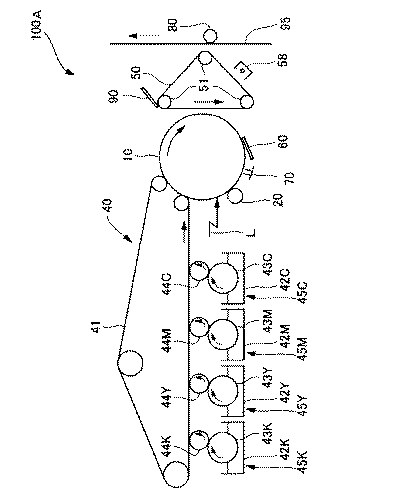
(製造例2−1)
<非晶質ポリエステル樹脂1の合成>
窒素導入管、脱水管、攪拌器及び熱電対を装備した5Lの四つ口フラスコに、ビスフェノールAエチレンオキサイドサイド2モル付加物499部、ビスフェノールAプロピレンオキサイド3モル付加物229部、イソフタル酸100部、テレフタル酸108部、アジピン酸46部、及びジブチルチンオキサイド2部を入れ、常圧で230℃で10時間反応し、さらに10mmHg〜15mmHgの減圧で5時間反応した後、反応容器に無水トリメリット酸30部を入れ、180℃、常圧で3時間反応し、非晶質ポリエステル樹脂1を得た。
非晶質ポリエステル樹脂1のSP値は11.30であった。
非晶質ポリエステル樹脂1は、重量平均分子量5,500、数平均分子量1,800、Tg50℃、酸価20mgKOH/gであった。(Production Example 2-1)
<Synthesis of Amorphous Polyester Resin 1>
Into a 5 L four-necked flask equipped with a nitrogen inlet tube, dehydration tube, stirrer and thermocouple, 499 parts of bisphenol A ethylene oxide side 2 mol adduct, 229 parts of bisphenol
The SP value of the amorphous polyester resin 1 was 11.30.
The amorphous polyester resin 1 had a weight average molecular weight of 5,500, a number average molecular weight of 1,800, a Tg of 50 ° C., and an acid value of 20 mg KOH / g.
(製造例2−2)
<非晶質ポリエステル樹脂2の合成>
窒素導入管、脱水管、攪拌器及び熱電対を装備した5Lの四つ口フラスコに、ビスフェノールAエチレンオキサイドサイド2モル付加物229部、ビスフェノールAプロピレンオキサイド3モル付加物529部、イソフタル酸70部、テレフタル酸98部、フマル酸46部、ドデセニルコハク酸24部、及びジブチルチンオキサイド2部を入れ、容器内に窒素ガスを導入して不活性雰囲気に保ち昇温した後、230℃で12時間共縮重合反応させ、その後、230℃で徐々に減圧して、非晶質ポリエステル樹脂2を得た。
非晶質ポリエステル樹脂2のSP値は10.82であった。
非晶質ポリエステル樹脂2は、重量平均分子量17,400、数平均分子量6,700、Tg61℃、酸価14mgKOH/gであった。(Production Example 2-2)
<Synthesis of Amorphous Polyester Resin 2>
In a 5-liter, four-necked flask equipped with a nitrogen introduction tube, a dehydration tube, a stirrer, and a thermocouple, 229 parts of 2 mol of bisphenol A ethylene oxide side, 529 parts of 3 mol adduct of bisphenol A propylene oxide, 70 parts of isophthalic acid Add 98 parts of terephthalic acid, 46 parts of fumaric acid, 24 parts of dodecenylsuccinic acid, and 2 parts of dibutyltin oxide, introduce nitrogen gas into the container and keep it in an inert atmosphere, then heat at 230 ° C for 12 hours. A polycondensation reaction was carried out, and then the pressure was gradually reduced at 230 ° C. to obtain an amorphous polyester resin 2.
The SP value of the amorphous polyester resin 2 was 10.82.
Amorphous polyester resin 2 had a weight average molecular weight of 17,400, a number average molecular weight of 6,700, a Tg of 61 ° C., and an acid value of 14 mgKOH / g.
非晶質ポリエステル樹脂の特性値を表2にまとめた。
(製造例3−1)
<非晶質ハイブリッド樹脂1の合成>
窒素導入管、脱水管、攪拌器及び熱電対を装備した5Lの四つ口フラスコに、2,3−ブタンジオール7.2g、1,2−プロパンジオール6.08g、テレフタル酸18.59g、及び2−エチルヘキサン酸錫(II)0.18gを入れ、容器内に窒素ガスを導入して不活性雰囲気に保ち昇温した後、180℃で1時間保温した後に180℃から230℃まで10℃/hrで昇温し、その後230℃で10時間縮重合反応させ、さらに230℃、8.0kPaにて1時間反応を行った。160℃まで冷却した後、アクリル酸0.6g、スチレン7.79g、2−エチルヘキシルアクリレート1.48g、及びジブチルパーオキサイドを滴下ロートにより1時間かけて滴下した。滴下後、160℃に保持したまま、1時間付加重合反応を熟成させた後、210℃に昇温した後、無水トリメリット酸4.61gを投入し、210℃にて2時間反応を行い、210℃、10kPaにて所望の軟化点に達するまで反応を行って、非晶質ハイブリッド樹脂1を得た。
非晶質ハイブリッド樹脂1のSP値は10.80であった。
非晶質ハイブリッド樹脂1は、重量平均分子量55,000、数平均分子量2,800、Tg55℃、酸価9.4mgKOH/gであった。(Production Example 3-1)
<Synthesis of Amorphous Hybrid Resin 1>
In a 5 L four-necked flask equipped with a nitrogen inlet tube, a dehydration tube, a stirrer and a thermocouple, 7.2 g of 2,3-butanediol, 6.08 g of 1,2-propanediol, 18.59 g of terephthalic acid, and After adding 0.18 g of tin (II) 2-ethylhexanoate and introducing nitrogen gas into the container to maintain the temperature in an inert atmosphere, the temperature was raised at 180 ° C. for 1 hour, and then from 180 ° C. to 230 ° C. to 10 ° C. The temperature was raised at / hr, and then a condensation polymerization reaction was carried out at 230 ° C. for 10 hours, followed by further reaction at 230 ° C. and 8.0 kPa for 1 hour. After cooling to 160 ° C., 0.6 g of acrylic acid, 7.79 g of styrene, 1.48 g of 2-ethylhexyl acrylate, and dibutyl peroxide were added dropwise over 1 hour with a dropping funnel. After the dropwise addition, the addition polymerization reaction was aged for 1 hour while maintaining the temperature at 160 ° C., and the temperature was raised to 210 ° C. Then, 4.61 g of trimellitic anhydride was added, and the reaction was performed at 210 ° C. for 2 hours. The reaction was carried out at 210 ° C. and 10 kPa until a desired softening point was reached, whereby an amorphous hybrid resin 1 was obtained.
The SP value of the amorphous hybrid resin 1 was 10.80.
The amorphous hybrid resin 1 had a weight average molecular weight of 55,000, a number average molecular weight of 2,800, a Tg of 55 ° C., and an acid value of 9.4 mg KOH / g.
(製造例3−2)
<非晶質ハイブリッド樹脂2の合成>
窒素導入管、脱水管、攪拌器及び熱電対を装備した5Lの四つ口フラスコに、2,3−ブタンジオール7.2g、1,2−プロパンジオール6.08g、テレフタル酸18.59g、及び2−エチルヘキサン酸錫(II)0.18gを入れ、容器内に窒素ガスを導入して不活性雰囲気に保ち昇温した後、180℃で1時間保温した後に180℃から230℃まで10℃/hrで昇温し、その後230℃で10時間縮重合反応させ、さらに230℃、8.0kPaにて1時間反応を行った。160℃まで冷却した後、アクリル酸1.0g、スチレン8.50g、2−エチルヘキシルアクリレート1.48g、及びジブチルパーオキサイドを滴下ロートにより1時間かけて滴下した。滴下後、160℃に保持したまま、1時間付加重合反応を熟成させた後、210℃に昇温した後、無水トリメリット酸4.61gを投入し、210℃にて2時間反応を行い、210℃、10kPaにて所望の軟化点に達するまで反応を行って、非晶質ハイブリッド樹脂2を得た。
非晶質ハイブリッド樹脂2のSP値は10.73であった。
非晶質ハイブリッド樹脂2は、重量平均分子量26,000、数平均分子量3,400、Tg61.6℃、酸価13.2mgKOH/gであった。(Production Example 3-2)
<Synthesis of Amorphous Hybrid Resin 2>
In a 5 L four-necked flask equipped with a nitrogen inlet tube, a dehydration tube, a stirrer and a thermocouple, 7.2 g of 2,3-butanediol, 6.08 g of 1,2-propanediol, 18.59 g of terephthalic acid, and After adding 0.18 g of tin (II) 2-ethylhexanoate and introducing nitrogen gas into the container to maintain the temperature in an inert atmosphere, the temperature was raised at 180 ° C. for 1 hour, and then from 180 ° C. to 230 ° C. to 10 ° C. The temperature was raised at / hr, and then a condensation polymerization reaction was carried out at 230 ° C. for 10 hours, followed by further reaction at 230 ° C. and 8.0 kPa for 1 hour. After cooling to 160 ° C., 1.0 g of acrylic acid, 8.50 g of styrene, 1.48 g of 2-ethylhexyl acrylate and dibutyl peroxide were added dropwise over 1 hour with a dropping funnel. After the addition, the addition polymerization reaction is aged for 1 hour while being maintained at 160 ° C., and then the temperature is raised to 210 ° C. Then, 4.61 g of trimellitic anhydride is added and the reaction is carried out at 210 ° C. for 2 hours. The reaction was carried out at 210 ° C. and 10 kPa until a desired softening point was reached, whereby an amorphous hybrid resin 2 was obtained.
The SP value of the amorphous hybrid resin 2 was 10.73.
The amorphous hybrid resin 2 had a weight average molecular weight of 26,000, a number average molecular weight of 3,400, a Tg of 61.6 ° C., and an acid value of 13.2 mg KOH / g.
(製造例3−3)
<非晶質ハイブリッド樹脂3の合成>
窒素導入管、脱水管、攪拌器及び熱電対を装備した5Lの四つ口フラスコに、2,3−ブタンジオール6.48g、1,2−プロパンジオール5.48g、テレフタル酸16.71g、及び2−エチルヘキサン酸錫(II)0.16gを入れ、容器内に窒素ガスを導入して不活性雰囲気に保ち昇温した後、180℃で1時間保温した後に180℃から230℃まで10℃/hrで昇温し、その後230℃で10時間縮重合反応させ、さらに230℃、8.0kPaにて1時間反応を行った。160℃まで冷却した後、2−エチルヘキシルアクリレート1.48g、及びジブチルパーオキサイドを滴下ロートにより1時間かけて滴下した。滴下後、160℃に保持したまま、1時間付加重合反応を熟成させた後、210℃に昇温した後、無水トリメリット酸5.01gを投入し、210℃にて2時間反応を行い、210℃、10kPaにて所望の軟化点に達するまで反応を行って、非晶質ハイブリッド樹脂3を得た。
非晶質ハイブリッド樹脂3のSP値は10.89であった。
非晶質ハイブリッド樹脂3は、重量平均分子量13,000、数平均分子量3,200、Tg55℃、酸価9.4mgKOH/gであった。(Production Example 3-3)
<Synthesis of
In a 5 L four-necked flask equipped with a nitrogen inlet tube, a dehydration tube, a stirrer and a thermocouple, 6.48 g of 2,3-butanediol, 5.48 g of 1,2-propanediol, 16.71 g of terephthalic acid, and After adding 0.16 g of tin (II) 2-ethylhexanoate, introducing nitrogen gas into the container and keeping the temperature in an inert atmosphere, the temperature was raised at 180 ° C. for 1 hour, and then from 180 ° C. to 230 ° C. to 10 ° C. The temperature was raised at / hr, and then a condensation polymerization reaction was carried out at 230 ° C. for 10 hours, followed by further reaction at 230 ° C. and 8.0 kPa for 1 hour. After cooling to 160 ° C., 1.48 g of 2-ethylhexyl acrylate and dibutyl peroxide were added dropwise over 1 hour with a dropping funnel. After the dropwise addition, the addition polymerization reaction was aged for 1 hour while maintaining the temperature at 160 ° C, and then the temperature was raised to 210 ° C. Then, 5.01 g of trimellitic anhydride was added, and the reaction was performed at 210 ° C for 2 hours. The reaction was carried out at 210 ° C. and 10 kPa until a desired softening point was reached, whereby an amorphous
The SP value of the amorphous
The amorphous
非晶質ハイブリッド樹脂の特性値を表3にまとめた。
(製造例4−1)
<ポリエステル樹脂A分散液1の調製>
金属製2L容器に、ポリエステル樹脂A1を100部、及び酢酸エチル200部を入れ、75℃で加熱溶解させた後、氷水浴中で27℃/分の速度で急冷した。これにガラスビーズ(3mmφ)500mLを加え、バッチ式サンドミル装置(カンペハピオ社製)で10時間粉砕を行い、結晶性ポリエステル樹脂A分散液1を得た。(Production Example 4-1)
Preparation of Polyester Resin A Dispersion 1
In a metal 2 L container, 100 parts of polyester resin A1 and 200 parts of ethyl acetate were put, heated and dissolved at 75 ° C., and then quenched in an ice water bath at a rate of 27 ° C./min. To this, 500 mL of glass beads (3 mmφ) was added, and the mixture was pulverized for 10 hours with a batch type sand mill (manufactured by Campe Hapio Co., Ltd.) to obtain a crystalline polyester resin A dispersion 1.
(製造例4−2)
<ポリエステル樹脂A分散液2の調製>
製造例4−1において、ポリエステル樹脂A1をポリエステル樹脂A2に代えた以外は、製造例4−1と同様にして、ポリエステル樹脂A分散液2を得た。(Production Example 4-2)
<Preparation of polyester resin A dispersion 2>
A polyester resin A dispersion 2 was obtained in the same manner as in Production Example 4-1 except that the polyester resin A1 was changed to the polyester resin A2 in Production Example 4-1.
(製造例4−3)
<ポリエステル樹脂A分散液3の調製>
製造例4−1において、ポリエステル樹脂A1をポリエステル樹脂A3に代えた以外は、製造例4−1と同様にして、ポリエステル樹脂A分散液3を得た。(Production Example 4-3)
Preparation of Polyester
In Production Example 4-1, polyester
(製造例4−4)
<ポリエステル樹脂A分散液4の調製>
製造例4−1において、ポリエステル樹脂A1をポリエステル樹脂A4に代えた以外は、製造例4−1と同様にして、ポリエステル樹脂A分散液4を得た。(Production Example 4-4)
Preparation of Polyester Resin A Dispersion 4
A polyester resin A dispersion 4 was obtained in the same manner as in Production Example 4-1 except that the polyester resin A1 was changed to the polyester resin A4 in Production Example 4-1.
(製造例4−5)
<ポリエステル樹脂A分散液5の調製>
製造例4−1において、ポリエステル樹脂A1をポリエステル樹脂A5に代えた以外は、製造例4−1と同様にして、ポリエステル樹脂A分散液5を得た。(Production Example 4-5)
<Preparation of polyester resin A dispersion 5>
In Production Example 4-1, a polyester resin A dispersion 5 was obtained in the same manner as in Production Example 4-1, except that the polyester resin A1 was replaced with the polyester resin A5.
(実施例1)
<トナー1の調製>
−油相の調製−
−−プレポリマーの合成−−
冷却管、撹拌機及び窒索導入管の付いた反応容器中に、ビスフェノールAエチレンオキサイド2モル付加物682部、ビスフェノールAプロピレンオキサイド2モル付加物81部、テレフタル酸283部、無水トリメリット酸22部、及びジブチルチンオキサイド2部を入れ、常圧で230℃で8時間反応し、さらに10mmHg〜15mmHgの減圧で5時間反応し[中間体ポリエステル1]を得た。[中間体ポリエステル1]は、数平均分子量2,100、重量平均分子量9,500、Tg55℃、酸価0.5mgKOH/g、水酸基価51mgKOH/gであった。
次に、冷却管、撹拌機及び窒素導入管の付いた反応容器中に、[中間体ポリエステル1]410部、イソホロンジイソシアネート89部、及び酢酸エチル500部を入れ100℃で5時間反応し[プレポリマー1]を得た。[プレポリマー1]の遊離イソシアネート質量%は、1.53%であった。Example 1
Preparation of Toner 1
-Preparation of oil phase-
--Synthesis of prepolymer--
In a reaction vessel equipped with a condenser, a stirrer and a nitrogen introduction pipe, 682 parts of 2 moles of bisphenol A ethylene oxide, 81 parts of 2 moles of bisphenol A propylene oxide, 283 parts of terephthalic acid,
Next, 410 parts of [Intermediate polyester 1], 89 parts of isophorone diisocyanate, and 500 parts of ethyl acetate are placed in a reaction vessel equipped with a condenser, a stirrer and a nitrogen introduction pipe, and reacted at 100 ° C. for 5 hours Polymer 1] was obtained. [Prepolymer 1] had a free isocyanate mass% of 1.53%.
−−ケチミンの合成−−
撹拌棒及び温度計をセットした反応容器に、イソホロンジアミン170部、及びメチルエチルケトン75部を仕込み、50℃で5時間反応を行い、[ケチミン化合物1]を得た。[ケチミン化合物1]のアミン価は418mgKOH/gであった。-Synthesis of ketimine-
170 parts of isophoronediamine and 75 parts of methyl ethyl ketone were charged into a reaction vessel equipped with a stirrer and a thermometer, and reacted at 50 ° C. for 5 hours to obtain [ketimine compound 1]. The amine value of [ketimine compound 1] was 418 mgKOH / g.
−−マスターバッチ(MB)の合成−−
水1,200部、カーボンブラック(Printex35デクサ製)〔DBP吸油量=42mL/100mg、pH=9.5〕540部、及び非晶質ポリエステル樹脂1 1,200部を加え、ヘンシェルミキサー(三井鉱山社製)で混合し、混合物を2本ロールを用いて150℃で30分混練後、圧延冷却しパルペライザーで粉砕し、[マスターバッチ1]を得た。--Synthesis of master batch (MB)-
Add 1,200 parts of water, carbon black (made by
−−顔料・WAX分散液の作製−−
撹拌棒及び温度計をセットした容器に、[非晶質ポリエステル樹脂1]378部、離型剤としてパラフィンワックス50部(日本精鑞社製、HNP−9、炭化水素系ワックス、融点75.0℃、SP値8.8)、CCA(サリチル酸金属錯体E−84:オリエント化学工業社製)22部、及び酢酸エチル947部を仕込み、撹拌下80℃に昇温し、80℃のまま5時間保持した後、1時間で30℃に冷却した。次いで容器に[マスターバッチ1]500部、及び酢酸エチル500部を仕込み、1時間混合し[原料溶解液1]を得た。
[原料溶解液1]1,324部を容器に移し、ビーズミル(ウルトラビスコミル、アイメックス社製)を用いて、送液速度1kg/hr、ディスク周速度6m/秒、0.5mmジルコニアビーズを80体積%充填、3パスの条件で、分散を行った。次いで、[非晶質ポリエステル樹脂1]の65%酢酸エチル溶液1,042.3部を加え、上記条件のビーズミルで1パスし、[顔料・WAX分散液1]を得た。[顔料・WAX分散液1]の固形分濃度(130℃、30分)は50%であった。-Preparation of pigment and wax dispersion-
378 parts of [amorphous polyester resin 1], 50 parts of paraffin wax as a mold release agent (NNP, manufactured by Nippon Seiyo Co., Ltd., HNP-9, hydrocarbon wax, melting point 75.0) in a container in which a stirrer and a thermometer are set C., SP value 8.8), 22 parts of CCA (salicylic acid metal complex E-84: manufactured by Orient Chemical Industries, Ltd.), and 947 parts of ethyl acetate are charged, heated to 80 ° C. with stirring, and kept at 80 ° C. for 5 hours After holding, it was cooled to 30 ° C. for 1 hour. Next, 500 parts of [Masterbatch 1] and 500 parts of ethyl acetate were charged in a container and mixed for 1 hour to obtain [Raw material solution 1].
[Raw material solution 1] Transfer 1,324 parts into a container, and use a bead mill (Ultravisco Mill, manufactured by Imex Co., Ltd.) to send a liquid at a transfer rate of 1 kg / hr and a disc peripheral speed of 6 m / sec. Dispersion was carried out under the conditions of volume% filling and 3 passes. Next, 1,042.3 parts of a 65% ethyl acetate solution of [amorphous polyester resin 1] was added, and one pass was conducted with a bead mill under the above conditions to obtain [pigment / WAX dispersion 1]. The solid content concentration of [Pigment / WAX Dispersion 1] (130 ° C., 30 minutes) was 50%.
[顔料・WAX分散液1]664部、[プレポリマー1]109.4部、[ポリエステル樹脂A分散液1]73.9部、[非晶質ハイブリッド樹脂1]73.9部、及び[ケチミン化合物1]4.6部を容器に入れ、TKホモミキサー(特殊機化製)で5,000rpmで1分間混合し、[油相1]を得た。 [Pigment · WAX Dispersion 1] 664 parts, [Prepolymer 1] 109.4 parts, [Polyester Resin A Dispersion 1] 73.9 parts, [Amorphous Hybrid Resin 1] 73.9 parts, and [Ketimine] Compound 1] 4.6 parts of the compound 1 was placed in a container and mixed with a TK homomixer (manufactured by Tokushu Kika Kogyo Co., Ltd.) at 5,000 rpm for 1 minute to obtain [Oil phase 1].
−有機微粒子エマルション(微粒子分散液)の合成−
撹拌棒及び温度計をセットした反応容器に、水683部、メタクリル酸エチレンオキサイド付加物硫酸エステルのナトリウム塩(エレミノールRS−30:三洋化成工業社製)11部、スチレン138部、メタクリル酸138部、及び過硫酸アンモニウム1部を仕込み、400回転/分で15分間撹拌したところ、白色の乳濁液が得られた。加熱して、系内温度75℃まで昇温し、5時間反応させた。さらに、1%過硫酸アンモニウム水溶液30部加え、75℃で5時間熟成してビニル系樹脂(スチレン−メタクリル酸−メタクリル酸エチレンオキサイド付加物硫酸エステルのナトリウム塩の共重合体)の水性分散液[微粒子分散液1]を得た。[微粒子分散液1]をLA−920(HORIBA社製)で測定した体積平均粒径は、0.14μmであった。[微粒子分散液1]の一部を乾燥して樹脂分を単離した。-Synthesis of organic fine particle emulsion (fine particle dispersion)-
In a reaction vessel equipped with a stir bar and a thermometer, 683 parts of water, 11 parts of a sodium salt of ethylene oxide methacrylate adduct sulfate (Eleminol RS-30: manufactured by Sanyo Chemical Industries), 138 parts of styrene, 138 parts of methacrylic acid And 1 part of ammonium persulfate were added and stirred at 400 rpm for 15 minutes to obtain a white emulsion. The system was heated to raise the system temperature to 75 ° C. and reacted for 5 hours. Further, 30 parts of a 1% aqueous ammonium persulfate solution is added, followed by aging at 75 ° C. for 5 hours to obtain an aqueous dispersion of vinyl resin (copolymer of sodium salt of styrene-methacrylic acid-methacrylic acid ethylene oxide adduct sulfate) [fine particles Dispersion 1] was obtained. The volume average particle diameter of [fine particle dispersion 1] measured by LA-920 (manufactured by HORIBA) was 0.14 μm. A portion of [Fine Particle Dispersion 1] was dried to isolate the resin component.
−水相の調製−
水990部、[微粒子分散液1]83部、ドデシルジフェニルエーテルジスルホン酸ナトリウムの48.5%水溶液(エレミノールMON−7:三洋化成工業社製)37部、及び酢酸エチル90部を混合撹拌し、乳白色の液体を得た。これを[水相1]とした。-Preparation of aqueous phase-
A mixture of 990 parts of water, 83 parts of [fine particle dispersion 1], 37 parts of a 48.5% aqueous solution of sodium dodecyl diphenyl ether disulfonate (ELEMINOL MON-7: Sanyo Chemical Industries, Ltd.) and 90 parts of ethyl acetate is mixed and stirred to obtain milky white color. Obtained liquid. This was designated as [Aqueous Phase 1].
−乳化・脱溶剤−
前記[油相1]が入った容器に、[水相1]1,200部を加え、TKホモミキサーで、回転数13,000rpmで20分間混合し[乳化スラリー1]を得た。
撹拌機および温度計をセットした容器に、[乳化スラリー1]を投入し、30℃で8時間脱溶剤した後、45℃で4時間熟成を行い、[分散スラリー1]を得た。-Emulsification / desolvation-
1,200 parts of [Aqueous Phase 1] was added to the container containing [Oil Phase 1], and mixed with a TK homomixer at 13,000 rpm for 20 minutes to obtain [Emulsion Slurry 1].
[Emulsion slurry 1] was put into a container equipped with a stirrer and a thermometer, and after removing the solvent at 30 ° C. for 8 hours, aging was carried out at 45 ° C. for 4 hours to obtain [Dispersion slurry 1].
−洗浄・乾燥−
[分散スラリー1]100部を減圧濾過した後、
(1):濾過ケーキにイオン交換水100部を加え、TKホモミキサーで混合(回転数12,000rpmで10分間)した後濾過した。
(2):(1)の濾過ケーキに10%水酸化ナトリウム水溶液100部を加え、TKホモミキサーで混合(回転数12,000rpmで30分間)した後、減圧濾過した。
(3):(2)の濾過ケーキに10%塩酸100部を加え、TKホモミキサーで混合(回転数12,000rpmで10分間)した後濾過した。
(4):(3)の濾過ケーキにイオン交換水300部を加え、TKホモミキサーで混合(回転数12,000rpmで10分間)した後濾過する、という前記(1)〜(5)の操作を2回行い[濾過ケーキ1]を得た。
[濾過ケーキ1]を循風乾燥機にて45℃で48時間乾燥し、目開き75μmメッシュで篩い[トナー1]を得た。-Washing and drying-
After filtration under reduced pressure of 100 parts of [Dispersion slurry 1],
(1): 100 parts of ion-exchanged water was added to the filter cake, mixed with a TK homomixer (10 minutes at 12,000 rpm), and then filtered.
(2): 100 parts of 10% aqueous sodium hydroxide solution was added to the filter cake of (1), mixed with a TK homomixer (rotation speed 12,000 rpm for 30 minutes), and then filtered under reduced pressure.
(3): 100 parts of 10% hydrochloric acid was added to the filter cake of (2), mixed with a TK homomixer (rotation speed: 12,000 rpm for 10 minutes), and then filtered.
(4): 300 parts of ion-exchanged water is added to the filter cake of (3), followed by filtration after being mixed (rotational speed of 12,000 rpm for 10 minutes) with a TK homomixer. Was carried out twice to obtain [Filtered cake 1].
[Filtration cake 1] was dried at 45 ° C. for 48 hours in a circulating drier, and sieved with an opening of 75 μm mesh to obtain [Toner 1].
<評価>
得られたトナーについて以下の方法により現像剤を作製し、以下の評価を行った。結果を表6に示す。
<<現像液の作製>>
−キャリアの作製−
トルエン100部に、シリコーン樹脂オルガノストレートシリコーン100部、γ−(2−アミノエチル)アミノプロピルトリメトキシシラン5部、及びカーボンブラック10部を添加し、ホモミキサーで20分間分散させて、樹脂層塗布液を調製した。流動床型コーティング装置を用いて、平均粒径50μmの球状マグネタイト1,000部の表面に樹脂層塗布液を塗布して、キャリアを作製した。
−現像剤の作製−
ボールミルを用いて、前記トナー1 5部と前記キャリア95部とを混合し、現像剤を作製した。<Evaluation>
A developer was prepared for the obtained toner by the following method, and the following evaluation was performed. The results are shown in Table 6.
<< Preparation of Developer >>
-Production of carrier-
To 100 parts of toluene, add 100 parts of silicone resin organo straight silicone, 5 parts of γ- (2-aminoethyl) aminopropyltrimethoxysilane, and 10 parts of carbon black, and disperse for 20 minutes with a homomixer, and apply resin layer The solution was prepared. The resin layer coating solution was applied to the surface of 1,000 parts of spherical magnetite having an average particle diameter of 50 μm using a fluidized bed type coating apparatus to prepare a carrier.
-Preparation of developer-
Using a ball mill, 5 parts of the
<<低温定着性、及び耐高温オフセット性>>
定着ローラとして、テフロン(登録商標)ローラを使用した複写機MF2200(株式会社リコー製)の定着部を改造した装置を用いて、タイプ6200紙(株式会社リコー社製)に複写テストを行った。
具体的には、定着温度を変化させてコールドオフセット温度(定着下限温度)及び高温オフセット温度(定着上限温度)を求めた。
定着下限温度の評価条件は、紙送りの線速度を120mm/秒〜150mm/秒、面圧を1.2kgf/cm2、ニップ幅を3mmとした。
また、定着上限温度の評価条件は、紙送りの線速度を50mm/秒、面圧を2.0kgf/cm2、ニップ幅を4.5mmとした。<< Low-temperature fixability and high-temperature offset resistance >>
A copying test was performed on type 6200 paper (manufactured by Ricoh Co., Ltd.) using an apparatus in which a fixing unit of a copying machine MF2200 (manufactured by Ricoh Co., Ltd.) using a Teflon (registered trademark) roller as a fixing roller was modified.
Specifically, the fixing temperature was changed to obtain a cold offset temperature (fixing lower limit temperature) and a high temperature offset temperature (fixing upper limit temperature).
The evaluation conditions for the lower limit temperature of fixing were 120 mm / sec to 150 mm / sec for the paper feeding linear velocity, 1.2 kgf / cm 2 for the surface pressure, and 3 mm for the nip width.
The evaluation conditions for the upper limit fixing temperature were 50 mm / sec for the linear speed of paper feeding, 2.0 kgf / cm 2 for the surface pressure, and 4.5 mm for the nip width.
<<耐熱保存性>>
50mLのガラス容器にトナー10gを充填し、トナー粉体の見掛け密度の変化が無くなるまで十分にタッピングし、容器に蓋をし、50℃の恒温槽に24時間放置した後、24℃に冷却し、針入度試験(JIS K2235−1991)により、針入度(mm)を測定し、下記基準で耐熱保存性を評価した。なお、針入度が大きい程、耐熱保存性が優れていることを意味し、針入度が15mm未満であるものは、使用上、問題が発生する可能性が高い。
〔評価基準〕
◎:針入度が25mm以上
○:針入度が20mm以上25mm未満
△:針入度が15mm以上20mm未満
×:針入度が15mm未満<< Heat resistant storage stability >>
Fill a 50 mL glass container with 10 g of toner, tapping well until there is no change in the apparent density of the toner powder, cover the container, leave it in a constant temperature bath at 50 ° C. for 24 hours, then cool to 24 ° C. The penetration degree (mm) was measured by a penetration degree test (JIS K2235-1991), and the heat resistant storage stability was evaluated based on the following criteria. The larger the penetration, the better the heat resistant storage stability, and the one having a penetration of less than 15 mm is likely to cause problems in use.
〔Evaluation criteria〕
:: Penetration is 25 mm or more ○: Penetration is 20 mm or more and less than 25 mm Δ: Penetration is 15 mm or more and less than 20 mm ×: Penetration is less than 15 mm
<<フィルミング>>
画像形成装置MF2800(株式会社リコー製)を用いて、10,000枚画像を形成させた後の感光体を目視で検査し、トナー成分、主に離型剤の感光体への固着が生じていないかを下記評価基準により評価した。
〔評価基準〕
◎:感光体へのトナー成分の固着が確認されない
○:感光体へのトナー成分の固着が確認できるが、実用上、問題になるレベルではない
△:感光体へのトナー成分の固着が確認でき、実用上問題の出るレベルである
×:感光体へのトナー成分の固着が確認でき、実用上大きく問題のあるレベルである<< Filming >>
The photoreceptor after forming an image of 10,000 sheets is visually inspected using an image forming apparatus MF2800 (manufactured by Ricoh Co., Ltd.), and adhesion of a toner component, mainly a release agent, to the photoreceptor occurs. It was evaluated according to the following evaluation criteria.
〔Evaluation criteria〕
A: Fixation of toner component to photoreceptor is not confirmed ○: Fixation of toner component to photoreceptor can be confirmed, but it is not a level that causes problems in practical use Δ: Fixation of toner component to photoreceptor can be confirmed , Is a level that causes a problem in practical use.
<<耐ストレス性>>
トナー0.25gをキャリア4.75gを底面直径25mm、高さ30mmのステンレス容器に入れ、円周方向に300rpmの回転を20分間与え、トナーとキャリアとを攪拌し、接触させた。ここで、キャリアとしては、平均粒径35μmのフェライト粒子(株式会社リコー製)を用いた。
この攪拌させたトナーを帯電量測定装置TB−200(株式会社東芝製)によりブローオフ法で単位面積当たりの帯電量(Q/S)を測定した。
具体的には、上記帯電量測定装置の400メッシュのステンレス製スクリーンを装着した試料部に測定サンプルを装填し、常温常湿環境(20℃、55%RH)で、ブロー圧50kPa(0.5kgf/cm2)の窒素ガスを10秒間ブローして電荷を測定した。
〔評価基準〕
◎:帯電量の絶対値が200μC/m2以上250μC/m2未満
○:帯電量の絶対値が150μC/m2以上200μC/m2未満
△:帯電量の絶対値が100μC/m2以上150μC/m2未満
×:帯電量の絶対値が100μC/m2未満<< Stress resistance >>
In a stainless steel container having a diameter of 25 mm and a height of 30 mm, 4.75 g of the carrier was charged with 0.25 g of the toner, and rotation of 300 rpm was applied for 20 minutes in the circumferential direction to stir and contact the toner and the carrier. Here, as the carrier, ferrite particles (manufactured by Ricoh Co., Ltd.) having an average particle diameter of 35 μm were used.
The amount of charge per unit area (Q / S) of this stirred toner was measured by a blow-off method using a charge amount measuring apparatus TB-200 (manufactured by Toshiba Corporation).
Specifically, a measurement sample is loaded in a sample part equipped with a 400 mesh stainless steel screen of the above-described charge amount measuring apparatus, and a blow pressure of 50 kPa (0.5 kgf) in a normal temperature and normal humidity environment (20.degree. C., 55% RH). The charge was measured by blowing nitrogen gas of 10 cm / cm 2 ) for 10 seconds.
〔Evaluation criteria〕
◎: less than the absolute value of charging amount 200μC / m 2 or more 250μC / m 2 ○: the absolute value of charging amount 150μC / m 2 or more 200μC / m less than 2 △: the absolute value of the
(実施例2)
<トナーの調製>
実施例1において、[ポリエステル樹脂A分散液1]を[ポリエステル樹脂A分散液2]に代えた以外は、実施例1と同様にして、トナーを得た。
得られたトナー中の各成分のSP値の関係を表5に示す。
得られたトナーについて実施例1と同様の評価を行った。結果を表6に示す。(Example 2)
<Preparation of toner>
A toner was obtained in the same manner as in Example 1 except that [Polyester resin A dispersion 1] was replaced with [polyester resin A dispersion 2].
The relationship of the SP value of each component in the obtained toner is shown in Table 5.
The same evaluation as in Example 1 was performed on the obtained toner. The results are shown in Table 6.
(実施例3)
<トナーの調製>
実施例1において、[非晶質ハイブリッド樹脂1]を[非晶質ハイブリッド樹脂2]に代えた以外は、実施例1と同様にして、トナーを得た。
得られたトナー中の各成分のSP値の関係を表5に示す。
得られたトナーについて実施例1と同様の評価を行った。結果を表6に示す。(Example 3)
<Preparation of toner>
A toner was obtained in the same manner as in Example 1 except that [amorphous hybrid resin 1] was changed to [amorphous hybrid resin 2] in Example 1.
The relationship of the SP value of each component in the obtained toner is shown in Table 5.
The same evaluation as in Example 1 was performed on the obtained toner. The results are shown in Table 6.
(実施例4)
<トナーの調製>
実施例2において、[非晶質ハイブリッド樹脂1]を[非晶質ハイブリッド樹脂2]に代えた以外は、実施例2と同様にして、トナーを得た。
得られたトナー中の各成分のSP値の関係を表5に示す。
得られたトナーについて実施例1と同様の評価を行った。結果を表6に示す。(Example 4)
<Preparation of toner>
A toner was obtained in the same manner as in Example 2 except that [amorphous hybrid resin 1] was changed to [amorphous hybrid resin 2] in Example 2.
The relationship of the SP value of each component in the obtained toner is shown in Table 5.
The same evaluation as in Example 1 was performed on the obtained toner. The results are shown in Table 6.
(実施例5)
<トナーの調製>
実施例3において、[非晶質ポリエステル樹脂1]を[非晶質ポリエステル樹脂2]に代えた以外は、実施例3と同様にして、トナーを得た。
得られたトナー中の各成分のSP値の関係を表5に示す。
得られたトナーについて実施例1と同様の評価を行った。結果を表6に示す。(Example 5)
<Preparation of toner>
A toner was obtained in the same manner as in Example 3 except that [amorphous polyester resin 1] was changed to [amorphous polyester resin 2] in Example 3.
The relationship of the SP value of each component in the obtained toner is shown in Table 5.
The same evaluation as in Example 1 was performed on the obtained toner. The results are shown in Table 6.
(実施例6)
<トナーの調製>
実施例4において、[非晶質ポリエステル樹脂1]を[非晶質ポリエステル樹脂2]に代えた以外は、実施例4と同様にして、トナーを得た。
得られたトナー中の各成分のSP値の関係を表5に示す。
得られたトナーについて実施例1と同様の評価を行った。結果を表6に示す。(Example 6)
<Preparation of toner>
A toner was obtained in the same manner as in Example 4 except that [amorphous polyester resin 1] was changed to [amorphous polyester resin 2] in Example 4.
The relationship of the SP value of each component in the obtained toner is shown in Table 5.
The same evaluation as in Example 1 was performed on the obtained toner. The results are shown in Table 6.
(実施例7)
<トナーの調製>
実施例6において、[ポリエステル樹脂A分散液2]を[ポリエステル樹脂A分散液4]に代えた以外は、実施例6と同様にして、トナーを得た。
得られたトナー中の各成分のSP値の関係を表5に示す。
得られたトナーについて実施例1と同様の評価を行った。結果を表6に示す。(Example 7)
<Preparation of toner>
A toner was obtained in the same manner as in Example 6, except that [Polyester resin A dispersion 2] was replaced with [polyester resin A dispersion 4].
The relationship of the SP value of each component in the obtained toner is shown in Table 5.
The same evaluation as in Example 1 was performed on the obtained toner. The results are shown in Table 6.
(実施例8)
<トナーの調製>
実施例6において、[ポリエステル樹脂A分散液2]を[ポリエステル樹脂A分散液5]に代えた以外は、実施例6と同様にして、トナーを得た。
得られたトナー中の各成分のSP値の関係を表5に示す。
得られたトナーについて実施例1と同様の評価を行った。結果を表6に示す。(Example 8)
<Preparation of toner>
A toner was obtained in the same manner as in Example 6, except that [Polyester resin A dispersion 2] was replaced with [polyester resin A dispersion 5].
The relationship of the SP value of each component in the obtained toner is shown in Table 5.
The same evaluation as in Example 1 was performed on the obtained toner. The results are shown in Table 6.
(比較例1)
<トナーの調製>
実施例5において、[非晶質ハイブリッド樹脂2]を[非晶質ハイブリッド樹脂3]に代えた以外は、実施例5と同様にして、トナーを得た。
得られたトナー中の各成分のSP値の関係を表5に示す。
得られたトナーについて実施例1と同様の評価を行った。結果を表6に示す。(Comparative example 1)
<Preparation of toner>
A toner was obtained in the same manner as in Example 5 except that [amorphous hybrid resin 2] was changed to [amorphous hybrid resin 3] in Example 5.
The relationship of the SP value of each component in the obtained toner is shown in Table 5.
The same evaluation as in Example 1 was performed on the obtained toner. The results are shown in Table 6.
(比較例2)
<トナーの調製>
比較例1において、[非晶質ハイブリッド樹脂3]を用いず、比較例1と同様の手法で、トナーを得た。
得られたトナー中の各成分のSP値の関係を表5に示す。
得られたトナーについて実施例1と同様の評価を行った。結果を表6に示す。(Comparative example 2)
<Preparation of toner>
In Comparative Example 1, a toner was obtained in the same manner as in Comparative Example 1 without using [Amorphous Hybrid Resin 3].
The relationship of the SP value of each component in the obtained toner is shown in Table 5.
The same evaluation as in Example 1 was performed on the obtained toner. The results are shown in Table 6.
(比較例3)
<トナーの調製>
実施例5において、[ポリエステル樹脂A分散液1]を[ポリエステル樹脂A分散液3]に代えた以外は、実施例5と同様にして、トナーを得た。
得られたトナー中の各成分のSP値の関係を表5に示す。
得られたトナーについて実施例1と同様の評価を行った。結果を表6に示す。(Comparative example 3)
<Preparation of toner>
A toner was obtained in the same manner as in Example 5 except that [Polyester resin A dispersion 1] was replaced with [polyester resin A dispersion 3] in Example 5.
The relationship of the SP value of each component in the obtained toner is shown in Table 5.
The same evaluation as in Example 1 was performed on the obtained toner. The results are shown in Table 6.
作製したトナーの種類一覧を表4に示す。 Table 4 shows a list of types of toners produced.
上記の通り、実施例1から8では、低温定着性、耐高温オフセット性、耐熱保存性、耐ストレス性、及びフィルミングの全てに優れたトナーが得られた。また、ポリエステル樹脂、非晶質ポリエステル樹脂、及び非晶質ポリエステル樹脂のSP値を調整することで、耐熱保存性、耐ストレス性、フィルミングが向上したトナーが得られた。
比較例1では、式(1)を満たしておらず、前記非晶質ハイブリッド樹脂として、スチレン系樹脂を含まないため、前記非晶質ポリエステル樹脂のポリエステル樹脂に対する分散効果が十分でなく、フィルミング、及び耐ストレス性が大きく悪化したと推測される。
比較例2では、非晶質ハイブリッド樹脂を含まないため、耐ストレス性が大きく悪化した。
比較例3では、ポリエステル樹脂に、カルボン酸成分としてセバシン酸を含まないため、耐熱保存性、及び耐ストレス性が大きく悪化した。
As described above, in Examples 1 to 8, toners excellent in all of the low temperature fixability, the high temperature offset resistance, the heat resistant storage stability, the stress resistance, and the filming were obtained. Further, by adjusting the SP values of the polyester resin, the amorphous polyester resin, and the amorphous polyester resin, a toner having improved heat resistance storage stability, stress resistance, and filming was obtained.
In Comparative Example 1, since the formula (1) is not satisfied and the styrenic resin is not included as the amorphous hybrid resin, the dispersion effect of the amorphous polyester resin on the polyester resin is not sufficient. And stress resistance is estimated to be greatly deteriorated.
In Comparative Example 2, since the amorphous hybrid resin was not contained, the stress resistance was greatly deteriorated.
In Comparative Example 3, since the polyester resin does not contain sebacic acid as a carboxylic acid component, the heat resistant storage stability and the stress resistance are greatly deteriorated.
Claims (8)
前記結晶性ポリエステル樹脂は、前記飽和脂肪族ジカルボン酸に由来する構成単位としてセバシン酸に由来する構成単位を含み、
前記非晶質ハイブリッド樹脂が、ポリエステル系樹脂ユニットとスチレン系樹脂ユニットとを含む複合樹脂であり、
前記ポリエステル系樹脂ユニットが2,3−ブタンジオールに由来する構成単位を含有することを特徴とするトナー。 Contains crystalline polyester resin, amorphous hybrid resin, amorphous polyester resin, release agent, and colorant having structural units derived from saturated aliphatic dicarboxylic acid and structural units derived from saturated aliphatic diol Toner,
The crystalline polyester resin contains a structural unit derived from sebacic acid as a structural unit derived from the saturated aliphatic dicarboxylic acid,
The amorphous hybrid resin, Ri composite resin der containing a polyester resin unit and a styrene resin unit,
The toner, wherein the polyester resin unit contains a structural unit derived from 2,3-butanediol .
式(1) SP1<SP3<SP2
式(2) 0.4<SP2−SP1<1.1
式(3) 0.1<SP3−SP1<1.0 When the SP value of the crystalline polyester resin is SP1, the SP value of the amorphous polyester resin is SP2, and the SP value of the amorphous hybrid resin is SP3, the SP1 to SP3 are expressed by the following formula (1 The toner according to claim 1, wherein the toner satisfies the relationship of Formula (3).
Formula (1) SP1 <SP3 <SP2
Formula (2) 0.4 <SP2-SP1 <1.1
Formula (3) 0.1 <SP3-SP1 <1.0
前記静電潜像担持体上に静電潜像を形成する静電潜像形成手段と、
前記静電潜像担持体に形成された前記静電潜像を現像して可視像を形成する、トナーを備える現像手段と、を有し、
前記トナーが、請求項1〜4のいずれかに記載のトナーであることを特徴とする画像形成装置。 An electrostatic latent image carrier;
An electrostatic latent image forming means for forming an electrostatic latent image on the electrostatic latent image carrier;
Developing means provided with toner, which develops the electrostatic latent image formed on the electrostatic latent image carrier to form a visible image;
The image forming apparatus according to claim 1, wherein the toner is the toner according to claim 1.
前記静電潜像担持体上に形成された前記静電潜像を、トナーを用いて現像してトナー像を形成する現像工程と、を含み、
前記トナーが、請求項1〜4のいずれかに記載のトナーであることを特徴とする画像形成方法。 An electrostatic latent image forming step of forming an electrostatic latent image on the electrostatic latent image carrier;
Developing the electrostatic latent image formed on the electrostatic latent image carrier with toner to form a toner image;
The image forming method, wherein the toner is the toner according to any one of claims 1 to 4.
Applications Claiming Priority (3)
| Application Number | Priority Date | Filing Date | Title |
|---|---|---|---|
| JP2016007050 | 2016-01-18 | ||
| JP2016007050 | 2016-01-18 | ||
| PCT/JP2017/001591 WO2017126564A1 (en) | 2016-01-18 | 2017-01-18 | Toner, developer, and image formation device |
Publications (2)
| Publication Number | Publication Date |
|---|---|
| JPWO2017126564A1 JPWO2017126564A1 (en) | 2018-11-22 |
| JP6551544B2 true JP6551544B2 (en) | 2019-07-31 |
Family
ID=59362411
Family Applications (1)
| Application Number | Title | Priority Date | Filing Date |
|---|---|---|---|
| JP2017562860A Active JP6551544B2 (en) | 2016-01-18 | 2017-01-18 | Toner, developer, and image forming apparatus |
Country Status (5)
| Country | Link |
|---|---|
| US (1) | US10670980B2 (en) |
| EP (1) | EP3407138B1 (en) |
| JP (1) | JP6551544B2 (en) |
| CN (1) | CN108475029B (en) |
| WO (1) | WO2017126564A1 (en) |
Cited By (1)
| Publication number | Priority date | Publication date | Assignee | Title |
|---|---|---|---|---|
| US12416872B2 (en) | 2020-11-04 | 2025-09-16 | Ricoh Company, Ltd. | Toner, developing agent, toner stored unit, and image forming apparatus |
Families Citing this family (7)
| Publication number | Priority date | Publication date | Assignee | Title |
|---|---|---|---|---|
| JP2020148893A (en) | 2019-03-13 | 2020-09-17 | 株式会社リコー | Image forming device and image forming method |
| JP7249829B2 (en) * | 2019-03-18 | 2023-03-31 | 花王株式会社 | Method for producing toner for electrostatic charge image development |
| JP2020154083A (en) | 2019-03-19 | 2020-09-24 | 株式会社リコー | Image forming device, image forming method and process cartridge |
| JP7388161B2 (en) | 2019-12-06 | 2023-11-29 | 株式会社リコー | Image forming apparatus and image forming method |
| JP7662471B2 (en) * | 2021-09-17 | 2025-04-15 | シャープ株式会社 | Toner and two-component developer containing the same |
| JP7782176B2 (en) * | 2021-09-21 | 2025-12-09 | 富士フイルムビジネスイノベーション株式会社 | Toner for developing electrostatic images, electrostatic image developer, toner cartridge, process cartridge, image forming apparatus, and image forming method |
| EP4198633A1 (en) * | 2021-12-14 | 2023-06-21 | Ricoh Company, Ltd. | Glittering toner, toner-storing unit, developer, developer-storing unit, image forming apparatus, and image forming method |
Family Cites Families (85)
| Publication number | Priority date | Publication date | Assignee | Title |
|---|---|---|---|---|
| JPS5937667B2 (en) | 1979-04-04 | 1984-09-11 | 三菱電機株式会社 | voltage converter |
| JP2579150Y2 (en) | 1993-01-11 | 1998-08-20 | 株式会社小松製作所 | Screw conveyor moving device of shield machine |
| JP3762075B2 (en) | 1997-10-31 | 2006-03-29 | 三洋化成工業株式会社 | Dry toner |
| JP4011246B2 (en) | 1999-12-02 | 2007-11-21 | 花王株式会社 | Method for producing polyester polymer |
| JP4101542B2 (en) | 2001-03-23 | 2008-06-18 | 株式会社リコー | Image forming method |
| JP2002287400A (en) | 2001-03-27 | 2002-10-03 | Ricoh Co Ltd | Dry toner, method of manufacturing the toner, and image forming apparatus using the toner |
| JP4079255B2 (en) | 2001-09-28 | 2008-04-23 | 花王株式会社 | toner |
| US6773857B2 (en) * | 2001-10-09 | 2004-08-10 | Fuji Xerox Co., Ltd. | Electrophotographic photoreceptor, processes for producing the same, process cartridge, and electrophotographic apparatus |
| JP4175505B2 (en) | 2002-05-24 | 2008-11-05 | 株式会社リコー | Color toner for electrostatic image development |
| JP2006030685A (en) * | 2004-07-16 | 2006-02-02 | Ricoh Co Ltd | Oilless color toner image forming apparatus and forming method |
| JP2007093809A (en) * | 2005-09-27 | 2007-04-12 | Fuji Xerox Co Ltd | Electrostatic charge image developing toner and method for manufacturing electrostatic charge image developing toner |
| JP2007271789A (en) | 2006-03-30 | 2007-10-18 | Sanyo Chem Ind Ltd | Toner binder and toner |
| JP2008116580A (en) * | 2006-11-01 | 2008-05-22 | Ricoh Co Ltd | Image forming toner, toner supply method and process cartridge |
| JP5233179B2 (en) * | 2007-06-19 | 2013-07-10 | 株式会社リコー | Image fixing method, image forming method, and image forming apparatus |
| JP5366238B2 (en) | 2008-10-29 | 2013-12-11 | 花王株式会社 | Toner for electrophotography |
| JP2011237663A (en) | 2010-05-12 | 2011-11-24 | Ricoh Co Ltd | Toner, developer and image forming method |
| JP5533454B2 (en) * | 2010-08-31 | 2014-06-25 | 株式会社リコー | Toner and developer |
| JP5522540B2 (en) | 2010-09-15 | 2014-06-18 | 株式会社リコー | Toner, developer, developer container, process cartridge, image forming apparatus, and image forming method |
| JP5594591B2 (en) | 2010-09-30 | 2014-09-24 | 株式会社リコー | Toner for electrophotography, developer using the toner, image forming apparatus, image forming method, process cartridge |
| JP2012108462A (en) | 2010-10-28 | 2012-06-07 | Ricoh Co Ltd | Toner and developer |
| JP5765132B2 (en) | 2010-12-06 | 2015-08-19 | 株式会社リコー | Toner for developing electrostatic image, developer using the toner, image forming apparatus, and process cartridge |
| JP5563971B2 (en) | 2010-12-14 | 2014-07-30 | 花王株式会社 | Toner for electrostatic image development |
| JP5658064B2 (en) | 2011-03-15 | 2015-01-21 | 花王株式会社 | Binder resin for toner |
| JP2013080200A (en) | 2011-05-02 | 2013-05-02 | Ricoh Co Ltd | Electrophotographic toner, developer, and image forming apparatus |
| IN2014CN02351A (en) | 2011-09-13 | 2015-06-19 | Ricoh Co Ltd | |
| US8685604B2 (en) | 2011-09-13 | 2014-04-01 | Ricoh Company, Ltd. | Toner, developer, and image forming apparatus |
| JP5769016B2 (en) | 2011-09-22 | 2015-08-26 | 株式会社リコー | Toner for electrophotography, developer using the toner, image forming apparatus, and process cartridge |
| US20130095422A1 (en) | 2011-10-17 | 2013-04-18 | Atsushi Yamamoto | Toner |
| JP5709065B2 (en) | 2011-10-17 | 2015-04-30 | 株式会社リコー | Toner, developer using the toner, and image forming apparatus |
| JP5850314B2 (en) | 2011-10-26 | 2016-02-03 | 株式会社リコー | Toner, developer using the toner, and image forming apparatus |
| JP5850316B2 (en) | 2011-11-09 | 2016-02-03 | 株式会社リコー | Dry electrostatic image developing toner and image forming apparatus |
| JP5240394B1 (en) | 2011-12-01 | 2013-07-17 | 株式会社リコー | Toner for electrophotography, developer, image forming method, process cartridge, image forming apparatus, toner container |
| JP2013140333A (en) | 2011-12-07 | 2013-07-18 | Ricoh Co Ltd | Toner, developer and image forming apparatus |
| JP6066447B2 (en) | 2011-12-14 | 2017-01-25 | 株式会社リコー | Toner and image forming method using the same |
| JP2013148862A (en) | 2011-12-20 | 2013-08-01 | Ricoh Co Ltd | Toner, developer and image forming apparatus |
| JP5948854B2 (en) | 2011-12-20 | 2016-07-06 | 株式会社リコー | Electrophotographic developer, image forming apparatus, and process cartridge |
| US8735040B2 (en) | 2011-12-28 | 2014-05-27 | Ricoh Company, Ltd. | Toner, developer, and image forming apparatus |
| JP5929267B2 (en) | 2012-02-03 | 2016-06-01 | 株式会社リコー | Toner, developer, image forming apparatus, and block copolymer |
| JP5896137B2 (en) | 2012-03-07 | 2016-03-30 | 株式会社リコー | Toner production method |
| JP6056483B2 (en) | 2012-03-13 | 2017-01-11 | 株式会社リコー | Developer and image forming apparatus |
| JP5957988B2 (en) | 2012-03-14 | 2016-07-27 | 株式会社リコー | Toner for developing electrostatic image, developer, developer container, image forming method, process cartridge |
| JP2013218288A (en) | 2012-03-15 | 2013-10-24 | Ricoh Co Ltd | Toner for electrostatic charge image development, developer using the same, and image forming apparatus |
| JP6020099B2 (en) | 2012-03-15 | 2016-11-02 | 株式会社リコー | Colorless transparent toner, toner set, developer, image forming apparatus and image formed product |
| JP2013195486A (en) | 2012-03-16 | 2013-09-30 | Ricoh Co Ltd | Toner and developer |
| JP5900072B2 (en) | 2012-03-21 | 2016-04-06 | 株式会社リコー | Electrophotographic toner, developer, image forming apparatus, and electrophotographic toner manufacturing method |
| JP6236797B2 (en) | 2012-03-28 | 2017-11-29 | 株式会社リコー | Toner manufacturing method, developer manufacturing method, and image forming method |
| JP6174915B2 (en) * | 2012-06-07 | 2017-08-02 | 花王株式会社 | Toner for electrophotography |
| JP6011051B2 (en) | 2012-06-18 | 2016-10-19 | 株式会社リコー | Toner, developer, and image forming apparatus |
| JP2014194514A (en) | 2012-06-27 | 2014-10-09 | Ricoh Co Ltd | Resin composition for toner, toner, developer, and image forming apparatus |
| JP6098243B2 (en) | 2012-07-23 | 2017-03-22 | 株式会社リコー | Toner and method for producing the toner |
| US9176406B2 (en) | 2012-08-17 | 2015-11-03 | Ricoh Company, Ltd. | Toner, development agent, image forming apparatus, and process cartridge |
| JP6060692B2 (en) | 2012-08-31 | 2017-01-18 | 株式会社リコー | Toner, developer, and image forming apparatus |
| JP2014052571A (en) | 2012-09-10 | 2014-03-20 | Ricoh Co Ltd | Toner, image forming apparatus, image forming method, process cartridge, and developer |
| JP5482951B2 (en) | 2012-09-18 | 2014-05-07 | 株式会社リコー | Toner for electrostatic image formation, developer, process cartridge, image forming apparatus |
| JP2014077973A (en) | 2012-09-18 | 2014-05-01 | Ricoh Co Ltd | Toner, developer, and image forming apparatus |
| JP6123451B2 (en) | 2012-09-18 | 2017-05-10 | 株式会社リコー | Electrostatic image forming toner, developer, and image forming apparatus |
| JP6079145B2 (en) | 2012-11-01 | 2017-02-15 | 株式会社リコー | Toner, developer, image forming apparatus, and process cartridge |
| JP6075102B2 (en) | 2013-02-13 | 2017-02-08 | 株式会社リコー | Toner, developer, and image forming apparatus |
| JP2014174527A (en) | 2013-03-13 | 2014-09-22 | Ricoh Co Ltd | Magenta toner, developer, toner cartridge, image forming apparatus, and printing |
| JP6079325B2 (en) | 2013-03-14 | 2017-02-15 | 株式会社リコー | toner |
| JP6375625B2 (en) | 2013-03-15 | 2018-08-22 | 株式会社リコー | Image forming apparatus |
| JP2014178648A (en) | 2013-03-15 | 2014-09-25 | Ricoh Co Ltd | Toner, developer, and image forming apparatus |
| JP6323015B2 (en) | 2013-03-15 | 2018-05-16 | 株式会社リコー | Toner for electrostatic image development |
| JP2014224843A (en) | 2013-05-15 | 2014-12-04 | 株式会社リコー | Toner for electrostatic charge image development |
| JP2014235400A (en) | 2013-06-05 | 2014-12-15 | 株式会社リコー | Image forming apparatus and image forming method |
| US9261804B2 (en) | 2013-08-01 | 2016-02-16 | Canon Kabushiki Kaisha | Toner |
| US10156801B2 (en) | 2013-09-06 | 2018-12-18 | Ricoh Company, Ltd. | Toner |
| JP6273726B2 (en) | 2013-09-06 | 2018-02-07 | 株式会社リコー | Toner, developer, and image forming apparatus |
| JP5884797B2 (en) | 2013-09-06 | 2016-03-15 | 株式会社リコー | Toner, developer, and image forming apparatus |
| JP6264799B2 (en) | 2013-09-13 | 2018-01-24 | 株式会社リコー | Resin for toner, toner, developer, image forming apparatus, process cartridge |
| JP6223102B2 (en) * | 2013-10-03 | 2017-11-01 | 花王株式会社 | Binder resin composition for toner |
| JP6458515B2 (en) | 2014-03-03 | 2019-01-30 | 株式会社リコー | Toner for electrostatic image development, developer, and image forming apparatus |
| JP2015180925A (en) | 2014-03-04 | 2015-10-15 | 株式会社リコー | Magenta toner, developer, and image forming apparatus |
| JP6318735B2 (en) | 2014-03-14 | 2018-05-09 | 株式会社リコー | Toner, developer, and image forming apparatus |
| JP2015232696A (en) | 2014-05-12 | 2015-12-24 | 株式会社リコー | Toner, developer and image forming apparatus |
| JP6387269B2 (en) * | 2014-08-22 | 2018-09-05 | 花王株式会社 | Binder resin composition for toner |
| JP6413513B2 (en) * | 2014-09-04 | 2018-10-31 | コニカミノルタ株式会社 | Method for producing toner for developing electrostatic image |
| US9829818B2 (en) * | 2014-09-30 | 2017-11-28 | Canon Kabushiki Kaisha | Toner |
| JP6440255B2 (en) | 2014-12-16 | 2018-12-19 | 花王株式会社 | Toner for electrophotography |
| JP5937667B1 (en) | 2014-12-16 | 2016-06-22 | 花王株式会社 | Toner for electrophotography |
| JP6353356B2 (en) | 2014-12-16 | 2018-07-04 | 花王株式会社 | Toner for electrophotography |
| JP6386899B2 (en) | 2014-12-16 | 2018-09-05 | 花王株式会社 | Toner for electrophotography |
| JP6541356B2 (en) * | 2015-01-19 | 2019-07-10 | キヤノン株式会社 | toner |
| JP6598112B2 (en) * | 2015-10-08 | 2019-10-30 | 花王株式会社 | Toner for electrophotography and method for producing the same |
| US10073366B2 (en) * | 2016-06-15 | 2018-09-11 | Ricoh Company, Ltd. | Toner, toner storage unit, image forming apparatus, and method for manufacturing toner |
-
2017
- 2017-01-18 EP EP17741441.4A patent/EP3407138B1/en active Active
- 2017-01-18 WO PCT/JP2017/001591 patent/WO2017126564A1/en not_active Ceased
- 2017-01-18 CN CN201780006822.2A patent/CN108475029B/en active Active
- 2017-01-18 JP JP2017562860A patent/JP6551544B2/en active Active
-
2018
- 2018-07-10 US US16/031,490 patent/US10670980B2/en active Active
Cited By (1)
| Publication number | Priority date | Publication date | Assignee | Title |
|---|---|---|---|---|
| US12416872B2 (en) | 2020-11-04 | 2025-09-16 | Ricoh Company, Ltd. | Toner, developing agent, toner stored unit, and image forming apparatus |
Also Published As
| Publication number | Publication date |
|---|---|
| CN108475029A (en) | 2018-08-31 |
| EP3407138A1 (en) | 2018-11-28 |
| EP3407138A4 (en) | 2018-12-19 |
| US20180321606A1 (en) | 2018-11-08 |
| EP3407138B1 (en) | 2020-05-13 |
| WO2017126564A1 (en) | 2017-07-27 |
| JPWO2017126564A1 (en) | 2018-11-22 |
| CN108475029B (en) | 2021-09-21 |
| US10670980B2 (en) | 2020-06-02 |
Similar Documents
| Publication | Publication Date | Title |
|---|---|---|
| JP5884797B2 (en) | Toner, developer, and image forming apparatus | |
| JP6551544B2 (en) | Toner, developer, and image forming apparatus | |
| JP6459052B2 (en) | Toner, developer, image forming apparatus, and process cartridge | |
| JP7275626B2 (en) | Image forming apparatus and image forming method | |
| JP6582846B2 (en) | Toner, toner storage unit, and image forming apparatus | |
| JP6350648B2 (en) | Toner, developer, image forming apparatus | |
| JP6642005B2 (en) | Toner, developer, and image forming apparatus | |
| JP6273726B2 (en) | Toner, developer, and image forming apparatus | |
| JP6260315B2 (en) | Toner, developer, process cartridge, and image forming apparatus | |
| JP2016170188A (en) | Toner, developer, and image forming apparatus | |
| JP6237192B2 (en) | Toner, developer, image forming apparatus | |
| JP7151308B2 (en) | TONER, TONER CONTAINING UNIT, IMAGE FORMING APPARATUS, AND IMAGE FORMING METHOD | |
| JP2018180515A (en) | Toner, developer and image forming apparatus | |
| JP2014206665A (en) | Toner for electrostatic image development | |
| JP2017227881A (en) | Toner, toner storage unit, image forming apparatus, and toner manufacturing method | |
| JP7707523B2 (en) | Toner, developer, toner storage unit, image forming apparatus, and image forming method | |
| JP6540233B2 (en) | Toner, developer and developer storage unit | |
| JP6451060B2 (en) | Toner container and image forming apparatus | |
| JP6217368B2 (en) | Toner, developer, and image forming apparatus | |
| JP2022151547A (en) | Resin particle, toner, method for manufacturing resin particle, method for manufacturing toner, developer, toner storage unit, and image forming apparatus | |
| JP2018151546A (en) | Toner, developer, toner storage unit, image forming apparatus, and image forming method | |
| JP6323095B2 (en) | Toner, developer, and image forming apparatus | |
| JP7501014B2 (en) | Toner, two-component developer using the same, and image forming apparatus | |
| JP7225933B2 (en) | Toner, Toner Containing Unit, Developer, Developer Containing Unit, and Image Forming Apparatus | |
| JP2019133066A (en) | Toner, developer, and image forming apparatus |
Legal Events
| Date | Code | Title | Description |
|---|---|---|---|
| A621 | Written request for application examination |
Free format text: JAPANESE INTERMEDIATE CODE: A621 Effective date: 20180718 |
|
| A131 | Notification of reasons for refusal |
Free format text: JAPANESE INTERMEDIATE CODE: A131 Effective date: 20190326 |
|
| A521 | Request for written amendment filed |
Free format text: JAPANESE INTERMEDIATE CODE: A523 Effective date: 20190516 |
|
| TRDD | Decision of grant or rejection written | ||
| A01 | Written decision to grant a patent or to grant a registration (utility model) |
Free format text: JAPANESE INTERMEDIATE CODE: A01 Effective date: 20190604 |
|
| A61 | First payment of annual fees (during grant procedure) |
Free format text: JAPANESE INTERMEDIATE CODE: A61 Effective date: 20190617 |
|
| R151 | Written notification of patent or utility model registration |
Ref document number: 6551544 Country of ref document: JP Free format text: JAPANESE INTERMEDIATE CODE: R151 |