JP6296589B2 - Cryptographic processing system - Google Patents
Cryptographic processing system Download PDFInfo
- Publication number
- JP6296589B2 JP6296589B2 JP2013098521A JP2013098521A JP6296589B2 JP 6296589 B2 JP6296589 B2 JP 6296589B2 JP 2013098521 A JP2013098521 A JP 2013098521A JP 2013098521 A JP2013098521 A JP 2013098521A JP 6296589 B2 JP6296589 B2 JP 6296589B2
- Authority
- JP
- Japan
- Prior art keywords
- data
- node
- plaintext
- ciphertext
- unit
- Prior art date
- Legal status (The legal status is an assumption and is not a legal conclusion. Google has not performed a legal analysis and makes no representation as to the accuracy of the status listed.)
- Expired - Fee Related
Links
Images


Description
この発明は、平文の暗号化又は暗号文の復号化を行う暗号処理システムに関する。 The present invention relates to a cryptographic processing system that performs plaintext encryption or decryption of ciphertext.
情報化社会の到来に伴って、通信内容や記憶装置に記憶されたデータの秘密保持を目的とした暗号技術の研究が盛んに行われ、実用化されている。この一例として、暗号化及び復号化のための情報が示された暗号鍵を用いて、平文の暗号化や暗号文の復号化を行うDES(Data Encryption Standard)やAES(Advanced Encryption Standard)等の暗号方式を用いた暗号処理システムが開発され、公知になっている(例えば、特許文献1,2を参照。)。
With the advent of the information society, research on cryptographic techniques aimed at maintaining confidentiality of communication contents and data stored in storage devices has been actively conducted and put into practical use. As an example of this, DES (Data Encryption Standard) or AES (Advanced Encryption Standard) that encrypts plain text or decrypts cipher text using an encryption key indicating information for encryption and decryption, etc. An encryption processing system using an encryption method has been developed and publicly known (see, for example,
上記文献に示す暗号処理システムでは、解読の困難性を高めて安全性を確保する場合、暗号鍵のビット長が長く設定するか、或いは複数回の暗号化処理を行う等によって、解読のために必要な計算量を増加させる必要があるので、安全性と、暗号化又は復号化の処理の高速化とを両立することが困難である。 In the cryptographic processing system shown in the above document, in order to increase the difficulty of decryption and ensure safety, the bit length of the encryption key is set long or the decryption is performed by performing multiple encryption processes. Since it is necessary to increase the amount of calculation required, it is difficult to achieve both security and speeding up of the encryption or decryption process.
本発明は、平文の暗号化の処理又は暗号文の復号化の処理を高速で行うことが可能であるとともに、安全性も高い暗号処理システムを提供することを課題とする。 It is an object of the present invention to provide an encryption processing system that can perform plaintext encryption processing or ciphertext decryption processing at high speed and has high security.
本発明の暗号処理システムは、平文を暗号文に暗号化するか、或いは暗号文を平文に復号化する暗号処理システムであって、データが入力される入力部と、暗号鍵を提供する提供部と、前記入力部から入力された平文を提供部から提供された暗号鍵に基づいて暗号化するか、或いは入力部から入力された暗号を、提供部から提供された暗号鍵に基づいて復号化する変換部と、該変換部で変換されたデータを出力する出力部とを備え、上記暗号鍵は、平文を所定データ長毎に分割して得られる複数の平文分割データと、暗号文を所定データ長毎に分割して得られる複数の暗号文分割データとを、全てノードとして配置可能な木構造データの該リンク情報と、各平文分割データから各暗号文分割データを求めることが可能であるとともに各暗号文分割データから各平文分割データを求めることが可能なように木構造データの対応するノードにランダムに配置された各平文分割データ及び各暗号文分割データの該配置情報とを含み、前記木構造データは、子ノードのみとして機能するリーフノード以外のノードは、該ノードに接続された下層の複数のノードに対して親ノードとなり、該複数の下層ノードは該親ノードの子ノードとなり、前記木構造データは、任意の親ノードと、該親ノードにリンクを介して接続された複数の子ノードとにおいて、一のノードに格納されたデータを、該一のノード以外の複数のノードに格納されたデータから求めることが可能なように構成されたことを特徴とする。 An encryption processing system of the present invention is an encryption processing system that encrypts plaintext into ciphertext or decrypts ciphertext into plaintext, and provides an input unit to which data is input and a provision unit that provides an encryption key And encrypting the plaintext input from the input unit based on the encryption key provided from the providing unit, or decrypting the cipher input from the input unit based on the encryption key provided from the providing unit. And an output unit that outputs the data converted by the conversion unit, and the encryption key includes a plurality of pieces of plaintext divided data obtained by dividing the plaintext into predetermined data lengths, and a predetermined encrypted text. It is possible to obtain each ciphertext divided data from the link information of the tree structure data that can be arranged as nodes, and a plurality of ciphertext divided data obtained by dividing for each data length, and each plaintext divided data With each ciphertext Looking containing from split data and the location information of each plaintext division data and the ciphertext divided data arranged randomly in the corresponding node of the tree structure data so as to be able to determine the respective plaintext division data, the tree structure In the data, nodes other than leaf nodes that function only as child nodes become parent nodes for a plurality of lower-layer nodes connected to the node, the plurality of lower-layer nodes become child nodes of the parent node, and the tree The structure data is stored in a plurality of nodes other than the one node in the data stored in one node in an arbitrary parent node and a plurality of child nodes connected to the parent node via a link. It is characterized in that it can be obtained from the obtained data .
前記変換部は入力部から入力される平文を暗号化する暗号化部であり、該暗号化部は、入力された平文を上記所定データ長毎に分割する分割処理と、分割処理によって分割された各平文分割データから、提供部により提供される暗号鍵に基づいて、各暗号文分割データを算出するメイン処理と、メイン処理によって求められた各暗号文分割データを結合して暗号化された暗号文を生成する結合処理とを行うものとしてもよい。 The conversion unit is an encryption unit that encrypts plaintext input from the input unit, and the encryption unit is divided by the division process for dividing the input plaintext for each predetermined data length and the division process. Based on the encryption key provided by the providing unit from each plaintext divided data, the main process for calculating each ciphertext divided data and the ciphertext encrypted by combining each ciphertext divided data obtained by the main process It is good also as what performs the joint process which produces | generates a sentence.
前記変換部は入力部から入力される暗号文を復号化する復号化部であり、該復号化部は、入力された暗号文を上記所定データ長毎に分割する分割処理と、分割処理によって分割された各暗号文分割データから、提供部により提供される暗号鍵に基づいて、各平文分割データを算出するメイン処理と、メイン処理によって求められた各平文分割データを結合して復号化された平文を生成する結合処理とを行うものとしてもよい。 The conversion unit is a decryption unit that decrypts the ciphertext input from the input unit, and the decryption unit divides the input ciphertext by the predetermined data length and the division process. Based on the encryption key provided by the provider, each ciphertext segmented data is decrypted by combining the main process for calculating each plaintext segmented data and each plaintext segmented data obtained by the main process. A combination process for generating plaintext may be performed.
平文分割データ又は暗号文分割データの数を11以上としたものとしてもよい。 The number of plaintext divided data or ciphertext divided data may be 11 or more.
暗号鍵を生成する生成部と、パスワードを取得する取得部とを備え、上記木構造データのリーフノードは、分割された複数の平文分割データと同数設けられ、該複数のリーフノードには、対応する平文分割データがそれぞれ格納され、該木構造データの任意の親ノードは、リンクを介して接続される2つの子ノードを有し、前記生成部は、上記取得部で取得されるパスワードに基づいて再現可能な擬似乱数を発生させる発生処理と、発生処理によって発生させた擬似乱数に基づいて木構造データの上記リンク情報及び配置情報を再現可能にランダムに決定する決定処理と、上記木構造データのリンク情報及び配置情報に基づいて暗号鍵を成形する生成処理とを行うものとしてもよい。 A generation unit that generates an encryption key; and an acquisition unit that acquires a password. The leaf nodes of the tree structure data are provided in the same number as a plurality of divided plaintext data, and the plurality of leaf nodes correspond to the plurality of leaf nodes. The plaintext division data to be stored is stored, and an arbitrary parent node of the tree structure data has two child nodes connected through a link, and the generation unit is based on the password acquired by the acquisition unit Generation processing for generating reproducible pseudo-random numbers, determination processing for randomly determining the link information and arrangement information of the tree structure data based on the pseudo-random numbers generated by the generation processing, and the tree structure data It is also possible to perform a generation process for forming an encryption key based on the link information and the arrangement information.
暗号鍵を有していれば、暗号鍵に示されたリンク情報及び配置情報に基づいて、木構造データを迅速且つ簡易的に取得可能し、この木構造データから、少ない計算量で、直ちに平文への復号化処理または暗号文への暗号化を行うことが可能であるため、処理速度の高速化を図ることが可能である。これに加えて、暗号鍵がなければ、木構造データの取得も困難であるため、暗号解読が困難であり、安全性が高い。 If you have an encryption key, you can quickly and easily obtain tree-structured data based on the link information and arrangement information indicated in the encryption key. Since it is possible to perform decryption processing or encryption into ciphertext, it is possible to increase the processing speed. In addition, if there is no encryption key, it is difficult to obtain the tree structure data, so that decryption is difficult and security is high.
図1は、本発明を適用した暗号処理システムのブロック図ある。
図示する暗号処理システムは、暗号化装置1及び復号化装置2の一方又は両方(図示する例では両方)を備えている。本暗号処理システムは、通信の暗号化や保存されたデータの暗号化等、広い範囲に適用可能である。
FIG. 1 is a block diagram of a cryptographic processing system to which the present invention is applied.
The illustrated cryptographic processing system includes one or both of the
図2は、暗号化装置及び復号化装置の概略図である。
暗号化装置1及び復号化装置2は共にコンピュータである。このコンピュータ1、2は、AT互換機と呼ばれる通常のPCであり、CPU3と、RAM4と、SSDやHDD等の記憶装置6と、キーボードやマウス等の入力インターフェイス7と、モニタに画像を出力するビデオカード8と、フロッピー(登録商標)やCD−R等の記憶媒体からデータを読込むとともに該記憶媒体にデータを書込む外部記憶装置9と、他のPCとTCP/IP通信可能なネットワークインターフェイス11とを備えている。
FIG. 2 is a schematic diagram of an encryption device and a decryption device.
Both the
上記RAM4上に実行されるプログラムによって、コンピュータが暗号化装置1及び復号化装置2として機能する。
The computer functions as the
図1に示す通り、上記暗号化装置1は、暗号化されていないデータである平文が入力される入力部(入力手段)12と、暗号化のための暗号鍵を提供する暗号鍵提供部(提供部、暗号鍵提供手段)13と、前記記憶装置6または記憶媒体が設置された外部記憶装置9からなる記憶部14と、複数の英数字や記号からなる文字列であるパスワードが入力インターフェイス7等を介して入力された際にこのパスワードを取得するパスワード取得部(取得部,パスワード取得手段)16と、パスワード取得部16で取得されたパスワードから暗号鍵を生成する暗号鍵生成部(生成部,暗号鍵生成手段)17と、該入力部12から入力された平文を、暗号鍵提供部13から提供される暗号鍵に基づいて暗号化する暗号化部(変換部,暗号化手段)18と、該暗号化部18で暗号化されたデータである暗号文を出力する出力部19とを備えている。
As shown in FIG. 1, the
入力部12から入力される平文は、通常のブロック暗号やストリーム暗号とは異なり、そのままのサイズで、暗号化部18に渡される。
The plain text input from the
暗号鍵生成部17は、自身で生成した暗号鍵を、記憶部14に記憶するか、或いは暗号鍵提供部13に直接渡す。暗号鍵提供部13は、上記のように暗号鍵生成部17から直接暗号鍵を受取るか、或いは、上記のようにして予め記憶部14に記憶された暗号鍵を読込む。なお、暗号鍵提供部13が公開鍵等で暗号化された通信経路を介してネットワークインターフェイス11から暗号鍵を取得してもよい。
The encryption
上記復号化装置2は、暗号化されたデータである暗号文が入力される入力部(入力手段)21と、復号化のための暗号鍵を提供する暗号鍵提供部(提供部、暗号鍵提供手段)22と、前記記憶装置6または記憶媒体が設置された外部記憶装置9からなる記憶部23と、複数の英数字や記号からなる文字列であるパスワードが入力インターフェイス7等を介して入力された際にこのパスワードを取得するパスワード取得部(取得部,パスワード取得手段)24と、パスワード取得部24で取得されたパスワードから暗号鍵を生成する暗号鍵生成部(生成部,暗号鍵生成手段)26と、該入力部21から入力された暗号文を、暗号鍵提供部22から提供される暗号鍵に基づいて復号化する復号化部(変換部,暗号化手段)27と、該復号化部27で復号化されたデータである平文を出力する出力部28とを備えている。
The
暗号鍵生成部26は、自身で生成した暗号鍵を、記憶部23に記憶するか、或いは暗号鍵提供部22に直接渡す。暗号鍵提供部26は、上記のように暗号鍵生成部26から直接暗号鍵を受取るか、或いは、上記のようにして予め記憶部23に記憶された暗号鍵を読込む。なお、暗号鍵提供部22が公開鍵等で暗号化された通信経路を介してネットワークインターフェイス11から暗号鍵を取得してよい。
The encryption
本暗号処理システムでは、平文を暗号化して暗号文を作成する際に用いる暗号鍵と、該暗号文を復号化して平文を作成する際に用いる暗号鍵とが同一であり、このため、該暗号鍵は、共通鍵となる。 In this cryptographic processing system, the encryption key used when encrypting the plaintext and creating the ciphertext is the same as the encryption key used when decrypting the ciphertext and creating the plaintext. The key is a common key.
図3は、暗号化及び復号化の具体的手段を示す概念図である。
平文のデータ(例えば、図3の「A」)は、所定のデータ長を有する複数の平文分割データ(例えば、図3の「a1」,「a2」,「a3」,「a4」)に分割される。平文を分割する数(分割数)Nは、任意の値に設定できるが、好ましくは11以上に設定し、さらに好ましくは12以上に設定する。分割された各平文分割データ同士は、それぞれ異なるデータ長としてもよいし、或いは互いに同一データ長としてもよい。
FIG. 3 is a conceptual diagram showing specific means for encryption and decryption.
The plaintext data (for example, “A” in FIG. 3) is divided into a plurality of plaintext divided data (for example, “a1”, “a2”, “a3”, “a4” in FIG. 3) having a predetermined data length. Is done. The number of divided plaintexts (number of divisions) N can be set to an arbitrary value, but is preferably set to 11 or more, and more preferably set to 12 or more. The divided pieces of plaintext divided data may have different data lengths or may have the same data length.
同様に、暗号文のデータ(例えば、図3の「B」)は、所定のデータ長を有する複数の暗号文分割データ(例えば、図3の「b1」,「b2」,「b3」,「b4」)に分割される。暗号文の分割数Nも、任意の値に設定できるが、好ましくは11以上に設定し、さらに好ましくは12以上に設定する。分割された各暗号文分割データ同士は、それぞれ異なるデータ長としてもよいし、或いは互いに同一データ長としてもよい。 Similarly, ciphertext data (for example, “B” in FIG. 3) includes a plurality of ciphertext divided data (for example, “b1”, “b2”, “b3”, “ b4 "). The number of ciphertext divisions N can also be set to an arbitrary value, but is preferably set to 11 or more, and more preferably set to 12 or more. The divided pieces of ciphertext divided data may have different data lengths, or may have the same data length.
ちなみに、本例では、平文を暗号化することにより暗号文と、該暗号文を復号化することにより得られる平文とは、共に、等分に分割され、分割数Nも同数に設定されている。すなわち、平文と暗号文のデータサイズは同一で、各分割データも互いに全て同一である。 Incidentally, in this example, the ciphertext obtained by encrypting the plaintext and the plaintext obtained by decrypting the ciphertext are both equally divided, and the division number N is also set to the same number. . That is, the data size of plaintext and ciphertext is the same, and all the divided data are also the same.
本暗号処理システムでは、全ての平文分割データを個別に格納するとともに、全ての暗号文分割データを個別に格納することが可能な数のノードnを有する木構造データT(同図の状態9参照)を規定する。そして、木構造データTにおいて、平文分割データを格納するノードnである平文用ノードna(例えば、図3の状態9の「a1」,「a2」,「a3」,「a4」)と、暗号文分割データを格納するノードnである暗号文用ノードnb(例えば、図3の状態9の「a2」,「n1」,「n2」,「n3」)とは、一部で重複してもよいが、全てで重複してはならず、平文分割データ又は暗号文分割データの何れも格納されないノードも存在しないようにする。
In this cipher processing system, all the plaintext divided data are stored individually, and the tree-structured data T having a number of nodes n capable of storing all the ciphertext divided data individually (see
この木構造データTは、最上層に配置されたノードn(例えば、図3の状態9の「n3」)が「根ノード(ルートノード)」になり、下層のノードnである「子ノード」から上層のノードnである「親ノード」に延びるリンクLは必ず1つであり、「親ノード」となるノードnから「子ノード」となるノードnに延びるリンクLは必ず複数であり、これを言換えると、「子ノード」になるノードnと、該ノードnの「親ノード」になるノードnとの関係は、多対一になる。最下層に配置されたノードn(例えば、図3の状態9の「a1」,「a2」,「a3」,「a4」)が「葉ノード(リーフノード)」になる。
In this tree structure data T, the node n (for example, “n3” in the
あるノードnに着目すると、このノードnを「親ノード」とした場合における該ノードnの「子ノード」となる全てのノードnに格納されたデータに基づいて、この「親ノード」となるノードnに格納されるデータの情報が求められる。例えば、「親ノード」となるノードn(例えば、図3の状態9の「n1」)に対して、「子ノード」となる2つのノードn(例えば、図3の状態9の「a1」,「a2」)を考えた場合、「子ノード」となる一方のノードnに格納されたデータと、他方のノードnに格納されたデータとの差分を求め、この差分データを「親ノード」となるノードnに格納してもよい。
When attention is paid to a certain node n, the node that becomes the “parent node” based on the data stored in all the nodes n that are the “child nodes” of the node n when the node n is the “parent node” Information on data stored in n is obtained. For example, with respect to a node n (for example, “n1” in
また、「親ノード」となる1つのノードnに対して、「子ノード」となるノードnが3つ以上ある場合には、「子ノード」となる3つ以上のノードnから選択した2つのノードnの差分を求め、この差分と、残りの「子ノード」となるノードnから選択された1つのノードnとからさらに差分を求め、以下、「子ノード」となる全てのノードnが選択されるまで順次この処理を繰返して、「親ノード」となるノードnに格納するデータを求めてもよい。 Further, when there are three or more nodes n that are “child nodes” with respect to one node n that is a “parent node”, two nodes n selected from three or more nodes n that are “child nodes” The difference of the node n is obtained, and further difference is obtained from this difference and the one node n selected from the remaining node “n” as the “child node”. Hereinafter, all the nodes “n” as the “child nodes” are selected. This processing may be repeated sequentially until the data stored in the node “n” as the “parent node” is obtained.
さらに、「親ノード」となるノードn及び該ノードnにリンクLで繋がれた「子ノード」となる全てのノードnに対し、これらのノードnの何れか1つが、格納されるデータが未知である「未知ノード」であるとともに、残りが、格納されるデータが既知である「既知ノード」である場合、この「既知ノード」となるノードnに格納された既知データから、「未知ノード」となるノードnに格納された未知データが求められれば、「子ノード」の格納データから「親ノード」に格納されるデータを算出する手段は、差分に限定されることもなく、その他の乗算や除算や減算を用いてもよい。 Furthermore, the data stored in any one of these nodes n is unknown for the node n that is the “parent node” and all the nodes n that are “child nodes” connected to the node n by the link L. Is an “unknown node” and the remaining is a “known node” in which the stored data is known, the “unknown node” is obtained from the known data stored in the node n that is the “known node”. If the unknown data stored in the node n is obtained, the means for calculating the data stored in the “parent node” from the stored data of the “child node” is not limited to the difference, and other multiplications Or division or subtraction may be used.
そして、このようなリンク構造(ツリー構造)を有する木構造データTの全ノードnのうちから、各平文分割データを個別に格納するノードnを、平文用ノードnaとして、ランダムに選択するとともに、各暗号文分割データを個別に格納するノードnも、暗号文用ノードnbとして、ランダムに選択する。 Then, among all the nodes n of the tree structure data T having such a link structure (tree structure), a node n for storing each plaintext divided data individually is randomly selected as a plaintext node na, The node n that individually stores each ciphertext divided data is also selected at random as the ciphertext node nb.
ただし、この平文用ノードnaのランダム選択にあたっては1つの条件が課せられる。具体的には、各平文用ノードnaに格納された平文分割データから、木構造データTの平文用ノードna以外の各ノードnに格納されたデータを求めることができるようにして、平文用ノードnaのランダム選択が行われる。図示する例では、「葉ノード」となる各ノードnが平文用ノードnaになっている。 However, one condition is imposed on the random selection of the plaintext node na. Specifically, the plaintext node is obtained so that the data stored in each node n other than the plaintext node na of the tree structure data T can be obtained from the plaintext divided data stored in each plaintext node na. A random selection of na is performed. In the illustrated example, each node n that becomes a “leaf node” is a plaintext node na.
同様に、この暗号文用ノードnbを、木構造データTの全ノードnのうちからランダムに選択する際にも同一の条件が課せられる。具体的には、各暗号文用ノードnbに格納された暗号文分割データから、木構造データTの暗号文用ノードnb以外の各ノードnに格納されたデータを求めることができるようにして、暗号文用ノードnbのランダム選択が行われる。 Similarly, the same condition is imposed when the ciphertext node nb is randomly selected from all the nodes n of the tree structure data T. Specifically, the data stored in each node n other than the ciphertext node nb of the tree structure data T can be obtained from the ciphertext divided data stored in each ciphertext node nb, Random selection of the ciphertext node nb is performed.
暗号鍵は、この木構造データの木構造及び配置情報を有し、この暗号鍵の情報に基づいてデータの暗号化及び復号化が行われる。 The encryption key has a tree structure and arrangement information of the tree structure data, and data is encrypted and decrypted based on the information of the encryption key.
以下、図3乃至図5に基づいて、上記木構造データのアルゴリズムを用いた暗号鍵生成の具体的手段を説明する。 The specific means for generating the encryption key using the tree structure data algorithm will be described below with reference to FIGS.
図4は、暗号化装置及び復号化装置の暗号生成部が行う暗号鍵生成処理のフロー図である。
暗号鍵生成部17,26は、暗号鍵を生成する処理が開始されると、平文から分割した複数の平文分割データを各別に格納する複数のノードn(すなわち、平文用ノードna)を、それぞれ「未処理ノード」として選択範囲に加え、ステップS1に進む。ちなみに、このようにして「未処理ノード」としてセットされたノードnは、後述する処理(具体的には、ステップS6の処理)によって、順次、「処理済みノード」にセットされる。
FIG. 4 is a flowchart of encryption key generation processing performed by the encryption generation unit of the encryption device and the decryption device.
When the process of generating the encryption key is started, the encryption
ステップS1では、選択範囲の中から、1つのノードnを「選択ノード」としてランダムに選択し、この選択したノードnが「処理済ノード」であれば、再度、選択範囲中からランダムに1つのノードnを「選択ノード」として選択し、以下、「未処理ノード」が選択されるまで、このステップS1の処理を繰返し、「未処理ノード」が「選択ノード」としてランダムに選択された時点で、該選択されたノードnを、左右一方側(図示する例では左側)に「子ノード」として配置し、ステップS2に進む。 In step S1, one node n is randomly selected as a “selected node” from the selection range, and if the selected node n is a “processed node”, one random node is again randomly selected from the selection range. Node n is selected as a “selected node”, and thereafter, the process of step S1 is repeated until “unprocessed node” is selected, and when “unprocessed node” is randomly selected as “selected node”. The selected node n is arranged as a “child node” on one of the left and right sides (left side in the illustrated example), and the process proceeds to step S2.
ステップS2では、選択範囲に含まれるノードnの中に、ステップS2でランダム選択したノードn以外で、「未処理ノード」が存在するか否かをチェックし、「未処理ノード」が存在すれば、ステップS3に進む。 In step S2, it is checked whether “unprocessed node” exists in the nodes n included in the selection range other than the node n randomly selected in step S2, and if “unprocessed node” exists. The process proceeds to step S3.
ステップS3では、選択範囲の中から、1つのノードnを「選択ノード」としてランダムに選択し、この選択されたノードnが「処理済ノード」である場合、或いは該ノードnがその回のループのステップS1で「選択ノード」とされている場合、再度、選択範囲中からランダムに1つのノードnを「選択ノード」として選択し、「未処理ノード」で且つその回のループのステップS1で「選択ノード」にされていないノードnを選択するまで、このステップS3の処理を繰返し、該条件を満たすノードnが「選択ノード」としてランダム選択された時点で、該選択されたノードnを、左右他方側(図示する例では右側)に「子ノード」として配置し、ステップS4に進む。 In step S3, one node n is randomly selected as a “selected node” from the selection range, and when the selected node n is a “processed node”, or when the node n is the loop of that time If “selected node” is selected in step S1, the node n is again selected as a “selected node” at random from the selection range, is “unprocessed node”, and in step S1 of that loop. The process of step S3 is repeated until a node n that has not been selected as a “selected node” is selected. When a node n that satisfies the condition is randomly selected as a “selected node”, the selected node n is It arrange | positions as a "child node" on the left-right other side (right side in the example shown in figure), and progresses to step S4.
ステップS4では、そのループ処理のステップS1及びステップS3で選んだ2つのノードnを、「子ノード」に有する「親ノード」と、「子ノード」となる一対のノードnからこの「親ノード」となるノードnに繋がるリンクLを生成し、ステップS5に進む。ちなみに、「親ノード」となるノードnに格納されるデータは、後述したように全ての子ノードnから求められるものであれば何れでもよいが、ここでは、「子ノード」となる一対のノードnの差分データを、「親ノード」となるノードnに格納する。 In step S4, the “parent node” is selected from the “parent node” having the two nodes n selected in step S1 and step S3 of the loop process as the “child node” and the pair of nodes n serving as the “child nodes”. A link L connected to the node n is generated, and the process proceeds to step S5. By the way, the data stored in the node n that becomes the “parent node” may be any data that can be obtained from all the child nodes n as described later, but here, a pair of nodes that become the “child nodes” The difference data of n is stored in the node n which is the “parent node”.
ステップS5では、その回のループ処理でステップS1及びステップS3で「子ノード」として選択した一対のノードnがそれぞれ「葉ノード」であるか否かを確認し、両方とも「葉ノード」であれば、ステップS6に進む。 In step S5, it is checked whether the pair of nodes n selected as “child nodes” in step S1 and step S3 in the loop processing of each time are “leaf nodes”, and both of them are “leaf nodes”. If so, the process proceeds to step S6.
ステップS6では、その回のループ処理で「子ノード」」とした一対のノードn及び「親ノード」とした1つのノードnのうちからランダムに選択された2つのノードnを、「対象ノード」とするとともに、残りの1つのノードnを、暗号文分割データが格納されない「非対象ノード」として、ステップS7に進む。ちなみに、この「対象ノード」となるノードnは、上述した暗号文用ノードnbである。 In step S6, two nodes n randomly selected from the pair of nodes n set as “child nodes” and one node n set as “parent node” in the loop processing of the current time are designated as “target nodes”. In addition, the remaining one node n is set as a “non-target node” in which the ciphertext divided data is not stored, and the process proceeds to step S7. Incidentally, the node n which is the “target node” is the ciphertext node nb described above.
ステップS7では、その回のループ処理でステップS1及びステップS3で「子ノード」としてランダム選択した2つの各ノードnを、「処理済みノード」にセットするとともに、その回のループのステップS4で「親ノード」として生成したノードnを、「未処理ノード」にセットして上述した選択範囲に追加し、その回のループ処理を終了させ、ステップS1に処理を戻して、次の回のループ処理に移行する。 In step S7, the two nodes n randomly selected as “child nodes” in step S1 and step S3 in that loop processing are set as “processed nodes”, and in step S4 of that loop, “ The node n generated as “parent node” is set as “unprocessed node” and added to the above-described selection range, the loop processing of that time is terminated, the processing returns to step S1, and the loop processing of the next time Migrate to
ステップS5において、その回のループ処理で「子ノード」とした一対のノードnの一方が「葉ノード」であり、他方が「葉ノード」でない場合、ステップS8に進む。ステップS8では、上記「葉ノード」且つ「子ノード」であるノードnと、その回のループ処理で生成された「親ノード」であるノードnとの何れか一方を、ランダムに選択して「対象ノード」とするとともに、他方を、上述した「非対象ノード」として、ステップS7に進む。 In step S5, if one of the pair of nodes n that are “child nodes” in the current loop processing is a “leaf node” and the other is not a “leaf node”, the process proceeds to step S8. In step S8, either one of the node “n” that is the “leaf node” and the “child node” and the node n that is the “parent node” generated by the loop processing of that time is selected at random. The process proceeds to step S7 with the other node as the “non-target node” described above.
ステップS5において、その回のループ処理で「子ノード」として選択した一対のノードnが何れも「葉ノード」でない場合には、ステップS9に進む。ステップS9では、「親ノード」を「非対象ノード」とし、ステップS7に進む。 In step S5, if none of the pair of nodes n selected as “child nodes” in the current loop processing is “leaf nodes”, the process proceeds to step S9. In step S9, “parent node” is set to “non-target node”, and the process proceeds to step S7.
また、ステップS2において、選択範囲中のノードnが全て「処理済みノード」である場合には、ステップS10に進む。ステップS10では、その回のループ処理で、ステップS1で「子ノード」として選択されたノードnを「根ノード」にするとともに、該ノードnを、「処理済みノード」にセットし、これによって木構造データTの木構造及び配置情報を格納された暗号鍵が生成され、以上をもって暗号鍵を生成する処理を終了させる。 If all the nodes n in the selection range are “processed nodes” in step S2, the process proceeds to step S10. In step S10, the node n selected as the “child node” in step S1 is set as the “root node” in the loop processing of that time, and the node n is set as the “processed node”. The encryption key storing the tree structure and the arrangement information of the structure data T is generated, and the process for generating the encryption key is completed as described above.
以上のようにして、上述した木構造及び配置の条件を満たす木構造データTがランダムに生成され、この木構造及び配置情報が暗号鍵に格納され、これらの情報に基づいて、データの暗号化及びデータの復号化が行われる。 As described above, the tree structure data T satisfying the above-described tree structure and arrangement conditions is randomly generated, and the tree structure and arrangement information is stored in the encryption key, and the data is encrypted based on the information. And the data is decrypted.
ちなみに、図3の状態1は、ステップS1→ステップS2→ステップS3の処理に対応し、状態2は、ステップS4の処理に対応し、状態3は、ステップS5→ステップS6→ステップS7の処理に対応し、状態4は、ステップS1→ステップS2→ステップS3の処理に対応し、状態5は、ステップS4の処理に対応し、状態6は、ステップS5→ステップS8→ステップS7の処理に対応し、状態7は、ステップS1→ステップS2→ステップS3の処理に対応し、状態8は、ステップS4の処理に対応し、状態9は、ステップS5→ステップS8→ステップS7→ステップS1→ステップS2→ステップS10の処理に対応している。
Incidentally,
なお、上記したステップS1、ステップS3、ステップS6及びステップS8の処理(決定処理)によって、木構造データTの木構造及び配置状態をランダムに選択して決定する際、本例では擬似乱数を用いて再現可能にランダム選択を行う。 In this example, when the tree structure and arrangement state of the tree structure data T are selected and determined at random by the processing (decision processing) of steps S1, S3, S6, and S8 described above, pseudorandom numbers are used in this example. To make a random selection.
この擬似乱数の生成には、従来公知の種々の手段を用いることができるが、ここでは、フィボナッチLFSR(Linear Feedback Shift Register)からなる擬似乱数生成手段29(図5参照)を用いる。擬似乱数生成手段29はRAM4上に実行される前記プロフラムによって実装される他、上記フィボナッチLFSRについては従来公知であるため、詳細は割愛するが、その構成を以下に簡単に説明する。
Various means known in the art can be used to generate this pseudo-random number. Here, pseudo-random number generating means 29 (see FIG. 5) composed of Fibonacci LFSR (Linear Feedback Shift Register) is used. The pseudo-random number generating means 29 is implemented by the above-mentioned program executed on the
図5は、擬似乱数生成手段の一例の構成を示す概念図である。生成する乱数は、予め定めた所定(図示する例ではMビットであり、さらに具体的には63ビット)ビット長のデータサイズを有し、ある状態からその次の状態への移行(以下、「次状態への移行」)にあたっては、各ビットXの値が、隣接する最終のビットX(図5における最右端のM番目のビットX)側のビットXに1つづつずれるとともに、全ビットXから予め選定された複数の各ビット(タップ)Xsの排他的論理和が順次求められ、その最終結果が最初のビットX(図5における最左端の1番目のビットX)にフィードバックされる。このようにして、周期の長い再現性のある乱数が順次擬似的に生成されていく。 FIG. 5 is a conceptual diagram showing the configuration of an example of the pseudorandom number generation means. The random number to be generated has a data size of a predetermined bit length (M bits in the illustrated example, more specifically 63 bits), and a transition from one state to the next state (hereinafter, “ At the time of “transition to the next state”), the value of each bit X is shifted one by one to the bit X on the side of the last adjacent bit X (the rightmost M-th bit X in FIG. 5), and all bits X XORs of a plurality of bits (tap) Xs selected in advance are sequentially obtained, and the final result is fed back to the first bit X (the first leftmost bit X in FIG. 5). In this way, a reproducible random number having a long cycle is sequentially generated in a pseudo manner.
なお、このフィボナッチLFSRでは、初期値Rの決定も非常に重要になるが、この初期値Rを、パスワード取得手段16,24で取得されるパスワード及び上述した分割数Nの一方又は両方(図示する例では両方)に基づいて決定する。 In the Fibonacci LFSR, the determination of the initial value R is also very important. This initial value R is determined based on one or both of the password acquired by the password acquisition means 16 and 24 and the above-described division number N (illustrated). In the example, decide based on both).
これに加えて、タップXsの選定や、排他的論理和を求めるXORゲート31aからなる論理回路31の構成を、パスワード取得手段16,24で取得されるパスワード及び上述した分割数Nの一方又は両方に依存させてもよい。
In addition to this, the selection of the tap Xs and the configuration of the
そして、この擬似乱数生成手段29は、ランダム選択毎に「次状態への移行」の処理を繰返して、擬似的に乱数を生成する処理(発生処理)を行い、このように生成した乱数を用いてランダム選択処理(決定処理)を行う。例えば、ステップS1→ステップS2→ステップS3→ステップS4→ステップS5→ステップS6→ステップS7と処理を進む場合、ステップS1、ステップS3及びステップS6の計3回、ランダム選択が行われ、このランダム選択の処理毎に「次状態への移行」の処理が行われる。 The pseudo-random number generation means 29 repeats the process of “transition to the next state” for each random selection, performs a process (generation process) for generating a pseudo-random number, and uses the generated random number. The random selection process (decision process) is performed. For example, when the process proceeds from Step S1, Step S2, Step S3, Step S4, Step S5, Step S6, and Step S7, random selection is performed three times in total, Step S1, Step S3, and Step S6. The process of “transition to the next state” is performed for each process.
ちなみに、このランダム選択毎に行われる「次状態への移行」の処理は、必ずしも1回づつである必要はなく、予め定めた所定回数実行して、最後の「次状態への移行」の処理により擬似生成される乱数を、ランダム選択に用いてもよい。このようにランダム選択に用いない擬似乱数生成を行う「空回し処理」によって、より解読され難い乱数を擬似的に生成することが可能になる。 By the way, the process of “transition to the next state” performed for each random selection does not necessarily have to be performed once, but is executed a predetermined number of times in advance, and the process of the last “transition to the next state” The random number generated by the above may be used for random selection. As described above, the “empty rotation process” for generating pseudo-random numbers not used for random selection makes it possible to generate pseudo-random numbers that are harder to decipher.
ランダム選択の際、このように再現可能な擬似乱数を用いた場合、同一のパスワードを用いることにより同一の暗号鍵(具体的には、木構造データの同一の木構造及び配置情報)を暗号化装置1及び復号化装置2の両方で生成できる。このため、暗号化装置1において上記パスワードを入力するのみによって、暗号化のための暗号鍵を生成可能であるとともに、復号化装置2において上記パスワードを入力するのみによって、復号化のための暗号鍵を生成可能であり、利便性が高い。
When using random numbers that can be reproduced in this way, the same encryption key (specifically, the same tree structure and arrangement information of the tree structure data) is encrypted by using the same password. It can be generated by both the
次に、図6及び図7に基づいて、暗号化部18の構成を詳述する。
Next, the configuration of the
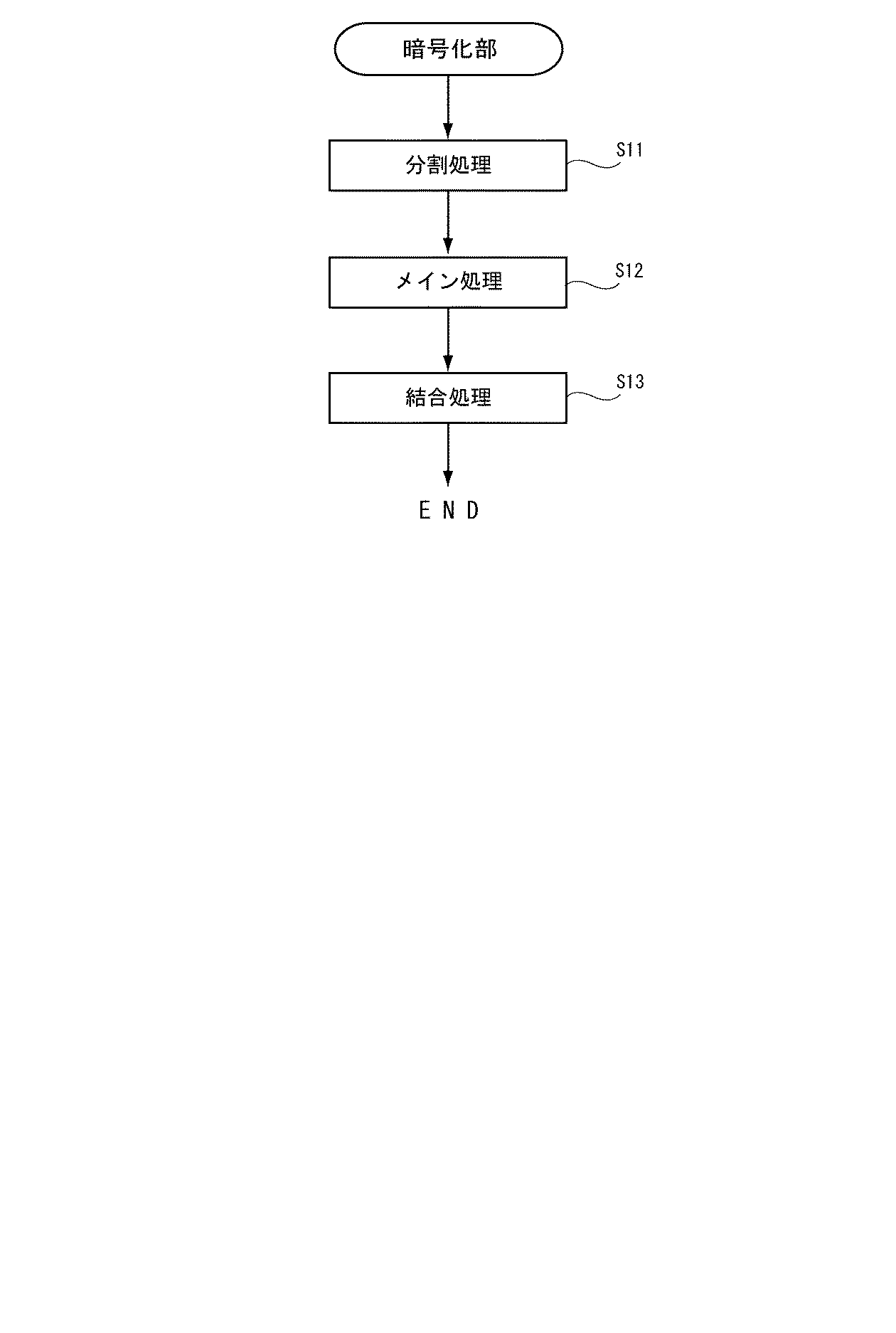
図6は、暗号化部が暗号鍵に基づいて行う平文の暗号化処理の手順を示す説明図であるとともに、復号化部が暗号鍵に基づいて行う暗号文の復号化処理の手順を示す説明図であり、図7は、暗号化部の処理フロー図である。暗号化部18は、入力部12から入力された平文を受取ると、ステップS11から処理を開始する。ステップS11では、上記分割数N個に平文を分割して、平文分割データを生成する分割処理を行い、処理が終了すると、ステップS12に進む。
FIG. 6 is an explanatory diagram showing a procedure of plaintext encryption processing performed by the encryption unit based on the encryption key, and an explanation showing a procedure of decryption processing of the ciphertext performed by the decryption unit based on the encryption key. FIG. 7 is a processing flow diagram of the encryption unit. When receiving the plain text input from the
ステップS12では、暗号鍵提供部13から提供される暗号鍵を受取り、この暗号鍵から、木構造データTのリンク情報及び配置情報を取得し、まず、各平文分割データを、木構造データTの平文用ノードnaに格納し(図6の「暗号化処理1」)、この各平文用ノードnaに格納されたデータから、残りのノードnに格納されたデータを求め、上記暗号鍵から、木構造データTの各暗号文用ノードnbに格納されたデータを、暗号文分割データとして取得する(同図の「暗号化処理2」)。このステップS12の処理が暗号化のためのメイン処理になり、このメイン処理が終了すると、ステップS13に進む。
In step S12, the encryption key provided from the encryption
ステップS13では、直前のステップS12で取得した各暗号文分割データを結合させて暗号文を生成する結合処理を行い、処理を終了させる。 In step S13, a combining process for generating a ciphertext by combining the ciphertext divided data acquired in the immediately preceding step S12 is performed, and the process is terminated.
次に、図6及び図8に基づいて、復号化部27の構成を詳述する。
Next, the configuration of the
図8は、復号化部の処理フロー図である。復号化部27は、入力部12から入力された暗号文を受取ると、ステップS21から処理を開始する。ステップS21では、上記分割数N個に暗号文を分割して、暗号文分割データを生成する分割処理を行い、分割処理が終了すると、ステップS22に進む。
FIG. 8 is a processing flowchart of the decoding unit. When receiving the ciphertext input from the
ステップS22では、暗号鍵提供部13から提供される暗号鍵を受取り、この暗号鍵から、木構造データTのリンク情報及び配置情報を取得し、まず、各暗号文分割データを、木構造データTの暗号文用ノードnbに格納し(図6の「復号化処理2」)、この各暗号文用ノードnbに格納されたデータから、残りのノードnに格納されたデータを求め、上記暗号鍵から、木構造データTの各平文用ノードnaに格納されたデータを、平文分割データとして取得する(同図の「復号化処理2」)。このステップS22の処理が復号化のためのメイン処理になり、このメイン処理が終了すると、ステップS23に進む。
In step S22, the encryption key provided from the encryption
ステップS23では、直前のステップS22で取得した各平文分割データを結合させて平文を生成する結合処理を行い、処理を終了させる。 In step S23, a combination process for generating plaintext by combining the plaintext divided data acquired in the immediately preceding step S22 is performed, and the process is terminated.
以上のように構成される暗号処理システムによれば、木構造データTのリンク情報及び配置状態を、暗号鍵によって取得できれば、少ない処理工程で、迅速に暗号化及び復号化を行うことができる一方で、上記リンク情報及び配置情報を取得できなれば、暗号文の復号化は困難であり、処理の迅速化と、暗号強度の向上とを両立できる。 According to the encryption processing system configured as described above, if the link information and the arrangement state of the tree structure data T can be acquired with the encryption key, the encryption and decryption can be quickly performed with few processing steps. Thus, if the link information and the arrangement information cannot be acquired, it is difficult to decrypt the ciphertext, and both speeding up of the process and improvement of the cipher strength can be achieved.
しかも、擬似乱数によって、分割数Nやパスワードによる再現性を持たせて暗号鍵を生成するため、暗号鍵をデータとして、保持しておく必要がなく、利便性の暗号強度も両立可能になる。 In addition, since the encryption key is generated with pseudo-random numbers with reproducibility by the division number N and password, it is not necessary to store the encryption key as data, and it is possible to achieve both convenient encryption strength.
なお、擬似乱数生成手段29による乱数生成の手段として、本例では、フィボナッチLFSRを用いているが、これに限定されるものではなく、ガロアLFSRや、その他の擬似乱数を生成する公知の手段を用いてもよい。 In this example, Fibonacci LFSR is used as the random number generating means by the pseudo random number generating means 29. However, the present invention is not limited to this. It may be used.
また、パスワードによる再現性を持たせることなく、暗号鍵を生成する場合には、擬似乱数ではなく、ランダム選択による決定処理時に真正乱数を用いて、木構造データTを生成し、これに基づいて暗号鍵を生成する生成処理を行ってもよい。この場合には、暗号化及び復号化にあたって、暗号鍵をデータとして保持する必要はあるが、暗号文を解読される可能性はさらに低くなる。 In addition, when generating an encryption key without having reproducibility by a password, tree structure data T is generated using a genuine random number at the time of decision processing by random selection instead of a pseudo random number, and based on this Generation processing for generating an encryption key may be performed. In this case, it is necessary to hold the encryption key as data for encryption and decryption, but the possibility of decrypting the ciphertext is further reduced.
さらに、木構造データTの構成も図3及び図6に示すような構成に限定されない。 Furthermore, the structure of the tree structure data T is not limited to the structure shown in FIGS.
図9(A),(B)は、それぞれ木構造データの他例を示す概念図である。木構造データTは、「リーフノード」以外のノードnに平文分割データを配置してもよく(同図(A)参照)、さらには、「親ノード」となるノードnが「子ノード」となるノードnを3個以上有していてもよい(同図(B)参照)。 FIGS. 9A and 9B are conceptual diagrams showing other examples of tree structure data. In the tree-structured data T, the plaintext divided data may be arranged in a node n other than the “leaf node” (see (A) in the same figure), and further, the node n that becomes the “parent node” is the “child node”. There may be three or more nodes n (see FIG. 5B).
次に、図10及び図11に基づき、本暗号処理システムの検証結果について説明する。 Next, a verification result of the cryptographic processing system will be described with reference to FIGS. 10 and 11.
図10(A)乃至(E)は、それぞれ本暗号処理システムの検証実験の結果を示す一覧表である。
まず、同図(A)の一覧表に示す検証では、木構造データTの木構造を総当りにより解析した。具体的には、パスワードが5桁で英数字が混在するもの(同表の「A」で示すもの)と、英数字が混在するもの(同表の「B」で示すもの)と、英字のみのもの(同表の「C」で示すもの)と、数字のみのもの(同表の「D」で示すもの)と、英数字が混在するもの(同表の「E」で示すもの)とのそれぞれに対して、分割数Nを5〜10の範囲で1つづつ変化させ、各分割数Nに対して、総当りにより、木構造データTの木構造の解析を行った。
FIGS. 10A to 10E are tables showing the results of verification experiments of the cryptographic processing system, respectively.
First, in the verification shown in the list of FIG. 9A, the tree structure of the tree structure data T was analyzed by brute force. Specifically, passwords with 5 digits and alphanumeric characters (indicated by “A” in the table), alphanumeric characters (indicated by “B” in the table), and English characters only (Indicated by “C” in the table), numbers only (indicated by “D” in the table), mixed alphanumeric characters (indicated by “E” in the table), For each of the above, the number of divisions N was changed one by one in the range of 5 to 10, and the tree structure of the tree structure data T was analyzed for each number of divisions N by round robin.
ちなみに、用いるコンピュータは、本願の出願時点で高性能されるAT互換機のコンピュータを用い、初期値Rは、パスワードを用いて以下の式から求め、求めた値を、Xビット(具体的には63ビット)の2進数表示して用いる。 Incidentally, the computer used is an AT compatible computer that has high performance at the time of filing of the present application, and the initial value R is obtained from the following equation using a password, and the obtained value is X bits (specifically, (63-bit) binary display.
Nは上述した分割数であり、mはパスワードの文字数であり、PW[i−1]は、パスワードにおけるi番目の文字の文字コードである。 N is the number of divisions described above, m is the number of characters in the password, and PW [i−1] is the character code of the i-th character in the password.
その結果は、同表に示す通りであり、解析に要する時間及び回数は、分割数Nの上昇に伴って飛躍的に上昇している。そして、同表には示していないが、分割数Nが11になると、解析が困難になり、分割数Nが12になると、解析に要する時間が35年以上となるという結果になり、事実上、解析が不可能になった。 The results are as shown in the table, and the time and number of times required for the analysis increase dramatically as the number of divisions N increases. Although not shown in the table, when the division number N becomes 11, the analysis becomes difficult, and when the division number N becomes 12, the time required for the analysis becomes 35 years or more. Analysis became impossible.
続いて、図10(B)の一覧表に示す検証では、乱数再現により、木構造データTの木構造の解析を行った。その他の条件は、同図(A)と同様である。 Subsequently, in the verification shown in the list of FIG. 10B, the tree structure of the tree structure data T was analyzed by random number reproduction. Other conditions are the same as in FIG.
その結果は、同表に示す通りであり、上述したノードnの総当りによる解析によりも少ない時間や回数で解析を行うことができる場合が多くあり、全体的には、解析に要する時間や回数は減少し、効率的な解析が行われている。ちなみに、パスワード自体の解読は、乱数の再現に帰着されるので、乱数発生時に乱数値に基づいて上述の「空回し処理」を行うことにより、再現されるリスクを大幅に低減することが可能になる。その詳細は、後述する。 The results are as shown in the table, and in many cases, the analysis can be performed with less time and the number of times than the analysis by the brute force of the node n described above. Is reduced and efficient analysis is being performed. By the way, since the decryption of the password itself is reduced to the reproduction of random numbers, it is possible to greatly reduce the risk of reproduction by performing the above-mentioned “empty rotation processing” based on the random number value when the random number is generated. Become. Details thereof will be described later.
続いて、図10(C)の一覧表に示す検証では、木構造データTのリンク構造(木構造)が既知であると仮定し、総当りにより、暗号文用ノードnbを特定する解析を行った。用いるパスワードの種類は、同図(A)に示すものと同様であり、分割数Nを8→12→16→20→21→22と変化させ、各分割数Nに対して、総当りにより、暗号文用ノードnbを特定する解析を行った。 Subsequently, in the verification shown in the list of FIG. 10C, it is assumed that the link structure (tree structure) of the tree structure data T is known, and an analysis for specifying the ciphertext node nb is performed by brute force. It was. The type of password used is the same as that shown in FIG. 6A, and the number of divisions N is changed from 8 → 12 → 16 → 20 → 21 → 22. An analysis for specifying the ciphertext node nb was performed.
その結果は、同表に示す通りであり、分割数Nが少ない場合には、少ない時間及び回数が解析可能であったが、分割数Nが増加ほど解析は困難になっている。そして、分割数Nが16を超えたあたりから、解析の難易度が極端に上がり、同表には示していないが、分割数Nが26に達した段階で、解析は不可能になった。 The results are as shown in the table, and when the number of divisions N is small, a small time and number of times can be analyzed, but the analysis becomes more difficult as the number of divisions N increases. And since the number of divisions N exceeded 16, the difficulty of analysis increased dramatically, and although not shown in the table, analysis became impossible when the number of divisions N reached 26.
続いて、図10(D)の一覧表に示す検証では、木構造データTのリンク構造(木構造)が既知であると仮定し、乱数再現により、分割用ノードnbを特定する解析を行った。その他の条件は、同図(C)に示すものと同様である。 Subsequently, in the verification shown in the list of FIG. 10D, it is assumed that the link structure (tree structure) of the tree structure data T is known, and analysis for identifying the dividing node nb was performed by random number reproduction. . Other conditions are the same as those shown in FIG.
その結果は、同表に示す通りであり、同図(C)に示す総当り解析に比べて、概ね解析に要する時間や回数が減少している。 The results are as shown in the table, and the time and frequency required for the analysis are generally reduced as compared with the round robin analysis shown in FIG.
続いて、同図(E)の一覧表に示す検証では、木構造データTの木構造を総当りにより解析した。ただし、木構造データTの生成にあたっては、擬似乱数生成手段29により「次状態への移行」の処理を行う際、上述した処理に加えて、乱数発生回数がj回である場合、パスワードのj番目の文字コードをMビットの2進数表示して、各ビットXに加え、これを擬似的に生成した乱数として用い、上述した「空回し処理」を行う。ちなみに、jは、パスワードの文字数以上にはならず、パスワードの文字数を超えた場合には、その値が1に戻される。その他の条件は同図(A)と同様である。
Subsequently, in the verification shown in the list of FIG. 9E, the tree structure of the tree structure data T was analyzed by brute force. However, when the tree structure data T is generated, when the pseudo random
その結果は、同表に示す通りであり、解析に要する時間や回数は、同図(A)に示す総当り解析と同程度になっている。すなわち、総当り解析に対しては、「空回し処理」の効果は殆ど見られないことが分った。一方、この木構造データTの木構造の解析を、乱数再現により行うと、分割数Nが4の段階で、解析が困難になり、この「空回し処理」は、乱数再現による解析に対して、有効であることが分った。 The results are as shown in the table, and the time and number of times required for the analysis are almost the same as the round robin analysis shown in FIG. In other words, it was found that the effect of “empty rotation processing” is hardly seen for the round robin analysis. On the other hand, if the tree structure analysis of this tree structure data T is performed by random number reproduction, the analysis becomes difficult when the division number N is 4, and this “empty rotation processing” is compared with the analysis by random number reproduction. , Found to be effective.
図11(A)は暗号化する際の処理速度を示し、(B)は復号化する際の処理速度を示している。同図(A)は、分割数Nが80と、96と、112と、128のそれぞれの場合において、平文のデータサイズを1MB→4MB→16MB→32MB→64MB→128MBと変化させ、この平文を暗号鍵により暗号化する処理に要す時間から、処理速度を求め、これをグラフ化したものである。暗号化装置1としては、上述の検証と同一のコンピュータを用いた。
FIG. 11A shows the processing speed when encrypting, and FIG. 11B shows the processing speed when decrypting. FIG. 4A shows that the plaintext data size is changed from 1 MB → 4 MB → 16 MB → 32 MB → 64 MB → 128 MB when the division number N is 80, 96, 112, and 128, respectively. The processing speed is obtained from the time required for the encryption with the encryption key, and this is graphed. As the
このグラフに示されるように、概ね1700Mbit/secの処理速度が確保され、実用に耐え得る良好な結果となった。 As shown in this graph, a processing speed of approximately 1700 Mbit / sec was ensured, and good results that could withstand practical use were obtained.
また、同図(B)は、分割数Nが80と、96と、112と、128のそれぞれの場合において、暗号文のデータサイズを1MB→4MB→16MB→32MB→64MB→128MBと変化させ、この暗号文を暗号鍵により復号化する処理に要す時間から、処理速度を求め、これをグラフ化したものである。復号化装置2としては、上述の検証と同一のコンピュータを用いた。
FIG. 4B shows that the data size of the ciphertext is changed from 1 MB → 4 MB → 16 MB → 32 MB → 64 MB → 128 MB when the division number N is 80, 96, 112, and 128, respectively. The processing speed is obtained from the time required for the process of decrypting the ciphertext with the encryption key, and this is graphed. As the
このグラフに示されるように、概ね1450Mbit/secの処理速度が確保され、実用に耐え得る良好な結果となった。 As shown in this graph, a processing speed of approximately 1450 Mbit / sec was secured, and good results that could withstand practical use were obtained.
12 入力部(入力手段)
13 暗号鍵提供部(提供部,暗号鍵提供手段)
16 パスワード取得部(取得部,パスワード取得手段)
17 暗号鍵生成部(生成部,暗号鍵生成手段)
18 暗号化部(変換部,暗号化手段)
19 出力部(出力手段)
21 入力部(入力手段)
22 暗号鍵提供部(提供部,暗号鍵提供手段)
24 パスワード取得部(取得部,パスワード取得手段)
26 暗号鍵生成部(生成部,暗号鍵生成手段)
27 暗号化部(変換部,暗号化手段)
28 出力部(出力手段)
n ノード
T 木構造データ
12 Input section (input means)
13 Cryptographic key provider (provider, cryptographic key provider)
16 Password acquisition unit (acquisition unit, password acquisition means)
17 Encryption key generation unit (generation unit, encryption key generation means)
18 Encryption unit (conversion unit, encryption means)
19 Output unit (output means)
21 Input section (input means)
22 Cryptographic key provider (provider, cryptographic key provider)
24 Password acquisition unit (acquisition unit, password acquisition means)
26 Encryption key generation unit (generation unit, encryption key generation means)
27 Encryption unit (conversion unit, encryption means)
28 Output unit (output means)
n-node T-tree data
Claims (5)
データが入力される入力部と、
暗号鍵を提供する提供部と、
前記入力部から入力された平文を提供部から提供された暗号鍵に基づいて暗号化するか、或いは入力部から入力された暗号を、提供部から提供された暗号鍵に基づいて復号化する変換部と、
該変換部で変換されたデータを出力する出力部とを備え、
上記暗号鍵は、
平文を所定データ長毎に分割して得られる複数の平文分割データと、暗号文を所定データ長毎に分割して得られる複数の暗号文分割データとを、全てノードとして配置可能な木構造データの該リンク情報と、
各平文分割データから各暗号文分割データを求めることが可能であるとともに各暗号文分割データから各平文分割データを求めることが可能なように木構造データの対応するノードにランダムに配置された各平文分割データ及び各暗号文分割データの該配置情報とを含み、
前記木構造データは、子ノードのみとして機能するリーフノード以外のノードは、該ノードに接続された下層の複数のノードに対して親ノードとなり、該複数の下層ノードは該親ノードの子ノードとなり、
前記木構造データは、任意の親ノードと、該親ノードにリンクを介して接続された複数の子ノードとにおいて、一のノードに格納されたデータを、該一のノード以外の複数のノードに格納されたデータから求めることが可能なように構成された
暗号処理システム。 A cryptographic processing system that encrypts plaintext into ciphertext or decrypts ciphertext into plaintext,
An input section for inputting data;
A providing unit for providing an encryption key;
Conversion for encrypting plaintext input from the input unit based on the encryption key provided from the providing unit, or decrypting the cipher input from the input unit based on the encryption key provided from the providing unit And
An output unit that outputs the data converted by the conversion unit,
The encryption key is
Tree structure data in which a plurality of plaintext divided data obtained by dividing a plaintext for each predetermined data length and a plurality of ciphertext divided data obtained by dividing a ciphertext for each predetermined data length can be arranged as nodes. The link information of
Each ciphertext segmented data can be obtained from each plaintext segmented data and each plaintext segmented data can be obtained from each ciphertext segmented data at random corresponding nodes in the tree structure data. the plaintext division data and the allocation information of each ciphertext divided data seen including,
In the tree structure data, nodes other than leaf nodes that function only as child nodes are parent nodes for a plurality of lower-layer nodes connected to the node, and the plurality of lower-layer nodes are child nodes of the parent node. ,
The tree-structured data is obtained by transferring data stored in one node to a plurality of nodes other than the one node in an arbitrary parent node and a plurality of child nodes connected to the parent node via links. A cryptographic processing system configured to be able to be obtained from stored data .
該暗号化部は、
入力された平文を上記所定データ長毎に分割する分割処理と、
分割処理によって分割された各平文分割データから、提供部により提供される暗号鍵に基づいて、各暗号文分割データを算出するメイン処理と、
メイン処理によって求められた各暗号文分割データを結合して暗号化された暗号文を生成する結合処理とを行う
請求項1に記載の暗号処理システム。 The conversion unit is an encryption unit that encrypts plain text input from the input unit;
The encryption unit
A division process for dividing the input plaintext for each predetermined data length;
A main process for calculating each ciphertext divided data from each plaintext divided data divided by the dividing process based on an encryption key provided by the providing unit;
The cipher processing system according to claim 1, wherein the ciphertext divided data obtained by the main process is combined to generate an encrypted ciphertext.
該復号化部は、
入力された暗号文を上記所定データ長毎に分割する分割処理と、
分割処理によって分割された各暗号文分割データから、提供部により提供される暗号鍵に基づいて、各平文分割データを算出するメイン処理と、
メイン処理によって求められた各平文分割データを結合して復号化された平文を生成する結合処理とを行う
請求項1または2の何れかに記載の暗号処理システム。 The conversion unit is a decryption unit that decrypts ciphertext input from the input unit,
The decryption unit
A dividing process for dividing the input ciphertext into the predetermined data lengths;
Main processing for calculating each plaintext divided data from each ciphertext divided data divided by the division processing, based on the encryption key provided by the providing unit,
The cryptographic processing system according to claim 1, wherein the plaintext divided data obtained by the main processing is combined to generate a decrypted plaintext.
請求項1乃至3の何れかに記載の暗号処理システム。 The cryptographic processing system according to claim 1, wherein the number of plaintext divided data or ciphertext divided data is 11 or more.
パスワードを取得する取得部とを備え、
上記木構造データのリーフノードは、分割された複数の平文分割データと同数設けられ、該複数のリーフノードには、対応する平文分割データがそれぞれ格納され、
該木構造データの任意の親ノードは、リンクを介して接続される2つの子ノードを有し、
前記生成部は、
上記取得部で取得されるパスワードに基づいて再現可能な擬似乱数を発生させる発生処理と、
発生処理によって発生させた擬似乱数に基づいて木構造データの上記リンク情報及び配置情報を再現可能にランダムに決定する決定処理と、
上記木構造データのリンク情報及び配置情報に基づいて暗号鍵を成形する生成処理とを行う
請求項1乃至4の何れかに記載の暗号処理システム。 A generation unit for generating an encryption key;
An acquisition unit for acquiring a password,
The leaf nodes of the tree structure data are provided in the same number as the plurality of divided plaintext divided data, and the corresponding plaintext divided data are respectively stored in the plurality of leaf nodes.
Any parent node of the tree structure data has two child nodes connected via a link;
The generator is
A generation process for generating a reproducible pseudo-random number based on the password acquired by the acquisition unit;
A determination process for randomly determining the link information and arrangement information of the tree structure data based on a pseudo-random number generated by the generation process in a reproducible manner;
The cryptographic processing system according to any one of claims 1 to 4, wherein a generation process for forming a cryptographic key is performed based on link information and arrangement information of the tree structure data.
Priority Applications (1)
| Application Number | Priority Date | Filing Date | Title |
|---|---|---|---|
| JP2013098521A JP6296589B2 (en) | 2013-05-08 | 2013-05-08 | Cryptographic processing system |
Applications Claiming Priority (1)
| Application Number | Priority Date | Filing Date | Title |
|---|---|---|---|
| JP2013098521A JP6296589B2 (en) | 2013-05-08 | 2013-05-08 | Cryptographic processing system |
Publications (2)
| Publication Number | Publication Date |
|---|---|
| JP2014219548A JP2014219548A (en) | 2014-11-20 |
| JP6296589B2 true JP6296589B2 (en) | 2018-03-20 |
Family
ID=51938030
Family Applications (1)
| Application Number | Title | Priority Date | Filing Date |
|---|---|---|---|
| JP2013098521A Expired - Fee Related JP6296589B2 (en) | 2013-05-08 | 2013-05-08 | Cryptographic processing system |
Country Status (1)
| Country | Link |
|---|---|
| JP (1) | JP6296589B2 (en) |
Families Citing this family (1)
| Publication number | Priority date | Publication date | Assignee | Title |
|---|---|---|---|---|
| KR102123440B1 (en) * | 2019-09-02 | 2020-06-16 | 세종대학교산학협력단 | Encryption method for supporting range query in multi-client environment and apparatus using the same |
Family Cites Families (3)
| Publication number | Priority date | Publication date | Assignee | Title |
|---|---|---|---|---|
| JPH09200196A (en) * | 1996-01-24 | 1997-07-31 | Brother Ind Ltd | Encryption communication method |
| JPH11187013A (en) * | 1997-12-24 | 1999-07-09 | Ibm Japan Ltd | Encryption key distribution system |
| JP2006279644A (en) * | 2005-03-30 | 2006-10-12 | Fujitsu Ltd | Encryption system, encryption device, decryption device, encryption / decryption method, encryption method, and decryption method |
-
2013
- 2013-05-08 JP JP2013098521A patent/JP6296589B2/en not_active Expired - Fee Related
Also Published As
| Publication number | Publication date |
|---|---|
| JP2014219548A (en) | 2014-11-20 |
Similar Documents
| Publication | Publication Date | Title |
|---|---|---|
| JP6732141B2 (en) | Conversion key generation device, ciphertext conversion device, secret information processing system, conversion key generation method, conversion key generation program, ciphertext conversion method, and ciphertext conversion program | |
| KR102019159B1 (en) | Apparatus and methdo for giving the compressed encryption functionality to integer-based homomorphic encryption schemes | |
| JP5914604B2 (en) | Apparatus and method for decrypting encrypted file | |
| JP6035459B2 (en) | ENCRYPTION DEVICE, DECRYPTION DEVICE, AND PROGRAM | |
| US20120269340A1 (en) | Hierarchical encryption/decryption device and method thereof | |
| CN110235409A (en) | Use the protected RSA signature of homomorphic cryptography or the method for decryption | |
| JP6575532B2 (en) | Encryption device, decryption device, encryption processing system, encryption method, decryption method, encryption program, and decryption program | |
| CN107454975A (en) | Encryption system and key generation device | |
| Ahmad et al. | A secure network communication protocol based on text to barcode encryption algorithm | |
| JPWO2018212015A1 (en) | Secret calculation device, comparison method, comparison program, and secret calculation system | |
| JP5113630B2 (en) | Secret sharing method, program, and apparatus | |
| KR102132685B1 (en) | Apparatus and method for order-revealing encryption | |
| JP6270683B2 (en) | Encryption system, encryption method, universal re-encryption key generation device, and re-encryption key generation device | |
| JP6296589B2 (en) | Cryptographic processing system | |
| JP2006311383A (en) | Data managing method, data management system and data managing device | |
| JP5586758B1 (en) | Dynamic encryption key generation system | |
| Arifin et al. | Text Data Security through Double Encryption: Implementation of Unimodular Hill Cipher and Advanced Encryption Standar. | |
| JP4619045B2 (en) | Data concealment device, data concealment method, and data concealment program | |
| JP6631989B2 (en) | Encryption device, control method, and program | |
| KR102284877B1 (en) | Efficient functional encryption for set intersection | |
| JP6441160B2 (en) | Concealment device, decryption device, concealment method and decryption method | |
| JP6091394B2 (en) | Information processing apparatus and encryption method | |
| JP6949276B2 (en) | Re-encrypting device, re-encrypting method, re-encrypting program and cryptosystem | |
| CN119325696A (en) | Hidden information processing system, hidden information processing method, and hidden information processing program | |
| US12250299B1 (en) | Systems and methods for classical-quantum encryption and decryption |
Legal Events
| Date | Code | Title | Description |
|---|---|---|---|
| A621 | Written request for application examination |
Free format text: JAPANESE INTERMEDIATE CODE: A621 Effective date: 20160411 |
|
| A131 | Notification of reasons for refusal |
Free format text: JAPANESE INTERMEDIATE CODE: A131 Effective date: 20170704 |
|
| A521 | Request for written amendment filed |
Free format text: JAPANESE INTERMEDIATE CODE: A523 Effective date: 20170901 |
|
| TRDD | Decision of grant or rejection written | ||
| A01 | Written decision to grant a patent or to grant a registration (utility model) |
Free format text: JAPANESE INTERMEDIATE CODE: A01 Effective date: 20180206 |
|
| A61 | First payment of annual fees (during grant procedure) |
Free format text: JAPANESE INTERMEDIATE CODE: A61 Effective date: 20180216 |
|
| R150 | Certificate of patent or registration of utility model |
Ref document number: 6296589 Country of ref document: JP Free format text: JAPANESE INTERMEDIATE CODE: R150 |
|
| S111 | Request for change of ownership or part of ownership |
Free format text: JAPANESE INTERMEDIATE CODE: R313113 |
|
| R350 | Written notification of registration of transfer |
Free format text: JAPANESE INTERMEDIATE CODE: R350 |
|
| R250 | Receipt of annual fees |
Free format text: JAPANESE INTERMEDIATE CODE: R250 |
|
| R250 | Receipt of annual fees |
Free format text: JAPANESE INTERMEDIATE CODE: R250 |
|
| LAPS | Cancellation because of no payment of annual fees |