JP5351427B2 - Method for determining risk of cancer recurrence and method for supporting diagnosis of cancer recurrence risk - Google Patents
Method for determining risk of cancer recurrence and method for supporting diagnosis of cancer recurrence risk Download PDFInfo
- Publication number
- JP5351427B2 JP5351427B2 JP2008086212A JP2008086212A JP5351427B2 JP 5351427 B2 JP5351427 B2 JP 5351427B2 JP 2008086212 A JP2008086212 A JP 2008086212A JP 2008086212 A JP2008086212 A JP 2008086212A JP 5351427 B2 JP5351427 B2 JP 5351427B2
- Authority
- JP
- Japan
- Prior art keywords
- specific activity
- recurrence
- cdk1
- recurrence risk
- cancer
- Prior art date
- Legal status (The legal status is an assumption and is not a legal conclusion. Google has not performed a legal analysis and makes no representation as to the accuracy of the status listed.)
- Expired - Fee Related
Links
Images




Classifications
-
- G—PHYSICS
- G01—MEASURING; TESTING
- G01N—INVESTIGATING OR ANALYSING MATERIALS BY DETERMINING THEIR CHEMICAL OR PHYSICAL PROPERTIES
- G01N33/00—Investigating or analysing materials by specific methods not covered by groups G01N1/00 - G01N31/00
- G01N33/48—Biological material, e.g. blood, urine; Haemocytometers
- G01N33/50—Chemical analysis of biological material, e.g. blood, urine; Testing involving biospecific ligand binding methods; Immunological testing
- G01N33/53—Immunoassay; Biospecific binding assay; Materials therefor
- G01N33/575—Immunoassay; Biospecific binding assay; Materials therefor for cancer
-
- C—CHEMISTRY; METALLURGY
- C12—BIOCHEMISTRY; BEER; SPIRITS; WINE; VINEGAR; MICROBIOLOGY; ENZYMOLOGY; MUTATION OR GENETIC ENGINEERING
- C12Q—MEASURING OR TESTING PROCESSES INVOLVING ENZYMES, NUCLEIC ACIDS OR MICROORGANISMS; COMPOSITIONS OR TEST PAPERS THEREFOR; PROCESSES OF PREPARING SUCH COMPOSITIONS; CONDITION-RESPONSIVE CONTROL IN MICROBIOLOGICAL OR ENZYMOLOGICAL PROCESSES
- C12Q1/00—Measuring or testing processes involving enzymes, nucleic acids or microorganisms; Compositions therefor; Processes of preparing such compositions
- C12Q1/48—Measuring or testing processes involving enzymes, nucleic acids or microorganisms; Compositions therefor; Processes of preparing such compositions involving transferase
- C12Q1/485—Measuring or testing processes involving enzymes, nucleic acids or microorganisms; Compositions therefor; Processes of preparing such compositions involving transferase involving kinase
-
- G—PHYSICS
- G01—MEASURING; TESTING
- G01N—INVESTIGATING OR ANALYSING MATERIALS BY DETERMINING THEIR CHEMICAL OR PHYSICAL PROPERTIES
- G01N33/00—Investigating or analysing materials by specific methods not covered by groups G01N1/00 - G01N31/00
- G01N33/48—Biological material, e.g. blood, urine; Haemocytometers
- G01N33/50—Chemical analysis of biological material, e.g. blood, urine; Testing involving biospecific ligand binding methods; Immunological testing
- G01N33/53—Immunoassay; Biospecific binding assay; Materials therefor
- G01N33/5302—Apparatus specially adapted for immunological test procedures
-
- G—PHYSICS
- G01—MEASURING; TESTING
- G01N—INVESTIGATING OR ANALYSING MATERIALS BY DETERMINING THEIR CHEMICAL OR PHYSICAL PROPERTIES
- G01N2800/00—Detection or diagnosis of diseases
- G01N2800/54—Determining the risk of relapse
-
- G—PHYSICS
- G01—MEASURING; TESTING
- G01N—INVESTIGATING OR ANALYSING MATERIALS BY DETERMINING THEIR CHEMICAL OR PHYSICAL PROPERTIES
- G01N2800/00—Detection or diagnosis of diseases
- G01N2800/56—Staging of a disease; Further complications associated with the disease
Landscapes
- Health & Medical Sciences (AREA)
- Life Sciences & Earth Sciences (AREA)
- Immunology (AREA)
- Engineering & Computer Science (AREA)
- Chemical & Material Sciences (AREA)
- Molecular Biology (AREA)
- Biomedical Technology (AREA)
- Hematology (AREA)
- Urology & Nephrology (AREA)
- Physics & Mathematics (AREA)
- Biochemistry (AREA)
- Organic Chemistry (AREA)
- Microbiology (AREA)
- General Health & Medical Sciences (AREA)
- Biotechnology (AREA)
- Analytical Chemistry (AREA)
- Medicinal Chemistry (AREA)
- Zoology (AREA)
- General Physics & Mathematics (AREA)
- Pathology (AREA)
- Food Science & Technology (AREA)
- Proteomics, Peptides & Aminoacids (AREA)
- Cell Biology (AREA)
- Wood Science & Technology (AREA)
- Biophysics (AREA)
- Bioinformatics & Cheminformatics (AREA)
- General Engineering & Computer Science (AREA)
- Genetics & Genomics (AREA)
- Investigating Or Analysing Biological Materials (AREA)
- Measuring Or Testing Involving Enzymes Or Micro-Organisms (AREA)
Description
本発明は、サイクリン依存性キナーゼの発現量と活性値とに基づいて、癌の再発リスクを判定する、癌の再発リスク判定方法に関する。また、本発明は、サイクリン依存性キナーゼの発現量と活性値とに基づいて、癌の再発リスク診断の支援情報を提供する、癌の再発リスク診断の支援方法に関する。 The present invention relates to a cancer recurrence risk determination method that determines a cancer recurrence risk based on the expression level and activity value of a cyclin-dependent kinase. The present invention also relates to a cancer recurrence risk diagnosis support method that provides support information for cancer recurrence risk diagnosis based on the expression level and activity value of cyclin-dependent kinase.
従来、癌診断として、血清中の腫瘍マーカーを調べる血清診断や、生検(バイオプシイ)による組織診、細胞診が知られている。しかし、これらは信頼性が低いか、又は個々人の判断や医療機関の判定にバラつきがあることから、近年、診断医によるバラつきが少ない癌の画一的診断方法として、生体で発現される遺伝子やタンパク質に基づく分子診断が検討されている。そして、タンパク質に基づく分子診断としては、例えば、サイクリン依存性キナーゼ(以下、単に「CDK」とも称する)を利用した方法が種々提案されている。 Conventionally, serodiagnosis for examining tumor markers in serum, histological diagnosis by biopsy (biopsy), and cytodiagnosis are known as cancer diagnosis. However, these methods are unreliable or vary in individual judgments and judgments of medical institutions, and in recent years, as a uniform diagnostic method for cancer with little variation by diagnosticians, Protein-based molecular diagnostics are being studied. As molecular diagnosis based on proteins, for example, various methods using cyclin-dependent kinase (hereinafter also simply referred to as “CDK”) have been proposed.
例えば、特許文献1には、2種類のCDKの発現量と活性値から求められるCDK比活性の比を所定の閾値と比較することにより、細胞の性質や癌の悪性度を判定する方法が記載されている。この方法によれば、被検癌患者から得られた2種類のCDK比活性の比を指標として癌の再発リスクを予測することが可能である。
For example,
本発明は、より高精度に癌の再発リスクを判定しうる、新規な癌の再発リスク判定方法、及びより高精度な癌の再発リスク判定を支援しうる、新規な癌の再発リスク判定の支援方法を提供することを目的とするものである。 The present invention provides a novel cancer recurrence risk determination method capable of determining cancer recurrence risk with higher accuracy, and a novel cancer recurrence risk determination support capable of supporting more accurate cancer recurrence risk determination. It is intended to provide a method.
上記の課題を解決するため、本発明の第1の観点による癌の再発リスクの判定方法は、被検癌患者から採取した悪性腫瘍から、CDK1及びCDK2の発現量と活性値を取得し、下記式(1)に基づいて再発リスクスコアを求め、得られた再発リスクスコアに基づいて癌の再発リスクを判定することを特徴とする。
再発リスクスコア=F(x)×G(y) ・・・(1)
(式中、F(x)=a/(1+Exp(-(x-b)×c))であり、G(y)=d/(1+Exp(-(y-e)×f))である(式中、a〜fは定数である):式中、xはCDK1比活性を表し、このCDK1比活性は、CDK1活性値/CDK1発現量で示される:式中、yは比活性比を表し、この比活性比は、CDK2比活性/CDK1比活性で示される)
In order to solve the above problems, a method for determining the risk of cancer recurrence according to the first aspect of the present invention obtains the expression level and activity value of CDK1 and CDK2 from a malignant tumor collected from a test cancer patient. A recurrence risk score is obtained based on the formula (1), and the recurrence risk of cancer is determined based on the obtained recurrence risk score.
Relapse risk score = F (x) × G (y) (1)
( Where F (x) = a / (1 + Exp (− (xb) × c)) and G (y) = d / (1 + Exp (− (ye) × f)) ( wherein, a to f is a constant): wherein, x is represents the CDK1 specific activity, the CDK1 specific activity is represented by CDK1 activity value / CDK1 expression level: wherein, y represents a specific activity ratio This specific activity ratio is expressed as CDK2 specific activity / CDK1 specific activity)
また、本発明の別の観点による癌の再発リスク診断の支援方法は、被検癌患者から採取した悪性腫瘍から、CDK1及びCDK2の発現量と活性値を取得し、CDK1の比活性と、CDK2の比活性の二つのパラメータからなり、下記式(2)に基づいて算出される再発リスクスコアの異なる領域毎に分割された再発リスク判定図に、得られたCDK1比活性及びCDK2比活性をプロットして表示することを特徴とする。
再発リスクスコア=F(x)×G(y) ・・・(2)
(式中、F(x)=a/(1+Exp(-(x-b)×c))であり、G(y)=d/(1+Exp(-(y-e)×f))である(式中、a〜fは定数である):式中、xはCDK1比活性を表し、このCDK1比活性は、CDK1活性値/CDK1発現量で示される:式中、yは比活性比を表し、この比活性比は、CDK2比活性/CDK1比活性で示される)
Further, according to another aspect of the present invention, there is provided a method for assisting diagnosis of recurrence risk of cancer by obtaining the expression level and activity value of CDK1 and CDK2 from a malignant tumor collected from a test cancer patient, and the specific activity of CDK1 and CDK2 The CDK1 specific activity and the CDK2 specific activity are plotted on the recurrence risk assessment diagram divided into regions with different recurrence risk scores calculated from the following formula (2). It is characterized by displaying.
Recurrence risk score = F (x) × G (y) (2)
( Where F (x) = a / (1 + Exp (− (xb) × c)) and G (y) = d / (1 + Exp (− (ye) × f)) ( wherein, a to f is a constant): wherein, x is represents the CDK1 specific activity, the CDK1 specific activity is represented by CDK1 activity value / CDK1 expression level: wherein, y represents a specific activity ratio This specific activity ratio is expressed as CDK2 specific activity / CDK1 specific activity)
本発明によれば、高精度に癌の再発リスクを判定しうる癌の再発リスク判定方法を提供することができる。また、本発明によれば、高精度な癌の再発リスク判定を支援しうる癌の再発リスク判定支援方法を提供することができる。 ADVANTAGE OF THE INVENTION According to this invention, the recurrence risk determination method of cancer which can determine the recurrence risk of cancer with high precision can be provided. Further, according to the present invention, it is possible to provide a cancer recurrence risk determination support method capable of supporting a highly accurate cancer recurrence risk determination.
[1]癌の再発リスク判定方法
本発明の第1の観点による判定方法は、被検癌患者から採取した悪性腫瘍から、第1のサイクリン依存性キナーゼ(CDK)及び第2のCDKの発現量と活性値を取得し、得られた第1CDK及び第2CDKの発現量と活性値とに基づいて再発リスクスコアを求め、得られた再発リスクスコアに基づいて癌の再発リスクを判定することを特徴とする。
[1] Cancer recurrence risk determination method The determination method according to the first aspect of the present invention is based on the expression levels of the first cyclin-dependent kinase (CDK) and the second CDK from a malignant tumor collected from a test cancer patient. And the activity value is obtained, a recurrence risk score is obtained based on the obtained expression levels and activity values of the first CDK and the second CDK, and the recurrence risk of the cancer is determined based on the obtained recurrence risk score. And
ここで、本明細書における「再発」とは、悪性腫瘍を摘出するために臓器を部分切除した後、残存臓器に同じ悪性腫瘍が再現する場合、及び原発巣から腫瘍細胞が分離して遠隔組織(遠隔臓器)へ運ばれ、そこで自立的に増殖する場合(転移再発)をいうものとする。
また、本明細書における「再発リスク」とは、悪性腫瘍が摘出された癌患者の身体に癌が再発する危険、または癌が再発することによって癌患者が死亡する危険を意味する。本明細書中で特に断らない限り、「再発リスク」はそのいずれも含むものとする。
Here, “recurrence” in this specification refers to a case where the same malignant tumor is reproduced in the remaining organ after partial excision of the organ in order to remove the malignant tumor, and a case where the tumor cell is separated from the primary lesion and distant tissue It is taken to (remote organ) where it proliferates autonomously (metastasis recurrence).
The term “risk of recurrence” in the present specification means the risk of cancer recurrence in the body of a cancer patient from whom a malignant tumor has been removed, or the risk of cancer patient dying due to recurrence of cancer. Unless otherwise specified in this specification, “risk of recurrence” includes both.
(1)被検癌患者から採取した悪性腫瘍から、第1のCDK及び第2のCDKの発現量と活性値を取得する工程
被検癌患者から採取される悪性腫瘍は、例えば被検癌患者の生体組織のうち、繊維性結合組織、軟骨組織、骨組織、血液、リンパ等の支持組織、上皮組織、筋組織、神経組織を構成する細胞であればよい。特に、本実施形態による判定方法に用いられる細胞としては、固体としての調和を破り、増殖の制御機構に異常を来たしている組織の腫瘍細胞のように、病理的情報を得たい細胞が好適である。例えば、乳、肺、肝臓、胃、大腸、膵臓、皮膚、子宮、精巣、卵巣、甲状腺、副甲状腺、リンパ系統、骨髄などの位置にできる腫瘍の細胞が好適な対象となる。
(1) Step of obtaining expression levels and activity values of first CDK and second CDK from a malignant tumor collected from a test cancer patient A malignant tumor collected from a test cancer patient is, for example, a test cancer patient Of these living tissues, cells constituting a fibrous connective tissue, cartilage tissue, bone tissue, blood, lymph and other supporting tissues, epithelial tissue, muscle tissue, and nerve tissue may be used. In particular, as the cells used in the determination method according to the present embodiment, cells that want to obtain pathological information are suitable, such as tumor cells of tissues that break the harmony as a solid and have abnormal growth control mechanisms. is there. For example, suitable cells include tumor cells that can be located in breast, lung, liver, stomach, large intestine, pancreas, skin, uterus, testis, ovary, thyroid, parathyroid gland, lymphoid lineage, bone marrow, and the like.
サイクリン依存性キナーゼ(CDK)とは、サイクリンと結合して活性化される酵素群の総称で、単独では活性をもたないが、サイクリンと結合して活性型となる。CDKは、その種類に応じて、細胞周期の特定時期で機能している。CDKとしては、CDK1、CDK2、CDK4、CDK6、サイクリンA依存性キナーゼ、サイクリンB依存性キナーゼ、及びサイクリンD依存性キナーゼなどが挙げられる。
ここに挙げた複数種のCDKから第1のCDKと第2のCDKとを決定し、被検癌患者から採取された悪性腫瘍の第1のCDKと、第2のCDKの発現量及び活性値を測定する。
Cyclin-dependent kinase (CDK) is a general term for a group of enzymes that are activated by binding to cyclin, and has no activity by itself, but becomes active by binding to cyclin. CDKs function at specific times in the cell cycle, depending on their type. Examples of CDK include CDK1, CDK2, CDK4, CDK6, cyclin A-dependent kinase, cyclin B-dependent kinase, and cyclin D-dependent kinase.
The first CDK and the second CDK are determined from a plurality of types of CDKs listed here, and the expression level and activity value of the first CDK and the second CDK of the malignant tumor collected from the test cancer patient Measure.
CDK活性値とは、特定のサイクリンと結合して、そのサイクリンをリン酸化する基質の量から算出されるキナーゼ活性のレベル(単位をU(ユニット)で表す)をいう。なお、前記CDKがリン酸化する基質としては、例えば、活性型CDK1及び活性型CDK2については、ヒストンH1が挙げられ、活性型CDK4及び活性型CDK6については、Rb(網膜芽細胞腫タンパク質)が挙げられる。CDK活性値は、慣用のCDK活性測定方法によって測定することができる。具体的には、測定試料の細胞溶解液から活性型CDKを含む試料を調製し、試料と、32P標識したATP(γ−〔32P〕−ATP)とを用いて、基質タンパク質に32Pを取り込ませ、32P標識されたリン酸化基質の標識量を測定し、標準品で作成された検量線をもとに定量する方法がある。また放射性物質の標識を用いない方法としては、特開2002−335997号に開示の方法が挙げられる。この方法は、検体の細胞可溶化液から、目的の活性型CDKを含む試料を調製し、アデノシン5'−O−(3−チオトリホスフェート)(ATP−γS)と基質を反応させて、該基質タンパク質のセリン又はスレオニン残基にモノチオリン酸基を導入し、導入されたモノチオリン酸基の硫黄原子に標識蛍光物質又は標識酵素を結合させることによって基質タンパク質を標識し、標識されたチオリン酸基質の標識量(標識蛍光物質を用いた場合には蛍光量)を測定し、標準品で作成された検量線に基づいて定量する方法である。
The CDK activity value refers to the level of kinase activity (unit is represented by U (unit)) calculated from the amount of a substrate that binds to a specific cyclin and phosphorylates the cyclin. Examples of the substrate that phosphorylates CDK include histone H1 for active CDK1 and active CDK2, and Rb (retinoblastoma protein) for active CDK4 and active CDK6. It is done. The CDK activity value can be measured by a conventional CDK activity measurement method. Specifically, a sample containing activated CDK is prepared from cell lysate of the measurement sample, and the sample, using a 32 P-labeled ATP (.gamma. [32 P] -ATP), 32 P into the substrate protein There is a method in which the amount of 32 P-labeled phosphorylated substrate is measured and quantified based on a calibration curve prepared with a standard product. Moreover, as a method not using the label of the radioactive substance, a method disclosed in JP-A-2002-335997 can be mentioned. In this method, a sample containing a target active CDK is prepared from a cell lysate of a specimen,
活性測定に供する試料は、測定対象となる悪性腫瘍を含む組織の可溶化液から目的のCDKを特異的に採集することにより調製する。この場合、試料は目的のCDKに特異的な抗CDK抗体を用いて調製してもよいし、特定のサイクリン依存性キナーゼ(例えばサイクリンA依存性キナーゼ、サイクリンB依存性キナーゼ、サイクリンE依存性キナーゼ)活性測定の場合には、抗サイクリン抗体を用いて調製する。いずれの場合も活性型CDK以外のCDKが試料に含まれることになる。例えばサイクリン・CDK複合体にCDKインヒビターが結合した複合体も含まれる。また、抗CDK抗体を用いた場合には、CDK単体、CDKとサイクリン及び/又はCDKインヒビターの複合体、CDKとその他の化合物との複合体などが含まれる。従って、活性値は、活性型、不活性型、各種競合反応が混在する状態下で、リン酸化された基質の単位(U)として測定される。 A sample to be used for activity measurement is prepared by specifically collecting a target CDK from a solubilized solution of a tissue containing a malignant tumor to be measured. In this case, the sample may be prepared using an anti-CDK antibody specific for the target CDK, or a specific cyclin-dependent kinase (eg, cyclin A-dependent kinase, cyclin B-dependent kinase, cyclin E-dependent kinase). ) In case of activity measurement, prepare with anti-cyclin antibody. In either case, a CDK other than the active CDK is included in the sample. For example, a complex in which a CDK inhibitor is bound to a cyclin / CDK complex is also included. Further, when an anti-CDK antibody is used, CDK alone, a complex of CDK and cyclin and / or a CDK inhibitor, a complex of CDK and other compounds, and the like are included. Therefore, the activity value is measured as a unit (U) of a phosphorylated substrate in a state where an active type, an inactive type, and various competitive reactions coexist.
CDK発現量とは、測定対象となる悪性腫瘍を含む組織の細胞可溶化液に含まれる目的のCDK量(分子個数に対応する単位)であって、タンパク質混合物から目的のタンパク質量を測定する従来公知の方法で測定できる。例えば、ELISA法、ウェスタンブロット法などを使用してもよいし、特開2003−130871号に開示の方法で測定することもできる。目的のタンパク質(CDK)は、特異的抗体を用いて捕捉すればよい。例えば、抗CDK1抗体を用いることにより、細胞内に存在するCDK1のすべて(CDK単体、CDKとサイクリン及び/又はCDKインヒビターの複合体、CDKとその他の化合物との複合体を含む)を捕捉できる。 The CDK expression level is the target CDK amount (unit corresponding to the number of molecules) contained in the cell lysate of the tissue containing the malignant tumor to be measured, and the target protein amount is conventionally measured from the protein mixture. It can be measured by a known method. For example, an ELISA method, a Western blot method, or the like may be used, and measurement may be performed by the method disclosed in JP-A No. 2003-130871. The target protein (CDK) may be captured using a specific antibody. For example, by using an anti-CDK1 antibody, it is possible to capture all of CDK1 present in the cell (including CDK alone, a complex of CDK and cyclin and / or CDK inhibitor, a complex of CDK and other compounds).
(2)再発リスクスコアを算出する工程
上記の工程によって得られた2種類のCDKの発現量と活性値に基づいて再発リスクスコアRRSを求める。再発リスクスコアRRSは、下記式(3)乃至(5)によって求められる。
RRS=F(x)×G(y) ・・・(3)
F(x)=a/(1+Exp(−(x−b)×c)) ・・・(4)
G(y)=d/(1+Exp(−(y−e)×f)) ・・・(5)
(式中、a〜fは定数)
上記式において、xは第1のCDKの比活性を表し、yは比活性比を表す。ここで、CDK比活性は、CDK活性値/CDK発現量で示され、比活性比は、第2CDK比活性/第1CDK比活性で示される。上記式(3)乃至(5)、比活性及び比活性比については、後に詳しく説明する。
(2) Step of calculating recurrence risk score A recurrence risk score RRS is obtained based on the expression levels and activity values of the two types of CDKs obtained by the above steps. The recurrence risk score RRS is obtained by the following formulas (3) to (5).
RRS = F (x) × G (y) (3)
F (x) = a / (1 + Exp (− (x−b) × c)) (4)
G (y) = d / (1 + Exp (− (y−e) × f)) (5)
(Where a to f are constants)
In the above formula, x represents the specific activity of the first CDK, and y represents the specific activity ratio. Here, the CDK specific activity is represented by CDK activity value / CDK expression level, and the specific activity ratio is represented by second CDK specific activity / first CDK specific activity. The above formulas (3) to (5), specific activity and specific activity ratio will be described in detail later.
(3)再発リスクスコアに基づいて再発リスクを判定する工程
上記において得られた再発リスクスコアRRSと、予め設定された閾値とを比較して、癌の再発リスクを判定する。例えば、被検癌患者の再発リスクスコアRRSと閾値とを比較し、被検癌患者の再発リスクスコアRRSが閾値より高い場合には、被検癌患者の癌の再発リスクが高く、被検癌患者の再発リスクスコアRRSが閾値より低い場合には、被検癌患者の癌の再発リスクが低いというようにして、癌の再発リスクを判定することができる。
(3) Step of determining recurrence risk based on recurrence risk score The recurrence risk score RRS obtained above is compared with a preset threshold value to determine the recurrence risk of cancer. For example, when the recurrence risk score RRS of a test cancer patient is compared with a threshold value, and the recurrence risk score RRS of the test cancer patient is higher than the threshold value, the recurrence risk of cancer of the test cancer patient is high, the test cancer When the patient's recurrence risk score RRS is lower than the threshold, the cancer recurrence risk can be determined in such a manner that the cancer recurrence risk of the subject cancer patient is low.
閾値は、種々の方法によって設定することができる。例えば、癌の悪性度についての病理医の判定が既知である複数の癌患者から採取された腫瘍細胞のそれぞれについて、上記式に基づいて再発リスクスコアRRSを算出し、癌の再発が認められた患者群と、癌の再発が認められなかった患者群の2集団に分類しうるような再発リスクスコアRRSを閾値として設定することができる。あるいは、再発リスクの異なる範囲毎に閾値を複数設定し、癌の再発リスクを段階的に評価、判定するようにしてもよい。 The threshold value can be set by various methods. For example, the recurrence risk score RRS was calculated based on the above formula for each of the tumor cells collected from a plurality of cancer patients whose pathologist's judgment about the malignancy of cancer was known, and the recurrence of the cancer was recognized. A recurrence risk score RRS that can be classified into two groups of a patient group and a patient group in which no recurrence of cancer is observed can be set as a threshold. Alternatively, a plurality of threshold values may be set for each different range of recurrence risk, and the recurrence risk of cancer may be evaluated and determined in stages.
ここで、上記式(3)乃至(5)によって再発リスクスコアRRSを算出しうる根拠を説明する。 Here, the basis on which the recurrence risk score RRS can be calculated by the above formulas (3) to (5) will be described.
まず、CDK比活性と、比活性比の意義について説明する。
CDK比活性は、CDK活性値/CDK発現量によって示されることからも明らかなように、CDKの発現量に対する活性値の比である。CDK比活性は、試料に含まれる単位CDKタンパク質量あたりのCDK酵素活性を反映するパラメータであって、細胞に存在しているCDKのうちの活性を示すCDKの割合に相当し、判定対象である悪性腫瘍細胞の増殖状態に基づくCDK活性レベルを示す。
First, the CDK specific activity and the significance of the specific activity ratio will be described.
The CDK specific activity is the ratio of the activity value to the CDK expression level, as is apparent from the CDK activity value / CDK expression level. The CDK specific activity is a parameter reflecting the CDK enzyme activity per unit amount of CDK protein contained in the sample, corresponds to the ratio of CDK indicating the activity in the CDK present in the cell, and is a determination target. The CDK activity level based on the growth state of malignant tumor cells is shown.
また、比活性比は、第2CDK比活性/第1CDK比活性によって示されることからも明らかなように、第1CDKの比活性に対する第2CDKの比活性の比である。CDK比活性比は、特定の細胞周期において活性を示す二種類のCDKの活性レベルの比であり、癌患者の細胞においていずれのCDK活性が優位であるか(細胞周期のいずれの時期にある細胞割合がどの程度であるか)を反映するパラメータである。
一般に、癌細胞は正常な増殖制御を逸脱して増殖が活発に行われていることから、DNAの複製期であるS期と、DNA合成の終了から有糸分裂の開始の間であるG2期にある細胞の割合が多い場合に、その細胞が癌化しているものと考えることができる。また、癌細胞に見られる異数倍体性は、細胞分裂期であるM期を異常な状態で経過した場合や、又はM期を経ずにG1期に進み、そのままS期に移行したときに発生するものと考えられるため、M期に存在する細胞割合が少ない場合にも、その細胞が癌化していると考えることができる。
そこで、例えば、第1のCDKとして細胞周期のG2期からM期に移行する際に活性を示すCDK1を、第2のCDKとして細胞周期のG1期からS期に移行する際に活性を示すCDK2を使用し、これらに基づいてCDK比活性比を求めた場合には、得られるCDK比活性比は、S期またはG2期にある細胞が、M期にある細胞に比べてどれだけ多く存在するかを反映する数値であり、細胞の増殖能を正確に反映するパラメータとして用いることができる。
The specific activity ratio is the ratio of the specific activity of the second CDK to the specific activity of the first CDK, as is clear from the fact that the specific activity ratio is indicated by the second CDK specific activity / the first CDK specific activity. The CDK specific activity ratio is the ratio of the activity levels of two types of CDKs that show activity in a specific cell cycle. Which CDK activity is dominant in cells of cancer patients (cells in any stage of the cell cycle) This is a parameter that reflects how much the ratio is.
In general, since cancer cells are actively proliferating outside normal growth control, the S phase, which is the DNA replication phase, and the G2 phase, which is between the end of DNA synthesis and the start of mitosis. If the percentage of cells in the cell is large, it can be considered that the cell is cancerous. In addition, aneuploidy seen in cancer cells is observed when the M phase, which is a cell division phase, has passed in an abnormal state, or when the cell has advanced to the G1 phase without passing through the M phase, and has just shifted to the S phase. Therefore, even when the proportion of cells existing in the M phase is small, it can be considered that the cells are cancerous.
Therefore, for example, CDK1 showing activity when transitioning from the G2 phase of the cell cycle to the M phase as the first CDK, and CDK2 showing activity when shifting from the G1 phase of the cell cycle to the S phase as the second CDK. When the CDK specific activity ratio is determined based on these, the number of CDK specific activity ratios obtained is higher in cells in the S phase or G2 phase than in the M phase. It can be used as a parameter that accurately reflects the cell growth ability.
次に、再発リスクスコアRRSを算出するための式(1)乃至(3)について説明する。
上記において例示したように、第1CDK比活性と、第2CDK比活性とに基づくCDK比活性比を得ることにより、細胞の増殖能(癌の再発リスク)に相関するパラメータを得ることができる。
しかしながら、CDK比活性比が細胞の増殖能(癌の再発リスク)に相関しない場合がありうる。例えば、上記において例示したように、第1のCDKとしてCDK1を、第2のCDKとしてCDK2を用いてCDK比活性比を求めたとき、CDK1比活性が異常に大きい場合には、CDK比活性比の値は小さくなるが、これは別の観点からみれば、CDK1と複合体を形成するサイクリンが高発現し、CDK1が異常に活性化されているとも考えられる。
細胞は、ある細胞周期に活性化するCDKが少なくても、他の特定のCDKが代償的に働くことによって増殖することが可能であるとも考えられており、特定のCDKが異常に活性化されている場合にも、細胞動態に異常を来たしていると考えることができる。
Next, equations (1) to (3) for calculating the recurrence risk score RRS will be described.
As exemplified above, by obtaining a CDK specific activity ratio based on the first CDK specific activity and the second CDK specific activity, it is possible to obtain a parameter that correlates with the cell proliferation ability (cancer recurrence risk).
However, there may be cases where the CDK specific activity ratio does not correlate with the cell proliferation ability (risk of cancer recurrence). For example, as illustrated above, when the CDK1 specific activity ratio is abnormally large when CDK1 specific activity ratio is obtained using CDK1 as the first CDK and CDK2 as the second CDK, the CDK specific activity ratio From another viewpoint, it is considered that cyclin that forms a complex with CDK1 is highly expressed and CDK1 is abnormally activated.
It is also considered that cells can proliferate even when there are few CDKs activated in a certain cell cycle, and other specific CDKs can act in a compensatory manner, and specific CDKs are abnormally activated. Even if it is, it can be considered that the cell dynamics are abnormal.
そこで、癌の再発リスクが、(1)第1CDKの比活性、(2)第1CDKと第2CDKの比活性比の二つのリスク要素によって規定されるものと考え、これらのリスク要素に基づいて癌の再発リスクを評価する。上記(1)、(2)の各リスク要素に基づいて癌が再発する確率を、数値的に評価する尺度を用いて、それぞれリスクスコアRS(1)、リスクスコアRS(2)とする。さらに、上記(1)、(2)のリスク要素によって結果的に癌が再発する確率を、数値的に評価する尺度を用いて、再発リスクスコアRRSとする。結果的に癌が再発する確率、すなわち再発リスクは、上記(1)、(2)の二つのリスク要素によって癌が再発する確率の積によって与えられるので、再発リスクスコアRRSは、リスクスコアRS(1)とリスクスコアRS(2)の積に比例する値で与えられる。したがって、
RRS=RS(1)×RS(2) ・・・(6)
が成り立つ。
Therefore, it is considered that the risk of cancer recurrence is defined by two risk factors: (1) the specific activity of the first CDK and (2) the specific activity ratio of the first CDK and the second CDK. Assess the risk of recurrence. The probability of cancer recurrence based on the risk elements (1) and (2) above is defined as a risk score RS (1) and a risk score RS (2), respectively, using a scale for numerical evaluation. Furthermore, the probability of cancer recurrence as a result of the risk elements (1) and (2) above is used as a recurrence risk score RRS using a scale for numerical evaluation. As a result, the probability of cancer recurrence, that is, the risk of recurrence, is given by the product of the probability of cancer recurrence according to the above two risk factors (1) and (2), so the recurrence risk score RRS is the risk score RS ( 1) and a value proportional to the product of the risk score RS (2). Therefore,
RRS = RS (1) × RS (2) (6)
Holds.
リスクスコアRS(1)及びリスクスコアRS(2)は、以下のようにして求められる。
図1(a)は、複数の被検癌患者から得られたCDK1比活性と癌の再発率との関係を示したヒストグラムであり、図1(b)は、複数の被検癌患者から得られたCDK1とCDK2の比活性比と癌の再発率との関係を示したヒストグラムである。同図においては、複数の被検癌患者を、当該被検癌患者から得られたCDK1比活性、又はCDK1とCDK2の比活性比に基づいて階級分けし、各階級に含まれる症例の総数を白抜きの棒グラフで、各階級に含まれる再発症例を網掛けの棒グラフで示した。さらに、各階級における癌の再発確率(再発症例数/症例総数)を求め、折れ線で示した。
The risk score RS (1) and the risk score RS (2) are obtained as follows.
FIG. 1 (a) is a histogram showing the relationship between CDK1 specific activity obtained from a plurality of test cancer patients and the recurrence rate of cancer, and FIG. 1 (b) is obtained from a plurality of test cancer patients. 3 is a histogram showing the relationship between the specific activity ratio of CDK1 and CDK2 obtained and the recurrence rate of cancer. In this figure, a plurality of test cancer patients are classified based on the CDK1 specific activity obtained from the test cancer patient or the specific activity ratio of CDK1 and CDK2, and the total number of cases included in each class is calculated. Recurring cases included in each class are shown as shaded bar graphs with white bars. Furthermore, the recurrence probability (number of recurrence cases / total number of cases) of cancer in each class was obtained and indicated by a broken line.
同図からも明らかなように、癌の再発確率は、CDK1比活性、又はCDK1とCDK2の比活性比に伴って単調に増加することがわかる。したがって、各階級ごとの癌の再発確率を近似することにより、CDK1比活性をリスク要素とするリスクスコアRS(1)、及びCDK1とCDK2の比活性比をリスク要素とするリスクスコアRS(2)を得ることができる。そこで、CDK1比活性の値をx、CDK1とCDK2の比活性比をyとして、各階級ごとの癌の再発確率をロジスティック関数によって近似し、リスクスコアRS(1)及びリスクスコアRS(2)を下記式として得た。
RS(1);F(x)=a/(1+Exp(−(x−b)×c)) ・・・(7)
RS(2);G(y)=d/(1+Exp(−(y−e)×f)) ・・・(8)
(式中、a〜fは定数)
以上より、再発リスクスコアRRSは、
RRS=F(x)×G(y) ・・・(9)
によって表され、上記式(3)が導かれる。
As is clear from the figure, it can be seen that the recurrence probability of cancer monotonously increases with the specific activity of CDK1 or the specific activity ratio of CDK1 and CDK2. Therefore, by approximating the recurrence probability of cancer for each class, a risk score RS (1) having CDK1 specific activity as a risk factor, and a risk score RS (2) having a specific activity ratio of CDK1 and CDK2 as a risk factor Can be obtained. Therefore, the value of CDK1 specific activity is x, the specific activity ratio of CDK1 and CDK2 is y, and the recurrence probability of cancer for each class is approximated by a logistic function, and the risk score RS (1) and risk score RS (2) are calculated. Obtained as the following formula.
RS (1); F (x) = a / (1 + Exp (− (x−b) × c)) (7)
RS (2); G (y) = d / (1 + Exp (− (y−e) × f)) (8)
(Where a to f are constants)
From the above, the recurrence risk score RRS is
RRS = F (x) × G (y) (9)
The above formula (3) is derived.
上記実施形態においては、再発リスクスコアRRSを算出して、これを閾値と比較することにより癌の再発リスクを判定する方法について説明したが、これに限らず、他の判定基準とともに癌の再発リスクを判定するようにしてもよい。 In the above-described embodiment, the method for determining the risk of cancer recurrence by calculating the recurrence risk score RRS and comparing it with a threshold has been described. However, the present invention is not limited to this, and the recurrence risk of cancer together with other criteria. May be determined.
例えば、被検癌患者の悪性腫瘍から、再発リスクスコアRRSとは別に、第1のCDKの比活性を算出して、再発リスクスコアRRSを第1の判定基準とし、第1CDK比活性を第2の判定基準として、二つの判定基準に基づいて再発リスクを判定するように構成することができる。 For example, the specific activity of the first CDK is calculated from the malignant tumor of the test cancer patient separately from the recurrence risk score RRS, the recurrence risk score RRS is used as the first criterion, and the first CDK specific activity is calculated as the second CDK specific activity. As a determination criterion, the risk of recurrence can be determined based on two determination criteria.
具体的には、まず、上記において説明したように、被検癌患者から第1のCDK及び第2のCDKの発現量と活性値を取得し、再発リスクスコアRRSと、第1CDK比活性を算出する。
次に、得られた再発リスクスコアRRSと第1CDK比活性を、それぞれに対する閾値と比較して再発リスクを判定する。
より具体的には、再発リスクスコアRRSに対する閾値として第1の閾値を、第1CDK比活性に対する閾値として第2の閾値を設定し、被検癌患者から得られる再発リスクスコアRRS及び第1CDK比活性のいずれか一方が閾値以上である場合には癌の再発リスクが高いと判定し、再発リスクスコアRRS及び第1CDK比活性のいずれもが閾値未満である場合には癌の再発リスクが低いと判定する。
Specifically, first, as described above, the expression levels and activity values of the first CDK and the second CDK are obtained from the test cancer patient, and the recurrence risk score RRS and the first CDK specific activity are calculated. To do.
Next, the recurrence risk is determined by comparing the obtained recurrence risk score RRS and the first CDK specific activity with the threshold values for each.
More specifically, the first threshold is set as the threshold for the recurrence risk score RRS, the second threshold is set as the threshold for the first CDK specific activity, and the recurrence risk score RRS and the first CDK specific activity obtained from the test cancer patient are set. When either of these is equal to or higher than the threshold, it is determined that the cancer recurrence risk is high, and when both the recurrence risk score RRS and the first CDK specific activity are less than the threshold, it is determined that the cancer recurrence risk is low. To do.
第1の閾値と第2の閾値は、それぞれ2つ以上の閾値を含んでもよい。例えば、第1の閾値として第1閾値aと第1閾値bを設定し、第2の閾値として第2閾値aと、第2閾値bを予め設定しておく。そして、再発リスクスコアRRSが第1閾値a以上であるか、または、第1CDK比活性が第2閾値a以上であるとき、再発リスクが高いと判定し、再発リスクスコアRRSが第1閾値b未満であり、かつ、第1CDK比活性が第2閾値b未満であるとき、癌の再発リスクが低いと判定し、再発リスクスコアRRSが第1閾値a未満、第1閾値b以上であり、かつ、第1CDK比活性が第2閾値a未満、第2閾値b以上であるとき、再発リスクが中程度であると判定する。
このように、再発リスクスコアRRSと、他の判定基準とによって癌の再発リスクを判定することにより、より精度の高い判定を行うことが可能となる。
Each of the first threshold value and the second threshold value may include two or more threshold values. For example, the first threshold value a and the first threshold value b are set as the first threshold value, and the second threshold value a and the second threshold value b are set in advance as the second threshold value. When the recurrence risk score RRS is greater than or equal to the first threshold value a or the first CDK specific activity is greater than or equal to the second threshold value a, it is determined that the recurrence risk is high, and the recurrence risk score RRS is less than the first threshold value b And when the first CDK specific activity is less than the second threshold b, it is determined that the risk of cancer recurrence is low, the recurrence risk score RRS is less than the first threshold a, greater than or equal to the first threshold b, and When the first CDK specific activity is less than the second threshold value a and greater than or equal to the second threshold value b, it is determined that the risk of recurrence is moderate.
As described above, it is possible to make a more accurate determination by determining the recurrence risk of cancer based on the recurrence risk score RRS and other determination criteria.
また本実施形態においては、再発リスクを判定するための判定図を表示することにより癌の再発リスク診断を支援する方法を提供する。
図2は、上記において説明した再発リスクスコアRRSを模式的に説明するための図である。図2(a)は、CDK1比活性の対数(x軸)、CDK2比活性の対数(y軸)、及び再発リスクスコアRRS(z軸)をパラメータとする三次元グラフであり、図2(b)は、図2(a)の再発リスクスコアRRS(z軸)を二次元平面に投影したグラフである。
In the present embodiment, a method for supporting diagnosis of cancer recurrence risk by providing a determination diagram for determining recurrence risk is provided.
FIG. 2 is a diagram for schematically explaining the relapse risk score RRS described above. FIG. 2 (a) is a three-dimensional graph with the logarithm of CDK1 specific activity (x axis), the logarithm of CDK2 specific activity (y axis), and the recurrence risk score RRS (z axis) as parameters. ) Is a graph obtained by projecting the recurrence risk score RRS (z axis) of FIG. 2A onto a two-dimensional plane.
図2(b)に示したように、再発リスクスコアRRSを二次元グラフに投影すると、再発リスクスコアRRSが等しくなる点を結んだ、複数の等高線状の曲線が描かれる。
例えば、曲線CL1上の点はすべて、等しい再発リスクスコアRRSとなるCDK1比活性及びCDK2比活性の点であり、曲線CL2上の点はすべて、等しい再発リスクスコアRRSとなるCDK1比活性及びCDK2比活性の点である。そして、曲線によって囲まれた領域は常に曲線上の点より再発リスクスコアが高くなる領域であるから(図2(a)参照)、例えば、曲線CL1が再発リスクスコアRRS=Mとなる点を結んで描かれたものである場合、この曲線CL1によって囲まれた領域はすべて、再発リスクスコアRRS≧Mとなる領域である。また、曲線CL1が再発リスクスコアRRSが所定値Mとなる点を、曲線CL2が再発リスクスコアRRSが所定値Nとなる点を結んで描かれたものである場合、曲線CL1と曲線CL2とによって囲まれた領域Sは、M≦再発リスクスコア<Nとなる領域である。
As shown in FIG. 2B, when the recurrence risk score RRS is projected onto a two-dimensional graph, a plurality of contour-like curves connecting points at which the recurrence risk score RRS is equal are drawn.
For example, all points on curve CL1 are points of CDK1 specific activity and CDK2 specific activity resulting in equal relapse risk score RRS, and all points on curve CL2 are CDK1 specific activity and CDK2 ratio resulting in equal relapse risk score RRS. It is a point of activity. Since the area surrounded by the curve is always an area where the recurrence risk score is higher than the point on the curve (see FIG. 2A), for example, the curve CL1 connects points where the recurrence risk score RRS = M. In this case, all the regions surrounded by the curve CL1 are regions where the recurrence risk score RRS ≧ M. In addition, when the curve CL1 is drawn by connecting the point where the recurrence risk score RRS has a predetermined value M and the curve CL2 connects the point where the recurrence risk score RRS has a predetermined value N, the curve CL1 and the curve CL2 The enclosed region S is a region where M ≦ recurrence risk score <N.
このように、第1CDK比活性(x軸)及び第2CDK比活性(y軸)からなる二次元グラフは、等しい再発リスクスコアRRSとなる点を結んだ曲線(カットオフライン)によって、再発リスクスコアの異なる領域毎に分割することができる。 Thus, the two-dimensional graph composed of the first CDK specific activity (x-axis) and the second CDK specific activity (y-axis) shows the recurrence risk score by a curve (cut-off line) connecting points with the same recurrence risk score RRS. It can be divided into different areas.
癌の再発リスクを判定するための判定図は、次のようにして作成することができる。
まず、再発リスクスコアRRSに対する閾値を設定する。再発リスクスコアRRSに対する閾値は、癌の再発リスクを判定しうる基準となる値であればよく、例えば、その閾値を超えるか否かによって再発リスクが高い癌患者と再発リスクが低い癌患者とに分類しうるような閾値が用いられる。
A determination diagram for determining the risk of cancer recurrence can be created as follows.
First, a threshold for the recurrence risk score RRS is set. The threshold value for the recurrence risk score RRS may be any value that can be used as a criterion for determining the risk of cancer recurrence. A threshold that can be classified is used.
次に、第1CDK比活性と第2CDK比活性の二つのパラメータからなる二次元グラフ上に、再発リスクスコアRRSが閾値となる点を結んでカットオフラインを作成し、二次元グラフを再発リスクスコアRRSが閾値以上となる領域と、閾値以下となる領域とに分割する。このカットオフラインは、癌の再発リスクを判定しうる基準となる値に基づいて作成されているから、二次元グラフは、再発リスクの異なる領域毎に分割される。このようにして再発リスク判定図が作成される。 Next, a cut-off line is created on the two-dimensional graph composed of two parameters, the first CDK specific activity and the second CDK specific activity, by connecting points where the recurrence risk score RRS becomes a threshold value, and the two-dimensional graph is displayed as the recurrence risk score RRS. Is divided into an area where the threshold is equal to or greater than the threshold and an area where the threshold is equal to or less than the threshold. Since this cut-off line is created based on a reference value that can determine the risk of cancer recurrence, the two-dimensional graph is divided into regions with different recurrence risks. In this way, a recurrence risk judgment diagram is created.
このような再発リスク判定図に、被検癌患者の悪性腫瘍から得られた第1CDK及び第2CDKの発現量と活性値とに基づいて算出された第1CDK比活性及び第2CDK比活性をプロットする。再発リスク判定図は複数の閾値となるカットオフラインによって再発リスクの異なる領域毎に分割されているから、被検癌患者の第1CDK比活性及び第2CDK比活性が再発リスク判定図にプロットされることにより、その患者における癌の再発リスクが高いか、低いかを一目で理解することができる。このような再発リスク判定図を表示すれば、医師は判定図を見るだけで癌患者における癌の再発リスクを理解することができ、患者の再発リスク診断に役立つ情報を提供することができる。 The first CDK specific activity and the second CDK specific activity calculated based on the expression levels and activity values of the first CDK and the second CDK obtained from the malignant tumor of the test cancer patient are plotted in such a recurrence risk determination diagram. . Since the recurrence risk determination chart is divided into regions with different recurrence risks by a plurality of threshold cut-off lines, the first CDK specific activity and the second CDK specific activity of the test cancer patient are plotted in the recurrence risk determination chart Can understand at a glance whether the patient has a high or low risk of cancer recurrence. By displaying such a recurrence risk judgment chart, the doctor can understand the recurrence risk of cancer in the cancer patient only by looking at the judgment chart, and can provide information useful for the recurrence risk diagnosis of the patient.
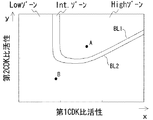
図3は、本実施形態による癌の再発リスク診断の支援方法に使用される再発リスク判定図の一例を示した図である。この再発リスク判定図は、x座標に第1CDK比活性、y座標に第2CDK比活性をとり、その分布領域を、カットオフラインBL1及びカットオフラインBL2とによって、再発リスクの高い領域(Highゾーン)と、再発リスクの低い領域(Lowゾーン)と、中間領域(Int.ゾーン)の3つの領域に分割したものである。 FIG. 3 is a diagram showing an example of a recurrence risk determination diagram used in the cancer recurrence risk diagnosis support method according to the present embodiment. In this recurrence risk judgment diagram, the first CDK specific activity is taken on the x coordinate, the second CDK specific activity is taken on the y coordinate, and the distribution area is defined as a high recurrence risk area (High zone) by the cut-off line BL1 and the cut-off line BL2. The area is divided into three areas: a low recurrence risk area (Low zone) and an intermediate area (Int. Zone).
いま、ある癌患者Aから得られた第1CDK比活性と第2CDK比活性とに基づいて、再発リスク判定図上に点Aがプロットされたとする。図3に示したように、点Aは、カットオフラインBL1によって囲われた領域であるHighゾーンに属していることから、この癌患者Aは、癌の再発リスクが高いと判定することができる。
同様に、ある癌患者Bから得られた第1CDK比活性と第2CDK比活性とに基づいて、再発リスク判定図上に点Bがプロットされたとする。図3に示したように、点Bは、カットオフラインBL2によって囲われた領域であるLowゾーンに属していることから、この癌患者Bは、癌の再発リスクが低いと判定することができる。
Now, it is assumed that the point A is plotted on the recurrence risk determination diagram based on the first CDK specific activity and the second CDK specific activity obtained from a certain cancer patient A. As shown in FIG. 3, since the point A belongs to the High zone that is an area surrounded by the cut-off line BL1, it can be determined that the cancer patient A has a high risk of cancer recurrence.
Similarly, it is assumed that point B is plotted on the recurrence risk determination diagram based on the first CDK specific activity and the second CDK specific activity obtained from a certain cancer patient B. As shown in FIG. 3, since the point B belongs to the Low zone that is an area surrounded by the cut-off line BL2, it can be determined that the cancer patient B has a low risk of cancer recurrence.
再発リスク判定図は、再発リスクスコアRRSと他の判定基準とに基づいて癌の再発リスクを判定するための判定図としてもよい。例えば、再発リスクスコアRRSを第1の判定基準とし、第1CDK比活性を第2の判定基準として、二つの判定基準に基づいて癌の再発リスクを判定するための判定図としてもよい。このような判定図は次のようにして作成することができる。 The recurrence risk determination diagram may be a determination diagram for determining the recurrence risk of cancer based on the recurrence risk score RRS and other determination criteria. For example, the recurrence risk score RRS may be a first determination criterion, the first CDK specific activity may be a second determination criterion, and a determination diagram for determining a cancer recurrence risk based on two determination criteria may be used. Such a determination diagram can be created as follows.
まず、癌の再発リスクの判定に有効な閾値として、再発リスクスコアRRSに対する第1の閾値a及び第1の閾値b、並びに第1CDK比活性に対する第2の閾値a及び第2の閾値bを設定する。次に、第1CDK比活性及び第2CDK比活性の二つのパラメータからなる二次元分布図に、再発リスクスコアRRSが第1の閾値aとなる点を結んだ曲線と、第1CDK比活性が第2の閾値aとなる点を結んだ直線とを結合し、第1のカットオフラインを作成する。同様に、再発リスクスコアRRSが第1の閾値bとなる点を結んだ曲線と、第1CDK比活性が第2の閾値bとなる点を結んだ直線とを結合し、第2のカットオフラインを作成する。これにより、再発リスクスコアRRSと第1CDK比活性とに基づいて癌の再発リスクが異なる領域毎に分割された再発リスク判定図が作成される。その一例を図4に示す。 First, the first threshold value a and the first threshold value b for the recurrence risk score RRS, and the second threshold value a and the second threshold value b for the first CDK specific activity are set as effective threshold values for determining the recurrence risk of cancer. To do. Next, a two-dimensional distribution map composed of two parameters of the first CDK specific activity and the second CDK specific activity, a curve connecting the points at which the recurrence risk score RRS becomes the first threshold a, and the first CDK specific activity are the second The first cut-off line is created by combining the straight line connecting the points that become the threshold value a. Similarly, a curve connecting the points where the recurrence risk score RRS becomes the first threshold value b is combined with a straight line connecting the points where the first CDK specific activity becomes the second threshold value b, and the second cutoff line is obtained. create. Thereby, the recurrence risk judgment diagram divided for each region having a different recurrence risk of cancer based on the recurrence risk score RRS and the first CDK specific activity is created. An example is shown in FIG.
図4は、本実施形態による癌の再発リスク診断の支援方法に使用される再発リスク判定図の一例を示した図である。この再発リスク判定図は、x座標に第1CDK比活性、y座標に第2CDK比活性をとり、その分布領域を、カットオフラインBL3及びカットオフラインBL4とによって、再発リスクの高い領域(Highゾーン)と、再発リスクの低い領域(Lowゾーン)と、中間領域(Int.ゾーン)の3つの領域に分割したものである。 FIG. 4 is a diagram showing an example of a recurrence risk determination diagram used in the cancer recurrence risk diagnosis support method according to the present embodiment. In this recurrence risk judgment chart, the first CDK specific activity is taken on the x coordinate, the second CDK specific activity is taken on the y coordinate, and the distribution area is defined as a high recurrence risk area (High zone) by the cut-off line BL3 and the cut-off line BL4. The area is divided into three areas: a low recurrence risk area (Low zone) and an intermediate area (Int. Zone).
図4において、カットオフラインBL3は、再発リスクスコアRRSが第1の閾値aとなる点を結んだ曲線と、第1CDK比活性が第2の閾値aとなる点を結んだ直線とを結合したものである。カットオフラインBL4は、再発リスクスコアRRSが第1の閾値bとなる点を結んだ曲線と、第1CDK比活性が第2の閾値bとなる点を結んだ直線とを結合したものである。
すなわち、この二次元グラフにおいて、カットオフラインBL3によって囲まれた領域であるHighゾーンは、再発リスクスコアRRSが第1閾値a以上、または第1CDK比活性が第2閾値a以上となる領域である。一方、カットオフラインBL4によって囲まれた領域であるLowゾーンは、再発リスクスコアRRSが第1閾値b未満、かつ、第1CDK比活性が第2閾値b未満となる領域である。
In FIG. 4, the cut-off line BL3 is a combination of a curve connecting points where the recurrence risk score RRS becomes the first threshold value a and a straight line connecting points where the first CDK specific activity becomes the second threshold value a. It is. The cut-off line BL4 is a combination of a curve connecting points where the relapse risk score RRS becomes the first threshold value b and a straight line connecting points where the first CDK specific activity becomes the second threshold value b.
That is, in this two-dimensional graph, the High zone that is an area surrounded by the cut-off line BL3 is an area where the recurrence risk score RRS is equal to or higher than the first threshold value a, or the first CDK specific activity is equal to or higher than the second threshold value a. On the other hand, the Low zone, which is an area surrounded by the cut-off line BL4, is an area where the recurrence risk score RRS is less than the first threshold value b and the first CDK specific activity is less than the second threshold value b.
このように、再発リスクスコアRRSと第1CDK比活性の二つの判定基準に基づく判再発リスク判定図を表示することにより、より信頼性の高い診断支援情報を提供することが可能となる。 Thus, by displaying the relapse risk determination chart based on the two determination criteria of the relapse risk score RRS and the first CDK specific activity, it becomes possible to provide more reliable diagnosis support information.
[2]判定装置
次に、本実施形態の癌の再発リスク判定装置について説明する。
[2] Determination Device Next, the cancer recurrence risk determination device of the present embodiment will be described.
図5は、本実施形態における判定装置の概略構成を示すブロック図である。本実施形態における判定装置1は、被検癌患者から得られたデータに基づいてその癌患者における癌の再発リスクを判定する装置であって、図5に示すように、制御装置10と、測定装置20とを備えて構成されている。制御装置10は、測定装置20から出力された測定データを解析して癌の再発リスクを判定し、判定結果を出力するための装置であり、測定装置20は、被検癌患者から採取された悪性腫瘍を測定して測定データを制御装置10へ出力するための装置である。
FIG. 5 is a block diagram illustrating a schematic configuration of the determination apparatus according to the present embodiment. The
制御装置10は、パーソナルコンピュータ(PC)からなり、制御部101と、キーボード103と、表示部105とを備えている。制御部101は、CPU101aと、ROM101bと、RAM101cと、ハードディスク101dと、画像出力インターフェース101eと、通信インターフェース101fと、画像出力インターフェース101gと、バス101hとを備え、各部はバス101hを介して接続されており、相互にデータの送受信が可能である。
The
CPU101aは、ROM101bに記憶されているコンピュータプログラムおよびRAM101cにロードされたコンピュータプログラムを実行することが可能である。ROM101bには、CPU101aによって実行されるコンピュータプログラムおよびCPU101aがコンピュータプログラムを実行するためのデータなどが記録されている。RAM101cは、ROM101bおよびハードディスク101dに記録されているコンピュータプログラムの読み出しに用いられる。また、これらのコンピュータプログラムを実行するときに、CPU101aの作業領域として利用される。
The
ハードディスク101dには、オペレーティングシステム(OS)やアプリケーションプログラムなど、CPU101aに実行させるための種々のコンピュータプログラムおよびそのコンピュータプログラムの実行に用いるデータがインストールされている。
ハードディスク101dにインストールされているアプリケーションプログラム101iには、癌の再発リスクの判定方法を実現するためのアプリケーションプログラムが含まれている。
The hard disk 101d is installed with various computer programs to be executed by the
The application program 101i installed in the hard disk 101d includes an application program for realizing a method for determining a cancer recurrence risk.
入出力インタフェース101eには、キーボード103やマウス(図示せず)が接続されている。通信インタフェース101fには測定装置20が接続されており、制御部101は、通信インタフェース101fを介して測定装置2とデータの送受信が可能である。
A
画像出力インタフェース101gは、表示部105に接続されており、CPU101aから与えられた画像データに応じた映像信号を表示部105に出力する。表示部105は、入力された映像信号にしたがって、画像(画面)を表示する。
The
制御装置10と通信インタフェース101fを介して接続される測定装置20は、生体組織からCDKの発現量と活性値を測定するための装置である。このような、生体組織からCDK発現量及びCDK活性値を測定するための測定装置として、特開2007−74975号公報に記載されているような装置を用いることができる。
The measuring
なお、本実施形態において、判定装置1は、測定装置20によって得られた測定データを受け付け、癌の再発リスクを判定するように構成されているが、このような構成に限られず、例えば、予めCDK発現量及びCDK活性値を測定しておき、キーボード103から測定データを入力する構成であってもよい。
In the present embodiment, the
図6は、本実施形態に係る判定装置1による癌の再発リスク判定処理を示すフローチャートである。
このフローチャートによる処理は、ハードディスク101dにインストールされたアプリケーションプログラム101iがRAM101cに読み出され、CPU101aがRAM101cに読み出されたアプリケーションプログラム101iを実行することによって実現される。
FIG. 6 is a flowchart showing cancer recurrence risk determination processing by the
The processing according to this flowchart is realized by reading the application program 101i installed in the hard disk 101d into the RAM 101c and executing the application program 101i read out into the RAM 101c by the
まず、ステップS101において、CPU101aは、測定装置20から測定データを受信したか否かを判定する処理を実行する。CPU101aが、測定装置20から測定データを受信していないと判定した場合(ステップS101においてNO)には、処理がリターンされる。
なお、ここでいう測定データとは、測定装置20が生体組織を測定することによって得られた少なくとも2種類のCDKの発現量と活性値である。
First, in step S <b> 101, the
Note that the measurement data referred to here are the expression levels and activity values of at least two types of CDKs obtained by measuring the biological tissue with the measuring
CPU101aが測定装置20から測定データを受信したと判定した場合(ステップS101においてYES)には、ステップS102の処理に進み、CPU101aは、測定装置20から受信した少なくとも2種類のCDKの発現量と活性値とを含む測定データに基づいて、CDKパラメータを算出する処理を実行する。
ステップS102において算出されるCDKパラメータとは、第1CDK比活性、第2CDK比活性及びCDK比活性比である。
If the
The CDK parameters calculated in step S102 are the first CDK specific activity, the second CDK specific activity, and the CDK specific activity ratio.
ついでステップS103の処理に進み、CPU101aは、再発リスクスコアRRSを算出する処理を実行する。
アプリケーションプログラム101iには、癌の再発リスク判定方法において記載したような、第1CDK及び第2CDKの発現量及び活性値に基づいて再発リスクスコアRRSを算出するための式が組み込まれており、CPU101aがアプリケーションプログラム101iを実行することによって再発リスクスコアRRSが算出される。
Next, the process proceeds to step S103, and the
The application program 101i incorporates a formula for calculating the recurrence risk score RRS based on the expression levels and activity values of the first CDK and the second CDK as described in the cancer recurrence risk determination method, and the
ついでステップS104の処理に進み、CPU101aは、再発リスクを判定する処理を実行する。この処理は、ステップS102、S103において算出されたCDKパラメータ及び再発リスクスコアRRSを、アプリケーションプログラム101i内に設定された第1の閾値及び第の2閾値とを比較することにより行われる。第1の閾値は、第1閾値aと第1閾値bとを含み、第2の閾値は、第2閾値aと第2閾値bとを含む。
CPU101aは、再発リスクスコアRRSが第1閾値a以上であるとき、または第1CDK比活性が第2閾値a以上であるとき、再発リスク「高」と判定し、再発リスクスコアRRSが第1閾値b未満であり、かつ第1CDK比活性が第2閾値b未満であるとき、再発リスク「低」と判定し、再発リスクスコアRRSが第1閾値a未満、第1閾値b以上であり、かつ第1CDK比活性が第2閾値a未満、第2閾値b以上であるとき、再発リスク「中」と判定する。
Then, the process proceeds to step S104, and the
When the recurrence risk score RRS is greater than or equal to the first threshold a or when the first CDK specific activity is greater than or equal to the second threshold a, the
ついで、ステップS106の処理に進み、CPU101aは、再発リスク判定図を作成する処理を実行する。
再発リスク判定図は、上記の再発リスク判定方法において説明したような、第1CDK比活性と第2CDK比活性の二つのパラメータからなる二次元グラフであって、その分布領域が、再発リスクが異なる領域毎に分割された二次元グラフである。この二次元グラフにおける各領域は、再発リスクスコアRRSが第1の閾値aとなる点を結んだ曲線と、第1CDK比活性が第2の閾値aとなる点を結んだ直線とを結合したカットオフラインと、再発リスクスコアRRSが第1の閾値bとなる点を結んだ曲線と、第1CDK比活性が第2の閾値bとなる点を結んだ直線とを結合したカットオフラインとによって分割されている。この二次元分布図には、再発リスクの判定が行われた検体がプロットされている。
Next, the processing proceeds to step S106, and the
The recurrence risk judgment diagram is a two-dimensional graph composed of two parameters, the first CDK specific activity and the second CDK specific activity, as described in the above recurrence risk judgment method, and the distribution region is a region where the recurrence risk is different. It is a two-dimensional graph divided | segmented for every. Each region in the two-dimensional graph is a cut obtained by combining a curve connecting points where the recurrence risk score RRS becomes the first threshold value a and a straight line connecting points where the first CDK specific activity becomes the second threshold value a. It is divided by the offline and the cut-off line combining the curve connecting the points where the recurrence risk score RRS becomes the first threshold value b and the straight line connecting the points where the first CDK specific activity becomes the second threshold value b. Yes. In this two-dimensional distribution diagram, specimens for which the risk of recurrence has been determined are plotted.
ついでステップS106の処理に進み、CPU101aは、ステップS104において得られた再発リスク判定結果と、ステップS105において作成された再発リスク判定図を、表示部105に表示させる処理を実行する。
Next, the process proceeds to step S106, and the
図7は、判定結果の表示画面の一例を示す図である。図に示すように、表示部105に表示される判定結果の表示画面105aには、判定が行われた検体の検体番号、再発リスク判定結果、推定再発率、及び再発リスク判定図105bが表示される。推定再発率は、再発リスク判定結果に基づいて表示される数値であって、例えば再発リスク「高」である場合には80%、再発リスク「中」である場合には40%、再発リスク「低」である場合には10%と表示される。
FIG. 7 is a diagram illustrating an example of a determination result display screen. As shown in the figure, the determination
再発リスク判定図105bは、ステップS105において作成された二次元グラフであって、再発リスクの判定が行われた検体のCDK1比活性及びCDK2比活性がプロットされて表示される(図中、★印で表示している)。このように、再発リスクスコアRRSとCDKパラメータとに基づく再発リスク判定結果とともに再発リスク判定図を表示することにより、被検癌患者の再発リスクの程度を視覚的に知ることができる。 The recurrence risk determination diagram 105b is a two-dimensional graph created in step S105, in which the CDK1 specific activity and CDK2 specific activity of the specimen for which the recurrence risk determination has been made are plotted and displayed (in the figure, ★ mark). Is displayed). Thus, by displaying the recurrence risk determination diagram together with the recurrence risk determination result based on the recurrence risk score RRS and the CDK parameter, it is possible to visually know the degree of recurrence risk of the test cancer patient.
なお、本実施形態における再発リスク判定図には、再発リスクの判定が行われた検体のみをプロットした図を表示した例について説明したが、このような構成に限られず、例えば、癌の再発が認められた癌患者の検体と、癌の再発が認められなかった癌患者の検体とを含む複数の検体を同時にプロットした図を表示する構成であってもよい。このような構成とすることにより、癌の再発リスクを統計的に知ることができる。 In addition, in the recurrence risk determination diagram in the present embodiment, an example in which a diagram in which only the specimen for which the recurrence risk determination has been performed is displayed has been described. However, the present invention is not limited to such a configuration. The structure which displays the figure which plotted simultaneously the some specimen containing the specimen of the recognized cancer patient and the specimen of the cancer patient in which the recurrence of cancer was not recognized may be displayed. By adopting such a configuration, it is possible to statistically know the risk of cancer recurrence.
本実施形態による判定方法を用いて癌患者の再発リスクを判定した。
表1に示す条件を満たした癌患者から採取された悪性腫瘍のCDK1、CDK2の発現量と活性値を測定した。
The recurrence risk of cancer patients was determined using the determination method according to this embodiment.
The expression levels and activity values of CDK1 and CDK2 of malignant tumors collected from cancer patients satisfying the conditions shown in Table 1 were measured.

得られたCDK1、CDK2の発現量及び活性値を用いて、下記式(10)乃至(12)に基づいて再発リスクスコアRRSを算出し、下記式(13)に基づいてCDK1比活性を算出した。
RS1;F(x)=0.15/(1+Exp(−(x−1.6)×7) ・・・(10)
RS2;G(y)=0.25/(1+Exp(−(y−1.0)×6) ・・・(11)
RRS=3000×F(x)×G(y) ・・・(12)
x=CDK1活性値/CDK1発現量
y=(CDK2活性値×CDK1発現量)/(CDK2発現量×CDK1活性値)
CDK1比活性=CDK1活性値/CDK1発現量 ・・・(13)
Using the obtained CDK1 and CDK2 expression levels and activity values, the recurrence risk score RRS was calculated based on the following formulas (10) to (12), and the CDK1 specific activity was calculated based on the following formula (13). .
RS1; F (x) = 0.15 / (1 + Exp (− (x−1.6) × 7)) (10)
RS2; G (y) = 0.25 / (1 + Exp (− (y−1.0) × 6)) (11)
RRS = 3000 × F (x) × G (y) (12)
x = CDK1 activity value / CDK1 expression level y = (CDK2 activity value × CDK1 expression level) / (CDK2 expression level × CDK1 activity level)
CDK1 specific activity = CDK1 activity value / CDK1 expression level (13)
次に、各症例から得られた再発リスクスコアRRS及びCDK1比活性を下記の条件と比較して、癌患者を再発率リスクの高い群(Highグループ)、再発リスクの低い群(Lowグループ)、中間層(Int.グループ)の3つの患者群に分類した。
Highグループ: RRS≧1.47
または
CDK1比活性≧90(maU/eU)
Lowグループ: RRS<0.45
かつ
CDK1比活性<70(maU/eU)
Int.グループ: 0.45≦RRS<1.47
かつ
70≦CDK1比活性<90(maU/eU)
Next, the recurrence risk score RRS and CDK1 specific activity obtained from each case were compared with the following conditions, and cancer patients were classified into a group with a high recurrence rate risk (High group), a group with a low recurrence risk (Low group), Classified into 3 patient groups in the middle layer (Int. Group).
High group: RRS ≧ 1.47
Or
CDK1 specific activity ≧ 90 (maU / eU)
Low group: RRS <0.45
And
CDK1 specific activity <70 (maU / eU)
Int. Group: 0.45 ≦ RRS <1.47
And
70 ≦ CDK1 specific activity <90 (maU / eU)
各患者群において、5年以内に再発した患者数と、各患者群における5年以内累積再発率を算出した。その結果を表2に示す。 In each patient group, the number of patients who relapsed within 5 years and the cumulative recurrence rate within 5 years in each patient group were calculated. The results are shown in Table 2.
表2に示したように、本実施形態による判定方法によって癌患者を分類した結果、Highグループに該当した患者数は71人、Lowグループに該当した患者数は83人、Int.グループに該当した患者数は38人であり、各患者群において5年以内に再発した患者数はそれぞれ9人、1人、3人であった。そして、各患者群における5年以内の累積再発率は、Highグループが14.1%、Lowグループが1.2%、Int.グループが11.7%であり、Lowグループの患者群は、Highグループの患者群に比べて5年間の無再発生存が有意に高いことがわかる。さらに、母集団における5年以内累積再発率は8.2%であり、これと比較しても、本実施形態による判定方法が適切に再発リスクを判定できていることがわかる。この結果から、本実施形態による判定方法によって、癌患者の癌の再発リスクを精度良く判定可能であることが実証された。 As shown in Table 2, as a result of classifying cancer patients by the determination method according to the present embodiment, the number of patients corresponding to the High group is 71, the number of patients corresponding to the Low group is 83, and Int. The number of patients corresponding to the group was 38, and the number of patients who relapsed within 5 years in each patient group was 9, 1 and 3, respectively. The cumulative recurrence rate within 5 years in each patient group was 14.1% for the High group, 1.2% for the Low group, and Int. The group is 11.7%, and it can be seen that the patient group of the Low group has significantly higher recurrence-free survival for 5 years than the patient group of the High group. Furthermore, the cumulative recurrence rate within 5 years in the population is 8.2%, and it can be seen that the determination method according to the present embodiment can appropriately determine the risk of recurrence compared to this. From this result, it was proved that the risk of cancer recurrence of cancer patients can be accurately determined by the determination method according to the present embodiment.
上記実施例1における癌患者を、本実施形態による再発リスク判定図を用いて分類した。 The cancer patients in Example 1 were classified using the recurrence risk determination diagram according to the present embodiment.
まず、癌患者のCDK1及びCDK2の発現量と活性値とを用いて、下記式(14)及び(15)に基づいて、各癌患者のCDK1比活性及びCDK2比活性を算出した。
CDK1比活性=CDK1活性値/CDK1発現量 ・・・(14)
CDK2比活性=CDK2活性値/CDK2発現量 ・・・(15)
First, using the expression levels and activity values of CDK1 and CDK2 of cancer patients, the CDK1 specific activity and CDK2 specific activity of each cancer patient were calculated based on the following formulas (14) and (15).
CDK1 specific activity = CDK1 activity value / CDK1 expression level (14)
CDK2 specific activity = CDK2 activity value / CDK2 expression level (15)
次に、得られたCDK1比活性とCDK2比活性とに基づいて、癌患者を、図8に示すようなCDK1比活性及びCDK2比活性の二つのパラメータからなる再発リスク判定図にプロットした。 Next, on the basis of the obtained CDK1 specific activity and CDK2 specific activity, cancer patients were plotted in a recurrence risk judgment diagram consisting of two parameters of CDK1 specific activity and CDK2 specific activity as shown in FIG.
図8は、本実施例における癌患者を、CDK1比活性(x軸)及びCDK2比活性(y軸)に基づいてプロットした二次元グラフであって、カットオフラインα及びカットオフラインβによって、分布領域を再発リスクの高い領域(Highグループ)、再発リスクの低い領域(Lowグループ)、中間領域(Int.グループ)に分割したものである。
図8において、カットオフラインαは、CDK1比活性とCDK2比活性とに基づいて求められる再発リスクスコアRRSの値が1.47となる点を結んだ曲線と、CDK1比活性が90(maU/eU)となる直線とからなる。カットオフラインβは、CDK1比活性とCDK2比活性とに基づいて求められる再発リスクスコアRRSの値が0.45となる点を結んだ曲線と、CDK1比活性が70(maU/eU)となる直線とからなる。
同図において、悪性腫瘍摘出後5年以内に癌が再発した症例については、円で囲って表示してある。
FIG. 8 is a two-dimensional graph in which cancer patients in this example are plotted based on CDK1 specific activity (x-axis) and CDK2 specific activity (y-axis), and distribution regions are represented by cut-off line α and cut-off line β. Is divided into a region with a high risk of recurrence (High group), a region with a low risk of recurrence (Low group), and an intermediate region (Int. Group).
In FIG. 8, the cut-off line α indicates a curve connecting points where the value of the relapse risk score RRS obtained based on the CDK1 specific activity and the CDK2 specific activity is 1.47, and the CDK1 specific activity is 90 (maU / eU). ). The cut-off line β is a curve connecting points where the value of the recurrence risk score RRS obtained on the basis of the CDK1 specific activity and the CDK2 specific activity is 0.45, and a straight line where the CDK1 specific activity is 70 (maU / eU). It consists of.
In the figure, cases in which cancer has recurred within 5 years after the removal of the malignant tumor are indicated by circles.
このような再発リスク判定図を用いて患者群を分類した結果、表2と同様の分類結果が得られた。これにより、本実施形態による再発リスク判定図を用いることによっても、癌患者の癌の再発リスクを適切に判定可能であることが実証された。 As a result of classifying patient groups using such a recurrence risk judgment chart, the same classification results as in Table 2 were obtained. Thereby, it was demonstrated that the recurrence risk of cancer of a cancer patient can be appropriately determined even by using the recurrence risk determination diagram according to the present embodiment.
以上より、本実施形態による再発リスク判定図を表示して診断支援を行うことにより、信頼性の高い再発リスク診断支援情報を提供できることが示唆された。 From the above, it was suggested that highly reliable recurrence risk diagnosis support information can be provided by displaying the recurrence risk determination diagram according to this embodiment and providing diagnosis support.
1 判定装置
10 制御装置
20 測定装置
101 制御部
101a CPU
101b ROM
101c RAM
101d ハードディスク
101e 入出力インターフェース
101f 通信インターフェース
101g 画像出力インターフェース
101h バス
101i アプリケーションプログラム
103 キーボード
105 表示部
105a 表示画面
105b 再発リスク判定図
DESCRIPTION OF
101b ROM
101c RAM
101d
Claims (9)
下記式(1)に基づいて再発リスクスコアを求め、
得られた再発リスクスコアに基づいて癌の再発リスクを判定する、癌の再発リスク判定方法。
再発リスクスコア=F(x)×G(y) ・・・(1)
(式中、F(x)=a/(1+Exp(-(x-b)×c))であり、G(y)=d/(1+Exp(-(y-e)×f))である(式中、a〜fは定数である):式中、xはCDK1比活性を表し、このCDK1比活性は、CDK1活性値/CDK1発現量で示される:式中、yは比活性比を表し、この比活性比は、CDK2比活性/CDK1比活性で示される) From the malignant tumor collected from the test cancer patient, obtain the expression level and activity value of CDK1 and CDK2,
Based on the following formula (1), a recurrence risk score is obtained,
A method for determining a cancer recurrence risk, wherein the risk of cancer recurrence is determined based on the obtained recurrence risk score.
Relapse risk score = F (x) × G (y) (1)
(Where F (x) = a / (1 + Exp (− (xb) × c)) and G (y) = d / (1 + Exp (− (ye) × f)) ( In the formula, a to f are constants): In the formula, x represents the CDK1 specific activity, and this CDK1 specific activity is represented by CDK1 activity value / CDK1 expression level: In the formula, y represents the specific activity ratio. This specific activity ratio is expressed as CDK2 specific activity / CDK1 specific activity)
CDK1比活性と、第2の閾値とを比較することにより癌の再発リスクを判定する請求項3に記載の判定方法。 Compare the recurrence risk score with the first threshold,
The determination method according to claim 3, wherein the risk of cancer recurrence is determined by comparing the CDK1 specific activity with a second threshold value.
前記第2の閾値が、第2閾値Aと第2閾値Bとを含み、
再発リスクスコア≧第1閾値A、または、CDK1比活性≧第2閾値Aであるとき、癌の再発リスクが高いと判定し、
再発リスクスコア<第1閾値B、かつ、CDK1比活性<第2閾値Bであるとき、癌の再発リスクが低いと判定する請求項4に記載の判定方法。 The first threshold includes a first threshold A and a first threshold B;
The second threshold includes a second threshold A and a second threshold B;
When the recurrence risk score ≧ first threshold A or CDK1 specific activity ≧ second threshold A, it is determined that the cancer recurrence risk is high,
The determination method according to claim 4, wherein when the recurrence risk score <the first threshold value B and the CDK1 specific activity <the second threshold value B, it is determined that the cancer recurrence risk is low.
前記G(y)は、yと癌の再発率との相関関係に基づく関数である請求項1〜5のいずれか一項に記載の判定方法。 F (x) is a function based on the correlation between x and the recurrence rate of cancer,
The determination method according to claim 1, wherein G (y) is a function based on a correlation between y and a recurrence rate of cancer.
CDK1の比活性と、CDK2の比活性の二つのパラメータからなり、下記式(2)に基づいて算出される再発リスクスコアの異なる領域毎に分割された再発リスク判定図に、得られたCDK1比活性及びCDK2比活性をプロットして表示する癌の再発リスク診断の支援方法。
再発リスクスコア=F(x)×G(y) ・・・(2)
(式中、F(x)=a/(1+Exp(-(x-b)×c))であり、G(y)=d/(1+Exp(-(y-e)×f))である(式中、a〜fは定数である):式中、xはCDK1比活性を表し、このCDK1比活性は、CDK1活性値/CDK1発現量で示される:式中、yは比活性比を表し、この比活性比は、CDK2比活性/CDK1比活性で示される) From the malignant tumor collected from the test cancer patient, obtain the expression level and activity value of CDK1 and CDK2,
It consists of two parameters, CDK1 specific activity and CDK2 specific activity, and the CDK1 ratio obtained is shown in the recurrence risk judgment chart divided for each region with different recurrence risk scores calculated based on the following formula (2) A method for supporting cancer recurrence risk diagnosis by plotting and displaying activity and CDK2 specific activity.
Recurrence risk score = F (x) × G (y) (2)
(Where F (x) = a / (1 + Exp (− (xb) × c)) and G (y) = d / (1 + Exp (− (ye) × f)) ( In the formula, a to f are constants): In the formula, x represents the CDK1 specific activity, and this CDK1 specific activity is represented by CDK1 activity value / CDK1 expression level: In the formula, y represents the specific activity ratio. This specific activity ratio is expressed as CDK2 specific activity / CDK1 specific activity)
Priority Applications (2)
| Application Number | Priority Date | Filing Date | Title |
|---|---|---|---|
| JP2008086212A JP5351427B2 (en) | 2008-03-28 | 2008-03-28 | Method for determining risk of cancer recurrence and method for supporting diagnosis of cancer recurrence risk |
| US12/242,817 US8014960B2 (en) | 2008-03-28 | 2008-09-30 | Method of supporting a diagnosis of a risk of cancer recurrence, and a device of supporting a diagnosis of a risk of cancer recurrence |
Applications Claiming Priority (1)
| Application Number | Priority Date | Filing Date | Title |
|---|---|---|---|
| JP2008086212A JP5351427B2 (en) | 2008-03-28 | 2008-03-28 | Method for determining risk of cancer recurrence and method for supporting diagnosis of cancer recurrence risk |
Publications (2)
| Publication Number | Publication Date |
|---|---|
| JP2009232815A JP2009232815A (en) | 2009-10-15 |
| JP5351427B2 true JP5351427B2 (en) | 2013-11-27 |
Family
ID=41117839
Family Applications (1)
| Application Number | Title | Priority Date | Filing Date |
|---|---|---|---|
| JP2008086212A Expired - Fee Related JP5351427B2 (en) | 2008-03-28 | 2008-03-28 | Method for determining risk of cancer recurrence and method for supporting diagnosis of cancer recurrence risk |
Country Status (2)
| Country | Link |
|---|---|
| US (1) | US8014960B2 (en) |
| JP (1) | JP5351427B2 (en) |
Families Citing this family (3)
| Publication number | Priority date | Publication date | Assignee | Title |
|---|---|---|---|---|
| JP5553661B2 (en) | 2010-03-30 | 2014-07-16 | シスメックス株式会社 | Cancer recurrence risk assessment method |
| JP6002379B2 (en) | 2011-11-29 | 2016-10-05 | シスメックス株式会社 | Method for determining risk of cancer recurrence and use thereof |
| CN113936734B (en) * | 2021-12-07 | 2025-07-11 | 谱天(天津)生物科技有限公司 | A method for assessing the risk of lung cancer recurrence |
Family Cites Families (3)
| Publication number | Priority date | Publication date | Assignee | Title |
|---|---|---|---|---|
| DE602005024964D1 (en) | 2004-05-31 | 2011-01-05 | Sysmex Corp | METHOD FOR ASSESSING THE MALIGNITY OF ANIMAL CANCER CELL |
| JP5197931B2 (en) * | 2005-08-01 | 2013-05-15 | シスメックス株式会社 | Method for determining the nature of a malignant tumor |
| JP2007259846A (en) * | 2006-02-28 | 2007-10-11 | Sysmex Corp | Method for determining the nature of a malignant tumor |
-
2008
- 2008-03-28 JP JP2008086212A patent/JP5351427B2/en not_active Expired - Fee Related
- 2008-09-30 US US12/242,817 patent/US8014960B2/en not_active Expired - Fee Related
Also Published As
| Publication number | Publication date |
|---|---|
| JP2009232815A (en) | 2009-10-15 |
| US20090246809A1 (en) | 2009-10-01 |
| US8014960B2 (en) | 2011-09-06 |
Similar Documents
| Publication | Publication Date | Title |
|---|---|---|
| Esagian et al. | Comparison of liquid-based to tissue-based biopsy analysis by targeted next generation sequencing in advanced non-small cell lung cancer: a comprehensive systematic review | |
| Lips et al. | Breast cancer subtyping by immunohistochemistry and histological grade outperforms breast cancer intrinsic subtypes in predicting neoadjuvant chemotherapy response | |
| Niu et al. | Evaluation of next generation sequencing for detecting HER2 copy number in breast and gastric cancers | |
| Robbins et al. | HER2 testing: evolution and update for a companion diagnostic assay | |
| Solomon et al. | Her2/neu status determination in breast cancer: a single institutional experience using a dual-testing approach with immunohistochemistry and fluorescence in situ hybridization | |
| Cobain et al. | Indications for prognostic gene expression profiling in early breast cancer | |
| Cserni et al. | Pathological diagnosis, work-up and reporting of breast cancer 1st central-eastern european professional consensus statement on breast cancer | |
| De Las Casas et al. | Pathologists at the leading edge of optimizing the tumor tissue journey for diagnostic accuracy and molecular testing | |
| Chen et al. | Comparison of immunohistochemistry and RT-qPCR for assessing ER, PR, HER2, and Ki67 and evaluating subtypes in patients with breast cancer | |
| JP5553661B2 (en) | Cancer recurrence risk assessment method | |
| Carpentieri et al. | Protocol for the examination of specimens from pediatric and adult patients with osseous and extraosseous Ewing sarcoma family of tumors, including peripheral primitive neuroectodermal tumor and Ewing sarcoma | |
| Bruschini et al. | Oral cancer: changing the aim of the biopsy in the age of precision medicine. A review | |
| JP5351427B2 (en) | Method for determining risk of cancer recurrence and method for supporting diagnosis of cancer recurrence risk | |
| Tsongalis et al. | Comparison of tissue molecular biomarker testing turnaround times and concordance between standard of care and the Biocartis Idylla platform in patients with colorectal cancer | |
| Ruiz-Torres et al. | Personalized circulating tumor DNA dynamics inform survival and response to immune checkpoint blockade in recurrent/metastatic head and neck cancer | |
| Nagakubo et al. | Nucleic Acid Quality Assessment is Critical to the Success of the Oncomine Dx Target Test for Lung Cancer: Y. Nagakubo et al. | |
| Keerthika et al. | Diagnostic reliability of CRTC1/3:: MAML2 gene fusion transcripts in discriminating histologically similar intraosseous mucoepidermoid carcinoma from glandular odontogenic cyst: a systematic review and meta-analysis | |
| Sonntag et al. | Subtyping of breast cancer using reverse phase protein arrays | |
| Ross et al. | Molecular oncology of breast cancer | |
| Wu et al. | Adenoid cystic carcinoma of the breast: Molecular profiling updates and multidimensional detection of MYB | |
| Dotson et al. | Feasibility of lung cancer RNA acquisition from a single transbronchial or transthoracic needle pass (FASTT trial) | |
| Luna et al. | The differential prognostic implications of PD-L1 expression in the outcomes of Filipinos with EGFR-mutant NSCLC treated with tyrosine kinase inhibitors | |
| Glass et al. | Deployment of a Machine Learning Algorithm in a Real-World Cohort for Quality Control Monitoring of Human Epidermal Growth Factor-2–Stained Clinical Specimens in Breast Cancer | |
| JP5340621B2 (en) | Method for determining the effectiveness of anthracycline-based anticancer drug treatment and diagnostic support method for the effectiveness of anthracycline-based anticancer drug treatment | |
| Hunt et al. | Real-time functional proteomics enhances therapeutic targeting in precision oncology molecular tumor boards |
Legal Events
| Date | Code | Title | Description |
|---|---|---|---|
| A621 | Written request for application examination |
Free format text: JAPANESE INTERMEDIATE CODE: A621 Effective date: 20110314 |
|
| RD04 | Notification of resignation of power of attorney |
Free format text: JAPANESE INTERMEDIATE CODE: A7424 Effective date: 20110812 |
|
| A131 | Notification of reasons for refusal |
Free format text: JAPANESE INTERMEDIATE CODE: A131 Effective date: 20130326 |
|
| A521 | Request for written amendment filed |
Free format text: JAPANESE INTERMEDIATE CODE: A523 Effective date: 20130517 |
|
| A131 | Notification of reasons for refusal |
Free format text: JAPANESE INTERMEDIATE CODE: A131 Effective date: 20130709 |
|
| A521 | Request for written amendment filed |
Free format text: JAPANESE INTERMEDIATE CODE: A523 Effective date: 20130711 |
|
| TRDD | Decision of grant or rejection written | ||
| A01 | Written decision to grant a patent or to grant a registration (utility model) |
Free format text: JAPANESE INTERMEDIATE CODE: A01 Effective date: 20130730 |
|
| A61 | First payment of annual fees (during grant procedure) |
Free format text: JAPANESE INTERMEDIATE CODE: A61 Effective date: 20130823 |
|
| R150 | Certificate of patent or registration of utility model |
Ref document number: 5351427 Country of ref document: JP Free format text: JAPANESE INTERMEDIATE CODE: R150 Free format text: JAPANESE INTERMEDIATE CODE: R150 |
|
| R250 | Receipt of annual fees |
Free format text: JAPANESE INTERMEDIATE CODE: R250 |
|
| R250 | Receipt of annual fees |
Free format text: JAPANESE INTERMEDIATE CODE: R250 |
|
| R250 | Receipt of annual fees |
Free format text: JAPANESE INTERMEDIATE CODE: R250 |
|
| LAPS | Cancellation because of no payment of annual fees |