JP5276357B2 - How to replace the nickel-hydrogen secondary battery - Google Patents
How to replace the nickel-hydrogen secondary battery Download PDFInfo
- Publication number
- JP5276357B2 JP5276357B2 JP2008130723A JP2008130723A JP5276357B2 JP 5276357 B2 JP5276357 B2 JP 5276357B2 JP 2008130723 A JP2008130723 A JP 2008130723A JP 2008130723 A JP2008130723 A JP 2008130723A JP 5276357 B2 JP5276357 B2 JP 5276357B2
- Authority
- JP
- Japan
- Prior art keywords
- nickel
- battery
- secondary battery
- hydrogen secondary
- hydrogen
- Prior art date
- Legal status (The legal status is an assumption and is not a legal conclusion. Google has not performed a legal analysis and makes no representation as to the accuracy of the status listed.)
- Active
Links
- 229910052739 hydrogen Inorganic materials 0.000 title claims description 77
- 239000001257 hydrogen Substances 0.000 title claims description 77
- PXHVJJICTQNCMI-UHFFFAOYSA-N Nickel Chemical compound [Ni] PXHVJJICTQNCMI-UHFFFAOYSA-N 0.000 claims description 47
- 229910052759 nickel Inorganic materials 0.000 claims description 25
- 238000000034 method Methods 0.000 claims description 22
- 238000007599 discharging Methods 0.000 claims description 18
- 230000005856 abnormality Effects 0.000 claims description 12
- 150000002431 hydrogen Chemical class 0.000 claims description 11
- 238000001514 detection method Methods 0.000 claims description 8
- 238000007689 inspection Methods 0.000 claims description 8
- UFHFLCQGNIYNRP-UHFFFAOYSA-N Hydrogen Chemical compound [H][H] UFHFLCQGNIYNRP-UHFFFAOYSA-N 0.000 claims description 7
- 238000004064 recycling Methods 0.000 claims description 7
- 230000008929 regeneration Effects 0.000 claims description 7
- 238000011069 regeneration method Methods 0.000 claims description 7
- XIKYYQJBTPYKSG-UHFFFAOYSA-N nickel Chemical compound [Ni].[Ni] XIKYYQJBTPYKSG-UHFFFAOYSA-N 0.000 claims 1
- 230000001172 regenerating effect Effects 0.000 claims 1
- 230000003446 memory effect Effects 0.000 description 15
- 230000002950 deficient Effects 0.000 description 8
- 230000007423 decrease Effects 0.000 description 6
- 230000000694 effects Effects 0.000 description 5
- 238000009825 accumulation Methods 0.000 description 3
- 238000010586 diagram Methods 0.000 description 3
- 230000004888 barrier function Effects 0.000 description 1
- OJIJEKBXJYRIBZ-UHFFFAOYSA-N cadmium nickel Chemical compound [Ni].[Cd] OJIJEKBXJYRIBZ-UHFFFAOYSA-N 0.000 description 1
- 230000007547 defect Effects 0.000 description 1
- 230000007257 malfunction Effects 0.000 description 1
Images


Classifications
-
- B—PERFORMING OPERATIONS; TRANSPORTING
- B60—VEHICLES IN GENERAL
- B60L—PROPULSION OF ELECTRICALLY-PROPELLED VEHICLES; SUPPLYING ELECTRIC POWER FOR AUXILIARY EQUIPMENT OF ELECTRICALLY-PROPELLED VEHICLES; ELECTRODYNAMIC BRAKE SYSTEMS FOR VEHICLES IN GENERAL; MAGNETIC SUSPENSION OR LEVITATION FOR VEHICLES; MONITORING OPERATING VARIABLES OF ELECTRICALLY-PROPELLED VEHICLES; ELECTRIC SAFETY DEVICES FOR ELECTRICALLY-PROPELLED VEHICLES
- B60L53/00—Methods of charging batteries, specially adapted for electric vehicles; Charging stations or on-board charging equipment therefor; Exchange of energy storage elements in electric vehicles
- B60L53/10—Methods of charging batteries, specially adapted for electric vehicles; Charging stations or on-board charging equipment therefor; Exchange of energy storage elements in electric vehicles characterised by the energy transfer between the charging station and the vehicle
- B60L53/12—Inductive energy transfer
-
- Y—GENERAL TAGGING OF NEW TECHNOLOGICAL DEVELOPMENTS; GENERAL TAGGING OF CROSS-SECTIONAL TECHNOLOGIES SPANNING OVER SEVERAL SECTIONS OF THE IPC; TECHNICAL SUBJECTS COVERED BY FORMER USPC CROSS-REFERENCE ART COLLECTIONS [XRACs] AND DIGESTS
- Y02—TECHNOLOGIES OR APPLICATIONS FOR MITIGATION OR ADAPTATION AGAINST CLIMATE CHANGE
- Y02T—CLIMATE CHANGE MITIGATION TECHNOLOGIES RELATED TO TRANSPORTATION
- Y02T10/00—Road transport of goods or passengers
- Y02T10/60—Other road transportation technologies with climate change mitigation effect
- Y02T10/70—Energy storage systems for electromobility, e.g. batteries
-
- Y—GENERAL TAGGING OF NEW TECHNOLOGICAL DEVELOPMENTS; GENERAL TAGGING OF CROSS-SECTIONAL TECHNOLOGIES SPANNING OVER SEVERAL SECTIONS OF THE IPC; TECHNICAL SUBJECTS COVERED BY FORMER USPC CROSS-REFERENCE ART COLLECTIONS [XRACs] AND DIGESTS
- Y02—TECHNOLOGIES OR APPLICATIONS FOR MITIGATION OR ADAPTATION AGAINST CLIMATE CHANGE
- Y02T—CLIMATE CHANGE MITIGATION TECHNOLOGIES RELATED TO TRANSPORTATION
- Y02T10/00—Road transport of goods or passengers
- Y02T10/60—Other road transportation technologies with climate change mitigation effect
- Y02T10/7072—Electromobility specific charging systems or methods for batteries, ultracapacitors, supercapacitors or double-layer capacitors
-
- Y—GENERAL TAGGING OF NEW TECHNOLOGICAL DEVELOPMENTS; GENERAL TAGGING OF CROSS-SECTIONAL TECHNOLOGIES SPANNING OVER SEVERAL SECTIONS OF THE IPC; TECHNICAL SUBJECTS COVERED BY FORMER USPC CROSS-REFERENCE ART COLLECTIONS [XRACs] AND DIGESTS
- Y02—TECHNOLOGIES OR APPLICATIONS FOR MITIGATION OR ADAPTATION AGAINST CLIMATE CHANGE
- Y02T—CLIMATE CHANGE MITIGATION TECHNOLOGIES RELATED TO TRANSPORTATION
- Y02T90/00—Enabling technologies or technologies with a potential or indirect contribution to GHG emissions mitigation
- Y02T90/10—Technologies relating to charging of electric vehicles
- Y02T90/12—Electric charging stations
-
- Y—GENERAL TAGGING OF NEW TECHNOLOGICAL DEVELOPMENTS; GENERAL TAGGING OF CROSS-SECTIONAL TECHNOLOGIES SPANNING OVER SEVERAL SECTIONS OF THE IPC; TECHNICAL SUBJECTS COVERED BY FORMER USPC CROSS-REFERENCE ART COLLECTIONS [XRACs] AND DIGESTS
- Y02—TECHNOLOGIES OR APPLICATIONS FOR MITIGATION OR ADAPTATION AGAINST CLIMATE CHANGE
- Y02T—CLIMATE CHANGE MITIGATION TECHNOLOGIES RELATED TO TRANSPORTATION
- Y02T90/00—Enabling technologies or technologies with a potential or indirect contribution to GHG emissions mitigation
- Y02T90/10—Technologies relating to charging of electric vehicles
- Y02T90/14—Plug-in electric vehicles
Landscapes
- Engineering & Computer Science (AREA)
- Power Engineering (AREA)
- Transportation (AREA)
- Mechanical Engineering (AREA)
- Secondary Cells (AREA)
- Charge And Discharge Circuits For Batteries Or The Like (AREA)
Description
本発明は、メモリ効果の蓄積される複数のニッケル−水素二次電池で構成される組電池において、不具合の生じた一部のニッケル−水素二次電池を交換用のニッケル−水素二次電池と交換してその組電池の再構成(リビルト)を行うニッケル−水素二次電池の交換方法に関するものである。 The present invention relates to an assembled battery composed of a plurality of nickel-hydrogen secondary batteries in which the memory effect is accumulated, and replaces some of the nickel-hydrogen secondary batteries in which a defect has occurred with a replacement nickel-hydrogen secondary battery. The present invention relates to a method for replacing a nickel-hydrogen secondary battery which is reconfigured and reconstructed.
電気自動車やハイブリッド自動車等の電源には、複数の二次電池で構成される組電池が用いられている。このような組電池では、二次電池の個体差や二次電池を構成する部品の不具合等により、該組電池を構成する二次電池の一部が他の二次電池に比べて早期に寿命や故障に至ることがある。このような不具合が生じると、組電池本来の性能を発揮することができなくなり、ひいてはシステム全体に異常が生じる虞があった。そこで、組電池全体を単に新品と交換するのでは使用可能な二次電池が無駄に廃棄されることになるため、不具合の生じた二次電池のみを正常な二次電池に交換し、交換の必要のない他の二次電池を再利用して、組電池を再構成(リビルト)することが考えられている。 A battery pack composed of a plurality of secondary batteries is used as a power source for electric vehicles, hybrid vehicles, and the like. In such an assembled battery, a part of the secondary battery constituting the assembled battery has a lifetime that is earlier than that of other secondary batteries due to individual differences of the secondary battery or malfunctions of components constituting the secondary battery. May lead to failure. If such a problem occurs, the original performance of the assembled battery cannot be exhibited, and as a result, there is a possibility that an abnormality occurs in the entire system. Therefore, if the entire assembled battery is simply replaced with a new one, the usable secondary battery will be wasted. Therefore, only the defective secondary battery is replaced with a normal secondary battery. It is considered to reconfigure (rebuild) the assembled battery by reusing other secondary batteries that are not necessary.
ところで、電気自動車やハイブリッド自動車等に用いるものとしては、ニッケル−カドミウム(Ni−Cd)二次電池や、ニッケル−水素(Ni−MH)二次電池が主流であるが、これらの二次電池には、初期時と使用の進んだ時とでは特性に差が生じる所謂メモリ効果という問題があり、二次電池の使用が進むに連れてそのメモリ効果の蓄積が大きくなる。また、このメモリ効果は、ユーザ毎の電池の使用環境や使用状態でもその蓄積度合いが変わるものである。そのため、使用の進んだ非交換の二次電池との調和を考慮しないで組電池を再構成しても、組電池として十分な性能を得ることができず、場合によっては再利用できないという技術的課題があった。 By the way, nickel-cadmium (Ni-Cd) secondary batteries and nickel-hydrogen (Ni-MH) secondary batteries are mainly used for electric vehicles and hybrid vehicles. However, there is a problem of a so-called memory effect that causes a difference in characteristics between the initial time and when the use is advanced, and the storage of the memory effect increases as the use of the secondary battery progresses. In addition, this memory effect changes in the degree of accumulation even in the usage environment and usage state of the battery for each user. Therefore, even if the assembled battery is reconfigured without considering harmony with the advanced non-replaceable secondary battery, sufficient performance as an assembled battery cannot be obtained, and in some cases it cannot be reused. There was a problem.
そこで、このような技術的課題を解決するものとして、例えば特許文献1や特許文献2にて示されるようなものがあった。特許文献1では、交換用の新しい二次電池を非交換の二次電池よりも充電量(SOC:State of Charge )が小さくなるように充電して交換する二次電池の交換方法が示されている。即ち、これにより再構成された組電池は、使用により充放電が繰り返されると、交換した新しい二次電池と非交換の二次電池との充電量の差が小さくなるため、組電池を構成する二次電池の充電量をそれぞれ同等にでき、組電池の性能を最大限に発揮できるとしている。
In order to solve such technical problems, for example, there are those shown in Patent Document 1 and
また特許文献2では、非交換の二次電池に蓄積しているメモリ効果と同様のメモリ効果を交換用の二次電池に付与して交換する二次電池の交換方法が示されている。即ち、これにより再構成された組電池は、交換用の二次電池も非交換の二次電池と同様の電圧特性となることから、組電池の性能を最大限に発揮できるとしている。
しかしながら、十分な性能を有するように組電池の再構成を行うために、特許文献1では、個々の二次電池の充電量を把握する必要があり、また非交換の二次電池の充電量と交換用の新しい二次電池の充電量とをそれぞれ調整する作業が煩雑であった。 However, in order to reconfigure the assembled battery so as to have sufficient performance, in Patent Document 1, it is necessary to grasp the charge amount of each secondary battery, and the charge amount of the non-replaceable secondary battery The operation of adjusting the charge amount of the new secondary battery for replacement has been complicated.
また特許文献2では、個々の二次電池のメモリ効果を把握する必要があり、また新しい二次電池に対し非交換の二次電池と同等のメモリ効果を蓄積させる作業が煩雑であった。従って、これらの煩雑な作業が組電池の再構成の新たな障壁となっていた。
Further, in
本発明は、上記課題を解決するためになされたものであって、その目的は、十分な性能を有する組電池を容易に再構成することができるニッケル−水素二次電池の交換方法を提供することにある。 The present invention has been made to solve the above-described problems, and an object of the present invention is to provide a method for replacing a nickel-hydrogen secondary battery that can easily reconfigure an assembled battery having sufficient performance. There is.
上記課題を解決するために、請求項1に記載の発明は、複数のニッケル−水素二次電池で構成される組電池において、交換対象のニッケル−水素二次電池を含む一部又は全部を交換用のニッケル−水素二次電池と交換してその組電池の再構成を行うニッケル−水素二次電池の交換方法であって、前記組電池の再構成に再利用可能なニッケル−水素二次電池を自身又は他の前記組電池の再利用対象とし、その再利用対象のニッケル−水素二次電池を完全放電状態まで放電する放電ステップと、前記放電ステップを経た前記再利用対象のニッケル−水素二次電池を前記完全放電状態下において3時間以上経過させるべく保管領域にて保管する保管ステップと、前記保管ステップを経た自身又は他の前記組電池の前記再利用対象のニッケル−水素二次電池を組み合わせて、若しくはその再利用対象のニッケル−水素二次電池と新しいニッケル−水素二次電池とを組み合わせて前記組電池の再構成を行う再生ステップとを含むことをその要旨とする。 In order to solve the above problems, the invention according to claim 1 is a battery pack composed of a plurality of nickel-hydrogen secondary batteries, wherein a part or all of the batteries including the nickel-hydrogen secondary battery to be replaced is replaced. A nickel-hydrogen secondary battery replacement method in which the assembled battery is reconfigured by replacing it with a nickel-hydrogen secondary battery for use in a nickel-hydrogen secondary battery reusable for reconfiguring the assembled battery itself or other and reuse the target of the battery pack, its recycling target nickel - a discharge step of discharging the hydrogen secondary battery until completely discharged state, the recycling target nickel through said discharge step - hydrogen secondary a storage step storing at storage area to the next cell is passed for 3 hours or more under the completely discharged state, itself has passed through the storage step or other of the sets the reuse object of nickel batteries - hydrogen secondary A combination of battery, or its recycling target nickel - and its gist in that it comprises a regeneration step of performing reconstruction of the battery pack in combination with hydrogen rechargeable batteries - hydrogen secondary battery with a new nickel.
この発明では、放電ステップにて、自身又は他の組電池の再利用対象となるニッケル−水素二次電池が完全放電状態まで放電される。次いで保管ステップにて、前記放電ステップを経た再利用対象のニッケル−水素二次電池がその完全放電状態下で3時間以上経過させるべく保管領域にて保管される。次いで再生ステップにて、前記保管ステップを経た自身又は他の組電池の再利用対象のニッケル−水素二次電池を組み合わせて、若しくはその再利用対象のニッケル−水素二次電池と新しいニッケル−水素二次電池とを組み合わせて組電池の再構成が行われる。即ち、本発明者により、完全放電状態のニッケル−水素二次電池をその完全放電状態となってから3時間以上経過させることで、ニッケル−水素二次電池に蓄積されたメモリ効果が低減されることが判明した。そのため、これを踏まえた各ステップを経た再利用対象のニッケル−水素二次電池のみ、若しくはそのニッケル−水素二次電池と新しいニッケル−水素二次電池とを組み合わせて組電池を再構成すれば、組み合わせる他のニッケル−水素二次電池との調和が取れ、十分な性能を有する組電池が容易に再構成可能となる。尚、本発明の組電池は、コントローラ付き組電池又は組電池本体のいずれかを含む。また、本発明の保管領域は、所定の保管条件を備えた環境を意味する。 In the present invention, in the discharging step, the nickel-hydrogen secondary battery to be reused by itself or another assembled battery is discharged to a fully discharged state. Next, in the storage step, the nickel-hydrogen secondary battery to be reused after the discharge step is stored in a storage area so that it can pass for 3 hours or more in the fully discharged state. Next, at the reproduction step, the own through the storage step, or other assembled battery recycling target nickel - by combining hydrogen secondary battery, or a reusable object nickel - hydrogen secondary battery with a new nickel - hydrogen secondary The assembled battery is reconfigured in combination with the secondary battery. That is, the present inventors reduce the memory effect accumulated in the nickel-hydrogen secondary battery by allowing the fully-discharged nickel-hydrogen secondary battery to pass for 3 hours or more after the fully discharged state. It has been found. Therefore, nickel reuse object passing through the respective steps based on this - only hydrogen secondary battery, or a nickel - If re-constituting the battery pack in combination with hydrogen secondary battery, - hydrogen secondary battery with a new nickel Harmonization with other nickel-hydrogen secondary batteries to be combined is achieved, and an assembled battery having sufficient performance can be easily reconfigured. The assembled battery of the present invention includes either an assembled battery with a controller or an assembled battery body. The storage area of the present invention means an environment with predetermined storage conditions.
請求項2に記載の発明は、請求項1に記載のニッケル−水素二次電池の交換方法において、前記放電ステップでは、前記再利用対象のニッケル−水素二次電池を単体又は前記組電池未満の所定集合体毎に放電させることをその要旨とする。 According to a second aspect of the present invention, in the nickel-hydrogen secondary battery replacement method according to the first aspect, in the discharging step, the nickel-hydrogen secondary battery to be reused is a single unit or less than the assembled battery. The gist is to discharge every predetermined assembly.
この発明では、放電ステップにおいて、再利用対象のニッケル−水素二次電池が単体又は組電池未満の所定集合体(例えばモジュール単位)毎に放電される。これにより、電池単体又は所定集合体の間に生じていた充電量(SOC)のバラツキをそれ毎にリセットできる。また、単体又は所定集合体毎にその放電電圧を検出すれば、その検出から個々の異常検査の実施が可能である。これにより、より質の高い再利用対象のニッケル−水素二次電池が選別可能となる。 In the present invention, in the discharging step, the nickel-hydrogen secondary battery to be reused is discharged for each predetermined assembly (for example, module unit) less than a single battery or an assembled battery. Thereby, the variation in the amount of charge (SOC) generated between the single battery or the predetermined assembly can be reset for each. Further, if the discharge voltage is detected for a single unit or for each predetermined assembly, it is possible to perform individual abnormality inspections from the detection. Thereby, it is possible to select a nickel-hydrogen secondary battery to be reused with higher quality.
請求項3に記載の発明は、請求項1又は2に記載のニッケル−水素二次電池の交換方法において、前記再生ステップでは、前記再利用対象のニッケル−水素二次電池を前記組電池未満の所定集合体毎に組み合わせることをその要旨とする。 According to a third aspect of the present invention, in the nickel-hydrogen secondary battery replacement method according to the first or second aspect, in the regeneration step, the nickel-hydrogen secondary battery to be reused is less than the assembled battery. The gist is to combine each predetermined assembly.
この発明では、再生ステップにおいて、再利用対象のニッケル−水素二次電池が組電池未満の所定集合体毎に組み合わされる。例えばモジュール単位での交換とすることで、組電池の再構成にかかる作業が容易となる。 In the present invention, in the regeneration step, nickel-hydrogen secondary batteries to be reused are combined for each predetermined assembly less than the assembled battery. For example, by replacing the module unit, the work for reconfiguration of the assembled battery becomes easy.
請求項4に記載の発明は、請求項1〜3のいずれか1項に記載のニッケル−水素二次電池の交換方法において、前記放電ステップでの前記再利用対象のニッケル−水素二次電池の完全放電の際、その放電電圧の検出に基づいて、前記再利用対象のニッケル−水素二次電池の異常検査を行うことをその要旨とする。 According to a fourth aspect of the present invention, there is provided the nickel-hydrogen secondary battery replacement method according to any one of the first to third aspects, wherein the nickel-hydrogen secondary battery to be reused in the discharging step is the same. The gist of the invention is to perform an abnormality inspection of the nickel-hydrogen secondary battery to be reused based on the detection of the discharge voltage during complete discharge.
この発明では、放電ステップにて再利用対象のニッケル−水素二次電池が完全放電されるが、その放電の際の放電電圧の検出にて、再利用対象のニッケル−水素二次電池の異常検査が行われる。これにより、より質の高い再利用対象のニッケル−水素二次電池が選別可能となる。 In this invention, the nickel-hydrogen secondary battery to be reused is completely discharged in the discharging step, but the abnormality inspection of the nickel-hydrogen secondary battery to be reused is detected by detecting the discharge voltage at the time of the discharge. Is done. Thereby, it is possible to select a nickel-hydrogen secondary battery to be reused with higher quality.
請求項5に記載の発明は、請求項1〜4のいずれか1項に記載のニッケル−水素二次電池の交換方法において、前記保管ステップでの前記再利用対象のニッケル−水素二次電池の電池電圧の検出に基づいて、前記再利用対象のニッケル−水素二次電池の異常検査を行うことをその要旨とする。 According to a fifth aspect of the present invention, in the nickel-hydrogen secondary battery replacement method according to any one of the first to fourth aspects, the reusable nickel-hydrogen secondary battery in the storage step The gist is to perform an abnormality inspection of the nickel-hydrogen secondary battery to be reused based on the detection of the battery voltage.
この発明では、保管ステップにおいて、再利用対象のニッケル−水素二次電池の電池電圧の検出にて、再利用対象のニッケル−水素二次電池の異常検査が行われる。これにより、より質の高い再利用対象のニッケル−水素二次電池が選別可能となる。 In the present invention, in the storage step, nickel reuse object - at the detection of the battery voltage of the hydrogen secondary battery reuse subject nickel - abnormality check-hydrogen secondary battery is performed. Thereby, it is possible to select a nickel-hydrogen secondary battery to be reused with higher quality.
請求項6に記載の発明は、請求項1〜5のいずれか1項に記載のニッケル−水素二次電池の交換方法において、前記組電池は、電気自動車やハイブリッド自動車の電源として用いられるものであることをその要旨とする。 A sixth aspect of the present invention is the nickel-hydrogen secondary battery replacement method according to any one of the first to fifth aspects, wherein the assembled battery is used as a power source for an electric vehicle or a hybrid vehicle. The gist of that is.
この発明では、電気自動車やハイブリッド自動車の電源として用いられる組電池は、SOC中間領域を基本に充放電が繰り返されることからメモリ効果が蓄積し易いため、このような組電池に対して上記各請求項の発明を適用する意義は大きい。 In the present invention, an assembled battery used as a power source of an electric vehicle or a hybrid vehicle is repeatedly charged and discharged based on the SOC intermediate region, so that a memory effect is easily accumulated. The significance of applying the invention of the item is great.
本発明によれば、十分な性能を有する組電池を容易に再構成することができるニッケル−水素二次電池の交換方法を提供することができる。 ADVANTAGE OF THE INVENTION According to this invention, the replacement | exchange method of the nickel-hydrogen secondary battery which can reconfigure | reassemble the assembled battery which has sufficient performance can be provided easily.
以下、本発明を具体化した一実施形態を図面に従って説明する。
図1は、本実施形態にかかるコントローラ付き組電池10を示す。コントローラ付き組電池10は、電気自動車やハイブリッド自動車等の車両に搭載されるものであり、組電池本体11と電池コントローラ12とで構成されている。組電池本体11は、図2に示すように、6個(6セル)の二次電池20を内部接続してなる電池モジュール21〜25が5個接続されて構成されている。尚、本実施形態では、二次電池20の例としてニッケル−水素(Ni−MH)二次電池を用いた場合を述べる。電池コントローラ12は、図1に示すように、ROM31、CPU32、及びRAM33等を有して構成され、車両コントロールユニット40の制御下で組電池本体11の充放電を制御するとともに、各電池モジュール21〜25の電池電圧の検出に基づいて充電量(SOC)の推定や異常判定等を行っている。
DESCRIPTION OF EXEMPLARY EMBODIMENTS Hereinafter, an embodiment of the invention will be described with reference to the drawings.
FIG. 1 shows an assembled
ここで、組電池本体11を構成する二次電池20は、図3及び図4の充電量−電圧特性に示すように、初期状態(図中、実線にて示す)からある程度充放電が繰り返され使用の進んだ既使用状態(図中、一点鎖線にて示す)になると、充放電電圧の特性曲線が変化するのが知られている。
Here, as shown in the charge amount-voltage characteristics of FIGS. 3 and 4, the
図3について詳述すると、初期状態の二次電池20をSOC:0%まで放電して放置時間ゼロで充電した時の充電電圧の特性曲線A1は、充電量がゼロから増加するのに伴って充電電圧は急峻に上昇し、その立ち上がり後は充電量の増加に対して略水平に近い状態で安定して漸増する曲線となっている。これに対し、既使用状態の二次電池20を上記同様に充電した時の充電電圧の特性曲線B1は、充電量がゼロから増加するのに伴って充電電圧は初期状態の特性曲線A1よりも低い領域で緩やかに上昇し、その立ち上がり後は充電量の増加に対して比較的傾きが大きく上昇し、やがて初期状態の特性曲線A1よりも高くなるように変化する曲線となっている。
Referring to FIG. 3 in detail, the characteristic curve A1 of the charging voltage when the
また、初期状態の二次電池20を上記充電後に放電した時の放電電圧の特性曲線A2は、充電量が満充電の状態から最初は放電電圧が大きく低下するが、その立ち下がり後は充電量の減少に対して略水平に近い状態で安定して漸減し、充電量がゼロ付近で大きく低下する曲線となっている。これに対し、既使用状態の二次電池20を上記同様に放電した時の放電電圧の特性曲線B2は、充電量が満充電の状態が既に充電量が小さくなっており、その満充電の状態から放電電圧が若干緩やかに低下し、その立ち下がり後も充電量の減少に対して比較的傾きが大きく低下して充電量が略半分の地点で初期状態の特性曲線A2とクロスし、その後は充電量がゼロまで初期状態の特性曲線A2と大きく乖離して低下する曲線となっている。
In addition, the discharge voltage characteristic curve A2 when the
尚、図4には、図3とは使用環境及び使用状態を異ならせた二次電池20について、上記と同様の充放電を行った場合の充電電圧の特性曲線B1及び放電電圧の特性曲線B2が示されている。同図4の既使用状態の特性曲線B1,B2は図3の既使用状態の特性曲線B1,B2とその曲線形状に若干の違いはあるものの、初期状態の特性曲線A1,A2に対する図4の既使用状態の特性曲線B1,B2の変化の傾向は図3の既使用状態の特性曲線B1,B2と同様なことが言える。
FIG. 4 shows a charge voltage characteristic curve B1 and a discharge voltage characteristic curve B2 when charging and discharging similar to those described above are performed on the
つまり、二次電池20は、初期状態から度重なる充放電動作によるメモリ効果の蓄積等が生じて、初期状態の充放電電圧の特性曲線A1,A2から既使用状態の特性曲線B1,B2のように変化が生じるものである。
That is, in the
次いで、本発明者は、このようにしてメモリ効果の蓄積した特性曲線B1,B2を有する二次電池20を完全放電とみなすSOC:0%〜5%まで放電させ、その完全放電した二次電池20を一定時間、所定の保管領域において25℃の環境で放置(保管)し、その放置後、充放電電圧の特性を測定することを試みた。
Next, the present inventor discharges the
すると、図3及び図4に示すように、例えば2週間放置した時の充電電圧の特性曲線C1(図中、破線にて示す)と1ヶ月放置した時の充電電圧の特性曲線D1(図中、二点鎖線にて示す)とからわかるように、放置の特性曲線C1,D1は、ともに既使用状態の特性曲線B1(完全放電及び放置無し)と比べて初期状態の特性曲線A1との乖離が小さくなり、該特性曲線A1に近接した変化となる。 Then, as shown in FIGS. 3 and 4, for example, a characteristic curve C1 of the charging voltage when left for two weeks (indicated by a broken line in the figure) and a characteristic curve D1 of the charging voltage when left for one month (in the figure) As shown in FIG. 2, the characteristic curve C1 and D1 of the neglect are both different from the characteristic curve A1 in the initial state as compared to the characteristic curve B1 in the used state (complete discharge and no neglect). Becomes smaller and changes close to the characteristic curve A1.
また、2週間放置した時の放電電圧の特性曲線C2(図中、破線にて示す)と1ヶ月放置した時の放電電圧の特性曲線D2(図中、二点鎖線にて示す)についても、放置の特性曲線C2,D2は、ともに既使用状態の特性曲線B2(完全放電及び放置無し)と比べて初期状態の特性曲線A2との乖離が小さくなり、該特性曲線A2に近接した変化となる。つまり、完全放電及び一定時間以上の放置により二次電池20に蓄積していた充放電のメモリ効果が大幅に低減し、電池特性が改善することが判明した。
In addition, a discharge voltage characteristic curve C2 (shown by a broken line in the figure) when left for two weeks and a discharge voltage characteristic curve D2 (shown by a two-dot chain line in the figure) when left for one month are as follows. The characteristics curve C2 and D2 of the neglect are both smaller in deviation from the characteristic curve A2 in the initial state than the characteristic curve B2 in the already used state (no complete discharge and no neglect), and change close to the characteristic curve A2. . That is, it has been found that the memory effect of charge / discharge accumulated in the
更に、上記した2週間放置と1ヶ月放置に加え、3時間、24時間、1週間、及び2ヶ月といった他の放置時間についても検討した。図5の充電量低領域を拡大した特性図においてその結果を示すように、充放電電圧の特性曲線は、3時間放置、24時間放置、1週間放置、・・・、2ヶ月放置という順で改善がみられた。この中でも、3時間、24時間、1週間放置ではその改善幅が比較的大きく、1週間以降の放置ではその改善幅が小さくなり、放置時間が長いほど大きな効果が得られるものではないこともわかった。 Furthermore, in addition to the above-mentioned 2 weeks and 1 month, other leaving times such as 3 hours, 24 hours, 1 week, and 2 months were also examined. As shown in the characteristic diagram in which the low charge amount region of FIG. 5 is enlarged, the charge / discharge voltage characteristic curves are as follows: left for 3 hours, left for 24 hours, left for 1 week, ... left for 2 months. Improvement was seen. Among these, the improvement range is relatively large when left for 3 hours, 24 hours and 1 week, and the improvement range becomes small when left for 1 week and thereafter, and it is understood that the longer the time left, the greater the effect cannot be obtained. It was.
尚、上記では、二次電池20の放置を25℃の環境下で行っているが、常温環境下での放置であれば、常温で使用されることを目的とした本実施形態の二次電池20の特性上、十分な効果があると推測できる。
In the above, the
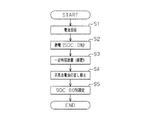
このような結果を鑑みて本発明者は、何らかの原因で一部の二次電池20が早期に寿命や故障に至った不具合のある組電池10をユーザ側から回収し、これを不具合の解消とともに十分な性能を有する組電池10として再構成(リビルト)して再びユーザ側に戻す手順を検討した。図6がそのフローである。
In view of such a result, the present inventor collects from the user the defective assembled
ステップS1:何らかの原因で一部の二次電池20に不具合が生じた組電池10をユーザ側から回収する。
ステップS2(放電ステップ):再利用対象となる二次電池20を不具合電池も含めて完全放電状態(完全放電とみなすSOC:0%〜5%)まで放電させる。この場合、組電池10を電池モジュール21〜25毎に電気的に分離し、電池モジュール21〜25毎の放電とする。また、電池モジュール21〜25の完全放電の際、その放電電圧変化を検出することで、低SOC領域で不具合のある電池モジュール21〜25を新たに発見することもできる。
Step S1: The assembled
Step S2 (discharge step): The
尚、電池モジュール21〜25毎としたのは、図2に示すように、個々の二次電池20の接続端子(図示略)が内部に隠蔽され、モジュール21〜25の各接続端子21a〜25aが外部に露出又は容易に露出可能で、個々の二次電池20毎の放電と比べて放電を行う際の放電装置(図示略)との接続が容易であること、また組電池10の一括放電を行うと不具合電池が過放電してしまうこと等が理由にある。
As shown in FIG. 2, the connection terminals (not shown) of the individual
ステップS3(保管ステップ):完全放電の電池モジュール21〜25を所定の保管領域において常温環境下で一定時間以上経過させるべく保管(放置)する。この保管時間は、メモリ効果の蓄積低減の効果を主として設定、若しくはその効果と保管コストとの兼ね合いで設定する。また、電池モジュール21〜25の保管(放置)の際、その電池電圧変化を検出することで、更に新たに不具合のある電池モジュール21〜25を発見することもできる。
Step S3 (storage step): The fully discharged
ステップS4(再生ステップ):不具合のある電池モジュール(21〜25)を、完全放電及び一定時間以上放置により再利用対象として保管していた他の組電池(10)の電池モジュール又は新しい電池モジュールと差し替え、組電池10として再構成する電池モジュール21〜25とする。この場合、再構成に用いる電池モジュール21〜25は、完全放電及び一定時間以上放置によりメモリ効果の蓄積が低減されて初期状態の電池特性に近似した同様の電池特性となることから、他の組電池の電池モジュールや新しい電池モジュールに差し替えて組電池10を再構成してもモジュール同士の調和が取れ、十分な性能を有するものとなる。
Step S4 (regeneration step): A battery module of another assembled battery (10) or a new battery module that has been stored as a target for reuse by completely discharging the defective battery module (21 to 25) and leaving it for a certain period of time. The
ステップS5:このように再構成された組電池10を、電気自動車やハイブリッド自動車等の車両に搭載する際の初期状態としてSOCを中間領域(例えば60%)となるように充電し、ユーザ側に戻す。これらステップS1〜S5を経ることで、十分な性能を有する組電池10を容易に再構成することができるようになる。
Step S5: The SOC is recharged so that the SOC becomes an intermediate region (for example, 60%) as an initial state when the assembled
次に、本実施形態の特徴的な作用効果を記載する。
(1)放電ステップ(ステップS2)にて、組電池10を構成する二次電池20が電池モジュール21〜25毎に完全放電状態まで放電される。次いで保管ステップ(ステップS3)にて、その電池モジュール21〜25がその完全放電状態となってから一定時間以上経過させるべく保管領域にて保管される。次いで再生ステップ(ステップS4)にて、交換対象の電池モジュール(21〜25)が、完全放電状態で保管されていた他の組電池の電池モジュール又は新しい電池モジュールに交換され、同様に完全放電状態で保管されていた自身の組電池10の電池モジュール(21〜25)とともに再構成(リビルト)が行われる。即ち、完全放電状態の電池モジュール21〜25をその完全放電状態となってから一定時間以上経過させることで、二次電池20に蓄積されたメモリ効果が低減されることから、これを踏まえた各ステップS2〜S4を経た電池モジュールのみ、若しくはその電池モジュールと新しい電池モジュールとを組み合わせて組電池10を再構成することで、組み合わせる他の二次電池(電池モジュール)との調和が取れ、十分な性能を有する組電池10を容易に再構成することができる。
Next, characteristic effects of the present embodiment will be described.
(1) In the discharging step (step S2), the
また本実施形態のように、電気自動車やハイブリッド自動車の車両の電源として用いられる組電池10は、SOC中間領域を基本に充放電が繰り返されることからメモリ効果が蓄積し易いため、このような本実施形態の組電池10に適用する意義は大きい。
Further, as in the present embodiment, the assembled
(2)放電ステップ(ステップS2)において、再利用対象の二次電池20の放電が電池モジュール21〜25毎に行われる。これにより、電池モジュール21〜25の間に生じていた充電量(SOC)のバラツキをそれ毎にリセットできる。また、モジュール単位でその放電電圧を検出することで、その検出から個々モジュールの異常検査を実施することができる。これにより、より質の高い再利用対象の電池モジュール21〜25が選別可能となる。
(2) In the discharging step (step S2), the
(3)再生ステップ(ステップS4)において、不具合の生じた交換対象の二次電池20が電池モジュール21〜25毎に交換され、モジュール単位毎で組電池10の再構成が行われる。これにより、組電池10の再構成にかかる作業が容易となる。
(3) In the regeneration step (step S4), the
(4)放電ステップ(ステップS2)にて再利用対象の電池モジュール21〜25(二次電池20)が完全放電されるが、その放電の際の放電電圧を検出することで、新たに電池モジュール21〜25の異常検査を実施できる。これにより、より質の高い再利用対象の電池モジュール21〜25が選別可能となる。
(4) Although the
(5)保管ステップ(ステップS3)において、一定時間保管(放置)の際、再利用対象の電池モジュール21〜25の電池電圧を検出することで、新たに電池モジュール21〜25の異常検査を実施できる。これにより、より質の高い再利用対象の電池モジュール21〜25が選別可能となる。
(5) In the storage step (step S3), when the battery voltage of the
尚、本発明の実施形態は、以下のように変更してもよい。
・上記実施形態で用いたSOCの値、保管時間、保管時の温度等は、適宜変更してもよい。
In addition, you may change embodiment of this invention as follows.
-You may change suitably the value of SOC used by the said embodiment, storage time, the temperature at the time of storage, etc. FIG.
・上記実施形態では、既使用状態にあるコントローラ付き組電池10を回収して再構成する態様であったが、組電池本体11のみを回収して再構成してもよい。
・上記実施形態における組電池本体11は、二次電池20が6個一列に配置されてなる電池モジュール21〜25が5個並設されて構成されているが、組電池本体11を構成する二次電池の配置態様を適宜変更してもよい。
In the embodiment described above, the assembled
The assembled battery
・上記実施形態では、組電池10の再構成の際、不具合の生じた二次電池(電池モジュール)だけの交換を行って組電池10の再構成を行ったが、様々な組電池から得た二次電池を組み合わせて新たに組電池を再構成してもよい。また、一部に新しい二次電池を混在させてもよい。
In the above embodiment, when the assembled
・上記実施形態では、組電池10の再構成の際、完全放電や交換をモジュール単位で行ったが、セル単位(二次電池20の単体毎)や、モジュール単位よりも大きいブロック単位で行ってもよい。
In the above embodiment, when the assembled
・上記実施形態では、電気自動車やハイブリッド自動車等の車両の電源として用いられる組電池10に適用したが、ポータブル機器等、その他の電源として用いられる組電池に適用してもよい。
In the above embodiment, the present invention is applied to the assembled
10…組電池、11…組電池本体(組電池)、20…二次電池、21〜25…電池モジュール(二次電池、集合体)。
DESCRIPTION OF
Claims (6)
前記組電池の再構成に再利用可能なニッケル−水素二次電池を自身又は他の前記組電池の再利用対象とし、その再利用対象のニッケル−水素二次電池を完全放電状態まで放電する放電ステップと、
前記放電ステップを経た前記再利用対象のニッケル−水素二次電池を前記完全放電状態下において3時間以上経過させるべく保管領域にて保管する保管ステップと、
前記保管ステップを経た自身又は他の前記組電池の前記再利用対象のニッケル−水素二次電池を組み合わせて、若しくはその再利用対象のニッケル−水素二次電池と新しいニッケル−水素二次電池とを組み合わせて前記組電池の再構成を行う再生ステップと
を含むことを特徴とするニッケル−水素二次電池の交換方法。 In configured battery pack in a hydrogen rechargeable batteries, exchanged nickel - - multiple nickel re of the battery pack and replace it with hydrogen secondary batteries - nickel replacement part or all contains hydrogen rechargeable battery A method for replacing a nickel-hydrogen secondary battery, comprising:
Discharge for discharging hydrogen secondary battery until completely discharged state - the battery pack reconstitution reusable nickel - hydrogen rechargeable batteries and reuse the target itself or other of the battery pack, the reuse object Nickel Steps,
A storage step of storing the nickel-hydrogen secondary battery to be reused after the discharging step in a storage area so that the battery is allowed to pass for 3 hours or more under the fully discharged state;
Said himself after storage step or other of said sets said recycling target nickel battery - in combination hydrogen secondary battery, or a reusable object nickel - a hydrogen rechargeable batteries - hydrogen secondary battery with a new nickel And a regenerating step of reconfiguring the assembled battery in combination. A method for replacing a nickel-hydrogen secondary battery.
前記放電ステップでは、前記再利用対象のニッケル−水素二次電池を単体又は前記組電池未満の所定集合体毎に放電させることを特徴とするニッケル−水素二次電池の交換方法。 The method for replacing a nickel-hydrogen secondary battery according to claim 1,
In the discharge step, the recycling target nickel - Replacing hydrogen rechargeable batteries - nickel, characterized in that discharging the hydrogen secondary battery alone or less than the predetermined aggregate the battery pack.
前記再生ステップでは、前記再利用対象のニッケル−水素二次電池を前記組電池未満の所定集合体毎に組み合わせることを特徴とするニッケル−水素二次電池の交換方法。 The method for replacing a nickel-hydrogen secondary battery according to claim 1 or 2,
In the regeneration step, the re-use target nickel - replace a hydrogen rechargeable batteries - nickel, wherein hydrogen secondary battery by combining a predetermined set of less than the battery pack.
前記放電ステップでの前記再利用対象のニッケル−水素二次電池の完全放電の際、その放電電圧の検出に基づいて、前記再利用対象のニッケル−水素二次電池の異常検査を行うことを特徴とするニッケル−水素二次電池の交換方法。 The method for replacing a nickel-hydrogen secondary battery according to any one of claims 1 to 3,
When the nickel-hydrogen secondary battery to be reused is completely discharged in the discharging step, an abnormality inspection of the nickel-hydrogen secondary battery to be reused is performed based on detection of the discharge voltage. And a method for replacing the nickel-hydrogen secondary battery.
前記保管ステップでの前記再利用対象のニッケル−水素二次電池の電池電圧の検出に基づいて、前記再利用対象のニッケル−水素二次電池の異常検査を行うことを特徴とするニッケル−水素二次電池の交換方法。 In the replacement method of the nickel-hydrogen secondary battery according to any one of claims 1 to 4,
Wherein the reusable object of nickel in storage step - based on the detection of the battery voltage of the hydrogen secondary battery, the recycling object of the nickel - nickel, characterized in that the abnormality examination hydrogen rechargeable batteries - hydrogen secondary How to replace the next battery.
前記組電池は、電気自動車やハイブリッド自動車の電源として用いられるものであることを特徴とするニッケル−水素二次電池の交換方法。 The method for replacing a nickel-hydrogen secondary battery according to any one of claims 1 to 5,
A method for replacing a nickel-hydrogen secondary battery, wherein the assembled battery is used as a power source for an electric vehicle or a hybrid vehicle.
Priority Applications (2)
| Application Number | Priority Date | Filing Date | Title |
|---|---|---|---|
| JP2008130723A JP5276357B2 (en) | 2008-05-19 | 2008-05-19 | How to replace the nickel-hydrogen secondary battery |
| US12/466,162 US8362749B2 (en) | 2008-05-19 | 2009-05-14 | Method for exchanging rechargeable batteries |
Applications Claiming Priority (1)
| Application Number | Priority Date | Filing Date | Title |
|---|---|---|---|
| JP2008130723A JP5276357B2 (en) | 2008-05-19 | 2008-05-19 | How to replace the nickel-hydrogen secondary battery |
Publications (2)
| Publication Number | Publication Date |
|---|---|
| JP2009277627A JP2009277627A (en) | 2009-11-26 |
| JP5276357B2 true JP5276357B2 (en) | 2013-08-28 |
Family
ID=41315562
Family Applications (1)
| Application Number | Title | Priority Date | Filing Date |
|---|---|---|---|
| JP2008130723A Active JP5276357B2 (en) | 2008-05-19 | 2008-05-19 | How to replace the nickel-hydrogen secondary battery |
Country Status (2)
| Country | Link |
|---|---|
| US (1) | US8362749B2 (en) |
| JP (1) | JP5276357B2 (en) |
Families Citing this family (21)
| Publication number | Priority date | Publication date | Assignee | Title |
|---|---|---|---|---|
| JP5416612B2 (en) * | 2010-02-17 | 2014-02-12 | プライムアースEvエナジー株式会社 | Reuse method of secondary battery |
| US9166261B2 (en) | 2010-03-31 | 2015-10-20 | Primearth Ev Energy Co., Ltd. | Method for reusing secondary battery |
| WO2012061522A2 (en) * | 2010-11-02 | 2012-05-10 | Global Solar Water And Power Systems, Inc. | Grid tie system and method |
| JP2012113856A (en) * | 2010-11-22 | 2012-06-14 | Toyota Motor Corp | Power stack changing method, control device, and control program |
| WO2013008409A1 (en) | 2011-07-08 | 2013-01-17 | Necエナジーデバイス株式会社 | Method for manufacturing battery pack and battery pack |
| JP5553177B2 (en) * | 2011-11-24 | 2014-07-16 | トヨタ自動車株式会社 | Secondary battery reuse method, vehicle drive power supply, and vehicle |
| JP5247874B2 (en) * | 2011-12-06 | 2013-07-24 | パナソニック株式会社 | Storage battery transfer support device and storage battery transfer support method |
| DE102012011061A1 (en) * | 2012-06-04 | 2013-12-05 | Li-Tec Battery Gmbh | Power supply device with a first power and method for operating this power supply device |
| US9525195B2 (en) * | 2013-07-30 | 2016-12-20 | Johnson Controls Technology Corporation | Remanufacturing methods for battery module |
| JP5925755B2 (en) | 2013-12-20 | 2016-05-25 | プライムアースEvエナジー株式会社 | Battery module adjustment method and battery module adjustment apparatus |
| JP6048448B2 (en) * | 2014-05-22 | 2016-12-21 | トヨタ自動車株式会社 | Method for determining reusable product application of used secondary battery and reconfiguring assembled battery reassembled product |
| US10006967B2 (en) | 2015-10-16 | 2018-06-26 | Samsung Electronics Co., Ltd. | Battery management system for predicting life of a reconfigurable battery pack |
| JP6555212B2 (en) * | 2016-08-15 | 2019-08-07 | トヨタ自動車株式会社 | Battery pack manufacturing method |
| JP6369510B2 (en) | 2016-08-25 | 2018-08-08 | トヨタ自動車株式会社 | Diagnostic device and diagnostic method for lithium ion secondary battery |
| JP6478121B2 (en) * | 2016-09-07 | 2019-03-06 | トヨタ自動車株式会社 | Secondary battery recovery processing method and reuse processing method |
| JP6494840B1 (en) * | 2018-07-10 | 2019-04-03 | 株式会社ユーパーツ | Battery unit inspection apparatus, battery unit inspection method and program |
| EP3769363B1 (en) | 2018-07-11 | 2025-09-03 | Cummins, Inc. | Integration of second-use li-ion batteries in power generation |
| WO2021014363A1 (en) | 2019-07-22 | 2021-01-28 | Eco Home As | System and method for reusing an electric vehicle battery |
| US11214171B2 (en) * | 2019-09-13 | 2022-01-04 | Ford Global Technologies, Llc | Mixed battery pack control |
| US20230402667A1 (en) * | 2022-06-13 | 2023-12-14 | Higher Wire, Inc. | Systems and methods for processing and managing used lithium-ion batteries |
| US12510604B2 (en) | 2023-02-02 | 2025-12-30 | Toyota Motor North America, Inc. | Systems and methods for determining indica for remaining useful life of a battery |
Family Cites Families (17)
| Publication number | Priority date | Publication date | Assignee | Title |
|---|---|---|---|---|
| US3781175A (en) * | 1971-02-18 | 1973-12-25 | L Kinsey | Storage battery with exchangeable elements |
| US3997830A (en) * | 1974-11-27 | 1976-12-14 | Rca Corporation | Satellite battery reconditioning system and method |
| JPH07203634A (en) * | 1993-12-30 | 1995-08-04 | Kenji Harada | Charger for secondary cell |
| JPH09259919A (en) * | 1996-03-22 | 1997-10-03 | Sanyo Electric Co Ltd | Manufacture for nickel-hydrogen cell |
| JP4001708B2 (en) * | 2000-04-28 | 2007-10-31 | 松下電器産業株式会社 | Replacing the secondary battery |
| JP2002142378A (en) * | 2000-10-31 | 2002-05-17 | Canon Inc | Charging device, method and storage medium |
| JP2002216855A (en) * | 2001-01-18 | 2002-08-02 | Honda Motor Co Ltd | Battery management device |
| JP4354130B2 (en) * | 2001-07-04 | 2009-10-28 | パナソニック株式会社 | How to reuse battery packs |
| US6618644B2 (en) * | 2001-12-21 | 2003-09-09 | Hewlett-Packard Company, Lp. | Battery recycling |
| JP3820184B2 (en) * | 2002-05-30 | 2006-09-13 | 松下電器産業株式会社 | Replacing the secondary battery |
| JP2004014205A (en) * | 2002-06-05 | 2004-01-15 | Nissan Motor Co Ltd | Battery abnormal deterioration detection device |
| JP2004158264A (en) | 2002-11-05 | 2004-06-03 | Sony Corp | Trade-in battery system |
| JP4134704B2 (en) * | 2002-12-02 | 2008-08-20 | トヨタ自動車株式会社 | Replacing the secondary battery |
| US7038426B2 (en) * | 2003-12-16 | 2006-05-02 | The Boeing Company | Method for prolonging the life of lithium ion batteries |
| US7964299B2 (en) * | 2005-10-18 | 2011-06-21 | Enerdel, Inc. | Method of recycling a battery |
| WO2007062362A2 (en) * | 2005-11-18 | 2007-05-31 | Automotive Energy Systems, Llc | Method and apparatus for utilizing used batteries to surface charge an automobile battery |
| JP5113357B2 (en) * | 2006-08-18 | 2013-01-09 | 株式会社Nttファシリティーズ | Secondary battery service management system |
-
2008
- 2008-05-19 JP JP2008130723A patent/JP5276357B2/en active Active
-
2009
- 2009-05-14 US US12/466,162 patent/US8362749B2/en active Active
Also Published As
| Publication number | Publication date |
|---|---|
| US8362749B2 (en) | 2013-01-29 |
| JP2009277627A (en) | 2009-11-26 |
| US20090284226A1 (en) | 2009-11-19 |
Similar Documents
| Publication | Publication Date | Title |
|---|---|---|
| JP5276357B2 (en) | How to replace the nickel-hydrogen secondary battery | |
| US9166261B2 (en) | Method for reusing secondary battery | |
| JP5519371B2 (en) | Reuse method of secondary battery | |
| KR102238978B1 (en) | Battery management system and battery cell array | |
| JP5370583B2 (en) | Used secondary battery sorting method, rebuilt battery pack, vehicle and battery using apparatus using the same, and manufacturing method of rebuilt battery pack | |
| US6573685B2 (en) | Method of replacing secondary battery | |
| JP5722875B2 (en) | Dynamically reconfigurable structure for large battery systems | |
| JP7403775B2 (en) | Battery cell abnormal deterioration diagnosis device and method | |
| US10608291B2 (en) | Battery pack having a supplemental power supply | |
| US20120068715A1 (en) | Modular energy storage system for driving electric motor | |
| JP5416612B2 (en) | Reuse method of secondary battery | |
| JP6555212B2 (en) | Battery pack manufacturing method | |
| JP5852087B2 (en) | Method for selecting used secondary battery and method for manufacturing assembled battery | |
| CN102445665A (en) | Learning Algorithm of Battery Pack Capacity | |
| JP2010104175A (en) | Fault diagnosis circuit, power supply device, and fault diagnosis method | |
| JP2009004184A (en) | Manufacturing method of battery pack, and battery pack | |
| US10991993B2 (en) | Method for operating a battery, and battery | |
| US10391880B2 (en) | Battery pack and electric vehicle including the same | |
| JP2019169473A (en) | Method for manufacturing battery pack | |
| KR20180050156A (en) | Apparatus for managing energy storage system and method for operating the same | |
| CN111799853B (en) | Cell voltage balancing method and apparatus for battery cells of multi-cell energy storage device | |
| JP6913880B2 (en) | Storage battery inspection device and storage battery manufacturing method | |
| US20160190801A1 (en) | Scalable energy storage system | |
| CN102456935A (en) | Automatic Cell Balancing Device Restoration Tool for Battery Sections/Modules | |
| JP2019041469A (en) | Battery pack control system and battery pack control method |
Legal Events
| Date | Code | Title | Description |
|---|---|---|---|
| A621 | Written request for application examination |
Free format text: JAPANESE INTERMEDIATE CODE: A621 Effective date: 20101110 |
|
| A977 | Report on retrieval |
Free format text: JAPANESE INTERMEDIATE CODE: A971007 Effective date: 20120913 |
|
| A131 | Notification of reasons for refusal |
Free format text: JAPANESE INTERMEDIATE CODE: A131 Effective date: 20120918 |
|
| A521 | Request for written amendment filed |
Free format text: JAPANESE INTERMEDIATE CODE: A523 Effective date: 20121114 |
|
| A131 | Notification of reasons for refusal |
Free format text: JAPANESE INTERMEDIATE CODE: A131 Effective date: 20130319 |
|
| A521 | Request for written amendment filed |
Free format text: JAPANESE INTERMEDIATE CODE: A523 Effective date: 20130410 |
|
| TRDD | Decision of grant or rejection written | ||
| A01 | Written decision to grant a patent or to grant a registration (utility model) |
Free format text: JAPANESE INTERMEDIATE CODE: A01 Effective date: 20130507 |
|
| A61 | First payment of annual fees (during grant procedure) |
Free format text: JAPANESE INTERMEDIATE CODE: A61 Effective date: 20130517 |
|
| R150 | Certificate of patent or registration of utility model |
Ref document number: 5276357 Country of ref document: JP Free format text: JAPANESE INTERMEDIATE CODE: R150 |
|
| R250 | Receipt of annual fees |
Free format text: JAPANESE INTERMEDIATE CODE: R250 |
|
| R250 | Receipt of annual fees |
Free format text: JAPANESE INTERMEDIATE CODE: R250 |
|
| R250 | Receipt of annual fees |
Free format text: JAPANESE INTERMEDIATE CODE: R250 |
|
| R250 | Receipt of annual fees |
Free format text: JAPANESE INTERMEDIATE CODE: R250 |