JP3928731B2 - Annular belt - Google Patents
Annular belt Download PDFInfo
- Publication number
- JP3928731B2 JP3928731B2 JP2004266854A JP2004266854A JP3928731B2 JP 3928731 B2 JP3928731 B2 JP 3928731B2 JP 2004266854 A JP2004266854 A JP 2004266854A JP 2004266854 A JP2004266854 A JP 2004266854A JP 3928731 B2 JP3928731 B2 JP 3928731B2
- Authority
- JP
- Japan
- Prior art keywords
- holding
- infant
- user
- support
- load
- Prior art date
- Legal status (The legal status is an assumption and is not a legal conclusion. Google has not performed a legal analysis and makes no representation as to the accuracy of the status listed.)
- Expired - Fee Related
Links
Images




Classifications
-
- A—HUMAN NECESSITIES
- A47—FURNITURE; DOMESTIC ARTICLES OR APPLIANCES; COFFEE MILLS; SPICE MILLS; SUCTION CLEANERS IN GENERAL
- A47D—FURNITURE SPECIALLY ADAPTED FOR CHILDREN
- A47D13/00—Other nursery furniture
- A47D13/02—Baby-carriers; Carry-cots
- A47D13/025—Baby-carriers; Carry-cots for carrying children in seated position
Landscapes
- Rehabilitation Tools (AREA)
- Orthopedics, Nursing, And Contraception (AREA)
Description
本発明は、環状帯に関するものである。 The present invention relates to an annular band.
従来の環状帯の代表的な形態である肩掛け式抱っこ帯として図10、図11に示すものがある。図10に示すものは、環状帯101がクッション材や当て布を付加した肩当部102と、該肩当部102に縫合されると共に対向面が予め曲面状に形成された子供保持部103として構成されている(特許文献1)。
FIG. 10 and FIG. 11 show the shoulder-type hug bands that are typical forms of conventional annular bands. In FIG. 10, an
又、図11に示すものは、環状帯201の一部を他部より幅狭くなるよう寄せ縮めて弾力性を有する肩当部202に縫合すると共に該肩当部202の対向面に形成されている子供保持帯203の一側縁にベルト230、他側縁に弾力性を有する帯片231が設置されて構成されている(特許文献2)。
11 shows a child formed on the opposite surface of the
その為、特許文献1の発明にあっては、次の事が欠点として挙げられる。
予め、子供保持部分103を凹み部として幼児の臀部の形状に合わせて曲面状に形成しているので、素材の寸法取り等が煩雑でもある。
子供を使用者の体の前面に座らせて支える仕組みになっているので、抱っこの自由度に欠ける。
また、特許文献2の発明にあっては次のことが欠点として挙げられる。
ベルトを着脱する手間が掛かる。
装着後は、ベルト側の開口部が使用者の体で塞がれてしまう為、使用できる開口部は1ケ所に限られる。
ベルトが金具等との組合せになっているので、金具等による子供のケガを予防する為に、使用中及び保管場所等に注意が必要である。
Since the
Since it is designed to support the child sitting on the front of the user's body, it lacks the freedom of holding.
Moreover, in the invention of
It takes time to attach and detach the belt.
After installation, the opening on the belt side is blocked by the user's body, so only one opening can be used.
Since the belt is combined with metal fittings, care must be taken during use and storage location to prevent children from being hurt by the metal fittings.
また更に、特許文献2に示す発明にあっては、子供保持部に掛かる不均衡荷重が、寄せ縮めのある肩当部(202)にそのまま不均衡荷重として反映されるという問題点があった。この問題点を図4に基づいて更に詳しく以下に説明する。
Furthermore, in the invention shown in
図12は環状の抱っこ帯201の側面図であり、子供保持部203を肩当部202の幅Wで均等幅に区切った幅をA、B、C、D、Eとし、このA乃至Eの幅に対応する肩当部202をひだ寄せをして布幅を寄せ縮めて肩当部202に縫合した部分が幅a、b、c、d、eで示されている。
FIG. 12 is a side view of the ring-
子供保持部203のA幅部分に子供を乗せると、A幅の延長部分である肩当部202のaの部分に子供の荷重が掛かり、その方向は子供の重心とaの属する面の仮想中心とを結ぶ重力方向となる。同様にしてB、C、D、Eの夫々に負荷が掛かると、その負荷の荷重は支持部のb、c、d、eの属する面で、その面の仮想中心と子供の重心とを結ぶ重力方向に掛かる。
When a child is placed on the A width portion of the
つまり、子供が子供保持部203の全面A、B、C、D、Eに動かずに乗っている静的偏荷重の場合には、その静的偏荷重の作用する位置と方向は、部分的に見ればA、B、C、D、Eの各部に掛かっている不均衡な静的偏荷重が肩当部2のa、b、c、d、eの各面にそのまま偏荷重として掛かっていて、その作用位置と方向は各面の仮想中心の位置で、この仮想中心と各面に掛かっている子供の重さの重心とを結ぶ重力方向に作用する。
That is, in the case of a static unbalanced load in which a child rides on the entire surface A, B, C, D, E of the
また、当然のことながら、これを全体として見れば、支持部の荷重中心を仮想中心として、この仮想中心の位置で、この仮想中心と子供の重心とを結ぶ重力方向に作用する。 Further, as a whole, when viewed as a whole, the load center of the support portion is used as a virtual center, and acts in the direction of gravity connecting the virtual center and the child's center of gravity at the position of the virtual center.
ところで、子供が保持部の中で動く場合、即ち、A、B、C、D、Eの各部に動的偏荷重が掛かる場合は、全体として見れば、支持部に作用する荷重の位置と方向は、肩当部2の荷重中心である仮想中心の位置で、この仮想中心と子供の重心とを結ぶ重力方向に作用するが、この動的偏荷重の作用する位置と方向の双方が子供の動きと同期して変化するので、子供にとっては安定する位置を定めにくく動く頻度が多くなる、従って使用者にとっては荷重の作用位置と方向とが動く度に振れを伴って変動するので姿勢等不安定な状態で使用することとなるので、双方にとって安定性と安全性に欠ける。
By the way, when the child moves in the holding part, that is, when a dynamic eccentric load is applied to each part of A, B, C, D, E, the position and direction of the load acting on the support part as a whole Is the position of the virtual center that is the load center of the
本発明は以上のような従来の環状の抱っこ帯の欠点に鑑み、保持部面にかかる荷重の静的又は/及び動的偏荷重に対して、支持部には常に支持部面全体に均等な荷重が掛かると共に、保持部が振れても治まりやすく、保持部に乗せられた物は保持部面によって包み込まれる状態(応形性の凹形弧状の状態)となって安定性と安楽性の高い状態で保持され、着脱操作等の操作が容易で使い勝手の自由度が高く、携帯性、収納性も良く、かつ、構造がシンプルな安全性の高い環状帯を提供することを目的としている。 In view of the above-described drawbacks of the conventional ring-shaped strap, the present invention always supports the entire support portion surface evenly with respect to the static or / and dynamic offset load applied to the holding portion surface. As the load is applied and the holding part swings, it is easy to be cured, and the object placed on the holding part is wrapped in the holding part surface (a concavo-convex concave arc shape), which is highly stable and comfortable. An object of the present invention is to provide an annular belt that is held in a state, easy to attach and detach, etc., easy to use, highly portable, easy to store, and has a simple structure and high safety.
本発明の前記並びにその他の目的と新規な特徴は、次の説明を添付図面と照らし合わせて読むと、より完全に明らかとなろう。ただし、図面はもっぱら解説の為のものであって、本発明の技術的範囲を限定するものではない。 The above and other objects and novel features of the present invention will become more fully apparent when the following description is read in conjunction with the accompanying drawings. However, the drawings are for explanation only and do not limit the technical scope of the present invention.
上記目的を達成する為に本発明は、円筒状の布を円筒の軸方向に円筒長の1/N幅(Nは2以上の整数)で均等に波折りに折り重ねて、この折り重ねた周方向の一部と幅方向の全部とで作られる部分を固着して支持部とし、残余の折り重ねの部分を前記支持部の両端部を基点として展開することによって形成される凹形弧状となる面を保持部として構成した環状帯である。 In order to achieve the above object, according to the present invention, a cylindrical cloth is uniformly folded into a wave fold with a cylindrical length of 1 / N (N is an integer of 2 or more) in the axial direction of the cylinder. A concave arc formed by fixing a part formed by a part in the circumferential direction and the whole in the width direction as a support part, and developing the remaining folded portions with the both ends of the support part as base points It is the annular belt which constituted the surface to become as a holding part.
また、第二の発明は、略矩形形状の布を布幅方向に布幅の1/N幅(Nは2以上の整数)で均等に波折りに折り重ねて、この折り重ねた面の両端部を所定量重ね合わせて密着固定した部分を支持部とし、残余の折り重ねの部分を前記支持部の両端部を基点として展開することによって形成される凹形弧状となる面を保持部として構成した環状帯である。 In the second invention, a substantially rectangular cloth is folded evenly in a cloth width direction with a 1 / N width of the cloth width (N is an integer of 2 or more), and both ends of the folded surface are folded. A portion that is overlapped with a predetermined amount and fixed tightly is used as a support portion, and the remaining folded portion is formed as a holding portion by forming a concave arc surface formed by developing both ends of the support portion as base points. An annular belt.
また、第三の発明は、支持部と、保持部とが結合されて略環状を成す環状帯であって、前記支持部は屈曲性のある材質からなる略矩形形状のもので、前記保持部は幅が前記支持部幅の整数倍の幅を有する矩形形状の布を前記支持部の幅と同じ幅で均等に波折りに折り重ねて、この折り重ねた面を前記支持部端部に重ね合わせて結合固定して、この結合固定した部分を基点として残余の波折りに折り重ねられた部分を展開することによって凹形弧状面となるように構成した環状帯である。 Further, a third invention is an annular band in which a support portion and a holding portion are combined to form a substantially annular shape, and the support portion is a substantially rectangular shape made of a flexible material, and the holding portion A rectangular cloth having a width that is an integral multiple of the width of the support portion is folded evenly in the same width as the width of the support portion, and the folded surface is overlapped on the end of the support portion. It is an annular band configured to be a concave arcuate surface by unifying and fixing together, and developing a portion folded into the remaining wave folds with the joint-fixed portion as a base point.
上記第一の発明、第二の発明、及び、第三の発明は、支持部の端部に、支持部の幅と同じ幅で、波折りに折り重ねられた保持部の端部が密着固定されていて、この密着固定された部分を基点として保持部を開くことによって、この開かれた保持部は凹形弧状に形成された構造になっていることによって以下のような作用、効果がある。 In the first invention, the second invention, and the third invention, the end portion of the holding portion that is folded in a wave fold is closely fixed to the end portion of the support portion with the same width as the width of the support portion. Then, by opening the holding portion with the closely fixed portion as a base point, the opened holding portion has a structure formed in a concave arc shape, and thus has the following operations and effects. .
即ち、1.折り重なっている部分を開くことによって形成されている保持部に載置された負荷物の重さは、折り重ねて密着固定した端部を介して支持部に重畳して掛かり、ひいては支持部の全面に均等に掛かるように作用するので、使用者が環状帯の支持部を肩に掛けたり、腕に吊下げたりして使用した場合に、部分的な圧迫、血流の阻害が無く長時間の使用に絶えることができる、という効果がある。 That is, 1. The weight of the load placed on the holding part formed by opening the folded part is superimposed on the support part via the end part that is folded and fixed tightly, and as a result the entire surface of the support part If the user uses the ring belt support on his shoulder or suspends it on his arm, there is no partial compression or obstruction of blood flow for a long time. There is an effect that it can be used up.
2.また、この支持部の面中心が支持部に掛かる荷重の仮想中心となり、この仮想中心は負荷の動的、静的偏荷重に係らず常に一定の位置となるから、この仮想中心と負荷物の重心とを結ぶ重力方向の位置は単純に定まるので、例えば、子供が保持部に乗って動いたとしても不安定な感覚を持たずに動くことができ、使用者にとっても安定性と安全性が確保される、という効果がある。 2. In addition, the center of the surface of this support part becomes a virtual center of the load applied to the support part, and this virtual center is always at a constant position regardless of the dynamic and static uneven load of the load. Since the position in the gravitational direction connecting the center of gravity is simply determined, for example, even if a child moves on the holding part, it can move without an unstable feeling, and stability and safety are also improved for the user. There is an effect that it is secured.
3.また更に、歩行中の使用や、内部での負荷の動きに伴う保持部の揺れは、仮想中心を支点として揺れながらも、実際には支持部の密着固定した幅端部に生じる拮抗する張力で抑制されるので、揺れ幅も少なく、短時間で安定するので、負荷物および使用者にとって安定性と安全性が確保される、という効果がある。 3. Furthermore, the swinging of the holding part due to the use during walking and the movement of the load inside is caused by the tension that is antagonized in the width end part that is closely fixed to the support part while actually swinging around the virtual center. Since it is suppressed, there is little fluctuation width and it is stable in a short time, so that there is an effect that stability and safety are ensured for the load and the user.
4.更にまた、凹形弧状の保持部に載置された負荷物は折り重ねて密着固定した支持部幅端に生じる拮抗力により保持部と接する部分が略その物の形に応じた応形形状状態で保持されるので、安楽性のある安定状態で保持されるので、例えば子供が乗った場合には気持ちよく保持されているので殆ど動くことがなく、使用者にとっても負荷変動の少ないことにより安定性と安全性を確保される、という効果がある。 4). Furthermore, the load placed on the concave arc-shaped holding part is folded and fixed in close contact, and the portion in contact with the holding part due to the antagonistic force generated at the width end of the supporting part is a conforming shape state corresponding to the shape of the object. Since it is held in a comfortable and stable state, for example, when a child rides, it is held comfortably, so it hardly moves, and the stability is also reduced because there is little load fluctuation for the user It has the effect of ensuring safety.
また、更に以下に列挙する効果もある。5.載置物を出し入れする際、保持部側部の両側を使うことができる。6.構造が簡単であるので安価にして容易に製造することができる。7.使い方が簡単で安全にして容易に着脱できる。8.安全な材質でできているので、抱っこ帯に使用した場合でも、子供にケガをさせることなく使用でき、保管の場所も気にする必要が無い。9.出来上がりの形態が表裏ほぼ同じ形なので、裏表の両面使用が可能である。 In addition, there are effects listed below. 5). Both sides of the holding part side can be used when taking in and out the object. 6). Since the structure is simple, it can be manufactured inexpensively and easily. 7). Easy to use, safe and easy to detach. 8). Because it is made of a safe material, even if it is used for a hug, it can be used without injuring the child and there is no need to worry about the storage location. 9. Since the finished form is almost the same, the front and back sides can be used.
以下本発明を実施する為の最良の形態を実施の形態1、2、3として図面を用いて詳細に説明するがこの実施の形態の記載に限定されず本発明の技術的思想を具現化する種々の変更が加えられうる。
BEST MODE FOR CARRYING OUT THE INVENTION The best mode for carrying out the present invention will be described below in detail as
図1乃至図7の本発明を実施するための第1の形態において図1(a)(b)は本環状帯1であり、点線で表わされている部分は、縫製した縫目を示す。
図1(a)の本環状帯1は所定幅Wを有する支持部2とこの幅Wの整数倍の幅(本実施例では5倍)を有する保持部3とを互いの端部で縫合した結合部Kを有する環状のものであって、支持部2の両端の結合部Kに続く保持部3は支持部2の幅Wで波折りに5段に折り重ねて、支持部2の両端部に縫合されている。この縫合された結合部Kを基点として保持部3の前期複数の波折りの折り重なりを支持部2の面と反対側に展開することにより凹形弧状の保持部3となる。
1 to 7 show the present
The
続いて、図2を用いて本環状帯1の製作過程を説明する。
第1工程(裁断図2(a))
図2(a)に示すように、本環状帯1となる素材を方形に裁断する。図において短手F、Hは保持部3の幅を成し、長手G、Iは開口部4の両側を成す布である。
第2工程(筒状帯の製作図2(b))
長手G、Iが筒周になる様に短手FとHを所定幅Lで重ね合わせ重なり部位Zを仮止めして筒状帯を作る。
第3工程(波折り加工図2(c))
筒状帯に折り目印として、実線Y1、Y2を山折り線、点線T1、T2を谷折り線として、所定均等幅Wで折り線印を記した。この折り線印の通りに筒周径にそって交互に山折り、谷折りにすると、山折り線Y1とY2筒端Iが重なり、筒端Gと谷折り線T1、T2が重なり揃う。このイ、ロ、ハ、ニ、ホの5段の波折りの折り重なりを持つ環状帯のうち、最も重なり厚みがある前記所定幅Lの重なり部位Zの重なりを縫合、結合して支持部2とし、保持部3と一体化して完成したものが、図1(a)、(b)に示す本環状帯1である。
Then, the manufacturing process of this
1st process (cutting figure 2 (a))
As shown in FIG. 2 (a), the material to be the
Second step (Cylinder band production diagram 2 (b))
The short bands F and H are overlapped with a predetermined width L so that the lengths G and I become the cylinder circumference, and the overlapping portion Z is temporarily fixed to form a cylindrical band.
3rd process (wave folding process figure 2 (c))
As the crease marks on the cylindrical band, fold line marks having a predetermined uniform width W were marked with solid lines Y 1 and Y 2 as mountain fold lines and dotted lines T 1 and T 2 as valley fold lines. If the mountain folds and valley folds are alternately made along the cylinder circumference as indicated by the fold line mark, the mountain fold lines Y 1 and Y 2 overlap the cylinder end I, and the cylinder end G and the valley fold lines T 1 and T 2 Overlapping. Among the annular belts having the five-stage wave folding of A, B, C, D, E, the overlapping portion Z of the predetermined width L having the most overlapping thickness is stitched and joined to support
以上の様に構成された本発明の基本となる作用を図13、図14を用いて説明する。
図13は本発明の環状帯1を展開した状態の側面図(従来例の作用を説明した図12に対応)。図14は本発明の環状帯1の保持部を中央で切断し、支持部を中心にして展開した図である。
The basic operation of the present invention configured as described above will be described with reference to FIGS.
13 is a side view of the
図において、M、N、O、Pの各点は支持部2の4隅の点であり折り重ねた保持部3の支持部2との結合部Kの端点である。イ、ロ、ハ、ニ、ホは5段に折り重ねた各面を示している。イ、ハ、ホ面は結合部Kから平面のまま続き展開するが、ロの面はヘ部位で、ニの面はト部位で反転して展開しており、ΔM,へ,N(ΔP,チ,O)とΔM,ト,N(ΔP,リ,O)はまだ開く余地のある面である。
In the figure, the points M, N, O, and P are the four corner points of the
基本作用1(支持部の均等負荷と保持部の均等保持)
図13においてまず、保持部3のイの部分に負荷が掛かるとイ部分の延長部分でありイ幅部分と同じ幅を持つ支持部2の面の幅Wに負荷の荷重が掛かる。これと同じ論でロの負荷もWに、ハ、ニ、ホの負荷もそれぞれWに掛かることになる。よって保持部3のイ、ロ、ハ、ニ、ホの各部に偏った負荷物の重さが掛かった場合でもそれぞれの偏った負荷の重さが幅W間に重畳して掛かることになるので、負荷全体の重さが幅W間に均等に掛かり、ひいては支持部2の全面にほぼ均等の負荷が掛かることになる。よって保持部3も均等に保持される。
Basic action 1 (equal load of the support part and equal holding of the holding part)
In FIG. 13, when a load is applied to the portion “a” of the holding
基本作用2(保持部の応形性のある不偏的凹形弧状面と緊張支持)
図14において支持部2の対向面である保持部3を支持部2の面の反対側に展開すると、結合部K、Kの各端点M、N、O、Pがそれぞれ支点となり5段に重ねた布の折り重なりが開き、保持部幅方向に偏りのない凹形弧状を成す保持部3となる。また保持部3が支持部2の幅W以上に展開すると、展開面は各結合支点M、N、O、Pから緊張支持される。特に展開幅が広くなるほど(矢印方向)、端部QはN、Oから、他端部VはM、Pから引っ張られてより緊張する為、端部Q、Vの位置は内側に引かれ寄り、凹形弧が深くなる。
Basic action 2 (Non-concave concave arcuate surface with tension and support for tension)
Expanding the holding
また、まだ開く余地のある折り重なり部の折り山と折り谷が重なっている部分は離開可能であり、載置物の突起部分が押し当てられると、布面が押されて開隆し、曲がり、たわみ、変形し、突起部への応形作用がある。 In addition, the part where the fold mountain and the fold valley of the fold overlapping part that still has room to open can be separated, and when the protruding part of the placement object is pressed, the cloth surface is pushed to open and bend, Deflections, deformations, and conforming action on the protrusions.
基本作用3(保持部の振れに対する拮抗作用と制御作用)
保持部3のQ部分が振れた場合、振れをもどす拮抗作用がQ部分を吊持する結合部K、Kと、結合支点M、N、O、Pから相互に働く。同じ論がR、S、T、U、V部分についても言える。またこの拮抗作用と、前述の基本作用2の緊張支持とにより、負荷物を載置した保持部3が振れると振れが制御される作用が働く。よって復元力があり重心が定まり易く、振れに対する安定性が良い。すなわち支持部2の安定性に寄与する。
Basic action 3 (antagonism and control action against shaking of holding part)
When the Q portion of the holding
基本作用4(たすき掛け使用時は、ねじれに応じつつねじれを抑制する)
載置物の動きにより、保持部3がねじれると結合支点M、N、O、Pから放射状に広がるそれぞれの布の重なり部がねじれ、重なり詰まり、ゆるみ、離開してねじれに応じる作用がある。
Basic action 4 (When using a rack, it suppresses twisting while responding to twisting)
When the holding
しかし、2つの開口部4から使用者の斜め上半身をくぐらせ(図4(a)(b)参照)、支持部2を肩にたすき掛けにした使用状態では、保持部2のねじれは使用者の体前面側だけでの現象となる。この部位でねじれると使用者の体でねじれが阻止され、かつ重心の作用も働き前記ねじれに応じる作用利点の範囲にねじれが抑制される。
However, in the state of use in which the user's diagonal upper body is passed through the two openings 4 (see FIGS. 4 (a) and 4 (b)) and the
つまり保持部3は使用者の胸面側の重なりが変化、対応し、背面を斜めに渡る保持部3の重なり部には引っ張り圧力となって伝わる。この時負荷の荷重は結合支点M、N、O、Pと結合部K、Kにバランス良く掛かり、保持部3がねじれても支持部2の面に均等な負荷の荷重が掛かる。すなわち保持部3のねじれがあっても適度に抑制され、支持部2は安定し、それが保持部3にフィードバックする。
That is, the holding
基本作用5(接面への負荷荷重分散)
載置物のある保持部3の布面が使用者と接する面積が広いほど、この接面に保持部3の重さの荷重が分散される。
以上の通り、本発明には5つの基本作用がある。
Basic action 5 (Distributed load on the contact surface)
The larger the area where the cloth surface of the holding
As described above, the present invention has five basic functions.
固有作用1(支持部の可撓性と緩衝作用)
支持部2を構成する複数の波折りの布の折り重なりの一体化部位が、厚みがありながら使用者の体に適度に添う可撓性と緩衝作用を発揮しつつ、布の重なりのズレを生じない為、使用者の体に密接し、負荷過重が掛かってもズレない。本発明を実施するための最良の第3の実施の形態においては支持部となる支持部材に本固有作用1を持つ性状のものを用いれば、前記2第1、第2の実施の形態と同じ効果がある。
Inherent action 1 (flexibility and buffering action of support part)
The integrated part of the fold-over of the plurality of wave-folding cloths constituting the
以下、本発明の環状帯1の収納方法とその手順を図3(a)乃至(d)にそって説明する。
第1手順 本環状帯1の保持部3を支持部2の幅で環にそって波折りに折り重ねる(図1(b)参照)。
第2手順 支持部2を端にして細長だ円形に伸ばす(図3(a))。
第3手順 折り揃えた保持部3をぴったり重ね伸ばし、1本の帯状にする(図3(b))。
第4手順 1本の帯状にした本保持帯の端部に位置する支持部2を芯にして保持部3の上位置まで折り曲げ、保持部3の中間位置をひねり、ひねり部に続く保持部3の下端部を離開して輪にする(図3(c))。
第5手順 保持部3の下端部を離開して輪にした保持部3の輪の中に、折り曲げた支持部2と保持部3の折り曲げ部分を通して、挟み入れ、収納が完了する。
Hereinafter, the storage method and procedure of the
First Procedure The holding
Second Procedure Extending into an elongated circular shape with the
Third Procedure The folded and folded holding
Fourth Procedure
Fifth Procedure The holding
以上の様に本環状帯1は簡単な手順でコンパクトに収納できるので携帯に便利である。装着脱も簡単である為、必要時にすぐ使用できる。また収納袋が不要であり、布を縫いあわせただけの帯であるので、乳幼児の身近にあっても危険がなく安全に保管できる。
As described above, the present
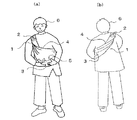
次に本環状帯1を抱っこおびに用いた場合の使い方について、図4、図5に基づいて説明する。
首がすわらない乳児に用いる場合(図4(a)(b))
首がすわらない乳児(以後乳児と称す)5を本環状帯1の保持部3に載置、収納する。方法には次の2通りがある。第1の方法は本環状帯1を床面に置き保持部3の布面を障り無く充分に広げる。そして幅方向か、幅方向よりやや斜めに乳児5を載置、収納し、支持部2を中心にして持ち上げ、使用者6の肩にたすき掛けにする方法である。第2の方法は、使用者6が支持部2をたすき掛けにして肩に掛け、乳児5をあお向けに寝かせて保持部3の都合の良い方の開口部4から、幅方向または幅方向よりやや斜めに、足元側の布余りを多くして載置、収納する方法である。収納後使用者6の片手は乳児5の頭肩部を、もう片方の手は腰背部をおび布の上から添え支える。この様に使用者6はおび布の上から両手を添えて乳児5の自然なあお向けの姿勢を使用者6の腹部の位置で保持する。
Next, how to use the present
When used for infants whose neck does not slide (Fig. 4 (a) (b))
An infant (hereinafter referred to as an infant) 5 whose neck is not slid is placed and stored in the holding
この首がすわらない乳児5を抱く際は以下の様な問題がある。
1.首を安定させて抱かなければならない。
2.体が柔らかく自力で安楽な姿勢をする事ができない乳児5を安楽な姿勢(背中をやや丸め、股関節を開き膝を曲げた姿勢)に保って支え抱かなければならない。
3.小刻みに回数多く抱かなければならない。
4.授乳時は必ず抱かなければならない。
5.外出時は乳児5の体を保護布(おくるみ等)で被って抱かなくてはならない。
6.乳児5の顔を観察しながら抱かなくてはならない。
本環状帯1を前述の使用法で乳児5に用いる事によりこれらの問題に対応する事ができる。
There are the following problems when holding the
1. You must hold your neck steady.
2. The
3. You have to hold many times in small increments.
4). Must be held when breastfeeding.
5). When going out, the
6). You must hold it while observing the baby's 5 face.
These problems can be dealt with by using the present
まず、前記抱き姿勢は、両者間の顔の距離が必要十分に保てる為、使用者6が乳児5に視線を配り易い為、乳児5の顔を観察しやすい。
First, in the holding posture, the face distance between the two can be maintained sufficiently, so that the
また前述の「コンパクト収納と利点」により、抱く回数が小刻みに多い乳児5を敏速に容易に抱き、外す事ができる。しかも接合操作が不要の為、手指の不自由な人も容易に使う事ができる。
In addition, the above-described “compact storage and advantages” enables the
また乳児5を収納後、保持部端の前記足元側の余布分を乳児5の足から上半身まで折り返し被い包む事ができる為、乳児5の落下防止と保護になり、安全である。
In addition, after the
また前述した基本作用2の「応形性の不偏的凹形弧状と緊張支持」により、収納した乳児5の体の一部だけの締めつけや圧迫をしない余裕のある内部であり、偏りのない凹形弧底部である為、乳児5の背中の自然な湾曲を底部に沿わせ、股関節を広げ、膝を曲げた乳児5に好ましい姿勢にさせて抱く事ができる。よって乳児5にとって安楽である。また、十分な内部空間がある為、抱き姿勢によっては保持部3に収納したままで授乳をする事もできる。
In addition, the
また、緊張支持される作用と、前述した基本作用1の「支持部の均等負荷と保持部の均等保持」とにより、支持部2にほぼ均等に乳児5の重さの荷重が掛かり、使用者6の肩の一部だけに荷重が集中せず、また乳児5は保持部3に均等に保持される為、使用者6は、おび布の上から乳児5の頭肩部と腰背部に手を添える程度でも、乳児5は伸縮性の無い布材であれば体の重い一部分だけが沈み込んだりする事がなく、安定して保持され、両者にとって安楽である。また、前述した固有作用1の「支持部の可撓性と緩衝作用」により支持部2はズレにくいので安楽かつ安全である。
In addition, due to the action of tension support and the above-mentioned
また乳児5を抱えた使用者6の上半身は軽く返り身になる為、保持部3は使用者6の体前面に傾き寄る。よって重心が使用者6側に寄り、抱き易い。この時2つの開口部4のうち使用者6側は使用者6の体で塞がれ、乳児5の落下防止になる。使用者6が前傾姿勢をとると塞がれていた開口部4を開き弛める事ができる。
In addition, since the upper body of the
また前述した基本作用5「接面への負荷荷重分散」により、前記返り身の抱き姿勢では、保持部3が使用者6の体前面に傾き寄り添う為、接面が広がり、荷重が分散される。図4(b)においても、使用者6の背中に肩から斜めに渡る保持部3との接面を有し、この波折りの折り重なり部分も、乳児5が大型化して嵩ばるに応じて開き更に接面が増えるので、荷重がより分散される。よって本環状帯1は乳児5の大型化に伴なう使用者6への荷重負担の分散にも応じる。よって使用者6は乳児5の重さの荷重を支持部2を掛ける肩だけでなく、体の広範囲の接面で受け止めることができる為安楽性が高い。
In addition, due to the
尚、保持部3を障りなく広げた広い布面は、乳児5の敷き物、掛け物、おくるみにも安全に使用でき、便利である。
In addition, the wide cloth surface which extended the holding |
以上の様に本環状帯1の使用によって前述の問題点が解決されて、収納された乳児5は保持部3の布面から広範囲に被われ、使用者6の体接面からもおび布ごと保護される為緩く囲み包まれる形状となり、外観、使用感共に優しい気持ちが湧き、安楽かつ安全に首がすわらない乳児5を収納、保護し、安心して外出、運搬ができる。
As described above, the use of the present
首がすわった乳幼児に用いる場合(図5(a))
図では首がすわった乳幼児(以後、乳幼児と称す)7を使用者6が「背面縦抱き」にしている。背面縦抱きでは、使用者6が乳幼児7を背面から抱き、股関節を広げあぐらをかかせた様に座らせた姿勢で、保持部3に収納、保持するものであり、使用者6の片手は乳幼児7の胸部上半身を添え支え、もう片方の手を布上から腰殿部に添えて抱く。
When used for infants with a sitting neck (Fig. 5 (a))
In the figure, the
乳幼児7を保持部3に載置、収納する方法は、本環状帯1を使用者6の肩にたすき掛けに掛けてから保持部3を広げ、2つの開口部4の都合の良い方から乳幼児7を載置、収納する。抱き外す際は、この逆の手順をとる。
The
この首がすわった乳幼児7を抱く際は以下の様な問題がある。
1.首のすわらない乳児期よりも外出の時間、回数が増えるにもかかわらずまだ歩けない為、そのつど抱かなければならない。
2.まだ授乳時期にあり、外出先でも授乳時には必ず抱かなければならない。
3.身長、体重も増え、重く嵩張る様になるので抱くのに体力の消耗も多くなる。
4.乳幼児7の体の動きが活発になり、事故防止を考慮してバランスをくずさない様に注意して抱く必要がある。
すなわち、本環状帯1を首がすわった乳幼児7に前述の使用法で用いる事によりこれらの問題に対応する事ができる。
When holding the
1. You have to hold each time because you can't walk in spite of the increased number of times and the number of times you go out than infancy.
2. It is still breastfeeding and you must hold it when you breastfeed.
3. Height and weight increase, and it becomes heavier and bulky, so it consumes more physical strength.
4). The body movement of the
That is, these problems can be addressed by using the present
つまり、前述した基本作用2の「応形性のある不偏的凹形弧状面と緊張支持」により、保持部3の内部は収納した乳幼児7の体の一部分だけの締めつけや、圧迫をしない余裕のある構造であり偏りのない凹形弧底部に乳幼児7の腰殿部は安定して収まり、血行障害が無く体を自由に動かす事ができる。
In other words, the above-mentioned
また背部上半身は使用者6の胸面に接し支えられ、胸部上半身は使用者6の片方の手で添え支えられる為安定する。また結合部Kに近い保持部3のまだ開く余地のある波折りの折り重なり部分が、乳幼児7の上半身の動きや上体の突起に押され開隆し、応形作用を示す。またこの部位が乳幼児7の重さで上下に張りつめた布面から挟まれる様に開隆挟持される。よって活発に動く月齢にある乳幼児7の上体は動いても安定して保持され安楽、安全である。
The upper upper body of the back is in contact with and supported by the chest of the
また、前述した基本作用1の「支持部の均等負荷と保持部の均等保持」により、乳幼児7の重さの荷重は支持部2にほぼ均等に掛かる為使用者6の肩の一部分だけに荷重が集中する事が無いので安楽である。
In addition, due to the above-mentioned
また保持部3に収納した乳幼児7が、どこに座ってもほぼ均等に保持される。また前述した固有作用1の「支持部の可撓性と緩衝作用」により、肩に掛かる支持部2はズレにくいので安楽かつ安全である。
Further, the
また前述した基本作用3の「保持部の振れに対する拮抗作用と制御作用」により、乳幼児7を収納した保持部3が振れても復元力が働き重心が早く定まり易く、早く戻る。よって乳幼児7は振れても安定して保持され、安全である。
Further, due to the above-mentioned
また、前述した基本作用4の「ねじれに応じる作用」により、乳幼児7を収納した保持部3がねじれても、支持部2は安定している。この安定支持により、乳幼児7を収納した保持部3がねじれても早く戻り、安定するので、乳幼児7は安全である。
In addition, the
また前述した基本作用5の「接面への負荷荷重分散」により、乳幼児7の重さの荷重は肩に掛けた支持部2だけでなく、使用者6と保持部3との全接面にも分散して掛かる為、使用者6の体の一部分だけに荷重が集中する事が無いので安楽性が高い。また乳幼児7が大型化して嵩張るほど保持部3の展開面が広がり、その広がりに応じて接面が増える為、荷重はより分散される。つまり、乳幼児7の大型化に伴う使用者6への荷重負担増大に対して、より分散して応じる為、安楽化が図れる。
In addition, due to the above-mentioned
また前述の「コンパクト収納と利点」により、外出回数や抱く時間が増えた乳幼児7を容易に手早く抱く事ができる。そしてベビーカーを使用できない階段や車内で、ベビーカーと本環状帯1を交互に使用するのも容易であり、便利である。
In addition, the above-described “compact storage and advantages” makes it possible to easily and quickly hold the
また保持部3の展開面が十分広い為、乳幼児7を収納したままで使用者6の胸部上半身を被う事が出来、外部の視線を遮断出来る為、外出時も人の視線を気にせず落ちついて保持部内空間で授乳が出来、便利である。
In addition, since the deployment surface of the holding
また大型化して重く、嵩張る乳幼児7を何も使わずに抱く場合は、力を込めて密着させて抱かなければならないが、本環状帯1の使用により乳幼児7の重さの荷重を受け止める使用者6の上半身が返りぎみになる為、保持部3は使用者6の体前面に傾き寄り、密着する。そして使用者6はおび布の上から乳幼児7の腰殿部に手を添える程度で良い。この様に本環状帯1そのものが密着を助ける役割となり、両者にとって安楽、安全である。
以上の様に本環状帯1を使用する事によって、乳幼児7を抱く際の前記問題が解決でき、使用者6は体力の消耗を防ぎながら乳幼児7を安楽で完全に抱き運ぶ事ができる。
In addition, when holding a large, heavy and
By using the present
本環状帯1は環長の調節が出来なくても、条件によっては体が小型だった乳児期から使用の物を引き続き乳幼児7に有利に使う事ができる。つまり首がすわらない乳児期の保持部3の内部は、観察の為と、特有の抱き方により、空間距離に余裕がある。この保持部3に大型化した乳幼児7を載置、収納すると前記空間は乳幼児7の嵩張りでほど良く埋められる。また保持部幅も十分広い為、条件によっては成長の途中で環長の異なる本環状帯1に何回も変更する必要が無く、引き続き使用する事ができる。ただし、体格の異なる使用者に変わった場合はこの限りでは無い。
Even if the ring length of the present
また図示しなかったが、前記「背面縦抱き」の他に「対面縦抱き」や「対面斜め抱き」もできる。対面縦抱きでは使用者6が対面して抱いた乳幼児7をあぐらをかいた様な股関節が広がる姿勢で保持部3に収納、保持するものである。対面斜め抱きでは乳幼児7を保持部3内に斜めに寝かせて載置、収納し、おび布の上から使用者6が斜めに抱き支え、保持、運搬するものである。眠った乳幼児7を抱き運ぶ際には便利である。いずれの抱き方においても前述の背面抱き(図5(a)参照)の作用、利点と共通するものである。
Although not shown in the drawing, in addition to the above-mentioned “back vertical holding”, “facing vertical holding” and “facing diagonal holding” can also be performed. In the face-to-face vertical holding, the
歩く年齢の幼児に用いる場合(図5(b))。
図では、歩く年齢の幼児(以後、幼児と称す)8を使用者6が「背面腰かけ縦抱き」にしている。背面腰かけ縦抱きでは使用者6が幼児8を背面から抱き保持部3にブランコに座る様にして深く腰掛けさせて載置、収納し、両膝下は外に出して下垂させる。使用者6は片手で幼児8の胸部を引き寄せ上半身を支え、もう片方の手を保持部3の布上から腰殿部に添え抱く。
When used for infants of walking age (FIG. 5B).
In the figure, a walking age infant (hereinafter referred to as an infant) 8 is set to be “holding back on the back by the
幼児8を保持部3に載置、収納する方法は、支持部2を使用者6の肩にたすき掛けにしてから保持部3を広げ幼児8が安全に深く腰かけられる奥行きに保持部幅を調節する。余布分は内外いずれかに折り曲げ、都合の良い方の開口部4から幼児8を載置、収納する。抱き外す際は、この逆の手順をとる。
The method of placing and storing the
この歩く年齢の幼児8を抱く際は以下の様な問題がある。
1.歩けても急に抱っこをせがむ事が良くある。
2.外出先で眠ったら抱き運ばなくてはならない。
3.身長、体重が増え嵩張り、片手で抱いたり長時間抱くのは困難で、より体力を使う。
When holding an
1. Even if I can walk, I often succumb to a hug.
2. If you sleep on the go, you must carry it.
3. Height and weight increase, bulky, difficult to hold with one hand or for a long time, use more physical strength.
すなわち、本環状帯1を幼児8に前述の使用法で用いる事により、これらの問題に対応する事ができる。また前述の「首がすわった乳幼児」に使用した場合と同様の作用効果がある。
That is, these problems can be addressed by using the present
また歩く年齢の幼児8に用いた場合の有利な点として、幼児8が急に抱っこをせがんだとしても、前述の「コンパクト収納と利点」により、本環状帯を身近に携帯できる為、容易に抱っこの求めに応じる事ができる。
In addition, as an advantage when used for walking-
また前述の基本作用の2の「保持部の応形性のある不偏的凹形弧状面と緊張支持」により、身長、体重が嵩ばる幼児8の殿部は、安定して収納保持される。また活発に動く上半身が支持部2に近い保持部3の展開可能部位に押し当てられると開隆し、応形作用を示す。この部位が幼児8の重さで上下に張りつめた布面から挟まれる様にして挟持される。この開隆挟持作用によっても上半身は安定して保持され、安全である。
In addition, by the above-mentioned
また、使用者6の胸面に幼児8の背面が接し支えられ、幼児8を抱く使用者6の上半身が返り身になる為、幼児8は後ろに傾き寄り、使用者6の胸面に更に密着する為、安楽かつ安全である。
In addition, since the back of the
また、幼児8が外出先で眠った場合でも十分な幅のある保持部3の幅方向にそって幼児8を寝かせて安楽な姿勢で載置、収納、保持運搬する事ができるので便利である。
Further, even when the
また、前述した基本作用5の「接面への負荷荷重分散」により、嵩張る幼児8を収納し広がった保持部3の布面と使用者6との接面は更に増え、幼児8の重さの荷重が分散する上、前述した基本作用1の「支持部の均等負荷荷重と保持部の均等保持」により、使用者6と幼児8の両者にとって安楽に抱き、抱かれる事が可能である。
Further, the contact surface between the
また前述した固有作用1の「支持部の可撓性と緩衝作用」により、肩に掛かる支持部2はズレにくいので安楽かつ安全である。
Further, because of the above-mentioned
以上の様に身長、体重が増え嵩張る幼児8に本環状帯1を使用する事によって幼児8を抱く際の前記問題が解決でき、長時間でも安楽に安全に抱き運ぶ事ができる。
As described above, by using the present
図示しなかったが、前述の「背面腰かけ縦抱き」(図5(b)参照)と同様の要領で「対面腰かけ縦抱き」も出来る。対面腰かけ縦抱きでは、幼児8を使用者6が、対面で抱き、幼児8の股関節を広げ、保持部3に腰かけ座りにして載置、収納し、外に出した足を使用者6の腹部をはさむ様に広げて下垂させる。使用者6は片手で幼児8の背部を引き寄せ支え、もう片方の手を保持部3の布上から腰殿部に添え抱く。抱き外す際はこの逆の手順である。
Although not shown, “face-to-face sitting vertically” can be performed in the same manner as the above-mentioned “back sitting vertically holding” (see FIG. 5B). In face-to-face sitting, the
特に対面腰かけ縦抱きの場合は、幼児8の背中迄保持部3の布を広げ上げる事により、幼児8が動いてうしろに返り身になっても安全に保持できる。外出先で眠った幼児を抱き運ぶ際にも便利である。
この抱き方で抱いたとしても、前記背面腰かけ縦抱きと同様の作用、効果がある。
In particular, in the case of face-to-face sitting and holding in a vertical position, the cloth of the holding
Even if you hold in this way, you have the same actions and effects as the vertical sitting on the back.
次に本環状帯1を「腕吊具」に用いた場合の使い方について図6(a)(b)に基づいて説明する。腕吊具においては障害のある腕を保持する為に所定サイズの本環状帯1を腕吊具1として用いるものである。
Next, how to use the
図6(a)では、骨折や麻痺等による腕の障害のある使用者(以後使用者と称す)9の、障害のある腕(以後障害腕と称す)9aを、適切な姿勢で保持部3に載置・収納・保持する。
In FIG. 6 (a), a holding
使い方は、支持部2を使用者9の健常腕側の肩にたすき掛け、健常手で保持部3の環状底部を持ち障害腕9aの肘先にかけ、載置する。次に前腕と手先がかくれる様に保持部3を広げ、障害腕9a全体を適切な位置、角度で収納する。外す際は、この逆の手順で外す。
To use, the
障害腕を持つ人は日常的に以下の様な問題がある。
1.障害腕を適切な位置に安定させて、安全に保たなければならない。
2.障害腕が濡れたり、汚れたりしない様に汚染から保護しなければならない。
3.障害腕を持ちながら、機能回復訓練や、仕事、日常生活で、動かなければならない。
People with disabilities have the following problems on a daily basis.
1. The handicapped arm must be stabilized in place and kept safe.
2. It must be protected from contamination so that the disabled arm does not get wet or dirty.
3. While having a handicapped arm, he must move in functional recovery training, work and daily life.
図6(a)において前述した基本作用2の「保持部の応形性のある普遍的な凹形弧状面と緊張支持」による構造と布の可撓性とにより、保持部3は直面、曲面が作れる為、障害腕9aの曲部である肘と手先、直部である前腕部を所定の姿勢で保持する事ができる。また保持部3の幅方向両端の布余りを、それぞれ障害腕9aの肘関節部位と手先を被いくるむ様にして内側に挟み込む事により、使用者9の移動時やリハビリ運動時に障害物に引っ掛かる事を防止できる。
6 (a), the holding
また、前述した基本作用1の「保持部の均等負荷荷重と保持部の均等保持」、基本作用5の「接面への負荷荷重分散」とにより保持部3に収納された障害腕9aは支持部2から均等に保持される。また前述した固有作用1の「支持部の可撓性と緩衝作用」により、肩に掛かる支持部2はズレにくいので安楽かつ安全である。
Further, the
また障害腕9aの重さの荷重は支持部2にほぼ均等に掛かるだけでなく、使用者9の背部に斜めに渡っている保持部3(図6(b))との接面を含める全ての接面にも分散して掛かる為、使用者9の体の一部だけに荷重が集中する事がなく安楽である。
In addition, the weight of the
また所定サイズの本腕吊り具1の2つの開口部4と保持部3の環内部は使用者9の斜め上半身と障害腕9aとで、ほど良く嵩張り塞がれる為、密着し安定性が良い。よって使用者9が振れ動いても保持部3は振れにくく、害腕9aは安定して保持される。
Moreover, since the inside of the ring of the two
この様に障害腕9aを適切な定位置に保つ場合や、障害腕9aを持ちながらリハビリ運動や仕事、日常生活を続ける際に本腕吊り具1を使用する事により障害腕9aの保護、安定を保ちながら安楽かつ安全に行動ができる。
In this way, when the
図示していないが、本腕吊り具1を首かけ式で使う方法もある。
「首かけ式腕吊り具」(以後、首かけ式と称す)の用途も、前記たすき掛け式腕吊り具(以後、たすき掛け式と称す)と同じである。首掛け式においては、支持部2を使用者の首にかけて、保持部3に障害腕を保持する。使い方の手順は前記たすき掛け式に準ずる。本首かけ式に特徴的な作用・効果として、保持部3が使用者の背面に渡っていない為、たすき掛け式に比べて接面が小さく、障害腕の重さの荷重の分散が小さいので、使用者の首への負担が多い。
Although not shown, there is also a method of using the
The use of the “neck-hanging arm suspension” (hereinafter referred to as the neck-hanging type) is also the same as that of the above-described hanging-type arm hanging tool (hereinafter referred to as the “hanging-up type”). In the neck-hanging type, the supporting
また収納腕の肘側保持部は使用者の躯幹との密着度が高く振れにくいが、手先側保持部は使用者の躯幹から離れ、使用者の体の振れに伴い、わずかに振れる。しかし、首かけ式は、使用時、首に掛けるだけであり、たすき掛け式よりも動作が簡単であり使い易い。 Further, the elbow side holding part of the storage arm has a high degree of close contact with the user's trunk and is not easily shaken, but the hand side holding part is separated from the user's trunk and slightly shakes as the user's body shakes. However, the neck-mounted type is simply hung on the neck when in use, and the operation is simpler and easier to use than the tapping type.
次に本環状帯1を「引き起こし具」に用いた場合の使い方について図7(a)(b)にもとづいて説明する。
引き起こし具においては、補助があれば起き上がれる人(以後起きる人と称す)10の上半身に所定サイズの引き起こし具1を開口部4から通し、支持部2を起きる人10の体前面中央にして、展開した保持部3の幅方向を腰背部から後頭部全体に敷き伸ばし、介助者11が支持部2を握って引き起こすものである(図7(a))。
Next, how to use the
As for the trigger, the
補助があれば起き上がれる人を起こす時には以下の様な問題点がある。
1.補助されて起き上がる際に、本人の力が足りない為バランス良く上半身を保てない。
2.介助者は、起き上がりたい人の体のどこを支えればうまく起こせるのかが分かりにくい。
3.補助する際、介助者はどの位置で支えたら良いかを定めにくい。
4.急に起こすと寝ていた人の容態の変動が起き易い為、介助者は補助される人の顔を観察しながら起こさなければならない。
There are the following problems when waking up people who can get up with assistance.
1. When getting up with assistance, the upper body cannot be maintained in a well-balanced state due to lack of power.
2. It is difficult for the caregiver to know where to support the body of the person who wants to get up.
3. When assisting, it is difficult for the assistant to determine where to support.
4). If you wake up suddenly, the condition of the person who was sleeping is likely to change, so the caregiver must wake up while observing the face of the person being assisted.
図7(b)において、前述した基本的作用2の「保持部の応形性のある不偏的凹形弧状面と緊張支持」により、保持部3の応形性の凹形弧状面に起きる人10の上半身は安定して収納、保持され、安楽である。
In FIG. 7 (b), the person who occurs on the compliant concave arc surface of the holding
また、前述した基本作用1の「支持部の均等負荷荷重と保持部の均等保持」により、起きる人10の重さの荷重は、支持部2にほぼ均等に掛かる。同時に上半身を収納した保持部3も支持部2からほぼ均等に保持される為、起きる人10の上半身は安定保持されて安全に引き起こせる。
In addition, due to the above-described
また、介助者11は均等負荷荷重が掛かる支持部2の面を手掌に合わせて握り、起きる人10の自分でも起き上がろうとする力に合わせて、支持部2を握った手を通して体重をかけて引く事により、荷重が手掌の一部分だけに集中する事がなく無理なく安楽に引き起こす事ができる。
Further, the assistant 11 grasps the surface of the
以上の様に本引き起こし具を用いる事により、対面での使用の為、介助者の立ち位置が決め易く、起こす人の顔を観察しながら、誰が介助しても安楽、安全に上半身を引き起こす事ができる。 By using this trigger as described above, it is easy to determine the standing position of the caregiver for face-to-face use, and it causes the upper body to be easily and safely no matter who assists while observing the person's face. Can do.
図示していないが、本環状帯1を物品を保持する為の所定サイズの「物入れ具」に用いた場合の使い方について説明する。
所定サイズの物入れ具においては、支持部を使用者の肩にたすき掛けや腕掛け、及び手提げ式にして保持部に手荷物やペット(小動物)等の物品を載置、保持、運搬するものである。
Although not shown in the drawings, how to use the
In a container of a predetermined size, a support part is placed on the shoulder of a user, an armrest, and a hand-held type to place, hold, and carry articles such as baggage and pets (small animals) on the holding part. .
使用手順は、先に支持部を使用者の肩にたすき掛けや腕に掛ける、手に提げてから、保持部に物品を収納するか、保持部に収納してから支持部を支持するかいずれかの方法で行なう。外す時はこの逆の手順で行なう。 The usage procedure is to either hang the support part on the user's shoulder or on the arm first, hold it to the hand, and store the article in the holding part, or support the supporting part after storing it in the holding part. This is how it works. When removing, follow the reverse procedure.
手荷物を持つ際は以下の様な問題がある。
1.重く嵩張る手荷物は手や肩への負担が大きい。
2.肩や腕に掛けた手荷物が肩や腕の一部分にくい込んだり、ズレたりして持ちにくい。
There are the following problems when carrying baggage.
1. Heavy and bulky baggage places a heavy burden on the hands and shoulders.
2. Baggage hung on shoulders and arms is difficult to hold due to the shoulders and arms partially stuck or misaligned.
前述した基本作用2の「保持部の応形性のある不偏的な凹形弧状面と緊張支持」により、余裕のある不偏的な凹形弧状面を成す保持部3に、重く嵩張る手荷物やペット等を安定して収納、保持する事ができる。
Due to the above-mentioned
また前述した基本作用1の「支持部の均等負荷と保持部の均等保持」と固有作用1の「支持部の可撓性と緩衝作用」とにより保持した物品の重さの荷重が支持部にほぼ均等に掛かる為、支持部を支え持つ肩や手の一部分だけに荷重が集中したり、ズレたりしない。
Also, the load of the weight of the article held by the above-described
又保持部は支持部から均等に保持される為、伸縮性の無い素材を用いた場合は保持部に収納した物品の重い部分だけが沈み込んだりする事なく均等に安定して保持される。 Further, since the holding portion is held evenly from the support portion, when a non-stretchable material is used, only a heavy portion of the article stored in the holding portion is held evenly and stably without sinking.
以上の様に本環状帯1を物入れ具として用いる事によって、物品(手荷物)を安定して、安楽・安全に収納、保持、運搬する事ができる。また前述した「コンパクト収納と利点」により本物入れ具を持ち歩く事が簡単である為、いつでも容易に使う事ができて便利である。
As described above, by using the present
次に図8、図9に示す本発明を実施するための異なる形態につき説明する。なおこれらの本発明を実施するための異なる形態の説明にあたって、前記本発明を実施するための最良の第1の形態と同一構成部分は参照引用し、同一符号を付して重複する図と説明を省略する。 Next, different modes for carrying out the present invention shown in FIGS. 8 and 9 will be described. In the description of the different embodiments for carrying out the present invention, the same components as those in the first embodiment for carrying out the present invention are referred to and referred to by the same reference numerals, and overlapping drawings and description. Is omitted.
図8に示す本発明を実施するための第2の形態において、前記本発明を実施するための最良の第1の形態と主に異なる点は、製作過程の製作順序の違いであり、図(8)では前記第1の形態の製作過程と重複する図を省略した本第2の実施の形態の製作過程(図8(a)乃至(b)である。
以下、本発明を実施するための最良の第1の形態と同一構成図は参照引用し、図にそって製作過程を説明する。
まず、縫製前環状帯布は図2(a)と同じであるおび状の広幅布であり、長手G、I(図では長手を省略図とした)と、短手F、Hとからなる。なお、この短手F、H幅は本環状帯1の完成後、保持部3の幅を成し、長手G、Iは開口部4(図1(a)参照)の両側を成す布である(図2(a)参照)。縫製前環状帯布(図2(a)参照)の長手方向にそって、所定均等幅W(短手F、H幅の1/N(Nは2以上の自然数であり、本環状帯1の完成後、支持部2の幅である)に山折り、谷折りを交互に折り、この複数の折り目をぴったり重ね、長おび状にしたおび幅端に長手端G、谷折り線T1、T2が揃い、山折り線Y1、Y2、長手端Iが、重なり揃った長おび帯12であり、この長おび帯12の長手両端を重ね合わせる過程で長おび帯12を曲げて馬蹄形にしたおび帯13、馬蹄形おび帯13の両端を所定幅Lで重ね合わせ縫合固定した結合部K・K,この結合部K・K間の最も重なり厚みがある重なり部位Lを縫着して支持部2とし、保持部3と一体化して完成した環状帯1であり、保持部3を展開すると本環状帯1(図1(a)参照)となる。第1の形態の環状帯1(図1(a)(b)参照)と、第2の形態の環状帯1図8(c)との違いは、支持部2を構成する布の重なり方が異なる為の、支持部2の布の重なり外観だけの違いである。この様に形成した環状帯1にしても、本発明を実施するための最良の形態と同様な作用効果が得られる。
In the second embodiment for carrying out the present invention shown in FIG. 8, the main difference from the first embodiment for carrying out the present invention is the difference in the production order of the production process. 8) is a manufacturing process (FIGS. 8A to 8B) according to the second embodiment in which the same drawings as those in the first embodiment are omitted.
Hereinafter, the same configuration diagram as that of the best mode for carrying out the present invention will be referred to and the manufacturing process will be described with reference to the drawings.
First, the pre-sewing annular band fabric is a widened cloth having the same shape as that shown in FIG. 2 (a), and is composed of long sides G and I (long side is omitted in the figure) and short sides F and H. The short widths F and H form the width of the holding
図9に示す本発明を実施するための第3の形態において、前記本発明を実施するための最良の第1及び第2の形態と主に異なる点は製作過程の製作順序と材料の一部分の違いであり、図9は前記第1の形態と第2の形態の製作過程と重複する図を省略した本第3の実施の形態の製作過程(図9(a)(b))である。
以下、本発明を実施するための最良の第1の形態と第2の形態と同一構成部分は参照引用し、同一符号を付して、重複する図と説明を省略し、図にそって製作過程を説明する。
まず、用意する縫製前環状帯布は、本発明を実施するための第1と第2の形態と同じ(図2(a)参照)である。次からは実施のための第2の形態の製作と同じ手順で(図8(a)(b))、馬蹄形にしたおび帯13(図8(b)参照)までを作成する。
図9(a)は、馬蹄形おび帯13(図8(b)参照)の長手両端に結合されて支持部となる支持部材14である。馬蹄形おび帯13(図8(b)参照)の長手両端部に支持部材14を縫合法、接着法等で合目的に結合して、この支持部材14を有する支持部2と保持部3を一体化して完成した本環状帯1であり、保持部3を展開すると図1(a)とほぼ同じ外観を呈する。本第3の形態の環状帯と、第1及び第2の形態の環状帯1との違いは、支持部2の構成材料が異なる為の、支持部2の外観だけの違いである。この様に形成した環状帯1にしても、本発明を実施するための実施の形態1と同様な作用効果が得られる。
The third embodiment for carrying out the present invention shown in FIG. 9 is mainly different from the best first and second embodiments for carrying out the present invention in that the production sequence of the production process and a part of the material are different. FIG. 9 is a manufacturing process (FIGS. 9A and 9B) of the third embodiment in which the drawings overlapping with the manufacturing processes of the first and second embodiments are omitted.
In the following, the same components as those of the first and second embodiments for carrying out the present invention are referred to and referred to by the same reference numerals, and duplicated drawings and descriptions are omitted, and manufactured according to the drawings. Explain the process.
First, the pre-sewing annular band fabric to be prepared is the same as the first and second embodiments for carrying out the present invention (see FIG. 2A). From the next time, the same procedure as in the production of the second embodiment for implementation (FIGS. 8A and 8B) and the horseshoe-shaped band 13 (see FIG. 8B) are created.
FIG. 9A shows a
各部材の好ましい材料,形状等について以下に示す。本環状帯1は使用目的によって製作材料を変える事ができる。いずれにおいても主として人に密着使用する物である為、支持部、保持部、支持部材とも以下の基本条件が求められる。
Preferred materials, shapes, etc. of each member are shown below. The material of the
軽い、丈夫である。通気性・吸湿性が優れている、洗濯しやすい、柔軟で肌ざわりが良い、撓う、すべらない布質である(密着してすべらない為の)天然素材であるが同様な素材であれば合成繊維であっても適したものとなる。 Light and strong. It is a natural material with excellent breathability and hygroscopicity, easy to wash, soft and soft to the touch, flexible and non-slip fabric (because it does not slip tightly), but if it is similar material, it is synthesized Even fibers are suitable.
以上の基本条件の上で、保湿性、撥水性、発光性、難燃性、遮光性、等の特徴、利点を生かした素材で夏用、冬用、雨天用、夜用、災害避難用、儀式用等の用途に応じた本環状帯1を製作することができる。
Based on the above basic conditions, it is a material that takes advantage of the characteristics and advantages of moisture retention, water repellency, light emission, flame retardancy, light shielding, etc., for summer, winter, rainy weather, night, disaster evacuation, The present
また前述した「製作過程」により、表裏の形態がほぼ同じである為、表裏ともに使える素材を用いる事により、両面兼用の本環状帯1となり、使用時に表裏を判別する手間が省ける為、緊急時には特に便利である。
Also, because the front and back forms are almost the same due to the "production process" described above, using a material that can be used on both front and back makes this
また構成が簡単である為、特別な裁縫技術のない人でも手作りができる。また前記基本条件に合う身近なリサイクル可能な布材でも作ることができる。同様に本環状帯1が不要になった時は縫解して1枚布に戻し、更にリサイクルが出来、資源活用に適う。
In addition, because the structure is simple, even people without special sewing techniques can make them by hand. It is also possible to make a familiar recyclable cloth material that meets the basic conditions. Similarly, when the
参考に各部位の基準としたサイズを以下に記す。
保持部幅(短手F・H) およそ 110cm
支持部幅 およそ 10cm
折り重ね段数 11段
環状帯長 およそ 140cm
The reference size of each part is described below for reference.
Holding part width (short F / H) 110cm
Support part width approximately 10cm
Number of folding stages: 11 stages Annular belt length: approx. 140cm
支持部材の形状の基本形は長方形の様な矩形形状であるが、変形として略矩形形状であるところの台形型、中央部の幅を広げた太鼓型、中央部の幅を狭めた鼓型等の形状も用途に応じてあり得る。材質は、厚みがあり、撓う素材(布の重ねも可能、皮、合成皮、化学繊維)。保持部材は、保持部内を透視できる網目、レース素材、肌ざわりの良い二重ガーゼ素材、通気性のある防水素材(天然、化繊、ゴアテックス)。結合部材の形状は、支持部の変形形状に応じた結合部材形状。結合方法は、縫合法、接着法等の合目的方法で行なう。 The basic shape of the support member is a rectangular shape such as a rectangle, but as a deformation, a trapezoidal shape that is a substantially rectangular shape, a drum shape with a wide central portion, a drum shape with a narrow central portion, etc. The shape can also depend on the application. The material is thick and flexible (cloth can be stacked, leather, synthetic leather, chemical fiber). The holding member is a mesh that allows the inside of the holding part to be seen through, a lace material, a double gauze material that feels good on the skin, and a breathable waterproof material (natural, synthetic, Gore-Tex). The shape of the coupling member is a coupling member shape corresponding to the deformed shape of the support portion. The joining method is performed by an appropriate method such as a suturing method or an adhesion method.
本発明は、子ども用抱っこおびを製造する産業、腕吊具や引き起こし具を用いて医療介護用品を製造する産業および物入れ具を用いて鞄などを製造する産業で利用される。 INDUSTRIAL APPLICABILITY The present invention is used in the industry for manufacturing children's cuddling, the industry for manufacturing medical care products using arm hangers and raising devices, and the industry for manufacturing bags and the like using container.
1:環状帯
2:支持部
3:保持部
4:開口部
5:首のすわらない乳児
6:使用者
7:首のすわった乳幼児
8:歩く年齢の幼児
9:障害腕のある使用者
9a:障害腕
10:補助があれば起き上がれる人
11:介助者の手
12:長おび帯
13:馬蹄形おび帯
14:支持部材
A、B、C、D、E:保持部幅区分
a、b、c、d、e:肩当て部幅区分
F、H:短手(短辺)
G、I:長手(長辺)
K:結合部
L:重なり幅
M、N、O、P:支持部四隅(結合部支点)
Q、R、S、T、U、V:保持部区分点
W:支持部幅(1/N幅)
T1、T2:谷折り線
Y1、Y2:山折り線
Z:重なり部位
イ、ロ、ハ、ニ、ホ:折り重ねた各面
ヘ、ト、チ、リ:反転部位
1: Ring belt 2: Supporting part 3: Holding part 4: Opening part 5: Infant with a non-slip neck 6: User 7: Infant with a sitting neck 8: Infant of walking age 9: A user with a
G, I: Longitudinal (long side)
K: Connection part L: Overlap width M, N, O, P: Four corners of support part (connection part fulcrum)
Q, R, S, T, U, V: Holding section division point W: Support section width (1 / N width)
T 1 , T 2 : Valley fold line Y 1 , Y 2 : Mountain fold line Z: Overlapping site A, B, C, D, E: Folded surfaces, G, H, D: Inversion site
Claims (1)
Priority Applications (1)
| Application Number | Priority Date | Filing Date | Title |
|---|---|---|---|
| JP2004266854A JP3928731B2 (en) | 2004-09-14 | 2004-09-14 | Annular belt |
Applications Claiming Priority (1)
| Application Number | Priority Date | Filing Date | Title |
|---|---|---|---|
| JP2004266854A JP3928731B2 (en) | 2004-09-14 | 2004-09-14 | Annular belt |
Publications (2)
| Publication Number | Publication Date |
|---|---|
| JP2006081598A JP2006081598A (en) | 2006-03-30 |
| JP3928731B2 true JP3928731B2 (en) | 2007-06-13 |
Family
ID=36160564
Family Applications (1)
| Application Number | Title | Priority Date | Filing Date |
|---|---|---|---|
| JP2004266854A Expired - Fee Related JP3928731B2 (en) | 2004-09-14 | 2004-09-14 | Annular belt |
Country Status (1)
| Country | Link |
|---|---|
| JP (1) | JP3928731B2 (en) |
Families Citing this family (3)
| Publication number | Priority date | Publication date | Assignee | Title |
|---|---|---|---|---|
| GB2453153A (en) * | 2007-09-27 | 2009-04-01 | Ann Louise Day | A baby sling with an elastic or stretchy panel |
| JP5583441B2 (en) * | 2010-03-19 | 2014-09-03 | ラッキー工業株式会社 | Baby sling |
| CN104970624B (en) * | 2015-07-17 | 2018-04-10 | 安徽幼爱缘婴幼儿用品有限公司 | A kind of Baby carriers |
-
2004
- 2004-09-14 JP JP2004266854A patent/JP3928731B2/en not_active Expired - Fee Related
Also Published As
| Publication number | Publication date |
|---|---|
| JP2006081598A (en) | 2006-03-30 |
Similar Documents
| Publication | Publication Date | Title |
|---|---|---|
| CN102469869B (en) | children's vehicle | |
| JP4679061B2 (en) | Lifting sling with shaping pad | |
| AU2006263324A2 (en) | Baby and toddler carrier | |
| JPH10509357A (en) | Support pillow with lumbar support for nursing and other uses | |
| JP3144879U (en) | Backpack | |
| JP5444575B1 (en) | Human body lifting harness | |
| JP2025533689A (en) | Side hip seat baby carrier | |
| US6910993B1 (en) | Device for use in teaching infants to walk | |
| US20160235216A1 (en) | Multi-Function Infant Pillow and Mat | |
| KR200312695Y1 (en) | Baby Carrier | |
| JP2010537747A (en) | Adjustable back support device | |
| JP3928731B2 (en) | Annular belt | |
| US6397868B1 (en) | Seat suspended between crutches | |
| US6257258B1 (en) | Seat suspended between crutches | |
| JP2011217882A (en) | Carried-person carrier | |
| JP2006068482A (en) | Back pillow and clothes for fixing it | |
| JP2005288107A (en) | Nursing strap | |
| JP3159730U (en) | Portable stretcher for assistance | |
| KR200471730Y1 (en) | Portable Baby Seat | |
| CN220197700U (en) | A kind of flexible exoskeleton auxiliary clothing | |
| CN216754845U (en) | Hip support for electric shifter | |
| KR20100005002U (en) | The band for carrying baby | |
| JP2003079677A (en) | Caring hanging appliance | |
| KR102294683B1 (en) | Working chair | |
| JP3235488U (en) | Babysitter |
Legal Events
| Date | Code | Title | Description |
|---|---|---|---|
| A621 | Written request for application examination |
Free format text: JAPANESE INTERMEDIATE CODE: A621 Effective date: 20060303 |
|
| A871 | Explanation of circumstances concerning accelerated examination |
Free format text: JAPANESE INTERMEDIATE CODE: A871 Effective date: 20060928 |
|
| A975 | Report on accelerated examination |
Free format text: JAPANESE INTERMEDIATE CODE: A971005 Effective date: 20061102 |
|
| A131 | Notification of reasons for refusal |
Free format text: JAPANESE INTERMEDIATE CODE: A131 Effective date: 20061114 |
|
| A521 | Request for written amendment filed |
Free format text: JAPANESE INTERMEDIATE CODE: A523 Effective date: 20070115 |
|
| TRDD | Decision of grant or rejection written | ||
| A01 | Written decision to grant a patent or to grant a registration (utility model) |
Free format text: JAPANESE INTERMEDIATE CODE: A01 Effective date: 20070220 |
|
| A61 | First payment of annual fees (during grant procedure) |
Free format text: JAPANESE INTERMEDIATE CODE: A61 Effective date: 20070227 |
|
| R150 | Certificate of patent or registration of utility model |
Free format text: JAPANESE INTERMEDIATE CODE: R150 |
|
| FPAY | Renewal fee payment (event date is renewal date of database) |
Free format text: PAYMENT UNTIL: 20110316 Year of fee payment: 4 |
|
| FPAY | Renewal fee payment (event date is renewal date of database) |
Free format text: PAYMENT UNTIL: 20120316 Year of fee payment: 5 |
|
| FPAY | Renewal fee payment (event date is renewal date of database) |
Free format text: PAYMENT UNTIL: 20130316 Year of fee payment: 6 |
|
| FPAY | Renewal fee payment (event date is renewal date of database) |
Free format text: PAYMENT UNTIL: 20140316 Year of fee payment: 7 |
|
| R250 | Receipt of annual fees |
Free format text: JAPANESE INTERMEDIATE CODE: R250 |
|
| R250 | Receipt of annual fees |
Free format text: JAPANESE INTERMEDIATE CODE: R250 |
|
| LAPS | Cancellation because of no payment of annual fees |