JP3791947B2 - Exhaust gas purification catalyst - Google Patents
Exhaust gas purification catalyst Download PDFInfo
- Publication number
- JP3791947B2 JP3791947B2 JP24958495A JP24958495A JP3791947B2 JP 3791947 B2 JP3791947 B2 JP 3791947B2 JP 24958495 A JP24958495 A JP 24958495A JP 24958495 A JP24958495 A JP 24958495A JP 3791947 B2 JP3791947 B2 JP 3791947B2
- Authority
- JP
- Japan
- Prior art keywords
- catalyst
- catalyst layer
- carrier
- supported
- exhaust gas
- Prior art date
- Legal status (The legal status is an assumption and is not a legal conclusion. Google has not performed a legal analysis and makes no representation as to the accuracy of the status listed.)
- Expired - Fee Related
Links
Images

Landscapes
- Exhaust Gas Treatment By Means Of Catalyst (AREA)
- Catalysts (AREA)
Description
【0001】
【発明の属する技術分野】
本発明は排気ガス浄化用触媒に関する。
【0002】
【従来の技術】
自動車の排気ガス浄化用触媒として、排気ガス中のHC(炭化水素)、NOx(窒素酸化物)及びCO(一酸化炭素)を同時に浄化する三元触媒が知られている。従来の三元触媒では、Pt及びRhが主たる活性種として採用され、これらがアルミナに担持されている。
【0003】
これに対して、特開昭62−136245号公報には、Pd、Rh及びNdを必須の活性種とする三元触媒が記載されている。このものは、空燃比リーン状態での三元触媒の耐熱性を高めようとするものであり、そのためにPdを主たる活性種として採用し、該Pdの高温での粒成長を抑制するためにNdを添加し、さらに所期のNOx浄化率を確保するとともにPdの耐久性を高めるためにRhが添加されている。
【0004】
【発明が解決しようとする課題】
本出願人は、従来の三元触媒の活性種Ptは高価であることから、これに代えてPdを採用した三元触媒を先に開発した。すなわち、それは、Pdを含有するPd触媒層とRhを含有するRh触媒層とを前者が下に後者が上になるように担体に積層させてなるものである。
【0005】
しかし、そもそもPdとRhとは、前者が排気ガス中の主としてHCやCOの浄化に寄与し後者が主としてNOxの浄化に寄与するというように、互いの役割が異なる。従って、これらを単に上下の層に分離して担体に担持させただけでは必ずしも適材適所にはならない。つまり、この場合、Pd及びRhの各々は排気ガスの浄化に十分に活用されず、材料的な無駄が出てくる。
【0006】
すなわち、本発明の課題は、PdとRhとを活性種として有する三元触媒において、この両活性種の各々の役割を考慮して材料的な無駄を無くし、触媒のコスト低減を図るとともに、期待する触媒性能を確実に得ることができるようにすることにある。
【0007】
【課題を解決するための手段】
本発明は、このような課題に対し、NOxの分解には未浄化のHCが還元剤として必要になることから、該NOxの分解に寄与するRhを担体の上流側(本明細書において、「上流」、「下流」という用語は触媒における排気ガスの流れについてのものである)部位に担持させ、担体の下流側ではHCの分解が進んでNOxの効率的な分解はそれほど望めないことから、該下流側部位へのRhの担持をなくすことにより、これを解決したものである。以下、各請求項に係る発明を具体的に説明する。
【0008】
<請求項1に係る発明>
この発明は、PdとRhとを活性種として担体に担持させてなる排気ガス浄化用触媒において、
上記Pdを含有するPd触媒層が上記担体の全長にわたって形成され、該Pd触媒層の上流側部位が該Pd触媒層の上に設けられた上記Rhを含有するRh触媒層によって覆われ、該Pd触媒層の下流側部位が露出しており、上記Rh触媒層が上記担体の上流端から下流側に向かって延設されていて、該担体の全長に対するRh触媒層の担持長さの比率が10%以上であるとともに、上記Rh触媒層のRh量と上記Pd触媒層のPd量との重量比Rh/Pdが1/100≦Rh/Pd<1/10であることを特徴とする。
【0009】
当該発明においては、Rh触媒層は担体の上流側部位のみに設けられているから、排気ガス中のNOxの分解は触媒の主として上流側部位で行なわれ、触媒の主として下流側部位でHCの酸化分解及びCOの酸化が行なわれる。この場合、触媒の上流側部位は未浄化HCが比較的多量に存在するから、該HCを利用したNOxの分解が効率良く行なわれ、触媒の下流側部位にはPd触媒層が露出しているからHCの酸化分解及びCOの酸化が効率良く行なわれることになる。そうして、Rh触媒層を担体の上流側部位のみに設ける触媒構成であるから、Rhの必要量を減らすことができる。
【0010】
上記Rh触媒層の担持長さの比率を10%以上としたのは、10%未満になると、期待するNOx浄化率が得られなくなり、Rh量を過剰に増やしても、その効果はNOx浄化率に対しては大きな向上とはならないからである(この点は後述の実施例で明らかになる)。これは、NOx浄化反応の開始にはSV値が影響し、SV値が高くなると該浄化反応が起こり難くなるが、上記比率が10%未満になると、NOx浄化に関しては相対的にSV値が高くなりすぎるためと考えられる。
【0011】
また、重量比Rh/Pdを上述のように定めたのは、Rhの比率がこれよりも小さくなると期待するNOxの浄化が図れず、また、Rhの比率がこれよりも大きくなってもNOx浄化率の向上はそれほど望めず、却ってRh使用量が多くなってコスト低減に不利になるからである。
【0012】
上記担体としては、ハニカム状のモノリス型担体が好適であり、その材質としてはコージェライト等を採用することができる。上記Pd触媒層及びRh触媒層については、各々の活性種をアルミナ、ジルコニア、あるいは複合酸化物等の母材に担持させてなる触媒によって形成することができる。また、上記Pd触媒層は、活性種としてPdを用いたものであるが、Ptその他の活性種を少量添加することは可能であり、さらに、セリア、ジルコニア、CeとZrの複合酸化物、酸化ニッケル、La、Zr等の助触媒を添加することができる。上記Rh触媒層についても他の活性種を少量添加しあるいは助触媒を添加してもよい。
【0013】
<請求項2に係る発明>
この発明は、上記請求項1に記載されている排気ガス浄化用触媒において、
上記Pd触媒層が、アルミナにPdを担持させたPd触媒によって形成され、上記Rh触媒層が、アルミナにRhを担持させたRh触媒によって形成されていることを特徴とする。
【0014】
上記Pd触媒層及びRh触媒層は、上記Pd触媒、Rh触媒をそれぞれ担体にウォッシュコートすることによって形成することができる。当該発明の場合は、活性種の担持母材としてアルミナを用いているから、耐熱性、触媒活性、コスト低減、触媒の調製に有利である。
【0015】
<請求項3に係る発明>
この発明は、上記請求項1に記載されている排気ガス浄化用触媒において、
上記担体の全長に対するRh触媒層の担持長さの比率が20〜60%であることを特徴とする。
【0016】
当該発明は、上記Rh触媒層の担持長さの比率についてさらに最適化を図ったものであり、該比率が20%以上あれば上記SV値も適当な値となってNOx浄化反応の開始が円滑に行なわれる。一方、上記比率が60%を越えると、NOx浄化率が低下する傾向にある(この点は後述の実施例で明らかになる)。
【0017】
【発明の効果】
請求項1に係る発明によれば、Pd触媒層を担体の全長にわたって形成し、該Pd触媒層の上流側部位を該Pd触媒層の上に設けられたRh触媒層によって覆って該Pd触媒層の下流側部位を露出させ、該担体の全長に対するRh触媒層の担体上流端からの担持長さの比率を10%以上にするとともに、Rh触媒層のRh量とPd触媒層のPd量との重量比Rh/Pdを1/100≦Rh/Pd<1/10としたから、排気ガス中のHC、NOx及びCOの浄化率を低下させることなくRhの使用量を減らすことができ、特に期待するNOx浄化率を確保しながら、コスト低減を図る上で有利になる。しかもPd触媒層については担体の全長にわたって形成しRh触媒層についてはPd触媒層の上流側部位に重ねて形成するだけであるから、排気ガス浄化用触媒の調製も容易であり、品質の安定化に有利になる。
【0018】
請求項2に係る発明によれば、上記請求項1に記載されている排気ガス浄化用触媒において、上記Pd触媒層がアルミナにPdを担持させたPd触媒によって形成され、上記Rh触媒層がアルミナにRhを担持させたRh触媒によって形成されているから、触媒の耐熱性向上、触媒活性の向上、コスト低減、及び触媒の調製に有利になる。
【0019】
請求項3に係る発明によれば、上記請求項1に記載されている排気ガス浄化用触媒において、上記担体の全長に対するPd触媒層の担持長さの比率が20〜60%であるから、期待するNOx浄化率を確保する上でさらに有利になる。
【0020】
【発明の実施の形態】
−触媒の構造−
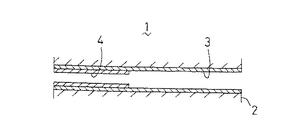
図1に示す触媒1は、ハニカム形状のモノリス型担体2に、Pd触媒をウォッシュコートすることによって該担体2の全長にわたってPd触媒層3を形成し、さらに、該Pd触媒層3の上流側部位にRh触媒をウォッシュコートすることによってRh触媒層4を形成したものである。従って、触媒1のRh触媒層4よりも下流側部位では上記Pd触媒層3が露出している。担体2はコージェライト製であり、容量は2.3Lである。
【0021】
−触媒の調製−
アルミナ、CeとZrの複合酸化物及び酸化ニッケルの各粉末を混合し、これにLa及びZrの各硝酸塩水溶液を吸収させて乾燥・焼成を行なうことによって担持母材を形成した。この担持母材とPdの硝酸塩水溶液とを混合し、蒸発乾固させることによって、該母材にPdを担持させ、さらに焼成を行なうことによって上記Pd触媒を得た。また、上記Pdの硝酸塩に代えてRhの硝酸塩を用い他は同じ材料及び方法によって上記Rh触媒を得た。
【0022】
上記Pd触媒にバインダ(水和アルミナ)を10wt%(Pd触媒とバインダとを合わせた量の10wt%)となるように混合し、適量の水を加えて撹拌することによりPd触媒スラリーを調製した。また、Rh触媒スラリーも同様にして調製した。
【0023】
そして、上記Pd触媒スラリーに上記担体2の全体を浸漬して引上げ、余分のスラリーをエアブローによって吹き飛ばした後、乾燥し、約500℃で焼成することによってPd触媒層3を形成した。次に、このPd触媒層3を形成した担体2にその一端から上記Rh触媒スラリーを所定長さ圧入した後、同様にエアブロー、乾燥、焼成を行なうことによって上記Rh触媒層4を形成した。
【0024】
−触媒の評価1−
先に、各供試触媒のPd及びRhの量を表わすための用語を2つ定義する。その一つは「担体全体での担持量」であり、これは当該担体の触媒層に担持されているPd(又はRh)の全量を該担体全体の容量で除して(割り算して)なる単位容量あたりのg数である。他の一つは「触媒層の担持濃度」であり、これは当該担体の触媒層に担持されているPd(又はRh)の全量を該担体の当該触媒層が形成されている部分の容量で除して(割り算して)なる単位容量あたりのg数である。従って、触媒層が担体の全長にわたって形成されている場合は「担体全体での担持量」と「触媒層の担持濃度」とは同じ値になる。
【0025】
触媒の評価にあたっては、担体全体に対するRh触媒層4の担体上流端からの担持長さの比率が互いに異なる複数種類の供試触媒を準備した。各供試触媒のPd触媒層3については、Pdの担体全体での担持量が1.45g/Lとなるようにした。一方、Rh触媒層4については、Rhの当該触媒層の担持濃度が0.15g/Lとなるようにした。従って、各供試触媒は各々のRhの担体全体での担持量は当該Rh触媒層の担持長さの比率の違いに起因して互いに異なるものになっている。
【0026】
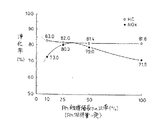
また。各供試触媒については、大気中で1000℃×24時間のエーシング処理を行なってから、排気量2.5LのV型6気筒エンジンを搭載した自動車のアンダーフロア(車室床下)において該エンジンの排気管に接続した。そうして、自動車をY1モードで運転しそのトータルのHC浄化率及びNOx浄化率を調べた。結果は図2に示されている。
【0027】
−触媒の評価2−
上記触媒の評価1では、各供試触媒のRh触媒層のRh担持濃度を互いに同じにしたが、当評価2では各供試触媒のRh触媒層のRh担持濃度を互いに異なる値とし、該Rhの担体全体での担持量が0.16g/Lとなるようにした。Pd触媒層3については先の評価1と同じであり、また、各供試触媒については先の評価1と同じエージング処理を施し、HC浄化率及びNOx浄化率の測定は先の評価1と同じ条件及び方法で行なった。結果は図3に示されている。
【0028】
−評価結果について−
図2によれば、HC浄化率に関しては、Rh触媒層2の比率が変わってもほとんど変化がないが、NOx浄化率は当該比率の違いによって大きく変化している。特異的な点は、Rh触媒の比率が50%を越えるとNOx浄化率が低下していることである。
【0029】
すなわち、HC、CO及びNOxの浄化反応では、HC及びCOの酸化反応とNOxの還元反応とから成り立っており、この酸化反応と還元反応とがバランスして同時に進行することが重要になる。従って、NOxの還元反応を維持するためには、酸化強度(酸化反応における「酸化力」)が強すぎないことが要求される。図1の触媒構造の場合、Rh触媒層4の「Rh」はNOxの還元反応に重要な役割を担っていると同時に、HC、COの酸化反応に強い影響を及ぼす。これに対して、Pd触媒層3の「Pd」は還元反応よりもむしろ酸化反応に強く寄与する。
【0030】
従って、図2において、上記Rh触媒の比率が小さいときにNOxの浄化率が低くなっているのは、上記「Rh」の量が少なすぎてNOxを還元する力が不足しているためであり、また、上記比率が50%を越えるとNOx浄化率が低下しているのは、「Rh」の量が多すぎて「Pd」と「Rh」の酸化強度が過剰になり、酸化反応が支配的となってNOxの還元反応に悪影響を及ぼしているためと考えられる。
【0031】
そうして、上記比率が100%のときは即ちRh触媒層がPd触媒層を完全に覆って二層構造の触媒になっている場合であるが、同図から上記比率の下限を10%にすれば、2層構造の場合よりもNOx浄化率が高くなることがわかる。また、図3をみると、担体全体でのRh担持量が同じであっても、上記比率が10%以上あれば、二層構造の触媒よりもNOx浄化率が高くなっている。
【0032】
これらのことから、Rh触媒層は担体の全長にわたって設けなくとも高いNOx浄化率が得られること、しかもそのようにしてもHC浄化率は下がらないこと、そして、担体全長に対するRh触媒層の担持長さの比率を10%以上にすれば、二層構造の触媒よりも高いNOx浄化率が得られることがわかる。
【0033】
ここに、図2において、上記比率10%の点は担体全体でのRh担持量が0.015g/Lであり、Pd担持量は1.45g/Lである。従って、この場合のRh/Pdの重量比は約1/100であり、この重量比についてはこれを1/100以上すれば高いNOx浄化率が得られるということができる。但し、二層構造の触媒での当該重量比は約1/10となる。従って、コスト低減の観点からは該重量比を1/10未満にすればよいことがわかる。
【0034】
また、図2及び図3によれば、上記Rh触媒層の比率が25%及び50%の各々において高いNOx浄化率が得られている。このことと、図2及び図3の各グラフの傾向から、当該比率を20〜60%にすれば、比較的高いNOx浄化率が得られることがわかる。
【0035】
図2におけるRh触媒層の比率25%の点はRh触媒層のRh担持濃度が0.15g/Lであるのに対し、図3における当該比率25%の点はRh触媒層のRh担持濃度が0.6g/Lであり、図2の場合の4倍になっているが、この両ポイントのNOx浄化率の差は3%程度しかない。また、図2及び図3の各々のRh触媒層の比率10%の点は、Rh触媒層のRh担持濃度では10倍の開きがあるが、NOx浄化率については1〜2%程度の開きしかない。従って、高NOx浄化率を得るためにRh触媒層のRh担持濃度を格別に高めることは必要でない、ということができる。
【図面の簡単な説明】
【図1】 実施形態に係る触媒構造を示す断面図
【図2】 同形態におけるRh触媒層(Rh担持濃度一定)の比率と排気ガス浄化率との関係を示すグラフ図
【図3】 同形態におけるRh触媒層(担体全体でのRh担持量が一定となるように該触媒層のRh担持濃度が変えてある)の比率と排気ガス浄化率との関係を示すグラフ図
【符号の説明】
1 排気ガス浄化用触媒
2 担体
3 Pd触媒層
4 Rh触媒層[0001]
BACKGROUND OF THE INVENTION
The present invention relates to an exhaust gas purification catalyst.
[0002]
[Prior art]
As a catalyst for exhaust gas purification of automobiles, a three-way catalyst that simultaneously purifies HC (hydrocarbon), NOx (nitrogen oxide) and CO (carbon monoxide) in exhaust gas is known. In a conventional three-way catalyst, Pt and Rh are adopted as main active species, and these are supported on alumina.
[0003]
On the other hand, Japanese Patent Laid-Open No. 62-136245 describes a three-way catalyst having Pd, Rh and Nd as essential active species. This is intended to increase the heat resistance of the three-way catalyst in an air-fuel ratio lean state. For this reason, Pd is adopted as a main active species, and Nd is used to suppress grain growth at a high temperature of the Pd. In addition, Rh is added to secure the desired NOx purification rate and increase the durability of Pd.
[0004]
[Problems to be solved by the invention]
Since the active species Pt of the conventional three-way catalyst is expensive, the present applicant has developed a three-way catalyst that employs Pd instead. That is, it is formed by laminating a Pd catalyst layer containing Pd and an Rh catalyst layer containing Rh on a carrier so that the former is on the bottom and the latter is on the top.
[0005]
However, the roles of Pd and Rh are different from each other, with the former contributing mainly to purification of HC and CO in the exhaust gas and the latter contributing mainly to purification of NOx. Accordingly, simply separating these into upper and lower layers and supporting them on a carrier does not always make the right material suitable. That is, in this case, each of Pd and Rh is not sufficiently utilized for purification of exhaust gas, and material waste occurs.
[0006]
That is, the problem of the present invention is that a three-way catalyst having Pd and Rh as active species eliminates material waste in consideration of the roles of both active species, and reduces the cost of the catalyst. It is to ensure that the catalyst performance is obtained.
[0007]
[Means for Solving the Problems]
In the present invention, unpurified HC is required as a reducing agent for the decomposition of NOx in order to solve such a problem. Therefore, Rh that contributes to the decomposition of NOx is disposed on the upstream side of the carrier (in this specification, “ The terms “upstream” and “downstream” are for the exhaust gas flow in the catalyst), and since the decomposition of HC proceeds on the downstream side of the carrier, the efficient decomposition of NOx is not expected so much. This is solved by eliminating the loading of Rh in the downstream site. The invention according to each claim will be specifically described below.
[0008]
<Invention according to
The present invention relates to an exhaust gas purifying catalyst in which Pd and Rh are supported on a carrier as active species,
A Pd catalyst layer containing Pd is formed over the entire length of the carrier, and an upstream portion of the Pd catalyst layer is covered with the Rh catalyst layer containing Rh provided on the Pd catalyst layer, The downstream part of the catalyst layer is exposed , the Rh catalyst layer extends from the upstream end of the carrier toward the downstream side, and the ratio of the supported length of the Rh catalyst layer to the total length of the carrier is 10 % And the weight ratio Rh / Pd between the Rh amount of the Rh catalyst layer and the Pd amount of the Pd catalyst layer is 1/100 ≦ Rh / Pd <1/10 .
[0009]
In the present invention, since the Rh catalyst layer is provided only in the upstream portion of the carrier, the decomposition of NOx in the exhaust gas is performed mainly in the upstream portion of the catalyst, and the oxidation of HC mainly in the downstream portion of the catalyst. Decomposition and CO oxidation take place. In this case, since a relatively large amount of unpurified HC exists in the upstream portion of the catalyst, NOx is efficiently decomposed using the HC, and the Pd catalyst layer is exposed at the downstream portion of the catalyst. Therefore, oxidative decomposition of HC and oxidation of CO are efficiently performed. Thus, the Rh catalyst layer is provided only in the upstream portion of the carrier, so that the required amount of Rh can be reduced.
[0010]
The ratio of the supported length of the Rh catalyst layer is set to 10% or more. When the ratio is less than 10%, the expected NOx purification rate cannot be obtained. Even if the Rh amount is increased excessively, the effect is the NOx purification rate This is because there is no significant improvement for this (this point will become clear in the examples described later). This is because the SV value affects the start of the NOx purification reaction, and when the SV value increases, the purification reaction is less likely to occur. However, when the ratio is less than 10%, the SV value is relatively high for NOx purification. This is considered to be too much.
[0011]
Further, the weight ratio Rh / Pd is determined as described above, and the NOx purification expected when the Rh ratio becomes smaller than this cannot be achieved, and the NOx purification even when the Rh ratio becomes larger than this. This is because the improvement in the rate cannot be expected so much, but the amount of Rh used increases, which is disadvantageous for cost reduction.
[0012]
As the carrier, a honeycomb monolithic carrier is suitable, and cordierite or the like can be adopted as the material thereof. The Pd catalyst layer and the Rh catalyst layer can be formed by a catalyst in which each active species is supported on a base material such as alumina, zirconia, or a composite oxide. The Pd catalyst layer uses Pd as an active species, but it is possible to add a small amount of Pt and other active species, and further, ceria, zirconia, complex oxide of Ce and Zr, oxidation A cocatalyst such as nickel, La, or Zr can be added. A small amount of other active species may be added to the Rh catalyst layer, or a promoter may be added.
[0013]
<Invention according to Claim 2>
The present invention provides the exhaust gas purifying catalyst according to
The Pd catalyst layer is formed of a Pd catalyst in which Pd is supported on alumina, and the Rh catalyst layer is formed of an Rh catalyst in which Rh is supported on alumina.
[0014]
The Pd catalyst layer and the Rh catalyst layer can be formed by wash-coating the Pd catalyst and the Rh catalyst on the carrier. In the case of the present invention, alumina is used as a support base material for active species, which is advantageous for heat resistance, catalytic activity, cost reduction, and catalyst preparation.
[0015]
<Invention according to
The present invention provides the exhaust gas purifying catalyst according to
The ratio of the supported length of the Rh catalyst layer to the total length of the carrier is 20 to 60%.
[0016]
In the present invention, the ratio of the supported length of the Rh catalyst layer is further optimized, and if the ratio is 20% or more, the SV value becomes an appropriate value and the start of the NOx purification reaction is smooth. To be done. On the other hand, when the ratio exceeds 60%, the NOx purification rate tends to decrease (this point will become clear in the examples described later).
[0017]
【The invention's effect】
According to the first aspect of the present invention, the Pd catalyst layer is formed over the entire length of the carrier, and the upstream portion of the Pd catalyst layer is covered with the Rh catalyst layer provided on the Pd catalyst layer. The ratio of the supported length from the upstream end of the Rh catalyst layer to the total length of the support is set to 10% or more, and the Rh amount of the Rh catalyst layer and the Pd amount of the Pd catalyst layer Since the weight ratio Rh / Pd is 1/100 ≦ Rh / Pd <1/10, the amount of Rh used can be reduced without lowering the purification rate of HC, NOx and CO in the exhaust gas, which is particularly expected. This is advantageous for cost reduction while ensuring the NOx purification rate . In addition, the Pd catalyst layer is formed over the entire length of the carrier, and the Rh catalyst layer is formed only on the upstream side of the Pd catalyst layer. Therefore, it is easy to prepare an exhaust gas purification catalyst, and the quality is stabilized. To be advantageous.
[0018]
According to the invention of claim 2, in the exhaust gas purifying catalyst according to
[0019]
According to the invention of
[0020]
DETAILED DESCRIPTION OF THE INVENTION
-Catalyst structure-
The
[0021]
-Preparation of catalyst-
A support base material was formed by mixing alumina, a composite oxide of Ce and Zr, and nickel oxide powder, and absorbing each of nitrate aqueous solutions of La and Zr, followed by drying and firing. The supported base material and an aqueous solution of nitrate of Pd were mixed and evaporated to dryness, so that the base material was supported with Pd, and further calcined to obtain the Pd catalyst. The Rh catalyst was obtained by the same material and method except that Rh nitrate was used in place of the Pd nitrate.
[0022]
A Pd catalyst slurry was prepared by mixing the Pd catalyst with a binder (hydrated alumina) so as to be 10 wt% (10 wt% of the total amount of the Pd catalyst and the binder), adding an appropriate amount of water and stirring. . An Rh catalyst slurry was prepared in the same manner.
[0023]
Then, the entire support 2 was dipped and pulled up in the Pd catalyst slurry, and the excess slurry was blown off by air blow, then dried and fired at about 500 ° C. to form the
[0024]
-Evaluation of catalyst 1-
First, two terms for expressing the amounts of Pd and Rh of each test catalyst are defined. One of them is the “supported amount of the entire support”, which is obtained by dividing (dividing) the total amount of Pd (or Rh) supported on the catalyst layer of the support by the capacity of the entire support. This is the number of grams per unit capacity. The other is the “supported concentration of the catalyst layer”, which means that the total amount of Pd (or Rh) supported on the catalyst layer of the carrier is the volume of the portion of the carrier where the catalyst layer is formed. It is the number of grams per unit capacity divided by (divided). Therefore, when the catalyst layer is formed over the entire length of the support, the “supported amount of the entire support” and the “supported concentration of the catalyst layer” have the same value.
[0025]
In the evaluation of the catalyst, a plurality of types of test catalysts having different ratios of the supported length from the upstream end of the Rh catalyst layer 4 to the entire support were prepared. For the
[0026]
Also. Each test catalyst was subjected to an aging treatment at 1000 ° C. for 24 hours in the atmosphere, and then the engine under the floor (under the cabin floor) of a vehicle equipped with a 2.5-liter V-type 6-cylinder engine. Connected to the exhaust pipe. Then, the automobile was operated in the Y1 mode, and the total HC purification rate and NOx purification rate were examined. The result is shown in FIG.
[0027]
-Evaluation of catalyst 2-
In
[0028]
-Evaluation results-
According to FIG. 2, the HC purification rate is hardly changed even if the ratio of the Rh catalyst layer 2 is changed, but the NOx purification rate is largely changed due to the difference in the ratio. A specific point is that the NOx purification rate decreases when the ratio of the Rh catalyst exceeds 50%.
[0029]
That is, the purification reaction of HC, CO, and NOx consists of an oxidation reaction of HC and CO and a reduction reaction of NOx, and it is important that the oxidation reaction and the reduction reaction proceed simultaneously in a balanced manner. Therefore, in order to maintain the reduction reaction of NOx, it is required that the oxidation strength (“oxidation power” in the oxidation reaction) is not too strong. In the case of the catalyst structure of FIG. 1, “Rh” in the Rh catalyst layer 4 plays an important role in the reduction reaction of NOx and at the same time has a strong influence on the oxidation reaction of HC and CO. In contrast, “Pd” in the
[0030]
Therefore, in FIG. 2, the NOx purification rate is low when the ratio of the Rh catalyst is small because the amount of “Rh” is too small and the power to reduce NOx is insufficient. In addition, when the above ratio exceeds 50%, the NOx purification rate decreases because the amount of “Rh” is excessive and the oxidation strength of “Pd” and “Rh” becomes excessive, and the oxidation reaction is dominant. This is thought to be due to adverse effects on the reduction reaction of NOx.
[0031]
Thus, when the ratio is 100%, that is, when the Rh catalyst layer completely covers the Pd catalyst layer to form a two-layered catalyst, the lower limit of the ratio is 10% from the same figure. This shows that the NOx purification rate is higher than that in the case of the two-layer structure. Further, as shown in FIG. 3, even if the amount of Rh supported in the entire carrier is the same, if the ratio is 10% or more, the NOx purification rate is higher than that of the catalyst having the two-layer structure.
[0032]
From these facts, it is possible to obtain a high NOx purification rate even if the Rh catalyst layer is not provided over the entire length of the carrier, and even so, the HC purification rate does not decrease, and the supported length of the Rh catalyst layer with respect to the total length of the carrier. It can be seen that if the ratio is 10% or more, a higher NOx purification rate than the two-layered catalyst can be obtained.
[0033]
Here, in FIG. 2, the point of the ratio of 10% is 0.015 g / L of Rh loading in the whole carrier and 1.45 g / L of Pd loading. Therefore, the weight ratio of Rh / Pd in this case is about 1/100, and it can be said that if this weight ratio is increased to 1/100 or more, a high NOx purification rate can be obtained. However, the weight ratio in a two-layered catalyst is about 1/10. Therefore, it can be seen that the weight ratio should be less than 1/10 from the viewpoint of cost reduction.
[0034]
2 and 3, a high NOx purification rate is obtained when the ratio of the Rh catalyst layer is 25% and 50%, respectively. From this and the tendency of each graph of FIGS. 2 and 3, it can be seen that a relatively high NOx purification rate can be obtained if the ratio is set to 20 to 60%.
[0035]
In FIG. 2, the Rh catalyst layer has a ratio of 25%, and the Rh catalyst layer has a Rh support concentration of 0.15 g / L, whereas in FIG. 3, the Rh catalyst layer has a Rh support concentration of 0.15 g / L. Although it is 0.6 g / L, which is four times that in the case of FIG. 2, the difference in the NOx purification rates at these points is only about 3%. In addition, the 10% ratio of the Rh catalyst layer in each of FIGS. 2 and 3 has a 10-fold difference in the Rh supported concentration of the Rh catalyst layer, but the NOx purification rate is only approximately 1-2%. Absent. Therefore, it can be said that it is not necessary to particularly increase the Rh support concentration of the Rh catalyst layer in order to obtain a high NOx purification rate.
[Brief description of the drawings]
[1] exemplary cross-sectional view showing the catalyst structure according to the Figure 2 Rh catalyst layer in the form (Rh support concentration constant) graph showing the relationship between the ratio and the exhaust gas purification rate of Figure 3 the form Is a graph showing the relationship between the ratio of the Rh catalyst layer (the Rh support concentration of the catalyst layer is changed so that the Rh support amount in the entire carrier is constant) and the exhaust gas purification rate
1 Exhaust gas purification catalyst 2 Carrier
3 Pd catalyst layer
4 Rh catalyst layer
Claims (3)
上記Pdを含有するPd触媒層が上記担体の全長にわたって形成され、該Pd触媒層の上流側部位が該Pd触媒層の上に設けられた上記Rhを含有するRh触媒層によって覆われ、該Pd触媒層の下流側部位が露出しており、上記Rh触媒層が上記担体の上流端から下流側に向かって延設されていて、該担体の全長に対するRh触媒層の担持長さの比率が10%以上であるとともに、上記Rh触媒層のRh量と上記Pd触媒層のPd量との重量比Rh/Pdが1/100≦Rh/Pd<1/10であることを特徴とする排気ガス浄化用触媒。In an exhaust gas purifying catalyst in which Pd and Rh are supported as active species on a carrier,
A Pd catalyst layer containing Pd is formed over the entire length of the carrier, and an upstream portion of the Pd catalyst layer is covered with the Rh catalyst layer containing Rh provided on the Pd catalyst layer, The downstream part of the catalyst layer is exposed , the Rh catalyst layer extends from the upstream end of the carrier toward the downstream side, and the ratio of the supported length of the Rh catalyst layer to the total length of the carrier is 10 %, And the weight ratio Rh / Pd between the Rh amount of the Rh catalyst layer and the Pd amount of the Pd catalyst layer is 1/100 ≦ Rh / Pd <1/10. Catalyst.
上記Pd触媒層が、アルミナにPdを担持させたPd触媒によって形成され、上記Rh触媒層が、アルミナにRhを担持させたRh触媒によって形成されていることを特徴とする排気ガス浄化用触媒。In the exhaust gas purifying catalyst according to claim 1,
An exhaust gas purifying catalyst, wherein the Pd catalyst layer is formed of a Pd catalyst in which Pd is supported on alumina, and the Rh catalyst layer is formed of an Rh catalyst in which Rh is supported on alumina.
上記担体の全長に対するRh触媒層の担持長さの比率が20〜60%であることを特徴とする排気ガス浄化用触媒。In the exhaust gas purifying catalyst according to claim 1,
The exhaust gas purifying catalyst, wherein the ratio of the supported length of the Rh catalyst layer to the total length of the carrier is 20 to 60%.
Priority Applications (1)
| Application Number | Priority Date | Filing Date | Title |
|---|---|---|---|
| JP24958495A JP3791947B2 (en) | 1995-09-27 | 1995-09-27 | Exhaust gas purification catalyst |
Applications Claiming Priority (1)
| Application Number | Priority Date | Filing Date | Title |
|---|---|---|---|
| JP24958495A JP3791947B2 (en) | 1995-09-27 | 1995-09-27 | Exhaust gas purification catalyst |
Publications (2)
| Publication Number | Publication Date |
|---|---|
| JPH0985091A JPH0985091A (en) | 1997-03-31 |
| JP3791947B2 true JP3791947B2 (en) | 2006-06-28 |
Family
ID=17195192
Family Applications (1)
| Application Number | Title | Priority Date | Filing Date |
|---|---|---|---|
| JP24958495A Expired - Fee Related JP3791947B2 (en) | 1995-09-27 | 1995-09-27 | Exhaust gas purification catalyst |
Country Status (1)
| Country | Link |
|---|---|
| JP (1) | JP3791947B2 (en) |
Families Citing this family (11)
| Publication number | Priority date | Publication date | Assignee | Title |
|---|---|---|---|---|
| JP4350250B2 (en) * | 2000-01-27 | 2009-10-21 | 株式会社キャタラー | Exhaust gas purification catalyst |
| JP5103052B2 (en) * | 2007-04-17 | 2012-12-19 | 東京濾器株式会社 | Oxidation catalyst of exhaust gas purification system for diesel engine |
| JP2009255033A (en) * | 2008-03-27 | 2009-11-05 | Ibiden Co Ltd | Honeycomb structure body and exhaust gas treating device |
| WO2009118867A1 (en) * | 2008-03-27 | 2009-10-01 | イビデン株式会社 | Honeycomb structure and exhaust gas treating apparatus |
| BR112012031341A2 (en) * | 2010-06-10 | 2016-11-08 | Basf Se | nitrogen oxide storage catalyst, treatment system for an automobile exhaust gas stream, method for treating automobile engine exhaust gas, and method for producing a nitrogen oxide storage catalyst |
| JP2012035206A (en) * | 2010-08-09 | 2012-02-23 | Johnson Matthey Japan Inc | Exhaust gas purifying catalyst |
| JP5846137B2 (en) * | 2013-02-13 | 2016-01-20 | トヨタ自動車株式会社 | Catalytic converter |
| US10150082B2 (en) | 2014-05-28 | 2018-12-11 | Umicore Shokubai Japan Co., Ltd. | Catalyst for internal combustion engine exhaust gas purification, and system for same |
| JP6460817B2 (en) * | 2015-02-04 | 2019-01-30 | 株式会社キャタラー | Exhaust gas purification catalyst |
| JP6372513B2 (en) * | 2016-04-13 | 2018-08-15 | トヨタ自動車株式会社 | Catalytic converter |
| JP7245613B2 (en) | 2018-07-05 | 2023-03-24 | 株式会社キャタラー | Exhaust gas purification catalyst device |
-
1995
- 1995-09-27 JP JP24958495A patent/JP3791947B2/en not_active Expired - Fee Related
Also Published As
| Publication number | Publication date |
|---|---|
| JPH0985091A (en) | 1997-03-31 |
Similar Documents
| Publication | Publication Date | Title |
|---|---|---|
| US5753580A (en) | Exhaust emission control catalyst comprising cerium | |
| EP0852966B1 (en) | Exhaust gas purifying catalyst and exhaust gas purifying method | |
| US6191061B1 (en) | Method of purifying exhaust gas and catalyst for purifying exhaust gas | |
| JP3391878B2 (en) | Exhaust gas purification catalyst | |
| JP6246192B2 (en) | Three-way catalyst system | |
| EP0562516B1 (en) | Method for purifying exhaust gas | |
| US6557342B2 (en) | Exhaust gas purifying system | |
| JPH05168860A (en) | Exhaust gas purification method | |
| JPH10180099A (en) | Catalyst for purifying waste gas and waste gas purifying system | |
| JPH10180041A (en) | Catalyst for purification of exhaust gas and exhaust gas purifying system | |
| JP3791947B2 (en) | Exhaust gas purification catalyst | |
| JPH11267504A (en) | Catalyst for cleaning exhaust gas and exhaust gas cleaning system using it | |
| JP3882627B2 (en) | Exhaust gas purification catalyst | |
| US11850573B2 (en) | Exhaust gas cleaning catalytic device | |
| US6171557B1 (en) | System for exhaust gas purification | |
| JP3224054B2 (en) | Exhaust gas purification method | |
| JPH08281110A (en) | Exhaust gas purification catalyst and method for producing the same | |
| JP3800200B2 (en) | Exhaust gas purification method and exhaust gas purification catalyst | |
| JP4222064B2 (en) | Exhaust gas purification catalyst | |
| JPH0838898A (en) | Exhaust gas purification catalyst | |
| JPH08281071A (en) | Exhaust gas purification method and exhaust gas purification catalyst | |
| JPH05212284A (en) | Exhaust gas cleaning catalyst | |
| JP3447513B2 (en) | Exhaust gas purification catalyst and exhaust gas purification method | |
| JPH0871424A (en) | Exhaust gas purification catalyst | |
| EP0868940A1 (en) | Catalyst for purifying exhaust gas, process for manufacturing the catalyst and process for making use of the catalyst |
Legal Events
| Date | Code | Title | Description |
|---|---|---|---|
| A977 | Report on retrieval |
Free format text: JAPANESE INTERMEDIATE CODE: A971007 Effective date: 20041228 |
|
| A131 | Notification of reasons for refusal |
Free format text: JAPANESE INTERMEDIATE CODE: A131 Effective date: 20051220 |
|
| A521 | Written amendment |
Free format text: JAPANESE INTERMEDIATE CODE: A523 Effective date: 20060220 |
|
| TRDD | Decision of grant or rejection written | ||
| A01 | Written decision to grant a patent or to grant a registration (utility model) |
Free format text: JAPANESE INTERMEDIATE CODE: A01 Effective date: 20060322 |
|
| A61 | First payment of annual fees (during grant procedure) |
Free format text: JAPANESE INTERMEDIATE CODE: A61 Effective date: 20060404 |
|
| R150 | Certificate of patent or registration of utility model |
Free format text: JAPANESE INTERMEDIATE CODE: R150 |
|
| FPAY | Renewal fee payment (event date is renewal date of database) |
Free format text: PAYMENT UNTIL: 20090414 Year of fee payment: 3 |
|
| FPAY | Renewal fee payment (event date is renewal date of database) |
Free format text: PAYMENT UNTIL: 20100414 Year of fee payment: 4 |
|
| FPAY | Renewal fee payment (event date is renewal date of database) |
Free format text: PAYMENT UNTIL: 20110414 Year of fee payment: 5 |
|
| FPAY | Renewal fee payment (event date is renewal date of database) |
Free format text: PAYMENT UNTIL: 20120414 Year of fee payment: 6 |
|
| FPAY | Renewal fee payment (event date is renewal date of database) |
Free format text: PAYMENT UNTIL: 20130414 Year of fee payment: 7 |
|
| FPAY | Renewal fee payment (event date is renewal date of database) |
Free format text: PAYMENT UNTIL: 20130414 Year of fee payment: 7 |
|
| FPAY | Renewal fee payment (event date is renewal date of database) |
Free format text: PAYMENT UNTIL: 20140414 Year of fee payment: 8 |
|
| LAPS | Cancellation because of no payment of annual fees |