JP2025517323A - Solid forms of macrocyclic compounds as CFTR modulators and their preparation - Google Patents
Solid forms of macrocyclic compounds as CFTR modulators and their preparation Download PDFInfo
- Publication number
- JP2025517323A JP2025517323A JP2024568064A JP2024568064A JP2025517323A JP 2025517323 A JP2025517323 A JP 2025517323A JP 2024568064 A JP2024568064 A JP 2024568064A JP 2024568064 A JP2024568064 A JP 2024568064A JP 2025517323 A JP2025517323 A JP 2025517323A
- Authority
- JP
- Japan
- Prior art keywords
- compound
- ppm
- formula
- degrees
- stereoisomer
- Prior art date
- Legal status (The legal status is an assumption and is not a legal conclusion. Google has not performed a legal analysis and makes no representation as to the accuracy of the status listed.)
- Pending
Links
Images


Classifications
-
- C—CHEMISTRY; METALLURGY
- C07—ORGANIC CHEMISTRY
- C07D—HETEROCYCLIC COMPOUNDS
- C07D498/00—Heterocyclic compounds containing in the condensed system at least one hetero ring having nitrogen and oxygen atoms as the only ring hetero atoms
- C07D498/02—Heterocyclic compounds containing in the condensed system at least one hetero ring having nitrogen and oxygen atoms as the only ring hetero atoms in which the condensed system contains two hetero rings
- C07D498/06—Peri-condensed systems
-
- A—HUMAN NECESSITIES
- A61—MEDICAL OR VETERINARY SCIENCE; HYGIENE
- A61P—SPECIFIC THERAPEUTIC ACTIVITY OF CHEMICAL COMPOUNDS OR MEDICINAL PREPARATIONS
- A61P11/00—Drugs for disorders of the respiratory system
-
- C—CHEMISTRY; METALLURGY
- C07—ORGANIC CHEMISTRY
- C07D—HETEROCYCLIC COMPOUNDS
- C07D213/00—Heterocyclic compounds containing six-membered rings, not condensed with other rings, with one nitrogen atom as the only ring hetero atom and three or more double bonds between ring members or between ring members and non-ring members
- C07D213/02—Heterocyclic compounds containing six-membered rings, not condensed with other rings, with one nitrogen atom as the only ring hetero atom and three or more double bonds between ring members or between ring members and non-ring members having three double bonds between ring members or between ring members and non-ring members
- C07D213/04—Heterocyclic compounds containing six-membered rings, not condensed with other rings, with one nitrogen atom as the only ring hetero atom and three or more double bonds between ring members or between ring members and non-ring members having three double bonds between ring members or between ring members and non-ring members having no bond between the ring nitrogen atom and a non-ring member or having only hydrogen or carbon atoms directly attached to the ring nitrogen atom
- C07D213/60—Heterocyclic compounds containing six-membered rings, not condensed with other rings, with one nitrogen atom as the only ring hetero atom and three or more double bonds between ring members or between ring members and non-ring members having three double bonds between ring members or between ring members and non-ring members having no bond between the ring nitrogen atom and a non-ring member or having only hydrogen or carbon atoms directly attached to the ring nitrogen atom with hetero atoms or with carbon atoms having three bonds to hetero atoms with at the most one bond to halogen, e.g. ester or nitrile radicals, directly attached to ring carbon atoms
- C07D213/78—Carbon atoms having three bonds to hetero atoms, with at the most one bond to halogen, e.g. ester or nitrile radicals
- C07D213/81—Amides; Imides
-
- C—CHEMISTRY; METALLURGY
- C07—ORGANIC CHEMISTRY
- C07D—HETEROCYCLIC COMPOUNDS
- C07D498/00—Heterocyclic compounds containing in the condensed system at least one hetero ring having nitrogen and oxygen atoms as the only ring hetero atoms
- C07D498/12—Heterocyclic compounds containing in the condensed system at least one hetero ring having nitrogen and oxygen atoms as the only ring hetero atoms in which the condensed system contains three hetero rings
- C07D498/16—Peri-condensed systems
Landscapes
- Chemical & Material Sciences (AREA)
- Organic Chemistry (AREA)
- Health & Medical Sciences (AREA)
- Engineering & Computer Science (AREA)
- Bioinformatics & Cheminformatics (AREA)
- Pulmonology (AREA)
- Chemical Kinetics & Catalysis (AREA)
- General Chemical & Material Sciences (AREA)
- Medicinal Chemistry (AREA)
- Nuclear Medicine, Radiotherapy & Molecular Imaging (AREA)
- Pharmacology & Pharmacy (AREA)
- Life Sciences & Earth Sciences (AREA)
- Animal Behavior & Ethology (AREA)
- General Health & Medical Sciences (AREA)
- Public Health (AREA)
- Veterinary Medicine (AREA)
- Pharmaceuticals Containing Other Organic And Inorganic Compounds (AREA)
- Organic Low-Molecular-Weight Compounds And Preparation Thereof (AREA)
- Medicines That Contain Protein Lipid Enzymes And Other Medicines (AREA)
Abstract
化合物Iを調製するプロセス及び方法が開示される。化合物Iの結晶性形態、その薬学的に許容される塩、溶媒和物、水和物、及び共結晶、それを含む医薬組成物、それを使用して嚢胞性線維症を治療する方法、並びにそれを作製する方法も開示される。嚢胞性線維症膜コンダクタンス制御因子(CFTR)モジュレーターの結晶性固体形態及び非晶質固体形態、その医薬組成物、前述のもののうちのいずれかにより嚢胞性線維症を治療する用法、並びに結晶性及び非晶質形態を作成するためのプロセスが本明細書に開示される。【選択図】図1Disclosed are processes and methods for preparing Compound I. Also disclosed are crystalline forms of Compound I, its pharma- ceutically acceptable salts, solvates, hydrates, and co-crystals, pharmaceutical compositions comprising same, methods of using same to treat cystic fibrosis, and methods of making same. Disclosed herein are crystalline and amorphous solid forms of Cystic Fibrosis Transmembrane Conductance Regulator (CFTR) modulators, pharmaceutical compositions thereof, methods of using any of the foregoing to treat cystic fibrosis, and processes for making the crystalline and amorphous forms.Selected Figure: Figure 1
Description
本出願は、2022年5月16日に出願された米国仮出願第63/342,392号、及び2022年5月16日に出願された米国仮出願第63/342,408号の利益を主張するものであり、当該出願の内容は、その全体が参照により組み込まれる。 This application claims the benefit of U.S. Provisional Application No. 63/342,392, filed May 16, 2022, and U.S. Provisional Application No. 63/342,408, filed May 16, 2022, the contents of which are incorporated by reference in their entireties.
嚢胞性線維症膜コンダクタンス制御因子(CFTR)モジュレーターの結晶性固体形態及び非晶質固体形態、その医薬組成物、前述のもののうちのいずれかにより嚢胞性線維症を治療する用法、並びに結晶性及び非晶質形態を作成するためのプロセスが本明細書に開示される。更に、CFTRモジュレーターを調製するプロセス及び方法が本明細書に開示される。 Disclosed herein are crystalline and amorphous solid forms of cystic fibrosis transmembrane conductance regulator (CFTR) modulators, pharmaceutical compositions thereof, methods of treating cystic fibrosis with any of the foregoing, and processes for making the crystalline and amorphous forms. Additionally, disclosed herein are processes and methods for preparing the CFTR modulators.
嚢胞性線維症(CF)は、世界でおよそ88,000人の小児及び成人に発症する劣性遺伝性疾患である。CFの治療は進歩しているにもかかわらず、それを完治する方法がない。 Cystic fibrosis (CF) is a recessive genetic disease that affects approximately 88,000 children and adults worldwide. Despite advances in the treatment of CF, there is no cure.
CFを有する患者において、呼吸上皮で内因的に発現したCFTRの変異により、頂端膜のアニオン分泌が減少し、イオン及び流体輸送の不均衡が引き起こされる。結果として生じるアニオン輸送の減少が肺内の粘液蓄積の増加に寄与し、最終的にCF患者に死をもたらす微生物感染が付随して起こる。呼吸器疾患に加えて、CF患者は、典型的には、治療せずに放置すると死に至る胃腸障害及び膵機能不全に罹患している。加えて、嚢胞性線維症を有する男性の大半は不妊症であり、嚢胞性線維症を有する女性では受精率が低下する。 In patients with CF, mutations in CFTR endogenously expressed in respiratory epithelium lead to reduced apical anion secretion and an imbalance in ion and fluid transport. The resulting reduced anion transport contributes to increased mucus accumulation in the lungs, accompanied by microbial infections that ultimately lead to death in CF patients. In addition to respiratory disease, CF patients typically suffer from gastrointestinal disorders and pancreatic insufficiency that, if left untreated, can lead to death. Additionally, the majority of men with cystic fibrosis are infertile, and fertility is reduced in women with cystic fibrosis.
CFTR遺伝子の配列分析により、疾患を引き起こす様々な変異が明らかになっている(Cutting,G.R.et al.(1990)Nature 346:366-369、Dean,M.et al.(1990)Cell 61:863:870、及びKerem,B-S.et al.(1989)Science 245:1073-1080、Kerem,B-S.et al.(1990)Proc.Natl.Acad.Sci.USA 87:8447-8451)。これまでに、2000を超えるCF遺伝子の変異が特定されており、現在、CFTR2データベースにはこれらの特定された変異のうちの少なくとも322の変異に関する情報が含まれており、少なくとも281の変異については、疾患を引き起こすと定めるのに十分な証拠がある。疾患を引き起こす最もよく見られる変異は、CFTRアミノ酸配列の508位でのフェニルアラニンの欠失であり、一般にF508del変異と称される。この変異は、嚢胞性線維症の多くの症例で発生し、重症疾患を伴う。 Sequence analysis of the CFTR gene has revealed a variety of disease-causing mutations (Cutting, G.R. et al. (1990) Nature 346:366-369; Dean, M. et al. (1990) Cell 61:863:870; and Kerem, B-S. et al. (1989) Science 245:1073-1080; Kerem, B-S. et al. (1990) Proc. Natl. Acad. Sci. USA 87:8447-8451). To date, over 2000 CF gene mutations have been identified, and the CFTR2 database currently contains information on at least 322 of these identified mutations, with at least 281 mutations having sufficient evidence to define them as disease-causing. The most common disease-causing mutation is a deletion of phenylalanine at position 508 of the CFTR amino acid sequence, commonly referred to as the F508del mutation. This mutation occurs in many cases of cystic fibrosis and is associated with severe disease.
CFTRは、吸収上皮細胞及び分泌上皮細胞を含む様々な細胞型で発現するcAMP/ATP媒介性アニオンチャネルであり、ここで、CFTRは、膜を横断するアニオンの流れを制御し、他のイオンチャネル及びタンパク質の活性も調節する。上皮細胞において、CFTRの正常機能は、呼吸組織及び消化組織を含む全身の電解質輸送の維持に不可欠である。CFTRは、各々が6つの膜貫通ヘリックス及びヌクレオチド結合ドメインを含む膜貫通ドメインのタンデムリピートからなるタンパク質をコードする、1480個のアミノ酸で構成されている。2つの膜貫通ドメインが、大きい極性の制御(R)ドメインを介して、チャネル活性及び細胞輸送を制御する複数のリン酸化部位に結合している。 CFTR is a cAMP/ATP-mediated anion channel expressed in a variety of cell types, including absorptive and secretory epithelial cells, where it controls the flow of anions across the membrane and also regulates the activity of other ion channels and proteins. In epithelial cells, normal function of CFTR is essential for maintaining electrolyte transport throughout the body, including respiratory and digestive tissues. CFTR is composed of 1480 amino acids that encode a protein consisting of tandem repeats of transmembrane domains, each of which contains six transmembrane helices and a nucleotide-binding domain. The two transmembrane domains are linked via a large, polar regulatory (R) domain to multiple phosphorylation sites that control channel activity and cellular trafficking.
塩化物輸送は、頂端膜上に存在するENaC(上皮性ナトリウムチャネル)及びCFTRの協調的活性、並びに当該細胞の基底外側面で発現するNa+-K+-ATPアーゼポンプ及びCl-チャネルによって起こる。管腔側からの塩化物の二次的な能動輸送により、細胞内塩化物の蓄積がもたらされ、その後塩化物は、Cl-チャネルを介して細胞から受動的に離れ、ベクトル輸送をもたらすことができる。Na+/2Cl-/K+共輸送体、Na+-K+-ATPアーゼポンプ及び基底外側面上の基底外側膜K+チャネル、並びに管腔側のCFTRの配置により、塩化物の分泌が調整される。恐らく水自体が積極的に輸送されることがないため、上皮を横断するその流れは、ナトリウム及び塩化物の大きな流れによって生じるわずかな経上皮浸透圧勾配に依存する。
最近になって、いくつかのCFTRモジュレーターが特定されている。これらのモジュレーターは、例えば、ポテンシエーター、コレクター、ポテンシエーター増強薬/共ポテンシエーター、増幅薬、リードスルー薬、及び核酸療法とみなされている。上皮細胞表面における変異型CFTR及び野生型CFTRのチャネルゲーティング活性を増加させるCFTRモジュレーターは、ポテンシエーターとして知られている。コレクターは、欠陥のあるタンパク質プロセシングを改善し、結果として上皮表面へのトラフィッキングをもたらす。Ghelani and Schneider-Futschik(2020)ACS Pharmacol.Transl.Sci.3:4-10。米国食品医薬品局によって嚢胞性線維症の治療用として承認されているCFTRコレクターは3つ存在する。しかしながら、いくつかのCFTRコレクターを用いた単剤療法は十分に有効ではないことが判明しており、結果として、CFTR活性を増強するためにはポテンシエーターを用いた併用療法が必要である。現在、嚢胞性線維症の治療用に承認されているCFTRポテンシエーターは1つのみである。したがって、嚢胞性線維症の治療は、これら新たな小分子CFTRモジュレーターによって変容を遂げているが、疾患進行を予防し、嚢胞性線維症及び他のCFTR媒介性疾患の重症度を軽減し、かつこれら疾患のより重篤な形態を治療するためには新規かつより良好なモジュレーターが必要とされている。
Chloride transport occurs through the coordinated activity of ENaC (epithelial sodium channel) and CFTR present on the apical membrane, and Na + -K + -ATPase pump and Cl -channels expressed on the basolateral surface of the cell. Secondary active transport of chloride from the luminal side leads to intracellular chloride accumulation, which can then passively leave the cell via Cl -channels resulting in vectorial transport. The location of Na + /2Cl - /K + cotransporters, Na + -K + -ATPase pump and basolateral membrane K + channels on the basolateral surface, and CFTR on the luminal side, regulates chloride secretion. Presumably water is not actively transported itself, so its flow across the epithelium depends on a small transepithelial osmotic gradient generated by the bulk flow of sodium and chloride.
Recently, several CFTR modulators have been identified. These modulators are considered, for example, as potentiators, correctors, potentiator enhancers/co-potentiators, amplifiers, read-through drugs, and nucleic acid therapeutics. CFTR modulators that increase the channel gating activity of mutant and wild-type CFTR at the epithelial cell surface are known as potentiators. Correctors improve defective protein processing, resulting in trafficking to the epithelial surface. Ghelani and Schneider-Futschik (2020) ACS Pharmacol. Transl. Sci. 3:4-10. There are three CFTR correctors approved by the US Food and Drug Administration for the treatment of cystic fibrosis. However, monotherapy with some CFTR correctors has been found to be ineffective, and as a result, combination therapy with potentiators is necessary to enhance CFTR activity. Currently, only one CFTR potentiator is approved for the treatment of cystic fibrosis, and thus, although cystic fibrosis treatment has been transformed by these new small molecule CFTR modulators, new and better modulators are needed to prevent disease progression, reduce the severity of cystic fibrosis and other CFTR-mediated diseases, and treat more severe forms of these diseases.
したがって、本開示の一態様は、CFTR調節化合物、(6R)-17-アミノ-12,12-ジメチル-6,15-ビス(トリフルオロメチル)-19-オキサ-3,4,13,18-テトラザトリシクロ[12.3.1.12,5]ノナデカ-1(18),2,4,14,16-ペンタエン-6-オール(化合物I)、及びその薬学的に許容される塩の固体形態を提供する。化合物Iは、以下の構造:

を有するものとして示され得る。
Accordingly, one aspect of the disclosure provides solid forms of the CFTR modulating compound, (6R)-17-amino-12,12-dimethyl-6,15-bis(trifluoromethyl)-19-oxa-3,4,13,18-tetrazatricyclo[12.3.1.12,5]nonadeca-1(18),2,4,14,16-pentaen-6-ol (Compound I), and pharma- ceutically acceptable salts thereof. Compound I has the following structure:
It can be shown as having:
本開示の更なる態様は、化合物I、化合物Iの立体異性体、化合物Iの重水素化誘導体及びその立体異性体、並びに前述のもののうちのいずれかの薬学的に許容される塩を調製する方法を提供する。 A further aspect of the present disclosure provides methods for preparing Compound I, stereoisomers of Compound I, deuterated derivatives of Compound I and stereoisomers thereof, and pharma- ceutically acceptable salts of any of the foregoing.
化合物Iは、最初に、WO2022/109573として公開され、かつ参照によりその全体が本明細書に組み込まれる、PCT国際出願第PCT/US2021/072475号に開示された。化合物Iは、結晶性形態A(ニート)としてWO2022/109573に開示されている。 Compound I was first disclosed in PCT International Application No. PCT/US2021/072475, published as WO2022/109573 and incorporated by reference in its entirety. Compound I is disclosed in WO2022/109573 as crystalline Form A (neat).
結晶性形態は、活性成分の結晶性形態での制御が望ましいか又は要求されもし得る、製薬産業において関心の対象である。結晶性形態が異なると、異なる特性を有し得るため、特定の結晶性形態を有する化合物を高純度で生成するための再現性のあるプロセスは、医薬品に使用されることが意図される化合物にとって望ましくあり得る。例えば、結晶性形態が異なると、異なる化学的、物理的、及び/又は薬学的特性を有し得る。いくつかの実施形態では、本明細書に開示される1つ以上の結晶性形態は、より高いレベルの純度、化学的安定性、及び/又は物理的安定性を示し得る。特定の結晶性形態(例えば、化合物Iの結晶性遊離形態、結晶塩、結晶塩溶媒和物、及び結晶塩水和物形態(集合的に「結晶性形態」と称される)は、より低い吸湿性を示し得る。したがって、本開示の結晶性形態は、原薬の製造、保管、及び取り扱い中の利点を提供し得る。したがって、化合物Iの薬学的に許容される結晶性形態は、CFTR媒介性疾患の治療のための薬物の製造に特に有用であり得る。 Crystalline forms are of interest in the pharmaceutical industry, where control over the crystalline form of an active ingredient may be desirable or even required. Because different crystalline forms may have different properties, a reproducible process for producing a compound having a particular crystalline form in high purity may be desirable for compounds intended for use in pharmaceutical products. For example, different crystalline forms may have different chemical, physical, and/or pharmaceutical properties. In some embodiments, one or more of the crystalline forms disclosed herein may exhibit higher levels of purity, chemical stability, and/or physical stability. Certain crystalline forms (e.g., the crystalline free form, crystalline salt, crystalline salt solvate, and crystalline salt hydrate forms of Compound I (collectively referred to as "crystalline forms") may exhibit lower hygroscopicity. Thus, the crystalline forms of the present disclosure may provide advantages during drug substance manufacturing, storage, and handling. Thus, pharma- ceutically acceptable crystalline forms of Compound I may be particularly useful in the manufacture of drugs for the treatment of CFTR-mediated diseases.
治療用化合物の非晶質形態はまた、結晶性形態が特に生物学的に利用可能ではない、製薬産業においても関心の対象であり得る。一部の非晶質形態は、バイオアベイラビリティを改善し、それにより、低減された投与量の投与を可能にし得る。一部の化合物について、非晶質形態は、治療薬の最も生物学的にアクセス可能な形態を提供する。 Amorphous forms of therapeutic compounds may also be of interest in the pharmaceutical industry, where crystalline forms are not particularly bioavailable. Some amorphous forms may improve bioavailability, thereby allowing administration of reduced dosages. For some compounds, the amorphous form provides the most biologically accessible form of the therapeutic agent.
いくつかの実施形態では、化合物Iの結晶性形態は、化合物Iのメタノール溶媒和物(湿潤)である。いくつかの実施形態では、化合物Iの結晶性形態は、化合物Iのメタノール溶媒和物(乾燥)である。いくつかの実施形態では、化合物Iの結晶性形態は、化合物Iのp-トルエンスルホン酸である。 In some embodiments, the crystalline form of Compound I is a methanol solvate of Compound I (wet). In some embodiments, the crystalline form of Compound I is a methanol solvate of Compound I (dry). In some embodiments, the crystalline form of Compound I is the p-toluenesulfonic acid salt of Compound I.
いくつかの実施形態では、化合物Iの固体形態は、非晶質形態である。いくつかの実施形態では、化合物Iの固体非晶質形態は、化合物Iのニート非晶質形態である。 In some embodiments, the solid form of Compound I is an amorphous form. In some embodiments, the solid amorphous form of Compound I is a neat amorphous form of Compound I.
本発明の別の態様は、本明細書に開示される、化合物Iの固体形態、その薬学的に許容される塩、及び前述のもののうちのいずれかの重水素化誘導体から選択される少なくとも1つの固体形態を含む医薬組成物を提供し、当該医薬組成物は、少なくとも1つの追加の医薬品有効成分及び/又は少なくとも1つの担体を更に含み得る。 Another aspect of the present invention provides a pharmaceutical composition comprising at least one solid form selected from the solid forms of Compound I disclosed herein, pharma- ceutically acceptable salts thereof, and deuterated derivatives of any of the foregoing, which may further comprise at least one additional active pharmaceutical ingredient and/or at least one carrier.
特定の実施形態では、本発明の医薬組成物は、本明細書に開示される薬学的に許容される固体形態のうちのいずれかでの化合物Iを含む。いくつかの実施形態では、本明細書に開示される薬学的に許容される結晶性形態のうちのいずれかでの化合物Iを含む組成物は、任意選択で、化合物II、化合物III、化合物III-d、化合物IV、化合物V、化合物VI、化合物VII、化合物VIII、化合物IX、化合物X、並びにその薬学的に許容される塩及び重水素化誘導体から選択される少なくとも1つの化合物を更に含み得る。 In certain embodiments, the pharmaceutical compositions of the present invention comprise Compound I in any of the pharma- ceutically acceptable solid forms disclosed herein. In some embodiments, compositions comprising Compound I in any of the pharma- ceutically acceptable crystalline forms disclosed herein may optionally further comprise at least one compound selected from Compound II, Compound III, Compound III-d, Compound IV, Compound V, Compound VI, Compound VII, Compound VIII, Compound IX, Compound X, and pharma- ceutically acceptable salts and deuterated derivatives thereof.
本発明の別の態様は、CFTR媒介性疾患の嚢胞性線維症を治療する方法を提供し、方法は、任意選択で、少なくとも1つの追加の構成成分(担体又は追加の活性剤など)を含む医薬組成物の一部として、本明細書に開示される薬学的に許容される固体形態のうちのいずれかでの化合物Iを、それを必要とする対象に投与することを含む。いくつかの実施形態では、CFTR媒介性疾患の嚢胞性線維症を治療する方法は、本明細書に開示される薬学的に許容される固体形態のうちのいずれかでの化合物Iを投与することと、任意選択で、(R)-1-(2,2-ジフルオロベンゾ[d][1,3]ジオキソール-5-イル)-N-(1-(2,3-ジヒドロキシプロピル)-6-フルオロ-2-(1-ヒドロキシ-2-メチルプロパン-2-イル)-1H-インドール-5-イル)シクロプロパンカルボキサミド(化合物II)、N-[2,4-ビス(1,1-ジメチルエチル)-5-ヒドロキシフェニル]-1,4-ジヒドロ-4-オキソキノリン-3-カルボキサミド(化合物III)、又はN-(2-(tert-ブチル)-5-ヒドロキシ-4-(2-(メチル-d3)プロパン-2-イル-1,1,1,3,3,3-d6)フェニル)-4-オキソ-1,4-ジヒドロキノリン-3-カルボキサミド(化合物III-d)、3-(6-(1-(2,2-ジフルオロベンゾ[d][1,3]ジオキソール-5-イル)シクロプロパンカルボキサミド)-3-メチルピリジン-2-イル)安息香酸(化合物IV)、N-(1,3-ジメチルピラゾール-4-イル)スルホニル-6-[3-(3,3,3-トリフルオロ-2,2-ジメチル-プロポキシ)ピラゾール-1-イル]-2-[(4S)-2,2,4-トリメチルピロリジン-1-イル]ピリジン-3-カルボキサミド(化合物V)、N-(ベンゼンスルホニル)-6-[3-[2-[1-(トリフルオロメチル)シクロプロピル]エトキシ]ピラゾール-1-イル]-2-[(4S)-2,2,4-トリメチルピロリジン-1-イル]ピリジン-3-カルボキサミド(化合物VI)、(14S)-8-[3-(2-{ジスピロ[2.0.2.1]ヘプタン-7-イル}エトキシ)-1H-ピラゾール-1-イル]-12,12-ジメチル-2λ6-チア-3,9,11,18,23-ペンタアザテトラシクロ[17.3.1.111,14.05,10]テトラコサ-1(22),5,7,9,19(23),20-ヘキサエン-2,2,4-トリオン(化合物VII)、(11R)-6-(2,6-ジメチルフェニル)-11-(2-メチルプロピル)-12-{スピロ[2.3]ヘキサン-5-イル}-9-オキサ-2λ6-チア-3,5,12,19-テトラアザトリシクロ[12.3.1.14,8]ノナデカ-1(17),4(19),5,7,14(18),15-ヘキサエン-2,2,13-トリオン(化合物VIII)、N-(ベンゼンスルホニル)-6-(3-フルオロ-5-イソブトキシ-フェニル)-2-[(4S)-2,2,4-トリメチルピロリジン-1-イル]ピリジン-3-カルボキサミド(化合物IX)、及びN-[(6-アミノ-2-ピリジル)スルホニル]-6-(3-フルオロ-5-イソブトキシ-フェニル)-2-[(4S)-2,2,4-トリメチルピロリジン-1-イル]ピリジン-3-カルボキサミド(化合物X)から選択される1つ以上の追加のCFTR調節薬を更に投与することとを含む。 Another aspect of the invention provides a method of treating the CFTR-mediated disease cystic fibrosis, the method comprising administering Compound I, in any of the pharma- ceutically acceptable solid forms disclosed herein, to a subject in need thereof, optionally as part of a pharmaceutical composition comprising at least one additional component, such as a carrier or an additional active agent. In some embodiments, the method of treating the CFTR-mediated disease cystic fibrosis comprises administering Compound I, in any of the pharma- ceutically acceptable solid forms disclosed herein, and optionally administering (R)-1-(2,2-difluorobenzo[d][1,3]dioxol-5-yl)-N-(1-(2,3-dihydroxypropyl)-6-fluoro-2-(1-hydroxy-2-methylpropan-2-yl)-1H-indol-5-yl) Cyclopropanecarboxamide (Compound II), N-[2,4-bis(1,1-dimethylethyl)-5-hydroxyphenyl]-1,4-dihydro-4-oxoquinoline-3-carboxamide (Compound III), or N-(2-(tert-butyl)-5-hydroxy-4-(2-(methyl-d3)propan-2-yl-1,1,1,3,3,3-d6)phenyl)-4-oxo-1,4-dihydroquinoline-3-carboxamide (Compound II I-d), 3-(6-(1-(2,2-difluorobenzo[d][1,3]dioxol-5-yl)cyclopropanecarboxamido)-3-methylpyridin-2-yl)benzoic acid (Compound IV), N-(1,3-dimethylpyrazol-4-yl)sulfonyl-6-[3-(3,3,3-trifluoro-2,2-dimethyl-propoxy)pyrazol-1-yl]-2-[(4S)-2,2,4-trimethylpyrrolidin-1-yl]pyridine-3 -carboxamide (compound V), N-(benzenesulfonyl)-6-[3-[2-[1-(trifluoromethyl)cyclopropyl]ethoxy]pyrazol-1-yl]-2-[(4S)-2,2,4-trimethylpyrrolidin-1-yl]pyridine-3-carboxamide (compound VI), (14S)-8-[3-(2-{dispiro[2.0.2.1]heptan-7-yl}ethoxy)-1H-pyrazol-1-yl]-12,12-dimethyl-2λ 6 -Thia-3,9,11,18,23-pentaazatetracyclo[17.3.1.111,14.05,10]tetracosa-1(22),5,7,9,19(23),20-hexaene-2,2,4-trione (Compound VII), (11R)-6-(2,6-dimethylphenyl)-11-(2-methylpropyl)-12-{spiro[2.3]hexan-5-yl}-9-oxa-2λ 6 and further administering one or more additional CFTR modulators selected from -thia-3,5,12,19-tetraazatricyclo[12.3.1.14,8]nonadeca-1(17),4(19),5,7,14(18),15-hexaene-2,2,13-trione (Compound VIII), N-(benzenesulfonyl)-6-(3-fluoro-5-isobutoxy-phenyl)-2-[(4S)-2,2,4-trimethylpyrrolidin-1-yl]pyridine-3-carboxamide (Compound IX), and N-[(6-amino-2-pyridyl)sulfonyl]-6-(3-fluoro-5-isobutoxy-phenyl)-2-[(4S)-2,2,4-trimethylpyrrolidin-1-yl]pyridine-3-carboxamide (Compound X).
本開示の更なる態様は、本明細書に開示される化合物Iの固体形態を作製するプロセスを提供する。 A further aspect of the present disclosure provides a process for making the solid form of Compound I disclosed herein.
本発明の別の態様は、本明細書に記載される方法のいずれかにおいて使用するための、本明細書に開示される、化合物Iの固体形態、その薬学的に許容される塩、及び前述のもののうちのいずれかの重水素化誘導体を提供する。 Another aspect of the present invention provides a solid form of Compound I, a pharma- ceutically acceptable salt thereof, and a deuterated derivative of any of the foregoing, as disclosed herein, for use in any of the methods described herein.
定義
本開示全体を通して使用される場合、「化合物I」とは、(6R)-17-アミノ-12,12-ジメチル-6,15-ビス(トリフルオロメチル)-19-オキサ-3,4,13,18-テトラザトリシクロ[12.3.1.12,5]ノナデカ-1(18),2,4,14,16-ペンタエン-6-オールを指し、これは以下の構造を有するものとして表すことができる。

化合物Iは、ラセミ混合物であり得るか、又は異性体のエナンチオ濃縮(例えば、eeが90%超、eeが95%超、eeが98%超)混合物であり得る。化合物Iは、薬学的に許容される塩、溶媒和物、及び/又は水和物の形態であり得る。化合物Iと、化合物I、化合物Iの立体異性体、化合物Iの重水素化誘導体及びその立体異性体、並びに前述のもののうちのいずれかの薬学的に許容される塩を作製する方法及び使用する方法とが、参照により本明細書に組み込まれるWO2022/109573に開示されている。 Compound I may be a racemic mixture or an enantioenriched (e.g., greater than 90% ee, greater than 95% ee, greater than 98% ee) mixture of isomers. Compound I may be in the form of a pharma- ceutically acceptable salt, solvate, and/or hydrate. Compound I and methods of making and using Compound I, stereoisomers of Compound I, deuterated derivatives of Compound I and stereoisomers thereof, and pharma- ceutically acceptable salts of any of the foregoing, are disclosed in WO2022/109573, which is incorporated herein by reference.
本明細書で使用される場合、「化合物II」とは、(R)-1-(2,2-ジフルオロベンゾ[d][1,3]ジオキソール-5-イル)-N-(1-(2,3-ジヒドロキシプロピル)-6-フルオロ-2-(1-ヒドロキシ-2-メチルプロパン-2-イル)-1H-インドール-5-イル)シクロプロパンカルボキサミドを指し、これは以下の構造で表すことができる。

化合物IIは、薬学的に許容される塩の形態であり得る。化合物IIと、化合物IIを作製する方法及び使用する方法とが、各々参照により本明細書に組み込まれる、WO2010/053471、WO2011/119984、WO2011/133751、WO2011/133951、及びWO2015/160787に開示されている。
As used herein, “Compound II” refers to (R)-1-(2,2-difluorobenzo[d][1,3]dioxol-5-yl)-N-(1-(2,3-dihydroxypropyl)-6-fluoro-2-(1-hydroxy-2-methylpropan-2-yl)-1H-indol-5-yl)cyclopropanecarboxamide, which can be represented by the following structure:
Compound II may be in the form of a pharma- ceutically acceptable salt. Compound II and methods of making and using Compound II are disclosed in WO2010/053471, WO2011/119984, WO2011/133751, WO2011/133951, and WO2015/160787, each of which is incorporated herein by reference.
本開示全体を通して使用される場合、「化合物III」とは、N-(5-ヒドロキシ-2,4-ジ-tert-ブチル-フェニル)-4-オキソ-1H-キノリン-3-カルボキサミドを指し、以下の構造で表される。

化合物IIIはまた、薬学的に許容される塩の形態であり得る。化合物IIIと、化合物IIIを作製する方法及び使用する方法とが、各々参照により本明細書に組み込まれる、WO2006/002421、WO2007/079139、WO2010/108162、及びWO2010/019239に開示されている。
As used throughout this disclosure, "Compound III" refers to N-(5-hydroxy-2,4-di-tert-butyl-phenyl)-4-oxo-1H-quinoline-3-carboxamide and is represented by the following structure:
Compound III may also be in the form of a pharma- ceutically acceptable salt.Compound III and methods of making and using Compound III are disclosed in WO2006/002421, WO2007/079139, WO2010/108162, and WO2010/019239, each of which is incorporated herein by reference.
いくつかの実施形態では、化合物IIIの重水素化誘導体(化合物III-d)が、本明細書に開示される組成物及び方法に用いられる。化合物III-dの化学名は、N-(2-(tert-ブチル)-5-ヒドロキシ-4-(2-(メチル-d3)プロパン-2-イル-1,1,1,3,3,3-d6)フェニル)-4-オキソ-1,4-ジヒドロキノリン-3-カルボキサミドであり、以下の構造で表される。
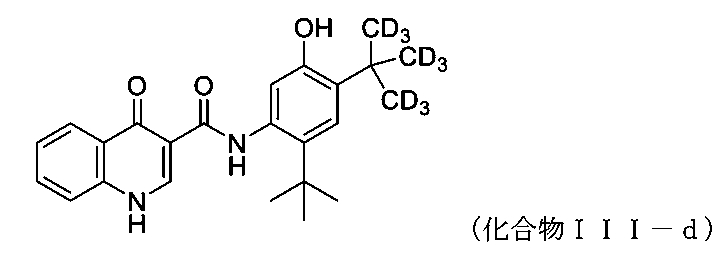
化合物III-dは、薬学的に許容される塩の形態であり得る。化合物III-dと、化合物III-dを作製する方法及び使用する方法とが、参照により本明細書に組み込まれる、WO2012/158885、WO2014/078842、及び米国特許第8,865,902号に開示されている。
In some embodiments, a deuterated derivative of compound III (compound III-d) is used in the compositions and methods disclosed herein. Compound III-d has the chemical name N-(2-(tert-butyl)-5-hydroxy-4-(2-(methyl-d3)propan-2-yl-1,1,1,3,3,3-d6)phenyl)-4-oxo-1,4-dihydroquinoline-3-carboxamide and is represented by the following structure:
Compound III-d can be in the form of a pharma- ceutically acceptable salt. Compound III-d and methods of making and using compound III-d are disclosed in WO 2012/158885, WO 2014/078842, and U.S. Patent No. 8,865,902, which are incorporated herein by reference.
本明細書で使用される場合、「化合物IV」とは、3-(6-(1-(2,2-ジフルオロベンゾ[d][1,3]ジオキソール-5-イル)シクロプロパンカルボキサミド)-3-メチルピリジン-2-イル)安息香酸を指し、以下の化学構造で表される。

化合物IVは、薬学的に許容される塩の形態であり得る。化合物IVと、化合物IVを作製する方法及び使用する方法とが、参照により本明細書に組み込まれる、WO2007/056341、WO2009/073757、及びWO2009/076142に開示されている。
As used herein, "Compound IV" refers to 3-(6-(1-(2,2-difluorobenzo[d][1,3]dioxol-5-yl)cyclopropanecarboxamido)-3-methylpyridin-2-yl)benzoic acid and is represented by the following chemical structure:
Compound IV may be in the form of a pharma- ceutically acceptable salt. Compound IV and methods of making and using Compound IV are disclosed in WO2007/056341, WO2009/073757, and WO2009/076142, which are incorporated herein by reference.
本明細書で使用される場合、「化合物V」とは、N-(1,3-ジメチルピラゾール-4-イル)スルホニル-6-[3-(3,3,3-トリフルオロ-2,2-ジメチル-プロポキシ)ピラゾール-1-イル]-2-[(4S)-2,2,4-トリメチルピロリジン-1-イル]ピリジン-3-カルボキサミドを指し、以下の化学構造で表される。

化合物Vは、薬学的に許容される塩の形態であり得る。化合物Vと、化合物Vを作製する方法及び使用する方法とが、参照により本明細書に組み込まれる、WO2018/107100及びWO2019/113476に開示されている。
As used herein, “Compound V” refers to N-(1,3-dimethylpyrazol-4-yl)sulfonyl-6-[3-(3,3,3-trifluoro-2,2-dimethyl-propoxy)pyrazol-1-yl]-2-[(4S)-2,2,4-trimethylpyrrolidin-1-yl]pyridine-3-carboxamide, and is represented by the following chemical structure:
Compound V may be in the form of a pharma- ceutically acceptable salt. Compound V and methods of making and using Compound V are disclosed in WO2018/107100 and WO2019/113476, which are incorporated herein by reference.
本明細書で使用される場合、「化合物VI」とは、N-(ベンゼンスルホニル)-6-[3-[2-[1-(トリフルオロメチル)シクロプロピル]エトキシ]ピラゾール-1-イル]-2-[(4S)-2,2,4-トリメチルピロリジン-1-イル]ピリジン-3-カルボキサミドを指し、以下の化学構造で表される。

化合物VIは、薬学的に許容される塩の形態であり得る。化合物VIと、化合物VIを作製する方法及び使用する方法とが、参照により本明細書に組み込まれる、WO2018/064632に開示されている。
As used herein, “Compound VI” refers to N-(benzenesulfonyl)-6-[3-[2-[1-(trifluoromethyl)cyclopropyl]ethoxy]pyrazol-1-yl]-2-[(4S)-2,2,4-trimethylpyrrolidin-1-yl]pyridine-3-carboxamide, and is represented by the following chemical structure:
Compound VI may be in the form of a pharma- ceutically acceptable salt. Compound VI and methods of making and using Compound VI are disclosed in WO2018/064632, which is incorporated herein by reference.
本明細書で使用される場合、「化合物VII」とは、(14S)-8-[3-(2-{ジスピロ[2.0.2.1]ヘプタン-7-イル}エトキシ)-1H-ピラゾール-1-イル]-12,12-ジメチル-2λ6-チア-3,9,11,18,23-ペンタアザテトラシクロ[17.3.1.111,14.05,10]テトラコサ-1(22),5,7,9,19(23),20-ヘキサエン-2,2,4-トリオンを指し、以下の化学構造で表される。

化合物VIIは、薬学的に許容される塩の形態であり得る。化合物VIIと、化合物VIIを作製する方法及び使用する方法とが、参照により本明細書に組み込まれる、WO2019/161078、WO2020/102346、及びPCT出願第PCT/US2020/046116号に開示されている。
As used herein, “Compound VII” refers to (14S)-8-[3-(2-{dispiro[2.0.2.1]heptan-7-yl}ethoxy)-1H-pyrazol-1-yl]-12,12-dimethyl-2λ 6 -thia-3,9,11,18,23-pentaazatetracyclo[17.3.1.111,14.05,10]tetracosa-1(22),5,7,9,19(23),20-hexaene-2,2,4-trione and is represented by the following chemical structure:
Compound VII may be in the form of a pharma- ceutically acceptable salt. Compound VII and methods of making and using Compound VII are disclosed in WO2019/161078, WO2020/102346, and PCT Application No. PCT/US2020/046116, which are incorporated herein by reference.
本明細書で使用される場合、「化合物VIII」とは、(11R)-6-(2,6-ジメチルフェニル)-11-(2-メチルプロピル)-12-{スピロ[2.3]ヘキサン-5-イル}-9-オキサ-2λ6-チア-3,5,12,19-テトラアザトリシクロ[12.3.1.14,8]ノナデカ-1(17),4(19),5,7,14(18),15-ヘキサエン-2,2,13-トリオンを指し、以下の化学構造で表される。

化合物VIIIは、薬学的に許容される塩の形態であり得る。化合物VIIIと、化合物VIIIを作製する方法及び使用する方法とが、参照により本明細書に組み込まれる、WO2020/206080に開示されている。
As used herein, “compound VIII” refers to (11R)-6-(2,6-dimethylphenyl)-11-(2-methylpropyl)-12-{spiro[2.3]hexan-5-yl}-9-oxa-2λ 6 -thia-3,5,12,19-tetraazatricyclo[12.3.1.14,8]nonadeca-1(17),4(19),5,7,14(18),15-hexaene-2,2,13-trione and is represented by the following chemical structure:
Compound VIII may be in the form of a pharma- ceutically acceptable salt. Compound VIII and methods of making and using Compound VIII are disclosed in WO2020/206080, which is incorporated herein by reference.
本明細書で使用される場合、「化合物IX」とは、N-(ベンゼンスルホニル)-6-(3-フルオロ-5-イソブトキシ-フェニル)-2-[(4S)-2,2,4-トリメチルピロリジン-1-イル]ピリジン-3-カルボキサミドを指し、以下の化学構造で表される。

化合物IXは、薬学的に許容される塩の形態であり得る。化合物IXと、化合物IXを作製する方法及び使用する方法とが、参照により本明細書に組み込まれる、WO2016/057572に開示されている。
As used herein, “Compound IX” refers to N-(benzenesulfonyl)-6-(3-fluoro-5-isobutoxy-phenyl)-2-[(4S)-2,2,4-trimethylpyrrolidin-1-yl]pyridine-3-carboxamide and is represented by the following chemical structure:
Compound IX may be in the form of a pharma- ceutically acceptable salt. Compound IX and methods of making and using Compound IX are disclosed in WO2016/057572, which is incorporated herein by reference.
本明細書で使用される場合、「化合物X」とは、N-[(6-アミノ-2-ピリジル)スルホニル]-6-(3-フルオロ-5-イソブトキシ-フェニル)-2-[(4S)-2,2,4-トリメチルピロリジン-1-イル]ピリジン-3-カルボキサミドを指し、以下の化学構造で表される。

化合物Xは、薬学的に許容される塩の形態であり得る。化合物Xと、化合物Xを作製する方法及び使用する方法とが、参照により本明細書に組み込まれる、WO2016/057572に開示されている。
As used herein, “Compound X” refers to N-[(6-amino-2-pyridyl)sulfonyl]-6-(3-fluoro-5-isobutoxy-phenyl)-2-[(4S)-2,2,4-trimethylpyrrolidin-1-yl]pyridine-3-carboxamide, and is represented by the following chemical structure:
Compound X may be in the form of a pharma- ceutically acceptable salt. Compound X and methods of making and using Compound X are disclosed in WO2016/057572, which is incorporated herein by reference.
本明細書で使用される場合、「CFTR」とは、嚢胞性線維症膜コンダクタンス制御因子を意味する。 As used herein, "CFTR" means cystic fibrosis transmembrane conductance regulator.
本明細書で使用される場合、「CFTRモジュレーター」及び「CFTR調節化合物」という用語は、互換的に、CFTRの活性を直接又は間接的に増加させる化合物を指す。CFTRモジュレーターから生じる活性の増加には、CFTRを正す、増強する、安定化する、及び/又は増幅させる化合物が含まれるが、これらに限定されない。 As used herein, the terms "CFTR modulator" and "CFTR modulating compound" refer interchangeably to compounds that directly or indirectly increase the activity of CFTR. Increased activity resulting from a CFTR modulator includes, but is not limited to, compounds that correct, enhance, stabilize, and/or amplify CFTR.
本明細書で使用される場合、「CFTRコレクター」という用語は、CFTRの処理及びトラフィッキングを促進して細胞表面におけるCFTRの量を増加させる化合物を指す。 As used herein, the term "CFTR corrector" refers to a compound that enhances CFTR processing and trafficking, thereby increasing the amount of CFTR at the cell surface.
本明細書で使用される場合、「CFTRポテンシエーター」という用語は、細胞表面に位置するCFTRタンパク質のチャネル活性を増加させて、結果的にイオン輸送を増強する化合物を指す。 As used herein, the term "CFTR potentiator" refers to a compound that increases the channel activity of the CFTR protein located on the cell surface, resulting in enhanced ion transport.
本明細書で使用される場合、「CFTRポテンシエーター増強薬」、「CFTR増強強化薬」、及び「CFTR共増強薬」という用語は、互換的に使用され、CFTR増強を高める化合物を指す。 As used herein, the terms "CFTR potentiator enhancer," "CFTR potentiator," and "CFTR co-potentiator" are used interchangeably and refer to compounds that increase CFTR potentiation.
本明細書で使用される場合、「医薬品有効成分」(「API」)又は「治療薬」という用語は、生物活性化合物を指す。 As used herein, the term "active pharmaceutical ingredient" ("API") or "therapeutic agent" refers to a biologically active compound.
「患者」及び「対象」という用語は互換的に使用され、ヒトを含む動物を指す。 The terms "patient" and "subject" are used interchangeably and refer to animals, including humans.
「有効用量」及び「有効量」という用語は、本明細書で互換的に使用され、また化合物が投与されたときに所望の効果(例えば、CF若しくはCFの症状の改善、又はCF若しくはCFの症状の重症度の軽減)を生じる化合物の量を指す。有効用量の正確な量は、治療の目的に依存し、既知の技術を使用して、当業者によって確認可能であろう(例えば、Lloyd(1999)The Art,Science and Technology of Pharmaceutical Compoundingを参照されたい)。 The terms "effective dose" and "effective amount" are used interchangeably herein and refer to the amount of a compound that produces a desired effect (e.g., amelioration of CF or symptoms of CF, or reduction in the severity of CF or symptoms of CF) when the compound is administered. The exact amount of an effective dose will depend on the purpose of the treatment and will be ascertainable by one of skill in the art using known techniques (see, e.g., Lloyd (1999) The Art, Science and Technology of Pharmaceutical Compounding).
本明細書で使用される場合、「治療」、「治療すること」などの用語は、概して、対象におけるCF若しくはその症状のうちの1つ以上の改善、又はCF若しくはその症状のうちの1つ以上の重症度の軽減を意味する。本明細書で使用される場合、「治療」は、以下を含むが、これらに限定されない:対象の成長の増加、体重増加の増加、肺内の粘膜の減少、膵臓及び/若しくは肝臓機能の改善、胸部感染の減少、並びに/又は咳若しくは息切れの減少。これらの症状のうちのいずれかの改善又はそれらの重症度の軽減は、当該技術分野で既知の標準方法及び技法に従って容易に評価することができる。 As used herein, the terms "treatment," "treating," and the like generally refer to an improvement in CF or one or more of its symptoms, or a reduction in the severity of CF or one or more of its symptoms in a subject. As used herein, "treatment" includes, but is not limited to, the following: increasing the subject's growth, increasing weight gain, reducing mucus in the lungs, improving pancreatic and/or liver function, reducing chest infections, and/or reducing coughing or shortness of breath. Improvement in or a reduction in the severity of any of these symptoms can be readily assessed according to standard methods and techniques known in the art.
本明細書で使用される場合、「~と組み合わせて」という用語は、2つ以上の化合物、薬剤、又は追加の医薬品有効成分を指す場合、2つ以上の化合物、薬剤、又は医薬品有効成分が互いに前後して又は互いに同時に患者に投与されることを意味する。 As used herein, the term "in combination with" when referring to two or more compounds, drugs, or additional active pharmaceutical ingredients means that the two or more compounds, drugs, or active pharmaceutical ingredients are administered to a patient before, after, or at the same time as each other.
本明細書で使用される場合、「変異」は、CFTR遺伝子又はCFTRタンパク質における変異を指し得る。「CFTR遺伝子変異」は、CFTR遺伝子における変異を指し、「CFTRタンパク質変異」は、CFTRタンパク質における変異を指す。概して、遺伝的欠陥若しくは変異、又は遺伝子内のヌクレオチドの変化は、その遺伝子から翻訳されるCFTRタンパク質の変異、又はフレームシフトをもたらす。 As used herein, "mutation" may refer to a mutation in the CFTR gene or CFTR protein. A "CFTR gene mutation" refers to a mutation in the CFTR gene, and a "CFTR protein mutation" refers to a mutation in the CFTR protein. Generally, a genetic defect or mutation, or a nucleotide change in a gene, results in a mutation, or frameshift, in the CFTR protein translated from that gene.
本明細書で使用される場合、「F508del」という用語は、508位においてアミノ酸フェニルアラニンを欠く変異型CFTRタンパク質、又は508位においてアミノ酸フェニルアラニンを欠くCFTRタンパク質をコードする変異型CFTR遺伝子を指す。 As used herein, the term "F508del" refers to a mutant CFTR protein lacking the amino acid phenylalanine at position 508 or a mutant CFTR gene encoding a CFTR protein lacking the amino acid phenylalanine at position 508.
本明細書で使用される場合、「不飽和」という用語は、ある部分が、1つ以上の不飽和単位を有することを意味する。 As used herein, the term "unsaturated" means that a moiety has one or more units of unsaturation.
本明細書で使用される場合、「アルキル」という用語は、1つ以上の隣接する炭素原子が二重結合(アルケニル)又は三重結合(アルキニル)により中断されている、炭素原子(例えば、1、2、3、4、5、6、7、8、9、10、11、12、13、14、15、16、17、18、19、又は20個の炭素原子など)を有する飽和又は部分飽和分岐又は非分岐脂肪族炭化水素を意味する。アルキル基は、置換であっても非置換であってもよい。 As used herein, the term "alkyl" refers to a saturated or partially saturated branched or unbranched aliphatic hydrocarbon having carbon atoms (e.g., 1, 2, 3, 4, 5, 6, 7, 8, 9, 10, 11, 12, 13, 14, 15, 16, 17, 18, 19, or 20 carbon atoms, etc.) in which one or more adjacent carbon atoms are interrupted by a double bond (alkenyl) or triple bond (alkynyl). An alkyl group may be substituted or unsubstituted.
「脂肪族」又は「脂肪族基」という用語は、本明細書で使用される場合、完全に飽和しているか若しくは1つ以上の不飽和単位を含有する直鎖(すなわち、非分岐)若しくは分岐の、置換若しくは非置換の炭化水素鎖を意味するか、又は完全に飽和しているか若しくは1つ以上の不飽和単位を含有するが、芳香族ではなく、分子の残りの部分に単一の結合点を有する単環式炭化水素若しくは二環式炭化水素(本明細書では「脂環式」、「炭素環」若しくは「シクロアルキル」とも称される)を意味する。別途明記されない限り、脂肪族基は、1~20個の脂肪族炭素原子を含有する。いくつかの実施形態では、脂肪族基は、1~10個の脂肪族炭素原子を含有する。他の実施形態では、脂肪族基は、1~8つの脂肪族炭素原子を含有する。更に他の実施形態では、脂肪族基は、1~6つの脂肪族炭素原子を含有し、更に他の実施形態では、脂肪族基は、1~4つの脂肪族炭素原子を含有する。いくつかの実施形態では、「脂環式」(又は「炭素環」若しくは「シクロアルキル」)は、完全に飽和しているか又は1つ以上の不飽和単位を含むが、芳香族ではなく、分子の残りの部分への単一の結合点を有する、単環式C3-8炭化水素、又は二環式若しくは三環式C8-14炭化水素を指し、当該二環式環系内のいずれかの個々の環は、3~7員を有する。好適な脂肪族基としては、直鎖又は分岐の置換又は非置換のアルキル、アルケニル、アルキニル基、並びにそれらの複合型の基、例えば(シクロアルキル)アルキル、(シクロアルケニル)アルキル及び(シクロアルキル)アルケニルなど、が挙げられるが、これらに限定されない。好適な脂環式基としては、シクロアルキル、二環式シクロアルキル(例えば、デカリン)、例えば、ノルボルニル又は[2.2.2]ビシクロ-オクチルなどの架橋ビシクロアルキル、及び例えばアダマンチルなどの架橋三環式のものが挙げられる。 The terms "aliphatic" or "aliphatic group," as used herein, mean a straight-chained (i.e., unbranched) or branched, substituted or unsubstituted hydrocarbon chain that is fully saturated or contains one or more units of unsaturation, or a monocyclic or bicyclic hydrocarbon that is fully saturated or contains one or more units of unsaturation, but is not aromatic and has a single point of attachment to the remainder of the molecule (also referred to herein as "alicyclic,""carbocyclic," or "cycloalkyl"). Unless otherwise specified, an aliphatic group contains 1-20 aliphatic carbon atoms. In some embodiments, an aliphatic group contains 1-10 aliphatic carbon atoms. In other embodiments, an aliphatic group contains 1-8 aliphatic carbon atoms. In yet other embodiments, an aliphatic group contains 1-6 aliphatic carbon atoms, and in yet other embodiments, an aliphatic group contains 1-4 aliphatic carbon atoms. In some embodiments, "alicyclic" (or "carbocycle" or "cycloalkyl") refers to a monocyclic C 3-8 hydrocarbon, or a bicyclic or tricyclic C 8-14 hydrocarbon, that is fully saturated or contains one or more units of unsaturation, but is not aromatic, and has a single point of attachment to the remainder of the molecule, and any individual ring within the bicyclic ring system has from 3 to 7 members. Suitable aliphatic groups include, but are not limited to, linear or branched, substituted or unsubstituted alkyl, alkenyl, alkynyl groups, and hybrid groups thereof, such as (cycloalkyl)alkyl, (cycloalkenyl)alkyl, and (cycloalkyl)alkenyl. Suitable alicyclic groups include cycloalkyls, bicyclic cycloalkyls (e.g., decalin), bridged bicycloalkyls, such as, for example, norbornyl or [2.2.2]bicyclo-octyl, and bridged tricyclics, such as, for example, adamantyl.
本明細書で使用される場合、「ハロゲン」又は「ハロ」という用語は、F、Cl、Br、又はIを意味する。 As used herein, the term "halogen" or "halo" means F, Cl, Br, or I.
本明細書で使用される場合、「アルコキシ」という用語は、酸素原子に共有結合したアルキル又はシクロアルキルを指す。アルコキシ基は、置換であっても非置換であってもよい。 As used herein, the term "alkoxy" refers to an alkyl or cycloalkyl covalently bonded to an oxygen atom. An alkoxy group may be substituted or unsubstituted.
本明細書で使用される場合、「シクロアルキル基」は、環内に3~12個の炭素を含有する環状の非芳香族炭化水素基(例えば、3~10個の炭素など)を指す。シクロアルキル基は、単環式、二環式、三環式、架橋、縮合、並びにモノスピロ環及びジスピロ環をはじめとするスピロ環を包含する。シクロアルキル基の非限定的な例は、シクロプロピル、シクロブチル、シクロペンチル、シクロヘキシル、アダマンチル、ノルボルニル、スピロ[2.2]ペンタン、及びジスピロ[2.0.2.1]ヘプタンである。シクロアルキル基は、置換であっても非置換であってもよい。 As used herein, "cycloalkyl group" refers to a cyclic non-aromatic hydrocarbon group containing 3 to 12 carbons in the ring (e.g., 3 to 10 carbons, etc.). Cycloalkyl groups include monocyclic, bicyclic, tricyclic, bridged, fused, and spirocyclic groups, including monospiro and dispiro rings. Non-limiting examples of cycloalkyl groups are cyclopropyl, cyclobutyl, cyclopentyl, cyclohexyl, adamantyl, norbornyl, spiro[2.2]pentane, and dispiro[2.0.2.1]heptane. Cycloalkyl groups can be substituted or unsubstituted.
「ヘテロ原子」という用語は、酸素、硫黄、窒素、リン若しくはケイ素(窒素、硫黄、リン若しくはケイ素のいずれかの酸化形態;任意の塩基性窒素の四級化形態、又は複素環の置換可能な窒素、例えばN(3,4-ジヒドロ-2H-ピロリルなど)、NH(ピロリジニルなど)又はNR+(N-置換ピロリジニルなど)であるヘテロ環式環の置換可能な窒素を含む)のうちの1つ以上を意味する。 The term "heteroatom" means one or more of oxygen, sulfur, nitrogen, phosphorus, or silicon (including any oxidized form of nitrogen, sulfur, phosphorus, or silicon; the quaternized form of any basic nitrogen, or a substitutable nitrogen of a heterocyclic ring, for example a substitutable nitrogen of a heterocyclic ring that is N (such as 3,4-dihydro-2H-pyrrolyl), NH (such as pyrrolidinyl) or NR + (such as N-substituted pyrrolidinyl).
本明細書で使用される場合、「ヘテロシクリル」、「複素環」、又は「複素環式」という用語は、1つ以上の環員が、独立して選択されたヘテロ原子である、非芳香族の単環式、二環式、三環式、多環式、架橋、縮合、及びスピロ環系(モノスピロ環及びジスピロ環系を含む)を意味する。いくつかの実施形態では、「複素環」、「ヘテロシクリル」、又は「複素環式」の基は、1つ以上の環員が、酸素、硫黄、窒素及びリンから独立して選択されるヘテロ原子であり、かつ系内の各環が3~7の環員を含む、3~14の環員を有する。 As used herein, the terms "heterocyclyl", "heterocycle", or "heterocyclic" refer to non-aromatic monocyclic, bicyclic, tricyclic, polycyclic, bridged, fused, and spiro ring systems (including monospiro and dispiro ring systems) in which one or more ring members are independently selected heteroatoms. In some embodiments, a "heterocycle", "heterocyclyl", or "heterocyclic" group has 3-14 ring members in which one or more ring members are heteroatoms independently selected from oxygen, sulfur, nitrogen, and phosphorus, and each ring in the system contains 3-7 ring members.
本明細書で使用される場合、「アリール」という用語は、芳香族環に由来する官能基又は置換基であり、単環式芳香族環、並びに二環式、三環式及び縮合環の系であって、当該系内の少なくとも1つの環が芳香族である二環式、三環式及び縮合環の系を包含する。アリール基は、任意選択で、1つ以上の置換基で置換されてもよい。アリール基の非限定的な例としては、フェニル、ナフチル、及び1,2,3,4-テトラヒドロナフタレニルが挙げられる。 As used herein, the term "aryl" refers to a functional group or substituent derived from an aromatic ring, including monocyclic aromatic rings, as well as bicyclic, tricyclic, and fused ring systems in which at least one ring in the system is aromatic. Aryl groups may be optionally substituted with one or more substituents. Non-limiting examples of aryl groups include phenyl, naphthyl, and 1,2,3,4-tetrahydronaphthalenyl.
本明細書で使用される場合、「ヘテロアリール」という用語は、O、N、又はSなどのヘテロ原子である少なくとも1つの環原子を含む芳香族環を指す。ヘテロアリール基は、合計5~14の環員を有する単環式、二環式、及び三環式の環系を包含し、系内の少なくとも1つの環が芳香族であり、系内の少なくとも1つの環が1つ以上のヘテロ原子を含有し、系内の各環が3~7の環員を含有する。ヘテロアリール環の非限定的な例としては、ピリジン、キノリン、インドール、及びインドリンが挙げられる。ヘテロアリール基は、任意選択で、1つ以上の置換基で置換されてもよい。特定の実施形態では、「ヘテロアリール環」という用語は、N-オキシド及びスルホキシドを含むヘテロアリール環など、様々な酸化状態であるヘテロアリール環を包含する。かかるヘテロアリール環の非限定的な例としては、ピリミジンN-オキシド、キノリンN-オキシド、チオフェンS-オキシド、及びピリミジンN-オキシドが挙げられる。 As used herein, the term "heteroaryl" refers to an aromatic ring containing at least one ring atom that is a heteroatom such as O, N, or S. Heteroaryl groups encompass monocyclic, bicyclic, and tricyclic ring systems having a total of 5 to 14 ring members, where at least one ring in the system is aromatic, where at least one ring in the system contains one or more heteroatoms, and where each ring in the system contains 3 to 7 ring members. Non-limiting examples of heteroaryl rings include pyridine, quinoline, indole, and indoline. Heteroaryl groups may be optionally substituted with one or more substituents. In certain embodiments, the term "heteroaryl ring" encompasses heteroaryl rings in various oxidation states, such as heteroaryl rings that include N-oxides and sulfoxides. Non-limiting examples of such heteroaryl rings include pyrimidine N-oxide, quinoline N-oxide, thiophene S-oxide, and pyrimidine N-oxide.
「tert」及び「t-」は、互換的に使用され、三級を意味する。 "Tert" and "t-" are used interchangeably and mean tertiary.
「安定な」という用語は、本明細書で使用される場合、それらの生成、検出、並びに好ましくはそれらの回収、精製、及び本明細書に開示される目的のうちの1つ以上のための使用を可能にする条件に供されるときに、実質的に変化しない化合物を指す。 The term "stable" as used herein refers to compounds that do not substantially change when subjected to conditions that permit their production, detection, and preferably their recovery, purification, and use for one or more of the purposes disclosed herein.
「~から選択される(selected)」及び「~から選択される(chosen)」は、本明細書で互換的に使用される。 "Selected" and "chosen" are used interchangeably herein.
本明細書で使用される場合、「溶媒」という用語は、生成物が少なくとも部分的に可溶性である(生成物の溶解度>1g/L)任意の液体を指す。 As used herein, the term "solvent" refers to any liquid in which the product is at least partially soluble (solubility of product >1 g/L).
本開示で使用され得る好適な溶媒の非限定的な例としては、例えば、水(H2O)、メタノール(MeOH)、塩化メチレン又はジクロロメタン(DCM;CH2Cl2)、アセトニトリル(MeCN;CH3CN)、N,N-ジメチルホルムアミド(DMF)、ジメチルスルホキシド(DMSO)、酢酸メチル(MeOAc)、酢酸エチル(EtOAc)、酢酸イソプロピル(IPAc)、酢酸tert-ブチル(t-BuOAc)、イソプロピルアルコール(IPA)、テトラヒドロフラン(THF)、2-メチルテトラヒドロフラン(2-MeTHF)、メチルエチルケトン(MEK)、tert-ブタノール、ジエチルエーテル(Et2O)、メチルtert-ブチルエーテル(MTBE)、1,4-ジオキサン、及びN-メチルピロリドロン(NMP)が挙げられる。 Non-limiting examples of suitable solvents that may be used in the present disclosure include, for example, water (H 2 O), methanol (MeOH), methylene chloride or dichloromethane (DCM; CH 2 Cl 2 ), acetonitrile (MeCN; CH 3 CN), N,N-dimethylformamide (DMF), dimethylsulfoxide (DMSO), methyl acetate (MeOAc), ethyl acetate (EtOAc), isopropyl acetate (IPAc), tert-butyl acetate (t-BuOAc), isopropyl alcohol (IPA), tetrahydrofuran (THF), 2-methyltetrahydrofuran (2-MeTHF), methyl ethyl ketone (MEK), tert-butanol, diethyl ether (Et 2 O), methyl tert-butyl ether (MTBE), 1,4-dioxane, and N-methylpyrrolidone (NMP).
「保護基」という用語は、本明細書で使用される場合、官能基の化学修飾によって分子に導入されてその後の化学反応で化学選択性を得る任意の化学基を指す。 The term "protecting group," as used herein, refers to any chemical group that is introduced into a molecule by chemical modification of a functional group to obtain chemical selectivity in a subsequent chemical reaction.
保護基を付加する方法(通常「保護する」と称されるプロセス)及び除去する方法(通常「脱保護する」と称されるプロセス)は、当該技術分野において周知であり、例えば、P.J.Kocienski,Protecting Groups,3rd edition(Thieme,2005)、及びGreene and Wuts,Protective Groups in Organic Synthesis,4th edition(John Wiley&Sons,New York,2007)において入手可能であり、これらの両方は、参照によりそれらの全体が本明細書に組み込まれる。 Methods for adding (a process commonly referred to as "protecting") and removing (a process commonly referred to as "deprotecting") protecting groups are well known in the art and are available, for example, in P. J. Kocienski, Protecting Groups, 3rd edition (Thieme, 2005), and Greene and Wuts, Protective Groups in Organic Synthesis, 4th edition (John Wiley & Sons, New York, 2007), both of which are incorporated herein by reference in their entireties.
本開示で使用され得る、アミンに対する有用な保護基の非限定的な例としては、例えば、t-ブチルオキシカルボニル(Boc)、ベンジル(Bn)、β-メトキシエトキシトリチル(MEM)、テトラヒドロピラニル(THP)、9-フルオレニルメチルオキシカルボニル(Fmoc)、ベンジルオキシカルボニル(Cbz)、ホルミル、アセチル(Ac)、トリフルオロアセチル(TFA)、トリチル(Tr)、及びp-トルエンスルホニル(Ts)などの一価の保護基、並びに例えば、ベンジリデン、4,5-ジフェニル-3-オキサゾリン-2-オン、N-フタルイミド、N-ジクロロフタルイミド、N-テトラクロロフタルイミド、N-4-ニトロフタルイミド、N-チオジグリコロイルアミン、N-ジチアスクシンイミド、N-2,3-ジフェニルマレイミド、N-2,3-ジメチルマレイミド、N-2,5-ジメチルピロール、N-2,5-ビス(トリイソプロピルシロキシ)ピロール(BIPSOP)、N-1,1,4,4-テトラメチルジシリルアザシクロペンタン(STABASE)、N-1,1,3,3-テトラメチル-1,3-ジシライソインドリン(Benzostabase、BSB)、N-ジフェニルシリルジエチレン、N-5-置換1,3-ジメチル-1,3,5-トリアザシクロヘキサン-2-オン、N-5-置換1,3-ジベンジル-1,3,5-トリアザシクロヘキサン-2-オン、1-置換3,5-ジニトロ-4-ピリドン、及び1,3,5-ジオキサジンなどの二価の保護基が挙げられる。 Non-limiting examples of useful protecting groups for amines that may be used in the present disclosure include monovalent protecting groups such as, for example, t-butyloxycarbonyl (Boc), benzyl (Bn), β-methoxyethoxytrityl (MEM), tetrahydropyranyl (THP), 9-fluorenylmethyloxycarbonyl (Fmoc), benzyloxycarbonyl (Cbz), formyl, acetyl (Ac), trifluoroacetyl (TFA), trityl (Tr), and p-toluenesulfonyl (Ts), as well as monovalent protecting groups such as, for example, benzylidene, 4,5-diphenyl-3-oxazolin-2-one, N-phthalimide, N-dichlorophthalimide, N-tetrachlorophthalimide, N-4-nitrophthalimide, N-thiodiglycoloylamine, N-dithiazol-2-one, N-phenylethylamine ... Examples of divalent protecting groups include succinimide, N-2,3-diphenylmaleimide, N-2,3-dimethylmaleimide, N-2,5-dimethylpyrrole, N-2,5-bis(triisopropylsiloxy)pyrrole (BIPSOP), N-1,1,4,4-tetramethyldisilylazacyclopentane (STABASE), N-1,1,3,3-tetramethyl-1,3-disilisoindoline (Benzostabase, BSB), N-diphenylsilyldiethylene, N-5-substituted 1,3-dimethyl-1,3,5-triazacyclohexane-2-one, N-5-substituted 1,3-dibenzyl-1,3,5-triazacyclohexane-2-one, 1-substituted 3,5-dinitro-4-pyridone, and 1,3,5-dioxazine.
本開示で使用され得る、アルコールに対する有用な保護基の非限定的な例としては、例えばアセチル(Ac)、ベンゾイル(Bz)、ベンジル(Bn)、
β-メトキシエトキシメチル(MEM)、ジメトキシトリチル(DMT)、メトキシメチル(MOM)、メトキシトリチル(MMT)、p-メトキシベンジル(PMB)、ピバロイル(Piv)、テトラヒドロピラニル(THP)、トリチル(Tr)、トリメチルシリル(TMS)、トリエチルシリル(TES)、トリイソプロピルシリル(TIPS)、t-ブチルジメチルシリル(TBS)、及びt-ブチルジフェニルシリル(TBDPS)が挙げられる。
Non-limiting examples of useful protecting groups for alcohols that can be used in the present disclosure include, for example, acetyl (Ac), benzoyl (Bz), benzyl (Bn),
These include β-methoxyethoxymethyl (MEM), dimethoxytrityl (DMT), methoxymethyl (MOM), methoxytrityl (MMT), p-methoxybenzyl (PMB), pivaloyl (Piv), tetrahydropyranyl (THP), trityl (Tr), trimethylsilyl (TMS), triethylsilyl (TES), triisopropylsilyl (TIPS), t-butyldimethylsilyl (TBS), and t-butyldiphenylsilyl (TBDPS).
本開示で使用され得る、カルボン酸に対する有用な保護基の非限定的な例としては、例えばメチルエステル又はエチルエステル、置換アルキルエステル、例えば9-フルオレニルメチル、メトキシメチル(MOM)、メチルチオメチル(MTM)、テトラヒドロピラニル(THP)、テトラヒドロフラニル、β-メトキシエトキシメチル(MEM)、2-(トリメチルシリル)エトキシメチル(SEM)、ベンジルオキシメチル(BOM)、ピバロイルオキシメチル(POM)、フェニルアセトキシメチル、及びシアノメチル、アセチル(Ac)、フェナシル、置換フェナシルエステル、2,2,2-トリクロロエチル、2-ハロエチル、ω-クロロアルキル、2-(トリメチルシリル)エチル、2-メチルチオエチル、t-ブチル、3-メチル-3-ペンチル、ジシクロプロピルメチル、シクロペンチル、シクロヘキシル、アリル、メタリル、シンナミル、フェニル(Ph)、シリルエステル、ベンジル、並びに置換ベンジル、2,6-ジアルキルフェニル及びペンタフルオロフェニル(PFP)が挙げられる。 Non-limiting examples of useful protecting groups for carboxylic acids that may be used in the present disclosure include, for example, methyl or ethyl esters, substituted alkyl esters such as 9-fluorenylmethyl, methoxymethyl (MOM), methylthiomethyl (MTM), tetrahydropyranyl (THP), tetrahydrofuranyl, β-methoxyethoxymethyl (MEM), 2-(trimethylsilyl)ethoxymethyl (SEM), benzyloxymethyl (BOM), pivaloyloxymethyl (POM), phenylacetoxymethyl, and cyanomethyl, acetyl (Ac), phenacyl, substituted phenacyl esters, 2,2,2-trichloroethyl, 2-haloethyl, ω-chloroalkyl, 2-(trimethylsilyl)ethyl, 2-methylthioethyl, t-butyl, 3-methyl-3-pentyl, dicyclopropylmethyl, cyclopentyl, cyclohexyl, allyl, methallyl, cinnamyl, phenyl (Ph), silyl esters, benzyl, and substituted benzyl, 2,6-dialkylphenyl, and pentafluorophenyl (PFP).
本開示で使用され得るアミン塩基の非限定的な例としては、例えば、1,8-ジアザビシクロ[5.4.0]ウンデカ-7-エン(DBU)、N-メチルモルホリン(NMM)、トリエチルアミン(Et3N;TEA)、ジイソプロピルエチルアミン(i-Pr2EtN;DIPEA)、ピリジン、2,2,6,6-テトラメチルピペリジン、1,5,7-トリアザビシクロ[4.4.0]デカ-5-エン(TBD)、7-メチル-1,5,7-トリアザビシクロ[4.4.0]デカ-5-エン(MTBD)、t-Bu-テトラメチルグアニジン、ピリジン、1,5-ジアザビシクロ[4.3.0]ノナ-5-エン(DBN)、及びカリウムビス(トリメチルシリル)アミド(KHMDS)が挙げられる。 Non-limiting examples of amine bases that may be used in the present disclosure include, for example, 1,8-diazabicyclo[5.4.0]undec-7-ene (DBU), N-methylmorpholine (NMM), triethylamine (Et 3 N; TEA), diisopropylethylamine (i-Pr 2 EtN; DIPEA), pyridine, 2,2,6,6-tetramethylpiperidine, 1,5,7-triazabicyclo[4.4.0]dec-5-ene (TBD), 7-methyl-1,5,7-triazabicyclo[4.4.0]dec-5-ene (MTBD), t-Bu-tetramethylguanidine, pyridine, 1,5-diazabicyclo[4.3.0]non-5-ene (DBN), and potassium bis(trimethylsilyl)amide (KHMDS).
本開示で使用され得る炭酸塩基の非限定的な例としては、例えば、炭酸ナトリウム(Na2CO3)、炭酸カリウム(K2CO3)、炭酸セシウム(Cs2CO3)、炭酸リチウム(Li2CO3)、重炭酸ナトリウム(NaHCO3)、及び重炭酸カリウム(KHCO3)が挙げられる。 Non-limiting examples of carbonate bases that may be used in the present disclosure include, for example, sodium carbonate ( Na2CO3 ), potassium carbonate ( K2CO3 ), cesium carbonate ( Cs2CO3 ), lithium carbonate (Li2CO3 ) , sodium bicarbonate ( NaHCO3 ), and potassium bicarbonate ( KHCO3 ).
本開示で使用され得るアルコキシド塩基の非限定的な例としては、例えば、t-AmOLi(リチウムt-アミラート)、t-AmONa(ナトリウムt-アミラート)、t-AmOK(カリウムt-アミラート)、ナトリウムtert-ブトキシド(NaOtBu)、カリウムtert-ブトキシド(KOtBu)、及びナトリウムメトキシド(NaOMe;NaOCH3)が挙げられる。 Non-limiting examples of alkoxide bases that can be used in the present disclosure include, for example, t-AmOLi (lithium t-amylate), t-AmONa (sodium t-amylate), t-AmOK (potassium t-amylate), sodium tert-butoxide (NaOtBu), potassium tert-butoxide (KOtBu), and sodium methoxide (NaOMe; NaOCH 3 ).
本開示で使用され得る水酸化物塩基の非限定的な例としては、例えば、水酸化リチウム(LiOH)、水酸化ナトリウム(NaOH)、及び水酸化カリウムが挙げられる。 Non-limiting examples of hydroxide bases that may be used in the present disclosure include, for example, lithium hydroxide (LiOH), sodium hydroxide (NaOH), and potassium hydroxide.
本開示で使用され得るリン酸塩基の非限定的な例としては、例えば、リン酸三ナトリウム(Na3PO4)、リン酸三カリウム(K3PO4)、リン酸二カリウム(K2HPO4)、及びリン酸一カリウム(KH2PO4)が挙げられる。 Non-limiting examples of phosphate groups that may be used in the present disclosure include, for example, trisodium phosphate (Na 3 PO 4 ), tripotassium phosphate (K 3 PO 4 ), dipotassium phosphate (K 2 HPO 4 ), and monopotassium phosphate (KH 2 PO 4 ).
本開示で使用され得る酸の非限定的な例としては、例えば、トリフルオロ酢酸(TFA)、塩酸(HCl)、メタンスルホン酸(MsOH)、リン酸(H3PO4)、及び硫酸(H2SO4)が挙げられる。 Non-limiting examples of acids that can be used in the present disclosure include, for example, trifluoroacetic acid (TFA), hydrochloric acid (HCl), methanesulfonic acid (MsOH), phosphoric acid (H 3 PO 4 ), and sulfuric acid (H 2 SO 4 ).
本明細書で使用される場合、「還元体」及び「還元剤」という用語は、互換的に使用される。本明細書で使用される場合、「還元条件」及び「還元反応条件」という用語は、還元剤の使用を伴う反応条件を指すために互換的に使用される。本開示で使用され得る還元剤及び還元条件の非限定的な例としては、例えば、H2及びパラジウム炭素、H2及びパラジウムアルミナ、亜ジチオン酸ナトリウム(Na2S2O4)、鉄(Fe)及び酢酸(AcOH)、並びに鉄(Fe)及び塩化アンモニウム(NH4Cl)が挙げられる。 As used herein, the terms "reductant" and "reducing agent" are used interchangeably. As used herein, the terms "reducing conditions" and "reducing reaction conditions" are used interchangeably to refer to reaction conditions involving the use of a reducing agent. Non-limiting examples of reducing agents and conditions that may be used in the present disclosure include, for example, H2 and palladium on carbon, H2 and palladium on alumina , sodium dithionite ( Na2S2O4 ), iron (Fe) and acetic acid ( AcOH ), and iron (Fe) and ammonium chloride ( NH4Cl ).
本明細書で使用される場合、「スルホニルクロリド」という用語は、スルホニル基(-SO2-)が塩素原子に単結合する化合物(例えば、RSO2Cl)を意味する。スルホニルクロリドの非限定的な例としては、例えば、メタンスルホニルクロリド(MeSO2Cl)、トリフルオロメタンスルホニルクロリド(F3CSO2Cl)ベンゼンスルホニルクロリド(PhSO2Cl)、
p-トルエンスルホニルクロリド(4-MeC6H4SO2Cl又はTsCl)、2-ニトロベンジルスルホニルクロリド(2-NO2C6H4SO2Cl又は2-NsCl)、及び4-ニトロベンジルスルホニルクロリド(4-NO2C6H4SO2Cl又は4-NsCl)が挙げられる。
As used herein, the term "sulfonyl chloride" refers to a compound in which a sulfonyl group (-SO 2 -) is single-bonded to a chlorine atom (e.g., RSO 2 Cl). Non-limiting examples of sulfonyl chlorides include, for example, methanesulfonyl chloride (MeSO 2 Cl), trifluoromethanesulfonyl chloride (F 3 CSO 2 Cl), benzenesulfonyl chloride (PhSO 2 Cl),
These include p-toluenesulfonyl chloride (4-MeC 6 H 4 SO 2 Cl or TsCl), 2-nitrobenzylsulfonyl chloride (2-NO 2 C 6 H 4 SO 2 Cl or 2-NsCl), and 4-nitrobenzylsulfonyl chloride (4-NO 2 C 6 H 4 SO 2 Cl or 4-NsCl).
本開示で使用され得る好適なスルホン酸エステル-OSO2Rの非限定的な例としては、例えば、メタンスルホニル(R=Me)、トリフルオロメタンスルホニル(R=CF3)ベンゼンスルホニル(R=Ph)、p-トルエンスルホニル(R=4-MeC6H4-)、2-ニトロベンジルスルホニル(R=2-NO2C6H4-)、及び4-ニトロベンジルスルホニル(R=4-NO2C6H4-)が挙げられる。 Non-limiting examples of suitable sulfonate esters -OSO 2 R that can be used in the present disclosure include, for example, methanesulfonyl (R=Me), trifluoromethanesulfonyl (R=CF 3 ), benzenesulfonyl (R=Ph), p-toluenesulfonyl (R=4-MeC 6 H 4 --), 2-nitrobenzylsulfonyl (R=2-NO 2 C 6 H 4 --), and 4-nitrobenzylsulfonyl (R=4-NO 2 C 6 H 4 --).
「化合物」という用語は、本開示の化合物に言及する場合、分子の構成原子間で同位体変動が存在し得ることを除き、同一の化学構造を有する分子の集合を指す。 The term "compound," when referring to a compound of the present disclosure, refers to a collection of molecules having identical chemical structure except that isotopic variations may exist among the constituent atoms of the molecule.
本明細書に記載の化合物は、上記に概略的に示されるように、又は本開示の特定のクラス、サブクラス及び種によって例示されるように、1つ以上の置換基で任意選択で置換され得る。「任意選択で置換された」という語句は、「置換又は非置換」という語句と互換的に使用されることを理解されたい。概して、「置換された」という用語は、「任意選択で」という用語が先行するかどうかにかかわらず、「置換された」基の少なくとも1つの水素が置換基で置換されることを示す。別途指示されない限り、「任意選択で置換された」基は、その基の各置換可能な位置に好適な置換基を有し得、任意の所与の構造内の2つ以上の位置が特定の基から選択される2つ以上の置換基で置換され得る場合、その置換基は各位置で同じであっても異なっていてもよい。本開示によって想定される置換基の組み合わせは、好ましくは、安定な又は化学的に実現可能な化合物の形成をもたらすものである。 The compounds described herein may be optionally substituted with one or more substituents, as generally indicated above or as exemplified by the particular classes, subclasses and species of the present disclosure. The phrase "optionally substituted" is understood to be used interchangeably with the phrase "substituted or unsubstituted." In general, the term "substituted," whether preceded by the term "optionally," indicates that at least one hydrogen of the "substituted" group is replaced with a substituent. Unless otherwise indicated, an "optionally substituted" group may have a suitable substituent at each substitutable position of the group, and when more than one position in any given structure may be substituted with more than one substituent selected from a particular group, the substituents may be the same or different at each position. Combinations of substituents contemplated by the present disclosure are preferably those that result in the formation of stable or chemically feasible compounds.
本明細書で使用される場合、「安定した化合物」という用語は、それらの製造を可能にするのに十分な安定性を有し、本明細書で詳述される目的(例えば、治療薬、治療用化合物の製造で使用するための中間体、単離若しくは貯蔵可能な中間体への製剤化、及び/又は治療薬に応答する疾患若しくは症状の治療)に有用であるのに十分な期間、化合物の完全性を維持する化合物を指す。 As used herein, the term "stable compounds" refers to compounds that are stable enough to permit their manufacture and maintain their compound integrity for a period of time sufficient to be useful for the purposes detailed herein (e.g., as a therapeutic agent, an intermediate for use in the manufacture of a therapeutic compound, formulation into an intermediate that can be isolated or stored, and/or treatment of a disease or condition that responds to a therapeutic agent).
本明細書で使用される場合、「立体異性体」という用語は、エナンチオマー及びジアステレオマーの両方を指す。 As used herein, the term "stereoisomer" refers to both enantiomers and diastereomers.
本発明の特定の化合物が、別個の立体異性体若しくはエナンチオマーとして、及び/又はそれら立体異性体若しくはエナンチオマーの混合物として存在し得ることを理解されたい。本明細書に開示される化学構造で使用される場合、不斉中心原子への「くさび線」(

)又は「ハッシュ線」(

)の結合は、既知の絶対立体化学(すなわち、1つの立体異性体)のキラル中心を示す。本明細書に開示される化学構造で使用される場合、不斉中心原子への「波状線」の結合(

)は、未知の絶対立体化学(すなわち、1つの立体異性体)のキラル中心を示す。本明細書に開示される化学構造で使用される場合、二重結合炭素への「波状線」の結合(

)は、E/Z異性体の混合物を示す。本明細書に開示される化学構造で使用される場合、不斉中心原子への

(「直線」)結合は、混合物(例えば、ラセミ化合物又は濃縮物)が存在することを示す。本明細書で使用される場合、二重結合炭素への2つの

(「直線」)結合は、二重結合が、描かれているようなE/Z立体化学を有することを示す。本明細書に開示される化学構造で使用される場合、

(すなわち、基「A」への「直線」結合に対して垂直な「波状」線)は、基「A」が置換基であり、その結合点が「波状」線で終結する結合の終端であることを示す。
It is to be understood that certain compounds of the present invention may exist as separate stereoisomers or enantiomers and/or as mixtures of such stereoisomers or enantiomers. When used in the chemical structures disclosed herein, the "wedge line" (
) or "hash line" (
) bond indicates a chiral center of known absolute stereochemistry (i.e., one stereoisomer). As used in the chemical structures disclosed herein, the "wavy line" bond (
) indicates a chiral center of unknown absolute stereochemistry (i.e., one stereoisomer). As used in the chemical structures disclosed herein, a "wavy line" bond (
) indicates a mixture of E/Z isomers.
A ("straight") bond indicates that a mixture (e.g., a racemate or concentrate) is present. As used herein, two bonds to a double bond carbon
A ("straight") bond indicates that the double bond has an E/Z stereochemistry as depicted. As used in the chemical structures disclosed herein,
(i.e., a "wavy" line perpendicular to the "straight" bond to group "A") indicates that group "A" is a substituent, the point of attachment of which is the terminus of the bond that terminates in the "wavy" line.
本明細書に開示されるある特定の化合物は、互変異性体として存在してもよく、単一の互変異性体構造のみが表されていても、両方の互変異性体形態が意図される。例えば、化合物Aの記述にはその互変異性体である化合物Bを含むものと理解され、その逆も同様であり、それらの混合物も含むと理解される。

別途明記されない限り、本開示の化合物の全ての互変異性型は、本開示の範囲内である。
Certain compounds disclosed herein may exist as tautomers, and both tautomeric forms are intended, even if only a single tautomeric structure is depicted. For example, a description of compound A is understood to include its tautomeric form, compound B, and vice versa, as well as mixtures thereof.
Unless otherwise stated, all tautomeric forms of the compounds of the present disclosure are within the scope of the present disclosure.
別途明記されない限り、本明細書に示される構造はまた、構造の全ての異性体形態を、例えば幾何(又は立体配座)異性体、例えば、(Z)及び(E)二重結合異性体、並びに(Z)及び(E)立体配座異性体を含むことを意味する。したがって、本開示の化合物の幾何異性体及び立体配座異性体の混合物は、本開示の範囲内である。 Unless otherwise specified, structures depicted herein are also meant to include all isomeric forms of the structure, e.g., geometric (or conformational) isomers, e.g., (Z) and (E) double bond isomers, and (Z) and (E) conformational isomers. Thus, mixtures of geometric and conformational isomers of the compounds of the present disclosure are within the scope of the present disclosure.
本明細書で使用される場合、「薬学的に許容される固体形態」という用語は、本開示の化合物Iの固体形態を指し、化合物Iの固体形態(例えば、結晶遊離形態、結晶塩、結晶塩溶媒和物、結晶塩水和物、及び非晶質形態)は非毒性であり、また医薬組成物での使用に好適である。 As used herein, the term "pharmaceutically acceptable solid form" refers to a solid form of Compound I of the present disclosure, which solid forms of Compound I (e.g., crystalline free form, crystalline salt, crystalline salt solvate, crystalline salt hydrate, and amorphous form) are non-toxic and suitable for use in pharmaceutical compositions.
「約」及び「およそ」という用語は、組成物又は剤形の成分の用量、量、又は重量パーセントと関連して使用される場合、特定の用量、量、又は重量パーセントにより得られるのと等しい薬理効果を提供する、当業者に認識される特定の用量、量、若しくは重量パーセントの値、又はその用量、量、若しくは重量パーセントの範囲を含む。本明細書で使用される場合、「約」及び「およそ」という用語は、方法及びプロセスにおいて量、体積、反応時間、反応温度などに関連して使用される場合、当業者によって決定される特定の値に対する許容誤差を意味し、その値の測定方法又は決定方法に部分的に依存する。いくつかの実施形態では、「約」及び「およそ」という用語は、標準偏差1、2、3、又は4以内を意味する。特定の実施形態では、「約」及び「およそ」という用語は、所与の値又は範囲の30%、25%、20%、15%、10%、9%、8%、7%、6%、5%、4%、3%、2%、1%、0.5%、0.1%、又は0.05%以内を意味する。いくつかの実施形態では、「約」及び「およそ」という用語は、所与の値又は範囲の15%、10%、5%、4%、3%、2%、1%、又は0.5%以内を意味する。いくつかの実施形態では、「約」及び「およそ」という用語は、所与の値の15%以内を意味する。いくつかの実施形態では、「約」及び「およそ」という用語は、所与の値の10%以内を意味する。本明細書で使用される場合、数値の直前に出現する「~」という記号は、「約」及び「およそ」という用語と同じ意味を有する。 The terms "about" and "approximately", when used in connection with a dose, amount, or weight percent of a component of a composition or dosage form, include a particular dose, amount, or weight percent value, or range of doses, amounts, or weight percents, recognized by one of ordinary skill in the art, that provides an equivalent pharmacological effect to that provided by the particular dose, amount, or weight percent. As used herein, the terms "about" and "approximately", when used in connection with amounts, volumes, reaction times, reaction temperatures, and the like in methods and processes, refer to an acceptable error for a particular value as determined by one of ordinary skill in the art, and are dependent in part on how the value is measured or determined. In some embodiments, the terms "about" and "approximately" mean within 1, 2, 3, or 4 standard deviations. In certain embodiments, the terms "about" and "approximately" mean within 30%, 25%, 20%, 15%, 10%, 9%, 8%, 7%, 6%, 5%, 4%, 3%, 2%, 1%, 0.5%, 0.1%, or 0.05% of a given value or range. In some embodiments, the terms "about" and "approximately" mean within 15%, 10%, 5%, 4%, 3%, 2%, 1%, or 0.5% of a given value or range. In some embodiments, the terms "about" and "approximately" mean within 15% of a given value. In some embodiments, the terms "about" and "approximately" mean within 10% of a given value. As used herein, the symbol "~" appearing immediately before a numerical value has the same meaning as the terms "about" and "approximately".
本明細書で使用される場合、「非晶質」という用語は、その分子の位置において長距離秩序を有さない固体物質を指す。非晶質固体は、概して、明確に定義された配置、例えば、分子充填が存在せず、長距離秩序も存在しないように、分子が無作為に配置されている、ガラス又は過冷却された液体である。非晶質固体は、概して、むしろ等方的である、すなわち、全ての方向において同様の特性を呈し、明確な融点を有さない。代わりに、それらは典型的には、加熱時にガラス状の非晶質状態から過冷却された液体非晶質状態への遷移を示すガラス転移温度を呈する。例えば、非晶質物質は、その粉末X線回折(XRPD)パターンにおいて、鋭い特徴的な結晶性ピークを有しない固体物質である(すなわち、XRPDによって決定された場合に結晶性でない)。代わりに、そのXRPDパターンにおいて1つ又はいくつかの幅広いピーク(例えば、ハロ)が見られる。幅広いピークは、非晶質固体の特徴である。非晶質物質及び結晶性物質のXRPDの比較については、US2004/0006237を参照されたい。いくつかの実施形態では、固体物質は非晶質化合物を含み得、例えば、固体物質は、そのXRPDスペクトルにおける鋭い特徴的な結晶性ピークの欠如を特徴とし得る(すなわち、物質は、XRPDによって決定される場合、結晶性ではないが、非晶質である)。代わりに、物質のXRPDパターンにおいて1つ又はいくつかの幅広いピーク(例えば、ハロ)が見られ得る。非晶質物質及び結晶性物質のXRPDの代表的な比較については、US2004/0006237を参照されたい。非晶質化合物を含む固体物質は、例えば、純粋な結晶性固体の溶融の範囲と比較して、固体物質の溶融のより幅広い温度範囲によって特徴付けられ得る。例えば、固体NMRなどの他の技術を使用して、結晶性形態又は非晶質形態を特徴解析することもできる。 As used herein, the term "amorphous" refers to a solid material that does not have long-range order in the position of its molecules. Amorphous solids are generally glasses or supercooled liquids in which the molecules are randomly arranged such that there is no well-defined arrangement, e.g., no molecular packing, and no long-range order. Amorphous solids are generally rather isotropic, i.e., exhibit similar properties in all directions, and do not have a well-defined melting point. Instead, they typically exhibit a glass transition temperature that marks the transition from a glassy amorphous state to a supercooled liquid amorphous state upon heating. For example, an amorphous material is a solid material that does not have sharp characteristic crystalline peaks in its X-ray powder diffraction (XRPD) pattern (i.e., is not crystalline as determined by XRPD). Instead, one or several broad peaks (e.g., halos) are seen in its XRPD pattern. Broad peaks are characteristic of amorphous solids. For a comparison of XRPD of amorphous and crystalline materials, see US 2004/0006237. In some embodiments, a solid material may include an amorphous compound, e.g., the solid material may be characterized by a lack of sharp characteristic crystalline peaks in its XRPD spectrum (i.e., the material is amorphous, but not crystalline, as determined by XRPD). Instead, one or several broad peaks (e.g., halos) may be seen in the XRPD pattern of the material. For a representative comparison of XRPD of amorphous and crystalline materials, see US 2004/0006237. A solid material including an amorphous compound may be characterized by a broader temperature range of melting of the solid material, e.g., compared to the range of melting of a pure crystalline solid. Other techniques, such as, e.g., solid state NMR, may also be used to characterize crystalline or amorphous forms.
本明細書で使用される場合、「結晶形態」、「結晶性形態」及び「結晶形(Form)」という用語は、結晶格子内に特定の分子充填配置を有する結晶構造(又は多形)を互換的に指す。結晶性形態は、例えば、粉末X線回折(XRPD)、単結晶X線回折、及び固体核磁気共鳴(例えば、13C、19F、15N、及び31P SSNMR)を含む1つ以上の特性評価技法によって特定し、互いに区別することができる。したがって、本明細書で使用される場合、「化合物(I)の結晶性形態A」及び「化合物(I)の結晶性p-トルエンスルホン酸」という用語は、例えば、XRPD、単結晶X線回折、及び13C SSNMRを含む1つ以上の特徴解析技術によって、同定され、かつ互いに区別され得る、固有の結晶性形態を指す。いくつかの実施形態では、新規結晶性形態は、1つ以上の特定された、度2シータ(°2θ)の値において1つ以上のシグナルを有する粉末X線ディフラクトグラム(diffractogram)によって特徴付けられる。 As used herein, the terms "crystal form", "crystalline form" and "form" refer interchangeably to a crystal structure (or polymorph) having a particular molecular packing arrangement within a crystal lattice. Crystalline forms can be identified and distinguished from one another by one or more characterization techniques, including, for example, X-ray powder diffraction (XRPD), single crystal X-ray diffraction, and solid-state nuclear magnetic resonance (e.g., 13C , 19F , 15N , and 31P SSNMR). Thus, as used herein, the terms "crystalline Form A of Compound (I)" and "crystalline p-toluenesulfonic acid of Compound (I)" refer to unique crystalline forms that can be identified and distinguished from one another by one or more characterization techniques, including, for example, XRPD, single crystal X-ray diffraction, and 13C SSNMR. In some embodiments, the novel crystalline forms are characterized by a powder X-ray diffractogram having one or more signals at one or more specified values of degrees two theta (°2θ).
本明細書で使用される場合、「遊離形態」という用語は、固体状態にある化合物の非イオン化型を指す。遊離形態の例としては、遊離塩基及び遊離酸が挙げられる。 As used herein, the term "free form" refers to the non-ionized form of a compound in the solid state. Examples of free forms include free bases and free acids.
本明細書で使用される場合、「ニート形態」という用語は、固体状態にある化合物の非溶媒和かつ未水和の遊離形態型を指す。 As used herein, the term "neat form" refers to the unsolvated, unhydrated, free form form of a compound in the solid state.
本明細書で使用される場合、「溶媒和物」という用語は、本開示の化合物の1つ以上の分子と、結晶格子に組み込まれた、化学量論量又は非化学量論量での溶媒の1つ以上の分子とを含む結晶形態を指す。溶媒が水である場合、溶媒和物は「水和物」と称される。 As used herein, the term "solvate" refers to a crystalline form that contains one or more molecules of a compound of the present disclosure and one or more molecules of a solvent, in stoichiometric or non-stoichiometric amounts, incorporated into the crystal lattice. When the solvent is water, the solvate is referred to as a "hydrate."
いくつかの実施形態では、固体物質は、結晶性固体と非晶質固体との混合物を含み得る。非晶質化合物を含む固体物質はまた、例えば、最大30%の結晶性固体も含み得る。いくつかの実施形態では、非晶質化合物を含むように調製された固体物質はまた、例えば、最大25%、20%、15%、10%、5%、又は2%の結晶性固体も含み得る。固体物質が結晶性固体と非晶質固体との混合物を含む実施形態では、XRPDなどの特徴解析データが、結晶性固体及び非晶質固体の両方の指標を含み得る。いくつかの実施形態では、本開示の結晶性形態は、最大30%の非晶質化合物を含有し得る。いくつかの実施形態では、化合物Iの結晶性調製物は、最大25%、20%、15%、10%、5%、又は2%の非晶質固体を含有し得る。 In some embodiments, the solid material may include a mixture of crystalline and amorphous solids. A solid material that includes an amorphous compound may also include, for example, up to 30% crystalline solids. In some embodiments, a solid material prepared to include an amorphous compound may also include, for example, up to 25%, 20%, 15%, 10%, 5%, or 2% crystalline solids. In embodiments where the solid material includes a mixture of crystalline and amorphous solids, the characterization data, such as XRPD, may include indications of both crystalline and amorphous solids. In some embodiments, the crystalline forms of the present disclosure may contain up to 30% amorphous compound. In some embodiments, crystalline preparations of Compound I may contain up to 25%, 20%, 15%, 10%, 5%, or 2% amorphous solids.
本明細書で使用される場合、「実質的に非晶質」という用語は、その分子の位置でほとんど又は全く長距離秩序を有さない固体物質を指す。例えば、実質的に非晶質の物質は、15%未満の結晶化度(例えば、10%未満の結晶化度、又は5%未満の結晶化度、又は2%未満の結晶化度)を有する。「実質的に非晶質」という用語は、記述語「非晶質」を含み、これは、結晶化度が全くない(0%)物質を指すことにも留意されたい。 As used herein, the term "substantially amorphous" refers to a solid material that has little or no long-range order at the positions of its molecules. For example, a substantially amorphous material has less than 15% crystallinity (e.g., less than 10% crystallinity, or less than 5% crystallinity, or less than 2% crystallinity). Note that the term "substantially amorphous" also includes the descriptor "amorphous," which refers to a material that has no (0%) crystallinity.
本明細書で使用される場合、「実質的に結晶性」という用語は、非晶質分子がほとんど又は全くない固体物質を指す。例えば、実質的に結晶性の物質は、15%未満の非晶質分子(例えば、10%未満の非晶質分子、5%未満の非晶質分子、又は2%未満の非晶質分子)を有する。また、「実質的に結晶性」という用語は、記述語「結晶性」を含み、これは、100%結晶性形態である物質を指すことにも留意されたい。 As used herein, the term "substantially crystalline" refers to a solid material that has few or no amorphous molecules. For example, a substantially crystalline material has less than 15% amorphous molecules (e.g., less than 10% amorphous molecules, less than 5% amorphous molecules, or less than 2% amorphous molecules). Note also that the term "substantially crystalline" includes the descriptor "crystalline," which refers to a material that is 100% crystalline in form.
本明細書で使用される場合、「周囲条件」という用語は、室温、外気条件、及び制御されていない湿度条件を意味する。本明細書で使用される場合、「室温」及び「周囲温度」という用語は、15℃~30℃を意味する。 As used herein, the term "ambient conditions" refers to room temperature, open air conditions, and uncontrolled humidity conditions. As used herein, the terms "room temperature" and "ambient temperature" refer to 15°C to 30°C.
本明細書で使用される場合、「粉末X線ディフラクトグラム」、「粉末X線回折パターン」、「XRPDパターン」、「XRPDスペクトル」という用語は、互換的に、シグナル強度(縦座標上)に対してシグナル位置(横座標上)をプロットする実験的に取得されたパターンを指す。 As used herein, the terms "X-ray powder diffractogram," "X-ray powder diffraction pattern," "XRPD pattern," and "XRPD spectrum" refer interchangeably to an experimentally obtained pattern that plots signal position (on the abscissa) against signal intensity (on the ordinate).
「シグナル」又は「ピーク」とは、本明細書で使用される場合、カウント数で測定された強度が極大である場所のXRPDパターン上の点を指す。XRPDピークは、粉末X線ディフラクトグラムの横座標上に示される、度 2θ(°2θ)単位で測定されるその角度値によって特定され、これは例えば、「・・・度 2シータにあるシグナル」、「2シータ値が・・・であるシグナル」、及び/又は「・・・から選択される少なくとも・・・である2シータ値のシグナル」として表され得る。 "Signal" or "peak" as used herein refers to a point on an XRPD pattern where there is a maximum in intensity, measured in counts. An XRPD peak is identified by its angular value, measured in degrees two-theta (°2θ), shown on the abscissa of the powder X-ray diffractogram, which may be expressed, for example, as "a signal at degrees two-theta," "a signal whose two-theta value is ...," and/or "a signal whose two-theta value is at least ... selected from ...."
測定された角度値の繰り返し精度は、±0.2° 2θの範囲以内であり、すなわち、角度値は、列挙された角度値+0.2度 2シータ、角度値-0.2度 2シータ、又はそれらの2つの端点間(角度値+0.2度 2シータと角度値-0.2度 2シータとの間)のいずれかの値であり得る。 The repeatability of the measured angle values is within ±0.2° 2θ, i.e., the angle values can be the recited angle value +0.2° 2theta, angle value -0.2° 2theta, or any value between those two end points (angle value +0.2° 2theta and angle value -0.2° 2theta).
当業者は、XRPDパターンにおいて1つ以上のシグナル(又はピーク)が重なる場合があり、例えば肉眼では明らかではない場合があることを認識するであろう。実際には、当業者は、当該技術分野で認識されている一部の方法が、シグナルが例えばRietveld法(Rietveld refinement)などのパターン解析で存在するかどうかを判断する能力があり、かつそれに好適であることを認識するであろう。 One of ordinary skill in the art will recognize that one or more signals (or peaks) in an XRPD pattern may overlap and may not be apparent to the naked eye, for example. Indeed, one of ordinary skill in the art will recognize that some art-recognized methods are capable and suitable for determining whether a signal is present by pattern analysis, such as, for example, Rietveld refinement.
「シグナル強度」及び「ピーク強度」という用語は、互換的に、所与の粉末X線ディフラクトグラム内の相対的シグナル強度を指す。相対的シグナル強度又はピーク強度に影響を及ぼし得る因子には、試料の厚さ及び好ましい配向が含まれる(例えば、結晶性の粒子はランダムに分布しない)。 The terms "signal intensity" and "peak intensity" refer interchangeably to relative signal intensities within a given powder X-ray diffractogram. Factors that can affect relative signal intensity or peak intensity include sample thickness and preferred orientation (e.g., crystalline particles are not randomly distributed).
本明細書で使用される場合、粉末X線ディフラクトグラムは、2つのディフラクトグラムにおいてシグナルの少なくとも90%、例えば少なくとも95%、少なくとも98%、又は少なくとも99%が重なる場合、「[特定の]図内にあるものと実質的に同様」である。「実質的に同様」を決定する際に、当業者であれば、同じ結晶性形態であってもXRPDディフラクトグラムでの強度及び/又はシグナル位置に変動が存在し得ることを理解するであろう。したがって、当業者は、概してXRPDディフラクトグラムにおけるシグナルの最大値(~度 2シータ単位での)は、値が、当技術分野で認識される分散である、その報告された値の±0.2度 2シータとして特定されることを意味することを理解するであろう。 As used herein, a powder X-ray diffractogram is "substantially similar to that in [a particular] figure" if at least 90%, e.g., at least 95%, at least 98%, or at least 99% of the signals in the two diffractograms overlap. In determining "substantially similar," one of skill in the art will understand that there may be variations in intensity and/or signal location in an XRPD diffractogram even for the same crystalline form. Thus, one of skill in the art will understand that the maximum value of a signal in an XRPD diffractogram (in degrees 2-theta units) generally means that the value is specified as ±0.2 degrees 2-theta of that reported value, which is an art-recognized variance.
本明細書で使用される場合、「TGA」という用語は、熱重量分析を指し、「TGA/DSC」は、熱重量分析及び示差走査熱量測定(differential scnning calorimetry)を指す。 As used herein, the term "TGA" refers to thermogravimetric analysis and "TGA/DSC" refers to thermogravimetric analysis and differential scanning calorimetry.
本明細書で使用される場合、「DSC」という用語は、示差走査熱量測定の分析方法を指す。 As used herein, the term "DSC" refers to the analytical method of differential scanning calorimetry.
本明細書で使用される場合、「ガラス転移温度」又は「Tg」という用語は、その温度を超えると硬く脆い「ガラス状」の非晶質固体が粘性又はゴム状になる温度を指す。 As used herein, the term "glass transition temperature" or "Tg" refers to the temperature above which a hard, brittle, "glassy" amorphous solid becomes viscous or rubbery.
本明細書で使用される場合、「融解温度」、「融点」、又は「Tm」は、物質が固相から液相へと転移する温度を指す。 As used herein, "melting temperature," "melting point," or "Tm" refers to the temperature at which a substance transitions from a solid phase to a liquid phase.
本明細書で使用される場合、「分散体」という用語は、1つの物質である分散相が、第2の物質(連続相又はビヒクル)全体にわたって別個の単位で分布されている分散系を指す。分散相のサイズは、大幅に変動し得る(例えば、ナノメートル寸法から数ミクロンのサイズまでのコロイド粒子)。概して、分散相は、固体、液体、又は気体であり得る。固体分散の場合、分散相及び連続相が両方とも固体である。医薬用途では、固体分散体は、特に、非晶質ポリマー中の結晶性薬物、非晶質ポリマー中の非晶質薬物、非晶質薬物中に分散された非晶質薬物、又は代替的に、1つ以上の賦形剤中に分散された非晶質薬物を含み得る。いくつかの実施形態では、固体分散は、分散相を構成するポリマーを含み、薬物が連続相を構成する。あるいは、固体分散は、分散相を構成する薬物と、連続相を構成するポリマーとを含む。 As used herein, the term "dispersion" refers to a disperse system in which one substance, the dispersed phase, is distributed in discrete units throughout a second substance (the continuous phase or vehicle). The size of the dispersed phase can vary widely (e.g., colloidal particles from nanometer dimensions to sizes of several microns). In general, the dispersed phase can be a solid, liquid, or gas. In solid dispersions, the dispersed and continuous phases are both solids. In pharmaceutical applications, solid dispersions may include, among others, a crystalline drug in an amorphous polymer, an amorphous drug in an amorphous polymer, an amorphous drug dispersed in an amorphous drug, or alternatively, an amorphous drug dispersed in one or more excipients. In some embodiments, the solid dispersion includes a polymer that constitutes the dispersed phase and the drug that constitutes the continuous phase. Alternatively, the solid dispersion includes a drug that constitutes the dispersed phase and a polymer that constitutes the continuous phase.
本開示はまた、本開示の化合物の塩を調製するためのプロセスも提供する。 The present disclosure also provides processes for preparing salts of the compounds of the present disclosure.
本開示の化合物の塩は、酸とその化合物の塩基性基、例えばアミノ官能基との間、又は塩基とその化合物の酸性基、例えばカルボキシル官能基との間で形成する。いくつかの実施形態では、塩は、薬学的に許容される塩である。 A salt of a compound of the present disclosure is formed between an acid and a basic group of the compound, such as an amino functional group, or between a base and an acidic group of the compound, such as a carboxyl functional group. In some embodiments, the salt is a pharma- ceutically acceptable salt.
本明細書で使用される場合、「薬学的に許容される塩」という用語は、レシピエントへの投与時に、本開示の化合物を直接的又は間接的のいずれかで提供することが可能である、任意の非毒性の塩を意味する。本開示の化合物の薬学的に許容される塩は、好適な無機及び有機の酸及び塩基に由来するものを含む。「薬学的に許容される対イオン」は、レシピエントへの投与時に塩から放出されたときに毒性でない塩のイオン部分である。当業者であれば、「化合物又はその薬学的に許容される塩」の量が開示されるとき、その化合物の薬学的に許容される塩形態の量がその化合物の遊離塩基の濃度に相当する量であることを認識するであろう。 As used herein, the term "pharmaceutically acceptable salt" refers to any non-toxic salt that is capable of providing a compound of the present disclosure, either directly or indirectly, upon administration to a recipient. Pharmaceutically acceptable salts of the compounds of the present disclosure include those derived from suitable inorganic and organic acids and bases. A "pharmaceutically acceptable counterion" is an ionic portion of the salt that is not toxic when released from the salt upon administration to a recipient. One of skill in the art will recognize that when an amount of "a compound or a pharmaceutically acceptable salt thereof" is disclosed, the amount of the pharmaceutically acceptable salt form of the compound is the amount that corresponds to the concentration of the free base of the compound.
化合物の「遊離塩基」形態は、イオン結合した塩を含まない。本明細書における化合物又はそれらの薬学的に許容される塩の開示される量は、それらの遊離塩基形態に基づくことに留意されたい。例えば、「10mgの、化合物I及びその薬学的に許容される塩から選択される少なくとも1つの化合物」は、10mgの化合物I及び10mgの化合物Iに相当する化合物Iの薬学的に許容される塩の濃度を含む。 The "free base" forms of the compounds do not include ionically bound salts. Please note that the disclosed amounts of the compounds or their pharma- ceutically acceptable salts herein are based on their free base forms. For example, "10 mg of at least one compound selected from Compound I and a pharma- ceutically acceptable salt thereof" includes a concentration of Compound I and a pharma- ceutically acceptable salt of Compound I equivalent to 10 mg of Compound I.
好適な薬学的に許容される塩には、例えば、S.M.Berge,et al.J.Pharm.Sci.,1977,66,1-19に開示されるものがある。例えば、その文献の表1では、以下の薬学的に許容される塩を提供する。

適切な酸に由来する薬学的に許容される塩の非限定的な例としては、塩酸、臭化水素酸、リン酸、硫酸、及び過塩素酸などの無機酸で形成される塩;酢酸、シュウ酸、マレイン酸、酒石酸、クエン酸、コハク酸、又はマロン酸などの有機酸で形成される塩;及びイオン交換などの当該技術分野で使用される他の方法を使用することによって形成される塩が挙げられる。薬学的に許容される塩の非限定的な例には、アジピン酸塩、アルギン酸塩、アスコルビン酸塩、アスパラギン酸塩、ベンゼンスルホン酸塩、安息香酸塩、重硫酸塩、ホウ酸塩、酪酸塩、カンファー酸塩(camphorate)、カンファースルホン酸塩、クエン酸塩、シクロペンタンプロピオン酸塩、ジグルコン酸塩、ドデシル硫酸塩、エタンスルホン酸塩、ギ酸塩、フマル酸塩、グルコヘプトン酸塩、グリセロリン酸塩、グルコン酸塩、ヘミ硫酸塩、ヘプタン酸塩、ヘキサン酸塩、ヨウ化水素酸塩、2-ヒドロキシ-エタンスルホン酸塩、ラクトビオン酸塩、乳酸塩、ラウリン酸塩、ラウリル硫酸塩、リンゴ酸塩、マレイン酸塩、マロン酸塩、メタンスルホン酸塩、2-ナフタレンスルホン酸塩、ニコチン酸塩、硝酸塩、オレイン酸塩、シュウ酸塩、パルミチン酸塩、パモ酸塩、ペクチン酸塩、過硫酸塩、3-フェニルプロピオン酸塩、リン酸塩、ピクリン酸塩、ピバル酸塩、プロピオン酸塩、ステアリン酸塩、コハク酸塩、硫酸塩、酒石酸塩、チオシアン酸塩、p-トルエンスルホン酸塩、ウンデカン酸塩、及び吉草酸塩が挙げられる。適切な塩基に由来する薬学的に許容される塩の非限定的な例としては、アルカリ金属塩、アルカリ土類金属塩、アンモニウム塩、及びN+(C1-4アルキル)4塩が挙げられる。本開示は、本明細書に開示される化合物の任意の塩基性窒素含有基の四級化も想定する。アルカリ金属塩及びアルカリ土類金属塩の好適で非限定的な例には、ナトリウム、リチウム、カリウム、カルシウム、及びマグネシウムが含まれる。薬学的に許容される塩の更なる非限定的な例には、アンモニウム、四級アンモニウム、並びにハロゲン化物、水酸化物、カルボン酸塩、硫酸塩、リン酸塩、硝酸塩、低級アルキルスルホン酸塩、及びアリールスルホン酸塩などの対イオンを使用して形成されるアミンカチオンが含まれる。薬学的に許容される塩の他の好適で非限定的な例には、ベシル酸塩及びグルコサミン塩が含まれる。 Non-limiting examples of pharma- ceutically acceptable salts derived from appropriate acids include salts formed with inorganic acids such as hydrochloric, hydrobromic, phosphoric, sulfuric, and perchloric acids; salts formed with organic acids such as acetic, oxalic, maleic, tartaric, citric, succinic, or malonic acids; and salts formed by using other methods used in the art, such as ion exchange. Non-limiting examples of pharma-ceutically acceptable salts include adipate, alginate, ascorbate, aspartate, benzenesulfonate, benzoate, bisulfate, borate, butyrate, camphorate, camphorsulfonate, citrate, cyclopentanepropionate, digluconate, dodecyl sulfate, ethanesulfonate, formate, fumarate, glucoheptonate, glycerophosphate, gluconate, hemisulfate, heptanoate, hexanoate, hydroiodide, 2-hydroxy- Salts include ethanesulfonate, lactobionate, lactate, laurate, lauryl sulfate, malate, maleate, malonate, methanesulfonate, 2-naphthalenesulfonate, nicotinate, nitrate, oleate, oxalate, palmitate, pamoate, pectinate, persulfate, 3-phenylpropionate, phosphate, picrate, pivalate, propionate, stearate, succinate, sulfate, tartrate, thiocyanate, p-toluenesulfonate, undecanoate, and valerate salts. Non-limiting examples of pharma- ceutically acceptable salts derived from appropriate bases include alkali metal, alkaline earth metal, ammonium, and N + (C 1-4 alkyl) 4 salts. The present disclosure also contemplates the quaternization of any basic nitrogen-containing groups of the compounds disclosed herein. Suitable non-limiting examples of alkali metal and alkaline earth metal salts include sodium, lithium, potassium, calcium, and magnesium. Further non-limiting examples of pharma- ceutically acceptable salts include ammonium, quaternary ammonium, and amine cations formed using counterions such as halides, hydroxides, carboxylates, sulfates, phosphates, nitrates, lower alkylsulfonates, and arylsulfonates, etc. Other suitable non-limiting examples of pharma-ceutically acceptable salts include besylate and glucosamine salts.
いくつかの実施形態では、本開示はまた、前述の化合物の同位体標識化合物又はそれらの薬学的に許容される塩を調製するプロセスも対象とし、かかる化合物及び塩の式及び変数は各々に、かつ独立に、上に記載されているか又は上述のいずれかの他の実施形態に記載されている通りであるが、但し、その中の1つ以上の原子が、通常は天然に存在する原子の原子質量又は質量数とは異なる原子質量又は質量数を有する原子で置換されている(同位体標識されている)ことを条件とする。市販されており、かつ本開示に好適な同位体の例としては、水素、炭素、窒素、酸素、リン、フッ素、及び塩素の同位体、例えば、それぞれ2H、3H、13C、14C、15N、18O、17O、31P、32P、35S、18F、及び36Clが挙げられる。 In some embodiments, the present disclosure also relates to a process for preparing isotopically labeled compounds of the aforementioned compounds or their pharma- ceutically acceptable salts, wherein the formulas and variables of such compounds and salts are each and independently as described above or as described in any other embodiment above, provided that one or more atoms therein are replaced (isotopically labeled) with an atom having an atomic mass or mass number different from the atomic mass or mass number of the atom that is normally found in nature. Examples of isotopes that are commercially available and suitable for the present disclosure include isotopes of hydrogen, carbon, nitrogen, oxygen, phosphorus, fluorine, and chlorine, such as 2H , 3H , 13C , 14C , 15N , 18O , 17O , 31P , 32P , 35S , 18F , and 36Cl , respectively.
本開示の化合物において、特定の同位体として具体的に指定されていない任意の原子は、その原子の任意の安定した同位体を表すことを意味する。別途明記されない限り、ある位置が、「H」又は「水素」として具体的に指定されている場合、その位置は、その天然存在度の同位体組成で水素を有すると理解される。 In the compounds of this disclosure, any atom not specifically designated as a particular isotope is meant to represent any stable isotope of that atom. Unless otherwise specified, when a position is specifically designated as "H" or "hydrogen," the position is understood to have hydrogen at its natural abundance isotopic composition.
本明細書で使用される場合、「誘導体」という用語は、分子の1つ以上の原子が別の原子で置換されていてもよいことを除いて、本開示の化合物と同一の化学構造を有する分子の集合を指す。加えて、別途明記されない限り、本明細書で描写される構造はまた、1つ以上の同位体濃縮原子が存在することのみが異なる化合物を含むことも意図される。例えば、重水素若しくはトリチウムでの水素の置換、又は13C若しくは14Cでの炭素の置換を除いて、本構造を有する化合物は、本開示の範囲内である。かかる化合物は、例えば、分析ツール、生物学的アッセイにおけるプローブ、又は改善された治療プロファイルを有する化合物として有用である。 As used herein, the term "derivative" refers to a collection of molecules that have the same chemical structure as the compounds of the present disclosure, except that one or more atoms of the molecule may be replaced with another atom. In addition, unless otherwise specified, the structures depicted herein are also intended to include compounds that differ only in the presence of one or more isotopically enriched atoms. For example, compounds having this structure, except for the replacement of hydrogen with deuterium or tritium, or the replacement of carbon with 13 C or 14 C, are within the scope of the present disclosure. Such compounds are useful, for example, as analytical tools, probes in biological assays, or compounds with improved therapeutic profiles.
本明細書で使用される場合、「重水素化誘導体」とは、1つ以上の水素原子が重水素原子で置換されている、参照化合物と同じ化学構造を有する化合物を指す。いくつかの実施形態では、重水素で置換される1つ以上の水素は、アルキル基の一部である。いくつかの実施形態では、重水素で置換される1つ以上の水素は、メチル基の一部である。化学構造では、重水素は、「D」で表され得る。 As used herein, a "deuterated derivative" refers to a compound having the same chemical structure as a reference compound, in which one or more hydrogen atoms have been replaced with deuterium atoms. In some embodiments, the one or more hydrogens replaced with deuterium are part of an alkyl group. In some embodiments, the one or more hydrogens replaced with deuterium are part of a methyl group. In the chemical structure, deuterium may be represented by "D."
本明細書で使用される場合、「[ある化合物]の重水素化誘導体及びその立体異性体、並びに前述のもののうちのいずれかの薬学的に許容される塩」という語句は、指定された化合物の重水素化誘導体、その化合物の任意の立体異性体の重水素化誘導体、及び特定の化合物の薬学的に許容される塩、当該化合物の立体異性体のうちのいずれかの薬学的に許容される塩、並びに特定の化合物の重水素化誘導体又はその立体異性体の薬学的に許容される塩を含むことが意図される。 As used herein, the phrase "deuterated derivatives of [a compound] and its stereoisomers, and pharma- ceutically acceptable salts of any of the foregoing" is intended to include deuterated derivatives of the specified compound, deuterated derivatives of any stereoisomers of that compound, and pharma- ceutically acceptable salts of the particular compound, pharma-ceutically acceptable salts of any of the stereoisomers of that compound, and pharma-ceutically acceptable salts of the deuterated derivative of the particular compound or of its stereoisomers.
いくつかの実施形態では、誘導体は、ケイ素誘導体であり、開示された化合物内の少なくとも1つの炭素原子が、ケイ素で置換されているものである。いくつかの実施形態では、ケイ素で置換される少なくとも1つの炭素原子は、非芳香族炭素であり得る。いくつかの実施形態では、ケイ素で置換される少なくとも1つの炭素原子は、芳香族炭素であり得る。特定の実施形態では、本発明のケイ素誘導体はまた、重水素及び/又はゲルマニウムで置換される1つ以上の水素原子も有し得る。 In some embodiments, the derivatives are silicon derivatives, in which at least one carbon atom in the disclosed compounds is replaced with silicon. In some embodiments, the at least one carbon atom replaced with silicon can be a non-aromatic carbon. In some embodiments, the at least one carbon atom replaced with silicon can be an aromatic carbon. In certain embodiments, the silicon derivatives of the present invention can also have one or more hydrogen atoms replaced with deuterium and/or germanium.
他の実施形態では、誘導体は、ゲルマニウム誘導体であって、開示された化合物内の少なくとも1つの炭素原子が、ゲルマニウムで置換されている。特定の実施形態では、本発明のゲルマニウム誘導体はまた、重水素及び/又はケイ素で置換される1つ以上の水素原子も有し得る。 In other embodiments, the derivatives are germanium derivatives in which at least one carbon atom in the disclosed compounds is replaced with germanium. In certain embodiments, the germanium derivatives of the present invention may also have one or more hydrogen atoms replaced with deuterium and/or silicon.
ケイ素及びゲルマニウムの全般的な特性が、炭素の特性に類似しているため、ケイ素又はゲルマニウムで炭素を置換することで、炭素を含有する元の化合物と類似の生物活性を有する化合物を得ることができる。 The general properties of silicon and germanium are similar to those of carbon, so by substituting silicon or germanium for carbon, compounds can be obtained that have similar biological activity to the original carbon-containing compound.
固体形態
本開示の別の態様は、本明細書に記載の治療方法及び医薬組成物で使用され得る、化合物Iの固体形態(例えば、結晶性形態、非晶質形態、溶媒和物)を提供する。いくつかの実施形態では、本発明は、化合物Iのニート非晶質形態を提供する。いくつかの実施形態では、本発明は、化合物Iのニート結晶性形態を提供する。いくつかの実施形態では、本発明は、化合物Iの溶媒和物結晶性形態を提供する。
Solid Forms Another aspect of the disclosure provides solid forms (e.g., crystalline forms, amorphous forms, solvates) of Compound I that may be used in the therapeutic methods and pharmaceutical compositions described herein. In some embodiments, the invention provides neat amorphous forms of Compound I. In some embodiments, the invention provides neat crystalline forms of Compound I. In some embodiments, the invention provides solvate crystalline forms of Compound I.
A.化合物Iのメタノール溶媒和物(湿潤)
いくつかの実施形態では、本発明は、結晶性の化合物Iのメタノール溶媒和物(湿潤)を提供する。図3は、結晶性の化合物Iのメタノール溶媒和物(湿潤)の粉末X線ディフラクトグラムを提供する。
A. Methanol solvate of Compound I (wet)
In some embodiments, the present invention provides a methanol solvate (wet) of crystalline Compound I. Figure 3 provides a powder X-ray diffractogram of the methanol solvate (wet) of crystalline Compound I.
いくつかの実施形態では、結晶性の化合物Iのメタノール溶媒和物(湿潤)は、実質的に純粋である。いくつかの実施形態では、結晶性の化合物Iのメタノール溶媒和物(湿潤)は、実質的に結晶性である。いくつかの実施形態では、結晶性の化合物Iのメタノール溶媒和物(湿潤)は、Cu Kα放射の入射ビームを用いた粉末X線回折分析によって生成される粉末X線ディフラクトグラムによって特徴付けられる。 In some embodiments, the crystalline methanol solvate (wet) of Compound I is substantially pure. In some embodiments, the crystalline methanol solvate (wet) of Compound I is substantially crystalline. In some embodiments, the crystalline methanol solvate (wet) of Compound I is characterized by a powder X-ray diffractogram generated by powder X-ray diffraction analysis using an incident beam of Cu Kα radiation.
いくつかの実施形態では、結晶性の化合物Iのメタノール溶媒和物(湿潤)は、25.5±0.2度 2シータでシグナルを有する粉末X線ディフラクトグラムによって特徴付けられる。いくつかの実施形態では、結晶性の化合物Iのメタノール溶媒和物(湿潤)は、21.0±0.2度 2シータでシグナルを有する粉末X線ディフラクトグラムによって特徴付けられる。いくつかの実施形態では、結晶性の化合物Iのメタノール溶媒和物(湿潤)は、20.5±0.2度 2シータでシグナルを有する粉末X線ディフラクトグラムによって特徴付けられる。いくつかの実施形態では、結晶性の化合物Iのメタノール溶媒和物(湿潤)は、19.0±0.2度 2シータでシグナルを有する粉末X線ディフラクトグラムによって特徴付けられる。いくつかの実施形態では、結晶性の化合物Iのメタノール溶媒和物(湿潤)は、18.9±0.2度 2シータでシグナルを有する粉末X線ディフラクトグラムによって特徴付けられる。いくつかの実施形態では、結晶性の化合物Iのメタノール溶媒和物(湿潤)は、18.6±0.2度 2シータでシグナルを有する粉末X線ディフラクトグラムによって特徴付けられる。いくつかの実施形態では、結晶性の化合物Iのメタノール溶媒和物(湿潤)は、16.9±0.2度 2シータでシグナルを有する粉末X線ディフラクトグラムによって特徴付けられる。いくつかの実施形態では、結晶性の化合物Iのメタノール溶媒和物(湿潤)は、15.0±0.2度 2シータでシグナルを有する粉末X線ディフラクトグラムによって特徴付けられる。いくつかの実施形態では、結晶性の化合物Iのメタノール溶媒和物(湿潤)は、14.6±0.2度 2シータでシグナルを有する粉末X線ディフラクトグラムによって特徴付けられる。いくつかの実施形態では、結晶性の化合物Iのメタノール溶媒和物(湿潤)は、8.4±0.2度 2シータでシグナルを有する粉末X線ディフラクトグラムによって特徴付けられる。 In some embodiments, the crystalline methanol solvate of Compound I (wet) is characterized by a powder X-ray diffractogram having a signal at 25.5±0.2 degrees 2-theta. In some embodiments, the crystalline methanol solvate of Compound I (wet) is characterized by a powder X-ray diffractogram having a signal at 21.0±0.2 degrees 2-theta. In some embodiments, the crystalline methanol solvate of Compound I (wet) is characterized by a powder X-ray diffractogram having a signal at 20.5±0.2 degrees 2-theta. In some embodiments, the crystalline methanol solvate of Compound I (wet) is characterized by a powder X-ray diffractogram having a signal at 19.0±0.2 degrees 2-theta. In some embodiments, the crystalline methanol solvate of Compound I (wet) is characterized by a powder X-ray diffractogram having a signal at 18.9±0.2 degrees 2-theta. In some embodiments, the crystalline methanol solvate of Compound I (wet) is characterized by a powder X-ray diffractogram having a signal at 18.6±0.2 degrees 2-theta. In some embodiments, the crystalline methanol solvate of Compound I (wet) is characterized by a powder X-ray diffractogram having a signal at 16.9±0.2 degrees 2-theta. In some embodiments, the crystalline methanol solvate of Compound I (wet) is characterized by a powder X-ray diffractogram having a signal at 15.0±0.2 degrees 2-theta. In some embodiments, the crystalline methanol solvate of Compound I (wet) is characterized by a powder X-ray diffractogram having a signal at 14.6±0.2 degrees 2-theta. In some embodiments, the crystalline methanol solvate of Compound I (wet) is characterized by a powder X-ray diffractogram having a signal at 8.4±0.2 degrees 2-theta.
いくつかの実施形態では、結晶性の化合物Iのメタノール溶媒和物(湿潤)は、25.5±0.2度 2シータ、21.0±0.2度 2シータ、20.5±0.2度 2シータ、19.0±0.2度 2シータ、18.9±0.2度 2シータ、18.6±0.2度 2シータ、16.9±0.2度 2シータ、15.0±0.2度 2シータ、14.6±0.2度 2シータ、及び8.4±0.2度 2シータのうちの2つ以上でシグナルを有する粉末X線ディフラクトグラムによって特徴付けられる。いくつかの実施形態では、結晶性の化合物Iのメタノール溶媒和物(湿潤)は、25.5±0.2度 2シータ、21.0±0.2度 2シータ、20.5±0.2度 2シータ、19.0±0.2度 2シータ、18.9±0.2度 2シータ、18.6±0.2度 2シータ、16.9±0.2度 2シータ、15.0±0.2度 2シータ、14.6±0.2度 2シータ、及び8.4±0.2度 2シータのうちの3つ以上でシグナルを有する粉末X線ディフラクトグラムによって特徴付けられる。いくつかの実施形態では、結晶性の化合物Iのメタノール溶媒和物(湿潤)は、25.5±0.2度 2シータ、21.0±0.2度 2シータ、20.5±0.2度 2シータ、19.0±0.2度 2シータ、18.9±0.2度 2シータ、18.6±0.2度 2シータ、16.9±0.2度 2シータ、15.0±0.2度 2シータ、14.6±0.2度 2シータ、及び8.4±0.2度 2シータのうちの4つ以上でシグナルを有する粉末X線ディフラクトグラムによって特徴付けられる。いくつかの実施形態では、結晶性の化合物Iのメタノール溶媒和物(湿潤)は、25.5±0.2度 2シータ、21.0±0.2度 2シータ、20.5±0.2度 2シータ、19.0±0.2度 2シータ、18.9±0.2度 2シータ、18.6±0.2度 2シータ、16.9±0.2度 2シータ、15.0±0.2度 2シータ、14.6±0.2度 2シータ、及び8.4±0.2度 2シータのうちの5つ以上でシグナルを有する粉末X線ディフラクトグラムによって特徴付けられる。いくつかの実施形態では、結晶性の化合物Iのメタノール溶媒和物(湿潤)は、25.5±0.2度 2シータ、21.0±0.2度 2シータ、20.5±0.2度 2シータ、19.0±0.2度 2シータ、18.9±0.2度 2シータ、18.6±0.2度 2シータ、16.9±0.2度 2シータ、15.0±0.2度 2シータ、14.6±0.2度 2シータ、及び8.4±0.2度 2シータのうちの6つ以上でシグナルを有する粉末X線ディフラクトグラムによって特徴付けられる。 In some embodiments, the crystalline methanol solvate (wet) of Compound I is characterized by a powder X-ray diffractogram having signals at two or more of 25.5±0.2 degrees 2-theta, 21.0±0.2 degrees 2-theta, 20.5±0.2 degrees 2-theta, 19.0±0.2 degrees 2-theta, 18.9±0.2 degrees 2-theta, 18.6±0.2 degrees 2-theta, 16.9±0.2 degrees 2-theta, 15.0±0.2 degrees 2-theta, 14.6±0.2 degrees 2-theta, and 8.4±0.2 degrees 2-theta. In some embodiments, the crystalline methanol solvate of Compound I (wet) is characterized by an X-ray powder diffractogram having signals at three or more of 25.5±0.2 degrees 2-theta, 21.0±0.2 degrees 2-theta, 20.5±0.2 degrees 2-theta, 19.0±0.2 degrees 2-theta, 18.9±0.2 degrees 2-theta, 18.6±0.2 degrees 2-theta, 16.9±0.2 degrees 2-theta, 15.0±0.2 degrees 2-theta, 14.6±0.2 degrees 2-theta, and 8.4±0.2 degrees 2-theta. In some embodiments, the crystalline methanol solvate of Compound I (wet) is characterized by an X-ray powder diffractogram having signals at four or more of 25.5±0.2 degrees 2-theta, 21.0±0.2 degrees 2-theta, 20.5±0.2 degrees 2-theta, 19.0±0.2 degrees 2-theta, 18.9±0.2 degrees 2-theta, 18.6±0.2 degrees 2-theta, 16.9±0.2 degrees 2-theta, 15.0±0.2 degrees 2-theta, 14.6±0.2 degrees 2-theta, and 8.4±0.2 degrees 2-theta. In some embodiments, the crystalline methanol solvate of Compound I (wet) is characterized by an X-ray powder diffractogram having signals at five or more of 25.5±0.2 degrees 2-theta, 21.0±0.2 degrees 2-theta, 20.5±0.2 degrees 2-theta, 19.0±0.2 degrees 2-theta, 18.9±0.2 degrees 2-theta, 18.6±0.2 degrees 2-theta, 16.9±0.2 degrees 2-theta, 15.0±0.2 degrees 2-theta, 14.6±0.2 degrees 2-theta, and 8.4±0.2 degrees 2-theta. In some embodiments, the crystalline methanol solvate (wet) of Compound I is characterized by a powder X-ray diffractogram having signals at six or more of 25.5±0.2 degrees 2-theta, 21.0±0.2 degrees 2-theta, 20.5±0.2 degrees 2-theta, 19.0±0.2 degrees 2-theta, 18.9±0.2 degrees 2-theta, 18.6±0.2 degrees 2-theta, 16.9±0.2 degrees 2-theta, 15.0±0.2 degrees 2-theta, 14.6±0.2 degrees 2-theta, and 8.4±0.2 degrees 2-theta.
いくつかの実施形態では、結晶性の化合物Iのメタノール溶媒和物(湿潤)は、25.5±0.2度 2シータ及び8.4±0.2度 2シータでシグナルを有する粉末X線ディフラクトグラムによって特徴付けられる。いくつかの実施形態では、結晶性の化合物Iのメタノール溶媒和物(湿潤)は、20.5±0.2度 2シータ及び8.4±0.2度 2シータでシグナルを有する粉末X線ディフラクトグラムによって特徴付けられる。いくつかの実施形態では、結晶性の化合物Iのメタノール溶媒和物(湿潤)は、20.5±0.2度 2シータ及び16.9±0.2度 2シータでシグナルを有する粉末X線ディフラクトグラムによって特徴付けられる。いくつかの実施形態では、結晶性の化合物Iのメタノール溶媒和物(湿潤)は、25.5±0.2度 2シータ、20.5±0.2度 2シータ、及び8.4±0.2度 2シータでシグナルを有する粉末X線ディフラクトグラムによって特徴付けられる。いくつかの実施形態では、結晶性の化合物Iのメタノール溶媒和物(湿潤)は、20.5±0.2度 2シータ、16.9±0.2度 2シータ、及び8.4±0.2度 2シータでシグナルを有する粉末X線ディフラクトグラムによって特徴付けられる。いくつかの実施形態では、結晶性の化合物Iのメタノール溶媒和物(湿潤)は、25.5±0.2度 2シータ、20.5±0.2度 2シータ、16.9±0.2度 2シータ、及び8.4±0.2度 2シータでシグナルを有する粉末X線ディフラクトグラムによって特徴付けられる。 In some embodiments, the crystalline methanol solvate of Compound I (wet) is characterized by a powder X-ray diffractogram having signals at 25.5±0.2 degrees 2-theta and 8.4±0.2 degrees 2-theta. In some embodiments, the crystalline methanol solvate of Compound I (wet) is characterized by a powder X-ray diffractogram having signals at 20.5±0.2 degrees 2-theta and 8.4±0.2 degrees 2-theta. In some embodiments, the crystalline methanol solvate of Compound I (wet) is characterized by a powder X-ray diffractogram having signals at 20.5±0.2 degrees 2-theta and 16.9±0.2 degrees 2-theta. In some embodiments, the crystalline methanol solvate of Compound I (wet) is characterized by a powder X-ray diffractogram having signals at 25.5±0.2 degrees 2-theta, 20.5±0.2 degrees 2-theta, and 8.4±0.2 degrees 2-theta. In some embodiments, the crystalline methanol solvate of Compound I (wet) is characterized by a powder X-ray diffractogram having signals at 20.5±0.2 degrees 2-theta, 16.9±0.2 degrees 2-theta, and 8.4±0.2 degrees 2-theta. In some embodiments, the crystalline methanol solvate of Compound I (wet) is characterized by a powder X-ray diffractogram having signals at 25.5±0.2 degrees 2-theta, 20.5±0.2 degrees 2-theta, 16.9±0.2 degrees 2-theta, and 8.4±0.2 degrees 2-theta.
いくつかの実施形態では、結晶性の化合物Iのメタノール溶媒和物(湿潤)は、25.5±0.2度 2シータ、21.0±0.2度 2シータ、20.5±0.2度 2シータ、19.0±0.2度 2シータ、18.9±0.2度 2シータ、18.6±0.2度 2シータ、16.9±0.2度 2シータ、15.0±0.2度 2シータ、14.6±0.2度 2シータ、及び8.4±0.2度 2シータでシグナルを有する粉末X線ディフラクトグラムによって特徴付けられる。 In some embodiments, the crystalline methanol solvate (wet) of Compound I is characterized by a powder X-ray diffractogram having signals at 25.5±0.2 degrees 2-theta, 21.0±0.2 degrees 2-theta, 20.5±0.2 degrees 2-theta, 19.0±0.2 degrees 2-theta, 18.9±0.2 degrees 2-theta, 18.6±0.2 degrees 2-theta, 16.9±0.2 degrees 2-theta, 15.0±0.2 degrees 2-theta, 14.6±0.2 degrees 2-theta, and 8.4±0.2 degrees 2-theta.
いくつかの実施形態では、結晶性の化合物Iのメタノール溶媒和物(湿潤)は、図3と実質的に同様の粉末X線ディフラクトグラムによって特徴付けられる。 In some embodiments, the crystalline methanol solvate (wet) of Compound I is characterized by a powder X-ray diffractogram substantially similar to FIG. 3.
いくつかの実施形態では、メタノール溶媒和物(湿潤)は、単斜晶系、P21空間群、及びCu Kα放射(λ=1.54178Å)を備えたRigaku回折計を用いて100Kで測定される、以下の単位格子寸法によって特徴付けられる。

いくつかの実施形態では、結晶性の化合物のメタノール溶媒和物(湿潤)は、164.2±0.2ppmでピークを有する13C SSNMRスペクトルを有するとして特徴付けられる。いくつかの実施形態では、結晶性の化合物のメタノール溶媒和物(湿潤)は、162.8±0.2ppmでピークを有する13C SSNMRスペクトルを有するとして特徴付けられる。いくつかの実施形態では、結晶性の化合物Iのメタノール溶媒和物(湿潤)は、145.6±0.2ppmでシグナルを有する13C SSNMRスペクトルを有するとして特徴付けられる。いくつかの実施形態では、結晶性の化合物のメタノール溶媒和物(湿潤)は、132.5±0.2ppmでピークを有する13C SSNMRスペクトルを有するとして特徴付けられる。いくつかの実施形態では、結晶性の化合物のメタノール溶媒和物(湿潤)は、124.5±0.2ppmでピークを有する13C SSNMRスペクトルを有するとして特徴付けられる。いくつかの実施形態では、結晶性の化合物のメタノール溶媒和物(湿潤)は、122.1±0.2ppmでピークを有する13C SSNMRスペクトルを有するとして特徴付けられる。いくつかの実施形態では、結晶性の化合物のメタノール溶媒和物(湿潤)は、120.6±0.2ppmでピークを有する13C SSNMRスペクトルを有するとして特徴付けられる。いくつかの実施形態では、結晶性の化合物Iのメタノール溶媒和物(湿潤)は、113.1±0.2ppmでシグナルを有する13C SSNMRスペクトルを有するとして特徴付けられる。いくつかの実施形態では、結晶性の化合物Iのメタノール溶媒和物(湿潤)は、73.5±0.2ppmでシグナルを有する13C SSNMRスペクトルを有するとして特徴付けられる。いくつかの実施形態では、結晶性の化合物Iのメタノール溶媒和物(湿潤)は、55.9±0.2ppmでシグナルを有する13C SSNMRスペクトルを有するとして特徴付けられる。いくつかの実施形態では、結晶性の化合物のメタノール溶媒和物(湿潤)は、49.7±0.2ppmでピークを有する13C SSNMRスペクトルを有するとして特徴付けられる。いくつかの実施形態では、結晶性の化合物Iのメタノール溶媒和物(湿潤)は、35.2±0.2ppmでシグナルを有する13C SSNMRスペクトルを有するとして特徴付けられる。いくつかの実施形態では、結晶性の化合物Iのメタノール溶媒和物(湿潤)は、31.1±0.2ppmでシグナルを有する13C SSNMRスペクトルを有するとして特徴付けられる。いくつかの実施形態では、結晶性の化合物Iのメタノール溶媒和物(湿潤)は、30.5±0.2ppmでシグナルを有する13C SSNMRスペクトルを有するとして特徴付けられる。いくつかの実施形態では、結晶性の化合物のメタノール溶媒和物(湿潤)は、29.3±0.2ppmでピークを有する13C SSNMRスペクトルを有するとして特徴付けられる。いくつかの実施形態では、結晶性の化合物のメタノール溶媒和物(湿潤)は、27.4±0.2ppmでピークを有する13C SSNMRスペクトルを有するとして特徴付けられる。いくつかの実施形態では、結晶性の化合物Iのメタノール溶媒和物(湿潤)は、24.8±0.2ppmでシグナルを有する13C SSNMRスペクトルを有するとして特徴付けられる。いくつかの実施形態では、結晶性の化合物のメタノール溶媒和物(湿潤)は、21.0±0.2ppmでピークを有する13C SSNMRスペクトルを有するとして特徴付けられる。いくつかの実施形態では、結晶性の化合物Iのメタノール溶媒和物(湿潤)は、19.0±0.2ppmでシグナルを有する13C SSNMRスペクトルを有するとして特徴付けられる。 In some embodiments, the methanol solvate (wet) of the crystalline compound is characterized as having a 13C SSNMR spectrum with a peak at 164.2±0.2 ppm. In some embodiments, the methanol solvate (wet) of the crystalline compound is characterized as having a 13C SSNMR spectrum with a peak at 162.8±0.2 ppm. In some embodiments, the methanol solvate (wet) of the crystalline compound I is characterized as having a 13C SSNMR spectrum with a signal at 145.6±0.2 ppm. In some embodiments, the methanol solvate (wet) of the crystalline compound is characterized as having a 13C SSNMR spectrum with a peak at 132.5±0.2 ppm. In some embodiments, the methanol solvate (wet) of the crystalline compound is characterized as having a 13C SSNMR spectrum with a peak at 124.5±0.2 ppm. In some embodiments, the methanol solvate (wet) of the crystalline compound is characterized as having a 13C SSNMR spectrum with a peak at 122.1±0.2 ppm. In some embodiments, the methanol solvate (wet) of the crystalline compound is characterized as having a 13C SSNMR spectrum with a peak at 120.6±0.2 ppm. In some embodiments, the methanol solvate (wet) of the crystalline compound I is characterized as having a 13C SSNMR spectrum with a signal at 113.1±0.2 ppm. In some embodiments, the methanol solvate (wet) of the crystalline compound I is characterized as having a 13C SSNMR spectrum with a signal at 73.5±0.2 ppm. In some embodiments, the methanol solvate (wet) of the crystalline compound I is characterized as having a 13C SSNMR spectrum with a signal at 55.9±0.2 ppm. In some embodiments, the methanol solvate (wet) of the crystalline compound is characterized as having a 13C SSNMR spectrum with a peak at 49.7±0.2 ppm. In some embodiments, the methanol solvate (wet) of the crystalline compound I is characterized as having a 13C SSNMR spectrum with a signal at 35.2±0.2 ppm. In some embodiments, the methanol solvate (wet) of the crystalline compound I is characterized as having a 13C SSNMR spectrum with a signal at 31.1±0.2 ppm. In some embodiments, the methanol solvate (wet) of the crystalline compound I is characterized as having a 13C SSNMR spectrum with a signal at 30.5±0.2 ppm. In some embodiments, the methanol solvate (wet) of the crystalline compound is characterized as having a 13C SSNMR spectrum with a peak at 29.3±0.2 ppm. In some embodiments, the methanol solvate (wet) of the crystalline compound is characterized as having a 13C SSNMR spectrum with a peak at 27.4±0.2 ppm. In some embodiments, the methanol solvate (wet) of the crystalline compound I is characterized as having a 13C SSNMR spectrum with a signal at 24.8±0.2 ppm. In some embodiments, the methanol solvate (wet) of the crystalline compound I is characterized as having a 13C SSNMR spectrum with a peak at 21.0±0.2 ppm. In some embodiments, the methanol solvate (wet) of the crystalline compound I is characterized as having a 13C SSNMR spectrum with a signal at 19.0±0.2 ppm.
いくつかの実施形態では、結晶性の化合物Iのメタノール溶媒和物(湿潤)は、164.2±0.2ppm、162.8±0.2ppm、145.6±0.2ppm、132.5±0.2ppm、124.5±0.2ppm、122.1±0.2ppm、120.6±0.2ppm、113.1±0.2ppm、73.5±0.2ppm、55.9±0.2ppm、49.7±0.2ppm、35.2±0.2ppm、31.1±0.2ppm、30.5±0.2ppm、29.3±0.2ppm、27.4±0.2ppm、24.8±0.2ppm、21.0±0.2ppm、及び19.0±0.2ppmから選択される1つ以上のシグナルを有する13C SSNMRスペクトルを有するとして特徴付けられる。いくつかの実施形態では、結晶性の化合物Iのメタノール溶媒和物(湿潤)は、164.2±0.2ppm、162.8±0.2ppm、145.6±0.2ppm、132.5±0.2ppm、124.5±0.2ppm、122.1±0.2ppm、120.6±0.2ppm、113.1±0.2ppm、73.5±0.2ppm、55.9±0.2ppm、49.7±0.2ppm、35.2±0.2ppm、31.1±0.2ppm、30.5±0.2ppm、29.3±0.2ppm、27.4±0.2ppm、24.8±0.2ppm、21.0±0.2ppm、及び19.0±0.2ppmから選択される2つ以上のシグナルを有する13C SSNMRスペクトルを有するとして特徴付けられる。いくつかの実施形態では、結晶性の化合物Iのメタノール溶媒和物(湿潤)は、164.2±0.2ppm、162.8±0.2ppm、145.6±0.2ppm、132.5±0.2ppm、124.5±0.2ppm、122.1±0.2ppm、120.6±0.2ppm、113.1±0.2ppm、73.5±0.2ppm、55.9±0.2ppm、49.7±0.2ppm、35.2±0.2ppm、31.1±0.2ppm、30.5±0.2ppm、29.3±0.2ppm、27.4±0.2ppm、24.8±0.2ppm、21.0±0.2ppm、及び19.0±0.2ppmから選択される3つ以上のシグナルを有する13C SSNMRスペクトルを有するとして特徴付けられる。いくつかの実施形態では、結晶性の化合物Iのメタノール溶媒和物(湿潤)は、164.2±0.2ppm、162.8±0.2ppm、145.6±0.2ppm、132.5±0.2ppm、124.5±0.2ppm、122.1±0.2ppm、120.6±0.2ppm、113.1±0.2ppm、73.5±0.2ppm、55.9±0.2ppm、49.7±0.2ppm、35.2±0.2ppm、31.1±0.2ppm、30.5±0.2ppm、29.3±0.2ppm、27.4±0.2ppm、24.8±0.2ppm、21.0±0.2ppm、及び19.0±0.2ppmの4つ以上のシグナルを有する13C SSNMRスペクトルを有するとして特徴付けられる。いくつかの実施形態では、結晶性の化合物Iのメタノール溶媒和物(湿潤)は、164.2±0.2ppm、162.8±0.2ppm、145.6±0.2ppm、132.5±0.2ppm、124.5±0.2ppm、122.1±0.2ppm、120.6±0.2ppm、113.1±0.2ppm、73.5±0.2ppm、55.9±0.2ppm、49.7±0.2ppm、35.2±0.2ppm、31.1±0.2ppm、30.5±0.2ppm、29.3±0.2ppm、27.4±0.2ppm、24.8±0.2ppm、21.0±0.2ppm、及び19.0±0.2ppmから選択される5つ以上のシグナルを有する13C SSNMRスペクトルを有するとして特徴付けられる。いくつかの実施形態では、結晶性の化合物Iのメタノール溶媒和物(湿潤)は、164.2±0.2ppm、162.8±0.2ppm、145.6±0.2ppm、132.5±0.2ppm、124.5±0.2ppm、122.1±0.2ppm、120.6±0.2ppm、113.1±0.2ppm、73.5±0.2ppm、55.9±0.2ppm、49.7±0.2ppm、35.2±0.2ppm、31.1±0.2ppm、30.5±0.2ppm、29.3±0.2ppm、27.4±0.2ppm、24.8±0.2ppm、21.0±0.2ppm、及び19.0±0.2ppmから選択される6つ以上のシグナルを有する13C SSNMRスペクトルを有するとして特徴付けられる。いくつかの実施形態では、結晶性の化合物Iのメタノール溶媒和物(湿潤)は、164.2±0.2ppm、162.8±0.2ppm、145.6±0.2ppm、132.5±0.2ppm、124.5±0.2ppm、122.1±0.2ppm、120.6±0.2ppm、113.1±0.2ppm、73.5±0.2ppm、55.9±0.2ppm、49.7±0.2ppm、35.2±0.2ppm、31.1±0.2ppm、30.5±0.2ppm、29.3±0.2ppm、27.4±0.2ppm、24.8±0.2ppm、21.0±0.2ppm、及び19.0±0.2ppmから選択される7つ以上のシグナルを有する13C SSNMRスペクトルを有するとして特徴付けられる。いくつかの実施形態では、結晶性の化合物Iのメタノール溶媒和物(湿潤)は、164.2±0.2ppm、162.8±0.2ppm、145.6±0.2ppm、132.5±0.2ppm、124.5±0.2ppm、122.1±0.2ppm、120.6±0.2ppm、113.1±0.2ppm、73.5±0.2ppm、55.9±0.2ppm、49.7±0.2ppm、35.2±0.2ppm、31.1±0.2ppm、30.5±0.2ppm、29.3±0.2ppm、27.4±0.2ppm、24.8±0.2ppm、21.0±0.2ppm、及び19.0±0.2ppmから選択される8つ以上のシグナルを有する13C SSNMRスペクトルを有するとして特徴付けられる。 In some embodiments, the crystalline methanol solvate of Compound I (wet) has an AAS of 164.2±0.2 ppm, 162.8±0.2 ppm, 145.6±0.2 ppm, 132.5±0.2 ppm, 124.5±0.2 ppm, 122.1±0.2 ppm, 120.6±0.2 ppm, 113.1±0.2 ppm, 73.5±0. 2 ppm, 55.9±0.2 ppm, 49.7±0.2 ppm, 35.2±0.2 ppm, 31.1±0.2 ppm, 30.5±0.2 ppm, 29.3±0.2 ppm, 27.4±0.2 ppm, 24.8±0.2 ppm, 21.0±0.2 ppm, and 19.0 ±0.2 ppm. In some embodiments, the crystalline methanol solvate of Compound I (wet) has an AAS of 164.2±0.2 ppm, 162.8±0.2 ppm, 145.6±0.2 ppm, 132.5±0.2 ppm, 124.5±0.2 ppm, 122.1±0.2 ppm, 120.6±0.2 ppm, 113.1±0.2 ppm, 73.5±0. 2 ppm, 55.9±0.2 ppm, 49.7±0.2 ppm, 35.2±0.2 ppm, 31.1±0.2 ppm, 30.5±0.2 ppm, 29.3±0.2 ppm, 27.4±0.2 ppm, 24.8±0.2 ppm, 21.0±0.2 ppm, and 19.0 ±0.2 ppm. In some embodiments, the crystalline methanol solvate of Compound I (wet) has an AAS of 164.2±0.2 ppm, 162.8±0.2 ppm, 145.6±0.2 ppm, 132.5±0.2 ppm, 124.5±0.2 ppm, 122.1±0.2 ppm, 120.6±0.2 ppm, 113.1±0.2 ppm, 73.5±0. 2 ppm, 55.9±0.2 ppm, 49.7±0.2 ppm, 35.2±0.2 ppm, 31.1±0.2 ppm, 30.5±0.2 ppm, 29.3±0.2 ppm, 27.4±0.2 ppm, 24.8±0.2 ppm, 21.0±0.2 ppm, and 19.0 ±0.2 ppm. In some embodiments, the crystalline Compound I methanol solvate (wet) has an ADP of 164.2±0.2 ppm, 162.8±0.2 ppm, 145.6±0.2 ppm, 132.5±0.2 ppm, 124.5±0.2 ppm, 122.1±0.2 ppm, 120.6±0.2 ppm, 113.1±0.2 ppm, 73.5±0.2 ppm, 74.5±0.2 ppm, 76.5±0.2 ppm, 78.5±0.2 ppm, 79.5±0.2 ppm, 81.5±0.2 ppm, 82.5±0.2 ppm, 83.5±0.2 ppm, 84.5±0.2 ppm, 85.5±0.2 ppm, 86.5±0.2 ppm, 87.5±0.2 ppm, 88.5±0.2 ppm, 89.5±0.2 ppm, 90.5±0.2 ppm, 91.5±0.2 ppm, 92.5±0.2 ppm, 93.5±0.2 ppm, 94.5±0.2 ppm, 95.5±0.2 ppm, 96.5±0.2 ppm, 97.5±0.2 ppm, 98.5±0.2 ppm, 99.5±0.2 ppm, 100.5±0.2 ppm, 102.5±0.2 ppm, 104.5±0.2 ppm, 106.5±0.2 ppm, 108 ...8.5±0.2 ppm, 108.5±0. 1.0±0.2 ppm, 21.0±0.2 ppm, 27.4±0.2 ppm, 24.8±0.2 ppm, 21.0±0.2 ppm, and 19.0 ±0.2 ppm. In some embodiments, the crystalline methanol solvate of Compound I (wet) has an AAS of 164.2±0.2 ppm, 162.8±0.2 ppm, 145.6±0.2 ppm, 132.5±0.2 ppm, 124.5±0.2 ppm, 122.1±0.2 ppm, 120.6±0.2 ppm, 113.1±0.2 ppm, 73.5±0. 2 ppm, 55.9±0.2 ppm, 49.7±0.2 ppm, 35.2±0.2 ppm, 31.1±0.2 ppm, 30.5±0.2 ppm, 29.3±0.2 ppm, 27.4±0.2 ppm, 24.8±0.2 ppm, 21.0±0.2 ppm, and 19.0 ±0.2 ppm. In some embodiments, the crystalline methanol solvate of Compound I (wet) has an AAS of 164.2±0.2 ppm, 162.8±0.2 ppm, 145.6±0.2 ppm, 132.5±0.2 ppm, 124.5±0.2 ppm, 122.1±0.2 ppm, 120.6±0.2 ppm, 113.1±0.2 ppm, 73.5±0. 2 ppm, 55.9±0.2 ppm, 49.7±0.2 ppm, 35.2±0.2 ppm, 31.1±0.2 ppm, 30.5±0.2 ppm, 29.3±0.2 ppm, 27.4±0.2 ppm, 24.8±0.2 ppm, 21.0±0.2 ppm, and 19.0 ±0.2 ppm. In some embodiments, the crystalline methanol solvate of Compound I (wet) has an AAS of 164.2±0.2 ppm, 162.8±0.2 ppm, 145.6±0.2 ppm, 132.5±0.2 ppm, 124.5±0.2 ppm, 122.1±0.2 ppm, 120.6±0.2 ppm, 113.1±0.2 ppm, 73.5±0. 2 ppm, 55.9±0.2 ppm, 49.7±0.2 ppm, 35.2±0.2 ppm, 31.1±0.2 ppm, 30.5±0.2 ppm, 29.3±0.2 ppm, 27.4±0.2 ppm, 24.8±0.2 ppm, 21.0±0.2 ppm, and 19.0 ±0.2 ppm. In some embodiments, the crystalline methanol solvate of Compound I (wet) has an AAS of 164.2±0.2 ppm, 162.8±0.2 ppm, 145.6±0.2 ppm, 132.5±0.2 ppm, 124.5±0.2 ppm, 122.1±0.2 ppm, 120.6±0.2 ppm, 113.1±0.2 ppm, 73.5±0. 2 ppm, 55.9±0.2 ppm, 49.7±0.2 ppm, 35.2±0.2 ppm, 31.1±0.2 ppm, 30.5±0.2 ppm, 29.3±0.2 ppm, 27.4±0.2 ppm, 24.8±0.2 ppm, 21.0±0.2 ppm, and 19.0 ±0.2 ppm.
いくつかの実施形態では、結晶性の化合物Iのメタノール溶媒和物(湿潤)は、164.2±0.2ppm、162.8±0.2ppm、145.6±0.2ppm、132.5±0.2ppm、124.5±0.2ppm、122.1±0.2ppm、120.6±0.2ppm、及び113.1±0.2ppmでシグナルを有する13C SSNMRスペクトルを有するとして特徴付けられる。いくつかの実施形態では、結晶性の化合物Iのメタノール溶媒和物(湿潤)は、13C SSNMRスペクトル164.2±0.2ppm、162.8±0.2ppm、145.6±0.2ppm、132.5±0.2ppm、124.5±0.2ppm、122.1±0.2ppm、120.6±0.2ppm、113.1±0.2ppm、73.5±0.2ppm、55.9±0.2ppm、49.7±0.2ppm、35.2±0.2ppm、31.1±0.2ppm、30.5±0.2ppm、29.3±0.2ppm、27.4±0.2ppm、24.8±0.2ppm、21.0±0.2ppm、及び19.0±0.2ppmでシグナルを有するとして特徴付けられる。 In some embodiments, the crystalline methanol solvate (wet) of Compound I is characterized as having a 13 C SSNMR spectrum with signals at 164.2±0.2 ppm, 162.8±0.2 ppm, 145.6±0.2 ppm, 132.5±0.2 ppm, 124.5±0.2 ppm, 122.1±0.2 ppm, 120.6±0.2 ppm, and 113.1± 0.2 ppm. ... SSNMR spectra 164.2±0.2 ppm, 162.8±0.2 ppm, 145.6±0.2 ppm, 132.5±0.2 ppm, 124.5±0.2 ppm, 122.1±0.2 ppm, 120.6±0.2 ppm, 113.1±0.2 ppm, 73.5±0.2 ppm, 55.9±0. 2 ppm, 49.7±0.2 ppm, 35.2±0.2 ppm, 31.1±0.2 ppm, 30.5±0.2 ppm, 29.3±0.2 ppm, 27.4±0.2 ppm, 24.8±0.2 ppm, 21.0±0.2 ppm, and 19.0±0.2 ppm.
いくつかの実施形態では、結晶性の化合物Iのメタノール溶媒和物(湿潤)は、145.6±0.2ppm、132.5±0.2ppm、113.1±0.2ppm、73.5±0.2ppm、55.9±0.2ppm、35.2±0.2ppm、31.1±0.2ppm、30.5±0.2ppm、24.8±0.2ppm、及び19.0±0.2ppmから選択される2つ以上のシグナルを有する13C SSNMRスペクトルを有するとして特徴付けられる。いくつかの実施形態では、結晶性の化合物Iのメタノール溶媒和物(湿潤)は、145.6±0.2ppm、132.5±0.2ppm、113.1±0.2ppm、73.5±0.2ppm、55.9±0.2ppm、35.2±0.2ppm、31.1±0.2ppm、30.5±0.2ppm、24.8±0.2ppm、及び19.0±0.2ppmから選択される3つ以上のシグナルを有する13C SSNMRスペクトルを有するとして特徴付けられる。いくつかの実施形態では、結晶性の化合物Iのメタノール溶媒和物(湿潤)は、145.6±0.2ppm、132.5±0.2ppm、113.1±0.2ppm、73.5±0.2ppm、55.9±0.2ppm、35.2±0.2ppm、31.1±0.2ppm、30.5±0.2ppm、24.8±0.2ppm、及び19.0±0.2ppmから選択される4つ以上のシグナルを有する13C SSNMRスペクトルを有するとして特徴付けられる。いくつかの実施形態では、結晶性の化合物Iのメタノール溶媒和物(湿潤)は、145.6±0.2ppm、132.5±0.2ppm、113.1±0.2ppm、73.5±0.2ppm、55.9±0.2ppm、35.2±0.2ppm、31.1±0.2ppm、30.5±0.2ppm、24.8±0.2ppm、及び19.0±0.2ppmから選択される5つ以上のシグナルを有する13C SSNMRスペクトルを有するとして特徴付けられる。いくつかの実施形態では、結晶性の化合物Iのメタノール溶媒和物(湿潤)は、145.6±0.2ppm、132.5±0.2ppm、113.1±0.2ppm、73.5±0.2ppm、55.9±0.2ppm、35.2±0.2ppm、31.1±0.2ppm、30.5±0.2ppm、24.8±0.2ppm、及び19.0±0.2ppmから選択される6つ以上のシグナルを有する13C SSNMRスペクトルを有するとして特徴付けられる。いくつかの実施形態では、結晶性の化合物Iのメタノール溶媒和物(湿潤)は、145.6±0.2ppm、132.5±0.2ppm、113.1±0.2ppm、73.5±0.2ppm、55.9±0.2ppm、35.2±0.2ppm、31.1±0.2ppm、30.5±0.2ppm、24.8±0.2ppm、及び19.0±0.2ppmから選択される7つ以上のシグナルを有する13C SSNMRスペクトルを有するとして特徴付けられる。いくつかの実施形態では、結晶性の化合物Iのメタノール溶媒和物(湿潤)は、145.6±0.2ppm、132.5±0.2ppm、113.1±0.2ppm、73.5±0.2ppm、55.9±0.2ppm、35.2±0.2ppm、31.1±0.2ppm、30.5±0.2ppm、24.8±0.2ppm、及び19.0±0.2ppmから選択される8つ以上のシグナルを有する13C SSNMRスペクトルを有するとして特徴付けられる。いくつかの実施形態では、結晶性の化合物Iのメタノール溶媒和物(湿潤)は、145.6±0.2ppm、132.5±0.2ppm、113.1±0.2ppm、73.5±0.2ppm、55.9±0.2ppm、35.2±0.2ppm、31.1±0.2ppm、30.5±0.2ppm、24.8±0.2ppm、及び19.0±0.2ppmから選択される9つ以上のシグナルを有する13C SSNMRスペクトルを有するとして特徴付けられる。 In some embodiments, the crystalline methanol solvate (wet) of Compound I is characterized as having a 13C SSNMR spectrum with two or more signals selected from 145.6±0.2 ppm, 132.5±0.2 ppm, 113.1±0.2 ppm, 73.5± 0.2 ppm, 55.9±0.2 ppm, 35.2±0.2 ppm, 31.1±0.2 ppm, 30.5±0.2 ppm, 24.8±0.2 ppm, and 19.0±0.2 ppm. In some embodiments, the crystalline methanol solvate (wet) of Compound I is characterized as having a 13C SSNMR spectrum with three or more signals selected from 145.6±0.2 ppm, 132.5±0.2 ppm, 113.1±0.2 ppm, 73.5± 0.2 ppm, 55.9±0.2 ppm, 35.2±0.2 ppm, 31.1±0.2 ppm, 30.5±0.2 ppm, 24.8±0.2 ppm, and 19.0±0.2 ppm. In some embodiments, the crystalline methanol solvate (wet) of Compound I is characterized as having a 13C SSNMR spectrum with four or more signals selected from 145.6±0.2 ppm, 132.5±0.2 ppm, 113.1±0.2 ppm, 73.5± 0.2 ppm, 55.9±0.2 ppm, 35.2±0.2 ppm, 31.1±0.2 ppm, 30.5±0.2 ppm, 24.8±0.2 ppm, and 19.0±0.2 ppm. In some embodiments, the crystalline methanol solvate (wet) of Compound I is characterized as having a 13C SSNMR spectrum with five or more signals selected from 145.6±0.2 ppm, 132.5±0.2 ppm, 113.1±0.2 ppm, 73.5± 0.2 ppm, 55.9±0.2 ppm, 35.2±0.2 ppm, 31.1±0.2 ppm, 30.5±0.2 ppm, 24.8±0.2 ppm, and 19.0±0.2 ppm. In some embodiments, the crystalline methanol solvate (wet) of Compound I is characterized as having a 13C SSNMR spectrum with six or more signals selected from 145.6±0.2 ppm, 132.5±0.2 ppm, 113.1±0.2 ppm, 73.5± 0.2 ppm, 55.9±0.2 ppm, 35.2±0.2 ppm, 31.1±0.2 ppm, 30.5±0.2 ppm, 24.8±0.2 ppm, and 19.0±0.2 ppm. In some embodiments, the crystalline methanol solvate (wet) of Compound I is characterized as having a 13C SSNMR spectrum with seven or more signals selected from 145.6±0.2 ppm, 132.5±0.2 ppm, 113.1±0.2 ppm, 73.5± 0.2 ppm, 55.9±0.2 ppm, 35.2±0.2 ppm, 31.1±0.2 ppm, 30.5±0.2 ppm, 24.8±0.2 ppm, and 19.0±0.2 ppm. In some embodiments, the crystalline methanol solvate (wet) of Compound I is characterized as having a 13C SSNMR spectrum with eight or more signals selected from 145.6±0.2 ppm, 132.5±0.2 ppm, 113.1±0.2 ppm, 73.5± 0.2 ppm, 55.9±0.2 ppm, 35.2±0.2 ppm, 31.1±0.2 ppm, 30.5±0.2 ppm, 24.8±0.2 ppm, and 19.0±0.2 ppm. In some embodiments, the crystalline methanol solvate (wet) of Compound I is characterized as having a 13C SSNMR spectrum with nine or more signals selected from 145.6±0.2 ppm, 132.5±0.2 ppm, 113.1±0.2 ppm, 73.5± 0.2 ppm, 55.9±0.2 ppm, 35.2±0.2 ppm, 31.1±0.2 ppm, 30.5±0.2 ppm, 24.8±0.2 ppm, and 19.0±0.2 ppm.
いくつかの実施形態では、結晶性の化合物Iのメタノール溶媒和物(湿潤)は、145.6±0.2ppm及び132.5±0.2ppmでシグナルを有する13C SSNMRスペクトルを有するとして特徴付けられる。いくつかの実施形態では、結晶性の化合物Iのメタノール溶媒和物(湿潤)は、145.6±0.2ppm、132.5±0.2ppm、及び113.1±0.2ppmでシグナルを有する13C SSNMRスペクトルを有するとして特徴付けられる。いくつかの実施形態では、結晶性の化合物Iのメタノール溶媒和物(湿潤)は、145.6±0.2ppm、132.5±0.2ppm、113.1±0.2ppm、及び73.5±0.2ppmでシグナルを有する13C SSNMRスペクトルを有するとして特徴付けられる。いくつかの実施形態では、結晶性の化合物Iのメタノール溶媒和物(湿潤)は、145.6±0.2ppm、132.5±0.2ppm、113.1±0.2ppm、73.5±0.2ppm、及び55.9±0.2ppmでシグナルを有する13C SSNMRスペクトルを有するとして特徴付けられる。いくつかの実施形態では、結晶性の化合物Iのメタノール溶媒和物(湿潤)は、145.6±0.2ppm、132.5±0.2ppm、113.1±0.2ppm、73.5±0.2ppm、55.9±0.2ppm、及び35.2±0.2ppmでシグナルを有する13C SSNMRスペクトルを有するとして特徴付けられる。 In some embodiments, the crystalline methanol solvate (wet) of Compound I is characterized as having a 13 C SSNMR spectrum with signals at 145.6±0.2 ppm and 132.5±0.2 ppm. In some embodiments, the crystalline methanol solvate (wet) of Compound I is characterized as having a 13 C SSNMR spectrum with signals at 145.6±0.2 ppm, 132.5±0.2 ppm, and 113.1±0.2 ppm. In some embodiments, the crystalline methanol solvate (wet) of Compound I is characterized as having a 13 C SSNMR spectrum with signals at 145.6±0.2 ppm, 132.5±0.2 ppm, 113.1 ±0.2 ppm, and 73.5±0.2 ppm. In some embodiments, the crystalline methanol solvate (wet) of Compound I is characterized as having a 13 C SSNMR spectrum with signals at 145.6±0.2 ppm, 132.5±0.2 ppm, 113.1±0.2 ppm, 73.5±0.2 ppm, and 55.9±0.2 ppm. In some embodiments, the crystalline methanol solvate (wet) of Compound I is characterized as having a 13 C SSNMR spectrum with signals at 145.6±0.2 ppm, 132.5±0.2 ppm, 113.1±0.2 ppm, 73.5±0.2 ppm, 55.9±0.2 ppm, and 35.2±0.2 ppm.
いくつかの実施形態では、結晶性の化合物Iのメタノール溶媒和物(湿潤)は、145.6±0.2ppm、132.5±0.2ppm、113.1±0.2ppm、73.5±0.2ppm、55.9±0.2ppm、35.2±0.2ppm、31.1±0.2ppm、30.5±0.2ppm、24.8±0.2ppm、及び19.0±0.2ppmでシグナルを有する13C SSNMRスペクトルを有するとして特徴付けられる。 In some embodiments, the crystalline methanol solvate (wet) of Compound I is characterized as having a 13C SSNMR spectrum with signals at 145.6±0.2 ppm, 132.5±0.2 ppm , 113.1±0.2 ppm, 73.5±0.2 ppm, 55.9±0.2 ppm, 35.2±0.2 ppm, 31.1±0.2 ppm, 30.5±0.2 ppm, 24.8±0.2 ppm, and 19.0±0.2 ppm.
いくつかの実施形態では、結晶性の化合物Iのメタノール溶媒和物(湿潤)は、図4と実質的に同様の13C SSNMRスペクトルによって特徴付けられる。 In some embodiments, the crystalline methanol solvate (wet) of Compound I is characterized by a 13 C SSNMR spectrum substantially similar to that in FIG.
いくつかの実施形態では、結晶性の化合物Iのメタノール溶媒和物(湿潤)は、-63.9±0.2ppmで19F MASシグナルを有するとして特徴付けられる。いくつかの実施形態では、結晶性の化合物Iのメタノール溶媒和物(湿潤)は、-76.6±0.2ppmで19F MASシグナルを有するとして特徴付けられる。いくつかの実施形態では、結晶性の化合物Iのメタノール溶媒和物(湿潤)は、-79.7±0.2ppmで19F MASシグナルを有するとして特徴付けられる。 In some embodiments, the crystalline methanol solvate (wet) of Compound I is characterized as having a 19F MAS signal at -63.9±0.2 ppm. In some embodiments, the crystalline methanol solvate (wet) of Compound I is characterized as having a 19F MAS signal at -76.6±0.2 ppm. In some embodiments, the crystalline methanol solvate (wet) of Compound I is characterized as having a 19F MAS signal at -79.7±0.2 ppm.
いくつかの実施形態では、結晶性の化合物Iのメタノール溶媒和物(湿潤)は、-63.9±0.2ppm、-76.6±0.2ppm、及び-79.7±0.2ppmから選択される2つのシグナルを有する19F MASを有するとして特徴付けられる。いくつかの実施形態では、結晶性の化合物Iのメタノール溶媒和物(湿潤)は、-63.9±0.2ppm、-76.6±0.2ppm、及び--79.7±0.2ppmでシグナルを有する19F MASを有するとして特徴付けられる。 In some embodiments, the crystalline methanol solvate (wet) of Compound I is characterized as having a 19 F MAS with two signals selected from -63.9±0.2 ppm, -76.6±0.2 ppm, and -79.7±0.2 ppm. In some embodiments, the crystalline methanol solvate (wet) of Compound I is characterized as having a 19 F MAS with signals at -63.9±0.2 ppm, -76.6±0.2 ppm, and -79.7±0.2 ppm.
いくつかの実施形態では、結晶性の化合物Iのメタノール溶媒和物(湿潤)は、図5と実質的に同様の19F MASによって特徴付けられる。 In some embodiments, the crystalline methanol solvate (wet) of Compound I is characterized by a 19 F MAS spectrum substantially similar to that in FIG.
本発明の別の態様は、結晶性の化合物Iのメタノール溶媒和物(湿潤)を作製する方法を提供する。いくつかの実施形態では、結晶性の化合物Iのメタノール溶媒和物(湿潤)を作製する方法は、結晶性の化合物Iのメタノール溶媒和物(湿潤)を得るために、(i)密封バイアル中で化合物Iのニート形態A、水、及びメタノールを合わせること、(ii)65℃に加熱し、均質なスラリーが形成されるまで撹拌すること、並びに(iii)撹拌することなくスラリーを冷却し、3日間にわたって室温で静置させることを含む。 Another aspect of the present invention provides a method for making a methanol solvate (wet) of crystalline Compound I. In some embodiments, the method for making a methanol solvate (wet) of crystalline Compound I includes (i) combining neat Form A of Compound I, water, and methanol in a sealed vial, (ii) heating to 65° C. and stirring until a homogenous slurry is formed, and (iii) cooling the slurry without stirring and allowing it to stand at room temperature for 3 days to obtain a methanol solvate (wet) of crystalline Compound I.
B.化合物Iのメタノール溶媒和物(乾燥)
いくつかの実施形態では、本発明は、結晶性の化合物Iのメタノール溶媒和物(乾燥)を提供する。図6は、結晶性の化合物Iのメタノール溶媒和物(乾燥)の粉末X線ディフラクトグラムを提供する。
B. Methanol solvate of Compound I (dried)
In some embodiments, the present invention provides a methanol solvate (dried) of crystalline Compound I. Figure 6 provides a powder X-ray diffractogram of the methanol solvate (dried) of crystalline Compound I.
いくつかの実施形態では、結晶性の化合物Iのメタノール溶媒和物(乾燥)は、実質的に純粋である。いくつかの実施形態では、結晶性の化合物Iのメタノール溶媒和物(乾燥)は、実質的に結晶性である。いくつかの実施形態では、結晶性の化合物Iのメタノール溶媒和物(乾燥)は、Cu Kα放射の入射ビームを用いた粉末X線回折分析によって生成される粉末X線ディフラクトグラムによって特徴付けられる。 In some embodiments, the crystalline methanol solvate of Compound I (dry) is substantially pure. In some embodiments, the crystalline methanol solvate of Compound I (dry) is substantially crystalline. In some embodiments, the crystalline methanol solvate of Compound I (dry) is characterized by a powder X-ray diffractogram generated by powder X-ray diffraction analysis using an incident beam of Cu Kα radiation.
いくつかの実施形態では、結晶性の化合物Iのメタノール溶媒和物(乾燥)は、27.2±0.2度 2シータでシグナルを有する粉末X線ディフラクトグラムによって特徴付けられる。いくつかの実施形態では、結晶性の化合物Iのメタノール溶媒和物(乾燥)は、26.4±0.2度 2シータでシグナルを有する粉末X線ディフラクトグラムによって特徴付けられる。いくつかの実施形態では、結晶性の化合物Iのメタノール溶媒和物(乾燥)は、25.9±0.2度 2シータでシグナルを有する粉末X線ディフラクトグラムによって特徴付けられる。いくつかの実施形態では、結晶性の化合物Iのメタノール溶媒和物(乾燥)は、21.4±0.2度 2シータでシグナルを有する粉末X線ディフラクトグラムによって特徴付けられる。いくつかの実施形態では、結晶性の化合物Iのメタノール溶媒和物(乾燥)は、19.3±0.2度 2シータでシグナルを有する粉末X線ディフラクトグラムによって特徴付けられる。いくつかの実施形態では、結晶性の化合物Iのメタノール溶媒和物(乾燥)は、18.1±0.2度 2シータでシグナルを有する粉末X線ディフラクトグラムによって特徴付けられる。いくつかの実施形態では、結晶性の化合物Iのメタノール溶媒和物(乾燥)は、15.4±0.2度 2シータでシグナルを有する粉末X線ディフラクトグラムによって特徴付けられる。いくつかの実施形態では、結晶性の化合物Iのメタノール溶媒和物(乾燥)は、14.2±0.2度 2シータでシグナルを有する粉末X線ディフラクトグラムによって特徴付けられる。いくつかの実施形態では、結晶性の化合物Iのメタノール溶媒和物(乾燥)は、7.4±0.2度 2シータでシグナルを有する粉末X線ディフラクトグラムによって特徴付けられる。 In some embodiments, the crystalline methanol solvate of Compound I (dry) is characterized by a powder X-ray diffractogram having a signal at 27.2±0.2 degrees 2-theta. In some embodiments, the crystalline methanol solvate of Compound I (dry) is characterized by a powder X-ray diffractogram having a signal at 26.4±0.2 degrees 2-theta. In some embodiments, the crystalline methanol solvate of Compound I (dry) is characterized by a powder X-ray diffractogram having a signal at 25.9±0.2 degrees 2-theta. In some embodiments, the crystalline methanol solvate of Compound I (dry) is characterized by a powder X-ray diffractogram having a signal at 21.4±0.2 degrees 2-theta. In some embodiments, the crystalline methanol solvate of Compound I (dry) is characterized by a powder X-ray diffractogram having a signal at 19.3±0.2 degrees 2-theta. In some embodiments, the crystalline methanol solvate of Compound I (dry) is characterized by a powder X-ray diffractogram having a signal at 18.1±0.2 degrees 2-theta. In some embodiments, the crystalline methanol solvate of Compound I (dry) is characterized by a powder X-ray diffractogram having a signal at 15.4±0.2 degrees 2-theta. In some embodiments, the crystalline methanol solvate of Compound I (dry) is characterized by a powder X-ray diffractogram having a signal at 14.2±0.2 degrees 2-theta. In some embodiments, the crystalline methanol solvate of Compound I (dry) is characterized by a powder X-ray diffractogram having a signal at 7.4±0.2 degrees 2-theta.
いくつかの実施形態では、結晶性の化合物Iのメタノール溶媒和物(乾燥)は、27.2±0.2度 2シータ、26.4±0.2度 2シータ、25.9±0.2度 2シータ、21.4±0.2度 2シータ、19.3±0.2度 2シータ、18.1±0.2度 2シータ、15.4±0.2度 2シータ、14.2±0.2度 2シータ、及び7.4±0.2度 2シータのうちの2つ以上でシグナルを有する粉末X線ディフラクトグラムによって特徴付けられる。いくつかの実施形態では、結晶性の化合物Iのメタノール溶媒和物(乾燥)は、27.2±0.2度 2シータ、26.4±0.2度 2シータ、25.9±0.2度 2シータ、21.4±0.2度 2シータ、19.3±0.2度 2シータ、18.1±0.2度 2シータ、15.4±0.2度 2シータ、14.2±0.2度 2シータ、及び7.4±0.2度 2シータのうちの3つ以上でシグナルを有する粉末X線ディフラクトグラムによって特徴付けられる。いくつかの実施形態では、結晶性の化合物Iのメタノール溶媒和物(乾燥)は、27.2±0.2度 2シータ、26.4±0.2度 2シータ、25.9±0.2度 2シータ、21.4±0.2度 2シータ、19.3±0.2度 2シータ、18.1±0.2度 2シータ、15.4±0.2度 2シータ、14.2±0.2度 2シータ、及び7.4±0.2度 2シータのうちの4つ以上でシグナルを有する粉末X線ディフラクトグラムによって特徴付けられる。いくつかの実施形態では、結晶性の化合物Iのメタノール溶媒和物(乾燥)は、27.2±0.2度 2シータ、26.4±0.2度 2シータ、25.9±0.2度 2シータ、21.4±0.2度 2シータ、19.3±0.2度 2シータ、18.1±0.2度 2シータ、15.4±0.2度 2シータ、14.2±0.2度 2シータ、及び7.4±0.2度 2シータのうちの5つ以上でシグナルを有する粉末X線ディフラクトグラムによって特徴付けられる。いくつかの実施形態では、結晶性の化合物Iのメタノール溶媒和物(乾燥)は、27.2±0.2度 2シータ、26.4±0.2度 2シータ、25.9±0.2度 2シータ、21.4±0.2度 2シータ、19.3±0.2度 2シータ、18.1±0.2度 2シータ、15.4±0.2度 2シータ、14.2±0.2度 2シータ、及び7.4±0.2度 2シータのうちの6つ以上でシグナルを有する粉末X線ディフラクトグラムによって特徴付けられる。 In some embodiments, the crystalline methanol solvate of Compound I (dried) is characterized by a powder X-ray diffractogram having signals at two or more of 27.2±0.2 degrees 2-theta, 26.4±0.2 degrees 2-theta, 25.9±0.2 degrees 2-theta, 21.4±0.2 degrees 2-theta, 19.3±0.2 degrees 2-theta, 18.1±0.2 degrees 2-theta, 15.4±0.2 degrees 2-theta, 14.2±0.2 degrees 2-theta, and 7.4±0.2 degrees 2-theta. In some embodiments, the crystalline methanol solvate of Compound I (dried) is characterized by an X-ray powder diffractogram having signals at three or more of 27.2±0.2 degrees 2-theta, 26.4±0.2 degrees 2-theta, 25.9±0.2 degrees 2-theta, 21.4±0.2 degrees 2-theta, 19.3±0.2 degrees 2-theta, 18.1±0.2 degrees 2-theta, 15.4±0.2 degrees 2-theta, 14.2±0.2 degrees 2-theta, and 7.4±0.2 degrees 2-theta. In some embodiments, the crystalline methanol solvate of Compound I (dried) is characterized by an X-ray powder diffractogram having signals at four or more of 27.2±0.2 degrees 2-theta, 26.4±0.2 degrees 2-theta, 25.9±0.2 degrees 2-theta, 21.4±0.2 degrees 2-theta, 19.3±0.2 degrees 2-theta, 18.1±0.2 degrees 2-theta, 15.4±0.2 degrees 2-theta, 14.2±0.2 degrees 2-theta, and 7.4±0.2 degrees 2-theta. In some embodiments, the crystalline methanol solvate of Compound I (dried) is characterized by an X-ray powder diffractogram having signals at five or more of 27.2±0.2 degrees 2-theta, 26.4±0.2 degrees 2-theta, 25.9±0.2 degrees 2-theta, 21.4±0.2 degrees 2-theta, 19.3±0.2 degrees 2-theta, 18.1±0.2 degrees 2-theta, 15.4±0.2 degrees 2-theta, 14.2±0.2 degrees 2-theta, and 7.4±0.2 degrees 2-theta. In some embodiments, the crystalline methanol solvate of Compound I (dried) is characterized by a powder X-ray diffractogram having signals at six or more of 27.2±0.2 degrees 2-theta, 26.4±0.2 degrees 2-theta, 25.9±0.2 degrees 2-theta, 21.4±0.2 degrees 2-theta, 19.3±0.2 degrees 2-theta, 18.1±0.2 degrees 2-theta, 15.4±0.2 degrees 2-theta, 14.2±0.2 degrees 2-theta, and 7.4±0.2 degrees 2-theta.
いくつかの実施形態では、結晶性の化合物Iのメタノール溶媒和物(乾燥)は、25.9±0.2度 2シータ及び19.3±0.2度 2シータでシグナルを有する粉末X線ディフラクトグラムによって特徴付けられる。いくつかの実施形態では、結晶性の化合物Iのメタノール溶媒和物(乾燥)は、19.3±0.2度 2シータ及び15.4±0.2度 2シータでシグナルを有する粉末X線ディフラクトグラムによって特徴付けられる。いくつかの実施形態では、結晶性の化合物Iのメタノール溶媒和物(乾燥)は、25.9±0.2度 2シータ、19.3±0.2度 2シータ、及び15.4±0.2度 2シータでシグナルを有する粉末X線ディフラクトグラムによって特徴付けられる。いくつかの実施形態では、結晶性の化合物Iのメタノール溶媒和物(乾燥)は、19.3±0.2度 2シータ、18.1±0.2度 2シータ、及び15.4±0.2度 2シータでシグナルを有する粉末X線ディフラクトグラムによって特徴付けられる。いくつかの実施形態では、結晶性の化合物Iのメタノール溶媒和物(乾燥)は、25.9±0.2度 2シータ、19.3±0.2度 2シータ、18.1±0.2度 2シータ、及び15.4±0.2度 2シータでシグナルを有する粉末X線ディフラクトグラムによって特徴付けられる。 In some embodiments, the crystalline methanol solvate of Compound I (dry) is characterized by a powder X-ray diffractogram having signals at 25.9±0.2 degrees 2-theta and 19.3±0.2 degrees 2-theta. In some embodiments, the crystalline methanol solvate of Compound I (dry) is characterized by a powder X-ray diffractogram having signals at 19.3±0.2 degrees 2-theta and 15.4±0.2 degrees 2-theta. In some embodiments, the crystalline methanol solvate of Compound I (dry) is characterized by a powder X-ray diffractogram having signals at 25.9±0.2 degrees 2-theta, 19.3±0.2 degrees 2-theta, and 15.4±0.2 degrees 2-theta. In some embodiments, the crystalline methanol solvate of Compound I (dry) is characterized by a powder X-ray diffractogram having signals at 19.3±0.2 degrees 2-theta, 18.1±0.2 degrees 2-theta, and 15.4±0.2 degrees 2-theta. In some embodiments, the crystalline methanol solvate of Compound I (dry) is characterized by a powder X-ray diffractogram having signals at 25.9±0.2 degrees 2-theta, 19.3±0.2 degrees 2-theta, 18.1±0.2 degrees 2-theta, and 15.4±0.2 degrees 2-theta.
いくつかの実施形態では、結晶性の化合物Iのメタノール溶媒和物(乾燥)は、27.2±0.2度 2シータ、26.4±0.2度 2シータ、25.9±0.2度 2シータ、21.4±0.2度 2シータ、19.3±0.2度 2シータ、18.1±0.2度 2シータ、15.4±0.2度 2シータ、14.2±0.2度 2シータ、及び7.4±0.2度 2シータでシグナルを有する粉末X線ディフラクトグラムによって特徴付けられる。 In some embodiments, the crystalline methanol solvate of Compound I (dried) is characterized by a powder X-ray diffractogram having signals at 27.2±0.2 degrees 2-theta, 26.4±0.2 degrees 2-theta, 25.9±0.2 degrees 2-theta, 21.4±0.2 degrees 2-theta, 19.3±0.2 degrees 2-theta, 18.1±0.2 degrees 2-theta, 15.4±0.2 degrees 2-theta, 14.2±0.2 degrees 2-theta, and 7.4±0.2 degrees 2-theta.
いくつかの実施形態では、結晶性の化合物Iのメタノール溶媒和物(乾燥)は、図6と実質的に同様の粉末X線ディフラクトグラムによって特徴付けられる。 In some embodiments, the crystalline methanol solvate of Compound I (dried) is characterized by a powder X-ray diffractogram substantially similar to FIG. 6.
いくつかの実施形態では、化合物Iのメタノール溶媒和物(乾燥)は、最大約182℃の周囲温度からおよそ1.2%の損失を示すTGAサーモグラムによって特徴付けられる。いくつかの実施形態では、化合物Iのメタノール溶媒和物(乾燥)は、図7と実質的に同様のTGAサーモグラムによって特徴付けられる。 In some embodiments, the methanol solvate of Compound I (dry) is characterized by a TGA thermogram exhibiting approximately 1.2% loss from ambient temperature up to about 182° C. In some embodiments, the methanol solvate of Compound I (dry) is characterized by a TGA thermogram substantially similar to FIG. 7.
いくつかの実施形態では、化合物Iのメタノール溶媒和物(乾燥)は、約175℃及び約186℃で吸熱を示すDSCサーモグラムによって特徴付けられる。いくつかの実施形態では、化合物Iのメタノール溶媒和物(乾燥)は、図8と実質的に同様のDSCサーモグラムによって特徴付けられる。 In some embodiments, the methanol solvate of Compound I (dry) is characterized by a DSC thermogram exhibiting endotherms at about 175° C. and about 186° C. In some embodiments, the methanol solvate of Compound I (dry) is characterized by a DSC thermogram substantially similar to FIG. 8.
本発明の別の態様は、結晶性の化合物Iのメタノール溶媒和物(乾燥)を作製する方法を提供する。いくつかの実施形態では、結晶性の化合物Iのメタノール溶媒和物(乾燥)を作製する方法は、結晶性の化合物Iのメタノール溶媒和物(乾燥)を得るために、(i)密封バイアル中で化合物Iのニート形態A、水、及びメタノールを合わせること、(ii)65℃に加熱し、均質なスラリーが形成されるまで撹拌すること、(iii)撹拌することなくスラリーを冷却し、3日間にわたって室温で静置させること、並びに(iv)60℃の真空乾燥オーブンで一晩乾燥させることを含む。 Another aspect of the present invention provides a method for making a crystalline methanol solvate (dried) of Compound I. In some embodiments, the method for making a crystalline methanol solvate (dried) of Compound I includes (i) combining neat Form A of Compound I, water, and methanol in a sealed vial, (ii) heating to 65° C. and stirring until a homogenous slurry is formed, (iii) cooling the slurry without stirring and allowing it to stand at room temperature for 3 days, and (iv) drying overnight in a vacuum drying oven at 60° C. to obtain a crystalline methanol solvate (dried) of Compound I.
C.結晶性の化合物Iのp-トルエンスルホン酸
いくつかの実施形態では、本発明は、結晶性の化合物Iのp-トルエンスルホン酸を提供する。図9は、結晶性の化合物Iのp-トルエンスルホン酸の粉末X線ディフラクトグラムを提供する。
C. Crystalline p-toluenesulfonic acid of Compound I In some embodiments, the present invention provides crystalline p-toluenesulfonic acid of Compound I. Figure 9 provides a powder X-ray diffractogram of crystalline p-toluenesulfonic acid of Compound I.
いくつかの実施形態では、結晶性の化合物Iのp-トルエンスルホン酸は、実質的に純粋である。いくつかの実施形態では、結晶性の化合物Iのp-トルエンスルホン酸は、実質的に結晶性である。いくつかの実施形態では、結晶性の化合物Iのp-トルエンスルホン酸は、Cu Kα放射の入射ビームを用いた粉末X線回折分析によって生成される粉末X線ディフラクトグラムによって特徴付けられる。 In some embodiments, the crystalline p-toluenesulfonic acid of Compound I is substantially pure. In some embodiments, the crystalline p-toluenesulfonic acid of Compound I is substantially crystalline. In some embodiments, the crystalline p-toluenesulfonic acid of Compound I is characterized by a powder X-ray diffractogram generated by powder X-ray diffraction analysis using an incident beam of Cu Kα radiation.
いくつかの実施形態では、結晶性の化合物Iのp-トルエンスルホン酸は、5.7±0.2度 2シータでシグナルを有する粉末X線ディフラクトグラムによって特徴付けられる。いくつかの実施形態では、結晶性の化合物Iのp-トルエンスルホン酸は、5.8±0.2度 2シータでシグナルを有する粉末X線ディフラクトグラムによって特徴付けられる。いくつかの実施形態では、結晶性の化合物Iのp-トルエンスルホン酸は、7.4±0.2度 2シータでシグナルを有する粉末X線ディフラクトグラムによって特徴付けられる。いくつかの実施形態では、結晶性の化合物Iのp-トルエンスルホン酸は、10.1±0.2度 2シータでシグナルを有する粉末X線ディフラクトグラムによって特徴付けられる。いくつかの実施形態では、結晶性の化合物Iのp-トルエンスルホン酸は、11.5±0.2度 2シータでシグナルを有する粉末X線ディフラクトグラムによって特徴付けられる。いくつかの実施形態では、結晶性の化合物Iのp-トルエンスルホン酸は、11.9±0.2度 2シータでシグナルを有する粉末X線ディフラクトグラムによって特徴付けられる。いくつかの実施形態では、結晶性の化合物Iのp-トルエンスルホン酸は、14.9±0.2度 2シータでシグナルを有する粉末X線ディフラクトグラムによって特徴付けられる。いくつかの実施形態では、結晶性の化合物Iのp-トルエンスルホン酸は、15.9±0.2度 2シータでシグナルを有する粉末X線ディフラクトグラムによって特徴付けられる。いくつかの実施形態では、結晶性の化合物Iのp-トルエンスルホン酸は、16.2±0.2度 2シータでシグナルを有する粉末X線ディフラクトグラムによって特徴付けられる。いくつかの実施形態では、結晶性の化合物Iのp-トルエンスルホン酸は、18.3±0.2度 2シータでシグナルを有する粉末X線ディフラクトグラムによって特徴付けられる。いくつかの実施形態では、結晶性の化合物Iのp-トルエンスルホン酸は、20.4±0.2度 2シータでシグナルを有する粉末X線ディフラクトグラムによって特徴付けられる。いくつかの実施形態では、結晶性の化合物Iのp-トルエンスルホン酸は、21.0±0.2度 2シータでシグナルを有する粉末X線ディフラクトグラムによって特徴付けられる。いくつかの実施形態では、結晶性の化合物Iのp-トルエンスルホン酸は、21.6±0.2度 2シータでシグナルを有する粉末X線ディフラクトグラムによって特徴付けられる。いくつかの実施形態では、結晶性の化合物Iのp-トルエンスルホン酸Cは、22.8±0.2度 2シータでシグナルを有する粉末X線ディフラクトグラムによって特徴付けられる。いくつかの実施形態では、結晶性の化合物Iのp-トルエンスルホン酸は、23.2±0.2度 2シータでシグナルを有する粉末X線ディフラクトグラムによって特徴付けられる。 In some embodiments, the crystalline p-toluenesulfonic acid of Compound I is characterized by a powder X-ray diffractogram having a signal at 5.7±0.2 degrees 2-theta. In some embodiments, the crystalline p-toluenesulfonic acid of Compound I is characterized by a powder X-ray diffractogram having a signal at 5.8±0.2 degrees 2-theta. In some embodiments, the crystalline p-toluenesulfonic acid of Compound I is characterized by a powder X-ray diffractogram having a signal at 7.4±0.2 degrees 2-theta. In some embodiments, the crystalline p-toluenesulfonic acid of Compound I is characterized by a powder X-ray diffractogram having a signal at 10.1±0.2 degrees 2-theta. In some embodiments, the crystalline p-toluenesulfonic acid of Compound I is characterized by a powder X-ray diffractogram having a signal at 11.5±0.2 degrees 2-theta. In some embodiments, the crystalline p-toluenesulfonic acid of Compound I is characterized by a powder X-ray diffractogram having a signal at 11.9±0.2 degrees 2-theta. In some embodiments, the crystalline p-toluenesulfonic acid of Compound I is characterized by a powder X-ray diffractogram having a signal at 14.9±0.2 degrees 2-theta. In some embodiments, the crystalline p-toluenesulfonic acid of Compound I is characterized by a powder X-ray diffractogram having a signal at 15.9±0.2 degrees 2-theta. In some embodiments, the crystalline p-toluenesulfonic acid of Compound I is characterized by a powder X-ray diffractogram having a signal at 16.2±0.2 degrees 2-theta. In some embodiments, the crystalline p-toluenesulfonic acid of Compound I is characterized by a powder X-ray diffractogram having a signal at 18.3±0.2 degrees 2-theta. In some embodiments, the crystalline p-toluenesulfonic acid of Compound I is characterized by a powder X-ray diffractogram having a signal at 20.4±0.2 degrees 2-theta. In some embodiments, the crystalline p-toluenesulfonic acid of Compound I is characterized by a powder X-ray diffractogram having a signal at 21.0±0.2 degrees 2-theta. In some embodiments, the crystalline p-toluenesulfonic acid of Compound I is characterized by a powder X-ray diffractogram having a signal at 21.6±0.2 degrees 2-theta. In some embodiments, the crystalline p-toluenesulfonic acid of Compound I C is characterized by a powder X-ray diffractogram having a signal at 22.8±0.2 degrees 2-theta. In some embodiments, the crystalline p-toluenesulfonic acid of Compound I is characterized by a powder X-ray diffractogram having a signal at 23.2±0.2 degrees 2-theta.
いくつかの実施形態では、結晶性の化合物Iのp-トルエンスルホン酸は、5.7±0.2度 2シータ、5.8±0.2度 2シータ、7.4±0.2度 2シータ、10.1±0.2度 2シータ、11.5±0.2度 2シータ、11.9±0.2度 2シータ、14.9±0.2度 2シータ、15.9±0.2度 2シータ、16.2±0.2度 2シータ、18.3±0.2度 2シータ、20.4±0.2度 2シータ、21.0±0.2度 2シータ、21.6±0.2度 2シータ、22.8±0.2度 2シータ、及び23.2±0.2度 2シータのうちの2つ以上でシグナルを有する粉末X線ディフラクトグラムによって特徴付けられる。いくつかの実施形態では、結晶性の化合物Iのp-トルエンスルホン酸は、5.7±0.2度 2シータ、5.8±0.2度 2シータ、7.4±0.2度 2シータ、10.1±0.2度 2シータ、11.5±0.2度 2シータ、11.9±0.2度 2シータ、14.9±0.2度 2シータ、15.9±0.2度 2シータ、16.2±0.2度 2シータ、18.3±0.2度 2シータ、20.4±0.2度 2シータ、21.0±0.2度 2シータ、21.6±0.2度 2シータ、22.8±0.2度 2シータ、及び23.2±0.2度 2シータのうちの3つ以上でシグナルを有する粉末X線ディフラクトグラムによって特徴付けられる。いくつかの実施形態では、結晶性の化合物Iのp-トルエンスルホン酸は、5.7±0.2度 2シータ、5.8±0.2度 2シータ、7.4±0.2度 2シータ、10.1±0.2度 2シータ、11.5±0.2度 2シータ、11.9±0.2度 2シータ、14.9±0.2度 2シータ、15.9±0.2度 2シータ、16.2±0.2度 2シータ、18.3±0.2度 2シータ、20.4±0.2度 2シータ、21.0±0.2度 2シータ、21.6±0.2度 2シータ、22.8±0.2度 2シータ、及び23.2±0.2度 2シータのうちの4つ以上でシグナルを有する粉末X線ディフラクトグラムによって特徴付けられる。いくつかの実施形態では、結晶性の化合物Iのp-トルエンスルホン酸は、5.7±0.2度 2シータ、5.8±0.2度 2シータ、7.4±0.2度 2シータ、10.1±0.2度 2シータ、11.5±0.2度 2シータ、11.9±0.2度 2シータ、14.9±0.2度 2シータ、15.9±0.2度 2シータ、16.2±0.2度 2シータ、18.3±0.2度 2シータ、20.4±0.2度 2シータ、21.0±0.2度 2シータ、21.6±0.2度 2シータ、22.8±0.2度 2シータ、及び23.2±0.2度 2シータのうちの5つ以上でシグナルを有する粉末X線ディフラクトグラムによって特徴付けられる。いくつかの実施形態では、結晶性の化合物Iのp-トルエンスルホン酸は、5.7±0.2度 2シータ、5.8±0.2度 2シータ、7.4±0.2度 2シータ、10.1±0.2度 2シータ、11.5±0.2度 2シータ、11.9±0.2度 2シータ、14.9±0.2度 2シータ、15.9±0.2度 2シータ、16.2±0.2度 2シータ、18.3±0.2度 2シータ、20.4±0.2度 2シータ、21.0±0.2度 2シータ、21.6±0.2度 2シータ、22.8±0.2度 2シータ、及び23.2±0.2度 2シータのうちの6つ以上でシグナルを有する粉末X線ディフラクトグラムによって特徴付けられる。 In some embodiments, the crystalline p-toluenesulfonic acid of Compound I is characterized by a powder X-ray diffractogram having signals at two or more of 5.7±0.2 degrees 2-theta, 5.8±0.2 degrees 2-theta, 7.4±0.2 degrees 2-theta, 10.1±0.2 degrees 2-theta, 11.5±0.2 degrees 2-theta, 11.9±0.2 degrees 2-theta, 14.9±0.2 degrees 2-theta, 15.9±0.2 degrees 2-theta, 16.2±0.2 degrees 2-theta, 18.3±0.2 degrees 2-theta, 20.4±0.2 degrees 2-theta, 21.0±0.2 degrees 2-theta, 21.6±0.2 degrees 2-theta, 22.8±0.2 degrees 2-theta, and 23.2±0.2 degrees 2-theta. In some embodiments, the crystalline p-toluenesulfonic acid of Compound I is characterized by an X-ray powder diffractogram having signals at three or more of 5.7±0.2 degrees 2-theta, 5.8±0.2 degrees 2-theta, 7.4±0.2 degrees 2-theta, 10.1±0.2 degrees 2-theta, 11.5±0.2 degrees 2-theta, 11.9±0.2 degrees 2-theta, 14.9±0.2 degrees 2-theta, 15.9±0.2 degrees 2-theta, 16.2±0.2 degrees 2-theta, 18.3±0.2 degrees 2-theta, 20.4±0.2 degrees 2-theta, 21.0±0.2 degrees 2-theta, 21.6±0.2 degrees 2-theta, 22.8±0.2 degrees 2-theta, and 23.2±0.2 degrees 2-theta. In some embodiments, the crystalline p-toluenesulfonic acid of Compound I is characterized by an X-ray powder diffractogram having signals at four or more of 5.7±0.2 degrees 2-theta, 5.8±0.2 degrees 2-theta, 7.4±0.2 degrees 2-theta, 10.1±0.2 degrees 2-theta, 11.5±0.2 degrees 2-theta, 11.9±0.2 degrees 2-theta, 14.9±0.2 degrees 2-theta, 15.9±0.2 degrees 2-theta, 16.2±0.2 degrees 2-theta, 18.3±0.2 degrees 2-theta, 20.4±0.2 degrees 2-theta, 21.0±0.2 degrees 2-theta, 21.6±0.2 degrees 2-theta, 22.8±0.2 degrees 2-theta, and 23.2±0.2 degrees 2-theta. In some embodiments, the crystalline p-toluenesulfonic acid of Compound I is characterized by an X-ray powder diffractogram having signals at five or more of 5.7±0.2 degrees 2-theta, 5.8±0.2 degrees 2-theta, 7.4±0.2 degrees 2-theta, 10.1±0.2 degrees 2-theta, 11.5±0.2 degrees 2-theta, 11.9±0.2 degrees 2-theta, 14.9±0.2 degrees 2-theta, 15.9±0.2 degrees 2-theta, 16.2±0.2 degrees 2-theta, 18.3±0.2 degrees 2-theta, 20.4±0.2 degrees 2-theta, 21.0±0.2 degrees 2-theta, 21.6±0.2 degrees 2-theta, 22.8±0.2 degrees 2-theta, and 23.2±0.2 degrees 2-theta. In some embodiments, the crystalline p-toluenesulfonic acid of Compound I is characterized by a powder X-ray diffractogram having signals at six or more of 5.7±0.2 degrees 2-theta, 5.8±0.2 degrees 2-theta, 7.4±0.2 degrees 2-theta, 10.1±0.2 degrees 2-theta, 11.5±0.2 degrees 2-theta, 11.9±0.2 degrees 2-theta, 14.9±0.2 degrees 2-theta, 15.9±0.2 degrees 2-theta, 16.2±0.2 degrees 2-theta, 18.3±0.2 degrees 2-theta, 20.4±0.2 degrees 2-theta, 21.0±0.2 degrees 2-theta, 21.6±0.2 degrees 2-theta, 22.8±0.2 degrees 2-theta, and 23.2±0.2 degrees 2-theta.
いくつかの実施形態では、結晶性の化合物Iのp-トルエンスルホン酸は、5.7±0.2度 2シータ及び5.8±0.2度 2シータでシグナルを有する粉末X線ディフラクトグラムによって特徴付けられる。いくつかの実施形態では、結晶性の化合物Iのp-トルエンスルホン酸は、5.7±0.2度 2シータ、5.8±0.2度 2シータ、及び7.4±0.2度 2シータでシグナルを有する粉末X線ディフラクトグラムによって特徴付けられる。いくつかの実施形態では、結晶性の化合物Iのp-トルエンスルホン酸は、5.7±0.2度 2シータ、5.8±0.2度 2シータ、7.4±0.2度 2シータ、及び10.1±0.2度 2シータでシグナルを有する粉末X線ディフラクトグラムによって特徴付けられる。いくつかの実施形態では、結晶性の化合物Iのp-トルエンスルホン酸は、5.7±0.2度 2シータ、5.8±0.2度 2シータ、7.4±0.2度 2シータ、10.1±0.2度 2シータ、及び11.5±0.2度 2シータでシグナルを有する粉末X線ディフラクトグラムによって特徴付けられる。いくつかの実施形態では、結晶性の化合物Iのp-トルエンスルホン酸は、5.7±0.2度 2シータ、5.8±0.2度 2シータ、7.4±0.2度 2シータ、10.1±0.2度 2シータ、11.5±0.2度 2シータ、及び11.9±0.2度 2シータでシグナルを有する粉末X線ディフラクトグラムによって特徴付けられる。 In some embodiments, the crystalline p-toluenesulfonic acid of Compound I is characterized by a powder X-ray diffractogram having signals at 5.7±0.2 degrees 2-theta and 5.8±0.2 degrees 2-theta. In some embodiments, the crystalline p-toluenesulfonic acid of Compound I is characterized by a powder X-ray diffractogram having signals at 5.7±0.2 degrees 2-theta, 5.8±0.2 degrees 2-theta, and 7.4±0.2 degrees 2-theta. In some embodiments, the crystalline p-toluenesulfonic acid of Compound I is characterized by a powder X-ray diffractogram having signals at 5.7±0.2 degrees 2-theta, 5.8±0.2 degrees 2-theta, 7.4±0.2 degrees 2-theta, and 10.1±0.2 degrees 2-theta. In some embodiments, the crystalline p-toluenesulfonic acid of Compound I is characterized by a powder X-ray diffractogram having signals at 5.7±0.2 degrees 2-theta, 5.8±0.2 degrees 2-theta, 7.4±0.2 degrees 2-theta, 10.1±0.2 degrees 2-theta, and 11.5±0.2 degrees 2-theta. In some embodiments, the crystalline p-toluenesulfonic acid of Compound I is characterized by a powder X-ray diffractogram having signals at 5.7±0.2 degrees 2-theta, 5.8±0.2 degrees 2-theta, 7.4±0.2 degrees 2-theta, 10.1±0.2 degrees 2-theta, 11.5±0.2 degrees 2-theta, and 11.9±0.2 degrees 2-theta.
いくつかの実施形態では、結晶性の化合物Iのp-トルエンスルホン酸は、図9と実質的に同様の粉末X線ディフラクトグラムによって特徴付けられる。 In some embodiments, the crystalline p-toluenesulfonic acid of Compound I is characterized by a powder X-ray diffractogram substantially similar to FIG. 9.
いくつかの実施形態では、化合物Iのp-トルエンスルホン酸は、約48℃及び約115℃で吸熱を示すDSCサーモグラムによって特徴付けられる。いくつかの実施形態では、化合物Iのp-トルエンスルホン酸は、図10と実質的に同様のDSCサーモグラムによって特徴付けられる。 In some embodiments, the p-toluenesulfonic acid of compound I is characterized by a DSC thermogram exhibiting endotherms at about 48° C. and about 115° C. In some embodiments, the p-toluenesulfonic acid of compound I is characterized by a DSC thermogram substantially similar to FIG. 10.
いくつかの実施形態では、結晶性の化合物Iのp-トルエンスルホン酸は、163.8±0.2ppmでシグナルを有する13C SSNMRスペクトルを有するとして特徴付けられる。いくつかの実施形態では、結晶性の化合物Iのp-トルエンスルホン酸は、161.8±0.2ppmでシグナルを有する13C SSNMRスペクトルを有するとして特徴付けられる。いくつかの実施形態では、結晶性の化合物Iのp-トルエンスルホン酸は、160.9±0.2ppmでシグナルを有する13C SSNMRスペクトルを有するとして特徴付けられる。いくつかの実施形態では、結晶性の化合物Iのp-トルエンスルホン酸は、152.9±0.2ppmでシグナルを有する13C SSNMRスペクトルを有するとして特徴付けられる。いくつかの実施形態では、結晶性の化合物Iのp-トルエンスルホン酸は、146.1±0.2ppmでシグナルを有する13C SSNMRスペクトルを有するとして特徴付けられる。いくつかの実施形態では、結晶性の化合物Iのp-トルエンスルホン酸は、141.0±0.2ppmでシグナルを有する13C SSNMRスペクトルを有するとして特徴付けられる。いくつかの実施形態では、結晶性の化合物Iのp-トルエンスルホン酸は、139.3±0.2ppmでシグナルを有する13C SSNMRスペクトルを有するとして特徴付けられる。いくつかの実施形態では、結晶性の化合物Iのp-トルエンスルホン酸は、138.0±0.2ppmでシグナルを有する13C SSNMRスペクトルを有するとして特徴付けられる。いくつかの実施形態では、結晶性の化合物Iのp-トルエンスルホン酸は、136.7±0.2ppmでシグナルを有する13C SSNMRスペクトルを有するとして特徴付けられる。いくつかの実施形態では、結晶性の化合物Iのp-トルエンスルホン酸は、132.5±0.2ppmでシグナルを有する13C SSNMRスペクトルを有するとして特徴付けられる。いくつかの実施形態では、結晶性の化合物Iのp-トルエンスルホン酸は、130.6±0.2ppmでシグナルを有する13C SSNMRスペクトルを有するとして特徴付けられる。いくつかの実施形態では、結晶性の化合物Iのp-トルエンスルホン酸は、127.8±0.2ppmでシグナルを有する13C SSNMRスペクトルを有するとして特徴付けられる。いくつかの実施形態では、結晶性の化合物Iのp-トルエンスルホン酸は、126.7±0.2ppmでシグナルを有する13C SSNMRスペクトルを有するとして特徴付けられる。いくつかの実施形態では、結晶性の化合物Iのp-トルエンスルホン酸は、124.7±0.2ppmでシグナルを有する13C SSNMRスペクトルを有するとして特徴付けられる。いくつかの実施形態では、結晶性の化合物Iのp-トルエンスルホン酸は、122.1±0.2ppmでシグナルを有する13C SSNMRスペクトルを有するとして特徴付けられる。いくつかの実施形態では、結晶性の化合物Iのp-トルエンスルホン酸は、114.5±0.2ppmでシグナルを有する13C SSNMRスペクトルを有するとして特徴付けられる。いくつかの実施形態では、結晶性の化合物Iのp-トルエンスルホン酸は、113.1±0.2ppmでシグナルを有する13C SSNMRスペクトルを有するとして特徴付けられる。いくつかの実施形態では、結晶性の化合物Iのp-トルエンスルホン酸は、110.3±0.2ppmでシグナルを有する13C SSNMRスペクトルを有するとして特徴付けられる。いくつかの実施形態では、結晶性の化合物Iのp-トルエンスルホン酸は、75.5±0.2ppmでシグナルを有する13C SSNMRスペクトルを有するとして特徴付けられる。いくつかの実施形態では、結晶性の化合物Iのp-トルエンスルホン酸は、57.0±0.2ppmでシグナルを有する13C SSNMRスペクトルを有するとして特徴付けられる。いくつかの実施形態では、結晶性の化合物Iのp-トルエンスルホン酸は、48.6±0.2ppmでシグナルを有する13C SSNMRスペクトルを有するとして特徴付けられる。いくつかの実施形態では、結晶性の化合物Iのp-トルエンスルホン酸は、35.0±0.2ppmでシグナルを有する13C SSNMRスペクトルを有するとして特徴付けられる。いくつかの実施形態では、結晶性の化合物Iのp-トルエンスルホン酸は、32.5±0.2ppmでシグナルを有する13C SSNMRスペクトルを有するとして特徴付けられる。いくつかの実施形態では、結晶性の化合物Iのp-トルエンスルホン酸は、31.0±0.2ppmでシグナルを有する13C SSNMRスペクトルを有するとして特徴付けられる。いくつかの実施形態では、結晶性の化合物Iのp-トルエンスルホン酸は、29.8±0.2ppmでシグナルを有する13C SSNMRスペクトルを有するとして特徴付けられる。いくつかの実施形態では、結晶性の化合物Iのp-トルエンスルホン酸は、28.3±0.2ppmでシグナルを有する13C SSNMRスペクトルを有するとして特徴付けられる。いくつかの実施形態では、結晶性の化合物Iのp-トルエンスルホン酸は、26.2±0.2ppmでシグナルを有する13C SSNMRスペクトルを有するとして特徴付けられる。いくつかの実施形態では、結晶性の化合物Iのp-トルエンスルホン酸は、25.0±0.2ppmでシグナルを有する13C SSNMRスペクトルを有するとして特徴付けられる。いくつかの実施形態では、結晶性の化合物Iのp-トルエンスルホン酸は、23.0±0.2ppmでシグナルを有する13C SSNMRスペクトルを有するとして特徴付けられる。いくつかの実施形態では、結晶性の化合物Iのp-トルエンスルホン酸は、19.5±0.2ppmでシグナルを有する13C SSNMRスペクトルを有するとして特徴付けられる。 In some embodiments, the crystalline p-toluenesulfonic acid of Compound I is characterized as having a 13 C SSNMR spectrum with a signal at 163.8±0.2 ppm. In some embodiments, the crystalline p-toluenesulfonic acid of Compound I is characterized as having a 13 C SSNMR spectrum with a signal at 161.8±0.2 ppm. In some embodiments, the crystalline p-toluenesulfonic acid of Compound I is characterized as having a 13 C SSNMR spectrum with a signal at 160.9±0.2 ppm. In some embodiments, the crystalline p-toluenesulfonic acid of Compound I is characterized as having a 13 C SSNMR spectrum with a signal at 152.9±0.2 ppm. In some embodiments, the crystalline p-toluenesulfonic acid of Compound I is characterized as having a 13 C SSNMR spectrum with a signal at 146.1±0.2 ppm. In some embodiments, the crystalline p-toluenesulfonic acid of Compound I is characterized as having a 13 C SSNMR spectrum with a signal at 141.0±0.2 ppm. In some embodiments, the crystalline p-toluenesulfonic acid of Compound I is characterized as having a 13 C SSNMR spectrum with a signal at 139.3±0.2 ppm. In some embodiments, the crystalline p-toluenesulfonic acid of Compound I is characterized as having a 13 C SSNMR spectrum with a signal at 138.0±0.2 ppm. In some embodiments, the crystalline p-toluenesulfonic acid of Compound I is characterized as having a 13 C SSNMR spectrum with a signal at 136.7±0.2 ppm. In some embodiments, the crystalline p-toluenesulfonic acid of Compound I is characterized as having a 13 C SSNMR spectrum with a signal at 132.5±0.2 ppm. In some embodiments, the crystalline p-toluenesulfonic acid of Compound I is characterized as having a 13 C SSNMR spectrum with a signal at 130.6±0.2 ppm. In some embodiments, the crystalline p-toluenesulfonic acid of Compound I is characterized as having a 13 C SSNMR spectrum with a signal at 127.8±0.2 ppm. In some embodiments, the crystalline p-toluenesulfonic acid of Compound I is characterized as having a 13 C SSNMR spectrum with a signal at 126.7±0.2 ppm. In some embodiments, the crystalline p-toluenesulfonic acid of Compound I is characterized as having a 13 C SSNMR spectrum with a signal at 124.7±0.2 ppm. In some embodiments, the crystalline p-toluenesulfonic acid of Compound I is characterized as having a 13 C SSNMR spectrum with a signal at 122.1±0.2 ppm. In some embodiments, the crystalline p-toluenesulfonic acid of Compound I is characterized as having a 13 C SSNMR spectrum with a signal at 114.5±0.2 ppm. In some embodiments, the crystalline p-toluenesulfonic acid of Compound I is characterized as having a 13 C SSNMR spectrum with a signal at 113.1±0.2 ppm. In some embodiments, the crystalline p-toluenesulfonic acid of Compound I is characterized as having a 13 C SSNMR spectrum with a signal at 110.3±0.2 ppm. In some embodiments, the crystalline p-toluenesulfonic acid of Compound I is characterized as having a 13 C SSNMR spectrum with a signal at 75.5±0.2 ppm. In some embodiments, the crystalline p-toluenesulfonic acid of Compound I is characterized as having a 13 C SSNMR spectrum with a signal at 57.0±0.2 ppm. In some embodiments, the crystalline p-toluenesulfonic acid of Compound I is characterized as having a 13 C SSNMR spectrum with a signal at 48.6±0.2 ppm. In some embodiments, the crystalline p-toluenesulfonic acid of Compound I is characterized as having a 13 C SSNMR spectrum with a signal at 35.0±0.2 ppm. In some embodiments, the crystalline p-toluenesulfonic acid of Compound I is characterized as having a 13 C SSNMR spectrum with a signal at 32.5±0.2 ppm. In some embodiments, the crystalline p-toluenesulfonic acid of Compound I is characterized as having a 13 C SSNMR spectrum with a signal at 31.0±0.2 ppm. In some embodiments, the crystalline p-toluenesulfonic acid of Compound I is characterized as having a 13 C SSNMR spectrum with a signal at 29.8±0.2 ppm. In some embodiments, the crystalline p-toluenesulfonic acid of Compound I is characterized as having a 13 C SSNMR spectrum with a signal at 28.3±0.2 ppm. In some embodiments, the crystalline p-toluenesulfonic acid of Compound I is characterized as having a 13 C SSNMR spectrum with a signal at 26.2±0.2 ppm. In some embodiments, the crystalline p-toluenesulfonic acid of Compound I is characterized as having a 13 C SSNMR spectrum with a signal at 25.0±0.2 ppm. In some embodiments, the crystalline p-toluenesulfonic acid of Compound I is characterized as having a 13 C SSNMR spectrum with a signal at 23.0±0.2 ppm. In some embodiments, the crystalline p-toluenesulfonic acid of Compound I is characterized as having a 13 C SSNMR spectrum with a signal at 19.5±0.2 ppm.
いくつかの実施形態では、結晶性の化合物Iのp-トルエンスルホン酸は、141.0±0.2ppm、126.7±0.2ppm、57.0±0.2ppm、31.0±0.2ppm、25.0±0.2ppm、23.0±0.2ppm、及び19.5±0.2ppmから選択される2つ以上のシグナルを有する13C SSNMRスペクトルを有するとして特徴付けられる。いくつかの実施形態では、結晶性の化合物Iのp-トルエンスルホン酸は、141.0±0.2ppm、126.7±0.2ppm、57.0±0.2ppm、31.0±0.2ppm、25.0±0.2ppm、23.0±0.2ppm、及び19.5±0.2ppmから選択される3つ以上のシグナルを有する13C SSNMRスペクトルを有するとして特徴付けられる。いくつかの実施形態では、結晶性の化合物Iのp-トルエンスルホン酸は、141.0±0.2ppm、126.7±0.2ppm、57.0±0.2ppm、31.0±0.2ppm、25.0±0.2ppm、23.0±0.2ppm、及び19.5±0.2ppmから選択される4つ以上のシグナルを有する13C SSNMRスペクトルを有するとして特徴付けられる。いくつかの実施形態では、結晶性の化合物Iのp-トルエンスルホン酸は、141.0±0.2ppm、126.7±0.2ppm、57.0±0.2ppm、31.0±0.2ppm、25.0±0.2ppm、23.0±0.2ppm、及び19.5±0.2ppmから選択される5つ以上のシグナルを有する13C SSNMRスペクトルを有するとして特徴付けられる。いくつかの実施形態では、結晶性の化合物Iのp-トルエンスルホン酸は、141.0±0.2ppm、126.7±0.2ppm、57.0±0.2ppm、31.0±0.2ppm、25.0±0.2ppm、23.0±0.2ppm、及び19.5±0.2ppmから選択される6つ以上のシグナルを有する13C SSNMRスペクトルを有するとして特徴付けられる。 In some embodiments, the crystalline p-toluenesulfonic acid of Compound I is characterized as having a 13C SSNMR spectrum having two or more signals selected from 141.0±0.2 ppm, 126.7±0.2 ppm, 57.0±0.2 ppm, 31.0±0.2 ppm, 25.0±0.2 ppm, 23.0 ±0.2 ppm, and 19.5±0.2 ppm. In some embodiments, the crystalline p-toluenesulfonic acid of Compound I is characterized as having a 13C SSNMR spectrum with three or more signals selected from 141.0±0.2 ppm, 126.7±0.2 ppm, 57.0±0.2 ppm, 31.0±0.2 ppm, 25.0±0.2 ppm, 23.0±0.2 ppm, and 19.5±0.2 ppm. In some embodiments, the crystalline p-toluenesulfonic acid of Compound I is characterized as having a 13C SSNMR spectrum with four or more signals selected from 141.0±0.2 ppm, 126.7±0.2 ppm, 57.0±0.2 ppm, 31.0±0.2 ppm, 25.0±0.2 ppm, 23.0±0.2 ppm, and 19.5±0.2 ppm. In some embodiments, the crystalline p-toluenesulfonic acid of Compound I is characterized as having a 13C SSNMR spectrum with five or more signals selected from 141.0±0.2 ppm, 126.7±0.2 ppm, 57.0±0.2 ppm, 31.0±0.2 ppm, 25.0±0.2 ppm, 23.0±0.2 ppm, and 19.5±0.2 ppm. In some embodiments, the crystalline p-toluenesulfonic acid of Compound I is characterized as having a 13C SSNMR spectrum with six or more signals selected from 141.0±0.2 ppm, 126.7±0.2 ppm, 57.0±0.2 ppm, 31.0±0.2 ppm, 25.0±0.2 ppm, 23.0±0.2 ppm, and 19.5±0.2 ppm.
いくつかの実施形態では、結晶性の化合物Iのp-トルエンスルホン酸は、141.0±0.2ppm及び19.5±0.2ppmでシグナルを有する13C SSNMRスペクトルを有するとして特徴付けられる。いくつかの実施形態では、結晶性の化合物Iのp-トルエンスルホン酸は、141.0±0.2ppm、23.0±0.2ppm、及び19.5±0.2ppmでシグナルを有する13C SSNMRスペクトルを有するとして特徴付けられる。いくつかの実施形態では、結晶性の化合物Iのp-トルエンスルホン酸は、141.0±0.2ppm、57.0±0.2ppm、23.0±0.2ppm、及び19.5±0.2ppmでシグナルを有する13C SSNMRスペクトルを有するとして特徴付けられる。いくつかの実施形態では、結晶性の化合物Iのp-トルエンスルホン酸は、141.0±0.2ppm、57.0±0.2ppm、25.0±0.2ppm、23.0±0.2ppm、及び19.5±0.2ppmでシグナルを有する13C SSNMRスペクトルを有するとして特徴付けられる。いくつかの実施形態では、結晶性の化合物Iのp-トルエンスルホン酸は、141.0±0.2ppm、57.0±0.2ppm、31.0±0.2ppm、25.0±0.2ppm、23.0±0.2ppm、及び19.5±0.2ppmでシグナルを有する13C SSNMRスペクトルを有するとして特徴付けられる。いくつかの実施形態では、結晶性の化合物Iのp-トルエンスルホン酸は、141.0±0.2ppm、126.7±0.2ppm、57.0±0.2ppm、31.0±0.2ppm、25.0±0.2ppm、23.0±0.2ppm、及び19.5±0.2ppmでシグナルを有する13C SSNMRスペクトルを有するとして特徴付けられる。 In some embodiments, the crystalline p-toluenesulfonic acid of Compound I is characterized as having a 13 C SSNMR spectrum with signals at 141.0±0.2 ppm and 19.5±0.2 ppm. In some embodiments, the crystalline p-toluenesulfonic acid of Compound I is characterized as having a 13 C SSNMR spectrum with signals at 141.0±0.2 ppm, 23.0±0.2 ppm, and 19.5±0.2 ppm. In some embodiments, the crystalline p-toluenesulfonic acid of Compound I is characterized as having a 13 C SSNMR spectrum with signals at 141.0±0.2 ppm, 57.0±0.2 ppm, 23.0±0.2 ppm, and 19.5 ±0.2 ppm. In some embodiments, the crystalline p-toluenesulfonic acid of Compound I is characterized as having a 13C SSNMR spectrum with signals at 141.0±0.2 ppm, 57.0±0.2 ppm, 25.0±0.2 ppm, 23.0±0.2 ppm, and 19.5±0.2 ppm. In some embodiments, the crystalline p-toluenesulfonic acid of Compound I is characterized as having a 13C SSNMR spectrum with signals at 141.0±0.2 ppm, 57.0±0.2 ppm, 31.0±0.2 ppm, 25.0±0.2 ppm, 23.0±0.2 ppm, and 19.5 ±0.2 ppm. In some embodiments, the crystalline p-toluenesulfonic acid of Compound I is characterized as having a 13C SSNMR spectrum with signals at 141.0±0.2 ppm, 126.7±0.2 ppm, 57.0±0.2 ppm, 31.0±0.2 ppm, 25.0± 0.2 ppm, 23.0±0.2 ppm, and 19.5±0.2 ppm.
いくつかの実施形態では、結晶性の化合物Iのp-トルエンスルホン酸は、163.8±0.2ppm、161.8±0.2ppm、160.9±0.2ppm、152.9±0.2ppm、146.1±0.2ppm、141.0±0.2ppm、139.3±0.2ppm、138.0±0.2ppm、136.7±0.2ppm、132.5±0.2ppm、130.6±0.2ppm、127.8±0.2ppm、126.7±0.2ppm、124.7±0.2ppm、122.1±0.2ppm、114.5±0.2ppm、113.1±0.2ppm、110.3±0.2ppm、75.5±0.2ppm、57.0±0.2ppm、48.6±0.2ppm、35.0±0.2ppm、32.5±0.2ppm、31.0±0.2ppm、29.8±0.2ppm、28.3±0.2ppm、26.2±0.2ppm、25.0±0.2ppm、23.0±0.2ppm、及び19.5±0.2ppmから選択される1つ以上のシグナルを有する13C SSNMRスペクトルを有するとして特徴付けられる。いくつかの実施形態では、結晶性の化合物Iのp-トルエンスルホン酸は、163.8±0.2ppm、161.8±0.2ppm、160.9±0.2ppm、152.9±0.2ppm、146.1±0.2ppm、141.0±0.2ppm、139.3±0.2ppm、138.0±0.2ppm、136.7±0.2ppm、132.5±0.2ppm、130.6±0.2ppm、127.8±0.2ppm、126.7±0.2ppm、124.7±0.2ppm、122.1±0.2ppm、114.5±0.2ppm、113.1±0.2ppm、110.3±0.2ppm、75.5±0.2ppm、57.0±0.2ppm、48.6±0.2ppm、35.0±0.2ppm、32.5±0.2ppm、31.0±0.2ppm、29.8±0.2ppm、28.3±0.2ppm、26.2±0.2ppm、25.0±0.2ppm、23.0±0.2ppm、及び19.5±0.2ppmから選択される2つ以上のシグナルを有する13C SSNMRスペクトルを有するとして特徴付けられる。いくつかの実施形態では、結晶性の化合物Iのp-トルエンスルホン酸は、163.8±0.2ppm、161.8±0.2ppm、160.9±0.2ppm、152.9±0.2ppm、146.1±0.2ppm、141.0±0.2ppm、139.3±0.2ppm、138.0±0.2ppm、136.7±0.2ppm、132.5±0.2ppm、130.6±0.2ppm、127.8±0.2ppm、126.7±0.2ppm、124.7±0.2ppm、122.1±0.2ppm、114.5±0.2ppm、113.1±0.2ppm、110.3±0.2ppm、75.5±0.2ppm、57.0±0.2ppm、48.6±0.2ppm、35.0±0.2ppm、32.5±0.2ppm、31.0±0.2ppm、29.8±0.2ppm、28.3±0.2ppm、26.2±0.2ppm、25.0±0.2ppm、23.0±0.2ppm、及び19.5±0.2ppmから選択される3つ以上のシグナルを有する13C SSNMRスペクトルを有するとして特徴付けられる。いくつかの実施形態では、結晶性の化合物Iのp-トルエンスルホン酸は、163.8±0.2ppm、161.8±0.2ppm、160.9±0.2ppm、152.9±0.2ppm、146.1±0.2ppm、141.0±0.2ppm、139.3±0.2ppm、138.0±0.2ppm、136.7±0.2ppm、132.5±0.2ppm、130.6±0.2ppm、127.8±0.2ppm、126.7±0.2ppm、124.7±0.2ppm、122.1±0.2ppm、114.5±0.2ppm、113.1±0.2ppm、110.3±0.2ppm、75.5±0.2ppm、57.0±0.2ppm、48.6±0.2ppm、35.0±0.2ppm、32.5±0.2ppm、31.0±0.2ppm、29.8±0.2ppm、28.3±0.2ppm、26.2±0.2ppm、25.0±0.2ppm、23.0±0.2ppm、及び19.5±0.2ppmから選択される4つ以上のシグナルを有する13C SSNMRスペクトルを有するとして特徴付けられる。いくつかの実施形態では、結晶性の化合物Iのp-トルエンスルホン酸は、163.8±0.2ppm、161.8±0.2ppm、160.9±0.2ppm、152.9±0.2ppm、146.1±0.2ppm、141.0±0.2ppm、139.3±0.2ppm、138.0±0.2ppm、136.7±0.2ppm、132.5±0.2ppm、130.6±0.2ppm、127.8±0.2ppm、126.7±0.2ppm、124.7±0.2ppm、122.1±0.2ppm、114.5±0.2ppm、113.1±0.2ppm、110.3±0.2ppm、75.5±0.2ppm、57.0±0.2ppm、48.6±0.2ppm、35.0±0.2ppm、32.5±0.2ppm、31.0±0.2ppm、29.8±0.2ppm、28.3±0.2ppm、26.2±0.2ppm、25.0±0.2ppm、23.0±0.2ppm、及び19.5±0.2ppmから選択される5つ以上のシグナルを有する13C SSNMRスペクトルを有するとして特徴付けられる。いくつかの実施形態では、結晶性の化合物Iのp-トルエンスルホン酸は、163.8±0.2ppm、161.8±0.2ppm、160.9±0.2ppm、152.9±0.2ppm、146.1±0.2ppm、141.0±0.2ppm、139.3±0.2ppm、138.0±0.2ppm、136.7±0.2ppm、132.5±0.2ppm、130.6±0.2ppm、127.8±0.2ppm、126.7±0.2ppm、124.7±0.2ppm、122.1±0.2ppm、114.5±0.2ppm、113.1±0.2ppm、110.3±0.2ppm、75.5±0.2ppm、57.0±0.2ppm、48.6±0.2ppm、35.0±0.2ppm、32.5±0.2ppm、31.0±0.2ppm、29.8±0.2ppm、28.3±0.2ppm、26.2±0.2ppm、25.0±0.2ppm、23.0±0.2ppm、及び19.5±0.2ppmから選択される6つ以上のシグナルを有する13C SSNMRスペクトルを有するとして特徴付けられる。いくつかの実施形態では、結晶性の化合物Iのp-トルエンスルホン酸は、163.8±0.2ppm、161.8±0.2ppm、160.9±0.2ppm、152.9±0.2ppm、146.1±0.2ppm、141.0±0.2ppm、139.3±0.2ppm、138.0±0.2ppm、136.7±0.2ppm、132.5±0.2ppm、130.6±0.2ppm、127.8±0.2ppm、126.7±0.2ppm、124.7±0.2ppm、122.1±0.2ppm、114.5±0.2ppm、113.1±0.2ppm、110.3±0.2ppm、75.5±0.2ppm、57.0±0.2ppm、48.6±0.2ppm、35.0±0.2ppm、32.5±0.2ppm、31.0±0.2ppm、29.8±0.2ppm、28.3±0.2ppm、26.2±0.2ppm、25.0±0.2ppm、23.0±0.2ppm、及び19.5±0.2ppmから選択される7つ以上のシグナルを有する13C SSNMRスペクトルを有するとして特徴付けられる。いくつかの実施形態では、結晶性の化合物Iのp-トルエンスルホン酸は、163.8±0.2ppm、161.8±0.2ppm、160.9±0.2ppm、152.9±0.2ppm、146.1±0.2ppm、141.0±0.2ppm、139.3±0.2ppm、138.0±0.2ppm、136.7±0.2ppm、132.5±0.2ppm、130.6±0.2ppm、127.8±0.2ppm、126.7±0.2ppm、124.7±0.2ppm、122.1±0.2ppm、114.5±0.2ppm、113.1±0.2ppm、110.3±0.2ppm、75.5±0.2ppm、57.0±0.2ppm、48.6±0.2ppm、35.0±0.2ppm、32.5±0.2ppm、31.0±0.2ppm、29.8±0.2ppm、28.3±0.2ppm、26.2±0.2ppm、25.0±0.2ppm、23.0±0.2ppm、及び19.5±0.2ppmから選択される8つ以上のシグナルを有する13C SSNMRスペクトルを有するとして特徴付けられる。 In some embodiments, the p-toluenesulfonic acid of crystalline Compound I is 163.8±0.2 ppm, 161.8±0.2 ppm, 160.9±0.2 ppm, 152.9±0.2 ppm, 146.1±0.2 ppm, 141.0±0.2 ppm, 139.3±0.2 ppm, 138.0±0.2 ppm, 136.7±0.2 ppm, 132.5±0.2 ppm, 130.6±0.2 ppm, 127.8±0.2 ppm, 126.7±0.2 ppm, 124.7 ... 22.1±0.2 ppm, 114.5±0.2 ppm, 113.1±0.2 ppm, 110.3±0.2 ppm, 75.5±0.2 ppm, 57.0±0.2 ppm, 48.6±0.2 ppm, 35.0±0.2 ppm, 32.5±0.2 ppm, 31.0±0.2 ppm, 29.8±0.2 ppm, 28.3±0.2 ppm, 26.2±0.2 ppm, 25.0±0.2 ppm, 23.0 ±0.2 ppm, and 19.5±0.2 ppm. In some embodiments, the p-toluenesulfonic acid of crystalline Compound I is 163.8±0.2 ppm, 161.8±0.2 ppm, 160.9±0.2 ppm, 152.9±0.2 ppm, 146.1±0.2 ppm, 141.0±0.2 ppm, 139.3±0.2 ppm, 138.0±0.2 ppm, 136.7±0.2 ppm, 132.5±0.2 ppm, 130.6±0.2 ppm, 127.8±0.2 ppm, 126.7±0.2 ppm, 124.7 ... 22.1±0.2 ppm, 114.5±0.2 ppm, 113.1±0.2 ppm, 110.3±0.2 ppm, 75.5±0.2 ppm, 57.0±0.2 ppm, 48.6±0.2 ppm, 35.0±0.2 ppm, 32.5±0.2 ppm, 31.0±0.2 ppm, 29.8±0.2 ppm, 28.3±0.2 ppm, 26.2±0.2 ppm, 25.0±0.2 ppm, 23.0 ±0.2 ppm, and 19.5±0.2 ppm. In some embodiments, the p-toluenesulfonic acid of crystalline Compound I is 163.8±0.2 ppm, 161.8±0.2 ppm, 160.9±0.2 ppm, 152.9±0.2 ppm, 146.1±0.2 ppm, 141.0±0.2 ppm, 139.3±0.2 ppm, 138.0±0.2 ppm, 136.7±0.2 ppm, 132.5±0.2 ppm, 130.6±0.2 ppm, 127.8±0.2 ppm, 126.7±0.2 ppm, 124.7 ... 22.1±0.2 ppm, 114.5±0.2 ppm, 113.1±0.2 ppm, 110.3±0.2 ppm, 75.5±0.2 ppm, 57.0±0.2 ppm, 48.6±0.2 ppm, 35.0±0.2 ppm, 32.5±0.2 ppm, 31.0±0.2 ppm, 29.8±0.2 ppm, 28.3±0.2 ppm, 26.2±0.2 ppm, 25.0±0.2 ppm, 23.0 ±0.2 ppm, and 19.5±0.2 ppm. In some embodiments, the p-toluenesulfonic acid of crystalline Compound I is 163.8±0.2 ppm, 161.8±0.2 ppm, 160.9±0.2 ppm, 152.9±0.2 ppm, 146.1±0.2 ppm, 141.0±0.2 ppm, 139.3±0.2 ppm, 138.0±0.2 ppm, 136.7±0.2 ppm, 132.5±0.2 ppm, 130.6±0.2 ppm, 127.8±0.2 ppm, 126.7±0.2 ppm, 124.7 ... 22.1±0.2 ppm, 114.5±0.2 ppm, 113.1±0.2 ppm, 110.3±0.2 ppm, 75.5±0.2 ppm, 57.0±0.2 ppm, 48.6±0.2 ppm, 35.0±0.2 ppm, 32.5±0.2 ppm, 31.0±0.2 ppm, 29.8±0.2 ppm, 28.3±0.2 ppm, 26.2±0.2 ppm, 25.0±0.2 ppm, 23.0 ±0.2 ppm, and 19.5±0.2 ppm. In some embodiments, the p-toluenesulfonic acid of crystalline Compound I is 163.8±0.2 ppm, 161.8±0.2 ppm, 160.9±0.2 ppm, 152.9±0.2 ppm, 146.1±0.2 ppm, 141.0±0.2 ppm, 139.3±0.2 ppm, 138.0±0.2 ppm, 136.7±0.2 ppm, 132.5±0.2 ppm, 130.6±0.2 ppm, 127.8±0.2 ppm, 126.7±0.2 ppm, 124.7 ... 22.1±0.2 ppm, 114.5±0.2 ppm, 113.1±0.2 ppm, 110.3±0.2 ppm, 75.5±0.2 ppm, 57.0±0.2 ppm, 48.6±0.2 ppm, 35.0±0.2 ppm, 32.5±0.2 ppm, 31.0±0.2 ppm, 29.8±0.2 ppm, 28.3±0.2 ppm, 26.2±0.2 ppm, 25.0±0.2 ppm, 23.0 ±0.2 ppm, and 19.5±0.2 ppm. In some embodiments, the p-toluenesulfonic acid of crystalline Compound I is 163.8±0.2 ppm, 161.8±0.2 ppm, 160.9±0.2 ppm, 152.9±0.2 ppm, 146.1±0.2 ppm, 141.0±0.2 ppm, 139.3±0.2 ppm, 138.0±0.2 ppm, 136.7±0.2 ppm, 132.5±0.2 ppm, 130.6±0.2 ppm, 127.8±0.2 ppm, 126.7±0.2 ppm, 124.7 ... 22.1±0.2 ppm, 114.5±0.2 ppm, 113.1±0.2 ppm, 110.3±0.2 ppm, 75.5±0.2 ppm, 57.0±0.2 ppm, 48.6±0.2 ppm, 35.0±0.2 ppm, 32.5±0.2 ppm, 31.0±0.2 ppm, 29.8±0.2 ppm, 28.3±0.2 ppm, 26.2±0.2 ppm, 25.0±0.2 ppm, 23.0 ±0.2 ppm, and 19.5±0.2 ppm. In some embodiments, the p-toluenesulfonic acid of crystalline Compound I is 163.8±0.2 ppm, 161.8±0.2 ppm, 160.9±0.2 ppm, 152.9±0.2 ppm, 146.1±0.2 ppm, 141.0±0.2 ppm, 139.3±0.2 ppm, 138.0±0.2 ppm, 136.7±0.2 ppm, 132.5±0.2 ppm, 130.6±0.2 ppm, 127.8±0.2 ppm, 126.7±0.2 ppm, 124.7 ... 22.1±0.2 ppm, 114.5±0.2 ppm, 113.1±0.2 ppm, 110.3±0.2 ppm, 75.5±0.2 ppm, 57.0±0.2 ppm, 48.6±0.2 ppm, 35.0±0.2 ppm, 32.5±0.2 ppm, 31.0±0.2 ppm, 29.8±0.2 ppm, 28.3±0.2 ppm, 26.2±0.2 ppm, 25.0±0.2 ppm, 23.0 ±0.2 ppm, and 19.5±0.2 ppm. In some embodiments, the p-toluenesulfonic acid of crystalline Compound I is 163.8±0.2 ppm, 161.8±0.2 ppm, 160.9±0.2 ppm, 152.9±0.2 ppm, 146.1±0.2 ppm, 141.0±0.2 ppm, 139.3±0.2 ppm, 138.0±0.2 ppm, 136.7±0.2 ppm, 132.5±0.2 ppm, 130.6±0.2 ppm, 127.8±0.2 ppm, 126.7±0.2 ppm, 124.7 ... 22.1±0.2 ppm, 114.5±0.2 ppm, 113.1±0.2 ppm, 110.3±0.2 ppm, 75.5±0.2 ppm, 57.0±0.2 ppm, 48.6±0.2 ppm, 35.0±0.2 ppm, 32.5±0.2 ppm, 31.0±0.2 ppm, 29.8±0.2 ppm, 28.3±0.2 ppm, 26.2±0.2 ppm, 25.0±0.2 ppm, 23.0 ±0.2 ppm, and 19.5±0.2 ppm.
いくつかの実施形態では、結晶性の化合物Iのp-トルエンスルホン酸は、163.8±0.2ppm、161.8±0.2ppm、160.9±0.2ppm、152.9±0.2ppm、146.1±0.2ppm、141.0±0.2ppm、139.3±0.2ppm、138.0±0.2ppm、136.7±0.2ppm、132.5±0.2ppm、130.6±0.2ppm、127.8±0.2ppm、126.7±0.2ppm、124.7±0.2ppm、122.1±0.2ppm、114.5±0.2ppm、113.1±0.2ppm、及び110.3±0.2ppmから選択される3つ以上のシグナルを有する13C SSNMRスペクトルを有するとして特徴付けられる。いくつかの実施形態では、結晶性の化合物Iのp-トルエンスルホン酸は、163.8±0.2ppm、161.8±0.2ppm、160.9±0.2ppm、152.9±0.2ppm、146.1±0.2ppm、141.0±0.2ppm、139.3±0.2ppm、138.0±0.2ppm、136.7±0.2ppm、132.5±0.2ppm、130.6±0.2ppm、127.8±0.2ppm、126.7±0.2ppm、124.7±0.2ppm、122.1±0.2ppm、114.5±0.2ppm、113.1±0.2ppm、及び110.3±0.2ppmから選択される4つ以上のシグナルを有する13C SSNMRスペクトルを有するとして特徴付けられる。いくつかの実施形態では、結晶性の化合物Iのp-トルエンスルホン酸は、163.8±0.2ppm、161.8±0.2ppm、160.9±0.2ppm、152.9±0.2ppm、146.1±0.2ppm、141.0±0.2ppm、139.3±0.2ppm、138.0±0.2ppm、136.7±0.2ppm、132.5±0.2ppm、130.6±0.2ppm、127.8±0.2ppm、126.7±0.2ppm、124.7±0.2ppm、122.1±0.2ppm、114.5±0.2ppm、113.1±0.2ppm、及び110.3±0.2ppmから選択される5つ以上のシグナルを有する13C SSNMRスペクトルを有するとして特徴付けられる。いくつかの実施形態では、結晶性の化合物Iのp-トルエンスルホン酸は、163.8±0.2ppm、161.8±0.2ppm、160.9±0.2ppm、152.9±0.2ppm、146.1±0.2ppm、141.0±0.2ppm、139.3±0.2ppm、138.0±0.2ppm、136.7±0.2ppm、132.5±0.2ppm、130.6±0.2ppm、127.8±0.2ppm、126.7±0.2ppm、124.7±0.2ppm、122.1±0.2ppm、114.5±0.2ppm、113.1±0.2ppm、及び110.3±0.2ppmから選択される6つ以上のシグナルを有する13C SSNMRスペクトルを有するとして特徴付けられる。 In some embodiments, the p-toluenesulfonic acid of crystalline Compound I is 163.8±0.2 ppm, 161.8±0.2 ppm, 160.9±0.2 ppm, 152.9±0.2 ppm, 146.1±0.2 ppm, 141.0±0.2 ppm, 139.3±0.2 ppm, 138.0±0.2 ppm, 136.7±0.2 ppm, 140.0±0.2 ppm, 142.0±0.2 ppm, 143.0±0.2 ppm, 144.0±0.2 ppm, 145.0±0.2 ppm, 146.0±0.2 ppm, 147.0±0.2 ppm, 148.0±0.2 ppm, 149.0±0.2 ppm, 150.0±0.2 ppm, 152.0±0.2 ppm, 154.0±0.2 ppm, 156.0±0.2 ppm, 158 ... .2 ppm, 132.5±0.2 ppm, 130.6±0.2 ppm, 127.8±0.2 ppm, 126.7±0.2 ppm, 124.7±0.2 ppm, 122.1±0.2 ppm, 114.5±0.2 ppm, 113.1±0.2 ppm, and 110.3±0.2 ppm . In some embodiments, the p-toluenesulfonic acid of crystalline Compound I is 163.8±0.2 ppm, 161.8±0.2 ppm, 160.9±0.2 ppm, 152.9±0.2 ppm, 146.1±0.2 ppm, 141.0±0.2 ppm, 139.3±0.2 ppm, 138.0±0.2 ppm, 136.7±0.2 ppm, 140.0±0.2 ppm, 142.0±0.2 ppm, 143.0±0.2 ppm, 144.0±0.2 ppm, 145.0±0.2 ppm, 146.0±0.2 ppm, 147.0±0.2 ppm, 148.0±0.2 ppm, 149.0±0.2 ppm, 150.0±0.2 ppm, 152.0±0.2 ppm, 154.0±0.2 ppm, 156.0±0.2 ppm, 158 ... .2 ppm, 132.5±0.2 ppm, 130.6±0.2 ppm, 127.8±0.2 ppm, 126.7±0.2 ppm, 124.7±0.2 ppm, 122.1±0.2 ppm, 114.5±0.2 ppm, 113.1±0.2 ppm, and 110.3±0.2 ppm . In some embodiments, the p-toluenesulfonic acid of crystalline Compound I is 163.8±0.2 ppm, 161.8±0.2 ppm, 160.9±0.2 ppm, 152.9±0.2 ppm, 146.1±0.2 ppm, 141.0±0.2 ppm, 139.3±0.2 ppm, 138.0±0.2 ppm, 136.7±0.2 ppm, 140.0±0.2 ppm, 142.0±0.2 ppm, 143.0±0.2 ppm, 144.0±0.2 ppm, 145.0±0.2 ppm, 146.0±0.2 ppm, 147.0±0.2 ppm, 148.0±0.2 ppm, 149.0±0.2 ppm, 150.0±0.2 ppm, 152.0±0.2 ppm, 154.0±0.2 ppm, 156.0±0.2 ppm, 158 ... .2 ppm, 132.5±0.2 ppm, 130.6±0.2 ppm, 127.8±0.2 ppm, 126.7±0.2 ppm, 124.7±0.2 ppm, 122.1±0.2 ppm, 114.5±0.2 ppm, 113.1±0.2 ppm, and 110.3±0.2 ppm . In some embodiments, the p-toluenesulfonic acid of crystalline Compound I is 163.8±0.2 ppm, 161.8±0.2 ppm, 160.9±0.2 ppm, 152.9±0.2 ppm, 146.1±0.2 ppm, 141.0±0.2 ppm, 139.3±0.2 ppm, 138.0±0.2 ppm, 136.7±0.2 ppm, 140.0±0.2 ppm, 142.0±0.2 ppm, 143.0±0.2 ppm, 144.0±0.2 ppm, 145.0±0.2 ppm, 146.0±0.2 ppm, 147.0±0.2 ppm, 148.0±0.2 ppm, 149.0±0.2 ppm, 150.0±0.2 ppm, 152.0±0.2 ppm, 154.0±0.2 ppm, 156.0±0.2 ppm, 158 ... .2 ppm, 132.5±0.2 ppm, 130.6±0.2 ppm, 127.8±0.2 ppm, 126.7±0.2 ppm, 124.7±0.2 ppm, 122.1±0.2 ppm, 114.5±0.2 ppm, 113.1±0.2 ppm, and 110.3±0.2 ppm .
いくつかの実施形態では、結晶性の化合物Iのp-トルエンスルホン酸は、163.8±0.2ppm、161.8±0.2ppm、160.9±0.2ppm、152.9±0.2ppm、146.1±0.2ppm、141.0±0.2ppm、139.3±0.2ppm、138.0±0.2ppm、136.7±0.2ppm、132.5±0.2ppm、130.6±0.2ppm、127.8±0.2ppm、126.7±0.2ppm、124.7±0.2ppm、122.1±0.2ppm、114.5±0.2ppm、113.1±0.2ppm、及び110.3±0.2ppmでシグナルを有する13C SSNMRスペクトルを有するとして特徴付けられる。いくつかの実施形態では、結晶性の化合物Iのp-トルエンスルホン酸は、163.8±0.2ppm、161.8±0.2ppm、160.9±0.2ppm、152.9±0.2ppm、146.1±0.2ppm、141.0±0.2ppm、139.3±0.2ppm、138.0±0.2ppm、136.7±0.2ppm、132.5±0.2ppm、130.6±0.2ppm、127.8±0.2ppm、126.7±0.2ppm、124.7±0.2ppm、122.1±0.2ppm、114.5±0.2ppm、113.1±0.2ppm、110.3±0.2ppm、75.5±0.2ppm、57.0±0.2ppm、48.6±0.2ppm、35.0±0.2ppm、32.5±0.2ppm、31.0±0.2ppm、29.8±0.2ppm、28.3±0.2ppm、26.2±0.2ppm、25.0±0.2ppm、23.0±0.2ppm、及び19.5±0.2ppmでシグナルを有する13C SSNMRスペクトルを有するとして特徴付けられる。 In some embodiments, the p-toluenesulfonic acid of crystalline Compound I is 163.8±0.2 ppm, 161.8±0.2 ppm, 160.9±0.2 ppm, 152.9±0.2 ppm, 146.1±0.2 ppm, 141.0±0.2 ppm, 139.3±0.2 ppm, 138.0±0.2 ppm, 13 The compound is characterized as having a 13C SSNMR spectrum with signals at 6.7±0.2 ppm, 132.5±0.2 ppm, 130.6±0.2 ppm, 127.8±0.2 ppm, 126.7±0.2 ppm, 124.7±0.2 ppm, 122.1±0.2 ppm, 114.5±0.2 ppm, 113.1±0.2 ppm, and 110.3±0.2 ppm. In some embodiments, the p-toluenesulfonic acid of crystalline Compound I is 163.8±0.2 ppm, 161.8±0.2 ppm, 160.9±0.2 ppm, 152.9±0.2 ppm, 146.1±0.2 ppm, 141.0±0.2 ppm, 139.3±0.2 ppm, 138.0±0.2 ppm, 136.7±0.2 ppm, 132.5±0.2 ppm, 130.6±0.2 ppm, 127.8±0.2 ppm, 126.7±0.2 ppm, 124.7±0.2 ppm, 0.2 ppm, 122.1±0.2 ppm, 114.5±0.2 ppm, 113.1±0.2 ppm, 110.3±0.2 ppm, 75.5±0.2 ppm, 57.0±0.2 ppm, 48.6±0.2 ppm, 35.0±0.2 ppm, 32.5±0.2 ppm, 31.0±0.2 ppm, 29.8±0.2 ppm, 28.3±0.2 ppm, 26.2±0.2 ppm, 25.0±0.2 ppm, 23.0±0.2 ppm, and 19.5 ±0.2 ppm.
いくつかの実施形態では、結晶性の化合物Iのp-トルエンスルホン酸は、図11と実質的に同様の13C SSNMRスペクトルによって特徴付けられる。 In some embodiments, the crystalline p-toluenesulfonic acid salt of Compound I is characterized by a 13 C SSNMR spectrum substantially similar to that in FIG.
いくつかの実施形態では、結晶性の化合物Iのp-トルエンスルホン酸は、-62.5±0.2ppmで19F MASシグナルを有するとして特徴付けられる。いくつかの実施形態では、結晶性の化合物Iのp-トルエンスルホン酸は、-64.2±0.2ppmで19F MASシグナルを有するとして特徴付けられる。いくつかの実施形態では、結晶性の化合物Iのp-トルエンスルホン酸は、-64.6±0.2ppmで19F MASシグナルを有するとして特徴付けられる。いくつかの実施形態では、結晶性の化合物Iのp-トルエンスルホン酸は、-65.4±0.2ppmで19F MASシグナルを有するとして特徴付けられる。いくつかの実施形態では、結晶性の化合物Iのp-トルエンスルホン酸は、-66.1±0.2ppmで19F MASシグナルを有するとして特徴付けられる。いくつかの実施形態では、結晶性の化合物Iのp-トルエンスルホン酸は、-77.4±0.2ppmで19F MASシグナルを有するとして特徴付けられる。いくつかの実施形態では、結晶性の化合物Iのp-トルエンスルホン酸は、-78.1±0.2ppmで19F MASシグナルを有するとして特徴付けられる。いくつかの実施形態では、結晶性の化合物Iのp-トルエンスルホン酸は、-79.7±0.2ppmで19F MASシグナルを有するとして特徴付けられる。いくつかの実施形態では、結晶性の化合物Iのp-トルエンスルホン酸は、-80.1±0.2ppmで19F MASシグナルを有するとして特徴付けられる。 In some embodiments, the crystalline p-toluenesulfonic acid of Compound I is characterized as having a 19 F MAS signal at -62.5±0.2 ppm. In some embodiments, the crystalline p-toluenesulfonic acid of Compound I is characterized as having a 19 F MAS signal at -64.2±0.2 ppm. In some embodiments, the crystalline p-toluenesulfonic acid of Compound I is characterized as having a 19 F MAS signal at -64.6±0.2 ppm. In some embodiments, the crystalline p-toluenesulfonic acid of Compound I is characterized as having a 19 F MAS signal at -65.4±0.2 ppm. In some embodiments, the crystalline p-toluenesulfonic acid of Compound I is characterized as having a 19 F MAS signal at -66.1±0.2 ppm. In some embodiments, the crystalline p-toluenesulfonic acid of Compound I is characterized as having a 19 F MAS signal at -77.4±0.2 ppm. In some embodiments, the crystalline p-toluenesulfonic acid of Compound I is characterized as having a 19 F MAS signal at -78.1±0.2 ppm. In some embodiments, the crystalline p-toluenesulfonic acid of Compound I is characterized as having a 19 F MAS signal at -79.7±0.2 ppm. In some embodiments, the crystalline p-toluenesulfonic acid of Compound I is characterized as having a 19 F MAS signal at -80.1±0.2 ppm.
いくつかの実施形態では、結晶性の化合物Iのp-トルエンスルホン酸は、-62.5±0.2ppm、-64.2±0.2ppm、-64.6±0.2ppm、-65.4±0.2ppm、-66.1±0.2ppm、-77.4±0.2ppm、-78.1±0.2ppm、-79.7±0.2ppm、-80.1±0.2ppmから選択される2つ以上のシグナルを有する19F MASを有するとして特徴付けられる。いくつかの実施形態では、結晶性の化合物Iのp-トルエンスルホン酸は、-62.5±0.2ppm、-64.2±0.2ppm、-64.6±0.2ppm、-65.4±0.2ppm、-66.1±0.2ppm、-77.4±0.2ppm、-78.1±0.2ppm、-79.7±0.2ppm、-80.1±0.2ppmから選択される3つ以上のシグナルを有する19F MASを有するとして特徴付けられる。いくつかの実施形態では、結晶性の化合物Iのp-トルエンスルホン酸は、-62.5±0.2ppm、-64.2±0.2ppm、-64.6±0.2ppm、-65.4±0.2ppm、-66.1±0.2ppm、-77.4±0.2ppm、-78.1±0.2ppm、-79.7±0.2ppm、-80.1±0.2ppmから選択される4つ以上のシグナルを有する19F MASを有するとして特徴付けられる。いくつかの実施形態では、結晶性の化合物Iのp-トルエンスルホン酸は、-62.5±0.2ppm、-64.2±0.2ppm、-64.6±0.2ppm、-65.4±0.2ppm、-66.1±0.2ppm、-77.4±0.2ppm、-78.1±0.2ppm、-79.7±0.2ppm、-80.1±0.2ppmから選択される5つ以上のシグナルを有する19F MASを有するとして特徴付けられる。いくつかの実施形態では、結晶性の化合物Iのp-トルエンスルホン酸は、-62.5±0.2ppm、-64.2±0.2ppm、-64.6±0.2ppm、-65.4±0.2ppm、-66.1±0.2ppm、-77.4±0.2ppm、-78.1±0.2ppm、-79.7±0.2ppm、-80.1±0.2ppmから選択される6つ以上のシグナルを有する19F MASを有するとして特徴付けられる。 In some embodiments, the crystalline p-toluenesulfonic acid of Compound I is characterized as having a 19F MAS with two or more signals selected from -62.5±0.2 ppm, -64.2±0.2 ppm, -64.6±0.2 ppm, -65.4±0.2 ppm, -66.1±0.2 ppm, -77.4±0.2 ppm, -78.1±0.2 ppm, -79.7± 0.2 ppm, -80.1±0.2 ppm. In some embodiments, the crystalline p-toluenesulfonic acid of Compound I is characterized as having a 19F MAS with three or more signals selected from -62.5±0.2 ppm, -64.2±0.2 ppm, -64.6±0.2 ppm, -65.4±0.2 ppm, -66.1±0.2 ppm, -77.4±0.2 ppm, -78.1±0.2 ppm, -79.7± 0.2 ppm, -80.1±0.2 ppm. In some embodiments, the crystalline p-toluenesulfonic acid of Compound I is characterized as having a 19F MAS with four or more signals selected from -62.5±0.2 ppm, -64.2±0.2 ppm, -64.6±0.2 ppm, -65.4±0.2 ppm, -66.1±0.2 ppm, -77.4±0.2 ppm, -78.1±0.2 ppm, -79.7± 0.2 ppm, -80.1±0.2 ppm. In some embodiments, the crystalline p-toluenesulfonic acid of Compound I is characterized as having a 19F MAS with five or more signals selected from -62.5±0.2 ppm, -64.2±0.2 ppm, -64.6±0.2 ppm, -65.4±0.2 ppm, -66.1±0.2 ppm, -77.4±0.2 ppm, -78.1±0.2 ppm, -79.7± 0.2 ppm, -80.1±0.2 ppm. In some embodiments, the crystalline p-toluenesulfonic acid of Compound I is characterized as having a 19F MAS with six or more signals selected from -62.5±0.2 ppm, -64.2±0.2 ppm, -64.6±0.2 ppm, -65.4±0.2 ppm, -66.1±0.2 ppm, -77.4±0.2 ppm, -78.1±0.2 ppm, -79.7± 0.2 ppm, -80.1±0.2 ppm.
いくつかの実施形態では、結晶性の化合物Iのp-トルエンスルホン酸は、-62.5±0.2ppm、-64.2±0.2ppm、-64.6±0.2ppm、-65.4±0.2ppm、-66.1±0.2ppm、-77.4±0.2ppm、-78.1±0.2ppm、-79.7±0.2ppm、-80.1±0.2ppmでシグナルを有する19F MASを有するとして特徴付けられる。 In some embodiments, the crystalline p-toluenesulfonic acid of Compound I is characterized as having a 19F MAS with signals at -62.5±0.2 ppm, -64.2±0.2 ppm, -64.6±0.2 ppm, -65.4±0.2 ppm, -66.1±0.2 ppm, -77.4±0.2 ppm, -78.1±0.2 ppm, -79.7±0.2 ppm, -80.1± 0.2 ppm.
いくつかの実施形態では、結晶性の化合物Iのp-トルエンスルホン酸は、図12と実質的に同様の19F MASによって特徴付けられる。 In some embodiments, the crystalline p-toluenesulfonic acid salt of Compound I is characterized by 19 F MAS substantially similar to FIG.
本発明の別の態様は、結晶性の化合物Iのp-トルエンスルホン酸を作製する方法を提供する。いくつかの実施形態では、結晶性の化合物Iのp-トルエンスルホン酸を作製する方法は、結晶性の化合物Iのp-トルエンスルホン酸を得るために、(i)ボールミルチューブ中の化合物Iのニート形態Aにp-トルエンスルホン酸を添加すること、(ii)メタノール及び水(60:40v/v)を添加すること、(iii)7500rpmで、10秒間の一時停止を伴う60秒間の3サイクルでのボールミル、並びに(iv)得られた物質を40℃の真空乾燥オーブンで乾燥させることを含む。 Another aspect of the invention provides a method for making crystalline p-toluenesulfonic acid of Compound I. In some embodiments, the method for making crystalline p-toluenesulfonic acid of Compound I includes (i) adding p-toluenesulfonic acid to neat Form A of Compound I in a ball mill tube, (ii) adding methanol and water (60:40 v/v), (iii) ball milling at 7500 rpm for three cycles of 60 seconds with a 10 second pause to obtain crystalline p-toluenesulfonic acid of Compound I, and (iv) drying the resulting material in a vacuum drying oven at 40°C.
D.ニート非晶質化合物I
いくつかの実施形態では、本発明は、ニート非晶質化合物Iを提供する。いくつかの実施形態では、ニート非晶質化合物Iは、実質的に純粋である。いくつかの実施形態では、ニート非晶質化合物Iは、実質的に非晶質である。
D. Neat Amorphous Compound I
In some embodiments, the present invention provides neat amorphous Compound I. In some embodiments, neat amorphous Compound I is substantially pure. In some embodiments, neat amorphous Compound I is substantially amorphous.
いくつかの実施形態では、ニート非晶質化合物Iは、Cu Kα放射の入射ビームを用いた粉末X線回折分析によって生成される粉末X線ディフラクトグラムによって特徴付けられる。いくつかの実施形態では、ニート非晶質化合物Iは、図13と実質的に同様の粉末X線ディフラクトグラムによって特徴付けられる。 In some embodiments, neat amorphous Compound I is characterized by a powder X-ray diffractogram generated by powder X-ray diffraction analysis using an incident beam of Cu Kα radiation. In some embodiments, neat amorphous Compound I is characterized by a powder X-ray diffractogram substantially similar to FIG. 13.
いくつかの実施形態では、ニート非晶質化合物IのTGAサーモグラムは、周囲温度から熱分解まで無視できる重量損失を示す。いくつかの実施形態では、ニート非晶質化合物IのTGAサーモグラムは、図14と実質的に同様である。 In some embodiments, the TGA thermogram of neat amorphous Compound I exhibits negligible weight loss from ambient temperature to thermal decomposition. In some embodiments, the TGA thermogram of neat amorphous Compound I is substantially similar to FIG. 14.
いくつかの実施形態では、ニート非晶質化合物Iのガラス転移点は、DSCを使用して測定される。いくつかの実施形態では、ニート非晶質化合物Iのガラス転移は、64.8℃である。いくつかの実施形態では、化合物Iの再結晶化は、110.2℃で起こり、溶融は、181.1℃で起こる。いくつかの実施形態では、ニート非晶質化合物IのDSCサーモグラムは、図15と実質的に同様である。 In some embodiments, the glass transition temperature of neat amorphous Compound I is measured using DSC. In some embodiments, the glass transition of neat amorphous Compound I is 64.8° C. In some embodiments, recrystallization of Compound I occurs at 110.2° C. and melting occurs at 181.1° C. In some embodiments, the DSC thermogram of neat amorphous Compound I is substantially similar to FIG. 15.
本発明の別の態様は、ニート非晶質化合物Iを作製する方法を提供する。いくつかの実施形態では、ニート非晶質化合物Iを作製する方法は、ニート非晶質化合物Iを得るために、(i)結晶性の化合物Iのニート形態Aを200℃に加熱すること、及び(ii)得られた物質を10℃に冷却することを含む。 Another aspect of the invention provides a method of making neat amorphous Compound I. In some embodiments, the method of making neat amorphous Compound I includes (i) heating neat Form A of crystalline Compound I to 200° C., and (ii) cooling the resulting material to 10° C. to obtain neat amorphous Compound I.
本発明の別の態様は、ニート非晶質化合物Iを作製する方法を提供する。いくつかの実施形態では、ニート非晶質化合物Iを作製する方法は、ニート非晶質化合物Iを得るために、(i)結晶性の化合物Iのニート形態Aを、1分当たり10℃の速度で200℃に加熱すること、及び(ii)得られた物質を10℃に冷却することを含む。
合成プロセス及び中間体
Another aspect of the present invention provides a method of making neat amorphous Compound I. In some embodiments, the method of making neat amorphous Compound I comprises (i) heating neat Form A of crystalline Compound I to 200° C. at a rate of 10° C. per minute to obtain neat amorphous Compound I, and (ii) cooling the resulting material to 10° C.
Synthetic Processes and Intermediates
いくつかの実施形態では、化合物Iは、本開示の化合物を使用して調製される。 In some embodiments, compound I is prepared using a compound of the present disclosure.
いくつかの実施形態では、化合物Iは、式I、式II、又は式IIIの化合物、

又はその薬学的に許容される塩を使用して調製され、
式中、
-Raは、アルコール保護基から選択され、
-式I、式II、又は式IIIの化合物は、N’-[(2R)-2-ベンジルオキシ-2-(トリフルオロメチル)ペンタ-4-エノイル]-6-(1,1-ジメチルペンタ-4-エニルアミノ)-3-ニトロ-5-(トリフルオロメチル)ピリジン-2-カルボヒドラジド、(6R)-6-ベンジルオキシ-12,12-ジメチル-17-ニトロ-6,15-ビス(トリフルオロメチル)-19-オキサ-3,4,13,18-テトラザトリシクロ[12.3.1.12,5]ノナデカ-1(18),2,4,8,14,16-ヘキサン(E/Z混合物)、N’-[(2R)-2-ベンジルオキシ-2-(トリフルオロメチル)ヘキサ-5-エノイル]-6-[1,1-ビス(トリジュウテリオメチル)ブタ-3-エニルアミノ]-3-ニトロ-5-(トリフルオロメチル)ピリジン-2-カルボヒドラジド、(6R)-6-ベンジルオキシ-17-ニトロ-12,12-ビス(トリジュウテリオメチル)-6,15-ビス(トリフルオロメチル)-19-オキサ-3,4,13,18-テトラザトリシクロ[12.3.1.12,5]ノナデカ-1(18),2,4,9,14,16-ヘキサン(E/Z混合物)、及びその薬学的に許容される塩から選択される化合物ではない。
In some embodiments, compound I is a compound of formula I, formula II, or formula III:
or a pharma- ceutically acceptable salt thereof,
During the ceremony,
-R a is selected from an alcohol protecting group;
The compound of formula I, II, or III is selected from the group consisting of N'-[(2R)-2-benzyloxy-2-(trifluoromethyl)pent-4-enoyl]-6-(1,1-dimethylpent-4-enylamino)-3-nitro-5-(trifluoromethyl)pyridine-2-carbohydrazide, (6R)-6-benzyloxy-12,12-dimethyl-17-nitro-6,15-bis(trifluoromethyl)-19-oxa-3,4,13,18-tetrazatricyclo[12.3.1.12,5]nonadeca-1(18),2,4,8,14,16-hexane (E/Z mixture), ... oxy-2-(trifluoromethyl)hex-5-enoyl]-6-[1,1-bis(trideuteriomethyl)but-3-enylamino]-3-nitro-5-(trifluoromethyl)pyridine-2-carbohydrazide, (6R)-6-benzyloxy-17-nitro-12,12-bis(trideuteriomethyl)-6,15-bis(trifluoromethyl)-19-oxa-3,4,13,18-tetrazatricyclo[12.3.1.12,5]nonadeca-1(18),2,4,9,14,16-hexane (E/Z mixture), and pharma- ceutically acceptable salts thereof.
式I、式II、及び/又は式IIIのいくつかの実施形態では、Raは、アセチル(Ac)、ベンゾイル(Bz)、ベンジル(Bn)、β-メトキシエトキシメチル(MEM)、ジメトキシトリチル(DMT)、メトキシメチル(MOM)、メトキシトリチル(MMT)、p-メトキシベンジル(PMB)、ピバロイル(Piv)、テトラヒドロピラニル(THP)、トリチル(Tr)、トリメチルシリル(TMS)、トリエチルシリル(TES)、トリイソプロピルシリル(TIPS)、t-ブチルジメチルシリル(TBS)、及びt-ブチルジフェニルシリル(TBDPS)から選択される。式I、式II、及び/又は式IIIのいくつかの実施形態では、Raは、Bnである。 In some embodiments of Formula I, Formula II, and/or Formula III, R a is selected from acetyl (Ac), benzoyl (Bz), benzyl (Bn), β-methoxyethoxymethyl (MEM), dimethoxytrityl (DMT), methoxymethyl (MOM), methoxytrityl (MMT), p-methoxybenzyl (PMB), pivaloyl (Piv), tetrahydropyranyl (THP), trityl (Tr), trimethylsilyl (TMS), triethylsilyl (TES), triisopropylsilyl (TIPS), t-butyldimethylsilyl (TBS), and t-butyldiphenylsilyl (TBDPS). In some embodiments of Formula I, Formula II, and/or Formula III, R a is Bn.
いくつかの実施形態では、化合物Iは、化合物6、

又はその薬学的に許容される塩を使用して調製される。
In some embodiments, compound I is compound 6,
or a pharma- ceutically acceptable salt thereof.
いくつかの実施形態では、化合物Iは、

から選択される化合物、又はその薬学的に許容される塩を使用して調製される。
In some embodiments, compound I is
or a pharma- ceutically acceptable salt thereof.
いくつかの実施形態では、化合物Iは、

から選択される化合物、又はその薬学的に許容される塩を使用して調製され、式中、
Raは、アルコール保護基から選択され、
R1は、-N(Boc)2、-NHBoc、-N(Phth)、-NH(Cbz)、及び-NO2から選択される。
In some embodiments, compound I is
or a pharma- ceutically acceptable salt thereof, wherein
R a is selected from an alcohol protecting group;
R1 is selected from -N(Boc) 2 , -NHBoc, -N(Phth), -NH(Cbz), and -NO2 .
式XI、式XII、及び/又は式XIIIのいくつかの実施形態では、Raは、アセチル(Ac)、ベンゾイル(Bz)、ベンジル(Bn)、β-メトキシエトキシメチル(MEM)、ジメトキシトリチル(DMT)、メトキシメチル(MOM)、メトキシトリチル(MMT)、p-メトキシベンジル(PMB)、ピバロイル(Piv)、テトラヒドロピラニル(THP)、トリチル(Tr)、トリメチルシリル(TMS)、トリエチルシリル(TES)、トリイソプロピルシリル(TIPS)、t-ブチルジメチルシリル(TBS)、及びt-ブチルジフェニルシリル(TBDPS)から選択される。式XI、式XII、及び/又は式XIIIのいくつかの実施形態では、Raは、Bnである。 In some embodiments of Formula XI, Formula XII, and/or Formula XIII, R a is selected from acetyl (Ac), benzoyl (Bz), benzyl (Bn), β-methoxyethoxymethyl (MEM), dimethoxytrityl (DMT), methoxymethyl (MOM), methoxytrityl (MMT), p-methoxybenzyl (PMB), pivaloyl (Piv), tetrahydropyranyl (THP), trityl (Tr), trimethylsilyl (TMS), triethylsilyl (TES), triisopropylsilyl (TIPS), t-butyldimethylsilyl (TBS), and t-butyldiphenylsilyl (TBDPS). In some embodiments of Formula XI, Formula XII, and/or Formula XIII, R a is Bn.
いくつかの実施形態では、化合物Iは、

から選択される化合物、又はその薬学的に許容される塩を使用して調製される。
In some embodiments, compound I is
or a pharma- ceutically acceptable salt thereof.
いくつかの実施形態では、本開示の化合物は、式I、式II、又は式IIIの化合物、

又はその薬学的に許容される塩を使用して調製され、
式中、
-Raは、アルコール保護基から選択され、
-式I、式II、又は式IIIの化合物は、N’-[(2R)-2-ベンジルオキシ-2-(トリフルオロメチル)ペンタ-4-エノイル]-6-(1,1-ジメチルペンタ-4-エニルアミノ)-3-ニトロ-5-(トリフルオロメチル)ピリジン-2-カルボヒドラジド、(6R)-6-ベンジルオキシ-12,12-ジメチル-17-ニトロ-6,15-ビス(トリフルオロメチル)-19-オキサ-3,4,13,18-テトラザトリシクロ[12.3.1.12,5]ノナデカ-1(18),2,4,8,14,16-ヘキサン(E/Z混合物)、N’-[(2R)-2-ベンジルオキシ-2-(トリフルオロメチル)ヘキサ-5-エノイル]-6-[1,1-ビス(トリジュウテリオメチル)ブタ-3-エニルアミノ]-3-ニトロ-5-(トリフルオロメチル)ピリジン-2-カルボヒドラジド、(6R)-6-ベンジルオキシ-17-ニトロ-12,12-ビス(トリジュウテリオメチル)-6,15-ビス(トリフルオロメチル)-19-オキサ-3,4,13,18-テトラザトリシクロ[12.3.1.12,5]ノナデカ-1(18),2,4,9,14,16-ヘキサン(E/Z混合物)、及びその薬学的に許容される塩から選択される化合物ではない。
In some embodiments, the compounds of the present disclosure are compounds of formula I, formula II, or formula III:
or a pharma- ceutically acceptable salt thereof,
During the ceremony,
-R a is selected from an alcohol protecting group;
The compound of formula I, II, or III is selected from the group consisting of N'-[(2R)-2-benzyloxy-2-(trifluoromethyl)pent-4-enoyl]-6-(1,1-dimethylpent-4-enylamino)-3-nitro-5-(trifluoromethyl)pyridine-2-carbohydrazide, (6R)-6-benzyloxy-12,12-dimethyl-17-nitro-6,15-bis(trifluoromethyl)-19-oxa-3,4,13,18-tetrazatricyclo[12.3.1.12,5]nonadeca-1(18),2,4,8,14,16-hexane (E/Z mixture), ... oxy-2-(trifluoromethyl)hex-5-enoyl]-6-[1,1-bis(trideuteriomethyl)but-3-enylamino]-3-nitro-5-(trifluoromethyl)pyridine-2-carbohydrazide, (6R)-6-benzyloxy-17-nitro-12,12-bis(trideuteriomethyl)-6,15-bis(trifluoromethyl)-19-oxa-3,4,13,18-tetrazatricyclo[12.3.1.12,5]nonadeca-1(18),2,4,9,14,16-hexane (E/Z mixture), and pharma- ceutically acceptable salts thereof.
式I、式II、及び/又は式IIIのいくつかの実施形態では、Raは、アセチル(Ac)、ベンゾイル(Bz)、ベンジル(Bn)、β-メトキシエトキシメチル(MEM)、ジメトキシトリチル(DMT)、メトキシメチル(MOM)、メトキシトリチル(MMT)、p-メトキシベンジル(PMB)、ピバロイル(Piv)、テトラヒドロピラニル(THP)、トリチル(Tr)、トリメチルシリル(TMS)、トリエチルシリル(TES)、トリイソプロピルシリル(TIPS)、t-ブチルジメチルシリル(TBS)、及びt-ブチルジフェニルシリル(TBDPS)から選択される。式I、式II、及び/又は式IIIのいくつかの実施形態では、Raは、Bnである。 In some embodiments of Formula I, Formula II, and/or Formula III, R a is selected from acetyl (Ac), benzoyl (Bz), benzyl (Bn), β-methoxyethoxymethyl (MEM), dimethoxytrityl (DMT), methoxymethyl (MOM), methoxytrityl (MMT), p-methoxybenzyl (PMB), pivaloyl (Piv), tetrahydropyranyl (THP), trityl (Tr), trimethylsilyl (TMS), triethylsilyl (TES), triisopropylsilyl (TIPS), t-butyldimethylsilyl (TBS), and t-butyldiphenylsilyl (TBDPS). In some embodiments of Formula I, Formula II, and/or Formula III, R a is Bn.
いくつかの実施形態では、本開示の化合物は、式Iの化合物、

又はその薬学的に許容される塩であり、式中、Raは、アルコール保護基から選択される。式Iのいくつかの実施形態では、Raは、アセチル(Ac)、ベンゾイル(Bz)、ベンジル(Bn)、β-メトキシエトキシメチル(MEM)、ジメトキシトリチル(DMT)、メトキシメチル(MOM)、メトキシトリチル(MMT)、p-メトキシベンジル(PMB)、ピバロイル(Piv)、テトラヒドロピラニル(THP)、トリチル(Tr)、トリメチルシリル(TMS)、トリエチルシリル(TES)、トリイソプロピルシリル(TIPS)、t-ブチルジメチルシリル(TBS)、及びt-ブチルジフェニルシリル(TBDPS)から選択される。式Iのいくつかの実施形態では、Raは、Bnである。
In some embodiments, the compound of the disclosure is a compound of formula I:
or a pharma- ceutically acceptable salt thereof, wherein R a is selected from an alcohol protecting group. In some embodiments of Formula I, R a is selected from acetyl (Ac), benzoyl (Bz), benzyl (Bn), β-methoxyethoxymethyl (MEM), dimethoxytrityl (DMT), methoxymethyl (MOM), methoxytrityl (MMT), p-methoxybenzyl (PMB), pivaloyl (Piv), tetrahydropyranyl (THP), trityl (Tr), trimethylsilyl (TMS), triethylsilyl (TES), triisopropylsilyl (TIPS), t-butyldimethylsilyl (TBS), and t-butyldiphenylsilyl (TBDPS). In some embodiments of Formula I, R a is Bn.
いくつかの実施形態では、本開示の化合物は、化合物6、

又はその薬学的に許容される塩である。
In some embodiments, the compound of the present disclosure is compound 6,
or a pharma- ceutically acceptable salt thereof.
いくつかの実施形態では、本開示の化合物は、

又はその薬学的に許容される塩であり、式中、
Raは、アルコール保護基から選択され、
R1は、-N(Boc)2、-NHBoc、-N(Phth)、-NH(Cbz)、及び-NO2から選択される。
In some embodiments, the compounds of the present disclosure are
or a pharma- ceutically acceptable salt thereof, wherein:
R a is selected from an alcohol protecting group;
R 1 is selected from -N(Boc) 2 , -NHBoc, -N(Phth), -NH(Cbz), and -NO 2 .
式XI、式XII、及び/又は式XIIIのいくつかの実施形態では、Raは、アセチル(Ac)、ベンゾイル(Bz)、ベンジル(Bn)、β-メトキシエトキシメチル(MEM)、ジメトキシトリチル(DMT)、メトキシメチル(MOM)、メトキシトリチル(MMT)、p-メトキシベンジル(PMB)、ピバロイル(Piv)、テトラヒドロピラニル(THP)、トリチル(Tr)、トリメチルシリル(TMS)、トリエチルシリル(TES)、トリイソプロピルシリル(TIPS)、t-ブチルジメチルシリル(TBS)、及びt-ブチルジフェニルシリル(TBDPS)から選択される。式XI、式XII、及び/又は式XIIIのいくつかの実施形態では、Raは、Bnである。 In some embodiments of Formula XI, Formula XII, and/or Formula XIII, R a is selected from acetyl (Ac), benzoyl (Bz), benzyl (Bn), β-methoxyethoxymethyl (MEM), dimethoxytrityl (DMT), methoxymethyl (MOM), methoxytrityl (MMT), p-methoxybenzyl (PMB), pivaloyl (Piv), tetrahydropyranyl (THP), trityl (Tr), trimethylsilyl (TMS), triethylsilyl (TES), triisopropylsilyl (TIPS), t-butyldimethylsilyl (TBS), and t-butyldiphenylsilyl (TBDPS). In some embodiments of Formula XI, Formula XII, and/or Formula XIII, R a is Bn.
いくつかの実施形態では、本開示の化合物は、

又はその薬学的に許容される塩である。
In some embodiments, the compounds of the present disclosure are
or a pharma- ceutically acceptable salt thereof.
治療方法
化合物Iは、本明細書に開示される薬学的に許容される固体形態のうちのいずれか1つで、CFTRモジュレーターとして作用し、すなわち、それは、体内のCFTR活性を調節する。CFTRをコードする遺伝子における変異に罹患している個体は、CFTRモジュレーターを受けることにより利益を享受し得る。CFTR変異は、CFTR量、すなわち、細胞表面にあるCFTRチャネル数に影響を及ぼし得るか、又はCFTR機能、すなわち、各チャネルが開いてイオンを輸送する機能的能力に影響を及ぼし得る。CFTR量に影響を及ぼす変異には、合成欠損を引き起こす変異(クラスI欠損)、プロセシング及びトラフィッキング欠損を引き起こす変異(クラスII欠損)、CFTRの合成の低下を引き起こす変異(クラスV欠損)、並びにCFTRの表面安定性を低下させる変異(クラスVI欠損)が含まれる。CFTR機能に影響を及ぼす変異には、ゲーティング欠損を引き起こす変異(クラスIII欠損)及びコンダクタンス欠損を引き起こす変異(クラスIV欠損)が含まれる。いくつかのCFTR変異は、複数のクラスの特徴を呈する。CFTR遺伝子のある特定の変異は、嚢胞性線維症をもたらす。
Methods of Treatment Compound I, in any one of the pharma- ceutically acceptable solid forms disclosed herein, acts as a CFTR modulator, i.e., it regulates CFTR activity in the body. Individuals suffering from mutations in the gene encoding CFTR may benefit from receiving a CFTR modulator. CFTR mutations may affect CFTR mass, i.e., the number of CFTR channels on the cell surface, or CFTR function, i.e., the functional ability of each channel to open and transport ions. Mutations that affect CFTR mass include mutations that cause synthesis defects (class I defects), mutations that cause processing and trafficking defects (class II defects), mutations that cause reduced synthesis of CFTR (class V defects), and mutations that reduce the surface stability of CFTR (class VI defects). Mutations that affect CFTR function include mutations that cause gating defects (class III defects) and conductance defects (class IV defects). Some CFTR mutations exhibit characteristics of multiple classes: Certain mutations in the CFTR gene lead to cystic fibrosis.
したがって、いくつかの実施形態では、本発明は、患者における嚢胞性線維症を治療するか、その重症度を軽減するか、又はそれを対症的に治療する方法を提供し、方法は、本明細書に開示される薬学的に許容される結晶性及び非晶質形態のうちのいずれか1つの有効量の化合物Iを、単独で、又は別のCFTR調節薬などの別の活性成分と組み合わせて、患者に投与することを含む。いくつかの実施形態では、患者は、F508del/最小機能(MF)遺伝子型、F508del/F508del遺伝子型(F508del変異についてホモ接合性)、F508del/ゲーティング遺伝子型、又はF508del/残存機能(RF)遺伝子型を有する。いくつかの実施形態では、患者は、ヘテロ接合性であり、1つのF508del変異を有する。いくつかの実施形態では、患者は、ホモ接合性であり、2つのF508del変異を有する。いくつかの実施形態では、患者は、N1303K変異についてホモ接合性である。 Thus, in some embodiments, the present invention provides a method of treating, reducing the severity of, or symptomatically treating cystic fibrosis in a patient, the method comprising administering to the patient an effective amount of any one of the pharma- ceutically acceptable crystalline and amorphous forms of Compound I disclosed herein, alone or in combination with another active ingredient, such as another CFTR modulator. In some embodiments, the patient has an F508del/minimal function (MF) genotype, an F508del/F508del genotype (homozygous for the F508del mutation), an F508del/gating genotype, or an F508del/residual function (RF) genotype. In some embodiments, the patient is heterozygous and has one F508del mutation. In some embodiments, the patient is homozygous and has two F508del mutations. In some embodiments, the patient is homozygous for the N1303K mutation.
いくつかの実施形態では、患者は、ヘテロ接合性であり、一方の対立遺伝子にF508del変異を有し、他方の対立遺伝子に以下の表から選択される変異を有する。


いくつかの実施形態では、本発明は、患者における嚢胞性線維症を治療するか、その重症度を軽減するか、又はそれを対症的に治療する方法を提供し、方法は、本明細書に開示される薬学的に許容される固体(例えば、結晶性又は非晶質)形態のうちのいずれか1つで有効量の化合物Iを患者に投与することを含む。いくつかの実施形態では、化合物Iの薬学的に許容される固体形態は、実質的に非晶質形態である。いくつかの実施形態では、化合物Iの薬学的に許容される固体形態は、実質的に結晶性形態である。 In some embodiments, the present invention provides a method of treating, reducing the severity of, or symptomatically treating cystic fibrosis in a patient, the method comprising administering to the patient an effective amount of Compound I in any one of the pharma- ceutically acceptable solid (e.g., crystalline or amorphous) forms disclosed herein. In some embodiments, the pharma-ceutically acceptable solid form of Compound I is a substantially amorphous form. In some embodiments, the pharma-ceutically acceptable solid form of Compound I is a substantially crystalline form.
いくつかの実施形態では、患者における嚢胞性線維症を治療するか、その重症度を軽減するか、又はそれを対症的に治療する方法は、本明細書に開示される薬学的に許容される結晶性形態のうちのいずれか1つでの有効量の化合物Iを患者に投与することを含む。いくつかの実施形態では、化合物Iの薬学的に許容される結晶性形態は、化合物Iのメタノール溶媒和物(湿潤)である。いくつかの実施形態では、化合物Iの薬学的に許容される結晶性形態は、化合物Iのメタノール溶媒和物(乾燥)である。いくつかの実施形態では、化合物Iの薬学的に許容される結晶性形態は、化合物Iのp-トルエンスルホン酸である。 In some embodiments, a method of treating, reducing the severity of, or symptomatically treating cystic fibrosis in a patient comprises administering to the patient an effective amount of Compound I in any one of the pharmaceutically acceptable crystalline forms disclosed herein. In some embodiments, the pharmaceutically acceptable crystalline form of Compound I is a methanol solvate of Compound I (wet). In some embodiments, the pharmaceutically acceptable crystalline form of Compound I is a methanol solvate of Compound I (dry). In some embodiments, the pharmaceutically acceptable crystalline form of Compound I is the p-toluenesulfonic acid salt of Compound I.
いくつかの実施形態では、患者における嚢胞性線維症を治療するか、その重症度を軽減するか、又はそれを対症的に治療する方法は、本明細書に開示される薬学的に許容される非晶質形態での有効量の化合物Iを患者に投与することを含む。いくつかの実施形態では、化合物Iの薬学的に許容される結晶性形態は、ニート非晶質化合物Iである。 In some embodiments, a method of treating, reducing the severity of, or symptomatically treating cystic fibrosis in a patient comprises administering to the patient an effective amount of Compound I in a pharma- ceutically acceptable amorphous form as disclosed herein. In some embodiments, the pharma-ceutically acceptable crystalline form of Compound I is neat amorphous Compound I.
いくつかの実施形態では、患者における嚢胞性線維症を治療するか、その重症度を軽減するか、又はそれを対症的に治療する方法は、本明細書に開示される薬学的に許容される固体(例えば、結晶性又は非晶質)形態のうちのいずれか1つとしての有効量の化合物Iを、少なくとも1つの追加の医薬品有効成分と組み合わせて、患者に投与することを含む。いくつかの実施形態では、少なくとも1つの追加の医薬品有効成分は、CFTRモジュレーターである。いくつかの実施形態では、少なくとも1つの追加の医薬品有効成分は、CFTRコレクターである。いくつかの実施形態では、少なくとも1つの追加の医薬品有効成分は、CFTRポテンシエーターである。 In some embodiments, a method of treating, reducing the severity of, or symptomatically treating cystic fibrosis in a patient comprises administering to the patient an effective amount of Compound I in any one of the pharma- ceutically acceptable solid (e.g., crystalline or amorphous) forms disclosed herein in combination with at least one additional active pharmaceutical ingredient. In some embodiments, the at least one additional active pharmaceutical ingredient is a CFTR modulator. In some embodiments, the at least one additional active pharmaceutical ingredient is a CFTR corrector. In some embodiments, the at least one additional active pharmaceutical ingredient is a CFTR potentiator.
いくつかの実施形態では、患者における嚢胞性線維症を治療するか、その重症度を軽減するか、又はそれを対症的に治療する方法は、本明細書に開示される薬学的に許容される固体(例えば、結晶性又は非晶質)形態のうちのいずれか1つとしての有効量の化合物Iを、少なくとも1つの追加の医薬品有効成分と組み合わせて、患者に投与することを含む。いくつかの実施形態では、少なくとも1つの追加の医薬品有効成分は、化合物II、化合物III、化合物III-d、化合物IV、化合物V、化合物VI、化合物VII、化合物VIII、化合物IX、化合物X、並びにそれらの薬学的に許容される塩及び重水素化誘導体から選択される。 In some embodiments, a method of treating, reducing the severity of, or symptomatically treating cystic fibrosis in a patient comprises administering to the patient an effective amount of Compound I in any one of the pharma- ceutically acceptable solid (e.g., crystalline or amorphous) forms disclosed herein in combination with at least one additional active pharmaceutical ingredient. In some embodiments, the at least one additional active pharmaceutical ingredient is selected from Compound II, Compound III, Compound III-d, Compound IV, Compound V, Compound VI, Compound VII, Compound VIII, Compound IX, Compound X, and pharma- ceutically acceptable salts and deuterated derivatives thereof.
いくつかの実施形態では、患者における嚢胞性線維症を治療するか、その重症度を軽減するか、又はそれを対症的に治療する方法は、化合物Iのメタノール溶媒和物(湿潤)、化合物Iのメタノール溶媒和物(乾燥)、化合物Iのp-トルエンスルホン酸、及びニート非晶質化合物Iから選択される固体形態としての有効量化合物Iを、少なくとも1つの追加の医薬品有効成分と組み合わせて投与することを含む。いくつかの実施形態では、少なくとも1つの追加の医薬品有効成分は、化合物II、化合物III、化合物III-d、化合物IV、化合物V、化合物VI、化合物VII、化合物VIII、化合物IX、化合物X、並びにそれらの薬学的に許容される塩及び重水素化誘導体である。 In some embodiments, a method of treating, reducing the severity of, or symptomatically treating cystic fibrosis in a patient comprises administering an effective amount of Compound I as a solid form selected from a methanol solvate of Compound I (wet), a methanol solvate of Compound I (dry), a p-toluenesulfonic acid of Compound I, and neat amorphous Compound I, in combination with at least one additional active pharmaceutical ingredient. In some embodiments, the at least one additional active pharmaceutical ingredient is Compound II, Compound III, Compound III-d, Compound IV, Compound V, Compound VI, Compound VII, Compound VIII, Compound IX, Compound X, and pharma- ceutically acceptable salts and deuterated derivatives thereof.
いくつかの実施形態では、患者における嚢胞性線維症を治療するか、その重症度を軽減するか、又はそれを対症的に治療する方法は、化合物Iのメタノール溶媒和物(湿潤)、化合物Iのメタノール溶媒和物(乾燥)、化合物Iのp-トルエンスルホン酸、及びニート非晶質化合物Iから選択される固体結晶性形態としての有効量化合物Iを、少なくとも1つの追加の医薬品有効成分と組み合わせて投与することを含む。いくつかの実施形態では、少なくとも1つの追加の医薬品有効成分は、化合物II、化合物III、化合物III-d、化合物IV、化合物V、化合物VI、化合物VII、化合物VIII、化合物IX、化合物X、並びにそれらの薬学的に許容される塩及び重水素化誘導体である。 In some embodiments, a method of treating, reducing the severity of, or symptomatically treating cystic fibrosis in a patient comprises administering an effective amount of Compound I as a solid crystalline form selected from a methanol solvate of Compound I (wet), a methanol solvate of Compound I (dry), a p-toluenesulfonic acid of Compound I, and neat amorphous Compound I, in combination with at least one additional active pharmaceutical ingredient. In some embodiments, the at least one additional active pharmaceutical ingredient is Compound II, Compound III, Compound III-d, Compound IV, Compound V, Compound VI, Compound VII, Compound VIII, Compound IX, Compound X, and pharma- ceutically acceptable salts and deuterated derivatives thereof.
いくつかの実施形態では、患者における嚢胞性線維症を治療するか、その重症度を軽減するか、又はそれを対症的に治療する方法は、ニート非晶質化合物Iである固体非晶質形態としての有効量の化合物Iを、少なくとも1つの追加の医薬品有効成分と組み合わせて患者に投与することを含む。いくつかの実施形態では、少なくとも1つの追加の医薬品有効成分は、化合物II、化合物III、化合物III-d、化合物IV、化合物V、化合物VI、化合物VII、化合物VIII、化合物IX、化合物X、並びにそれらの薬学的に許容される塩及び重水素化誘導体である。 In some embodiments, a method of treating, reducing the severity of, or symptomatically treating cystic fibrosis in a patient comprises administering to the patient an effective amount of Compound I as a solid amorphous form that is neat amorphous Compound I, in combination with at least one additional active pharmaceutical ingredient. In some embodiments, the at least one additional active pharmaceutical ingredient is Compound II, Compound III, Compound III-d, Compound IV, Compound V, Compound VI, Compound VII, Compound VIII, Compound IX, Compound X, and pharma- ceutically acceptable salts and deuterated derivatives thereof.
医薬組成物
本発明の別の態様は、本明細書に開示される薬学的に許容される固体(例えば、結晶性又は非晶質性の)形態のうちのいずれか1つでの化合物Iを含む、医薬組成物を提供する。いくつかの実施形態では、医薬組成物は、化合物Iのメタノール溶媒和物(湿潤)、化合物Iのメタノール溶媒和物(乾燥)、及び化合物Iのp-トルエンスルホン酸から選択される固体形態の化合物Iを含む。いくつかの実施形態では、医薬組成物は、ニート非晶質化合物Iを含む。
Pharmaceutical Compositions Another aspect of the present invention provides pharmaceutical compositions comprising Compound I in any one of the pharma- ceutically acceptable solid (e.g., crystalline or amorphous) forms disclosed herein. In some embodiments, the pharmaceutical composition comprises Compound I in a solid form selected from a methanol solvate of Compound I (wet), a methanol solvate of Compound I (dry), and a p-toluenesulfonic acid of Compound I. In some embodiments, the pharmaceutical composition comprises neat amorphous Compound I.
いくつかの実施形態では、本発明は、本明細書に開示される薬学的に許容される固体(例えば、結晶性又は非晶質性の)形態のうちのいずれか1つでの化合物Iを、少なくとも1つの追加の医薬品有効成分と組み合わせて含む、医薬組成物を提供する。いくつかの実施形態では、少なくとも1つの追加の医薬品有効成分は、CFTRモジュレーターである。いくつかの実施形態では、少なくとも1つの追加の医薬品有効成分は、CFTRコレクターである。いくつかの実施形態では、少なくとも1つの追加の医薬品有効成分は、CFTRポテンシエーターである。いくつかの実施形態では、医薬組成物は、本明細書に開示される薬学的に許容される結晶性形態のうちのいずれか1つとしての化合物Iと、少なくとも2つの追加の医薬品有効成分であって、そのうちの1つはCFTRコレクターであり、そのうちの1つはCFTRポテンシエーターである、当該医薬品有効成分とを含む。いくつかの実施形態では、少なくとも1つの追加の医薬品有効成分は、化合物II、化合物III、化合物III-d、化合物IV、化合物V、化合物VI、化合物VII、化合物VIII、化合物IX、化合物X、並びにそれらの薬学的に許容される塩及び重水素化誘導体である。 In some embodiments, the present invention provides a pharmaceutical composition comprising compound I in any one of the pharma- ceutically acceptable solid (e.g., crystalline or amorphous) forms disclosed herein in combination with at least one additional active pharmaceutical ingredient. In some embodiments, the at least one additional active pharmaceutical ingredient is a CFTR modulator. In some embodiments, the at least one additional active pharmaceutical ingredient is a CFTR corrector. In some embodiments, the at least one additional active pharmaceutical ingredient is a CFTR potentiator. In some embodiments, the pharmaceutical composition comprises compound I in any one of the pharma-ceutically acceptable crystalline forms disclosed herein and at least two additional active pharmaceutical ingredients, one of which is a CFTR corrector and one of which is a CFTR potentiator. In some embodiments, the at least one additional active pharmaceutical ingredient is Compound II, Compound III, Compound III-d, Compound IV, Compound V, Compound VI, Compound VII, Compound VIII, Compound IX, Compound X, and pharma- ceutically acceptable salts and deuterated derivatives thereof.
いくつかの実施形態では、少なくとも1つの追加の医薬品有効成分は、粘液溶解薬、気管支拡張薬、抗生物質、抗感染薬、及び抗炎症薬から選択される。 In some embodiments, the at least one additional active pharmaceutical ingredient is selected from a mucolytic agent, a bronchodilator, an antibiotic, an anti-infective, and an anti-inflammatory agent.
いくつかの実施形態では、本発明は、(a)本明細書に開示される薬学的に許容される固体(例えば、結晶性又は非晶質性の)形態のうちのいずれか1つでの化合物Iと、(b)少なくとも1つの薬学的に許容される担体と、を含む医薬組成物を提供する。 In some embodiments, the present invention provides a pharmaceutical composition comprising (a) Compound I in any one of the pharma- ceutically acceptable solid (e.g., crystalline or amorphous) forms disclosed herein, and (b) at least one pharma- ceutically acceptable carrier.
いくつかの実施形態では、本発明は、(a)本明細書に開示される薬学的に許容される固体(例えば、結晶性又は非晶質性の)形態のいずれか1つでの化合物Iと、化合物II、化合物III、化合物III-d、化合物IV、化合物V、化合物VI、化合物VII、化合物VIII、化合物IX、化合物X、並びにその薬学的に許容される塩及び重水素化誘導体から選択される少なくとも1つの化合物と、(c)少なくとも1つの薬学的に許容される担体とを含む、医薬組成物を提供する。 In some embodiments, the present invention provides pharmaceutical compositions comprising: (a) Compound I in any one of the pharma- ceutically acceptable solid (e.g., crystalline or amorphous) forms disclosed herein; and at least one compound selected from Compound II, Compound III, Compound III-d, Compound IV, Compound V, Compound VI, Compound VII, Compound VIII, Compound IX, Compound X, and pharma- ceutically acceptable salts and deuterated derivatives thereof; and (c) at least one pharma- ceutically acceptable carrier.
いくつかの実施形態では、本発明は、(a)化合物Iのメタノール溶媒和物(湿潤)、化合物Iのメタノール溶媒和物(乾燥)、化合物Iのp-トルエンスルホン酸、及びニート非晶質化合物Iから選択される固体形態の化合物Iと、(b)化合物II、化合物III、化合物III-d、化合物IV、化合物V、化合物VI、化合物VII、化合物VIII、化合物IX、化合物X、並びにその薬学的に許容される塩及び重水素化誘導体から選択される少なくとも1つの化合物と、(c)少なくとも1つの薬学的に許容される担体とを含む医薬組成物を提供する。 In some embodiments, the present invention provides pharmaceutical compositions comprising: (a) a solid form of Compound I selected from a methanol solvate of Compound I (wet), a methanol solvate of Compound I (dry), a p-toluenesulfonic acid of Compound I, and neat amorphous Compound I; (b) at least one compound selected from Compound II, Compound III, Compound III-d, Compound IV, Compound V, Compound VI, Compound VII, Compound VIII, Compound IX, Compound X, and pharma- ceutically acceptable salts and deuterated derivatives thereof; and (c) at least one pharma- ceutically acceptable carrier.
本明細書に記載の医薬組成物は、嚢胞性線維症及び他のCFTR媒介性疾患の治療に有用である。 The pharmaceutical compositions described herein are useful for the treatment of cystic fibrosis and other CFTR-mediated diseases.
上記のように、本明細書に開示される医薬組成物は、任意選択で、少なくとも1つの薬学的に許容される担体を更に含み得る。少なくとも1つの薬学的に許容される担体は、アジュバント及びビヒクルから選択され得る。本明細書で使用される場合、少なくとも1つの薬学的に許容される担体には、所望の特定の剤形に適した、任意及び全ての溶媒、希釈剤、他の液体ビヒクル、分散補助剤、懸濁補助剤、表面活性剤、等張剤、増粘剤、乳化剤、防腐剤、固体結合剤、及び滑沢剤が含まれる。Remington:The Science and Practice of Pharmacy,21st edition,2005,ed.D.B.Troy,Lippincott Williams&Wilkins,Philadelphia、及びEncyclopedia of Pharmaceutical Technology,eds.J.Swarbrick and J.C.Boylan,1988-1999,Marcel Dekker,New Yorkが、医薬組成物の製剤化に使用される様々な担体及びそれらの調製のための既知の技法を開示している。任意の従来の担体が、何らかの望ましくない生物学的影響を生じるか、又はそうでなければ医薬組成物の任意の他の成分と有害な様式で相互作用するなどによって、本開示の化合物と不適合である場合を除いて、任意の従来の担体の使用は、本開示の範囲内であると企図される。好適な薬学的に許容される担体の非限定的な例としては、イオン交換体、アルミナ、ステアリン酸アルミニウム、レシチン、血清タンパク質(例えば、ヒト血清アルブミン)、緩衝物質(例えば、リン酸塩、グリシン、ソルビン酸、及びソルビン酸カリウムなど)、飽和植物性脂肪酸、水、塩及び電解質(例えば、硫酸プロタミン、リン酸水素二ナトリウム、リン酸水素カリウム、塩化ナトリウム、及び亜鉛塩)の部分グリセリド混合物、コロイド状シリカ、三ケイ酸マグネシウム、ポリビニルピロリドン、ポリアクリレート、ワックス、ポリエチレン-ポリオキシプロピレン-ブロックポリマー、羊毛脂、糖類(例えば、ラクトース、グルコース及びスクロース)、デンプン(例えば、トウモロコシデンプン及びジャガイモデンプン)、セルロース及びその誘導体(例えば、カルボキシメチルセルロースナトリウム、エチルセルロース及び酢酸セルロース)、粉末トラガント、麦芽、ゼラチン、タルク、賦形剤(例えば、カカオ脂及び座薬ワックス)、油類(例えば、ピーナッツ油、綿実油、紅花油、ゴマ油、オリーブ油、トウモロコシ油及び大豆油)、グリコール(例えば、プロピレングリコール及びポリエチレングリコール)、エステル(例えば、オレイン酸エチル及びラウリン酸エチル)、寒天、緩衝剤(例えば、水酸化マグネシウム及び水酸化アルミニウム)、アルギン酸、パイロジェンフリー水、等張生理食塩水、リンガー溶液、エチルアルコール、リン酸緩衝溶液、非毒性相溶性滑沢剤(例えば、ラウリル硫酸ナトリウム及びステアリン酸マグネシウム)、着色剤、放出剤、コーティング剤、甘味剤、風味剤、芳香剤、保存剤、及び抗酸化剤が挙げられるが、これらに限定されない。 As noted above, the pharmaceutical compositions disclosed herein may optionally further comprise at least one pharma- ceutically acceptable carrier. The at least one pharma- ceutically acceptable carrier may be selected from adjuvants and vehicles. As used herein, at least one pharma- ceutically acceptable carrier includes any and all solvents, diluents, other liquid vehicles, dispersing aids, suspending aids, surface active agents, isotonicity agents, thickening agents, emulsifiers, preservatives, solid binders, and lubricants appropriate for the particular dosage form desired. Remington: The Science and Practice of Pharmacy, 21st edition, 2005, ed. D. B. Troy, Lippincott Williams & Wilkins, Philadelphia, and Encyclopedia of Pharmaceutical Technology, eds. J. Swarbrick and J. C. Boylan, 1988-1999, Marcel Dekker, New York disclose various carriers used in formulating pharmaceutical compositions and known techniques for their preparation. Except insofar as any conventional carrier is incompatible with the compounds of the present disclosure, such as by producing some undesirable biological effect or otherwise interacting in a deleterious manner with any other component of the pharmaceutical composition, the use of any conventional carrier is contemplated within the scope of the present disclosure. Non-limiting examples of suitable pharma- ceutically acceptable carriers include ion exchangers, alumina, aluminum stearate, lecithin, serum proteins (e.g., human serum albumin), buffer substances (e.g., phosphates, glycine, sorbic acid, and potassium sorbate), saturated vegetable fatty acids, partial glyceride mixtures of water, salts and electrolytes (e.g., protamine sulfate, disodium hydrogen phosphate, potassium hydrogen phosphate, sodium chloride, and zinc salts), colloidal silica, magnesium trisilicate, polyvinylpyrrolidone, polyacrylates, waxes, polyethylene-polyoxypropylene-block polymers, wool fat, sugars (e.g., lactose, glucose, and sucrose), starches (e.g., corn starch and potato starch), cellulose and its derivatives (e.g., carboxymethylcellulose, cellulose esters ... Examples of suitable additives include, but are not limited to, sodium cellulose, ethylcellulose and cellulose acetate), powdered tragacanth, malt, gelatin, talc, excipients (e.g., cocoa butter and suppository wax), oils (e.g., peanut oil, cottonseed oil, safflower oil, sesame oil, olive oil, corn oil and soybean oil), glycols (e.g., propylene glycol and polyethylene glycol), esters (e.g., ethyl oleate and ethyl laurate), agar, buffers (e.g., magnesium hydroxide and aluminum hydroxide), alginic acid, pyrogen-free water, isotonic saline, Ringer's solution, ethyl alcohol, phosphate buffer solution, non-toxic compatible lubricants (e.g., sodium lauryl sulfate and magnesium stearate), coloring agents, release agents, coating agents, sweeteners, flavoring agents, fragrances, preservatives, and antioxidants.
非限定的な例示的な実施形態
A.セット1
1.化合物Iであって、

実質的に非晶質の化合物Iのニート非晶質形態としての(すなわち、化合物Iの15%未満が結晶性形態であるもの、化合物Iの10%未満が結晶性形態であるもの、化合物Iの5%未満が結晶性形態であるもの)、化合物I。
2.化合物Iが、100%非晶質である、実施形態1に記載の実質的に非晶質の化合物Iのニート非晶質形態。
3.図13と実質的に同様の粉末X線ディフラクトグラムによって特徴付けられる、実施形態1又は実施形態2に記載の実質的に非晶質の化合物Iのニート非晶質形態。
4.周囲温度から熱分解まで無視できる重量損失を示すTGAサーモグラムによって特徴付けられる、実施形態1~3のいずれか1つに記載の実質的に非晶質の化合物Iのニート非晶質形態。
5.図14と実質的に同様のTGAサーモグラムによって特徴付けられる、実施形態1~4のいずれか1つに記載の実質的に非晶質の化合物Iのニート非晶質形態。
6.64.8℃のガラス転移温度によって特徴付けられる、実施形態1~5のいずれか1つに記載の実質的に非晶質の化合物Iのニート非晶質形態。
7.図15と実質的に同様のDSCサーモグラムによって特徴付けられる、実施形態1~6のいずれか1つに記載の実質的に非晶質の化合物Iのニート非晶質形態。
8.ニート非晶質化合物Iを得るために、(i)結晶性の化合物I形態Aを200℃に加熱すること、及び(ii)得られた物質を10℃に冷却することによって調製される、実施形態1~7のいずれか1つに記載の実質的に非晶質の化合物Iのニート非晶質形態。
9.実質的に非晶質の化合物Iのメタノール溶媒和物(湿潤)(すなわち、化合物Iの15%未満が非晶質形態であるもの、化合物Iの10%未満が非晶質形態であるもの、化合物Iの5%未満が非晶質形態であるもの)。
10.化合物Iのメタノール溶媒和物(湿潤)が、100%結晶性である、実施形態9に記載の実質的に結晶性の化合物Iのメタノール溶媒和物(湿潤)。
11.25.5±0.2度 2シータ、21.0±0.2度 2シータ、20.5±0.2度 2シータ、19.0±0.2度 2シータ、18.9±0.2度 2シータ、18.6±0.2度 2シータ、16.9±0.2度 2シータ、15.0±0.2度 2シータ、14.6±0.2度 2シータ、及び8.4±0.2度 2シータのうちの1つ以上でシグナルを有する粉末X線ディフラクトグラムによって特徴付けられる、実施形態9又は実施形態10に記載の実質的に結晶性の化合物Iのメタノール溶媒和物(湿潤)。
12.25.5±0.2度 2シータ、21.0±0.2度 2シータ、20.5±0.2度 2シータ、19.0±0.2度 2シータ、18.9±0.2度 2シータ、18.6±0.2度 2シータ、16.9±0.2度 2シータ、15.0±0.2度 2シータ、14.6±0.2度 2シータ、及び8.4±0.2度 2シータのうちの2つ以上でシグナルを有する粉末X線ディフラクトグラムによって特徴付けられる、実施形態9~11のいずれか1つに記載の実質的に結晶性の化合物Iのメタノール溶媒和物(湿潤)。
13.25.5±0.2度 2シータ、21.0±0.2度 2シータ、20.5±0.2度 2シータ、19.0±0.2度 2シータ、18.9±0.2度 2シータ、18.6±0.2度 2シータ、16.9±0.2度 2シータ、15.0±0.2度 2シータ、14.6±0.2度 2シータ、及び8.4±0.2度 2シータのうちの3つ以上でシグナルを有する粉末X線ディフラクトグラムによって特徴付けられる、実施形態9~12のいずれか1つに記載の実質的に結晶性の化合物Iのメタノール溶媒和物(湿潤)。
14.25.5±0.2度 2シータ、21.0±0.2度 2シータ、20.5±0.2度 2シータ、19.0±0.2度 2シータ、18.9±0.2度 2シータ、18.6±0.2度 2シータ、16.9±0.2度 2シータ、15.0±0.2度 2シータ、14.6±0.2度 2シータ、及び8.4±0.2度 2シータのうちの4つ以上でシグナルを有する粉末X線ディフラクトグラムによって特徴付けられる、実施形態9~13のいずれか1つに記載の実質的に結晶性の化合物Iのメタノール溶媒和物(湿潤)。
15.25.5±0.2度 2シータ、21.0±0.2度 2シータ、20.5±0.2度 2シータ、19.0±0.2度 2シータ、18.9±0.2度 2シータ、18.6±0.2度 2シータ、16.9±0.2度 2シータ、15.0±0.2度 2シータ、14.6±0.2度 2シータ、及び8.4±0.2度 2シータのうちの5つ以上でシグナルを有する粉末X線ディフラクトグラムによって特徴付けられる、実施形態9~14のいずれか1つに記載の実質的に結晶性の化合物Iのメタノール溶媒和物(湿潤)。
16.25.5±0.2度 2シータ、21.0±0.2度 2シータ、20.5±0.2度 2シータ、19.0±0.2度 2シータ、18.9±0.2度 2シータ、18.6±0.2度 2シータ、16.9±0.2度 2シータ、15.0±0.2度 2シータ、14.6±0.2度 2シータ、及び8.4±0.2度 2シータのうちの6つ以上でシグナルを有する粉末X線ディフラクトグラムによって特徴付けられる、実施形態9~15のいずれか1つに記載の実質的に結晶性の化合物Iのメタノール溶媒和物(湿潤)。
17.25.5±0.2度 2シータ及び8.4±0.2度 2シータでシグナルを有する粉末X線ディフラクトグラムによって特徴付けられる、実施形態9~16のいずれか1つに記載の実質的に結晶性の化合物Iのメタノール溶媒和物(湿潤)。
18.20.5±0.2度 2シータ及び8.4±0.2度 2シータでシグナルを有する粉末X線ディフラクトグラムによって特徴付けられる、実施形態9~16のいずれか1つに記載の実質的に結晶性の化合物Iのメタノール溶媒和物(湿潤)。
19.20.5±0.2度 2シータ及び16.9±0.2度 2シータでシグナルを有する粉末X線ディフラクトグラムによって特徴付けられる、実施形態9~16のいずれか1つに記載の実質的に結晶性の化合物Iのメタノール溶媒和物(湿潤)。
20.25.5±0.2度 2シータ、20.5±0.2度 2シータ、及び8.4±0.2度 2シータでシグナルを有する粉末X線ディフラクトグラムによって特徴付けられる、実施形態9~16のいずれか1つに記載の実質的に結晶性の化合物Iのメタノール溶媒和物(湿潤)。
21.20.5±0.2度 2シータ、16.9±0.2度 2シータ、及び8.4±0.2度 2シータでシグナルを有する粉末X線ディフラクトグラムによって特徴付けられる、実施形態9~16のいずれか1つに記載の実質的に結晶性の化合物Iのメタノール溶媒和物(湿潤)。
22.25.5±0.2度 2シータ、20.5±0.2度 2シータ、16.9±0.2度 2シータ、及び8.4±0.2度 2シータでシグナルを有する粉末X線ディフラクトグラムによって特徴付けられる、実施形態9~16のいずれか1つに記載の実質的に結晶性の化合物Iのメタノール溶媒和物(湿潤)。
23.25.5±0.2度 2シータ、21.0±0.2度 2シータ、20.5±0.2度 2シータ、19.0±0.2度 2シータ、18.9±0.2度 2シータ、18.6±0.2度 2シータ、16.9±0.2度 2シータ、15.0±0.2度 2シータ、14.6±0.2度 2シータ、及び8.4±0.2度 2シータでシグナルを有する粉末X線ディフラクトグラムによって特徴付けられる、実施形態9~16のいずれか1つに記載の実質的に結晶性の化合物Iのメタノール溶媒和物(湿潤)。
24.図3と実質的に同様の粉末X線ディフラクトグラムによって特徴付けられる、実施形態9~23のいずれか1つに記載の実質的に結晶性の化合物Iのメタノール溶媒和物(湿潤)。
25.単斜晶系、P21空間群、及びCu Kα放射(λ=1.54178Å)を備えたRigaku回折計を用いて100Kで測定される、以下の単位格子寸法によって特徴付けられる、実施形態9~24のいずれか1つに記載の実質的に結晶性の化合物Iのメタノール溶媒和物(湿潤)。

26.145.6±0.2ppm、132.5±0.2ppm、113.1±0.2ppm、73.5±0.2ppm、55.9±0.2ppm、35.2±0.2ppm、31.1±0.2ppm、30.5±0.2ppm、24.8±0.2ppm、及び19.0±0.2ppmから選択される1つ以上のシグナルを有する13C SSNMRスペクトルによって特徴付けられる、実施形態9~25のいずれか1つに記載の実質的に結晶性の化合物Iのメタノール溶媒和物(湿潤)。
27.145.6±0.2ppm、132.5±0.2ppm、113.1±0.2ppm、73.5±0.2ppm、55.9±0.2ppm、35.2±0.2ppm、31.1±0.2ppm、30.5±0.2ppm、24.8±0.2ppm、及び19.0±0.2ppmから選択される2つ以上のシグナルを有する13C SSNMRスペクトルによって特徴付けられる、実施形態9~26のいずれか1つに記載の実質的に結晶性の化合物Iのメタノール溶媒和物(湿潤)。
28.145.6±0.2ppm、132.5±0.2ppm、113.1±0.2ppm、73.5±0.2ppm、55.9±0.2ppm、35.2±0.2ppm、31.1±0.2ppm、30.5±0.2ppm、24.8±0.2ppm、及び19.0±0.2ppmから選択される3つ以上のシグナルを有する13C SSNMRスペクトルによって特徴付けられる、実施形態9~27のいずれか1つに記載の実質的に結晶性の化合物Iのメタノール溶媒和物(湿潤)。
29.145.6±0.2ppm、132.5±0.2ppm、113.1±0.2ppm、73.5±0.2ppm、55.9±0.2ppm、35.2±0.2ppm、31.1±0.2ppm、30.5±0.2ppm、24.8±0.2ppm、及び19.0±0.2ppmから選択される4つ以上のシグナルを有する13C SSNMRスペクトルによって特徴付けられる、実施形態9~28のいずれか1つに記載の実質的に結晶性の化合物Iのメタノール溶媒和物(湿潤)。
30.145.6±0.2ppm、132.5±0.2ppm、113.1±0.2ppm、73.5±0.2ppm、55.9±0.2ppm、35.2±0.2ppm、31.1±0.2ppm、30.5±0.2ppm、24.8±0.2ppm、及び19.0±0.2ppmから選択される5つ以上のシグナルを有する13C SSNMRスペクトルによって特徴付けられる、実施形態9~29のいずれか1つに記載の実質的に結晶性の化合物Iのメタノール溶媒和物(湿潤)。
31.145.6±0.2ppm、132.5±0.2ppm、113.1±0.2ppm、73.5±0.2ppm、55.9±0.2ppm、35.2±0.2ppm、31.1±0.2ppm、30.5±0.2ppm、24.8±0.2ppm、及び19.0±0.2ppmから選択される6つ以上のシグナルを有する13C SSNMRスペクトルによって特徴付けられる、実施形態9~30のいずれか1つに記載の実質的に結晶性の化合物Iのメタノール溶媒和物(湿潤)。
32.145.6±0.2ppm及び132.5±0.2ppmでシグナルを有する13C SSNMRスペクトルによって特徴付けられる、実施形態9~31のいずれか1つに記載の実質的に結晶性の化合物Iのメタノール溶媒和物(湿潤)。
33.145.6±0.2ppm、132.5±0.2ppm、及び113.1±0.2ppmでシグナルを有する13C SSNMRスペクトルによって特徴付けられる、実施形態9~31のいずれか1つに記載の実質的に結晶性の化合物Iのメタノール溶媒和物(湿潤)。
34.145.6±0.2ppm、132.5±0.2ppm、113.1±0.2ppm、及び73.5±0.2ppmでシグナルを有する13C SSNMRスペクトルによって特徴付けられる、実施形態9~31のいずれか1つに記載の実質的に結晶性の化合物Iのメタノール溶媒和物(湿潤)。
35.145.6±0.2ppm、132.5±0.2ppm、113.1±0.2ppm、73.5±0.2ppm、及び55.9±0.2ppmでシグナルを有する13C SSNMRスペクトルによって特徴付けられる、実施形態9~31のいずれか1つに記載の実質的に結晶性の化合物Iのメタノール溶媒和物(湿潤)。
36.145.6±0.2ppm、132.5±0.2ppm、113.1±0.2ppm、73.5±0.2ppm、55.9±0.2ppm、及び35.2±0.2ppmでシグナルを有する13C SSNMRスペクトルによって特徴付けられる、実施形態9~31のいずれか1つに記載の実質的に結晶性の化合物Iのメタノール溶媒和物(湿潤)。
37.73.5±0.2ppm及び55.9±0.2ppmでシグナルを有する13C SSNMRスペクトルによって特徴付けられる、実施形態9~31のいずれか1つに記載の実質的に結晶性の化合物Iのメタノール溶媒和物(湿潤)。
38.73.5±0.2ppm、55.9±0.2ppm、及び24.8±0.2ppmでシグナルを有する13C SSNMRスペクトルによって特徴付けられる、実施形態9~31のいずれか1つに記載の実質的に結晶性の化合物Iのメタノール溶媒和物(湿潤)。
39.132.5±0.2ppm、73.5±0.2ppm、55.9±0.2ppm、及び24.8±0.2ppmでシグナルを有する13C SSNMRスペクトルによって特徴付けられる、実施形態9~31のいずれか1つに記載の実質的に結晶性の化合物Iのメタノール溶媒和物(湿潤)。
40.132.5±0.2ppm、113.1±0.2ppm、73.5±0.2ppm、55.9±0.2ppm、及び24.8±0.2ppmでシグナルを有する13C SSNMRスペクトルによって特徴付けられる、実施形態9~31のいずれか1つに記載の実質的に結晶性の化合物Iのメタノール溶媒和物(湿潤)。
41.145.6±0.2ppm、132.5±0.2ppm、113.1±0.2ppm、73.5±0.2ppm、55.9±0.2ppm、35.2±0.2ppm、31.1±0.2ppm、30.5±0.2ppm、24.8±0.2ppm、及び19.0±0.2ppmでシグナルを有する13C SSNMRスペクトルによって特徴付けられる、実施形態9~40のいずれか1つに記載の実質的に結晶性の化合物Iのメタノール溶媒和物(湿潤)。
42.図4と実質的に同様の13C SSNMRスペクトルによって特徴付けられる、実施形態9~41のいずれか1つに記載の実質的に結晶性の化合物Iのメタノール溶媒和物(湿潤)。
43.-63.9±0.2ppm、-76.6±0.2ppm、及び-79.7±0.2ppmから選択される1つ以上のシグナルを有する19F MASによって特徴付けられる、実施形態9~42のいずれか1つに記載の実質的に結晶性の化合物Iのメタノール溶媒和物(湿潤)。
44.-63.9±0.2ppm、-76.6±0.2ppm、及び-79.7±0.2ppmから選択される2つ以上のシグナルを有する19F MASによって特徴付けられる、実施形態9~43のいずれか1つに記載の実質的に結晶性の化合物Iのメタノール溶媒和物(湿潤)。
45.-63.9±0.2ppm、-76.6±0.2ppm、及び-79.7±0.2ppmでシグナルを有する19F MASによって特徴付けられる、実施形態9~44のいずれか1つに記載の実質的に結晶性の化合物Iのメタノール溶媒和物(湿潤)。
46.図5と実質的に同様の19F MASによって特徴付けられる、実施形態9~45のいずれか1つに記載の実質的に結晶性の化合物Iのメタノール溶媒和物(湿潤)。
47.結晶性の化合物Iのメタノール溶媒和物(湿潤)を得るために、(i)密封バイアル中で化合物Iのニート形態A、水、及びメタノールを合わせること、(ii)65℃に加熱し、均質なスラリーが形成されるまで撹拌すること、並びに(iii)撹拌することなくスラリーを冷却し、3日間にわたって室温で静置させることよって調製される、実施形態9~46のいずれか1つに記載の実質的に結晶性の化合物Iのメタノール溶媒和物(湿潤)。
48.実質的に非晶質の化合物Iのメタノール溶媒和物(乾燥)(すなわち、化合物Iの15%未満が非晶質形態であるもの、化合物Iの10%未満が非晶質形態であるもの、化合物Iの5%未満が非晶質形態であるもの)。
49.化合物Iのメタノール溶媒和物(乾燥)が、100%結晶性である、実施形態48に記載の実質的に結晶性の化合物Iのメタノール溶媒和物(乾燥)。
50.27.2±0.2度 2シータ、26.4±0.2度 2シータ、25.9±0.2度 2シータ、21.4±0.2度 2シータ、19.3±0.2度 2シータ、18.1±0.2度 2シータ、15.4±0.2度 2シータ、14.2±0.2度 2シータ、及び7.4±0.2度 2シータのうちの1つ以上でシグナルを有する粉末X線ディフラクトグラムによって特徴付けられる、実施形態48又は実施形態49に記載の実質的に結晶性の化合物Iのメタノール溶媒和物(乾燥)。
51.27.2±0.2度 2シータ、26.4±0.2度 2シータ、25.9±0.2度 2シータ、21.4±0.2度 2シータ、19.3±0.2度 2シータ、18.1±0.2度 2シータ、15.4±0.2度 2シータ、14.2±0.2度 2シータ、及び7.4±0.2度 2シータのうちの2つ以上でシグナルを有する粉末X線ディフラクトグラムによって特徴付けられる、実施形態48~50のいずれか1つに記載の実質的に結晶性の化合物Iのメタノール溶媒和物(乾燥)。
52.27.2±0.2度 2シータ、26.4±0.2度 2シータ、25.9±0.2度 2シータ、21.4±0.2度 2シータ、19.3±0.2度 2シータ、18.1±0.2度 2シータ、15.4±0.2度 2シータ、14.2±0.2度 2シータ、及び7.4±0.2度 2シータのうちの3つ以上でシグナルを有する粉末X線ディフラクトグラムによって特徴付けられる、実施形態48~51のいずれか1つに記載の実質的に結晶性の化合物Iのメタノール溶媒和物(乾燥)。
53.27.2±0.2度 2シータ、26.4±0.2度 2シータ、25.9±0.2度 2シータ、21.4±0.2度 2シータ、19.3±0.2度 2シータ、18.1±0.2度 2シータ、15.4±0.2度 2シータ、14.2±0.2度 2シータ、及び7.4±0.2度 2シータのうちの4つ以上でシグナルを有する粉末X線ディフラクトグラムによって特徴付けられる、実施形態48~52のいずれか1つに記載の実質的に結晶性の化合物Iのメタノール溶媒和物(乾燥)。
54.27.2±0.2度 2シータ、26.4±0.2度 2シータ、25.9±0.2度 2シータ、21.4±0.2度 2シータ、19.3±0.2度 2シータ、18.1±0.2度 2シータ、15.4±0.2度 2シータ、14.2±0.2度 2シータ、及び7.4±0.2度 2シータのうちの5つ以上でシグナルを有する粉末X線ディフラクトグラムによって特徴付けられる、実施形態48~53のいずれか1つに記載の実質的に結晶性の化合物Iのメタノール溶媒和物(乾燥)。
55.27.2±0.2度 2シータ、26.4±0.2度 2シータ、25.9±0.2度 2シータ、21.4±0.2度 2シータ、19.3±0.2度 2シータ、18.1±0.2度 2シータ、15.4±0.2度 2シータ、14.2±0.2度 2シータ、及び7.4±0.2度 2シータのうちの6つ以上でシグナルを有する粉末X線ディフラクトグラムによって特徴付けられる、実施形態48~54のいずれか1つに記載の実質的に結晶性の化合物Iのメタノール溶媒和物(乾燥)。
56.25.9±0.2度 2シータ及び19.3±0.2度 2シータでシグナルを有する粉末X線ディフラクトグラムによって特徴付けられる、実施形態48~55のいずれか1つに記載の実質的に結晶性の化合物Iのメタノール溶媒和物(乾燥)。
57.19.3±0.2度 2シータ及び15.4±0.2度 2シータでシグナルを有する粉末X線ディフラクトグラムによって特徴付けられる、実施形態48~56のいずれか1つに記載の実質的に結晶性の化合物Iのメタノール溶媒和物(乾燥)。
58.25.9±0.2度 2シータ、19.3±0.2度 2シータ、及び15.4±0.2度 2シータでシグナルを有する粉末X線ディフラクトグラムによって特徴付けられる、実施形態48~57のいずれか1つに記載の実質的に結晶性の化合物Iのメタノール溶媒和物(乾燥)。
59.19.3±0.2度 2シータ、18.1±0.2度 2シータ、及び15.4±0.2度 2シータでシグナルを有する粉末X線ディフラクトグラムによって特徴付けられる、実施形態48~57のいずれか1つに記載の実質的に結晶性の化合物Iのメタノール溶媒和物(乾燥)。
60.25.9±0.2度 2シータ、19.3±0.2度 2シータ、18.1±0.2度 2シータ、及び15.4±0.2度 2シータでシグナルを有する粉末X線ディフラクトグラムによって特徴付けられる、実施形態48~57のいずれか1つに記載の実質的に結晶性の化合物Iのメタノール溶媒和物(乾燥)。
61.27.2±0.2度 2シータ、26.4±0.2度 2シータ、25.9±0.2度 2シータ、21.4±0.2度 2シータ、19.3±0.2度 2シータ、18.1±0.2度 2シータ、15.4±0.2度 2シータ、14.2±0.2度 2シータ、及び7.4±0.2度 2シータでシグナルを有する粉末X線ディフラクトグラムによって特徴付けられる、実施形態48~57のいずれか1つに記載の実質的に結晶性の化合物Iのメタノール溶媒和物(乾燥)。
62.図6と実質的に同様の粉末X線ディフラクトグラムによって特徴付けられる、実施形態48~61のいずれか1つに記載の実質的に結晶性の化合物Iのメタノール溶媒和物(乾燥)。
63.結晶性の化合物Iのメタノール溶媒和物(乾燥)を得るために、(i)密封バイアル中で化合物Iのニート形態A、水、及びメタノールを合わせること、(ii)65℃に加熱し、均質なスラリーが形成されるまで撹拌すること、(iii)撹拌することなくスラリーを冷却し、3日間にわたって室温で静置させること、並びに(iv)60℃の真空オーブンで一晩乾燥させることによって調製される、実施形態48~62のいずれか1つに記載の実質的に結晶性の化合物Iのメタノール溶媒和物(乾燥)。
64.実質的に非晶質の化合物Iのp-トルエンスルホン酸(すなわち、化合物Iの15%未満が非晶質形態であるもの、化合物Iの10%未満が非晶質形態であるもの、化合物Iの5%未満が非晶質形態であるもの)。
65.化合物Iのp-トルエンスルホン酸が、100%結晶性である、実施形態64に記載の実質的に結晶性の化合物Iのp-トルエンスルホン酸。
66.5.7±0.2度 2シータ、5.8±0.2度 2シータ、7.4±0.2度 2シータ、10.1±0.2度 2シータ、11.5±0.2度 2シータ、11.9±0.2度 2シータ、14.9±0.2度 2シータ、15.9±0.2度 2シータ、16.2±0.2度 2シータ、18.3±0.2度 2シータ、20.4±0.2度 2シータ、21.0±0.2度 2シータ、21.6±0.2度 2シータ、22.8±0.2度 2シータ、及び23.2±0.2度 2シータのうちの1つ以上でシグナルを有する粉末X線ディフラクトグラムによって特徴付けられる、実施形態64又は実施形態65に記載の実質的に結晶性の化合物Iのp-トルエンスルホン酸。
67.5.7±0.2度 2シータ、5.8±0.2度 2シータ、7.4±0.2度 2シータ、10.1±0.2度 2シータ、11.5±0.2度 2シータ、11.9±0.2度 2シータ、14.9±0.2度 2シータ、15.9±0.2度 2シータ、16.2±0.2度 2シータ、18.3±0.2度 2シータ、20.4±0.2度 2シータ、21.0±0.2度 2シータ、21.6±0.2度 2シータ、22.8±0.2度 2シータ、及び23.2±0.2度 2シータのうちの2つ以上でシグナルを有する粉末X線ディフラクトグラムによって特徴付けられる、実施形態64~66のいずれか1つに記載の実質的に結晶性の化合物Iのp-トルエンスルホン酸。
68.5.7±0.2度 2シータ、5.8±0.2度 2シータ、7.4±0.2度 2シータ、10.1±0.2度 2シータ、11.5±0.2度 2シータ、11.9±0.2度 2シータ、14.9±0.2度 2シータ、15.9±0.2度 2シータ、16.2±0.2度 2シータ、18.3±0.2度 2シータ、20.4±0.2度 2シータ、21.0±0.2度 2シータ、21.6±0.2度 2シータ、22.8±0.2度 2シータ、及び23.2±0.2度 2シータのうちの3つ以上でシグナルを有する粉末X線ディフラクトグラムによって特徴付けられる、実施形態64~67のいずれか1つに記載の実質的に結晶性の化合物Iのp-トルエンスルホン酸。
69.5.7±0.2度 2シータ、5.8±0.2度 2シータ、7.4±0.2度 2シータ、10.1±0.2度 2シータ、11.5±0.2度 2シータ、11.9±0.2度 2シータ、14.9±0.2度 2シータ、15.9±0.2度 2シータ、16.2±0.2度 2シータ、18.3±0.2度 2シータ、20.4±0.2度 2シータ、21.0±0.2度 2シータ、21.6±0.2度 2シータ、22.8±0.2度 2シータ、及び23.2±0.2度 2シータのうちの4つ以上でシグナルを有する粉末X線ディフラクトグラムによって特徴付けられる、実施形態64~68のいずれか1つに記載の実質的に結晶性の化合物Iのp-トルエンスルホン酸。
70.5.7±0.2度 2シータ、5.8±0.2度 2シータ、7.4±0.2度 2シータ、10.1±0.2度 2シータ、11.5±0.2度 2シータ、11.9±0.2度 2シータ、14.9±0.2度 2シータ、15.9±0.2度 2シータ、16.2±0.2度 2シータ、18.3±0.2度 2シータ、20.4±0.2度 2シータ、21.0±0.2度 2シータ、21.6±0.2度 2シータ、22.8±0.2度 2シータ、及び23.2±0.2度 2シータのうちの5つ以上でシグナルを有する粉末X線ディフラクトグラムによって特徴付けられる、実施形態64~69のいずれか1つに記載の実質的に結晶性の化合物Iのp-トルエンスルホン酸。
71.5.7±0.2度 2シータ、5.8±0.2度 2シータ、7.4±0.2度 2シータ、10.1±0.2度 2シータ、11.5±0.2度 2シータ、11.9±0.2度 2シータ、14.9±0.2度 2シータ、15.9±0.2度 2シータ、16.2±0.2度 2シータ、18.3±0.2度 2シータ、20.4±0.2度 2シータ、21.0±0.2度 2シータ、21.6±0.2度 2シータ、22.8±0.2度 2シータ、及び23.2±0.2度 2シータのうちの6つ以上でシグナルを有する粉末X線ディフラクトグラムによって特徴付けられる、実施形態64~70のいずれか1つに記載の実質的に結晶性の化合物Iのp-トルエンスルホン酸。
72.5.7±0.2度 2シータ及び5.8±0.2度 2シータでシグナルを有する粉末X線ディフラクトグラムによって特徴付けられる、実施形態64~71のいずれか1つに記載の実質的に結晶性の化合物Iのp-トルエンスルホン酸。
73.5.7±0.2度 2シータ、5.8±0.2度 2シータ、及び7.4±0.2度 2シータでシグナルを有する粉末X線ディフラクトグラムによって特徴付けられる、実施形態64~71のいずれか1つに記載の実質的に結晶性の化合物Iのp-トルエンスルホン酸。
74..7±0.2度 2シータ、5.8±0.2度 2シータ、7.4±0.2度 2シータ、及び10.1±0.2度 2シータでシグナルを有する粉末X線ディフラクトグラムによって特徴付けられる、実施形態64~71のいずれか1つに記載の実質的に結晶性の化合物Iのp-トルエンスルホン酸。
75.5.7±0.2度 2シータ、5.8±0.2度 2シータ、7.4±0.2度 2シータ、10.1±0.2度 2シータ、及び11.5±0.2度 2シータでシグナルを有する粉末X線ディフラクトグラムによって特徴付けられる、実施形態64~71のいずれか1つに記載の実質的に結晶性の化合物Iのp-トルエンスルホン酸。
76.5.7±0.2度 2シータ、5.8±0.2度 2シータ、7.4±0.2度 2シータ、10.1±0.2度 2シータ、11.5±0.2度 2シータ、及び11.9±0.2度 2シータでシグナルを有する粉末X線ディフラクトグラムによって特徴付けられる、実施形態64~71のいずれか1つに記載の実質的に結晶性の化合物Iのp-トルエンスルホン酸。
77.図9と実質的に同様の粉末X線ディフラクトグラムによって特徴付けられる、実施形態64~76のいずれか1つに記載の実質的に結晶性の化合物Iのp-トルエンスルホン酸。
78.141.0±0.2ppm、126.7±0.2ppm、57.0±0.2ppm、31.0±0.2ppm、25.0±0.2ppm、23.0±0.2ppm、及び19.5±0.2ppmから選択される1つ以上のシグナルを有する13C SSNMRスペクトルによって特徴付けられる、実施形態64~77のいずれか1つに記載の実質的に結晶性の化合物Iのp-トルエンスルホン酸。
79.141.0±0.2ppm、126.7±0.2ppm、57.0±0.2ppm、31.0±0.2ppm、25.0±0.2ppm、23.0±0.2ppm、及び19.5±0.2ppmから選択される2つ以上のシグナルを有する13C SSNMRスペクトルによって特徴付けられる、実施形態64~78のいずれか1つに記載の実質的に結晶性の化合物Iのp-トルエンスルホン酸。
80.141.0±0.2ppm、126.7±0.2ppm、57.0±0.2ppm、31.0±0.2ppm、25.0±0.2ppm、23.0±0.2ppm、及び19.5±0.2ppmから選択される3つ以上のシグナルを有する13C SSNMRスペクトルによって特徴付けられる、実施形態64~79のいずれか1つに記載の実質的に結晶性の化合物Iのp-トルエンスルホン酸。
81.141.0±0.2ppm、126.7±0.2ppm、57.0±0.2ppm、31.0±0.2ppm、25.0±0.2ppm、23.0±0.2ppm、及び19.5±0.2ppmから選択される4つ以上のシグナルを有する13C SSNMRスペクトルによって特徴付けられる、実施形態64~80のいずれか1つに記載の実質的に結晶性の化合物Iのp-トルエンスルホン酸。
82.141.0±0.2ppm、126.7±0.2ppm、57.0±0.2ppm、31.0±0.2ppm、25.0±0.2ppm、23.0±0.2ppm、及び19.5±0.2ppmから選択される5つ以上のシグナルを有する13C SSNMRスペクトルによって特徴付けられる、実施形態64~81のいずれか1つに記載の実質的に結晶性の化合物Iのp-トルエンスルホン酸。
83.141.0±0.2ppm、126.7±0.2ppm、57.0±0.2ppm、31.0±0.2ppm、25.0±0.2ppm、23.0±0.2ppm、及び19.5±0.2ppmから選択される6つ以上のシグナルを有する13C SSNMRスペクトルによって特徴付けられる、実施形態64~82のいずれか1つに記載の実質的に結晶性の化合物Iのp-トルエンスルホン酸。
84.141.0±0.2ppm及び19.5±0.2ppmでシグナルを有する13C SSNMRスペクトルによって特徴付けられる、実施形態64~83のいずれか1つに記載の実質的に結晶性の化合物Iのp-トルエンスルホン酸。
85.141.0±0.2ppm、23.0±0.2ppm、及び19.5±0.2ppmを有する13C SSNMRスペクトルによって特徴付けられる、実施形態64~82のいずれか1つに記載の実質的に結晶性の化合物Iのp-トルエンスルホン酸。
86.141.0±0.2ppm、57.0±0.2ppm、23.0±0.2ppm、及び19.5±0.2ppmを有する13C SSNMRスペクトルによって特徴付けられる、実施形態64~82のいずれか1つに記載の実質的に結晶性の化合物Iのp-トルエンスルホン酸。
87.141.0±0.2ppm、57.0±0.2ppm、25.0±0.2ppm、23.0±0.2ppm、及び19.5±0.2ppmを有する13C SSNMRスペクトルによって特徴付けられる、実施形態64~82のいずれか1つに記載の実質的に結晶性の化合物Iのp-トルエンスルホン酸。
88.141.0±0.2ppm、57.0±0.2ppm、31.0±0.2ppm、25.0±0.2ppm、23.0±0.2ppm、及び19.5±0.2ppmを有する13C SSNMRスペクトルによって特徴付けられる、実施形態64~82のいずれか1つに記載の実質的に結晶性の化合物Iのp-トルエンスルホン酸。
89.141.0±0.2ppm、126.7±0.2ppm、57.0±0.2ppm、31.0±0.2ppm、25.0±0.2ppm、23.0±0.2ppm、及び19.5±0.2ppmを有する13C SSNMRスペクトルによって特徴付けられる、実施形態64~82のいずれか1つに記載の実質的に結晶性の化合物Iのp-トルエンスルホン酸。
90.図11と実質的に同様の13C SSNMRスペクトルによって特徴付けられる、実施形態64~89のいずれか1つに記載の実質的に結晶性の化合物Iのp-トルエンスルホン酸。
91.-62.5±0.2ppm、-64.2±0.2ppm、-64.6±0.2ppm、-65.4±0.2ppm、-66.1±0.2ppm、-77.4±0.2ppm、-78.1±0.2ppm、-79.7±0.2ppm、-80.1±0.2ppmから選択される1つ以上のシグナルを有する19F MASを有するとして特徴付けられる、実施形態64~90のいずれか1つに記載の実質的に結晶性の化合物Iのp-トルエンスルホン酸。
92.-62.5±0.2ppm、-64.2±0.2ppm、-64.6±0.2ppm、-65.4±0.2ppm、-66.1±0.2ppm、-77.4±0.2ppm、-78.1±0.2ppm、-79.7±0.2ppm、-80.1±0.2ppmから選択される2つ以上のシグナルを有する19F MASを有するとして特徴付けられる、実施形態64~90のいずれか1つに記載の実質的に結晶性の化合物Iのp-トルエンスルホン酸。
93.-62.5±0.2ppm、-64.2±0.2ppm、-64.6±0.2ppm、-65.4±0.2ppm、-66.1±0.2ppm、-77.4±0.2ppm、-78.1±0.2ppm、-79.7±0.2ppm、-80.1±0.2ppmから選択される3つ以上のシグナルを有する19F MASを有するとして特徴付けられる、実施形態64~90のいずれか1つに記載の実質的に結晶性の化合物Iのp-トルエンスルホン酸。
94.-62.5±0.2ppm、-64.2±0.2ppm、-64.6±0.2ppm、-65.4±0.2ppm、-66.1±0.2ppm、-77.4±0.2ppm、-78.1±0.2ppm、-79.7±0.2ppm、-80.1±0.2ppmから選択される4つ以上のシグナルを有する19F MASを有するとして特徴付けられる、実施形態64~90のいずれか1つに記載の実質的に結晶性の化合物Iのp-トルエンスルホン酸。
95.-62.5±0.2ppm、-64.2±0.2ppm、-64.6±0.2ppm、-65.4±0.2ppm、-66.1±0.2ppm、-77.4±0.2ppm、-78.1±0.2ppm、-79.7±0.2ppm、-80.1±0.2ppmから選択される5つ以上のシグナルを有する19F MASを有するとして特徴付けられる、実施形態64~90のいずれか1つに記載の実質的に結晶性の化合物Iのp-トルエンスルホン酸。
96.-62.5±0.2ppm、-64.2±0.2ppm、-64.6±0.2ppm、-65.4±0.2ppm、-66.1±0.2ppm、-77.4±0.2ppm、-78.1±0.2ppm、-79.7±0.2ppm、-80.1±0.2ppmから選択される6つ以上のシグナルを有する19F MASを有するとして特徴付けられる、実施形態64~90のいずれか1つに記載の実質的に結晶性の化合物Iのp-トルエンスルホン酸。
97.-62.5±0.2ppm、-64.2±0.2ppm、-64.6±0.2ppm、-65.4±0.2ppm、-66.1±0.2ppm、-77.4±0.2ppm、-78.1±0.2ppm、-79.7±0.2ppm、-80.1±0.2ppmでシグナルを有する19F MASを有するとして特徴付けられる、実施形態64~90のいずれか1つに記載の実質的に結晶性の化合物Iのp-トルエンスルホン酸。
98.図12と実質的に同様の19F MASによって特徴付けられる、実施形態64~97のいずれか1つに記載の実質的に結晶性の化合物Iのp-トルエンスルホン酸。
99.結晶性の化合物Iのp-トルエンスルホン酸を得るために、(i)ボールミルチューブ中の化合物Iのニート形態Aにp-トルエンスルホン酸を添加すること、(ii)メタノール及び水(60:40v/v)を添加すること、(iii)7500rpmで、10秒間の一時停止を伴う60秒間の3サイクルでのボールミル、並びに(iv)得られた物質を40℃の真空乾燥オーブンで乾燥させることによって調製される、実施形態64~98のいずれか1つに記載の実質的に結晶性の化合物Iのメタノール溶媒和物(湿潤)。
100.実施形態1~99のいずれか1つに記載の化合物Iと、薬学的に許容される担体と、を含む、医薬組成物。
101.1つ以上の追加の治療薬を更に含む、実施形態100に記載の医薬組成物。
102.医薬組成物が、1つ以上の追加のCFTR調節化合物を含む、実施形態101に記載の医薬組成物。
103.医薬組成物が、化合物II、化合物III、化合物III-d、化合物IV、化合物V、化合物VI、化合物VII、化合物VIII、化合物IX、化合物X、並びにそれらの薬学的に許容される塩及び重水素化誘導体から選択される1つ以上の化合物を含む、実施形態101又は実施形態102に記載の医薬組成物。
104.嚢胞性線維症の治療に使用するための、実施形態1~99のいずれか1つに記載の化合物I又は実施形態100~103のいずれか1つに記載の医薬組成物。
105.嚢胞性線維症の治療のための医薬の製造における、実施形態1~99のいずれか1つに記載の化合物I又は実施形態100~103のいずれか1つに記載の医薬組成物の使用。
106.嚢胞性線維症を治療する方法であって、実施形態1~99のいずれか1つに記載の化合物I又は実施形態101~103のいずれか1つに記載の医薬組成物を、それを必要とする対象に投与することを含む、方法。
Non-Limiting Exemplary
1. Compound I,
Compound I as a neat amorphous form of substantially amorphous Compound I (i.e., less than 15% of Compound I is in crystalline form, less than 10% of Compound I is in crystalline form, less than 5% of Compound I is in crystalline form).
2. The neat amorphous form of substantially amorphous Compound I according to
3. A neat amorphous form of substantially amorphous Compound I according to
4. The neat amorphous form of substantially amorphous Compound I according to any one of embodiments 1-3, characterized by a TGA thermogram showing negligible weight loss from ambient temperature to thermal decomposition.
5. A neat amorphous form of substantially amorphous Compound I according to any one of embodiments 1-4, characterized by a TGA thermogram substantially similar to FIG.
6. The neat amorphous form of substantially amorphous Compound I according to any one of embodiments 1-5, characterized by a glass transition temperature of 64.8°C.
7. A neat amorphous form of substantially amorphous Compound I according to any one of embodiments 1-6, characterized by a DSC thermogram substantially similar to FIG.
8. The neat amorphous form of substantially amorphous Compound I according to any one of embodiments 1-7, prepared by (i) heating crystalline Compound I Form A to 200° C., and (ii) cooling the resulting material to 10° C. to obtain neat amorphous Compound I.
9. Substantially amorphous methanol solvate (wet) of Compound I (i.e., less than 15% of Compound I is in amorphous form, less than 10% of Compound I is in amorphous form, less than 5% of Compound I is in amorphous form).
10. The substantially crystalline methanol solvate (wet) of Compound I according to embodiment 9, wherein the methanol solvate (wet) of Compound I is 100% crystalline.
11. The methanol solvate (wet) of substantially crystalline Compound I of embodiment 9 or
12. The substantially crystalline methanol solvate (wet) of Compound I of any one of embodiments 9-11, characterized by an X-ray powder diffractogram having signals at two or more of 25.5±0.2 degrees 2-theta, 21.0±0.2 degrees 2-theta, 20.5±0.2 degrees 2-theta, 19.0±0.2 degrees 2-theta, 18.9±0.2 degrees 2-theta, 18.6±0.2 degrees 2-theta, 16.9±0.2 degrees 2-theta, 15.0±0.2 degrees 2-theta, 14.6±0.2 degrees 2-theta, and 8.4±0.2 degrees 2-theta.
13. The substantially crystalline methanol solvate (wet) of Compound I of any one of embodiments 9-12, characterized by an X-ray powder diffractogram having signals at three or more of: 25.5±0.2 degrees 2-theta, 21.0±0.2 degrees 2-theta, 20.5±0.2 degrees 2-theta, 19.0±0.2 degrees 2-theta, 18.9±0.2 degrees 2-theta, 18.6±0.2 degrees 2-theta, 16.9±0.2 degrees 2-theta, 15.0±0.2 degrees 2-theta, 14.6±0.2 degrees 2-theta, and 8.4±0.2 degrees 2-theta.
14. The methanol solvate (wet) of substantially crystalline Compound I of any one of embodiments 9-13, characterized by an X-ray powder diffractogram having signals at four or more of: 25.5±0.2 degrees 2-theta, 21.0±0.2 degrees 2-theta, 20.5±0.2 degrees 2-theta, 19.0±0.2 degrees 2-theta, 18.9±0.2 degrees 2-theta, 18.6±0.2 degrees 2-theta, 16.9±0.2 degrees 2-theta, 15.0±0.2 degrees 2-theta, 14.6±0.2 degrees 2-theta, and 8.4±0.2 degrees 2-theta.
15. The substantially crystalline methanol solvate (wet) of Compound I of any one of embodiments 9-14, characterized by an X-ray powder diffractogram having signals at five or more of: 25.5±0.2 degrees 2-theta, 21.0±0.2 degrees 2-theta, 20.5±0.2 degrees 2-theta, 19.0±0.2 degrees 2-theta, 18.9±0.2 degrees 2-theta, 18.6±0.2 degrees 2-theta, 16.9±0.2 degrees 2-theta, 15.0±0.2 degrees 2-theta, 14.6±0.2 degrees 2-theta, and 8.4±0.2 degrees 2-theta.
16. The methanol solvate (wet) of substantially crystalline Compound I of any one of embodiments 9-15, characterized by an X-ray powder diffractogram having signals at six or more of: 16.25.5±0.2 degrees 2-theta, 21.0±0.2 degrees 2-theta, 20.5±0.2 degrees 2-theta, 19.0±0.2 degrees 2-theta, 18.9±0.2 degrees 2-theta, 18.6±0.2 degrees 2-theta, 16.9±0.2 degrees 2-theta, 15.0±0.2 degrees 2-theta, 14.6±0.2 degrees 2-theta, and 8.4±0.2 degrees 2-theta.
17. The substantially crystalline methanol solvate (wet) of Compound I according to any one of embodiments 9 to 16, characterized by an X-ray powder diffractogram having signals at 25.5±0.2 degrees 2-theta and 8.4±0.2 degrees 2-theta.
18. The substantially crystalline methanol solvate (wet) of Compound I according to any one of embodiments 9-16, characterized by an X-ray powder diffractogram having signals at 20.5±0.2 degrees 2-theta and 8.4±0.2 degrees 2-theta.
19. The substantially crystalline methanol solvate (wet) of Compound I according to any one of embodiments 9 to 16, characterized by an X-ray powder diffractogram having signals at 20.5±0.2 degrees 2-theta and 16.9±0.2 degrees 2-theta.
20. The methanol solvate (wet) of substantially crystalline Compound I of any one of embodiments 9-16, characterized by a powder X-ray diffractogram having signals at 25.5±0.2 degrees 2-theta, 20.5±0.2 degrees 2-theta, and 8.4±0.2 degrees 2-theta.
21. The substantially crystalline methanol solvate (wet) of Compound I according to any one of embodiments 9-16, characterized by an X-ray powder diffractogram having signals at 20.5±0.2 degrees 2-theta, 16.9±0.2 degrees 2-theta, and 8.4±0.2 degrees 2-theta.
22. The substantially crystalline methanol solvate (wet) of Compound I of any one of embodiments 9-16, characterized by a powder X-ray diffractogram having signals at 25.5±0.2 degrees 2-theta, 20.5±0.2 degrees 2-theta, 16.9±0.2 degrees 2-theta, and 8.4±0.2 degrees 2-theta.
23. The methanol solvate (wet) of the substantially crystalline Compound I of any one of embodiments 9-16, characterized by a powder X-ray diffractogram having signals at 25.5±0.2 degrees 2-theta, 21.0±0.2 degrees 2-theta, 20.5±0.2 degrees 2-theta, 19.0±0.2 degrees 2-theta, 18.9±0.2 degrees 2-theta, 18.6±0.2 degrees 2-theta, 16.9±0.2 degrees 2-theta, 15.0±0.2 degrees 2-theta, 14.6±0.2 degrees 2-theta, and 8.4±0.2 degrees 2-theta.
24. A substantially crystalline methanol solvate (wet) of Compound I according to any one of embodiments 9 to 23, characterized by an X-ray powder diffractogram substantially similar to that in FIG.
25. The substantially crystalline methanol solvate (wet) of Compound I according to any one of embodiments 9 to 24, characterized by the monoclinic crystal system, P2 1 space group, and the following unit cell dimensions measured at 100 K using a Rigaku diffractometer with Cu K α radiation (λ=1.54178 Å):
26. The substantially crystalline methanol solvate (wet) of Compound I according to any one of embodiments 9 to 25, characterized by a 13 C SSNMR spectrum having one or more signals selected from 145.6±0.2 ppm, 132.5±0.2 ppm, 113.1±0.2 ppm, 73.5±0.2 ppm, 55.9±0.2 ppm, 35.2±0.2 ppm, 31.1±0.2 ppm, 30.5±0.2 ppm, 24.8±0.2 ppm, and 19.0±0.2 ppm.
27. The substantially crystalline methanol solvate (wet) of Compound I according to any one of embodiments 9 to 26, characterized by a 13 C SSNMR spectrum having two or more signals selected from 145.6±0.2 ppm, 132.5±0.2 ppm, 113.1±0.2 ppm, 73.5±0.2 ppm, 55.9±0.2 ppm, 35.2±0.2 ppm, 31.1±0.2 ppm, 30.5±0.2 ppm, 24.8±0.2 ppm, and 19.0±0.2 ppm.
28. The substantially crystalline methanol solvate (wet) of Compound I according to any one of embodiments 9 to 27, characterized by a 13 C SSNMR spectrum having three or more signals selected from 145.6±0.2 ppm, 132.5±0.2 ppm, 113.1±0.2 ppm, 73.5±0.2 ppm, 55.9±0.2 ppm, 35.2±0.2 ppm, 31.1±0.2 ppm, 30.5±0.2 ppm, 24.8±0.2 ppm, and 19.0±0.2 ppm.
29. The substantially crystalline methanol solvate (wet) of Compound I according to any one of embodiments 9 to 28, characterized by a 13 C SSNMR spectrum having four or more signals selected from 145.6±0.2 ppm, 132.5±0.2 ppm, 113.1±0.2 ppm, 73.5±0.2 ppm, 55.9±0.2 ppm, 35.2±0.2 ppm, 31.1±0.2 ppm, 30.5±0.2 ppm, 24.8±0.2 ppm, and 19.0±0.2 ppm.
30. The substantially crystalline methanol solvate (wet) of Compound I of any one of embodiments 9 to 29, characterized by a 13 C SSNMR spectrum having five or more signals selected from 145.6±0.2 ppm, 132.5±0.2 ppm, 113.1±0.2 ppm, 73.5±0.2 ppm, 55.9±0.2 ppm, 35.2±0.2 ppm, 31.1±0.2 ppm, 30.5±0.2 ppm, 24.8±0.2 ppm, and 19.0±0.2 ppm.
31. The substantially crystalline methanol solvate (wet) of Compound I according to any one of embodiments 9 to 30, characterized by a 13 C SSNMR spectrum having six or more signals selected from 145.6±0.2 ppm, 132.5±0.2 ppm, 113.1±0.2 ppm, 73.5±0.2 ppm, 55.9±0.2 ppm, 35.2±0.2 ppm, 31.1±0.2 ppm, 30.5±0.2 ppm, 24.8±0.2 ppm, and 19.0±0.2 ppm.
32. The substantially crystalline methanol solvate (wet) of Compound I according to any one of embodiments 9 to 31, characterized by a 13 C SSNMR spectrum having signals at 145.6±0.2 ppm and 132.5±0.2 ppm.
33. The substantially crystalline methanol solvate (wet) of Compound I according to any one of embodiments 9 to 31, characterized by a 13 C SSNMR spectrum having signals at 145.6±0.2 ppm, 132.5±0.2 ppm, and 113.1±0.2 ppm.
34. The substantially crystalline methanol solvate (wet) of Compound I according to any one of embodiments 9 to 31, characterized by a 13 C SSNMR spectrum having signals at 145.6±0.2 ppm, 132.5±0.2 ppm, 113.1±0.2 ppm, and 73.5±0.2 ppm.
35. The substantially crystalline methanol solvate (wet) of Compound I according to any one of embodiments 9 to 31, characterized by a 13 C SSNMR spectrum having signals at 145.6±0.2 ppm, 132.5±0.2 ppm, 113.1±0.2 ppm, 73.5±0.2 ppm, and 55.9±0.2 ppm.
36. The substantially crystalline methanol solvate (wet) of Compound I according to any one of embodiments 9 to 31, characterized by a 13 C SSNMR spectrum having signals at 145.6±0.2 ppm, 132.5±0.2 ppm, 113.1±0.2 ppm, 73.5±0.2 ppm, 55.9±0.2 ppm, and 35.2±0.2 ppm.
The substantially crystalline methanol solvate (wet) of Compound I according to any one of embodiments 9 to 31, characterized by a 13 C SSNMR spectrum having signals at 37.73.5±0.2 ppm and 55.9±0.2 ppm.
The substantially crystalline methanol solvate (wet) of Compound I according to any one of embodiments 9 to 31, characterized by a 13 C SSNMR spectrum having signals at 38.73.5±0.2 ppm, 55.9±0.2 ppm, and 24.8±0.2 ppm.
39. The substantially crystalline methanol solvate (wet) of Compound I according to any one of embodiments 9 to 31, characterized by a 13 C SSNMR spectrum having signals at 132.5±0.2 ppm, 73.5±0.2 ppm, 55.9±0.2 ppm, and 24.8±0.2 ppm.
40. The methanol solvate (wet) of the substantially crystalline Compound I of any one of embodiments 9 to 31, characterized by a 13 C SSNMR spectrum having signals at 132.5±0.2 ppm, 113.1±0.2 ppm, 73.5±0.2 ppm, 55.9±0.2 ppm, and 24.8±0.2 ppm.
41. The substantially crystalline methanol solvate (wet) of Compound I according to any one of embodiments 9 to 40, characterized by a 13 C SSNMR spectrum having signals at: 145.6±0.2 ppm, 132.5±0.2 ppm, 113.1±0.2 ppm, 73.5±0.2 ppm, 55.9±0.2 ppm, 35.2±0.2 ppm, 31.1±0.2 ppm, 30.5±0.2 ppm, 24.8±0.2 ppm, and 19.0±0.2 ppm.
42. A substantially crystalline methanol solvate (wet) of Compound I according to any one of embodiments 9 to 41, characterized by a 13 C SSNMR spectrum substantially similar to that in FIG.
43. The substantially crystalline methanol solvate (wet) of Compound I according to any one of embodiments 9 to 42, characterized by 19 F MAS having one or more signals selected from −63.9±0.2 ppm, −76.6±0.2 ppm, and −79.7±0.2 ppm.
44. The substantially crystalline methanol solvate (wet) of Compound I according to any one of embodiments 9 to 43, characterized by 19 F MAS having two or more signals selected from −63.9±0.2 ppm, −76.6±0.2 ppm, and −79.7±0.2 ppm.
45. The substantially crystalline methanol solvate of Compound I (wet) according to any one of embodiments 9 to 44, characterized by 19 F MAS with signals at -63.9±0.2 ppm, -76.6±0.2 ppm, and -79.7±0.2 ppm.
46. A substantially crystalline methanol solvate (wet) of Compound I according to any one of embodiments 9-45, characterized by a 19 F MAS substantially similar to that in FIG.
47. The substantially crystalline methanol solvate (wet) of Compound I according to any one of embodiments 9-46, prepared by (i) combining neat Form A of Compound I, water, and methanol in a sealed vial, (ii) heating to 65° C. and stirring until a homogenous slurry is formed, and (iii) cooling the slurry without stirring and allowing it to stand at room temperature for 3 days to obtain the crystalline methanol solvate (wet) of Compound I.
48. Substantially amorphous methanol solvate of Compound I (dry) (i.e., less than 15% of Compound I is in amorphous form, less than 10% of Compound I is in amorphous form, less than 5% of Compound I is in amorphous form).
49. The substantially crystalline methanol solvate (dried) of Compound I according to embodiment 48, wherein the methanol solvate (dried) of Compound I is 100% crystalline.
50. The substantially crystalline methanol solvate of Compound I of embodiment 48 or embodiment 49, characterized by an X-ray powder diffractogram having signals at one or more of 27.2±0.2 degrees 2-theta, 26.4±0.2 degrees 2-theta, 25.9±0.2 degrees 2-theta, 21.4±0.2 degrees 2-theta, 19.3±0.2 degrees 2-theta, 18.1±0.2 degrees 2-theta, 15.4±0.2 degrees 2-theta, 14.2±0.2 degrees 2-theta, and 7.4±0.2 degrees 2-theta (dried).
51. The substantially crystalline methanol solvate of Compound I of any one of embodiments 48-50, characterized by an X-ray powder diffractogram having signals at two or more of 27.2±0.2 degrees 2-theta, 26.4±0.2 degrees 2-theta, 25.9±0.2 degrees 2-theta, 21.4±0.2 degrees 2-theta, 19.3±0.2 degrees 2-theta, 18.1±0.2 degrees 2-theta, 15.4±0.2 degrees 2-theta, 14.2±0.2 degrees 2-theta, and 7.4±0.2 degrees 2-theta (dried).
52. The substantially crystalline methanol solvate of Compound I of any one of embodiments 48-51, characterized by an X-ray powder diffractogram having signals at three or more of 27.2±0.2 degrees 2-theta, 26.4±0.2 degrees 2-theta, 25.9±0.2 degrees 2-theta, 21.4±0.2 degrees 2-theta, 19.3±0.2 degrees 2-theta, 18.1±0.2 degrees 2-theta, 15.4±0.2 degrees 2-theta, 14.2±0.2 degrees 2-theta, and 7.4±0.2 degrees 2-theta.
53. The substantially crystalline methanol solvate of Compound I of any one of embodiments 48-52, characterized by an X-ray powder diffractogram having signals at four or more of 27.2±0.2 degrees 2-theta, 26.4±0.2 degrees 2-theta, 25.9±0.2 degrees 2-theta, 21.4±0.2 degrees 2-theta, 19.3±0.2 degrees 2-theta, 18.1±0.2 degrees 2-theta, 15.4±0.2 degrees 2-theta, 14.2±0.2 degrees 2-theta, and 7.4±0.2 degrees 2-theta (dried).
54. The substantially crystalline methanol solvate of Compound I of any one of embodiments 48-53, characterized by an X-ray powder diffractogram having signals at five or more of: 27.2±0.2 degrees 2-theta, 26.4±0.2 degrees 2-theta, 25.9±0.2 degrees 2-theta, 21.4±0.2 degrees 2-theta, 19.3±0.2 degrees 2-theta, 18.1±0.2 degrees 2-theta, 15.4±0.2 degrees 2-theta, 14.2±0.2 degrees 2-theta, and 7.4±0.2 degrees 2-theta.
55. The substantially crystalline methanol solvate of Compound I of any one of embodiments 48-54, characterized by an X-ray powder diffractogram having signals at six or more of: 27.2±0.2 degrees 2-theta, 26.4±0.2 degrees 2-theta, 25.9±0.2 degrees 2-theta, 21.4±0.2 degrees 2-theta, 19.3±0.2 degrees 2-theta, 18.1±0.2 degrees 2-theta, 15.4±0.2 degrees 2-theta, 14.2±0.2 degrees 2-theta, and 7.4±0.2 degrees 2-theta (dried).
56. The substantially crystalline methanol solvate of Compound I according to any one of embodiments 48-55, characterized by a powder X-ray diffractogram having signals at 25.9±0.2 degrees 2-theta and 19.3±0.2 degrees 2-theta (dried).
57. The substantially crystalline methanol solvate of Compound I according to any one of embodiments 48-56, characterized by a powder X-ray diffractogram having signals at 19.3±0.2 degrees 2-theta and 15.4±0.2 degrees 2-theta (dried).
58. The substantially crystalline methanol solvate of Compound I according to any one of embodiments 48-57, characterized by a powder X-ray diffractogram having signals at 25.9±0.2 degrees 2-theta, 19.3±0.2 degrees 2-theta, and 15.4±0.2 degrees 2-theta (dried).
59. The substantially crystalline methanol solvate of Compound I according to any one of embodiments 48-57, characterized by a powder X-ray diffractogram having signals at 19.3±0.2 degrees 2-theta, 18.1±0.2 degrees 2-theta, and 15.4±0.2 degrees 2-theta (dried).
58. The substantially crystalline methanol solvate of Compound I of any one of embodiments 48-57, characterized by a powder X-ray diffractogram having signals at 60.25.9±0.2 degrees 2-theta, 19.3±0.2 degrees 2-theta, 18.1±0.2 degrees 2-theta, and 15.4±0.2 degrees 2-theta (dried).
61. The substantially crystalline methanol solvate of Compound I of any one of embodiments 48-57, characterized by a powder X-ray diffractogram having signals at 27.2±0.2 degrees 2-theta, 26.4±0.2 degrees 2-theta, 25.9±0.2 degrees 2-theta, 21.4±0.2 degrees 2-theta, 19.3±0.2 degrees 2-theta, 18.1±0.2 degrees 2-theta, 15.4±0.2 degrees 2-theta, 14.2±0.2 degrees 2-theta, and 7.4±0.2 degrees 2-theta (dried).
62. A substantially crystalline methanol solvate of Compound I according to any one of embodiments 48-61, characterized by a powder X-ray diffractogram substantially similar to that in FIG. 6 (dried).
63. The substantially crystalline methanol solvate (dried) of Compound I according to any one of embodiments 48-62, prepared by (i) combining neat Form A of Compound I, water, and methanol in a sealed vial, (ii) heating to 65° C. and stirring until a homogenous slurry is formed, (iii) cooling the slurry without stirring and allowing it to stand at room temperature for 3 days, and (iv) drying in a vacuum oven at 60° C. overnight to obtain crystalline methanol solvate (dried) of Compound I.
64. A substantially amorphous p-toluenesulfonic acid salt of Compound I (i.e., less than 15% of Compound I is in amorphous form, less than 10% of Compound I is in amorphous form, less than 5% of Compound I is in amorphous form).
65. The substantially crystalline p-toluenesulfonic acid of Compound I according to embodiment 64, wherein the p-toluenesulfonic acid of Compound I is 100% crystalline.
66.5.7±0.2 degrees 2theta, 5.8±0.2 degrees 2theta, 7.4±0.2 degrees 2theta, 10.1±0.2 degrees 2theta, 11.5±0.2 degrees 2theta, 11.9±0.2 degrees 2theta, 14.9±0.2 degrees 2theta, 15.9±0.2 degrees 2theta, 16.2±0.2 degrees 2theta, 18.3±0.2 degrees 2theta, 20.4±0.2 degrees 2theta, 21.0±0.2 degrees 2theta, 21.6±0.2 degrees 2theta, 22.8±0.2 degrees 2theta, and 23.2±0.2 degrees The substantially crystalline p-toluenesulfonic acid salt of Compound I according to embodiment 64 or
67.5.7±0.2 degrees 2theta, 5.8±0.2 degrees 2theta, 7.4±0.2 degrees 2theta, 10.1±0.2 degrees 2theta, 11.5±0.2 degrees 2theta, 11.9±0.2 degrees 2theta, 14.9±0.2 degrees 2theta, 15.9±0.2 degrees 2theta, 16.2±0.2 degrees 2theta, 18.3±0.2 degrees 2theta, 20.4±0.2 degrees 2theta, 21.0±0.2 degrees 2theta, 21.6±0.2 degrees 2theta, 22.8±0.2 degrees 2theta, and 23.2±0.2 degrees The substantially crystalline p-toluenesulfonic acid salt of Compound I according to any one of embodiments 64 to 66, characterized by an X-ray powder diffractogram having signals at two or more of 2-theta.
68.5.7±0.2 degrees 2theta, 5.8±0.2 degrees 2theta, 7.4±0.2 degrees 2theta, 10.1±0.2 degrees 2theta, 11.5±0.2 degrees 2theta, 11.9±0.2 degrees 2theta, 14.9±0.2 degrees 2theta, 15.9±0.2 degrees 2theta, 16.2±0.2 degrees 2theta, 18.3±0.2 degrees 2theta, 20.4±0.2 degrees 2theta, 21.0±0.2 degrees 2theta, 21.6±0.2 degrees 2theta, 22.8±0.2 degrees 2theta, and 23.2±0.2 degrees The substantially crystalline p-toluenesulfonic acid salt of Compound I according to any one of embodiments 64 to 67, characterized by an X-ray powder diffractogram having signals at 3 or more of 2-theta.
69.5.7±0.2 degrees 2theta, 5.8±0.2 degrees 2theta, 7.4±0.2 degrees 2theta, 10.1±0.2 degrees 2theta, 11.5±0.2 degrees 2theta, 11.9±0.2 degrees 2theta, 14.9±0.2 degrees 2theta, 15.9±0.2 degrees 2theta, 16.2±0.2 degrees 2theta, 18.3±0.2 degrees 2theta, 20.4±0.2 degrees 2theta, 21.0±0.2 degrees 2theta, 21.6±0.2 degrees 2theta, 22.8±0.2 degrees 2theta, and 23.2±0.2 degrees The substantially crystalline p-toluenesulfonic acid salt of Compound I according to any one of embodiments 64 to 68, characterized by a powder X-ray diffractogram having signals at 4 or more of 2-theta.
70.5.7±0.2 degrees 2theta, 5.8±0.2 degrees 2theta, 7.4±0.2 degrees 2theta, 10.1±0.2 degrees 2theta, 11.5±0.2 degrees 2theta, 11.9±0.2 degrees 2theta, 14.9±0.2 degrees 2theta, 15.9±0.2 degrees 2theta, 16.2±0.2 degrees 2theta, 18.3±0.2 degrees 2theta, 20.4±0.2 degrees 2theta, 21.0±0.2 degrees 2theta, 21.6±0.2 degrees 2theta, 22.8±0.2 degrees 2theta, and 23.2±0.2 degrees The substantially crystalline p-toluenesulfonic acid salt of Compound I according to any one of embodiments 64 to 69, characterized by a powder X-ray diffractogram having signals at 5 or more of 2-theta.
71.5.7±0.2 degrees 2theta, 5.8±0.2 degrees 2theta, 7.4±0.2 degrees 2theta, 10.1±0.2 degrees 2theta, 11.5±0.2 degrees 2theta, 11.9±0.2 degrees 2theta, 14.9±0.2 degrees 2theta, 15.9±0.2 degrees 2theta, 16.2±0.2 degrees 2theta, 18.3±0.2 degrees 2theta, 20.4±0.2 degrees 2theta, 21.0±0.2 degrees 2theta, 21.6±0.2 degrees 2theta, 22.8±0.2 degrees 2theta, and 23.2±0.2 degrees The substantially crystalline p-toluenesulfonic acid salt of Compound I according to any one of embodiments 64 to 70, characterized by a powder X-ray diffractogram having signals at 6 or more of 2-theta.
72. The substantially crystalline p-toluenesulfonic acid salt of Compound I of any one of embodiments 64-71, characterized by a powder X-ray diffractogram having signals at 5.7±0.2 degrees 2-theta and 5.8±0.2 degrees 2-theta.
73. The substantially crystalline p-toluenesulfonic acid salt of Compound I of any one of embodiments 64-71, characterized by a powder X-ray diffractogram having signals at 5.7±0.2 degrees 2-theta, 5.8±0.2 degrees 2-theta, and 7.4±0.2 degrees 2-theta.
74. The substantially crystalline p-toluenesulfonic acid salt of Compound I of any one of embodiments 64-71, characterized by an X-ray powder diffractogram having signals at 7±0.2 degrees 2-theta, 5.8±0.2 degrees 2-theta, 7.4±0.2 degrees 2-theta, and 10.1±0.2 degrees 2-theta.
75. The substantially crystalline p-toluenesulfonic acid salt of Compound I of any one of embodiments 64-71, characterized by a powder X-ray diffractogram having signals at 5.7±0.2 degrees 2-theta, 5.8±0.2 degrees 2-theta, 7.4±0.2 degrees 2-theta, 10.1±0.2 degrees 2-theta, and 11.5±0.2 degrees 2-theta.
76. The substantially crystalline p-toluenesulfonic acid salt of Compound I of any one of embodiments 64-71, characterized by a powder X-ray diffractogram having signals at 5.7±0.2 degrees 2-theta, 5.8±0.2 degrees 2-theta, 7.4±0.2 degrees 2-theta, 10.1±0.2 degrees 2-theta, 11.5±0.2 degrees 2-theta, and 11.9±0.2 degrees 2-theta.
77. The substantially crystalline p-toluenesulfonic acid salt of Compound I according to any one of embodiments 64 to 76, characterized by a powder X-ray diffractogram substantially similar to that in FIG.
78. The substantially crystalline p-toluenesulfonic acid of Compound I of any one of embodiments 64 to 77, characterized by a 13 C SSNMR spectrum having one or more signals selected from 141.0±0.2 ppm, 126.7±0.2 ppm, 57.0±0.2 ppm, 31.0±0.2 ppm, 25.0±0.2 ppm, 23.0±0.2 ppm, and 19.5±0.2 ppm.
79. The substantially crystalline p-toluenesulfonic acid of Compound I of any one of embodiments 64 to 78, characterized by a 13 C SSNMR spectrum having two or more signals selected from 141.0±0.2 ppm, 126.7±0.2 ppm, 57.0±0.2 ppm, 31.0±0.2 ppm, 25.0±0.2 ppm, 23.0±0.2 ppm, and 19.5±0.2 ppm.
The substantially crystalline p-toluenesulfonic acid of Compound I of any one of embodiments 64 to 79, characterized by a 13 C SSNMR spectrum having three or more signals selected from 80.141.0±0.2 ppm, 126.7±0.2 ppm, 57.0±0.2 ppm, 31.0±0.2 ppm, 25.0±0.2 ppm, 23.0±0.2 ppm, and 19.5±0.2 ppm.
81. The substantially crystalline p-toluenesulfonic acid of Compound I of any one of embodiments 64 to 80, characterized by a 13 C SSNMR spectrum having four or more signals selected from 141.0±0.2 ppm, 126.7±0.2 ppm, 57.0±0.2 ppm, 31.0±0.2 ppm, 25.0±0.2 ppm, 23.0±0.2 ppm, and 19.5±0.2 ppm.
82. The substantially crystalline p-toluenesulfonic acid of Compound I of any one of embodiments 64 to 81, characterized by a 13 C SSNMR spectrum having five or more signals selected from 141.0±0.2 ppm, 126.7±0.2 ppm, 57.0±0.2 ppm, 31.0±0.2 ppm, 25.0±0.2 ppm, 23.0±0.2 ppm, and 19.5±0.2 ppm.
83. The substantially crystalline p-toluenesulfonic acid of Compound I of any one of embodiments 64-82, characterized by a 13 C SSNMR spectrum having six or more signals selected from 141.0±0.2 ppm, 126.7±0.2 ppm, 57.0±0.2 ppm, 31.0±0.2 ppm, 25.0±0.2 ppm, 23.0±0.2 ppm, and 19.5±0.2 ppm.
The substantially crystalline p-toluenesulfonic acid acid of Compound I according to any one of embodiments 64 to 83, characterized by a 13 C SSNMR spectrum having signals at 84.141.0±0.2 ppm and 19.5±0.2 ppm.
The substantially crystalline p-toluenesulfonic acid acid of Compound I of any one of embodiments 64-82, characterized by a 13 C SSNMR spectrum having: 85.141.0±0.2 ppm, 23.0±0.2 ppm, and 19.5±0.2 ppm.
The substantially crystalline p-toluenesulfonic acid acid of Compound I of any one of embodiments 64-82, characterized by a 13 C SSNMR spectrum having the following peaks: 86.141.0±0.2 ppm, 57.0±0.2 ppm, 23.0±0.2 ppm, and 19.5±0.2 ppm.
The substantially crystalline p-toluenesulfonic acid of Compound I of any one of embodiments 64-82, characterized by a 13 C SSNMR spectrum having the following: 87.141.0±0.2 ppm, 57.0±0.2 ppm, 25.0±0.2 ppm, 23.0±0.2 ppm, and 19.5±0.2 ppm.
The substantially crystalline p-toluenesulfonic acid of Compound I of any one of embodiments 64-82, characterized by a 13 C SSNMR spectrum having the following peaks: 88.141.0±0.2 ppm, 57.0±0.2 ppm, 31.0±0.2 ppm, 25.0±0.2 ppm, 23.0±0.2 ppm, and 19.5±0.2 ppm.
The substantially crystalline p-toluenesulfonic acid of Compound I of any one of embodiments 64-82, characterized by a 13 C SSNMR spectrum having the following peaks: 89.141.0±0.2 ppm, 126.7±0.2 ppm, 57.0±0.2 ppm, 31.0±0.2 ppm, 25.0±0.2 ppm, 23.0±0.2 ppm, and 19.5±0.2 ppm.
90. The substantially crystalline p-toluenesulfonic acid salt of Compound I of any one of embodiments 64 to 89, characterized by a 13 C SSNMR spectrum substantially similar to that in FIG.
91. The substantially crystalline p-toluenesulfonic acid of Compound I of any one of embodiments 64-90, characterized as having a 19 F MAS with one or more signals selected from: -62.5±0.2 ppm, -64.2±0.2 ppm, -64.6±0.2 ppm, -65.4±0.2 ppm, -66.1±0.2 ppm, -77.4±0.2 ppm, -78.1±0.2 ppm, -79.7±0.2 ppm, -80.1±0.2 ppm.
92. The substantially crystalline p-toluenesulfonic acid of Compound I of any one of embodiments 64-90, characterized as having a 19 F MAS with two or more signals selected from: -62.5±0.2 ppm, -64.2±0.2 ppm, -64.6±0.2 ppm, -65.4±0.2 ppm, -66.1±0.2 ppm, -77.4±0.2 ppm, -78.1±0.2 ppm, -79.7±0.2 ppm, -80.1±0.2 ppm.
93. The substantially crystalline p-toluenesulfonic acid of Compound I of any one of embodiments 64-90, characterized as having a 19 F MAS with three or more signals selected from: -62.5±0.2 ppm, -64.2±0.2 ppm, -64.6±0.2 ppm, -65.4±0.2 ppm, -66.1±0.2 ppm, -77.4±0.2 ppm, -78.1±0.2 ppm, -79.7±0.2 ppm, -80.1±0.2 ppm.
94. The substantially crystalline p-toluenesulfonic acid of Compound I of any one of embodiments 64-90, characterized as having a 19 F MAS with four or more signals selected from: -62.5±0.2 ppm, -64.2±0.2 ppm, -64.6±0.2 ppm, -65.4±0.2 ppm, -66.1±0.2 ppm, -77.4±0.2 ppm, -78.1±0.2 ppm, -79.7±0.2 ppm, -80.1±0.2 ppm.
95. The substantially crystalline p-toluenesulfonic acid of Compound I of any one of embodiments 64-90, characterized as having a 19 F MAS with five or more signals selected from: -62.5±0.2 ppm, -64.2±0.2 ppm, -64.6±0.2 ppm, -65.4±0.2 ppm, -66.1±0.2 ppm, -77.4±0.2 ppm, -78.1±0.2 ppm, -79.7±0.2 ppm, -80.1±0.2 ppm.
96. The substantially crystalline p-toluenesulfonic acid of Compound I of any one of embodiments 64-90, characterized as having a 19 F MAS with six or more signals selected from: -62.5±0.2 ppm, -64.2±0.2 ppm, -64.6±0.2 ppm, -65.4±0.2 ppm, -66.1±0.2 ppm, -77.4±0.2 ppm, -78.1±0.2 ppm, -79.7±0.2 ppm, -80.1±0.2 ppm.
97. The substantially crystalline p-toluenesulfonic acid of Compound I of any one of embodiments 64 to 90, characterized as having a 19 F MAS with signals at: -62.5±0.2 ppm, -64.2±0.2 ppm, -64.6±0.2 ppm, -65.4±0.2 ppm, -66.1±0.2 ppm, -77.4±0.2 ppm, -78.1±0.2 ppm, -79.7±0.2 ppm, -80.1±0.2 ppm.
98. The substantially crystalline p-toluenesulfonic acid salt of Compound I of any one of embodiments 64-97, characterized by a 19 F MAS substantially similar to FIG.
99. The substantially crystalline methanol solvate (wet) of Compound I according to any one of embodiments 64-98, prepared by: (i) adding p-toluenesulfonic acid to neat Form A of Compound I in a ball mill tube; (ii) adding methanol and water (60:40 v/v); (iii) ball milling at 7500 rpm for three cycles of 60 seconds with a 10 second pause to obtain crystalline p-toluenesulfonic acid of Compound I; and (iv) drying the resulting material in a vacuum drying oven at 40° C.
100. A pharmaceutical composition comprising compound I according to any one of
101. The pharmaceutical composition of
102. The pharmaceutical composition of embodiment 101, wherein the pharmaceutical composition comprises one or more additional CFTR-modulating compounds.
103. The pharmaceutical composition according to embodiment 101 or embodiment 102, wherein the pharmaceutical composition comprises one or more compounds selected from Compound II, Compound III, Compound III-d, Compound IV, Compound V, Compound VI, Compound VII, Compound VIII, Compound IX, Compound X, and pharma- ceutically acceptable salts and deuterated derivatives thereof.
104. Compound I according to any one of
105. Use of compound I according to any one of
106. A method for treating cystic fibrosis, comprising administering to a subject in need thereof a compound I as described in any one of
B.セット2
1.化合物I、

又は化合物Iの立体異性体、又は化合物Iの重水素化誘導体若しくはその立体異性体、又は前述のもののうちのいずれかの薬学的に許容される塩を調製する方法であって、方法が、式Iの化合物、

又は式Iの化合物の立体異性体、又は式Iの化合物の重水素化誘導体若しくはその立体異性体、又は前述のもののうちのいずれかの塩を、化合物I、又はその立体異性体、又は化合物Iの重水素化誘導体若しくはその立体異性体、又は前述のもののうちのいずれかの塩に変換することを含み、式中、Raが、アルコール保護基から選択される、方法。
2.Raが、ベンジル(Bn)である、実施形態1に記載の方法。
3.化合物I、

又は化合物Iの立体異性体、又は化合物Iの重水素化誘導体若しくはその立体異性体、又は前述のもののうちのいずれかの薬学的に許容される塩を調製する方法であって、方法が、式IIの化合物、

又は式IIの化合物の立体異性体、又は式IIの化合物の重水素化誘導体若しくはその立体異性体、又は前述のもののうちのいずれかの塩を、化合物I、又はその立体異性体、又は化合物Iの重水素化誘導体若しくはその立体異性体、又は前述のもののうちのいずれかの塩に変換することを含み、式中、Raが、アルコール保護基から選択され、但し、Raが、ベンジル(Bn)ではないことを条件とする、方法。
4.Raが、ナフチルメチル、ビフェニルメチル、アセチル(Ac)、トリフルオロアセチル、及びベンゾイル(Bz)から選択される、実施形態3に記載の方法。
5.式IIの化合物、又は式IIの化合物の立体異性体、又は式IIの化合物の重水素化誘導体若しくはその立体異性体、又は前述のもののうちのいずれかの塩を、化合物I、又はその立体異性体、又は化合物Iの重水素化誘導体若しくはその立体異性体、又は前述のもののうちのいずれかの塩に変換することが、還元反応条件の存在下で行われる、実施形態3又は4に記載の方法。
6.還元条件が、水素ガス(H2)、パラジウム炭素(Pd/C)、及びメタノール性アンモニア(NH3/MeOH);水素ガス(H2)、パラジウム炭素(Pd/C)、エタノール性アンモニア(NH3/EtOH);水素ガス(H2)、パラジウムアルミナ(Pd/Al)、及びメタノール性アンモニア(NH3/MeOH);水素ガス(H2)、パラジウムアルミナ(Pd/Al)、及びメタノール性アンモニア(NH3/EtOH);水素ガス(H2)、白金炭素(Pt/C)、及びメタノール性アンモニア(NH3/MeOH);水素ガス(H2)、白金炭素(Pt/C)、及びエタノール性アンモニア(NH3/EtOH);水素ガス(H2)、白金アルミナ(Pt/Al)、及びメタノール性アンモニア(NH3/MeOH);水素ガス(H2)、白金アルミナ(Pt/Al)、及びメタノール性アンモニア(NH3/EtOH);水素ガス(H2)、ルテニウム炭素(Ru/C)、及びメタノール性アンモニア(NH3/MeOH);水素ガス(H2)、ルテニウム炭素(Ru/C)、及びエタノール性アンモニア(NH3/EtOH);水素ガス(H2)、ルテニウムアルミナ(Ru/Al)、及びメタノール性アンモニア(NH3/MeOH);及び水素ガス(H2)、ルテニウムアルミナ(Ru/Al)、及びメタノール性アンモニア(NH3/EtOH)から選択される、実施形態5に記載の方法。
7.還元条件が、水素ガス(H2)、パラジウム炭素(Pd/C)、及びメタノール性アンモニア(NH3/MeOH)である、実施形態5又は6に記載の方法。
8.方法が、式Iの化合物、

又は式Iの化合物の立体異性体、又は式Iの化合物の重水素化誘導体若しくはその立体異性体、又は前述のもののうちのいずれかの塩を、式IIの化合物、又はその立体異性体、又は式IIの化合物の重水素化誘導体若しくはその立体異性体、又は前述のもののうちのいずれかの塩に変換することを含み、式中、Raが、アルコール保護基から選択される、実施形態1~7のいずれか1つに記載の方法。
9.Raが、ベンジル(Bn)である、実施形態8に記載の方法。
10.式Iの化合物、又は式Iの化合物の立体異性体、又は式Iの化合物の重水素化誘導体若しくはその立体異性体、又は前述のもののうちのいずれかの塩を、式IIの化合物、又はその立体異性体、又は式IIの化合物の重水素化誘導体若しくはその立体異性体、又は前述のもののうちのいずれかの塩に変換することが、脱水試薬及び塩基の存在下で行われる、実施形態8又は9に記載の方法。
11.脱水試薬が、2-クロロ-1,3-ジメチルイミダゾリニウムクロリド(DMC)、p-トルエンスルホニルクロリド(p-TsCl)、2-クロロ-4,6-ジメトキシ-1,3,5-トリアジン(CDMT)、プロピルホスホン酸無水物(T3P)、1,1’-カルボニルジイミダゾール(CDI)、及び1-[ビス(ジメチルアミノ)メチレン]-1H-1,2,3-トリアゾロ[4,5-b]ピリジニウム3-オキシドヘキサフルオロホスフェート(HATU)から選択される、実施形態10に記載の方法。
12.脱水試薬が、2-クロロ-1,3-ジメチルイミダゾリニウムクロリド(DMC)である、実施形態10又は11に記載の方法。
13.塩基が、1,4-ジアザビシクロ[2.2.2]オクタン(DABCO)、トリエチルアミン(Et3N)、N-メチルモルホリン(NMM)、ピリジン、及びDIPEA(N,N-ジイソプロピルエチルアミン)から選択される、実施形態10~12のいずれか1つに記載の方法。
14.塩基が、1,4-ジアザビシクロ[2.2.2]オクタン(DABCO)である、実施形態10~13のいずれか1つに記載の方法。
15.脱水試薬が、2-クロロ-1,3-ジメチルイミダゾリニウムクロリド(DMC)であり、塩基が、1,4-ジアザビシクロ[2.2.2]オクタン(DABCO)である、実施形態10~14のいずれか1つに記載の方法。
16.方法が、式IIIの化合物、

又は式IIIの化合物の立体異性体、又は式IIIの化合物の重水素化誘導体若しくはその立体異性体、又は前述のもののうちのいずれかの塩を、式Iの化合物、又はその立体異性体、又は式Iの化合物の重水素化誘導体若しくはその立体異性体、又は前述のもののうちのいずれかの塩に変換することを含み、式中、Raが、アルコール保護基から選択される、実施形態8~15のいずれか1つに記載の方法。
17.Raが、ベンジル(Bn)である、実施形態16に記載の方法。
18.式IIIの化合物、又は式IIIの化合物の立体異性体、又は式IIIの化合物の重水素化誘導体若しくはその立体異性体、又は前述のもののうちのいずれかの塩を、式Iの化合物、又はその立体異性体、又は式Iの化合物の重水素化誘導体若しくはその立体異性体、又は前述のもののうちのいずれかの塩に変換することが、ルテニウム触媒の存在下で行われる、実施形態16又は17に記載の方法。
19.ルテニウム触媒が、ジクロロ[1,3-ビス(2,4,6-トリメチルフェニル)-2-イミダゾリジニリデン][[5-[(ジメチルアミノ)スルホニル]-2-(1-メチルエトキシ-O)フェニル]メチレン-C]ルテニウム(II)(Zahn 1B触媒)、ジクロロ[1,3-ビス(2,4,6-トリメチルフェニル)-2-イミダゾリジニリデン](2-イソプロポキシフェニルメチレン)ルテニウム(II)、ジクロロ[1,3-ビス(2,6-イソプロピルフェニル)-2-イミダゾリジニリデン](2-イソプロポキシフェニルメチレン)ルテニウム(II);(1,3-ジメシチルイミダゾリジン-2-イリデン)ジクロロ(2-イソプロポキシ-5-ニトロベンジリデン)ルテニウム(II)、ジクロロ(3-フェニル-1H-インデン-1-イリデン)ビス(トリシクロヘキシルホスフィン)ルテニウム(II)、ジクロロ[1,3-ビス(2,4,6-トリメチルフェニル)-2-イミダゾリジニリデン](3-フェニル-1H-インデン-1-イリデン)(トリシクロヘキシルホスフィン)ルテニウム(II)、及びジクロロ(2-イソプロポキシフェニルメチレン)(トリシクロヘキシルホスフィン)ルテニウム(II)から選択される、実施形態18に記載の方法。
20.ルテニウム触媒が、ジクロロ[1,3-ビス(2,4,6-トリメチルフェニル)-2-イミダゾリジニリデン][[5-[(ジメチルアミノ)スルホニル]-2-(1-メチルエトキシ-O)フェニル]メチレン-C]ルテニウム(II)(Zahn 1B触媒)である、実施形態18又は19に記載の方法。
21.方法が、化合物2、

又は化合物2の重水素化誘導体、又は前述のもののうちのいずれかの塩を、式IVの化合物、

又は式IVの化合物の立体異性体、又は式IVの化合物の重水素化誘導体若しくはその立体異性体、又は前述のもののうちのいずれかの塩と反応させて、式IIIの化合物、又はその立体異性体、又は式IIIの化合物の重水素化誘導体若しくはその立体異性体、又は前述のもののうちのいずれかの塩を生成することを含み、式中、Raが、アルコール保護基から選択される、実施形態16~20のいずれか1つに記載の方法。
22.Raが、ベンジル(Bn)である、実施形態21に記載の方法。
23.化合物2、又は化合物2の重水素化誘導体、又は前述のもののうちのいずれかの塩を、式IVの化合物、又は式IVの化合物の立体異性体、又は式IVの化合物の重水素化誘導体若しくはその立体異性体、又は前述のもののうちのいずれかの塩と反応させることが、ペプチドカップリング剤及び塩基の存在下で行われる、実施形態21又は22に記載の方法。
24.ペプチドカップリング剤が、2-クロロ-4,6-ジメトキシ-1,3,5-トリアジン(CDMT)、1,1-カルボニルジイミダゾール(CDI)、2-クロロ-1-メチルピリジニウムヨージド(CMPI)、1-[(1-(シアノ-2-エトキシ-2-オキソエチリデンアミノオキシ)ジメチルアミノ-モルホリノメチレン)]メタンアミニウムヘキサフルオロホスフェート(COMU)、クロロギ酸イソブチル(IBCF)、及びプロパンホスホン酸無水物(T3P)から選択される、実施形態23に記載の方法。
25.ペプチドカップリング剤が、2-クロロ-4,6-ジメトキシ-1,3,5-トリアジン(CDMT)である、実施形態23又は24に記載の方法。
26.塩基が、N-メチルモルホリン(NMM)、1-メチルイミダゾール、トリエチルアミン(Et3N)、N,N,-ジイソプロピルエチルアミン(DIPEA)、及びピリジンから選択される、実施形態23~25のいずれか1つに記載の方法。
27.塩基は、N-メチルモルホリン(NMM)である、実施形態23~26のいずれか1つに記載の方法。
28.脱水試薬が、2-クロロ-4,6-ジメトキシ-1,3,5-トリアジン(CDMT)であり、塩基が、N-メチルモルホリン(NMM)である、実施形態23~27のいずれか1つに記載の方法。
29.方法が、式Vの化合物、

又は式Vの化合物の重水素化誘導体、又は前述のもののうちのいずれかの塩を、化合物2、又は化合物2の重水素化誘導体、又は前述のもののうちのいずれかの塩に変換することを含み、式中、Rbが、メチル(Me)、エチル(Et)、n-プロピル(n-Pr)、イソプロピル(i-Pr)、及びtert-ブチル(t-Bu)から選択される、実施形態21~28のいずれか1つに記載の方法。
30.Rbが、メチル(Me)である、実施形態29に記載の方法。
31.式Vの化合物、又は式Vの化合物の重水素化誘導体、又は前述のもののうちのいずれかの塩を、化合物2、又は化合物2の重水素化誘導体、又は前述のもののうちのいずれかの塩に変換することが、水酸化物塩基の水溶液の存在下で行われる、実施形態29又は30に記載の方法。
32.水酸化物塩基が、水酸化リチウム水溶液(LiOH)、水酸化ナトリウム水溶液(NaOH)、水酸化カリウム水溶液(KOH)、及び水酸化セシウム(CsOH)から選択される、実施形態31に記載の方法。
33.塩基が、水酸化ナトリウム(NaOH)である、実施形態31又は32に記載の方法。
34.方法が、式VIの化合物、

又は式VIの化合物の重水素化誘導体、又は前述のもののうちのいずれかの塩を、化合物3、

又は式VIの化合物の重水素化誘導体、又は前述のもののうちのいずれかの塩と反応させて、式Vの化合物、又は式Vの化合物の重水素化誘導体、又は前述のもののうちのいずれかの塩を生成することを含み、
式中、
-Rbが、メチル(Me)、エチル(Et)、n-プロピル(n-Pr)、イソプロピル(i-Pr)、及びtert-ブチル(t-Bu)から選択され、
-Xが、Cl及びBrから選択される、実施形態29~33のいずれか1つに記載の方法。
35.Rbが、メチル(Me)であり、Xが、Clである、実施形態34に記載の方法。
36.VIの化合物、又は式IVの化合物の重水素化誘導体、又は前述のもののうちのいずれかの塩を、化合物3、又は化合物3の重水素化誘導体、又は前述のもののうちのいずれかの塩と反応させることが、塩基の存在下で行われる、実施形態34又は35に記載の方法。
37.塩基が、炭酸ナトリウム(NaHCO3)、N,N,-ジイソプロピルエチルアミン(DIPEA)、N-メチルモルホリン(NMM)、重炭酸ナトリウム(NaHCO3)、重炭酸カリウム(KHCO3)、炭酸カリウム(K2CO3)、及び二塩基性リン酸カリウム(K2HPO4)から選択される、実施形態36に記載の方法。
38.塩基が、
N,N,-ジイソプロピルエチルアミン(DIPEA)である、実施形態36又は37に記載の方法。
39.方法が、式VIIの化合物、

又は式VIIの化合物の重水素化誘導体、又は前述のもののうちのいずれかの塩を、化合物3、又は化合物3の重水素化誘導体、又は前述のもののうちのいずれかの塩に変換することを含み、式中、Rcが、アミン保護基から選択される、実施形態34~38のいずれか1つに記載の方法。
40.Rcが、tert-ブチルオキシカルボニル(Boc)である、実施形態39に記載の方法。
41.式VIIの化合物、又は式VIIの化合物の重水素化誘導体、又は前述のもののうちのいずれかの塩を、化合物3、又は化合物3の重水素化誘導体、又は前述のもののうちのいずれかの塩に変換することが、プロトン酸の存在下で行われる、実施形態39又は40に記載の方法。
42.プロトン酸は、塩酸(HCl)、トリフルオロ酢酸(TFA)、p-トルエンスルホン酸(pTsOH)、及びメタンスルホン酸(MsOH)から選択される、実施形態41に記載の方法。
43.プロトン酸が、塩酸(HCl)である、実施形態41又は42に記載の方法。
44.方法が、式VIIIの化合物、

又は式VIIIの化合物の重水素化誘導体を、式VIIの化合物、又は式VIIの化合物の重水素化誘導体、又は前述のもののうちのいずれかの塩に変換することを含み、式中、Rcが、アミン保護基から選択される、実施形態39~43のいずれか1つに記載の方法。
45.Rcが、tert-ブチルオキシカルボニル(Boc)である、実施形態44に記載の方法。
46.式VIIIの化合物、又は式VIIIの化合物の重水素化誘導体を、式VIIの化合物、又は式VIIの化合物の重水素化誘導体、又は前述のもののうちのいずれかの塩に変換することが、ハロゲン化アリルマグネシウム及びハロゲン化銅(I)の存在下で行われる、実施形態44又は45に記載の方法。
47.ハロゲン化アリルマグネシウムが、塩化アリルマグネシウム及び臭化アリルマグネシウムから選択される、実施形態46に記載の方法。
48.ハロゲン化アリルマグネシウムが、塩化アリルマグネシウムである、実施形態46又は47に記載の方法。
49.ハロゲン化銅(I)が、塩化銅(I)、臭化銅(I)、臭化銅(I)ジメチルスルフィド錯体、及びヨウ化銅(I)から選択される、実施形態46~48のいずれか1つに記載の方法。
50.ハロゲン化銅(I)が、臭化銅(I)ジメチルスルフィド錯体である、実施形態46~49のいずれか1つに記載の方法。
51.ハロゲン化アリルマグネシウムが、塩化アリルマグネシウムであり、ハロゲン化銅(I)が、臭化銅(I)ジメチルスルフィド錯体である、実施形態46~50のいずれか1つに記載の方法。
52.方法が、式IXの化合物、

又は式IXの化合物の重水素化誘導体、又は前述のもののうちのいずれかの塩を、式VIIIの化合物、又は式VIIIの化合物の重水素化誘導体、又は前述のもののうちのいずれかの塩に変換することを含み、式中、Rcが、アミン保護基から選択される、実施形態44~51のいずれか1つに記載の方法。
53.Rcが、tert-ブチルオキシカルボニル(Boc)である、実施形態52に記載の方法。
54.式IXの化合物、又は式IXの化合物の重水素化誘導体、又は前述のもののうちのいずれかの塩を、式VIIIの化合物、又は式VIIIの化合物の重水素化誘導体、又は前述のもののうちのいずれかの塩に変換することが、ハロゲン化スルホニル及び塩基の存在下で行われる、実施形態52又は53に記載の方法。
55.ハロゲン化スルホニルが、p-トルエンスルホニルクロリド(p-TsCl)、ベンゼンスルホニルクロリド、及びメタンスルホニルクロリド(MsCl)から選択される、実施形態54に記載の方法。
56.ハロゲン化スルホニルが、p-トルエンスルホニルクロリド(p-TsCl)である、実施形態54又は55に記載の方法。
57.塩基が、水酸化ナトリウム水溶液(NaOH)、水酸化カリウム水溶液(KOH)、及び水酸化リチウム水溶液(LiOH)から選択される、実施形態54~56のいずれか1つに記載の方法。
58.塩基が、水酸化カリウム(KOH)である、実施形態54~57のいずれか1つに記載の方法。
59.ハロゲン化スルホニルが、p-トルエンスルホニルクロリド(p-TsCl)であり、塩基が、水酸化カリウム(KOH)である、実施形態54~58のいずれか1つに記載の方法。
60.方法が、式Xの化合物、

又は式Xの化合物の重水素化誘導体、又は前述のもののうちのいずれかの塩を、化合物3、又は化合物3の重水素化誘導体、又は前述のもののうちのいずれかの塩に変換することを含み、式中、X1が、F、Cl、及びBrから選択される、実施形態52~59のいずれか1つに記載の方法。
61.X1が、Clである、実施形態60に記載の方法。
62.式Xの化合物、又は式Xの化合物の重水素化誘導体、又は前述のもののうちのいずれかの塩を、化合物3、又は化合物3の重水素化誘導体、又は前述のもののうちのいずれかの塩に変換することが、チオ尿素及びプロトン酸の存在下で行われる、実施形態60又は61に記載の方法。
63.プロトン酸が、塩酸(HCl)、酢酸(AcOH)、及び硫酸(H2SO4)から選択される、実施形態62に記載の方法。
64.プロトン酸が、塩酸(HCl)である、実施形態62又は63に記載の方法。
65.方法が、ヘキサ-5-エン-2-オン、

又はヘキサ-5-エン-2-オンの重水素化誘導体、又は前述のもののうちのいずれかの塩を、式Xの化合物、又は式Xの化合物の重水素化誘導体、又は前述のもののうちのいずれかの塩に変換することを含み、式中、X1が、F、Cl、及びBrから選択される、実施形態60~64のいずれか1つに記載の方法。
66.ヘキサ-5-エン-2-オン、又はヘキサ-5-エン-2-オンの重水素化誘導体、又は前述のもののうちのいずれかの塩を、式Xの化合物、又は式Xの化合物の重水素化誘導体、又は前述のもののうちのいずれかの塩に変換するための方法が、
(i)ヘキサ-5-エン-2-オン、又はヘキサ-5-エン-2-オンの重水素化誘導体、又は前述のもののうちのいずれかの塩を、ハロゲン化メチルマグネシウム、又はハロゲン化メチルマグネシウムの重水素化誘導体、又は前述のもののうちのいずれかの塩と反応させ、
(ii)ステップ(i)の生成物を、2-ハロアセトニトリル又は2-ハロアセトニトリルの重水素化誘導体と反応させて、
式Xの化合物、又は前述のもののうちのいずれかの塩を生成することを含み、式中、X1が、F、Cl、及びBrから選択される、実施形態65に記載の方法。
67.ハロゲン化メチルマグネシウムが、塩化メチルマグネシウム(MeMgCl)、臭化メチルマグネシウム(MeMgBr)、及びヨウ化メチルマグネシウム(MeMgI)から選択される、実施形態66に記載の方法。
68.ハロゲン化メチルマグネシウムが、塩化メチルマグネシウム(MeMgCl)である、実施形態66又は67に記載の方法。
69.2-ハロアセトニトリルが、2-フルオロアセトニトリル、2-クロロアセトニトリル、及び2-ブロモアセトニトリルから選択される、実施形態66~68のいずれか1つに記載の方法。
70.X1が、Clであり、2-ハロアセトニトリルが、2-クロロアセトニトリルである、実施形態66~69のいずれか1つに記載の方法。
71.X1が、Clであり、ハロゲン化メチルマグネシウムが、塩化メチルマグネシウム(MeMgCl)であり、2-ハロアセトニトリルが、2-クロロアセトニトリルである、実施形態66~70のいずれか1つに記載の方法。
72.化合物I、

又は化合物Iの立体異性体、又は化合物Iの重水素化誘導体若しくはその立体異性体、又は前述のもののうちのいずれかの薬学的に許容される塩を調製する方法であって、方法が、式I、式II、又は式IIIの化合物、

又は化合物の立体異性体、又は化合物の重水素化誘導体若しくはその立体異性体、又は前述のもののうちのいずれかの塩を、化合物I、又は化合物Iの立体異性体、又は化合物Iの重水素化誘導体若しくはその立体異性体、又は前述のもののうちのいずれかの薬学的に許容される塩に変換することを含み、
式中、
-Raが、アルコール保護基から選択され、
-式I、式II、又は式IIIの化合物が、N’-[(2R)-2-ベンジルオキシ-2-(トリフルオロメチル)ペンタ-4-エノイル]-6-(1,1-ジメチルペンタ-4-エニルアミノ)-3-ニトロ-5-(トリフルオロメチル)ピリジン-2-カルボヒドラジド、(6R)-6-ベンジルオキシ-12,12-ジメチル-17-ニトロ-6,15-ビス(トリフルオロメチル)-19-オキサ-3,4,13,18-テトラザトリシクロ[12.3.1.12,5]ノナデカ-1(18),2,4,8,14,16-ヘキサン(E/Z混合物)、N’-[(2R)-2-ベンジルオキシ-2-(トリフルオロメチル)ヘキサ-5-エノイル]-6-[1,1-ビス(トリジュウテリオメチル)ブタ-3-エニルアミノ]-3-ニトロ-5-(トリフルオロメチル)ピリジン-2-カルボヒドラジド、(6R)-6-ベンジルオキシ-17-ニトロ-12,12-ビス(トリジュウテリオメチル)-6,15-ビス(トリフルオロメチル)-19-オキサ-3,4,13,18-テトラザトリシクロ[12.3.1.12,5]ノナデカ-1(18),2,4,9,14,16-ヘキサン(E/Z混合物)、及びその薬学的に許容される塩から選択される化合物ではない、方法。
73.Raが、ベンジル(Bn)である、実施形態72に記載の方法。
74.以下の式から選択される化合物、

又は化合物の立体異性体、又は化合物の重水素化誘導体若しくはその立体異性体、又は前述のもののうちのいずれかの塩であって、
式中、
-Raが、アルコール保護基から選択され、
-式I、式II、又は式IIIの化合物が、N’-[(2R)-2-ベンジルオキシ-2-(トリフルオロメチル)ペンタ-4-エノイル]-6-(1,1-ジメチルペンタ-4-エニルアミノ)-3-ニトロ-5-(トリフルオロメチル)ピリジン-2-カルボヒドラジド、(6R)-6-ベンジルオキシ-12,12-ジメチル-17-ニトロ-6,15-ビス(トリフルオロメチル)-19-オキサ-3,4,13,18-テトラザトリシクロ[12.3.1.12,5]ノナデカ-1(18),2,4,8,14,16-ヘキサン(E/Z混合物)、N’-[(2R)-2-ベンジルオキシ-2-(トリフルオロメチル)ヘキサ-5-エノイル]-6-[1,1-ビス(トリジュウテリオメチル)ブタ-3-エニルアミノ]-3-ニトロ-5-(トリフルオロメチル)ピリジン-2-カルボヒドラジド、(6R)-6-ベンジルオキシ-17-ニトロ-12,12-ビス(トリジュウテリオメチル)-6,15-ビス(トリフルオロメチル)-19-オキサ-3,4,13,18-テトラザトリシクロ[12.3.1.12,5]ノナデカ-1(18),2,4,9,14,16-ヘキサン(E/Z混合物)、
及びその薬学的に許容される塩から選択される化合物ではない、化合物、又は化合物の立体異性体、又は化合物の重水素化誘導体若しくはその立体異性体、又は前述のもののうちのいずれかの塩。
75.以下の式から選択される化合物、

又は化合物の立体異性体、又は化合物の重水素化誘導体若しくはその立体異性体、又は前述のもののうちのいずれかの塩であって、式中、Raが、アルコール保護基から選択される、化合物、又は化合物の立体異性体、又は化合物の重水素化誘導体若しくはその立体異性体、又は前述のもののうちのいずれかの塩。
76.Raが、ベンジル(Bn)である、実施形態74又は75に記載の化合物。
77.以下の式を有する化合物、

又は化合物の立体異性体、又は化合物の重水素化誘導体若しくはその立体異性体、又は前述のもののうちのいずれかの塩。
78.化合物I、

又は化合物Iの立体異性体、又は化合物Iの重水素化誘導体若しくはその立体異性体、又は前述のもののうちのいずれかの薬学的に許容される塩を調製する方法であって、方法が、式IIの化合物、

又は式XIの化合物の立体異性体、又は式XIの化合物の重水素化誘導体若しくはその立体異性体、又は前述のもののうちのいずれかの塩を、化合物I、又はその立体異性体、又は化合物Iの重水素化誘導体若しくはその立体異性体、又は前述のもののうちのいずれかの塩に変換することを含み、
式中、
Raが、アルコール保護基から選択され、
R1が、-N(Boc)2、-NHBoc、-N(Phth)、-NH(Cbz)、及び-NO2から選択される、方法。
79.Raが、ベンジル(Bn)である、実施形態78に記載の方法。
80.式XIの化合物、又は式XIの化合物の立体異性体、又は式XIの化合物の重水素化誘導体若しくはその立体異性体、又は前述のもののうちのいずれかの塩を、化合物I、又はその立体異性体、又は化合物Iの重水素化誘導体若しくはその立体異性体、又は前述のもののうちのいずれかの塩に変換することが、還元反応条件の存在下で行われる反応を含む、実施形態78又は79に記載の方法。
81.還元条件が、水素ガス(H2)、パラジウム炭素(Pd/C)、及びメタノール性アンモニア(NH3/MeOH);水素ガス(H2)、パラジウム炭素(Pd/C)、及びエタノール性アンモニア(NH3/EtOH);水素ガス(H2)、パラジウムアルミナ(Pd/Al)、及びメタノール性アンモニア(NH3/MeOH);水素ガス(H2)、パラジウムアルミナ(Pd/Al)、及びメタノール性アンモニア(NH3/EtOH);水素ガス(H2)、白金炭素(Pt/C)、及びメタノール性アンモニア(NH3/MeOH);水素ガス(H2)、白金炭素(Pt/C)、及びエタノール性アンモニア(NH3/EtOH);水素ガス(H2)、白金アルミナ(Pt/Al)、及びメタノール性アンモニア(NH3/MeOH);水素ガス(H2)、白金アルミナ(Pt/Al)、及びメタノール性アンモニア(NH3/EtOH);水素ガス(H2)、ルテニウム炭素(Ru/C)、及びメタノール性アンモニア(NH3/MeOH);水素ガス(H2)、ルテニウム炭素(Ru/C)、及びエタノール性アンモニア(NH3/EtOH);水素ガス(H2)、ルテニウムアルミナ(Ru/Al)、及びメタノール性アンモニア(NH3/MeOH);並びに水素ガス(H2)、ルテニウムアルミナ(Ru/Al)、及びメタノール性アンモニア(NH3/EtOH)から選択される、実施形態80に記載の方法。
82.還元条件が、水素ガス(H2)、パラジウム炭素(Pd/C)、及びメタノール性アンモニア(NH3/MeOH)である、実施形態80又は81に記載の方法。
83.式XIの化合物、又は式XIの化合物の立体異性体、又は式XIの化合物の重水素化誘導体若しくはその立体異性体、又は前述のもののうちのいずれかの塩を、化合物I、又はその立体異性体、又は化合物Iの重水素化誘導体若しくはその立体異性体、又は前述のもののうちのいずれかの塩に変換することが、酸の存在下で行われる反応を更に含む、実施形態78~82のいずれか1つに記載の方法。
84.酸が、トリフルオロ酢酸(TFA)、塩酸(HCl)、メタンスルホン酸(MsOH)、リン酸(H3PO4)、及び硫酸(H2SO4)から選択される、実施形態83に記載の方法。
85.酸が、トリフルオロ酢酸(TFA)である、実施形態83又は84に記載の方法。
86.方法は、式XIIの化合物、

又は式XIIの化合物の立体異性体、又は式XIIの化合物の重水素化誘導体若しくはその立体異性体、又は前述のもののうちのいずれかの塩を、式XIの化合物、又はその立体異性体、又は式XIの化合物の重水素化誘導体若しくはその立体異性体、又は前述のもののうちのいずれかの塩に変換することを含み、式中、
Raが、アルコール保護基から選択され、
R1が、-N(Boc)2、-NHBoc、-N(Phth)、-NH(Cbz)、及び-NO2から選択される、実施形態78~85のいずれか1つに記載の方法。
87.Raが、ベンジル(Bn)である、実施形態86に記載の方法。
88.式XIIの化合物、又は式XIIの化合物の立体異性体、又は式XIIの化合物の重水素化誘導体若しくはその立体異性体、又は前述のもののうちのいずれかの塩を、式XIの化合物、又はその立体異性体、又は式XIの化合物の重水素化誘導体若しくはその立体異性体、又は前述のもののうちのいずれかの塩に変換することが、ルテニウム触媒の存在下で行われる反応を含む、実施形態86又は87に記載の方法。
89.ルテニウム触媒が、ジクロロ[1,3-ビス(2,4,6-トリメチルフェニル)-2-イミダゾリジニリデン][[5-[(ジメチルアミノ)スルホニル]-2-(1-メチルエトキシ-O)フェニル]メチレン-C]ルテニウム(II)(Zahn 1B触媒)、ジクロロ[1,3-ビス(2,4,6-トリメチルフェニル)-2-イミダゾリジニリデン](2-イソプロポキシフェニルメチレン)ルテニウム(II)、ジクロロ[1,3-ビス(2,6-イソプロピルフェニル)-2-イミダゾリジニリデン](2-イソプロポキシフェニルメチレン)ルテニウム(II);(1,3-ジメシチルイミダゾリジン-2-イリデン)ジクロロ(2-イソプロポキシ-5-ニトロベンジリデン)ルテニウム(II)、ジクロロ(3-フェニル-1H-インデン-1-イリデン)ビス(トリシクロヘキシルホスフィン)ルテニウム(II)、ジクロロ[1,3-ビス(2,4,6-トリメチルフェニル)-2-イミダゾリジニリデン](3-フェニル-1H-インデン-1-イリデン)(トリシクロヘキシルホスフィン)ルテニウム(II)、及びジクロロ(2-イソプロポキシフェニルメチレン)(トリシクロヘキシルホスフィン)ルテニウム(II)から選択される、実施形態88に記載の方法。
90.ルテニウム触媒が、ジクロロ[1,3-ビス(2,4,6-トリメチルフェニル)-2-イミダゾリジニリデン][[5-[(ジメチルアミノ)スルホニル]-2-(1-メチルエトキシ-O)フェニル]メチレン-C]ルテニウム(II)(Zahn 1B触媒)である、実施形態88又は89に記載の方法。
91.方法が、式XIIIの化合物、

又は化合物2の重水素化誘導体、又は前述のもののうちのいずれかの塩を、式IVの化合物、

又は式IVの化合物の立体異性体、又は式IVの化合物の重水素化誘導体若しくはその立体異性体、又は前述のもののうちのいずれかの塩と反応させて、式IIIの化合物、又はその立体異性体、又は式IIIの化合物の重水素化誘導体若しくはその立体異性体、又は前述のもののうちのいずれかの塩を生成することを含み、式中、
Raが、アルコール保護基から選択され、
R1が、-N(Boc)2、-NHBoc、-N(Phth)、-NH(Cbz)、及び-NO2から選択される、実施形態78~90のいずれか1つに記載の方法。
92.Raが、ベンジル(Bn)である、実施形態91に記載の方法。
93.式XIII、又は式XIIIの重水素化誘導体、又は前述のもののうちのいずれかの塩を、式IVの化合物、又は式IVの化合物の立体異性体、又は式IVの化合物の重水素化誘導体若しくはその立体異性体、又は前述のもののうちのいずれかの塩と反応させることが、ペプチドカップリング剤及び塩基の存在下で行われる、実施形態91又は92に記載の方法。
94.ペプチドカップリング剤が、2-クロロ-4,6-ジメトキシ-1,3,5-トリアジン(CDMT)、1,1-カルボニルジイミダゾール(CDI)、2-クロロ-1-メチルピリジニウムヨージド(CMPI)、1-[(1-(シアノ-2-エトキシ-2-オキソエチリデンアミノオキシ)ジメチルアミノ-モルホリノメチレン)]メタンアミニウムヘキサフルオロホスフェート(COMU)、クロロギ酸イソブチル(IBCF)、及びプロパンホスホン酸無水物(T3P)から選択される、実施形態93に記載の方法。
95.ペプチドカップリング剤が、プロピルホスホン酸無水物(T3P)である、実施形態93又は94に記載の方法。
B. Set 2
1. Compound I,
or a stereoisomer of Compound I, or a deuterated derivative of Compound I or a stereoisomer thereof, or a pharma- ceutically acceptable salt of any of the foregoing, comprising the steps of: reacting a compound of formula I:
or a stereoisomer of a compound of formula I, or a deuterated derivative of a compound of formula I or a stereoisomer thereof, or a salt of any of the foregoing, to compound I, or a stereoisomer thereof, or a deuterated derivative of compound I or a stereoisomer thereof, or a salt of any of the foregoing, wherein R a is selected from an alcohol protecting group.
2. The method of
3. Compound I,
or a stereoisomer of compound I, or a deuterated derivative of compound I or a stereoisomer thereof, or a pharma- ceutically acceptable salt of any of the foregoing, the method comprising: reacting a compound of formula II:
or a stereoisomer of a compound of formula II, or a deuterated derivative of a compound of formula II or a stereoisomer thereof, or a salt of any of the foregoing, to compound I, or a stereoisomer thereof, or a deuterated derivative of compound I or a stereoisomer thereof, or a salt of any of the foregoing, wherein R a is selected from an alcohol protecting group, with the proviso that R a is not benzyl (Bn).
4. The method of
5. The method of
6. The reduction conditions are as follows: hydrogen gas (H 2 ), palladium on carbon (Pd/C), and methanolic ammonia (NH 3 /MeOH); hydrogen gas (H 2 ), palladium on carbon (Pd/C), and ethanolic ammonia (NH 3 /EtOH); hydrogen gas (H 2 ), palladium on alumina (Pd/Al), and methanolic ammonia (NH 3 /MeOH); hydrogen gas (H 2 ), palladium on alumina (Pd/Al), and methanolic ammonia (NH 3 /EtOH); hydrogen gas (H 2 ), platinum on carbon (Pt/C), and methanolic ammonia (NH 3 /MeOH); hydrogen gas (H 2 ), platinum on alumina (Pt/Al), and methanolic ammonia (NH 3 /MeOH); hydrogen gas (H 2 ), platinum on carbon (Pt/C), and ethanolic ammonia (NH 3 /EtOH); hydrogen gas (H 2 6. The method of
7. The method of
8. The method comprises reacting a compound of formula I:
or a stereoisomer of a compound of formula I, or a deuterated derivative of a compound of formula I or a stereoisomer thereof, or a salt of any of the foregoing, to a compound of formula II, or a stereoisomer thereof, or a deuterated derivative of a compound of formula II or a stereoisomer thereof, or a salt of any of the foregoing, wherein R a is selected from an alcohol protecting group.
9. The method of
10. The method of
11. The method of
12. The method of
13. The method of any one of
14. The method of any one of
15. The method of any one of embodiments 10-14, wherein the dehydrating reagent is 2-chloro-1,3-dimethylimidazolinium chloride (DMC) and the base is 1,4-diazabicyclo[2.2.2]octane (DABCO).
16. The method comprises reacting a compound of formula III:
or a stereoisomer of a compound of formula III, or a deuterated derivative of a compound of formula III or a stereoisomer thereof, or a salt of any of the foregoing, to a compound of formula I, or a stereoisomer thereof, or a deuterated derivative of a compound of formula I or a stereoisomer thereof, or a salt of any of the foregoing, wherein R a is selected from an alcohol protecting group.
17. The method of embodiment 16, wherein R a is benzyl (Bn).
18. The method of embodiment 16 or 17, wherein the conversion of the compound of formula III, or a stereoisomer of the compound of formula III, or a deuterated derivative or stereoisomer thereof, or a salt of any of the foregoing, to the compound of formula I, or a stereoisomer thereof, or a deuterated derivative or stereoisomer thereof, or a salt of any of the foregoing, is carried out in the presence of a ruthenium catalyst.
19. The ruthenium catalyst is dichloro[1,3-bis(2,4,6-trimethylphenyl)-2-imidazolidinylidene][[5-[(dimethylamino)sulfonyl]-2-(1-methylethoxy-O)phenyl]methylene-C]ruthenium(II) (Zahn 1B catalyst), dichloro[1,3-bis(2,4,6-trimethylphenyl)-2-imidazolidinylidene](2-isopropoxyphenylmethylene)ruthenium(II), dichloro[1,3-bis(2,6-isopropylphenyl)-2-imidazolidinylidene](2-isopropoxyphenylmethylene)ruthenium(II); (1,3-dimesitylimidazolidin-2-ylidene)dichloro(2-isopropoxy-5-nitrobenzylidene)ruthenium(II), dichloro 19. The method of embodiment 18, wherein the cation is selected from (3-phenyl-1H-inden-1-ylidene)bis(tricyclohexylphosphine)ruthenium(II), dichloro[1,3-bis(2,4,6-trimethylphenyl)-2-imidazolidinylidene](3-phenyl-1H-inden-1-ylidene)(tricyclohexylphosphine)ruthenium(II), and dichloro(2-isopropoxyphenylmethylene)(tricyclohexylphosphine)ruthenium(II).
20. The method of embodiment 18 or 19, wherein the ruthenium catalyst is dichloro[1,3-bis(2,4,6-trimethylphenyl)-2-imidazolidinylidene][[5-[(dimethylamino)sulfonyl]-2-(1-methylethoxy-O)phenyl]methylene-C]ruthenium(II) (Zahn 1B catalyst).
21. The method comprises the steps of:
or a deuterated derivative of compound 2, or a salt of any of the foregoing, with a compound of formula IV,
or a stereoisomer of a compound of formula IV, or a deuterated derivative of a compound of formula IV or a stereoisomer thereof, or a salt of any of the foregoing, to produce a compound of formula III, or a stereoisomer thereof, or a deuterated derivative of a compound of formula III or a stereoisomer thereof, or a salt of any of the foregoing, wherein R a is selected from an alcohol protecting group.
22. The method of embodiment 21, wherein R a is benzyl (Bn).
23. The method of embodiment 21 or 22, wherein reacting compound 2, or a deuterated derivative of compound 2, or a salt of any of the foregoing, with a compound of formula IV, or a stereoisomer of a compound of formula IV, or a deuterated derivative of a compound of formula IV or a stereoisomer thereof, or a salt of any of the foregoing, is carried out in the presence of a peptide coupling agent and a base.
24. The method of embodiment 23, wherein the peptide coupling agent is selected from 2-chloro-4,6-dimethoxy-1,3,5-triazine (CDMT), 1,1-carbonyldiimidazole (CDI), 2-chloro-1-methylpyridinium iodide (CMPI), 1-[(1-(cyano-2-ethoxy-2-oxoethylideneaminooxy)dimethylamino-morpholinomethylene)]methanaminium hexafluorophosphate (COMU), isobutyl chloroformate (IBCF), and propanephosphonic anhydride (T3P).
25. The method of embodiment 23 or 24, wherein the peptide coupling agent is 2-chloro-4,6-dimethoxy-1,3,5-triazine (CDMT).
26. The method of any one of embodiments 23 to 25, wherein the base is selected from N-methylmorpholine (NMM), 1-methylimidazole, triethylamine (Et 3 N), N,N-diisopropylethylamine (DIPEA), and pyridine.
27. The method of any one of embodiments 23 to 26, wherein the base is N-methylmorpholine (NMM).
28. The method of any one of embodiments 23 to 27, wherein the dehydrating reagent is 2-chloro-4,6-dimethoxy-1,3,5-triazine (CDMT) and the base is N-methylmorpholine (NMM).
29. The method comprises reacting a compound of formula V:
or a deuterated derivative of a compound of formula V, or a salt of any of the foregoing, to compound 2, or a deuterated derivative of compound 2, or a salt of any of the foregoing, wherein R b is selected from methyl (Me), ethyl (Et), n-propyl (n-Pr), isopropyl (i-Pr), and tert-butyl (t-Bu).
30. The method of embodiment 29, wherein R b is methyl (Me).
31. The method of
32. The method of embodiment 31, wherein the hydroxide base is selected from aqueous lithium hydroxide (LiOH), aqueous sodium hydroxide (NaOH), aqueous potassium hydroxide (KOH), and cesium hydroxide (CsOH).
33. The method of embodiment 31 or 32, wherein the base is sodium hydroxide (NaOH).
34. The method comprises reacting a compound of formula VI:
or a deuterated derivative of a compound of formula VI, or a salt of any of the foregoing, with
or a deuterated derivative of a compound of formula VI, or a salt of any of the foregoing, to produce a compound of formula V, or a deuterated derivative of a compound of formula V, or a salt of any of the foregoing;
During the ceremony,
-R b is selected from methyl (Me), ethyl (Et), n-propyl (n-Pr), isopropyl (i-Pr), and tert-butyl (t-Bu);
The method of any one of embodiments 29 to 33, wherein -X is selected from Cl and Br.
35. The method of embodiment 34, wherein R b is methyl (Me) and X is Cl.
36. The method of embodiment 34 or 35, wherein reacting the compound of VI, or the deuterated derivative of the compound of formula IV, or a salt of any of the foregoing, with
37. The method of embodiment 36, wherein the base is selected from sodium carbonate (NaHCO 3 ), N,N,-diisopropylethylamine (DIPEA), N-methylmorpholine (NMM), sodium bicarbonate (NaHCO 3 ), potassium bicarbonate (KHCO 3 ), potassium carbonate (K 2 CO 3 ), and dibasic potassium phosphate (K 2 HPO 4 ).
38. A base is
The method of embodiment 36 or 37, wherein the compound is N,N-diisopropylethylamine (DIPEA).
39. The method comprises reacting a compound of formula VII:
or a deuterated derivative of a compound of formula VII, or a salt of any of the foregoing, to compound 3, or a deuterated derivative of
40. The method of embodiment 39, wherein R c is tert-butyloxycarbonyl (Boc).
41. The method of
42. The method of embodiment 41, wherein the protic acid is selected from hydrochloric acid (HCl), trifluoroacetic acid (TFA), p-toluenesulfonic acid (pTsOH), and methanesulfonic acid (MsOH).
43. The method of embodiment 41 or 42, wherein the protic acid is hydrochloric acid (HCl).
44. The method comprises reacting a compound of formula VIII:
or converting the deuterated derivative of the compound of formula VIII to a compound of formula VII, or a deuterated derivative of the compound of formula VII, or a salt of any of the foregoing, wherein R c is selected from an amine protecting group.
45. The method of embodiment 44, wherein R c is tert-butyloxycarbonyl (Boc).
46. The method of embodiment 44 or 45, wherein converting the compound of formula VIII, or the deuterated derivative of the compound of formula VIII, to the compound of formula VII, or the deuterated derivative of the compound of formula VII, or a salt of any of the foregoing, is carried out in the presence of an allylmagnesium halide and a copper(I) halide.
47. The method of embodiment 46, wherein the allylmagnesium halide is selected from allylmagnesium chloride and allylmagnesium bromide.
48. The method of embodiment 46 or 47, wherein the allylmagnesium halide is allylmagnesium chloride.
49. The method of any one of embodiments 46-48, wherein the copper(I) halide is selected from copper(I) chloride, copper(I) bromide, copper(I) bromide dimethylsulfide complex, and copper(I) iodide.
50. The method of any one of embodiments 46-49, wherein the copper(I) halide is copper(I) bromide dimethylsulfide complex.
51. The method of any one of embodiments 46-50, wherein the allylmagnesium halide is allylmagnesium chloride and the copper(I) halide is copper(I) bromide dimethylsulfide complex.
52. The method comprises reacting a compound of formula IX:
or a deuterated derivative of a compound of formula IX, or a salt of any of the foregoing, to a compound of formula VIII, or a deuterated derivative of a compound of formula VIII, or a salt of any of the foregoing, wherein R c is selected from an amine protecting group.
53. The method of embodiment 52, wherein R c is tert-butyloxycarbonyl (Boc).
54. The method of embodiment 52 or 53, wherein converting the compound of formula IX, or the deuterated derivative of the compound of formula IX, or a salt of any of the foregoing, to a compound of formula VIII, or the deuterated derivative of the compound of formula VIII, or a salt of any of the foregoing, is carried out in the presence of a sulfonyl halide and a base.
55. The method of embodiment 54, wherein the sulfonyl halide is selected from p-toluenesulfonyl chloride (p-TsCl), benzenesulfonyl chloride, and methanesulfonyl chloride (MsCl).
56. The method of embodiment 54 or 55, wherein the sulfonyl halide is p-toluenesulfonyl chloride (p-TsCl).
57. The method of any one of embodiments 54-56, wherein the base is selected from aqueous sodium hydroxide (NaOH), aqueous potassium hydroxide (KOH), and aqueous lithium hydroxide (LiOH).
58. The method of any one of embodiments 54 to 57, wherein the base is potassium hydroxide (KOH).
59. The method of any one of embodiments 54-58, wherein the sulfonyl halide is p-toluenesulfonyl chloride (p-TsCl) and the base is potassium hydroxide (KOH).
60. The method comprises reacting a compound of formula X:
or a deuterated derivative of a compound of formula X, or a salt of any of the foregoing, to compound 3, or a deuterated derivative of
61. The method of
62. The method of
63. The method of embodiment 62, wherein the protic acid is selected from hydrochloric acid (HCl), acetic acid (AcOH), and sulfuric acid (H 2 SO 4 ).
64. The method of embodiment 62 or 63, wherein the protic acid is hydrochloric acid (HCl).
65. The method comprises the step of producing hex-5-en-2-one,
or a deuterated derivative of hex-5-en-2-one, or a salt of any of the foregoing, to a compound of formula X, or a deuterated derivative of a compound of formula X, or a salt of any of the foregoing, wherein X1 is selected from F, Cl, and Br.
66. A process for converting hex-5-en-2-one, or a deuterated derivative of hex-5-en-2-one, or a salt of any of the foregoing, to a compound of formula X, or a deuterated derivative of a compound of formula X, or a salt of any of the foregoing, comprising the steps of:
(i) reacting hex-5-en-2-one, or a deuterated derivative of hex-5-en-2-one, or a salt of any of the foregoing, with a methylmagnesium halide, or a deuterated derivative of a methylmagnesium halide, or a salt of any of the foregoing;
(ii) reacting the product of step (i) with 2-haloacetonitrile or a deuterated derivative of 2-haloacetonitrile,
66. The method of
67. The method of embodiment 66, wherein the methylmagnesium halide is selected from methylmagnesium chloride (MeMgCl), methylmagnesium bromide (MeMgBr), and methylmagnesium iodide (MeMgI).
68. The method of embodiment 66 or 67, wherein the methylmagnesium halide is methylmagnesium chloride (MeMgCl).
69. The method of any one of embodiments 66-68, wherein the 2-haloacetonitrile is selected from 2-fluoroacetonitrile, 2-chloroacetonitrile, and 2-bromoacetonitrile.
70. The method of any one of embodiments 66-69, wherein X1 is Cl and the 2-haloacetonitrile is 2-chloroacetonitrile.
71. The method of any one of embodiments 66-70, wherein X1 is Cl, the methylmagnesium halide is methylmagnesium chloride (MeMgCl), and the 2-haloacetonitrile is 2-chloroacetonitrile.
72. Compound I,
or a stereoisomer of Compound I, or a deuterated derivative of Compound I or a stereoisomer thereof, or a pharma- ceutically acceptable salt of any of the foregoing, the method comprising: reacting a compound of Formula I, Formula II, or Formula III:
or a stereoisomer of a compound, or a deuterated derivative of a compound or a stereoisomer thereof, or a salt of any of the foregoing, to Compound I, or a stereoisomer of Compound I, or a deuterated derivative of Compound I or a stereoisomer thereof, or a pharma- ceutically acceptable salt of any of the foregoing,
During the ceremony,
- R a is selected from an alcohol protecting group;
The compound of formula I, II or III is selected from the group consisting of N'-[(2R)-2-benzyloxy-2-(trifluoromethyl)pent-4-enoyl]-6-(1,1-dimethylpent-4-enylamino)-3-nitro-5-(trifluoromethyl)pyridine-2-carbohydrazide, (6R)-6-benzyloxy-12,12-dimethyl-17-nitro-6,15-bis(trifluoromethyl)-19-oxa-3,4,13,18-tetrazatricyclo[12.3.1.12,5]nonadeca-1(18),2,4,8,14,16-hexane (E/Z mixture), N'-[(2R)-2-benzyloxy-2-(trifluoromethyl)pent-4-enoyl]-6-(1,1-dimethylpent-4-enylamino)-3-nitro-5-(trifluoromethyl)pyridine-2-carbohydrazide, 14,16-hexane (E/Z mixture), and a pharmaceutically acceptable salt thereof.
73. The method of embodiment 72, wherein R a is benzyl (Bn).
74. A compound selected from the following formulas:
or a stereoisomer of the compound, or a deuterated derivative of the compound or a stereoisomer thereof, or a salt of any of the foregoing,
During the ceremony,
-R a is selected from an alcohol protecting group;
the compound of formula I, II or III is N'-[(2R)-2-benzyloxy-2-(trifluoromethyl)pent-4-enoyl]-6-(1,1-dimethylpent-4-enylamino)-3-nitro-5-(trifluoromethyl)pyridine-2-carbohydrazide, (6R)-6-benzyloxy-12,12-dimethyl-17-nitro-6,15-bis(trifluoromethyl)-19-oxa-3,4,13,18-tetrazatricyclo[12.3.1.12,5]nonadeca-1(18),2,4,8,14,16-hexane (E/Z mixture); N'-[(2R)-2-benzyloxy-2-(trifluoromethyl)hex-5-enoyl]-6-[1,1-bis(trideuteriomethyl)but-3-enylamino]-3-nitro-5-(trifluoromethyl)pyridine-2-carbohydrazide, (6R)-6-benzyloxy-17-nitro-12,12-bis(trideuteriomethyl)-6,15-bis(trifluoromethyl)-19-oxa-3,4,13,18-tetrazatricyclo[12.3.1.12,5]nonadeca-1(18),2,4,9,14,16-hexane (E/Z mixture),
and a pharma- ceutically acceptable salt thereof, or a stereoisomer of the compound, or a deuterated derivative of the compound or a stereoisomer thereof, or a salt of any of the foregoing.
75. A compound selected from the following formulas:
or a stereoisomer of the compound, or a deuterated derivative of the compound or a stereoisomer thereof, or a salt of any of the foregoing, wherein R a is selected from an alcohol protecting group.
76. Compounds according to
77. A compound having the following formula:
or a stereoisomer of the compound, or a deuterated derivative of the compound or a stereoisomer thereof, or a salt of any of the foregoing.
78. Compound I,
or a stereoisomer of compound I, or a deuterated derivative of compound I or a stereoisomer thereof, or a pharma- ceutically acceptable salt of any of the foregoing, the method comprising: reacting a compound of formula II:
or a stereoisomer of a compound of formula XI, or a deuterated derivative of a compound of formula XI or a stereoisomer thereof, or a salt of any of the foregoing, to compound I, or a stereoisomer thereof, or a deuterated derivative of compound I or a stereoisomer thereof, or a salt of any of the foregoing,
During the ceremony,
R a is selected from an alcohol protecting group;
The method wherein R 1 is selected from -N(Boc) 2 , -NHBoc, -N(Phth), -NH(Cbz), and -NO 2 .
79. The method of embodiment 78, wherein R a is benzyl (Bn).
80. The method of embodiment 78 or 79, wherein converting the compound of formula XI, or a stereoisomer of the compound of formula XI, or a deuterated derivative or stereoisomer thereof, or a salt of any of the foregoing, to compound I, or a stereoisomer thereof, or a deuterated derivative or stereoisomer of compound I, or a salt of any of the foregoing, comprises a reaction carried out in the presence of reducing reaction conditions.
81. The reduction conditions are as follows: hydrogen gas (H 2 ), palladium on carbon (Pd/C), and methanolic ammonia (NH 3 /MeOH); hydrogen gas (H 2 ), palladium on carbon (Pd/C), and ethanolic ammonia (NH 3 /EtOH); hydrogen gas (H 2 ), palladium on alumina (Pd/Al), and methanolic ammonia (NH 3 /MeOH); hydrogen gas (H 2 ), palladium on alumina (Pd/Al), and methanolic ammonia (NH 3 /EtOH); hydrogen gas (H 2 ), platinum on carbon (Pt/C), and methanolic ammonia (NH 3 /MeOH); hydrogen gas (H 2 ), platinum on alumina (Pt/Al), and methanolic ammonia (NH 3 /MeOH); hydrogen gas (H 2 ), platinum on carbon (Pt/C), and ethanolic ammonia (NH 3 /EtOH); hydrogen gas (H 2 81. The method of
82. The method of
83. The method of any one of embodiments 78-82, wherein converting the compound of formula XI, or a stereoisomer of the compound of formula XI, or a deuterated derivative or stereoisomer thereof, or a salt of any of the foregoing, to compound I, or a stereoisomer thereof, or a deuterated derivative or stereoisomer of compound I, or a salt of any of the foregoing, further comprises a reaction carried out in the presence of an acid.
84. The method of
85. The method of
86. The method comprises reacting a compound of formula XII:
or a stereoisomer of a compound of formula XII, or a deuterated derivative of a compound of formula XII or a stereoisomer thereof, or a salt of any of the foregoing, to a compound of formula XI, or a stereoisomer thereof, or a deuterated derivative of a compound of formula XI or a stereoisomer thereof, or a salt of any of the foregoing, wherein
R a is selected from an alcohol protecting group;
The method of any one of embodiments 78-85, wherein R 1 is selected from --N(Boc) 2 , --NHBoc, --N(Phth), --NH(Cbz), and --NO 2 .
87. The method of embodiment 86, wherein R a is benzyl (Bn).
88. The method of embodiment 86 or 87, wherein converting the compound of formula XII, or a stereoisomer of the compound of formula XII, or a deuterated derivative or stereoisomer thereof, or a salt of any of the foregoing, to a compound of formula XI, or a stereoisomer thereof, or a deuterated derivative or stereoisomer thereof, or a salt of any of the foregoing, comprises a reaction carried out in the presence of a ruthenium catalyst.
89. The ruthenium catalyst is dichloro[1,3-bis(2,4,6-trimethylphenyl)-2-imidazolidinylidene][[5-[(dimethylamino)sulfonyl]-2-(1-methylethoxy-O)phenyl]methylene-C]ruthenium(II) (Zahn 1B catalyst), dichloro[1,3-bis(2,4,6-trimethylphenyl)-2-imidazolidinylidene](2-isopropoxyphenylmethylene)ruthenium(II), dichloro[1,3-bis(2,6-isopropylphenyl)-2-imidazolidinylidene](2-isopropoxyphenylmethylene)ruthenium(II); (1,3-dimesitylimidazolidin-2-ylidene)dichloro(2-isopropoxy-5-nitrobenzylidene)ruthenium(II), dichloro 89. The method of embodiment 88, wherein the cation is selected from (3-phenyl-1H-inden-1-ylidene)bis(tricyclohexylphosphine)ruthenium(II), dichloro[1,3-bis(2,4,6-trimethylphenyl)-2-imidazolidinylidene](3-phenyl-1H-inden-1-ylidene)(tricyclohexylphosphine)ruthenium(II), and dichloro(2-isopropoxyphenylmethylene)(tricyclohexylphosphine)ruthenium(II).
90. The method of embodiment 88 or 89, wherein the ruthenium catalyst is dichloro[1,3-bis(2,4,6-trimethylphenyl)-2-imidazolidinylidene][[5-[(dimethylamino)sulfonyl]-2-(1-methylethoxy-O)phenyl]methylene-C]ruthenium(II) (Zahn 1B catalyst).
91. The method comprises reacting a compound of formula XIII:
or a deuterated derivative of compound 2, or a salt of any of the foregoing, with a compound of formula IV,
or a stereoisomer of a compound of formula IV, or a deuterated derivative of a compound of formula IV or a stereoisomer thereof, or a salt of any of the foregoing, to produce a compound of formula III, or a stereoisomer thereof, or a deuterated derivative of a compound of formula III or a stereoisomer thereof, or a salt of any of the foregoing, wherein
R a is selected from an alcohol protecting group;
The method of any one of embodiments 78-90, wherein R 1 is selected from --N(Boc) 2 , --NHBoc, --N(Phth), --NH(Cbz), and --NO 2 .
92. The method of embodiment 91, wherein R a is benzyl (Bn).
93. The method of embodiment 91 or 92, wherein reacting the compound of formula XIII, or the deuterated derivative of formula XIII, or a salt of any of the foregoing, with the compound of formula IV, or a stereoisomer of the compound of formula IV, or the deuterated derivative of the compound of formula IV or a stereoisomer thereof, or a salt of any of the foregoing, is carried out in the presence of a peptide coupling agent and a base.
94. The method of embodiment 93, wherein the peptide coupling agent is selected from 2-chloro-4,6-dimethoxy-1,3,5-triazine (CDMT), 1,1-carbonyldiimidazole (CDI), 2-chloro-1-methylpyridinium iodide (CMPI), 1-[(1-(cyano-2-ethoxy-2-oxoethylideneaminooxy)dimethylamino-morpholinomethylene)]methanaminium hexafluorophosphate (COMU), isobutyl chloroformate (IBCF), and propanephosphonic anhydride (T3P).
95. The method of embodiment 93 or 94, wherein the peptide coupling agent is propylphosphonic anhydride (T3P).


全般的な固体NMR(SSNMR)法
Bruker-Biospinの4mm HFXプローブを備えたBruker-Biospinの400MHz広幅分光計を使用した。試料を、4mmのZrO2ローターに充填し、通常12.5kHzに設定した回転速度で、マジック角回転(MAS)条件下で回転させた。13C交差分極(CP)MAS実験の特有の待ち時間(recycle delay)を設定するために、プロトン緩和時間を、1H MASのT1飽和回復緩和実験を使用して測定した。19F MAS実験の特有の待ち時間(recycle delay)を設定するために、フッ素緩和時間を、19F MASのT1飽和回復緩和実験を使用して測定した。炭素CPMAS実験のCP接触時間を、2ミリ秒(ms)に設定した。直線ランプ(50%~100%)でのCPプロトンパルスを用いた。炭素でのハルトマン-ハーンの一致を、外部参照試料(グリシン)で最適化した。炭素スペクトル及びフッ素スペクトルの両方を、およそ100kHzの電界強度でのTPPM15デカップリング配列を使用してプロトンデカップリングで記録した。
General Solid-State NMR (SSNMR) Methods A Bruker-
全般的な熱重量分析(TGA)法
TGAを使用して、特徴解析したロット中の残留溶媒の存在を調査し、試料の分解が生じる温度を特定した。以下の実施例で別途提供されない限り、TGAデータを、TRIOSシステムを備えたTA instrument Discoveryシリーズで収集した。ニート非晶質化合物IのTGAデータを、Mettler ToledoのTGA/DSC 3+STAReシステムで収集した。
全般的な示差走査熱量測定(DSC)法
General Thermogravimetric Analysis (TGA) Methods TGA was used to investigate the presence of residual solvent in the characterized lots and to identify the temperature at which sample decomposition occurs. Unless otherwise provided in the following examples, TGA data was collected on a TA instrument Discovery series equipped with a TRIOS system. TGA data for neat amorphous Compound I was collected on a Mettler Toledo TGA/
General Differential Scanning Calorimetry (DSC) Methods
以下の実施例で別途提供されない限り、Mettler ToledoのTGA/DSC 3+STAReシステムを使用して、物質の融点又はガラス転移点を測定した。化合物Iのメタノール溶媒和物(乾燥)及び化合物Iのp-トルエンスルホン酸のDSCデータを、TRIOSシステムを備えたTA instrument Discoveryシリーズで収集した。
Unless otherwise provided in the examples below, the melting points or glass transition points of materials were measured using a Mettler Toledo TGA/
実施例1:(6R)-17-アミノ-12,12-ジメチル-6,15-ビス(トリフルオロメチル)-19-オキサ-3,4,13,18-トリアザトリシクロ[12.3.1.12,5]ノナデカ-1(18),2,4,14,16-ペンタエン-6-オール(化合物I)の調製

ステップ1:6-(1,1-ジメチルペンタ-4-エニルアミノ)-3-ニトロ-5-(トリフルオロメチル)ピリジン-2-カルボン酸メチル

2-メチルヘキサ-5-エン-2-アミン(塩酸塩)(69.4g、463.7mmol)をアセトニトリル(960mL)中に懸濁させ、DIEA(220mL、1.263mol)で処理した。形成された褐色の溶液に、6-クロロ-3-ニトロ-5-(トリフルオロメチル)ピリジン-2-カルボン酸メチル(120g、421.7mmol)を一度に添加した。橙色の溶液を2.5時間にわたって65℃までゆっくりと加熱した(注:反応は加熱時に発熱を示す)。深橙色の溶液を40℃で蒸発させ、残渣にMTBE(1L)及び水(1L)を添加し、層を分離した。深橙色の有機相を、飽和含水NH4Cl/水混合物(2×600mL)の1:1溶液で洗浄し、ブライン(400mL)で1回洗浄し、有機相を乾燥させ、濾過し、蒸発させて、6-(1,1-ジメチルペンタ-4-エニルアミノ)-3-ニトロ-5-(トリフルオロメチル)ピリジン-2-カルボン酸メチル(152.7g、100%)を得た。ESI-MS m/z 計算値361.12494、実測値362.0(M+1)+;保持時間:3.02分(LC法D)。
Example 1: Preparation of (6R)-17-amino-12,12-dimethyl-6,15-bis(trifluoromethyl)-19-oxa-3,4,13,18-triazatricyclo[12.3.1.12,5]nonadeca-1(18),2,4,14,16-pentaen-6-ol (Compound I)
Step 1: Methyl 6-(1,1-dimethylpent-4-enylamino)-3-nitro-5-(trifluoromethyl)pyridine-2-carboxylate
2-Methylhex-5-en-2-amine (hydrochloride salt) (69.4 g, 463.7 mmol) was suspended in acetonitrile (960 mL) and treated with DIEA (220 mL, 1.263 mol). To the formed brown solution was added methyl 6-chloro-3-nitro-5-(trifluoromethyl)pyridine-2-carboxylate (120 g, 421.7 mmol) in one portion. The orange solution was slowly heated to 65° C. over 2.5 hours (Note: reaction is exothermic upon heating). The deep orange solution was evaporated at 40° C. and to the residue was added MTBE (1 L) and water (1 L) and the layers were separated. The deep orange organic phase was washed with a 1:1 solution of saturated aqueous NH 4 Cl/water mixture (2×600 mL), once with brine (400 mL), the organic phase was dried, filtered and evaporated to give methyl 6-(1,1-dimethylpent-4-enylamino)-3-nitro-5-(trifluoromethyl)pyridine-2-carboxylate (152.7 g, 100%). ESI-MS m/z calculated 361.12494, found 362.0 (M+1) + ; retention time: 3.02 min (LC method D).
ステップ2:6-(1,1-ジメチルペンタ-4-エニルアミノ)-3-ニトロ-5-(トリフルオロメチル)ピリジン-2-カルボン酸

6-(1,1-ジメチルペンタ-4-エニルアミノ)-3-ニトロ-5-(トリフルオロメチル)ピリジン-2-カルボン酸メチル(152.4g、421.7mmol)をメタノール(750mL)中に溶解させ、撹拌しながらNaOH(750mLの2M、1.500mol)で処理した(一度に全てを添加し、30℃~40℃のわずかな発熱を生じた)。溶液を室温で18時間撹拌した。深赤色の溶液を42℃で、減圧下で濃縮し、結果として得られた橙赤色の溶液をトルエン(1L)で処理した。乳濁液を氷浴中で撹拌し、内部温度を15℃未満に保ちながらHCl(260mL 6M、1.560mol)の添加によってpH=1まで酸性化した。相を分離し、有機相を水(2×500mL)で2回、及びブライン(400mL)で1回洗浄した。有機相を、MgSO4で乾燥させ、濾過し、蒸発させ、真空下で乾燥させて、137gの深橙色の固体の塊を得た。この物質をアセトニトリル(約1L、残留トルエンを除去するため)から蒸発させ、アセトニトリル(600mL)中に溶解し、約60℃に加温した。深赤色の高温溶液に、N-シクロヘキシルシクロヘキサンアミン(79mL、396.5mmol)を撹拌しながら添加し(60℃~70℃で発熱が認められた)、高温溶液に種結晶を入れた。物質は、約60℃の内部温度で固体の塊になり、これを分解した後に磁気的に撹拌することができた。濃厚な懸濁液を、冷却温水浴中で一晩、次いで、氷浴中で3時間撹拌した。固体を濾過によって収集し、濾液が無色になるまで冷たいアセトニトリルで洗浄し、週末にわたって乾燥させ、黄色の固体として6-(1,1-ジメチルペンタ-4-エニルアミノ)-3-ニトロ-5-(トリフルオロメチル)ピリジン-2-カルボン酸(ジシクロヘキシルアミン塩)(172g、77%)を得た。この塩をMTBE(1L)中に懸濁させ、クエン酸(1.2Lの1M、1.200mol)で処理した。混合物を撹拌し、相を分離した。有機相を、1Mクエン酸(2×400mL)で更に2回、及び0.5M KHSO4(4×400mL)で4回洗浄した。次いで、有機相を、ブライン(200mL)で1回洗浄し、乾燥させ、濾過し、蒸発させ、黄橙色の油として6-(1,1-ジメチルペンタ-4-エニルアミノ)-3-ニトロ-5-(トリフルオロメチル)ピリジン-2-カルボン酸(113.4g、77%)を得て、これは静置時に結晶化した。1H NMR(400MHz,DMSO-d6)δ 14.21(s,1H),8.46(s,1H),6.20-6.00(m,1H),5.82-5.57(m,1H),5.13-4.74(m,2H),1.97(d,J=2.9Hz,4H),1.45(s,6H)ppm.ESI-MS m/z 計算値347.10928、実測値348.0(M+1)+;保持時間:2.49分(LC法D)。
Step 2: 6-(1,1-dimethylpent-4-enylamino)-3-nitro-5-(trifluoromethyl)pyridine-2-carboxylic acid
Methyl 6-(1,1-dimethylpent-4-enylamino)-3-nitro-5-(trifluoromethyl)pyridine-2-carboxylate (152.4 g, 421.7 mmol) was dissolved in methanol (750 mL) and treated with NaOH (750 mL of 2 M, 1.500 mol) with stirring (added all at once, causing a slight exotherm of 30° C.-40° C.). The solution was stirred at room temperature for 18 h. The deep red solution was concentrated under reduced pressure at 42° C. and the resulting orange-red solution was treated with toluene (1 L). The emulsion was stirred in an ice bath and acidified to pH=1 by addition of HCl (260 mL 6 M, 1.560 mol) while keeping the internal temperature below 15° C. The phases were separated and the organic phase was washed twice with water (2×500 mL) and once with brine (400 mL). The organic phase was dried over MgSO4 , filtered, evaporated, and dried under vacuum to give 137 g of a deep orange solid mass. This material was evaporated from acetonitrile (about 1 L, to remove residual toluene), dissolved in acetonitrile (600 mL) and warmed to about 60°C. To the deep red hot solution was added N-cyclohexylcyclohexanamine (79 mL, 396.5 mmol) with stirring (an exotherm was observed at 60°C-70°C) and the hot solution was seeded. The material became a solid mass at an internal temperature of about 60°C, which could be magnetically stirred after breaking down. The thick suspension was stirred in a cold warm water bath overnight and then in an ice bath for 3 hours. The solid was collected by filtration, washed with cold acetonitrile until the filtrate was colorless, and dried over the weekend to give 6-(1,1-dimethylpent-4-enylamino)-3-nitro-5-(trifluoromethyl)pyridine-2-carboxylic acid (dicyclohexylamine salt) (172 g, 77%) as a yellow solid. This salt was suspended in MTBE (1 L) and treated with citric acid (1.2 L of 1 M, 1.200 mol). The mixture was stirred and the phases separated. The organic phase was washed two more times with 1 M citric acid (2 x 400 mL) and four times with 0.5 M KHSO4 (4 x 400 mL). The organic phase was then washed once with brine (200 mL), dried, filtered and evaporated to give 6-(1,1-dimethylpent-4-enylamino)-3-nitro-5-(trifluoromethyl)pyridine-2-carboxylic acid (113.4 g, 77%) as a yellow-orange oil which crystallized on standing. 1 H NMR (400 MHz, DMSO-d6) δ 14.21 (s, 1H), 8.46 (s, 1H), 6.20-6.00 (m, 1H), 5.82-5.57 (m, 1H), 5.13-4.74 (m, 2H), 1.97 (d, J=2.9 Hz, 4H), 1.45 (s, 6H) ppm. ESI-MS m/z calculated value 347.10928, actual value 348.0 (M+1) + ; retention time: 2.49 minutes (LC method D).
ステップ3:N’-[(2R)-2-ベンジルオキシ-2-(トリフルオロメチル)ペンタ-4-エノイル]-6-(1,1-ジメチルペンタ-4-エニルアミノ)-3-ニトロ-5-(トリフルオロメチル)ピリジン-2-カルボヒドラジド
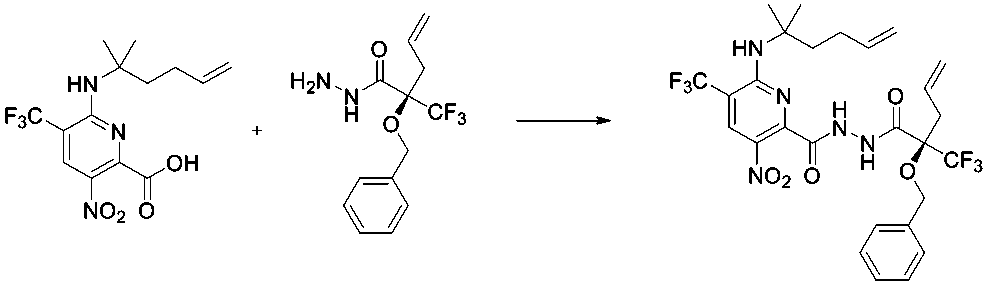
6-(1,1-ジメチルペンタ-4-エニルアミノ)-3-ニトロ-5-(トリフルオロメチル)ピリジン-2-カルボン酸(100g、285.1mmol)及び(2R)-2-ベンジルオキシ-2-(トリフルオロメチル)ペンタ-4-エンヒドラジド(86.3g、299.4mmol)をDMF(600mL)中に溶解させ、氷浴中で冷却した。3.1℃の内部温度で、HATU(114g、299.8mmol)を一度に添加した(発熱は観察されなかった)。次いで、内部温度を3~10℃に保ちながら、DIEA(100mL、574.1mmol)を0.5時間かけて緩徐に添加した(発熱性)。添加後、氷浴を除去し、反応物を更に0.5時間撹拌し、室温まで加温させた。橙色の溶液を、氷及び水(3L)並びにMTBE(1L)の撹拌溶液に添加した。混合物を10分間撹拌し、相を分離した。有機相を、水(2×1L)で2回、0.2M KHSO4(3×1L)、及びブライン(250mL)で1回洗浄した。有機相を乾燥させ、濾過し、蒸発させ、橙色の塊として、N’-[(2R)-2-ベンジルオキシ-2-(トリフルオロメチル)ペンタ-4-エノイル]-6-(1,1-ジメチルペンタ-4-エニルアミノ)-3-ニトロ-5-(トリフルオロメチル)ピリジン-2-カルボヒドラジド(181g、定量的収率)を得た。ESI-MS m/z 計算値617.2073、実測値618.0(M+1)+;保持時間:3.25分(LC法D)。この物質を次のステップで直接使用した。
Step 3: N'-[(2R)-2-benzyloxy-2-(trifluoromethyl)pent-4-enoyl]-6-(1,1-dimethylpent-4-enylamino)-3-nitro-5-(trifluoromethyl)pyridine-2-carbohydrazide
6-(1,1-Dimethylpent-4-enylamino)-3-nitro-5-(trifluoromethyl)pyridine-2-carboxylic acid (100 g, 285.1 mmol) and (2R)-2-benzyloxy-2-(trifluoromethyl)pent-4-enehydrazide (86.3 g, 299.4 mmol) were dissolved in DMF (600 mL) and cooled in an ice bath. At an internal temperature of 3.1° C., HATU (114 g, 299.8 mmol) was added in one portion (no exotherm observed). DIEA (100 mL, 574.1 mmol) was then added slowly over 0.5 h, keeping the internal temperature at 3-10° C. (exothermic). After addition, the ice bath was removed and the reaction was stirred for an additional 0.5 h, allowing to warm to room temperature. The orange solution was added to a stirred solution of ice and water (3 L) and MTBE (1 L). The mixture was stirred for 10 min and the phases were separated. The organic phase was washed twice with water (2×1 L), 0.2 M KHSO 4 (3×1 L), and once with brine (250 mL). The organic phase was dried, filtered, and evaporated to give N′-[(2R)-2-benzyloxy-2-(trifluoromethyl)pent-4-enoyl]-6-(1,1-dimethylpent-4-enylamino)-3-nitro-5-(trifluoromethyl)pyridine-2-carbohydrazide (181 g, quantitative yield) as an orange mass. ESI-MS m/z calculated 617.2073, found 618.0 (M+1) + ; retention time: 3.25 min (LC method D). This material was used directly in the next step.
ステップ4:6-[5-[(1R)-1-ベンジルオキシ-1-(トリフルオロメチル)ブト-3-エニル]-1,3,4-オキサジアゾール-2-イル]-N-(1,1-ジメチルペンタ-4-エニル)-5-ニトロ-3-(トリフルオロメチル)ピリジン-2-アミン

N’-[(2R)-2-ベンジルオキシ-2-(トリフルオロメチル)ペンタ-4-エノイル]-6-(1,1-ジメチルペンタ-4-エニルアミノ)-3-ニトロ-5-(トリフルオロメチル)ピリジン-2-カルボヒドラジド(176.1g、285.2mmol)をアセトニトリル(1.4L)中に溶解させ、55℃まで加熱した。黄橙色の溶液をDIEA(124mL、711.9mmol)で処理し、続いて、塩化トシル(54.4g、285.3mmol)を15分にわたって分割して添加し(発熱性、加熱マンテルを外し、ゆっくりと添加することによって内部温度が55℃~60℃に保たれた)、反応物を55~60℃で45分間撹拌した。反応溶液を40℃で、減圧下で濃縮し、残渣を1:1のMTBE/ヘプタン(1.4L)及び水(1.4L)で抽出した。有機相を、水(1.5L)でもう1回、0.2M KHSO4(2×1L)で2回、及びブライン(0.5L)で1回洗浄した。有機相を乾燥させ、濾過し、蒸発させて、172gの橙色の油を得て、これを100mLのトルエン及び300mLのヘプタン中に溶解させた。溶液を3kgシリカカラム上に装填した(カラム体積=4800mL、流量=900mL/分)。100%ヘキサンで1分間溶出し、106分にわたってヘキサン中の0%~10%酢酸エチルの初期勾配をプログラムした(2カラム体積)。生成物が約4%酢酸エチルで溶出し始めるため、生成物が溶出し終わって、6-[5-[(1R)-1-ベンジルオキシ-1-(トリフルオロメチル)ブト-3-エニル]-1,3,4-オキサジアゾール-2-イル]-N-(1,1-ジメチルペンタ-4-エニル)-5-ニトロ-3-(トリフルオロメチル)ピリジン-2-アミン(139.1g、80%)を得るまで、4.3%酢酸エチルを均一濃度に保持した。1H NMR(400MHz,クロロホルム-d)δ 8.51(s,1H),7.40-7.27(m,5H),6.03-5.87(m,1H),5.80-5.66(m,1H),5.58(s,1H),5.31-5.16(m,2H),5.03-4.95(m,1H),4.95-4.89(m,1H),4.81(d,J=10.5Hz,1H),4.64(d,J=10.5Hz,1H),3.28-3.13(m,2H),2.08-1.99(m,2H),1.99-1.89(m,2H),1.47(s,6H)ppm.ESI-MS m/z 計算値599.1967、実測値600.0(M+1)+;保持時間:3.71分(LC法D)。
Step 4: 6-[5-[(1R)-1-benzyloxy-1-(trifluoromethyl)but-3-enyl]-1,3,4-oxadiazol-2-yl]-N-(1,1-dimethylpent-4-enyl)-5-nitro-3-(trifluoromethyl)pyridin-2-amine
N'-[(2R)-2-benzyloxy-2-(trifluoromethyl)pent-4-enoyl]-6-(1,1-dimethylpent-4-enylamino)-3-nitro-5-(trifluoromethyl)pyridine-2-carbohydrazide (176.1 g, 285.2 mmol) was dissolved in acetonitrile (1.4 L) and heated to 55° C. The yellow-orange solution was treated with DIEA (124 mL, 711.9 mmol) followed by the addition of tosyl chloride (54.4 g, 285.3 mmol) in portions over 15 min (exothermic, removed heating mantel and kept internal temperature between 55° C.-60° C. by slow addition) and the reaction stirred at 55-60° C. for 45 min. The reaction solution was concentrated under reduced pressure at 40° C. and the residue was extracted with 1:1 MTBE/heptane (1.4 L) and water (1.4 L). The organic phase was washed once more with water (1.5 L), twice with 0.2 M KHSO 4 (2×1 L), and once with brine (0.5 L). The organic phase was dried, filtered, and evaporated to give 172 g of an orange oil that was dissolved in 100 mL toluene and 300 mL heptane. The solution was loaded onto a 3 kg silica column (column volume=4800 mL, flow rate=900 mL/min). Eluted with 100% hexane for 1 min and an initial gradient of 0% to 10% ethyl acetate in hexane over 106 min was programmed (2 column volumes). The product began to elute at approximately 4% ethyl acetate so was held isocratically at 4.3% ethyl acetate until the product had ceased elution to give 6-[5-[(1R)-1-benzyloxy-1-(trifluoromethyl)but-3-enyl]-1,3,4-oxadiazol-2-yl]-N-(1,1-dimethylpent-4-enyl)-5-nitro-3-(trifluoromethyl)pyridin-2-amine (139.1 g, 80%). 1H NMR (400MHz, chloroform-d) δ 8.51 (s, 1H), 7.40-7.27 (m, 5H), 6.03-5.87 (m, 1H), 5.80-5.66 (m, 1H), 5.58 (s, 1H), 5.31-5.16 (m, 2H), 5.03-4.95 (m, 1H), 4.95-4.8 9 (m, 1H), 4.81 (d, J = 10.5Hz, 1H), 4.64 (d, J = 10.5Hz, 1H), 3.28-3.13 (m, 2H), 2.08-1.99 (m, 2H), 1.99-1.89 (m, 2H), 1.47 (s, 6H) ppm. ESI-MS m/z calculated value 599.1967, actual value 600.0 (M+1) + ; retention time: 3.71 minutes (LC method D).
ステップ5:(6R)-6-ベンジルオキシ-12,12-ジメチル-17-ニトロ-6,15-ビス(トリフルオロメチル)-19-オキサ-3,4,13,18-テトラザトリシクロ[12.3.1.12,5]ノナデカ-1(18),2,4,8,14,16-ヘキサエン(E/Z混合物)

この反応を、各々12Lの三つ口丸底フラスコ内で、3つの46.3gバッチにおいて並行して実行した。以下の実験は、これらのバッチのうちの1つを記載する。
Step 5: (6R)-6-benzyloxy-12,12-dimethyl-17-nitro-6,15-bis(trifluoromethyl)-19-oxa-3,4,13,18-tetrazatricyclo[12.3.1.12,5]nonadeca-1(18),2,4,8,14,16-hexaene (E/Z mixture)
The reaction was carried out in parallel in three 46.3 g batches, each in a 12 L three-neck round bottom flask. The following experiment describes one of these batches.
ガス通気装置及びオーバーヘッド撹拌器を備えたスパージング管還流凝縮器を、熱ブランケット内に置かれた12L容器に取り付けた。6-[5-[(1R)-1-ベンジルオキシ-1-(トリフルオロメチル)ブト-3-エニル]-1,3,4-オキサジアゾール-2-イル]-N-(1,1-ジメチルペンタ-4-エニル)-5-ニトロ-3-(トリフルオロメチル)ピリジン-2-アミン(46.3g、76.22mmol)をDCE(8.23L)中に溶解させた。本システムを強い窒素ガス流でスパージした。熱ブランケットを50℃に設定した。容器が53℃に達したときに、ジクロロ[1,3-ビス(2,4,6-トリメチルフェニル)-2-イミダゾリジニリデン][[5-[(ジメチルアミノ)スルホニル]-2-(1-メチルエトキシ-O)フェニル]メチレン-C]ルテニウム(II)(Zhan触媒-1B、11.2g、15.26mmol)を一度に全て添加した。触媒容器をDCEですすぎ、すすぎ液を反応物に添加した。触媒添加の完了時に、ブランケット温度を73℃まで上昇させた。内部温度が72℃に達すると、撹拌を2時間28分間継続し、次いで、熱ブランケット温度を45℃まで低下させた。2時間27分後、内部温度は、50℃に達した。15分後、固体の2-スルファニルピリジン-3-カルボン酸(12g、77.33mmol)及びトリエチルアミン(11mL、78.92mmol)を添加した。12時間撹拌し、次いで、混合物を室温まで冷却させた。100gのSiO2及び10gの活性炭(20~40メッシュ、顆粒状)を反応物に添加した。1時間撹拌し、次いで、セライト上で濾過し、濾液を蒸発させて、粗生成物混合物を得た。3つ全ての並行反応からの物質を合わせて、71.2gの粗生成物混合物を得た。この物質を、110分にわたって100%ヘキサン~ヘキサン中の10%酢酸エチルの勾配、続いて、10分にわたってヘキサン中の10%酢酸エチル~100%酢酸エチルの勾配を使用した2つの別個の3kgシリカゲルカラム上で精製した。2つの別個の精製されたバッチを合わせた後、(6R)-6-ベンジルオキシ-12,12-ジメチル-17-ニトロ-6,15-ビス(トリフルオロメチル)-19-オキサ-3,4,13,18-テトラザトリシクロ[12.3.1.12,5]ノナデカ-1(18),2,4,8,14,16-ヘキサエン(E/Z混合物)(51.88g、40%)を取得した。1H NMR(400MHz,DMSO-d6)δ 8.55(d,J=0.8Hz,1H),7.49-7.21(m,5H),6.58(s,1H),5.79(dt,J=13.7,6.5Hz,1H),5.58(ddd,J=15.0,8.8,5.6Hz,1H),4.83(d,J=11.1Hz,1H),4.55(d,J=11.1Hz,1H),3.13(dd,J=14.2,5.4Hz,1H),2.77(dd,J=14.3,8.8Hz,1H),2.38-2.24(m,1H),2.14-1.93(m,3H),1.58-1.32(m,6H)ppm.ESI-MS m/z 計算値571.1654、実測値572.1(M+1)+;保持時間:3.46分及び3.49分(LC法D)。生成物が、二重結合異性体の3:1混合物として形成された。 A sparging tube reflux condenser equipped with a gas bleeder and overhead stirrer was attached to a 12 L vessel placed in a heat blanket. 6-[5-[(1R)-1-benzyloxy-1-(trifluoromethyl)but-3-enyl]-1,3,4-oxadiazol-2-yl]-N-(1,1-dimethylpent-4-enyl)-5-nitro-3-(trifluoromethyl)pyridin-2-amine (46.3 g, 76.22 mmol) was dissolved in DCE (8.23 L). The system was sparged with a strong stream of nitrogen gas. The heat blanket was set at 50° C. When the vessel reached 53° C., dichloro[1,3-bis(2,4,6-trimethylphenyl)-2-imidazolidinylidene][[5-[(dimethylamino)sulfonyl]-2-(1-methylethoxy-O)phenyl]methylene-C]ruthenium(II) (Zhan catalyst-1B, 11.2 g, 15.26 mmol) was added all at once. The catalyst vessel was rinsed with DCE and the rinse was added to the reaction. Upon completion of catalyst addition, the blanket temperature was increased to 73° C. When the internal temperature reached 72° C., stirring was continued for 2 hours 28 minutes and then the heat blanket temperature was reduced to 45° C. After 2 hours 27 minutes, the internal temperature reached 50° C. After 15 minutes, solid 2-sulfanylpyridine-3-carboxylic acid (12 g, 77.33 mmol) and triethylamine (11 mL, 78.92 mmol) were added. Stirred for 12 hours then allowed the mixture to cool to room temperature. 100 g SiO2 and 10 g activated charcoal (20-40 mesh, granular) were added to the reaction. Stirred for 1 hour then filtered over Celite and the filtrate was evaporated to give a crude product mixture. The material from all three parallel reactions was combined to give 71.2 g of a crude product mixture. This material was purified on two separate 3 kg silica gel columns using a gradient of 100% hexanes to 10% ethyl acetate in hexanes over 110 minutes followed by a gradient of 10% ethyl acetate in hexanes to 100% ethyl acetate over 10 minutes. After combining two separate purified batches, (6R)-6-benzyloxy-12,12-dimethyl-17-nitro-6,15-bis(trifluoromethyl)-19-oxa-3,4,13,18-tetrazatricyclo[12.3.1.12,5]nonadeca-1(18),2,4,8,14,16-hexaene (E/Z mixture) (51.88 g, 40%) was obtained. 1 H NMR (400 MHz, DMSO-d6) δ 8.55 (d, J = 0.8Hz, 1H), 7.49-7.21 (m, 5H), 6.58 (s, 1H), 5.79 (dt, J = 13.7 , 6.5Hz, 1H), 5.58 (ddd, J=15.0, 8.8, 5.6Hz, 1H), 4.83 (d, J=11.1Hz, 1H), 4.55 (d, J=11.1Hz, 1H), 3.13 (dd, J=14.2, 5.4Hz, 1H), 2.77 (dd, J=14.3, 8.8Hz, 1H), 2.38-2.24 (m, 1H), 2.14-1.93 (m, 3H), 1.58-1.32 (m, 6H) ppm. ESI-MS m/z calculated 571.1654, found 572.1 (M+1) + ; retention times: 3.46 min and 3.49 min (LC method D). The product was formed as a 3:1 mixture of double bond isomers.
ステップ6:(6R)-17-アミノ-12,12-ジメチル-6,15-ビス(トリフルオロメチル)-19-オキサ-3,4,13,18-テトラザトリシクロ[12.3.1.12,5]ノナデカ-1(18),2,4,14,16-ペンタエン-6-オール(化合物I)及びそのエナンチオマー

(6R)-6-ベンジルオキシ-12,12-ジメチル-17-ニトロ-6,15-ビス(トリフルオロメチル)-19-オキサ-3,4,13,18-テトラザトリシクロ[12.3.1.12,5]ノナデカ-1(18),2,4,8,14,16-ヘキサエン(E/Z混合物)(50.8g、88.89mmol)を、250mLのエタノール中に溶解させ、28℃の水浴を用いた回転蒸発によって部分的に濃縮して、任意の残留溶媒を除去し、次いで、5Lフラスコ内で更なるエタノール(720mL)中に溶解させた。窒素ガスの戻し充填とともに5サイクルの室内真空を使用して、溶液を脱気した。ジヒドロキシパラジウム(15.2gの10%w/w、10.824mmol)を、窒素下で基質溶液に添加した。6サイクルにわたって水素の戻し充填とともに室内真空を繰り返して、窒素雰囲気を水素に置き換えた。最後に、バルーンを使用して、容器を1気圧の水素の下に保った。この混合物を磁気撹拌器で一晩激しく撹拌し、次いで、水素バルーンを除去した。混合物を、中央フリット付き漏斗上で70gのセライトを通して濾過した。28℃の水浴を用いた回転蒸発によって、緑色の濾過溶液を濃縮した。黄色の固体として42.65gの粗生成物を取得し、そのうちの41.5gを、逆相クロマトグラフィーによって精製し(125mLのメタノール及び2.55mLのDMF(2%のDMF/メタノール溶液)中に溶解させ、3.8kg C18カラム上に装填した(カラム体積=3.3L、流量=375mL/分)。176分にわたって水中の40%~70%アセトニトリルの初期勾配をプログラムし(20カラム体積)、次いで、次の約20分間にわたって溶離液を100%アセトニトリルにした)。混合画分及び純粋画分をカラムから単離した。純粋な画分を濃縮し、黄色の固体として、(6R)-17-アミノ-12,12-ジメチル-6,15-ビス(トリフルオロメチル)-19-オキサ-3,4,13,18-テトラザトリシクロ[12.3.1.12,5]ノナデカ-1(18),2,4,14,16-ペンタエン-6-オール(28.17g、70%)を得た。この物質を、アセトニトリル中の溶液として類似方法によって作製されたいくつかのより小さなバッチ(80mg、340mg、360mg、1.46g及び1.63g)と合わせ、次いで、これを濃縮して黄色の固体を得た。この固体をジクロロメタン中に溶解させ、ヘプタンを添加し、次いで、溶液を暗所において真空下で、40℃で一晩濃縮し、31.95gの(6R)-17-アミノ-12,12-ジメチル-6,15-ビス(トリフルオロメチル)-19-オキサ-3,4,13,18-テトラザトリシクロ[12.3.1.12.5]ノナデカ-1(18),2,4,14,16-ペンタエン-6-オールを得た。1H NMR(400MHz,DMSO-d6)δ 7.61(s,1H),7.59(s,1H),5.96(s,2H),4.64(s,1H),2.90-2.71(m,1H),2.30-2.15(m,1H),2.15-1.98(m,1H),1.91-1.74(m,1H),1.73-1.57(m,1H),1.56-1.38(m,5H),1.36(s,3H),1.31(s,3H).ESI-MS m/z 計算値453.15994、実測値454.2(M+1)+;保持時間:3.03分(LC法D)。
Step 6: (6R)-17-amino-12,12-dimethyl-6,15-bis(trifluoromethyl)-19-oxa-3,4,13,18-tetrazatricyclo[12.3.1.12,5]nonadeca-1(18),2,4,14,16-pentaen-6-ol (Compound I) and its enantiomers
(6R)-6-Benzyloxy-12,12-dimethyl-17-nitro-6,15-bis(trifluoromethyl)-19-oxa-3,4,13,18-tetrazatricyclo[12.3.1.12,5]nonadeca-1(18),2,4,8,14,16-hexaene (E/Z mixture) (50.8 g, 88.89 mmol) was dissolved in 250 mL of ethanol, partially concentrated by rotary evaporation with a 28° C. water bath to remove any residual solvent, and then dissolved in additional ethanol (720 mL) in a 5 L flask. The solution was degassed using five cycles of house vacuum with backfilling of nitrogen gas. Dihydroxypalladium (15.2 g of 10% w/w, 10.824 mmol) was added to the substrate solution under nitrogen. The nitrogen atmosphere was replaced with hydrogen by repeating the house vacuum with backfilling of hydrogen for six cycles. Finally, a balloon was used to keep the vessel under 1 atmosphere of hydrogen. The mixture was vigorously stirred overnight with a magnetic stirrer, then the hydrogen balloon was removed. The mixture was filtered through 70 g of Celite on a center fritted funnel. The green filtrate solution was concentrated by rotary evaporation with a 28° C. water bath. 42.65 g of crude product was obtained as a yellow solid, of which 41.5 g was purified by reverse phase chromatography (dissolved in 125 mL of methanol and 2.55 mL of DMF (2% DMF/methanol solution) and loaded onto a 3.8 kg C 18 column (column volume=3.3 L, flow rate=375 mL/min). An initial gradient of 40% to 70% acetonitrile in water over 176 min was programmed (20 column volumes), then the eluent was 100% acetonitrile over the next approx. 20 min). Mixed and pure fractions were isolated from the column. The pure fractions were concentrated to give (6R)-17-amino-12,12-dimethyl-6,15-bis(trifluoromethyl)-19-oxa-3,4,13,18-tetrazatricyclo[12.3.1.12,5]nonadeca-1(18),2,4,14,16-pentaen-6-ol (28.17 g, 70%) as a yellow solid. This material was combined with several smaller batches (80 mg, 340 mg, 360 mg, 1.46 g, and 1.63 g) made by a similar method as solutions in acetonitrile which were then concentrated to give a yellow solid. This solid was dissolved in dichloromethane, heptane was added, and the solution was then concentrated under vacuum in the dark at 40° C. overnight to give 31.95 g of (6R)-17-amino-12,12-dimethyl-6,15-bis(trifluoromethyl)-19-oxa-3,4,13,18-tetrazatricyclo[12.3.1.12.5]nonadeca-1(18),2,4,14,16-pentaen-6-ol. 1H NMR (400MHz, DMSO- d6 )δ 7.61 (s, 1H), 7.59 (s, 1H), 5.96 (s, 2H), 4.64 (s, 1H), 2.90-2.71 (m, 1H), 2.30-2.15 (m, 1H), 2.15- 1.98 (m, 1H), 1.91-1.74 (m, 1H), 1.73-1.57 (m, 1H), 1.56-1.38 (m, 5H), 1.36 (s, 3H), 1.31 (s, 3H). ESI-MS m/z calculated value 453.15994, actual value 454.2 (M+1) + ; retention time: 3.03 minutes (LC method D).
上記に記載される逆相精製からの1つの混合画分は、上記に記載される意図された生成物よりも1単位大きい質量を示す不純物を含有した。この画分を濃縮し、残渣を3.6mLのメタノール中に溶解させ、次いで、水(+HCl修飾剤)中の1~99%のアセトニトリルの勾配を使用したC18カラムを通した逆相分取HPLCによって精製し、黄色の固体として、(6R)-12,12-ジメチル-6,15-ビス(トリフルオロメチル)-19-オキサ-3,4,13,18-テトラザトリシクロ[12.3.1.12.5]ノナデカ-1(18),2,4,14,16-ペンタエン-6,17-ジオール(105mg、0.003%)を得た。1H NMR(400MHz,DMSO-d6)δ 10.43(s,1H),7.64(s,1H),7.57(s,1H),4.85(s,1H),2.91-2.74(m,1H),2.30-2.15(m,1H),2.10-1.96(m,1H),1.85-1.68(m,1H),1.68-1.54(m,1H),1.53-1.37(m,5H),1.36(s,3H),1.31(s,3H)ppm.ESI-MS m/z 計算値454.14395、実測値455.2(M+1)+;保持時間:2.87分(LC法D)。 One mixed fraction from the reverse phase purification described above contained an impurity that represented one unit more in mass than the intended product described above. This fraction was concentrated and the residue was dissolved in 3.6 mL of methanol and then purified by reverse phase preparative HPLC through a C18 column using a gradient of 1-99% acetonitrile in water (+HCl modifier) to give (6R)-12,12-dimethyl-6,15-bis(trifluoromethyl)-19-oxa-3,4,13,18-tetrazatricyclo[12.3.1.12.5]nonadeca-1(18),2,4,14,16-pentaene-6,17-diol (105 mg, 0.003%) as a yellow solid. 1H NMR (400MHz, DMSO-d6) δ 10.43 (s, 1H), 7.64 (s, 1H), 7.57 (s, 1H), 4.85 (s, 1H), 2.91-2.74 (m, 1H), 2.30-2.15 (m, 1H), 2.10-1 96 (m, 1H), 1.85-1.68 (m, 1H), 1.68-1.54 (m, 1H), 1.53-1.37 (m, 5H), 1.36 (s, 3H), 1.31 (s, 3H) ppm. ESI-MS m/z calculated value 454.14395, actual value 455.2 (M+1) + ; retention time: 2.87 minutes (LC method D).
ステップ7:結晶性の化合物Iの形態A(ニート)の固体形態特性評価
A.粉末X線回折
ステップ6によって生成され、EtOHから再結晶化された結晶性の化合物Iの形態A(ニート)のXRPDディフラクトグラムは、一般的な粉末X線回折(XRPD)方法を使用して取得された。結晶性の化合物Iの形態A(ニート)のXRPDディフラクトグラムを、図1に提供され、XRPDデータを以下に要約する。

B.示差走査熱量測定分析
DSCデータは、250.00℃までの10.00℃/分の上昇で収集された。ステップ6によって生成された結晶化合物Iの形態A(ニート)のDSCサーモグラムが、図2で提供される。サーモグラムは、183.18℃におけるTmピーク、62.32J/gとともに、180.8℃のTm開始を示す。
B. Differential Scanning Calorimetry Analysis DSC data was collected at a ramp rate of 10.00° C./min up to 250.00° C. The DSC thermogram of crystalline Compound I Form A (neat) produced by step 6 is provided in FIG. 2. The thermogram shows a Tm onset of 180.8° C. with a Tm peak at 183.18° C., 62.32 J/g.
実施例2:化合物Iの生物活性
CFTR媒介性の短絡回路電流のUssingチャンバーアッセイ
Ussingチャンバー実験を、F508del及び最小機能CFTR変異(F508del/MF-HBE)に対してヘテロ接合性であるCF対象に由来するヒト気管支上皮(HBE)細胞を使用して行い、以前に説明されているように培養した(Neuberger T,Burton B,Clark H,Van Goor F Methods Mol Biol 2011:741:39-54)。4日後、頂端膜側培地を除去し、使用前に細胞を気液界面で14日間超かけて成長させた。これにより、ヒト気管支気道上皮に特有の特徴である繊毛性の十分に分化した円柱細胞の単層を得た。
Example 2: Compound I Biological Activity CFTR-Mediated Short Circuit Current Ussing Chamber Assay Ussing chamber experiments were performed using human bronchial epithelial (HBE) cells derived from CF subjects heterozygous for F508del and minimally functional CFTR mutations (F508del/MF-HBE) and cultured as previously described (Neuberger T, Burton B, Clark H, Van Goor F Methods Mol Biol 2011:741:39-54). After 4 days, the apical media was removed and cells were grown at an air-liquid interface for >14 days before use. This resulted in a monolayer of ciliated, well-differentiated columnar cells, a characteristic feature of human bronchial airway epithelium.
CFTR媒介性短絡回路(ISC)電流を絶縁するために、Costar(登録商標)Snapwell(商標)細胞培養インサート上で成長させたF508del/MF-HBEをUssingチャンバーに取り付け、経上皮ISCを電圧固定記録条件(Vhold=0mV)下で、37℃で測定した。基底外側部の溶液は、145mMのNaCl、0.83mMのK2HPO4、3.3mMのKH2PO4、1.2mMのMgCl2、1.2mMのCaCl2、10mMのグルコース、10mMのHEPES(pHをNaOHで7.4に調整済)を含み、頂端膜側の溶液は、145mMのNaGluconate(グルコン酸ナトリウム)、1.2mMのMgCl2、1.2mMのCaCl2、10mMのグルコース、10mMのHEPES(pHをNaOHで7.4に調整済)、及び上皮性ナトリウムチャネルを遮断するための30μMのアミロライドを含んだ。ホルスコリン(20μM)を頂端膜側に添加してCFTRを活性化し、その後、BPO、GlyH-101、及びCFTR阻害剤172(各々20μMの最終アッセイ濃度)からなるCFTR阻害剤カクテルを頂端膜側に添加してCFTR電流を特異的に絶縁した。各条件のCFTR媒介性ISC(μA/cm2)を、阻害後の定常電流に対するホルスコリン応答のピークから決定した。 To isolate CFTR-mediated short-circuit (I SC ) currents, F508del/MF-HBEs grown on Costar® Snapwell™ cell culture inserts were mounted in Ussing chambers and transepithelial I SC was measured under voltage-clamp recording conditions (V hold =0 mV) at 37°C. The basolateral solution contained 145 mM NaCl, 0.83 mM K2HPO4 , 3.3 mM KH2PO4 , 1.2 mM MgCl2, 1.2 mM CaCl2, 10 mM glucose, 10 mM HEPES (pH adjusted to 7.4 with NaOH), and the apical solution contained 145 mM NaGluconate, 1.2 mM MgCl2 , 1.2 mM CaCl2, 10 mM glucose, 10 mM HEPES (pH adjusted to 7.4 with NaOH), and 30 μM amiloride to block epithelial sodium channels. Forskolin (20 μM) was added to the apical membrane to activate CFTR, followed by the apical addition of a CFTR inhibitor cocktail consisting of BPO, GlyH-101, and CFTR inhibitor 172 (each at 20 μM final assay concentration) to specifically insulate CFTR currents. The CFTR-mediated I SC (μA/cm 2 ) for each condition was determined from the peak forskolin response to steady-state current after inhibition.
ポテンシエーター化合物の特定
CFTR媒介性ISCに対するCFTRポテンシエーター化合物の活性を、上述のUssingチャンバー法試験で決定した。F508del/MF-HBE細胞培養物を、10μMの(14S)-8-[3-(2-{ジスピロ[2.0.2.1]ヘプタン-7-イル}エトキシ)-1H-ピラゾール-1-イル]-12,12-ジメチル-2λ6-チア-3,9,11,18,23-ペンタアザテトラシクロ[17.3.1.111,14.05,10]テトラコサ-1(22),5,7,9,19(23),20-ヘキサエン-2,2,4-トリオンと合わせたある範囲の濃度のポテンシエーター化合物と、37℃で、18~24時間、20%ヒト血清の存在下でインキュベートした。18~24時間のインキュベーション中に使用したポテンシエーター化合物及び(14S)-8-[3-(2-{ジスピロ[2.0.2.1]ヘプタン-7-イル}エトキシ)-1H-ピラゾール-1-イル]-12,12-ジメチル-2λ6-チア-3,9,11,18,23-ペンタアザテトラシクロ[17.3.1.111,14.05,10]テトラコサ-1(22),5,7,9,19(23),20-ヘキサエン-2,2,4-トリオンの濃度をCFTR媒介性ISCのUssingチャンバー法測定を通じて一定に保ち、本実験全体を通じて化合物が存在することを確実にした。推定されるF508delポテンシエーターの有効性及び効力を、既知のVertexポテンシエーターであるIvacaftor(N-[2,4-ビス(1,1-ジメチルエチル)-5-ヒドロキシフェニル]-1,4-ジヒドロ-4-オキソキノリン-3-カルボキサミド)の有効性及び効力と比較した。
Identification of Potentiator Compounds The activity of CFTR potentiator compounds on CFTR-mediated I SC was determined in the Ussing chamber assay described above. F508del/MF-HBE cell cultures were incubated with a range of concentrations of potentiator compound combined with 10 μM (14S)-8-[3-(2-{dispiro[2.0.2.1]heptan-7-yl}ethoxy)-1H-pyrazol- 1 -yl]-12,12-dimethyl-2λ 6 -thia-3,9,11,18,23-pentaazatetracyclo[17.3.1.111,14.05,10]tetracosa-1(22),5,7,9,19(23),20-hexaene-2,2,4-trione for 18-24 hours at 37° C. in the presence of 20% human serum. The concentrations of potentiator compound and (14S)-8-[3-(2-{dispiro[2.0.2.1]heptan-7-yl}ethoxy)-1H-pyrazol-1-yl]-12,12-dimethyl-2λ 6 -thia-3,9,11,18,23-pentaazatetracyclo[17.3.1.111,14.05,10]tetracosa-1(22),5,7,9,19(23),20-hexaene-2,2,4-trione used during the 18-24 hour incubation were kept constant throughout the Ussing chamber measurements of CFTR-mediated I SC to ensure the compounds were present throughout the experiment. The potency and efficacy of the putative F508del potentiator was compared to that of a known Vertex potentiator, Ivacaftor (N-[2,4-bis(1,1-dimethylethyl)-5-hydroxyphenyl]-1,4-dihydro-4-oxoquinoline-3-carboxamide).
本実施例に記載されるアッセイを使用する化合物IのCFTR調節活性は、<500nMのEC50を有した。 The CFTR modulating activity of Compound I using the assay described in this Example had an EC 50 of <500 nM.
実施例3:化合物Iの結晶性形態
1.化合物Iのメタノール溶媒和物(湿潤)
A.合成手順
磁気撹拌棒を有する30mLバイアルに、化合物Iのニート形態A(0.15g)、水(1.1mL)、及びメタノール(3.3mL)を充填した。密封バイアルを65℃に加熱した。スラリー溶液が均質になったとき、加熱ブロックをオフにし、撹拌を停止した。溶液を撹拌することなく自然に冷却させた。溶液を1時間以内に自己核形成し、撹拌していない溶液を冷却し続け、3日間にわたって室温で放置した。
Example 3: Crystalline Forms of
A.
B.粉末X線回析
化合物Iのメタノール溶媒和物(湿潤)の粉末の粉末X線回折(XRPD)のディフラクトグラムを、密封管源及びPIXcel 1D Medipix-3検出器(Malvern PANalytical Inc、Westborough,Massachusetts)を備えたPANalytical Empyreanシステムを使用して、透過モード、室温で取得した。X線発生装置を、銅放射(1.54060Å)により、45kVの電圧及び40mAの電流で動作させた。粉末試料を、マイラーフィルムを有する96ウェル試料ホルダー上に配置し、機器に装填した。試料を、0.0131303°の刻み幅及び1刻み当たり49秒で、約3°~約40°2θの範囲にわたってスキャンした。結果を図3に示し、以下の表に要約する。

C.単結晶分析
化合物Iのメタノール溶媒和物(湿潤)構造を有する単結晶を得た。X線回折データを、Cu Kα放射(λ=1.54178Å)及びCMOS検出器を備えたRigaku回折計を用いて、100Kで取得した。構造を、SHELXプログラム(Sheldrick,G.M.,ActaCryst.,(2008)A64,112-122)を使用して解析及び精密化し、結果を以下に要約する。

D.固体状態のNMR
13C CPMAS SSNMRの結果を図4に示し、19F MAS SSNMRの結果を図5に示し、以下に要約する。


The 13 C CPMAS SSNMR results are shown in FIG. 4 and the 19 F MAS SSNMR results are shown in FIG. 5 and are summarized below.
2.化合物Iのメタノール溶媒和物(乾燥)
A.合成手順
磁気撹拌棒を有する30mLバイアルに、化合物Iのニート形態A(0.15g)、水(1.1mL)、及びメタノール(3.3mL)を充填した。密封バイアルを65℃に加熱した。スラリー溶液が均質になったとき、加熱ブロックをオフにし、撹拌を停止した。溶液を撹拌することなく自然に冷却させた。溶液を1時間以内に自己核形成し、撹拌していない溶液を冷却し続け、3日間にわたって室温で放置した。次いで、試料を真空乾燥オーブンに60℃で一晩置いた。
2. Methanol solvate of Compound I (dried)
A.
B.粉末X線回析
化合物Iのメタノール溶媒和物(乾燥)の粉末の粉末X線回折(XRPD)のディフラクトグラムを、密封管ソース及びPIXcel 1D Medipix-3検出器(Malvern PANalytical Inc、Westborough,Massachusetts)を備えたPANalytical Empyreanシステムを使用して、透過モード、室温で取得した。X線発生装置を、銅放射(1.54060Å)により、45kVの電圧及び40mAの電流で動作させた。粉末試料を、マイラーフィルムを有する96ウェル試料ホルダー上に配置し、機器に装填した。試料を、0.0131303°の刻み幅及び1刻み当たり49秒で、約3°~約40°2θの範囲にわたってスキャンした。結果を図6に示し、以下の表に要約する。

C.熱重量分析
化合物Iのメタノール溶媒和物(乾燥)の熱重量分析を、TA5500 Discovery TGAを使用して測定した。TGAサーモグラム(図7)は、周囲温度から約182℃までで約1.2%の重量損失を示す。
C. Thermogravimetric Analysis Thermogravimetric analysis of the methanol solvate (dry) of Compound I was measured using a TA5500 Discovery TGA. The TGA thermogram (FIG. 7) shows a weight loss of about 1.2% from ambient temperature to about 182° C.
D.示差走査熱量測定分析
化合物Iのメタノール溶媒和物(乾燥)の融点を、TA Instruments Q2000 DSCを使用して測定した。サーモグラム(図8)は、約175℃及び約186℃で吸熱を示した。
D. Differential Scanning Calorimetry Analysis The melting point of the methanol solvate (dry) of Compound I was measured using a TA Instruments Q2000 DSC. The thermogram (Figure 8) showed endotherms at about 175°C and about 186°C.
3.化合物Iのp-トルエンスルホン酸
A.合成手順
化合物Iニート形態A(約45.3mg)及び約17.2mgのp-トルエンスルホン酸を、プリセリーズボールミル(2mL)チューブに計量した。メタノール:水混合物(60:40v/v)(10μl)をチューブに加えた。混合物を3サイクルにわたって7500rpmでボールミルを行った(60秒、10秒一時停止)。次いで、物質を真空乾燥オーブン中で、40℃で真空乾燥させた。
3. p-Toluenesulfonic Acid of Compound I A. Synthesis Procedure Compound I neat form A (approximately 45.3 mg) and approximately 17.2 mg of p-Toluenesulfonic acid were weighed into a Prisse ball mill (2 mL) tube. A methanol:water mixture (60:40 v/v) (10 μl) was added to the tube. The mixture was ball milled at 7500 rpm for three cycles (60 seconds, 10 second pause). The material was then vacuum dried at 40° C. in a vacuum drying oven.
B.粉末X線回析
化合物Iのp-トルエンスルホン酸の粉末の粉末X線回折(XRPD)のディフラクトグラムを、密封管源及びPIXcel 1D Medipix-3検出器(Malvern PANalytical Inc、Westborough,Massachusetts)を備えたPANalytical Empyreanシステムを使用して、透過モード、室温で取得した。X線発生装置を、銅放射(1.54060Å)により、45kVの電圧及び40mAの電流で動作させた。粉末試料を、マイラーフィルムを有する96ウェル試料ホルダー上に配置し、機器に装填した。試料を、0.0131303°の刻み幅及び1刻み当たり49秒で、約3°~約40°2θの範囲にわたってスキャンした。結果を図9に示し、以下の表に要約する。

C.示差走査熱量測定分析
化合物Iのp-トルエンスルホン酸の融点を、TA Instruments Q2000 DSCを使用して測定した。サーモグラム(図10)は、約175℃及び約186℃で吸熱を示した。
C. Differential Scanning Calorimetry Analysis The melting point of the p-toluenesulfonic acid salt of Compound I was measured using a TA Instruments Q2000 DSC. The thermogram (FIG. 10) showed endotherms at about 175° C. and about 186° C.
D.固体状態のNMR
化合物Iのp-トルエンスルホン酸について、13C CPMAS SSNMRの結果を図11に示し、19F MAS SSNMRを図12に示し、以下に要約する。


The 13 C CPMAS SSNMR results for the p-toluenesulfonic acid of compound I are shown in FIG. 11 and the 19 F MAS SSNMR results are shown in FIG. 12 and summarized below.
4.ニート非晶質化合物I
A.合成手順
化合物Iのニート非晶質物質を、Mettler Toledo TGA/DSC 3+STAReシステムを使用して作製した。約8mgの化合物Iニート形態Aを、DSCパン上で3つ組で計量した。温度を1分当たり10℃の速度で200℃まで上昇させ、次いで、10℃まで冷却した。非晶質物質をDSCパンから回収した。
4. Neat Amorphous Compound I
A. Synthesis Procedure Neat amorphous material of Compound I was made using a Mettler Toledo TGA/
B.粉末X線回析
XRPDパターンを、PANalytical Empyrean X線回折計測器(Almelo,The Netherlands)を使用して、連続モードで、室温で記録した。X線を、45kV及び40mAで動作するCu管を使用して発生させた。Pixel 1d検出器を散乱防止スリットP8とともに使用した。発散光学素子は、10mmマスク、1/8発散スリット、及び1/2散乱防止スリットを備えたBragg Brentano型High Definition(BBHD)である。連続スキャンモードは、0.0131度の刻み幅及び1刻み当たり13.77秒のカウント時間を利用し、4~40度 2シータの範囲にわたって統合した。粉末試料をゼロバックグラウンドホルダー内の刻み目のついた領域に置き、スライドガラスで平らにした。結果を図13に示す。
B. Powder X-ray Diffraction XRPD patterns were recorded at room temperature in continuous mode using a PANalytical Empyrean X-ray diffractometer (Almelo, The Netherlands). X-rays were generated using a Cu tube operating at 45 kV and 40 mA. A Pixel 1d detector was used with anti-scatter slit P8. Divergence optics was a Bragg Brentano type High Definition (BBHD) with a 10 mm mask, ⅛ divergence slit, and ½ anti-scatter slit. Continuous scan mode integrated over a range of 4 to 40 degrees 2-theta using a step size of 0.0131 degrees and a count time of 13.77 seconds per step. Powder samples were placed on the scored area in a zero background holder and flattened with a glass slide. The results are shown in FIG. 13.
C.熱重量分析
ニート非晶質化合物IのTGAデータを、Mettler ToledoのTGA/DSC 3+STAReシステムで収集した。サーモグラム(図14)は、周囲温度から熱分解まで無視できる重量損失を示した。
C. Thermogravimetric Analysis TGA data for neat amorphous Compound I was collected on a Mettler Toledo TGA/
D.示差走査熱量測定分析
ニート非晶質化合物Iのガラス転移点を、DSC加熱/冷却/再加熱方法を使用して測定した。化合物Iのニート非晶質物質を、Mettler Toledo TGA/DSC 3+STAReシステムを使用して作製した。約3.5mgの化合物I形態AをDSCパン上で計量した。温度を1分当たり10℃の速度で200℃まで上昇させ、次いで、-20℃まで冷却して、ニート非晶質物質を生成した。次いで、それを200℃まで再加熱して、ガラス転移点を検出した。ニート非晶質化合物Iのガラス転移は、64.8℃で観察され、次いで、再結晶化は、110.2℃で生じ、181.1℃で溶融がもたらされた。DSCサーモグラムを、図15に示す。
D. Differential Scanning Calorimetry Analysis The glass transition temperature of neat amorphous Compound I was measured using the DSC heat/cool/reheat method. Neat amorphous material of Compound I was made using a Mettler Toledo TGA/
実施例4:ビスアミド前駆体の合成
中間体1:2-メチルヘキサ-5-エン-2-アミン塩酸塩(化合物3・HCl)の調製

ステップ1:2-メチルヘキサ-5-エン-2-オール(化合物7)

反応器を、Et2O(1.822kg、5.094L、15.28mol、1.0当量)及びEt2O(9L)中の3.0M MeMgBrで充填した。混合物を、氷/塩浴で0℃に冷却した。反応混合物に、ヘキサ-5-エン-2-オン(CAS#109-49-9、1,500g、1.77L、15.28mol)を滴加した。添加時間は、約4.5時間であった。添加が完了した後、氷/塩浴を取り出し、混合物を約0℃で15分間撹拌した。反応混合物を一晩撹拌し、室温まで加温させた。反応混合物を、氷/水浴で冷却しながら飽和NH4Cl水溶液(5L)でクエンチした。添加された最初の2~2.5Lは発熱性であった。2Lの飽和NH4Cl水溶液を混合物に添加し、これを撹拌不能な塊に凝固させ、これを更に添加すると再び撹拌可能になった。混合物にMTBE(3L)を添加した。有機相を分離し、水相(いくらかの固体で依然として濁っている)を、水(3L)及び飽和NH4Cl水溶液で希釈し、MTBE(5L)と混合して、エマルションを得ると、それを珪藻土上で濾過した。濾過ケーキをMTBE(5L)ですすいだ。ここで透明な相を分離し、水相をMTBE(3L)でもう一度抽出した。合わせた有機相をブライン(5L)で洗浄し、Na2SO4で乾燥させ、濾過した。溶媒を減圧下で除去すると(55℃の水浴、20mbarまで減少)、黄色の油として1,631g(14.28mol、93.5%)が得られた。
Example 4: Synthesis of bisamide precursors Intermediate 1: Preparation of 2-methylhex-5-en-2-amine hydrochloride (
Step 1: 2-Methylhex-5-en-2-ol (compound 7)
The reactor was charged with Et 2 O (1.822 kg, 5.094 L, 15.28 mol, 1.0 equiv) and 3.0 M MeMgBr in Et 2 O (9 L). The mixture was cooled to 0° C. with an ice/salt bath. To the reaction mixture was added hex-5-en-2-one (CAS#109-49-9, 1,500 g, 1.77 L, 15.28 mol) dropwise. The addition time was about 4.5 hours. After the addition was complete, the ice/salt bath was removed and the mixture was stirred at about 0° C. for 15 minutes. The reaction mixture was stirred overnight and allowed to warm to room temperature. The reaction mixture was quenched with saturated aqueous NH 4 Cl (5 L) while cooling with an ice/water bath. The first 2-2.5 L added was exothermic. 2 L of saturated aqueous NH 4 Cl was added to the mixture, solidifying it into an unstirrable mass that became stirrable again upon further addition. MTBE (3 L) was added to the mixture. The organic phase was separated and the aqueous phase (still cloudy with some solids) was diluted with water (3 L) and saturated aqueous NH 4 Cl and mixed with MTBE (5 L) to obtain an emulsion that was filtered over diatomaceous earth. The filter cake was rinsed with MTBE (5 L). The clear phase was now separated and the aqueous phase was extracted once more with MTBE (3 L). The combined organic phase was washed with brine (5 L), dried over Na 2 SO 4 , and filtered. The solvent was removed under reduced pressure (55° C. water bath, reduced to 20 mbar) to give 1,631 g (14.28 mol, 93.5%) as a yellow oil.
ステップ2:2-クロロ-N-(2-メチルヘキサ-5-エン-2-イル)アセトアミド(化合物8)

反応器を、2-メチルヘキサ-5-エン-2-オール(4,822.8g、42.235mol)及び2-クロロアセトニトリル(17,995g、238.3mol、5.64当量)で充填した。混合物を2~0℃に冷却し(サーモスタットは0℃であった)、硫酸(4,305g、42.23mol、1当量)を小さな流れで加えた。次いで、混合物は加温し始め、内部温度は58.4℃に上昇した(サーモスタットは-5℃に設定した)。内部温度が38℃に下がったとき、硫酸の添加を継続した(サーモスタットは20℃に設定した)。全添加は1時間45分かかった。ここで濃茶色の混合物を24~28℃で更に1時間撹拌した。混合物を、15~17℃に冷却し、34.5Lの水、続いて30% NaOH水溶液(約8.5L)をpH10.2まで添加し、内部温度を28℃未満に維持した。混合物はベージュ色になった。混合物を撹拌しながらMTBE(40L)に添加した。相分離を遅くする(約2時間)。相を分離し、水相をMTBE(20L)で抽出した。合わせた有機物を水(5L)で洗浄したが、相分離は非常に遅かったため、5Lのブラインを添加し、高速分離をもたらした。水相はpH7~8を有していた。有機相を5Lのブラインで洗浄し、Na2SO4で乾燥させた。濾過後(合わせたNa2SO4ケーキを3×3LのMTBEで洗浄した)、溶媒を反応器内で、減圧下で除去した(サーモスタットを60℃、圧力を180mbarに設定した)。約65Lの溶媒を除去した。次いで、加熱を70℃に設定し、揮発性の低い液体を蒸留した(15mbarまで下げた)。蒸留が停止したとき、暗い赤色の残渣を2×10.8Lのトルエンと共蒸発させた。蒸留によって収集されたトルエンの第2のバッチの最初の半分を、1H-NMRについてサンプリングし、これは、約1.2%w/wの2-クロロアセトニトリルが存在することを示した。蒸留によって収集されたトルエンの第2のバッチの第2の半分を1H-NMRについてサンプリングし、これは、約0.3%w/wの2-クロロアセトニトリルが存在することを示した。蒸留を70℃及び15mbarで更に1時間継続し、ガラス表面の内部にいくらかの結晶が現れた。反応器を窒素下で室温まで冷却した。生成物(7,834g)を濾過によって収集した。
Step 2: 2-Chloro-N-(2-methylhex-5-en-2-yl)acetamide (compound 8)
The reactor was charged with 2-methylhex-5-en-2-ol (4,822.8 g, 42.235 mol) and 2-chloroacetonitrile (17,995 g, 238.3 mol, 5.64 equiv). The mixture was cooled to 2-0° C. (thermostat was at 0° C.) and sulfuric acid (4,305 g, 42.23 mol, 1 equiv) was added in a small stream. The mixture then began to warm and the internal temperature rose to 58.4° C. (thermostat was set at −5° C.). When the internal temperature dropped to 38° C., the addition of sulfuric acid was continued (thermostat was set at 20° C.). The total addition took 1 hour 45 minutes. The now dark brown mixture was stirred at 24-28° C. for an additional hour. The mixture was cooled to 15-17°C and 34.5 L of water was added followed by 30% aqueous NaOH (~8.5 L) to pH 10.2, keeping the internal temperature below 28°C. The mixture turned beige. The mixture was added to MTBE (40 L) with stirring. Phase separation was allowed to slow (~2 h). The phases were separated and the aqueous phase was extracted with MTBE (20 L). The combined organics were washed with water (5 L) but the phase separation was very slow so 5 L of brine was added resulting in a fast separation. The aqueous phase had a pH of 7-8. The organic phase was washed with 5 L of brine and dried over Na 2 SO 4. After filtration (the combined Na 2 SO 4 cake was washed with 3 x 3 L of MTBE ) the solvent was removed in the reactor under reduced pressure (thermostat set at 60°C, pressure at 180 mbar). ~65 L of solvent was removed. The heat was then set to 70° C. and the less volatile liquids were distilled (down to 15 mbar). When the distillation stopped the dark red residue was co-evaporated with 2×10.8 L of toluene. The first half of the second batch of toluene collected by distillation was sampled for 1 H-NMR which showed that there was about 1.2% w/w of 2-chloroacetonitrile present. The second half of the second batch of toluene collected by distillation was sampled for 1 H-NMR which showed that there was about 0.3% w/w of 2-chloroacetonitrile present. The distillation was continued for an additional hour at 70° C. and 15 mbar and some crystals appeared on the inside of the glass surface. The reactor was cooled to room temperature under nitrogen. The product (7,834 g) was collected by filtration.
ステップ3:2-メチルヘキサ-5-エン-2-アミン塩酸塩(化合物3・HCl)
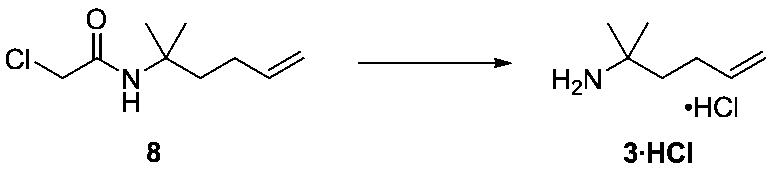
反応器を、2-クロロ-N-(2-メチルヘキサ-5-エン-2-イル)アセトアミド(3,910g、96.8%純粋、3,785g、19.95molとして得られた)及びエタノール(43L)で充填した。撹拌した赤茶色の溶液に、チオ尿素(1,825.5g、23.98mol、1.202当量)を添加した。赤色茶色の溶液を還流するまで加熱した(サーモスタットを100℃に設定した)。2時間の還流後、IPC-1は、出発物質がほぼ完全に消費されたことを示した。2時間45分の還流後、IPC-2は完全な変換を示した。混合物を50℃に冷却した(サーモスタットを50℃に設定し、減圧下で強制還流することによって行い、それは15分かかった)。赤色茶色の溶液に、酢酸(3,324g、55.35mol、2.77当量)を10~15分間にわたって添加し、温度変化は観察されなかった。混合物を一晩還流させた(サーモスタットを100℃に設定した)。還流は30~40分後に達し、還流温度は82.1℃であった。更に30分後、白色の固体が沈殿した。混合物を一晩還流させた。橙色の懸濁液を得た。混合物を15~20℃に冷却した(サーモスタットを15℃に設定し、減圧下で強制還流することによって行い、それは28℃に達するのに30分かかった)。懸濁液を濾過し、濾過ケーキをEtOH(5×1L)ですすいだ。合わせた濾液(約57L)を減圧下で濃縮した。赤茶色の固体塊を得て、粗酢酸塩として4,005gを得た。
Step 3: 2-Methylhex-5-en-2-amine hydrochloride (
A reactor was charged with 2-chloro-N-(2-methylhex-5-en-2-yl)acetamide (3,910 g, 96.8% pure, obtained as 3,785 g, 19.95 mol) and ethanol (43 L). To the stirred red-brown solution was added thiourea (1,825.5 g, 23.98 mol, 1.202 equiv). The red-brown solution was heated to reflux (thermostat set at 100° C.). After 2 hours of reflux, IPC-1 indicated nearly complete consumption of starting material. After 2 hours and 45 minutes of reflux, IPC-2 indicated complete conversion. The mixture was cooled to 50° C. (done by forced reflux under reduced pressure with thermostat set at 50° C., which took 15 minutes). To the red-brown solution, acetic acid (3,324 g, 55.35 mol, 2.77 equiv.) was added over 10-15 min, no temperature change was observed. The mixture was refluxed overnight (thermostat set at 100° C.). Reflux was reached after 30-40 min, with a reflux temperature of 82.1° C. After another 30 min, a white solid precipitated. The mixture was refluxed overnight. An orange suspension was obtained. The mixture was cooled to 15-20° C. (this was done by forced reflux under reduced pressure with the thermostat set at 15° C., which took 30 min to reach 28° C.). The suspension was filtered, and the filter cake was rinsed with EtOH (5×1 L). The combined filtrate (approximately 57 L) was concentrated under reduced pressure. A red-brown solid mass was obtained, yielding 4,005 g as crude acetate salt.
固体塊を熱い水(9L)中に溶解させ、反応器に装填し、フラスコを更に1Lの水ですすいだ。DCM(22L)を添加し、Na2CO3(3,355g)を少量ずつ添加した。最大1.7~1.8Kgの添加で、混合物は透明のままであり、更に添加してベージュ色のエマルションを得た。エマルションをDCM(22L)で希釈し、30分間撹拌し、一晩沈降させた。混合物を、砂の層(約5cmの厚さ)で覆われた珪藻土(約5cmの厚さ)のパッド上で濾過した。液体を反応器の底部からサイフォンで吸い上げ、有機相はすでに十分に分離されているように見えたが、エマルションの厚い層が上部にあり、依然としていくらかの有機相を含んでいた。湿潤濾過ケーキを3LのDCMですすぎ、この濾液を使用して水相を抽出した。合わせた有機相(約49~50L)を、Na2SO4上で乾燥させた。混合物を濾過し、除去された固体を5LのDCMで洗浄した。約50Lの生成物溶液を反応器に装填した(-5℃のジャケット温度に設定した)。生成物溶液に、イソプロパノール中の6M HCl(5L、30mol、1.5当量)を滴加した(添加開始時の内部温度:2℃)。添加が完了した70分後、内部温度を<6℃に維持した。10℃で一晩撹拌した後、溶媒をロータリーエバポレーターを使用して蒸発させた(50℃の水浴)。塩は、240mbarで溶液から砕け始めた。50mbarで蒸発を停止し、フラスコの内容物をMTBE(22L)と混合し、反応器に移した。18時間撹拌した。生成物を濾過により収集し、MTBE(2×2L)で洗浄して、クリーム色の固体を得た。固体を、減圧下(17mbar)で、室温で18時間乾燥させた。収率:1,833g(12.25mol、61.4%)。1H NMR(500MHz,DMSO-d6)δ 8.08(s,3H),5.92-5.64(m,1H),5.15-4.87(m,2H),2.21-1.96(m,2H),1.72-1.49(m,2H),1.23(s,6H)ppm.ESI-MS m/z 計算値113.1204、実測値114.5(M+1)+. The solid mass was dissolved in hot water (9 L) and charged to the reactor, rinsing the flask with an additional 1 L of water. DCM (22 L) was added and Na 2 CO 3 (3,355 g) was added in small portions. Up to 1.7-1.8 Kg addition, the mixture remained clear and further addition gave a beige emulsion. The emulsion was diluted with DCM (22 L), stirred for 30 minutes and allowed to settle overnight. The mixture was filtered over a pad of diatomaceous earth (about 5 cm thick) covered with a layer of sand (about 5 cm thick). The liquid was siphoned from the bottom of the reactor and the organic phase appeared to be well separated already, but there was a thick layer of emulsion on top that still contained some organic phase. The wet filter cake was rinsed with 3 L of DCM and this filtrate was used to extract the aqueous phase. The combined organic phase (about 49-50 L) was dried over Na 2 SO 4 . The mixture was filtered and the removed solids were washed with 5 L of DCM. Approximately 50 L of product solution was charged to the reactor (set jacket temperature at -5°C). To the product solution, 6 M HCl in isopropanol (5 L, 30 mol, 1.5 eq) was added dropwise (internal temperature at start of addition: 2°C). 70 min after addition was complete, the internal temperature was maintained at <6°C. After stirring overnight at 10°C, the solvent was evaporated using a rotary evaporator (water bath at 50°C). Salts started to crash out of solution at 240 mbar. Evaporation was stopped at 50 mbar and the contents of the flask were mixed with MTBE (22 L) and transferred to the reactor. Stirred for 18 h. The product was collected by filtration and washed with MTBE (2 x 2 L) to give a cream-coloured solid. The solid was dried under reduced pressure (17 mbar) at room temperature for 18 h. Yield: 1,833g (12.25mol, 61.4%). 1 H NMR (500MHz, DMSO-d6) δ 8.08 (s, 3H), 5.92-5.64 (m, 1H), 5.15-4.87 (m, 2H), 2.21-1.96 (m, 2H), 1.72-1.49 (m, 2H), 1.23 (s, 6H) ppm. ESI-MS m/z Calculated value 113.1204, Actual value 114.5 (M+1) + .
中間体1:2-メチルヘキサ-5-エン-2-アミン塩酸塩(化合物3・HCl)の代替的な調製

ステップ1:2,2-ジメチルアジリジン-1-カルボン酸tert-ブチル(化合物10)

ジエチルエーテル(750mL)中のN-(2-ヒドロキシ-1,1-ジメチル-エチル)カルバミン酸tert-ブチル(30g、155.35mmol)の溶液に、p-TsCl(35.6g、186.73mmol)及び粉末状のKOH(103g、1.5605mol)を0℃で添加した。反応温度を還流温度まで上昇させ、16時間撹拌した。KOHの別の分量(17g、303mmol)を添加し、反応物を更に2時間還流した。反応物を室温まで冷却し、ジエチルエーテル(500mL)で希釈した。形成された固体を、フリットガラス漏斗を通した濾過によって除去し、更なるジエチルエーテル(100mL)で洗浄した。組み合わせたエーテル濾液を、水(100mL)及びブライン(100mL)で洗浄し、無水硫酸マグネシウム上で乾燥させ、濾過し、減圧下で濃縮して、透明な油として2,2-ジメチルアジリジン-1-カルボン酸tert-ブチル(24.602g、88%)を供給した。1H NMR(500MHz,クロロホルム-d)δ 2.04(s,2H),1.46(s,9H),1.28(s,6H)ppm.
Intermediate 1: Alternative Preparation of 2-Methylhex-5-en-2-amine Hydrochloride (
Step 1: tert-Butyl 2,2-dimethylaziridine-1-carboxylate (compound 10)
To a solution of tert-butyl N-(2-hydroxy-1,1-dimethyl-ethyl)carbamate (30 g, 155.35 mmol) in diethyl ether (750 mL) was added p-TsCl (35.6 g, 186.73 mmol) and powdered KOH (103 g, 1.5605 mol) at 0° C. The reaction temperature was raised to reflux and stirred for 16 h. Another portion of KOH (17 g, 303 mmol) was added and the reaction was refluxed for an additional 2 h. The reaction was cooled to room temperature and diluted with diethyl ether (500 mL). The solid that formed was removed by filtration through a fritted glass funnel and washed with additional diethyl ether (100 mL). The combined ether filtrates were washed with water (100 mL) and brine (100 mL), dried over anhydrous magnesium sulfate, filtered, and concentrated under reduced pressure to provide tert-butyl 2,2-dimethylaziridine-1-carboxylate (24.602 g, 88%) as a clear oil. 1 H NMR (500 MHz, chloroform-d) δ 2.04 (s, 2H), 1.46 (s, 9H), 1.28 (s, 6H) ppm.
ステップ2:N-(1,1-ジメチルペンタ-4-エニル)カルバミン酸tert-ブチル(化合物11)

反応フラスコを、THF(205mL、2M、410mmol)及び無水THF(200mL)中のアリル(クロロ)マグネシウムで充填した。溶液を-30℃まで冷却し、臭化銅(I)(ジメチルスルフィド錯体)(28g、136.2mmol)を添加した。反応混合物を同じ温度で30分間撹拌し、次いで、-78℃まで冷却した。無水THF(200mL)中の2,2-ジメチルアジリジン-1-カルボン酸tert-ブチル(24.602g、136.49mmol)の溶液を反応混合物に滴加した。反応物を同じ温度で30分間撹拌し、次いで、-20℃の冷凍庫に移動させ、3時間保管した。反応物を0℃の飽和アンモニウム水溶液(200mL)でクエンチした。反応物を室温で10分間撹拌し、次いで、ジエチルエーテル(200mL)で希釈した。溶液を、セライトのパッドを通して濾過し、エタノール(100mL)で洗浄した。2つの層を分離し、水層をジエチルエーテル(2×200mL)で抽出した。合わせた有機層をブライン(200mL)で洗浄し、無水硫酸マグネシウム上で乾燥させ、真空下で濃縮した。残渣を、ヘキサン中の0%~10%ジエチルエーテルの勾配を使用したシリカゲルクロマトグラフィーによって精製し、薄黄色の液体として、N-(1,1-ジメチルペンタ-4-エニル)カルバミン酸tert-ブチル(18.6g、61%)を供給した。1H NMR(500MHz,クロロホルム-d)δ 5.82(ddt,J=16.8,10.2,6.6,6.6Hz,1H),5.09-4.87(m,2H),4.38(s,1H),2.11-1.98(m,2H),1.79-1.64(m,2H),1.43(s,9H),1.26(s,6H)ppm.
Step 2: tert-Butyl N-(1,1-dimethylpent-4-enyl)carbamate (compound 11)
A reaction flask was charged with THF (205 mL, 2M, 410 mmol) and allyl(chloro)magnesium in anhydrous THF (200 mL). The solution was cooled to -30°C and copper(I) bromide (dimethylsulfide complex) (28 g, 136.2 mmol) was added. The reaction mixture was stirred at the same temperature for 30 minutes and then cooled to -78°C. A solution of tert-butyl 2,2-dimethylaziridine-1-carboxylate (24.602 g, 136.49 mmol) in anhydrous THF (200 mL) was added dropwise to the reaction mixture. The reaction was stirred at the same temperature for 30 minutes and then transferred to a -20°C freezer and stored for 3 hours. The reaction was quenched with saturated aqueous ammonium solution (200 mL) at 0°C. The reaction was stirred at room temperature for 10 minutes and then diluted with diethyl ether (200 mL). The solution was filtered through a pad of Celite and washed with ethanol (100 mL). The two layers were separated and the aqueous layer was extracted with diethyl ether (2×200 mL). The combined organic layers were washed with brine (200 mL), dried over anhydrous magnesium sulfate and concentrated under vacuum. The residue was purified by silica gel chromatography using a gradient of 0% to 10% diethyl ether in hexanes to provide tert-butyl N-(1,1-dimethylpent-4-enyl)carbamate (18.6 g, 61%) as a pale yellow liquid. 1 H NMR (500 MHz, chloroform-d) δ 5.82 (ddt, J=16.8, 10.2, 6.6, 6.6 Hz, 1H), 5.09-4.87 (m, 2H), 4.38 (s, 1H), 2.11-1.98 (m, 2H), 1.79-1.64 (m, 2H), 1.43 (s, 9H), 1.26 (s, 6H) ppm.
ステップ3:2-メチルヘキサ-5-エン-2-アミン塩酸塩(化合物3・HCl)

ジエチルエーテル(350mL、2M、700mmol)中のN-(1,1-ジメチルペンタ-4-エニル)カルバミン酸tert-ブチル(26.6g、124.7mmol)及びHClの溶液を、室温で2日間撹拌した。溶媒を除去し、残渣をヘキサンで粉砕して、白色の固体として2-メチルヘキサ-5-エン-2-アミン(塩酸塩)(15.198g、77%)を供給した。1H NMR(500MHz,DMSO-d6)δ 8.08(s,3H),5.92-5.64(m,1H),5.15-4.87(m,2H),2.21-1.96(m,2H),1.72-1.49(m,2H),1.23(s,6H)ppm.
Step 3: 2-Methylhex-5-en-2-amine hydrochloride (
A solution of tert-butyl N-(1,1-dimethylpent-4-enyl)carbamate (26.6 g, 124.7 mmol) and HCl in diethyl ether (350 mL, 2 M, 700 mmol) was stirred at room temperature for 2 days. The solvent was removed and the residue was triturated with hexane to provide 2-methylhex-5-en-2-amine (hydrochloride salt) (15.198 g, 77%) as a white solid. 1 H NMR (500 MHz, DMSO-d6) δ 8.08 (s, 3H), 5.92-5.64 (m, 1H), 5.15-4.87 (m, 2H), 2.21-1.96 (m, 2H), 1.72-1.49 (m, 2H), 1.23 (s, 6H) ppm.
中間体2:6-クロロ-3-ニトロ-5-(トリフルオロメチル)ピリジン-2-カルボン酸メチル(化合物16)
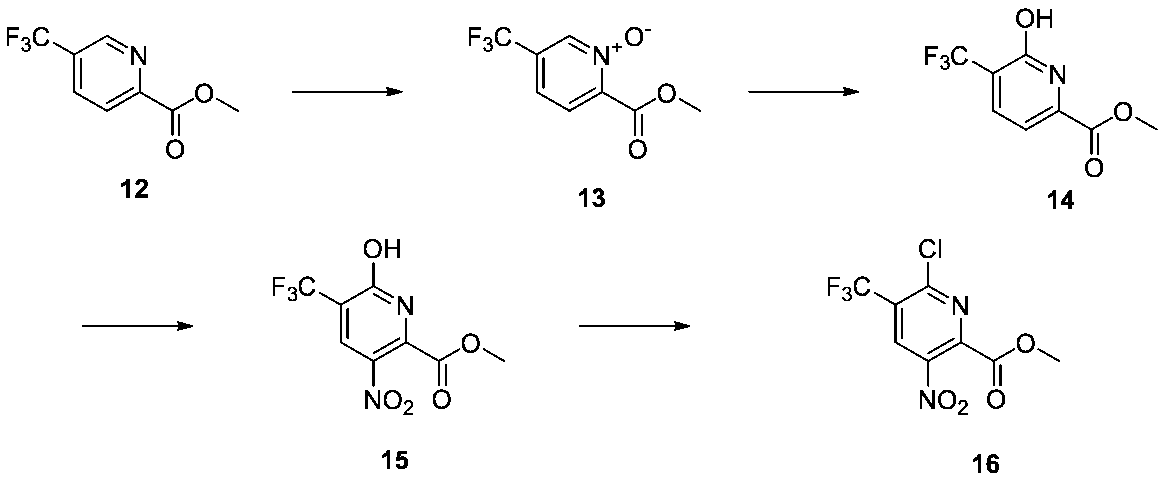
ステップ1:1-オキシド-5-(トリフルオロメチル)ピリジン-1-イウム-2-カルボン酸メチル(化合物13)

過酸化水素尿素(62.7g、646.53mmol)を、1,2-ジクロロメタン(300mL)中の5-(トリフルオロメチル)ピリジン-2-カルボン酸メチル(40g、191.09mmol)の撹拌溶液に0℃で分割して添加した。次いで、トリフルオロ酢酸無水物(107.70g、72mL、507.65mmol)を、冷却浴(CO2/アセトン浴)を用いて、-10℃の温度で30分かけて添加した。次いで、反応混合物を0℃の温度で更に30分間撹拌し、次いで、周囲温度で1時間撹拌した。次いで反応混合物を、冷却した氷水(600mL)に注いだ。混合物をジクロロメタン(300mL)で希釈し、次いで、層に分離した。水相をジクロロメタン(2×200mL)で抽出した。合わせた有機相を水(2×300mL)及びブライン(1×200mL)で洗浄し、無水硫酸ナトリウムで乾燥させ、濾過し、減圧下で濃縮し、薄黄色の固体として、1-オキシド-5-(トリフルオロメチル)ピリジン-1-イウム-2-カルボン酸メチル(47.6g、90%)を得た。1H NMR(300MHz,DMSO-d6)δ 8.89(s,1H),8.02-7.90(m,1H),7.86-7.72(m,1H),3.89(s,3H)ppm.19F NMR(282MHz,DMSO-d6)δ-62.00(s,3F)ppm.ESI-MS m/z 計算値221.02998、実測値222.1(M+1)+;保持時間:1.24分(LC法A)。
Intermediate 2: methyl 6-chloro-3-nitro-5-(trifluoromethyl)pyridine-2-carboxylate (compound 16)
Step 1: Methyl 1-oxido-5-(trifluoromethyl)pyridin-1-ium-2-carboxylate (compound 13)
Urea hydrogen peroxide (62.7 g, 646.53 mmol) was added in portions to a stirred solution of methyl 5-(trifluoromethyl)pyridine- 2-carboxylate (40 g, 191.09 mmol) in 1,2-dichloromethane (300 mL) at 0° C. Trifluoroacetic anhydride (107.70 g, 72 mL, 507.65 mmol) was then added over 30 minutes at a temperature of −10° C. with the aid of a cooling bath (CO 2 /acetone bath). The reaction mixture was then stirred at a temperature of 0° C. for an additional 30 minutes and then at ambient temperature for 1 hour. The reaction mixture was then poured into cooled ice water (600 mL). The mixture was diluted with dichloromethane (300 mL) and then separated into layers. The aqueous phase was extracted with dichloromethane (2×200 mL). The combined organic phase was washed with water (2×300 mL) and brine (1×200 mL), dried over anhydrous sodium sulfate, filtered and concentrated under reduced pressure to give methyl 1-oxido-5-(trifluoromethyl)pyridin-1-ium-2-carboxylate (47.6 g, 90%) as a pale yellow solid. 1 H NMR (300 MHz, DMSO-d6) δ 8.89 (s, 1H), 8.02-7.90 (m, 1H), 7.86-7.72 (m, 1H), 3.89 (s, 3H) ppm. 19 F NMR (282 MHz, DMSO-d6) δ-62.00 (s, 3F) ppm. ESI-MS m/z calculated 221.02998, found 222.1 (M+1) + ; retention time: 1.24 min (LC method A).
ステップ2:6-ヒドロキシ-5-(トリフルオロメチル)ピリジン-2-カルボン酸メチル(化合物14)

トリフルオロ酢酸無水物(291.62g、193mL、1.3885mol)を、DMF(305mL)中の1-オキシド-5-(トリフルオロメチル)ピリジン-1-イウム-2-カルボン酸メチル(51.058g、230.66mmol)の混合物に0℃で滴加した。次いで、混合物を室温で一晩撹拌した。混合物を減圧下で濃縮して、過剰なトリフルオロ酢酸を除去した。残留DMF溶液を、0℃に冷却した撹拌水量(1000mL)に滴注した。沈殿した固体を濾過により回収し、その後、水(300mL)で洗浄した。固体を真空乾燥させて、白色の固体として6-ヒドロキシ-5-(トリフルオロメチル)ピリジン-2-カルボン酸メチル(45.24g、86%)を得た。1H NMR(300MHz,CDCl3)δ 7.90(d,J=7.2Hz,1H),7.03(d,J=7.2Hz,1H),4.02(s,3H)ppm.1H NMRでは1つの交換可能なプロトンは観察されなかった。19F NMR(282MHz,CDCl3)δ-66.39(s,3F)ppm.ESI-MS m/z 計算値221.03、実測値222.1(M+1)+;保持時間:1.43分(LC法A)。
Step 2: Methyl 6-hydroxy-5-(trifluoromethyl)pyridine-2-carboxylate (compound 14)
Trifluoroacetic anhydride (291.62 g, 193 mL, 1.3885 mol) was added dropwise to a mixture of methyl 1-oxido-5-(trifluoromethyl)pyridin-1-ium-2-carboxylate (51.058 g, 230.66 mmol) in DMF (305 mL) at 0° C. The mixture was then stirred at room temperature overnight. The mixture was concentrated under reduced pressure to remove excess trifluoroacetic acid. The residual DMF solution was poured dropwise into a stirred volume of water (1000 mL) cooled to 0° C. The precipitated solid was collected by filtration and then washed with water (300 mL). The solid was dried under vacuum to give methyl 6-hydroxy-5-(trifluoromethyl)pyridine-2-carboxylate (45.24 g, 86%) as a white solid. 1 H NMR (300 MHz, CDCl 3 ) δ 7.90 (d, J=7.2 Hz, 1H), 7.03 (d, J=7.2 Hz, 1H), 4.02 (s, 3H) ppm. Not a single exchangeable proton was observed in 1 H NMR. 19 F NMR (282 MHz, CDCl 3 ) δ -66.39 (s, 3F) ppm. ESI-MS m/z calculated 221.03, found 222.1 (M+1) + ; retention time: 1.43 min (LC method A).
ステップ3:6-ヒドロキシ-3-ニトロ-5-(トリフルオロメチル)ピリジン-2-カルボン酸メチル(化合物15)

硫酸(18.4Mで200mL、3.6800mol)中の6-ヒドロキシ-5-(トリフルオロメチル)ピリジン-2-カルボン酸メチル(33.04g、149.41mmol)の氷冷溶液に、硝酸(15.8Mで13mL、205.40mmol)を滴加した。5分後、氷浴を取り外し、反応混合物を38℃で一晩撹拌した。反応が完了しなかったため、硝酸(15.8Mで3mL、47.400mmol)を室温で滴加し、反応物を38℃で4.5時間加熱した。反応物を氷冷水(900mL)上にゆっくりと注ぎ、混合物を0℃で15分間冷却した。その後、結果として得られた固体を濾過により単離し、水(600mL)で洗浄した。固体を一晩真空下で乾燥させて、白色の固体として、6-ヒドロキシ-3-ニトロ-5-(トリフルオロメチル)ピリジン-2-カルボン酸メチル(39.49g、99%)を得た。1H NMR(300MHz,DMSO-d6)δ 8.54(s,1H),3.95(s,3H)ppm.1H NMRでは1つの交換可能なプロトンは観察されなかった。19F NMR(282MHz,DMSO-d6)δ-64.56(s,3F)ppm.ESI-MS m/z 計算値266.0151、実測値267.1(M+1)+;保持時間:1.64分(LC法A)。
Step 3: Methyl 6-hydroxy-3-nitro-5-(trifluoromethyl)pyridine-2-carboxylate (compound 15)
To an ice-cold solution of methyl 6-hydroxy-5-(trifluoromethyl)pyridine-2-carboxylate (33.04 g, 149.41 mmol) in sulfuric acid (200 mL at 18.4 M, 3.6800 mol) was added nitric acid (13 mL at 15.8 M, 205.40 mmol) dropwise. After 5 min, the ice bath was removed and the reaction mixture was stirred at 38° C. overnight. As the reaction was not complete, nitric acid (3 mL at 15.8 M, 47.400 mmol) was added dropwise at room temperature and the reaction was heated at 38° C. for 4.5 h. The reaction was slowly poured onto ice-cold water (900 mL) and the mixture was cooled at 0° C. for 15 min. The resulting solid was then isolated by filtration and washed with water (600 mL). The solid was dried under vacuum overnight to give methyl 6-hydroxy-3-nitro-5-(trifluoromethyl)pyridine-2-carboxylate (39.49 g, 99%) as a white solid. 1 H NMR (300 MHz, DMSO-d6) δ 8.54 (s, 1H), 3.95 (s, 3H) ppm. Not a single exchangeable proton was observed in 1 H NMR. 19 F NMR (282 MHz, DMSO-d6) δ -64.56 (s, 3F) ppm. ESI-MS m/z calculated 266.0151, found 267.1 (M+1) + ; retention time: 1.64 min (LC method A).
ステップ4:6-クロロ-3-ニトロ-5-(トリフルオロメチル)ピリジン-2-カルボン酸メチル(化合物16)

6-ヒドロキシ-3-ニトロ-5-(トリフルオロメチル)ピリジン-2-カルボン酸メチル(10g、37.575mmol)及びジクロロリン酸フェニル(48.008g、34mL、227.55mmol)の混合物を170℃で90分間加熱した。室温まで冷却した後、混合物を酢酸エチル(400mL)で希釈し、ブライン(2×200mL)で洗浄した。有機相を無水硫酸ナトリウムで乾燥させ、濾過し、減圧下で濃縮した。シリカゲルクロマトグラフィー(ヘプタン中0%~15%酢酸エチル)による精製によって、6-クロロ-3-ニトロ-5-(トリフルオロメチル)ピリジン-2-カルボン酸メチル(5.45g、50%)を黄色の固体として得た。.1H NMR(300MHz,CDCl3)δ 8.75(s,1H),4.07(s,3H)ppm.19F NMR(282MHz,CDCl3)δ-64.12(s,3F)ppm.ESI-MS m/z 計算値283.9812、実測値285.0(M+1)+;保持時間:1.95分(LC法A)。
Step 4: Methyl 6-chloro-3-nitro-5-(trifluoromethyl)pyridine-2-carboxylate (compound 16)
A mixture of methyl 6-hydroxy-3-nitro-5-(trifluoromethyl)pyridine-2-carboxylate (10 g, 37.575 mmol) and phenyl dichlorophosphate (48.008 g, 34 mL, 227.55 mmol) was heated at 170° C. for 90 min. After cooling to room temperature, the mixture was diluted with ethyl acetate (400 mL) and washed with brine (2×200 mL). The organic phase was dried over anhydrous sodium sulfate, filtered, and concentrated under reduced pressure. Purification by silica gel chromatography (0% to 15% ethyl acetate in heptane) afforded methyl 6-chloro-3-nitro-5-(trifluoromethyl)pyridine-2-carboxylate (5.45 g, 50%) as a yellow solid. 1 H NMR (300 MHz, CDCl 3 ) δ 8.75 (s, 1H), 4.07 (s, 3H) ppm. 19 F NMR (282 MHz, CDCl 3 ) δ-64.12 (s, 3F) ppm. ESI-MS m/z calculated value 283.9812, actual value 285.0 (M+1) + ; retention time: 1.95 minutes (LC method A).
中間体3:2-ベンジルオキシ-2-(トリフルオロメチル)ペンタ-4-エンヒドラジド(塩酸塩)(化合物22・HCl)の調製

ステップ1:2-ヒドロキシ-2-(トリフルオロメチル)ペンタ-4-エン酸エチル(化合物18)

-78℃のジエチルエーテル(300mL)中の3,3,3-トリフルオロ-2-オキソ-プロパン酸エチル(30g、176.38mmol)の溶液に、アリル(ブロモ)マグネシウム(185mLの1M、185.00mmol)を3時間の期間にわたって滴加した(内部温度:-74℃~-76℃)。混合物を-78℃で45分間撹拌した。ドライアイス-アセトン浴を除去した。混合物を1時間の期間にわたって約10℃まで加温させ、1M HCl水溶液(210mL)及び砕いた氷(400g)の混合物に添加した(pH4)。混合物をEtOAcで抽出し、5%含水NaHCO3、ブラインで洗浄し、無水Na2SO4上で乾燥させた。混合物を濾過し、濃縮し、ヘキサンと共蒸発させて、薄黄色の油として、2-ヒドロキシ-2-(トリフルオロメチル)ペンタ-4-エン酸エチル(42.2g、90%)を得た。1H NMR(300MHz,CDCl3)δ 1.33(t,J=7.1Hz,3H),2.60-2.79(m,2H),3.84(br.s.,1H),4.24-4.48(m,2H),5.09-5.33(m,2H),5.59-5.82(m,1H)ppm.19F NMR(282MHz,CDCl3)δ-78.5(s,3F)ppm.
Intermediate 3: Preparation of 2-benzyloxy-2-(trifluoromethyl)pent-4-enehydrazide (hydrochloride salt) (Compound 22.HCl)
Step 1: Ethyl 2-hydroxy-2-(trifluoromethyl)pent-4-enoate (compound 18)
To a solution of
ステップ2:2-ベンジルオキシ-2-(トリフルオロメチル)ペンタ-4-エン酸エチル(化合物19)

DMF(100mL)中の2-ヒドロキシ-2-(トリフルオロメチル)ペンタ-4-エン酸エチル(18.56g、83.105mmol)の溶液に、NaH(5.3g、60%w/w、132.51mmol)を0℃で添加した。反応物を15分間撹拌し、臭化ベンジル(21.14g、15mL、121.12mol)及びヨウ化テトラブチルアンモニウム(8.5g、23.012mmol)を添加した。混合物を室温で一晩撹拌した。反応物を水(300mL)でクエンチし、酢酸エチル(3×300mL)で抽出した。合わせた有機層をブライン(500mL)で洗浄し、硫酸ナトリウム上で乾燥させた。シリカゲルクロマトグラフィー(ヘキサン中の20%~60%DCM)による精製により、無色の油として2-ベンジルオキシ-2-(トリフルオロメチル)ペント-4-エン酸エチル(22.01g、70%)を得た。1H NMR(250MHz,CDCl3)δ 7.55-7.25(m,5H),6.00-5.80(m,1H),5.30-5.10(m,2H),4.86(d,J=10.5Hz,1H),4.68(d,J=10.5Hz,1H),4.33(q,J=7.0Hz,2H),2.81(d,J=7.0Hz,2H),1.34(t,J=7.1Hz,3H)ppm.ESI-MS m/z 計算値302.113、実測値303.5(M+1)+;保持時間:4.14分(LC法B)。
Step 2: Ethyl 2-benzyloxy-2-(trifluoromethyl)pent-4-enoate (compound 19)
To a solution of ethyl 2-hydroxy-2-(trifluoromethyl)pent-4-enoate (18.56 g, 83.105 mmol) in DMF (100 mL) was added NaH (5.3 g, 60% w/w, 132.51 mmol) at 0° C. The reaction was stirred for 15 minutes and benzyl bromide (21.14 g, 15 mL, 121.12 mol) and tetrabutylammonium iodide (8.5 g, 23.012 mmol) were added. The mixture was stirred overnight at room temperature. The reaction was quenched with water (300 mL) and extracted with ethyl acetate (3×300 mL). The combined organic layers were washed with brine (500 mL) and dried over sodium sulfate. Purification by silica gel chromatography (20% to 60% DCM in hexanes) gave ethyl 2-benzyloxy-2-(trifluoromethyl)pent-4-enoate (22.01 g, 70%) as a colorless oil. 1 H NMR (250 MHz, CDCl 3 ) δ 7.55-7.25 (m, 5H), 6.00-5.80 (m, 1H), 5.30-5.10 (m, 2H), 4.86 (d, J=10.5 Hz, 1H), 4.68 (d, J=10.5 Hz, 1H), 4.33 (q, J=7.0 Hz, 2H), 2.81 (d, J=7.0 Hz, 2H), 1.34 (t, J=7.1 Hz, 3H) ppm. ESI-MS m/z calculated value 302.113, actual value 303.5 (M+1) + ; retention time: 4.14 minutes (LC method B).
ステップ3:2-ベンジルオキシ-2-(トリフルオロメチル)ペンタ-4-エン酸エチル(化合物20)

2-ベンジルオキシ-2-(トリフルオロメチル)ペンタ-4-エン酸エチル(28.99g、95.902mmol)のメタノール(150mL)溶液にNaOH(7.6714g、191.80mmol)の水(50mL)溶液を加えた。反応混合物を40℃で3時間撹拌した。反応混合物を真空濃縮し、残渣を水(200mL)で希釈し、ジエチルエーテル(200mL)で洗浄した。水層を濃縮HClでpH1まで酸性化し、ジエチルエーテル(3×200mL)で抽出した。合わせた有機層をブラインで洗浄し、無水硫酸ナトリウム上で乾燥させ、真空下で濃縮して、薄黄色の液体として、2-ベンジルオキシ-2-(トリフルオロメチル)ペンタ-4-エン酸(28.04g、99%)を供給した。1H NMR(250MHz,CDCl3)δ 7.55-7.28(m,5H),5.97-5.69(m,1H),5.33-5.17(m,2H),4.95-4.66(m,2H),2.91(d,J=7.1Hz,2H)ppm.1H NMRでは1つの交換可能なプロトンは観察されなかった。
Step 3: Ethyl 2-benzyloxy-2-(trifluoromethyl)pent-4-enoate (compound 20)
To a solution of ethyl 2-benzyloxy-2-(trifluoromethyl)pent-4-enoate (28.99 g, 95.902 mmol) in methanol (150 mL) was added a solution of NaOH (7.6714 g, 191.80 mmol) in water (50 mL). The reaction mixture was stirred at 40° C. for 3 h. The reaction mixture was concentrated in vacuo and the residue was diluted with water (200 mL) and washed with diethyl ether (200 mL). The aqueous layer was acidified to
ステップ4:N-[[2-ベンジルオキシ-2-(トリフルオロメチル)ペンタ-4-エノイル]アミノ]カルバミン酸tert-ブチル(化合物21)

2-ベンジルオキシ-2-(トリフルオロメチル)ペンタ-4-エン酸(300g、1.094mol)のDMF(2L)溶液にHATU(530g、1.394mol)及びDIEA(400mL、2.296mol)を加え、混合物を周囲温度で10分間撹拌した。混合物にN-アミノカルバミン酸tert-ブチル(152g、1.150mol)を加え、混合物を周囲温度で36時間撹拌した。反応物を冷水(4L)でクエンチし、混合物をEtOAc(2×2L)で抽出した。有機相をブラインで洗浄し、MgSO4上で乾燥させ、濾過し、真空中で濃縮した。シリカゲルクロマトグラフィー(0%~40%EtOAc/ヘキサン)による精製により、油としてN-[[2-ベンジルオキシ-2-(トリフルオロメチル)ペンタ-4-エノイル]アミノ]カルバミン酸tert-ブチル(386.49g、91%)を得ると、これをゆっくりとオフホワイト色の固体に結晶化させた。1H NMR(400MHz,DMSO)δ 10.00(d,J=37.9Hz,1H),8.93(s,1H),7.46-7.39(m,2H),7.38-7.29(m,3H),6.01-5.64(m,1H),5.32(d,J=17.1Hz,1H),5.17(d,J=10.1Hz,1H),4.77(s,2H),2.96(qd,J=15.4,6.8Hz,2H),1.39(d,J=17.3Hz,9H)ppm.ESI-MS m/z 計算値388.16098、実測値389.0(M+1)+;保持時間:2.51分(LC法C)。
Step 4: tert-Butyl N-[[2-benzyloxy-2-(trifluoromethyl)pent-4-enoyl]amino]carbamate (compound 21)
To a solution of 2-benzyloxy-2-(trifluoromethyl)pent-4-enoic acid (300 g, 1.094 mol) in DMF (2 L) was added HATU (530 g, 1.394 mol) and DIEA (400 mL, 2.296 mol) and the mixture was stirred at ambient temperature for 10 min. To the mixture was added tert-butyl N-aminocarbamate (152 g, 1.150 mol) and the mixture was stirred at ambient temperature for 36 h. The reaction was quenched with cold water (4 L) and the mixture was extracted with EtOAc (2×2 L). The organic phase was washed with brine, dried over MgSO 4 , filtered and concentrated in vacuo. Purification by silica gel chromatography (0% to 40% EtOAc/hexanes) gave tert-butyl N-[[2-benzyloxy-2-(trifluoromethyl)pent-4-enoyl]amino]carbamate (386.49 g, 91%) as an oil that slowly crystallized to an off-white solid. 1H NMR (400MHz, DMSO) δ 10.00 (d, J = 37.9Hz, 1H), 8.93 (s, 1H), 7.46-7.39 (m, 2H), 7.38-7.29 (m, 3H), 6.01-5.64 (m, 1H), 5.32 (d, J = 17.1Hz, 1H), 5.17 (d, J = 10.1Hz, 1H), 4.77 (s, 2H), 2.96 (qd, J = 15.4, 6.8Hz, 2H), 1.39 (d, J = 17.3Hz, 9H) ppm. ESI-MS m/z calculated value 388.16098, actual value 389.0 (M+1) + ; retention time: 2.51 minutes (LC method C).
ステップ5:2-ベンジルオキシ-2-(トリフルオロメチル)ペンタ-4-エンヒドラジド(塩酸塩)(化合物22・HCl)

N-[[2-ベンジルオキシ-2-(トリフルオロメチル)ペンタ-4-エノイル]アミノ]カルバミン酸tert-ブチル(98.5g、240.94mmol)のDCM(400mL)溶液にHClのジオキサン溶液(200mLの4M、800.00mmol)を添加した。混合物を室温で2時間撹拌し、濃縮し、DCM及びヘキサンと共蒸発させて、オフホワイト色の固体として2-ベンジルオキシ-2-(トリフルオロメチル)ペンタ-4-エンヒドラジド(塩酸塩)(81.15g、97%)を得た。1H NMR(500MHz,DMSO-d6)δ 11.07(s,1H),7.70-7.16(m,5H),5.87-5.61(m,1H),5.45-5.09(m,2H),4.79(s,2H),3.6-3.4(m,2H),3.23-3.07(m,1H),3.04-2.87(m,1H)ppm.ESI-MS m/z 計算値288.10855、実測値289.2(M+1)+;保持時間:2.0分(LC法D)。
Step 5: 2-Benzyloxy-2-(trifluoromethyl)pent-4-enehydrazide (hydrochloride salt) (Compound 22.HCl)
To a solution of tert-butyl N-[[2-benzyloxy-2-(trifluoromethyl)pent-4-enoyl]amino]carbamate (98.5 g, 240.94 mmol) in DCM (400 mL) was added a solution of HCl in dioxane (200 mL of 4 M, 800.00 mmol). The mixture was stirred at room temperature for 2 h, concentrated, and coevaporated with DCM and hexanes to give 2-benzyloxy-2-(trifluoromethyl)pent-4-enehydrazide (hydrochloride salt) (81.15 g, 97%) as an off-white solid. 1H NMR (500MHz, DMSO-d6) δ 11.07 (s, 1H), 7.70-7.16 (m, 5H), 5.87-5.61 (m, 1H), 5.45-5.09 (m, 2H), 4.79 (s, 2H), 3.6-3.4 (m, 2H), 3.23-3.07 (m, 1H), 3.04-2.87 (m, 1H) ppm. ESI-MS m/z calculated value 288.10855, actual value 289.2 (M+1) + ; retention time: 2.0 minutes (LC method D).
中間体4:(2R)-2-ベンジルオキシ-2-(トリフルオロメチル)ペンタ-4-エンヒドラジド(化合物23a)の調製

ステップ1:2-ベンジルオキシ-2-(トリフルオロメチル)ペンタ-4-エンヒドラジド(化合物22)

N-[[2-ベンジルオキシ-2-(トリフルオロメチル)ペンタ-4-エノイル]アミノ]カルバミン酸tert-ブチル(386.49g、995.1mmol)をDCM(1.25L)及びトルエン(250mL)中に溶解させ、室温で、HCl(750mLの4M、3.000mol)で処理し、黄色の溶液を室温で18時間撹拌した。混合物を真空中で濃縮し、EtOAc(2L)で希釈した。混合物をNaOH(600mLの2M、1.200mol)で処理し、周囲温度で10分間撹拌した。有機相を分離し、1Lのブラインで洗浄し、MgSO4上で乾燥させ、濾過し、真空中で濃縮し、
2-ベンジルオキシ-2-(トリフルオロメチル)ペンタ-4-エンヒドラジド(286g、100%)をその後のステップ(微量のトルエンが存在する)で直接使用した。1H NMR(400MHz,DMSO)δ 9.34(s,1H),7.40-7.22(m,5H),5.69(ddt,J=17.1,10.3,6.9Hz,1H),5.33-5.23(m,1H),5.15(dd,J=10.3,1.8Hz,1H),4.73(s,2H),4.51(s,2H),3.05-2.87(m,2H)ppm.ESI-MS m/z 計算値288.10855、実測値289.0(M+1)+;保持時間:1.32分(LC法E)。
Intermediate 4: Preparation of (2R)-2-benzyloxy-2-(trifluoromethyl)pent-4-enehydrazide (compound 23a)
Step 1: 2-benzyloxy-2-(trifluoromethyl)pent-4-enehydrazide (compound 22)
tert-Butyl N-[[2-benzyloxy-2-(trifluoromethyl)pent-4-enoyl]amino]carbamate (386.49 g, 995.1 mmol) was dissolved in DCM (1.25 L) and toluene (250 mL) and treated with HCl (750 mL of 4 M, 3.000 mol) at room temperature and the yellow solution was stirred at room temperature for 18 h. The mixture was concentrated in vacuo and diluted with EtOAc (2 L). The mixture was treated with NaOH (600 mL of 2 M, 1.200 mol) and stirred at ambient temperature for 10 min. The organic phase was separated, washed with 1 L of brine, dried over MgSO4 , filtered, concentrated in vacuo and
2-Benzyloxy-2-(trifluoromethyl)pent-4-enehydrazide (286 g, 100%) was used directly in the subsequent step (trace of toluene present). 1 H NMR (400 MHz, DMSO) δ 9.34 (s, 1H), 7.40-7.22 (m, 5H), 5.69 (ddt, J=17.1, 10.3, 6.9 Hz, 1H), 5.33-5.23 (m, 1H), 5.15 (dd, J=10.3, 1.8 Hz, 1H), 4.73 (s, 2H), 4.51 (s, 2H), 3.05-2.87 (m, 2H) ppm. ESI-MS m/z calculated 288.10855, found 289.0 (M+1) + ; retention time: 1.32 min (LC method E).
ステップ2:(2R)-2-ベンジルオキシ-2-(トリフルオロメチル)ペンタ-4-エンヒドラジド(化合物23a)
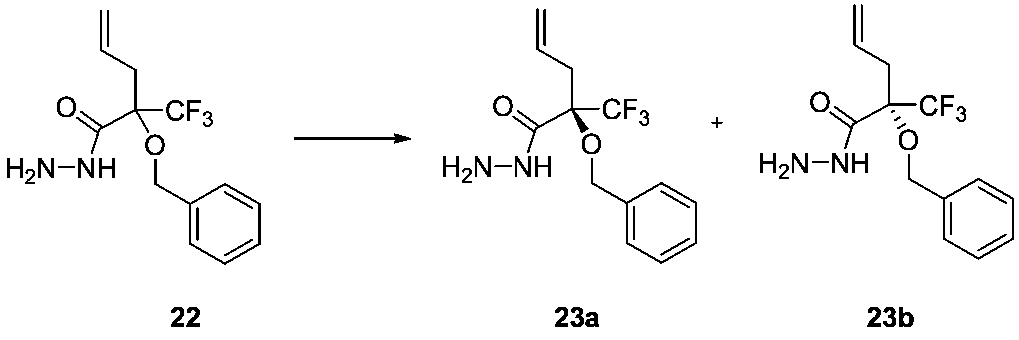
70mL/分の流量で7%MeOH(+20mM NH3)/93%CO22の移動相を使用した、40℃におけるChiralPak IGカラム(250×21.2mm、5μm)を使用したキラルSFCにより、ラセミ2-ベンジルオキシ-2-(トリフルオロメチル)ペンタ-4-エンヒドラジド(5.0g、17.35mmol)を分離し、試料の濃度は、メタノール(修飾剤なし)中で111mg/mLであり、注入量=136バールの出口圧力で160μL、210nmの検出波長であり、2つのエナンチオマー生成物を提供した。
Step 2: (2R)-2-benzyloxy-2-(trifluoromethyl)pent-4-enehydrazide (compound 23a)
Racemic 2 -benzyloxy -2-( trifluoromethyl)pent-4-enehydrazide (5.0 g, 17.35 mmol) was separated by chiral SFC using a ChiralPak IG column (250 x 21.2 mm, 5 μm) at 40°C using a mobile phase of 7% MeOH (+20 mM NH3)/93% CO2 at a flow rate of 70 mL/min, sample concentration was 111 mg/mL in methanol (no modifier), injection volume = 160 μL at 136 bar outlet pressure, detection wavelength of 210 nm to provide two enantiomeric products.
溶出する第1のエナンチオマーを、(2S)-2-ベンジルオキシ-2-(トリフルオロメチル)ペンタ-4-エンヒドラジド(化合物23a、1.79g、72%)として単離した。1H NMR(400MHz,DMSO-d6)δ 9.31(s,1H),7.45-7.39(m,2H),7.38-7.26(m,3H),5.77-5.62(m,1H),5.28(dq,J=17.1,1.6Hz,1H),5.15(dq,J=10.2,1.3Hz,1H),4.72(s,2H),4.44(d,J=4.2Hz,2H),2.99(dd,J=7.4,1.3Hz,1H),2.91(dd,J=15.4,6.4Hz,1H)ppm.ESI-MS m/z 計算値288.10855、実測値289.2(M+1)+;保持時間:1.28分(LC法F)。 The first enantiomer to elute was isolated as (2S)-2-benzyloxy-2-(trifluoromethyl)pent-4-enehydrazide (compound 23a, 1.79 g, 72%). 1H NMR (400MHz, DMSO-d6) δ 9.31 (s, 1H), 7.45-7.39 (m, 2H), 7.38-7.26 (m, 3H), 5.77-5.62 (m, 1H), 5.28 (dq, J = 17.1, 1.6Hz, 1H), 5.15 (dq, J = 1 ppm. ESI-MS m/z calculated value 288.10855, actual value 289.2 (M+1) + ; retention time: 1.28 minutes (LC method F).
溶出する第2のエナンチオマーを、白色の固体として、(2R)-2-ベンジルオキシ-2-(トリフルオロメチル)ペンタ-4-エンヒドラジド(化合物23b、1.7g、68%)として単離した。1H NMR(400MHz,DMSO-d6)δ 9.31(s,1H),7.48-7.39(m,2H),7.39-7.25(m,3H),5.77-5.62(m,1H),5.28(dq,J=17.1,1.6Hz,1H),5.15(dq,J=10.2,1.5Hz,1H),4.73(s,2H),4.51(s,2H),3.00(dd,J=15.3,7.5Hz,1H),2.91(dd,J=15.3,6.4Hz,1H)ppm.ESI-MS m/z 計算値288.10855、実測値289.2(M+1)+;保持時間:1.28分(LC法F)。 The second enantiomer eluting was isolated as a white solid, (2R)-2-benzyloxy-2-(trifluoromethyl)pent-4-enehydrazide (compound 23b, 1.7 g, 68%). 1H NMR (400MHz, DMSO-d6) δ 9.31 (s, 1H), 7.48-7.39 (m, 2H), 7.39-7.25 (m, 3H), 5.77-5.62 (m, 1H), 5.28 (dq, J=17.1, 1.6Hz, 1H), 5.15 (dq, J = 10.2, 1.5Hz, 1H), 4.73 (s, 2H), 4.51 (s, 2H), 3.00 (dd, J = 15.3, 7.5Hz, 1H), 2.91 (dd, J = 15.3, 6.4Hz, 1H) ppm. ESI-MS m/z calculated value 288.10855, actual value 289.2 (M+1) + ; retention time: 1.28 minutes (LC method F).
実施例5:(6R)-17-アミノ-12,12-ジメチル-6,15-ビス(トリフルオロメチル)-19-オキサ-3,4,13,18-トリアザトリシクロ[12.3.1.12,5]ノナデカ-1(18),2,4,14,16-ペンタエン-6-オール(化合物I)の合成

ステップ1:6-((2-メチルヘキサ-5-エン-2-イル)アミノ)-3-ニトロ-5-(トリフルオロメチル)ピコリン酸メチル(化合物24)

NaHCO3(88.6g、1.05mol、3当量)を、2-MeTHF(800mL、8体積)中の化合物16(100g、0.35mol、1当量)及び化合物3のHCl塩(57.9g、0.39mol、1.1当量)の混合物に添加した。混合物を75℃(反応混合物温度)に加熱した。LC分析による反応完了後、混合物を周囲温度に冷却させた。周囲温度で、700mLの水を添加した。撹拌した後、相を分離した。有機層を400mLの水で洗浄し、Na2SO4で乾燥させ、濾過し、濃縮した。粗生成物を真空下で乾燥させ、次のステップでそのまま使用した。ESI-MS m/z 計算値361.12、実測値362(M+1)+.1H NMR(400MHz,クロロホルム-d)δ 8.45(d,J=0.8Hz,1H),5.77(ddt,J=16.8,10.2,6.3Hz,1H),5.51(s,1H),5.01(dq,J=17.1,1.6Hz,1H),4.98-4.92(m,1H),4.01(s,3H),2.11-2.00(m,2H),2.01-1.92(m,2H),1.88(s,1H),1.49(s,6H).19F NMR(376MHz,CDCl3)δ-64.47.
Example 5: Synthesis of (6R)-17-amino-12,12-dimethyl-6,15-bis(trifluoromethyl)-19-oxa-3,4,13,18-triazatricyclo[12.3.1.12,5]nonadeca-1(18),2,4,14,16-pentaen-6-ol (Compound I)
Step 1: Methyl 6-((2-methylhex-5-en-2-yl)amino)-3-nitro-5-(trifluoromethyl)picolinate (compound 24)
NaHCO 3 (88.6 g, 1.05 mol, 3 eq.) was added to a mixture of compound 16 (100 g, 0.35 mol, 1 eq.) and HCl salt of compound 3 (57.9 g, 0.39 mol, 1.1 eq.) in 2-MeTHF (800 mL, 8 vol.). The mixture was heated to 75° C. (reaction mixture temperature). After completion of the reaction by LC analysis, the mixture was allowed to cool to ambient temperature. At ambient temperature, 700 mL of water was added. After stirring, the phases were separated. The organic layer was washed with 400 mL of water, dried over Na 2 SO 4 , filtered and concentrated. The crude product was dried under vacuum and used directly in the next step. ESI-MS m/z calculated 361.12, found 362 (M+1) + . 1H NMR (400MHz, chloroform-d) δ 8.45 (d, J=0.8Hz, 1H), 5.77 (ddt, J=16.8, 10.2, 6.3Hz, 1H), 5.51 (s, 1H), 5.01 (dq, J=17.1, 1.6Hz, 1 H), 4.98-4.92 (m, 1H), 4.01 (s, 3H), 2.11-2.00 (m, 2H), 2.01-1.92 (m, 2H), 1.88 (s, 1H), 1.49 (s, 6H). 19 F NMR (376 MHz, CDCl 3 ) δ-64.47.
ステップ2:6-((2-メチルヘキサ-5-エン-2-イル)アミノ)-3-ニトロ-5-(トリフルオロメチル)ピコリン酸(化合物2)
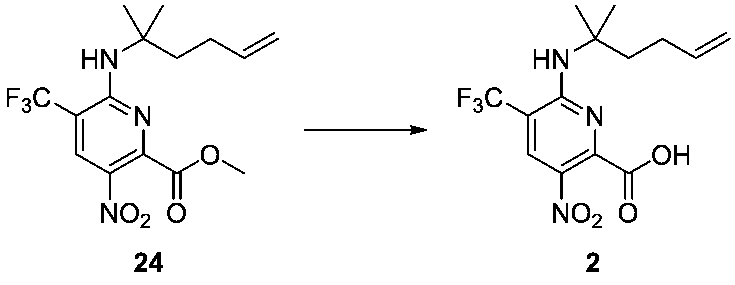
EtOH(216mL、0.692M、4体積)中の化合物24(54g、149.454mmol、1当量)の溶液に、6M NaOH(32.382mL、194.29mmol、1.3当量)を添加漏斗を介して10分間にわたって滴加し、<30℃の温度を維持した。混合物を、LC分析による反応が完了するまで周囲温度で撹拌した。(反応が更に変換されない場合、反応が完了するまで、追加の6M NaOH(2.491mL、14.945mmol、0.1当量)を添加する。)混合物を濃縮してEtOHを除去した。混合物を濃縮し、IPAc(420mL、8vol)を添加した。混合物を、6MのHCl(38.609mL、231.653mmol、1.55当量)を添加漏斗を介して滴加することによって酸性化し、温度を<30℃に維持した。10分間撹拌し、相を分離させた。26gのシリカゲル及び26gの活性炭を有機層に添加し、周囲温度で数時間撹拌した。混合物を、珪藻土のパッド上で濾過し、25mLのIPAcで2回洗浄した。濾液を濃縮して、油を得た。140mLのヘプタンを添加し、濃縮し、次いで、繰り返した。220mLのヘプタンを添加して、スラリーを得ると、それを2時間以上撹拌させた。固体を濾過によって収集し、25mLのヘプタンで3回洗浄した。固体を真空下で乾燥させて、薄黄色の固体として化合物2(42.3g、81.5%)を得た。ESI-MS m/z 計算値347.11、実測値348(M+1)+.1H NMR(400MHz,クロロホルム-d)δ 8.47(d,J=0.8Hz,1H),7.89(s,2H),5.78(ddt,J=16.6,10.2,6.2Hz,1H),5.56(s,1H),5.12-4.89(m,2H),2.15-1.93(m,4H),1.53(s,6H).19F NMR(376MHz,CDCl3)δ-64.45.
Step 2: 6-((2-methylhex-5-en-2-yl)amino)-3-nitro-5-(trifluoromethyl)picolinic acid (compound 2)
To a solution of compound 24 (54 g, 149.454 mmol, 1 equiv) in EtOH (216 mL, 0.692 M, 4 vol) was added 6M NaOH (32.382 mL, 194.29 mmol, 1.3 equiv) dropwise via addition funnel over 10 min, maintaining the temperature at <30° C. The mixture was stirred at ambient temperature until the reaction was complete by LC analysis. (If the reaction does not convert further, add additional 6M NaOH (2.491 mL, 14.945 mmol, 0.1 equiv) until the reaction is complete.) The mixture was concentrated to remove EtOH. The mixture was concentrated and IPAc (420 mL, 8 vol) was added. The mixture was acidified by adding 6M HCl (38.609 mL, 231.653 mmol, 1.55 equiv) dropwise via addition funnel, maintaining the temperature at <30° C. Stirred for 10 minutes and allowed the phases to separate. 26 g silica gel and 26 g activated charcoal were added to the organic layer and stirred at ambient temperature for several hours. The mixture was filtered over a pad of diatomaceous earth and washed twice with 25 mL IPAc. The filtrate was concentrated to give an oil. 140 mL heptane was added, concentrated, then repeated. 220 mL heptane was added to give a slurry which was allowed to stir for 2 more hours. The solid was collected by filtration and washed three times with 25 mL heptane. The solid was dried under vacuum to give compound 2 (42.3 g, 81.5%) as a light yellow solid. ESI-MS m/z calculated 347.11, found 348 (M+1) + . 1H NMR (400MHz, chloroform-d) δ 8.47 (d, J=0.8Hz, 1H), 7.89 (s, 2H), 5.78 (ddt, J=16.6, 10.2, 6.2Hz, 1H), 5.56 (s, 1H), 5.12-4.89 (m, 2H), 2.15-1.93 (m, 4H), 1.53 (s, 6H). 19 F NMR (376 MHz, CDCl 3 ) δ-64.45.
ステップ3:(R)-N’-(2-(ベンジルオキシ)-2-(トリフルオロメチル)ペンタ-4-エノイル)-6-((2-メチルヘキサ-5-エン-2-イル)アミノ)-3-ニトロ-5-(トリフルオロメチル)ピコリノヒドラジド(化合物4)

化合物2(900g、2591.496mmol、1当量)を反応器に添加し、続いて、N,N-ジメチルホルムアミド(2700mL、0.96M、3体積)を添加した。混合物を周囲温度で撹拌し、4-メチルモルホリン(NMM、288.34g、313.413mL、0.92g/mL、2850.646mmol、1.1当量)を滴加した。添加が完了した後、混合物を周囲温度で15分間撹拌した。CDMT(500.488g、2850.646mmol、1.1当量)を、N,N-ジメチルホルムアミド(900mL、2.879M、1体積)中のスラリーとして添加した。添加後、混合物を1時間撹拌し、次いで、N,N-ジメチルホルムアミド(900mL、2.879M、1体積)中の化合物23a(784.391g、2721.071mmol、1.05当量)を1.5時間にわたって混合物に添加した。混合物を、LC分析により反応の完了を確認するまで周囲温度で撹拌した。反応物をクエンチするために2Lの水をゆっくりと添加し、次いで、MTBE(12L、0.288M、13体積)を添加した。追加のH2O(14400mL、0.18M、16体積)を添加した。撹拌した後、相を分離した。有機層を、0.5M NaOH(5400mL、6体積)、0.5M HCl(5400mL、6体積)、及び5%w/v NaCl水溶液(5400mL、6体積)で洗浄した。有機層をNa2SO4上で乾燥させ、濾過し、ロータリーエバポレーション(40℃、20mbar)によって濃縮した。2Lの酢酸エチルを添加してMTBEを追跡し、50℃で、ロータリーエバポレーターで濃縮して、粗化合物4(1551g、91.9%)を得ると、これを次のステップで直接使用した。ESI-MS m/z 計算値617.21、実測値618(M+1)+.1H NMR(400MHz,クロロホルム-d)δ 9.26(s,1H),8.84(d,J=4.6Hz,1H),8.33-8.26(m,1H),7.47-7.29(m,6H),5.81(dddd,J=27.2,12.3,10.2,6.7Hz,2H),5.45(s,1H),5.38-5.27(m,2H),5.01(dq,J=17.2,1.6Hz,1H),4.95(dt,J=10.2,1.4Hz,1H),4.85(s,2H),3.19-2.95(m,2H),2.12-1.95(m,4H),1.61(s,5H),1.51(s,6H).19F NMR(376MHz,CDCl3)δ-64.53,-73.76.
Step 3: (R)-N'-(2-(benzyloxy)-2-(trifluoromethyl)pent-4-enoyl)-6-((2-methylhex-5-en-2-yl)amino)-3-nitro-5-(trifluoromethyl)picolinohydrazide (compound 4)
Compound 2 (900 g, 2591.496 mmol, 1 equiv) was added to the reactor followed by N,N-dimethylformamide (2700 mL, 0.96 M, 3 volumes). The mixture was stirred at ambient temperature and 4-methylmorpholine (NMM, 288.34 g, 313.413 mL, 0.92 g/mL, 2850.646 mmol, 1.1 equiv) was added dropwise. After the addition was complete, the mixture was stirred at ambient temperature for 15 minutes. CDMT (500.488 g, 2850.646 mmol, 1.1 equiv) was added as a slurry in N,N-dimethylformamide (900 mL, 2.879 M, 1 volume). After the addition, the mixture was stirred for 1 h, then compound 23a (784.391 g, 2721.071 mmol, 1.05 equiv) in N,N-dimethylformamide (900 mL, 2.879 M, 1 vol) was added to the mixture over 1.5 h. The mixture was stirred at ambient temperature until LC analysis confirmed the reaction was complete. 2 L of water was added slowly to quench the reaction, followed by MTBE (12 L, 0.288 M, 13 vol). Additional H 2 O (14400 mL, 0.18 M, 16 vol) was added. After stirring, the phases were separated. The organic layer was washed with 0.5 M NaOH (5400 mL, 6 vol), 0.5 M HCl (5400 mL, 6 vol), and 5% w/v aqueous NaCl (5400 mL, 6 vol). The organic layer was dried over Na 2 SO 4 , filtered and concentrated by rotary evaporation (40° C., 20 mbar). 2 L of ethyl acetate was added to chase the MTBE and concentrated on a rotary evaporator at 50° C. to give crude compound 4 (1551 g, 91.9%), which was used directly in the next step. ESI-MS m/z calculated 617.21, found 618 (M+1) + . 1 H NMR (400 MHz, chloroform-d) δ 9.26 (s, 1H), 8.84 (d, J = 4.6Hz, 1H), 8.33-8.26 (m, 1H), 7.47-7.29 (m, 6H ), 5.81 (dddd, J = 27.2, 12.3, 10.2, 6.7Hz, 2H), 5.45 (s, 1H), 5.38-5.27 ( m, 2H), 5.01 (dq, J=17.2, 1.6Hz, 1H), 4.95 (dt, J=10.2, 1.4Hz, 1H), 4.85 (s, 2H), 3.19-2.95 (m, 2H), 2.12-1.95 (m, 4H), 1.61 (s, 5H), 1.51 (s, 6H). 19 F NMR (376 MHz, CDCl 3 ) δ -64.53, -73.76.
ステップ4:(R)-9-(ベンジルオキシ)-3,3-ジメチル-15-ニトロ-13,9-ビス(トリフルオロメチル)-2,11,12-トリアザ-1(2,6)-ピリジナシクロトリデカファン-6-エン-10,13-ジオン(化合物6)

EtOAc(77.55L、0.011M、150体積)中の化合物4(517g、837.181mmol、1当量)の溶液を周囲温度で撹拌し、表面下N2スパージを開始した。30分のスパージ後、ジクロロ[1,3-ビス(2,4,6-トリメチルフェニル)-2-イミダゾリジニリデン][[5-[(ジメチルアミノ)スルホニル]-2-(1-メチルエトキシ-O)フェニル]メチレン-C]ルテニウム(II)(Zhan Catalyst-1B、61.428g、83.718mmol、0.1当量)を添加し、混合物を表面下N2スパージを継続しながら40℃に加熱した。LC分析による反応完了後、混合物を周囲温度に冷却した。次いで、2-メルカプトニコチン酸(64.954g、418.59mmol、0.5当量)、続いて、TEA(42.357g、58.829mL、0.72g/mL、418.59mmol、0.5当量)を反応器に充填し、混合物を一晩撹拌した。混合物にシリカゲル(1265.817g、5023.083mmol、6当量)を添加し、少なくとも1時間撹拌した。混合物を、シリカゲルの層(2kg)及び珪藻土の薄層を有するガラスフィルターを通して濾過し、固体をEtOAc(20.68L、0.04M、40体積)で洗浄した。ロータリーエバポレーターを介して濾液から溶媒を蒸留した。粗物質の最終重量は397gであり、LC分析による純度は79.71%の面積パーセントであった。
Step 4: (R)-9-(benzyloxy)-3,3-dimethyl- 1 5 -nitro-1 3 ,9-bis(trifluoromethyl)-2,11,12-triaza-1(2,6)-pyridinacyclotridecaphan-6-ene-10,13-dione (compound 6)
A solution of compound 4 (517 g, 837.181 mmol, 1 equiv) in EtOAc (77.55 L, 0.011 M, 150 vol) was stirred at ambient temperature and subsurface N2 sparging was initiated. After 30 min of sparging, dichloro[1,3-bis(2,4,6-trimethylphenyl)-2-imidazolidinylidene][[5-[(dimethylamino)sulfonyl]-2-(1-methylethoxy-O)phenyl]methylene-C]ruthenium(II) (Zhan Catalyst-1B, 61.428 g, 83.718 mmol, 0.1 equiv) was added and the mixture was heated to 40 °C with continued subsurface N2 sparging. After reaction completion by LC analysis, the mixture was cooled to ambient temperature. 2-Mercaptonicotinic acid (64.954 g, 418.59 mmol, 0.5 equiv) was then charged to the reactor followed by TEA (42.357 g, 58.829 mL, 0.72 g/mL, 418.59 mmol, 0.5 equiv) and the mixture was stirred overnight. Silica gel (1265.817 g, 5023.083 mmol, 6 equiv) was added to the mixture and stirred for at least 1 h. The mixture was filtered through a layer of silica gel (2 kg) and a glass filter with a thin layer of diatomaceous earth and the solid was washed with EtOAc (20.68 L, 0.04 M, 40 vol). The solvent was distilled from the filtrate via rotary evaporator. The final weight of the crude material was 397 g and the purity by LC analysis was 79.71% area percent.
MTBE(6.204L、0.384M、4体積)中の合わせた粗物質(化合物4、1551g、2383.955mmol、1当量)のスラリーを55℃に加熱し、1時間撹拌した。MTBE(1.241L、1.921M、0.8体積)及びヘプタン(4963.2mL、0.48M、3.2体積)を15分間かけて添加した。混合物を更に30分間撹拌し、次いで、2時間かけて10℃に冷却し、続いて、10℃で一晩撹拌した。 A slurry of the combined crude material (compound 4, 1551 g, 2383.955 mmol, 1 equiv) in MTBE (6.204 L, 0.384 M, 4 vol) was heated to 55° C. and stirred for 1 h. MTBE (1.241 L, 1.921 M, 0.8 vol) and heptane (4963.2 mL, 0.48 M, 3.2 vol) were added over 15 min. The mixture was stirred for an additional 30 min, then cooled to 10° C. over 2 h, followed by stirring at 10° C. overnight.
次いで、混合物を濾過し、濾過ケーキを最初にMTBE(310.2mL、0.2体積)、次いで、ヘプタン(3×413mL、0.8体積)で洗浄した。濾過ケーキを1時間乾燥させ、次いで、ロータリーエバポレーターに移して、50℃で4時間乾燥させて、化合物6(1119g、78.4%)を得た。ESI-MS m/z 計算値589.18、実測値590(M+1)+.1H NMR(400MHz,クロロホルム-d)δ 8.51(d,J=8.9Hz,1H),7.90(s,1H),7.51(s,1H),7.48-7.39(m,1H),7.39-7.29(m,2H),7.13-6.97(m,2H),5.67(ddd,J=14.9,10.8,3.9Hz,1H),5.42-5.32(m,1H),4.76-4.55(m,2H),4.43(d,J=9.9Hz,1H),2.90-2.72(m,2H),2.55(t,J=12.6Hz,1H),2.19-2.06(m,1H),2.05(s,1H),1.59(s,5H),1.52(s,4H),1.47-1.39(m,1H),1.32-1.19(m,4H).19F NMR(376MHz,CDCl3)δ-64.25,-64.62,-73.96,-74.27. The mixture was then filtered and the filter cake was washed first with MTBE (310.2 mL, 0.2 vol) and then with heptane (3×413 mL, 0.8 vol). The filter cake was dried for 1 h and then transferred to a rotary evaporator and dried at 50° C. for 4 h to give compound 6 (1119 g, 78.4%). ESI-MS m/z calculated 589.18, found 590 (M+1) + . 1 H NMR (400 MHz, chloroform-d) δ 8.51 (d, J = 8.9Hz, 1H), 7.90 (s, 1H), 7.51 (s, 1H), 7.48-7.39 (m, 1H), 7.39-7.29 (m, 2H) , 7.13-6.97 (m, 2H), 5.67 (ddd, J=14.9, 10.8, 3.9Hz, 1H), 5.42-5.32 (m, 1H), 4.76-4.5 5 (m, 2H), 4.43 (d, J = 9.9Hz, 1H), 2.90-2.72 (m, 2H), 2.55 (t, J = 12.6Hz, 1H), 2.19-2.06 (m, 1H), 2.05 (s, 1H), 1.59 (s, 5H), 1.52 (s, 4H), 1.47-1.39 (m, 1H), 1.32-1.19 (m, 4H). 19 F NMR (376 MHz, CDCl 3 ) δ -64.25, -64.62, -73.96, -74.27.
ステップ5:(R)-10-(ベンジルオキシ)-4,4-ジメチル-23-ニトロ-25,10-ビス(トリフルオロメチル)-3-アザ-1(2,5)-オキサジアゾラ-2(2,6)-ピリジナシクロデカファン-7-エン(化合物5)

DCM(160mL、8体積当量)中の化合物6(20.0g、33.9mmol、1当量)及び1,4-ジアザビシクロ[2.2.2]オクタン(DABCO;5.71g、50.9mmol、1.5当量)の溶液を、反応温度を15~30℃に維持しながら、25w/v%の2-クロロ-1,3-ジメチルイミダゾリニウムクロリド(DMC;6.23g、24.9mL、37.3mmol、1.1当量)を5分間にわたって添加したときに室温で撹拌した。DMCの添加完了の直後に、反応懸濁液をPhMe(40mL、2体積当量)で希釈し、濃縮して、DCMの大部分を除去した。濃縮物を、PhMe(160mL、8体積当量)総体積で再び希釈した。懸濁液を100℃で加熱した。反応温度を、LC分析によって反応完了が確認されるまで100~105℃で5~6時間維持した。懸濁液を室温に冷却し、固体(DABCO・HCl及びN,N-ジメチルイミダゾリジノン)を濾過によって除去した。濾過ケーキをMTBE(40mL、2体積)で2回洗浄した。濾液及び洗浄液を合わせ、最初に水(60mL、3体積当量)、次いで、0.5M HCl(67.9mL、33.9mmol、1当量)、及び次いで、水(60mL、3体積当量)で逐次的に洗浄した。次いで、混合物を濃縮して、粗化合物5(20.9g、108%理論)を得た。
Step 5: (R)-10-(benzyloxy)-4,4-dimethyl- 2 3 -nitro-2 5 ,10-bis(trifluoromethyl)-3-aza-1(2,5)-oxadiazola-2(2,6)-pyridinacyclodecaphan-7-ene (compound 5)
A solution of compound 6 (20.0 g, 33.9 mmol, 1 eq.) and 1,4-diazabicyclo[2.2.2]octane (DABCO; 5.71 g, 50.9 mmol, 1.5 eq.) in DCM (160 mL, 8 vol. eq.) was stirred at room temperature when 25% w/v 2-chloro-1,3-dimethylimidazolinium chloride (DMC; 6.23 g, 24.9 mL, 37.3 mmol, 1.1 eq.) was added over 5 min while maintaining the reaction temperature between 15-30° C. Immediately after the addition of DMC was complete, the reaction suspension was diluted with PhMe (40 mL, 2 vol. eq.) and concentrated to remove most of the DCM. The concentrate was diluted again with a total volume of PhMe (160 mL, 8 vol. eq.). The suspension was heated at 100° C. The reaction temperature was maintained at 100-105° C. for 5-6 hours until completion was confirmed by LC analysis. The suspension was cooled to room temperature and the solids (DABCO.HCl and N,N-dimethylimidazolidinone) were removed by filtration. The filter cake was washed twice with MTBE (40 mL, 2 vol). The filtrate and washes were combined and washed successively first with water (60 mL, 3 vol eq), then with 0.5 M HCl (67.9 mL, 33.9 mmol, 1 eq), and then with water (60 mL, 3 vol eq). The mixture was then concentrated to give crude compound 5 (20.9 g, 108% theory).
粗化合物5を高温(75℃)EtOH(40mL)中に溶解し、1時間にわたって室温まで冷却した。固体を濾過によって収集し、濾過ケーキをEtOH(2×10mL)で洗浄し、次いで、空気乾燥させて、化合物5(14.0g、72%)を黄色の固体として得た。ESI-MS m/z 計算値571.17、実測値572(M+1)+.1H NMR(400MHz,クロロホルム-d)δ 8.47(d,J=0.9Hz,1H),7.41-7.21(m,7H),5.76-5.58(m,2H),5.56-5.47(m,1H),4.85(dd,J=11.2,1.5Hz,1H),4.52(d,J=11.0Hz,1H),3.14-3.03(m,1H),2.69(dd,J=14.3,8.5Hz,1H),2.52(td,J=9.9,9.5,5.6Hz,1H),2.14(ddd,J=12.0,10.0,5.4Hz,1H),1.99(ddt,J=14.7,8.0,4.0Hz,2H),1.45(s,3H),1.42(s,3H).19F NMR(376MHz,CDCl3)δ-64.13,-72.99.
ステップ6:(6R)-17-アミノ-12,12-ジメチル-6,15-ビス(トリフルオロメチル)-19-オキサ-3,4,13,18-トリアザトリシクロ[12.3.1.12,5]ノナデカ-1(18),2,4,14,16-ペンタエン-6-オール(化合物I)

EtOH(210mL、15体積当量)、EtOAc(70mL、5体積当量)、及び7M NH3/MeOH(3.5mL、24.5mmol、1当量)中の化合物5(14.0g、24.5mmol、1当量)及び10重量%パラジウム活性炭(Evonik Nobylst P1173;2.6g、50w/w%、0.5当量)の懸濁液を排出し、N2で3回再充填した。反応容器を排気し、H2(バルーン圧)で再充填し、室温で16時間急速に撹拌した。反応容器を、排気/N2での再充填を3回行い、混合物を、反応完了についてLCによって分析した。反応混合物に珪藻土の一部(2g)を添加し、懸濁液を1cmの珪藻土充填床を通して濾過して、触媒を除去した。フラスコ/フィルター床をEtOH(3×10mL)で洗浄し、洗浄液を濾液と合わせ、濃縮して(45℃/20トール)、化合物I(11.5g、104%理論)を明るい黄色の発泡体として得た。
Step 6: (6R)-17-amino-12,12-dimethyl-6,15-bis(trifluoromethyl)-19-oxa-3,4,13,18-triazatricyclo[12.3.1.12,5]nonadeca-1(18),2,4,14,16-pentaen-6-ol (compound I)
A suspension of compound 5 (14.0 g, 24.5 mmol, 1 equiv.) and 10 wt.% palladium on activated carbon (Evonik Nobylst P1173 ; 2.6 g, 50 w/w%, 0.5 equiv.) in EtOH (210 mL, 15 vol. equiv.), EtOAc (70 mL, 5 vol. equiv.), and
発泡体をDCM(98mL、7体積当量)中に溶解し、SiO2充填床(14g;1g/g)を通して濾過した。フィルター床をDCM(80mL)、及び次いで、20%EtOAc/DCM(2×100mL)で洗浄した。その後の各洗浄は色がなくなり、最終洗浄はほぼ無色であった。濾液及び洗浄液を合わせ、濃縮して、化合物I(11.1g)を橙色の固体として得た。固体を、加温した(30℃)DCM(98mL、7体積当量)中に溶解し、急速に混合しながらヘプタン(98mL、7体積当量)で希釈した。溶液を濃縮し(45℃/360トール)、DCMの大部分を除去し、次いで、得られた懸濁液に追加の分量のヘプタン(98mL、7体積)を再充填した。懸濁液を(残留DCMを除去するために)再び一部濃縮し、室温まで冷却した。固体を濾過によって収集し、濾過ケーキをヘプタン(2×10mL)で洗浄し、空気乾燥させて、化合物I(10.7g、96%)を明るい黄色の顆粒状固体として得た。ESI-MS m/z 計算値453.16、実測値454(M+1)+.1H NMR(400MHz,DMSO-d6)δ 7.62(s,1H),7.59(s,1H),5.96(s,2H),4.64(s,1H),2.81(p,J=7.2,6.8Hz,1H),2.28-2.15(m,1H),2.06(t,J=12.4Hz,1H),1.82(dt,J=12.1,7.5Hz,1H),1.65(d,J=13.7Hz,1H),1.44(q,J=8.7,8.0Hz,5H),1.36(s,3H),1.31(s,3H).19F NMR(376MHz,DMSO)δ-62.34,-78.23. The foam was dissolved in DCM (98 mL, 7 vol eq) and filtered through a SiO 2 packed bed (14 g; 1 g/g). The filter bed was washed with DCM (80 mL) and then with 20% EtOAc/DCM (2×100 mL). Each subsequent wash was colorless, with the final wash being nearly colorless. The filtrate and washes were combined and concentrated to give compound I (11.1 g) as an orange solid. The solid was dissolved in warm (30° C.) DCM (98 mL, 7 vol eq) and diluted with heptane (98 mL, 7 vol eq) with rapid mixing. The solution was concentrated (45° C./360 Torr) to remove most of the DCM, and the resulting suspension was then recharged with an additional portion of heptane (98 mL, 7 vol). The suspension was partially concentrated again (to remove residual DCM) and cooled to room temperature. The solid was collected by filtration, and the filter cake was washed with heptane (2×10 mL) and air-dried to give compound I (10.7 g, 96%) as a light yellow granular solid: ESI-MS m/z calculated 453.16, found 454 (M+1) + . 1H NMR (400MHz, DMSO-d 6 )δ 7.62 (s, 1H), 7.59 (s, 1H), 5.96 (s, 2H), 4.64 (s, 1H), 2.81 (p, J = 7.2, 6.8Hz, 1H), 2.28-2.15 (m, 1H), 2.06 (t, J = 12.4 Hz, 1H), 1.82 (dt, J=12.1, 7.5Hz, 1H), 1.65 (d, J=13.7Hz, 1H), 1.44 (q, J=8.7, 8.0Hz, 5H), 1.36 (s, 3H), 1.31 (s, 3H). 19F NMR (376MHz, DMSO) δ-62.34, -78.23.
実施例6:(R)-10-(ベンジルオキシ)-4,4-ジメチル-23-ニトロ-25,10-ビス(トリフルオロメチル)-3-アザ-1(2,5)-オキサジアゾラ-2(2,6)-ピリジナシクロデカファン-7-エン(化合物5)の代替的な合成

ステップ1:(R)-6-(5-(2-(ベンジルオキシ)-1,1,1-トリフルオロペンタ-4-エン-2-イル)-1,3,4-オキサジアゾール-2-イル)-N-(2-メチルヘキサ-5-エン-2-イル)-5-ニトロ-3-(トリフルオロメチル)ピリジン-2-アミン(化合物25)

(R)-6-(5-(2-(ベンジルオキシ)-1,1,1-トリフルオロペンタ-4-エン-2-イル)-1,3,4-オキサジアゾール-2-イル)-N-(2-メチルヘキサ-5-エン-2-イル)-5-ニトロ-3-(トリフルオロメチル)ピリジン-2-アミン(化合物25)は、以下に報告されているものと類似の手順を使用して合成することができる:
・Li,C.;Dickson,H.D.Tett.Lett.2009,50,6435。
・Augustine,J.K.;Vairaperumal,V.;Narasimhan,S.;Alagarsamy,P.;Radhakrishnan,A.Tetrahedron,2009,65,9989。
Example 6: Alternative synthesis of (R)-10-(benzyloxy)-4,4-dimethyl- 2 3 -nitro-2 5 ,10-bis(trifluoromethyl)-3-aza-1(2,5)-oxadiazola-2(2,6)-pyridinacyclodecaphan-7-ene (compound 5)
Step 1: (R)-6-(5-(2-(benzyloxy)-1,1,1-trifluoropent-4-en-2-yl)-1,3,4-oxadiazol-2-yl)-N-(2-methylhex-5-en-2-yl)-5-nitro-3-(trifluoromethyl)pyridin-2-amine (compound 25)
(R)-6-(5-(2-(benzyloxy)-1,1,1-trifluoropent-4-en-2-yl)-1,3,4-oxadiazol-2-yl)-N-(2-methylhex-5-en-2-yl)-5-nitro-3-(trifluoromethyl)pyridin-2-amine (compound 25) can be synthesized using a procedure similar to that reported in:
・Li, C. ; Dickson, H.; D. Tett. Lett. 2009, 50, 6435.
・Augustine, J. K. ; Vairaperumal, V.; ;Narasimhan,S. ; Alagarsamy, P.; ; Radhakrishnan, A.; Tetrahedron, 2009, 65, 9989.
オーバーヘッド撹拌器及び窒素入口を備えた好適な容器に、6-((2-メチルヘキサ-5-エン-2-イル)アミノ)-3-ニトロ-5-(トリフルオロメチル)ピコリン酸(14.9mmol、1当量)、(R)-2-(ベンジルオキシ)-2-(トリフルオロメチル)ペンタ-4-エンヒドラジド(15.6mmol、1.05当量)、及びアセトニトリル(34.8mL、6体積)を充填する。混合物を撹拌し、T3P(33.1g、溶液として50w/w%、52.0mmol、3.5当量)及びDIPEA(89.2mmol、6当量)を反応器に充填する。混合物を78℃の内部温度に加熱し、所望の反応変換が観察されるまでHPLCによってモニタリングする。温度を25℃に低下させ、水(29mL、5体積)を反応器に充填し、混合物を10分間撹拌する。MTBE(46.4mL、8体積)を充填し、10分間撹拌し、沈殿させ、次いで、分離する。有機層を単離し、5%クエン酸(29mL、5体積)、飽和重炭酸ナトリウム(29mL、5体積)、及び水(29mL、5体積)で逐次的に洗浄した。有機層を油状物に濃縮し、その後の処理でそのまま使用する。 A suitable vessel equipped with an overhead stirrer and nitrogen inlet is charged with 6-((2-methylhex-5-en-2-yl)amino)-3-nitro-5-(trifluoromethyl)picolinic acid (14.9 mmol, 1 eq.), (R)-2-(benzyloxy)-2-(trifluoromethyl)pent-4-enehydrazide (15.6 mmol, 1.05 eq.), and acetonitrile (34.8 mL, 6 vol.). The mixture is stirred and T3P (33.1 g, 50 w/w% as a solution, 52.0 mmol, 3.5 eq.) and DIPEA (89.2 mmol, 6 eq.) are charged to the reactor. The mixture is heated to an internal temperature of 78° C. and monitored by HPLC until the desired reaction conversion is observed. The temperature is reduced to 25° C. and water (29 mL, 5 vol.) is charged to the reactor and the mixture is stirred for 10 minutes. Charge with MTBE (46.4 mL, 8 vol), stir for 10 minutes, allow to settle, then separate. The organic layer is isolated and washed successively with 5% citric acid (29 mL, 5 vol), saturated sodium bicarbonate (29 mL, 5 vol), and water (29 mL, 5 vol). The organic layer is concentrated to an oil and used as is in subsequent workup.
ステップ2:(R)-10-(ベンジルオキシ)-4,4-ジメチル-23-ニトロ-25,10-ビス(トリフルオロメチル)-3-アザ-1(2,5)-オキサジアゾラ-2(2,6)-ピリジナシクロデカファン-7-エン(化合物5)

化合物5は、実施例5のステップ4に記載される方法に類似した方法を用いることによって、化合物25から生成することができる。
Step 2: (R)-10-(benzyloxy)-4,4-dimethyl- 2 3 -nitro-2 5 ,10-bis(trifluoromethyl)-3-aza-1(2,5)-oxadiazola-2(2,6)-pyridinacyclodecaphan-7-ene (compound 5)
実施例7:(6R)-17-アミノ-12,12-ジメチル-6,15-ビス(トリフルオロメチル)-19-オキサ-3,4,13,18-トリアザトリシクロ[12.3.1.12,5]ノナデカ-1(18),2,4,14,16-ペンタエン-6-オール(化合物I)の代替的な合成

ステップ1:(R)-(2-(5-(2-(ベンジルオキシ)-1,1,1-トリフルオロペンタ-4-エン-2-イル)-1,3,4-オキサジアゾール-2-イル)-6-((2-メチルヘキサ-5-エン-2-イル)アミノ)-5-(トリフルオロメチル)ピリジン-3-イル)カルバミン酸tert-ブチル(化合物27)

(R)-(2-(5-(2-(ベンジルオキシ)-1,1,1-トリフルオロペンタ-4-エン-2-イル)-1,3,4-オキサジアゾール-2-イル)-6-((2-メチルヘキサ-5-エン-2-イル)アミノ)-5-(トリフルオロメチル)ピリジン-3-イル)カルバミン酸tert-ブチル(化合物27)は、以下に報告されているものと類似の手順を使用して合成することができる:
・Li,C.;Dickson,H.D.Tett.Lett.2009,50,6435.
・Augustine,J.K.;Vairaperumal,V.;Narasimhan,S.;Alagarsamy,P.;Radhakrishnan,A.Tetrahedron,2009,65,9989。
Example 7: Alternative synthesis of (6R)-17-amino-12,12-dimethyl-6,15-bis(trifluoromethyl)-19-oxa-3,4,13,18-triazatricyclo[12.3.1.12,5]nonadeca-1(18),2,4,14,16-pentaen-6-ol (Compound I)
Step 1: (R)-(2-(5-(2-(benzyloxy)-1,1,1-trifluoropent-4-en-2-yl)-1,3,4-oxadiazol-2-yl)-6-((2-methylhex-5-en-2-yl)amino)-5-(trifluoromethyl)pyridin-3-yl)carbamate tert-butyl (compound 27)
(R)-tert-butyl (2-(5-(2-(benzyloxy)-1,1,1-trifluoropent-4-en-2-yl)-1,3,4-oxadiazol-2-yl)-6-((2-methylhex-5-en-2-yl)amino)-5-(trifluoromethyl)pyridin-3-yl)carbamate (compound 27) can be synthesized using a procedure similar to that reported in:
・Li, C. ; Dickson, H.; D. Tett. Lett. 2009, 50, 6435.
・Augustine, J. K. ; Vairaperumal, V.; ;Narasimhan,S. ; Alagarsamy, P.; ; Radhakrishnan, A.; Tetrahedron, 2009, 65, 9989.
オーバーヘッド撹拌器及び窒素入口を備えた好適な容器に、3-((tert-ブトキシカルボニル)アミノ)-6-((2-メチルヘキサ-5-エン-2-イル)アミノ)-5-(トリフルオロメチル)ピコリン酸(化合物26)(14.9mmol、1当量;WO2022/109573A1の実施例90、ステップ3に従って調製)、(R)-2-(ベンジルオキシ)-2-(トリフルオロメチル)ペンタ-4-エンヒドラジド(15.6mmol、1.05当量)、及びアセトニトリル(34.8mL、6体積)を充填する。混合物を撹拌し、T3P(33.1g、溶液として50w/w%、52.0mmol、3.5当量)及びDIPEA(89.2mmol、6当量)を反応器に充填する。混合物を78℃の内部温度に加熱し、所望の反応変換が観察されるまでHPLCによってモニタリングする。温度を25℃に低下させ、水(29mL、5体積)を反応器に充填し、混合物を10分間撹拌する。MTBE(46.4mL、8体積)を充填し、10分間撹拌し、沈殿させ、次いで、分離する。有機層を単離し、5%クエン酸(29mL、5体積)、飽和重炭酸ナトリウム(29mL、5体積)、及び水(29mL、5体積)で逐次的に洗浄した。有機層を油状物に濃縮し、その後の処理でそのまま使用する。
A suitable vessel equipped with an overhead stirrer and nitrogen inlet is charged with 3-((tert-butoxycarbonyl)amino)-6-((2-methylhex-5-en-2-yl)amino)-5-(trifluoromethyl)picolinic acid (compound 26) (14.9 mmol, 1 equiv; prepared according to Example 90,
ステップ2:(R)-(10-(ベンジルオキシ)-4,4-ジメチル-25,10-ビス(トリフルオロメチル)-3-アザ-1(2,5)-オキサジアゾラ-2(2,6)-ピリジナシクロデカファン-7-エン-23-イル)カルバミン酸tert-ブチル(化合物28)

化合物28は、実施例5のステップ4に記載される方法に類似した方法を用いることによって、化合物27から生成することができる。
ステップ3:(6R)-17-アミノ-12,12-ジメチル-6,15-ビス(トリフルオロメチル)-19-オキサ-3,4,13,18-トリアザトリシクロ[12.3.1.12,5]ノナデカ-1(18),2,4,14,16-ペンタエン-6-オール(化合物I)

Compound 28 can be produced from compound 27 by using a method similar to that described in step 4 of Example 5.
Step 3: (6R)-17-amino-12,12-dimethyl-6,15-bis(trifluoromethyl)-19-oxa-3,4,13,18-triazatricyclo[12.3.1.12,5]nonadeca-1(18),2,4,14,16-pentaen-6-ol (compound I)
化合物Iは、実施例5のステップ6に記載される方法に類似した方法を用いることによって、化合物28によって生成することができる。
他の実施形態
Compound I can be prepared from compound 28 by using a method similar to that described in step 6 of Example 5.
Other embodiments
本開示において言及される全ての刊行物及び特許は、各個々の刊行物又は特許出願が参照により組み込まれることが具体的かつ個別に示されているのと同じ程度まで、それらの全体が参照により本明細書に組み込まれる。参照により組み込まれる特許又は刊行物のいずれかにおける用語の意味が、本開示において使用される用語の意味と矛盾する場合、本開示において定義される用語の意味が支配的であることが意図される。 All publications and patents referred to in this disclosure are incorporated herein by reference in their entirety to the same extent as if each individual publication or patent application was specifically and individually indicated to be incorporated by reference. In the event that the meaning of a term in any of the patents or publications incorporated by reference conflicts with the meaning of the term used in this disclosure, the meaning of the term defined in this disclosure is intended to control.
前述の考察は、本開示の単なる例示的な実施形態を開示し、かつそれらについて記載したものである。当業者は、このような考察並びに添付の図面及び特許請求の範囲から、様々な変更、改変、及び変形が、以下の特許請求の範囲で規定される本開示の趣旨及び範囲から逸脱することなく、それらにおいて行われ得ることを容易に認識するであろう。 The foregoing discussion discloses and describes merely exemplary embodiments of the present disclosure. Those skilled in the art will readily recognize from such discussion and the accompanying drawings and claims that various changes, modifications, and variations can be made therein without departing from the spirit and scope of the present disclosure, as defined in the following claims.
Claims (67)

実質的に非晶質の化合物Iとしての、化合物I。 Compound I,
Compound I, as substantially amorphous Compound I.


又は化合物Iの立体異性体、又は化合物Iの重水素化誘導体若しくはその立体異性体、又は前述のもののうちのいずれかの薬学的に許容される塩を調製する方法であって、前記方法が、式Iの化合物、

又は前記式Iの化合物の立体異性体、又は前記式Iの化合物の重水素化誘導体若しくはその立体異性体、又は前述のもののうちのいずれかの塩を、化合物I、又はその立体異性体、又は化合物Iの重水素化誘導体若しくはその立体異性体、又は前述のもののうちのいずれかの塩に変換することを含み、式中、Raが、アルコール保護基から選択される、方法。 Compound I,
or a stereoisomer of compound I, or a deuterated derivative of compound I or a stereoisomer thereof, or a pharma- ceutically acceptable salt of any of the foregoing, said method comprising the step of:
or a stereoisomer of the compound of formula I, or a deuterated derivative of the compound of formula I or a stereoisomer thereof, or a salt of any of the foregoing, to compound I, or a stereoisomer thereof, or a deuterated derivative of compound I or a stereoisomer thereof, or a salt of any of the foregoing, wherein R a is selected from an alcohol protecting group.

又は化合物Iの立体異性体、又は化合物Iの重水素化誘導体若しくはその立体異性体、又は前述のもののうちのいずれかの薬学的に許容される塩を調製する方法であって、前記方法が、式IIの化合物、

又は前記式IIの化合物の立体異性体、又は前記式IIの化合物の重水素化誘導体若しくはその立体異性体、又は前述のもののうちのいずれかの塩を、化合物I、又はその立体異性体、又は化合物Iの重水素化誘導体若しくはその立体異性体、又は前述のもののうちのいずれかの塩に変換することを含み、式中、Raが、アルコール保護基から選択され、但し、Raが、ベンジル(Bn)ではないことを条件とする、方法。 Compound I,
or a stereoisomer of compound I, or a deuterated derivative of compound I or a stereoisomer thereof, or a pharma- ceutically acceptable salt of any of the foregoing, said method comprising:
or a stereoisomer of the compound of formula II, or a deuterated derivative of the compound of formula II or a stereoisomer thereof, or a salt of any of the foregoing, to compound I, or a stereoisomer thereof, or a deuterated derivative of compound I or a stereoisomer thereof, or a salt of any of the foregoing, wherein R a is selected from an alcohol protecting group, with the proviso that R a is not benzyl (Bn).

又は前記式Iの化合物の立体異性体、又は前記式Iの化合物の重水素化誘導体若しくはその立体異性体、又は前述のもののうちのいずれかの塩を、前記式IIの化合物、又はその立体異性体、又は前記式IIの化合物の重水素化誘導体若しくはその立体異性体、又は前述のもののうちのいずれかの塩に変換することを含み、式中、Raが、アルコール保護基から選択される、請求項34~36のいずれか一項に記載の方法。 The method comprises reacting a compound of formula I,
or a stereoisomer of the compound of formula I, or a deuterated derivative or stereoisomer thereof of the compound of formula I, or a salt of any of the foregoing, to the compound of formula II, or a stereoisomer thereof, or a deuterated derivative or stereoisomer thereof of the compound of formula II, or a salt of any of the foregoing, wherein R a is selected from an alcohol protecting group.

又は前記式IIIの化合物の立体異性体、又は前記式IIIの化合物の重水素化誘導体若しくはその立体異性体、又は前述のもののうちのいずれかの塩を、前記式Iの化合物、又はその立体異性体、又は前記式Iの化合物の重水素化誘導体若しくはその立体異性体、又は前述のもののうちのいずれかの塩に変換することを含み、式中、Raが、アルコール保護基から選択される、請求項34~38のいずれか一項に記載の方法。 The method comprises reacting a compound of formula III,
or a stereoisomer of the compound of formula III, or a deuterated derivative or stereoisomer thereof of the compound of formula III, or a salt of any of the foregoing, to the compound of formula I, or a stereoisomer thereof, or a deuterated derivative or stereoisomer thereof of the compound of formula I, or a salt of any of the foregoing, wherein R a is selected from an alcohol protecting group.

又は化合物2の重水素化誘導体、又は前述のもののうちのいずれかの塩を、式IVの化合物、

又は前記式IVの化合物の立体異性体、又は前記式IVの化合物の重水素化誘導体若しくはその立体異性体、又は前述のもののうちのいずれかの塩と反応させて、前記式IIIの化合物、又はその立体異性体、又は前記式IIIの化合物の重水素化誘導体若しくはその立体異性体、又は前述のもののうちのいずれかの塩を生成することを含み、式中、Raが、アルコール保護基から選択される、請求項39又は40に記載の方法。 The method further comprises the step of:
or a deuterated derivative of compound 2, or a salt of any of the foregoing, with a compound of formula IV,
or a stereoisomer of the compound of formula IV, or a deuterated derivative or stereoisomer thereof of the compound of formula IV, or a salt of any of the foregoing, to produce the compound of formula III, or a stereoisomer thereof, or a deuterated derivative or stereoisomer thereof of the compound of formula III, or a salt of any of the foregoing, wherein R a is selected from an alcohol protecting group.

又は前記式Vの化合物の重水素化誘導体、又は前述のもののうちのいずれかの塩を、化合物2、又は化合物2の重水素化誘導体、又は前述のもののうちのいずれかの塩に変換することを含み、式中、Rbが、メチル(Me)、エチル(Et)、n-プロピル(n-Pr)、イソプロピル(i-Pr)、及びtert-ブチル(t-Bu)から選択される、請求項41又は42に記載の方法。 The method further comprises reacting a compound of formula V:
or converting the deuterated derivative of the compound of formula V, or a salt of any of the foregoing, to compound 2, or a deuterated derivative of compound 2, or a salt of any of the foregoing, wherein R b is selected from methyl (Me), ethyl (Et), n-propyl (n-Pr), isopropyl (i-Pr), and tert-butyl (t-Bu).
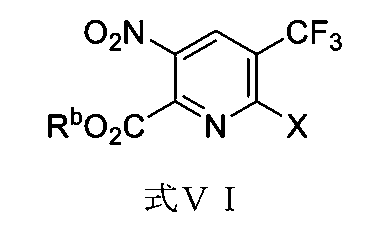
又は式VIの化合物の重水素化誘導体、又は前述のもののうちのいずれかの塩を、化合物3、

又は式VIの化合物の重水素化誘導体、又は前述のもののうちのいずれかの塩と反応させて、前記式Vの化合物、又は前記式Vの化合物の重水素化誘導体、又は前述のもののうちのいずれかの塩を生成することを含み、
式中、
-Rbが、メチル(Me)、エチル(Et)、n-プロピル(n-Pr)、イソプロピル(i-Pr)、及びtert-ブチル(t-Bu)から選択され、
-Xが、Cl及びBrから選択される、請求項43又は44に記載の方法。 The method comprises reacting a compound of formula VI:
or a deuterated derivative of a compound of formula VI, or a salt of any of the foregoing, with compound 3,
or a deuterated derivative of a compound of formula VI, or a salt of any of the foregoing, to produce said compound of formula V, or a deuterated derivative of said compound of formula V, or a salt of any of the foregoing;
During the ceremony,
-R b is selected from methyl (Me), ethyl (Et), n-propyl (n-Pr), isopropyl (i-Pr), and tert-butyl (t-Bu);
45. The method of claim 43 or 44, wherein -X is selected from Cl and Br.

又は前記式VIIの化合物の重水素化誘導体、又は前述のもののうちのいずれかの塩を、化合物3、又は化合物3の重水素化誘導体、又は前述のもののうちのいずれかの塩に変換することを含み、式中、Rcが、アミン保護基から選択される、請求項45又は46に記載の方法。 The process comprises reacting a compound of formula VII,
or the deuterated derivative of the compound of formula VII, or a salt of any of the foregoing, to compound 3, or a deuterated derivative of compound 3, or a salt of any of the foregoing, wherein R c is selected from an amine protecting group.

又は前記式VIIIの化合物の重水素化誘導体を、前記式VIIの化合物、又は前記式VIIの化合物の重水素化誘導体、又は前述のもののうちのいずれかの塩に変換することを含み、式中、Rcが、アミン保護基から選択される、請求項47又は48に記載の方法。 The method comprises reacting a compound of formula VIII:
or converting the deuterated derivative of the compound of formula VIII to the compound of formula VII, or to the deuterated derivative of the compound of formula VII, or to a salt of any of the foregoing, wherein Rc is selected from an amine protecting group.

又は前記式IXの化合物の重水素化誘導体、又は前述のもののうちのいずれかの塩を、前記式VIIIの化合物、又は前記式VIIIの化合物の重水素化誘導体、又は前述のもののうちのいずれかの塩に変換することを含み、式中、Rcが、アミン保護基から選択される、請求項49又は50に記載の方法。 The method comprises reacting a compound of formula IX,
or a salt of any of the foregoing, to a compound of formula VIII, or a deuterated derivative of a compound of formula VIII, or a salt of any of the foregoing, wherein Rc is selected from an amine protecting group.

又は前記式Xの化合物の重水素化誘導体、又は前述のもののうちのいずれかの塩を、化合物3、又は化合物3の重水素化誘導体、又は前述のもののうちのいずれかの塩に変換することを含み、式中、X1が、F、Cl、及びBrから選択される、請求項45又は46に記載の方法。 The method further comprises the step of:
or converting the deuterated derivative of the compound of formula X, or a salt of any of the foregoing, to compound 3, or a deuterated derivative of compound 3, or a salt of any of the foregoing, wherein X1 is selected from F, Cl, and Br.

又はヘキサ-5-エン-2-オンの重水素化誘導体、又は前述のもののうちのいずれかの塩を、前記式Xの化合物、又は前記式Xの化合物の重水素化誘導体、又は前述のもののうちのいずれかの塩に変換することを含み、式中、X1が、F、Cl、及びBrから選択される、請求項53又は54に記載の方法。 The process comprises the step of producing hex-5-en-2-one:
or a deuterated derivative of hex-5-en-2-one, or a salt of any of the foregoing, to said compound of formula X, or said deuterated derivative of a compound of formula X, or a salt of any of the foregoing, wherein X1 is selected from F, Cl, and Br.
(i)ヘキサ-5-エン-2-オン、又はヘキサ-5-エン-2-オンの重水素化誘導体、又は前述のもののうちのいずれかの塩を、ハロゲン化メチルマグネシウム、又は前記ハロゲン化メチルマグネシウムの重水素化誘導体、又は前述のもののうちのいずれかの塩と反応させ、
(ii)ステップ(i)の生成物を、2-ハロアセトニトリル又は前記2-ハロアセトニトリルの重水素化誘導体と反応させて、
式Xの化合物、又は前述のもののうちのいずれかの塩を生成することを含み、式中、X1が、F、Cl、及びBrから選択される、請求項55に記載の方法。 The process for converting hex-5-en-2-one, or a deuterated derivative of hex-5-en-2-one, or a salt of any of the foregoing, to said compound of formula X, or a deuterated derivative of said compound of formula X, or a salt of any of the foregoing, comprises
(i) reacting hex-5-en-2-one, or a deuterated derivative of hex-5-en-2-one, or a salt of any of the foregoing, with a methylmagnesium halide, or a deuterated derivative of said methylmagnesium halide, or a salt of any of the foregoing;
(ii) reacting the product of step (i) with a 2-haloacetonitrile or a deuterated derivative of said 2-haloacetonitrile,
56. The method of claim 55, comprising producing a compound of formula X, or a salt of any of the foregoing, wherein X1 is selected from F, Cl, and Br.

又は化合物Iの立体異性体、又は化合物Iの重水素化誘導体若しくはその立体異性体、又は前述のもののうちのいずれかの薬学的に許容される塩を調製する方法であって、前記方法が、式I、式II、又は式IIIの化合物、

又は前記化合物の立体異性体、又は前記化合物の重水素化誘導体若しくはその立体異性体、又は前述のもののうちのいずれかの塩を、化合物I、又は化合物Iの立体異性体、又は化合物Iの重水素化誘導体若しくはその立体異性体、又は前述のもののうちのいずれかの薬学的に許容される塩に変換することを含み、
式中、
-Raが、アルコール保護基から選択され、
-前記式I、式II、又は式IIIの化合物が、N’-[(2R)-2-ベンジルオキシ-2-(トリフルオロメチル)ペンタ-4-エノイル]-6-(1,1-ジメチルペンタ-4-エニルアミノ)-3-ニトロ-5-(トリフルオロメチル)ピリジン-2-カルボヒドラジド、(6R)-6-ベンジルオキシ-12,12-ジメチル-17-ニトロ-6,15-ビス(トリフルオロメチル)-19-オキサ-3,4,13,18-テトラザトリシクロ[12.3.1.12,5]ノナデカ-1(18),2,4,8,14,16-ヘキサン(E/Z混合物)、N’-[(2R)-2-ベンジルオキシ-2-(トリフルオロメチル)ヘキサ-5-エノイル]-6-[1,1-ビス(トリジュウテリオメチル)ブタ-3-エニルアミノ]-3-ニトロ-5-(トリフルオロメチル)ピリジン-2-カルボヒドラジド、(6R)-6-ベンジルオキシ-17-ニトロ-12,12-ビス(トリジュウテリオメチル)-6,15-ビス(トリフルオロメチル)-19-オキサ-3,4,13,18-テトラザトリシクロ[12.3.1.12,5]ノナデカ-1(18),2,4,9,14,16-ヘキサン(E/Z混合物)、及びその薬学的に許容される塩から選択される化合物ではない、方法。 Compound I,
or a stereoisomer of Compound I, or a deuterated derivative of Compound I or a stereoisomer thereof, or a pharma- ceutically acceptable salt of any of the foregoing, said method comprising reacting a compound of Formula I, Formula II, or Formula III:
or a stereoisomer of said compound, or a deuterated derivative of said compound or a stereoisomer thereof, or a salt of any of the foregoing, to Compound I, or a stereoisomer of Compound I, or a deuterated derivative of Compound I or a stereoisomer thereof, or a pharma- ceutically acceptable salt of any of the foregoing,
During the ceremony,
- R a is selected from an alcohol protecting group;
the compound of formula I, II or III is selected from the group consisting of N'-[(2R)-2-benzyloxy-2-(trifluoromethyl)pent-4-enoyl]-6-(1,1-dimethylpent-4-enylamino)-3-nitro-5-(trifluoromethyl)pyridine-2-carbohydrazide, (6R)-6-benzyloxy-12,12-dimethyl-17-nitro-6,15-bis(trifluoromethyl)-19-oxa-3,4,13,18-tetrazatricyclo[12.3.1.12,5]nonadeca-1(18),2,4,8,14,16-hexane (E/Z mixture), N'-[(2R)-2-benzyl oxy-2-(trifluoromethyl)hex-5-enoyl]-6-[1,1-bis(trideuteriomethyl)but-3-enylamino]-3-nitro-5-(trifluoromethyl)pyridine-2-carbohydrazide, (6R)-6-benzyloxy-17-nitro-12,12-bis(trideuteriomethyl)-6,15-bis(trifluoromethyl)-19-oxa-3,4,13,18-tetrazatricyclo[12.3.1.12,5]nonadeca-1(18),2,4,9,14,16-hexane (E/Z mixture), and pharma- ceutically acceptable salts thereof.

から選択される化合物、又は前記化合物の立体異性体、又は前記化合物の重水素化誘導体若しくはその立体異性体、又は前述のもののうちのいずれかの塩であって、
式中、
-Raが、アルコール保護基から選択され、
-前記式I、式II、又は式IIIの化合物が、N’-[(2R)-2-ベンジルオキシ-2-(トリフルオロメチル)ペンタ-4-エノイル]-6-(1,1-ジメチルペンタ-4-エニルアミノ)-3-ニトロ-5-(トリフルオロメチル)ピリジン-2-カルボヒドラジド、(6R)-6-ベンジルオキシ-12,12-ジメチル-17-ニトロ-6,15-ビス(トリフルオロメチル)-19-オキサ-3,4,13,18-テトラザトリシクロ[12.3.1.12,5]ノナデカ-1(18),2,4,8,14,16-ヘキサン(E/Z混合物)、N’-[(2R)-2-ベンジルオキシ-2-(トリフルオロメチル)ヘキサ-5-エノイル]-6-[1,1-ビス(トリジュウテリオメチル)ブタ-3-エニルアミノ]-3-ニトロ-5-(トリフルオロメチル)ピリジン-2-カルボヒドラジド、(6R)-6-ベンジルオキシ-17-ニトロ-12,12-ビス(トリジュウテリオメチル)-6,15-ビス(トリフルオロメチル)-19-オキサ-3,4,13,18-テトラザトリシクロ[12.3.1.12,5]ノナデカ-1(18),2,4,9,14,16-ヘキサン(E/Z混合物)、
及びその薬学的に許容される塩から選択される化合物ではない、化合物、又は前記化合物の立体異性体、又は前記化合物の重水素化誘導体若しくはその立体異性体、又は前述のもののうちのいずれかの塩。
or a stereoisomer of said compound, or a deuterated derivative of said compound or a stereoisomer thereof, or a salt of any of the foregoing,
During the ceremony,
- R a is selected from an alcohol protecting group;
said compound of formula I, II or III is selected from the group consisting of N'-[(2R)-2-benzyloxy-2-(trifluoromethyl)pent-4-enoyl]-6-(1,1-dimethylpent-4-enylamino)-3-nitro-5-(trifluoromethyl)pyridine-2-carbohydrazide, (6R)-6-benzyloxy-12,12-dimethyl-17-nitro-6,15-bis(trifluoromethyl)-19-oxa-3,4,13,18-tetrazatricyclo[12.3.1.12,5]nonadeca-1(18),2,4,8,14,16-hexane (E/Z mixture); , N'-[(2R)-2-benzyloxy-2-(trifluoromethyl)hex-5-enoyl]-6-[1,1-bis(trideuteriomethyl)but-3-enylamino]-3-nitro-5-(trifluoromethyl)pyridine-2-carbohydrazide, (6R)-6-benzyloxy-17-nitro-12,12-bis(trideuteriomethyl)-6,15-bis(trifluoromethyl)-19-oxa-3,4,13,18-tetrazatricyclo[12.3.1.12,5]nonadeca-1(18),2,4,9,14,16-hexane (E/Z mixture),
and a pharma- ceutically acceptable salt thereof, or a stereoisomer of said compound, or a deuterated derivative of said compound or a stereoisomer thereof, or a salt of any of the foregoing.

又は前記化合物の立体異性体、又は前記化合物の重水素化誘導体若しくはその立体異性体、又は前述のもののうちのいずれかの塩であって、式中、Raが、アルコール保護基から選択される、化合物、又は前記化合物の立体異性体、又は前記化合物の重水素化誘導体若しくはその立体異性体、又は前述のもののうちのいずれかの塩。 A compound selected from the following formulas:
or a stereoisomer of said compound, or a deuterated derivative of said compound or a stereoisomer thereof, or a salt of any of the foregoing, wherein R a is selected from an alcohol protecting group, or a stereoisomer of said compound, or a deuterated derivative of said compound or a stereoisomer thereof, or a salt of any of the foregoing.

又は前記化合物の立体異性体、又は前記化合物の重水素化誘導体若しくはその立体異性体、又は前述のもののうちのいずれかの塩。 A compound having the formula:
or a stereoisomer of said compound, or a deuterated derivative of said compound or a stereoisomer thereof, or a salt of any of the foregoing.

又は化合物Iの立体異性体、又は化合物Iの重水素化誘導体若しくはその立体異性体、又は前述のもののうちのいずれかの薬学的に許容される塩を調製する方法であって、前記方法が、式IIの化合物、

又は前記式XIの化合物の立体異性体、又は前記式XIの化合物の重水素化誘導体若しくはその立体異性体、又は前述のもののうちのいずれかの塩を、化合物I、又はその立体異性体、又は化合物Iの重水素化誘導体若しくはその立体異性体、又は前述のもののうちのいずれかの塩に変換することを含み、
式中、
Raが、アルコール保護基から選択され、
R1が、-N(Boc)2、-NHBoc、-N(Phth)、-NH(Cbz)、及び-NO2から選択される、方法。 Compound I,
or a stereoisomer of compound I, or a deuterated derivative of compound I or a stereoisomer thereof, or a pharma- ceutically acceptable salt of any of the foregoing, said method comprising:
or a stereoisomer of the compound of formula XI, or a deuterated derivative of the compound of formula XI or a stereoisomer thereof, or a salt of any of the foregoing, to compound I, or a stereoisomer thereof, or a deuterated derivative of compound I or a stereoisomer thereof, or a salt of any of the foregoing,
During the ceremony,
R a is selected from an alcohol protecting group;
The method wherein R 1 is selected from -N(Boc) 2 , -NHBoc, -N(Phth), -NH(Cbz), and -NO 2 .

又は前記式XIIの化合物の立体異性体、又は前記式XIIの化合物の重水素化誘導体若しくはその立体異性体、又は前述のもののうちのいずれかの塩を、前記式XIの化合物、又はその立体異性体、又は前記式XIの化合物の重水素化誘導体若しくはその立体異性体、又は前述のもののうちのいずれかの塩に変換することを含み、式中、
Raが、アルコール保護基から選択され、
R1が、-N(Boc)2、-NHBoc、-N(Phth)、-NH(Cbz)、及び-NO2から選択される、請求項61~63のいずれか一項に記載の方法。 The method further comprises the step of:
or a stereoisomer of said compound of formula XII, or a deuterated derivative or stereoisomer thereof of said compound of formula XII, or a salt of any of the foregoing, to said compound of formula XI, or a stereoisomer thereof, or a deuterated derivative or stereoisomer thereof of said compound of formula XI, or a salt of any of the foregoing, wherein
R a is selected from an alcohol protecting group;
The method of any one of claims 61 to 63, wherein R 1 is selected from -N(Boc) 2 , -NHBoc, -N(Phth), -NH(Cbz), and -NO 2 .

又は化合物2の重水素化誘導体、又は前述のもののうちのいずれかの塩を、式IVの化合物、

又は前記式IVの化合物の立体異性体、又は前記式IVの化合物の重水素化誘導体若しくはその立体異性体、又は前述のもののうちのいずれかの塩と反応させて、前記式XIIの化合物、又はその立体異性体、又は前記式XIIの化合物の重水素化誘導体若しくはその立体異性体、又は前述のもののうちのいずれかの塩を生成することを含み、式中、
Raが、アルコール保護基から選択され、
R1が、-N(Boc)2、-NHBoc、-N(Phth)、-NH(Cbz)、及び-NO2から選択される、請求項64又は65に記載の方法。 The method further comprises reacting a compound of formula XIII:
or a deuterated derivative of compound 2, or a salt of any of the foregoing, with a compound of formula IV,
or a stereoisomer of the compound of formula IV, or a deuterated derivative or stereoisomer thereof of the compound of formula IV, or a salt of any of the foregoing, to produce a compound of formula XII, or a stereoisomer thereof, or a deuterated derivative or stereoisomer thereof of the compound of formula XII, or a salt of any of the foregoing, wherein
R a is selected from an alcohol protecting group;
The method of claim 64 or 65, wherein R 1 is selected from -N(Boc) 2 , -NHBoc, -N(Phth), -NH(Cbz), and -NO 2 .
Applications Claiming Priority (5)
| Application Number | Priority Date | Filing Date | Title |
|---|---|---|---|
| US202263342408P | 2022-05-16 | 2022-05-16 | |
| US202263342392P | 2022-05-16 | 2022-05-16 | |
| US63/342,408 | 2022-05-16 | ||
| US63/342,392 | 2022-05-16 | ||
| PCT/US2023/022263 WO2023224924A1 (en) | 2022-05-16 | 2023-05-15 | Solid forms of a macrocyclic compounds as cftr modulators and their preparation |
Publications (1)
| Publication Number | Publication Date |
|---|---|
| JP2025517323A true JP2025517323A (en) | 2025-06-05 |
Family
ID=86760389
Family Applications (1)
| Application Number | Title | Priority Date | Filing Date |
|---|---|---|---|
| JP2024568064A Pending JP2025517323A (en) | 2022-05-16 | 2023-05-15 | Solid forms of macrocyclic compounds as CFTR modulators and their preparation |
Country Status (7)
| Country | Link |
|---|---|
| US (1) | US20250340568A1 (en) |
| EP (1) | EP4525986A1 (en) |
| JP (1) | JP2025517323A (en) |
| CN (1) | CN119731183A (en) |
| AU (1) | AU2023272562A1 (en) |
| CA (1) | CA3253977A1 (en) |
| WO (1) | WO2023224924A1 (en) |
Families Citing this family (1)
| Publication number | Priority date | Publication date | Assignee | Title |
|---|---|---|---|---|
| WO2025076235A1 (en) | 2023-10-04 | 2025-04-10 | Vertex Pharmaceuticals Incorporated | Modulators of cystic fibrosis transmembrane conductance regulator |
Family Cites Families (26)
| Publication number | Priority date | Publication date | Assignee | Title |
|---|---|---|---|---|
| MXPA04004657A (en) | 2001-11-14 | 2004-08-13 | Teva Pharma | Amorphous and crystalline forms of losartan potassium and process for their preparation. |
| RS56037B1 (en) | 2004-06-24 | 2017-09-29 | Vertex Pharma | ATP-BINDING CASSETTE TRANSPORT MODULATORS |
| CN102775396B (en) | 2005-11-08 | 2014-10-08 | 沃泰克斯药物股份有限公司 | Modulators of ATP-binding cassette transporters |
| EP3219705B1 (en) | 2005-12-28 | 2020-03-11 | Vertex Pharmaceuticals Incorporated | Pharmaceutical compositions of the amorphous form of n-[2,4-bis(1,1-dimethylethyl)-5-hydroxyphenyl]-1,4-dihydro-4-oxoquinoline-3-carboxamide |
| EP3683218B1 (en) | 2007-12-07 | 2024-09-18 | Vertex Pharmaceuticals Incorporated | Solid forms of 3-(6-(1-(2,2-difluorobenzo[d][1,3]dioxol-5-yl) cyclopropanecarboxamido)-3-methylpyridin-2-yl) benzoic acid |
| MX365732B (en) | 2007-12-07 | 2019-06-12 | Vertex Pharma | PROCESSES TO PRODUCE CYCLOALKYLCARBOXAMIDE-PYRIDIN BENZOIC ACIDS. |
| MX2011001782A (en) | 2008-08-13 | 2012-02-08 | Vertex Pharma | Pharmaceutical composition and administrations thereof. |
| EP2940016A1 (en) | 2008-11-06 | 2015-11-04 | Vertex Pharmaceuticals Incorporated | Modulators of ATP-binding cassette transporters |
| PL2408750T3 (en) | 2009-03-20 | 2016-02-29 | Vertex Pharma | Process for making modulators of cystic fibrosis transmembrane conductance regulator |
| SI2826776T1 (en) | 2010-03-25 | 2021-02-26 | Vertex Pharmaceuticals Incorporated | Solid dispersion of amorphous form of (r)-1(2,2-difluorobenzo(d)(1,3)dioxol-5-yl)-n-(1-(2,3-dihydroxypropyl)-6-fluoro-2-(1-hydroxy-2-methylpropan-2-yl)-1h-indol-5-yl)-cyclopropanecarboxamide |
| EP2560649A1 (en) | 2010-04-22 | 2013-02-27 | Vertex Pharmaceuticals Incorporated | Pharmaceutical compositions and administrations thereof |
| MX353408B (en) | 2010-04-22 | 2018-01-11 | Vertex Pharma | Process of producing cycloalkylcarboxamido-indole compounds. |
| RS56096B1 (en) | 2011-05-18 | 2017-10-31 | Concert Pharmaceuticals Inc | IVAKAFTOR DEERATED DERIVATIVES |
| HUE047354T2 (en) | 2011-05-18 | 2020-04-28 | Vertex Pharmaceuticals Europe Ltd | Deuterated derivatives of ivacaftor |
| CN103946221B (en) * | 2011-09-16 | 2016-08-03 | 诺华股份有限公司 | Heterocyclic compounds for the treatment of cystic fibrosis |
| MY183582A (en) | 2012-11-19 | 2021-02-26 | Vertex Pharmaceuticals Europe Ltd | Deuterated cftr potentiators |
| RU2744460C2 (en) | 2014-04-15 | 2021-03-09 | Вертекс Фармасьютикалз Инкорпорейтед | Pharmaceutical compositions for treating diseases mediated by cystic fibrosis transmembrane conductance regulator |
| MA41051B1 (en) | 2014-10-06 | 2020-11-30 | Vertex Pharma | Modulators of the transmembrane conductance regulator of cystic fibrosis |
| CN109803962B (en) | 2016-09-30 | 2022-04-29 | 弗特克斯药品有限公司 | Modulators of cystic fibrosis transmembrane conductance regulatory proteins, and pharmaceutical compositions |
| MD3551622T2 (en) | 2016-12-09 | 2021-03-31 | Vertex Pharma | Modulator of cystic fibrosis transmembrane conductance regulator, pharmaceutical compositions, methods of treatment, and process for making the modulator |
| EP3720849A2 (en) | 2017-12-08 | 2020-10-14 | Vertex Pharmaceuticals Incorporated | Processes for making modulators of cystic fibrosis transmembrane conductance regulator |
| JP7214743B2 (en) | 2018-02-15 | 2023-01-30 | バーテックス ファーマシューティカルズ インコーポレイテッド | Macrocycles as modulators of cystic fibrosis transmembrane conductance regulators, pharmaceutical compositions thereof, their use in the treatment of cystic fibrosis, and methods for their preparation |
| EA202191361A1 (en) | 2018-11-14 | 2021-08-11 | Вертекс Фармасьютикалз Инкорпорейтед | METHODS FOR TREATMENT OF MUCOVISCIDOSIS |
| UY38630A (en) | 2019-04-03 | 2020-10-30 | Vertex Pharma | MODULATING AGENTS OF THE TRANSMEMBRANE CONDUCTANCE REGULATOR OF CYSTIC FIBROSIS |
| CR20230120A (en) * | 2020-08-07 | 2023-09-01 | Vertex Pharma | Modulators of cystic fibrosis transmembrane conductance regulator |
| CA3201793A1 (en) | 2020-11-18 | 2022-05-27 | Vertex Pharmaceuticals Incorporated | Macrocycles containing a 1,3,4-oxadiazole ring for use as modulators of cystic fibrosis transmembrane conductance regulator |
-
2023
- 2023-05-15 JP JP2024568064A patent/JP2025517323A/en active Pending
- 2023-05-15 CA CA3253977A patent/CA3253977A1/en active Pending
- 2023-05-15 WO PCT/US2023/022263 patent/WO2023224924A1/en not_active Ceased
- 2023-05-15 CN CN202380053773.3A patent/CN119731183A/en active Pending
- 2023-05-15 AU AU2023272562A patent/AU2023272562A1/en active Pending
- 2023-05-15 US US18/864,468 patent/US20250340568A1/en active Pending
- 2023-05-15 EP EP23730290.6A patent/EP4525986A1/en active Pending
Also Published As
| Publication number | Publication date |
|---|---|
| CN119731183A (en) | 2025-03-28 |
| CA3253977A1 (en) | 2023-11-23 |
| AU2023272562A1 (en) | 2024-11-07 |
| US20250340568A1 (en) | 2025-11-06 |
| WO2023224924A1 (en) | 2023-11-23 |
| EP4525986A1 (en) | 2025-03-26 |
Similar Documents
| Publication | Publication Date | Title |
|---|---|---|
| US20240368189A1 (en) | Modulators of Cystic Fibrosis Transmembrane Conductance Regulator, Pharmaceutical Compositions, Methods of Treatment, and Process for Making the Modulators | |
| US11186566B2 (en) | Modulator of cystic fibrosis transmembrane conductance regulator, pharmaceutical compositions, methods of treatment, and process for making the modulator | |
| AU2017371200B2 (en) | Modulator of cystic fibrosis transmembrane conductance regulator, pharmaceutical compositions, methods of treatment, and process for making the modulator | |
| JP2022545633A (en) | Modulator of cystic fibrosis transmembrane conductance regulator | |
| EP4225761A1 (en) | Modulators of cystic fibrosis transmembrane conductance regulator | |
| WO2022076626A1 (en) | Modulators of cystic fibrosis transmembrane conductance regulator | |
| WO2009019553A2 (en) | Imidazopyridinones | |
| JP2023552828A (en) | How to treat cystic fibrosis | |
| AU2023254866B2 (en) | Compounds and compositions for treating conditions associated with APJ receptor activity | |
| JP2025517323A (en) | Solid forms of macrocyclic compounds as CFTR modulators and their preparation | |
| JP2025505577A (en) | Preparation method and crystalline form of (6A,12A)-17-amino-12-methyl-6,15-bis(trifluoromethyl)-13,19-dioxa-3,4,18-triazatricyclo[12.3.1.12,5]nonadeca-1(18),2,4,14,16-pentaen-6-ol | |
| US20230365587A1 (en) | Modulators of cystic fibrosis transmembrane conductance regulator | |
| HK40011778A (en) | Modulator of cystic fibrosis transmembrane conductance regulator, pharmaceutical compositions, methods of treatment, and process for making the modulator | |
| HK40011778B (en) | Modulator of cystic fibrosis transmembrane conductance regulator, pharmaceutical compositions, methods of treatment, and process for making the modulator | |
| CN101632664A (en) | Imidazopyridine substituted tropane derivatives with ccr5 receptor antagonist activity for the treatment of HIV and inflammation | |
| OA19370A (en) | Modulator of cystic fibrosis transmembrane conductance regulator, pharmaceutical compositions, methods of treatment, and process for making the modulator. |