JP2025510388A - Benzamide enaminone derivatives and methods of use thereof - Google Patents
Benzamide enaminone derivatives and methods of use thereof Download PDFInfo
- Publication number
- JP2025510388A JP2025510388A JP2024558210A JP2024558210A JP2025510388A JP 2025510388 A JP2025510388 A JP 2025510388A JP 2024558210 A JP2024558210 A JP 2024558210A JP 2024558210 A JP2024558210 A JP 2024558210A JP 2025510388 A JP2025510388 A JP 2025510388A
- Authority
- JP
- Japan
- Prior art keywords
- certain embodiments
- substituted
- unsubstituted
- formula
- alkyl
- Prior art date
- Legal status (The legal status is an assumption and is not a legal conclusion. Google has not performed a legal analysis and makes no representation as to the accuracy of the status listed.)
- Pending
Links
Images


Classifications
-
- C—CHEMISTRY; METALLURGY
- C07—ORGANIC CHEMISTRY
- C07C—ACYCLIC OR CARBOCYCLIC COMPOUNDS
- C07C233/00—Carboxylic acid amides
- C07C233/64—Carboxylic acid amides having carbon atoms of carboxamide groups bound to carbon atoms of six-membered aromatic rings
- C07C233/76—Carboxylic acid amides having carbon atoms of carboxamide groups bound to carbon atoms of six-membered aromatic rings having the nitrogen atom of at least one of the carboxamide groups bound to a carbon atom of a hydrocarbon radical substituted by doubly-bound oxygen atoms
-
- C—CHEMISTRY; METALLURGY
- C07—ORGANIC CHEMISTRY
- C07C—ACYCLIC OR CARBOCYCLIC COMPOUNDS
- C07C233/00—Carboxylic acid amides
- C07C233/64—Carboxylic acid amides having carbon atoms of carboxamide groups bound to carbon atoms of six-membered aromatic rings
- C07C233/81—Carboxylic acid amides having carbon atoms of carboxamide groups bound to carbon atoms of six-membered aromatic rings having the nitrogen atom of at least one of the carboxamide groups bound to a carbon atom of a hydrocarbon radical substituted by carboxyl groups
- C07C233/82—Carboxylic acid amides having carbon atoms of carboxamide groups bound to carbon atoms of six-membered aromatic rings having the nitrogen atom of at least one of the carboxamide groups bound to a carbon atom of a hydrocarbon radical substituted by carboxyl groups with the substituted hydrocarbon radical bound to the nitrogen atom of the carboxamide group by an acyclic carbon atom
- C07C233/85—Carboxylic acid amides having carbon atoms of carboxamide groups bound to carbon atoms of six-membered aromatic rings having the nitrogen atom of at least one of the carboxamide groups bound to a carbon atom of a hydrocarbon radical substituted by carboxyl groups with the substituted hydrocarbon radical bound to the nitrogen atom of the carboxamide group by an acyclic carbon atom of an acyclic unsaturated carbon skeleton
-
- A—HUMAN NECESSITIES
- A61—MEDICAL OR VETERINARY SCIENCE; HYGIENE
- A61K—PREPARATIONS FOR MEDICAL, DENTAL OR TOILETRY PURPOSES
- A61K31/00—Medicinal preparations containing organic active ingredients
- A61K31/16—Amides, e.g. hydroxamic acids
- A61K31/165—Amides, e.g. hydroxamic acids having aromatic rings, e.g. colchicine, atenolol, progabide
- A61K31/166—Amides, e.g. hydroxamic acids having aromatic rings, e.g. colchicine, atenolol, progabide having the carbon of a carboxamide group directly attached to the aromatic ring, e.g. procainamide, procarbazine, metoclopramide, labetalol
-
- A—HUMAN NECESSITIES
- A61—MEDICAL OR VETERINARY SCIENCE; HYGIENE
- A61K—PREPARATIONS FOR MEDICAL, DENTAL OR TOILETRY PURPOSES
- A61K45/00—Medicinal preparations containing active ingredients not provided for in groups A61K31/00 - A61K41/00
- A61K45/06—Mixtures of active ingredients without chemical characterisation, e.g. antiphlogistics and cardiaca
-
- A—HUMAN NECESSITIES
- A61—MEDICAL OR VETERINARY SCIENCE; HYGIENE
- A61P—SPECIFIC THERAPEUTIC ACTIVITY OF CHEMICAL COMPOUNDS OR MEDICINAL PREPARATIONS
- A61P25/00—Drugs for disorders of the nervous system
- A61P25/08—Antiepileptics; Anticonvulsants
-
- C—CHEMISTRY; METALLURGY
- C07—ORGANIC CHEMISTRY
- C07C—ACYCLIC OR CARBOCYCLIC COMPOUNDS
- C07C235/00—Carboxylic acid amides, the carbon skeleton of the acid part being further substituted by oxygen atoms
- C07C235/42—Carboxylic acid amides, the carbon skeleton of the acid part being further substituted by oxygen atoms having carbon atoms of carboxamide groups bound to carbon atoms of six-membered aromatic rings and singly-bound oxygen atoms bound to the same carbon skeleton
- C07C235/44—Carboxylic acid amides, the carbon skeleton of the acid part being further substituted by oxygen atoms having carbon atoms of carboxamide groups bound to carbon atoms of six-membered aromatic rings and singly-bound oxygen atoms bound to the same carbon skeleton with carbon atoms of carboxamide groups and singly-bound oxygen atoms bound to carbon atoms of the same non-condensed six-membered aromatic ring
- C07C235/54—Carboxylic acid amides, the carbon skeleton of the acid part being further substituted by oxygen atoms having carbon atoms of carboxamide groups bound to carbon atoms of six-membered aromatic rings and singly-bound oxygen atoms bound to the same carbon skeleton with carbon atoms of carboxamide groups and singly-bound oxygen atoms bound to carbon atoms of the same non-condensed six-membered aromatic ring having the nitrogen atom of at least one of the carboxamide groups bound to a carbon atom of a ring other than a six-membered aromatic ring
-
- C—CHEMISTRY; METALLURGY
- C07—ORGANIC CHEMISTRY
- C07C—ACYCLIC OR CARBOCYCLIC COMPOUNDS
- C07C255/00—Carboxylic acid nitriles
- C07C255/49—Carboxylic acid nitriles having cyano groups bound to carbon atoms of six-membered aromatic rings of a carbon skeleton
- C07C255/57—Carboxylic acid nitriles having cyano groups bound to carbon atoms of six-membered aromatic rings of a carbon skeleton containing cyano groups and carboxyl groups, other than cyano groups, bound to the carbon skeleton
-
- C—CHEMISTRY; METALLURGY
- C07—ORGANIC CHEMISTRY
- C07C—ACYCLIC OR CARBOCYCLIC COMPOUNDS
- C07C323/00—Thiols, sulfides, hydropolysulfides or polysulfides substituted by halogen, oxygen or nitrogen atoms, or by sulfur atoms not being part of thio groups
- C07C323/50—Thiols, sulfides, hydropolysulfides or polysulfides substituted by halogen, oxygen or nitrogen atoms, or by sulfur atoms not being part of thio groups containing thio groups and carboxyl groups bound to the same carbon skeleton
- C07C323/62—Thiols, sulfides, hydropolysulfides or polysulfides substituted by halogen, oxygen or nitrogen atoms, or by sulfur atoms not being part of thio groups containing thio groups and carboxyl groups bound to the same carbon skeleton having the sulfur atom of at least one of the thio groups bound to a carbon atom of a six-membered aromatic ring of the carbon skeleton
-
- C—CHEMISTRY; METALLURGY
- C07—ORGANIC CHEMISTRY
- C07C—ACYCLIC OR CARBOCYCLIC COMPOUNDS
- C07C2601/00—Systems containing only non-condensed rings
- C07C2601/12—Systems containing only non-condensed rings with a six-membered ring
- C07C2601/16—Systems containing only non-condensed rings with a six-membered ring the ring being unsaturated
Landscapes
- Chemical & Material Sciences (AREA)
- Organic Chemistry (AREA)
- Health & Medical Sciences (AREA)
- Life Sciences & Earth Sciences (AREA)
- Pharmacology & Pharmacy (AREA)
- Animal Behavior & Ethology (AREA)
- General Health & Medical Sciences (AREA)
- Public Health (AREA)
- Veterinary Medicine (AREA)
- Medicinal Chemistry (AREA)
- Epidemiology (AREA)
- Engineering & Computer Science (AREA)
- Pain & Pain Management (AREA)
- Bioinformatics & Cheminformatics (AREA)
- Biomedical Technology (AREA)
- Neurology (AREA)
- Neurosurgery (AREA)
- Chemical Kinetics & Catalysis (AREA)
- General Chemical & Material Sciences (AREA)
- Nuclear Medicine, Radiotherapy & Molecular Imaging (AREA)
- Pharmaceuticals Containing Other Organic And Inorganic Compounds (AREA)
- Acyclic And Carbocyclic Compounds In Medicinal Compositions (AREA)
- Organic Low-Molecular-Weight Compounds And Preparation Thereof (AREA)
Abstract

本開示は、新規ベンズアミドエナミノン化合物及びそれらの薬学的に許容される塩、並びにそのような化合物及び薬学的に許容される塩を含む組成物を包含する。本開示は、発作を起こすリスクのある対象を治療する方法、及び/又は、発作若しくはそれに関連する発作障害の発生若しくは重症度を低減若しくは予防する方法を必要とする対象に、化合物若しくはその薬学的に許容される塩又はその組成物を投与することによる方法を更に包含する。幾つかの実施形態において、本開示は、発作又は発作障害の発生を治療、予防、又は抑制するために相乗的に作用する薬剤の組成物及び組合せを包含する。
【選択図】 図2
The present disclosure encompasses novel benzamide enaminone compounds and their pharma- ceutically acceptable salts, as well as compositions comprising such compounds and pharma- ceutically acceptable salts.The present disclosure further encompasses methods of treating a subject at risk of having a seizure and/or reducing or preventing the occurrence or severity of seizures or seizure disorders associated therewith by administering the compounds or their pharma- ceutically acceptable salts or compositions thereof to a subject in need of such methods.In some embodiments, the present disclosure encompasses compositions and combinations of agents that act synergistically to treat, prevent, or inhibit the occurrence of seizures or seizure disorders.
[Selected figure] Figure 2
Description
[関連出願の相互参照]
本願は、2022年3月28日付出願の米国仮特許出願第63/324,579号の優先権及び利益を主張し、その内容は参照により全体として本明細書に援用する。
CROSS-REFERENCE TO RELATED APPLICATIONS
This application claims priority to and the benefit of U.S. Provisional Patent Application No. 63/324,579, filed March 28, 2022, the contents of which are incorporated by reference in their entirety herein.
本発明の分野は、概して、新規ベンズアミドエナミノン化合物、それらの調製、及び例えば、発作又は発作障害を治療するためのその使用に関する。 The field of the invention generally relates to novel benzamide enaminone compounds, their preparation, and their use, for example, to treat seizures or seizure disorders.
癲癇は、4番目によく見られる神経障害であり、慢性で多くの場合進行性の疾患である。米国ではおよそ300万人、世界では7000万人が罹患している。米国人26人に約1人が、生涯の或る時点で癲癇と診断されることが知られている。癲癇は、脳内のニューロン放電の過活動によって引き起こされる、短時間の自然反復性、痙攣性、及び非痙攣性の発作を特徴とする。癲癇発作は、(a)全般発作及び(b)焦点発作の2つの主カテゴリーに分けられる。全般発作は、脳全体に影響を及ぼす電気的ニューロン放電から始まるが、焦点発作では、異常なニューロン放電は脳の1つの領域に局在する。癲癇の管理は、障害の病態生理についての理解が限られているため、困難であり得る。癲癇の治療の目標は、重大な薬物誘発性副作用を伴わない完全な発作消失である。利用可能な抗癲癇薬(AED)を最適に使用しても、30%~35%の患者は薬剤抵抗性癲癇(DRE)になると考えられている。国際抗癲癇連盟によれば、DREは、「発作の消失を達成し維持するために適切に選択され、適切な期間使用された少なくとも2つの抗癲癇薬剤に患者の発作が反応しないこと」と定義されている。DREは、既知の治療がないため、癲癇コミュニティにおいて負担が増大しつつある。その結果、DREの管理のための新規治療法の開発に対する需要が高まっている。 Epilepsy is the fourth most common neurological disorder and is a chronic and often progressive disease. It affects approximately 3 million people in the United States and 70 million people worldwide. Approximately 1 in 26 Americans is known to be diagnosed with epilepsy at some point in their lives. Epilepsy is characterized by brief, spontaneous, recurrent, convulsive, and non-convulsive seizures caused by hyperactivity of neuronal discharges in the brain. Epileptic seizures are divided into two main categories: (a) generalized seizures and (b) focal seizures. Generalized seizures begin with electrical neuronal discharges that affect the entire brain, whereas in focal seizures, the abnormal neuronal discharges are localized to one area of the brain. Managing epilepsy can be challenging due to limited understanding of the pathophysiology of the disorder. The goal of treatment for epilepsy is complete seizure freedom without significant drug-induced side effects. Even with optimal use of available antiepileptic drugs (AEDs), 30%-35% of patients are believed to develop drug-resistant epilepsy (DRE). According to the International League Against Epilepsy, DRE is defined as "the failure of a patient's seizures to respond to at least two antiepileptic drugs appropriately selected and used for an adequate duration to achieve and maintain seizure freedom." DRE is a growing burden in the epilepsy community due to the lack of known treatment. As a result, there is an increasing demand for the development of novel therapies for the management of DRE.
DREに対処するための療法の臨床的必要性のために、本開示は、潜在的な抗痙攣薬剤としての新規ベンズアミドエナミノンの設計、合成、及び評価を包含する。 Because of the clinical need for therapies to address DRE, this disclosure encompasses the design, synthesis, and evaluation of novel benzamide enaminones as potential anticonvulsant agents.
本開示は、新規ベンズアミドエナミノン誘導体及びそれらの薬学的に許容される塩、並びにそのような化合物及び薬学的に許容される塩を含む組成物を包含する。
本開示はまた、発作を治療若しくは予防する方法、発作若しくは発作障害の発生を軽減する方法、又は発作の発生のリスクを低減する方法を必要とする対象において、本明細書に開示されるフッ素化ベンズアミドエナミノン誘導体若しくは薬学的に許容される塩、又はそのような化合物誘導体若しくはその塩を含む組成物を投与することによる方法を包含する。
本開示はまた、発作を治療若しくは予防する方法、発作若しくは発作障害の発生を軽減する方法、又は発作の発生のリスクを低減する方法を必要とする対象において、本明細書に開示される塩素化ベンズアミドエナミノン誘導体若しくは薬学的に許容される塩、又はそのような化合物誘導体若しくはその塩を含む組成物を投与することによる方法を包含する。
The present disclosure encompasses novel benzamide enaminone derivatives and their pharma- ceutically acceptable salts, as well as compositions comprising such compounds and pharma- ceutically acceptable salts.
The present disclosure also encompasses methods of treating or preventing seizures, reducing the occurrence of seizures or seizure disorders, or reducing the risk of occurrence of seizures in a subject in need thereof by administering a fluorinated benzamide enaminone derivative or a pharma- ceutically acceptable salt disclosed herein, or a composition comprising such a compound derivative or salt thereof.
The present disclosure also encompasses methods of treating or preventing seizures, reducing the occurrence of seizures or seizure disorders, or reducing the risk of occurrence of seizures in a subject in need thereof by administering a chlorinated benzamide enaminone derivative or a pharma- ceutically acceptable salt disclosed herein, or a composition comprising such a compound derivative or salt thereof.
幾つかの実施形態において、本開示は、化合物、化合物を含む組成物、並びに発作及び関連障害の予防及び/又は治療において化合物及び組成物を使用する方法を提供する。
幾つかの実施形態において、本開示は、新規フッ素化N-フェニル又はN-ベンジルエナミノンを提供する。化合物は、化合物の薬学的に許容される塩の形態であってもよい。組成物は、化合物の1つ又は組合せを含む薬学的配合物を含み、それを必要とする対象(例えば、哺乳動物、好ましくはヒト)への投与に好適である。一実施形態において、本開示は、化合物のうちの1つ以上と薬学的に許容される担体とを含む組成物を提供する。
In some embodiments, the disclosure provides compounds, compositions comprising the compounds, and methods of using the compounds and compositions in the prevention and/or treatment of stroke and related disorders.
In some embodiments, the disclosure provides novel fluorinated N-phenyl or N-benzyl enaminones. The compounds may be in the form of a pharma- ceutically acceptable salt of the compounds. Compositions include pharmaceutical formulations comprising one or a combination of the compounds and are suitable for administration to a subject (e.g., a mammal, preferably a human) in need thereof. In one embodiment, the disclosure provides a composition comprising one or more of the compounds and a pharma- ceutically acceptable carrier.
幾つかの実施形態において、本開示は、新規塩素化N-フェニル、3-ピリジニル、又はN-ベンジルエナミノンを提供する。化合物は、化合物の薬学的に許容される塩の形態であってもよい。組成物は、化合物の1つ又は組合せを含む薬学的配合物を含み、それを必要とする対象(例えば、哺乳動物、好ましくはヒト)への投与に好適である。一実施形態において、本開示は、化合物のうちの1つ以上と薬学的に許容される担体とを含む組成物を提供する。 In some embodiments, the disclosure provides novel chlorinated N-phenyl, 3-pyridinyl, or N-benzyl enaminones. The compounds may be in the form of a pharma- ceutically acceptable salt of the compounds. Compositions include pharmaceutical formulations that include one or a combination of the compounds and are suitable for administration to a subject (e.g., a mammal, preferably a human) in need thereof. In one embodiment, the disclosure provides a composition that includes one or more of the compounds and a pharma- ceutically acceptable carrier.
一実施形態において、本発明の化合物、組成物、及び方法は、式(I)及び式(Ia): In one embodiment, the compounds, compositions, and methods of the present invention are represented by formula (I) and formula (Ia):

(式中、
Xは、O又はSであり、
R1は、少なくとも1つのハロゲン、アルキル、若しくは1つ~3つのハロゲン基で置換されたアルキルを有するアリール環又はヘテロアリール環であるか、又はR1は、置換ヘテロアリール(例えば、置換3-ピリジン)であり、
R2は、水素又はC1~C3アルキルであり、
各R3は、独立して、ヒドロキシル、ハロゲン、シアノ、アミノ、ニトロ、置換又は非置換アルキル、置換又は非置換アルケニル、置換又は非置換アルキニルであり、
nは、1~6の整数である)の化合物又はそれらの薬学的に許容される塩、水和物、溶媒和物、エナンチオマー、ジアステレオマー、ラセミ体若しくは立体異性体の混合物を含む。
(Wherein,
X is O or S;
R 1 is an aryl or heteroaryl ring having at least one halogen, alkyl, or alkyl substituted with 1 to 3 halogen groups, or R 1 is a substituted heteroaryl (e.g., a substituted 3-pyridine);
R2 is hydrogen or C1 - C3 alkyl;
each R3 is independently hydroxyl, halogen, cyano, amino, nitro, substituted or unsubstituted alkyl, substituted or unsubstituted alkenyl, substituted or unsubstituted alkynyl;
and n is an integer from 1 to 6, or a pharma- ceutically acceptable salt, hydrate, solvate, enantiomer, diastereomer, racemate, or stereoisomeric mixture thereof.
或る特定の実施形態において、R1及びR3の一方又は両方は、ハロゲン置換基又は1つ以上のハロゲン置換基で置換されたアルキルを含む。 In certain embodiments, one or both of R 1 and R 3 include a halogen substituent or an alkyl substituted with one or more halogen substituents.
別の実施形態において、本発明の化合物、組成物、及び方法は、式(II): In another embodiment, the compounds, compositions, and methods of the present invention have the formula (II):

(式中、
R1は、-OH、-CN、置換若しくは非置換チオアルキル、置換若しくは非置換アルキル、置換若しくは非置換アルケニル、置換若しくは非置換アルキニル、ハロ、置換若しくは非置換アリール、置換若しくは非置換アリールオキシ、又は置換若しくは非置換アルキルオキシであり、
R2、R3、R4、又はR5のそれぞれは、独立して、-H、-OH、-CN、置換若しくは非置換チオアルキル、ニトロ、SCF3、OCF3、置換若しくは非置換アルキル、置換若しくは非置換アルケニル、置換若しくは非置換アルキニル、ハロ、置換若しくは非置換アリール、置換若しくは非置換アリールオキシ、又は置換若しくは非置換アルキルオキシから選択され、
R6、R7、R8、R9、R10、又はR11のそれぞれは、独立して、-H、-OH、-CN、置換若しくは非置換チオアルキル、置換若しくは非置換アルキル、置換若しくは非置換アルケニル、置換若しくは非置換アルキニル、ハロ、置換若しくは非置換アリール、置換若しくは非置換アリールオキシ、又は置換若しくは非置換アルキルオキシから選択され、
R12は、-H又は置換若しくは非置換アルキルであり、
Xは、Oであり、
Yは、-NR13であり、
各R13は、独立して、-H又は置換若しくは非置換アルキル(C1~C6アルキル)から選択される)の化合物又はそれらの薬学的に許容される塩、水和物、溶媒和物、エナンチオマー、ジアステレオマー、ラセミ体若しくは立体異性体の混合物を含み、
式中、R3とR8/R9とは同一ではない。
(Wherein,
R 1 is -OH, -CN, substituted or unsubstituted thioalkyl, substituted or unsubstituted alkyl, substituted or unsubstituted alkenyl, substituted or unsubstituted alkynyl, halo, substituted or unsubstituted aryl, substituted or unsubstituted aryloxy, or substituted or unsubstituted alkyloxy;
each of R 2 , R 3 , R 4 , or R 5 is independently selected from -H, -OH, -CN, substituted or unsubstituted thioalkyl, nitro, SCF 3 , OCF 3 , substituted or unsubstituted alkyl, substituted or unsubstituted alkenyl, substituted or unsubstituted alkynyl, halo, substituted or unsubstituted aryl, substituted or unsubstituted aryloxy, or substituted or unsubstituted alkyloxy;
each of R 6 , R 7 , R 8 , R 9 , R 10 , or R 11 is independently selected from -H, -OH, -CN, substituted or unsubstituted thioalkyl, substituted or unsubstituted alkyl, substituted or unsubstituted alkenyl, substituted or unsubstituted alkynyl, halo, substituted or unsubstituted aryl, substituted or unsubstituted aryloxy, or substituted or unsubstituted alkyloxy;
R 12 is —H or substituted or unsubstituted alkyl;
X is O;
Y is -NR13 ;
each R 13 is independently selected from -H or substituted or unsubstituted alkyl (C1-C6 alkyl), or a pharma- ceutically acceptable salt, hydrate, solvate, enantiomer, diastereomer, racemate or mixture of stereoisomers thereof;
In the formula, R 3 and R 8 /R 9 are not the same.
或る特定の実施形態において、R1~R5のうちの少なくとも1つは、-F若しくは-Cl、1つ以上の-F基若しくは-Cl基を含む置換アルキル、又は1つ以上の-F基を含む置換アルキルオキシである。
或る特定の実施形態において、R7~R12のうちの少なくとも1つは、-F、1つ以上の-F基を含む置換アルキル、又は1つ以上の-F基を含む置換アルキルオキシである。
In certain embodiments, at least one of R 1 -R 5 is -F or -Cl, a substituted alkyl containing one or more -F or -Cl groups, or a substituted alkyloxy containing one or more -F groups.
In certain embodiments, at least one of R 7 -R 12 is -F, a substituted alkyl containing one or more -F groups, or a substituted alkyloxy containing one or more -F groups.
別の実施形態において、本発明の化合物、組成物、及び方法は、式(III)又は式(IIIa): In another embodiment, the compounds, compositions, and methods of the present invention have the formula (III) or formula (IIIa):

(式中、
R1は、ハロゲン又は1つ~3つのハロゲン基で置換されたアルキルであり、
R2は、水素又はC1~C3アルキルであり、
R3は、独立して、ヒドロキシル、ハロゲン、シアノ、アミノ、ニトロ、又は1つ~3つのハロゲン基で置換されたアルキルであり、
nは、存在する場合、1~6の整数である)の化合物又はそれらの薬学的に許容される塩、水和物、溶媒和物、エナンチオマー、ジアステレオマー、ラセミ体若しくは立体異性体の混合物を含む。
(Wherein,
R 1 is halogen or alkyl substituted with 1 to 3 halogen groups;
R2 is hydrogen or C1 - C3 alkyl;
R3 is independently hydroxyl, halogen, cyano, amino, nitro, or alkyl substituted with 1 to 3 halogen groups;
and n, if present, is an integer from 1 to 6, or a pharma- ceutically acceptable salt, hydrate, solvate, enantiomer, diastereomer, racemate, or stereoisomeric mixture thereof.
別の実施形態において、本発明の化合物、組成物、及び方法は、式(IV): In another embodiment, the compounds, compositions, and methods of the present invention have formula (IV):

(式中、
R1は、ハロゲン又は1つ~3つのハロゲン基で置換されたアルキルであり、
R2は、水素又はC1~C3アルキルであり、
R3は、ハロゲン又は1つ~3つのハロゲン基で置換されたアルキルである)
の化合物又はそれらの薬学的に許容される塩、水和物、溶媒和物、エナンチオマー、ジアステレオマー、ラセミ体若しくは立体異性体の混合物を含む。
(Wherein,
R 1 is halogen or alkyl substituted with 1 to 3 halogen groups;
R2 is hydrogen or C1 - C3 alkyl;
R3 is a halogen or an alkyl substituted with 1 to 3 halogen groups.
or a pharma- ceutically acceptable salt, hydrate, solvate, enantiomer, diastereomer, racemate or stereoisomeric mixture thereof.
或る特定の実施形態において、R1は、フッ化物又は塩化物を含むハロゲンである。或る特定の実施形態において、R1はフッ化物である。
或る特定の実施形態において、R1は、1つ~3つのフッ化物置換基又は塩化物置換基を含む置換アルキルである。或る特定の実施形態において、R1はトリフルオロメチルである。
In certain embodiments, R 1 is halogen, including fluoride or chloride, In certain embodiments, R 1 is fluoride.
In certain embodiments, R 1 is a substituted alkyl containing from 1 to 3 fluoride or chloride substituents, hi certain embodiments, R 1 is trifluoromethyl.
本発明は、発作を起こすリスクのある対象を治療する方法、及び/又は、発作又はそれに関連する発作障害の発生又は重症度を低減又は予防する方法を必要とする対象に、治療的又は予防的有効量の式(I)、式(II)、式(III)、若しくは式(IV)の化合物又はその薬学的に許容される塩を投与することによる方法に関する。
様々な実施形態において、式(I)、式(II)、式(III)、若しくは式(IV)の化合物、又はそれらの薬学的に許容される塩若しくは溶媒和物を含む組成物を、それを必要とする対象に投与することは、以下:対象の発作の予防、発作の持続時間若しくは強度の低減、発作の1日当たりの発生回数の低減、及び/又は発作の重症度の予防若しくは軽減のうちの1つ以上をもたらす。
The present invention relates to a method of treating a subject at risk of having a seizure and/or reducing or preventing the occurrence or severity of seizures or related seizure disorders by administering to a subject in need thereof a therapeutically or prophylactically effective amount of a compound of Formula (I), Formula (II), Formula (III), or Formula (IV) or a pharma- ceutically acceptable salt thereof.
In various embodiments, administering a composition comprising a compound of Formula (I), Formula (II), Formula (III), or Formula (IV), or a pharma- ceutically acceptable salt or solvate thereof, to a subject in need thereof results in one or more of the following: prevention of seizures in the subject, reduction in the duration or intensity of seizures, reduction in the number of daily occurrences of seizures, and/or prevention or reduction in the severity of seizures.
本発明の方法は、例えば、相乗作用を達成すること、又は拮抗作用を回避することにおいて、より大きな全体的有効性等の利点を提供し、所望の場合、用いられる個々の薬剤のうちの1つ以上の量の低減と同時に副作用の低減を可能にする。さらに、治療される発作が所与の抗癲癇薬剤に最適に反応しない場合でも、本方法における本医薬組成物の使用は、効果的な治療を提供することができる。
本開示はまた、式(I)、式(II)、式(III)、又は式(IV)の化合物と、薬学的に許容される担体又は賦形剤とを含む医薬組成物を含む。本発明の範囲内にあると考えられる医薬組成物は、薬学的に許容される希釈剤、防腐剤、可溶化剤、乳化剤、アジュバント及び/又は担体を含む。様々な実施形態において、医薬組成物は、任意の好適な投与経路、例えば、非経口的、経粘膜的、経口的、経鼻的、若しくは直腸的、又は経皮的により投与することができる。好ましくは、投与は、例えば、錠剤又はカプセルを介して経口である。代替的な投与手段としては、細動脈内、筋肉内、皮内、皮下、腹腔内、脳室内、及び頭蓋内投与が挙げられるが、これらに限定されない。
The methods of the invention provide advantages such as greater overall efficacy, for example in achieving synergy or avoiding antagonism, and allow for reduced side effects, if desired, with a concomitant reduction in the amount of one or more of the individual drugs used. Furthermore, use of the pharmaceutical compositions in the methods can provide effective treatment even when the seizures being treated do not respond optimally to a given anti-epileptic drug.
The present disclosure also includes pharmaceutical compositions comprising a compound of formula (I), formula (II), formula (III), or formula (IV) and a pharma- ceutically acceptable carrier or excipient. Pharmaceutical compositions contemplated within the scope of the present invention include pharma- ceutically acceptable diluents, preservatives, solubilizers, emulsifiers, adjuvants, and/or carriers. In various embodiments, the pharmaceutical compositions can be administered by any suitable route of administration, for example, parenterally, mucosally, orally, nasally, or rectally, or transdermally. Preferably, administration is oral, for example, via a tablet or capsule. Alternative means of administration include, but are not limited to, intraarteriolar, intramuscular, intradermal, subcutaneous, intraperitoneal, intraventricular, and intracranial administration.
本発明の医薬組成物は、静脈内注入、埋め込み型浸透圧ポンプ、経皮パッチ、又は他の投与様式を使用する等の制御放出系で送達することができる。 The pharmaceutical compositions of the present invention can be delivered in a controlled release system, such as using intravenous infusion, an implantable osmotic pump, a transdermal patch, or other modes of administration.
定義
特に定義されない限り、本明細書で使用される全ての技術用語及び科学用語は、本明細書の開示が属する技術分野の当業者によって一般に理解されるものと同じ意味を有する。
本明細書で使用される「約」又は「およそ」という用語は、当業者によって決定される特定の値について許容可能な誤差範囲内であることを意味し、これは、値がどのように測定又は決定されるか、すなわち、測定システムの限界に部分的に依存する。例えば、「約」は、当該技術分野における慣行に従って、3標準偏差内又は3標準偏差超を意味し得る。あるいは、「約」は、所与の値の20%まで、好ましくは10%まで、より好ましくは5%まで、更により好ましくは1%までの範囲を意味し得る。あるいは、特に生物学的システム又はプロセスに関して、この用語は、値の1桁内、好ましくは5倍内、より好ましくは2倍内を意味し得る。
Definitions Unless otherwise defined, all technical and scientific terms used herein have the same meaning as commonly understood by one of ordinary skill in the art to which this disclosure belongs.
The term "about" or "approximately" as used herein means within an acceptable error range for a particular value as determined by one of ordinary skill in the art, which depends in part on how the value is measured or determined, i.e., the limitations of the measurement system. For example, "about" can mean within 3 standard deviations or more than 3 standard deviations, according to practices in the art. Alternatively, "about" can mean within a range of up to 20%, preferably up to 10%, more preferably up to 5%, and even more preferably up to 1% of a given value. Alternatively, particularly with respect to biological systems or processes, the term can mean within an order of magnitude, preferably within 5-fold, and more preferably within 2-fold of a value.
本明細書で使用される場合、「アルキル」又は「任意に置換されたアルキル」という用語は、C1~C6の非置換アルキル、又は炭化水素骨格の1つ以上の炭素上の1つ以上の水素原子を置換する1つ以上の置換基を有するアルキルを指す。そのような置換基としては、例えば、アルキル、アルケニル、アルキニル、ハロゲン、ヒドロキシル、アルキルカルボニルオキシ、アリールカルボニルオキシ、アルコキシカルボニルオキシ、アリールオキシカルボニルオキシ、カルボキシレート、アルキルカルボニル、アリールカルボニル、アルコキシカルボニル、アミノカルボニル、アルキルアミノカルボニル、ジアルキルアミノカルボニル、アルキルチオカルボニル、アルコキシル、ホスフェート、ホスホナト(phosphonato:ホスホネート)、ホスフィナト(phosphinato:ホスフィネート)、アミノ(アルキルアミノ、ジアルキルアミノ、アリールアミノ、ジアリールアミノ及びアルキルアリールアミノを含む)、アシルアミノ(アルキルカルボニルアミノ、アリールカルボニルアミノ、カルバモイル及びウレイドを含む)、アミジノ、イミノ、スルフヒドリル、アルキルチオ、アリールチオ、チオカルボキシレート、スルフェート、アルキルスルフィニル、スルホナト(sulfonato:スルホネート)、スルファモイル、スルホンアミド、ニトロ、トリフルオロメチル、シアノ、アジド、ヘテロシクリル、アルキルアリール、又は芳香族若しくはヘテロ芳香族部分を挙げることができる。 As used herein, the term "alkyl" or "optionally substituted alkyl" refers to a C1 - C6 unsubstituted alkyl or an alkyl having one or more substituents replacing one or more hydrogen atoms on one or more carbons of the hydrocarbon backbone. Such substituents include, for example, alkyl, alkenyl, alkynyl, halogen, hydroxyl, alkylcarbonyloxy, arylcarbonyloxy, alkoxycarbonyloxy, aryloxycarbonyloxy, carboxylate, alkylcarbonyl, arylcarbonyl, alkoxycarbonyl, aminocarbonyl, alkylaminocarbonyl, dialkylaminocarbonyl, alkylthiocarbonyl, alkoxyl, phosphate, phosphonato, phosphinato, amino(alkyl), aryloxycarbonyloxy, ...aryloxycarbonyloxy, aryloxycarbonyloxy, carboxylate, alkylcarbonyl, arylcarbonyl, alkoxycarbonyl, aminocarbonyl, alkylaminocarbonyl, dialkylaminocarbonyl, alkylthiocarbonyl, alkoxyl, phosphate, phosphonato, phosphinato, aryloxycarbonyloxy, aryloxycarbonyloxy, aryloxycarbonyloxy, aryloxycarbonyloxy, aryloxycarbonyloxy, aryloxycarbonyloxy, aryloxycarbonyloxy, aryloxycarbonyloxy, aryloxycarbonyloxy, aryloxycarbonyloxy, Examples of the alkyl radicals include arylamino, dialkylamino, arylamino, diarylamino and alkylarylamino), acylamino (including alkylcarbonylamino, arylcarbonylamino, carbamoyl and ureido), amidino, imino, sulfhydryl, alkylthio, arylthio, thiocarboxylate, sulfate, alkylsulfinyl, sulfonato, sulfamoyl, sulfonamido, nitro, trifluoromethyl, cyano, azido, heterocyclyl, alkylaryl, or aromatic or heteroaromatic moieties.
本明細書で使用される場合、「アルケニル」という用語には、長さ及び可能な置換において上記アルキルに類似するが、少なくとも1つの二重結合を含有する不飽和脂肪族基が含まれる。例えば、「アルケニル」という用語には、直鎖アルケニル基(例えば、エテニル、プロペニル、ブテニル、ペンテニル、ヘキセニル、ヘプテニル、オクテニル、ノネニル、デセニル)、及び分岐アルケニル基が含まれる。或る特定の実施形態において、直鎖又は分岐アルケニル基は、その骨格に6個以下の炭素原子(例えば、直鎖の場合はC1~C6、分岐鎖の場合はC3~C6)を有する。「C2~C6」という用語には、2個~6個の炭素原子を含有するアルケニル基が含まれる。「C3~C6」という用語には、3個~6個の炭素原子を含有するアルケニル基が含まれる。「任意に置換されたアルキル」という用語は、非置換アルケニル、又は1つ以上の炭化水素骨格炭素原子上の1つ以上の水素原子を置換する指定された置換基を有するアルケニルを指す。そのような置換基としては、例えば、アルキル、アルケニル、アルキニル、ハロゲン、ヒドロキシル、アルキルカルボニルオキシ、アリールカルボニルオキシ、アルコキシカルボニルオキシ、アリールオキシカルボニルオキシ、カルボキシレート、アルキルカルボニル、アリールカルボニル、アルコキシカルボニル、アミノカルボニル、アルキルアミノカルボニル、ジアルキルアミノカルボニル、アルキルチオカルボニル、アルコキシル、ホスフェート、ホスホナト、ホスフィナト、アミノ(アルキルアミノ、ジアルキルアミノ、アリールアミノ、ジアリールアミノ及びアルキルアリールアミノを含む)、アシルアミノ(アルキルカルボニルアミノ、アリールカルボニルアミノ、カルバモイル及びウレイドを含む)、アミジノ、イミノ、スルフヒドリル、アルキルチオ、アリールチオ、チオカルボキシレート、スルフェート、アルキルスルフィニル、スルホナト、スルファモイル、スルホンアミド、ニトロ、トリフルオロメチル、シアノ、ヘテロシクリル、アルキルアリール、又は芳香族若しくはヘテロ芳香族部分を挙げることができる。 As used herein, the term "alkenyl" includes unsaturated aliphatic groups analogous in length and possible substitution to the alkyls described above, but which contain at least one double bond. For example, the term "alkenyl" includes straight chain alkenyl groups (e.g., ethenyl, propenyl, butenyl, pentenyl, hexenyl, heptenyl, octenyl, nonenyl, decenyl) and branched alkenyl groups. In certain embodiments, a straight chain or branched alkenyl group has 6 or fewer carbon atoms in its backbone (e.g., C1 - C6 for straight chain, C3 - C6 for branched chain). The term " C2 - C6 " includes alkenyl groups containing from 2 to 6 carbon atoms. The term " C3 - C6 " includes alkenyl groups containing from 3 to 6 carbon atoms. The term "optionally substituted alkyl" refers to an unsubstituted alkenyl or an alkenyl having specified substituents replacing one or more hydrogen atoms on one or more hydrocarbon backbone carbon atoms. Such substituents may include, for example, alkyl, alkenyl, alkynyl, halogen, hydroxyl, alkylcarbonyloxy, arylcarbonyloxy, alkoxycarbonyloxy, aryloxycarbonyloxy, carboxylate, alkylcarbonyl, arylcarbonyl, alkoxycarbonyl, aminocarbonyl, alkylaminocarbonyl, dialkylaminocarbonyl, alkylthiocarbonyl, alkoxyl, phosphate, phosphonato, phosphinato, amino (including alkylamino, dialkylamino, arylamino, diarylamino, and alkylarylamino), acylamino (including alkylcarbonylamino, arylcarbonylamino, carbamoyl, and ureido), amidino, imino, sulfhydryl, alkylthio, arylthio, thiocarboxylate, sulfate, alkylsulfinyl, sulfonato, sulfamoyl, sulfonamido, nitro, trifluoromethyl, cyano, heterocyclyl, alkylaryl, or aromatic or heteroaromatic moieties.
本明細書で使用される場合、「アルキニル」という用語には、長さ及び可能な置換において上記アルキルに類似するが、少なくとも1つの三重結合を含有する不飽和脂肪族基が含まれる。例えば、「アルキニル」には、直鎖アルキニル基(例えば、エチニル、プロピニル、ブチニル、ペンチニル、ヘキシニル、ヘプチニル、オクチニル、ノニニル、デシニル)、及び分岐アルキニル基が含まれる。或る特定の実施形態において、直鎖又は分岐アルキニル基は、その骨格に6個以下の炭素原子(例えば、直鎖の場合はC2~C6、分岐鎖の場合はC3~C6)を有する。「C2~C6」という用語には、2個~6個の炭素原子を含有するアルキニル基が含まれる。「C3~C6」という用語には、3個~6個の炭素原子を含有するアルキニル基が含まれる。「任意に置換されたアルキニル」という用語は、非置換アルキニル、又は1つ以上の炭化水素骨格炭素原子上の1つ以上の水素原子を置換する指定された置換基を有するアルキニルを指す。そのような置換基としては、例えば、アルキル、アルケニル、アルキニル、ハロゲン、ヒドロキシル、アルキルカルボニルオキシ、アリールカルボニルオキシ、アルコキシカルボニルオキシ、アリールオキシカルボニルオキシ、カルボキシレート、アルキルカルボニル、アリールカルボニル、アルコキシカルボニル、アミノカルボニル、アルキルアミノカルボニル、ジアルキルアミノカルボニル、アルキルチオカルボニル、アルコキシル、ホスフェート、ホスホナト、ホスフィナト、アミノ(アルキルアミノ、ジアルキルアミノ、アリールアミノ、ジアリールアミノ及びアルキルアリールアミノを含む)、アシルアミノ(アルキルカルボニルアミノ、アリールカルボニルアミノ、カルバモイル及びウレイドを含む)、アミジノ、イミノ、スルフヒドリル、アルキルチオ、アリールチオ、チオカルボキシレート、スルフェート、アルキルスルフィニル、スルホナト、スルファモイル、スルホンアミド、ニトロ、トリフルオロメチル、シアノ、アジド、ヘテロシクリル、アルキルアリール、又は芳香族若しくはヘテロ芳香族部分を挙げることができる。他の任意に置換された部分(任意に置換されたシクロアルキル、ヘテロシクロアルキル、アリール、又はヘテロアリール等)には、非置換部分、及び指定された置換基のうちの1つ以上を有する部分の両方が含まれる。例えば、置換ヘテロシクロアルキルとしては、2,2,6,6-テトラメチル-ピペリジニル及び2,2,6,6-テトラメチル-1,2,3,6-テトラヒドロピリジニル等の、1つ以上のアルキル基で置換されたようなものが挙げられる。 As used herein, the term "alkynyl" includes unsaturated aliphatic groups analogous in length and possible substitution to the alkyls described above, but which contain at least one triple bond. For example, "alkynyl" includes straight chain alkynyl groups (e.g., ethynyl, propynyl, butynyl, pentynyl, hexynyl, heptynyl, octynyl, nonynyl, decynyl) and branched alkynyl groups. In certain embodiments, a straight chain or branched alkynyl group has 6 or fewer carbon atoms in its backbone (e.g., C2 - C6 for straight chain, C3 - C6 for branched chain). The term " C2 - C6 " includes alkynyl groups containing from 2 to 6 carbon atoms. The term "C3- C6 " includes alkynyl groups containing from 3 to 6 carbon atoms. The term "optionally substituted alkynyl" refers to an unsubstituted alkynyl or an alkynyl having specified substituents replacing one or more hydrogen atoms on one or more hydrocarbon backbone carbon atoms. Such substituents may include, for example, alkyl, alkenyl, alkynyl, halogen, hydroxyl, alkylcarbonyloxy, arylcarbonyloxy, alkoxycarbonyloxy, aryloxycarbonyloxy, carboxylate, alkylcarbonyl, arylcarbonyl, alkoxycarbonyl, aminocarbonyl, alkylaminocarbonyl, dialkylaminocarbonyl, alkylthiocarbonyl, alkoxyl, phosphate, phosphonato, phosphinato, amino (including alkylamino, dialkylamino, arylamino, diarylamino, and alkylarylamino), acylamino (including alkylcarbonylamino, arylcarbonylamino, carbamoyl, and ureido), amidino, imino, sulfhydryl, alkylthio, arylthio, thiocarboxylate, sulfate, alkylsulfinyl, sulfonato, sulfamoyl, sulfonamido, nitro, trifluoromethyl, cyano, azido, heterocyclyl, alkylaryl, or aromatic or heteroaromatic moieties. Other optionally substituted moieties (such as optionally substituted cycloalkyl, heterocycloalkyl, aryl, or heteroaryl) include both unsubstituted moieties and moieties with one or more of the specified substituents. For example, substituted heterocycloalkyls include those substituted with one or more alkyl groups, such as 2,2,6,6-tetramethyl-piperidinyl and 2,2,6,6-tetramethyl-1,2,3,6-tetrahydropyridinyl.
本明細書で使用される場合、「アミン」又は「アミノ」は、非置換又は置換-NH2(--NH.sub.2)を指す。「アルキルアミノ」には、-NH2(--NH.sub.2)の窒素が少なくとも1つのアルキル基に結合している化合物の基が含まれる。アルキルアミノ基の例としては、ベンジルアミノ、メチルアミノ、エチルアミノ、フェネチルアミノ等が挙げられる。「ジアルキルアミノ」には、-NH2の窒素が少なくとも2つの更なるアルキル基に結合している基が含まれる。ジアルキルアミノ基の例としては、ジメチルアミノ及びジエチルアミノが挙げられるが、これらに限定されない。「アリールアミノ」及び「ジアリールアミノ」には、窒素がそれぞれ少なくとも1つ又は2つのアリール基に結合している基が含まれる。「アミノアリール」及び「アミノアリールオキシ」は、アミノで置換されたアリール及びアリールオキシを指す。「アルキルアリールアミノ」、「アルキルアミノアリール」又は「アリールアミノアルキル」は、少なくとも1つのアルキル基及び少なくとも1つのアリール基に結合しているアミノ基を指す。「アルカミノアルキル」は、アルキル基にも結合している窒素原子に結合したアルキル基、アルケニル基、又はアルキニル基を指す。「アシルアミノ」には、窒素がアシル基に結合している基が含まれる。アシルアミノの例としては、アルキルカルボニルアミノ基、アリールカルボニルアミノ基、カルバモイル基及びウレイド基が挙げられるが、これらに限定されない。 As used herein, "amine" or "amino" refers to unsubstituted or substituted --NH.sub.2 . "Alkylamino" includes compounds where the nitrogen of the --NH.sub.2 is bound to at least one alkyl group. Examples of alkylamino groups include benzylamino, methylamino, ethylamino, phenethylamino, and the like. "Dialkylamino" includes groups where the nitrogen of the --NH.sub.2 is bound to at least two additional alkyl groups. Examples of dialkylamino groups include, but are not limited to, dimethylamino and diethylamino. "Arylamino" and "diarylamino" include groups where the nitrogen is bound to at least one or two aryl groups, respectively. "Aminoaryl" and "aminoaryloxy" refer to aryl and aryloxy substituted with amino. "Alkylarylamino", "alkylaminoaryl" or "arylaminoalkyl" refers to an amino group bound to at least one alkyl group and at least one aryl group. "Alkaminoalkyl" refers to an alkyl, alkenyl, or alkynyl group bound to a nitrogen atom which is also bound to an alkyl group. "Acylamino" includes groups in which the nitrogen is bound to an acyl group. Examples of acylamino include, but are not limited to, alkylcarbonylamino, arylcarbonylamino, carbamoyl, and ureido groups.
「アミド」又は「アミノカルボキシ」という用語には、カルボニル基又はチオカルボニル基の炭素に結合した窒素原子を含有する化合物又は部分が含まれる。この用語には、カルボニル基又はチオカルボニル基の炭素に結合したアミノ基に結合したアルキル基、アルケニル基又はアルキニル基を含む「アルカミノカルボキシ」基が含まれる。また、カルボニル基又はチオカルボニル基の炭素に結合したアミノ基に結合したアリール部分又はヘテロアリール部分を含む「アリールアミノカルボキシ」基も含まれる。「アルキルアミノカルボキシ」、「アルケニルアミノカルボキシ」、「アルキニルアミノカルボキシ」及び「アリールアミノカルボキシ」という用語には、アルキル部分、アルケニル部分、アルキニル部分及びアリール部分がそれぞれ、順にカルボニル基の炭素に結合した窒素原子に結合している部分が含まれる。アミドは、直鎖アルキル、分岐アルキル、シクロアルキル、アリール、ヘテロアリール又は複素環等の置換基で置換することができる。アミド基上の置換基は、更に置換されていてもよい。 The term "amide" or "aminocarboxy" includes compounds or moieties that contain a nitrogen atom bonded to the carbon of a carbonyl or thiocarbonyl group. The term includes "alkaminocarboxy" groups, which include an alkyl, alkenyl, or alkynyl group bonded to an amino group that is bonded to the carbon of a carbonyl or thiocarbonyl group. It also includes "arylaminocarboxy" groups, which include an aryl or heteroaryl moiety bonded to an amino group that is bonded to the carbon of a carbonyl or thiocarbonyl group. The terms "alkylaminocarboxy", "alkenylaminocarboxy", "alkynylaminocarboxy" and "arylaminocarboxy" include moieties in which an alkyl, alkenyl, alkynyl, and aryl moiety are each bonded to the nitrogen atom that is bonded to the carbon of a carbonyl group. Amides can be substituted with substituents such as straight chain alkyl, branched alkyl, cycloalkyl, aryl, heteroaryl, or heterocyclic. The substituents on the amide group may be further substituted.
本明細書で使用される場合、「アナログ」という用語は、別のものと構造的に類似しているが、組成においてわずかに異なる化合物(1つの原子の異なる元素の原子による置換における、又は特定の官能基の存在下における、又は1つの官能基の別の官能基による置換における様なもの)を指す。したがって、アナログは、参照化合物に対して、機能及び外観において類似又は同等であるが、構造又は起源においてそうではない化合物である。「アナログ(analog)」、「類似体(analogue)」、及び「誘導体」は、本明細書において区別なく使用され、親化合物と同じコアを有するが、結合順序、1つ以上の原子及び/又は原子群の有無、並びにそれらの組合せにおいて親化合物とは異なり得る化合物を指す。誘導体は、例えば、コア上に存在する1つ以上の置換基において親化合物と異なる場合があり、コアは、1つ以上の原子、官能基、又は部分構造を含み得る。一般に、誘導体は、少なくとも理論的には、親化合物から化学的及び/又は物理的プロセスを介して形成されると想像することができる。 As used herein, the term "analog" refers to a compound that is structurally similar to another but differs slightly in composition (such as in the replacement of one atom by an atom of a different element, or in the presence of a particular functional group, or in the replacement of one functional group by another). Thus, an analog is a compound that is similar or equivalent in function and appearance to a reference compound, but not in structure or origin. "Analog," "analogue," and "derivative" are used interchangeably herein to refer to a compound that has the same core as a parent compound, but may differ from the parent compound in the bond order, the presence or absence of one or more atoms and/or groups of atoms, and combinations thereof. Derivatives may differ from the parent compound, for example, in one or more substituents present on the core, and the core may include one or more atoms, functional groups, or substructures. In general, derivatives can be envisioned, at least in theory, to be formed from a parent compound via chemical and/or physical processes.
本明細書で使用される場合、「アリール」という用語には、少なくとも1つの芳香環を有する「共役」又は多環式系を含む芳香族性を有する基が含まれ、環構造中にいかなるヘテロ原子も含有しない。例としては、フェニル、ベンジル、1,2,3,4-テトラヒドロナフタレニル等が挙げられる。さらに、「アリール」及び「ヘテロアリール」という用語には、多環式アリール及びヘテロアリール基、例えば、三環式、二環式、例えば、ナフタレン、ベンゾオキサゾール、ベンゾジオキサゾール、ベンゾチアゾール、ベンゾイミダゾール、ベンゾチオフェン、メチレンジオキシフェニル、キノリン、イソキノリン、ナフチリジン、インドール、ベンゾフラン、プリン、ベンゾフラン、デアザプリン、インドリジンが含まれる。多環式芳香環の場合、環のうちの1つだけが芳香族である必要があるが(例えば、2,3-ジヒドロインドール)、環の全てが芳香族であってもよい(例えば、キノリン)。第2の環は、縮合又は架橋することもできる。アリール環又はヘテロアリール環は、1つ以上の環位置(例えば、環形成炭素又はN等のヘテロ原子)にて、上記のような置換基、例えば、アルキル、アルケニル、アルキニル、ハロゲン、ヒドロキシル、アルコキシ、アルキルカルボニルオキシ、アリールカルボニルオキシ、アルコキシカルボニルオキシ、アリールオキシカルボニルオキシ、カルボキシレート、アルキルカルボニル、アルキルアミノカルボニル、アラルキルアミノカルボニル、アルケニルアミノカルボニル、アルキルカルボニル、アリールカルボニル、アラルキルカルボニル、アルケニルカルボニル、アルコキシカルボニル、アミノカルボニル、アルキルチオカルボニル、ホスフェート、ホスホナト、ホスフィナト、アミノ(アルキルアミノ、ジアルキルアミノ、アリールアミノ、ジアリールアミノ及びアルキルアリールアミノを含む)、アシルアミノ(アルキルカルボニルアミノ、アリールカルボニルアミノ、カルバモイル及びウレイドを含む)、アミジノ、イミノ、スルフヒドリル、アルキルチオ、アリールチオ、チオカルボキシレート、スルフェート、アルキルスルフィニル、スルホナト、スルファモイル、スルホンアミド、ニトロ、トリフルオロメチル、シアノ、アジド、ヘテロシクリル、アルキルアリール、又は芳香族若しくはヘテロ芳香族部分で置換することができる。アリール基及びヘテロアリール基は、多環式系を形成するように芳香族ではない脂環式又は複素環式環と縮合又は架橋することもできる(例えば、テトラリン、メチレンジオキシフェニル)。 As used herein, the term "aryl" includes groups having aromaticity, including "conjugated" or polycyclic systems having at least one aromatic ring, and not containing any heteroatoms in the ring structure. Examples include phenyl, benzyl, 1,2,3,4-tetrahydronaphthalenyl, and the like. Additionally, the terms "aryl" and "heteroaryl" include polycyclic aryl and heteroaryl groups, e.g., tricyclic, bicyclic, e.g., naphthalene, benzoxazole, benzodioxazole, benzothiazole, benzimidazole, benzothiophene, methylenedioxyphenyl, quinoline, isoquinoline, naphthyridine, indole, benzofuran, purine, benzofuran, deazapurine, indolizine. In the case of polycyclic aromatic rings, only one of the rings need be aromatic (e.g., 2,3-dihydroindole), but all of the rings may be aromatic (e.g., quinoline). The second ring can also be fused or bridged. The aryl or heteroaryl ring may have at one or more ring positions (e.g., a ring carbon or a heteroatom such as N) a substituent as described above, for example, alkyl, alkenyl, alkynyl, halogen, hydroxyl, alkoxy, alkylcarbonyloxy, arylcarbonyloxy, alkoxycarbonyloxy, aryloxycarbonyloxy, carboxylate, alkylcarbonyl, alkylaminocarbonyl, aralkylaminocarbonyl, alkenylaminocarbonyl, alkylcarbonyl, arylcarbonyl, aralkylcarbonyl, alkenylcarbonyl, alkoxycarbonyl, aminocarbonyl, alkylthio ... The aryl and heteroaryl groups can be substituted with aryl, phosphate, phosphonato, phosphinato, amino (including alkylamino, dialkylamino, arylamino, diarylamino, and alkylarylamino), acylamino (including alkylcarbonylamino, arylcarbonylamino, carbamoyl, and ureido), amidino, imino, sulfhydryl, alkylthio, arylthio, thiocarboxylate, sulfate, alkylsulfinyl, sulfonato, sulfamoyl, sulfonamido, nitro, trifluoromethyl, cyano, azido, heterocyclyl, alkylaryl, or aromatic or heteroaromatic moieties. The aryl and heteroaryl groups can also be fused or bridged with alicyclic or heterocyclic rings that are not aromatic to form polycyclic systems (e.g., tetralin, methylenedioxyphenyl).
本明細書で使用される場合、「アリールアルキル」又は「アラルキル」部分という用語は、アリールで置換されたアルキル(例えば、フェニルメチル(ベンジル))である。「アルキルアリール」部分は、アルキルで置換されたアリール(例えば、メチルフェニル)である。
「生物学的等価体」という用語は、原子又は原子群の、別の、広く類似した原子又は原子群との交換により生じる化合物を指す。生物学的等価性置換の目的は、親化合物に類似した生物学的特性を有する新規化合物を生成することである。生物学的等価性置換は、物理化学的又はトポロジーに基づくことができる。カルボン酸生物学的等価体の例としては、アシルスルホンイミド、テトラゾール、スルホネート及びホスホネートが挙げられるが、これらに限定されない。例えば、Patani and LaVoie, Chem. Rev. 96, 3147-3176, 1996を参照のこと。
As used herein, the term "arylalkyl" or "aralkyl" moiety is an alkyl substituted with an aryl (e.g., phenylmethyl (benzyl)). An "alkylaryl" moiety is an aryl substituted with an alkyl (e.g., methylphenyl).
The term "bioisostere" refers to a compound resulting from the exchange of an atom or group of atoms with another, broadly similar atom or group of atoms. The purpose of bioisosteric replacement is to generate a new compound with biological properties similar to the parent compound. Bioisosteric replacement can be physicochemical or topologically based. Examples of carboxylic acid bioisosteres include, but are not limited to, acylsulfonimides, tetrazoles, sulfonates, and phosphonates. See, e.g., Patani and LaVoie, Chem. Rev. 96, 3147-3176, 1996.
「カルボニル」という用語には、酸素原子に二重結合で結合した炭素を含有する化合物及び部分が含まれる。カルボニルを含有する部分の例としては、アルデヒド、ケトン、カルボン酸、アミド、エステル、無水物等が挙げられるが、これらに限定されない。
本明細書で使用される場合、「カルボキシル」という用語は、-COOH又はそのC1~C6アルキルエステルを指す。
本明細書で使用される場合、本発明の化合物には、式(I)、式(II)、式(III)、及び式(IV)に包含される新規化合物が含まれる。式(I)、式(II)、式(III)、及び/又は式(IV)の化合物の開示には、化合物(I)、(Ia)、化合物(II)、化合物(III)、化合物(IIIa)、及び化合物(IV)が含まれる。式(I)の化合物の開示には、式(I)及び式(Ia)の両方の化合物が含まれる。式(III)の化合物の開示には、式(III)及び式(IIIa)の両方の化合物が含まれる。
本明細書で定義されるように、「誘導体」という用語は、共通のコア構造を有し、本明細書に記載されるような種々の基で置換された化合物を指す。例えば、式(I)、式(II)、式(III)、及び式(IV)で表される全ての化合物は、アリール又はヘテロアリールで置換されたベンゼン化合物であり、共通のコアとして式(I)、式(II)、式(III)、及び式(IV)を有する。
The term "carbonyl" includes compounds and moieties which contain a carbon connected with a double bond to an oxygen atom. Examples of carbonyl-containing moieties include, but are not limited to, aldehydes, ketones, carboxylic acids, amides, esters, anhydrides, and the like.
As used herein, the term "carboxyl" refers to -COOH or its C1 - C6 alkyl esters.
As used herein, the compounds of the invention include novel compounds encompassed by formula (I), formula (II), formula (III), and formula (IV). The disclosure of compounds of formula (I), formula (II), formula (III), and/or formula (IV) includes compounds (I), (Ia), compound (II), compound (III), compound (IIIa), and compound (IV). The disclosure of compounds of formula (I) includes compounds of both formula (I) and formula (Ia). The disclosure of compounds of formula (III) includes compounds of both formula (III) and formula (IIIa).
As defined herein, the term "derivative" refers to a compound having a common core structure and substituted with various groups as described herein. For example, the compounds represented by formula (I), formula (II), formula (III), and formula (IV) are all aryl or heteroaryl substituted benzene compounds and have formula (I), formula (II), formula (III), and formula (IV) as a common core.
本明細書で使用される場合、「投与量」は、μg/kg/日、μg/kg/時間、mg/kg/日又はmg/kg/時間で表される配合物を包含することを意図している。投与量は、特定の投与レジメンに従って投与される成分の量である。「用量」は、単位体積又は質量で哺乳動物に投与される薬剤の量であり、例えば、薬剤のmg又はμgで表される絶対単位用量である。用量は、配合物中の薬剤の濃度、例えば、リットル当たりのモル(M)、体積当たりの質量(m/v)、又は質量当たりの質量(m/m)に依存する。特定の投与量は、配合物の1回又は複数回の用量(a dose or doses)の投与レジメンに起因するため、この2つの用語は密接に関連している。いずれの場合においても、特定の意味は文脈から明らかであろう。 As used herein, "dosage" is intended to encompass a formulation expressed in μg/kg/day, μg/kg/hour, mg/kg/day, or mg/kg/hour. A dose is the amount of a component administered according to a particular dosing regimen. A "dose" is the amount of drug administered to a mammal in a unit volume or mass, e.g., an absolute unit dose expressed in mg or μg of drug. The dose depends on the concentration of the drug in the formulation, e.g., moles per liter (M), mass per volume (m/v), or mass per mass (m/m). The two terms are closely related, since a particular dosage results from a dosing regimen of one or more doses of the formulation. In each case, the particular meaning will be clear from the context.
本明細書で使用される場合、化合物又は医薬組成物の「有効量」又は「治療的有効量」という語句は、意図された目的、例えば、限定されるものではないが、投与前の動物における発作の回数若しくは強度の減少、又は発作の発生若しくは持続時間の予防、すなわち、予防的投与を含む、哺乳動物、特にヒトにおける発作の予防又は回数の低減を達成するのに十分な量を指す。この用語はまた、特定された疾患若しくは状態を治療、改善、若しくは予防するため、又は検出可能な治療効果若しくは抑制効果を示すための、化合物又はその塩若しくはその組成物の量を指す。この効果は、当該技術分野において既知の任意のアッセイによって検出することができる。対象に対する正確な有効量は、対象の体重、サイズ、及び健康状態、状態の性質及び程度、並びに投与のために選択された治療薬又は治療薬の組合せに依存するであろう。好ましい態様において、治療される疾患又は状態は、発作又は発作障害である。 As used herein, the phrase "effective amount" or "therapeutically effective amount" of a compound or pharmaceutical composition refers to an amount sufficient to achieve the intended purpose, such as, but not limited to, reducing the number or intensity of seizures in an animal prior to administration, or preventing the occurrence or duration of seizures, i.e., preventing or reducing the number of seizures in a mammal, particularly a human, including prophylactic administration. The term also refers to an amount of a compound or a salt thereof or a composition thereof to treat, ameliorate, or prevent a specified disease or condition, or to exhibit a detectable therapeutic or inhibitory effect. The effect can be detected by any assay known in the art. The exact effective amount for a subject will depend on the subject's weight, size, and health, the nature and extent of the condition, and the therapeutic agent or combination of therapeutic agents selected for administration. In a preferred embodiment, the disease or condition being treated is seizures or a seizure disorder.
「エステル」という用語には、カルボニル基の炭素に結合している酸素原子に結合した炭素又はヘテロ原子を含有する化合物又は部分が含まれる。「エステル」という用語には、例えばメトキシカルボニル、エトキシカルボニル、プロポキシカルボニル、ブトキシカルボニル、ペントキシカルボニル等のアルコキシカルボキシ基が含まれる。
本明細書で使用される場合、「賦形剤」は、医薬組成物の活性薬物物質、例えば、ガボキサドール以外の物質であり、安全性について適切に評価されており、薬物送達システムの製造中に薬物送達システムの処理を補助するため、保護するため、支持するため、安定性、バイオアベイラビリティ、若しくは患者受容性を強化するため、生成物の同定を補助するため、又は貯蔵若しくは使用中の薬物送達システムの全体的な安全性及び有効性の任意の他の属性を強化するために薬物送達システムに含まれている。
本明細書で使用される場合、「ハロ」又は「ハロゲン」は、フルオロ、クロロ、ブロモ及びヨードを指す。「ハロアルキル」又は「ハロアルコキシル」という用語は、1つ以上のハロゲン原子で置換されたアルキル又はアルコキシルを指す。
The term "ester" includes compounds or moieties which contain a carbon or a heteroatom bound to an oxygen atom which is bonded to the carbon of a carbonyl group. The term "ester" includes alkoxycarboxy groups, such as, for example, methoxycarbonyl, ethoxycarbonyl, propoxycarbonyl, butoxycarbonyl, pentoxycarbonyl, and the like.
As used herein, an "excipient" is a substance, other than the active drug substance of the pharmaceutical composition, e.g., gaboxadol, that has been appropriately evaluated for safety and is included in the drug delivery system to aid in processing of the drug delivery system during its manufacture, to protect, support, enhance stability, bioavailability, or patient acceptability, aid in product identification, or enhance any other attribute of the overall safety and effectiveness of the drug delivery system during storage or use.
As used herein, "halo" or "halogen" refers to fluoro, chloro, bromo, and iodo. The term "haloalkyl" or "haloalkoxyl" refers to an alkyl or alkoxyl substituted with one or more halogen atoms.
本明細書で使用される場合、「ヘテロアリール」基という用語は、環構造中に1個~4個のヘテロ原子を有することを除いて、上記で定義されるアリール基であり、「アリール複素環」又は「ヘテロ芳香族」と呼ばれることもある。本明細書で使用される場合、「ヘテロアリール」という用語は、炭素原子及び1つ以上のヘテロ原子、例えば、窒素、酸素及び硫黄からなる群から独立して選択される1個若しくは1個~2個若しくは1個~3個若しくは1個~4個若しくは1個~5個若しくは1個~6個のヘテロ原子、又は例えば、1個、2個、3個、4個、5個、若しくは6個のヘテロ原子からなる、安定な5員、6員、若しくは7員の単環式又は7員、8員、9員、10員、11員若しくは12員の二環式の芳香族複素環を含むことが意図されている。窒素原子は、置換又は非置換であってもよい(すなわち、N又はRがH又は定義される他の置換基であるNR)。窒素及び硫黄のヘテロ原子は、任意に酸化されていてもよい(すなわち、N→O及びS(O)p、式中、p=1又は2)。芳香族複素環中のS原子及びO原子の総数は1以下であることに留意されたい。ヘテロアリール基の例としては、ピロール、フラン、チオフェン、チアゾール、イソチアゾール、イミダゾール、トリアゾール、テトラゾール、ピラゾール、オキサゾール、イソオキサゾール、ピリジン、ピラジン、ピリダジン、ピリミジン等が挙げられる。
「ヒドロキシ」又は「ヒドロキシル」という用語には、-OHを有する基が含まれる。
As used herein, the term "heteroaryl" group is an aryl group as defined above, except having from 1 to 4 heteroatoms in the ring structure, and may also be referred to as an "aryl heterocycle" or "heteroaromatics." As used herein, the term "heteroaryl" is intended to include stable 5-, 6-, or 7-membered monocyclic or 7-, 8-, 9-, 10-, 11-, or 12-membered bicyclic heteroaromatic rings consisting of carbon atoms and one or more heteroatoms, e.g., 1 or 1-2 or 1-3 or 1-4 or 1-5 or 1-6 heteroatoms independently selected from the group consisting of nitrogen, oxygen, and sulfur. The nitrogen atom may be substituted or unsubstituted (i.e., N or NR where R is H or other substituent as defined). The nitrogen and sulfur heteroatoms may be optionally oxidized (i.e., N→O and S(O) p , where p=1 or 2). Note that the total number of S and O atoms in the aromatic heterocycle is not more than 1. Examples of heteroaryl groups include pyrrole, furan, thiophene, thiazole, isothiazole, imidazole, triazole, tetrazole, pyrazole, oxazole, isoxazole, pyridine, pyrazine, pyridazine, pyrimidine, and the like.
The term "hydroxy" or "hydroxyl" includes groups with an --OH group.
本明細書で使用される場合、「改善」は、代謝性疾患の少なくとも1つの症状又は状態に対して測定される、発作又は癲癇障害に関連する症状又は状態の治療を指す。
本明細書で使用される場合、「翌日の機能の改善」又は「翌日の機能の改善がある場合」は、式(I)、式(II)、若しくは式(III)の化合物、又はそれらの薬学的に許容される塩の投与の有益な効果が、癲癇障害に関連する少なくとも1つの症状又は状態に適用され、患者によって主観的に、又は観察者によって客観的に、例えば、覚醒後の、直ちに、1時間、2時間、3時間、4時間、5時間、6時間、12時間、24時間等の間、識別可能である、一晩の睡眠期間からの覚醒後の改善を指す。
本明細書で使用される場合、「軽減する」又は「軽減」という用語は、障害の徴候又は症状の重症度を減少させるプロセスを表すことを意味する。重要なことに、徴候又は症状は、排除するとなく緩和することができる。好ましい実施形態において、本発明の医薬組成物の投与は、徴候又は症状の排除をもたらすが、排除は必須ではない。有効投与量は、徴候又は症状の重症度を減少させることが期待される。例えば、発作等の障害の徴候又は症状は、発作の重症度又は頻度が低減された場合に緩和される。
As used herein, "amelioration" refers to the treatment of a symptom or condition associated with a seizure or epilepsy disorder as measured relative to at least one symptom or condition of a metabolic disorder.
As used herein, "improved next day functioning" or "if there is improved next day functioning" refers to an improvement following awakening from an overnight sleep period where the beneficial effect of administration of a compound of Formula (I), Formula (II), or Formula (III), or a pharma- ceutically acceptable salt thereof, applies to at least one symptom or condition associated with an epilepsy disorder and is discernible subjectively by the patient or objectively by an observer, e.g., immediately, 1 hour, 2 hours, 3 hours, 4 hours, 5 hours, 6 hours, 12 hours, 24 hours, etc. following awakening.
As used herein, the term "alleviate" or "alleviation" is meant to refer to the process of reducing the severity of a sign or symptom of a disorder. Importantly, a sign or symptom can be alleviated without being eliminated. In a preferred embodiment, administration of the pharmaceutical composition of the present invention results in the elimination of a sign or symptom, although elimination is not required. An effective dosage is expected to reduce the severity of a sign or symptom. For example, a sign or symptom of a disorder, such as seizures, is alleviated when the severity or frequency of seizures is reduced.
本明細書で使用される場合、「薬学的に許容される」は、「一般に安全とみなされる」、例えば、生理学的に許容範囲内であり、ヒトに投与された場合に、胃の不調等のアレルギー又は類似の有害反応を通常は生じない分子実体及び組成物を指す。実施形態において、この用語は、連邦食品医薬品化粧品法のセクション204(s)及び409に基づくGRASリストとして、連邦又は州政府の規制当局によって承認された分子実体及び組成物を指し、動物において、より具体的にはヒトにおいて使用するために、FDA又は同様のリスト、米国薬局方又は別の一般的に認められた薬局方による市販前審査及び承認の対象となる。
本明細書で使用される場合、「予防」又は「予防する」という用語は、疾患又は障害によって引き起こされる1つ以上の症状のリスクがある、又はその素因を有する対象又は系に組成物を投与して、疾患又は障害の特定の症状の停止、疾患又は障害の1つ以上の症状の軽減又は予防、疾患又は障害の重症度の低減、疾患又は障害の完全な除去、癲癇又は疾患若しくは障害の進行の安定化又は遅延を促進することを意味する。
As used herein, "pharmaceutical acceptable" refers to molecular entities and compositions that are "generally regarded as safe," e.g., physiologically tolerable, and do not normally produce allergic or similar adverse reactions, such as stomach upset, when administered to humans. In embodiments, the term refers to molecular entities and compositions that have been approved by a federal or state regulatory agency as a GRAS listed under sections 204(s) and 409 of the Federal Food, Drug, and Cosmetic Act, and are subject to premarket review and approval by the FDA or a similar listing, the United States Pharmacopeia, or another generally recognized pharmacopoeia, for use in animals, and more specifically, in humans.
As used herein, the term "prevention" or "preventing" refers to the administration of a composition to a subject or system at risk of or predisposed to one or more symptoms caused by a disease or disorder to promote the cessation of a particular symptom of a disease or disorder, the alleviation or prevention of one or more symptoms of a disease or disorder, the reduction of the severity of a disease or disorder, the complete elimination of a disease or disorder, the stabilization or slowing of the progression of epilepsy or a disease or disorder.
本明細書で使用される場合、本発明の化合物を投与することによって治療、予防又は軽減することができる「発作」及び関連する「発作障害」という用語には、癲癇及び関連障害、並びにそれらに付随する発作症状が含まれるが、これらに限定されない。発作障害の非限定的な例としては、癲癇(局在関連性癲癇、全般癲癇、全般発作及び/又は局在発作の両方を伴う癲癇等を含むが、これらに限定されない)、レノックス・ガストー症候群に関連する発作、疾患又は状態の合併症としての発作(例えば、脳症、フェニルケトン尿症、若年性ゴーシェ病、ウンフェルリヒト・ルンドボルグ進行性ミオクローヌス癲癇、脳卒中、頭部外傷、ストレス、ホルモンの変化、薬物使用又は離脱、アルコール使用又は離脱、睡眠遮断、発熱、感染症、脳癌、本態性振戦症候群及び不穏四肢症候群(restless limb syndrome)に関連する発作等)等が挙げられるが、これらに限定されない。実施形態において、障害は、癲癇(型、根本原因又は由来にかかわらず)、本態性振戦症候群、又は不穏四肢症候群から選択される。実施形態において、発作障害は、上昇した持続性ナトリウム電流及び/又は他の神経イオンチャネル型異常(neural ionotropic abnormalities)によって媒介される疾患又は状態である。当該技術分野において認識されるように、発作のカテゴリーを区別する特徴は、発作活動が部分(例えば、焦点)であるか、又は全般であるかである。一実施形態において、本開示の化合物/組成物は、部分発作及び/又は全般発作を治療するために使用される。部分発作は、発作活動が大脳皮質の別個の領域に限定されているものと考えられる。当該技術分野において知られているように、発作中に意識が完全に保持されている場合、発作は単純部分発作であると考えられる。意識に障害がある場合、発作は複雑部分発作であると考えられる。これらの発作の型の中には、部分発作として始まり、その後皮質に広がるものが含まれ、これらは二次性全般化を伴う部分発作であると考えられる。全般発作は、左右対称的に脳の遠位領域を同時に包含し、欠神発作又は小発作の場合のように、姿勢制御を失うことなく、突然の短時間の意識の喪失を含む場合がある。非定型欠神発作には通常、より長い意識喪失の期間、及びより緩徐な発症及び終息が含まれる。全般強直間代発作又は大発作は、主な全般発作型であると考えられており、前触れなく突然発症するのが特徴である。発作の初期段階は通常、筋肉の緊張性収縮、呼吸障害、交感神経緊張の著明な亢進であり、心拍、血圧、及び瞳孔サイズの増加を引き起こす。10秒~20秒後、発作の強直期は典型的には、筋弛緩期が強直筋収縮期に重なることによって生じる間代期に移行する。弛緩期は、通常1分以内に終わる発作期の終わりまで漸進的に長くなる。発作後期は、無反応、筋弛緩状態、及び過剰な唾液分泌を特徴とし、呼吸性喘鳴(stridorous breathing)及び部分的気道閉塞を引き起こすことがある。脱力発作は、1秒~2秒続く姿勢筋緊張の突然の消失を特徴とする。意識は一時的に損なわれるが、通常、発作後の錯乱はない。ミオクロニー発作は、突然の短時間の筋収縮を特徴とし、体の一部又は全身に影響を与える場合がある。本開示は、説明のために記載されているが、限定することを意味するものではない、前述の型の発作のいずれかの予防及び/又は療法に適用可能であると考えられる。実施形態において、本開示は、癲癇の治療に関連する。実施形態において、癲癇は、特発性癲癇、潜因性癲癇、症候性癲癇、全般性癲癇及び焦点性癲癇から選択される。実施形態において、本開示は、薬剤耐性癲癇の治療に関連する。本明細書で使用される場合、薬剤耐性癲癇という用語は、この癲癇型に適しており、最大耐量で適切に処方された少なくとも2つの薬物の使用にもかかわらず制御されない癲癇を意味する。実施形態において、薬剤耐性癲癇は、3つのそのような薬物の治験により発作を排除することに失敗したものである。当業者は、第2又は第3の抗癲癇薬の治験の失敗の後、癲癇を制御する可能性が急激に低下することを認識するであろうし、したがって、本開示は、これらの失敗した治療例に対処するように設計されたアプローチを提供する。 As used herein, the terms "seizures" and related "seizure disorders" that can be treated, prevented, or alleviated by administering a compound of the invention include, but are not limited to, epilepsy and related disorders and the seizure symptoms associated therewith. Non-limiting examples of seizure disorders include, but are not limited to, epilepsy (including, but not limited to, localization-related epilepsy, generalized epilepsy, epilepsy with both generalized and/or localized seizures, etc.), seizures associated with Lennox-Gastaut syndrome, seizures as a complication of a disease or condition (e.g., encephalopathy, phenylketonuria, juvenile Gaucher disease, Unverricht-Lundborg progressive myoclonic epilepsy, stroke, head trauma, stress, hormonal changes, drug use or withdrawal, alcohol use or withdrawal, sleep deprivation, fever, infection, brain cancer, essential tremor syndrome, and restless limb syndrome, etc.). In an embodiment, the disorder is selected from epilepsy (regardless of type, underlying cause, or origin), essential tremor syndrome, or restless limb syndrome. In an embodiment, the seizure disorder is a disease or condition mediated by elevated persistent sodium currents and/or other neural ionotropic abnormalities. As recognized in the art, a distinguishing feature between seizure categories is whether the seizure activity is partial (e.g., focal) or generalized. In an embodiment, the compounds/compositions of the present disclosure are used to treat partial and/or generalized seizures. Partial seizures are considered to be those in which the seizure activity is limited to a discrete area of the cerebral cortex. As known in the art, if consciousness is fully preserved during the seizure, the seizure is considered to be a simple partial seizure. If consciousness is impaired, the seizure is considered to be a complex partial seizure. Among these seizure types are those that begin as partial seizures and then spread to the cortex, which are considered to be partial seizures with secondary generalization. Generalized seizures involve distal brain regions symmetrically and may include a sudden, brief loss of consciousness without loss of postural control, as in absence or petit mal seizures. Atypical absence seizures usually include a longer period of loss of consciousness and a slower onset and end. Generalized tonic-clonic or grand mal seizures are considered the main generalized seizure type and are characterized by sudden onset without warning. The initial phase of a seizure is usually a tonic contraction of muscles, respiratory disturbance, and marked increase in sympathetic tone, causing increases in heart rate, blood pressure, and pupil size. After 10 to 20 seconds, the tonic phase of the seizure typically transitions to a clonic phase, which is caused by a period of muscle relaxation superimposed on the tonic muscle contraction. The relaxation phase progressively lengthens until the end of the ictal phase, which usually lasts less than a minute. The later stages of the seizure are characterized by unresponsiveness, muscle relaxation, and excessive salivation, and may cause stridorous breathing and partial airway obstruction. Cataplexy is characterized by a sudden loss of postural muscle tone lasting 1-2 seconds. Consciousness is temporarily impaired, but there is usually no postictal confusion. Myoclonic seizures are characterized by sudden, brief muscle contractions and may affect one part of the body or the entire body. The present disclosure is believed to be applicable to the prevention and/or therapy of any of the aforementioned types of seizures, described by way of illustration and not meant to be limiting. In an embodiment, the present disclosure relates to the treatment of epilepsy. In an embodiment, the epilepsy is selected from idiopathic epilepsy, cryptogenic epilepsy, symptomatic epilepsy, generalized epilepsy, and focal epilepsy. In an embodiment, the present disclosure relates to the treatment of drug-resistant epilepsy. As used herein, the term drug-resistant epilepsy means epilepsy that is uncontrolled despite the use of at least two drugs that are appropriate for this type of epilepsy and are properly prescribed at the maximally tolerated dose. In embodiments, drug-resistant epilepsy is one in which three such drug trials have failed to eliminate seizures. Those skilled in the art will recognize that after failure of a second or third antiepileptic drug trial, the likelihood of controlling epilepsy drops off sharply, and thus the present disclosure provides an approach designed to address these instances of failed treatment.
本明細書で使用される場合、「重症度」という用語は、発作が減少する可能性、又は例えば発作の頻度の減少を表すことを意味する。 As used herein, the term "severity" is meant to refer to a reduced likelihood of seizures or, for example, a reduced frequency of seizures.
本明細書において、式(I)、式(II)、式(III)、又は式(IV)の化合物の構造式は、場合によっては便宜上或る特定の異性体を表すが、本発明は、例えば幾何異性体、不斉炭素に基づく光学異性体、立体異性体、互変異性体等の全ての異性体を含む。さらに、式で表される化合物に結晶多形が存在してもよい。あらゆる結晶形、結晶形混合物、又はそれらの無水物若しくは水和物も本発明の範囲に含まれることに留意されたい。さらに、本発明の化合物のin vivoでの分解により生成されるいわゆる代謝物も本発明の範囲に含まれる。本明細書で使用される場合、「立体異性体」は、同じ分子式及び結合原子の配列(構成)を有するが、空間におけるそれらの原子の3次元配向が異なる異性体分子を指す。立体異性体の例としては、エナンチオマー及びジアステレオマーが挙げられる。本明細書で使用される場合、エナンチオマーとは、光学活性分子又はキラル分子の2つの鏡像形態のうちの1つを指す。ジアステレオマー(又はジアステレオ異性体)は、エナンチオマーではない立体異性体(互いに重ね合わせることができない鏡像体)である。キラル分子は、立体中心又は不斉中心とも呼ばれるキラル中心を含有し、これは、必ずしも原子である必要はないが、任意の2つの基の交換により立体異性体になるような基を持つ分子における任意の点である。有機化合物において、キラル中心は典型的には、炭素原子、リン原子又は硫黄原子であるが、有機化合物及び無機化合物において他の原子が立体中心であることも可能である。分子は複数の立体中心を有することができ、多くの立体異性体をもたらす。立体異性が四面体の不斉中心(例えば、四面体炭素)による化合物において、仮説上可能な立体異性体の総数は2nを超えない(式中、nは四面体の立体中心の数である)。対称性を有する分子は、立体異性体の最大可能数未満であることが頻繁にある。エナンチオマーの50:50混合物はラセミ混合物と呼ばれている。代替的に、エナンチオマーの混合物を、一方のエナンチオマーが50%を超える量で存在するようにエナンチオマー的に濃縮することができる。エナンチオマー及び/又はジアステレオマーは、当該技術分野において既知の技術を使用して分解又は分離することができる。「キラリティー」には、軸性キラリティー及び面性キラリティーも含まれる。本発明において議論される構造及び他の化合物には、それらの全てのアトロプ異性体(atropic isomers)が含まれることを理解されたい。「アトロプ異性体」は、2つの異性体の原子が空間内で異なって配置されている立体異性体の一種である。アトロプ異性体は、中心結合の周りの大きな基の回転が妨げられることにより生じる回転の制限によって生じる。そのようなアトロプ異性体は典型的には混合物として存在するが、クロマトグラフィー技術の最近の進歩の結果として、選択された場合において2つのアトロプ異性体の混合物を分離することが可能になった。 In this specification, the structural formula of the compound of formula (I), formula (II), formula (III), or formula (IV) may conveniently represent a certain isomer in some cases, but the present invention includes all isomers, such as geometric isomers, optical isomers based on asymmetric carbons, stereoisomers, tautomers, etc. Furthermore, the compound represented by the formula may have crystalline polymorphism. It should be noted that any crystalline form, crystalline mixture, or anhydride or hydrate thereof is also included within the scope of the present invention. Furthermore, so-called metabolites produced by in vivo decomposition of the compound of the present invention are also included within the scope of the present invention. As used herein, "stereoisomer" refers to isomeric molecules that have the same molecular formula and arrangement (configuration) of bonded atoms, but differ in the three-dimensional orientation of their atoms in space. Examples of stereoisomers include enantiomers and diastereomers. As used herein, enantiomer refers to one of the two mirror image forms of an optically active or chiral molecule. Diastereomers (or diastereoisomers) are stereoisomers that are not enantiomers (non-superimposable mirror images of each other). Chiral molecules contain a chiral center, also called a stereogenic center or asymmetric center, which is not necessarily an atom, but any point in a molecule that bears groups such that the exchange of any two groups results in a stereoisomer. In organic compounds, the chiral center is typically a carbon, phosphorus, or sulfur atom, but other atoms can be stereogenic centers in organic and inorganic compounds. Molecules can have multiple stereogenic centers, resulting in many stereoisomers. In compounds whose stereoisomerism is due to tetrahedral asymmetric centers (e.g., tetrahedral carbons), the total number of hypothetical possible stereoisomers does not exceed 2n, where n is the number of tetrahedral stereogenic centers. Molecules with symmetry frequently have less than the maximum possible number of stereoisomers. A 50:50 mixture of enantiomers is called a racemic mixture. Alternatively, a mixture of enantiomers can be enantiomerically enriched such that one enantiomer is present in an amount greater than 50%. Enantiomers and/or diastereomers can be resolved or separated using techniques known in the art. "Chirality" includes axial and planar chirality. It is understood that the structures and other compounds discussed in this invention include all their atropic isomers. "Atropisomers" are a type of stereoisomer in which the atoms of two isomers are arranged differently in space. Atropisomers arise due to restricted rotation caused by the prevention of rotation of large groups around a central bond. Such atropisomers typically exist as mixtures, but recent advances in chromatographic techniques have made it possible to separate mixtures of two atropisomers in selected cases.
本明細書で使用される場合、「それを必要とする対象」は、発作若しくは発作関連障害を有する対象、又は人口全般と比較してそのような障害を発症するリスクが高い対象である。それを必要とする対象は、発作の素因となる状態を有する場合がある。「対象」には哺乳動物が含まれる。哺乳動物は、例えば、任意の哺乳動物、例えば、ヒト、霊長類、鳥、マウス、ラット、家禽、イヌ、ネコ、ウシ、ウマ、ヤギ、ラクダ、ヒツジ又はブタであり得る。好ましくは、哺乳動物はヒトである。本発明の対象には、発作若しくは発作障害と診断された、発作若しくは発作障害の症状を有する、又は発作若しくは発作障害を発症するリスクのある、任意のヒト対象が含まれる。 As used herein, a "subject in need thereof" is a subject who has seizures or a seizure-related disorder, or who is at high risk of developing such a disorder compared to the general population. A subject in need thereof may have a condition that predisposes to seizures. A "subject" includes a mammal. The mammal can be, for example, any mammal, such as a human, a primate, a bird, a mouse, a rat, a poultry, a dog, a cat, a cow, a horse, a goat, a camel, a sheep, or a pig. Preferably, the mammal is a human. Subjects of the present invention include any human subject who has been diagnosed with, has symptoms of, or is at risk of developing a seizure or seizure disorder.
「互変異性体」は、平衡状態で存在し、一方の異性体形態から他方の異性体形態へ容易に転換される2つ以上の構造異性体のうちの1つである。この転換は、隣接する共役二重結合の切り替えを伴う水素原子の形式的な移動をもたらす。互変異性体は、溶液中で互変異性セットの混合物として存在する。互変異性化が可能な溶液において、互変異性体の化学平衡に達する。互変異性体の正確な比は、温度、溶媒及びpHを含む幾つかの要因に依存する。互変異性化によって相互転換可能な互変異性体の概念は、互変異性と呼ばれている。 A "tautomer" is one of two or more structural isomers that exist in equilibrium and are readily converted from one isomeric form to another. This conversion results in the formal migration of a hydrogen atom accompanied by the switching of adjacent conjugated double bonds. Tautomers exist as mixtures of tautomeric sets in solution. In solutions where tautomerization is possible, a chemical equilibrium of tautomers is reached. The exact ratio of tautomers depends on several factors, including temperature, solvent, and pH. The concept of tautomers that are interconvertible by tautomerization is called tautomerism.
本明細書で開示された式(I)、式(II)、式(III)、及び式(IV)の化合物には、化合物自体、並びに該当する場合、それらの塩、それらのエステル、それらの溶媒和物、及びそれらのプロドラッグが含まれる。例えば、塩は、アニオンとアリール又はヘテロアリール置換ベンゼン化合物上の正に荷電した基(例えば、アミノ)との間で形成することができる。好適なアニオンとしては、塩化物、臭化物、ヨウ化物、スルフェート、ビスルフェート、スルファメート、ナイトレート、ホスフェート、シトレート、メタンスルホネート、トリフルオロアセテート、グルタメート、グルクロネート、グルタレート、マレート、マレエート、サクシネート、フマレート、タータレート、トシレート、サリチレート、ラクテート、ナフタレンスルホネート、及びアセテート(例えば、トリフルオロアセテート)が挙げられる。「薬学的に許容されるアニオン」という用語は、薬学的に許容される塩を形成するのに好適なアニオンを指す。同様に、塩は、カチオンとアリール又はヘテロアリール置換ベンゼン化合物上の負に荷電した基(例えば、カルボキシレート)との間で形成することもできる。好適なカチオンとしては、ナトリウムイオン、カリウムイオン、マグネシウムイオン、カルシウムイオン、及びアンモニウムカチオン、例えばテトラメチルアンモニウムイオンが挙げられる。アリール又はヘテロアリール置換ベンゼン化合物には、四級窒素原子を含有する塩も含まれる。塩の形態において、化合物と塩のカチオン又はアニオンとの比は、1:1、又は1:1以外の任意の比、例えば、3:1、2:1、1:2、又は1:3であり得ることが理解される。 The compounds of formula (I), formula (II), formula (III), and formula (IV) disclosed herein include the compounds themselves, as well as their salts, their esters, their solvates, and their prodrugs, if applicable. For example, a salt can be formed between an anion and a positively charged group (e.g., amino) on an aryl or heteroaryl substituted benzene compound. Suitable anions include chloride, bromide, iodide, sulfate, bisulfate, sulfamate, nitrate, phosphate, citrate, methanesulfonate, trifluoroacetate, glutamate, glucuronate, glutarate, malate, maleate, succinate, fumarate, tartrate, tosylate, salicylate, lactate, naphthalenesulfonate, and acetate (e.g., trifluoroacetate). The term "pharmaceutically acceptable anion" refers to an anion suitable for forming a pharmaceutically acceptable salt. Similarly, salts can be formed between a cation and a negatively charged group (e.g., carboxylate) on an aryl or heteroaryl substituted benzene compound. Suitable cations include sodium, potassium, magnesium, calcium, and ammonium cations, such as tetramethylammonium. Aryl or heteroaryl substituted benzene compounds also include salts containing quaternary nitrogen atoms. It is understood that in the salt form, the ratio of the compound to the cation or anion of the salt can be 1:1, or any ratio other than 1:1, such as 3:1, 2:1, 1:2, or 1:3.
さらに、本発明の化合物、例えば、化合物の塩は、水和若しくは未水和(無水)形態、又は他の溶媒分子との溶媒和物のいずれかとして存在することができる。水和物の非限定的な例としては、一水和物、二水和物等が挙げられる。溶媒和物の非限定的な例としては、エタノール溶媒和物、アセトン溶媒和物等が挙げられる。
「溶媒和物」は、化学量論量か、又は非化学量論量の溶媒を含有する溶媒添加形態を意味する。幾つかの化合物は、結晶性固体状態において固定のモル比の溶媒分子を捕捉し、このように溶媒和物を形成する傾向がある。溶媒が水の場合、形成される溶媒和物は水和物であり、溶媒がアルコールの場合、形成される溶媒和物はアルコラートである。水和物は、1つ以上の水分子と、水がH2Oとしてその分子状態を保持している物質の1つの分子との組合せによって形成される。
Additionally, the compounds of the present invention, for example, salts of the compounds, can exist in either hydrated or unhydrated (anhydrous) form, or as solvates with other solvent molecules. Non-limiting examples of hydrates include monohydrates, dihydrates, etc. Non-limiting examples of solvates include ethanol solvates, acetone solvates, etc.
"Solvate" means a solvent addition form that contains a stoichiometric or non-stoichiometric amount of solvent. Some compounds tend to trap a fixed molar ratio of solvent molecules in the crystalline solid state, thus forming a solvate. When the solvent is water, the solvate formed is a hydrate, and when the solvent is alcohol, the solvate formed is an alcoholate. A hydrate is formed by the combination of one or more water molecules with one molecule of a substance in which the water retains its molecular state as H2O .
本明細書で使用される場合、「治療する」又は「治療」という用語は、疾患又は状態に罹患しているか又はその素因がある可能性があるが、疾患又は状態の臨床症状又は不顕性症状をまだ経験していないか又は示していない対象における、疾患又は状態の臨床症状の出現を緩和、減弱又は遅延させることを指す。或る特定の実施形態において、「治療する」又は「治療」は、疾患又は状態に罹患しているか又はその素因がある可能性があるが、疾患又は状態の臨床症状又は不顕性症状をまだ経験していないか又は示していない対象における、疾患又は状態の臨床症状の出現を予防することを指す場合がある。「治療する」又は「治療」はまた、疾患又は状態を抑制すること、例えば、その癲癇症状又はその少なくとも1つの臨床症状若しくは不顕性症状を抑止又は低減することを指す場合もあり、「治療する」又は「治療」はさらに、疾患又は状態を和らげること、例えば、疾患若しくは状態又はその臨床症状若しくは不顕性症状のうちの少なくとも1つの退行を引き起こすことを指す。治療される対象に対する利益は、統計的に有意、数学的に有意、又は少なくとも対象及び/又は医師に知覚可能であるものである場合がある。それにもかかわらず、予防的(prophylactic (preventive))及び治療的処置は、本明細書における開示の2つの別個の実施形態である。抑制は、好適な対照と比較して測定可能な抑制である。1つの実施形態において、抑制は、好適な対照と比較して少なくとも10%の抑制である。すなわち、抑制剤による酵素活性の速度又は生成物の量は、抑制剤なしでなされた対応する速度又は量の90%以下である。他の様々な実施形態において、抑制は、好適な対照と比較して少なくとも20%、25%、30%、40%、50%、60%、70%、75%、80%、90%、又は95%の抑制である。1つの実施形態において、抑制は、好適な対照と比較して少なくとも99%の抑制である。すなわち、抑制剤による酵素活性の速度又は生成物の量は、抑制剤なしでなされた対応する速度又は量の1%以下である。 As used herein, the term "treat" or "treatment" refers to alleviating, attenuating, or delaying the appearance of clinical symptoms of a disease or condition in a subject who may be suffering from or predisposed to a disease or condition, but who has not yet experienced or exhibited clinical or subclinical symptoms of the disease or condition. In certain embodiments, "treat" or "treatment" may refer to preventing the appearance of clinical symptoms of a disease or condition in a subject who may be suffering from or predisposed to a disease or condition, but who has not yet experienced or exhibited clinical or subclinical symptoms of the disease or condition. "Treat" or "treatment" may also refer to suppressing a disease or condition, e.g., inhibiting or reducing epilepsy symptoms or at least one clinical or subclinical symptom thereof, and "treat" or "treatment" may further refer to alleviating a disease or condition, e.g., causing regression of a disease or condition or at least one clinical or subclinical symptom thereof. The benefit to the treated subject may be statistically significant, mathematically significant, or at least perceptible to the subject and/or physician. Nevertheless, prophylactic (preventive) and therapeutic treatments are two separate embodiments of the disclosure herein. The inhibition is a measurable inhibition compared to a suitable control. In one embodiment, the inhibition is at least 10% inhibition compared to a suitable control. That is, the rate of enzymatic activity or amount of product with the inhibitor is 90% or less of the corresponding rate or amount without the inhibitor. In various other embodiments, the inhibition is at least 20%, 25%, 30%, 40%, 50%, 60%, 70%, 75%, 80%, 90%, or 95% inhibition compared to a suitable control. In one embodiment, the inhibition is at least 99% inhibition compared to a suitable control. That is, the rate of enzymatic activity or amount of product with the inhibitor is 1% or less of the corresponding rate or amount without the inhibitor.
本発明の化合物及び組成物
本開示はまた、本明細書に記載の疾患又は状態(例えば、発作に関連するもの)を治療又は予防するための用量で薬学的に好適な担体又は賦形剤(複数の場合もある)と混合した、式(I)、式(II)、式(III)、若しくは式(IV)の化合物又はそれらの薬学的に許容される塩を含む医薬組成物を提供する。
Compounds and Compositions of the Invention The present disclosure also provides pharmaceutical compositions comprising a compound of Formula (I), Formula (II), Formula (III), or Formula (IV), or a pharma- ceutically acceptable salt thereof, in admixture with a pharma- ceutically suitable carrier or excipient(s) in a dose for treating or preventing a disease or condition (e.g., associated with seizures) described herein.
1つの実施形態において、本発明の化合物、組成物、及び方法は、式(I): In one embodiment, the compounds, compositions, and methods of the present invention have the formula (I):

(式中、
Xは、O又はSであり、
R1は、少なくとも1つのハロゲン、アルキル、若しくは1つ~3つのハロゲン基で置換されたアルキルを有するアリール環であるか、又はR1は、置換ヘテロアリール(例えば、置換3-ピリジン)であり、
R2は、水素又はC1~C3アルキルであり、
R3は、ヒドロキシル、ハロゲン、シアノ、アミノ、ニトロ、置換又は非置換アルキル、置換又は非置換アルケニル、置換又は非置換アルキニルである)の化合物又はそれらの薬学的に許容される塩、水和物、溶媒和物、エナンチオマー、ジアステレオマー、ラセミ体若しくは立体異性体の混合物を含む。
(Wherein,
X is O or S;
R 1 is an aryl ring having at least one halogen, alkyl, or alkyl substituted with 1 to 3 halogen groups, or R 1 is a substituted heteroaryl (e.g., a substituted 3-pyridine);
R2 is hydrogen or C1 - C3 alkyl;
R3 is hydroxyl, halogen, cyano, amino, nitro, substituted or unsubstituted alkyl, substituted or unsubstituted alkenyl, substituted or unsubstituted alkynyl, or a pharma- ceutically acceptable salt, hydrate, solvate, enantiomer, diastereomer, racemate or mixture of stereoisomers thereof.
或る特定の実施形態において、XはOである。
或る特定の実施形態において、XはSである。
In certain embodiments, X is O.
In certain embodiments, X is S.
或る特定の実施形態において、R1は、少なくとも1つのハロゲンを有するアリール環である。或る特定の実施形態において、ハロゲンは-Fである。或る特定の実施形態において、ハロゲンは-Clである。或る特定の実施形態において、R1は、1つの-Fを有するフェニル環である。或る特定の実施形態において、R1は、1つの-Clを有するフェニル環である。
或る特定の実施形態において、R1は、1つ~3つのハロゲン基で置換された少なくとも1つのアルキル基を有するアリール環である。
或る特定の実施形態において、R1は、1つのハロゲン基で置換された少なくとも1つのアルキル基を有するアリール環である。
In certain embodiments, R 1 is an aryl ring having at least one halogen. In certain embodiments, the halogen is -F. In certain embodiments, the halogen is -Cl. In certain embodiments, R 1 is a phenyl ring having one -F. In certain embodiments, R 1 is a phenyl ring having one -Cl.
In certain embodiments, R 1 is an aryl ring having at least one alkyl group substituted with one to three halogen groups.
In certain embodiments, R 1 is an aryl ring having at least one alkyl group substituted with one halogen group.
或る特定の実施形態において、R1は、2つのハロゲン基で置換された少なくとも1つのアルキル基を有するアリール環である。
或る特定の実施形態において、R1は、3つのハロゲン基で置換された少なくとも1つのアルキル基を有するアリール環である。
或る特定の実施形態において、R1は、少なくとも1つの-CH2Fを有するアリール環である。
或る特定の実施形態において、R1は、少なくとも1つの-CHF2を有するアリール環である。
或る特定の実施形態において、R1は、少なくとも1つの-CF3を有するアリール環である。
In certain embodiments, R 1 is an aryl ring having at least one alkyl group substituted with two halogen groups.
In certain embodiments, R 1 is an aryl ring having at least one alkyl group substituted with three halogen groups.
In certain embodiments, R 1 is an aryl ring having at least one -CH 2 F.
In certain embodiments, R 1 is an aryl ring having at least one -CHF 2 .
In certain embodiments, R 1 is an aryl ring having at least one -CF 3 .
或る特定の実施形態において、R1は、少なくとも1つのアルキル基を有するアリール環である。
或る特定の実施形態において、R1は、少なくとも1つの-CH3を有するアリール環である。
或る特定の実施形態において、R1は、少なくとも1つの-CH2CH3を有するアリール環である。
In certain embodiments, R 1 is an aryl ring having at least one alkyl group.
In certain embodiments, R 1 is an aryl ring having at least one -CH 3 .
In certain embodiments, R 1 is an aryl ring having at least one -CH 2 CH 3 .
或る特定の実施形態において、R1は、 In certain embodiments, R 1 is

である。 It is.
或る特定の実施形態において、R1が、 In certain embodiments, R 1 is

である場合、R3は、1つ~3つのハロゲン基で置換されたC1~C3アルキル基である(例えば、CF3)。
When R 3 is,
或る特定の実施形態において、R1は、 In certain embodiments, R 1 is

である。 It is.
或る特定の実施形態において、R1は、 In certain embodiments, R 1 is

である。 It is.
或る特定の実施形態において、R1は、 In certain embodiments, R 1 is

である。 It is.
或る特定の実施形態において、R1は、 In certain embodiments, R 1 is

である。 It is.
或る特定の実施形態において、R1は、 In certain embodiments, R 1 is

である。 It is.
或る特定の実施形態において、R1が In certain embodiments, R 1 is

である場合、R3は、C1~C6アルキル基(例えば、CH3)又は1つ~3つのハロゲン基で置換されたC1~C3のアルキル基である(例えば、CF3)。
When R 3 is,
或る特定の実施形態において、R1は、 In certain embodiments, R 1 is

である。 It is.
或る特定の実施形態において、R1は、 In certain embodiments, R 1 is

である。 It is.
或る特定の実施形態において、R1は、 In certain embodiments, R 1 is

である。 It is.
或る特定の実施形態において、R2は水素である。
或る特定の実施形態において、R2はC1~C3アルキルである。
或る特定の実施形態において、R2はメチルである。
或る特定の実施形態において、R2はエチルである。
或る特定の実施形態において、R2はプロピルである。
或る特定の実施形態において、R3はヒドロキシルである。
或る特定の実施形態において、R3はハロゲンである。
或る特定の実施形態において、R3はシアノである。
或る特定の実施形態において、R3はアミノである。
或る特定の実施形態において、R3はニトロである。
In certain embodiments, R2 is hydrogen.
In certain embodiments, R 2 is C 1 -C 3 alkyl.
In certain embodiments, R2 is methyl.
In certain embodiments, R2 is ethyl.
In certain embodiments, R2 is propyl.
In certain embodiments, R3 is hydroxyl.
In certain embodiments, R3 is halogen.
In certain embodiments, R3 is cyano.
In certain embodiments, R3 is amino.
In certain embodiments, R 3 is nitro.
或る特定の実施形態において、R3は置換アルキルである。
或る特定の実施形態において、R3は非置換アルキルである。
或る特定の実施形態において、R3は置換アルケニルである。
或る特定の実施形態において、R3は非置換アルケニルである。
或る特定の実施形態において、R3は置換アルキニルである。
或る特定の実施形態において、R3は非置換アルキニルである。
或る特定の実施形態において、R3は、1つのハロゲン基で置換されたアルキル基である。
或る特定の実施形態において、R3は、2つのハロゲン基で置換されたアルキル基である。
或る特定の実施形態において、R3は、3つのハロゲン基で置換されたアルキル基である。
或る特定の実施形態において、R3は-CH2Fである。
或る特定の実施形態において、R3は-CHF2である。
或る特定の実施形態において、R3は-CF3である。
In certain embodiments, R3 is substituted alkyl.
In certain embodiments, R3 is unsubstituted alkyl.
In certain embodiments, R3 is substituted alkenyl.
In certain embodiments, R3 is unsubstituted alkenyl.
In certain embodiments, R3 is substituted alkynyl.
In certain embodiments, R3 is unsubstituted alkynyl.
In certain embodiments, R3 is an alkyl group substituted with one halogen group.
In certain embodiments, R3 is an alkyl group substituted with two halogen groups.
In certain embodiments, R3 is an alkyl group substituted with three halogen groups.
In certain embodiments, R3 is -CH2F .
In certain embodiments, R3 is -CHF2 .
In certain embodiments, R3 is -CF3 .
或る特定の実施形態において、R1及びR3は、ハロゲン置換基又は1つ以上のハロゲン置換基で置換されたアルキルを含む。 In certain embodiments, R 1 and R 3 include a halogen substituent or an alkyl substituted with one or more halogen substituents.
1つの実施形態において、本発明の化合物、組成物、及び方法は、式(Ia): In one embodiment, the compounds, compositions, and methods of the present invention have the formula (Ia):

(式中、
Xは、O又はSであり、
R1は、少なくとも1つのハロゲン、アルキル、又は1つ~3つのハロゲン基で置換されたアルキルを有するアリール環であり、
R2は、水素又はC1~C3アルキルであり、
R3は、ヒドロキシル、ハロゲン、シアノ、アミノ、ニトロ、置換又は非置換アルキル、置換又は非置換アルケニル、置換又は非置換アルキニルであり、
nは、1~6の整数である(式中、位置a、b、及び/又はcはそれぞれ1つ又は2つのR3基を含有することができる))の化合物又はそれらの薬学的に許容される塩、水和物、溶媒和物、エナンチオマー、ジアステレオマー、ラセミ体若しくは立体異性体の混合物を含む。
(Wherein,
X is O or S;
R 1 is an aryl ring having at least one halogen, alkyl, or alkyl substituted with 1 to 3 halogen groups;
R2 is hydrogen or C1 - C3 alkyl;
R3 is hydroxyl, halogen, cyano, amino, nitro, substituted or unsubstituted alkyl, substituted or unsubstituted alkenyl, substituted or unsubstituted alkynyl;
and n is an integer from 1 to 6, wherein positions a, b, and/or c can each contain 1 or 2 R3 groups, or a pharma- ceutically acceptable salt, hydrate, solvate, enantiomer, diastereomer, racemate, or mixture of stereoisomers thereof.
或る特定の実施形態において、XはOである。
或る特定の実施形態において、XはSである。
In certain embodiments, X is O.
In certain embodiments, X is S.
或る特定の実施形態において、R1は、少なくとも1つのハロゲンを有するアリール環である。或る特定の実施形態において、ハロゲンは-Fである。或る特定の実施形態において、ハロゲンは-Clである。或る特定の実施形態において、R1は-Fである。
或る特定の実施形態において、R1は、少なくとも1つのアルキル基を有するアリール環である。
或る特定の実施形態において、R1は、1つ~3つのハロゲン基で置換された少なくとも1つのアルキル基を有するアリール環である。
In certain embodiments, R 1 is an aryl ring having at least one halogen. In certain embodiments, the halogen is -F. In certain embodiments, the halogen is -Cl. In certain embodiments, R 1 is -F.
In certain embodiments, R 1 is an aryl ring having at least one alkyl group.
In certain embodiments, R 1 is an aryl ring having at least one alkyl group substituted with one to three halogen groups.
或る特定の実施形態において、R1は、1つのハロゲン基で置換された少なくとも1つのアルキル基を有するアリール環である。
或る特定の実施形態において、R1は、2つのハロゲン基で置換された少なくとも1つのアルキル基を有するアリール環である。
或る特定の実施形態において、R1は、3つのハロゲン基で置換された少なくとも1つのアルキル基を有するアリール環である。
或る特定の実施形態において、R1は、少なくとも1つの-CH2Fを有するアリール環である。
或る特定の実施形態において、R1は、少なくとも1つの-CHF2を有するアリール環である。
或る特定の実施形態において、R1は、少なくとも1つの-CF3を有するアリール環である。
In certain embodiments, R 1 is an aryl ring having at least one alkyl group substituted with one halogen group.
In certain embodiments, R 1 is an aryl ring having at least one alkyl group substituted with two halogen groups.
In certain embodiments, R 1 is an aryl ring having at least one alkyl group substituted with three halogen groups.
In certain embodiments, R 1 is an aryl ring having at least one -CH 2 F.
In certain embodiments, R 1 is an aryl ring having at least one -CHF 2 .
In certain embodiments, R 1 is an aryl ring having at least one -CF 3 .
或る特定の実施形態において、R1は、 In certain embodiments, R 1 is

である。 It is.
或る特定の実施形態において、R1は、 In certain embodiments, R 1 is

である。 It is.
或る特定の実施形態において、R1は、 In certain embodiments, R 1 is
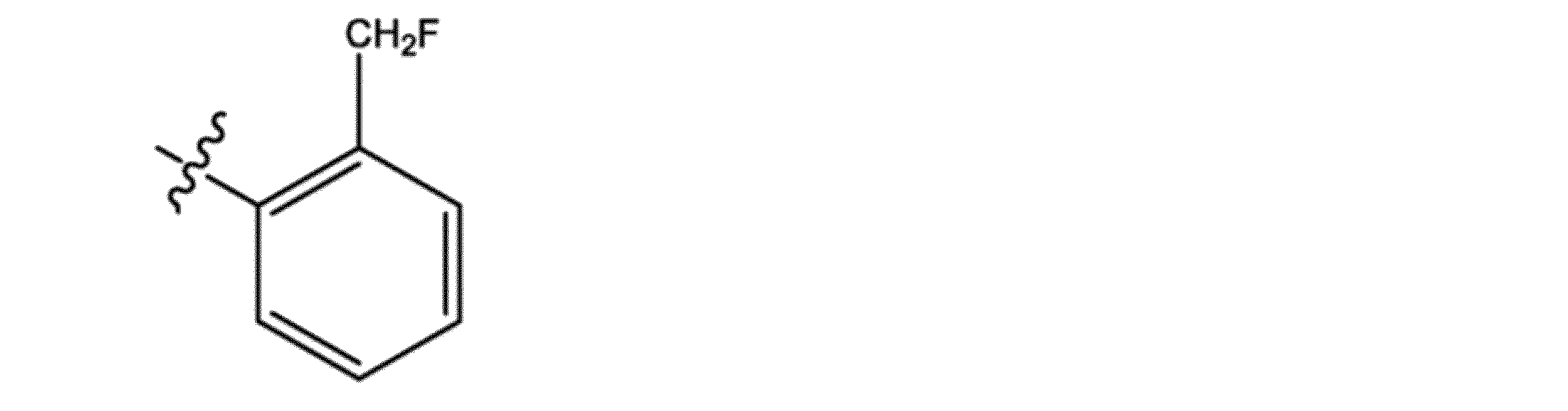
である。 It is.
或る特定の実施形態において、R1は、 In certain embodiments, R 1 is

である。 It is.
或る特定の実施形態において、R1は、 In certain embodiments, R 1 is

である。 It is.
或る特定の実施形態において、R2は水素である。
或る特定の実施形態において、R2はC1~C3アルキルである。
或る特定の実施形態において、R2はメチルである。
或る特定の実施形態において、R2はエチルである。
或る特定の実施形態において、R2はプロピルである。
或る特定の実施形態において、R3はヒドロキシルである。
或る特定の実施形態において、R3はハロゲンである。
或る特定の実施形態において、R3はシアノである。
或る特定の実施形態において、R3はアミノである。
或る特定の実施形態において、R3はニトロである。
In certain embodiments, R2 is hydrogen.
In certain embodiments, R 2 is C 1 -C 3 alkyl.
In certain embodiments, R2 is methyl.
In certain embodiments, R2 is ethyl.
In certain embodiments, R2 is propyl.
In certain embodiments, R3 is hydroxyl.
In certain embodiments, R3 is halogen.
In certain embodiments, R3 is cyano.
In certain embodiments, R3 is amino.
In certain embodiments, R 3 is nitro.
或る特定の実施形態において、R3は置換アルキルである。
或る特定の実施形態において、R3は非置換アルキルである。
或る特定の実施形態において、R3は置換アルケニルである。
或る特定の実施形態において、R3は非置換アルケニルである。
或る特定の実施形態において、R3は置換アルキニルである。
或る特定の実施形態において、R3は非置換アルキニルである。
In certain embodiments, R3 is substituted alkyl.
In certain embodiments, R3 is unsubstituted alkyl.
In certain embodiments, R3 is substituted alkenyl.
In certain embodiments, R3 is unsubstituted alkenyl.
In certain embodiments, R3 is substituted alkynyl.
In certain embodiments, R3 is unsubstituted alkynyl.
或る特定の実施形態において、R3は、1つのハロゲン基で置換されたアルキル基である。
或る特定の実施形態において、R3は、2つのハロゲン基で置換されたアルキル基である。
或る特定の実施形態において、R3は、3つのハロゲン基で置換されたアルキル基である。
In certain embodiments, R3 is an alkyl group substituted with one halogen group.
In certain embodiments, R3 is an alkyl group substituted with two halogen groups.
In certain embodiments, R3 is an alkyl group substituted with three halogen groups.
或る特定の実施形態において、R3は-CH2Fである。
或る特定の実施形態において、R3は-CHF2である。
或る特定の実施形態において、R3は-CF3である。
或る特定の実施形態において、R1及びR3は、ハロゲン置換基又は1つ以上のハロゲン置換基で置換されたアルキルを含む。
In certain embodiments, R3 is -CH2F .
In certain embodiments, R3 is -CHF2 .
In certain embodiments, R3 is -CF3 .
In certain embodiments, R 1 and R 3 include a halogen substituent or an alkyl substituted with one or more halogen substituents.
或る特定の実施形態において、nは1である。
或る特定の実施形態において、nは2である。
或る特定の実施形態において、nは3である。
或る特定の実施形態において、nは4である。
或る特定の実施形態において、nは5である。
或る特定の実施形態において、nは6である。
In certain embodiments, n is 1.
In certain embodiments, n is 2.
In certain embodiments, n is 3.
In certain embodiments, n is 4.
In certain embodiments, n is 5.
In certain embodiments, n is 6.
別の実施形態において、本発明の化合物、組成物、及び方法は、式(II): In another embodiment, the compounds, compositions, and methods of the present invention have the formula (II):

(式中、
R1は、水素、-OH、-CN、置換若しくは非置換チオアルキル、置換若しくは非置換アルキル、置換若しくは非置換アルケニル、置換若しくは非置換アルキニル、ハロ、置換若しくは非置換アリール、置換若しくは非置換ヘテロアリール、置換若しくは非置換アリールオキシ、又は置換若しくは非置換アルキルオキシであり、
R2、R3、R4、又はR5のそれぞれは、独立して、-H、-OH、-CN、置換若しくは非置換チオアルキル、置換若しくは非置換アルキル、置換若しくは非置換アルケニル、置換若しくは非置換アルキニル、ハロ、置換若しくは非置換アリール、置換若しくは非置換ヘテロアリール、置換若しくは非置換アリールオキシ、又は置換若しくは非置換アルキルオキシ、OCF3、SCF3、及びNO2から選択され、
R6、R7、R8、R9、R10、又はR11のそれぞれは、独立して、-H、-OH、-CN、置換若しくは非置換チオアルキル、置換若しくは非置換アルキル、置換若しくは非置換アルケニル、置換若しくは非置換アルキニル、ハロ、置換若しくは非置換アリール、置換若しくは非置換ヘテロアリール、置換若しくは非置換アリールオキシ、又は置換若しくは非置換アルキルオキシから選択され、
R12は、-H又は置換若しくは非置換アルキルであり、
Xは、Oであり、
Yは、-NR13であり、
各R13は、独立して、-H又は置換若しくは非置換アルキル(C1~C6アルキル)から選択される)の化合物又はそれらの薬学的に許容される塩、水和物、溶媒和物、エナンチオマー、ジアステレオマー、ラセミ体若しくは立体異性体の混合物を含み、
式中、
R1~R5のうちの少なくとも1つは、-F、1つ以上の-F基を含む置換アルキル、又は1つ以上の-F基を含む置換アルキルオキシであり、
R7~R12のうちの少なくとも1つは、-F、1つ以上の-F基を含む置換アルキル、又は1つ以上の-F基を含む置換アルキルオキシであり、
式中、R3とR8/R9とは同一ではない。
(Wherein,
R 1 is hydrogen, -OH, -CN, substituted or unsubstituted thioalkyl, substituted or unsubstituted alkyl, substituted or unsubstituted alkenyl, substituted or unsubstituted alkynyl, halo, substituted or unsubstituted aryl, substituted or unsubstituted heteroaryl, substituted or unsubstituted aryloxy, or substituted or unsubstituted alkyloxy;
each of R 2 , R 3 , R 4 , or R 5 is independently selected from -H, -OH, -CN, substituted or unsubstituted thioalkyl, substituted or unsubstituted alkyl, substituted or unsubstituted alkenyl, substituted or unsubstituted alkynyl, halo, substituted or unsubstituted aryl, substituted or unsubstituted heteroaryl, substituted or unsubstituted aryloxy, or substituted or unsubstituted alkyloxy, OCF 3 , SCF 3 , and NO 2 ;
each of R 6 , R 7 , R 8 , R 9 , R 10 , or R 11 is independently selected from -H, -OH, -CN, substituted or unsubstituted thioalkyl, substituted or unsubstituted alkyl, substituted or unsubstituted alkenyl, substituted or unsubstituted alkynyl, halo, substituted or unsubstituted aryl, substituted or unsubstituted heteroaryl, substituted or unsubstituted aryloxy, or substituted or unsubstituted alkyloxy;
R 12 is —H or substituted or unsubstituted alkyl;
X is O;
Y is -NR13 ;
each R 13 is independently selected from -H or substituted or unsubstituted alkyl (C1-C6 alkyl), or a pharma- ceutically acceptable salt, hydrate, solvate, enantiomer, diastereomer, racemate or mixture of stereoisomers thereof;
In the formula,
at least one of R 1 to R 5 is -F, a substituted alkyl containing one or more -F groups, or a substituted alkyloxy containing one or more -F groups;
at least one of R 7 to R 12 is -F, a substituted alkyl containing one or more -F groups, or a substituted alkyloxy containing one or more -F groups;
In the formula, R 3 and R 8 /R 9 are not the same.
或る特定の実施形態において、R1は-Hである。
或る特定の実施形態において、R1は-OHである。
或る特定の実施形態において、R1は-CNである。
或る特定の実施形態において、R1は置換チオアルキルである。
或る特定の実施形態において、R1は非置換チオアルキルである。
或る特定の実施形態において、R1は置換アルキルである。
或る特定の実施形態において、R1は水素である。
或る特定の実施形態において、R1はCH2Fである。
或る特定の実施形態において、R1はCHF2である。
或る特定の実施形態において、R1はCF3である。
In certain embodiments, R 1 is —H.
In certain embodiments, R 1 is --OH.
In certain embodiments, R 1 is --CN.
In certain embodiments, R 1 is substituted thioalkyl.
In certain embodiments, R 1 is unsubstituted thioalkyl.
In certain embodiments, R 1 is substituted alkyl.
In certain embodiments, R 1 is hydrogen.
In certain embodiments, R1 is CH2F .
In certain embodiments, R1 is CHF2 .
In certain embodiments, R1 is CF3 .
或る特定の実施形態において、R1は非置換アルキルである。
或る特定の実施形態において、R1は置換アルケニルである。
或る特定の実施形態において、R1は非置換アルケニルである。
或る特定の実施形態において、R1は置換アルキニルである。
或る特定の実施形態において、R1は非置換アルキニルである。
或る特定の実施形態において、R1はハロである。
或る特定の実施形態において、R1は-Fである。
或る特定の実施形態において、R1は-Clである。
In certain embodiments, R 1 is unsubstituted alkyl.
In certain embodiments, R 1 is substituted alkenyl.
In certain embodiments, R 1 is unsubstituted alkenyl.
In certain embodiments, R 1 is substituted alkynyl.
In certain embodiments, R 1 is unsubstituted alkynyl.
In certain embodiments, R 1 is halo.
In certain embodiments, R 1 is -F.
In certain embodiments, R 1 is --Cl.
或る特定の実施形態において、R1は置換アリールである。
或る特定の実施形態において、R1は非置換アリールである。
或る特定の実施形態において、R1は置換ヘテロアリールである。
或る特定の実施形態において、R1は非置換ヘテロアリールである。
或る特定の実施形態において、R1は置換アリールオキシである。
或る特定の実施形態において、R1は非置換アリールオキシである。
或る特定の実施形態において、R1は置換アルキルオキシである。
或る特定の実施形態において、R1は非置換アルキルオキシである。
In certain embodiments, R 1 is substituted aryl.
In certain embodiments, R 1 is unsubstituted aryl.
In certain embodiments, R 1 is substituted heteroaryl.
In certain embodiments, R 1 is unsubstituted heteroaryl.
In certain embodiments, R 1 is substituted aryloxy.
In certain embodiments, R 1 is unsubstituted aryloxy.
In certain embodiments, R 1 is substituted alkyloxy.
In certain embodiments, R 1 is unsubstituted alkyloxy.
或る特定の実施形態において、R2は-OHである。
或る特定の実施形態において、R2は-CNである。
或る特定の実施形態において、R2は置換チオアルキルである。
或る特定の実施形態において、R2は非置換チオアルキルである。
或る特定の実施形態において、R2は置換アルキルである。
或る特定の実施形態において、R2はCH2Fである。
或る特定の実施形態において、R2はCHF2である。
或る特定の実施形態において、R2はCF3である。
In certain embodiments, R2 is --OH.
In certain embodiments, R2 is --CN.
In certain embodiments, R2 is substituted thioalkyl.
In certain embodiments, R2 is unsubstituted thioalkyl.
In certain embodiments, R2 is substituted alkyl.
In certain embodiments, R2 is CH2F .
In certain embodiments, R2 is CHF2 .
In certain embodiments, R2 is CF3 .
或る特定の実施形態において、R2は非置換アルキルである。
或る特定の実施形態において、R2は置換アルケニルである。
或る特定の実施形態において、R2は非置換アルケニルである。
或る特定の実施形態において、R2は置換アルキニルである。
或る特定の実施形態において、R2は非置換アルキニルである。
或る特定の実施形態において、R2はハロである。
或る特定の実施形態において、R2は-Fである。
或る特定の実施形態において、R2は-Clである。
In certain embodiments, R2 is unsubstituted alkyl.
In certain embodiments, R2 is substituted alkenyl.
In certain embodiments, R2 is unsubstituted alkenyl.
In certain embodiments, R2 is substituted alkynyl.
In certain embodiments, R2 is unsubstituted alkynyl.
In certain embodiments, R2 is halo.
In certain embodiments, R2 is --F.
In certain embodiments, R 2 is —Cl.
或る特定の実施形態において、R2は置換アリールである。
或る特定の実施形態において、R2は非置換アリールである。
或る特定の実施形態において、R2は置換ヘテロアリールである。
或る特定の実施形態において、R2は非置換ヘテロアリールである。
或る特定の実施形態において、R2は置換アリールオキシである。
或る特定の実施形態において、R2は非置換アリールオキシである。
或る特定の実施形態において、R2は置換アルキルオキシである。
或る特定の実施形態において、R2は非置換アルキルオキシである。
或る特定の実施形態において、R2は-OCF3である。
或る特定の実施形態において、R2は-SCF3である。
或る特定の実施形態において、R2は-NO2である。
In certain embodiments, R2 is substituted aryl.
In certain embodiments, R2 is unsubstituted aryl.
In certain embodiments, R2 is substituted heteroaryl.
In certain embodiments, R2 is unsubstituted heteroaryl.
In certain embodiments, R2 is substituted aryloxy.
In certain embodiments, R2 is unsubstituted aryloxy.
In certain embodiments, R2 is substituted alkyloxy.
In certain embodiments, R2 is unsubstituted alkyloxy.
In certain embodiments, R2 is --OCF3 .
In certain embodiments, R2 is --SCF3 .
In certain embodiments, R2 is --NO2 .
或る特定の実施形態において、R3は-OHである。
或る特定の実施形態において、R3は-CNである。
或る特定の実施形態において、R3は置換チオアルキルである。
或る特定の実施形態において、R3は非置換チオアルキルである。
或る特定の実施形態において、R3は置換アルキルである。
或る特定の実施形態において、R3はCH2Fである。
或る特定の実施形態において、R3はCHF2である。
或る特定の実施形態において、R3はCF3である。
In certain embodiments, R 3 is —OH.
In certain embodiments, R 3 is —CN.
In certain embodiments, R3 is substituted thioalkyl.
In certain embodiments, R3 is unsubstituted thioalkyl.
In certain embodiments, R3 is substituted alkyl.
In certain embodiments, R3 is CH2F .
In certain embodiments, R3 is CHF2 .
In certain embodiments, R3 is CF3 .
或る特定の実施形態において、R3は非置換アルキルである。
或る特定の実施形態において、R3は置換アルケニルである。
或る特定の実施形態において、R3は非置換アルケニルである。
或る特定の実施形態において、R3は置換アルキニルである。
或る特定の実施形態において、R3は非置換アルキニルである。
或る特定の実施形態において、R3はハロである。
或る特定の実施形態において、R3は-Fである。
或る特定の実施形態において、R3は-Clである。
In certain embodiments, R3 is unsubstituted alkyl.
In certain embodiments, R3 is substituted alkenyl.
In certain embodiments, R3 is unsubstituted alkenyl.
In certain embodiments, R3 is substituted alkynyl.
In certain embodiments, R3 is unsubstituted alkynyl.
In certain embodiments, R3 is halo.
In certain embodiments, R 3 is -F.
In certain embodiments, R 3 is —Cl.
或る特定の実施形態において、R3は置換アリールである。
或る特定の実施形態において、R3は非置換アリールである。
或る特定の実施形態において、R3は置換ヘテロアリールである。
或る特定の実施形態において、R3は非置換ヘテロアリールである。
或る特定の実施形態において、R3は置換アリールオキシである。
或る特定の実施形態において、R3は非置換アリールオキシである。
或る特定の実施形態において、R3は置換アルキルオキシである。
或る特定の実施形態において、R3は非置換アルキルオキシである。
或る特定の実施形態において、R3は-OCF3である。
或る特定の実施形態において、R3は-SCF3である。
或る特定の実施形態において、R3は-NO2である。
In certain embodiments, R3 is substituted aryl.
In certain embodiments, R3 is unsubstituted aryl.
In certain embodiments, R3 is substituted heteroaryl.
In certain embodiments, R3 is unsubstituted heteroaryl.
In certain embodiments, R 3 is substituted aryloxy.
In certain embodiments, R 3 is unsubstituted aryloxy.
In certain embodiments, R3 is substituted alkyloxy.
In certain embodiments, R3 is unsubstituted alkyloxy.
In certain embodiments, R3 is --OCF3 .
In certain embodiments, R3 is -SCF3 .
In certain embodiments, R3 is --NO2 .
或る特定の実施形態において、R4は-OHである。
或る特定の実施形態において、R4は-CNである。
或る特定の実施形態において、R4は置換チオアルキルである。
或る特定の実施形態において、R4は非置換チオアルキルである。
或る特定の実施形態において、R4は置換アルキルである。
或る特定の実施形態において、R4はCH2Fである。
或る特定の実施形態において、R4はCHF2である。
或る特定の実施形態において、R4はCF3である。
In certain embodiments, R 4 is —OH.
In certain embodiments, R 4 is —CN.
In certain embodiments, R4 is substituted thioalkyl.
In certain embodiments, R4 is unsubstituted thioalkyl.
In certain embodiments, R4 is substituted alkyl.
In certain embodiments, R4 is CH2F .
In certain embodiments, R4 is CHF2 .
In certain embodiments, R4 is CF3 .
或る特定の実施形態において、R4は非置換アルキルである。
或る特定の実施形態において、R4は置換アルケニルである。
或る特定の実施形態において、R4は非置換アルケニルである。
或る特定の実施形態において、R4は置換アルキニルである。
或る特定の実施形態において、R4は非置換アルキニルである。
或る特定の実施形態において、R4はハロである。
或る特定の実施形態において、R4は-Fである。
或る特定の実施形態において、R4は-Clである。
In certain embodiments, R4 is unsubstituted alkyl.
In certain embodiments, R4 is substituted alkenyl.
In certain embodiments, R4 is unsubstituted alkenyl.
In certain embodiments, R4 is substituted alkynyl.
In certain embodiments, R4 is unsubstituted alkynyl.
In certain embodiments, R 4 is halo.
In certain embodiments, R 4 is —F.
In certain embodiments, R 4 is —Cl.
或る特定の実施形態において、R4は置換アリールである。
或る特定の実施形態において、R4は非置換アリールである。
或る特定の実施形態において、R4は置換ヘテロアリールである。
或る特定の実施形態において、R4は非置換ヘテロアリールである。
或る特定の実施形態において、R4は置換アリールオキシである。
或る特定の実施形態において、R4は非置換アリールオキシである。
或る特定の実施形態において、R4は置換アルキルオキシである。
或る特定の実施形態において、R4は非置換アルキルオキシである。
或る特定の実施形態において、R4は-OCF3である。
或る特定の実施形態において、R4は-SCF3である。
或る特定の実施形態において、R4は-NO2である。
In certain embodiments, R4 is substituted aryl.
In certain embodiments, R4 is unsubstituted aryl.
In certain embodiments, R4 is substituted heteroaryl.
In certain embodiments, R4 is unsubstituted heteroaryl.
In certain embodiments, R 4 is substituted aryloxy.
In certain embodiments, R 4 is unsubstituted aryloxy.
In certain embodiments, R4 is substituted alkyloxy.
In certain embodiments, R4 is unsubstituted alkyloxy.
In certain embodiments, R4 is --OCF3 .
In certain embodiments, R4 is --SCF3 .
In certain embodiments, R4 is --NO2 .
或る特定の実施形態において、R5は-OHである。
或る特定の実施形態において、R5は-CNである。
或る特定の実施形態において、R5は置換チオアルキルである。
或る特定の実施形態において、R5は非置換チオアルキルである。
或る特定の実施形態において、R5は置換アルキルである。
或る特定の実施形態において、R5はCH2Fである。
或る特定の実施形態において、R5はCHF2である。
或る特定の実施形態において、R5はCF3である。
In certain embodiments, R 5 is —OH.
In certain embodiments, R 5 is —CN.
In certain embodiments, R 5 is substituted thioalkyl.
In certain embodiments, R 5 is unsubstituted thioalkyl.
In certain embodiments, R 5 is substituted alkyl.
In certain embodiments, R5 is CH2F .
In certain embodiments, R5 is CHF2 .
In certain embodiments, R5 is CF3 .
或る特定の実施形態において、R5は非置換アルキルである。
或る特定の実施形態において、R5は置換アルケニルである。
或る特定の実施形態において、R5は非置換アルケニルである。
或る特定の実施形態において、R5は置換アルキニルである。
或る特定の実施形態において、R5は非置換アルキニルである。
或る特定の実施形態において、R5はハロである。
或る特定の実施形態において、R5は-Fである。
或る特定の実施形態において、R5は-Clである。
In certain embodiments, R 5 is unsubstituted alkyl.
In certain embodiments, R 5 is substituted alkenyl.
In certain embodiments, R 5 is unsubstituted alkenyl.
In certain embodiments, R 5 is substituted alkynyl.
In certain embodiments, R 5 is unsubstituted alkynyl.
In certain embodiments, R 5 is halo.
In certain embodiments, R 5 is -F.
In certain embodiments, R 5 is —Cl.
或る特定の実施形態において、R5は置換アリールである。
或る特定の実施形態において、R5は非置換アリールである。
或る特定の実施形態において、R5は置換ヘテロアリールである。
或る特定の実施形態において、R5は非置換ヘテロアリールである。
或る特定の実施形態において、R5は置換アリールオキシである。
或る特定の実施形態において、R5は非置換アリールオキシである。
或る特定の実施形態において、R5は置換アルキルオキシである。
或る特定の実施形態において、R5は非置換アルキルオキシである。
或る特定の実施形態において、R5は-OCF3である。
或る特定の実施形態において、R5は-SCF3である。
或る特定の実施形態において、R5は-NO2である。
In certain embodiments, R 5 is substituted aryl.
In certain embodiments, R 5 is unsubstituted aryl.
In certain embodiments, R 5 is substituted heteroaryl.
In certain embodiments, R 5 is unsubstituted heteroaryl.
In certain embodiments, R 5 is substituted aryloxy.
In certain embodiments, R 5 is unsubstituted aryloxy.
In certain embodiments, R 5 is substituted alkyloxy.
In certain embodiments, R 5 is unsubstituted alkyloxy.
In certain embodiments, R5 is --OCF3 .
In certain embodiments, R5 is --SCF3 .
In certain embodiments, R5 is --NO2 .
或る特定の実施形態において、R6は-Hである。
或る特定の実施形態において、R6は-OHである。
或る特定の実施形態において、R6は-CNである。
或る特定の実施形態において、R6は置換チオアルキルである。
或る特定の実施形態において、R6は非置換チオアルキルである。
或る特定の実施形態において、R6は置換アルキルである。
In certain embodiments, R 6 is —H.
In certain embodiments, R 6 is —OH.
In certain embodiments, R 6 is —CN.
In certain embodiments, R6 is substituted thioalkyl.
In certain embodiments, R6 is unsubstituted thioalkyl.
In certain embodiments, R6 is substituted alkyl.
或る特定の実施形態において、R6はCH2Fである。
或る特定の実施形態において、R6はCHF2である。
或る特定の実施形態において、R6はCF3である。
或る特定の実施形態において、R6は非置換アルキルである。
或る特定の実施形態において、R6は置換アルケニルである。
或る特定の実施形態において、R6は非置換アルケニルである。
或る特定の実施形態において、R6は置換アルキニルである。
或る特定の実施形態において、R6は非置換アルキニルである。
In certain embodiments, R6 is CH2F .
In certain embodiments, R6 is CHF2 .
In certain embodiments, R6 is CF3 .
In certain embodiments, R6 is unsubstituted alkyl.
In certain embodiments, R6 is substituted alkenyl.
In certain embodiments, R 6 is unsubstituted alkenyl.
In certain embodiments, R6 is substituted alkynyl.
In certain embodiments, R 6 is unsubstituted alkynyl.
或る特定の実施形態において、R6はハロである。
或る特定の実施形態において、R6は-Fである。
或る特定の実施形態において、R6は-Clである。
或る特定の実施形態において、R6は置換アリールである。
或る特定の実施形態において、R6は非置換アリールである。
或る特定の実施形態において、R6は置換ヘテロアリールである。
或る特定の実施形態において、R6は非置換ヘテロアリールである。
或る特定の実施形態において、R6は置換アリールオキシである。
或る特定の実施形態において、R6は非置換アリールオキシである。
或る特定の実施形態において、R6は置換アルキルオキシである。
或る特定の実施形態において、R6は非置換アルキルオキシである。
In certain embodiments, R 6 is halo.
In certain embodiments, R 6 is —F.
In certain embodiments, R 6 is —Cl.
In certain embodiments, R6 is substituted aryl.
In certain embodiments, R6 is unsubstituted aryl.
In certain embodiments, R6 is substituted heteroaryl.
In certain embodiments, R6 is unsubstituted heteroaryl.
In certain embodiments, R 6 is substituted aryloxy.
In certain embodiments, R 6 is unsubstituted aryloxy.
In certain embodiments, R 6 is substituted alkyloxy.
In certain embodiments, R 6 is unsubstituted alkyloxy.
或る特定の実施形態において、R7は-Hである。
或る特定の実施形態において、R7は-OHである。
或る特定の実施形態において、R7は-CNである。
或る特定の実施形態において、R7は置換チオアルキルである。
或る特定の実施形態において、R7は非置換チオアルキルである。
或る特定の実施形態において、R7は置換アルキルである。
或る特定の実施形態において、R7はCH2Fである。
或る特定の実施形態において、R7はCHF2である。
或る特定の実施形態において、R7はCF3である。
In certain embodiments, R 7 is —H.
In certain embodiments, R 7 is --OH.
In certain embodiments, R 7 is —CN.
In certain embodiments, R 7 is substituted thioalkyl.
In certain embodiments, R 7 is unsubstituted thioalkyl.
In certain embodiments, R 7 is substituted alkyl.
In certain embodiments, R7 is CH2F .
In certain embodiments, R7 is CHF2 .
In certain embodiments, R7 is CF3 .
或る特定の実施形態において、R7は非置換アルキルである。
或る特定の実施形態において、R7は置換アルケニルである。
或る特定の実施形態において、R7は非置換アルケニルである。
或る特定の実施形態において、R7は置換アルキニルである。
或る特定の実施形態において、R7は非置換アルキニルである。
或る特定の実施形態において、R7はハロである。
或る特定の実施形態において、R7は-Fである。
或る特定の実施形態において、R7は-Clである。
In certain embodiments, R 7 is unsubstituted alkyl.
In certain embodiments, R7 is substituted alkenyl.
In certain embodiments, R 7 is unsubstituted alkenyl.
In certain embodiments, R7 is substituted alkynyl.
In certain embodiments, R 7 is unsubstituted alkynyl.
In certain embodiments, R 7 is halo.
In certain embodiments, R 7 is --F.
In certain embodiments, R 7 is --Cl.
或る特定の実施形態において、R7は置換アリールである。
或る特定の実施形態において、R7は非置換アリールである。
或る特定の実施形態において、R7は置換ヘテロアリールである。
或る特定の実施形態において、R7は非置換ヘテロアリールである。
或る特定の実施形態において、R7は置換アリールオキシである。
或る特定の実施形態において、R7は非置換アリールオキシである。
或る特定の実施形態において、R7は置換アルキルオキシである。
或る特定の実施形態において、R7は非置換アルキルオキシである。
In certain embodiments, R 7 is substituted aryl.
In certain embodiments, R 7 is unsubstituted aryl.
In certain embodiments, R7 is substituted heteroaryl.
In certain embodiments, R 7 is unsubstituted heteroaryl.
In certain embodiments, R 7 is substituted aryloxy.
In certain embodiments, R 7 is unsubstituted aryloxy.
In certain embodiments, R 7 is substituted alkyloxy.
In certain embodiments, R 7 is unsubstituted alkyloxy.
或る特定の実施形態において、R8は-Hである。
或る特定の実施形態において、R8は-OHである。
或る特定の実施形態において、R8は-CNである。
或る特定の実施形態において、R8は置換チオアルキルである。
或る特定の実施形態において、R8は非置換チオアルキルである。
或る特定の実施形態において、R8は置換アルキルである。
或る特定の実施形態において、R8はCH2Fである。
或る特定の実施形態において、R8はCHF2である。
或る特定の実施形態において、R8はCF3である。
In certain embodiments, R 8 is —H.
In certain embodiments, R 8 is --OH.
In certain embodiments, R 8 is --CN.
In certain embodiments, R 8 is substituted thioalkyl.
In certain embodiments, R 8 is unsubstituted thioalkyl.
In certain embodiments, R 8 is substituted alkyl.
In certain embodiments, R8 is CH2F .
In certain embodiments, R8 is CHF2 .
In certain embodiments, R8 is CF3 .
或る特定の実施形態において、R8は非置換アルキルである。
或る特定の実施形態において、R8は置換アルケニルである。
或る特定の実施形態において、R8は非置換アルケニルである。
或る特定の実施形態において、R8は置換アルキニルである。
或る特定の実施形態において、R8は非置換アルキニルである。
或る特定の実施形態において、R8はハロである。
或る特定の実施形態において、R8は-Fである。
或る特定の実施形態において、R8は-Clである。
In certain embodiments, R 8 is unsubstituted alkyl.
In certain embodiments, R 8 is substituted alkenyl.
In certain embodiments, R 8 is unsubstituted alkenyl.
In certain embodiments, R 8 is substituted alkynyl.
In certain embodiments, R 8 is unsubstituted alkynyl.
In certain embodiments, R 8 is halo.
In certain embodiments, R 8 is --F.
In certain embodiments, R 8 is --Cl.
或る特定の実施形態において、R8は置換アリールである。
或る特定の実施形態において、R8は非置換アリールである。
或る特定の実施形態において、R8は置換ヘテロアリールである。
或る特定の実施形態において、R8は非置換ヘテロアリールである。
或る特定の実施形態において、R8は置換アリールオキシである。
或る特定の実施形態において、R8は非置換アリールオキシである。
或る特定の実施形態において、R8は置換アルキルオキシである。
或る特定の実施形態において、R8は非置換アルキルオキシである。
In certain embodiments, R 8 is substituted aryl.
In certain embodiments, R 8 is unsubstituted aryl.
In certain embodiments, R 8 is substituted heteroaryl.
In certain embodiments, R 8 is unsubstituted heteroaryl.
In certain embodiments, R 8 is substituted aryloxy.
In certain embodiments, R 8 is unsubstituted aryloxy.
In certain embodiments, R 8 is substituted alkyloxy.
In certain embodiments, R 8 is unsubstituted alkyloxy.
或る特定の実施形態において、R9は-Hである。
或る特定の実施形態において、R9は-OHである。
或る特定の実施形態において、R9は-CNである。
或る特定の実施形態において、R9は置換チオアルキルである。
或る特定の実施形態において、R9は非置換チオアルキルである。
或る特定の実施形態において、R9は置換アルキルである。
或る特定の実施形態において、R9はCH2Fである。
或る特定の実施形態において、R9はCHF2である。
或る特定の実施形態において、R9はCF3である。
In certain embodiments, R 9 is —H.
In certain embodiments, R 9 is —OH.
In certain embodiments, R 9 is —CN.
In certain embodiments, R 9 is substituted thioalkyl.
In certain embodiments, R 9 is unsubstituted thioalkyl.
In certain embodiments, R 9 is substituted alkyl.
In certain embodiments, R9 is CH2F .
In certain embodiments, R9 is CHF2 .
In certain embodiments, R9 is CF3 .
或る特定の実施形態において、R9は非置換アルキルである。
或る特定の実施形態において、R9は置換アルケニルである。
或る特定の実施形態において、R9は非置換アルケニルである。
或る特定の実施形態において、R9は置換アルキニルである。
或る特定の実施形態において、R9は非置換アルキニルである。
或る特定の実施形態において、R9はハロである。
或る特定の実施形態において、R9は-Fである。
或る特定の実施形態において、R9は-Clである。
In certain embodiments, R 9 is unsubstituted alkyl.
In certain embodiments, R 9 is substituted alkenyl.
In certain embodiments, R 9 is unsubstituted alkenyl.
In certain embodiments, R 9 is substituted alkynyl.
In certain embodiments, R 9 is unsubstituted alkynyl.
In certain embodiments, R 9 is halo.
In certain embodiments, R 9 is —F.
In certain embodiments, R 9 is —Cl.
或る特定の実施形態において、R9は置換アリールである。
或る特定の実施形態において、R9は非置換アリールである。
或る特定の実施形態において、R9は置換ヘテロアリールである。
或る特定の実施形態において、R9は非置換ヘテロアリールである。
或る特定の実施形態において、R9は置換アリールオキシである。
或る特定の実施形態において、R9は非置換アリールオキシである。
或る特定の実施形態において、R9は置換アルキルオキシである。
或る特定の実施形態において、R9は非置換アルキルオキシである。
In certain embodiments, R 9 is substituted aryl.
In certain embodiments, R 9 is unsubstituted aryl.
In certain embodiments, R 9 is substituted heteroaryl.
In certain embodiments, R 9 is unsubstituted heteroaryl.
In certain embodiments, R 9 is substituted aryloxy.
In certain embodiments, R 9 is unsubstituted aryloxy.
In certain embodiments, R 9 is substituted alkyloxy.
In certain embodiments, R 9 is unsubstituted alkyloxy.
或る特定の実施形態において、R10は-Hである。
或る特定の実施形態において、R10は-OHである。
或る特定の実施形態において、R10は-CNである。
或る特定の実施形態において、R10は置換チオアルキルである。
或る特定の実施形態において、R10は非置換チオアルキルである。
或る特定の実施形態において、R10は置換アルキルである。
或る特定の実施形態において、R10はCH2Fである。
或る特定の実施形態において、R10はCHF2である。
或る特定の実施形態において、R10はCF3である。
In certain embodiments, R 10 is —H.
In certain embodiments, R 10 is --OH.
In certain embodiments, R 10 is --CN.
In certain embodiments, R 10 is substituted thioalkyl.
In certain embodiments, R 10 is unsubstituted thioalkyl.
In certain embodiments, R 10 is substituted alkyl.
In certain embodiments, R10 is CH2F .
In certain embodiments, R10 is CHF2 .
In certain embodiments, R10 is CF3 .
或る特定の実施形態において、R10は非置換アルキルである。
或る特定の実施形態において、R10は置換アルケニルである。
或る特定の実施形態において、R10は非置換アルケニルである。
或る特定の実施形態において、R10は置換アルキニルである。
或る特定の実施形態において、R10は非置換アルキニルである。
或る特定の実施形態において、R10はハロである。
或る特定の実施形態において、R10は-Fである。
或る特定の実施形態において、R10は-Clである。
In certain embodiments, R 10 is unsubstituted alkyl.
In certain embodiments, R 10 is substituted alkenyl.
In certain embodiments, R 10 is unsubstituted alkenyl.
In certain embodiments, R 10 is substituted alkynyl.
In certain embodiments, R 10 is unsubstituted alkynyl.
In certain embodiments, R 10 is halo.
In certain embodiments, R 10 is --F.
In certain embodiments, R 10 is --Cl.
或る特定の実施形態において、R10は置換アリールである。
或る特定の実施形態において、R10は非置換アリールである。
或る特定の実施形態において、R10は置換ヘテロアリールである。
或る特定の実施形態において、R10は非置換ヘテロアリールである。
或る特定の実施形態において、R10は置換アリールオキシである。
或る特定の実施形態において、R10は非置換アリールオキシである。
或る特定の実施形態において、R10は置換アルキルオキシである。
或る特定の実施形態において、R10は非置換アルキルオキシである。
In certain embodiments, R 10 is substituted aryl.
In certain embodiments, R 10 is unsubstituted aryl.
In certain embodiments, R 10 is substituted heteroaryl.
In certain embodiments, R 10 is unsubstituted heteroaryl.
In certain embodiments, R 10 is substituted aryloxy.
In certain embodiments, R 10 is unsubstituted aryloxy.
In certain embodiments, R 10 is substituted alkyloxy.
In certain embodiments, R 10 is unsubstituted alkyloxy.
或る特定の実施形態において、R11は-Hである。
或る特定の実施形態において、R11は-OHである。
或る特定の実施形態において、R11は-CNである。
或る特定の実施形態において、R11は置換チオアルキルである。
或る特定の実施形態において、R11は非置換チオアルキルである。
或る特定の実施形態において、R11は置換アルキルである。
或る特定の実施形態において、R11はCH2Fである。
或る特定の実施形態において、R11はCHF2である。
或る特定の実施形態において、R11はCF3である。
In certain embodiments, R 11 is —H.
In certain embodiments, R 11 is —OH.
In certain embodiments, R 11 is —CN.
In certain embodiments, R 11 is substituted thioalkyl.
In certain embodiments, R 11 is unsubstituted thioalkyl.
In certain embodiments, R 11 is substituted alkyl.
In certain embodiments, R 11 is CH 2 F.
In certain embodiments, R 11 is CHF 2 .
In certain embodiments, R 11 is CF 3 .
或る特定の実施形態において、R11は非置換アルキルである。
或る特定の実施形態において、R11は置換アルケニルである。
或る特定の実施形態において、R11は非置換アルケニルである。
或る特定の実施形態において、R11は置換アルキニルである。
或る特定の実施形態において、R11は非置換アルキニルである。
或る特定の実施形態において、R11はハロである。
或る特定の実施形態において、R11は-Fである。
或る特定の実施形態において、R11は-Clである。
In certain embodiments, R 11 is unsubstituted alkyl.
In certain embodiments, R 11 is substituted alkenyl.
In certain embodiments, R 11 is unsubstituted alkenyl.
In certain embodiments, R 11 is substituted alkynyl.
In certain embodiments, R 11 is unsubstituted alkynyl.
In certain embodiments, R 11 is halo.
In certain embodiments, R 11 is —F.
In certain embodiments, R 11 is —Cl.
或る特定の実施形態において、R11は置換アリールである。
或る特定の実施形態において、R11は非置換アリールである。
或る特定の実施形態において、R11は置換ヘテロアリールである。
或る特定の実施形態において、R11は非置換ヘテロアリールである。
或る特定の実施形態において、R11は置換アリールオキシである。
或る特定の実施形態において、R11は非置換アリールオキシである。
或る特定の実施形態において、R11は置換アルキルオキシである。
或る特定の実施形態において、R11は非置換アルキルオキシである。
In certain embodiments, R 11 is substituted aryl.
In certain embodiments, R 11 is unsubstituted aryl.
In certain embodiments, R 11 is substituted heteroaryl.
In certain embodiments, R 11 is unsubstituted heteroaryl.
In certain embodiments, R 11 is substituted aryloxy.
In certain embodiments, R 11 is unsubstituted aryloxy.
In certain embodiments, R 11 is substituted alkyloxy.
In certain embodiments, R 11 is unsubstituted alkyloxy.
或る特定の実施形態において、R12は-Hである。
或る特定の実施形態において、R12は置換アルキルである。
或る特定の実施形態において、R12は非置換アルキルである。
或る特定の実施形態において、R13は-Hである。
或る特定の実施形態において、R13は置換アルキルである。
或る特定の実施形態において、R13は非置換アルキルである。
In certain embodiments, R 12 is —H.
In certain embodiments, R 12 is substituted alkyl.
In certain embodiments, R 12 is unsubstituted alkyl.
In certain embodiments, R 13 is —H.
In certain embodiments, R 13 is substituted alkyl.
In certain embodiments, R 13 is unsubstituted alkyl.
或る特定の実施形態において、R1がハロゲン又は水素である場合、R2、R3、R4、及びR5のそれぞれは、独立して、ハロゲン(例えば、F又はCl)、アルキル(例えば、CH3)、CF3、アルコキシ、OCF3、CN、NO2及びSCF3から選択される。
或る特定の実施形態において、R1がハロゲンである場合、R2、R3、R4、及びR5のそれぞれは水素であり、R6、R7、R10、R11、及びR12、並びにR8又はR9は-CF3である。
In certain embodiments, when R1 is halogen or hydrogen, each of R2 , R3 , R4 , and R5 is independently selected from halogen (e.g., F or Cl), alkyl (e.g., CH3 ), CF3 , alkoxy, OCF3 , CN, NO2 , and SCF3 .
In certain embodiments, when R 1 is halogen, each of R 2 , R 3 , R 4 , and R 5 is hydrogen, and R 6 , R 7 , R 10 , R 11 , and R 12 , and R 8 or R 9 are --CF 3 .
別の実施形態において、本発明の化合物、組成物、及び方法は、式(III): In another embodiment, the compounds, compositions, and methods of the present invention have the formula (III):

(式中、
R1は、ハロゲン又は1つ~3つのハロゲン基で置換されたアルキルであり、
R2は、水素又はC1~C3アルキルであり、
R3は、ヒドロキシル、ハロゲン、シアノ、アミノ、ニトロ、又は1つ~3つのハロゲン基で置換されたアルキルであり、1つ以上のR3は、位置a、位置b、若しくは位置cにあるか、又はそれらの組合せである)の化合物又はそれらの薬学的に許容される塩、水和物、溶媒和物、エナンチオマー、ジアステレオマー、ラセミ体若しくは立体異性体の混合物を含む。
(Wherein,
R 1 is halogen or alkyl substituted with 1 to 3 halogen groups;
R2 is hydrogen or C1 - C3 alkyl;
R 3 is hydroxyl, halogen, cyano, amino, nitro, or alkyl substituted with one to three halogen groups, and one or more R 3 are in position a, position b, or position c, or a combination thereof; or a pharma- ceutically acceptable salt, hydrate, solvate, enantiomer, diastereomer, racemate, or stereoisomeric mixture thereof.
或る特定の実施形態において、R1は-Fである。
或る特定の実施形態において、R1は-Clである。
或る特定の実施形態において、R1は、1つ~3つのハロゲン基で置換されたアルキル基である。
或る特定の実施形態において、R1は、1つのハロゲン基で置換されたアルキル基である。
或る特定の実施形態において、R1は、2つのハロゲン基で置換されたアルキル基である。
或る特定の実施形態において、R1は、3つのハロゲン基で置換されたアルキル基である。
或る特定の実施形態において、R1は-CH2Fである。
或る特定の実施形態において、R1は-CHF2である。
或る特定の実施形態において、R1は-CF3である。
In certain embodiments, R 1 is -F.
In certain embodiments, R 1 is --Cl.
In certain embodiments, R 1 is an alkyl group substituted with one to three halogen groups.
In certain embodiments, R 1 is an alkyl group substituted with one halogen group.
In certain embodiments, R 1 is an alkyl group substituted with two halogen groups.
In certain embodiments, R 1 is an alkyl group substituted with three halogen groups.
In certain embodiments, R 1 is --CH 2 F.
In certain embodiments, R 1 is —CHF 2 .
In certain embodiments, R1 is -CF3 .
或る特定の実施形態において、R2は水素である。
或る特定の実施形態において、R2はC1~C3アルキルである。
或る特定の実施形態において、R2はメチルである。
或る特定の実施形態において、R2はエチルである。
或る特定の実施形態において、R2はプロピルである。
In certain embodiments, R2 is hydrogen.
In certain embodiments, R 2 is C 1 -C 3 alkyl.
In certain embodiments, R2 is methyl.
In certain embodiments, R2 is ethyl.
In certain embodiments, R2 is propyl.
或る特定の実施形態において、R3はヒドロキシルである。
或る特定の実施形態において、R3はハロゲンである。
或る特定の実施形態において、R3はシアノである。
或る特定の実施形態において、R3はアミノである。
或る特定の実施形態において、R3はニトロである。
In certain embodiments, R3 is hydroxyl.
In certain embodiments, R3 is halogen.
In certain embodiments, R3 is cyano.
In certain embodiments, R3 is amino.
In certain embodiments, R 3 is nitro.
或る特定の実施形態において、R3は置換アルキルである。
或る特定の実施形態において、R3は非置換アルキルである。
或る特定の実施形態において、R3は置換アルケニルである。
或る特定の実施形態において、R3は非置換アルケニルである。
或る特定の実施形態において、R3は置換アルキニルである。
或る特定の実施形態において、R3は非置換アルキニルである。
In certain embodiments, R3 is substituted alkyl.
In certain embodiments, R3 is unsubstituted alkyl.
In certain embodiments, R3 is substituted alkenyl.
In certain embodiments, R3 is unsubstituted alkenyl.
In certain embodiments, R3 is substituted alkynyl.
In certain embodiments, R3 is unsubstituted alkynyl.
或る特定の実施形態において、R3は、1つのハロゲン基で置換されたアルキル基である。
或る特定の実施形態において、R3は、2つのハロゲン基で置換されたアルキル基である。
或る特定の実施形態において、R3は、3つのハロゲン基で置換されたアルキル基である。
In certain embodiments, R3 is an alkyl group substituted with one halogen group.
In certain embodiments, R3 is an alkyl group substituted with two halogen groups.
In certain embodiments, R3 is an alkyl group substituted with three halogen groups.
或る特定の実施形態において、R3は-CH2Fである。
或る特定の実施形態において、R3は-CHF2である。
或る特定の実施形態において、R3は-CF3である。
或る特定の実施形態において、R3は位置aにある。
或る特定の実施形態において、R3は位置bにある。
或る特定の実施形態において、R3は位置cにある。
In certain embodiments, R3 is -CH2F .
In certain embodiments, R3 is -CHF2 .
In certain embodiments, R3 is -CF3 .
In certain embodiments, R3 is at position a.
In certain embodiments, R3 is at position b.
In certain embodiments, R3 is in position c.
或る特定の実施形態において、1つのR3は位置aにあり、1つのR3は位置bにある。
或る特定の実施形態において、1つのR3は位置aにあり、1つのR3は位置cにある。
或る特定の実施形態において、1つのR3は位置bにあり、1つのR3は位置bにある。
或る特定の実施形態において、1つのR3は位置aにあり、1つのR3は位置bにあり、1つのR3は位置cにある。
In certain embodiments, one R3 is at position a and one R3 is at position b.
In certain embodiments, one R3 is at position a and one R3 is at position c.
In certain embodiments, one R 3 is at position b and one R 3 is at position b.
In certain embodiments, one R 3 is in position a, one R 3 is in position b, and one R 3 is in position c.
或る特定の実施形態において、R1及びR3は、ハロゲン置換基又は1つ以上のハロゲン置換基で置換されたアルキルを含む。
或る特定の実施形態において、R1は-Fであり、R3は-CF3である。
In certain embodiments, R 1 and R 3 include a halogen substituent or an alkyl substituted with one or more halogen substituents.
In certain embodiments, R 1 is -F and R 3 is -CF 3 .
別の実施形態において、本発明の化合物、組成物、及び方法は、式(IIIa): In another embodiment, the compounds, compositions, and methods of the present invention have the formula (IIIa):

(式中、
R1は、ハロゲン又は1つ~3つのハロゲン基で置換されたアルキルであり、
R2は、水素又はC1~C3アルキルであり、
各R3は、独立して、ヒドロキシル、ハロゲン、シアノ、アミノ、ニトロ、又は1つ~3つのハロゲン基で置換されたアルキルであり、1つ以上のR3は、位置a、位置b、若しくは位置cにあるか、又はそれらの組合せであり、
nは、1~6の整数である(式中、位置a、位置b、及び/又は位置cはそれぞれ1つ又は2つのR3基を含有することができる))の化合物又はそれらの薬学的に許容される塩、水和物、溶媒和物、エナンチオマー、ジアステレオマー、ラセミ体若しくは立体異性体の混合物を含む。
(Wherein,
R 1 is halogen or alkyl substituted with 1 to 3 halogen groups;
R2 is hydrogen or C1 - C3 alkyl;
each R3 is independently hydroxyl, halogen, cyano, amino, nitro, or alkyl substituted with 1 to 3 halogen groups, one or more R3 is in position a, position b, or position c, or a combination thereof;
and n is an integer from 1 to 6, wherein position a, position b, and/or position c can each contain one or two R3 groups, or a pharma- ceutically acceptable salt, hydrate, solvate, enantiomer, diastereomer, racemate, or mixture of stereoisomers thereof.
或る特定の実施形態において、R1は-Fである。
或る特定の実施形態において、R1は-Clである。
或る特定の実施形態において、R1は、1つ~3つのハロゲン基で置換されたアルキル基である。
或る特定の実施形態において、R1は、1つのハロゲン基で置換されたアルキル基である。
或る特定の実施形態において、R1は、2つのハロゲン基で置換されたアルキル基である。
或る特定の実施形態において、R1は、3つのハロゲン基で置換されたアルキル基である。
或る特定の実施形態において、R1は-CH2Fである。
或る特定の実施形態において、R1は-CHF2である。
或る特定の実施形態において、R1は-CF3である。
In certain embodiments, R 1 is -F.
In certain embodiments, R 1 is --Cl.
In certain embodiments, R 1 is an alkyl group substituted with one to three halogen groups.
In certain embodiments, R 1 is an alkyl group substituted with one halogen group.
In certain embodiments, R 1 is an alkyl group substituted with two halogen groups.
In certain embodiments, R 1 is an alkyl group substituted with three halogen groups.
In certain embodiments, R 1 is --CH 2 F.
In certain embodiments, R 1 is —CHF 2 .
In certain embodiments, R1 is -CF3 .
或る特定の実施形態において、R2は水素である。
或る特定の実施形態において、R2はC1~C3アルキルである。
或る特定の実施形態において、R2はメチルである。
或る特定の実施形態において、R2はエチルである。
或る特定の実施形態において、R2はプロピルである。
In certain embodiments, R2 is hydrogen.
In certain embodiments, R 2 is C 1 -C 3 alkyl.
In certain embodiments, R2 is methyl.
In certain embodiments, R2 is ethyl.
In certain embodiments, R2 is propyl.
或る特定の実施形態において、R3はヒドロキシルである。
或る特定の実施形態において、R3はハロゲンである。
或る特定の実施形態において、R3はシアノである。
或る特定の実施形態において、R3はアミノである。
或る特定の実施形態において、R3はニトロである。
或る特定の実施形態において、R3は置換アルキルである。
或る特定の実施形態において、R3は非置換アルキルである。
或る特定の実施形態において、R3は置換アルケニルである。
或る特定の実施形態において、R3は非置換アルケニルである。
或る特定の実施形態において、R3は置換アルキニルである。
或る特定の実施形態において、R3は非置換アルキニルである。
In certain embodiments, R3 is hydroxyl.
In certain embodiments, R3 is halogen.
In certain embodiments, R3 is cyano.
In certain embodiments, R3 is amino.
In certain embodiments, R 3 is nitro.
In certain embodiments, R3 is substituted alkyl.
In certain embodiments, R3 is unsubstituted alkyl.
In certain embodiments, R3 is substituted alkenyl.
In certain embodiments, R3 is unsubstituted alkenyl.
In certain embodiments, R3 is substituted alkynyl.
In certain embodiments, R3 is unsubstituted alkynyl.
或る特定の実施形態において、R3は、1つのハロゲン基で置換されたアルキル基である。
或る特定の実施形態において、R3は、2つのハロゲン基で置換されたアルキル基である。
或る特定の実施形態において、R3は、3つのハロゲン基で置換されたアルキル基である。
或る特定の実施形態において、R3は-CH2Fである。
或る特定の実施形態において、R3は-CHF2である。
或る特定の実施形態において、R3は-CF3である。
In certain embodiments, R3 is an alkyl group substituted with one halogen group.
In certain embodiments, R3 is an alkyl group substituted with two halogen groups.
In certain embodiments, R3 is an alkyl group substituted with three halogen groups.
In certain embodiments, R3 is -CH2F .
In certain embodiments, R3 is -CHF2 .
In certain embodiments, R3 is -CF3 .
或る特定の実施形態において、R3は位置aにある。
或る特定の実施形態において、R3は位置bにある。
或る特定の実施形態において、R3は位置cにある。
或る特定の実施形態において、1つのR3は位置aにあり、1つのR3は位置bにある。
或る特定の実施形態において、1つのR3は位置aにあり、1つのR3は位置cにある。
或る特定の実施形態において、1つのR3は位置bにあり、1つのR3は位置bにある。
或る特定の実施形態において、1つのR3は位置aにあり、1つのR3は位置bにあり、1つのR3は位置cにある。
或る特定の実施形態において、R1及びR3は、ハロゲン置換基又は1つ以上のハロゲン置換基で置換されたアルキルを含む。
或る特定の実施形態において、R1は-Fであり、R3は-CF3である。
In certain embodiments, R3 is at position a.
In certain embodiments, R3 is at position b.
In certain embodiments, R3 is in position c.
In certain embodiments, one R3 is at position a and one R3 is at position b.
In certain embodiments, one R3 is at position a and one R3 is at position c.
In certain embodiments, one R 3 is at position b and one R 3 is at position b.
In certain embodiments, one R 3 is in position a, one R 3 is in position b, and one R 3 is in position c.
In certain embodiments, R 1 and R 3 include a halogen substituent or an alkyl substituted with one or more halogen substituents.
In certain embodiments, R 1 is -F and R 3 is -CF 3 .
或る特定の実施形態において、nは1である。
或る特定の実施形態において、nは2である。
或る特定の実施形態において、nは3である。
或る特定の実施形態において、nは4である。
或る特定の実施形態において、nは5である。
或る特定の実施形態において、nは6である。
In certain embodiments, n is 1.
In certain embodiments, n is 2.
In certain embodiments, n is 3.
In certain embodiments, n is 4.
In certain embodiments, n is 5.
In certain embodiments, n is 6.
別の実施形態において、本発明の化合物、組成物、及び方法は、式(IV): In another embodiment, the compounds, compositions, and methods of the present invention have formula (IV):

(式中、
R1は、ハロゲン、水素、又は1つ~3つのハロゲン基で置換されたアルキルであり、
R2は、水素又はC1~C3アルキルであり、
R3は、ハロゲン又は1つ~3つのハロゲン基で置換されたアルキルである)の化合物又はそれらの薬学的に許容される塩、水和物、溶媒和物、エナンチオマー、ジアステレオマー、ラセミ体若しくは立体異性体の混合物を含む。
(Wherein,
R 1 is halogen, hydrogen, or alkyl substituted with 1 to 3 halogen groups;
R2 is hydrogen or C1 - C3 alkyl;
R 3 is halogen or alkyl substituted with 1 to 3 halogen groups, or a pharma- ceutically acceptable salt, hydrate, solvate, enantiomer, diastereomer, racemate or mixture of stereoisomers thereof.
或る特定の実施形態において、R1は-Fである。
或る特定の実施形態において、R1は-Clである。
或る特定の実施形態において、R1は、1つ~3つのハロゲン基で置換されたアルキル基である。
或る特定の実施形態において、R1は、1つのハロゲン基で置換されたアルキル基である。
或る特定の実施形態において、R1は、2つのハロゲン基で置換されたアルキル基である。
或る特定の実施形態において、R1は、3つのハロゲン基で置換されたアルキル基である。
或る特定の実施形態において、R1は-CH2Fである。
或る特定の実施形態において、R1は-CHF2である。
或る特定の実施形態において、R1は-CF3である。
In certain embodiments, R 1 is -F.
In certain embodiments, R 1 is --Cl.
In certain embodiments, R 1 is an alkyl group substituted with one to three halogen groups.
In certain embodiments, R 1 is an alkyl group substituted with one halogen group.
In certain embodiments, R 1 is an alkyl group substituted with two halogen groups.
In certain embodiments, R 1 is an alkyl group substituted with three halogen groups.
In certain embodiments, R 1 is --CH 2 F.
In certain embodiments, R 1 is —CHF 2 .
In certain embodiments, R1 is -CF3 .
或る特定の実施形態において、R2は水素である。
或る特定の実施形態において、R2はC1~C3アルキルである。
或る特定の実施形態において、R2はメチルである。
或る特定の実施形態において、R2はエチルである。
或る特定の実施形態において、R2はプロピルである。
In certain embodiments, R2 is hydrogen.
In certain embodiments, R 2 is C 1 -C 3 alkyl.
In certain embodiments, R2 is methyl.
In certain embodiments, R2 is ethyl.
In certain embodiments, R2 is propyl.
或る特定の実施形態において、R3はヒドロキシルである。
或る特定の実施形態において、R3はハロゲンである。
或る特定の実施形態において、R3はシアノである。
或る特定の実施形態において、R3はアミノである。
或る特定の実施形態において、R3はニトロである。
或る特定の実施形態において、R3は置換アルキルである。
或る特定の実施形態において、R3は非置換アルキルである。
或る特定の実施形態において、R3は置換アルケニルである。
或る特定の実施形態において、R3は非置換アルケニルである。
或る特定の実施形態において、R3は置換アルキニルである。
或る特定の実施形態において、R3は非置換アルキニルである。
In certain embodiments, R3 is hydroxyl.
In certain embodiments, R3 is halogen.
In certain embodiments, R3 is cyano.
In certain embodiments, R3 is amino.
In certain embodiments, R 3 is nitro.
In certain embodiments, R3 is substituted alkyl.
In certain embodiments, R3 is unsubstituted alkyl.
In certain embodiments, R3 is substituted alkenyl.
In certain embodiments, R3 is unsubstituted alkenyl.
In certain embodiments, R3 is substituted alkynyl.
In certain embodiments, R3 is unsubstituted alkynyl.
或る特定の実施形態において、R3は、1つのハロゲン基で置換されたアルキル基である。
或る特定の実施形態において、R3は、2つのハロゲン基で置換されたアルキル基である。
或る特定の実施形態において、R3は、3つのハロゲン基で置換されたアルキル基である。
或る特定の実施形態において、R3は-CH2Fである。
或る特定の実施形態において、R3は-CHF2である。
或る特定の実施形態において、R3は-CF3である。
In certain embodiments, R3 is an alkyl group substituted with one halogen group.
In certain embodiments, R3 is an alkyl group substituted with two halogen groups.
In certain embodiments, R3 is an alkyl group substituted with three halogen groups.
In certain embodiments, R3 is -CH2F .
In certain embodiments, R3 is -CHF2 .
In certain embodiments, R3 is -CF3 .
本発明の例示的な非限定的な化合物を以下の表に示す。 Exemplary, non-limiting compounds of the present invention are shown in the table below.

スキーム1は、メタ置換N-ベンズアミドエナミノン誘導体を開発するために使用することができる例示的な合成方法論を示す。

本発明の例示的な非限定的な化合物としてはまた、以下のものも挙げられる。 Exemplary, non-limiting compounds of the present invention also include:

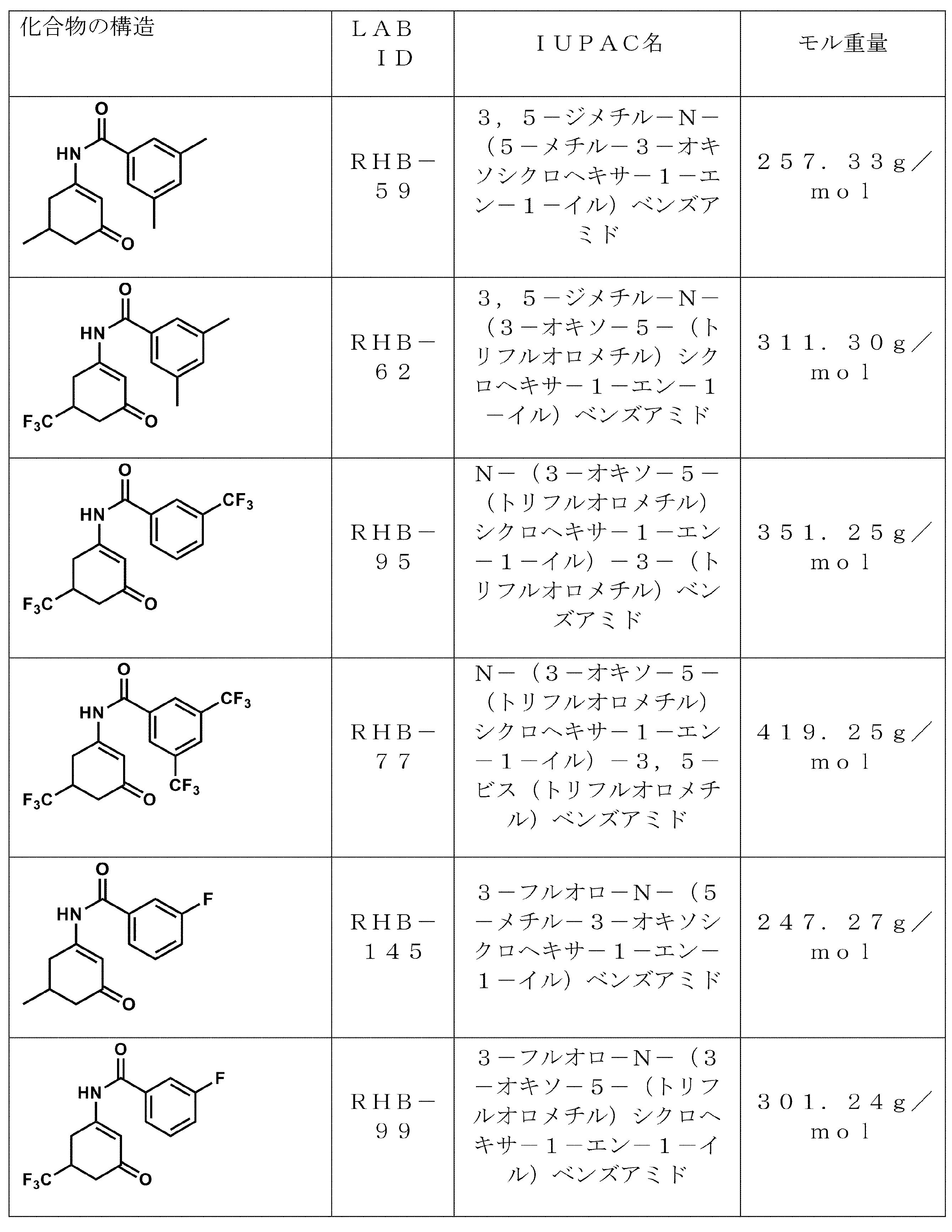


別の実施形態において、本開示はまた、本明細書に記載の疾患又は状態を治療又は予防するための用量で薬学的に好適な担体又は賦形剤(複数の場合もある)と混合した、式(I)、式(II)、式(III)、若しくは式(IV)の化合物又はそれらの薬学的に許容される塩を含む医薬組成物を提供する。本発明の医薬組成物はまた、他の治療剤又は治療モダリティと同時に、逐次的に、又は交互に組み合わせて投与することもできる。 In another embodiment, the present disclosure also provides a pharmaceutical composition comprising a compound of formula (I), formula (II), formula (III), or formula (IV) or a pharma- ceutically acceptable salt thereof, in admixture with a pharma- ceutically suitable carrier or excipient(s) in a dose for treating or preventing a disease or condition described herein. The pharmaceutical compositions of the present invention may also be administered in combination, simultaneously, sequentially, or alternatingly, with other therapeutic agents or modalities.
本発明の組成物は、式(I)、式(II)、式(III)、若しくは式(IV)の化合物又はその薬学的に許容される塩を含む。本発明は、式(I)、式(II)、式(III)、若しくは式(IV)の化合物又はその薬学的に許容される塩、及び1つ以上の追加の治療剤又はそれらの薬学的に許容される塩の、共配合物又は別個の配合物としての投与を提供し、配合物の投与は、同時、逐次、又は交互である。或る特定の実施形態において、他の治療剤は、本発明の組成物によって治療されている疾患又は状態を治療するのに有用であると当該技術分野において認識されている薬剤であり得る。他の実施形態において、他の治療剤は、本発明の組成物によって治療されている疾患又は状態を治療するのに有用であると当該技術分野において認識されていない薬剤であり得る。一態様において、他の治療剤は、本発明の組成物に有益な属性を付与する薬剤(例えば、組成物の粘度に影響を及ぼす薬剤)であり得る。本発明の組成物に有益な属性には、式(I)、式(II)、式(III)、又は式(IV)の化合物と1つ以上の他の治療剤との組合せから得られた薬物動態学的又は薬力学的な相互作用が含まれるが、これらに限定されない。例えば、1つ以上の他の治療剤は抗癲癇薬であり得る。 The compositions of the present invention include a compound of formula (I), formula (II), formula (III), or formula (IV) or a pharma- ceutically acceptable salt thereof. The present invention provides for the administration of a compound of formula (I), formula (II), formula (III), or formula (IV) or a pharma- ceutically acceptable salt thereof, and one or more additional therapeutic agents or pharma- ceutically acceptable salts thereof, either as a co-formulation or as separate formulations, where the administration of the formulations is simultaneous, sequential, or alternating. In certain embodiments, the other therapeutic agent may be an agent recognized in the art as being useful for treating the disease or condition being treated by the compositions of the present invention. In other embodiments, the other therapeutic agent may be an agent not recognized in the art as being useful for treating the disease or condition being treated by the compositions of the present invention. In one aspect, the other therapeutic agent may be an agent that imparts a beneficial attribute to the compositions of the present invention (e.g., an agent that affects the viscosity of the composition). Beneficial attributes of the compositions of the invention include, but are not limited to, pharmacokinetic or pharmacodynamic interactions resulting from the combination of a compound of Formula (I), Formula (II), Formula (III), or Formula (IV) with one or more other therapeutic agents. For example, the one or more other therapeutic agents can be antiepileptic agents.
本発明の組成物の混合物はまた、単純な混合物として、又は適切に配合された医薬組成物として患者に投与することもできる。例えば、本発明の一態様は、治療的有効用量の式(I)、式(II)、式(III)、若しくは式(IV)又はその薬学的に許容される塩、エナンチオマー若しくは立体異性体と、1つ以上の他の治療剤と、薬学的に許容される希釈剤又は担体とを含む医薬組成物に関する。 The mixtures of compositions of the present invention can also be administered to a patient as simple mixtures or as appropriately formulated pharmaceutical compositions. For example, one aspect of the present invention relates to a pharmaceutical composition comprising a therapeutically effective dose of a compound of formula (I), formula (II), formula (III), or formula (IV) or a pharma- ceutically acceptable salt, enantiomer, or stereoisomer thereof, one or more other therapeutic agents, and a pharma- ceutically acceptable diluent or carrier.
医薬組成物は、対象への投与に好適な形態で式(I)、式(II)、式(III)、又は式(IV)の化合物を含有する配合物である。1つの実施形態において、医薬組成物は、バルク又は単位剤形である。単位剤形は、例えば、カプセル、IVバッグ、錠剤、エアロゾル吸入器の単一ポンプ又はバイアルを含む、様々な形態のいずれかである。組成物の単位用量中の有効成分(例えば、開示された化合物若しくはその塩、水和物、溶媒和物又は異性体の配合物)の量は有効量であり、関与する特定の治療に従って変化する。投与量は投与経路にも依存するであろう。経口、肺、直腸、非経口、経皮、皮下、静脈内、筋肉内、腹腔内、吸入、頬側、舌下、胸膜内、髄腔内、鼻腔内等を含む様々な経路が考えられる。本発明の化合物の局所又は経皮投与のための剤形には、粉末、噴霧剤、軟膏、ペースト、クリーム、ローション、ゲル、溶液、パッチ及び吸入剤が含まれる。1つの実施形態において、活性化合物は、滅菌条件下で、薬学的に許容される担体、及び必要とされる任意の防腐剤、緩衝剤、又は噴射剤と混合される。 A pharmaceutical composition is a formulation containing a compound of formula (I), formula (II), formula (III), or formula (IV) in a form suitable for administration to a subject. In one embodiment, the pharmaceutical composition is in bulk or unit dosage form. The unit dosage form is in any of a variety of forms, including, for example, a capsule, an IV bag, a tablet, a single pump of an aerosol inhaler, or a vial. The amount of active ingredient (e.g., a formulation of the disclosed compound or its salt, hydrate, solvate, or isomer) in a unit dose of the composition is an effective amount and will vary according to the particular treatment involved. The dosage will also depend on the route of administration. A variety of routes are contemplated, including oral, pulmonary, rectal, parenteral, transdermal, subcutaneous, intravenous, intramuscular, intraperitoneal, inhalation, buccal, sublingual, intrapleural, intrathecal, intranasal, and the like. Dosage forms for topical or transdermal administration of the compounds of the present invention include powders, sprays, ointments, pastes, creams, lotions, gels, solutions, patches, and inhalants. In one embodiment, the active compound is mixed under sterile conditions with a pharma- ceutically acceptable carrier, and any preservatives, buffers, or propellants that are required.
本明細書で使用される場合、「薬学的に許容される」という語句は、正当な医学的判断の範囲内で、過度の毒性、刺激、アレルギー反応、又は他の問題若しくは合併症なく、合理的な利益/リスクの割合に見合った、ヒト及び動物の組織と接触して使用するのに好適な、化合物、アニオン、カチオン、材料、組成物、担体、及び/又は剤形を指す。
薬学的に許容される賦形剤は、一般に安全であり、非毒性であり、生物学的にもその他の点でも望ましくないものではない医薬組成物の調製において有用な賦形剤であり、ヒトの薬学的用途だけでなく獣医学用途にも許容される賦形剤を含む。本明細書及び特許請求の範囲において使用される「薬学的に許容される賦形剤」には、1つ及び2つ以上のそのような賦形剤が含まれる。
As used herein, the phrase "pharmacologically acceptable" refers to compounds, anions, cations, materials, compositions, carriers, and/or dosage forms that are suitable for use in contact with the tissues of human beings and animals without undue toxicity, irritation, allergic response, or other problem or complication, commensurate with a reasonable benefit/risk ratio, within the scope of sound medical judgment.
A pharma- ceutically acceptable excipient is generally an excipient that is safe, non-toxic, and not biologically or otherwise undesirable and useful in the preparation of a pharmaceutical composition, and includes excipients that are acceptable for human pharmaceutical use as well as for veterinary use. As used in the specification and claims, a "pharma- ceutically acceptable excipient" includes both one and more than one such excipient.
本発明の医薬組成物は、その意図された投与経路に適合するように配合される。投与経路の例としては、非経口、例えば、静脈内、皮内、皮下、経口(例えば、吸入)、経皮(局所)、及び経粘膜投与が挙げられる。非経口、皮内、又は皮下用途に使用される溶液又は懸濁液には、以下の成分:注射用水、生理食塩水、不揮発性油、ポリエチレングリコール、グリセリン、プロピレングリコール又は他の合成溶媒等の滅菌希釈剤、ベンジルアルコール又はメチルパラベン等の抗細菌剤、アスコルビン酸又は亜硫酸水素ナトリウム等の酸化防止剤、エチレンジアミン四酢酸等のキレート剤、酢酸塩、クエン酸塩又はリン酸塩等の緩衝剤、及び塩化ナトリウム又はデキストロース等の張度調節剤が含まれ得る。pHは、塩酸又は水酸化ナトリウム等の酸又は塩基で調整することができる。非経口調製物は、ガラス又はプラスチック製のアンプル、使い捨て注射器又は多用量バイアルに封入することができる。 The pharmaceutical compositions of the invention are formulated to be compatible with their intended route of administration. Examples of routes of administration include parenteral, e.g., intravenous, intradermal, subcutaneous, oral (e.g., inhalation), transdermal (topical), and transmucosal administration. Solutions or suspensions used for parenteral, intradermal, or subcutaneous applications may contain the following components: a sterile diluent such as water for injection, saline, fixed oils, polyethylene glycol, glycerin, propylene glycol, or other synthetic solvents, an antibacterial agent such as benzyl alcohol or methylparaben, an antioxidant such as ascorbic acid or sodium bisulfite, a chelating agent such as ethylenediaminetetraacetic acid, a buffer such as acetate, citrate, or phosphate, and a tonicity adjuster such as sodium chloride or dextrose. The pH can be adjusted with acids or bases such as hydrochloric acid or sodium hydroxide. Parenteral preparations can be enclosed in glass or plastic ampoules, disposable syringes, or multiple dose vials.
本発明の組成物は、化学療法治療に現在使用されている既知の方法の多くにおいて対象に投与することができる。例えば、本明細書で開示された障害の治療のために、本発明の化合物は、血流若しくは体腔に注入されてもよく、又は経口的に摂取されてもよく、又はパッチにより皮膚を通して適用されてもよい。選択される用量は、効果的な治療を構成するのに十分でなければならないが、許容できない副作用を引き起こすほど高すぎてはならない。患者の病状(例えば、発作又は発作障害等)及び健康の状態は、好ましくは、治療中及び治療後の妥当な期間、綿密に観察されなければならない。
或る特定の実施形態において、組み合わせて使用される各医薬剤の治療的有効量は、各薬剤単独での単剤療法と比較して、組み合わせて使用される場合はより少ない。そのようなより少ない治療的有効量は、治療レジメンのより低い毒性を可能にする。
The composition of the present invention can be administered to a subject in many of the known methods currently used for chemotherapy treatment.For example, for the treatment of the disorders disclosed herein, the compounds of the present invention can be injected into the bloodstream or body cavity, or taken orally, or applied through the skin by a patch.The dose selected must be sufficient to constitute an effective treatment, but not too high to cause unacceptable side effects.The patient's medical condition (e.g., seizures or seizure disorder, etc.) and health status should preferably be closely monitored during and for a reasonable period after treatment.
In certain embodiments, the therapeutically effective amount of each pharmaceutical agent used in combination is lower when used in combination compared to monotherapy with each agent alone, such lower therapeutically effective amounts allowing for less toxicity of the treatment regimen.
あらゆる化合物について、治療的有効量は、細胞培養アッセイ又は動物モデル(通常はラット、マウス、ウサギ、イヌ、又はブタ)のいずれかで最初に推定することがきる。動物モデルは、適切な濃度範囲及び投与経路を決定するために使用することもできる。そのような情報は、次に、ヒトにおける投与に有用な用量及び経路を決定するために使用することができる。治療/予防有効性及び毒性は、細胞培養又は実験動物における標準的な薬学的手順、例えば、ED50(集団の50%における治療的に有効な用量)及びLD50(集団の50%に致死的な用量)によって決定することができる。毒性と治療効果との用量比が治療指数であり、LD50/ED50の比として表すことができる。大きな治療指数を示す医薬組成物が好ましい。投与量は、用いられる剤形、患者の感受性、及び投与経路に応じて、この範囲内で変動し得る。 For any compound, the therapeutically effective amount can be estimated initially either in cell culture assays or animal models (usually rats, mice, rabbits, dogs, or pigs). Animal models can also be used to determine appropriate concentration ranges and routes of administration. Such information can then be used to determine useful doses and routes for administration in humans. Therapeutic/prophylactic efficacy and toxicity can be determined by standard pharmaceutical procedures in cell cultures or experimental animals, such as ED 50 (the dose therapeutically effective in 50% of the population) and LD 50 (the dose lethal to 50% of the population). The dose ratio between toxic and therapeutic effects is the therapeutic index, which can be expressed as the ratio LD 50 /ED 50. Pharmaceutical compositions that exhibit large therapeutic indices are preferred. Dosages can vary within this range, depending on the dosage form used, the sensitivity of the patient, and the route of administration.
投与量及び投与は、所望の効果を維持するのに十分なレベルの式(I)、式(II)、式(III)、若しくは式(IV)の化合物又はそれらの薬学的に許容される塩を提供するように調整される。考慮され得る因子には、疾患状態の重症度、対象の全般的健康状態、対象の年齢、体重、及び性別、食事、投与の時間及び頻度、薬物の組合せ(複数の場合もある)、反応感受性、並びに療法に対する耐性/反応が含まれる。長時間作用型医薬組成物は、特定の配合物の半減期及びクリアランス速度に応じて、3日~4日毎、毎週、又は2週間に1回投与することができる。 Dosage and administration are adjusted to provide a sufficient level of the compound of formula (I), formula (II), formula (III), or formula (IV) or a pharma- ceutically acceptable salt thereof to maintain the desired effect. Factors that may be considered include the severity of the disease state, the general health of the subject, the age, weight, and sex of the subject, diet, time and frequency of administration, drug combination(s), reaction sensitivities, and tolerance/response to therapy. Long-acting pharmaceutical compositions can be administered every 3-4 days, every week, or once every two weeks, depending on the half-life and clearance rate of the particular formulation.
式(I)、式(II)、式(III)、若しくは式(IV)の化合物又はそれらの薬学的に許容される塩を含有する医薬組成物は、一般に知られている方法で、例えば、従来の混合、溶解、造粒、糖衣錠製造、湿式粉砕、乳化、カプセル化、封入、又は凍結乾燥プロセスによって製造することができる。医薬組成物は、薬学的に使用することができる調製物への活性化合物の加工を容易にする賦形剤及び/又は助剤を含む1つ以上の薬学的に許容される担体を使用して、従来の方法で配合することができる。当然ながら、適切な配合物は、選択された投与経路に依存する。 Pharmaceutical compositions containing a compound of formula (I), formula (II), formula (III), or formula (IV) or a pharma- ceutically acceptable salt thereof can be prepared in a manner generally known in the art, for example by conventional mixing, dissolving, granulating, dragee-making, wet-grinding, emulsifying, encapsulating, encapsulating, or lyophilizing processes. Pharmaceutical compositions can be formulated in a conventional manner using one or more pharma- ceutically acceptable carriers that contain excipients and/or auxiliaries that facilitate processing of the active compound into pharma- ceutically usable preparations. Naturally, the appropriate formulation depends on the chosen route of administration.
注射用途に好適な医薬組成物には、滅菌水溶液(水溶性の場合)又は分散液、及び滅菌注射用溶液又は分散液の即時調製のための滅菌粉末が含まれる。静脈内投与の場合、好適な担体には、生理食塩水、静菌水、Cremophor EL(商標)(BASF、ニュージャージー州パーシッパニー)又はリン酸緩衝生理食塩水(PBS)が含まれる。全ての場合について、組成物は滅菌されなければならず、容易なシリンジ性が存在する程度に流動性でなければならない。製造及び貯蔵の条件下で安定でなければならず、細菌及び真菌等の微生物の汚染作用から保護されなければならない。担体は、例えば、水、エタノール、ポリオール(例えば、グリセロール、プロピレングリコール、及び液体ポリエチレングリコール等)、及びそれらの好適な混合物を含有する溶媒又は分散媒であり得る。適切な流動性は、例えば、レシチン等のコーティングの使用によって、分散液の場合に必要な粒径の維持によって、及びサーファクタントの使用によって維持することができる。微生物の作用の防止は、様々な抗細菌剤及び抗真菌剤、例えば、パラベン、クロロブタノール、フェノール、アスコルビン酸、チメロサール等によって達成することができる。多くの場合、組成物中に等張剤、例えば、糖、マンニトール及びソルビトール等の多価アルコール、並びに塩化ナトリウムを含めることが好ましい。注射用組成物の延長吸収は、組成物中に吸収を遅延させる薬剤、例えば、モノステアリン酸アルミニウム及びゼラチンを含ませることによってもたらすことができる。 Pharmaceutical compositions suitable for injectable use include sterile aqueous solutions (where water soluble) or dispersions, and sterile powders for the extemporaneous preparation of sterile injectable solutions or dispersions. For intravenous administration, suitable carriers include physiological saline, bacteriostatic water, Cremophor EL™ (BASF, Parsippany, NJ) or phosphate buffered saline (PBS). In all cases, the composition must be sterile and fluid to the extent that easy syringability exists. It must be stable under the conditions of manufacture and storage and must be preserved against the contaminating action of microorganisms such as bacteria and fungi. The carrier can be a solvent or dispersion medium containing, for example, water, ethanol, polyol (for example, glycerol, propylene glycol, and liquid polyethylene glycol, etc.), and suitable mixtures thereof. Proper fluidity can be maintained, for example, by the use of a coating such as lecithin, by the maintenance of the required particle size in the case of dispersions, and by the use of surfactants. Prevention of the action of microorganisms can be achieved by various antibacterial and antifungal agents, such as parabens, chlorobutanol, phenol, ascorbic acid, thimerosal, and the like. In many cases, it is preferable to include isotonic agents in the composition, such as sugars, polyalcohols such as mannitol and sorbitol, and sodium chloride. Prolonged absorption of injectable compositions can be brought about by including in the composition an agent that delays absorption, such as aluminum monostearate and gelatin.
滅菌注射用溶液は、必要量の活性化合物を、必要に応じて上に列挙された成分の1つ又は組合せを含む適切な溶媒に組み込み、続いて濾過滅菌することによって調製することができる。一般に、分散液は、活性化合物を、基本的な分散媒と、上に列挙されたものからの必要な他の成分とを含有する滅菌ビヒクル中に組み込むことによって調製される。滅菌注射用溶液の調製のための滅菌粉末の場合、調製方法は、予め滅菌濾過した溶液から有効成分及び任意の追加の所望の成分の粉末を生成する真空乾燥及び凍結乾燥である。 Sterile injectable solutions can be prepared by incorporating the active compound in the required amount in an appropriate solvent containing one or a combination of ingredients enumerated above, as required, followed by filtered sterilization. Generally, dispersions are prepared by incorporating the active compound into a sterile vehicle containing a basic dispersion medium and the required other ingredients from those enumerated above. In the case of sterile powders for the preparation of sterile injectable solutions, the preparation methods are vacuum drying and freeze-drying, which yield a powder of the active ingredient and any additional desired ingredients from a previously sterile-filtered solution.
経口組成物は一般に、不活性希釈剤又は食用の薬学的に許容される担体を含む。それらは、ゼラチンカプセルに封入するか、又は圧縮して錠剤にすることができる。経口治療投与の目的の場合、活性化合物を賦形剤と混合し、錠剤、トローチ、又はカプセルの形態で使用することができる。経口組成物は、口腔洗浄薬として使用するための流体担体を使用して調製することもでき、流体担体中の化合物は、経口的に適用され、口をすすがれ、吐き出されるか、又は飲み込まれる。薬学的に適合する結合剤、及び/又はアジュバント物質は、組成物の一部として含まれ得る。錠剤、丸剤、カプセル、トローチ等は、以下の成分のいずれか、又は類似の性質の化合物:微結晶性セルロース、トラガカントゴム若しくはゼラチン等の結合剤、デンプン若しくはラクトース等の賦形剤、アルギン酸、Primogel、若しくはコーンスターチ等の崩壊剤、ステアリン酸マグネシウム若しくはSterotes等の滑沢剤、コロイド状二酸化ケイ素等の流動促進剤、スクロース若しくはサッカリン等の甘味剤、又はペパーミント、サリチル酸メチル、若しくはオレンジ香料等の香味剤を含有することができる。 Oral compositions generally include an inert diluent or an edible pharma- ceutically acceptable carrier. They can be enclosed in gelatin capsules or compressed into tablets. For the purpose of oral therapeutic administration, the active compound can be mixed with an excipient and used in the form of tablets, troches, or capsules. Oral compositions can also be prepared using a fluid carrier for use as a mouthwash, where the compound in the fluid carrier is applied orally, swished, expectorated, or swallowed. Pharmaceutically compatible binding agents, and/or adjuvant materials can be included as part of the composition. The tablets, pills, capsules, troches and the like may contain any of the following ingredients, or compounds of a similar nature: a binder such as microcrystalline cellulose, tragacanth or gelatin; an excipient such as starch or lactose; a disintegrant such as alginic acid, Primogel, or corn starch; a lubricant such as magnesium stearate or Sterotes; a glidant such as colloidal silicon dioxide; a sweetener such as sucrose or saccharin; or a flavoring such as peppermint, methyl salicylate, or orange flavoring.
吸入による投与の場合、化合物は、好適な噴射剤、例えば、二酸化炭素等のガスを含有する加圧容器若しくはディスペンサー、又はネブライザーからエアロゾルスプレーの形態で送達される。
全身投与は、経粘膜又は経皮的な手段でもあり得る。経粘膜投与又は経皮投与の場合、浸透されるバリアに適切な浸透剤が配合物において使用される。そのような浸透剤は、当該技術分野において一般に知られており、例えば、経粘膜投与の場合、界面活性剤、胆汁酸塩、及びフシジン酸誘導体が含まれる。経粘膜投与は、経鼻スプレー又は坐薬の使用によって実施することができる。経皮投与の場合、活性化合物は、当該技術分野において一般に知られているように、軟膏、膏薬、ゲル、又はクリームに配合される。
For administration by inhalation, the compounds are delivered in the form of an aerosol spray from pressured container or dispenser which contains a suitable propellant, e.g., a gas such as carbon dioxide, or a nebulizer.
Systemic administration can also be by transmucosal or transdermal means.For transmucosal or transdermal administration, a penetrant suitable for the barrier to be permeated is used in the formulation.Such penetrants are generally known in the art, and include, for example, for transmucosal administration, surfactants, bile salts, and fusidic acid derivatives.Transmucosal administration can be carried out by using nasal sprays or suppositories.For transdermal administration, the active compound is formulated into ointments, salves, gels, or creams as generally known in the art.
式(I)、式(II)、式(III)、若しくは式(IV)の化合物又はそれらの薬学的に許容される塩は、体内からの急速な排出から化合物を保護する薬学的に許容される担体、例えば、インプラント及びマイクロカプセル化送達システムを含む制御放出配合物を用いて調製することができる。エチレンビニルアセテート、ポリ無水物、ポリグリコール酸、コラーゲン、ポリオルトエステル、及びポリ乳酸等の生分解性の生体適合性ポリマーを使用することができる。そのような配合物の調製方法は、当業者には明らかであろう。材料は、Alza Corporation及びNova Pharmaceuticals, Inc.から商業的に入手することもできる。リポソーム懸濁液(ウイルス抗原に対するモノクローナル抗体で感染細胞を標的とするリポソームを含む)もまた、薬学的に許容される担体として使用することができる。これらは、例えば、米国特許第4,522,811号に記載されているように、当業者に既知の方法に従って調製することができる。 The compounds of formula (I), formula (II), formula (III), or formula (IV) or pharma- ceutically acceptable salts thereof can be prepared with pharma- ceutically acceptable carriers that protect the compounds from rapid elimination from the body, e.g., controlled release formulations, including implants and microencapsulated delivery systems. Biodegradable, biocompatible polymers such as ethylene vinyl acetate, polyanhydrides, polyglycolic acid, collagen, polyorthoesters, and polylactic acid can be used. Methods for preparing such formulations will be apparent to those skilled in the art. Materials can also be obtained commercially from Alza Corporation and Nova Pharmaceuticals, Inc. Liposomal suspensions (including liposomes that target infected cells with monoclonal antibodies against viral antigens) can also be used as pharma- ceutically acceptable carriers. These can be prepared according to methods known to those skilled in the art, e.g., as described in U.S. Pat. No. 4,522,811.
投与のし易さ及び投与量の均一性のために、経口組成物又は非経口組成物を投与量単位形態で配合することが特に有利である。本明細書で使用される投与量単位形態とは、治療される対象のための単位投与量として適した物理的に別個の単位を指し、各単位は、必要な薬学的担体に伴って所望の治療効果を生じるように計算された所定の量の活性化合物を含有する。本発明の投与量単位形態の仕様は、活性化合物の固有の特徴及び達成される特定の治療効果によって決定され、かつ直接的に依存する。 For ease of administration and uniformity of dosage, it is particularly advantageous to formulate oral or parenteral compositions in dosage unit form. As used herein, dosage unit form refers to physically discrete units suited as unitary dosages for the subjects to be treated, each unit containing a predetermined quantity of active compound calculated to produce the desired therapeutic effect in association with the required pharmaceutical carrier. The specifications for the dosage unit forms of the present invention are dictated by and directly dependent on the unique characteristics of the active compound and the particular therapeutic effect to be achieved.
治療用途において、本明細書に記載の式(I)、式(II)、式(III)、若しくは式(IV)の化合物又はそれらの薬学的に許容される塩、及び任意に1つ以上の他の治療剤、又は本発明に従って使用される医薬組成物の投与量は、選択された投与量に影響を及ぼす他の因子の中でも、薬剤、レシピエント患者の年齢、体重、及び臨床状態、並びに療法を施す臨床医又は施術者の経験及び判断に応じて変化する。一般に、用量は、腫瘍の増殖を遅らせ、好ましくは退縮させ、また好ましくは癌の完全な退縮を引き起こすのに十分でなければならない。投与量は、約0.001mg/kg/日~約5000mg/kg/日の範囲であり得る。好ましい態様において、投与量は、約0.01mg/kg/日~約1000mg/kg/日の範囲であり得る。一態様において、用量は、単一用量、分割用量、又は継続用量において、約0.1mg/日~約50g/日、約0.1mg/日~約25g/日、約0.1mg/日~約10g/日、約0.1mg/日~約3g/日、又は約0.1mg/日~約1g/日の範囲である(用量は、患者の体重(kg)、体表面積(m2)、及び年齢(年)に合わせて調整される)。医薬剤の有効量は、臨床医又は他の適格な観察者によって示されるような、客観的に識別可能な改善をもたらす量である。本明細書で使用される場合、「効果的な投与量」という用語は、対象又は細胞において所望の生物学的効果を生じる活性化合物の量を指す。 In therapeutic applications, the dosage of a compound of formula (I), formula (II), formula (III), or formula (IV) described herein or a pharma- ceutically acceptable salt thereof, and optionally one or more other therapeutic agents, or a pharmaceutical composition used in accordance with the present invention, will vary according to the agent, the age, weight, and clinical condition of the recipient patient, and the experience and judgment of the clinician or practitioner administering the therapy, among other factors that will affect the selected dosage. In general, the dose should be sufficient to slow, and preferably cause regression of, tumor growth, and preferably cause complete regression of the cancer. Dosages may range from about 0.001 mg/kg/day to about 5000 mg/kg/day. In a preferred embodiment, dosages may range from about 0.01 mg/kg/day to about 1000 mg/kg/day. In one aspect, the dosage ranges from about 0.1 mg/day to about 50 g/day, about 0.1 mg/day to about 25 g/day, about 0.1 mg/day to about 10 g/day, about 0.1 mg/day to about 3 g/day, or about 0.1 mg/day to about 1 g/day in a single dose, divided doses, or continuous doses (dosage is adjusted for the patient's weight (kg), body surface area (m 2 ), and age (years)). An effective amount of a pharmaceutical agent is that amount that produces an objectively identifiable improvement as noted by a clinician or other qualified observer. As used herein, the term "effective dosage" refers to that amount of an active compound that produces a desired biological effect in a subject or cell.
多くの医薬組成物は、治療効果を達成するために、一定の間隔で固定の用量として投与される。作用持続時間は、有効成分(例えば、式(I)、式(II)、式(III)、又は式(IV)に包含される化合物)の血漿中半減期によって反映される。有効性は、多くの場合、中枢神経系内での十分な曝露に依存するため、短い半減期の中枢神経系薬物の投与は頻繁な維持投与を必要とする場合がある。本明細書において有利に開示されるのは、式(I)、式(II)、式(III)、若しくは式(IV)に包含される化合物又はその薬学的に許容される塩を含む医薬組成物の投与によって、発作及び発作障害を治療、予防、又は軽減する方法である。例えば、実施形態において、発作又は発作障害を治療する方法が提供され、これは、それを必要とする患者に、約0.05mg~約2000mgの式(I)、式(II)、式(III)、又は式(IV)に包含される化合物を含む医薬組成物を投与することを含み、組成物は、患者への投与後6時間超にわたって改善をもたらす。例えば、実施形態において、発作又は発作障害を治療する方法が提供され、これは、それを必要とする患者に、約0.05mg~約75mgの式(I)、式(II)、式(III)、若しくは式(IV)に包含される化合物又はその薬学的に許容される塩を含む医薬組成物を投与することを含み、組成物は、患者への投与後6時間超にわたって改善をもたらす。 Many pharmaceutical compositions are administered as fixed doses at regular intervals to achieve a therapeutic effect. The duration of action is reflected by the plasma half-life of the active ingredient (e.g., a compound encompassed by Formula (I), Formula (II), Formula (III), or Formula (IV)). Efficacy often depends on sufficient exposure within the central nervous system, so administration of a short half-life central nervous system drug may require frequent maintenance dosing. Advantageously disclosed herein is a method of treating, preventing, or alleviating seizures and seizure disorders by administration of a pharmaceutical composition comprising a compound encompassed by Formula (I), Formula (II), Formula (III), or Formula (IV) or a pharma- ceutically acceptable salt thereof. For example, in an embodiment, a method of treating seizures or seizure disorders is provided, comprising administering to a patient in need thereof a pharmaceutical composition comprising about 0.05 mg to about 2000 mg of a compound encompassed by Formula (I), Formula (II), Formula (III), or Formula (IV), wherein the composition provides improvement for more than 6 hours after administration to the patient. For example, in embodiments, a method of treating seizures or a seizure disorder is provided, comprising administering to a patient in need thereof a pharmaceutical composition comprising about 0.05 mg to about 75 mg of a compound encompassed by Formula (I), Formula (II), Formula (III), or Formula (IV) or a pharma- ceutically acceptable salt thereof, wherein the composition provides improvement for more than 6 hours after administration to the patient.
実施形態において、発作又は発作障害を治療する方法は、それを必要とする患者に、約0.05mg~約50mgの式(I)、式(II)、式(III)、若しくは式(IV)に包含される化合物又はその薬学的に許容される塩を含む医薬組成物を投与することを含む。実施形態において、発作又は発作障害を治療する方法は、それを必要とする患者に、約0.1mg~約30mgの式(I)、式(II)、式(III)、若しくは式(IV)に包含される化合物又はその薬学的に許容される塩を含む医薬組成物を投与することを含む。例えば、投与量は、おおよそであるが、例えば、0.05mg~50mg、1mg~30mg、1mg~20mg、1mg~15mg、0.01mg~10mg、0.1mg~15mg、0.1mg~30mg、0.15mg~12.5mg、又は0.2mg~10mgの範囲の式(I)、式(II)、式(III)、若しくは式(IV)に包含される化合物又はその薬学的に許容される塩の量を含み得るものであり、0.05mg、0.1mg、0.2mg、0.3mg、0.4mg、0.5mg、0.6mg、0.7mg、0.8mg、0.9mg、1.5mg、1.0mg、1.75mg、2mg、2.5mg、2.75mg、3mg、3.5mg、3.75mg、4mg、4.5mg、4.75mg、5mg、5.5mg、6mg、6.5mg、7mg、7.5mg、8mg、8.5mg、9mg、10mg、11mg、12mg、15mg、20mg、25mg、及び30mgの用量が用量の具体例である。 In an embodiment, a method of treating seizures or a seizure disorder includes administering to a patient in need thereof a pharmaceutical composition comprising about 0.05 mg to about 50 mg of a compound encompassed by Formula (I), Formula (II), Formula (III), or Formula (IV) or a pharma- ceutically acceptable salt thereof. In an embodiment, a method of treating seizures or a seizure disorder includes administering to a patient in need thereof a pharmaceutical composition comprising about 0.1 mg to about 30 mg of a compound encompassed by Formula (I), Formula (II), Formula (III), or Formula (IV) or a pharma- ceutically acceptable salt thereof. For example, dosage amounts may include, but are not limited to, an amount of a compound encompassed by Formula (I), Formula (II), Formula (III), or Formula (IV) or a pharma- ceutically acceptable salt thereof in the range of, for example, 0.05 mg to 50 mg, 1 mg to 30 mg, 1 mg to 20 mg, 1 mg to 15 mg, 0.01 mg to 10 mg, 0.1 mg to 15 mg, 0.1 mg to 30 mg, 0.15 mg to 12.5 mg, or 0.2 mg to 10 mg. , 0.3 mg, 0.4 mg, 0.5 mg, 0.6 mg, 0.7 mg, 0.8 mg, 0.9 mg, 1.5 mg, 1.0 mg, 1.75 mg, 2 mg, 2.5 mg, 2.75 mg, 3 mg, 3.5 mg, 3.75 mg, 4 mg, 4.5 mg, 4.75 mg, 5 mg, 5.5 mg, 6 mg, 6.5 mg, 7 mg, 7.5 mg, 8 mg, 8.5 mg, 9 mg, 10 mg, 11 mg, 12 mg, 15 mg, 20 mg, 25 mg, and 30 mg are specific examples of dosages.
典型的には、式(I)、式(II)、式(III)、若しくは式(IV)に包含される化合物又はその薬学的に許容される塩の投与量は、それを必要とする患者に1日1回又は2回投与される。本明細書に記載の方法及び組成物は、投与頻度の低減並びに有害事象の低減及び/又は有効性の向上をもたらし得る。実施形態において、投与量は、おおよそであるが、例えば、0.05mg/日~30mg/日、0.1mg/日~20mg/日、又は0.2mg/日~15mg/日、又は0.5mg/日~10mg/日、又は0.75mg/日~5mg/日、例えば0.1mg/日、0.2mg/日、0.5mg/日、0.75mg/日、1mg/日、1.5mg/日、2mg/日、3mg/日、4mg/日、5mg/日、6mg/日、7mg/日、8mg/日、9mg/日、10mg/日、11mg/日、12mg/日、13mg/日、14mg/日、15mg/日、16mg/日、17mg/日、18mg/日、19mg/日、20mg/日、21mg/日、22mg/日、23mg/日、24mg/日、25mg/日、26mg/日、27mg/日、28mg/日、29mg/日、又は30mg/日である。 Typically, a dosage of a compound encompassed by Formula (I), Formula (II), Formula (III), or Formula (IV) or a pharma- ceutically acceptable salt thereof is administered once or twice daily to a patient in need thereof. The methods and compositions described herein may result in reduced dosing frequency and reduced adverse events and/or improved efficacy. In embodiments, the dosage is approximately, for example, 0.05 mg/day to 30 mg/day, 0.1 mg/day to 20 mg/day, or 0.2 mg/day to 15 mg/day, or 0.5 mg/day to 10 mg/day, or 0.75 mg/day to 5 mg/day, for example, 0.1 mg/day, 0.2 mg/day, 0.5 mg/day, 0.75 mg/day, 1 mg/day, 1.5 mg/day, 2 mg/day, 3 mg/day, 4 mg/day, 5 mg/day, 6 mg/day, 7 mg/day, 8 mg/day, 9 mg/day, 10 mg/day, 11 mg/day, 12 mg/day, 13 mg/day, 14 mg/day, 15 mg/day, 16 mg/day, 17 mg/day, 18 mg/day, 19 mg/day, 20 mg/day, 25 mg/day, 26 mg/day, 27 mg/day, 28 mg/day, 29 mg/day, 30 mg/day, 31 mg/day, 32 mg/day, 33 mg/day, 34 mg/day, 35 mg/day, 36 mg/day, 37 mg/day, 38 mg/day, 39 mg/day, 38 mg/day, 39 mg/day, 39 mg/day, 38 mg/day, 39 mg/day, 39 mg/day, 39 mg/day, 39 mg/day, 39 mg/day, g/day, 6 mg/day, 7 mg/day, 8 mg/day, 9 mg/day, 10 mg/day, 11 mg/day, 12 mg/day, 13 mg/day, 14 mg/day, 15 mg/day, 16 mg/day, 17 mg/day, 18 mg/day, 19 mg/day, 20 mg/day, 21 mg/day, 22 mg/day, 23 mg/day, 24 mg/day, 25 mg/day, 26 mg/day, 27 mg/day, 28 mg/day, 29 mg/day, or 30 mg/day.
実施形態において、式(I)、式(II)、式(III)、若しくは式(IV)に包含される化合物又はその薬学的に許容される塩は、1日1回、乳児において0.2mg~1mg、又は成人において1mg~20mgの用量で投与される。 In an embodiment, a compound encompassed by formula (I), formula (II), formula (III), or formula (IV) or a pharma- ceutically acceptable salt thereof is administered once daily at a dose of 0.2 mg to 1 mg in infants, or 1 mg to 20 mg in adults.
実施形態において、医薬組成物には、0.1mg~25mg、0.1mg~20mg、0.1mg~15mg、0.5mg~25mg、0.5mg~20mg、0.5~15mg、1mg~25mg、1mg~20mg、1mg~15mg、1.5mg~25mg、1.5mg~20mg、1.5mg~15mg、2mg~25mg、2mg~20mg、2mg~15mg、2.5mg~25mg、2.5mg~20mg、2.5mg~15mg、3mg~25mg、3mg~20mg、3mg~15mgの式(I)、式(II)、式(III)、若しくは式(IV)に包含される化合物又はその薬学的に許容される塩が含まれる。 In embodiments, the pharmaceutical composition includes 0.1 mg to 25 mg, 0.1 mg to 20 mg, 0.1 mg to 15 mg, 0.5 mg to 25 mg, 0.5 mg to 20 mg, 0.5 to 15 mg, 1 mg to 25 mg, 1 mg to 20 mg, 1 mg to 15 mg, 1.5 mg to 25 mg, 1.5 mg to 20 mg, 1.5 mg to 15 mg, 2 mg to 25 mg, 2 mg to 20 mg, 2 mg to 15 mg, 2.5 mg to 25 mg, 2.5 mg to 20 mg, 2.5 mg to 15 mg, 3 mg to 25 mg, 3 mg to 20 mg, or 3 mg to 15 mg of a compound encompassed by formula (I), formula (II), formula (III), or formula (IV) or a pharma- ceutically acceptable salt thereof.
実施形態において、医薬組成物には、5mg~20mg、5mg~10mg、4mg~6mg、6mg~8mg、8mg~10mg、10mg~12mg、12mg~14mg、14mg~16mg、16mg~18mg、又は18mg~20mgの式(I)、式(II)、式(III)、若しくは式(IV)に包含される化合物又はその薬学的に許容される塩が含まれる。 In embodiments, the pharmaceutical composition includes 5 mg to 20 mg, 5 mg to 10 mg, 4 mg to 6 mg, 6 mg to 8 mg, 8 mg to 10 mg, 10 mg to 12 mg, 12 mg to 14 mg, 14 mg to 16 mg, 16 mg to 18 mg, or 18 mg to 20 mg of a compound encompassed by formula (I), formula (II), formula (III), or formula (IV) or a pharma- ceutically acceptable salt thereof.
実施形態において、医薬組成物には、0.1mg、0.25mg、0.5mg、1mg、2.5mg、3mg、4mg、5mg、7mg、7.5mg、10mg、12.5mg、15mg、17.5mg、20mg、22.5mg、25mg、30mg、40mg、50mg、60mg、70mg、80mg、90mg、100mg、110mg、120mg、130mg、140mg、150mg、160mg、170mg、180mg、190mg、200mg、225mg、250mg、300mg、350mg、400mg、500mg、600mg、700mg、800mg、900mg、若しくは1000mg、又はかかる用量の倍数量の式(I)、式(II)、式(III)、若しくは式(IV)に包含される化合物又はその薬学的に許容される塩が含まれる。実施形態において、医薬組成物には、2.5mg、5mg、7.5mg、10mg、15mg、又は20mgの式(I)、式(II)、式(III)、若しくは式(IV)に包含される化合物又はその薬学的に許容される塩が含まれる。 In embodiments, the pharmaceutical composition includes 0.1 mg, 0.25 mg, 0.5 mg, 1 mg, 2.5 mg, 3 mg, 4 mg, 5 mg, 7 mg, 7.5 mg, 10 mg, 12.5 mg, 15 mg, 17.5 mg, 20 mg, 22.5 mg, 25 mg, 30 mg, 40 mg, 50 mg, 60 mg, 70 mg, 80 mg, 90 mg, 100 mg, 110 mg, 120 mg, 130 mg, 140 mg, The pharmaceutical composition may contain 150 mg, 160 mg, 170 mg, 180 mg, 190 mg, 200 mg, 225 mg, 250 mg, 300 mg, 350 mg, 400 mg, 500 mg, 600 mg, 700 mg, 800 mg, 900 mg, or 1000 mg, or multiples of such doses of a compound encompassed by formula (I), formula (II), formula (III), or formula (IV) or a pharma- ceutically acceptable salt thereof. In embodiments, the pharmaceutical composition contains 2.5 mg, 5 mg, 7.5 mg, 10 mg, 15 mg, or 20 mg of a compound encompassed by formula (I), formula (II), formula (III), or formula (IV) or a pharma- ceutically acceptable salt thereof.
実施形態において、24時間で対象に投与される式(I)、式(II)、式(III)、若しくは式(IV)に包含される化合物又はその薬学的に許容される塩の総量は、1mg~100mgである。実施形態において、24時間で対象に投与される式(I)、式(II)、式(III)、若しくは式(IV)に包含される化合物又はその薬学的に許容される塩の総量は、1mg~50mgである。実施形態において、24時間で対象に投与される式(I)、式(II)、式(III)、若しくは式(IV)に包含される化合物又はその薬学的に許容される塩の総量は、1mg~20mgである。実施形態において、24時間で対象に投与される式(I)、式(II)、式(III)、若しくは式(IV)に包含される化合物又はその薬学的に許容される塩の総量は、5mg、10mg、15mg又は20mgである。実施形態において、対象は低用量で開始されてもよく、投与量は段階的に増加される。このようにして、薬物が対象において良好な耐容性を示したかどうかを決定することができる。投与量は、小児について成人よりも少なくすることができる。実施形態において、小児についての式(I)、式(II)、式(III)、又は式(IV)に包含される化合物の用量は、0.1mg/kg~1mg/kgであり得る。 In an embodiment, the total amount of the compound encompassed by formula (I), formula (II), formula (III), or formula (IV) or a pharma- ceutically acceptable salt thereof administered to the subject in a 24-hour period is 1 mg to 100 mg. In an embodiment, the total amount of the compound encompassed by formula (I), formula (II), formula (III), or formula (IV) or a pharma- ceutically acceptable salt thereof administered to the subject in a 24-hour period is 1 mg to 50 mg. In an embodiment, the total amount of the compound encompassed by formula (I), formula (II), formula (III), or formula (IV) or a pharma- ceutically acceptable salt thereof administered to the subject in a 24-hour period is 1 mg to 20 mg. In an embodiment, the total amount of the compound encompassed by formula (I), formula (II), formula (III), or formula (IV) or a pharma- ceutically acceptable salt thereof administered to the subject in a 24-hour period is 5 mg, 10 mg, 15 mg, or 20 mg. In an embodiment, the subject may be started on a low dose, and the dosage is increased stepwise. In this manner, it can be determined whether the drug is well tolerated in the subject. The dosage can be lower for children than for adults. In embodiments, the dose of a compound encompassed by Formula (I), Formula (II), Formula (III), or Formula (IV) for children can be from 0.1 mg/kg to 1 mg/kg.
実施形態において、発作又は発作障害を治療する方法は、式(I)、式(II)、式(III)、若しくは式(IV)に包含される化合物又はその薬学的に許容される塩を、それを必要とする患者に投与することを含む。式(I)、式(II)、式(III)、若しくは式(IV)に包含される化合物又はその薬学的に許容される塩は、10mg/kg~40mg/kg、例えば、11mg/kg~39mg/kg、12mg/kg~38mg/kg、13mg/kg~37mg/kg、14mg/kg~36mg/kg、15mg/kg~35mg/kg、16mg/kg~34mg/kg、17mg/kg~33mg/kg、18mg/kg~32mg/kg、19mg/kg~31mg/kg、20mg/kg~30mg/kg、21mg/kg~29mg/kg、22mg/kg~28mg/kg、23mg/kg~27mg/kg、又は24mg/kg~26mg/kgの範囲の用量で投与することができる。実施形態において、式(I)、式(II)、式(III)、若しくは式(IV)に包含される化合物又はその薬学的に許容される塩は、例えば、1mg、10mg、20mg、30mg、40mg、50mg、75mg、100mg、125mg、150mg、175mg、200mg、225mg、250mg、275mg、300mg、325mg、350mg、375mg、400mg、425mg、450mg、475mg、500mg、525mg、550mg、575mg、600mg、625mg、650mg、675mg、700mg、725mg、750mg、775mg、800mg、825mg、850mg、875mg、900mg、925mg、950mg、975mg、1000mg、1225mg、1250mg、1275mg、1300mg、1325mg、1350mg、1375mg、1400mg、1425mg、1450mg、1475mg、1500mg、1525mg、1550mg、1575mg、1600mg、1625mg、1650mg、1675mg、1700mg、1725mg、1750mg、1775mg、1800mg、1825mg、1850mg、1875mg、1900mg、1925mg、1950mg、1975mg、又は2000mgの用量で投与することができる。 In an embodiment, a method for treating seizures or a seizure disorder includes administering a compound encompassed by Formula (I), Formula (II), Formula (III), or Formula (IV) or a pharma- ceutically acceptable salt thereof to a patient in need thereof. A compound encompassed by Formula (I), Formula (II), Formula (III), or Formula (IV), or a pharma- ceutically acceptable salt thereof, can be administered at a dose ranging from 10 mg/kg to 40 mg/kg, e.g., 11 mg/kg to 39 mg/kg, 12 mg/kg to 38 mg/kg, 13 mg/kg to 37 mg/kg, 14 mg/kg to 36 mg/kg, 15 mg/kg to 35 mg/kg, 16 mg/kg to 34 mg/kg, 17 mg/kg to 33 mg/kg, 18 mg/kg to 32 mg/kg, 19 mg/kg to 31 mg/kg, 20 mg/kg to 30 mg/kg, 21 mg/kg to 29 mg/kg, 22 mg/kg to 28 mg/kg, 23 mg/kg to 27 mg/kg, or 24 mg/kg to 26 mg/kg. In embodiments, the compound encompassed by Formula (I), Formula (II), Formula (III), or Formula (IV) or a pharma- ceutically acceptable salt thereof may be administered in an amount of, for example, 1 mg, 10 mg, 20 mg, 30 mg, 40 mg, 50 mg, 75 mg, 100 mg, 125 mg, 150 mg, 175 mg, 200 mg, 225 mg, 250 mg, 275 mg, 300 mg, 325 mg, 350 mg, 375 mg, 400 mg, 425 mg, 450 mg, 475 mg, 500 mg, 525 mg, 550 mg, 575 mg, 600 mg, 625 mg, 650 mg, 675 mg, 700 mg, 725 mg, 750 mg, 775 mg, 800 mg, 825 mg, 85 It can be administered in doses of 0 mg, 875 mg, 900 mg, 925 mg, 950 mg, 975 mg, 1000 mg, 1225 mg, 1250 mg, 1275 mg, 1300 mg, 1325 mg, 1350 mg, 1375 mg, 1400 mg, 1425 mg, 1450 mg, 1475 mg, 1500 mg, 1525 mg, 1550 mg, 1575 mg, 1600 mg, 1625 mg, 1650 mg, 1675 mg, 1700 mg, 1725 mg, 1750 mg, 1775 mg, 1800 mg, 1825 mg, 1850 mg, 1875 mg, 1900 mg, 1925 mg, 1950 mg, 1975 mg, or 2000 mg.
医薬組成物は、投与のための指示と共に容器、パック、又はディスペンサー内に含まれ得る。
本発明の組成物は、更に塩を形成することができる。本発明の組成物は、分子当たり1つを超える塩、例えば、モノ-、ジ-、トリ-を形成することができる。これらの形態の全てもまた、特許請求された発明の範囲内で考えられる。
The pharmaceutical compositions can be included in a container, pack, or dispenser together with instructions for administration.
The compositions of the present invention may further form salts. The compositions of the present invention may form more than one salt per molecule, e.g., mono-, di-, tri-. All of these forms are also contemplated within the scope of the claimed invention.
例示的な薬学的に許容される塩とは、式(I)、式(II)、式(III)、又は式(IV)に包含される化合物の誘導体を指し、親化合物は、その酸塩又は塩基塩を作ることによって修飾される。薬学的に許容される塩の例としては、アミン等の塩基性残基の鉱酸塩又は有機酸塩、カルボン酸等の酸性残基のアルカリ塩又は有機塩等が挙げられるが、これらに限定されない。薬学的に許容される塩としては、例えば、非毒性無機酸又は有機酸から形成される親化合物の従来の非毒性塩又は四級アンモニウム塩が挙げられる。例えば、そのような従来の非毒性塩としては、2-アセトキシ安息香酸、2-ヒドロキシエタンスルホン酸、酢酸、アスコルビン酸、ベンゼンスルホン酸、安息香酸、重炭酸、炭酸、クエン酸、エデト酸、エタンジスルホン酸、1,2-エタンスルホン酸、フマル酸、グルコヘプトン酸、グルコン酸、グルタミン酸、グリコール酸、グリコルリアルサニル酸(glycollyarsanilic)、ヘキシルレゾルシン酸(hexylresorcinic)、ヒドラバミン酸(hydrabamic)、臭化水素酸、塩酸、ヨウ化水素酸、ヒドロキシマレイン酸、ヒドロキシナフトエ酸、イセチオン酸、乳酸、ラクトビオン酸、ラウリルスルホン酸、マレイン酸、リンゴ酸、マンデル酸、メタンスルホン酸、ナフチル酸(napsylic)、硝酸、シュウ酸、パモ酸、パントテン酸、フェニル酢酸、リン酸、ポリガラクツロン酸、プロピオン酸、サリチル酸、ステアリン酸、スバセチン酸(subacetic)、コハク酸、スルファミン酸、スルファニル酸、硫酸、タンニン酸、酒石酸、トルエンスルホン酸、及び一般的に存在するアミン酸、例えば、グリシン、アラニン、フェニルアラニン、アルギニン等から選択される無機酸及び有機酸に由来するものが挙げられるが、これらに限定されない。 Exemplary pharma- ceutically acceptable salts refer to derivatives of compounds encompassed by Formula (I), Formula (II), Formula (III), or Formula (IV), where the parent compound is modified by making an acid or base salt thereof. Examples of pharma-ceutically acceptable salts include, but are not limited to, mineral or organic acid salts of basic residues such as amines, alkali or organic salts of acidic residues such as carboxylic acids, and the like. Pharmaceutically acceptable salts include, for example, conventional non-toxic salts or quaternary ammonium salts of the parent compound formed from non-toxic inorganic or organic acids. For example, such conventional non-toxic salts include 2-acetoxybenzoic acid, 2-hydroxyethanesulfonic acid, acetic acid, ascorbic acid, benzenesulfonic acid, benzoic acid, bicarbonate, carbonic acid, citric acid, edetic acid, ethanedisulfonic acid, 1,2-ethanesulfonic acid, fumaric acid, glucoheptonic acid, gluconic acid, glutamic acid, glycolic acid, glycollyarsanilic acid, hexylresorcinic acid, hydrabamic acid, hydrobromic acid, hydrochloric acid, hydroiodic acid, hydroxymaleic acid, hydroxynaphthoic acid, isethionic acid, These include, but are not limited to, those derived from inorganic and organic acids selected from acids, lactic acid, lactobionic acid, laurylsulfonic acid, maleic acid, malic acid, mandelic acid, methanesulfonic acid, napsylic acid, nitric acid, oxalic acid, pamoic acid, pantothenic acid, phenylacetic acid, phosphoric acid, polygalacturonic acid, propionic acid, salicylic acid, stearic acid, subacetic acid, succinic acid, sulfamic acid, sulfanilic acid, sulfuric acid, tannic acid, tartaric acid, toluenesulfonic acid, and commonly occurring amino acids such as glycine, alanine, phenylalanine, arginine, etc.
薬学的に許容される塩の他の例としては、ヘキサン酸、シクロペンタンプロピオン酸、ピルビン酸、マロン酸、3-(4-ヒドロキシベンゾイル)安息香酸、桂皮酸、4-クロロベンゼンスルホン酸、2-ナフタレンスルホン酸、4-トルエンスルホン酸、カンファースルホン酸、4-メチルビシクロ-[2.2.2]-オクタ-2-エン-1-カルボン酸、3-フェニルプロピオン酸、トリメチル酢酸、三級ブチル酢酸、ムコン酸等が挙げられる。本発明はまた、親化合物中に存在する酸性水素イオンが金属イオン、例えば、アルカリ金属イオン、アルカリ土類イオン、又はアルミニウムイオンによって置換されるか、又は例えばエタノールアミン、ジエタノールアミン、トリエタノールアミン、トロメタミン、N-メチルグルカミン等の有機塩基と配位したときに形成される塩を包含する。 Other examples of pharma- ceutically acceptable salts include hexanoic acid, cyclopentanepropionic acid, pyruvic acid, malonic acid, 3-(4-hydroxybenzoyl)benzoic acid, cinnamic acid, 4-chlorobenzenesulfonic acid, 2-naphthalenesulfonic acid, 4-toluenesulfonic acid, camphorsulfonic acid, 4-methylbicyclo-[2.2.2]-oct-2-ene-1-carboxylic acid, 3-phenylpropionic acid, trimethylacetic acid, tertiary butylacetic acid, muconic acid, and the like. The invention also includes salts formed when the acidic hydrogen ion present in the parent compound is replaced by a metal ion, e.g., an alkali metal ion, an alkaline earth ion, or an aluminum ion, or coordinated with an organic base, e.g., ethanolamine, diethanolamine, triethanolamine, tromethamine, N-methylglucamine, and the like.
薬学的に許容される塩への全ての言及には、本明細書で定義される同じ塩の溶媒付加形態(溶媒和物)又は結晶形(多形体)が含まれることを理解されたい。
本発明の組成物は、エステル、例えば、薬学的に許容されるエステルとして調製することもできる。例えば、式(I)、式(II)、式(III)、若しくは式(IV)の化合物又はそれらの薬学的に許容される塩中のカルボン酸官能基は、その対応するエステル、例えば、メチル、エチル又は他のエステルに転換することができる。また、化合物中のアルコール基は、その対応するエステル、例えば、酢酸エステル、プロピオン酸エステル又は他のエステルに転換することができる。
It should be understood that all references to pharma- ceutically acceptable salts include the solvent addition forms (solvates) or crystal forms (polymorphs) of the same salt as defined herein.
The compositions of the present invention can also be prepared as esters, for example, pharma- ceutically acceptable esters. For example, a carboxylic acid function in a compound of formula (I), formula (II), formula (III), or formula (IV) or a pharma- ceutically acceptable salt thereof can be converted to its corresponding ester, for example, methyl, ethyl, or other ester. Also, an alcohol group in the compound can be converted to its corresponding ester, for example, acetate, propionate, or other ester.
本発明の組成物は、プロドラッグ、例えば、薬学的に許容されるプロドラッグとして調製することもできる。「プロ-ドラッグ(pro-drug)」及び「プロドラッグ(prodrug)」という用語は、本明細書において区別なく使用され、in vivoで活性親薬物を放出する任意の化合物を指す。プロドラッグは、薬剤の多数の望ましい品質(例えば、溶解度、バイオアベイラビリティ、製造等)を高めることが知られているため、本発明の化合物は、プロドラッグ形態で送達することができる。したがって、本発明は、現在特許請求されている化合物のプロドラッグ、それを送達する方法及びそれを含有する組成物を網羅することを意図するものである。「プロドラッグ」は、そのようなプロドラッグが対象に投与されたときに、in vivoで本発明の活性親薬物を放出する任意の共有結合担体を含むことが意図される。本発明におけるプロドラッグは、ルーチン的な操作又はin vivoのいずれかにおいて、修飾が親化合物に対して切断されるように、化合物中に存在する官能基を修飾することによって調製される。プロドラッグには、ヒドロキシ基、アミノ基、スルフヒドリル基、カルボキシ基又はカルボニル基が、in vivoで切断されて、それぞれ遊離ヒドロキシル基、遊離アミノ基、遊離スルフヒドリル基、遊離カルボキシ基又は遊離カルボニル基を形成し得るいずれかの基に結合している本発明の化合物が含まれる。 The compositions of the present invention can also be prepared as prodrugs, e.g., pharma- ceutically acceptable prodrugs. The terms "pro-drug" and "prodrug" are used interchangeably herein to refer to any compound that releases an active parent drug in vivo. Because prodrugs are known to enhance many desirable qualities of drugs (e.g., solubility, bioavailability, manufacturing, etc.), the compounds of the present invention can be delivered in prodrug form. Thus, the present invention is intended to cover prodrugs of the presently claimed compounds, methods of delivering same, and compositions containing same. "Prodrug" is intended to include any covalently bonded carrier that releases the active parent drug of the present invention in vivo when such prodrug is administered to a subject. Prodrugs in the present invention are prepared by modifying functional groups present in the compound such that the modifications are cleaved to the parent compound, either by routine manipulation or in vivo. Prodrugs include compounds of the invention in which a hydroxyl, amino, sulfhydryl, carboxy, or carbonyl group is bonded to any group that can be cleaved in vivo to form a free hydroxyl, free amino, free sulfhydryl, free carboxy, or free carbonyl group, respectively.
プロドラッグの例としては、ヒドロキシ官能基のエステル(例えば、アセテート、ジアルキルアミノアセテート、フォルメート、ホスフェート、スルフェート及びベンゾエート誘導体)及びカルバメート(例えば、N,N-ジメチルアミノカルボニル)、カルボキシル官能基のエステル(例えば、エチルエステル、モルホリノエタノールエステル)、アミノ官能基のN-アシル誘導体(例えば、N-アセチル)、N-マンニッヒ塩基、シッフ塩基及びエナミノン、本発明の化合物中のケトン官能基及びアルデヒド官能基のオキシム、アセタール、ケタール及びエノールエステル等が挙げられるが、これらに限定されない。Bundegaard, H., Design of Prodrugs, p1-92, Elesevier, New York-Oxford (1985)を参照のこと。 Examples of prodrugs include, but are not limited to, esters (e.g., acetate, dialkylaminoacetate, formate, phosphate, sulfate and benzoate derivatives) and carbamates (e.g., N,N-dimethylaminocarbonyl) of hydroxyl functional groups, esters (e.g., ethyl ester, morpholinoethanol ester) of carboxyl functional groups, N-acyl derivatives (e.g., N-acetyl), N-Mannich bases, Schiff bases and enaminones of amino functional groups, oximes, acetals, ketals and enol esters of ketone and aldehyde functional groups in the compounds of the invention. See Bundegaard, H., Design of Prodrugs, p1-92, Elesevier, New York-Oxford (1985).
組成物、又はその薬学的に許容される塩、エステル若しくはプロドラッグは、経口、経鼻、経皮、肺、吸入、頬側、舌下、腹腔内、皮下、筋肉内、静脈内、直腸、胸膜内、髄腔内及び非経口投与される。1つの実施形態において、化合物は経口投与される。当業者は、或る特定の投与経路の利点を認識するであろう。
化合物を利用した投与レジメンは、患者の型、種、年齢、体重、性別及び医学的状態、治療される状態の重症度、投与経路、患者の腎及び肝機能、並びに用いられる特定の化合物又はその塩を含む様々な因子に従って選択される。通常の熟練した医師又は獣医は、状態の進行の予防、対抗、又は停止に必要な薬物の有効量を容易に決定し、処方することができる。
The composition, or a pharma- ceutically acceptable salt, ester or prodrug thereof, may be administered orally, nasally, transdermally, pulmonary, inhalation, buccal, sublingual, intraperitoneally, subcutaneously, intramuscularly, intravenously, rectally, intrapleurally, intrathecally and parenterally. In one embodiment, the compound is administered orally. Those skilled in the art will recognize the advantages of certain administration routes.
The dosing regimen utilizing the compound is selected according to a variety of factors, including the type, species, age, weight, sex, and medical condition of the patient, the severity of the condition being treated, the route of administration, the renal and hepatic function of the patient, and the particular compound or salt thereof being used. An ordinarily skilled physician or veterinarian can readily determine and prescribe the effective amount of the drug required to prevent, counter, or arrest the progress of the condition.
本発明の開示された化合物の配合及び投与のための技術は、Remington: the Science and Practice of Pharmacy, 19.sup.th edition, Mack Publishing Co., Easton, Pa. (1995)に見ることができる。一実施形態において、本明細書に記載の化合物、及びそれらの薬学的に許容される塩は、薬学的に許容される担体又は希釈剤と組み合わせて、薬学的調製物において使用される。好適な薬学的に許容される担体には、不活性固体充填剤又は希釈剤及び滅菌水性又は有機溶液が含まれる。化合物は、本明細書に記載の範囲における所望の投与量を提供するのに十分な量で、そのような医薬組成物中に存在するであろう。
本明細書で使用される全てのパーセンテージ及び比率は、特に明示のない限り、重量基準である。本発明の他の特徴及び利点は、異なる実施例から明らかである。提供される実施例は、本発明を実施する際に有用な種々の成分及び方法論を説明する。実施例は、特許請求された発明を限定するものではない。本開示に基づいて、当業者は、本発明を実施するために有用な他の成分及び方法論を特定し、用いることができる。
Techniques for formulation and administration of the disclosed compounds of the present invention can be found in Remington: the Science and Practice of Pharmacy, 19.sup.th edition, Mack Publishing Co., Easton, Pa. (1995). In one embodiment, the compounds described herein, and their pharma- ceutically acceptable salts, are used in pharmaceutical preparations in combination with a pharma- ceutically acceptable carrier or diluent. Suitable pharma- ceutically acceptable carriers include inert solid fillers or diluents and sterile aqueous or organic solutions. The compounds will be present in such pharmaceutical compositions in an amount sufficient to provide the desired dosage in the range described herein.
All percentages and ratios used herein are by weight unless otherwise specified. Other features and advantages of the present invention are apparent from the different examples. The examples provided illustrate various components and methodologies useful in carrying out the present invention. The examples do not limit the claimed invention. Based on this disclosure, one skilled in the art can identify and use other components and methodologies useful for carrying out the present invention.
様々な実施形態において、組成物は、様々な緩衝剤含有量(例えば、トリス-HCl、酢酸塩、リン酸塩)、pH及びイオン強度の希釈剤、界面活性剤及び可溶化剤(例えば、ツイーン80、ポリソルベート80)、酸化防止剤(例えば、アスコルビン酸、メタ重亜硫酸ナトリウム)、防腐剤(例えば、チメロサール(Thimersol)、ベンジルアルコール)並びに増量物質(bulking substances)(例えば、ラクトース、マンニトール)等の添加剤、ポリ乳酸、ポリグリコール酸等のポリマー化合物の粒子状調製物又はリポソームへの物質の組込みを含むことができる。そのような組成物は、本発明の医薬組成物の成分の物理的状態、安定性、in vivo放出速度、及びin vivoクリアランス速度に影響を与え得る。例えば、参照により本明細書に援用する、Remington's Pharmaceutical Sciences, 18th Ed. (1990, Mack Publishing Co., Easton, Pa. 18042) pages 1435-1712を参照のこと。本発明の医薬組成物は、例えば、液体形態で調製することができ、又は凍結乾燥形態等の乾燥粉末で調製することができる。そのような組成物を投与する特定の方法を以下に記載する。 In various embodiments, the compositions can include additives such as diluents of various buffer contents (e.g., Tris-HCl, acetate, phosphate), pH and ionic strength, surfactants and solubilizers (e.g., Tween 80, Polysorbate 80), antioxidants (e.g., ascorbic acid, sodium metabisulfite), preservatives (e.g., Thimersol, benzyl alcohol) and bulking substances (e.g., lactose, mannitol), particulate preparations of polymeric compounds such as polylactic acid, polyglycolic acid, or incorporation of substances into liposomes. Such compositions can affect the physical state, stability, in vivo release rate, and in vivo clearance rate of the components of the pharmaceutical compositions of the invention. See, for example, Remington's Pharmaceutical Sciences, 18th Ed. (1990, Mack Publishing Co., Easton, Pa. 18042) pages 1435-1712, incorporated herein by reference. The pharmaceutical compositions of the present invention can be prepared, for example, in liquid form or in dry powder, such as lyophilized form. Particular methods of administering such compositions are described below.
発作及び発作障害の治療及び予防方法
本明細書で開示された化合物及び組成物は、発作及び発作に関連する様々な状態を治療、予防、又は軽減するために使用することができる。癲癇、全般強直間代発作を伴う癲癇、ミオクロニー欠神を伴う癲癇、前頭葉癲癇、側頭葉癲癇、ランドウ・クレフナー症候群、大田原症候群、ラスムッセン症候群、ウエスト症候群、レノックス・ガストー症候群(LGS)、レット症候群、CDKL5障害、小児欠神癲癇、本態性振戦、ドラベ症候群、ドゥーゼ症候群、急性反復発作、良性ローランド癲癇、癲癇重積状態、難治性癲癇重積状態(refractory status, epilepticus)、超難治性癲癇重積状態(SRSE)、PCDH19小児癲癇、発作活性の増加又はブレークスルー発作(連続発作又は群発発作とも呼ばれる発作活性の増加、及びナトリウムチャネルタンパク質1型サブユニットα(Scn1a)関連障害を含む癲癇障害に関連する発作の治療、予防、及び軽減方法を、それを必要とする患者に、式(I)、式(II)、式(III)、若しくは式(IV)の化合物又はその薬学的に許容される塩を含有する医薬組成物を投与することによって提供する。
Methods for Treating and Preventing Seizures and Seizure Disorders The compounds and compositions disclosed herein can be used to treat, prevent, or alleviate a variety of conditions associated with seizures and seizures, including epilepsy, epilepsy with generalized tonic-clonic seizures, epilepsy with myoclonic absences, frontal lobe epilepsy, temporal lobe epilepsy, Landau-Kleffner syndrome, Ohtahara syndrome, Rasmussen syndrome, West syndrome, Lennox-Gastaut syndrome (LGS), Rett syndrome, CDKL5 disorders, childhood absence epilepsy, essential tremor, Dravet syndrome, Douzé syndrome, acute recurrent seizures, benign rolandic epilepsy, status epilepticus, refractory status epilepticus, and the like. Methods for the treatment, prevention, and alleviation of seizures associated with epilepsy disorders including idiopathic encephalopathy (IDE) (prostate cancer), chronic myocardial infarction (CMC), chronic obstructive pulmonary disease (COPD) (CNS), chronic obstructive pulmonary disease (COPD) (CNS), chronic myocardial infarction (CNS), chronic obstructive pulmonary disease ...
実施形態において、発作、並びに癲癇重積状態、良性ローランド癲癇(BRE)、難治小児癲癇(ICE)、小児欠神癲癇(CAE)、若年性ミオクロニー癲癇(JME)、乳児スパズム(又はウエスト症候群)、ドラベ症候群及びレノックス・ガストー症候群(LGS)を含む癲癇障害に関連する発作の治療、予防、又は軽減方法を、それを必要とする患者に、式(I)、式(II)、式(III)、若しくは式(IV)の化合物又はその薬学的に許容される塩を含む医薬組成物を投与することによって提供する。
実施形態において、発作、及びナトリウムチャネルタンパク質1型サブユニットα(Scn1a)関連障害として特徴付けられる癲癇障害に関連する発作の治療、予防、又は軽減方法を提供する。Scn1a関連障害には、熱性痙攣プラスを伴う全般癲癇、全般強直間代発作を伴う難治小児癲癇、難治乳児部分発作、ミオクロニー失立癲癇、乳児重症ミオクロニー癲癇、単純型熱性痙攣、ドラベ症候群、レノックス・ガストー症候群(LGS)、乳児スパズム、並びにワクチン関連脳症及び発作が含まれる。
In embodiments, methods of treating, preventing, or alleviating seizures and seizures associated with epilepsy disorders including status epilepticus, benign rolandic epilepsy (BRE), refractory childhood epilepsy (ICE), childhood absence epilepsy (CAE), juvenile myoclonic epilepsy (JME), infantile spasms (or West syndrome), Dravet syndrome, and Lennox-Gastaut syndrome (LGS) are provided by administering to a patient in need thereof a pharmaceutical composition comprising a compound of Formula (I), Formula (II), Formula (III), or Formula (IV) or a pharma- ceutically acceptable salt thereof.
In embodiments, methods are provided for treating, preventing, or alleviating seizures and seizures associated with epilepsy disorders characterized as sodium
実施形態において、ナトリウムチャネルタンパク質1型サブユニットα(Scn1a)関連障害の治療方法を、それを必要とする患者に、式(I)、式(II)、式(III)、若しくは式(IV)の化合物又はその薬学的に許容される塩を含む医薬組成物を投与することによって提供する。
本明細書に記載の方法は、難治発作、癲癇重積状態、無動発作、ミオクロニー発作、欠神発作、又は乳児重症ミオクロニー癲癇(SMEI)を経験している対象においても有効であり得る。実施形態において、障害は難治発作を特徴とする。難治発作(「制御不能」又は「難治性」発作とも呼ばれる)は、従来の治療では制御することができない発作である。例えば、対象は、難治癲癇又は難治発作を特徴とする別の障害、又は癲癇重積状態を特徴とする障害を有し得る。癲癇重積状態は、発作が連続して起こり、発作と発作の間に意識の回復がみられない状態である。したがって、実施形態において、開示された方法は、そうでなければ1つ以上の従来の療法に抵抗性であろう対象を治療するために使用される。
In embodiments, a method of treating a sodium
The methods described herein may also be effective in subjects experiencing refractory seizures, status epilepticus, akinetic seizures, myoclonic seizures, absence seizures, or severe myoclonic epilepsy of infancy (SMEI). In embodiments, the disorder is characterized by refractory seizures. Refractory seizures (also called "uncontrollable" or "refractory" seizures) are seizures that cannot be controlled with conventional treatments. For example, the subject may have refractory epilepsy or another disorder characterized by refractory seizures, or a disorder characterized by status epilepticus. Status epilepticus is a condition in which seizures occur back-to-back with no recovery of consciousness between seizures. Thus, in embodiments, the disclosed methods are used to treat subjects who would otherwise be resistant to one or more conventional therapies.
本明細書に記載の方法は、小児及び乳児を治療するため、並びに乳児期又は小児期に発症する障害を治療するために特に有用であり得る。実施形態において、開示された方法の対象は、新生児、乳児(baby)、幼児、未就学児、学齢児童、トゥイーン、又はティーンエイジャーである。実施形態において、対象は、18歳以下、12歳以下、10歳以下、8歳以下、6歳以下、4歳以下、2歳以下、1歳以下である。実施形態において、対象は、18歳を超える成人である。 The methods described herein may be particularly useful for treating children and infants, and for treating disorders that develop during infancy or childhood. In embodiments, the subject of the disclosed methods is a newborn, a baby, a toddler, a preschooler, a school-age child, a tween, or a teenager. In embodiments, the subject is 18 years of age or younger, 12 years of age or younger, 10 years of age or younger, 8 years of age or younger, 6 years of age or younger, 4 years of age or younger, 2 years of age or younger, or 1 year of age or younger. In embodiments, the subject is an adult over 18 years of age.
実施形態において、癲癇障害は、癲癇に関連する発作を特徴とする。実施形態において、発作は、癲癇とは区別される非癲癇発作(NES)又は解離性発作である。非癲癇発作には、器質性非癲癇発作及び心因性発作が含まれる。
癲癇は、脳の神経細胞の活動が妨げられたときに生じる神経障害であり、発作又は普通でない挙動、感覚、時に意識識の喪失を引き起こす。明らかな原因なしに2回の発作がある場合、対象は癲癇を患っていると言える。癲癇は、成人にも小児にも生じる可能性があり、特定の症候群と関連している可能性がある。したがって、実施形態において、対象は、良性ローランド癲癇(BRE)、小児欠神癲癇(CAE)、若年性ミオクロニー癲癇(JME)、乳児スパズム(又はウエスト症候群)、ドラベ症候群又はレノックス・ガストー症候群(LGS)等の小児癲癇症候群を患っている。
In an embodiment, the epilepsy disorder is characterized by seizures associated with epilepsy. In an embodiment, the seizures are non-epileptic seizures (NES) that are distinct from epilepsy or dissociative seizures. Non-epileptic seizures include organic non-epileptic seizures and psychogenic seizures.
Epilepsy is a neurological disorder that occurs when the activity of nerve cells in the brain is disturbed, causing seizures or abnormal behavior, sensations, and sometimes loss of consciousness. A subject is said to have epilepsy if there are two seizures without obvious cause. Epilepsy can occur in both adults and children and can be associated with certain syndromes. Thus, in an embodiment, the subject suffers from a childhood epilepsy syndrome, such as benign rolandic epilepsy (BRE), childhood absence epilepsy (CAE), juvenile myoclonic epilepsy (JME), infantile spasms (or West syndrome), Dravet syndrome, or Lennox-Gastaut syndrome (LGS).
実施形態において、対象は、診断可能な発作は経験していないが、脳波図を用いて脳波を測定したときに発作様活動の高い率を意味する不顕性放電を示す。これらの発作様放電に関連する癲癇症候群には、ランドウ・クレフナー症候群、ドラベ症候群及び徐波睡眠時持続性棘徐波が含まれる。
実施形態において、本明細書に記載の方法及び組成物によって治療される癲癇障害には、Scn1A関連発作障害が含まれる。Scn1A関連発作障害には、軽症では単純型熱性痙攣(FS)及び熱性痙攣プラスを伴う全般癲癇(GEFS+)が含まれ、重症ではドラベ症候群及び全般強直間代発作を伴う難治小児癲癇(ICE-GTC)が含まれる。特定のScn1A関連発作障害には、熱性痙攣を伴う全般癲癇、全般強直間代発作を伴う難治小児癲癇、難治乳児部分発作、ミオクロニー失立癲癇、乳児重症ミオクロニー癲癇、単純型熱性痙攣、ドラベ症候群、レノックス・ガストー症候群(LGS)、乳児スパズム、及びワクチン関連脳症が含まれるが、これらに限定されない。
In embodiments, the subject does not experience a diagnosable seizure, but exhibits subclinical discharges signifying a high rate of seizure-like activity when measured on the brain using an electroencephalogram. Epilepsy syndromes associated with these seizure-like discharges include Landau-Kleffner syndrome, Dravet syndrome, and persistent spike-and-wave syndrome during slow wave sleep.
In embodiments, epilepsy disorders treated by the methods and compositions described herein include Scn1A-associated seizure disorders, which include milder forms of simple febrile seizures (FS) and generalized epilepsy with febrile seizures plus (GEFS+), and more severe forms of Dravet syndrome and refractory childhood epilepsy with generalized tonic-clonic seizures (ICE-GTC). Particular Scn1A-associated seizure disorders include, but are not limited to, generalized epilepsy with febrile seizures, refractory childhood epilepsy with generalized tonic-clonic seizures, refractory infantile partial seizures, myoclonic-astatic epilepsy, severe myoclonic epilepsy of infants, simple febrile seizures, Dravet syndrome, Lennox-Gastaut syndrome (LGS), infantile spasms, and vaccine-associated encephalopathy.
実施形態において、対象は、自閉症スペクトラム障害(ASD)等の知的癲癇性障害(IDD)を有する。実施形態において、開示される方法の対象は、癲癇及びIDD又はASD障害を有する。発作及び癲癇を併発する一般的なIDD及びASDには、脆弱X症候群(FXS)、レット症候群(RTT)、アンジェルマン症候群、プラダー・ウィリー症候群、口蓋心臓顔面症候群、スミス・レムリ・オピッツ症候群、ニューロリギン変異、並びにaristaless関連ホメオボックス、X連鎖(ARX)及びニューロピリン2(NRP2)遺伝子変異により生じる「インターニューロノパシー(interneuronopathies)」が含まれるが、これらに限定されない。 In an embodiment, the subject has an intellectual epilepsy disorder (IDD), such as an autism spectrum disorder (ASD). In an embodiment, the subject of the disclosed methods has epilepsy and an IDD or ASD disorder. Common IDD and ASD with co-occurring seizures and epilepsy include, but are not limited to, fragile X syndrome (FXS), Rett syndrome (RTT), Angelman syndrome, Prader-Willi syndrome, palatocardiofacial syndrome, Smith-Lemli-Opitz syndrome, neuroligin mutations, and "interneuronopathies" caused by aristaless-related homeobox, X-linked (ARX) and neuropilin 2 (NRP2) gene mutations.
また、本明細書においては、発作及び発作障害を治療する方法及び組成物を、それを必要とする患者に、式(I)、式(II)、式(III)、若しくは式(IV)に包含される化合物又はその薬学的に許容される塩、及び抗癲癇薬、例えば、バルプロ酸ナトリウム、カルバマゼピン、ラモトリギン、レベチラセタム、又はトピラマートを含む組成物を同時投与することによって提供する。 Also provided herein are methods and compositions for treating seizures and seizure disorders by co-administering to a patient in need thereof a composition comprising a compound encompassed by Formula (I), Formula (II), Formula (III), or Formula (IV) or a pharma- ceutically acceptable salt thereof, and an antiepileptic drug, e.g., sodium valproate, carbamazepine, lamotrigine, levetiracetam, or topiramate.
式(I)、式(II)、式(III)、若しくは式(IV)の化合物又はそれらの薬学的に許容される塩及びそれらの組成物は、発作及び発作障害を治療、予防、軽減するために使用することができる。発作は、脳細胞(ニューロン又は神経細胞とも呼ばれる)間の制御不能な電気的活動のバーストであり、筋緊張又は動き(強張り、単収縮又は脱力(limpness))、挙動、感覚又は意識の状態に一時的な異常を引き起こす。発作は全て同じではない。発作は、薬剤等の急性の原因による単一の事象であり得る。発作を繰り返す人の場合、これは、癲癇として知られている。発作の症状は様々で、突然の意識の変化又は意識の完全な喪失、普通でない感覚又は思考、不随意な体の単収縮又は強張り、意識の喪失を伴う重症の硬直及び四肢のふるえ(痙攣)を挙げることができる。 The compounds of formula (I), formula (II), formula (III), or formula (IV) or their pharma- ceutically acceptable salts and compositions thereof can be used to treat, prevent, and alleviate seizures and seizure disorders. Seizures are bursts of uncontrollable electrical activity between brain cells (also called neurons or nerve cells), causing temporary abnormalities in muscle tone or movement (stiffness, twitching, or limpness), behavior, sensation, or state of consciousness. Not all seizures are the same. A seizure can be a single event due to an acute cause such as a drug. For people who have recurring seizures, this is known as epilepsy. Symptoms of seizures vary and can include sudden changes in consciousness or complete loss of consciousness, unusual sensations or thinking, involuntary twitching or stiffening of the body, severe stiffening with loss of consciousness, and shaking of the limbs (convulsions).
発作障害は、直接的又は間接的に発作を引き起こす可能性のある障害であり、焦点起始発作及び全般起始発作の2つの主要な分類又は群を含む。焦点起始発作は1つの領域で始まり、脳全体に広がり、放電がどのように広がるかに応じて、軽症又は重症の症状を引き起こし得る。全般発作は、脳の両側に広がる焦点発作として始まる場合がある。また、発作活動が脳の両側にわたって同時に始まる「全般起始」発作として生じる場合がある。全般起始発作は通常、小児期に始まり、サーモスタットのサージ又は光フラッシュに類似している(脳の部位間の異常な調節が発作を引き起こす)。 Seizure disorders are disorders that can directly or indirectly cause seizures and include two main categories or groups: focal onset seizures and generalized onset seizures. Focal onset seizures begin in one area and spread throughout the brain, and can cause mild or severe symptoms depending on how the discharge spreads. Generalized onset seizures may begin as focal seizures that spread to both sides of the brain, or may occur as "generalized onset" seizures where seizure activity begins simultaneously across both sides of the brain. Generalized onset seizures usually begin in childhood and resemble a thermostat surge or light flash (abnormal regulation between parts of the brain causes the seizures).
焦点発作は、脳の1つの領域で始まるため、部分発作とも呼ばれる。これらは、瘢痕のもつれを残すあらゆる種類の局所損傷によって引き起こされる可能性がある。医療歴又はMRIにより、焦点発作を有する人々の約半数において原因(外傷、脳卒中又は髄膜炎等)が特定される。発達性瘢痕(胎児期及び脳の早期成長の一部として生じるもの)は、小児における焦点発作の一般的な原因である。
焦点発作は脳の一部で始まり、他の領域に広がる場合があり、脳がどのくらい冒されているかに応じて、軽症又は重症の症状を引き起こす。
Focal seizures are also called partial seizures because they begin in one area of the brain. They can be caused by any kind of localized damage that leaves a tangle of scarring. A medical history or MRI will identify a cause (such as trauma, stroke, or meningitis) in about half of people with focal seizures. Developmental scarring (which occurs during fetal life and as part of early brain growth) is a common cause of focal seizures in children.
Focal seizures start in one part of the brain and can spread to other areas, causing mild or severe symptoms depending on how much of the brain is affected.
最初に、患者が前兆と呼ばれる軽い症状に気づく場合がある。患者が、感情が変化したり、何かが起こりそうだと感じたりすること(予感)もあり得る。前兆を経験した患者の中には、ジェットコースターに乗っているような胃の上昇感を訴えるものもいる。発作が脳全体に広がるにつれて、より多くの症状が現れる。脳の広い領域で異常な電気的活動が伴う場合は、錯乱又はぼうっとした感じがしたり、軽いふるえ、筋肉の硬直、又はしどろもどろになる若しくは咀嚼の動作を経験したりする場合がある。意識の変化を引き起こす焦点発作は、焦点無意識発作又は複雑部分発作と呼ばれる。発作の電気的活動は、脳の1つの感覚野又は運動野にとどまる場合があるため、焦点意識発作(単純部分発作とも呼ばれる)が生じる。患者は何が起こっているかを認識しており、普通でない感覚及び動きに気づく場合がある。焦点発作は、脳全体に広がり、強直間代発作を引き起こす大きな事象に発展する可能性がある。これらの発作は、呼吸問題及び損傷を引き起こす可能性があるため、治療及び予防が重要である。 At first, the patient may notice mild symptoms called auras. The patient may also experience changes in emotions or a feeling that something is about to happen (a premonition). Some patients who experience auras report a rising feeling in the stomach, as if they are on a roller coaster. As the seizure spreads throughout the brain, more symptoms appear. If abnormal electrical activity is also present in a wide area of the brain, the patient may feel confused or dazed, experience mild shaking, muscle stiffness, or slurred or chewing movements. Focal seizures that cause changes in consciousness are called focal unconscious seizures or complex partial seizures. The electrical activity of the seizure may be confined to one sensory or motor area of the brain, resulting in focal awareness seizures (also called simple partial seizures). The patient is aware of what is happening and may notice unusual sensations and movements. Focal seizures can spread throughout the brain and escalate into larger events that cause tonic-clonic seizures. These seizures can cause breathing problems and damage, so treatment and prevention are important.
全般起始発作は、大脳皮質全体でのほぼ同時の異常な神経放電のサージである。最も一般的な原因は、脳の電気的活動の「ブレーキ」(抑制回路)及び「アクセル」(興奮性回路)における不均衡である。全般発作には遺伝的要素がある場合もあるが、同じ状態のある家族を有する全般発作の患者はごく少数である。全般発作に罹患している人の子供又は他の家族では、全般発作のリスクがわずかに高くなるが、発作の重症度は人によって異なり得る。遺伝子検査により、全般発作の原因が明らかになる場合がある。睡眠遮断又は大量の飲酒は、興奮反応を高め、全般起始発作のリスクを高める可能性があり、特に遺伝的に全般起始発作を有する傾向がある人ではその可能性が高くなる。 Generalized onset seizures are a near-simultaneous surge of abnormal neural discharges throughout the cerebral cortex. The most common cause is an imbalance in the "brake" (inhibitory circuits) and "accelerator" (excitatory circuits) of the brain's electrical activity. Generalized onset seizures may have a genetic component, but only a small number of people with generalized onset seizures have family members with the condition. Children or other family members of people with generalized onset seizures are at slightly increased risk for generalized onset seizures, but the severity of the seizures may vary from person to person. Genetic testing may reveal the cause of generalized onset seizures. Sleep deprivation or heavy alcohol consumption may increase the excitatory response and increase the risk of generalized onset seizures, especially in people who are genetically prone to having generalized onset seizures.
小児欠神癲癇は、通常4歳~6歳の間に始まる小児の短時間の凝視発作として現れる。小児は通常、成長とともにこれらの発作が出なくなる。若年性欠神癲癇はわずかに遅れて発症し、成人期まで持続することがあり、これらの種の発作のある人は、成人期に欠神発作に加えて強直間代発作を発症する場合がある。 Childhood absence epilepsy presents as brief staring seizures in children that usually begin between the ages of 4 and 6. Children usually outgrow these seizures as they grow older. Juvenile absence epilepsy develops slightly later and can persist into adulthood; people with these types of seizures may develop tonic-clonic seizures in addition to the absence seizures in adulthood.
ミオクロニー発作は、腕、頭及び首を冒し得る、突然の体又は四肢の筋反射からなる。スパズムは体の両側に群発的に生じ、特に朝に生じる。これらの発作が強直間代発作とともに青年期に発症した場合、それらは若年性ミオクロニー癲癇と呼ばれる症候群の一部である。患者が、他の癲癇関連状態の一部としてミオクロニー発作を起こすこともある。 Myoclonic seizures consist of sudden muscle jerks of the body or limbs that may affect the arms, head, and neck. The spasms occur in clusters on both sides of the body, especially in the morning. When these seizures begin in adolescence along with tonic-clonic seizures, they are part of a syndrome called juvenile myoclonic epilepsy. Patients may also have myoclonic seizures as part of other epilepsy-related conditions.
一部の人、通常は多発性脳損傷及び知的障害のある人は、転倒及び損傷の原因となり得る、腕及び体における突然の強張りからなる強直発作を有する。強直発作のある人の多くは、レノックス・ガストー症候群と呼ばれる症候群を患っている。この状態には、知的障害、強直発作を含む複数の発作型が含まれる場合がある。レノックス・ガストー症候群の人は、緩徐棘徐波と呼ばれる独特の脳波パターンを有し得る。 Some people, usually those with multiple brain injuries and intellectual disabilities, have tonic seizures, which consist of sudden stiffening in the arms and body that can cause falls and injury. Many people with tonic seizures have a syndrome called Lennox-Gastaut syndrome. This condition can include intellectual disability, and multiple seizure types, including tonic seizures. People with Lennox-Gastaut syndrome can have a unique brainwave pattern called slow spike and wave.
びまん性脳障害のある人は、突然の体の緊張の喪失によって虚脱し、多くの場合損傷を伴うことを特徴とする、脱力発作を有する場合もある。短時間の強直発作に続く脱力発作の一連は、強直-脱力発作と呼ばれている。強直発作及び脱力発作は、多くの場合、特定の薬剤療法、時に神経刺激療法及び食事療法によって管理される。 People with diffuse brain damage may also have atonic seizures, characterized by a sudden loss of body tone leading to collapse and often injury. A series of brief tonic seizures followed by atonic seizures is called a tonic-atonic seizure. Tonic and atonic seizures are often managed with specific medications and sometimes neurostimulation and dietary therapy.
強直間代発作は、焦点発作型又は全般発作型のいずれからも発展する可能性がある。例えば、焦点発作が脳の両側に広がり、強直間代発作を引き起こす可能性がある。ミオクロニー発作の群発が連続的になり、強直間代発作に発展する可能性がある。全般起始強直間代発作は、単独で発生する場合もあれば、成人期に若年性ミオクロニー癲癇(JME)又は若年性欠神癲癇等の別の症候群の一部として発生する場合もある。 Tonic-clonic seizures can develop from either focal or generalized seizure types. For example, focal seizures can spread to both sides of the brain, causing a tonic-clonic seizure. Clusters of myoclonic seizures can become continuous and develop into tonic-clonic seizures. Generalized onset tonic-clonic seizures can occur alone or in adulthood as part of another syndrome such as juvenile myoclonic epilepsy (JME) or juvenile absence epilepsy.
以下の実施例は、本発明の或る特定の実施形態を説明するために提供される。それらは、いずれにしても本発明を限定することを意図するものではない。そのような変形は、添付の特許請求の範囲に含まれることを意図している。 The following examples are provided to illustrate certain embodiments of the invention. They are not intended to limit the invention in any way. Such variations are intended to be included within the scope of the appended claims.
実施例1:
合成
5位のメチル基水素原子のフッ素原子による単純な生物学的等価性置換を利用すると、電気陰性度が増大する。エナミノン中間体構成要素についての親油性特徴の最適化は、最終的に標的アナログ(7)の全体的薬物類似性の改善につながる。(スキーム1)
Example 1:
Synthesis: A simple bioisosteric replacement of the methyl hydrogen atom at the 5-position with a fluorine atom increases the electronegativity. Optimization of the lipophilic characteristics of the enaminone intermediate building blocks ultimately leads to improved overall drug likeness of the target analog (7). (Scheme 1)

SimulationPlus(商標)の物理化学的特性予測ツールであるMedChem Designer及びADMETPredictor 10.0を薬物設計時に利用することは、医薬化学者が使用する効果的な戦略となっており、最も伝統的な予測因子はリピンスキーのルールオブファイブである。予測値は典型的には、潜在的な薬物分子の吸収、分布、及び生物活性の指標である。中枢神経系薬物の最適のLogP値は約3の閾値を有し、最適浸透性を有する中枢神経系薬物のTPSA値は70Å未満である。新規の化合物(7)は、これらの範囲内の値を有する。物理化学的特性の予測ツールから生成された予測値は、潜在的な抗痙攣薬の開発に最も有利であるものとして、本発明者らのリード最適化戦略を更に検証する。 Utilizing SimulationPlus™ physicochemical property prediction tools MedChem Designer and ADMETPredictor 10.0 during drug design has become an effective strategy used by medicinal chemists, with the most traditional predictor being Lipinski's rule of five. The predicted values are typically indicative of absorption, distribution, and bioactivity of potential drug molecules. Optimal LogP values for CNS drugs have a threshold of about 3, and TPSA values for CNS drugs with optimal permeability are less than 70 Å. The novel compound (7) has values within these ranges. The predicted values generated from the physicochemical property prediction tools further validate our lead optimization strategy as the most favorable for the development of potential anticonvulsants.
ジケトンの合成には、ケトエステルとマイケル受容体との縮合、続いて酸性条件下でのエステル加水分解及び脱炭酸が関与する。31これは、同じマイケル受容体であるエチル4,4,4-トリフルオロクロトネート(9)とのメチルケトエステル及びエチルケトエステルではなく、tert-ブチルケトエステル(8c)を使用して行った。マイケル付加工程に続くのは、塩基の存在下での分子内アルド縮合(aldo condensation)である。エノラートアニオンのこの分子内環化はクライゼン縮合を介して進行し、8cの使用により加水分解及び脱炭酸工程中の逆クライゼン反応が妨げられる。反応をナトリウムtertブトキシド溶液中で還流したところ、スキーム2に見られるように、5-(トリフルオロメチル)シクロヘキサン-1,3-ジオンの無機ナトリウムエノラート(10)が高収率で得られた。
The synthesis of diketones involves the condensation of a ketoester with a Michael acceptor, followed by ester hydrolysis and decarboxylation under acidic conditions. 31 This was accomplished using the tert-butyl ketoester (8c) rather than the methyl and ethyl ketoesters with the same Michael acceptor, ethyl 4,4,4-trifluorocrotonate (9). Following the Michael addition step is an intramolecular aldo condensation in the presence of base. This intramolecular cyclization of the enolate anion proceeds via a Claisen condensation, and the use of 8c prevents the reverse Claisen reaction during the hydrolysis and decarboxylation steps. The reaction was refluxed in sodium tert-butoxide solution, giving the inorganic sodium enolate of 5-(trifluoromethyl)cyclohexane-1,3-dione (10) in high yield, as seen in

ナトリウムエノラートを、濃塩酸を使用して酸性化して、エステル中間体(4)を遊離させ、0.05N H2SO4中で2時間還流することによって酸触媒加水分解及び脱炭酸を行って、フッ素化ジケトン(5)を高収率で得た(スキーム2)。次に、得られたジケトンをアミノ化反応させて、トリフルオロメチル化エナミノン中間体(6)を著しく高収率で得た(スキーム2)。トリフルオロメチル化エナミノンの合成に成功すると、アシル化反応により、リード化合物THA40の生物学的等価性アナログが生成される。反応はN-アシル化法で進行し、最初の工程は塩基として水素化ナトリウム(NaH)を含む無水THFの混合物中での還流によるエナミノンアニオンの生成であり、続く室温でのN-アシル化である。 The sodium enolate was acidified using concentrated hydrochloric acid to liberate the ester intermediate (4), which was then refluxed in 0.05N H2SO4 for 2 h to afford the fluorinated diketone ( 5 ) in high yield (Scheme 2). The resulting diketone then underwent an amination reaction to afford the trifluoromethylated enaminone intermediate (6) in remarkably high yield (Scheme 2). Following successful synthesis of the trifluoromethylated enaminone, an acylation reaction afforded a bioisosteric analogue of the lead compound THA40. The reaction proceeded via an N-acylation strategy, where the first step was the generation of the enaminone anion by refluxing in a mixture of anhydrous THF containing sodium hydride (NaH) as a base, followed by N-acylation at room temperature.
結果及び考察
縮合反応におけるマイケル付加体の選択として、エチルアセトアセテート又はメチルアセトアセテートではなく、tert-ブチルアセトアセテートを使用することは、逆クライゼン縮合反応を克服する手段としてFriaryの研究グループによって確立された。以前の報告では、メトキシド又はエトキシドを使用した場合には不要なエステル副生成物が形成され、tert-ブトキシドの場合には、塩基が求核性(neuclophile)に乏しいため、より強い塩基が代替として使用され、副生成物が形成されないことが強調されている。選択した塩基(ナトリウムtert-ブトキシド)及びマイケル供与体(8c)の両方のtert-ブチル基の乏しい求核性は、2時間の還流後に80%の収率でナトリウムエノラート沈殿物の迅速な形成を促進した。本発明者らは、この理由は、tert-ブチルジケトエステル(4)がアルコキシド塩基による求核攻撃を受けにくく、より安定な中間体を生成するためであるものと考えている。
Results and Discussion The use of tert-butyl acetoacetate, rather than ethyl acetoacetate or methyl acetoacetate, as the Michael adduct of choice in the condensation reaction was established by Friary's research group as a means to overcome the reverse Claisen condensation reaction. Previous reports have highlighted the formation of unwanted ester by-products when methoxide or ethoxide were used, and in the case of tert-butoxide, due to the poor nucleophilicity of the base, a stronger base was used instead, preventing the formation of the by-product. The poor nucleophilicity of the tert-butyl group in both the selected base (sodium tert-butoxide) and the Michael donor (8c) promoted the rapid formation of the sodium enolate precipitate in 80% yield after 2 hours of reflux. We believe that this is because the tert-butyl diketoester (4) is less susceptible to nucleophilic attack by the alkoxide base, producing a more stable intermediate.
本発明者らは、単純に無機塩を水に溶解し、濃塩酸を使用して水性混合物を酸性化することによって、無機ナトリウムエノラートから有機エステル(4)を抽出することに焦点を当て、これにより、白色沈殿物としてエステルの形成が起こり、73%の収率で抽出された。次に、tert-ブチルエステル基を単純な加水分解によって除去し、続いて希釈硫酸水溶液中で脱炭酸する。本発明者らは、この方法を再現し、(5)を白色結晶として75%の収率で得ることができた。環状生成物の完全性は、NMR分析法及びGCMS分析法によって確認したように保存されていた。本発明者らの合成戦略の新規性を調査するために、4-カルボ-tert-ブトキシ-5-トリフルオロメチルシクロヘキサン-1,3-ジオン(4)及びN-(3-オキソ-5-(トリフルオロメチル)シクロヘキサ-1-エン-1-イル)-4-(トリフルオロメチル)ベンズアミド(7)の合成についてSciFinder検索を行った。化合物(7)の結果からは合成法は得られなかった。しかしながら、化合物(4)についての検索は、Jacksonらによって報告された異なる反応条件及び低収率である1つの先行合成法を示した。したがって、これまで、他の研究グループは、フッ素化ジケトエステルの遊離について本明細書において報告した方法は試みていない。このエステル中間体は、エステル中間体が必要とされる他の潜在的治療剤の合成のための構成要素としての使用等の他の用途を有する。本研究において、本発明者らは、ジケトン中間体(5)の改善された効率的合成のための構成要素としてエステル中間体を利用することができた。 We focused on extracting the organic ester (4) from the inorganic sodium enolate by simply dissolving the inorganic salt in water and acidifying the aqueous mixture using concentrated hydrochloric acid, which resulted in the formation of the ester as a white precipitate, extracted in 73% yield. The tert-butyl ester group was then removed by simple hydrolysis, followed by decarboxylation in dilute aqueous sulfuric acid. We were able to reproduce this method and obtain (5) as white crystals in 75% yield. The integrity of the cyclic product was preserved as confirmed by NMR and GCMS analysis. To explore the novelty of our synthetic strategy, a SciFinder search was performed for the synthesis of 4-carbo-tert-butoxy-5-trifluoromethylcyclohexane-1,3-dione (4) and N-(3-oxo-5-(trifluoromethyl)cyclohex-1-en-1-yl)-4-(trifluoromethyl)benzamide (7). The results for compound (7) did not provide a synthetic route. However, a search for compound (4) showed one prior synthetic route reported by Jackson et al. with different reaction conditions and low yield. Thus, to date, other research groups have not attempted the method reported here for the liberation of fluorinated diketoesters. This ester intermediate has other applications, such as use as a building block for the synthesis of other potential therapeutic agents where an ester intermediate is required. In this study, we were able to utilize the ester intermediate as a building block for an improved and efficient synthesis of diketone intermediate (5).
1,3-ジケトンのエナミノンへの著しい収率での転換は、Baraldi et. al. 9-12, 14, 32-35によって確立されている。本発明者らは、アミン源として酢酸アンモニウム及び水の共沸除去のためのディーン・スターク・トラップを使用して、ベンゼン中での化合物5の還流を介して、化合物5を化合物6に転換することに成功した。エナミノン6は、ベンゼン/MeOH中での再結晶後に95%の収率で形成された。 The conversion of 1,3-diketones to enaminones in significant yields has been established by Baraldi et. al. 9-12, 14, 32-35. We have successfully converted compound 5 to compound 6 via refluxing compound 5 in benzene using ammonium acetate as the amine source and a Dean-Stark trap for azeotropic removal of water. Enaminone 6 was formed in 95% yield after recrystallization in benzene/MeOH.
フッ素化中間体の誘導のための反応条件の比較を表1に示す。 A comparison of reaction conditions for deriving fluorinated intermediates is shown in Table 1.

反応における不要な副生成物の形成は別として、ケトエステル(8a)及びケトエステル(8b)並びにそれらのそれぞれのアルコキシド塩基は、表1に概説されているように長い反応時間にもかかわらず、収率は比較的少なかった。反応性が低く、より強い塩基であるtert-ブトキシドに切り替えると、表1に示すように、出発物質たるケトエステル及び反応時間の長さにかかわらず、収率が増加した。ケトエステルの出発物質として(8c)を使用することにより、本発明者らは、高収率のナトリウムエノラート(10)を生成することができ、新規ジケトエステルを合成することに成功した。 Apart from the formation of unwanted by-products in the reaction, ketoesters (8a) and (8b) and their respective alkoxide bases gave relatively low yields despite the long reaction times as outlined in Table 1. Switching to the less reactive and stronger base tert-butoxide increased the yields regardless of the starting ketoester and the length of reaction time as shown in Table 1. By using (8c) as the starting material for the ketoester, we were able to produce the sodium enolate (10) in high yield and successfully synthesized a novel diketoester.

エナミノン(6)は、3モル当量の水素化ナトリウム塩基の使用により、標的アナログ(7)に成功裏に転換された。エナミノン系の化学的特性の1つはビニル性アミドの「プッシュ-プル系」であり、したがって、一級アミンの乏しい求核性をもたらす。その結果、反応のN-脱プロトン化工程にNaH等の強塩基を使用した。N-脱プロトン化の後、4-トリフルオロメチルベンゾイルクロリドを滴下様式で添加することによってN-アシル化を行い、反応完了の兆候があるまで、TLC及びGCMSを介して反応をモニターし、続いて、最終生成物を54.6%の良好な収率で抽出するための後処理を行った。 The enaminone (6) was successfully converted to the target analog (7) by the use of 3 molar equivalents of sodium hydride base. One of the chemical properties of the enaminone system is the "push-pull system" of vinylogous amides, thus resulting in poor nucleophilicity of primary amines. As a result, a strong base such as NaH was used for the N-deprotonation step of the reaction. After N-deprotonation, N-acylation was performed by adding 4-trifluoromethylbenzoyl chloride in a dropwise manner, and the reaction was monitored via TLC and GCMS until there was an indication of completion, followed by workup to extract the final product in a good yield of 54.6%.
新規薬物シリーズから、標的アナログ(7)を予備同定抗痙攣薬スクリーニング試験においてETSPによって評価した。リード化合物THA40と比較して、CF3生物学的等価性アナログ(7)は、急性発作齧歯類モデルにおける発作保護に対してそれほど効果的ではなかった。一方、THA40は、前述のように、6Hz 44mAの動物モデルにおいて中程度の用量の150mg/kgにて、薬理的反応を誘発し、発作を抑制することができた。この新規アナログは、リード化合物THA40と比較して、より高い用量の300mg/kgにて薬理的反応を引き起こし、25%の保護しか観察されなかった。興味深いことに、THA40は、抗痙攣活性スクリーニングの絶対的基準である最大電気ショック(MES)モデルにおいていずれの活性も有しなかったが、化合物7は、100mg/kgにて2時間後に25%の中程度の活性を示した。より高い用量の300mg/kgにて、25%の動物が0.5時間及び2時間の両方で保護された。
From the novel drug series, the target analog (7) was evaluated by ETSP in a preliminary identification anticonvulsant screening test. Compared to the lead compound THA40, the CF3 bioisosteric analog (7) was less effective for seizure protection in an acute seizure rodent model. On the other hand, THA40 was able to induce a pharmacological response and suppress seizures at a moderate dose of 150 mg/kg in a 6 Hz 44 mA animal model as previously described. This novel analog caused a pharmacological response at a higher dose of 300 mg/kg compared to the lead compound THA40, where only 25% protection was observed. Interestingly, THA40 did not have any activity in the maximal electroshock (MES) model, which is the gold standard for anticonvulsant activity screening, while
化学的性質
全ての化学物質及び試薬は、Sigma Aldrich社(米国)から購入し、更に精製することなく使用した。NMRスペクトルは、室温にてBruker Advanceシリーズの機器(400MHz)で記録した。GC-MS分析は、株式会社島津製作所のQP-2010SE機器で実施した。融点分析は、ThermoFisher社のIA9000シリーズのデジタル融点装置で行った。元素分析は、デラウェア州ウィルミントンにあるMicro-Analysis Inc.に委託した。
Chemical properties All chemicals and reagents were purchased from Sigma Aldrich (USA) and used without further purification. NMR spectra were recorded on a Bruker Advance series instrument (400 MHz) at room temperature. GC-MS analysis was performed on a Shimadzu QP-2010SE instrument. Melting point analysis was performed on a ThermoFisher IA9000 series digital melting point apparatus. Elemental analyses were contracted to Micro-Analysis Inc., Wilmington, Delaware.
ナトリウム4-カルボ-tert-ブトキシ-5-トリフルオロメチルシクロヘキサン-1,3-ジオン(10)の合成
新たに調製したナトリウムtert-ブトキシド(鉱油中の無水tertブタノール及びナトリウム金属(67mmol)から調製)の溶液に、tert-ブチルアセトアセテート(67mmol)を0℃にて滴下して添加した。反応混合物を0℃にて15分間撹拌した。tert-ブタノール中のエチル4,4,4-トリフルオロクロトネートの溶液(67mmol)を反応混合物に滴下して添加した。混合物を室温にし、更に30分間撹拌した。反応混合物を2時間還流したところ、固体の白色沈殿物の形成が観察された。生成物を真空濾過により収集し、無水ヘキサンで洗浄して、16.5g(80%)の(10)を白色粉末として得て、次の工程である塩の酸性化のために乾燥させた。
Synthesis of sodium 4-carbo-tert-butoxy-5-trifluoromethylcyclohexane-1,3-dione (10). To a solution of freshly prepared sodium tert-butoxide (prepared from anhydrous tert-butanol and sodium metal (67 mmol) in mineral oil) was added tert-butyl acetoacetate (67 mmol) dropwise at 0° C. The reaction mixture was stirred at 0° C. for 15 minutes. A solution of ethyl 4,4,4-trifluorocrotonate (67 mmol) in tert-butanol was added dropwise to the reaction mixture. The mixture was allowed to reach room temperature and stirred for an additional 30 minutes. The reaction mixture was refluxed for 2 hours, at which time the formation of a solid white precipitate was observed. The product was collected by vacuum filtration and washed with anhydrous hexane to give 16.5 g (80%) of (10) as a white powder and dried for the next step, acidification of the salt.
4-カルボ-tert-ブトキシ-5-トリフルオロメチルシクロヘキサン-1,3-ジオン(4)の合成
無機塩(16g)の溶液を、87mlの水に溶解し、濾過して、不純物を除去し、8.7mlの塩酸で酸性化した。得られた白色沈殿物を水で洗浄し、空気乾燥して、73%の4-カルボ-tert-ブトキシ-5-トリフルオロメチル-シクロヘキサン-1,3-ジオン(9):MP.135℃~136.2℃(文献値(lit.)133℃~137℃12)を得た。1H NMR(400MHz,DMSO):δ、ppm 11.80(1H,s)、5.32(1H,s)、3.43(2H,d,J=25.7Hz)、2.61(2H,d,J=17.1Hz)、1.38(9H,s).;C12H15F3O4についての分析算出値:C、51.43;H、5.40;F、20.34 実測値:C、51.48;H、5.33;F、20.26。試料を、次の工程であるエステルの加水分解及び脱炭酸のために乾燥させて、目標化合物を得た。
Synthesis of 4-carbo-tert-butoxy-5-trifluoromethyl-cyclohexane-1,3-dione (4) A solution of inorganic salt (16 g) was dissolved in 87 ml water, filtered to remove impurities, and acidified with 8.7 ml hydrochloric acid. The resulting white precipitate was washed with water and air-dried to give 73% 4-carbo-tert-butoxy-5-trifluoromethyl-cyclohexane-1,3-dione (9): MP. 135°C-136.2°C (lit. 133°C-137°C12). 1H NMR (400 MHz, DMSO): δ, ppm 11.80 (1H,s), 5.32 (1H,s), 3.43 (2H,d,J=25.7 Hz), 2.61 (2H,d,J=17.1 Hz), 1.38 (9H,s). ;Analysis calculated for C12H15F3O4 : C , 51.43 ; H, 5.40; F, 20.34 Found: C, 51.48; H, 5.33; F, 20.26. The sample was dried for the next step of ester hydrolysis and decarboxylation to give the target compound.
5-(トリフルオロメチル)シクロヘキサン-1,3-ジオン(5)の合成
300mlの撹拌し沸騰させた0.05Nの硫酸に、15gの少量のtert-ブチルエステルを40分間にわたって添加した。CO2ガスの過剰な形成による材料損失を避けるため、ゆっくり添加する必要があった。混合物を60分間還流し、室温まで冷却させた。室温まで冷却した後、反応混合物を4℃にて一晩保存して、真空濾過によって収集した白色結晶を得た。粗試料を酢酸エチルから再結晶させて、75%の5-トリフルオロメチルシクロヘキサン-1,3-ジオン、長い白色針状物様結晶(MP.140.4℃~142.2℃(文献値140℃~142℃10))を得た。1H NMR(400MHz,DMSO):δ、ppm 11.49~11.45(1H,m)、5.27(1H,s)、3.22~3.09(1H,m)、2.43~2.38(4H,m);C7H7F3Oについての分析算出値:C、46.68;H、3.92;F、31.64 実測値:C、46.62;H、3.87;F、31.52
Synthesis of 5-(trifluoromethyl)cyclohexane-1,3-dione (5) To 300 ml of stirred, boiling 0.05N sulfuric acid, 15 g of small amounts of the tert-butyl ester were added over 40 min. Slow addition was necessary to avoid loss of material due to excessive formation of CO2 gas. The mixture was refluxed for 60 min and allowed to cool to room temperature. After cooling to room temperature, the reaction mixture was stored at 4°C overnight to give white crystals that were collected by vacuum filtration. The crude sample was recrystallized from ethyl acetate to give 75% 5-trifluoromethylcyclohexane-1,3-dione, long white needle-like crystals, MP. 140.4°C-142.2°C (
3-アミノ-5-(トリフルオロメチル)シクロヘキセ-2-エン-1-オン(6)の合成
コンデンサー、ディーン・スターク・トラップ、及びマグネティックスターラーを取り付けた250mlの二口丸底フラスコに、窒素下にて100mlの無水ベンゼンを添加した。5-トリフルオロメチルシクロヘキサン-1,3-ジオン(4)(12g、67mmol)及び酢酸アンモニウム(10.329g、134mmol)の添加前に、反応フラスコを0℃まで冷却した。10分間撹拌後、5mlの酢酸を滴下して添加し、反応混合物を室温にし、30分間撹拌した。混合物を1時間還流し、一旦冷却したら、室温にて一晩撹拌した。粗生成物は淡黄色の固体として沈殿し、真空濾過を介して収集し、空気乾燥させた。一旦乾燥したら、粗生成物をベンゼン/MeOHで再結晶させて、標題化合物を95%、MP.168.5℃~169.6℃(文献値160℃~162℃10)で得た。1H NMR(400MHz,DMSO):δ、ppm 6.97(2H,d,J=89.8Hz)、4.98(1H,s)、3.02(1H,s)、2.47~2.38(2H,m)、2.16(1H,d,J=10.2Hz)、1.87(1H,s);C7H8F3NOについての分析算出値:C、46.93;H、4.50;N、7.82;F、31.82 実測値:C、45.78;H、4.70;N、7.74;F、31.82
Synthesis of 3-amino-5-(trifluoromethyl)cyclohex-2-en-1-one (6) To a 250 ml two-necked round bottom flask fitted with a condenser, Dean-Stark trap, and magnetic stirrer was added 100 ml of anhydrous benzene under nitrogen. The reaction flask was cooled to 0° C. before the addition of 5-trifluoromethylcyclohexane-1,3-dione (4) (12 g, 67 mmol) and ammonium acetate (10.329 g, 134 mmol). After stirring for 10 minutes, 5 ml of acetic acid was added dropwise and the reaction mixture was allowed to come to room temperature and stirred for 30 minutes. The mixture was refluxed for 1 hour and once cooled, stirred overnight at room temperature. The crude product precipitated as a pale yellow solid and was collected via vacuum filtration and air-dried. Once dry, the crude product was recrystallized from benzene/MeOH to give the title compound in 95%, MP. Obtained at 168.5°C-169.6°C (literature value 160°C-162°C10). 1H NMR (400MHz, DMSO): δ, ppm 6.97 (2H,d,J=89.8Hz), 4.98 (1H,s), 3.02 (1H, s), 2.47-2.38 (2H,m), 2.16 (1H,d,J=10.2Hz), 1.87 (1H,s); Analytical calculated for C7H8F3NO : C, 46.93 ; H, 4.50; N, 7.82; F, 31.82 Found: C, 45.78; H, 4.70; N, 7.74; F, 31.82
N-(3-オキソ-5-(トリフルオロメチル)シクロヘキサ-1-エン-1-イル)-4(トリフルオロ-メチル)-ベンズアミド(7)の合成
コンデンサー及びマグネティックスターラーを装着した250mlの二口丸底フラスコに、窒素下にて40mLの無水テトラヒドロフラン(THF)を添加した。氷浴にて冷却した後、水素化ナトリウム(402mg、25.2mmol)をゆっくりと添加し、続いて追加の20mLの乾燥THFを添加した。3-アミノ-5-(トリフルオロメチル)シクロヘキサ-2-エン-1-オン(1.5g、8.7mmol)を5分にわたってゆっくりと添加し、続いて10mLの乾燥THFを添加した。反応混合物を40分間還流させた。一旦室温まで冷却したら、混合物を氷浴にて5分間置いた後、滴下漏斗を介して15mLの乾燥THF中の置換ベンゾイルクロリド(1.24mL、8.7mmol)を添加した。滴下漏斗を追加の10mLの乾燥THFですすいだ。反応混合物を氷浴において約10分間撹拌した。反応混合物を氷浴から取り出す前に、最初のアリコートを取り出し、分析した。反応混合物を室温にて撹拌し、完了までTLC及びGCMSによるモニタリングを行った。反応完了の確認後、反応混合物を80mLの脱イオン(DI)水でクエンチし、8mLの濃HClで酸性化した。水溶液をジクロロメタン(2×75mL)で抽出し、有機層を75mLの10% NaHCO3及び75mLのDI水で洗浄した。有機層をMgSO4上で乾燥し、濾過し、真空下で濃縮して、黄白色の固体残留物を得て、これを無水エーテルと共に粉砕した。生成物を、真空濾過を介して収集して、標題化合物を白色粉末として54.7%の収率(1.609g)、MP206.8℃~208℃で得た。1H-NMR(400MHz,DMSO) δ 10.37(s,1H)、8.13~8.09(m,2H)、7.93~7.89(m,2H)、6.88(d,1H,J=1.4Hz)、3.00(dd,1H,J=4.6、17.3Hz)、2.81~2.72(m,1H)。C15H11F6NO2についての分析算出値:C、51.29;H、3.16;N、3.99;F、32.45 実測値:C、51.15;H、3.15;N、3.85;F、32.30。
Synthesis of N-(3-oxo-5-(trifluoromethyl)cyclohex-1-en-1-yl)-4(trifluoro-methyl)-benzamide (7) To a 250 ml two-necked round bottom flask equipped with a condenser and a magnetic stirrer under nitrogen was added 40 ml of anhydrous tetrahydrofuran (THF). After cooling in an ice bath, sodium hydride (402 mg, 25.2 mmol) was added slowly followed by an additional 20 ml of dry THF. 3-Amino-5-(trifluoromethyl)cyclohex-2-en-1-one (1.5 g, 8.7 mmol) was added slowly over 5 minutes followed by 10 ml of dry THF. The reaction mixture was refluxed for 40 minutes. Once cooled to room temperature, the mixture was placed in an ice bath for 5 minutes before the addition of substituted benzoyl chloride (1.24 ml, 8.7 mmol) in 15 ml of dry THF via an addition funnel. The addition funnel was rinsed with an additional 10 mL of dry THF. The reaction mixture was stirred in the ice bath for approximately 10 minutes. An initial aliquot was removed and analyzed before removing the reaction mixture from the ice bath. The reaction mixture was stirred at room temperature and monitored by TLC and GCMS until completion. After confirmation of reaction completion, the reaction mixture was quenched with 80 mL of deionized (DI) water and acidified with 8 mL of concentrated HCl. The aqueous solution was extracted with dichloromethane (2×75 mL) and the organic layer was washed with 75 mL of 10% NaHCO 3 and 75 mL of DI water. The organic layer was dried over MgSO 4 , filtered, and concentrated under vacuum to give a pale yellow solid residue that was triturated with anhydrous ether. The product was collected via vacuum filtration to give the title compound as a white powder in 54.7% yield (1.609 g), MP 206.8° C.-208° C. 1H -NMR (400MHz, DMSO) δ 10.37 (s, 1H), 8.13-8.09 (m, 2H), 7.93-7.89 (m, 2H), 6.88 (d, 1H, J=1.4 Hz), 3.00 (dd, 1H, J=4.6, 17.3 Hz), 2.81-2.72 (m, 1H). Analytical calculated for C15H11F6NO2 : C, 51.29 ; H, 3.16; N, 3.99; F, 32.45 Found: C, 51.15; H, 3.15; N, 3.85; F, 32.30.
N-(5-メチル-3-オキソシクロヘキサ-1-エン-1-イル)-3-((トリフルオロメチル)チオ)ベンズアミドの一般合成 General synthesis of N-(5-methyl-3-oxocyclohex-1-en-1-yl)-3-((trifluoromethyl)thio)benzamide

3-((トリフルオロメチル)チオ)ベンゾイルクロリドの合成方法:反応は、不活性N2雰囲気下にて行う。反応環境として無水トルエンを使用する。反応中に水が生成されることが予想されるため、あらゆる無水副生成物が共沸条件を介して除去される。反応混合物は、3-(トリフルオロメチルチオ)安息香酸、ジメチルホルムアミド、及び塩化チオニルを含有する。塩化チオニルは、反応物にゆっくりと滴下して添加する。反応物は、約5時間加熱し、還流する。反応は、完了についてTLC技術及びGC-MS技術を介してモニターする。アシル化反応は、3-((トリフルオロメチル)チオ)ベンゾイルクロリドを用いて実施して、化学分野で既知の方法を使用して標的N-ベンズアミドエナミノンアナログを得る。 Method for the synthesis of 3-((trifluoromethyl)thio)benzoyl chloride: The reaction is carried out under an inert N2 atmosphere. Anhydrous toluene is used as the reaction environment. Since water is expected to be produced during the reaction, any anhydrous by-products are removed via azeotropic conditions. The reaction mixture contains 3-(trifluoromethylthio)benzoic acid, dimethylformamide, and thionyl chloride. Thionyl chloride is added slowly dropwise to the reaction. The reaction is heated to reflux for about 5 hours. The reaction is monitored for completion via TLC and GC-MS techniques. The acylation reaction is carried out with 3-((trifluoromethyl)thio)benzoyl chloride to give the target N-benzamide enaminone analogs using methods known in the chemical arts.
本発明のピリジンアナログの合成。この一般的な方法は、本発明の化合物の合成ピリジン誘導体に拡張することができる。合成の出発物質は酸塩化物である。類似したワンポットアシル化反応を使用してこれらの化合物を製造することができ、前述の(forgoing)合成は既知の技術を使用して変更することができる。 Synthesis of pyridine analogs of the invention. This general method can be extended to synthesize pyridine derivatives of the compounds of the invention. The starting material for the synthesis is the acid chloride. Similar one-pot acylation reactions can be used to prepare these compounds, and the forgoing synthesis can be modified using known techniques.
薬理学
抗痙攣活性の初期評価は、米国国立神経疾患・脳卒中研究所の癲癇療法スクリーニングプログラム部門(the Epilepsy Therapy Screening Program Branch, National Institute of Neurological Disorders and Stroke)によって行われた。第I相評価には、最大電気ショック(MES)、6Hz、及び神経毒性(Tox)に対するロータロッド試験の3つ試験が含まれる。研究は、正常な成体雄Carworth Farms no.1(CF1)マウスにおいて、4匹以上のマウス予備試験を使用して行った。試験化合物の腹腔内(ip)投与は、0.5%メチルセルロース懸濁液として実施した。化合物は、30mg/kg~300mg/kgの範囲の用量で試験した。動物は、0.5時間及び2時間の時間間隔にて試験化合物で前処理した。ロータロッド神経毒性試験は、各用量及び時点にて完了した。MES試験は、正常な齧歯類の角膜電極を介して放出される高周波数(60Hz)、短い持続時間(0.3秒)の刺激であるが、6Hz 44mAの精神運動試験は、長い持続時間(3秒)及び低周波数(6Hz)である。MES識別相試験において活性な化合物は、癲癇の6Hz精神運動焦点発作動物モデルにおいて誘発される発作をブロックする能力についてスクリーニングされる。識別相中に6Hzモデルにおいて有効な化合物は、分化相において高度なスクリーニングの候補となる。
Pharmacology Initial evaluation of anticonvulsant activity was performed by the Epilepsy Therapy Screening Program Branch, National Institute of Neurological Disorders and Stroke. Phase I evaluation included three tests: maximal electroshock (MES), 6 Hz, and rotarod tests for neurotoxicity (Tox). Studies were performed in normal adult male Carworth Farms no. 1 (CF1) mice using a pretest of 4 or more mice. Intraperitoneal (ip) administration of test compounds was performed as a 0.5% methylcellulose suspension. Compounds were tested at doses ranging from 30 mg/kg to 300 mg/kg. Animals were pretreated with test compounds at 0.5 and 2 hour time intervals. Rotarod neurotoxicity testing was completed at each dose and time point. The MES test is a high frequency (60 Hz), short duration (0.3 seconds) stimulus delivered via corneal electrodes in normal rodents, whereas the 6 Hz 44 mA psychomotor test is long duration (3 seconds) and low frequency (6 Hz). Compounds active in the MES discrimination phase test are screened for their ability to block seizures induced in a 6 Hz psychomotor focal seizure animal model of epilepsy. Compounds that are effective in the 6 Hz model during the discrimination phase are candidates for advanced screening in the differentiation phase.
実施例2
PTZ発作モデルを使用して、本発明の新規N-ベンズアミドエナミノン化合物を評価することができる。
Example 2
The PTZ seizure model can be used to evaluate the novel N-benzamide enaminone compounds of the present invention.
ペンチレンテトラゾール(PTZ)ゼブラフィッシュモデルを使用したin vivo標的検証研究
ペンチレンテトラゾール(PTZ)発作モデルは、成体ゼブラフィッシュを使用してMussuliniらにより以前に報告された。Mussulini, B. H. M, et al. Seizures induced by pentylenetetrazole in the adult zebrafish: a detailed behavioral characterization. PloS one 2013, 8 (1), e54515-e54515を参照のこと。PTZ発作モデルは、以下の一般的な方法を使用して本発明の化合物を検証するために使用することができる。
In vivo target validation studies using the pentylenetetrazole (PTZ) zebrafish model The pentylenetetrazole (PTZ) seizure model was previously reported by Mussulini et al. using adult zebrafish. See Mussulini, BH M, et al. Seizures induced by pentylenetetrazole in the adult zebrafish: a detailed behavioral characterization. PloS one 2013, 8 (1), e54515-e54515. The PTZ seizure model can be used to validate the compounds of the present invention using the following general method.
試験ゼブラフィッシュを様々な濃度のPTZ(例えば、2.5mM~7.5mM)に浸漬する。挙動活動を、例えば、20分間の試験期間にわたってビデオ記録ソフトウェアを用いてモニターし、対照群(PTZ曝露なし)と比較する。Cachat, et al. Measuring behavioral and endocrine responses to novelty stress in adult zebrafish. Nature Protocols 2010, 5 (11), 1786-1799を参照のこと。
観察活動領域は、ソフトウェアを使用して仮想的な下部ゾーンと上部ゾーンとに均等に分割し、魚が移動しているときに以下の評価項目を決定する。a)移動距離(cm)、b)平均速度(cm/秒)、c)観測タンクの上部ゾーンで過ごした時間及びd)観測タンクの下部ゾーンで過ごした時間。
Test zebrafish are immersed in various concentrations of PTZ (e.g., 2.5 mM to 7.5 mM). Behavioral activity is monitored, e.g., using video recording software, over a 20 minute test period and compared to a control group (no PTZ exposure). See Cachat, et al. Measuring behavioral and endocrine responses to novelty stress in adult zebrafish. Nature Protocols 2010, 5 (11), 1786-1799.
The observed activity area was divided equally into virtual lower and upper zones using the software, and the following endpoints were determined while the fish were moving: a) distance traveled (cm), b) average speed (cm/sec), c) time spent in the upper zone of the observation tank, and d) time spent in the lower zone of the observation tank.
実施例3
PGPアッセイ分析
PGP-Glo(商標)アッセイは、細胞膜画分中の組換えヒトPgpに対する化合物の効果を検出する。Amaye et. Al. Int. J. Environ. Res. Public Health 2018, 15, 1784を参照のこと。アッセイは、ホタルルシフェラーゼの光発生反応のATP依存性によるものである。最初に、ATPをPgpと共にインキュベートし、次に、Pgp ATPアーゼ反応を停止し、残存する未代謝のATPをルシフェラーゼ生成発光シグナルとして検出する。
PGP依存性の発光減少はPGPによるATP消費を反映し、したがって、シグナルの減少が大きいほど、Pgp活性は高くなる。したがって、Pgp ATPアーゼを刺激する化合物を含有する試料は、未処理試料よりも有意に低いシグナルを有する。
このアッセイシステムは、P-糖タンパク質ATPアーゼ活性を調節する能力について薬物及び新規化学物質をスクリーニングするのに有用である。図6及び表1を参照のこと。
Example 3
PGP Assay Analysis The PGP-Glo™ assay detects the effect of compounds on recombinant human Pgp in cell membrane fractions. See Amaye et. Al. Int. J. Environ. Res. Public Health 2018, 15, 1784. The assay relies on the ATP dependence of the light-generating reaction of firefly luciferase. ATP is first incubated with Pgp, then the Pgp ATPase reaction is stopped and the remaining unmetabolized ATP is detected as a luciferase-generated luminescent signal.
The PGP-dependent decrease in luminescence reflects ATP consumption by PGP, and therefore the greater the decrease in signal, the higher the Pgp activity. Thus, samples containing compounds that stimulate the Pgp ATPase have a significantly lower signal than untreated samples.
This assay system is useful for screening drugs and new chemical entities for their ability to modulate P-glycoprotein ATPase activity. See Figure 6 and Table 1.


使用されている用語は、限定ではなく説明の用語であり、より広い態様における本発明の真の範囲及び趣旨から逸脱することなく、添付の特許請求の範囲の範囲内で変更を行うことができることを理解されたい。 It is to be understood that the terms used are terms of description rather than limitation, and that changes may be made within the scope of the appended claims without departing from the true scope and spirit of the invention in its broader aspects.
本発明は、記載された幾つかの実施形態に関して、或る程度の長さで、或る程度具体的に記載されてきたが、本発明は、任意のそのような詳細若しくは実施形態又は任意の特定の実施形態に限定されるべきものと意図するものではなく、添付の特許請求の範囲に関して、従来技術を考慮してそのような特許請求の範囲の可能な限り広い解釈を提供し、したがって、本発明の意図された範囲を効果的に包含するように解釈されるべきである。
本明細書において記載された全ての刊行物、特許出願、特許、及び他の参照文献は、それらの全体が参照により本明細書に援用する。矛盾する場合には、定義を含め、本明細書が優先する。加えて、セクションの見出し、材料、方法、及び実施例は、単なる例示であり、限定することを意図するものではない。
Although the invention has been described at some length and with some specificity with respect to certain embodiments set forth, it is not intended that the invention be limited to any such details or embodiments or to any particular embodiment, but rather, with respect to the appended claims, the broadest possible interpretation of such claims in view of the prior art should be given and therefore should be interpreted so as to effectively encompass the intended scope of the invention.
All publications, patent applications, patents, and other references mentioned herein are incorporated by reference in their entirety. In case of conflict, the present specification, including definitions, will control. In addition, the section headings, materials, methods, and examples are illustrative only and are not intended to be limiting.
Claims (21)

R1は、-H、-OH、-CN、置換若しくは非置換アルキル、置換若しくは非置換アルケニル、置換若しくは非置換アルキニル、ハロ、置換若しくは非置換アリール、置換若しくは非置換アリールオキシ、又は置換若しくは非置換アルキルオキシであり、
R2、R3、R4、又はR5のそれぞれは、独立して、-H、-OH、-CN、置換若しくは非置換アルキル、置換若しくは非置換アルケニル、置換若しくは非置換アルキニル、ハロ、置換若しくは非置換アリール、置換若しくは非置換アリールオキシ、OCF3、SCF3、NO2、又は置換若しくは非置換アルキルオキシから選択され、
R6、R7、R8、R9、R10、又はR11のそれぞれは、独立して、-H、-OH、-CN、置換若しくは非置換アルキル、置換若しくは非置換アルケニル、置換若しくは非置換アルキニル、ハロ、置換若しくは非置換アリール、置換若しくは非置換アリールオキシ、又は置換若しくは非置換アルキルオキシから選択され、
R12は、-H又は置換若しくは非置換アルキルであり、
Xは、O、S、又は-NR13であり、
R13は、独立して、-H又は置換若しくは非置換アルキルから選択され、
R1~R5のうちの少なくとも1つは、-F、1つ以上の-F基を含む置換アルキル、又は1つ以上の-F基を含む置換アルキルオキシであり、
R7~R12のうちの少なくとも1つは、-F、1つ以上の-F基を含む置換アルキル、又は1つ以上の-F基を含む置換アルキルオキシであり、
R3とR8/R9とは同一ではない)の化合物又はその薬学的に許容される塩。 Formula (II):
R 1 is -H, -OH, -CN, substituted or unsubstituted alkyl, substituted or unsubstituted alkenyl, substituted or unsubstituted alkynyl, halo, substituted or unsubstituted aryl, substituted or unsubstituted aryloxy, or substituted or unsubstituted alkyloxy;
each of R 2 , R 3 , R 4 , or R 5 is independently selected from -H, -OH, -CN, substituted or unsubstituted alkyl, substituted or unsubstituted alkenyl, substituted or unsubstituted alkynyl, halo, substituted or unsubstituted aryl, substituted or unsubstituted aryloxy, OCF 3 , SCF 3 , NO 2 , or substituted or unsubstituted alkyloxy;
each of R 6 , R 7 , R 8 , R 9 , R 10 , or R 11 is independently selected from -H, -OH, -CN, substituted or unsubstituted alkyl, substituted or unsubstituted alkenyl, substituted or unsubstituted alkynyl, halo, substituted or unsubstituted aryl, substituted or unsubstituted aryloxy, or substituted or unsubstituted alkyloxy;
R 12 is —H or substituted or unsubstituted alkyl;
X is O, S, or -NR 13 ;
R 13 is independently selected from -H or substituted or unsubstituted alkyl;
at least one of R 1 to R 5 is -F, a substituted alkyl containing one or more -F groups, or a substituted alkyloxy containing one or more -F groups;
at least one of R 7 to R 12 is -F, a substituted alkyl containing one or more -F groups, or a substituted alkyloxy containing one or more -F groups;
R 3 and R 8 /R 9 are not identical), or a pharma- ceutically acceptable salt thereof.

R1は、ハロゲン又は1つ~3つのハロゲン基で置換されたアルキルであり、
R2は、水素又はC1~C3アルキルであり、
R3は、ヒドロキシル、ハロゲン、シアノ、アミノ、ニトロ、非置換アルキル、又は1つ~3つのハロゲン基で置換されたアルキルである)の化合物又はその薬学的に許容される塩、水和物、溶媒和物、エナンチオマー、ジアステレオマー、ラセミ体若しくは立体異性体の混合物。 Formula (III):
R 1 is halogen or alkyl substituted with 1 to 3 halogen groups;
R2 is hydrogen or C1 - C3 alkyl;
R 3 is hydroxyl, halogen, cyano, amino, nitro, unsubstituted alkyl, or alkyl substituted with 1 to 3 halogen groups, or a pharma- ceutically acceptable salt, hydrate, solvate, enantiomer, diastereomer, racemate, or mixture of stereoisomers thereof.

20. A method of treating a subject at risk of having a stroke, comprising administering to a subject in need thereof the pharmaceutical composition of claim 18.
Applications Claiming Priority (3)
| Application Number | Priority Date | Filing Date | Title |
|---|---|---|---|
| US202263324579P | 2022-03-28 | 2022-03-28 | |
| US63/324,579 | 2022-03-28 | ||
| PCT/US2023/064976 WO2023192814A1 (en) | 2022-03-28 | 2023-03-27 | Benzamide enaminone derivatives and methods of use thereof |
Publications (3)
| Publication Number | Publication Date |
|---|---|
| JP2025510388A true JP2025510388A (en) | 2025-04-14 |
| JP2025510388A5 JP2025510388A5 (en) | 2026-03-30 |
| JPWO2023192814A5 JPWO2023192814A5 (en) | 2026-03-30 |
Family
ID=88203392
Family Applications (1)
| Application Number | Title | Priority Date | Filing Date |
|---|---|---|---|
| JP2024558210A Pending JP2025510388A (en) | 2022-03-28 | 2023-03-27 | Benzamide enaminone derivatives and methods of use thereof |
Country Status (5)
| Country | Link |
|---|---|
| US (1) | US20250296910A1 (en) |
| EP (1) | EP4499603A4 (en) |
| JP (1) | JP2025510388A (en) |
| CN (1) | CN119451940A (en) |
| WO (1) | WO2023192814A1 (en) |
Family Cites Families (2)
| Publication number | Priority date | Publication date | Assignee | Title |
|---|---|---|---|---|
| US5468775A (en) * | 1992-03-02 | 1995-11-21 | Howard University | Enaminone esters |
| US9932302B1 (en) * | 2013-10-21 | 2018-04-03 | University Of Maryland Eastern Shore | N-phenyl and N-benzyl enaminones and methods for using same |
-
2023
- 2023-03-27 US US18/852,345 patent/US20250296910A1/en active Pending
- 2023-03-27 EP EP23781983.4A patent/EP4499603A4/en active Pending
- 2023-03-27 JP JP2024558210A patent/JP2025510388A/en active Pending
- 2023-03-27 WO PCT/US2023/064976 patent/WO2023192814A1/en not_active Ceased
- 2023-03-27 CN CN202380041877.2A patent/CN119451940A/en active Pending
Also Published As
| Publication number | Publication date |
|---|---|
| EP4499603A4 (en) | 2026-04-08 |
| CN119451940A (en) | 2025-02-14 |
| WO2023192814A1 (en) | 2023-10-05 |
| US20250296910A1 (en) | 2025-09-25 |
| EP4499603A1 (en) | 2025-02-05 |
Similar Documents
| Publication | Publication Date | Title |
|---|---|---|
| KR101672884B1 (en) | Novel compounds advantageous in the treatment of central nervous system diseases and disorders | |
| JP3397320B2 (en) | Condensed imidazolium derivatives | |
| JP2022516575A (en) | Ketamine derivatives and their compositions | |
| JP2007519605A (en) | Appetite suppressant | |
| WO2004009559A2 (en) | Dihydrouracil compounds as anti-ictogenic or anti-epileptogenic agents | |
| JP2011514364A (en) | Substituted pyrrolidine and piperidine compounds, derivatives thereof, and methods for treating pain | |
| JP2010519287A (en) | α-Halocyclopropylcarboxy compounds and α-alkylcyclopropylcarboxy compounds and their use | |
| FR2742149A1 (en) | NOVEL 2-NAPHTHAMIDE DERIVATIVES AND THEIR THERAPEUTIC APPLICATIONS | |
| JPS63501152A (en) | Cis-N-(2-aminocycloaliphatic)benzeneacetamide and benzamide antispasmodics | |
| RU2335490C2 (en) | Carboxylic acid compounds, pharmaceutical composition based on them, method of treatment, and application | |
| ES2238316T3 (en) | USE OF CARBONYLAMINE DERIVATIVES AGAINST SNC DISORDERS. | |
| JP2025510388A (en) | Benzamide enaminone derivatives and methods of use thereof | |
| JPH02286677A (en) | Tetrazole-substituted piperazine compound and pharmaceutical preparation containing said compound | |
| KR101061764B1 (en) | New pyruvate derivatives with neuroprotective effect, process for preparing and pharmaceutical composition comprising the same | |
| AU2019254962B9 (en) | Isoindole derivatives | |
| EP0934257B1 (en) | Substituted n-arylmethylamino derivatives of cyclobutene-3,4-diones | |
| JP5314597B2 (en) | Derivatives of substituted tartaric acid and uses for preparing β-secretase inhibitors | |
| JPH11509520A (en) | Novel N-acetylated 4-hydroxyphenylamine derivatives having analgesic properties and pharmaceutical compositions containing the same | |
| US12357610B2 (en) | Aryl-substituted acetamide and pyrrolidin-2-one derivatives and their use for the treatment of seizures | |
| US9932302B1 (en) | N-phenyl and N-benzyl enaminones and methods for using same | |
| KR20010102401A (en) | Polycyclic 2-amino-dihydrothiazole systems, method for the production thereof and their utilization as medicament | |
| TWI429433B (en) | Substituted acetophenones useful in therapy | |
| TW202506109A (en) | Novel pyrazole derivative and the use thereof | |
| WO2005016331A1 (en) | Therapeutic agent for neuropathic pain containing n-(benzoyl)amino acid derivative as active ingredient | |
| CN113651767A (en) | A kind of benzisoxazole heterocyclic compound and its preparation method and application |
Legal Events
| Date | Code | Title | Description |
|---|---|---|---|
| A521 | Request for written amendment filed |
Free format text: JAPANESE INTERMEDIATE CODE: A523 Effective date: 20260319 |
|
| A621 | Written request for application examination |
Free format text: JAPANESE INTERMEDIATE CODE: A621 Effective date: 20260319 |