JP2024544532A - Pharmaceutical combinations for the treatment of HBV - Google Patents
Pharmaceutical combinations for the treatment of HBV Download PDFInfo
- Publication number
- JP2024544532A JP2024544532A JP2024527533A JP2024527533A JP2024544532A JP 2024544532 A JP2024544532 A JP 2024544532A JP 2024527533 A JP2024527533 A JP 2024527533A JP 2024527533 A JP2024527533 A JP 2024527533A JP 2024544532 A JP2024544532 A JP 2024544532A
- Authority
- JP
- Japan
- Prior art keywords
- dose
- component
- pdl1
- administered
- oligonucleotide
- Prior art date
- Legal status (The legal status is an assumption and is not a legal conclusion. Google has not performed a legal analysis and makes no representation as to the accuracy of the status listed.)
- Pending
Links
Classifications
-
- A—HUMAN NECESSITIES
- A61—MEDICAL OR VETERINARY SCIENCE; HYGIENE
- A61K—PREPARATIONS FOR MEDICAL, DENTAL OR TOILETRY PURPOSES
- A61K48/00—Medicinal preparations containing genetic material which is inserted into cells of the living body to treat genetic diseases; Gene therapy
-
- C—CHEMISTRY; METALLURGY
- C12—BIOCHEMISTRY; BEER; SPIRITS; WINE; VINEGAR; MICROBIOLOGY; ENZYMOLOGY; MUTATION OR GENETIC ENGINEERING
- C12N—MICROORGANISMS OR ENZYMES; COMPOSITIONS THEREOF; PROPAGATING, PRESERVING, OR MAINTAINING MICROORGANISMS; MUTATION OR GENETIC ENGINEERING; CULTURE MEDIA
- C12N15/00—Mutation or genetic engineering; DNA or RNA concerning genetic engineering, vectors, e.g. plasmids, or their isolation, preparation or purification; Use of hosts therefor
- C12N15/09—Recombinant DNA-technology
- C12N15/11—DNA or RNA fragments; Modified forms thereof; Non-coding nucleic acids having a biological activity
- C12N15/113—Non-coding nucleic acids modulating the expression of genes, e.g. antisense oligonucleotides; Antisense DNA or RNA; Triplex- forming oligonucleotides; Catalytic nucleic acids, e.g. ribozymes; Nucleic acids used in co-suppression or gene silencing
- C12N15/1131—Non-coding nucleic acids modulating the expression of genes, e.g. antisense oligonucleotides; Antisense DNA or RNA; Triplex- forming oligonucleotides; Catalytic nucleic acids, e.g. ribozymes; Nucleic acids used in co-suppression or gene silencing against viruses
-
- A—HUMAN NECESSITIES
- A61—MEDICAL OR VETERINARY SCIENCE; HYGIENE
- A61K—PREPARATIONS FOR MEDICAL, DENTAL OR TOILETRY PURPOSES
- A61K31/00—Medicinal preparations containing organic active ingredients
- A61K31/70—Carbohydrates; Sugars; Derivatives thereof
- A61K31/7088—Compounds having three or more nucleosides or nucleotides
-
- A—HUMAN NECESSITIES
- A61—MEDICAL OR VETERINARY SCIENCE; HYGIENE
- A61K—PREPARATIONS FOR MEDICAL, DENTAL OR TOILETRY PURPOSES
- A61K45/00—Medicinal preparations containing active ingredients not provided for in groups A61K31/00 - A61K41/00
- A61K45/06—Mixtures of active ingredients without chemical characterisation, e.g. antiphlogistics and cardiaca
-
- A—HUMAN NECESSITIES
- A61—MEDICAL OR VETERINARY SCIENCE; HYGIENE
- A61P—SPECIFIC THERAPEUTIC ACTIVITY OF CHEMICAL COMPOUNDS OR MEDICINAL PREPARATIONS
- A61P31/00—Antiinfectives, i.e. antibiotics, antiseptics, chemotherapeutics
- A61P31/12—Antivirals
- A61P31/20—Antivirals for DNA viruses
-
- C—CHEMISTRY; METALLURGY
- C12—BIOCHEMISTRY; BEER; SPIRITS; WINE; VINEGAR; MICROBIOLOGY; ENZYMOLOGY; MUTATION OR GENETIC ENGINEERING
- C12N—MICROORGANISMS OR ENZYMES; COMPOSITIONS THEREOF; PROPAGATING, PRESERVING, OR MAINTAINING MICROORGANISMS; MUTATION OR GENETIC ENGINEERING; CULTURE MEDIA
- C12N15/00—Mutation or genetic engineering; DNA or RNA concerning genetic engineering, vectors, e.g. plasmids, or their isolation, preparation or purification; Use of hosts therefor
- C12N15/09—Recombinant DNA-technology
- C12N15/11—DNA or RNA fragments; Modified forms thereof; Non-coding nucleic acids having a biological activity
- C12N15/113—Non-coding nucleic acids modulating the expression of genes, e.g. antisense oligonucleotides; Antisense DNA or RNA; Triplex- forming oligonucleotides; Catalytic nucleic acids, e.g. ribozymes; Nucleic acids used in co-suppression or gene silencing
- C12N15/1138—Non-coding nucleic acids modulating the expression of genes, e.g. antisense oligonucleotides; Antisense DNA or RNA; Triplex- forming oligonucleotides; Catalytic nucleic acids, e.g. ribozymes; Nucleic acids used in co-suppression or gene silencing against receptors or cell surface proteins
-
- A—HUMAN NECESSITIES
- A61—MEDICAL OR VETERINARY SCIENCE; HYGIENE
- A61K—PREPARATIONS FOR MEDICAL, DENTAL OR TOILETRY PURPOSES
- A61K2300/00—Mixtures or combinations of active ingredients, wherein at least one active ingredient is fully defined in groups A61K31/00 - A61K41/00
-
- C—CHEMISTRY; METALLURGY
- C12—BIOCHEMISTRY; BEER; SPIRITS; WINE; VINEGAR; MICROBIOLOGY; ENZYMOLOGY; MUTATION OR GENETIC ENGINEERING
- C12N—MICROORGANISMS OR ENZYMES; COMPOSITIONS THEREOF; PROPAGATING, PRESERVING, OR MAINTAINING MICROORGANISMS; MUTATION OR GENETIC ENGINEERING; CULTURE MEDIA
- C12N2310/00—Structure or type of the nucleic acid
- C12N2310/10—Type of nucleic acid
- C12N2310/11—Antisense
-
- C—CHEMISTRY; METALLURGY
- C12—BIOCHEMISTRY; BEER; SPIRITS; WINE; VINEGAR; MICROBIOLOGY; ENZYMOLOGY; MUTATION OR GENETIC ENGINEERING
- C12N—MICROORGANISMS OR ENZYMES; COMPOSITIONS THEREOF; PROPAGATING, PRESERVING, OR MAINTAINING MICROORGANISMS; MUTATION OR GENETIC ENGINEERING; CULTURE MEDIA
- C12N2310/00—Structure or type of the nucleic acid
- C12N2310/10—Type of nucleic acid
- C12N2310/14—Type of nucleic acid interfering nucleic acids [NA]
-
- C—CHEMISTRY; METALLURGY
- C12—BIOCHEMISTRY; BEER; SPIRITS; WINE; VINEGAR; MICROBIOLOGY; ENZYMOLOGY; MUTATION OR GENETIC ENGINEERING
- C12N—MICROORGANISMS OR ENZYMES; COMPOSITIONS THEREOF; PROPAGATING, PRESERVING, OR MAINTAINING MICROORGANISMS; MUTATION OR GENETIC ENGINEERING; CULTURE MEDIA
- C12N2310/00—Structure or type of the nucleic acid
- C12N2310/30—Chemical structure
- C12N2310/31—Chemical structure of the backbone
- C12N2310/312—Phosphonates
-
- C—CHEMISTRY; METALLURGY
- C12—BIOCHEMISTRY; BEER; SPIRITS; WINE; VINEGAR; MICROBIOLOGY; ENZYMOLOGY; MUTATION OR GENETIC ENGINEERING
- C12N—MICROORGANISMS OR ENZYMES; COMPOSITIONS THEREOF; PROPAGATING, PRESERVING, OR MAINTAINING MICROORGANISMS; MUTATION OR GENETIC ENGINEERING; CULTURE MEDIA
- C12N2310/00—Structure or type of the nucleic acid
- C12N2310/30—Chemical structure
- C12N2310/31—Chemical structure of the backbone
- C12N2310/312—Phosphonates
- C12N2310/3125—Methylphosphonates
-
- C—CHEMISTRY; METALLURGY
- C12—BIOCHEMISTRY; BEER; SPIRITS; WINE; VINEGAR; MICROBIOLOGY; ENZYMOLOGY; MUTATION OR GENETIC ENGINEERING
- C12N—MICROORGANISMS OR ENZYMES; COMPOSITIONS THEREOF; PROPAGATING, PRESERVING, OR MAINTAINING MICROORGANISMS; MUTATION OR GENETIC ENGINEERING; CULTURE MEDIA
- C12N2310/00—Structure or type of the nucleic acid
- C12N2310/30—Chemical structure
- C12N2310/31—Chemical structure of the backbone
- C12N2310/315—Phosphorothioates
-
- C—CHEMISTRY; METALLURGY
- C12—BIOCHEMISTRY; BEER; SPIRITS; WINE; VINEGAR; MICROBIOLOGY; ENZYMOLOGY; MUTATION OR GENETIC ENGINEERING
- C12N—MICROORGANISMS OR ENZYMES; COMPOSITIONS THEREOF; PROPAGATING, PRESERVING, OR MAINTAINING MICROORGANISMS; MUTATION OR GENETIC ENGINEERING; CULTURE MEDIA
- C12N2310/00—Structure or type of the nucleic acid
- C12N2310/30—Chemical structure
- C12N2310/32—Chemical structure of the sugar
- C12N2310/321—2'-O-R Modification
-
- C—CHEMISTRY; METALLURGY
- C12—BIOCHEMISTRY; BEER; SPIRITS; WINE; VINEGAR; MICROBIOLOGY; ENZYMOLOGY; MUTATION OR GENETIC ENGINEERING
- C12N—MICROORGANISMS OR ENZYMES; COMPOSITIONS THEREOF; PROPAGATING, PRESERVING, OR MAINTAINING MICROORGANISMS; MUTATION OR GENETIC ENGINEERING; CULTURE MEDIA
- C12N2310/00—Structure or type of the nucleic acid
- C12N2310/30—Chemical structure
- C12N2310/32—Chemical structure of the sugar
- C12N2310/322—2'-R Modification
-
- C—CHEMISTRY; METALLURGY
- C12—BIOCHEMISTRY; BEER; SPIRITS; WINE; VINEGAR; MICROBIOLOGY; ENZYMOLOGY; MUTATION OR GENETIC ENGINEERING
- C12N—MICROORGANISMS OR ENZYMES; COMPOSITIONS THEREOF; PROPAGATING, PRESERVING, OR MAINTAINING MICROORGANISMS; MUTATION OR GENETIC ENGINEERING; CULTURE MEDIA
- C12N2310/00—Structure or type of the nucleic acid
- C12N2310/30—Chemical structure
- C12N2310/32—Chemical structure of the sugar
- C12N2310/323—Chemical structure of the sugar modified ring structure
- C12N2310/3231—Chemical structure of the sugar modified ring structure having an additional ring, e.g. LNA, ENA
-
- C—CHEMISTRY; METALLURGY
- C12—BIOCHEMISTRY; BEER; SPIRITS; WINE; VINEGAR; MICROBIOLOGY; ENZYMOLOGY; MUTATION OR GENETIC ENGINEERING
- C12N—MICROORGANISMS OR ENZYMES; COMPOSITIONS THEREOF; PROPAGATING, PRESERVING, OR MAINTAINING MICROORGANISMS; MUTATION OR GENETIC ENGINEERING; CULTURE MEDIA
- C12N2310/00—Structure or type of the nucleic acid
- C12N2310/30—Chemical structure
- C12N2310/33—Chemical structure of the base
- C12N2310/334—Modified C
- C12N2310/3341—5-Methylcytosine
-
- C—CHEMISTRY; METALLURGY
- C12—BIOCHEMISTRY; BEER; SPIRITS; WINE; VINEGAR; MICROBIOLOGY; ENZYMOLOGY; MUTATION OR GENETIC ENGINEERING
- C12N—MICROORGANISMS OR ENZYMES; COMPOSITIONS THEREOF; PROPAGATING, PRESERVING, OR MAINTAINING MICROORGANISMS; MUTATION OR GENETIC ENGINEERING; CULTURE MEDIA
- C12N2310/00—Structure or type of the nucleic acid
- C12N2310/30—Chemical structure
- C12N2310/35—Nature of the modification
- C12N2310/351—Conjugate
-
- C—CHEMISTRY; METALLURGY
- C12—BIOCHEMISTRY; BEER; SPIRITS; WINE; VINEGAR; MICROBIOLOGY; ENZYMOLOGY; MUTATION OR GENETIC ENGINEERING
- C12N—MICROORGANISMS OR ENZYMES; COMPOSITIONS THEREOF; PROPAGATING, PRESERVING, OR MAINTAINING MICROORGANISMS; MUTATION OR GENETIC ENGINEERING; CULTURE MEDIA
- C12N2320/00—Applications; Uses
- C12N2320/30—Special therapeutic applications
- C12N2320/31—Combination therapy
Landscapes
- Health & Medical Sciences (AREA)
- Life Sciences & Earth Sciences (AREA)
- Engineering & Computer Science (AREA)
- Genetics & Genomics (AREA)
- Biomedical Technology (AREA)
- Chemical & Material Sciences (AREA)
- Molecular Biology (AREA)
- Biotechnology (AREA)
- Organic Chemistry (AREA)
- General Engineering & Computer Science (AREA)
- Bioinformatics & Cheminformatics (AREA)
- Wood Science & Technology (AREA)
- Zoology (AREA)
- General Health & Medical Sciences (AREA)
- Virology (AREA)
- Biochemistry (AREA)
- Microbiology (AREA)
- Plant Pathology (AREA)
- Biophysics (AREA)
- Physics & Mathematics (AREA)
- Veterinary Medicine (AREA)
- Animal Behavior & Ethology (AREA)
- Public Health (AREA)
- Pharmacology & Pharmacy (AREA)
- Medicinal Chemistry (AREA)
- Epidemiology (AREA)
- Oncology (AREA)
- Communicable Diseases (AREA)
- Chemical Kinetics & Catalysis (AREA)
- General Chemical & Material Sciences (AREA)
- Nuclear Medicine, Radiotherapy & Molecular Imaging (AREA)
- Pharmaceuticals Containing Other Organic And Inorganic Compounds (AREA)
- Measuring Or Testing Involving Enzymes Or Micro-Organisms (AREA)
- Medicines That Contain Protein Lipid Enzymes And Other Medicines (AREA)
- Medicines Containing Antibodies Or Antigens For Use As Internal Diagnostic Agents (AREA)
Abstract
本発明は、少なくとも2つ、好ましくは2つ又は3つの異なるHBV治療薬を投与することを含む、B型肝炎ウイルス(HBV)感染を処置するための医薬組合せに関する。特に、本発明は、HBVを標的とするRNAiオリゴヌクレオチドと抗PDL1アンチセンスオリゴヌクレオチドとを含む医薬組合せに関する。The present invention relates to a pharmaceutical combination for treating Hepatitis B virus (HBV) infection comprising administering at least two, preferably two or three, different HBV therapeutics. In particular, the present invention relates to a pharmaceutical combination comprising an RNAi oligonucleotide targeting HBV and an anti-PDL1 antisense oligonucleotide.
Description
本発明は、少なくとも2つ、好ましくは2つ又は3つの異なるHBV治療薬を投与することを含む、B型肝炎ウイルス(HBV)感染を処置するための医薬組合せに関する。特に、本発明は、HBVを標的とするRNAiオリゴヌクレオチドと抗PDL1アンチセンスオリゴヌクレオチドとを含む医薬組合せに関する。 The present invention relates to a pharmaceutical combination for treating Hepatitis B virus (HBV) infection comprising administering at least two, preferably two or three, different HBV therapeutic agents. In particular, the present invention relates to a pharmaceutical combination comprising an RNAi oligonucleotide targeting HBV and an anti-PDL1 antisense oligonucleotide.
HBV感染は、推定3億5000万人の慢性キャリアに関する世界的に大きな健康問題のままである。キャリアのおおよそ25%は、慢性肝炎、肝硬変、又は肝臓癌で死亡すると予測することができる。B型肝炎ウイルスは、タバコに次いで2番目に重要な発癌物質であり、全原発性肝臓癌の60%~80%を引き起こす。 HBV infection remains a major health problem worldwide with an estimated 350 million chronic carriers. Approximately 25% of carriers can be expected to die from chronic hepatitis, cirrhosis, or liver cancer. Hepatitis B virus is the second most important carcinogen after tobacco, causing 60% to 80% of all primary liver cancers.
HBVの外側エンベロープタンパク質は、B型肝炎表面抗原(HBsAg)として集合的に知られている。HBsAgは、重複するオープンリーディングフレーム(ORF)によってコードされるS、M、及びLと呼ばれる3つの関連するポリペプチドからなる。最小のエンベロープタンパク質は、S-ORFと呼ばれる226アミノ酸のSである。M及びLは上流の翻訳開始部位から産生され、それぞれ55及び108アミノ酸をSに付加する。HBVのS、M、及びLの糖タンパク質は、Dane粒子と呼ばれる無傷の感染性HBVビリオンのウイルスエンベロープに見られ、3つすべてが非常に過剰に産生及び分泌されて、慢性HBV患者の血液に見られる非感染性の亜ウイルス球状及び糸状粒子(両方ともデコイ粒子と呼ばれる)を形成する。デコイ粒子の表面上のHBsAgの存在量は、慢性HBV感染(CHB)患者の体液性免疫及び自発的クリアランスを阻害すると考えられている。 The outer envelope proteins of HBV are known collectively as the Hepatitis B surface antigen (HBsAg). HBsAg consists of three related polypeptides, designated S, M, and L, encoded by overlapping open reading frames (ORFs). The smallest envelope protein is the 226 amino acid S, designated the S-ORF. M and L are produced from an upstream translation initiation site and add 55 and 108 amino acids to S, respectively. The HBV S, M, and L glycoproteins are found in the viral envelope of intact infectious HBV virions, designated Dane particles, and all three are produced and secreted in vast excess to form non-infectious subviral spherical and filamentous particles (both termed decoy particles) found in the blood of chronic HBV patients. The abundance of HBsAg on the surface of the decoy particles is thought to inhibit humoral immunity and spontaneous clearance in patients with chronic HBV infection (CHB).
慢性HBV感染の現在の標準治療は、HBV DNA合成を阻害することによってHBV複製の抑制を提供するが、HBsAgなどのウイルス抗原には直接作用しない、エンテカビル又はテノホビルなどの経口ヌクレオシ(チ)ド類似体による処置である。ヌクレオシ(チ)ド類似体は、長期間の治療であっても、低レベルのHBsAgクリアランスしか示さない。この点において、慢性B型肝炎患者は、非常に弱いHBV T細胞応答を示し、抗HBs抗体を欠いており、これが、これらの患者がウイルスを除去することができない理由の1つであると考えられる。 The current standard of care for chronic HBV infection is treatment with oral nucleoside(t)analogues such as entecavir or tenofovir, which provide suppression of HBV replication by inhibiting HBV DNA synthesis but do not act directly on viral antigens such as HBsAg. Nucleoside(t)analogues only show low levels of HBsAg clearance even with long-term treatment. In this regard, chronic hepatitis B patients show very weak HBV T cell responses and lack anti-HBs antibodies, which is thought to be one of the reasons why these patients are unable to clear the virus.
臨床的に重要な目標は、HBsAgセロコンバージョン及び血清HBV-DNA除去として定義される慢性HBV感染の機能的治癒を達成することである。これにより、持続的な応答がもたらされ、それによって肝硬変及び肝臓癌の発症が予防され、生存期間が延長されると予想される。現在、慢性HBV感染は、感染肝細胞の核内の共有結合的に閉じた環状DNA(cccDNA)としてのウイルスゲノムの長期又は永続性のために完全に根絶することはできない。慢性HBV感染からの完全な治癒は、感染肝細胞からのこのcccDNAの除去を必要とするであろう。 The clinically important goal is to achieve functional cure of chronic HBV infection, defined as HBsAg seroconversion and clearance of serum HBV-DNA. This is expected to result in a sustained response, thereby preventing the development of cirrhosis and liver cancer and prolonging survival. Currently, chronic HBV infection cannot be completely eradicated due to the long-term or persistence of the viral genome as covalently closed circular DNA (cccDNA) in the nuclei of infected hepatocytes. Complete cure from chronic HBV infection will require removal of this cccDNA from infected hepatocytes.
総説論文Soriano et al 2017 Expert Opinion on Investigational Drugs Vol.26,pp 843は、HBVの機能的治癒又は完全治癒のいずれかを達成することを目的とした薬物開発の現状を記載している。この論文は、HBV療法において現在試験されている30を超える薬物のいくつかを強調しており、治癒をもたらす任意の有効な処置がおそらくウイルス標的化療法と免疫療法の組合せを必要とすることにも言及している。 The review article Soriano et al 2017 Expert Opinion on Investigational Drugs Vol. 26, pp 843 describes the current state of drug development aimed at achieving either a functional or complete cure for HBV. The article highlights some of the more than 30 drugs currently being tested in HBV therapy and also notes that any effective treatment that results in a cure will likely require a combination of viral targeted therapy and immunotherapy.
アンチセンスオリゴヌクレオチドは、標的核酸にハイブリダイズすることによって標的遺伝子の発現を調節することができる本質的に一本鎖オリゴヌクレオチドである。標的調節は、RNアーゼH媒介性分解又は転写の遮断による下方制御であり得る。アンチセンスオリゴヌクレオチドはまた、例えばスプライススイッチング又はマイクロRNA抑制を介して標的を上方制御することができる。肝臓における標的について、GalNAcコンジュゲーションは、アンチセンスオリゴヌクレオチドを送達するために非常に有効であることが証明されている。国際公開第2014/179627号及び国際公開第2015/173208号は、GalNAcコンジュゲーションと組み合わせて一本鎖アンチセンスオリゴヌクレオチドを使用する肝細胞におけるHBV mRNAの分解によるHBV処置を記載している。TLR7アゴニストGS-9620を含む様々な併用療法が国際公開第2015/173208号に簡単に言及されている。 Antisense oligonucleotides are essentially single-stranded oligonucleotides that can modulate the expression of a target gene by hybridizing to a target nucleic acid. Target modulation can be downregulation by RNase H-mediated degradation or blocking transcription. Antisense oligonucleotides can also upregulate targets, for example, via splice switching or microRNA suppression. For targets in the liver, GalNAc conjugation has proven highly effective for delivering antisense oligonucleotides. WO 2014/179627 and WO 2015/173208 describe HBV treatment by degradation of HBV mRNA in hepatocytes using single-stranded antisense oligonucleotides in combination with GalNAc conjugation. Various combination therapies, including the TLR7 agonist GS-9620, are briefly mentioned in WO 2015/173208.
国際公開第2016/077321号は、センス鎖上のGalNAcコンジュゲーションと組み合わせて二本鎖siRNAを使用する肝細胞におけるHBV mRNAの分解によるHBV処置を記載している。TLR7アゴニストを含む様々な併用療法が簡単に言及される。 WO 2016/077321 describes HBV treatment by degradation of HBV mRNA in hepatocytes using double-stranded siRNA in combination with GalNAc conjugation on the sense strand. Various combination therapies, including TLR7 agonists, are briefly mentioned.
国際公開第2017/157899号は、PD-L1発現を減少させるための一本鎖LNAオリゴヌクレオチドコンジュゲートを記載している。国際公開第2019/079781号は、HBsAgを標的とするRNAi治療薬を記載している。 WO 2017/157899 describes single-stranded LNA oligonucleotide conjugates for reducing PD-L1 expression. WO 2019/079781 describes RNAi therapeutics targeting HBsAg.
本発明者らの知る限りでは、HBVに対する治療用オリゴヌクレオチドの特定の組合せは、当技術分野においてインビトロ又はインビボで試験されていない。 To the best of the inventors' knowledge, no specific combination of therapeutic oligonucleotides against HBV has been tested in vitro or in vivo in the art.
本発明の目的
本発明は、単剤療法処置を超える利点を提供するHBV治療薬の新規な医薬組合せを特定する。特に、本発明は、HBVを標的とするRNAiオリゴヌクレオチドと抗PDL1アンチセンスオリゴヌクレオチドとの新規な医薬組合せ、及びその有利な投薬計画を特定する。HBVを標的とするRNAiオリゴヌクレオチドと抗PDL1アンチセンスオリゴヌクレオチドとの特異的な組合せは、これらの個々の治療薬単独で予想され得るものを超えて、HBV血清マーカーに対して驚くべき相乗効果を得る。
OBJECTS OF THE PRESENT APPLICATION The present invention identifies a novel pharmaceutical combination of HBV therapeutics that provides advantages over monotherapy treatment. In particular, the present invention identifies a novel pharmaceutical combination of RNAi oligonucleotides targeting HBV and anti-PDL1 antisense oligonucleotides, and its advantageous dosing regimen. The specific combination of RNAi oligonucleotides targeting HBV and anti-PDL1 antisense oligonucleotides obtains surprising synergistic effects on HBV serum markers beyond what could be expected from these individual therapeutics alone.
本発明は、特許請求の範囲によって定義される。本説明は、本発明による実施形態及び代替形態のさらなる例示を提供する。 The invention is defined by the claims. The present description provides further illustrations of embodiments and alternatives according to the invention.
一態様では、本発明は、少なくとも2つのHBV治療薬を含む医薬組合せを提供する。本明細書では、HBV治療薬は、HBV感染症に対して有用な任意の薬物又は処置である。HBV治療薬は、活性成分、プロドラッグ、組成物、コンジュゲート、又はその形態が患者に投与された場合に薬物の治療効果の実現をもたらす任意の他の形態であり得る。 In one aspect, the present invention provides a pharmaceutical combination comprising at least two HBV therapeutics. As used herein, an HBV therapeutic is any drug or treatment useful against HBV infection. The HBV therapeutic may be an active ingredient, a prodrug, a composition, a conjugate, or any other form that results in the realization of the therapeutic effect of the drug when that form is administered to a patient.
好ましい実施形態では、医薬組合せは、HBVを標的とするRNAiオリゴヌクレオチド及び抗PDL1オリゴヌクレオチドを含む。 In a preferred embodiment, the pharmaceutical combination comprises an RNAi oligonucleotide targeting HBV and an anti-PDL1 oligonucleotide.
一実施形態では、医薬組合せは、本明細書で治療薬T1と定義されるHBVを標的とするRNAiオリゴヌクレオチド、及び本明細書で治療薬T2と定義される抗PDL1アンチセンスオリゴヌクレオチドを含む。 In one embodiment, the pharmaceutical combination includes an RNAi oligonucleotide targeting HBV, defined herein as therapeutic agent T1, and an anti-PDL1 antisense oligonucleotide, defined herein as therapeutic agent T2.
さらなる態様では、本発明は、本発明の医薬組合せを含む組成物を提供する。好ましくは、医薬組合せでは、HBVを標的とするRNAiオリゴヌクレオチドが第1の組成物に含まれ、抗PDL1アンチセンスオリゴヌクレオチドが第2の組成物に含まれ、任意の追加のHBV治療薬が第3の組成物に任意に含まれる。 In a further aspect, the present invention provides a composition comprising the pharmaceutical combination of the present invention. Preferably, in the pharmaceutical combination, an RNAi oligonucleotide targeting HBV is included in a first composition, an anti-PDL1 antisense oligonucleotide is included in a second composition, and any additional HBV therapeutic agent is optionally included in a third composition.
さらなる態様では、本発明は、B型肝炎ウイルス感染症を処置するための、本明細書で定義される医薬組合せに含まれる第1のHBV治療薬と、本明細書で定義される医薬組合せに含まれる第2のHBV治療薬と共に投与するための説明書とを含む、パーツのキットを提供する。いくつかの実施形態では、キットは、組合せに含まれる両方又はすべてのHBV治療薬を含む。 In a further aspect, the invention provides a kit of parts comprising a first HBV therapeutic agent in a pharmaceutical combination as defined herein for treating Hepatitis B virus infection, and instructions for administration together with a second HBV therapeutic agent in a pharmaceutical combination as defined herein. In some embodiments, the kit comprises both or all of the HBV therapeutic agents in the combination.
さらなる態様では、本発明は、B型肝炎ウイルス感染症を処置するための本発明の医薬組合せ、組成物又はキットの使用を提供する。 In a further aspect, the present invention provides the use of a pharmaceutical combination, composition or kit of the present invention for treating Hepatitis B virus infection.
さらなる態様では、本発明は、薬に使用するための本発明の医薬組合せ、組成物又はキットを提供する。 In a further aspect, the present invention provides a pharmaceutical combination, composition or kit of the present invention for use in medicine.
さらなる態様では、本発明は、B型肝炎ウイルス感染症の処置に使用するための、本発明の医薬組合せ、組成物又はキットを提供する。 In a further aspect, the present invention provides a pharmaceutical combination, composition or kit of the present invention for use in treating Hepatitis B virus infection.
さらなる態様では、本発明は、医薬の製造における本発明の医薬組合せ、組成物又はキットの使用を提供する。 In a further aspect, the present invention provides the use of a pharmaceutical combination, composition or kit of the present invention in the manufacture of a medicament.
さらなる態様では、本発明は、B型肝炎ウイルス感染症を処置するための医薬の製造における本発明の医薬組合せ、組成物又はキットの使用を提供する。 In a further aspect, the present invention provides the use of a pharmaceutical combination, composition or kit of the present invention in the manufacture of a medicament for treating Hepatitis B virus infection.
さらなる態様では、本発明は、治療有効量の本発明の医薬組合せ、組成物、又はキットを、B型肝炎ウイルス感染症に感染した対象に投与することを含む、B型肝炎ウイルス感染症を処置するための方法を提供する。 In a further aspect, the present invention provides a method for treating Hepatitis B virus infection comprising administering a therapeutically effective amount of a pharmaceutical combination, composition, or kit of the present invention to a subject infected with Hepatitis B virus infection.
さらなる態様では、本発明は、本発明の医薬組合せ又は組成物を細胞に送達することを含む、細胞におけるB型肝炎ウイルス表面抗原の発現を減少させる方法を提供する。 In a further aspect, the present invention provides a method for reducing expression of Hepatitis B virus surface antigen in a cell, comprising delivering a pharmaceutical combination or composition of the present invention to the cell.
本発明はさらに、本発明の医薬組合せを投与するための有利な投薬計画を提供する。 The present invention further provides advantageous dosing regimens for administering the pharmaceutical combinations of the present invention.
定義
オリゴヌクレオチド
本明細書で用いられる「オリゴヌクレオチド」という用語は、2つ以上の共有結合したヌクレオシドを含む分子として当業者に一般に理解されるように定義される。このような共有結合したヌクレオシドはまた、核酸分子又はオリゴマーとも称されうる。オリゴヌクレオチドは、通常、固相化学合成と、その後の精製及び単離によって研究室内で作製される。オリゴヌクレオチドの配列に言及する場合には、共有結合したヌクレオチド又はヌクレオシドの核酸塩基部分の配列又は順序、若しくはその修飾が言及される。本発明のオリゴヌクレオチドは、人工のものであり、化学的に合成され、通常は精製又は単離される。本発明のオリゴヌクレオチドは、例えば2’糖修飾ヌクレオシド等の1種以上の修飾ヌクレオシド又はヌクレオチドを含んでもよい。
DEFINITIONS Oligonucleotides The term "oligonucleotide" as used herein is defined as a molecule comprising two or more covalently linked nucleosides as commonly understood by those skilled in the art. Such covalently linked nucleosides may also be referred to as nucleic acid molecules or oligomers. Oligonucleotides are typically made in the laboratory by solid phase chemical synthesis followed by purification and isolation. When referring to the sequence of an oligonucleotide, the reference is to the sequence or order of the nucleobase moieties of the covalently linked nucleotides or nucleosides, or modifications thereof. The oligonucleotides of the present invention are artificial, chemically synthesized, and typically purified or isolated. The oligonucleotides of the present invention may comprise one or more modified nucleosides or nucleotides, such as, for example, 2' sugar modified nucleosides.
さらに、オリゴヌクレオチドは、例えば、100ヌクレオチド長未満の短い核酸である。オリゴヌクレオチドは、一本鎖又は二本鎖であってよい。オリゴヌクレオチドは、二重鎖領域を有していても有していなくてもよい。一連の非限定的な例として、オリゴヌクレオチドは、低分子干渉RNA(siRNA)、マイクロRNA(miRNA)、短鎖ヘアピンRNA(shRNA)、ダイサー基質干渉RNA(dsiRNA)、アンチセンスオリゴヌクレオチド、短鎖siRNA、又は一本鎖siRNAであり得るが、これらに限定されない。いくつかの実施形態において、二本鎖オリゴヌクレオチドは、RNAiオリゴヌクレオチドである。 Furthermore, oligonucleotides are short nucleic acids, e.g., less than 100 nucleotides in length. Oligonucleotides may be single-stranded or double-stranded. Oligonucleotides may or may not have a duplex region. As a set of non-limiting examples, oligonucleotides may be, but are not limited to, small interfering RNA (siRNA), microRNA (miRNA), short hairpin RNA (shRNA), dicer substrate interfering RNA (dsiRNA), antisense oligonucleotides, short siRNA, or single-stranded siRNA. In some embodiments, the double-stranded oligonucleotide is an RNAi oligonucleotide.
合成
本明細書で使用される場合、「合成」という用語は、人工的に合成された(例えば、機械(例えば、固体核酸合成装置)を使用する)か、そうでなければ、分子を通常産生する天然源(例えば、細胞又は生物)に由来しない核酸又は他の分子を指す。
Synthetic As used herein, the term "synthetic" refers to a nucleic acid or other molecule that is artificially synthesized (e.g., using a machine (e.g., a solid-state nucleic acid synthesizer)) or is not otherwise derived from a natural source (e.g., a cell or organism) that normally produces the molecule.
二本鎖オリゴヌクレオチド
本明細書で使用される場合、「二本鎖オリゴヌクレオチド」という用語は、実質的に二重鎖形態のオリゴヌクレオチドを指す。いくつかの実施形態において、二本鎖オリゴヌクレオチドの二重鎖領域の相補的な塩基対合は、共有結合的に分離した核酸鎖のヌクレオチドの逆平行配列の間に形成される。いくつかの実施形態において、二本鎖オリゴヌクレオチドの二重鎖領域の相補的な塩基対合は、共有結合している核酸鎖のヌクレオチドの逆平行配列の間に形成される。いくつかの実施形態において、二本鎖オリゴヌクレオチドの二重鎖領域の相補的な塩基対合は、一緒に塩基対合するヌクレオチドの相補的な逆平行配列を提供するために(例えば、ヘアピンを介して)折り畳まれる一本鎖核酸から形成される。いくつかの実施形態において、二本鎖オリゴヌクレオチドは、互いと完全に二重鎖化された2本の共有結合的に分離した核酸鎖を含む。しかしながら、いくつかの実施形態では、二本鎖オリゴヌクレオチドは、部分的に二重鎖化されている、例えば一端又は両端にオーバーハングを有する2本の共有結合的に分離した核酸鎖を含む。いくつかの実施形態では、二本鎖オリゴヌクレオチドは、部分的に相補的なヌクレオチドの逆平行配列を含み、したがって、内部ミスマッチ又は末端ミスマッチを含み得る1つ又は複数のミスマッチを有し得る。
Double-stranded oligonucleotides As used herein, the term "double-stranded oligonucleotide" refers to an oligonucleotide in a substantially double-stranded form. In some embodiments, the complementary base pairing of the double-stranded region of the double-stranded oligonucleotide is formed between the antiparallel sequence of nucleotides of the covalently separated nucleic acid strands. In some embodiments, the complementary base pairing of the double-stranded region of the double-stranded oligonucleotide is formed between the antiparallel sequence of nucleotides of the covalently linked nucleic acid strands. In some embodiments, the complementary base pairing of the double-stranded region of the double-stranded oligonucleotide is formed from a single-stranded nucleic acid that is folded back (e.g., via a hairpin) to provide a complementary antiparallel sequence of nucleotides that base pair together. In some embodiments, the double-stranded oligonucleotide comprises two covalently separated nucleic acid strands that are fully double-stranded with each other. However, in some embodiments, the double-stranded oligonucleotide comprises two covalently separated nucleic acid strands that are partially double-stranded, e.g., with an overhang at one or both ends. In some embodiments, the double-stranded oligonucleotide comprises an antiparallel sequence of partially complementary nucleotides and thus may have one or more mismatches, which may include internal or terminal mismatches.
鎖
本明細書で使用される「鎖」という用語は、ヌクレオチド間結合(例えば、ホスホジエステル結合、ホスホロチオエート結合)を介して互いに連結されたヌクレオチドの単一の連続した配列を指す。いくつかの実施形態において、鎖は、2つの自由端、例えば、5’末端及び3’末端を有する。
Strand As used herein, the term "strand" refers to a single continuous sequence of nucleotides linked together via internucleotide bonds (e.g., phosphodiester bonds, phosphorothioate bonds). In some embodiments, a strand has two free ends, e.g., a 5' end and a 3' end.
二重鎖
本明細書で使用される場合、核酸(例えば、オリゴヌクレオチド)に関して「二重鎖」という用語は、2つの逆平行配列のヌクレオチドの相補的塩基対合によって形成される構造を指す。
Duplex As used herein, the term "duplex" with respect to nucleic acids (eg, oligonucleotides) refers to the structure formed by complementary base pairing of two antiparallel sequences of nucleotides.
オーバーハング
本明細書で使用される「オーバーハング」という用語は、一方の鎖又は領域が二重鎖を形成する相補鎖の末端を越えて延びる一方の鎖又は領域から生じる末端非塩基対合ヌクレオチド(複数可)を指す。いくつかの実施形態では、オーバーハングは、二本鎖オリゴヌクレオチドの5’末端又は3’末端の二重鎖領域から延びる1つ又は複数の不対ヌクレオチドを含む。ある特定の実施形態では、オーバーハングは、二本鎖オリゴヌクレオチドのアンチセンス鎖又はセンス鎖上の3’又は5’オーバーハングである。
Overhang The term "overhang" as used herein refers to a terminal non-base paired nucleotide(s) originating from one strand or region that extends beyond the end of the complementary strand with which it forms a duplex. In some embodiments, an overhang comprises one or more unpaired nucleotides that extend from the duplex region at the 5'-end or 3'-end of a double-stranded oligonucleotide. In certain embodiments, an overhang is a 3' or 5' overhang on the antisense or sense strand of a double-stranded oligonucleotide.
ループ
本明細書で使用される用語「ループ」は、適切なハイブリダイゼーション条件下(例えば、リン酸緩衝液中、細胞中)で、不対合領域に隣接する2つの逆平行領域がハイブリダイズして二重鎖(「ステム」と呼ばれる)を形成するように互いに十分相補的な核酸の2つの逆平行領域に隣接する核酸(例えば、オリゴヌクレオチド)の不対合領域を指す。
Loop As used herein, the term "loop" refers to an unpaired region of a nucleic acid (e.g., an oligonucleotide) flanked by two antiparallel regions of nucleic acid that are sufficiently complementary to each other such that under appropriate hybridization conditions (e.g., in a phosphate buffer, in a cell), the two antiparallel regions flanking the unpaired regions hybridize to form a duplex (called a "stem").
RNAiオリゴヌクレオチド
本明細書で使用される「RNAiオリゴヌクレオチド」という用語は、(a)センス鎖(パッセンジャー)及びアンチセンス鎖(ガイド)を有する二本鎖オリゴヌクレオチドであって、アンチセンス鎖又はその一部が、標的mRNAの切断においてアルゴノート2(Ago2)エンドヌクレアーゼによって使用される、二本鎖オリゴヌクレオチド、又は(b)一本鎖アンチセンス鎖を有する一本鎖オリゴヌクレオチドであって、そのアンチセンス鎖(又はその一部)が、標的mRNAの切断においてAgo2エンドヌクレアーゼによって使用される、一本鎖オリゴヌクレオチドのいずれかを指す。
RNAi Oligonucleotides As used herein, the term "RNAi oligonucleotide" refers to either (a) a double-stranded oligonucleotide having a sense strand (passenger) and an antisense strand (guide), where the antisense strand, or a portion thereof, is used by Argonaute 2 (Ago2) endonuclease in cleaving a target mRNA, or (b) a single-stranded oligonucleotide having a single-stranded antisense strand, where the antisense strand (or a portion thereof) is used by Ago2 endonuclease in cleaving a target mRNA.
RNAi剤
本明細書で同じ意味で用いられる、用語「iRNA」、「RNAi剤」、「iRNA剤」、及び「RNA干渉剤」は、本明細書におけるRNAヌクレオシドを含有し、RNAが誘導するサイレンシング複合体(RISC)経路により、RNA転写産物の標的開裂を媒介する、作用物質、例えばRNAiオリゴヌクレオチドを意味する。iRNAは、RNA干渉(RNAi)として知られるプロセスを通して、mRNAの配列特異的分解を指令する。iRNAは、細胞、例えば、哺乳動物対象などの対象内の細胞における、標的核酸発現を調節する、例えば阻害する。RNAi剤は、一本鎖RNAi剤及び二本鎖siRNA、並びに短鎖ヘアピンRNA(shRNA)を含む。本発明のオリゴヌクレオチド、又はその連続ヌクレオチド配列は、RNAi剤の形態であることができる、又は、siRNA若しくはshRNAなどのRNAi剤の一部を形成することができる。本発明のいくつかの実施形態では、本発明のオリゴヌクレオチド、又はその連続ヌクレオチド配列は、siRNAなどのRNAi剤である。
RNAi agents The terms "iRNA", "RNAi agent", "iRNA agent" and "RNA interference agent" are used interchangeably herein to refer to agents, e.g., RNAi oligonucleotides, that contain RNA nucleosides and mediate targeted cleavage of RNA transcripts by the RNA-induced silencing complex (RISC) pathway. iRNA directs sequence-specific degradation of mRNA through a process known as RNA interference (RNAi). iRNA regulates, e.g., inhibits, target nucleic acid expression in a cell, e.g., a cell in a subject, such as a mammalian subject. RNAi agents include single-stranded RNAi agents and double-stranded siRNAs, as well as short hairpin RNAs (shRNAs). The oligonucleotides of the present invention, or consecutive nucleotide sequences thereof, can be in the form of an RNAi agent or can form part of an RNAi agent, such as an siRNA or shRNA. In some embodiments of the present invention, the oligonucleotides of the present invention, or consecutive nucleotide sequences thereof, are RNAi agents, such as siRNAs.
siRNA
用語「siRNA」は、小型の干渉性リボ核酸RNAi剤を意味し、二本鎖RNA分子の一種であり、当該技術分野においては、短鎖干渉RNA又はサイレンシングRNAとしても知られている。siRNAは典型的には、(パッセンジャー鎖とも呼ばれる)センス鎖、及び(ガイド鎖とも呼ばれる)アンチセンス鎖を含み、各鎖は17~30ヌクレオチド長、典型的には19~25ヌクレオシド長であり、アンチセンス鎖は、標的核酸(好適には成熟mRNA配列)に、完全に相補性であるといった、相補性であり、センス鎖はアンチセンス鎖に相補性であるために、センス鎖とアンチセンス鎖は二重鎖又は二重鎖領域を形成する。siRNA鎖は、平滑末端二重鎖を形成することができ、又は有利には、センス鎖及びアンチセンス鎖の3’末端は、例えば1、2、又は3個のヌクレオシドの3’オーバハングを形成することができる。いくつかの実施形態では、センス鎖及びアンチセンス鎖の両方は、2nt3’オーバーハングを有する。したがって、二重鎖領域は、例えば17~25ヌクレオチド長、例えば21~23ヌクレオチド長であり得る。
siRNA
The term "siRNA" refers to a small interfering ribonucleic acid RNAi agent, a type of double-stranded RNA molecule, also known in the art as short interfering RNA or silencing RNA. siRNA typically comprises a sense strand (also called passenger strand) and an antisense strand (also called guide strand), each strand being 17-30 nucleotides long, typically 19-25 nucleosides long, where the antisense strand is complementary, such as perfectly complementary, to a target nucleic acid (preferably a mature mRNA sequence), and the sense strand is complementary to the antisense strand, such that the sense and antisense strands form a duplex or duplex region. The siRNA strands can form a blunt-ended duplex, or advantageously, the 3' ends of the sense and antisense strands can form a 3' overhang of, for example, 1, 2, or 3 nucleosides. In some embodiments, both the sense and antisense strands have a 2-nt 3' overhang. Thus, the duplex region can be, for example, 17-25 nucleotides in length, such as 21-23 nucleotides in length.
一旦細胞内に入ると、アンチセンス鎖は、標的核酸の標的分解又は標的阻害を媒介するRISC複合体に組み込まれる。siRNAは、典型的には、RNAヌクレオシドに加えて修飾ヌクレオシドを含むか、又はいくつかの実施形態では、siRNA鎖のヌクレオチドのすべてが修飾され得る(LNA(例えば、国際公開第2004083430号、国際公開第2007085485号を参照)、2’-フルオロ、2’-O-メチル又は2’-O-メトキシエチルなどのセンス2’糖修飾ヌクレオシドがsiRNAに組み込まれてもよい)。いくつかの実施形態では、siRNAのパッセンジャー鎖は不連続であることができる(例えば、国際公開第2007107162号を参照のこと)。siRNAのアンチセンス鎖のシード領域にて生じる、熱不安定化ヌクレオチドの組み込みが、siRNAのオフターゲット活性の減少に有用であると、報告されている(例えば、国際公開第18098328号を参照)。 Once inside the cell, the antisense strand is incorporated into the RISC complex that mediates targeted degradation or targeted inhibition of the target nucleic acid. siRNAs typically contain modified nucleosides in addition to RNA nucleosides, or in some embodiments, all of the nucleotides of the siRNA strand may be modified (LNA (see, e.g., WO2004083430, WO2007085485), sense 2' sugar modified nucleosides such as 2'-fluoro, 2'-O-methyl or 2'-O-methoxyethyl may be incorporated into the siRNA). In some embodiments, the passenger strand of the siRNA can be discontinuous (see, e.g., WO2007107162). Incorporation of thermally destabilizing nucleotides occurring in the seed region of the antisense strand of the siRNA has been reported to be useful in reducing off-target activity of the siRNA (see, e.g., WO18098328).
いくつかの実施形態では、本発明のsiRNAなどの、dsRNA剤は、少なくとも1つの修飾ヌクレオチドを含む。いくつかの実施形態では、センス鎖のヌクレオチドの実質的に全てが修飾を含む;アンチセンス鎖のヌクレオチドの実質的に全てが修飾を含む、又は、センス鎖のヌクレオチドの実質的に全て、及び、アンチセンス鎖のヌクレオチドの実質的に全てが修飾を含む。更に別の実施形態では、センス鎖のヌクレオチドの全てが修飾を含む;アンチセンス鎖のヌクレオチドの全てが修飾を含む;又は、センス鎖のヌクレオチドの全て、及び、アンチセンス鎖のヌクレオチドの全てが修飾を含む。 In some embodiments, a dsRNA agent, such as an siRNA of the invention, comprises at least one modified nucleotide. In some embodiments, substantially all of the nucleotides in the sense strand comprise a modification; substantially all of the nucleotides in the antisense strand comprise a modification; or substantially all of the nucleotides in the sense strand and substantially all of the nucleotides in the antisense strand comprise a modification. In yet other embodiments, all of the nucleotides in the sense strand comprise a modification; all of the nucleotides in the antisense strand comprise a modification; or all of the nucleotides in the sense strand and all of the nucleotides in the antisense strand comprise a modification.
いくつかの実施形態では、修飾ヌクレオチドは、独立して、デオキシ-ヌクレオチド、3’末端デオキシ-チミン(dT)ヌクレオチド、2’-O-メチル修飾ヌクレオチド、2’-フルオロ修飾ヌクレオチド、2’-デオキシ修飾ヌクレオチド、ロックドヌクレオチド、アンロックドヌクレオチド、配座的に制限されたヌクレオチド、拘束されたエチルヌクレオチド、無塩基ヌクレオチド、2’-アミノ修飾ヌクレオチド、2’-O-アリル修飾ヌクレオチド、2’-C-アルキル修飾ヌクレオチド、2’-ヒドロキシル修飾ヌクレオチド、2’-メトキシエチル修飾ヌクレオチド、2’-O-アルキル修飾ヌクレオチド、モルホリノヌクレオチド、ホスホルアミダート、ヌクレオチドを含む非天然塩基、非連結ヌクレオチド、テトラヒドロピラン修飾ヌクレオチド、1,5-アンヒドロヘキシトール修飾ヌクレオチド、シクロヘキセニル修飾ヌクレオチド、ホスホロチオエート基を含むヌクレオチド、メチルホスホネート基を含むヌクレオチド、5’-ホスフェートを含むヌクレオチド、5’-ホスフェート模倣物を含むヌクレオチド、グリコール修飾ヌクレオチド、及び2-O-(N-メチルアセトアミド)修飾ヌクレオチド、並びにそれらの組合せからなる群から選択され得る。好適には、siRNAは、アンチセンス鎖の5’末端に5’リン酸基又は5’リン酸模倣物を含む。いくつかの実施形態では、アンチセンス鎖の5’末端は、RNAヌクレオシドである。 In some embodiments, the modified nucleotides may be independently selected from the group consisting of deoxy-nucleotides, 3'-terminal deoxy-thymine (dT) nucleotides, 2'-O-methyl modified nucleotides, 2'-fluoro modified nucleotides, 2'-deoxy modified nucleotides, locked nucleotides, unlocked nucleotides, conformationally restricted nucleotides, constrained ethyl nucleotides, abasic nucleotides, 2'-amino modified nucleotides, 2'-O-allyl modified nucleotides, 2'-C-alkyl modified nucleotides, 2'-hydroxyl modified nucleotides, 2'-methoxyethyl modified nucleotides, 2'-O-alkyl modified nucleotides, morpholino nucleotides, phosphoramidates, non-natural base containing nucleotides, non-linked nucleotides, tetrahydropyran modified nucleotides, 1,5-anhydrohexitol modified nucleotides, cyclohexenyl modified nucleotides, nucleotides containing phosphorothioate groups, nucleotides containing methylphosphonate groups, nucleotides containing 5'-phosphates, nucleotides containing 5'-phosphate mimetics, glycol modified nucleotides, and 2-O-(N-methylacetamide) modified nucleotides, and combinations thereof. Preferably, the siRNA comprises a 5' phosphate group or a 5' phosphate mimetic at the 5' end of the antisense strand. In some embodiments, the 5' end of the antisense strand is an RNA nucleoside.
一実施形態では、dsRNA剤は、少なくとも1つのホスホロチオエート又はメチルホスホネートヌクレオチド間結合をさらに含む。ホスホロチオエート若しくはメチルホスホネートのヌクレオチド間結合は一方若しくは両方の鎖の3’末端にあり得る(例えば、アンチセンス鎖又はセンス鎖)か、又はホスホロチオエート若しくはメチルホスホネートのヌクレオシド間結合は一方若しくは両方の鎖の5’末端にあり得る(例えば、アンチセンス鎖又はセンス鎖)か、又はホスホロチオエート若しくはメチルホスホネートのヌクレオシド間結合は一方又は両方の鎖の5’末端及び3’末端の両方にあり得る(例えば、アンチセンス鎖又はセンス鎖)。いくつかの実施形態では、残りのヌクレオシド間結合は、ホスホジエステル結合である。 In one embodiment, the dsRNA agent further comprises at least one phosphorothioate or methylphosphonate internucleotidic linkage. The phosphorothioate or methylphosphonate internucleotidic linkage can be at the 3' end of one or both strands (e.g., the antisense strand or the sense strand), or the phosphorothioate or methylphosphonate internucleoside linkage can be at the 5' end of one or both strands (e.g., the antisense strand or the sense strand), or the phosphorothioate or methylphosphonate internucleoside linkage can be at both the 5' and 3' ends of one or both strands (e.g., the antisense strand or the sense strand). In some embodiments, the remaining internucleoside linkages are phosphodiester linkages.
dsRNA剤はリガンドを更に含むことができる。いくつかの実施形態では、リガンドは、センス鎖の3’末端に結合する。生物学的分布については、siRNAを標的リガンドに結合させるか、及び/又は例えば、脂質ナノ粒子に製剤化することができる。 The dsRNA agent can further include a ligand. In some embodiments, the ligand is attached to the 3' end of the sense strand. For biological distribution, the siRNA can be conjugated to a targeting ligand and/or formulated, for example, in lipid nanoparticles.
本発明の他の態様は、治療的使用に適したsiRNA分子といったこれらのdsRNAを含む医薬組成物と、例えば本明細書に開示されている種々の疾患症状の処置のために、本発明のsiRNAといったdsRNA分子を投与することによって標的遺伝子の発現を阻害する方法と、に関する。 Other aspects of the invention relate to pharmaceutical compositions comprising these dsRNA, such as siRNA molecules, suitable for therapeutic use, and methods of inhibiting expression of target genes by administering dsRNA molecules, such as the siRNA of the invention, for the treatment of various disease conditions, e.g., as disclosed herein.
テトラループ
本明細書で使用される場合、「テトラループ」という用語は、ヌクレオチドの隣接配列のハイブリダイゼーションによって形成される隣接二重鎖の安定性を増加させるループを指す。安定性の増加は、ランダムに選択されたヌクレオチドの配列からなる同等の長さのループのセットから平均して予想される隣接ステム二重鎖のTmよりも高い隣接ステム二重鎖の融解温度(Tm)の増加として検出可能である。例えば、テトラループは、10mMのNaHPO4中、少なくとも50℃、少なくとも55℃、少なくとも56℃、少なくとも58℃、少なくとも60℃、少なくとも65℃又は少なくとも75℃の融解温度を、長さが少なくとも2塩基対の二重鎖を含むヘアピンに与えることができる。いくつかの実施形態では、テトラループは、スタッキング相互作用によって隣接するステム二重鎖の塩基対を安定化し得る。さらに、テトラループ中のヌクレオチド間の相互作用には、非ワトソン・クリック塩基対合、スタッキング相互作用、水素結合及び接触相互作用(Cheong et al.,Nature 1990 Aug.16;346(6285):680-2;Heus and Pardi,Science 1991 Jul.12;253(5016):191-4)が含まれるが、これらに限定されない。いくつかの実施形態では、テトラループは4~5個のヌクレオチドを含む。ある特定の実施形態では、テトラループは、修飾されていてもされていなくてもよい(例えば、標的化部分にコンジュゲートされていてもされていなくてもよい)、3、4、5、又は6個のヌクレオチドを含むか、又はそれらからなる。一実施形態では、テトラループは4つのヌクレオチドからなる。任意のヌクレオチドをテトラループに使用してもよく、Cornish-Bowden(1985)Nucl.Acids Res.13:3021-3030に記載されるように、そのようなヌクレオチドの標準IUPAC-IUB記号を使用してもよい。例えば、文字「N」は、任意の塩基がその位置にあり得ることを示すために使用され得、文字「R」は、A(アデニン)又はG(グアニン)がその位置にあり得ることを示すために使用され得、「B」は、C(シトシン)、G(グアニン)又はT(チミン)がその位置にあり得ることを示すために使用され得る。テトラループの例には、テトラループのUNCGファミリー(例えば、UUCG)、テトラループのGNRAファミリー(例えば、GAAA)、及びCUUGテトラループ(Woese et al.,Proc Natl Acad Sci USA.1990 November;87(21):8467-71;Antao et al.,Nucleic Acids Res.1991 Nov.11;19(21):5901-5)が含まれる。DNAテトラループの例には、テトラループのd(GNNA)ファミリー(例えば、d(GTTA))、テトラループのd(GNRA)ファミリー、テトラループのd(GNAB)ファミリー、テトラループのd(CNNG)ファミリー、及びテトラループのd(TNCG)ファミリー(例えば、d(TTCG))が含まれる。例えば、Nakano et al.Biochemistry,41(48),14281-14292,2002.SHINJI et al.Nippon Kagakkai Koen Yokoshu VOL.78th;NO.2;PAGE.731(2000)を参照のこと。これらの文献は関連する開示に関して本明細書に組み込まれる。いくつかの実施形態では、テトラループは、ニックが入ったテトラループ構造内に含まれる。
Tetraloop As used herein, the term "tetraloop" refers to a loop that increases the stability of adjacent duplexes formed by hybridization of adjacent sequences of nucleotides. The increased stability is detectable as an increase in the melting temperature ( Tm ) of adjacent stem duplexes that is higher than the Tm of adjacent stem duplexes expected on average from a set of loops of comparable length consisting of randomly selected sequences of nucleotides. For example, a tetraloop can confer a melting temperature of at least 50°C, at least 55°C, at least 56°C, at least 58°C, at least 60°C, at least 65°C, or at least 75°C in 10 mM NaHPO4 to a hairpin that includes a duplex at least 2 base pairs in length. In some embodiments, the tetraloop can stabilize the base pairs of adjacent stem duplexes through stacking interactions. Additionally, interactions between nucleotides in a tetraloop include, but are not limited to, non-Watson-Crick base pairing, stacking interactions, hydrogen bonding, and contact interactions (Cheong et al., Nature 1990 Aug. 16; 346(6285):680-2; Heus and Pardi, Science 1991 Jul. 12; 253(5016):191-4). In some embodiments, the tetraloop comprises 4-5 nucleotides. In certain embodiments, the tetraloop comprises or consists of 3, 4, 5, or 6 nucleotides, which may or may not be modified (e.g., conjugated to a targeting moiety or not). In one embodiment, the tetraloop consists of 4 nucleotides. Any nucleotide may be used in the tetraloop and is described in Cornish-Bowden (1985) Nucl. Acids Res. 13:3021-3030, standard IUPAC-IUB symbols for such nucleotides may be used. For example, the letter "N" may be used to indicate that any base may be at that position, the letter "R" may be used to indicate that A (adenine) or G (guanine) may be at that position, and "B" may be used to indicate that C (cytosine), G (guanine), or T (thymine) may be at that position. Examples of tetraloops include the UNCG family of tetraloops (e.g., UUCG), the GNRA family of tetraloops (e.g., GAAA), and the CUUG tetraloop (Woese et al., Proc Natl Acad Sci USA. 1990 November; 87(21):8467-71; Antao et al., Nucleic Acids Res. 1991 November. 11; 19(21):5901-5). Examples of DNA tetraloops include the d(GNNA) family of tetraloops (e.g., d(GTTA)), the d(GNRA) family of tetraloops, the d(GNAB) family of tetraloops, the d(CNNG) family of tetraloops, and the d(TNCG) family of tetraloops (e.g., d(TTCG)). See, for example, Nakano et al. Biochemistry, 41(48), 14281-14292, 2002. SHINJI et al. Nippon Kagakukai Koen Yokoshu VOL. 78th; NO. 2; PAGE. 731 (2000), which are incorporated herein for their relevant disclosures. In some embodiments, the tetraloop is comprised within a nicked tetraloop structure.
ニックが入ったテトラループ構造
「ニックが入ったテトラループ構造」は、別個のセンス(パッセンジャー)鎖及びアンチセンス(ガイド)鎖の存在を特徴とするRNAiオリゴヌクレオチドの構造であり、センス鎖はアンチセンス鎖と相補性の領域を有し、鎖の少なくとも1つ、一般にセンス鎖は、少なくとも1つの鎖内に形成された隣接するステム領域を安定化するように構成されたテトラループを有する。
Nicked Tetraloop Structure A "nicked tetraloop structure" is a structure of an RNAi oligonucleotide characterized by the presence of separate sense (passenger) and antisense (guide) strands, where the sense strand has a region of complementarity with the antisense strand, and where at least one of the strands, typically the sense strand, has a tetraloop configured to stabilize an adjacent stem region formed in at least one strand.
アンチセンスオリゴヌクレオチド
本明細書で使用される場合、「アンチセンスオリゴヌクレオチド」という用語は、標的核酸、特に標的核酸上の連続配列にハイブリダイズすることによって標的遺伝子の発現を調節することができるオリゴヌクレオチドとして規定される。アンチセンスオリゴヌクレオチドは、本質的に二本鎖ではなく、したがってsiRNA又はshRNAではない。好ましくは、本発明のアンチセンスオリゴヌクレオチドは一本鎖である。本発明の単鎖オリゴヌクレオチドは、自己内又は自己間の相補性の程度がオリゴヌクレオチドの全長にわたって50%未満である限り、ヘアピン又は分子間二重構造(同じオリゴヌクレオチドの2つの分子間の二重鎖)を形成することができるものと理解される。
Antisense oligonucleotides As used herein, the term "antisense oligonucleotides" is defined as oligonucleotides that can regulate the expression of target genes by hybridizing to target nucleic acids, particularly to continuous sequences on target nucleic acids.Antisense oligonucleotides are not double-stranded in nature, and therefore are not siRNA or shRNA.Preferably, the antisense oligonucleotides of the present invention are single-stranded.It is understood that the single-stranded oligonucleotides of the present invention can form hairpin or intermolecular duplex structures (duplexes between two molecules of the same oligonucleotide), as long as the degree of complementarity within or between themselves is less than 50% over the entire length of the oligonucleotide.
有利には、本発明の一本鎖アンチセンスオリゴヌクレオチドは、ヌクレアーゼ耐性を低下させるためRNAヌクレオシドを含まない。 Advantageously, the single-stranded antisense oligonucleotides of the present invention do not contain RNA nucleosides to reduce nuclease resistance.
有利には、本発明のオリゴヌクレオチドは、例えば2’糖修飾ヌクレオシドなどの1つ以上の修飾ヌクレオシド又はヌクレオチドを含む。さらに、修飾されていないヌクレオシドがDNAヌクレオシドであることは有利である。 Advantageously, the oligonucleotides of the invention contain one or more modified nucleosides or nucleotides, such as, for example, 2' sugar modified nucleosides. Furthermore, it is advantageous for the unmodified nucleosides to be DNA nucleosides.
連続ヌクレオチド配列
「連続ヌクレオチド配列」という用語は、標的核酸に相補的なオリゴヌクレオチドの領域を指す。この用語は、本明細書で「連続核酸塩基配列」という用語及び「オリゴヌクレオチドモチーフ配列」という用語と互換的に用いられる。いくつかの実施形態では、オリゴヌクレオチドのすべてのヌクレオチドが連続ヌクレオチド配列を構成する。いくつかの実施形態では、オリゴヌクレオチドは、連続ヌクレオチド配列、例えばF-G-F’ギャップマー領域を含み、任意に、さらなるヌクレオチド(複数可)、例えば、官能基を連続ヌクレオチド配列に結合するのに使用され得るヌクレオチドリンカー領域を含んでもよい。ヌクレオチドリンカー領域は、標的核酸に相補的であっても相補的でなくてもよい。オリゴヌクレオチドの連続ヌクレオチド配列は、それ自体としてオリゴヌクレオチドより長くなることはできないことと、オリゴヌクレオチドは連続ヌクレオチド配列より短くなることはできないことと、が理解される。
Contiguous Nucleotide Sequence The term "contiguous nucleotide sequence" refers to a region of an oligonucleotide that is complementary to a target nucleic acid. This term is used interchangeably herein with the terms "contiguous nucleobase sequence" and "oligonucleotide motif sequence." In some embodiments, all nucleotides of an oligonucleotide constitute a contiguous nucleotide sequence. In some embodiments, an oligonucleotide comprises a contiguous nucleotide sequence, e.g., an F-G-F' gapmer region, and may optionally include a nucleotide linker region that may be used to attach additional nucleotide(s), e.g., a functional group, to the contiguous nucleotide sequence. The nucleotide linker region may or may not be complementary to the target nucleic acid. It is understood that the contiguous nucleotide sequence of an oligonucleotide cannot be longer than the oligonucleotide itself and that an oligonucleotide cannot be shorter than the contiguous nucleotide sequence.
ヌクレオチド
ヌクレオチドは、オリゴヌクレオチド及びポリヌクレオチドの構成要素であり、本発明の目的では、天然に存在するヌクレオチド及び天然に存在しないヌクレオチドの両方を含む。本来、DNAヌクレオチド及びRNAヌクレオチドなどのヌクレオチドは、リボース糖部分、核酸塩基部分、及び1つ以上のリン酸基(ヌクレオシドには存在しない)を含む。ヌクレオシド及びヌクレオチドはまた、互換的に「単位」又は「モノマー」と呼ぶことができる。
Nucleotides Nucleotides are the building blocks of oligonucleotides and polynucleotides, and for the purposes of the present invention, include both naturally occurring and non-naturally occurring nucleotides. Naturally, nucleotides, such as DNA and RNA nucleotides, contain a ribose sugar moiety, a nucleobase moiety, and one or more phosphate groups (not present in nucleosides). Nucleosides and nucleotides can also be referred to interchangeably as "units" or "monomers."
デオキシリボヌクレオチド
本明細書で使用される「デオキシリボヌクレオチド」という用語は、リボヌクレオチドと比較して、そのペントース糖の2’位にヒドロキシルの代わりに水素を有するヌクレオチドを指す。修飾デオキシリボヌクレオチドは、糖、リン酸基又は塩基の修飾又は置換を含む、2’位以外の原子の1つ又は複数の修飾又は置換を有するデオキシリボヌクレオチドである。
DEOXYRIBONUCLEOTIDES The term "deoxyribonucleotide" as used herein refers to a nucleotide that has a hydrogen instead of a hydroxyl at the 2' position of its pentose sugar, as compared to a ribonucleotide. Modified deoxyribonucleotides are deoxyribonucleotides that have one or more modifications or substitutions of an atom other than the 2' position, including modifications or substitutions of the sugar, phosphate group, or base.
リボヌクレオチド
本明細書中で使用される用語「リボヌクレオチド」は、そのペントース糖としてリボースを有し、その2’位にヒドロキシル基を含有するヌクレオチドのことを指す。修飾リボヌクレオチドは、リボース、リン酸基又は塩基の修飾又は置換を含む、2’位以外の原子の1つ又は複数の修飾又は置換を有するリボヌクレオチドである。
Ribonucleotide As used herein, the term "ribonucleotide" refers to a nucleotide having ribose as its pentose sugar and containing a hydroxyl group at its 2' position. Modified ribonucleotides are ribonucleotides that have one or more modifications or substitutions of atoms other than the 2' position, including modifications or substitutions of the ribose, the phosphate group, or the base.
修飾ヌクレオシド
本明細書で用いられる「修飾ヌクレオシド」又は「ヌクレオシド修飾」という用語は、糖部分又は(核酸)塩基部分の1つ以上の修飾の導入によって、同等のDNA又はRNAヌクレオシドと比較して修飾されたヌクレオシドを指す。好ましい実施形態では、修飾ヌクレオシドは、修飾された糖部分を含む。修飾ヌクレオシドという用語はまた、「ヌクレオシド類似体」又は修飾「ユニット」又は修飾「モノマー」という用語と互換的に使用されてもよい。非修飾DNA又はRNA糖部分を有するヌクレオシドは、本明細書ではDNA又はRNAヌクレオシドと称される。DNA又はRNAヌクレオシドの塩基領域に修飾を有するヌクレオシドは、それらがワトソン・クリック塩基対合可能な場合には、依然として一般的にDNA又はRNAと称される。
Modified Nucleosides The term "modified nucleoside" or "nucleoside modification" as used herein refers to a nucleoside that is modified compared to an equivalent DNA or RNA nucleoside by the introduction of one or more modifications in the sugar or (nucleo) base moieties. In a preferred embodiment, the modified nucleoside comprises a modified sugar moiety. The term modified nucleoside may also be used interchangeably with the terms "nucleoside analog" or modified "unit" or modified "monomer". Nucleosides with unmodified DNA or RNA sugar moieties are referred to herein as DNA or RNA nucleosides. Nucleosides with modifications in the base region of DNA or RNA nucleosides are still generally referred to as DNA or RNA if they are capable of Watson-Crick base pairing.
修飾ヌクレオチド
本明細書で使用される「修飾ヌクレオチド」という用語は、アデニンリボヌクレオチド、グアニンリボヌクレオチド、シトシンリボヌクレオチド、ウラシルリボヌクレオチド、アデニンデオキシリボヌクレオチド、グアニンデオキシリボヌクレオチド、シトシンデオキシリボヌクレオチド及びチミジンデオキシリボヌクレオチドから選択される対応する参照ヌクレオチドと比較して1つ又は複数の化学修飾を有するヌクレオチドを指す。いくつかの実施形態では、修飾ヌクレオチドは、天然に存在しないヌクレオチドである。いくつかの実施形態では、修飾ヌクレオチドは、その糖、核酸塩基及び/又はリン酸基に1つ又は複数の化学修飾を有する。いくつかの実施形態では、修飾ヌクレオチドは、対応する参照ヌクレオチドにコンジュゲートされた1つ又は複数の化学部分を有する。典型的には、修飾ヌクレオチドは、修飾ヌクレオチドが存在する核酸に1つ又は複数の望ましい特性を付与する。例えば、修飾ヌクレオチドは、熱安定性、分解に対する耐性、ヌクレアーゼ耐性、溶解性、バイオアベイラビリティ、生物活性、免疫原性の低下などを改善し得る。
Modified Nucleotides The term "modified nucleotide" as used herein refers to a nucleotide that has one or more chemical modifications compared to a corresponding reference nucleotide selected from adenine ribonucleotide, guanine ribonucleotide, cytosine ribonucleotide, uracil ribonucleotide, adenine deoxyribonucleotide, guanine deoxyribonucleotide, cytosine deoxyribonucleotide and thymidine deoxyribonucleotide. In some embodiments, the modified nucleotide is a non-naturally occurring nucleotide. In some embodiments, the modified nucleotide has one or more chemical modifications in its sugar, nucleobase and/or phosphate group. In some embodiments, the modified nucleotide has one or more chemical moieties conjugated to the corresponding reference nucleotide. Typically, the modified nucleotide confers one or more desirable properties to the nucleic acid in which the modified nucleotide is present. For example, the modified nucleotide may improve thermal stability, resistance to degradation, nuclease resistance, solubility, bioavailability, biological activity, reduced immunogenicity, etc.
修飾ヌクレオシド間結合
「修飾ヌクレオシド間結合」という用語は、2つのヌクレオシドを共に共有結合する、ホスホジエステル(PO)結合以外の結合として当業者に一般的に理解されるように定義される。したがって、本発明のオリゴヌクレオチドは、修飾ヌクレオシド間結合を含み得る。いくつかの実施形態では、修飾ヌクレオシド間結合は、ホスホジエステル結合と比較して、オリゴヌクレオチドのヌクレアーゼ耐性を増大させる。天然に存在するオリゴヌクレオチドでは、ヌクレオシド間結合は、隣接するヌクレオシド間のホスホジエステル結合を生成するリン酸基を含む修飾ヌクレオシド間結合は、インビボ使用のためのオリゴヌクレオチドの安定化に特に有用であり、本発明のオリゴヌクレオチドのDNA又はRNAヌクレオシドの領域、例えばギャップマーオリゴヌクレオチドのギャップ領域G内、並びに領域F及びF’などの修飾ヌクレオシドの領域におけるヌクレアーゼ切断から保護する役割を果たし得る。
Modified internucleoside linkage The term "modified internucleoside linkage" is defined as a linkage other than a phosphodiester (PO) linkage that covalently links two nucleosides together, as generally understood by those skilled in the art. Thus, the oligonucleotide of the present invention may contain modified internucleoside linkages. In some embodiments, modified internucleoside linkages increase the nuclease resistance of the oligonucleotide compared to phosphodiester linkages. In naturally occurring oligonucleotides, modified internucleoside linkages containing a phosphate group that creates a phosphodiester bond between adjacent nucleosides are particularly useful for stabilizing oligonucleotides for in vivo use and may serve to protect against nuclease cleavage in regions of DNA or RNA nucleosides of the oligonucleotide of the present invention, such as in the gap region G of a gapmer oligonucleotide, and in regions of modified nucleosides such as regions F and F'.
一実施形態では、オリゴヌクレオチドは、1つ以上の修飾ヌクレオシド間結合が、例えばヌクレアーゼ攻撃に対してより耐性であるように、天然のホスホジエステルから修飾された1つ以上のヌクレオシド間結合を含む。ヌクレアーゼ耐性は、オリゴヌクレオチドを血清中でインキュベートすることによって、又はヌクレアーゼ耐性アッセイ(例えば、ヘビ毒ホスホジエステラーゼ(SVPD))を使用することによって決定することができ、これらの両方は当該技術分野でよく知られている。オリゴヌクレオチドのヌクレアーゼ耐性を増強することができるヌクレオシド間結合は、ヌクレアーゼ耐性ヌクレオシド間結合と呼ばれる。いくつかの実施形態では、オリゴヌクレオチド又はその連続ヌクレオチド配列の少なくとも50%のヌクレオシド間結合が修飾されており、例えばオリゴヌクレオチド又はその連続ヌクレオチド配列の、少なくとも60%、例えば少なくとも70%、例えば少なくとも75%、例えば少なくとも80%、又は例えば少なくとも90%のヌクレオシド間結合が、修飾されている。いくつかの実施形態では、オリゴヌクレオチド又はその連続ヌクレオチド配列のヌクレオシド間結合のすべてが修飾されている。いくつかの実施形態では、本発明のオリゴヌクレオチドを非ヌクレオチド官能基、例えばコンジュゲートに結合するヌクレオシドは、ホスホジエステルであり得ることが認識されるであろう。いくつかの実施形態では、オリゴヌクレオチド又はその連続ヌクレオチド配列のヌクレオシド間結合はすべて、ヌクレアーゼ耐性ヌクレオシド間結合である。 In one embodiment, the oligonucleotide comprises one or more internucleoside linkages modified from natural phosphodiester, e.g., such that the one or more modified internucleoside linkages are more resistant to nuclease attack. Nuclease resistance can be determined by incubating the oligonucleotide in serum or by using a nuclease resistance assay (e.g., snake venom phosphodiesterase (SVPD)), both of which are well known in the art. An internucleoside linkage that can enhance the nuclease resistance of an oligonucleotide is referred to as a nuclease-resistant internucleoside linkage. In some embodiments, at least 50% of the internucleoside linkages of the oligonucleotide or its contiguous nucleotide sequence are modified, e.g., at least 60%, e.g., at least 70%, e.g., at least 75%, e.g., at least 80%, or e.g., at least 90% of the internucleoside linkages of the oligonucleotide or its contiguous nucleotide sequence are modified. In some embodiments, all of the internucleoside linkages of the oligonucleotide or its contiguous nucleotide sequence are modified. It will be appreciated that in some embodiments, the nucleosides linking the oligonucleotides of the invention to non-nucleotidic functional groups, e.g., conjugates, can be phosphodiesters. In some embodiments, all of the internucleoside linkages of the oligonucleotide or its contiguous nucleotide sequence are nuclease-resistant internucleoside linkages.
本発明のオリゴヌクレオチドでは、ホスホロチオエートヌクレオシド間結合を用いることが有利である。 In the oligonucleotides of the present invention, it is advantageous to use phosphorothioate internucleoside linkages.
ホスホロチオエートヌクレオシド間結合は、ヌクレアーゼ耐性、有益な薬物動態、及び製造の容易さに起因して、特に有用である。いくつかの実施形態では、オリゴヌクレオチド又はその連続ヌクレオチド配列の少なくとも50%のヌクレオシド間結合がホスホロチオエートであり、オリゴヌクレオチド又はその連続ヌクレオチド配列の少なくとも60%、例えば少なくとも70%、例えば少なくとも75%、例えば少なくとも80%又は例えば少なくとも90%のヌクレオシド間結合が、ホスホロチオエートである。いくつかの実施形態では、オリゴヌクレオチド又はその連続ヌクレオチド配列のヌクレオシド間結合のすべてが、ホスホロチオアートである。 Phosphorothioate internucleoside linkages are particularly useful due to nuclease resistance, favorable pharmacokinetics, and ease of manufacture. In some embodiments, at least 50% of the internucleoside linkages of the oligonucleotide or its contiguous nucleotide sequence are phosphorothioate, and at least 60%, such as at least 70%, such as at least 75%, such as at least 80% or such as at least 90% of the internucleoside linkages of the oligonucleotide or its contiguous nucleotide sequence are phosphorothioate. In some embodiments, all of the internucleoside linkages of the oligonucleotide or its contiguous nucleotide sequence are phosphorothioate.
いくつかの実施形態では、本発明のオリゴヌクレオチドは、ホスホロジチオエート結合(複数可)に加えて、ホスホロチオエートヌクレオシド間結合と、2、3、又は4ホスホジエステル結合などの少なくとも1つのホスホジエステル結合との両方を含む。ギャップマーオリゴヌクレオチドでは、ホスホジエステル結合は、存在する場合には、ギャップ領域G内の連続DNAヌクレオシド間に適切に位置していない。 In some embodiments, the oligonucleotides of the invention contain both phosphorothioate internucleoside linkages and at least one phosphodiester linkage, such as 2, 3, or 4 phosphodiester linkages, in addition to the phosphorodithioate linkage(s). In gapmer oligonucleotides, the phosphodiester linkage, if present, is not positioned properly between consecutive DNA nucleosides in the gap region G.
ホスホロチオエート結合などのヌクレアーゼ耐性結合は、標的核酸と二重鎖を形成するときにヌクレアーゼを動員することができるオリゴヌクレオチド領域、例えばギャップマーの領域Gにおいて特に有用である。しかしながら、ホスホロチオエート結合は、非ヌクレアーゼ動員領域及び/又は親和性増強領域、例えばギャップマーの領域F及びF’においても有用でありうる。ギャップマーオリゴヌクレオチドは、いくつかの実施形態では、領域F若しくはF’、又は領域F及びF’の両方に1つ以上のホスホジエステル結合を含んでもよく、領域Gのヌクレオシド間結合の全てはホスホロチオエートであり得る。 Nuclease-resistant linkages such as phosphorothioate linkages are particularly useful in regions of oligonucleotides that can recruit nucleases when forming a duplex with a target nucleic acid, such as region G of a gapmer. However, phosphorothioate linkages may also be useful in non-nuclease recruiting and/or affinity enhancing regions, such as regions F and F' of a gapmer. A gapmer oligonucleotide may, in some embodiments, contain one or more phosphodiester linkages in regions F or F', or both regions F and F', and all of the internucleoside linkages in region G may be phosphorothioate.
有利には、オリゴヌクレオチドの連続ヌクレオチド配列のすべてのヌクレオシド間結合がホスホロチオエートであるか、又はオリゴヌクレオチドのすべてのヌクレオシド間結合がホスホロチオエート結合である。特に、アンチセンスオリゴヌクレオチドの連続ヌクレオチド配列のすべてのヌクレオシド間結合がホスホロチオエートであるか、又はアンチセンスオリゴヌクレオチドのすべてのヌクレオシド間結合がホスホロチオエート結合である。 Advantageously, all internucleoside bonds of the consecutive nucleotide sequence of the oligonucleotide are phosphorothioate or all internucleoside bonds of the oligonucleotide are phosphorothioate bonds. In particular, all internucleoside bonds of the consecutive nucleotide sequence of the antisense oligonucleotide are phosphorothioate or all internucleoside bonds of the antisense oligonucleotide are phosphorothioate bonds.
欧州特許第2742135号に開示されているように、治療用オリゴヌクレオチドは、他のヌクレオシド間結合(ホスホジエステル及びホスホロチオエート以外の)、例えばアルキルホスホネート/メチルホスホネートヌクレオシド間結合を含んでもよいことが認識され、これは欧州特許第2742135号によれば、例えば別のDNAホスホロチオエートのギャップ領域内で耐性であり得る。 As disclosed in EP 2 742 135, it is recognized that therapeutic oligonucleotides may contain other internucleoside linkages (other than phosphodiester and phosphorothioate), e.g. alkylphosphonate/methylphosphonate internucleoside linkages, which according to EP 2 742 135 may be tolerated, e.g., within the gap region of another DNA phosphorothioate.
核酸塩基
核酸塩基という用語は、ヌクレオシド及びヌクレオチドに存在するプリン(例えばアデニン及びグアニン)及びピリミジン(例えばウラシル、チミン及びシトシン)部分を含み、これらは核酸ハイブリダイゼーションにおいて水素結合を形成する。本発明の文脈において、核酸塩基という用語はまた、天然に存在する核酸塩基とは異なっていてもよいが、核酸ハイブリダイゼーション中に機能する修飾核酸塩基も包含する。この文脈において、「核酸塩基」とは、アデニン、グアニン、シトシン、チミジン、ウラシル、キサンチン、及びヒポキサンチンなどの天然に存在する核酸塩基と、天然に存在しないバリアントとの両方を指す。このようなバリアントは、例えば、Hirao et al(2012)Accounts of Chemical Research vol 45 page 2055及びBergstrom(2009)Current Protocols in Nucleic Acid Chemistry Suppl.37 1.4.1に記載されている。
The term nucleobase includes the purine (e.g., adenine and guanine) and pyrimidine (e.g., uracil, thymine and cytosine) moieties present in nucleosides and nucleotides, which form hydrogen bonds during nucleic acid hybridization.In the context of the present invention, the term nucleobase also includes modified nucleobases that may be different from naturally occurring nucleobases but function during nucleic acid hybridization.In this context, "nucleobase" refers to both naturally occurring nucleobases such as adenine, guanine, cytosine, thymidine, uracil, xanthine and hypoxanthine, and non-naturally occurring variants. Such variants are described, for example, in Hirao et al (2012) Accounts of Chemical Research vol 45 page 2055 and Bergstrom (2009) Current Protocols in Nucleic Acid Chemistry Suppl. 37 1.4.1.
いくつかの実施形態では、核酸塩基部分は、プリン又はピリミジンを修飾プリン又はピリミジン、例えば置換プリン又は置換ピリミジン、例えばイソシトシン、シュードイソシトシン、5-メチルシトシン、5-チオゾロ-シトシン、5-プロピニル-シトシン、5-プロピニル-ウラシル、5-ブロモウラシル5-チアゾロ-ウラシル、2-チオ-ウラシル、2’-チオ-チミン、イノシン、ジアミノプリン、6-アミノプリン、2-アミノプリン、2,6-ジアミノプリン及び2-クロロ-6-アミノプリンから選択される核酸塩基に変えることにより修飾される。 In some embodiments, the nucleobase moiety is modified by changing the purine or pyrimidine to a modified purine or pyrimidine, e.g., a substituted purine or substituted pyrimidine, e.g., a nucleobase selected from isocytosine, pseudoisocytosine, 5-methylcytosine, 5-thiozolo-cytosine, 5-propynyl-cytosine, 5-propynyl-uracil, 5-bromouracil 5-thiazolo-uracil, 2-thio-uracil, 2'-thio-thymine, inosine, diaminopurine, 6-aminopurine, 2-aminopurine, 2,6-diaminopurine, and 2-chloro-6-aminopurine.
核酸塩基部分は、対応する各核酸塩基についての文字コード、例えば、A、T、G、C又はUにより示されてもよく、ここで、各文字は、任意に等価機能の改変された核酸塩基を含んでもよい。例えば、例示したオリゴヌクレオチドにおいて、核酸塩基部分は、A、T、G、C、及び5-メチルシトシンから選択される。任意に、LNAギャップマーについて、5-メチルシトシンLNAヌクレオシドが使用され得る。 The nucleobase moieties may be designated by the letter code for each corresponding nucleobase, e.g., A, T, G, C, or U, where each letter may optionally include modified nucleobases of equivalent function. For example, in the exemplary oligonucleotides, the nucleobase moieties are selected from A, T, G, C, and 5-methylcytosine. Optionally, for LNA gapmers, a 5-methylcytosine LNA nucleoside may be used.
修飾オリゴヌクレオチド
修飾オリゴヌクレオチドという用語は、1つ以上の糖修飾ヌクレオシド及び/又は修飾ヌクレオシド間結合を含むオリゴヌクレオチドを表す。「キメラ」オリゴヌクレオチドという用語は、修飾ヌクレオシドを有するオリゴヌクレオチドを説明するために、文献で用いられている用語である。
Modified Oligonucleotides The term modified oligonucleotide refers to an oligonucleotide containing one or more sugar-modified nucleosides and/or modified internucleoside linkages. The term "chimeric" oligonucleotide is a term used in the literature to describe oligonucleotides having modified nucleosides.
相補性
本明細書で使用される「相補的」は、(例えば、2つの対向する核酸上又は1本の核酸鎖の対向する領域上にある)2つのヌクレオチド間、又はヌクレオチドの2つの配列間の構造的関係であって、2つのヌクレオチド又はヌクレオチドの2つの配列が互いに塩基対を形成することを可能にする構造的関係を指す。例えば、対向する核酸のピリミジンヌクレオチドに相補的な1つの核酸のプリンヌクレオチドは、互いに水素結合を形成することによって塩基対を形成し得る。いくつかの実施形態において、相補的なヌクレオチドは、ワトソン-クリック様式で、又は安定な二重鎖の形成を可能にする任意の他の様式で塩基対合することができる。ワトソン・クリック塩基対は、グアニン(G)-シトシン(C)及びアデニン(A)-チミン(T)/ウラシル(U)である。オリゴヌクレオチドは修飾核酸塩基を有するヌクレオシドを含んでいてもよく、例えば5-メチルシトシンは、しばしばシトシンの代わりに用いられ、したがって、相補性という用語は、非修飾核酸塩基と修飾核酸塩基との間のワトソン・クリック塩基対合を包含することが理解されよう(例えば、Hirao et al(2012)Accounts of Chemical Research vol 45 page 2055 and Bergstrom(2009)Current Protocols in Nucleic Acid Chemistry Suppl.37 1.4.1を参照されたい)。
Complementarity As used herein, "complementary" refers to a structural relationship between two nucleotides or two sequences of nucleotides (e.g., on two opposing nucleic acids or on opposing regions of a single nucleic acid strand) that allows the two nucleotides or two sequences of nucleotides to base pair with each other. For example, purine nucleotides of one nucleic acid that are complementary to pyrimidine nucleotides of an opposing nucleic acid can base pair by forming hydrogen bonds with each other. In some embodiments, complementary nucleotides can base pair in a Watson-Crick manner or in any other manner that allows for the formation of a stable duplex. Watson-Crick base pairs are guanine (G)-cytosine (C) and adenine (A)-thymine (T)/uracil (U). It will be understood that oligonucleotides may include nucleosides having modified nucleobases, for example, 5-methylcytosine is often substituted for cytosine, and thus the term complementarity encompasses Watson-Crick base pairing between unmodified and modified nucleobases (see, for example, Hirao et al (2012) Accounts of Chemical Research vol 45 page 2055 and Bergstrom (2009) Current Protocols in Nucleic Acid Chemistry Suppl. 37 1.4.1).
用語「%相補的」とは、本明細書で使用される場合、連続ヌクレオチド配列にわたって参照配列(例えば、標的配列又は配列モチーフ)に相補的である、核酸分子(例えば、オリゴヌクレオチド)の連続ヌクレオチド配列のヌクレオチドの割合(パーセント)を指す。したがって、相補性のパーセンテージは、2つの配列間(標的配列5’-3’と3’-5’からのオリゴヌクレオチド配列とを整列させた場合)で(例えばワトソン・クリック塩基対から)相補的である整列した核酸塩基の数を数え、その数をオリゴヌクレオチド中のヌクレオチドの総数で割り、100を掛けることによって計算される。このような比較において、整列(例えば塩基対を形成)しない核酸塩基/ヌクレオチドは、ミスマッチと称される。挿入及び欠失は、連続ヌクレオチド配列の%相補性の計算において許容されない。相補性の決定において、核酸塩基の化学的修飾は、核酸塩基が、例えばワトソン・クリック塩基対合を形成する機能的能力が保持される限り、無視されることが理解されるであろう(例えば、5-メチルシトシンは、%同一性の計算の目的のために、シトシンと同一であると見なされる)。 The term "% complementary" as used herein refers to the percentage of nucleotides of a contiguous nucleotide sequence of a nucleic acid molecule (e.g., an oligonucleotide) that are complementary to a reference sequence (e.g., a target sequence or sequence motif) over the contiguous nucleotide sequence. Thus, the percentage of complementarity is calculated by counting the number of aligned nucleobases that are complementary (e.g., from Watson-Crick base pairs) between two sequences (when aligning the target sequence 5'-3' with the oligonucleotide sequence from 3'-5'), dividing that number by the total number of nucleotides in the oligonucleotide, and multiplying by 100. In such a comparison, nucleobases/nucleotides that do not align (e.g., form base pairs) are referred to as mismatches. Insertions and deletions are not allowed in the calculation of the % complementarity of a contiguous nucleotide sequence. It will be understood that in determining complementarity, chemical modifications of a nucleobase are disregarded so long as the nucleobase retains its functional ability to form, for example, Watson-Crick base pairs (e.g., 5-methylcytosine is considered identical to cytosine for purposes of calculating percent identity).
「完全に相補的な」という用語は、100%の相補性を指す。 The term "fully complementary" refers to 100% complementarity.
いくつかの実施形態では、2つの核酸は、本明細書に記載されるように、相補性の領域を形成するように互いに相補的な複数のヌクレオチドの領域を有し得る。 In some embodiments, two nucleic acids can have a region of multiple nucleotides that are complementary to one another to form a region of complementarity, as described herein.
相補性の領域
本明細書で使用される「相補性の領域」という用語は、適切なハイブリダイゼーション条件下、例えば、リン酸緩衝液中、細胞中などでヌクレオチドの2つの配列間のハイブリダイゼーションを可能にする、ヌクレオチドの逆平行配列に十分に相補的な核酸(例えば、二本鎖オリゴヌクレオチド)のヌクレオチドの配列を指す。
Region of Complementarity As used herein, the term "region of complementarity" refers to a sequence of nucleotides of a nucleic acid (e.g., a double-stranded oligonucleotide) that is sufficiently complementary to an antiparallel sequence of nucleotides to permit hybridization between the two sequences of nucleotides under appropriate hybridization conditions, e.g., in a phosphate buffer, in a cell, etc.
同一性
本明細書で使用される「同一性」という用語は、連続ヌクレオチド配列にわたって参照配列(例えば、配列モチーフ)と同一である、核酸分子(例えば、オリゴヌクレオチド)内の連続ヌクレオチド配列のヌクレオチドの割合(パーセントで表される)を指す。したがって、同一性のパーセンテージは、2つの配列(本発明の化合物の連続ヌクレオチド配列及び参照配列における)の間で同一の(一致する)整列された核酸塩基の数を数え、その数をオリゴヌクレオチドのヌクレオチドの総数で割り、100を掛けることにより計算される。したがって、同一性の百分率=(一致数×100)/整列領域(例えば、連続ヌクレオチド配列)の長さ。挿入及び欠失は、連続ヌクレオチド配列の同一性の百分率の計算において許容されない。同一性の決定において、核酸塩基の化学的修飾は、核酸塩基がWatson Crick塩基対を形成する機能的能力が保持される限り、無視されることが理解されよう(例えば、5-メチルシトシンは、同一性%の計算の目的のために、シトシンと同一であると見なされる)。
Identity The term "identity" as used herein refers to the proportion (expressed as a percentage) of nucleotides of a contiguous nucleotide sequence in a nucleic acid molecule (e.g., an oligonucleotide) that are identical to a reference sequence (e.g., a sequence motif) over the contiguous nucleotide sequence. Thus, the percentage of identity is calculated by counting the number of aligned nucleobases that are identical (matching) between two sequences (in the contiguous nucleotide sequence of the compound of the invention and the reference sequence), dividing that number by the total number of nucleotides in the oligonucleotide, and multiplying by 100. Thus, percentage of identity = (number of matches x 100) / length of aligned region (e.g., contiguous nucleotide sequence). Insertions and deletions are not allowed in calculating the percentage identity of a contiguous nucleotide sequence. In determining identity, it will be understood that chemical modifications of nucleobases are disregarded (e.g., 5-methylcytosine is considered to be identical to cytosine for purposes of calculating % identity) so long as the functional ability of the nucleobase to form Watson Crick base pairs is retained (e.g., 5-methylcytosine is considered to be identical to cytosine for purposes of calculating % identity).
ハイブリダイゼーション
本明細書で用いられる「ハイブリダイズ」又は「ハイブリダイズする」という用語は、2つの核酸鎖(例えば、オリゴヌクレオチド及び標的核酸)が対向する鎖上の塩基対間に水素結合を形成することにより二重鎖を形成することと理解されるべきである。2つの核酸鎖の間の結合の親和性は、ハイブリダイゼーションの強度である。これは、オリゴヌクレオチドの半分が標的核酸と二重鎖を形成する温度として定義される、融解温度(Tm)によって説明されることが多い。生理学的条件では、Tmは親和性に厳密に比例しない(Mergny及びLacroix(2003年)「Oligonucleotides」第13巻第515~537頁)。標準状態ギブス自由エネルギーΔG°は、結合親和性をより正確に表し、ΔG°=-RTln(Kd)によって反応の解離定数(Kd)に関連付けられ、式中、Rは気体定数であり、Tは絶対温度である。したがって、オリゴヌクレオチドと標的核酸との間の反応の非常に低いΔG°は、オリゴヌクレオチドと標的核酸との間の強いハイブリダイゼーションを反映している。ΔG°は、水性濃度が1M、pHが7、温度が37℃の反応に関連したエネルギーである。標的核酸へのオリゴヌクレオチドのハイブリダイゼーションは、自発反応であり、自発反応の場合、ΔG°はゼロ未満である。ΔG°は、Hansen et al.,1965,Chem.Comm.36-38及びHoldgate et al.,2005,Drug Discov Todayに記載されているように、例えば等温滴定熱量測定(ITC)方法により、実験的に測定し得る。当業者は、ΔG°測定のために市販の装置が入手可能であることを知るであろう。ΔG°はまた、SantaLucia,1998,Proc Natl Acad Sci USA.95:1460-1465によって記載された最近傍モデルを使用することによって、Sugimoto et al.,1995,Biochemistry 34:11211-11216及びMcTigue et al.,2004,Biochemistry 43:5388-5405によって記載された適切に導出された熱力学パラメータを使用して、数値的に推定することができる。その意図した核酸標的をハイブリダイゼーションによって調節する可能性を確保するために、本発明のオリゴヌクレオチドは、10~30ヌクレオチド長のオリゴヌクレオチドに対して-10kcal未満の概算ΔG°値で標的核酸にハイブリダイズする。いくつかの実施形態では、ハイブリダイゼーションの程度又は強度は、標準状態ギブス自由エネルギーΔG°により測定される。オリゴヌクレオチドは、8~30ヌクレオチド長のオリゴヌクレオチドに対して-10kcalの範囲未満、例えば-15kcal未満、例えば-20kcal未満、及び例えば-25kcal未満の概算ΔG°値で標的核酸にハイブリダイズし得る。いくつかの実施形態では、オリゴヌクレオチドは、-10から-60kcal、例えば-12から-40、例えば-15から-30kcal、又は-16から-27kcal、例えば-18から-25kcalの推定ΔG°値で、標的核酸にハイブリダイズする。
Hybridization The term "hybridize" or "hybridizing" as used herein should be understood as two nucleic acid strands (e.g., an oligonucleotide and a target nucleic acid) forming a duplex by forming hydrogen bonds between base pairs on opposing strands. The affinity of binding between two nucleic acid strands is the strength of hybridization. This is often described by the melting temperature (T m ), defined as the temperature at which half of the oligonucleotide forms a duplex with the target nucleic acid. In physiological conditions, T m is not strictly proportional to affinity (Mergny and Lacroix (2003) Oligonucleotides 13:515-537). The standard state Gibbs free energy ΔG° more accurately represents binding affinity and is related to the dissociation constant (K d ) of the reaction by ΔG°=-RTln(K d ), where R is the gas constant and T is the absolute temperature. Thus, a very low ΔG° of the reaction between an oligonucleotide and a target nucleic acid reflects strong hybridization between the oligonucleotide and the target nucleic acid. ΔG° is the energy associated with a reaction at an aqueous concentration of 1M, pH 7, and temperature of 37° C. Hybridization of an oligonucleotide to a target nucleic acid is a spontaneous reaction, in which case ΔG° is less than zero. ΔG° can be experimentally measured, for example, by isothermal titration calorimetry (ITC) methods, as described in Hansen et al., 1965, Chem. Comm. 36-38 and Holdgate et al., 2005, Drug Discov Today. Those skilled in the art will know that commercially available equipment is available for measuring ΔG°. ΔG° can also be measured using the method described in SantaLucia, 1998, Proc Natl Acad Sci USA. 95:1460-1465, or by using appropriately derived thermodynamic parameters as described by Sugimoto et al., 1995, Biochemistry 34:11211-11216 and McTigue et al., 2004, Biochemistry 43:5388-5405. To ensure the possibility of modulating its intended nucleic acid target by hybridization, the oligonucleotides of the present invention hybridize to the target nucleic acid with an estimated ΔG° value of less than -10 kcal for oligonucleotides of 10-30 nucleotides in length. In some embodiments, the degree or strength of hybridization is measured by the standard state Gibbs free energy ΔG°. The oligonucleotides may hybridize to the target nucleic acid with estimated ΔG° values in the range of less than -10 kcal, such as less than -15 kcal, such as less than -20 kcal, and such as less than -25 kcal for oligonucleotides 8 to 30 nucleotides in length, hi some embodiments the oligonucleotides hybridize to the target nucleic acid with estimated ΔG° values of -10 to -60 kcal, such as -12 to -40, such as -15 to -30 kcal, or -16 to -27 kcal, such as -18 to -25 kcal.
標的核酸
本発明によれば、標的核酸は、例えば遺伝子、RNA、mRNA、ウイルスmRNA、又はcDNA配列であり得る。
Target Nucleic Acid According to the present invention, the target nucleic acid can be, for example, a gene, RNA, mRNA, viral mRNA, or a cDNA sequence.
インビボ又はインビトロ用途に関して、本発明のオリゴヌクレオチドは、典型的には、HBV標的核酸を発現する細胞内で、HBV標的核酸の発現を阻害することが可能である。本発明のオリゴヌクレオチドの核酸塩基の連続配列は、典型的には、オリゴヌクレオチドの長さにわたって測定され、任意に1つ又は2つのミスマッチを除いて、また任意に、オリゴヌクレオチドをコンジュゲートなどの任意の官能基に結合し得るヌクレオチドベースのリンカ領域、又は他の非相補的末端ヌクレオチド(例えば、D’又はD’’)を除いて、HBV標的核酸に相補的である。 For in vivo or in vitro applications, the oligonucleotides of the invention are typically capable of inhibiting expression of an HBV target nucleic acid in cells expressing the HBV target nucleic acid. The contiguous sequence of nucleobases of the oligonucleotides of the invention is typically measured over the length of the oligonucleotide and is complementary to the HBV target nucleic acid, optionally except for one or two mismatches, and optionally except for a nucleotide-based linker region that may couple the oligonucleotide to any functional group, such as a conjugate, or other non-complementary terminal nucleotide (e.g., D' or D'').
標的配列
本明細書で使用される用語「標的配列」は、本発明のオリゴヌクレオチドに相補的な核酸塩基配列を含む、標的核酸中に存在するヌクレオチドの配列を指す。いくつかの実施形態では、標的配列は、本発明のオリゴヌクレオチドの連続ヌクレオチド配列に相補的な核酸塩基配列を有する標的核酸上の領域からなる。標的核酸のこの領域は、互換的に標的ヌクレオチド配列、標的配列、又は標的領域と称され得る。いくつかの実施形態では、標的配列は、単一オリゴヌクレオチドの相補的配列よりも長く、例えば本発明のいくつかのオリゴヌクレオチドによって標的化され得る標的核酸の好ましい領域を表すことができる。
Target sequence The term "target sequence" as used herein refers to a sequence of nucleotides present in a target nucleic acid, which comprises a nucleobase sequence that is complementary to an oligonucleotide of the present invention. In some embodiments, the target sequence is comprised of a region on the target nucleic acid that has a nucleobase sequence that is complementary to the continuous nucleotide sequence of an oligonucleotide of the present invention. This region of the target nucleic acid can be interchangeably referred to as a target nucleotide sequence, a target sequence, or a target region. In some embodiments, the target sequence is longer than the complementary sequence of a single oligonucleotide, and can represent a preferred region of the target nucleic acid that can be targeted by, for example, several oligonucleotides of the present invention.
標的細胞
本明細書で使用される用語「標的細胞」は、標的核酸を発現している細胞を指す。いくつかの実施形態では、標的細胞は、インビボ又はインビトロであり得る。いくつかの実施形態では、標的細胞は、マウス細胞又はヒト細胞などのげっ歯類細胞、特にHBV感染肝細胞などの、HBV感染哺乳動物細胞である。
Target Cells As used herein, the term "target cell" refers to a cell expressing a target nucleic acid. In some embodiments, the target cell may be in vivo or in vitro. In some embodiments, the target cell is a rodent cell, such as a mouse cell or a human cell, in particular an HBV-infected mammalian cell, such as an HBV-infected hepatocyte.
好ましい実施形態では、標的細胞はHBV mRNAを発現し、HBsAg及びHBeAgを分泌する。 In a preferred embodiment, the target cells express HBV mRNA and secrete HBsAg and HBeAg.
肝細胞
本明細書で使用される「肝細胞」(単数又は複数)という用語は、肝臓の実質組織の細胞を指す。これらの細胞は、肝臓の質量のおおよそ70~85%を構成し、血清アルブミン、フィブリノーゲン、及び凝固因子のプロトロンビン群(因子3及び4を除く)を産生する。肝細胞系統細胞のマーカーとしては、トランスサイレチン(Ttr)、グルタミンシンセターゼ(Glul)、肝細胞核因子1a(Hnf1a)及び肝細胞核因子4a(Hnf4a)が挙げられ得るが、これらに限定されない。成熟肝細胞のマーカーとしては、シトクロムP450(Cyp3a11)、フマリルアセト酢酸ヒドロラーゼ(Fah)、グルコース6-リン酸(G6p)、アルブミン(Alb)及びOC2-2F8が挙げられ得るが、これらに限定されない。例えば、Huch et al.,(2013)、Nature,494(7436):247-250を参照のこと(その内容は参照により本明細書に組み込まれる)。
Hepatocytes As used herein, the term "hepatocyte" or "hepatocytes" refers to cells of the liver parenchyma. These cells make up approximately 70-85% of the liver's mass and produce serum albumin, fibrinogen, and the prothrombin group of clotting factors (excluding factors 3 and 4). Markers of hepatocyte lineage cells may include, but are not limited to, transthyretin (Ttr), glutamine synthetase (Glul), hepatocyte nuclear factor 1a (Hnf1a), and hepatocyte nuclear factor 4a (Hnf4a). Markers of mature hepatocytes may include, but are not limited to, cytochrome P450 (Cyp3a11), fumarylacetoacetate hydrolase (Fah), glucose 6-phosphate (G6p), albumin (Alb), and OC2-2F8. See, e.g., Huch et al. , (2013), Nature, 494(7436):247-250, the contents of which are incorporated herein by reference.
低下した発現
本明細書で使用される、遺伝子の「低下した発現」という用語は、適切な参照細胞又は対象と比較して、細胞又は対象における遺伝子によってコードされるRNA転写物又はタンパク質の量の減少及び/又は遺伝子の活性の量の減少を指す。例えば、医薬組合せ又は二本鎖オリゴヌクレオチド(例えば、HBsAg mRNA配列に相補的なアンチセンス鎖を有するもの)で細胞を処理する行為は、それぞれ医薬組合せ又は二本鎖オリゴヌクレオチドで処理されていない細胞と比較して、RNA転写物、タンパク質及び/又は酵素活性(例えば、HBVゲノムのS遺伝子によってコードされる)の量の低下をもたらし得る。同様に、本明細書で使用される「発現を減少させる」とは、遺伝子(例えば、HBVゲノムのS遺伝子)の発現の低下をもたらす行為を指す。
Decreased expression As used herein, the term "decreased expression" of a gene refers to a decrease in the amount of RNA transcript or protein encoded by the gene and/or a decrease in the amount of activity of the gene in a cell or subject, compared to a suitable reference cell or subject. For example, the act of treating a cell with a pharmaceutical combination or a double-stranded oligonucleotide (e.g., one having an antisense strand complementary to the HBsAg mRNA sequence) can result in a decrease in the amount of RNA transcript, protein and/or enzyme activity (e.g., encoded by the S gene of the HBV genome) compared to a cell that is not treated with the pharmaceutical combination or double-stranded oligonucleotide, respectively. Similarly, "reducing expression" as used herein refers to an act that results in a decrease in the expression of a gene (e.g., the S gene of the HBV genome).
天然に存在するバリアント
「その天然に存在するバリアント」という用語は、HBV遺伝子型A~Hなどの定義された分類群内に天然に存在する標的核酸のバリアントを指す。典型的には、ポリヌクレオチドの「天然に存在するバリアント」に言及する場合、この用語は、染色体転座又は重複によって見出されるゲノムDNA、及びそれに由来するRNA、例えばmRNAをコードする標的配列の任意の対立遺伝子バリアントも包含し得る。「天然に存在するバリアント」には、標的配列mRNAの選択的スプライシングに由来するバリアントも含まれ得る。例えば特定のポリペプチド配列に言及される場合、この用語は、例えばシグナルペプチド切断、タンパク質分解切断、グリコシル化などの同時又は翻訳後修飾によってプロセシングされ得る天然に存在する形態のタンパク質も含む。
Naturally Occurring Variants The term "naturally occurring variants thereof" refers to variants of a target nucleic acid that occur naturally within a defined taxonomic group, such as HBV genotypes A-H. Typically, when referring to a "naturally occurring variant" of a polynucleotide, the term can also encompass any allelic variant of the target sequence that encodes genomic DNA and RNA derived therefrom, such as mRNA, that are found by chromosomal translocation or duplication. A "naturally occurring variant" can also include variants that result from alternative splicing of the target sequence mRNA. When referring, for example, to a particular polypeptide sequence, the term also includes naturally occurring forms of the protein that may be processed by co- or post-translational modifications, such as, for example, signal peptide cleavage, proteolytic cleavage, glycosylation, etc.
高親和性修飾ヌクレオシド
高親和性修飾ヌクレオシドは、修飾されたヌクレオチドであり、これは、オリゴヌクレオチドに組み込まれる場合、例えば融解温度(Tm)によって測定されるように、その相補的標的に対するオリゴヌクレオチドの親和性を高める。本発明の高親和性修飾ヌクレオシドは、好ましくは、修飾ヌクレオシドあたり+0.5~+12℃、より好ましくは+1.5~+10℃、最も好ましくは+3~+8℃の融解温度の上昇をもたらす。数多くの高親和性修飾ヌクレオシドが当該技術分野において知られており、例えば、多くの2’置換ヌクレオシド及びロックド核酸(LNA)が挙げられる(例えば、Freier&Altmann;Nucl.Acid Res.,1997,25,4429-4443及びUhlmann;Curr.Opinion in Drug Development,2000,3(2),293-213を参照されたい)。
High affinity modified nucleosides are modified nucleotides which, when incorporated into an oligonucleotide, increase the affinity of the oligonucleotide for its complementary target, e.g., as measured by melting temperature ( Tm ). The high affinity modified nucleosides of the present invention preferably provide an increase in melting temperature of +0.5 to +12°C, more preferably +1.5 to +10°C, and most preferably +3 to +8°C per modified nucleoside. A number of high affinity modified nucleosides are known in the art, including, for example, many 2' substituted nucleosides and locked nucleic acids (LNAs) (see, for example, Freier &Altmann; Nucl. Acid Res., 1997, 25, 4429-4443 and Uhlmann; Curr. Opinion in Drug Development, 2000, 3(2), 293-213).
糖修飾
本発明のオリゴマーは、修飾された糖部分、すなわち、DNA及びRNAに見られるリボース糖部分と比較して、糖部分が修飾された1つ以上のヌクレオシドを含み得る。
Sugar Modifications The oligomers of the invention may contain one or more nucleosides which have modified sugar moieties, ie, sugar moieties which are modified compared to the ribose sugar moiety found in DNA and RNA.
リボース糖部分の修飾を有する数多くのヌクレオシドは、親和性及び/又はヌクレアーゼ耐性などのオリゴヌクレオチドのある特定の性質を改善することを主な目的として作製されてきた。 A number of nucleosides with modifications of the ribose sugar moiety have been created primarily with the goal of improving certain properties of oligonucleotides, such as affinity and/or nuclease resistance.
そのような修飾には、例えばヘキソース環(HNA)又は二環式環(典型的には、リボース環(LNA)のC2とC4炭素の間にバイラジカル架橋を有する)、又は典型的にはC2とC3炭素の間の結合を欠く非結合リボース環(例えば、UNA)で置き換えることにより、リボース環構造が修飾されているものが含まれる。他の糖修飾ヌクレオシドには、例えばビシクロヘキソース核酸(国際公開第2011/017521号)又は三環式核酸(国際公開第2013/154798号)が含まれる。修飾ヌクレオシドにはまた、糖部分が例えばペプチド核酸(PNA)又はモルホリノ核酸の場合には非糖部分で置き換えられているヌクレオシドが含まれる。 Such modifications include those in which the ribose ring structure has been modified, for example by replacing it with a hexose ring (HNA) or bicyclic ring (typically having a biradical bridge between the C2 and C4 carbons of the ribose ring (LNA)), or an unlinked ribose ring (e.g., UNA), which typically lacks a bond between the C2 and C3 carbons. Other sugar-modified nucleosides include, for example, bicyclohexose nucleic acids (WO 2011/017521) or tricyclic nucleic acids (WO 2013/154798). Modified nucleosides also include nucleosides in which the sugar moiety has been replaced with a non-sugar moiety, for example in the case of peptide nucleic acids (PNAs) or morpholino nucleic acids.
糖修飾にはまた、リボース環上の置換基を、水素以外の基、又はDNA及びRNAヌクレオシド中に天然に存在する2’-OH基に変更することによってなされる修飾も含まれる。置換基は、例えば2’、3’、4’、又は5’位で導入され得る。 Sugar modifications also include modifications made by changing the substituents on the ribose ring to groups other than hydrogen or to the 2'-OH group that occurs naturally in DNA and RNA nucleosides. Substituents can be introduced, for example, at the 2', 3', 4', or 5' positions.
2’糖修飾ヌクレオシド
2’糖修飾ヌクレオシドは、2’位にH若しくは-OH以外の置換基を有するヌクレオシド(2’置換ヌクレオシド)、又はリボース環の2’炭素と第2の炭素との間に架橋を形成できる2’結合バイラジカルを含むヌクレオシド、例えばLNA(2’-4’バイラジカル架橋)ヌクレオシドである。
2' Sugar Modified Nucleosides 2' sugar modified nucleosides are nucleosides having a substituent other than H or -OH at the 2' position (2' substituted nucleosides) or nucleosides that contain a 2' linked biradical capable of forming a bridge between the 2' carbon and a second carbon of the ribose ring, e.g., LNA (2'-4' biradical bridged) nucleosides.
実際、2’糖置換ヌクレオシドの開発には多くの注目が集まっており、数多くの2’置換ヌクレオシドが、オリゴヌクレオチドに組み込まれた際に有益な特性を有することが見出されている。例えば、2’修飾糖は、高められた結合親和性及び/又は増大されたヌクレアーゼ耐性をオリゴヌクレオチドにもたらすことができる。2’置換修飾ヌクレオシドの例は、2’-O-アルキル-RNAヌクレオシド、2’-O-メチル-RNAヌクレオシド、2’-アルコキシ-RNAヌクレオシド、2’-O-メトキシエチル-RNA(MOE)ヌクレオシド、2’-アミノ-DNAヌクレオシド、2’-フルオロ-RNAヌクレオシド及び2’-F-ANAヌクレオシドである。更なる例については、例えばFreier&Altmann;Nucl.Acid Res.,1997,25,4429-4443及びUhlmann;Curr.Opinion in Drug Development,2000,3(2),293-213、及びDeleavey and Damha,Chemistry and Biology 2012,19,937を参照されたい。以下は、いくつかの2’置換修飾ヌクレオシドの例示である。

本発明に関して、2’置換糖修飾ヌクレオシドは、LNAのような2’架橋ヌクレオシドを含まない。 For purposes of the present invention, 2'-substituted sugar modified nucleosides do not include 2'-bridged nucleosides such as LNAs.
ロックド核酸ヌクレオシド(LNAヌクレオシド)
「LNAヌクレオシド」は、上記ヌクレオシドのリボース糖環のC2’とC4’とを結合するバイラジカル(「2’-4’架橋」とも称される)を含む2’修飾ヌクレオシドであり、これはリボース環のコンホメーションを制限又は固定する。これらのヌクレオシドはまた、文献において、架橋核酸又は二環式核酸(BNA)とも称されている。リボースの立体配座の固定は、LNAが相補的RNA又はDNA分子のオリゴヌクレオチドに組み込まれる場合、ハイブリダイゼーションの親和性の向上(二重鎖の安定化)に関連している。これは、オリゴヌクレオチド/相補二重鎖の融解温度を測定することによって、日常的に決定され得る。
Locked Nucleic Acid Nucleosides (LNA Nucleosides)
"LNA nucleosides" are 2' modified nucleosides that contain a biradical (also referred to as a "2'-4'bridge") linking the C2' and C4' of the ribose sugar ring of the nucleoside, which restricts or fixes the conformation of the ribose ring. These nucleosides are also referred to in the literature as bridged nucleic acids or bicyclic nucleic acids (BNAs). Locking the conformation of the ribose is associated with improved hybridization affinity (duplex stabilization) when LNAs are incorporated into oligonucleotides of complementary RNA or DNA molecules. This can be routinely determined by measuring the melting temperature of the oligonucleotide/complementary duplex.
非限定的で例示的なLNAヌクレオシドは、国際公開第99/014226、国際公開第00/66604、国際公開第98/039352、国際公開第2004/046160、国際公開第00/047599、国際公開第2007/134181、国際公開第2010/077578、国際公開第2010/036698、国際公開第2007/090071、国際公開第2009/006478、国際公開第2011/156202、国際公開第2008/154401、国際公開第2009/067647、国際公開第2008/150729、Morita et al.,Bioorganic&Med.Chem.Lett.12,73-76、Seth et al.J.Org.Chem.2010,Vol 75(5)pp.1569-81、及びMitsuoka et al.,Nucleic Acids Research 2009,37(4),1225-1238、及びWan and Seth,J.Medical Chemistry 2016,59,9645-9667に開示されている。 Non-limiting exemplary LNA nucleosides include those described in WO 99/014226, WO 00/66604, WO 98/039352, WO 2004/046160, WO 00/047599, WO 2007/134181, WO 2010/077578, WO 2010/036698, WO 2007/090071, WO 2009/006478, WO 2011/156202, WO 2008/154401, WO 2009/067647, WO 2008/150729, Morita et al., Bioorganic & Med. Chem. Lett. 12, 73-76, Seth et al. J. Org. Chem. 2010, Vol 75(5) pp. 1569-81, and Mitsuoka et al., Nucleic Acids Research 2009, 37(4), 1225-1238, and Wan and Seth, J. Medical Chemistry 2016, 59, 9645-9667.
さらなる非限定的な例示的LNAヌクレオシドを、スキーム1に開示する。

特定のLNAヌクレオシドは、ベータ-D-オキシ-LNA、6’-メチル-ベータ-D-オキシLNA、例えば(S)-6’-メチル-ベータ-D-オキシ-LNA(ScET)及びENAである。特定の有利なLNAは、ベータ-D-オキシ-LNAである。 Particular LNA nucleosides are beta-D-oxy-LNA, 6'-methyl-beta-D-oxy-LNA, e.g. (S)-6'-methyl-beta-D-oxy-LNA (ScET) and ENA. A particularly preferred LNA is beta-D-oxy-LNA.
リン酸類似体
本明細書で使用される「リン酸模倣物」という用語は、リン酸基の静電特性及び/又は立体特性を模倣する化学部分を指す。いくつかの実施形態において、リン酸類似体は、酵素的除去を受けやすいことが多い5’-リン酸の代わりに、オリゴヌクレオチドの5’末端ヌクレオチドに配置される。いくつかの実施形態において、5’リン酸類似体は、ホスファターゼ耐性連結を含有する。リン酸類似体の例としては、5’メチレンホスホネート(5’-MP)及び5’-(E)-ビニルホスホネート(5’-VP)などの5’ホスホネートが挙げられる。いくつかの実施形態において、オリゴヌクレオチドは、5’末端ヌクレオチドに、糖の4’-炭素位置にリン酸類似体(「4’-リン酸類似体」と呼ばれる)を有する。4’-リン酸類似体の例は、オキシメチル基の酸素原子が糖部分(例えばその4’-炭素)に結合しているオキシメチルホスホネート又はその類似体である。例えば、2016年9月2日に出願された米国仮特許出願第62/383,207号及び2016年9月12日に出願された米国仮特許出願第62/393,401号を参照されたい。これらのリン酸類似体に関するそれぞれの内容は、参照により本明細書に組み込まれる。オリゴヌクレオチドの5’末端に対する他の修飾が開発されている(例えば、国際公開第2011/133871号;米国特許第8,927,513号明細書;及びPrakash et al.(2015),Nucleic Acids Res.,43(6):2993-3011を参照されたい。リン酸類似体に関するそれぞれの内容は参照により本明細書に組み込まれる)。
Phosphate Analogs The term "phosphate mimetic" as used herein refers to a chemical moiety that mimics the electrostatic and/or steric properties of the phosphate group. In some embodiments, a phosphate analog is placed at the 5'-terminal nucleotide of an oligonucleotide in place of the 5'-phosphate, which is often susceptible to enzymatic removal. In some embodiments, the 5' phosphate analog contains a phosphatase-resistant linkage. Examples of phosphate analogs include 5' phosphonates, such as 5' methylene phosphonate (5'-MP) and 5'-(E)-vinyl phosphonate (5'-VP). In some embodiments, an oligonucleotide has a phosphate analog at the 4'-carbon position of the sugar at the 5'-terminal nucleotide (referred to as a "4'-phosphate analog"). An example of a 4'-phosphate analog is an oxymethyl phosphonate or an analog thereof, in which the oxygen atom of the oxymethyl group is attached to the sugar moiety (e.g., to the 4'-carbon). See, e.g., U.S. Provisional Patent Application No. 62/383,207, filed September 2, 2016, and U.S. Provisional Patent Application No. 62/393,401, filed September 12, 2016, the contents of each of which relating to phosphate analogs are incorporated herein by reference. Other modifications to the 5' end of oligonucleotides have been developed (see, e.g., WO 2011/133871; U.S. Pat. No. 8,927,513; and Prakash et al. (2015), Nucleic Acids Res., 43(6):2993-3011, the contents of each of which relating to phosphate analogs are incorporated herein by reference).
ヌクレアーゼ媒介性分解
ヌクレアーゼ媒介性分解は、相補的なヌクレオチド配列と二重鎖を形成するときに、そのような配列の分解を媒介することができるオリゴヌクレオチドを指す。
Nuclease-Mediated Degradation Nuclease-mediated degradation refers to oligonucleotides that, when duplexed with a complementary nucleotide sequence, are capable of mediating the degradation of such sequence.
いくつかの実施形態では、アンチセンスオリゴヌクレオチドは、標的核酸のヌクレアーゼ媒介性分解を介して機能することができ、本発明のオリゴヌクレオチドは、ヌクレアーゼ、特にエンドヌクレアーゼ、好ましくはRNアーゼHなどのエンドリボヌクレアーゼ(RNアーゼ)を動員することができる。ヌクレアーゼ媒介機構を介して作用するオリゴヌクレオチド設計の例は、典型的には少なくとも5個又は6個の連続DNAヌクレオシドの領域を含み、親和性増強ヌクレオシド、例えばギャップマー、ヘッドマー及びテールマーが片側又は両側に隣接するオリゴヌクレオチドである。 In some embodiments, antisense oligonucleotides can function via nuclease-mediated degradation of target nucleic acids, and the oligonucleotides of the invention can recruit nucleases, particularly endonucleases, preferably endoribonucleases (RNases), such as RNase H. Examples of oligonucleotide designs that act via a nuclease-mediated mechanism are oligonucleotides that typically contain a region of at least five or six contiguous DNA nucleosides and are flanked on one or both sides by affinity enhancing nucleosides, such as gapmers, headmers and tailmers.
RNase Hの活性及び動員
一実施形態では、治療用オリゴヌクレオチドは、RNase Hを動員することができるアンチセンスオリゴヌクレオチドである。アンチセンスオリゴヌクレオチドのRNase H活性とは、相補的RNA分子との二重鎖にあるときにRNアーゼHを動員する能力を指す。国際公開第01/23613号は、RNase Hを動員する能力を決定するために使用され得る、RNase H活性を決定するためのインビトロ方法を提供する。典型的には、オリゴヌクレオチドが、相補的標的核酸配列が提供された場合に、試験されている修飾オリゴヌクレオチドと同じ塩基配列を有するが、オリゴヌクレオチド中の全てのモノマー間にホスホロチオアート結合を有するDNAモノマーのみを含有するオリゴヌクレオチドを使用し、国際公開第01/23613号(参照により本明細書に組み込まれる)の実施例91~95により提供される方法論を使用したときに決定された初期速度の少なくとも5%、例えば、少なくとも10%又は20%超のpmol/l/分で測定された初期速度を有する場合に、このオリゴヌクレオチドはRNase Hを動員し得ると見なされる。RNase H活性の決定に使用するために、組換えヒトRNase H1が、Lubio Science GmbH、Lucerne、Switzerlandから入手可能である。
RNase H Activity and Recruitment In one embodiment, the therapeutic oligonucleotide is an antisense oligonucleotide capable of recruiting RNase H. RNase H activity of an antisense oligonucleotide refers to its ability to recruit RNase H when in a duplex with a complementary RNA molecule. WO 01/23613 provides an in vitro method for determining RNase H activity that can be used to determine the ability to recruit RNase H. Typically, an oligonucleotide is considered to be capable of recruiting RNase H if, when provided with a complementary target nucleic acid sequence, it has an initial rate measured in pmol/l/min that is at least 5%, e.g., at least 10% or more than 20% of the initial rate determined when using an oligonucleotide that has the same base sequence as the modified oligonucleotide being tested but contains only DNA monomers with phosphorothioate linkages between all monomers in the oligonucleotide and using the methodology provided by Examples 91-95 of WO 01/23613 (herein incorporated by reference). For use in determining RNase H activity, recombinant human RNase H1 is available from Lubio Science GmbH, Lucerne, Switzerland.
ギャップマー
本発明の治療用オリゴヌクレオチドがアンチセンスオリゴヌクレオチドであるいくつかの実施形態において、本発明の核酸分子又はその連続ヌクレオチド配列は、ギャップマーアンチセンスオリゴヌクレオチドである。アンチセンスギャップマーは、通常、RNase H媒介性分解を介した標的核酸の阻害に用いられる。本発明の一実施形態では、本発明のアンチセンスオリゴヌクレオチドは、RNase Hを動員することが可能である。
Gapmers In some embodiments where the therapeutic oligonucleotide of the present invention is an antisense oligonucleotide, the nucleic acid molecule of the present invention or a contiguous nucleotide sequence thereof is a gapmer antisense oligonucleotide. Antisense gapmers are typically used to inhibit target nucleic acids via RNase H-mediated degradation. In one embodiment of the present invention, the antisense oligonucleotide of the present invention is capable of recruiting RNase H.
ギャップマーアンチセンスオリゴヌクレオチドは、少なくとも3つの区別される構造領域、5’-フランク、ギャップ、及び3’-フランク、F-G-F’を、5’->3’配向で含む。「ギャップ」領域(G)は、オリゴヌクレオチドがRNase Hを動員することを可能にする連続DNAヌクレオチドのストレッチを含む。ギャップ領域は、1つ又は複数の糖修飾ヌクレオシド、有利には高親和性糖修飾ヌクレオシドを含む5’フランキング領域(F)と、1つ又は複数の糖修飾ヌクレオシド、有利には高親和性糖修飾ヌクレオシドを含む3’フランキング領域(F’)が隣接する。領域F及びF’の1つ又は複数の糖修飾ヌクレオシドは、標的核酸に対するオリゴヌクレオチドの親和性を向上させる(すなわち、親和性向上糖修飾ヌクレオシドである)。いくつかの実施形態では、領域F及びF’の1つ又は複数の糖修飾ヌクレオシドは、例えばLNA及び2’-MOEから独立して選択される、高親和性2’糖修飾などの2’糖修飾ヌクレオシドである。 Gapmer antisense oligonucleotides contain at least three distinct structural regions, a 5'-flank, a gap, and a 3'-flank, F-G-F', in a 5'->3' orientation. The "gap" region (G) contains a stretch of contiguous DNA nucleotides that allow the oligonucleotide to recruit RNase H. The gap region is flanked by a 5'-flanking region (F) that contains one or more sugar-modified nucleosides, preferably high affinity sugar-modified nucleosides, and a 3'-flanking region (F') that contains one or more sugar-modified nucleosides, preferably high affinity sugar-modified nucleosides. The one or more sugar-modified nucleosides in regions F and F' improve the affinity of the oligonucleotide for the target nucleic acid (i.e., are affinity-improving sugar-modified nucleosides). In some embodiments, one or more sugar-modified nucleosides of regions F and F' are 2' sugar-modified nucleosides, such as high affinity 2' sugar modifications, independently selected from, for example, LNA and 2'-MOE.
ギャップマー設計において、ギャップ領域の最も5’及び3’のヌクレオシドはDNAヌクレオシドであり、それぞれ、5’(F)又は3’(F’)領域の糖修飾ヌクレオシドに隣接して配置されている。フランクはさらに、ギャップ領域から最も遠い端、即ち5’フランクの5’末端及び3’フランクの3’末端に少なくとも1つの糖修飾ヌクレオシドを有することによって定義されてもよい。 In a gapmer design, the 5' and 3' most nucleosides of the gap region are DNA nucleosides, positioned adjacent to sugar-modified nucleosides in the 5' (F) or 3' (F') regions, respectively. The flanks may be further defined by having at least one sugar-modified nucleoside at the end furthest from the gap region, i.e., at the 5' end of the 5' flank and at the 3' end of the 3' flank.
領域F-G-F’は、連続ヌクレオチド配列を形成する。本発明のアンチセンスオリゴヌクレオチド又はその連続ヌクレオチド配列は、式F-G-F’のギャップマー領域を含み得る。 The region F-G-F' forms a contiguous nucleotide sequence. The antisense oligonucleotide of the present invention or its contiguous nucleotide sequence may include a gapmer region of the formula F-G-F'.
ギャップマー設計F-G-F’の全長は、例えば12から30ヌクレオシド、例えば13から24、例えば14から22ヌクレオシド、例えば13から17、例えば14から16ヌクレオシドでありうる。 The total length of the gapmer design F-G-F' can be, for example, 12 to 30 nucleosides, for example 13 to 24, for example 14 to 22 nucleosides, for example 13 to 17, for example 14 to 16 nucleosides.
例として、本発明のギャップマーオリゴヌクレオチドは、以下の式によって表すことができる:
F1-6-G6-16-F’1-6、例えば
F1-4-G7-10-F’2-4
ただし、ギャップマー領域F-G-F’の全長は、少なくとも12、例えば少なくとも13ヌクレオチド長であることを条件とする。
By way of example, a gapmer oligonucleotide of the invention can be represented by the following formula:
F 1-6 -G 6-16 -F' 1-6 , for example F 1-4 -G 7-10 -F' 2-4
However, it is provided that the total length of the gapmer region FGF' is at least 12, for example at least 13, nucleotides in length.
本発明の一態様では、アンチセンスオリゴヌクレオチド又はその連続ヌクレオチド配列は、式5’-F-G-F’-3’のギャップマーからなるか又はそれを含み、式中、領域F及びF’が独立して1~8個のヌクレオシドを含むか又はそれらからなり、そのうち1~4個が2’糖修飾され、F及びF’領域の5’及び3’末端を規定し、GがRNase Hを動員することができる6~16個のヌクレオシドの領域である。 In one aspect of the invention, the antisense oligonucleotide or contiguous nucleotide sequence thereof consists of or comprises a gapmer of the formula 5'-F-G-F'-3', where regions F and F' independently comprise or consist of 1 to 8 nucleosides, 1 to 4 of which are 2' sugar modified, define the 5' and 3' ends of the F and F' regions, and G is a region of 6 to 16 nucleosides capable of recruiting RNase H.
本発明の一実施形態では、連続ヌクレオチド配列は、式5’-F-G-F’-3’のギャップマーであり、領域F及びF’は、独立して、2~4個の2’糖修飾ヌクレオチドからなり、F及びF’領域の5’及び3’末端を規定し、Gは、RNアーゼHを動員することができる6~10個のDNAヌクレオシド領域である。 In one embodiment of the invention, the contiguous nucleotide sequence is a gapmer of the formula 5'-F-G-F'-3', where regions F and F', independently, consist of 2-4 2' sugar-modified nucleotides and define the 5' and 3' ends of the F and F' regions, and G is a 6-10 DNA nucleoside region capable of recruiting RNase H.
いくつかの実施形態では、ギャップ領域Gは、6、7、8、9、10、11、12、13、14、15又は16個の連続するホスホロチオエート結合DNAヌクレオシドからなっていてもよい。いくつかの実施形態では、ギャップ領域Gは、7個~10個のDNAヌクレオシドからなる。いくつかの実施形態では、ギャップ内のすべてのヌクレオシド間結合が、ホスホロチオエート結合である。 In some embodiments, the gap region G may consist of 6, 7, 8, 9, 10, 11, 12, 13, 14, 15, or 16 consecutive phosphorothioate-linked DNA nucleosides. In some embodiments, the gap region G consists of 7 to 10 DNA nucleosides. In some embodiments, all internucleoside linkages in the gap are phosphorothioate linkages.
いくつかの実施形態では、領域F及びF’は、独立して、糖修飾ヌクレオシドの連続する配列からなるか、又はそれを含む。いくつかの実施形態では、領域Fの糖修飾ヌクレオシドは、独立して、2’-O-アルキル-RNA単位、2’-O-メチル-RNA、2’-アミノ-DNA単位、2’-フルオロ-DNA単位、2’-アルコキシ-RNA、MOE単位、LNA単位、アラビノ核酸(ANA)単位及び2’-フルオロ-ANA単位から選択されてもよい。 In some embodiments, regions F and F' independently consist of or comprise a contiguous sequence of sugar-modified nucleosides. In some embodiments, the sugar-modified nucleosides of region F may be independently selected from 2'-O-alkyl-RNA units, 2'-O-methyl-RNA, 2'-amino-DNA units, 2'-fluoro-DNA units, 2'-alkoxy-RNA, MOE units, LNA units, arabinonucleic acid (ANA) units, and 2'-fluoro-ANA units.
いくつかの実施形態では、領域F若しくはF’、又はF及びF’の全ヌクレオシドは、例えばベータ-D-オキシLNA、ENA又はScETヌクレオシドから独立して選択されるような、LNAヌクレオシドである。いくつかの実施形態では、領域Fは、1~5つ、例えば2~4つ、例えば3~4つ、例えば1、2、3、4又は5つの連続するLNAヌクレオシドからなる。いくつかの実施形態では、領域F及びF’の全ヌクレオシドは、ベータ-D-オキシLNAヌクレオシドである。 In some embodiments, all nucleosides of regions F or F', or F and F', are LNA nucleosides, e.g., independently selected from beta-D-oxy LNA, ENA, or ScET nucleosides. In some embodiments, region F consists of 1 to 5, e.g., 2 to 4, e.g., 3 to 4, e.g., 1, 2, 3, 4, or 5 contiguous LNA nucleosides. In some embodiments, all nucleosides of regions F and F' are beta-D-oxy LNA nucleosides.
いくつかの実施形態では、領域F若しくはF’、又はF及びF’の全ヌクレシドは、2’置換ヌクレオシド、例えばOMe又はMOEヌクレオシドである。いくつかの実施形態では、領域Fは、1、2、3、4、5、6、7又は8つの連続するOMe又はMOEヌクレオシドからなる。いくつかの実施形態では、フランキング領域の一方のみが、2’置換ヌクレオシド、例えばOMe又はMOEヌクレオシドからなり得る。いくつかの実施形態では、2’置換ヌクレオシド、例えばOMe又はMOEヌクレオシドからなるのは5’(F)フランキング領域であり、一方、3’(F’)フランキング領域は、少なくとも1つのLNAヌクレオシド、例えばベータ-D-オキシLNAヌクレオシド又はcETヌクレオシドを含む。いくつかの実施形態では、2’置換ヌクレオシド、例えばOMe又はMOEヌクレオシドからなるのは3’(F’)フランキング領域であり、一方、5’(F)フランキング領域は、少なくとも1つのLNAヌクレオシド、例えばベータ-D-オキシLNAヌクレオシド又はcETヌクレオシドを含む。 In some embodiments, all nucleosides of regions F or F', or F and F', are 2'-substituted nucleosides, e.g., OMe or MOE nucleosides. In some embodiments, region F consists of 1, 2, 3, 4, 5, 6, 7, or 8 contiguous OMe or MOE nucleosides. In some embodiments, only one of the flanking regions can consist of a 2'-substituted nucleoside, e.g., OMe or MOE nucleoside. In some embodiments, it is the 5' (F) flanking region that consists of a 2'-substituted nucleoside, e.g., OMe or MOE nucleoside, while the 3' (F') flanking region comprises at least one LNA nucleoside, e.g., a beta-D-oxy LNA nucleoside or a cET nucleoside. In some embodiments, it is the 3' (F') flanking region that consists of a 2' substituted nucleoside, e.g., an OMe or MOE nucleoside, while the 5' (F) flanking region comprises at least one LNA nucleoside, e.g., a beta-D-oxy LNA nucleoside or a cET nucleoside.
さらなるギャップマー設計は、参照することによって本明細書に組み込まれる、国際公開第2004/046160号、国際公開第2007/146511号、及び国際公開第2008/113832号に開示されている。 Further gapmer designs are disclosed in WO 2004/046160, WO 2007/146511, and WO 2008/113832, which are incorporated herein by reference.
LNAギャップマー
LNAギャップマーは、領域F及びF’の一方又は両方に、LNAヌクレオシドを含むか、若しくはそれからなるギャップマーである。ベータ-D-オキシギャップマーは、領域F及びF’の一方又は両方に、ベータ-D-オキシLNAヌクレオシドを含むか、若しくはそれからなるギャップマーである。
LNA Gapmer An LNA gapmer is a gapmer which comprises, or consists of, LNA nucleosides in one or both of regions F and F'. A beta-D-oxy gapmer is a gapmer which comprises, or consists of beta-D-oxy LNA nucleosides in one or both of regions F and F'.
いくつかの実施形態では、LNAギャップマーは、式:[LNA]1-5-[領域G]6-10-[LNA]1-5であり、領域Gはギャップマー領域Gの定義で定義したとおりである。 In some embodiments, an LNA gapmer has the formula: [LNA] 1-5 -[region G] 6-10 -[LNA] 1-5 , where region G is as defined in the definition of gapmer region G.
MOEギャップマー
MOEギャップマーは、領域F及びF’がMOEヌクレオシドからなるギャップマーである。いくつかの実施形態では、MOEギャップマは、設計[MOE]1-8-[領域G]5-16-[MOE]1-8、例えば[MOE]2-7-[領域G]6-14-[MOE]2-7、例えば[MOE]3-6-[領域G]8-12-[MOE]3-6のものであり、ここで、領域Gはギャップマの定義に規定した通りである。5-10-5設計(MOE-DNA-MOE)を有するMOEギャップマーは、当技術分野で広く使用されている。
MOE Gapmer A MOE gapmer is a gapmer in which regions F and F' consist of MOE nucleosides. In some embodiments, the MOE gapmer is of the design [MOE] 1-8 -[region G] 5-16 -[MOE] 1-8 , such as [MOE] 2-7 -[region G] 6-14 -[MOE] 2-7 , such as [MOE] 3-6 -[region G] 8-12 -[MOE] 3-6 , where region G is as defined in the gapmer definition. MOE gapmers with the 5-10-5 design (MOE-DNA-MOE) are widely used in the art.
混合ウイングギャップマー
混合ウイングギャップマーは、領域F及びF’の一方又は両方が、2’置換ヌクレオシド、例えば2’-O-アルキル-RNA単位、2’-O-メチル-RNA、2’-アミノ-DNA単位、2’-フルオロ-DNA単位、2’-アルコキシ-RNA、MOE単位、アラビノ核酸(ANA)単位、及び2’-フルオロ-ANA単位からなる群から独立して選択される2’置換ヌクレオシド、例えばMOEヌクレオシドを含むLNAギャップマーである。領域F及びF’の少なくとも一方、又は領域F及びF’の両方が少なくとも1つのLNAヌクレオシドを含むいくつかの実施形態では、領域F及びF’の残りのヌクレオシドは、MOE及びLNAからなる群から独立して選択される。領域F及びF’の少なくとも一方、又は領域F及びF’の両方が少なくとも2つのLNAヌクレオシドを含むいくつかの実施形態では、領域F及びF’の残りのヌクレオシドは、MOE及びLNAからなる群から独立して選択される。いくつかの混合ウイング実施形態では、領域F及びF’の一方又は両方が、1つ又は複数のDNAヌクレオシドをさらに含んでもよい。
Mixed Winged Gapmer A mixed winged gapmer is an LNA gapmer in which one or both of regions F and F' comprise a 2' substituted nucleoside, e.g., an MOE nucleoside, independently selected from the group consisting of 2'-O-alkyl-RNA units, 2'-O-methyl-RNA, 2'-amino-DNA units, 2'-fluoro-DNA units, 2'-alkoxy-RNA, MOE units, arabinonucleic acid (ANA) units, and 2'-fluoro-ANA units. In some embodiments in which at least one of regions F and F', or both regions F and F' comprise at least one LNA nucleoside, the remaining nucleosides in regions F and F' are independently selected from the group consisting of MOE and LNA. In some embodiments where at least one of regions F and F', or both regions F and F' comprise at least two LNA nucleosides, the remaining nucleosides of regions F and F' are independently selected from the group consisting of MOE and LNA. In some mixed wing embodiments, one or both of regions F and F' may further comprise one or more DNA nucleosides.
混合ウイングギャップマー設計は、国際公開第2008/049085号及び国際公開第2012/109395号(これらのいずれもが参照により本明細書に組み込まれる)に開示されている。 Mixed wing gapmer designs are disclosed in WO 2008/049085 and WO 2012/109395, both of which are incorporated herein by reference.
オリゴヌクレオチド内の領域D’又はD’’ Region D' or D'' in the oligonucleotide
本発明のオリゴヌクレオチドは、いくつかの実施形態では、標的核酸に相補的なオリゴヌクレオチドの連続ヌクレオチド配列、例えばギャップマーF-G-F’、並びにさらに5’及び/又は3’ヌクレオシドを含むか、又はそれからなり得る。さらなる5’及び/又は3’ヌクレオシドは、標的核酸に完全に相補的であっても、完全に相補的でなくてもよい。このようなさらなる5’及び/又は3’ヌクレオシドは、本明細書では領域D’及びD’’と称され得る。 Oligonucleotides of the invention, in some embodiments, may comprise or consist of a contiguous nucleotide sequence of the oligonucleotide that is complementary to a target nucleic acid, e.g., a gapmer F-G-F', as well as additional 5' and/or 3' nucleosides. The additional 5' and/or 3' nucleosides may or may not be fully complementary to the target nucleic acid. Such additional 5' and/or 3' nucleosides may be referred to herein as regions D' and D''.
領域D’又はD’’の付加は、連続ヌクレオチド配列、例えばギャップマーをコンジュゲート部分又は別の官能基に連結する目的のために使用され得る。連続ヌクレオチド配列をコンジュゲート部分と連結するために使用される場合、それは生体切断可能なリンカーとして働くことができる。あるいは、それはエキソヌクレアーゼ保護を提供するために、又は合成若しくは製造を容易にするために使用され得る。 The addition of region D' or D" can be used for the purpose of linking a contiguous nucleotide sequence, such as a gapmer, to a conjugate moiety or another functional group. When used to link a conjugate moiety to a conjugate moiety, it can act as a biocleavable linker. Alternatively, it can be used to provide exonuclease protection or to facilitate synthesis or manufacturing.
領域D’及びD’’は、それぞれ、領域Fの5’末端又は領域F’の3’末端に結合して、以下の式D’-F-G-F’、F-G-F’-D’’又はD’-F-G-F’-D’’の設計を生成することができる。この場合、F-G-F’はオリゴヌクレオチドのギャップマー部分であり、領域D’又はD’’は、オリゴヌクレオチドの別個の部分を構成する。領域D’とF領域との間及び領域F’とD’’領域との間の移行は、D’又はD’’領域に向かうホスホジエステル結合及びF又はF’領域に向かうホスホロチオエート結合を有するヌクレオシドによって特徴付けられ、ヌクレオシドはギャップマー(標的核酸に相補的な連続ヌクレオチド配列)の一部であると考えられる。 Regions D' and D'' can be attached to the 5' end of region F or the 3' end of region F', respectively, to generate designs of the following formulas: D'-F-G-F', F-G-F'-D'' or D'-F-G-F'-D''. In this case, F-G-F' is the gapmer portion of the oligonucleotide, and regions D' or D'' constitute separate portions of the oligonucleotide. The transitions between regions D' and F and between regions F' and D'' are characterized by nucleosides with phosphodiester bonds toward the D' or D'' regions and phosphorothioate bonds toward the F or F'' regions, which nucleosides are considered to be part of a gapmer (a contiguous nucleotide sequence complementary to a target nucleic acid).
領域D’又はD’’は、独立して、1、2、3、4又は5個の追加のヌクレオチドを含むか、又はそれからなり、標的核酸に相補的であっても、相補的でなくてもよい。F又はF’領域に隣接するヌクレオチドは、DNA又はRNAなどの糖修飾ヌクレオチドではなく、若しくはこれらの塩基修飾バージョンでもない。D’又はD’’領域は、ヌクレアーゼ感受性の生体切断可能なリンカーとしての役割を果たしうる(リンカーの定義を参照されたい)。いくつかの実施形態では、追加の5’及び/又は3’末端ヌクレオチドは、ホスホジエステル結合で結合されており、DNA又はRNAである。領域D’又はD’’としての使用に好適なヌクレオチドベースの生体切断性リンカーは、国際公開第2014/076195号に開示されており、これには例としてホスホジエステル結合DNAジヌクレオチドが含まれる。いくつかの実施形態では、領域D’又はD’’は、標的核酸に対して相補的ではないか、又は少なくとも50%のミスマッチを含む。 Region D' or D" independently comprises or consists of 1, 2, 3, 4 or 5 additional nucleotides, which may or may not be complementary to the target nucleic acid. The nucleotides adjacent to the F or F' region are not sugar-modified nucleotides, such as DNA or RNA, or base-modified versions thereof. The D' or D" region may serve as a nuclease-sensitive biocleavable linker (see definition of linker). In some embodiments, the additional 5' and/or 3' terminal nucleotides are linked by phosphodiester bonds and are DNA or RNA. Nucleotide-based biocleavable linkers suitable for use as region D' or D" are disclosed in WO 2014/076195, including, by way of example, phosphodiester-linked DNA dinucleotides. In some embodiments, region D' or D" is not complementary to the target nucleic acid or comprises at least a 50% mismatch.
いくつかの実施形態では、領域D’又はD’’は、配列AA、AT、AC、AG、TA、TT、TC、TG、CA、CT、CC、CG、GA、GT、GC、又はGGのジヌクレオチドを含むか又はそれからなり、Cは5-メチルシトシンであってよく、及び/又はTはUで置き換えられてよい。ジヌクレオチド中のヌクレオシド間結合はホスホジエステル結合である。いくつかの実施形態では、領域D’又はD’’は、配列AAA、AAT、AAC、AAG、ATA、ATT、ATC、ATG、ACA、ACT、ACC、ACG、AGA、AGT、AGC、AGG、TAA、TAT、TAC、TAG、TTA、TTT、TTC、TAG、TCA、TCT、TCC、TCG、TGA、TGT、TGC、TGG、CAA、CAT、CAC、CAG、CTA、CTG、CTC、CTT、CCA、CCT、CCC、CCG、CGA、CGT、CGC、CGG、GAA、GAT、GAC、CAG、GTA、GTT、GTC、GTG、GCA、GCT、GCC、GCG、GGA、GGT、GGC、及びGGGのトリヌクレオチドからなるか、又はそれからなり、Cは5-メチルシトシンであってよく、及び/又は、Tは、Uで置き換えられてよい。ヌクレオシド間結合は、ホスホジエステル結合である。(天然に存在する)核酸塩基A(アデニン、T(チミン)、U(ウラシル)、G(グアニン)、C(シトシン)に言及する場合、これらは、同等の天然核酸塩基(例えば、相補的ヌクレオシドとの塩基対)として機能する核酸塩基類似体で置換され得ることが理解されるであろう。 In some embodiments, region D' or D'' comprises or consists of a dinucleotide of the sequence AA, AT, AC, AG, TA, TT, TC, TG, CA, CT, CC, CG, GA, GT, GC, or GG, where C may be 5-methylcytosine and/or T may be replaced by U. The internucleoside linkages in the dinucleotide are phosphodiester bonds. In some embodiments, region D' or D" is selected from the sequence AAA, AAT, AAC, AAG, ATA, ATT, ATC, ATG, ACA, ACT, ACC, ACG, AGA, AGT, AGC, AGG, TAA, TAT, TAC, TAG, TTA, TTT, TTC, TAG, TCA, TCT, TCC, TCG, TGA, TGT, TGC, TGG, CAA, CAT, CAC, CAG, CTA , CTG, CTC, CTT, CCA, CCT, CCC, CCG, CGA, CGT, CGC, CGG, GAA, GAT, GAC, CAG, GTA, GTT, GTC, GTG, GCA, GCT, GCC, GCG, GGA, GGT, GGC, and GGG trinucleotides, where C may be 5-methylcytosine and/or T may be replaced by U. The internucleoside linkages are phosphodiester bonds. When referring to the (naturally occurring) nucleobases A (adenine, T (thymine), U (uracil), G (guanine), C (cytosine), it will be understood that these may be replaced with nucleobase analogues that function as equivalent natural nucleobases (e.g., base pair with complementary nucleosides).
一実施形態では、本発明のアンチセンスオリゴヌクレオチドは、ギャップマーを構成する連続ヌクレオチド配列に加えて、領域D’及び/又はD’’を含む。 In one embodiment, the antisense oligonucleotide of the present invention includes regions D' and/or D'' in addition to the contiguous nucleotide sequence constituting the gapmer.
いくつかの実施形態において、本発明のアンチセンスオリゴヌクレオチドは、以下の式によって表すことができる:
D’-F-G-F’、特に、D’1-3-F1-4-G6-10-F’2-4
F-G-F’-D’’、特に、F1-4-G6-10-F’2-4-D’’1-3
D’-F-G-F’-D’’、特に、D’1-3-F1-4-G6-10-F’2-4-D’’1-3。
In some embodiments, the antisense oligonucleotides of the invention can be represented by the following formula:
D'-FGF', especially D' 1-3 -F 1-4 -G 6-10 -F' 2-4
F-G-F'-D'', especially F 1-4 -G 6-10 -F' 2-4 -D'' 1-3
D'-FG-F'-D'', especially D' 1-3 -F 1-4 -G 6-10 -F' 2-4 -D'' 1-3 .
いくつかの実施形態では、領域D’と領域Fとの間に位置するヌクレオシド間結合は、ホスホジエステル結合である。いくつかの実施形態では、領域F’と領域D’’との間に位置するヌクレオシド間結合は、ホスホジエステル結合である。 In some embodiments, the internucleoside bond between region D' and region F is a phosphodiester bond. In some embodiments, the internucleoside bond between region F' and region D'' is a phosphodiester bond.
コンジュゲート
本明細書で使用されるコンジュゲートという用語は、治療用オリゴヌクレオチドに共有結合することができるGalNAcクラスターなどの非ヌクレオチド部分(コンジュゲート)を指す。コンジュゲート及びクラスター又はコンジュゲート部分という用語は、互換的に使用され得る。いくつかの例において、コンジュゲートされた治療用オリゴヌクレオチドは、オリゴヌクレオチドコンジュゲートとも称され得る。一実施形態では、コンジュゲートは標的化リガンドである。
Conjugate The term conjugate as used herein refers to a non-nucleotide moiety (conjugate), such as a GalNAc cluster, that can be covalently attached to a therapeutic oligonucleotide. The terms conjugate and cluster or conjugate moiety can be used interchangeably. In some instances, a conjugated therapeutic oligonucleotide can also be referred to as an oligonucleotide conjugate. In one embodiment, the conjugate is a targeting ligand.
標的化リガンド
本明細書で使用される「標的化リガンド」という用語は、目的の組織又は細胞の同族分子(例えば、受容体)に選択的に結合する分子であって、目的の組織又は細胞に他の物質を標的化する目的で他の物質にコンジュゲート可能な分子(例えば、炭水化物、アミノ糖、コレステロール、ポリペプチド又は脂質)を指す。例えば、いくつかの実施形態では、標的化リガンドは、オリゴヌクレオチドを目的の特定の組織又は細胞に標的化する目的でオリゴヌクレオチドにコンジュゲートされ得る。いくつかの実施形態において、標的化リガンドは細胞表面受容体に選択的に結合する。したがって、いくつかの実施形態では、標的化リガンドは、オリゴヌクレオチドにコンジュゲートされた場合、細胞の表面に発現される受容体への選択的結合、並びに、オリゴヌクレオチド、標的化リガンド及び受容体を含む複合体の細胞によるエンドソーム内部移行によって、特定の細胞へのオリゴヌクレオチドの送達を容易にする。いくつかの実施形態において、標的化リガンドは、オリゴヌクレオチドが細胞内の標的化リガンドから放出されるように、細胞の内在化の後又は細胞の内在化の間に切断されるリンカーを介してオリゴヌクレオチドにコンジュゲートされる。
Targeting Ligands As used herein, the term "targeting ligand" refers to a molecule (e.g., carbohydrate, amino sugar, cholesterol, polypeptide, or lipid) that selectively binds to a cognate molecule (e.g., a receptor) of a tissue or cell of interest and can be conjugated to other substances for the purpose of targeting the other substances to the tissue or cell of interest. For example, in some embodiments, a targeting ligand can be conjugated to an oligonucleotide for the purpose of targeting the oligonucleotide to a specific tissue or cell of interest. In some embodiments, the targeting ligand selectively binds to a cell surface receptor. Thus, in some embodiments, the targeting ligand, when conjugated to an oligonucleotide, facilitates delivery of the oligonucleotide to a specific cell by selective binding to a receptor expressed on the surface of the cell and endosomal internalization by the cell of a complex comprising the oligonucleotide, the targeting ligand, and the receptor. In some embodiments, the targeting ligand is conjugated to the oligonucleotide via a linker that is cleaved after or during internalization of the cell, such that the oligonucleotide is released from the targeting ligand inside the cell.
オリゴヌクレオチドリンカー
結合又はリンカーは、1つ以上の共有結合を介して目的の1つの化学基又はセグメントを目的の別の化学基又はセグメントに連結する、2つの原子間の接続である。コンジュゲート基は、直接又は連結部分(例えば、リンカー又はテザー)を介してオリゴヌクレオチドに結合させることができる。リンカーは、コンジュゲート基を、標的核酸に相補的なオリゴヌクレオチド又は連続ヌクレオチド配列に共有結合的にコンジュゲートするのに役立つ。
Oligonucleotide linker A bond or linker is a connection between two atoms that connects one chemical group or segment of interest to another chemical group or segment of interest through one or more covalent bonds. A conjugate group can be directly or via a linking moiety (e.g., a linker or tether) to an oligonucleotide. A linker serves to covalently conjugate a conjugate group to an oligonucleotide or a continuous nucleotide sequence that is complementary to a target nucleic acid.
本発明のいくつかの実施形態では、治療用オリゴヌクレオチドは、任意に、標的核酸に相補的なオリゴヌクレオチド又は連続ヌクレオチド配列とコンジュゲートとの間に位置するリンカー領域を含む。 In some embodiments of the invention, the therapeutic oligonucleotide optionally includes a linker region located between the oligonucleotide or contiguous nucleotide sequence complementary to the target nucleic acid and the conjugate.
そのようなリンカーは、哺乳動物の体内で通常遭遇する又は遭遇するものに類似した条件下で切断可能である生理学的に不安定な結合を含むか、又はそれからなる生体切断可能なリンカーであり得る。一実施形態では、生体切断可能なリンカーは、S1ヌクレアーゼ切断の影響を受けやすい。 Such linkers may be biocleavable linkers that include or consist of physiologically labile bonds that are cleavable under conditions normally or similar to those encountered in a mammalian body. In one embodiment, the biocleavable linker is susceptible to S1 nuclease cleavage.
コンジュゲートと治療用オリゴヌクレオチドとの間に配置された生体切断可能なリンカーについては、標的組織(例えば、筋肉、肝臓、腎臓又は腫瘍)に見られる切断速度が血清に見られるものよりも大きいことが好ましい。いくつかの実施形態では、生体切断可能なリンカーは、標準と比較した場合、少なくとも約20%切断され、例えば少なくとも約30%切断され、例えば少なくとも約40%切断され、例えば少なくとも約50%切断され、例えば少なくとも約60%切断され、例えば少なくとも約70%切断され、例えば少なくとも約75%切断される。 For a biocleavable linker disposed between the conjugate and the therapeutic oligonucleotide, it is preferred that the cleavage rate observed in the target tissue (e.g., muscle, liver, kidney, or tumor) is greater than that observed in serum. In some embodiments, the biocleavable linker is cleaved by at least about 20% when compared to the standard, e.g., at least about 30% cleaved, e.g., at least about 40% cleaved, e.g., at least about 50% cleaved, e.g., at least about 60% cleaved, e.g., at least about 70% cleaved, e.g., at least about 75% cleaved.
好ましい実施形態では、ヌクレアーゼ感受性リンカーは、少なくとも2つの連続したホスホジエステル結合、例えば、少なくとも3つ又は4つ又は5つの連続したホスホジエステル結合を含む、1から10の間のヌクレオシド、例えば、1、2、3、4、5、6、7、8、9、又は10のヌクレオシド、より好ましくは2から6の間のヌクレオシド、最も好ましくは2から4の間の結合したヌクレオシドを含む。好ましくは、ヌクレオシドは、DNA又はRNAである。ホスホジエステルを含む生体切断可能なリンカー(POリンカー)は、国際公開第2014/076195号(参照することによって本明細書に組み込まれる)により詳細に記載されている。 In a preferred embodiment, the nuclease-sensitive linker comprises between 1 and 10 nucleosides, e.g., 1, 2, 3, 4, 5, 6, 7, 8, 9, or 10 nucleosides, more preferably between 2 and 6 nucleosides, most preferably between 2 and 4 linked nucleosides, containing at least two consecutive phosphodiester bonds, e.g., at least three or four or five consecutive phosphodiester bonds. Preferably, the nucleosides are DNA or RNA. Phosphodiester-containing biocleavable linkers (PO linkers) are described in more detail in WO 2014/076195, which is incorporated herein by reference.
必ずしも生体切断可能ではないが、主にコンジュゲートをオリゴヌクレオチドに共有結合的に連結するのに役立つ追加の又は代替のリンカーも、単独で又はPOリンカーと組み合わせて使用され得る。切断不可能なリンカーは、エチレングリコール、アミノ酸単位、又はアミノアルキル基などの繰り返し単位の鎖構造又はオリゴマーを含みうる。いくつかの実施形態では、切断不可能なリンカーは、例えばC6~C12アミノアルキル基を含むC2~C36アミノアルキル基などのアミノアルキルである。好ましい実施形態では、リンカーは、C6アミノアルキル基である。 Additional or alternative linkers that are not necessarily biocleavable but serve primarily to covalently link the conjugate to the oligonucleotide may also be used alone or in combination with the PO linker. Non-cleavable linkers may include chain structures or oligomers of repeating units such as ethylene glycol, amino acid units, or aminoalkyl groups. In some embodiments, the non-cleavable linker is an aminoalkyl, such as, for example, a C2-C36 aminoalkyl group, including a C6-C12 aminoalkyl group. In a preferred embodiment, the linker is a C6 aminoalkyl group.
B型肝炎ウイルス
本明細書で使用される「B型肝炎ウイルス」又は「HBV」は、おおよそ3,200塩基対の小さな二本鎖DNAゲノム及び肝細胞に対する親和性を有するヘパドナウイルス科のメンバーを指す。「HBV」には、様々な哺乳動物(例えば、ヒト、非ヒト霊長類など)及び鳥類(アヒル等)の宿主のいずれかに感染するB型肝炎ウイルスが含まれる。「HBV」は、任意の既知のHBV遺伝子型、例えば血清型A、B、C、D、E、F、及びG;任意のHBV血清型又はHBVサブタイプ;任意のHBV分離物;HBVバリアント、例えばHBeAg陰性バリアント、薬剤耐性HBVバリアント(例えば、ラミブジン耐性バリアント;アデホビル耐性突然変異体;テノホウイルス耐性突然変異体;エンテカビル耐性突然変異体等);などを含む。
Hepatitis B Virus As used herein, "hepatitis B virus" or "HBV" refers to a member of the Hepadnaviridae family, which has a small double-stranded DNA genome of approximately 3,200 base pairs and a tropism for hepatocytes. "HBV" includes Hepatitis B viruses that infect any of a variety of mammalian (e.g., humans, non-human primates, etc.) and avian (e.g., duck) hosts. "HBV" includes any known HBV genotype, such as serotypes A, B, C, D, E, F, and G; any HBV serotype or HBV subtype; any HBV isolate; HBV variants, such as HBeAg negative variants, drug-resistant HBV variants (e.g., lamivudine-resistant variants; adefovir-resistant mutants; tenofovirus-resistant mutants; entecavir-resistant mutants, etc.); and the like.
「HBV」は、オルトヘパドナウイルス属のタイプ種に分類される、ヘパドナウイルス科に属する小DNAウイルスである。HBVウイルス粒子(ビリオン)は、外側脂質エンベロープと、タンパク質で構成された正二十面体ヌクレオカプシドコアとを含む。ヌクレオカプシドは、一般に、ウイルスDNA及びレトロウイルスと同様の逆転写酵素活性を有するDNAポリメラーゼを封入する。HBV外側エンベロープは、感受性細胞のウイルス結合及びその中への侵入に関与する埋め込みタンパク質を含む。肝臓を攻撃するHBVは、配列に基づいて少なくとも10の遺伝子型(A~J)に従って分類されている。一般に、ゲノムによってコードされる4つの遺伝子があり、これらの遺伝子はC、P、S及びXと呼ばれる。コアタンパク質は、遺伝子C(HBcAg)によってコードされ、その開始コドンの前には上流のインフレームAUG開始コドンがあり、そこからプレコアタンパク質が産生される。HBeAgは、プレコアタンパク質のタンパク質分解プロセシングによって産生される。DNAポリメラーゼは遺伝子Pによってコードされる。遺伝子Sは表面抗原(HBsAg)をコードする。HBsAg遺伝子は1つの長いオープンリーディングフレームであるが、遺伝子を3つのセクション(pre-S1、pre-S2、及びS)に分ける3つのインフレーム「開始」(ATG)コドンを含む。複数の開始コドンのために、大、中、小と呼ばれる3つの異なるサイズのポリペプチド(プS1+プレS2+S、プレS2+S、又はS)が産生される。これらは、1:1:4の比を有し得る(Heermann et al,1984)。 "HBV" is a small DNA virus belonging to the family Hepadnaviridae, classified as the type species of the genus Orthohepadnavirus. HBV virus particles (virions) contain an outer lipid envelope and an icosahedral nucleocapsid core made of protein. The nucleocapsid generally encloses the viral DNA and a DNA polymerase with reverse transcriptase activity similar to retroviruses. The HBV outer envelope contains embedded proteins involved in viral binding and entry into susceptible cells. HBVs that attack the liver have been classified according to at least ten genotypes (A-J) based on their sequence. In general, there are four genes encoded by the genome, which are designated C, P, S, and X. The core protein is encoded by gene C (HBcAg), whose start codon is preceded by an upstream in-frame AUG start codon from which the precore protein is produced. HBeAg is produced by proteolytic processing of the precore protein. The DNA polymerase is encoded by gene P. Gene S encodes the surface antigen (HBsAg). The HBsAg gene is one long open reading frame, but contains three in-frame "start" (ATG) codons that divide the gene into three sections (pre-S1, pre-S2, and S). Due to the multiple start codons, three different sizes of polypeptides (pre-S1+pre-S2+S, pre-S2+S, or S) are produced, called large, medium, and small. These may have a ratio of 1:1:4 (Heermann et al, 1984).
B型肝炎ウイルス(HBV)タンパク質は、いくつかのカテゴリ及び機能に編成することができる。ポリメラーゼは、逆転写酵素(RT)として機能してプレゲノムRNA(pgRNA)からウイルスDNAを作製し、またDNA依存性ポリメラーゼとして機能してウイルスDNAから共有結合閉環状DNA(cccDNA)を作製する。それらは、マイナス鎖の5’末端に共有結合している。コアタンパク質は、ウイルスキャプシド及び分泌されたE抗原を作製する。表面抗原は、肝細胞内在化リガンドであり、またウイルス球状粒子及び糸状粒子の主成分でもある。Aviral粒子は、Dane粒子(感染性ビリオン)の1000倍よりも多く産生され、免疫デコイとして作用し得る。 Hepatitis B virus (HBV) proteins can be organized into several categories and functions. The polymerase functions as a reverse transcriptase (RT) to make viral DNA from pregenomic RNA (pgRNA) and as a DNA-dependent polymerase to make covalently closed circular DNA (cccDNA) from viral DNA. They are covalently attached to the 5' end of the minus strand. The core protein makes the viral capsid and the secreted E antigen. The surface antigen is a hepatocyte internalizing ligand and is also the main component of viral spherical and filamentous particles. Aviral particles are produced in more than 1000 times more than Dane particles (infectious virions) and may act as immune decoys.
B型肝炎ウイルス表面抗原
本明細書で使用される「B型肝炎ウイルス表面抗原」又は「HBsAg」という用語は、HBVゲノムの遺伝子S(例えば、ORF S)によってコードされるSドメインタンパク質を指す。B型肝炎ウイルス粒子は、大きな表面タンパク質、中間の表面タンパク質及び主要な表面タンパク質である、遺伝子Sによってコードされる3つのタンパク質によって包まれたコア粒子内にウイルス核酸を保有する。これらのタンパク質のうち、主要な表面タンパク質は、一般に約226アミノ酸であり、Sドメインのみを含む。
Hepatitis B Virus Surface Antigen The term "hepatitis B virus surface antigen" or "HBsAg" as used herein refers to the S domain protein encoded by gene S (e.g., ORF S) of the HBV genome. Hepatitis B virus particles carry the viral nucleic acid within a core particle that is enveloped by three proteins encoded by gene S: the large surface protein, the intermediate surface protein, and the major surface protein. Of these proteins, the major surface protein is generally about 226 amino acids and contains only the S domain.
B型肝炎e抗原(HBeAg):
本明細書で使用される場合、「B型肝炎e抗原」又は「HBeAg」という用語はウイルス複製の指標であるが、ウイルスのいくつかのバリアントはHBeAgを発現しない。活動性感染は、HBeAgが分泌されるかどうかに応じて、HBeAg陽性又はHBeAg陰性として説明することができる。
Hepatitis B e antigen (HBeAg):
As used herein, the term "Hepatitis B e antigen" or "HBeAg" is an indicator of viral replication, although some variants of the virus do not express HBeAg. Depending on whether it is secreted or not, it can be described as HBeAg positive or HBeAg negative.
感染
本明細書で使用される「感染」という用語は、対象におけるウイルスなどの微生物の病原性の侵入及び/又は増殖を指す。感染は溶原性であり得、例えば、ウイルスDNAが細胞内に休眠している。あるいは、感染は溶解性であり得、例えば、ウイルスが活発に増殖し、感染細胞の破壊を引き起こす。感染は、臨床的に明らかな症候を引き起こしても、引き起こさなくてもよい。感染は、局所的なままであってもよく、又は、例えば、対象の血液又はリンパ系を介して伝播してもよい。例えば、HBV感染を有する個体は、ウイルス量、表面抗原(HBsAg)、e抗原(HBeAg)、及び当技術分野で公知のHBV感染を検出するための様々な他のアッセイの1つ又は複数を検出することによって識別することができる。HBV感染を検出するためのアッセイは、HBsAg及び/又はHBeAgの存在について血清又は血液試料を試験すること、並びに任意に、HBV抗原が検出不能なレベルであり得る任意の期間を補うために1つ又は複数のウイルス抗体(例えば、IgM及び/又はIgG)の存在についてさらにスクリーニングすることを含み得る。
Infection As used herein, the term "infection" refers to the pathogenic invasion and/or proliferation of a microorganism, such as a virus, in a subject. The infection may be lysogenic, e.g., viral DNA is dormant within a cell. Alternatively, the infection may be lytic, e.g., the virus is actively replicating and causing the destruction of the infected cell. The infection may or may not cause clinically evident symptoms. The infection may remain localized or may be transmitted, e.g., via the blood or lymphatic system of the subject. For example, an individual with HBV infection can be identified by detecting one or more of viral load, surface antigen (HBsAg), e antigen (HBeAg), and various other assays for detecting HBV infection known in the art. Assays for detecting HBV infection may include testing serum or blood samples for the presence of HBsAg and/or HBeAg, and optionally further screening for the presence of one or more viral antibodies (e.g., IgM and/or IgG) to account for any period during which HBV antigens may be at undetectable levels.
HBV感染
用語「B型肝炎ウイルス感染症」又は「HBV感染症」とは、当該技術分野では一般的に知られており、B型肝炎ウイルス(HBV)によって引き起こされ、かつ肝臓に影響を及ぼす感染性疾患を指す。HBV感染症は急性感染症又は慢性感染症であり得る。感染者の中には、初期感染中に症候がなく、嘔吐、黄色がかった皮膚、疲労、暗色尿及び腹痛を伴う病気を急速に発症する者もいる(「B型肝炎ファクトシート204番」。who.int.2014年7月。2014年11月4日検索)。多くの場合、これらの症候は数週間続き、死に至る可能性がある。症候が始まるのに30~180日かかることがある。出生時の頃に感染した人の90%が慢性B型肝炎感染を発症し、5歳以降に感染した人の10%未満が発症する(2011年11月29日に検索された米国疾病管理予防センター(CDC)の「公衆伝染に関するB型肝炎のFAQs」)。慢性疾患を有する人の大部分は症候を有しないが、肝硬変及び肝臓癌が最終的に発症し得る(Chang,2007,Semin Fetal Neonatal Med,12:160-167)。これらの合併症は、慢性疾患を有する者の15~25%の死亡をもたらす(「B型肝炎ファクトシート204番」。who.int.2014年7月。2014年11月4日検索)。本明細書において、「HBV感染」という用語は、急性及び慢性B型肝炎感染を含む。「HBV感染」という用語はまた、HBV感染の初期感染の無症候性段階、症候性段階、並びに無症候性慢性段階を含む。
HBV Infection The term "Hepatitis B virus infection" or "HBV infection" is commonly known in the art and refers to an infectious disease caused by the Hepatitis B virus (HBV) and affecting the liver. HBV infection can be an acute or chronic infection. Some infected individuals have no symptoms during the initial infection and rapidly develop illness with vomiting, yellowish skin, fatigue, dark urine and abdominal pain ("Hepatitis B Fact Sheet #204". who.int. July 2014. Retrieved November 4, 2014). In many cases, these symptoms last for several weeks and can be fatal. It can take 30 to 180 days for symptoms to begin. 90% of people infected around birth develop chronic hepatitis B infection, and less than 10% of those infected after age 5 develop the condition (Centers for Disease Control and Prevention (CDC) Hepatitis B FAQs for Public Transmission, retrieved 29 Nov. 2011). Most people with chronic disease have no symptoms, but cirrhosis and liver cancer can eventually develop (Chang, 2007, Semin Fetal Neonatal Med, 12:160-167). These complications result in the deaths of 15-25% of those with chronic disease (Hepatitis B Fact Sheet #204. who.int. July 2014. Retrieved 4 Nov. 2014). As used herein, the term "HBV infection" includes acute and chronic hepatitis B infection. The term "HBV infection" also includes asymptomatic stages of primary infection, symptomatic stages, as well as asymptomatic chronic stages of HBV infection.
肝臓炎症
本明細書で使用される「肝臓炎症」又は「肝炎」という用語は、特に肝毒性薬への曝露によって引き起こされ得る損傷又は感染の結果として、肝臓が腫脹、機能不全及び/又は有痛性になる身体症状を指す。症候としては、黄疸(皮膚又は眼の黄変)、疲労、脱力感、吐き気、嘔吐、食欲不振、及び体重減少が挙げられ得る。肝臓炎症は、処置せずに放置すると、線維症、肝硬変、肝不全、又は肝臓癌に進行する可能性がある。
Liver inflammation The term "liver inflammation" or "hepatitis" as used herein refers to the physical condition in which the liver becomes swollen, incompetent and/or painful, especially as a result of injury or infection that may be caused by exposure to hepatotoxic drugs.Symptoms may include jaundice (yellowing of the skin or eyes), fatigue, weakness, nausea, vomiting, loss of appetite, and weight loss.If left untreated, liver inflammation may progress to fibrosis, cirrhosis, liver failure, or liver cancer.
肝線維症
本明細書で使用される「肝線維症」又は「肝臓の線維症」という用語は、炎症及び肝細胞死に起因するコラーゲン(I、III、及びIV)、フィブロネクチン、ウンドリン(undulin)、エラスチン、ラミニン、ヒアルロナン、及びプロテオグリカンを含み得る細胞外マトリックスタンパク質の肝臓への過剰な蓄積を指す。肝線維症は、処置せずに放置すると、肝硬変、肝不全、又は肝臓癌に進行し得る。
As used herein, the term "liver fibrosis" or "fibrosis of the liver" refers to the excessive accumulation of extracellular matrix proteins in the liver, which may include collagens (I, III, and IV), fibronectin, undulin, elastin, laminin, hyaluronan, and proteoglycans, resulting from inflammation and liver cell death. If left untreated, liver fibrosis can progress to cirrhosis, liver failure, or liver cancer.
TLR7
本明細書で使用される「TLR7」は、任意の起源種(例えば、ヒト、マウス、ウッドチャックなど)のToll様受容体7を指す。
TLR7
As used herein, "TLR7" refers to Toll-like receptor 7 of any species of origin (e.g., human, mouse, woodchuck, etc.).
TLR7アゴニスト
本明細書中で使用される「TLR7アゴニスト」とは、TLR7のアゴニストとして作用する化合物のことを指す。別段示されない限り、TLR7アゴニストは、任意の異性体(例えば、ジアステレオマー又はエナンチオマー)、塩、溶媒和物、多形などを含む任意の薬学的に許容され得る形態の化合物を含むことができる。特定の化合物に対するTLRアゴニズムは、任意の適切な様式で決定され得る。例えば、試験化合物のTLRアゴニズムを検出するためのアッセイは、例えば、2002年12月11日に出願された米国仮特許出願第60/432,650号に記載されており、そのようなアッセイに使用するのに適した組換え細胞株は、例えば、2002年12月11日に出願された米国仮特許出願第60/432,651号に記載されている。TLR7アゴニストを評価するためのさらなるアッセイは、国際公開第2016/091698号の実施例43に記載されるHEK293-Blue-hTLR-7細胞アッセイである(このアッセイは参照により本明細書に組み込まれる)。
TLR7 Agonist As used herein, "TLR7 agonist" refers to a compound that acts as an agonist of TLR7. Unless otherwise indicated, a TLR7 agonist can include any pharma- ceutically acceptable form of the compound, including any isomers (e.g., diastereomers or enantiomers), salts, solvates, polymorphs, and the like. TLR agonism for a particular compound can be determined in any suitable manner. For example, assays for detecting TLR agonism of test compounds are described, for example, in U.S. Provisional Patent Application No. 60/432,650, filed Dec. 11, 2002, and recombinant cell lines suitable for use in such assays are described, for example, in U.S. Provisional Patent Application No. 60/432,651, filed Dec. 11, 2002. A further assay for evaluating TLR7 agonists is the HEK293-Blue-hTLR-7 cell assay described in Example 43 of WO 2016/091698, which assay is incorporated herein by reference.
ジアステレオマージアステレオマー
本明細書において用いられる用語「ジアステレオマー」とは、2つ以上のキラル中心を有し、その分子が互いに鏡像ではない立体異性体を意味する。ジアステレオマーは、例えば、融点、沸点、スペクトル特性、活性及び反応性等の異なる物理特性を有する。
As used herein, the term "diastereomer" refers to stereoisomers with two or more chiral centers and whose molecules are not mirror images of one another. Diastereomers have different physical properties, e.g., melting points, boiling points, spectral properties, activity, and reactivity.
1個又は数個のキラル中心を含む一般式(I)~(V)の化合物は、ラセミ体、ジアステレオマー混合物、又は光学活性単一異性体のいずれかとして存在することができる。ラセミ体は、既知の方法に従ってエナンチオマーに分離することができる。特に、結晶化によって分離することができるジアステレオマー塩は、例えば、D-若しくはL-酒石酸、マンデル酸、リンゴ酸、乳酸又はカンファースルホン酸などの光学活性酸との反応によって、ラセミ混合物から形成される。 Compounds of the general formulae (I)-(V) containing one or several chiral centers can exist either as racemates, diastereomeric mixtures or as optically active single isomers. The racemates can be separated into the enantiomers according to known methods. In particular, diastereomeric salts, which can be separated by crystallization, are formed from the racemic mixtures by reaction with optically active acids such as, for example, D- or L-tartaric acid, mandelic acid, malic acid, lactic acid or camphorsulfonic acid.
薬学的に許容され得る塩
本発明による化合物は、その薬学的に許容され得る塩の形態で存在し得る。
Pharmaceutically Acceptable Salts The compounds according to the invention may exist in the form of their pharma- ceutically acceptable salts.
用語「薬学的に許容され得る塩」は、生物学的に又はそれ以外の点で望ましくないものではない、遊離塩基又は遊離酸の生物学的な有効性及び特性を保持する塩を指す。塩は、塩酸、臭化水素酸、硫酸、硝酸、リン酸などの無機酸、特に塩酸、並びに、酢酸、プロピオン酸、グリコール酸、ピルビン酸、シュウ酸、マレイン酸、マロン酸、コハク酸、フマル酸、酒石酸、クエン酸、安息香酸、ケイ皮酸、マンデル酸、メタンスルホン酸、エタンスルホン酸、p-トルエンスルホン酸、サリチル酸、N-アセチルシステインなどの有機酸と共に形成される。 The term "pharmaceutically acceptable salt" refers to salts that retain the biological effectiveness and properties of the free base or free acid, which are not biologically or otherwise undesirable. Salts are formed with inorganic acids such as hydrochloric acid, hydrobromic acid, sulfuric acid, nitric acid, phosphoric acid, especially hydrochloric acid, and organic acids such as acetic acid, propionic acid, glycolic acid, pyruvic acid, oxalic acid, maleic acid, malonic acid, succinic acid, fumaric acid, tartaric acid, citric acid, benzoic acid, cinnamic acid, mandelic acid, methanesulfonic acid, ethanesulfonic acid, p-toluenesulfonic acid, salicylic acid, N-acetylcysteine, and the like.
あるいは、これらの塩は、無機塩基又は有機塩基を遊離酸に加えることによって調製することができる。無機塩基から誘導される塩には、ナトリウム、カリウム、リチウム、アンモニウム、カルシウム、マグネシウムの塩が含まれるがこれらに限定されない。有機塩基から誘導される塩には、第一級、第二級、及び第三級アミン、天然に存在する置換アミンを含む置換アミン、環式アミン及び塩基性イオン交換樹脂、例えばイソプロピルアミン、トリメチルアミン、ジエチルアミン、トリエチルアミン、トリプロピルアミン、エタノールアミン、リジン、アルギニン、N-エチルピペリジン、ピペリジン、ポリアミン樹脂の塩が含まれるが、これらに限定されない。式(I)の化合物は、双性イオンの形態で存在することもできる。特に好ましくは、式(I)の化合物の薬学的に許容され得る塩は、塩酸、臭化水素酸、硫酸、リン酸、及びメタンスルホン酸の塩である。 Alternatively, these salts can be prepared by adding an inorganic or organic base to the free acid. Salts derived from inorganic bases include, but are not limited to, sodium, potassium, lithium, ammonium, calcium, magnesium salts. Salts derived from organic bases include, but are not limited to, salts of primary, secondary, and tertiary amines, substituted amines including naturally occurring substituted amines, cyclic amines, and basic ion exchange resins, such as isopropylamine, trimethylamine, diethylamine, triethylamine, tripropylamine, ethanolamine, lysine, arginine, N-ethylpiperidine, piperidine, polyamine resins. Compounds of formula (I) can also exist in the form of zwitterions. Particularly preferred pharma- ceutically acceptable salts of compounds of formula (I) are the salts of hydrochloric acid, hydrobromic acid, sulfuric acid, phosphoric acid, and methanesulfonic acid.
医薬化合物の塩への化学修飾は、化合物の物理的及び化学的安定性、吸湿性、流動性並びに溶解性を改善するために、医薬系化学者に周知の技法である。例えば、Bastin,Organic Process Research&Development 2000,4,427-435又はAnsel,In:Pharmaceutical Dosage Forms and Drug Delivery Systems,6th ed.(1995),pp.196及び1456-1457に記載されている。例えば、本明細書で提供される化合物の薬学的に許容され得る塩は、ナトリウム塩であり得る。 Chemical modification of pharmaceutical compounds into salts is a technique well known to medicinal chemists to improve the physical and chemical stability, hygroscopicity, flowability and solubility of the compounds. See, for example, Bastin, Organic Process Research & Development 2000, 4, 427-435 or Ansel, In: Pharmaceutical Dosage Forms and Drug Delivery Systems, 6th ed. (1995), pp. 196 and 1456-1457. For example, the pharma- ceutically acceptable salt of the compounds provided herein can be a sodium salt.
医薬組合せ
本明細書で使用される医薬組合せは、疾患を処置するための少なくとも2つの異なるHBV治療薬、例えば活性化合物又はプロドラッグ(医療用化合物又は医薬)の組合せとして理解される。医薬組合せは、物理的、化学的、又は他の方法で組み合わせられる化合物(例えば、同じバイアル内);一緒にパッケージ化される化合物(例えば、同時投与又は別々の投与のいずれかのための同じパッケージ(パーツのキット)内の2つの別々の物体として);又は別々に提供されているが一緒に使用されることが意図されている化合物(例えば、組合せが化合物ラベル、説明書又は添付文書に明示的に記載されている)を含み得る。一実施形態では、医薬組合せは、経口投与用に製剤化された医療用化合物及び皮下注射用に製剤化された医療用化合物からなる。
Pharmaceutical combinations As used herein, a pharmaceutical combination is understood as a combination of at least two different HBV therapeutics, such as active compounds or prodrugs (medicinal compounds or medicines) for treating a disease. A pharmaceutical combination may include compounds that are physically, chemically, or otherwise combined (e.g., in the same vial); compounds that are packaged together (e.g., as two separate objects in the same package (kit of parts) for either simultaneous or separate administration); or compounds that are provided separately but are intended to be used together (e.g., the combination is explicitly stated on the compound label, instructions, or package insert). In one embodiment, the pharmaceutical combination consists of a medicinal compound formulated for oral administration and a medicinal compound formulated for subcutaneous injection.
おおよそ
本明細書で使用する場合、「おおよそ」又は「約」という用語は、関心対象の1つ以上の値に適用される場合、記載された参照値と同様の値を指す。ある特定の実施形態では、「おおよそ」又は「約」という用語は、特に記載がない限り、又は文脈から特に明白でない限り、記載された参照値のいずれかの方向(より大きいか又はより小さい)において、25%、20%、19%、18%、17%、16%、15%、14%、13%、12%、11%、10%、9%、8%、7%、6%、5%、4%、3%、2%、1%又はそれより低い範囲内に収まる値の範囲を指す(このような数が、可能な値の100%を超過するであろう場合を除く)。
As used herein, the term "approximately" or "about" when applied to one or more values of interest refers to a value similar to the stated reference value. In certain embodiments, the term "approximately" or "about" refers to a range of values that falls within 25%, 20%, 19%, 18%, 17%, 16%, 15%, 14%, 13%, 12%, 11%, 10%, 9%, 8%, 7%, 6%, 5%, 4%, 3%, 2%, 1% or less in either direction (greater or less) of the stated reference value, unless otherwise stated or otherwise clear from the context (except where such number would exceed 100% of possible values).
投与
本明細書で使用される「投与する」又は「投与」という用語は、薬理学的に有用な様式(例えば、対象における症状を処置するため)で対象に物質(例えば、医薬組合せ又はオリゴヌクレオチド)を提供することを意味する。
Administration As used herein, the term "administer" or "administration" means providing a substance (e.g., a pharmaceutical combination or an oligonucleotide) to a subject in a pharmacologically useful manner (e.g., to treat a condition in the subject).
アシアロ糖タンパク質受容体(ASGPR)
本明細書で使用される「アシアロ糖タンパク質受容体」又は「ASGPR」という用語は、主要な48kDaのサブユニット(ASGPR-1)と副次的な40kDaのサブユニット(ASGPR-2)によって形成される二成分C型レクチンを指す。ASGPRは、主に肝細胞の類洞表面に発現され、末端ガラクトース残基又はN-アセチルガラクトサミン残基(アシアロ糖タンパク質)を含有する循環糖タンパク質の結合、内在化、及びその後のクリアランスにおいて主要な役割を果たす。
Asialoglycoprotein receptor (ASGPR)
The term "asialoglycoprotein receptor" or "ASGPR" as used herein refers to a bicomponent C-type lectin formed by a major 48 kDa subunit (ASGPR-1) and a minor 40 kDa subunit (ASGPR-2). ASGPR is expressed primarily on the sinusoidal surface of hepatocytes and plays a major role in the binding, internalization, and subsequent clearance of circulating glycoproteins that contain terminal galactose or N-acetylgalactosamine residues (asialoglycoproteins).
プロドラッグ
本明細書で使用される「プロドラッグ」という用語は、所望の薬理学的効果をもたらすために、生体内で、例えば生物学的流体又は酵素によって、投与後に対象によって化合物の薬理学的に活性な形態に代謝される化合物の形態又は誘導体を指す。プロドラッグは、例えば、Richard B.SilvermanによるOrganic Chemistry of Drug Design and Drug Action,Academic Press,San Diego,2004,Chapter 8 Prodrugs and Drug Delivery Systems,pp.497-558に記載されている。
The term "prodrug" as used herein refers to a form or derivative of a compound that is metabolized in vivo, for example by biological fluids or enzymes, by a subject after administration to a pharmacologically active form of the compound to produce a desired pharmacological effect. Prodrugs are described, for example, in Organic Chemistry of Drug Design and Drug Action, Academic Press, San Diego, 2004, Chapter 8 Prodrugs and Drug Delivery Systems, pp. 497-558, by Richard B. Silverman.
対象
本明細書で使用される「対象」という用語は、マウス、ウサギ、及びヒトを含む任意の哺乳動物を意味する。一実施形態では、対象は、ヒト又は非ヒト霊長類である。「個体」又は「患者」という用語は、「対象」と互換的に使用され得る。
Subject As used herein, the term "subject" refers to any mammal, including mice, rabbits, and humans. In one embodiment, the subject is a human or non-human primate. The terms "individual" or "patient" may be used interchangeably with "subject."
処置
本明細書で使用される「処置」、「処置すること」、「処置する」などの用語は、一般に、所望の薬理学的及び/又は生理学的効果を得ることを意味する。この効果は、疾患及び/又は疾患に起因する有害作用を部分的又は完全に治癒するという点で治療的である。効果は、既存の症状(例えば、既存のHBV感染)に関して対象の健康及び/又は幸福を改善する目的で、又は、症状の発生の可能性を予防又は低下させる目的(例えば、肝線維症、肝炎、肝臓癌又はHBV感染に関連する他の症状を予防すること)で、治療剤(例えば、医薬組合せ又はオリゴヌクレオチド)を対象に投与することによって提供される。本明細書で使用される「処置」という用語は、対象におけるHBV感染の任意の処置を包含し、以下を含む:(a)疾患を阻害すること、すなわち、HBsAg及び/又はHBeAgの増加を阻害することのように、その発症を停止させること;又は、(b)疾患を改善すること(すなわち、緩和)、すなわち、HBsAg及び/又はHBeAg産生の抑制のように、疾患の退縮を引き起こすこと。したがって、HBV感染を改善及び/又は阻害する化合物又は化合物の組合せは、HBV感染を処置する化合物又は化合物の組合せである。好ましくは、本明細書で使用される「処置」という用語は、既に定義され顕在化したHBV感染、特に慢性HBV感染の処置のような、既に顕在化した障害の医学的介入に関する。
Treatment As used herein, the terms "treatment", "treating", "treating" and the like generally refer to obtaining a desired pharmacological and/or physiological effect. The effect is therapeutic in that it partially or completely cures a disease and/or adverse effects resulting from the disease. The effect is provided by administering a therapeutic agent (e.g., a pharmaceutical combination or an oligonucleotide) to a subject with the purpose of improving the health and/or well-being of the subject with respect to an existing condition (e.g., an existing HBV infection) or with the purpose of preventing or reducing the likelihood of the occurrence of a condition (e.g., preventing liver fibrosis, hepatitis, liver cancer or other conditions associated with HBV infection). As used herein, the term "treatment" encompasses any treatment of HBV infection in a subject, including: (a) inhibiting the disease, i.e., halting its development, such as inhibiting the increase in HBsAg and/or HBeAg; or (b) improving (i.e., palliating) the disease, i.e., causing regression of the disease, such as suppression of HBsAg and/or HBeAg production. Thus, a compound or a combination of compounds that ameliorates and/or inhibits HBV infection is a compound or a combination of compounds that treats HBV infection. Preferably, the term "treatment" as used herein relates to medical intervention of an already manifested disorder, such as the treatment of an already defined and manifested HBV infection, in particular chronic HBV infection.
いくつかの実施形態では、処置は、対象が経験する症状(例えば、HBV感染又は関連する症状)の少なくとも1つの徴候、症候又は寄与因子の頻度又は重症度を減少させることを含む。HBV感染の間、対象は、皮膚及び眼の黄変(黄疸)、暗色尿、極度の疲労、悪心、嘔吐及び腹痛などの症候を示し得る。したがって、いくつかの実施形態では、本明細書で提供される処置、例えば医薬組合せは、そのような症候の1つ又は複数の頻度又は重症度の減少をもたらし得る。しかしながら、HBV感染は、肝硬変、肝線維症、肝臓炎症又は肝臓癌などの1つ又は複数の肝臓症状に発展し得る。したがって、いくつかの実施形態では、本明細書で提供される処置、例えば医薬組合せは、そのような症状の1つ又は複数の、頻度若しくは重症度の減少、又は予防若しくは軽減をもたらし得る。 In some embodiments, the treatment includes reducing the frequency or severity of at least one sign, symptom, or contributing factor of a condition (e.g., HBV infection or an associated condition) experienced by the subject. During HBV infection, the subject may exhibit symptoms such as yellowing of the skin and eyes (jaundice), dark urine, extreme fatigue, nausea, vomiting, and abdominal pain. Thus, in some embodiments, the treatment, e.g., pharmaceutical combination, provided herein may result in a reduction in the frequency or severity of one or more of such symptoms. However, HBV infection may progress to one or more liver conditions, such as cirrhosis, liver fibrosis, liver inflammation, or liver cancer. Thus, in some embodiments, the treatment, e.g., pharmaceutical combination, provided herein may result in a reduction in the frequency or severity, or prevention or alleviation, of one or more of such symptoms.
治療有効量
「治療有効量」という用語は、対象へ投与されると、(i)特定の疾患、症状若しくは障害を処置する若しくは予防する、(ii)特定の疾患、症状若しくは障害のうちの1つ以上の症候を減弱させる、寛解させる、若しくは除去する、又は(iii)本明細書に説明する特定の疾患、症状若しくは障害のうちの1つ以上の症候の発症を予防する若しくは遅延させる、本発明の化合物又は医薬組合せの量を表す。治療有効量は、化合物、処置される疾患の状態、処置される疾患の重症度、対象の齢及び相対的な健康状態、投与の経路及び形式、担当の医師又は獣医の判断、並びに他の因子によって変わることになる。
The term "therapeutically effective amount" refers to an amount of a compound or pharmaceutical combination of the invention that, when administered to a subject, (i) treats or prevents a particular disease, condition or disorder, (ii) attenuates, ameliorates, or eliminates one or more symptoms of a particular disease, condition or disorder, or (iii) prevents or delays the onset of one or more symptoms of a particular disease, condition or disorder described herein. The therapeutically effective amount will vary depending on the compound, the disease state being treated, the severity of the disease being treated, the age and relative health of the subject, the route and form of administration, the judgment of the attending physician or veterinarian, and other factors.
賦形剤
本明細書で使用される「賦形剤」という用語は、例えば、所望の稠度又は安定化効果を提供又は寄与するために、医薬組合せの一部である医薬を含む組成物の1つ又は複数に含まれ得る非治療剤を指す。
Excipients The term "excipient" as used herein refers to a non-therapeutic agent that may be included in one or more of the compositions, including the pharmaceuticals, that are part of a pharmaceutical combination, for example, to provide or contribute a desired consistency or stabilizing effect.
発明の詳細な説明
本発明は、少なくとも2つのHBV治療薬を含む医薬組合せに関する。より詳細には、本発明は、本明細書で定義される、HBVを標的とするRNAiオリゴヌクレオチドと抗PDL1アンチセンスオリゴヌクレオチドとを含む医薬組合せに関する。
DETAILED DESCRIPTION OF THE PRESENT EMBODIMENT The present invention relates to a pharmaceutical combination comprising at least two HBV therapeutic agents. More particularly, the present invention relates to a pharmaceutical combination comprising an RNAi oligonucleotide targeting HBV and an anti-PDL1 antisense oligonucleotide as defined herein.
ここで、本発明の医薬組合せに使用されるHBV治療薬及び投薬計画を詳細に説明する。 Here, we will explain in detail the HBV treatment drugs and dosing regimens used in the pharmaceutical combination of the present invention.
HBVを標的とするRNAiオリゴヌクレオチド
一実施形態では、本発明の医薬組合せに使用される治療薬は、治療的利益を達成するために使用することができるHBVを標的とするRNAiオリゴヌクレオチドである。このRNAiオリゴヌクレオチドは、HBsAg mRNAの発現を減少させることができる。
In one embodiment, the therapeutic agent used in the pharmaceutical combination of the present invention is an RNAi oligonucleotide targeting HBV that can be used to achieve a therapeutic benefit, the RNAi oligonucleotide being capable of reducing the expression of HBsAg mRNA.
一実施形態では、本発明の医薬組合せ中のRNAiオリゴヌクレオチドは、HBsAg mRNAを標的とするオリゴヌクレオチドである。 In one embodiment, the RNAi oligonucleotide in the pharmaceutical combination of the present invention is an oligonucleotide that targets HBsAg mRNA.
一実施形態では、本発明の医薬組合せ中のRNAiオリゴヌクレオチドは、HBsAg mRNAを標的とし、それによりHBsAg mRNAの発現を減少させるオリゴヌクレオチドである。 In one embodiment, the RNAi oligonucleotide in the pharmaceutical combination of the present invention is an oligonucleotide that targets HBsAg mRNA, thereby reducing expression of HBsAg mRNA.
HBV表面抗原mRNAの検査及び異なるオリゴヌクレオチドの試験を通して、HBV感染を処置するためにHBV表面抗原(HBsAg)の発現を減少させるための強力なオリゴヌクレオチドが開発された。本明細書で提供されるRNAiオリゴヌクレオチドは、いくつかの実施形態では、すべての既知の遺伝子型にわたって既知のHBVゲノムの>95%をカバーするHBsAg mRNA配列を標的とするように設計される。いくつかの実施形態において、そのようなオリゴヌクレオチドは、本発明の医薬組合せの一部として使用される場合、肝臓においてHBVプレゲノムRNA(pgRNA)及びHBsAg mRNAの90%を超える減少をもたらす。いくつかの実施形態では、HBsAg発現の減少は、医薬組合せの処置レジメン後に長期間持続する。 Through examination of HBV surface antigen mRNA and testing of different oligonucleotides, potent oligonucleotides have been developed to reduce expression of HBV surface antigen (HBsAg) to treat HBV infection. The RNAi oligonucleotides provided herein, in some embodiments, are designed to target HBsAg mRNA sequences that cover >95% of the known HBV genome across all known genotypes. In some embodiments, such oligonucleotides, when used as part of a pharmaceutical combination of the present invention, result in a greater than 90% reduction in HBV pregenomic RNA (pgRNA) and HBsAg mRNA in the liver. In some embodiments, the reduction in HBsAg expression is sustained for an extended period following the pharmaceutical combination treatment regime.
したがって、いくつかの実施形態では、本明細書に提供されるRNAiオリゴヌクレオチドは、細胞内の転写物を標的化し、その発現を阻害する目的で、HBsAg mRNAに対して相補性の領域を有するように設計される。相補性の領域は、一般に、オリゴヌクレオチド(又はその鎖)をHBsAg mRNAに、その発現を阻害する目的でアニーリングすることを可能にするのに適した長さ及び塩基含有量である。いくつかの実施形態では、相補性の領域は、少なくとも12、少なくとも13、少なくとも14、少なくとも15、少なくとも16、少なくとも17、少なくとも18、少なくとも19又は少なくとも20ヌクレオチド長である。いくつかの実施形態では、本明細書に提供されるオリゴヌクレオチドは、12~30(例えば、12~30、12~22、15~25、17~21、18~27、19~27、又は15~30)ヌクレオチド長の範囲にあるHBsAg mRNAに対して相補性の領域を有する。いくつかの実施形態では、本明細書に提供されるRNAiオリゴヌクレオチドは、12、13、14、15、16、17、18、19、20、21、22、23、24、25、26、27、28、29又は30ヌクレオチド長である、HBsAg mRNAに対して相補性の領域を有する。 Thus, in some embodiments, the RNAi oligonucleotides provided herein are designed to have a region of complementarity to HBsAg mRNA for the purpose of targeting the transcript in a cell and inhibiting its expression. The region of complementarity is generally of a length and base content suitable to allow the oligonucleotide (or a strand thereof) to anneal to the HBsAg mRNA for the purpose of inhibiting its expression. In some embodiments, the region of complementarity is at least 12, at least 13, at least 14, at least 15, at least 16, at least 17, at least 18, at least 19, or at least 20 nucleotides in length. In some embodiments, the oligonucleotides provided herein have a region of complementarity to HBsAg mRNA that ranges from 12-30 (e.g., 12-30, 12-22, 15-25, 17-21, 18-27, 19-27, or 15-30) nucleotides in length. In some embodiments, the RNAi oligonucleotides provided herein have a region of complementarity to HBsAg mRNA that is 12, 13, 14, 15, 16, 17, 18, 19, 20, 21, 22, 23, 24, 25, 26, 27, 28, 29, or 30 nucleotides in length.
いくつかの実施形態では、本明細書に提供されるRNAiオリゴヌクレオチドは、HBsAgをコードするmRNA配列を標的とするように設計される。例えば、いくつかの実施形態では、以下に示される配列に対して相補性の領域を有するアンチセンス鎖を有するRNAiオリゴヌクレオチドが提供される:ACAANAAUCCUCACAAUA(配列番号1)、式中、Nは任意のヌクレオチド(A、G、T/U、又はC)を指す。いくつかの実施形態では、オリゴヌクレオチドは、アンチセンス鎖と二重鎖領域を形成するセンス鎖をさらに含む。いくつかの実施形態では、センス鎖は、以下に示される配列に対して相補性の領域を有する:UUNUUGUGAGGAUUN(配列番号2)。いくつかの実施形態では、センス鎖は、以下に示される配列(5’から3’に示される)に対して相補性の領域を含む:UUAUUGUGAGGAUUNUUGUC(配列番号3)。 In some embodiments, the RNAi oligonucleotides provided herein are designed to target an mRNA sequence encoding HBsAg. For example, in some embodiments, an RNAi oligonucleotide is provided having an antisense strand with a region of complementarity to the sequence shown below: ACAANAAUCCUCACAAUA (SEQ ID NO: 1), where N refers to any nucleotide (A, G, T/U, or C). In some embodiments, the oligonucleotide further comprises a sense strand that forms a duplex region with the antisense strand. In some embodiments, the sense strand has a region of complementarity to the sequence shown below: UUNUUGUGAGGAUUN (SEQ ID NO: 2). In some embodiments, the sense strand comprises a region of complementarity to the sequence shown below (shown 5' to 3'): UUAUUGUGAGGAUUNUUGUC (SEQ ID NO: 3).
いくつかの実施形態では、アンチセンス鎖は、以下に示される配列を含むか、又はそれからなる:UUAUUGUGAGGAUUNUUGUCGG(配列番号4)。いくつかの実施形態では、アンチセンス鎖は、以下に示される配列を含むか、又はそれからなる:UUAUUGUGAGGAUUCUUGUCGG(配列番号5)。いくつかの実施形態では、アンチセンス鎖は、以下に示される配列を含むか、又はそれからなる:UUAUUGUGAGGAUUUUUGUCGG(配列番号6)。いくつかの実施形態では、センス鎖は、以下に示される配列を含むか、又はそれからなる:ACAANAAUCCUCACAAUAA(配列番号7)。いくつかの実施形態では、センス鎖は、以下に示される配列を含むか、又はそれからなる:GACAANAAUCCUCACAAUAAGCAGCCGAAAGGCUGC(配列番号8)。いくつかの実施形態では、センス鎖は、以下に示される配列を含むか、又はそれからなる:GACAAAAAUCCUCACAAUAAGCAGCCGAAAGGCUGC(配列番号9)。いくつかの実施形態では、センス鎖は、以下に示される配列を含むか、又はそれからなる:GACAAGAAUCCUCACAAUAAGCAGCCGAAAGGCUGC(配列番号10)。 In some embodiments, the antisense strand comprises or consists of the sequence shown below: UUAUUGUGAGGAUUNUUGUCGG (SEQ ID NO: 4). In some embodiments, the antisense strand comprises or consists of the sequence shown below: UUAUUGUGAGGAUUCUUGUCGG (SEQ ID NO: 5). In some embodiments, the antisense strand comprises or consists of the sequence shown below: UUAUUGUGAGGAUUUUUGUCGG (SEQ ID NO: 6). In some embodiments, the sense strand comprises or consists of the sequence shown below: ACAANAAUCCUCACAAUAA (SEQ ID NO: 7). In some embodiments, the sense strand comprises or consists of the sequence shown below: GACAANAAUCCUCACAAUAAGCAGCCGAAAGGCUGC (SEQ ID NO: 8). In some embodiments, the sense strand comprises or consists of the sequence shown below: GACAAAAAAUCCUCACAAUAAGCAGCCGAAAGGCUGC (SEQ ID NO: 9). In some embodiments, the sense strand comprises or consists of the sequence shown below: GACAAGAAUCCUCACAAUAAGCAGCCGAAAGGCUGC (SEQ ID NO: 10).
いくつかの実施形態では、HBsAg mRNAの発現を減少させるためのRNAiオリゴヌクレオチドは、アンチセンス鎖と二重鎖領域を形成するセンス鎖を含み、該センス鎖は、配列番号7~10のいずれか1つに記載の配列を含み、該アンチセンス鎖は、配列番号4~6のいずれか1つに記載の配列を含む。いくつかの実施形態では、センス鎖は、2’-フルオロ及び2’-O-メチル修飾ヌクレオチド並びに少なくとも1つのホスホロチオエートヌクレオチド間結合を含む。いくつかの実施形態では、センス鎖は、N-アセチルガラクトサミン(GalNAc)部分にコンジュゲートされる。いくつかの実施形態では、アンチセンス鎖は、2’-フルオロ及び2’-O-メチル修飾ヌクレオチド並びに少なくとも1つのホスホロチオエートヌクレオチド間結合を含む。いくつかの実施形態では、アンチセンス鎖の5’-ヌクレオチドの糖の4’-炭素は、リン酸類似体を含む。いくつかの実施形態では、アンチセンス鎖及びセンス鎖の各々は、2’-フルオロ及び2’-O-メチル修飾ヌクレオチド並びに少なくとも1つのホスホロチオエートヌクレオチド間結合を含み、アンチセンス鎖の5’-ヌクレオチドの糖の4’-炭素は、リン酸類似体を含み、センス鎖は、N-アセチルガラクトサミン(GalNAc)部分にコンジュゲートされている。 In some embodiments, an RNAi oligonucleotide for reducing expression of HBsAg mRNA comprises a sense strand that forms a duplex region with an antisense strand, the sense strand comprising a sequence set forth in any one of SEQ ID NOs: 7-10, and the antisense strand comprising a sequence set forth in any one of SEQ ID NOs: 4-6. In some embodiments, the sense strand comprises 2'-fluoro and 2'-O-methyl modified nucleotides and at least one phosphorothioate internucleotide linkage. In some embodiments, the sense strand is conjugated to an N-acetylgalactosamine (GalNAc) moiety. In some embodiments, the antisense strand comprises 2'-fluoro and 2'-O-methyl modified nucleotides and at least one phosphorothioate internucleotide linkage. In some embodiments, the 4'-carbon of the sugar of the 5'-nucleotide of the antisense strand comprises a phosphate analog. In some embodiments, the antisense strand and the sense strand each contain 2'-fluoro and 2'-O-methyl modified nucleotides and at least one phosphorothioate internucleotide linkage, the 4'-carbon of the sugar of the 5'-nucleotide of the antisense strand contains a phosphate analog, and the sense strand is conjugated to an N-acetylgalactosamine (GalNAc) moiety.
いくつかの実施形態では、配列番号8~10のいずれか1つに記載の配列を含むセンス鎖は、3位、8~10位、12位、13位及び17位の位置に2’-フルオロ修飾ヌクレオチドを含む。いくつかの実施形態では、センス鎖は、1位、2位、4~7位、11位、14~16位、18~26位及び31~36位に2’-O-メチル修飾ヌクレオチドを含む。いくつかの実施形態では、センス鎖は、1つのホスホロチオエートヌクレオチド間結合を含む。いくつかの実施形態では、センス鎖は、1位と2位のヌクレオチド間にホスホロチオエートヌクレオチド間結合を含む。いくつかの実施形態では、センス鎖は、N-アセチルガラクトサミン(GalNAc)部分にコンジュゲートされる。 In some embodiments, a sense strand comprising a sequence set forth in any one of SEQ ID NOs: 8-10 comprises 2'-fluoro modified nucleotides at positions 3, 8-10, 12, 13, and 17. In some embodiments, the sense strand comprises 2'-O-methyl modified nucleotides at positions 1, 2, 4-7, 11, 14-16, 18-26, and 31-36. In some embodiments, the sense strand comprises one phosphorothioate internucleotide linkage. In some embodiments, the sense strand comprises a phosphorothioate internucleotide linkage between the nucleotides at positions 1 and 2. In some embodiments, the sense strand is conjugated to an N-acetylgalactosamine (GalNAc) moiety.
いくつかの実施形態では、配列番号4~6のいずれか1つに記載の配列を含むアンチセンス鎖は、2、3、5、7、8、10、12、14、16及び19位に2’-フルオロ修飾ヌクレオチドを含む。いくつかの実施形態では、アンチセンス鎖は、1、4、6、9、11、13、15、17、18及び20~22位に2’-O-メチル修飾ヌクレオチドを含む。いくつかの実施形態では、アンチセンス鎖は、3つのホスホロチオエートヌクレオチド間結合を含む。いくつかの実施形態では、アンチセンス鎖は、1と2位のヌクレオチド間、2と3位のヌクレオチド間、3と4位のヌクレオチド間、20と21位のヌクレオチド間、及び、21と22位のヌクレオチド間のホスホロチオエートヌクレオチド間結合を含む。いくつかの実施形態では、アンチセンス鎖の5’-ヌクレオチドの糖の4’-炭素は、リン酸類似体を含む。 In some embodiments, the antisense strand comprising any one of SEQ ID NOs: 4-6 comprises 2'-fluoro modified nucleotides at positions 2, 3, 5, 7, 8, 10, 12, 14, 16, and 19. In some embodiments, the antisense strand comprises 2'-O-methyl modified nucleotides at positions 1, 4, 6, 9, 11, 13, 15, 17, 18, and 20-22. In some embodiments, the antisense strand comprises three phosphorothioate internucleotide linkages. In some embodiments, the antisense strand comprises phosphorothioate internucleotide linkages between the nucleotides at positions 1 and 2, between the nucleotides at positions 2 and 3, between the nucleotides at positions 3 and 4, between the nucleotides at positions 20 and 21, and between the nucleotides at positions 21 and 22. In some embodiments, the 4'-carbon of the sugar of the 5'-nucleotide of the antisense strand comprises a phosphate analog.
本発明の医薬組合せにおける一実施形態では、RNAiオリゴヌクレオチドは、19~30ヌクレオチド長のアンチセンス鎖を含むオリゴヌクレオチドであり、アンチセンス鎖は、ACAANAAUCCUCACAAUA(配列番号1)(Nは、任意のヌクレオチドA、G、C又はT/Uを指すことができる)として示されるHBsAg mRNAの配列に対して相補性の領域を含む。いくつかの実施形態では、オリゴヌクレオチドは、アンチセンス鎖と二重鎖領域を形成するセンス鎖をさらに含む。いくつかの実施形態では、センス鎖は、UUNUUGUGAGGAUUN(配列番号2)として示される配列に対して相補性の領域を有する:いくつかの実施形態では、センス鎖は、UUAUUGUGAGGAUUNUUGUC(配列番号3)として示される(5’から3’に示される)配列に対して相補性の領域を含む。 In one embodiment of the pharmaceutical combination of the present invention, the RNAi oligonucleotide is an oligonucleotide comprising an antisense strand 19-30 nucleotides in length, the antisense strand comprising a region of complementarity to the sequence of HBsAg mRNA designated as ACAANAAUCCUCACAAUA (SEQ ID NO: 1) (where N can refer to any nucleotide A, G, C or T/U). In some embodiments, the oligonucleotide further comprises a sense strand that forms a duplex region with the antisense strand. In some embodiments, the sense strand has a region of complementarity to the sequence designated as UUNUUGUGAGGAUUN (SEQ ID NO: 2); in some embodiments, the sense strand comprises a region of complementarity to the sequence designated (5' to 3') as UUAUUGUGAGGAUUNUUGUC (SEQ ID NO: 3).
一実施形態では、本発明の医薬組合せにおけるRNAiオリゴヌクレオチドは、B型肝炎ウイルス表面抗原(HBsAg)mRNAの発現を減少させるためのオリゴヌクレオチドであり、該オリゴヌクレオチドは、アンチセンス鎖と二重鎖領域を形成するセンス鎖を含み、
センス鎖は、配列GACAAAAAUCCUCACAAUAAGCAGCCGAAAGGCUGC(配列番号9)であって、3位、8~10位、12位、13位及び17位の2’-フルオロ修飾ヌクレオチド、1位、2位、4~7位、11位、14~16位、18~26位及び31~36位の2’-O-メチル修飾ヌクレオチド、並びに1位と2位のヌクレオチド間のホスホロチオエート結合を含む、配列からなり、センス鎖上の-GAAA-配列の各ヌクレオチドは、一価GalNac部分にコンジュゲートされており;
アンチセンス鎖は、配列UUAUUGUGAGGAUUUUUGUCGG(配列番号6)であって、2位、3位、5位、7位、8位、10位、12位、14位、16位及び19位の2’-フルオロ修飾ヌクレオチド、1位、4位、6位、9位、11位、13位、15位、17位、18位及び20~22位の2’-O-メチル修飾ヌクレオチド、並びに1位と2位のヌクレオチド間、2位と3位のヌクレオチド間、3位と4位のヌクレオチド間、20位と21位のヌクレオチド間、及び21位と22位のヌクレオチド間のホスホロチオエート結合を含む、配列からなり、
アンチセンス鎖の5’-ヌクレオチドの糖の4’-炭素は、メトキシホスホネート(MOP)を含む。
In one embodiment, the RNAi oligonucleotide in the pharmaceutical combination of the present invention is an oligonucleotide for reducing expression of Hepatitis B virus surface antigen (HBsAg) mRNA, the oligonucleotide comprising a sense strand forming a duplex region with an antisense strand,
the sense strand consists of the sequence GACAAAAAAUCCUCACAAUAAGCAGCCGAAAGGCUGC (SEQ ID NO: 9) containing 2'-fluoro modified nucleotides at positions 3, 8-10, 12, 13, and 17, 2'-O-methyl modified nucleotides at positions 1, 2, 4-7, 11, 14-16, 18-26, and 31-36, and a phosphorothioate linkage between the nucleotide at position 1 and 2, wherein each nucleotide of the -GAAA- sequence on the sense strand is conjugated to a monovalent GalNac moiety;
the antisense strand consists of the sequence UUAUUGUGAGGAUUUUUGUCGG (SEQ ID NO: 6) containing 2'-fluoro modified nucleotides at positions 2, 3, 5, 7, 8, 10, 12, 14, 16, and 19, 2'-O-methyl modified nucleotides at positions 1, 4, 6, 9, 11, 13, 15, 17, 18, and 20-22, and phosphorothioate bonds between the nucleotides at positions 1 and 2, between the nucleotides at positions 2 and 3, between the nucleotides at positions 3 and 4, between the nucleotides at positions 20 and 21, and between the nucleotides at positions 21 and 22;
The 4'-carbon of the sugar of the 5'-nucleotide of the antisense strand contains a methoxyphosphonate (MOP).
好ましい実施形態では、本発明の医薬組合せにおけるRNAiオリゴヌクレオチドは、アンチセンス鎖と二重鎖領域を形成するセンス鎖を含むオリゴヌクレオチドであり、
センス鎖は、配列GACAAAAAUCCUCACAAUAAGCAGCCGAAAGGCUGC(配列番号9)であって、3位、8~10位、12位、13位及び17位の2’-フルオロ修飾ヌクレオチド、1位、2位、4~7位、11位、14~16位、18~26位及び31~36位の2’-O-メチル修飾ヌクレオチド、並びに1位と2位のヌクレオチド間の1つのホスホロチオエートヌクレオチド間結合を含む、配列を含み、センス鎖上の-GAAA-配列の各ヌクレオチドは、一価GalNac部分にコンジュゲートされており、-GAAA-配列は、以下の構造:

アンチセンス鎖は、UUAUUGUGAGGAUUUUUGUCGG(配列番号6)に記載の配列であって、2位、3位、5位、7位、8位、10位、12位、14位、16位及び19位の2’-フルオロ修飾ヌクレオチド、1位、4位、6位、9位、11位、13位、15位、17位、18位及び20-22位の2’-O-メチル修飾ヌクレオチド、並びにヌクレオチド1と2、2と3、3と4、20と21、及び21と22の間に5つのホスホロチオエートヌクレオチド間結合を含む、配列を含み、アンチセンス鎖の5’-ヌクレオチドは、以下の構造:

The sense strand comprises the sequence GACAAAAAAUCCUCACAAUAAGCAGCCGAAAGGCUGC (SEQ ID NO: 9), containing 2'-fluoro modified nucleotides at positions 3, 8-10, 12, 13, and 17, 2'-O-methyl modified nucleotides at positions 1, 2, 4-7, 11, 14-16, 18-26, and 31-36, and one phosphorothioate internucleotide linkage between the nucleotide at positions 1 and 2, wherein each nucleotide of the -GAAA- sequence on the sense strand is conjugated to a monovalent GalNac moiety, and the -GAAA- sequence has the following structure:
The antisense strand comprises the sequence set forth in UUAUUGUGAGGAUUUUUGUCGG (SEQ ID NO: 6), comprising 2'-fluoro modified nucleotides at positions 2, 3, 5, 7, 8, 10, 12, 14, 16, and 19, 2'-O-methyl modified nucleotides at positions 1, 4, 6, 9, 11, 13, 15, 17, 18, and 20-22, and five phosphorothioate internucleotide linkages between nucleotides 1 and 2, 2 and 3, 3 and 4, 20 and 21, and 21 and 22, and the 5'-nucleotide of the antisense strand has the following structure:
特定の具体的な実施形態では、T1は、図5の分子としてさらに定義され得る。 In certain specific embodiments, T1 may be further defined as the molecule in FIG. 5.
一実施形態では、RNAiオリゴヌクレオチドを皮下投与する。 In one embodiment, the RNAi oligonucleotide is administered subcutaneously.
一実施形態では、RNAiオリゴヌクレオチドは、約0.1mg/kg~約12mg/kg、好ましくは約0.1mg/kg~約9mg/kg、より好ましくは約0.5mg/kg~約7mg/kg、より好ましくは約0.5mg/kg~約6.5mg/kg、より好ましくは約1mg/kg~約6mg/kg、より好ましくは約1.5mg/kg~約6mg/kg、より好ましくは約2mg/kg~約6mg/kg、最も好ましくは約3mg/kg又は約6mg/kgの初回用量で投与される。 In one embodiment, the RNAi oligonucleotide is administered at an initial dose of about 0.1 mg/kg to about 12 mg/kg, preferably about 0.1 mg/kg to about 9 mg/kg, more preferably about 0.5 mg/kg to about 7 mg/kg, more preferably about 0.5 mg/kg to about 6.5 mg/kg, more preferably about 1 mg/kg to about 6 mg/kg, more preferably about 1.5 mg/kg to about 6 mg/kg, more preferably about 2 mg/kg to about 6 mg/kg, and most preferably about 3 mg/kg or about 6 mg/kg.
一実施形態では、RNAiオリゴヌクレオチドは、約6~約800mg、好ましくは約100mg、約200mg又は約400mgの初回用量で投与される。 In one embodiment, the RNAi oligonucleotide is administered at an initial dose of about 6 to about 800 mg, preferably about 100 mg, about 200 mg, or about 400 mg.
一実施形態では、初回用量は単回用量であるか、又は投与される唯一の用量である。 In one embodiment, the initial dose is a single dose or is the only dose administered.
一実施形態では、約0.1mg/kg~約12mg/kgの量のRNAiオリゴヌクレオチドの1又は複数の後続用量が投与される。一実施形態では、後続用量(複数可)は、約1.5mg/kg、約3mg/kg又は約6mg/kgである。 In one embodiment, one or more subsequent doses of RNAi oligonucleotide are administered in an amount of about 0.1 mg/kg to about 12 mg/kg. In one embodiment, the subsequent dose(s) is about 1.5 mg/kg, about 3 mg/kg, or about 6 mg/kg.
一実施形態では、約6mg~約800mgである量のオリゴヌクレオチドの1又は複数の後続用量が投与される。一実施形態では、後続用量(複数可)は、約100mg、約200mg又は約400mgである。 In one embodiment, one or more subsequent doses of oligonucleotide are administered in an amount between about 6 mg and about 800 mg. In one embodiment, the subsequent dose(s) is about 100 mg, about 200 mg, or about 400 mg.
一実施形態では、各用量は、2週間に少なくとも約1回、3週間に少なくとも約1回、4週間に少なくとも約1回、5週間に少なくとも約1回、6週間に少なくとも約1回、7週間に少なくとも約1回、又は8週間に少なくとも約1回投与される。一実施形態では、用量は、少なくとも約4週間、互いに時間的に分離される。一実施形態では、約1mg/kg~6mg/kgの用量が投与され、それぞれ少なくとも約4週間分離される。 In one embodiment, each dose is administered at least about once every 2 weeks, at least about once every 3 weeks, at least about once every 4 weeks, at least about once every 5 weeks, at least about once every 6 weeks, at least about once every 7 weeks, or at least about once every 8 weeks. In one embodiment, the doses are separated in time from one another by at least about 4 weeks. In one embodiment, doses of about 1 mg/kg to 6 mg/kg are administered, each separated by at least about 4 weeks.
一実施形態では、用量は、約4週間、互いに時間的に分離され、約48週間、約24週間、約3ヶ月又は約12週間の期間にわたって投与される。 In one embodiment, the doses are separated in time from one another by about 4 weeks and are administered over a period of about 48 weeks, about 24 weeks, about 3 months, or about 12 weeks.
一実施形態では、用量の各々の間の期間は、約4週間、約1ヶ月、約2ヶ月、約3ヶ月又は約6ヶ月からなる群から独立して選択される。 In one embodiment, the period between each of the doses is independently selected from the group consisting of about 4 weeks, about 1 month, about 2 months, about 3 months, or about 6 months.
本発明の医薬組合せにおけるHBVを標的とするRNAiオリゴヌクレオチドのさらに有用な定義及び置換を以下に提供する。 Further useful definitions and substitutions for RNAi oligonucleotides targeting HBV in the pharmaceutical combinations of the present invention are provided below.
I.HBsAg mRNAを標的化するための二本鎖オリゴヌクレオチド
RNAi、miRNAなどを含む、本開示の医薬組合せにおけるHBsAg mRNA発現を標的化するのに有用なオリゴヌクレオチドの様々な構造が存在する。本明細書又は他の場所に記載される構造のいずれも、本明細書に記載の配列を組み込む又は標的とするためのフレームワークとして使用され得る。HBV抗原発現を(例えば、RNAi経路を介して)標的とするための二本鎖オリゴヌクレオチドは、一般に、互いに二重鎖を形成するセンス鎖及びアンチセンス鎖を有する。いくつかの実施形態では、センス鎖及びアンチセンス鎖は共有結合していない。しかしながら、いくつかの実施形態では、センス鎖及びアンチセンス鎖は共有結合している。
I. Double-stranded oligonucleotides for targeting HBsAg mRNA There are various structures of oligonucleotides useful for targeting HBsAg mRNA expression in the pharmaceutical combination of the present disclosure, including RNAi, miRNA, etc. Any of the structures described herein or elsewhere can be used as a framework for incorporating or targeting the sequences described herein. Double-stranded oligonucleotides for targeting HBV antigen expression (e.g., via the RNAi pathway) generally have a sense strand and an antisense strand that form a duplex with each other. In some embodiments, the sense strand and the antisense strand are not covalently linked. However, in some embodiments, the sense strand and the antisense strand are covalently linked.
本発明のいくつかの実施形態では、HBsAg mRNA発現の発現を減少させるための二本鎖オリゴヌクレオチドは、RNA干渉(RNAi)に関与する。例えば、RNAiオリゴヌクレオチドは、1~5ヌクレオチドの少なくとも1つの3’オーバーハングを有する19~25ヌクレオチドのサイズを有する各鎖を用いて開発されている(例えば、米国特許第8,372,968号を参照されたい)。Dicerによって処理されて活性RNAi産物を生成する、より長いオリゴヌクレオチドも開発されている(例えば、米国特許第8,883,996号を参照されたい)。さらなる研究により、鎖の1つが熱力学的に安定化するテトラループ構造を含む構造を含む、少なくとも1つの鎖の少なくとも1つの末端が二重鎖標的化領域を超えて伸長された伸長二本鎖オリゴヌクレオチドが生成された(例えば、米国特許第8,513,207号及び第8,927,705号、並びに国際公開第2010033225号を参照されたい。これらのオリゴヌクレオチドの開示について、参照により本明細書に組み込まれる)。そのような構造は、一本鎖伸長(分子の片側又は両側)並びに二本鎖伸長を含み得る。 In some embodiments of the present invention, double-stranded oligonucleotides for reducing the expression of HBsAg mRNA expression involve RNA interference (RNAi). For example, RNAi oligonucleotides have been developed with each strand having a size of 19-25 nucleotides with at least one 3' overhang of 1-5 nucleotides (see, e.g., U.S. Pat. No. 8,372,968). Longer oligonucleotides have also been developed that are processed by Dicer to generate active RNAi products (see, e.g., U.S. Pat. No. 8,883,996). Further work has produced extended double-stranded oligonucleotides in which at least one end of at least one strand is extended beyond the duplex targeting region, with one of the strands comprising a structure that includes a thermodynamically stabilizing tetraloop structure (see, e.g., U.S. Pat. Nos. 8,513,207 and 8,927,705, and WO2010033225, the disclosures of which are incorporated herein by reference). Such structures can include single-stranded extensions (on one or both sides of the molecule) as well as double-stranded extensions.
いくつかの実施形態では、本明細書において提供されるオリゴヌクレオチドは、Dicer酵素によって切断可能である。そのようなオリゴヌクレオチドは、センス鎖の3’末端にオーバーハング(例えば、1、2又は3ヌクレオチド長)を有し得る。そのようなオリゴヌクレオチド(例えば、siRNA)は、標的RNA及び相補的なパッセンジャー鎖に対してアンチセンスである21ヌクレオチドガイド鎖を含み得、両鎖はアニールして19bpの二重鎖及び3’末端のいずれか又は両方に2つのヌクレオチドオーバーハングを形成する。23ヌクレオチドのガイド鎖及び21ヌクレオチドのパッセンジャー鎖を有するオリゴヌクレオチドを含むより長いオリゴヌクレオチド設計も利用可能であり、分子の右側(パッセンジャー鎖の3’末端/ガイド鎖の5’末端)に平滑末端があり、分子の左側(パッセンジャー鎖の5’末端/ガイド鎖の3’末端)に2ヌクレオチドの3’ガイド鎖オーバーハングがある。そのような分子には、21塩基対の二重鎖領域が存在する。例えば、米国特許第9012138号、米国特許第9012621号、及び米国特許第9193753号を参照されたい。これらの各々は、それらの関連する開示について本明細書に組み込まれる。 In some embodiments, the oligonucleotides provided herein are cleavable by Dicer enzyme. Such oligonucleotides may have an overhang (e.g., 1, 2, or 3 nucleotides long) at the 3' end of the sense strand. Such oligonucleotides (e.g., siRNA) may include a 21-nucleotide guide strand that is antisense to the target RNA and a complementary passenger strand, both of which anneal to form a 19 bp duplex and a two-nucleotide overhang at either or both of the 3' ends. Longer oligonucleotide designs are also available, including oligonucleotides with a 23-nucleotide guide strand and a 21-nucleotide passenger strand, with a blunt end on the right side of the molecule (3' end of passenger strand/5' end of guide strand) and a two-nucleotide 3' guide strand overhang on the left side of the molecule (5' end of passenger strand/3' end of guide strand). In such molecules, there is a 21-base pair duplex region. See, e.g., U.S. Pat. Nos. 9,012,138, 9,012,621, and 9,193,753. Each of these is incorporated herein for their relevant disclosure.
いくつかの実施形態では、本明細書に開示されるオリゴヌクレオチドは、両方とも17~26(例えば、17~26、20~25、19~21又は21~23)ヌクレオチド長の範囲にあるセンス鎖及びアンチセンス鎖を含み得る。いくつかの実施形態では、センス鎖及びアンチセンス鎖は、等しい長さである。いくつかの実施形態では、両方とも21~23ヌクレオチド長の範囲にあるセンス鎖及びアンチセンス鎖を有するオリゴヌクレオチドの場合、センス鎖、アンチセンス鎖、又はセンス鎖及びアンチセンス鎖の両方の3’オーバーハングは、1又は2ヌクレオチド長である。いくつかの実施形態では、オリゴヌクレオチドは、23ヌクレオチドのガイド鎖及び21ヌクレオチドのパッセンジャー鎖を有し、分子の右側(パッセンジャー鎖の3’末端/ガイド鎖の5’末端)に平滑末端があり、分子の左側(パッセンジャー鎖の5’末端/ガイド鎖の3’末端)に2ヌクレオチドの3’ガイド鎖オーバーハングがある。そのような分子には、21塩基対の二重鎖領域が存在する。いくつかの実施形態では、オリゴヌクレオチドは、dicer酵素によって作用されると、成熟RISCに組み込まれるアンチセンス鎖をもたらす25ヌクレオチドのセンス鎖及び27ヌクレオチドのアンチセンス鎖を含む。 In some embodiments, the oligonucleotides disclosed herein may include a sense strand and an antisense strand that are both in the range of 17-26 (e.g., 17-26, 20-25, 19-21, or 21-23) nucleotides in length. In some embodiments, the sense and antisense strands are of equal length. In some embodiments, for oligonucleotides having a sense strand and an antisense strand that are both in the range of 21-23 nucleotides in length, the 3' overhangs of the sense strand, antisense strand, or both the sense and antisense strands are 1 or 2 nucleotides in length. In some embodiments, the oligonucleotide has a 23 nucleotide guide strand and a 21 nucleotide passenger strand with a blunt end on the right side of the molecule (3' end of the passenger strand/5' end of the guide strand) and a 2 nucleotide 3' guide strand overhang on the left side of the molecule (5' end of the passenger strand/3' end of the guide strand). In such molecules, there is a duplex region of 21 base pairs. In some embodiments, the oligonucleotide comprises a 25 nucleotide sense strand and a 27 nucleotide antisense strand that, when acted upon by the dicer enzyme, results in the antisense strand being incorporated into mature RISC.
本明細書に開示される組成物及び方法で使用するための他のオリゴヌクレオチド設計には、16量体siRNA(例えば、Nucleic Acids in Chemistry and Biology.Blackburn(ed.),Royal Society of Chemistry,2006を参照)、shRNA(例えば、19bp又はそれより短いステムを有する;例えば、Moore et al.Methods Mol.Biol.2010;629:141-158)を参照)、ブラントsiRNA(例えば、長さ19bps;例えば、Kraynack and Baker,RNA Vol.12,p163-176(2006)を参照)、非対称siRNA(aiRNA;例えば、Sun et al.,Nat.Biotechnol.26,1379-1382(2008)を参照)、非対称短鎖二重鎖siRNA(例えば、Chang et al.,Mol Ther.2009 Apr;17(4):725-32を参照)、フォークsiRNA(例えば、Hohjoh,FEBS Letters,Vol 557,issues 1-3;Jan 2004,p 193-198を参照)、一本鎖siRNA(Elsner;Nature Biotechnology 30,1063(2012))、ダンベル形状環状siRNA(例えば、Abe et al.J Am Chem Soc 129:15108-15109(2007)を参照)、及び、低分子内部セグメント化干渉RNA(sisiRNA;例えば、Bramsen et al.,Nucleic Acids Res.2007 Sep;35(17):5886-5897を参照)が含まれる。前述の参考文献の各々は、その中の関連する開示についてその全体が参照により組み込まれる。HBsAgの発現を低減又は阻害するためにいくつかの実施形態において医薬組合せで使用され得るオリゴヌクレオチド構造のさらなる非限定的な例は、マイクロRNA(miRNA)、短ヘアピンRNA(shRNA)、及び短siRNAである(例えば、Hamilton et al.,Embo J.,2002,21(17):4671-4679を参照;米国特許出願第20090099115号も参照)。 Other oligonucleotide designs for use in the compositions and methods disclosed herein include 16-mer siRNAs (see, e.g., Nucleic Acids in Chemistry and Biology. Blackburn (ed.), Royal Society of Chemistry, 2006), shRNAs (e.g., with stems of 19 bp or shorter; see, e.g., Moore et al. Methods Mol. Biol. 2010; 629:141-158)), blunt siRNAs (e.g., 19 bp in length; see, e.g., Kraynack and Baker, RNA Vol. 12, p163-176 (2006)), asymmetric siRNAs (aiRNAs; see, e.g., Sun et al., J. Molecular Biology 2009; 11: 111-115 (2006)), and siRNAs (see, e.g., J. Molecular Biology 2009; 11: 111-115 (2006)). al., Nat. Biotechnol. 26, 1379-1382 (2008)), asymmetric short duplex siRNA (see, e.g., Chang et al., Mol Ther. 2009 Apr; 17(4): 725-32), forked siRNA (see, e.g., Hohjoh, FEBS Letters, Vol 557, issues 1-3; Jan 2004, p 193-198), single stranded siRNA (Elsner; Nature Biotechnology 30, 1063 (2012)), dumbbell shaped circular siRNA (see, e.g., Abe et al. J Am Chem Soc 2009, 14, 111-112 (2012)), and the like. 129:15108-15109 (2007)), and small internal segmented interfering RNA (sisiRNA; see, e.g., Bramsen et al., Nucleic Acids Res. 2007 Sep;35(17):5886-5897). Each of the foregoing references is incorporated by reference in its entirety for the relevant disclosures therein. Further non-limiting examples of oligonucleotide structures that may be used in pharmaceutical combinations in some embodiments to reduce or inhibit expression of HBsAg are microRNAs (miRNAs), short hairpin RNAs (shRNAs), and short siRNAs (see, e.g., Hamilton et al., Embo J., 2002,21(17):4671-4679; see also U.S. Patent Application No. 20090099115).
a.アンチセンス鎖
いくつかの実施形態において、オリゴヌクレオチドのアンチセンス鎖は、「ガイド鎖」と呼ばれる場合がある。例えば、アンチセンス鎖がRNA誘導性サイレンシング複合体(RISC)と係合してアルゴノートタンパク質に結合することができるか、又は1つ若しくは複数の同様の因子と係合若しくは結合し、標的遺伝子の直接サイレンシングを行うことができる場合、それはガイド鎖と呼ばれ得る。いくつかの実施形態において、ガイドストランドと相補的なセンス鎖は、「パッセンジャー鎖」と呼ばれ得る。
In some embodiments, the antisense strand of an oligonucleotide may be referred to as a "guide strand". For example, if the antisense strand can engage with an RNA-induced silencing complex (RISC) and bind to an Argonaute protein, or engage or bind to one or more similar factors and perform direct silencing of a target gene, it may be referred to as a guide strand. In some embodiments, the sense strand that is complementary to the guide strand may be referred to as a "passenger strand".
いくつかの実施形態において、本明細書中に提供されるオリゴヌクレオチドは、最大50ヌクレオチド長(例えば、最大30、最大27、最大25、最大21、又は最大19ヌクレオチド長)のアンチセンス鎖を含む。いくつかの実施形態において、本明細書中に提供されるオリゴヌクレオチドは、少なくとも12ヌクレオチド長(例えば、少なくとも12、少なくとも15、少なくとも19、少なくとも21、少なくとも25、又は少なくとも27ヌクレオチド長)であるアンチセンス鎖を含む。いくつかの実施形態において、本明細書中に開示されるオリゴヌクレオチドのアンチセンス鎖は、12~50又は12~30(例えば、12~30、11~27、11~25、15~21、15~27、17~21、17~25、19~27、又は19~30)ヌクレオチド長の範囲内である。いくつかの実施形態において、本明細書に開示されるオリゴヌクレオチドのいずれか1つのアンチセンス鎖は、12、13、14、15、16、17、18、19、20、21、22、23、24、25、26、27、28、29、30、31、32、33、34、35、36、37、38、39、40、41、42、43、44、45、46、47、48、49、又は50ヌクレオチド長である。 In some embodiments, the oligonucleotides provided herein include an antisense strand that is up to 50 nucleotides in length (e.g., up to 30, up to 27, up to 25, up to 21, or up to 19 nucleotides in length). In some embodiments, the oligonucleotides provided herein include an antisense strand that is at least 12 nucleotides in length (e.g., at least 12, at least 15, at least 19, at least 21, at least 25, or at least 27 nucleotides in length). In some embodiments, the antisense strand of the oligonucleotides disclosed herein is in the range of 12-50 or 12-30 (e.g., 12-30, 11-27, 11-25, 15-21, 15-27, 17-21, 17-25, 19-27, or 19-30) nucleotides in length. In some embodiments, the antisense strand of any one of the oligonucleotides disclosed herein is 12, 13, 14, 15, 16, 17, 18, 19, 20, 21, 22, 23, 24, 25, 26, 27, 28, 29, 30, 31, 32, 33, 34, 35, 36, 37, 38, 39, 40, 41, 42, 43, 44, 45, 46, 47, 48, 49, or 50 nucleotides in length.
b.センス鎖
いくつかの実施形態において、二本鎖オリゴヌクレオチドは、最大40ヌクレオチド長(例えば、最大40、最大35、最大30、最大27、最大25、最大21、最大19、最大17、又は最大12ヌクレオチド長)のセンス鎖を有し得る。いくつかの実施形態において、オリゴヌクレオチドは、少なくとも12ヌクレオチド長(例えば、少なくとも12、少なくとも15、少なくとも19、少なくとも21、少なくとも25、少なくとも27、少なくとも30、少なくとも35、又は少なくとも38ヌクレオチド長)のセンス鎖を有し得る。いくつかの実施形態において、オリゴヌクレオチドは、12~50(例えば、12~40、12~36、12~32、12~28、15~40、15~36、15~32、15~28、17~21、17~25、19~27、19~30、20~40、22~40、25~40、又は32~40)ヌクレオチド長の範囲のセンス鎖を有し得る。いくつかの実施形態において、オリゴヌクレオチドは、12、13、14、15、16、17、18、19、20、21、22、23、24、25、26、27、28、29、30、31、32、33、34、35、36、37、38、39、又は40ヌクレオチド長のセンス鎖を有し得る。いくつかの実施形態において、オリゴヌクレオチドのセンス鎖は、27ヌクレオチドよりも長い(例えば、28、29、30、31、32、33、34、35、36、37、38、39又は40ヌクレオチド)。いくつかの実施形態において、オリゴヌクレオチドのセンス鎖は、25ヌクレオチドよりも長い(例えば、26、27、28、29又は30ヌクレオチド)。
b. Sense Strand In some embodiments, a double-stranded oligonucleotide can have a sense strand up to 40 nucleotides in length (e.g., up to 40, up to 35, up to 30, up to 27, up to 25, up to 21, up to 19, up to 17, or up to 12 nucleotides in length). In some embodiments, an oligonucleotide can have a sense strand at least 12 nucleotides in length (e.g., at least 12, at least 15, at least 19, at least 21, at least 25, at least 27, at least 30, at least 35, or at least 38 nucleotides in length). In some embodiments, oligonucleotides may have a sense strand ranging from 12 to 50 (e.g., 12 to 40, 12 to 36, 12 to 32, 12 to 28, 15 to 40, 15 to 36, 15 to 32, 15 to 28, 17 to 21, 17 to 25, 19 to 27, 19 to 30, 20 to 40, 22 to 40, 25 to 40, or 32 to 40) nucleotides in length. In some embodiments, oligonucleotides may have a sense strand that is 12, 13, 14, 15, 16, 17, 18, 19, 20, 21, 22, 23, 24, 25, 26, 27, 28, 29, 30, 31, 32, 33, 34, 35, 36, 37, 38, 39, or 40 nucleotides in length. In some embodiments, the sense strand of the oligonucleotide is longer than 27 nucleotides (e.g., 28, 29, 30, 31, 32, 33, 34, 35, 36, 37, 38, 39, or 40 nucleotides). In some embodiments, the sense strand of the oligonucleotide is longer than 25 nucleotides (e.g., 26, 27, 28, 29, or 30 nucleotides).
いくつかの実施形態において、センス鎖は、その3’末端にステムループを含む。いくつかの実施形態において、センス鎖は、その5’末端にステムループを含む。いくつかの実施形態において、ステムループを含む鎖は、2~66ヌクレオチド長(例えば、2~66、10~52、14~40、2~30、4~26、8~22、12~18、10~22、14~26、又は14~30ヌクレオチド長)の範囲である。いくつかの実施形態において、ステムループを含む鎖は、8、9、10、11、12、13、14、15、16、17、18、19、20、21、22、23、24、25、26、27、28、29又は30ヌクレオチド長である。いくつかの実施形態において、ステムは、1、2、3、4、5、6、7、8、9、10、11、12、13又は14ヌクレオチド長の二重鎖を含む。いくつかの実施形態において、ステムループは、分解(例えば、酵素分解)に対する分子のより良好な保護を提供し、標的細胞への送達のための標的化特性を容易にする。例えば、いくつかの実施形態では、ループは、オリゴヌクレオチドの遺伝子発現阻害活性に実質的に影響を与えることなく修飾を行うことができる付加ヌクレオチドを提供する。ある特定の実施形態において、ここで、センス鎖が以下に記載されるステムループを(例えばその3’末端に)含むオリゴヌクレオチドが本明細書中に提供される:S1-L-S2であって、式中、S1はS2と相補的であり、LはS1とS2との間に最大10ヌクレオチド長(例えば、1、2、3、4、5、6、7、8、9又は10ヌクレオチド長)のループを形成する。 In some embodiments, the sense strand comprises a stem loop at its 3' end. In some embodiments, the sense strand comprises a stem loop at its 5' end. In some embodiments, the strand comprising the stem loop ranges from 2 to 66 nucleotides in length (e.g., 2 to 66, 10 to 52, 14 to 40, 2 to 30, 4 to 26, 8 to 22, 12 to 18, 10 to 22, 14 to 26, or 14 to 30 nucleotides in length). In some embodiments, the strand comprising the stem loop is 8, 9, 10, 11, 12, 13, 14, 15, 16, 17, 18, 19, 20, 21, 22, 23, 24, 25, 26, 27, 28, 29, or 30 nucleotides in length. In some embodiments, the stem comprises a duplex that is 1, 2, 3, 4, 5, 6, 7, 8, 9, 10, 11, 12, 13, or 14 nucleotides in length. In some embodiments, the stem loop provides better protection of the molecule against degradation (e.g., enzymatic degradation) and facilitates targeting properties for delivery to target cells. For example, in some embodiments, the loop provides an additional nucleotide that can be modified without substantially affecting the gene expression inhibitory activity of the oligonucleotide. In certain embodiments, provided herein are oligonucleotides in which the sense strand comprises (e.g., at its 3' end) a stem loop as described below: S 1 -L-S 2 , where S 1 is complementary to S 2 and L forms a loop between S 1 and S 2 of up to 10 nucleotides in length (e.g., 1, 2, 3, 4, 5, 6, 7, 8, 9, or 10 nucleotides in length).
いくつかの実施形態において、ステムループのループ(L)は、テトラループ(例えば、ニックが入ったテトラループ構造内)である。テトラループは、リボヌクレオチド、デオキシリボヌクレオチド、修飾ヌクレオチド、及びそれらの組合せを含み得る。典型的には、テトラループは4~5ヌクレオチドを有する。 In some embodiments, the loop (L) of the stem loop is a tetraloop (e.g., in a nicked tetraloop structure). The tetraloop can include ribonucleotides, deoxyribonucleotides, modified nucleotides, and combinations thereof. Typically, the tetraloop has 4-5 nucleotides.
c.二重鎖の長さ
いくつかの実施形態において、センス鎖とアンチセンス鎖との間に形成される二重鎖は、少なくとも12(例えば、少なくとも15、少なくとも16、少なくとも17、少なくとも18、少なくとも19、少なくとも20、又は少なくとも21)ヌクレオチド長である。いくつかの実施形態において、センス鎖とアンチセンス鎖との間に形成される二重鎖は、12~30ヌクレオチド長(例えば、12~30、12~27、12~22、15~25、18~30、18~22、18~25、18~27、18~30、19~30又は21~30ヌクレオチド長)の範囲である。いくつかの実施形態において、センス鎖とアンチセンス鎖との間に形成される二重鎖は、12、13、14、15、16、17、18、19、20、21、22、23、24、25、26、27、28、29又は30ヌクレオチド長である。いくつかの実施形態において、センス鎖とアンチセンス鎖との間に形成される二重鎖は、センス鎖及び/又はアンチセンス鎖の全長に及んでいない。いくつかの実施形態において、センス鎖とアンチセンス鎖との間の二重鎖は、センス鎖又はアンチセンス鎖のいずれかの全長に及ぶ。ある特定の実施形態において、センス鎖とアンチセンス鎖との間の二重鎖は、センス鎖とアンチセンス鎖の両方の全長に及ぶ。
c. Duplex Length In some embodiments, the duplex formed between the sense strand and the antisense strand is at least 12 (e.g., at least 15, at least 16, at least 17, at least 18, at least 19, at least 20, or at least 21) nucleotides in length. In some embodiments, the duplex formed between the sense strand and the antisense strand is in the range of 12-30 nucleotides in length (e.g., 12-30, 12-27, 12-22, 15-25, 18-30, 18-22, 18-25, 18-27, 18-30, 19-30, or 21-30 nucleotides in length). In some embodiments, the duplex formed between the sense strand and the antisense strand is 12, 13, 14, 15, 16, 17, 18, 19, 20, 21, 22, 23, 24, 25, 26, 27, 28, 29, or 30 nucleotides in length. In some embodiments, the duplex formed between the sense strand and the antisense strand does not span the entire length of the sense strand and/or the antisense strand. In some embodiments, the duplex between the sense strand and the antisense strand spans the entire length of either the sense strand or the antisense strand. In certain embodiments, the duplex between the sense strand and the antisense strand spans the entire length of both the sense strand and the antisense strand.
d.オリゴヌクレオチド末端
いくつかの実施形態において、オリゴヌクレオチドは、センス鎖及びアンチセンス鎖を含み、それにより、センス鎖若しくはアンチセンス鎖のいずれか、又はセンス鎖及びアンチセンス鎖の両方に3’-オーバーハングが存在する。いくつかの実施形態において、本明細書において提供されるオリゴヌクレオチドは、他の5’末端と比較して熱力学的に安定でない1つの5’末端を有する。いくつかの実施形態において、センス鎖の3’末端に平滑末端を含み、アンチセンス鎖の3’末端にオーバーハングを含む非対称オリゴヌクレオチドが提供される。いくつかの実施形態において、アンチセンス鎖上の3’オーバーハングは1~8ヌクレオチド長(例えば、1、2、3、4、5、6、7又は8ヌクレオチド長)である。
d. Oligonucleotide Terminus In some embodiments, an oligonucleotide comprises a sense strand and an antisense strand, whereby there is a 3'-overhang on either the sense strand or the antisense strand, or on both the sense strand and the antisense strand. In some embodiments, the oligonucleotides provided herein have one 5' end that is less thermodynamically stable compared to the other 5' end. In some embodiments, asymmetric oligonucleotides are provided that comprise a blunt end on the 3' end of the sense strand and an overhang on the 3' end of the antisense strand. In some embodiments, the 3' overhang on the antisense strand is 1-8 nucleotides in length (e.g., 1, 2, 3, 4, 5, 6, 7, or 8 nucleotides in length).
典型的には、RNAiのオリゴヌクレオチドは、アンチセンス(ガイド)鎖の3’末端に2つのヌクレオチドオーバーハングを有する。しかしながら、他のオーバーハングも可能である。いくつかの実施形態において、オーバーハングは、1~6ヌクレオチド、任意に、1~5、1~4、1~3、1~2、2~6、2~5、2~4、2~3、3~6、3~5、3~4、4~6、4~5、5~6ヌクレオチド又は1、2、3、4、5又は6ヌクレオチドの長さを含む3’オーバーハングである。しかしながら、いくつかの実施形態では、オーバーハングは、1~6ヌクレオチド、任意に、1~5、1~4、1~3、1~2、2~6、2~5、2~4、2~3、3~6、3~5、3~4、4~6、4~5、5~6ヌクレオチド、又は1、2、3、4、5又は6ヌクレオチドの長さを含む5’オーバーハングである。 Typically, RNAi oligonucleotides have two nucleotide overhangs at the 3' end of the antisense (guide) strand. However, other overhangs are possible. In some embodiments, the overhang is a 3' overhang comprising 1-6 nucleotides, optionally 1-5, 1-4, 1-3, 1-2, 2-6, 2-5, 2-4, 2-3, 3-6, 3-5, 3-4, 4-6, 4-5, 5-6 nucleotides or 1, 2, 3, 4, 5 or 6 nucleotides in length. However, in some embodiments, the overhang is a 5' overhang comprising 1-6 nucleotides, optionally 1-5, 1-4, 1-3, 1-2, 2-6, 2-5, 2-4, 2-3, 3-6, 3-5, 3-4, 4-6, 4-5, 5-6 nucleotides or 1, 2, 3, 4, 5 or 6 nucleotides in length.
いくつかの実施形態において、センス鎖及び/又はアンチセンス鎖の3’末端又は5’末端の1つ又は複数(例えば、2、3、4個)の末端ヌクレオチドが修飾される。例えば、いくつかの実施形態において、アンチセンス鎖の3’末端の1つ又は2つの末端ヌクレオチドが修飾される。いくつかの実施形態において、アンチセンス鎖の3’末端の最後のヌクレオチドは、修飾されており、例えば、2’-修飾、例えば、2’-O-メトキシエチルを含む。いくつかの実施形態において、アンチセンス鎖の3’末端における最後の1つ又は2つの末端ヌクレオチドは標的と相補的である。いくつかの実施形態において、アンチセンス鎖の3’末端における最後の1つ又は2つのヌクレオチドは標的と相補的ではない。 In some embodiments, one or more (e.g., 2, 3, 4) terminal nucleotides at the 3' or 5' end of the sense and/or antisense strand are modified. For example, in some embodiments, one or two terminal nucleotides at the 3' end of the antisense strand are modified. In some embodiments, the last nucleotide at the 3' end of the antisense strand is modified, e.g., includes a 2'-modification, e.g., 2'-O-methoxyethyl. In some embodiments, the last one or two terminal nucleotides at the 3' end of the antisense strand are complementary to the target. In some embodiments, the last one or two nucleotides at the 3' end of the antisense strand are not complementary to the target.
いくつかの実施形態において、ニックが入ったテトラループ構造を3’末端センス鎖に有し、そのアンチセンス鎖の3’末端に2つの末端オーバーハングヌクレオチドを有する二本鎖オリゴヌクレオチドが提供される。いくつかの実施形態において、2つの末端オーバーハングヌクレオチドはGGである。典型的には、アンチセンス鎖の2つの末端GGヌクレオチドの一方又は両方は、標的と相補的であるか、又は相補的ではない。 In some embodiments, a double-stranded oligonucleotide is provided having a nicked tetraloop structure on the 3'-terminal sense strand and two terminal overhanging nucleotides on the 3'-end of its antisense strand. In some embodiments, the two terminal overhanging nucleotides are GG. Typically, one or both of the two terminal GG nucleotides of the antisense strand are complementary or non-complementary to the target.
いくつかの実施形態において、センス鎖又はアンチセンス鎖の5’末端及び/又は3’末端は逆キャップヌクレオチドを有する。 In some embodiments, the 5' and/or 3' ends of the sense or antisense strands have inverted cap nucleotides.
いくつかの実施形態において、1つ又は複数(例えば、2、3、4、5、6個)の修飾ヌクレオチド間結合が、センス鎖及び/又はアンチセンス鎖の3’末端又は5’末端の末端ヌクレオチドの間に提供される。いくつかの実施形態において、修飾ヌクレオチド間結合が、センス鎖及び/又はアンチセンス鎖の3’末端又は5’末端におけるオーバーハングヌクレオチドの間に提供される。 In some embodiments, one or more (e.g., 2, 3, 4, 5, 6) modified internucleotide linkages are provided between the terminal nucleotides at the 3' or 5' ends of the sense and/or antisense strands. In some embodiments, modified internucleotide linkages are provided between the overhanging nucleotides at the 3' or 5' ends of the sense and/or antisense strands.
e.ミスマッチ
いくつかの実施形態において、オリゴヌクレオチドは、センス鎖とアンチセンス鎖との間に1つ又は複数(例えば、1、2、3、4、5個)のミスマッチを有し得る。センス鎖とアンチセンス鎖との間に2つ以上のミスマッチがある場合、それらは連続的に(例えば、連続して2、3又はそれ以上)配置され得るか、又は相補性の領域全体に散在し得る。いくつかの実施形態において、センス鎖の3’末端は、1つ又は複数のミスマッチを含有する。一実施形態において、2つのミスマッチがセンス鎖の3’末端に組み込まれる。いくつかの実施形態において、オリゴヌクレオチドのセンス鎖の3’末端におけるセグメントの塩基ミスマッチ又は不安定化は、おそらくDicerによるプロセシングを促進することによって、RNAiにおける合成二重鎖の効力を改善した。
e. Mismatches In some embodiments, the oligonucleotide may have one or more (e.g., 1, 2, 3, 4, 5) mismatches between the sense strand and the antisense strand. When there are two or more mismatches between the sense strand and the antisense strand, they may be arranged consecutively (e.g., 2, 3 or more in a row) or may be interspersed throughout the region of complementarity. In some embodiments, the 3' end of the sense strand contains one or more mismatches. In one embodiment, two mismatches are incorporated into the 3' end of the sense strand. In some embodiments, base mismatches or destabilization of a segment at the 3' end of the sense strand of the oligonucleotide improved the efficacy of synthetic duplexes in RNAi, possibly by facilitating processing by Dicer.
いくつかの実施形態では、アンチセンス鎖は、対応する転写物配列と比較して1つ又は複数のミスマッチを含むHBsAg転写物に対して相補性の領域を有し得る。オリゴヌクレオチド上の相補性の領域は、適切なハイブリダイゼーション条件下で転写物と相補的塩基対を形成する能力を維持する限り、最大1、最大2、最大3、最大4、最大5などのミスマッチを有し得る。あるいは、オリゴヌクレオチドの相補性の領域は、適切なハイブリダイゼーション条件下でHBsAg mRNAと相補的塩基対を形成する能力を維持する限り、1個以下、2個以下、3個以下、4個以下又は5個以下のミスマッチを有し得る。いくつかの実施形態では、相補性の領域に2つ以上のミスマッチがある場合、オリゴヌクレオチドが適切なハイブリダイゼーション条件下でHBsAg mRNAと相補的塩基対を形成する能力を維持する限り、それらは連続的に(例えば、連続して2、3、4、又はそれ以上)配置されるか、又は相補性の領域全体に散在し得る。 In some embodiments, the antisense strand may have a region of complementarity to the HBsAg transcript that contains one or more mismatches compared to the corresponding transcript sequence. The region of complementarity on the oligonucleotide may have up to 1, up to 2, up to 3, up to 4, up to 5, etc. mismatches, so long as it maintains the ability to form complementary base pairs with the transcript under appropriate hybridization conditions. Alternatively, the region of complementarity of the oligonucleotide may have 1 or less, 2 or less, 3 or less, 4 or less, or 5 or less mismatches, so long as it maintains the ability to form complementary base pairs with the HBsAg mRNA under appropriate hybridization conditions. In some embodiments, when there are two or more mismatches in the region of complementarity, they may be arranged contiguously (e.g., 2, 3, 4, or more contiguous) or interspersed throughout the region of complementarity, so long as the oligonucleotide maintains the ability to form complementary base pairs with the HBsAg mRNA under appropriate hybridization conditions.
II.一本鎖オリゴヌクレオチド
いくつかの実施形態では、本明細書に記載のHBsAg発現を減少させるためのRNAiオリゴヌクレオチドは、HBsAg mRNAと相補性を有する一本鎖オリゴヌクレオチドである。そのような構造には、一本鎖RNAiオリゴヌクレオチドが含まれ得るが、これらに限定されない。最近の試みにより、一本鎖RNAiオリゴヌクレオチドの活性が実証されている(例えば、Matsui et al.(May 2016),Molecular Therapy,Vol.24(5),946-955を参照されたい)。
II. Single-stranded oligonucleotides In some embodiments, the RNAi oligonucleotides for reducing HBsAg expression described herein are single-stranded oligonucleotides having complementarity with HBsAg mRNA. Such structures may include, but are not limited to, single-stranded RNAi oligonucleotides. Recent attempts have demonstrated the activity of single-stranded RNAi oligonucleotides (see, for example, Matsui et al. (May 2016), Molecular Therapy, Vol. 24(5), 946-955).
そのような一本鎖RNAiオリゴヌクレオチドは、技術的にはアンチセンスオリゴヌクレオチドと見なされ得るが、依然としてRNA干渉の機構を介して機能することができ、RNAiオリゴヌクレオチドについて本明細書に記載されるような特徴を有する。 Such single-stranded RNAi oligonucleotides may technically be considered antisense oligonucleotides, but may still function via the mechanism of RNA interference and have the characteristics as described herein for RNAi oligonucleotides.
III.オリゴヌクレオチド修飾
このセクションで論じられる修飾は、本発明のRNAiオリゴヌクレオチドでの実施に特に好ましい。
III. Oligonucleotide Modifications The modifications discussed in this section are particularly preferred for implementation in the RNAi oligonucleotides of the invention.
オリゴヌクレオチドは、特異性、安定性、送達、バイオアベイラビリティ、ヌクレアーゼ分解からの耐性、免疫原性、塩基対形成特性、RNA分布及び細胞取り込み、並びに治療的又は研究的使用に関連する他の特徴を改善又は制御するために様々な方法で修飾され得る。例えば、Bramsen et al.,Nucleic Acids Res.,2009,37,2867-2881;Bramsen and Kjems(Frontiers in Genetics,3(2012):1-22)を参照のこと。したがって、いくつかの実施形態において、本開示の治療用オリゴヌクレオチドは、1つ又は複数の適切な修飾を含んでいてもよい。いくつかの実施形態において、修飾ヌクレオチドは、その塩基(又は核酸塩基)、糖(例えば、リボース、デオキシリボース)又はリン酸基において修飾を有する。 Oligonucleotides can be modified in a variety of ways to improve or control specificity, stability, delivery, bioavailability, resistance from nuclease degradation, immunogenicity, base pairing properties, RNA distribution and cellular uptake, and other characteristics relevant to therapeutic or research use. See, e.g., Bramsen et al., Nucleic Acids Res., 2009, 37, 2867-2881; Bramsen and Kjems (Frontiers in Genetics, 3(2012):1-22). Thus, in some embodiments, therapeutic oligonucleotides of the present disclosure may contain one or more suitable modifications. In some embodiments, modified nucleotides have modifications in their base (or nucleobase), sugar (e.g., ribose, deoxyribose), or phosphate groups.
オリゴヌクレオチド上の修飾の数及びそれらのヌクレオチド修飾の位置は、オリゴヌクレオチドの特性に影響を及ぼし得る。例えば、オリゴヌクレオチドは、それらを脂質ナノ粒子(LNP)又は同様の担体にコンジュゲートさせるか又は包含することによって、インビボで送達され得る。しかしながら、オリゴヌクレオチドがLNP又は同様の担体によって保護されていない場合、そのヌクレオチドの少なくともいくつかが修飾されることが有利であり得る。したがって、本明細書中に提供される治療用オリゴヌクレオチドのいずれかの特定の実施形態において、オリゴヌクレオチドのヌクレオチドのすべて又は実質的にすべてが修飾される。ある特定の実施形態では、ヌクレオチドの半分よりも多くが修飾される。ある特定の実施形態では、ヌクレオチドの半分未満が修飾される。典型的には、裸の送達では、すべての糖が2’位で修飾される。これらの修飾は可逆的又は不可逆的であり得る。いくつかの実施形態において、本明細書に開示されるオリゴヌクレオチドは、所望の特徴(例えば、酵素分解からの保護、インビボ投与後に所望の細胞を標的化する能力、及び/又は熱力学的安定性)を引き起こすのに十分な数及び種類の修飾ヌクレオチドを有する。 The number of modifications on an oligonucleotide and the location of those nucleotide modifications can affect the properties of the oligonucleotide. For example, oligonucleotides can be delivered in vivo by conjugating or incorporating them into lipid nanoparticles (LNPs) or similar carriers. However, if the oligonucleotide is not protected by an LNP or similar carrier, it may be advantageous for at least some of its nucleotides to be modified. Thus, in certain embodiments of any of the therapeutic oligonucleotides provided herein, all or substantially all of the nucleotides of the oligonucleotide are modified. In certain embodiments, more than half of the nucleotides are modified. In certain embodiments, less than half of the nucleotides are modified. Typically, for naked delivery, all sugars are modified at the 2' position. These modifications can be reversible or irreversible. In some embodiments, the oligonucleotides disclosed herein have a sufficient number and type of modified nucleotides to cause the desired characteristics (e.g., protection from enzymatic degradation, ability to target desired cells after in vivo administration, and/or thermodynamic stability).
IV.糖修飾
いくつかの実施形態では、修飾された糖(本明細書では糖類似体とも呼ばれる)は、修飾されたデオキシリボース又はリボース部分を含み、例えば、1つ又は複数の修飾が糖の2’、3’、4’及び/又は5’炭素位置で起こる。いくつかの実施形態では、修飾された糖はまた、非天然の代替炭素構造、例えば、ロックド核酸(「LNA」)(例えばKoshkin et al.(1998),Tetrahedron 54,3607-3630を参照)、アンロックド核酸(「UNA」)(例えば、Snead et al.(2013),Molecular Therapy-Nucleic Acids,2,e103を参照)、及び架橋核酸(「BNA」)(例えば、Imanishi and Obika(2002),The Royal Society of Chemistry,Chem.Commun.,1653-1659を参照)に存在するものを含み得る。Koshkin et al.、Snead et al.、及び、Imanishi and Obikaは、糖修飾に関するそれらの開示について参照により本明細書に組み込まれる。
IV. Sugar Modifications In some embodiments, modified sugars (also referred to herein as sugar analogs) include modified deoxyribose or ribose moieties, e.g., one or more modifications occur at the 2', 3', 4', and/or 5' carbon positions of the sugar. In some embodiments, modified sugars can also include unnatural alternative carbon structures, such as those found in locked nucleic acids ("LNAs") (see, e.g., Koshkin et al. (1998), Tetrahedron 54, 3607-3630), unlocked nucleic acids ("UNAs") (see, e.g., Snead et al. (2013), Molecular Therapy-Nucleic Acids, 2, e103), and bridged nucleic acids ("BNAs") (see, e.g., Imanishi and Obika (2002), The Royal Society of Chemistry, Chem. Commun., 1653-1659). Koshkin et al. , Snead et al., and Imanishi and Obika are incorporated herein by reference for their disclosures regarding sugar modifications.
いくつかの実施形態において、糖におけるヌクレオチド修飾は、2’修飾を含む。2’修飾は、2’-アミノエチル、2’-フルオロ、2’-O-メチル、2’-O-メトキシエチル、及び2’-デオキシ-2’-フルオロ-β-d-アラビノ核酸であり得る。典型的には、修飾は、2’-フルオロ、2’-O-メチル又は2’-O-メトキシエチルである。いくつかの実施形態では、糖の修飾は、糖環の修飾を含み、これは糖環の1つ又は複数の炭素の修飾を含み得る。例えば、ヌクレオチドの糖の修飾は、糖の2’-酸素が糖の1’-炭素又は4’-炭素に結合しているか、又は2’-酸素がエチレン又はメチレン架橋を介して1’-炭素又は4’-炭素に結合していることを含み得る。いくつかの実施形態において、修飾ヌクレオチドは、2’-炭素-3’-炭素結合を欠く非環式糖を有する。いくつかの実施形態において、修飾ヌクレオチドは、例えば糖の4’位にチオール基を有する。 In some embodiments, the nucleotide modification in the sugar comprises a 2' modification. The 2' modification can be 2'-aminoethyl, 2'-fluoro, 2'-O-methyl, 2'-O-methoxyethyl, and 2'-deoxy-2'-fluoro-β-d-arabinonucleic acid. Typically, the modification is 2'-fluoro, 2'-O-methyl, or 2'-O-methoxyethyl. In some embodiments, the sugar modification comprises a modification of the sugar ring, which can comprise a modification of one or more carbons of the sugar ring. For example, the sugar modification of the nucleotide can comprise the 2'-oxygen of the sugar being linked to the 1'-carbon or 4'-carbon of the sugar, or the 2'-oxygen being linked to the 1'-carbon or 4'-carbon via an ethylene or methylene bridge. In some embodiments, the modified nucleotide has an acyclic sugar that lacks a 2'-carbon-3'-carbon bond. In some embodiments, the modified nucleotide has a thiol group, for example, at the 4' position of the sugar.
いくつかの実施形態において、末端3’-末端基(例えば、3’-ヒドロキシル)は、リン酸基又は他の基であり、例えば、リンカー、アダプター若しくは標識を付着させるために、又はオリゴヌクレオチドを別の核酸に直接ライゲーションするために使用することができる。 In some embodiments, the terminal 3'-end group (e.g., 3'-hydroxyl) is a phosphate group or other group and can be used, for example, to attach a linker, adapter, or label, or to directly ligate the oligonucleotide to another nucleic acid.
V.5’末端リン酸
いくつかの実施形態において、オリゴヌクレオチドの5’末端リン酸基は、アルゴノート2との相互作用を増強する。しかしながら、5’-リン酸基を含むオリゴヌクレオチドは、ホスファターゼ又は他の酵素を介して分解されやすく、インビボでのそれらのバイオアベイラビリティを制限する可能性がある。いくつかの実施形態において、オリゴヌクレオチドは、そのような分解に耐性の5’リン酸の類似体を含む。いくつかの実施形態では、リン酸類似体は、オキシメチルホスホネート、ビニルホスホネート、又はマロニルホスホネートであり得る。ある特定の実施形態では、オリゴヌクレオチド鎖の5’末端は、天然の5’リン酸基(「リン酸模倣物」)の静電特性及び立体特性を模倣する化学部分に結合している(例えば、Prakash et al.(2015),Nucleic Acids Res.,Nucleic Acids Res.2015 Mar 31;43(6):2993-3011を参照のこと。リン酸類似体に関するその内容は参照により本明細書に組み込まれる)。5’末端に結合することができる多くのリン酸模倣物が開発されている(例えば、米国特許第8,927,513号を参照されたい。リン酸類似体に関するその内容が参照により本明細書に組み込まれる)。オリゴヌクレオチドの5’末端に対する他の修飾が開発されている(例えば、国際公開第2011/133871号を参照されたい。リン酸類似体に関するその内容は参照により本明細書に組み込まれる)。ある特定の実施形態において、ヒドロキシル基は、オリゴヌクレオチドの5’末端に結合している。
V. 5' Terminal Phosphate In some embodiments, a 5' terminal phosphate group on an oligonucleotide enhances interaction with Argonaute 2. However, oligonucleotides containing a 5'-phosphate group are prone to degradation via phosphatases or other enzymes, which may limit their bioavailability in vivo. In some embodiments, the oligonucleotide comprises an analog of the 5' phosphate that is resistant to such degradation. In some embodiments, the phosphate analog can be an oxymethylphosphonate, vinylphosphonate, or malonylphosphonate. In certain embodiments, the 5' end of the oligonucleotide chain is attached to a chemical moiety that mimics the electrostatic and steric properties of a natural 5' phosphate group (a "phosphate mimetic") (see, e.g., Prakash et al. (2015), Nucleic Acids Res., Nucleic Acids Res. 2015 Mar 31; 43(6): 2993-3011, the contents of which are incorporated herein by reference with respect to phosphate analogs). Many phosphate mimetics have been developed that can be attached to the 5' end (see, e.g., U.S. Pat. No. 8,927,513, the contents of which are incorporated herein by reference with respect to phosphate analogs). Other modifications to the 5' end of oligonucleotides have been developed (see, e.g., WO 2011/133871, the contents of which are incorporated herein by reference with respect to phosphate analogs). In certain embodiments, a hydroxyl group is attached to the 5' end of the oligonucleotide.
いくつかの実施形態において、オリゴヌクレオチドは、糖の4’-炭素位置にリン酸類似体(「4’-リン酸類似体」と呼ばれる)を有する。例えば、2016年9月2日に出願され4’-Phosphate Analogs and Oligonucleotides Comprising the Sameと題された米国仮特許出願第62/383,207号、及び、2016年9月12日に出願され4’-Phosphate Analogs and Oligonucleotides Comprising the Sameと題された米国仮特許出願第62/393,401号 を参照されたい。これらの各々のリン酸類似体に関する内容は、参照により本明細書に組み込まれる。いくつかの実施形態において、本明細書において提供されるオリゴヌクレオチドは、5’末端ヌクレオチドに4’-リン酸類似体を含む。いくつかの実施形態では、リン酸類似体は、オキシメチル基の酸素原子が糖部分(例えばその4’-炭素)に結合しているオキシメチルホスホネート又はその類似体である。他の実施形態では、4’リン酸類似体は、チオメチルホスホネート又はアミノメチルホスホネート(チオメチル基の硫黄原子又はアミノメチル基の窒素原子が糖部分の4’-炭素に結合している)又はその類似体である。ある特定の実施形態において、4’リン酸類似体は、オキシメチルホスホネートである。いくつかの実施形態では、オキシメチルホスホネートは、式-O-CH2-PO(OH)2又は-O-CH2-PO(OR)2で表され、式中、Rは、H、CH3アルキル基、CH2CH2CN、CH2OCOC(CH3)3、CH2OCH2CH2Si(CH3)3、又は保護基から独立して選択される。ある特定の実施形態において、アルキル基は、CH2CH3である。より典型的には、Rは、H、CH3又はCH2CH3から独立して選択される。 In some embodiments, oligonucleotides have a phosphate analog at the 4'-carbon position of the sugar (referred to as a "4'-phosphate analog"). See, e.g., U.S. Provisional Patent Application No. 62/383,207, filed September 2, 2016, and entitled 4'-Phosphate Analogs and Oligonucleotides Comprising the Same, and U.S. Provisional Patent Application No. 62/393,401, filed September 12, 2016, and entitled 4'-Phosphate Analogs and Oligonucleotides Comprising the Same, the contents of each of which relating to phosphate analogs are incorporated herein by reference. In some embodiments, the oligonucleotides provided herein comprise a 4'-phosphate analog at the 5'-terminal nucleotide. In some embodiments, the phosphate analog is an oxymethylphosphonate or an analog thereof, in which the oxygen atom of the oxymethyl group is attached to the sugar moiety (e.g., the 4'-carbon). In other embodiments, the 4' phosphate analog is a thiomethylphosphonate or an aminomethylphosphonate (in which the sulfur atom of the thiomethyl group or the nitrogen atom of the aminomethyl group is attached to the 4'-carbon of the sugar moiety) or an analog thereof. In certain embodiments, the 4' phosphate analog is an oxymethylphosphonate. In some embodiments, the oxymethylphosphonate is represented by the formula -O-CH 2 -PO(OH) 2 or -O-CH 2 -PO(OR) 2 , where R is independently selected from H, a CH 3 alkyl group, CH 2 CH 2 CN, CH 2 OCOC(CH 3 ) 3 , CH 2 OCH 2 CH 2 Si(CH 3 ) 3 , or a protecting group. In certain embodiments, the alkyl group is CH2CH3 . More typically, R is independently selected from H, CH3 , or CH2CH3 .
ある特定の実施形態において、オリゴヌクレオチドに結合したリン酸類似体は、メトキシホスホネート(MOP)である。ある特定の実施形態において、オリゴヌクレオチドに結合したリン酸類似体は、5’モノメチル保護MOPである。いくつかの実施形態では、リン酸類似体を含む以下のウリジンヌクレオチドが、例えば、ガイド(アンチセンス)鎖の1位で使用され得:

VI.修飾ヌクレオシド間結合
いくつかの実施形態において、リン酸修飾又は置換は、少なくとも1つ(例えば、少なくとも1つ、少なくとも2つ、少なくとも3つ又は少なくとも5つ)の修飾ヌクレオチド間結合を含むオリゴヌクレオチドをもたらし得る。いくつかの実施形態において、本明細書に開示されるオリゴヌクレオチドのいずれか1つは、1~10個(例えば、1~10、2~8、4~6、3~10、5~10、1~5、1~3、又は1~2個)の修飾ヌクレオチド間結合を含む。いくつかの実施形態において、本明細書中に開示されるオリゴヌクレオチドのいずれか1つは、1、2、3、4、5、6、7、8、9又は10個の修飾ヌクレオチド間結合を含む。
VI. MODIFIED INTERNUCLEOSIDE LINKAGES In some embodiments, phosphate modifications or substitutions can result in an oligonucleotide that includes at least one (e.g., at least one, at least two, at least three, or at least five) modified internucleotide linkages. In some embodiments, any one of the oligonucleotides disclosed herein includes 1-10 (e.g., 1-10, 2-8, 4-6, 3-10, 5-10, 1-5, 1-3, or 1-2) modified internucleotide linkages. In some embodiments, any one of the oligonucleotides disclosed herein includes 1, 2, 3, 4, 5, 6, 7, 8, 9, or 10 modified internucleotide linkages.
修飾ヌクレオチド間結合は、ホスホロチオエート結合、ホスホロチオエート結合、ホスホトリエステル結合、チオノアルキルホスホネート結合、チオノアルキルホスホトリエステル結合、ホスホラミダイト結合、ホスホネート結合又はボラノホスフェート結合であり得る。いくつかの実施形態において、本明細書に開示されるオリゴヌクレオチドのいずれか1つの少なくとも1つの修飾ヌクレオチド間結合は、ホスホロチオエート結合である。 The modified internucleotide linkage may be a phosphorothioate linkage, a phosphorothioate linkage, a phosphotriester linkage, a thionoalkylphosphonate linkage, a thionoalkylphosphotriester linkage, a phosphoramidite linkage, a phosphonate linkage, or a boranophosphate linkage. In some embodiments, at least one modified internucleotide linkage of any one of the oligonucleotides disclosed herein is a phosphorothioate linkage.
VII.塩基修飾
いくつかの実施形態において、本明細書において提供されるオリゴヌクレオチドは、1つ又は複数の修飾核酸塩基を有する。いくつかの実施形態において、修飾核酸塩基(本明細書では塩基類似体とも呼ばれる)は、ヌクレオチド糖部分の1’位に連結されている。ある特定の実施形態では、修飾核酸塩基は窒素塩基である。ある特定の実施形態では、修飾核酸塩基は窒素原子を含まない。例えば、米国特許出願公開第20080274462号を参照されたい。いくつかの実施形態において、修飾ヌクレオチドは、ユニバーサル塩基を含む。しかしながら、ある特定の実施形態では、修飾ヌクレオチドは核酸塩基を含有しない(脱塩基性)。
VII. Base Modifications In some embodiments, the oligonucleotides provided herein have one or more modified nucleobases. In some embodiments, the modified nucleobase (also referred to herein as a base analog) is linked to the 1' position of the nucleotide sugar moiety. In certain embodiments, the modified nucleobase is a nitrogenous base. In certain embodiments, the modified nucleobase does not contain a nitrogen atom. See, for example, US Patent Publication No. 20080274462. In some embodiments, the modified nucleotide comprises a universal base. However, in certain embodiments, the modified nucleotide does not contain a nucleobase (abasic).
いくつかの実施形態では、ユニバーサル塩基は、修飾ヌクレオチド中のヌクレオチド糖部分の1’位に位置する複素環部分、又は二重鎖中に存在する場合に二重鎖の構造を実質的に変化させることなく2種類以上の塩基の反対側に位置することができるヌクレオチド糖部分置換の等価な位置である。いくつかの実施形態では、標的核酸に完全に相補的な参照一本鎖核酸(例えば、オリゴヌクレオチド)と比較して、ユニバーサル塩基を含有する一本鎖核酸は、相補的核酸で形成された二重鎖よりも低いTmを有する標的核酸との二重鎖を形成する。しかし、いくつかの実施形態では、ユニバーサル塩基が塩基で置換されて単一のミスマッチが生じる参照一本鎖核酸と比較して、ユニバーサル塩基を含む一本鎖核酸は、ミスマッチ塩基を含む核酸で形成された二重鎖よりも高いTmを有する標的核酸との二重鎖を形成する。 In some embodiments, a universal base is a heterocyclic moiety located at the 1' position of a nucleotide sugar moiety in a modified nucleotide, or an equivalent position of a nucleotide sugar moiety substitution that, when present in a duplex, can be located opposite two or more bases without substantially changing the structure of the duplex. In some embodiments, a single stranded nucleic acid containing a universal base forms a duplex with a target nucleic acid that has a lower Tm than a duplex formed with a complementary nucleic acid, as compared to a reference single stranded nucleic acid (e.g., an oligonucleotide) that is fully complementary to the target nucleic acid. However, in some embodiments, a single stranded nucleic acid containing a universal base forms a duplex with a target nucleic acid that has a higher Tm than a duplex formed with a nucleic acid containing a mismatched base, as compared to a reference single stranded nucleic acid in which the universal base is substituted with a base resulting in a single mismatch.
ユニバーサル結合ヌクレオチドの非限定的な例としては、イノシン、1-β-D-リボフラノシル-5-ニトロインドール、及び/又は1-β-D-リボフラノシル-3-ニトロピロールが挙げられる(Quayらによる米国特許出願公開米国特許第20070254362号明細書;Van Aerschot et al.,An acyclic 5-nitroindazole nucleoside analogue as ambiguous nucleoside,Nucleic Acids Res.1995 Nov 11;23(21):4363-70;Loakes et al.,3-Nitropyrrole and 5-nitroindole as universal bases in primers for DNA sequencing and PCR,Nucleic Acids Res.1995 Jul 11;23(13):2361-6;Loakes and Brown,5-Nitroindole as an universal base analogue,Nucleic Acids Res.1994 Oct 11;22(20):4039-43。上記の各々は、塩基修飾に関するそれらの開示について参照により本明細書に組み込まれる)。 Non-limiting examples of universal binding nucleotides include inosine, 1-β-D-ribofuranosyl-5-nitroindole, and/or 1-β-D-ribofuranosyl-3-nitropyrrole (Quay et al., U.S. Patent Application Publication No. 20070254362; Van Aerschot et al., An acyclic 5-nitroindazole nucleoside analogue as ambiguous nucleoside, Nucleic Acids Res. 1995 Nov 11; 23(21):4363-70; Loakes et al., 3-Nitropyrrole and 5-nitroindole as universal bases in primers for DNA sequencing and PCR, Nucleic Acids Res. 1995 Jul 11; 23(13): 2361-6; Loakes and Brown, 5-Nitroindole as a universal base analogue, Nucleic Acids Res. 1994 Oct 11; 22(20): 4039-43. Each of the above is incorporated herein by reference for their disclosures regarding base modifications).
VIII.可逆的修飾
標的細胞に到達する前にオリゴヌクレオチドをインビボ環境から保護するための特定の修飾を行うことができるが、それにより、一旦標的細胞の細胞質ゾルに到達するとオリゴヌクレオチドの効力又は活性を低下し得る。可逆的修飾は、分子が細胞の外側で望ましい特性を保持するように行うことができ、その後、細胞の細胞質ゾル環境に入ると除去される。可逆的修飾は、例えば、細胞内酵素の作用又は細胞内の化学的条件によって(例えば、細胞内グルタチオンによる還元を介して)除去することができる。
VIII. Reversible Modifications Certain modifications can be made to protect oligonucleotides from the in vivo environment before reaching the target cell, which may reduce the potency or activity of the oligonucleotide once it reaches the cytosol of the target cell. Reversible modifications can be made so that the molecule retains the desired properties outside the cell, and then is removed once it enters the cytosolic environment of the cell. Reversible modifications can be removed, for example, by the action of intracellular enzymes or intracellular chemical conditions (e.g., via reduction by intracellular glutathione).
いくつかの実施形態では、可逆的に修飾ヌクレオチドは、グルタチオン感受性部分を含む。典型的には、核酸分子は、環状ジスルフィド部分で化学的に修飾されて、ヌクレオチド間二リン酸結合によって生成される負電荷をマスクし、細胞取り込み及びヌクレアーゼ耐性を改善する。Traversa Therapeutics,Inc.に最初に譲渡された米国特許出願公開第2011/0294869号(「Traversa」)、Solstice Biologics,Ltd.のPCT公開番号WO2015/188197(「Solstice」)、Meade et al.,Nature Biotechnology,2014,32:1256-1263(「Meade」)、Merck Sharp&Dohme CorpのPCT公開番号WO2014/088920を参照。これらの各々は、そのような修正の開示について参照により組み込まれる。ヌクレオチド間二リン酸架橋のこの可逆的修飾は、細胞質ゾルの還元環境(例えば、グルタチオン)によって細胞内で切断されるように設計されている。以前の例には、細胞内で切断可能であると報告された中和ホスホトリエステル修飾が含まれる(Dellinger et al.J.Am.Chem.Soc.2003,125:940-950)。 In some embodiments, the reversibly modified nucleotide comprises a glutathione-sensitive moiety. Typically, nucleic acid molecules are chemically modified with a cyclic disulfide moiety to mask the negative charge generated by the internucleotide diphosphate bond and improve cellular uptake and nuclease resistance. See U.S. Patent Application Publication No. 2011/0294869, originally assigned to Traversa Therapeutics, Inc. ("Traversa"); PCT Publication No. WO2015/188197 to Solstice Biologics, Ltd. ("Solstice"); Meade et al. , Nature Biotechnology, 2014, 32:1256-1263 ("Meade"), PCT Publication No. WO2014/088920 to Merck Sharp & Dohme Corp, each of which is incorporated by reference for its disclosure of such modifications. This reversible modification of the internucleotide diphosphate bridge is designed to be cleaved intracellularly by the reducing environment of the cytosol (e.g., glutathione). Previous examples include neutralizing phosphotriester modifications reported to be cleavable intracellularly (Dellinger et al. J. Am. Chem. Soc. 2003, 125:940-950).
いくつかの実施形態において、そのような可逆的修飾は、オリゴヌクレオチドがヌクレアーゼ及び他の過酷な環境条件(例えば、pH)に曝露されるインビボ投与(例えば、血液及び/又は細胞のリソソーム/エンドソーム区画を通過する)中の保護を可能にする。グルタチオンレベルが細胞外空間と比較して高い細胞の細胞質ゾルに放出されると、修飾が逆転し、切断されたオリゴヌクレオチドが得られる。可逆的グルタチオン感受性部分を使用すると、不可逆的な化学修飾を使用して利用可能な選択肢と比較して、目的のオリゴヌクレオチドに立体的により大きな化学基を導入することが可能である。これは、これらのより大きな化学基が細胞質ゾルで除去され、したがって、細胞の細胞質ゾル内のオリゴヌクレオチドの生物学的活性を妨げないからである。結果として、これらのより大きな化学基は、ヌクレアーゼ耐性、親油性、電荷、熱安定性、特異性、及び免疫原性の低下などの様々な利点をヌクレオチド又はオリゴヌクレオチドに与えるように操作することができる。いくつかの実施形態では、グルタチオン感受性部分の構造を、その放出の動態を改変するように操作することができる。 In some embodiments, such reversible modifications allow for protection during in vivo administration (e.g., passing through blood and/or lysosomal/endosomal compartments of cells) where the oligonucleotide is exposed to nucleases and other harsh environmental conditions (e.g., pH). Upon release into the cytosol of cells, where glutathione levels are higher compared to the extracellular space, the modification is reversed, resulting in a cleaved oligonucleotide. Using reversible glutathione-sensitive moieties, it is possible to introduce sterically larger chemical groups into the oligonucleotide of interest compared to the options available using irreversible chemical modifications. This is because these larger chemical groups are removed in the cytosol and therefore do not interfere with the biological activity of the oligonucleotide within the cytosol of the cell. As a result, these larger chemical groups can be engineered to confer various advantages on the nucleotide or oligonucleotide, such as nuclease resistance, lipophilicity, charge, thermal stability, specificity, and reduced immunogenicity. In some embodiments, the structure of the glutathione-sensitive moiety can be engineered to modify the kinetics of its release.
いくつかの実施形態では、グルタチオン感受性部分は、ヌクレオチドの糖に結合している。いくつかの実施形態では、グルタチオン感受性部分は、修飾ヌクレオチドの糖の2’-炭素に結合している。いくつかの実施形態では、グルタチオン感受性部分は、特に修飾ヌクレオチドがオリゴヌクレオチドの5’末端ヌクレオチドである場合、糖の5’炭素に位置する。いくつかの実施形態では、グルタチオン感受性部分は、特に修飾ヌクレオチドがオリゴヌクレオチドの3’末端ヌクレオチドである場合、糖の3’炭素に位置する。いくつかの実施形態では、グルタチオン感受性部分はスルホニル基を含む。例えば、2016年8月23日に出願されCompositions Comprising Reversibly Modified Oligonucleotides and Uses Thereofと題された米国特許仮出願第62/378,635号を参照されたい。その内容は、その関連する開示について参照により本明細書に組み込まれる。 In some embodiments, the glutathione-sensitive moiety is attached to the sugar of the nucleotide. In some embodiments, the glutathione-sensitive moiety is attached to the 2'-carbon of the sugar of the modified nucleotide. In some embodiments, the glutathione-sensitive moiety is located at the 5' carbon of the sugar, particularly when the modified nucleotide is the 5' terminal nucleotide of the oligonucleotide. In some embodiments, the glutathione-sensitive moiety is located at the 3' carbon of the sugar, particularly when the modified nucleotide is the 3' terminal nucleotide of the oligonucleotide. In some embodiments, the glutathione-sensitive moiety comprises a sulfonyl group. See, e.g., U.S. Provisional Patent Application No. 62/378,635, filed Aug. 23, 2016, entitled Compositions Comprising Reversibly Modified Oligonucleotides and Uses Thereof, the contents of which are incorporated herein by reference for their relevant disclosures.
IX.標的化リガンド
いくつかの実施形態において、本開示のオリゴヌクレオチドを1つ若しくは複数の細胞又は1つ若しくは複数の器官に標的化することが望ましい場合がある。そのような戦略は、他の器官における望ましくない影響を回避するのに役立ち得るか、又はオリゴヌクレオチドにとって利益にならない細胞、組織若しくは器官へのオリゴヌクレオチドの過度の喪失を回避し得る。したがって、いくつかの実施形態において、本明細書中に開示されるオリゴヌクレオチドは、特定の組織、細胞又は器官の標的化を容易にするために、例えば、肝臓へのオリゴヌクレオチドの送達を容易にするために修飾され得る。ある特定の実施形態において、本明細書中に開示されるオリゴヌクレオチドは、肝臓の肝細胞へのオリゴヌクレオチドの送達を容易にするために修飾され得る。いくつかの実施形態において、オリゴヌクレオチドは、1つ又は複数の標的化リガンドにコンジュゲートさせたヌクレオチドを含む。
IX. Targeting Ligands In some embodiments, it may be desirable to target the oligonucleotides of the present disclosure to one or more cells or one or more organs. Such a strategy may help to avoid undesirable effects in other organs, or may avoid excessive loss of oligonucleotides to cells, tissues, or organs that are not beneficial for the oligonucleotide. Thus, in some embodiments, the oligonucleotides disclosed herein may be modified to facilitate targeting of specific tissues, cells, or organs, for example, to facilitate delivery of oligonucleotides to the liver. In certain embodiments, the oligonucleotides disclosed herein may be modified to facilitate delivery of oligonucleotides to hepatocytes in the liver. In some embodiments, the oligonucleotides comprise nucleotides conjugated to one or more targeting ligands.
標的化リガンドは、炭水化物、アミノ糖、コレステロール、ペプチド、ポリペプチド、タンパク質、又は、タンパク質(例えば、抗体又は抗体フラグメント)若しくは脂質の一部を含み得る。いくつかの実施形態において、標的化リガンドはアプタマーである。例えば、標的化リガンドは、腫瘍脈管構造又は神経膠腫細胞を標的化するために使用されるRGDペプチド、腫瘍脈管構造又はストーマを標的化するためのCREKAペプチド、トランスフェリン、ラクトフェリン、又はCNS脈管構造上に発現されるトランスフェリン受容体を標的化するためのアプタマー、又は神経膠腫細胞上のEGFRを標的化するための抗EGFR抗体であり得る。ある特定の実施形態において、標的化リガンドは、1つ又は複数のGalNAc部分である。 The targeting ligand may include carbohydrates, amino sugars, cholesterol, peptides, polypeptides, proteins, or portions of proteins (e.g., antibodies or antibody fragments) or lipids. In some embodiments, the targeting ligand is an aptamer. For example, the targeting ligand may be an RGD peptide used to target tumor vasculature or glioma cells, a CREKA peptide for targeting tumor vasculature or stomas, an aptamer for targeting transferrin, lactoferrin, or transferrin receptors expressed on CNS vasculature, or an anti-EGFR antibody for targeting EGFR on glioma cells. In certain embodiments, the targeting ligand is one or more GalNAc moieties.
いくつかの実施形態において、オリゴヌクレオチドの1つ又は複数(例えば、1、2、3、4、5又は6個)のヌクレオチドは、それぞれ、別個の標的化リガンドにコンジュゲートされる。いくつかの実施形態において、オリゴヌクレオチドの2~4個のヌクレオチドは、それぞれ、別個の標的化リガンドにコンジュゲートされる。いくつかの実施形態において、標的化リガンドは、標的化リガンドが歯ブラシの剛毛に類似し、オリゴヌクレオチドが歯ブラシに類似するように、センス鎖又はアンチセンス鎖のいずれかの末端において2~4個のヌクレオチドにコンジュゲートされる(例えば、リガンドは、センス鎖又はアンチセンス鎖の5’末端又は3’末端上の2~4個のヌクレオチドのオーバーハング又は伸長にコンジュゲート化される)。例えば、オリゴヌクレオチドは、センス鎖の5’末端又は3’末端のいずれかにステムループを含み得、ステムのループの1、2、3又は4個のヌクレオチドは、標的化リガンドに個々にコンジュゲートされ得る。 In some embodiments, one or more (e.g., 1, 2, 3, 4, 5, or 6) nucleotides of the oligonucleotide are each conjugated to a separate targeting ligand. In some embodiments, 2-4 nucleotides of the oligonucleotide are each conjugated to a separate targeting ligand. In some embodiments, the targeting ligand is conjugated to 2-4 nucleotides at either the end of the sense or antisense strand (e.g., the ligand is conjugated to an overhang or extension of 2-4 nucleotides on the 5' or 3' end of the sense or antisense strand) such that the targeting ligand resembles the bristles of a toothbrush and the oligonucleotide resembles a toothbrush. For example, the oligonucleotide may include a stem loop at either the 5' or 3' end of the sense strand, and 1, 2, 3, or 4 nucleotides of the stem loop may be individually conjugated to a targeting ligand.
いくつかの実施形態では、HBV抗原の発現を減少させるオリゴヌクレオチドを対象の肝臓の肝細胞に標的化することが望ましい。この目的のために、任意の適切な肝細胞標的化部分を使用してもよい。 In some embodiments, it is desirable to target the oligonucleotide that reduces expression of an HBV antigen to hepatocytes in the liver of a subject. Any suitable hepatocyte targeting moiety may be used for this purpose.
GalNAcは、アシアロ糖タンパク質受容体(ASGPR)に対する高親和性リガンドであり、主に肝細胞の類洞表面に発現され、末端ガラクトース残基又はN-アセチルガラクトサミン残基(アシアロ糖タンパク質)を含有する循環糖タンパク質の結合、内在化、及びその後のクリアランスにおいて主要な役割を果たす。GalNAc部分の本開示のオリゴヌクレオチドへの(間接的又は直接的な)コンジュゲーションを使用して、これらのオリゴヌクレオチドをこれらの肝細胞上に発現されるASGPRに標的化することができる。 GalNAc is a high affinity ligand for the asialoglycoprotein receptor (ASGPR), which is expressed primarily on the sinusoidal surface of hepatocytes and plays a major role in the binding, internalization, and subsequent clearance of circulating glycoproteins that contain terminal galactose or N-acetylgalactosamine residues (asialoglycoproteins). Conjugation (indirectly or directly) of a GalNAc moiety to the oligonucleotides of the present disclosure can be used to target these oligonucleotides to the ASGPR expressed on these hepatocytes.
いくつかの実施形態において、本開示のオリゴヌクレオチドは、一価GalNAcに直接的又は間接的にコンジュゲートされる。いくつかの実施形態において、オリゴヌクレオチドは、2つ以上の一価GalNAcに直接的又は間接的にコンジュゲートされる(すなわち、2個、3個又は4個の一価のGalNAc部分にコンジュゲートされ、典型的には、3個又は4個の一価のGalNAc部分にコンジュゲートされる)。いくつかの実施形態において、本開示のオリゴヌクレオチドは、1つ又は複数の二価GalNAc、三価GalNAc又は四価GalNAc部分にコンジュゲートされている。 In some embodiments, the oligonucleotides of the present disclosure are conjugated directly or indirectly to a monovalent GalNAc. In some embodiments, the oligonucleotides are conjugated directly or indirectly to two or more monovalent GalNAc (i.e., conjugated to two, three or four monovalent GalNAc moieties, typically three or four monovalent GalNAc moieties). In some embodiments, the oligonucleotides of the present disclosure are conjugated to one or more divalent, trivalent or tetravalent GalNAc moieties.
いくつかの実施形態において、オリゴヌクレオチドの1つ又は複数(例えば、1、2、3、4、5又は6個)のヌクレオチドは、それぞれ、GalNAc部分にコンジュゲートされる。いくつかの実施形態において、ステムループのループ(L)の2~4個のヌクレオチドはそれぞれ、別個のGalNAcにコンジュゲートされる。いくつかの実施形態において、標的化リガンドは、GalNAc部分が歯ブラシの剛毛に類似し、オリゴヌクレオチドが歯ブラシに類似するように、センス鎖又はアンチセンス鎖のいずれかの末端において2~4個のヌクレオチドにコンジュゲートされる(例えば、リガンドは、センス鎖又はアンチセンス鎖の5’末端又は3’末端上の2~4個のヌクレオチドのオーバーハング又は伸長にコンジュゲート化される)。例えば、オリゴヌクレオチドは、センス鎖の5’末端又は3’末端のいずれかにステムループを含み得、ステムのループの1、2、3又は4個のヌクレオチドは、GalNAc部分に個々にコンジュゲートされ得る。いくつかの実施形態において、GalNAc部分は、センス鎖のヌクレオチドにコンジュゲートされる。例えば、4つのGalNAc部分をセンス鎖のテトラループ中のヌクレオチドにコンジュゲートさせることができ、各GalNAc部分は1つのヌクレオチドにコンジュゲートされる。 In some embodiments, one or more (e.g., 1, 2, 3, 4, 5, or 6) nucleotides of the oligonucleotide are each conjugated to a GalNAc moiety. In some embodiments, 2-4 nucleotides of the loop (L) of the stem loop are each conjugated to a separate GalNAc. In some embodiments, the targeting ligand is conjugated to 2-4 nucleotides at either the sense or antisense strand end such that the GalNAc moieties resemble toothbrush bristles and the oligonucleotide resembles a toothbrush (e.g., the ligand is conjugated to an overhang or extension of 2-4 nucleotides on the 5' or 3' end of the sense or antisense strand). For example, the oligonucleotide may include a stem loop at either the 5' or 3' end of the sense strand, and 1, 2, 3, or 4 nucleotides of the loop of the stem may be individually conjugated to a GalNAc moiety. In some embodiments, the GalNAc moiety is conjugated to a nucleotide of the sense strand. For example, four GalNAc moieties can be conjugated to nucleotides in the tetraloop of the sense strand, with each GalNAc moiety being conjugated to one nucleotide.
いくつかの実施形態では、本明細書のオリゴヌクレオチドは、以下に示すように、[ademG-GalNAc]又は2’-アミノジエトキシメタノール-グアニジン-GalNAcと呼ばれるグアニジンヌクレオチドに結合した一価GalNAcを含む。

いくつかの実施形態では、本明細書のオリゴヌクレオチドは、以下に示すように、[ademA-GalNAc]又は2’-アミノジエトキシメタノール-アデニン-GalNAcと呼ばれるアデニンヌクレオチドに結合した一価GalNAcを含む。

そのようなコンジュゲーションの例を、5’から3’にヌクレオチド配列GAAAを含むループについて以下に示す(L=リンカー、X=ヘテロ原子)。ステム結合点が示される。化学式中、


適切な方法又は化学(例えば、クリックケミストリー)を使用して、標的化リガンドをヌクレオチドに連結することができる。いくつかの実施形態では、標的化リガンドは、クリックリンカーを使用してヌクレオチドにコンジュゲートされる。いくつかの実施形態では、アセタール系リンカーは、標的化リガンドを本明細書中に記載されるオリゴヌクレオチドのいずれか1つのヌクレオチドにコンジュゲート化するために使用される。アセタール系リンカーは、例えば、2016年6月23日に公開された国際特許出願公開番号WO2016100401 A1に開示されており、そのようなリンカーに関する内容は参照により本明細書に組み込まれる。いくつかの実施形態では、リンカーは不安定なリンカーである。しかしながら、他の実施形態では、リンカーはかなり安定である。 The targeting ligand can be linked to the nucleotide using an appropriate method or chemistry (e.g., click chemistry). In some embodiments, the targeting ligand is conjugated to the nucleotide using a click linker. In some embodiments, an acetal-based linker is used to conjugate the targeting ligand to any one of the nucleotides of the oligonucleotides described herein. Acetal-based linkers are disclosed, for example, in International Patent Application Publication No. WO2016100401 A1, published June 23, 2016, the contents of which regarding such linkers are incorporated herein by reference. In some embodiments, the linker is a labile linker. However, in other embodiments, the linker is fairly stable.
GalNAc部分がアセタールリンカーを使用してループのヌクレオチドに結合している、5’から3’にヌクレオチドGAAAを含むループの例を以下に示す。化学式中、


抗PDL1アンチセンスオリゴヌクレオチド
一実施形態では、本発明の医薬組合せに使用される治療薬は抗PDL1アンチセンスオリゴヌクレオチドである。
Anti-PDL1 Antisense Oligonucleotides In one embodiment, the therapeutic agent used in the pharmaceutical combination of the present invention is an anti-PDL1 antisense oligonucleotide.
一実施形態では、抗PDL1アンチセンスオリゴヌクレオチドは、PDL1 mRNAのRNAseH媒介性分解を誘導するN-アセチルガラクトサミン(GalNAc)コンジュゲート化ロックド核酸(LNA)一本鎖オリゴヌクレオチド(SSO)である。 In one embodiment, the anti-PDL1 antisense oligonucleotide is an N-acetylgalactosamine (GalNAc) conjugated locked nucleic acid (LNA) single stranded oligonucleotide (SSO) that induces RNAseH-mediated degradation of PDL1 mRNA.
一実施形態では、本発明の医薬組合せ中の抗PDL1アンチセンスオリゴヌクレオチドは、参照により本明細書に完全に組み込まれる国際公開第2017/157899号に開示されている。 In one embodiment, the anti-PDL1 antisense oligonucleotide in the pharmaceutical combination of the present invention is disclosed in WO 2017/157899, which is incorporated herein by reference in its entirety.
好ましい実施形態では、本発明の医薬組合せ中の抗PDL1アンチセンスオリゴヌクレオチドは、国際公開第2017/157899号に開示されるCMP番号768_2又はその薬学的に許容され得る塩である。 In a preferred embodiment, the anti-PDL1 antisense oligonucleotide in the pharmaceutical combination of the present invention is CMP No. 768_2 disclosed in WO 2017/157899 or a pharma- ceutical acceptable salt thereof.
一実施形態では、本発明の医薬組合せ中の抗PDL1アンチセンスオリゴヌクレオチドは、配列CCTATTTAACATCAGAC(配列番号11)を含む。 In one embodiment, the anti-PDL1 antisense oligonucleotide in the pharmaceutical combination of the present invention comprises the sequence CCTATTTAACATCAGAC (SEQ ID NO: 11).
好ましい実施形態では、本発明の医薬組合せ中の抗PDL1アンチセンスオリゴヌクレオチドは、式GN2-C6ocoaoCCtatttaacatcAGAC(式中、C6は6個の炭素を有するアミノアルキル基を表し、大文字はβ-D-オキシLNAヌクレオシドを表し、小文字はDNAヌクレオシドを表し、すべてのLNA Cは5-メチルシトシンであり、下付き文字oはホスホジエステルヌクレオシド結合を表し、特に指示しない限り、すべてのヌクレオシド間結合はホスホロチオエートヌクレオシド間結合であり、GN2は、以下の三価GalNAcクラスターを表す。
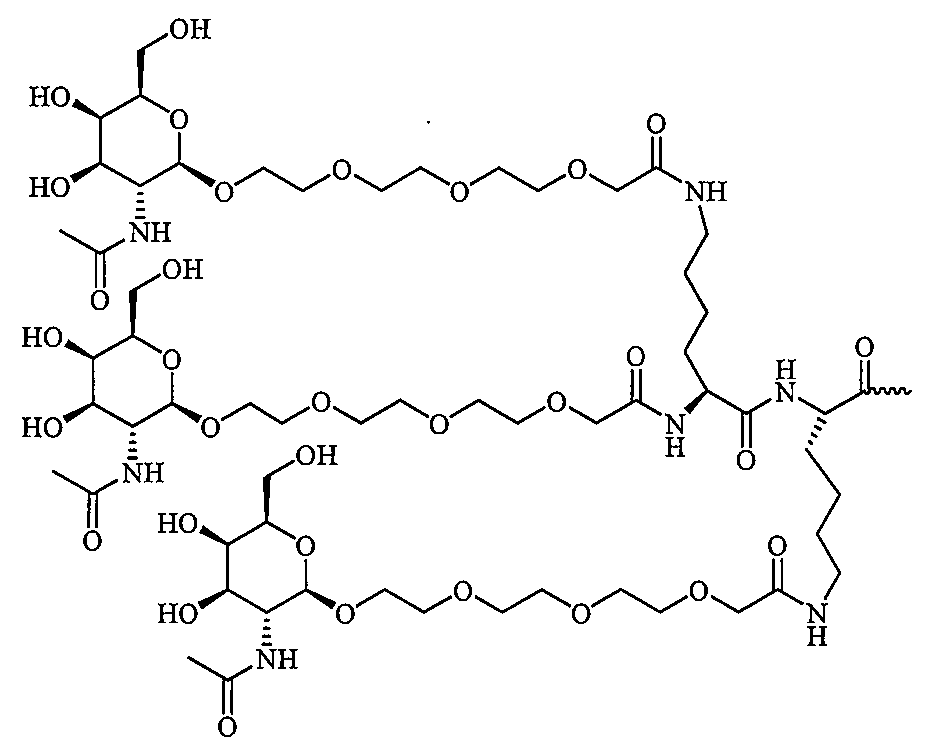
さらに、三価GalNAcクラスターの波線は、C6アミノアルキル基への三価GalNAcクラスターのコンジュゲート部位を示す)又はその薬学的に許容され得る塩を有している。本発明の医薬組合せに使用される抗PDL1アンチセンスオリゴヌクレオチドのこの定義は、本明細書では「T2」又は「治療薬T2」と呼ばれる。 Furthermore, the wavy line in the trivalent GalNAc cluster indicates the conjugation site of the trivalent GalNAc cluster to the C6 aminoalkyl group) or a pharma- ceutically acceptable salt thereof. This definition of the anti-PDL1 antisense oligonucleotide used in the pharmaceutical combination of the present invention is referred to herein as "T2" or "Therapeutic Agent T2".
一実施形態では、抗PDL1アンチセンスオリゴヌクレオチドは皮下投与される。一実施形態では、抗PDL1アンチセンスオリゴヌクレオチドは、約0.1mg/kg~約35mg/kg、又は約0.1mg/kg~約15mg/kg、又は約0.1mg/kg~約10mg/kg、又は約0.2 m/kg to 約10mg/kg、又は約0.25mg/kg~約10mg/kg、又は約0.1mg/kg~約5mg/kg、又は約0.2mg/kg~約5mg/kg、又は約0.25mg/kg~約5mg/kgの用量で投与される。 In one embodiment, the anti-PDL1 antisense oligonucleotide is administered subcutaneously. In one embodiment, the anti-PDL1 antisense oligonucleotide is administered at a dose of about 0.1 mg/kg to about 35 mg/kg, or about 0.1 mg/kg to about 15 mg/kg, or about 0.1 mg/kg to about 10 mg/kg, or about 0.2 mg/kg to about 10 mg/kg, or about 0.25 mg/kg to about 10 mg/kg, or about 0.1 mg/kg to about 5 mg/kg, or about 0.2 mg/kg to about 5 mg/kg, or about 0.25 mg/kg to about 5 mg/kg.
一実施形態では、抗PDL1アンチセンスオリゴヌクレオチドは、約7mg/kg~約35mg/kgの用量で投与される。 In one embodiment, the anti-PDL1 antisense oligonucleotide is administered at a dose of about 7 mg/kg to about 35 mg/kg.
一実施形態では、抗PDL1アンチセンスオリゴヌクレオチドの用量は、1週間に1回、2週間ごとに1回、3週間ごとに1回又は1ヶ月に1回投与される。 In one embodiment, the dose of anti-PDL1 antisense oligonucleotide is administered once a week, once every two weeks, once every three weeks, or once a month.
本発明の医薬組合せのさらに好ましい実施形態では、特にHBVを標的とするRNAiオリゴヌクレオチドをさらに含む場合、抗PDL1アンチセンスオリゴヌクレオチドを最大5回投与する。好ましくは、各用量は約3mg/kgである。好ましくは、用量はQ2W(2週間ごと)で投与される。 In a further preferred embodiment of the pharmaceutical combination of the present invention, particularly when it further comprises an RNAi oligonucleotide targeting HBV, the anti-PDL1 antisense oligonucleotide is administered up to 5 times. Preferably, each dose is about 3 mg/kg. Preferably, the doses are administered Q2W (every 2 weeks).
I.アンチセンスオリゴヌクレオチド修飾
このセクションで論じられる修飾は、本発明のアンチセンスオリゴヌクレオチドでの実施に特に好ましい。
I. Antisense Oligonucleotide Modifications The modifications discussed in this section are particularly preferred for implementation in the antisense oligonucleotides of the invention.
連続核酸塩基配列(モチーフ配列)は、例えばヌクレアーゼ耐性及び/又は標的核酸に対する結合親和性を増大させるために修飾され得ることが理解される。 It is understood that the consecutive nucleic acid base sequences (motif sequences) can be modified, for example, to increase nuclease resistance and/or binding affinity to the target nucleic acid.
一実施形態において、オリゴヌクレオチドの連続する核酸塩基配列は、少なくとも1つの修飾されたヌクレオシド間結合を含む。好適なヌクレオシド間修飾は、「修飾ヌクレオシド間結合」の「定義」セクションに記載されている。連続ヌクレオチド配列内のヌクレオシド間結合の、少なくとも75%、例えばすべてがヌクレオシド間結合である場合、有利である。いくつかの実施形態において、オリゴヌクレオチドの連続する配列中の全てのヌクレオチド間結合は、ホスホロチオエート結合である。 In one embodiment, the contiguous nucleobase sequence of the oligonucleotide comprises at least one modified internucleoside linkage. Suitable internucleoside modifications are described in the "Definitions" section under "Modified Internucleoside Linkages". It is advantageous if at least 75%, e.g., all, of the internucleoside linkages in the contiguous nucleotide sequence are internucleoside linkages. In some embodiments, all internucleoside linkages in the contiguous sequence of the oligonucleotide are phosphorothioate linkages.
本発明のオリゴヌクレオチドは、修飾ヌクレオシド及びDNAヌクレオシドを用いて設計される。高親和性修飾ヌクレオシドを用いることが有利である。 The oligonucleotides of the invention are designed using modified nucleosides and DNA nucleosides. It is advantageous to use high affinity modified nucleosides.
一実施形態では、オリゴヌクレオチドは、少なくとも3つの修飾ヌクレオシド、例えば少なくとも4、少なくとも5、少なくとも6、少なくとも7、少なくとも8、少なくとも9、少なくとも10、少なくとも11、少なくとも12、少なくとも13、少なくとも14、少なくとも15、又は少なくとも16個の修飾ヌクレオシドを含む。一実施形態では、オリゴヌクレオチドは、3~8個の修飾ヌクレオシド、例えば4~6個の修飾ヌクレオシド、例えば4、5又は6個のヌクレオシド、例えば5又は6個の修飾ヌクレオシドを含む。好適な修飾は、「修飾ヌクレオシド」、「高親和性修飾ヌクレオシド」、「糖修飾」、「2’糖修飾」、及びロックド核酸(LNA)の「定義」セクションに記載されている。 In one embodiment, the oligonucleotide comprises at least 3 modified nucleosides, e.g., at least 4, at least 5, at least 6, at least 7, at least 8, at least 9, at least 10, at least 11, at least 12, at least 13, at least 14, at least 15, or at least 16 modified nucleosides. In one embodiment, the oligonucleotide comprises 3-8 modified nucleosides, e.g., 4-6 modified nucleosides, e.g., 4, 5, or 6 nucleosides, e.g., 5 or 6 modified nucleosides. Suitable modifications are described in the "Definitions" sections of "Modified Nucleosides", "High Affinity Modified Nucleosides", "Sugar Modifications", "2' Sugar Modifications", and Locked Nucleic Acid (LNA).
一実施形態では、オリゴヌクレオチドは、1つ以上の糖修飾ヌクレオシド、例えば2’糖修飾ヌクレオシドを含む。好ましくは、本発明のオリゴヌクレオチドは、2’-O-アルキル-RNA、2’-O-メチル-RNA、2’-アルコキシ-RNA、2’-O-メトキシエチル-RNA、2’-アミノ-DNA、2’-フルオロ-DNA、アラビノ核酸(ANA)、2’-フルオロ-ANA、及びLNAヌクレオシドからなる群から独立して選択される1つ以上の2’糖修飾ヌクレオシドを含む。修飾ヌクレオシド(複数可)の1つ又は複数又は全てがロックド核酸(LNA)である場合、有利である。 In one embodiment, the oligonucleotide comprises one or more sugar-modified nucleosides, such as 2' sugar-modified nucleosides. Preferably, the oligonucleotide of the invention comprises one or more 2' sugar-modified nucleosides independently selected from the group consisting of 2'-O-alkyl-RNA, 2'-O-methyl-RNA, 2'-alkoxy-RNA, 2'-O-methoxyethyl-RNA, 2'-amino-DNA, 2'-fluoro-DNA, arabino nucleic acid (ANA), 2'-fluoro-ANA, and LNA nucleosides. It is advantageous if one or more or all of the modified nucleoside(s) are locked nucleic acids (LNA).
いくつかの実施形態では、本発明のオリゴヌクレオチド、例えば連続ヌクレオチド配列は、少なくとも1つのLNAヌクレオシド、例えば1、2、3、4、5、6、7又は8個のLNAヌクレオシド、例えば2~6個のLNAヌクレオシド、例えば3~6個のLNAヌクレオシド、4~6個のLNAヌクレオシド、又は4、5若しくは6個のLNAヌクレオシドを含む。 In some embodiments, the oligonucleotides of the invention, e.g., contiguous nucleotide sequences, comprise at least one LNA nucleoside, e.g., 1, 2, 3, 4, 5, 6, 7 or 8 LNA nucleosides, e.g., 2-6 LNA nucleosides, e.g., 3-6 LNA nucleosides, 4-6 LNA nucleosides, or 4, 5 or 6 LNA nucleosides.
いくつかの実施形態では、オリゴヌクレオチドの修飾ヌクレオシドの少なくとも75%、例えば修飾ヌクレオシドの少なくとも80%、例えば少なくとも85%、例えば少なくとも90%がLNAヌクレオシドである。なおさらなる実施形態では、オリゴヌクレオチドの修飾ヌクレオシドの全ては、LNAヌクレオシドである。さらなる実施形態では、LNAヌクレオシドは、ベータ-D-オキシLNA、チオLNA、アミノLNA、オキシLNA、ScET及び/又はENAから、ベータ-D若しくはアルファ-L配置又はそれらの組合せで選択される。さらなる実施形態では、全てのLNAヌクレオシドはベータ-D-オキシLNAである。さらなる実施形態では、シトシン単位は、5-メチル-シトシンである。オリゴヌクレオチド又は連続ヌクレオチド配列のヌクレアーゼ安定性にとって、ヌクレオチド配列の5’末端に少なくとも1つのLNAヌクレオシドと3’末端に少なくとも2つのLNAヌクレオシドとを有することが有利である。 In some embodiments, at least 75% of the modified nucleosides of the oligonucleotide are LNA nucleosides, such as at least 80%, such as at least 85%, such as at least 90% of the modified nucleosides. In still further embodiments, all of the modified nucleosides of the oligonucleotide are LNA nucleosides. In further embodiments, the LNA nucleosides are selected from beta-D-oxyLNA, thioLNA, aminoLNA, oxyLNA, ScET and/or ENA, in the beta-D or alpha-L configuration or combinations thereof. In further embodiments, all of the LNA nucleosides are beta-D-oxyLNA. In further embodiments, the cytosine units are 5-methyl-cytosine. For nuclease stability of an oligonucleotide or a contiguous nucleotide sequence, it is advantageous to have at least one LNA nucleoside at the 5' end and at least two LNA nucleosides at the 3' end of the nucleotide sequence.
TLR7アゴニスト
一実施形態では、本発明の医薬組合せに使用される治療薬はTLR7アゴニストである。
TLR7 Agonists In one embodiment, the therapeutic agent used in the pharmaceutical combination of the invention is a TLR7 agonist.
一実施形態では、本発明の医薬組合せにおけるTLR7アゴニストは、Toll様受容体アゴニスト活性を有する3-置換5-アミノ-6H-チアゾロ[4,5-d]ピリミジン-2,7-ジオン化合物又はそのプロドラッグである。国際公開第2006/066080号、国際公開第2016/055553号及び国際公開第2016/091698号には、そのようなTLR7アゴニスト及びそれらのプロドラッグ並びにそれらの製造が記載されている(参照により本明細書に組み込まれる)。 In one embodiment, the TLR7 agonist in the pharmaceutical combination of the present invention is a 3-substituted 5-amino-6H-thiazolo[4,5-d]pyrimidine-2,7-dione compound or a prodrug thereof having Toll-like receptor agonist activity. WO 2006/066080, WO 2016/055553 and WO 2016/091698 describe such TLR7 agonists and their prodrugs and their preparation (hereby incorporated by reference).
一実施形態では、本発明の医薬組合せにおけるTLR7アゴニストは、式(I):

R1は-OH又は-Hであり、
R2は、1-ヒドロキシプロピル又はヒドロキシメチルである)
又は式(II):

R1は、-OH又は-H又はアセトキシであり、
R2は、1-アセトキシプロピル又は1-ヒドロキシプロピル又は1-ヒドロキシメチル又はアセトキシ(シクロプロピル)メチル又はアセトキシ(プロピン-1-イル)メチルである)
によって表される、又はその薬学的に許容され得る塩、エナンチオマー若しくはジアステレオマーである。式(I)の化合物は、活性TLR7アゴニストである。
In one embodiment, the TLR7 agonist in the pharmaceutical combination of the present invention has formula (I):
R1 is -OH or -H;
R2 is 1-hydroxypropyl or hydroxymethyl.
Or formula (II):
R 1 is -OH or -H or acetoxy;
R2 is 1-acetoxypropyl or 1-hydroxypropyl or 1-hydroxymethyl or acetoxy(cyclopropyl)methyl or acetoxy(propyn-1-yl)methyl.
or a pharma- ceutically acceptable salt, enantiomer or diastereomer thereof.The compounds of formula (I) are active TLR7 agonists.
一実施形態では、本発明の医薬組合せにおける式(I)の活性TLR7アゴニストのサブセットは、式(V):

によって表される、又はその薬学的に許容され得る塩、エナンチオマー若しくはジアステレオマーである。
In one embodiment, a subset of the active TLR7 agonists of formula (I) in the pharmaceutical combination of the present invention is represented by formula (V):
or a pharma- ceutically acceptable salt, enantiomer or diastereomer thereof.
一実施形態では、式(I)又は(V)のR2の置換基は、

式(II)の化合物は、TLR7アゴニストプロドラッグである。一実施形態では、プロドラッグは、R2に、

一実施形態では、プロドラッグは、R2に、

一実施形態では、本発明の医薬組合せにおける式(II)のTLR7アゴニストプロドラッグのサブセットは、式(III):


によって表される、又はその薬学的に許容され得る塩、エナンチオマー若しくはジアステレオマーであるか;
又は式(IV):


によって表される、又はその薬学的に許容され得る塩、エナンチオマー若しくはジアステレオマーである。
In one embodiment, a subset of the TLR7 agonist prodrugs of formula (II) in the pharmaceutical combination of the present invention is of formula (III):
or a pharma- ceutically acceptable salt, enantiomer or diastereomer thereof;
Or formula (IV):
or a pharma- ceutically acceptable salt, enantiomer or diastereomer thereof.
式(IV)の化合物は、R1がOHであり、R2が1-アセトキシプロピルである、式(III)の化合物と同様に二重プロドラッグである。R1がアセトキシであり、R2が三重プロドラッグである式(III)の化合物。 The compound of formula (IV) is a double prodrug as is the compound of formula (III) where R 1 is OH and R 2 is 1-acetoxypropyl. The compound of formula (III) where R 1 is acetoxy and R 2 is a triple prodrug.
投与後、式(II)、(III)又は式(IV)の化合物は、有用なTLR7アゴニストであるそれらの活性形態に代謝される。 After administration, the compounds of formula (II), (III) or formula (IV) are metabolized to their active forms which are useful TLR7 agonists.
一実施形態では、本発明の医薬組合せにおけるTLR7アゴニストは、
[(1S)-1-[(2S,4R,5R)-5-(5-アミノ-2-オキソ-チアゾロ[4,5-d]ピリミジン-3-イル)-4-ヒドロキシ-テトラヒドロフラン-2-イル]プロピル]アセテート(CMP番号VI);
5-アミノ-3-[(2R,3R,5S)-3-ヒドロキシ-5-[(1S)-1-ヒドロキシプロピル]テトラヒドロフラン-2-イル]-6H-チアゾロ[4,5-d]ピリミジン-2,7-ジオン(CMP番号VII);
5-アミノ-3-[(2R,3R,5S)-3-ヒドロキシ-5-[(1S)-1-ヒドロキシプロピル]テトラヒドロフラン-2-イル]チアゾロ[4,5-d]ピリミジン-2-オン(CMP番号VIII);
5-アミノ-3-(3’-デオキシ-β-D-リボフラノシル)-3H-チアゾロ[4,5-d]ピリミジン-2-オン(CMP番号IX);
5-アミノ-3-(2’-O-アセチル-3’-デオキシ-β-D-リボフラノシル)-3H-チアゾロ[4,5-d]ピリミジン-2-オン(CMP番号X);
5-アミノ-3-(3’-デオキシ-β-D-リボフラノシル)-3H,6H-チアゾロ[4,5-d]ピリミジン-2,7-ジオン(CMP番号XI);
[(S)-[(2S,5R)-5-(5-アミノ-2-オキソ-チアゾロ[4,5-d]ピリミジン-3-イル)-1,3-オキサチオラン-2-イル]-シクロプロピル-メチル]アセテート(CMP番号XII);及び
(1S)-1-[(2S,5R)-5-(5-アミノ-2-オキソ-チアゾロ[4,5-d]ピリミジン-3-イル)-1,3-オキサチオラン-2-イル]ブタ-2-イニル]アセテート(CMP番号XIII)
並びにそれらの薬学的に許容され得る塩、エナンチオマー又はジアステレオマーからなる群から選択される。
In one embodiment, the TLR7 agonist in the pharmaceutical combination of the present invention is
[(1S)-1-[(2S,4R,5R)-5-(5-amino-2-oxo-thiazolo[4,5-d]pyrimidin-3-yl)-4-hydroxy-tetrahydrofuran-2-yl]propyl]acetate (CMP No. VI);
5-amino-3-[(2R,3R,5S)-3-hydroxy-5-[(1S)-1-hydroxypropyl]tetrahydrofuran-2-yl]-6H-thiazolo[4,5-d]pyrimidine-2,7-dione (CMP No. VII);
5-amino-3-[(2R,3R,5S)-3-hydroxy-5-[(1S)-1-hydroxypropyl]tetrahydrofuran-2-yl]thiazolo[4,5-d]pyrimidin-2-one (CMP No. VIII);
5-amino-3-(3'-deoxy-β-D-ribofuranosyl)-3H-thiazolo[4,5-d]pyrimidin-2-one (CMP No. IX);
5-amino-3-(2'-O-acetyl-3'-deoxy-β-D-ribofuranosyl)-3H-thiazolo[4,5-d]pyrimidin-2-one (CMP No. X);
5-amino-3-(3'-deoxy-β-D-ribofuranosyl)-3H,6H-thiazolo[4,5-d]pyrimidine-2,7-dione (CMP No. XI);
[(S)-[(2S,5R)-5-(5-amino-2-oxo-thiazolo[4,5-d]pyrimidin-3-yl)-1,3-oxathiolan-2-yl]-cyclopropyl-methyl]acetate (CMP No. XII); and (1S)-1-[(2S,5R)-5-(5-amino-2-oxo-thiazolo[4,5-d]pyrimidin-3-yl)-1,3-oxathiolan-2-yl]but-2-ynyl]acetate (CMP No. XIII).
and pharma- ceutically acceptable salts, enantiomers or diastereomers thereof.
表1は、本発明の医薬組合せの実施形態におけるTLR7アゴニストを、それらの製造を記載する文献の参照を含めて列挙する。


本発明の医薬組合せにおける特に好ましい実施形態では、TLR7アゴニストは、CMP番号VIである。本発明の医薬組合せで使用されるTLR7アゴニストのこの定義は、本明細書では「T3」又は「治療薬T3」と呼ばれる。 In a particularly preferred embodiment of the pharmaceutical combination of the present invention, the TLR7 agonist is CMP No. VI. This definition of the TLR7 agonist used in the pharmaceutical combination of the present invention is referred to herein as "T3" or "therapeutic T3".
一実施形態では、TLR7アゴニストは経口投与される。 In one embodiment, the TLR7 agonist is administered orally.
一実施形態では、T3は、8~26週間、例えば10~24週間、例えば12又は13週間にわたって1日おき(QOD)に150~170mgの範囲の単位用量として経口投与され、続いて24~48週間、例えば30~40週間、例えば35週間にわたって毎週(QW)投与される。T3の投与される用量数は、処置期間を通して60~100用量、例えば75~90用量、例えば81、82、83又は84用量である。 In one embodiment, T3 is orally administered as a unit dose in the range of 150-170 mg every other day (QOD) for 8-26 weeks, such as 10-24 weeks, such as 12 or 13 weeks, followed by weekly (QW) administration for 24-48 weeks, such as 30-40 weeks, such as 35 weeks. The number of doses of T3 administered is 60-100 doses, such as 75-90 doses, such as 81, 82, 83 or 84 doses, throughout the treatment period.
好ましくは、TLR7アゴニストは、12週間以下の期間にわたって投与される。 Preferably, the TLR7 agonist is administered for a period of 12 weeks or less.
一実施形態では、T1若しくはT2、並びにT3、T1及びT3、又はT2及びT3を含む本発明の医薬組合せは、1ヶ月未満の間隔、例えば1週間未満の間隔、例えば2日の間隔、例えば同日に投与される。 In one embodiment, the pharmaceutical combination of the present invention comprising T1 or T2 and T3, T1 and T3, or T2 and T3, is administered less than one month apart, for example less than one week apart, for example 2 days apart, for example on the same day.
一実施形態では、本発明の医薬組合せ中のTLR7アゴニストは、経腸的に(例えば、経口的に又は消化管を通して)投与される。本発明におけるTLR7アゴニスト化合物は、任意の便利な投与形態、例えば錠剤、粉末、カプセル、溶液、分散液、懸濁液、シロップ剤、スプレー、座薬、ゲル、エマルションの単位用量で投与され得る。特に、錠剤及びカプセルなどの経口単位剤形を使用することができる。一例では、本発明のTLR7アゴニスト化合物の薬学的有効量は、約75~250mg、例えば100~200mg、例えば150~170mg pr.用量の範囲である。投与は、毎日、1日おき(QOD)又は毎週(QW)であり得る。 In one embodiment, the TLR7 agonist in the pharmaceutical combination of the present invention is administered enterally (e.g., orally or through the digestive tract). The TLR7 agonist compound in the present invention may be administered in any convenient dosage form, such as a unit dose of tablet, powder, capsule, solution, dispersion, suspension, syrup, spray, suppository, gel, emulsion. In particular, oral unit dosage forms such as tablets and capsules may be used. In one example, the pharma- ceutical effective amount of the TLR7 agonist compound of the present invention ranges from about 75-250 mg, e.g., 100-200 mg, e.g., 150-170 mg pr. dose. Administration may be daily, every other day (QOD), or weekly (QW).
TLR7アゴニストを含む本発明の医薬組合せの好ましい実施形態では、TLR7アゴニストは、少なくとも約100mg、又は約100mg、又は好ましくは約150mgの用量で投与される。一実施形態では、TLR7アゴニストは、少なくともQW(毎週)、又はQW、又はより好ましくはQOD(1日おき)で投与される。 In a preferred embodiment of the pharmaceutical combination of the present invention comprising a TLR7 agonist, the TLR7 agonist is administered at a dose of at least about 100 mg, or about 100 mg, or preferably about 150 mg. In one embodiment, the TLR7 agonist is administered at least QW (every week), or QW, or more preferably QOD (every other day).
好適な担体及び賦形剤は当業者に周知であり、例えば、Ansel,Howard C.,et al.,Ansel’s Pharmaceutical Dosage Forms and Drug Delivery Systems.Philadelphia:Lippincott,Williams&Wilkins,2004;Gennaro,Alfonso R.,et al.Remington:The Science and Practice of Pharmacy.Philadelphia:Lippincott,Williams&Wilkins,2000;及びRowe,Raymond C.Handbook of Pharmaceutical Excipients.Chicago,Pharmaceutical Press,2005に詳細に記載されている。 Suitable carriers and excipients are well known to those skilled in the art and are described, for example, in Ansel, Howard C., et al., Ansel's Pharmaceutical Dosage Forms and Drug Delivery Systems. Philadelphia: Lippincott, Williams & Wilkins, 2004; Gennaro, Alfonso R., et al. Remington: The Science and Practice of Pharmacy. Philadelphia: Lippincott, Williams & Wilkins, 2000; and Rowe, Raymond C. Handbook of Pharmaceutical Excipients. Chicago, Pharmaceutical Press, 2005.
インターフェロン-アルファ
一実施形態では、本発明の医薬組合せに使用される治療薬はインターフェロン-アルファ(IFNα)である。
Interferon-Alpha In one embodiment, the therapeutic agent used in the pharmaceutical combination of the present invention is interferon-alpha (IFNα).
様々な実施形態において、本発明の医薬組合せにおけるインターフェロン-アルファは、インターフェロンアルファ-2b、インターフェロンアルファ-2a及びインターフェロンアルファ-1(ペグ化及び非ペグ化)であり得る。 In various embodiments, the interferon-alpha in the pharmaceutical combination of the present invention can be interferon alpha-2b, interferon alpha-2a, and interferon alpha-1 (pegylated and non-pegylated).
さらに様々な実施形態では、本発明の医薬組合せにおけるIFN-αは、Pegasys(登録商標)(Roche)、PEG-Intron(登録商標)(Merck&Co.,Inc.)又はY-ペグ化組換えインターフェロンアルファ-2a(YPEG-IFNα-2a、Xiamen Amoytop Biotech Co.,Ltd.)である。 In further various embodiments, the IFN-α in the pharmaceutical combination of the present invention is Pegasys® (Roche), PEG-Intron® (Merck & Co., Inc.) or Y-pegylated recombinant interferon alpha-2a (YPEG-IFNα-2a, Xiamen Amoytop Biotech Co., Ltd.).
一実施形態では、本発明の医薬組合せにおけるIFNαは、ペグ化IFNαである。本発明の医薬組合せで使用されるIFNαのこの定義は、本明細書では「T4」又は「治療薬T4」と呼ばれる。 In one embodiment, the IFNα in the pharmaceutical combination of the present invention is pegylated IFNα. This definition of IFNα used in the pharmaceutical combination of the present invention is referred to herein as "T4" or "therapeutic T4".
一実施形態では、インターフェロン-アルファは皮下投与される。 In one embodiment, interferon-alpha is administered subcutaneously.
抗HBV抗体
一実施形態では、本発明の医薬組合せに使用される治療薬は抗HBV抗体である。
Anti-HBV Antibodies In one embodiment, the therapeutic agent used in the pharmaceutical combination of the invention is an anti-HBV antibody.
一実施形態では、本発明の医薬組合せにおける抗HBV抗体は、B型肝炎表面抗原(抗HBsAg)に結合する抗体である。 In one embodiment, the anti-HBV antibody in the pharmaceutical combination of the present invention is an antibody that binds to hepatitis B surface antigen (anti-HBsAg).
一実施形態では、オリゴヌクレオチド治療薬と抗HBV抗体とを含む組合せは、患者のHBsAgのセロクリアランスをもたらし得る。 In one embodiment, a combination comprising an oligonucleotide therapeutic and an anti-HBV antibody may result in seroclearance of HBsAg in a patient.
一実施形態では、本発明の医薬組合せにおける抗HBV抗体はモノクローナルである。 In one embodiment, the anti-HBV antibody in the pharmaceutical combination of the present invention is monoclonal.
一実施形態では、本発明の医薬組合せにおける抗HBV抗体はモノクローナルであり、ヒトである。 In one embodiment, the anti-HBV antibodies in the pharmaceutical combination of the present invention are monoclonal and human.
一実施形態では、本発明の医薬組合せにおける抗HBV抗体は、抗HBsAgモノクローナル抗体である。本発明の医薬組合せで使用される抗HBV抗体のこの定義は、本明細書では「T5」又は「治療薬T5」と呼ばれる。 In one embodiment, the anti-HBV antibody in the pharmaceutical combination of the present invention is an anti-HBsAg monoclonal antibody. This definition of the anti-HBV antibody used in the pharmaceutical combination of the present invention is referred to herein as "T5" or "Therapeutic Agent T5."
T5を含む本発明の医薬組合せの好ましい実施形態では、具体的には、表2及び3で同定される組合せC4、C11、C17、C22、C27、C28、C29、C30、C39、C45、C50、C66、C71、C86、C55、C56、C57、C58、C76、C77、C78、C79、C91、C92、C93、C94、C101、C102、C103、C104、C111、C112、C113、C114、C115又はC116のいずれかの実施形態では、T5は、(a)NYGMQ(配列番号12)のアミノ酸配列を含むCDR-H1、(b)IIWADGTKQYYGDSVKG(配列番号13)のアミノ酸配列を含むCDR-H2、及び(c)DGLYASAPNDV(配列番号14)のアミノ酸配列を含むCDR-H3を含む重鎖可変ドメイン(VH)と、(d)RASQRISTYLN(配列番号15)のアミノ酸配列を含むCDR-L1、(e)GASSLQS(配列番号16)のアミノ酸配列を含むCDR-L2、及び(f)QQTYTLPPN(配列番号17)のアミノ酸配列を含むCDR-L3を含む軽鎖可変ドメイン(VL)とを含む、抗HBsAg抗体である。 In a preferred embodiment of the pharmaceutical combination of the present invention comprising T5, specifically in any of the combinations C4, C11, C17, C22, C27, C28, C29, C30, C39, C45, C50, C66, C71, C86, C55, C56, C57, C58, C76, C77, C78, C79, C91, C92, C93, C94, C101, C102, C103, C104, C111, C112, C113, C114, C115 or C116 identified in Tables 2 and 3, T5 comprises (a) a CDR-H1 having an amino acid sequence of NYGMQ (SEQ ID NO: 12) , (b) a heavy chain variable domain (VH) including a CDR-H2 having the amino acid sequence of IIWADGTKQYYGDSVKG (SEQ ID NO: 13), and (c) a CDR-H3 having the amino acid sequence of DGLYASAPNDV (SEQ ID NO: 14), and a light chain variable domain (VL) including a CDR-L1 having the amino acid sequence of RASQRISTYLN (SEQ ID NO: 15), (e) a CDR-L2 having the amino acid sequence of GASSLQS (SEQ ID NO: 16), and (f) a CDR-L3 having the amino acid sequence of QQTYTLPPN (SEQ ID NO: 17).
T5を含む本発明の医薬組合せの一実施形態では、具体的には、表2及び3で同定される組合せC4、C11、C17、C22、C27、C28、C29、C30、C39、C45、C50、C66、C71、C86、C55、C56、C57、C58、C76、C77、C78、C79、C91、C92、C93、C94、C101、C102、C103、C104、C111、C112、C113、C114、C115又はC116のいずれかの実施形態では、T5は、(a)SYAMS(配列番号18)のアミノ酸配列を含むCDR-H1、(b)AFSGTGGSTYYADSVKG(配列番号19)のアミノ酸配列を含むCDR-H2、及び(c)DPGHTSNWRDNYQYYQMDV(配列番号20)のアミノ酸配列を含むCDR-H3を含む重鎖可変ドメイン(VH)と、(d)RASQGIRNDLG(配列番号21)のアミノ酸配列を含むCDR-L1、(e)AASSLQS(配列番号22)のアミノ酸配列を含むCDR-L2、及び(f)LQHNSYPRT(配列番号23)のアミノ酸配列を含むCDR-L3を含む軽鎖可変ドメイン(VL)とを含む、抗HBsAg抗体である。 In one embodiment of the pharmaceutical combination of the present invention comprising T5, specifically any of the combinations C4, C11, C17, C22, C27, C28, C29, C30, C39, C45, C50, C66, C71, C86, C55, C56, C57, C58, C76, C77, C78, C79, C91, C92, C93, C94, C101, C102, C103, C104, C111, C112, C113, C114, C115, or C116 identified in Tables 2 and 3, T5 comprises (a) a CDR-H1 comprising the amino acid sequence of SYAMS (SEQ ID NO: 18); (b) a CDR-H2 comprising the amino acid sequence of A The anti-HBsAg antibody comprises a heavy chain variable domain (VH) including (c) a CDR-H2 having the amino acid sequence of FSGTGGSTYYADSVKG (SEQ ID NO: 19), and a CDR-H3 having the amino acid sequence of DPGHTSNWRDNYQYYQMDV (SEQ ID NO: 20), and a light chain variable domain (VL) including (d) a CDR-L1 having the amino acid sequence of RASQGIRNDLG (SEQ ID NO: 21), (e) a CDR-L2 having the amino acid sequence of AASSLQS (SEQ ID NO: 22), and (f) a CDR-L3 having the amino acid sequence of LQHNSYPRT (SEQ ID NO: 23).
T5を含む本発明の医薬組合せの一実施形態では、具体的には、表2及び3で同定される組合せC4、C11、C17、C22、C27、C28、C29、C30、C39、C45、C50、C66、C71、C86、C55、C56、C57、C58、C76、C77、C78、C79、C91、C92、C93、C94、C101、C102、C103、C104、C111、C112、C113、C114、C115又はC116のいずれかの実施形態では、T5は、(a)NYHIH(配列番号24)のアミノ酸配列を含むCDR-H1、(b)IINPRRLSTAYAPKFQG(配列番号25)のアミノ酸配列を含むCDR-H2、及び(c)DAGDDTSGPFDS(配列番号26)のアミノ酸配列を含むCDR-H3を含む重鎖可変ドメイン(VH)と、(d)RASQSINTWLA(配列番号27)のアミノ酸配列を含むCDR-L1、(e)KASSLES(配列番号28)のアミノ酸配列を含むCDR-L2、及び(f)QQYNTFS(配列番号29)のアミノ酸配列を含むCDR-L3を含む軽鎖可変ドメイン(VL)とを含む、抗HBsAg抗体である。 In one embodiment of the pharmaceutical combination of the present invention comprising T5, specifically in any of the combinations C4, C11, C17, C22, C27, C28, C29, C30, C39, C45, C50, C66, C71, C86, C55, C56, C57, C58, C76, C77, C78, C79, C91, C92, C93, C94, C101, C102, C103, C104, C111, C112, C113, C114, C115 or C116 identified in Tables 2 and 3, T5 comprises (a) a CDR-H1 comprising the amino acid sequence of NYHIH (SEQ ID NO: 24); (b) a heavy chain variable domain (VH) including a CDR-H2 having the amino acid sequence of IINPRRLSTAYAPKFQG (SEQ ID NO: 25), and (c) a CDR-H3 having the amino acid sequence of DAGDDTSGPFDS (SEQ ID NO: 26); and (d) a light chain variable domain (VL) including a CDR-L1 having the amino acid sequence of RASQSINTWLA (SEQ ID NO: 27), (e) a CDR-L2 having the amino acid sequence of KASSLES (SEQ ID NO: 28), and (f) a CDR-L3 having the amino acid sequence of QQYNTFS (SEQ ID NO: 29).
T5を含む本発明の医薬組合せの一実施形態では、具体的には、表2及び3で同定される組合せC4、C11、C17、C22、C27、C28、C29、C30、C39、C45、C50、C66、C71、C86、C55、C56、C57、C58、C76、C77、C78、C79、C91、C92、C93、C94、C101、C102、C103、C104、C111、C112、C113、C114、C115又はC116のいずれかの実施形態では、T5は、(a)TNNWWS(配列番号30)のアミノ酸配列を含むCDR-H1、(b)EIHHIGSTNYNPSLKS(配列番号31)のアミノ酸配列を含むCDR-H2、及び(c)GRLGITRDRYYFDS(配列番号32)のアミノ酸配列を含むCDR-H3を含む重鎖可変ドメイン(VH)と、(d)QASQDISNYLN(配列番号33)のアミノ酸配列を含むCDR-L1、(e)DTSSLER(配列番号34)のアミノ酸配列を含むCDR-L2、及び(f)QQYYNLPHT(配列番号35)のアミノ酸配列を含むCDR-L3を含む軽鎖可変ドメイン(VL)とを含む、抗HBsAg抗体である。 In one embodiment of the pharmaceutical combination of the present invention comprising T5, specifically in any of the combinations C4, C11, C17, C22, C27, C28, C29, C30, C39, C45, C50, C66, C71, C86, C55, C56, C57, C58, C76, C77, C78, C79, C91, C92, C93, C94, C101, C102, C103, C104, C111, C112, C113, C114, C115 or C116 identified in Tables 2 and 3, T5 comprises (a) a CDR-H1 comprising the amino acid sequence of TNNWWS (SEQ ID NO: 30), ( An anti-HBsAg antibody comprising: (b) a heavy chain variable domain (VH) comprising a CDR-H2 having the amino acid sequence of EIHHIGSTNYNPSLKS (SEQ ID NO: 31); and (c) a CDR-H3 having the amino acid sequence of GRLGITRDRYYFDS (SEQ ID NO: 32); and (d) a light chain variable domain (VL) comprising a CDR-L1 having the amino acid sequence of QASQDISNYLN (SEQ ID NO: 33), (e) a CDR-L2 having the amino acid sequence of DTSSLER (SEQ ID NO: 34), and (f) a CDR-L3 having the amino acid sequence of QQYYNLPHT (SEQ ID NO: 35).
T5を含む本発明の医薬組合せの好ましい実施形態では、具体的には、表2及び3で同定される組合せC4、C11、C17、C22、C27、C28、C29、C30、C39、C45、C50、C66、C71、C86、C55、C56、C57、C58、C76、C77、C78、C79、C91、C92、C93、C94、C101、C102、C103、C104、C111、C112、C113、C114、C115又はC116のいずれかの実施形態では、T5は、QVQLVESGGGVVQPGRSLRLSCEASGFTFSNYGMQWVRQAPGKGLEWVAIIWADGTKQYYGDSVKGRFTISRDNFKNTLYLQMNSLRGEDTAMYFCARDGLYASAPNDVWGQGTLVTVSS(配列番号39)のアミノ酸配列を含む重鎖可変ドメイン(VH)と、DIQMTQSPSSLSAYVGDRVTITCRASQRISTYLNWYHQRPGKSPSLLIYGASSLQSGVPSRFSASASGTDFTLTISSLRPEDLGTYYCQQTYTLPPNSGGGTKVEIK(配列番号37)のアミノ酸はイラ悦を含む軽鎖可変ドメイン(VL)とを含む、抗HBsAg抗体である。 In a preferred embodiment of the pharmaceutical combination of the present invention comprising T5, specifically in any of the embodiments of combinations C4, C11, C17, C22, C27, C28, C29, C30, C39, C45, C50, C66, C71, C86, C55, C56, C57, C58, C76, C77, C78, C79, C91, C92, C93, C94, C101, C102, C103, C104, C111, C112, C113, C114, C115 or C116 identified in Tables 2 and 3, T5 is selected from the group consisting of QVQLVESGGGVVQPGRSLRLSCEASGFTFSNYGMQWVRQAPGKGLE This is an anti-HBsAg antibody that includes a heavy chain variable domain (VH) having the amino acid sequence of WVAIIWADGTKQYYGDSVKGRFTISRDNFKNTLYLQMNSLRGEDTAMYFCARDGLYASAPNDVWGQGTLVTVSS (SEQ ID NO: 39) and a light chain variable domain (VL) having the amino acid sequence of DIQMTQSPSSLSAYVGDRVTITCRASQRISTYLNWYHQRPGKSPSLLIYGASSLQSGVPSRFSASASGTDFTLTISSSLRPEDLGTYYCQQTYTLPPNSGGGTKVEIK (SEQ ID NO: 37).
T5を含む本発明の医薬組合せの一実施形態では、具体的には、表2及び3で同定される組合せC4、C11、C17、C22、C27、C28、C29、C30、C39、C45、C50、C66、C71、C86、C55、C56、C57、C58、C76、C77、C78、C79、C91、C92、C93、C94、C101、C102、C103、C104、C111、C112、C113、C114、C115又はC116のいずれかの実施形態では、T5は、QVQLVESGGGVVQPGRSLRLSCEASGFTFSNYGMQWVRQAPGKGLEWVAIIWADGTKQYYGDSVKGRFTISRDNFKNTLYLQMNSLRGEDTAMYFCARDGLYASAPNDVWGQGTLVTVSSASTKGPSVFPLAPSSKSTSGGTAALGCLVKDYFPEPVTVSWNSGALTSGVHTFPAVLQSSGLYSLSSVVTVPSSSLGTQTYICNVNHKPSNTKVDKKVEPKSCDKTHTCPPCPAPELLGGPSVFLFPPKPKDTLYITREPEVTCVVVDVSHEDPEVKFNWYVDGVEVHNAKTKPREEQYNSTYRVVSVLTVLHQDWLNGKEYKCKVSNKALPAPIEKTISKAKGQPREPQVYTLPPSRDELTKNQVSLTCLVKGFYPSDIAVEWESNGQPENNYKTTPPVLDSDGSFFLYSKLTVDKSRWQQGNVFSCSVMHEALHNHYTQKSLSLSPG(配列番号38)の重鎖可変ドメイン(VH)と、DIQMTQSPSSLSAYVGDRVTITCRASQRISTYLNWYHQRPGKSPSLLIYGASSLQSGVPSRFSASASGTDFTLTISSLRPEDLGTYYCQQTYTLPPNSGGGTKVEIKRTVAAPSVFIFPPSDEQLKSGTASVVCLLNNFYPREAKVQWKVDNALQSGNSQESVTEQDSKDSTYSLSSTLTLSKADYEKHKVYACEVTHQGLSSPVTKSFNRGEC(配列番号36)の軽鎖可変ドメイン(VL)とを含む、抗HBsAg抗体である。 In one embodiment of the pharmaceutical combination of the present invention comprising T5, specifically in any of the embodiments of the combinations C4, C11, C17, C22, C27, C28, C29, C30, C39, C45, C50, C66, C71, C86, C55, C56, C57, C58, C76, C77, C78, C79, C91, C92, C93, C94, C101, C102, C103, C104, C111, C112, C113, C114, C115 or C116 identified in Tables 2 and 3, T5 is QVQLVESGGGVVQPGRSLRLS CEASGFTF SNYGMQWVRQAPGKGLEWVAIIWADGTKQYYGDSVKGRFTISRDNFKNTL YLQMNSLRGEDTAMYFCARDGLYASAPNDVWGQGTLVTVSSASTKGPSVFPLAPSSKST SGGTAALGCLVKDYFPEPVTVSWNSGALTSGVHTFPAVLQSSGLYSLSSVVTVPSSSLG TQTYICNVNHKPSNTKVDKKVEPKSCDKTHTCPPCPAPELLGGPSVFLFPPKPKDTLYI A heavy chain variable domain (VH) of TREPEVTCVVVDVSHEDPEVKFNWYVDGVEVHNAKTKPREEQYNSTYRVVSVLTVLHQDWLNGKEYKCKVSNKALPAPIEKTISKAKGQPREPQVYTLPPSRDELTKNQVSLTCLVKGFYPSDIAVEWESNGQPENNYKTTPPVLDSDGSFFLYSKLTVDKSRWQQGNVFSCSVMHEALHNHYTQKSLSLSPG (SEQ ID NO: 38) and and a light chain variable domain (VL) of VTITCRASQRISTYLNWYHQRPGKSPSLLIYGASSLQSGVPSRFSASASGTDFTLTISSLRPEDLGTYYCQQTYTLPPNSGGGTKVEIKRTVAAPSVFIFPPSDEQLKSGTASVVCLLNNFYPREAKVQWKVDNALQSGNSQESVTEQDSKDSTYSLSSTLTLSKADYEKHKVYACEVTHQGLSSPVTKSFNRGEC (SEQ ID NO: 36).
一実施形態では、抗HBV抗体は皮下投与される。 In one embodiment, the anti-HBV antibody is administered subcutaneously.
PD1シグナル伝達に拮抗する抗体
一実施形態では、本発明の医薬組合せに使用される治療薬は、PD1シグナル伝達に拮抗する抗体である。一実施形態では、この抗体は抗PDL1抗体である。一実施形態では、この抗体は抗PD1抗体である。
Antibodies that antagonize PD1 signaling In one embodiment, the therapeutic agent used in the pharmaceutical combination of the present invention is an antibody that antagonizes PD1 signaling. In one embodiment, the antibody is an anti-PDL1 antibody. In one embodiment, the antibody is an anti-PD1 antibody.
好ましい実施形態では、本発明の医薬組合せにおける抗PD1抗体は、ニボルマブ(商品名OPDIVO(登録商標)、Bristol Myers Squibbから入手可能)である。本発明の医薬組合せで使用される抗PD1抗体のこの定義は、本明細書では「T6」又は「治療薬T6」と呼ばれる。 In a preferred embodiment, the anti-PD1 antibody in the pharmaceutical combination of the present invention is nivolumab (available under the trade name OPDIVO® from Bristol Myers Squibb). This definition of the anti-PD1 antibody used in the pharmaceutical combination of the present invention is referred to herein as "T6" or "Therapeutic Agent T6."
一実施形態では、本発明の医薬組合せにおける抗PDL1抗体は、アテゾリズマブ(商品名Tecentriq(登録商標)、Genentech/Rocheから入手可能)である。本発明の医薬組合せで使用される抗PDL1抗体のこの定義は、本明細書では「T7」又は「治療薬T7」と呼ばれる。 In one embodiment, the anti-PDL1 antibody in the pharmaceutical combination of the present invention is atezolizumab (trade name Tecentriq®, available from Genentech/Roche). This definition of the anti-PDL1 antibody used in the pharmaceutical combination of the present invention is referred to herein as "T7" or "Therapeutic Agent T7".
PD1シグナル伝達に拮抗する抗体を含む本発明の最も好ましい医薬組合せは、PD1シグナル伝達に拮抗する1種類の抗体のみを含む。一実施形態では、PD1シグナル伝達に拮抗する抗体を皮下投与する。一実施形態では、抗体はT6であり、皮下投与される。 The most preferred pharmaceutical combination of the present invention that includes an antibody that antagonizes PD1 signaling includes only one antibody that antagonizes PD1 signaling. In one embodiment, the antibody that antagonizes PD1 signaling is administered subcutaneously. In one embodiment, the antibody is T6 and is administered subcutaneously.
ヌクレオチド類似体
一実施形態では、本発明の医薬組合せに使用される治療薬はヌクレオチド類似体である。
Nucleotide Analogues In one embodiment, the therapeutic agent used in the pharmaceutical combination of the invention is a nucleotide analogue.
一実施形態では、本発明の医薬組合せ中のヌクレオチド類似体は、以下の中から選択される:ラミブジン、テルビブジン、エンテカビル、アデホビル、テノホビル、クレブジン、テノホビルアラフェナミド、CMX157及びAGX-1009。 In one embodiment, the nucleotide analogue in the pharmaceutical combination of the present invention is selected from the following: lamivudine, telbivudine, entecavir, adefovir, tenofovir, clevudine, tenofovir alafenamide, CMX157 and AGX-1009.
一実施形態では、本発明の医薬組合せにおけるヌクレオチド類似体は、エンテカビルである。本発明の医薬組合せで使用されるヌクレオチド類似体のこの定義は、本明細書では「T8」又は「治療薬T8」と呼ばれる。 In one embodiment, the nucleotide analog in the pharmaceutical combination of the present invention is entecavir. This definition of the nucleotide analog used in the pharmaceutical combination of the present invention is referred to herein as "T8" or "therapeutic T8."
一実施形態では、本発明の医薬組合せにおけるヌクレオチド類似体は、テノホビルである。本発明の医薬組合せで使用されるヌクレオチド類似体のこの定義は、本明細書では「T9」又は「治療薬T9」と呼ばれる。 In one embodiment, the nucleotide analog in the pharmaceutical combination of the present invention is tenofovir. This definition of the nucleotide analog used in the pharmaceutical combination of the present invention is referred to herein as "T9" or "Therapeutic Agent T9."
一実施形態では、ヌクレオチド類似体は皮下投与される。 In one embodiment, the nucleotide analog is administered subcutaneously.
医薬組合せ
本発明は、少なくとも2つのHBV治療薬、好ましくは2つ又は3つのHBV治療薬を含む様々な医薬組合せを提供する。
Pharmaceutical Combinations The present invention provides various pharmaceutical combinations that include at least two HBV therapeutic agents, preferably two or three HBV therapeutic agents.
2つの特定のHBV治療薬を含む本発明の医薬組合せを以下の表2に記載する。

3つの特定のHBV治療薬を含む本発明の医薬組合せを以下の表3に記載する。


本発明の医薬組合せを説明したので、本発明の医薬組合せの特定の好ましい実施形態を本明細書に記載する。好ましい実施形態では、本発明の医薬組合せは、同じ組合せが治療薬T6と治療薬T7の両方を含まないものである。好ましい実施形態では、本発明の医薬組合せは、1つ又は複数のさらなるHBV治療薬と組み合わせて治療薬T1を含むものである。好ましい実施形態では、本発明の医薬組合せは、治療薬T1及び治療薬T2を、任意にさらなる第3のHBV治療薬、好ましくはT3、T4、T5、T6、T7、T8又はT9のいずれか1つと組み合わせて含むものである。好ましい実施形態では、本発明の医薬組合せは、T1及びT2を、任意にT3と組み合わせて含む。 Having described the pharmaceutical combinations of the present invention, certain preferred embodiments of the pharmaceutical combinations of the present invention are described herein. In a preferred embodiment, the pharmaceutical combinations of the present invention are those in which the same combination does not include both therapeutic agent T6 and therapeutic agent T7. In a preferred embodiment, the pharmaceutical combinations of the present invention are those in which the therapeutic agent T1 is combined with one or more additional HBV therapeutic agents. In a preferred embodiment, the pharmaceutical combinations of the present invention are those in which the therapeutic agent T1 and therapeutic agent T2 are combined, optionally with an additional third HBV therapeutic agent, preferably any one of T3, T4, T5, T6, T7, T8 or T9. In a preferred embodiment, the pharmaceutical combinations of the present invention are those in which the therapeutic agent T1 and T2 are combined, optionally with T3.
典型的には、上記の組合せは、列挙された要素を含む、すなわち、列挙されたHBV治療薬を包含するが、さらなる列挙されていないHBV治療薬の包含を排除しない。しかしながら、別の実施形態では、上で定義された組合せは、列挙された要素に限定され、すなわち、医薬組合せは、任意の他のHBV治療薬を除外して列挙された要素から本質的になる。これは、組合せにおける任意の担体、賦形剤、アジュバント、希釈剤又は塩の存在を排除するものではない。したがって、別の実施形態では、本発明の医薬組合せは、表2又は3にその組合せについて列挙された関連要素から本質的になる。 Typically, the above combinations include the recited elements, i.e., include the recited HBV therapeutics, but do not exclude the inclusion of additional, unlisted HBV therapeutics. However, in another embodiment, the combinations defined above are limited to the recited elements, i.e., the pharmaceutical combination consists essentially of the recited elements to the exclusion of any other HBV therapeutics. This does not exclude the presence of any carriers, excipients, adjuvants, diluents, or salts in the combination. Thus, in another embodiment, the pharmaceutical combination of the present invention consists essentially of the relevant elements listed for that combination in Tables 2 or 3.
好ましい実施形態では、本発明の医薬組合せにおけるHBV治療薬のそれぞれは、薬学的に許容され得る担体中に製剤化される。より好ましくは、各HBV治療薬は、問題のHBV治療薬の投与に適した薬学的に許容され得る担体中に製剤化される。 In a preferred embodiment, each of the HBV therapeutic agents in the pharmaceutical combination of the present invention is formulated in a pharma- ceutical acceptable carrier. More preferably, each HBV therapeutic agent is formulated in a pharma- ceutical acceptable carrier suitable for administration of the HBV therapeutic agent in question.
本発明の医薬組合せは、含まれる個々のHBV治療薬単独よりも効果的にHBV感染症を処置するために使用することができる。一実施形態では、本発明の医薬組合せを使用して、含まれる個々のHBV治療薬単独よりも迅速にHBVを阻害し、持続時間を延長してHBVを阻害し、及び/又はより大きな効果でHBVを阻害することができる。これらの効果は、HBsAg、HBeAg又はHBV-DNA滴定の減少によって測定することができる。一実施形態では、本発明の医薬組合せは、含まれる個々のHBV治療薬単独よりもHBsAg、HBeAg又はHBV-DNA力価のより迅速な減少を生じさせる。一実施形態では、本発明の医薬組合せは、含まれる個々のHBV治療薬単独よりもHBsAg、HBeAg又はHBV-DNA力価のより長期の減少を生じさせる。一実施形態では、本発明の医薬組合せは、含まれる個々のHBV治療薬単独よりもHBsAg、HBeAg又はHBV-DNA力価のより大きな低下を生じさせる。主に、HBsAgがこの目的のために測定される。 The pharmaceutical combination of the present invention can be used to treat HBV infection more effectively than the individual HBV therapeutics included alone. In one embodiment, the pharmaceutical combination of the present invention can be used to inhibit HBV more rapidly, inhibit HBV for a longer duration, and/or inhibit HBV with greater efficacy than the individual HBV therapeutics included alone. These effects can be measured by a reduction in HBsAg, HBeAg, or HBV-DNA titers. In one embodiment, the pharmaceutical combination of the present invention causes a more rapid reduction in HBsAg, HBeAg, or HBV-DNA titers than the individual HBV therapeutics included alone. In one embodiment, the pharmaceutical combination of the present invention causes a more prolonged reduction in HBsAg, HBeAg, or HBV-DNA titers than the individual HBV therapeutics included alone. In one embodiment, the pharmaceutical combination of the present invention causes a greater reduction in HBsAg, HBeAg, or HBV-DNA titers than the individual HBV therapeutics included alone. Mainly, HBsAg is measured for this purpose.
本発明の医薬組合せはまた、キット又はパーツのキット中に存在し得る。「キット」又は「パーツのキット」という用語は、HBV感染個体の処置を実施する際に使用される材料のアセンブリを指し、処置をどのように行うかの説明を含む。 The pharmaceutical combinations of the present invention may also be present in a kit or kit of parts. The term "kit" or "kit of parts" refers to an assembly of materials used in performing treatment of an HBV-infected individual, including instructions on how to perform the treatment.
本発明の一態様は、本明細書中に記載のHBV治療薬から選択される2つ又は複数の治療有効成分(例えば、医療成分又は医薬)を含有するパーツのキットである。 One aspect of the invention is a kit of parts containing two or more therapeutically active ingredients (e.g., medical ingredients or medicines) selected from the HBV treatments described herein.
本発明の一実施形態は、本明細書に記載の第1のHBV治療薬と、本明細書に記載の第2のHBV治療薬とを含むパーツのキットであり、任意に、本明細書に記載の第3のHBV治療薬を医療成分としてさらに含む。 One embodiment of the present invention is a kit of parts that includes a first HBV therapeutic agent described herein and a second HBV therapeutic agent described herein, and optionally further includes a third HBV therapeutic agent described herein as a medical component.
一実施形態では、本発明のキットは、皮下注射用に製剤化されたHBVを標的とするRNAiオリゴヌクレオチドである第1の医薬と、同じく皮下投与用に製剤化された抗PDL1アンチセンスオリゴヌクレオチドである第2の医薬とを含む。HBVを標的とするRNAiオリゴヌクレオチド及び抗PDL1アンチセンスオリゴヌクレオチドは、別々に製剤化される。HBVを標的とするRNAiオリゴヌクレオチド及び抗PDL1アンチセンスオリゴヌクレオチドのそれぞれは、1回又は複数回の用量を含むバイアル中、又は1つの薬学的に有効な用量を含むプレフィルドシリンジ中の、液体として製剤化することができる。あるいは、HBVを標的とするRNAiオリゴヌクレオチド及び抗PDL1アンチセンスオリゴヌクレオチドのそれぞれは、凍結乾燥粉末の形態であり得、キットは注射用の調製のための溶媒和剤を含む。注射用の全ての医薬は無菌であることが理解される。TLR7アゴニストがキットに含まれる場合、それは、単一の薬学的有効用量pr.錠剤を有する錠剤形態(又はカプセル及びゲルなどの経口投与のための代替の単位用量形態)であり得、キットは複数の錠剤を含むことができる。 In one embodiment, the kit of the present invention includes a first pharmaceutical agent that is an RNAi oligonucleotide targeting HBV formulated for subcutaneous injection, and a second pharmaceutical agent that is an anti-PDL1 antisense oligonucleotide also formulated for subcutaneous administration. The RNAi oligonucleotide targeting HBV and the anti-PDL1 antisense oligonucleotide are formulated separately. Each of the RNAi oligonucleotide targeting HBV and the anti-PDL1 antisense oligonucleotide can be formulated as a liquid in a vial containing one or more doses, or in a pre-filled syringe containing one pharma- ceutically effective dose. Alternatively, each of the RNAi oligonucleotide targeting HBV and the anti-PDL1 antisense oligonucleotide can be in the form of a lyophilized powder, and the kit includes a solvating agent for preparation for injection. It is understood that all pharmaceutical agents for injection are sterile. If a TLR7 agonist is included in the kit, it can be in tablet form (or alternative unit dose forms for oral administration such as capsules and gels) with a single pharma-ceutically effective dose pr. tablet, and the kit can include multiple tablets.
さらなる実施形態では、本発明のパーツのキットは、B型肝炎ウイルス感染症を処置するために、抗PDL1アンチセンスオリゴヌクレオチドと組み合わせてHBVを標的とするRNAiオリゴヌクレオチドを投与するための説明書をさらに含む。特に、説明書には、慢性B型肝炎ウイルス感染症の処置が記載されている。 In a further embodiment, the kit of parts of the invention further comprises instructions for administering an RNAi oligonucleotide targeting HBV in combination with an anti-PDL1 antisense oligonucleotide to treat Hepatitis B virus infection. In particular, the instructions describe the treatment of chronic Hepatitis B virus infection.
キットは、医療成分の1つのみ、及び他の医療成分との併用のための説明書を含んでいてもよい。一実施形態では、本発明のパーツのキットは、HBVを標的とするRNAiオリゴヌクレオチドである第1の医薬と、別個に購入されるが第2の薬剤として抗PDL1アンチセンスオリゴヌクレオチドと組み合わせて使用するための説明書とを含むか又は含有する。別の実施形態では、本発明のパーツのキットは、抗PDL1アンチセンスオリゴヌクレオチドである第1の医薬と、別個に購入されるが第2の薬剤としてHBVを標的とするRNAiオリゴヌクレオチドと組み合わせて使用するための説明書とを含むか又は含有する。 The kit may include only one of the medical components and instructions for use in combination with the other medical components. In one embodiment, the kit of parts of the invention includes or contains a first pharmaceutical agent that is an RNAi oligonucleotide targeting HBV and instructions for use in combination with an anti-PDL1 antisense oligonucleotide purchased separately but as a second pharmaceutical agent. In another embodiment, the kit of parts of the invention includes or contains a first pharmaceutical agent that is an anti-PDL1 antisense oligonucleotide and instructions for use in combination with an RNAi oligonucleotide targeting HBV purchased separately but as a second pharmaceutical agent.
いくつかの実施形態において、本発明の医薬組合せは、第3の治療剤又はさらなる治療剤(複数可)と組み合わせて使用され得、これらは、パーツのキットに含まれ得るか、又は別々に供給され得る。一実施形態では、さらなる治療剤は、T3、T4、T5、T6、T7、T8又はT9のいずれかである。好ましくは、さらなる治療剤はT3である。 In some embodiments, the pharmaceutical combination of the present invention may be used in combination with a third or additional therapeutic agent(s), which may be included in a kit of parts or may be supplied separately. In one embodiment, the additional therapeutic agent is any of T3, T4, T5, T6, T7, T8, or T9. Preferably, the additional therapeutic agent is T3.
医薬組合せの投与順序
上で定義した本発明の医薬組合せ(組合せC1~C120)内でのHBV治療薬の投与の具体的な順序は、このセクションに記載されている。
Sequence of Administration of Pharmaceutical Combinations The specific sequence of administration of the HBV therapeutic agents within the pharmaceutical combinations of the present invention defined above (combinations C1-C120) is described in this section.
上記で使用される「要素」表記(元素A、元素B及び元素C)は、純粋に参照のみを目的としており、特定の医薬組合せにおける治療薬が投与されるべき順序に関するいかなることも意味しないことに留意されたい。むしろ、本発明の医薬組合せにおける治療薬の投与順序は、要素が最初及び2番目に(関連する場合は3番目に)投与される点に関して本明細書に明示的に記載されている。 Please note that the "element" designations used above (element A, element B, and element C) are purely for reference purposes only and do not imply anything regarding the order in which the therapeutic agents in a particular pharmaceutical combination should be administered. Rather, the order of administration of the therapeutic agents in the pharmaceutical combinations of the present invention is expressly set forth herein with respect to which elements are administered first and second (and third, if relevant).
例えば、本発明の医薬組合せ「C1」に関する実施形態では、要素Aが最初に投与され、要素Bが2番目に投与される。組合せC1のこの実施形態では、組合せC1の要素A(本明細書ではT1として定義されるHBV治療薬)の第1又は初回用量は、組合せC1の要素B(本明細書ではT2として定義されるHBV治療薬)の第1又は初回用量の前に投与される。 For example, in an embodiment of the pharmaceutical combination "C1" of the present invention, component A is administered first and component B is administered second. In this embodiment of combination C1, the first or initial dose of component A of combination C1 (the HBV therapeutic agent defined herein as T1) is administered before the first or initial dose of component B of combination C1 (the HBV therapeutic agent defined herein as T2).
ここで、本発明の特定の医薬組合せの要素の投与に関する指定された順序は、その医薬組合せの明示的な一部である要素のみに関連する。例えば、「最初に投与される」と指定された要素は、患者が、本発明の医薬組合せの投与の一部として投与されなかった異なるHBV治療薬を以前に投与されたことがないことを必ずしも排除しない。 Herein, any designated order of administration of the elements of a particular pharmaceutical combination of the present invention relates only to those elements that are explicitly part of that pharmaceutical combination. For example, an element designated as "administered first" does not necessarily preclude a patient from having previously been administered a different HBV therapeutic agent that was not administered as part of the administration of the pharmaceutical combination of the present invention.
本明細書において、本発明の医薬組合せの要素は、単一の時点で、例えば、単回用量として、又は一定期間にわたって与えられる複数回用量として投与することができることも理解されるべきである。したがって、本明細書で「投与される」要素への言及は、その要素が投与される特定の時間(単一の時点で1つの用量が与えられる)、又は要素の投与が開始される時間(一定期間にわたって複数の用量が与えられる)のいずれかを指すことができる。このため、本発明の医薬組合せは、重複する投薬計画を含み得ることが想定される。例えば、要素Aが最初に投与され、要素Bが2番目に投与される本発明の医薬組合せでは、要素Aが一定期間にわたっていくつかの用量として投与される場合、要素Aの初回用量が要素Bの単回用量又は初回用量の前に投与されるならば、要素Aのさらなる用量の投与は要素Bの投与と重複し得る。 It should also be understood herein that the elements of the pharmaceutical combination of the present invention can be administered at a single time point, e.g., as a single dose, or as multiple doses given over a period of time. Thus, reference herein to an element being "administered" can refer to either the specific time at which the element is administered (one dose given at a single time point) or the time at which administration of the element begins (multiple doses given over a period of time). Thus, it is envisioned that the pharmaceutical combination of the present invention can include overlapping dosing regimens. For example, in a pharmaceutical combination of the present invention in which element A is administered first and element B is administered second, if element A is administered as several doses over a period of time, administration of a further dose of element A can overlap with administration of element B if the first dose of element A is administered before the single dose or first dose of element B.
組合せC1
本発明の一実施形態では、医薬組合せは、上記の表2に定義される要素A及び要素Bを含む組合せC1である。この組合せの一実施形態では、要素Aは、要素Bの投与の前に投与される。この組合せのさらなる実施形態では、要素Bは、要素Aの投与の前に投与される。
Combination C1
In one embodiment of the invention, the pharmaceutical combination is combination C1 comprising component A and component B as defined above in Table 2. In one embodiment of this combination, component A is administered prior to the administration of component B. In a further embodiment of this combination, component B is administered prior to the administration of component A.
組合せC2
本発明の一実施形態では、医薬組合せは、上記の表2に定義される要素A及び要素Bを含む組合せC2である。この組合せの一実施形態では、要素Aは、要素Bの投与の前に投与される。この組合せのさらなる実施形態では、要素Bは、要素Aの投与の前に投与される。
Combination C2
In one embodiment of the invention, the pharmaceutical combination is combination C2 comprising component A and component B as defined above in Table 2. In one embodiment of this combination, component A is administered prior to the administration of component B. In a further embodiment of this combination, component B is administered prior to the administration of component A.
組合せC3
本発明の一実施形態では、医薬組合せは、上記の表2に定義される要素A及び要素Bを含む組合せC3である。この組合せの一実施形態では、要素Aは、要素Bの投与の前に投与される。この組合せのさらなる実施形態では、要素Bは、要素Aの投与の前に投与される。
Combination C3
In one embodiment of the invention, the pharmaceutical combination is combination C3 comprising component A and component B as defined above in Table 2. In one embodiment of this combination, component A is administered prior to the administration of component B. In a further embodiment of this combination, component B is administered prior to the administration of component A.
組合せC4
本発明の一実施形態では、医薬組合せは、上記の表2に定義される要素A及び要素Bを含む組合せC4である。この組合せの一実施形態では、要素Aは、要素Bの投与の前に投与される。この組合せのさらなる実施形態では、要素Bは、要素Aの投与の前に投与される。
Combination C4
In one embodiment of the invention, the pharmaceutical combination is combination C4, comprising component A and component B as defined above in Table 2. In one embodiment of this combination, component A is administered prior to the administration of component B. In a further embodiment of this combination, component B is administered prior to the administration of component A.
組合せC5
本発明の一実施形態では、医薬組合せは、上記の表2に定義される要素A及び要素Bを含む組合せC5である。この組合せの一実施形態では、要素Aは、要素Bの投与の前に投与される。この組合せのさらなる実施形態では、要素Bは、要素Aの投与の前に投与される。
Combination C5
In one embodiment of the invention, the pharmaceutical combination is combination C5 comprising component A and component B as defined above in Table 2. In one embodiment of this combination, component A is administered prior to the administration of component B. In a further embodiment of this combination, component B is administered prior to the administration of component A.
組合せC6
本発明の一実施形態では、医薬組合せは、上記の表2に定義される要素A及び要素Bを含む組合せC6である。この組合せの一実施形態では、要素Aは、要素Bの投与の前に投与される。この組合せのさらなる実施形態では、要素Bは、要素Aの投与の前に投与される。
Combination C6
In one embodiment of the invention, the pharmaceutical combination is combination C6, comprising component A and component B as defined above in Table 2. In one embodiment of this combination, component A is administered prior to the administration of component B. In a further embodiment of this combination, component B is administered prior to the administration of component A.
組合せC7
本発明の一実施形態では、医薬組合せは、上記の表2に定義される要素A及び要素Bを含む組合せC7である。この組合せの一実施形態では、要素Aは、要素Bの投与の前に投与される。この組合せのさらなる実施形態では、要素Bは、要素Aの投与の前に投与される。
Combination C7
In one embodiment of the invention, the pharmaceutical combination is combination C7, comprising component A and component B as defined above in Table 2. In one embodiment of this combination, component A is administered prior to the administration of component B. In a further embodiment of this combination, component B is administered prior to the administration of component A.
組合せC8
本発明の一実施形態では、医薬組合せは、上記の表2に定義される要素A及び要素Bを含む組合せC8である。この組合せの一実施形態では、要素Aは、要素Bの投与の前に投与される。この組合せのさらなる実施形態では、要素Bは、要素Aの投与の前に投与される。
Combination C8
In one embodiment of the invention, the pharmaceutical combination is combination C8 comprising component A and component B as defined above in Table 2. In one embodiment of this combination, component A is administered prior to the administration of component B. In a further embodiment of this combination, component B is administered prior to the administration of component A.
組合せC9
本発明の一実施形態では、医薬組合せは、上記の表2に定義される要素A及び要素Bを含む組合せC9である。この組合せの一実施形態では、要素Aは、要素Bの投与の前に投与される。この組合せのさらなる実施形態では、要素Bは、要素Aの投与の前に投与される。
Combination C9
In one embodiment of the invention, the pharmaceutical combination is combination C9, comprising component A and component B as defined above in Table 2. In one embodiment of this combination, component A is administered prior to the administration of component B. In a further embodiment of this combination, component B is administered prior to the administration of component A.
組合せC10
本発明の一実施形態では、医薬組合せは、上記の表2に定義される要素A及び要素Bを含む組合せC10である。この組合せの一実施形態では、要素Aは、要素Bの投与の前に投与される。この組合せのさらなる実施形態では、要素Bは、要素Aの投与の前に投与される。
Combination C10
In one embodiment of the invention, the pharmaceutical combination is combination C10, comprising component A and component B as defined above in Table 2. In one embodiment of this combination, component A is administered prior to the administration of component B. In a further embodiment of this combination, component B is administered prior to the administration of component A.
組合せC11
本発明の一実施形態では、医薬組合せは、上記の表2に定義される要素A及び要素Bを含む組合せC11である。この組合せの一実施形態では、要素Aは、要素Bの投与の前に投与される。この組合せのさらなる実施形態では、要素Bは、要素Aの投与の前に投与される。
Combination C11
In one embodiment of the invention, the pharmaceutical combination is combination C11 comprising component A and component B as defined above in Table 2. In one embodiment of this combination, component A is administered prior to the administration of component B. In a further embodiment of this combination, component B is administered prior to the administration of component A.
組合せC12
本発明の一実施形態では、医薬組合せは、上記の表2に定義される要素A及び要素Bを含む組合せC12である。この組合せの一実施形態では、要素Aは、要素Bの投与の前に投与される。この組合せのさらなる実施形態では、要素Bは、要素Aの投与の前に投与される。
Combination C12
In one embodiment of the invention, the pharmaceutical combination is combination C12 comprising component A and component B as defined above in Table 2. In one embodiment of this combination, component A is administered prior to the administration of component B. In a further embodiment of this combination, component B is administered prior to the administration of component A.
組合せC13
本発明の一実施形態では、医薬組合せは、上記の表2に定義される要素A及び要素Bを含む組合せC13である。この組合せの一実施形態では、要素Aは、要素Bの投与の前に投与される。この組合せのさらなる実施形態では、要素Bは、要素Aの投与の前に投与される。
Combination C13
In one embodiment of the invention, the pharmaceutical combination is combination C13, comprising component A and component B as defined above in Table 2. In one embodiment of this combination, component A is administered prior to the administration of component B. In a further embodiment of this combination, component B is administered prior to the administration of component A.
組合せC14
本発明の一実施形態では、医薬組合せは、上記の表2に定義される要素A及び要素Bを含む組合せC14である。この組合せの一実施形態では、要素Aは、要素Bの投与の前に投与される。この組合せのさらなる実施形態では、要素Bは、要素Aの投与の前に投与される。
Combination C14
In one embodiment of the invention, the pharmaceutical combination is combination C14, comprising component A and component B as defined above in Table 2. In one embodiment of this combination, component A is administered prior to the administration of component B. In a further embodiment of this combination, component B is administered prior to the administration of component A.
組合せC15
本発明の一実施形態では、医薬組合せは、上記の表2に定義される要素A及び要素Bを含む組合せC15である。この組合せの一実施形態では、要素Aは、要素Bの投与の前に投与される。この組合せのさらなる実施形態では、要素Bは、要素Aの投与の前に投与される。
Combination C15
In one embodiment of the invention, the pharmaceutical combination is combination C15, comprising component A and component B as defined above in Table 2. In one embodiment of this combination, component A is administered prior to the administration of component B. In a further embodiment of this combination, component B is administered prior to the administration of component A.
組合せC16
本発明の一実施形態では、医薬組合せは、上記の表2に定義される要素A及び要素Bを含む組合せC16である。この組合せの一実施形態では、要素Aは、要素Bの投与の前に投与される。この組合せのさらなる実施形態では、要素Bは、要素Aの投与の前に投与される。
Combination C16
In one embodiment of the invention, the pharmaceutical combination is combination C16 comprising component A and component B as defined above in Table 2. In one embodiment of this combination, component A is administered prior to the administration of component B. In a further embodiment of this combination, component B is administered prior to the administration of component A.
組合せC17
本発明の一実施形態では、医薬組合せは、上記の表2に定義される要素A及び要素Bを含む組合せC17である。この組合せの一実施形態では、要素Aは、要素Bの投与の前に投与される。この組合せのさらなる実施形態では、要素Bは、要素Aの投与の前に投与される。
Combination C17
In one embodiment of the invention, the pharmaceutical combination is combination C17, comprising component A and component B as defined above in Table 2. In one embodiment of this combination, component A is administered prior to the administration of component B. In a further embodiment of this combination, component B is administered prior to the administration of component A.
組合せC18
本発明の一実施形態では、医薬組合せは、上記の表2に定義される要素A及び要素Bを含む組合せC18である。この組合せの一実施形態では、要素Aは、要素Bの投与の前に投与される。この組合せのさらなる実施形態では、要素Bは、要素Aの投与の前に投与される。
Combination C18
In one embodiment of the invention, the pharmaceutical combination is combination C18 comprising component A and component B as defined above in Table 2. In one embodiment of this combination, component A is administered prior to the administration of component B. In a further embodiment of this combination, component B is administered prior to the administration of component A.
組合せC19
本発明の一実施形態では、医薬組合せは、上記の表2に定義される要素A及び要素Bを含む組合せC19である。この組合せの一実施形態では、要素Aは、要素Bの投与の前に投与される。この組合せのさらなる実施形態では、要素Bは、要素Aの投与の前に投与される。
Combination C19
In one embodiment of the invention, the pharmaceutical combination is combination C19, comprising component A and component B as defined above in Table 2. In one embodiment of this combination, component A is administered prior to the administration of component B. In a further embodiment of this combination, component B is administered prior to the administration of component A.
組合せC20
本発明の一実施形態では、医薬組合せは、上記の表2に定義される要素A及び要素Bを含む組合せC20である。この組合せの一実施形態では、要素Aは、要素Bの投与の前に投与される。この組合せのさらなる実施形態では、要素Bは、要素Aの投与の前に投与される。
Combination C20
In one embodiment of the invention, the pharmaceutical combination is combination C20, comprising component A and component B as defined above in Table 2. In one embodiment of this combination, component A is administered prior to the administration of component B. In a further embodiment of this combination, component B is administered prior to the administration of component A.
組合せC21
本発明の一実施形態では、医薬組合せは、上記の表2に定義される要素A及び要素Bを含む組合せC21である。この組合せの一実施形態では、要素Aは、要素Bの投与の前に投与される。この組合せのさらなる実施形態では、要素Bは、要素Aの投与の前に投与される。
Combination C21
In one embodiment of the invention, the pharmaceutical combination is combination C21 comprising component A and component B as defined above in Table 2. In one embodiment of this combination, component A is administered prior to the administration of component B. In a further embodiment of this combination, component B is administered prior to the administration of component A.
組合せC22
本発明の一実施形態では、医薬組合せは、上記の表2に定義される要素A及び要素Bを含む組合せC22である。この組合せの一実施形態では、要素Aは、要素Bの投与の前に投与される。この組合せのさらなる実施形態では、要素Bは、要素Aの投与の前に投与される。
Combination C22
In one embodiment of the invention, the pharmaceutical combination is combination C22, comprising component A and component B as defined above in Table 2. In one embodiment of this combination, component A is administered prior to the administration of component B. In a further embodiment of this combination, component B is administered prior to the administration of component A.
組合せC23
本発明の一実施形態では、医薬組合せは、上記の表2に定義される要素A及び要素Bを含む組合せC23である。この組合せの一実施形態では、要素Aは、要素Bの投与の前に投与される。この組合せのさらなる実施形態では、要素Bは、要素Aの投与の前に投与される。
Combination C23
In one embodiment of the invention, the pharmaceutical combination is combination C23, comprising component A and component B as defined above in Table 2. In one embodiment of this combination, component A is administered prior to the administration of component B. In a further embodiment of this combination, component B is administered prior to the administration of component A.
組合せC24
本発明の一実施形態では、医薬組合せは、上記の表2に定義される要素A及び要素Bを含む組合せC24である。この組合せの一実施形態では、要素Aは、要素Bの投与の前に投与される。この組合せのさらなる実施形態では、要素Bは、要素Aの投与の前に投与される。
Combination C24
In one embodiment of the invention, the pharmaceutical combination is combination C24, comprising component A and component B as defined above in Table 2. In one embodiment of this combination, component A is administered prior to the administration of component B. In a further embodiment of this combination, component B is administered prior to the administration of component A.
組合せC25
本発明の一実施形態では、医薬組合せは、上記の表2に定義される要素A及び要素Bを含む組合せC25である。この組合せの一実施形態では、要素Aは、要素Bの投与の前に投与される。この組合せのさらなる実施形態では、要素Bは、要素Aの投与の前に投与される。
Combination C25
In one embodiment of the invention, the pharmaceutical combination is combination C25, comprising component A and component B as defined above in Table 2. In one embodiment of this combination, component A is administered prior to the administration of component B. In a further embodiment of this combination, component B is administered prior to the administration of component A.
組合せC26
本発明の一実施形態では、医薬組合せは、上記の表2に定義される要素A及び要素Bを含む組合せC26である。この組合せの一実施形態では、要素Aは、要素Bの投与の前に投与される。この組合せのさらなる実施形態では、要素Bは、要素Aの投与の前に投与される。
Combination C26
In one embodiment of the invention, the pharmaceutical combination is combination C26, comprising component A and component B as defined above in Table 2. In one embodiment of this combination, component A is administered prior to the administration of component B. In a further embodiment of this combination, component B is administered prior to the administration of component A.
組合せC27
本発明の一実施形態では、医薬組合せは、上記の表2に定義される要素A及び要素Bを含む組合せC27である。この組合せの一実施形態では、要素Aは、要素Bの投与の前に投与される。この組合せのさらなる実施形態では、要素Bは、要素Aの投与の前に投与される。
Combination C27
In one embodiment of the invention, the pharmaceutical combination is combination C27, comprising component A and component B as defined above in Table 2. In one embodiment of this combination, component A is administered prior to the administration of component B. In a further embodiment of this combination, component B is administered prior to the administration of component A.
組合せC28
本発明の一実施形態では、医薬組合せは、上記の表2に定義される要素A及び要素Bを含む組合せC28である。この組合せの一実施形態では、要素Aは、要素Bの投与の前に投与される。この組合せのさらなる実施形態では、要素Bは、要素Aの投与の前に投与される。
Combination C28
In one embodiment of the invention, the pharmaceutical combination is combination C28, comprising component A and component B as defined above in Table 2. In one embodiment of this combination, component A is administered prior to the administration of component B. In a further embodiment of this combination, component B is administered prior to the administration of component A.
組合せC29
本発明の一実施形態では、医薬組合せは、上記の表2に定義される要素A及び要素Bを含む組合せC29である。この組合せの一実施形態では、要素Aは、要素Bの投与の前に投与される。この組合せのさらなる実施形態では、要素Bは、要素Aの投与の前に投与される。
Combination C29
In one embodiment of the invention, the pharmaceutical combination is combination C29, comprising component A and component B as defined above in Table 2. In one embodiment of this combination, component A is administered prior to the administration of component B. In a further embodiment of this combination, component B is administered prior to the administration of component A.
組合せC30
本発明の一実施形態では、医薬組合せは、上記の表2に定義される要素A及び要素Bを含む組合せC30である。この組合せの一実施形態では、要素Aは、要素Bの投与の前に投与される。この組合せのさらなる実施形態では、要素Bは、要素Aの投与の前に投与される。
Combination C30
In one embodiment of the invention, the pharmaceutical combination is combination C30, comprising component A and component B as defined above in Table 2. In one embodiment of this combination, component A is administered prior to the administration of component B. In a further embodiment of this combination, component B is administered prior to the administration of component A.
組合せC31
本発明の一実施形態では、医薬組合せは、上記の表2に定義される要素A及び要素Bを含む組合せC31である。この組合せの一実施形態では、要素Aは、要素Bの投与の前に投与される。この組合せのさらなる実施形態では、要素Bは、要素Aの投与の前に投与される。
Combination C31
In one embodiment of the invention, the pharmaceutical combination is combination C31, comprising component A and component B as defined above in Table 2. In one embodiment of this combination, component A is administered prior to the administration of component B. In a further embodiment of this combination, component B is administered prior to the administration of component A.
組合せC32
本発明の一実施形態では、医薬組合せは、上記の表2に定義される要素A及び要素Bを含む組合せC32である。この組合せの一実施形態では、要素Aは、要素Bの投与の前に投与される。この組合せのさらなる実施形態では、要素Bは、要素Aの投与の前に投与される。
Combination C32
In one embodiment of the invention, the pharmaceutical combination is combination C32, comprising component A and component B as defined above in Table 2. In one embodiment of this combination, component A is administered prior to the administration of component B. In a further embodiment of this combination, component B is administered prior to the administration of component A.
組合せC33
本発明の一実施形態では、医薬組合せは、上記の表2に定義される要素A及び要素Bを含む組合せC33である。この組合せの一実施形態では、要素Aは、要素Bの投与の前に投与される。この組合せのさらなる実施形態では、要素Bは、要素Aの投与の前に投与される。
Combination C33
In one embodiment of the invention, the pharmaceutical combination is combination C33, comprising component A and component B as defined above in Table 2. In one embodiment of this combination, component A is administered prior to the administration of component B. In a further embodiment of this combination, component B is administered prior to the administration of component A.
組合せC34
本発明の一実施形態では、医薬組合せは、上記の表2に定義される要素A及び要素Bを含む組合せC34である。この組合せの一実施形態では、要素Aは、要素Bの投与の前に投与される。この組合せのさらなる実施形態では、要素Bは、要素Aの投与の前に投与される。
Combination C34
In one embodiment of the invention, the pharmaceutical combination is combination C34, comprising component A and component B as defined above in Table 2. In one embodiment of this combination, component A is administered prior to the administration of component B. In a further embodiment of this combination, component B is administered prior to the administration of component A.
組合せC35
本発明の一実施形態では、医薬組合せは、上記の表2に定義される要素A及び要素Bを含む組合せC35である。この組合せの一実施形態では、要素Aは、要素Bの投与の前に投与される。この組合せのさらなる実施形態では、要素Bは、要素Aの投与の前に投与される。
Combination C35
In one embodiment of the invention, the pharmaceutical combination is combination C35, comprising component A and component B as defined above in Table 2. In one embodiment of this combination, component A is administered prior to the administration of component B. In a further embodiment of this combination, component B is administered prior to the administration of component A.
組合せC36
本発明の一実施形態では、医薬組合せは、上記の表2に定義される要素A及び要素Bを含む組合せC36である。この組合せの一実施形態では、要素Aは、要素Bの投与の前に投与される。この組合せのさらなる実施形態では、要素Bは、要素Aの投与の前に投与される。
Combination C36
In one embodiment of the invention, the pharmaceutical combination is combination C36, comprising component A and component B as defined above in Table 2. In one embodiment of this combination, component A is administered prior to the administration of component B. In a further embodiment of this combination, component B is administered prior to the administration of component A.
組合せC37
本発明の一実施形態では、医薬組合せは、上記の表3に定義される要素A、要素B及び要素Cを含む組合せC37である。この組合せの一実施形態では、要素Aは要素Bの投与前に投与され、要素Bは要素Cの投与前に投与される。この組合せのさらなる実施形態では、要素Aは要素Cの投与前に投与され、要素Cは要素Bの投与前に投与される。この組合せのさらなる実施形態では、要素Bは要素Aの投与前に投与され、要素Aは要素Cの投与前に投与される。この組合せのさらなる実施形態では、要素Bは要素Cの投与前に投与され、要素Cは要素Aの投与前に投与される。この組合せのさらなる実施形態では、要素Cは要素Aの投与前に投与され、要素Aは要素Bの投与前に投与される。この組合せのさらなる実施形態では、要素Cは要素Bの投与前に投与され、要素Bは要素Aの投与前に投与される。
Combination C37
In one embodiment of the invention, the pharmaceutical combination is combination C37, comprising components A, B and C as defined in Table 3 above. In one embodiment of this combination, component A is administered prior to administration of component B, and component B is administered prior to administration of component C. In a further embodiment of this combination, component A is administered prior to administration of component C, and component C is administered prior to administration of component B. In a further embodiment of this combination, component B is administered prior to administration of component A, and component A is administered prior to administration of component C. In a further embodiment of this combination, component B is administered prior to administration of component C, and component C is administered prior to administration of component A. In a further embodiment of this combination, component C is administered prior to administration of component A, and component A is administered prior to administration of component B. In a further embodiment of this combination, component C is administered prior to administration of component B, and component B is administered prior to administration of component A.
組合せC38
本発明の一実施形態では、医薬組合せは、上記の表3に定義される要素A、要素B及び要素Cを含む組合せC38である。この組合せの一実施形態では、要素Aは要素Bの投与前に投与され、要素Bは要素Cの投与前に投与される。この組合せのさらなる実施形態では、要素Aは要素Cの投与前に投与され、要素Cは要素Bの投与前に投与される。この組合せのさらなる実施形態では、要素Bは要素Aの投与前に投与され、要素Aは要素Cの投与前に投与される。この組合せのさらなる実施形態では、要素Bは要素Cの投与前に投与され、要素Cは要素Aの投与前に投与される。この組合せのさらなる実施形態では、要素Cは要素Aの投与前に投与され、要素Aは要素Bの投与前に投与される。この組合せのさらなる実施形態では、要素Cは要素Bの投与前に投与され、要素Bは要素Aの投与前に投与される。
Combination C38
In one embodiment of the invention, the pharmaceutical combination is combination C38, comprising components A, B and C as defined in Table 3 above. In one embodiment of this combination, component A is administered prior to administration of component B, and component B is administered prior to administration of component C. In a further embodiment of this combination, component A is administered prior to administration of component C, and component C is administered prior to administration of component B. In a further embodiment of this combination, component B is administered prior to administration of component A, and component A is administered prior to administration of component C. In a further embodiment of this combination, component B is administered prior to administration of component C, and component C is administered prior to administration of component A. In a further embodiment of this combination, component C is administered prior to administration of component A, and component A is administered prior to administration of component B. In a further embodiment of this combination, component C is administered prior to administration of component B, and component B is administered prior to administration of component A.
組合せC39
本発明の一実施形態では、医薬組合せは、上記の表3に定義される要素A、要素B及び要素Cを含む組合せC39である。この組合せの一実施形態では、要素Aは要素Bの投与前に投与され、要素Bは要素Cの投与前に投与される。この組合せのさらなる実施形態では、要素Aは要素Cの投与前に投与され、要素Cは要素Bの投与前に投与される。この組合せのさらなる実施形態では、要素Bは要素Aの投与前に投与され、要素Aは要素Cの投与前に投与される。この組合せのさらなる実施形態では、要素Bは要素Cの投与前に投与され、要素Cは要素Aの投与前に投与される。この組合せのさらなる実施形態では、要素Cは要素Aの投与前に投与され、要素Aは要素Bの投与前に投与される。この組合せのさらなる実施形態では、要素Cは要素Bの投与前に投与され、要素Bは要素Aの投与前に投与される。
Combination C39
In one embodiment of the invention, the pharmaceutical combination is combination C39, comprising components A, B and C as defined in Table 3 above. In one embodiment of this combination, component A is administered prior to administration of component B, and component B is administered prior to administration of component C. In a further embodiment of this combination, component A is administered prior to administration of component C, and component C is administered prior to administration of component B. In a further embodiment of this combination, component B is administered prior to administration of component A, and component A is administered prior to administration of component C. In a further embodiment of this combination, component B is administered prior to administration of component C, and component C is administered prior to administration of component A. In a further embodiment of this combination, component C is administered prior to administration of component A, and component A is administered prior to administration of component B. In a further embodiment of this combination, component C is administered prior to administration of component B, and component B is administered prior to administration of component A.
組合せC40
本発明の一実施形態では、医薬組合せは、上記の表3に定義される要素A、要素B及び要素Cを含む組合せC40である。この組合せの一実施形態では、要素Aは要素Bの投与前に投与され、要素Bは要素Cの投与前に投与される。この組合せのさらなる実施形態では、要素Aは要素Cの投与前に投与され、要素Cは要素Bの投与前に投与される。この組合せのさらなる実施形態では、要素Bは要素Aの投与前に投与され、要素Aは要素Cの投与前に投与される。この組合せのさらなる実施形態では、要素Bは要素Cの投与前に投与され、要素Cは要素Aの投与前に投与される。この組合せのさらなる実施形態では、要素Cは要素Aの投与前に投与され、要素Aは要素Bの投与前に投与される。この組合せのさらなる実施形態では、要素Cは要素Bの投与前に投与され、要素Bは要素Aの投与前に投与される。
Combination C40
In one embodiment of the invention, the pharmaceutical combination is combination C40, comprising components A, B and C as defined in Table 3 above. In one embodiment of this combination, component A is administered prior to administration of component B, and component B is administered prior to administration of component C. In a further embodiment of this combination, component A is administered prior to administration of component C, and component C is administered prior to administration of component B. In a further embodiment of this combination, component B is administered prior to administration of component A, and component A is administered prior to administration of component C. In a further embodiment of this combination, component B is administered prior to administration of component C, and component C is administered prior to administration of component A. In a further embodiment of this combination, component C is administered prior to administration of component A, and component A is administered prior to administration of component B. In a further embodiment of this combination, component C is administered prior to administration of component B, and component B is administered prior to administration of component A.
組合せC41
本発明の一実施形態では、医薬組合せは、上記の表3に定義される要素A、要素B及び要素Cを含む組合せC41である。この組合せの一実施形態では、要素Aは要素Bの投与前に投与され、要素Bは要素Cの投与前に投与される。この組合せのさらなる実施形態では、要素Aは要素Cの投与前に投与され、要素Cは要素Bの投与前に投与される。この組合せのさらなる実施形態では、要素Bは要素Aの投与前に投与され、要素Aは要素Cの投与前に投与される。この組合せのさらなる実施形態では、要素Bは要素Cの投与前に投与され、要素Cは要素Aの投与前に投与される。この組合せのさらなる実施形態では、要素Cは要素Aの投与前に投与され、要素Aは要素Bの投与前に投与される。この組合せのさらなる実施形態では、要素Cは要素Bの投与前に投与され、要素Bは要素Aの投与前に投与される。
Combination C41
In one embodiment of the invention, the pharmaceutical combination is combination C41 comprising components A, B and C as defined in Table 3 above. In one embodiment of this combination, component A is administered prior to administration of component B, and component B is administered prior to administration of component C. In a further embodiment of this combination, component A is administered prior to administration of component C, and component C is administered prior to administration of component B. In a further embodiment of this combination, component B is administered prior to administration of component A, and component A is administered prior to administration of component C. In a further embodiment of this combination, component B is administered prior to administration of component C, and component C is administered prior to administration of component A. In a further embodiment of this combination, component C is administered prior to administration of component A, and component A is administered prior to administration of component B. In a further embodiment of this combination, component C is administered prior to administration of component B, and component B is administered prior to administration of component A.
組合せC42
本発明の一実施形態では、医薬組合せは、上記の表3に定義される要素A、要素B及び要素Cを含む組合せC42である。この組合せの一実施形態では、要素Aは要素Bの投与前に投与され、要素Bは要素Cの投与前に投与される。この組合せのさらなる実施形態では、要素Aは要素Cの投与前に投与され、要素Cは要素Bの投与前に投与される。この組合せのさらなる実施形態では、要素Bは要素Aの投与前に投与され、要素Aは要素Cの投与前に投与される。この組合せのさらなる実施形態では、要素Bは要素Cの投与前に投与され、要素Cは要素Aの投与前に投与される。この組合せのさらなる実施形態では、要素Cは要素Aの投与前に投与され、要素Aは要素Bの投与前に投与される。この組合せのさらなる実施形態では、要素Cは要素Bの投与前に投与され、要素Bは要素Aの投与前に投与される。
Combination C42
In one embodiment of the invention, the pharmaceutical combination is combination C42 comprising components A, B and C as defined in Table 3 above. In one embodiment of this combination, component A is administered prior to administration of component B, and component B is administered prior to administration of component C. In a further embodiment of this combination, component A is administered prior to administration of component C, and component C is administered prior to administration of component B. In a further embodiment of this combination, component B is administered prior to administration of component A, and component A is administered prior to administration of component C. In a further embodiment of this combination, component B is administered prior to administration of component C, and component C is administered prior to administration of component A. In a further embodiment of this combination, component C is administered prior to administration of component A, and component A is administered prior to administration of component B. In a further embodiment of this combination, component C is administered prior to administration of component B, and component B is administered prior to administration of component A.
組合せC43
本発明の一実施形態では、医薬組合せは、上記の表3に定義される要素A、要素B及び要素Cを含む組合せC43である。この組合せの一実施形態では、要素Aは要素Bの投与前に投与され、要素Bは要素Cの投与前に投与される。この組合せのさらなる実施形態では、要素Aは要素Cの投与前に投与され、要素Cは要素Bの投与前に投与される。この組合せのさらなる実施形態では、要素Bは要素Aの投与前に投与され、要素Aは要素Cの投与前に投与される。この組合せのさらなる実施形態では、要素Bは要素Cの投与前に投与され、要素Cは要素Aの投与前に投与される。この組合せのさらなる実施形態では、要素Cは要素Aの投与前に投与され、要素Aは要素Bの投与前に投与される。この組合せのさらなる実施形態では、要素Cは要素Bの投与前に投与され、要素Bは要素Aの投与前に投与される。
Combination C43
In one embodiment of the invention, the pharmaceutical combination is combination C43, comprising components A, B and C as defined in Table 3 above. In one embodiment of this combination, component A is administered prior to administration of component B, and component B is administered prior to administration of component C. In a further embodiment of this combination, component A is administered prior to administration of component C, and component C is administered prior to administration of component B. In a further embodiment of this combination, component B is administered prior to administration of component A, and component A is administered prior to administration of component C. In a further embodiment of this combination, component B is administered prior to administration of component C, and component C is administered prior to administration of component A. In a further embodiment of this combination, component C is administered prior to administration of component A, and component A is administered prior to administration of component B. In a further embodiment of this combination, component C is administered prior to administration of component B, and component B is administered prior to administration of component A.
組合せC44
本発明の一実施形態では、医薬組合せは、上記の表3に定義される要素A、要素B及び要素Cを含む組合せC44である。この組合せの一実施形態では、要素Aは要素Bの投与前に投与され、要素Bは要素Cの投与前に投与される。この組合せのさらなる実施形態では、要素Aは要素Cの投与前に投与され、要素Cは要素Bの投与前に投与される。この組合せのさらなる実施形態では、要素Bは要素Aの投与前に投与され、要素Aは要素Cの投与前に投与される。この組合せのさらなる実施形態では、要素Bは要素Cの投与前に投与され、要素Cは要素Aの投与前に投与される。この組合せのさらなる実施形態では、要素Cは要素Aの投与前に投与され、要素Aは要素Bの投与前に投与される。この組合せのさらなる実施形態では、要素Cは要素Bの投与前に投与され、要素Bは要素Aの投与前に投与される。
Combination C44
In one embodiment of the invention, the pharmaceutical combination is combination C44, comprising components A, B and C as defined in Table 3 above. In one embodiment of this combination, component A is administered prior to administration of component B, and component B is administered prior to administration of component C. In a further embodiment of this combination, component A is administered prior to administration of component C, and component C is administered prior to administration of component B. In a further embodiment of this combination, component B is administered prior to administration of component A, and component A is administered prior to administration of component C. In a further embodiment of this combination, component B is administered prior to administration of component C, and component C is administered prior to administration of component A. In a further embodiment of this combination, component C is administered prior to administration of component A, and component A is administered prior to administration of component B. In a further embodiment of this combination, component C is administered prior to administration of component B, and component B is administered prior to administration of component A.
組合せC45
本発明の一実施形態では、医薬組合せは、上記の表3に定義される要素A、要素B及び要素Cを含む組合せC45である。この組合せの一実施形態では、要素Aは要素Bの投与前に投与され、要素Bは要素Cの投与前に投与される。この組合せのさらなる実施形態では、要素Aは要素Cの投与前に投与され、要素Cは要素Bの投与前に投与される。この組合せのさらなる実施形態では、要素Bは要素Aの投与前に投与され、要素Aは要素Cの投与前に投与される。この組合せのさらなる実施形態では、要素Bは要素Cの投与前に投与され、要素Cは要素Aの投与前に投与される。この組合せのさらなる実施形態では、要素Cは要素Aの投与前に投与され、要素Aは要素Bの投与前に投与される。この組合せのさらなる実施形態では、要素Cは要素Bの投与前に投与され、要素Bは要素Aの投与前に投与される。
Combination C45
In one embodiment of the invention, the pharmaceutical combination is combination C45, comprising components A, B and C as defined in Table 3 above. In one embodiment of this combination, component A is administered prior to the administration of component B, and component B is administered prior to the administration of component C. In a further embodiment of this combination, component A is administered prior to the administration of component C, and component C is administered prior to the administration of component B. In a further embodiment of this combination, component B is administered prior to the administration of component A, and component A is administered prior to the administration of component C. In a further embodiment of this combination, component B is administered prior to the administration of component C, and component C is administered prior to the administration of component A. In a further embodiment of this combination, component C is administered prior to the administration of component A, and component A is administered prior to the administration of component B. In a further embodiment of this combination, component C is administered prior to the administration of component B, and component B is administered prior to the administration of component A.
組合せC46
本発明の一実施形態では、医薬組合せは、上記の表3に定義される要素A、要素B及び要素Cを含む組合せC46である。この組合せの一実施形態では、要素Aは要素Bの投与前に投与され、要素Bは要素Cの投与前に投与される。この組合せのさらなる実施形態では、要素Aは要素Cの投与前に投与され、要素Cは要素Bの投与前に投与される。この組合せのさらなる実施形態では、要素Bは要素Aの投与前に投与され、要素Aは要素Cの投与前に投与される。この組合せのさらなる実施形態では、要素Bは要素Cの投与前に投与され、要素Cは要素Aの投与前に投与される。この組合せのさらなる実施形態では、要素Cは要素Aの投与前に投与され、要素Aは要素Bの投与前に投与される。この組合せのさらなる実施形態では、要素Cは要素Bの投与前に投与され、要素Bは要素Aの投与前に投与される。
Combination C46
In one embodiment of the invention, the pharmaceutical combination is combination C46, comprising components A, B and C as defined in Table 3 above. In one embodiment of this combination, component A is administered prior to administration of component B, and component B is administered prior to administration of component C. In a further embodiment of this combination, component A is administered prior to administration of component C, and component C is administered prior to administration of component B. In a further embodiment of this combination, component B is administered prior to administration of component A, and component A is administered prior to administration of component C. In a further embodiment of this combination, component B is administered prior to administration of component C, and component C is administered prior to administration of component A. In a further embodiment of this combination, component C is administered prior to administration of component A, and component A is administered prior to administration of component B. In a further embodiment of this combination, component C is administered prior to administration of component B, and component B is administered prior to administration of component A.
組合せC47
本発明の一実施形態では、医薬組合せは、上記の表3に定義される要素A、要素B及び要素Cを含む組合せC47である。この組合せの一実施形態では、要素Aは要素Bの投与前に投与され、要素Bは要素Cの投与前に投与される。この組合せのさらなる実施形態では、要素Aは要素Cの投与前に投与され、要素Cは要素Bの投与前に投与される。この組合せのさらなる実施形態では、要素Bは要素Aの投与前に投与され、要素Aは要素Cの投与前に投与される。この組合せのさらなる実施形態では、要素Bは要素Cの投与前に投与され、要素Cは要素Aの投与前に投与される。この組合せのさらなる実施形態では、要素Cは要素Aの投与前に投与され、要素Aは要素Bの投与前に投与される。この組合せのさらなる実施形態では、要素Cは要素Bの投与前に投与され、要素Bは要素Aの投与前に投与される。
Combination C47
In one embodiment of the invention, the pharmaceutical combination is combination C47, comprising components A, B and C as defined in Table 3 above. In one embodiment of this combination, component A is administered prior to administration of component B, and component B is administered prior to administration of component C. In a further embodiment of this combination, component A is administered prior to administration of component C, and component C is administered prior to administration of component B. In a further embodiment of this combination, component B is administered prior to administration of component A, and component A is administered prior to administration of component C. In a further embodiment of this combination, component B is administered prior to administration of component C, and component C is administered prior to administration of component A. In a further embodiment of this combination, component C is administered prior to administration of component A, and component A is administered prior to administration of component B. In a further embodiment of this combination, component C is administered prior to administration of component B, and component B is administered prior to administration of component A.
組合せC48
本発明の一実施形態では、医薬組合せは、上記の表3に定義される要素A、要素B及び要素Cを含む組合せC48である。この組合せの一実施形態では、要素Aは要素Bの投与前に投与され、要素Bは要素Cの投与前に投与される。この組合せのさらなる実施形態では、要素Aは要素Cの投与前に投与され、要素Cは要素Bの投与前に投与される。この組合せのさらなる実施形態では、要素Bは要素Aの投与前に投与され、要素Aは要素Cの投与前に投与される。この組合せのさらなる実施形態では、要素Bは要素Cの投与前に投与され、要素Cは要素Aの投与前に投与される。この組合せのさらなる実施形態では、要素Cは要素Aの投与前に投与され、要素Aは要素Bの投与前に投与される。この組合せのさらなる実施形態では、要素Cは要素Bの投与前に投与され、要素Bは要素Aの投与前に投与される。
Combination C48
In one embodiment of the invention, the pharmaceutical combination is combination C48, comprising components A, B and C as defined in Table 3 above. In one embodiment of this combination, component A is administered prior to administration of component B, and component B is administered prior to administration of component C. In a further embodiment of this combination, component A is administered prior to administration of component C, and component C is administered prior to administration of component B. In a further embodiment of this combination, component B is administered prior to administration of component A, and component A is administered prior to administration of component C. In a further embodiment of this combination, component B is administered prior to administration of component C, and component C is administered prior to administration of component A. In a further embodiment of this combination, component C is administered prior to administration of component A, and component A is administered prior to administration of component B. In a further embodiment of this combination, component C is administered prior to administration of component B, and component B is administered prior to administration of component A.
組合せC49
本発明の一実施形態では、医薬組合せは、上記の表3に定義される要素A、要素B及び要素Cを含む組合せC49である。この組合せの一実施形態では、要素Aは要素Bの投与前に投与され、要素Bは要素Cの投与前に投与される。この組合せのさらなる実施形態では、要素Aは要素Cの投与前に投与され、要素Cは要素Bの投与前に投与される。この組合せのさらなる実施形態では、要素Bは要素Aの投与前に投与され、要素Aは要素Cの投与前に投与される。この組合せのさらなる実施形態では、要素Bは要素Cの投与前に投与され、要素Cは要素Aの投与前に投与される。この組合せのさらなる実施形態では、要素Cは要素Aの投与前に投与され、要素Aは要素Bの投与前に投与される。この組合せのさらなる実施形態では、要素Cは要素Bの投与前に投与され、要素Bは要素Aの投与前に投与される。
Combination C49
In one embodiment of the invention, the pharmaceutical combination is combination C49, comprising components A, B and C as defined in Table 3 above. In one embodiment of this combination, component A is administered prior to administration of component B, and component B is administered prior to administration of component C. In a further embodiment of this combination, component A is administered prior to administration of component C, and component C is administered prior to administration of component B. In a further embodiment of this combination, component B is administered prior to administration of component A, and component A is administered prior to administration of component C. In a further embodiment of this combination, component B is administered prior to administration of component C, and component C is administered prior to administration of component A. In a further embodiment of this combination, component C is administered prior to administration of component A, and component A is administered prior to administration of component B. In a further embodiment of this combination, component C is administered prior to administration of component B, and component B is administered prior to administration of component A.
組合せC50
本発明の一実施形態では、医薬組合せは、上記の表3に定義される要素A、要素B及び要素Cを含む組合せC50である。この組合せの一実施形態では、要素Aは要素Bの投与前に投与され、要素Bは要素Cの投与前に投与される。この組合せのさらなる実施形態では、要素Aは要素Cの投与前に投与され、要素Cは要素Bの投与前に投与される。この組合せのさらなる実施形態では、要素Bは要素Aの投与前に投与され、要素Aは要素Cの投与前に投与される。この組合せのさらなる実施形態では、要素Bは要素Cの投与前に投与され、要素Cは要素Aの投与前に投与される。この組合せのさらなる実施形態では、要素Cは要素Aの投与前に投与され、要素Aは要素Bの投与前に投与される。この組合せのさらなる実施形態では、要素Cは要素Bの投与前に投与され、要素Bは要素Aの投与前に投与される。
Combination C50
In one embodiment of the invention, the pharmaceutical combination is combination C50, comprising components A, B and C as defined in Table 3 above. In one embodiment of this combination, component A is administered prior to administration of component B, and component B is administered prior to administration of component C. In a further embodiment of this combination, component A is administered prior to administration of component C, and component C is administered prior to administration of component B. In a further embodiment of this combination, component B is administered prior to administration of component A, and component A is administered prior to administration of component C. In a further embodiment of this combination, component B is administered prior to administration of component C, and component C is administered prior to administration of component A. In a further embodiment of this combination, component C is administered prior to administration of component A, and component A is administered prior to administration of component B. In a further embodiment of this combination, component C is administered prior to administration of component B, and component B is administered prior to administration of component A.
組合せC51
本発明の一実施形態では、医薬組合せは、上記の表3に定義される要素A、要素B及び要素Cを含む組合せC51である。この組合せの一実施形態では、要素Aは要素Bの投与前に投与され、要素Bは要素Cの投与前に投与される。この組合せのさらなる実施形態では、要素Aは要素Cの投与前に投与され、要素Cは要素Bの投与前に投与される。この組合せのさらなる実施形態では、要素Bは要素Aの投与前に投与され、要素Aは要素Cの投与前に投与される。この組合せのさらなる実施形態では、要素Bは要素Cの投与前に投与され、要素Cは要素Aの投与前に投与される。この組合せのさらなる実施形態では、要素Cは要素Aの投与前に投与され、要素Aは要素Bの投与前に投与される。この組合せのさらなる実施形態では、要素Cは要素Bの投与前に投与され、要素Bは要素Aの投与前に投与される。
Combination C51
In one embodiment of the invention, the pharmaceutical combination is combination C51 comprising components A, B and C as defined in Table 3 above. In one embodiment of this combination, component A is administered prior to administration of component B, and component B is administered prior to administration of component C. In a further embodiment of this combination, component A is administered prior to administration of component C, and component C is administered prior to administration of component B. In a further embodiment of this combination, component B is administered prior to administration of component A, and component A is administered prior to administration of component C. In a further embodiment of this combination, component B is administered prior to administration of component C, and component C is administered prior to administration of component A. In a further embodiment of this combination, component C is administered prior to administration of component A, and component A is administered prior to administration of component B. In a further embodiment of this combination, component C is administered prior to administration of component B, and component B is administered prior to administration of component A.
組合せC52
本発明の一実施形態では、医薬組合せは、上記の表3に定義される要素A、要素B及び要素Cを含む組合せC52である。この組合せの一実施形態では、要素Aは要素Bの投与前に投与され、要素Bは要素Cの投与前に投与される。この組合せのさらなる実施形態では、要素Aは要素Cの投与前に投与され、要素Cは要素Bの投与前に投与される。この組合せのさらなる実施形態では、要素Bは要素Aの投与前に投与され、要素Aは要素Cの投与前に投与される。この組合せのさらなる実施形態では、要素Bは要素Cの投与前に投与され、要素Cは要素Aの投与前に投与される。この組合せのさらなる実施形態では、要素Cは要素Aの投与前に投与され、要素Aは要素Bの投与前に投与される。この組合せのさらなる実施形態では、要素Cは要素Bの投与前に投与され、要素Bは要素Aの投与前に投与される。
Combination C52
In one embodiment of the invention, the pharmaceutical combination is combination C52, comprising components A, B and C as defined in Table 3 above. In one embodiment of this combination, component A is administered prior to administration of component B, and component B is administered prior to administration of component C. In a further embodiment of this combination, component A is administered prior to administration of component C, and component C is administered prior to administration of component B. In a further embodiment of this combination, component B is administered prior to administration of component A, and component A is administered prior to administration of component C. In a further embodiment of this combination, component B is administered prior to administration of component C, and component C is administered prior to administration of component A. In a further embodiment of this combination, component C is administered prior to administration of component A, and component A is administered prior to administration of component B. In a further embodiment of this combination, component C is administered prior to administration of component B, and component B is administered prior to administration of component A.
組合せC53
本発明の一実施形態では、医薬組合せは、上記の表3に定義される要素A、要素B及び要素Cを含む組合せC53である。この組合せの一実施形態では、要素Aは要素Bの投与前に投与され、要素Bは要素Cの投与前に投与される。この組合せのさらなる実施形態では、要素Aは要素Cの投与前に投与され、要素Cは要素Bの投与前に投与される。この組合せのさらなる実施形態では、要素Bは要素Aの投与前に投与され、要素Aは要素Cの投与前に投与される。この組合せのさらなる実施形態では、要素Bは要素Cの投与前に投与され、要素Cは要素Aの投与前に投与される。この組合せのさらなる実施形態では、要素Cは要素Aの投与前に投与され、要素Aは要素Bの投与前に投与される。この組合せのさらなる実施形態では、要素Cは要素Bの投与前に投与され、要素Bは要素Aの投与前に投与される。
Combination C53
In one embodiment of the invention, the pharmaceutical combination is combination C53 comprising components A, B and C as defined in Table 3 above. In one embodiment of this combination, component A is administered prior to administration of component B, and component B is administered prior to administration of component C. In a further embodiment of this combination, component A is administered prior to administration of component C, and component C is administered prior to administration of component B. In a further embodiment of this combination, component B is administered prior to administration of component A, and component A is administered prior to administration of component C. In a further embodiment of this combination, component B is administered prior to administration of component C, and component C is administered prior to administration of component A. In a further embodiment of this combination, component C is administered prior to administration of component A, and component A is administered prior to administration of component B. In a further embodiment of this combination, component C is administered prior to administration of component B, and component B is administered prior to administration of component A.
組合せC54
本発明の一実施形態では、医薬組合せは、上記の表3に定義される要素A、要素B及び要素Cを含む組合せC54である。この組合せの一実施形態では、要素Aは要素Bの投与前に投与され、要素Bは要素Cの投与前に投与される。この組合せのさらなる実施形態では、要素Aは要素Cの投与前に投与され、要素Cは要素Bの投与前に投与される。この組合せのさらなる実施形態では、要素Bは要素Aの投与前に投与され、要素Aは要素Cの投与前に投与される。この組合せのさらなる実施形態では、要素Bは要素Cの投与前に投与され、要素Cは要素Aの投与前に投与される。この組合せのさらなる実施形態では、要素Cは要素Aの投与前に投与され、要素Aは要素Bの投与前に投与される。この組合せのさらなる実施形態では、要素Cは要素Bの投与前に投与され、要素Bは要素Aの投与前に投与される。
Combination C54
In one embodiment of the invention, the pharmaceutical combination is combination C54, comprising components A, B and C as defined in Table 3 above. In one embodiment of this combination, component A is administered prior to administration of component B, and component B is administered prior to administration of component C. In a further embodiment of this combination, component A is administered prior to administration of component C, and component C is administered prior to administration of component B. In a further embodiment of this combination, component B is administered prior to administration of component A, and component A is administered prior to administration of component C. In a further embodiment of this combination, component B is administered prior to administration of component C, and component C is administered prior to administration of component A. In a further embodiment of this combination, component C is administered prior to administration of component A, and component A is administered prior to administration of component B. In a further embodiment of this combination, component C is administered prior to administration of component B, and component B is administered prior to administration of component A.
組合せC55
本発明の一実施形態では、医薬組合せは、上記の表3に定義される要素A、要素B及び要素Cを含む組合せC55である。この組合せの一実施形態では、要素Aは要素Bの投与前に投与され、要素Bは要素Cの投与前に投与される。この組合せのさらなる実施形態では、要素Aは要素Cの投与前に投与され、要素Cは要素Bの投与前に投与される。この組合せのさらなる実施形態では、要素Bは要素Aの投与前に投与され、要素Aは要素Cの投与前に投与される。この組合せのさらなる実施形態では、要素Bは要素Cの投与前に投与され、要素Cは要素Aの投与前に投与される。この組合せのさらなる実施形態では、要素Cは要素Aの投与前に投与され、要素Aは要素Bの投与前に投与される。この組合せのさらなる実施形態では、要素Cは要素Bの投与前に投与され、要素Bは要素Aの投与前に投与される。
Combination C55
In one embodiment of the invention, the pharmaceutical combination is combination C55, comprising components A, B and C as defined in Table 3 above. In one embodiment of this combination, component A is administered prior to administration of component B, and component B is administered prior to administration of component C. In a further embodiment of this combination, component A is administered prior to administration of component C, and component C is administered prior to administration of component B. In a further embodiment of this combination, component B is administered prior to administration of component A, and component A is administered prior to administration of component C. In a further embodiment of this combination, component B is administered prior to administration of component C, and component C is administered prior to administration of component A. In a further embodiment of this combination, component C is administered prior to administration of component A, and component A is administered prior to administration of component B. In a further embodiment of this combination, component C is administered prior to administration of component B, and component B is administered prior to administration of component A.
組合せC56
本発明の一実施形態では、医薬組合せは、上記の表3に定義される要素A、要素B及び要素Cを含む組合せC56である。この組合せの一実施形態では、要素Aは要素Bの投与前に投与され、要素Bは要素Cの投与前に投与される。この組合せのさらなる実施形態では、要素Aは要素Cの投与前に投与され、要素Cは要素Bの投与前に投与される。この組合せのさらなる実施形態では、要素Bは要素Aの投与前に投与され、要素Aは要素Cの投与前に投与される。この組合せのさらなる実施形態では、要素Bは要素Cの投与前に投与され、要素Cは要素Aの投与前に投与される。この組合せのさらなる実施形態では、要素Cは要素Aの投与前に投与され、要素Aは要素Bの投与前に投与される。この組合せのさらなる実施形態では、要素Cは要素Bの投与前に投与され、要素Bは要素Aの投与前に投与される。
Combination C56
In one embodiment of the invention, the pharmaceutical combination is combination C56 comprising components A, B and C as defined in Table 3 above. In one embodiment of this combination, component A is administered prior to administration of component B, and component B is administered prior to administration of component C. In a further embodiment of this combination, component A is administered prior to administration of component C, and component C is administered prior to administration of component B. In a further embodiment of this combination, component B is administered prior to administration of component A, and component A is administered prior to administration of component C. In a further embodiment of this combination, component B is administered prior to administration of component C, and component C is administered prior to administration of component A. In a further embodiment of this combination, component C is administered prior to administration of component A, and component A is administered prior to administration of component B. In a further embodiment of this combination, component C is administered prior to administration of component B, and component B is administered prior to administration of component A.
組合せC57
本発明の一実施形態では、医薬組合せは、上記の表3に定義される要素A、要素B及び要素Cを含む組合せC57である。この組合せの一実施形態では、要素Aは要素Bの投与前に投与され、要素Bは要素Cの投与前に投与される。この組合せのさらなる実施形態では、要素Aは要素Cの投与前に投与され、要素Cは要素Bの投与前に投与される。この組合せのさらなる実施形態では、要素Bは要素Aの投与前に投与され、要素Aは要素Cの投与前に投与される。この組合せのさらなる実施形態では、要素Bは要素Cの投与前に投与され、要素Cは要素Aの投与前に投与される。この組合せのさらなる実施形態では、要素Cは要素Aの投与前に投与され、要素Aは要素Bの投与前に投与される。この組合せのさらなる実施形態では、要素Cは要素Bの投与前に投与され、要素Bは要素Aの投与前に投与される。
Combination C57
In one embodiment of the invention, the pharmaceutical combination is combination C57, comprising components A, B and C as defined in Table 3 above. In one embodiment of this combination, component A is administered prior to administration of component B, and component B is administered prior to administration of component C. In a further embodiment of this combination, component A is administered prior to administration of component C, and component C is administered prior to administration of component B. In a further embodiment of this combination, component B is administered prior to administration of component A, and component A is administered prior to administration of component C. In a further embodiment of this combination, component B is administered prior to administration of component C, and component C is administered prior to administration of component A. In a further embodiment of this combination, component C is administered prior to administration of component A, and component A is administered prior to administration of component B. In a further embodiment of this combination, component C is administered prior to administration of component B, and component B is administered prior to administration of component A.
組合せC58
本発明の一実施形態では、医薬組合せは、上記の表3に定義される要素A、要素B及び要素Cを含む組合せC58である。この組合せの一実施形態では、要素Aは要素Bの投与前に投与され、要素Bは要素Cの投与前に投与される。この組合せのさらなる実施形態では、要素Aは要素Cの投与前に投与され、要素Cは要素Bの投与前に投与される。この組合せのさらなる実施形態では、要素Bは要素Aの投与前に投与され、要素Aは要素Cの投与前に投与される。この組合せのさらなる実施形態では、要素Bは要素Cの投与前に投与され、要素Cは要素Aの投与前に投与される。この組合せのさらなる実施形態では、要素Cは要素Aの投与前に投与され、要素Aは要素Bの投与前に投与される。この組合せのさらなる実施形態では、要素Cは要素Bの投与前に投与され、要素Bは要素Aの投与前に投与される。
Combination C58
In one embodiment of the invention, the pharmaceutical combination is combination C58, comprising components A, B and C as defined in Table 3 above. In one embodiment of this combination, component A is administered prior to administration of component B, and component B is administered prior to administration of component C. In a further embodiment of this combination, component A is administered prior to administration of component C, and component C is administered prior to administration of component B. In a further embodiment of this combination, component B is administered prior to administration of component A, and component A is administered prior to administration of component C. In a further embodiment of this combination, component B is administered prior to administration of component C, and component C is administered prior to administration of component A. In a further embodiment of this combination, component C is administered prior to administration of component A, and component A is administered prior to administration of component B. In a further embodiment of this combination, component C is administered prior to administration of component B, and component B is administered prior to administration of component A.
組合せC59
本発明の一実施形態では、医薬組合せは、上記の表3に定義される要素A、要素B及び要素Cを含む組合せC59である。この組合せの一実施形態では、要素Aは要素Bの投与前に投与され、要素Bは要素Cの投与前に投与される。この組合せのさらなる実施形態では、要素Aは要素Cの投与前に投与され、要素Cは要素Bの投与前に投与される。この組合せのさらなる実施形態では、要素Bは要素Aの投与前に投与され、要素Aは要素Cの投与前に投与される。この組合せのさらなる実施形態では、要素Bは要素Cの投与前に投与され、要素Cは要素Aの投与前に投与される。この組合せのさらなる実施形態では、要素Cは要素Aの投与前に投与され、要素Aは要素Bの投与前に投与される。この組合せのさらなる実施形態では、要素Cは要素Bの投与前に投与され、要素Bは要素Aの投与前に投与される。
Combination C59
In one embodiment of the invention, the pharmaceutical combination is combination C59, comprising components A, B and C as defined in Table 3 above. In one embodiment of this combination, component A is administered prior to administration of component B, and component B is administered prior to administration of component C. In a further embodiment of this combination, component A is administered prior to administration of component C, and component C is administered prior to administration of component B. In a further embodiment of this combination, component B is administered prior to administration of component A, and component A is administered prior to administration of component C. In a further embodiment of this combination, component B is administered prior to administration of component C, and component C is administered prior to administration of component A. In a further embodiment of this combination, component C is administered prior to administration of component A, and component A is administered prior to administration of component B. In a further embodiment of this combination, component C is administered prior to administration of component B, and component B is administered prior to administration of component A.
組合せC60
本発明の一実施形態では、医薬組合せは、上記の表3に定義される要素A、要素B及び要素Cを含む組合せC60である。この組合せの一実施形態では、要素Aは要素Bの投与前に投与され、要素Bは要素Cの投与前に投与される。この組合せのさらなる実施形態では、要素Aは要素Cの投与前に投与され、要素Cは要素Bの投与前に投与される。この組合せのさらなる実施形態では、要素Bは要素Aの投与前に投与され、要素Aは要素Cの投与前に投与される。この組合せのさらなる実施形態では、要素Bは要素Cの投与前に投与され、要素Cは要素Aの投与前に投与される。この組合せのさらなる実施形態では、要素Cは要素Aの投与前に投与され、要素Aは要素Bの投与前に投与される。この組合せのさらなる実施形態では、要素Cは要素Bの投与前に投与され、要素Bは要素Aの投与前に投与される。
Combination C60
In one embodiment of the invention, the pharmaceutical combination is combination C60, comprising components A, B and C as defined in Table 3 above. In one embodiment of this combination, component A is administered prior to administration of component B, and component B is administered prior to administration of component C. In a further embodiment of this combination, component A is administered prior to administration of component C, and component C is administered prior to administration of component B. In a further embodiment of this combination, component B is administered prior to administration of component A, and component A is administered prior to administration of component C. In a further embodiment of this combination, component B is administered prior to administration of component C, and component C is administered prior to administration of component A. In a further embodiment of this combination, component C is administered prior to administration of component A, and component A is administered prior to administration of component B. In a further embodiment of this combination, component C is administered prior to administration of component B, and component B is administered prior to administration of component A.
組合せC61
本発明の一実施形態では、医薬組合せは、上記の表3に定義される要素A、要素B及び要素Cを含む組合せC61である。この組合せの一実施形態では、要素Aは要素Bの投与前に投与され、要素Bは要素Cの投与前に投与される。この組合せのさらなる実施形態では、要素Aは要素Cの投与前に投与され、要素Cは要素Bの投与前に投与される。この組合せのさらなる実施形態では、要素Bは要素Aの投与前に投与され、要素Aは要素Cの投与前に投与される。この組合せのさらなる実施形態では、要素Bは要素Cの投与前に投与され、要素Cは要素Aの投与前に投与される。この組合せのさらなる実施形態では、要素Cは要素Aの投与前に投与され、要素Aは要素Bの投与前に投与される。この組合せのさらなる実施形態では、要素Cは要素Bの投与前に投与され、要素Bは要素Aの投与前に投与される。
Combination C61
In one embodiment of the invention, the pharmaceutical combination is combination C61 comprising components A, B and C as defined in Table 3 above. In one embodiment of this combination, component A is administered prior to administration of component B, and component B is administered prior to administration of component C. In a further embodiment of this combination, component A is administered prior to administration of component C, and component C is administered prior to administration of component B. In a further embodiment of this combination, component B is administered prior to administration of component A, and component A is administered prior to administration of component C. In a further embodiment of this combination, component B is administered prior to administration of component C, and component C is administered prior to administration of component A. In a further embodiment of this combination, component C is administered prior to administration of component A, and component A is administered prior to administration of component B. In a further embodiment of this combination, component C is administered prior to administration of component B, and component B is administered prior to administration of component A.
組合せC62
本発明の一実施形態では、医薬組合せは、上記の表3に定義される要素A、要素B及び要素Cを含む組合せC62である。この組合せの一実施形態では、要素Aは要素Bの投与前に投与され、要素Bは要素Cの投与前に投与される。この組合せのさらなる実施形態では、要素Aは要素Cの投与前に投与され、要素Cは要素Bの投与前に投与される。この組合せのさらなる実施形態では、要素Bは要素Aの投与前に投与され、要素Aは要素Cの投与前に投与される。この組合せのさらなる実施形態では、要素Bは要素Cの投与前に投与され、要素Cは要素Aの投与前に投与される。この組合せのさらなる実施形態では、要素Cは要素Aの投与前に投与され、要素Aは要素Bの投与前に投与される。この組合せのさらなる実施形態では、要素Cは要素Bの投与前に投与され、要素Bは要素Aの投与前に投与される。
Combination C62
In one embodiment of the invention, the pharmaceutical combination is combination C62, comprising components A, B and C as defined in Table 3 above. In one embodiment of this combination, component A is administered prior to administration of component B, and component B is administered prior to administration of component C. In a further embodiment of this combination, component A is administered prior to administration of component C, and component C is administered prior to administration of component B. In a further embodiment of this combination, component B is administered prior to administration of component A, and component A is administered prior to administration of component C. In a further embodiment of this combination, component B is administered prior to administration of component C, and component C is administered prior to administration of component A. In a further embodiment of this combination, component C is administered prior to administration of component A, and component A is administered prior to administration of component B. In a further embodiment of this combination, component C is administered prior to administration of component B, and component B is administered prior to administration of component A.
組合せC63
本発明の一実施形態では、医薬組合せは、上記の表3に定義される要素A、要素B及び要素Cを含む組合せC63である。この組合せの一実施形態では、要素Aは要素Bの投与前に投与され、要素Bは要素Cの投与前に投与される。この組合せのさらなる実施形態では、要素Aは要素Cの投与前に投与され、要素Cは要素Bの投与前に投与される。この組合せのさらなる実施形態では、要素Bは要素Aの投与前に投与され、要素Aは要素Cの投与前に投与される。この組合せのさらなる実施形態では、要素Bは要素Cの投与前に投与され、要素Cは要素Aの投与前に投与される。この組合せのさらなる実施形態では、要素Cは要素Aの投与前に投与され、要素Aは要素Bの投与前に投与される。この組合せのさらなる実施形態では、要素Cは要素Bの投与前に投与され、要素Bは要素Aの投与前に投与される。
Combination C63
In one embodiment of the invention, the pharmaceutical combination is combination C63, comprising components A, B and C as defined in Table 3 above. In one embodiment of this combination, component A is administered prior to administration of component B, and component B is administered prior to administration of component C. In a further embodiment of this combination, component A is administered prior to administration of component C, and component C is administered prior to administration of component B. In a further embodiment of this combination, component B is administered prior to administration of component A, and component A is administered prior to administration of component C. In a further embodiment of this combination, component B is administered prior to administration of component C, and component C is administered prior to administration of component A. In a further embodiment of this combination, component C is administered prior to administration of component A, and component A is administered prior to administration of component B. In a further embodiment of this combination, component C is administered prior to administration of component B, and component B is administered prior to administration of component A.
組合せC64
本発明の一実施形態では、医薬組合せは、上記の表3に定義される要素A、要素B及び要素Cを含む組合せC64である。この組合せの一実施形態では、要素Aは要素Bの投与前に投与され、要素Bは要素Cの投与前に投与される。この組合せのさらなる実施形態では、要素Aは要素Cの投与前に投与され、要素Cは要素Bの投与前に投与される。この組合せのさらなる実施形態では、要素Bは要素Aの投与前に投与され、要素Aは要素Cの投与前に投与される。この組合せのさらなる実施形態では、要素Bは要素Cの投与前に投与され、要素Cは要素Aの投与前に投与される。この組合せのさらなる実施形態では、要素Cは要素Aの投与前に投与され、要素Aは要素Bの投与前に投与される。この組合せのさらなる実施形態では、要素Cは要素Bの投与前に投与され、要素Bは要素Aの投与前に投与される。
Combination C64
In one embodiment of the invention, the pharmaceutical combination is combination C64, comprising components A, B and C as defined in Table 3 above. In one embodiment of this combination, component A is administered prior to administration of component B, and component B is administered prior to administration of component C. In a further embodiment of this combination, component A is administered prior to administration of component C, and component C is administered prior to administration of component B. In a further embodiment of this combination, component B is administered prior to administration of component A, and component A is administered prior to administration of component C. In a further embodiment of this combination, component B is administered prior to administration of component C, and component C is administered prior to administration of component A. In a further embodiment of this combination, component C is administered prior to administration of component A, and component A is administered prior to administration of component B. In a further embodiment of this combination, component C is administered prior to administration of component B, and component B is administered prior to administration of component A.
組合せC65
本発明の一実施形態では、医薬組合せは、上記の表3に定義される要素A、要素B及び要素Cを含む組合せC65である。この組合せの一実施形態では、要素Aは要素Bの投与前に投与され、要素Bは要素Cの投与前に投与される。この組合せのさらなる実施形態では、要素Aは要素Cの投与前に投与され、要素Cは要素Bの投与前に投与される。この組合せのさらなる実施形態では、要素Bは要素Aの投与前に投与され、要素Aは要素Cの投与前に投与される。この組合せのさらなる実施形態では、要素Bは要素Cの投与前に投与され、要素Cは要素Aの投与前に投与される。この組合せのさらなる実施形態では、要素Cは要素Aの投与前に投与され、要素Aは要素Bの投与前に投与される。この組合せのさらなる実施形態では、要素Cは要素Bの投与前に投与され、要素Bは要素Aの投与前に投与される。
Combination C65
In one embodiment of the invention, the pharmaceutical combination is combination C65, comprising components A, B and C as defined in Table 3 above. In one embodiment of this combination, component A is administered prior to administration of component B, and component B is administered prior to administration of component C. In a further embodiment of this combination, component A is administered prior to administration of component C, and component C is administered prior to administration of component B. In a further embodiment of this combination, component B is administered prior to administration of component A, and component A is administered prior to administration of component C. In a further embodiment of this combination, component B is administered prior to administration of component C, and component C is administered prior to administration of component A. In a further embodiment of this combination, component C is administered prior to administration of component A, and component A is administered prior to administration of component B. In a further embodiment of this combination, component C is administered prior to administration of component B, and component B is administered prior to administration of component A.
組合せC66
本発明の一実施形態では、医薬組合せは、上記の表3に定義される要素A、要素B及び要素Cを含む組合せC66である。この組合せの一実施形態では、要素Aは要素Bの投与前に投与され、要素Bは要素Cの投与前に投与される。この組合せのさらなる実施形態では、要素Aは要素Cの投与前に投与され、要素Cは要素Bの投与前に投与される。この組合せのさらなる実施形態では、要素Bは要素Aの投与前に投与され、要素Aは要素Cの投与前に投与される。この組合せのさらなる実施形態では、要素Bは要素Cの投与前に投与され、要素Cは要素Aの投与前に投与される。この組合せのさらなる実施形態では、要素Cは要素Aの投与前に投与され、要素Aは要素Bの投与前に投与される。この組合せのさらなる実施形態では、要素Cは要素Bの投与前に投与され、要素Bは要素Aの投与前に投与される。
Combination C66
In one embodiment of the invention, the pharmaceutical combination is combination C66, comprising components A, B and C as defined in Table 3 above. In one embodiment of this combination, component A is administered prior to administration of component B, and component B is administered prior to administration of component C. In a further embodiment of this combination, component A is administered prior to administration of component C, and component C is administered prior to administration of component B. In a further embodiment of this combination, component B is administered prior to administration of component A, and component A is administered prior to administration of component C. In a further embodiment of this combination, component B is administered prior to administration of component C, and component C is administered prior to administration of component A. In a further embodiment of this combination, component C is administered prior to administration of component A, and component A is administered prior to administration of component B. In a further embodiment of this combination, component C is administered prior to administration of component B, and component B is administered prior to administration of component A.
組合せC67
本発明の一実施形態では、医薬組合せは、上記の表3に定義される要素A、要素B及び要素Cを含む組合せC67である。この組合せの一実施形態では、要素Aは要素Bの投与前に投与され、要素Bは要素Cの投与前に投与される。この組合せのさらなる実施形態では、要素Aは要素Cの投与前に投与され、要素Cは要素Bの投与前に投与される。この組合せのさらなる実施形態では、要素Bは要素Aの投与前に投与され、要素Aは要素Cの投与前に投与される。この組合せのさらなる実施形態では、要素Bは要素Cの投与前に投与され、要素Cは要素Aの投与前に投与される。この組合せのさらなる実施形態では、要素Cは要素Aの投与前に投与され、要素Aは要素Bの投与前に投与される。この組合せのさらなる実施形態では、要素Cは要素Bの投与前に投与され、要素Bは要素Aの投与前に投与される。
Combination C67
In one embodiment of the invention, the pharmaceutical combination is combination C67, comprising components A, B and C as defined in Table 3 above. In one embodiment of this combination, component A is administered prior to administration of component B, and component B is administered prior to administration of component C. In a further embodiment of this combination, component A is administered prior to administration of component C, and component C is administered prior to administration of component B. In a further embodiment of this combination, component B is administered prior to administration of component A, and component A is administered prior to administration of component C. In a further embodiment of this combination, component B is administered prior to administration of component C, and component C is administered prior to administration of component A. In a further embodiment of this combination, component C is administered prior to administration of component A, and component A is administered prior to administration of component B. In a further embodiment of this combination, component C is administered prior to administration of component B, and component B is administered prior to administration of component A.
組合せC68
本発明の一実施形態では、医薬組合せは、上記の表3に定義される要素A、要素B及び要素Cを含む組合せC68である。この組合せの一実施形態では、要素Aは要素Bの投与前に投与され、要素Bは要素Cの投与前に投与される。この組合せのさらなる実施形態では、要素Aは要素Cの投与前に投与され、要素Cは要素Bの投与前に投与される。この組合せのさらなる実施形態では、要素Bは要素Aの投与前に投与され、要素Aは要素Cの投与前に投与される。この組合せのさらなる実施形態では、要素Bは要素Cの投与前に投与され、要素Cは要素Aの投与前に投与される。この組合せのさらなる実施形態では、要素Cは要素Aの投与前に投与され、要素Aは要素Bの投与前に投与される。この組合せのさらなる実施形態では、要素Cは要素Bの投与前に投与され、要素Bは要素Aの投与前に投与される。
Combination C68
In one embodiment of the invention, the pharmaceutical combination is combination C68, comprising components A, B and C as defined in Table 3 above. In one embodiment of this combination, component A is administered prior to administration of component B, and component B is administered prior to administration of component C. In a further embodiment of this combination, component A is administered prior to administration of component C, and component C is administered prior to administration of component B. In a further embodiment of this combination, component B is administered prior to administration of component A, and component A is administered prior to administration of component C. In a further embodiment of this combination, component B is administered prior to administration of component C, and component C is administered prior to administration of component A. In a further embodiment of this combination, component C is administered prior to administration of component A, and component A is administered prior to administration of component B. In a further embodiment of this combination, component C is administered prior to administration of component B, and component B is administered prior to administration of component A.
組合せC69
本発明の一実施形態では、医薬組合せは、上記の表3に定義される要素A、要素B及び要素Cを含む組合せC69である。この組合せの一実施形態では、要素Aは要素Bの投与前に投与され、要素Bは要素Cの投与前に投与される。この組合せのさらなる実施形態では、要素Aは要素Cの投与前に投与され、要素Cは要素Bの投与前に投与される。この組合せのさらなる実施形態では、要素Bは要素Aの投与前に投与され、要素Aは要素Cの投与前に投与される。この組合せのさらなる実施形態では、要素Bは要素Cの投与前に投与され、要素Cは要素Aの投与前に投与される。この組合せのさらなる実施形態では、要素Cは要素Aの投与前に投与され、要素Aは要素Bの投与前に投与される。この組合せのさらなる実施形態では、要素Cは要素Bの投与前に投与され、要素Bは要素Aの投与前に投与される。
Combination C69
In one embodiment of the invention, the pharmaceutical combination is combination C69, comprising components A, B and C as defined in Table 3 above. In one embodiment of this combination, component A is administered prior to administration of component B, and component B is administered prior to administration of component C. In a further embodiment of this combination, component A is administered prior to administration of component C, and component C is administered prior to administration of component B. In a further embodiment of this combination, component B is administered prior to administration of component A, and component A is administered prior to administration of component C. In a further embodiment of this combination, component B is administered prior to administration of component C, and component C is administered prior to administration of component A. In a further embodiment of this combination, component C is administered prior to administration of component A, and component A is administered prior to administration of component B. In a further embodiment of this combination, component C is administered prior to administration of component B, and component B is administered prior to administration of component A.
組合せC70
本発明の一実施形態では、医薬組合せは、上記の表3に定義される要素A、要素B及び要素Cを含む組合せC70である。この組合せの一実施形態では、要素Aは要素Bの投与前に投与され、要素Bは要素Cの投与前に投与される。この組合せのさらなる実施形態では、要素Aは要素Cの投与前に投与され、要素Cは要素Bの投与前に投与される。この組合せのさらなる実施形態では、要素Bは要素Aの投与前に投与され、要素Aは要素Cの投与前に投与される。この組合せのさらなる実施形態では、要素Bは要素Cの投与前に投与され、要素Cは要素Aの投与前に投与される。この組合せのさらなる実施形態では、要素Cは要素Aの投与前に投与され、要素Aは要素Bの投与前に投与される。この組合せのさらなる実施形態では、要素Cは要素Bの投与前に投与され、要素Bは要素Aの投与前に投与される。
Combination C70
In one embodiment of the invention, the pharmaceutical combination is combination C70, comprising components A, B and C as defined in Table 3 above. In one embodiment of this combination, component A is administered prior to administration of component B, and component B is administered prior to administration of component C. In a further embodiment of this combination, component A is administered prior to administration of component C, and component C is administered prior to administration of component B. In a further embodiment of this combination, component B is administered prior to administration of component A, and component A is administered prior to administration of component C. In a further embodiment of this combination, component B is administered prior to administration of component C, and component C is administered prior to administration of component A. In a further embodiment of this combination, component C is administered prior to administration of component A, and component A is administered prior to administration of component B. In a further embodiment of this combination, component C is administered prior to administration of component B, and component B is administered prior to administration of component A.
組合せC71
本発明の一実施形態では、医薬組合せは、上記の表3に定義される要素A、要素B及び要素Cを含む組合せC71である。この組合せの一実施形態では、要素Aは要素Bの投与前に投与され、要素Bは要素Cの投与前に投与される。この組合せのさらなる実施形態では、要素Aは要素Cの投与前に投与され、要素Cは要素Bの投与前に投与される。この組合せのさらなる実施形態では、要素Bは要素Aの投与前に投与され、要素Aは要素Cの投与前に投与される。この組合せのさらなる実施形態では、要素Bは要素Cの投与前に投与され、要素Cは要素Aの投与前に投与される。この組合せのさらなる実施形態では、要素Cは要素Aの投与前に投与され、要素Aは要素Bの投与前に投与される。この組合せのさらなる実施形態では、要素Cは要素Bの投与前に投与され、要素Bは要素Aの投与前に投与される。
Combination C71
In one embodiment of the invention, the pharmaceutical combination is combination C71 comprising components A, B and C as defined in Table 3 above. In one embodiment of this combination, component A is administered prior to administration of component B, and component B is administered prior to administration of component C. In a further embodiment of this combination, component A is administered prior to administration of component C, and component C is administered prior to administration of component B. In a further embodiment of this combination, component B is administered prior to administration of component A, and component A is administered prior to administration of component C. In a further embodiment of this combination, component B is administered prior to administration of component C, and component C is administered prior to administration of component A. In a further embodiment of this combination, component C is administered prior to administration of component A, and component A is administered prior to administration of component B. In a further embodiment of this combination, component C is administered prior to administration of component B, and component B is administered prior to administration of component A.
組合せC72
本発明の一実施形態では、医薬組合せは、上記の表3に定義される要素A、要素B及び要素Cを含む組合せC72である。この組合せの一実施形態では、要素Aは要素Bの投与前に投与され、要素Bは要素Cの投与前に投与される。この組合せのさらなる実施形態では、要素Aは要素Cの投与前に投与され、要素Cは要素Bの投与前に投与される。この組合せのさらなる実施形態では、要素Bは要素Aの投与前に投与され、要素Aは要素Cの投与前に投与される。この組合せのさらなる実施形態では、要素Bは要素Cの投与前に投与され、要素Cは要素Aの投与前に投与される。この組合せのさらなる実施形態では、要素Cは要素Aの投与前に投与され、要素Aは要素Bの投与前に投与される。この組合せのさらなる実施形態では、要素Cは要素Bの投与前に投与され、要素Bは要素Aの投与前に投与される。
Combination C72
In one embodiment of the invention, the pharmaceutical combination is combination C72, comprising components A, B and C as defined in Table 3 above. In one embodiment of this combination, component A is administered prior to administration of component B, and component B is administered prior to administration of component C. In a further embodiment of this combination, component A is administered prior to administration of component C, and component C is administered prior to administration of component B. In a further embodiment of this combination, component B is administered prior to administration of component A, and component A is administered prior to administration of component C. In a further embodiment of this combination, component B is administered prior to administration of component C, and component C is administered prior to administration of component A. In a further embodiment of this combination, component C is administered prior to administration of component A, and component A is administered prior to administration of component B. In a further embodiment of this combination, component C is administered prior to administration of component B, and component B is administered prior to administration of component A.
組合せC73
本発明の一実施形態では、医薬組合せは、上記の表3に定義される要素A、要素B及び要素Cを含む組合せC73である。この組合せの一実施形態では、要素Aは要素Bの投与前に投与され、要素Bは要素Cの投与前に投与される。この組合せのさらなる実施形態では、要素Aは要素Cの投与前に投与され、要素Cは要素Bの投与前に投与される。この組合せのさらなる実施形態では、要素Bは要素Aの投与前に投与され、要素Aは要素Cの投与前に投与される。この組合せのさらなる実施形態では、要素Bは要素Cの投与前に投与され、要素Cは要素Aの投与前に投与される。この組合せのさらなる実施形態では、要素Cは要素Aの投与前に投与され、要素Aは要素Bの投与前に投与される。この組合せのさらなる実施形態では、要素Cは要素Bの投与前に投与され、要素Bは要素Aの投与前に投与される。
Combination C73
In one embodiment of the invention, the pharmaceutical combination is combination C73, comprising components A, B and C as defined in Table 3 above. In one embodiment of this combination, component A is administered prior to administration of component B, and component B is administered prior to administration of component C. In a further embodiment of this combination, component A is administered prior to administration of component C, and component C is administered prior to administration of component B. In a further embodiment of this combination, component B is administered prior to administration of component A, and component A is administered prior to administration of component C. In a further embodiment of this combination, component B is administered prior to administration of component C, and component C is administered prior to administration of component A. In a further embodiment of this combination, component C is administered prior to administration of component A, and component A is administered prior to administration of component B. In a further embodiment of this combination, component C is administered prior to administration of component B, and component B is administered prior to administration of component A.
組合せC74
本発明の一実施形態では、医薬組合せは、上記の表3に定義される要素A、要素B及び要素Cを含む組合せC74である。この組合せの一実施形態では、要素Aは要素Bの投与前に投与され、要素Bは要素Cの投与前に投与される。この組合せのさらなる実施形態では、要素Aは要素Cの投与前に投与され、要素Cは要素Bの投与前に投与される。この組合せのさらなる実施形態では、要素Bは要素Aの投与前に投与され、要素Aは要素Cの投与前に投与される。この組合せのさらなる実施形態では、要素Bは要素Cの投与前に投与され、要素Cは要素Aの投与前に投与される。この組合せのさらなる実施形態では、要素Cは要素Aの投与前に投与され、要素Aは要素Bの投与前に投与される。この組合せのさらなる実施形態では、要素Cは要素Bの投与前に投与され、要素Bは要素Aの投与前に投与される。
Combination C74
In one embodiment of the invention, the pharmaceutical combination is combination C74, comprising components A, B and C as defined in Table 3 above. In one embodiment of this combination, component A is administered prior to administration of component B, and component B is administered prior to administration of component C. In a further embodiment of this combination, component A is administered prior to administration of component C, and component C is administered prior to administration of component B. In a further embodiment of this combination, component B is administered prior to administration of component A, and component A is administered prior to administration of component C. In a further embodiment of this combination, component B is administered prior to administration of component C, and component C is administered prior to administration of component A. In a further embodiment of this combination, component C is administered prior to administration of component A, and component A is administered prior to administration of component B. In a further embodiment of this combination, component C is administered prior to administration of component B, and component B is administered prior to administration of component A.
組合せC75
本発明の一実施形態では、医薬組合せは、上記の表3に定義される要素A、要素B及び要素Cを含む組合せC75である。この組合せの一実施形態では、要素Aは要素Bの投与前に投与され、要素Bは要素Cの投与前に投与される。この組合せのさらなる実施形態では、要素Aは要素Cの投与前に投与され、要素Cは要素Bの投与前に投与される。この組合せのさらなる実施形態では、要素Bは要素Aの投与前に投与され、要素Aは要素Cの投与前に投与される。この組合せのさらなる実施形態では、要素Bは要素Cの投与前に投与され、要素Cは要素Aの投与前に投与される。この組合せのさらなる実施形態では、要素Cは要素Aの投与前に投与され、要素Aは要素Bの投与前に投与される。この組合せのさらなる実施形態では、要素Cは要素Bの投与前に投与され、要素Bは要素Aの投与前に投与される。
Combination C75
In one embodiment of the invention, the pharmaceutical combination is combination C75, comprising components A, B and C as defined in Table 3 above. In one embodiment of this combination, component A is administered prior to administration of component B, and component B is administered prior to administration of component C. In a further embodiment of this combination, component A is administered prior to administration of component C, and component C is administered prior to administration of component B. In a further embodiment of this combination, component B is administered prior to administration of component A, and component A is administered prior to administration of component C. In a further embodiment of this combination, component B is administered prior to administration of component C, and component C is administered prior to administration of component A. In a further embodiment of this combination, component C is administered prior to administration of component A, and component A is administered prior to administration of component B. In a further embodiment of this combination, component C is administered prior to administration of component B, and component B is administered prior to administration of component A.
組合せC76
本発明の一実施形態では、医薬組合せは、上記の表3に定義される要素A、要素B及び要素Cを含む組合せC76である。この組合せの一実施形態では、要素Aは要素Bの投与前に投与され、要素Bは要素Cの投与前に投与される。この組合せのさらなる実施形態では、要素Aは要素Cの投与前に投与され、要素Cは要素Bの投与前に投与される。この組合せのさらなる実施形態では、要素Bは要素Aの投与前に投与され、要素Aは要素Cの投与前に投与される。この組合せのさらなる実施形態では、要素Bは要素Cの投与前に投与され、要素Cは要素Aの投与前に投与される。この組合せのさらなる実施形態では、要素Cは要素Aの投与前に投与され、要素Aは要素Bの投与前に投与される。この組合せのさらなる実施形態では、要素Cは要素Bの投与前に投与され、要素Bは要素Aの投与前に投与される。
Combination C76
In one embodiment of the invention, the pharmaceutical combination is combination C76, comprising components A, B and C as defined in Table 3 above. In one embodiment of this combination, component A is administered prior to administration of component B, and component B is administered prior to administration of component C. In a further embodiment of this combination, component A is administered prior to administration of component C, and component C is administered prior to administration of component B. In a further embodiment of this combination, component B is administered prior to administration of component A, and component A is administered prior to administration of component C. In a further embodiment of this combination, component B is administered prior to administration of component C, and component C is administered prior to administration of component A. In a further embodiment of this combination, component C is administered prior to administration of component A, and component A is administered prior to administration of component B. In a further embodiment of this combination, component C is administered prior to administration of component B, and component B is administered prior to administration of component A.
組合せC77
本発明の一実施形態では、医薬組合せは、上記の表3に定義される要素A、要素B及び要素Cを含む組合せC77である。この組合せの一実施形態では、要素Aは要素Bの投与前に投与され、要素Bは要素Cの投与前に投与される。この組合せのさらなる実施形態では、要素Aは要素Cの投与前に投与され、要素Cは要素Bの投与前に投与される。この組合せのさらなる実施形態では、要素Bは要素Aの投与前に投与され、要素Aは要素Cの投与前に投与される。この組合せのさらなる実施形態では、要素Bは要素Cの投与前に投与され、要素Cは要素Aの投与前に投与される。この組合せのさらなる実施形態では、要素Cは要素Aの投与前に投与され、要素Aは要素Bの投与前に投与される。この組合せのさらなる実施形態では、要素Cは要素Bの投与前に投与され、要素Bは要素Aの投与前に投与される。
Combination C77
In one embodiment of the invention, the pharmaceutical combination is combination C77, comprising components A, B and C as defined in Table 3 above. In one embodiment of this combination, component A is administered prior to administration of component B, and component B is administered prior to administration of component C. In a further embodiment of this combination, component A is administered prior to administration of component C, and component C is administered prior to administration of component B. In a further embodiment of this combination, component B is administered prior to administration of component A, and component A is administered prior to administration of component C. In a further embodiment of this combination, component B is administered prior to administration of component C, and component C is administered prior to administration of component A. In a further embodiment of this combination, component C is administered prior to administration of component A, and component A is administered prior to administration of component B. In a further embodiment of this combination, component C is administered prior to administration of component B, and component B is administered prior to administration of component A.
組合せC78
本発明の一実施形態では、医薬組合せは、上記の表3に定義される要素A、要素B及び要素Cを含む組合せC78である。この組合せの一実施形態では、要素Aは要素Bの投与前に投与され、要素Bは要素Cの投与前に投与される。この組合せのさらなる実施形態では、要素Aは要素Cの投与前に投与され、要素Cは要素Bの投与前に投与される。この組合せのさらなる実施形態では、要素Bは要素Aの投与前に投与され、要素Aは要素Cの投与前に投与される。この組合せのさらなる実施形態では、要素Bは要素Cの投与前に投与され、要素Cは要素Aの投与前に投与される。この組合せのさらなる実施形態では、要素Cは要素Aの投与前に投与され、要素Aは要素Bの投与前に投与される。この組合せのさらなる実施形態では、要素Cは要素Bの投与前に投与され、要素Bは要素Aの投与前に投与される。
Combination C78
In one embodiment of the invention, the pharmaceutical combination is combination C78, comprising components A, B and C as defined in Table 3 above. In one embodiment of this combination, component A is administered prior to administration of component B, and component B is administered prior to administration of component C. In a further embodiment of this combination, component A is administered prior to administration of component C, and component C is administered prior to administration of component B. In a further embodiment of this combination, component B is administered prior to administration of component A, and component A is administered prior to administration of component C. In a further embodiment of this combination, component B is administered prior to administration of component C, and component C is administered prior to administration of component A. In a further embodiment of this combination, component C is administered prior to administration of component A, and component A is administered prior to administration of component B. In a further embodiment of this combination, component C is administered prior to administration of component B, and component B is administered prior to administration of component A.
組合せC79
本発明の一実施形態では、医薬組合せは、上記の表3に定義される要素A、要素B及び要素Cを含む組合せC79である。この組合せの一実施形態では、要素Aは要素Bの投与前に投与され、要素Bは要素Cの投与前に投与される。この組合せのさらなる実施形態では、要素Aは要素Cの投与前に投与され、要素Cは要素Bの投与前に投与される。この組合せのさらなる実施形態では、要素Bは要素Aの投与前に投与され、要素Aは要素Cの投与前に投与される。この組合せのさらなる実施形態では、要素Bは要素Cの投与前に投与され、要素Cは要素Aの投与前に投与される。この組合せのさらなる実施形態では、要素Cは要素Aの投与前に投与され、要素Aは要素Bの投与前に投与される。この組合せのさらなる実施形態では、要素Cは要素Bの投与前に投与され、要素Bは要素Aの投与前に投与される。
Combination C79
In one embodiment of the invention, the pharmaceutical combination is combination C79, comprising components A, B and C as defined in Table 3 above. In one embodiment of this combination, component A is administered prior to administration of component B, and component B is administered prior to administration of component C. In a further embodiment of this combination, component A is administered prior to administration of component C, and component C is administered prior to administration of component B. In a further embodiment of this combination, component B is administered prior to administration of component A, and component A is administered prior to administration of component C. In a further embodiment of this combination, component B is administered prior to administration of component C, and component C is administered prior to administration of component A. In a further embodiment of this combination, component C is administered prior to administration of component A, and component A is administered prior to administration of component B. In a further embodiment of this combination, component C is administered prior to administration of component B, and component B is administered prior to administration of component A.
組合せC80
本発明の一実施形態では、医薬組合せは、上記の表3に定義される要素A、要素B及び要素Cを含む組合せC80である。この組合せの一実施形態では、要素Aは要素Bの投与前に投与され、要素Bは要素Cの投与前に投与される。この組合せのさらなる実施形態では、要素Aは要素Cの投与前に投与され、要素Cは要素Bの投与前に投与される。この組合せのさらなる実施形態では、要素Bは要素Aの投与前に投与され、要素Aは要素Cの投与前に投与される。この組合せのさらなる実施形態では、要素Bは要素Cの投与前に投与され、要素Cは要素Aの投与前に投与される。この組合せのさらなる実施形態では、要素Cは要素Aの投与前に投与され、要素Aは要素Bの投与前に投与される。この組合せのさらなる実施形態では、要素Cは要素Bの投与前に投与され、要素Bは要素Aの投与前に投与される。
Combination C80
In one embodiment of the invention, the pharmaceutical combination is combination C80, comprising components A, B and C as defined in Table 3 above. In one embodiment of this combination, component A is administered prior to administration of component B, and component B is administered prior to administration of component C. In a further embodiment of this combination, component A is administered prior to administration of component C, and component C is administered prior to administration of component B. In a further embodiment of this combination, component B is administered prior to administration of component A, and component A is administered prior to administration of component C. In a further embodiment of this combination, component B is administered prior to administration of component C, and component C is administered prior to administration of component A. In a further embodiment of this combination, component C is administered prior to administration of component A, and component A is administered prior to administration of component B. In a further embodiment of this combination, component C is administered prior to administration of component B, and component B is administered prior to administration of component A.
組合せC81
本発明の一実施形態では、医薬組合せは、上記の表3に定義される要素A、要素B及び要素Cを含む組合せC81である。この組合せの一実施形態では、要素Aは要素Bの投与前に投与され、要素Bは要素Cの投与前に投与される。この組合せのさらなる実施形態では、要素Aは要素Cの投与前に投与され、要素Cは要素Bの投与前に投与される。この組合せのさらなる実施形態では、要素Bは要素Aの投与前に投与され、要素Aは要素Cの投与前に投与される。この組合せのさらなる実施形態では、要素Bは要素Cの投与前に投与され、要素Cは要素Aの投与前に投与される。この組合せのさらなる実施形態では、要素Cは要素Aの投与前に投与され、要素Aは要素Bの投与前に投与される。この組合せのさらなる実施形態では、要素Cは要素Bの投与前に投与され、要素Bは要素Aの投与前に投与される。
Combination C81
In one embodiment of the invention, the pharmaceutical combination is combination C81 comprising components A, B and C as defined in Table 3 above. In one embodiment of this combination, component A is administered prior to administration of component B, and component B is administered prior to administration of component C. In a further embodiment of this combination, component A is administered prior to administration of component C, and component C is administered prior to administration of component B. In a further embodiment of this combination, component B is administered prior to administration of component A, and component A is administered prior to administration of component C. In a further embodiment of this combination, component B is administered prior to administration of component C, and component C is administered prior to administration of component A. In a further embodiment of this combination, component C is administered prior to administration of component A, and component A is administered prior to administration of component B. In a further embodiment of this combination, component C is administered prior to administration of component B, and component B is administered prior to administration of component A.
組合せC82
本発明の一実施形態では、医薬組合せは、上記の表3に定義される要素A、要素B及び要素Cを含む組合せC82である。この組合せの一実施形態では、要素Aは要素Bの投与前に投与され、要素Bは要素Cの投与前に投与される。この組合せのさらなる実施形態では、要素Aは要素Cの投与前に投与され、要素Cは要素Bの投与前に投与される。この組合せのさらなる実施形態では、要素Bは要素Aの投与前に投与され、要素Aは要素Cの投与前に投与される。この組合せのさらなる実施形態では、要素Bは要素Cの投与前に投与され、要素Cは要素Aの投与前に投与される。この組合せのさらなる実施形態では、要素Cは要素Aの投与前に投与され、要素Aは要素Bの投与前に投与される。この組合せのさらなる実施形態では、要素Cは要素Bの投与前に投与され、要素Bは要素Aの投与前に投与される。
Combination C82
In one embodiment of the invention, the pharmaceutical combination is combination C82, comprising components A, B and C as defined in Table 3 above. In one embodiment of this combination, component A is administered prior to administration of component B, and component B is administered prior to administration of component C. In a further embodiment of this combination, component A is administered prior to administration of component C, and component C is administered prior to administration of component B. In a further embodiment of this combination, component B is administered prior to administration of component A, and component A is administered prior to administration of component C. In a further embodiment of this combination, component B is administered prior to administration of component C, and component C is administered prior to administration of component A. In a further embodiment of this combination, component C is administered prior to administration of component A, and component A is administered prior to administration of component B. In a further embodiment of this combination, component C is administered prior to administration of component B, and component B is administered prior to administration of component A.
組合せC83
本発明の一実施形態では、医薬組合せは、上記の表3に定義される要素A、要素B及び要素Cを含む組合せC83である。この組合せの一実施形態では、要素Aは要素Bの投与前に投与され、要素Bは要素Cの投与前に投与される。この組合せのさらなる実施形態では、要素Aは要素Cの投与前に投与され、要素Cは要素Bの投与前に投与される。この組合せのさらなる実施形態では、要素Bは要素Aの投与前に投与され、要素Aは要素Cの投与前に投与される。この組合せのさらなる実施形態では、要素Bは要素Cの投与前に投与され、要素Cは要素Aの投与前に投与される。この組合せのさらなる実施形態では、要素Cは要素Aの投与前に投与され、要素Aは要素Bの投与前に投与される。この組合せのさらなる実施形態では、要素Cは要素Bの投与前に投与され、要素Bは要素Aの投与前に投与される。
Combination C83
In one embodiment of the invention, the pharmaceutical combination is combination C83, comprising components A, B and C as defined in Table 3 above. In one embodiment of this combination, component A is administered prior to administration of component B, and component B is administered prior to administration of component C. In a further embodiment of this combination, component A is administered prior to administration of component C, and component C is administered prior to administration of component B. In a further embodiment of this combination, component B is administered prior to administration of component A, and component A is administered prior to administration of component C. In a further embodiment of this combination, component B is administered prior to administration of component C, and component C is administered prior to administration of component A. In a further embodiment of this combination, component C is administered prior to administration of component A, and component A is administered prior to administration of component B. In a further embodiment of this combination, component C is administered prior to administration of component B, and component B is administered prior to administration of component A.
組合せC84
本発明の一実施形態では、医薬組合せは、上記の表3に定義される要素A、要素B及び要素Cを含む組合せC84である。この組合せの一実施形態では、要素Aは要素Bの投与前に投与され、要素Bは要素Cの投与前に投与される。この組合せのさらなる実施形態では、要素Aは要素Cの投与前に投与され、要素Cは要素Bの投与前に投与される。この組合せのさらなる実施形態では、要素Bは要素Aの投与前に投与され、要素Aは要素Cの投与前に投与される。この組合せのさらなる実施形態では、要素Bは要素Cの投与前に投与され、要素Cは要素Aの投与前に投与される。この組合せのさらなる実施形態では、要素Cは要素Aの投与前に投与され、要素Aは要素Bの投与前に投与される。この組合せのさらなる実施形態では、要素Cは要素Bの投与前に投与され、要素Bは要素Aの投与前に投与される。
Combination C84
In one embodiment of the invention, the pharmaceutical combination is combination C84, comprising components A, B and C as defined in Table 3 above. In one embodiment of this combination, component A is administered prior to administration of component B, and component B is administered prior to administration of component C. In a further embodiment of this combination, component A is administered prior to administration of component C, and component C is administered prior to administration of component B. In a further embodiment of this combination, component B is administered prior to administration of component A, and component A is administered prior to administration of component C. In a further embodiment of this combination, component B is administered prior to administration of component C, and component C is administered prior to administration of component A. In a further embodiment of this combination, component C is administered prior to administration of component A, and component A is administered prior to administration of component B. In a further embodiment of this combination, component C is administered prior to administration of component B, and component B is administered prior to administration of component A.
組合せC85
本発明の一実施形態では、医薬組合せは、上記の表3に定義される要素A、要素B及び要素Cを含む組合せC85である。この組合せの一実施形態では、要素Aは要素Bの投与前に投与され、要素Bは要素Cの投与前に投与される。この組合せのさらなる実施形態では、要素Aは要素Cの投与前に投与され、要素Cは要素Bの投与前に投与される。この組合せのさらなる実施形態では、要素Bは要素Aの投与前に投与され、要素Aは要素Cの投与前に投与される。この組合せのさらなる実施形態では、要素Bは要素Cの投与前に投与され、要素Cは要素Aの投与前に投与される。この組合せのさらなる実施形態では、要素Cは要素Aの投与前に投与され、要素Aは要素Bの投与前に投与される。この組合せのさらなる実施形態では、要素Cは要素Bの投与前に投与され、要素Bは要素Aの投与前に投与される。
Combination C85
In one embodiment of the invention, the pharmaceutical combination is combination C85, comprising components A, B and C as defined in Table 3 above. In one embodiment of this combination, component A is administered prior to administration of component B, and component B is administered prior to administration of component C. In a further embodiment of this combination, component A is administered prior to administration of component C, and component C is administered prior to administration of component B. In a further embodiment of this combination, component B is administered prior to administration of component A, and component A is administered prior to administration of component C. In a further embodiment of this combination, component B is administered prior to administration of component C, and component C is administered prior to administration of component A. In a further embodiment of this combination, component C is administered prior to administration of component A, and component A is administered prior to administration of component B. In a further embodiment of this combination, component C is administered prior to administration of component B, and component B is administered prior to administration of component A.
組合せC86
本発明の一実施形態では、医薬組合せは、上記の表3に定義される要素A、要素B及び要素Cを含む組合せC86である。この組合せの一実施形態では、要素Aは要素Bの投与前に投与され、要素Bは要素Cの投与前に投与される。この組合せのさらなる実施形態では、要素Aは要素Cの投与前に投与され、要素Cは要素Bの投与前に投与される。この組合せのさらなる実施形態では、要素Bは要素Aの投与前に投与され、要素Aは要素Cの投与前に投与される。この組合せのさらなる実施形態では、要素Bは要素Cの投与前に投与され、要素Cは要素Aの投与前に投与される。この組合せのさらなる実施形態では、要素Cは要素Aの投与前に投与され、要素Aは要素Bの投与前に投与される。この組合せのさらなる実施形態では、要素Cは要素Bの投与前に投与され、要素Bは要素Aの投与前に投与される。
Combination C86
In one embodiment of the invention, the pharmaceutical combination is combination C86, comprising components A, B and C as defined in Table 3 above. In one embodiment of this combination, component A is administered prior to the administration of component B, and component B is administered prior to the administration of component C. In a further embodiment of this combination, component A is administered prior to the administration of component C, and component C is administered prior to the administration of component B. In a further embodiment of this combination, component B is administered prior to the administration of component A, and component A is administered prior to the administration of component C. In a further embodiment of this combination, component B is administered prior to the administration of component C, and component C is administered prior to the administration of component A. In a further embodiment of this combination, component C is administered prior to the administration of component A, and component A is administered prior to the administration of component B. In a further embodiment of this combination, component C is administered prior to the administration of component B, and component B is administered prior to the administration of component A.
組合せC87
本発明の一実施形態では、医薬組合せは、上記の表3に定義される要素A、要素B及び要素Cを含む組合せC87である。この組合せの一実施形態では、要素Aは要素Bの投与前に投与され、要素Bは要素Cの投与前に投与される。この組合せのさらなる実施形態では、要素Aは要素Cの投与前に投与され、要素Cは要素Bの投与前に投与される。この組合せのさらなる実施形態では、要素Bは要素Aの投与前に投与され、要素Aは要素Cの投与前に投与される。この組合せのさらなる実施形態では、要素Bは要素Cの投与前に投与され、要素Cは要素Aの投与前に投与される。この組合せのさらなる実施形態では、要素Cは要素Aの投与前に投与され、要素Aは要素Bの投与前に投与される。この組合せのさらなる実施形態では、要素Cは要素Bの投与前に投与され、要素Bは要素Aの投与前に投与される。
Combination C87
In one embodiment of the invention, the pharmaceutical combination is combination C87, comprising components A, B and C as defined in Table 3 above. In one embodiment of this combination, component A is administered prior to administration of component B, and component B is administered prior to administration of component C. In a further embodiment of this combination, component A is administered prior to administration of component C, and component C is administered prior to administration of component B. In a further embodiment of this combination, component B is administered prior to administration of component A, and component A is administered prior to administration of component C. In a further embodiment of this combination, component B is administered prior to administration of component C, and component C is administered prior to administration of component A. In a further embodiment of this combination, component C is administered prior to administration of component A, and component A is administered prior to administration of component B. In a further embodiment of this combination, component C is administered prior to administration of component B, and component B is administered prior to administration of component A.
組合せC88
本発明の一実施形態では、医薬組合せは、上記の表3に定義される要素A、要素B及び要素Cを含む組合せC88である。この組合せの一実施形態では、要素Aは要素Bの投与前に投与され、要素Bは要素Cの投与前に投与される。この組合せのさらなる実施形態では、要素Aは要素Cの投与前に投与され、要素Cは要素Bの投与前に投与される。この組合せのさらなる実施形態では、要素Bは要素Aの投与前に投与され、要素Aは要素Cの投与前に投与される。この組合せのさらなる実施形態では、要素Bは要素Cの投与前に投与され、要素Cは要素Aの投与前に投与される。この組合せのさらなる実施形態では、要素Cは要素Aの投与前に投与され、要素Aは要素Bの投与前に投与される。この組合せのさらなる実施形態では、要素Cは要素Bの投与前に投与され、要素Bは要素Aの投与前に投与される。
Combination C88
In one embodiment of the invention, the pharmaceutical combination is combination C88, comprising components A, B and C as defined in Table 3 above. In one embodiment of this combination, component A is administered prior to administration of component B, and component B is administered prior to administration of component C. In a further embodiment of this combination, component A is administered prior to administration of component C, and component C is administered prior to administration of component B. In a further embodiment of this combination, component B is administered prior to administration of component A, and component A is administered prior to administration of component C. In a further embodiment of this combination, component B is administered prior to administration of component C, and component C is administered prior to administration of component A. In a further embodiment of this combination, component C is administered prior to administration of component A, and component A is administered prior to administration of component B. In a further embodiment of this combination, component C is administered prior to administration of component B, and component B is administered prior to administration of component A.
組合せC89
本発明の一実施形態では、医薬組合せは、上記の表3に定義される要素A、要素B及び要素Cを含む組合せC89である。この組合せの一実施形態では、要素Aは要素Bの投与前に投与され、要素Bは要素Cの投与前に投与される。この組合せのさらなる実施形態では、要素Aは要素Cの投与前に投与され、要素Cは要素Bの投与前に投与される。この組合せのさらなる実施形態では、要素Bは要素Aの投与前に投与され、要素Aは要素Cの投与前に投与される。この組合せのさらなる実施形態では、要素Bは要素Cの投与前に投与され、要素Cは要素Aの投与前に投与される。この組合せのさらなる実施形態では、要素Cは要素Aの投与前に投与され、要素Aは要素Bの投与前に投与される。この組合せのさらなる実施形態では、要素Cは要素Bの投与前に投与され、要素Bは要素Aの投与前に投与される。
Combination C89
In one embodiment of the invention, the pharmaceutical combination is combination C89, comprising components A, B and C as defined in Table 3 above. In one embodiment of this combination, component A is administered prior to administration of component B, and component B is administered prior to administration of component C. In a further embodiment of this combination, component A is administered prior to administration of component C, and component C is administered prior to administration of component B. In a further embodiment of this combination, component B is administered prior to administration of component A, and component A is administered prior to administration of component C. In a further embodiment of this combination, component B is administered prior to administration of component C, and component C is administered prior to administration of component A. In a further embodiment of this combination, component C is administered prior to administration of component A, and component A is administered prior to administration of component B. In a further embodiment of this combination, component C is administered prior to administration of component B, and component B is administered prior to administration of component A.
組合せC90
本発明の一実施形態では、医薬組合せは、上記の表3に定義される要素A、要素B及び要素Cを含む組合せC90である。この組合せの一実施形態では、要素Aは要素Bの投与前に投与され、要素Bは要素Cの投与前に投与される。この組合せのさらなる実施形態では、要素Aは要素Cの投与前に投与され、要素Cは要素Bの投与前に投与される。この組合せのさらなる実施形態では、要素Bは要素Aの投与前に投与され、要素Aは要素Cの投与前に投与される。この組合せのさらなる実施形態では、要素Bは要素Cの投与前に投与され、要素Cは要素Aの投与前に投与される。この組合せのさらなる実施形態では、要素Cは要素Aの投与前に投与され、要素Aは要素Bの投与前に投与される。この組合せのさらなる実施形態では、要素Cは要素Bの投与前に投与され、要素Bは要素Aの投与前に投与される。
Combination C90
In one embodiment of the invention, the pharmaceutical combination is combination C90, comprising components A, B and C as defined in Table 3 above. In one embodiment of this combination, component A is administered prior to administration of component B, and component B is administered prior to administration of component C. In a further embodiment of this combination, component A is administered prior to administration of component C, and component C is administered prior to administration of component B. In a further embodiment of this combination, component B is administered prior to administration of component A, and component A is administered prior to administration of component C. In a further embodiment of this combination, component B is administered prior to administration of component C, and component C is administered prior to administration of component A. In a further embodiment of this combination, component C is administered prior to administration of component A, and component A is administered prior to administration of component B. In a further embodiment of this combination, component C is administered prior to administration of component B, and component B is administered prior to administration of component A.
組合せC91
本発明の一実施形態では、医薬組合せは、上記の表3に定義される要素A、要素B及び要素Cを含む組合せC91である。この組合せの一実施形態では、要素Aは要素Bの投与前に投与され、要素Bは要素Cの投与前に投与される。この組合せのさらなる実施形態では、要素Aは要素Cの投与前に投与され、要素Cは要素Bの投与前に投与される。この組合せのさらなる実施形態では、要素Bは要素Aの投与前に投与され、要素Aは要素Cの投与前に投与される。この組合せのさらなる実施形態では、要素Bは要素Cの投与前に投与され、要素Cは要素Aの投与前に投与される。この組合せのさらなる実施形態では、要素Cは要素Aの投与前に投与され、要素Aは要素Bの投与前に投与される。この組合せのさらなる実施形態では、要素Cは要素Bの投与前に投与され、要素Bは要素Aの投与前に投与される。
Combination C91
In one embodiment of the invention, the pharmaceutical combination is combination C91 comprising components A, B and C as defined in Table 3 above. In one embodiment of this combination, component A is administered prior to administration of component B, and component B is administered prior to administration of component C. In a further embodiment of this combination, component A is administered prior to administration of component C, and component C is administered prior to administration of component B. In a further embodiment of this combination, component B is administered prior to administration of component A, and component A is administered prior to administration of component C. In a further embodiment of this combination, component B is administered prior to administration of component C, and component C is administered prior to administration of component A. In a further embodiment of this combination, component C is administered prior to administration of component A, and component A is administered prior to administration of component B. In a further embodiment of this combination, component C is administered prior to administration of component B, and component B is administered prior to administration of component A.
組合せC92
本発明の一実施形態では、医薬組合せは、上記の表3に定義される要素A、要素B及び要素Cを含む組合せC92である。この組合せの一実施形態では、要素Aは要素Bの投与前に投与され、要素Bは要素Cの投与前に投与される。この組合せのさらなる実施形態では、要素Aは要素Cの投与前に投与され、要素Cは要素Bの投与前に投与される。この組合せのさらなる実施形態では、要素Bは要素Aの投与前に投与され、要素Aは要素Cの投与前に投与される。この組合せのさらなる実施形態では、要素Bは要素Cの投与前に投与され、要素Cは要素Aの投与前に投与される。この組合せのさらなる実施形態では、要素Cは要素Aの投与前に投与され、要素Aは要素Bの投与前に投与される。この組合せのさらなる実施形態では、要素Cは要素Bの投与前に投与され、要素Bは要素Aの投与前に投与される。
Combination C92
In one embodiment of the invention, the pharmaceutical combination is combination C92, comprising components A, B and C as defined in Table 3 above. In one embodiment of this combination, component A is administered prior to administration of component B, and component B is administered prior to administration of component C. In a further embodiment of this combination, component A is administered prior to administration of component C, and component C is administered prior to administration of component B. In a further embodiment of this combination, component B is administered prior to administration of component A, and component A is administered prior to administration of component C. In a further embodiment of this combination, component B is administered prior to administration of component C, and component C is administered prior to administration of component A. In a further embodiment of this combination, component C is administered prior to administration of component A, and component A is administered prior to administration of component B. In a further embodiment of this combination, component C is administered prior to administration of component B, and component B is administered prior to administration of component A.
組合せC93
本発明の一実施形態では、医薬組合せは、上記の表3に定義される要素A、要素B及び要素Cを含む組合せC93である。この組合せの一実施形態では、要素Aは要素Bの投与前に投与され、要素Bは要素Cの投与前に投与される。この組合せのさらなる実施形態では、要素Aは要素Cの投与前に投与され、要素Cは要素Bの投与前に投与される。この組合せのさらなる実施形態では、要素Bは要素Aの投与前に投与され、要素Aは要素Cの投与前に投与される。この組合せのさらなる実施形態では、要素Bは要素Cの投与前に投与され、要素Cは要素Aの投与前に投与される。この組合せのさらなる実施形態では、要素Cは要素Aの投与前に投与され、要素Aは要素Bの投与前に投与される。この組合せのさらなる実施形態では、要素Cは要素Bの投与前に投与され、要素Bは要素Aの投与前に投与される。
Combination C93
In one embodiment of the invention, the pharmaceutical combination is combination C93, comprising components A, B and C as defined in Table 3 above. In one embodiment of this combination, component A is administered prior to administration of component B, and component B is administered prior to administration of component C. In a further embodiment of this combination, component A is administered prior to administration of component C, and component C is administered prior to administration of component B. In a further embodiment of this combination, component B is administered prior to administration of component A, and component A is administered prior to administration of component C. In a further embodiment of this combination, component B is administered prior to administration of component C, and component C is administered prior to administration of component A. In a further embodiment of this combination, component C is administered prior to administration of component A, and component A is administered prior to administration of component B. In a further embodiment of this combination, component C is administered prior to administration of component B, and component B is administered prior to administration of component A.
組合せC94
本発明の一実施形態では、医薬組合せは、上記の表3に定義される要素A、要素B及び要素Cを含む組合せC94である。この組合せの一実施形態では、要素Aは要素Bの投与前に投与され、要素Bは要素Cの投与前に投与される。この組合せのさらなる実施形態では、要素Aは要素Cの投与前に投与され、要素Cは要素Bの投与前に投与される。この組合せのさらなる実施形態では、要素Bは要素Aの投与前に投与され、要素Aは要素Cの投与前に投与される。この組合せのさらなる実施形態では、要素Bは要素Cの投与前に投与され、要素Cは要素Aの投与前に投与される。この組合せのさらなる実施形態では、要素Cは要素Aの投与前に投与され、要素Aは要素Bの投与前に投与される。この組合せのさらなる実施形態では、要素Cは要素Bの投与前に投与され、要素Bは要素Aの投与前に投与される。
Combination C94
In one embodiment of the invention, the pharmaceutical combination is combination C94, comprising components A, B and C as defined in Table 3 above. In one embodiment of this combination, component A is administered prior to administration of component B, and component B is administered prior to administration of component C. In a further embodiment of this combination, component A is administered prior to administration of component C, and component C is administered prior to administration of component B. In a further embodiment of this combination, component B is administered prior to administration of component A, and component A is administered prior to administration of component C. In a further embodiment of this combination, component B is administered prior to administration of component C, and component C is administered prior to administration of component A. In a further embodiment of this combination, component C is administered prior to administration of component A, and component A is administered prior to administration of component B. In a further embodiment of this combination, component C is administered prior to administration of component B, and component B is administered prior to administration of component A.
組合せC95
本発明の一実施形態では、医薬組合せは、上記の表3に定義される要素A、要素B及び要素Cを含む組合せC95である。この組合せの一実施形態では、要素Aは要素Bの投与前に投与され、要素Bは要素Cの投与前に投与される。この組合せのさらなる実施形態では、要素Aは要素Cの投与前に投与され、要素Cは要素Bの投与前に投与される。この組合せのさらなる実施形態では、要素Bは要素Aの投与前に投与され、要素Aは要素Cの投与前に投与される。この組合せのさらなる実施形態では、要素Bは要素Cの投与前に投与され、要素Cは要素Aの投与前に投与される。この組合せのさらなる実施形態では、要素Cは要素Aの投与前に投与され、要素Aは要素Bの投与前に投与される。この組合せのさらなる実施形態では、要素Cは要素Bの投与前に投与され、要素Bは要素Aの投与前に投与される。
Combination C95
In one embodiment of the invention, the pharmaceutical combination is combination C95, comprising components A, B and C as defined in Table 3 above. In one embodiment of this combination, component A is administered prior to administration of component B, and component B is administered prior to administration of component C. In a further embodiment of this combination, component A is administered prior to administration of component C, and component C is administered prior to administration of component B. In a further embodiment of this combination, component B is administered prior to administration of component A, and component A is administered prior to administration of component C. In a further embodiment of this combination, component B is administered prior to administration of component C, and component C is administered prior to administration of component A. In a further embodiment of this combination, component C is administered prior to administration of component A, and component A is administered prior to administration of component B. In a further embodiment of this combination, component C is administered prior to administration of component B, and component B is administered prior to administration of component A.
組合せC96
本発明の一実施形態では、医薬組合せは、上記の表3に定義される要素A、要素B及び要素Cを含む組合せC96である。この組合せの一実施形態では、要素Aは要素Bの投与前に投与され、要素Bは要素Cの投与前に投与される。この組合せのさらなる実施形態では、要素Aは要素Cの投与前に投与され、要素Cは要素Bの投与前に投与される。この組合せのさらなる実施形態では、要素Bは要素Aの投与前に投与され、要素Aは要素Cの投与前に投与される。この組合せのさらなる実施形態では、要素Bは要素Cの投与前に投与され、要素Cは要素Aの投与前に投与される。この組合せのさらなる実施形態では、要素Cは要素Aの投与前に投与され、要素Aは要素Bの投与前に投与される。この組合せのさらなる実施形態では、要素Cは要素Bの投与前に投与され、要素Bは要素Aの投与前に投与される。
Combination C96
In one embodiment of the invention, the pharmaceutical combination is combination C96, comprising components A, B and C as defined in Table 3 above. In one embodiment of this combination, component A is administered prior to administration of component B, and component B is administered prior to administration of component C. In a further embodiment of this combination, component A is administered prior to administration of component C, and component C is administered prior to administration of component B. In a further embodiment of this combination, component B is administered prior to administration of component A, and component A is administered prior to administration of component C. In a further embodiment of this combination, component B is administered prior to administration of component C, and component C is administered prior to administration of component A. In a further embodiment of this combination, component C is administered prior to administration of component A, and component A is administered prior to administration of component B. In a further embodiment of this combination, component C is administered prior to administration of component B, and component B is administered prior to administration of component A.
組合せC97
本発明の一実施形態では、医薬組合せは、上記の表3に定義される要素A、要素B及び要素Cを含む組合せC97である。この組合せの一実施形態では、要素Aは要素Bの投与前に投与され、要素Bは要素Cの投与前に投与される。この組合せのさらなる実施形態では、要素Aは要素Cの投与前に投与され、要素Cは要素Bの投与前に投与される。この組合せのさらなる実施形態では、要素Bは要素Aの投与前に投与され、要素Aは要素Cの投与前に投与される。この組合せのさらなる実施形態では、要素Bは要素Cの投与前に投与され、要素Cは要素Aの投与前に投与される。この組合せのさらなる実施形態では、要素Cは要素Aの投与前に投与され、要素Aは要素Bの投与前に投与される。この組合せのさらなる実施形態では、要素Cは要素Bの投与前に投与され、要素Bは要素Aの投与前に投与される。
Combination C97
In one embodiment of the invention, the pharmaceutical combination is combination C97, comprising components A, B and C as defined in Table 3 above. In one embodiment of this combination, component A is administered prior to administration of component B, and component B is administered prior to administration of component C. In a further embodiment of this combination, component A is administered prior to administration of component C, and component C is administered prior to administration of component B. In a further embodiment of this combination, component B is administered prior to administration of component A, and component A is administered prior to administration of component C. In a further embodiment of this combination, component B is administered prior to administration of component C, and component C is administered prior to administration of component A. In a further embodiment of this combination, component C is administered prior to administration of component A, and component A is administered prior to administration of component B. In a further embodiment of this combination, component C is administered prior to administration of component B, and component B is administered prior to administration of component A.
組合せC98
本発明の一実施形態では、医薬組合せは、上記の表3に定義される要素A、要素B及び要素Cを含む組合せC98である。この組合せの一実施形態では、要素Aは要素Bの投与前に投与され、要素Bは要素Cの投与前に投与される。この組合せのさらなる実施形態では、要素Aは要素Cの投与前に投与され、要素Cは要素Bの投与前に投与される。この組合せのさらなる実施形態では、要素Bは要素Aの投与前に投与され、要素Aは要素Cの投与前に投与される。この組合せのさらなる実施形態では、要素Bは要素Cの投与前に投与され、要素Cは要素Aの投与前に投与される。この組合せのさらなる実施形態では、要素Cは要素Aの投与前に投与され、要素Aは要素Bの投与前に投与される。この組合せのさらなる実施形態では、要素Cは要素Bの投与前に投与され、要素Bは要素Aの投与前に投与される。
Combination C98
In one embodiment of the invention, the pharmaceutical combination is combination C98, comprising components A, B and C as defined in Table 3 above. In one embodiment of this combination, component A is administered prior to administration of component B, and component B is administered prior to administration of component C. In a further embodiment of this combination, component A is administered prior to administration of component C, and component C is administered prior to administration of component B. In a further embodiment of this combination, component B is administered prior to administration of component A, and component A is administered prior to administration of component C. In a further embodiment of this combination, component B is administered prior to administration of component C, and component C is administered prior to administration of component A. In a further embodiment of this combination, component C is administered prior to administration of component A, and component A is administered prior to administration of component B. In a further embodiment of this combination, component C is administered prior to administration of component B, and component B is administered prior to administration of component A.
組合せC99
本発明の一実施形態では、医薬組合せは、上記の表3に定義される要素A、要素B及び要素Cを含む組合せC99である。この組合せの一実施形態では、要素Aは要素Bの投与前に投与され、要素Bは要素Cの投与前に投与される。この組合せのさらなる実施形態では、要素Aは要素Cの投与前に投与され、要素Cは要素Bの投与前に投与される。この組合せのさらなる実施形態では、要素Bは要素Aの投与前に投与され、要素Aは要素Cの投与前に投与される。この組合せのさらなる実施形態では、要素Bは要素Cの投与前に投与され、要素Cは要素Aの投与前に投与される。この組合せのさらなる実施形態では、要素Cは要素Aの投与前に投与され、要素Aは要素Bの投与前に投与される。この組合せのさらなる実施形態では、要素Cは要素Bの投与前に投与され、要素Bは要素Aの投与前に投与される。
Combination C99
In one embodiment of the invention, the pharmaceutical combination is combination C99, comprising components A, B and C as defined in Table 3 above. In one embodiment of this combination, component A is administered prior to administration of component B, and component B is administered prior to administration of component C. In a further embodiment of this combination, component A is administered prior to administration of component C, and component C is administered prior to administration of component B. In a further embodiment of this combination, component B is administered prior to administration of component A, and component A is administered prior to administration of component C. In a further embodiment of this combination, component B is administered prior to administration of component C, and component C is administered prior to administration of component A. In a further embodiment of this combination, component C is administered prior to administration of component A, and component A is administered prior to administration of component B. In a further embodiment of this combination, component C is administered prior to administration of component B, and component B is administered prior to administration of component A.
組合せC100
本発明の一実施形態では、医薬組合せは、上記の表3に定義される要素A、要素B及び要素Cを含む組合せC100である。この組合せの一実施形態では、要素Aは要素Bの投与前に投与され、要素Bは要素Cの投与前に投与される。この組合せのさらなる実施形態では、要素Aは要素Cの投与前に投与され、要素Cは要素Bの投与前に投与される。この組合せのさらなる実施形態では、要素Bは要素Aの投与前に投与され、要素Aは要素Cの投与前に投与される。この組合せのさらなる実施形態では、要素Bは要素Cの投与前に投与され、要素Cは要素Aの投与前に投与される。この組合せのさらなる実施形態では、要素Cは要素Aの投与前に投与され、要素Aは要素Bの投与前に投与される。この組合せのさらなる実施形態では、要素Cは要素Bの投与前に投与され、要素Bは要素Aの投与前に投与される。
Combination C100
In one embodiment of the invention, the pharmaceutical combination is combination C100, comprising components A, B and C as defined in Table 3 above. In one embodiment of this combination, component A is administered prior to administration of component B, and component B is administered prior to administration of component C. In a further embodiment of this combination, component A is administered prior to administration of component C, and component C is administered prior to administration of component B. In a further embodiment of this combination, component B is administered prior to administration of component A, and component A is administered prior to administration of component C. In a further embodiment of this combination, component B is administered prior to administration of component C, and component C is administered prior to administration of component A. In a further embodiment of this combination, component C is administered prior to administration of component A, and component A is administered prior to administration of component B. In a further embodiment of this combination, component C is administered prior to administration of component B, and component B is administered prior to administration of component A.
組合せC101
本発明の一実施形態では、医薬組合せは、上記の表3に定義される要素A、要素B及び要素Cを含む組合せC101である。この組合せの一実施形態では、要素Aは要素Bの投与前に投与され、要素Bは要素Cの投与前に投与される。この組合せのさらなる実施形態では、要素Aは要素Cの投与前に投与され、要素Cは要素Bの投与前に投与される。この組合せのさらなる実施形態では、要素Bは要素Aの投与前に投与され、要素Aは要素Cの投与前に投与される。この組合せのさらなる実施形態では、要素Bは要素Cの投与前に投与され、要素Cは要素Aの投与前に投与される。この組合せのさらなる実施形態では、要素Cは要素Aの投与前に投与され、要素Aは要素Bの投与前に投与される。この組合せのさらなる実施形態では、要素Cは要素Bの投与前に投与され、要素Bは要素Aの投与前に投与される。
Combination C101
In one embodiment of the invention, the pharmaceutical combination is combination C101, comprising elements A, B and C as defined in Table 3 above. In one embodiment of this combination, element A is administered prior to administration of element B, and element B is administered prior to administration of element C. In a further embodiment of this combination, element A is administered prior to administration of element C, and element C is administered prior to administration of element B. In a further embodiment of this combination, element B is administered prior to administration of element A, and element A is administered prior to administration of element C. In a further embodiment of this combination, element B is administered prior to administration of element C, and element C is administered prior to administration of element A. In a further embodiment of this combination, element C is administered prior to administration of element A, and element A is administered prior to administration of element B. In a further embodiment of this combination, element C is administered prior to administration of element B, and element B is administered prior to administration of element A.
組合せC102
本発明の一実施形態では、医薬組合せは、上記の表3に定義される要素A、要素B及び要素Cを含む組合せC102である。この組合せの一実施形態では、要素Aは要素Bの投与前に投与され、要素Bは要素Cの投与前に投与される。この組合せのさらなる実施形態では、要素Aは要素Cの投与前に投与され、要素Cは要素Bの投与前に投与される。この組合せのさらなる実施形態では、要素Bは要素Aの投与前に投与され、要素Aは要素Cの投与前に投与される。この組合せのさらなる実施形態では、要素Bは要素Cの投与前に投与され、要素Cは要素Aの投与前に投与される。この組合せのさらなる実施形態では、要素Cは要素Aの投与前に投与され、要素Aは要素Bの投与前に投与される。この組合せのさらなる実施形態では、要素Cは要素Bの投与前に投与され、要素Bは要素Aの投与前に投与される。
Combination C102
In one embodiment of the invention, the pharmaceutical combination is combination C102 comprising element A, element B, and element C as defined in Table 3 above. In one embodiment of this combination, element A is administered prior to administration of element B, and element B is administered prior to administration of element C. In a further embodiment of this combination, element A is administered prior to administration of element C, and element C is administered prior to administration of element B. In a further embodiment of this combination, element B is administered prior to administration of element A, and element A is administered prior to administration of element C. In a further embodiment of this combination, element B is administered prior to administration of element C, and element C is administered prior to administration of element A. In a further embodiment of this combination, element C is administered prior to administration of element A, and element A is administered prior to administration of element B. In a further embodiment of this combination, element C is administered prior to administration of element B, and element B is administered prior to administration of element A.
組合せC103
本発明の一実施形態では、医薬組合せは、上記の表3に定義される要素A、要素B及び要素Cを含む組合せC103である。この組合せの一実施形態では、要素Aは要素Bの投与前に投与され、要素Bは要素Cの投与前に投与される。この組合せのさらなる実施形態では、要素Aは要素Cの投与前に投与され、要素Cは要素Bの投与前に投与される。この組合せのさらなる実施形態では、要素Bは要素Aの投与前に投与され、要素Aは要素Cの投与前に投与される。この組合せのさらなる実施形態では、要素Bは要素Cの投与前に投与され、要素Cは要素Aの投与前に投与される。この組合せのさらなる実施形態では、要素Cは要素Aの投与前に投与され、要素Aは要素Bの投与前に投与される。この組合せのさらなる実施形態では、要素Cは要素Bの投与前に投与され、要素Bは要素Aの投与前に投与される。
Combination C103
In one embodiment of the invention, the pharmaceutical combination is combination C103 comprising element A, element B and element C as defined in Table 3 above. In one embodiment of this combination, element A is administered prior to administration of element B, and element B is administered prior to administration of element C. In a further embodiment of this combination, element A is administered prior to administration of element C, and element C is administered prior to administration of element B. In a further embodiment of this combination, element B is administered prior to administration of element A, and element A is administered prior to administration of element C. In a further embodiment of this combination, element B is administered prior to administration of element C, and element C is administered prior to administration of element A. In a further embodiment of this combination, element C is administered prior to administration of element A, and element A is administered prior to administration of element B. In a further embodiment of this combination, element C is administered prior to administration of element B, and element B is administered prior to administration of element A.
組合せC104
本発明の一実施形態では、医薬組合せは、上記の表3に定義される要素A、要素B及び要素Cを含む組合せC104である。この組合せの一実施形態では、要素Aは要素Bの投与前に投与され、要素Bは要素Cの投与前に投与される。この組合せのさらなる実施形態では、要素Aは要素Cの投与前に投与され、要素Cは要素Bの投与前に投与される。この組合せのさらなる実施形態では、要素Bは要素Aの投与前に投与され、要素Aは要素Cの投与前に投与される。この組合せのさらなる実施形態では、要素Bは要素Cの投与前に投与され、要素Cは要素Aの投与前に投与される。この組合せのさらなる実施形態では、要素Cは要素Aの投与前に投与され、要素Aは要素Bの投与前に投与される。この組合せのさらなる実施形態では、要素Cは要素Bの投与前に投与され、要素Bは要素Aの投与前に投与される。
Combination C104
In one embodiment of the invention, the pharmaceutical combination is combination C104 comprising components A, B and C as defined in Table 3 above. In one embodiment of this combination, component A is administered prior to administration of component B, and component B is administered prior to administration of component C. In a further embodiment of this combination, component A is administered prior to administration of component C, and component C is administered prior to administration of component B. In a further embodiment of this combination, component B is administered prior to administration of component A, and component A is administered prior to administration of component C. In a further embodiment of this combination, component B is administered prior to administration of component C, and component C is administered prior to administration of component A. In a further embodiment of this combination, component C is administered prior to administration of component A, and component A is administered prior to administration of component B. In a further embodiment of this combination, component C is administered prior to administration of component B, and component B is administered prior to administration of component A.
組合せC105
本発明の一実施形態では、医薬組合せは、上記の表3に定義される要素A、要素B及び要素Cを含む組合せC105である。この組合せの一実施形態では、要素Aは要素Bの投与前に投与され、要素Bは要素Cの投与前に投与される。この組合せのさらなる実施形態では、要素Aは要素Cの投与前に投与され、要素Cは要素Bの投与前に投与される。この組合せのさらなる実施形態では、要素Bは要素Aの投与前に投与され、要素Aは要素Cの投与前に投与される。この組合せのさらなる実施形態では、要素Bは要素Cの投与前に投与され、要素Cは要素Aの投与前に投与される。この組合せのさらなる実施形態では、要素Cは要素Aの投与前に投与され、要素Aは要素Bの投与前に投与される。この組合せのさらなる実施形態では、要素Cは要素Bの投与前に投与され、要素Bは要素Aの投与前に投与される。
Combination C105
In one embodiment of the invention, the pharmaceutical combination is combination C105, comprising components A, B and C as defined in Table 3 above. In one embodiment of this combination, component A is administered prior to administration of component B, and component B is administered prior to administration of component C. In a further embodiment of this combination, component A is administered prior to administration of component C, and component C is administered prior to administration of component B. In a further embodiment of this combination, component B is administered prior to administration of component A, and component A is administered prior to administration of component C. In a further embodiment of this combination, component B is administered prior to administration of component C, and component C is administered prior to administration of component A. In a further embodiment of this combination, component C is administered prior to administration of component A, and component A is administered prior to administration of component B. In a further embodiment of this combination, component C is administered prior to administration of component B, and component B is administered prior to administration of component A.
組合せC106
本発明の一実施形態では、医薬組合せは、上記の表3に定義される要素A、要素B及び要素Cを含む組合せC106である。この組合せの一実施形態では、要素Aは要素Bの投与前に投与され、要素Bは要素Cの投与前に投与される。この組合せのさらなる実施形態では、要素Aは要素Cの投与前に投与され、要素Cは要素Bの投与前に投与される。この組合せのさらなる実施形態では、要素Bは要素Aの投与前に投与され、要素Aは要素Cの投与前に投与される。この組合せのさらなる実施形態では、要素Bは要素Cの投与前に投与され、要素Cは要素Aの投与前に投与される。この組合せのさらなる実施形態では、要素Cは要素Aの投与前に投与され、要素Aは要素Bの投与前に投与される。この組合せのさらなる実施形態では、要素Cは要素Bの投与前に投与され、要素Bは要素Aの投与前に投与される。
Combination C106
In one embodiment of the invention, the pharmaceutical combination is combination C106 comprising element A, element B and element C as defined in Table 3 above. In one embodiment of this combination, element A is administered prior to administration of element B, and element B is administered prior to administration of element C. In a further embodiment of this combination, element A is administered prior to administration of element C, and element C is administered prior to administration of element B. In a further embodiment of this combination, element B is administered prior to administration of element A, and element A is administered prior to administration of element C. In a further embodiment of this combination, element B is administered prior to administration of element C, and element C is administered prior to administration of element A. In a further embodiment of this combination, element C is administered prior to administration of element A, and element A is administered prior to administration of element B. In a further embodiment of this combination, element C is administered prior to administration of element B, and element B is administered prior to administration of element A.
組合せC107
本発明の一実施形態では、医薬組合せは、上記の表3に定義される要素A、要素B及び要素Cを含む組合せC107である。この組合せの一実施形態では、要素Aは要素Bの投与前に投与され、要素Bは要素Cの投与前に投与される。この組合せのさらなる実施形態では、要素Aは要素Cの投与前に投与され、要素Cは要素Bの投与前に投与される。この組合せのさらなる実施形態では、要素Bは要素Aの投与前に投与され、要素Aは要素Cの投与前に投与される。この組合せのさらなる実施形態では、要素Bは要素Cの投与前に投与され、要素Cは要素Aの投与前に投与される。この組合せのさらなる実施形態では、要素Cは要素Aの投与前に投与され、要素Aは要素Bの投与前に投与される。この組合せのさらなる実施形態では、要素Cは要素Bの投与前に投与され、要素Bは要素Aの投与前に投与される。
Combination C107
In one embodiment of the invention, the pharmaceutical combination is combination C107, comprising components A, B and C as defined in Table 3 above. In one embodiment of this combination, component A is administered prior to administration of component B, and component B is administered prior to administration of component C. In a further embodiment of this combination, component A is administered prior to administration of component C, and component C is administered prior to administration of component B. In a further embodiment of this combination, component B is administered prior to administration of component A, and component A is administered prior to administration of component C. In a further embodiment of this combination, component B is administered prior to administration of component C, and component C is administered prior to administration of component A. In a further embodiment of this combination, component C is administered prior to administration of component A, and component A is administered prior to administration of component B. In a further embodiment of this combination, component C is administered prior to administration of component B, and component B is administered prior to administration of component A.
組合せC108
本発明の一実施形態では、医薬組合せは、上記の表3に定義される要素A、要素B及び要素Cを含む組合せC108である。この組合せの一実施形態では、要素Aは要素Bの投与前に投与され、要素Bは要素Cの投与前に投与される。この組合せのさらなる実施形態では、要素Aは要素Cの投与前に投与され、要素Cは要素Bの投与前に投与される。この組合せのさらなる実施形態では、要素Bは要素Aの投与前に投与され、要素Aは要素Cの投与前に投与される。この組合せのさらなる実施形態では、要素Bは要素Cの投与前に投与され、要素Cは要素Aの投与前に投与される。この組合せのさらなる実施形態では、要素Cは要素Aの投与前に投与され、要素Aは要素Bの投与前に投与される。この組合せのさらなる実施形態では、要素Cは要素Bの投与前に投与され、要素Bは要素Aの投与前に投与される。
Combination C108
In one embodiment of the invention, the pharmaceutical combination is combination C108 comprising element A, element B and element C as defined in Table 3 above. In one embodiment of this combination, element A is administered prior to administration of element B, and element B is administered prior to administration of element C. In a further embodiment of this combination, element A is administered prior to administration of element C, and element C is administered prior to administration of element B. In a further embodiment of this combination, element B is administered prior to administration of element A, and element A is administered prior to administration of element C. In a further embodiment of this combination, element B is administered prior to administration of element C, and element C is administered prior to administration of element A. In a further embodiment of this combination, element C is administered prior to administration of element A, and element A is administered prior to administration of element B. In a further embodiment of this combination, element C is administered prior to administration of element B, and element B is administered prior to administration of element A.
組合せC109
本発明の一実施形態では、医薬組合せは、上記の表3に定義される要素A、要素B及び要素Cを含む組合せC109である。この組合せの一実施形態では、要素Aは要素Bの投与前に投与され、要素Bは要素Cの投与前に投与される。この組合せのさらなる実施形態では、要素Aは要素Cの投与前に投与され、要素Cは要素Bの投与前に投与される。この組合せのさらなる実施形態では、要素Bは要素Aの投与前に投与され、要素Aは要素Cの投与前に投与される。この組合せのさらなる実施形態では、要素Bは要素Cの投与前に投与され、要素Cは要素Aの投与前に投与される。この組合せのさらなる実施形態では、要素Cは要素Aの投与前に投与され、要素Aは要素Bの投与前に投与される。この組合せのさらなる実施形態では、要素Cは要素Bの投与前に投与され、要素Bは要素Aの投与前に投与される。
Combination C109
In one embodiment of the invention, the pharmaceutical combination is combination C109, comprising components A, B and C as defined in Table 3 above. In one embodiment of this combination, component A is administered prior to administration of component B, and component B is administered prior to administration of component C. In a further embodiment of this combination, component A is administered prior to administration of component C, and component C is administered prior to administration of component B. In a further embodiment of this combination, component B is administered prior to administration of component A, and component A is administered prior to administration of component C. In a further embodiment of this combination, component B is administered prior to administration of component C, and component C is administered prior to administration of component A. In a further embodiment of this combination, component C is administered prior to administration of component A, and component A is administered prior to administration of component B. In a further embodiment of this combination, component C is administered prior to administration of component B, and component B is administered prior to administration of component A.
組合せC110
本発明の一実施形態では、医薬組合せは、上記の表3に定義される要素A、要素B及び要素Cを含む組合せC110である。この組合せの一実施形態では、要素Aは要素Bの投与前に投与され、要素Bは要素Cの投与前に投与される。この組合せのさらなる実施形態では、要素Aは要素Cの投与前に投与され、要素Cは要素Bの投与前に投与される。この組合せのさらなる実施形態では、要素Bは要素Aの投与前に投与され、要素Aは要素Cの投与前に投与される。この組合せのさらなる実施形態では、要素Bは要素Cの投与前に投与され、要素Cは要素Aの投与前に投与される。この組合せのさらなる実施形態では、要素Cは要素Aの投与前に投与され、要素Aは要素Bの投与前に投与される。この組合せのさらなる実施形態では、要素Cは要素Bの投与前に投与され、要素Bは要素Aの投与前に投与される。
Combination C110
In one embodiment of the invention, the pharmaceutical combination is combination C110 comprising element A, element B, and element C as defined in Table 3 above. In one embodiment of this combination, element A is administered prior to administration of element B, and element B is administered prior to administration of element C. In a further embodiment of this combination, element A is administered prior to administration of element C, and element C is administered prior to administration of element B. In a further embodiment of this combination, element B is administered prior to administration of element A, and element A is administered prior to administration of element C. In a further embodiment of this combination, element B is administered prior to administration of element C, and element C is administered prior to administration of element A. In a further embodiment of this combination, element C is administered prior to administration of element A, and element A is administered prior to administration of element B. In a further embodiment of this combination, element C is administered prior to administration of element B, and element B is administered prior to administration of element A.
組合せC111
本発明の一実施形態では、医薬組合せは、上記の表3に定義される要素A、要素B及び要素Cを含む組合せC111である。この組合せの一実施形態では、要素Aは要素Bの投与前に投与され、要素Bは要素Cの投与前に投与される。この組合せのさらなる実施形態では、要素Aは要素Cの投与前に投与され、要素Cは要素Bの投与前に投与される。この組合せのさらなる実施形態では、要素Bは要素Aの投与前に投与され、要素Aは要素Cの投与前に投与される。この組合せのさらなる実施形態では、要素Bは要素Cの投与前に投与され、要素Cは要素Aの投与前に投与される。この組合せのさらなる実施形態では、要素Cは要素Aの投与前に投与され、要素Aは要素Bの投与前に投与される。この組合せのさらなる実施形態では、要素Cは要素Bの投与前に投与され、要素Bは要素Aの投与前に投与される。
Combination C111
In one embodiment of the invention, the pharmaceutical combination is combination C111 comprising element A, element B, and element C as defined in Table 3 above. In one embodiment of this combination, element A is administered prior to administration of element B, and element B is administered prior to administration of element C. In a further embodiment of this combination, element A is administered prior to administration of element C, and element C is administered prior to administration of element B. In a further embodiment of this combination, element B is administered prior to administration of element A, and element A is administered prior to administration of element C. In a further embodiment of this combination, element B is administered prior to administration of element C, and element C is administered prior to administration of element A. In a further embodiment of this combination, element C is administered prior to administration of element A, and element A is administered prior to administration of element B. In a further embodiment of this combination, element C is administered prior to administration of element B, and element B is administered prior to administration of element A.
組合せC112
本発明の一実施形態では、医薬組合せは、上記の表3に定義される要素A、要素B及び要素Cを含む組合せC112である。この組合せの一実施形態では、要素Aは要素Bの投与前に投与され、要素Bは要素Cの投与前に投与される。この組合せのさらなる実施形態では、要素Aは要素Cの投与前に投与され、要素Cは要素Bの投与前に投与される。この組合せのさらなる実施形態では、要素Bは要素Aの投与前に投与され、要素Aは要素Cの投与前に投与される。この組合せのさらなる実施形態では、要素Bは要素Cの投与前に投与され、要素Cは要素Aの投与前に投与される。この組合せのさらなる実施形態では、要素Cは要素Aの投与前に投与され、要素Aは要素Bの投与前に投与される。この組合せのさらなる実施形態では、要素Cは要素Bの投与前に投与され、要素Bは要素Aの投与前に投与される。
Combination C112
In one embodiment of the invention, the pharmaceutical combination is combination C112 comprising element A, element B, and element C as defined in Table 3 above. In one embodiment of this combination, element A is administered prior to administration of element B, and element B is administered prior to administration of element C. In a further embodiment of this combination, element A is administered prior to administration of element C, and element C is administered prior to administration of element B. In a further embodiment of this combination, element B is administered prior to administration of element A, and element A is administered prior to administration of element C. In a further embodiment of this combination, element B is administered prior to administration of element C, and element C is administered prior to administration of element A. In a further embodiment of this combination, element C is administered prior to administration of element A, and element A is administered prior to administration of element B. In a further embodiment of this combination, element C is administered prior to administration of element B, and element B is administered prior to administration of element A.
組合せC113
本発明の一実施形態では、医薬組合せは、上記の表3に定義される要素A、要素B及び要素Cを含む組合せC113である。この組合せの一実施形態では、要素Aは要素Bの投与前に投与され、要素Bは要素Cの投与前に投与される。この組合せのさらなる実施形態では、要素Aは要素Cの投与前に投与され、要素Cは要素Bの投与前に投与される。この組合せのさらなる実施形態では、要素Bは要素Aの投与前に投与され、要素Aは要素Cの投与前に投与される。この組合せのさらなる実施形態では、要素Bは要素Cの投与前に投与され、要素Cは要素Aの投与前に投与される。この組合せのさらなる実施形態では、要素Cは要素Aの投与前に投与され、要素Aは要素Bの投与前に投与される。この組合せのさらなる実施形態では、要素Cは要素Bの投与前に投与され、要素Bは要素Aの投与前に投与される。
Combination C113
In one embodiment of the invention, the pharmaceutical combination is combination C113 comprising element A, element B and element C as defined in Table 3 above. In one embodiment of this combination, element A is administered prior to administration of element B, and element B is administered prior to administration of element C. In a further embodiment of this combination, element A is administered prior to administration of element C, and element C is administered prior to administration of element B. In a further embodiment of this combination, element B is administered prior to administration of element A, and element A is administered prior to administration of element C. In a further embodiment of this combination, element B is administered prior to administration of element C, and element C is administered prior to administration of element A. In a further embodiment of this combination, element C is administered prior to administration of element A, and element A is administered prior to administration of element B. In a further embodiment of this combination, element C is administered prior to administration of element B, and element B is administered prior to administration of element A.
組合せC114
本発明の一実施形態では、医薬組合せは、上記の表3に定義される要素A、要素B及び要素Cを含む組合せC114である。この組合せの一実施形態では、要素Aは要素Bの投与前に投与され、要素Bは要素Cの投与前に投与される。この組合せのさらなる実施形態では、要素Aは要素Cの投与前に投与され、要素Cは要素Bの投与前に投与される。この組合せのさらなる実施形態では、要素Bは要素Aの投与前に投与され、要素Aは要素Cの投与前に投与される。この組合せのさらなる実施形態では、要素Bは要素Cの投与前に投与され、要素Cは要素Aの投与前に投与される。この組合せのさらなる実施形態では、要素Cは要素Aの投与前に投与され、要素Aは要素Bの投与前に投与される。この組合せのさらなる実施形態では、要素Cは要素Bの投与前に投与され、要素Bは要素Aの投与前に投与される。
Combination C114
In one embodiment of the invention, the pharmaceutical combination is combination C114 comprising components A, B and C as defined in Table 3 above. In one embodiment of this combination, component A is administered prior to administration of component B, and component B is administered prior to administration of component C. In a further embodiment of this combination, component A is administered prior to administration of component C, and component C is administered prior to administration of component B. In a further embodiment of this combination, component B is administered prior to administration of component A, and component A is administered prior to administration of component C. In a further embodiment of this combination, component B is administered prior to administration of component C, and component C is administered prior to administration of component A. In a further embodiment of this combination, component C is administered prior to administration of component A, and component A is administered prior to administration of component B. In a further embodiment of this combination, component C is administered prior to administration of component B, and component B is administered prior to administration of component A.
組合せC115
本発明の一実施形態では、医薬組合せは、上記の表3に定義される要素A、要素B及び要素Cを含む組合せC115である。この組合せの一実施形態では、要素Aは要素Bの投与前に投与され、要素Bは要素Cの投与前に投与される。この組合せのさらなる実施形態では、要素Aは要素Cの投与前に投与され、要素Cは要素Bの投与前に投与される。この組合せのさらなる実施形態では、要素Bは要素Aの投与前に投与され、要素Aは要素Cの投与前に投与される。この組合せのさらなる実施形態では、要素Bは要素Cの投与前に投与され、要素Cは要素Aの投与前に投与される。この組合せのさらなる実施形態では、要素Cは要素Aの投与前に投与され、要素Aは要素Bの投与前に投与される。この組合せのさらなる実施形態では、要素Cは要素Bの投与前に投与され、要素Bは要素Aの投与前に投与される。
Combination C115
In one embodiment of the invention, the pharmaceutical combination is combination C115, comprising components A, B and C as defined in Table 3 above. In one embodiment of this combination, component A is administered prior to administration of component B, and component B is administered prior to administration of component C. In a further embodiment of this combination, component A is administered prior to administration of component C, and component C is administered prior to administration of component B. In a further embodiment of this combination, component B is administered prior to administration of component A, and component A is administered prior to administration of component C. In a further embodiment of this combination, component B is administered prior to administration of component C, and component C is administered prior to administration of component A. In a further embodiment of this combination, component C is administered prior to administration of component A, and component A is administered prior to administration of component B. In a further embodiment of this combination, component C is administered prior to administration of component B, and component B is administered prior to administration of component A.
組合せC116
本発明の一実施形態では、医薬組合せは、上記の表3に定義される要素A、要素B及び要素Cを含む組合せC116である。この組合せの一実施形態では、要素Aは要素Bの投与前に投与され、要素Bは要素Cの投与前に投与される。この組合せのさらなる実施形態では、要素Aは要素Cの投与前に投与され、要素Cは要素Bの投与前に投与される。この組合せのさらなる実施形態では、要素Bは要素Aの投与前に投与され、要素Aは要素Cの投与前に投与される。この組合せのさらなる実施形態では、要素Bは要素Cの投与前に投与され、要素Cは要素Aの投与前に投与される。この組合せのさらなる実施形態では、要素Cは要素Aの投与前に投与され、要素Aは要素Bの投与前に投与される。この組合せのさらなる実施形態では、要素Cは要素Bの投与前に投与され、要素Bは要素Aの投与前に投与される。
Combination C116
In one embodiment of the invention, the pharmaceutical combination is combination C116 comprising components A, B and C as defined in Table 3 above. In one embodiment of this combination, component A is administered prior to administration of component B, and component B is administered prior to administration of component C. In a further embodiment of this combination, component A is administered prior to administration of component C, and component C is administered prior to administration of component B. In a further embodiment of this combination, component B is administered prior to administration of component A, and component A is administered prior to administration of component C. In a further embodiment of this combination, component B is administered prior to administration of component C, and component C is administered prior to administration of component A. In a further embodiment of this combination, component C is administered prior to administration of component A, and component A is administered prior to administration of component B. In a further embodiment of this combination, component C is administered prior to administration of component B, and component B is administered prior to administration of component A.
組合せC117
本発明の一実施形態では、医薬組合せは、上記の表3に定義される要素A、要素B及び要素Cを含む組合せC117である。この組合せの一実施形態では、要素Aは要素Bの投与前に投与され、要素Bは要素Cの投与前に投与される。この組合せのさらなる実施形態では、要素Aは要素Cの投与前に投与され、要素Cは要素Bの投与前に投与される。この組合せのさらなる実施形態では、要素Bは要素Aの投与前に投与され、要素Aは要素Cの投与前に投与される。この組合せのさらなる実施形態では、要素Bは要素Cの投与前に投与され、要素Cは要素Aの投与前に投与される。この組合せのさらなる実施形態では、要素Cは要素Aの投与前に投与され、要素Aは要素Bの投与前に投与される。この組合せのさらなる実施形態では、要素Cは要素Bの投与前に投与され、要素Bは要素Aの投与前に投与される。
Combination C117
In one embodiment of the invention, the pharmaceutical combination is combination C117, comprising components A, B and C as defined in Table 3 above. In one embodiment of this combination, component A is administered prior to administration of component B, and component B is administered prior to administration of component C. In a further embodiment of this combination, component A is administered prior to administration of component C, and component C is administered prior to administration of component B. In a further embodiment of this combination, component B is administered prior to administration of component A, and component A is administered prior to administration of component C. In a further embodiment of this combination, component B is administered prior to administration of component C, and component C is administered prior to administration of component A. In a further embodiment of this combination, component C is administered prior to administration of component A, and component A is administered prior to administration of component B. In a further embodiment of this combination, component C is administered prior to administration of component B, and component B is administered prior to administration of component A.
組合せC118
本発明の一実施形態では、医薬組合せは、上記の表3に定義される要素A、要素B及び要素Cを含む組合せC118である。この組合せの一実施形態では、要素Aは要素Bの投与前に投与され、要素Bは要素Cの投与前に投与される。この組合せのさらなる実施形態では、要素Aは要素Cの投与前に投与され、要素Cは要素Bの投与前に投与される。この組合せのさらなる実施形態では、要素Bは要素Aの投与前に投与され、要素Aは要素Cの投与前に投与される。この組合せのさらなる実施形態では、要素Bは要素Cの投与前に投与され、要素Cは要素Aの投与前に投与される。この組合せのさらなる実施形態では、要素Cは要素Aの投与前に投与され、要素Aは要素Bの投与前に投与される。この組合せのさらなる実施形態では、要素Cは要素Bの投与前に投与され、要素Bは要素Aの投与前に投与される。
Combination C118
In one embodiment of the invention, the pharmaceutical combination is combination C118 comprising components A, B and C as defined in Table 3 above. In one embodiment of this combination, component A is administered prior to administration of component B, and component B is administered prior to administration of component C. In a further embodiment of this combination, component A is administered prior to administration of component C, and component C is administered prior to administration of component B. In a further embodiment of this combination, component B is administered prior to administration of component A, and component A is administered prior to administration of component C. In a further embodiment of this combination, component B is administered prior to administration of component C, and component C is administered prior to administration of component A. In a further embodiment of this combination, component C is administered prior to administration of component A, and component A is administered prior to administration of component B. In a further embodiment of this combination, component C is administered prior to administration of component B, and component B is administered prior to administration of component A.
組合せC119
本発明の一実施形態では、医薬組合せは、上記の表3に定義される要素A、要素B及び要素Cを含む組合せC119である。この組合せの一実施形態では、要素Aは要素Bの投与前に投与され、要素Bは要素Cの投与前に投与される。この組合せのさらなる実施形態では、要素Aは要素Cの投与前に投与され、要素Cは要素Bの投与前に投与される。この組合せのさらなる実施形態では、要素Bは要素Aの投与前に投与され、要素Aは要素Cの投与前に投与される。この組合せのさらなる実施形態では、要素Bは要素Cの投与前に投与され、要素Cは要素Aの投与前に投与される。この組合せのさらなる実施形態では、要素Cは要素Aの投与前に投与され、要素Aは要素Bの投与前に投与される。この組合せのさらなる実施形態では、要素Cは要素Bの投与前に投与され、要素Bは要素Aの投与前に投与される。
Combination C119
In one embodiment of the invention, the pharmaceutical combination is combination C119, comprising components A, B and C as defined in Table 3 above. In one embodiment of this combination, component A is administered prior to administration of component B, and component B is administered prior to administration of component C. In a further embodiment of this combination, component A is administered prior to administration of component C, and component C is administered prior to administration of component B. In a further embodiment of this combination, component B is administered prior to administration of component A, and component A is administered prior to administration of component C. In a further embodiment of this combination, component B is administered prior to administration of component C, and component C is administered prior to administration of component A. In a further embodiment of this combination, component C is administered prior to administration of component A, and component A is administered prior to administration of component B. In a further embodiment of this combination, component C is administered prior to administration of component B, and component B is administered prior to administration of component A.
組合せC120
本発明の一実施形態では、医薬組合せは、上記の表3に定義される要素A、要素B及び要素Cを含む組合せC120である。この組合せの一実施形態では、要素Aは要素Bの投与前に投与され、要素Bは要素Cの投与前に投与される。この組合せのさらなる実施形態では、要素Aは要素Cの投与前に投与され、要素Cは要素Bの投与前に投与される。この組合せのさらなる実施形態では、要素Bは要素Aの投与前に投与され、要素Aは要素Cの投与前に投与される。この組合せのさらなる実施形態では、要素Bは、要素Cの投与の前に投与され、要素Cは、要素Aの投与の前に投与される。この組合せのさらなる実施形態では、要素Cは要素Aの投与前に投与され、要素Aは要素Bの投与前に投与される。この組合せのさらなる実施形態では、要素Cは要素Bの投与前に投与され、要素Bは要素Aの投与前に投与される。
Combination C120
In one embodiment of the invention, the pharmaceutical combination is combination C120 comprising components A, B and C as defined in Table 3 above. In one embodiment of this combination, component A is administered prior to administration of component B, and component B is administered prior to administration of component C. In a further embodiment of this combination, component A is administered prior to administration of component C, and component C is administered prior to administration of component B. In a further embodiment of this combination, component B is administered prior to administration of component A, and component A is administered prior to administration of component C. In a further embodiment of this combination, component B is administered prior to administration of component C, and component C is administered prior to administration of component A. In a further embodiment of this combination, component C is administered prior to administration of component A, and component A is administered prior to administration of component B. In a further embodiment of this combination, component C is administered prior to administration of component B, and component B is administered prior to administration of component A.
投与順序の好ましい特徴
以上、本発明の投与順序について説明したので、本発明のより好ましい投与順序を示す。本発明の医薬組合せが治療薬T1を含む好ましい実施形態では、治療薬T1が最初に投与される。本発明の医薬組合せが治療薬T1及び治療薬T2を含む好ましい実施形態では、治療薬T1は、治療薬T2の投与前に、好ましくは治療薬T2の投与の少なくとも1週間(7日)前に、より好ましくは治療薬T2の投与の少なくとも4週間前に投与される。本発明の医薬組合せが治療薬T1、治療薬T2及び追加の第3のHBV治療薬を含む好ましい実施形態では、治療薬T1は、治療薬T2及び追加の第3のHBV治療薬の投与前に、好ましくは治療薬T2及び追加の第3のHBV治療薬の投与の少なくとも1週間前に投与される。
Preferred Features of the Administration Sequence Having described the administration sequence of the present invention above, a more preferred administration sequence of the present invention is shown. In a preferred embodiment in which the pharmaceutical combination of the present invention comprises a therapeutic agent T1, the therapeutic agent T1 is administered first. In a preferred embodiment in which the pharmaceutical combination of the present invention comprises a therapeutic agent T1 and a therapeutic agent T2, the therapeutic agent T1 is administered prior to administration of the therapeutic agent T2, preferably at least one week (7 days) prior to administration of the therapeutic agent T2, more preferably at least four weeks prior to administration of the therapeutic agent T2. In a preferred embodiment in which the pharmaceutical combination of the present invention comprises a therapeutic agent T1, a therapeutic agent T2, and an additional third HBV therapeutic agent, the therapeutic agent T1 is administered prior to administration of the therapeutic agent T2 and the additional third HBV therapeutic agent, preferably at least one week prior to administration of the therapeutic agent T2 and the additional third HBV therapeutic agent.
組合せC1、C2、C3、C4、C5、C6、C7、C8、C37、C38、C39、C40、C41、C42、C43、C44、C45、C46、C47、C48、C49、C50、C51、C52、C53、C54、C55、C56、C57、C58、C59、C60、C61、C62、C63又はC64のいずれかを投与する好ましい実施形態では、治療薬T1は、最初に、好ましくは他の含まれるHBV治療薬の投与の少なくとも1週間前に投与される。組合せC1、C37、C38、C39、C40、C41、C42又はC43のいずれかを投与する好ましい実施形態では、治療薬T1は、治療薬T2の投与前に、好ましくは治療薬T2の投与の少なくとも1週間前に、より好ましくは治療薬T2の投与の少なくとも4週間前に投与される。組合せC37、C38、C39、C40、C41、C42又はC43のいずれかを投与する好ましい実施形態では、治療薬T1は、治療薬T2及び追加のHBV治療薬の投与前に、好ましくは治療薬T2及び追加のHBV治療薬の投与の少なくとも1週間前に投与される。 In preferred embodiments of administering any of the combinations C1, C2, C3, C4, C5, C6, C7, C8, C37, C38, C39, C40, C41, C42, C43, C44, C45, C46, C47, C48, C49, C50, C51, C52, C53, C54, C55, C56, C57, C58, C59, C60, C61, C62, C63 or C64, therapeutic agent T1 is administered first, preferably at least one week prior to administration of the other included HBV therapeutic agent. In a preferred embodiment of administering any of the combinations C1, C37, C38, C39, C40, C41, C42, or C43, Therapeutic Agent T1 is administered prior to administration of Therapeutic Agent T2, preferably at least one week prior to administration of Therapeutic Agent T2, more preferably at least four weeks prior to administration of Therapeutic Agent T2. In a preferred embodiment of administering any of the combinations C37, C38, C39, C40, C41, C42, or C43, Therapeutic Agent T1 is administered prior to administration of Therapeutic Agent T2 and the additional HBV therapeutic, preferably at least one week prior to administration of Therapeutic Agent T2 and the additional HBV therapeutic.
特に有利な組合せ及びその投与量
本発明の最も好ましい医薬組合せは、本明細書で定義されるHBVを標的とするRNAiオリゴヌクレオチドと本明細書で定義される抗PDL1アンチセンスオリゴヌクレオチドとを含む。本発明者らは、医薬組合せで使用される場合、これらのHBV治療薬間の有利な相乗効果を予想外に見出した。本明細書で定義されるHBVを標的とするRNAiオリゴヌクレオチドと抗PDL1アンチセンスオリゴヌクレオチドとを組合せで使用すると、HBVウイルスマーカー(血清HBsAg、HBeAg及びHBV-DNA)の減少を達成することができ、これは単剤療法単独としてのいずれかのHBV治療薬によって達成される減少よりも大きく、単剤療法としての各HBV治療薬によって達成される両方の効果の合計よりもさらに大きい。
Particularly Advantageous Combinations and Dosages Thereof The most preferred pharmaceutical combination of the present invention comprises an RNAi oligonucleotide targeting HBV as defined herein and an anti-PDL1 antisense oligonucleotide as defined herein. The inventors have unexpectedly found advantageous synergistic effects between these HBV therapeutics when used in a pharmaceutical combination. When used in combination, an RNAi oligonucleotide targeting HBV as defined herein and an anti-PDL1 antisense oligonucleotide can achieve a reduction in HBV viral markers (serum HBsAg, HBeAg and HBV-DNA) that is greater than the reduction achieved by either HBV therapeutic as monotherapy alone and even greater than the sum of both effects achieved by each HBV therapeutic as monotherapy.
この組合せは、本明細書に記載のさらなる異なる第3のHBV治療薬を任意に含む。一実施形態では、第3のHBV治療薬は、TLR7アゴニスト、インターフェロン-アルファ、抗HBV抗体、抗PDL1抗体、又は本明細書で定義されるヌクレオチド類似体から選択される。好ましい実施形態では、第3のHBV治療薬は、TLR7アゴニスト、好ましくは本明細書でT3として定義されるTLR7アゴニストである。好ましい実施形態では、この組合せにおけるTLR7アゴニストの投与量は、上記の対応するセクションのTLR7アゴニストについて開示されている投与量に従う。 The combination optionally includes a further, different, third HBV therapeutic as described herein. In one embodiment, the third HBV therapeutic is selected from a TLR7 agonist, interferon-alpha, an anti-HBV antibody, an anti-PDL1 antibody, or a nucleotide analog as defined herein. In a preferred embodiment, the third HBV therapeutic is a TLR7 agonist, preferably a TLR7 agonist as defined herein as T3. In a preferred embodiment, the dosage of the TLR7 agonist in the combination is in accordance with the dosage disclosed for the TLR7 agonist in the corresponding section above.
この医薬組合せに関連する一般的な実施形態では、抗PDL1アンチセンスオリゴヌクレオチドは、少なくとも約0.1mg/kg、好ましくは少なくとも約1mg/kg、好ましくは少なくとも約2mg/kg、好ましくは少なくとも約3mg/kgの1つ又は複数の用量で投与される。一実施形態では、用量は3mg/kgを超える。より具体的な実施形態では、抗PDL1アンチセンスオリゴヌクレオチドは、約0.1mg/kg~約35mg/kg、好ましくは約1mg/kg~約35mg/kg、好ましくは約2mg/kg~約35mg/kg、好ましくは約3mg/kg~約35mg/kg、好ましくは約7mg/kg~約35mg/kgの1つ又は複数の用量で投与される。 In a typical embodiment related to this pharmaceutical combination, the anti-PDL1 antisense oligonucleotide is administered in one or more doses of at least about 0.1 mg/kg, preferably at least about 1 mg/kg, preferably at least about 2 mg/kg, preferably at least about 3 mg/kg. In one embodiment, the dose is greater than 3 mg/kg. In a more specific embodiment, the anti-PDL1 antisense oligonucleotide is administered in one or more doses of about 0.1 mg/kg to about 35 mg/kg, preferably about 1 mg/kg to about 35 mg/kg, preferably about 2 mg/kg to about 35 mg/kg, preferably about 3 mg/kg to about 35 mg/kg, preferably about 7 mg/kg to about 35 mg/kg.
一実施形態では、この組合せは、ビヒクル対照と比較して、HBsAgの血清レベルの連続的かつ有意な低下をもたらす。一実施形態では、この組合せは、HBVを標的とするRNAiオリゴヌクレオチド又は抗PD-L1アンチセンスオリゴヌクレオチド単独による同等の単剤療法によって提供される減少よりも大きい血清HBsAgの減少を提供する。一実施形態では、減少は、これらの等価な単剤療法の合計よりも大きい。 In one embodiment, the combination provides a continuous and significant reduction in serum levels of HBsAg compared to a vehicle control. In one embodiment, the combination provides a reduction in serum HBsAg that is greater than the reduction provided by an equivalent monotherapy with either an RNAi oligonucleotide targeting HBV or an anti-PD-L1 antisense oligonucleotide alone. In one embodiment, the reduction is greater than the sum of these equivalent monotherapies.
一実施形態では、この組合せは、ビヒクル対照と比較して、HBeAgの血清レベルの連続的かつ有意な低下をもたらす。一実施形態では、この組合せは、HBVを標的とするRNAiオリゴヌクレオチド又は抗PD-L1アンチセンスオリゴヌクレオチド単独による同等の単剤療法によって提供される減少よりも大きい血清HBeAgの減少を提供する。一実施形態では、減少は、これらの等価な単剤療法の合計よりも大きい。 In one embodiment, the combination provides a continuous and significant reduction in serum levels of HBeAg compared to a vehicle control. In one embodiment, the combination provides a reduction in serum HBeAg that is greater than the reduction provided by an equivalent monotherapy with either an RNAi oligonucleotide targeting HBV or an anti-PD-L1 antisense oligonucleotide alone. In one embodiment, the reduction is greater than the sum of these equivalent monotherapies.
一実施形態では、この組合せは、ビヒクル対照と比較して、HBV-DNAの血清レベルの連続的かつ有意な低下をもたらす。一実施形態では、この組合せは、HBVを標的とするRNAiオリゴヌクレオチド又は抗PD-L1アンチセンスオリゴヌクレオチド単独による同等の単剤療法によって提供される減少よりも大きい血清HBV-DNAの減少を提供する。一実施形態では、減少は、これらの等価な単剤療法の合計よりも大きい。 In one embodiment, the combination provides a continuous and significant reduction in serum levels of HBV-DNA compared to a vehicle control. In one embodiment, the combination provides a reduction in serum HBV-DNA that is greater than the reduction provided by a comparable monotherapy with either an RNAi oligonucleotide targeting HBV or an anti-PD-L1 antisense oligonucleotide alone. In one embodiment, the reduction is greater than the sum of these equivalent monotherapies.
一実施形態では、この組合せは、ビヒクル対照と比較して、HBsAg、HBeAg及びHBV-DNAの血清レベルの連続的かつ有意な低下をもたらす。一実施形態では、血清HBsAg、HBV-DNA及びHBeAgの減少は、HBVを標的とするRNAiオリゴヌクレオチド又は抗PD-L1アンチセンスオリゴヌクレオチド単独による同等の単剤療法によって提供される減少よりも大きい。一実施形態では、減少は、これらの等価な単剤療法の合計よりも大きい In one embodiment, the combination provides a continuous and significant reduction in serum levels of HBsAg, HBeAg and HBV-DNA compared to vehicle controls. In one embodiment, the reduction in serum HBsAg, HBV-DNA and HBeAg is greater than that provided by an equivalent monotherapy with either an RNAi oligonucleotide targeting HBV or an anti-PD-L1 antisense oligonucleotide alone. In one embodiment, the reduction is greater than the sum of these equivalent monotherapies.
同等の単剤療法単独によって、本発明の医薬組合せは、組合せに含まれるのと同じ医薬のいずれかの同じ用量にわたってHBV血清マーカーのより大きな減少を得ることを意味する。同等の単剤療法の合計とは、医薬組合せが、そこに含まれる医薬のそれぞれ(RNAiオリゴヌクレオチド及び抗PDL1オリゴヌクレオチド)を単剤療法として投与した場合に見られるであろう減少の合計よりも大きいHBV血清マーカーの改善された減少を得ることを意味する。HBsAg、HBeAg及びHBV-DNAを含むHBV血清マーカーの減少は、医薬組合せが投与される患者の血清で見られる。 By equivalent monotherapy alone it is meant that the pharmaceutical combination of the present invention obtains a greater reduction in HBV serum markers over the same dose of either of the same pharmaceuticals included in the combination. By equivalent monotherapy total it is meant that the pharmaceutical combination obtains an improved reduction in HBV serum markers that is greater than the sum of the reductions that would be seen if each of the pharmaceuticals included therein (the RNAi oligonucleotide and the anti-PDL1 oligonucleotide) were administered as monotherapy. Reductions in HBV serum markers, including HBsAg, HBeAg and HBV-DNA, are seen in the serum of patients to whom the pharmaceutical combination is administered.
一実施形態では、本明細書で定義されるHBVを標的とするRNAiオリゴヌクレオチドと、本明細書で定義される抗PDL1アンチセンスオリゴヌクレオチドとを含む医薬組合せは、HBV血清ウイルスマーカーの減少、好ましくはHBsAg、HBeAg及びHBV-DNAの1つ又は複数又は全部に対する相乗効果を提供する。この組合せによって得られる相乗効果は、予想外にも、1)HBVを標的とするRNAiオリゴヌクレオチド及び2)抗PDL1アンチセンスオリゴヌクレオチドの個々の効果(すなわちそれらがそれぞれ同等の単剤療法として投与される場合)の合計よりも大きい。 In one embodiment, a pharmaceutical combination comprising an RNAi oligonucleotide targeting HBV as defined herein and an anti-PDL1 antisense oligonucleotide as defined herein provides a synergistic effect on the reduction of HBV serum viral markers, preferably one or more or all of HBsAg, HBeAg and HBV-DNA. The synergistic effect provided by this combination is unexpectedly greater than the sum of the individual effects of 1) the RNAi oligonucleotide targeting HBV and 2) the anti-PDL1 antisense oligonucleotide (i.e., each administered as an equivalent monotherapy).
一実施形態では、HBVを標的とするRNAiオリゴヌクレオチドを最初に投与する。一実施形態では、HBVを標的とするRNAiオリゴヌクレオチドの初回用量又は単回用量は、抗PDL1アンチセンスオリゴヌクレオチドの初回用量又は単回用量の前に投与される。 In one embodiment, the RNAi oligonucleotide targeting HBV is administered first. In one embodiment, the first dose or a single dose of the RNAi oligonucleotide targeting HBV is administered prior to the first dose or a single dose of the anti-PDL1 antisense oligonucleotide.
一実施形態では、HBVを標的とするRNAiオリゴヌクレオチドは、少なくとも約3mg/kg、好ましくは3mg/kgを超える、好ましくは少なくとも約6mg/kg、好ましくは少なくとも約9mg/kgの1つ又は複数の用量で投与される。 In one embodiment, the RNAi oligonucleotide targeting HBV is administered in one or more doses of at least about 3 mg/kg, preferably greater than 3 mg/kg, preferably at least about 6 mg/kg, preferably at least about 9 mg/kg.
一実施形態では、抗PDL1アンチセンスオリゴヌクレオチドは、少なくとも約3mg/kg、好ましくは3mg/kgを超える、好ましくは少なくとも約6mg/kgの1つ又は複数の用量で投与される。 In one embodiment, the anti-PDL1 antisense oligonucleotide is administered in one or more doses of at least about 3 mg/kg, preferably greater than 3 mg/kg, preferably at least about 6 mg/kg.
一実施形態では、HBVを標的とするRNAiオリゴヌクレオチドが最初に投与され、抗PDL1アンチセンスオリゴヌクレオチドが2番目に投与される。一実施形態では、HBVを標的とするRNAiオリゴヌクレオチドは、抗PDL1アンチセンスオリゴヌクレオチドを少なくとも2以上の用量で週に1回又は2週間に1回投与する前に、最初に単回用量(処置のD0)で投与される。一実施形態では、HBVを標的とするRNAiオリゴヌクレオチドの単回用量又は初回用量は、抗PDL1アンチセンスオリゴヌクレオチドの初回用量の投与の少なくとも約1週間前、少なくとも約2週間前、少なくとも約3週間前、少なくとも約4週間前、少なくとも約5週間前、少なくとも約6週間前、少なくとも約7週間前、少なくとも約8週間前、又は8週間超前に投与される。この投薬計画の一実施形態では、HBVを標的とするRNAiオリゴヌクレオチドを3mg/kg~9mg/kgの用量で投与し、抗PDL1アンチセンスオリゴヌクレオチドを約3mg/kg~約6mg/kgの用量で投与する。 In one embodiment, the RNAi oligonucleotide targeting HBV is administered first and the anti-PDL1 antisense oligonucleotide is administered second. In one embodiment, the RNAi oligonucleotide targeting HBV is administered initially in a single dose (D0 of treatment) before the anti-PDL1 antisense oligonucleotide is administered weekly or biweekly in at least two or more doses. In one embodiment, the single dose or first dose of the RNAi oligonucleotide targeting HBV is administered at least about 1 week, at least about 2 weeks, at least about 3 weeks, at least about 4 weeks, at least about 5 weeks, at least about 6 weeks, at least about 7 weeks, at least about 8 weeks, or more than 8 weeks before the administration of the first dose of the anti-PDL1 antisense oligonucleotide. In one embodiment of this dosing regimen, the RNAi oligonucleotide targeting HBV is administered at a dose of 3 mg/kg to 9 mg/kg and the anti-PDL1 antisense oligonucleotide is administered at a dose of about 3 mg/kg to about 6 mg/kg.
一実施形態では、HBVを標的とするRNAiオリゴヌクレオチドは、抗PDL1アンチセンスオリゴヌクレオチドを週に1回、3~6mg/kgの少なくとも5回の用量で投与する前に、3~9mg/kgの単回用量で投与される。好ましくは、HBVを標的とするRNAiオリゴヌクレオチドの初回用量は、抗PDL1アンチセンスオリゴヌクレオチドの用量の少なくとも7日前、好ましくは少なくとも1ヶ月前に投与される。 In one embodiment, the RNAi oligonucleotide targeting HBV is administered in a single dose of 3-9 mg/kg prior to administration of the anti-PDL1 antisense oligonucleotide once a week in at least five doses of 3-6 mg/kg. Preferably, the first dose of the RNAi oligonucleotide targeting HBV is administered at least 7 days, preferably at least 1 month, prior to the dose of the anti-PDL1 antisense oligonucleotide.
非常に好ましい実施形態では、2回以上、好ましくは少なくとも5回の用量の抗PDL1アンチセンスオリゴヌクレオチドが、週に1回又は2週間に1回投与され、単回用量又は初回用量のHBVを標的とするRNAiオリゴヌクレオチドが、抗PDL1アンチセンスオリゴヌクレオチドの初回用量の少なくとも約7日前に投与される。 In a highly preferred embodiment, two or more, preferably at least five, doses of the anti-PDL1 antisense oligonucleotide are administered weekly or biweekly, and a single dose or initial dose of the RNAi oligonucleotide targeting HBV is administered at least about 7 days prior to the initial dose of the anti-PDL1 antisense oligonucleotide.
非常に好ましい実施形態では、HBVを標的とするRNAiオリゴヌクレオチドの用量は、3mg/kgを超え、好ましくは少なくとも約9mg/kgである。 In highly preferred embodiments, the dose of RNAi oligonucleotide targeting HBV is greater than 3 mg/kg, preferably at least about 9 mg/kg.
非常に好ましい実施形態では、抗PDL1アンチセンスオリゴヌクレオチドの用量は、3mg/kgを超え、好ましくは少なくとも約6mg/kgである。 In highly preferred embodiments, the dose of the anti-PDL1 antisense oligonucleotide is greater than 3 mg/kg, preferably at least about 6 mg/kg.
非常に好ましい実施形態では、抗PDL1アンチセンスオリゴヌクレオチドの2回以上、好ましくは少なくとも5回の用量が、週に1回又は2週間に1回投与され、HBVを標的とするRNAiオリゴヌクレオチドの単回用量又は初回用量が、抗PDL1アンチセンスオリゴヌクレオチドの初回用量の少なくとも約7日前に投与され;抗PDL1アンチセンスオリゴヌクレオチドの用量は3mg/kgを超え、好ましくは少なくとも約6mg/kgである。 In a highly preferred embodiment, two or more, preferably at least five, doses of anti-PDL1 antisense oligonucleotide are administered weekly or biweekly, and a single or initial dose of an RNAi oligonucleotide targeting HBV is administered at least about 7 days prior to the initial dose of anti-PDL1 antisense oligonucleotide; the dose of anti-PDL1 antisense oligonucleotide is greater than 3 mg/kg, preferably at least about 6 mg/kg.
非常に好ましい実施形態では、抗PDL1アンチセンスオリゴヌクレオチドの2回以上、好ましくは少なくとも5回の用量が、週に1回投与され、HBVを標的とするRNAiオリゴヌクレオチドの単回用量又は初回用量が、抗PDL1アンチセンスオリゴヌクレオチドの初回用量の少なくとも約7日前に投与され;HBVを標的とするRNAiオリゴヌクレオチドの用量は3mg/kgを超え、好ましくは少なくとも約9mg/kgである。 In a highly preferred embodiment, two or more, preferably at least five, doses of the anti-PDL1 antisense oligonucleotide are administered once a week, and a single or initial dose of the RNAi oligonucleotide targeting HBV is administered at least about 7 days prior to the initial dose of the anti-PDL1 antisense oligonucleotide; the dose of the RNAi oligonucleotide targeting HBV is greater than 3 mg/kg, preferably at least about 9 mg/kg.
最も好ましい実施形態では、抗PDL1アンチセンスオリゴヌクレオチドの2回以上、好ましくは少なくとも5回の用量が週に1回投与され、HBVを標的とするRNAiオリゴヌクレオチドの単回用量又は初回用量が、抗PDL1アンチセンスオリゴヌクレオチドの初回用量の少なくとも約7日前に投与され;HBVを標的とするRNAiオリゴヌクレオチドの用量は、3mg/kgを超え、好ましくは少なくとも約9mg/kgであり;抗PDL1アンチセンスオリゴヌクレオチドの各用量は、3mg/kgを超え、好ましくは少なくとも約6mg/kgである。 In a most preferred embodiment, two or more, preferably at least five, doses of anti-PDL1 antisense oligonucleotide are administered weekly, and a single or initial dose of an RNAi oligonucleotide targeting HBV is administered at least about 7 days prior to the initial dose of anti-PDL1 antisense oligonucleotide; the dose of the RNAi oligonucleotide targeting HBV is greater than 3 mg/kg, preferably at least about 9 mg/kg; each dose of the anti-PDL1 antisense oligonucleotide is greater than 3 mg/kg, preferably at least about 6 mg/kg.
医薬組成物
さらなる態様では、本発明は、本明細書に記載のHBVを標的とするRNAiオリゴヌクレオチド及び抗PDL1アンチセンスオリゴヌクレオチドのそれぞれと、薬学的に許容され得る賦形剤、希釈剤、担体、塩及び/又はアジュバントとを含む、医薬組成物を提供する。一実施形態では、本発明の医薬組合せにおけるHBVを標的とするRNAiオリゴヌクレオチド及び抗PDL1アンチセンスオリゴヌクレオチドは、別々の組成物中に存在する。一実施形態では、治療用オリゴヌクレオチドはそれぞれ、皮下投与のためにリン酸緩衝生理食塩水に製剤化される。
Pharmaceutical Composition In a further aspect, the present invention provides a pharmaceutical composition comprising each of the RNAi oligonucleotides targeting HBV and anti-PDL1 antisense oligonucleotides described herein, and pharma- ceutically acceptable excipients, diluents, carriers, salts and/or adjuvants. In one embodiment, the RNAi oligonucleotides targeting HBV and the anti-PDL1 antisense oligonucleotides in the pharmaceutical combination of the present invention are present in separate compositions. In one embodiment, each therapeutic oligonucleotide is formulated in phosphate buffered saline for subcutaneous administration.
本発明の医薬組合せにおける治療用オリゴヌクレオチドは、医薬組成物又は製剤の調製のために、薬学的に許容され得る活性又は不活性物質と混合することができる。医薬組成物の調製のための組成物及び方法は、限定されるものではないが、投与経路、疾患の程度、又は投与される用量を含む多くの基準に依存する。治療用オリゴヌクレオチドの薬学的に許容され得る希釈剤には、リン酸緩衝生理食塩水(PBS)が含まれ、薬学的に許容され得る塩には、限定するものではないが、ナトリウム塩及びカリウム塩が含まれる。いくつかの実施形態において、治療用オリゴヌクレオチドの薬学的に許容され得る希釈剤は、無菌リン酸緩衝生理食塩水である。いくつかの実施形態において、オリゴヌクレオチドは、薬学的に許容され得る希釈剤中50~150mg/ml溶液の濃度で使用される。治療用オリゴヌクレオチド又は治療用オリゴヌクレオチドを含む医薬組成物は、静脈内、動脈内、皮下又は筋肉内の注射又は注入を含む非経口経路によって投与される。一実施形態では、オリゴヌクレオチドコンジュゲートは、静脈内投与される。治療用オリゴヌクレオチドの場合、皮下投与することが有利である。 The therapeutic oligonucleotides in the pharmaceutical combination of the present invention can be mixed with pharma- ceutically acceptable active or inactive substances for the preparation of pharmaceutical compositions or formulations. The compositions and methods for the preparation of pharmaceutical compositions depend on a number of criteria, including, but not limited to, the route of administration, the extent of the disease, or the dose to be administered. Pharmaceutically acceptable diluents for therapeutic oligonucleotides include phosphate buffered saline (PBS), and pharma- ceutically acceptable salts include, but are not limited to, sodium and potassium salts. In some embodiments, the pharma- ceutically acceptable diluent for therapeutic oligonucleotides is sterile phosphate buffered saline. In some embodiments, the oligonucleotides are used at a concentration of 50-150 mg/ml solution in a pharma- ceutically acceptable diluent. The therapeutic oligonucleotides or pharmaceutical compositions comprising therapeutic oligonucleotides are administered by parenteral routes, including intravenous, intraarterial, subcutaneous or intramuscular injection or infusion. In one embodiment, the oligonucleotide conjugates are administered intravenously. In the case of therapeutic oligonucleotides, subcutaneous administration is advantageous.
これらの組成物は、従来の滅菌技術によって滅菌されても、又は滅菌フィルタにかけられてもよい。得られた水溶液は、そのまま使用するために包装するか、又は凍結乾燥することができ、凍結乾燥された調製物は、投与前に滅菌水性担体と組み合わされる。調製物のpHは、典型的には3~11、より好ましくは5~9又は6~8、最も好ましくは7~8、例えば7~7.5であろう。得られた固体形態の組成物は、錠剤又はカプセルの密封パッケージなどのように、各々が上記の薬剤又は薬剤群の固定量を含む複数の単回用量単位で包装することができる。 These compositions may be sterilized by conventional sterilization techniques or sterile filtered. The resulting aqueous solutions may be packaged for use as is or lyophilized, the lyophilized preparation being combined with a sterile aqueous carrier prior to administration. The pH of the preparation will typically be 3-11, more preferably 5-9 or 6-8, most preferably 7-8, e.g., 7-7.5. The resulting solid form compositions may be packaged in a plurality of single dose units, each containing a fixed amount of the agent or agents, such as a sealed package of tablets or capsules.
治療用オリゴヌクレオチドの製剤
治療用オリゴヌクレオチドの使用を容易にするために様々な製剤が開発されており、これは本発明の医薬組合せに使用される治療用オリゴヌクレオチドに適用可能であり得る。例えば、オリゴヌクレオチドは、分解を最小限に抑え、送達及び/又は取り込みを容易にし、又は製剤中のオリゴヌクレオチドに別の有益な特性を提供する製剤を使用して、対象又は細胞環境に送達され得る。いくつかの実施形態では、HBV抗原(例えば、HBsAg)の発現を減少させるためのオリゴヌクレオチド(例えば、一本鎖又は二本鎖オリゴヌクレオチド)を含む組成物である第1の医薬を含む医薬組合せが本明細書で提供される。そのような組成物は、標的細胞の直接環境又は全身のいずれかで対象に投与された場合、オリゴヌクレオチドの十分な部分が細胞に入り、HBV抗原発現を減少させるように適切に製剤化することができる。本明細書に開示されるHBV抗原の減少のためのオリゴヌクレオチドを送達するために、様々な適切なオリゴヌクレオチド製剤のいずれかを使用することができる。いくつかの実施形態では、本発明の医薬組合せのオリゴヌクレオチドは、リン酸緩衝生理食塩水などの緩衝液、リポソーム、ミセル構造及びキャプシド中に製剤化される。
Formulation of Therapeutic Oligonucleotides Various formulations have been developed to facilitate the use of therapeutic oligonucleotides, which may be applicable to the therapeutic oligonucleotides used in the pharmaceutical combinations of the present invention. For example, oligonucleotides may be delivered to a subject or cellular environment using a formulation that minimizes degradation, facilitates delivery and/or uptake, or provides another beneficial property to the oligonucleotide in the formulation. In some embodiments, provided herein is a pharmaceutical combination that includes a first medicament that is a composition that includes an oligonucleotide (e.g., a single-stranded or double-stranded oligonucleotide) for reducing the expression of an HBV antigen (e.g., HBsAg). Such a composition can be appropriately formulated so that when administered to a subject, either in the direct environment of the target cell or systemically, a sufficient portion of the oligonucleotide enters the cell and reduces HBV antigen expression. Any of a variety of suitable oligonucleotide formulations can be used to deliver the oligonucleotides for reduction of HBV antigens disclosed herein. In some embodiments, the oligonucleotides of the pharmaceutical combinations of the present invention are formulated in a buffer solution such as phosphate buffered saline, liposomes, micellar structures, and capsids.
カチオン性脂質を有するオリゴヌクレオチドの製剤を使用して、細胞へのオリゴヌクレオチドのトランスフェクションを容易にすることができる。例えば、カチオン性脂質、例えば、リポフェクチン、カチオン性グリセロール誘導体及びポリカチオン性分子(例えば、ポリリジン)を使用することができる。適切な脂質には、オリゴフェクトアミン、リポフェクトアミン(Life Technologies)、NC388(Ribozyme Pharmaceuticals,Inc.,Boulder,Colo.)、又はFuGene 6(Roche)が含まれ、これらはすべて製造業者の説明書に従って使用することができる。 Formulation of oligonucleotides with cationic lipids can be used to facilitate transfection of the oligonucleotides into cells. For example, cationic lipids such as lipofectin, cationic glycerol derivatives, and polycationic molecules (e.g., polylysine) can be used. Suitable lipids include oligofectamine, lipofectamine (Life Technologies), NC388 (Ribozyme Pharmaceuticals, Inc., Boulder, Colo.), or FuGene 6 (Roche), all of which can be used according to the manufacturer's instructions.
したがって、いくつかの実施形態において、オリゴヌクレオチド製剤は、脂質ナノ粒子を含む。いくつかの実施形態では、賦形剤は、リポソーム、脂質、脂質複合体、ミクロスフェア、微粒子、ナノスフェア若しくはナノ粒子を含むか、又はそれを必要とする対象の細胞、組織、器官若しくは身体への投与のために他の方法で製剤化され得る(例えば、Remington:The Science and Practice of Pharmacy,22nd edition,Pharmaceutical Press,2013を参照のこと)。 Thus, in some embodiments, the oligonucleotide formulation comprises a lipid nanoparticle. In some embodiments, the excipient comprises a liposome, lipid, lipid complex, microsphere, microparticle, nanosphere, or nanoparticle, or may be otherwise formulated for administration to a cell, tissue, organ, or body of a subject in need thereof (see, e.g., Remington: The Science and Practice of Pharmacy, 22nd edition, Pharmaceutical Press, 2013).
いくつかの実施形態では、本明細書に開示される製剤は賦形剤を含む。いくつかの実施形態では、賦形剤は、活性成分の改善された安定性、改善された吸収、改善された溶解度及び/又は治療強化を組成物に与える。いくつかの実施形態では、賦形剤は緩衝剤(例えば、クエン酸ナトリウム、リン酸ナトリウム、トリス塩基、又は水酸化ナトリウム)又はビヒクル(例えば、緩衝溶液、ワセリン、ジメチルスルホキシド、又は鉱油)である。いくつかの実施形態において、オリゴヌクレオチドは、その貯蔵寿命を延ばすために凍結乾燥され、次いで、使用(例えば、対象への投与)前に溶液にされる。したがって、本明細書に記載のオリゴヌクレオチドのいずれか1つを含む組成物中の賦形剤は、凍結保護剤(例えば、マンニトール、ラクトース、ポリエチレングリコール、又はポリビニルピロリドン)又は崩壊温度調整剤(例えば、デキストラン、フィコール又はゼラチン)であり得る。 In some embodiments, the formulations disclosed herein include an excipient. In some embodiments, the excipient provides the composition with improved stability, improved absorption, improved solubility, and/or enhanced treatment of the active ingredient. In some embodiments, the excipient is a buffer (e.g., sodium citrate, sodium phosphate, Tris base, or sodium hydroxide) or a vehicle (e.g., a buffer solution, petrolatum, dimethyl sulfoxide, or mineral oil). In some embodiments, the oligonucleotide is lyophilized to extend its shelf life and then brought into solution prior to use (e.g., administration to a subject). Thus, the excipient in a composition comprising any one of the oligonucleotides described herein can be a cryoprotectant (e.g., mannitol, lactose, polyethylene glycol, or polyvinylpyrrolidone) or a disintegration temperature modifier (e.g., dextran, ficoll, or gelatin).
本発明の医薬組合せのいくつかの実施形態において、オリゴヌクレオチドを含む組成物は、その意図される投与経路と適合するように製剤化される。投与経路の例としては、非経口、例えば、静脈内、皮内、皮下、経口(例えば、吸入)、経皮(局所)、経粘膜及び直腸投与が挙げられる。皮下用製剤は、本発明の医薬組合せ中のオリゴヌクレオチドがRNAiオリゴヌクレオチドである場合に特に有利である。 In some embodiments of the pharmaceutical combination of the present invention, the composition comprising the oligonucleotide is formulated to be compatible with its intended route of administration. Examples of routes of administration include parenteral, e.g., intravenous, intradermal, subcutaneous, oral (e.g., inhalation), transdermal (topical), transmucosal, and rectal administration. Subcutaneous formulations are particularly advantageous when the oligonucleotide in the pharmaceutical combination of the present invention is an RNAi oligonucleotide.
注射用途に適した医薬組成物には、滅菌水溶液(水溶性の場合)又は分散液、及び滅菌注射液又は分散液の即時調製のための滅菌粉末が含まれる。適切な担体としては、生理食塩水、静菌水、Cremophor EL.TM.(BASF,Parsippany,N.J.)又はリン酸緩衝生理食塩水(PBS)が挙げられる。担体は、水又は溶媒又は分散媒であり得る。溶媒又は分散媒は、例えば、水、エタノール、ポリオール(例えば、グリセロール、プロピレングリコール、液体ポリエチレングリコール等)及びそれらの適切な混合物を含んでよい。多くの場合、等張剤、例えば、糖、多価アルコール、例えば、マンニトール、ソルビトール、及び塩化ナトリウムを組成物に含むことが好ましい。滅菌注射溶液は、必要に応じて、上に列挙した成分の1つ又は組合せを含む選択された溶媒中に必要量のオリゴヌクレオチドを組み込み、続いて濾過滅菌することによって調製することができる。 Pharmaceutical compositions suitable for injectable use include sterile aqueous solutions (if water soluble) or dispersions, and sterile powders for the extemporaneous preparation of sterile injectable solutions or dispersions. Suitable carriers include physiological saline, bacteriostatic water, Cremophor EL.TM. (BASF, Parsippany, N.J.) or phosphate buffered saline (PBS). The carrier can be water or a solvent or dispersion medium. The solvent or dispersion medium may contain, for example, water, ethanol, polyol (e.g., glycerol, propylene glycol, liquid polyethylene glycol, etc.), and suitable mixtures thereof. In many cases, it is preferred to include an isotonic agent, for example, sugar, polyalcohol, for example, mannitol, sorbitol, and sodium chloride in the composition. Sterile injectable solutions can be prepared by incorporating the required amount of oligonucleotide in a selected solvent containing one or a combination of the ingredients listed above, as appropriate, followed by filtered sterilization.
本発明の医薬組合せのいくつかの実施形態では、組合せ中の組成物は、少なくとも約0.1%以上の治療剤(例えば、HBV抗原発現を減少させるためのオリゴヌクレオチド)を含有し得るが、活性成分(複数可)のパーセンテージは、全組成物の重量又は体積の約1%~約80%以上であり得る。溶解度、バイオアベイラビリティ、生物学的半減期、投与経路、製品貯蔵寿命、並びに他の薬理学的考慮事項などの要因は、そのような医薬製剤を調製する当業者によって企図され、したがって、様々な投与量及び処置レジメンが望ましい場合がある。 In some embodiments of the pharmaceutical combination of the present invention, the composition in the combination may contain at least about 0.1% or more of a therapeutic agent (e.g., an oligonucleotide for reducing HBV antigen expression), although the percentage of the active ingredient(s) may be from about 1% to about 80% or more by weight or volume of the total composition. Factors such as solubility, bioavailability, biological half-life, route of administration, product shelf life, and other pharmacological considerations will be contemplated by those skilled in the art of preparing such pharmaceutical formulations, and therefore various dosages and treatment regimens may be desirable.
いくつかの実施形態は、本明細書に開示されるオリゴヌクレオチドのいずれかの肝臓標的化送達を対象としているが、他の組織の標的化も企図される。 Some embodiments are directed to liver-targeted delivery of any of the oligonucleotides disclosed herein, although targeting of other tissues is also contemplated.
用途
本発明の医薬組合せは、B型肝炎ウイルス感染症の処置、特に慢性HBVを有する患者の処置に使用するためのものである。本発明の医薬組合せは、治療薬として及び予防に利用することができる。
Uses The pharmaceutical combination of the present invention is for use in the treatment of Hepatitis B virus infection, particularly for the treatment of patients with chronic HBV. The pharmaceutical combination of the present invention can be utilized both therapeutically and prophylactically.
本発明の医薬組合せは、B型肝炎ウイルス標的化療法と免疫療法の併用として使用することができる。特に、本発明の医薬組合せは、感染細胞におけるHBVの処置に使用される場合、i)細胞HBV mRNAを減少させる、ii)血清中のHBV DNAを減少させる、及び/又はiii)HBsAg及びHBeAgなどのHBVウイルス抗原を減少させる、HBV感染パラメータの1つ又は複数に影響を及ぼすことができる。本発明の一実施形態では、これらのパラメータの1つ又は複数に対する効果は、医薬組合せの個々の医療成HBV治療薬で処置を実施するときに達成される効果と比較して改善される。 The pharmaceutical combination of the present invention can be used as a combination of Hepatitis B virus targeted therapy and immunotherapy. In particular, the pharmaceutical combination of the present invention, when used to treat HBV in infected cells, can affect one or more of the following HBV infection parameters: i) reduce cellular HBV mRNA, ii) reduce HBV DNA in serum, and/or iii) reduce HBV viral antigens such as HBsAg and HBeAg. In one embodiment of the present invention, the effect on one or more of these parameters is improved compared to the effect achieved when performing treatment with the individual medical components of the pharmaceutical combination for HBV therapy.
HBV感染に対する効果は、HBV感染初代ヒト肝細胞又はHBV感染HepaRG細胞又はASGPR-HepaRG細胞を使用してインビトロで測定することができる(例えば、PCT/EP2018/078136を参照)。HBV感染に対する効果はまた、HBVゲノムを保有する組換えアデノ随伴ウイルス(AAV)に感染したマウスのAAV/HBVマウスモデル(AAV/HBV)(Dan Yang,et al.2014 Cellular&Molecular Immunology 11,71-78)又はHBVミニサークルマウス(Covance Shanghaiで入手可能、Guo et al 2016 Sci Rep 6:2552及びYan et al 2017 J Hepatology 66(6):1149-1157も参照)又はヒト化肝細胞PXBマウスモデル(PhoenixBioで入手可能であり、Kakuni et al 2014 Int.J.Mol.Sci.15:58-74も参照)を使用してインビボで測定することもできる。HBsAg及び/又はHBeAgの分泌阻害は、製造業者の説明書に従って、例えばCLIA ELISAキット(Autobio Diagnostic)を用いてELISAにより測定することができる。HBV mRNA及びpgRNAの減少は、qPCRによって測定され得る。試験化合物がHBV感染を阻害するかどうかを評価するための更なる方法は、例えば国際公開第2015/173208号に記載されている通りqPCRにより、又はノーザンブロット、インサイチュハイブリダイゼーション、又は免疫蛍光を用いて、HBV DNAの分泌を測定することである。 The effect against HBV infection can be measured in vitro using HBV-infected primary human hepatocytes or HBV-infected HepaRG cells or ASGPR-HepaRG cells (see, for example, PCT/EP2018/078136). The effect on HBV infection was also examined in the AAV/HBV mouse model (AAV/HBV) in mice infected with recombinant adeno-associated virus (AAV) carrying the HBV genome (Dan Yang, et al. 2014 Cellular & Molecular Immunology 11, 71-78) or HBV minicircle mice (available from Covance Shanghai, see also Guo et al 2016 Sci Rep 6:2552 and Yan et al 2017 J Hepatology 66(6):1149-1157) or humanized hepatocyte PXB mouse model (available from PhoenixBio, see Kakuni et al 2014 Int. J. Mol. Sci. 15:58-74). Inhibition of HBsAg and/or HBeAg secretion can be measured by ELISA, for example using a CLIA ELISA kit (Autobio Diagnostic), following the manufacturer's instructions. Reduction of HBV mRNA and pgRNA can be measured by qPCR. A further method for assessing whether a test compound inhibits HBV infection is to measure secretion of HBV DNA, for example by qPCR as described in WO 2015/173208, or using Northern blot, in situ hybridization, or immunofluorescence.
本発明の一実施形態では、本明細書に記載の医薬組合せは、対応する一化合物処置を超える利点を提供する。利点は、例えば、i)単剤療法と比較して長期の血清HBV-DNA減少;ii)単剤療法と比較したHBsAgのリバウンドの遅延、及び/又はiii)治療域の増加であり得る。薬物に関する「治療域」又は「薬学域」という用語は、毒性作用を有することなく疾患を効果的に処置することができる薬物投与量の範囲である。本発明の一実施形態では、単剤療法と比較して、併用処置によって治療域の増加を達成することができる。 In one embodiment of the present invention, the pharmaceutical combinations described herein provide advantages over corresponding single compound treatments. The advantages can be, for example, i) prolonged serum HBV-DNA reduction compared to monotherapy; ii) delayed HBsAg rebound compared to monotherapy; and/or iii) increased therapeutic window. The term "therapeutic window" or "pharmaceutical window" with respect to a drug is the range of drug dosages that can effectively treat a disease without toxic effects. In one embodiment of the present invention, an increased therapeutic window can be achieved by combination treatment compared to monotherapy.
本発明は、HBV感染を処置又は予防するための方法であって、治療的又は予防的有効量の本発明の医薬組合せを、HBV感染を患う、又はそれに罹り易い対象に投与することを含む、方法を提供する。 The present invention provides a method for treating or preventing HBV infection, comprising administering a therapeutically or prophylactically effective amount of a pharmaceutical combination of the present invention to a subject suffering from or susceptible to HBV infection.
本発明の更なる態様は、慢性HBV感染の発症を阻害又は処置するための本発明の医薬組合せの使用に関する。 A further aspect of the present invention relates to the use of the pharmaceutical combination of the present invention for inhibiting or treating the development of chronic HBV infection.
本発明の一態様は、HBVに感染した個体、例えば慢性HBV感染症を有する個体を処置する方法であって、薬学的有効量のHBVを標的とするRNAiオリゴヌクレオチド及び薬学的有効量の抗PDL1アンチセンスオリゴヌクレオチドを投与することを含む方法である。 One aspect of the invention is a method of treating an individual infected with HBV, e.g., an individual with chronic HBV infection, comprising administering a pharmacologic amount of an RNAi oligonucleotide targeting HBV and a pharmacologic amount of an anti-PDL1 antisense oligonucleotide.
本発明はまた、併用処置における医薬として使用するためのHBVを標的とするRNAiオリゴヌクレオチドに関する。本発明はまた、併用処置において医薬として使用するための抗PDL1アンチセンスオリゴヌクレオチドに関する。 The present invention also relates to an RNAi oligonucleotide targeting HBV for use as a medicament in a combination treatment. The present invention also relates to an anti-PDL1 antisense oligonucleotide for use as a medicament in a combination treatment.
特に、HBVを標的とするRNAiオリゴヌクレオチド及び抗PDL1アンチセンスオリゴヌクレオチドは、B型肝炎ウイルス感染症の処置に使用するためのものである。 In particular, the RNAi oligonucleotides targeting HBV and the anti-PDL1 antisense oligonucleotides are for use in treating Hepatitis B virus infection.
本発明の一実施形態は、慢性HBVウイルス感染などのB型肝炎ウイルス感染症を処置するための第1の医薬の製造におけるHBVを標的とするRNAiオリゴヌクレオチドの使用であり、第1の医薬は、本出願に記載のHBVを標的とするRNAiオリゴヌクレオチドであり、第1の医薬は、第2の医薬と組み合わせて投与され、第2の医薬は、本出願に記載の抗PDL1アンチセンスオリゴヌクレオチド。 One embodiment of the present invention is the use of an RNAi oligonucleotide targeting HBV in the manufacture of a first medicament for treating a Hepatitis B virus infection, such as a chronic HBV virus infection, the first medicament being an RNAi oligonucleotide targeting HBV described in the present application, the first medicament being administered in combination with a second medicament, the second medicament being an anti-PDL1 antisense oligonucleotide described in the present application.
本発明の一実施形態では、HBVを標的とするRNAiオリゴヌクレオチド又は抗PDL1アンチセンスオリゴヌクレオチドを含有する医療用組成物は、皮下用量として投与される。本発明のさらなる実施形態では、任意のTLR7アゴニストは、経口用量として投与されるべきである。医療用組成物は異なる投与経路を介して投与され得、異なる投与計画に従うことができる。 In one embodiment of the present invention, the medical composition containing the RNAi oligonucleotide targeting HBV or the anti-PDL1 antisense oligonucleotide is administered as a subcutaneous dose. In a further embodiment of the present invention, any TLR7 agonist is to be administered as an oral dose. The medical composition may be administered via different routes of administration and may follow different dosing schedules.
本発明による医薬組合せは、典型的には有効量で投与される。 The pharmaceutical combination according to the present invention is typically administered in an effective amount.
一実施形態では、出願に記載のHBVを標的とするRNAiオリゴヌクレオチド及び本抗PDL1アンチセンスオリゴヌクレオチドを、24週間~72週間、例えば36週間~60週間、例えば48週間、毎週又は毎月の用量で皮下投与する。隔日投与の期間中、10週間~14週間、例えば12週間の処置休止期間があり得る。 In one embodiment, the RNAi oligonucleotides targeting HBV and the anti-PDL1 antisense oligonucleotides described in the application are administered subcutaneously in weekly or monthly doses for 24 to 72 weeks, e.g., 36 to 60 weeks, e.g., 48 weeks. During the alternate day administration period, there may be a 10 to 14 week, e.g., 12 week, treatment rest period.
使用方法
I.HBsAg発現の減少
いくつかの実施形態では、HBsAgの発現を減少させる目的で、有効量の本発明の医薬組合せのいずれか1つ、特に本明細書に記載のHBVを標的とするRNAiオリゴヌクレオチド及び抗PDL1アンチセンスオリゴヌクレオチドを細胞に送達する方法が提供される。本明細書で提供される方法は、任意の適切な細胞型において有用である。いくつかの実施形態では、細胞は、HBV抗原を発現する任意の細胞(例えば、肝細胞、マクロファージ、単球由来細胞、前立腺癌細胞、脳の細胞、内分泌組織、骨髄、リンパ節、肺、胆嚢、肝臓、十二指腸、小腸、膵臓、腎臓、消化管、膀胱、脂肪及び軟部組織並びに皮膚)である。いくつかの実施形態では、細胞は、対象から得られた初代細胞であり、限定された数の継代を受けていてもよく、その結果、細胞はその天然の表現型特性を実質的に維持する。いくつかの実施形態では、オリゴヌクレオチドが送達される細胞は、エクスビボ又はインビトロである(すなわち、培養中の細胞又は細胞が存在する生物に送達することができる)。具体的な実施形態では、肝細胞のみにおけるHBsAgの発現を減少させる目的で、有効量の本明細書に記載のHBVを標的とするRNAiオリゴヌクレオチド及び抗PDL1アンチセンスオリゴヌクレオチドを含む医薬組合せを細胞に送達する方法が提供される。
Methods of Use I. Reduction of HBsAg Expression In some embodiments, methods are provided for delivering an effective amount of any one of the pharmaceutical combinations of the present invention, particularly the HBV-targeting RNAi oligonucleotides and anti-PDL1 antisense oligonucleotides described herein, to a cell for the purpose of reducing the expression of HBsAg. The methods provided herein are useful in any suitable cell type. In some embodiments, the cell is any cell that expresses an HBV antigen (e.g., hepatocytes, macrophages, monocyte-derived cells, prostate cancer cells, cells of the brain, endocrine tissue, bone marrow, lymph nodes, lung, gallbladder, liver, duodenum, small intestine, pancreas, kidney, gastrointestinal tract, bladder, fat and soft tissue, and skin). In some embodiments, the cell is a primary cell obtained from a subject and may have undergone a limited number of passages, such that the cell substantially maintains its native phenotypic characteristics. In some embodiments, the cell to which the oligonucleotide is delivered is ex vivo or in vitro (i.e., it can be delivered to cells in culture or to the organism in which the cell resides). In a specific embodiment, a method is provided for delivering a pharmaceutical combination comprising an effective amount of an HBV-targeting RNAi oligonucleotide and an anti-PDL1 antisense oligonucleotide described herein to a cell for the purpose of reducing expression of HBsAg only in hepatocytes.
いくつかの実施形態では、本発明の医薬組合せにおけるオリゴヌクレオチド治療薬は、適切な核酸送達方法を使用して導入することができ、この方法には、オリゴヌクレオチドを含有する溶液の注入、オリゴヌクレオチドによって覆われた粒子による衝撃、オリゴヌクレオチドを含有する溶液に細胞又は生物を曝露すること、又はオリゴヌクレオチドの存在下での細胞膜のエレクトロポレーションが含まれる。細胞にオリゴヌクレオチドを送達するための他の適切な方法、例えば脂質媒介キャリア輸送、化学媒介輸送、及びカチオン性リポソームトランスフェクション、例えばリン酸カルシウムなどを使用してもよい。 In some embodiments, the oligonucleotide therapeutics in the pharmaceutical combinations of the invention can be introduced using a suitable nucleic acid delivery method, including injection of a solution containing the oligonucleotide, bombardment with particles coated with the oligonucleotide, exposing a cell or organism to a solution containing the oligonucleotide, or electroporation of a cell membrane in the presence of the oligonucleotide. Other suitable methods for delivering oligonucleotides to cells may also be used, such as lipid-mediated carrier transport, chemically mediated transport, and cationic liposome transfection, such as calcium phosphate.
阻害の結果は、細胞又は対象の1つ又は複数の特性を評価するための適切なアッセイによって、又はHBV抗原発現を示す分子(例えば、RNA、タンパク質)を評価する生化学的技術によって確認することができる。いくつかの実施形態では、本明細書において提供される医薬組合せのオリゴヌクレオチドがHBV抗原の発現レベルを低下させる程度は、HBV抗原の発現レベル(例えば、mRNA又はタンパク質レベル)を適切な対照(例えば、医薬組合せが送達されていないか、又は陰性対照が送達されている細胞又は細胞集団におけるHBV抗原発現のレベル)と比較することによって評価される。いくつかの実施形態では、HBV抗原発現の適切な制御レベルは、制御レベルが毎回測定される必要がないように、所定のレベル又は値であり得る。所定のレベル又は値は、様々な形態をとることができる。いくつかの実施形態では、所定のレベル又は値は、中央値又は平均値などの単一のカットオフ値であり得る。 The results of the inhibition can be confirmed by a suitable assay to evaluate one or more characteristics of the cells or subject, or by a biochemical technique to evaluate molecules (e.g., RNA, protein) indicative of HBV antigen expression. In some embodiments, the extent to which the oligonucleotides of the pharmaceutical combinations provided herein reduce the expression level of the HBV antigen is evaluated by comparing the expression level of the HBV antigen (e.g., mRNA or protein level) with an appropriate control (e.g., the level of HBV antigen expression in a cell or cell population to which the pharmaceutical combination has not been delivered or to which a negative control has been delivered). In some embodiments, the appropriate control level of HBV antigen expression can be a predetermined level or value, such that the control level does not need to be measured every time. The predetermined level or value can take a variety of forms. In some embodiments, the predetermined level or value can be a single cutoff value, such as a median or mean value.
いくつかの実施形態では、本明細書に記載のオリゴヌクレオチド、特に本明細書に記載のRNAiオリゴヌクレオチドを含む医薬組合せの投与は、細胞におけるHBV抗原(例えば、HBsAg)発現レベルの減少をもたらす。いくつかの実施形態では、HBV抗原発現レベルの減少は、HBV抗原の適切な対照レベルと比較して、1%以下、5%以下、10%以下、15%以下、20%以下、25%以下、30%以下、35%以下、40%以下、45%以下、50%以下、55%以下、60%以下、70%以下、80%以下、又は90%以下への減少であり得る。適切な対照レベルは、本明細書に記載のオリゴヌクレオチド、特にRNAiオリゴヌクレオチドを含む医薬組合せと接触していない細胞又は細胞集団におけるHBV抗原発現のレベルであり得る。いくつかの実施形態では、本明細書に開示される方法による細胞への本発明の医薬組合せのオリゴヌクレオチドの送達の効果は、有限期間後に評価される。例えば、HBV抗原のレベルは、オリゴヌクレオチドを細胞に導入してから、少なくとも8時間、12時間、18時間、24時間、又は、少なくとも1、2、3、4、5、6、7、14、21、28、35、42、49、56、63、70、77、84、91、98、105、112、119、126、133、140、若しくは147日後に、細胞内で分析することができる。 In some embodiments, administration of a pharmaceutical combination comprising an oligonucleotide described herein, particularly an RNAi oligonucleotide described herein, results in a reduction in the level of HBV antigen (e.g., HBsAg) expression in a cell. In some embodiments, the reduction in the level of HBV antigen expression can be a reduction of 1% or less, 5% or less, 10% or less, 15% or less, 20% or less, 25% or less, 30% or less, 35% or less, 40% or less, 45% or less, 50% or less, 55% or less, 60% or less, 70% or less, 80% or less, or 90% or less compared to a suitable control level of HBV antigen. A suitable control level can be the level of HBV antigen expression in a cell or cell population that has not been contacted with a pharmaceutical combination comprising an oligonucleotide described herein, particularly an RNAi oligonucleotide. In some embodiments, the effect of delivery of an oligonucleotide of a pharmaceutical combination of the present invention to a cell by the methods disclosed herein is evaluated after a finite period of time. For example, the level of HBV antigen can be analyzed in cells at least 8 hours, 12 hours, 18 hours, 24 hours, or at least 1, 2, 3, 4, 5, 6, 7, 14, 21, 28, 35, 42, 49, 56, 63, 70, 77, 84, 91, 98, 105, 112, 119, 126, 133, 140, or 147 days after introducing the oligonucleotide into the cells.
いくつかの実施形態では、HBV抗原(例えば、HBsAg)発現レベルの減少は、投与後長期間持続する。いくつかの実施形態において、HBsAg発現の検出可能な減少は、特にオリゴヌクレオチドがアンチセンスオリゴヌクレオチドである場合、本発明の医薬組合せのオリゴヌクレオチドの投与後7~70日の期間内で持続する。例えば、いくつかの実施形態において、検出可能な減少は、オリゴヌクレオチドの投与後10~70、10~60、10~50、10~40、10~30、又は10~20日の期間内で持続する。いくつかの実施形態において、検出可能な減少は、特にオリゴヌクレオチドがアンチセンスオリゴヌクレオチドである場合、本発明の医薬組合せのオリゴヌクレオチドの投与後20~70、20~60、20~50、20~40又は20~30日の期間内で持続する。いくつかの実施形態において、検出可能な減少は、特にオリゴヌクレオチドがアンチセンスオリゴヌクレオチドである場合、本発明の医薬組合せのオリゴヌクレオチドの投与後30~70、30~60、30~50又は30~40日の期間内で持続する。いくつかの実施形態において、検出可能な減少は、特にオリゴヌクレオチドがアンチセンスオリゴヌクレオチドである場合、本発明の医薬組合せのオリゴヌクレオチドの投与後40~70、40~60、40~50、50~70、50~60又は60~70日の期間内で持続する。 In some embodiments, the reduction in HBV antigen (e.g., HBsAg) expression levels persists for an extended period of time following administration. In some embodiments, the detectable reduction in HBsAg expression persists within a period of 7 to 70 days following administration of the oligonucleotide of the pharmaceutical combination of the present invention, particularly when the oligonucleotide is an antisense oligonucleotide. For example, in some embodiments, the detectable reduction persists within a period of 10 to 70, 10 to 60, 10 to 50, 10 to 40, 10 to 30, or 10 to 20 days following administration of the oligonucleotide. In some embodiments, the detectable reduction persists within a period of 20 to 70, 20 to 60, 20 to 50, 20 to 40, or 20 to 30 days following administration of the oligonucleotide of the pharmaceutical combination of the present invention, particularly when the oligonucleotide is an antisense oligonucleotide. In some embodiments, the detectable reduction persists within a period of 30 to 70, 30 to 60, 30 to 50, or 30 to 40 days following administration of the oligonucleotide of the pharmaceutical combination of the present invention, particularly when the oligonucleotide is an antisense oligonucleotide. In some embodiments, the detectable decrease persists within a period of 40 to 70, 40 to 60, 40 to 50, 50 to 70, 50 to 60, or 60 to 70 days after administration of the oligonucleotide of the pharmaceutical combination of the present invention, particularly when the oligonucleotide is an antisense oligonucleotide.
いくつかの実施形態において、HBsAg発現の検出可能な減少は、特にオリゴヌクレオチドがアンチセンスオリゴヌクレオチドである場合、本発明の医薬組合せのオリゴヌクレオチドの投与後2週間~21週間の期間内で持続する。例えば、いくつかの実施形態において、検出可能な減少は、特にオリゴヌクレオチドがアンチセンスオリゴヌクレオチドである場合、本発明の医薬組合せのオリゴヌクレオチドの投与後2~20、4~20、6~20、8~20、10~20、12~20、14~20、16~20又は18~20週間の期間内で持続する。いくつかの実施形態において、検出可能な減少は、特にオリゴヌクレオチドがアンチセンスオリゴヌクレオチドである場合、本発明の医薬組合せのオリゴヌクレオチドの投与後2~16、4~16、6~16、8~16、10~16、12~16又は14~16週間の期間内で持続する。いくつかの実施形態において、検出可能な減少は、特にオリゴヌクレオチドがアンチセンスオリゴヌクレオチドである場合、本発明の医薬組合せのオリゴヌクレオチドの投与後2~12、4~12、6~12、8~12又は10~12週間の期間内で持続する。いくつかの実施形態において、検出可能な減少は、特にオリゴヌクレオチドがアンチセンスオリゴヌクレオチドである場合、本発明の医薬組合せのオリゴヌクレオチドの投与後2~10、4~10、6~10又は8~10週間の期間内で持続する。 In some embodiments, the detectable reduction in HBsAg expression persists for a period of 2 to 21 weeks after administration of the oligonucleotide of the pharmaceutical combination of the present invention, particularly when the oligonucleotide is an antisense oligonucleotide. For example, in some embodiments, the detectable reduction persists for a period of 2 to 20, 4 to 20, 6 to 20, 8 to 20, 10 to 20, 12 to 20, 14 to 20, 16 to 20, or 18 to 20 weeks after administration of the oligonucleotide of the pharmaceutical combination of the present invention, particularly when the oligonucleotide is an antisense oligonucleotide. In some embodiments, the detectable reduction persists for a period of 2 to 16, 4 to 16, 6 to 16, 8 to 16, 10 to 16, 12 to 16, or 14 to 16 weeks after administration of the oligonucleotide of the pharmaceutical combination of the present invention, particularly when the oligonucleotide is an antisense oligonucleotide. In some embodiments, the detectable reduction persists within a period of 2-12, 4-12, 6-12, 8-12, or 10-12 weeks after administration of the oligonucleotide of the pharmaceutical combination of the present invention, particularly when the oligonucleotide is an antisense oligonucleotide. In some embodiments, the detectable reduction persists within a period of 2-10, 4-10, 6-10, or 8-10 weeks after administration of the oligonucleotide of the pharmaceutical combination of the present invention, particularly when the oligonucleotide is an antisense oligonucleotide.
いくつかの実施形態において、本発明の医薬組合せのオリゴヌクレオチドは、特にオリゴヌクレオチドがアンチセンスオリゴヌクレオチドである場合、細胞内でオリゴヌクレオチド(例えば、そのセンス鎖及びアンチセンス鎖)を発現するように操作された導入遺伝子の形態で送達される。いくつかの実施形態において、本発明の医薬組合せのオリゴヌクレオチドは、特にオリゴヌクレオチドがアンチセンスオリゴヌクレオチドである場合、本明細書中に開示される任意のオリゴヌクレオチを発現するように操作された導入遺伝子を使用して送達される。導入遺伝子は、ウイルスベクター(例えば、アデノウイルス、レトロウイルス、ワクシニアウイルス、ポックスウイルス、アデノ随伴ウイルス又は単純ヘルペスウイルス)又は非ウイルスベクター(例えば、プラスミド又は合成mRNA)を使用して送達され得る。いくつかの実施形態では、本発明の医薬組合せの導入遺伝子を対象に直接注射することができる。 In some embodiments, the oligonucleotides of the pharmaceutical combination of the present invention are delivered in the form of a transgene engineered to express the oligonucleotide (e.g., its sense and antisense strands) in a cell, particularly when the oligonucleotide is an antisense oligonucleotide. In some embodiments, the oligonucleotides of the pharmaceutical combination of the present invention are delivered using a transgene engineered to express any of the oligonucleotides disclosed herein, particularly when the oligonucleotide is an antisense oligonucleotide. The transgene may be delivered using a viral vector (e.g., adenovirus, retrovirus, vaccinia virus, poxvirus, adeno-associated virus, or herpes simplex virus) or a non-viral vector (e.g., a plasmid or synthetic mRNA). In some embodiments, the transgene of the pharmaceutical combination of the present invention may be directly injected into the subject.
II.処置方法
本開示の態様は、対象におけるHBV感染の処置のためのHBsAg発現を減少させる(例えば、HBsAg発現を減少させる)方法に関する。いくつかの実施形態では、本方法は、有効量本明細書に記載のHBVを標的とするRNAiオリゴヌクレオチド及び抗PDL1アンチセンスオリゴヌクレオチドを含む医薬組合せを、それを必要とする対象に投与することを含み得る。本開示は、HBV感染のリスクがある(又は感受性がある)対象及び/又はHBV感染に関連する疾患若しくは障害を処置する予防的及び治療的方法の両方を提供する。
II. Methods of Treatment Aspects of the present disclosure relate to methods of reducing HBsAg expression (e.g., reducing HBsAg expression) for the treatment of HBV infection in a subject. In some embodiments, the methods may comprise administering to a subject in need thereof a pharmaceutical combination comprising an effective amount of an RNAi oligonucleotide targeting HBV and an anti-PDL1 antisense oligonucleotide as described herein. The present disclosure provides both prophylactic and therapeutic methods of treating subjects at risk (or susceptible) for HBV infection and/or diseases or disorders associated with HBV infection.
ある特定の態様では、本開示は、対象に治療剤(例えば、医薬組合せ、オリゴヌクレオチド若しくはベクター、又はそれをコードする導入遺伝子)を投与することによって、対象において本明細書に記載の疾患又は障害を予防する方法を提供する。いくつかの実施形態では、特に医薬組合せのオリゴヌクレオチドがRNAiオリゴヌクレオチドである場合、処置される対象は、例えば肝臓におけるHBsAgタンパク質の量の減少から治療上利益を得る対象である。疾患又は障害のリスクがある対象は、例えば、当技術分野で公知の診断アッセイ又は予後アッセイ(例えば、肝硬変及び/又は肝臓炎症の同定)の1つ又は組合せによって同定することができる。予防剤の投与は、疾患又は障害が予防されるか、あるいはその進行が遅延されるように、疾患又は障害に特徴的な症候の検出又は発現の前に行うことができる。 In certain aspects, the disclosure provides a method of preventing a disease or disorder described herein in a subject by administering to the subject a therapeutic agent (e.g., a pharmaceutical combination, an oligonucleotide or vector, or a transgene encoding same). In some embodiments, particularly when the oligonucleotide of the pharmaceutical combination is an RNAi oligonucleotide, the subject being treated is one who would therapeutically benefit from a reduction in the amount of HBsAg protein, for example, in the liver. Subjects at risk for a disease or disorder can be identified, for example, by one or a combination of diagnostic or prognostic assays known in the art (e.g., identification of cirrhosis and/or liver inflammation). Administration of the prophylactic agent can occur prior to detection or onset of symptoms characteristic of the disease or disorder, such that the disease or disorder is prevented or its progression is delayed.
本明細書に記載の方法は、典型的には、有効量の医薬組合せ、すなわち、望ましい治療結果をもたらすことができる量を対象に投与することを含む。治療上許容され得る量は、疾患又は障害を処置することができる量であり得る。任意の1人の対象の適切な投与量は、対象の大きさ、体表面積、年齢、投与される特定の組成物、組成物中の活性成分(複数可)、投与の時間及び経路、全身の健康状態、並びに同時に投与される他の薬物を含む特定の因子に依存する。 The methods described herein typically involve administering to a subject an effective amount of the pharmaceutical combination, i.e., an amount capable of producing a desired therapeutic outcome. A therapeutically acceptable amount can be an amount capable of treating a disease or disorder. The appropriate dosage for any one subject will depend on certain factors, including the subject's size, body surface area, age, the particular composition being administered, the active ingredient(s) in the composition, the time and route of administration, general health, and other drugs being administered concomitantly.
いくつかの実施形態では、対象は、本明細書に開示される医薬組合せの組成物のいずれか1つを、経腸(例えば、経口、胃栄養チューブ、十二指腸栄養チューブ、胃瘻造設術又は直腸によって)、非経口(例えば、皮下注射、静脈内注射又は注入、動脈内注射又は注入、骨内注入、筋肉内注射、脳内注射、脳室内注射、髄腔内)、局所(例えば、皮膚上、吸入、点眼剤を介して、又は粘膜を介して)、又は標的器官(例えば、対象の肝臓)への直接注射のいずれかによって投与される。典型的には、本明細書に開示される医薬組合せのオリゴヌクレオチドは、静脈内又は皮下に投与される。 In some embodiments, a subject is administered any one of the compositions of the pharmaceutical combinations disclosed herein enterally (e.g., orally, via a gastric feeding tube, a duodenal feeding tube, a gastrostomy, or rectally), parenterally (e.g., subcutaneous injection, intravenous injection or infusion, intraarterial injection or infusion, intraosseous injection, intramuscular injection, intracerebral injection, intraventricular injection, intrathecal injection), locally (e.g., on the skin, by inhalation, via eye drops, or via a mucous membrane), or by direct injection into a target organ (e.g., the liver of a subject). Typically, the oligonucleotides of the pharmaceutical combinations disclosed herein are administered intravenously or subcutaneously.
いくつかの実施形態では、処置される対象は、ヒト若しくは非ヒト霊長類又は他の哺乳動物対象である。他の例示的な対象としては、イヌ及びネコなどの家畜;ウマ、ウシ、ブタ、ヒツジ、ヤギ、ニワトリ等の家畜;マウス、ラット、モルモット、ハムスターなどの動物が挙げられる。 In some embodiments, the subject to be treated is a human or non-human primate or other mammalian subject. Other exemplary subjects include domestic animals such as dogs and cats; domestic animals such as horses, cows, pigs, sheep, goats, chickens, and the like; and animals such as mice, rats, guinea pigs, hamsters, and the like.
実施形態
本発明の以下の実施形態は、本明細書に記載される任意の他の実施形態と組み合わせて使用することができる。
EMBODIMENTS The following embodiments of the invention may be used in combination with any other embodiments described herein.
1.HBVを標的とするRNAiオリゴヌクレオチド、抗PDL1アンチセンスオリゴヌクレオチド、TLR7アゴニスト、インターフェロン-アルファ、抗HBV抗体、PD1シグナル伝達に拮抗する抗体、及びヌクレオチド類似体からなる群から選択される少なくとも2つのHBV治療薬を含む、HBVを処置するための医薬組合せ。 1. A pharmaceutical combination for treating HBV, comprising at least two HBV therapeutic agents selected from the group consisting of an RNAi oligonucleotide targeting HBV, an anti-PDL1 antisense oligonucleotide, a TLR7 agonist, interferon-alpha, an anti-HBV antibody, an antibody that antagonizes PD1 signaling, and a nucleotide analog.
2.組合せが、表2及び表3に列挙される組合せC1~C120のいずれか1つである、実施形態1に記載の医薬組合せ。 2. The pharmaceutical combination described in embodiment 1, wherein the combination is any one of combinations C1 to C120 listed in Tables 2 and 3.
3.組合せが、HBVを標的とするRNAiオリゴヌクレオチドと、抗PDL1アンチセンスオリゴヌクレオチドとを含む、実施形態1に記載の医薬組合せ。 3. The pharmaceutical combination of embodiment 1, wherein the combination comprises an RNAi oligonucleotide targeting HBV and an anti-PDL1 antisense oligonucleotide.
4.RNAiオリゴヌクレオチドが、HBsAg mRNAを標的とし、HBsAg mRNAの発現を減少させるsiRNAオリゴヌクレオチドである、実施形態3に記載の医薬組合せ。 4. The pharmaceutical combination according to embodiment 3, wherein the RNAi oligonucleotide is an siRNA oligonucleotide that targets HBsAg mRNA and reduces expression of HBsAg mRNA.
5.RNAiオリゴヌクレオチドが、19~30ヌクレオチド長のアンチセンス鎖を含むオリゴヌクレオチドであり、アンチセンス鎖が、ACAANAAUCCUCACAAUA(配列番号1)として示されるHBsAg mRNAの配列に対して相補性の領域を含む、実施形態3又は4に記載の医薬組合せ。 5. The pharmaceutical combination according to embodiment 3 or 4, wherein the RNAi oligonucleotide is an oligonucleotide comprising an antisense strand having a length of 19 to 30 nucleotides, the antisense strand comprising a region of complementarity to the sequence of HBsAg mRNA shown as ACAANAAUCCUCACAAUA (SEQ ID NO: 1).
6.RNAiオリゴヌクレオチドが、UUNUUGUGAGGAUUN(配列番号2)として示される配列に対して相補性の領域を有するセンス鎖を含む、実施形態3~5のいずれか1つに記載の医薬組合せ。 6. The pharmaceutical combination according to any one of embodiments 3 to 5, wherein the RNAi oligonucleotide comprises a sense strand having a region of complementarity to the sequence shown as UUNUUGUGAGGAUUN (SEQ ID NO: 2).
7.RNAiオリゴヌクレオチドが、配列GACAANAAUCCUCACAAUAAGCAGCCGAAAGGCUGC(配列番号8)を含むセンス鎖を含み、センス鎖上の-GAAA-配列のヌクレオチドの1つ又は複数がGalNac部分にコンジュゲートしており、好ましくは、RNAiオリゴヌクレオチドが、配列UUAUUGUGAGGAUUNUUGUCGG(配列番号4)を含むアンチセンス鎖をさらに含む、実施形態3~6のいずれか1つに記載の医薬組合せ。 7. The pharmaceutical combination of any one of embodiments 3 to 6, wherein the RNAi oligonucleotide comprises a sense strand comprising the sequence GACAANAAUCCUCACAAUAAGCAGCCGAAAGGCUGC (SEQ ID NO: 8), and one or more of the nucleotides of the -GAAA- sequence on the sense strand are conjugated to a GalNac moiety, and preferably the RNAi oligonucleotide further comprises an antisense strand comprising the sequence UUAUUGUGAGGAUUNUUGUCGG (SEQ ID NO: 4).
8.RNAiオリゴヌクレオチドが、アンチセンス鎖と二重鎖領域を形成するセンス鎖を含むオリゴヌクレオチドであって、
センス鎖が、配列GACAAAAAUCCUCACAAUAAGCAGCCGAAAGGCUGC(配列番号9)であって、3位、8~10位、12位、13位及び17位の2’-フルオロ修飾ヌクレオチド、1位、2位、4~7位、11位、14~16位、18~26位及び31~36位の2’-O-メチル修飾ヌクレオチド、並びに1位と2位のヌクレオチド間のホスホロチオエート結合を含む、配列からなり、センス鎖上の-GAAA-配列の各ヌクレオチドは、一価GalNac部分にコンジュゲートされており;
アンチセンス鎖が、配列UUAUUGUGAGGAUUUUUGUCGG(配列番号6)であって、2位、3位、5位、7位、8位、10位、12位、14位、16位及び19位の2’-フルオロ修飾ヌクレオチド、1位、4位、6位、9位、11位、13位、15位、17位、18位及び20~22位の2’-O-メチル修飾ヌクレオチド、並びに1位と2位のヌクレオチド間、2位と3位のヌクレオチド間、3位と4位のヌクレオチド間、20位と21位のヌクレオチド間、及び21位と22位のヌクレオチド間のホスホロチオエート結合を含む、配列からなり、
アンチセンス鎖の5’-ヌクレオチドの糖の4’-炭素が、メトキシホスホネート(MOP)を含む、実施形態3~7のいずれか1つに記載の医薬組合せ。
8. The RNAi oligonucleotide is an oligonucleotide comprising a sense strand that forms a duplex region with an antisense strand,
the sense strand consists of the sequence GACAAAAAAUCCUCACAAUAAGCAGCCGAAAGGCUGC (SEQ ID NO: 9) containing 2'-fluoro modified nucleotides at positions 3, 8-10, 12, 13, and 17, 2'-O-methyl modified nucleotides at positions 1, 2, 4-7, 11, 14-16, 18-26, and 31-36, and a phosphorothioate linkage between the nucleotide at position 1 and 2, wherein each nucleotide of the -GAAA- sequence on the sense strand is conjugated to a monovalent GalNac moiety;
the antisense strand comprises the sequence UUAUUGUGAGGAUUUUUGUCGG (SEQ ID NO: 6) containing 2'-fluoro modified nucleotides at positions 2, 3, 5, 7, 8, 10, 12, 14, 16, and 19, 2'-O-methyl modified nucleotides at positions 1, 4, 6, 9, 11, 13, 15, 17, 18, and 20-22, and phosphorothioate bonds between the nucleotides at positions 1 and 2, between the nucleotides at positions 2 and 3, between the nucleotides at positions 3 and 4, between the nucleotides at positions 20 and 21, and between the nucleotides at positions 21 and 22;
The pharmaceutical combination of any one of embodiments 3-7, wherein the 4'-carbon of the sugar of the 5'-nucleotide of the antisense strand comprises a methoxyphosphonate (MOP).
9.RNAiオリゴヌクレオチドが、アンチセンス鎖と二重鎖領域を形成するセンス鎖を含むオリゴヌクレオチドであって、
センス鎖が、配列GACAAAAAUCCUCACAAUAAGCAGCCGAAAGGCUGC(配列番号9)であって、3位、8~10位、12位、13位及び17位の2’-フルオロ修飾ヌクレオチド、1位、2位、4~7位、11位、14~16位、18~26位及び31~36位の2’-O-メチル修飾ヌクレオチド、並びに1位と2位のヌクレオチド間の1つのホスホロチオエートヌクレオチド間結合を含む、配列を含み、センス鎖上の-GAAA-配列の各ヌクレオチドは、一価GalNac部分にコンジュゲートされており、-GAAA-配列は、以下の構造:

アンチセンス鎖が、UUAUUGUGAGGAUUUUUGUCGG(配列番号6)に記載の配列であって、2位、3位、5位、7位、8位、10位、12位、14位、16位及び19位の2’-フルオロ修飾ヌクレオチド、1位、4位、6位、9位、11位、13位、15位、17位、18位及び20-22位の2’-O-メチル修飾ヌクレオチド、並びにヌクレオチド1と2、2と3、3と4、20と21、及び21と22の間に5つのホスホロチオエートヌクレオチド間結合を含む、配列を含み、アンチセンス鎖の5’-ヌクレオチドは、以下の構造:

the sense strand comprises the sequence GACAAAAAAUCCUCACAAUAAGCAGCCGAAAGGCUGC (SEQ ID NO: 9), containing 2'-fluoro modified nucleotides at positions 3, 8-10, 12, 13, and 17, 2'-O-methyl modified nucleotides at positions 1, 2, 4-7, 11, 14-16, 18-26, and 31-36, and one phosphorothioate internucleotide linkage between the nucleotide at positions 1 and 2, wherein each nucleotide of the -GAAA- sequence on the sense strand is conjugated to a monovalent GalNac moiety, and the -GAAA- sequence has the following structure:
the antisense strand comprises the sequence set forth in UUAUUGUGAGGAUUUUUGUCGG (SEQ ID NO: 6), comprising 2′-fluoro modified nucleotides at positions 2, 3, 5, 7, 8, 10, 12, 14, 16, and 19, 2′-O-methyl modified nucleotides at positions 1, 4, 6, 9, 11, 13, 15, 17, 18, and 20-22, and five phosphorothioate internucleotide linkages between nucleotides 1 and 2, 2 and 3, 3 and 4, 20 and 21, and 21 and 22;
10.抗PDL1アンチセンスオリゴヌクレオチドが、PDL1を標的とし、PDL1の発現を減少させるアンチセンスオリゴヌクレオチドである、実施形態3~9のいずれか1つに記載の医薬組合せ。 10. The pharmaceutical combination according to any one of embodiments 3 to 9, wherein the anti-PDL1 antisense oligonucleotide is an antisense oligonucleotide that targets PDL1 and reduces the expression of PDL1.
11.抗PDL1アンチセンスオリゴヌクレオチドが、PDL1 mRNAのRNAseH媒介性分解を誘導するN-アセチルガラクトサミン(GalNAc)コンジュゲート化ロックド核酸(LNA)一本鎖オリゴヌクレオチド(SSO)である、実施形態3~10のいずれか1つに記載の医薬組合せ。 11. The pharmaceutical combination according to any one of embodiments 3 to 10, wherein the anti-PDL1 antisense oligonucleotide is an N-acetylgalactosamine (GalNAc) conjugated locked nucleic acid (LNA) single stranded oligonucleotide (SSO) that induces RNAseH-mediated degradation of PDL1 mRNA.
12.抗PDL1アンチセンスオリゴヌクレオチドが、配列CCTATTTAACATCAGAC(配列番号11)を含む、実施形態3~11のいずれか1つに記載の医薬組合せ。 12. The pharmaceutical combination according to any one of embodiments 3 to 11, wherein the anti-PDL1 antisense oligonucleotide comprises the sequence CCTATTTAACATCAGAC (SEQ ID NO: 11).
13.抗PDL1アンチセンスオリゴヌクレオチドが、式GN2-C6ocoaoCCtatttaacatcAGAC
(式中、C6は6個の炭素を有するアミノアルキル基を表し、大文字はβ-D-オキシLNAヌクレオシドを表し、小文字はDNAヌクレオシドを表し、すべてのLNA Cは5-メチルシトシンであり、下付き文字oはホスホジエステルヌクレオシド結合を表し、特に指示しない限り、すべてのヌクレオシド間結合はホスホロチオエートヌクレオシド間結合であり、GN2は、以下の三価GalNAcクラスターを表し:

又はその薬学的に許容され得る塩を有している、実施形態3~12のいずれか1つに記載の医薬組合せ.
13. The anti-PDL1 antisense oligonucleotide has the formula GN2-C6 o c o a o CC tattta acatc AGAC
wherein C6 represents an aminoalkyl group having 6 carbons, the capital letters represent β-D-oxy LNA nucleosides, the lower case letters represent DNA nucleosides, all LNA C's are 5-methylcytosine, the subscript o represents a phosphodiester nucleoside linkage, and unless otherwise indicated, all internucleoside linkages are phosphorothioate internucleoside linkages, and GN2 represents a trivalent GalNAc cluster:
or a pharma- ceutically acceptable salt thereof.
14.組合せが、ビヒクル対照と比較して、患者の血清HBsAg、HBeAg及び/又はHBV-DNAを減少させることができる、実施形態3~13のいずれか1つに記載の医薬組合せ。 14. The pharmaceutical combination of any one of embodiments 3 to 13, wherein the combination is capable of reducing serum HBsAg, HBeAg and/or HBV-DNA in a patient compared to a vehicle control.
15.組合せが、患者の血清HBsAg、HBeAg及び/又はHBV-DNAを減少させることができ、減少が、a)抗PDL1アンチセンスオリゴヌクレオチドなしで投与した場合にHBVを標的とする同じ用量のRNAiオリゴヌクレオチドによって提供される減少、及び/又はb)HBVを標的とするRNAiオリゴヌクレオチドなしで投与した場合に同じ用量の抗PDL1アンチセンスオリゴヌクレオチドによって提供される減少よりも大きい、実施形態3~14のいずれか1つに記載の医薬組合せ。 15. The pharmaceutical combination according to any one of embodiments 3 to 14, wherein the combination is capable of reducing serum HBsAg, HBeAg and/or HBV-DNA in a patient, the reduction being greater than a) the reduction provided by the same dose of an RNAi oligonucleotide targeting HBV when administered without the anti-PDL1 antisense oligonucleotide, and/or b) the reduction provided by the same dose of an anti-PDL1 antisense oligonucleotide when administered without the RNAi oligonucleotide targeting HBV.
16.組合せが、患者の血清HBsAg、HBeAg及び/又はHBV-DNAを減少させることができ、減少が、a)抗PDL1アンチセンスオリゴヌクレオチドなしで投与した場合にHBVを標的とする同じ用量のRNAiオリゴヌクレオチドによって提供される減少及びb)HBVを標的とするRNAiオリゴヌクレオチドなしで投与した場合に同じ用量の抗PDL1アンチセンスオリゴヌクレオチドによって提供される減少の合計よりも大きい、実施形態3~15のいずれか1つに記載の医薬組合せ。 16. The pharmaceutical combination according to any one of embodiments 3 to 15, wherein the combination is capable of reducing serum HBsAg, HBeAg and/or HBV-DNA in a patient, the reduction being greater than the sum of a) the reduction provided by the same dose of an RNAi oligonucleotide targeting HBV when administered without the anti-PDL1 antisense oligonucleotide and b) the reduction provided by the same dose of an anti-PDL1 antisense oligonucleotide when administered without the RNAi oligonucleotide targeting HBV.
17.HBVを標的とするRNAiオリゴヌクレオチドが、少なくとも約0.1mg/kg~約12mg/kgの用量、又は少なくとも約0.5mg/kgの用量、又は少なくとも約1mg/kgの用量、又は少なくとも約1.5mg/kgの用量、又は少なくとも約2mg/kgの用量、又は少なくとも約3mg/kgの用量、又は少なくとも約6mg/kgの用量、又は少なくとも約9mg/kgの用量をもたらす量で存在する、実施形態3~16のいずれか1つに記載の医薬組合せ。 17. The pharmaceutical combination of any one of embodiments 3 to 16, wherein the RNAi oligonucleotide targeting HBV is present in an amount that provides a dose of at least about 0.1 mg/kg to about 12 mg/kg, or a dose of at least about 0.5 mg/kg, or a dose of at least about 1 mg/kg, or a dose of at least about 1.5 mg/kg, or a dose of at least about 2 mg/kg, or a dose of at least about 3 mg/kg, or a dose of at least about 6 mg/kg, or a dose of at least about 9 mg/kg.
18.HBVを標的とするRNAiオリゴヌクレオチドが、約3mg/kg~約9mg/kgの用量、又は約3mg/kgの用量、又は約6mg/kgの用量、又は約9mg/kgの用量をもたらす量で存在する、実施形態3~17のいずれか1つに記載の医薬組合せ。 18. The pharmaceutical combination of any one of embodiments 3 to 17, wherein the RNAi oligonucleotide targeting HBV is present in an amount that provides a dose of about 3 mg/kg to about 9 mg/kg, or a dose of about 3 mg/kg, or a dose of about 6 mg/kg, or a dose of about 9 mg/kg.
19.HBVを標的とするRNAiオリゴヌクレオチドが、3mg/kgを超える用量、又は少なくとも約6mg/kgの用量、又は少なくとも約9mg/kgの用量をもたらす量で存在する、実施形態3~18のいずれか一項に記載の医薬組合せ。 19. The pharmaceutical combination of any one of embodiments 3 to 18, wherein the RNAi oligonucleotide targeting HBV is present in an amount that provides a dose of greater than 3 mg/kg, or a dose of at least about 6 mg/kg, or a dose of at least about 9 mg/kg.
20.抗PDL1アンチセンスオリゴヌクレオチドが、少なくとも約0.1mg/kg~約35mg/kgの用量、又は少なくとも約0.5mg/kgの用量、又は少なくとも約1mg/kgの用量、又は少なくとも約1.5mg/kgの用量、又は少なくとも約2mg/kgの用量、又は少なくとも約3mg/kgの用量、又は少なくとも約6mg/kgの用量、又は少なくとも約9mg/kgの用量をもたらす量で存在する、実施形態3~19のいずれか1つに記載の医薬組合せ。 20. The pharmaceutical combination of any one of embodiments 3 to 19, wherein the anti-PDL1 antisense oligonucleotide is present in an amount that provides a dose of at least about 0.1 mg/kg to about 35 mg/kg, or a dose of at least about 0.5 mg/kg, or a dose of at least about 1 mg/kg, or a dose of at least about 1.5 mg/kg, or a dose of at least about 2 mg/kg, or a dose of at least about 3 mg/kg, or a dose of at least about 6 mg/kg, or a dose of at least about 9 mg/kg.
21.抗PDL1アンチセンスオリゴヌクレオチドが、約3mg/kg又は約6mg/kgの用量をもたらす量で存在する、実施形態3~20のいずれか1つに記載の医薬組合せ。 21. The pharmaceutical combination of any one of embodiments 3 to 20, wherein the anti-PDL1 antisense oligonucleotide is present in an amount that provides a dose of about 3 mg/kg or about 6 mg/kg.
22.抗PDL1アンチセンスオリゴヌクレオチドが、3mg/kgを超える用量又は少なくとも約6mg/kgの用量をもたらす量で存在する、実施形態3~21のいずれか1つに記載の医薬組合せ。 22. The pharmaceutical combination of any one of embodiments 3 to 21, wherein the anti-PDL1 antisense oligonucleotide is present in an amount that provides a dose of greater than 3 mg/kg or at least about 6 mg/kg.
23.抗PDL1アンチセンスオリゴヌクレオチドが、約7mg/kg~約35mg/kgの用量をもたらす量で存在する、実施形態3~20又は22のいずれか1つに記載の医薬組合せ。 23. The pharmaceutical combination of any one of embodiments 3 to 20 or 22, wherein the anti-PDL1 antisense oligonucleotide is present in an amount that provides a dose of about 7 mg/kg to about 35 mg/kg.
24.医薬組合せが、HBVを標的とするRNAiオリゴヌクレオチド及び抗PDL1アンチセンスオリゴヌクレオチドからなるか、又はそれらから本質的になる、実施形態3~23のいずれか1つに記載の医薬組合せ。 24. The pharmaceutical combination according to any one of embodiments 3 to 23, wherein the pharmaceutical combination consists or consists essentially of an RNAi oligonucleotide targeting HBV and an anti-PDL1 antisense oligonucleotide.
25.さらなる異なるHBV治療薬をさらに含む、実施形態3~23のいずれか1つに記載の医薬組合せ。 25. The pharmaceutical combination of any one of embodiments 3 to 23, further comprising an additional, different HBV therapeutic agent.
26.さらなる異なるHBV治療薬が、TLR7アゴニスト、インターフェロン-アルファ、抗HBV抗体、PD1シグナル伝達を阻害する抗体、又はヌクレオチド類似体である、実施形態25に記載の医薬組合せ。 26. The pharmaceutical combination of embodiment 25, wherein the further different HBV therapeutic agent is a TLR7 agonist, interferon-alpha, an anti-HBV antibody, an antibody that inhibits PD1 signaling, or a nucleotide analogue.
27.さらなる異なるHBV治療薬がTLR7アゴニストである、実施形態26に記載の医薬組合せ。 27. The pharmaceutical combination of embodiment 26, wherein the further different HBV therapeutic agent is a TLR7 agonist.
28.HBV治療薬の1つ又は2つ又はすべてが薬学的に許容され得る塩の形態である、実施形態3~27のいずれか1つに記載の医薬組合せ。 28. The pharmaceutical combination of any one of embodiments 3 to 27, wherein one or two or all of the HBV therapeutic agents are in the form of a pharma- ceutical acceptable salt.
29.HBV治療薬の1つ又は2つ又はすべてがプロドラッグの形態である、実施形態3~28のいずれか1つに記載の医薬組合せ。 29. The pharmaceutical combination of any one of embodiments 3 to 28, wherein one or two or all of the HBV therapeutic agents are in the form of a prodrug.
30.HBV治療薬の1つ又は2つ又はすべてが各々、薬学的に許容され得る担体、賦形剤、希釈剤又はアジュバントと共に組成物に含まれる、実施形態3~29のいずれか1つに記載の医薬組合せ。 30. The pharmaceutical combination of any one of embodiments 3 to 29, wherein one or two or all of the HBV therapeutic agents are each included in the composition together with a pharma- ceutically acceptable carrier, excipient, diluent or adjuvant.
31.実施形態3~30のいずれか1つに記載の医薬組合せを含む組成物。 31. A composition comprising a pharmaceutical combination according to any one of embodiments 3 to 30.
32.B型肝炎ウイルス感染症を処置するための、実施形態3~29のいずれか1つに記載のHBVを標的とするRNAiオリゴヌクレオチドと、抗PDL1アンチセンスオリゴヌクレオチドと共に投与するための説明書とを含む、パーツのキット。 32. A kit of parts comprising an RNAi oligonucleotide targeting HBV according to any one of embodiments 3 to 29 for treating Hepatitis B virus infection, and instructions for administration together with an anti-PDL1 antisense oligonucleotide.
33.説明書において言及される抗PDL1アンチセンスオリゴヌクレオチドが、実施形態3~30のいずれか1つに記載の抗PDL1アンチセンスオリゴヌクレオチドである、実施形態32に記載のパーツのキット。 33. The kit of parts according to embodiment 32, wherein the anti-PDL1 antisense oligonucleotide referred to in the instructions is an anti-PDL1 antisense oligonucleotide according to any one of embodiments 3 to 30.
34.キットが、実施形態9に記載のHBVを標的とするRNAiオリゴヌクレオチド及び実施形態13に記載の抗PDL1アンチセンスオリゴヌクレオチドを含む、実施形態32又は33に記載のパーツのキット。 34. A kit of parts according to embodiment 32 or 33, wherein the kit comprises an RNAi oligonucleotide targeting HBV according to embodiment 9 and an anti-PDL1 antisense oligonucleotide according to embodiment 13.
35.HBVを標的とするRNAiオリゴヌクレオチドが皮下注射用に製剤化され、抗PDL1アンチセンスオリゴヌクレオチドが皮下投与用に製剤化される、実施形態32~34のいずれか1つに記載のパーツのキット。 35. A kit of parts according to any one of embodiments 32 to 34, wherein the RNAi oligonucleotide targeting HBV is formulated for subcutaneous injection and the anti-PDL1 antisense oligonucleotide is formulated for subcutaneous administration.
36.説明書に慢性B型肝炎ウイルス感染症の処置が記載されている、実施形態32~35のいずれか1つに記載のパーツのキット。 36. A kit of parts according to any one of embodiments 32 to 35, wherein the instructions describe treatment of chronic hepatitis B virus infection.
37.HBVを標的とするRNAiオリゴヌクレオチド及び/又は抗PDL1アンチセンスオリゴヌクレオチドが、細胞内でオリゴヌクレオチドを発現するように操作された導入遺伝子の形態である、実施形態3~36のいずれか1つに記載の医薬組合せ、組成物又はキット。 37. The pharmaceutical combination, composition or kit according to any one of embodiments 3 to 36, wherein the RNAi oligonucleotide targeting HBV and/or the anti-PDL1 antisense oligonucleotide is in the form of a transgene engineered to express the oligonucleotide in a cell.
38.B型肝炎ウイルス感染症を処置するための、実施形態3~37のいずれか1つに記載の医薬組合せ、組成物、又はキットの使用。 38. Use of a pharmaceutical combination, composition, or kit according to any one of embodiments 3 to 37 for treating a hepatitis B virus infection.
39.HBVを標的とするRNAiオリゴヌクレオチドの初回用量又は単回用量が、抗PDL1アンチセンスオリゴヌクレオチドの初回用量又は単回用量の投与前に投与される、実施形態38に記載の使用。 39. The use of embodiment 38, wherein the first dose or a single dose of the RNAi oligonucleotide targeting HBV is administered prior to administration of the first dose or a single dose of the anti-PDL1 antisense oligonucleotide.
40.抗PDL1アンチセンスオリゴヌクレオチドの単回用量又は初回用量が、HBVを標的とするRNAiオリゴヌクレオチドの単回用量又は初回用量の少なくとも約1週間後、少なくとも約2週間後、少なくとも約3週間後、少なくとも約4週間後、少なくとも約5週間後、少なくとも約6週間後、少なくとも約7週間後、少なくとも約8週間後、又は8週間超後に投与される、実施形態38又は39に記載の使用。 40. The use of embodiment 38 or 39, wherein the single or initial dose of the anti-PDL1 antisense oligonucleotide is administered at least about 1 week, at least about 2 weeks, at least about 3 weeks, at least about 4 weeks, at least about 5 weeks, at least about 6 weeks, at least about 7 weeks, at least about 8 weeks, or more than 8 weeks after the single or initial dose of the RNAi oligonucleotide targeting HBV.
41.抗PDL1アンチセンスオリゴヌクレオチドの単回用量又は初回用量が、HBVを標的とするRNAiオリゴヌクレオチドの単回用量又は初回用量の少なくとも約4週間後に投与される、実施形態38~40のいずれか1つに記載の使用。 41. The use of any one of embodiments 38 to 40, wherein the single or initial dose of the anti-PDL1 antisense oligonucleotide is administered at least about 4 weeks after the single or initial dose of the RNAi oligonucleotide targeting HBV.
42.HBVを標的とするRNAiオリゴヌクレオチドが、毎週投与され、少なくとも2回投与される、実施形態38~41のいずれか1つに記載の使用。 42. The use of any one of embodiments 38 to 41, wherein the RNAi oligonucleotide targeting HBV is administered weekly and at least twice.
43.抗PDL1アンチセンスオリゴヌクレオチドが、毎週投与され、少なくとも2回投与される、実施形態38~42のいずれか1つに記載の使用。 43. The use of any one of embodiments 38 to 42, wherein the anti-PDL1 antisense oligonucleotide is administered weekly and at least twice.
44.抗PDL1アンチセンスオリゴヌクレオチドが少なくとも5回投与される、実施形態38~43のいずれか1つに記載の使用。 44. The use of any one of embodiments 38 to 43, wherein the anti-PDL1 antisense oligonucleotide is administered at least five times.
45.医薬組合せが48週間にわたって投与される、実施形態38~44のいずれか1つに記載の使用。 45. The use of any one of embodiments 38 to 44, wherein the pharmaceutical combination is administered for 48 weeks.
46.HBVを標的とするRNAiオリゴヌクレオチド及び抗PDL1アンチセンスオリゴヌクレオチドが薬学的有効量で投与される、実施形態38~45のいずれか1つに記載の使用。 46. The use of any one of embodiments 38 to 45, wherein the RNAi oligonucleotide targeting HBV and the anti-PDL1 antisense oligonucleotide are administered in a pharma- tically effective amount.
47.HBVを標的とするRNAiオリゴヌクレオチドが、少なくとも約0.1mg/kgの用量、又は少なくとも約0.5mg/kgの用量、又は少なくとも約1mg/kgの用量、又は少なくとも約1.5mg/kgの用量、又は少なくとも約2mg/kgの用量、又は少なくとも約3mg/kgの用量、又は少なくとも約6mg/kgの用量、又は少なくとも約9mg/kgの用量で投与される、実施形態38~46のいずれか1つに記載の使用。 47. The use of any one of embodiments 38 to 46, wherein the RNAi oligonucleotide targeting HBV is administered at a dose of at least about 0.1 mg/kg, or at least about 0.5 mg/kg, or at least about 1 mg/kg, or at least about 1.5 mg/kg, or at least about 2 mg/kg, or at least about 3 mg/kg, or at least about 6 mg/kg, or at least about 9 mg/kg.
48.HBVを標的とするRNAiオリゴヌクレオチドが、約3mg/kg~約9mg/kgの用量、又は約3mg/kgの用量、又は約6mg/kgの用量、又は約9mg/kgの用量で投与される、実施形態38~47のいずれか1つに記載の使用。 48. The use of any one of embodiments 38 to 47, wherein the RNAi oligonucleotide targeting HBV is administered at a dose of about 3 mg/kg to about 9 mg/kg, or at a dose of about 3 mg/kg, or at a dose of about 6 mg/kg, or at a dose of about 9 mg/kg.
49.HBVを標的とするRNAiオリゴヌクレオチドが、3mg/kgを超える用量、又は少なくとも約6mg/kgの用量、又は少なくとも約9mg/kgの用量で投与される、実施形態38~48のいずれか1つに記載の使用。 49. The use of any one of embodiments 38 to 48, wherein the RNAi oligonucleotide targeting HBV is administered at a dose of greater than 3 mg/kg, or at a dose of at least about 6 mg/kg, or at least about 9 mg/kg.
50.抗PDL1アンチセンスオリゴヌクレオチドが、少なくとも約0.1mg/kg~約35mg/kgの用量、又は少なくとも約0.5mg/kgの用量、又は少なくとも約1mg/kgの用量、又は少なくとも約1.5mg/kgの用量、又は少なくとも約2mg/kgの用量、又は少なくとも約3mg/kgの用量、又は少なくとも約6mg/kgの用量、又は少なくとも約7mg/kgの用量、又は約7mg/kg~約35mg/kgの用量で投与され、好ましくは、抗PDL1アンチセンスオリゴヌクレオチドが、最大5回の約3mg/kgの用量で投与され、用量が、2週間ごとに少なくとも1回投与される、実施形態38~49のいずれか1つに記載の使用。 50. The use according to any one of embodiments 38 to 49, wherein the anti-PDL1 antisense oligonucleotide is administered at a dose of at least about 0.1 mg/kg to about 35 mg/kg, or at least about 0.5 mg/kg, or at least about 1 mg/kg, or at least about 1.5 mg/kg, or at least about 2 mg/kg, or at least about 3 mg/kg, or at least about 6 mg/kg, or at least about 7 mg/kg, or at a dose of about 7 mg/kg to about 35 mg/kg, preferably the anti-PDL1 antisense oligonucleotide is administered at a dose of about 3 mg/kg for up to 5 doses, and the dose is administered at least once every 2 weeks.
51.抗PDL1アンチセンスオリゴヌクレオチドが、約3mg/kg~約6mg/kgの用量、又は約3mg/kgの用量、又は約6mg/kgの用量で投与される、実施形態38~50のいずれか1つに記載の使用。 51. The use of any one of embodiments 38 to 50, wherein the anti-PDL1 antisense oligonucleotide is administered at a dose of about 3 mg/kg to about 6 mg/kg, or at a dose of about 3 mg/kg, or at a dose of about 6 mg/kg.
52.抗PDL1アンチセンスオリゴヌクレオチドが、3mg/kgを超える用量、又は少なくとも約6mg/kgの用量で投与される、実施形態38~51のいずれか1つに記載の使用。 52. The use of any one of embodiments 38 to 51, wherein the anti-PDL1 antisense oligonucleotide is administered at a dose of greater than 3 mg/kg or at a dose of at least about 6 mg/kg.
53.抗PDL1アンチセンスオリゴヌクレオチドの2回以上、好ましくは少なくとも5回の用量が、週1回投与され、抗PDL1アンチセンスオリゴヌクレオチドの初回用量が、HBVを標的とするRNAiオリゴヌクレオチドの用量の少なくとも約7日後に投与され;抗PDL1アンチセンスオリゴヌクレオチドの用量が、少なくとも約3mg/kgである、実施形態38~52のいずれか1つに記載の使用。 53. The use of any one of embodiments 38 to 52, wherein two or more, preferably at least five, doses of the anti-PDL1 antisense oligonucleotide are administered weekly, the first dose of the anti-PDL1 antisense oligonucleotide being administered at least about 7 days after the dose of the RNAi oligonucleotide targeting HBV; the dose of the anti-PDL1 antisense oligonucleotide is at least about 3 mg/kg.
54.抗PDL1アンチセンスオリゴヌクレオチドの2回以上、好ましくは少なくとも5回の用量が、週1回投与され、抗PDL1アンチセンスオリゴヌクレオチドの初回用量が、HBVを標的とするRNAiオリゴヌクレオチドの用量の少なくとも約7日後に投与され;抗PDL1アンチセンスオリゴヌクレオチドの用量が、3mg/kgを超え、好ましくは少なくとも約6mg/kgである、実施形態38~53のいずれか1つに記載の使用。 54. The use of any one of embodiments 38 to 53, wherein two or more, preferably at least five, doses of the anti-PDL1 antisense oligonucleotide are administered weekly, the first dose of the anti-PDL1 antisense oligonucleotide being administered at least about 7 days after the dose of the RNAi oligonucleotide targeting HBV; the dose of the anti-PDL1 antisense oligonucleotide is greater than 3 mg/kg, preferably at least about 6 mg/kg.
55.抗PDL1アンチセンスオリゴヌクレオチドの2回以上、好ましくは少なくとも5回の用量が、週1回投与され、抗PDL1アンチセンスオリゴヌクレオチドの初回用量が、HBVを標的とするRNAiオリゴヌクレオチドの用量の少なくとも約7日後に投与され;HBVを標的とするRNAiオリゴヌクレオチドの用量が、3mg/kgを超え、好ましくは少なくとも約9mg/kgである、実施形態38~54のいずれか1つに記載の使用。 55. The use of any one of embodiments 38 to 54, wherein two or more, preferably at least five, doses of the anti-PDL1 antisense oligonucleotide are administered weekly, the first dose of the anti-PDL1 antisense oligonucleotide being administered at least about 7 days after the dose of the RNAi oligonucleotide targeting HBV; the dose of the RNAi oligonucleotide targeting HBV is greater than 3 mg/kg, preferably at least about 9 mg/kg.
56.抗PDL1アンチセンスオリゴヌクレオチドの2回以上、好ましくは少なくとも5回の用量が、週1回投与され、抗PDL1アンチセンスオリゴヌクレオチドの初回用量が、HBVを標的とするRNAiオリゴヌクレオチドの用量の少なくとも約7日後に投与され;HBVを標的とするRNAiオリゴヌクレオチドの用量が、3mg/kgを超え、好ましくは少なくとも約9mg/kgであり;抗PDL1アンチセンスオリゴヌクレオチドの各用量が、3mg/kgを超え、好ましくは少なくとも約6mg/kgである、実施形態38~55のいずれか1つに記載の使用。 56. The use of any one of embodiments 38 to 55, wherein two or more, preferably at least five, doses of the anti-PDL1 antisense oligonucleotide are administered weekly, the first dose of the anti-PDL1 antisense oligonucleotide being administered at least about 7 days after the dose of the RNAi oligonucleotide targeting HBV; the dose of the RNAi oligonucleotide targeting HBV is greater than 3 mg/kg, preferably at least about 9 mg/kg; and each dose of the anti-PDL1 antisense oligonucleotide is greater than 3 mg/kg, preferably at least about 6 mg/kg.
57.処置されるB型肝炎ウイルス感染症が慢性B型肝炎ウイルス感染症である、実施形態38~56のいずれか1つに記載の使用。 57. The use of any one of embodiments 38 to 56, wherein the hepatitis B virus infection being treated is a chronic hepatitis B virus infection.
58.HBVを標的とするRNAiオリゴヌクレオチドが皮下投与用の剤形であり、抗PDL1アンチセンスオリゴヌクレオチドが皮下投与用の剤形である、実施形態38~57のいずれか1つに記載の使用。 58. The use according to any one of embodiments 38 to 57, wherein the RNAi oligonucleotide targeting HBV is in a dosage form for subcutaneous administration and the anti-PDL1 antisense oligonucleotide is in a dosage form for subcutaneous administration.
59.医薬組合せが、HBV mRNA転写物をコードする非表面抗原を標的とするRNAiオリゴヌクレオチドによる処置の非存在下で投与される、実施形態38~58のいずれか1つに記載の使用。 59. The use of any one of embodiments 38 to 58, wherein the pharmaceutical combination is administered in the absence of treatment with an RNAi oligonucleotide targeting a non-surface antigen encoding an HBV mRNA transcript.
60.対象に、HBxAg mRNA転写物を選択的に標的化するRNAiオリゴヌクレオチドが投与されない、実施形態38~59のいずれか1つに記載の使用。 60. The use of any one of embodiments 38 to 59, wherein the subject is not administered an RNAi oligonucleotide that selectively targets the HBxAg mRNA transcript.
61.対象に有効量のエンテカビルを投与することをさらに含む、実施形態38~60のいずれか1つに記載の使用。 61. The use of any one of embodiments 38 to 60, further comprising administering to the subject an effective amount of entecavir.
62.HBVを標的とするRNAiオリゴヌクレオチド及び/又は抗PDL1アンチセンスオリゴヌクレオチドが、細胞内でオリゴヌクレオチドを発現するように操作された導入遺伝子の形態で送達される、実施形態38~61のいずれか1つに記載の使用。 62. The use according to any one of embodiments 38 to 61, wherein the RNAi oligonucleotide targeting HBV and/or the anti-PDL1 antisense oligonucleotide is delivered in the form of a transgene engineered to express the oligonucleotide in a cell.
63.薬に使用するための、実施形態3~37のいずれか1つに記載の医薬組合せ、組成物、又はキット。 63. A pharmaceutical combination, composition, or kit according to any one of embodiments 3 to 37 for use in medicine.
64.B型肝炎ウイルス感染症の処置での使用のための、実施形態3~37のいずれか1つに記載の医薬組合せ、組成物、又はキット。 64. A pharmaceutical combination, composition, or kit according to any one of embodiments 3 to 37 for use in treating a hepatitis B virus infection.
65.HBVを標的とするRNAiオリゴヌクレオチドの単回用量又は初回用量が、抗PDL1アンチセンスオリゴヌクレオチドの単回用量又は初回用量の投与前に投与される、実施形態63又は64に記載の使用のための医薬組合せ、組成物又はキット。 65. A pharmaceutical combination, composition or kit for use according to embodiment 63 or 64, wherein a single dose or an initial dose of an RNAi oligonucleotide targeting HBV is administered prior to administration of a single dose or an initial dose of an anti-PDL1 antisense oligonucleotide.
66.抗PDL1アンチセンスオリゴヌクレオチドの単回用量又は初回用量が、HBVを標的とするRNAiオリゴヌクレオチドの単回用量又は初回用量の少なくとも約1週間後、少なくとも約2週間後、少なくとも約3週間後、少なくとも約4週間後、少なくとも約5週間後、少なくとも約6週間後、少なくとも約7週間後、少なくとも約8週間後、又は8週間超後に投与される、実施形態63~65のいずれか1つに記載の使用のための医薬組合せ、組成物又はキット。 66. The pharmaceutical combination, composition or kit for use according to any one of embodiments 63 to 65, wherein the single or initial dose of the anti-PDL1 antisense oligonucleotide is administered at least about 1 week, at least about 2 weeks, at least about 3 weeks, at least about 4 weeks, at least about 5 weeks, at least about 6 weeks, at least about 7 weeks, at least about 8 weeks, or more than 8 weeks after the single or initial dose of the RNAi oligonucleotide targeting HBV.
67.抗PDL1アンチセンスオリゴヌクレオチドの単回用量又は初回用量が、HBVを標的とするRNAiオリゴヌクレオチドの単回用量又は初回用量の少なくとも約4週間後に投与される、実施形態63~66のいずれか1つに記載の使用のための医薬組合せ、組成物又はキット。 67. A pharmaceutical combination, composition or kit for use according to any one of embodiments 63 to 66, wherein the single dose or initial dose of the anti-PDL1 antisense oligonucleotide is administered at least about 4 weeks after the single dose or initial dose of the RNAi oligonucleotide targeting HBV.
68.HBVを標的とするRNAiオリゴヌクレオチドが、毎週投与され、少なくとも2回投与される、実施形態63~67のいずれか1つに記載の使用のための医薬組合せ、組成物又はキット。 68. A pharmaceutical combination, composition or kit for use according to any one of embodiments 63 to 67, wherein the RNAi oligonucleotide targeting HBV is administered weekly and at least twice.
69.抗PDL1アンチセンスオリゴヌクレオチドが、毎週投与され、少なくとも2回投与される、実施形態63~68のいずれか1つに記載の使用のための医薬組合せ、組成物又はキット。 69. A pharmaceutical combination, composition or kit for use according to any one of embodiments 63 to 68, wherein the anti-PDL1 antisense oligonucleotide is administered weekly and at least twice.
70.抗PDL1アンチセンスオリゴヌクレオチドが少なくとも5回投与される、実施形態63~69のいずれか1つに記載の使用のための医薬組合せ、組成物又はキット。 70. A pharmaceutical combination, composition or kit for use according to any one of embodiments 63 to 69, wherein the anti-PDL1 antisense oligonucleotide is administered at least five times.
71.医薬組合せが48週間にわたって投与される、実施形態63~70のいずれか1つに記載の使用のための医薬組合せ、組成物又はキット。 71. A pharmaceutical combination, composition or kit for use according to any one of embodiments 63 to 70, wherein the pharmaceutical combination is administered for 48 weeks.
72.HBVを標的とするRNAiオリゴヌクレオチド及び抗PDL1アンチセンスオリゴヌクレオチドが薬学的有効量で投与される、実施形態63~71のいずれか1つに記載の使用のための医薬組合せ、組成物又はキット。 72. A pharmaceutical combination, composition or kit for use according to any one of embodiments 63 to 71, wherein the RNAi oligonucleotide targeting HBV and the anti-PDL1 antisense oligonucleotide are administered in a pharma- ceutical effective amount.
73.HBVを標的とするRNAiオリゴヌクレオチドが、少なくとも約0.1mg/kgの用量、又は少なくとも約0.5mg/kgの用量、又は少なくとも約1mg/kgの用量、又は少なくとも約1.5mg/kgの用量、又は少なくとも約2mg/kgの用量、又は少なくとも約3mg/kgの用量、又は少なくとも約6mg/kgの用量、又は少なくとも約9mg/kgの用量で投与される、実施形態63~72のいずれか1つに記載の使用のための医薬組合せ、組成物又はキット。 73. A pharmaceutical combination, composition or kit for use according to any one of embodiments 63 to 72, wherein the RNAi oligonucleotide targeting HBV is administered at a dose of at least about 0.1 mg/kg, or at least about 0.5 mg/kg, or at least about 1 mg/kg, or at least about 1.5 mg/kg, or at least about 2 mg/kg, or at least about 3 mg/kg, or at least about 6 mg/kg, or at least about 9 mg/kg.
74.HBVを標的とするRNAiオリゴヌクレオチドが、約3mg/kg~約9mg/kgの用量、又は約3mg/kgの用量、又は約6mg/kgの用量、又は約9mg/kgの用量で投与される、実施形態63~73のいずれか1つに記載の使用のための医薬組合せ、組成物又はキット。 74. A pharmaceutical combination, composition or kit for use according to any one of embodiments 63 to 73, wherein the RNAi oligonucleotide targeting HBV is administered at a dose of about 3 mg/kg to about 9 mg/kg, or at a dose of about 3 mg/kg, or at a dose of about 6 mg/kg, or at a dose of about 9 mg/kg.
75.HBVを標的とするRNAiオリゴヌクレオチドが、3mg/kgを超える用量、又は少なくとも約6mg/kgの用量、又は少なくとも約9mg/kgの用量で投与される、実施形態63~74のいずれか1つに記載の使用のための医薬組合せ、組成物又はキット。 75. A pharmaceutical combination, composition or kit for use according to any one of embodiments 63 to 74, wherein the RNAi oligonucleotide targeting HBV is administered at a dose of more than 3 mg/kg, or at a dose of at least about 6 mg/kg, or at least about 9 mg/kg.
76.抗PDL1アンチセンスオリゴヌクレオチドが、少なくとも約0.1mg/kg~約35mg/kgの用量、又は少なくとも約0.5mg/kgの用量、又は少なくとも約1mg/kgの用量、又は少なくとも約1.5mg/kgの用量、又は少なくとも約2mg/kgの用量、又は少なくとも約3mg/kgの用量、又は少なくとも約6mg/kgの用量、又は少なくとも約7mg/kgの用量、又は約7mg/kg~約35mg/kgの用量で投与され、好ましくは、抗PDL1アンチセンスオリゴヌクレオチドが、最大5回の約3mg/kgの用量で投与され、用量が、2週間ごとに少なくとも1回投与される、実施形態63~75のいずれか1つに記載の使用のための医薬組合せ、組成物又はキット。 76. The pharmaceutical combination, composition or kit for use according to any one of embodiments 63 to 75, wherein the anti-PDL1 antisense oligonucleotide is administered at a dose of at least about 0.1 mg/kg to about 35 mg/kg, or at least about 0.5 mg/kg, or at least about 1 mg/kg, or at least about 1.5 mg/kg, or at least about 2 mg/kg, or at least about 3 mg/kg, or at least about 6 mg/kg, or at least about 7 mg/kg, or at a dose of about 7 mg/kg to about 35 mg/kg, preferably the anti-PDL1 antisense oligonucleotide is administered at up to 5 doses of about 3 mg/kg, and the doses are administered at least once every 2 weeks.
77.抗PDL1アンチセンスオリゴヌクレオチドが、約3mg/kg~約6mg/kgの用量、又は約3mg/kgの用量、又は約6mg/kgの用量で投与される、実施形態63~76のいずれか1つに記載の使用のための医薬組合せ、組成物又はキット。 77. A pharmaceutical combination, composition or kit for use according to any one of embodiments 63 to 76, wherein the anti-PDL1 antisense oligonucleotide is administered at a dose of about 3 mg/kg to about 6 mg/kg, or at a dose of about 3 mg/kg, or at a dose of about 6 mg/kg.
78.抗PDL1アンチセンスオリゴヌクレオチドが、3mg/kgを超える用量、又は少なくとも約6mg/kgの用量で投与される、実施形態63~77のいずれか1つに記載の使用のための医薬組合せ、組成物又はキット。 78. A pharmaceutical combination, composition or kit for use according to any one of embodiments 63 to 77, wherein the anti-PDL1 antisense oligonucleotide is administered at a dose of more than 3 mg/kg, or at a dose of at least about 6 mg/kg.
79.抗PDL1アンチセンスオリゴヌクレオチドの2回以上、好ましくは少なくとも5回の用量が、週1回投与され、抗PDL1アンチセンスオリゴヌクレオチドの初回用量が、HBVを標的とするRNAiオリゴヌクレオチドの用量の少なくとも約7日後に投与され;抗PDL1アンチセンスオリゴヌクレオチドの用量が、少なくとも約3mg/kgである、実施形態63~78のいずれか1つに記載の使用のための医薬組合せ、組成物又はキット。 79. The pharmaceutical combination, composition or kit for use according to any one of embodiments 63 to 78, wherein two or more, preferably at least five, doses of the anti-PDL1 antisense oligonucleotide are administered weekly, the first dose of the anti-PDL1 antisense oligonucleotide being administered at least about 7 days after the dose of the RNAi oligonucleotide targeting HBV; the dose of the anti-PDL1 antisense oligonucleotide is at least about 3 mg/kg.
80.抗PDL1アンチセンスオリゴヌクレオチドの2回以上、好ましくは少なくとも5回の用量が、週1回投与され、抗PDL1アンチセンスオリゴヌクレオチドの初回用量が、HBVを標的とするRNAiオリゴヌクレオチドの用量の少なくとも約7日後に投与され;抗PDL1アンチセンスオリゴヌクレオチドの用量が、3mg/kgを超え、好ましくは少なくとも約6mg/kgである、実施形態63~79のいずれか1つに記載の使用のための医薬組合せ、組成物又はキット。 80. The pharmaceutical combination, composition or kit for use according to any one of embodiments 63 to 79, wherein two or more, preferably at least five, doses of the anti-PDL1 antisense oligonucleotide are administered weekly, the first dose of the anti-PDL1 antisense oligonucleotide being administered at least about 7 days after the dose of the RNAi oligonucleotide targeting HBV; the dose of the anti-PDL1 antisense oligonucleotide is greater than 3 mg/kg, preferably at least about 6 mg/kg.
81.抗PDL1アンチセンスオリゴヌクレオチドの2回以上、好ましくは少なくとも5回の用量が、週1回投与され、抗PDL1アンチセンスオリゴヌクレオチドの初回用量が、HBVを標的とするRNAiオリゴヌクレオチドの用量の少なくとも約7日後に投与され;HBVを標的とするRNAiオリゴヌクレオチドの用量が、3mg/kgを超え、好ましくは少なくとも約9mg/kgである、実施形態63~80のいずれか1つに記載の使用のための医薬組合せ、組成物又はキット。 81. The pharmaceutical combination, composition or kit for use according to any one of embodiments 63 to 80, wherein two or more, preferably at least five, doses of the anti-PDL1 antisense oligonucleotide are administered weekly, the first dose of the anti-PDL1 antisense oligonucleotide being administered at least about 7 days after the dose of the RNAi oligonucleotide targeting HBV; the dose of the RNAi oligonucleotide targeting HBV is greater than 3 mg/kg, preferably at least about 9 mg/kg.
82.抗PDL1アンチセンスオリゴヌクレオチドの2回以上、好ましくは少なくとも5回の用量が、週1回投与され、抗PDL1アンチセンスオリゴヌクレオチドの初回用量が、HBVを標的とするRNAiオリゴヌクレオチドの用量の少なくとも約7日後に投与され;HBVを標的とするRNAiオリゴヌクレオチドの用量が、3mg/kgを超え、好ましくは少なくとも約9mg/kgであり;抗PDL1アンチセンスオリゴヌクレオチドの各用量が、3mg/kgを超え、好ましくは少なくとも約6mg/kgである、実施形態63~81のいずれか1つに記載の使用のための医薬組合せ、組成物又はキット。 82. The pharmaceutical combination, composition or kit for use according to any one of embodiments 63 to 81, wherein two or more, preferably at least five, doses of the anti-PDL1 antisense oligonucleotide are administered weekly, the first dose of the anti-PDL1 antisense oligonucleotide being administered at least about 7 days after the dose of the RNAi oligonucleotide targeting HBV; the dose of the RNAi oligonucleotide targeting HBV is greater than 3 mg/kg, preferably at least about 9 mg/kg; and each dose of the anti-PDL1 antisense oligonucleotide is greater than 3 mg/kg, preferably at least about 6 mg/kg.
83.処置されるB型肝炎ウイルス感染症が慢性B型肝炎ウイルス感染症である、実施形態63~82のいずれか1つに記載の使用のための医薬組合せ、組成物又はキット。 83. A pharmaceutical combination, composition or kit for use according to any one of embodiments 63 to 82, wherein the hepatitis B virus infection being treated is a chronic hepatitis B virus infection.
84.HBVを標的とするRNAiオリゴヌクレオチドが皮下投与用の剤形であり、抗PDL1アンチセンスオリゴヌクレオチドが皮下投与用の剤形である、実施形態63~83のいずれか1つに記載の使用のための医薬組合せ、組成物又はキット。 84. A pharmaceutical combination, composition or kit for use according to any one of embodiments 63 to 83, wherein the RNAi oligonucleotide targeting HBV is in a dosage form for subcutaneous administration and the anti-PDL1 antisense oligonucleotide is in a dosage form for subcutaneous administration.
85.医薬組合せが、HBV mRNA転写物をコードする非表面抗原を標的とするRNAiオリゴヌクレオチドによる処置の非存在下で投与される、実施形態63~84のいずれか1つに記載の使用のための医薬組合せ、組成物又はキット。 85. A pharmaceutical combination, composition or kit for use according to any one of embodiments 63 to 84, wherein the pharmaceutical combination is administered in the absence of treatment with an RNAi oligonucleotide targeting a non-surface antigen encoding an HBV mRNA transcript.
86.対象に、HBxAg mRNA転写物を選択的に標的化するRNAiオリゴヌクレオチドが投与されない、実施形態63~85のいずれか1つに記載の使用のための医薬組合せ、組成物又はキット。 86. A pharmaceutical combination, composition or kit for use according to any one of embodiments 63 to 85, wherein the subject is not administered an RNAi oligonucleotide that selectively targets HBxAg mRNA transcripts.
87.対象に有効量のエンテカビルを投与することをさらに含む、実施形態63~86のいずれか1つに記載の使用のための医薬組合せ、組成物又はキット。 87. A pharmaceutical combination, composition or kit for use according to any one of embodiments 63 to 86, further comprising administering to a subject an effective amount of entecavir.
88.HBVを標的とするRNAiオリゴヌクレオチド及び/又は抗PDL1アンチセンスオリゴヌクレオチドが、細胞内でオリゴヌクレオチドを発現するように操作された導入遺伝子の形態で送達される、実施形態63~87のいずれか1つに記載の使用のための医薬組合せ、組成物又はキット。 88. A pharmaceutical combination, composition or kit for use according to any one of embodiments 63 to 87, wherein the RNAi oligonucleotide targeting HBV and/or the anti-PDL1 antisense oligonucleotide is delivered in the form of a transgene engineered to express the oligonucleotide in a cell.
89.医薬の製造における、実施形態3~37のいずれか1つに記載の医薬組合せ、組成物、又はキットの使用。 89. Use of a pharmaceutical combination, composition, or kit according to any one of embodiments 3 to 37 in the manufacture of a medicament.
90.B型肝炎ウイルス感染症を処置するための医薬の製造における、実施形態3~37のいずれか1つに記載の医薬組合せ、組成物、又はキットの使用。 90. Use of a pharmaceutical combination, composition, or kit according to any one of embodiments 3 to 37 in the manufacture of a medicament for treating a hepatitis B virus infection.
91.HBVを標的とするRNAiオリゴヌクレオチドの単回用量又は初回用量が、抗PDL1アンチセンスオリゴヌクレオチドの単回用量又は初回用量の投与前に投与される、実施形態89又は90に記載の使用。 91. The use of embodiment 89 or 90, wherein a single dose or an initial dose of an RNAi oligonucleotide targeting HBV is administered prior to administration of a single dose or an initial dose of an anti-PDL1 antisense oligonucleotide.
92.抗PDL1アンチセンスオリゴヌクレオチドの単回用量又は初回用量が、HBVを標的とするRNAiオリゴヌクレオチドの単回用量又は初回用量の少なくとも約1週間後、少なくとも約2週間後、少なくとも約3週間後、少なくとも約4週間後、少なくとも約5週間後、少なくとも約6週間後、少なくとも約7週間後、少なくとも約8週間後、又は8週間超後に投与される、実施形態89~91のいずれか1つに記載の使用。 92. The use of any one of embodiments 89-91, wherein the single or initial dose of the anti-PDL1 antisense oligonucleotide is administered at least about 1 week, at least about 2 weeks, at least about 3 weeks, at least about 4 weeks, at least about 5 weeks, at least about 6 weeks, at least about 7 weeks, at least about 8 weeks, or more than 8 weeks after the single or initial dose of the RNAi oligonucleotide targeting HBV.
93.抗PDL1アンチセンスオリゴヌクレオチドの単回用量又は初回用量が、HBVを標的とするRNAiオリゴヌクレオチドの単回用量又は初回用量の少なくとも約4週間後に投与される、実施形態89~92のいずれか1つに記載の使用。 93. The use of any one of embodiments 89 to 92, wherein the single dose or initial dose of the anti-PDL1 antisense oligonucleotide is administered at least about 4 weeks after the single dose or initial dose of the RNAi oligonucleotide targeting HBV.
94.HBVを標的とするRNAiオリゴヌクレオチドが、毎週投与され、少なくとも2回投与される、実施形態89~93のいずれか1つに記載の使用。 94. The use of any one of embodiments 89 to 93, wherein the RNAi oligonucleotide targeting HBV is administered weekly and at least twice.
95.抗PDL1アンチセンスオリゴヌクレオチドが、毎週投与され、少なくとも2回投与される、実施形態89~94のいずれか1つに記載の使用。 95. The use of any one of embodiments 89 to 94, wherein the anti-PDL1 antisense oligonucleotide is administered weekly and at least twice.
96.抗PDL1アンチセンスオリゴヌクレオチドが少なくとも5回投与される、実施形態89~95のいずれか1つに記載の使用。 96. The use of any one of embodiments 89 to 95, wherein the anti-PDL1 antisense oligonucleotide is administered at least five times.
97.医薬組合せが48週間にわたって投与される、実施形態89~96のいずれか1つに記載の使用。 97. The use of any one of embodiments 89 to 96, wherein the pharmaceutical combination is administered for 48 weeks.
98.HBVを標的とするRNAiオリゴヌクレオチド及び抗PDL1アンチセンスオリゴヌクレオチドが薬学的有効量で投与される、実施形態89~97のいずれか1つに記載の使用。 98. The use of any one of embodiments 89 to 97, wherein the RNAi oligonucleotide targeting HBV and the anti-PDL1 antisense oligonucleotide are administered in a pharmacologic effective amount.
99.HBVを標的とするRNAiオリゴヌクレオチドが、少なくとも約0.1mg/kgの用量、又は少なくとも約0.5mg/kgの用量、又は少なくとも約1mg/kgの用量、又は少なくとも約1.5mg/kgの用量、又は少なくとも約2mg/kgの用量、又は少なくとも約3mg/kgの用量、又は少なくとも約6mg/kgの用量、又は少なくとも約9mg/kgの用量で投与される、実施形態89~98のいずれか1つに記載の使用。 99. The use of any one of embodiments 89-98, wherein the RNAi oligonucleotide targeting HBV is administered at a dose of at least about 0.1 mg/kg, or at least about 0.5 mg/kg, or at least about 1 mg/kg, or at least about 1.5 mg/kg, or at least about 2 mg/kg, or at least about 3 mg/kg, or at least about 6 mg/kg, or at least about 9 mg/kg.
100.HBVを標的とするRNAiオリゴヌクレオチドが、約3mg/kg~約9mg/kgの用量、又は約3mg/kgの用量、又は約6mg/kgの用量、又は約9mg/kgの用量で投与される、実施形態89~99のいずれか1つに記載の使用。 100. The use of any one of embodiments 89 to 99, wherein the RNAi oligonucleotide targeting HBV is administered at a dose of about 3 mg/kg to about 9 mg/kg, or at a dose of about 3 mg/kg, or at a dose of about 6 mg/kg, or at a dose of about 9 mg/kg.
101.HBVを標的とするRNAiオリゴヌクレオチドが、3mg/kgを超える用量、又は少なくとも約6mg/kgの用量、又は少なくとも約9mg/kgの用量で投与される、実施形態89~100のいずれか1つに記載の使用。 101. The use of any one of embodiments 89 to 100, wherein the RNAi oligonucleotide targeting HBV is administered at a dose of greater than 3 mg/kg, or at a dose of at least about 6 mg/kg, or at least about 9 mg/kg.
102.抗PDL1アンチセンスオリゴヌクレオチドが、少なくとも約0.1mg/kg~約35mg/kgの用量、又は少なくとも約0.5mg/kgの用量、又は少なくとも約1mg/kgの用量、又は少なくとも約1.5mg/kgの用量、又は少なくとも約2mg/kgの用量、又は少なくとも約3mg/kgの用量、又は少なくとも約6mg/kgの用量、又は少なくとも約7mg/kgの用量、又は約7mg/kg~約35mg/kgの用量で投与され、好ましくは、抗PDL1アンチセンスオリゴヌクレオチドが、最大5回の約3mg/kgの用量で投与され、用量が、2週間ごとに少なくとも1回投与される、実施形態89~101のいずれか1つに記載の使用。 102. The use according to any one of embodiments 89 to 101, wherein the anti-PDL1 antisense oligonucleotide is administered at a dose of at least about 0.1 mg/kg to about 35 mg/kg, or at least about 0.5 mg/kg, or at least about 1 mg/kg, or at least about 1.5 mg/kg, or at least about 2 mg/kg, or at least about 3 mg/kg, or at least about 6 mg/kg, or at least about 7 mg/kg, or at a dose of about 7 mg/kg to about 35 mg/kg, preferably the anti-PDL1 antisense oligonucleotide is administered at up to 5 doses of about 3 mg/kg, and the doses are administered at least once every 2 weeks.
103.抗PDL1アンチセンスオリゴヌクレオチドが、約3mg/kg~約6mg/kgの用量、又は約3mg/kgの用量、又は約6mg/kgの用量で投与される、実施形態89~102のいずれか1つに記載の使用。 103. The use of any one of embodiments 89 to 102, wherein the anti-PDL1 antisense oligonucleotide is administered at a dose of about 3 mg/kg to about 6 mg/kg, or at a dose of about 3 mg/kg, or at a dose of about 6 mg/kg.
104.抗PDL1アンチセンスオリゴヌクレオチドが、3mg/kgを超える用量、又は少なくとも約6mg/kgの用量で投与される、実施形態89~103のいずれか1つに記載の使用。 104. The use of any one of embodiments 89 to 103, wherein the anti-PDL1 antisense oligonucleotide is administered at a dose of greater than 3 mg/kg or at a dose of at least about 6 mg/kg.
105.抗PDL1アンチセンスオリゴヌクレオチドの2回以上、好ましくは少なくとも5回の用量が、週1回投与され、抗PDL1アンチセンスオリゴヌクレオチドの初回用量が、HBVを標的とするRNAiオリゴヌクレオチドの用量の少なくとも約7日後に投与され;抗PDL1アンチセンスオリゴヌクレオチドの用量が、少なくとも約3mg/kgである、実施形態89~104のいずれか1つに記載の使用。 105. The use of any one of embodiments 89 to 104, wherein two or more, preferably at least five, doses of the anti-PDL1 antisense oligonucleotide are administered weekly, the first dose of the anti-PDL1 antisense oligonucleotide being administered at least about 7 days after the dose of the RNAi oligonucleotide targeting HBV; the dose of the anti-PDL1 antisense oligonucleotide is at least about 3 mg/kg.
106.抗PDL1アンチセンスオリゴヌクレオチドの2回以上、好ましくは少なくとも5回の用量が、週1回投与され、抗PDL1アンチセンスオリゴヌクレオチドの初回用量が、HBVを標的とするRNAiオリゴヌクレオチドの用量の少なくとも約7日後に投与され;抗PDL1アンチセンスオリゴヌクレオチドの用量が、3mg/kgを超え、好ましくは少なくとも約6mg/kgである、実施形態89~105のいずれか1つに記載の使用。 106. The use of any one of embodiments 89 to 105, wherein two or more, preferably at least five, doses of the anti-PDL1 antisense oligonucleotide are administered weekly, the first dose of the anti-PDL1 antisense oligonucleotide being administered at least about 7 days after the dose of the RNAi oligonucleotide targeting HBV; the dose of the anti-PDL1 antisense oligonucleotide is greater than 3 mg/kg, preferably at least about 6 mg/kg.
107.抗PDL1アンチセンスオリゴヌクレオチドの2回以上、好ましくは少なくとも5回の用量が、週1回投与され、抗PDL1アンチセンスオリゴヌクレオチドの初回用量が、HBVを標的とするRNAiオリゴヌクレオチドの用量の少なくとも約7日後に投与され;HBVを標的とするRNAiオリゴヌクレオチドの用量が、3mg/kgを超え、好ましくは少なくとも約9mg/kgである、実施形態89~106のいずれか1つに記載の使用。 107. The use of any one of embodiments 89 to 106, wherein two or more, preferably at least five, doses of the anti-PDL1 antisense oligonucleotide are administered weekly, the first dose of the anti-PDL1 antisense oligonucleotide being administered at least about 7 days after the dose of the RNAi oligonucleotide targeting HBV; the dose of the RNAi oligonucleotide targeting HBV is greater than 3 mg/kg, preferably at least about 9 mg/kg.
108.抗PDL1アンチセンスオリゴヌクレオチドの2回以上、好ましくは少なくとも5回の用量が、週1回投与され、抗PDL1アンチセンスオリゴヌクレオチドの初回用量が、HBVを標的とするRNAiオリゴヌクレオチドの用量の少なくとも約7日後に投与され;HBVを標的とするRNAiオリゴヌクレオチドの用量が、3mg/kgを超え、好ましくは少なくとも約9mg/kgであり;抗PDL1アンチセンスオリゴヌクレオチドの各用量が、3mg/kgを超え、好ましくは少なくとも約6mg/kgである、実施形態89~107のいずれか1つに記載の使用。 108. The use of any one of embodiments 89-107, wherein two or more, preferably at least five, doses of the anti-PDL1 antisense oligonucleotide are administered weekly, the first dose of the anti-PDL1 antisense oligonucleotide being administered at least about 7 days after the dose of the RNAi oligonucleotide targeting HBV; the dose of the RNAi oligonucleotide targeting HBV is greater than 3 mg/kg, preferably at least about 9 mg/kg; and each dose of the anti-PDL1 antisense oligonucleotide is greater than 3 mg/kg, preferably at least about 6 mg/kg.
109.処置されるB型肝炎ウイルス感染症が慢性B型肝炎ウイルス感染症である、実施形態89~108のいずれか1つに記載の使用。 109. The use of any one of embodiments 89 to 108, wherein the hepatitis B virus infection being treated is a chronic hepatitis B virus infection.
110.HBVを標的とするRNAiオリゴヌクレオチドが皮下投与用の剤形であり、抗PDL1アンチセンスオリゴヌクレオチドが皮下投与用の剤形である、実施形態89~109のいずれか1つに記載の使用。 110. The use according to any one of embodiments 89 to 109, wherein the RNAi oligonucleotide targeting HBV is in a dosage form for subcutaneous administration and the anti-PDL1 antisense oligonucleotide is in a dosage form for subcutaneous administration.
111.医薬組合せが、HBV mRNA転写物をコードする非表面抗原を標的とするRNAiオリゴヌクレオチドによる処置の非存在下で投与される、実施形態89~110のいずれか1つに記載の使用。 111. The use of any one of embodiments 89 to 110, wherein the pharmaceutical combination is administered in the absence of treatment with an RNAi oligonucleotide targeting a non-surface antigen encoding an HBV mRNA transcript.
112.対象に、HBxAg mRNA転写物を選択的に標的化するRNAiオリゴヌクレオチドが投与されない、実施形態89~111のいずれか1つに記載の使用。 112. The use of any one of embodiments 89 to 111, wherein the subject is not administered an RNAi oligonucleotide that selectively targets the HBxAg mRNA transcript.
113.対象に有効量のエンテカビルを投与することをさらに含む、実施形態89~112のいずれか1つに記載の使用。 113. The use of any one of embodiments 89 to 112, further comprising administering to the subject an effective amount of entecavir.
114.HBVを標的とするRNAiオリゴヌクレオチド及び/又は抗PDL1アンチセンスオリゴヌクレオチドが、細胞内でオリゴヌクレオチドを発現するように操作された導入遺伝子の形態で送達される、実施形態89~113のいずれか1つに記載の使用。 114. The use according to any one of embodiments 89 to 113, wherein the RNAi oligonucleotide targeting HBV and/or the anti-PDL1 antisense oligonucleotide is delivered in the form of a transgene engineered to express the oligonucleotide in a cell.
115.B型肝炎ウイルス感染症を処置するための方法であって、治療有効量の実施形態3~37のいずれか一項に記載の医薬組合せ、組成物、又はキットを、B型肝炎ウイルス感染症に感染した対象に投与することを含む、方法。 115. A method for treating a hepatitis B virus infection, comprising administering a therapeutically effective amount of a pharmaceutical combination, composition, or kit according to any one of embodiments 3 to 37 to a subject infected with a hepatitis B virus infection.
116.HBVを標的とするRNAiオリゴヌクレオチドの単回用量又は初回用量が、抗PDL1アンチセンスオリゴヌクレオチドの単回用量又は初回用量の投与前に投与される、実施形態115に記載の方法。 116. The method of embodiment 115, wherein a single dose or an initial dose of an RNAi oligonucleotide targeting HBV is administered prior to administration of a single dose or an initial dose of an anti-PDL1 antisense oligonucleotide.
117.抗PDL1アンチセンスオリゴヌクレオチドの単回用量又は初回用量が、HBVを標的とするRNAiオリゴヌクレオチドの単回用量又は初回用量の少なくとも約1週間後、少なくとも約2週間後、少なくとも約3週間後、少なくとも約4週間後、少なくとも約5週間後、少なくとも約6週間後、少なくとも約7週間後、少なくとも約8週間後、又は8週間超後に投与される、実施形態115又は116に記載の方法。 117. The method of embodiment 115 or 116, wherein the single or initial dose of the anti-PDL1 antisense oligonucleotide is administered at least about 1 week, at least about 2 weeks, at least about 3 weeks, at least about 4 weeks, at least about 5 weeks, at least about 6 weeks, at least about 7 weeks, at least about 8 weeks, or more than 8 weeks after the single or initial dose of the RNAi oligonucleotide targeting HBV.
118.抗PDL1アンチセンスオリゴヌクレオチドの単回用量又は初回用量が、HBVを標的とするRNAiオリゴヌクレオチドの単回用量又は初回用量の少なくとも約4週間後に投与される、実施形態115~117のいずれか1つに記載の方法。 118. The method of any one of embodiments 115 to 117, wherein the single dose or initial dose of the anti-PDL1 antisense oligonucleotide is administered at least about 4 weeks after the single dose or initial dose of the RNAi oligonucleotide targeting HBV.
119.HBVを標的とするRNAiオリゴヌクレオチドが、毎週投与され、少なくとも2回投与される、実施形態115~118のいずれか1つに記載の方法。 119. The method of any one of embodiments 115 to 118, wherein the RNAi oligonucleotide targeting HBV is administered weekly and at least twice.
120.抗PDL1アンチセンスオリゴヌクレオチドが、毎週投与され、少なくとも2回投与される、実施形態115~119のいずれか1つに記載の方法。 120. The method of any one of embodiments 115 to 119, wherein the anti-PDL1 antisense oligonucleotide is administered weekly and at least twice.
121.抗PDL1アンチセンスオリゴヌクレオチドが少なくとも5回投与される、実施形態115~120のいずれか1つに記載の方法。 121. The method of any one of embodiments 115 to 120, wherein the anti-PDL1 antisense oligonucleotide is administered at least five times.
122.医薬組合せが48週間にわたって投与される、実施形態115~121のいずれか1つに記載の方法。 122. The method of any one of embodiments 115-121, wherein the pharmaceutical combination is administered for 48 weeks.
123.HBVを標的とするRNAiオリゴヌクレオチド及び抗PDL1アンチセンスオリゴヌクレオチドが薬学的有効量で投与される、実施形態115~122のいずれか1つに記載の方法。 123. The method of any one of embodiments 115 to 122, wherein the RNAi oligonucleotide targeting HBV and the anti-PDL1 antisense oligonucleotide are administered in a pharmacologic effective amount.
124.HBVを標的とするRNAiオリゴヌクレオチドが、少なくとも約0.1mg/kgの用量、又は少なくとも約0.5mg/kgの用量、又は少なくとも約1mg/kgの用量、又は少なくとも約1.5mg/kgの用量、又は少なくとも約2mg/kgの用量、又は少なくとも約3mg/kgの用量、又は少なくとも約6mg/kgの用量、又は少なくとも約9mg/kgの用量で投与される、実施形態115~123のいずれか1つに記載の方法。 124. The method of any one of embodiments 115-123, wherein the RNAi oligonucleotide targeting HBV is administered at a dose of at least about 0.1 mg/kg, or at least about 0.5 mg/kg, or at least about 1 mg/kg, or at least about 1.5 mg/kg, or at least about 2 mg/kg, or at least about 3 mg/kg, or at least about 6 mg/kg, or at least about 9 mg/kg.
125.HBVを標的とするRNAiオリゴヌクレオチドが、約3mg/kg~約9mg/kgの用量、又は約3mg/kgの用量、又は約6mg/kgの用量、又は約9mg/kgの用量で投与される、実施形態115~124のいずれか1つに記載の方法。 125. The method of any one of embodiments 115 to 124, wherein the RNAi oligonucleotide targeting HBV is administered at a dose of about 3 mg/kg to about 9 mg/kg, or at a dose of about 3 mg/kg, or at a dose of about 6 mg/kg, or at a dose of about 9 mg/kg.
126.HBVを標的とするRNAiオリゴヌクレオチドが、3mg/kgを超える用量、又は少なくとも約6mg/kgの用量、又は少なくとも約9mg/kgの用量で投与される、実施形態115~125のいずれか1つに記載の方法。 126. The method of any one of embodiments 115-125, wherein the RNAi oligonucleotide targeting HBV is administered at a dose of greater than 3 mg/kg, or at a dose of at least about 6 mg/kg, or at least about 9 mg/kg.
127.抗PDL1アンチセンスオリゴヌクレオチドが、少なくとも約0.1mg/kg~約35mg/kgの用量、又は少なくとも約0.5mg/kgの用量、又は少なくとも約1mg/kgの用量、又は少なくとも約1.5mg/kgの用量、又は少なくとも約2mg/kgの用量、又は少なくとも約3mg/kgの用量、又は少なくとも約6mg/kgの用量、又は少なくとも約7mg/kgの用量、又は約7mg/kg~約35mg/kgの用量で投与され、好ましくは、抗PDL1アンチセンスオリゴヌクレオチドが、最大5回の約3mg/kgの用量で投与され、用量が、2週間ごとに少なくとも1回投与される、実施形態115~126のいずれか1つに記載の方法。 127. The method of any one of embodiments 115-126, wherein the anti-PDL1 antisense oligonucleotide is administered at a dose of at least about 0.1 mg/kg to about 35 mg/kg, or at least about 0.5 mg/kg, or at least about 1 mg/kg, or at least about 1.5 mg/kg, or at least about 2 mg/kg, or at least about 3 mg/kg, or at least about 6 mg/kg, or at least about 7 mg/kg, or at about 7 mg/kg to about 35 mg/kg, preferably the anti-PDL1 antisense oligonucleotide is administered at up to five doses of about 3 mg/kg, and the doses are administered at least once every two weeks.
128.抗PDL1アンチセンスオリゴヌクレオチドが、約3mg/kg~約6mg/kgの用量、又は約3mg/kgの用量、又は約6mg/kgの用量で投与される、実施形態115~127のいずれか1つに記載の方法。 128. The method of any one of embodiments 115 to 127, wherein the anti-PDL1 antisense oligonucleotide is administered at a dose of about 3 mg/kg to about 6 mg/kg, or at a dose of about 3 mg/kg, or at a dose of about 6 mg/kg.
129.抗PDL1アンチセンスオリゴヌクレオチドが、3mg/kgを超える用量、又は少なくとも約6mg/kgの用量で投与される、実施形態115~128のいずれか1つに記載の方法。 129. The method of any one of embodiments 115 to 128, wherein the anti-PDL1 antisense oligonucleotide is administered at a dose of greater than 3 mg/kg, or at a dose of at least about 6 mg/kg.
130.抗PDL1アンチセンスオリゴヌクレオチドの2回以上、好ましくは少なくとも5回の用量が、週1回投与され、抗PDL1アンチセンスオリゴヌクレオチドの初回用量が、HBVを標的とするRNAiオリゴヌクレオチドの用量の少なくとも約7日後に投与され;抗PDL1アンチセンスオリゴヌクレオチドの用量が、少なくとも約3mg/kgである、実施形態115~129のいずれか1つに記載の方法。 130. The method of any one of embodiments 115-129, wherein two or more, preferably at least five, doses of the anti-PDL1 antisense oligonucleotide are administered weekly, the first dose of the anti-PDL1 antisense oligonucleotide being administered at least about 7 days after the dose of the RNAi oligonucleotide targeting HBV; the dose of the anti-PDL1 antisense oligonucleotide is at least about 3 mg/kg.
131.抗PDL1アンチセンスオリゴヌクレオチドの2回以上、好ましくは少なくとも5回の用量が、週1回投与され、抗PDL1アンチセンスオリゴヌクレオチドの初回用量が、HBVを標的とするRNAiオリゴヌクレオチドの用量の少なくとも約7日後に投与され;抗PDL1アンチセンスオリゴヌクレオチドの用量が、3mg/kgを超え、好ましくは少なくとも約6mg/kgである、実施形態115~130のいずれか1つに記載の方法。 131. The method of any one of embodiments 115-130, wherein two or more, preferably at least five, doses of the anti-PDL1 antisense oligonucleotide are administered weekly, the first dose of the anti-PDL1 antisense oligonucleotide being administered at least about 7 days after the dose of the RNAi oligonucleotide targeting HBV; the dose of the anti-PDL1 antisense oligonucleotide is greater than 3 mg/kg, preferably at least about 6 mg/kg.
132.抗PDL1アンチセンスオリゴヌクレオチドの2回以上、好ましくは少なくとも5回の用量が、週1回投与され、抗PDL1アンチセンスオリゴヌクレオチドの初回用量が、HBVを標的とするRNAiオリゴヌクレオチドの用量の少なくとも約7日後に投与され;HBVを標的とするRNAiオリゴヌクレオチドの用量が、3mg/kgを超え、好ましくは少なくとも約9mg/kgである、実施形態115~131のいずれか1つに記載の方法。 132. The method of any one of embodiments 115-131, wherein two or more, preferably at least five, doses of the anti-PDL1 antisense oligonucleotide are administered weekly, the first dose of the anti-PDL1 antisense oligonucleotide being administered at least about 7 days after the dose of the RNAi oligonucleotide targeting HBV; the dose of the RNAi oligonucleotide targeting HBV is greater than 3 mg/kg, preferably at least about 9 mg/kg.
133.抗PDL1アンチセンスオリゴヌクレオチドの2回以上、好ましくは少なくとも5回の用量が、週1回投与され、抗PDL1アンチセンスオリゴヌクレオチドの初回用量が、HBVを標的とするRNAiオリゴヌクレオチドの用量の少なくとも約7日後に投与され;HBVを標的とするRNAiオリゴヌクレオチドの用量が、3mg/kgを超え、好ましくは少なくとも約9mg/kgであり;抗PDL1アンチセンスオリゴヌクレオチドの各用量が、3mg/kgを超え、好ましくは少なくとも約6mg/kgである、実施形態115~132のいずれか1つに記載の方法。 133. The method of any one of embodiments 115-132, wherein two or more, preferably at least five, doses of the anti-PDL1 antisense oligonucleotide are administered weekly, the first dose of the anti-PDL1 antisense oligonucleotide being administered at least about 7 days after the dose of the RNAi oligonucleotide targeting HBV; the dose of the RNAi oligonucleotide targeting HBV is greater than 3 mg/kg, preferably at least about 9 mg/kg; and each dose of the anti-PDL1 antisense oligonucleotide is greater than 3 mg/kg, preferably at least about 6 mg/kg.
134.処置されるB型肝炎ウイルス感染症が慢性B型肝炎ウイルス感染症である、実施形態115~133のいずれか1つに記載の方法。 134. The method of any one of embodiments 115 to 133, wherein the hepatitis B virus infection being treated is a chronic hepatitis B virus infection.
135.HBVを標的とするRNAiオリゴヌクレオチドが皮下投与用の剤形であり、抗PDL1アンチセンスオリゴヌクレオチドが皮下投与用の剤形である、実施形態115~134のいずれか1つに記載の方法。 135. The method of any one of embodiments 115 to 134, wherein the RNAi oligonucleotide targeting HBV is in a dosage form for subcutaneous administration and the anti-PDL1 antisense oligonucleotide is in a dosage form for subcutaneous administration.
136.医薬組合せが、HBV mRNA転写物をコードする非表面抗原を標的とするRNAiオリゴヌクレオチドによる処置の非存在下で投与される、実施形態115~135のいずれか1つに記載の方法。 136. The method of any one of embodiments 115-135, wherein the pharmaceutical combination is administered in the absence of treatment with an RNAi oligonucleotide targeting a non-surface antigen encoding an HBV mRNA transcript.
137.対象に、HBxAg mRNA転写物を選択的に標的化するRNAiオリゴヌクレオチドが投与されない、実施形態115~136のいずれか1つに記載の方法。 137. The method of any one of embodiments 115 to 136, wherein the subject is not administered an RNAi oligonucleotide that selectively targets the HBxAg mRNA transcript.
138.対象に有効量のエンテカビルを投与することをさらに含む、実施形態115~137のいずれか1つに記載の方法。 138. The method of any one of embodiments 115 to 137, further comprising administering to the subject an effective amount of entecavir.
139.HBVを標的とするRNAiオリゴヌクレオチド及び/又は抗PDL1アンチセンスオリゴヌクレオチドが、細胞内でオリゴヌクレオチドを発現するように操作された導入遺伝子の形態で送達される、実施形態115~138のいずれか1つに記載の方法。 139. The method of any one of embodiments 115 to 138, wherein the RNAi oligonucleotide targeting HBV and/or the anti-PDL1 antisense oligonucleotide is delivered in the form of a transgene engineered to express the oligonucleotide in a cell.
140.細胞におけるB型肝炎ウイルス表面抗原の発現を減少させる方法であって、実施形態3~37のいずれか1つに記載の医薬組合せ又は組成物を細胞に送達することを含む、方法。 140. A method for reducing expression of a Hepatitis B virus surface antigen in a cell, comprising delivering to the cell a pharmaceutical combination or composition according to any one of embodiments 3 to 37.
141.細胞が肝細胞である、実施形態140に記載の方法。 141. The method of embodiment 140, wherein the cells are hepatocytes.
142.細胞がインビボである、実施形態140又は141に記載の方法。 142. The method of embodiment 140 or 141, wherein the cell is in vivo.
143.細胞がインビトロである、実施形態140又は141に記載の方法。 143. The method of embodiment 140 or 141, wherein the cell is in vitro.
144.治療用オリゴヌクレオチドが、細胞内でオリゴヌクレオチドを発現するように操作された導入遺伝子の形態で送達される、実施形態140~143のいずれか1つに記載の方法。 144. The method of any one of embodiments 140 to 143, wherein the therapeutic oligonucleotide is delivered in the form of a transgene engineered to express the oligonucleotide in the cell.
145.本明細書中において添付の図面を参照して実質的に記載される医薬組合せ、組成物、キット、使用、又は方法。 145. A pharmaceutical combination, composition, kit, use, or method substantially as herein described with reference to the accompanying drawings.
代用等価分子
本発明は、上記に定義されるHBVを標的とするRNAiオリゴヌクレオチドと、上記に定義される抗PDL1アンチセンスオリゴヌクレオチドとを含む医薬組合せに関する。最も具体的には、これらの医薬組合せは、上記のT1及びT2として定義されるHBV治療薬を含む。
The present invention relates to pharmaceutical combinations comprising an RNAi oligonucleotide targeting HBV as defined above and an anti-PDL1 antisense oligonucleotide as defined above. Most particularly, these pharmaceutical combinations comprise HBV therapeutics as defined above as T1 and T2.
以下の実施例のセクションでは、実際的な目的のために、上記で定義したT1及びT2の代わりに代用等価分子を使用した。特に、マウスにおける使用のために調整された治療薬を使用した。しかしながら、これらの代用分子を用いて本明細書の実施例に開示される結果は、本明細書で定義されるHBVを標的とする他のRNAiオリゴヌクレオチド及び抗PDL1アンチセンスオリゴヌクレオチド、例えばT1及びT2で得ることができる結果と実質的に同等であることが当業者によって理解されるであろう。 In the Examples section below, for practical purposes, surrogate equivalent molecules were used in place of T1 and T2 as defined above. In particular, therapeutic agents tailored for use in mice were used. However, it will be understood by those skilled in the art that the results disclosed in the Examples herein using these surrogate molecules are substantially equivalent to results that can be obtained with other RNAi oligonucleotides targeting HBV and anti-PDL1 antisense oligonucleotides as defined herein, such as T1 and T2.
例えば、実施例は特にマウスに関するので、本明細書の実施例で使用される特定の代用物を使用した。しかしながら、当業者は、ヒト細胞、組織及び対象において同等の結果を得るために、例えばT1及びT2を同様に使用することができるであろう。 For example, certain surrogates were used in the examples herein because the examples relate specifically to mice. However, one of skill in the art could similarly use, for example, T1 and T2 to achieve comparable results in human cells, tissues, and subjects.
当業者は、HBVを標的とする代用RNAiオリゴヌクレオチド及び抗PDL1アンチセンスオリゴヌクレオチドを含む医薬組合せに関する本明細書の実施例の結果を所有しているので、当業者は、本明細書で定義されるHBVを標的とする他の適切なRNAiオリゴヌクレオチド及び抗PDL1アンチセンスオリゴヌクレオチド、例えば上記で定義されるT1及びT2で同等の結果を得ることができる。 The skilled artisan will be in possession of the results of the examples herein relating to pharmaceutical combinations comprising surrogate RNAi oligonucleotides targeting HBV and anti-PDL1 antisense oligonucleotides, and will be able to obtain comparable results with other suitable RNAi oligonucleotides targeting HBV and anti-PDL1 antisense oligonucleotides as defined herein, such as T1 and T2 as defined above.
特に、本明細書の実施例で使用されたHBVを標的とする代用RNAiオリゴヌクレオチドは、T1と同等であり、「sT1」と呼ばれ、以下の通りである。 In particular, the surrogate RNAi oligonucleotide targeting HBV used in the examples herein is equivalent to T1 and is referred to as "sT1" and is as follows:
以下の式のセンス鎖:5’ mG-S-mA-fC-mA-mA-mG-mA-fA-fU-fC-mC-fU-fC-mA-mC-mA-fA-mU-mA-mA-mG-mC-mA-mG-mC-mC-mG-[ademA-GalNAc]-[ademA-GalNAc]-[ademA-GalNAc]-mG-mG-mC-mU-mG-mC 3’(配列番号40);
以下の式のアンチセンス鎖にハイブリダイズされている:5’ [MePhosphonate-4O-mU]-S-fU-S-fA-S-mU-fU-mG-fU-fG-mA-fG-mG-fA-mU-fU-mC-fU-mU-mG-fU-mC-S-mG-S-mG 3’(配列番号41);
式中、mXは2’-O-メチルリボヌクレオチドを示し;fXは、2’-フルオロ-デオキシリボヌクレオチドを示し;[ademA-GalNAc]は、2’-O-GalNAc修飾アデノシンを示し;[MePhosphonate-4O-mU]は、4’-O-モノメチルホスホネート-2’-O-メチルウリジンを示し、含まれる結合のうち、「-」はホスホジエステルを示し、「-S-」はホスホロチオエートを示す。
The sense strand of the formula: 5' mG-S-mA-fC-mA-mA-mG-mA-fA-fU-fC-mC-fU-fC-mA-mC-mA-fA-mU-mA-mA-mG-mC-mA-mG-mC-mC-mG-[ademA-GalNAc]-[ademA-GalNAc]-[ademA-GalNAc]-mG-mG-mC-mU-mG-mC 3' (SEQ ID NO:40);
Hybridized to the antisense strand of the following formula: 5' [MePhosphonate-4O-mU]-S-fU-S-fA-S-mU-fU-mG-fU-fG-mA-fG-mG-fA-mU-fU-mC-fU-mU-mG-fU-mC-S-mG-S-mG 3' (SEQ ID NO: 41);
In the formula, mX represents 2'-O-methylribonucleotide; fX represents 2'-fluoro-deoxyribonucleotide; [ademA-GalNAc] represents 2'-O-GalNAc modified adenosine; [MePhosphonate-4O-mU] represents 4'-O-monomethylphosphonate-2'-O-methyluridine, and among the bonds contained therein, "-" represents phosphodiester and "-S-" represents phosphorothioate.
特に、本明細書の実施例で使用された代用抗PDL1アンチセンスオリゴヌクレオチドは、T2と同等であり、「sT2」と呼ばれ、以下の通りである。
5’ [GalNAc-C6]-c-a-A-S-[5meC]-S-G-S-g-S-t-S-a-S-t-S-t-S-t-S-t-S-c-S-a-S-c-S-A-S-G-S-G 3’(配列番号42)
式中、大文字のヌクレオチドはLNAを示し;小文字のヌクレオチドはDNAを示し;[5meC]は5-メチルシトシンLNAを示し;[GalNAc-C6]は、C6アルキルリンカーとの三価GalNAcコンジュゲートを示し、含まれる結合のうち、「-」はホスホジエステルを示し、「-S-」はホスホロチオエートを示す。
In particular, the surrogate anti-PDL1 antisense oligonucleotide used in the examples herein is equivalent to T2 and is referred to as "sT2" as follows:
5' [GalNAc-C6]-ca-A-S-[5meC]-S-G-S-g-S-t-S-a-S-t-S-t-S-t-S-t-S-c-S-a-S-c-S-A-S-G-S-G 3' (SEQ ID NO: 42)
where capitalized nucleotides indicate LNA; lower case nucleotides indicate DNA; [5meC] indicates 5-methylcytosine LNA; [GalNAc-C6] indicates a trivalent GalNAc conjugate with a C6 alkyl linker, and among the linkages included, "-" indicates phosphodiester and "-S-" indicates phosphorothioate.
したがって、「sT1」及び「sT2」が本明細書の実施例及び図面で言及される場合、これは、それぞれT1及びT2のこれらの特定の同等の代用バージョンへの言及である。 Thus, when "sT1" and "sT2" are referred to in the examples and figures of this specification, this is a reference to these specific equivalent substitute versions of T1 and T2, respectively.
実施例1
概要
本研究の目的は、アデノ随伴ウイルス-B型肝炎ウイルス(AAV-HBV)マウスモデルにおける、本発明の医薬組合せにおける試験化合物の薬理学的有効性を調査することであった。上記でT1として定義されたHBVを標的とするRNAiオリゴヌクレオチドの同等の代用物「sT1」及び上記でT2として定義された抗PDL1オリゴヌクレオチドの同等の代用物「sT2」を、単剤療法として及び医薬組合せの一部として試験した。
Example 1
Overview The objective of this study was to investigate the pharmacological efficacy of test compounds in a pharmaceutical combination of the present invention in an adeno-associated virus-hepatitis B virus (AAV-HBV) mouse model. An equivalent surrogate of the RNAi oligonucleotide targeting HBV, defined above as T1, "sT1", and an equivalent surrogate of the anti-PDL1 oligonucleotide, defined above as T2, "sT2", were tested as monotherapy and as part of a pharmaceutical combination.
68匹のAAV-HBV感染マウスを選択し、投与前28日目の血清HBsAg、HBeAg、HBV-DNAレベル及び体重に基づいて10個の群に分類した。 68 AAV-HBV-infected mice were selected and classified into 10 groups based on serum HBsAg, HBeAg, HBV-DNA levels and body weight 28 days before administration.
ビヒクル(群01)を0~35日目に週1回投与した。sT2を6mg/kg(群06、09及び10)で7~35日目に週1回投与した。sT2を3mg/kg(群04及び07)及び6mg/kg(群05及び08)で21~49日目に週1回投与した。sT1を3mg/kg(群02及び07~09)及び9mg/kg(群03及び10)で0日目に1回投与した。全ての化合物を5mL/kgで皮下注射によって投与した。 Vehicle (group 01) was administered once weekly on days 0-35. sT2 was administered at 6 mg/kg (groups 06, 09 and 10) once weekly on days 7-35. sT2 was administered at 3 mg/kg (groups 04 and 07) and 6 mg/kg (groups 05 and 08) once weekly on days 21-49. sT1 was administered at 3 mg/kg (groups 02 and 07-09) and 9 mg/kg (groups 03 and 10) once on day 0. All compounds were administered by subcutaneous injection at 5 mL/kg.
0~91日目の間、動物の臨床徴候を1日2回モニタリングし、体重を週2回測定した。HBsAg、HBeAg及びHBV-DNAの血清レベルを週に1回測定した。 Between days 0 and 91, animals were monitored twice daily for clinical signs and body weights were measured twice weekly. Serum levels of HBsAg, HBeAg and HBV-DNA were measured once weekly.
材料及び方法
本研究は、以下に概説する手順に従って実施した。研究の過程で、データの品質又は完全性を変化させたであろう不都合な状況は生じなかった。
Materials and Methods The study was carried out according to the procedures outlined below: No untoward circumstances arose during the course of the study that would have altered the quality or completeness of the data.
本研究は、Clinical Research Organisation(CRO)Standard Operating Procedures(SOP)及びGood Research Practice(GRP)に従って実施した。 This study was conducted in accordance with Clinical Research Organization (CRO) Standard Operating Procedures (SOP) and Good Research Practice (GRP).
組換えAAV-HBV溶液は、主催者によって提供され、適切に希釈された。 Recombinant AAV-HBV solutions were provided by the organizers and appropriately diluted.
B型肝炎表面抗原(HBsAg)及びB型肝炎e抗原(HBeAg)の血清レベルを、ARCHITECT i2000(Abbott Laboratories,Lake Bluff,IL,USA)及び支持試薬によって検出した。血清HBV-DNAを、ABI 7500(Applied Biosystems,Foster City,CA,USA)及び検出キット(Sansure Biotech Inc.,Changsha,Hunan,China)によって検出した。 Serum levels of hepatitis B surface antigen (HBsAg) and hepatitis B e antigen (HBeAg) were detected by ARCHITECT i2000 (Abbott Laboratories, Lake Bluff, IL, USA) and supporting reagents. Serum HBV-DNA was detected by ABI 7500 (Applied Biosystems, Foster City, CA, USA) and detection kit (Sansure Biotech Inc., Changsha, Hunan, China).
4~5週齢の88匹の雄C57BL/6マウスを使用した。 88 male C57BL/6 mice aged 4-5 weeks were used.
マウスを、温度(21~25℃)、湿度(40~70%)及び12時間明/12時間暗サイクル(7:00AM~7:00PMの点灯)を制御したコーンコブベッドを備えたポリカーボネートケージに収容した。マウスには、通常の食餌(Rodent Diet #5C02,PMI Nutrition International,LLC,IN,USA)及び滅菌水を自由に摂取させた。 Mice were housed in polycarbonate cages with corncob bedding that were controlled for temperature (21-25°C), humidity (40-70%), and a 12-h light/12-h dark cycle (lights on from 7:00 AM to 7:00 PM). Mice were fed a normal diet (Rodent Diet #5C02, PMI Nutrition International, LLC, IN, USA) and sterile water ad libitum.
この研究におけるすべての手順は、地域の動物福祉法、CROのグローバルポリシー及び手順、並びに実験動物の管理及び使用のための指針を遵守していた。 All procedures in this study complied with local animal welfare laws, the CRO's global policies and procedures, and the Guide for the Care and Use of Laboratory Animals.
マウスを到着後3日間(順化0日目~2日目)動物施設で順化させた。投与前0日目に、全てのマウスに、200μLのリン酸緩衝生理食塩水(PBS)中、1×10¹¹ベクターゲノムのAAV-HBVを尾静脈から注射した。 Mice were allowed to acclimate in the animal facility for 3 days after arrival (acclimation days 0 to 2). On day 0 prior to dosing, all mice were injected via the tail vein with 1x10¹¹ vector genomes of AAV-HBV in 200 μL of phosphate-buffered saline (PBS).
動物の臨床徴候を、順化段階及び処置前段階の間に1日2回モニタリングした。順化0日目及び投与前28日目に体重を測定した。投与前28日目(AAV-HBV注射の28日後)に、顎下静脈を介して血液試料を採取し、遠心分離して血清試料(マウスあたり15μL)を調製した。血清試料をHBsAg、HBeAg及びHBV-DNAについて測定した。 Animals were monitored twice daily for clinical signs during the acclimation and pretreatment phases. Body weights were measured on acclimation day 0 and on day 28 pre-challenge. On day 28 pre-challenge (28 days after AAV-HBV injection), blood samples were collected via the submandibular vein and centrifuged to prepare serum samples (15 μL per mouse). Serum samples were assayed for HBsAg, HBeAg, and HBV-DNA.
投与前28日目に測定したウイルスマーカーの血清レベル及び体重に基づいて、68匹のマウスを選択し、群あたり6~8匹のマウスで10個の群に無作為化した(表4)。 Based on serum levels of viral markers and body weight measured 28 days before dosing, 68 mice were selected and randomized into 10 groups with 6-8 mice per group (Table 4).
ビヒクル(群01)を0~35日目に週1回投与した。sT2を6mg/kg(群06、09及び10)で7~35日目に週1回投与した。sT2を3mg/kg(群04及び07)及び6mg/kg(群05及び08)で21~49日目に週1回投与した。sT1を3mg/kg(群02及び07~09)及び9mg/kg(群03及び10)で0日目に1回投与した。全ての化合物を5mL/kgで皮下注射によって投与した。 Vehicle (group 01) was administered once weekly on days 0-35. sT2 was administered at 6 mg/kg (groups 06, 09 and 10) once weekly on days 7-35. sT2 was administered at 3 mg/kg (groups 04 and 07) and 6 mg/kg (groups 05 and 08) once weekly on days 21-49. sT1 was administered at 3 mg/kg (groups 02 and 07-09) and 9 mg/kg (groups 03 and 10) once on day 0. All compounds were administered by subcutaneous injection at 5 mL/kg.
動物の臨床徴候を0~91日目に1日2回モニタリングした。0、7、14、21、28、35、42、49及び56日目に、すべての群のマウスから血清調製(マウスあたり15+15μL)のために採血した。HBsAg、HBeAg及びHBV DNAの定量的検出のために、15μLの血漿試料を使用した。

結果
図1~図4に示すように、ビヒクル対照群におけるHBsAg、HBeAg及びHBV-DNAの血清レベルは、0~91日目の間安定に維持された。ビヒクル対照群と比較して、抗PDL1アンチセンスオリゴヌクレオチド(sT2)と組み合わせたHBVを標的とするsiRNAオリゴヌクレオチド(sT1)の処置は、7~91日目の間、HBsAg、HBeAg及びHBV-DNAの血清レベルを連続的かつ有意に低下させた。
Results As shown in Figures 1 to 4, serum levels of HBsAg, HBeAg and HBV-DNA in the vehicle control group remained stable from day 0 to day 91. Compared to the vehicle control group, treatment with HBV-targeting siRNA oligonucleotide (sT1) in combination with anti-PDL1 antisense oligonucleotide (sT2) continuously and significantly reduced serum levels of HBsAg, HBeAg and HBV-DNA from day 7 to day 91.
考察
これらの結果は、HBVを標的とするT1又はsT1などのRNAiオリゴヌクレオチドと、T2又はsT2などの抗PDL1アンチセンスオリゴヌクレオチドとを含む医薬組合せのインビボでの有効性を示す。
Discussion These results demonstrate the in vivo efficacy of a pharmaceutical combination comprising an RNAi oligonucleotide, such as T1 or sT1, targeting HBV and an anti-PDL1 antisense oligonucleotide, such as T2 or sT2.
HBVを標的とするRNAiオリゴヌクレオチドと抗PDL1アンチセンスオリゴヌクレオチドの両方を含む医薬組合せ(G07~G10)は、HBV血清マーカーHBsAg、HBeAg及びHBV-DNAのレベルを連続的かつ有意に低下させ、HBVに対する強力な阻害効果を示した。驚くべきことに、この組合せによって得られた効果は両方とも非常に有利であり、いずれかの個々の治療薬よりも大きな応答を誘発した。この効果はまた、驚くべき相乗的であり、HBVを標的とするRNAiオリゴヌクレオチド単独によって得られた減少(G02及びG03)及び抗PDL1アンチセンスオリゴヌクレオチド単独によって得られた減少(G04~G06)の両方の合計よりも、HBsAg、HBeAg及びHBV-DNA血清レベルのより大きな減少を伴った。 Pharmaceutical combinations (G07-G10) containing both RNAi oligonucleotides targeting HBV and anti-PDL1 antisense oligonucleotides continuously and significantly reduced the levels of the HBV serum markers HBsAg, HBeAg and HBV-DNA, demonstrating a strong inhibitory effect against HBV. Surprisingly, both effects obtained by the combination were highly favorable, inducing a greater response than either individual therapeutic agent. This effect was also surprisingly synergistic, with a greater reduction in HBsAg, HBeAg and HBV-DNA serum levels than the sum of both the reductions obtained by RNAi oligonucleotides targeting HBV alone (G02 and G03) and by anti-PDL1 antisense oligonucleotides alone (G04-G06).
これらのインビボ試験の前に、HBVを標的とするRNAiオリゴヌクレオチド及び抗PDL1アンチセンスオリゴヌクレオチドの両方を含むG07~G10の医薬組合せのHBVに対する有利で相乗的な効果は予測することができなかった。 Prior to these in vivo studies, the beneficial and synergistic effects of the pharmaceutical combinations G07-G10, which contain both an RNAi oligonucleotide targeting HBV and an anti-PDL1 antisense oligonucleotide, against HBV could not have been predicted.
理論に拘束されることを望むものではないが、HBVを標的とするためのRNAiオリゴヌクレオチドの治療薬クラス、特にsiRNAは、PDL1を標的化するためのアンチセンスオリゴヌクレオチドの治療薬クラスと組み合わせると、予想外に有利な結果に寄与すると考えられる。一般的なRNAiオリゴヌクレオチド配列、GalNAcコンジュゲーション及びLNAの使用など、本明細書に記載されるこれらの治療薬の有利な形態及び修飾も、予想外の有利な結果にさらに寄与し得る。 Without wishing to be bound by theory, it is believed that the therapeutic class of RNAi oligonucleotides for targeting HBV, particularly siRNA, contributes to unexpectedly advantageous results when combined with the therapeutic class of antisense oligonucleotides for targeting PDL1. The advantageous forms and modifications of these therapeutics described herein, such as the general RNAi oligonucleotide sequence, GalNAc conjugation, and use of LNA, may further contribute to the unexpectedly advantageous results.
これらの効果は、マウスにおいて(代用治療薬sT1及びsT2を利用する場合)、インビボで本発明の医薬組合せについて証明されているので、ヒトのものなどの他の細胞/組織/対象において、T1及びT2などの同等の治療薬を使用する場合、インビボで本発明の医薬組合せについて同等の結果を得ることができることを理解されたい。 Because these effects have been demonstrated for the pharmaceutical combination of the present invention in vivo in mice (utilizing surrogate therapeutic agents sT1 and sT2), it is understood that comparable results can be obtained for the pharmaceutical combination of the present invention in vivo when using equivalent therapeutic agents such as T1 and T2 in other cells/tissues/subjects, such as those in humans.
実施例2
概要
本研究の目的は、アデノ随伴ウイルス-B型肝炎ウイルス(AAV-HBV)マウスモデルにおける、本発明の医薬組合せにおける試験化合物の薬理学的有効性を調査することであった。上記でT1として定義されたHBVを標的とするRNAiオリゴヌクレオチドの同等の代用物「sT1」及び上記でT3として定義されたTLR7アゴニストの同等の代用物「sT3」を、単剤療法として及び医薬組合せの一部として試験した。AAV-HBV感染マウスを選択し、投与前28日目の血清HBsAg、HBeAg、HBV-DNAレベル及び体重に基づいて6匹の動物の群に分類した。ビヒクル(群01)に、生理食塩水対照を0日目に1回、緩衝液対照を21~56日目に週1回投与した。100mg/kgのsT3を21~56日目に毎週投与した(群3及び4)。3mg/kgのsT1を、5mL/kgの皮下注射によって0日目に1回投与した。sT3を10mL/kgで経口投与した。0~140日目の間、動物の臨床徴候を1日2回モニタリングし、体重を週2回測定した。HBsAg、HBeAg及びHBV-DNAの血清レベルを週に1回測定した。
Example 2
Overview The purpose of this study was to investigate the pharmacological efficacy of test compounds in a pharmaceutical combination of the present invention in an adeno-associated virus-hepatitis B virus (AAV-HBV) mouse model. An equivalent surrogate of an RNAi oligonucleotide targeting HBV, defined above as T1, "sT1," and an equivalent surrogate of a TLR7 agonist, defined above as T3, "sT3," were tested as monotherapy and as part of a pharmaceutical combination. AAV-HBV infected mice were selected and stratified into groups of 6 animals based on serum HBsAg, HBeAg, HBV-DNA levels and body weight 28 days prior to dosing. Vehicle (Group 01) was dosed with a saline control once on day 0 and a buffer control once weekly on days 21-56. 100 mg/kg of sT3 was dosed weekly on days 21-56 (Groups 3 and 4). sT1, 3 mg/kg, was administered once on day 0 by subcutaneous injection at 5 mL/kg. sT3 was administered orally at 10 mL/kg. Animals were monitored twice daily for clinical signs and body weights were measured twice weekly from day 0 to day 140. Serum levels of HBsAg, HBeAg and HBV-DNA were measured weekly.
材料及び方法
本研究は、以下に概説する手順に従って実施した。研究の過程で、データの品質又は完全性を変化させたであろう不都合な状況は生じなかった。本研究は、Clinical Research Organisation(CRO)Standard Operating Procedures(SOP)及びGood Research Practice(GRP)に従って実施した。組換えAAV-HBV溶液は、主催者によって提供され、適切に希釈された。B型肝炎表面抗原(HBsAg)及びB型肝炎e抗原(HBeAg)の血清レベルを、ARCHITECT i2000(Abbott Laboratories,Lake Bluff,IL,USA)及び支持試薬によって検出した。血清HBV-DNAを、ABI 7500(Applied Biosystems,Foster City,CA,USA)及び検出キット(Sansure Biotech Inc.,Changsha,Hunan,China)によって検出した。4~5週齢のC57BL/6雄マウスを使用した。マウスを、温度(21~25℃)、湿度(40~70%)及び12時間明/12時間暗サイクル(7:00AM~7:00PMの点灯)を制御したコーンコブベッドを備えたポリカーボネートケージに収容した。マウスには、通常の食餌Rodent Diet #5C02(PMI Nutrition International,LLC,IN,USA)及び滅菌水を自由に摂取させた。この研究におけるすべての手順は、地域の動物福祉法、CROのグローバルポリシー及び手順、並びに実験動物の管理及び使用のための指針を遵守していた。マウスを到着後6日間(順化0日目~5日目)動物施設で順化させた。投与前0日目に、全てのマウスに、200μLのリン酸緩衝生理食塩水(PBS)中、1×10¹¹ベクターゲノムのAAV-HBVを尾静脈から注射した。動物の臨床徴候を、順化段階及び処置前段階の間に1日2回モニタリングした。順化0日目及び投与前28日目に体重を測定した。投与前28日目(AAV-HBV注射の28日後)に、顎下静脈を介して血液試料を採取し、遠心分離して血清試料(マウスあたり10μL)を調製した。血清試料をHBsAg、HBeAg及びHBV-DNAについて測定した。投与前28日目に測定したウイルスマーカーの血清レベル及び体重に基づいて、マウスを選択し、群あたり6匹のマウスで群に無作為化した(表4)。ビヒクル(群01)に、生理食塩水対照を0日目に1回、緩衝液対照を21、28、35、42、56日目に毎週投与した。100mg/kgのsT3を21、28、35、42、56日目に毎週、単独療法で(群3)、又は0日目に1回投与される3mg/kgのsT1との併用療法(群04)で投与した。sT1を5mL/kgで皮下注射によって投与し、sT3を10mL/kgで経口投与した。動物の臨床徴候を0~140日目の間、1日2回モニタリングし、体重を週に2回測定した。HBsAg、HBeAg及びHBV DNAの血清レベルを、0~140日目まで毎週測定した。

結果及び考察
図6A及び6Bに示すように、ビヒクル対照群のHBsAg及びHBV-DNAの血清レベルは、0~140日目の間、比較的安定したレベルで維持された。HBVを標的とするsiRNAオリゴヌクレオチドの単剤療法群(sT1、群02)及びTLR7アゴニストの単剤療法群(sT3、群03)と比較して、HBVを標的とするsiRNAオリゴヌクレオチドとTLR7アゴニストとの組合せ(sT1+sT3、群04)は、HBsAg及びHBV-DNAの血清レベルのさらなる減少を示す。
Results and Discussion As shown in Figures 6A and 6B, the serum levels of HBsAg and HBV-DNA in the vehicle control group were maintained at relatively stable levels between days 0 and 140. Compared with the HBV-targeting siRNA oligonucleotide monotherapy group (sT1, group 02) and the TLR7 agonist monotherapy group (sT3, group 03), the combination of HBV-targeting siRNA oligonucleotide and TLR7 agonist (sT1+sT3, group 04) showed a further reduction in serum levels of HBsAg and HBV-DNA.
これらの結果は、HBVを標的とするT1などのRNAiオリゴヌクレオチドと、T3などのTLR7アゴニストとを含む医薬組合せのインビボでの有効性を示す。HBVを標的とするRNAiオリゴヌクレオチドとTLR7アゴニストの両方を含む医薬組合せ(群04)は、HBV血清マーカーHBsAg及びHBV-DNAのレベルのさらなる低下を示し、HBVに対する阻害効果を示す。これらの効果は、マウスにおいて(代用治療薬sT1及びsT3を利用する場合)、インビボで本発明の医薬組合せについて証明されているので、ヒトのものなどの他の細胞/組織/対象において、T1及びT3などの同等の治療薬を使用する場合、インビボで本発明の医薬組合せについて同等の結果を得ることができることを理解されたい。 These results demonstrate the in vivo efficacy of a pharmaceutical combination comprising an RNAi oligonucleotide such as T1 targeting HBV and a TLR7 agonist such as T3. A pharmaceutical combination comprising both an RNAi oligonucleotide targeting HBV and a TLR7 agonist (Group 04) showed further reduction in the levels of HBV serum markers HBsAg and HBV-DNA, demonstrating an inhibitory effect against HBV. Since these effects have been demonstrated for the pharmaceutical combination of the present invention in vivo in mice (utilizing surrogate therapeutic agents sT1 and sT3), it should be understood that comparable results can be obtained for the pharmaceutical combination of the present invention in vivo when using comparable therapeutic agents such as T1 and T3 in other cells/tissues/subjects, such as those of humans.
実施例3
概要
本研究の目的は、アデノ随伴ウイルス-B型肝炎ウイルス(AAV-HBV)SCIDマウスモデルにおける、本発明の医薬組合せにおける試験化合物の薬理学的有効性を調査することであった。上記でT1として定義されたHBVを標的とするRNAiオリゴヌクレオチドの同等の代用物「sT1」及び上記でT5として定義された抗HBV抗体の同等の代用物「T5」を、単剤療法として及び医薬組合せの一部として試験した。特に、本研究では、T5は、a)配列番号12を含むCDR-H1、b)配列番号13を含むCDR-H2、及びc)配列番号14を含むCDR-H3を含むVHドメイン、並びにd)配列番号15を含むCDR-L1、e)配列番号16を含むCDR-L2、及びf)配列番号17を含むCDR-L3を含むVLドメインを含む抗体であった。より詳細には、本研究では、T5は、配列番号39を含むVHドメインと、配列番号37を含むVLドメインとを含む抗体であった。より詳細には、本研究では、T5は、配列番号38を含む重鎖と、配列番号36を含む軽鎖とを含む抗体であった。
Example 3
Overview The purpose of this study was to investigate the pharmacological efficacy of test compounds in a pharmaceutical combination of the present invention in an adeno-associated virus-hepatitis B virus (AAV-HBV) SCID mouse model. An equivalent surrogate of an RNAi oligonucleotide targeting HBV, defined above as T1, "sT1", and an equivalent surrogate of an anti-HBV antibody, defined above as T5, "T5", were tested as monotherapy and as part of a pharmaceutical combination. In particular, in this study, T5 was an antibody comprising a VH domain comprising a) CDR-H1 comprising SEQ ID NO: 12, b) CDR-H2 comprising SEQ ID NO: 13, and c) CDR-H3 comprising SEQ ID NO: 14, and a VL domain comprising d) CDR-L1 comprising SEQ ID NO: 15, e) CDR-L2 comprising SEQ ID NO: 16, and f) CDR-L3 comprising SEQ ID NO: 17. More particularly, in this study, T5 was an antibody comprising a VH domain comprising SEQ ID NO: 39 and a VL domain comprising SEQ ID NO: 37. More specifically, in this study, T5 was an antibody comprising a heavy chain comprising SEQ ID NO:38 and a light chain comprising SEQ ID NO:36.
AAV-HBV感染SCIDマウスを選択し、投与前14日目の血清HBsAg、HBeAg、HBV-DNAレベル及び体重に基づいて6匹の動物の群に分類した。ビヒクル(群01)に、生理食塩水対照を0日目に、緩衝液対照を21、25、29、33日目に1回投与した。20mg/kgのT5を21、25、29、33日目に投与した(群3及び6)。9mg/kgのsT1を、5mL/kgの皮下注射によって0日目に1回投与した。T5を10mL/kgで静脈内注射によって投与した。0~77日目の間、動物の臨床徴候を1日2回モニタリングし、体重を週2回測定した。HBsAg、HBeAg及びHBV-DNAの血清レベルを週に1回測定した。 AAV-HBV infected SCID mice were selected and classified into groups of 6 animals based on serum HBsAg, HBeAg, HBV-DNA levels and body weight 14 days before dosing. Vehicle (group 01) was administered saline control on day 0 and buffer control once on days 21, 25, 29, 33. T5 at 20 mg/kg was administered on days 21, 25, 29, 33 (groups 3 and 6). sT1 at 9 mg/kg was administered once on day 0 by subcutaneous injection at 5 mL/kg. T5 was administered by intravenous injection at 10 mL/kg. Animals were monitored for clinical signs twice daily and body weights were measured twice weekly between days 0 and 77. Serum levels of HBsAg, HBeAg and HBV-DNA were measured once weekly.
材料及び方法
本研究は、以下に概説する手順に従って実施した。研究の過程で、データの品質又は完全性を変化させたであろう不都合な状況は生じなかった。本研究は、Clinical Research Organisation(CRO)Standard Operating Procedures(SOP)及びGood Research Practice(GRP)に従って実施した。組換えAAV-HBV溶液は、主催者によって提供され、適切に希釈された。B型肝炎表面抗原(HBsAg)及びB型肝炎e抗原(HBeAg)の血清レベルを、ARCHITECT i2000(Abbott Laboratories,Lake Bluff,IL,USA)及び20個の支持試薬によって検出した。血清HBV-DNAを、ABI 7500(Applied Biosystems,Foster City,CA,USA)及び検出キット(Sansure Biotech Inc.,Changsha,Hunan,China)によって検出した。4~5週齢のCB17 SCID雄マウスを使用した。マウスを、温度(21~25℃)、湿度(40~70%)及び12時間明/12時間暗サイクル(7:00AM~7:00PMの点灯)を制御したコーンコブベッドを備えたポリカーボネートケージに収容した。マウスには、通常の食餌(Rodent Diet #5CJL,PMI Nutrition International,LLC,IN,USA)及び滅菌水を自由に摂取させた。この研究におけるすべての手順は、地域の動物福祉法、CROのグローバルポリシー及び手順、並びに実験動物の管理及び使用のための指針を遵守していた。マウスを到着後6日間(順化0日目~5日目)動物施設で順化させた。投与前0日目に、全てのマウスに、200μLのリン酸緩衝生理食塩水(PBS)中、1×10¹¹ベクターゲノムのAAV-HBVを尾静脈から注射した。動物の臨床徴候を、順化段階及び処置前段階の間に1日2回モニタリングした。順化0日目及び投与前14日目に体重を測定した。投与前14日目(AAV-HBV注射の14日後)に、顎下静脈を介して血液試料を採取し、遠心分離して血清試料(マウスあたり10μL)を調製した。血清試料をHBsAg、HBeAg及びHBV-DNAについて測定した。投与前14日目に測定したウイルスマーカーの血清レベル及び体重に基づいて、マウスを選択し、群あたり6匹のマウスで群に無作為化した(表5)。ビヒクル(群01)に、生理食塩水対照を0日目に、緩衝液対照を21、25、29、33日目に1回投与した。20mg/kgのT5を21、25、29、33日目に単剤療法(群3)で、又は9mg/kgのsT1を0日目に1回投与する併用療法(群06)で投与した。sT1を5mL/kgの皮下注射によって投与し、T5及びIgGコントロールを10mL/kgの静脈内注射によって投与した。動物の臨床徴候を0~77日目の間、1日2回モニタリングし、体重を週に2回測定した。HBsAg、HBeAg及びHBV DNAの血清レベルを、0、7、14、21、25、28、33、35、42、49、56、63、70及び77日目に測定した。

結果
図7及び8に示すように、ビヒクル対照群におけるHBsAg、HBeAg及びHBV-DNAの血清レベルは、0~77日目の間安定に維持された。IgG対照と組み合わせたHBVを標的とするsiRNAオリゴヌクレオチド(sT1)群(群5)と比較して、抗HBV抗体(T5)と組み合わせたHBVを標的とするsiRNAオリゴヌクレオチド(sT1)との組合せ(群06)は、21~33日目の抗HBs抗体処置期間中にHBsAg及びHBV-DNAの血清レベルを有意に低下させた。
Results As shown in Figures 7 and 8, serum levels of HBsAg, HBeAg and HBV-DNA in the vehicle control group remained stable from days 0 to 77. Compared to the HBV-targeting siRNA oligonucleotide (sT1) combined with IgG control group (Group 5), the combination of HBV-targeting siRNA oligonucleotide (sT1) combined with anti-HBV antibody (T5) (Group 06) significantly reduced serum levels of HBsAg and HBV-DNA during the anti-HBs antibody treatment period from days 21 to 33.
考察
これらの結果は、T1又はsT1などのHBVを標的とするRNAiオリゴヌクレオチドと、本研究で使用されるT5などの抗HBV抗体(抗HBs)とを含む医薬組合せのインビボでの有効性を示す。HBVを標的とするRNAiオリゴヌクレオチドと抗HBV抗体の両方を含む医薬組合せ(群06)は、HBV血清マーカーHBsAg及びHBV-DNAのレベルを急速かつ有意に低下させ、HBVに対する強力な阻害効果を示した。これらの効果は、マウスにおいて(代用治療薬sT1を利用する場合)、インビボで本発明の医薬組合せについて証明されているので、ヒトのものなどの他の細胞/組織/対象において、T1などの同等の治療薬を使用する場合、インビボで本発明の医薬組合せについて同等の結果を得ることができることを理解されたい。
Discussion These results show the in vivo efficacy of a pharmaceutical combination comprising an RNAi oligonucleotide targeting HBV, such as T1 or sT1, and an anti-HBV antibody (anti-HBs), such as T5, used in this study. The pharmaceutical combination (Group 06) comprising both an RNAi oligonucleotide targeting HBV and an anti-HBV antibody rapidly and significantly reduced the levels of HBV serum markers HBsAg and HBV-DNA, demonstrating a strong inhibitory effect against HBV. Since these effects have been demonstrated for the pharmaceutical combination of the present invention in vivo in mice (utilizing the surrogate therapeutic agent sT1), it should be understood that comparable results can be obtained for the pharmaceutical combination of the present invention in vivo when using an equivalent therapeutic agent, such as T1, in other cells/tissues/subjects, such as those of humans.
Claims (145)
前記センス鎖が、配列GACAAAAAUCCUCACAAUAAGCAGCCGAAAGGCUGC(配列番号9)であって、3位、8~10位、12位、13位及び17位の2’-フルオロ修飾ヌクレオチド、1位、2位、4~7位、11位、14~16位、18~26位及び31~36位の2’-O-メチル修飾ヌクレオチド、並びに1位と2位のヌクレオチド間のホスホロチオエート結合を含む、配列からなり、前記センス鎖上の-GAAA-配列の各ヌクレオチドは、一価GalNac部分にコンジュゲートされており;
前記アンチセンス鎖が、配列UUAUUGUGAGGAUUUUUGUCGG(配列番号6)であって、2位、3位、5位、7位、8位、10位、12位、14位、16位及び19位の2’-フルオロ修飾ヌクレオチド、1位、4位、6位、9位、11位、13位、15位、17位、18位及び20~22位の2’-O-メチル修飾ヌクレオチド、並びに1位と2位のヌクレオチド間、2位と3位のヌクレオチド間、3位と4位のヌクレオチド間、20位と21位のヌクレオチド間、及び21位と22位のヌクレオチド間のホスホロチオエート結合を含む、配列からなり、
前記アンチセンス鎖の5’-ヌクレオチドの糖の4’-炭素が、メトキシホスホネート(MOP)を含む、請求項3~7のいずれか一項に記載の医薬組合せ。 The RNAi oligonucleotide is an oligonucleotide comprising a sense strand that forms a duplex region with an antisense strand,
the sense strand consists of the sequence GACAAAAAAUCCUCACAAUAAGCAGCCGAAAGGCUGC (SEQ ID NO: 9) containing 2'-fluoro modified nucleotides at positions 3, 8-10, 12, 13, and 17, 2'-O-methyl modified nucleotides at positions 1, 2, 4-7, 11, 14-16, 18-26, and 31-36, and a phosphorothioate linkage between the nucleotide at position 1 and 2, wherein each nucleotide of the -GAAA- sequence on the sense strand is conjugated to a monovalent GalNac moiety;
the antisense strand comprises the sequence UUAUUGUGAGGAUUUUUGUCGG (SEQ ID NO: 6) and comprises 2'-fluoro modified nucleotides at positions 2, 3, 5, 7, 8, 10, 12, 14, 16, and 19, 2'-O-methyl modified nucleotides at positions 1, 4, 6, 9, 11, 13, 15, 17, 18, and 20-22, and phosphorothioate bonds between the nucleotides at positions 1 and 2, between the nucleotides at positions 2 and 3, between the nucleotides at positions 3 and 4, between the nucleotides at positions 20 and 21, and between the nucleotides at positions 21 and 22;
The pharmaceutical combination of any one of claims 3 to 7, wherein the 4'-carbon of the sugar of the 5'-nucleotide of the antisense strand comprises a methoxyphosphonate (MOP).
前記センス鎖が、配列GACAAAAAUCCUCACAAUAAGCAGCCGAAAGGCUGC(配列番号9)であって、3位、8~10位、12位、13位及び17位の2’-フルオロ修飾ヌクレオチド、1位、2位、4~7位、11位、14~16位、18~26位及び31~36位の2’-O-メチル修飾ヌクレオチド、並びに1位と2位のヌクレオチド間の1つのホスホロチオエートヌクレオチド間結合を含む、配列を含み、前記センス鎖上の-GAAA-配列の各ヌクレオチドは、一価GalNac部分にコンジュゲートされており、前記-GAAA-配列は、以下の構造:

前記アンチセンス鎖が、UUAUUGUGAGGAUUUUUGUCGG(配列番号6)に記載の配列であって、2位、3位、5位、7位、8位、10位、12位、14位、16位及び19位の2’-フルオロ修飾ヌクレオチド、1位、4位、6位、9位、11位、13位、15位、17位、18位及び20-22位の2’-O-メチル修飾ヌクレオチド、並びにヌクレオチド1と2、2と3、3と4、20と21、及び21と22の間に5つのホスホロチオエートヌクレオチド間結合を含む、配列を含み、前記アンチセンス鎖の5’-ヌクレオチドは、以下の構造:

the sense strand comprises the sequence GACAAAAAAUCCUCACAAUAAGCAGCCGAAAGGCUGC (SEQ ID NO: 9), containing 2'-fluoro modified nucleotides at positions 3, 8-10, 12, 13, and 17, 2'-O-methyl modified nucleotides at positions 1, 2, 4-7, 11, 14-16, 18-26, and 31-36, and one phosphorothioate internucleotide linkage between the nucleotide at positions 1 and 2, wherein each nucleotide of the -GAAA- sequence on the sense strand is conjugated to a monovalent GalNac moiety, and the -GAAA- sequence has the following structure:
the antisense strand comprises the sequence set forth in UUAUUGUGAGGAUUUUUGUCGG (SEQ ID NO: 6), comprising 2′-fluoro modified nucleotides at positions 2, 3, 5, 7, 8, 10, 12, 14, 16, and 19, 2′-O-methyl modified nucleotides at positions 1, 4, 6, 9, 11, 13, 15, 17, 18, and 20-22, and five phosphorothioate internucleotide linkages between nucleotides 1 and 2, 2 and 3, 3 and 4, 20 and 21, and 21 and 22;
(式中、C6は6個の炭素を有するアミノアルキル基を表し、大文字はβ-D-オキシLNAヌクレオシドを表し、小文字はDNAヌクレオシドを表し、すべてのLNA Cは5-メチルシトシンであり、下付き文字oはホスホジエステルヌクレオシド結合を表し、特に指示しない限り、すべてのヌクレオシド間結合はホスホロチオエートヌクレオシド間結合であり、GN2は、以下の三価GalNAcクラスター:

さらに、前記三価GalNAcクラスターの波線は、前記C6アミノアルキル基への前記三価GalNAcクラスターのコンジュゲート部位を示す)
又はその薬学的に許容され得る塩を有している、請求項3~12のいずれか一項に記載の医薬組合せ。 The anti-PDL1 antisense oligonucleotide has the formula GN2-C6 o c o a o CC tattta acatc AGAC
wherein C6 represents an aminoalkyl group having 6 carbons, the capital letters represent β-D-oxy LNA nucleosides, the lower case letters represent DNA nucleosides, all LNA C's are 5-methylcytosine, the subscript o represents a phosphodiester nucleoside linkage, and unless otherwise indicated, all internucleoside linkages are phosphorothioate internucleoside linkages, and GN2 represents a trivalent GalNAc cluster as follows:
Additionally, the wavy line in the trivalent GalNAc cluster indicates the conjugation site of the trivalent GalNAc cluster to the C6 aminoalkyl group.
or a pharma- ceutically acceptable salt thereof.
13. A pharmaceutical combination, composition, kit, use or method substantially as herein described with reference to the accompanying drawings.
Applications Claiming Priority (3)
| Application Number | Priority Date | Filing Date | Title |
|---|---|---|---|
| EP21207715 | 2021-11-11 | ||
| EP21207715.0 | 2021-11-11 | ||
| PCT/EP2022/081355 WO2023083906A2 (en) | 2021-11-11 | 2022-11-09 | Pharmaceutical combinations for treatment of hbv |
Publications (2)
| Publication Number | Publication Date |
|---|---|
| JP2024544532A true JP2024544532A (en) | 2024-12-03 |
| JP2024544532A5 JP2024544532A5 (en) | 2025-11-05 |
Family
ID=78598914
Family Applications (1)
| Application Number | Title | Priority Date | Filing Date |
|---|---|---|---|
| JP2024527533A Pending JP2024544532A (en) | 2021-11-11 | 2022-11-09 | Pharmaceutical combinations for the treatment of HBV |
Country Status (10)
| Country | Link |
|---|---|
| US (1) | US20250263705A2 (en) |
| EP (1) | EP4430184A2 (en) |
| JP (1) | JP2024544532A (en) |
| KR (1) | KR20240101580A9 (en) |
| CN (1) | CN118284695A (en) |
| AU (1) | AU2022384619A1 (en) |
| CA (1) | CA3234478A1 (en) |
| IL (1) | IL312635A (en) |
| MX (1) | MX2024005399A (en) |
| WO (1) | WO2023083906A2 (en) |
Families Citing this family (3)
| Publication number | Priority date | Publication date | Assignee | Title |
|---|---|---|---|---|
| TW202340468A (en) | 2022-01-10 | 2023-10-16 | 中國大陸商杭州浩博醫藥有限公司 | Modulation of hepatitis b virus (hbv) expression |
| AU2024321710A1 (en) * | 2023-08-04 | 2026-03-05 | Chia Tai Tianqing Pharmaceutical Group Co., Ltd. | Double-stranded ribonucleic acid targeting pd-l1 |
| WO2025242158A1 (en) * | 2024-05-22 | 2025-11-27 | Ausperbio Therapeutics Inc. | Combination treatments |
Family Cites Families (54)
| Publication number | Priority date | Publication date | Assignee | Title |
|---|---|---|---|---|
| JP3756313B2 (en) | 1997-03-07 | 2006-03-15 | 武 今西 | Novel bicyclonucleosides and oligonucleotide analogues |
| JP4236812B2 (en) | 1997-09-12 | 2009-03-11 | エクシコン エ/エス | Oligonucleotide analogues |
| ES2234563T5 (en) | 1999-02-12 | 2018-01-17 | Daiichi Sankyo Company, Limited | New nucleoside and oligonucleotide analogs |
| US7053207B2 (en) | 1999-05-04 | 2006-05-30 | Exiqon A/S | L-ribo-LNA analogues |
| US6617442B1 (en) | 1999-09-30 | 2003-09-09 | Isis Pharmaceuticals, Inc. | Human Rnase H1 and oligonucleotide compositions thereof |
| ES2336887T5 (en) | 2000-03-30 | 2019-03-06 | Whitehead Inst Biomedical Res | Mediators of RNA interference specific to RNA sequences |
| CA2429814C (en) | 2000-12-01 | 2014-02-18 | Thomas Tuschl | Rna interference mediating small rna molecules |
| US20050159378A1 (en) | 2001-05-18 | 2005-07-21 | Sirna Therapeutics, Inc. | RNA interference mediated inhibition of Myc and/or Myb gene expression using short interfering nucleic acid (siNA) |
| WO2003040395A2 (en) | 2001-11-07 | 2003-05-15 | Applera Corporation | Universal nucleotides for nucleic acid analysis |
| WO2004046160A2 (en) | 2002-11-18 | 2004-06-03 | Santaris Pharma A/S | Amino-lna, thio-lna and alpha-l-oxy-ln |
| ATE443765T1 (en) | 2003-03-21 | 2009-10-15 | Santaris Pharma As | ANALOGUE OF SHORT INTERFERING RNA (SIRNA) |
| US20070265220A1 (en) | 2004-03-15 | 2007-11-15 | City Of Hope | Methods and compositions for the specific inhibition of gene expression by double-stranded RNA |
| US7560544B2 (en) | 2004-12-17 | 2009-07-14 | Anadys Pharmaceuticals, Inc. | 3,5-Disubsitituted and 3,5,7-trisubstituted-3H-oxazolo and 3H-thiazolo[4,5-d]pyrimidin-2-one compounds and prodrugs thereof |
| WO2007030167A1 (en) | 2005-09-02 | 2007-03-15 | Nastech Pharmaceutical Company Inc. | Modification of double-stranded ribonucleic acid molecules |
| WO2007090071A2 (en) | 2006-01-27 | 2007-08-09 | Isis Pharmaceuticals, Inc. | 6-modified bicyclic nucleic acid analogs |
| WO2007085485A2 (en) | 2006-01-27 | 2007-08-02 | Santaris Pharma A/S | Lna modified phosphorothiolated oligonucleotides |
| WO2007107162A2 (en) | 2006-03-23 | 2007-09-27 | Santaris Pharma A/S | Small internally segmented interfering rna |
| JP2009536222A (en) | 2006-05-05 | 2009-10-08 | アイシス ファーマシューティカルズ, インコーポレーテッド | Compounds and methods for modulating the expression of PCSK9 |
| US7666854B2 (en) | 2006-05-11 | 2010-02-23 | Isis Pharmaceuticals, Inc. | Bis-modified bicyclic nucleic acid analogs |
| AU2007249349B2 (en) | 2006-05-11 | 2012-03-08 | Isis Pharmaceuticals, Inc. | 5'-Modified bicyclic nucleic acid analogs |
| ES2526295T5 (en) | 2006-10-18 | 2021-05-04 | Ionis Pharmaceuticals Inc | Antisense compounds |
| DK2149605T3 (en) | 2007-03-22 | 2013-09-30 | Santaris Pharma As | Short RNA antagonist compounds to modulate the desired mRNA |
| CA2688321A1 (en) | 2007-05-30 | 2008-12-11 | Isis Pharmaceuticals, Inc. | N-substituted-aminomethylene bridged bicyclic nucleic acid analogs |
| DK2173760T4 (en) | 2007-06-08 | 2016-02-08 | Isis Pharmaceuticals Inc | Carbocyclic bicyclic nukleinsyreanaloge |
| AU2008272918B2 (en) | 2007-07-05 | 2012-09-13 | Isis Pharmaceuticals, Inc. | 6-disubstituted bicyclic nucleic acid analogs |
| WO2009067647A1 (en) | 2007-11-21 | 2009-05-28 | Isis Pharmaceuticals, Inc. | Carbocyclic alpha-l-bicyclic nucleic acid analogs |
| DK2341943T3 (en) | 2008-09-22 | 2019-02-25 | Dicerna Pharmaceuticals Inc | COMPOSITIONS AND METHODS OF SPECIFIC INHIBITION OF DSRNA REPRINT WITH MODIFICATIONS |
| US8691971B2 (en) | 2008-09-23 | 2014-04-08 | Scott G. Petersen | Self delivering bio-labile phosphate protected pro-oligos for oligonucleotide based therapeutics and mediating RNA interference |
| DK2356129T3 (en) | 2008-09-24 | 2013-05-13 | Isis Pharmaceuticals Inc | Substituted alpha-L bicyclic nucleosides |
| KR101728655B1 (en) | 2008-12-18 | 2017-04-19 | 다이서나 파마수이티컬, 인크. | Extended dicer substrate agents and methods for the specific inhibition of gene expression |
| US20100249214A1 (en) | 2009-02-11 | 2010-09-30 | Dicerna Pharmaceuticals | Multiplex dicer substrate rna interference molecules having joining sequences |
| WO2011005860A2 (en) | 2009-07-07 | 2011-01-13 | Alnylam Pharmaceuticals, Inc. | 5' phosphate mimics |
| US9012421B2 (en) | 2009-08-06 | 2015-04-21 | Isis Pharmaceuticals, Inc. | Bicyclic cyclohexose nucleic acid analogs |
| WO2011133871A2 (en) | 2010-04-22 | 2011-10-27 | Alnylam Pharmaceuticals, Inc. | 5'-end derivatives |
| EP2580228B1 (en) | 2010-06-08 | 2016-03-23 | Ionis Pharmaceuticals, Inc. | Substituted 2'-amino and 2'-thio-bicyclic nucleosides and oligomeric compounds prepared therefrom |
| EP2673361B1 (en) | 2011-02-08 | 2016-04-13 | Ionis Pharmaceuticals, Inc. | Oligomeric compounds comprising bicyclic nucleotides and uses thereof |
| US10202599B2 (en) | 2011-08-11 | 2019-02-12 | Ionis Pharmaceuticals, Inc. | Selective antisense compounds and uses thereof |
| EP2850092B1 (en) | 2012-04-09 | 2017-03-01 | Ionis Pharmaceuticals, Inc. | Tricyclic nucleic acid analogs |
| CN104837996A (en) | 2012-11-15 | 2015-08-12 | 罗氏创新中心哥本哈根有限公司 | Anti APOB antisense conjugate compounds |
| EP2928877B1 (en) | 2012-12-06 | 2020-01-22 | Merck Sharp & Dohme Corp. | Disulfide masked prodrug compositions and methods |
| DK2992098T3 (en) | 2013-05-01 | 2019-06-17 | Ionis Pharmaceuticals Inc | COMPOSITIONS AND METHODS FOR MODULATION OF HBV AND TTR EXPRESSION |
| GB201408623D0 (en) | 2014-05-15 | 2014-07-02 | Santaris Pharma As | Oligomers and oligomer conjugates |
| CA2950960A1 (en) | 2014-06-06 | 2015-12-10 | Solstice Biologics, Ltd. | Polynucleotide constructs having bioreversible and non-bioreversible groups |
| JP2017531655A (en) | 2014-10-11 | 2017-10-26 | エフ.ホフマン−ラ ロシュ アーゲーF. Hoffmann−La Roche Aktiengesellschaft | Compounds for use in the treatment of infectious diseases |
| KR102545316B1 (en) | 2014-11-10 | 2023-06-22 | 알닐람 파마슈티칼스 인코포레이티드 | Hepatitis b virus (hbv) irna compositions and methods of use thereof |
| SG11201704512PA (en) | 2014-12-08 | 2017-07-28 | Hoffmann La Roche | 3-substituted 5-amino-6h-thiazolo[4,5-d]pyrimidine-2,7-dione compounds for the treatment and prophylaxis of virus infection |
| DK3569711T3 (en) | 2014-12-15 | 2021-02-22 | Dicerna Pharmaceuticals Inc | LIGAND MODIFIED DOUBLE STRING NUCLEIC ACIDS |
| RU2747822C2 (en) | 2016-03-14 | 2021-05-14 | Ф. Хоффманн-Ля Рош Аг | Oligonucleotides for lowering pd-l1 expression |
| US11504391B1 (en) | 2016-11-23 | 2022-11-22 | Alnylam Pharmaceuticals, Inc. | Modified RNA agents with reduced off-target effect |
| UA128786C2 (en) | 2017-10-20 | 2024-10-23 | Дайсерна Фармасьютикалз, Інк | Methods for treating hepatitis b infection |
| MA55375A (en) * | 2019-03-20 | 2022-01-26 | Arbutus Biopharma Corp | THERAPEUTIC METHODS OF HEPATITIS B TREATMENT |
| MX2022007908A (en) * | 2019-12-24 | 2022-07-21 | Hoffmann La Roche | PHARMACEUTICAL COMBINATION OF A THERAPEUTIC OLIGONUCLEOTIDE THAT ACTS ON HBV AND A TLR7 AGONIST FOR THE TREATMENT OF HBV. |
| US20210285000A1 (en) * | 2020-03-05 | 2021-09-16 | Janssen Pharmaceuticals, Inc. | Combination therapy for treating hepatitis b virus infection |
| TW202221122A (en) * | 2020-08-05 | 2022-06-01 | 瑞士商赫孚孟拉羅股份公司 | Oligonucleotide treatment of hepatitis b patients |
-
2022
- 2022-11-09 KR KR1020247015280A patent/KR20240101580A9/en active Pending
- 2022-11-09 MX MX2024005399A patent/MX2024005399A/en unknown
- 2022-11-09 CA CA3234478A patent/CA3234478A1/en active Pending
- 2022-11-09 JP JP2024527533A patent/JP2024544532A/en active Pending
- 2022-11-09 CN CN202280074145.9A patent/CN118284695A/en active Pending
- 2022-11-09 EP EP22817176.5A patent/EP4430184A2/en active Pending
- 2022-11-09 AU AU2022384619A patent/AU2022384619A1/en active Pending
- 2022-11-09 WO PCT/EP2022/081355 patent/WO2023083906A2/en not_active Ceased
- 2022-11-09 IL IL312635A patent/IL312635A/en unknown
-
2024
- 2024-05-09 US US18/659,831 patent/US20250263705A2/en active Pending
Also Published As
| Publication number | Publication date |
|---|---|
| CN118284695A (en) | 2024-07-02 |
| KR20240101580A (en) | 2024-07-02 |
| WO2023083906A3 (en) | 2023-07-13 |
| IL312635A (en) | 2024-07-01 |
| KR20240101580A9 (en) | 2025-12-10 |
| US20250263705A2 (en) | 2025-08-21 |
| CA3234478A1 (en) | 2023-05-19 |
| AU2022384619A1 (en) | 2024-04-11 |
| US20240425859A1 (en) | 2024-12-26 |
| WO2023083906A2 (en) | 2023-05-19 |
| MX2024005399A (en) | 2024-05-23 |
| EP4430184A2 (en) | 2024-09-18 |
Similar Documents
| Publication | Publication Date | Title |
|---|---|---|
| JP7645323B2 (en) | How to Treat Hepatitis B Infection | |
| TWI881004B (en) | Pharmaceutical combination of a therapeutic oligonucleotide targeting hbv and a tlr7 agonist for treatment of hbv | |
| US20240425859A1 (en) | Pharmaceutical combinations for treatment of hbv | |
| TW201803989A (en) | Antagonizing the composition and medicament of hepatitis B virus and their use | |
| TWI762732B (en) | NUCLEIC ACID MOLECULE FOR REDUCTION OF PAPD5 AND PAPD7 mRNA FOR TREATING HEPATITIS B INFECTION | |
| TW202221122A (en) | Oligonucleotide treatment of hepatitis b patients | |
| JP7634542B2 (en) | Use of SEPT9 inhibitors for treating hepatitis B virus infection - Patents.com | |
| US20230123601A1 (en) | Pharmaceutical combination of antiviral agents targeting hbv and/or an immune modulator for treatment of hbv | |
| JP2021524277A (en) | Oligonucleotides for regulation of RTEL1 expression | |
| JP2025094072A (en) | Use of COPS3 inhibitors to treat hepatitis B virus infection | |
| CN112055597A (en) | Methods and compositions for treating conditions associated with biliary duct deficiency | |
| HK40110728A (en) | Pharmaceutical combinations for treatment of hbv | |
| HK40078455A (en) | Pharmaceutical combination of a therapeutic oligonucleotide targeting hbv and a tlr7 agonist for treatment of hbv | |
| WO2025067544A1 (en) | Sirna for inhibiting hepatitis b virus and use thereof | |
| HK40078460A (en) | Pharmaceutical combination of antiviral agents targeting hbv and/or an immune modulator for treatment of hbv | |
| HK40106696A (en) | Methods for treating hepatitis b infection | |
| HK40032229A (en) | Methods for treating hepatitis b infection | |
| HK40032229B (en) | Methods for treating hepatitis b infection | |
| HK1233957A1 (en) | Oligomers and oligomer conjugates |
Legal Events
| Date | Code | Title | Description |
|---|---|---|---|
| A521 | Request for written amendment filed |
Free format text: JAPANESE INTERMEDIATE CODE: A523 Effective date: 20251024 |
|
| A621 | Written request for application examination |
Free format text: JAPANESE INTERMEDIATE CODE: A621 Effective date: 20251024 |