JP2024542692A - KRA decomposition compounds containing cyclized 2-amino-3-cyanothiophenes - Google Patents
KRA decomposition compounds containing cyclized 2-amino-3-cyanothiophenes Download PDFInfo
- Publication number
- JP2024542692A JP2024542692A JP2024532456A JP2024532456A JP2024542692A JP 2024542692 A JP2024542692 A JP 2024542692A JP 2024532456 A JP2024532456 A JP 2024532456A JP 2024532456 A JP2024532456 A JP 2024532456A JP 2024542692 A JP2024542692 A JP 2024542692A
- Authority
- JP
- Japan
- Prior art keywords
- compound
- formula
- alkyl
- kras
- cancer
- Prior art date
- Legal status (The legal status is an assumption and is not a legal conclusion. Google has not performed a legal analysis and makes no representation as to the accuracy of the status listed.)
- Pending
Links
Classifications
-
- C—CHEMISTRY; METALLURGY
- C07—ORGANIC CHEMISTRY
- C07D—HETEROCYCLIC COMPOUNDS
- C07D417/00—Heterocyclic compounds containing two or more hetero rings, at least one ring having nitrogen and sulfur atoms as the only ring hetero atoms, not provided for by group C07D415/00
- C07D417/14—Heterocyclic compounds containing two or more hetero rings, at least one ring having nitrogen and sulfur atoms as the only ring hetero atoms, not provided for by group C07D415/00 containing three or more hetero rings
-
- A—HUMAN NECESSITIES
- A61—MEDICAL OR VETERINARY SCIENCE; HYGIENE
- A61K—PREPARATIONS FOR MEDICAL, DENTAL OR TOILETRY PURPOSES
- A61K31/00—Medicinal preparations containing organic active ingredients
- A61K31/33—Heterocyclic compounds
- A61K31/395—Heterocyclic compounds having nitrogen as a ring hetero atom, e.g. guanethidine or rifamycins
- A61K31/55—Heterocyclic compounds having nitrogen as a ring hetero atom, e.g. guanethidine or rifamycins having seven-membered rings, e.g. azelastine, pentylenetetrazole
- A61K31/551—Heterocyclic compounds having nitrogen as a ring hetero atom, e.g. guanethidine or rifamycins having seven-membered rings, e.g. azelastine, pentylenetetrazole having two nitrogen atoms, e.g. dilazep
-
- A—HUMAN NECESSITIES
- A61—MEDICAL OR VETERINARY SCIENCE; HYGIENE
- A61P—SPECIFIC THERAPEUTIC ACTIVITY OF CHEMICAL COMPOUNDS OR MEDICINAL PREPARATIONS
- A61P35/00—Antineoplastic agents
-
- C—CHEMISTRY; METALLURGY
- C07—ORGANIC CHEMISTRY
- C07D—HETEROCYCLIC COMPOUNDS
- C07D413/00—Heterocyclic compounds containing two or more hetero rings, at least one ring having nitrogen and oxygen atoms as the only ring hetero atoms
- C07D413/14—Heterocyclic compounds containing two or more hetero rings, at least one ring having nitrogen and oxygen atoms as the only ring hetero atoms containing three or more hetero rings
Landscapes
- Chemical & Material Sciences (AREA)
- Organic Chemistry (AREA)
- Health & Medical Sciences (AREA)
- General Health & Medical Sciences (AREA)
- Pharmacology & Pharmacy (AREA)
- Life Sciences & Earth Sciences (AREA)
- Animal Behavior & Ethology (AREA)
- Medicinal Chemistry (AREA)
- Public Health (AREA)
- Veterinary Medicine (AREA)
- Chemical Kinetics & Catalysis (AREA)
- General Chemical & Material Sciences (AREA)
- Nuclear Medicine, Radiotherapy & Molecular Imaging (AREA)
- Epidemiology (AREA)
- Pharmaceuticals Containing Other Organic And Inorganic Compounds (AREA)
- Medicines That Contain Protein Lipid Enzymes And Other Medicines (AREA)
Abstract

本発明は、KRASをターゲットとし、ガン疾患を治療し及び/又は予防するための薬剤として有用である場合がある、式(I)で示される化合物及び誘導体に関する。
The present invention relates to compounds and derivatives of formula (I) which target KRAS and may be useful as drugs for treating and/or preventing cancer diseases.
Description
発明の分野
本発明は、式(I):

[式中、R1a、R1b、R2a、R2b、Z、R4、環A、R5、m、U、V、W、環B、L、X、Y、R9、R10、q、R6及びR7は、特許請求の範囲及び明細書で与えられた意味を有する]
で示される化合物及び誘導体、KRASの分解剤としてのその使用、それを含む医薬組成物並びにその医学的使用、特に、腫瘍疾患を治療し及び/又は予防するための薬剤としての使用に関する。
FIELD OF THEINVENTION The present invention relates to a compound of formula (I):
wherein R 1a , R 1b , R 2a , R 2b , Z, R 4 , Ring A, R 5 , m, U, V, W, Ring B, L, X, Y, R 9 , R 10 , q, R 6 and R 7 have the meanings given in the claims and the specification.
The present invention relates to compounds and derivatives of the formula: embedded image Figure US20070233333A1-20070223-C00002, their use as degraders of KRAS, pharmaceutical compositions containing them and their medical uses, in particular their use as drugs for treating and/or preventing tumor diseases.
発明の背景
V-Ki-ras2 Kirstenラット肉腫ウイルス腫瘍遺伝子ホモログ(KRAS)は、Rasファミリーの低分子GTPaseであり、このタンパク質は、細胞内ではGTP結合状態又はGDP結合状態のいずれかで存在する(McCormick et al., J. Mol. Med. (Berl)., 2016, 94(3):253-8;Nimnual et al., Sci. STKE., 2002, 2002(145):pe36)。GTPase活性化タンパク質(GAP)、例えば、NF1の結合により、Rasファミリータンパク質のGTPase活性が向上する。グアニンヌクレオチド交換因子(GEF)、例えば、SOS1(Son of Sevenless1)の結合により、Rasファミリータンパク質からのGDPの遊離が促進され、GTPの結合が可能となる(Chardin et al., Science, 1993, 260(5112):1338-43)。GTP結合状態にある場合、Rasファミリータンパク質は活性であり、C-RAF及びホスホイノシチド 3-キナーゼ(PI3K)を含むエフェクタータンパク質と関与して、RAF/マイトジェン又は細胞外シグナルレギュレーションキナーゼ(MEK/ERK)経路、PI3K/AKT/ほ乳類ラパマイシンターゲット(mTOR)経路及びRalGDS(Ralグアニンヌクレオチド解離刺激因子)経路を促進する(McCormick et al., J. Mol. Med. (Berl)., 2016, 94(3):253-8;Rodriguez-Viciana et al., Cancer Cell. 2005, 7(3):205-6)。これらの経路は、多様な細胞プロセス、例えば、増殖、生存、代謝、運動、血管新生、免疫及び成長に影響を及ぼす(Young et al., Adv. Cancer Res., 2009, 102:1-17;Rodriguez-Viciana et al., Cancer Cell. 2005, 7(3):205-6)。
2. Background of the Invention V-Ki-ras2 Kirsten rat sarcoma viral oncogene homolog (KRAS) is a small GTPase of the Ras family, and the protein exists in either a GTP-bound or a GDP-bound state in cells (McCormick et al., J. Mol. Med. (Berl)., 2016, 94(3):253-8; Nimnual et al., Sci. STKE., 2002, 2002(145):pe36). Binding of GTPase-activating proteins (GAPs), such as NF1, enhances the GTPase activity of Ras family proteins. Binding of guanine nucleotide exchange factors (GEFs), such as SOS1 (Son of Sevenless1), promotes the release of GDP from Ras family proteins, allowing GTP binding (Chardin et al., Science, 1993, 260(5112):1338-43). In the GTP-bound state, Ras family proteins are active and associate with effector proteins, including C-RAF and phosphoinositide 3-kinase (PI3K), to promote the RAF/mitogen or extracellular signal-regulated kinase (MEK/ERK) pathway, the PI3K/AKT/mammalian target of rapamycin (mTOR) pathway, and the RalGDS (Ral guanine nucleotide dissociation stimulator) pathway (McCormick et al., J. Mol. Med. (Berl)., 2016, 94(3):253-8; Rodriguez-Viciana et al., Cancer Cell. 2005, 7(3):205-6). These pathways affect diverse cellular processes, including proliferation, survival, metabolism, motility, angiogenesis, immunity and growth (Young et al., Adv. Cancer Res., 2009, 102:1-17; Rodriguez-Viciana et al., Cancer Cell. 2005, 7(3):205-6).
Rasファミリータンパク質におけるガン関連突然変異により、その内因性GTPase活性及びGAP誘引性GTPase活性がサプレッションされ、GTPに結合した/活性な突然変異型Rasファミリータンパク質の集団が増加する(McCormick et al., Expert Opin. Ther. Targets., 2015, 19(4):451-4;Hunter et al., Mol. Cancer Res., 2015, 13(9):1325-35)。次に、これにより、突然変異型Rasファミリータンパク質の下流にあるエフェクター経路(例えば、RAF/MEK/ERK、PI3K/AKT/mTOR、RalGDS経路)が持続的に活性化される。 Cancer-associated mutations in Ras family proteins suppress their intrinsic and GAP-induced GTPase activities, leading to an increase in the population of GTP-bound/active mutant Ras family proteins (McCormick et al., Expert Opin. Ther. Targets., 2015, 19(4):451-4; Hunter et al., Mol. Cancer Res., 2015, 13(9):1325-35). In turn, this leads to sustained activation of effector pathways downstream of mutant Ras family proteins (e.g., RAF/MEK/ERK, PI3K/AKT/mTOR, RalGDS pathways).
KRAS突然変異(例えば、アミノ酸G12、G13、Q61、A146)は、肺ガン、大腸ガン及び膵臓ガンを含む各種のヒトのガンに見出される(Cox et al., Nat. Rev. Drug Discov., 2014, 13(11):828-51)。また、Rasファミリータンパク質/Ras遺伝子の変化(例えば、突然変異、過剰発現、遺伝子増幅)は、抗ガン剤、例えば、EGFR抗体であるセツキシマブ及びパニツムマブ(Leto et al., J. Mol. Med. (Berl). 2014 Jul;92(7):709-22)並びにEGFRチロシンキナーゼ阻害剤であるオシメルチニブ/AZD9291(Ortiz-Cuaran et al., Clin. Cancer Res., 2016, 22(19):4837-47;Eberlein et al., Cancer Res., 2015, 7 5(12):2489-500)に対する抵抗性メカニズムとしても報告されている。 KRAS mutations (e.g., amino acids G12, G13, Q61, A146) are found in a variety of human cancers, including lung, colon, and pancreatic cancer (Cox et al., Nat. Rev. Drug Discov., 2014, 13(11):828-51). In addition, alterations in Ras family proteins/Ras genes (e.g., mutations, overexpression, gene amplification) have also been reported as a mechanism of resistance to anticancer drugs, such as the EGFR antibodies cetuximab and panitumumab (Leto et al., J. Mol. Med. (Berl). 2014 Jul;92(7):709-22) and the EGFR tyrosine kinase inhibitor osimertinib/AZD9291 (Ortiz-Cuaran et al., Clin. Cancer Res., 2016, 22(19):4837-47; Eberlein et al., Cancer Res., 2015, 7 5(12):2489-500).
腫瘍の適応症、例えば、胃ガン、胃食道接合部ガン及び食道ガンのサブセットでは、野生型(WT)KRASガン原遺伝子の著しい増幅が、駆動(driver)変化として機能し、この遺伝子型を有する腫瘍モデルは、in vitro及びin vivoにおいて、KRAS中毒(addicted)になる(Wong et al. Nat Med., 2018, 24(7):968-977)。対照的に、KRASが増幅されていないWT細胞系統は、KRASの活性化を間接的に引き起こす遺伝子における二次的変化を有さない限り、KRAS非依存性である(Meyers et al., Nat Genet., 2017, 49:1779-1784)。これらのデータに基づいて、KRAS WTをターゲットとする活性を有するKRASターゲット剤には、治療ウィンドウが期待される。 In a subset of oncology indications, e.g., gastric, gastroesophageal junction, and esophageal cancers, significant amplification of the wild-type (WT) KRAS proto-oncogene acts as a driver alteration, and tumor models with this genotype become KRAS addicted in vitro and in vivo (Wong et al. Nat Med., 2018, 24(7):968-977). In contrast, WT cell lines with no KRAS amplification are KRAS-independent unless they have a secondary alteration in the gene that indirectly causes KRAS activation (Meyers et al., Nat Genet., 2017, 49:1779-1784). Based on these data, a therapeutic window is expected for KRAS-targeting agents with activity targeting KRAS WT.
例えば、KRASのコドン12に影響を及ぼす遺伝子変化により、この位置に本来存在するグリシン残基は、異なるアミノ酸、例えば、アスパラギン酸(G12D突然変異又はKRAS G12D)、システイン(G12C突然変異又はKRAS G12C)、バリン(G12V突然変異又はKRAS G12V)等に置き換えられる。同様に、KRASのコドン13、61及び146内の突然変異は、KRAS遺伝子において一般的に見出される。KRAS突然変異は、肺ガンの35%、大腸ガンの45%、膵臓ガンの最大90%で検出可能である(Herdeis et al., Curr Opin Struct Biol., 2021, 71:136-147)。 For example, genetic changes affecting codon 12 of KRAS replace the glycine residue originally present at this position with a different amino acid, such as aspartic acid (G12D mutation or KRAS G12D), cysteine (G12C mutation or KRAS G12C), or valine (G12V mutation or KRAS G12V). Similarly, mutations within codons 13, 61, and 146 of KRAS are commonly found in the KRAS gene. KRAS mutations are detectable in 35% of lung cancers, 45% of colon cancers, and up to 90% of pancreatic cancers (Herdeis et al., Curr Opin Struct Biol., 2021, 71:136-147).
タンパク質分解ターゲティングキメラ(PROTAC)は、タンパク質に結合し、そのユビキチン化を誘引することにより分解を引き起こす。PROTACは、分解されるタンパク質に結合する部分、E3ユビキチンリガーゼに結合し、これを人工的にリクルートすることができる第2の部分及び2つの部分を繋ぐリンカーからなる三分子又は異種二機能性分子である。ターゲットタンパク質、PROTAC及びリガーゼからなる三量体複合体が形成されると、リガーゼがターゲットに近接することにより、ターゲットタンパク質がユビキチン化される。ユビキチン化は、タンパク質の翻訳後修飾として機能し、特に、プロテアソームへのリクルートが引き起こされ、タンパク質分解性分解がもたらされる。ついで、ターゲットタンパク質上のマルチユビキチン鎖は、プロテアソームにより認識され、ターゲットタンパク質は分解される(Collins, I. et al., Biochem J., 2017, 474, 1127-1147;Hughes, S.J. and Ciulli, A, Essays Biochem., 2017, 61, 505-516;Toure, M. and Crews, C.M., Angew. Chem. Int. Ed. Engl., 2016, 55, 1966-1973)。 Proteolytic targeting chimeras (PROTACs) bind to proteins and induce their ubiquitination, thereby causing their degradation. PROTACs are trimolecular or heterobifunctional molecules consisting of a portion that binds to the protein to be degraded, a second portion that can bind to and artificially recruit an E3 ubiquitin ligase, and a linker connecting the two portions. Upon formation of a trimeric complex consisting of the target protein, PROTAC, and ligase, the target protein is ubiquitinated due to the proximity of the ligase to the target. Ubiquitination serves as a post-translational modification of proteins, in particular leading to their recruitment to the proteasome, resulting in their proteolytic degradation. The multiubiquitin chains on the target protein are then recognized by the proteasome, and the target protein is degraded (Collins, I. et al., Biochem J., 2017, 474, 1127-1147; Hughes, S.J. and Ciulli, A, Essays Biochem., 2017, 61, 505-516; Toure, M. and Crews, C.M., Angew. Chem. Int. Ed. Engl., 2016, 55, 1966-1973).
古典的な低分子薬剤とは対照的に、PROTAC駆動分解は化学量論以下の性質で機能するため、有効性を達成するためには、全身への曝露量を少なくする必要がある(Bondeson, D.P. et al., Nat. Chem. Bio., 2015, 11, 611;Winter, G.E. et al., Science, 2015, 348, 1376-1381)。PROTACは、形成される三元複合体のタンパク質-タンパク質相互作用界面における相補性の違いにより、タンパク質分解性について、ターゲットリガンド自体より高い程度の選択性を示すことが示されている(Bondeson, D.P. et al., Cell Chemical Biology, 2018, 25, 78-87.e75;Gadd, M.S. et al. (2017), Nature Chemical Biology, 13, 514-521;Nowak, R.P. et al. (2018), Nat. Chem. Bio., 14(7):706-714;Zengerle, M. et al., ACS Chemical Biology, 2015, 10, 1770-1777)。加えて、PROTACは、分解が疾患の原因となるタンパク質ドメインに機能的に限定されないため、新薬開発に繋がるプロテオームを拡大することが期待される。難易度の高いマルチドメインタンパク質の場合、伝統的には、新薬開発が困難なターゲットとみなされてきたが、最もリガンドに結合可能なドメインをその機能性又は低分子遮断に対する脆弱性とは無関係に、分解のターゲットとすることができる(Gechijian, L.N. et al., Nat. Chem. Bio., 2018, 14, 405-412)。 In contrast to classical small molecule drugs, PROTAC-driven degradation operates in a substoichiometric manner, thus requiring low systemic exposure to achieve efficacy (Bondeson, D.P. et al., Nat. Chem. Bio., 2015, 11, 611; Winter, G.E. et al., Science, 2015, 348, 1376-1381). PROTACs have been shown to exhibit a higher degree of selectivity for protein degradation than the target ligand itself due to differences in complementarity at the protein-protein interaction interface of the ternary complex formed (Bondeson, D.P. et al., Cell Chemical Biology, 2018, 25, 78-87.e75; Gadd, M.S. et al. (2017), Nature Chemical Biology, 13, 514-521; Nowak, R.P. et al. (2018), Nat. Chem. Bio., 14(7):706-714; Zengerle, M. et al., ACS Chemical Biology, 2015, 10, 1770-1777). In addition, PROTACs are expected to expand the druggable proteome because degradation is not functionally restricted to disease-causing protein domains. In the case of challenging multidomain proteins, traditionally considered to be difficult targets for drug development, the domains most amenable to ligand binding can be targeted for degradation, regardless of their functionality or vulnerability to small molecule blockade (Gechijian, L.N. et al., Nat. Chem. Bio., 2018, 14, 405-412).
本来は不可逆的であるが、E3ユビキチンリガーゼのリクルートによるKRASの誘引分解は、不可逆的阻害と同等の細胞効果を誘引すると予想される。さらに、突然変異型KRASは、依然としてGEF/GAPにより誘引されるGTP結合活性状態とGDP結合不活性状態との間の循環に従うと予想されるため、GDP結合状態に関与するPROTACによる突然変異型KRASの誘引分解により、細胞内のKRASプール全体の大部分が徐々に分解される可能性がある。したがって、ガン原性KRAS突然変異体の分解により、腫瘍の下流シグナル伝達が阻害され、KRAS阻害について記載されているように、抗ガン効果がもたらされる可能性がある。不可逆的にターゲットが分解されると、下流のシグナル伝達活性の回復は、(例えば、クリアランスによる)処置対象からの薬剤の除去に依存するだけでなく、リボソームによるターゲットタンパク質のde novo再合成によってもさらに制限される。不可逆的阻害は、これまでのところ、KRAS G12Cタンパク質に限定されており、これは、KRAS突然変異腫瘍全体のほんの一部に過ぎない。対照的に、KRASの誘引分解は、異種二機能性分解分子が結合できるのであれば、腫瘍成長を促進する残りのほとんどのKRAS突然変異/変化に対して、KRASシグナル伝達の不可逆的阻害が可能となる可能性を有する。 Although irreversible in nature, the induction of KRAS degradation by the recruitment of E3 ubiquitin ligases is expected to induce cellular effects equivalent to irreversible inhibition. Furthermore, because mutant KRAS is expected to still follow cycling between GTP-bound active and GDP-bound inactive states induced by GEF/GAP, induction of mutant KRAS degradation by PROTACs that engage the GDP-bound state may gradually degrade a large portion of the total KRAS pool in the cell. Thus, degradation of oncogenic KRAS mutants may inhibit downstream signaling in tumors, resulting in anticancer effects, as described for KRAS inhibition. Once the target is irreversibly degraded, restoration of downstream signaling activity is not only dependent on removal of the drug from the treated subject (e.g., by clearance), but is further limited by de novo resynthesis of the target protein by ribosomes. Irreversible inhibition has so far been limited to KRAS G12C protein, which represents only a small fraction of all KRAS-mutated tumors. In contrast, induced degradation of KRAS has the potential to allow irreversible inhibition of KRAS signaling for most remaining tumor growth-driving KRAS mutations/alterations, provided that heterologous bifunctional degrading molecules can be bound.
まとめると、野生型(例えば、増幅型又は過剰発現型)又は突然変異型KRAS(例えば、G12C、G12D、G12V、G13D)の分解剤により、抗ガン作用がもたらされると期待される。 In summary, degraders of wild-type (e.g., amplified or overexpressed) or mutant KRAS (e.g., G12C, G12D, G12V, G13D) are expected to confer anti-cancer effects.
したがって、その野生型又は突然変異型のKRASを分解可能な新規な化合物に対する必要性が残っており、前記化合物は、理想的には、タンパク質の形態のパネル全体にわたって有効である。このような化合物は、KRAS、特に、12位もしくは13位において突然変異したKRASに依存しもしくはこれにより媒介されるガン及び/又は野生型増幅KRAS媒介性ガンの処置に有用であろう。また、前記化合物は、代謝安定性、血漿タンパク質結合性、溶解性及び浸透性を含む(が、これらに限定されない)所望の薬理学的特性も有する。 Thus, there remains a need for novel compounds capable of degrading KRAS in its wild-type or mutant form, which ideally would be effective across a panel of protein forms. Such compounds would be useful in treating cancers dependent on or mediated by KRAS, particularly KRAS mutated at positions 12 or 13, and/or wild-type amplified KRAS-mediated cancers. The compounds also possess desirable pharmacological properties, including (but not limited to) metabolic stability, plasma protein binding, solubility, and permeability.
発明の詳細な説明
化合物
現在、驚くべきことに、本発明の化合物は、更なる利点を有することが見出されている。特に、本明細書で定義された式(I)で示される化合物は、KRASの分解剤として作用することができる。驚くべきことに、本明細書に記載された化合物は、抗腫瘍活性を有することが見出されている。有利には、本発明の化合物は、野生型(例えば、増幅型又は過剰発現型)及び突然変異型KRAS、例えば、G12C、G12D、G12V、G13Dに対して有効である。特に、本発明の化合物は、KRAS突然変異型のパネルに対して有効である場合がある。このため、本発明の化合物を例えば、KRASにより媒介され及び/又は過剰もしくは異常な細胞増殖を特徴とする疾患の処置に使用することができる。
Detailed description of the invention Compounds It has now surprisingly been found that the compounds of the present invention have further advantages. In particular, the compounds of formula (I) as defined herein can act as degraders of KRAS. Surprisingly, the compounds described herein have been found to have antitumor activity. Advantageously, the compounds of the present invention are effective against wild-type (e.g., amplified or overexpressed) and mutant KRAS, e.g., G12C, G12D, G12V, G13D. In particular, the compounds of the present invention may be effective against a panel of KRAS mutants. Thus, the compounds of the present invention can be used, for example, for the treatment of diseases mediated by KRAS and/or characterized by excessive or abnormal cell proliferation.
加えて、本発明の化合物は、有利には、代謝安定性、血漿タンパク質結合性、溶解性及び浸透性を含む(が、これらに限定されない)所望の薬理学的特性を有する。 In addition, the compounds of the present invention advantageously have desirable pharmacological properties including, but not limited to, metabolic stability, plasma protein binding, solubility and permeability.
したがって、本発明の目的は、式(I):

[式中、
R1a及びR1bは、それぞれ独立して、水素、C1-4アルキル、C1-4ハロアルキル、C1-4アルコキシ、C1-4ハロアルコキシ、ハロゲン、-NH2、-NH(C1-4アルキル)、-N(C1-4アルキル)2、C3-5シクロアルキル及び3~5員のヘテロシクロアルキルからなる群より選択され、
R2a及びR2bは、それぞれ独立して、水素、C1-4アルキル、C1-4ハロアルキル、C1-4アルコキシ、C1-4ハロアルコキシ、ハロゲン、-NH2、-NH(C1-4アルキル)、-N(C1-4アルキル)2、C3-5シクロアルキル及び3~5員のヘテロシクロアルキルからなる群より選択され及び/又は
場合により、R1a又はR1bのうちの1つ及びR2a又はR2bのうちの1つは、それらが結合している炭素原子と一緒になって、シクロプロパン環を形成しており、
Zは、-(CR3aR3b)n-であり、
各R3a及びR3bは、水素、C1-4アルキル、C1-4ハロアルキル、C1-4アルコキシ、C1-4ハロアルコキシ、ハロゲン、-NH2、-NH(C1-4アルキル)、-N(C1-4アルキル)2、C3-5シクロアルキル及び3~5員のヘテロシクロアルキルからなる群より独立して選択され又は
R3a及びR3bは、それらが結合している炭素原子と一緒になって、シクロプロパン環を形成しており、
nは、0、1及び2からなる群より選択され、
R4は、水素、C1-6アルキル、C1-6ハロアルキル、C1-6アルコキシ、C1-6ハロアルコキシ、シアノ-C1-6アルキル、ハロゲン、-OH、-NH2、-NH(C1-4アルキル)、-N(C1-4アルキル)2、-CN、C3-5シクロアルキル及び3~5員のヘテロシクロアルキルからなる群より選択され、
環Aは、5員のヘテロアリーレンであり、
R5が存在する場合、各R5は、C1-6アルキル、C1-6ハロアルキル、C1-6アルコキシ、C1-6ハロアルコキシ、シアノ-C1-6アルキル、ハロゲン、-OH、-NH2、-NH(C1-4アルキル)、-N(C1-4アルキル)2、-CN、C3-5シクロアルキル及び3~5員のヘテロシクロアルキルからなる群より独立して選択され、
mは、0、1、2及び3からなる群より選択され、
Wは、窒素(-N=)又は-CH=であり、
Vは、窒素(-N=)又は-CH=であり、
Uは、窒素(-N=)又は-C(R11)=であり、
R11は、水素、ハロゲン及びC1-4アルコキシから選択され、
環Bは、1つ以上の同一又は異なるC1-6アルキル、C1-6アルコキシ又は5~6員のヘテロシクロアルキルにより場合により置換されている3~11員のヘテロシクロアルキレンであり、ここで、C1-6アルキルは、シクロプロピルにより場合により置換されており、
Lは、結合、C1-8アルキレン、C2-8アルケニレン、C2-8アルキニレン及びC1-8アルコキシレンからなる群より選択され、
Xは、-(CH2)-又は-O-であり、
Yは、5員のヘテロアリーレン又は-C(O)(NR12)-であり、ここで、前記5員のヘテロアリーレンは、少なくとも1つの窒素原子を含み、ここで、前記-C(O)(NR12)-は、C原子を介してXに連結しており、
R9は、C1-4アルキルであり、
R10は、水素、C1-6アルキル、C1-6アルコキシ、-C(O)R12及び-C(O)OR12からなる群より選択され、ここで、前記C1-6アルキルは、-OH又は-OP(O)(OH)2により場合により置換されており、
各R12は、独立して、水素又はC1-4アルキルであり、
qは、0、1及び2からなる群より選択され、
R6が存在する場合、各R6は、それぞれ独立して、ハロゲン又はC1-3アルキルであり、
R7は、ハロゲン、C1-3アルキル、-CN及び5員のヘテロアリールからなる群より選択され、ここで、前記5員のヘテロアリールは、少なくとも1つの窒素原子を含み、R8により場合により置換されており、
R8は、C1-3アルキル又はC1-3ヒドロキシアルキルである]
で示される化合物又はその塩である。
Thus, the object of the present invention is to provide a compound of formula (I):
[Wherein,
R 1a and R 1b are each independently selected from the group consisting of hydrogen, C 1-4 alkyl, C 1-4 haloalkyl, C 1-4 alkoxy, C 1-4 haloalkoxy, halogen, -NH 2 , -NH(C 1-4 alkyl), -N(C 1-4 alkyl) 2 , C 3-5 cycloalkyl, and 3- to 5-membered heterocycloalkyl;
R 2a and R 2b are each independently selected from the group consisting of hydrogen, C 1-4 alkyl, C 1-4 haloalkyl, C 1-4 alkoxy, C 1-4 haloalkoxy, halogen, -NH 2 , -NH(C 1-4 alkyl), -N(C 1-4 alkyl) 2 , C 3-5 cycloalkyl and 3-5 membered heterocycloalkyl; and/or optionally one of R 1a or R 1b and one of R 2a or R 2b together with the carbon atom to which they are attached form a cyclopropane ring;
Z is -( CR3aR3b ) n- ;
each R 3a and R 3b is independently selected from the group consisting of hydrogen, C 1-4 alkyl, C 1-4 haloalkyl, C 1-4 alkoxy, C 1-4 haloalkoxy, halogen, -NH 2 , -NH(C 1-4 alkyl), -N(C 1-4 alkyl) 2 , C 3-5 cycloalkyl and 3- to 5-membered heterocycloalkyl; or R 3a and R 3b together with the carbon atom to which they are attached form a cyclopropane ring;
n is selected from the group consisting of 0, 1 and 2;
R 4 is selected from the group consisting of hydrogen, C 1-6 alkyl, C 1-6 haloalkyl, C 1-6 alkoxy, C 1-6 haloalkoxy, cyano-C 1-6 alkyl, halogen, -OH, -NH 2 , -NH(C 1-4 alkyl), -N(C 1-4 alkyl) 2 , -CN, C 3-5 cycloalkyl and 3- to 5-membered heterocycloalkyl;
Ring A is a 5-membered heteroarylene;
When R 5 is present, each R 5 is independently selected from the group consisting of C 1-6 alkyl, C 1-6 haloalkyl, C 1-6 alkoxy, C 1-6 haloalkoxy, cyano-C 1-6 alkyl, halogen, -OH, -NH 2 , -NH(C 1-4 alkyl), -N(C 1-4 alkyl) 2 , -CN, C 3-5 cycloalkyl, and 3- to 5-membered heterocycloalkyl;
m is selected from the group consisting of 0, 1, 2 and 3;
W is nitrogen (-N=) or -CH=;
V is nitrogen (-N=) or -CH=;
U is nitrogen (-N=) or -C(R 11 )=;
R 11 is selected from hydrogen, halogen and C 1-4 alkoxy;
Ring B is a 3- to 11-membered heterocycloalkylene optionally substituted by one or more of the same or different C 1-6 alkyl, C 1-6 alkoxy or 5- to 6-membered heterocycloalkyl, where C 1-6 alkyl is optionally substituted by cyclopropyl;
L is selected from the group consisting of a bond, C 1-8 alkylene, C 2-8 alkenylene, C 2-8 alkynylene, and C 1-8 alkoxylen;
X is —(CH 2 )— or —O—;
Y is a 5-membered heteroarylene or -C(O)(NR 12 )-, wherein said 5-membered heteroarylene contains at least one nitrogen atom, and wherein said -C(O)(NR 12 )- is linked to X via a C atom;
R 9 is C 1-4 alkyl;
R 10 is selected from the group consisting of hydrogen, C 1-6 alkyl, C 1-6 alkoxy, -C(O)R 12 and -C(O)OR 12 , wherein said C 1-6 alkyl is optionally substituted with -OH or -OP(O)(OH) 2 ;
each R 12 is independently hydrogen or C 1-4 alkyl;
q is selected from the group consisting of 0, 1 and 2;
When R 6 is present, each R 6 is independently halogen or C 1-3 alkyl;
R 7 is selected from the group consisting of halogen, C 1-3 alkyl, —CN, and 5-membered heteroaryl, wherein said 5-membered heteroaryl contains at least one nitrogen atom and is optionally substituted with R 8 ;
R 8 is C 1-3 alkyl or C 1-3 hydroxyalkyl.
or a salt thereof.
一態様では、式(I)で示される化合物又は塩は、式(I*):

[式中、R1a、R1b、R2a、R2b、Z、R4、環A、R5、m、U、V、W、環B、L、X、Y、R9、R10、q、R6及びR7は、本明細書で定義されたとおりである]
で示されるものである。
In one embodiment, the compound or salt of formula (I) has the formula (I * ):
wherein R 1a , R 1b , R 2a , R 2b , Z, R 4 , Ring A, R 5 , m, U, V, W, Ring B, L, X, Y, R 9 , R 10 , q, R 6 and R 7 are as defined herein.
This is shown by:
別の態様では、式(I)で示される化合物又は塩は、式(I**):

[式中、R1a、R1b、R2a、R2b、Z、R4、環A、R5、m、U、V、W、環B、L、X、Y、R9、R10、q、R6及びR7は、本明細書で定義されたとおりである]
で示されるものである。
In another embodiment, the compound or salt of formula (I) has the formula (I ** ):
wherein R 1a , R 1b , R 2a , R 2b , Z, R 4 , Ring A, R 5 , m, U, V, W, Ring B, L, X, Y, R 9 , R 10 , q, R 6 and R 7 are as defined herein.
This is shown by:
別の態様では、式(I)で示される化合物又は塩は、式(I***):

[式中、R1a、R1b、R2a、R2b、Z、R4、環A、R5、m、U、V、W、環B、L、X、Y、R9、R10、q、R6及びR7は、本明細書で定義されたとおりである]
で示されるものである。
In another embodiment, the compound or salt of formula (I) has the formula (I *** ):
wherein R 1a , R 1b , R 2a , R 2b , Z, R 4 , Ring A, R 5 , m, U, V, W, Ring B, L, X, Y, R 9 , R 10 , q, R 6 and R 7 are as defined herein.
This is shown by:
別の態様では、式(I)で示される化合物は、式(I****):

[式中、R1a、R1b、R2a、R2b、Z、R4、環A、R5、m、U、V、W、環B、L、X、Y、R9、R10、q、R6及びR7は、本明細書で定義されたとおりである]
で示されるものである。
In another embodiment, the compound of formula (I) has the formula (I **** ):
wherein R 1a , R 1b , R 2a , R 2b , Z, R 4 , Ring A, R 5 , m, U, V, W, Ring B, L, X, Y, R 9 , R 10 , q, R 6 and R 7 are as defined herein.
This is shown by:
式(I*)、(I**)、(I***)及び(I****)において示された不斉炭素原子における配置を以下で定義される態様及び/又は好ましい実施態様のうちのいずれか1つ以上に適用することができると理解されたい。 It is to be understood that the configurations at the asymmetric carbon atoms shown in formulas (I * ), (I ** ), (I *** ) and (I **** ) can be applied to any one or more of the aspects and/or preferred embodiments defined below.
別の態様では、式(I)で示される化合物は、式(Ia):

[式中、R1a、R1b、R2a、R2b、Z、R4、U、V、W、環B、L、X、Y、R9、R10、q、R6、R7及び立体化学は、本明細書で定義されたとおりである]
で示されるものである。好ましくは、式(Ia)におけるキラル中心の立体化学は、式(I*)、(I**)、(I***)又は(I****)のいずれか1つにおいて定義されたとおりである。
In another embodiment, the compound of formula (I) has the formula (Ia):
wherein R 1a , R 1b , R 2a , R 2b , Z, R 4 , U, V, W, Ring B, L, X, Y, R 9 , R 10 , q, R 6 , R 7 and stereochemistry are as defined herein.
Preferably, the stereochemistry of the chiral centre in formula (Ia) is as defined in any one of formulae (I * ), (I ** ), (I *** ) or (I **** ).
別の態様では、式(I)で示される化合物は、式(Ib):

[式中、R1a、R1b、R2a、R2b、Z、R4、U、V、W、環B、L、X、Y、R9、R10、q、R6、R7及び立体化学は、本明細書で定義されたとおりである]
で示されるものである。好ましくは、式(Ib)におけるキラル中心の立体化学は、式(I*)、(I**)、(I***)又は(I****)のいずれか1つにおいて定義されたとおりである。
In another embodiment, the compound of formula (I) has the formula (Ib):
wherein R 1a , R 1b , R 2a , R 2b , Z, R 4 , U, V, W, Ring B, L, X, Y, R 9 , R 10 , q, R 6 , R 7 and stereochemistry are as defined herein.
Preferably, the stereochemistry of the chiral centre in formula (Ib) is as defined in any one of formulae (I * ), (I ** ), (I *** ) or (I **** ).
別の態様では、式(I)で示される化合物は、式(Ic):

[式中、R1a、R1b、R2a、R2b、Z、R4、U、V、W、環B、L、X、Y、R9、R10、q、R6、R7及び立体化学は、本明細書で定義されたとおりである]
で示されるものである。好ましくは、式(Ic)におけるキラル中心の立体化学は、式(I*)、(I**)、(I***)又は(I****)のいずれか1つにおいて定義されたとおりである。
In another embodiment, the compound of formula (I) has the formula (Ic):
wherein R 1a , R 1b , R 2a , R 2b , Z, R 4 , U, V, W, Ring B, L, X, Y, R 9 , R 10 , q, R 6 , R 7 and stereochemistry are as defined herein.
Preferably, the stereochemistry of the chiral center in formula (Ic) is as defined in any one of formulas (I * ), (I ** ), (I *** ) or (I **** ).
別の態様では、式(I)で示される化合物は、式(Id):

[式中、R1a、R1b、R2a、R2b、Z、R4、U、V、W、環B、L、X、Y、R9、R10、q、R6、R7及び立体化学は、本明細書で定義されたとおりである]
で示されるものである。好ましくは、式(Id)におけるキラル中心の立体化学は、式(I*)、(I**)、(I***)又は(I****)のいずれか1つにおいて定義されたとおりである。
In another embodiment, the compound of formula (I) has the formula (Id):
wherein R 1a , R 1b , R 2a , R 2b , Z, R 4 , U, V, W, Ring B, L, X, Y, R 9 , R 10 , q, R 6 , R 7 and stereochemistry are as defined herein.
Preferably, the stereochemistry of the chiral centre in formula (Id) is as defined in any one of formulae (I * ), (I ** ), (I *** ) or (I **** ).
別の態様では、式(I)で示される化合物は、式(Ie):

[式中、R1a、R1b、R2a、R2b、Z、R4、U、V、W、環B、L、X、Y、R9、R10、q、R6、R7及び立体化学は、本明細書で定義されたとおりである]
で示されるものである。好ましくは、式(Ie)におけるキラル中心の立体化学は、式(I*)、(I**)、(I***)又は(I****)のいずれか1つにおいて定義されたとおりである。
In another embodiment, the compound of formula (I) has the formula (Ie):
wherein R 1a , R 1b , R 2a , R 2b , Z, R 4 , U, V, W, Ring B, L, X, Y, R 9 , R 10 , q, R 6 , R 7 and stereochemistry are as defined herein.
Preferably, the stereochemistry of the chiral centre in formula (Ie) is as defined in any one of formulae (I * ), (I ** ), (I *** ) or (I **** ).
別の態様では、式(I)で示される化合物は、式(If):
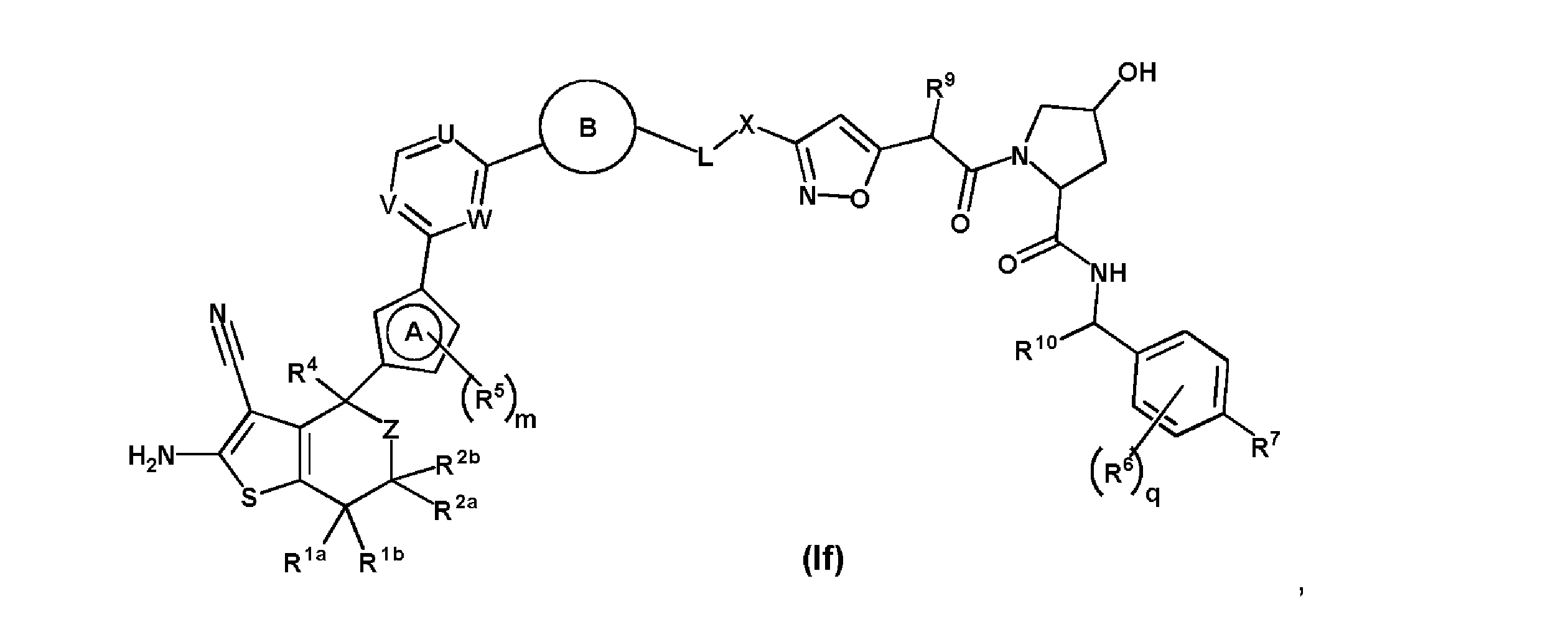
[式中、R1a、R1b、R2a、R2b、Z、R4、環A、R5、m、U、V、W、環B、L、X、R9、R10、q、R6、R7及び立体化学は、本明細書で定義されたとおりである]
で示されるものである。好ましくは、式(If)におけるキラル中心の立体化学は、式(I*)、(I**)、(I***)又は(I****)のいずれか1つにおいて定義されたとおりである。
In another embodiment, the compound of formula (I) has the formula (If):
wherein R 1a , R 1b , R 2a , R 2b , Z, R 4 , Ring A, R 5 , m, U, V, W, Ring B, L, X, R 9 , R 10 , q, R 6 , R 7 and stereochemistry are as defined herein.
Preferably, the stereochemistry of the chiral centre in formula (If) is as defined in any one of formulae (I * ), (I ** ), (I *** ) or (I **** ).
別の態様では、式(I)で示される化合物は、式(Ig):

[式中、R1a、R1b、R2a、R2b、Z、R4、環A、R5、m、U、V、W、環B、L、X、R9、R10、q、R6、R7及び立体化学は、本明細書で定義されたとおりである]
で示されるものである。好ましくは、式(Ig)におけるキラル中心の立体化学は、式(I*)、(I**)、(I***)又は(I****)のいずれか1つにおいて定義されたとおりである。
In another embodiment, the compound of formula (I) has the formula (Ig):
wherein R 1a , R 1b , R 2a , R 2b , Z, R 4 , Ring A, R 5 , m, U, V, W, Ring B, L, X, R 9 , R 10 , q, R 6 , R 7 and stereochemistry are as defined herein.
Preferably, the stereochemistry of the chiral center in formula (Ig) is as defined in any one of formulas (I * ), (I ** ), (I *** ) or (I **** ).
別の態様では、式(I)で示される化合物は、式(Ih):

[式中、R1a、R1b、R2a、R2b、Z、R4、環A、R5、m、U、V、W、環B、L、X、R9、R10、q、R6、R7及び立体化学は、本明細書で定義されたとおりである]
で示されるものである。好ましくは、式(Ih)におけるキラル中心の立体化学は、式(I*)、(I**)、(I***)又は(I****)のいずれか1つにおいて定義されたとおりである。
In another embodiment, the compound of formula (I) has the formula (Ih):
wherein R 1a , R 1b , R 2a , R 2b , Z, R 4 , Ring A, R 5 , m, U, V, W, Ring B, L, X, R 9 , R 10 , q, R 6 , R 7 and stereochemistry are as defined herein.
Preferably, the stereochemistry of the chiral center in formula (Ih) is as defined in any one of formulas (I * ), (I ** ), (I *** ) or (I **** ).
式(I*)、(I**)、(I***)、(I****)、(Ia)、(Ib)、(Ic)、(Id)、(Ie)、(If)、(Ig)又は(Ih)で示される化合物はそれぞれ、式(I)で示される化合物のサブセットであると理解されたい。式(I)で示される化合物への何らか言及は、特に断らない限り、式(I*)、(I**)、(I***)、(I****)、(Ia)、(Ib)、(Ic)、(Id)、(Ie)、(If)、(Ig)及び(Ih)で示される化合物それぞれも言及し、これらの化合物にも含まれることを意味する。式(I*)、(I**)、(I***)、(I****)、(Ia)、(Ib)、(Ic)、(Id)、(Ie)、(If)、(Ig)及び(Ih)は、単独で又はまとまって、式(I)の「部分式(subformula)」又は「部分式(subformulas)」と呼ばれる場合がある。 Each of the compounds of formula (I * ), (I ** ), (I *** ), (I **** ), (Ia), (Ib), (Ic), (Id), (Ie), (If), (Ig) or (Ih) is understood to be a subset of the compounds of formula (I). Any reference to a compound of formula (I) is meant to also refer to and include each of the compounds of formula (I * ), (I ** ), (I *** ), (I **** ), (Ia), (Ib), (Ic), (Id), (Ie), (If), (Ig) and (Ih), unless otherwise specified. Formulas (I * ), (I ** ), (I *** ), (I **** ), (Ia), (Ib), (Ic), (Id), (Ie), (If), (Ig) and (Ih), individually or collectively, may be referred to as "subformulas" or "subformulas" of formula (I).
式(I)、(I*)、(I**)、(I***)、(I****)、(Ia)、(Ib)、(Ic)、(Id)、(Ie)、(If)、(Ig)又は(Ih)で示される化合物の一態様では、R1a又はR1bのうちの一方は、水素である。 In one embodiment of the compounds of formula (I), (I * ), (I ** ), (I *** ), (I **** ), (Ia), (Ib), (Ic), (Id), (Ie), (If), (Ig) or (Ih), one of R 1a or R 1b is hydrogen.
式(I)、(I*)、(I**)、(I***)、(I****)、(Ia)、(Ib)、(Ic)、(Id)、(Ie)、(If)、(Ig)又は(Ih)で示される化合物の別の態様では、R1a及びR1bは、水素である。 In another embodiment of the compounds of formula (I), (I * ), (I ** ), (I *** ), (I **** ), (Ia), (Ib), (Ic), (Id), (Ie), (If), (Ig) or (Ih), R 1a and R 1b are hydrogen.
式(I)、(I*)、(I**)、(I***)、(I****)、(Ia)、(Ib)、(Ic)、(Id)、(Ie)、(If)、(Ig)又は(Ih)で示される化合物の別の態様では、R2a又はR2bのうちの一方は、水素である。 In another embodiment of the compounds of formula (I), (I * ), (I ** ), (I *** ), (I **** ), (Ia), (Ib), (Ic), (Id), (Ie), (If), (Ig) or (Ih), one of R 2a or R 2b is hydrogen.
式(I)、(I*)、(I**)、(I***)、(I****)、(Ia)、(Ib)、(Ic)、(Id)、(Ie)、(If)、(Ig)又は(Ih)で示される化合物の別の態様では、R2a及びR2bは、水素である。 In another embodiment of the compounds of formula (I), (I * ), (I ** ), (I *** ), (I **** ), (Ia), (Ib), (Ic), (Id), (Ie), (If), (Ig) or (Ih), R 2a and R 2b are hydrogen.
式(I)、(I*)、(I**)、(I***)、(I****)、(Ia)、(Ib)、(Ic)、(Id)、(Ie)、(If)、(Ig)又は(Ih)で示される化合物の別の態様では、R1a、R1b、R2a及びR2bは、水素である。 In another embodiment of the compound of formula (I), (I * ), (I ** ), (I *** ), (I **** ), (Ia), (Ib), (Ic), (Id), (Ie), (If), (Ig) or (Ih), R 1a , R 1b , R 2a and R 2b are hydrogen.
式(I)、(I*)、(I**)、(I***)、(I****)、(Ia)、(Ib)、(Ic)、(Id)、(Ie)、(If)、(Ig)又は(Ih)で示される化合物の別の態様では、R3a又はR3bのうちの一方は、水素である。 In another embodiment of the compounds of formula (I), (I * ), (I ** ), (I *** ), (I **** ), (Ia), (Ib), (Ic), (Id), (Ie), (If), (Ig) or (Ih), one of R 3a or R 3b is hydrogen.
式(I)、(I*)、(I**)、(I***)、(I****)、(Ia)、(Ib)、(Ic)、(Id)、(Ie)、(If)、(Ig)又は(Ih)で示される化合物の別の態様では、R3a及びR3bは、水素である。 In another embodiment of the compounds of formula (I), (I * ), (I ** ), (I *** ), (I **** ), (Ia), (Ib), (Ic), (Id), (Ie), (If), (Ig) or (Ih), R 3a and R 3b are hydrogen.
式(I)、(I*)、(I**)、(I***)、(I****)、(Ia)、(Ib)、(Ic)、(Id)、(Ie)、(If)、(Ig)又は(Ih)で示される化合物の別の態様では、R1a、R1b、R2a、R2b、R3a及びR3bは、水素である。 In another embodiment of the compound of formula (I), (I * ), (I ** ), (I *** ), (I **** ), (Ia), (Ib), (Ic), (Id), (Ie), (If), (Ig) or (Ih), R 1a , R 1b , R 2a , R 2b , R 3a and R 3b are hydrogen.
式(I)、(I*)、(I**)、(I***)、(I****)、(Ia)、(Ib)、(Ic)、(Id)、(Ie)、(If)、(Ig)又は(Ih)で示される化合物の別の態様では、nは、1である。 In another embodiment of the compound of formula (I), (I * ), (I ** ), (I *** ), (I **** ), (Ia), (Ib), (Ic), (Id), (Ie), (If), (Ig) or (Ih), n is 1.
式(I)、(I*)、(I**)、(I***)、(I****)、(Ia)、(Ib)、(Ic)、(Id)、(Ie)、(If)、(Ig)又は(Ih)で示される化合物の別の態様では、Zは、-CH2-である。 In another embodiment of the compounds of formula (I), (I * ), (I ** ), (I *** ), (I **** ), (Ia), (Ib), (Ic), (Id), (Ie), (If), (Ig) or (Ih), Z is -CH2- .
式(I)、(I*)、(I**)、(I***)、(I****)、(Ia)、(Ib)、(Ic)、(Id)、(Ie)、(If)、(Ig)又は(Ih)で示される化合物の別の態様では、R1a、R1b、R2a及びR2bは、水素であり、Zは、-CH2-である。 In another embodiment of the compounds of formula (I), (I * ), (I ** ), (I *** ), (I **** ), (Ia), (Ib), (Ic), (Id), (Ie), (If), (Ig) or (Ih), R 1a , R 1b , R 2a and R 2b are hydrogen and Z is -CH 2 -.
式(I)、(I*)、(I**)、(I***)、(I****)、(Ia)、(Ib)、(Ic)、(Id)、(Ie)、(If)、(Ig)又は(Ih)で示される化合物の別の態様では、R4及び環Aが結合している炭素原子は、(S)配置である。 In another embodiment of the compound of formula (I), (I * ), (I ** ), (I *** ), (I **** ), (Ia), (Ib), (Ic), (Id), (Ie), (If), (Ig) or (Ih), the carbon atom to which R4 and Ring A are attached is in the (S) configuration.
式(I)、(I*)、(I**)、(I***)、(I****)、(Ia)、(Ib)、(Ic)、(Id)、(Ie)、(If)、(Ig)又は(Ih)で示される化合物の別の態様では、R4は、水素、C1-3アルキル、C1-3ハロアルキル、C1-3アルコキシ、C1-3ハロアルコキシ、シアノ-C1-3アルキル、ハロゲン、-OH、-NH2、-NH(C1-3アルキル)、-N(C1-3アルキル)2、-CN、C3-4シクロアルキル及び3~4員のヘテロシクロアルキルからなる群より選択される。 In another embodiment of the compounds of formula (I), (I * ), (I ** ), (I *** ), (I **** ), (Ia), (Ib), (Ic), (Id), (Ie), (If), (Ig) or (Ih), R 4 is selected from the group consisting of hydrogen, C 1-3 alkyl, C 1-3 haloalkyl, C 1-3 alkoxy, C 1-3 haloalkoxy, cyano-C 1-3 alkyl, halogen, -OH, -NH 2 , -NH(C 1-3 alkyl), -N(C 1-3 alkyl) 2 , -CN, C 3-4 cycloalkyl and 3 to 4 membered heterocycloalkyl.
式(I)、(I*)、(I**)、(I***)、(I****)、(Ia)、(Ib)、(Ic)、(Id)、(Ie)、(If)、(Ig)又は(Ih)で示される化合物の別の態様では、R4は、C1-6アルキルである。 In another embodiment of the compounds of formula (I), (I * ), (I ** ), (I *** ), (I **** ), (Ia), (Ib), (Ic), (Id), (Ie), (If), (Ig) or (Ih), R 4 is C 1-6 alkyl.
式(I)、(I*)、(I**)、(I***)、(I****)、(Ia)、(Ib)、(Ic)、(Id)、(Ie)、(If)、(Ig)又は(Ih)で示される化合物の別の態様では、R4は、C1-3アルキルである。 In another embodiment of the compounds of formula (I), (I * ), (I ** ), (I *** ), (I **** ), (Ia), (Ib), (Ic), (Id), (Ie), (If), (Ig) or (Ih), R 4 is C 1-3 alkyl.
式(I)、(I*)、(I**)、(I***)、(I****)、(Ia)、(Ib)、(Ic)、(Id)、(Ie)、(If)、(Ig)又は(Ih)で示される化合物の別の態様では、R4は、メチルである。 In another embodiment of the compound of formula (I), (I * ), (I ** ), (I *** ), (I **** ), (Ia), (Ib), (Ic), (Id), (Ie), (If), (Ig) or (Ih), R4 is methyl.
式(I)、(I*)、(I**)、(I***)、(I****)、(Ia)、(Ib)、(Ic)、(Id)、(Ie)、(If)、(Ig)又は(Ih)で示される化合物の別の態様では、R1a、R1b、R2a及びR2bは、水素であり、Zは、-CH2-であり、R4は、メチルである。 In another embodiment of the compounds of formula (I), (I * ), (I ** ), (I *** ), (I *** ), (Ia), (Ib), (Ic), (Id), (Ie), (If), (Ig) or (Ih), R 1a , R 1b , R 2a and R 2b are hydrogen, Z is -CH 2 - and R 4 is methyl.
式(I)、(I*)、(I**)、(I***)、(I****)、(Ia)、(Ib)、(Ic)、(Id)、(Ie)、(If)、(Ig)又は(Ih)で示される化合物の別の態様では、R1a、R1b、R2a及びR2bは、水素であり、Zは、-CH2-であり、R4は、メチルであり、R4及び環Aが結合している炭素原子は、(S)配置である。 In another embodiment of the compound of formula (I), (I * ), (I ** ), (I *** ), (I *** ), (Ia), (Ib), (Ic), (Id), (Ie), (If), (Ig) or (Ih), R 1a , R 1b , R 2a and R 2b are hydrogen, Z is -CH 2 -, R 4 is methyl and the carbon atom to which R 4 and Ring A are attached is in the (S) configuration.
式(I)、(I*)、(I**)、(I***)、(I****)、(If)、(Ig)又は(Ih)で示される化合物の別の態様では、環Aは、ピロール、フラン、チオフェン、イミダゾール、ピラゾール、オキサゾール、イソオキサゾール、チアゾール、イソチアゾール、オキサジアゾール、チアジアゾール及びトリアゾールからなる群より選択される。 In another embodiment of the compound of formula (I), (I * ), (I ** ), (I *** ), (I **** ), (If), (Ig) or (Ih), Ring A is selected from the group consisting of pyrrole, furan, thiophene, imidazole, pyrazole, oxazole, isoxazole, thiazole, isothiazole, oxadiazole, thiadiazole and triazole.
式(I)、(I*)、(I**)、(I***)、(I****)、(If)、(Ig)又は(Ih)で示される化合物の別の態様では、環Aは、オキサゾール、イソオキサゾール、チアゾール、イソチアゾール、オキサジアゾール及びチアジアゾールからなる群より選択される。 In another embodiment of the compound of formula (I), (I * ), (I ** ), (I *** ), (I **** ), (If), (Ig) or (Ih), Ring A is selected from the group consisting of oxazole, isoxazole, thiazole, isothiazole, oxadiazole and thiadiazole.
式(I)、(I*)、(I**)、(I***)、(I****)、(If)、(Ig)又は(Ih)で示される化合物の別の態様では、環Aは、イソオキサゾール、イソチアゾール及びオキサジアゾールからなる群より選択される。 In another embodiment of the compound of formula (I), (I * ), (I ** ), (I *** ), (I **** ), (If), (Ig) or (Ih), ring A is selected from the group consisting of isoxazole, isothiazole and oxadiazole.
式(I)、(I*)、(I**)、(I***)、(I****)、(If)、(Ig)又は(Ih)で示される化合物の別の態様では、環Aは、

からなる群より選択される。
In another embodiment of the compound of formula (I), (I * ), (I ** ), (I *** ), (I **** ), (If), (Ig) or (Ih), Ring A is
is selected from the group consisting of:
式(I)、(I*)、(I**)、(I***)、(I****)、(If)、(Ig)又は(Ih)で示される化合物の別の態様では、環Aは、

からなる群より選択される。
In another embodiment of the compound of formula (I), (I * ), (I ** ), (I *** ), (I **** ), (If), (Ig) or (Ih), Ring A is
is selected from the group consisting of:
式(I)、(I*)、(I**)、(I***)、(I****)、(Ia)、(Ib)、(Ic)、(Id)、(Ie)、(If)、(Ig)又は(Ih)で示される化合物の別の態様では、任意の出現において、オキサジアジオールは、

からなる群より選択される。
In another embodiment of the compounds of formula (I), (I * ), (I ** ), (I *** ), (I **** ), (Ia), (Ib), (Ic), (Id), (Ie), (If), (Ig) or (Ih), at any occurrence, the oxadiadiol is
is selected from the group consisting of:
式(I)、(I*)、(I**)、(I***)、(I****)、(Ia)、(Ib)、(Ic)、(Id)、(Ie)、(If)、(Ig)又は(Ih)で示される化合物の別の態様では、任意の出現において、オキサジアジオールは、

である。
In another embodiment of the compounds of formula (I), (I * ), (I ** ), (I *** ), (I **** ), (Ia), (Ib), (Ic), (Id), (Ie), (If), (Ig) or (Ih), at any occurrence, the oxadiadiol is
It is.
式(I)、(I*)、(I**)、(I***)、(I****)、(Ia)、(Ib)、(Ic)、(Id)、(Ie)、(If)、(Ig)又は(Ih)で示される化合物の別の態様では、任意の出現において、イソオキサゾールは、

である。
In another embodiment of the compounds of formula (I), (I * ), (I ** ), (I *** ), (I **** ), (Ia), (Ib), (Ic), (Id), (Ie), (If), (Ig) or (Ih), isoxazole at any occurrence is
It is.
式(I)、(I*)、(I**)、(I***)、(I****)、(Ia)、(Ib)、(Ic)、(Id)、(Ie)、(If)、(Ig)又は(Ih)で示される化合物の別の態様では、任意の出現において、イソチアゾールは、

である。
In another embodiment of the compound of formula (I), (I * ), (I ** ), (I *** ), (I **** ), (Ia), (Ib), (Ic), (Id), (Ie), (If), (Ig) or (Ih), in any occurrence, the isothiazole is
It is.
式(I)、(I*)、(I**)、(I***)、(I****)、(If)、(Ig)又は(Ih)で示される化合物の別の態様では、mは、0である。 In another embodiment of the compounds of formula (I), (I * ), (I ** ), (I *** ), (I **** ), (If), (Ig) or (Ih), m is 0.
式(I)、(I*)、(I**)、(I***)、(I****)、(Ia)、(Ib)、(Ic)、(Id)、(Ie)、(If)、(Ig)又は(Ih)で示される化合物の別の態様では、R11は、水素である。 In another embodiment of the compounds of formula (I), (I * ), (I ** ), (I *** ), (I **** ), (Ia), (Ib), (Ic), (Id), (Ie), (If), (Ig) or (Ih), R 11 is hydrogen.
式(I)、(I*)、(I**)、(I***)、(I****)、(Ia)、(Ib)、(Ic)、(Id)、(Ie)、(If)、(Ig)又は(Ih)で示される化合物の別の態様では、U、V及びWは、それぞれ独立して、=N-又は=C(H)-である。 In another embodiment of the compound of formula (I), (I * ), (I ** ), (I *** ), (I **** ), (Ia), (Ib), (Ic), (Id), (Ie), (If), (Ig) or (Ih), U, V and W are each independently =N- or =C(H)-.
式(I)、(I*)、(I**)、(I***)、(I****)、(Ia)、(Ib)、(Ic)、(Id)、(Ie)、(If)、(Ig)又は(Ih)で示される化合物の別の態様では、V又はWのうちの少なくとも1つは、=N-である。 In another embodiment of the compound of formula (I), (I * ), (I ** ), (I *** ), (I **** ), (Ia), (Ib), (Ic), (Id), (Ie), (If), (Ig) or (Ih), at least one of V or W is =N-.
式(I)、(I*)、(I**)、(I***)、(I****)、(Ia)、(Ib)、(Ic)、(Id)、(Ie)、(If)、(Ig)又は(Ih)で示される化合物の別の態様では、V又はWのうちの1つは、=N-である。 In another embodiment of the compound of formula (I), (I * ), (I ** ), (I *** ), (I **** ), (Ia), (Ib), (Ic), (Id), (Ie), (If), (Ig) or (Ih), one of V or W is =N-.
式(I)、(I*)、(I**)、(I***)、(I****)、(Ia)、(Ib)、(Ic)、(Id)、(Ie)、(If)、(Ig)又は(Ih)で示される化合物の別の態様では、V及びWは両方とも、=N-である。 In another embodiment of the compound of formula (I), (I * ), (I ** ), (I *** ), (I **** ), (Ia), (Ib), (Ic), (Id), (Ie), (If), (Ig) or (Ih), V and W are both =N-.
式(I)、(I*)、(I**)、(I***)、(I****)、(Ia)、(Ib)、(Ic)、(Id)、(Ie)、(If)、(Ig)又は(Ih)で示される化合物の別の態様では、Wは、=N-である。 In another embodiment of the compound of formula (I), (I * ), (I ** ), (I *** ), (I **** ), (Ia), (Ib), (Ic), (Id), (Ie), (If), (Ig) or (Ih), W is =N-.
式(I)、(I*)、(I**)、(I***)、(I****)、(Ia)、(Ib)、(Ic)、(Id)、(Ie)、(If)、(Ig)又は(Ih)で示される化合物の別の態様では、Uは、=N-であり、Vは、=C(H)-であり、Wは、=N-である。 In another embodiment of the compound of formula (I), (I * ), (I ** ), (I *** ), (I **** ), (Ia), (Ib), (Ic), (Id), (Ie), (If), (Ig) or (Ih), U is ═N—, V is ═C(H)— and W is ═N—.
式(I)、(I*)、(I**)、(I***)、(I****)、(Ia)、(Ib)、(Ic)、(Id)、(Ie)、(If)、(Ig)又は(Ih)で示される化合物の別の態様では、Uは、=C(H)-であり、Vは、=N-であり、Wは、=N-である。 In another embodiment of the compound of formula (I), (I * ), (I ** ), (I *** ), (I **** ), (Ia), (Ib), (Ic), (Id), (Ie), (If), (Ig) or (Ih), U is ═C(H)—, V is ═N— and W is ═N—.
式(I)、(I*)、(I**)、(I***)、(I****)、(Ia)、(Ib)、(Ic)、(Id)、(Ie)、(If)、(Ig)又は(Ih)で示される化合物の別の態様では、R1a、R1b、R2a及びR2bは、水素であり、Zは、-CH2-であり、R4は、メチルであり、Wは、=N-である。 In another embodiment of the compounds of formula (I), (I * ), (I ** ), (I *** ), (I *** ), (Ia), (Ib), (Ic), (Id), (Ie), (If), (Ig) or (Ih), R 1a , R 1b , R 2a and R 2b are hydrogen, Z is -CH 2 -, R 4 is methyl and W is =N-.
式(I)、(I*)、(I**)、(I***)、(I****)、(Ia)、(Ib)、(Ic)、(Id)、(Ie)、(If)、(Ig)又は(Ih)で示される化合物の別の態様では、R1a、R1b、R2a及びR2bは、水素であり、Zは、-CH2-であり、R4は、メチルであり、Wは、=Nであり、R4及び環Aが結合している炭素原子は、(S)配置である。 In another embodiment of the compound of formula (I), (I * ), (I ** ), (I *** ), (I *** ), (Ia), (Ib), (Ic), (Id), (Ie), (If), (Ig) or (Ih), R 1a , R 1b , R 2a and R 2b are hydrogen, Z is -CH 2 -, R 4 is methyl, W is ═N and the carbon atom to which R 4 and Ring A are attached is in the (S) configuration.
式(I)、(I*)、(I**)、(I***)、(I****)、(Ia)、(Ib)、(Ic)、(Id)、(Ie)、(If)、(Ig)又は(Ih)で示される化合物の別の態様では、R1a、R1b、R2a及びR2bは、水素であり、Zは、-CH2-であり、R4は、メチルであり、Uは、=N-であり、Vは、=C(H)-であり、Wは、=N-である。 In another embodiment of the compounds of formula (I), (I * ), (I ** ), (I *** ), (I *** ), (Ia), (Ib), (Ic), (Id), (Ie), (If), (Ig) or (Ih), R 1a , R 1b , R 2a and R 2b are hydrogen, Z is -CH 2 -, R 4 is methyl, U is =N-, V is =C(H)- and W is =N-.
式(I)、(I*)、(I**)、(I***)、(I****)、(Ia)、(Ib)、(Ic)、(Id)、(Ie)、(If)、(Ig)又は(Ih)で示される化合物の別の態様では、R1a、R1b、R2a及びR2bは、水素であり、Zは、-CH2-であり、R4は、メチルであり、Uは、=C(H)-であり、Vは、=N-であり、Wは、=N-である。 In another embodiment of the compounds of formula (I), (I * ), (I ** ), (I *** ), (I *** ), (Ia), (Ib), (Ic), (Id), (Ie), (If), (Ig) or (Ih), R 1a , R 1b , R 2a and R 2b are hydrogen, Z is -CH 2 -, R 4 is methyl, U is ═C(H)-, V is ═N- and W is ═N-.
式(I)、(I*)、(I**)、(I***)、(I****)、(Ia)、(Ib)、(Ic)、(Id)、(Ie)、(If)、(Ig)又は(Ih)で示される化合物の別の態様では、R1a、R1b、R2a及びR2bは、水素であり、Zは、-CH2-であり、R4は、メチルであり、Uは、=N-であり、Vは、=C(H)-であり、Wは、=N-であり、R4及び環Aが結合している炭素原子は、(S)配置である。 In another embodiment of the compound of formula (I), (I * ), (I ** ), (I *** ), (I *** ), (Ia), (Ib), (Ic), (Id), (Ie), (If), (Ig) or (Ih), R 1a , R 1b , R 2a and R 2b are hydrogen, Z is -CH 2 -, R 4 is methyl, U is ═N-, V is ═C(H)-, W is ═N- and the carbon atom to which R 4 and ring A are attached is in the (S) configuration.
式(I)、(I*)、(I**)、(I***)、(I****)、(Ia)、(Ib)、(Ic)、(Id)、(Ie)、(If)、(Ig)又は(Ih)で示される化合物の別の態様では、R1a、R1b、R2a及びR2bは、水素であり、Zは、-CH2-であり、R4は、メチルであり、Uは、=C(H)-であり、Vは、=N-であり、Wは、=N-であり、R4及び環Aが結合している炭素原子は、(S)配置である。 In another embodiment of the compound of formula (I), (I * ), (I ** ), (I *** ), (I *** ), (Ia), (Ib), (Ic), (Id), (Ie), (If), (Ig) or (Ih), R 1a , R 1b , R 2a and R 2b are hydrogen, Z is -CH 2 -, R 4 is methyl, U is ═C(H)-, V is ═N-, W is ═N- and the carbon atom to which R 4 and ring A are attached is in the (S) configuration.
式(I)、(I*)、(I**)、(I***)、(I****)、(Ia)、(Ib)、(Ic)、(Id)、(Ie)、(If)、(Ig)又は(Ih)で示される化合物の別の態様では、環Bは、少なくとも1つの窒素原子を含む。 In another embodiment of the compound of formula (I), (I * ), (I ** ), (I *** ), (I **** ), (Ia), (Ib), (Ic), (Id), (Ie), (If), (Ig) or (Ih), ring B contains at least one nitrogen atom.
式(I)、(I*)、(I**)、(I***)、(I****)、(Ia)、(Ib)、(Ic)、(Id)、(Ie)、(If)、(Ig)又は(Ih)で示される化合物の別の態様では、環Bは、2つの窒素原子を含む。 In another embodiment of the compound of formula (I), (I * ), (I ** ), (I *** ), (I **** ), (Ia), (Ib), (Ic), (Id), (Ie), (If), (Ig) or (Ih), ring B contains two nitrogen atoms.
(I)、(I*)、(I**)、(I***)、(I****)、(Ia)、(Ib)、(Ic)、(Id)、(Ie)、(If)、(Ig)又は(Ih)で示される化合物の別の態様では、環Bは、1つのC1-6アルキルにより置換されており、場合により、1つ以上の同一又は異なるC1-6アルキル、C1-6アルコキシ又は5~6員のヘテロシクロアルクリルによりさらに置換されている3~11員のヘテロシクロアルキレンであり、ここで、C1-6アルキルのいずれかは、場合によりかつ独立して、シクロプロピルにより置換されており、好ましくは、ここで、前記3~11員のヘテロシクロアルキレンは、少なくとも1つの窒素原子を含むか又はここで、前記3~11員のヘテロシクロアルキレンは、2つの窒素原子を含む。 In another embodiment of the compound represented by (I), (I * ), (I ** ), (I *** ), (I **** ), (Ia), (Ib), (Ic), (Id), (Ie), (If), (Ig) or (Ih), Ring B is a 3- to 11-membered heterocycloalkylene substituted by one C 1-6 alkyl and optionally further substituted by one or more of the same or different C 1-6 alkyl, C 1-6 alkoxy or 5- to 6-membered heterocycloalkyl, wherein any of the C 1-6 alkyl is optionally and independently substituted by cyclopropyl, preferably wherein said 3- to 11-membered heterocycloalkylene contains at least one nitrogen atom or wherein said 3- to 11-membered heterocycloalkylene contains two nitrogen atoms.
式(I)、(I*)、(I**)、(I***)、(I****)、(Ia)、(Ib)、(Ic)、(Id)、(Ie)、(If)、(Ig)又は(Ih)で示される化合物の別の態様では、環Bは、1つ以上の同一又は異なるC1-3アルキル、C1-3アルコキシ又は5~6員のヘテロシクロアルキルにより場合により置換されている5~8員のヘテロシクロアルキレンであり、ここで、C1-3アルキルは、シクロプロピルにより場合により置換されており、好ましくは、ここで、前記5~8員のヘテロシクロアルキレンは、少なくとも1つの窒素原子を含むか又はここで、前記5~8員のヘテロシクロアルキレンは、2つの窒素原子を含む。 In another embodiment of the compounds of formula (I), (I * ), (I ** ), (I *** ), (I **** ), (Ia), (Ib), (Ic), (Id), (Ie), (If), (Ig) or (Ih), Ring B is 5-8 membered heterocycloalkylene optionally substituted by one or more of the same or different C 1-3 alkyl, C 1-3 alkoxy or 5-6 membered heterocycloalkyl, wherein C 1-3 alkyl is optionally substituted by cyclopropyl, preferably wherein said 5-8 membered heterocycloalkylene contains at least one nitrogen atom or wherein said 5-8 membered heterocycloalkylene contains two nitrogen atoms.
式(I)、(I*)、(I**)、(I***)、(I****)、(Ia)、(Ib)、(Ic)、(Id)、(Ie)、(If)、(Ig)又は(Ih)で示される化合物の別の態様では、環Bは、1つのC1-3アルキルにより置換されており、場合により、1つ以上の同一又は異なるC1-3アルキル、C1-3アルコキシ又は5~6員のヘテロシクロアルキルによりさらに置換されている5~8員ヘテロシクロアルキレンであり、好ましくは、ここで、前記5~8員のヘテロシクロアルキレンは、少なくとも1つの窒素原子を含むか又はここで、前記5~8員のヘテロシクロアルキレンは、2つの窒素原子を含む。 In another embodiment of the compounds of formula (I), (I * ), (I ** ), (I *** ), (I **** ), (Ia), (Ib), (Ic), (Id), (Ie), (If), (Ig) or (Ih), Ring B is a 5-8 membered heterocycloalkylene substituted by one C 1-3 alkyl and optionally further substituted by one or more of the same or different C 1-3 alkyl, C 1-3 alkoxy or 5-6 membered heterocycloalkyl, preferably wherein said 5-8 membered heterocycloalkylene contains at least one nitrogen atom or wherein said 5-8 membered heterocycloalkylene contains two nitrogen atoms.
式(I)、(I*)、(I**)、(I***)、(I****)、(Ia)、(Ib)、(Ic)、(Id)、(Ie)、(If)、(Ig)又は(Ih)で示される化合物の別の態様では、環Bは、

[式中、rは、0、1又は2であり、sは、0、1、2、3又は4であり、R13は、C1-6アルキルであり、各R14は、それぞれ独立して、C1-6アルキル、C1-6アルコキシ又は5~6員のヘテロシクロアルキルであり、C1-6アルキルのいずれかは、シクロプロピルにより場合により置換されている]
である。
In another embodiment of the compound of formula (I), (I * ), (I ** ), (I *** ), (I **** ), (Ia), (Ib), (Ic), (Id), (Ie), (If), (Ig) or (Ih), Ring B is
wherein r is 0, 1 or 2; s is 0, 1, 2, 3 or 4; R 13 is C 1-6 alkyl; and each R 14 is independently C 1-6 alkyl, C 1-6 alkoxy or a 5- to 6-membered heterocycloalkyl, any of the C 1-6 alkyl optionally substituted by cyclopropyl.
It is.
式(I)、(I*)、(I**)、(I***)、(I****)、(Ia)、(Ib)、(Ic)、(Id)、(Ie)、(If)、(Ig)又は(Ih)で示される化合物の別の態様では、環Bは、

[式中、rは、0、1又は2であり、sは、0、1、2、3又は4であり、R13は、C1-3アルキルであり、各R14は、それぞれ独立して、C1-3アルキル、C1-3アルコキシ又は5~6員のヘテロシクロアルキルである]
である。
In another embodiment of the compound of formula (I), (I * ), (I ** ), (I *** ), (I **** ), (Ia), (Ib), (Ic), (Id), (Ie), (If), (Ig) or (Ih), Ring B is
wherein r is 0, 1 or 2, s is 0, 1, 2, 3 or 4, R 13 is C 1-3 alkyl, and each R 14 is independently C 1-3 alkyl, C 1-3 alkoxy, or 5-6 membered heterocycloalkyl.
It is.
式(I)、(I*)、(I**)、(I***)、(I****)、(Ia)、(Ib)、(Ic)、(Id)、(Ie)、(If)、(Ig)又は(Ih)で示される化合物の別の態様では、環Bは、

[式中、rは、0、1又は2であり、sは、0、1又は2であり、R13は、C1-3アルキルであり、各R14は、それぞれ独立して、同じか又は異なるC1-3アルキルである]
である。
In another embodiment of the compound of formula (I), (I * ), (I ** ), (I *** ), (I **** ), (Ia), (Ib), (Ic), (Id), (Ie), (If), (Ig) or (Ih), Ring B is
wherein r is 0, 1 or 2, s is 0, 1 or 2, R 13 is C 1-3 alkyl, and each R 14 is independently the same or different C 1-3 alkyl.
It is.
好ましくは、R13が結合している炭素原子は、(S)配置である。 Preferably, the carbon atom to which R 13 is attached is in the (S) configuration.
好ましくは、rは、0又は1である。好ましくは、rは、0である。好ましくは、rは、1である。 Preferably, r is 0 or 1. Preferably, r is 0. Preferably, r is 1.
好ましくは、sは、0、1又は2である。好ましくは、sは、0であり、好ましくは、sは、1である。好ましくは、sは、2である。 Preferably, s is 0, 1 or 2. Preferably, s is 0, and preferably, s is 1. Preferably, s is 2.
好ましくは、R13は、メチルである。 Preferably, R 13 is methyl.
好ましくは、R14が存在する場合、R14は、メチルである。 Preferably, when R 14 is present, it is methyl.
式(I)、(I*)、(I**)、(I***)、(I****)、(Ia)、(Ib)、(Ic)、(Id)、(Ie)、(If)、(Ig)又は(Ih)で示される化合物の別の態様では、環Bは、

[式中、pは、0、1、2及び3からなる群より選択される]
である。
In another embodiment of the compound of formula (I), (I * ), (I ** ), (I *** ), (I **** ), (Ia), (Ib), (Ic), (Id), (Ie), (If), (Ig) or (Ih), Ring B is
wherein p is selected from the group consisting of 0, 1, 2 and 3.
It is.
式(I)、(I*)、(I**)、(I***)、(I****)、(Ia)、(Ib)、(Ic)、(Id)、(Ie)、(If)、(Ig)又は(Ih)で示される化合物の別の態様では、環Bは、

[式中、pは、1又は2であり、キラル炭素原子は、(S)配置である]
である。
In another embodiment of the compound of formula (I), (I * ), (I ** ), (I *** ), (I **** ), (Ia), (Ib), (Ic), (Id), (Ie), (If), (Ig) or (Ih), Ring B is
wherein p is 1 or 2 and the chiral carbon atom is in the (S) configuration.
It is.
式(I)、(I*)、(I**)、(I***)、(I****)、(Ia)、(Ib)、(Ic)、(Id)、(Ie)、(If)、(Ig)又は(Ih)で示される化合物の別の態様では、環Bは、

からなる群より選択される。
In another embodiment of the compound of formula (I), (I * ), (I ** ), (I *** ), (I **** ), (Ia), (Ib), (Ic), (Id), (Ie), (If), (Ig) or (Ih), Ring B is
is selected from the group consisting of:
式(I)、(I*)、(I**)、(I***)、(I****)、(Ia)、(Ib)、(Ic)、(Id)、(Ie)、(If)、(Ig)又は(Ih)で示される化合物の別の態様では、環Bは、

からなる群より選択される。
In another embodiment of the compound of formula (I), (I * ), (I ** ), (I *** ), (I **** ), (Ia), (Ib), (Ic), (Id), (Ie), (If), (Ig) or (Ih), Ring B is
is selected from the group consisting of:
「(C)」及び「(L)」は、環Bが結合している式(I)の原子又は置換基を示すと理解されたい。 "(C)" and "(L)" should be understood to represent the atom or substituent of formula (I) to which ring B is attached.
式(I)、(I*)、(I**)、(I***)、(I****)、(Ia)、(Ib)、(Ic)、(Id)、(Ie)、(If)、(Ig)又は(Ih)で示される化合物の別の態様では、Lは、C1-8アルキレン、C2-8アルケニレン及びC1-8アルコキシレンからなる群より選択される。 In another embodiment of the compound of formula (I), (I * ), (I ** ), (I *** ), (I **** ), (Ia), (Ib), (Ic), (Id), (Ie), (If), (Ig) or (Ih), L is selected from the group consisting of C 1-8 alkylene, C 2-8 alkenylene, and C 1-8 alkoxylene.
式(I)、(I*)、(I**)、(I***)、(I****)、(Ia)、(Ib)、(Ic)、(Id)、(Ie)、(If)、(Ig)又は(Ih)で示される化合物の別の態様では、Lは、C1-6アルキレン、C2-6アルケニレン及びC1-6アルコキシレンからなる群より選択される。 In another embodiment of the compound of formula (I), (I * ), (I ** ), (I *** ), (I **** ), (Ia), (Ib), (Ic), (Id), (Ie), (If), (Ig) or (Ih), L is selected from the group consisting of C 1-6 alkylene, C 2-6 alkenylene, and C 1-6 alkoxylene.
式(I)、(I*)、(I**)、(I***)、(I****)、(Ia)、(Ib)、(Ic)、(Id)、(Ie)、(If)、(Ig)又は(Ih)で示される化合物の別の態様では、Lは、-(CH2)2-、-(CH2)3-、-(CH2)4-、-(CH2)6-、

からなる群より選択される。
In another embodiment of the compounds of formula (I), (I * ), (I ** ), (I *** ), (I *** ), (Ia), (Ib), (Ic), (Id), (Ie), (If), (Ig) or (Ih), L is -(CH 2 ) 2 -, -(CH 2 ) 3 -, -(CH 2 ) 4 -, -(CH 2 ) 6 -,
is selected from the group consisting of:
式(I)、(I*)、(I**)、(I***)、(I****)、(Ia)、(Ib)、(Ic)、(Id)、(Ie)、(If)、(Ig)又は(Ih)で示される化合物の別の態様では、Lは、-(CH2)2-、-(CH2)3-、-(CH2)4-、-(CH2)6-、

からなる群より選択される。
In another embodiment of the compounds of formula (I), (I * ), (I ** ), (I *** ), (I *** ), (Ia), (Ib), (Ic), (Id), (Ie), (If), (Ig) or (Ih), L is -(CH 2 ) 2 -, -(CH 2 ) 3 -, -(CH 2 ) 4 -, -(CH 2 ) 6 -,
is selected from the group consisting of:
式(I)、(I*)、(I**)、(I***)、(I****)、(Ia)、(Ib)、(Ic)、(Id)、(Ie)、(If)、(Ig)又は(Ih)で示される化合物の別の態様では、Lは、-(CH2)2-、-(CH2)3-、-(CH2)4-、-(CH2)6-、

からなる群より選択される。
In another embodiment of the compounds of formula (I), (I * ), (I ** ), (I *** ), (I *** ), (Ia), (Ib), (Ic), (Id), (Ie), (If), (Ig) or (Ih), L is -(CH 2 ) 2 -, -(CH 2 ) 3 -, -(CH 2 ) 4 -, -(CH 2 ) 6 -,
is selected from the group consisting of:
式(I)、(I*)、(I**)、(I***)、(I****)、(Ia)、(Ib)、(Ic)、(Id)、(Ie)、(If)、(Ig)又は(Ih)で示される化合物の別の態様では、Lは、-(CH2)2-、-(CH2)3-、-(CH2)4-、-(CH2)6-、

からなる群より選択される。
In another embodiment of the compounds of formula (I), (I * ), (I ** ), (I *** ), (I *** ), (Ia), (Ib), (Ic), (Id), (Ie), (If), (Ig) or (Ih), L is -(CH 2 ) 2 -, -(CH 2 ) 3 -, -(CH 2 ) 4 -, -(CH 2 ) 6 -,
is selected from the group consisting of:
「(B)」及び「(Y)」は、Lが結合している式(I)の置換基を示すと理解されたい。 "(B)" and "(Y)" are understood to represent the substituents of formula (I) to which L is attached.
式(I)、(I*)、(I**)、(I***)、(I****)、(Ia)、(Ib)、(Ic)、(Id)、(Ie)、(If)、(Ig)又は(Ih)で示される化合物の別の態様では、Xは、-(CH2)-である。 In another embodiment of the compound of formula (I), (I * ), (I ** ), (I *** ), (I **** ), (Ia), (Ib), (Ic), (Id), (Ie), (If), (Ig) or (Ih), X is -( CH2 )-.
式(I)、(I*)、(I**)、(I***)、(I****)、(Ia)、(Ib)、(Ic)、(Id)、(Ie)、(If)、(Ig)又は(Ih)で示される化合物の別の態様では、Xは、-O-である。 In another embodiment of the compound of formula (I), (I * ), (I ** ), (I *** ), (I **** ), (Ia), (Ib), (Ic), (Id), (Ie), (If), (Ig) or (Ih), X is -O-.
式(I)、(I*)、(I**)、(I***)、(I****)、(Ia)、(Ib)、(Ic)、(Id)又は(Ie)で示される化合物の別の態様では、Yは、5員のヘテロアリーレン又は-C(O)(NH)-であり、ここで、前記5員のヘテロアリーレンは、少なくとも1つの窒素原子を含み、ここで、前記-C(O)(NH)-は、C原子を介してXに連結している。 In another embodiment of the compound of formula (I), (I * ), (I ** ), (I *** ), (I **** ), (Ia), (Ib), (Ic), (Id) or (Ie), Y is a 5-membered heteroarylene or -C(O)(NH)-, wherein said 5-membered heteroarylene contains at least one nitrogen atom and wherein said -C(O)(NH)- is linked to X via a C atom.
式(I)、(I*)、(I**)、(I***)、(I****)、(Ia)、(Ib)、(Ic)、(Id)又は(Ie)で示される化合物の別の態様では、Yは、ピロール、イミダゾール、ピラゾール、オキサゾール、イソオキサゾール、チアゾール、イソチアゾール、オキサジアゾール、チアジアゾール、トリアゾール及び-C(O)(NR12)-からなる群より選択され、ここで、前記-C(O)(NR12)-は、C原子を介してXに連結しており、好ましくは、ここで、R12は、水素である。 In another embodiment of the compounds of formula (I), (I * ), (I ** ), (I *** ), (I *** ), (Ia), (Ib), (Ic), (Id) or (Ie), Y is selected from the group consisting of pyrrole, imidazole, pyrazole, oxazole, isoxazole, thiazole, isothiazole, oxadiazole, thiadiazole, triazole and -C(O)(NR 12 )-, wherein said -C(O)(NR 12 )- is linked to X via a C atom, preferably wherein R 12 is hydrogen.
式(I)、(I*)、(I**)、(I***)、(I****)、(Ia)、(Ib)、(Ic)、(Id)又は(Ie)で示される化合物の別の態様では、Yは、ピロール、イミダゾール、ピラゾール、オキサゾール、イソオキサゾール、チアゾール、イソチアゾール、オキサジアゾール、チアジアゾール及びトリアゾールからなる群より選択される。 In another embodiment of the compound of formula (I), (I * ), (I ** ), (I *** ), (I **** ), (Ia), (Ib), (Ic), (Id) or (Ie), Y is selected from the group consisting of pyrrole, imidazole, pyrazole, oxazole, isoxazole, thiazole, isothiazole, oxadiazole, thiadiazole and triazole.
式(I)、(I*)、(I**)、(I***)、(I****)、(Ia)、(Ib)、(Ic)、(Id)又は(Ie)で示される化合物の別の態様では、Yは、イソオキサゾール、トリアゾール又は-C(O)(NR12)-であり、ここで、前記-C(O)(NR12)-は、C原子を介してXに連結している。 In another embodiment of the compounds of formula (I), (I * ), (I ** ), (I *** ), (I **** ), (Ia), (Ib), (Ic), (Id) or (Ie), Y is isoxazole, triazole or -C(O)(NR 12 )-, wherein said -C(O)(NR 12 )- is linked to X via a C atom.
式(I)、(I*)、(I**)、(I***)、(I****)、(Ia)、(Ib)、(Ic)、(Id)又は(Ie)で示される化合物の別の態様では、Yは、イソオキサゾール、トリアゾール又は-C(O)(NH)-であり、ここで、前記-C(O)(NH)-は、C原子を介してXに連結している。 In another embodiment of the compound of formula (I), (I * ), (I ** ), (I *** ), (I **** ), (Ia), (Ib), (Ic), (Id) or (Ie), Y is isoxazole, triazole or -C(O)(NH)-, wherein said -C(O)(NH)- is linked to X via a C atom.
式(I)、(I*)、(I**)、(I***)、(I****)、(Ia)、(Ib)、(Ic)、(Id)又は(Ie)で示される化合物の別の態様では、Yは、-C(O)(NH)-であり、ここで、前記-C(O)(NH)-は、C原子を介してXに連結している。 In another embodiment of the compound of formula (I), (I * ), (I ** ), (I *** ), (I **** ), (Ia), (Ib), (Ic), (Id) or (Ie), Y is -C(O)(NH)-, wherein said -C(O)(NH)- is linked to X via a C atom.
式(I)、(I*)、(I**)、(I***)、(I****)、(Ia)、(Ib)、(Ic)、(Id)又は(Ie)で示される化合物の別の態様では、Yは、イソオキサゾール又はトリアゾールである。 In another embodiment of the compound of formula (I), (I * ), (I ** ), (I *** ), (I **** ), (Ia), (Ib), (Ic), (Id) or (Ie), Y is an isoxazole or triazole.
式(I)、(I*)、(I**)、(I***)、(I****)、(Ia)、(Ib)、(Ic)、(Id)又は(Ie)で示される化合物の別の態様では、Yは、イソオキサゾールである。 In another embodiment of the compound of formula (I), (I * ), (I ** ), (I *** ), (I **** ), (Ia), (Ib), (Ic), (Id) or (Ie), Y is isoxazole.
式(I)、(I*)、(I**)、(I***)、(I****)、(Ia)、(Ib)、(Ic)、(Id)又は(Ie)で示される化合物の別の態様では、Yは、トリアゾールである。 In another embodiment of the compound of formula (I), (I * ), (I ** ), (I *** ), (I **** ), (Ia), (Ib), (Ic), (Id) or (Ie), Y is triazole.
式(I)、(I*)、(I**)、(I***)、(I****)、(Ia)、(Ib)、(Ic)、(Id)又は(Ie)で示される化合物の別の態様では、Yは、

からなる群より選択される。
In another embodiment of the compound of formula (I), (I * ), (I ** ), (I *** ), (I *** ), (Ia), (Ib), (Ic), (Id) or (Ie), Y is
is selected from the group consisting of:
式(I)、(I*)、(I**)、(I***)、(I****)、(Ia)、(Ib)、(Ic)、(Id)又は(Ie)で示される化合物の別の態様では、Yは、

からなる群より選択される。
In another embodiment of the compound of formula (I), (I * ), (I ** ), (I *** ), (I *** ), (Ia), (Ib), (Ic), (Id) or (Ie), Y is
is selected from the group consisting of:
式(I)、(I*)、(I**)、(I***)、(I****)、(Ia)、(Ib)、(Ic)、(Id)又は(Ie)で示される化合物の別の態様では、Yは、

からなる群より選択される。
In another embodiment of the compound of formula (I), (I * ), (I ** ), (I *** ), (I *** ), (Ia), (Ib), (Ic), (Id) or (Ie), Y is
is selected from the group consisting of:
式(I)、(I*)、(I**)、(I***)、(I****)、(Ia)、(Ib)、(Ic)、(Id)又は(Ie)で示される化合物の別の態様では、Yは、

である。
In another embodiment of the compound of formula (I), (I * ), (I ** ), (I *** ), (I *** ), (Ia), (Ib), (Ic), (Id) or (Ie), Y is
It is.
式(I)、(I*)、(I**)、(I***)、(I****)、(Ia)、(Ib)、(Ic)、(Id)又は(Ie)で示される化合物の別の態様では、Yは、

である。
In another embodiment of the compound of formula (I), (I * ), (I ** ), (I *** ), (I *** ), (Ia), (Ib), (Ic), (Id) or (Ie), Y is
It is.
式(I)、(I*)、(I**)、(I***)、(I****)、(Ia)、(Ib)、(Ic)、(Id)、(Ie)、(If)、(Ig)又は(Ih)で示される化合物の別の態様では、任意の出現において、トリアゾールは、

からなる群より選択される。
In another embodiment of the compounds of formula (I), (I * ), (I ** ), (I *** ), (I **** ), (Ia), (Ib), (Ic), (Id), (Ie), (If), (Ig) or (Ih), at any occurrence, the triazole is
is selected from the group consisting of:
式(I)、(I*)、(I**)、(I***)、(I****)、(Ia)、(Ib)、(Ic)、(Id)、(Ie)、(If)、(Ig)又は(Ih)で示される化合物の別の態様では、Yが-C(O)(NR12)-である場合、Xは、-(CH2)-であり、ここで、前記-C(O)(NR12)-は、C原子を介してXに連結している。 In another embodiment of the compound of formula (I), (I * ), (I ** ), (I *** ), (I **** ), (Ia), (Ib), (Ic), (Id), (Ie), (If), (Ig) or (Ih), when Y is -C(O)(NR 12 )-, X is -(CH 2 )-, wherein said -C(O)(NR 12 )- is linked to X via a C atom.
式(I)、(I*)、(I**)、(I***)、(I****)、(Ia)、(Ib)、(Ic)、(Id)又は(Ie)で示される化合物の別の態様では、Xは、-(CH2)-であり、Yは、-C(O)(NR12)-であるか又はXは、-(CH2)-もしくは-O-であり、Yは、少なくとも1つの窒素原子を含む5員のヘテロアリーレンであり、ここで、前記-C(O)(NR12)-は、C原子を介してXに連結している。 In another embodiment of the compound of formula (I), (I * ), (I ** ), (I *** ), (I *** ), (Ia), (Ib), (Ic), (Id) or (Ie), X is -(CH 2 )- and Y is -C(O)(NR 12 )- or X is -(CH 2 )- or -O- and Y is a 5-membered heteroarylene containing at least one nitrogen atom, where said -C(O)(NR 12 )- is linked to X via a C atom.
式(I)、(I*)、(I**)、(I***)、(I****)、(Ia)、(Ib)、(Ic)、(Id)又は(Ie)で示される化合物の別の態様では、Xは、-(CH2)-であり、Yは、-C(O)(NR12)-であり、ここで、前記-C(O)(NR12)-は、C原子を介してXに連結している。 In another embodiment of the compound of formula (I), (I * ), (I ** ), (I *** ), (I *** ), (Ia), (Ib), (Ic), (Id) or (Ie), X is -(CH 2 )- and Y is -C(O)(NR 12 )-, wherein said -C(O)(NR 12 )- is linked to X via a C atom.
式(I)、(I*)、(I**)、(I***)、(I****)、(Ia)、(Ib)、(Ic)、(Id)又は(Ie)で示される化合物の別の態様では、Xは、-(CH2)-であり、Yは、-C(O)(NR12)-であり、ここで、前記-C(O)(NR12)-は、C原子を介してXに連結しており、Lは、C1-8アルキレン又はC1-8アルコキシレンである。 In another embodiment of the compound of formula (I), (I * ), (I ** ), (I *** ), (I *** ), (Ia), (Ib), (Ic), (Id) or (Ie), X is -(CH 2 )-, Y is -C(O)(NR 12 )-, wherein said -C(O)(NR 12 )- is linked to X via a C atom, and L is C 1-8 alkylene or C 1-8 alkoxylene.
式(I)、(I*)、(I**)、(I***)、(I****)、(Ia)、(Ib)、(Ic)、(Id)又は(Ie)で示される化合物の別の態様では、Xは、-(CH2)-であり、Yは、-C(O)(NR12)-であり、ここで、前記-C(O)(NR12)-は、C原子を介してXに連結しており、Lは、C1-6アルキレン又はC1-4アルコキシレンである。 In another embodiment of the compound of formula (I), (I * ), (I ** ), (I *** ), (I *** ), (Ia), (Ib), (Ic), (Id) or (Ie), X is -(CH 2 )-, Y is -C(O)(NR 12 )-, wherein said -C(O)(NR 12 )- is linked to X via a C atom, and L is C 1-6 alkylene or C 1-4 alkoxylene.
式(I)、(I*)、(I**)、(I***)、(I****)、(Ia)、(Ib)、(Ic)、(Id)又は(Ie)で示される化合物の別の態様では、Xは、-(CH2)-又は-O-であり、Yは、少なくとも1つの窒素原子を含む5員のヘテロアリーレンである。 In another embodiment of the compounds of formula (I), (I * ), (I ** ), (I *** ), (I *** ), (Ia), (Ib), (Ic), (Id) or (Ie), X is -(CH 2 )- or -O- and Y is a 5-membered heteroarylene containing at least one nitrogen atom.
式(I)、(I*)、(I**)、(I***)、(I****)、(Ia)、(Ib)、(Ic)、(Id)又は(Ie)で示される化合物の別の態様では、Xは、-(CH2)-であり、Yは、少なくとも1つの窒素原子を含む5員のヘテロアリーレンである。 In another embodiment of the compounds of formula (I), (I * ), (I ** ), (I *** ), (I *** ), (Ia), (Ib), (Ic), (Id) or (Ie), X is -(CH 2 )- and Y is a 5-membered heteroarylene containing at least one nitrogen atom.
式(I)、(I*)、(I**)、(I***)、(I****)、(Ia)、(Ib)、(Ic)、(Id)又は(Ie)で示される化合物の別の態様では、Xは、-(CH2)-であり、Yは、少なくとも1つの窒素原子を含む5員のヘテロアリーレンであり、Lは、C1-8アルキレンである。 In another embodiment of the compounds of formula (I), (I * ), (I ** ), (I *** ), (I *** ), (Ia), (Ib), (Ic), (Id) or (Ie), X is -( CH2 )-, Y is a 5-membered heteroarylene containing at least one nitrogen atom, and L is C1-8 alkylene.
式(I)、(I*)、(I**)、(I***)、(I****)、(Ia)、(Ib)、(Ic)、(Id)又は(Ie)で示される化合物の別の態様では、Xは、-O-であり、Yは、少なくとも1つの窒素原子を含む5員のヘテロアリーレンである。 In another embodiment of the compound of formula (I), (I * ), (I ** ), (I *** ), (I **** ), (Ia), (Ib), (Ic), (Id) or (Ie), X is -O- and Y is a 5-membered heteroarylene containing at least one nitrogen atom.
式(I)、(I*)、(I**)、(I***)、(I****)、(Ia)、(Ib)、(Ic)、(Id)又は(Ie)で示される化合物の別の態様では、Xは、-(CH2)-であり、Yは、ピロール、イミダゾール、ピラゾール、オキサゾール、イソオキサゾール、チアゾール、イソチアゾール、オキサジアゾール、チアジアゾール、トリアゾールからなる群より選択される。 In another embodiment of the compound of formula (I), (I * ), (I ** ), (I *** ), (I **** ), (Ia), (Ib), (Ic), (Id) or (Ie), X is -( CH2 )- and Y is selected from the group consisting of pyrrole, imidazole, pyrazole, oxazole, isoxazole, thiazole, isothiazole, oxadiazole, thiadiazole and triazole.
式(I)、(I*)、(I**)、(I***)、(I****)、(Ia)、(Ib)、(Ic)、(Id)又は(Ie)で示される化合物の別の態様では、Xは、-(CH2)-であり、Yは、ピロール、イミダゾール、ピラゾール、オキサゾール、イソオキサゾール、チアゾール、イソチアゾール、オキサジアゾール、チアジアゾール、トリアゾールからなる群より選択され、Lは、C1-8アルキレンである。 In another embodiment of the compounds of formula (I), (I * ), (I ** ), (I *** ), (I *** ), (Ia), (Ib), (Ic), (Id) or (Ie), X is -( CH2 )-, Y is selected from the group consisting of pyrrole, imidazole, pyrazole, oxazole, isoxazole, thiazole, isothiazole, oxadiazole, thiadiazole, triazole, and L is C1-8 alkylene.
式(I)、(I*)、(I**)、(I***)、(I****)、(Ia)、(Ib)、(Ic)、(Id)又は(Ie)で示される化合物の別の態様では、Xは、-O-であり、Yは、ピロール、イミダゾール、ピラゾール、オキサゾール、イソオキサゾール、チアゾール、イソチアゾール、オキサジアゾール、チアジアゾール、トリアゾールからなる群より選択される。 In another embodiment of the compound of formula (I), (I * ), (I ** ), (I *** ), (I **** ), (Ia), (Ib), (Ic), (Id) or (Ie), X is -O- and Y is selected from the group consisting of pyrrole, imidazole, pyrazole, oxazole, isoxazole, thiazole, isothiazole, oxadiazole, thiadiazole and triazole.
式(I)、(I*)、(I**)、(I***)、(I****)、(Ia)、(Ib)、(Ic)、(Id)又は(Ie)で示される化合物の別の態様では、Xは、-(CH2)-であり、Yは、イソオキサゾール又はトリアゾールである。 In another embodiment of the compound of formula (I), (I * ), (I ** ), (I *** ), (I *** ), (Ia), (Ib), (Ic), (Id) or (Ie), X is -( CH2 )- and Y is isoxazole or triazole.
式(I)、(I*)、(I**)、(I***)、(I****)、(Ia)、(Ib)、(Ic)、(Id)又は(Ie)で示される化合物の別の態様では、Xは、-(CH2)-であり、Yは、イソオキサゾール又はトリアゾールであり、Lは、C1-8アルキレンである。 In another embodiment of the compound of formula (I), (I * ), (I ** ), (I *** ), (I *** ), (Ia), (Ib), (Ic), (Id) or (Ie), X is -( CH2 )-, Y is isoxazole or triazole, and L is C1-8 alkylene.
式(I)、(I*)、(I**)、(I***)、(I****)、(Ia)、(Ib)、(Ic)、(Id)又は(Ie)で示される化合物の別の態様では、Xは、-(CH2)-であり、Yは、トリアゾールである。 In another embodiment of the compounds of formula (I), (I * ), (I ** ), (I *** ), (I *** ), (Ia), (Ib), (Ic), (Id) or (Ie), X is -( CH2 )- and Y is triazole.
式(I)、(I*)、(I**)、(I***)、(I****)、(Ia)、(Ib)、(Ic)、(Id)又は(Ie)で示される化合物の別の態様では、Xは、-(CH2)-であり、Yは、トリアゾールであり、Lは、C1-8アルキレンである。 In another embodiment of the compound of formula (I), (I * ), (I ** ), (I *** ), (I *** ), (Ia), (Ib), (Ic), (Id) or (Ie), X is -( CH2 )-, Y is triazole and L is C1-8 alkylene.
式(I)、(I*)、(I**)、(I***)、(I****)、(Ia)、(Ib)、(Ic)、(Id)又は(Ie)で示される化合物の別の態様では、Xは、-(CH2)-であり、Yは、トリアゾールであり、Lは、C1-6アルキレンである。 In another embodiment of the compound of formula (I), (I * ), (I ** ), (I *** ), (I *** ), (Ia), (Ib), (Ic), (Id) or (Ie), X is -( CH2 )-, Y is triazole and L is C1-6 alkylene.
式(I)、(I*)、(I**)、(I***)、(I****)、(Ia)、(Ib)、(Ic)、(Id)又は(Ie)で示される化合物の別の態様では、Xは、-O-であり、Yは、イソオキサゾール又はトリアゾールである。 In another embodiment of the compound of formula (I), (I * ), (I ** ), (I *** ), (I **** ), (Ia), (Ib), (Ic), (Id) or (Ie), X is -O- and Y is an isoxazole or triazole.
式(I)、(I*)、(I**)、(I***)、(I****)、(Ia)、(Ib)、(Ic)、(Id)又は(Ie)で示される化合物の別の態様では、Xは、-O-であり、Yは、イソオキサゾールである。 In another embodiment of the compound of formula (I), (I * ), (I ** ), (I *** ), (I **** ), (Ia), (Ib), (Ic), (Id) or (Ie), X is -O- and Y is isoxazole.
式(I)、(I*)、(I**)、(I***)、(I****)、(Ia)、(Ib)、(Ic)、(Id)又は(Ie)で示される化合物の別の態様では、Xは、-O-であり、Yは、トリアゾールである。 In another embodiment of the compound of formula (I), (I * ), (I ** ), (I *** ), (I **** ), (Ia), (Ib), (Ic), (Id) or (Ie), X is -O- and Y is triazole.
式(I)、(I*)、(I**)、(I***)、(I****)、(Ia)、(Ib)、(Ic)、(Id)又は(Ie)で示される化合物の別の態様では、Xは、-(CH2)-であり、Yは、

からなる群より選択される。
In another embodiment of the compound of formula (I), (I * ), (I ** ), (I *** ), (I *** ), (Ia), (Ib), (Ic), (Id) or (Ie), X is -(CH 2 )- and Y is
is selected from the group consisting of:
式(I)、(I*)、(I**)、(I***)、(I****)、(Ia)、(Ib)、(Ic)、(Id)又は(Ie)で示される化合物の別の態様では、Xは、-(CH2)-であり、Yは、

からなる群より選択され、Lは、C1-8アルキレンである。
In another embodiment of the compound of formula (I), (I * ), (I ** ), (I *** ), (I *** ), (Ia), (Ib), (Ic), (Id) or (Ie), X is -(CH 2 )- and Y is
and L is C 1-8 alkylene.
式(I)、(I*)、(I**)、(I***)、(I****)、(Ia)、(Ib)、(Ic)、(Id)又は(Ie)で示される化合物の別の態様では、Xは、-O-であり、Yは、

からなる群より選択される。
In another embodiment of the compound of formula (I), (I * ), (I ** ), (I *** ), (I *** ), (Ia), (Ib), (Ic), (Id) or (Ie), X is -O- and Y is
is selected from the group consisting of:
式(I)、(I*)、(I**)、(I***)、(I****)、(Ia)、(Ib)、(Ic)、(Id)又は(Ie)で示される化合物の別の態様では、Xは、-(CH2)-であり、Yは、

からなる群より選択される。
In another embodiment of the compound of formula (I), (I * ), (I ** ), (I *** ), (I *** ), (Ia), (Ib), (Ic), (Id) or (Ie), X is -(CH 2 )- and Y is
is selected from the group consisting of:
式(I)、(I*)、(I**)、(I***)、(I****)、(Ia)、(Ib)、(Ic)、(Id)又は(Ie)で示される化合物の別の態様では、Xは、-(CH2)-であり、Yは、

からなる群より選択され、Lは、C1-8アルキレンである。
In another embodiment of the compound of formula (I), (I * ), (I ** ), (I *** ), (I *** ), (Ia), (Ib), (Ic), (Id) or (Ie), X is -(CH 2 )- and Y is
and L is C 1-8 alkylene.
式(I)、(I*)、(I**)、(I***)、(I****)、(Ia)、(Ib)、(Ic)、(Id)又は(Ie)で示される化合物の別の態様では、Xは、-O-であり、Yは、

からなる群より選択される。
In another embodiment of the compound of formula (I), (I * ), (I ** ), (I *** ), (I *** ), (Ia), (Ib), (Ic), (Id) or (Ie), X is -O- and Y is
is selected from the group consisting of:
式(I)、(I*)、(I**)、(I***)、(I****)、(Ia)、(Ib)、(Ic)、(Id)又は(Ie)で示される化合物の別の態様では、Xは、-(CH2)-であり、Yは、5員のヘテロアリーレン又は-C(O)(NR12)-であり、ここで、前記5員のヘテロアリーレンは、少なくとも1つの窒素原子を含み、ここで、前記-C(O)(NR12)-は、C原子を介してXに連結しているか又はXは、-O-であり、Yは、少なくとも1つの窒素原子を含む5員のヘテロアリーレンである。 In another embodiment of the compound of formula (I), (I * ), (I ** ), (I *** ), (I *** ), (Ia), (Ib), (Ic), (Id) or (Ie), X is -( CH2 )- and Y is a 5-membered heteroarylene or -C(O)( NR12 )-, wherein said 5-membered heteroarylene contains at least one nitrogen atom, and wherein said -C(O)( NR12 )- is linked to X via a C atom or X is -O- and Y is a 5-membered heteroarylene containing at least one nitrogen atom.
式(I)、(I*)、(I**)、(I***)、(I****)、(Ia)、(Ib)、(Ic)、(Id)又は(Ie)で示される化合物の別の態様では、Xは、-(CH2)-であり、Yは、少なくとも1つの窒素原子を含む5員のヘテロアリーレン又は-C(O)(NR12)-であり、ここで、前記-C(O)(NR12)-は、C原子を介してXに連結している。 In another embodiment of the compound of formula (I), (I * ), (I ** ), (I *** ), (I *** ), (Ia), (Ib), (Ic), (Id) or (Ie), X is -(CH 2 )- and Y is a 5-membered heteroarylene containing at least one nitrogen atom or -C(O)(NR 12 )-, wherein said -C(O)(NR 12 )- is linked to X via a C atom.
式(I)、(I*)、(I**)、(I***)、(I****)、(Ia)、(Ib)、(Ic)、(Id)又は(Ie)で示される化合物の別の態様では、Xは、-(CH2)-であり、Yは、少なくとも1つの窒素原子を含む5員のヘテロアリーレン又は-C(O)(NR12)-であり、ここで、前記-C(O)(NR12)-は、C原子を介してXに連結しており、Lは、C1-8アルキレンである。 In another embodiment of the compound of formula (I), (I * ), (I ** ), (I *** ), (I *** ), (Ia), (Ib), (Ic), (Id) or (Ie), X is -(CH 2 )-, Y is a 5-membered heteroarylene containing at least one nitrogen atom or -C(O)(NR 12 )-, wherein said -C(O)(NR 12 )- is linked to X via a C atom, and L is a C 1-8 alkylene.
式(I)、(I*)、(I**)、(I***)、(I****)、(Ia)、(Ib)、(Ic)、(Id)又は(Ie)で示される化合物の別の態様では、Xは、-(CH2)-であり、Yは、ピロール、イミダゾール、ピラゾール、オキサゾール、イソオキサゾール、チアゾール、イソチアゾール、オキサジアゾール、チアジアゾール、トリアゾール及び-C(O)(NR12)-からなる群より選択されるか又はXは、-O-であり、Yは、ピロール、イミダゾール、ピラゾール、オキサゾール、イソオキサゾール、チアゾール、イソチアゾール、オキサジアゾール、チアジアゾール、トリアゾールからなる群より選択され、ここで、前記-C(O)(NR12)-は、C原子を介してXに連結している。 In another embodiment of the compounds of formula (I), (I * ), (I ** ), (I *** ), (I *** ), (Ia), (Ib), (Ic), (Id) or (Ie), X is -( CH2 )- and Y is selected from the group consisting of pyrrole, imidazole, pyrazole, oxazole, isoxazole, thiazole, isothiazole, oxadiazole, thiadiazole, triazole and -C(O)( NR12 )- or X is -O- and Y is selected from the group consisting of pyrrole, imidazole, pyrazole, oxazole, isoxazole, thiazole, isothiazole, oxadiazole, thiadiazole, triazole, wherein said -C(O)( NR12 )- is linked to X via a C atom.
式(I)、(I*)、(I**)、(I***)、(I****)、(Ia)、(Ib)、(Ic)、(Id)又は(Ie)で示される化合物の別の態様では、Xは、-(CH2)-であり、Yは、ピロール、イミダゾール、ピラゾール、オキサゾール、イソオキサゾール、チアゾール、イソチアゾール、オキサジアゾール、チアジアゾール、トリアゾール及び-C(O)(NR12)-からなる群より選択され、ここで、前記-C(O)(NR12)-は、C原子を介してXに連結している。 In another embodiment of the compounds of formula (I), (I * ), (I ** ), (I *** ), (I *** ), (Ia), (Ib), (Ic), (Id) or (Ie), X is -( CH2 )- and Y is selected from the group consisting of pyrrole, imidazole, pyrazole, oxazole, isoxazole, thiazole, isothiazole, oxadiazole, thiadiazole, triazole and -C(O)( NR12 )-, wherein said -C(O)( NR12 )- is linked to X via a C atom.
式(I)、(I*)、(I**)、(I***)、(I****)、(Ia)、(Ib)、(Ic)、(Id)又は(Ie)で示される化合物の別の態様では、Xは、-(CH2)-であり、Yは、トリアゾールもしくは-C(O)(NR12)-であるか又はXは、-O-であり、Yは、トリアゾールもしくはイソオキサゾールであり、ここで、前記-C(O)(NR12)-は、C原子を介してXに連結している。 In another embodiment of the compounds of formula (I), (I * ), (I ** ), (I *** ), (I *** ), (Ia), (Ib), (Ic), (Id) or (Ie), X is -( CH2 )- and Y is triazole or -C(O)( NR12 )- or X is -O- and Y is triazole or isoxazole, wherein said -C(O)( NR12 )- is linked to X via a C atom.
式(I)、(I*)、(I**)、(I***)、(I****)、(Ia)、(Ib)、(Ic)、(Id)又は(Ie)で示される化合物の別の態様では、Xは、-(CH2)-であり、Yは、トリアゾール又は-C(O)(NR12)-であり、ここで、前記-C(O)(NR12)-は、C原子を介してXに連結している。 In another embodiment of the compound of formula (I), (I * ), (I ** ), (I *** ), (I *** ), (Ia), (Ib), (Ic), (Id) or (Ie), X is -( CH2 )- and Y is triazole or -C(O)( NR12 )-, wherein said -C(O)( NR12 )- is linked to X via a C atom.
式(I)、(I*)、(I**)、(I***)、(I****)、(Ia)、(Ib)、(Ic)、(Id)又は(Ie)で示される化合物の別の態様では、Xは、-(CH2)-であり、Yは、トリアゾール又は-C(O)(NR12)-であり、ここで、前記-C(O)(NR12)-は、C原子を介してXに連結しており、Lは、C1-8アルキレンである。 In another embodiment of the compound of formula (I), (I * ), (I ** ), (I *** ), (I *** ), (Ia), (Ib), (Ic), (Id) or (Ie), X is -( CH2 )-, Y is triazole or -C(O)( NR12 )-, wherein said -C(O)( NR12 )- is linked to X via a C atom and L is C1-8 alkylene.
式(I)、(I*)、(I**)、(I***)、(I****)、(Ia)、(Ib)、(Ic)、(Id)又は(Ie)で示される化合物の別の態様では、(B)-L-X-Y-(C)は、

からなる群より選択される。
In another embodiment of the compound of formula (I), (I * ), (I ** ), (I *** ), (I *** ), (Ia), (Ib), (Ic), (Id) or (Ie), (B)-L-X-Y-(C) is
is selected from the group consisting of:
式(I)、(I*)、(I**)、(I***)、(I****)、(Ia)、(Ib)、(Ic)、(Id)又は(Ie)で示される化合物の別の態様では、(B)-L-X-Y-(C)は、

からなる群より選択される。
In another embodiment of the compound of formula (I), (I * ), (I ** ), (I *** ), (I *** ), (Ia), (Ib), (Ic), (Id) or (Ie), (B)-L-X-Y-(C) is
is selected from the group consisting of:
式(I)、(I*)、(I**)、(I***)、(I****)、(Ia)、(Ib)、(Ic)、(Id)、(Ie)、(If)、(Ig)又は(Ih)で示される化合物の別の態様では、R9は、分岐鎖C1-4アルキルである。 In another embodiment of the compounds of formula (I), (I * ), (I ** ), (I *** ), (I **** ), (Ia), (Ib), (Ic), (Id), (Ie), (If), (Ig) or (Ih), R 9 is branched C 1-4 alkyl.
式(I)、(I*)、(I**)、(I***)、(I****)、(Ia)、(Ib)、(Ic)、(Id)、(Ie)、(If)、(Ig)又は(Ih)で示される化合物の別の態様では、R9は、イソプロピル又はtert-ブチルである。 In another embodiment of the compound of formula (I), (I * ), (I ** ), (I *** ), (I **** ), (Ia), (Ib), (Ic), (Id), (Ie), (If), (Ig) or (Ih), R9 is isopropyl or tert-butyl.
式(I)、(I*)、(I**)、(I***)、(I****)、(Ia)、(Ib)、(Ic)、(Id)、(Ie)、(If)、(Ig)又は(Ih)で示される化合物の別の態様では、R9は、イソプロピルである。 In another embodiment of the compound of formula (I), (I * ), (I ** ), (I *** ), (I **** ), (Ia), (Ib), (Ic), (Id), (Ie), (If), (Ig) or (Ih), R9 is isopropyl.
式(I)、(I*)、(I**)、(I***)、(I****)、(Ia)、(Ib)、(Ic)、(Id)又は(Ie)で示される化合物の別の態様では、R9は、イソプロピルであり、Yは、少なくとも1つの窒素原子を含む5員のヘテロアリーレンである。 In another embodiment of the compound of formula (I), (I * ), (I ** ), (I *** ), (I **** ), (Ia), (Ib), (Ic), (Id) or (Ie), R9 is isopropyl and Y is a 5-membered heteroarylene containing at least one nitrogen atom.
式(I)、(I*)、(I**)、(I***)、(I****)、(Ia)、(Ib)、(Ic)、(Id)又は(Ie)で示される化合物の別の態様では、R9は、イソプロピルであり、Yは、ピロール、イミダゾール、ピラゾール、オキサゾール、イソオキサゾール、チアゾール、イソチアゾール、オキサジアゾール、チアジアゾール、トリアゾール及び-C(O)(NR12)-からなる群より選択され、ここで、前記-C(O)(NR12)-は、C原子を介してXに連結しており、好ましくは、ここで、R12は、水素である。 In another embodiment of the compounds of formula (I), (I * ), (I ** ), (I *** ), (I *** ), (Ia), (Ib), (Ic), (Id) or (Ie), R 9 is isopropyl and Y is selected from the group consisting of pyrrole, imidazole, pyrazole, oxazole, isoxazole, thiazole, isothiazole, oxadiazole, thiadiazole, triazole and -C(O)(NR 12 )-, wherein said -C(O)(NR 12 )- is linked to X via a C atom, preferably wherein R 12 is hydrogen.
式(I)、(I*)、(I**)、(I***)、(I****)、(Ia)、(Ib)、(Ic)、(Id)又は(Ie)で示される化合物の別の態様では、R9は、イソプロピルであり、Yは、イソオキサゾール又はトリアゾールである。 In another embodiment of the compound of formula (I), (I * ), (I ** ), (I *** ), (I **** ), (Ia), (Ib), (Ic), (Id) or (Ie), R9 is isopropyl and Y is isoxazole or triazole.
式(I)、(I*)、(I**)、(I***)、(I****)、(Ia)、(Ib)、(Ic)、(Id)又は(Ie)で示される化合物の別の態様では、R9は、イソプロピルであり、Yは、

からなる群より選択される。
In another embodiment of the compounds of formula (I), (I * ), (I ** ), (I *** ), (I *** ), (Ia), (Ib), (Ic), (Id) or (Ie), R 9 is isopropyl and Y is
is selected from the group consisting of:
式(I)、(I*)、(I**)、(I***)、(I****)、(Ia)、(Ib)、(Ic)、(Id)又は(Ie)で示される化合物の別の態様では、R9は、イソプロピルであり、Yは、

からなる群より選択される。
In another embodiment of the compounds of formula (I), (I * ), (I ** ), (I *** ), (I *** ), (Ia), (Ib), (Ic), (Id) or (Ie), R 9 is isopropyl and Y is
is selected from the group consisting of:
式(I)、(I*)、(I**)、(I***)、(I****)、(Ia)、(Ib)、(Ic)、(Id)又は(Ie)で示される化合物の別の態様では、R9は、tert-ブチルである。 In another embodiment of the compounds of formula (I), (I * ), (I ** ), (I *** ), (I *** ), (Ia), (Ib), (Ic), (Id) or (Ie), R 9 is tert-butyl.
式(I)、(I*)、(I**)、(I***)、(I****)、(Ia)、(Ib)、(Ic)、(Id)又は(Ie)で示される化合物の別の態様では、R9は、tert-ブチルであり、Yは、-C(O)(NR12)-であり、ここで、前記-C(O)(NR12)-は、C原子を介してXに連結している。 In another embodiment of the compounds of formula (I), (I * ), (I ** ), (I *** ), (I *** ), (Ia), (Ib), (Ic), (Id) or (Ie), R 9 is tert-butyl and Y is -C(O)(NR 12 )-, wherein said -C(O)(NR 12 )- is linked to X via a C atom.
式(I)、(I*)、(I**)、(I***)、(I****)、(Ia)、(Ib)、(Ic)、(Id)又は(Ie)で示される化合物の別の態様では、R9は、tert-ブチルであり、Yは、-C(O)(NH)-であり、ここで、前記-C(O)(NH)-は、C原子を介してXに連結している。 In another embodiment of the compounds of formula (I), (I * ), (I ** ), (I *** ), (I **** ), (Ia), (Ib), (Ic), (Id) or (Ie), R 9 is tert-butyl and Y is -C(O)(NH)-, wherein said -C(O)(NH)- is linked to X via a C atom.
式(I)、(I**)、(I***)、(I****)、(Ia)、(Ib)、(Ic)、(Id)、(Ie)、(If)、(Ig)又は(Ih)で示される化合物の別の態様では、R9が結合している炭素原子は、(S)配置である。 In another embodiment of the compounds of formula (I), (I ** ), (I *** ), (I **** ), (Ia), (Ib), (Ic), (Id), (Ie), (If), (Ig) or (Ih), the carbon atom to which R9 is attached is in the (S) configuration.
式(I)、(I**)、(I***)、(I****)、(Ia)、(Ib)、(Ic)、(Id)、(Ie)、(If)、(Ig)又は(Ih)で示される化合物の別の態様では、R9が結合している炭素原子は、(R)配置である。 In another embodiment of the compounds of formula (I), (I ** ), (I *** ), (I **** ), (Ia), (Ib), (Ic), (Id), (Ie), (If), (Ig) or (Ih), the carbon atom to which R9 is attached is in the (R) configuration.
式(I)、(I**)、(I***)、(I****)、(Ia)、(Ib)、(Ic)、(Id)、(Ie)、(If)、(Ig)又は(Ih)で示される化合物の別の態様では、R9は、イソプロピルであり、R9が結合している炭素原子は、(S)配置である。 In another embodiment of the compound of formula (I), (I ** ), (I *** ), (I **** ), (Ia), (Ib), (Ic), (Id), (Ie), (If), (Ig) or (Ih), R9 is isopropyl and the carbon atom to which R9 is attached is in the (S) configuration.
式(I)、(I**)、(I***)、(I****)、(Ia)、(Ib)、(Ic)、(Id)、(Ie)、(If)、(Ig)又は(Ih)で示される化合物の別の態様では、R9は、イソプロピルであり、R9が結合している炭素原子は、(R)配置である。 In another embodiment of the compound of formula (I), (I ** ), (I *** ), (I **** ), (Ia), (Ib), (Ic), (Id), (Ie), (If), (Ig) or (Ih), R9 is isopropyl and the carbon atom to which R9 is attached is in the (R) configuration.
式(I)、(I*)、(I**)、(I***)、(I****)、(Ia)、(Ib)、(Ic)、(Id)、(Ie)、(If)、(Ig)又は(Ih)で示される化合物の別の態様では、R1a、R1b、R2a及びR2bは、水素であり、Zは、-CH2-であり、R4は、メチルであり、Wは、=N-であり、R9は、イソプロピルである。 In another embodiment of the compounds of formula (I), (I * ), (I ** ), (I *** ), (I *** ), (Ia), (Ib), (Ic), (Id), (Ie), (If), (Ig) or (Ih), R 1a , R 1b , R 2a and R 2b are hydrogen, Z is -CH 2 -, R 4 is methyl, W is =N- and R 9 is isopropyl.
式(I)、(I*)、(I**)、(I***)、(I****)、(Ia)、(Ib)、(Ic)、(Id)、(Ie)、(If)、(Ig)又は(Ih)で示される化合物の別の態様では、R1a、R1b、R2a及びR2bは、水素であり、Zは、-CH2-であり、R4は、メチルであり、Wは、=N-であり、R9は、イソプロピルであり、R4及び環Aが結合している炭素原子は、(S)配置にあり、R9が結合している炭素原子は、(S)配置である。 In another embodiment of a compound of formula (I), (I * ), (I ** ), (I *** ), (I *** ), (Ia), (Ib), (Ic), (Id), (Ie), (If), (Ig) or (Ih), R 1a , R 1b , R 2a and R 2b are hydrogen, Z is -CH 2 -, R 4 is methyl, W is =N-, R 9 is isopropyl, the carbon atom to which R 4 and Ring A are attached is in the (S) configuration and the carbon atom to which R 9 is attached is in the (S) configuration.
式(I)、(I*)、(I**)、(I***)、(I****)、(Ia)、(Ib)、(Ic)、(Id)、(Ie)、(If)、(Ig)又は(Ih)で示される化合物の別の態様では、R10は、水素、C1-6アルキル及び-C(O)OR12からなる群より選択され、ここで、前記C1-6アルキルは、-OH又は-OP(O)(OH)2により場合により置換されている。 In another embodiment of the compounds of formula (I), (I * ), (I ** ), (I *** ), (I **** ), (Ia), (Ib), (Ic), (Id), (Ie), (If), (Ig) or (Ih), R 10 is selected from the group consisting of hydrogen, C 1-6 alkyl and -C(O)OR 12 , wherein said C 1-6 alkyl is optionally substituted with -OH or -OP(O)(OH) 2 .
式(I)、(I*)、(I**)、(I***)、(I****)、(Ia)、(Ib)、(Ic)、(Id)、(Ie)、(If)、(Ig)又は(Ih)で示される化合物の別の態様では、R10は、水素である。 In another embodiment of the compounds of formula (I), (I * ), (I ** ), (I *** ), (I **** ), (Ia), (Ib), (Ic), (Id), (Ie), (If), (Ig) or (Ih), R10 is hydrogen.
式(I)、(I*)、(I**)、(I***)、(I****)、(Ia)、(Ib)、(Ic)、(Id)、(Ie)、(If)、(Ig)又は(Ih)で示される化合物の別の態様では、R10は、C1-6アルキル及び-C(O)OR12からなる群より選択され、ここで、前記C1-6アルキルは、-OH又は-OP(O)(OH)2により場合により置換されている。 In another embodiment of the compounds of formula (I), (I * ), (I ** ), (I *** ), (I **** ), (Ia), (Ib), (Ic), (Id), (Ie), (If), (Ig) or (Ih), R 10 is selected from the group consisting of C 1-6 alkyl and -C(O)OR 12 , wherein said C 1-6 alkyl is optionally substituted with -OH or -OP(O)(OH) 2 .
式(I)、(I*)、(I**)、(I***)、(I****)、(Ia)、(Ib)、(Ic)、(Id)、(Ie)、(If)、(Ig)又は(Ih)で示される化合物の別の態様では、R10は、水素、C1-4アルキル及び-C(O)OR12からなる群より選択され、ここで、前記C1-4アルキルは、-OH又は-OP(O)(OH)2により場合により置換されている。 In another embodiment of the compounds of formula (I), (I * ), (I ** ), (I *** ), (I **** ), (Ia), (Ib), (Ic), (Id), (Ie), (If), (Ig) or (Ih), R 10 is selected from the group consisting of hydrogen, C 1-4 alkyl, and -C(O)OR 12 , wherein said C 1-4 alkyl is optionally substituted with -OH or -OP(O)(OH) 2 .
式(I)、(I*)、(I**)、(I***)、(I****)、(Ia)、(Ib)、(Ic)、(Id)、(Ie)、(If)、(Ig)又は(Ih)で示される化合物の別の態様では、R10は、水素、C1-4アルキル及び-C(O)OR12からなる群より選択され、ここで、前記C1-4アルキルは、-OHにより場合により置換されている。 In another embodiment of the compounds of formula (I), (I * ), (I ** ), (I *** ), (I **** ), (Ia), (Ib), (Ic), (Id), (Ie), (If), (Ig) or (Ih), R 10 is selected from the group consisting of hydrogen, C 1-4 alkyl, and -C(O)OR 12 , wherein said C 1-4 alkyl is optionally substituted with -OH.
式(I)、(I*)、(I**)、(I***)、(I****)、(Ia)、(Ib)、(Ic)、(Id)、(Ie)、(If)、(Ig)又は(Ih)で示される化合物の別の態様では、R10は、水素ではなく、R10が結合している炭素原子は、(S)配置である。 In another embodiment of the compounds of formula (I), (I * ), (I ** ), (I *** ), (I **** ), (Ia), (Ib), (Ic), (Id), (Ie), (If), (Ig) or (Ih), R 10 is not hydrogen and the carbon atom to which R 10 is attached is in the (S) configuration.
式(I)、(I*)、(I**)、(I***)、(I****)、(Ia)、(Ib)、(Ic)、(Id)、(Ie)、(If)、(Ig)又は(Ih)で示される化合物の別の態様では、R10は、水素ではなく、R10が結合している炭素原子は、(R)配置である。 In another embodiment of a compound of formula (I), (I * ), (I ** ), (I *** ), (I **** ), (Ia), (Ib), (Ic), (Id), (Ie), (If), (Ig) or (Ih), R 10 is not hydrogen and the carbon atom to which R 10 is attached is in the (R) configuration.
式(I)、(I*)、(I**)、(I***)、(I****)、(Ia)、(Ib)、(Ic)、(Id)、(Ie)、(If)、(Ig)又は(Ih)で示される化合物の別の態様では、R10は、水素、メチル、-CH2OH、-CH2CH2OH、

、-CH2CH2OP(O)(OH)2、-C(O)OCH3及び-C(O)OHからなる群より選択される。
In another embodiment of the compounds of formula (I), (I * ), (I ** ), (I *** ), (I *** ), (Ia), (Ib), (Ic), (Id), (Ie), (If), (Ig) or (Ih), R 10 is hydrogen, methyl, —CH 2 OH, —CH 2 CH 2 OH,
, -CH 2 CH 2 OP(O)(OH) 2 , -C(O)OCH 3 and -C(O)OH.
式(I)、(I*)、(I**)、(I***)、(I****)、(Ia)、(Ib)、(Ic)、(Id)、(Ie)、(If)、(Ig)又は(Ih)で示される化合物の別の態様では、R12は、水素又はメチルである。 In another embodiment of the compounds of formula (I), (I * ), (I ** ), (I *** ), (I **** ), (Ia), (Ib), (Ic), (Id), (Ie), (If), (Ig) or (Ih), R 12 is hydrogen or methyl.
式(I)、(I*)、(I**)、(I***)、(I****)、(Ia)、(Ib)、(Ic)、(Id)、(Ie)、(If)、(Ig)又は(Ih)で示される化合物の別の態様では、R12は、水素である。 In another embodiment of the compounds of formula (I), (I * ), (I ** ), (I *** ), (I **** ), (Ia), (Ib), (Ic), (Id), (Ie), (If), (Ig) or (Ih), R 12 is hydrogen.
式(I)、(I*)、(I**)、(I***)、(I****)、(Ia)、(Ib)、(Ic)、(Id)、(Ie)、(If)、(Ig)又は(Ih)で示される化合物の別の態様では、R12は、メチルである。 In another embodiment of the compounds of formula (I), (I * ), (I ** ), (I *** ), (I **** ), (Ia), (Ib), (Ic), (Id), (Ie), (If), (Ig) or (Ih), R 12 is methyl.
式(I)、(I*)、(I**)、(I***)、(I****)、(Ia)、(Ib)、(Ic)、(Id)、(Ie)、(If)、(Ig)又は(Ih)で示される化合物の別の態様では、qは、0である。qが0である場合、R6は、水素であると理解されたい。 In another embodiment of the compounds of formula (I), (I * ), (I ** ), (I *** ), (I *** ), (Ia), (Ib), (Ic), (Id), (Ie), (If), (Ig) or (Ih), q is 0. It is to be understood that when q is 0, R6 is hydrogen.
式(I)、(I*)、(I**)、(I***)、(I****)、(Ia)、(Ib)、(Ic)、(Id)、(Ie)、(If)、(Ig)又は(Ih)で示される化合物の別の態様では、qは、1である。qが1である場合、R6は、R7に対してメタ又はオルトにある場合がある。R6がR7に対してメタにある場合、それは、R6aとラベルされる。R6がR7に対してオルトにある場合、それは、R6bとラベルされる。 In another embodiment of the compounds of formula (I), (I * ), (I ** ), (I *** ), (I **** ), (Ia), (Ib), (Ic), (Id), (Ie), (If), (Ig) or (Ih), q is 1. When q is 1, R6 may be meta or ortho to R7 . When R6 is meta to R7 , it is labeled R6a . When R6 is ortho to R7 , it is labeled R6b .
qが1である場合、R6a及びR6bは、それぞれ独立して、水素、ハロゲン及びC1-3アルキルからなる群より選択される。qが1である場合、R6a又はR6bのうちの1つは、水素であると理解されたい。 When q is 1, R 6a and R 6b are each independently selected from the group consisting of hydrogen, halogen, and C 1-3 alkyl. It is understood that when q is 1, one of R 6a or R 6b is hydrogen.
式(I)、(I*)、(I**)、(I***)、(I****)、(Ia)、(Ib)、(Ic)、(Id)、(Ie)、(If)、(Ig)又は(Ih)で示される化合物の別の態様では、qは、2である。qが2である場合、2つのR6が存在する。R7に対してメタにあるR6は、R6aとラベルされる。R7に対してオルトにあるR6は、R6bとラベルされる。 In another embodiment of a compound of formula (I), (I * ), (I ** ), (I *** ), (I **** ), (Ia), (Ib), (Ic), (Id), (Ie), (If), (Ig) or (Ih), q is 2. When q is 2, there are two R6s . The R6 that is meta to R7 is labeled R6a . The R6 that is ortho to R7 is labeled R6b .
qが2である場合、R6a及びR6bは、それぞれ独立して、ハロゲン又はC1-3アルキルである。 When q is 2, R 6a and R 6b are each independently halogen or C 1-3 alkyl.
式(I)、(I*)、(I**)、(I***)、(I****)、(Ia)、(Ib)、(Ic)、(Id)、(Ie)、(If)、(Ig)又は(Ih)で示される化合物の別の態様では、qは、0又は1である。 In another embodiment of the compound of formula (I), (I * ), (I ** ), (I *** ), (I **** ), (Ia), (Ib), (Ic), (Id), (Ie), (If), (Ig) or (Ih), q is 0 or 1.
好ましくは、R6aは、水素又はハロゲンである。 Preferably, R 6a is hydrogen or halogen.
好ましくは、R6aは、水素又はフッ素である。 Preferably, R 6a is hydrogen or fluorine.
好ましくは、R6aは、水素である。 Preferably, R 6a is hydrogen.
好ましくは、R6aは、フッ素である。 Preferably, R 6a is fluorine.
好ましくは、R6bは、水素、フッ素、塩素及びメチルからなる群より選択される。 Preferably, R 6b is selected from the group consisting of hydrogen, fluorine, chlorine and methyl.
好ましくは、R6aは、水素又はハロゲンであり、R6bは、水素、ハロゲン又はC1-3アルキルである。 Preferably, R 6a is hydrogen or halogen and R 6b is hydrogen, halogen or C 1-3 alkyl.
好ましくは、R6aは、水素であり、R6bは、水素、ハロゲン及びC1-3アルキルである。 Preferably, R 6a is hydrogen and R 6b is hydrogen, halogen and C 1-3 alkyl.
好ましくは、R6a及びR6bは、それぞれ独立して、水素、フッ素、塩素及びメチルからなる群より選択される。 Preferably, R 6a and R 6b are each independently selected from the group consisting of hydrogen, fluorine, chlorine and methyl.
好ましくは、R6aは、水素又はフッ素であり、R6bは、水素、フッ素、塩素及びメチルからなる群より選択される。 Preferably, R 6a is hydrogen or fluorine and R 6b is selected from the group consisting of hydrogen, fluorine, chlorine and methyl.
好ましくは、R6aは、水素であり、R6bは、フッ素、塩素及びメチルからなる群より選択される。 Preferably, R 6a is hydrogen and R 6b is selected from the group consisting of fluorine, chlorine and methyl.
好ましくは、R6a及びR6bは、水素である。 Preferably, R 6a and R 6b are hydrogen.
式(I)、(I*)、(I**)、(I***)、(I****)、(Ia)、(Ib)、(Ic)、(Id)、(Ie)、(If)、(Ig)又は(Ih)で示される化合物の別の態様では、R7は、塩素、臭素、イソプロピル、-CN、チアゾール、トリアゾール及びイミダゾールからなる群より選択され、ここで、前記チアゾール、トリアゾール又はイミダゾールは、R8により場合により置換されている。 In another embodiment of a compound of formula (I), (I * ), (I ** ), (I *** ), (I **** ), (Ia), (Ib), (Ic), (Id), (Ie), (If), (Ig) or (Ih), R7 is selected from the group consisting of chlorine, bromine, isopropyl, -CN, thiazole, triazole and imidazole, wherein said thiazole, triazole or imidazole is optionally substituted with R8 .
式(I)、(I*)、(I**)、(I***)、(I****)、(Ia)、(Ib)、(Ic)、(Id)、(Ie)、(If)、(Ig)又は(Ih)で示される化合物の別の態様では、R7は、ハロゲン、C1-3アルキル、-CN、チアゾール、トリアゾール及びイミダゾールからなる群より選択され、ここで、前記チアゾールは、R8により置換されている。 In another embodiment of the compounds of formula (I), (I * ), (I ** ), (I *** ), (I **** ), (Ia), (Ib), (Ic), (Id), (Ie), (If), (Ig) or (Ih), R 7 is selected from the group consisting of halogen, C 1-3 alkyl, -CN, thiazole, triazole and imidazole, wherein said thiazole is substituted with R 8 .
式(I)、(I*)、(I**)、(I***)、(I****)、(Ia)、(Ib)、(Ic)、(Id)、(Ie)、(If)、(Ig)又は(Ih)で示される化合物の別の態様では、R7は、ハロゲン、C1-3アルキル、-CN、チアゾール、トリアゾール及びイミダゾールからなる群より選択され、ここで、前記チアゾールは、メチル又は-CH2OHにより置換されている。 In another embodiment of the compounds of formula (I), (I * ), (I ** ), (I *** ), (I **** ), (Ia), (Ib), (Ic), (Id), (Ie), (If), (Ig) or (Ih), R 7 is selected from the group consisting of halogen, C 1-3 alkyl, -CN, thiazole, triazole and imidazole, wherein said thiazole is substituted with methyl or -CH 2 OH.
式(I)、(I*)、(I**)、(I***)、(I****)、(Ia)、(Ib)、(Ic)、(Id)、(Ie)、(If)、(Ig)又は(Ih)で示される化合物の別の態様では、R7は、塩素、臭素、イソプロピル、-CN、チアゾール、トリアゾール及びイミダゾールからなる群より選択され、ここで、前記チアゾールは、メチル又は-CH2OHにより置換されている。 In another embodiment of a compound of formula (I), (I * ), (I ** ), (I *** ), (I **** ), (Ia), (Ib), (Ic), (Id), (Ie), (If), (Ig) or (Ih), R7 is selected from the group consisting of chlorine, bromine, isopropyl, -CN, thiazole, triazole and imidazole, wherein said thiazole is substituted with methyl or -CH2OH .
式(I)、(I*)、(I**)、(I***)、(I****)、(Ia)、(Ib)、(Ic)、(Id)、(Ie)、(If)、(Ig)又は(Ih)で示される化合物の別の態様では、R7は、塩素、臭素、イソプロピル、-CN、

からなる群より選択される。
In another embodiment of the compounds of formula (I), (I * ), (I ** ), (I *** ), (I *** ), (Ia), (Ib), (Ic), (Id), (Ie), (If), (Ig) or (Ih), R 7 is chlorine, bromine, isopropyl, -CN,
is selected from the group consisting of:
式(I)、(I*)、(I**)、(I***)、(I****)、(Ia)、(Ib)、(Ic)、(Id)、(Ie)、(If)、(Ig)又は(Ih)で示される化合物の別の態様では、R8は、メチル又は-CH2OHである。 In another embodiment of the compounds of formula (I), (I * ), (I ** ), (I *** ), (I **** ), (Ia), (Ib), (Ic), (Id), (Ie), (If), (Ig) or (Ih), R 8 is methyl or -CH 2 OH.
式(I)、(I*)、(I**)、(I***)、(I****)、(Ia)、(Ib)、(Ic)、(Id)、(Ie)、(If)、(Ig)又は(Ih)で示される化合物の別の態様では、R8は、メチルである。 In another embodiment of the compounds of formula (I), (I * ), (I ** ), (I *** ), (I **** ), (Ia), (Ib), (Ic), (Id), (Ie), (If), (Ig) or (Ih), R8 is methyl.
式(I)で示される化合物の好ましい実施態様は、以下で定義される式I-1~I-48で示される化合物により表わされ、その任意の立体異性体を含む。 Preferred embodiments of the compound represented by formula (I) are represented by the compounds represented by formulas I-1 to I-48 defined below, including any stereoisomers thereof.
式(I)又はその部分式で示される任意の2つ以上の態様及び/又は好ましい実施態様を、化学的に安定な構造をもたらす任意の方法で組み合わせて、式(I)又はその部分式で示される更なる態様及び/又は好ましい実施態様を得ることができると理解されたい。 It is to be understood that any two or more aspects and/or preferred embodiments of formula (I) or any subformula thereof may be combined in any manner that results in a chemically stable structure to provide further aspects and/or preferred embodiments of formula (I) or any subformula thereof.
さらに、本発明は、式(I)、(I*)、(I**)、(I***)、(I****)、(Ia)、(Ib)、(Ic)、(Id)、(Ie)、(If)、(Ig)又は(Ih)で示される化合物(その全ての態様及び好ましい実施態様を含む)の水和物、溶媒和物、多形体、代謝物、誘導体、立体異性体及びプロドラッグに関する。 The present invention further relates to hydrates, solvates, polymorphs, metabolites, derivatives, stereoisomers and prodrugs of compounds of formula (I), (I * ), (I ** ), (I *** ), (I **** ), (Ia), (Ib), (Ic), (Id), (Ie), (If), (Ig) or (Ih) (including all aspects and preferred embodiments thereof).
例えば、エステル基を有する式(I)、(I*)、(I**)、(I***)、(I****)、(Ia)、(Ib)、(Ic)、(Id)、(Ie)、(If)、(Ig)又は(Ih)で示される化合物(その全ての態様及び好ましい実施態様を含む)は、生理的条件下でエステルが開裂される潜在的なプロドラッグであり、これも、本発明の一部である。 For example, compounds of formula (I), (I * ), (I ** ), (I *** ), (I **** ), (Ia), (Ib), (Ic), (Id), (Ie), (If), (Ig) or (Ih) having an ester group (including all aspects and preferred embodiments thereof) are potential prodrugs in which the ester is cleaved under physiological conditions, and are also part of the present invention.
さらに、本発明は、式(I)、(I*)、(I**)、(I***)、(I****)、(Ia)、(Ib)、(Ic)、(Id)、(Ie)、(If)、(Ig)又は(Ih)で示される化合物(その全ての態様及び好ましい実施態様を含む)の薬学的に許容し得る塩に関する。 The present invention further relates to pharma- ceutically acceptable salts of the compounds of formula (I), (I * ), (I ** ), (I *** ), (I **** ), (Ia), (Ib), (Ic), (Id), (Ie), (If), (Ig) or (Ih) (including all aspects and preferred embodiments thereof).
本発明の更なる目的は、式(II):

[式中、
R1a及びR1bは、それぞれ独立して、水素、C1-4アルキル、C1-4ハロアルキル、C1-4アルコキシ、C1-4ハロアルコキシ、ハロゲン、-NH2、-NH(C1-4アルキル)、-N(C1-4アルキル)2、C3-5シクロアルキル及び3~5員のヘテロシクロアルキルからなる群より選択され、
R2a及びR2bは、それぞれ独立して、水素、C1-4アルキル、C1-4ハロアルキル、C1-4アルコキシ、C1-4ハロアルコキシ、ハロゲン、-NH2、-NH(C1-4アルキル)、-N(C1-4アルキル)2、C3-5シクロアルキル及び3~5員のヘテロシクロアルキルからなる群より選択され及び/又は
場合により、R1a又はR1bのうちの1つ及びR2a又はR2bのうちの1つは、それらが結合している炭素原子と一緒になって、シクロプロパン環を形成しており、
Zは、-(CR3aR3b)n-であり、
各R3a及びR3bは、水素、C1-4アルキル、C1-4ハロアルキル、C1-4アルコキシ、C1-4ハロアルコキシ、ハロゲン、-NH2、-NH(C1-4アルキル)、-N(C1-4アルキル)2、C3-5シクロアルキル及び3~5員のヘテロシクロアルキルからなる群より独立して選択され又は
R3a及びR3bは、それらが結合している炭素原子と一緒になって、シクロプロパン環を形成しており、
nは、0、1及び2からなる群より選択され、
R4は、水素、C1-6アルキル、C1-6ハロアルキル、C1-6アルコキシ、C1-6ハロアルコキシ、シアノ-C1-6アルキル、ハロゲン、-OH、-NH2、-NH(C1-4アルキル)、-N(C1-4アルキル)2、-CN、C3-5シクロアルキル及び3~5員のヘテロシクロアルキルからなる群より選択され、
環Aは、ピロール、フラン、チオフェン、イミダゾール、ピラゾール、オキサゾール、イソオキサゾール、チアゾール、イソチアゾール、オキサジアゾール、チアジアゾール及びトリアゾールからなる群より選択され、
R5が存在する場合、各R5は、C1-6アルキル、C1-6ハロアルキル、C1-6アルコキシ、C1-6ハロアルコキシ、シアノ-C1-6アルキル、ハロゲン、-OH、-NH2、-NH(C1-4アルキル)、-N(C1-4アルキル)2、-CN、C3-5シクロアルキル及び3~5員のヘテロシクロアルキルからなる群より独立して選択され、
mは、0、1、2及び3からなる群より選択され、
U、V及びWは、それぞれ独立して、=N-又は=C(H)-であり、
pは、0、1、2及び3からなる群より選択され、
Lは、結合、C1-6アルキレン、C2-6アルケニレン及びC1-6アルコキシレンからなる群より選択され、
qは、0、1及び2からなる群より選択され、
R6が存在する場合、各R6は、それぞれ独立して、ハロゲン又はC1-3アルキルであり、
R7は、ハロゲン、C1-3アルキル、-CN及び5員のヘテロアリールからなる群より選択され、ここで、前記5員のヘテロアリールは、少なくとも1つの窒素原子を含み、R8により場合により置換されており、
R8は、C1-3アルキル又はC1-3ヒドロキシアルキルである]
で示される化合物又はその塩である。
A further object of the present invention is to provide a compound of formula (II):
[Wherein,
R 1a and R 1b are each independently selected from the group consisting of hydrogen, C 1-4 alkyl, C 1-4 haloalkyl, C 1-4 alkoxy, C 1-4 haloalkoxy, halogen, -NH 2 , -NH(C 1-4 alkyl), -N(C 1-4 alkyl) 2 , C 3-5 cycloalkyl, and 3- to 5-membered heterocycloalkyl;
R 2a and R 2b are each independently selected from the group consisting of hydrogen, C 1-4 alkyl, C 1-4 haloalkyl, C 1-4 alkoxy, C 1-4 haloalkoxy, halogen, -NH 2 , -NH(C 1-4 alkyl), -N(C 1-4 alkyl) 2 , C 3-5 cycloalkyl and 3-5 membered heterocycloalkyl; and/or optionally one of R 1a or R 1b and one of R 2a or R 2b together with the carbon atom to which they are attached form a cyclopropane ring;
Z is -( CR3aR3b ) n- ;
each R 3a and R 3b is independently selected from the group consisting of hydrogen, C 1-4 alkyl, C 1-4 haloalkyl, C 1-4 alkoxy, C 1-4 haloalkoxy, halogen, -NH 2 , -NH(C 1-4 alkyl), -N(C 1-4 alkyl) 2 , C 3-5 cycloalkyl and 3- to 5-membered heterocycloalkyl; or R 3a and R 3b together with the carbon atom to which they are attached form a cyclopropane ring;
n is selected from the group consisting of 0, 1 and 2;
R 4 is selected from the group consisting of hydrogen, C 1-6 alkyl, C 1-6 haloalkyl, C 1-6 alkoxy, C 1-6 haloalkoxy, cyano-C 1-6 alkyl, halogen, -OH, -NH 2 , -NH(C 1-4 alkyl), -N(C 1-4 alkyl) 2 , -CN, C 3-5 cycloalkyl and 3- to 5-membered heterocycloalkyl;
Ring A is selected from the group consisting of pyrrole, furan, thiophene, imidazole, pyrazole, oxazole, isoxazole, thiazole, isothiazole, oxadiazole, thiadiazole, and triazole;
When R 5 is present, each R 5 is independently selected from the group consisting of C 1-6 alkyl, C 1-6 haloalkyl, C 1-6 alkoxy, C 1-6 haloalkoxy, cyano-C 1-6 alkyl, halogen, -OH, -NH 2 , -NH(C 1-4 alkyl), -N(C 1-4 alkyl) 2 , -CN, C 3-5 cycloalkyl, and 3- to 5-membered heterocycloalkyl;
m is selected from the group consisting of 0, 1, 2 and 3;
U, V and W are each independently =N- or =C(H)-;
p is selected from the group consisting of 0, 1, 2 and 3;
L is selected from the group consisting of a bond, C 1-6 alkylene, C 2-6 alkenylene, and C 1-6 alkoxylene;
q is selected from the group consisting of 0, 1 and 2;
When R 6 is present, each R 6 is independently halogen or C 1-3 alkyl;
R 7 is selected from the group consisting of halogen, C 1-3 alkyl, —CN, and 5-membered heteroaryl, wherein said 5-membered heteroaryl contains at least one nitrogen atom and is optionally substituted with R 8 ;
R 8 is C 1-3 alkyl or C 1-3 hydroxyalkyl.
or a salt thereof.
一態様では、式(II)で示される化合物又は塩は、式(II*):

[式中、R1a、R1b、R2a、R2b、Z、R4、環A、R5、m、U、V、W、p、L、q、R6及びR7は、本明細書で定義されたとおりである]
で示されるものである。
In one embodiment, the compound or salt of formula (II) has the formula (II * ):
wherein R 1a , R 1b , R 2a , R 2b , Z, R 4 , Ring A, R 5 , m, U, V, W, p, L, q, R 6 and R 7 are as defined herein.
This is shown by:
別の態様では、式(II)で示される化合物又は塩は、式(II**):

[式中、R1a、R1b、R2a、R2b、Z、R4、環A、R5、m、U、V、W、p、L、q、R6及びR7は、本明細書で定義されたとおりである]
で示されるものである。
In another embodiment, the compound or salt of formula (II) has the formula (II ** ):
wherein R 1a , R 1b , R 2a , R 2b , Z, R 4 , Ring A, R 5 , m, U, V, W, p, L, q, R 6 and R 7 are as defined herein.
This is shown by:
別の態様では、式(II)で示される化合物又は塩は、式(II***):

[式中、R1a、R1b、R2a、R2b、Z、R4、環A、R5、m、U、V、W、p、L、q、R6及びR7は、本明細書で定義されたとおりである]
で示されるものである。
In another embodiment, the compound or salt of formula (II) has the formula (II *** ):
wherein R 1a , R 1b , R 2a , R 2b , Z, R 4 , Ring A, R 5 , m, U, V, W, p, L, q, R 6 and R 7 are as defined herein.
This is shown by:
別の態様では、式(II)で示される化合物は、式(II****):

[式中、R1a、R1b、R2a、R2b、Z、R4、環A、R5、m、U、V、W、p、L、q、R6及びR7は、本明細書で定義されたとおりである]
で示されるものである。
In another embodiment, the compound of formula (II) is represented by formula (II **** ):
wherein R 1a , R 1b , R 2a , R 2b , Z, R 4 , Ring A, R 5 , m, U, V, W, p, L, q, R 6 and R 7 are as defined herein.
This is shown by:
式(II*)、(II**)、(II***)及び(II****)において示された不斉炭素原子における配置を以下で定義される態様及び/又は好ましい実施態様のうちのいずれか1つ以上に適用することができると理解されたい。 It is to be understood that the configurations at the asymmetric carbon atoms shown in formulas (II * ), (II ** ), (II *** ) and (II **** ) can be applied to any one or more of the aspects and/or preferred embodiments defined below.
一態様では、式(II)で示される化合物は、式(IIa):

[式中、R1a、R1b、R2a、R2b、Z、R4、U、V、W、p、L、q、R6及びR7は、本明細書で定義されたとおりである]
で示されるものである。
In one embodiment, the compound of formula (II) has the formula (IIa):
wherein R 1a , R 1b , R 2a , R 2b , Z, R 4 , U, V, W, p, L, q, R 6 and R 7 are as defined herein.
This is shown by:
好ましくは、それは、式(II*a):

[式中、R1a、R1b、R2a、R2b、Z、R4、U、V、W、p、L、q、R6及びR7は、本明細書で定義されたとおりである]
で示されるものである。
Preferably, it has the formula (II * a):
wherein R 1a , R 1b , R 2a , R 2b , Z, R 4 , U, V, W, p, L, q, R 6 and R 7 are as defined herein.
This is shown by:
別の態様では、式(II)で示される化合物は、式(IIb):

[式中、R1a、R1b、R2a、R2b、Z、R4、U、V、W、p、L、q、R6及びR7は、本明細書で定義されたとおりである]
で示されるものである。
In another embodiment, the compound of formula (II) has the formula (IIb):
wherein R 1a , R 1b , R 2a , R 2b , Z, R 4 , U, V, W, p, L, q, R 6 and R 7 are as defined herein.
This is shown by:
好ましくは、それは、式(II*b):

[式中、R1a、R1b、R2a、R2b、Z、R4、U、V、W、p、L、q、R6及びR7は、本明細書で定義されたとおりである]
で示されるものである。
Preferably, it has the formula (II * b):
wherein R 1a , R 1b , R 2a , R 2b , Z, R 4 , U, V, W, p, L, q, R 6 and R 7 are as defined herein.
This is shown by:
別の態様では、式(II)で示される化合物は、式(IIc):

[式中、R1a、R1b、R2a、R2b、Z、R4、U、V、W、p、L、q、R6及びR7は、本明細書で定義されたとおりである]
で示されるものである。
In another embodiment, the compound of formula (II) has the formula (IIc):
wherein R 1a , R 1b , R 2a , R 2b , Z, R 4 , U, V, W, p, L, q, R 6 and R 7 are as defined herein.
This is shown by:
好ましくは、それは、式(II*c):

[式中、R1a、R1b、R2a、R2b、Z、R4、U、V、W、p、L、q、R6及びR7は、本明細書で定義されたとおりである]
で示されるものである。
Preferably, it has the formula (II * c):
wherein R 1a , R 1b , R 2a , R 2b , Z, R 4 , U, V, W, p, L, q, R 6 and R 7 are as defined herein.
This is shown by:
別の態様では、式(II)で示される化合物は、式(IId):

[式中、R1a、R1b、R2a、R2b、Z、R4、U、V、W、p、L、q、R6及びR7は、本明細書で定義されたとおりである]
で示されるものである。
In another embodiment, the compound of formula (II) has the formula (IId):
wherein R 1a , R 1b , R 2a , R 2b , Z, R 4 , U, V, W, p, L, q, R 6 and R 7 are as defined herein.
This is shown by:
好ましくは、それは、式(II*d):

[式中、R1a、R1b、R2a、R2b、Z、R4、U、V、W、p、L、q、R6及びR7は、本明細書で定義されたとおりである]
で示されるものである。
Preferably, it has the formula (II * d):
wherein R 1a , R 1b , R 2a , R 2b , Z, R 4 , U, V, W, p, L, q, R 6 and R 7 are as defined herein.
This is shown by:
別の態様では、式(II)で示される化合物は、式(IIe):

[式中、R1a、R1b、R2a、R2b、Z、R4、U、V、W、p、L、q、R6及びR7は、本明細書で定義されたとおりである]
で示されるものである。
In another embodiment, the compound of formula (II) has the formula (IIe):
wherein R 1a , R 1b , R 2a , R 2b , Z, R 4 , U, V, W, p, L, q, R 6 and R 7 are as defined herein.
This is shown by:
好ましくは、それは、式(II*e):

[式中、R1a、R1b、R2a、R2b、Z、R4、U、V、W、p、L、q、R6及びR7は、本明細書で定義されたとおりである]
で示されるものである。
Preferably, it has the formula (II * e):
wherein R 1a , R 1b , R 2a , R 2b , Z, R 4 , U, V, W, p, L, q, R 6 and R 7 are as defined herein.
This is shown by:
式(II*)、(II**)、(II***)、(II****)、(IIa)、(II*a)、(IIb)、(II*b)、(IIc)、(II*c)、(IId)、(II*d)、(IIe)、(II*e)又は(IIf)で示される化合物はそれぞれ、式(II)で示される化合物のサブセットであり、式(II)で示される化合物への何らか言及は、特に断らない限り、化合物(II*)、(II**)、(II***)、(II****)、(IIa)、(II*a)、(IIb)、(II*b)、(IIc)、(II*c)、(IId)、(II*d)、(IIe)、(II*e)及び(IIf)も言及し、これらの化合物にも含まれることを意味すると理解されたい。式(II*)、(II**)、(II***)、(II****)、(IIa)、(II*a)、(IIb)、(II*b)、(IIc)、(II*c)、(IId)、(II*d)、(IIe)、(II*e)及び(IIf)は、式(II)の「部分式」と呼ばれる場合がある。 Each of the compounds of formula (II * ), (II ** ), (II *** ), (II **** ), (IIa), (II * a), (IIb), (II * b), (IIc), (II * c), (IId), (II * d), (IIe), (II * e) or (IIf) is a subset of the compounds of formula (II), and any reference to a compound of formula (II) is understood to be meant to also refer to and include the compounds (II * ), (II ** ), (II *** ), (II **** ), (IIa), (II * a), (IIb), (II * b), (IIc), (II * c), (IId), (II * d), (IIe), (II * e) and (IIf), unless otherwise specified. Formulas (II * ), (II ** ), (II *** ), (II *** ), (IIa), (II * a), (IIb), (II * b), (IIc), (II * c), (IId), (II * d), (IIe), (II * e), and (IIf) may be referred to as "subformulas" of formula (II).
式(II)、(II*)、(II**)、(II***)、(II****)、(IIa)、(II*a)、(IIb)、(II*b)、(IIc)、(II*c)、(IId)、(II*d)、(IIe)、(II*e)又は(IIf)で示される化合物の一態様では、R1a又はR1bのうちの1つは、水素である。 In one embodiment of a compound of formula (II), (II * ), (II ** ), (II *** ), (II *** ), (IIa), (II * a), (IIb), (II * b), (IIc), (II * c), (IId), (II * d), (IIe), (II * e) or (IIf), one of R 1a or R 1b is hydrogen.
式(II)、(II*)、(II**)、(II***)、(II****)、(IIa)、(II*a)、(IIb)、(II*b)、(IIc)、(II*c)、(IId)、(II*d)、(IIe)、(II*e)又は(IIf)で示される化合物の別の態様では、R1a及びR1bは、水素である。 In another embodiment of the compound of formula (II), (II * ), (II ** ), (II *** ), (II *** ), (IIa), (II * a), (IIb), (II * b), (IIc), (II * c), (IId), (II * d), (IIe), (II * e) or (IIf), R 1a and R 1b are hydrogen.
式(II)、(II*)、(II**)、(II***)、(II****)、(IIa)、(II*a)、(IIb)、(II*b)、(IIc)、(II*c)、(IId)、(II*d)、(IIe)、(II*e)又は(IIf)で示される化合物の別の態様では、R2a又はR2bのうちの1つは、水素である。 In another embodiment of a compound of formula (II), (II * ), (II ** ), (II *** ), (II *** ), (IIa), (II * a), (IIb), (II * b), (IIc), (II * c), (IId), (II * d), (IIe), (II * e) or (IIf), one of R 2a or R 2b is hydrogen.
式(II)、(II*)、(II**)、(II***)、(II****)、(IIa)、(II*a)、(IIb)、(II*b)、(IIc)、(II*c)、(IId)、(II*d)、(IIe)、(II*e)又は(IIf)で示される化合物の別の態様では、R2a及びR2bは、水素である。 In another embodiment of a compound of formula (II), (II * ), (II ** ), (II *** ), (II *** ), (IIa), (II * a), (IIb), (II * b), (IIc), (II * c), (IId), (II * d), (IIe), (II * e) or (IIf), R 2a and R 2b are hydrogen.
式(II)、(II*)、(II**)、(II***)、(II****)、(IIa)、(II*a)、(IIb)、(II*b)、(IIc)、(II*c)、(IId)、(II*d)、(IIe)、(II*e)又は(IIf)で示される化合物の別の態様では、R1a、R1b、R2a、R2bは、水素である。 In another embodiment of the compound of formula (II), (II * ), (II ** ), (II *** ), (II *** ), (IIa), (II * a), (IIb), (II * b), (IIc), (II * c), (IId), (II * d), (IIe), (II * e) or (IIf), R 1a , R 1b , R 2a , R 2b are hydrogen.
式(II)、(II*)、(II**)、(II***)、(II****)、(IIa)、(II*a)、(IIb)、(II*b)、(IIc)、(II*c)、(IId)、(II*d)、(IIe)、(II*e)又は(IIf)で示される化合物の別の態様では、R3a又はR3bのうちの1つは、水素である。 In another embodiment of a compound of formula (II), (II * ), (II ** ), (II *** ), (II *** ), (IIa), (II * a), (IIb), (II * b), (IIc), (II * c), (IId), (II * d), (IIe), (II * e) or (IIf), one of R 3a or R 3b is hydrogen.
式(II)、(II*)、(II**)、(II***)、(II****)、(IIa)、(II*a)、(IIb)、(II*b)、(IIc)、(II*c)、(IId)、(II*d)、(IIe)、(II*e)又は(IIf)で示される化合物の別の態様では、R3a及びR3bは、水素である。 In another embodiment of the compound of formula (II), (II * ), (II ** ), (II *** ), (II *** ), (IIa), (II * a), (IIb), (II * b), (IIc), (II * c), (IId), (II * d), (IIe), (II * e) or (IIf), R 3a and R 3b are hydrogen.
式(II)、(II*)、(II**)、(II***)、(II****)、(IIa)、(II*a)、(IIb)、(II*b)、(IIc)、(II*c)、(IId)、(II*d)、(IIe)、(II*e)又は(IIf)で示される化合物の別の態様では、R1a、R1b、R2a、R2b、R3a及びR3bは、水素である。 In another embodiment of the compound of formula (II), (II * ), (II ** ), (II *** ), (II *** ), (IIa), (II * a), (IIb), (II * b), (IIc), (II * c), (IId), (II * d), (IIe), (II * e) or (IIf), R 1a , R 1b , R 2a , R 2b , R 3a and R 3b are hydrogen.
式(II)、(II*)、(II**)、(II***)、(II****)、(IIa)、(II*a)、(IIb)、(II*b)、(IIc)、(II*c)、(IId)、(II*d)、(IIe)、(II*e)又は(IIf)で示される化合物の別の態様では、nは、1である。 In another embodiment of the compound of formula (II), (II * ), (II ** ), (II *** ), (II *** ), (IIa), (II * a), (IIb), (II * b), (IIc), (II * c), (IId), (II * d), (IIe), (II * e) or (IIf), n is 1.
式(II)、(II*)、(II**)、(II***)、(II****)、(IIa)、(II*a)、(IIb)、(II*b)、(IIc)、(II*c)、(IId)、(II*d)、(IIe)、(II*e)又は(IIf)で示される化合物の別の態様では、Zは、-CH2-である。 In another embodiment of the compound of formula (II), (II * ), (II ** ), (II *** ), (II *** ), (IIa), (II * a), (IIb), (II * b), (IIc), (II * c), (IId), (II * d), (IIe), (II * e) or (IIf), Z is -CH2- .
式(II)、(II*)、(II**)、(II***)、(II****)、(IIa)、(II*a)、(IIb)、(II*b)、(IIc)、(II*c)、(IId)、(II*d)、(IIe)、(II*e)又は(IIf)で示される化合物の別の態様では、R1a、R1b、R2a及びR2bは、水素であり、Zは、-CH2-である。 In another embodiment of the compound of formula (II), (II * ), (II ** ), (II *** ), (II *** ), (IIa), (II * a), (IIb), (II * b), (IIc), (II * c), (IId), (II * d), (IIe), (II * e) or (IIf), R 1a , R 1b , R 2a and R 2b are hydrogen and Z is -CH 2 -.
式(II)、(II***)、(IIa)、(II*a)、(IIb)、(II*b)、(IIc)、(II*c)、(IId)、(II*d)、(IIe)、(II*e)又は(IIf)で示される化合物の別の態様では、R4及び環Aが結合している炭素原子は、(S)配置である。 In another embodiment of the compound of formula (II), (II *** ), (IIa), (II * a), (IIb), (II * b), (IIc), (II * c), (IId), (II * d), (IIe), (II * e) or (IIf), the carbon atom to which R4 and Ring A are attached is in the (S) configuration.
式(II)、(II*)、(II**)、(II***)、(II****)、(IIa)、(II*a)、(IIb)、(II*b)、(IIc)、(II*c)、(IId)、(II*d)、(IIe)、(II*e)又は(IIf)で示される化合物の別の態様では、R4は、水素、C1-3アルキル、C1-3ハロアルキル、C1-3アルコキシ、C1-3ハロアルコキシ、シアノ-C1-3アルキル、ハロゲン、-OH、-NH2、-NH(C1-3アルキル)、-N(C1-3アルキル)2、-CN、C3-4シクロアルキル及び3~4員のヘテロシクロアルキルからなる群より選択される。 In another embodiment of a compound of formula (II), (II * ), (II ** ), (II *** ), (II *** ), (IIa), (II * a), (IIb), (II * b), (IIc), (II * c), (IId), (II * d), (IIe), (II * e) or (IIf), R 4 is selected from the group consisting of hydrogen, C 1-3 alkyl, C 1-3 haloalkyl, C 1-3 alkoxy, C 1-3 haloalkoxy, cyano-C 1-3 alkyl, halogen, -OH, -NH 2 , -NH(C 1-3 alkyl), -N(C 1-3 alkyl) 2 , -CN, C 3-4 cycloalkyl, and 3 to 4 membered heterocycloalkyl.
式(II)、(II*)、(II**)、(II***)、(II****)、(IIa)、(II*a)、(IIb)、(II*b)、(IIc)、(II*c)、(IId)、(II*d)、(IIe)、(II*e)又は(IIf)で示される化合物の別の態様では、R4は、C1-6アルキルである。 In another embodiment of a compound of formula (II), (II * ), (II ** ), (II *** ), (II *** ), (IIa), (II * a), (IIb), (II * b), (IIc), (II * c), (IId), (II * d), (IIe), (II * e) or (IIf), R 4 is C 1-6 alkyl.
式(II)、(II*)、(II**)、(II***)、(II****)、(IIa)、(II*a)、(IIb)、(II*b)、(IIc)、(II*c)、(IId)、(II*d)、(IIe)、(II*e)又は(IIf)で示される化合物の別の態様では、R4は、C1-3アルキルである。 In another embodiment of a compound of formula (II), (II * ), (II ** ), (II *** ), (II *** ), (IIa), (II * a), (IIb), (II * b), (IIc), (II * c), (IId), (II * d), (IIe), (II * e) or (IIf), R 4 is C 1-3 alkyl.
式(II)、(II*)、(II**)、(II***)、(II****)、(IIa)、(II*a)、(IIb)、(II*b)、(IIc)、(II*c)、(IId)、(II*d)、(IIe)、(II*e)又は(IIf)で示される化合物の別の態様では、R4は、メチルである。 In another embodiment of the compound of formula (II), (II * ), (II ** ), (II *** ), (II *** ), (IIa), (II * a), (IIb), (II * b), (IIc), (II * c), (IId), (II * d), (IIe), (II * e) or (IIf), R4 is methyl.
式(II)、(II*)、(II**)、(II***)、(II****)、(IIa)、(II*a)、(IIb)、(II*b)、(IIc)、(II*c)、(IId)、(II*d)、(IIe)、(II*e)又は(IIf)で示される化合物の別の態様では、R1a、R1b、R2a及びR2bは、水素であり、Zは、-CH2-であり、R4は、メチルである。 In another embodiment of the compound of formula (II), (II * ), (II ** ), (II *** ), (II *** ), (IIa), (II * a), (IIb), (II * b), (IIc), (II * c), (IId), (II * d), (IIe), (II * e) or (IIf), R 1a , R 1b , R 2a and R 2b are hydrogen, Z is -CH 2 - and R 4 is methyl.
式(II)、(II*)、(II**)、(II***)、(II****)、(IIa)、(II*a)、(IIb)、(II*b)、(IIc)、(II*c)、(IId)、(II*d)、(IIe)、(II*e)又は(IIf)で示される化合物の別の態様では、R1a、R1b、R2a及びR2bは、水素であり、Zは、-CH2-であり、R4は、メチルであり、R4及び環Aが結合している炭素原子は、(S)配置である。 In another embodiment of a compound of formula (II), (II * ), (II ** ), (II *** ), (II *** ), (IIa), (II * a), (IIb), (II * b), (IIc), (II * c), (IId), (II * d), (IIe), (II * e) or (IIf), R 1a , R 1b , R 2a and R 2b are hydrogen, Z is -CH 2 -, R 4 is methyl and the carbon atom to which R 4 and Ring A are attached is in the (S) configuration.
式(II)、(II*)、(II**)、(II***)、(II****)、(IIa)、(II*a)、(IIb)、(II*b)、(IIc)、(II*c)、(IId)、(II*d)、(IIe)、(II*e)又は(IIf)で示される化合物の別の態様では、環Aは、オキサゾール、イソオキサゾール、チアゾール、イソチアゾール、オキサジアゾール及びチアジアゾールからなる群より選択される。 In another embodiment of the compound of formula (II), (II * ), (II ** ), (II *** ), (II *** ), (IIa), (II * a), (IIb), (II * b), (IIc), (II * c), (IId), (II * d), (IIe), (II * e) or (IIf), Ring A is selected from the group consisting of oxazole, isoxazole, thiazole, isothiazole, oxadiazole and thiadiazole.
式(II)、(II*)、(II**)、(II***)、(II****)、(IIa)、(II*a)、(IIb)、(II*b)、(IIc)、(II*c)、(IId)、(II*d)、(IIe)、(II*e)又は(IIf)で示される化合物の別の態様では、環Aは、イソオキサゾール、イソチアゾール及びオキサジアゾールからなる群より選択される。 In another embodiment of a compound of formula (II), (II * ), (II ** ), (II *** ), (II *** ), (IIa), (II * a), (IIb), (II * b), (IIc), (II * c), (IId), (II * d), (IIe), (II * e) or (IIf), Ring A is selected from the group consisting of isoxazole, isothiazole and oxadiazole.
式(II)、(II*)、(II**)、(II***)、(II****)、(IIa)、(II*a)、(IIb)、(II*b)、(IIc)、(II*c)、(IId)、(II*d)、(IIe)、(II*e)又は(IIf)で示される化合物の別の態様では、環Aは、

からなる群より選択される。
In another embodiment of the compound of formula (II), (II * ), (II ** ), (II *** ), (II *** ), (IIa), (II * a), (IIb), (II * b), (IIc), (II * c), (IId), (II * d), (IIe), (II * e) or (IIf), ring A is
is selected from the group consisting of:
式(II)、(II*)、(II**)、(II***)、(II****)、(IIa)、(II*a)、(IIb)、(II*b)、(IIc)、(II*c)、(IId)、(II*d)、(IIe)、(II*e)又は(IIf)で示される化合物の別の態様では、Aは、

からなる群より選択される。
In another embodiment of the compound of formula (II), (II * ), (II ** ), (II *** ), (II *** ), (IIa), (II * a), (IIb), (II * b), (IIc), (II * c), (IId), (II * d), (IIe), (II * e) or (IIf), A is
is selected from the group consisting of:
式(II)、(II*)、(II**)、(II***)、(II****)、(IIa)、(II*a)、(IIb)、(II*b)、(IIc)、(II*c)、(IId)、(II*d)、(IIe)、(II*e)又は(IIf)で示される化合物の別の態様では、オキサジアジオールは、

からなる群より選択される。
In another embodiment of the compound of formula (II), (II * ), (II ** ), (II *** ), (II *** ), (IIa), (II * a), (IIb), (II * b), (IIc), (II * c), (IId), (II * d), (IIe), (II * e) or (IIf), the oxadiadiol is
is selected from the group consisting of:
式(II)、(II*)、(II**)、(II***)、(II****)、(IIa)、(II*a)、(IIb)、(II*b)、(IIc)、(II*c)、(IId)、(II*d)、(IIe)、(II*e)又は(IIf)で示される化合物の別の態様では、オキサジアジオールは、

である。
In another embodiment of the compound of formula (II), (II * ), (II ** ), (II *** ), (II *** ), (IIa), (II * a), (IIb), (II * b), (IIc), (II * c), (IId), (II * d), (IIe), (II * e) or (IIf), the oxadiadiol is
It is.
式(II)、(II*)、(II**)、(II***)、(II****)、(IIa)、(II*a)、(IIb)、(II*b)、(IIc)、(II*c)、(IId)、(II*d)、(IIe)、(II*e)又は(IIf)で示される化合物の別の態様では、イソオキサゾールは、

である。
In another embodiment of the compound of formula (II), (II * ), (II ** ), (II *** ), (II *** ), (IIa), (II * a), (IIb), (II * b), (IIc), (II * c), (IId), (II * d), (IIe), (II * e) or (IIf), the isoxazole is
It is.
式(II)、(II*)、(II**)、(II***)、(II****)、(IIa)、(II*a)、(IIb)、(II*b)、(IIc)、(II*c)、(IId)、(II*d)、(IIe)、(II*e)又は(IIf)で示される化合物の別の態様では、イソチアゾールは、

である。
In another embodiment of the compound of formula (II), (II * ), (II ** ), (II *** ), (II *** ), (IIa), (II * a), (IIb), (II * b), (IIc), (II * c), (IId), (II * d), (IIe), (II * e) or (IIf), the isothiazole is
It is.
式(II)、(II*)、(II**)、(II***)、(II****)、(IIa)、(II*a)、(IIb)、(II*b)、(IIc)、(II*c)、(IId)、(II*d)、(IIe)、(II*e)又は(IIf)で示される化合物の別の態様では、mは、0である。 In another embodiment of the compound of formula (II), (II * ), (II ** ), (II *** ), (II *** ), (IIa), (II * a), (IIb), (II * b), (IIc), (II * c), (IId), (II * d), (IIe), (II * e) or (IIf), m is 0.
式(II)、(II*)、(II**)、(II***)、(II****)、(IIa)、(II*a)、(IIb)、(II*b)、(IIc)、(II*c)、(IId)、(II*d)、(IIe)、(II*e)又は(IIf)で示される化合物の別の態様では、V又はWのうちの少なくとも1つは、=N-である。 In another embodiment of a compound of formula (II), (II * ), (II ** ), (II *** ), (II *** ), (IIa), (II * a), (IIb), (II * b), (IIc), (II * c), (IId), (II * d), (IIe), (II * e) or (IIf), at least one of V or W is =N-.
式(II)、(II*)、(II**)、(II***)、(II****)、(IIa)、(II*a)、(IIb)、(II*b)、(IIc)、(II*c)、(IId)、(II*d)、(IIe)、(II*e)又は(IIf)で示される化合物の別の態様では、V又はWのうちの1つは、=N-である。 In another embodiment of a compound of formula (II), (II * ), (II ** ), (II *** ), (II *** ), (IIa), (II * a), (IIb), (II * b), (IIc), (II * c), (IId), (II * d), (IIe), (II * e) or (IIf), one of V or W is =N-.
式(II)、(II*)、(II**)、(II***)、(II****)、(IIa)、(II*a)、(IIb)、(II*b)、(IIc)、(II*c)、(IId)、(II*d)、(IIe)、(II*e)又は(IIf)で示される化合物の別の態様では、V及びWは両方とも、=N-である。 In another embodiment of a compound of formula (II), (II * ), (II ** ), (II *** ), (II *** ), (IIa), (II * a), (IIb), (II * b), (IIc), (II * c), (IId), (II * d), (IIe), (II * e) or (IIf), V and W are both =N-.
式(II)、(II*)、(II**)、(II***)、(II****)、(IIa)、(II*a)、(IIb)、(II*b)、(IIc)、(II*c)、(IId)、(II*d)、(IIe)、(II*e)又は(IIf)で示される化合物の別の態様では、Wは、=N-である。 In another embodiment of a compound of formula (II), (II * ), (II ** ), (II *** ), (II *** ), (IIa), (II * a), (IIb), (II * b), (IIc), (II * c), (IId), (II * d), (IIe), (II * e) or (IIf), W is =N-.
式(II)、(II*)、(II**)、(II***)、(II****)、(IIa)、(II*a)、(IIb)、(II*b)、(IIc)、(II*c)、(IId)、(II*d)、(IIe)、(II*e)又は(IIf)で示される化合物の別の態様では、Uは、=N-であり、Vは、=C(H)-であり、Wは、=N-である。 In another embodiment of the compound of formula (II), (II * ), (II ** ), (II *** ), (II *** ), (IIa), (II * a), ( IIb ), (II * b), (IIc), (II * c), (IId), (II*d), (IIe), (II * e) or (IIf), U is ═N—, V is ═C(H)— and W is ═N—.
式(II)、(II*)、(II**)、(II***)、(II****)、(IIa)、(II*a)、(IIb)、(II*b)、(IIc)、(II*c)、(IId)、(II*d)、(IIe)、(II*e)又は(IIf)で示される化合物の別の態様では、Uは、=C(H)-であり、Vは、=N-であり、Wは、=N-である。 In another embodiment of the compound of formula (II), (II * ), (II ** ), (II *** ), (II *** ), (IIa), (II * a), ( IIb ), (II * b), (IIc), (II * c), (IId), (II*d), (IIe), (II * e) or (IIf), U is ═C(H)—, V is ═N— and W is ═N—.
式(II)、(II*)、(II**)、(II***)、(II****)、(IIa)、(II*a)、(IIb)、(II*b)、(IIc)、(II*c)、(IId)、(II*d)、(IIe)、(II*e)又は(IIf)で示される化合物の別の態様では、R1a、R1b、R2a及びR2bは、水素であり、Zは、-CH2-であり、R4は、メチルであり、Wは、=N-である。 In another embodiment of the compound of formula (II), (II * ), (II ** ), (II *** ), (II *** ), (IIa), (II * a), (IIb), (II * b), (IIc), (II * c), (IId), (II * d), (IIe), (II * e) or (IIf), R 1a , R 1b , R 2a and R 2b are hydrogen, Z is -CH 2 -, R 4 is methyl and W is =N-.
式(II)、(II*)、(II**)、(II***)、(II****)、(IIa)、(II*a)、(IIb)、(II*b)、(IIc)、(II*c)、(IId)、(II*d)、(IIe)、(II*e)又は(IIf)で示される化合物の別の態様では、pは、1又は2である。 In another embodiment of the compound of formula (II), (II * ), (II ** ), (II *** ), (II *** ), (IIa), (II * a), (IIb), (II * b), (IIc), (II * c), (IId), (II * d), (IIe), (II * e) or (IIf), p is 1 or 2.
式(II)、(II*)、(II**)、(II***)、(II****)、(IIa)、(II*a)、(IIb)、(II*b)、(IIc)、(II*c)、(IId)、(II*d)、(IIe)、(II*e)又は(IIf)で示される化合物の別の態様では、pは、1である。 In another embodiment of the compound of formula (II), (II * ), (II ** ), (II *** ), (II *** ), (IIa), (II * a), (IIb), (II * b), (IIc), (II * c), (IId), (II * d), (IIe), (II * e) or (IIf), p is 1.
式(II)、(II*)、(II**)、(II***)、(II****)、(IIa)、(II*a)、(IIb)、(II*b)、(IIc)、(II*c)、(IId)、(II*d)、(IIe)、(II*e)又は(IIf)で示される化合物の別の態様では、pは、2である。 In another embodiment of the compound of formula (II), (II * ), (II ** ), (II *** ), (II *** ), (IIa), (II * a), (IIb), (II * b), (IIc), (II * c), (IId), (II * d), (IIe), (II * e) or (IIf), p is 2.
式(II)、(II*)、(II**)、(II***)、(II****)、(IIa)、(II*a)、(IIb)、(II*b)、(IIc)、(II*c)、(IId)、(II*d)、(IIe)、(II*e)又は(IIf)で示される化合物の別の態様では、Lは、C1-6アルキレン、C2-6アルケニレン及びC1-6アルコキシレンからなる群より選択される。好ましくは、前記C1-6アルキレン、C2-6アルケニレン及びC1-6アルコキシレンは直鎖である。 In another embodiment of the compound of formula (II), (II * ), (II ** ), (II *** ), (II *** ), (IIa), (II * a), (IIb), (II * b), (IIc), (II * c), (IId), (II * d), (IIe), (II * e) or (IIf), L is selected from the group consisting of C 1-6 alkylene, C 2-6 alkenylene and C 1-6 alkoxylene. Preferably, the C 1-6 alkylene, C 2-6 alkenylene and C 1-6 alkoxylene are linear.
式(II)、(II*)、(II**)、(II***)、(II****)、(IIa)、(II*a)、(IIb)、(II*b)、(IIc)、(II*c)、(IId)、(II*d)、(IIe)、(II*e)又は(IIf)で示される化合物の別の態様では、Lは、結合、C1-4アルキレン、C2-4アルケニレン及びC1-4アルコキシレンからなる群より選択される。好ましくは、前記C1-4アルキレン、C2-4アルケニレン及びC1-4アルコキシレンは直鎖である。 In another embodiment of the compound of formula (II), (II * ), (II ** ), (II *** ), (II *** ), (IIa), (II * a), (IIb), (II * b), (IIc), (II * c), (IId), (II * d ) , (IIe), (II * e) or (IIf), L is selected from the group consisting of a bond, C 1-4 alkylene, C 2-4 alkenylene and C 1-4 alkoxylene. Preferably, the C 1-4 alkylene, C 2-4 alkenylene and C 1-4 alkoxylene are linear.
式(II)、(II*)、(II**)、(II***)、(II****)、(IIa)、(II*a)、(IIb)、(II*b)、(IIc)、(II*c)、(IId)、(II*d)、(IIe)、(II*e)又は(IIf)で示される化合物の別の態様では、Lは、C1-4アルキレン、C2-4アルケニレン及びC1-4アルコキシレンからなる群より選択される。 In another embodiment of the compound of formula (II), (II * ), (II ** ), (II *** ), (II *** ), (IIa), (II * a), (IIb), (II * b), (IIc), (II * c), (IId), (II * d), (IIe), (II * e) or (IIf), L is selected from the group consisting of C 1-4 alkylene, C 2-4 alkenylene, and C 1-4 alkoxylene.
式(II)、(II*)、(II**)、(II***)、(II****)、(IIa)、(II*a)、(IIb)、(II*b)、(IIc)、(II*c)、(IId)、(II*d)、(IIe)、(II*e)又は(IIf)で示される化合物の別の態様では、Lは、C1-5アルキレン、C3アルケニレン及びC3-4アルコキシレンからなる群より選択される。 In another embodiment of the compound of formula (II), (II * ), (II ** ), (II *** ), (II *** ), (IIa), (II * a), (IIb), (II * b), (IIc), (II * c), (IId), (II * d), (IIe), (II * e) or (IIf), L is selected from the group consisting of C 1-5 alkylene, C 3 alkenylene, and C 3-4 alkoxylene.
式(II)、(II*)、(II**)、(II***)、(II****)、(IIa)、(II*a)、(IIb)、(II*b)、(IIc)、(II*c)、(IId)、(II*d)、(IIe)、(II*e)又は(IIf)で示される化合物の別の態様では、Lは、-CH2-、-(CH2)2-、-(CH2)3-、-(CH2)5-、

からなる群より選択される。
In another embodiment of the compound of formula (II), (II * ), (II ** ), (II *** ), (II *** ), (IIa), (II * a), (IIb), (II * b), (IIc), (II * c), (IId), (II * d), (IIe), (II * e) or (IIf), L is -CH2- , -( CH2 ) 2- , -( CH2 ) 3- , -( CH2 ) 5- ,
is selected from the group consisting of:
「(N)」及び「(C)」は、Lが結合している式(I)の原子を示すと理解されたい。 "(N)" and "(C)" should be understood to indicate the atom in formula (I) to which L is attached.
式(II)、(II*)、(II**)、(II***)、(II****)、(IIa)、(II*a)、(IIb)、(II*b)、(IIc)、(II*c)、(IId)、(II*d)、(IIe)、(II*e)又は(IIf)で示される化合物の別の態様では、R6が存在する場合、各R6は、それぞれ独立して、ハロゲン又はC1-3アルキルである。 In another embodiment of a compound of formula (II), (II * ), (II ** ), (II *** ), (II *** ), (IIa), (II * a), (IIb), (II * b), (IIc), (II * c), (IId), (II * d), (IIe), (II * e) or (IIf), when R 6 is present, each R 6 is independently halogen or C 1-3 alkyl.
式(II)、(II*)、(II**)、(II***)、(II****)、(IIa)、(II*a)、(IIb)、(II*b)、(IIc)、(II*c)、(IId)、(II*d)、(IIe)、(II*e)又は(IIf)で示される化合物の別の態様では、qは、0である。qが0である場合、R6は、水素であると理解されたい。 In another embodiment of the compound of formula (II), (II * ), (II ** ), (II *** ), (II *** ), (IIa), (II * a), (IIb), (II * b), (IIc), (II * c), (IId), (II * d), (IIe), (II * e) or (IIf), q is 0. It is to be understood that when q is 0, R6 is hydrogen.
式(II)、(II*)、(II**)、(II***)、(II****)、(IIa)、(II*a)、(IIb)、(II*b)、(IIc)、(II*c)、(IId)、(II*d)、(IIe)、(II*e)又は(IIf)で示される化合物の別の態様では、qは、1である。qが1である場合、R6は、R7に対してメタ又はオルトにある場合がある。R6がR7に対してメタにある場合、それは、R6aとラベルされる。R6がR7に対してオルトにある場合、それは、R6bとラベルされる。 In another embodiment of the compound of formula (II), (II * ), (II ** ), (II *** ), (II *** ), (IIa), (II * a), (IIb), (II * b), (IIc), (II * c), (IId), (II * d), (IIe), (II * e) or (IIf), q is 1. When q is 1, R6 may be meta or ortho to R7. When R6 is meta to R7 , it is labeled R6a . When R6 is ortho to R7 , it is labeled R6b .
式(II)、(II*)、(II**)、(II***)、(II****)、(IIa)、(II*a)、(IIb)、(II*b)、(IIc)、(II*c)、(IId)、(II*d)、(IIe)、(II*e)又は(IIf)で示される化合物の別の態様では、qが1である場合、R6a及びR6bは、それぞれ独立して、水素、ハロゲン及びC1-3アルキルからなる群より選択される。qが1である場合、R6a又はR6bのうちの1つは、水素であると理解されたい。 In another embodiment of the compounds of formula (II), (II * ), (II ** ), (II *** ), (II *** ), (IIa), (II * a), (IIb), (II * b), (IIc), (II * c), (IId), (II * d), (IIe), (II * e) or (IIf), when q is 1, R 6a and R 6b are each independently selected from the group consisting of hydrogen, halogen and C 1-3 alkyl. It is to be understood that when q is 1, one of R 6a or R 6b is hydrogen.
式(II)、(II*)、(II**)、(II***)、(II****)、(IIa)、(II*a)、(IIb)、(II*b)、(IIc)、(II*c)、(IId)、(II*d)、(IIe)、(II*e)又は(IIf)で示される化合物の別の態様では、qは、2である。qが2である場合、2つのR6が存在する。R7に対してメタにあるR6は、R6aとラベルされる。R7に対してオルトにあるR6は、R6bとラベルされる。 In another embodiment of the compound of formula (II), (II * ), (II ** ), (II *** ), (II *** ), (IIa), (II * a), (IIb), (II * b), (IIc), (II * c), (IId), (II * d), (IIe), (II * e) or (IIf), q is 2. When q is 2, there are two R6s . The R6 that is meta to R7 is labeled R6a . The R6 that is ortho to R7 is labeled R6b .
式(II)、(II*)、(II**)、(II***)、(II****)、(IIa)、(II*a)、(IIb)、(II*b)、(IIc)、(II*c)、(IId)、(II*d)、(IIe)、(II*e)又は(IIf)で示される化合物の別の態様では、qが2である場合、R6a及びR6bは、それぞれ独立にハロゲン又はC1-3アルキルである。 In another embodiment of a compound of formula (II), (II * ), (II ** ), (II *** ), (II *** ), (IIa), (II * a), (IIb), (II * b), (IIc), (II * c), (IId), (II * d), (IIe), (II * e) or (IIf), when q is 2, R 6a and R 6b are each independently halogen or C 1-3 alkyl.
式(II)、(II*)、(II**)、(II***)、(II****)、(IIa)、(II*a)、(IIb)、(II*b)、(IIc)、(II*c)、(IId)、(II*d)、(IIe)、(II*e)又は(IIf)で示される化合物の別の態様では、qは、0又は1である。 In another embodiment of the compound of formula (II), (II * ), (II ** ), (II *** ), (II *** ), (IIa), (II * a), (IIb), (II * b), (IIc), (II * c), (IId), (II * d), (IIe), (II * e) or (IIf), q is 0 or 1.
式(II)、(II*)、(II**)、(II***)、(II****)、(IIa)、(II*a)、(IIb)、(II*b)、(IIc)、(II*c)、(IId)、(II*d)、(IIe)、(II*e)又は(IIf)で示される化合物の別の態様では、pは、1又は2であり、qは、0又は1である。 In another embodiment of the compound of formula (II), (II * ), (II ** ), (II *** ), (II *** ), (IIa), (II * a), (IIb), (II * b), (IIc), (II * c), (IId), (II * d), (IIe), (II * e) or (IIf), p is 1 or 2 and q is 0 or 1.
別の態様では、式(II)で示される化合物は、式(IIf)

[式中、R1a、R1b、R2a、R2b、Z、R4、環A、R5、m、U、V、W、p、L及びR7は、本明細書で定義されたとおりであり、R6a及びR6bは、それぞれ独立して、水素、ハロゲン及びC1-3アルキルからなる群より選択される]
で示されるものである。
In another embodiment, the compound of formula (II) has the formula (IIf):
wherein R 1a , R 1b , R 2a , R 2b , Z, R 4 , Ring A, R 5 , m, U, V, W, p, L and R 7 are as defined herein; and R 6a and R 6b are each independently selected from the group consisting of hydrogen, halogen and C 1-3 alkyl.
This is shown by:
式(IIf)で示される化合物の一態様では、R6aは、水素又はハロゲンである。 In one embodiment of the compounds of Formula (IIf), R 6a is hydrogen or halogen.
式(IIf)で示される化合物の別の態様では、R6aは、水素又はフッ素である。 In another embodiment of the compounds of Formula (IIf), R 6a is hydrogen or fluorine.
式(IIf)で示される化合物の別の態様では、R6aは、水素である。 In another embodiment of the compounds of Formula (IIf), R 6a is hydrogen.
式(IIf)で示される化合物の別の態様では、R6aは、フッ素である。 In another embodiment of the compounds of Formula (IIf), R 6a is fluorine.
式(IIf)で示される化合物の別の態様では、R6bは、水素、フッ素、塩素及びメチルからなる群より選択される。 In another embodiment of the compounds of Formula (IIf), R 6b is selected from the group consisting of hydrogen, fluorine, chlorine, and methyl.
式(IIf)で示される化合物の別の態様では、R6aは、水素又はハロゲンであり、R1bは、水素、ハロゲン又はC1-3アルキルである。 In another embodiment of the compounds of Formula (IIf), R 6a is hydrogen or halogen and R 1b is hydrogen, halogen, or C 1-3 alkyl.
式(IIf)で示される化合物の別の態様では、R6aは、水素であり、R6bは、水素、ハロゲン及びC1-3アルキルである。 In another embodiment of the compounds of Formula (IIf), R 6a is hydrogen and R 6b is hydrogen, halogen, and C 1-3 alkyl.
式(IIf)で示される化合物の別の態様では、R6a及びR6bは、それぞれ独立して、水素、フッ素、塩素及びメチルからなる群より選択される。 In another embodiment of the compounds of Formula (IIf), R 6a and R 6b are each independently selected from the group consisting of hydrogen, fluorine, chlorine, and methyl.
式(IIf)で示される化合物の別の態様では、R6aは、水素又はフッ素であり、R6bは、水素、フッ素、塩素及びメチルからなる群より選択される。 In another embodiment of the compounds of Formula (IIf), R 6a is hydrogen or fluorine and R 6b is selected from the group consisting of hydrogen, fluorine, chlorine and methyl.
式(IIf)で示される化合物の別の態様では、R6aは、水素であり、R6bは、フッ素、塩素及びメチルからなる群より選択される。 In another embodiment of the compounds of Formula (IIf), R 6a is hydrogen and R 6b is selected from the group consisting of fluorine, chlorine, and methyl.
式(IIf)で示される化合物の別の態様では、R1a及びR1bは、水素である。 In another embodiment of the compounds of Formula (IIf), R 1a and R 1b are hydrogen.
式(II)、(II*)、(II**)、(II***)、(II****)、(IIa)、(II*a)、(IIb)、(II*b)、(IIc)、(II*c)、(IId)、(II*d)、(IIe)、(II*e)又は(IIf)で示される化合物の別の態様では、R7は、塩素、臭素、イソプロピル、-CN、チアゾール、トリアゾール及びイミダゾールからなる群より選択され、ここで、前記チアゾール、トリアゾール又はイミダゾールは、R8により場合により置換されている。 In another embodiment of a compound of formula (II), (II * ), (II ** ), (II *** ), (II *** ), (IIa), (II * a), (IIb), (II * b), (IIc), (II * c), (IId), (II * d), (IIe), (II * e) or (IIf), R 7 is selected from the group consisting of chlorine, bromine, isopropyl, -CN, thiazole, triazole and imidazole, wherein said thiazole, triazole or imidazole is optionally substituted with R 8 .
式(II)、(II*)、(II**)、(II***)、(II****)、(IIa)、(II*a)、(IIb)、(II*b)、(IIc)、(II*c)、(IId)、(II*d)、(IIe)、(II*e)又は(IIf)で示される化合物の別の態様では、R7は、ハロゲン、C1-3アルキル、-CN、チアゾール、トリアゾール及びイミダゾールからなる群より選択され、ここで、前記チアゾールは、R8により置換されている。 In another embodiment of a compound of formula (II), (II * ), (II ** ), (II *** ), (II *** ), (IIa), (II * a), (IIb), (II * b), (IIc), (II * c), (IId), (II * d), (IIe), (II * e) or (IIf), R 7 is selected from the group consisting of halogen, C 1-3 alkyl, -CN, thiazole, triazole and imidazole, wherein said thiazole is substituted with R 8 .
式(II)、(II*)、(II**)、(II***)、(II****)、(IIa)、(II*a)、(IIb)、(II*b)、(IIc)、(II*c)、(IId)、(II*d)、(IIe)、(II*e)又は(IIf)で示される化合物の別の態様では、R7は、ハロゲン、C1-3アルキル、-CN、チアゾール、トリアゾール及びイミダゾールからなる群より選択され、ここで、前記チアゾールは、メチル又は-CH2OHにより置換されている。 In another embodiment of a compound of formula (II), (II * ), (II ** ), (II *** ), (II *** ), (IIa), (II * a), (IIb), (II * b), (IIc), (II * c), (IId), (II * d), (IIe), (II * e) or (IIf), R 7 is selected from the group consisting of halogen, C 1-3 alkyl, -CN, thiazole, triazole and imidazole, wherein said thiazole is substituted with methyl or -CH 2 OH.
式(II)、(II*)、(II**)、(II***)、(II****)、(IIa)、(II*a)、(IIb)、(II*b)、(IIc)、(II*c)、(IId)、(II*d)、(IIe)、(II*e)又は(IIf)で示される化合物の別の態様では、R7は、塩素、臭素、イソプロピル、-CN、チアゾール、トリアゾール及びイミダゾールからなる群より選択され、ここで、前記チアゾールは、メチル又は-CH2OHにより置換されている。 In another embodiment of a compound of formula (II), (II * ), (II ** ), (II *** ), (II *** ), (IIa), (II * a), (IIb), (II * b), (IIc), (II * c), (IId), (II * d), (IIe), (II * e) or (IIf), R 7 is selected from the group consisting of chlorine, bromine, isopropyl, -CN, thiazole, triazole and imidazole, wherein said thiazole is substituted with methyl or -CH 2 OH.
式(II)、(II*)、(II**)、(II***)、(II****)、(IIa)、(II*a)、(IIb)、(II*b)、(IIc)、(II*c)、(IId)、(II*d)、(IIe)、(II*e)又は(IIf)で示される化合物の別の態様では、R7は、塩素、臭素、イソプロピル、-CN、

からなる群より選択される。
In another embodiment of the compound of formula (II), (II * ), (II ** ), (II *** ), (II *** ), (IIa), (II * a), (IIb), (II * b), (IIc), (II * c), (IId), (II * d), (IIe), (II * e) or (IIf), R 7 is chlorine, bromine, isopropyl, -CN,
is selected from the group consisting of:
式(II)、(II*)、(II**)、(II***)、(II****)、(IIa)、(II*a)、(IIb)、(II*b)、(IIc)、(II*c)、(IId)、(II*d)、(IIe)、(II*e)又は(IIf)で示される化合物の別の態様では、R8は、メチル又は-CH2OHである。 In another embodiment of a compound of formula (II), (II * ), (II ** ), (II *** ), (II *** ), (IIa), (II * a), (IIb), (II * b), (IIc), (II * c), (IId), (II * d), (IIe), (II * e) or (IIf), R 8 is methyl or -CH 2 OH.
式(II)、(II*)、(II**)、(II***)、(II****)、(IIa)、(II*a)、(IIb)、(II*b)、(IIc)、(II*c)、(IId)、(II*d)、(IIe)、(II*e)又は(IIf)で示される化合物の別の態様では、R8は、メチルである。 In another embodiment of a compound of formula (II), (II * ), (II ** ), (II *** ), (II *** ), (IIa), (II * a), (IIb), (II * b), (IIc), (II * c), (IId), (II * d), (IIe), (II * e) or (IIf), R8 is methyl.
式(I)又は(II)で示される化合物の好ましい実施態様は、以下で定義される式I-1~I-27で示される化合物により表わされ、その任意の立体異性体を含む。 Preferred embodiments of the compounds represented by formula (I) or (II) are represented by the compounds represented by formulas I-1 to I-27 defined below, including any stereoisomers thereof.
また、本発明は、スキーム3又は4のプロセスにより、式(II)で示される化合物を製造する方法も指す。 The present invention also relates to a method for producing a compound represented by formula (II) by the process of Scheme 3 or 4.
スキーム3

スキーム4

本発明の更なる目的は、以下:

からなる群より選択される化合物又はその薬学的に許容し得る塩もしくは立体異性体である。
Further objects of the present invention are to provide
or a pharma- ceutically acceptable salt or stereoisomer thereof.
本発明は、さらに、式(II)、(II*)、(II**)、(II***)、(II****)、(IIa)、(II*a)、(IIb)、(II*b)、(IIc)、(II*c)、(IId)、(II*d)、(IIe)、(II*e)又は(IIf)で示される化合物(その全ての態様及び好ましい実施態様を含む)の水和物、溶媒和物、多形体、代謝物、誘導体、立体異性体及びプロドラッグに関する。 The present invention further relates to hydrates, solvates, polymorphs, metabolites , derivatives, stereoisomers and prodrugs of compounds of formula (II), (II * ), (II ** ), (II *** ), (II *** ), (IIa), (II * a), (IIb), (II * b), (IIc), (II * c), (IId), (II*d), (IIe), (II * e) or (IIf) (including all aspects and preferred embodiments thereof).
本発明は、さらに、式(II)、(II*)、(II**)、(II***)、(II****)、(IIa)、(II*a)、(IIb)、(II*b)、(IIc)、(II*c)、(IId)、(II*d)、(IIe)、(II*e)又は(IIf)で示される化合物(その全ての態様及び好ましい実施態様を含む)の水和物に関する。 The present invention further relates to a hydrate of a compound of formula (II), (II * ), (II ** ), (II *** ), (II *** ), (IIa), (II * a), (IIb), (II * b), (IIc), (II * c), (IId), (II * d), (IIe), (II * e) or (IIf) (including all aspects and preferred embodiments thereof).
本発明は、さらに、式(II)、(II*)、(II**)、(II***)、(II****)、(IIa)、(II*a)、(IIb)、(II*b)、(IIc)、(II*c)、(IId)、(II*d)、(IIe)、(II*e)又は(IIf)で示される化合物(その全ての態様及び好ましい実施態様を含む)の溶媒和物に関する。 The present invention further relates to solvates of compounds of formula (II), (II * ), (II ** ), (II *** ), (II *** ), (IIa), (II * a), (IIb), (II * b), (IIc), (II * c), (IId), (II * d), (IIe), (II * e) or (IIf) (including all aspects and preferred embodiments thereof).
例えば、エステル基を有する式(II)、(II*)、(II**)、(II***)、(II****)、(IIa)、(II*a)、(IIb)、(II*b)、(IIc)、(II*c)、(IId)、(II*d)、(IIe)、(II*e)又は(IIf)で示される化合物(その全ての態様及び好ましい実施態様を含む)は、生理的条件下でエステルが開裂される潜在的なプロドラッグであり、これも、本発明の一部である。 For example, compounds of formula (II), (II * ), (II ** ), (II *** ), (II *** ), (IIa), (II * a), (IIb), (II * b), (IIc), (II * c), (IId), (II * d), (IIe), (II * e) or (IIf) having an ester group (including all aspects and preferred embodiments thereof) are potential prodrugs in which the ester is cleaved under physiological conditions, and are also part of the present invention.
本発明は、さらに、式(II)、(II*)、(II**)、(II***)、(II****)、(IIa)、(II*a)、(IIb)、(II*b)、(IIc)、(II*c)、(IId)、(II*d)、(IIe)、(II*e)又は(IIf)で示される化合物(その全ての態様及び好ましい実施態様を含む)の薬学的に許容し得る塩に関する。 The present invention further relates to pharma- ceutically acceptable salts of the compounds of formula (II), (II * ), (II ** ), (II *** ), (II *** ), (IIa), (II * a), (IIb), (II * b), (IIc), (II * c), (IId), (II * d), (IIe), (II * e) or (IIf) (including all aspects and preferred embodiments thereof).
医療用途-処置方法
適応症-患者集団
本発明は、KRAS、好ましくは、残基12で突然変異したKRASを阻害し又は分解する化合物、例えば、KRAS G12C、KRAS G12D、KRAS G12V、KRAS G12A及びKRAS G12R阻害剤、好ましくは、KRAS G12C及び/もしくはKRAS G12Dの阻害剤又はKRAS G12Dに対して選択的な阻害剤並びにKRAS野生型、好ましくは、増幅型、残基13で突然変異したKRAS、例えば、KRAS G13Dもしくは残基61で突然変異したKRAS、例えば、KRAS Q61Hを阻害する化合物を対象とする。特に、本発明の化合物は、KRAS、好ましくは、残基12で突然変異したKRAS、例えば、KRAS G12C、KRAS G12D、KRAS G12V、より好ましくは、G12D又はKRAS野生型の増幅又は残基13で突然変異したKRAS、例えば、KRAS G13Dもしくは残基61で突然変異したKRAS、例えば、KRAS Q61Hに依存するか又はこれらにより媒介される疾患及び/又は状態の治療及び/又は予防に有用である場合がある。
Medical Uses - Methods of Treatment Indications - Patient Populations The present invention is directed to compounds which inhibit or degrade KRAS, preferably KRAS mutated at residue 12, e.g. KRAS G12C, KRAS G12D, KRAS G12V, KRAS G12A and KRAS G12R inhibitors, preferably inhibitors of KRAS G12C and/or KRAS G12D or inhibitors selective for KRAS G12D, as well as compounds which inhibit KRAS wild type, preferably amplified, KRAS mutated at residue 13, e.g. KRAS G13D or KRAS mutated at residue 61, e.g. KRAS Q61H. In particular, the compounds of the present invention may be useful for the treatment and/or prevention of diseases and/or conditions that depend on or are mediated by KRAS, preferably KRAS mutated at residue 12, e.g., KRAS G12C, KRAS G12D, KRAS G12V, more preferably, G12D or an amplification of KRAS wild type or KRAS mutated at residue 13, e.g., KRAS G13D or KRAS mutated at residue 61, e.g., KRAS Q61H.
このため、更なる態様では、本発明は、医薬として使用するための、本発明の化合物又はその薬学的に許容し得る塩に関する。 Thus, in a further aspect, the present invention relates to a compound of the present invention or a pharma- ceutically acceptable salt thereof for use as a medicament.
更なる態様では、本発明は、ヒト又は動物の身体の処置方法に使用するための、本発明の化合物又はその薬学的に許容し得る塩に関する。 In a further aspect, the present invention relates to a compound of the present invention, or a pharma- ceutically acceptable salt thereof, for use in a method of treatment of the human or animal body.
更なる態様では、本発明は、KRASにより、好ましくは、残基12で突然変異したKRAS、例えば、KRAS G12C、KRAS G12D、KRAS G12V、より好ましくは、G12Dにより又はKRAS野生型の増幅により又は残基13で突然変異したKRAS、例えば、KRAS G13Dにより媒介される疾患及び/又は状態を治療し及び/又は予防するのに使用するための、本発明の化合物又はその薬学的に許容し得る塩に関する。 In a further aspect, the present invention relates to a compound of the present invention or a pharma- ceutically acceptable salt thereof for use in treating and/or preventing diseases and/or conditions mediated by KRAS, preferably by KRAS mutated at residue 12, e.g., KRAS G12C, KRAS G12D, KRAS G12V, more preferably by G12D or by amplification of KRAS wild type or by KRAS mutated at residue 13, e.g., KRAS G13D.
更なる態様では、本発明は、KRASにより、好ましくは、残基12で突然変異したKRAS、例えば、KRAS G12C、KRAS G12D、KRAS G12V、より好ましくは、G12Dにより又はKRAS野生型の増幅により又は残基13で突然変異したKRAS、例えば、KRAS G13Dにより媒介される疾患及び/又は状態を治療し及び/又は予防するための医薬の製造における、本発明の化合物又はその薬学的に許容し得る塩の使用に関する。 In a further aspect, the present invention relates to the use of a compound of the present invention or a pharma- ceutically acceptable salt thereof in the manufacture of a medicament for treating and/or preventing a disease and/or condition mediated by KRAS, preferably by KRAS mutated at residue 12, e.g., KRAS G12C, KRAS G12D, KRAS G12V, more preferably by G12D or by amplification of KRAS wild type or by KRAS mutated at residue 13, e.g., KRAS G13D.
更なる態様では、本発明は、KRASにより、好ましくは、残基12で突然変異したKRAS、例えば、KRAS G12C、KRAS G12D、KRAS G12V、より好ましくは、G12Dにより又はKRAS野生型の増幅により又は残基13で突然変異したKRAS、例えば、KRAS G13Dにより媒介される疾患及び/又は状態を治療し及び/又は予防するための方法であって、治療上有効量の本発明の化合物又はその薬学的に許容し得る塩をヒトに投与することを含む、方法に関する。 In a further aspect, the present invention relates to a method for treating and/or preventing diseases and/or conditions mediated by KRAS, preferably by KRAS mutated at residue 12, e.g., KRAS G12C, KRAS G12D, KRAS G12V, more preferably by G12D or by amplification of KRAS wild type or by KRAS mutated at residue 13, e.g., KRAS G13D, comprising administering to a human a therapeutically effective amount of a compound of the present invention or a pharma- ceutically acceptable salt thereof.
更なる態様では、本発明は、ガンを治療し及び/又は予防するのに使用するための、本発明の化合物又はその薬学的に許容し得る塩に関する。 In a further aspect, the present invention relates to a compound of the present invention or a pharma- ceutically acceptable salt thereof for use in treating and/or preventing cancer.
更なる態様では、本発明は、ヒト又は動物の身体におけるガンを治療し及び/又は予防する方法において使用するための、本発明の化合物又はその薬学的に許容し得る塩に関する。 In a further aspect, the present invention relates to a compound of the present invention, or a pharma- ceutically acceptable salt thereof, for use in a method for treating and/or preventing cancer in the human or animal body.
更なる態様では、本発明は、ガンを治療し及び/又は予防するための医薬の製造における、本発明の化合物又はその薬学的に許容し得る塩の使用に関する。 In a further aspect, the present invention relates to the use of a compound of the present invention or a pharma- ceutically acceptable salt thereof in the manufacture of a medicament for treating and/or preventing cancer.
更なる態様では、本発明は、ガンを治療し及び/又は予防するための方法であって、治療上有効量の本発明の化合物又はその薬学的に許容し得る塩をヒトに投与することを含む、方法に関する。 In a further aspect, the present invention relates to a method for treating and/or preventing cancer, comprising administering to a human a therapeutically effective amount of a compound of the present invention or a pharma- ceutically acceptable salt thereof.
好ましくは、本明細書(上記又は下記)で定義されたガンは、KRAS突然変異を含む。特に、KRAS突然変異は、例えば、KRAS遺伝子及びKRASタンパク質の突然変異、例えば、KRASの過剰発現、KRASの増幅又はKRAS、残基12で突然変異したKRAS、残基13で突然変異したKRAS、残基61で突然変異したKRAS、残基146で突然変異したKRAS、特に、KRAS G12A、KRAS G12C、KRAS G12D、KRAS G12V、KRAS G12S、KRAS G13C、KRAS G13D、KRAS G13V、KRAS Q61H、KRAS Q61E、KRAS Q61P、KRAS A146P、KRAS A146T、KRAS A146Vを含む。KRASは、これらの突然変異/変化のうちの1つ以上を示す場合がある。 Preferably, the cancer defined herein (above or below) comprises a KRAS mutation. In particular, KRAS mutations include, for example, mutations in the KRAS gene and KRAS protein, such as overexpression of KRAS, amplification of KRAS or KRAS, KRAS mutated at residue 12, KRAS mutated at residue 13, KRAS mutated at residue 61, KRAS mutated at residue 146, in particular KRAS G12A, KRAS G12C, KRAS G12D, KRAS G12V, KRAS G12S, KRAS G13C, KRAS G13D, KRAS G13V, KRAS Q61H, KRAS Q61E, KRAS Q61P, KRAS A146P, KRAS A146T, KRAS A146V. KRAS may exhibit one or more of these mutations/alterations.
好ましくは、本明細書(上記又は下記)で定義されたガンは、KRAS突然変異に加えて又は代替的に、BRAF突然変異を含む。前記BRAF突然変異は、特に、例えば、Z. Yao, Nature, 2017, 548, 234-238に定義されたクラスIII BRAF突然変異である。 Preferably, the cancer as defined herein (above or below) comprises, in addition to or alternatively to a KRAS mutation, a BRAF mutation. The BRAF mutation is in particular a class III BRAF mutation as defined, for example, in Z. Yao, Nature, 2017, 548, 234-238.
好ましくは、本明細書(上記又は下記)で定義されたガンは、KRAS突然変異に加えて又は代替的に、EGFR、MET及びERBB2突然変異を含むレセプターチロシンキナーゼ(RTK)における突然変異を含む。 Preferably, the cancer as defined herein (above or below) comprises, in addition to or alternatively to KRAS mutations, mutations in receptor tyrosine kinases (RTKs), including EGFR, MET and ERBB2 mutations.
更なる態様では、本発明は、ガンを治療し及び/又は予防するのに使用するためのものであり、ここで、該ガンがKRAS突然変異を含み、前記KRAS突然変異が好ましくは、KRAS G12C、KRAS G12D、KRAS G12V、KRAS G13D又はKRAS野生型の増幅、KRAS遺伝子の増幅もしくはKRASの過剰発現からなる群より選択される、本発明の化合物又はその薬学的に許容し得る塩に関する。 In a further aspect, the present invention relates to a compound of the present invention or a pharma- ceutically acceptable salt thereof for use in treating and/or preventing cancer, wherein the cancer comprises a KRAS mutation, said KRAS mutation being preferably selected from the group consisting of KRAS G12C, KRAS G12D, KRAS G12V, KRAS G13D or amplification of KRAS wild type, amplification of the KRAS gene or overexpression of KRAS.
更なる態様では、本発明は、ガンを治療し及び/又は予防するための医薬の製造におけるものであり、ここで、該ガンがKRAS突然変異を含み、前記KRAS突然変異が好ましくは、KRAS G12C、KRAS G12D、KRAS G12V、KRAS G13D又はKRAS野生型の増幅、KRAS遺伝子の増幅もしくはKRASの過剰発現からなる群より選択される、本発明の化合物又はその薬学的に許容し得る塩の使用に関する。 In a further aspect, the present invention relates to the use of a compound of the present invention or a pharma- ceutically acceptable salt thereof in the manufacture of a medicament for treating and/or preventing cancer, wherein the cancer comprises a KRAS mutation, said KRAS mutation being preferably selected from the group consisting of KRAS G12C, KRAS G12D, KRAS G12V, KRAS G13D or amplification of KRAS wild type, amplification of the KRAS gene or overexpression of KRAS.
更なる態様では、本発明は、ガンを治療し及び/又は予防するための方法であって、治療上有効量の本発明の化合物又はその薬学的に許容し得る塩をヒトに投与することを含み、ここで、該ガンがKRAS突然変異を含み、前記KRAS突然変異が好ましくは、KRAS G12C、KRAS G12D、KRAS G12V、KRAS G13D又はKRAS野生型の増幅、KRAS遺伝子の増幅もしくはKRASの過剰発現からなる群より選択される、方法に関する。 In a further aspect, the present invention relates to a method for treating and/or preventing cancer, comprising administering to a human a therapeutically effective amount of a compound of the present invention or a pharma- ceutically acceptable salt thereof, wherein the cancer comprises a KRAS mutation, said KRAS mutation preferably being selected from the group consisting of KRAS G12C, KRAS G12D, KRAS G12V, KRAS G13D or amplification of KRAS wild type, amplification of the KRAS gene or overexpression of KRAS.
更なる態様では、本発明は、ガンを治療し及び/又は予防するのに使用するためのものであり、ここで、該ガンがKRAS G12D突然変異を含む、本発明の化合物又はその薬学的に許容し得る塩に関する。 In a further aspect, the present invention relates to a compound of the present invention, or a pharma- ceutically acceptable salt thereof, for use in treating and/or preventing cancer, wherein the cancer comprises a KRAS G12D mutation.
更なる態様では、本発明は、ガンを治療し及び/又は予防するのに使用するためのものであり、ここで、該ガンがKRAS G12V突然変異を含む、本発明の化合物又はその薬学的に許容し得る塩に関する。 In a further aspect, the present invention relates to a compound of the present invention, or a pharma- ceutically acceptable salt thereof, for use in treating and/or preventing cancer, wherein the cancer comprises a KRAS G12V mutation.
更なる態様では、本発明は、ガンを治療し及び/又は予防するのに使用するためのものであり、ここで、該ガンがKRAS G13D突然変異を含む、本発明の化合物又はその薬学的に許容し得る塩に関する。 In a further aspect, the present invention relates to a compound of the present invention, or a pharma- ceutically acceptable salt thereof, for use in treating and/or preventing cancer, wherein the cancer comprises a KRAS G13D mutation.
更なる態様では、本発明は、ガンを治療し及び/又は予防するのに使用するためのものであり、ここで、該ガンがKRAS野生型の増幅を含む、本発明の化合物又はその薬学的に許容し得る塩に関する。 In a further aspect, the present invention relates to a compound of the present invention, or a pharma- ceutically acceptable salt thereof, for use in treating and/or preventing cancer, wherein the cancer comprises KRAS wild-type amplification.
更なる態様では、本発明は、KRASを阻害し又は分解する方法に使用するためのものであり、ここで、KRASが本明細書で定義されたように、野生型、突然変異型又は増幅型である場合がある、本発明の化合物又はその薬学的に許容し得る塩に関する。 In a further aspect, the present invention relates to a compound of the present invention, or a pharma- ceutically acceptable salt thereof, for use in a method for inhibiting or degrading KRAS, wherein KRAS may be wild-type, mutated or amplified, as defined herein.
更なる態様では、本発明は、KRASを阻害し又は分解する方法に使用するための医薬の製造におけるものであり、ここで、KRASが本明細書で定義されたように、野生型、増幅型又は突然変異型である場合がある、本発明の化合物又はその薬学的に許容し得る塩の使用に関する。 In a further aspect, the invention relates to the use of a compound of the invention, or a pharma- ceutically acceptable salt thereof, in the manufacture of a medicament for use in a method of inhibiting or degrading KRAS, wherein KRAS may be wild-type, amplified or mutated, as defined herein.
更なる態様では、本発明は、KRASを阻害し又は分解するための方法であって、KRASが本明細書で定義されたように、野生型、増幅型又は突然変異型である場合があり、治療上有効量の本発明の化合物又はその薬学的に許容し得る塩をヒトに投与することを含む、方法に関する。 In a further aspect, the present invention relates to a method for inhibiting or degrading KRAS, which may be wild-type, amplified or mutated as defined herein, comprising administering to a human a therapeutically effective amount of a compound of the present invention or a pharma- ceutically acceptable salt thereof.
更なる態様では、本発明は、KRASを分解し又はKRASの分解を誘引する方法に使用するためのものであり、ここで、KRASが本明細書で上記定義されたように、野生型、増幅型又は突然変異型である場合がある、本発明化合物又はその薬学的に許容し得る塩に関する。 In a further aspect, the present invention relates to a compound of the present invention, or a pharma- ceutically acceptable salt thereof, for use in a method for degrading or inducing the degradation of KRAS, wherein KRAS may be wild-type, amplified or mutated, as defined herein above.
更なる態様では、本発明は、KRASを分解し又はKRASの分解を誘引する方法に使用するための医薬の製造におけるものであり、ここで、KRASが本明細書で定義されたように、野生型、増幅型又は突然変異型である場合がある、本発明化合物又はその薬学的に許容し得る塩の使用に関する。 In a further aspect, the invention relates to the use of a compound of the invention, or a pharma- ceutically acceptable salt thereof, in the manufacture of a medicament for use in a method of degrading or inducing the degradation of KRAS, wherein KRAS may be wild-type, amplified or mutated, as defined herein.
更なる態様では、本発明は、KRASを分解し又はKRASの分解を誘引するための方法であって、KRASが本明細書で定義されたように、野生型、増幅型又は突然変異型である場合があり、治療上有効量の本発明の化合物又はその薬学的に許容し得る塩をヒトに投与することを含む、方法に関する。 In a further aspect, the present invention relates to a method for degrading or inducing the degradation of KRAS, where KRAS may be wild-type, amplified or mutated as defined herein, comprising administering to a human a therapeutically effective amount of a compound of the present invention or a pharma- ceutically acceptable salt thereof.
別の態様は、患者のKRASの状態と、本発明の化合物又はその薬学的に許容し得る塩による処置に対する潜在的感受性との間の関連性を特定することに基づいている。ついで、KRAS阻害剤又は分解剤、例えば、本発明の化合物又はその薬学的に許容し得る塩を有利には、他の治療に抵抗性である場合があるKRASに依存する疾患を有する患者を処置するのに使用することができる。したがって、これにより、本発明の化合物による処置のための患者、特に、ガン患者を選択するための機会、方法及びツールが提供される。この選択は、処置される腫瘍細胞が野生型、好ましくは、増幅型又は残基12で突然変異したKRAS、好ましくは、G12C、G12DもしくはG12V遺伝子又は残基13で突然変異したKRAS、好ましくは、G13D遺伝子を有するかどうかに基づいている。したがって、KRAS遺伝子の状態を本発明の化合物による処置を選択することが有利である場合があることを示すバイオマーカーとして使用することができる。 Another aspect is based on identifying a link between the KRAS status of a patient and their potential sensitivity to treatment with a compound of the invention or a pharma- ceutically acceptable salt thereof. KRAS inhibitors or decomposers, such as the compounds of the invention or a pharma- ceutically acceptable salt thereof, can then be advantageously used to treat patients with diseases dependent on KRAS that may be resistant to other treatments. This therefore provides opportunities, methods and tools for selecting patients, in particular cancer patients, for treatment with the compounds of the invention. This selection is based on whether the tumor cells to be treated have a wild type, preferably an amplified or mutated KRAS at residue 12, preferably a G12C, G12D or G12V gene, or a KRAS mutated at residue 13, preferably a G13D gene. Thus, the status of the KRAS gene can be used as a biomarker indicating that it may be advantageous to select treatment with a compound of the invention.
一態様によれば、本発明の化合物又はその薬学的に許容し得る塩による処置のための患者を選択する方法が提供される。該方法は、
・患者からの腫瘍細胞含有サンプルを提供することと、
・患者の腫瘍細胞含有サンプル中のKRAS遺伝子が野生型(12位にグリシン)又は突然変異型(12位にシステイン、アスパラギン酸、バリン、アラニンもしくはアルギニン、13位にアスパラギン酸、増幅型及び/又は過剰発現型)のKRASタンパク質をコードしているかどうかを決定することと、
・それに基づいて、前記化合物による処置のための患者を選択することと
を含む。
According to one aspect, there is provided a method for selecting a patient for treatment with a compound of the invention, or a pharma- ceutically acceptable salt thereof, the method comprising:
providing a tumor cell-containing sample from a patient;
determining whether the KRAS gene in a tumor cell-containing sample from a patient encodes a wild-type (glycine at position 12) or mutated (cysteine, aspartic acid, valine, alanine or arginine at position 12, aspartic acid at position 13, amplified and/or overexpressed) KRAS protein;
- selecting patients for treatment with said compound based thereon.
該方法は、実際の患者サンプルを単離する工程を含む場合があり又は除外する場合がある。 The method may or may not include a step of isolating an actual patient sample.
一態様では、腫瘍細胞DNAが、突然変異型KRAS遺伝子を有する場合、該患者は、本発明の化合物又はその薬学的に許容し得る塩による処置のために選択される。 In one aspect, if the tumor cell DNA has a mutated KRAS gene, the patient is selected for treatment with a compound of the present invention or a pharma- ceutically acceptable salt thereof.
別の態様によれば、KRAS突然変異又はKRAS野生型の増幅を有する腫瘍細胞を有するガンを処置するのに使用するための、本発明の化合物又はその薬学的に許容し得る塩が提供される。 In another aspect, there is provided a compound of the present invention, or a pharma- ceutically acceptable salt thereof, for use in treating a cancer having tumor cells with a KRAS mutation or an amplification of KRAS wild type.
別の態様によれば、G12C突然変異型、G12D突然変異型、G12V突然変異型もしくはG13D突然変異型KRAS遺伝子又はKRAS野生型の増幅を有する腫瘍細胞を有するガンを処置するのに使用するための、本発明の化合物又はその薬学的に許容し得る塩が提供される。 In another aspect, there is provided a compound of the present invention, or a pharma- ceutically acceptable salt thereof, for use in treating a cancer having tumor cells with a G12C mutant, a G12D mutant, a G12V mutant or a G13D mutant KRAS gene, or an amplification of wild-type KRAS.
別の態様によれば、G12D突然変異型KRAS遺伝子を有する腫瘍細胞を有するガンを処置するのに使用するための、本発明の化合物又はその薬学的に許容し得る塩が提供される。 In another aspect, there is provided a compound of the present invention, or a pharma- ceutically acceptable salt thereof, for use in treating a cancer having tumor cells with a G12D mutant KRAS gene.
別の態様によれば、G12V突然変異型KRAS遺伝子を有する腫瘍細胞を有するガンを処置するのに使用するための、本発明の化合物又はその薬学的に許容し得る塩が提供される。 In another aspect, there is provided a compound of the present invention, or a pharma- ceutically acceptable salt thereof, for use in treating a cancer having tumor cells with a G12V mutant KRAS gene.
別の態様によれば、G13D突然変異型KRAS遺伝子を有する腫瘍細胞を有するガンを処置するのに使用するための、本発明の化合物又はその薬学的に許容し得る塩が提供される。 In another aspect, there is provided a compound of the present invention, or a pharma- ceutically acceptable salt thereof, for use in treating a cancer having tumor cells with a G13D mutant KRAS gene.
別の態様によれば、KRAS野生型の増幅又はKRASの過剰発現を有する腫瘍細胞を有するガンを処置するのに使用するための、本発明の化合物又はその薬学的に許容し得る塩が提供される。 In another aspect, there is provided a compound of the present invention, or a pharma- ceutically acceptable salt thereof, for use in treating a cancer having tumor cells with KRAS wild-type amplification or overexpression of KRAS.
別の態様によれば、G12C突然変異型、G12D突然変異型、G12V突然変異型、G12A突然変異型、G13D突然変異型もしくはG12R突然変異型KRAS遺伝子又はKRAS野生型遺伝子の増幅を有する腫瘍細胞を有するガンを処置する方法であって、有効量の本発明の化合物又はその薬学的に許容し得る塩をヒトに投与することを含む、方法が提供される。 In another aspect, there is provided a method for treating a cancer having tumor cells with a G12C mutant, a G12D mutant, a G12V mutant, a G12A mutant, a G13D mutant or a G12R mutant KRAS gene or an amplification of a wild-type KRAS gene, comprising administering to a human an effective amount of a compound of the present invention or a pharma- ceutically acceptable salt thereof.
別の態様によれば、G12C突然変異型、G12D突然変異型、G12V突然変異型、G12A突然変異型、G13D突然変異型もしくはG12R突然変異型KRAS遺伝子又はKRAS野生型遺伝子の増幅を有する腫瘍細胞を有するガンを処置する方法であって、有効量の本発明の化合物又はその薬学的に許容し得る塩を投与することを含む、方法が提供される。 In another aspect, there is provided a method for treating a cancer having tumor cells with a G12C mutant, a G12D mutant, a G12V mutant, a G12A mutant, a G13D mutant or a G12R mutant KRAS gene or an amplification of a wild-type KRAS gene, comprising administering an effective amount of a compound of the present invention or a pharma- ceutical acceptable salt thereof.
腫瘍又はガンがKRAS突然変異を含んでいるかどうかの決定を、KRASタンパク質をコードするヌクレオチド配列を評価することにより、KRASタンパク質のアミノ酸配列を評価することにより又は推定KRAS突然変異タンパク質の特徴を評価することにより行うことができる。野生型ヒトKRASの塩基配列は、当技術分野において公知である。KRASヌクレオチド配列における突然変異を検出するための方法は、当業者に公知である。これらの方法は、ポリメラーゼ連鎖反応-制限フラグメント長多型(PCR-RFLP)アッセイ、ポリメラーゼ連鎖反応-一本鎖コンホメーション多型(PCR-SSCP)アッセイ、リアルタイムPCRアッセイ、PCR配列決定、突然変異アレル特異的PCR増幅(MASA)アッセイ、直接配列決定、プライマー伸長反応、電気泳動、オリゴヌクレオチドライゲーションアッセイ、ハイブリダイゼーションアッセイ、TaqManアッセイ、SNP遺伝子型決定アッセイ、高分解能融解アッセイ及びマイクロアレイ分析を含むが、これらに限定されない。一部の実施態様では、サンプルは、リアルタイムPCRにより、KRAS突然変異について評価される。リアルタイムPCRでは、KRAS突然変異に特異的な蛍光プローブを使用することができる。突然変異が存在すると、プローブが結合し、蛍光が検出される。一部の実施態様では、KRAS遺伝子における特定の領域(例えば、エクソン2及び/又はエクソン3)の直接配列決定法を使用して、KRAS突然変異が特定される。この技術により、配列決定された領域において可能性のある全ての突然変異が特定されるであろう。KRASタンパク質における突然変異を検出するための方法は、当業者に公知であり、ベースライン時の突然変異した/変化したKRASの存在を特定するのに適用される場合があるだけでなく、処置に対する反応、特に、腫瘍サンプルからのWT又は突然変異型KRASの処置に関連した枯渇をモニターするのにも適用される場合がある。これらの方法は、突然変異型タンパク質にも特異的である場合がある結合剤(例えば、抗体)を使用した突然変異型KRASの検出、タンパク質電気泳動、ウェスタンブロッティング、直接ペプチド配列決定、質量分光法ベースのアプローチによる野生型又は突然変異型KRASの検出を含むが、これらに限定されない。 Determining whether a tumor or cancer contains a KRAS mutation can be done by evaluating the nucleotide sequence encoding the KRAS protein, by evaluating the amino acid sequence of the KRAS protein, or by evaluating the characteristics of the putative KRAS mutant protein. The nucleotide sequence of wild-type human KRAS is known in the art. Methods for detecting mutations in the KRAS nucleotide sequence are known to those of skill in the art. These methods include, but are not limited to, polymerase chain reaction-restriction fragment length polymorphism (PCR-RFLP) assays, polymerase chain reaction-single strand conformation polymorphism (PCR-SSCP) assays, real-time PCR assays, PCR sequencing, mutant allele-specific PCR amplification (MASA) assays, direct sequencing, primer extension reactions, electrophoresis, oligonucleotide ligation assays, hybridization assays, TaqMan assays, SNP genotyping assays, high-resolution melting assays, and microarray analysis. In some embodiments, samples are evaluated for KRAS mutations by real-time PCR. In real-time PCR, a fluorescent probe specific for KRAS mutations can be used. If a mutation is present, the probe binds and fluorescence is detected. In some embodiments, direct sequencing of specific regions (e.g., exon 2 and/or exon 3) in the KRAS gene is used to identify KRAS mutations. This technique will identify all possible mutations in the sequenced region. Methods for detecting mutations in the KRAS protein are known to those of skill in the art and may be applied to identify the presence of mutated/altered KRAS at baseline, as well as to monitor response to treatment, in particular treatment-associated depletion of WT or mutant KRAS from tumor samples. These methods include, but are not limited to, detection of mutant KRAS using binding agents (e.g., antibodies) that may also be specific for the mutant protein, detection of wild-type or mutant KRAS by protein electrophoresis, Western blotting, direct peptide sequencing, and mass spectrometry-based approaches.
腫瘍又はガンがKRAS突然変異を含むかどうかを決定するための方法では、各種のサンプルを使用することができる。一部の実施態様では、サンプルは、腫瘍又はガンを有する対象から採取される。一部の実施態様では、サンプルは、新鮮な腫瘍/ガンのサンプルである。一部の実施態様では、サンプルは、凍結させた腫瘍/ガンのサンプルである。一部の実施態様では、サンプルは、ホルマリン固定パラフィン包埋サンプルである。一部の実施態様では、サンプルは、細胞ライゼートに処理される。一部の実施態様では、サンプルは、DNA又はRNAに処理される。一部の実施態様では、サンプルは、リキッドバイオプシーであり、検査は、血液サンプルに対して行われ、血液中を循環している腫瘍からのガン細胞を探すか又は血液中にある腫瘍細胞からのDNAの断片を探す。 In the method for determining whether a tumor or cancer contains a KRAS mutation, various samples can be used. In some embodiments, the sample is taken from a subject having a tumor or cancer. In some embodiments, the sample is a fresh tumor/cancer sample. In some embodiments, the sample is a frozen tumor/cancer sample. In some embodiments, the sample is a formalin-fixed paraffin-embedded sample. In some embodiments, the sample is processed into a cell lysate. In some embodiments, the sample is processed into DNA or RNA. In some embodiments, the sample is a liquid biopsy and the test is performed on a blood sample to look for cancer cells from the tumor circulating in the blood or to look for fragments of DNA from tumor cells that are in the blood.
好ましくは、本明細書(上記及び下記)で定義され、開示された方法及び使用に従って、本発明の化合物又はその薬学的に許容し得る塩により治療される/予防される疾患/状態/ガン/腫瘍/ガン細胞は、膵臓ガン、肺ガン、大腸ガン、胆管ガン、虫垂ガン、多発性骨髄腫、メラノーマ、子宮ガン、子宮内膜ガン、甲状腺ガン、急性骨髄性白血病、膀胱ガン、尿路上皮ガン、胃ガン、食道ガン、胃食道ガン、子宮頸ガン、頭頸部扁平上皮ガン、びまん性大細胞型B細胞リンパ腫、慢性リンパ性白血病、肝細胞ガン、乳ガン、卵巣ガン、前立腺ガン、神経膠芽腫、腎ガン及び肉腫からなる群より選択される。 Preferably, the disease/condition/cancer/tumor/cancer cell to be treated/prevented by the compounds of the present invention or their pharma- ceutically acceptable salts according to the methods and uses defined and disclosed herein (above and below) is selected from the group consisting of pancreatic cancer, lung cancer, colon cancer, bile duct cancer, appendix cancer, multiple myeloma, melanoma, uterine cancer, endometrial cancer, thyroid cancer, acute myeloid leukemia, bladder cancer, urothelial cancer, gastric cancer, esophageal cancer, gastroesophageal cancer, cervical cancer, head and neck squamous cell carcinoma, diffuse large B-cell lymphoma, chronic lymphocytic leukemia, hepatocellular carcinoma, breast cancer, ovarian cancer, prostate cancer, glioblastoma, renal cancer and sarcoma.
好ましくは、本明細書(上記及び下記)で定義され、開示された方法及び使用に従って、本発明の化合物又はその薬学的に許容し得る塩により治療される/予防される疾患/状態/ガン/腫瘍/ガン細胞は、膵臓ガン、肺ガン、卵巣ガン、大腸ガン(CRC)、胃ガン、胃食道接合部ガン(GEJC)及び食道ガンからなる群より選択される。 Preferably, the disease/condition/cancer/tumor/cancer cell to be treated/prevented by the compounds of the present invention or their pharma- ceutically acceptable salts according to the methods and uses defined and disclosed herein (above and below) is selected from the group consisting of pancreatic cancer, lung cancer, ovarian cancer, colorectal cancer (CRC), gastric cancer, gastroesophageal junction cancer (GEJC) and esophageal cancer.
別の態様では、本明細書(上記及び下記)で定義され、開示された方法及び使用に従って、本発明の化合物又はその薬学的に許容し得る塩により治療される/予防される疾患/状態/ガン/腫瘍/ガン細胞は、膵臓ガン(好ましくは、膵管腺ガン(PDAC))、肺ガン(好ましくは、非小細胞肺ガン(NSCLC))、胃ガン、胆管ガン及び大腸ガン(好ましくは、大腸腺ガン)からなる群より選択される。好ましくは、前記膵臓ガン、肺ガン、胆管ガン、大腸ガン(CRC)、膵管腺ガン(PDAC)、非小細胞肺ガン(NSCLC)又は大腸腺ガンは、KRAS突然変異、特に、KRAS G12D又はKRAS G12V突然変異を含む。好ましくは(先の好ましい実施態様と代替的に又は組み合わせて)、前記非小細胞肺ガン(NSCLC)は、NF1遺伝子における突然変異(特に、機能喪失突然変異)を含む。 In another aspect, the disease/condition/cancer/tumor/cancer cell to be treated/prevented by the compound of the present invention or a pharma- ceutically acceptable salt thereof according to the methods and uses defined and disclosed herein (above and below) is selected from the group consisting of pancreatic cancer (preferably pancreatic ductal adenocarcinoma (PDAC)), lung cancer (preferably non-small cell lung cancer (NSCLC)), gastric cancer, bile duct cancer and colon cancer (preferably colon adenocarcinoma). Preferably, said pancreatic cancer, lung cancer, bile duct cancer, colon cancer (CRC), pancreatic ductal adenocarcinoma (PDAC), non-small cell lung cancer (NSCLC) or colon adenocarcinoma comprises a KRAS mutation, in particular a KRAS G12D or KRAS G12V mutation. Preferably (alternatively or in combination with the previous preferred embodiment), said non-small cell lung cancer (NSCLC) comprises a mutation (in particular a loss-of-function mutation) in the NF1 gene.
別の態様では、本明細書(上記及び下記)で定義され、開示された方法及び使用に従って、本発明の化合物又はその薬学的に許容し得る塩により治療される/予防される疾患/状態/ガン/腫瘍/ガン細胞は、胃ガン、卵巣ガン又は食道ガンであり、前記胃ガン又は食道ガンは、好ましくは、胃腺ガン(GAC)、食道腺ガン(EAC)及び胃食道接合部ガン(GEJC)からなる群より選択される。好ましくは、前記胃ガン、卵巣ガン、食道ガン、胃腺ガン(GAC)、食道腺ガン(EAC)又は胃食道接合部ガン(GEJC)は、KRAS突然変異又は野生型KRASの増幅を含む。 In another aspect, the disease/condition/cancer/tumor/cancer cell to be treated/prevented by the compounds of the present invention or their pharma- ceutically acceptable salts according to the methods and uses defined and disclosed herein (above and below) is gastric cancer, ovarian cancer or esophageal cancer, said gastric cancer or esophageal cancer being preferably selected from the group consisting of gastric adenocarcinoma (GAC), esophageal adenocarcinoma (EAC) and gastroesophageal junction cancer (GEJC). Preferably, said gastric cancer, ovarian cancer, esophageal cancer, gastric adenocarcinoma (GAC), esophageal adenocarcinoma (EAC) or gastroesophageal junction cancer (GEJC) comprises a KRAS mutation or an amplification of wild-type KRAS.
特に好ましくは、本明細書(上記及び下記)で定義され、開示された方法及び使用に従って、本発明の化合物又はその薬学的に許容し得る塩により治療される/予防されるガンは、
・少なくとも1種のKRAS突然変異、特に、KRAS野生型の増幅を有する肺腺ガン(好ましくは、非小細胞肺ガン(NSCLC))、
・少なくとも1種のKRAS突然変異、特に、KRAS野生型の増幅を有する大腸腺ガン、
・少なくとも1種のKRAS突然変異、特に、KRAS野生型の増幅を有する膵臓腺ガン(好ましくは、膵管腺ガン(PDAC))、
・少なくとも1種のKRAS突然変異、特に、KRAS野生型の増幅を有する胃ガン、
・少なくとも1種のKRAS突然変異、特に、KRAS野生型の増幅を有する食道ガン、
・少なくとも1種のKRAS突然変異、特に、KRAS野生型の増幅を有する胃食道接合部ガン
からなる群より選択される。
Particularly preferably, the cancers to be treated/prevented by the compounds of the invention or their pharma- ceutically acceptable salts according to the methods and uses defined and disclosed herein (above and below) are:
- lung adenocarcinoma (preferably non-small cell lung cancer (NSCLC)) with at least one KRAS mutation, in particular with amplification of the KRAS wild type;
- colon adenocarcinoma with at least one KRAS mutation, in particular with amplification of the wild type KRAS;
- pancreatic adenocarcinoma (preferably pancreatic ductal adenocarcinoma (PDAC)) with at least one KRAS mutation, in particular with amplification of the KRAS wild type;
- gastric cancer with at least one KRAS mutation, in particular with amplification of the wild type KRAS;
- esophageal cancer with at least one KRAS mutation, in particular with amplification of the wild type KRAS;
- selected from the group consisting of gastroesophageal junction cancers with at least one KRAS mutation, in particular with amplification of KRAS wild type.
好ましくは、本明細書(上記又は下記)で使用する場合、「ガン」は、薬剤抵抗性ガン及び1種以上の抗ガン剤による単剤療法又は併用療法が1ライン、2ライン又はそれ以上で失敗したガンを含む。特に、「ガン」(及びその任意の実施態様)は、KRAS G12C阻害剤による処置に抵抗性の任意のガン(特に、上記又は下記で定義されたガン種)を指す。 Preferably, as used herein (above or below), "cancer" includes drug-resistant cancers and cancers in which one, two or more lines of monotherapy or combination therapy with one or more anti-cancer drugs have failed. In particular, "cancer" (and any embodiment thereof) refers to any cancer (particularly the cancer types defined above or below) that is resistant to treatment with a KRAS G12C inhibitor.
種々の抵抗性メカニズムが既に報告されている。例えば、下記論文には、KRAS G12C阻害剤による処置後の患者における抵抗性が記載されている。(i)Awad MM, Liu S, Rybkin, II, Arbour KC, Dilly J, Zhu VW, et al. Acquired resistance to KRAS(G12C) inhibition in cancer. N Engl J Med 2021;384:2382-93及び(ii)Tanaka N, Lin JJ, Li C, Ryan MB, Zhang J, Kiedrowski LA, et al. Clinical acquired resistance to KRAS(G12C) inhibition through a novel KRAS switch-II pocket mutation and polyclonal alterations converging on RAS-MAPK reactivation. Cancer Discov 2021;11:1913-22。 Various resistance mechanisms have already been reported. For example, the following papers describe resistance in patients after treatment with KRAS G12C inhibitors: (i) Awad MM, Liu S, Rybkin, II, Arbour KC, Dilly J, Zhu VW, et al. Acquired resistance to KRAS(G12C) inhibition in cancer. N Engl J Med 2021;384:2382-93 and (ii) Tanaka N, Lin JJ, Li C, Ryan MB, Zhang J, Kiedrowski LA, et al. Clinical acquired resistance to KRAS(G12C) inhibition through a novel KRAS switch-II pocket mutation and polyclonal alterations converging on RAS-MAPK reactivation. Cancer Discov 2021;11:1913-22.
別の態様では、本明細書(上記及び下記)で定義され、開示された方法及び使用に従って、本発明の化合物又はその薬学的に許容し得る塩により治療される/予防される疾患/状態/ガン/腫瘍/ガン細胞は、好ましくは、神経線維腫症1型(NF1)、ヌーナン症候群(NS)、多発性黒子を伴うヌーナン症候群(NSML)(LEOPARD症候群とも呼ばれる)、毛細血管奇形-動静脈奇形症候群(CM-AVM)、コステロ症候群(CS)、心臓-顔面-皮膚症候群(CFC)、Legius症候群(NF1様症候群としても公知)及び遺伝性歯肉線維腫症からなる群より選択されるRAS症である。 In another aspect, the disease/condition/cancer/tumor/cancer cell to be treated/prevented by the compounds of the present invention or their pharma- ceutically acceptable salts according to the methods and uses defined and disclosed herein (above and below) is preferably a RAS disease selected from the group consisting of neurofibromatosis type 1 (NF1), Noonan syndrome (NS), Noonan syndrome with multiple lentigines (NSML) (also known as LEOPARD syndrome), capillary malformation-arteriovenous malformation syndrome (CM-AVM), Costello syndrome (CS), cardio-facio-cutaneous syndrome (CFC), Legius syndrome (also known as NF1-like syndrome) and hereditary gingival fibromatosis.
さらに、下記ガン、腫瘍及び他の増殖性疾患(それらに制限されない)を本発明の化合物又はその薬学的に許容し得る塩により処置することができる。好ましくは、本明細書(上記及び下記)に開示された処置方法、方法、使用、使用のための化合物及び使用のための医薬組成物は、KRAS突然変異(12位におけるもの(好ましくは、G12C、G12D、G12V、G12A、G12R突然変異)又はKRAS野生型の増幅を含む)を有する、代替的には、本明細書に記載され及び/又は言及された12位におけるKRAS突然変異(好ましくは、G12C、G12D、G12V、G12A、G12R突然変異)又はKRAS野生型の増幅を有することが特定されている疾患/状態/ガン/腫瘍(すなわち、各細胞)の処置に適用される。 Furthermore, the following cancers, tumors and other proliferative diseases (including, but not limited to, those mentioned below) can be treated with the compounds of the present invention or pharma- ceutically acceptable salts thereof. Preferably, the methods of treatment, methods, uses, compounds for use and pharmaceutical compositions for use disclosed herein (above and below) are applied to the treatment of diseases/conditions/cancers/tumors (i.e., cells) that have been identified as having a KRAS mutation (including those at position 12 (preferably G12C, G12D, G12V, G12A, G12R mutations) or KRAS wild-type amplifications) or, alternatively, as having a KRAS mutation at position 12 (preferably G12C, G12D, G12V, G12A, G12R mutations) or KRAS wild-type amplifications as described and/or mentioned herein.
頭頸部のガン/腫瘍/ガン腫:例えば、鼻腔、副鼻腔、上咽頭、口腔(口唇、歯肉、歯槽堤、反回峰、口腔底、舌、硬口蓋、頬粘膜を含む)、中咽頭(舌底、扁桃、扁桃孔、軟口蓋、扁桃窩、咽頭壁を含む)、中耳、喉頭(声門上、声門、声門下、声帯を含む)、下咽頭、唾液腺(小唾液腺を含む)の腫瘍/ガン腫/ガン; Head and neck cancers/tumors/carcinomas: e.g., tumors/carcinomas of the nasal cavity, paranasal sinuses, nasopharynx, oral cavity (including lips, gums, alveolar ridge, recurrent ridge, floor of mouth, tongue, hard palate, buccal mucosa), oropharynx (including base of tongue, tonsils, tonsillar foramen, soft palate, tonsillar fossa, pharyngeal wall), middle ear, larynx (including supraglottis, glottis, subglottis, vocal cords), hypopharynx, salivary glands (including minor salivary glands);
肺のガン/腫瘍/ガン腫:例えば、非小細胞肺ガン(NSCLC)(扁平上皮ガン、紡錘細胞ガン、腺ガン、大細胞ガン、明細胞ガン、気管支肺胞)、小細胞肺ガン(SCLC)(燕麦細胞ガン、中間細胞ガン、混合型燕麦細胞ガン); Lung cancer/tumor/carcinoma: e.g., non-small cell lung cancer (NSCLC) (squamous cell carcinoma, spindle cell carcinoma, adenocarcinoma, large cell carcinoma, clear cell carcinoma, bronchioloalveolar carcinoma), small cell lung cancer (SCLC) (oat cell carcinoma, intermediate cell carcinoma, mixed oat cell carcinoma);
縦隔の新生物:例えば、神経原性腫瘍(神経線維腫、神経鞘腫、悪性シュワン腫、神経肉腫、神経節神経芽細胞腫、神経節神経腫、神経芽細胞腫、褐色細胞腫、傍神経節腫を含む)、胚細胞腫瘍(セミノーマ、奇形腫、非セミノーマを含む)、胸腺腫瘍(胸腺腫、胸腺脂肪腫、胸腺ガン腫、胸腺カルチノイドを含む)、間葉系腫瘍(線維腫、線維肉腫、脂肪腫、脂肪肉腫、粘液腫、中皮腫、平滑筋腫、平滑筋肉腫、横紋筋肉腫、黄色肉芽腫、間葉腫、血管腫、血管内皮腫、血管外皮腫、リンパ管腫、リンパ管外皮腫、リンパ管筋腫を含む); Mediastinal neoplasms: e.g., neurogenic tumors (including neurofibroma, neurilemmoma, malignant schwannoma, neurosarcoma, ganglioneuroblastoma, ganglioneuroma, neuroblastoma, pheochromocytoma, paraganglioma), germ cell tumors (including seminoma, teratoma, nonseminoma), thymic tumors (including thymoma, thymolipoma, thymic carcinoma, thymic carcinoid), mesenchymal tumors (including fibroma, fibrosarcoma, lipoma, liposarcoma, myxoma, mesothelioma, leiomyoma, leiomyosarcoma, rhabdomyosarcoma, xanthogranuloma, mesenchymoma, hemangioma, hemangioendothelioma, hemangiopericytoma, lymphangioma, lymphangiopericytoma, lymphangioleiomyoma);
消化管(GI)のガン/腫瘍/ガン腫:例えば、食道の腫瘍/ガン腫/ガン(例えば、食道ガン、胃食道接合部ガン)、胃(胃ガン)、膵臓、肝臓及び胆道(肝細胞ガン(HCC)、例えば、小児性HCC、線維層状HCC、混合型HCC、紡錘細胞性HCC、明細胞性HCC、巨細胞性HCC、ガン肉腫性HCC、硬化性HCC、肝芽腫、胆管ガン、胆管細胞ガン、肝嚢胞腺ガン、血管肉腫、血管内皮腫、平滑筋肉腫、悪性シュワン腫、線維肉腫、クラツキン腫瘍を含む)、胆嚢、肝外胆管、小腸(十二指腸、空腸、回腸を含む)、大腸(盲腸、結腸、直腸、肛門を含む;大腸ガン、消化管間質腫瘍(GIST))、泌尿生殖器系(腎臓、例えば、腎盂を含む、腎細胞ガン(RCC)、腎芽細胞腫(ウィルムス腫瘍)、腎上皮腫、グラウィッツ腫瘍、尿管、膀胱、例えば、尿膜ガン、尿路上皮ガン、尿道、例えば、遠位性、球膜性、前立腺性、前立腺(アンドロゲン依存性、アンドロゲン非依存性、去勢抵抗性、ホルモン非依存性、ホルモン不応性)、陰茎); Gastrointestinal (GI) cancers/tumors/carcinomas: e.g., tumors/carcinomas/cancers of the esophagus (e.g., esophageal cancer, gastroesophageal junction cancer), stomach (gastric cancer), pancreas, liver and biliary tract (including hepatocellular carcinoma (HCC), e.g., pediatric HCC, fibrolamellar HCC, mixed HCC, spindle cell HCC, clear cell HCC, giant cell HCC, carcinosarcomatous HCC, sclerosing HCC, hepatoblastoma, cholangiocarcinoma, cholangiocellular carcinoma, hepatic cystadenocarcinoma, angiosarcoma, hemangioendothelioma, leiomyosarcoma, malignant schwannoma, fibrosarcoma, Klatzkin's tumor), gallbladder , extrahepatic bile duct, small intestine (including duodenum, jejunum, ileum), large intestine (including cecum, colon, rectum, anus; colon cancer, gastrointestinal stromal tumor (GIST)), genitourinary system (kidney, e.g., including renal pelvis, renal cell carcinoma (RCC), nephroblastoma (Wilms tumor), renal epithelioma, Grawitz tumor, ureter, bladder, e.g., urinary membrane carcinoma, urothelial carcinoma, urethra, e.g., distal, bulbomembranous, prostatic, prostate (androgen-dependent, androgen-independent, castration-resistant, hormone-independent, hormone-refractory), penis);
精巣のガン/腫瘍/ガン腫:例えば、セミノーマ、非セミノーマ、 Testicular cancer/tumor/carcinoma: e.g., seminoma, non-seminoma,
婦人科のガン/腫瘍/ガン腫:例えば、卵巣、卵管、腹膜、子宮頸部、外陰部、膣、子宮体部(子宮内膜、子宮底を含む)の腫瘍/ガン腫/ガン; Gynecologic cancers/tumors/carcinomas: e.g., tumors/carcinomas/cancer of the ovaries, fallopian tubes, peritoneum, cervix, vulva, vagina, uterine body (including endometrium, fundus);
乳房のガン/腫瘍/ガン腫:例えば、乳ガン(浸潤性乳管ガン、コロイドガン、小葉浸潤ガン、管状ガン、腺嚢胞ガン、乳頭ガン、髄様ガン、粘液ガン)、ホルモンレセプター陽性乳ガン(エストロゲンレセプター陽性乳ガン、プロゲステロンレセプター陽性乳ガン)、Her2陽性乳ガン、トリプルネガティブ乳ガン、乳房のパジェット病; Breast cancers/tumors/carcinomas: e.g., breast cancer (invasive ductal carcinoma, colloid carcinoma, lobular carcinoma, tubular carcinoma, adenocystic carcinoma, papillary carcinoma, medullary carcinoma, mucinous carcinoma), hormone receptor positive breast cancer (estrogen receptor positive breast cancer, progesterone receptor positive breast cancer), Her2 positive breast cancer, triple negative breast cancer, Paget's disease of the breast;
内分泌系のガン/腫瘍/ガン腫:例えば、内分泌腺の腫瘍/ガン腫/ガン、甲状腺(甲状腺のガン/腫瘍;乳頭状、濾胞状、退形成性、髄様)、副甲状腺(副甲状のガン腫/腫瘍)、副腎皮質(副腎皮質のガン腫/腫瘍)、下垂体(プロラクチノーマ、頭蓋咽頭腫を含む)、胸腺、副腎、松果体、頸動脈小体、膵島細胞腫瘍、傍神経節、膵内分泌腫瘍(PET;非機能性PET、PPoma、ガストリノーマ、インスリノーマ、VIPoma、グルカゴノーマ、ソマトスタチノーマ、GRFoma、ACTHoma)、カルチノイド腫瘍; Endocrine cancers/tumors/carcinomas: e.g., tumors/carcinomas/cancers of the endocrine glands, thyroid (thyroid carcinomas/tumors; papillary, follicular, anaplastic, medullary), parathyroid (parathyroid carcinomas/tumors), adrenal cortex (adrenal cortical carcinomas/tumors), pituitary (including prolactinomas, craniopharyngiomas), thymus, adrenal glands, pineal gland, carotid body, islet cell tumors, paraganglia, pancreatic endocrine tumors (PET; non-functioning PET, PPoma, gastrinoma, insulinoma, VIPOma, glucagonoma, somatostatinoma, GRFoma, ACTHoma), carcinoid tumors;
軟部組織の肉腫:例えば、線維肉腫、線維性組織球腫、脂肪肉腫、平滑筋肉腫、横紋筋肉腫、血管肉腫、リンパ管肉腫、カポジ肉腫、グロムス腫瘍、血管外皮腫、滑膜肉腫、腱鞘の巨細胞腫瘍、胸膜及び腹膜の孤立性線維性腫瘍、びまん性中皮腫、悪性末梢神経鞘腫瘍(MPNST)、顆粒細胞腫瘍、明細胞肉腫、メラノサイト性シュワン腫、叢肉腫、神経芽細胞腫、神経節神経芽細胞腫、神経上皮腫、骨格外ユーイング肉腫、傍神経節腫、骨格外軟骨肉腫、骨格外骨肉腫、間葉腫、肺胞軟部肉腫、類上皮肉腫、腎外ラブドイド腫瘍、脱形成性小細胞腫瘍; Soft tissue sarcomas: e.g., fibrosarcoma, fibrous histiocytoma, liposarcoma, leiomyosarcoma, rhabdomyosarcoma, angiosarcoma, lymphangiosarcoma, Kaposi's sarcoma, glomus tumor, hemangiopericytoma, synovial sarcoma, giant cell tumor of tendon sheath, solitary fibrous tumor of pleura and peritoneum, diffuse mesothelioma, malignant peripheral nerve sheath tumor (MPNST), granular cell tumor, clear cell sarcoma, melanocytic schwannoma, plexus sarcoma, neuroblastoma, ganglioneuroblastoma, neuroepithelioma, extraskeletal Ewing's sarcoma, paraganglioma, extraskeletal chondrosarcoma, extraskeletal osteosarcoma, mesenchymoma, alveolar soft part sarcoma, epithelioid sarcoma, extrarenal rhabdoid tumor, small cell anaplastic tumor;
骨の肉腫:例えば、骨髄腫、細網細胞肉腫、軟骨肉腫(中心性、末梢性、明細胞性、間葉性軟骨肉腫を含む)、骨肉腫(傍骨、骨膜、高悪性度表層、小細胞、放射線誘発骨肉腫、パジェット肉腫を含む)、ユーイング腫瘍、悪性巨細胞腫瘍、アダマンチノーマ、(線維性)組織球腫、線維肉腫、脊索腫、小円形細胞肉腫、血管内皮腫、血管外皮腫、骨軟骨腫、骨様骨腫、骨芽細胞腫、好酸球性肉芽腫、軟骨芽細胞腫; Sarcomas of bone: e.g., myeloma, reticulum cell sarcoma, chondrosarcoma (including central, peripheral, clear cell, and mesenchymal chondrosarcoma), osteosarcoma (including parosteal, periosteal, high-grade superficial, small cell, radiation-induced osteosarcoma, and Paget's sarcoma), Ewing's tumor, malignant giant cell tumor, adamantinoma, (fibrous) histiocytoma, fibrosarcoma, chordoma, small round cell sarcoma, hemangioendothelioma, hemangiopericytoma, osteochondroma, osteoid osteoma, osteoblastoma, eosinophilic granuloma, and chondroblastoma;
中皮腫:例えば、胸膜中皮腫、腹膜中皮腫; Mesothelioma: e.g., pleural mesothelioma, peritoneal mesothelioma;
皮膚のガン:例えば、基底細胞ガン、扁平上皮ガン、メルケル細胞ガン、メラノーマ(皮膚、表在拡大型、悪性黒子型、尖圭黒子型、結節性、眼内メラノーマを含む)、光線性角化症、眼瞼ガン; Cancer of the skin: e.g. basal cell carcinoma, squamous cell carcinoma, Merkel cell carcinoma, melanoma (including cutaneous, superficial spreading, lentigo maligna, lentigo acuminata, nodular, and intraocular melanoma), actinic keratosis, and eyelid cancer;
中枢神経系及び脳の新生物:例えば、星細胞腫(大脳、小脳、びまん性、線維性、退形成性、毛様細胞性、原形質性、胚細胞性)、膠芽腫、神経膠腫、乏突起膠腫、乏突起星細胞腫、上衣腫、上衣芽細胞腫、脈絡叢腫瘍、髄芽腫、髄膜腫、シュワン腫、血管芽腫、血管腫、血管外皮腫、神経鞘腫、神経節腫、神経芽細胞腫、網膜芽細胞腫、神経鞘腫(例えば、音響性)、脊髄軸腫瘍; Central nervous system and brain neoplasms: e.g., astrocytoma (cerebral, cerebellar, diffuse, fibrous, anaplastic, pilocytic, protoplasmic, germ cell), glioblastoma, glioma, oligodendroglioma, oligoastrocytoma, ependymoma, ependymoblastoma, choroid plexus tumor, medulloblastoma, meningioma, schwannoma, hemangioblastoma, hemangioma, hemangiopericytoma, schwannoma, ganglioneuroma, neuroblastoma, retinoblastoma, schwannoma (e.g. acoustic), spinal axis tumor;
リンパ腫及び白血病:例えば、B細胞性非ホジキンリンパ腫(NHL)(小リンパ球性リンパ腫(SLL)、リンパ形質細胞性リンパ腫(LPL)、マントル細胞リンパ腫(MCL)、濾胞性リンパ腫(FL)、びまん性大細胞リンパ腫(DLCL)、バーキットリンパ腫(BL)を含む)、T細胞非ホジキンリンパ腫(退形成性大細胞リンパ腫(ALCL)、成人T細胞白血病/リンパ腫(ATLL)、皮膚T細胞リンパ腫(CTCL)、末梢T細胞リンパ腫(PTCL)を含む)、リンパ芽球性T細胞リンパ腫(T-LBL)、成人T細胞リンパ腫、リンパ芽球性B細胞リンパ腫(B-LBL)、免疫細胞腫、慢性B細胞リンパ球性白血病(B-CLL)、慢性T細胞リンパ球性白血病(T-CLL)、B細胞性小リンパ球性リンパ腫(B-SLL)、皮膚T細胞リンパ腫(CTLC)、原発性中枢神経系リンパ腫(PCNSL)、免疫芽細胞腫、ホジキン病(HD)(結節性リンパ球優位型HD(NLPHD)、結節性硬化型HD(NSHD)、混合細胞性HD(MCHD)、リンパ球優位型HD、リンパ球欠乏型HD(LDHD)を含む)、大顆粒リンパ球性白血病(LGL)、慢性骨髄性白血病(CML)、急性骨髄性(myelogenous)/骨髄性(myeloid)白血病(AML)、急性リンパ性/リンパ芽球性白血病(ALL)、急性前骨髄球性白血病(APL)、慢性リンパ球性/リンパ性白血病(CLL)、前リンパ球性白血病(PLL)、ヘアリー細胞白血病、慢性骨髄性/骨髄性白血病(CML)、骨髄腫、形質細胞腫、多発性骨髄腫(MM)、形質細胞腫、骨髄異形成症候群(MDS)、慢性骨髄単球性白血病(CMML); Lymphomas and leukemias: for example, B-cell non-Hodgkin's lymphoma (NHL) (including small lymphocytic lymphoma (SLL), lymphoplasmacytic lymphoma (LPL), mantle cell lymphoma (MCL), follicular lymphoma (FL), diffuse large cell lymphoma (DLCL), Burkitt's lymphoma (BL)), T-cell non-Hodgkin's lymphoma (including anaplastic large cell lymphoma (ALCL), adult T-cell leukemia/lymphoma) (ATLL), cutaneous T-cell lymphoma (CTCL), peripheral T-cell lymphoma (PTCL)), lymphoblastic T-cell lymphoma (T-LBL), adult T-cell lymphoma, lymphoblastic B-cell lymphoma ( B-LBL), immunocytoma, chronic B-cell lymphocytic leukemia (B-CLL), chronic T-cell lymphocytic leukemia (T-CLL), B-cell small lymphocytic lymphoma (B-SLL), cutaneous T-cell lymphoma (C TLC), primary central nervous system lymphoma (PCNSL), immunoblastoma, Hodgkin's disease (HD) (including nodular lymphocyte-predominant HD (NLPHD), nodular sclerosing HD (NSHD), mixed cellularity HD (MCHD), lymphocyte-predominant HD, and lymphocyte-deficient HD (LDHD)), large granular lymphocytic leukemia (LGL), chronic myeloid leukemia (CML), acute myeloid/myeloid (m yellowoid) leukemia (AML), acute lymphocytic/lymphoblastic leukemia (ALL), acute promyelocytic leukemia (APL), chronic lymphocytic/lymphocytic leukemia (CLL), prolymphocytic leukemia (PLL), hairy cell leukemia, chronic myelogenous/myeloid leukemia (CML), myeloma, plasmacytoma, multiple myeloma (MM), plasmacytoma, myelodysplastic syndrome (MDS), chronic myelomonocytic leukemia (CMML);
原発部位不明のガン(CUP); Carcinoma of unknown primary site (CUP);
体内の特定の場所/起源を特徴とする上記言及された全てのガン/腫瘍/ガン腫は、原発性腫瘍と、それに由来する転移性腫瘍との両方を含むことを意味する。 All cancers/tumors/carcinomas mentioned above that are characterized by a specific location/origin within the body are meant to include both the primary tumor and any metastatic tumors derived therefrom.
上記言及された全てのガン/腫瘍/ガン腫を病理組織学的分類によりさらに識別することができる。 All the above mentioned cancers/tumors/carcinomas can be further differentiated by histopathological classification.
上皮性ガン、例えば、扁平上皮ガン(SCC)(in situガン、表在性浸潤ガン、いぼ状ガン、偽肉腫、退形成、移行細胞、リンパ上皮)、腺ガン(AC)(高分化、粘液性、乳頭、多形巨細胞、管状、小細胞、印環細胞、紡錘細胞、明細胞、燕麦細胞、コロイド、腺扁平上皮、粘表皮、腺様嚢胞性)、粘液性嚢胞腺ガン、針状細胞ガン、大細胞ガン、小細胞ガン、神経内分泌腫瘍(小細胞ガン、傍神経節腫、カルチノイド)、オンコサイトガン; Epithelial carcinomas, e.g., squamous cell carcinoma (SCC) (in situ, superficial invasive carcinoma, warty carcinoma, pseudosarcoma, anaplastic, transitional cell, lymphoepithelial), adenocarcinoma (AC) (well differentiated, mucinous, papillary, pleomorphic giant cell, tubular, small cell, signet ring cell, spindle cell, clear cell, oat cell, colloid, adenosquamous, mucoepidermoid, adenoid cystic), mucinous cystadenocarcinoma, acicular cell carcinoma, large cell carcinoma, small cell carcinoma, neuroendocrine tumors (small cell carcinoma, paraganglioma, carcinoid), oncocytic carcinoma;
非上皮ガン、例えば、肉腫(線維肉腫、軟骨肉腫、横紋筋肉腫、平滑筋肉腫、血管肉腫、巨細胞肉腫、リンパ肉腫、線維性組織球腫、脂肪肉腫、血管肉腫、リンパ管肉腫、神経線維肉腫)、リンパ腫、メラノーマ、胚細胞腫瘍、血液新生物、混合及び未分化ガン。 Non-epithelial cancers, such as sarcomas (fibrosarcoma, chondrosarcoma, rhabdomyosarcoma, leiomyosarcoma, angiosarcoma, giant cell sarcoma, lymphosarcoma, fibrous histiocytoma, liposarcoma, angiosarcoma, lymphangiosarcoma, neurofibrosarcoma), lymphoma, melanoma, germ cell tumors, hematological neoplasms, mixed and undifferentiated carcinomas.
本発明の化合物を第1選択、第2選択又は任意の更なる選択処置に関する治療計画に使用することができる。 The compounds of the present invention can be used in treatment regimens for first-line, second-line or any further selection of treatments.
本発明の化合物を上記言及された疾患/状態/ガン/腫瘍の予防、短期治療又は長期治療に使用することができ、場合により、放射線療法及び/又は外科手術と併用することもできる。 The compounds of the present invention can be used for the prevention, short-term or long-term treatment of the above mentioned diseases/conditions/cancers/tumors, optionally in combination with radiation therapy and/or surgery.
本明細書(上記及び下記)に開示された処置方法、方法、使用及び使用のための化合物を本明細書に開示又は定義された任意の本発明の化合物及び本発明の化合物を含む任意の医薬組成物又はキットを使用して実施することができる。 The methods of treatment, methods, uses and compounds for use disclosed herein (above and below) may be carried out using any compound of the invention and any pharmaceutical composition or kit comprising a compound of the invention as disclosed or defined herein.
併用処置
また、本発明の化合物又はその薬学的に許容し得る塩及びこのような化合物もしくは塩を含む医薬組成物を他の薬理学的に活性な物質、例えば、他の抗新生物化合物(例えば、化学療法)と同時投与することもでき又は他の処置、例えば、放射線もしくは外科的介在と組み合わせて、手術前もしくは手術後のいずれかにおけるアジュバントとして使用することもできる。好ましくは、同時投与のための薬理学的に活性な物質は、抗新生物化合物である。
Combination Treatments The compounds of the present invention or pharma- ceutically acceptable salts thereof and pharmaceutical compositions containing such compounds or salts can also be co-administered with other pharmacologically active substances, such as other anti-neoplastic compounds (e.g., chemotherapy) or used in combination with other treatments, such as radiation or surgical intervention, either pre- or post-operatively as adjuvants. Preferably, the pharmacologically active substance for co-administration is an anti-neoplastic compound.
このため、更なる態様では、本発明は、上記定義された使用のための、本発明の化合物又はその薬学的に許容し得る塩に関し、ここで、前記化合物は、1種以上の他の薬理学的に活性な物質の前、後又はこれと共に投与される。 Therefore, in a further aspect, the present invention relates to a compound of the invention or a pharma- ceutically acceptable salt thereof, for the above-defined use, wherein said compound is administered before, after or together with one or more other pharmacologically active substances.
更なる態様では、本発明は、上記定義された使用のための、本発明の化合物又はその薬学的に許容し得る塩に関し、ここで、前記化合物は、1種以上の他の薬理学的に活性な物質と組み合わせて投与される。 In a further aspect, the present invention relates to a compound of the present invention or a pharma- ceutically acceptable salt thereof, for the above-defined use, wherein said compound is administered in combination with one or more other pharmacologically active substances.
更なる態様では、本発明は、上記定義された本発明の化合物又はその薬学的に許容し得る塩の使用に関し、ここで、前記化合物は、1種以上の他の薬理学的に活性な物質の前、後又はこれと共に投与される。 In a further aspect, the present invention relates to the use of a compound of the invention as defined above or a pharma- ceutically acceptable salt thereof, wherein said compound is administered before, after or together with one or more other pharmacologically active substances.
更なる態様では、本発明は、上記定義された方法(例えば、治療及び/又は予防のための方法)に関し、ここで、本発明の化合物又はその薬学的に許容し得る塩は、治療上有効量の1種以上の他の薬理学的に活性な物質の前、後又はこれと共に投与される。 In a further aspect, the present invention relates to a method as defined above (e.g. a method for treatment and/or prevention), in which a compound of the present invention or a pharma- ceutically acceptable salt thereof is administered before, after or together with a therapeutically effective amount of one or more other pharmacologically active substances.
更なる態様では、本発明は、上記定義された方法(例えば、治療及び/又は予防のための方法)に関し、ここで、本発明の化合物又はその薬学的に許容し得る塩は、治療上有効量の1種以上の他の薬理学的に活性な物質と組み合わせて投与される。 In a further aspect, the present invention relates to a method as defined above (e.g. a method for treatment and/or prevention), in which a compound of the present invention or a pharma- ceutically acceptable salt thereof is administered in combination with a therapeutically effective amount of one or more other pharmacologically active substances.
更なる態様では、本発明は、ガンを治療し及び/又は予防するための方法であって、該治療及び/又は予防を必要とする患者に、治療上有効量の本発明の化合物又はその薬学的に許容し得る塩及び治療上有効量の1種以上の他の薬理学的に活性な物質を投与することを含み、ここで、本発明の化合物又はその薬学的に許容し得る塩が1種以上の他の薬理学的に活性な物質と同時(simultaneously)、同時(concurrently)、順次、連続、交互又は別々に投与される、方法に関する。 In a further aspect, the present invention relates to a method for treating and/or preventing cancer, comprising administering to a patient in need of said treatment and/or prevention a therapeutically effective amount of a compound of the present invention or a pharma- ceutically acceptable salt thereof and a therapeutically effective amount of one or more other pharmacologically active substances, wherein the compound of the present invention or a pharma- ceutically acceptable salt thereof is administered simultaneously, concurrently, sequentially, successively, alternatingly or separately with the one or more other pharmacologically active substances.
更なる態様では、本発明は、ガンを治療し及び/又は予防するための方法であって、該治療及び/又は予防を必要とする患者に、治療上有効量の、残基12又は13で突然変異したKRASの阻害剤、例えば、KRAS G12C、KRAS G12D、KRAS G12V、KRAS G12A、KRAS G13D及び/もしくはKRAS G12R阻害剤、好ましくは、KRAS G12C、KRAS G12Dもしくは選択的KRAS G12D阻害剤又はその薬学的に許容し得る塩並びに治療上有効量の1種以上の他の薬理学的に活性な物質を投与することを含み、ここで、該阻害剤又はその薬学的に許容し得る塩が1種以上の他の薬理学的に活性な物質と組み合わせて投与される、方法に関する。 In a further aspect, the present invention relates to a method for treating and/or preventing cancer, comprising administering to a patient in need of said treatment and/or prevention a therapeutically effective amount of an inhibitor of KRAS mutated at residues 12 or 13, e.g., a KRAS G12C, KRAS G12D, KRAS G12V, KRAS G12A, KRAS G13D and/or KRAS G12R inhibitor, preferably a KRAS G12C, KRAS G12D or selective KRAS G12D inhibitor or a pharma- ceutically acceptable salt thereof, and a therapeutically effective amount of one or more other pharmacologically active substances, wherein the inhibitor or a pharma-ceutically acceptable salt thereof is administered in combination with one or more other pharmacologically active substances.
更なる態様では、本発明は、ガンを治療し及び/又は予防するための方法であって、該治療及び/又は予防を必要とする患者に、治療上有効量のKRAS阻害剤又は分解剤(好ましくは、汎KRAS阻害剤又は分解剤)及び治療上有効量の1種以上の他の薬理学的に活性な物質を投与することを含み、ここで、該KRAS阻害剤又は分解剤(好ましくは、汎KRAS阻害剤又は分解剤)が1種以上の他の薬理学的に活性な物質と組み合わせて投与される、方法に関する。 In a further aspect, the present invention relates to a method for treating and/or preventing cancer, comprising administering to a patient in need of said treatment and/or prevention a therapeutically effective amount of a KRAS inhibitor or degrader (preferably a pan-KRAS inhibitor or degrader) and a therapeutically effective amount of one or more other pharmacologically active substances, wherein the KRAS inhibitor or degrader (preferably a pan-KRAS inhibitor or degrader) is administered in combination with one or more other pharmacologically active substances.
更なる態様では、本発明は、ガンを治療し及び/又は予防するのに使用するためのものであり、ここで、本発明の化合物又はその薬学的に許容し得る塩が1種以上の他の薬理学的に活性な物質と同時、同時、順次、連続、交互又は別々に投与される、本発明の化合物又はその薬学的に許容し得る塩に関する。更なる態様では、本発明は、ガンを治療し及び/又は予防するのに使用するための、KRAS阻害剤又は分解剤(好ましくは、汎KRAS阻害剤又は分解剤)であって、KRAS阻害剤又は分解剤(好ましくは、汎KRAS阻害剤又は分解剤)が1種以上の他の薬理学的に活性な物質と組み合わせて投与される、KRAS阻害剤又は分解剤に関する。 In a further aspect, the present invention relates to a compound of the present invention or a pharma- ceutically acceptable salt thereof for use in treating and/or preventing cancer, wherein the compound of the present invention or a pharma- ceutically acceptable salt thereof is administered simultaneously, simultaneously, sequentially, consecutively, alternatingly or separately with one or more other pharmacologically active substances. In a further aspect, the present invention relates to a KRAS inhibitor or decomposer (preferably a pan-KRAS inhibitor or decomposer) for use in treating and/or preventing cancer, wherein the KRAS inhibitor or decomposer (preferably a pan-KRAS inhibitor or decomposer) is administered in combination with one or more other pharmacologically active substances.
更なる態様では、本発明は、ガンを治療し及び/又は予防するのに使用するための、増幅又は過剰発現されたKRAS野生型の阻害剤もしくは分解剤又はその薬学的に許容し得る塩であって、該阻害剤もしくは分解剤又はその薬学的に許容し得る塩が1種以上の他の薬理学的に活性な物質と組み合わせて投与される、阻害剤又は分解剤に関する。 In a further aspect, the present invention relates to an inhibitor or decomposer of amplified or overexpressed wild-type KRAS, or a pharma- ceutically acceptable salt thereof, for use in treating and/or preventing cancer, wherein the inhibitor or decomposer, or a pharma- ceutically acceptable salt thereof, is administered in combination with one or more other pharmacologically active substances.
更なる態様では、本発明は、ガンを治療し及び/又は予防するのに使用するための、
・本発明の化合物又はその薬学的に許容し得る塩及び場合により、1種以上の薬学的に許容し得る賦形剤を含む第1の医薬組成物又は剤形と、
・別の薬理学的に活性な物質及び場合により、1種以上の薬学的に許容し得る賦形剤を含む第2の医薬組成物又は剤形と
を含み、ここで、第1の医薬組成物が第2及び/又は追加の医薬組成物又は剤形と同時、同時、順次、連続、交互又は別々に投与される、キットに関する。
In a further aspect, the present invention provides a method for treating and/or preventing cancer comprising:
a first pharmaceutical composition or dosage form comprising a compound of the invention or a pharma- ceutically acceptable salt thereof and, optionally, one or more pharma- ceutically acceptable excipients;
- a second pharmaceutical composition or dosage form comprising another pharmacologically active substance and optionally one or more pharma- ceutically acceptable excipients, wherein the first pharmaceutical composition is administered simultaneously, simultaneously, sequentially, alternately or separately from the second and/or further pharmaceutical compositions or dosage forms.
一態様では、前記使用のためのこのようなキットは、さらに別の薬理学的に活性な物質及び場合により、1種以上の薬学的に許容し得る賦形剤を含む第3の医薬組成物又は剤形を含む第3の医薬組成物又は剤形を含む。 In one aspect, such a kit for said use further comprises a third pharmaceutical composition or dosage form comprising a third pharmaceutical composition or dosage form comprising another pharmacologically active substance and optionally one or more pharma- ceutically acceptable excipients.
本発明の更なる実施態様では、本発明(全ての実施態様を含む)の組み合わせ、キット、使用、方法の成分(すなわち、組み合わせパートナー)及び使用のための化合物は、同時に(simultaneously)投与される。 In a further embodiment of the invention, the components (i.e. combination partners) and compounds for use of the combinations, kits, uses, methods of the invention (including all embodiments) are administered simultaneously.
本発明の更なる実施態様では、本発明(全ての実施態様を含む)の組み合わせ、キット、使用、方法の成分(すなわち、組み合わせパートナー)及び使用のための化合物は、同時に(concurrently)投与される。 In a further embodiment of the invention, the components (i.e. combination partners) of the combinations, kits, uses, methods and compounds for use of the invention (including all embodiments) are administered concurrently.
本発明の更なる実施態様では、本発明(全ての実施態様を含む)の組み合わせ、キット、使用、方法の成分(すなわち、組み合わせパートナー)及び使用のための化合物は、順次投与される。 In a further embodiment of the invention, the components (i.e. combination partners) of the combinations, kits, uses, methods and compounds for use of the invention (including all embodiments) are administered sequentially.
本発明の更なる実施態様では、本発明(全ての実施態様を含む)の組み合わせ、キット、使用、方法の成分(すなわち、組み合わせパートナー)及び使用のための化合物は、連続で投与される。 In a further embodiment of the invention, the components (i.e. combination partners) of the combinations, kits, uses, methods and compounds for use of the invention (including all embodiments) are administered sequentially.
本発明の更なる実施態様では、本発明(全ての実施態様を含む)の組み合わせ、キット、使用、方法の成分(すなわち、組み合わせパートナー)及び使用のための化合物は、交互に投与される。 In a further embodiment of the invention, the components (i.e. combination partners) of the combinations, kits, uses, methods and compounds for use of the invention (including all embodiments) are administered alternately.
本発明の更なる実施態様では、本発明(全ての実施態様を含む)の組み合わせ、キット、使用、方法の成分(すなわち、組み合わせパートナー)及び使用のための化合物は、別々に投与される。 In a further embodiment of the invention, the components (i.e. combination partners) and compounds for use of the combinations, kits, uses, methods of the invention (including all embodiments) are administered separately.
本発明の化合物又はその薬学的に許容し得る塩と共に/組み合わせて又は本明細書(上記及び下記)で定義された医療用途、使用、治療方法及び/もしくは予防方法、医薬組成物において使用される薬理学的に活性な物質を以下のうちのいずれか1種以上から選択することができる(好ましくは、これらの全ての実施態様において使用される1種又は2種の追加の薬理学的に活性な物質が存在する)。 The pharmacologically active substances used in conjunction with/in combination with the compounds of the present invention or their pharma- ceutically acceptable salts or in the medical applications, uses, methods of treatment and/or methods of prophylaxis, pharmaceutical compositions defined herein (above and below) may be selected from any one or more of the following (preferably there are one or two additional pharmacologically active substances used in all of these embodiments):
1.EGFR及び/もしくはErbB2(HER2)及び/もしくはErbB3(HER3)及び/もしくはErbB4(HER4)又はそれらの任意の突然変異体の阻害剤
a.不可逆的阻害剤:例えば、アファチニブ、ダコミチニブ、カナーチニブ、ネラチニブ、アビチニブ、ポジオチニブ、AV412、PF-6274484、HKI357、オルムチニブ、オシメルチニブ、アルモナーチニブ、ナザルチニブ、ラゼルチニブ、ペリチニブ;
b.可逆的阻害剤:例えば、エルロチニブ、ゲフィチニブ、イコチニブ、サピチニブ、ラパチニブ、バルリチニブ、バンデタニブ、TAK-285、AEE788、BMS599626/AC-480、GW583340;
c.抗EGFR抗体:例えば、ネシツムマブ、パニツムマブ、セツキシマブ、アミバンタマブ;
d.抗HER2抗体:例えば、ペルツズマブ、トラスツズマブ、トラスツズマブ エムタンシン;
e.突然変異型EGFRの阻害剤;
f.エクソン20突然変異を有するHER2の阻害剤;
g.好ましい不可逆的阻害剤であるアファチニブ;
h.好ましい抗EGFR抗体であるセツキシマブ。
1. Inhibitors of EGFR and/or ErbB2 (HER2) and/or ErbB3 (HER3) and/or ErbB4 (HER4) or any mutants thereof a. Irreversible inhibitors: for example afatinib, dacomitinib, canatinib, neratinib, avitinib, poziotinib, AV412, PF-6274484, HKI357, olmutinib, osimertinib, armonatinib, nazartinib, lazertinib, pelitinib;
b. Reversible inhibitors: e.g., erlotinib, gefitinib, icotinib, sapitinib, lapatinib, varlitinib, vandetanib, TAK-285, AEE788, BMS599626/AC-480, GW583340;
c. Anti-EGFR antibodies: e.g., necitumumab, panitumumab, cetuximab, amivantamab;
d. Anti-HER2 antibodies: e.g., Pertuzumab, Trastuzumab, Trastuzumab Emtansine;
e. inhibitors of mutant EGFR;
f. Inhibitors of HER2 with exon 20 mutations;
g. Afatinib, a preferred irreversible inhibitor;
h. The preferred anti-EGFR antibody, cetuximab.
2.MEK及び/又はその突然変異体の阻害剤
a.例えば、トラメチニブ、コビメチニブ、ビニメチニブ、セルメチニブ、リファメチニブ;
b.好ましくは、トラメチニブ
c.WO第2013/136249号に開示されているMEK阻害剤;
d.WO第2013/136254号に開示されているMEK阻害剤。
2. Inhibitors of MEK and/or its mutants a. For example, trametinib, cobimetinib, binimetinib, selumetinib, rifametinib;
b. preferably trametinib c. MEK inhibitors as disclosed in WO 2013/136249;
d. MEK inhibitors disclosed in WO 2013/136254.
3.SOS1及び/又はその任意の突然変異体の阻害剤(すなわち、例えば、SOS1に結合し、SOS1と(突然変異型)Rasタンパク質、例えば、KRASとの間のタンパク質-タンパク質相互作用を妨げることにより、SOS1のGEF機能をモデュレーションする/阻害する化合物)
a.例えば、BAY-293;
b.WO第2018/115380号に開示されているSOS1阻害剤;
c.WO第2019/122129号に開示されているSOS1阻害剤;
d.WO第2020/180768号、同第2020/180770号、同第2018/172250号及び同第2019/201848号に開示されるSOS1阻害剤。
3. Inhibitors of SOS1 and/or any mutants thereof (i.e. compounds that modulate/inhibit the GEF function of SOS1, for example by binding to SOS1 and interfering with the protein-protein interaction between SOS1 and (mutated) Ras proteins, for example KRAS).
For example, BAY-293;
b. SOS1 inhibitors disclosed in WO 2018/115380;
c. SOS1 inhibitors disclosed in WO 2019/122129;
d. SOS1 inhibitors disclosed in WO 2020/180768, WO 2020/180770, WO 2018/172250 and WO 2019/201848.
4.YAP1、WWTR1、TEAD1、TEAD2、TEAD3及び/又はTEAD4の阻害剤
a.TEAD転写因子の可逆的阻害剤(例えば、WO第2018/204532号に開示されているもの);
b.TEAD転写因子の不可逆的阻害剤(例えば、WO第2020/243423号に開示されているもの);
c.YAP/TAZ::TEAD相互作用のタンパク質-タンパク質相互作用阻害剤(例えば、WO第2021/186324号に開示されているもの);
d.TEADのパルミトイル化阻害剤。
4. Inhibitors of YAP1, WWTR1, TEAD1, TEAD2, TEAD3 and/or TEAD4 a. Reversible inhibitors of TEAD transcription factors (e.g., those disclosed in WO 2018/204532);
b. Irreversible inhibitors of TEAD transcription factors (e.g., those disclosed in WO 2020/243423);
c. Protein-protein interaction inhibitors of the YAP/TAZ::TEAD interaction (e.g., those disclosed in WO 2021/186324);
d. TEAD palmitoylation inhibitors.
5.腫瘍溶解性ウイルス 5. Oncolytic viruses
6.RASワクチン
a.例えば、TG02(Targovax)。
6. RAS Vaccines a. For example, TG02 (Targovax).
7.細胞周期阻害剤
a.例えば、CDK4/6及び/又はその任意の突然変異体の阻害剤
i.例えば、パルボシクリブ、リボシクリブ、アベマシクリブ、トリラシクリブ、PF-06873600;
ii.好ましくは、パルボシクリブ及びアベマシクリブ;
iii.最も好ましくは、アベマシクリブ
b.例えば、ビンカアルカロイド
i.例えば、ビノレルビン
c.例えば、オーロラキナーゼ及び/又はその任意の突然変異体の阻害剤
i.例えば、アリセルチブ、バラセルチブ。
7. Cell cycle inhibitors a. For example, inhibitors of CDK4/6 and/or any mutants thereof i. For example, palbociclib, ribociclib, abemaciclib, trilaciclib, PF-06873600;
ii. Preferably, palbociclib and abemaciclib;
iii. Most preferably, abemaciclib b. For example, a Vinca alkaloid i. For example, vinorelbine c. For example, an inhibitor of Aurora kinase and/or any mutant thereof i. For example, alisertib, barasertib.
8.PTK2(=FAK)及び/又はその任意の突然変異体の阻害剤
a.例えば、TAE226、BI853520。
8. Inhibitors of PTK2 (=FAK) and/or any mutants thereof a. For example, TAE226, BI853520.
9.SHP2及び/又はその任意の突然変異体の阻害剤
a.例えば、SHP099、TNO155、RMC-4550、RMC-4630、IACS-13909。
9. Inhibitors of SHP2 and/or any mutants thereof a. For example, SHP099, TNO155, RMC-4550, RMC-4630, IACS-13909.
10.PI3キナーゼ(=PI3K)及び/又はその任意の突然変異体の阻害剤
a.例えば、PI3Kα及び/又はその任意の突然変異体の阻害剤
i.例えば、アルペリシブ、セラベリシブ、GDC-0077、HH-CYH33、AMG511、ブパリシブ、ダクトリシブ、ピクチリシブ、タセリシブ。
10. Inhibitors of PI3 kinase (=PI3K) and/or any mutants thereof a. For example, inhibitors of PI3Kα and/or any mutants thereof i. For example, alpelisib, ceravelisib, GDC-0077, HH-CYH33, AMG511, bupallisib, dactolisib, pictilisib, taselisib.
11.FGFR1及び/もしくはFGFR2及び/もしくはFGFR3並びに/又はその任意の突然変異体の阻害剤
a.例えば、ポナチニブ、インフィグラチニブ、ニンテダニブ。
11. Inhibitors of FGFR1 and/or FGFR2 and/or FGFR3 and/or any mutants thereof a. For example, ponatinib, infigratinib, nintedanib.
12.AXL及び/又はその任意の突然変異体の阻害剤 12. Inhibitors of AXL and/or any of its mutants
13.タキサン
a.例えば、パクリタキセル、ナブパクリタキセル、ドセタキセル;
b.好ましくは、パクリタキセル。
13. Taxanes a. For example, paclitaxel, nab-paclitaxel, docetaxel;
b. Preferably, paclitaxel.
14.白金含有化合物
a.例えば、シスプラチン、カルボプラチン、オキサリプラチン
b.好ましくは、オキサリプラチン。
14. Platinum-containing compounds a. For example, cisplatin, carboplatin, oxaliplatin b. Preferably, oxaliplatin.
15.代謝拮抗剤
a.例えば、5-フルオロウラシル、カペシタビン、フロクスリジン、シタラビン、ゲムシタビン、ペメトレキセド、トリフルリジンとチピラシルとの併用(=TAS102);
b.好ましくは、5-フルオロウラシル。
15. Antimetabolites a. For example, 5-fluorouracil, capecitabine, floxuridine, cytarabine, gemcitabine, pemetrexed, trifluridine in combination with tipiracil (=TAS102);
b. Preferably, 5-fluorouracil.
16.免疫療法剤
a.例えば、免疫チェックポイント阻害剤
i.例えば、抗CTLA4 mAb、抗PD1 mAb、抗PD-L1 mAb、抗PD-L2 mAb、抗LAG3 mAb、抗TIM3 mAb;
ii.好ましくは、抗PD1 mAb;
iii.例えば、イピリムマブ、ニボルマブ、ペムブロリズマブ、チスレリズマブ、アテゾリズマブ、アベルマブ、デュルバルマブ、ピジリズマブ、PDR-001(=スパルタリズマブ)、AMG-404、エザベンリマブ;
iv.好ましくは、ニボルマブ、ペムブロリズマブ、エザベンリマブ及びPDR-001(=スパルタリズマブ);
v.最も好ましくは、エザベンリマブ、ペムブロリズマブ及びニボルマブ。
16. Immunotherapeutic agents a. For example, immune checkpoint inhibitors i. For example, anti-CTLA4 mAb, anti-PD1 mAb, anti-PD-L1 mAb, anti-PD-L2 mAb, anti-LAG3 mAb, anti-TIM3 mAb;
ii. preferably an anti-PD1 mAb;
iii. For example, ipilimumab, nivolumab, pembrolizumab, tislelizumab, atezolizumab, avelumab, durvalumab, pidilizumab, PDR-001 (= spartalizumab), AMG-404, ezabenlimab;
iv. Preferably, nivolumab, pembrolizumab, ezabenlimab and PDR-001 (= spartalizumab);
v. Most preferably, ezabenlimab, pembrolizumab and nivolumab.
17.トポイソメラーゼ阻害剤
a.例えば、イリノテカン、リポソームイリノテカン(nal-IRI)、トポテカン、エトポシド;
b.最も好ましくは、イリノテカン及びリポソームイリノテカン(nal-IRI)。
17. Topoisomerase inhibitors a. e.g., irinotecan, liposomal irinotecan (nal-IRI), topotecan, etoposide;
b. Most preferably, irinotecan and liposomal irinotecan (nal-IRI).
18.A-Raf及び/もしくはB-Raf及び/もしくはC-Raf並びに/又はそれらの任意の突然変異体の阻害剤
a.例えば、エンコラフェニブ、ダブラフェニブ、ベムラフェニブ、PLX-8394、RAF-709(=WO第2014/151616号における実施例131)、L×H254、ソラフェニブ、LY-3009120(=WO第2013/134243号における実施例1)、リフィラフェニブ、TAK-632、アゲラフェニブ、CCT196969、RO5126766、RAF265。
18. Inhibitors of A-Raf and/or B-Raf and/or C-Raf and/or any mutants thereof a. For example, encorafenib, dabrafenib, vemurafenib, PLX-8394, RAF-709 (= example 131 in WO 2014/151616), LxH254, sorafenib, LY-3009120 (= example 1 in WO 2013/134243), lifirafenib, TAK-632, agerafenib, CCT196969, RO5126766, RAF265.
19.mTOR阻害剤
a.例えば、ラパマイシン、テムシロリムス、エベロリムス、リダフォロリムス、ゾタロリムス、サパニセルチブ、トーリン1、ダクトリシブ、GDC-0349、VS-5584、ビストセルチブ、AZD8055。
19. mTOR inhibitors a. For example, rapamycin, temsirolimus, everolimus, ridaforolimus, zotarolimus, sapanisertib, torin 1, dactolisib, GDC-0349, VS-5584, bistosertib, AZD8055.
20.エピジェネティックレギュレーター
a.例えば、BET阻害剤
i.例えば、JQ-1、GSK525762、OTX-015、CPI-0610、TEN-010、OTX-015、PLX51107、ABBV-075、ABBV-744、BMS986158、TGI-1601、CC-90010、AZD5153、I-BET151、BI894999。
20. Epigenetic regulators a. For example, BET inhibitors i. For example, JQ-1, GSK525762, OTX-015, CPI-0610, TEN-010, OTX-015, PLX51107, ABBV-075, ABBV-744, BMS986158, TGI-1601, CC-90010, AZD5153, I-BET151, BI894999.
21.IGF1/2及び/もしくはIGF1-R並びに/又はその任意の突然変異体の阻害剤
a.例えば、キセンツズマブ(WO第2010/066868号における抗体60833)、MEDI-573(=デュシギツマブ)、リンシチニブ。
21. Inhibitors of IGF1/2 and/or IGF1-R and/or any mutants thereof a. For example, xentuzumab (antibody 60833 in WO 2010/066868), MEDI-573 (=ducigitumab), linsitinib.
22.Srcファミリーキナーゼ及び/又はその任意の突然変異体の阻害剤
a.例えば、SrcAサブファミリーのキナーゼ及び/又はその任意の突然変異体の阻害剤、すなわち、Src、Yes、Fyn、Fgr及び/又はそれらの任意の突然変異体の阻害剤;
b.例えば、SrcBサブファミリーのキナーゼ及び/又はその任意の突然変異体の阻害剤、すなわち、Lck、Hck、Blk、Lyn及び/又はそれらの任意の突然変異体の阻害剤;
c.例えば、Frkサブファミリーのキナーゼ及び/又はその任意の突然変異体の阻害剤、すなわち、Frk及び/又はその任意の突然変異体の阻害剤;
d.例えば、ダサチニブ、ポナチニブ、ボスチニブ、バンデタニブ、KX-01、サラカチニブ、KX2-391、SU6656、WH-4-023。
22. Inhibitors of Src family kinases and/or any mutants thereof a. For example, inhibitors of kinases of the SrcA subfamily and/or any mutants thereof, i.e. inhibitors of Src, Yes, Fyn, Fgr and/or any mutants thereof;
b. For example, inhibitors of kinases of the SrcB subfamily and/or any mutants thereof, i.e. inhibitors of Lck, Hck, Blk, Lyn and/or any mutants thereof;
c. For example, inhibitors of kinases of the Frk subfamily and/or any mutants thereof, i.e. inhibitors of Frk and/or any mutants thereof;
d. For example, dasatinib, ponatinib, bosutinib, vandetanib, KX-01, saracatinib, KX2-391, SU6656, WH-4-023.
23.アポトーシスレギュレーター
a.例えば、MDM2阻害剤、例えば、p53(好ましくは、機能的p53、最も好ましくは、wtp53)とMDM2及び/又はその任意の突然変異体との間の相互作用の阻害剤;
i.例えば、HDM-201、NVP-CGM097、RG-7112、MK-8242、RG-7388、SAR405838、AMG-232、DS-3032、RG-7775、APG-115;
ii.好ましくは、HDM-201、RG-7388及びAMG-232;
iii.WO第2015/155332号に開示されているMDM2阻害剤;
iv.WO第2016/001376号に開示されているMDM2阻害剤;
v.WO第2016/026937号に開示されているMDM2阻害剤;
vi.WO第2017/060431号に開示されているMDM2阻害剤;
b.例えば、PARP阻害剤;
c.例えば、MCL-1阻害剤;
i.例えば、AZD-5991、AMG-176、AMG-397、S64315、S63845、A-1210477。
23. Apoptosis regulators a. For example, MDM2 inhibitors, such as inhibitors of the interaction between p53 (preferably functional p53, most preferably wtp53) and MDM2 and/or any mutants thereof;
For example, HDM-201, NVP-CGM097, RG-7112, MK-8242, RG-7388, SAR405838, AMG-232, DS-3032, RG-7775, APG-115;
ii. Preferably, HDM-201, RG-7388 and AMG-232;
iii. MDM2 inhibitors disclosed in WO 2015/155332;
iv. MDM2 inhibitors disclosed in WO 2016/001376;
v. MDM2 inhibitors disclosed in WO 2016/026937;
vi. MDM2 inhibitors disclosed in WO 2017/060431;
b. For example, a PARP inhibitor;
c. For example, MCL-1 inhibitors;
i. For example, AZD-5991, AMG-176, AMG-397, S64315, S63845, A-1210477.
24.c-MET及び/又はその任意の突然変異体の阻害剤
a.例えば、サボリチニブ、カボザンチニブ、フォレチニブ;
b.MET抗体、例えば、エミベツズマブ、アミバンタマブ。
24. Inhibitors of c-MET and/or any mutants thereof a. For example, savolitinib, cabozantinib, foretinib;
b. MET antibodies, e.g., emibetuzumab, amivantamab.
25.ERK及び/又はその任意の突然変異体の阻害剤
a.例えば、ウリクセルチニブ、LTT462。
25. Inhibitors of ERK and/or any mutants thereof a. For example, ulixertinib, LTT462.
26.ファルネシルトランスフェラーゼ及び/又はその任意の突然変異体の阻害剤
a.例えば、チピファルニブ。
26. Inhibitors of farnesyltransferase and/or any mutants thereof a. For example, tipifarnib.
上記された(組み合わせた)使用及び方法(例えば、治療及び/又は予防のための方法)の更なる実施態様では、1種の他の薬理学的に活性な物質は、本発明の化合物の前、後又はこれと共に投与され、ここで、前記1種の他の薬理学的に活性な物質は、
・SOS1阻害剤又は
・MEK阻害剤又は
・トラメチニブ又は
・抗PD-1抗体又は
・エザベンリマブ又は
・セツキシマブ又は
・アファチニブ又は
・所定の適応症における標準治療(SoC)又は
・PI3キナーゼ阻害剤又は
・TEADパルミトイル化の阻害剤又は
・YAP/TAZ::TEAD阻害剤である。
In a further embodiment of the (combined) uses and methods described above (e.g. methods for treatment and/or prevention), one other pharmacologically active substance is administered before, after or together with the compound of the invention, wherein said one other pharmacologically active substance is
- a SOS1 inhibitor, or - a MEK inhibitor, or - trametinib, or - an anti-PD-1 antibody, or - ezabenlimab, or - cetuximab, or - afatinib, or - standard of care (SoC) for a given indication, or - a PI3 kinase inhibitor, or - an inhibitor of TEAD palmitoylation, or - a YAP/TAZ::TEAD inhibitor.
上記された(組み合わせた)使用及び方法(例えば、治療及び/又は予防のための方法)の更なる実施態様では、1種の他の薬理学的に活性な物質は、本発明の化合物又は薬学的に許容し得る塩と組み合わせて投与され、ここで、前記1種の他の薬理学的に活性な物質は、
・SOS1阻害剤又は
・MEK阻害剤又は
・トラメチニブ又は
・抗PD-1抗体又は
・エザベンリマブ又は
・セツキシマブ又は
・アファチニブ又は
・所定の適応症における標準治療(SoC)又は
・PI3キナーゼ阻害剤又は
・TEADパルミトイル化の阻害剤又は
・YAP/TAZ::TEAD阻害剤である。
In a further embodiment of the (combined) uses and methods described above (e.g. methods for treatment and/or prevention), one other pharmacologically active substance is administered in combination with a compound or a pharma- ceutically acceptable salt of the invention, wherein said one other pharmacologically active substance is
- a SOS1 inhibitor, or - a MEK inhibitor, or - trametinib, or - an anti-PD-1 antibody, or - ezabenlimab, or - cetuximab, or - afatinib, or - standard of care (SoC) for a given indication, or - a PI3 kinase inhibitor, or - an inhibitor of TEAD palmitoylation, or - a YAP/TAZ::TEAD inhibitor.
上記された(組み合わせた)使用及び方法(例えば、治療及び/又は予防のための方法)の更なる態様では、2種の他の薬理学的に活性な物質は、本発明の化合物の前、後又はこれと共に投与され、ここで、前記2種の他の薬理学的に活性な物質は、
・MEK阻害剤及びSOS1阻害剤又は
・トラメチニブ及びSOS1阻害剤又は
・抗PD-1抗体(好ましくは、エザベンリマブ)及び抗LAG-3抗体又は
・抗PD-1抗体(好ましくは、エザベンリマブ)及びSOS1阻害剤又は
・MEK阻害剤並びにEGFR阻害剤及び/もしくはErbB2(HER2)阻害剤及び/もしくはそれらの任意の突然変異体の阻害剤からなる群より選択される阻害剤又は
・SOS1阻害剤並びにEGFR阻害剤及び/もしくはErbB2(HER2)阻害剤及び/もしくはそれらの任意の突然変異体の阻害剤からなる群より選択される阻害剤又は
・MEK阻害剤及びアファチニブ又は
・MEK阻害剤及びセツキシマブ又は
・トラメチニブ及びアファチニブ又は
・トラメチニブ及びセツキシマブ又は
・SOS1阻害剤及びアファチニブ又は
・SOS1阻害剤及びセツキシマブ又は
・SOS1阻害剤及びTEADパルミトイル化の阻害剤又は
・SOS1阻害剤及びYAP/TAZ::TEAD阻害剤である。
In a further embodiment of the (combined) uses and methods (e.g. methods for treatment and/or prevention) described above, two other pharmacologically active substances are administered before, after or together with the compound of the invention, wherein said two other pharmacologically active substances are
- a MEK inhibitor and an SOS1 inhibitor, or - trametinib and an SOS1 inhibitor, or - an anti-PD-1 antibody (preferably ezabenlimab) and an anti-LAG-3 antibody, or - an anti-PD-1 antibody (preferably ezabenlimab) and an SOS1 inhibitor, or - an inhibitor selected from the group consisting of a MEK inhibitor and an EGFR inhibitor and/or an ErbB2 (HER2) inhibitor and/or an inhibitor of any mutant thereof, or - a SOS1 inhibitor and an EGFR inhibitor and/or an Erb B2 (HER2) inhibitors and/or inhibitors of any mutants thereof, or MEK inhibitor and afatinib, or MEK inhibitor and cetuximab, or trametinib and afatinib, or trametinib and cetuximab, or SOS1 inhibitor and afatinib, or SOS1 inhibitor and cetuximab, or SOS1 inhibitor and inhibitor of TEAD palmitoylation, or SOS1 inhibitor and YAP/TAZ::TEAD inhibitor.
上記された(組み合わせた)使用及び方法(例えば、治療及び/又は予防のための方法)の更なる態様では、2種の他の薬理学的に活性な物質は、本発明の化合物と組み合わせて投与され、ここで、前記2種の他の薬理学的に活性な物質は、
・MEK阻害剤及びSOS1阻害剤又は
・トラメチニブ及びSOS1阻害剤又は
・抗PD-1抗体(好ましくは、エザベンリマブ)及び抗LAG-3抗体又は
・抗PD-1抗体(好ましくは、エザベンリマブ)及びSOS1阻害剤又は
・MEK阻害剤並びにEGFR阻害剤及び/もしくはErbB2(HER2)阻害剤及び/もしくはそれらの任意の突然変異体の阻害剤からなる群より選択される阻害剤又は
・SOS1阻害剤並びにEGFR阻害剤及び/もしくはErbB2(HER2)阻害剤及び/もしくはそれらの任意の突然変異体の阻害剤からなる群より選択される阻害剤又は
・MEK阻害剤及びアファチニブ又は
・MEK阻害剤及びセツキシマブ又は
・トラメチニブ及びアファチニブ又は
・トラメチニブ及びセツキシマブ又は
・SOS1阻害剤及びアファチニブ又は
・SOS1阻害剤及びTEADパルミトイル化の阻害剤又は
・SOS1阻害剤及びYAP/TAZ::TEAD阻害剤である。
In a further embodiment of the (combined) uses and methods (e.g. methods for treatment and/or prevention) described above, two other pharmacologically active substances are administered in combination with a compound of the invention, wherein said two other pharmacologically active substances are
- a MEK inhibitor and an SOS1 inhibitor, or - trametinib and an SOS1 inhibitor, or - an anti-PD-1 antibody (preferably ezabenlimab) and an anti-LAG-3 antibody, or - an anti-PD-1 antibody (preferably ezabenlimab) and an SOS1 inhibitor, or - an inhibitor selected from the group consisting of a MEK inhibitor and an EGFR inhibitor and/or an ErbB2 (HER2) inhibitor and/or an inhibitor of any mutant thereof, or - an SOS1 inhibitor and an EGFR inhibitor and and/or ErbB2 (HER2) inhibitors and/or inhibitors of any mutants thereof, or MEK inhibitor and afatinib, or MEK inhibitor and cetuximab, or trametinib and afatinib, or trametinib and cetuximab, or SOS1 inhibitor and afatinib, or SOS1 inhibitor and inhibitor of TEAD palmitoylation, or SOS1 inhibitor and YAP/TAZ::TEAD inhibitor.
本発明の化合物もしくはその薬学的に許容し得る塩と共に/組み合わせて又は本明細書(上記及び下記)で定義された医療用途、使用、治療方法及び/もしくは予防方法、医薬組成物、キットにおいて使用することもできる追加の薬理学的に活性な物質は、ホルモン、ホルモンアナログ及び抗ホルモン(例えば、タモキシフェン、トレミフェン、ラロキシフェン、フルベストラント、酢酸メゲストロール、フルタミド、ニルタミド、ビカルタミド、アミノグルテチミド、酢酸シプロテロン、フィナステリド、酢酸ブセレリン、フルドロコルチゾン、フルオキシメステロン、メドロキシプロゲステロン、オクトレオチド)、アロマターゼ阻害剤(例えば、アナストロゾール、レトロゾール、リアロゾール、ボロゾール、エキセメスタン、アタメスタン)、LHRHアゴニスト及びアンタゴニスト(例えば、酢酸ゴセレリン、リュープロリド)、成長因子及び/又はその対応するレセプター(成長因子、例えば、血小板由来成長因子(PDGF)、線維芽細胞成長因子(FGF)、血管内皮成長因子(VEGF)、上皮成長因子(EGF)、インスリン様成長因子(IGF)、ヒト上皮成長因子(HER、例えば、HER2、HER3、HER4)並びに肝細胞成長因子(HGF)及び/又はそれらの対応するレセプター等)の阻害剤(例えば、(抗)成長因子抗体、(抗)成長因子レセプター抗体及びチロシンキナーゼ阻害剤、例えば、セツキシマブ、ゲフィチニブ、アファチニブ、ニンテダニブ、イマチニブ、ラパチニブ、ボスチニブ、ベバシズマブ及びトラスツズマブ等)、代謝拮抗剤(例えば、葉酸拮抗剤、例えば、メトトレキサート、ラルティトレキセド、ピリミジンアナログ、例えば、5-フルオロウラシル(5-FU)、リボヌクレオシド及びデオキシリボヌクレオシドアナログ、カペシタビン及びゲムシタビン、プリン及びアデノシンアナログ、例えば、メルカプトプリン、チオグアニン、クラドリビン及びペントスタチン、シタラビン(araC)、フルダラビン)、抗腫瘍抗生物質(例えば、アントラサイクリン、例えば、ドキソルビシン、ドキシル(ペグ化リポソームドキソルビシン塩酸塩、マイオセット(非ペグ化リポソームドキソルビシン)、ダウノルビシン、エピルビシン及びイダルビシン、マイトマイシン-C、ブレオマイシン、ダクチノマイシン、プリカマイシン、ストレプトゾシン)、白金誘導体(例えば、シスプラチン、オキサリプラチン、カルボプラチン)、アルキル化剤(例えば、エストラムスチン、メクロレタミン、メルファラン、クロラムブシル、ブスルファン、ダカルバジン、シクロホスファミド、イホスファミド、テモゾロミド、ニトロソウレア、例えば、カルムスチン及びロムスチン、チオテパ等)、抗有糸分裂剤(例えば、ビンカアルカロイド、例えば、ビンブラスチン、ビンデシン、ビノレルビン及びビンクリスチン等並びにタキサン、例えば、パクリタキセル、ドセタキセル)、血管新生阻害剤(例えば、タスキニモド)、チューブリン阻害剤、DNA合成阻害剤、PARP阻害剤、トポイソメラーゼ阻害剤(例えば、エピポドフィロトキシン、例えば、エトポシド及びエトポホス、テニポシド、アムサクリン、トポテカン、イリノテカン、ミトキサントロン等)、セリン/スレオニンキナーゼ阻害剤(例えば、PDK1阻害剤、Raf阻害剤、A-Raf阻害剤、B-Raf阻害剤、C-Raf阻害剤、mTOR阻害剤、mTORC1/2阻害剤、PI3K阻害剤、PI3Kα阻害剤、二重mTOR/PI3K阻害剤、STK33阻害剤、AKT阻害剤、PLK1阻害剤、CDK阻害剤、オーロラキナーゼ阻害剤)、チロシンキナーゼ阻害剤(例えば、PTK2/FAK阻害剤)、タンパク質-タンパク質相互作用阻害剤(例えば、IAP阻害剤/SMAC模倣剤、Mcl-1、MDM2/MDMX)、MEK阻害剤、ERK阻害剤、FLT3阻害剤、BRD4阻害剤、IGF-1R阻害剤、TRAILR2アゴニスト、Bcl-xL阻害剤、Bcl-2阻害剤(例えば、ベネトクラクス)、Bcl-2/Bcl-xL阻害剤、ErbBレセプター阻害剤、BCR-ABL阻害剤、ABL阻害剤、Src阻害剤、ラパマイシンアナログ(例えば、エベロリムス、テムシロリムス、リダフォロリムス、シロリムス)、アンドロゲン合成阻害剤、アンドロゲンレセプター阻害剤、DNMT阻害剤、HDAC阻害剤、ANG1/2阻害剤、CYP17阻害剤、放射性医薬品、プロテアソーム阻害剤(例えば、カルフィルゾミブ)、免疫療法剤、例えば、免疫チェックポイント阻害剤(例えば、CTLA4、PD1、PD-L1、PD-L2、LAG3、TIM3結合分子/免疫グロブリン、例えば、イピリムマブ、ニボルマブ、ペムブロリズマブ等)、ADCC(抗体依存性細胞媒介性細胞傷害)増強剤(例えば、抗CD33抗体、抗CD37抗体、抗CD20抗体)、T細胞エンゲイジャー(例えば、二重特異性T細胞エンゲイジャー(BiTE(登録商標)、例えば、CD3×BCMA、CD3×CD33、CD3×CD19、PSMA×CD3等)、腫瘍ワクチン、免疫モデュレーター、例えば、STINGアゴニスト並びに種々の化学療法剤、例えば、アミホスチン、アナグレリド、クロドロナット、フィルグラスチン、インターフェロン、インターフェロンアルファ、ロイコボリン、プロカルバジン、レバミゾール、メスナ、ミトタン、パミドロナート及びポルフィマーを含むが、これらに限定されない。 Additional pharmacologically active substances which may also be used in conjunction with/in combination with the compounds of the invention or their pharma- ceutically acceptable salts or in the medical applications, uses, methods of treatment and/or prevention, pharmaceutical compositions, kits defined herein (above and below) include hormones, hormone analogs and antihormones (e.g., tamoxifen, toremifene, raloxifene, fulvestrant, megestrol acetate, flutamide, nilutamide, bicalutamide, aminoglutethimide, cyproterone acetate, finasteride, buserelin acetate, fludrocortisone, fluoxymesterone, medroxyprogesterone, octreotide), aromatase inhibitors, steroid inhibitors, steroid agonists ... inhibitors (e.g. anastrozole, letrozole, liarozole, vorozole, exemestane, atamestane), LHRH agonists and antagonists (e.g. goserelin acetate, leuprolide), inhibitors of growth factors and/or their corresponding receptors (growth factors, e.g. platelet derived growth factor (PDGF), fibroblast growth factor (FGF), vascular endothelial growth factor (VEGF), epidermal growth factor (EGF), insulin-like growth factor (IGF), human epidermal growth factor (HER, e.g. HER2, HER3, HER4) and hepatocyte growth factor (HGF) and/or their corresponding receptors, etc.) (e.g. (anti)growth factor antibodies, (anti ) growth factor receptor antibodies and tyrosine kinase inhibitors, such as cetuximab, gefitinib, afatinib, nintedanib, imatinib, lapatinib, bosutinib, bevacizumab, and trastuzumab, etc.), antimetabolites (e.g., folate antagonists, such as methotrexate, raltitrexed, pyrimidine analogs, such as 5-fluorouracil (5-FU), ribonucleoside and deoxyribonucleoside analogs, capecitabine and gemcitabine, purine and adenosine analogs, such as mercaptopurine, thioguanine, cladribine and pentostatin, cytarabine (araC), fludarabine), antitumor antibiotics ( For example, anthracyclines such as doxorubicin, Doxil (pegylated liposomal doxorubicin hydrochloride, Myoset (non-pegylated liposomal doxorubicin), daunorubicin, epirubicin and idarubicin, mitomycin-C, bleomycin, dactinomycin, plicamycin, streptozocin), platinum derivatives (e.g., cisplatin, oxaliplatin, carboplatin), alkylating agents (e.g., estramustine, mechlorethamine, melphalan, chlorambucil, busulfan, dacarbazine, cyclophosphamide, ifosfamide, temozolomide, nitrosoureas such as carmustine and lomustine, thiotepa, etc.), antimitotic agents (e.g., vinca alkaloids, e.g., vinblastine, vindesine, vinorelbine, and vincristine, etc., and taxanes, e.g., paclitaxel, docetaxel), angiogenesis inhibitors (e.g., tasquinimod), tubulin inhibitors, DNA synthesis inhibitors, PARP inhibitors, topoisomerase inhibitors (e.g., epipodophyllotoxins, e.g., etoposide and etopophos, teniposide, amsacrine, topotecan, irinotecan, mitoxantrone, etc.), serine/threonine kinase inhibitors (e.g., PDK1 inhibitors, Raf inhibitors, A-Raf inhibitors, B-Raf inhibitors, C-Raf inhibitors, mTO R inhibitors, mTORC1/2 inhibitors, PI3K inhibitors, PI3Kα inhibitors, dual mTOR/PI3K inhibitors, STK33 inhibitors, AKT inhibitors, PLK1 inhibitors, CDK inhibitors, Aurora kinase inhibitors), tyrosine kinase inhibitors (e.g., PTK2/FAK inhibitors), protein-protein interaction inhibitors (e.g., IAP inhibitors/SMAC mimetics, Mcl-1, MDM2/MDMX), MEK inhibitors, ERK inhibitors, FLT3 inhibitors, BRD4 inhibitors, IGF-1R inhibitors, TRAILR2 agonists, Bcl-xL inhibitors, Bcl-2 inhibitors (e.g., venetoclax), Bcl-2/Bcl-xL inhibitors, ErbB receptor inhibitors inhibitors, BCR-ABL inhibitors, ABL inhibitors, Src inhibitors, rapamycin analogs (e.g., everolimus, temsirolimus, ridaforolimus, sirolimus), androgen synthesis inhibitors, androgen receptor inhibitors, DNMT inhibitors, HDAC inhibitors, ANG1/2 inhibitors, CYP17 inhibitors, radiopharmaceuticals, proteasome inhibitors (e.g., carfilzomib), immunotherapeutics, such as immune checkpoint inhibitors (e.g., CTLA4, PD1, PD-L1, PD-L2, LAG3, TIM3 binding molecules/immunoglobulins, such as ipilimumab, nivolumab, pembrolizumab, etc.), ADCC (antibody-dependent cell-mediated These include, but are not limited to, immunosuppressants (anti-CD33 antibodies, anti-CD37 antibodies, anti-CD20 antibodies), T cell engagers (e.g., bispecific T cell engagers (BiTEs, e.g., CD3xBCMA, CD3xCD33, CD3xCD19, PSMAxCD3, etc.), tumor vaccines, immune modulators, e.g., STING agonists, and various chemotherapeutic agents, e.g., amifostine, anagrelide, clodronat, filgrastin, interferon, interferon alpha, leucovorin, procarbazine, levamisole, mesna, mitotane, pamidronate, and porfimer.
本発明の組み合わせ、組成物、キット、方法、使用、使用のための医薬組成物又は化合物は、有効成分(ingredient)又は成分(component)の同時(simultaneous)、同時(concurrent)、順次、連続、交互又は別個の投与を想定することができると理解されたい。本発明の化合物及び1種以上の他の薬理学的に活性な物質を従属して又は従属せずのいずれかで配合されて投与することができる。例えば、本発明の化合物及び1種以上の他の薬理学的に活性な物質を同じ医薬組成物/剤形の一部として又は好ましくは、別々の医薬組成物/剤形のいずれかで投与することができると理解されるであろう。 It will be understood that the combinations, compositions, kits, methods, uses, pharmaceutical compositions or compounds for use of the present invention may contemplate simultaneous, concurrent, sequential, consecutive, alternating or separate administration of the active ingredients or components. The compounds of the present invention and one or more other pharmacologically active substances may be administered in a combination, either dependent or independent. For example, it will be understood that the compounds of the present invention and one or more other pharmacologically active substances may be administered either as part of the same pharmaceutical composition/dosage form or, preferably, in separate pharmaceutical compositions/dosage forms.
この文脈において、本発明の意味における「組み合わせ」又は「組み合わせられた」は、限定されるものではないが、2種以上の有効成分の混合又は組み合わせにより生じる製品を含み、固定及び非固定(例えば、自由)の組み合わせ(キットを含む)及び使用、例えば、該成分又は成分の同時、同時、順次、連続、交互又は別々の使用等の両方を含む。「固定の組み合わせ」という用語は、有効成分が単一の実体又は用量の形で、患者に同時に投与されることを意味する。「非固定の組み合わせ」という用語は、有効成分が同時、同時又は順次のいずれかで、別個の実体として、特定の時間制限なしに、患者に投与されることを意味する。ここで、このような投与により、患者の体内に治療上有効レベルの化合物が提供される。 In this context, "combination" or "combined" in the sense of the present invention includes, but is not limited to, products resulting from the mixing or combination of two or more active ingredients, and includes both fixed and non-fixed (e.g., free) combinations (including kits) and uses, such as simultaneous, simultaneous, sequential, consecutive, alternating or separate use of the ingredients or components. The term "fixed combination" means that the active ingredients are administered to the patient at the same time in the form of a single entity or dosage. The term "non-fixed combination" means that the active ingredients are administered to the patient as separate entities, either simultaneously, simultaneously or sequentially, without any specific time restrictions, where such administration provides a therapeutically effective level of the compound in the patient's body.
本発明の化合物及び1種以上の他の薬理学的に活性な物質の投与を、有効成分又は成分を同時投与することにより、例えば、単一又は2つ以上の別個の製剤又は剤形において、それらを同時又は同時に投与すること等により行うことができる。代替的には、本発明の化合物及び1種以上の他の薬理学的に活性な物質の投与を、有効成分又は成分を順次又は交互に、例えば、2つ以上の別個の製剤又は剤形で投与すること等により行うことができる。 The administration of the compound of the invention and one or more other pharmacologically active substances can be carried out by co-administration of the active ingredients or components, such as by administering them simultaneously or simultaneously in a single or two or more separate formulations or dosage forms. Alternatively, the administration of the compound of the invention and one or more other pharmacologically active substances can be carried out by administering the active ingredients or components sequentially or alternatingly, such as by administering them in two or more separate formulations or dosage forms.
例えば、同時投与は、実質的に同時に投与することを含む。このような投与形態を「同時」投与と呼ぶこともできる。同時投与は、同じ一般的な期間内、例えば、同じ日に活性薬剤を投与することを含むが、必ずしも同時である必要はない。交互投与は、ある期間、例えば、数日又は1週間にわたって一方の薬剤を投与し、続けて、後続の期間、例えば、数日又は1週間にわたって他方の薬剤を投与し、ついで、このパターンを1サイクル以上繰り返すことを含む。順次投与又は連続投与は、1つ以上の用量を使用して第1の期間中に(例えば、数日又は1週間にわたって)一方の薬剤を投与し、続けて、1つ以上の用量を使用して第2及び/又は追加の期間中に(例えば、数日又は1週間にわたって)他方の薬剤の投与することを含む。重複スケジュールも利用することができ、これは、必ずしも規則的な順序に従う必要はなく、処置期間にわたって異なる日に活性薬剤を投与することを含む。例えば、使用される薬剤及び対象の状態に応じて、これらの一般的なガイドラインを変更して利用することもできる。 For example, simultaneous administration includes administration at substantially the same time. Such forms of administration can also be referred to as "concurrent" administration. Simultaneous administration includes administration of active agents within the same general time period, e.g., on the same day, but not necessarily at the same time. Alternating administration includes administration of one agent for a period, e.g., several days or a week, followed by administration of the other agent for a subsequent period, e.g., several days or a week, and then repeating this pattern for one or more cycles. Sequential or consecutive administration includes administration of one agent during a first period (e.g., several days or a week) using one or more doses, followed by administration of the other agent during a second and/or additional period (e.g., several days or a week) using one or more doses. Overlapping schedules can also be utilized, which do not necessarily follow a regular order, and include administration of active agents on different days over the treatment period. Variations of these general guidelines can also be utilized, depending, for example, on the agents used and the condition of the subject.
医薬組成物-キット
本発明の更なる目的は、本発明の化合物又はその薬学的に許容し得る塩と、1種以上の薬学的に許容し得る賦形剤とを含む、医薬組成物である。
Pharmaceutical Compositions - Kits A further object of the present invention is a pharmaceutical composition comprising a compound of the present invention or a pharma- ceutically acceptable salt thereof and one or more pharma- ceutically acceptable excipients.
一態様では、前記医薬組成物は、場合により、1種以上の他の薬理学的に活性な物質を含む。前記1種以上の他の薬理学的に活性な物質は、本明細書で定義された薬理学的に活性な物質又は組み合わせパートナーである場合がある。 In one aspect, the pharmaceutical composition optionally comprises one or more other pharmacologically active substances. The one or more other pharmacologically active substances may be pharmacologically active substances or combination partners as defined herein.
本発明の化合物を投与するのに適した医薬組成物は、当業者に明らかであろうし、例えば、錠剤、丸剤、カプセル剤、坐剤、ロゼンジ剤、トローチ剤、液剤、懸濁剤、特に、液剤、懸濁剤又は非経口投与(s.c.、i.v.、i.m.等...)用の他の混合物及び注入剤(注射剤)、エリキシル剤、シロップ剤、サシェ剤、乳剤、吸入剤又は分散性散剤を含む。本発明の化合物の含量は、組成物全体に対して0.1~90wt%、好ましくは、0.5~50wt%の範囲、すなわち、以下で指定される用量範囲を達成するのに十分な量であるべきである。指定された用量を必要に応じて、1日に数回与えることができる。 Pharmaceutical compositions suitable for administering the compounds of the present invention will be clear to those skilled in the art and include, for example, tablets, pills, capsules, suppositories, lozenges, troches, solutions, suspensions, in particular solutions, suspensions or other mixtures for parenteral administration (s.c., i.v., i.m., etc.) and infusions (injections), elixirs, syrups, sachets, emulsions, inhalants or dispersible powders. The content of the compound of the present invention should be in the range of 0.1-90 wt%, preferably 0.5-50 wt%, of the total composition, i.e., an amount sufficient to achieve the dose ranges specified below. The specified doses can be given several times a day, if necessary.
適切な錠剤を例えば、本発明の化合物を公知の薬学的に許容し得る賦形剤、例えば、不活性希釈剤、担体、崩壊剤、アジュバント、界面活性剤、バインダー及び/又は滑沢剤と混合することにより得ることができる。また、錠剤は、複数の層を含む場合もある。 Suitable tablets can be obtained, for example, by mixing the compounds of the present invention with known pharma- ceutically acceptable excipients, such as inert diluents, carriers, disintegrants, adjuvants, surfactants, binders and/or lubricants. Tablets may also comprise multiple layers.
被覆錠剤は、錠剤と同様に製造されたコアを錠剤被覆に通常使用される賦形剤、例えば、コリドン又はシェラック、アラビアゴム、タルク、二酸化チタン又は糖類で被覆することにより適宜調製することができる。遅延放出を達成し又は不適合を防止するために、コアも、多数の層からなる場合がある。同様に、錠剤被覆は、遅延放出を達成するために、多数の層からなる場合があり、錠剤用に上記言及された賦形剤を使用する場合がある。 Coated tablets can be conveniently prepared by coating a core, prepared similarly to the tablets, with excipients normally used in tablet coating, for example Kollidon or shellac, gum arabic, talc, titanium dioxide or sugars. The core may also consist of multiple layers, in order to achieve delayed release or to prevent incompatibilities. Similarly, tablet coatings may consist of multiple layers, in order to achieve delayed release, and may use the excipients mentioned above for tablets.
本発明の1種以上の化合物又は1種以上の他の薬学的に活性な物質との組み合わせを含有するシロップ剤又はエリキシル剤は、甘味剤、例えば、サッカリン、シクラマート、グリセロール又は糖類及び風味増強剤、例えば、香味剤、例えば、バニリン又はオレンジ抽出物等の賦形剤をさらに含有する場合がある。また、シロップ剤又はエリキシル剤は、懸濁アジュバント又は増粘剤、例えば、カルボキシメチルセルロースナトリウム、湿潤剤、例えば、脂肪アルコールとエチレンオキシドとの縮合生成物等又は保存剤、例えば、p-ヒドロキシベンゾアート等の賦形剤も含有する場合がある。 Syrups or elixirs containing one or more compounds of the invention or combinations with one or more other pharma- ceutically active substances may further contain excipients such as sweeteners, e.g., saccharin, cyclamate, glycerol or sugars, and flavor enhancers, e.g., flavorings, e.g., vanillin or orange extract. Syrups or elixirs may also contain excipients such as suspension adjuvants or thickeners, e.g., sodium carboxymethylcellulose, wetting agents, e.g., condensation products of fatty alcohols with ethylene oxide, or preservatives, e.g., p-hydroxybenzoates.
注射及び注入用の液剤は、例えば、等張化剤、保存剤、例えば、p-ヒドロキシベンゾアート又は安定剤、例えば、エチレンジアミン四酢酸のアルカリ金属塩等の賦形剤を加え、場合により、乳化剤及び/又は分散剤を使用し、希釈剤として水を使用する場合、例えば、有機溶媒を溶媒和剤又は溶解補助剤として場合により使用することができるという通常の方法で調製され、注射用バイアルもしくはアンプル又は注入ボトルに移される。 Solutions for injection and infusion are prepared in the usual manner by adding excipients such as isotonicity agents, preservatives, e.g., p-hydroxybenzoates, or stabilizers, e.g., alkali metal salts of ethylenediaminetetraacetic acid, and optionally using emulsifiers and/or dispersants, and when water is used as a diluent, for example, organic solvents can be optionally used as solvating agents or solubilizing agents, and then transferred into injection vials or ampoules or infusion bottles.
本発明の1種以上の化合物又は1種以上の他の薬学的に活性な物質との組み合わせを含有するカプセル剤を例えば、該化合物/活性物質を不活性な賦形剤、例えば、ラクトース又はソルビトールと混合し、それらをゼラチンカプセルに充填することにより調製することができる。 Capsules containing one or more compounds of the present invention or combinations with one or more other pharma- ceutically active substances can be prepared, for example, by mixing the compounds/active substances with inert excipients, such as lactose or sorbitol, and filling them into gelatin capsules.
適切な坐剤を例えば、この目的のために提供される賦形剤、例えば、中性脂肪又はポリエチレングリコールもしくはその誘導体と混合することにより調製することができる。 Suitable suppositories can be prepared, for example, by mixing with excipients provided for this purpose, such as neutral fats or polyethylene glycol or derivatives thereof.
使用することができる賦形剤は、例えば、水、薬学的に許容し得る有機溶媒、例えば、パラフィン(例えば、石油留分)、植物油(例えば、落花生油又はゴマ油)、単官能又は多官能アルコール(例えば、エタノール又はグリセロール)、担体、例えば、天然鉱物粉末(例えば、カオリン、クレイ、タルク、チョーク)、合成鉱物粉末(例えば、高分散ケイ酸及びシリカート)等、糖類(例えば、ショ糖、ラクトース及びグルコース)、乳化剤(例えば、リグニン、使用済み亜硫酸液、メチルセルロース、デンプン及びポリビニルピロリドン)及び滑剤(例えば、ステアリン酸マグネシウム、タルク、ステアリン酸及びラウリル硫酸ナトリウム)を含む。 Excipients that can be used include, for example, water, pharma- ceutically acceptable organic solvents, such as paraffins (e.g., petroleum fractions), vegetable oils (e.g., peanut oil or sesame oil), monofunctional or polyfunctional alcohols (e.g., ethanol or glycerol), carriers, such as natural mineral powders (e.g., kaolin, clay, talc, chalk), synthetic mineral powders (e.g., highly dispersed silicic acid and silicates), sugars (e.g., sucrose, lactose and glucose), emulsifiers (e.g., lignin, spent sulfite liquor, methylcellulose, starch and polyvinylpyrrolidone) and lubricants (e.g., magnesium stearate, talc, stearic acid and sodium lauryl sulfate).
該医薬組成物は、通常の方法により、好ましくは、経口又は経皮経路により、最も好ましくは、経口経路により投与される。経口投与の場合、錠剤は、当然、上記言及された賦形剤とは別に、追加の賦形剤、例えば、クエン酸ナトリウム、炭酸カルシウム及びリン酸二カルシウムを種々の賦形剤、例えば、デンプン、好ましくは、ジャガイモデンプン、ゼラチン等と共に含有する場合がある。さらに、滑沢剤、例えば、ステアリン酸マグネシウム、ラウリル硫酸ナトリウム及びタルクを打錠プロセスのために、同時に使用することができる。水性懸濁剤の場合、活性物質を上記言及された賦形剤に加えて、種々の風味増強剤又は着色剤と組み合わせることができる。 The pharmaceutical composition is administered by the usual methods, preferably by oral or transdermal route, most preferably by oral route. In case of oral administration, the tablet may of course contain, apart from the above mentioned excipients, additional excipients such as sodium citrate, calcium carbonate and dicalcium phosphate together with various excipients such as starch, preferably potato starch, gelatin, etc. Furthermore, lubricants such as magnesium stearate, sodium lauryl sulfate and talc can be used at the same time for the tableting process. In case of aqueous suspensions, the active substance can be combined with various flavor enhancers or colorants in addition to the above mentioned excipients.
非経口用途の場合、活性物質と適切な液体賦形剤との液剤を使用することができる。 For parenteral use, solutions of the active substance and suitable liquid excipients can be used.
1日当たりに適用可能な本発明の化合物の用量範囲は、通常、1mg~2000mg、好ましくは、250mg~1250mgである。 The applicable daily dose range of the compound of the present invention is usually 1 mg to 2000 mg, preferably 250 mg to 1250 mg.
ただし、体重、年齢、投与経路、疾患の重症度、薬剤に対する個々の反応、その製剤の性質及び薬剤が投与されるタイミング又は間隔(1日当たりに1回又は複数回の投与による連続的又は断続的な処置)に応じて、指定された量から逸脱する必要がある場合もある。このため、一部の場合には、上記与えられた最少用量未満で使用するので十分な場合がある。一方、他の場合には、上限を超えなければならない場合がある。大量に投与する場合、それらを1日にわたって、何回かに分けて少量ずつ投与することが望ましい場合がある。 However, it may be necessary to deviate from the amounts specified, depending on the body weight, age, route of administration, severity of the disease, individual response to the drug, the nature of its formulation and the timing or interval at which the drug is administered (continuous or intermittent treatment with one or more doses per day). For this reason, in some cases it may be sufficient to use less than the minimum dose given above, whereas in other cases the upper limit may have to be exceeded. When larger amounts are administered, it may be advisable to administer them in several small doses over the course of a day.
このため、更なる態様では、本発明は、少なくとも1種の(好ましくは、1種の)本発明の化合物又はその薬学的に許容し得る塩と、1種以上の薬学的に許容し得る賦形剤とを含む、医薬組成物に関する。 Thus, in a further aspect, the present invention relates to a pharmaceutical composition comprising at least one (preferably one) compound of the present invention or a pharma- ceutically acceptable salt thereof and one or more pharma- ceutically acceptable excipients.
本発明の化合物並びにこのような化合物及び塩を含む医薬組成物を他の薬理学的に活性な物質、例えば、他の抗新生物化合物(例えば、化学療法)と同時投与することもできる、すなわち、併用することもできる(上記併用処置をさらに参照のこと)。 The compounds of the present invention and pharmaceutical compositions containing such compounds and salts can also be co-administered, i.e., used in combination with other pharmacologically active substances, such as other anti-neoplastic compounds (e.g., chemotherapy) (see further Combination Treatments above).
このような組み合わせの要素を当業者に慣用的な方法により、単剤療法で使用される場合、例えば、経口、経腸、非経口(例えば、筋肉内、腹腔内、静脈内、経皮もしくは皮下注射又はインプラント)、鼻腔、膣、直腸又は局所投与経路により、(従属又は独立に関わらず)投与することができ、単独で又は共に、各投与経路に適した従来の非毒性の薬学的に許容し得る賦形剤を含有する適切な投与単位製剤に配合することができる。 The elements of such combinations, when used as monotherapy, may be administered (whether subcombined or independent) in a manner conventional to those skilled in the art, for example, by oral, enteral, parenteral (e.g., intramuscular, intraperitoneal, intravenous, transdermal or subcutaneous injection or implant), nasal, vaginal, rectal or topical routes of administration, and may be formulated, either alone or together, in suitable dosage unit formulations containing conventional non-toxic pharma- ceutically acceptable excipients appropriate for each route of administration.
組み合わせを治療上有効な1日1回又は分割用量で投与することができる。組み合わせの有効成分を単剤療法において治療上有効な用量又は単剤療法で使用される用量より低用量であるが、組み合わせると所望の(共同した)治療上有効な量になるような用量で投与することができる。 The combination may be administered in a therapeutically effective single daily or divided doses. The active ingredients of the combination may be administered in a therapeutically effective dose in monotherapy or in a dose that is lower than the dose used in monotherapy, but which, when combined, results in the desired (jointly) therapeutically effective amount.
ただし、2種以上の活性物質又は原理の併用により相乗効果がもたらされる場合、所望の治療作用を依然として達成しながら、投与される物質又は原理のうちの1つ、それ以上又は全ての量を減らすことも可能である場合がある。これは、例えば、それらが通常の量で使用された場合、所望の薬理学的又は治療的効果を依然として得ながら、1種以上の物質又は原理の使用に関連する任意の望ましくない副作用を回避し、制限し又は低減するのに有用である場合がある。 However, when the combination of two or more active substances or principles results in a synergistic effect, it may also be possible to reduce the amount of one, more or all of the substances or principles administered while still achieving the desired therapeutic action. This may be useful, for example, to avoid, limit or reduce any undesirable side effects associated with the use of one or more substances or principles when used in their normal amounts, while still obtaining the desired pharmacological or therapeutic effect.
また、更なる態様では、本発明は、本発明の化合物又はその薬学的に許容し得る塩と、1種以上(好ましくは、1種又は2種、最も好ましくは、1種)の他の薬理学的に活性な物質とを含む、医薬調製物に関する。 In yet a further aspect, the present invention relates to a pharmaceutical preparation comprising a compound of the present invention or a pharma- ceutically acceptable salt thereof and one or more (preferably one or two, most preferably one) other pharmacologically active substances.
またこのため、更なる態様では、本発明は、本発明の化合物又はその薬学的に許容し得る塩と、1種以上(好ましくは、1種又は2種、最も好ましくは、1種)の他の薬理学的に活性な物質とを含む、医薬組成物に関する。 And therefore, in a further aspect, the present invention relates to a pharmaceutical composition comprising a compound of the present invention or a pharma- ceutically acceptable salt thereof and one or more (preferably one or two, most preferably one) other pharmacologically active substances.
同時投与され又は併用される医薬組成物をキットの形態で提供することもできる。 Pharmaceutical compositions to be administered simultaneously or in combination can also be provided in the form of a kit.
またこのため、更なる態様では、本発明は、
・本発明の化合物及び場合により、1種以上の薬学的に許容し得る賦形剤を含む第1の医薬組成物又は剤形と、
・別の薬理学的に活性な物質及び場合により、1種以上の薬学的に許容し得る賦形剤を含む第2の医薬組成物又は剤形と
を含む、キットに関する。
And therefore, in a further aspect, the present invention provides a method for producing a method for treating a cancer cell comprising the steps of:
a first pharmaceutical composition or dosage form comprising a compound of the invention and, optionally, one or more pharma- ceutically acceptable excipients;
- A second pharmaceutical composition or dosage form comprising another pharmacologically active substance and optionally one or more pharma- ceutically acceptable excipients.
一態様では、このようなキットは、さらに別の薬理学的に活性な物質及び場合により、1種以上の薬学的に許容し得る賦形剤を含む第3の医薬組成物又は剤形を含む。 In one aspect, such a kit further comprises a third pharmaceutical composition or dosage form comprising another pharmacologically active substance and, optionally, one or more pharma- ceutically acceptable excipients.
定義
本明細書において具体的に定義されていない用語は、本開示及び文脈に照らして、当業者によりそれらに与えられるであろう意味を与えられるべきである。ただし、本明細書で使用する場合、反対の指定がない限り、下記用語は、示された意味を有し、下記慣例が遵守される。
Definitions Terms not specifically defined herein should be given the meaning that would be given to them by one of ordinary skill in the art in light of this disclosure and the context, except that as used herein, unless specified to the contrary, the following terms have the meanings indicated and the following conventions are observed.
接頭辞Cx-y(ここで、x及びyはそれぞれ、正の整数(x<y)を表わす)の使用は、直接関連して指定され、言及される鎖又は環構造が最大y個かつ最少x個の炭素原子からなる場合があることを表わす。 Use of the prefix C xy , where x and y each represent a positive integer (x<y), indicates that the chain or ring structure being designated and referenced may consist of a maximum of y and a minimum of x carbon atoms.
1つ以上のヘテロ原子を含有する基(例えば、ヘテロシクロアルキル、環等)の員数表示は、全ての環員の原子数の合計又は全ての環員と炭素鎖員との合計に関する。 Numbers of groups containing one or more heteroatoms (e.g., heterocycloalkyl, rings, etc.) refer to the sum of the atom numbers of all ring members or the sum of all ring members and carbon chain members.
HO、H2N、(O)S、(O)2S、NC(シアノ)、HOOC、F3C等の基において、当業者であれば、基自体の自由原子価から、分子への基の結合点が分かる場合がある。 For groups such as HO, H2N , (O)S, (O) 2S , NC (cyano), HOOC, F3C , one skilled in the art may recognize the point of attachment of the group to the molecule from the free valence of the group itself.
本明細書に記載された化合物が化学名と式で示されている場合、何らかの矛盾がある場合には、式が優先されるものとする。 Where a compound described herein is shown by chemical name and formula, in the event of any discrepancy, the formula shall control.
「本発明の化合物」という表現及びその文法的変形例は、式(I)、(I*)、(I**)、(I***)、(I****)、(Ia)、(Ib)、(Ic)、(Id)、(Ie)、(If)、(Ig)、(Ih)、(II)、(II*)、(II**)、(II***)、(II****)、(IIa)、(II*a)、(IIb)、(II*b)、(IIc)、(II*c)、(IId)、(II*d)、(IIe)、(II*e)及び(IIf)で示される化合物並びに化合物I-49、I-50及びI-51を含み、本明細書で定義されたその全ての塩、態様及び好ましい実施態様を含む。本発明の化合物又は式(I)、(I*)、(I**)、(I***)、(I****)、(Ia)、(Ib)、(Ic)、(Id)、(Ie)、(If)、(Ig)、(Ih)、(II)、(II*)、(II**)、(II***)、(II****)、(IIa)、(II*a)、(IIb)、(II*b)、(IIc)、(II*c)、(IId)、(II*d)、(IIe)、(II*e)及び(IIf)で示される化合物への何らかの言及は、それぞれの(サブ)態様及び実施態様への言及を含むことを意図している。 The phrase "compounds of the invention" and grammatical variations thereof includes compounds of formula (I), (I * ), (I ** ), (I *** ), (I **** ), (Ia), (Ib), (Ic), (Id), (Ie), (If), (Ig), (Ih), (II), (II * ), (II ** ), (II *** ), (II *** ), (IIa), (II * a), (IIb), (II * b), (IIc), (II * c), (IId), (II * d), (IIe), (II * e) and (IIf) as well as compounds I-49, I-50 and I-51, including all salts, aspects and preferred embodiments thereof as defined herein. Any reference to a compound of the invention or to a compound of formula (I), (I * ), (I ** ), (I *** ), (I **** ), (Ia), (Ib), (Ic), (Id), (Ie), (If), (Ig), (Ih), (II), (II * ), (II ** ), (II *** ), (II **** ), (IIa), (II * a), (IIb), (II * b), (IIc), (II * c), (IId), (II * d), (IIe), (II * e) and (IIf) is intended to include a reference to each (sub)aspect and embodiment.
破線

又は波線

を、定義されたコア分子に結合している原子又は結合を示すための部分式に使用することができる。特定の場合には、部分式が結合しているコア分子の置換基を特に、部分式の側とは反対側の破線又は波線の側に指定することができる。
Dashed line
or wavy line
can be used in a subformula to indicate the atoms or bonds attached to the defined core molecule. In certain cases, a substituent of the core molecule to which the subformula is attached can be specifically designated on the side of the dashed or wavy line opposite to that of the subformula.
「C1-xアルキル」(式中、xは、2、3、4、5又は6、好ましくは、3、4又は6から選択される整数である)という用語は、単独で又は別の基と組み合わせてのいずれかで、1~x個のC原子を有する非環式、飽和、分岐鎖又は直鎖炭化水素基を示す。例えば、C1-6アルキルという用語は、H3C-、H3C-CH2-、H3C-CH2-CH2-、H3C-CH(CH3)-、H3C-CH2-CH2-CH2-、H3C-CH2-CH(CH3)-、H3C-CH(CH3)CH2-、H3C-C(CH3)2-、H3C-CH2-CH2-CH2-CH2-、H3C-CH2-CH2-CH(CH3)-、H3C-CH2-CH(CH3)-CH2-、H3C-CH(CH3)-CH2-CH2-、H3C-CH2-C(CH3)2-、H3C-C(CH3)2-CH2-、H3C-CH(CH3)-CH(CH3)-、H3C-CH2-CH(CH2CH3)-等の基を包含する。好ましくは、C1-xアルキルは、メチル、イソプロピル又はtert-ブチルを指す。 The term "C 1-x alkyl", where x is an integer selected from 2, 3, 4, 5 or 6, preferably 3, 4 or 6, either alone or in combination with another group, denotes an acyclic, saturated, branched or straight chain hydrocarbon group having 1 to x C atoms. For example, the term C 1-6 alkyl includes H 3 C-, H 3 C-CH 2 -, H 3 C-CH 2 -CH 2 -, H 3 C-CH(CH 3 )-, H 3 C-CH 2 -CH 2 -CH 2 -, H 3 C-CH 2 -CH(CH 3 )-, H 3 C-CH(CH 3 )CH 2 -, H 3 C-C(CH 3 ) 2 -, H 3 C-CH 2 -CH 2 -CH 2 -CH 2 -, H 3 C-CH 2 -CH 2 -CH(CH 3 )-, H 3 C-CH 2 -CH(CH 3 )-CH 2 -, H 3 C-CH(CH 3 )-CH 2 -CH 2 -, H 3 It includes groups such as C-CH 2 -C(CH 3 ) 2 -, H 3 C-C(CH 3 ) 2 -CH 2 -, H 3 C-CH(CH 3 )-CH(CH 3 )-, H 3 C-CH 2 -CH(CH 2 CH 3 )-, etc. Preferably, C 1-x alkyl refers to methyl, isopropyl or tert-butyl.
「C1-xアルキレン」(式中、xは、2、3、4、5、6、7又は8、好ましくは、3、4又は6から選択される整数である)という用語は、単独で又は別の基と組み合わせてのいずれかで、1~x個のC原子を含有する非環式、飽和、分岐鎖又は直鎖で二価のアルキル基を示す。例えば、C1-4アルキレンという用語は、-CH2-、-CH2-CH2-、-CH(CH3)-、-CH2-CH2-CH2-、-C(CH3)2-、-CH(CH2CH3)-、-CH(CH3)-CH2-、-CH2-CH(CH3)-、-CH2-CH2-CH2-CH2-、-CH2-CH2-CH(CH3)-、-CH(CH3)-CH2-CH2-、-CH2-CH(CH3)-CH2-、-CH2-C(CH3)2-、-C(CH3)2-CH2-、-CH(CH3)-CH(CH3)-、-CH2-CH(CH2CH3)-、-CH(CH2CH3)-CH2-、-CH(CH2CH2CH3)-、-CH(CH(CH3))2-、-C(CH3)(CH2CH3)-等を含む。 The term "C 1-x alkylene," where x is an integer selected from 2, 3, 4, 5, 6, 7 or 8, preferably 3, 4 or 6, either alone or in combination with other groups, denotes an acyclic, saturated, branched or straight chain, divalent alkyl group containing 1 to x C atoms. For example, the term C 1-4 alkylene refers to -CH 2 -, -CH 2 -CH 2 -, -CH(CH 3 )-, -CH 2 -CH 2 -CH 2 -, -C(CH 3 ) 2 -, -CH(CH 2 CH 3 )-, -CH(CH 3 )-CH 2 -, -CH2 - CH ( CH3 ) -, -CH2 - CH2-CH2-CH2- , -CH2 - CH2 -CH( CH3 )-, -CH( CH3 ) -CH2 - CH2- , -CH2 -CH( CH3 ) -CH2 -, -CH 2 -C(CH 3 ) 2 -, -C(CH 3 ) 2 -CH 2 -, -CH(CH 3 )-CH(CH 3 )-, -CH 2 -CH(CH 2 CH 3 )-, -CH(CH 2 CH 3 )-CH 2 -, -CH(CH 2 CH 2 CH 3 )-, -CH(CH(CH 3 )) 2 -, -C(CH 3 )(CH 2 CH 3 )- etc.
プロピル、ブチル、ペンチル、ヘキシル、ヘプチル、オクチル、ノニル、デシル等の用語は、更に定義することなく、対応する炭素原子数を有する飽和炭化水素基を意味し、ここで、全ての異性体が含まれる。 Terms such as propyl, butyl, pentyl, hexyl, heptyl, octyl, nonyl, decyl, etc., without further definition, refer to saturated hydrocarbon groups having the corresponding number of carbon atoms, where all isomers are included.
また、アルキルについての上記定義は、アルキルが別の(結合した)基の一部、例えば、シアノ-C1-6アルキルアミノ又はCx-yアルキルオキシ等である場合にも適用される。Cx-yアルキルオキシは、Cx-yアルコキシと略される場合もある。 The above definition for alkyl also applies when alkyl is part of another (linked) group, such as, for example, cyano-C 1-6 alkylamino or C xy alkyloxy. C xy alkyloxy may also be abbreviated as C xy alkoxy.
「アルコキシレン」という用語は、二価のアルコキシ基を示す。 The term "alkoxylene" refers to a divalent alkoxy group.
アルキルとは異なり、アルケニルは、少なくとも2つの炭素原子からなり、ここで、少なくとも2つの隣接する炭素原子同士は、C-C二重結合により結合しており、炭素原子は、1つのC-C二重結合の一部でしかない場合がある。少なくとも2つの炭素原子を有する上記定義されたアルキルにおいて、隣接する炭素原子上の2つの水素原子が形式的に除去され、自由原子価が飽和して、第2の結合を形成する場合、対応するアルケニルが形成される。 Unlike alkyl, alkenyl consists of at least two carbon atoms, where at least two adjacent carbon atoms are connected by a C-C double bond, and a carbon atom may only be part of one C-C double bond. In the above-defined alkyl having at least two carbon atoms, when two hydrogen atoms on adjacent carbon atoms are formally removed to saturate the free valences and form a second bond, the corresponding alkenyl is formed.
アルケニルの例は、ビニル(エテニル)、プロパ-1-エニル、アリル(プロパ-2-エニル)、イソプロペニル、ブタ-1-エニル、ブタ-2-エニル、ブタ-3-エニル、2-メチル-プロパ-2-エニル、2-メチル-プロパ-1-エニル、1-メチル-プロパ-2-エニル、1-メチル-プロパ-1-エニル、1-メチリデンプロピル、ペンタ-1-エニル、ペンタ-2-エニル、ペンタ-3-エニル、ペンタ-4-エニル、3-メチル-ブタ-3-エニル、3-メチル-ブタ-2-エニル、3-メチル-ブタ-1-エニル、ヘキサ-1-エニル、ヘキサ-2-エニル、ヘキサ-3-エニル、ヘキサ-4-エニル、ヘキサ-5-エニル、2,3-ジメチル-ブタ-3-エニル、2,3-ジメチル-ブタ-2-エニル、2-メチリデン-3-メチルブチル、2,3-ジメチル-ブタ-1-エニル、ヘキサ-1,3-ジエニル、ヘキサ-1,4-ジエニル、ペンタ-1,4-ジエニル、ペンタ-1,3-ジエニル、ブタ-1,3-ジエニル、2,3-ジメチルブタ-1,3-ジエン等である。 Examples of alkenyl are vinyl (ethenyl), prop-1-enyl, allyl (prop-2-enyl), isopropenyl, but-1-enyl, but-2-enyl, but-3-enyl, 2-methyl-prop-2-enyl, 2-methyl-prop-1-enyl, 1-methyl-prop-2-enyl, 1-methyl-prop-1-enyl, 1-methylidenepropyl, pent-1-enyl, pent-2-enyl, pent-3-enyl, pent-4-enyl, 3-methyl-but-3-enyl, 3-methyl-but-2-enyl. , 3-methyl-but-1-enyl, hex-1-enyl, hex-2-enyl, hex-3-enyl, hex-4-enyl, hex-5-enyl, 2,3-dimethyl-but-3-enyl, 2,3-dimethyl-but-2-enyl, 2-methylidene-3-methylbutyl, 2,3-dimethyl-but-1-enyl, hexa-1,3-dienyl, hexa-1,4-dienyl, penta-1,4-dienyl, penta-1,3-dienyl, buta-1,3-dienyl, 2,3-dimethylbuta-1,3-diene, etc.
プロペニル、ブテニル、ペンテニル、ヘキセニル、ブタジエニル、ペンタジエニル、ヘキサジエニル、ヘプタジエニル、オクタジエニル、ノナジエニル、デカジエニル等の総称は、更に定義することなく、対応する炭素原子数を有する、考えられる全ての異性体を意味する、すなわち、プロペニルは、プロパ-1-エニル及びプロパ-2-エニルを含み、ブテニルは、ブタ-1-エニル、ブタ-2-エニル、ブタ-3-エニル、1-メチル-プロパ-1-エニル、1-メチル-プロパ-2-エニルを含む、等である。 The generic terms propenyl, butenyl, pentenyl, hexenyl, butadienyl, pentadienyl, hexadienyl, heptadienyl, octadienyl, nonadienyl, decadienyl, etc., mean, without further definition, all possible isomers with the corresponding number of carbon atoms, i.e. propenyl includes prop-1-enyl and prop-2-enyl, butenyl includes but-1-enyl, but-2-enyl, but-3-enyl, 1-methyl-prop-1-enyl, 1-methyl-prop-2-enyl, etc.
アルケニルは、場合により、二重結合に関して、cisもしくはtrans又はEもしくはZ配向で存在する場合がある。 Alkenyls may optionally be in the cis or trans or E or Z orientation about the double bond.
また、アルケニルについての上記定義は、アルケニルが別の(結合した)基の一部、例えば、Cx-yアルケニルアミノ又はCx-yアルケニルオキシ等である場合にも適用される。 The above definition for alkenyl also applies when alkenyl is part of another (linked) group, such as, for example, C xy alkenylamino or C xy alkenyloxy.
アルキレンとは異なり、アルケニレンは、少なくとも2つの炭素原子からなり、ここで、少なくとも2つの隣接する炭素原子同士は、C-C二重結合により結合しており、炭素原子は、1つのC-C二重結合の一部でしかない場合がある。少なくとも2つの炭素原子を有する上記定義されたアルキレンにおいて、隣接する炭素原子における2つの水素原子が形式的に除去され、自由原子価が飽和して、第2の結合を形成する場合、対応するアルケニレンが形成される。 Unlike alkylene, alkenylene consists of at least two carbon atoms, where at least two adjacent carbon atoms are connected by a C-C double bond, and a carbon atom may only be part of one C-C double bond. In the above defined alkylene having at least two carbon atoms, when two hydrogen atoms at adjacent carbon atoms are formally removed to saturate the free valences and form a second bond, the corresponding alkenylene is formed.
アルケニレンの例は、エテニレン、プロペニレン、1-メチルエテニレン、ブテニレン、1-メチルプロペニレン、1,1-ジメチルエテニレン、1,2-ジメチルエテニレン、ペンテニレン、1,1-ジメチルプロペニレン、2,2-ジメチルプロペニレン、1,2-ジメチルプロペニレン、1,3-ジメチルプロペニレン、ヘキセニレン等である。 Examples of alkenylene include ethenylene, propenylene, 1-methylethenylene, butenylene, 1-methylpropenylene, 1,1-dimethylethenylene, 1,2-dimethylethenylene, pentenylene, 1,1-dimethylpropenylene, 2,2-dimethylpropenylene, 1,2-dimethylpropenylene, 1,3-dimethylpropenylene, hexenylene, etc.
プロペニレン、ブテニレン、ペンテニレン、ヘキセニレン等の総称は、更に定義することなく、対応する炭素原子数を有する、考えられる全ての異性体を意味する、すなわち、プロペニレンは、1-メチルエテニレンを含み、ブテニレンは、1-メチルプロペニレン、2-メチルプロペニレン、1,1-ジメチルエテニレン及び1,2-ジメチルエテニレンを含む。 The generic terms propenylene, butenylene, pentenylene, hexenylene, etc., without further definition, refer to all possible isomers with the corresponding number of carbon atoms, i.e. propenylene includes 1-methylethenylene, butenylene includes 1-methylpropenylene, 2-methylpropenylene, 1,1-dimethylethenylene and 1,2-dimethylethenylene.
アルケニレンは、場合により、二重結合に関して、cisもしくはtrans又はEもしくはZ配向で存在する場合がある。 Alkenylenes may optionally be in the cis or trans or E or Z orientation about the double bond.
また、アルケニレンについての上記定義は、アルケニレンが別の(結合した)基の一部、例えば、HO-Cx-yアルケニレンアミノ又はH2N-Cx-yアルケニレンオキシである場合にも適用される。 The above definition for alkenylene also applies when alkenylene is part of another (linked) group, such as HO-C xy alkenyleneamino or H 2 N-C xy alkenyleneoxy.
アルキルとは異なり、アルキニルは、少なくとも2つの炭素原子からなり、ここで、少なくとも2つの隣接する炭素原子同士は、C-C三重結合により結合しており、少なくとも2つの炭素原子を有する上記定義されたアルキルにおいて、隣接する炭素原子それぞれにおける2つの水素原子が形式的に除去され、自由原子価が飽和して、2つの更なる結合を形成する場合、対応するアルキニルが形成される。 Unlike alkyl, alkynyl consists of at least two carbon atoms, where at least two adjacent carbon atoms are linked by a C-C triple bond, and when in an alkyl as defined above having at least two carbon atoms, two hydrogen atoms at each adjacent carbon atom are formally removed to saturate the free valences and form two additional bonds, the corresponding alkynyl is formed.
アルキニルの例は、エチニル、プロパ-1-イニル、プロパ-2-イニル、ブタ-1-イニル、ブタ-2-イニル、ブタ-3-イニル、1-メチル-プロパ-2-イニル、ペンタ-1-イニル、ペンタ-2-イニル、ペンタ-3-イニル、ペンタ-4-イニル、3-メチル-ブタ-1-イニル、ヘキサ-1-イニル、ヘキサ-2-イニル、ヘキサ-3-イニル、ヘキサ-4-イニル、ヘキサ-5-イニル等である。 Examples of alkynyl include ethynyl, prop-1-ynyl, prop-2-ynyl, but-1-ynyl, but-2-ynyl, but-3-ynyl, 1-methyl-prop-2-ynyl, pent-1-ynyl, pent-2-ynyl, pent-3-ynyl, pent-4-ynyl, 3-methyl-but-1-ynyl, hex-1-ynyl, hex-2-ynyl, hex-3-ynyl, hex-4-ynyl, hex-5-ynyl, and the like.
プロピニル、ブチニル、ペンチニル、ヘキシニル、ヘプチニル、オクチニル、ノニニル、デシニル等の総称は、更に定義することなく、対応する炭素原子数を有する、考えられる全ての異性体を意味する、すなわち、プロピニルは、プロパ-1-イニル及びプロパ-2-イニルを含み、ブチニルは、ブタ-1-イニル、ブタ-2-イニル、ブタ-3-イニル、1-メチル-プロパ-1-イニル、1-メチル-プロパ-2-イニルを含む、等である。 The generic terms propynyl, butynyl, pentynyl, hexynyl, heptynyl, octynyl, nonynyl, decynyl, etc., mean, without further definition, all possible isomers with the corresponding number of carbon atoms, i.e. propynyl includes prop-1-ynyl and prop-2-ynyl, butynyl includes but-1-ynyl, but-2-ynyl, but-3-ynyl, 1-methyl-prop-1-ynyl, 1-methyl-prop-2-ynyl, etc.
炭化水素鎖が、少なくとも1つの二重結合と少なくとも1つの三重結合との両方を有する場合、定義上、それは、アルキニルサブ基に属する。 If a hydrocarbon chain has both at least one double bond and at least one triple bond, then by definition it belongs to the alkynyl subgroup.
また、アルキニルについての上記定義は、アルキニルが別の(結合した)基の一部、例えば、Cx-yアルキニルアミノ又はCx-yアルキニルオキシである場合にも適用される。 The above definition for alkynyl also applies when alkynyl is part of another (linked) group, such as C xy alkynylamino or C xy alkynyloxy.
アルキレンとは異なり、アルキニレンは、少なくとも2つの炭素原子からなり、ここで、少なくとも2つの隣接する炭素原子同士は、C-C三重結合により結合している。少なくとも2つの炭素原子を有する上記定義されたアルキレンにおいて、隣接する炭素原子それぞれにおける2つの水素原子が形式的に除去され、自由原子価が飽和して、2つの更なる結合を形成する場合、対応するアルキニレンが形成される。 Unlike alkylene, alkynylene consists of at least two carbon atoms, where at least two adjacent carbon atoms are linked by a C-C triple bond. In the above defined alkylene having at least two carbon atoms, when two hydrogen atoms at each of the adjacent carbon atoms are formally removed and the free valences are saturated to form two further bonds, the corresponding alkynylene is formed.
アルキニレンの例は、エチニレン、プロピニレン、1-メチルエチニレン、ブチニレン、1-メチルプロピニレン、1,1-ジメチルエチニレン、1,2-ジメチルエチニレン、ペンチニレン、1,1-ジメチルプロピニレン、2,2-ジメチルプロピニレン、1,2-ジメチルプロピニレン、1,3-ジメチルプロピニレン、ヘキシニレン等である。 Examples of alkynylene include ethynylene, propynylene, 1-methylethynylene, butynylene, 1-methylpropynylene, 1,1-dimethylethynylene, 1,2-dimethylethynylene, pentynylene, 1,1-dimethylpropynylene, 2,2-dimethylpropynylene, 1,2-dimethylpropynylene, 1,3-dimethylpropynylene, and hexynylene.
プロピニレン、ブチニレン、ペンチニレン、ヘキシニレン等の総称は、更に定義することなく、対応する炭素原子数を有する、考えられる全ての異性体を意味する、すなわち、プロピニレンは、1-メチルエチニレンを含み、ブチニレンは、1-メチルプロピニレン、2-メチルプロピニレン、1,1-ジメチルエチニレン及び1,2-ジメチルエチニレンを含む。 The generic terms propynylene, butynylene, pentynylene, hexynylene, etc., without further definition, refer to all possible isomers with the corresponding number of carbon atoms, i.e. propynylene includes 1-methylethynylene, butynylene includes 1-methylpropynylene, 2-methylpropynylene, 1,1-dimethylethynylene and 1,2-dimethylethynylene.
また、アルキニレンについての上記定義は、アルキニレンが別の(結合した)基の一部、例えば、HO-Cx-yアルキニレンアミノ又はH2N-Cx-yアルキニレンオキシである場合にも適用される。 The above definition for alkynylene also applies when alkynylene is part of another (linked) group, such as HO-C xy alkynyleneamino or H 2 N-C xy alkynyleneoxy.
ヘテロ原子は、酸素、窒素及び硫黄原子を意味する。 Heteroatoms refer to oxygen, nitrogen and sulfur atoms.
ハロアルキルは、先に定義されたアルキルから、炭化水素鎖の1つ以上の水素原子をそれぞれ独立して、同一又は異なる場合があるハロゲン原子により置き換えることにより得られる。 Haloalkyl is derived from an alkyl as defined above by independently replacing one or more hydrogen atoms in the hydrocarbon chain with halogen atoms, which may be the same or different.
ハロアルキルの例は、-CF3、-CHF2、-CH2F、-CF2CF3、-CHFCF3、-CH2CF3、-CF2CH3、-CHFCH3、-CF2CF2CF3、-CF2CH2CH3、-CF=CF2、-CCl=CH2、-CBr=CH2、-C≡C-CF3、-CHFCH2CH3、-CHFCH2CF3等である。 Examples of haloalkyl are -CF3 , -CHF2, -CH2F , -CF2CF3 , -CHFCF3 , -CH2CF3 , -CF2CH3, -CHFCH3 , -CF2CF2CF3 , -CF2CH2CH3 , -CF = CF2 , -CCl= CH2 , -CBr= CH2 , -C≡C - CF3 , -CHFCH2CH3 , -CHFCH2CF3 , and the like .
ハロゲンは、フッ素、塩素、臭素及びヨウ素を示す。 Halogen refers to fluorine, chlorine, bromine and iodine.
C3-kシクロアルキル(式中、kは、4又は5である)は、単独で又は別の基と組み合わせて、3~k個のC原子を有する環状、飽和、非分枝鎖炭化水素基を示す。例えば、C3-5シクロアルキルという用語は、シクロプロピル、シクロブチル及びシクロペンチルを含む。C3-kシクロアルキルは、環系のあらゆる適切な位置を介して、置換基として分子に連結している場合がある。 C 3-k cycloalkyl, where k is 4 or 5, alone or in combination with another group, denotes a cyclic, saturated, unbranched hydrocarbon group having 3 to k C atoms. For example, the term C 3-5 cycloalkyl includes cyclopropyl, cyclobutyl and cyclopentyl. C 3-k cycloalkyl may be linked to a molecule as a substituent via any suitable position of the ring system.
また、シクロアルキルについての上記定義は、シクロアルキルが別の(結合した)基の一部、例えば、Cx-yシクロアルキルアミノ、Cx-yシクロアルキルオキシ又はCx-yシクロアルキルアルキルである場合にも適用される。 The above definition for cycloalkyl also applies when cycloalkyl is part of another (linked) group, such as C xy cycloalkylamino, C xy cycloalkyloxy or C xy cycloalkylalkyl.
ヘテロシクロアルキルは、場合により、芳香環を含み、N、O、S、SO又はSO2から選択される1つ以上のヘテロ原子を含有し、指定された原子数からなる飽和又は不飽和の単環式又は多環式環系を意味する。ここで、ヘテロ原子は、芳香環(存在する場合)の一部ではない。「ヘテロシクロアルキル」という用語は、可能性のある全ての異性体を含むことを意図している。 Heterocycloalkyl means a saturated or unsaturated monocyclic or polycyclic ring system of the specified number of atoms, optionally including an aromatic ring, containing one or more heteroatoms selected from N, O, S, SO, or SO2 , where the heteroatoms are not part of an aromatic ring (if present). The term "heterocycloalkyl" is intended to include all possible isomers.
不飽和は、当該環系に少なくとも1つの二重結合が存在するが、(ヘテロ)芳香族系は形成されていないことを意味する。 Unsaturated means that there is at least one double bond in the ring system, but no (hetero)aromatic system is formed.
ヘテロシクロアルキルが置換されている場合、その置換は、それぞれ独立して、それぞれ一置換又は多置換の形で、水素を担持する炭素原子及び/又は窒素原子の全てで生じる場合がある。ヘテロシクロアルキル自体は、環系のあらゆる適切な位置を介して、置換基として分子に連結している場合がある。ヘテロシクロアルキル上の置換基は、ヘテロシクロアルキルの員数にはカウントされない。 When a heterocycloalkyl is substituted, the substitutions may occur independently at all hydrogen-bearing carbon and/or nitrogen atoms, each in the form of mono- or polysubstitution. The heterocycloalkyl itself may be linked to the molecule as a substituent through any suitable position of the ring system. Substituents on a heterocycloalkyl are not counted in the member count of the heterocycloalkyl.
このため、「ヘテロシクロアルキル」という用語は、下記例示的な構造を含む(適切な原子価が維持される限り、各形態は、場合により、任意の原子に共有結合を介して結合しているため、基としては示されていない)。 Thus, the term "heterocycloalkyl" includes the following exemplary structures (each of which is not shown as a group because it is optionally attached via a covalent bond to any atom as long as appropriate valences are maintained):
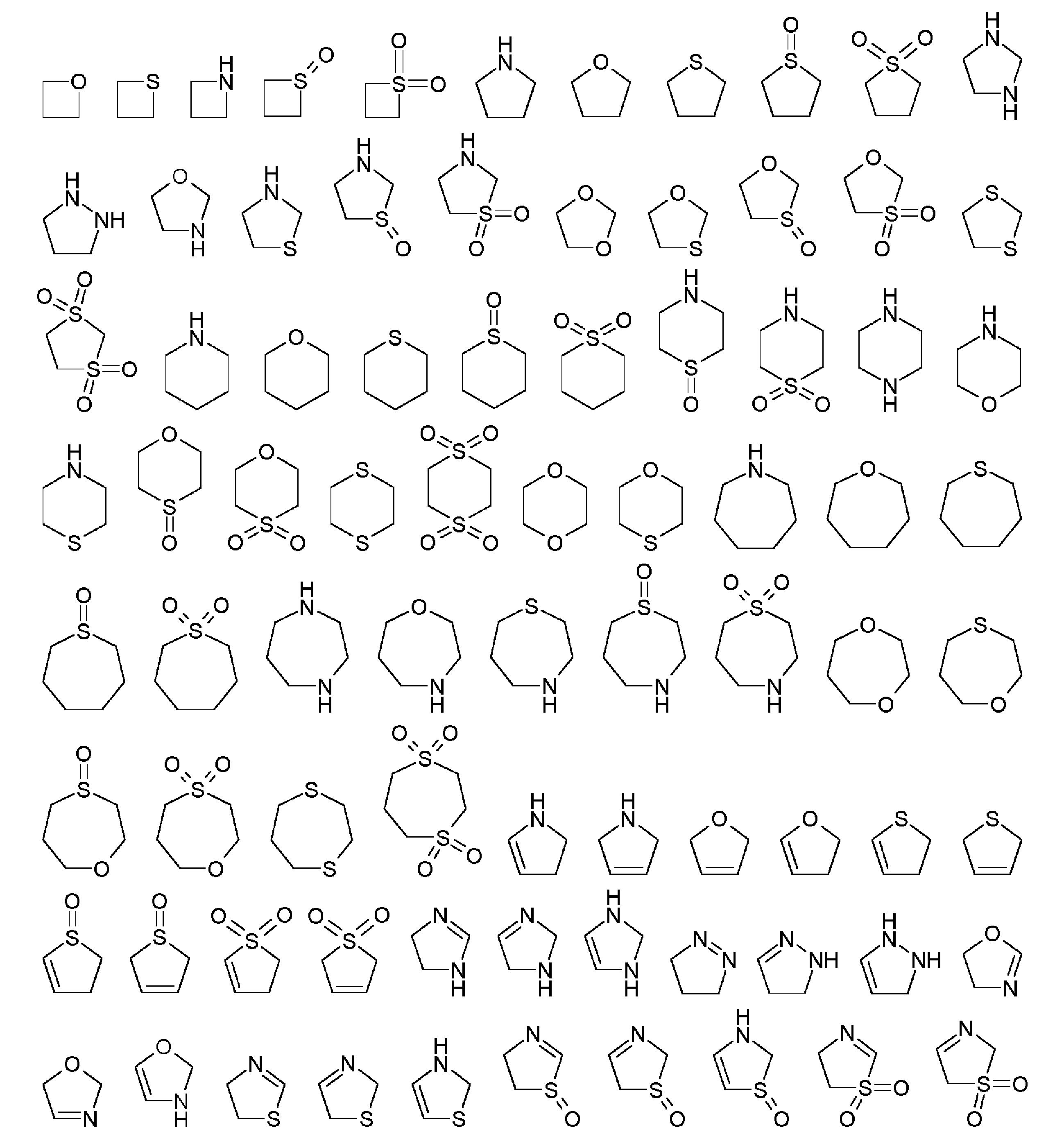


ヘテロシクロアルキレンという用語も、先に定義されたヘテロシクロアルキルから得られる。ヘテロシクロアルキレンは、ヘテロシクロアルキルとは異なり、二価であり、2つの結合パートナーを必要とする。形式的には、この二価は、ヘテロシクロアルキレンから水素原子を除去することにより得られる。対応する基は、例えば、ピペリジニル及び

である。
The term heterocycloalkylene is also derived from the heterocycloalkyl defined above. Heterocycloalkylene, unlike heterocycloalkyl, is bivalent and requires two binding partners. Formally, this bivalency is obtained by removing a hydrogen atom from heterocycloalkylene. Corresponding groups include, for example, piperidinyl and
It is.
ヘテロアリールという用語は、少なくとも1つの芳香環を含み、N、O、S、SO又はSO2から選択される1つ以上のヘテロ原子を含有し、5~14個の環原子からなる単環式又は多環式環系を意味する。ここで、ヘテロ原子のうちの少なくとも1つは、芳香環の一部である。「ヘテロアリール」という用語は、可能のある全ての異性体を含むことを意図している。 The term heteroaryl refers to a monocyclic or polycyclic ring system of 5 to 14 ring atoms containing at least one aromatic ring and containing one or more heteroatoms selected from N, O, S, SO or SO2 , where at least one of the heteroatoms is part of an aromatic ring. The term "heteroaryl" is intended to include all possible isomers.
このため、「ヘテロアリール」という用語は、下記例示的な構造を含む(適切な原子価が維持される限り、各形態は、場合により、任意の原子に共有結合を介して結合しているため、基としては示されていない)。 The term "heteroaryl" thus includes the following exemplary structures (not shown as groups because each form is optionally attached via a covalent bond to any atom as long as appropriate valences are maintained):

特に、ヘテロアリーレンは、ピロール、フラン、チオフェン、イミダゾール、ピラゾール、オキサゾール、イソオキサゾール、チアゾール、イソチアゾール、オキサジアゾール、チアジアゾール及びトリアゾールを指し、これらは全て、可能性のある全ての異性体を含み、環系のあらゆる適切な位置を介して、置換基として分子に結合している場合がある。 In particular, heteroarylene refers to pyrrole, furan, thiophene, imidazole, pyrazole, oxazole, isoxazole, thiazole, isothiazole, oxadiazole, thiadiazole and triazole, all of which, including all possible isomers, may be attached to the molecule as a substituent via any suitable position of the ring system.
ヘテロアリーレンという用語も、先に定義されたヘテロアリールから得られる。ヘテロアリーレンは、ヘテロアリールとは異なり、二価であり、2つの結合パートナーを必要とする。形式的には、この二価は、ヘテロアリールから水素原子を除去することにより得られる。対応する基は、例えば、ピロール及び

である。
The term heteroarylene is also derived from heteroaryl as defined above. Heteroarylene, unlike heteroaryl, is bivalent and requires two binding partners. Formally, this bivalency is obtained by removing a hydrogen atom from heteroaryl. Corresponding groups include, for example, pyrrole and
It is.
また、ヘテロアリーレンの上記定義は、ヘテロアリーレンが別の(結合した)基の一部、例えば、HO-ヘテロアリーレンアミノ又はH2N-ヘテロアリーレンオキシである場合にも適用される。 The above definition of heteroarylene also applies when heteroarylene is part of another (linked) group, for example HO-heteroaryleneamino or H 2 N-heteroaryleneoxy.
本明細書で使用する場合、「置換されている」という用語は、指定された原子上の1つ以上の水素が指定された原子の通常の原子価を超えず、置換により安定な化合物が得られることを条件として、定義された置換基群から選択される基により置き換えられていることを意味する。同様に、「置換されている」という用語を例えば、「置換されているアルキル」等、単一の原子に代えて、化学部分に関連して使用することができる。 As used herein, the term "substituted" means that one or more hydrogens on the specified atom are replaced with a group selected from a defined group of substituents, provided that the replacement does not exceed the normal valence of the specified atom and that the replacement results in a stable compound. Similarly, the term "substituted" can be used in conjunction with a chemical moiety in place of a single atom, such as, for example, "substituted alkyl."
特に断らない限り、本明細書及び添付の特許請求の範囲全体をとおして、所定の化学式又は名称は、互変異性体並びに全ての立体異性体、光学異性体及び幾何異性体(例えば、エナンチオマー、ジアステレオマー、E/Z異性体等...)及びそのラセミ体並びにこのような異性体及びエナンチオマーが存在する場合、別個のエナンチオマーの異なる割合での混合物、ジアステレオマーの混合物又は前述の形態のいずれかの混合物並びにその薬学的に許容し得る塩及びその溶媒和物、例えば、遊離化合物の溶媒和物及び水和物を含む水和物又は化合物の塩の溶媒和物及び水和物等を含む塩を包含するものとする。 Unless otherwise indicated, throughout this specification and the appended claims, a given chemical formula or name is intended to include tautomers and all stereoisomers, optical isomers and geometric isomers (e.g., enantiomers, diastereomers, E/Z isomers, etc..) and racemates thereof, as well as mixtures of different proportions of the separate enantiomers, mixtures of diastereomers or mixtures of any of the foregoing forms, as well as pharmaceutically acceptable salts thereof and solvates thereof, such as solvates and hydrates, including solvates and hydrates, of the free compounds or solvates and hydrates, of the salts of the compounds, etc.
特に断らない限り、以下でより詳細に定義される「薬学的に許容し得る塩」は、その溶媒和物、例えば、水和物等も包含するものとする。 Unless otherwise specified, "pharmaceutically acceptable salts", as defined in more detail below, also include solvates thereof, such as hydrates.
一般的には、実質的に純粋な立体異性体を当業者に公知の合成原理に従って、例えば、対応する混合物の分離により、立体化学的に純粋な出発物質を使用することにより及び/又は立体選択的合成により得ることができる。光学活性体を調製する方法は、当技術分野において公知であり、例えば、ラセミ体の分離又は例えば、光学活性な出発物質から出発する合成及び/又はキラル試薬の使用による。 Generally, substantially pure stereoisomers can be obtained according to synthetic principles known to those skilled in the art, for example by separation of the corresponding mixtures, by using stereochemically pure starting materials and/or by stereoselective synthesis. Methods for preparing optically active forms are known in the art, for example by separation of racemates or, for example, by synthesis starting from optically active starting materials and/or by using chiral reagents.
本発明のエナンチオマー的に純粋な化合物又は中間体を例えば、公知の方法により(例えば、クロマトグラフィー分離又は結晶化により)分離することができる適切なジアステレオマー化合物又は中間体の調製及び後続の分離による及び/又はキラル試薬、例えば、キラル出発物質、キラル触媒又はキラル補助剤を使用することによる、不斉合成により調製することができる。 The enantiomerically pure compounds or intermediates of the invention can be prepared, for example, by asymmetric synthesis, by preparation and subsequent separation of suitable diastereomeric compounds or intermediates, which can be separated by known methods (e.g., by chromatographic separation or crystallization) and/or by using chiral reagents, e.g., chiral starting materials, chiral catalysts or chiral auxiliaries.
さらに、対応するラセミ混合物からエナンチオマー的に純粋な化合物を調製する方法は、当業者に公知であり、例えば、キラル固定相上での対応するラセミ混合物のクロマトグラフィー分離(また、これは、立体異性体の他の混合物、例えば、ジアステレオマー、アトロピソマーの混合物等にも適用される)又は適切な分割剤を使用するラセミ混合物の分割、例えば、ラセミ化合物を光学活性な酸もしくは塩基でジアステレオマー塩を形成し、続けて、この塩を分割し、この塩から所望の化合物を放出する手段又は対応するラセミ化合物を光学活性なキラル補助試薬で誘導体化し、続けて、ジアステレオマーを分離し、キラル補助基を除去すること又はラセミ体の動的分割(例えば、酵素的分割による)、適切な条件下での鏡像結晶の集合体からのエナンチオ選択的結晶化又は光学活性キラル補助剤の存在下で適切な溶媒からの(部分)結晶化による。 Furthermore, methods for preparing enantiomerically pure compounds from the corresponding racemic mixtures are known to the skilled artisan, for example by chromatographic separation of the corresponding racemic mixtures on chiral stationary phases (this also applies to other mixtures of stereoisomers, e.g. mixtures of diastereomers, atropisomers, etc.) or by resolution of the racemic mixtures using suitable resolving agents, for example by forming diastereomeric salts of the racemates with optically active acids or bases, followed by resolution of these salts and release of the desired compounds from these salts, or by derivatization of the corresponding racemates with optically active chiral auxiliary reagents, followed by separation of the diastereomers and removal of the chiral auxiliary, or by dynamic resolution of the racemates (for example by enzymatic resolution), enantioselective crystallization from a conglomerate of mirror image crystals under suitable conditions or (partial) crystallization from a suitable solvent in the presence of an optically active chiral auxiliary.
本明細書において、「薬学的に許容し得る」という語句は、健全な医学的判断の範囲内において、過剰な毒性、刺激、アレルギー反応又は他の問題もしくは合併症なしに、ヒト及び動物の組織と接触させて使用するのに適しており、妥当な利益/リスク比に見合った化合物、材料、組成物及び/又は剤形を指すのに利用される。 As used herein, the phrase "pharmacologically acceptable" is used to refer to compounds, materials, compositions and/or dosage forms that are, within the scope of sound medical judgment, suitable for use in contact with the tissues of human beings and animals without excessive toxicity, irritation, allergic response, or other problem or complication, and are commensurate with a reasonable benefit/risk ratio.
本明細書で使用する場合、「薬学的に許容し得る塩」は、親化合物がその酸塩又は塩基塩を形成することにより修飾されている、開示された化合物の誘導体を指す。薬学的に許容し得る塩の例は、塩基性残基、例えば、アミンの鉱酸塩又は有機酸塩、酸性残基、例えば、カルボン酸のアルカリ塩又は有機塩等を含むが、これらに限定されない。 As used herein, "pharmaceutically acceptable salts" refers to derivatives of the disclosed compounds, where the parent compound is modified by forming an acid or base salt thereof. Examples of pharmaceutically acceptable salts include, but are not limited to, basic residues, such as mineral or organic acid salts of amines, alkali or organic salts of acidic residues, such as carboxylic acids, etc.
例えば、このような塩は、ベンゼンスルホン酸、安息香酸、クエン酸、エタンスルホン酸、フマル酸、ゲンチジン酸、臭化水素酸、塩酸、マレイン酸、リンゴ酸、マロン酸、マンデル酸、メタンスルホン酸、4-メチル-ベンゼンスルホン酸、リン酸、サリチル酸、コハク酸、硫酸及び酒石酸からの塩を含む。 For example, such salts include salts from benzenesulfonic acid, benzoic acid, citric acid, ethanesulfonic acid, fumaric acid, gentisic acid, hydrobromic acid, hydrochloric acid, maleic acid, malic acid, malonic acid, mandelic acid, methanesulfonic acid, 4-methyl-benzenesulfonic acid, phosphoric acid, salicylic acid, succinic acid, sulfuric acid and tartaric acid.
更なる薬学的に許容し得る塩をアンモニア、L-アルギニン、カルシウム、2,2’-イミノビスエタノール、L-リシン、マグネシウム、N-メチル-D-グルカミン、カリウム、ナトリウム及びトリス(ヒドロキシメチル)-アミノメタンからのカチオンにより形成することができる。 Further pharma- ceutically acceptable salts can be formed with cations from ammonia, L-arginine, calcium, 2,2'-iminobisethanol, L-lysine, magnesium, N-methyl-D-glucamine, potassium, sodium and tris(hydroxymethyl)-aminomethane.
本発明の薬学的に許容し得る塩を塩基性又は酸性部分を含有する親化合物から、従来の化学的方法により合成することができる。一般的には、このような塩を、これらの化合物の遊離の酸又は塩基の形態を水中又は有機希釈剤、例えば、エーテル、酢酸エチル、エタノール、イソプロパノールもしくはアセトニトリル中又はこれらの混合物中で、十分な量の適切な塩基又は酸と反応させることにより調製することができる。 The pharma- ceutically acceptable salts of the present invention can be synthesized from a parent compound that contains a basic or acidic moiety by conventional chemical methods. Generally, such salts can be prepared by reacting the free acid or base form of these compounds with a sufficient amount of the appropriate base or acid in water or an organic diluent, such as ether, ethyl acetate, ethanol, isopropanol, or acetonitrile, or in a mixture thereof.
例えば、本発明の化合物の精製し又は単離するのに有用な上記言及されたもの以外の酸の塩(例えば、トリフルオロ酢酸塩)も本発明の一部を構成する。 For example, salts of acids other than those mentioned above that are useful for purifying or isolating the compounds of the invention (e.g., trifluoroacetates) also form part of the invention.
例えば、

等の表現では、文字Aは、例えば、当該環と他の環との結合をより容易に示すために、環指定の機能を有する。
for example,
In such expressions, the letter A functions as a ring designator, for example, to more easily show the attachment of that ring to another ring.
どの隣接基とどの価数で結合するかを決定するのに有用である場合がある二価の基について、明確化のために必要な場合には、下記表現:

又は(R2)-C(=O)NH-又は(R2)-NHC(=O)-のように、対応する結合パートナーを破線の端部又は括弧内に示すことができる。
For divalent groups which may be useful in determining which adjacent groups are attached and at what valency, the following representation may be used, where necessary for clarification:
or (R 2 )-C(═O)NH- or (R 2 )-NHC(═O)-, with the corresponding binding partner shown at the end of the dashed line or within brackets.
このような明確化がない場合には、二価の基を両方向に結合させることができる。例えば、-C(=O)NH-は、-NHC(=O)-も含む(逆もまた同様)。 In the absence of such clarification, divalent groups can be attached in both directions. For example, -C(=O)NH- also includes -NHC(=O)- (and vice versa).
基又は置換基は、多くの場合、対応する基指定(例えば、Ra、Rb等)を有する多数の代替基/置換基の中から選択される。このような基が、分子の異なる部分で、本発明の化合物を規定するのに繰り返し使用される場合、種々の使用は、互いに全く独立しているとみなされることが指摘される。 Groups or substituents are often selected from among a number of alternative groups/substituents having corresponding group designations (e.g., R a , R b, etc.) It is pointed out that when such a group is used repeatedly in defining a compound of the invention in different parts of the molecule, the various uses are considered to be entirely independent of each other.
本発明の目的で、治療上有効量は、病気の症状を回避し又はこれらの症状を予防しもしくは緩和し又は処置された患者の生存期間を延長することが可能な物質の量を意味する。 For purposes of this invention, a therapeutically effective amount means an amount of a substance capable of avoiding symptoms of a disease or preventing or alleviating these symptoms or prolonging the survival of a treated patient.
実施例
本発明の他の特徴及び利点は、本発明の原理を例として例証する下記のより詳細な実施例から明らかになるであろう。
EXAMPLES Other features and advantages of the present invention will become apparent from the following more detailed examples which illustrate, by way of example, the principles of the invention.


化学物質の例
特に断らない限り、全ての反応を、化学実験室で一般的に使用されている方法を使用して、商業的に入手可能な装置で行う。空気及び/又は湿気に敏感な出発物質を保護ガス下で保存し、それらについての対応する反応及び操作を保護ガス(窒素又はアルゴン)下で行う。
Unless otherwise stated, all reactions are carried out with commercially available equipment using methods commonly used in chemical laboratories. Air- and/or moisture-sensitive starting materials are stored under protective gas and the corresponding reactions and manipulations thereon are carried out under protective gas (nitrogen or argon).
化合物が構造式とその命名法との両方により表わされる場合、矛盾があれば、構造式が優先される。 When a compound is represented by both a structural formula and its nomenclature, in the event of a conflict, the structural formula takes precedence.
クロマトグラフィー
薄層クロマトグラフィーをMerck製の既製のガラス上シリカゲル60TLCプレート(蛍光インジケーターF-254付き)で行う。
Chromatography Thin layer chromatography is performed on Merck pre-made glass-on-glass silica gel 60 TLC plates (with fluorescent indicator F-254).
本発明の実施例化合物の分取高速クロマトグラフィー(RPHPLC)を、Waters製カラム(名称:SunFire(商標)Prep C18、OBD(商標)10μm、50×150mmもしくはSunFire(商標)Prep C18、OBD(商標)5μm、30×50mm又はXBridge(商標)Prep C18、OBD(商標)10μm、50×150mmもしくはXBridge(商標)Prep C18、OBD(商標)5μm、30×150mmもしくはXBridge(商標)Prep C18、OBD(商標)5μm、30×50mm)及びYMC製カラム(名称:Actus-Triart Prep C18、5μm、30×50mm)及びChiralpak IE(5μm、250×20mm)を備えたAgilent又はGilsonシステムで行う。 Preparative high performance chromatography (RPHPLC) of the example compounds of the present invention is performed on an Agilent or Gilson system equipped with a Waters column (name: SunFire™ Prep C18, OBD™ 10 μm, 50×150 mm or SunFire™ Prep C18, OBD™ 5 μm, 30×50 mm or XBridge™ Prep C18, OBD™ 10 μm, 50×150 mm or XBridge™ Prep C18, OBD™ 5 μm, 30×150 mm or XBridge™ Prep C18, OBD™ 5 μm, 30×50 mm) and a YMC column (name: Actus-Triart Prep C18, 5 μm, 30×50 mm) and a Chiralpak IE (5 μm, 250×20 mm).
化合物の溶出には、H2O/アセトニトリルの種々の勾配を使用し、一方、Agilentシステムでは、水に5%酸性調整剤(H2O/アセトニトリル(1/1) 1Lに対してHCOOH 20mL)を加える(酸性条件)。Gilsonシステムでは、0.1% HCOOHを加える。 Compounds were eluted using different gradients of H2O /acetonitrile, whereas for the Agilent system, 5% acidity modifier (20 mL HCOOH per L H2O /acetonitrile (1/1)) was added to the water (acidic conditions), and for the Gilson system, 0.1% HCOOH was added.
Agilentシステムについての塩基性条件下でのクロマトグラフィーには、H2O/アセトニトリル勾配も使用し、一方、5% 塩基性調整剤を加えることにより、水をアルカリ性にする(50g NH4HCO3+NH3(H2O中の25%) 50mLをH2Oと共に、1Lにする)。Gilsonシステムでは、下記のように水をアルカリ性にする:NH4HCO3溶液(H2O 1L中の158g)5mL及びNH3(H2O中の28%) 2mLをH2Oで1Lに補充する。Gilsonシステムを均一濃度条件下(60% EtOH/40% EtOH+0.1% DEA)でも使用した。 For chromatography under basic conditions on the Agilent system, a H2O /acetonitrile gradient was also used, while water was made alkaline by adding 5% basic modifier (50 g NH4HCO3 + 50 mL NH3 (25% in H2O ) to 1 L with H2O ). For the Gilson system, water was made alkaline as follows: 5 mL NH4HCO3 solution (158 g in 1 L H2O ) and 2 mL NH3 (28% in H2O ) made up to 1 L with H2O . The Gilson system was also used under isocratic conditions (60% EtOH/40% EtOH + 0.1% DEA).
本発明の中間体及び実施例化合物の超臨界流体クロマトグラフィー(SFC)を、Agilent 1260SFCシステム、JASCO SFCシステム又はSepiatec SFCシステム又はWaters Thar SFCシステムもしくはWaters UPC2-MSSFCシステムで行う。 Supercritical fluid chromatography (SFC) of the intermediates and example compounds of the present invention is carried out on an Agilent 1260 SFC system, a JASCO SFC system or a Sepiatec SFC system or a Waters Thar SFC system or a Waters UPC 2 -MSSFC system.
下記カラムを使用:Chiralcel OJ(250×20mm、5μm)、Chiralpak AD-H(21×250mm)、5μm、Chiralpak AD(250×20mm、5μm)、Chiralpak AS(250×20mm、5μm)、Chiralpak IC(250×20mm、5μm)、Chiralpak IA(250×20mm、5μm)、Chiralcel OJ(250×20mm、5μm)、Chiralcel OD(250×20mm、5μm)、Chiralcel OX-3(150×4.6mm、3μm)、Phenomenex Lux C2(250×20mm、5μm)。 The following columns were used: Chiralcel OJ (250 x 20 mm, 5 μm), Chiralpak AD-H (21 x 250 mm), 5 μm, Chiralpak AD (250 x 20 mm, 5 μm), Chiralpak AS (250 x 20 mm, 5 μm), Chiralpak IC ( 250×20mm, 5μm), Chiralpak IA (250 x 20 mm, 5 μm), Chiralcel OJ (250 x 20 mm, 5 μm), Chiralcel OD (250 x 20 mm, 5 μm), Chiralcel OX-3 (150 x 4.6 mm, 3 μm), Phenomenex Lux C2 (250 x 20 mm) , 5 μm).
分析用SFC/UV分光法
SFC法:SFC-1
SFC Agilent1260(バイナリーポンプ)SFC
カラム Chiralpak AD-H(250×4,6mm)、5μm
流量 2mL/分
移動相 A:CO2+B:MeOH
ABPR 120Bar
Temp 37.5℃
UV 220nm
勾配 80% A+20% B(均一濃度)
停止時間 10分
Analytical SFC/UV spectroscopy SFC method: SFC-1
SFC Agilent1260 (Binary Pump) SFC
Column Chiralpak AD-H (250×4.6mm), 5μm
Flow rate 2 mL/min Mobile phase A: CO 2 + B: MeOH
ABP R 120 Bar
Temp 37.5℃
UV 220nm
Gradient 80% A + 20% B (uniform concentration)
Downtime 10 minutes
中間体及び最終化合物の分析用HPLC(反応制御)を、Waters製カラム(名称:XBridge(商標)C18、2.5μm、2.1×20mmもしくはXBridge(商標)C18、2.5μm、2.1×30mm又はAquity UPLC BEH C18、1.7μm、2.1×50mm)及びYMC製カラム(名称:Triart C18、3.0μm、2.0×30mm)及びPhenomenex製カラム(名称:Luna C18、5.0μm、2.0×30mm)を使用して行う。分析装置はそれぞれ、質量検出器も装備えている。 Analytical HPLC (reaction control) of intermediates and final compounds is performed using Waters columns (name: XBridge™ C18, 2.5 μm, 2.1 x 20 mm or XBridge™ C18, 2.5 μm, 2.1 x 30 mm or Aquity UPLC BEH C18, 1.7 μm, 2.1 x 50 mm), YMC columns (name: Triart C18, 3.0 μm, 2.0 x 30 mm) and Phenomenex columns (name: Luna C18, 5.0 μm, 2.0 x 30 mm). Each analytical instrument is also equipped with a mass detector.
HPLC-質量分光分析/UV分光法
本発明の実施例化合物を特徴決定するための保持時間/MS-ESI+を、HPLC-MS装置(質量検出器付き高速液体クロマトグラフィー)を使用して生成する。注入ピークで溶出する化合物には、保持時間tRet=0.00を与える。
HPLC-Mass Spectroscopy/UV Spectroscopy Retention times/MS-ESI + for characterizing the example compounds of the present invention are generated using an HPLC-MS instrument (High Performance Liquid Chromatography with Mass Detector). Compounds eluting with the injected peak are assigned a retention time tRet = 0.00.
方法A
HPLC Agilent1100システム
MS 1200シリーズLC/MSD(API-ES +/-3000V、四重極、G6140)
MSD信号設定 スキャン ポジティブ/ネガティブ 120~1500m/z
検出信号 315nm(バンド幅170nm、リファレンスオフ)
スペクトル範囲 230~400nm
ピーク幅 <0.01分
カラム Waters、XBridge C18、2.5μm、2.1×20mmカラム
カラム温度 60℃
溶媒 A:20mM NH4HCO3/NH3水溶液 pH9
B:ACN HPLCグレード
流量 1.00mL/分
勾配 0.00~1.50分 10%から95% B
1.50~2.00分 95% B
2.00~2.10分 95%から10% B
Method A
HPLC Agilent 1100 System MS 1200 Series LC/MSD (API-ES +/- 3000V, quadrupole, G6140)
MSD signal settings Scan Positive/Negative 120-1500 m/z
Detection signal: 315 nm (bandwidth 170 nm, reference off)
Spectral range: 230-400 nm
Peak width <0.01 min Column Waters, XBridge C18, 2.5 μm, 2.1 x 20 mm Column temperature 60 °C
Solvent A: 20mM NH 4 HCO 3 /NH 3 aqueous solution pH 9
B: ACN HPLC grade Flow rate 1.00 mL/min Gradient 0.00-1.50 min 10% to 95% B
1.50-2.00 minutes 95% B
2.00-2.10 minutes 95% to 10% B
方法B
HPLC Agilent1260シリーズ
MS Agilent LC/MSD四重極
検出 MS:ポジティブ及びネガティブモード
質量範囲 100~1200m/z
カラム Waters X-Bridge BEH C18、2.5μm、2.1×30mm XP
カラム温度 45℃
溶媒 A:H2O中の20mM NH4HCO3/30mM NH3;B:ACN(HPLCグレード)
流量 1.40mL/分
勾配 0.00~1.00分:15% Bから95% B
1.00~1.30分:95% B
Method B
HPLC Agilent 1260 Series MS Agilent LC/MSD Quadrupole Detection MS: Positive and negative mode Mass range 100-1200 m/z
Column: Waters X-Bridge BEH C18, 2.5 μm, 2.1 x 30 mm XP
Column temperature: 45°C
Solvents A: 20 mM NH4HCO3 /30 mM NH3 in H2O ; B : ACN (HPLC grade)
Flow rate: 1.40 mL/min Gradient: 0.00-1.00 min: 15% B to 95% B
1.00-1.30 minutes: 95% B
方法C
HPLC Agilent1100/1200システム
MS 1200シリーズLC/MSD(MM-ES+APCI +/-3000V、四重極、G6130B)
MSD信号設定 スキャン ポジティブ/ネガティブ 150~750
検出信号 UV254nm、230nm、214nm(バンド幅8、リファレンスオフ)
スペクトル 範囲:190~400nm;スリット:4nm
ピーク幅 >0.0031分(応答時間0.063秒、80Hz)
カラム Waters、品番186003389、XBridge BEH C18、2.5μm、2.1×30mm)カラム
カラム温度 45℃
溶媒 A:H2O中の5mM NH4HCO3/18mM NH3(pH=9.2)
B:ACN(HPLCグレード)
流量 1.4mL/分
勾配 0.0~1.0分 15%から95% B
1.0~1.1分 95% B
停止時間:1.3分
Method C
HPLC Agilent 1100/1200 System MS 1200 Series LC/MSD (MM-ES+APCI +/-3000V, quadrupole, G6130B)
MSD Signal Settings Scan Positive/Negative 150-750
Detection signal: UV 254 nm, 230 nm, 214 nm (bandwidth 8, reference off)
Spectral range: 190-400 nm; slit: 4 nm
Peak width >0.0031 min (response time 0.063 sec, 80 Hz)
Column: Waters, part number 186003389, XBridge BEH C18, 2.5 μm, 2.1 × 30 mm) Column temperature: 45 °C
Solvent A: 5 mM NH4HCO3 /18 mM NH3 in H2O (pH=9.2)
B: ACN (HPLC grade)
Flow rate: 1.4 mL/min Gradient: 0.0-1.0 min 15% to 95% B
1.0-1.1 minutes 95% B
Downtime: 1.3 minutes
方法D
HPLC Agilent1100/1200システム
MS 1200シリーズLC/MSD(API-ES +/-3000/3500V、四重極、G6140A)
MSD信号設定 スキャン ポジティブ/ネガティブ 150~750
検出信号 UV254nm、230nm、214nm(バンド幅10、リファレンスオフ)
スペクトル 範囲:190~400nm;スリット:4nm
ピーク幅 >0.0031分(応答時間0.063秒、80Hz)
カラム YMC;品番TA12S03-0302WT;Triart C18、3μm、12nm;30×2.0mmカラム
カラム温度 45℃
溶媒 A:H2O+0.11% ギ酸
B:ACN+0.1% ギ酸(HPLCグレード)
流量 1.4mL/分
勾配 0.0~1.0分 15%から95% B
1.0~1.1分 95% B
停止時間 1.23分
Method D
HPLC Agilent 1100/1200 System MS 1200 Series LC/MSD (API-ES +/- 3000/3500V, quadrupole, G6140A)
MSD Signal Settings Scan Positive/Negative 150-750
Detection signal: UV 254 nm, 230 nm, 214 nm (bandwidth 10, reference off)
Spectral range: 190-400 nm; slit: 4 nm
Peak width >0.0031 min (response time 0.063 sec, 80 Hz)
Column: YMC; Part No. TA12S03-0302WT; Triart C18, 3 μm, 12 nm; 30 × 2.0 mm column; Column temperature: 45°C
Solvent A: H2O + 0.11% formic acid
B: ACN + 0.1% formic acid (HPLC grade)
Flow rate: 1.4 mL/min Gradient: 0.0-1.0 min 15% to 95% B
1.0-1.1 minutes 95% B
Downtime 1.23 minutes
方法E
UPLC-MS Waters Acquity-UPLC-SQ検出器-2
MSD信号設定 スキャン ポジティブ/ネガティブ 100~1500
ソース電圧:キャピラリー電圧(kV) -3.50、コーン(V):50
ソースTemp:脱溶媒和Temp(℃):350
ソースガス流量:脱溶媒和(L/Hr):750、コーン(L/Hr):50
検出信号 ダイオードアレイ
スペクトル 範囲:200~400nm;分解能:1.2nm
サンプリングレート 10ポイント/秒
カラム AQUITY UPLC BEH C18 1.7μm、2.1×50mm
カラム温度 35℃
溶媒 A:ACN中の0.07% ギ酸
B:水中の0.07% ギ酸
流量 0.6mL/分
勾配 0.0~0.30分 97% B
0.30~2.20分 97%から2% B
2.20~3.30分 2% B
3.30~4.50分 2%から97%B
4.50~4.51分 97% B
Method E
UPLC-MS Waters Acquity-UPLC-SQ Detector-2
MSD Signal Settings Scan Positive/Negative 100-1500
Source voltage: Capillary voltage (kV) -3.50, cone (V): 50
Source Temp: Desolvation Temp (°C): 350
Source gas flow rate: Desolvation (L/Hr): 750, Cone (L/Hr): 50
Detected signal: Diode array spectrum Range: 200-400 nm; Resolution: 1.2 nm
Sampling rate: 10 points/sec Column: AQUITY UPLC BEH C18 1.7 μm, 2.1 x 50 mm
Column temperature: 35°C
Solvent A: 0.07% formic acid in ACN
B: 0.07% formic acid in water Flow rate 0.6 mL/min Gradient 0.0-0.30 min 97% B
0.30 to 2.20 minutes 97% to 2% B
2.20-3.30 minutes 2% B
3.30-4.50 min 2% to 97%B
4.50-4.51 minutes 97% B
方法F
UPLC-MS Waters Acquity-バイナリソルベントマネージャ-UPLC-SQ検出器-2
MSD信号設定 スキャン ポジティブ/ネガティブ 100~1500
ソース電圧:キャピラリー電圧(kV) -3.50、コーン(V):50
ソースTemp:脱溶媒和Temp(℃):350
ソースガス流量:脱溶媒和(L/Hr):750、コーン(L/Hr):50
検出信号 ダイオードアレイ
スペクトル 範囲:200~400nm;分解能:1.2nm
サンプリングレート 10ポイント/秒
カラム AQUITY UPLC BEH C18 1.7μm、2.1×50mm
カラム温度 35℃
溶媒 A:ACN中の0.07% ギ酸
B:水中の0.07% ギ酸
流量 0.6mL/分
勾配 0.0~0.40分 97% B
0.40~2.50分 97%から2% B
2.50~3.40分 2% B
3.40~3.50分 2%から97%B
3.50~4.0分 97% B
Method F
UPLC-MS Waters Acquity - Binary Solvent Manager - UPLC-SQ Detector - 2
MSD Signal Settings Scan Positive/Negative 100-1500
Source voltage: Capillary voltage (kV) -3.50, cone (V): 50
Source Temp: Desolvation Temp (°C): 350
Source gas flow rate: Desolvation (L/Hr): 750, Cone (L/Hr): 50
Detected signal: Diode array spectrum Range: 200-400 nm; Resolution: 1.2 nm
Sampling rate: 10 points/sec Column: AQUITY UPLC BEH C18 1.7 μm, 2.1 x 50 mm
Column temperature: 35°C
Solvent A: 0.07% formic acid in ACN
B: 0.07% formic acid in water Flow rate 0.6 mL/min Gradient 0.0-0.40 min 97% B
0.40 to 2.50 minutes 97% to 2% B
2.50-3.40 minutes 2% B
3.40-3.50 min 2% to 97%B
3.50-4.0 minutes 97% B
方法G
UPLC-MS フォトダイオードアレイ検出器付きShimadzuシリーズLC-MS2020システム
MSD信号設定 APCI及びESI ポジティブ/ネガティブ 100~1000m/z
検出信号 フォトダイオードアレイ
スペクトル 範囲200~400nm、検出波長254nm
サンプリングレート 40Hz
カラム Hypersil Goldカラム 粒径1.9μm、2.1×50mm
カラム温度 40℃
溶媒 A:H2O中の0.1% FA;B:MeCN中の0.1% FA
B:水中の0.07% ギ酸
流量 0.8mL/分
勾配 0.0~3.0分:5%から95% B
Method G
UPLC-MS Shimadzu series LC-MS 2020 system with photodiode array detector MSD signal settings APCI and ESI positive/negative 100-1000 m/z
Detection signal: Photodiode array spectrum range: 200-400 nm, detection wavelength: 254 nm
Sampling rate: 40Hz
Column: Hypersil Gold column, particle size 1.9 μm, 2.1 x 50 mm
Column temperature: 40°C
Solvents A: 0.1% FA in H2O ; B: 0.1% FA in MeCN
B: 0.07% formic acid in water Flow rate 0.8 mL/min Gradient 0.0-3.0 min: 5% to 95% B
方法H
HPLC Agilent1100/1200システム
MS 1200シリーズLC/MSD(MM-ES+APCI +/-3000V、四重極、G6130B)
MSD信号設定 スキャン ポジティブ 700~1350
カラム Waters、品番186003389、XBridge BEH C18、2.5μm、2.1×30mmカラム
溶出液 A:5mM NH4HCO3/18mM NH3(pH=9.2)
B:アセトニトリル(HPLCグレード)
検出信号 UV254nm、230nm、214nm(バンド幅8、リファレンスオフ)
スペクトル 範囲:190~400nm;スリット:4nm
ピーク幅 >0.0031分(応答時間0.063秒、80Hz)
注入 0,5μL標準注入
流量 1.4mL/分
カラム温度 45℃
勾配 0.0~1.0分 15%→95% B
1.0~1.1分 95% B
停止時間 1.3分
Method H
HPLC Agilent 1100/1200 System MS 1200 Series LC/MSD (MM-ES+APCI +/-3000V, quadrupole, G6130B)
MSD Signal Settings Scan Positive 700-1350
Column: Waters, part number 186003389, XBridge BEH C18, 2.5 μm, 2.1 x 30 mm Column eluent A: 5 mM NH4HCO3 / 18 mM NH3 (pH = 9.2)
B: Acetonitrile (HPLC grade)
Detection signal: UV 254 nm, 230 nm, 214 nm (bandwidth 8, reference off)
Spectral range: 190-400 nm; slit: 4 nm
Peak width >0.0031 min (response time 0.063 sec, 80 Hz)
Injection: 0.5 μL Standard injection flow rate: 1.4 mL/min Column temperature: 45°C
Gradient 0.0-1.0 min 15%→95% B
1.0-1.1 minutes 95% B
Downtime 1.3 minutes
HPLC/UV分光法
方法I
HPLC Agilent1100/1200システム
カラム Chiralpak;品番No.85394;IE、5μm;150×2.1mm
溶出液 A:n-ヘプタン
B:EtOH+0.1% DEA
検出信号 UV315nm(バンド幅170、リファレンスオフ)
スペクトル 範囲:190~400nm;スリット:4nm
ピーク幅 >0.0031分(応答時間0.063秒、80Hz)
注入 0,5μL標準注入
流量 1.2mL/分
カラム温度 45℃
均一濃度 70% B
停止時間 5分
HPLC/UV spectroscopy method I
HPLC Agilent 1100/1200 system column Chiralpak; Part No. 85394; IE, 5 μm; 150 × 2.1 mm
Eluent A: n-heptane
B: EtOH+0.1% DEA
Detection signal: UV 315 nm (bandwidth 170, reference off)
Spectral range: 190-400 nm; slit: 4 nm
Peak width >0.0031 min (response time 0.063 sec, 80 Hz)
Injection: 0.5 μL Standard injection flow rate: 1.2 mL/min Column temperature: 45°C
Uniform concentration 70% B
Downtime 5 minutes
方法J
HPLC Agilent1100/1200システム
MS 1200シリーズLC/MSD(API-ES +/-3000/3500V、四重極、G6140A)
MSD信号設定 スキャン ポジティブ/ネガティブ 700~1350
検出信号 UV254nm、230nm、214nm(バンド幅10、リファレンスオフ)
スペクトル 範囲:190~400nm;スリット:4nm
ピーク幅 >0.0031分(応答時間0.063秒、80Hz)
カラム YMC;品番TA12S03-0302WT;Triart C18、3μm、12nm;30×2.0mmカラム
カラム温度 45℃
溶媒 A:H2O+0.11% ギ酸
B:ACN+0.1% ギ酸(HPLCグレード)
流量 1.4mL/分
勾配 0.0~1.0分 15%から95% B
1.0~1.1分 95% B
停止時間 1.23分
Method J
HPLC Agilent 1100/1200 System MS 1200 Series LC/MSD (API-ES +/- 3000/3500V, quadrupole, G6140A)
MSD Signal Settings Scan Positive/Negative 700-1350
Detection signal: UV 254 nm, 230 nm, 214 nm (bandwidth 10, reference off)
Spectral range: 190-400 nm; slit: 4 nm
Peak width >0.0031 min (response time 0.063 sec, 80 Hz)
Column: YMC; Part No. TA12S03-0302WT; Triart C18, 3 μm, 12 nm; 30 × 2.0 mm column; Column temperature: 45°C
Solvent A: H2O + 0.11% formic acid
B: ACN + 0.1% formic acid (HPLC grade)
Flow rate: 1.4 mL/min Gradient: 0.0-1.0 min 15% to 95% B
1.0-1.1 minutes 95% B
Downtime 1.23 minutes
方法K
UPLC-MS Waters Acquity-バイナリソルベントマネージャ-UPLC-SQ検出器-2
MSD信号設定 スキャン ポジティブ/ネガティブ 100~1500
ソース電圧:キャピラリー電圧(kV) -3.50、コーン(V):50
ソースTemp:脱溶媒和Temp(℃):350
ソースガス流量:脱溶媒和(L/Hr):700、コーン(L/Hr):50
検出信号 ダイオードアレイ
スペクトル範囲 200~400nm;分解能:1.2nm
サンプリングレート 10ポイント/秒
カラム AQUITY UPLC BEH C18 1.7μm、2.1×50mm
カラム温度 35℃
溶媒 A:ACN中の0.07% ギ酸
B:水中の0.07% ギ酸
流量 0.6mL/分
勾配 0.0~0.40分 97% B
0.40~2.50分 97%から2% B
2.50~3.40分 2% B
3.40~3.50分 2%から97%B
3.50~4.0分 97% B
Method K
UPLC-MS Waters Acquity - Binary Solvent Manager - UPLC-SQ Detector - 2
MSD Signal Settings Scan Positive/Negative 100-1500
Source voltage: Capillary voltage (kV) -3.50, cone (V): 50
Source Temp: Desolvation Temp (°C): 350
Source gas flow rate: Desolvation (L/Hr): 700, Cone (L/Hr): 50
Detection signal: Diode array Spectral range: 200-400 nm; Resolution: 1.2 nm
Sampling rate: 10 points/sec Column: AQUITY UPLC BEH C18 1.7 μm, 2.1 x 50 mm
Column temperature: 35°C
Solvent A: 0.07% formic acid in ACN
B: 0.07% formic acid in water Flow rate 0.6 mL/min Gradient 0.0-0.40 min 97% B
0.40 to 2.50 minutes 97% to 2% B
2.50-3.40 minutes 2% B
3.40-3.50 min 2% to 97%B
3.50-4.0 minutes 97% B
方法L
UPLC-MS Waters ZQ/3100/SQD2質量分析計を連結させたWaters Aquity H ClassLCシステム
MSD信号設定 スキャン ポジティブ/ネガティブ 100~1500
検出信号 ダイオードアレイ
スペクトル 範囲:190~400nm;分解能:1.2nm
カラム YMC triart C18カラム(3μm、33×2.1mm)
カラム温度 30℃
溶媒 A:水中の5mM 酢酸アンモニウム/水中の0.05% ギ酸
B:アセトニトリル:水(90:10)中の5mM 酢酸アンモニウム/水中の0.05% ギ酸
流量 1mL/分
勾配 0.0~0.75分 2% B
0.75~1.00分 2%から10% B
1.00~2.00分 10%から98% B
2.00~2.50分 98%B
2.50~2.90分 98%から2% B
2.90~3.00分 2% B
Method L
UPLC-MS Waters Aquity H Class LC system coupled with Waters ZQ/3100/SQD2 mass spectrometer. MSD signal settings: Scan Positive/Negative 100-1500
Detector signal: Diode array spectrum range: 190-400 nm; resolution: 1.2 nm
Column: YMC triart C18 column (3 μm, 33 × 2.1 mm)
Column temperature: 30°C
Solvent A: 5 mM ammonium acetate in water/0.05% formic acid in water
B: 5 mM ammonium acetate in acetonitrile:water (90:10)/0.05% formic acid in water Flow rate 1 mL/min Gradient 0.0-0.75 min 2% B
0.75 to 1.00 minutes 2% to 10% B
1.00-2.00 min 10% to 98% B
2.00-2.50 minutes 98%B
2.50-2.90 minutes 98% to 2% B
2.90-3.00 minutes 2% B
方法M
HPLC-MS ダイオードアレイ検出器付きAgilent1200 HPLC;MS:Agilent 6130ESI質量分光計
MSD信号設定 ESI ポジティブ、100~1000m/z
カラム Waters XBridge C18カラム、2.1×50mm、粒径3.5μm
溶媒 A:水中の0.1% ギ酸、B:ACN中の0.1% ギ酸
検出信号 254nm、リファレンスオフ
スペクトル範囲 190~400nm
ピーク幅 <0.01分
注入 4.0μL標準注入
カラム温度 35℃
流量 0.7mL/分
勾配 5から95% B、3分法
Method M
HPLC-MS Agilent 1200 HPLC with diode array detector; MS: Agilent 6130ESI mass spectrometer MSD signal settings ESI positive, 100-1000 m/z
Column: Waters XBridge C18 column, 2.1 x 50 mm, particle size 3.5 μm
Solvents A: 0.1% formic acid in water, B: 0.1% formic acid in ACN. Detection signal 254 nm, reference off spectral range 190-400 nm.
Peak width <0.01 min Injection 4.0 μL standard injection Column temperature 35°C
Flow rate: 0.7 mL/min Gradient: 5 to 95% B, 3-way split
方法N
HPLC-MS Agilent 1100シリーズ;Bruker Microtof
MSD信号設定 ESI ポジティブ 100~1200m/z
カラム Waters XBridge C18カラム、2.1×50mm、粒径3.5μm
溶媒 A:水中の0.1% ギ酸、B:ACN中の0.1% ギ酸
検出信号 254nm、リファレンスオフ
スペクトル範囲 190~400nm
ピーク幅 <0.01分
注入 3.0μL標準注入
カラム温度 35℃
流量 0.6mL/分
勾配 5から95% B、8分法
Method N
HPLC-MS Agilent 1100 Series; Bruker Microtof
MSD signal setting ESI positive 100-1200 m/z
Column: Waters XBridge C18 column, 2.1 x 50 mm, particle size 3.5 μm
Solvents A: 0.1% formic acid in water, B: 0.1% formic acid in ACN. Detection signal 254 nm, reference off spectral range 190-400 nm.
Peak width <0.01 min Injection 3.0 μL standard injection Column temperature 35°C
Flow rate: 0.6 mL/min Gradient: 5 to 95% B, 8 min.
本発明の化合物及びその中間体を当業者に公知であり、有機合成の文献に記載されている合成方法を使用して得ることができる。好ましくは、該化合物は、以下により完全に説明される調製方法と類似の様式で得られる。同方法において、一般式の置換基は、上記与えられた意味を有する。これらの方法は、本発明の主題及び特許請求される化合物の範囲をこれらの実施例に限定することなく、本発明の例証であると意図される。一部の場合には、反応工程を行う順序を変えることができる。当業者には公知であるが、ここに詳細に記載されていない反応方法の変形例も使用することができる。 The compounds of the invention and intermediates thereto can be obtained using synthetic methods known to those skilled in the art and described in the organic synthesis literature. Preferably, the compounds are obtained in a manner similar to the preparation methods described more fully below, in which the substituents of the general formulae have the meanings given above. These methods are intended to be illustrative of the invention, without limiting the scope of the subject matter and the claimed compounds to these examples. In some cases, the order in which the reaction steps are carried out can be varied. Variations of the reaction methods known to those skilled in the art but not described in detail here can also be used.
出発化合物の調製が記載されていない場合、それらは、商業的に入手可能であるか又はそれらの合成が、先行技術に記載されているか又はそれらを本明細書に記載された公知の先行技術の化合物もしくは方法と同様に調製することができる、すなわち、これらの化合物を合成することは、有機化学者の技能の範囲内にある。文献に記載されている物質を公表されている合成方法に従って調製することができる。出発物質又は中間体中の任意の官能基を、従来の保護基を使用して保護することができる。これらの保護基を、当業者に馴染みのある方法を使用して、反応順序内の適切な段階で再度開裂させることができる。以下の化学構造が、例えば、不斉置換炭素原子の立体中心の正確な配置なしに示される場合には、両方の配置がこのような表現に含まれ、開示されているとみなされるものとする。ラセミ体における立体中心の表現は、常に、両方のエナンチオマー(他に定義された立体中心が存在しない場合)又は可能性のある他の全てのジアステレオマー及びエナンチオマー(定義された又は定義されていない立体中心が追加で存在する場合)を含み、開示しているものとみなすものとする。 Where the preparation of the starting compounds is not described, they are commercially available or their synthesis is described in the prior art or they can be prepared analogously to known prior art compounds or methods described herein, i.e., it is within the skill of an organic chemist to synthesize these compounds. Substances described in the literature can be prepared according to published synthetic methods. Any functional groups in the starting materials or intermediates can be protected using conventional protecting groups. These protecting groups can be cleaved again at an appropriate stage in the reaction sequence using methods familiar to the skilled artisan. If the following chemical structures are shown, for example, without the exact configuration of the stereocenters of asymmetrically substituted carbon atoms, both configurations shall be considered as included and disclosed in such representations. The representation of a stereocenter in a racemate shall always be considered as including and disclosing both enantiomers (if no other defined stereocenter exists) or all other possible diastereomers and enantiomers (if additional defined or undefined stereocenters exist).
スキーム1

スキーム2

Scheme 2
K-1aの合成実験手順

トルエン(1.03L)中のエチル 1-メチル-2-オキソシクロヘキサン-1-カルボキシラート(108.00g、586.2mmol)の溶液に、マロノニトリル(58.04g、879.3mmol、1.5eq.)を加え、続けて、酢酸アンモニウム(9.04g、117.2mmol、0.2eq.)及び酢酸(13.41mL、234.5mmol、0.4eq.)をrtで加える。この混合物を110℃で16時間撹拌する。変換完了後、この混合物をEtOAcで希釈し、水及びブラインで洗浄し、硫酸ナトリウムで乾燥させ、減圧下で濃縮して、粗生成物K-1aを与える。この粗製材料をさらに精製することなく、次の工程に使用する(Naumann et al., Pharmazie 51 (1996), 4も参照のこと)。
Experimental procedure for the synthesis of K-1a
To a solution of ethyl 1-methyl-2-oxocyclohexane-1-carboxylate (108.00 g, 586.2 mmol) in toluene (1.03 L) is added malononitrile (58.04 g, 879.3 mmol, 1.5 eq.) followed by ammonium acetate (9.04 g, 117.2 mmol, 0.2 eq.) and acetic acid (13.41 mL, 234.5 mmol, 0.4 eq.) at rt. The mixture is stirred at 110° C. for 16 h. After complete conversion, the mixture is diluted with EtOAc, washed with water and brine, dried over sodium sulfate and concentrated under reduced pressure to give crude product K-1a. This crude material is used in the next step without further purification (see also Naumann et al., Pharmazie 51 (1996), 4).

K-2aの合成実験手順

DMF(3.0L)中のK-1a(250.0g、1.1mol)の溶液に、硫黄(68.9g、2.2mol、2.0eq.)及びL-プロリン(24.8g、0.22mol、0.2eq.)を加え、得られた混合物を80℃で12時間撹拌する。変換完了後、この混合物をEtOAcと水との間で分配し、有機層を回収する。水層をさらにEtOAcで抽出し、合わせた有機層を水及びブラインで洗浄し、硫酸ナトリウムで乾燥させ、減圧下で濃縮して、粗生成物を与える。粗生成物をカラムクロマトグラフィーにより精製し、K-2aを生成する。
Experimental procedure for the synthesis of K-2a
To a solution of K-1a (250.0 g, 1.1 mol) in DMF (3.0 L) is added sulfur (68.9 g, 2.2 mol, 2.0 eq.) and L-proline (24.8 g, 0.22 mol, 0.2 eq.) and the resulting mixture is stirred at 80° C. for 12 h. After complete conversion, the mixture is partitioned between EtOAc and water and the organic layer is collected. The aqueous layer is further extracted with EtOAc and the combined organic layers are washed with water and brine, dried over sodium sulfate and concentrated under reduced pressure to give the crude product. The crude product is purified by column chromatography to afford K-2a.

K-3aの合成実験手順

K-2a(78.0mg、0.3mmol、1.0eq)をEtOH(1.5mL)に溶解させ、水酸化カリウム(水中の4M、0.37mL、1.5mmol、5.0eq)を加える。この混合物を78℃で16時間撹拌する。変換完了後、水及びEtOAcをこの反応混合物に加え、水相のpHを、KHSO4溶液(水中の10%)を使用して、pH4に設定し、生成物を、EtOAcを使用して抽出する。合わせた有機層を乾燥させ、ろ過し、濃縮する。粗生成物を酸性逆相クロマトグラフィー(勾配溶出:水中の20%から90% アセトニトリル)により精製して、K-3aを生成する。
Experimental procedure for the synthesis of K-3a
K-2a (78.0 mg, 0.3 mmol, 1.0 eq) is dissolved in EtOH (1.5 mL) and potassium hydroxide (4 M in water, 0.37 mL, 1.5 mmol, 5.0 eq) is added. The mixture is stirred at 78 °C for 16 h. After complete conversion, water and EtOAc are added to the reaction mixture, the pH of the aqueous phase is set to pH 4 using KHSO 4 solution (10% in water) and the product is extracted using EtOAc. The combined organic layers are dried, filtered and concentrated. The crude product is purified by acidic reverse phase chromatography (gradient elution: 20% to 90% acetonitrile in water) to afford K-3a.
エナンチオマーを分取SFCクロマトグラフィーで分離することができる。例えば、K-3aをK-3b及びそのエナンチオマーに分離することができる(分析用SFC法 SFC-1:tret=K-3bについて4.9分、他のエナンチオマーについて7.9分)。 The enantiomers can be separated by preparative SFC chromatography, for example K-3a can be separated into K-3b and its enantiomer (Analytical SFC method SFC-1: t ret =4.9 min for K-3b, 7.9 min for the other enantiomer).

K-4aの合成実験手順

THF(300mL)中のK-3b(22.00g、93.11mmol、1.0eq)の溶液に、CDI(17.12g、102.42mmol、1.1eq)を加え、この混合物を50℃で1時間撹拌する。この混合物をrtまで冷却し、水 5mLに懸濁させた水素化ホウ素ナトリウム(10.78g、279.32mmol、3.0eq)をこの反応混合物にゆっくり加える(発熱反応)。添加後、この混合物を1時間撹拌し、続けて、水(250mL)をゆっくり加えることによりクエンチする。THFを真空下で除去し、得られた混合物をEtOAc(3×120mL)で抽出する。合わせた有機層を水(3×100mL)で洗浄し、有機層をMgSO4で乾燥させる。溶媒を真空下で除去し、粗生成物K-4aをさらに精製することなく、次の工程に使用する。
Experimental procedure for the synthesis of K-4a
To a solution of K-3b (22.00 g, 93.11 mmol, 1.0 eq) in THF (300 mL) is added CDI (17.12 g, 102.42 mmol, 1.1 eq) and the mixture is stirred at 50 °C for 1 h. The mixture is cooled to rt and sodium borohydride (10.78 g, 279.32 mmol, 3.0 eq) suspended in 5 mL water is added slowly to the reaction mixture (exothermic reaction). After addition, the mixture is stirred for 1 h and subsequently quenched by slow addition of water (250 mL). THF is removed under vacuum and the resulting mixture is extracted with EtOAc (3 x 120 mL). The combined organic layers are washed with water (3 x 100 mL) and the organic layer is dried over MgSO 4. The solvent is removed under vacuum and the crude product K-4a is used in the next step without further purification.
下記中間体K-4(表4)は、異なる中間体K-3から開始する類似の方法で入手可能である。粗生成物K-4を必要に応じてクロマトグラフィーにより精製する。 The following intermediate K-4 (Table 4) can be obtained in a similar manner starting from the different intermediate K-3. The crude product K-4 is purified by chromatography if necessary.

K-5aの合成実験手順

K-4a(21.10g、75.93mmol、純度80%、1.0eq)をN,N-ジメチルホルムアミドジメチルアセタール(57.6g、454.37mmol、純度94%、6.0eq)と混合し、この混合物が透明な溶液になるまで、超音波浴中で15分間照射する。水(200mL)を加え、この反応混合物を沈殿物が形成されるまで、rtで30分間撹拌する。沈殿物をろ過し、水(100mL)を加える。この混合物を超音波浴中で15分間照射し、沈殿物をろ過する。この沈殿物をイソプロパノール(25mL)で洗浄し、真空下、45℃で一晩乾燥させて、K-5aを与える。これをさらに精製することなく、次の工程に使用する。
Experimental procedure for the synthesis of K-5a
K-4a (21.10 g, 75.93 mmol, 80% purity, 1.0 eq) is mixed with N,N-dimethylformamide dimethyl acetal (57.6 g, 454.37 mmol, 94% purity, 6.0 eq) and the mixture is irradiated in an ultrasonic bath for 15 min until a clear solution is formed. Water (200 mL) is added and the reaction mixture is stirred at rt for 30 min until a precipitate is formed. The precipitate is filtered and water (100 mL) is added. The mixture is irradiated in an ultrasonic bath for 15 min and the precipitate is filtered. The precipitate is washed with isopropanol (25 mL) and dried under vacuum at 45 °C overnight to give K-5a, which is used in the next step without further purification.
下記中間体K-5(表4*)は、異なる中間体K-4から開始する類似の方法で入手可能である。粗生成物K-5を必要に応じてクロマトグラフィーにより精製する。 The following intermediate K-5 (Table 4 * ) is accessible in an analogous manner starting from the different intermediate K-4. The crude product K-5 is purified by chromatography if necessary.

K-6aの合成実験手順

DCM(120mL)中の塩化オキサリル(12.2mL、144.20mmol、2.5eq.)の溶液を-78℃に冷却する。DCM(60mL)中の無水DMSO(18.44mL、259.57mmol、4.5eq.)の溶液をこの反応混合物に滴加する(発熱反応)。この混合物を-78℃で30分間撹拌する。K-5a(16.00g、57.68mmol、1.0eq.)をこの反応混合物にゆっくり加える。この混合物を-78℃で30分間撹拌し、トリメチルアミン(71.96mL、519.32mmol、9.0eq.)を滴加する。この反応混合物をゆっくりrtまで温め、さらに2時間撹拌する。水及びDCMをこの混合物に加え、相を分離する。水層をDCMで2回抽出し、合わせた有機層を水で3回洗浄する。有機層をMgSO4で乾燥させ、溶媒を真空下で除去して、粗中間体K-6aを与える。これをさらに精製することなく、次の工程に使用する。
Experimental procedure for the synthesis of K-6a
A solution of oxalyl chloride (12.2 mL, 144.20 mmol, 2.5 eq.) in DCM (120 mL) is cooled to −78° C. A solution of anhydrous DMSO (18.44 mL, 259.57 mmol, 4.5 eq.) in DCM (60 mL) is added dropwise to the reaction mixture (exothermic reaction). The mixture is stirred at −78° C. for 30 min. K-5a (16.00 g, 57.68 mmol, 1.0 eq.) is added slowly to the reaction mixture. The mixture is stirred at −78° C. for 30 min and trimethylamine (71.96 mL, 519.32 mmol, 9.0 eq.) is added dropwise. The reaction mixture is allowed to warm slowly to rt and stirred for a further 2 h. Water and DCM are added to the mixture and the phases are separated. The aqueous layer is extracted twice with DCM and the combined organic layers are washed three times with water. The organic layer is dried over MgSO4 and the solvent is removed in vacuo to give crude intermediate K-6a, which is used in the next step without further purification.
下記中間体K-6(表5)は、異なる中間体K-5から開始する類似の方法で入手可能である。粗生成物K-6を必要に応じてクロマトグラフィーにより精製する。 The following intermediate K-6 (Table 5) can be obtained in a similar manner starting from the different intermediate K-5. The crude product K-6 is purified by chromatography if necessary.

K-7aの合成実験手順

K-6a(15.90g、57.75mmol、1.0eq.)、Cs2CO3(22.58g、69.26mmol、1.2eq.)及びMeOH(120mL)の混合物を0℃に冷却し、MeOH(5mL)中のBestmann-Ohira試薬(ジメチル(1-ジアゾ-2-オキソプロピル)ホスホナート;12.20g、63.52mmol、1.1eq.)の溶液をこの反応混合物に滴加する。0℃で3時間後、この反応混合物をゆっくりrtまで温める。完全な変換後、MeOHを真空下で除去し、水(500mL)及びEtOAc(500mL)をこの混合物に加える。相を分離し、水層をEtOAcで2回抽出する。合わせた有機層を水で3回洗浄し、MgSO4で乾燥させ、溶媒を真空下で除去する。残留物をジエチルエーテルと混合し、rtで30分間撹拌する。この混合物を0℃に冷却し、さらに30分間撹拌し、その後、ろ過し、少量の冷ジエチルエーテルで洗浄する。沈殿物を45℃、真空下で乾燥させて、中間体K-7aを与え、これをさらに精製することなく、次の工程に使用する。
Experimental procedure for the synthesis of K-7a
A mixture of K-6a (15.90 g, 57.75 mmol, 1.0 eq.), Cs 2 CO 3 (22.58 g, 69.26 mmol, 1.2 eq.) and MeOH (120 mL) is cooled to 0° C. and a solution of Bestmann-Ohira reagent (dimethyl(1-diazo-2-oxopropyl)phosphonate; 12.20 g, 63.52 mmol, 1.1 eq.) in MeOH (5 mL) is added dropwise to the reaction mixture. After 3 h at 0° C., the reaction mixture is allowed to warm slowly to rt. After complete conversion, MeOH is removed under vacuum and water (500 mL) and EtOAc (500 mL) are added to the mixture. The phases are separated and the aqueous layer is extracted twice with EtOAc. The combined organic layers are washed three times with water, dried over MgSO4 and the solvent is removed under vacuum. The residue is mixed with diethyl ether and stirred at rt for 30 min. The mixture is cooled to 0°C and stirred for another 30 min, then filtered and washed with a small amount of cold diethyl ether. The precipitate is dried at 45°C under vacuum to give intermediate K-7a, which is used in the next step without further purification.
下記中間体K-7(表6)は、異なる中間体K-6から開始する類似の方法で入手可能である。粗生成物K-7を必要に応じてクロマトグラフィーにより精製する。 The following intermediate K-7 (Table 6) can be obtained in a similar manner starting from the different intermediate K-6. The crude product K-7 is purified by chromatography if necessary.

K-20aの合成実験手順

DCM(200mL)中の(2S)-2-{ベンジル[(tert-ブトキシ)カルボニル]アミノ}プロパン酸(24.00g、85.92mmol、1.0eq)の撹拌溶液に、1-エチル-3-(3-ジメチルアミノプロピル)カルボジイミド塩酸塩(24.71g、128.88mmol、1.5eq.)、1-ヒドロキシベンゾトリアゾール(19.74g、128.88mmol、1.5eq.)及びNEt3(47.81mL、343,67mmol、4.0eq.)を加える。この反応混合物をrtで5分間撹拌する。3-アミノ-3-メチル-酪酸エチルエステル塩酸塩(23.41g、128.88mmol、1.5eq.)を加え、この反応混合物をrtで16時間撹拌する。変換完了後、この反応混合物をDCMで希釈し、水で洗浄する。有機層をブラインで洗浄し、Na2SO4で乾燥させ、減圧下で濃縮する。粗生成物をカラムクロマトグラフィーで精製して、K-20aを得る。
Experimental procedure for the synthesis of K-20a
To a stirred solution of (2S)-2-{benzyl[(tert-butoxy)carbonyl]amino}propanoic acid (24.00 g, 85.92 mmol, 1.0 eq.) in DCM (200 mL) is added 1-ethyl-3-(3-dimethylaminopropyl)carbodiimide hydrochloride (24.71 g, 128.88 mmol, 1.5 eq.), 1-hydroxybenzotriazole (19.74 g, 128.88 mmol, 1.5 eq.) and NEt 3 (47.81 mL, 343.67 mmol, 4.0 eq.). The reaction mixture is stirred at rt for 5 min. 3-Amino-3-methyl-butyric acid ethyl ester hydrochloride (23.41 g, 128.88 mmol, 1.5 eq.) is added and the reaction mixture is stirred at rt for 16 h. After complete conversion, the reaction mixture is diluted with DCM and washed with water. The organic layer is washed with brine, dried over Na 2 SO 4 and concentrated under reduced pressure. The crude product is purified by column chromatography to afford K-20a.

K-21aの合成実験手順

THF(40mL)及び水(20mL)中のK-20a(16.00g、39.36mmol、1.0eq.)の撹拌溶液に、水酸化リチウム(2.48g、59.04mmol、1.5eq.)を加え、この反応混合物をrtで16時間撹拌する。変換完了後、この反応混合物を水で希釈し、有機層を分離する。水層をEtOAcで洗浄する。水層をクエン酸で酸性化し、EtOAcで抽出する。合わせた有機層をNa2SO4で乾燥させ、減圧下で濃縮して、粗生成物を得る。粗生成物K-21aをさらに精製することなく、次の工程に使用する。
Experimental procedure for the synthesis of K-21a
To a stirred solution of K-20a (16.00 g, 39.36 mmol, 1.0 eq.) in THF (40 mL) and water (20 mL) is added lithium hydroxide (2.48 g, 59.04 mmol, 1.5 eq.) and the reaction mixture is stirred at rt for 16 h. After complete conversion, the reaction mixture is diluted with water and the organic layer is separated. The aqueous layer is washed with EtOAc. The aqueous layer is acidified with citric acid and extracted with EtOAc. The combined organic layers are dried over Na 2 SO 4 and concentrated under reduced pressure to give the crude product. The crude product K-21a is used in the next step without further purification.

K-22aの合成実験手順

DCM(100mL)中の中間体K-21a(20.00g、52.84mmol、1.0eq.)の撹拌溶液に、HCl(200mL、1,4ジオキサン中の4N)を加え、この反応混合物をrtで4時間撹拌する。変換完了後、揮発性物質を減圧下で除去して、粗生成物を得る。粗生成物をペンタンでトリチュレーションして、中間体K-22aを与える。これを、何ら他の精製をすることなく、次の工程に使用する。
Experimental procedure for the synthesis of K-22a
To a stirred solution of intermediate K-21a (20.00 g, 52.84 mmol, 1.0 eq.) in DCM (100 mL) is added HCl (200 mL, 4N in 1,4 dioxane) and the reaction mixture is stirred at rt for 4 h. After complete conversion, the volatiles are removed under reduced pressure to give the crude product. The crude product is triturated with pentane to give intermediate K-22a, which is used in the next step without any further purification.

K-23aの合成実験手順

DCM(800mL)中のTBTU(25.95g、80.83mmol、1.5eq.)の撹拌懸濁液に、DCM(800mL)中の中間体K-22a(15.00g、53.89mmol、1.0eq.)及びDIPEA(28.73mL、161.67mmol、3.0eq.)の溶液を0℃でゆっくりと加え、この反応混合物をrtまで温め、16時間撹拌する。この反応混合物を水でクエンチする。有機層を分離し、Na2SO4で乾燥させ、ろ過し、減圧下で濃縮して、粗生成物を得る。この粗生成物をカラムクロマトグラフィーにより精製して、中間体K-23aを与える。
Experimental procedure for the synthesis of K-23a
To a stirred suspension of TBTU (25.95 g, 80.83 mmol, 1.5 eq.) in DCM (800 mL) is slowly added a solution of intermediate K-22a (15.00 g, 53.89 mmol, 1.0 eq.) and DIPEA (28.73 mL, 161.67 mmol, 3.0 eq.) in DCM (800 mL) at 0° C. and the reaction mixture is allowed to warm to rt and stirred for 16 h. The reaction mixture is quenched with water. The organic layer is separated, dried over Na 2 SO 4 , filtered and concentrated under reduced pressure to give the crude product. The crude product is purified by column chromatography to give intermediate K-23a.

K-24aの合成実験手順

THF(50.00mL)中の中間体K-23a(9.00g、34.57mmol、1.0eq.)の撹拌溶液に、水素化アルミニウムリチウム溶液(5.26mL、138.28mmol、4.0eq、THF中の1M)を0℃で加え、この反応混合物をrtまで温め、rtで10分間撹拌する。この反応混合物を80℃まで加熱し、16時間撹拌する。この反応混合物を0℃まで冷却し、飽和Na2SO4溶液をゆっくり加えることにより、注意深くクエンチする。相を分離し、水層をEtOAcで抽出する。合わせた有機層をNa2SO4で乾燥させ、ろ過し、減圧下で濃縮する。粗製物をカラムクロマトグラフィーにより精製して、中間体K-24aを生成する。
Experimental procedure for the synthesis of K-24a
To a stirred solution of intermediate K-23a (9.00 g, 34.57 mmol, 1.0 eq.) in THF (50.00 mL) is added lithium aluminum hydride solution (5.26 mL, 138.28 mmol, 4.0 eq, 1 M in THF) at 0° C. and the reaction mixture is warmed to rt and stirred at rt for 10 min. The reaction mixture is heated to 80° C. and stirred for 16 h. The reaction mixture is cooled to 0° C. and carefully quenched by slow addition of saturated Na 2 SO 4 solution. The phases are separated and the aqueous layer is extracted with EtOAc. The combined organic layers are dried over Na 2 SO 4 , filtered and concentrated under reduced pressure. The crude is purified by column chromatography to afford intermediate K-24a.

K-25aの合成実験手順

DCM(10mL)中の中間体K-24a(1.00g、4.13mmol、1.0eq.)の撹拌溶液に、NEt3(3.43mL、24.78mmol、6.0eq.)及びBoc無水物(2.00g、9.08mmol、2.2eq.)を加える。この反応混合物をrtで16時間撹拌する。この反応混合物を減圧下で濃縮し、アセトニトリルに溶解させ、クロマトグラフィーにより精製して、中間体K-25aを生成する。
Experimental procedure for the synthesis of K-25a
To a stirred solution of intermediate K-24a (1.00 g, 4.13 mmol, 1.0 eq.) in DCM (10 mL) is added NEt (3.43 mL, 24.78 mmol, 6.0 eq.) and Boc anhydride (2.00 g, 9.08 mmol, 2.2 eq.). The reaction mixture is stirred at rt for 16 h. The reaction mixture is concentrated under reduced pressure, dissolved in acetonitrile, and purified by chromatography to afford intermediate K-25a.

K-26aの合成実験手順

水素化反応器におけるMeOH(40mL)中の中間体K-25a(846mg、2.545mmol、1.0eq)の溶液に、Pd/C(10%、150.00mg)を加える。この反応混合物を5barH2の圧力下で3時間撹拌する。変換完了後、この反応混合物をろ過し、溶媒を減圧下で除去して、中間体K-26aを与える。
Experimental procedure for the synthesis of K-26a
To a solution of intermediate K-25a (846 mg, 2.545 mmol, 1.0 eq) in MeOH (40 mL) in a hydrogenation reactor is added Pd/C (10%, 150.00 mg). The reaction mixture is stirred under a pressure of 5 bar H2 for 3 h. After complete conversion, the reaction mixture is filtered and the solvent is removed under reduced pressure to give intermediate K-26a.

K-9aの合成実験手順
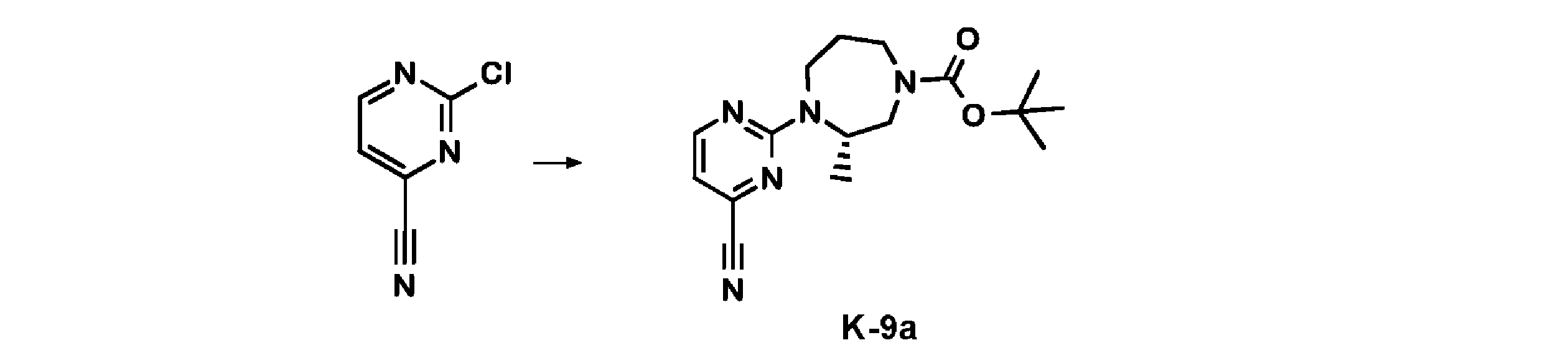
DMSO(4ml、4,5V)中の(S)-tert-ブチル-3-メチル-1,4-ジアゼパン-1-カルボキシラート(846.0mg、214.30mmol、1.0eq)及び2-クロロピリミジン-4-カルボニトリル(528.9mg、139.54mmol、1.0eq)の溶液に、TEA(1.1ml、101.19mmol、2.0eq)をrtで加える。この反応混合物を80℃で1時間撹拌する。変換完了後、この反応混合物をrtまで冷却し、水及びEtOAcを加える。相を分離する。有機層を水で洗浄し、硫酸ナトリウムで乾燥させ、ついで、ろ過し、減圧下で濃縮して、粗生成物を得る。これをクロマトグラフィーにより精製して、K-9aを得る。
Experimental procedure for the synthesis of K-9a
To a solution of (S)-tert-butyl-3-methyl-1,4-diazepane-1-carboxylate (846.0 mg, 214.30 mmol, 1.0 eq) and 2-chloropyrimidine-4-carbonitrile (528.9 mg, 139.54 mmol, 1.0 eq) in DMSO (4 ml, 4.5 V) is added TEA (1.1 ml, 101.19 mmol, 2.0 eq) at rt. The reaction mixture is stirred at 80° C. for 1 h. After complete conversion, the reaction mixture is cooled to rt and water and EtOAc are added. The phases are separated. The organic layer is washed with water, dried over sodium sulfate, then filtered and concentrated under reduced pressure to give the crude product, which is purified by chromatography to give K-9a.
下記中間体K-9(表14)は、異なるニトリル又はアミン、例えば、K-26aを使用して、K-9dを調製する類似の方法で入手可能である。粗生成物K-9を必要に応じてクロマトグラフィーにより精製する。 The following intermediate K-9 (Table 14) can be obtained by a similar method to prepare K-9d using different nitriles or amines, e.g. K-26a. The crude product K-9 is purified by chromatography if necessary.


K-10aの合成実験手順

下記中間体K-10(表15)は、異なるニトリルK-9を使用する類似の方法で入手可能である。粗生成物K-10を必要に応じてクロマトグラフィーにより精製する。 The following intermediate K-10 (Table 15) can be obtained in a similar manner using the different nitrile K-9. The crude product K-10 is purified by chromatography if necessary.


K-11aの合成実験手順

DMSO(10ml)中のK-3b(2.53g、10.70mmol、1.0eq)の撹拌溶液に、TEA(2.17g、21.40mmol、2.0eq.)及びO-(7-アザベンゾトリアゾール-1-イル)-N,N,N’,N’-テトラメチルウロニウム-ヘキサフルオロホスファート(HATU、4.27g、11.24mmol、1.10eq.)をrtで加える。この混合物をrtで15分間撹拌する。K-10a(3.75g、10.70mmol、1.0eq)をrtで加え、一晩撹拌する。変換完了後、この反応混合物を水及びEtOAcで希釈する。相を分離する。有機層を水で洗浄し、硫酸ナトリウムで乾燥させ、ろ過し、減圧下で濃縮して、粗生成物を得る。この粗製材料をカラムクロマトグラフィーにより精製して、K-11aを与える。
Experimental procedure for the synthesis of K-11a
To a stirred solution of K-3b (2.53 g, 10.70 mmol, 1.0 eq) in DMSO (10 ml) is added TEA (2.17 g, 21.40 mmol, 2.0 eq.) and O-(7-azabenzotriazol-1-yl)-N,N,N',N'-tetramethyluronium-hexafluorophosphate (HATU, 4.27 g, 11.24 mmol, 1.10 eq.) at rt. The mixture is stirred at rt for 15 min. K-10a (3.75 g, 10.70 mmol, 1.0 eq) is added at rt and stirred overnight. After complete conversion, the reaction mixture is diluted with water and EtOAc. The phases are separated. The organic layer is washed with water, dried over sodium sulfate, filtered and concentrated under reduced pressure to give the crude product. The crude material is purified by column chromatography to give K-11a.
下記中間体K-11(表16)は、異なる中間体K-10を使用する類似の方法で入手可能である。粗生成物K-11を必要に応じてクロマトグラフィーにより精製する。 The following intermediate K-11 (Table 16) can be obtained in a similar manner using the different intermediate K-10. The crude product K-11 is purified by chromatography if necessary.

K-12aの合成実験手順

THF(40mL)中のK-11a(2.00g、3.51mmol、1.0eq)の撹拌溶液に、DBU(1.98mL、14.04mmol、4.0eq)をrtで加える。この反応混合物を70℃で一晩撹拌する。変換完了後、この反応混合物を減圧下で濃縮して、粗生成物を得る。この粗生成物をカラムクロマトグラフィーにより精製して、K-12aを与える。
Experimental procedure for the synthesis of K-12a
To a stirred solution of K-11a (2.00 g, 3.51 mmol, 1.0 eq) in THF (40 mL) is added DBU (1.98 mL, 14.04 mmol, 4.0 eq) at rt. The reaction mixture is stirred at 70° C. overnight. After complete conversion, the reaction mixture is concentrated under reduced pressure to give the crude product. The crude product is purified by column chromatography to give K-12a.
下記中間体K-12(表17)は、異なる中間体K-11を使用する類似の方法で入手可能である。粗生成物K-12を必要に応じてクロマトグラフィーにより精製する。 The following intermediate K-12 (Table 17) can be obtained in a similar manner using a different intermediate K-11. The crude product K-12 is purified by chromatography if necessary.


K-13aの合成実験手順

MeOH(350mL)中のK-12a(20.00g、34.52mmol、1.0eq.)の撹拌溶液に、濃HCl(32.88mL、345.21mmol、10.0eq.)をrtで加える。この反応混合物を50℃で2時間撹拌する。変換完了後、この反応混合物を減圧下で濃縮し、水で希釈する。水相をDCMで抽出する。合わせた有機層を硫酸ナトリウムで乾燥させ、ろ過し、減圧下で濃縮して、K-13aを与える。これをさらに精製することなく、次の工程に使用する。
Experimental procedure for the synthesis of K-13a
To a stirred solution of K-12a (20.00 g, 34.52 mmol, 1.0 eq.) in MeOH (350 mL) is added concentrated HCl (32.88 mL, 345.21 mmol, 10.0 eq.) at rt. The reaction mixture is stirred at 50° C. for 2 h. After complete conversion, the reaction mixture is concentrated under reduced pressure and diluted with water. The aqueous phase is extracted with DCM. The combined organic layers are dried over sodium sulfate, filtered and concentrated under reduced pressure to give K-13a, which is used in the next step without further purification.
下記中間体K-13(表18)は、異なる中間体K-12を使用する類似の方法で入手可能である。粗生成物K-13を必要に応じてクロマトグラフィーにより精製する。 The following intermediate K-13 (Table 18) can be obtained in a similar manner using a different intermediate K-12. The crude product K-13 is purified by chromatography if necessary.

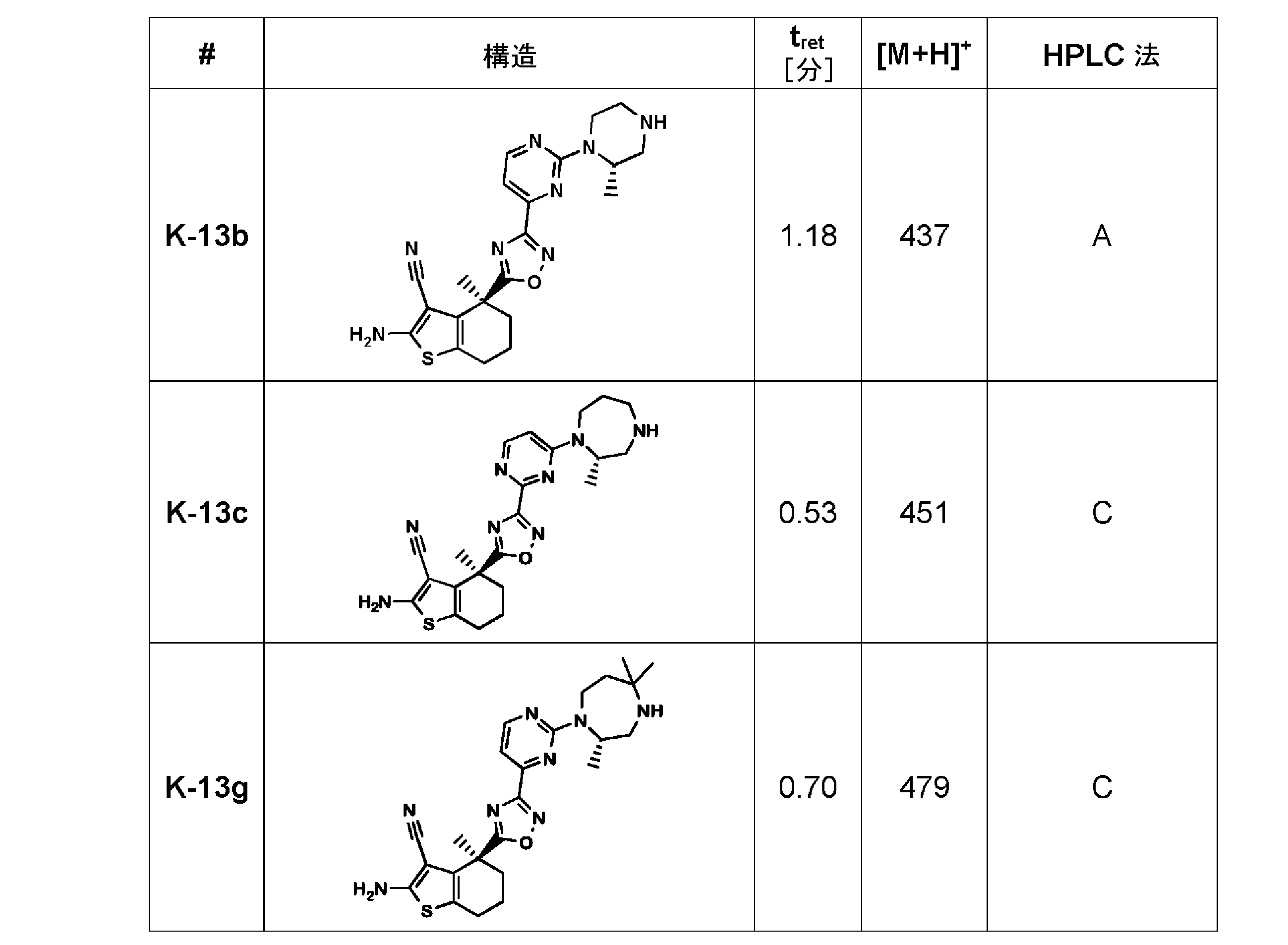
K-14aの合成実験手順

EtOH(4.0ml)中のK-9a(534mg、1.68mmol、1.0eq.)の溶液に、水酸化ナトリウム(水中の4M、1.00ml、40.0mmol、2.4eq.)を加え、還流下で1時間撹拌する。この反応混合物をrtまで冷却し、クエン酸(水中の5%)で酸性化する。水及びEtOAcを加え、相を分離する。有機層を水で洗浄し、硫酸ナトリウムで乾燥させ、ろ過し、減圧下で濃縮して、粗生成物K-14a(表19)を得る。これをさらに精製することなく、次の工程に使用する。
Experimental procedure for the synthesis of K-14a
To a solution of K-9a (534 mg, 1.68 mmol, 1.0 eq.) in EtOH (4.0 ml) is added sodium hydroxide (4 M in water, 1.00 ml, 40.0 mmol, 2.4 eq.) and stirred under reflux for 1 h. The reaction mixture is cooled to rt and acidified with citric acid (5% in water). Water and EtOAc are added and the phases are separated. The organic layer is washed with water, dried over sodium sulfate, filtered and concentrated under reduced pressure to give the crude product K-14a (Table 19), which is used in the next step without further purification.

K-15aの合成実験手順

無水THF(3.0mL、7.5V)中のK-14a(481.0mg、1.43mmol、1.0eq)の撹拌溶液に、DIPEA(1.27mL、7.15mmol、5.0eq)及びHATU(598mg、1.57mmol、1.1eq)を加え、rtで15分間撹拌する。N,O-ジメチルヒドロキシルアミン塩酸塩(278.9mg、2.86mmol、2.0eq)を加え、rtで1時間撹拌する。完全な変換後、この反応混合物を水及びEtOAcで希釈し、相を分離する。有機層を水で洗浄し、硫酸ナトリウムで乾燥させ、減圧下で濃縮して、粗製のK-15aを得る(表20)。この粗製物をクロマトグラフィーにより精製する。
Experimental procedure for the synthesis of K-15a
To a stirred solution of K-14a (481.0 mg, 1.43 mmol, 1.0 eq) in anhydrous THF (3.0 mL, 7.5 V) is added DIPEA (1.27 mL, 7.15 mmol, 5.0 eq) and HATU (598 mg, 1.57 mmol, 1.1 eq) and stirred at rt for 15 min. N,O-Dimethylhydroxylamine hydrochloride (278.9 mg, 2.86 mmol, 2.0 eq) is added and stirred at rt for 1 h. After complete conversion, the reaction mixture is diluted with water and EtOAc and the phases are separated. The organic layer is washed with water, dried over sodium sulfate and concentrated under reduced pressure to give crude K-15a (Table 20). The crude is purified by chromatography.

K-16aの合成実験手順

THF(7mL)中のK-7a(230mg、0.85mmol、1.0eq.)及びK-15a(389.0mg、1.025mmol、1.2eq.)の溶液に、LiHMDS(3.39mL、3.39mmol、4.00eq.、THF中の1M)を-78℃で滴加し、-78℃で10分間撹拌する。変換完了後、この反応物をrtまで温め、水でクエンチし、EtOAcで希釈する。相を分離し、水層をEtOAcで3回抽出する。合わせた有機層を減圧下で濃縮する。残留物をアセトニトリル及び水に溶解させ、クロマトグラフィーにより精製して、所望の生成物K-16aを与える(表21)。
Experimental procedure for the synthesis of K-16a
To a solution of K-7a (230 mg, 0.85 mmol, 1.0 eq.) and K-15a (389.0 mg, 1.025 mmol, 1.2 eq.) in THF (7 mL) is added LiHMDS (3.39 mL, 3.39 mmol, 4.00 eq., 1 M in THF) dropwise at −78° C. and stirred for 10 min at −78° C. After complete conversion, the reaction is warmed to rt, quenched with water and diluted with EtOAc. The phases are separated and the aqueous layer is extracted three times with EtOAc. The combined organic layers are concentrated under reduced pressure. The residue is dissolved in acetonitrile and water and purified by chromatography to give the desired product K-16a (Table 21).

K-17aの合成実験手順

EtOH(1mL)中のK-16a(100mg、0.17mmol、1.0eq.)の撹拌溶液に、ヒドロキシルアミン塩酸塩(60.1mg、0.85mmol、5.0eq.)を加え、rtで2時間撹拌する。変換完了後、この反応物を飽和炭酸水素ナトリウム水溶液でクエンチし、rtで2時間撹拌する。この混合物をアセトニトリル及び水で希釈し、ろ過し、クロマトグラフィーにより精製して、所望の中間体K-17aを与える(表22)。
Experimental procedure for the synthesis of K-17a
To a stirred solution of K-16a (100 mg, 0.17 mmol, 1.0 eq.) in EtOH (1 mL) is added hydroxylamine hydrochloride (60.1 mg, 0.85 mmol, 5.0 eq.) and stirred at rt for 2 h. After complete conversion, the reaction is quenched with saturated aqueous sodium bicarbonate solution and stirred at rt for 2 h. The mixture is diluted with acetonitrile and water, filtered and purified by chromatography to give the desired intermediate K-17a (Table 22).

K-18aの合成実験手順

ACN(0.5mL)中のK-16a(45mg、0.076mmol、1.0eq.)の撹拌溶液に、ヒドロキシルアミン溶液(水中の50%、70.14μL、1.145mmol、15.0eq.)を加え、この反応混合物をrtで30分間撹拌する。変換完了後、この反応混合物をアセトニトリル及び水で希釈し、ろ過し、クロマトグラフィーにより精製して、所望の中間体K-18aを与える(表23)。
Experimental procedure for the synthesis of K-18a
To a stirred solution of K-16a (45 mg, 0.076 mmol, 1.0 eq.) in ACN (0.5 mL) is added hydroxylamine solution (50% in water, 70.14 μL, 1.145 mmol, 15.0 eq.) and the reaction mixture is stirred for 30 min at rt. After complete conversion, the reaction mixture is diluted with acetonitrile and water, filtered and purified by chromatography to give the desired intermediate K-18a (Table 23).

K-17bの合成実験手順

メタノール(2mL)中のK-16a(85.0mg、0.144mmol、1.0eq.)の溶液に、ヒドロキシルアミン-O-スルホン酸(32.6mg、0.288mmol、2.0eq.)を加える。この反応混合物を40分間撹拌する。炭酸水素ナトリウム(30.3mg、0.360mmol、2.5eq.)及び硫化水素ナトリウム(20.2mg、0.360mmol、2.5eq.)をこの反応混合物に加え、18時間撹拌する。追加の炭酸水素ナトリウム(36.3mg、0.432mmol、3.0eq.)及び硫化水素ナトリウム(24.2mg、0.432mmol、3.0eq.)を加え、この反応混合物を60℃で2時間撹拌する。この反応混合物をDCM及び飽和炭酸水素ナトリウム水溶液で希釈する。相を分離し、水層をDCM(5回)で抽出する。有機層を合わせ、溶媒を減圧下で除去する。粗生成物をクロマトグラフィーにより精製して、中間体K-17bを与える(表24)。
Synthesis Experimental Procedure for K-17b
To a solution of K-16a (85.0 mg, 0.144 mmol, 1.0 eq.) in methanol (2 mL) is added hydroxylamine-O-sulfonic acid (32.6 mg, 0.288 mmol, 2.0 eq.). The reaction mixture is stirred for 40 min. Sodium bicarbonate (30.3 mg, 0.360 mmol, 2.5 eq.) and sodium hydrogen sulfide (20.2 mg, 0.360 mmol, 2.5 eq.) are added to the reaction mixture and stirred for 18 h. Additional sodium bicarbonate (36.3 mg, 0.432 mmol, 3.0 eq.) and sodium hydrogen sulfide (24.2 mg, 0.432 mmol, 3.0 eq.) are added and the reaction mixture is stirred at 60° C. for 2 h. The reaction mixture is diluted with DCM and saturated aqueous sodium bicarbonate solution. The phases are separated and the aqueous layer is extracted with DCM (5 times). The organic layers are combined and the solvent is removed under reduced pressure. The crude product is purified by chromatography to give intermediate K-17b (Table 24).

K-13dの合成実験手順

THF(1mL)中のK-17a(114.0mg、0.19mmol、1.0eq.)の撹拌溶液に、HCl(水中の2M、0.94mL、1.89mmol、10.0eq.)をrtで加える。この反応混合物を65℃で2時間撹拌する。変換完了後、この反応混合物を減圧下で濃縮し、水及びアセトニトリルで希釈し、2M NaOHを加えることにより、アルカリ性pHにする。それを、塩基性条件を使用した逆相クロマトグラフィーにより精製して、K-13dを生成する。
Experimental procedure for the synthesis of K-13d
To a stirred solution of K-17a (114.0 mg, 0.19 mmol, 1.0 eq.) in THF (1 mL) is added HCl (2 M in water, 0.94 mL, 1.89 mmol, 10.0 eq.) at rt. The reaction mixture is stirred at 65° C. for 2 h. After complete conversion, the reaction mixture is concentrated under reduced pressure, diluted with water and acetonitrile, and brought to alkaline pH by adding 2 M NaOH. It is purified by reverse phase chromatography using basic conditions to afford K-13d.
下記中間体K-13(表25)は、異なる中間体K-17を使用する類似の方法で入手可能である。粗生成物K-17を必要に応じてクロマトグラフィーにより精製する。 The following intermediate K-13 (Table 25) can be obtained in a similar manner using the different intermediate K-17. The crude product K-17 is purified by chromatography if necessary.

K-13fの合成実験手順

THF(0.5mL)中のK-18a(40.0mg、0.06mmol、1.0eq.)の撹拌溶液に、HCl(水中の2M、0.32mL、0.64mmol、10.0eq.)をrtで加える。この反応混合物を65℃で3時間撹拌する。変換完了後、この反応混合物を減圧下で濃縮し、水及びアセトニトリルで希釈し、NaOH(水中の2M)を加えることにより塩基性化する。この混合物をクロマトグラフィーにより精製して、K-13fを生成する(表26)。
Synthesis Experimental Procedure for K-13f
To a stirred solution of K-18a (40.0 mg, 0.06 mmol, 1.0 eq.) in THF (0.5 mL) is added HCl (2 M in water, 0.32 mL, 0.64 mmol, 10.0 eq.) at rt. The reaction mixture is stirred at 65° C. for 3 h. After complete conversion, the reaction mixture is concentrated under reduced pressure, diluted with water and acetonitrile, and basified by adding NaOH (2 M in water). The mixture is purified by chromatography to afford K-13f (Table 26).

A-1aの合成実験手順

N,N-ジメチルアセトアミド(1.00mL)中の4-ブロモ-3-フルオロベンゾニトリル(100mg、0.50mmol、1.0eq.)及び4-メチル-チアゾール(100mg、1.00mmol、2.0eq.)の撹拌溶液に、酢酸カリウム(99mg、1.00mmol、2.0eq.)及び酢酸パラジウム(II)(11mg、0.05mmol、0.1eq.)をrtで加え、この混合物をアルゴンで15分間パージする。この混合物を撹拌し、マイクロ波照射により150℃で30分間加熱する。変換完了後、この反応混合物を室温まで冷却し、水及びEtOAcで希釈し、15分間撹拌する。相を分離し、水層をEtOAc(3×)で抽出する。合わせた有機層を飽和NaCl水溶液で洗浄し、溶媒を減圧下で除去する。粗生成物をクロマトグラフィーにより精製して、A-1aを得る。
Experimental procedure for synthesis of A-1a
To a stirred solution of 4-bromo-3-fluorobenzonitrile (100 mg, 0.50 mmol, 1.0 eq.) and 4-methyl-thiazole (100 mg, 1.00 mmol, 2.0 eq.) in N,N-dimethylacetamide (1.00 mL) are added potassium acetate (99 mg, 1.00 mmol, 2.0 eq.) and palladium(II) acetate (11 mg, 0.05 mmol, 0.1 eq.) at rt and the mixture is purged with argon for 15 min. The mixture is stirred and heated by microwave irradiation at 150° C. for 30 min. After complete conversion, the reaction mixture is cooled to room temperature, diluted with water and EtOAc and stirred for 15 min. The phases are separated and the aqueous layer is extracted with EtOAc (3×). The combined organic layers are washed with saturated aqueous NaCl solution and the solvent is removed under reduced pressure. The crude product is purified by chromatography to give A-1a.
下記中間体A-1(表27)は、出発物質として他の対応する臭化物を使用することにより、類似の方法で入手可能である。粗生成物A-1を必要に応じてクロマトグラフィーにより精製する。 The following intermediate A-1 (Table 27) can be obtained in a similar manner by using other corresponding bromides as starting materials. The crude product A-1 is purified by chromatography if necessary.

A-2aの合成実験手順

無水THF(20.0mL)中のA-1a(530mg、2.43mmol、1.0eq)の撹拌溶液に、水素化アルミニウムリチウム(THF中2M、3.64mL、7.29mmol、3.0eq)を0℃で滴加する。この反応混合物をゆっくりRTまで温め、一晩撹拌する。変換完了後、この反応混合物を0℃まで冷却し、飽和塩化アンモニウム水溶液でクエンチし、ついで、飽和酒石酸ナトリウムカリウム水溶液で処理し、2時間撹拌する。NaOH水溶液(2M)及びEtOAcを加え、この混合物をceliteでろ過し、相を分離する。水層をEtOAcで抽出する。合わせた有機層をブラインで洗浄し、硫酸ナトリウムで乾燥させ、減圧下で濃縮する。粗生成物をカラムクロマトグラフィーにより精製し、A-2aを生成する。
Experimental procedure for synthesis of A-2a
To a stirred solution of A-1a (530 mg, 2.43 mmol, 1.0 eq) in anhydrous THF (20.0 mL) is added lithium aluminum hydride (2 M in THF, 3.64 mL, 7.29 mmol, 3.0 eq) dropwise at 0° C. The reaction mixture is slowly warmed to RT and stirred overnight. After complete conversion, the reaction mixture is cooled to 0° C. and quenched with saturated aqueous ammonium chloride solution, then treated with saturated aqueous sodium potassium tartrate solution and stirred for 2 h. Aqueous NaOH (2 M) and EtOAc are added, the mixture is filtered through celite and the phases are separated. The aqueous layer is extracted with EtOAc. The combined organic layers are washed with brine, dried over sodium sulfate and concentrated under reduced pressure. The crude product is purified by column chromatography to afford A-2a.
下記中間体A2(表28)は、異なる中間体A1から開始する類似の方法で入手可能である。粗生成物A2を必要に応じてクロマトグラフィーにより精製する。 The following intermediate A2 (Table 28) can be obtained in a similar manner starting from the different intermediate A1. The crude product A2 is purified by chromatography if necessary.

A-2dの合成実験手順

[4-({[(tert-ブトキシ)カルボニル]アミノ}メチル)フェニル]ボロン酸(500mg、1.991mmol)、エチル 5-ブロモ-1,3-チアゾール-4-カルボキシラート(630mg、2.589mmol、1.3eq.)、炭酸ナトリウム(848mg、7.965mmol、4.0eq.)及びテトラキス-(トリフェニルホスフィン)-パラジウム(232mg、0.199mmol、0.1eq.)をジメトキシルエタン(5mL)及び水(1.5mL)に溶解させる。この混合物をアルゴンでrtにおいて5分間フラッシュし、ついで、90℃で2時間撹拌する。水(0.5mL)をこの反応混合物に加え、それを90℃でさらに2時間撹拌する。この反応混合物をDCM及び水で希釈し、相を分離する。水層をDCMで2回抽出し、合わせた有機層を減圧下で濃縮して乾燥させ、クロマトグラフィーにより精製して、エチル 5-[4-({[(tert-ブトキシ)カルボニル]アミノ}メチル)フェニル]-1,3-チアゾール-4-カルボキシラートを与える(HPLC法A:tret=1.25分、[M+H]+=363)。
Experimental procedure for the synthesis of A-2d
[4-({[(tert-butoxy)carbonyl]amino}methyl)phenyl]boronic acid (500 mg, 1.991 mmol), ethyl 5-bromo-1,3-thiazole-4-carboxylate (630 mg, 2.589 mmol, 1.3 eq.), sodium carbonate (848 mg, 7.965 mmol, 4.0 eq.) and tetrakis-(triphenylphosphine)-palladium (232 mg, 0.199 mmol, 0.1 eq.) are dissolved in dimethoxylethane (5 mL) and water (1.5 mL). The mixture is flushed with argon at rt for 5 min and then stirred at 90° C. for 2 h. Water (0.5 mL) is added to the reaction mixture, which is stirred at 90° C. for a further 2 h. The reaction mixture is diluted with DCM and water and the phases are separated. The aqueous layer is extracted twice with DCM and the combined organic layers are concentrated to dryness under reduced pressure and purified by chromatography to give ethyl 5-[4-({[(tert-butoxy)carbonyl]amino}methyl)phenyl]-1,3-thiazole-4-carboxylate (HPLC Method A: t ret =1.25 min, [M+H] + =363).

無水THF(5.0mL)中の5-[4-({[(tert-ブトキシ)カルボニル]アミノ}メチル)フェニル]-1,3-チアゾール-4-カルボキシラート(580mg、1.60mmol、1.0eq)の撹拌溶液に、水素化ホウ素リチウム(THF中の2M、1.6mL、3.20mmol、2.0eq)を0℃で少しずつ加える。この反応混合物をrtで6時間撹拌した。変換完了後、この反応混合物を氷冷水で希釈し、EtOAcで抽出する。合わせた有機層を硫酸ナトリウムで乾燥させ、減圧下で濃縮する。得られた粗生成物をカラムクロマトグラフィーにより精製して、tert-ブチル N-({4-[4-(ヒドロキシメチル)-1,3-チアゾール-5-イル]フェニル}メチル)カルバマートを与えた(HPLC法A:tret=1.09分、[M+H]+=321)。
To a stirred solution of 5-[4-({[(tert-butoxy)carbonyl]amino}methyl)phenyl]-1,3-thiazole-4-carboxylate (580 mg, 1.60 mmol, 1.0 eq) in anhydrous THF (5.0 mL) is added lithium borohydride (2 M in THF, 1.6 mL, 3.20 mmol, 2.0 eq) portionwise at 0° C. The reaction mixture was stirred at rt for 6 h. After complete conversion, the reaction mixture is diluted with ice-cold water and extracted with EtOAc. The combined organic layers are dried over sodium sulfate and concentrated under reduced pressure. The obtained crude product was purified by column chromatography to give tert-butyl N-({4-[4-(hydroxymethyl)-1,3-thiazol-5-yl]phenyl}methyl)carbamate (HPLC Method A: t ret =1.09 min, [M+H] + =321).

tert-ブチル N-({4-[4-(ヒドロキシメチル)-1,3-チアゾール-5-イル]フェニル}メチル)カルバマート(32mg、0.1mmol、1.0eq.)をメタノール(0.32mL)に溶解させ、HCl(ジオキサン中の4M、0.12mL)を0℃で加える。この反応混合物をrtで2時間撹拌する。変換完了後、この反応混合物を減圧下で濃縮して乾燥させ、粗製のA-2dをHCl塩として得る(表29)。これをさらに精製することなく使用する。
tert-Butyl N-({4-[4-(hydroxymethyl)-1,3-thiazol-5-yl]phenyl}methyl)carbamate (32 mg, 0.1 mmol, 1.0 eq.) is dissolved in methanol (0.32 mL) and HCl (4 M in dioxane, 0.12 mL) is added at 0° C. The reaction mixture is stirred at rt for 2 h. After complete conversion, the reaction mixture is concentrated to dryness under reduced pressure to give crude A-2d as the HCl salt (Table 29), which is used without further purification.

A-5aの合成実験手順

無水THF(10mL)中の4-(4-メチルチアゾール-5-イル)ベンズアルデヒド(1.10g、5.41mmol、1.0eq.)及び(S)-2-メチルプロパン-2-スルフィンアミド(0.98g、8.12mmol、1.50eq.)の撹拌溶液に、Cs2CO3(4.41g、13.5mmol、2.50eq.)を加え、得られた混合物を50℃で3時間撹拌する。この反応混合物を水(100mL)でクエンチし、EtOAc(2×100mL)で抽出する。合わせた有機層をNa2SO4で乾燥させ、ろ過し、減圧下で濃縮し、クロマトグラフィーにより精製して、中間体A-5aを与える(表30)。
Experimental procedure for the synthesis of A-5a
To a stirred solution of 4-(4-methylthiazol-5-yl)benzaldehyde (1.10 g, 5.41 mmol, 1.0 eq.) and (S)-2-methylpropane-2-sulfinamide (0.98 g, 8.12 mmol, 1.50 eq.) in anhydrous THF (10 mL) is added Cs 2 CO 3 (4.41 g, 13.5 mmol, 2.50 eq.) and the resulting mixture is stirred at 50° C. for 3 h. The reaction mixture is quenched with water (100 mL) and extracted with EtOAc (2×100 mL). The combined organic layers are dried over Na 2 SO 4 , filtered, concentrated under reduced pressure, and purified by chromatography to give intermediate A-5a (Table 30).

A-6aの合成実験手順

0℃のTHF(5mL)中の中間体A-5a(1.00g、3.263mmol、1.0eq.)の撹拌溶液に、臭化アリルマグネシウム(4.89mL、4.8945mmol、1.5eq.Et2O中の1.0M)を加える。この反応物をrtまで温め、16時間撹拌する。この反応混合物を氷水(10mL)で希釈し、得られた沈殿物をろ過し、水で洗浄した。ろ液をDCM(2×10mL)で抽出し、合わせた有機層を硫酸ナトリウムで乾燥させ、ろ過し、減圧下で濃縮した。粗生成物をクロマトグラフィーにより精製して、中間体A-6aを与える(表31)。
Experimental procedure for the synthesis of A-6a
To a stirred solution of intermediate A-5a (1.00 g, 3.263 mmol, 1.0 eq.) in THF (5 mL) at 0° C. is added allylmagnesium bromide (4.89 mL, 4.8945 mmol, 1.5 eq. 1.0 M in Et 2 O). The reaction is allowed to warm to rt and stirred for 16 h. The reaction mixture is diluted with ice water (10 mL) and the resulting precipitate is filtered and washed with water. The filtrate is extracted with DCM (2×10 mL) and the combined organic layers are dried over sodium sulfate, filtered and concentrated under reduced pressure. The crude product is purified by chromatography to give intermediate A-6a (Table 31).

A-7aの合成実験手順

SmI2(THF中の0.1M、27.4mL、2.74mmol、3.0eq)の撹拌溶液を-78℃まで冷却し、無水tBuOH(171.5μL、1.83mmol、2.0eq)及び無水THF(11.0mL)中のA-5a(280mg、0.91mmol、1.0eq.)及びアセトアルデヒド10滴の溶液を-78℃で0.5時間かけて少しずつ加え、撹拌を-78℃で2時間続ける。この反応混合物を10% チオ硫酸ナトリウム水溶液でクエンチし、DCMを加える。白色の沈殿物が形成され、これをCeliteでろ過する。相を分離し、水相をDCMで3回抽出する。合わせた有機層を硫酸マグネシウムで乾燥させ、減圧下で濃縮する。粗生成物をクロマトグラフィーにより精製して、主生成物としてA-7a(純度78%)を得る(表32)。これをキラルクロマトグラフィーにより98%に改善する。
Experimental procedure for the synthesis of A-7a
A stirred solution of SmI 2 (0.1 M in THF, 27.4 mL, 2.74 mmol, 3.0 eq) is cooled to −78° C. and a solution of A-5a (280 mg, 0.91 mmol, 1.0 eq.) and 10 drops of acetaldehyde in anhydrous tBuOH (171.5 μL, 1.83 mmol, 2.0 eq.) and anhydrous THF (11.0 mL) is added portionwise over 0.5 h at −78° C. and stirring is continued for 2 h at −78° C. The reaction mixture is quenched with 10% aqueous sodium thiosulfate solution and DCM is added. A white precipitate forms which is filtered through Celite. The phases are separated and the aqueous phase is extracted three times with DCM. The combined organic layers are dried over magnesium sulfate and concentrated under reduced pressure. The crude product is purified by chromatography to give A-7a (78% purity) as the major product (Table 32). This is improved to 98% by chiral chromatography.

A-8aの合成実験手順

-78℃のMeOH(10mL)中の中間体A-6a(1.00g、2.869mmol、1.0eq.)の撹拌溶液をオゾンガスで30分間パージする。水素化ホウ素ナトリウム(0.370、10.042mmol、3.5eq.)を-78℃で加え、この混合物を一晩かけてrtまで温める。この反応混合物を氷冷水でクエンチし、DCMで抽出する。有機層を硫酸ナトリウムで乾燥させ、ろ過し、減圧下濃縮する。粗生成物をクロマトグラフィーにより精製して、中間体A-8aを与える(表33)。
Experimental procedure for the synthesis of A-8a
A stirred solution of intermediate A-6a (1.00 g, 2.869 mmol, 1.0 eq.) in MeOH (10 mL) at −78° C. is purged with ozone gas for 30 min. Sodium borohydride (0.370, 10.042 mmol, 3.5 eq.) is added at −78° C. and the mixture is allowed to warm to rt overnight. The reaction mixture is quenched with ice-cold water and extracted with DCM. The organic layer is dried over sodium sulfate, filtered and concentrated under reduced pressure. The crude product is purified by chromatography to give intermediate A-8a (Table 33).

A-9aの合成実験手順

THF(1.2mL)中の中間体A-7a(105mg、0.298mmol、1.0eq.)の撹拌混合物に、HCl(0.6mL、H2O中の2M)を加える。この混合物をrtで3時間撹拌する。この反応物をMeOHで希釈し、イオン交換カラムクロマトグラフィー(Isolute SPE 1gカラム、SCX-2)により精製して、中間体A-9aを与える。
Experimental procedure for the synthesis of A-9a
To a stirred mixture of intermediate A-7a (105 mg, 0.298 mmol, 1.0 eq.) in THF (1.2 mL) is added HCl (0.6 mL, 2 M in H 2 O). The mixture is stirred at rt for 3 h. The reaction is diluted with MeOH and purified by ion exchange column chromatography (Isolute SPE 1 g column, SCX-2) to give intermediate A-9a.
下記中間体A-9(表34)は、異なる中間体A-7又はA-8から開始する類似の方法で入手可能である。 The following intermediate A-9 (Table 34) can be obtained in a similar manner starting from different intermediates A-7 or A-8.

A-10aの合成実験手順

1,4ジオキサン(6mL)及びH2O(6mL)中の中間体A-9b(600mg、2.11mmol、1.0eq.)の撹拌溶液に、NEt3(1.5mL、10.5mmol、5.0eq.)及びBoc無水物(0.73mL、3.16mmol、1.50eq.)を加え、この混合物をrtで3時間撹拌する。この反応混合物を氷冷水でクエンチし、DCMで抽出する。有機層を分離し、硫酸ナトリウムで乾燥させ、ろ過し、減圧下で濃縮する。粗生成物をクロマトグラフィーにより精製して、中間体A-10aを得る(表35)。
Experimental procedure for synthesis of A-10a
To a stirred solution of intermediate A-9b (600 mg, 2.11 mmol, 1.0 eq.) in 1,4 dioxane (6 mL) and H 2 O (6 mL) is added NEt 3 (1.5 mL, 10.5 mmol, 5.0 eq.) and Boc anhydride (0.73 mL, 3.16 mmol, 1.50 eq.) and the mixture is stirred at rt for 3 h. The reaction mixture is quenched with ice-cold water and extracted with DCM. The organic layer is separated, dried over sodium sulfate, filtered and concentrated under reduced pressure. The crude product is purified by chromatography to give intermediate A-10a (Table 35).

A-11aの合成実験手順

無水THF(2mL)中の中間体A-10a(100mg、0.274mmol、1.0eq.)及びNEt3(475μL、3.289mmol、12eq.)の撹拌溶液に、無水THF(1mL)中のホスホロキシクロリド(250μL、2.741mmol、10eq.)の溶液を0℃でゆっくり加える。この反応混合物を0℃で30分間撹拌する。この混合物を0℃において水でクエンチし、rtまで温める。この混合物をアセトニトリル及び水で希釈し、ろ過し、逆相クロマトグラフィーにより精製して、中間体A-11aを得る(表36)。
Experimental procedure for synthesis of A-11a
To a stirred solution of intermediate A-10a (100 mg, 0.274 mmol, 1.0 eq.) and NEt (475 μL, 3.289 mmol, 12 eq.) in anhydrous THF (2 mL) is slowly added a solution of phosphoroxychloride (250 μL, 2.741 mmol, 10 eq.) in anhydrous THF (1 mL) at 0° C. The reaction mixture is stirred at 0° C. for 30 min. The mixture is quenched with water at 0° C. and allowed to warm to rt. The mixture is diluted with acetonitrile and water, filtered and purified by reverse phase chromatography to give intermediate A-11a (Table 36).

A-2eの合成実験手順

rtのMeOH(1mL)中の中間体A-11a(15mg、0.035mmol、1.0eq.)の撹拌溶液に、HCl(1mL、1,4ジオキサン中の4N)を加え、この混合物を1時間撹拌する。この反応混合物を減圧下で濃縮し、粗製の中間体A-2e(表37)をさらに精製することなく、次の工程に使用する。
Experimental procedure for synthesis of A-2e
To a stirred solution of intermediate A-11a (15 mg, 0.035 mmol, 1.0 eq.) in MeOH (1 mL) at rt is added HCl (1 mL, 4N in 1,4 dioxane) and the mixture is stirred for 1 h. The reaction mixture is concentrated under reduced pressure and the crude intermediate A-2e (Table 37) is used in the next step without further purification.

A-12aの合成実験手順

THF(3.3mL)中のtert-ブチル N-[(1R)-2-ヒドロキシ-1-[4-(4-メチル-1,3-チアゾール-5-イル)フェニル]エチル]カルバマート(500mg、1.42mmol、1.0eq)の撹拌溶液に、デス-マーチンペルヨージナン(723mg、1.70mmol、1.2eq)をアルゴン雰囲気下で加え、rtで1時間撹拌して、中間体tert-ブチル N-[(1R)-1-[4-(4-メチル-1,3-チアゾール-5-イル)フェニル]-2-オキソエチル]カルバマートを形成する。これは、単離されなかった。この反応混合物をろ過し、アルゴン下で-78℃まで冷却する。イソプロピル-臭化マグネシウム(THF中の0.8M、10.65mL、8.52mmol、6.0eq.)を1時間にわたって滴加する。この反応混合物を-78℃で1時間撹拌する。変換後、この反応混合物を水でクエンチし、DCMを加え、この混合物をろ過する。相を分離し、有機層を硫酸マグネシウムで乾燥させ、減圧下で濃縮する。粗生成物をクロマトグラフィーにより精製して、中間体A-12aを与える(表38)。
Experimental procedure for the synthesis of A-12a
To a stirred solution of tert-butyl N-[(1R)-2-hydroxy-1-[4-(4-methyl-1,3-thiazol-5-yl)phenyl]ethyl]carbamate (500 mg, 1.42 mmol, 1.0 eq) in THF (3.3 mL) is added Dess-Martin periodinane (723 mg, 1.70 mmol, 1.2 eq) under argon atmosphere and stirred at rt for 1 h to form the intermediate tert-butyl N-[(1R)-1-[4-(4-methyl-1,3-thiazol-5-yl)phenyl]-2-oxoethyl]carbamate, which was not isolated. The reaction mixture is filtered and cooled to −78° C. under argon. Isopropyl-magnesium bromide (0.8 M in THF, 10.65 mL, 8.52 mmol, 6.0 eq.) is added dropwise over 1 h. The reaction mixture is stirred at −78° C. for 1 h. After conversion, the reaction mixture is quenched with water, DCM is added and the mixture is filtered. The phases are separated and the organic layer is dried over magnesium sulfate and concentrated under reduced pressure. The crude product is purified by chromatography to give intermediate A-12a (Table 38).

A-2fの合成実験手順

THF(0.8mL)中のA-12a(78mg、0.207mmol、1.0eq)の撹拌混合物に、HCl(259μL、1.04mmol、ジオキサン中の4.0M、5.0eq.)を加え、この混合物を60℃で2時間撹拌する。追加のHCl(259μL、1.04mmol、ジオキサン中の4.0M、5.0eq.)を加え、この混合物を60℃でさらに3時間撹拌する。この混合物をrtまで冷却し、rtで18時間撹拌する。揮発性物質を減圧下で除去し、残留物をアセトニトリル及びH2Oに溶解させ、凍結乾燥させる。粗生成物をイオン交換クロマトグラフィー(Isolute SPE 1gカラム、SCX-2)により精製して、中間体A-2fを与える(表39)。
Experimental procedure for synthesis of A-2f
To a stirred mixture of A-12a (78 mg, 0.207 mmol, 1.0 eq) in THF (0.8 mL) is added HCl (259 μL, 1.04 mmol, 4.0 M in dioxane, 5.0 eq.) and the mixture is stirred at 60° C. for 2 h. Additional HCl (259 μL, 1.04 mmol, 4.0 M in dioxane, 5.0 eq.) is added and the mixture is stirred at 60° C. for an additional 3 h. The mixture is cooled to rt and stirred at rt for 18 h. The volatiles are removed under reduced pressure and the residue is dissolved in acetonitrile and H 2 O and lyophilized. The crude product is purified by ion exchange chromatography (Isolute SPE 1 g column, SCX-2) to give intermediate A-2f (Table 39).

A-2gの合成実験手順

DME(2mL)及びH2O(0.4mL)中のメチル (2R)-2-アミノ-2-(4-ブロモフェニル)アセタートヒドロクロリド(250mg、0.847mmol、1.0eq)、4-メチル-5-(4,4,5,5-テトラメチル-1,3,2-ジオキサボロラン-2-イル)-1,3-チアゾール(397mg、1.693mmol、2.0eq.)、XPhos Pd G3(73mg、0.085mmol、0.1eq.)及び炭酸セシウム(1.3g、4.233mmol、5.0eq.)をマイクロ波照射下で80℃まで90分間加熱する。この反応混合物をクロマトグラフィーにより精製して、中間体A-2gを得る(表40)。
Experimental procedure for synthesis of A-2g
Methyl (2R)-2 - amino-2-(4-bromophenyl)acetate hydrochloride (250 mg, 0.847 mmol, 1.0 eq.), 4-methyl-5-(4,4,5,5-tetramethyl-1,3,2-dioxaborolan-2-yl)-1,3-thiazole (397 mg, 1.693 mmol, 2.0 eq.), XPhos Pd G3 (73 mg, 0.085 mmol, 0.1 eq.) and cesium carbonate (1.3 g, 4.233 mmol, 5.0 eq.) in DME (2 mL) and H 2 O (0.4 mL) are heated to 80° C. under microwave irradiation for 90 min. The reaction mixture is purified by chromatography to give intermediate A-2g (Table 40).

A-3aの合成実験手順

DMF(1mL)中のA-2a(85mg、0.382mol、1.0eq)の撹拌溶液に、(2S,4R)-メチル 4-ヒドロキシピロリジン-2-カルボキシラート塩酸塩(100mg、0.421mmol、1.1eq)、HATU(163mg、0.4210mol、1.1eq)及びDIPEA(0.27mL、1.53mmol、4.0eq)をrtで加え、この混合物をrtで1時間撹拌する。変換完了後、この反応混合物をアセトニトリルで希釈し、ろ過し、カラムクロマトグラフィーにより精製して、A-3aを生成する。
Experimental procedure for the synthesis of A-3a
To a stirred solution of A-2a (85 mg, 0.382 mol, 1.0 eq) in DMF (1 mL) is added (2S,4R)-methyl 4-hydroxypyrrolidine-2-carboxylate hydrochloride (100 mg, 0.421 mmol, 1.1 eq), HATU (163 mg, 0.4210 mol, 1.1 eq) and DIPEA (0.27 mL, 1.53 mmol, 4.0 eq) at rt and the mixture is stirred at rt for 1 h. After complete conversion, the reaction mixture is diluted with acetonitrile, filtered and purified by column chromatography to afford A-3a.
下記中間体A3(表41)は、異なる中間体A2から開始する類似の方法で入手可能である。 The following intermediate A3 (Table 41) can be obtained in a similar manner starting from the different intermediate A2.


A-4aの合成実験手順

THF(1.5mL)中のA-3a(105mg、0.24mmol、1.0eq)の撹拌溶液にHCl(水中の2M、0.36mL、3.0mmol、3.0eq)を加え、65℃で1時間撹拌する。変換完了後、この反応混合物を減圧下で濃縮し、ACNで希釈し、水酸化ナトリウム水溶液(2M)で注意深く中和する。この混合物をRP-クロマトグラフィーにより精製し、A-4aを得る。
Experimental procedure for the synthesis of A-4a
To a stirred solution of A-3a (105 mg, 0.24 mmol, 1.0 eq) in THF (1.5 mL) is added HCl (2 M in water, 0.36 mL, 3.0 mmol, 3.0 eq) and stirred at 65° C. for 1 h. After complete conversion, the reaction mixture is concentrated under reduced pressure, diluted with ACN and carefully neutralized with aqueous sodium hydroxide (2 M). The mixture is purified by RP-chromatography to give A-4a.
下記中間体A-4(表42)は、異なる中間体A-3から開始する類似の方法で入手可能である。 The following intermediate A-4 (Table 42) can be obtained in a similar manner starting from the different intermediate A-3.


E-1aの合成実験手順

DMF(75.0mL)中のメチル 2-(3-ヒドロキシ-1,2-オキサゾール-5-イル)-3-メチルブタノアート(15.00g、0.08mol、1.0eq.)の撹拌溶液に、炭酸カリウム(31.17g、0.23mol、3.0eq.)を0℃で加える。1,3-ジブロモプロパン(15.20g、0.08mol、1.0eq)を滴加し、この反応混合物を0℃で9時間撹拌する。変換完了後、この反応混合物を水でクエンチし、EtOAcで抽出する。有機層を氷水で洗浄し、硫酸ナトリウムで乾燥させ、減圧下で濃縮して、粗生成物を与える。得られた粗製の化合物をクロマトグラフィーにより精製して、E-1aを生成する。
Synthesis Experimental Procedure of E-1a
To a stirred solution of methyl 2-(3-hydroxy-1,2-oxazol-5-yl)-3-methylbutanoate (15.00 g, 0.08 mol, 1.0 eq.) in DMF (75.0 mL) is added potassium carbonate (31.17 g, 0.23 mol, 3.0 eq.) at 0° C. 1,3-Dibromopropane (15.20 g, 0.08 mol, 1.0 eq) is added dropwise and the reaction mixture is stirred at 0° C. for 9 h. After complete conversion, the reaction mixture is quenched with water and extracted with EtOAc. The organic layer is washed with ice water, dried over sodium sulfate and concentrated under reduced pressure to give the crude product. The obtained crude compound is purified by chromatography to yield E-1a.
下記中間体E-1(表43)は、類似の方法で入手可能である。粗生成物E-1を必要に応じてクロマトグラフィーにより精製する。 The following intermediate E-1 (Table 43) can be obtained in a similar manner. The crude product E-1 is purified by chromatography if necessary.


E-6aの合成実験手順

THF(200ml)中の4-[(tert-ブチルジメチルシリル)オキシ]ブタン-1-オール(20.00g、0.10mol、1.0eq.)の撹拌溶液に、水素化ナトリウム(2.81g、0.12mol、1.2eq.)を0℃で加え、rtで1時間撹拌する。この反応混合物を0℃まで冷却し、トリクロロエチレン(15.38g、0.12mol、1.2eq.)を0℃で加える。この反応混合物をrtまで温め、48時間撹拌する。この反応混合物を氷冷水でクエンチし、この水溶液をEtOAc(3回)で抽出する。合わせた有機層を水及びブラインで洗浄し、硫酸ナトリウムで乾燥させ、ろ過し、減圧下で濃縮して、粗生成物を与える。この粗生成物をクロマトグラフィーにより精製して、E-6aを生成する。
Experimental procedure for the synthesis of E-6a
To a stirred solution of 4-[(tert-butyldimethylsilyl)oxy]butan-1-ol (20.00 g, 0.10 mol, 1.0 eq.) in THF (200 ml) is added sodium hydride (2.81 g, 0.12 mol, 1.2 eq.) at 0° C. and stirred at rt for 1 h. The reaction mixture is cooled to 0° C. and trichloroethylene (15.38 g, 0.12 mol, 1.2 eq.) is added at 0° C. The reaction mixture is warmed to rt and stirred for 48 h. The reaction mixture is quenched with ice-cold water and the aqueous solution is extracted with EtOAc (3×). The combined organic layers are washed with water and brine, dried over sodium sulfate, filtered and concentrated under reduced pressure to give the crude product. The crude product is purified by chromatography to afford E-6a.
下記中間体E-6(表44)は、出発物質として異なるアルコールを使用する類似の方法で入手可能である。粗生成物E-6(表44)を必要に応じてクロマトグラフィーにより精製する。 The following intermediate E-6 (Table 44) can be obtained in a similar manner using different alcohols as starting materials. The crude product E-6 (Table 44) is purified by chromatography if necessary.


*中間体E-6c及びE-6dは、ブタン-1,3-ジオールを出発物質として使用する場合、3.5:1の混合物として得られ、次の工程で混合物として使用される。
* Intermediates E-6c and E-6d are obtained as a 3.5:1 mixture when butane-1,3-diol is used as the starting material and are used as a mixture in the next step.
E-7aの合成実験手順

THF(800ml)中の中間体E-6a(40.00g、0.13mol、1.0eq.)の撹拌溶液に、n-ブチルリチウム溶液(13mL、0.33mol、2.5eq、ヘキサン中の2.5M)を-78℃で加え、-40℃で2時間撹拌する。変換完了後、この混合物を飽和塩化アンモニウム溶液でクエンチし、氷冷水で希釈する。この水溶液をEtOAc(3×)で抽出する。合わせた有機層を水及びブラインで洗浄し、硫酸ナトリウムで乾燥させ、ろ過し、減圧下で濃縮して、粗生成物を与える。この粗生成物をカラムクロマトグラフィーにより精製して、中間体E-7aを生成する。
Experimental procedure for the synthesis of E-7a
To a stirred solution of intermediate E-6a (40.00 g, 0.13 mol, 1.0 eq.) in THF (800 mL) is added n-butyllithium solution (13 mL, 0.33 mol, 2.5 eq, 2.5 M in hexanes) at −78° C. and stirred at −40° C. for 2 h. After complete conversion, the mixture is quenched with saturated ammonium chloride solution and diluted with ice-cold water. The aqueous solution is extracted with EtOAc (3×). The combined organic layers are washed with water and brine, dried over sodium sulfate, filtered and concentrated under reduced pressure to give the crude product. The crude product is purified by column chromatography to yield intermediate E-7a.
下記中間体E-7(表45)は、異なる中間体E-6を使用する類似の方法で入手可能である。粗生成物E-7を必要に応じてクロマトグラフィーにより精製する。 The following intermediate E-7 (Table 45) can be obtained in a similar manner using the different intermediate E-6. The crude product E-7 is purified by chromatography if necessary.


*中間体E-7c及びE-7dは、E-6cとE-6dとの混合物(3.5:1)を出発物質として使用する場合、3.5:1の混合物として得られ、次の工程で混合物として使用される。
* Intermediates E-7c and E-7d were obtained as a 3.5:1 mixture when a mixture of E-6c and E-6d (3.5:1) was used as the starting material and were used as a mixture in the next step.
E-8aの合成実験手順

DMF(20ml)及び水(20ml)中の中間体E-7a(5.81g、25.44mmol、1.0eq.)の撹拌溶液に、メチル (2R)-2-アジド-3-メチルブタノアート(4.00g、25.44mmol、1.0eq.)、L-アスコルビン酸ナトリウム(2.52g、12.73mmol、0.5eq)及び硫酸銅(II)五水和物(0.88g、2.54mmol、0.1eq)をrtで加える。この反応混合物を80℃まで加熱し、3時間撹拌する。この反応混合物を水に注ぎ、水層をEtOAc(3×)で抽出する。合わせた有機層を硫酸ナトリウムで乾燥させ、ろ過し、減圧下で濃縮して、粗生成物を与える。この粗生成物をクロマトグラフィーにより精製して、中間体E-8aを生成する。
Experimental procedure for the synthesis of E-8a
To a stirred solution of intermediate E-7a (5.81 g, 25.44 mmol, 1.0 eq.) in DMF (20 mL) and water (20 mL) is added methyl (2R)-2-azido-3-methylbutanoate (4.00 g, 25.44 mmol, 1.0 eq.), sodium L-ascorbate (2.52 g, 12.73 mmol, 0.5 eq) and copper(II) sulfate pentahydrate (0.88 g, 2.54 mmol, 0.1 eq) at rt. The reaction mixture is heated to 80° C. and stirred for 3 h. The reaction mixture is poured into water and the aqueous layer is extracted with EtOAc (3×). The combined organic layers are dried over sodium sulfate, filtered and concentrated under reduced pressure to give the crude product. The crude product is purified by chromatography to afford intermediate E-8a.
下記中間体E-8(表46)は、異なる中間体E-7及び/又はアジドを使用する類似の方法で入手可能である。粗生成物E-8を必要に応じてクロマトグラフィーにより精製する。 The following intermediate E-8 (Table 46) can be obtained in a similar manner using different intermediates E-7 and/or azides. The crude product E-8 is purified by chromatography if necessary.


*中間体E-8c及びE-8dは、E-7cとE-7dとの混合物(3.5:1)を出発物質として使用する場合、3.5:1の混合物として得られ、次の工程で混合物として使用される。
* Intermediates E-8c and E-8d were obtained as a 3.5:1 mixture when a mixture of E-7c and E-7d (3.5:1) was used as the starting material and were used as a mixture in the next step.
E-9aの合成実験手順

中間体E-8a(1.85g、4.70mmol、1.0eq.)をMeOH(18.5mL)に溶解させ、HCl(1.76mL、7.06mmol、1.5eq、1,4ジオキサン中の4N溶液)を加える。この反応混合物を45℃で30分間撹拌し、この反応混合物を濃縮して、乾燥させる。粗生成物をクロマトグラフィーにより精製して、中間体E-9aを生成する。
Experimental procedure for the synthesis of E-9a
Intermediate E-8a (1.85 g, 4.70 mmol, 1.0 eq.) is dissolved in MeOH (18.5 mL) and HCl (1.76 mL, 7.06 mmol, 1.5 eq, 4N solution in 1,4 dioxane) is added. The reaction mixture is stirred at 45° C. for 30 min and the reaction mixture is concentrated to dryness. The crude product is purified by chromatography to give intermediate E-9a.
下記中間体E-9(表47)は、異なる中間体E-8を使用する類似の方法で入手可能である。粗生成物E-9を必要に応じてクロマトグラフィーにより精製する。 The following intermediate E-9 (Table 47) can be obtained in a similar manner using the different intermediate E-8. The crude product E-9 is purified by chromatography if necessary.

E-9dの合成実験手順

10℃のTHF中のE-8e(60.0g、129.96mmol、1.0eq.)の撹拌溶液に、HF-ピリジン(38.6g、389.88mmol、3.0eq.)を加え、この混合物を10~20℃で2時間撹拌する。この混合物に、NaHCO3水溶液(1M、1.5L)を加え、pHをpH7~8に調整する。相を分離し、水相を酢酸エチルで抽出し、合わせた有機層をNa2SO4で乾燥させる。粗生成物をカラムクロマトグラフィーにより精製して、中間体E-9dを得る。
Experimental procedure for the synthesis of E-9d
To a stirred solution of E-8e (60.0 g, 129.96 mmol, 1.0 eq.) in THF at 10° C. is added HF-pyridine (38.6 g, 389.88 mmol, 3.0 eq.) and the mixture is stirred at 10-20° C. for 2 h. To the mixture is added aqueous NaHCO 3 (1 M, 1.5 L) and the pH is adjusted to pH 7-8. The phases are separated, the aqueous phase is extracted with ethyl acetate and the combined organic layers are dried over Na 2 SO 4. The crude product is purified by column chromatography to give intermediate E-9d.

E-10a及びE-10bの合成実験手順

DCM(0.5mL)中のE-8cとE-8dとの混合物(258mg、0.71mmol、1.0eq、3.5:1)の撹拌溶液に、デス-マーチンペルヨージナン(302.7mg、0.71mmol、1.0eq)を加え、rtで1時間撹拌する。この反応混合物をろ過し、減圧下で濃縮する。粗生成物をカラムクロマトグラフィーにより精製して、中間体E-10a及びE-10bを得る。
Experimental procedure for the synthesis of E-10a and E-10b
To a stirred solution of a mixture of E-8c and E-8d (258 mg, 0.71 mmol, 1.0 eq, 3.5:1) in DCM (0.5 mL) is added Dess-Martin periodinane (302.7 mg, 0.71 mmol, 1.0 eq) and stirred at rt for 1 h. The reaction mixture is filtered and concentrated under reduced pressure. The crude product is purified by column chromatography to give intermediates E-10a and E-10b.
下記中間体E-10(表48)は、異なる中間体E-8又はE-9を使用する類似の方法で入手可能である。粗生成物E-10を必要に応じてクロマトグラフィーにより精製する。 The following intermediate E-10 (Table 48) can be obtained in a similar manner using different intermediates E-8 or E-9. The crude product E-10 is purified by chromatography if necessary.

E-9cの合成実験手順

0℃のDMSO(50mL)中のメチル 2-ブロモ-3-メチルブタノアート(5.00g、0.026mol、1.0eq.)の撹拌溶液に、アジ化ナトリウム(1.666g、0.026mol、1.0eq.)を加える。この混合物をrtまで温め、16時間撹拌する。この混合物を0℃まで冷却し、水(100mL)、アスコルビン酸ナトリウム(0.51g、003mol、0.1eq.)、硫酸銅(II)五水和物(1.28g、0.225mol、0.2eq.)及びヘプタ-6-イン-1-オール(2.871g、0.026mmol、1.0eq.)を加える。この混合物をrtまで温め、16時間撹拌する。この反応混合物を水(500mL)に注ぎ、この混合物を酢酸エチル(3×400mL)で抽出した。合わせた有機層を飽和NaHCO3水溶液(2×200mL)で洗浄し、Na2SO4で乾燥させ、減圧下で濃縮する。粗生成物をクロマトグラフィーにより精製して、中間体E-9cを得る(表49)。
Experimental procedure for the synthesis of E-9c
To a stirred solution of methyl 2-bromo-3-methylbutanoate (5.00 g, 0.026 mol, 1.0 eq.) in DMSO (50 mL) at 0 °C, sodium azide (1.666 g, 0.026 mol, 1.0 eq.) is added. The mixture is warmed to rt and stirred for 16 h. The mixture is cooled to 0 °C and water (100 mL), sodium ascorbate (0.51 g, 0.03 mol, 0.1 eq.), copper(II) sulfate pentahydrate (1.28 g, 0.225 mol, 0.2 eq.) and hepta-6-yn-1-ol (2.871 g, 0.026 mmol, 1.0 eq.) are added. The mixture is warmed to rt and stirred for 16 h. The reaction mixture is poured into water (500 mL) and the mixture is extracted with ethyl acetate (3 x 400 mL). The combined organic layers are washed with saturated aqueous NaHCO 3 (2 x 200 mL), dried over Na 2 SO 4 and concentrated under reduced pressure. The crude product is purified by chromatography to give intermediate E-9c (Table 49).

E-11aの合成実験手順

ジクロロエタン(20.0mL)中のE-9a(1.95g、7.19mmol、1.0eq.)及びEt3N(2.00mL、14.37mmol、2.0eq.)の撹拌溶液に、メタンスルホニルクロリド(0.97mL、12.46mmol、1.70eq.)を0℃でゆっくり加え、この反応混合物をrtで20分間撹拌する。この反応混合物を水でクエンチし、DCMで希釈する。層を分離し、水層をDCMで抽出し、硫酸ナトリウムで乾燥させ、ろ過し、減圧下で濃縮して、粗生成物を与える。この粗製の化合物を、DCM及びMeOHを溶媒として使用するクロマトグラフィーにより精製して、E-11aを生成する。
Synthesis Experimental Procedure for E-11a
To a stirred solution of E-9a (1.95 g, 7.19 mmol, 1.0 eq.) and Et 3 N (2.00 mL, 14.37 mmol, 2.0 eq.) in dichloroethane (20.0 mL) is slowly added methanesulfonyl chloride (0.97 mL, 12.46 mmol, 1.70 eq.) at 0° C. and the reaction mixture is stirred at rt for 20 min. The reaction mixture is quenched with water and diluted with DCM. The layers are separated and the aqueous layer is extracted with DCM, dried over sodium sulfate, filtered and concentrated under reduced pressure to give the crude product. The crude compound is purified by chromatography using DCM and MeOH as solvents to afford E-11a.
下記中間体E-11(表50)は、異なる中間体E-9から開始する類似の方法で入手可能である。粗生成物E-11を必要に応じてクロマトグラフィーにより精製する。 The following intermediate E-11 (Table 50) can be obtained in a similar manner starting from the different intermediate E-9. The crude product E-11 is purified by chromatography if necessary.


E-2aの合成実験手順

アセトニトリル(45.0mL)中のK-13a(4.50g、9.99mmol、1.0eq.)及びE-1a(3.72g、11.03mmol、1.1eq.)の撹拌溶液に、炭酸カリウム(2.76g、19.98mmol、2.0eq.)を加え、この混合物をアルゴン下、60℃で22時間撹拌する。変換完了後、この反応混合物をrtまで冷却し、ろ過し、固形物をアセトニトリルで洗浄する。合わせた溶液を減圧下で濃縮し、クロマトグラフィーにより精製して、E-2aを与える。
Experimental procedure for the synthesis of E-2a
To a stirred solution of K-13a (4.50 g, 9.99 mmol, 1.0 eq.) and E-1a (3.72 g, 11.03 mmol, 1.1 eq.) in acetonitrile (45.0 mL) is added potassium carbonate (2.76 g, 19.98 mmol, 2.0 eq.) and the mixture is stirred under argon at 60° C. for 22 h. After complete conversion, the reaction mixture is cooled to rt, filtered and the solid is washed with acetonitrile. The combined solution is concentrated under reduced pressure and purified by chromatography to give E-2a.
下記中間体E-2(表51)は、異なる中間体K-13及びE-1又は代替となる臭化物から開始する類似の方法で入手可能である。粗生成物E-2を必要に応じてクロマトグラフィーにより精製する。 The following intermediate E-2 (Table 51) is accessible in a similar manner starting from different intermediates K-13 and E-1 or alternative bromides. The crude product E-2 is purified by chromatography if necessary.


E-2mの合成実験手順

アセトニトリル(45.0mL)中のK-13a(500mg、1.11mmol、1.0eq.)及びE-11a(659mg、1.89mmol、1.7eq.)の撹拌溶液に、DIPEA(0-97mL、5.55mmol、5.0eq)を加え、この混合物をアルゴン下、65℃で18時間撹拌する。変換完了後、この反応混合物をrtまで冷却し、水で希釈し、RPクロマトグラフィーにより精製して、E-2mを与える。
Experimental procedure for the synthesis of E-2m
To a stirred solution of K-13a (500 mg, 1.11 mmol, 1.0 eq.) and E-11a (659 mg, 1.89 mmol, 1.7 eq.) in acetonitrile (45.0 mL) is added DIPEA (0-97 mL, 5.55 mmol, 5.0 eq) and the mixture is stirred under argon at 65° C. for 18 h. After complete conversion, the reaction mixture is cooled to rt, diluted with water and purified by RP chromatography to give E-2m.
下記中間体E-2(表52)は、異なる中間体K-13及びE-11から開始する類似の方法で入手可能である。粗生成物E-2を必要に応じてクロマトグラフィーにより精製する。 The following intermediate E-2 (Table 52) can be obtained in a similar manner starting from the different intermediates K-13 and E-11. The crude product E-2 is purified by chromatography if necessary.


E-2pの合成実験手順

RTのDMF(3mL)中のK-13a(200mg、0.444mmol、1.0eq.)及びトリアセトキシ水素化ホウ素ナトリウム(235mg、1,110mmol、2.5eq.)の撹拌溶液に、DMF(1mL)中のE-10c(153mg、0.444mmol、1.0eq.)の溶液をゆっくり加える。この反応物を30分間撹拌し、その後、水を加えることによりクエンチする。溶媒を減圧下で除去し、粗生成物をクロマトグラフィーにより精製して、E-2pを得る。
Experimental procedure for the synthesis of E-2p
To a stirred solution of K-13a (200 mg, 0.444 mmol, 1.0 eq.) and sodium triacetoxyborohydride (235 mg, 1,110 mmol, 2.5 eq.) in DMF (3 mL) at RT is slowly added a solution of E-10c (153 mg, 0.444 mmol, 1.0 eq.) in DMF (1 mL). The reaction is stirred for 30 min and then quenched by the addition of water. The solvent is removed under reduced pressure and the crude product is purified by chromatography to give E-2p.
下記中間体E-2(表53)は、異なる中間体K-13及びE-10から開始する類似の方法で入手可能である。粗生成物E-2を必要に応じてクロマトグラフィーにより精製する。 The following intermediate E-2 (Table 53) can be obtained in a similar manner starting from the different intermediates K-13 and E-10. The crude product E-2 is purified by chromatography if necessary.

E-3aの合成実験手順

メタノール(21.0mL)中のE-2a(4.26g、6.18mmol、1.0eq.)の撹拌溶液に、水酸化ナトリウム溶液(水中の2M、6.18mL、12.35mmol、2.0eq.)を加え、この反応混合物を45℃で1時間撹拌する。変換完了後、この反応混合物を減圧下で濃縮する。粗生成物をクロマトグラフィーにより精製して、E-3aを生成する。
Experimental procedure for the synthesis of E-3a
To a stirred solution of E-2a (4.26 g, 6.18 mmol, 1.0 eq.) in methanol (21.0 mL) is added sodium hydroxide solution (2 M in water, 6.18 mL, 12.35 mmol, 2.0 eq.) and the reaction mixture is stirred at 45° C. for 1 h. After complete conversion, the reaction mixture is concentrated under reduced pressure. The crude product is purified by chromatography to afford E-3a.
下記中間体E-3(表54)は、異なる中間体E-2から開始する類似の方法で入手可能である。粗生成物E-3を必要に応じてクロマトグラフィーにより精製する。 The following intermediate E-3 (Table 54) can be obtained in a similar manner starting from the different intermediate E-2. The crude product E-3 is purified by chromatography if necessary.


E-3pの合成実験手順

水素化反応器におけるMeOH(25mL)中の中間体E-2p(1.33g、1.705mmol、1.0eq.)の溶液に、Pd/C(10%、350.00mg)を加える。この反応混合物を8barH2の圧力下で8時間撹拌した。変換完了後、この反応混合物をろ過し、溶媒を減圧下で除去して、中間体E-3pを与える。
Experimental procedure for the synthesis of E-3p
To a solution of intermediate E-2p (1.33 g, 1.705 mmol, 1.0 eq.) in MeOH (25 mL) in a hydrogenation reactor, Pd/C (10%, 350.00 mg) is added. The reaction mixture is stirred under a pressure of 8 bar H2 for 8 h. After complete conversion, the reaction mixture is filtered and the solvent is removed under reduced pressure to give intermediate E-3p.
下記中間体E-3(表55)は、異なる中間体E-2から開始する類似の方法で入手可能である。粗生成物E-3を必要に応じてクロマトグラフィーにより精製する。 The following intermediate E-3 (Table 55) can be obtained in a similar manner starting from the different intermediate E-2. The crude product E-3 is purified by chromatography if necessary.

E-4aの合成実験手順

アセトニトリル(35mL)及びDMSO(9.00mL)中のE-3a(4.38g、6.48mmol、1.0eq.)及びメチル (2S,4R)-4-ヒドロキシピロリジン-2-カルボキシラート塩酸塩(1.61g、8.43mmol、1.3eq.)及びHATU(3.27mg、8.43mmol、1.3eq.)の撹拌溶液に、DIPEA(5.66mL、32.41mmol、5.0eq.)を加え、rtで30分間撹拌する。変換完了後、この反応混合物を水及びEtOAcで希釈する。層を分離し、有機層を水及びブラインで洗浄し、硫酸マグネシウムで乾燥させ、減圧下で濃縮して、粗生成物を与える。この粗生成物をクロマトグラフィーにより精製して、E-4aを生成する。
Experimental procedure for the synthesis of E-4a
To a stirred solution of E-3a (4.38 g, 6.48 mmol, 1.0 eq.) and methyl (2S,4R)-4-hydroxypyrrolidine-2-carboxylate hydrochloride (1.61 g, 8.43 mmol, 1.3 eq.) and HATU (3.27 mg, 8.43 mmol, 1.3 eq.) in acetonitrile (35 mL) and DMSO (9.00 mL) is added DIPEA (5.66 mL, 32.41 mmol, 5.0 eq.) and stirred at rt for 30 min. After complete conversion, the reaction mixture is diluted with water and EtOAc. The layers are separated and the organic layer is washed with water and brine, dried over magnesium sulfate and concentrated under reduced pressure to give the crude product. The crude product is purified by chromatography to afford E-4a.
下記中間体E-4(表56)は、異なる中間体E-3及び/又は異なる保護ピロリジンから開始する類似の方法で入手可能である。粗生成物E-4を必要に応じてクロマトグラフィーにより精製する。 The following intermediate E-4 (Table 56) is accessible in a similar manner starting from a different intermediate E-3 and/or a different protected pyrrolidine. The crude product E-4 is purified by chromatography if necessary.


E-5aの合成実験手順

メタノール(22.0mL)中のE-4a(4.47g、5.57mmol、1.0eq.)の撹拌溶液に、水酸化ナトリウム溶液(水中の2M、6.00mL、12.00mmol、2.2eq.)を加え、この反応混合物を45℃で1時間撹拌する。変換完了後、この反応混合物を減圧下で濃縮する。粗生成物をクロマトグラフィーにより精製して、E-5aを生成する。
Experimental procedure for the synthesis of E-5a
To a stirred solution of E-4a (4.47 g, 5.57 mmol, 1.0 eq.) in methanol (22.0 mL) is added sodium hydroxide solution (2 M in water, 6.00 mL, 12.00 mmol, 2.2 eq.) and the reaction mixture is stirred at 45° C. for 1 h. After complete conversion, the reaction mixture is concentrated under reduced pressure. The crude product is purified by chromatography to afford E-5a.
下記中間体E-5(表57)は、異なる中間体E-4から開始する類似の方法で入手可能である。粗生成物E-5を必要に応じてクロマトグラフィーにより精製する。 The following intermediate E-5 (Table 57) can be obtained in a similar manner starting from the different intermediate E-4. The crude product E-5 is purified by chromatography if necessary.


E-5eの合成実験手順

水素化反応器におけるMeOH(2mL)中の中間体E-4e(66mg、0.074mmol、1.0eq.)の溶液に、Pd/C(10%、50.00mg)を加える。この反応混合物を8barH2の圧力下で3時間撹拌した。変換完了後、この反応混合物をろ過し、溶媒を減圧下で除去して、中間体E-5eを与える(表58)。
Experimental procedure for the synthesis of E-5e
To a solution of intermediate E-4e (66 mg, 0.074 mmol, 1.0 eq.) in MeOH (2 mL) in a hydrogenation reactor is added Pd/C (10%, 50.00 mg). The reaction mixture is stirred under a pressure of 8 bar H2 for 3 h. After complete conversion, the reaction mixture is filtered and the solvent is removed under reduced pressure to give intermediate E-5e (Table 58).

I-1の合成実験手順

DMF(1.0mL)中のE-3a(219mg、0.32mmol、1.0eq)、(2S,4R)-4-ヒドロキシ-N-{[4-(4-メチル-1,3-チアゾール-5-イル)フェニル]メチル}ピロリジン-2-カルボキサミド(113mg、0.36mmol、1.1eq.)及びHATU(184mg、0.48mmol、1.3eq.)の撹拌溶液に、DIPEA(0.16mL、0.97mmol、3.0eq.)を加え、この反応混合物をrtで30分間撹拌する。変換完了後、この反応混合物を水でクエンチし、アセトニトリルで希釈し、クロマトグラフィーにより精製する。
Experimental procedure for synthesis of I-1
To a stirred solution of E-3a (219 mg, 0.32 mmol, 1.0 eq.), (2S,4R)-4-hydroxy-N-{[4-(4-methyl-1,3-thiazol-5-yl)phenyl]methyl}pyrrolidine-2-carboxamide (113 mg, 0.36 mmol, 1.1 eq.) and HATU (184 mg, 0.48 mmol, 1.3 eq.) in DMF (1.0 mL) is added DIPEA (0.16 mL, 0.97 mmol, 3.0 eq.) and the reaction mixture is stirred at rt for 30 min. After complete conversion, the reaction mixture is quenched with water, diluted with acetonitrile and purified by chromatography.
下記化合物I(表59)は、異なる中間体E-3及びA-4から開始する類似の方法で入手可能である。 The following compound I (Table 59) is accessible in a similar manner starting from the different intermediates E-3 and A-4.
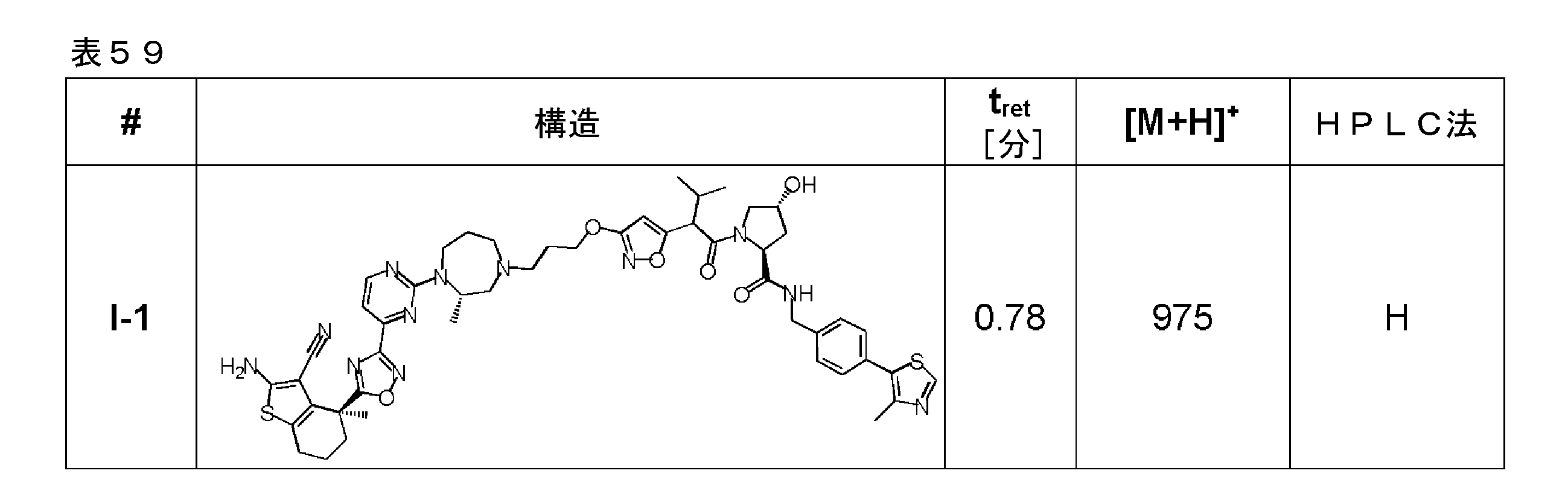


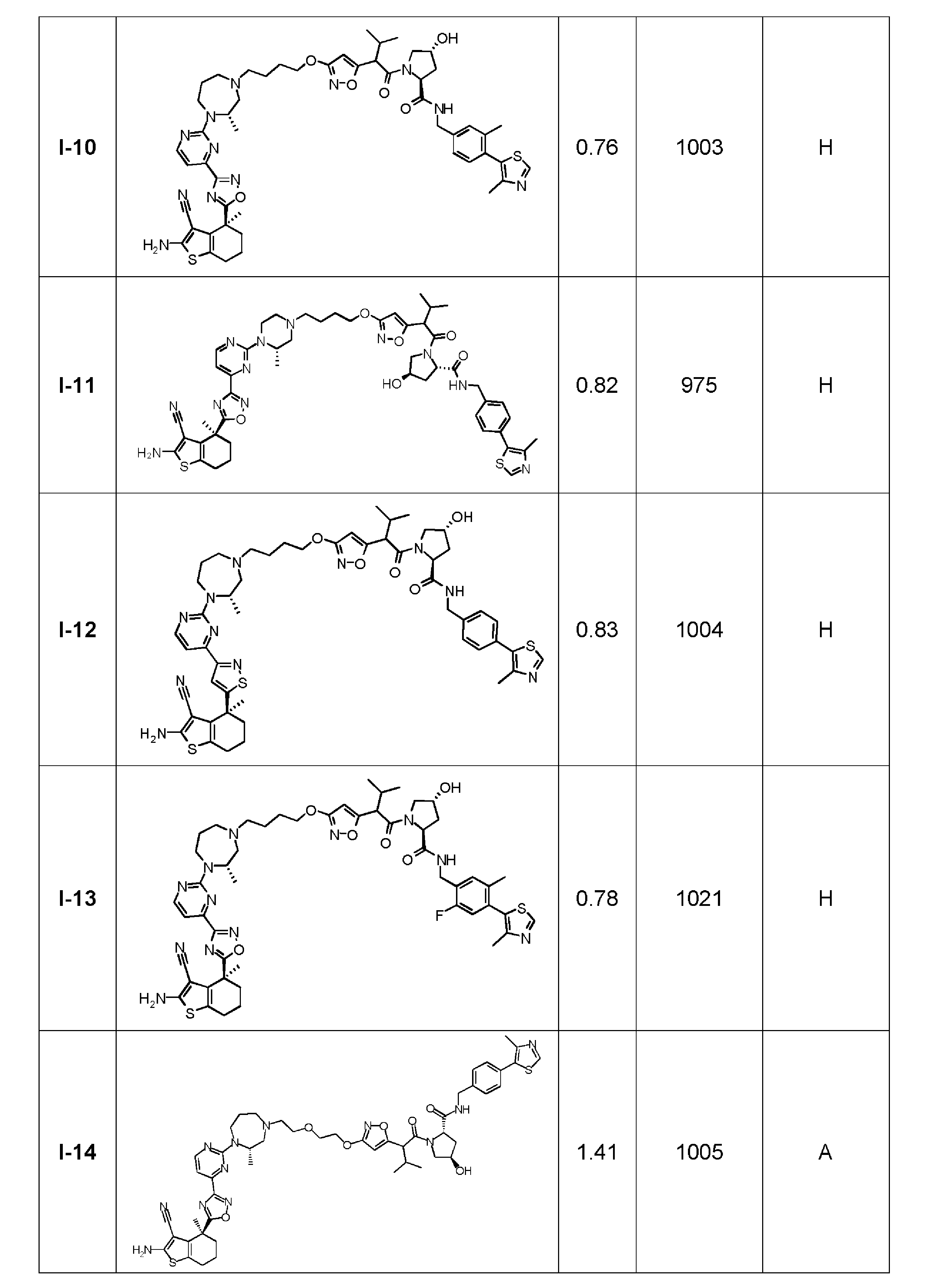


I-17の合成実験手順

DMSO(1.0mL)中のE-5b(25mg、0.032mmol、1.0eq.)、4-(アミノメチル)ベンゾニトリル塩酸塩(10mg、0.059mmol、1.8eq.)及びHATU(35mg、0.091mmol、2.8eq.)の撹拌溶液に、TEA(26μL、0.187mmol、5.8eq.)を加え、この反応混合物をrtで20分間撹拌する。変換完了後、この反応混合物をACNで希釈し、クロマトグラフにより精製して、I-16を生成する。
Experimental procedure for the synthesis of I-17
To a stirred solution of E-5b (25 mg, 0.032 mmol, 1.0 eq.), 4-(aminomethyl)benzonitrile hydrochloride (10 mg, 0.059 mmol, 1.8 eq.) and HATU (35 mg, 0.091 mmol, 2.8 eq.) in DMSO (1.0 mL) is added TEA (26 μL, 0.187 mmol, 5.8 eq.) and the reaction mixture is stirred at rt for 20 min. After complete conversion, the reaction mixture is diluted with ACN and purified by chromatography to afford I-16.
下記化合物I(表60)は、異なる中間体E-5及びA-2から開始する類似の方法で入手可能である。 The following compound I (Table 60) can be obtained in a similar manner starting from the different intermediates E-5 and A-2.


化合物Iのキラルカラムクロマトグラフィーによるキラル分離
化合物Iが、ジアステレオマーの混合物として得られた場合、それらをキラルクロマトグラフィーにより、単一の立体異性体に分離することができる。例えば、示されたように、I-1を分離して、I-24及びI-25を得た。I-3を分離して、I-26及びI-27を得た。I-35を分離して、I-40及びI-41を得た。I-36を分離して、I-42及びI-43を得た。I-37を分離して、I-44及びI-45を得た(表61)。
Chiral Separation of Compound I by Chiral Column Chromatography When compound I is obtained as a mixture of diastereomers, they can be separated into single stereoisomers by chiral chromatography. For example, as shown, I-1 was separated to give I-24 and I-25. I-3 was separated to give I-26 and I-27. I-35 was separated to give I-40 and I-41. I-36 was separated to give I-42 and I-43. I-37 was separated to give I-44 and I-45 (Table 61).


I-46の合成実験手順

THF(1mL)中のI-33(25mg、0.024mmol、1.0eq)の撹拌溶液に、LiOH溶液(18μL、0.036、1.5eq.、H2O中の2N)を加え、この反応混合物を48時間撹拌する。この反応混合物を2N HClで酸性化し、クロマトグラフィーにより精製して、I-46を得る(表62)。
Experimental procedure for the synthesis of I-46
To a stirred solution of I-33 (25 mg, 0.024 mmol, 1.0 eq) in THF (1 mL) is added LiOH solution (18 μL, 0.036, 1.5 eq., 2N in H 2 O) and the reaction mixture is stirred for 48 h. The reaction mixture is acidified with 2N HCl and purified by chromatography to give I-46 (Table 62).

I-47の合成実験手順

THF(2.0mL)及び水(2mL)中のE-2s(43mg、0.073mmol、1.0eq)の溶液に、LiOH H2O(15mg、0.36mmol)を加え、この反応混合物を室温で一晩撹拌する。この反応混合物を、水中の4M HClを使用して中和し、減圧下で濃縮する。粗製の酸中間体をDMF(2.0mL)に溶解させる。HATU(50mg、0.13mmol、1.8eq.)、HOAt(18mg、0.13mmol、1.8qe.)、(2S,4R)-1-[(2S)-2-アミノ-3,3-ジメチルブタノイル]-4-ヒドロキシ-N-{[4-(4-メチル-1,3-チアゾール-5-イル)フェニル]メチル}ピロリジン-2-カルボキサミド塩酸塩(43mg、0.073mmol、1.8eq.)及びDIPEA(35μL、0.21mmol、2.9eq.)を加える。この反応混合物を室温で一晩撹拌する。この反応混合物を減圧下で濃縮する。残留物をクロマトグラフィーにより精製して、I-47を与える。
Experimental procedure for the synthesis of I-47
To a solution of E-2s (43 mg, 0.073 mmol, 1.0 eq) in THF (2.0 mL) and water (2 mL) is added LiOH H 2 O (15 mg, 0.36 mmol) and the reaction mixture is stirred at room temperature overnight. The reaction mixture is neutralized using 4 M HCl in water and concentrated under reduced pressure. The crude acid intermediate is dissolved in DMF (2.0 mL). HATU (50 mg, 0.13 mmol, 1.8 eq.), HOAt (18 mg, 0.13 mmol, 1.8 eq.), (2S,4R)-1-[(2S)-2-amino-3,3-dimethylbutanoyl]-4-hydroxy-N-{[4-(4-methyl-1,3-thiazol-5-yl)phenyl]methyl}pyrrolidine-2-carboxamide hydrochloride (43 mg, 0.073 mmol, 1.8 eq.) and DIPEA (35 μL, 0.21 mmol, 2.9 eq.) are added. The reaction mixture is stirred at room temperature overnight. The reaction mixture is concentrated under reduced pressure. The residue is purified by chromatography to give I-47.
下記化合物I(表63)は、異なる中間体E-2から開始する類似の方法で入手可能である。 Compound I below (Table 63) can be obtained in a similar manner starting from the different intermediate E-2.

また、本発明の化合物I-49、I-50及びI-51も本明細書に記載された手順に従って、対応する構築ブロックを使用して、同様に得ることができる。 Compounds I-49, I-50 and I-51 of the present invention can also be obtained similarly using the corresponding building blocks according to the procedures described herein.
下記実施例は、本発明をこれらの実施例に限定することなく、本発明の化合物の生物学的活性を記載する。 The following examples describe the biological activity of the compounds of the present invention without limiting the invention to these examples.
生物学的実施例
HiBit分解アッセイ
HiBitタンパク質検出タグ(アミノ酸配列VSGWRLFKKIS、配列番号:1)を、HiBitタグをコードするKRAS(G12D)突然変異体ドナー構築物を使用するCRISPRベースのゲノム操作により、GP5d細胞(ECACC Cat.No.95090715)の内在性KRASローカス(Ensembl遺伝子ID ENSG00000133703.7)の開始メチオニンコドンのすぐ下流に導入した。これにより、N末端にHiBitタグが付加されたバージョンのKRAS(G12D)がKRAS(WT)アレルにヘテロ接合的に導入された。KRASローカスの正しい修飾をPCRベースの遺伝子型決定及び単離されたPCR産物のサンガー配列決定により評価した。得られた細胞系統は、GP5d-HiBit-KRAS(G12D)と呼ばれる。
Biological Examples HiBit Degradation Assay A HiBit protein detection tag (amino acid sequence VSGWRLFKKIS, SEQ ID NO:1) was introduced immediately downstream of the initiation methionine codon at the endogenous KRAS locus (Ensembl gene ID ENSG00000133703.7) of GP5d cells (ECACC Cat. No. 95090715) by CRISPR-based genome engineering using a KRAS(G12D) mutant donor construct encoding the HiBit tag. This introduced an N-terminally HiBit-tagged version of KRAS(G12D) heterozygously to the KRAS(WT) allele. Correct modification of the KRAS locus was assessed by PCR-based genotyping and Sanger sequencing of isolated PCR products. The resulting cell line is called GP5d-HiBit-KRAS(G12D).
KRAS(G12D)のPROTAC媒介性分解を評価するために、GP5d-HiBit-KRAS(G12D)細胞を、10% 牛胎児血清が補充されたダルベッコ改変イーグル培地(Sigma、cat.no.D6429) 100μLに、1ウェル当たりに25000個 細胞で、白底不透明96ウェルプレート(Perkin Elmer、cat.no.5680)に播種した。プレートを37℃、5% CO2、加湿インキュベーターで一晩インキュベーションし、細胞を接着させた。試験化合物(DMSO中の10mM ストック)を、HP Digital Dispenser D300(Tecan)を使用して対数用量系列で加え、加えられたDMSOに対して正規化した。プレートを37℃でさらに18時間インキュベーションした。インキュベーション後、キットの製造元の説明書に従って調製されたPromega Nano-Glo HiBit溶解検出試薬ミックス(Promega Nano-Glo HiBit Lytic Detection System #N3050)を1ウェル当たりに100μL加えた。細胞溶解を十分に行うために、プレートをオービタルシェーカーで15分間インキュベーションし、さらに室温で30分間インキュベーションした。細胞溶解完了後、発光を、96ウェルプレート用のUltrasensitive Luminescence Protocolを使用し、Envisionプレートリーダーを使用して測定した。発光レベルをDMSO処理サンプルで得られた値により正規化し、% DMSO対照としてプロットした。DC50値を、4パラメトリックロジスティックモデルを使用して計算した。Dmax値は、観察された分解の最大範囲を表わし、% 対照(% Ctrl.)処理として記載される。DC50及びDmaxを本発明の代表的な化合物について、表64に報告する。 To assess PROTAC-mediated degradation of KRAS(G12D), GP5d-HiBit-KRAS(G12D) cells were seeded in white-bottom opaque 96-well plates (Perkin Elmer, cat. no. 5680) at 25,000 cells per well in 100 μL of Dulbecco's modified Eagle's medium (Sigma, cat. no. D6429) supplemented with 10% fetal bovine serum. Plates were incubated overnight at 37°C in a 5% CO2 humidified incubator to allow cells to adhere. Test compounds (10 mM stock in DMSO) were added in a log dose series using a HP Digital Dispenser D300 (Tecan) and normalized to DMSO added. Plates were incubated for an additional 18 hours at 37°C. After incubation, 100 μL of Promega Nano-Glo HiBit Lytic Detection Reagent Mix (Promega Nano-Glo HiBit Lytic Detection System #N3050) prepared according to the kit manufacturer's instructions was added per well. To ensure complete cell lysis, the plates were incubated on an orbital shaker for 15 minutes and then at room temperature for an additional 30 minutes. After cell lysis was complete, luminescence was measured using an Envision plate reader using the Ultrasensitive Luminescence Protocol for 96-well plates. Luminescence levels were normalized by values obtained with DMSO-treated samples and plotted as % DMSO control. DC 50 values were calculated using a four-parametric logistic model. Dmax values represent the maximum extent of degradation observed and are reported as % control (% Ctrl.) treatment. DC 50 and Dmax are reported in Table 64 for representative compounds of the invention.


HiBit KRAS4B突然変異体スペクトル分解アッセイ
治療に関連する突然変異型KRAS構築物(WT、G12C、G12D、G12V、G13D)を、KRAS4B WT cDNA構築物をテンプレートとして使用して、部位特異的突然変異誘発により得た。GP5d細胞(ECACC Cat.No.95090715)を、CMVプロモーターの制御下で突然変異型KRAS4B cDNAを発現するレンチウイルスベクターによりトランスダクションした。安定にトランスダクションされた細胞を、この構築物にコードされたネオマイシン選択マーカーを使用して選択した。
HiBit KRAS4B Mutant Spectral Resolution Assay Therapeutically relevant mutant KRAS constructs (WT, G12C, G12D, G12V, G13D) were obtained by site-directed mutagenesis using the KRAS4B WT cDNA construct as a template. GP5d cells (ECACC Cat. No. 95090715) were transduced with a lentiviral vector expressing mutant KRAS4B cDNA under the control of the CMV promoter. Stably transduced cells were selected using the neomycin selection marker encoded by the construct.
種々のKRAS突然変異体のPROTAC媒介性分解を評価するために、上記されたKRAS4B構築物で安定にトランスダクションされたGP5d細胞を、10% 牛胎児血清が補充されたダルベッコ改変イーグル培地(Sigma、cat.no.D6429) 100μLに、1ウェル当たりに25000個 細胞で、白底不透明96ウェルプレート(Perkin Elmer、cat.no.5680)に播種した。プレートを37℃、5% CO2、加湿インキュベーターで一晩インキュベーションし、細胞を接着させた。試験化合物(DMSO中の10mM ストック)を、HP Digital Dispenser D300(Tecan)を使用して対数用量系列で加え、加えられたDMSOに対して正規化した。プレートを37℃でさらに18時間インキュベーションした。インキュベーション後、キットの製造元の説明書に従って調製されたPromega Nano-Glo HiBit溶解検出試薬ミックス(Promega Nano-Glo HiBit Lytic Detection System #N3050)を1ウェル当たりに100μL加えた。細胞溶解を十分に行うために、プレートをオービタルシェーカーで15分間インキュベーションし、さらに室温で30分間インキュベーションした。細胞溶解完了後、発光を、96ウェルプレート用のUltrasensitive Luminescence Protocolを使用し、Envisionプレートリーダーを使用して測定した。発光レベルをDMSO処理サンプルで得られた値により正規化し、% DMSO対照としてプロットした。DC50値を、4パラメトリックロジスティックモデルを使用して計算し、本発明の代表的な実施例(Ex.)化合物について表65にnM単位で報告する。Dmax値は、観察された分解の最大範囲を表わし、本発明の代表的な実施例(Ex.)化合物について、表66に% 対照(% Ctrl.)処理として記載される。 To evaluate PROTAC-mediated degradation of various KRAS mutants, GP5d cells stably transduced with the KRAS4B constructs described above were seeded in white-bottom opaque 96-well plates (Perkin Elmer, cat. no. 5680) at 25,000 cells per well in 100 μL of Dulbecco's modified Eagle's medium (Sigma, cat. no. D6429) supplemented with 10% fetal bovine serum. Plates were incubated overnight at 37°C in a 5% CO2 humidified incubator to allow cells to adhere. Test compounds (10 mM stock in DMSO) were added in a log dose series using a HP Digital Dispenser D300 (Tecan) and normalized to the DMSO added. Plates were incubated for an additional 18 hours at 37°C. After incubation, 100 μL of Promega Nano-Glo HiBit Lytic Detection Reagent Mix (Promega Nano-Glo HiBit Lytic Detection System #N3050) prepared according to the kit manufacturer's instructions was added per well. To ensure sufficient cell lysis, the plate was incubated on an orbital shaker for 15 minutes and then incubated at room temperature for an additional 30 minutes. After cell lysis was complete, luminescence was measured using an Envision plate reader using the Ultrasensitive Luminescence Protocol for 96-well plates. Luminescence levels were normalized by values obtained with DMSO-treated samples and plotted as % DMSO control. DC 50 values were calculated using a four-parametric logistic model and are reported in nM in Table 65 for representative Example (Ex.) compounds of the present invention. Dmax values represent the maximum extent of degradation observed and are reported as % Control (% Ctrl.) treatment in Table 66 for representative Example (Ex.) compounds of the present invention.


突然変異型ガン細胞系統を使用した追加の増殖アッセイ
・NCI-H358 CTG増殖アッセイ(120時間)(NSCLC、G12C)
NCI-H358細胞(ATCC No.CRL-5807)を、RPMI-1640 ATCC-Formulation(Gibco #A10491)+10% FCS(牛胎児血清)(アッセイ1) 100μLに、1ウェル当たりに2000個 細胞の密度で、白底不透明96ウェルプレート(PerkinElmer cat no.5680)に又はRPMI-1640 ATCC-Formulation(Gibco #A10491)+10% FCS(牛胎児血清)(アッセイ2) 60μLに、1ウェル当たりに200個 細胞の密度で、平底透明の黒色384ウェルプレート(Greiner、PNr.781091)に分注する。細胞を37℃で、5% CO2での加湿組織培養インキュベーターにおいて、一晩インキュベーションする。化合物(DMSO中の10mM ストック)を、DMSO対照を含めて、HP Digital Dispenser D300(Tecan)(アッセイ1)又はECHO acoustic liquid handler system(Beckman Coulter)(アッセイ2)を使用して対数用量系列で加え、加えられたDMSOに対して正規化する。T0時点の測定では、未処理細胞を化合物添加時に分析する。プレートを120時間インキュベーションし、細胞生存率を、CellTiter-Glo発光細胞生存率試薬(Promega 製品コードG7570)を使用して測定する。生存率(% 対照として記載)を、各ウェルの相対発光単位RLUをDMSO対照の細胞のRLUで割ったものとして定義する。IC50値を、4パラメーターモデルを使用した非線形回帰により、生存率の測定値から決定する。
Additional proliferation assays using mutant cancer cell lines: NCI-H358 CTG proliferation assay (120 hours) (NSCLC, G12C)
NCI-H358 cells (ATCC No. CRL-5807) are dispensed into white bottom opaque 96 well plates (PerkinElmer cat no. 5680) at a density of 2000 cells per well in 100 μL of RPMI-1640 ATCC-Formulation (Gibco #A10491) + 10% FCS (fetal calf serum) (assay 1) or into flat bottom clear black 384 well plates (Greiner, PNr. 781091) at a density of 200 cells per well in 60 μL of RPMI-1640 ATCC-Formulation (Gibco #A10491) + 10% FCS (fetal calf serum) (assay 2). Cells are incubated overnight at 37° C. in a humidified tissue culture incubator with 5% CO 2 . Compounds (10 mM stock in DMSO), including a DMSO control, are added in a log dose series using an HP Digital Dispenser D300 (Tecan) (assay 1) or an ECHO acoustic liquid handler system (Beckman Coulter) (assay 2) and normalized to the added DMSO. For TO time point measurements, untreated cells are analyzed at the time of compound addition. Plates are incubated for 120 hours and cell viability is measured using CellTiter-Glo Luminescent Cell Viability Reagent (Promega product code G7570). Viability (listed as % control) is defined as the relative luminescence units (RLU) of each well divided by the RLU of the DMSO control cells. IC50 values are determined from the viability measurements by nonlinear regression using a four-parameter model.
・AsPC-1 CTG増殖アッセイ(120時間)(膵臓ガン、G12D)
CTGアッセイを、CellTiter Glowアッセイキット(Promega G7571)を使用して、AsPC-1細胞(ATCCC RL-5985)の増殖を定量的に測定するように設計する。細胞を牛胎児血清(Life Technologies、Gibco BRL、Cat.No.10270-106)が補充されたRPMI培地(ATCC)中で増殖させる。「0日目」に、2000個 AsPC-1細胞を平底透明384ウェルプレート(Greiner、PNr.781091)中のRPMI ATCC+10% FCS+Penstrep 60μLに播種する。ついで、細胞をこのプレートにおいて、37℃で、CO2インキュベーター内で一晩インキュベーションする。1日目に、化合物(DMSO中の10mM ストック)を、DMSO対照を含めて、ECHO acoustic liquid handler system(Beckman Coulter)で加える。プレートを120時間インキュベーションし、細胞生存率を、CellTiter-Glo発光細胞生存率試薬(Promega 製品コードG7570)を使用して測定する。生存率(% 対照として記載)を、各ウェルの相対発光単位RLUをDMSO対照の細胞のRLUで割ったものとして定義する。IC50値を、4パラメーターモデルを使用した非線形回帰により、生存率の測定値から決定sうる。
AsPC-1 CTG proliferation assay (120 hours) (pancreatic cancer, G12D)
The CTG assay is designed to quantitatively measure the proliferation of AsPC-1 cells (ATCC RL-5985) using the CellTiter Glow assay kit (Promega G7571). Cells are grown in RPMI medium (ATCC) supplemented with fetal bovine serum (Life Technologies, Gibco BRL, Cat. No. 10270-106). On "day 0", 2000 AsPC-1 cells are seeded in 60 μL of RPMI ATCC + 10% FCS + Penstrep in a flat-bottom clear 384-well plate (Greiner, PNr. 781091). Cells are then incubated in the plate overnight at 37° C. in a CO 2 incubator. On day 1, compounds (10 mM stock in DMSO) are added with an ECHO acoustic liquid handler system (Beckman Coulter), including a DMSO control. Plates are incubated for 120 hours and cell viability is measured using the CellTiter-Glo luminescent cell viability reagent (Promega product code G7570). Viability (listed as % control) is defined as the relative luminescence units, RLU, of each well divided by the RLU of the DMSO control cells. IC50 values can be determined from the viability measurements by nonlinear regression using a four-parameter model.
・GP2D増殖アッセイ(120時間)(大腸ガン、G12D)
GP2D細胞(ATCC No.CRL-5807)を、DMEM(Sigma、D6429)+1×GlutaMAX(Gibco、35050038)+10% FCS(牛胎児血清) 40μLに、1ウェル当たりに500個 細胞の密度で、白平底の白色384ウェルプレート(PerkinElmer、6007680)に分注する。細胞を37℃で、5% CO2での加湿組織培養インキュベーターにおいて、一晩インキュベーションする。化合物(DMSO中の10mM ストック)を、DMSO対照を含めて、HP Digital Dispenser D300(Tecan)(アッセイ1)を使用して対数用量系列で加え、加えられたDMSOに対して正規化する。T0時点の測定では、未処理細胞を化合物添加時に分析する。プレートを120時間インキュベーションし、細胞生存率を、CellTiter-Glo発光細胞生存率試薬(Promega 製品コードG7570)を使用して測定する。生存率(% 対照として記載)を、各ウェルの相対発光単位RLUをDMSO対照の細胞のRLUで割ったものとして定義する。IC50値を、4パラメーターモデルを使用した非線形回帰により、生存率の測定値から決定する。
GP2D proliferation assay (120 hours) (colon cancer, G12D)
GP2D cells (ATCC No. CRL-5807) are dispensed into white flat-bottom 384-well plates (PerkinElmer, 6007680) at a density of 500 cells per well in 40 μL of DMEM (Sigma, D6429) + 1×GlutaMAX (Gibco, 35050038) + 10% FCS (fetal calf serum). Cells are incubated overnight in a humidified tissue culture incubator at 37° C. with 5% CO 2. Compounds (10 mM stock in DMSO), including DMSO controls, are added in a log dose series using a HP Digital Dispenser D300 (Tecan) (Assay 1) and normalized to the DMSO added, for TO time point measurements, untreated cells are analyzed at the time of compound addition. Plates are incubated for 120 hours and cell viability is measured using CellTiter-Glo Luminescent Cell Viability Reagent (Promega product code G7570). Viability (listed as % control) is defined as the relative luminescence units (RLU) of each well divided by the RLU of DMSO control cells. IC50 values are determined from the viability measurements by nonlinear regression using a four-parameter model.
・SAS CTG増殖アッセイ(120時間)(HNSCC、wt増幅型)
SAS細胞(JCRB0260)を、DMEM:F12(Gibco 31330-038)+10% 牛胎児血清(HycClone、PNr.:SH30084.03) 60μLに、1ウェル当たりに300個 細胞の密度で、平底透明384ウェルプレート(Greiner、PNr.781091)に分注し、37℃でCO2インキュベーターにおいて、一晩インキュベーションする。翌日、化合物(DMSO中の10mM ストック)を、DMSO対照を含めて、ECHO acoustic liquid handler system(Beckman Coulter)で加える。プレートを120時間インキュベーションし、細胞生存率を、CellTiter-Glo発光細胞生存率試薬(Promega 製品コードG7570)を使用して測定する。生存率(% 対照として記載)を、各ウェルの相対発光単位RLUをDMSO対照の細胞のRLUで割ったものとして定義する。IC50値を、4パラメーターモデルを使用した非線形回帰により、生存率の測定値から決定する。
SAS CTG proliferation assay (120 hours) (HNSCC, wt amplified)
SAS cells (JCRB0260) are dispensed into flat-bottom clear 384-well plates (Greiner, PNr. 781091) at a density of 300 cells per well in 60 μL of DMEM:F12 (Gibco 31330-038) + 10% fetal bovine serum (HycClone, PNr.: SH30084.03) and incubated overnight at 37°C in a CO2 incubator. The following day, compounds (10 mM stock in DMSO) are added, including a DMSO control, with an ECHO acoustic liquid handler system (Beckman Coulter). Plates are incubated for 120 hours and cell viability is measured using the CellTiter-Glo luminescent cell viability reagent (Promega product code G7570). Viability (reported as % control) is defined as the relative luminescence units (RLU) of each well divided by the RLU of DMSO control cells. IC50 values are determined from the viability measurements by nonlinear regression using a four-parameter model.
・SK-CO-1 CTG増殖アッセイ(120時間)(CRC、G12V)
SK-CO-1細胞(ATCC HTB-39)を、EMEM(Sigma M5650)+10% 牛胎児血清(HycClone、PNr.:SH30084.03) 60μLに、1ウェル当たりに500個 細胞の密度で、平底透明384ウェルプレート(Greiner、PNr.781091)に分注し、37℃でCO2インキュベーターにおいて、一晩インキュベーションする。翌日、化合物(DMSO中の10mM ストック)を、DMSO対照を含めて、ECHO acoustic liquid handler system(Beckman Coulter)で加える。プレートを120時間インキュベーションし、細胞生存率を、CellTiter-Glo発光細胞生存率試薬(Promega 製品コードG7570)を使用して測定する。生存率(% 対照として記載)を、各ウェルの相対発光単位RLUをDMSO対照の細胞のRLUで割ったものとして定義する。IC50値を、4パラメーターモデルを使用した非線形回帰により、生存率の測定値から決定する。
SK-CO-1 CTG proliferation assay (120 hours) (CRC, G12V)
SK-CO-1 cells (ATCC HTB-39) are dispensed into flat-bottom clear 384-well plates (Greiner, PNr. 781091) at a density of 500 cells per well in 60 μL EMEM (Sigma M5650) + 10% fetal bovine serum (HycClone, PNr.: SH30084.03) and incubated overnight at 37°C in a CO2 incubator. The following day, compounds (10 mM stock in DMSO) are added, including a DMSO control, with an ECHO acoustic liquid handler system (Beckman Coulter). Plates are incubated for 120 hours and cell viability is measured using the CellTiter-Glo luminescent cell viability reagent (Promega product code G7570). Viability (reported as % control) is defined as the relative luminescence units (RLU) of each well divided by the RLU of DMSO control cells. IC50 values are determined from the viability measurements by nonlinear regression using a four-parameter model.
・LOVO CTG増殖アッセイ(120時間)(CRC、G13D)
LOVO細胞(ATCC CCL-229)を、DMEM(Sigma D6429)+10% 牛胎児血清(HycClone、PNr.:SH30084.03) 60μLに、1ウェル当たりに1000個 細胞の密度で、平底透明384ウェルプレート(Greiner、PNr.781091)に分注し、37℃でCO2インキュベーターにおいて、一晩インキュベーションする。翌日、化合物(DMSO中の10mM ストック)を、DMSO対照を含めて、ECHO acoustic liquid handler system(Beckman Coulter)で加える。プレートを120時間インキュベーションし、細胞生存率を、CellTiter-Glo発光細胞生存率試薬(Promega 製品コードG7570)を使用して測定する。生存率(% 対照として記載)を、各ウェルの相対発光単位RLUをDMSO対照の細胞のRLUで割ったものとして定義する。IC50値を、4パラメーターモデルを使用した非線形回帰により、生存率の測定値から決定する。
LOVO CTG Proliferation Assay (120 hours) (CRC, G13D)
LOVO cells (ATCC CCL-229) are dispensed into flat-bottom clear 384-well plates (Greiner, PNr. 781091) at a density of 1000 cells per well in 60 μL of DMEM (Sigma D6429) + 10% fetal bovine serum (HycClone, PNr.: SH30084.03) and incubated overnight at 37°C in a CO2 incubator. The following day, compounds (10 mM stock in DMSO) are added, including a DMSO control, with an ECHO acoustic liquid handler system (Beckman Coulter). Plates are incubated for 120 hours and cell viability is measured using the CellTiter-Glo luminescent cell viability reagent (Promega product code G7570). Viability (reported as % control) is defined as the relative luminescence units (RLU) of each well divided by the RLU of DMSO control cells. IC50 values are determined from the viability measurements by nonlinear regression using a four-parameter model.
・GP5d細胞増殖アッセイ(大腸ガン、G12D)
GP5d細胞(ECACC 95090715)を、10% FCSが補充されたDMEM(BioWhittaker、Cat# BE12-605F) 100μLに、1ウェル当たりに5000個 細胞の密度で、白底不透明96ウェルプレートに分注する。細胞を37℃で、5% CO2での加湿組織培養インキュベーターにおいて、一晩インキュベーションする。化合物(DMSO中の10mM ストック)を、HP Digital Dispenser D300(Tecan)を使用して対数用量系列で加え、加えられたDMSOに対して正規化する。T0時点の測定では、未処理細胞を化合物添加時に分析する。プレートを5日間インキュベーションし、細胞生存率を、CellTiter-Glo発光細胞生存率試薬(Promega 製品コードG7570)を使用して測定する。生存率(% 対照として記載)を、各ウェルの相対発光単位RLUをDMSO対照の細胞のRLUで割ったものとして定義する。IC50値を、4パラメーターロジスティックモデルを使用して、相対生存率の値から計算した。
GP5d cell proliferation assay (colon cancer, G12D)
GP5d cells (ECACC 95090715) are dispensed into white bottom opaque 96 well plates at a density of 5000 cells per well in 100 μL DMEM (BioWhittaker, Cat# BE12-605F) supplemented with 10% FCS. Cells are incubated overnight in a humidified tissue culture incubator at 37° C. with 5% CO2 . Compounds (10 mM stocks in DMSO) are added in a log dose series using a HP Digital Dispenser D300 (Tecan) and normalized to the DMSO added. For TO time point measurements, untreated cells are analyzed at the time of compound addition. Plates are incubated for 5 days and cell viability is measured using the CellTiter-Glo Luminescent Cell Viability Reagent (Promega product code G7570). Viability (reported as % control) is defined as the relative luminescence units (RLU) of each well divided by the RLU of DMSO control cells. IC50 values were calculated from the relative viability values using a four-parameter logistic model.
・SW620細胞増殖アッセイ(大腸ガン、G12V)
SW620細胞(ATCC CCL-227)を、10% FCSが補充されたDMEM(BioWhittaker、Cat# BE12-605F) 100μLに、1ウェル当たりに2000個 細胞の密度で、白底不透明96ウェルプレートに分注する。細胞を37℃で、5% CO2での加湿組織培養インキュベーターにおいて、一晩インキュベーションする。化合物(DMSO中の10mM ストック)を、HP Digital Dispenser D300(Tecan)を使用して対数用量系列で加え、加えられたDMSOに対して正規化する。T0時点の測定では、未処理細胞を化合物添加時に分析する。プレートを5日間インキュベーションし、細胞生存率を、CellTiter-Glo発光細胞生存率試薬(Promega 製品コードG7570)を使用して測定する。生存率(% 対照として記載)を、各ウェルの相対発光単位RLUをDMSO対照の細胞のRLUで割ったものとして定義する。IC50値を、4パラメーターモデルを使用して、相対生存率の値から計算する。
SW620 cell proliferation assay (colon cancer, G12V)
SW620 cells (ATCC CCL-227) are dispensed into white bottom opaque 96-well plates at a density of 2000 cells per well in 100 μL DMEM (BioWhittaker, Cat# BE12-605F) supplemented with 10% FCS. Cells are incubated overnight in a humidified tissue culture incubator at 37° C. with 5% CO2. Compounds (10 mM stocks in DMSO) are added in a log dose series using a HP Digital Dispenser D300 (Tecan) and normalized to the DMSO added. For TO time point measurements, untreated cells are analyzed at the time of compound addition. Plates are incubated for 5 days and cell viability is measured using the CellTiter-Glo Luminescent Cell Viability Reagent (Promega product code G7570). Viability (reported as % control) is defined as the relative luminescence units RLU of each well divided by the RLU of DMSO control cells. IC50 values are calculated from the relative viability values using a four parameter model.
・A375 CTG増殖アッセイ(120時間)(メラノーマ、wt、B-Raf突然変異型、陰性対照)
A375細胞(ATCC CRL-1619)をDMEM(Sigma D6429)+10% 牛胎児血清(HycClone、PNr.:SH30084.03) 60μLに、1ウェル当たりに300個 細胞の密度で、平底透明384ウェルプレート(Greiner、PNr.781091)に分注し、37℃でCO2インキュベーターにおいて、一晩インキュベーションする。翌日、化合物(DMSO中の10mM ストック)を、DMSO対照を含めて、HP Digital Dispenser D300(Tecan)を使用して対数用量系列で加える。プレートを120時間インキュベーションし、細胞生存率を、CellTiter-Glo発光細胞生存率試薬(Promega 製品コードG7570)を使用して測定する。生存率(% 対照として記載)を、各ウェルの相対発光単位RLUをDMSO対照の細胞のRLUで割ったものとして定義する。IC50値を、4パラメーターモデルを使用した非線形回帰により、生存率の測定値から決定する。
A375 CTG proliferation assay (120 hours) (melanoma, wt, B-Raf mutant, negative control)
A375 cells (ATCC CRL-1619) are dispensed into flat-bottom clear 384-well plates (Greiner, PNr. 781091) at a density of 300 cells per well in 60 μL DMEM (Sigma D6429) + 10% fetal bovine serum (HycClone, PNr.: SH30084.03) and incubated overnight at 37°C in a CO2 incubator. The following day, compounds (10 mM stock in DMSO) are added in a logarithmic dose series, including a DMSO control, using a HP Digital Dispenser D300 (Tecan). Plates are incubated for 120 hours and cell viability is measured using the CellTiter-Glo Luminescent Cell Viability Reagent (Promega product code G7570). Viability (reported as % control) is defined as the relative luminescence units (RLU) of each well divided by the RLU of DMSO control cells. IC50 values are determined from the viability measurements by nonlinear regression using a four-parameter model.
示された細胞系統におけるこれらのアッセイにより測定された本発明の代表的な化合物のIC50値を表67に示す。 The IC 50 values of representative compounds of the present invention as determined by these assays in the indicated cell lines are shown in Table 67.


配合
以下の配合実施例により、本発明の範囲を限定することなく、本発明が例証される。
Formulations The following formulation examples illustrate the invention without limiting its scope.
医薬製剤の実施例
A)錠剤 錠剤当たり
式(I)で示される活性物質 100mg
ラクトース 140mg
コーンスターチ 240mg
ポリビニルピロリドン 15mg
ステアリン酸マグネシウム 5mg
500mg
Examples of pharmaceutical preparations A) Tablets 100 mg of active substance of formula (I) per tablet
Lactose 140mg
Cornstarch 240mg
Polyvinylpyrrolidone 15mg
Magnesium stearate 5mg
500mg
微粉砕された活性物質、ラクトース及びコーンスターチの一部同士を混合する。この混合物をふるい分けし、ついで、水中のポリビニルピロリドンの溶液で湿らせ、混錬し、湿式造粒し、乾燥させる。この顆粒、残りのコーンスターチ及びステアリン酸マグネシウムをふるい分けし、これらを混合する。この混合物を圧縮して、適切な形状及びサイズの錠剤を製造する。 The finely milled active substance, lactose and part of the corn starch are mixed together. The mixture is screened, then moistened with a solution of polyvinylpyrrolidone in water, kneaded, wet granulated and dried. The granules, the remaining corn starch and magnesium stearate are screened and mixed together. The mixture is compressed to produce tablets of suitable shape and size.
B)錠剤 錠剤あたり
式(I)で示される活性物質 80mg
ラクトース 55mg
コーンスターチ 190mg
微結晶セルロース 35mg
ポリビニルピロリドン 15mg
カルボキシメチルデンプンナトリウム 23mg
ステアリン酸マグネシウム 2mg
400mg
B) Tablets: 80 mg of active substance of formula (I) per tablet.
Lactose 55mg
Cornstarch 190mg
Microcrystalline cellulose 35mg
Polyvinylpyrrolidone 15mg
Sodium carboxymethyl starch 23mg
Magnesium stearate 2mg
400mg
微粉砕された活性物質、コーンスターチの一部、ラクトース、微結晶セルロース及びポリビニルピロリドン同士を混合する。この混合物をふるい分けし、残りのコーンスターチ及び水を加えて、顆粒を形成する。この顆粒を乾燥させ、ふるい分けする。カルボキシメチルデンプンナトリウム及びステアリン酸マグネシウムを加え、混合し、この混合物を圧縮して、適切なサイズの錠剤を形成する。 Mix the finely ground active substance, a portion of the corn starch, lactose, microcrystalline cellulose and polyvinylpyrrolidone together. Screen the mixture and add the remaining corn starch and water to form granules. Dry the granules and screen. Add sodium carboxymethyl starch and magnesium stearate, mix and compress the mixture to form tablets of suitable size.
C)錠剤 錠剤あたり
式(I)で示される活性物質 25mg
ラクトース 50mg
微結晶セルロース 24mg
ステアリン酸マグネシウム 1mg
100mg
C) Tablets 25 mg of active substance of formula (I) per tablet
Lactose 50mg
Microcrystalline cellulose 24mg
Magnesium stearate 1mg
100mg
活性物質、ラクトース及びセルロース同士を混合する。この混合物をふるい分けし、ついで、水で湿らせ、混錬し、湿式造粒し、乾燥させるかもしくは乾式造粒するか又は直接ステアリン酸マグネシウムと最終ブレンドし、適切な形状及びサイズの錠剤に圧縮するかのいずれかをする。湿式造粒する場合、追加のラクトース又はセルロース及びステアリン酸マグネシウムを加え、この混合物を圧縮して、適切な形状及びサイズの錠剤を製造する。 The active substance, lactose and cellulose are mixed together. The mixture is screened and then either moistened with water, kneaded, wet granulated, dried or dry granulated or final blended directly with magnesium stearate and compressed into tablets of suitable shape and size. If wet granulated, additional lactose or cellulose and magnesium stearate are added and the mixture is compressed to produce tablets of suitable shape and size.
D)アンプル液
式(I)で示される活性物質 50mg
塩化ナトリウム 50mg
注射用水 5mL
D) Ampoule containing 50 mg of the active substance of formula (I)
Sodium chloride 50mg
Water for injection 5mL
活性物質をそれ自体のpH又は場合により、pH5.5~6.5の水に溶解させ、塩化ナトリウムを加えて、等張にする。得られた溶液を、発熱物質を含まないようにろ過し、ろ液を無菌条件下でアンプルに移す。ついで、このアンプルを滅菌し、融着により密封する。このアンプルは、5mg、25mg及び50mg 活性物質を含有する。 The active substance is dissolved in water at its own pH or, optionally, at pH 5.5-6.5 and made isotonic by adding sodium chloride. The resulting solution is filtered free of pyrogens and the filtrate is transferred under aseptic conditions into ampoules. The ampoules are then sterilized and sealed by fusion. The ampoules contain 5 mg, 25 mg and 50 mg active substance.
Claims (31)

[式中、
R1a及びR1bは、それぞれ独立して、水素、C1-4アルキル、C1-4ハロアルキル、C1-4アルコキシ、C1-4ハロアルコキシ、ハロゲン、-NH2、-NH(C1-4アルキル)、-N(C1-4アルキル)2、C3-5シクロアルキル及び3~5員のヘテロシクロアルキルからなる群より選択され、
R2a及びR2bは、それぞれ独立して、水素、C1-4アルキル、C1-4ハロアルキル、C1-4アルコキシ、C1-4ハロアルコキシ、ハロゲン、-NH2、-NH(C1-4アルキル)、-N(C1-4アルキル)2、C3-5シクロアルキル及び3~5員のヘテロシクロアルキルからなる群より選択され及び/又は
場合により、R1a又はR1bのうちの1つ及びR2a又はR2bのうちの1つは、それらが結合している炭素原子と一緒になって、シクロプロパン環を形成しており、
Zは、-(CR3aR3b)n-であり、
各R3a及びR3bは、独立して、水素、C1-4アルキル、C1-4ハロアルキル、C1-4アルコキシ、C1-4ハロアルコキシ、ハロゲン、-NH2、-NH(C1-4アルキル)、-N(C1-4アルキル)2、C3-5シクロアルキル及び3~5員のヘテロシクロアルキルからなる群より選択され又は
R3a及びR3bは、それらが結合している炭素原子と一緒になって、シクロプロパン環を形成しており、
nは、0、1及び2からなる群より選択され、
R4は、水素、C1-6アルキル、C1-6ハロアルキル、C1-6アルコキシ、C1-6ハロアルコキシ、シアノ-C1-6アルキル、ハロゲン、-OH、-NH2、-NH(C1-4アルキル)、-N(C1-4アルキル)2、-CN、C3-5シクロアルキル及び3~5員のヘテロシクロアルキルからなる群より選択され、
環Aは、5員のヘテロアリーレンであり、
R5が存在する場合、各R5は、独立して、C1-6アルキル、C1-6ハロアルキル、C1-6アルコキシ、C1-6ハロアルコキシ、シアノ-C1-6アルキル、ハロゲン、-OH、-NH2、-NH(C1-4アルキル)、-N(C1-4アルキル)2、-CN、C3-5シクロアルキル及び3~5員のヘテロシクロアルキルからなる群より選択され、
mは、0、1、2及び3からなる群より選択され、
Wは、窒素(-N=)又は-CH=であり、
Vは、窒素(-N=)又は-CH=であり、
Uは、窒素(-N=)又は-C(R11)=であり、
R11は、水素、ハロゲン及びC1-4アルコキシから選択され、
環Bは、1つ以上の同一又は異なるC1-6アルキル、C1-6アルコキシ又は5~6員のヘテロシクロアルキルにより場合により置換されている3~11員のヘテロシクロアルキレンであり、ここで、C1-6アルキルは、シクロプロピルにより場合により置換されており、
Lは、結合、C1-8アルキレン、C2-8アルケニレン、C2-8アルキニレン及びC1-8アルコキシレンからなる群より選択され、
Xは、-(CH2)-又は-O-であり、
Yは、5員のヘテロアリーレン又は-C(O)(NR12)-であり、ここで、前記5員のヘテロアリーレンは、少なくとも1つの窒素原子を含み、ここで、前記-C(O)(NR12)-は、C原子を介してXに連結しており、
R9は、C1-4アルキルであり、
R10は、水素、C1-6アルキル、C1-6アルコキシ、-C(O)R12及び-C(O)OR12からなる群より選択され、ここで、前記C1-6アルキルは、-OH又は-OP(O)(OH)2により場合により置換されており、
各R12は、独立して、水素又はC1-4アルキルであり、
qは、0、1及び2からなる群より選択され、
R6が存在する場合、各R6は、それぞれ独立して、ハロゲン又はC1-3アルキルであり、
R7は、ハロゲン、C1-3アルキル、-CN及び5員のヘテロアリールからなる群より選択され、ここで、前記5員のヘテロアリールは、少なくとも1つの窒素原子を含み、R8により場合により置換されており、
R8は、C1-3アルキル又はC1-3ヒドロキシアルキルである]
で示される化合物又はその塩。 Formula (I):
[Wherein,
R 1a and R 1b are each independently selected from the group consisting of hydrogen, C 1-4 alkyl, C 1-4 haloalkyl, C 1-4 alkoxy, C 1-4 haloalkoxy, halogen, -NH 2 , -NH(C 1-4 alkyl), -N(C 1-4 alkyl) 2 , C 3-5 cycloalkyl, and 3- to 5-membered heterocycloalkyl;
R 2a and R 2b are each independently selected from the group consisting of hydrogen, C 1-4 alkyl, C 1-4 haloalkyl, C 1-4 alkoxy, C 1-4 haloalkoxy, halogen, -NH 2 , -NH(C 1-4 alkyl), -N(C 1-4 alkyl) 2 , C 3-5 cycloalkyl and 3-5 membered heterocycloalkyl; and/or optionally one of R 1a or R 1b and one of R 2a or R 2b together with the carbon atom to which they are attached form a cyclopropane ring;
Z is -( CR3aR3b ) n- ;
each R 3a and R 3b is independently selected from the group consisting of hydrogen, C 1-4 alkyl, C 1-4 haloalkyl, C 1-4 alkoxy, C 1-4 haloalkoxy, halogen, -NH 2 , -NH(C 1-4 alkyl), -N(C 1-4 alkyl) 2 , C 3-5 cycloalkyl and 3- to 5-membered heterocycloalkyl; or R 3a and R 3b together with the carbon atom to which they are attached form a cyclopropane ring;
n is selected from the group consisting of 0, 1 and 2;
R 4 is selected from the group consisting of hydrogen, C 1-6 alkyl, C 1-6 haloalkyl, C 1-6 alkoxy, C 1-6 haloalkoxy, cyano-C 1-6 alkyl, halogen, -OH, -NH 2 , -NH(C 1-4 alkyl), -N(C 1-4 alkyl) 2 , -CN, C 3-5 cycloalkyl and 3- to 5-membered heterocycloalkyl;
Ring A is a 5-membered heteroarylene;
When R 5 is present, each R 5 is independently selected from the group consisting of C 1-6 alkyl, C 1-6 haloalkyl, C 1-6 alkoxy, C 1-6 haloalkoxy, cyano-C 1-6 alkyl, halogen, -OH, -NH 2 , -NH(C 1-4 alkyl), -N(C 1-4 alkyl) 2 , -CN, C 3-5 cycloalkyl, and 3- to 5-membered heterocycloalkyl;
m is selected from the group consisting of 0, 1, 2 and 3;
W is nitrogen (-N=) or -CH=;
V is nitrogen (-N=) or -CH=;
U is nitrogen (-N=) or -C(R 11 )=;
R 11 is selected from hydrogen, halogen and C 1-4 alkoxy;
Ring B is a 3- to 11-membered heterocycloalkylene optionally substituted by one or more of the same or different C 1-6 alkyl, C 1-6 alkoxy or 5- to 6-membered heterocycloalkyl, where C 1-6 alkyl is optionally substituted by cyclopropyl;
L is selected from the group consisting of a bond, C 1-8 alkylene, C 2-8 alkenylene, C 2-8 alkynylene, and C 1-8 alkoxylen;
X is —(CH 2 )— or —O—;
Y is a 5-membered heteroarylene or -C(O)(NR 12 )-, wherein said 5-membered heteroarylene contains at least one nitrogen atom, and wherein said -C(O)(NR 12 )- is linked to X via a C atom;
R 9 is C 1-4 alkyl;
R 10 is selected from the group consisting of hydrogen, C 1-6 alkyl, C 1-6 alkoxy, -C(O)R 12 and -C(O)OR 12 , wherein said C 1-6 alkyl is optionally substituted with -OH or -OP(O)(OH) 2 ;
each R 12 is independently hydrogen or C 1-4 alkyl;
q is selected from the group consisting of 0, 1 and 2;
When R 6 is present, each R 6 is independently halogen or C 1-3 alkyl;
R 7 is selected from the group consisting of halogen, C 1-3 alkyl, —CN, and 5-membered heteroaryl, wherein said 5-membered heteroaryl contains at least one nitrogen atom and is optionally substituted with R 8 ;
R 8 is C 1-3 alkyl or C 1-3 hydroxyalkyl.
or a salt thereof.


[式中、R1a、R1b、R2a、R2b、Z、R4、環A、R5、m、U、V、W、環B、L、X、Y、R9、R10、q、R6及びR7は、請求項1又は2で定義されたとおりである]
で示される、請求項1又は2記載の化合物又は塩。 Formula (I * ), (I ** ), (I *** ) or (I **** ):
[In the formula, R 1a , R 1b , R 2a , R 2b , Z, R 4 , Ring A, R 5 , m, U, V, W, Ring B, L, X, Y, R 9 , R 10 , q, R 6 and R 7 are as defined in claim 1 or 2.]
3. The compound or salt according to claim 1 or 2,

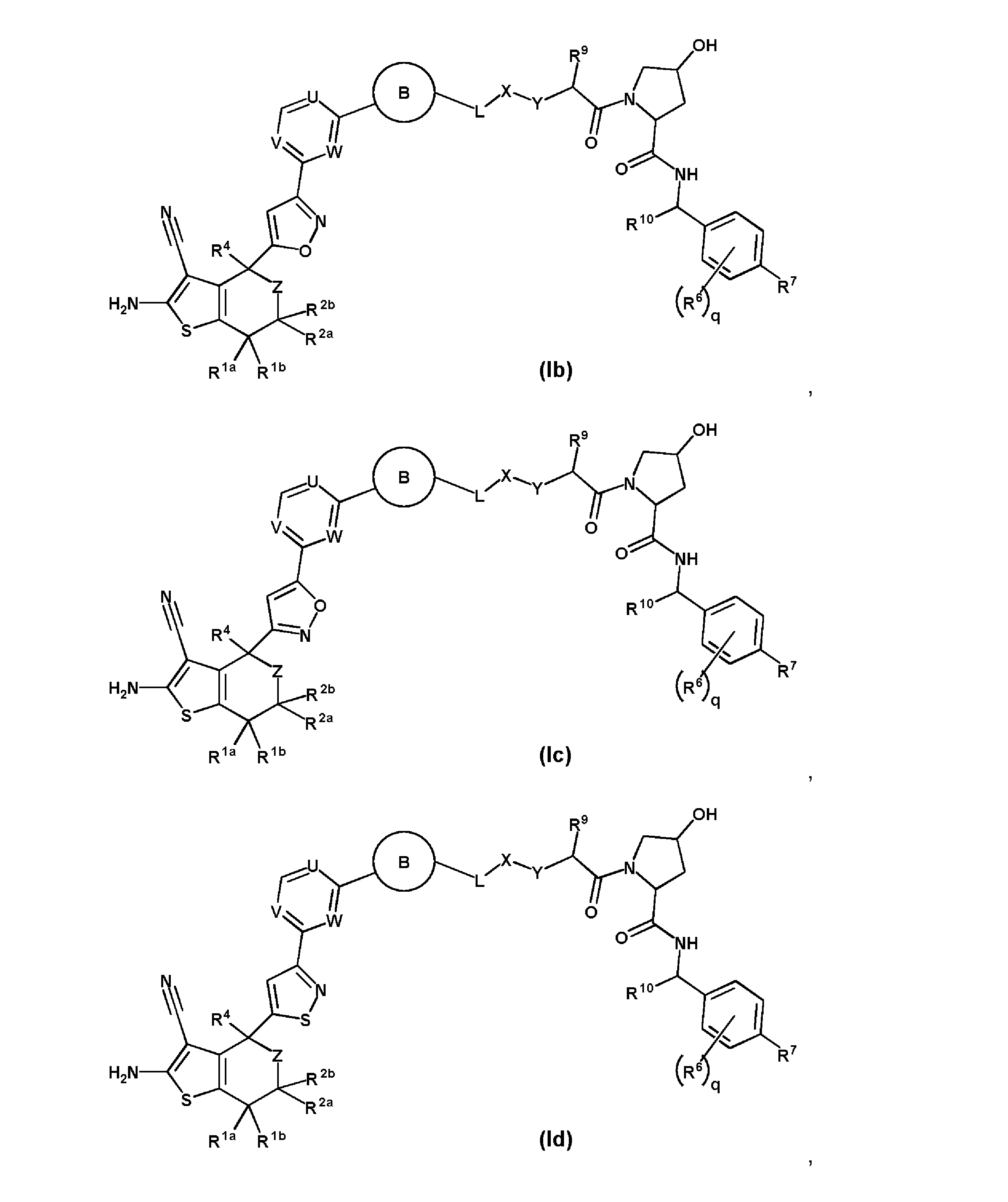

[式中、R1a、R1b、R2a、R2b、Z、R4、U、V、W、環B、L、X、Y、R9、R10、q、R6、R7及び立体化学が、請求項1~4のいずれか一項で定義されたとおりである]
で示される、請求項1~5のいずれか一項記載の化合物又は塩。 Formula (Ia), (Ib), (Ic), (Id) or (Ie):
wherein R 1a , R 1b , R 2a , R 2b , Z, R 4 , U, V, W, Ring B, L, X, Y, R 9 , R 10 , q, R 6 , R 7 and stereochemistry are as defined in any one of claims 1 to 4.
The compound or salt according to any one of claims 1 to 5, wherein
-Xが、-O-であり、Yが、少なくとも1つの窒素原子を含む5員のヘテロアリーレンである、請求項1~6のいずれか一項記載の化合物又は塩。 The compound or salt according to any one of claims 1 to 6, wherein -X is -(CH 2 )- and Y is a 5-membered heteroarylene or -C(O)(NR 12 )-, wherein the 5-membered heteroarylene contains at least one nitrogen atom, and wherein the -C(O)(NR 12 )- is linked to X via a C atom, or -X is -O- and Y is a 5-membered heteroarylene containing at least one nitrogen atom.

[式中、R1a、R1b、R2a、R2b、Z、R4、環A、R5、m、U、V、W、環B、L、X、R9、R10、q、R6、R7及び立体化学が、請求項1~8のいずれか一項に定義されたとおりである]
で示される、請求項1~8のいずれか一項記載の化合物又は塩。 Formula (If):
wherein R 1a , R 1b , R 2a , R 2b , Z, R 4 , Ring A, R 5 , m, U, V, W, Ring B, L, X, R 9 , R 10 , q, R 6 , R 7 and stereochemistry are as defined in any one of claims 1 to 8.
The compound or salt according to any one of claims 1 to 8, wherein

[式中、R1a、R1b、R2a、R2b、Z、R4、環A、R5、m、U、V、W、環B、L、X、R9、R10、q、R6、R7及び立体化学が、請求項1~8のいずれか一項に定義されたとおりである]
で示される、請求項1~8のいずれか一項記載の化合物又は塩。 Formula (Ig):
wherein R 1a , R 1b , R 2a , R 2b , Z, R 4 , Ring A, R 5 , m, U, V, W, Ring B, L, X, R 9 , R 10 , q, R 6 , R 7 and stereochemistry are as defined in any one of claims 1 to 8.
The compound or salt according to any one of claims 1 to 8, wherein

[式中、R1a、R1b、R2a、R2b、Z、R4、環A、R5、m、U、V、W、環B、L、X、R9、R10、q、R6、R7及び立体化学が、請求項1~7のいずれか一項に定義されたとおりである]
で示される、請求項1~7のいずれか一項記載の化合物又は塩。 Formula (Ih):
wherein R 1a , R 1b , R 2a , R 2b , Z, R 4 , Ring A, R 5 , m, U, V, W, Ring B, L, X, R 9 , R 10 , q, R 6 , R 7 and stereochemistry are as defined in any one of claims 1 to 7.
The compound or salt according to any one of claims 1 to 7,

[式中、
rが、0、1又は2であり、
sが、0、1又は2であり、
R13が、C1-3アルキルであり、
各R14が、それぞれ独立に、同じか又は異なるC1-3アルキルであり、
(C)及び(L)が、環Bが結合している式(I)の原子又は置換基を示す]
である、請求項1~16のいずれか一項記載の化合物又は塩。 Ring B is
[Wherein,
r is 0, 1 or 2;
s is 0, 1 or 2;
R 13 is C 1-3 alkyl;
each R 14 is independently the same or different C 1-3 alkyl;
(C) and (L) represent the atom or substituent of formula (I) to which ring B is attached.
The compound or salt according to any one of claims 1 to 16,

からなる群より選択される、請求項1~21のいずれか一項記載の化合物又は塩。 R 7 is chlorine, bromine, isopropyl, -CN,
The compound or salt according to any one of claims 1 to 21, selected from the group consisting of:


又はその薬学的に許容し得る塩からなる群より選択される、請求項1~22のいずれか一項記載の化合物又は塩。 below:
23. The compound or salt according to any one of claims 1 to 22, selected from the group consisting of:

又はその薬学的に許容し得る塩からなる群より選択される、
化合物。 below:
or a pharma- ceutically acceptable salt thereof;
Compound.
医薬組成物。 A pharmaceutical composition comprising a compound according to any one of claims 1 to 24 or a pharma- ceutically acceptable salt thereof and one or more pharma- ceutically acceptable excipients.
Pharmaceutical compositions.
Applications Claiming Priority (3)
| Application Number | Priority Date | Filing Date | Title |
|---|---|---|---|
| US202163284751P | 2021-12-01 | 2021-12-01 | |
| US63/284,751 | 2021-12-01 | ||
| PCT/EP2022/083950 WO2023099620A1 (en) | 2021-12-01 | 2022-11-30 | Kras degrading compounds comprising annulated 2-amino-3-cyano thiophenes |
Publications (2)
| Publication Number | Publication Date |
|---|---|
| JP2024542692A true JP2024542692A (en) | 2024-11-15 |
| JP2024542692A5 JP2024542692A5 (en) | 2025-11-26 |
Family
ID=84537055
Family Applications (1)
| Application Number | Title | Priority Date | Filing Date |
|---|---|---|---|
| JP2024532456A Pending JP2024542692A (en) | 2021-12-01 | 2022-11-30 | KRA decomposition compounds containing cyclized 2-amino-3-cyanothiophenes |
Country Status (5)
| Country | Link |
|---|---|
| US (1) | US20250145608A1 (en) |
| EP (1) | EP4441051A1 (en) |
| JP (1) | JP2024542692A (en) |
| CN (1) | CN118591540A (en) |
| WO (1) | WO2023099620A1 (en) |
Families Citing this family (28)
| Publication number | Priority date | Publication date | Assignee | Title |
|---|---|---|---|---|
| WO2019195609A2 (en) | 2018-04-04 | 2019-10-10 | Arvinas Operations, Inc. | Modulators of proteolysis and associated methods of use |
| EP4067343A4 (en) | 2019-11-29 | 2024-01-03 | Taiho Pharmaceutical Co., Ltd. | Novel phenol compound or salt thereof |
| JP7808058B2 (en) | 2020-06-02 | 2026-01-28 | ベーリンガー インゲルハイム インターナショナル ゲゼルシャフト ミット ベシュレンクテル ハフツング | Cyclofused 2-amino-3-cyanothiophenes and derivatives for treating cancer - Patents.com |
| WO2023099624A1 (en) | 2021-12-01 | 2023-06-08 | Boehringer Ingelheim International Gmbh | Annulated 2-amino-3-cyano thiophenes and derivatives for the treatment of cancer |
| CA3243798A1 (en) | 2022-02-09 | 2023-08-17 | Quanta Therapeutics, Inc. | Kras modulators and uses thereof |
| CA3247639A1 (en) | 2022-05-06 | 2023-11-09 | PAQ Therapeutics Inc. | Kras g12d proteolysis targeting chimeras |
| WO2023230190A1 (en) | 2022-05-25 | 2023-11-30 | Quanta Therapeutics, Inc. | Pyrimidine based modulators and uses thereof |
| US12448399B2 (en) | 2023-01-26 | 2025-10-21 | Arvinas Operations, Inc. | Cereblon-based KRAS degrading PROTACs and uses related thereto |
| KR20260041941A (en) | 2023-03-15 | 2026-03-27 | 콴타 테라퓨틱스, 인크. | KRAS Regulators and Their Uses |
| AU2024241633A1 (en) | 2023-03-30 | 2025-11-06 | Revolution Medicines, Inc. | Compositions for inducing ras gtp hydrolysis and uses thereof |
| TW202508595A (en) | 2023-05-04 | 2025-03-01 | 美商銳新醫藥公司 | Combination therapy for a ras related disease or disorder |
| WO2025016899A1 (en) | 2023-07-19 | 2025-01-23 | Bayer Aktiengesellschaft | Spirocyclic compounds for the treatment of cancer |
| WO2025026903A1 (en) | 2023-07-31 | 2025-02-06 | Bayer Aktiengesellschaft | Imidazo pyrimidine compounds for the treatment of cancer |
| US20250049810A1 (en) | 2023-08-07 | 2025-02-13 | Revolution Medicines, Inc. | Methods of treating a ras protein-related disease or disorder |
| CN121941690A (en) | 2023-10-03 | 2026-04-28 | Paq医疗公司 | KRAS protein hydrolysis targeting chimera |
| AU2024360465A1 (en) | 2023-10-12 | 2026-04-09 | Revolution Medicines, Inc. | Macrocyclic ras inhibitors |
| AU2024361909A1 (en) | 2023-10-20 | 2026-03-26 | Merck Sharp & Dohme Llc | Small molecule inhibitors of kras proteins |
| WO2025171296A1 (en) | 2024-02-09 | 2025-08-14 | Revolution Medicines, Inc. | Ras inhibitors |
| TW202547461A (en) | 2024-05-17 | 2025-12-16 | 美商銳新醫藥公司 | Ras inhibitors |
| WO2025255438A1 (en) | 2024-06-07 | 2025-12-11 | Revolution Medicines, Inc. | Methods of treating a ras protein-related disease or disorder |
| WO2025265060A1 (en) | 2024-06-21 | 2025-12-26 | Revolution Medicines, Inc. | Therapeutic compositions and methods for managing treatment-related effects |
| WO2026006747A1 (en) | 2024-06-28 | 2026-01-02 | Revolution Medicines, Inc. | Ras inhibitors |
| WO2026015801A1 (en) | 2024-07-12 | 2026-01-15 | Revolution Medicines, Inc. | Methods of treating a ras related disease or disorder |
| WO2026015796A1 (en) | 2024-07-12 | 2026-01-15 | Revolution Medicines, Inc. | Methods of treating a ras related disease or disorder |
| WO2026015790A1 (en) | 2024-07-12 | 2026-01-15 | Revolution Medicines, Inc. | Methods of treating a ras related disease or disorder |
| WO2026015825A1 (en) | 2024-07-12 | 2026-01-15 | Revolution Medicines, Inc. | Use of ras inhibitor for treating pancreatic cancer |
| WO2026050446A1 (en) | 2024-08-29 | 2026-03-05 | Revolution Medicines, Inc. | Ras inhibitors |
| WO2026072904A2 (en) | 2024-09-26 | 2026-04-02 | Revolution Medicines, Inc. | Compositions and methods for treating lung cancer |
Family Cites Families (23)
| Publication number | Priority date | Publication date | Assignee | Title |
|---|---|---|---|---|
| NZ597692A (en) | 2008-12-12 | 2013-08-30 | Boehringer Ingelheim Int | Anti-IGF antibodies |
| AR090151A1 (en) | 2012-03-07 | 2014-10-22 | Lilly Co Eli | RAF INHIBITING COMPOUNDS |
| NZ629432A (en) | 2012-03-14 | 2017-01-27 | Lupin Ltd | Heterocyclyl compounds as mek inhibitors |
| US9242969B2 (en) | 2013-03-14 | 2016-01-26 | Novartis Ag | Biaryl amide compounds as kinase inhibitors |
| WO2015155332A1 (en) | 2014-04-11 | 2015-10-15 | Boehringer Ingelheim International Gmbh | Spiro[3h-indole-3,2'-pyrrolidin]-2(1h)-one derivatives and their use as mdm2-p53 inhibitors |
| WO2016001376A1 (en) | 2014-07-03 | 2016-01-07 | Boehringer Ingelheim International Gmbh | New spiro[3h-indole-3,2´-pyrrolidin]-2(1h)-one compounds and derivatives as mdm2-p53 inhibitors |
| RS59111B1 (en) | 2014-08-21 | 2019-09-30 | Boehringer Ingelheim Int | New spiro[3h-indole-3,2´-pyrrolidin]-2(1h)-one compounds and derivatives as mdm2-p53 inhibitors |
| KR20240158360A (en) | 2015-10-09 | 2024-11-04 | 베링거 인겔하임 인터내셔날 게엠베하 | Spiro[3h-indole-3,2´-pyrrolidin]-2(1h)-one compounds and derivatives as mdm2-p53 inhibitors |
| EP3558979B1 (en) | 2016-12-22 | 2021-02-17 | Boehringer Ingelheim International GmbH | Novel benzylamino substituted quinazolines and derivatives as sos1 inhibitors |
| WO2018140599A1 (en) * | 2017-01-26 | 2018-08-02 | Araxes Pharma Llc | Benzothiophene and benzothiazole compounds and methods of use thereof |
| WO2018172250A1 (en) | 2017-03-21 | 2018-09-27 | Bayer Pharma Aktiengesellschaft | 2-methyl-quinazolines |
| WO2018204532A1 (en) | 2017-05-03 | 2018-11-08 | Vivace Therapeutics, Inc. | Non-fused tricyclic compounds |
| HRP20230400T1 (en) | 2017-12-21 | 2023-06-23 | Boehringer Ingelheim International Gmbh | Benzylamino substituted pyridopyrimidinones and derivatives as sos1 inhibitors |
| WO2019195609A2 (en) * | 2018-04-04 | 2019-10-10 | Arvinas Operations, Inc. | Modulators of proteolysis and associated methods of use |
| US20220274979A1 (en) | 2018-04-18 | 2022-09-01 | Bayer Pharma Aktiengesellschaft | 2-methyl-aza-quinazolines |
| MX2021010323A (en) | 2019-03-01 | 2021-12-10 | Revolution Medicines Inc | Bicyclic heterocyclyl compounds and uses thereof. |
| MX2021010319A (en) | 2019-03-01 | 2021-12-10 | Revolution Medicines Inc | Bicyclic heteroaryl compounds and uses thereof. |
| CA3141826A1 (en) | 2019-05-31 | 2020-12-03 | Ikena Oncology, Inc. | Tead inhibitors and uses thereof |
| PT3886991T (en) * | 2019-12-11 | 2022-10-17 | Lilly Co Eli | Kras g12c inhibitors |
| UY39129A (en) | 2020-03-16 | 2021-10-29 | Novartis Ag | BIARYL DERIVATIVES AS INHIBITORS OF THE PROTEIN-PROTEIN INTERACTION OF YAP / TAZ-TEAD |
| CN115803030A (en) * | 2020-04-06 | 2023-03-14 | 阿维纳斯企业公司 | Compounds and methods for targeted degradation of KRAS |
| WO2021222138A1 (en) * | 2020-04-27 | 2021-11-04 | Development Center For Biotechnology | Compounds for mutant ras protein degradation |
| JP7808058B2 (en) * | 2020-06-02 | 2026-01-28 | ベーリンガー インゲルハイム インターナショナル ゲゼルシャフト ミット ベシュレンクテル ハフツング | Cyclofused 2-amino-3-cyanothiophenes and derivatives for treating cancer - Patents.com |
-
2022
- 2022-11-30 JP JP2024532456A patent/JP2024542692A/en active Pending
- 2022-11-30 CN CN202280089389.4A patent/CN118591540A/en active Pending
- 2022-11-30 EP EP22826087.3A patent/EP4441051A1/en active Pending
- 2022-11-30 US US18/715,145 patent/US20250145608A1/en active Pending
- 2022-11-30 WO PCT/EP2022/083950 patent/WO2023099620A1/en not_active Ceased
Also Published As
| Publication number | Publication date |
|---|---|
| CN118591540A (en) | 2024-09-03 |
| EP4441051A1 (en) | 2024-10-09 |
| WO2023099620A1 (en) | 2023-06-08 |
| US20250145608A1 (en) | 2025-05-08 |
Similar Documents
| Publication | Publication Date | Title |
|---|---|---|
| JP2024542692A (en) | KRA decomposition compounds containing cyclized 2-amino-3-cyanothiophenes | |
| EP4157837B1 (en) | Annulated 2-amino-3-cyano thiophenes and derivatives for the treatment of cancer | |
| CN115485277B (en) | [1,3] Diazinyl [5,4-d ] pyrimidines as HER2 inhibitors | |
| JP7626774B2 (en) | [1,3]Diazino[5,4-d]pyrimidines as HER2 inhibitors | |
| WO2023099612A1 (en) | Annulated 2-amino-3-cyano thiophenes and derivatives for the treatment of cancer | |
| AU2022402390A1 (en) | Annulated 2-amino-3-cyano thiophenes and derivatives for the treatment of cancer | |
| EP4441050A1 (en) | Annulated 2-amino-3-cyano thiophenes and derivatives for the treatment of cancer | |
| JP2024543982A (en) | Fused 2-amino-3-cyanothiophenes and derivatives for the treatment of cancer - Patents.com | |
| WO2023099623A1 (en) | Annulated 2-amino-3-cyano thiophenes and derivatives for the treatment of cancer | |
| JP2023512174A (en) | [1,3]diazino[5,4-d]pyrimidines as HER2 inhibitors | |
| WO2019122129A1 (en) | Novel benzylamino substituted pyridopyrimidinones and derivatives as sos1 inhibitors | |
| HK40097417A (en) | Benzylamino substituted pyridopyrimidinones and derivatives as sos1 inhibitors | |
| EA047617B1 (en) | [1,3]DIAZINO[5,4-d]PYRIMIDINES AS HER2 INHIBITORS | |
| HK40039222B (en) | Benzylamino substituted pyridopyrimidinones and derivatives as sos1 inhibitors | |
| HK40039222A (en) | Benzylamino substituted pyridopyrimidinones and derivatives as sos1 inhibitors |
Legal Events
| Date | Code | Title | Description |
|---|---|---|---|
| A521 | Request for written amendment filed |
Free format text: JAPANESE INTERMEDIATE CODE: A523 Effective date: 20251117 |
|
| A621 | Written request for application examination |
Free format text: JAPANESE INTERMEDIATE CODE: A621 Effective date: 20251117 |