JP2024516001A - ESM1 marker panel for early detection of sepsis - Google Patents
ESM1 marker panel for early detection of sepsis Download PDFInfo
- Publication number
- JP2024516001A JP2024516001A JP2023566797A JP2023566797A JP2024516001A JP 2024516001 A JP2024516001 A JP 2024516001A JP 2023566797 A JP2023566797 A JP 2023566797A JP 2023566797 A JP2023566797 A JP 2023566797A JP 2024516001 A JP2024516001 A JP 2024516001A
- Authority
- JP
- Japan
- Prior art keywords
- biomarker
- subject
- amount
- assessing
- biomarkers
- Prior art date
- Legal status (The legal status is an assumption and is not a legal conclusion. Google has not performed a legal analysis and makes no representation as to the accuracy of the status listed.)
- Pending
Links
Classifications
-
- G—PHYSICS
- G01—MEASURING; TESTING
- G01N—INVESTIGATING OR ANALYSING MATERIALS BY DETERMINING THEIR CHEMICAL OR PHYSICAL PROPERTIES
- G01N33/00—Investigating or analysing materials by specific methods not covered by groups G01N1/00 - G01N31/00
- G01N33/48—Biological material, e.g. blood, urine; Haemocytometers
- G01N33/50—Chemical analysis of biological material, e.g. blood, urine; Testing involving biospecific ligand binding methods; Immunological testing
- G01N33/68—Chemical analysis of biological material, e.g. blood, urine; Testing involving biospecific ligand binding methods; Immunological testing involving proteins, peptides or amino acids
- G01N33/6893—Chemical analysis of biological material, e.g. blood, urine; Testing involving biospecific ligand binding methods; Immunological testing involving proteins, peptides or amino acids related to diseases not provided for elsewhere
-
- C—CHEMISTRY; METALLURGY
- C12—BIOCHEMISTRY; BEER; SPIRITS; WINE; VINEGAR; MICROBIOLOGY; ENZYMOLOGY; MUTATION OR GENETIC ENGINEERING
- C12Q—MEASURING OR TESTING PROCESSES INVOLVING ENZYMES, NUCLEIC ACIDS OR MICROORGANISMS; COMPOSITIONS OR TEST PAPERS THEREFOR; PROCESSES OF PREPARING SUCH COMPOSITIONS; CONDITION-RESPONSIVE CONTROL IN MICROBIOLOGICAL OR ENZYMOLOGICAL PROCESSES
- C12Q1/00—Measuring or testing processes involving enzymes, nucleic acids or microorganisms; Compositions therefor; Processes of preparing such compositions
- C12Q1/34—Measuring or testing processes involving enzymes, nucleic acids or microorganisms; Compositions therefor; Processes of preparing such compositions involving hydrolase
- C12Q1/37—Measuring or testing processes involving enzymes, nucleic acids or microorganisms; Compositions therefor; Processes of preparing such compositions involving hydrolase involving peptidase or proteinase
-
- C—CHEMISTRY; METALLURGY
- C12—BIOCHEMISTRY; BEER; SPIRITS; WINE; VINEGAR; MICROBIOLOGY; ENZYMOLOGY; MUTATION OR GENETIC ENGINEERING
- C12Q—MEASURING OR TESTING PROCESSES INVOLVING ENZYMES, NUCLEIC ACIDS OR MICROORGANISMS; COMPOSITIONS OR TEST PAPERS THEREFOR; PROCESSES OF PREPARING SUCH COMPOSITIONS; CONDITION-RESPONSIVE CONTROL IN MICROBIOLOGICAL OR ENZYMOLOGICAL PROCESSES
- C12Q1/00—Measuring or testing processes involving enzymes, nucleic acids or microorganisms; Compositions therefor; Processes of preparing such compositions
- C12Q1/48—Measuring or testing processes involving enzymes, nucleic acids or microorganisms; Compositions therefor; Processes of preparing such compositions involving transferase
- C12Q1/52—Measuring or testing processes involving enzymes, nucleic acids or microorganisms; Compositions therefor; Processes of preparing such compositions involving transferase involving transaminase
-
- G—PHYSICS
- G01—MEASURING; TESTING
- G01N—INVESTIGATING OR ANALYSING MATERIALS BY DETERMINING THEIR CHEMICAL OR PHYSICAL PROPERTIES
- G01N33/00—Investigating or analysing materials by specific methods not covered by groups G01N1/00 - G01N31/00
- G01N33/48—Biological material, e.g. blood, urine; Haemocytometers
- G01N33/50—Chemical analysis of biological material, e.g. blood, urine; Testing involving biospecific ligand binding methods; Immunological testing
- G01N33/72—Chemical analysis of biological material, e.g. blood, urine; Testing involving biospecific ligand binding methods; Immunological testing involving blood pigments, e.g. haemoglobin, bilirubin or other porphyrins; involving occult blood
- G01N33/728—Bilirubin; including biliverdin
-
- G—PHYSICS
- G16—INFORMATION AND COMMUNICATION TECHNOLOGY [ICT] SPECIALLY ADAPTED FOR SPECIFIC APPLICATION FIELDS
- G16H—HEALTHCARE INFORMATICS, i.e. INFORMATION AND COMMUNICATION TECHNOLOGY [ICT] SPECIALLY ADAPTED FOR THE HANDLING OR PROCESSING OF MEDICAL OR HEALTHCARE DATA
- G16H50/00—ICT specially adapted for medical diagnosis, medical simulation or medical data mining; ICT specially adapted for detecting, monitoring or modelling epidemics or pandemics
- G16H50/20—ICT specially adapted for medical diagnosis, medical simulation or medical data mining; ICT specially adapted for detecting, monitoring or modelling epidemics or pandemics for computer-aided diagnosis, e.g. based on medical expert systems
-
- G—PHYSICS
- G01—MEASURING; TESTING
- G01N—INVESTIGATING OR ANALYSING MATERIALS BY DETERMINING THEIR CHEMICAL OR PHYSICAL PROPERTIES
- G01N2333/00—Assays involving biological materials from specific organisms or of a specific nature
- G01N2333/435—Assays involving biological materials from specific organisms or of a specific nature from animals; from humans
- G01N2333/46—Assays involving biological materials from specific organisms or of a specific nature from animals; from humans from vertebrates
- G01N2333/47—Assays involving proteins of known structure or function as defined in the subgroups
- G01N2333/4701—Details
- G01N2333/4722—Proteoglycans, e.g. aggreccan
-
- G—PHYSICS
- G01—MEASURING; TESTING
- G01N—INVESTIGATING OR ANALYSING MATERIALS BY DETERMINING THEIR CHEMICAL OR PHYSICAL PROPERTIES
- G01N2333/00—Assays involving biological materials from specific organisms or of a specific nature
- G01N2333/81—Protease inhibitors
- G01N2333/8107—Endopeptidase (E.C. 3.4.21-99) inhibitors
- G01N2333/8139—Cysteine protease (E.C. 3.4.22) inhibitors, e.g. cystatin
-
- G—PHYSICS
- G01—MEASURING; TESTING
- G01N—INVESTIGATING OR ANALYSING MATERIALS BY DETERMINING THEIR CHEMICAL OR PHYSICAL PROPERTIES
- G01N2333/00—Assays involving biological materials from specific organisms or of a specific nature
- G01N2333/90—Enzymes; Proenzymes
- G01N2333/91—Transferases (2.)
- G01N2333/91188—Transferases (2.) transferring nitrogenous groups (2.6)
-
- G—PHYSICS
- G01—MEASURING; TESTING
- G01N—INVESTIGATING OR ANALYSING MATERIALS BY DETERMINING THEIR CHEMICAL OR PHYSICAL PROPERTIES
- G01N2800/00—Detection or diagnosis of diseases
- G01N2800/26—Infectious diseases, e.g. generalised sepsis
-
- G—PHYSICS
- G01—MEASURING; TESTING
- G01N—INVESTIGATING OR ANALYSING MATERIALS BY DETERMINING THEIR CHEMICAL OR PHYSICAL PROPERTIES
- G01N2800/00—Detection or diagnosis of diseases
- G01N2800/50—Determining the risk of developing a disease
Landscapes
- Health & Medical Sciences (AREA)
- Life Sciences & Earth Sciences (AREA)
- Engineering & Computer Science (AREA)
- Chemical & Material Sciences (AREA)
- Biomedical Technology (AREA)
- Immunology (AREA)
- Molecular Biology (AREA)
- Hematology (AREA)
- Urology & Nephrology (AREA)
- General Health & Medical Sciences (AREA)
- Organic Chemistry (AREA)
- Proteomics, Peptides & Aminoacids (AREA)
- Biotechnology (AREA)
- Physics & Mathematics (AREA)
- Analytical Chemistry (AREA)
- Biochemistry (AREA)
- Microbiology (AREA)
- Pathology (AREA)
- Wood Science & Technology (AREA)
- Zoology (AREA)
- General Physics & Mathematics (AREA)
- Cell Biology (AREA)
- Medicinal Chemistry (AREA)
- Food Science & Technology (AREA)
- Genetics & Genomics (AREA)
- Bioinformatics & Cheminformatics (AREA)
- General Engineering & Computer Science (AREA)
- Biophysics (AREA)
- Medical Informatics (AREA)
- Public Health (AREA)
- Data Mining & Analysis (AREA)
- Databases & Information Systems (AREA)
- Epidemiology (AREA)
- Primary Health Care (AREA)
- Investigating Or Analysing Biological Materials (AREA)
- Measuring Or Testing Involving Enzymes Or Micro-Organisms (AREA)
Abstract
本発明は、診断の分野に関する。具体的には、本発明は、感染の疑いがある対象を評定するための方法であって、対象の試料中の第1のバイオマーカーの量を決定する工程であって、当該第1のバイオマーカーがESM-1である、対象の試料中の第1のバイオマーカーの量を決定する工程、対象の試料中の第2のバイオマーカーの量を決定する工程であって、当該第2のバイオマーカーが、クレアチニン又はシスタチンCである、対象の試料中の第2のバイオマーカーの量を決定する工程、バイオマーカーの量を当該バイオマーカーの基準と比較する工程及び/又はバイオマーカーの量に基づいて感染の疑いがある対象を評定するためのスコアを計算する工程、並びに比較及び/又は計算に基づいて当該対象を評定する工程を含む、感染の疑いがある対象を評定するための方法に関する。本発明はまた、感染の疑いがある対象を評定するための、ESM-1である第1のバイオマーカー及びクレアチニン若しくはシスタチンCである第2のバイオマーカー、又は当該第1のバイオマーカーに特異的に結合する検出剤及び当該第2のバイオマーカーに特異的に結合する検出剤の使用に関する。更に、本発明は、感染の疑いがある対象を評定するためのコンピュータ実装方法、並びに感染の疑いがある対象を評定するためのデバイス及びキットに更に関する。 The present invention relates to the field of diagnosis. In particular, the present invention relates to a method for assessing a subject suspected of infection, comprising the steps of determining the amount of a first biomarker in a sample of the subject, the first biomarker being ESM-1, determining the amount of a second biomarker in a sample of the subject, the second biomarker being creatinine or cystatin C, comparing the amount of the biomarker to a standard for the biomarker and/or calculating a score for assessing the subject suspected of infection based on the amount of the biomarker, and assessing the subject based on the comparison and/or calculation. The present invention also relates to the use of a first biomarker being ESM-1 and a second biomarker being creatinine or cystatin C, or a detection agent that specifically binds to the first biomarker and a detection agent that specifically binds to the second biomarker, for assessing a subject suspected of infection. Additionally, the present invention further relates to a computer-implemented method for assessing a subject suspected of infection, as well as a device and a kit for assessing a subject suspected of infection.
Description
本発明は、診断の分野に関する。具体的には、本発明は、感染の疑いがある対象を評価するための方法であって、対象の試料中の第1のバイオマーカーの量を決定する工程であって、第1のバイオマーカーがESM-1である工程、対象の試料中の第2のバイオマーカーの量を決定する工程であって、第2のバイオマーカーがクレアチニン又はシスタチンCである工程、バイオマーカーの量をバイオマーカーの基準と比較する工程及び/又はバイオマーカーの量に基づいて感染の疑いがある対象を評定するためのスコアを計算する工程、並びに比較及び/又は計算に基づいて対象を評定する工程を含む方法に関する。本発明はまた、感染の疑いがある対象を評定するための、ESM-1である第1のバイオマーカー、及びクレアチニン若しくはシスタチンCである第2のバイオマーカー、又は当該第1のバイオマーカーに特異的に結合する検出剤及び当該第2のバイオマーカーに特異的に結合する検出剤の使用に関する。更に、本発明は更に、感染の疑いがある対象を評定するためのコンピュータ実装方法、並びに感染の疑いがある対象を評定するためのデバイス及びキットに関する。 The present invention relates to the field of diagnosis. In particular, the present invention relates to a method for assessing a subject suspected of infection, comprising the steps of determining the amount of a first biomarker in a sample of the subject, the first biomarker being ESM-1, determining the amount of a second biomarker in a sample of the subject, the second biomarker being creatinine or cystatin C, comparing the amount of the biomarker to a standard of biomarkers and/or calculating a score for assessing the subject suspected of infection based on the amount of the biomarker, and assessing the subject based on the comparison and/or calculation. The present invention also relates to the use of a first biomarker being ESM-1 and a second biomarker being creatinine or cystatin C, or a detection agent that specifically binds to the first biomarker and a detection agent that specifically binds to the second biomarker, for assessing a subject suspected of infection. Furthermore, the present invention further relates to a computer-implemented method for assessing a subject suspected of infection, as well as devices and kits for assessing a subject suspected of infection.
感染症、特に、より重篤な徴候及びその症候を有する患者、例えば救急ユニットに来院する患者に生じる感染症は、全身性炎症反応症候群(SIRS)及び敗血症を含むより生命を脅かす医学的症状に発展することがある。 Infections, especially those occurring in patients with more severe signs and symptoms, such as those presenting to emergency units, can develop into more life-threatening medical conditions, including systemic inflammatory response syndrome (SIRS) and sepsis.
敗血症3の定義によれば、敗血症は、感染に対する調節不全の宿主応答によって引き起こされる生命を脅かす臓器機能不全として定義される。急速に発症するため、敗血症患者の管理及び入院の最初の1時間以内の適切な抗生物質療法を含む正しい治療措置の開始、並びに静脈内輸液及び血管作動薬による蘇生の開始のために、早期の認識が重要である(surviving sepsis campaign guidelines 2016)。1時間ごとの遅延は、罹患率及び死亡率を徐々に増加させる。 According to the definition of sepsis 3, sepsis is defined as a life-threatening organ dysfunction caused by a dysregulated host response to infection. Due to its rapid onset, early recognition is important for the management of septic patients and for the initiation of correct therapeutic measures, including appropriate antibiotic therapy within the first hour of hospitalization, as well as the initiation of resuscitation with intravenous fluids and vasoactive drugs (surviving sepsis campaign guidelines 2016). Every hour of delay progressively increases morbidity and mortality.
敗血症の診断は、非特異的で容易に見落とされ得る臨床的徴候及び症候に基づく。したがって、患者はしばしば誤診され、疾患の重症度はしばしば過小評価される。これまでのところ、敗血症の診断のためのゴールドスタンダードは一般的に存在せず、特に救急部では存在しない。高所得国では、c反応性タンパク質(CRP)、プロカルシトニン(PCT)及び白血球(WBC)数は、敗血症性ショックの検出のための乳酸塩と共に、敗血症を発症するリスクがある血流感染症を有する患者の検出のために救急ユニットでしばしば使用される。低所得国では、診断は、主に臨床徴候及び症候、場合によってはSIRS及びSOFA基準に基づく。しかしながら、最新のガイドラインでは、乳酸塩以外に、敗血症を診断するためのバイオマーカーは列挙されていない(臨床化学、BGE及びSOFAスコアの血液学的成分を除く)。PCTは、抗生物質療法を潜在的に緩和するためにのみ推奨されているが、証拠は中程度である。敗血症診断におけるPCTの限界は、主に中程度の感度及び特異性である。 The diagnosis of sepsis is based on clinical signs and symptoms that are non-specific and can easily be overlooked. Thus, patients are often misdiagnosed and the severity of the disease is often underestimated. So far, there is no gold standard for the diagnosis of sepsis in general, especially in the emergency department. In high-income countries, c-reactive protein (CRP), procalcitonin (PCT) and white blood cell (WBC) counts are often used in emergency units for the detection of patients with bloodstream infections at risk of developing sepsis, along with lactate for the detection of septic shock. In low-income countries, the diagnosis is mainly based on clinical signs and symptoms, and sometimes SIRS and SOFA criteria. However, in the latest guidelines, other than lactate, no biomarkers are listed for diagnosing sepsis (except for clinical chemistry, BGE and hematological components of the SOFA score). PCT is only recommended to potentially ease antibiotic therapy, but with moderate evidence. The limitations of PCT in sepsis diagnosis are mainly its moderate sensitivity and specificity.
国際公開第2007/009071号は、sFlt-1に基づいて対象における炎症応答を診断する方法を開示している。開示される方法は、VEGF、PlGF、TNF-α、IL-6、D-ダイマー、P-セレクチン、ICAM-I、VCAM-I、Cox-2、又はPAI-Iの少なくとも1つのレベルを分析することを更に含む。 WO 2007/009071 discloses a method for diagnosing an inflammatory response in a subject based on sFlt-1. The disclosed method further comprises analyzing the levels of at least one of VEGF, PlGF, TNF-α, IL-6, D-dimer, P-selectin, ICAM-I, VCAM-I, Cox-2, or PAI-I.
欧州特許第2174143号B1は、感染症ではない原発疾患を有する患者の予後診断のためのin vitro方法を開示しており、この方法はプロカルシトニンのレベルを決定することを含む。 EP 2 174 143 B1 discloses an in vitro method for prognostic diagnosis of patients with a primary non-infectious disease, which method comprises determining the level of procalcitonin.
多数のマーカーが敗血症の検出又は診断に有用であることが示唆されている。これらには、数ある中でも、PCT、プレセプシン、GDF-15、sFLT、CRP若しくはインターロイキンなどの炎症マーカー、又は臓器不全に特異的なマーカーが含まれる(例えば、Spanuth,2014,Comparison of sCD14-ST(рresepsin)with еight biomarkers for mortality prediction in patients admitted with acute heart failure,2014 AACC Annual Meeting Abstracts.B-331;van Engelen,2018,Crit Care Clin 34(1):139-152.を参照)。 A number of markers have been suggested to be useful in detecting or diagnosing sepsis. These include, among others, inflammatory markers such as PCT, presepsin, GDF-15, sFLT, CRP or interleukins, or markers specific for organ failure (see, e.g., Spanuth, 2014, Comparison of sCD14-ST (presepsin) with early biomarkers for mortality prediction in patients admitted with acute heart failure, 2014 AACC Annual Meeting Abstracts. B-331; van Engelen, 2018, Crit Care Clin 34(1):139-152.).
国際公開第2015/031996号は、病気及び/又は処置応答に対する重大な又は生命を脅かす応答の早期決定のためのバイオマーカーを記載している。 WO 2015/031996 describes biomarkers for early determination of serious or life-threatening responses to disease and/or treatment responses.
しかしながら、感染の徴候及び症候を示す患者の信頼できる早期の評定を可能にするバイオマーカーが依然として必要とされている。 However, there remains a need for biomarkers that allow reliable and early assessment of patients who exhibit signs and symptoms of infection.
したがって、本発明は、これらの必要性に適合する手段及び方法を提供する。 The present invention therefore provides means and methods that meet these needs.
本発明は、感染の疑いがある対象を評定するための方法であって、
(a)対象の試料中の第1のバイオマーカーの量を決定する工程であって、当該第1のバイオマーカーがESM-1である、対象の試料中の第1のバイオマーカーの量を決定する工程、
(b)対象の試料中の第2のバイオマーカーの量を決定する工程であって、当該第2のバイオマーカーがクレアチニン又はシスタチンCである、対照の試料中の第2のバイオマーカーの量を決定する工程;
(c)前記バイオマーカーの前記量を、前記バイオマーカーについての基準と比較する工程、及び/又は前記バイオマーカーの前記量に基づいて感染の疑いがある前記対象を評定するためのスコアを計算する工程、並びに
(d)工程(c)で行われた比較及び/又は計算に基づいて当該対象を評定する工程
を含む、感染の疑いがある当該対象を評定するための方法に関する。
The present invention provides a method for assessing a subject suspected of infection, comprising:
(a) determining the amount of a first biomarker in a sample from a subject, wherein the first biomarker is ESM-1;
(b) determining the amount of a second biomarker in the subject sample, wherein the second biomarker is creatinine or cystatin C; and (b) determining the amount of a second biomarker in a control sample.
(c) comparing the amount of the biomarker with a standard for the biomarker and/or calculating a score for assessing the subject suspected of being infected based on the amount of the biomarker; and (d) assessing the subject based on the comparison and/or calculation made in step (c).
本明細書及び特許請求の範囲で使用される場合、「1つの(a)」又は「1つの(an)」は、それが使用される文脈に応じて、1つ以上を意味することができることを理解されたい。したがって、例えば、「1つの(an)」項目への言及は、少なくとも1つの項目を利用できることを意味することができる。 It should be understood that as used in this specification and claims, "a" or "an" can mean one or more, depending on the context in which it is used. Thus, for example, a reference to "an" item can mean that at least one item is available.
以下で使用される場合、「有する(have)」、「備える(comprise)」、若しくは「含む(include)」という用語、又はそれらの任意の文法的変形は、包括的に使用される。したがって、これらの用語は、これらの用語によって導入される特徴に加えて、この文脈で説明されているエンティティに更なる特徴が存在しない状況と、1つ以上の追加の特徴が存在する状況との双方を指す場合がある。例として、「AはBを有する」、「AはBを備える」及び「AはBを含む」という表現は、双方とも、B以外に、他の要素がAに存在しない状況(すなわち、Aが単独で且つ排他的にBからなる状況)、及び、B以外に、要素C、要素C及びD、更には更なる要素など、1つ以上の更なる要素がエンティティAに存在する状況を指す場合がある。「含む(comprising)」という用語は、言及される項目のみが存在する実施形態も包含する、すなわち、「からなる(consisting of)」という意味で限定的な意味を有する。 When used below, the terms "have", "comprise" or "include" or any grammatical variants thereof are used inclusively. Thus, these terms may refer both to the situation where no further features are present in the entity described in this context, in addition to the features introduced by these terms, and to the situation where one or more additional features are present. As an example, the expressions "A has B", "A comprises B" and "A includes B" may both refer to the situation where no other elements are present in A other than B (i.e., A consists solely and exclusively of B), and to the situation where, other than B, one or more further elements are present in the entity A, such as element C, elements C and D, and even further elements. The term "comprising" has a restrictive meaning in the sense of also including embodiments where only the mentioned items are present, i.e., "consisting of".
更に、以下で使用するとき、「特に」、「より詳細には」、「典型的には」、及び「より典型的には」という用語、又は類似の用語は、代替の可能性を制限することなく、追加/代替の特徴と併せて使用される。したがって、これらの用語によって導入される特徴は、追加の/代替の特徴であり、決して特許請求の範囲を限定することを意図するものではない。本発明は、当業者が認識するように、代替の特徴を使用することによって実行されてもよい。同様に、「本発明の実施形態では」又は同様の表現によって導入される特徴は、本発明の代替の実施形態に関する制限なしに、本発明の範囲に関する制限なしに、及びそのように導入された特徴を本発明の他の追加の/代替の又は非追加の/代替の特徴と組み合わせる可能性に関する制限なしに、追加の/代替の特徴であることが意図される。 Furthermore, when used hereinafter, the terms "particularly", "more particularly", "typically" and "more typically" or similar terms are used in conjunction with additional/alternative features without limiting the possibilities of substitution. Thus, features introduced by these terms are additional/alternative features and are not intended to limit the scope of the claims in any way. The invention may also be implemented by using alternative features, as a person skilled in the art would recognize. Similarly, features introduced by "in an embodiment of the invention" or similar expressions are intended to be additional/alternative features, without any limitations on alternative embodiments of the invention, without any limitations on the scope of the invention, and without any limitations on the possibilities of combining the features so introduced with other additional/alternative or non-additional/alternative features of the invention.
更に、本明細書で使用される場合、「少なくとも1つ」という用語は、この用語に続いて言及される項目の1つ以上が本発明に従って使用され得ることを意味することが理解されよう。例えば、この用語が、少なくとも1つのサンプリングユニットが使用されるべきであることを示す場合、これは、1つのサンプリングユニット又は2つ以上、すなわち、2つ、3つ、4つ、5つ、又は任意の他の数のサンプリングユニットとして理解され得る。用語が言及する項目に応じて、当業者は、もしあれば用語がどの上限を指し得るかについて理解する。 Furthermore, as used herein, the term "at least one" will be understood to mean that one or more of the items referred to following the term may be used in accordance with the present invention. For example, if the term indicates that at least one sampling unit should be used, this may be understood as one sampling unit or more than one, i.e., two, three, four, five, or any other number of sampling units. Depending on the items to which the term refers, one of ordinary skill in the art will understand what upper limit, if any, the term may refer to.
本明細書で使用される場合、「約」という用語は、当該用語の後に列挙された任意の数に関して、技術的効果を達成することができる区間精度が存在することを意味する。したがって、本明細書で言及される場合、好ましくは、正確な数値又は当該正確な数値の周りの範囲±20%、好ましくは±15%、より好ましくは±10%、又は更により好ましくは±5%を指す。 As used herein, the term "about" means that there is an interval of precision within which the technical effect can be achieved for any number listed after the term. Thus, when referred to herein, it preferably refers to an exact numerical value or a range around the exact numerical value ±20%, preferably ±15%, more preferably ±10%, or even more preferably ±5%.
更に、明細書及び特許請求の範囲における「第1」、「第2」、「第3」などの用語は、類似する要素を区別するために使用され、必ずしも連続的又は時系列的な順序を説明するためのものではない。 Furthermore, the terms "first," "second," "third," etc. in the specification and claims are used to distinguish between similar elements and are not necessarily intended to describe a sequential or chronological order.
本発明の方法は、上述の工程からなってもよく、又は工程(d)で得られた評定の更なる評価のための工程、処置などの治療措置を推奨する工程などの追加の工程を含んでもよい。更に、これは、試料の前処理に関する工程などの工程(a)の前の工程を含み得る。しかしながら、好ましくは、上述の方法は、ヒト又は動物の身体に対して実施されるいかなる工程も必要としないex vivo方法であることが想定される。更に、本方法は、自動化によって支援されてもよい。典型的には、バイオマーカーの決定はロボット装置によって支援されてもよく、比較及び評定はコンピュータなどのデータ処理機器によって支援されてもよい。 The method of the invention may consist of the steps mentioned above or may include additional steps, such as a step for further evaluation of the assessment obtained in step (d), a step for recommending a therapeutic measure, such as a treatment. Furthermore, it may include steps prior to step (a), such as a step relating to the pre-treatment of the sample. However, it is preferably envisaged that the above-mentioned method is an ex vivo method, which does not require any steps to be performed on the human or animal body. Furthermore, the method may be supported by automation. Typically, the determination of the biomarkers may be supported by a robotic device, and the comparison and assessment may be supported by a data processing device, such as a computer.
本明細書で使用される場合、「評定する」という用語は、対象が敗血症に罹患しているかどうか、敗血症に罹患するリスクがあるかどうか、全身健康状態に関して、又は敗血症若しくは敗血症に伴う徴候に関して悪化する医学的症状を示すかどうか、又は敗血症及び/又は感染に伴う症候を示すかどうかを評定することを指す。したがって、本明細書で使用される評定は、敗血症を診断すること、敗血症を発症するリスクを予測すること、及び/又は特に敗血症及び/又は感染症に伴う徴候及び症候に関して、対象の健康状態のあらゆる悪化を予測することを含む。 As used herein, the term "assessing" refers to assessing whether a subject has sepsis, is at risk of having sepsis, exhibits worsening medical symptoms with respect to general health or with respect to sepsis or signs associated with sepsis, or exhibits symptoms associated with sepsis and/or infection. As used herein, assessing therefore includes diagnosing sepsis, predicting the risk of developing sepsis, and/or predicting any deterioration in the subject's health, particularly with respect to signs and symptoms associated with sepsis and/or infection.
典型的には、本発明に従って言及される評定は、敗血症を発症するリスクの評定(したがって、敗血症を発症するリスクの予測)である。あるいは、評定は、対象の(健康)状態が悪化するリスクの予測である。更に、敗血症を発症するリスク又は健康状態の悪化のリスクが予測される場合、典型的には、予測は予測ウィンドウ内で行われることが理解されよう。より典型的には、当該予測ウィンドウは、好ましくは試料が得られてから、約8時間後、約10時間後、約12時間後、約16時間後、約20時間後、約24時間後、約48時間後、特に少なくとも約48時間後である。更に、好ましくは試験試料が得られた後の24時間以内又は48時間以内に敗血症を発症するリスクが予測され得る。 Typically, the assessment referred to in accordance with the present invention is an assessment of the risk of developing sepsis (and thus a prediction of the risk of developing sepsis). Alternatively, the assessment is a prediction of the risk of the subject's (health) condition worsening. Furthermore, it will be understood that when the risk of developing sepsis or the risk of a worsening health condition is predicted, the prediction is typically made within a prediction window. More typically, the prediction window is preferably about 8 hours, about 10 hours, about 12 hours, about 16 hours, about 20 hours, about 24 hours, about 48 hours, in particular at least about 48 hours after the sample is obtained. Furthermore, the risk of developing sepsis can be predicted, preferably within 24 hours or within 48 hours after the test sample is obtained.
いくつかの実施形態では、24時間以内に敗血症を発症するリスクが予測される。 In some embodiments, the risk of developing sepsis within 24 hours is predicted.
いくつかの実施形態では、48時間以内に敗血症を発症するリスクが予測される。 In some embodiments, the risk of developing sepsis within 48 hours is predicted.
48時間の期間を実施例のセクションで試験した。 A 48 hour period was tested in the Examples section.
更に別の実施形態では、評定は、対象の(健康)状態が将来悪化するか否かのリスクの予測である。感染症に罹患している疑いがある及び/又は感染症に罹患している対象の「症状の悪化」という用語は、当業者にはよく理解されている。この用語は、典型的には、最終的に更なる投薬又は他の介入をもたらし得る症状の悪化に関する。 In yet another embodiment, the assessment is a prediction of the risk of future deterioration of the subject's (health) condition. The term "worsening of symptoms" of a subject suspected of and/or suffering from an infectious disease is well understood by those skilled in the art. This term typically relates to a worsening of symptoms that may ultimately result in further medication or other intervention.
好ましくは、対象の症状は、対象の疾患重症度が増加した場合、対象の抗生物質療法が強化された場合、対象がより高いレベルのケアのためにICU若しくは別のユニットに入院した場合、対象が緊急手術を必要とする場合、対象が病院で死亡した場合、対象が入院後30日以内に死亡した場合、対象が退院後30日以内に再入院した場合、対象が、例えばSOFAスコアで測定されるような臓器機能不全若しくは不全を経験した場合、及び/又は対象が臓器支持を必要とする場合に悪化する。 Preferably, the subject's condition worsens if the subject's disease severity increases, if the subject's antibiotic therapy is intensified, if the subject is admitted to the ICU or another unit for a higher level of care, if the subject requires emergency surgery, if the subject dies in the hospital, if the subject dies within 30 days after admission, if the subject is readmitted within 30 days after discharge, if the subject experiences organ dysfunction or failure, e.g., as measured by SOFA score, and/or if the subject requires organ support.
当業者は、対象の症状が悪化しない場合を理解する。典型的には、対象が前の段落で述べた結果を有さない場合、対象の症状は悪化しない。 One of skill in the art will appreciate that there are cases where a subject's condition does not worsen. Typically, a subject's condition does not worsen if the subject does not have the results described in the previous paragraph.
一実施形態では、対象が以下の転帰のうちの1つ以上を有する場合、対象の症状が悪化する:対象がICUに入院した場合、対象が病院で死亡した場合、対象が入院から30日以内に死亡した場合、及び/又は対象が退院から30日以内に再入院した場合。 In one embodiment, the subject's condition worsens if the subject has one or more of the following outcomes: the subject is admitted to the ICU, the subject dies in the hospital, the subject dies within 30 days of admission, and/or the subject is readmitted within 30 days of discharge.
一実施形態では、対象の症状が悪化するリスクの予測は、対象の抗生物質療法が強化されるリスクの予測である。 In one embodiment, the prediction of the risk of the subject's condition worsening is a prediction of the risk of the subject's antibiotic therapy being intensified.
一実施形態では、対象の症状が悪化するリスクの予測は、ICUに入室する対象のリスクの予測である。したがって、対象がICUに入るリスクがあるか否かが評定される。 In one embodiment, the prediction of the subject's risk of worsening is a prediction of the subject's risk of admission to an ICU. Thus, it is assessed whether the subject is at risk of admission to an ICU.
別の実施形態では、対象の症状が悪化するリスクの予測は、病院での対象の死亡リスクの予測である。したがって、対象が病院で死亡するリスクがあるかどうかが評定される。 In another embodiment, the prediction of the risk of the subject's condition worsening is a prediction of the subject's risk of death in hospital. Thus, it is assessed whether the subject is at risk of dying in hospital.
更に別の実施形態では、対象の症状が悪化するリスクの予測は、入院から30日以内の対象の死亡リスクの予測である。したがって、対象が病院への入院から30日以内に死亡するリスクがあるかどうかが評定される。 In yet another embodiment, the prediction of the subject's risk of worsening is a prediction of the subject's risk of death within 30 days of hospitalization. Thus, it is assessed whether the subject is at risk of dying within 30 days of admission to the hospital.
更に別の実施形態では、対象の症状が悪化するリスクの予測は、退院後30日以内の対象の再入院のリスクの予測である。したがって、対象が退院後30日以内に再入院するリスクがあるかどうかを評定する。 In yet another embodiment, the prediction of the risk of the subject's condition worsening is a prediction of the subject's risk of readmission within 30 days after discharge. Thus, it is assessed whether the subject is at risk of being readmitted within 30 days after discharge.
更に別の実施形態では、対象の症状が悪化するリスクの予測は、対象が臓器機能不全又は不全を経験するリスクの予測である。臓器機能障害及び不全は、例えば、SOFAスコアを介して評定することができる。したがって、本発明は更に、(試験試料が得られた後に)対象のSOFAスコアが増加するか、又は増加しないリスクの予測に関する。SOFAスコアの上昇(例えば、少なくとも1つ、少なくとも2つ、少なくとも3つ、又は少なくとも4つの点など)は、症状の悪化と考えられる。対照的に、SOFAスコアが増加しない場合(対象が最も高いSOFAスコアを有さない場合)、症状は典型的には悪化しない。予測ウィンドウは、敗血症を発症するリスクの予測のための上記の予測ウィンドウであり得る。 In yet another embodiment, the prediction of the risk of the subject's condition worsening is a prediction of the risk of the subject experiencing organ dysfunction or failure. Organ dysfunction and failure can be assessed, for example, via the SOFA score. Thus, the present invention further relates to the prediction of the risk of the subject's SOFA score increasing or not increasing (after the test sample is obtained). An increase in the SOFA score (e.g., at least one, at least two, at least three, or at least four points, etc.) is considered a worsening of the condition. In contrast, if the SOFA score does not increase (if the subject does not have the highest SOFA score), the condition typically does not worsen. The prediction window can be the prediction window described above for predicting the risk of developing sepsis.
逐次臓器不全評価(SOFA)は、臓器の機能不全/不全を定量的に記述する臨床評価と実験室での測定値とを組み合わせた有効なスコアである。呼吸、凝固、肝臓、心血管系、中枢神経系及び腎臓の機能不全を個々にスコア化し、合計して0から24の範囲のSOFAスコアに合計する。好ましくは、SOFAスコアは、Vincent 1996(Vincent et al.Intensive Care Med.1996 Jul;22(7):707-10.doi:10.1007/BF01709751.PMID:8844239.)に記載されるように決定される。 The Sequential Organ Failure Assessment (SOFA) is a validated score that combines clinical assessments and laboratory measurements to quantitatively describe organ dysfunction/failure. Respiratory, coagulation, hepatic, cardiovascular, central nervous system and renal dysfunction are scored individually and summed into a SOFA score ranging from 0 to 24. Preferably, the SOFA score is determined as described in Vincent 1996 (Vincent et al. Intensive Care Med. 1996 Jul;22(7):707-10. doi:10.1007/BF01709751. PMID:8844239.).
更に別の実施形態では、対象の症状が悪化するリスクの予測は、対象が血管作動療法、血行力学的補助(例えば、流体療法)、(例えば、換気による、又は体外式膜型人工肺よる)酸素供給、及び/又は腎代替療法を必要とするリスクの予測など、対象が臓器支持を必要とするリスクの予測である。予測ウィンドウは、例えば試料が得られてから24時間又は48時間後に敗血症を発症するリスクを予測するための上記の予測ウィンドウであり得る。 In yet another embodiment, the prediction of the risk of the subject's condition worsening is a prediction of the risk of the subject needing organ support, such as a prediction of the risk of the subject needing vasoactive therapy, hemodynamic support (e.g., fluid therapy), oxygenation (e.g., by ventilation or extracorporeal membrane oxygenation), and/or renal replacement therapy. The prediction window can be, for example, the prediction window described above for predicting the risk of developing sepsis 24 hours or 48 hours after the sample is obtained.
一実施形態では、「評定」という用語は敗血症の診断を指す。したがって、感染の疑いがある対象が敗血症に罹患しているか否かが診断される。好ましくは、評定は敗血症の早期検出を指す。 In one embodiment, the term "assessment" refers to the diagnosis of sepsis. Thus, a subject suspected of infection is diagnosed as having sepsis or not. Preferably, assessment refers to the early detection of sepsis.
当業者によって理解されるように、本発明に従って行われる評定は、好ましいが、通常、調査された対象の100%については正しいことが好ましいが、そうでない場合もある。この用語は、典型的には、対象の統計学的に有意な部分が正確に評定され得ることを必要とする。部分が統計的に有意であるかどうかは、様々な周知の統計評価ツール、例えば、信頼区間の決定、p値の決定、スチューデントt検定、マン-ホイットニー検定などを使用して、当業者によって更に難なく決定されることができる。詳細は、Dowdy and Wearden,Statistics for Research,John Wiley&Sons,New York 1983に見出すことができる。典型的に想定される信頼区間は、少なくとも50%、少なくとも60%、少なくとも70%、少なくとも80%、少なくとも90%、少なくとも95%である。p値は、典型的には、0.2、0.1、0.05である。 As will be appreciated by those skilled in the art, the assessment made according to the present invention is preferably, but not necessarily, correct for 100% of the subjects surveyed. The term typically requires that a statistically significant portion of the subjects can be accurately assessed. Whether a portion is statistically significant can be further determined by those skilled in the art without difficulty using various well-known statistical evaluation tools, such as determining confidence intervals, determining p-values, Student's t-test, Mann-Whitney test, etc. Details can be found in Dowdy and Wearden, Statistics for Research, John Wiley & Sons, New York 1983. Confidence intervals typically envisaged are at least 50%, at least 60%, at least 70%, at least 80%, at least 90%, at least 95%. P-values are typically 0.2, 0.1, 0.05.
本明細書で使用される場合、「対象」という用語は、動物、好ましくは哺乳動物、より典型的にはヒトを指す。本発明の方法によって調査される対象は、感染の疑いがある対象であるものとする。本明細書で使用される場合、「感染の疑い」という用語は、対象が感染の臨床パラメータ、徴候及び/又は症候を示すことを意味する。したがって、本発明による対象は、典型的には、感染症に罹患しているか又は感染症に罹患している疑いがある対象である。典型的には、対象体は、救急部に来院する対象である。 As used herein, the term "subject" refers to an animal, preferably a mammal, more typically a human. The subject investigated by the method of the present invention is intended to be a subject suspected of infection. As used herein, the term "suspected of infection" means that the subject exhibits clinical parameters, signs and/or symptoms of infection. Thus, a subject according to the present invention is typically a subject suffering from or suspected of suffering from an infection. Typically, the subject is a subject presenting to an emergency department.
有利には、試料は来院時に得られている。好ましくは、試料は、救急部に来院の際に得られたものである。しかしながら、試料は、プライマリケア医への来院の際に取得されてもよい。 Advantageously, the sample is obtained during a clinic visit. Preferably, the sample is obtained during a clinic visit to an emergency department. However, the sample may also be obtained during a clinic visit to a primary care physician.
本明細書で使用される場合、「試料」という用語は、生理学的条件下で、本明細書で言及される第1、第2及び/又は第3のバイオマーカーを含む任意の試料を指す。より典型的には、試料は、体液試料、例えば血液試料又はそれに由来する試料、尿試料、唾液試料、リンパ液試料などである。最も典型的には、当該試料は血液試料又はそれに由来する試料である。したがって、試料は、血液、血清又は血漿試料であり得る。 As used herein, the term "sample" refers to any sample that contains the first, second and/or third biomarkers referred to herein under physiological conditions. More typically, the sample is a body fluid sample, such as a blood sample or a sample derived therefrom, a urine sample, a saliva sample, a lymphatic fluid sample, etc. Most typically, the sample is a blood sample or a sample derived therefrom. Thus, the sample may be a blood, serum or plasma sample.
血液試料は、典型的には、毛細血管、静脈又は動脈の血液試料を含む。 Blood samples typically include capillary, venous or arterial blood samples.
一実施形態では、試料は間質液試料である。 In one embodiment, the sample is an interstitial fluid sample.
「敗血症」という用語は当該技術分野で周知である。本明細書で使用される場合、この用語は、感染に対する調節不全の宿主応答によって引き起こされる生命を脅かす臓器機能不全を指す。敗血症の定義は、例えば、Singer et al.(Sepsis-3 The Third International Consensus Definitions for Sepsis and Septic Shock.JAMA 2016;315:801-819)に見出すことができ、これは本開示内容全体に関して参照により組み込まれる。好ましくは、「敗血症」という用語は、Singer et al.(loc.cit.)に開示されている敗血症-3の定義による敗血症を指す。 The term "sepsis" is well known in the art. As used herein, the term refers to life-threatening organ dysfunction caused by a dysregulated host response to infection. A definition of sepsis can be found, for example, in Singer et al. (Sepsis-3 The Third International Consensus Definitions for Sepsis and Septic Shock. JAMA 2016;315:801-819), which is incorporated by reference in its entirety. Preferably, the term "sepsis" refers to sepsis according to the Sepsis-3 definition disclosed in Singer et al. (loc.cit.).
典型的には、試験される対象は、感染症に罹患している疑いがあるものとする。「感染/感染症」という用語は、当業者にはよく理解されている。本明細書で使用される場合、「感染/感染症」という用語は、好ましくは、疾患を引き起こす微生物による対象の身体組織の浸潤、その増殖、及び微生物に対する対象の組織の反応を指す。一実施形態では、感染は細菌感染である。したがって、対象は細菌感染症に罹患している疑いがある。 Typically, the subject being tested is suspected of suffering from an infectious disease. The term "infection/infection" is well understood by those skilled in the art. As used herein, the term "infection/infection" preferably refers to the invasion of the subject's body tissues by disease-causing microorganisms, their proliferation, and the response of the subject's tissues to the microorganisms. In one embodiment, the infection is a bacterial infection. Thus, the subject is suspected of suffering from a bacterial infection.
本明細書の他の箇所に記載されるように、本発明は、リスクがある患者の早期の特定を可能にする。したがって、本明細書に記載の予測の一実施形態では、試験される対象は、試料が得られた時点で敗血症に罹患していない。特に好ましい実施形態では、試験される対象は、好ましくは、試料が得られる時点で敗血症性ショックに罹患していない。「敗血症性ショック」という用語は、Singer et al.(loc.cit.)において定義されている。したがって、以下の基準を満たす場合、対象は敗血症性ショックに罹患している。
● 敗血症、すなわち感染の疑い/感染の記録、及び感染の結果として2点以上の総SOFAスコアの変化
● 及び十分な量の蘇生にもかかわらず、MAP≧65mmHgを維持するために血管収縮薬を必要とし、かつ血清乳酸レベル>2mmol/L(18mg/dL)を有する持続性低血圧
As described elsewhere herein, the present invention allows for early identification of at-risk patients. Thus, in one embodiment of the prediction described herein, the subject being tested does not suffer from sepsis at the time the sample is obtained. In a particularly preferred embodiment, the subject being tested preferably does not suffer from septic shock at the time the sample is obtained. The term "septic shock" is defined in Singer et al. (loc.cit.). Thus, a subject suffers from septic shock if the following criteria are met:
• Sepsis, i.e., suspected/documented infection and a change in total SOFA score of 2 or more points as a result of infection • and persistent hypotension requiring vasopressors to maintain MAP ≥ 65 mmHg despite adequate resuscitation and with serum lactate levels > 2 mmol/L (18 mg/dL)
更に、試験される対象は、SARS-CoV-2に感染していてもいなくてもよいことが想定される。 Furthermore, it is contemplated that the subjects being tested may or may not be infected with SARS-CoV-2.
本明細書で使用される場合、「決定する」という用語は、本発明に従って言及されるバイオマーカーの定性的及び定量的決定を指し、すなわち、この用語は、当該バイオマーカーの存在若しくは非存在の決定、又は絶対量若しくは相対量の決定を包含する。 As used herein, the term "determine" refers to the qualitative and quantitative determination of the biomarker referred to in accordance with the present invention, i.e., the term encompasses the determination of the presence or absence, or the determination of the absolute or relative amount, of the biomarker.
本明細書で使用される場合、「量」という用語は、本明細書で言及される化合物の絶対量、当該化合物の相対量又は濃度、並びにそれらと相関するか又はそれらから導出され得る任意の値又はパラメータを指す。このような値又はパラメータは、直接的な測定により当該化合物から得られる、全ての具体的な物理的又は化学的特性に由来する強度シグナル値、例えば、質量スペクトル又はNMRスペクトルにおける強度値を含む。更に、本明細書の他の箇所で明示される間接測定により得られる値又はパラメータ全て、例えば、特異的に結合したリガンドから得られる化合物又は強度シグナルに応答して生物学的読み出しシステムにより決定される応答レベルが包含される。上述の量又はパラメータと相関する値は、全ての標準的な数学的演算によっても得ることができるということを理解されたい。バイオマーカーが、アラニンアミノトランスフェラーゼ(ALAT)又はアスパラギン酸アミノトランスフェラーゼ(AST又はASAT)などの酵素である場合、「量」という用語は、酵素の活性も包含し得る。 As used herein, the term "amount" refers to the absolute amount of a compound referred to herein, the relative amount or concentration of the compound, as well as any value or parameter that correlates therewith or can be derived therefrom. Such values or parameters include intensity signal values derived from any specific physical or chemical property obtained from the compound by direct measurement, such as intensity values in a mass spectrum or NMR spectrum. In addition, all values or parameters obtained by indirect measurement as specified elsewhere in this specification are included, such as response levels determined by a biological readout system in response to a compound or intensity signal obtained from a specifically bound ligand. It should be understood that values that correlate with the above-mentioned amounts or parameters can also be obtained by all standard mathematical operations. When the biomarker is an enzyme, such as alanine aminotransferase (ALAT) or aspartate aminotransferase (AST or ASAT), the term "amount" can also include the activity of the enzyme.
本発明の方法における量の決定は、第1の分子からの放出時に当該第2の分子の存在若しくは非存在、又は量を検出することを可能にする任意の技術によって実施され得る。適切な技術は、分子の性質及びバイオマーカーの特性に依存し、本明細書の他の箇所でより詳細に論じられる。 The determination of the amount in the methods of the invention can be performed by any technique that allows detecting the presence or absence, or amount, of the second molecule upon release from the first molecule. Suitable techniques will depend on the nature of the molecule and the characteristics of the biomarker, and are discussed in more detail elsewhere in this specification.
典型的には、本発明に従って言及されるバイオマーカーの量は、サンドイッチ、競合、又は他のアッセイ形式を使用するイムノアッセイによって決定することができる。当該アッセイは、バイオマーカーの有無又は量を示すシグナルを発生させる。更に適切な方法は、その正確な分子質量又はNMRスペクトルなどのバイオマーカーに特異的な物理的又は化学的特性を測定することを含む。当該方法は、好ましくは、バイオセンサ、イムノアッセイに結合された光学デバイス、バイオチップ、質量分析計などの分析デバイス、NMR分析器、表面プラズモン共鳴測定機器、又はクロマトグラフィーデバイスを含む。更に、方法は、マイクロプレートELISAベースの方法、完全自動化又はロボットイムノアッセイ(例えば、Rocheから入手可能)を含む。本発明による適切な測定方法はまた、沈降(特に免疫沈降)、電気化学発光(電気発生化学発光)、RIA(ラジオイムノアッセイ)、ELISA(酵素結合免疫吸着アッセイ)、電気化学発光サンドイッチイムノアッセイ(ECLIA)、解離増強ランタニドフルオロ免疫アッセイ(DELFIA)、シンチレーション近接アッセイ(SPA)、濁度測定、比濁法、ラテックス増強比濁法若しくはネフェロメトリー(nephelometry)、又は固相免疫試験を含み得る。ゲル電気泳動、2Dゲル電気泳動、SDSポリアクリルアミドゲル電気泳動(SDS-PAGE)又はウェスタンブロッティングなどの当該技術分野で公知の更なる方法。より典型的には、本明細書で言及されるバイオマーカーを決定するために特に想定される技術は、以下の添付の実施例に記載されている。 Typically, the amount of the biomarker referred to in accordance with the present invention can be determined by immunoassays using sandwich, competitive, or other assay formats. The assay generates a signal indicative of the presence or amount of the biomarker. Further suitable methods include measuring a physical or chemical property specific to the biomarker, such as its exact molecular mass or NMR spectrum. The methods preferably include biosensors, optical devices coupled to the immunoassay, biochips, analytical devices such as mass spectrometers, NMR analyzers, surface plasmon resonance measuring instruments, or chromatography devices. Furthermore, the methods include microplate ELISA-based methods, fully automated or robotic immunoassays (e.g. available from Roche). Suitable measurement methods according to the invention may also include precipitation (especially immunoprecipitation), electrochemiluminescence (electrogenerated chemiluminescence), RIA (radioimmunoassay), ELISA (enzyme-linked immunosorbent assay), electrochemiluminescence sandwich immunoassay (ECLIA), dissociation-enhanced lanthanide fluoroimmunoassay (DELFIA), scintillation proximity assay (SPA), turbidimetry, nephelometry, latex-enhanced nephelometry or nephelometry, or solid-phase immunoassay. Further methods known in the art, such as gel electrophoresis, 2D gel electrophoresis, SDS-polyacrylamide gel electrophoresis (SDS-PAGE) or Western blotting. More typically, techniques specifically envisaged for determining the biomarkers referred to herein are described in the accompanying examples below.
本発明に従って決定されるバイオマーカーは、当該技術分野で周知である。更に、バイオマーカーの量を決定するための方法は公知である。例えば、バイオマーカーは、実施例の項に記載のように測定することができる(実施例1を参照)。試験したバイオマーカーのいくつかは酵素(ALAT及びASAT)である。これらのバイオマーカーの量は、試料中の当該酵素の活性を決定することによっても決定することができる。 The biomarkers determined according to the present invention are well known in the art. Furthermore, methods for determining the amount of the biomarkers are known. For example, the biomarkers can be measured as described in the Examples section (see Example 1). Some of the biomarkers tested are enzymes (ALAT and ASAT). The amount of these biomarkers can also be determined by determining the activity of the enzyme in the sample.
インターロイキン-6(IL-6と略す)は、T細胞及びマクロファージによって分泌され、例えば感染中及び外傷後、特に火傷又は炎症につながる他の組織損傷の間に免疫応答を刺激するインターロイキンである。これは、炎症促進性サイトカイン及び抗炎症性サイトカインの両方として作用する。ヒトでは、IL6遺伝子によってコードされる。ヒトIL-6の配列は、GenBank(ポリヌクレオチド配列についてはNM_000600.3を、アミノ酸配列についてはNP_000591.1を参照)によって評定することができる。IL-6は、リガンド結合IL-6Rα鎖(CD126)及びシグナル伝達成分gp130(CD130とも呼ばれる)からなる細胞表面I型サイトカイン受容体複合体を介してシグナルを伝達する。CD130は、白血病抑制因子(LIF)、毛様体神経向性因子、オンコスタチンM、IL-11及びカルジオトロフィン-1を含むいくつかのサイトカインの共通のシグナル伝達物質であり、ほとんどの組織でほぼ遍在性に発現される。対照的に、CD126の発現は特定の組織に限定される。IL-6がその受容体と相互作用すると、それはgp130及びIL-6Rタンパク質をトリガーして複合体を形成し、したがって受容体を活性化する。これらの複合体は、gp130の細胞内領域を一緒にして、特定の転写因子、ヤヌスキナーゼ(JAK)及びシグナル伝達性転写活性化因子を介してシグナル伝達カスケードを開始する。 Interleukin-6 (abbreviated IL-6) is an interleukin secreted by T cells and macrophages that stimulates immune responses, for example during infection and after trauma, especially during burns or other tissue damage that leads to inflammation. It acts as both a pro-inflammatory and an anti-inflammatory cytokine. In humans, it is encoded by the IL6 gene. The sequence of human IL-6 can be assessed by GenBank (see NM_000600.3 for the polynucleotide sequence and NP_000591.1 for the amino acid sequence). IL-6 signals through a cell surface type I cytokine receptor complex consisting of the ligand-binding IL-6Rα chain (CD126) and the signaling component gp130 (also called CD130). CD130 is a common signaling agent for several cytokines, including leukemia inhibitory factor (LIF), ciliary neurotropic factor, oncostatin M, IL-11 and cardiotrophin-1, and is expressed almost ubiquitously in most tissues. In contrast, expression of CD126 is restricted to certain tissues. When IL-6 interacts with its receptor, it triggers gp130 and IL-6R proteins to form complexes, thus activating the receptor. These complexes bring together the intracellular domain of gp130 to initiate a signaling cascade via specific transcription factors, Janus kinases (JAKs) and signal transducers and activators of transcription.
マーカー「クレアチニン」は、当該技術分野で周知である。筋肉代謝において、クレアチニンは、クレアチン及びクレアチンリン酸から内因的に合成される。正常な腎機能の条件下では、クレアチニンは糸球体濾過によって排出される。クレアチニン測定は、急性及び慢性の腎疾患の診断及びモニタリング、並びに腎透析のモニタリングのために行われる。尿中のクレアチニン濃度は、特定の分析物(アルブミン、α-アミラーゼ)の排泄の基準値として使用することができる。クレアチニンは、Popper et al.,(Popper H et al.Biochem Z 1937;291:354)、Seel-ig and Wuest(Seelig HP,Wuest H.Arztl Labor 1969;15:34)、又はBartels(Bartels H et al.Clin Chim Acta 1972;37:193)に記載されているように決定することができる。例えば、水酸化ナトリウム及びピクリン酸を試料に添加して、クレアチニン-ピクリン酸錯体の形成を開始する。アルカリ溶液中で、クレアチニンはピクリン酸塩と黄橙色錯体を形成する。着色強度はクレアチニン濃度に直接比例し、測光的に測定することができる。 The marker "creatinine" is well known in the art. In muscle metabolism, creatinine is endogenously synthesized from creatine and creatine phosphate. Under conditions of normal renal function, creatinine is excreted by glomerular filtration. Creatinine measurements are performed for the diagnosis and monitoring of acute and chronic renal diseases, as well as for monitoring renal dialysis. Creatinine concentration in urine can be used as a reference value for the excretion of certain analytes (albumin, α-amylase). Creatinine was reported by Popper et al. , (Popper H et al. Biochem Z 1937;291:354), Seel-ig and Wuest (Seelig HP, Wuest H. Arztl Labor 1969;15:34), or Bartels (Bartels H et al. Clin Chim Acta 1972;37:193). For example, sodium hydroxide and picric acid are added to the sample to initiate the formation of the creatinine-picric acid complex. In alkaline solution, creatinine forms a yellow-orange complex with picrate. The color intensity is directly proportional to the creatinine concentration and can be measured photometrically.
バイオマーカー内皮細胞特異的分子1(ESM-1と略す)は当該技術分野でよく知られている。バイオマーカーは、しばしばエンドカンとも呼ばれる。ESM-1は分泌タンパク質であり、主にヒトの肺及び腎臓組織の内皮細胞で発現される。パブリックドメインのデータは、甲状腺、肺、腎臓だけでなく、心臓組織でも発現することを示唆している。例えばProtein Atlas database(Uhlen M.et al.,Science 2015;347(6220):1260419)のESM-1のエントリーを参照されたい。この遺伝子の発現はサイトカインによって調節されている。ESM-1は、20kDaの成熟ポリペプチドと30kDaのO-結合型グリカン鎖で構成されるプロテオグリカンである(Bechard D et al.,J Biol Chem 2001;276(51):48341-48349)。本発明の好ましい実施形態では、ヒトESM-1ポリペプチドの量は、対象からの試料において測定される。ヒトESM-1ポリペプチドの配列は当該技術分野で周知であり(例えば、Lassale P.et al.,J.Biol.Chem.1996;271:20458-20464を参照)、例えば、Uniprotデータベースを介して評定することができる(エントリーQ9NQ30(ESM1_HUMAN)を参照)。ESM-1の2つのアイソフォームは、選択的スプライシングによって生成され、アイソフォーム1(Uniprot識別子Q9NQ30-1を有する)及びアイソフォーム2(Uniprot識別子Q9NQ30-2を有する)である。アイソフォーム1は、長さ184アミノ酸である。アイソフォーム2では、アイソフォーム1のアミノ酸101から150が欠損している。アミノ酸1から19は、シグナルペプチドを形成する(該シグナルペプチドは切断され得る)。 The biomarker endothelial cell specific molecule 1 (abbreviated as ESM-1) is well known in the art. The biomarker is also often referred to as endocan. ESM-1 is a secreted protein, expressed primarily in endothelial cells of human lung and kidney tissues. Public domain data suggest expression in thyroid, lung, kidney, but also cardiac tissue. See for example the entry for ESM-1 in the Protein Atlas database (Uhlen M. et al., Science 2015;347(6220):1260419). Expression of this gene is regulated by cytokines. ESM-1 is a proteoglycan composed of a 20 kDa mature polypeptide and a 30 kDa O-linked glycan chain (Bechard D et al., J Biol Chem 2001;276(51):48341-48349). In a preferred embodiment of the invention, the amount of human ESM-1 polypeptide is measured in a sample from a subject. The sequence of human ESM-1 polypeptide is well known in the art (see, e.g., Lassalle P. et al., J. Biol. Chem. 1996;271:20458-20464) and can be assessed, for example, via the Uniprot database (see entry Q9NQ30 (ESM1_HUMAN)). Two isoforms of ESM-1 are generated by alternative splicing: isoform 1 (with Uniprot identifier Q9NQ30-1) and isoform 2 (with Uniprot identifier Q9NQ30-2). Isoform 1 is 184 amino acids in length. In isoform 2, amino acids 101 to 150 of isoform 1 are missing. Amino acids 1 to 19 form the signal peptide (which can be cleaved).
好ましい実施形態では、ESM-1ポリペプチドのアイソフォーム1の量が決定され、すなわち、アイソフォーム1はUniProt受入番号Q9NQ30-1に示される配列を有する。 In a preferred embodiment, the amount of isoform 1 of the ESM-1 polypeptide is determined, i.e., isoform 1 has the sequence shown in UniProt accession number Q9NQ30-1.
別の好ましい実施形態では、ESM-1ポリペプチドのアイソフォーム2の量が決定され、すなわち、アイソフォーム2はUniProtアクセッション番号Q9NQ30-2に示される配列を有する。 In another preferred embodiment, the amount of isoform 2 of the ESM-1 polypeptide is determined, i.e., isoform 2 has the sequence shown in UniProt Accession No. Q9NQ30-2.
別の好ましい実施形態では、ESM-1ポリペプチドのアイソフォーム-1及びアイソフォーム2の量、すなわち総ESM-1が決定される。 In another preferred embodiment, the amount of isoform-1 and isoform-2 of the ESM-1 polypeptide, i.e. total ESM-1, is determined.
マーカーである「ビリルビン」は、当該技術分野で周知である。ビリルビンは、線状テトラピロールであるビラジエンのクラスのメンバーであり、ジピロールユニットはエキソビニル及びエンドビニルタイプの両方である。ヘム分解の産物であり、ビリベルジンの還元によって網内皮系で産生され、血清アルブミンとの複合体として肝臓に輸送される。酸化防止剤としての役割を有する。ビリルビン測定は、ほとんどの研究所で日常的に行われており、様々な方法(実施例のセクションに記載の方法など)によって測定することができる。 The marker "bilirubin" is well known in the art. Bilirubin is a member of the biladienes class of linear tetrapyrroles, in which the dipyrrole units are of both exo- and endo-vinyl type. It is a product of heme degradation, produced in the reticuloendothelial system by reduction of biliverdin, and transported to the liver in a complex with serum albumin. It has a role as an antioxidant. Bilirubin measurement is routine in most laboratories and can be measured by a variety of methods, such as those described in the Examples section.
「心臓トロポニン」という用語は、典型的には、ヒト心臓トロポニンT又は心臓トロポニンIを指す。しかしながら、この用語は、前述の特定のトロポニンの変異体、すなわち、好ましくはトロポニンIの変異体、より好ましくはトロポニンTの変異体も含む。そのような変異体は、特定の心臓トロポニンと少なくとも同じ本質的な生物学的及び免疫学的特性を有する。特に、それらが本明細書で言及される同じ特異的アッセイによって、例えば当該心臓トロポニンを特異的に認識するポリクローナル抗体又はモノクローナル抗体を使用するELISAアッセイによって検出可能である場合、それらは同じ本質的な生物学的及び免疫学的特性を共有する。更に、本発明に従って言及される変異体は、少なくとも1つのアミノ酸置換、欠失及び/又は付加のために異なるアミノ酸配列を有するものとし、変異体のアミノ酸配列は、依然として、特定のトロポニンのアミノ酸配列と、好ましくは少なくとも約50%、少なくとも約60%、少なくとも約70%、少なくとも約80%、少なくとも約85%、少なくとも約90%、少なくとも約92%、少なくとも約95%、少なくとも約97%、少なくとも約98%、又は少なくとも約99%同一であると理解されるべきである。変異体は、対立遺伝子変異体又は任意の他の種特異的ホモログ、パラログ若しくはオルソログであり得る。更に、本明細書で言及される変異体は、特定の心臓トロポニンの断片、又はこれらの断片が上記で言及される本質的な免疫学的及び生物学的特性を有する限り、上述の種類の変異体を含む。好ましくは、心臓トロポニン変異体は、ヒトトロポニンT又はトロポニンIに匹敵する免疫学的特性(すなわち、エピトープ組成)を有する。したがって、変異体は、心臓トロポニンの濃度を決定するために使用される上述の手段又はリガンドによって認識可能であるものとする。したがって、変異体は、心臓トロポニンの濃度を決定するために使用される上述の手段又はリガンドによって認識可能であるものとする。そのような断片は、例えば、トロポニンの分解産物であり得る。リン酸化又はミリスチル化などの翻訳後修飾のために異なる変異体が更に含まれる。好ましくは、トロポニンI及びその変異体の生物学的特性は、アクトミオシンATPアーゼを阻害する能力、又はin vivo及びin vitroで血管新生を阻害する能力であり、これは、例えば、Moses et al.1999 PNAS USA 96(6):2645-2650)に記載されているアッセイに基づいて検出され得る。好ましくは、トロポニンT及びその変異体の生物学的特性は、トロポニンC及びIと複合体を形成する能力、カルシウムイオンに結合する能力、又は好ましくはトロポニンC、I及びTの複合体として存在する場合、若しくはトロポニンC、トロポニンI及びトロポニンTの変異体によって形成される複合体として存在する場合、トロポミオシンに結合する能力である。トロポニンT又はトロポニンIは、当該技術分野で周知であり、市販されているイムノアッセイ、例えばELISAによって測定することができる。本発明に従って特に好ましいのは、例えば市販のhs-cTnアッセイを用いた高感度でのトロポニンTの測定である。 The term "cardiac troponin" typically refers to human cardiac troponin T or cardiac troponin I. However, the term also includes variants of the aforementioned specific troponins, i.e. preferably variants of troponin I, more preferably variants of troponin T. Such variants have at least the same essential biological and immunological properties as the specific cardiac troponin. In particular, they share the same essential biological and immunological properties if they are detectable by the same specific assays mentioned herein, for example by ELISA assays using polyclonal or monoclonal antibodies that specifically recognize the cardiac troponin in question. Furthermore, it should be understood that the variants referred to in accordance with the present invention have a different amino acid sequence due to at least one amino acid substitution, deletion and/or addition, and that the amino acid sequence of the variant is still preferably at least about 50%, at least about 60%, at least about 70%, at least about 80%, at least about 85%, at least about 90%, at least about 92%, at least about 95%, at least about 97%, at least about 98%, or at least about 99% identical to the amino acid sequence of the specific troponin. The variants may be allelic variants or any other species-specific homologs, paralogs or orthologs. Furthermore, the variants referred to herein include fragments of the specific cardiac troponins or variants of the above-mentioned types, as long as these fragments have the essential immunological and biological properties referred to above. Preferably, the cardiac troponin variants have immunological properties (i.e. epitope composition) comparable to those of human troponin T or troponin I. Thus, the variants shall be recognizable by the above-mentioned means or ligands used to determine the concentration of the cardiac troponin. Thus, the variants shall be recognizable by the above-mentioned means or ligands used to determine the concentration of cardiac troponin. Such fragments may for example be degradation products of troponin. Further variants differing due to post-translational modifications such as phosphorylation or myristylation are included. Preferably, the biological property of troponin I and its variants is the ability to inhibit actomyosin ATPase or to inhibit angiogenesis in vivo and in vitro, which can be detected for example based on the assays described in Moses et al. 1999 PNAS USA 96(6):2645-2650). Preferably, the biological property of troponin T and its variants is the ability to form a complex with troponin C and I, to bind calcium ions, or to bind to tropomyosin, preferably when present as a complex of troponin C, I and T, or when present as a complex formed by troponin C, troponin I and troponin T variants. Troponin T or troponin I can be measured by immunoassays that are well known in the art and commercially available, such as ELISA. Particularly preferred according to the present invention is the measurement of troponin T with high sensitivity, for example using the commercially available hs-cTn assay.
アラニンアミノトランスフェラーゼ(ALAT)は、L-アラニンのα-ケトグルタル酸(α-KG)へのアミノ基転移を触媒し、L-グルタミン酸及びピルビン酸を形成する。形成されたピルビン酸は、乳酸デヒドロゲナーゼ(LDH)によって乳酸塩に還元され、同時に還元型ニコチンアミドアデニンジヌクレオチド(NADH)が酸化される。吸光度の変化はアラニンアミノトランスフェラーゼ活性に正比例し、例えば、二色性(340nm、700nm)速度技術を用いて測定することができる。 Alanine aminotransferase (ALAT) catalyzes the transamination of L-alanine to α-ketoglutarate (α-KG) to form L-glutamate and pyruvate. The pyruvate formed is reduced to lactate by lactate dehydrogenase (LDH) with the concomitant oxidation of reduced nicotinamide adenine dinucleotide (NADH). The change in absorbance is directly proportional to the alanine aminotransferase activity and can be measured, for example, using a dichroic (340 nm, 700 nm) kinetic technique.
アスパラギン酸アミノトランスフェラーゼ(AST又はASAT)は、L-アスパラギン酸からα-ケトグルタル酸へのアミノ基転移を触媒し、L-グルタミン酸及びシュウ酸を形成する。形成されたシュウ酸塩は、還元型ニコチンアミドアデニンジヌクレオチド(NADH)の同時酸化と共にリンゴ酸デヒドロゲナーゼ(MDH)によってリンゴ酸塩に還元される。NADHのNADへの変換による経時的な吸光度変化はAST活性に正比例し、例えば、二色性(340nm、700nm)速度技術を用いて測定することができる。 Aspartate aminotransferase (AST or ASAT) catalyzes the transamination of L-aspartate to α-ketoglutarate, forming L-glutamate and oxalate. The oxalate formed is reduced to malate by malate dehydrogenase (MDH) with the concomitant oxidation of reduced nicotinamide adenine dinucleotide (NADH). The change in absorbance over time due to the conversion of NADH to NAD is directly proportional to AST activity and can be measured, for example, using a dichroic (340 nm, 700 nm) kinetic technique.
マーカーであるシスタチンCは、当該技術分野において周知である。シスタチンCは、CST3遺伝子によってコードされ、全ての有核細胞によって一定の速度で産生され、ヒトにおける産生速度は生涯にわたって極めて一定である。循環からの排除は、糸球体濾過によってほぼ完全に行われる。このため、シスタチンCの血清濃度は、1歳~50歳の年齢範囲の筋肉量及び性別とは無関係である。したがって、血漿及び血清中のシスタチンCは、GFRに対するより感受性の高いマーカーとして提案されている。ヒトシスタチンCポリペプチドの配列は、Genbank(例えば、アクセッション番号NP_000090.1を参照)によって評定することができる。バイオマーカーは、粒子増強免疫比濁アッセイによって決定することができる。ヒトシスタチンCは、抗シスタチンC抗体で被覆されたラテックス粒子と凝集する。凝集体は濁度計で決定される。 The marker Cystatin C is well known in the art. Cystatin C is encoded by the CST3 gene and is produced at a constant rate by all nucleated cells, with the production rate in humans being fairly constant throughout life. Clearance from the circulation is almost entirely achieved by glomerular filtration. Thus, serum concentrations of Cystatin C are independent of muscle mass and gender in the age range 1-50 years. Cystatin C in plasma and serum has therefore been proposed as a more sensitive marker for GFR. The sequence of the human Cystatin C polypeptide can be assessed by Genbank (see, for example, accession number NP_000090.1). The biomarker can be determined by particle-enhanced immunoturbidimetric assay. Human Cystatin C agglutinates with latex particles coated with anti-Cystatin C antibodies. The agglutinates are determined with a turbidimeter.
本発明の方法では、第3バイオマーカーを決定してもよい。特に、本発明の方法の工程(b)において、
(i)クレアチニンの量が第2のバイオマーカーとして決定される場合、方法は、アラニンアミノトランスフェラーゼ若しくはアスパラギン酸アミノトランスフェラーゼの量を第3のバイオマーカーとして決定することを更に含むか、又は
(ii)シスタチンCの量が第2のバイオマーカーとして決定される場合、方法は、ビリルビン、アラニンアミノトランスフェラーゼ、アスパラギン酸アミノトランスフェラーゼ、若しくは心臓トロポニンの量を第3のバイオマーカーとして決定することを更に含む。
In the method of the invention, a third biomarker may be determined. In particular, in step (b) of the method of the invention,
(i) if the amount of creatinine is determined as the second biomarker, the method further comprises determining the amount of alanine aminotransferase or aspartate aminotransferase as a third biomarker, or (ii) if the amount of cystatin C is determined as the second biomarker, the method further comprises determining the amount of bilirubin, alanine aminotransferase, aspartate aminotransferase, or cardiac troponin as a third biomarker.
したがって、本発明は、少なくとも2つのバイオマーカー(すなわち、本明細書で言及される第1及び第2のバイオマーカー)又は少なくとも3つのバイオマーカー(すなわち、本明細書で言及される第1、第2及び第3のバイオマーカー)の決定に関する。 The present invention thus relates to the determination of at least two biomarkers (i.e., the first and second biomarkers referred to herein) or at least three biomarkers (i.e., the first, second and third biomarkers referred to herein).
第1のバイオマーカーは、ESM1である。第2のバイオマーカーは、シスタチンC又はクレアチニンであるものとする。 The first biomarker is ESM1. The second biomarker is cystatin C or creatinine.
一実施形態では、第2のバイオマーカーはシスタチンCである。 In one embodiment, the second biomarker is cystatin C.
代替的な実施形態では、第2のバイオマーカーはクレアチニンである。 In an alternative embodiment, the second biomarker is creatinine.
シスタチンCが第2のマーカーである場合、本方法は、第3のバイオマーカーとして、ビリルビン、アラニンアミノトランスフェラーゼ、アスパラギン酸アミノトランスフェラーゼ又は心臓トロポニン(例えば、心臓トロポニンT又はI、好ましくはT)の量を決定することを更に含み得る。 When cystatin C is the second marker, the method may further comprise determining the amount of bilirubin, alanine aminotransferase, aspartate aminotransferase or cardiac troponin (e.g., cardiac troponin T or I, preferably T) as a third biomarker.
実施形態では、ESM1、シスタチンC及びビリルビンが決定される。 In an embodiment, ESM1, cystatin C and bilirubin are determined.
代替的な実施形態では、ESM1、シスタチンC及びアスパラギン酸アミノトランスフェラーゼが決定される。 In an alternative embodiment, ESM1, cystatin C and aspartate aminotransferase are determined.
代替的な実施形態では、ESM1、シスタチンC及びアラニンアミノトランスフェラーゼ(ALAT)が決定される。 In an alternative embodiment, ESM1, cystatin C and alanine aminotransferase (ALAT) are determined.
代替的な実施形態では、ESM1、シスタチンC及び心臓トロポニンが決定される。 In an alternative embodiment, ESM1, cystatin C and cardiac troponin are determined.
クレアチニンの量が第2のバイオマーカーとして決定される場合、方法は、第3のバイオマーカーとしてアスパラギン酸アミノトランスフェラーゼ(ASAT)又はAASTの量を決定することを更に含み得る。したがって、ESM1、クレアチニン及びASATを決定する。あるいは、ESM1、クレアチニン及びALATを決定する。 If the amount of creatinine is determined as the second biomarker, the method may further comprise determining the amount of aspartate aminotransferase (ASAT) or AAST as a third biomarker. Thus, ESM1, creatinine and ASAT are determined. Alternatively, ESM1, creatinine and ALAT are determined.
本発明が上記のマーカーに限定されないことを理解されたい。むしろ、本発明は、更なるマーカーの決定を包含し得る。 It should be understood that the present invention is not limited to the above markers. Rather, the present invention may encompass the determination of additional markers.
本明細書で使用される場合、「基準」という用語は、疾患若しくは症状に罹患している若しくはそれを発症するリスクがある対象の群、又は当該疾患若しくは症状に罹患していない若しくはそれを発症するリスクがない対象の群のいずれかに対象を割り当てることを可能にする量又は値を指す。このような基準は、これらの群を互いに分離する閾値量とすることができる。したがって、基準は、疾患若しくは症状に罹患しているか、又はそれを発症するリスクがあるか否かにかかわらず、対象の群への対象の割り当てを可能にする量又はスコアであるものとする。例えば、基準は、敗血症を発症するリスクがあるか、又は配列を発症する(上記の予測ウィンドウ内、例えば約48時間以内)リスクがない対象の群への対象の割り当てを可能にする量又はスコアであるものとする。 As used herein, the term "criterion" refers to a quantity or value that allows a subject to be assigned either to a group of subjects suffering from or at risk of developing a disease or condition, or to a group of subjects not suffering from or at risk of developing said disease or condition. Such a criterion can be a threshold amount that separates these groups from one another. Thus, a criterion shall be a quantity or score that allows a subject to be assigned to a group of subjects, whether suffering from or at risk of developing a disease or condition. For example, a criterion shall be a quantity or score that allows a subject to be assigned to a group of subjects not at risk of developing sepsis or of developing the sequence (within the above-mentioned prediction window, e.g. within about 48 hours).
2つの群を分離する適切な閾値量は、疾患若しくは症状に罹患していることが知られているか若しくはそれを発症するリスクがある対象若しくは対象群、又は疾患若しくは症状に罹患していないことが知られているか若しくはそれを発症するリスクがある対象若しくは対象群のいずれかからのバイオマーカーの量に基づいて、本明細書の他の箇所で言及される統計学的検定によって更に混乱することなく計算することができる。個々の対象に適用可能な基準量は、年齢、性別、又は亜集団などの様々な生理学的パラメータに応じて変化し得る。 The appropriate threshold amount separating the two groups can be calculated based on the amount of the biomarker from either a subject or group of subjects known to be affected by or at risk of developing a disease or condition, or a subject or group of subjects known not to be affected by or at risk of developing a disease or condition, without further confounding by statistical tests mentioned elsewhere herein. The reference amount applicable to an individual subject may vary depending on various physiological parameters such as age, sex, or subpopulations.
典型的には、当該基準は、敗血症を発症するリスクがあることが知られている少なくとも1名の対象に由来する各バイオマーカーの基準であり、好ましくは、バイオマーカーの各々についての量が、対応する基準と本質的に同一若しくは類似であることは、敗血症を発症するリスクがある対象を示し、バイオマーカーの各々についての量が対応する基準と異なることは、敗血症を発症するリスクがない対象を示す。 Typically, the reference is a reference for each biomarker derived from at least one subject known to be at risk of developing sepsis, and preferably, an amount for each of the biomarkers that is essentially the same as or similar to the corresponding reference indicates a subject at risk of developing sepsis, and an amount for each of the biomarkers that differs from the corresponding reference indicates a subject not at risk of developing sepsis.
また、典型的には、当該基準は、敗血症を発症するリスクがないことが知られている少なくとも1名の対象に由来する各バイオマーカーの基準であり、好ましくは、バイオマーカーの各々についての量が、対応する基準と本質的に同一若しくは類似であることは、敗血症を発症するリスクがない対象を示し、バイオマーカーの各々についての量が対応する基準と異なることは、敗血症を発症するリスクがある対象を示す。 Also, typically, the criteria are for each biomarker derived from at least one subject known to be not at risk of developing sepsis, and preferably, an amount for each biomarker that is essentially the same as or similar to the corresponding criteria indicates a subject that is not at risk of developing sepsis, and an amount for each biomarker that differs from the corresponding criteria indicates a subject that is at risk of developing sepsis.
「少なくとも1名の対象」という用語は、1名の対象又は2名以上の対象、例えば少なくとも10人、50人、100人、200人、又は1000人の対象を指す。 The term "at least one subject" refers to one subject or more than one subject, e.g., at least 10, 50, 100, 200, or 1000 subjects.
実施形態では、当該バイオマーカーの基準よりも大きいバイオマーカーの量は、(例えば、試料が得られた後の特定の期間内に敗血症を発症する)リスクがある対象を示す。更に、当該バイオマーカーの基準よりも低いバイオマーカーの量は、リスクがない対象を示す。 In embodiments, an amount of the biomarker greater than the baseline for the biomarker is indicative of a subject at risk (e.g., developing sepsis within a particular time period after the sample is obtained). Additionally, an amount of the biomarker less than the baseline for the biomarker is indicative of a subject not at risk.
基準量は、原則として、標準的な統計学的方法を適用することによって、バイオマーカー量などの所与のパラメータの平均又は平均値に基づいて、対象のコホートについて計算することができる。特に、事象の診断を目的とする方法等の検査が正確であるか否かは、受信者動作特性(ROC)により最もよく説明される(特に、Zweig 1993,Clin.Chem.39:561-577を参照)。ROCグラフは、観察されたデータの全範囲にわたって決定閾値を継続的に変動させることにより生じる、全ての感受性/特異性のペアのプロットである。診断方法の臨床成績は、その正確性、すなわち対象をある特定の予後又は診断に正確に割り当てる能力に依存する。ROCプロットは、区別を行うのに適した閾値の全範囲について、感度対1-特異性をプロットすることにより、2つの分布間の重なりを示す。y軸は、感度、又は真陽性率であり、真陽性の検査結果の数及び偽陰性の検査結果の数の積に対する、真陽性の検査結果の数の比率として定義される。これは、疾患又は症状の存在下での陽性とも呼ばれている。y軸は、影響を受ける下位群からのみ計算される。x軸上は、偽陽性率、又は1-特異性であり、これは、真陰性の数及び偽陽性結果の数の積に対する、偽陽性結果の数の比率として定義される。x軸は、特異性の指標であり、影響を受けない下位群からのみ計算される。真陽性率及び偽陽性率は、2つの異なる下位群からの検査結果を使用することによって完全に別個に計算されるので、ROCプロットはコホートにおける事象の有病率に非依存性である。ROCプロット上の各点は、特定の決定閾値に相当する感受性/-特異性の対を表す。完全な区別のある(結果の2つの分布に重なりがない)検査は、左上隅を通過するROCプロットを有しており、真陽性率は1.0、又は100%(完全な感受性)であり、偽陽性率は0(完全な特異性)となる。区別のない(2つの群についての結果の分布が同一である)検査についての理論上のプロットは、左下隅から右上隅への45°の対角線となる。ほとんどのプロットは、これらの2つの極値の間に収まる。ROCプロットが45°対角線を完全に下回って収まる場合、これは、「陽性率」についての基準を「より高い」から「より低い」に入れ替え、逆もまた同様にすることによって、容易に修正される。定性的には、プロットが左上隅に近いほど、検査の全体的な精度が高くなる。所望の信頼区間に応じて、ROC曲線から閾値を導くことができ、これにより、感度及び特異性の適切なバランスをそれぞれ備えた所与の事象についての診断又は予測が可能になる。したがって、本発明の前述の方法に使用される基準、すなわち、リスクがある対象とリスクがない対象とを識別することを可能にする閾値は、通常、上記のように当該コホートのROCを確立し、そこから閾値量を導出することによって生成することができる。診断方法についての所望の感度及び特異性に応じて、ROCプロットは、適切な閾値を導くことができる。リスクが高い又は疾患に罹患している対象を排除する(すなわち、ルールアウト)ためには最適な感度が望ましいが、リスクが高い又は疾患に罹患していると評定される対象については最適な特異度が想定される(すなわち、ルールイン)ことが理解されよう。 Reference amounts can in principle be calculated for a cohort of subjects based on the mean or average value of a given parameter, such as the amount of a biomarker, by applying standard statistical methods. The accuracy or non-accuracy of a test, particularly a method aimed at diagnosing an event, is best described by its receiver operating characteristics (ROC) (see, in particular, Zweig 1993, Clin. Chem. 39:561-577). The ROC graph is a plot of all sensitivity/specificity pairs resulting from continuously varying the decision threshold over the entire range of observed data. The clinical performance of a diagnostic method depends on its accuracy, i.e., its ability to correctly assign subjects to a particular prognosis or diagnosis. The ROC plot shows the overlap between the two distributions by plotting sensitivity versus 1-specificity for the entire range of thresholds suitable for making the distinction. The y-axis is the sensitivity, or true positive rate, defined as the ratio of the number of true positive test results to the product of the number of true positive test results and the number of false negative test results. This is also called positivity in the presence of a disease or condition. The y-axis is calculated only from the affected subgroup. On the x-axis is the false positive rate, or 1-specificity, which is defined as the ratio of the number of false positive results to the product of the number of true negative and false positive results. The x-axis is an index of specificity, calculated only from the unaffected subgroup. The true positive rate and the false positive rate are calculated completely separately by using the test results from the two different subgroups, so the ROC plot is independent of the prevalence of the event in the cohort. Each point on the ROC plot represents a sensitivity/-specificity pair that corresponds to a particular decision threshold. A test with perfect discrimination (no overlap between the two distributions of results) would have an ROC plot that passes through the upper left corner, with a true positive rate of 1.0, or 100% (perfect sensitivity) and a false positive rate of 0 (perfect specificity). The theoretical plot for a test with no discrimination (the distribution of results for the two groups is identical) would be a 45° diagonal line from the lower left corner to the upper right corner. Most plots fall between these two extremes. If the ROC plot falls completely below the 45° diagonal, this is easily corrected by swapping the criteria for "positive rate" from "higher" to "lower" and vice versa. Qualitatively, the closer the plot is to the upper left corner, the higher the overall accuracy of the test. Depending on the desired confidence interval, a threshold can be derived from the ROC curve, which allows a diagnosis or prediction for a given event with an appropriate balance of sensitivity and specificity, respectively. Thus, the criteria used in the aforementioned methods of the invention, i.e., the threshold that allows discriminating between at-risk and not-at-risk subjects, can usually be generated by establishing the ROC of the cohort as described above and deriving a threshold amount therefrom. Depending on the desired sensitivity and specificity of the diagnostic method, the ROC plot can guide the appropriate threshold. It will be understood that an optimal sensitivity is desired to exclude subjects at high risk or affected by the disease (i.e., rule out), while an optimal specificity is assumed for subjects assessed as at high risk or affected by the disease (i.e., rule in).
本発明の方法の工程c)は、バイオマーカー(すなわち、第1のバイオマーカー、第2のバイオマーカー、及び任意選択で第3のバイオマーカー)の量を当該バイオマーカーに対する基準と比較すること、及び/又はバイオマーカーの量に基づいて感染の疑いがある対象を評定するためのスコアを計算することを含む。 Step c) of the method of the present invention comprises comparing the amounts of the biomarkers (i.e., the first biomarker, the second biomarker, and optionally the third biomarker) with a standard for said biomarkers and/or calculating a score for assessing the subject as suspected of infection based on the amounts of the biomarkers.
したがって、第1のバイオマーカー、第2のバイオマーカー、及び任意選択で第3のバイオマーカーの量は、それぞれ、第1のバイオマーカーの基準、第2のバイオマーカーの基準、及び任意選択で第3のバイオマーカーの基準と比較してもよい。 Thus, the amounts of the first biomarker, the second biomarker, and optionally the third biomarker may be compared to a standard for the first biomarker, a standard for the second biomarker, and optionally a standard for the third biomarker, respectively.
あるいは、バイオマーカーの量に基づいて、すなわち第1のバイオマーカー、第2のバイオマーカー、及び任意選択で第3のバイオマーカーの量に基づいて、スコアを計算してもよい。当該スコアは、敗血症を発症するリスクを予測するなどのために、感染の疑いがある対象の評定を可能にするものとする。任意選択で、当該スコアは、適切な基準スコアと比較されてもよい。 Alternatively, a score may be calculated based on the amounts of the biomarkers, i.e. the first biomarker, the second biomarker and optionally the third biomarker. The score may allow for the assessment of subjects suspected of infection, such as to predict the risk of developing sepsis. Optionally, the score may be compared to a suitable reference score.
本明細書で使用される場合、「比較する」という用語は、本明細書で言及されるバイオマーカーの決定された量を基準と比較することを包含する。本明細書で使用される場合、比較は、量についての値と基準との間で行われる任意の種類の比較を指すことを理解されたい。しかしながら、好ましくは、同一のタイプの値が互いに比較され、例えば、本発明の方法において絶対量が決定され比較される場合、基準は絶対量でもあり、本発明の方法において相対量が決定され比較される場合、基準は相対量でもある、などと理解されるべきである。あるいは、本明細書で使用される場合、「比較する」という用語は、計算されたスコアを適切な基準コアと比較することを包含する。比較は、手動又はコンピュータ支援により実行することができる。量についての値及び基準は、例えば、互いに比較することができ、当該比較は、比較のためのアルゴリズムを実行するコンピュータプログラムによって自動的に実行することができる。当該評価を実行するコンピュータプログラムは、適切な出力形式で、所望の評定を提供する。 As used herein, the term "comparing" includes comparing the determined amount of a biomarker referred to herein with a reference. As used herein, comparison should be understood to refer to any kind of comparison made between a value for the amount and a reference. However, it should be understood that preferably, values of the same type are compared with each other, e.g., if absolute amounts are determined and compared in the method of the invention, the reference is also an absolute amount, if relative amounts are determined and compared in the method of the invention, the reference is also a relative amount, etc. Alternatively, as used herein, the term "comparing" includes comparing the calculated score with a suitable reference core. The comparison can be performed manually or computer-assisted. The values for the amount and the reference can, for example, be compared with each other, and the comparison can be performed automatically by a computer program implementing an algorithm for the comparison. The computer program implementing the evaluation provides the desired assessment in a suitable output format.
上記のように、第1及び第2のバイオマーカー、又は第1、第2若しくは第3のバイオマーカーの量に基づいてスコア(特に単一のスコア)、すなわち単一のスコアを計算し、このスコアを基準スコアと比較することも想定される。好ましくは、スコアは、試験対象由来の試料中の第1及び第2のバイオマーカーの量に基づき、第3のバイオマーカーの量が決定される場合、試験対象由来の試料中の第1、第2及び第3のバイオマーカーの量に基づく。 As mentioned above, it is also envisaged to calculate a score (particularly a single score), i.e. a single score, based on the amount of the first and second biomarkers, or the first, second or third biomarker, and to compare this score to a reference score. Preferably, the score is based on the amount of the first and second biomarkers in the sample from the test subject, and, if the amount of the third biomarker is determined, the score is based on the amount of the first, second and third biomarkers in the sample from the test subject.
計算されたスコアは、少なくとも2つ又は3つのバイオマーカーの量に関する情報を組み合わせる。更に、スコアにおいて、バイオマーカーは、好ましくは、評定の確立への寄与に従って重み付けされる。したがって、個々のマーカーについての値は、典型的には、通常重み付けされ、重み付けされた値はスコアを計算するために使用される。適切な係数(重み)は、当業者が更に困難を伴わずに決定することができる。スコアは、少なくとも2つのバイオマーカーについて訓練された決定木又は決定木のセット(アンサンブル)から計算することもできる。本発明の方法で適用されるバイオマーカーの組み合わせに基づいて、個々のバイオマーカーの重み並びに決定木の構造は異なり得る。 The calculated score combines information on the amounts of at least two or three biomarkers. Furthermore, in the score, the biomarkers are preferably weighted according to their contribution to the establishment of the rating. Thus, the values for the individual markers are typically weighted and the weighted values are used to calculate the score. Suitable coefficients (weights) can be determined by the skilled artisan without further difficulty. The score can also be calculated from a decision tree or a set (ensemble) of decision trees trained on at least two biomarkers. Based on the combination of biomarkers applied in the method of the invention, the weights of the individual biomarkers as well as the structure of the decision trees can be different.
スコアは、本明細書に記載の対象を評定するための分類パラメータとみなすことができる。特に、単一のスコアに基づいて評定を提供する人を可能にする。基準スコアは、好ましくは値、特に本明細書に記載の感染の疑いがある対象を評定することを可能にするカットオフ値である。好ましくは、基準は単一の値である。したがって、人は、個々のバイオマーカーの量に関する情報全体を解釈する必要はない。本明細書に記載のスコアリングシステムを使用すると、有利には、値がスコアに数学的に変換されるため、バイオマーカーの異なる寸法又は単位の値を使用することができる。したがって、例えば、絶対濃度の値をピーク面積比を有するスコアに組み合わせることができる。適用される基準スコアは、所望の感度又は所望の特異度に基づいて選択され得る。適切な基準スコアをどのように選択するかは、当該技術分野で周知である。 The score can be considered as a classification parameter for assessing the subjects described herein. In particular, it allows a person to provide an assessment based on a single score. The reference score is preferably a value, in particular a cut-off value, that allows assessing a subject suspected of infection as described herein. Preferably, the reference is a single value. Thus, a person does not have to interpret the entire information on the amount of the individual biomarkers. Using the scoring system described herein, advantageously, values of different dimensions or units of the biomarkers can be used, since the values are mathematically converted into a score. Thus, for example, absolute concentration values can be combined into a score with a peak area ratio. The applied reference score can be selected based on the desired sensitivity or the desired specificity. How to select an appropriate reference score is well known in the art.
有利には、本発明の基礎となる研究では、第1のバイオマーカーと第2のバイオマーカー、好ましくは第3のバイオマーカーとの組み合わせが、感染症の徴候及び症候を示す患者の信頼できる早期評定を可能にすることが見出された。研究では、医学的(非外科的)緊急事態にある救急部に来院する患者を調査した。この目的のため、患者を、高い確率で敗血症に罹患している患者と、敗血症なしで感染症に罹患していると疑われる患者とに細分化した。様々なバイオマーカーの量を決定し、バイオマーカーを分析し、論理回帰分析によって数学的に組み合わせた。受信者動作特性下面積(AUC)を使用して、バイオマーカーの性能を評価した。AUC値は、区間[a][b]内の関数f(x)の数学的積分である。AUCを、バイオマーカー対及びトリプレットについても調査した。最良の単一バイオマーカーAUCよりも改善されたAUCを共に示すバイオマーカーの組み合わせを同定した。結果を、以下の添付の実施例に記載する。 Advantageously, in the study on which the present invention is based, it was found that a combination of a first biomarker with a second biomarker, preferably a third biomarker, allows a reliable early assessment of patients exhibiting signs and symptoms of infection. In the study, patients presenting to the emergency department with medical (non-surgical) emergencies were studied. For this purpose, the patients were subdivided into those with a high probability of sepsis and those suspected of having an infection without sepsis. The amounts of the various biomarkers were determined, and the biomarkers were analyzed and mathematically combined by logistic regression analysis. The area under the receiver operating characteristic (AUC) was used to evaluate the performance of the biomarkers. The AUC value is the mathematical integral of the function f(x) in the interval [a][b]. The AUC was also investigated for biomarker pairs and triplets. Combinations of biomarkers were identified that together showed an improved AUC over the best single biomarker AUC. The results are described in the attached examples below.
特に、これらの患者が、例えば救急ユニットに来院している場合、敗血症、SIRSなどの重篤な合併症を発症するリスク、又は全身の健康状態の全体的な悪化の早期評定が、薬物投与、身体的又は他の治療的介入及び/又は入院を含む治療措置を開始することを決定付ける。これらの治療措置は、特に、例えば、広いスペクトラムの抗生物質の迅速な投与、輸液蘇生、血管作動薬療法、機械的換気、他の臓器支持(例えば、連続血液濾過、体外式膜型人工肺)を含み得る。より高いレベルのケア(例えば集中治療室、中間治療室)へのトリアージも治療措置として包含される。重度の合併症のリスクがない場合、患者は、自宅に退院し、外来設定で管理されるか、又は低レベルのケア(例えば一般病棟)で病院に入院することができる。本発明のおかげで、患者を早期にバイオマーカー決定によって評定することができるため、生命を脅かす発症を防ぐことができる。本発明の基礎となる研究で特定されたバイオマーカー対及びトリプレットは、医学的判断のための信頼できる基礎であり、評定は時間的及び費用効果的な方法で実行することができる。 In particular, if these patients present, for example, to an emergency unit, an early assessment of the risk of developing severe complications such as sepsis, SIRS, or a general deterioration in the general health status dictates the initiation of therapeutic measures, including drug administration, physical or other therapeutic interventions and/or hospitalization. These therapeutic measures may include, inter alia, for example, the rapid administration of broad-spectrum antibiotics, fluid resuscitation, vasoactive drug therapy, mechanical ventilation, other organ support (e.g., continuous hemofiltration, extracorporeal membrane oxygenation). Triage to a higher level of care (e.g., intensive care unit, intermediate care unit) is also included as a therapeutic measure. If there is no risk of severe complications, the patient can be discharged to home and managed in an outpatient setting or admitted to the hospital with a lower level of care (e.g., general ward). Thanks to the present invention, patients can be assessed early by biomarker determination, thus preventing life-threatening developments. The biomarker pairs and triplets identified in the studies on which the present invention is based are a reliable basis for medical decisions, and the assessment can be carried out in a time- and cost-effective manner.
したがって、本発明の方法は、適切な治療措置を推奨又は開始することを更に含み得る。典型的には、当該適切な治療措置は、敗血症及び敗血症性ショックの管理のための国際ガイドライン(Intensive Care Med,2017)などの敗血症の管理のための医療ガイドライン又は推奨から選択される。例えば、治療措置は、敗血症の処置、又は更なる診断調査、又は専門家が必要と考えるケアの他の態様であり得る。 Thus, the method of the present invention may further include recommending or initiating an appropriate therapeutic measure. Typically, the appropriate therapeutic measure is selected from medical guidelines or recommendations for the management of sepsis, such as the International Guidelines for the Management of Sepsis and Septic Shock (Intensive Care Med, 2017). For example, the therapeutic measure may be treatment of sepsis, or further diagnostic investigations, or other aspects of care deemed necessary by a professional.
一実施形態では、患者にリスクがあると評定された場合に推奨又は開始される治療措置は、以下から選択される。
● 典型的には可能性の高い病原体と考えられる生物及び抗生物質感受性に応じて、セファロスポリン、ベータラクタム/ベータラクタマーゼ阻害剤(例えば、ピペラシリン)、又はカルバペネムなどの少なくとも1つ以上の広いスペクトラムの抗生物質を用いた経験的広域スペクトル療法の投与、
● 輸液蘇生
● ノルエピネフリンの投与等の1つ以上の血管収縮薬の投与
● ヒドロコルチゾンの投与等の1つ以上のコルチコステロイドの投与
In one embodiment, the therapeutic measures recommended or initiated if a patient is assessed as being at risk are selected from the following:
administration of empirical broad-spectrum therapy using at least one or more broad-spectrum antibiotics, such as a cephalosporin, a beta-lactam/beta-lactamase inhibitor (e.g., piperacillin), or a carbapenem, typically depending on the organisms considered likely pathogens and their antibiotic susceptibility;
● Fluid resuscitation; ● Administration of one or more vasoconstrictors, such as administration of norepinephrine; ● Administration of one or more corticosteroids, such as administration of hydrocortisone.
上記の本明細書に示される定義は、必要な変更を加えて以下に適用される。 The definitions set out in this specification above apply mutatis mutandis below.
本発明はまた、感染の疑いがある対象を評定するためのコンピュータ実装方法であって、
(a)対象の試料中の第1のバイオマーカーの量についての値を受け取る工程であって、当該第1のバイオマーカーがESM-1である、対象の試料中の第1のバイオマーカーの量の値を受け取る工程、
(b)対象の試料中の第2のバイオマーカーの量についての値を受け取る工程であって、当該第2のバイオマーカーがクレアチニン又はシスタチンCである、対照の試料中の第2のバイオマーカーの量についての値を受け取る工程、
(c)バイオマーカーの量についての値を、当該バイオマーカーの基準と比較する工程、及び/又はバイオマーカーの量に基づいて感染の疑いがある対象を評定するためのスコアを計算する工程、並びに
(d)工程(c)で行われた比較及び/又は計算に基づいて当該対象を評定する工程
を含む、感染の疑いがある対象を評定するためのコンピュータ実装方法に関する。
The present invention also provides a computer-implemented method for assessing a subject suspected of infection, comprising:
(a) receiving a value for the amount of a first biomarker in a sample from a subject, the first biomarker being ESM-1;
(b) receiving a value for the amount of a second biomarker in the subject sample, wherein the second biomarker is creatinine or cystatin C;
(c) comparing the value for the amount of the biomarker with a standard for said biomarker and/or calculating a score for assessing the subject for suspected infection based on the amount of the biomarker; and (d) assessing the subject based on the comparison and/or calculation made in step (c).
本明細書で使用される場合、「コンピュータ実装」という用語は、方法が、典型的には、コンピュータ又は同様のデータ処理デバイスに含まれるデータ処理ユニット上で自動化された方法で実行されることを意味する。データ処理ユニットは、バイオマーカーの量についての値を受け取るものとする。そのような値は、量、相対量、又は本明細書の他の箇所で詳細に説明される量を反映する任意の他の計算値であり得る。したがって、上述の方法は、バイオマーカーの量の決定を必要とせず、むしろ既に所定の量についての値を使用することを理解されたい。 As used herein, the term "computer-implemented" means that the method is performed in an automated manner on a data processing unit, typically included in a computer or similar data processing device. The data processing unit shall receive values for the amounts of the biomarkers. Such values may be amounts, relative amounts, or any other calculated values reflecting the amounts described in detail elsewhere herein. It should therefore be understood that the above-described methods do not require the determination of the amounts of the biomarkers, but rather use values for the amounts already pre-determined.
典型的には、当該方法工程(b)において、
(i)クレアチニンの量についての値が第2のバイオマーカーとして受け取られる場合、方法は、アラニンアミノトランスフェラーゼ若しくはアスパラギン酸アミノトランスフェラーゼの量についての値を第3のバイオマーカーとして受け取ることを更に含むか、又は
(ii)シスタチンCの量についての値が第2のバイオマーカーとして受け取られる場合、方法は、ビリルビン、アラニンアミノトランスフェラーゼ、アスパラギン酸アミノトランスフェラーゼ又は心臓トロポニンの量についての値を第3のバイオマーカーとして受け取ることを更に含む。
Typically, in the process step (b),
(i) if a value for the amount of creatinine is received as the second biomarker, the method further comprises receiving a value for the amount of alanine aminotransferase or aspartate aminotransferase as the third biomarker, or (ii) if a value for the amount of cystatin C is received as the second biomarker, the method further comprises receiving a value for the amount of bilirubin, alanine aminotransferase, aspartate aminotransferase or cardiac troponin as the third biomarker.
本発明はまた、原則として、コンピュータプログラム、コンピュータプログラム製品、又は当該コンピュータプログラムが有形的に組み込まれたコンピュータ可読記憶媒体も企図し、コンピュータプログラムは、データ処理デバイス又はコンピュータで実行されると上記のような本発明の方法を実行する、命令を含む。具体的には、本開示は、以下を更に包含する:
- 少なくとも1つのプロセッサを備えており、プロセッサは、本明細書に記載の実施形態のうちの1つによる方法を実行するように構成されているコンピュータ又はコンピュータネットワーク、
- データ構造がコンピュータ上で実行されている間に、本明細書に記載された実施形態のうちの1つにかかる方法を実行するように適合されたコンピュータロード可能データ構造、
- コンピュータスクリプトであって、コンピュータプログラムが、プログラムがコンピュータ上で実行されている間に、本明細書に記載された実施形態のうちの1つの方法を実行するように適合されている、コンピュータスクリプト、
- コンピュータプログラムがコンピュータ上又はコンピュータネットワーク上で実行されている間に、本明細書に記載された実施形態のうちの1つにかかる方法を実行するためのプログラム手段を備えるコンピュータプログラム、
- プログラム手段がコンピュータに読み取り可能な記憶媒体上に保存された、先行する実施形態にかかるプログラム手段を備えるコンピュータプログラム、
- データ構造が記憶媒体に保存され、データ構造が、コンピュータ若しくはコンピュータネットワークの主記憶装置及び/又は作業記憶装置にロードされた後、本明細書に記載の実施形態のうちの1つによる方法を実行するように適合された、記憶媒体、
- コンピュータ又はコンピュータネットワーク上でプログラムコード手段が実行された場合に、この明細書に記載された実施形態のうちの1つによる方法を実行するために、プログラムコード手段が保存され得る、又は記憶媒体上に保存され得る、プログラムコード手段を有するコンピュータプログラム製品、
- 本明細書の他の箇所で定義されているパラメータのデータを含む、典型的には暗号化されたデータストリーム信号、並びに
- 本発明の方法によって提供される評定を含む、典型的には暗号化されたデータストリーム信号。
The present invention also in principle contemplates a computer program, a computer program product, or a computer readable storage medium tangibly embodied with said computer program, the computer program comprising instructions which, when executed on a data processing device or computer, perform the method of the present invention as described above. In particular, the present disclosure further encompasses:
a computer or a computer network comprising at least one processor, the processor being adapted to execute a method according to one of the embodiments described herein;
a computer-loadable data structure adapted to carry out a method according to one of the embodiments described herein while said data structure is executed on a computer,
a computer script, the computer program being adapted to carry out the method of one of the embodiments described herein while the program is running on a computer,
a computer program comprising program means for carrying out a method according to one of the embodiments described herein while said computer program is being run on a computer or on a computer network,
a computer program comprising program means according to any preceding embodiment, the program means being stored on a computer readable storage medium;
a storage medium on which a data structure is stored and adapted to carry out a method according to one of the embodiments described herein after the data structure has been loaded into a main and/or working storage device of a computer or a computer network,
a computer program product comprising program code means, in which the program code means may be stored or may be stored on a storage medium for carrying out the method according to one of the embodiments described in this specification when the program code means are executed on a computer or a computer network,
- a typically encrypted data stream signal containing data of the parameters defined elsewhere in this specification, and - a typically encrypted data stream signal containing the assessment provided by the method of the invention.
本発明は、感染の疑いがある対象を評定するためのデバイスであって、
(a)対象の試料中の、ESM-1である第1のバイオマーカー、及びクレアチニン又はシスタチンCである第2のバイオマーカーの量を決定するための測定ユニットであって、当該測定ユニットが、第1のバイオマーカー及び第2のバイオマーカーのための検出システムを含む、測定ユニットと、
(b)測定ユニットに動作可能に連結された評価ユニットであって、好ましくは上記に記載の第1のバイオマーカー及び第2のバイオマーカーのための保存された基準を有するデータベースと、好ましくは、上記に記載の、第1のバイオマーカー及び第2のバイオマーカーの量と基準との比較を実行するための及び/又はバイオマーカーの量に基づいて感染の疑いがある対象を評定するためのスコアの計算を実行するための、並びに比較に基づいて当該対象を評定するための命令を含むデータプロセッサとを備え、測定ユニットからバイオマーカーの量についての値を自動的に受け取ることができる、評価ユニットと
を備える、感染の疑いがある対象を評定するためのデバイスに関する。
The present invention relates to a device for assessing a subject suspected of infection, comprising:
(a) a measuring unit for determining the amount of a first biomarker, which is ESM-1, and a second biomarker, which is creatinine or cystatin C, in a sample from a subject, the measuring unit comprising a detection system for the first biomarker and the second biomarker;
(b) a device for assessing a subject suspected of being infected comprising an evaluation unit operably linked to the measurement unit, the evaluation unit preferably comprising a database with stored criteria for the first and second biomarkers as described above, and a data processor comprising instructions for performing a comparison of the amounts of the first and second biomarkers with criteria and/or for performing a calculation of a score for assessing the subject suspected of being infected based on the amounts of the biomarkers as described above, and for assessing the subject based on the comparison, the evaluation unit being capable of automatically receiving values for the amounts of the biomarkers from the measurement unit.
本明細書で使用される場合、「デバイス」という用語は、評定が提供され得るように、本発明の方法によるバイオマーカーの量の決定及びその評価を可能にするように互いに動作可能に連結された前述のユニットを含むシステムに関する。 As used herein, the term "device" refers to a system comprising the aforementioned units operatively linked to each other to enable the determination of the amount of a biomarker and its evaluation by the method of the present invention, such that an assessment can be provided.
分析ユニットは、典型的には、試料と接触させる固体支持体又は担体上に固定化された形態で、第1及び第2のバイオマーカー、好ましくはまた第3のバイオマーカーのためのバイオマーカー検出剤を有する少なくとも1つの反応ゾーンを含む。更に、反応ゾーンでは、試料に含まれるバイオマーカーへの検出剤(複数可)の特異的結合を可能にする条件を適用することが可能である。 The analytical unit typically comprises at least one reaction zone with biomarker detection agents for the first and second biomarkers, preferably also for the third biomarker, in immobilized form on a solid support or carrier that is brought into contact with the sample. Furthermore, in the reaction zone it is possible to apply conditions that allow specific binding of the detection agent(s) to the biomarkers contained in the sample.
反応ゾーンは、試料適用を直接可能にしてもよく、又は試料が適用されるローディングゾーンに接続されてもよい。後者の場合、試料は、ローディングゾーンと反応ゾーンとの間の接続部を介して反応ゾーンに能動的又は受動的に輸送され得る。更に、反応ゾーンは検出器にも接続されるものとする。連結は、検出器がバイオマーカーのそれらの検出剤への結合を検出できるようなものでなければならない。適切な連結は、バイオマーカーの存在又は量を測定するために使用される技術に依存する。例えば、光学的検出のため、検出器と反応ゾーンとの間に光の透過が必要とされ得る一方で、電気化学的判定のために、例えば反応ゾーンと電極との間に流体接続が必要とされ得る。 The reaction zone may allow sample application directly or may be connected to a loading zone where the sample is applied. In the latter case, the sample may be actively or passively transported to the reaction zone via a connection between the loading zone and the reaction zone. Furthermore, the reaction zone shall also be connected to a detector. The connection must be such that the detector is able to detect the binding of the biomarkers to their detection agents. The appropriate connection depends on the technique used to measure the presence or amount of the biomarkers. For example, for optical detection, light transmission may be required between the detector and the reaction zone, while for electrochemical determination, a fluid connection may be required, for example, between the reaction zone and an electrode.
検出器は、バイオマーカーの量の決定を検出するように適合されるものとする。決定された量は、続いて評価ユニットに送信することができる。当該評価ユニットは、試料中に存在する量を決定するための実装されたアルゴリズムを有するコンピュータなどのデータ処理要素を含む。 The detector shall be adapted to detect the determination of the amount of the biomarker. The determined amount may then be transmitted to an evaluation unit, which includes a data processing element such as a computer having an implemented algorithm for determining the amount present in the sample.
本発明の方法により参照される処理ユニットは、典型的には、中央処理装置(CPU)及び/又は1つ以上のグラフィック処理ユニット(GPU)及び/又は1つ以上の特定用途向け集積回路(ASIC)及び/又は1つ以上のテンソル処理ユニット(TPU)及び/又は1つ以上のフィールドプログラマブルゲートアレイ(FPGA)などを備える。データ処理要素は、例えば、汎用コンピュータ又はポータブルコンピューティングデバイスであってもよい。本明細書に開示された方法の1つ以上の工程を実行するために、ネットワーク又はデータを転送する他の方法を介してなど、複数のコンピューティングデバイスを一緒が使用され得ることも理解されたい。例示的なコンピューティングデバイスとしては、デスクトップコンピュータ、ラップトップコンピュータ、パーソナルデータアシスタント(「PDA」)、セルラデバイス、スマート又はモバイルデバイス、タブレットコンピュータ、サーバなどが挙げられる。一般に、データ処理要素は、複数の命令(ソフトウェアのプログラムなど)を実行することができるプロセッサを備える。 The processing units referred to by the methods of the present invention typically comprise a central processing unit (CPU) and/or one or more graphic processing units (GPUs) and/or one or more application specific integrated circuits (ASICs) and/or one or more tensor processing units (TPUs) and/or one or more field programmable gate arrays (FPGAs), etc. The data processing element may be, for example, a general purpose computer or a portable computing device. It should also be understood that multiple computing devices may be used together, such as via a network or other method of transferring data, to perform one or more steps of the methods disclosed herein. Exemplary computing devices include desktop computers, laptop computers, personal data assistants ("PDAs"), cellular devices, smart or mobile devices, tablet computers, servers, etc. In general, a data processing element comprises a processor capable of executing multiple instructions (e.g., programs of software).
評価ユニットは、典型的には、メモリを備えるか、又はメモリへのアクセスを有する。メモリは、コンピュータ可読媒体であり、例えば、コンピューティングデバイスと共にローカルに配置されるか、又はネットワークを介してコンピューティングデバイスにアクセス可能な単一の記憶デバイス又は複数の記憶デバイスを含んでもよい。コンピュータ可読媒体は、コンピューティングデバイスによってアクセスすることができ、揮発性媒体と不揮発性媒体の両方を含む任意の利用可能な媒体であってもよい。更に、コンピュータ可読媒体は、リムーバブル媒体及び非リムーバブル媒体の一方又は両方であってもよい。限定ではなく例として、コンピュータ可読媒体は、コンピュータ記憶媒体を含んでもよい。例示的なコンピュータ記憶媒体は、RAM、ROM、EEPROM、フラッシュメモリ又は任意の他のメモリ技術、CD-ROM、デジタルバーサタイルディスク(DVD)又は他の光ディスク記憶装置、磁気カセット、磁気テープ、磁気ディスク記憶装置又は他の磁気記憶装置、あるいはコンピューティングデバイスによってアクセスされ、コンピューティングデバイスのプロセッサによって実行されることが可能な複数の命令を保存するために使用することができる任意の他の媒体を含むが、これらに限定されない。 The evaluation unit typically includes a memory or has access to a memory. The memory is a computer-readable medium and may include, for example, a single storage device or multiple storage devices located locally with the computing device or accessible to the computing device over a network. The computer-readable medium may be any available medium that can be accessed by the computing device, including both volatile and non-volatile media. Additionally, the computer-readable medium may be one or both of removable and non-removable media. By way of example and not limitation, the computer-readable medium may include computer storage media. Exemplary computer storage media include, but are not limited to, RAM, ROM, EEPROM, flash memory or any other memory technology, CD-ROM, digital versatile disk (DVD) or other optical disk storage, magnetic cassettes, magnetic tape, magnetic disk storage or other magnetic storage, or any other medium that can be accessed by a computing device and used to store a plurality of instructions that can be executed by a processor of the computing device.
本開示の実施形態によれば、ソフトウェアは、コンピューティングデバイスのプロセッサによって実行されると、本明細書に開示される方法の1つ以上の工程を実行し得る命令を含んでもよい。命令のいくつかは、他の機械の動作を制御する信号を生成するように適合されてもよく、したがって、コンピュータ自体から遠く離れた材料を変換するためにそれらの制御信号を介して動作してもよい。これらの説明及び表現は、例えば、それらの研究の内容を他の当業者に最も効果的に伝えるために、データ処理の当業者によって使用される手段である。 According to embodiments of the present disclosure, the software may include instructions that, when executed by a processor of a computing device, may perform one or more steps of the methods disclosed herein. Some of the instructions may be adapted to generate signals that control the operation of other machines and may therefore operate via those control signals to transform materials remote from the computer itself. These descriptions and representations are, for example, the means used by those skilled in the art of data processing to most effectively convey the substance of their work to others skilled in the art.
複数の命令はまた、所望の結果をもたらす自己矛盾のない一連の工程であると一般に考えられるアルゴリズムを含んでもよい。これらの工程は、物理量の物理的操作を必要とするものである。必ずしもそうとは限らないが、通常、これらの量は、保存、転送、変換、結合、比較、及び他の方法で操作することができる電気又は磁気パルス又は信号の形態をとる。これらの信号を、そのような信号が具体化又は表現される物理的なアイテム又は表現の基準として、値、文字、表示データ、数字などとして参照することは、主に一般的な使用上の理由から、時には便利であることが判明している。しかしながら、これら及び類似の用語の全ては、適切な物理量に関連付けられるべきであり、単にこれらの量に適用される便利なラベルとして使用されることに留意されたい。 The instructions may also include an algorithm, which is generally conceived to be a self-consistent sequence of steps leading to a desired result. These steps are those requiring physical manipulations of physical quantities. Usually, though not necessarily, these quantities take the form of electrical or magnetic pulses or signals that can be stored, transferred, transformed, combined, compared, and otherwise manipulated. It has proven convenient at times, primarily for reasons of common usage, to refer to these signals as values, characters, denoting data, numbers, or the like, as references to the physical items or representations that such signals embody or represent. It should be borne in mind, however, that all of these and similar terms are to be associated with the appropriate physical quantities and are merely used as convenient labels applied to these quantities.
評価ユニットはまた、出力デバイスを備えてもよく、又は出力デバイスへのアクセスを有してもよい。出力デバイスとしては、例えば、ファックス、ディスプレイ、プリンタ、及びファイル等が挙げられる。本開示のいくつかの実施形態によれば、コンピューティングデバイスは、本明細書に開示される方法の1つ以上の工程を実行し、その後、出力デバイスを介して、方法の結果、指示、比又は他の要因に関する出力を提供し得る。 The evaluation unit may also include or have access to an output device, such as a fax, a display, a printer, a file, and the like. According to some embodiments of the present disclosure, the computing device may perform one or more steps of the methods disclosed herein and then provide output regarding the results, instructions, ratios, or other factors of the methods via the output device.
典型的には、当該測定ユニットは、第3のバイオマーカーを測定し、第3のバイオマーカーの検出システムを備え、当該データベースは、第3のバイオマーカーのための保存された基準を含み、当該第3のバイオマーカーは、
(i)クレアチニンが第2のバイオマーカーである場合、アラニンアミノトランスフェラーゼ若しくはアスパラギン酸アミノトランスフェラーゼであるか、又は
(ii)シスタチンCが第2のバイオマーカーである場合、ビリルビン、アラニンアミノトランスフェラーゼ、アスパラギン酸アミノトランスフェラーゼ若しくは心臓トロポニンである。
Typically, the measurement unit measures a third biomarker and comprises a detection system for the third biomarker, and the database includes stored references for the third biomarker, the third biomarker being:
(i) alanine aminotransferase or aspartate aminotransferase when creatinine is the second biomarker, or (ii) bilirubin, alanine aminotransferase, aspartate aminotransferase or cardiac troponin when cystatin C is the second biomarker.
より典型的には、当該検出システムは、バイオマーカーの各々を特異的に検出することができる少なくとも1つの検出剤を含む。 More typically, the detection system includes at least one detection agent capable of specifically detecting each of the biomarkers.
本発明は、感染の疑いがある対象を評定するためのデバイスであって、ESM-1である第1のバイオマーカー及びシスタチンC又はクレアチニンである第2のバイオマーカーについての保存された基準を有するデータベースを含む評価ユニットと、好ましくは、上記に記載の、第1のバイオマーカー及び第2のバイオマーカーの量と基準との比較を実行するための、並びに比較に基づいて当該対象を評定するための命令を含むデータプロセッサとを備え、当該評価ユニットが、対象の試料中で決定されたバイオマーカーの量についての値を受け取ることができる、感染の疑いがある対象を評定するためのデバイスを更に企図する。 The present invention further contemplates a device for assessing a subject suspected of infection, comprising an evaluation unit including a database with stored criteria for a first biomarker, which is ESM-1, and a second biomarker, which is cystatin C or creatinine, and a data processor, preferably comprising instructions for performing a comparison of the amounts of the first and second biomarkers with the criteria, as described above, and for assessing the subject based on the comparison, wherein the evaluation unit is capable of receiving a value for the amount of the biomarkers determined in a sample from the subject.
典型的には、当該データベースが、第3のバイオマーカーについての保存された基準を含み、当該第3のバイオマーカーが、
(i)クレアチニンが第2のバイオマーカーである場合、アラニンアミノトランスフェラーゼ若しくはアスパラギン酸アミノトランスフェラーゼであるか、又は
(ii)シスタチンCが第2のバイオマーカーである場合、ビリルビン、アラニンアミノトランスフェラーゼ、アスパラギン酸アミノトランスフェラーゼ若しくは心臓トロポニンである。
Typically, the database includes stored references for a third biomarker, the third biomarker being
(i) alanine aminotransferase or aspartate aminotransferase when creatinine is the second biomarker, or (ii) bilirubin, alanine aminotransferase, aspartate aminotransferase or cardiac troponin when cystatin C is the second biomarker.
本発明はまた、原則として、感染の疑いがある対象を評定するための、ESM-1である第1のバイオマーカー、及びクレアチニン若しくはシスタチンCである第2のバイオマーカー、又は当該第1のバイオマーカーに特異的に結合する検出剤及び当該第2のバイオマーカーに特異的に結合する検出剤の使用に関する。 The invention also relates in principle to the use of a first biomarker that is ESM-1 and a second biomarker that is creatinine or cystatin C, or a detection agent that specifically binds to the first biomarker and a detection agent that specifically binds to the second biomarker, for assessing a subject suspected of infection.
本明細書で使用される場合、「検出剤」という用語は、典型的には、バイオマーカーに特異的に結合する任意の薬剤、すなわち試料中に存在する他の成分と交差反応しない薬剤を指す。典型的には、本明細書で言及されるバイオマーカーに特異的に結合する検出剤は、抗体、抗体断片又は誘導体、アプタマー、バイオマーカーのリガンド、バイオマーカーの受容体、バイオマーカーに結合及び/又はバイオマーカーを変換することが知られている酵素、又はバイオマーカーに特異的に結合することが知られている小分子であり得る。例えば、本明細書で検出剤と呼ばれる抗体は、ポリクローナル抗体及びモノクローナル抗体の両方、並びに抗原又はハプテンに結合することができるFv、Fab及びF(ab)2断片などのその断片を含む。本発明はまた、所望の抗原特異性を示す非ヒトドナー抗体のアミノ酸配列がヒトアクセプター抗体の配列と組み合わされた一本鎖抗体及びヒト化ハイブリッド抗体を含む。ドナー配列は、通常、少なくともドナーの抗原結合アミノ酸残基を含むが、ドナー抗体の他の構造的及び/又は機能的に関連するアミノ酸残基も含み得る。そのようなハイブリッドは、当該技術分野で周知のいくつかの方法によって調製することができる。アプタマー検出剤は、例えば、核酸又はペプチドアプタマーであってもよい。そのようなアプタマーを調製する方法は、当該技術分野で周知である。例えば、アプタマーの基礎となる核酸又はペプチドにランダム突然変異を導入することができる。次いで、これらの誘導体を、当該技術分野で公知のスクリーニング手順、例えばファージディスプレイに従って結合について試験することができる。検出剤の特異的結合は、分析される試料中に存在する別のペプチド、ポリペプチド又は物質に実質的に結合してはいけない、すなわち交差反応してはいけないことを意味する。好ましくは、特異的に結合したバイオマーカーは、試料の任意の他の成分よりも少なくとも3倍高い、より好ましくは少なくとも10倍高い、更により好ましくは少なくとも50倍高い親和性で結合するべきである。非特異的結合は、例えばウエスタンブロット上のそのサイズに応じて、又は試料中のその比較的高い存在量によって、依然として明確に区別及び測定することができる場合、許容され得る。 As used herein, the term "detection agent" typically refers to any agent that specifically binds to a biomarker, i.e., does not cross-react with other components present in the sample. Typically, detection agents that specifically bind to biomarkers referred to herein can be antibodies, antibody fragments or derivatives, aptamers, ligands of the biomarkers, receptors of the biomarkers, enzymes known to bind and/or convert the biomarkers, or small molecules known to specifically bind to the biomarkers. For example, antibodies referred to herein as detection agents include both polyclonal and monoclonal antibodies, as well as fragments thereof, such as Fv, Fab and F(ab)2 fragments capable of binding to antigens or haptens. The invention also includes single chain antibodies and humanized hybrid antibodies in which the amino acid sequence of a non-human donor antibody exhibiting the desired antigen specificity is combined with the sequence of a human acceptor antibody. The donor sequence typically includes at least the antigen-binding amino acid residues of the donor, but may also include other structurally and/or functionally related amino acid residues of the donor antibody. Such hybrids can be prepared by several methods well known in the art. The aptamer detection agent may be, for example, a nucleic acid or peptide aptamer. Methods for preparing such aptamers are well known in the art. For example, random mutations can be introduced into the nucleic acid or peptide on which the aptamer is based. These derivatives can then be tested for binding according to screening procedures known in the art, for example phage display. Specific binding of the detection agent means that it should not substantially bind, i.e. cross-react, with another peptide, polypeptide or substance present in the sample to be analyzed. Preferably, a specifically bound biomarker should bind with an affinity at least 3 times higher, more preferably at least 10 times higher, even more preferably at least 50 times higher than any other component of the sample. Non-specific binding may be acceptable if it can still be clearly distinguished and measured, for example according to its size on a Western blot or by its relatively high abundance in the sample.
検出剤は、検出可能な標識に永久的又は可逆的に融合又は連結され得る。適切な標識は当業者に周知である。適切な検出可能な標識は、適切な検出方法によって検出可能な任意の標識である。典型的な標識としては、金粒子、ラテックスビーズ、アクリダンエステル、ルミノール、ルテニウム、酵素的に活性な標識、放射性標識、磁気標識(「例えば磁気ビーズ」、常磁性及び超常磁性標識を含む)、及び蛍光標識が挙げられる。酵素的に活性な標識としては、例えば、西洋ワサビペルオキシダーゼ、アルカリホスファターゼ、βガラクトシダーゼ、ルシフェラーゼ、及びそれらの誘導体が挙げられる。検出に適した基質としては、ジアミノベンジジン(DAB)、3,3’-5,5’-テトラメチルベンジジン、NBT-BCIP(Roche Diagnostics製の既成の保存溶液として入手可能な4-ニトロブルーテトラゾリウムクロリド及び5-ブロモ-4-クロロ-3-インドリル-ホスファート)、CDP-Star(商標)(Amersham Biosciences)、ECF(商標)(Amersham Biosciences)が挙げられる。適切な酵素-基質の組み合わせにより、着色された反応産物、蛍光又は化学発光が生じてもよく、これは、当該技術分野で公知の方法によって(例えば感光フィルム又は適切なカメラシステムを使用して)、測定することができる。酵素反応を測定することについては、上記の基準が同様に適用される。典型的な蛍光標識としては、蛍光タンパク質(例えば、GFP及びその誘導体)、Cy3、Cy5、テキサスレッド、フルオレセイン、及びAlexa色素(例えばAlexa568)が挙げられる。更なる蛍光標識が、例えばMolecular Probes(オレゴン州)から入手可能である。また、蛍光標識としての量子ドットの使用が、企図される。典型的な放射性標識には、35S、125I、32P、33Pなどが含まれる。放射性標識は、公知且つ適切な、例えば感光膜又はホスホイメージャー(phosphor imager)等の任意の方法により検出され得る。適切な標識はまた、ビオチン、ジゴキシゲニン、His-Tag、グルタチオン-S-トランスフェラーゼ、FLAG、GFP、myc-tag、インフルエンザAウイルス赤血球凝集素(HA)、マルトース結合タンパク質などのタグであってもよく、又はそれらを含んでもよい。 The detection agent may be permanently or reversibly fused or linked to a detectable label. Suitable labels are well known to those of skill in the art. A suitable detectable label is any label that is detectable by a suitable detection method. Exemplary labels include gold particles, latex beads, acridan esters, luminol, ruthenium, enzymatically active labels, radioactive labels, magnetic labels (including "e.g. magnetic beads", paramagnetic and superparamagnetic labels), and fluorescent labels. Enzymatically active labels include, for example, horseradish peroxidase, alkaline phosphatase, β-galactosidase, luciferase, and derivatives thereof. Suitable substrates for detection include diaminobenzidine (DAB), 3,3'-5,5'-tetramethylbenzidine, NBT-BCIP (4-nitroblue tetrazolium chloride and 5-bromo-4-chloro-3-indolyl-phosphate available as pre-made stock solutions from Roche Diagnostics), CDP-Star™ (Amersham Biosciences), ECF™ (Amersham Biosciences). The appropriate enzyme-substrate combination may produce a colored reaction product, fluorescence or chemiluminescence, which can be measured by methods known in the art (e.g., using a light-sensitive film or a suitable camera system). For measuring enzymatic reactions, the above criteria apply analogously. Exemplary fluorescent labels include fluorescent proteins (e.g., GFP and its derivatives), Cy3, Cy5, Texas Red, fluorescein, and Alexa dyes (e.g., Alexa 568). Additional fluorescent labels are available, for example, from Molecular Probes (Oregon). The use of quantum dots as fluorescent labels is also contemplated. Exemplary radioactive labels include 35S, 125I, 32P, 33P, and the like. Radioactive labels can be detected by any method known and suitable, such as, for example, a photosensitive film or a phosphor imager. Suitable labels can also be or include tags such as biotin, digoxigenin, His-Tag, glutathione-S-transferase, FLAG, GFP, myc-tag, influenza A virus hemagglutinin (HA), maltose binding protein, and the like.
より典型的には、第3のバイオマーカー又は当該第3のバイオマーカーに特異的に結合する検出剤が更に使用され、当該第3のバイオマーカーは、
(i)クレアチニンが第2のバイオマーカーである場合、アラニンアミノトランスフェラーゼ若しくはアスパラギン酸アミノトランスフェラーゼであるか、又は
(ii)シスタチンCが第2のバイオマーカーである場合、ビリルビン、アラニンアミノトランスフェラーゼ、アスパラギン酸アミノトランスフェラーゼ若しくは心臓トロポニンである。
More typically, a third biomarker or a detection agent that specifically binds to the third biomarker is further used, the third biomarker being
(i) alanine aminotransferase or aspartate aminotransferase when creatinine is the second biomarker, or (ii) bilirubin, alanine aminotransferase, aspartate aminotransferase or cardiac troponin when cystatin C is the second biomarker.
AST、ALT及びクレアチニンなどのバイオマーカーのための好ましい検出剤は、例えば実施例(例えば、実施例1を参照)に記載されている。 Preferred detection agents for biomarkers such as AST, ALT and creatinine are described, for example, in the Examples (see, for example, Example 1).
バイオマーカーがAST又はALTなどの酵素である場合、検出剤は、酵素の基質、又は検出に使用される任意の薬剤であり得る(実施例を参照)。 If the biomarker is an enzyme such as AST or ALT, the detection agent can be a substrate for the enzyme or any agent used for detection (see examples).
一実施形態では、ALT(ALAT)の検出剤は、例えばL-アラニンである。 In one embodiment, the detection agent for ALT (ALAT) is, for example, L-alanine.
一実施形態では、AST(ASAT)のための検出剤は、例えば、L-アスパラギン酸である。 In one embodiment, the detection agent for AST (ASAT) is, for example, L-aspartic acid.
クレアチニンの検出剤は、例えば、クレアチニナーゼ、又は検出に使用される任意の薬剤である(実施例を参照)。 The detection agent for creatinine is, for example, creatinase or any agent used for detection (see examples).
ビリルビンaの検出剤は、例えば亜硝酸ナトリウム及びスルファニル酸、又は検出に使用される任意の薬剤である(実施例を参照)。 Detection agents for bilirubin a are, for example, sodium nitrite and sulfanilic acid, or any agent used for detection (see examples).
本明細書に記載のバイオマーカーの決定は、分離工程(例えば、LC又はHPLCによって)の後に実行される質量分析(MS)を含み得る。本明細書で使用される質量分析は、本発明に従って決定される化合物、すなわちバイオマーカーに対応する分子量(すなわち、質量)又は質量変数の決定を可能にする全ての技術を包含する。好ましくは、本明細書で使用される質量分析は、GC-MS、LC-MS、直接注入質量分析、FT-ICR-MS、CE-MS、HPLC-MS、四重極質量分析、MS-MS若しくはMS-MS-MSなどの任意の連続的に結合された質量分析、ICP-MS、Py-MS、TOF、又は前述の技術を使用する任意の組み合わせアプローチに関する。これらの技術をどのように適用するかは、当業者に周知である。更に、適切なデバイスが市販されている。より好ましくは、本明細書で使用される質量分析は、LC-MS及び/又はHPLC-MS、すなわち、事前の液体クロマトグラフィー分離工程に動作可能に連結された質量分析に関する。好ましくは、質量分析はタンデム質量分析(MS/MSとしても知られる)である。タンデム質量分析は、MS/MSとしても知られており、2つ以上の質量分析工程を含み、段階の間に断片化が生じる。タンデム質量分析では、コリジョンセルによって接続された直列の2つの質量分析計がある。質量分析計は、クロマトグラフィーデバイスに連結されている。クロマトグラフィーにより分離された試料は、第1の質量分析装置において選別及び秤量された後、コリジョンセルにおいて不活性ガスにより断片化され、第2の質量分析装置において選別及び秤量される。断片を選別し、第2の質量分析計で秤量する。MS/MSによる同定はより正確である。 The determination of the biomarkers described herein may include mass spectrometry (MS) performed after a separation step (e.g. by LC or HPLC). Mass spectrometry as used herein encompasses all techniques that allow the determination of the molecular weight (i.e. mass) or mass variable corresponding to the compound, i.e. biomarker, determined according to the present invention. Preferably, mass spectrometry as used herein relates to GC-MS, LC-MS, direct infusion mass spectrometry, FT-ICR-MS, CE-MS, HPLC-MS, quadrupole mass spectrometry, any sequentially coupled mass spectrometry such as MS-MS or MS-MS-MS, ICP-MS, Py-MS, TOF, or any combination approach using the aforementioned techniques. How to apply these techniques is well known to the skilled person. Moreover, suitable devices are commercially available. More preferably, mass spectrometry as used herein relates to LC-MS and/or HPLC-MS, i.e. mass spectrometry operably linked to a prior liquid chromatographic separation step. Preferably, the mass spectrometry is tandem mass spectrometry (also known as MS/MS). Tandem mass spectrometry, also known as MS/MS, involves two or more mass analysis steps, with fragmentation occurring between steps. In tandem mass spectrometry, there are two mass spectrometers in series connected by a collision cell. The mass spectrometers are coupled to a chromatography device. The chromatographically separated sample is selected and weighed in the first mass analyzer, then fragmented with an inert gas in the collision cell, and selected and weighed in the second mass analyzer. The fragments are selected and weighed in the second mass analyzer. Identification by MS/MS is more accurate.
一実施形態では、本明細書で使用される質量分析は四重極MSを包含する。最も好ましくは、当該四重極MSは、以下のように実行される:a)質量分析計の第1の分析四重極でのイオン化によって生成されたイオンの質量/電荷商(m/z)の選択、b)コリジョンガスで満たされ、コリジョンチャンバとして作用する追加の後続の四重極で加速電圧を印加することによる、工程a)で選択されたイオンのフラグメンテーション、c)追加の後続の四重極での工程b)のフラグメンテーションプロセスによって生成されたイオンの質量/電荷商の選択、それによって方法の工程a)~c)が少なくとも1回実行され、イオン化プロセスの結果として物質の混合物中に存在する全てのイオンの質量/電荷商の分析が実行され、それによって四重極はコリジョンガスで満たされるが、分析中に加速電圧は印加されない。本発明に従って使用される当該最も好ましい質量分析に関する詳細は、国際公開第2003/073464号に見出すことができる。 In one embodiment, mass analysis as used herein encompasses quadrupole MS. Most preferably, said quadrupole MS is performed as follows: a) selection of the mass/charge quotient (m/z) of ions generated by ionization in a first analytical quadrupole of a mass spectrometer, b) fragmentation of the ions selected in step a) by applying an accelerating voltage in an additional subsequent quadrupole filled with collision gas and acting as a collision chamber, c) selection of the mass/charge quotient of ions generated by the fragmentation process of step b) in an additional subsequent quadrupole, whereby steps a) to c) of the method are performed at least once and an analysis of the mass/charge quotient of all ions present in the mixture of substances as a result of the ionization process is performed, whereby the quadrupole is filled with collision gas but no accelerating voltage is applied during the analysis. Details regarding said most preferred mass analysis used according to the present invention can be found in WO 2003/073464.
より好ましくは、当該質量分析は、液体クロマトグラフィー(LC)MS、例えば高速液体クロマトグラフィー(HPLC)MS、特にHPLC-MS/MSである。本明細書で使用される液体クロマトグラフィーは、液体又は超臨界相での化合物(すなわち、代謝産物)の分離を可能にする全ての技術を指す。 More preferably, the mass spectrometry is liquid chromatography (LC) MS, such as high performance liquid chromatography (HPLC) MS, in particular HPLC-MS/MS. Liquid chromatography as used herein refers to all techniques that allow the separation of compounds (i.e. metabolites) in a liquid or supercritical phase.
質量分析のため、試料中の分析物は、荷電分子又は分子断片を生成するためにイオン化される。その後、イオン化された分析物、特にイオン化されたバイオマーカー又はその断片の質量電荷が測定される。イオン化の前に、試料をプロテアーゼ、例えばトリプシンによる切断に供してもよい。プロテアーゼは、タンパク質バイオマーカーをより小さな断片に切断する。 For mass spectrometry, the analytes in a sample are ionized to produce charged molecules or molecular fragments. The mass-charge of the ionized analytes, particularly the ionized biomarkers or fragments thereof, is then measured. Prior to ionization, the sample may be subjected to cleavage with a protease, e.g., trypsin. The protease cleaves the protein biomarkers into smaller fragments.
したがって、質量分析工程は、好ましくは、決定されるバイオマーカーがイオン化されるイオン化工程を含む。もちろん、試料/溶離液中に存在する他の化合物もイオン化される。バイオマーカーのイオン化は、適切と考えられる任意の方法によって、特に電子衝撃イオン化、高速原子衝撃、エレクトロスプレーイオン化(ESI)、大気圧化学イオン化(APCI)、マトリックス支援レーザー脱離イオン化(MALDI)によって行うことができる。 The mass analysis step therefore preferably includes an ionization step in which the biomarkers to be determined are ionized. Of course, other compounds present in the sample/eluent are also ionized. The ionization of the biomarkers can be carried out by any method considered appropriate, in particular by electron impact ionization, fast atom bombardment, electrospray ionization (ESI), atmospheric pressure chemical ionization (APCI), matrix-assisted laser desorption ionization (MALDI).
好ましい実施形態では、(質量分析のための)イオン化工程は、エレクトロスプレーイオン化(ESI)によって行われる。したがって、質量分析はESI-MS(又はタンデムMSを行う場合:ESI-MS/MS)が好ましい。エレクトロスプレーは、化学結合を破壊することなくイオンを形成するソフトイオン化法である。 In a preferred embodiment, the ionization step (for mass spectrometry) is performed by electrospray ionization (ESI). Mass spectrometry is therefore preferably ESI-MS (or ESI-MS/MS when performing tandem MS). Electrospray is a soft ionization method that forms ions without breaking chemical bonds.
本発明はまた、ESM-1である第1のバイオマーカーに特異的に結合する検出剤と、クレアチニン又はシスタチンCである第2のバイオマーカーに特異的に結合する検出剤とを含む、感染の疑いがある対象を評定するためのキットに関する。 The present invention also relates to a kit for assessing a subject suspected of having an infection, comprising a detection agent that specifically binds to a first biomarker, which is ESM-1, and a detection agent that specifically binds to a second biomarker, which is creatinine or cystatin C.
本明細書で使用される場合、「キット」という用語は、典型的には、別個の又は単一の容器内に提供される上述の成分の集合を指す。容器はまた、典型的には、本発明の方法を実行するための指示書も含む。これらの指示書は、マニュアルの形態であってもよく、又はコンピュータ若しくはデータ処理デバイスに実装されたときに本発明の方法で言及されるバイオマーカーの決定を実行又は支援することができるコンピュータプログラムコードによって提供されてもよい。コンピュータプログラムコードは、光記憶媒体(例えば、コンパクトディスク)などのデータ記憶媒体若しくはデバイス上に、又はコンピュータ若しくはデータ処理デバイス上に直接提供されてもよく、又はアクセス可能なサーバ若しくはクラウドへのリンクなどのダウンロード形式で提供されてもよい。更に、キットは、通常、本明細書の他の箇所に詳細に記載されているように、較正目的のためのバイオマーカーの基準量の標準を含み得る。本発明によるキットはまた、放出された第2の分子の検出に必要な溶媒、緩衝液、洗浄液及び/又は試薬などの本発明の方法を実行するために必要な更なる成分を含み得る。更に、本発明のデバイスを部分的に又は全体的に含むことができる。 As used herein, the term "kit" refers to a collection of the above-mentioned components typically provided in separate or single containers. The container also typically contains instructions for carrying out the method of the invention. These instructions may be in the form of a manual or may be provided by computer program code that, when implemented in a computer or data processing device, is capable of carrying out or assisting in the determination of the biomarkers referred to in the method of the invention. The computer program code may be provided on a data storage medium or device, such as an optical storage medium (e.g., compact disc), or directly on the computer or data processing device, or may be provided in a downloadable form, such as a link to an accessible server or cloud. In addition, the kit may typically include standards of reference amounts of biomarkers for calibration purposes, as described in detail elsewhere herein. The kit according to the invention may also include further components necessary for carrying out the method of the invention, such as solvents, buffers, washing solutions and/or reagents necessary for the detection of the released second molecule. It may further include, in part or in whole, the device of the invention.
より典型的には、当該キットは、第3のバイオマーカーに特異的に結合する検出剤を更に含み、第3のバイオマーカーは、
(i)クレアチニンが第2のバイオマーカーである場合、アラニンアミノトランスフェラーゼ若しくはアスパラギン酸アミノトランスフェラーゼであるか、又は
(ii)シスタチンCが第2のバイオマーカーである場合、ビリルビン、アラニンアミノトランスフェラーゼ、アスパラギン酸アミノトランスフェラーゼ若しくは心臓トロポニンである。
More typically, the kit further comprises a detection agent that specifically binds to a third biomarker, the third biomarker being
(i) alanine aminotransferase or aspartate aminotransferase when creatinine is the second biomarker, or (ii) bilirubin, alanine aminotransferase, aspartate aminotransferase or cardiac troponin when cystatin C is the second biomarker.
したがって、上記の用語の定義及び説明は、本明細書及び添付の特許請求の範囲に記載された全ての実施形態に適用されることを理解されたい。以下の実施形態は、本発明に従って想定される特定の実施形態である。 Therefore, it should be understood that the above definitions and explanations of terms apply to all embodiments described herein and in the appended claims. The following embodiments are specific embodiments contemplated in accordance with the present invention.
1.感染の疑いがある対象を評定するための方法であって、
(a)対象の試料中の第1のバイオマーカーの量を決定する工程であって、当該第1のバイオマーカーがESM-1である、対象の試料中の第1のバイオマーカーの量を決定する工程、
(b)対象の試料中の第2のバイオマーカーの量を決定する工程であって、第2のバイオマーカーがシスタチンC又はクレアチニンである、対象の試料中の第2のバイオマーカーの量を決定する工程、
(c)前記バイオマーカーの前記量を、前記バイオマーカーについての基準と比較する工程、及び/又は前記バイオマーカーの前記量に基づいて感染の疑いがある前記対象を評定するためのスコアを計算する工程、並びに
(d)工程(c)で行われた比較及び/又は計算に基づいて当該対象を評定する工程
を含む、感染の疑いがある当該対象を評定するための方法。
1. A method for assessing a subject suspected of infection, comprising:
(a) determining the amount of a first biomarker in a sample from a subject, wherein the first biomarker is ESM-1;
(b) determining the amount of a second biomarker in the subject's sample, wherein the second biomarker is cystatin C or creatinine;
(c) comparing the amount of the biomarker with a standard for the biomarker and/or calculating a score for assessing the subject suspected of being infected based on the amount of the biomarker; and (d) assessing the subject based on the comparison and/or calculation made in step (c).
2.工程(b)において、
(i)クレアチニンの量が第2のバイオマーカーとして決定される場合、方法は、アラニンアミノトランスフェラーゼ若しくはアスパラギン酸アミノトランスフェラーゼの量を第3のバイオマーカーとして決定することを更に含むか、又は
(ii)シスタチンCの量が第2のバイオマーカーとして決定される場合、方法は、ビリルビン、アラニンアミノトランスフェラーゼ、アスパラギン酸アミノトランスフェラーゼ、若しくは心臓トロポニンの量を第3のバイオマーカーとして決定することを更に含む、実施形態1の方法。
2. In step (b),
2. The method of embodiment 1, wherein (i) if the amount of creatinine is determined as the second biomarker, the method further comprises determining the amount of alanine aminotransferase or aspartate aminotransferase as a third biomarker, or (ii) if the amount of cystatin C is determined as the second biomarker, the method further comprises determining the amount of bilirubin, alanine aminotransferase, aspartate aminotransferase, or cardiac troponin as a third biomarker.
3.前記対象が、救急部に来院する対象である、実施形態1又は2の方法。 3. The method of embodiment 1 or 2, wherein the subject is a subject presenting to an emergency department.
4.前記評定が、敗血症を発症するリスクの評定及び/又は前記対象の前記対象の症状が悪化するリスクの評定である、実施形態1~3のいずれか1つの方法。 4. The method of any one of embodiments 1 to 3, wherein the assessment is an assessment of the subject's risk of developing sepsis and/or an assessment of the subject's risk of worsening of the subject's condition.
5.前記基準が、敗血症を発症するリスクがあることが知られている少なくとも1名の対象に由来する各バイオマーカーの基準であり、好ましくは、前記バイオマーカーの各々についての量が、対応する前記基準と本質的に同一若しくは類似であることが、敗血症を発症するリスクがある対象を示し、前記バイオマーカーの各々についての量が前記対応する基準と異なることが、敗血症を発症するリスクがない対象を示す、実施形態1~4のいずれか1つの方法。 5. The method of any one of embodiments 1 to 4, wherein the reference is a reference for each biomarker derived from at least one subject known to be at risk for developing sepsis, and preferably, an amount for each of the biomarkers that is essentially the same as or similar to the corresponding reference indicates a subject at risk for developing sepsis, and an amount for each of the biomarkers that differs from the corresponding reference indicates a subject not at risk for developing sepsis.
6.前記基準が、敗血症を発症するリスクがないことが知られている少なくとも1名の対象に由来する各バイオマーカーの基準であり、好ましくは、前記バイオマーカーの各々についての量が、対応する前記基準と本質的に同一若しくは類似であることが、敗血症を発症するリスクがない対象を示し、前記バイオマーカーの各々についての量が前記対応する基準と異なることが、敗血症を発症するリスクがある対象を示す、実施形態1~4のいずれか1つの方法。 6. The method of any one of embodiments 1 to 4, wherein the reference is a reference for each biomarker derived from at least one subject known to be not at risk of developing sepsis, and preferably, an amount for each of the biomarkers that is essentially the same as or similar to the corresponding reference indicates a subject that is not at risk of developing sepsis, and an amount for each of the biomarkers that is different from the corresponding reference indicates a subject that is at risk of developing sepsis.
7.前記対象が、感染症に罹患しているか又は感染症に罹患している疑いがある、実施形態1~6のいずれか1つの方法。 7. The method of any one of embodiments 1 to 6, wherein the subject has or is suspected of having an infectious disease.
8.前記試料が、血液試料又はそれに由来する試料である、実施形態1~7のいずれか1つの方法。 8. The method of any one of embodiments 1 to 7, wherein the sample is a blood sample or a sample derived therefrom.
9.前記対象がヒトである、実施形態1~8のいずれか1つの方法。 9. The method of any one of embodiments 1 to 8, wherein the subject is a human.
10.感染の疑いがある対象を評定するためのコンピュータ実装方法であって、
(a)対象の試料中の第1のバイオマーカーの量についての値を受け取る工程であって、当該第1のバイオマーカーがESM-1である、対象の試料中の第1のバイオマーカーの量の値を受け取る工程、
(b)前記対象の試料中の第2のバイオマーカーの量についての値を受け取る工程であって、前記第2のバイオマーカーがシスタチンC又はクレアチニンである、前記対象の試料中の第2のバイオマーカーの量についての値を受け取る工程、
(c)バイオマーカーの量についての値を、バイオマーカーの基準と比較する工程、及び/又はバイオマーカーの量に基づいて感染の疑いがある対象を評定するためのスコアを計算する工程、並びに
(d)工程(c)で行われた比較及び/又は計算に基づいて当該対象を評定する工程
を含む、感染の疑いがある対象を評定するためのコンピュータ実装方法。
10. A computer-implemented method for assessing a subject suspected of infection, comprising:
(a) receiving a value for the amount of a first biomarker in a sample from a subject, the first biomarker being ESM-1;
(b) receiving a value for the amount of a second biomarker in the subject's sample, wherein the second biomarker is cystatin C or creatinine;
(c) comparing the value for the amount of the biomarker with a standard for the biomarker and/or calculating a score for assessing the subject for suspected infection based on the amount of the biomarker; and (d) assessing the subject based on the comparison and/or calculation made in step (c).
11.工程(b)において、
(i)クレアチニンの量についての値が第2のバイオマーカーとして受け取られる場合、方法は、アラニンアミノトランスフェラーゼ若しくはアスパラギン酸アミノトランスフェラーゼの量についての値を第3のバイオマーカーとして受け取ることを更に含むか、又は
(ii)シスタチンCの量についての値が第2のバイオマーカーとして受け取られる場合、方法は、ビリルビン、アラニンアミノトランスフェラーゼ、アスパラギン酸アミノトランスフェラーゼ又は心臓トロポニンの量についての値を第3のバイオマーカーとして受け取ることを更に含む、実施形態10の方法。
11. In step (b),
The method of embodiment 10, wherein (i) if a value for the amount of creatinine is received as the second biomarker, the method further comprises receiving a value for the amount of alanine aminotransferase or aspartate aminotransferase as the third biomarker, or (ii) if a value for the amount of cystatin C is received as the second biomarker, the method further comprises receiving a value for the amount of bilirubin, alanine aminotransferase, aspartate aminotransferase or cardiac troponin as the third biomarker.
12.感染の疑いがある対象を評定するためのデバイスであって、
(a)前記対象の試料中の、ESM-1である第1のバイオマーカー及び第2のバイオマーカーの量を決定するための測定ユニットであって、前記第2のバイオマーカーがシスタチンC又はクレアチニンであり、前記測定ユニットが、前記第1のバイオマーカー及び前記第2のバイオマーカーの検出システムを含む、測定ユニットと、
(b)前記測定ユニットに動作可能に連結された評価ユニットであって、好ましくは実施形態1~9のいずれか1つの前記第1のバイオマーカー及び前記第2のバイオマーカーのための保存された基準を有するデータベースと、好ましくは実施形態1~9のいずれか1つの、前記第1のバイオマーカー及び前記第2のバイオマーカーの前記量と基準との比較を実行するための及び/又は前記バイオマーカーの前記量に基づいて感染の疑いがある前記対象を評定するためのスコアの計算を実行するための、並びに前記比較に基づいて前記対象を評定するための命令を含むデータプロセッサとを備え、前記測定ユニットから前記バイオマーカーの前記量についての値を自動的に受け取ることができる、評価ユニットと
を備える、感染の疑いがある対象を評定するためのデバイス。
12. A device for assessing a subject suspected of infection, comprising:
(a) a measuring unit for determining the amount of a first biomarker, said first biomarker being ESM-1, and a second biomarker in a sample of said subject, said second biomarker being cystatin C or creatinine, said measuring unit comprising a detection system for said first biomarker and said second biomarker;
(b) a device for assessing a subject suspected of infection comprising an evaluation unit operatively coupled to said measurement unit, said evaluation unit comprising a database with stored references for said first and second biomarkers, preferably of any one of embodiments 1 to 9, and a data processor comprising instructions for performing a comparison of said amounts of said first and second biomarkers with a reference and/or for performing a calculation of a score for assessing said subject suspected of infection based on said amounts of said biomarkers, and for assessing said subject based on said comparison, said evaluation unit being capable of automatically receiving values for the amounts of said biomarkers from said measurement unit.
13.前記測定ユニットが、第3のバイオマーカーを測定し、第3のバイオマーカーの検出システムを備え、前記データベースが、第3のバイオマーカーのための保存された基準を含み、前記第3のバイオマーカーが、
(i)クレアチニンが第2のバイオマーカーである場合、アラニンアミノトランスフェラーゼ若しくはアスパラギン酸アミノトランスフェラーゼであるか、又は
(ii)シスタチンCが第2のバイオマーカーである場合、ビリルビン、アラニンアミノトランスフェラーゼ、アスパラギン酸アミノトランスフェラーゼ若しくは心臓トロポニンである、実施形態12のデバイス。
13. The measurement unit measures a third biomarker and includes a detection system for the third biomarker, the database includes stored references for the third biomarker, and the third biomarker is
13. The device of embodiment 12, wherein (i) when creatinine is the second biomarker, the second biomarker is alanine aminotransferase or aspartate aminotransferase; or (ii) when cystatin C is the second biomarker, the second biomarker is bilirubin, alanine aminotransferase, aspartate aminotransferase or cardiac troponin.
14.前記検出システムが、前記バイオマーカーの各々を特異的に検出することができる少なくとも1つの検出剤を含む、実施形態12又は13のデバイス。 14. The device of embodiment 12 or 13, wherein the detection system includes at least one detection agent capable of specifically detecting each of the biomarkers.
15.感染の疑いがある対象を評定するためのデバイスであって、ESM-1である第1のバイオマーカー及びシスタチンC又はクレアチニンである第2のバイオマーカーについての保存された基準を有するデータベースを含む評価ユニットと、好ましくは、実施形態1~11のいずれか1つ記載の、前記第1のバイオマーカー及び前記第2のバイオマーカーの前記量と基準との比較を実行するための、並びに前記比較に基づいて前記対象を評定するための命令を含むデータプロセッサとを備え、前記評価ユニットが、前記対象の試料中で決定された前記バイオマーカーの前記量についての値を受け取ることができる、感染の疑いがある対象を評定するためのデバイス。 15. A device for assessing a subject suspected of having an infection, comprising: an evaluation unit including a database with stored criteria for a first biomarker, which is ESM-1, and a second biomarker, which is cystatin C or creatinine; and a data processor, preferably according to any one of embodiments 1 to 11, including instructions for performing a comparison of the amounts of the first and second biomarkers with criteria and for assessing the subject based on the comparison, wherein the evaluation unit is capable of receiving values for the amounts of the biomarkers determined in a sample of the subject.
16.前記データベースが、第3のバイオマーカーについての保存された基準を含み、前記第3のバイオマーカーが、
(i)クレアチニンが第2のバイオマーカーである場合、アラニンアミノトランスフェラーゼ若しくはアスパラギン酸アミノトランスフェラーゼであるか、又は
(ii)シスタチンCが第2のバイオマーカーである場合、ビリルビン、アラニンアミノトランスフェラーゼ、アスパラギン酸アミノトランスフェラーゼ若しくは心臓トロポニンである、実施形態15のデバイス。
16. The database includes stored references for a third biomarker, the third biomarker being:
16. The device of embodiment 15, wherein: (i) when creatinine is the second biomarker, the second biomarker is alanine aminotransferase or aspartate aminotransferase; or (ii) when cystatin C is the second biomarker, the second biomarker is bilirubin, alanine aminotransferase, aspartate aminotransferase or cardiac troponin.
17.感染の疑いがある対象を評定するための、ESM-1である第1のバイオマーカー、及びシスタチンC若しくはクレアチニンである第2のバイオマーカー又は前記第1のバイオマーカーに特異的に結合する検出剤及び前記第2のバイオマーカーに特異的に結合する検出剤の使用。 17. Use of a first biomarker that is ESM-1 and a second biomarker that is cystatin C or creatinine, or a detection agent that specifically binds to the first biomarker and a detection agent that specifically binds to the second biomarker, to assess a subject suspected of infection.
18.第3のバイオマーカー又は前記第3のバイオマーカーに特異的に結合する検出剤が追加で使用され、前記第3のバイオマーカーが、
(i)クレアチニンが第2のバイオマーカーである場合、アラニンアミノトランスフェラーゼ若しくはアスパラギン酸アミノトランスフェラーゼであるか、又は
(ii)シスタチンCが第2のバイオマーカーである場合、ビリルビン、アラニンアミノトランスフェラーゼ、アスパラギン酸アミノトランスフェラーゼ若しくは心臓トロポニンである、実施形態17の使用。
18. A third biomarker or a detection agent that specifically binds to the third biomarker is additionally used, and the third biomarker is
The use of embodiment 17, wherein (i) when creatinine is the second biomarker, it is alanine aminotransferase or aspartate aminotransferase; or (ii) when cystatin C is the second biomarker, it is bilirubin, alanine aminotransferase, aspartate aminotransferase or cardiac troponin.
19.感染の疑いがある対象を評定するためのキットであって、ESM-1である第1のバイオマーカーに特異的に結合する検出剤と、第2のバイオマーカーに特異的に結合する検出剤であって、前記第2のバイオマーカーがシスタチンC又はクレアチニンである、検出剤とを含む、感染の疑いがある対象を評定するためのキット。 19. A kit for assessing a subject suspected of having an infection, comprising a detection agent that specifically binds to a first biomarker, the first biomarker being ESM-1, and a detection agent that specifically binds to a second biomarker, the second biomarker being cystatin C or creatinine.
20.前記キットが、第3のバイオマーカーに特異的に結合する検出剤を更に含み、前記第3のバイオマーカーが、
(i)クレアチニンが第2のバイオマーカーである場合、アラニンアミノトランスフェラーゼ若しくはアスパラギン酸アミノトランスフェラーゼであるか、又は
(ii)シスタチンCが第2のバイオマーカーである場合、ビリルビン、アラニンアミノトランスフェラーゼ、アスパラギン酸アミノトランスフェラーゼ若しくは心臓トロポニンである、実施形態19のキット。
20. The kit further comprises a detection agent that specifically binds to a third biomarker, the third biomarker being:
20. The kit of embodiment 19, wherein (i) when creatinine is the second biomarker, the second biomarker is alanine aminotransferase or aspartate aminotransferase; or (ii) when cystatin C is the second biomarker, the second biomarker is bilirubin, alanine aminotransferase, aspartate aminotransferase or cardiac troponin.
21.前記評定が、敗血症を発症するリスクの評定である、先行する実施形態のいずれか1つの方法、デバイス、使用又はキット。 21. The method, device, use, or kit of any one of the preceding embodiments, wherein the assessment is an assessment of risk of developing sepsis.
22.48時間以内に敗血症を発症するリスクが予測される、先行する実施形態のいずれか1つの方法、デバイス、使用又はキット。 22. Any one of the methods, devices, uses or kits of the preceding embodiments, in which the risk of developing sepsis within 48 hours is predicted.
本明細書を通して引用された全ての参考文献は、上記で具体的に言及された開示内容及びその全体に関して本明細書に組み込まれる。 All references cited throughout this specification are hereby incorporated by reference in their entirety and for the disclosure content specifically mentioned above.
実施例1:バイオマーカーの決定
GDF-15の測定について、Elecsys(登録商標)Electro-ChemiLuminescence(ECL)技術及びアッセイ方法を以下に簡単に説明する。GDF-15の濃度を、cobas e801分析装置によって決定した。Cobas e 801分析装置によるGDF-15の検出は、Elecsys(登録商標)Electro-ChemiLuminescence(ECL)技術に基づいている。簡潔には、ビオチン標識及びルテニウム標識抗体をそれぞれの量の未希釈試料と合わせ、分析装置でインキュベートする。続いて、ビオチン標識免疫複合体の結合を促進するために、ストレプトアビジン被覆磁性微粒子を添加し、機器でインキュベートする。このインキュベーション工程の後、反応混合物を測定セルに移し、そこでビーズを電極の表面に磁気的に捕捉する。次いで、結合したイムノアッセイ複合体を遊離の残りの粒子から分離するために、その後のECL反応のためのトリプロピルアミン(TPA)を含有するProCell M緩衝液を測定セルに導入する。次いで、作用電極と対電極との間の電圧の誘導は、ルテニウム錯体及びTPAによる光子の放出をもたらす反応を開始させる。光電子増倍管によって得られた電気化学発光シグナルは、記録され、それぞれの分析物の濃度レベルを示す数値に変換される。
Example 1: Biomarker Determination The Elecsys® Electro-ChemiLuminescence (ECL) technology and assay method for the measurement of GDF-15 are briefly described below. The concentration of GDF-15 was determined by a Cobas e801 analyzer. The detection of GDF-15 by the Cobas e 801 analyzer is based on the Elecsys® Electro-ChemiLuminescence (ECL) technology. Briefly, biotin-labeled and ruthenium-labeled antibodies are combined with respective amounts of undiluted sample and incubated in the analyzer. Streptavidin-coated magnetic microparticles are then added to promote the binding of the biotin-labeled immune complexes and incubated in the instrument. After this incubation step, the reaction mixture is transferred to the measurement cell, where the beads are magnetically captured on the surface of an electrode. ProCell M buffer containing tripropylamine (TPA) for the subsequent ECL reaction is then introduced into the measurement cell to separate the bound immunoassay complex from the remaining free particles. The induction of a voltage between the working and counter electrodes then initiates a reaction that results in the emission of photons by the ruthenium complex and the TPA. The electrochemiluminescence signal obtained by the photomultiplier tube is recorded and converted into a numerical value that indicates the concentration level of the respective analyte.
SFLT1又はsFLT-1(可溶性fms様チロシンキナーゼ-1)を、cobas Elecsys(登録商標)ECLIAプラットフォーム(Roche Diagnostics、ドイツ国からのECLIAアッセイ)用に開発されたサンドイッチ免疫アッセイであるsFLT-1の市販のECLIAアッセイで測定した。このアッセイは、sFLT-1に特異的に結合するビオチン化モノクローナル抗体及びルテニウム化モノクローナル抗体を含む。各血清試料から12μLを使用し、cobas e801分析装置(Roche Diagnostics、ドイツ国)で希釈せずに測定した。 SFLT1 or sFLT-1 (soluble fms-like tyrosine kinase-1) was measured with the commercially available ECLIA assay for sFLT-1, a sandwich immunoassay developed for the cobas Elecsys® ECLIA platform (ECLIA assay from Roche Diagnostics, Germany). The assay contains a biotinylated monoclonal antibody and a rutheniumylated monoclonal antibody that specifically bind to sFLT-1. 12 μL from each serum sample was used and measured undiluted on a cobas e801 analyzer (Roche Diagnostics, Germany).
CysC2(シスタチンC)は、cobas(登録商標)臨床化学分析装置プラットフォーム(Roche Diagnostics、ドイツ国)用に開発されたCysCの市販のPETIA(粒子増強免疫比濁アッセイ)で測定した。アッセイは、CysCに特異的に結合する抗体でコーティングされたラテックス粒子を含む。抗体試薬と試料とを混合してインキュベートすると、ラテックスは、試薬中の抗シスタチンC抗体でコーティングされた粒子を増強し、試料中のヒトシスタチンCと凝集する。凝集物によって引き起こされる濁度の程度は、546nmで比濁法によって決定することができ、試料中のシスタチンCの量に比例する。各血清試料から2μLを使用し、cobas c 501分析装置(Roche Diagnostics、ドイツ国)で測定した。 CysC2 (cystatin C) was measured with a commercially available PETIA (particle enhanced immunoturbidimetric assay) for CysC developed for the cobas® clinical chemistry analyzer platform (Roche Diagnostics, Germany). The assay contains latex particles coated with an antibody that specifically binds to CysC. Upon mixing and incubation of the antibody reagent with the sample, the latex enhances the anti-cystatin C antibody-coated particles in the reagent and agglutinates with human cystatin C in the sample. The degree of turbidity caused by the aggregates can be determined nephelometrically at 546 nm and is proportional to the amount of cystatin C in the sample. 2 μL from each serum sample was used and measured on a cobas c 501 analyzer (Roche Diagnostics, Germany).
TNTHS又はcTNTh(心臓トロポニンT)を、cobas Elecsys(登録商標)ECLIAプラットフォーム(Roche Diagnostics、ドイツ国からのECLIAアッセイ)のために開発されたサンドイッチ免疫アッセイである高感度-cTroponinTのための市販のECLIAアッセイで測定した。アッセイは、cTnThsに特異的に結合するビオチン化及びルテニウム化モノクローナル抗体を含む。各血清試料から50μLを使用し、cobas e801分析装置(Roche Diagnostics、ドイツ国)で希釈せずに測定した。 TNTHS or cTNTh (cardiac troponin T) was measured with the commercially available ECLIA assay for High Sensitivity-cTroponinT, a sandwich immunoassay developed for the cobas Elecsys® ECLIA platform (ECLIA assay from Roche Diagnostics, Germany). The assay contains a biotinylated and rutheniumylated monoclonal antibody that specifically binds to cTnThs. 50 μL was used from each serum sample and measured undiluted on a cobas e801 analyzer (Roche Diagnostics, Germany).
ESM1(内皮細胞特異的分子1)を、cobas Elecsys(登録商標)ECLIAプラットフォーム(Roche Diagnostics、ドイツ国からのECLIAアッセイ)用に社内で開発されたサンドイッチ免疫アッセイである、ESM-1のロバストなプロトタイプECLIAアッセイで測定した。アッセイは、ESM-1に特異的に結合するビオチン化及びルテニウム化モノクローナル抗体を含む。各血清試料から20μLを使用し、cobas e601分析装置(Roche Diagnostics、ドイツ国)で希釈せずに測定した。 ESM1 (endothelial cell specific molecule 1) was measured with the ESM-1 robust prototype ECLIA assay, a sandwich immunoassay developed in-house for the cobas Elecsys® ECLIA platform (ECLIA assay from Roche Diagnostics, Germany). The assay contains a biotinylated and rutheniumylated monoclonal antibody that specifically binds to ESM-1. 20 μL from each serum sample was used and measured undiluted on a cobas e601 analyzer (Roche Diagnostics, Germany).
KL6(シアリル化炭水化物抗原KL-6):試料中のシアリル化炭水化物抗原KL-6(KL-6)は、抗原-抗体反応を介してマウスKL-6モノクローナル抗体被覆ラテックスと凝集する。この凝集による吸光度変化を測定し、KL-6レベルを決定する。試薬は、Sekisui Medical Co.(日本)製であった。2.5μLの血漿を分析した。試料を、cobas c 501分析装置(Roche Diagnostics、ドイツ国)で測定した。 KL6 (sialylated carbohydrate antigen KL-6): Sialylated carbohydrate antigen KL-6 (KL-6) in the sample agglutinates with mouse KL-6 monoclonal antibody-coated latex via an antigen-antibody reaction. The absorbance change due to this agglutination is measured to determine the KL-6 level. The reagent was manufactured by Sekisui Medical Co. (Japan). 2.5 μL of plasma was analyzed. The samples were measured on a cobas c 501 analyzer (Roche Diagnostics, Germany).
LDHI2(乳酸デヒドロゲナーゼ):UVアッセイ乳酸デヒドロゲナーゼはL-乳酸のピルビン酸への変換を触媒する;NADは、このプロセスにおいてNADHに還元される。L-乳酸+NAD+LDHピルビン酸+NADH+H+NADH形成の初期速度は触媒LDH活性に正比例する。これは、吸光度の増加を測光的に測定することによって決定される。Roche Diagnostics(ドイツ)からのアッセイ。2.2μLの血漿を分析した。試料を、cobas c 501分析装置(Roche Diagnostics、ドイツ国)で測定した。 LDHI2 (Lactate Dehydrogenase): UV assay Lactate dehydrogenase catalyzes the conversion of L-lactate to pyruvate; NAD is reduced to NADH in this process. L-lactate + NAD + LDH Pyruvate + NADH + H + The initial rate of NADH formation is directly proportional to the catalytic LDH activity. This is determined by photometrically measuring the increase in absorbance. Assay from Roche Diagnostics (Germany). 2.2 μL of plasma was analyzed. Samples were measured on a cobas c 501 analyzer (Roche Diagnostics, Germany).
HAPT2(ハプトグロビン):比濁法で決定される特異的抗血清と沈殿物を形成するヒトハプトグロビンの免疫比濁アッセイ。3.9μLの血漿を分析した。試料を、cobas c 501分析装置(Roche Diagnostics、ドイツ国)で測定した。 HAPT2 (haptoglobin): Immunoturbidimetric assay of human haptoglobin forming a precipitate with specific antisera determined turbidimetrically. 3.9 μL of plasma was analyzed. Samples were measured on a cobas c 501 analyzer (Roche Diagnostics, Germany).
BILI(ビリルビン):ジアゾ化されたスルファニル酸は、低pHで亜硝酸ナトリウムとスルファニル酸とを組み合わせることによって形成される。試料中のビリルビン(非抱合)を、カフェイン/安息香酸塩/酢酸塩/EDTAの混合物中で希釈することによって可溶化する。ジアゾ化スルファニル酸を添加すると、コンジュゲート化ビリルビン(モノグルコニド及びジグルコニド)及びデルタ形態2(アルブミンに共有結合したビリタンパク質-ビリルビン)を含む可溶化ビリルビンがジアゾビリルビンに変換され、これは540nmで吸収する総ビリルビンを表す赤色発色団であり、二色性(540nm、700nm)エンドポイント技術を用いて測定される。試料ブランク補正を使用する。 BILI (Bilirubin): Diazotized sulfanilic acid is formed by combining sodium nitrite and sulfanilic acid at low pH. Bilirubin (unconjugated) in the sample is solubilized by dilution in a mixture of caffeine/benzoate/acetate/EDTA. Upon addition of diazotized sulfanilic acid, solubilized bilirubin including conjugated bilirubin (monogluconides and digluconides) and delta form 2 (biliprotein-bilirubin covalently bound to albumin) are converted to diazobilirubin, a red chromophore representing total bilirubin absorbing at 540 nm and measured using a dichroic (540 nm, 700 nm) endpoint technique. Sample blank correction is used.
CREAJ2(クレアチニン):この速度論的比色アッセイは、Jaffe法に基づく。アルカリ溶液中で、クレアチニンはピクリン酸塩と黄橙色錯体を形成する。色素形成速度は、試料中のクレアチニン濃度に比例する。このアッセイは、ビリルビンによる干渉を最小限に抑えるために「レートブランキング」を使用する。Roche Diagnostics(ドイツ)からのアッセイ。7.5μLの血漿を測定に使用した。試料を、cobas c 501分析装置(Roche Diagnostics、ドイツ国)で測定した。 CREAJ2 (creatinine): This kinetic colorimetric assay is based on the Jaffe method. In alkaline solution, creatinine forms a yellow-orange complex with picrate. The rate of pigment formation is proportional to the creatinine concentration in the sample. The assay uses "rate blanking" to minimize interference by bilirubin. Assay from Roche Diagnostics (Germany). 7.5 μL of plasma was used for the measurement. Samples were measured on a cobas c 501 analyzer (Roche Diagnostics, Germany).
ALAT(アラニンアミノトランスフェラーゼ):アラニンアミノトランスフェラーゼは、L-アラニンのα-ケトグルタル酸(α-KG)へのアミノ基転移を触媒し、L-グルタル酸及びピルビン酸を形成する。形成されたピルビン酸は、乳酸デヒドロゲナーゼ(LDH)によって乳酸塩に還元され、同時に還元型ニコチンアミドアデニンジヌクレオチド(NADH)が酸化される。吸光度の変化はアラニンアミノトランスフェラーゼ活性に正比例し、二色性(340nm、700nm)速度技術を用いて測定される。 ALAT (Alanine Aminotransferase): Alanine aminotransferase catalyzes the transamination of L-alanine to α-ketoglutarate (α-KG) to form L-glutarate and pyruvate. The pyruvate formed is reduced to lactate by lactate dehydrogenase (LDH) with the concomitant oxidation of reduced nicotinamide adenine dinucleotide (NADH). The change in absorbance is directly proportional to the alanine aminotransferase activity and is measured using a dichroic (340 nm, 700 nm) kinetic technique.
ASAT(アスパラギン酸アミノトランスフェラーゼ):アスパラギン酸アミノトランスフェラーゼ(AST)は、L-アスパラギン酸からα-ケトグルタル酸へのアミノ基転移を触媒し、L-グルタミン酸及びシュウ酸を形成する。形成されたシュウ酸塩は、還元型ニコチンアミドアデニンジヌクレオチド(NADH)の同時酸化と共にリンゴ酸デヒドロゲナーゼ(MDH)によってリンゴ酸塩に還元される。NADHのNADへの変換による経時的な吸光度変化はAST活性に正比例し、二色性(340nm、700nm)速度技術を用いて測定される。 ASAT (Aspartate Aminotransferase): Aspartate aminotransferase (AST) catalyzes the transamination of L-aspartate to α-ketoglutarate, forming L-glutamate and oxalate. The oxalate formed is reduced to malate by malate dehydrogenase (MDH) with the concomitant oxidation of reduced nicotinamide adenine dinucleotide (NADH). The change in absorbance over time due to the conversion of NADH to NAD is directly proportional to AST activity and is measured using a dichroic (340 nm, 700 nm) kinetic technique.
実施例2:TRIAGE試験からの患者の分析
TRIAGE Study,Kantonsspital Aarau,Switzerland,Emergency Department.(Schuetz 2013,BMC emergency medicine,13(1),12).
Example 2: Analysis of patients from the TRIAGE study TRIAGE Study, Kantonsspital Aarau, Switzerland, Emergency Department. (Schuetz 2013, BMC emergency medicine, 13(1), 12).
医療上の緊急事態のために救急部(ED)のケアを受けようとしている全ての継続受診患者をED入院時に含めた。合計4000人の患者から、以下に従って、入院時に感染の疑いがある患者のサブセットを選択し、蓋然性の高い敗血症症例群又は感染症対照群に分類した。 All consecutive patients seeking emergency department (ED) care for a medical emergency were included at the time of ED admission. From a total of 4000 patients, a subset of patients with suspected infection at admission was selected and classified into probable sepsis cases or infection controls according to the following:
● 症例(N=64):ICUに入院しているか、又はRhee 2017、“Incidence and Trends of Sepsis in US Hospitals Using Clinical vs Claims Data,2009-2014.”JAMA 318(13):1241-1249の基準を満たす場合、ED来院の48時間以内に悪化/より高い重症度を有する可能性の高い敗血症症例。
● 対照(N=207):ED来院の48時間以内に感染の疑いがある敗血症はない患者。
● Cases (N=64): Sepsis cases likely to worsen/have higher severity within 48 hours of ED presentation if admitted to ICU or meet criteria from Rhee 2017, “Incidence and Trends of Sepsis in US Hospitals Using Clinical vs Claims Data, 2009-2014.” JAMA 318(13):1241-1249.
• Controls (N=207): Patients without sepsis suspected to have an infection within 48 hours of ED presentation.
マーカーをロジスティック回帰によって数学的に組み合わせ、「受信者動作特性下面積」(AUC)をマーカー性能の一般的な尺度として使用した。 Markers were mathematically combined by logistic regression, and the "area under the receiver operating characteristic" (AUC) was used as a general measure of marker performance.
少なくとも1パーセンテージポイントだけ単一マーカーよりもAUCが改善されたマーカー対の組み合わせ(二変量マーカー組み合わせ)を表1に示す。
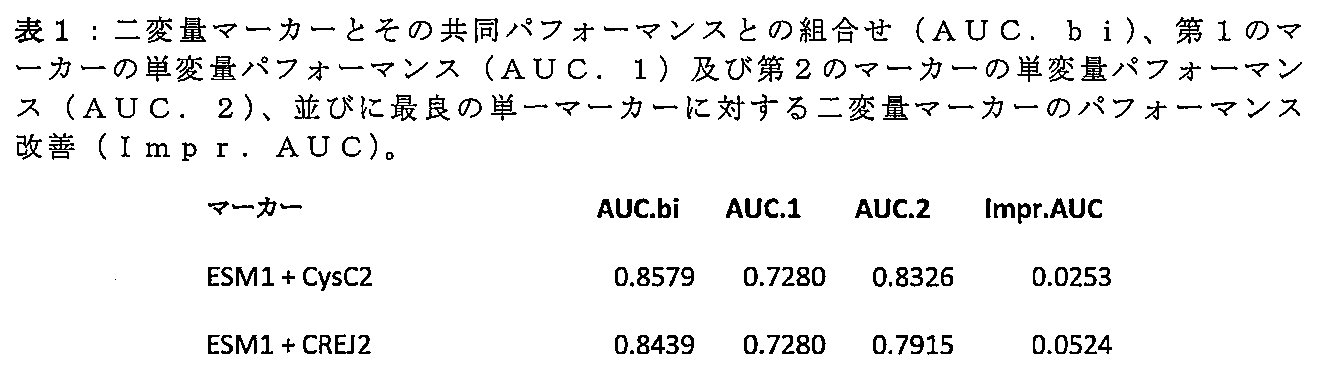
二変量マーカー対並びに3つ全ての単一マーカーの組み合わせよりもAUCが少なくとも1パーセンテージポイント改善されたマーカートリプレットの組み合わせ(三変量マーカー組み合わせ)を表2に示す。

単一のマーカーよりも改善されていないマーカーの二変量組み合わせの例を表3に示す。

Claims (17)
(a)前記対象の試料中の第1のバイオマーカーの量を決定する工程であって、前記第1のバイオマーカーがESM-1である、前記対象の試料中の第1のバイオマーカーの量を決定する工程、
(b)前記対象の試料中の第2のバイオマーカーの量を決定する工程であって、前記第2のバイオマーカーがシスタチンC又はクレアチニンである、前記対象の試料中の第2のバイオマーカーの量を決定する工程、
(c)前記バイオマーカーの前記量を、前記バイオマーカーの基準と比較する工程、及び/又は前記バイオマーカーの前記量に基づいて感染の疑いがある前記対象を評定するためのスコアを計算する工程、並びに
(d)工程(c)で行われた前記比較及び/又は前記計算に基づいて前記対象を評定する工程
を含む、感染の疑いがある対象を評定するための方法。 1. A method for assessing a subject suspected of infection, comprising:
(a) determining the amount of a first biomarker in a sample from the subject, wherein the first biomarker is ESM-1;
(b) determining the amount of a second biomarker in the subject's sample, wherein the second biomarker is cystatin C or creatinine;
(c) comparing the amount of the biomarker with a standard for the biomarker and/or calculating a score for assessing the subject suspected of being infected based on the amount of the biomarker; and (d) assessing the subject based on the comparison and/or calculation made in step (c).
(i)シスタチンCの量が前記第2のバイオマーカーとして決定される場合、前記方法が、ビリルビン、アラニンアミノトランスフェラーゼ、アスパラギン酸アミノトランスフェラーゼ、若しくは心臓トロポニンの量を第3のバイオマーカーとして決定することを更に含むか、又は
(ii)クレアチニンの量が前記第2のバイオマーカーとして決定される場合、前記方法が、アラニンアミノトランスフェラーゼ若しくはアスパラギン酸アミノトランスフェラーゼの量を第3のバイオマーカーとして決定することを更に含む、請求項1に記載の方法。 In step (b),
2. The method of claim 1, wherein (i) if the amount of cystatin C is determined as the second biomarker, the method further comprises determining the amount of bilirubin, alanine aminotransferase, aspartate aminotransferase, or cardiac troponin as a third biomarker, or (ii) if the amount of creatinine is determined as the second biomarker, the method further comprises determining the amount of alanine aminotransferase or aspartate aminotransferase as a third biomarker.
前記基準が、敗血症を発症するリスクがないことが知られている少なくとも1名の対象に由来する各バイオマーカーの基準であり、好ましくは、前記バイオマーカーの各々についての量が前記対応する基準と本質的に同一若しくは類似であることが、敗血症を発症するリスクがない対象を示し、前記バイオマーカーの各々についての量が前記対応する基準と異なることが、敗血症を発症するリスクがある対象を示す、請求項1~4のいずれか一項に記載の方法。 and/or wherein the reference is a reference for each biomarker derived from at least one subject known to be at risk of developing sepsis, preferably wherein an amount for each of the biomarkers is essentially the same as or similar to the corresponding reference indicative of a subject at risk of developing sepsis, and an amount for each of the biomarkers that differs from the corresponding reference indicative of a subject not at risk of developing sepsis;
5. The method of any one of claims 1 to 4, wherein said references are for each biomarker derived from at least one subject known to be not at risk of developing sepsis, preferably wherein an amount for each of said biomarkers that is essentially the same or similar to said corresponding reference is indicative of a subject that is not at risk of developing sepsis, and an amount for each of said biomarkers that differs from said corresponding reference is indicative of a subject that is at risk of developing sepsis.
(a)前記対象の試料中の第1のバイオマーカーの量についての値を受け取る工程であって、前記第1のバイオマーカーがESM-1である、前記対象の試料中の第1のバイオマーカーの量の値を受け取る工程、
(b)前記対象の試料中の第2のバイオマーカーの量についての値を受け取る工程であって、前記第2のバイオマーカーがシスタチンC又はクレアチニンである、前記対象の試料中の第2のバイオマーカーの量についての値を受け取る工程、
(c)前記バイオマーカーの前記量についての値を、前記バイオマーカーの基準と比較する工程及び/又は前記バイオマーカーの前記量に基づいて感染の疑いがある前記対象を評定するためのスコアを計算する工程、並びに
(d)工程(c)で行われた前記比較及び/又は前記計算に基づいて前記対象を評定する工程
を含み、
任意選択で、工程(b)において、
(i)クレアチニンの量についての値が前記第2のバイオマーカーとして受け取られる場合、前記方法が、アラニンアミノトランスフェラーゼ若しくはアスパラギン酸アミノトランスフェラーゼの量についての値を第3のバイオマーカーとして受け取ることを更に含むか、又は
(ii)シスタチンCの量についての値が前記第2のバイオマーカーとして受け取られる場合、前記方法が、ビリルビン、アラニンアミノトランスフェラーゼ、アスパラギン酸アミノトランスフェラーゼ又は心臓トロポニンの量についての値を第3のバイオマーカーとして受け取ることを更に含む、
感染の疑いがある対象を評定するためのコンピュータ実装方法。 1. A computer-implemented method for assessing a subject suspected of infection, comprising:
(a) receiving a value for the amount of a first biomarker in the subject's sample, wherein the first biomarker is ESM-1;
(b) receiving a value for the amount of a second biomarker in the subject's sample, wherein the second biomarker is cystatin C or creatinine;
(c) comparing the value for the amount of the biomarker with a standard for the biomarker and/or calculating a score for assessing the subject as suspected of infection based on the amount of the biomarker; and (d) assessing the subject based on the comparison and/or calculation made in step (c),
Optionally, in step (b),
(i) if a value for the amount of creatinine is received as the second biomarker, the method further comprises receiving a value for the amount of alanine aminotransferase or aspartate aminotransferase as a third biomarker, or (ii) if a value for the amount of cystatin C is received as the second biomarker, the method further comprises receiving a value for the amount of bilirubin, alanine aminotransferase, aspartate aminotransferase or a cardiac troponin as a third biomarker.
A computer-implemented method for assessing a subject suspected of infection.
(a)前記対象の試料中の、ESM-1である第1のバイオマーカー及び第2のバイオマーカーの量を決定するための測定ユニットであって、前記第2のバイオマーカーがシスタチンC又はクレアチニンであり、前記測定ユニットが前記第1のバイオマーカー及び前記第2のバイオマーカーの検出システムを含む、測定ユニットと、
(b)前記測定ユニットに動作可能に連結された評価ユニットであって、好ましくは請求項1~7のいずれか一項に記載の前記第1のバイオマーカー及び前記第2のバイオマーカーのための保存された基準を有するデータベースと、好ましくは請求項1~7のいずれか一項に記載の、前記第1のバイオマーカー及び前記第2のバイオマーカーの前記量と基準との比較を実行するための及び/又は前記バイオマーカーの前記量に基づいて感染の疑いがある前記対象を評定するためのスコアの計算を実行するための、並びに前記比較に基づいて前記対象を評定するための命令を含むデータプロセッサとを備え、前記測定ユニットから前記バイオマーカーの前記量についての値を自動的に受け取ることができる、評価ユニットと
を備える、感染の疑いがある対象を評定するためのデバイス。 1. A device for assessing a subject suspected of infection, comprising:
(a) a measuring unit for determining the amount of a first biomarker, said first biomarker being ESM-1, and a second biomarker in a sample of said subject, said second biomarker being cystatin C or creatinine, said measuring unit comprising a detection system for said first biomarker and said second biomarker;
(b) an evaluation unit operatively coupled to said measurement unit, said evaluation unit comprising a database with stored references for the first and second biomarkers, preferably according to any one of claims 1 to 7, and a data processor comprising instructions for performing a comparison of the amounts of the first and second biomarkers with a reference and/or for performing a calculation of a score for assessing the subject suspected of infection based on the amounts of the biomarkers, and for assessing the subject based on said comparison, said evaluation unit being capable of automatically receiving values for the amounts of the biomarkers from the measurement unit.
(i)クレアチニンが前記第2のバイオマーカーである場合、アラニンアミノトランスフェラーゼ若しくはアスパラギン酸アミノトランスフェラーゼであるか、又は
(ii)シスタチンCが前記第2のバイオマーカーである場合、ビリルビン、アラニンアミノトランスフェラーゼ、アスパラギン酸アミノトランスフェラーゼ若しくは心臓トロポニンである、請求項9に記載のデバイス。 The measurement unit measures a third biomarker and comprises a detection system for the third biomarker, the database includes stored references for the third biomarker, and the third biomarker is
10. The device of claim 9, wherein: (i) when creatinine is the second biomarker, the second biomarker is alanine aminotransferase or aspartate aminotransferase; or (ii) when cystatin C is the second biomarker, the second biomarker is bilirubin, alanine aminotransferase, aspartate aminotransferase or cardiac troponin.
任意選択で、前記データベースが、第3のバイオマーカーについての保存された基準を含み、前記第3のバイオマーカーが、
(i)クレアチニンが前記第2のバイオマーカーである場合、アラニンアミノトランスフェラーゼ若しくはアスパラギン酸アミノトランスフェラーゼであるか、又は
(ii)シスタチンCが前記第2のバイオマーカーである場合、ビリルビン、アラニンアミノトランスフェラーゼ、アスパラギン酸アミノトランスフェラーゼ若しくは心臓トロポニンである、
感染の疑いがある対象を評定するためのデバイス。 A device for assessing a subject suspected of infection, comprising an evaluation unit comprising a database with stored references for a first biomarker, said first biomarker being ESM-1, and a second biomarker, said second biomarker being Cystatin C or creatinine, and a data processor, preferably comprising instructions for performing a comparison of said amounts of said first and second biomarkers according to any one of claims 1 to 8 with a reference and for assessing said subject on the basis of said comparison, said evaluation unit being capable of receiving values for said amounts of said biomarkers determined in a sample of said subject,
Optionally, the database comprises stored references for a third biomarker, the third biomarker being:
(i) alanine aminotransferase or aspartate aminotransferase when creatinine is the second biomarker; or (ii) bilirubin, alanine aminotransferase, aspartate aminotransferase or cardiac troponin when cystatin C is the second biomarker.
A device for assessing subjects suspected of infection.
(i)クレアチニンが前記第2のバイオマーカーである場合、アラニンアミノトランスフェラーゼ若しくはアスパラギン酸アミノトランスフェラーゼであるか、又は
(ii)シスタチンCが前記第2のバイオマーカーである場合、ビリルビン、アラニンアミノトランスフェラーゼ、アスパラギン酸アミノトランスフェラーゼ若しくは心臓トロポニンである、請求項13に記載の使用。 A third biomarker or a detection agent that specifically binds to the third biomarker may additionally be used, the third biomarker being:
14. The use of claim 13, wherein: (i) when creatinine is the second biomarker, it is alanine aminotransferase or aspartate aminotransferase; or (ii) when cystatin C is the second biomarker, it is bilirubin, alanine aminotransferase, aspartate aminotransferase or cardiac troponin.
任意選択で、前記キットが、第3のバイオマーカーに特異的に結合する検出剤を更に含み、前記第3のバイオマーカーが、
(i)クレアチニンが前記第2のバイオマーカーである場合、アラニンアミノトランスフェラーゼ若しくはアスパラギン酸アミノトランスフェラーゼであるか、又は
(ii)シスタチンCが前記第2のバイオマーカーである場合、ビリルビン、アラニンアミノトランスフェラーゼ、アスパラギン酸アミノトランスフェラーゼ若しくは心臓トロポニンである、
感染の疑いがある対象を評定するためのキット。 1. A kit for assessing a subject suspected of having an infection, comprising: a detection agent that specifically binds to a first biomarker, the first biomarker being ESM-1; and a detection agent that specifically binds to a second biomarker, the second biomarker being cystatin C or creatinine;
Optionally, the kit further comprises a detection agent that specifically binds to a third biomarker, the third biomarker being:
(i) alanine aminotransferase or aspartate aminotransferase when creatinine is the second biomarker; or (ii) bilirubin, alanine aminotransferase, aspartate aminotransferase or cardiac troponin when cystatin C is the second biomarker.
A kit for assessing subjects suspected of infection.
Applications Claiming Priority (3)
| Application Number | Priority Date | Filing Date | Title |
|---|---|---|---|
| EP21171491.0 | 2021-04-30 | ||
| EP21171491 | 2021-04-30 | ||
| PCT/EP2022/061544 WO2022229416A2 (en) | 2021-04-30 | 2022-04-29 | Esm1 marker panels for early detection of sepsis |
Publications (2)
| Publication Number | Publication Date |
|---|---|
| JP2024516001A true JP2024516001A (en) | 2024-04-11 |
| JP2024516001A5 JP2024516001A5 (en) | 2025-05-12 |
Family
ID=75746433
Family Applications (1)
| Application Number | Title | Priority Date | Filing Date |
|---|---|---|---|
| JP2023566797A Pending JP2024516001A (en) | 2021-04-30 | 2022-04-29 | ESM1 marker panel for early detection of sepsis |
Country Status (5)
| Country | Link |
|---|---|
| US (1) | US20240230676A1 (en) |
| EP (1) | EP4330679A2 (en) |
| JP (1) | JP2024516001A (en) |
| CN (1) | CN117597584A (en) |
| WO (1) | WO2022229416A2 (en) |
Citations (6)
| Publication number | Priority date | Publication date | Assignee | Title |
|---|---|---|---|---|
| WO2002039123A1 (en) * | 2000-11-09 | 2002-05-16 | Institut Pasteur De Lille | Kit and method for detecting the esm-1 protein |
| WO2007041623A2 (en) * | 2005-10-03 | 2007-04-12 | Biosite Incorporated | Methods and compositions for diagnosis and/or prognosis in systemic inflammatory response syndromes |
| US20140017707A1 (en) * | 2011-01-21 | 2014-01-16 | Inserm (Institut National De La Sante Et De La Recherche Medicale) | Methods and kits for predicting the risk of respiratory failure, renal failure or thrombopenia in a septic patient by measuring endocan levels in blood |
| US20160146838A1 (en) * | 2014-11-20 | 2016-05-26 | Jean Ronald Brisard | System and method for ebola detection |
| WO2017060525A1 (en) * | 2015-10-08 | 2017-04-13 | Roche Diagnostics Gmbh | Igfbp7 for prediction of risk of aki when measured prior to surgery |
| WO2018088455A1 (en) * | 2016-11-10 | 2018-05-17 | 国立大学法人千葉大学 | Diagnostic agent for sepsis |
Family Cites Families (5)
| Publication number | Priority date | Publication date | Assignee | Title |
|---|---|---|---|---|
| CA2476597C (en) | 2002-02-28 | 2011-05-17 | Metanomics Gmbh & Co. Kgaa | Mass spectrometry method for analysing mixtures of substances |
| US20090197794A1 (en) | 2005-07-13 | 2009-08-06 | Aird William C | Methods of Diagnosing and Treating an Inflammatory Response |
| CN103123359B (en) | 2007-08-03 | 2015-07-29 | B.R.A.H.M.S有限公司 | The application of Procalcitonin (PCT) in the risk stratification and prognosis of the patient of trouble primary uninfection |
| RU2016112915A (en) | 2013-09-05 | 2017-10-09 | Эф-Ай-Оу Корпорейшн | BIOMARKERS FOR EARLY IDENTIFICATION OF CRITICAL OR THREATENING LIFE OF RESPONSE RESPONSE TO DISEASE AND / OR RESPONSE RESPONSE TO TREATMENT |
| GB201402293D0 (en) * | 2014-02-11 | 2014-03-26 | Secr Defence | Biomarker signatures for the prediction of onset of sepsis |
-
2022
- 2022-04-29 JP JP2023566797A patent/JP2024516001A/en active Pending
- 2022-04-29 CN CN202280032035.6A patent/CN117597584A/en active Pending
- 2022-04-29 EP EP22724114.8A patent/EP4330679A2/en active Pending
- 2022-04-29 US US18/558,150 patent/US20240230676A1/en active Pending
- 2022-04-29 WO PCT/EP2022/061544 patent/WO2022229416A2/en not_active Ceased
Patent Citations (10)
| Publication number | Priority date | Publication date | Assignee | Title |
|---|---|---|---|---|
| WO2002039123A1 (en) * | 2000-11-09 | 2002-05-16 | Institut Pasteur De Lille | Kit and method for detecting the esm-1 protein |
| JP2004522941A (en) * | 2000-11-09 | 2004-07-29 | アンスティテュ パストゥール ドゥ リル | Kit for detecting protein ESM-1 and detection method using said kit |
| WO2007041623A2 (en) * | 2005-10-03 | 2007-04-12 | Biosite Incorporated | Methods and compositions for diagnosis and/or prognosis in systemic inflammatory response syndromes |
| JP2009510478A (en) * | 2005-10-03 | 2009-03-12 | バイオサイト インコーポレイテッド | Methods and compositions for diagnosis and / or prognosis of systemic inflammatory response syndrome |
| US20140017707A1 (en) * | 2011-01-21 | 2014-01-16 | Inserm (Institut National De La Sante Et De La Recherche Medicale) | Methods and kits for predicting the risk of respiratory failure, renal failure or thrombopenia in a septic patient by measuring endocan levels in blood |
| JP2014503076A (en) * | 2011-01-21 | 2014-02-06 | アンスティチュ ナショナル ドゥ ラ サンテ エ ドゥ ラ ルシェルシュ メディカル | Methods and kits for predicting the risk of respiratory failure, renal failure, or thrombocytopenia in septic patients by measuring endoccan levels in the blood |
| US20160146838A1 (en) * | 2014-11-20 | 2016-05-26 | Jean Ronald Brisard | System and method for ebola detection |
| WO2017060525A1 (en) * | 2015-10-08 | 2017-04-13 | Roche Diagnostics Gmbh | Igfbp7 for prediction of risk of aki when measured prior to surgery |
| JP2018532114A (en) * | 2015-10-08 | 2018-11-01 | エフ.ホフマン−ラ ロシュ アーゲーF. Hoffmann−La Roche Aktiengesellschaft | IGFBP7 for predicting AKI risk when measured before surgery |
| WO2018088455A1 (en) * | 2016-11-10 | 2018-05-17 | 国立大学法人千葉大学 | Diagnostic agent for sepsis |
Also Published As
| Publication number | Publication date |
|---|---|
| US20240230676A1 (en) | 2024-07-11 |
| WO2022229416A3 (en) | 2023-02-23 |
| CN117597584A (en) | 2024-02-23 |
| EP4330679A2 (en) | 2024-03-06 |
| WO2022229416A2 (en) | 2022-11-03 |
Similar Documents
| Publication | Publication Date | Title |
|---|---|---|
| JP2026048754A (en) | PCT marker panel for early detection of sepsis | |
| JP2024516680A (en) | IL6 Marker Panel for Early Detection of Sepsis | |
| JP2024516677A (en) | NGAL Marker Panel for Early Detection of Sepsis - Patent application | |
| JP2024516678A (en) | STREM1 Marker Panel for Early Detection of Sepsis | |
| JP2024516001A (en) | ESM1 marker panel for early detection of sepsis | |
| JP2024516679A (en) | IGFBP7 Marker Panel for Early Detection of Sepsis | |
| JP2024515086A (en) | GDF15 Marker Panel for Early Detection of Sepsis | |
| JP2024516681A (en) | sFlt1 Marker Panel for Early Detection of Sepsis - Patent application | |
| JP2024516665A (en) | Presepsin marker panel for early detection of sepsis | |
| JP2024537774A (en) | MR-proADM marker panel for early detection of sepsis | |
| JP2025506704A (en) | DLL1 Marker Panel for Early Detection of Sepsis - Patent application |
Legal Events
| Date | Code | Title | Description |
|---|---|---|---|
| A521 | Request for written amendment filed |
Free format text: JAPANESE INTERMEDIATE CODE: A523 Effective date: 20250430 |
|
| A621 | Written request for application examination |
Free format text: JAPANESE INTERMEDIATE CODE: A621 Effective date: 20250430 |
|
| A977 | Report on retrieval |
Free format text: JAPANESE INTERMEDIATE CODE: A971007 Effective date: 20260227 |
|
| A131 | Notification of reasons for refusal |
Free format text: JAPANESE INTERMEDIATE CODE: A131 Effective date: 20260304 |