JP2024058072A - GAME SYSTEM, SERVER DEVICE, PROGRAM, AND GAME PROVIDING METHOD - Google Patents
GAME SYSTEM, SERVER DEVICE, PROGRAM, AND GAME PROVIDING METHOD Download PDFInfo
- Publication number
- JP2024058072A JP2024058072A JP2022165208A JP2022165208A JP2024058072A JP 2024058072 A JP2024058072 A JP 2024058072A JP 2022165208 A JP2022165208 A JP 2022165208A JP 2022165208 A JP2022165208 A JP 2022165208A JP 2024058072 A JP2024058072 A JP 2024058072A
- Authority
- JP
- Japan
- Prior art keywords
- character
- virtual camera
- virtual
- game
- virtual space
- Prior art date
- Legal status (The legal status is an assumption and is not a legal conclusion. Google has not performed a legal analysis and makes no representation as to the accuracy of the status listed.)
- Granted
Links
Images


Landscapes
- Processing Or Creating Images (AREA)
Abstract
Description
本発明は、ゲームシステム、サーバ装置、プログラム及びゲーム提供方法に関する。 The present invention relates to a game system, a server device, a program, and a game provision method.
従来から、オブジェクトを撮影する仮想カメラを制御するゲームシステムが存在する(例えば、特許文献1)。 Conventionally, there have been game systems that control a virtual camera that photographs an object (for example, Patent Document 1).
例えば、特許文献1に示す技術は、複数のプレーヤが対戦格闘するゲームにおいて、各キャラクタの位置に基づいて、第1、第2の仮想カメラを制御する。そして、各キャラクタの立ち位置を選択可能とし、いずれかの仮想カメラが撮影したオブジェクト空間をゲーム画像として表示させる。
For example, the technology shown in
しかし、キャラクタが配置された第1の仮想空間で発生したイベントに基づいて、第2の仮想空間で当該キャラクタの演出を行う場合、第2の仮想空間において仮想カメラの制御を適切に行い、プレーヤに一連のゲームの繋がりを感じさせることが好ましい。 However, when a character is presented in a second virtual space based on an event that occurs in a first virtual space in which the character is placed, it is preferable to appropriately control the virtual camera in the second virtual space to give the player a sense of connection between the series of games.
本発明は、このような課題に鑑みてなされたものであり、その目的は、キャラクタが配置された第1の仮想空間で発生したイベントに基づいて、第2の仮想空間で当該キャラクタの演出を行う場合に、第1の仮想空間におけるゲーム画面から、第2の仮想空間における前記キャラクタの演出を行う演出画面への移行が自然であり、第1の仮想空間と第2の仮想空間とにおいて、プレーヤがゲームの繋がりを感じることができるゲームシステム等を提供することにある。 The present invention has been made in consideration of these problems, and its purpose is to provide a game system etc. in which, when a character is presented in a second virtual space based on an event that occurs in a first virtual space in which the character is placed, there is a natural transition from the game screen in the first virtual space to a presentation screen in the second virtual space in which the character is presented, and the player can feel a connection between the games in the first virtual space and the second virtual space.
(1)本発明は、
キャラクタが配置された第1の仮想空間で発生したイベントに基づいて、第2の仮想空間で当該キャラクタの演出を行うゲームシステムにおいて、
所定の行動を実行するキャラクタと背景物とが配置された前記第1の仮想空間において、ゲームを進行させるゲーム処理部と、
前記第1の仮想空間におけるゲーム画面を表示部に表示させ、所定の条件を満たした場合に、当該ゲーム画面から、前記第2の仮想空間における前記キャラクタの演出を行う演出画面に移行して表示させる表示制御部と、
前記第1の仮想空間に配置された第1の仮想カメラと、前記第2の仮想空間に配置された第2の仮想カメラとを制御する仮想カメラ制御部と、
を含み、
前記仮想カメラ制御部は、
前記第2の仮想空間に配置され、前記第1の仮想空間に配置されたキャラクタに対応する演出用のキャラクタを、前記第2の仮想カメラの撮影対象とし、
前記所定の条件を満たした時の前記第1の仮想カメラの視点から見た所定情報に基づいて、前記第2の仮想カメラを制御することを特徴とするゲームシステムに関する。
(1) The present invention provides
1. A game system that performs a presentation of a character in a second virtual space based on an event that occurs in a first virtual space in which the character is placed,
a game processing unit that progresses a game in the first virtual space in which characters that perform predetermined actions and background objects are arranged;
a display control unit that causes a game screen in the first virtual space to be displayed on a display unit, and when a predetermined condition is satisfied, causes the game screen to transition to and display an effect screen for effecting an effect of the character in the second virtual space;
a virtual camera control unit that controls a first virtual camera arranged in the first virtual space and a second virtual camera arranged in the second virtual space;
Including,
The virtual camera control unit:
a character for effect that is arranged in the second virtual space and corresponds to a character arranged in the first virtual space, the character being a subject of photography by the second virtual camera;
The present invention relates to a game system that controls the second virtual camera based on predetermined information seen from the viewpoint of the first virtual camera when the predetermined condition is satisfied.
また、本発明は、上記各部を含むサーバ装置に関する。また、上記各部を含む端末装置(ゲーム装置)に関する。また、本発明は、上記各部としてコンピュータを機能させるプログラムに関する。また、本発明は、コンピュータが読み取り可能な情報記憶媒体であって、上記各部としてコンピュータを機能させるプログラムを記憶する情報記憶媒体に関する。 The present invention also relates to a server device including each of the above-mentioned units. The present invention also relates to a terminal device (game device) including each of the above-mentioned units. The present invention also relates to a program that causes a computer to function as each of the above-mentioned units. The present invention also relates to a computer-readable information storage medium that stores a program that causes a computer to function as each of the above-mentioned units.
また、本発明は、
キャラクタが配置された第1の仮想空間で発生したイベントに基づいて、第2の仮想空間で当該キャラクタの演出を行うサーバ装置から、プレーヤの端末装置に、ゲームに関する情報を提供するためのゲーム提供方法であって、
前記サーバ装置が、
所定の行動を実行するキャラクタと背景物とが配置された前記第1の仮想空間において、ゲームを進行させるステップと、
前記第1の仮想空間におけるゲーム画面を表示部に表示させ、所定の条件を満たした場合に、当該ゲーム画面から、前記第2の仮想空間における前記キャラクタの演出を行う演出画面に移行して表示させるステップと、
前記第1の仮想空間に配置された第1の仮想カメラと、前記第2の仮想空間に配置された第2の仮想カメラを制御するステップと、
を含み、
前記第2の仮想カメラを制御するステップは、
前記第2の仮想空間に配置され、前記第1の仮想空間に配置されたキャラクタに対応する演出用のキャラクタを、前記第2の仮想カメラの撮影対象とし、
前記所定の条件を満たした時の前記第1の仮想カメラの視点から見た所定情報に基づいて、前記第2の仮想カメラを制御する場合において、
前記端末装置によって受け付けられた前記プレーヤの操作情報を前記サーバ装置に送信し、
前記サーバ装置からゲームに関する情報を受信することを特徴とするゲーム提供方法に関する。
The present invention also provides a method for producing a method for manufacturing a semiconductor device comprising the steps of:
1. A method for providing a game from a server device that performs a presentation of a character in a second virtual space based on an event occurring in a first virtual space in which the character is placed, to a terminal device of a player, the method comprising:
The server device,
progressing a game in the first virtual space in which a character performing a predetermined action and a background object are arranged;
displaying a game screen in the first virtual space on a display unit, and when a predetermined condition is satisfied, transitioning from the game screen to an effecting screen for effecting the character in the second virtual space and displaying the effected screen;
controlling a first virtual camera disposed in the first virtual space and a second virtual camera disposed in the second virtual space;
Including,
The step of controlling the second virtual camera includes:
a character for effect that is arranged in the second virtual space and corresponds to a character arranged in the first virtual space, the character being a subject of photography by the second virtual camera;
In a case where the second virtual camera is controlled based on predetermined information seen from a viewpoint of the first virtual camera when the predetermined condition is satisfied,
transmitting operation information of the player received by the terminal device to the server device;
The present invention relates to a method for providing a game, the method comprising the step of receiving information related to the game from the server device.
本発明は、所定の条件を満たした時の第1の仮想カメラの視点から見た所定情報に基づいて、第2の仮想カメラを制御するので、第1の仮想空間におけるゲーム画面から、第2の仮想空間におけるキャラクタの演出を行う演出画面への移行が自然である。その結果、本発明は、第1の仮想空間と第2の仮想空間とにおいて、プレーヤがゲームの繋がりを感じることができる。 The present invention controls the second virtual camera based on specific information seen from the viewpoint of the first virtual camera when specific conditions are met, so there is a natural transition from the game screen in the first virtual space to the presentation screen that presents the character in the second virtual space. As a result, the present invention allows the player to feel a connection between the games in the first and second virtual spaces.
(2)また、本発明に係るゲームシステム、サーバ装置、端末装置、プログラム、情報記憶媒体及びゲーム提供方法では、
前記仮想カメラ制御部は、
プレーヤの操作対象であるプレーヤキャラクタに対応する演出用のプレーヤキャラクタを、前記第2の仮想カメラの撮影対象とし、
前記所定の条件を満たした時の前記第1の仮想カメラの視点から見た、当該プレーヤキャラクタの位置情報に基づいて、前記第2の仮想カメラを制御してもよい。
(2) In addition, in the game system, server device, terminal device, program, information storage medium, and game providing method according to the present invention,
The virtual camera control unit:
a player character for effect corresponding to a player character that is an object of operation by a player is set as an object of shooting by the second virtual camera;
The second virtual camera may be controlled based on position information of the player character as seen from a viewpoint of the first virtual camera when the predetermined condition is satisfied.
ここで、位置情報は、配置情報と言い換えることができる。位置情報は、例えば、ワールド座標系の位置座標又はスクリーン座標系の位置座標である。また、位置情報は、キャラクタが仮想カメラの視線方向に対してどのエリア(例えば、仮想カメラの視線方向に対して左側或いは右側)に位置しているかを示す情報でもよい。なお、エリアは、左側、右側に限らない。例えば、エリアは、上側、下側、手前側、奥側などでもよい。 Here, position information can be rephrased as placement information. Position information is, for example, position coordinates in a world coordinate system or position coordinates in a screen coordinate system. Position information may also be information indicating in which area (for example, left or right side of the line of sight of the virtual camera) the character is located relative to the line of sight of the virtual camera. Note that the area is not limited to the left or right side. For example, the area may be the upper side, lower side, front side, back side, etc.
本発明によれば、更に、第1の仮想空間におけるゲーム画面から、第2の仮想空間にお
けるプレーヤキャラクタの演出を行う演出画面への移行が自然となる。
Furthermore, according to the present invention, the transition from the game screen in the first virtual space to the presentation screen presenting the player character in the second virtual space becomes natural.
(3)また、本発明に係るゲームシステム、サーバ装置、端末装置、プログラム、情報記憶媒体及びゲーム提供方法では、
前記仮想カメラ制御部は、
前記所定の条件を満たした時の前記第2の仮想カメラから見える前記演出用のプレーヤキャラクタの位置が、前記所定の条件を満たした時の前記第1の仮想カメラから見える前記プレーヤキャラクタの位置と同じになるように、前記第2の仮想カメラを制御してもよい。
(3) In addition, the game system, server device, terminal device, program, information storage medium, and game providing method according to the present invention include:
The virtual camera control unit:
The second virtual camera may be controlled so that the position of the player character for presentation as seen from the second virtual camera when the specified condition is satisfied is the same as the position of the player character as seen from the first virtual camera when the specified condition is satisfied.
ここで、「第1の仮想カメラから見えるプレーヤキャラクタの位置」とは、第1の仮想カメラからの見た目の位置であり、例えば、第1の仮想カメラにおいてプレーヤキャラクタがスクリーンに投影されたスクリーン座標系の位置とすることができる。 Here, "the position of the player character as seen from the first virtual camera" refers to the position as seen from the first virtual camera, and can be, for example, the position of the screen coordinate system in which the player character is projected onto the screen by the first virtual camera.
また、「第1の仮想カメラから見えるプレーヤキャラクタの位置」とは、第1の仮想空間において、第1の仮想カメラの位置に対する相対的なプレーヤキャラクタの位置であってもよい。 In addition, "the position of the player character as seen from the first virtual camera" may be the position of the player character relative to the position of the first virtual camera in the first virtual space.
また、「第1の仮想カメラから見えるプレーヤキャラクタの位置」は、第1の仮想空間において、第1の仮想カメラの視線方向に対して、当該プレーヤキャラクタがどのエリア(例えば、第1の仮想カメラの視線方向に対して右側又は左側)に位置しているかを示す情報でもよい。 In addition, the "position of the player character as seen from the first virtual camera" may be information indicating in which area (e.g., to the right or left of the line of sight of the first virtual camera) the player character is located in the first virtual space with respect to the line of sight of the first virtual camera.
また、「第2の仮想カメラから見える演出用のプレーヤキャラクタの位置」とは、第2の仮想カメラからの見た目の位置であり、例えば、第2の仮想カメラにおいて演出用のプレーヤキャラクタがスクリーンに投影されたスクリーン座標系の位置とすることができる。 In addition, the "position of the player character for effects as seen from the second virtual camera" refers to the position as seen from the second virtual camera, and can be, for example, the position of the screen coordinate system in which the player character for effects is projected onto the screen by the second virtual camera.
また、「第2の仮想カメラから見える演出用のプレーヤキャラクタの位置」とは、第2の仮想空間において、第2の仮想カメラの位置に対する相対的な演出用のプレーヤキャラクタの位置であってもよい。 In addition, "the position of the player character for the effects as seen from the second virtual camera" may be the position of the player character for the effects in the second virtual space relative to the position of the second virtual camera.
また、「第2の仮想カメラから見える演出用のプレーヤキャラクタの位置」は、第2の仮想空間において、第2の仮想カメラの視線方向に対して、演出用のプレーヤキャラクタがどのエリア(例えば、第2の仮想カメラの視線方向に対して右側又は左側)に位置しているかを示す情報でもよい。 The "position of the player character for effect as seen from the second virtual camera" may be information indicating in which area (e.g., to the right or left of the line of sight of the second virtual camera) the player character for effect is located in the second virtual space with respect to the line of sight of the second virtual camera.
本発明によれば、演出画面への移行の際、ゲーム画面のプレーヤキャラクタの表示位置と、演出画面の演出用のプレーヤキャラクタの表示位置とを同じ(或いは、ほぼ同じ)にすることができる。また、本発明によれば、ゲーム画面においてプレーヤキャラクタの表示エリアと、演出画面の演出用のプレーヤキャラクタの表示エリアとを同じにすることができる。例えば、ゲーム画面の左側にプレーヤキャラクタが表示されている場合に、演出画面においても左側にプレーヤキャラクタを表示できる。その結果、演出画面への移行が自然となる。 According to the present invention, when transitioning to a presentation screen, the display position of the player character on the game screen and the display position of the player character for presentation on the presentation screen can be made the same (or nearly the same). Furthermore, according to the present invention, the display area of the player character on the game screen and the display area of the player character for presentation on the presentation screen can be made the same. For example, if the player character is displayed on the left side of the game screen, the player character can also be displayed on the left side on the presentation screen. As a result, the transition to the presentation screen becomes natural.
(4)また、本発明に係るゲームシステム、サーバ装置、端末装置、プログラム、情報記憶媒体及びゲーム提供方法では、
前記仮想カメラ制御部は、
イベントの終了時の前記第2の仮想カメラから見える前記演出用のプレーヤキャラクタの位置が、前記ゲームの再開時の前記第1の仮想カメラから見える前記プレーヤキャラク
タの位置と同じになるように、前記第2の仮想カメラを制御してもよい。
(4) In addition, in the game system, server device, terminal device, program, information storage medium, and game providing method according to the present invention,
The virtual camera control unit:
The second virtual camera may be controlled so that the position of the player character for the presentation as seen from the second virtual camera at the end of the event is the same as the position of the player character as seen from the first virtual camera at the time the game is restarted.
本発明によれば、ゲーム画面への移行の際、ゲーム画面のプレーヤキャラクタの表示位置と、演出画面の演出用のプレーヤキャラクタの表示位置とを同じ(或いは、ほぼ同じ)にすることができる。また、本発明によれば、ゲーム画面のプレーヤキャラクタの表示エリアと、演出画面の演出用のプレーヤキャラクタの表示エリアとを同じにすることができる。例えば、ゲーム画面の左側にプレーヤキャラクタが表示されている場合に、演出画面においても左側にプレーヤキャラクタを表示できる。その結果、ゲーム再開時におけるゲーム画面への移行が自然となる。 According to the present invention, when transitioning to a game screen, the display position of the player character on the game screen and the display position of the player character for presentation on the presentation screen can be made the same (or nearly the same). Also, according to the present invention, the display area of the player character on the game screen and the display area of the player character for presentation on the presentation screen can be made the same. For example, when the player character is displayed on the left side of the game screen, the player character can also be displayed on the left side on the presentation screen. As a result, transitioning to the game screen when the game is resumed becomes natural.
(5)また、本発明に係るゲームシステム、サーバ装置、端末装置、プログラム、情報記憶媒体及びゲーム提供方法では、
前記仮想カメラ制御部は、
前記所定の条件を満たした時の前記第2の仮想カメラから見える前記演出用のプレーヤキャラクタの位置が、前記所定の条件を満たした時の前記第1の仮想カメラから見える前記プレーヤキャラクタの位置と同じになる期間を、特定期間とし、
イベントの期間に対する前記特定期間の割合が所定値以上になるように、前記第2の仮想カメラを制御してもよい。
(5) In addition, in the game system, server device, terminal device, program, information storage medium, and game providing method according to the present invention,
The virtual camera control unit:
a period during which a position of the effect player character seen from the second virtual camera when the predetermined condition is satisfied is the same as a position of the player character seen from the first virtual camera when the predetermined condition is satisfied is defined as a specific period;
The second virtual camera may be controlled so that a ratio of the specific period to a period of an event is equal to or greater than a predetermined value.
本発明によれば、イベント期間に対し、ゲーム画面のプレーヤキャラクタの表示位置と、演出画面の演出用のプレーヤキャラクタの表示位置とを同じ(或いは、ほぼ同じ)にする期間の割合を制御できる。また、本発明によれば、イベント期間に対し、ゲーム画面のプレーヤキャラクタの表示エリアと、演出画面の演出用のプレーヤキャラクタの表示エリアとを同じにする期間の割合を制御できる。例えば、ゲーム画面の左側にプレーヤキャラクタが表示されている場合に、演出画面においても左側にプレーヤキャラクタを表示されている期間の割合を調整できる。その結果、演出画面への移行が自然となる。 According to the present invention, it is possible to control the proportion of the period during which the display position of the player character on the game screen and the display position of the player character for presentation on the presentation screen are the same (or nearly the same) during the event period. Also, according to the present invention, it is possible to control the proportion of the period during which the display area of the player character on the game screen and the display area of the player character for presentation on the presentation screen are the same during the event period. For example, when the player character is displayed on the left side of the game screen, it is possible to adjust the proportion of the period during which the player character is displayed on the left side on the presentation screen as well. As a result, the transition to the presentation screen becomes more natural.
(6)また、本発明に係るゲームシステム、サーバ装置、端末装置、プログラム、情報記憶媒体及びゲーム提供方法では、
前記仮想カメラ制御部は、
プレーヤの操作対象であるプレーヤキャラクタに対応する演出用のプレーヤキャラクタと、他キャラクタに対応する演出用の他キャラクタとを、前記第2の仮想カメラの撮影対象とし、
前記所定の条件を満たした時の前記第1の仮想カメラの視点から見た、当該プレーヤキャラクタの位置情報に基づいて、前記第2の仮想カメラを制御してもよい。
(6) In addition, in the game system, server device, terminal device, program, information storage medium, and game providing method according to the present invention,
The virtual camera control unit:
a player character for effect corresponding to a player character that is an object of operation by a player and another character for effect corresponding to another character are set as objects to be photographed by the second virtual camera;
The second virtual camera may be controlled based on position information of the player character as seen from a viewpoint of the first virtual camera when the predetermined condition is satisfied.
本発明によれば、第1の仮想空間におけるゲーム画面から、第2の仮想空間におけるプレーヤキャラクタ及び他キャラクタの演出を行う演出画面への移行が自然となる。 According to the present invention, the transition from the game screen in the first virtual space to the presentation screen showing the presentation of the player character and other characters in the second virtual space becomes natural.
(7)また、本発明に係るゲームシステム、サーバ装置、端末装置、プログラム、情報記憶媒体及びゲーム提供方法では、
前記第2の仮想空間に、少なくとも前記第1の仮想空間で登場したキャラクタを登場させ、当該キャラクタに予め指定された行動を実行させる仮想空間制御部を、更に含んでもよい。
(7) In addition, the game system, server device, terminal device, program, information storage medium, and game providing method according to the present invention include:
The game device may further include a virtual space control unit that causes at least a character that appeared in the first virtual space to appear in the second virtual space and causes the character to perform a pre-specified action.
本発明によれば、第1の仮想空間で登場したキャラクタを、第2の仮想空間において指定された行動を実行させる際に、演出画面への移行が自然となる。 According to the present invention, when a character that appears in a first virtual space is made to perform a specified action in a second virtual space, the transition to the presentation screen appears natural.
(8)また、本発明に係るゲームシステム、サーバ装置、端末装置、プログラム、情報記憶媒体及びゲーム提供方法では、
前記仮想カメラ制御部は、
イベントの期間中に、プレーヤの操作情報に基づいて、前記第2の仮想カメラを制御可能としてもよい。
(8) In addition, in the game system, server device, terminal device, program, information storage medium, and game providing method according to the present invention,
The virtual camera control unit:
During the event, the second virtual camera may be controllable based on operation information of a player.
本発明によれば、プレーヤの意思を考慮した第2の仮想カメラを制御可能となり、プレーヤが満足できる演出画面を提供できる。 According to the present invention, it is possible to control the second virtual camera taking into account the player's intentions, and to provide a presentation screen that satisfies the player.
(9)また、本発明に係るゲームシステム、サーバ装置、端末装置、プログラム、情報記憶媒体及びゲーム提供方法では、
前記仮想カメラ制御部は、
キャラクタの情報に応じて、前記第2の仮想カメラを制御してもよい。
(9) In addition, the game system, server device, terminal device, program, information storage medium, and game providing method according to the present invention include:
The virtual camera control unit:
The second virtual camera may be controlled in accordance with character information.
本発明は、キャラクタの情報に基づいて、第2の仮想カメラを制御するので、第1の仮想空間におけるゲーム画面から、第2の仮想空間におけるキャラクタの演出を行う演出画面への移行が自然である。その結果、本発明は、第1の仮想空間と第2の仮想空間とにおいて、プレーヤがゲームの繋がりを感じることができる。 The present invention controls the second virtual camera based on character information, so there is a natural transition from the game screen in the first virtual space to the presentation screen that presents the character in the second virtual space. As a result, the present invention allows the player to feel a connection between the games in the first and second virtual spaces.
(10)また、本発明に係るゲームシステム、サーバ装置、端末装置、プログラム、情報記憶媒体及びゲーム提供方法では、
前記キャラクタの情報とは、イベントに関連するキャラクタのパラメータであり、
前記仮想カメラ制御部は、
前記キャラクタのパラメータに基づいて、前記第2の仮想カメラを制御してもよい。
(10) In addition, the game system, server device, terminal device, program, information storage medium, and game providing method according to the present invention include:
The character information is a character parameter related to an event,
The virtual camera control unit:
The second virtual camera may be controlled based on a parameter of the character.
本発明は、キャラクタのパラメータを考慮するので、第1の仮想空間と第2の仮想空間とにおいて、プレーヤが更にゲームの繋がりを感じることができる。 The present invention takes into account character parameters, allowing the player to feel a greater connection between the game in the first and second virtual spaces.
(11)また、本発明に係るゲームシステム、サーバ装置、端末装置、プログラム、情報記憶媒体及びゲーム提供方法では、
前記仮想カメラ制御部は、
イベントの情報に応じて、前記第2の仮想カメラを制御してもよい。
(11) In addition, the game system, server device, terminal device, program, information storage medium, and game providing method according to the present invention include:
The virtual camera control unit:
The second virtual camera may be controlled in response to event information.
本発明は、イベントの情報に基づいて、第2の仮想カメラを制御するので、イベントに応じて、第1の仮想空間におけるゲーム画面から、第2の仮想空間におけるキャラクタの演出を行う演出画面への移行を自然にできる。その結果、本発明は、第1の仮想空間と第2の仮想空間とにおいて、プレーヤがゲームの繋がりを感じることができる。 The present invention controls the second virtual camera based on event information, so that it is possible to naturally transition from the game screen in the first virtual space to a presentation screen in the second virtual space that presents the character in response to the event. As a result, the present invention allows the player to feel a connection between the games in the first and second virtual spaces.
(12)また、本発明に係るゲームシステム、サーバ装置、端末装置、プログラム、情報記憶媒体及びゲーム提供方法では、
前記仮想カメラ制御部は、
イベントの期間の所与のタイミングで、前記第2の仮想カメラから見える演出用のキャラクタの位置が、前記所定の条件を満たした時の前記第1の仮想カメラから見える当該キャラクタの位置と異なると判断された場合に、当該タイミング以後からイベントが終了するまでの間、前記第2の仮想カメラから見える前記演出用のキャラクタの位置が、前記所定の条件を満たした時の前記第1の仮想カメラから見える当該キャラクタの位置と同じになるように、前記第2の仮想カメラを制御してもよい。
(12) In addition, the game system, server device, terminal device, program, information storage medium, and game providing method according to the present invention include:
The virtual camera control unit:
If it is determined that the position of a character for presentation purposes seen by the second virtual camera at a given time during the event is different from the position of the character seen by the first virtual camera when the specified condition is satisfied, the second virtual camera may be controlled so that the position of the character for presentation purposes seen by the second virtual camera from that time until the end of the event is the same as the position of the character seen by the first virtual camera when the specified condition is satisfied.
このようにすれば、前記タイミング以後からイベントが終了するまでの間、演出用のキャラクタの表示位置の混乱を生じさせないようにすることができ、自然な演出画面をプレーヤに提供できる。例えば、ゲーム画面の左側にプレーヤキャラクタが表示されている場合に、前記タイミング以後からイベントが終了するまでの間、演出画面においても左側に
プレーヤキャラクタを表示できる。
In this way, confusion about the display position of the presentation character can be prevented from occurring from after the timing until the end of the event, and a natural presentation screen can be provided to the player. For example, if the player character is displayed on the left side of the game screen, the player character can be displayed on the left side on the presentation screen from after the timing until the end of the event.
以下、本実施形態について説明する。なお、以下に説明する本実施形態は、特許請求の範囲に記載された本発明の内容を不当に限定するものではない。また本実施形態で説明される構成の全てが、本発明の必須構成要件であるとは限らない。 The present embodiment will be described below. Note that the present embodiment described below does not unduly limit the content of the present invention described in the claims. Furthermore, not all of the configurations described in the present embodiment are necessarily essential components of the present invention.
[1]ゲームシステム
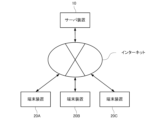
まず、図1を用いて本実施形態のゲームシステムの概要及び概要構成について説明する。なお、図1は、本実施形態のゲームシステムの構成を示すシステム構成の一例を示す図である。
[1] Game System First, an overview and a general configuration of the game system of this embodiment will be described with reference to Fig. 1. Fig. 1 is a diagram showing an example of a system configuration showing the configuration of the game system of this embodiment.
サーバ装置10は、インターネット(ネットワークの一例)を介して通信接続された端末装置(ゲーム装置)20を用いて、所与のサービスを提供することが可能な情報処理装置である。
The
端末装置20は、端末装置、スマートフォン、携帯電話、PHS、コンピュータ、端末装置、PDA、携帯型ゲーム機等、画像生成装置などの情報処理装置であり、インターネット(WAN)、LANなどのネットワークを介してサーバ装置10に接続可能な装置である。
The
[1.1]クライアントサーバモデルで構成されるゲームシステム
本実施形態のゲームシステムは、図1に示すように、サーバ装置10と、端末装置20(例えば、端末装置20A、20B、20C)とが、インターネット(ネットワークの一例)に接続可能に構成される。
[1.1] Game system configured in a client-server model As shown in FIG. 1, the game system of this embodiment is configured such that a
プレーヤは、端末装置20からサーバ装置10にアクセスすることにより、インターネットを介してサーバ装置10から送信される情報に基づき、ゲームをプレイすることができる。
By accessing the
本実施形態は、一つのサーバ装置10によって各ゲームを端末装置20に提供してもよいし、複数のサーバ装置10を連動させてサーバシステムを構築し、各ゲームを端末装置20に提供してもよい。
In this embodiment, each game may be provided to the
なお、サーバ装置10だけで本発明に関する各種の処理を行うようにしてもよいし、端末装置20だけで本発明に関する各種の処理を行うようにしてもよい。
In addition, various processes related to the present invention may be performed only by the
[1.2]端末装置
本実施形態のゲームシステムは、サーバ装置10の機能を備えた単一の端末装置、すなわち、サーバ装置などの他の機器に依存せず単独で動作する装置(スタンドアローン)によって実現してもよい。
[1.2] Terminal Device The game system of this embodiment may be realized by a single terminal device having the functions of the
また、本実施形態では、サーバ装置10と接続せずに、端末装置20だけで本発明を実現するものであってもよい。例えば、P2P(ピア・ツー・ピア方式)による通信によって複数の端末装置20で実現するゲームシステムであってもよい。
In addition, in this embodiment, the present invention may be realized by the
そして、このような端末装置を有線又は無線によって複数連結させ、一の端末装置がホスト(サーバ装置10)として機能して、複数の端末装置によって実現してもよい。 The system may be realized by connecting multiple such terminal devices by wire or wirelessly, with one terminal device functioning as a host (server device 10).
なお、端末装置は、端末装置だけでなく、タブレット型情報端末装置やパーソナルコンピュータ、又は、アミューズメントパークに設置される端末装置(筐体)でもよい。 The terminal device may be not only a terminal device, but also a tablet information terminal device, a personal computer, or a terminal device (casing) installed in an amusement park.
[1.3]クラウド型のゲームシステム
また、本実施形態のゲームシステムはクラウド型のゲームシステムでもよい。例えば、クラウド型のゲームシステムでは、サーバ装置10(クラウド装置)だけで基本的な処理(ゲーム処理、描画処理などを含む)を行い、端末装置20側ではサーバ装置10(クラウド装置)の処理結果の表示制御のみを行う。また、端末装置20は、サーバ装置10に対してコントローラの入力情報(操作情報)などの情報を送信する。なお、かかる場合、端末装置20は、入力情報以外の情報を送信してもよい。
[1.3] Cloud-based Game System The game system of this embodiment may be a cloud-based game system. For example, in a cloud-based game system, basic processing (including game processing, drawing processing, etc.) is performed only by the server device 10 (cloud device), and the
さらに、本実施形態では、入力を除き、上記の端末装置20の処理部200の各機能及びゲームプログラムの実行をサーバ装置10で実行し、当該端末装置20は、入力とストリーミングによる画像表示を実行することによって、上記のゲームを実現してもよい。
Furthermore, in this embodiment, the functions of the
また、ゲームシステムは、インターネット上の所与の記憶領域に、サーバ装置10に記憶される情報、端末装置20に記憶される情報を記憶するようにしてもよい。
The game system may also store information stored in the
[1.4]複数のコントローラを備えた端末装置
また、本実施形態では、1台の端末装置20が複数のコントローラ(入力部260)を備えたものでもよい。なお、複数のプレーヤが1台の端末装置20の各プレーヤのコントローラを用いてゲームをプレイする場合、複数のプレーヤが現実的に近くにいることが想定される。
[1.4] Terminal Device Equipped with Multiple Controllers In the present embodiment, one
[1.5]ソーシャルゲームの例
また、本実施形態では、コミュニケーション型のサービスを提供するSNSサーバとして機能してもよい。ここで、SNSサーバとは、複数のプレーヤ間でコミュニケーションを提供することが可能なサービスを提供する情報処理装置であってもよい。
[1.5] Example of a Social Game In the present embodiment, the SNS server may function as a social networking service providing a communication-type service. Here, the SNS server may be an information processing device that provides a service that allows communication between multiple players.
また、本実施形態では、例えば、SNSサーバとして機能する場合には、提供するSNSの動作環境(API(アプリケーションプログラミングインタフェース)、プラットフ
ォーム等)を利用して実行されるソーシャルゲーム(Social Game)と呼ばれるゲームを提供できる。
In addition, in this embodiment, for example, when functioning as an SNS server, it is possible to provide games called social games that are executed using the operating environment (API (Application Programming Interface), platform, etc.) of the SNS provided.
なお、ソーシャルゲームとは、既存のオンラインゲームとは違い、専用のクライアントソフトウェアを必要とせず、WebブラウザとSNSのアカウントのみで利用可能なゲームが含まれる。また、本実施形態では、ネットワークを介して他のプレーヤの端末装置20と接続し、オンラインで同時に同じゲーム進行を共有することができるオンラインゲームを提供することが可能な構成を有している。
Unlike existing online games, social games include games that do not require dedicated client software and can be used with just a web browser and an SNS account. In addition, this embodiment has a configuration that makes it possible to provide an online game in which players can connect to other players'
[1.6]ブラウザゲームの例
特に、本実施形態では、端末装置20のWebブラウザ上で提供されるゲーム、例えばHTML、FLASH(登録商標)、CGI、PHP、shockwave、Java(登録商標)アプレット、JavaScript(登録商標)など様々な言語で作られたブラウザゲーム(Webブラウザで設置サイトを開くだけで起動するゲーム)を提供してもよい。
[1.6] Examples of Browser Games In particular, in this embodiment, games provided on the web browser of the
また、端末装置20は、Webページ(HTML形式のデータ)を閲覧可能なWebブラウザを備えている。すなわち、端末装置20は、サーバ装置10との通信を行うための通信制御機能、及びサーバ装置10から受信したデータ(Webデータ、HTML形式で作成されたデータなど)を用いて表示制御を行うとともに、プレーヤ操作のデータをサーバ装置10に送信するWebブラウザ機能などを備え、画面をプレーヤに提供する各種の処理を実行し、プレーヤによってゲームを実行させるようになっている。ただし、端末装置20は、サーバ装置10から提供されたゲーム制御情報を取得して所定のゲーム処理を実行し、ゲーム処理に基づくゲームを実行してもよい。
The
具体的には、端末装置20は、所定ゲームを行う旨の要求をサーバ装置10に対して行うと、サーバ装置10のゲームサイトに接続され、ゲームが開始される。特に、端末装置20は、必要に応じてAPIを用いることにより、SNSサーバとして機能するサーバ装置10に所定の処理を行わせ、又は、SNSサーバとして機能するサーバ装置10が管理するプレーヤの情報等を取得させてゲームを実行する構成を有してもよい。
Specifically, when the
[1.7]その他
本実施形態では、1つの(装置、プロセッサ)で構成されていてもよいし、複数の(装置、プロセッサ)で構成されていてもよい。サーバ装置10の記憶領域(後述する記憶部170)に記憶される情報(例えば、プレーヤの情報、ゲーム情報等)を、ネットワーク(イントラネット又はインターネット)を介して接続されたデータベース(広義には記憶装置、メモリ)に記憶するようにしてもよい。なお、端末装置20とサーバ装置10との通信回線は、有線でもよいし無線でもよい。
[1.7] Others In this embodiment, the
[2]サーバ装置
次に、図2を用いて本実施形態のサーバ装置10について説明する。なお、図2は、本実施形態のサーバ装置10の機能ブロックを示す図である。また、本実施形態の本実施形態では図2の構成要素(各部)の一部を省略した構成としてもよい。
[2] Server Device Next, the
本実施形態では、管理者やその他の入力に用いるための入力部160、所定の情報が記憶された情報記憶媒体180、端末装置20やその他と通信を行う通信部196、主に提供するゲームに関する処理を実行する処理部100、及び、主にゲームに用いる各種のデータを記憶する記憶部170を含む。
In this embodiment, it includes an
入力部160は、システム管理者等がゲームに関する設定やその他の必要な設定、デー
タの入力に用いるものである。例えば、本実施形態の入力部160は、マウスやキーボード等によって構成される。
The
情報記憶媒体180(コンピュータにより読み取り可能な媒体)は、プログラムやデータなどを格納するものであり、その機能は、光ディスク(CD、DVD)、光磁気ディスク(MO)、磁気ディスク、ハードディスク、磁気テープ、或いはメモリ(ROM)などによって構成される。 The information storage medium 180 (a computer-readable medium) stores programs, data, etc., and its functions are realized by optical disks (CD, DVD), magneto-optical disks (MO), magnetic disks, hard disks, magnetic tapes, or memory (ROM), etc.
通信部196は、外部(例えば、端末、他のサーバや他のネットワークシステム)との間で通信を行うための各種制御を行うものであり、その機能は、各種プロセッサ又は通信用ASICなどのハードウェアや、プログラムなどによって構成される。
The
記憶部170は、処理部100や通信部196などのワーク領域となるもので、その機能は、RAM(VRAM)などによって構成される。なお、記憶部170に記憶される情報は、データベースで管理してもよい。
The
また、本実施形態の記憶部170は、主記憶部171の他に、画像バッファ172、ゲームに関する情報を示すゲーム情報が記憶されるゲームデータ記憶部174、及び、プレーヤ情報記憶部(ユーザ情報記憶部)176を有している。
In addition to the
特に、ゲームデータ記憶部174には、ゲームが実施される仮想空間(ゲームフィールド)の情報、仮想カメラの情報、ゲームで用いられる設定値等が記憶される。
In particular, the game
また、プレーヤ情報記憶部176には、プレーヤ毎(ユーザ毎)に、プレーヤID(ユーザID)に対応付けてプレーヤ情報(ユーザの情報)が記憶される。プレーヤIDは、プレーヤを識別するための識別情報である。 The player information storage unit 176 also stores player information (user information) for each player (user) in association with a player ID (user ID). The player ID is identification information for identifying the player.
なお、プレーヤ情報は、プレーヤの入力情報(操作情報)を含む。また、プレーヤ情報は、プレーヤに対応付けられたプレーヤの情報だけでなく、プレーヤのゲーム媒体(例えば、プレーヤが所有するキャラクタ、カード、アイテムなどのゲーム媒体)の情報等を含む概念であってもよい。 The player information includes the player's input information (operation information). Furthermore, the player information may be a concept that includes not only the player information associated with the player, but also information about the player's game media (e.g., game media such as characters, cards, and items owned by the player), etc.
処理部100は、記憶部170内の主記憶部171をワーク領域として各種処理を行う。処理部100の機能は各種プロセッサ(CPU、DSP等)、ASIC(ゲートアレイ等)などのハードウェアや、プログラムにより実現できる。
The
処理部100は、情報記憶媒体180に格納されるプログラム(データ)に基づいて本実施形態の種々の処理を行う。即ち情報記憶媒体180には、本実施形態の各部としてコンピュータを機能させるためのプログラム(各部の処理をコンピュータに実行させるためのプログラム)が記憶される。
The
例えば、処理部100(プロセッサ)は、情報記憶媒体180に記憶されているプログラムに基づいて、サーバ装置10全体の制御を行うとともに、各部間におけるデータ等の受け渡しの制御などの各種の処理を行う。さらに、端末装置20からの要求に応じた各種サービスを提供する処理を行う。
For example, the processing unit 100 (processor) controls the
なお、本実施形態では、サーバ装置10が処理部100の一部又は全部の処理を行ってもよいし、端末装置20が処理部100の一部の処理を行ってもよい。
In this embodiment, the
処理部100は、ゲーム処理部111、表示制御部112、仮想空間制御部114、操
作変更部115、仮想カメラ制御部116、受け付け部119、通信制御部120、Web処理部121、管理部122、通知部123、画像生成部130、音処理部140を含む。
The
ゲーム処理部111は、所定の行動を実行するキャラクタと背景物とが配置された第1の仮想空間において、ゲームを進行させる。例えば、ゲーム処理部111は、所定の順に従って、所定領域のマス上で、プレーヤキャラクタに対し所定の行動を行わせる、当該ゲームを進行させる。
The
ゲーム処理部111は、プレーヤの入力情報(操作情報)に基づいて、ゲーム処理を実行する。例えば、ゲーム処理部111は、プレーヤの端末装置20から当該プレーヤの入力情報(操作情報)を受信して、ゲーム処理を行うようにしてもよい。
The
表示制御部112は、サーバ装置10が生成した画面(画像)を、端末装置20の表示部290に表示するように制御する。つまり、サーバ装置10が生成した画面(画像)の表示先を、端末装置20の表示部290とする。
The
表示制御部112は、第1の仮想空間におけるゲーム画面を表示部(例えば、プレーヤの端末装置20の表示部)に表示させる。表示制御部112は、所定の条件を満たした場合に、当該ゲーム画面から、第2の仮想空間におけるキャラクタの演出を行う演出画面に移行して表示させる。
The
表示制御部112は、プレーヤ毎に、プレーヤの端末装置20に表示する画面(ゲーム画像、演出画像)を表示するための制御を行う。
The
仮想空間制御部114は、所定の条件を満たした場合に、第1の仮想空間に配置されたキャラクタと背景物とを、第2の仮想空間に再配置する制御、及び、新規のオブジェクトを第2の仮想空間に配置する制御の少なくとも一方を行い、第2の仮想空間を生成する。
When a predetermined condition is satisfied, the virtual
また、仮想空間制御部114は、キャラクタの情報及びイベントの情報の少なくとも一方に基づいて、第2の仮想空間を生成する。
In addition, the virtual
ここで、キャラクタの情報は、第1の仮想空間に配置されたキャラクタの種類及びキャラクタのパラメータの少なくとも一方を含む。 Here, the character information includes at least one of the type of character and the character parameters placed in the first virtual space.
また、イベントの情報は、イベントの種類及びイベントのパラメータの少なくとも一方を含む。例えば、イベントとは、複数のキャラクタ間で対戦する対戦イベントである。 In addition, the event information includes at least one of the event type and the event parameters. For example, the event is a battle event in which multiple characters battle each other.
例えば、仮想空間制御部114は、対戦イベントに関連するキャラクタの行動、及び、当該キャラクタと他キャラクタとの共同行動の少なくとも一方を、第2の仮想空間で行わせる。
For example, the virtual
つまり、仮想空間制御部114は、第2の仮想空間に、少なくとも第1の仮想空間で登場したキャラクタを登場させ、当該キャラクタに予め指定された行動を実行させるようにしてもよい。
In other words, the virtual
仮想空間制御部114は、キャラクタの情報及びイベントの情報の少なくとも一方に応じて、第2の仮想空間に配置するオブジェクトを決定してもよい。
The virtual
仮想空間制御部114は、キャラクタの情報及びイベントの情報の少なくとも一方に応
じて、第2の仮想空間の種類及び大きさの少なくとも一方を決定してもよい。
The virtual
仮想空間制御部114は、第1の仮想空間において配置されたキャラクタの画像を生成する方法とは異なる方法で、第2の仮想空間におけるキャラクタの画像を生成するようにしてもよい。
The virtual
仮想空間制御部114は、キャラクタの情報及びイベントの情報の少なくとも一方に基づいて、イベントの演出シナリオを策定(決定)し、当該演出シナリオに基づいて、演出期間及び第2の仮想空間におけるキャラクタの配置位置の少なくとも一方を決定してもよい。なお、仮想空間制御部114は、当該演出シナリオに基づいて、第2の仮想空間におけるキャラクタの向きを決定してもよい。例えば、プレーヤキャラクタと敵キャラクタとが互いに対面するように、プレーヤキャラクタと敵キャラクタとの向きを決定してもよい。
The virtual
仮想空間制御部114は、所定の条件を満たした時の第1の仮想空間のキャラクタの配置位置に応じて、第1の仮想空間のキャラクタに対応するキャラクタを、第2の仮想空間に配置するようにしてもよい。
The virtual
仮想空間制御部114は、イベントの終了時の第2の仮想空間のキャラクタの配置位置に応じて、第2の仮想空間のキャラクタに対応するキャラクタを、第1の仮想空間に配置するようにしてもよい。
The virtual
また、仮想空間制御部114は、演出シナリオに基づいて、第2の仮想空間に配置するオブジェクト及び当該オブジェクトに関する情報(例えば、オブジェクトの位置、向き、色、テクスチャ等)の少なくとも1つを決定してもよい。
The virtual
操作変更部115は、第1の仮想空間におけるゲーム画面から第2の仮想空間における演出画面に移行した場合に、プレーヤの操作方法を変更する。
The
仮想カメラ制御部116は、仮想空間に配置された所与の仮想カメラを制御する。
The virtual
つまり、仮想カメラ制御部116は、オブジェクト空間内の所与(任意)の視点から見える画像を生成するための仮想カメラ(視点)の制御処理を行う。
In other words, the virtual
具体的には、仮想カメラ制御部116は、三次元の画像を生成する場合には、ワールド座標系における仮想カメラの位置(X、Y、Z)、回転角度(例えば、X、Y、Z軸の各軸の正方向からみて時計回りに回る場合における回転角度)を制御する処理を行う。
Specifically, when generating a three-dimensional image, the virtual
すなわち、仮想カメラ制御部116は、仮想カメラの視点位置、視線方向、画角、移動方向、移動速度の少なくとも1つを制御する処理を行う。
That is, the virtual
例えば、仮想カメラ制御部116は、第1の仮想空間において、第1の仮想空間用の仮想カメラC1を制御する。第1の仮想空間用の仮想カメラの数は、1つでもよいし2つ以上でもよい。
For example, the virtual
また、仮想カメラ制御部116は、第2の仮想空間において、第2の仮想空間用の仮想カメラC2を制御する。第2の仮想空間用の仮想カメラの数は、1つでもよいし2つ以上でもよい。
The virtual
本実施形態の仮想カメラ制御部116は、第1の仮想空間に配置された第1の仮想カメ
ラと、第2の仮想空間に配置された第2の仮想カメラとを制御する。
The virtual
また、仮想カメラ制御部116は、第2の仮想空間に配置され、第1の仮想空間に配置されたキャラクタに対応する演出用のキャラクタを、第2の仮想カメラの撮影対象とし、所定の条件を満たした時の第1の仮想カメラの視点から見た所定情報に基づいて、第2の仮想カメラを制御する。
The virtual
また、仮想カメラ制御部116は、プレーヤの操作対象であるプレーヤキャラクタに対応する演出用のプレーヤキャラクタを、第2の仮想カメラの撮影対象とし、所定の条件を満たした時の第1の仮想カメラの視点から見た、当該プレーヤキャラクタの位置情報に基づいて、第2の仮想カメラを制御する。
The virtual
また、仮想カメラ制御部116は、所定の条件を満たした時の前記第2の仮想カメラから見える演出用のプレーヤキャラクタの位置が、所定の条件を満たした時の第1の仮想カメラから見えるプレーヤキャラクタの位置と同じになるように、第2の仮想カメラを制御してもよい。
The virtual
また、仮想カメラ制御部116は、イベントの終了時の第2の仮想カメラから見える演出用のプレーヤキャラクタの位置が、ゲームの再開時の第1の仮想カメラから見える前記プレーヤキャラクタの位置と同じになるように、第2の仮想カメラを制御してもよい。
The virtual
また、仮想カメラ制御部116は、所定の条件を満たした時の第2の仮想カメラから見える演出用のプレーヤキャラクタの位置が、所定の条件を満たした時の第1の仮想カメラから見えるプレーヤキャラクタの位置と同じになる期間を、特定期間とする。そして、仮想カメラ制御部116は、イベントの期間に対する前記特定期間の割合が所定値以上になるように、第2の仮想カメラを制御してもよい。
The virtual
また、仮想カメラ制御部116は、プレーヤの操作対象であるプレーヤキャラクタに対応する演出用のプレーヤキャラクタと、他キャラクタに対応する演出用の他キャラクタとを、第2の仮想カメラの撮影対象とし、所定の条件を満たした時の第1の仮想カメラの視点から見た、当該プレーヤキャラクタの位置情報に基づいて、第2の仮想カメラを制御するようにしてもよい。
The virtual
また、仮想カメラ制御部116は、イベントの期間中に、プレーヤの操作情報に基づいて、前記第2の仮想カメラを制御可能とする。
The virtual
また、仮想カメラ制御部116は、キャラクタの情報に応じて、第2の仮想カメラを制御してもよい。例えば、仮想カメラ制御部116は、キャラクタのパラメータに基づいて、第2の仮想カメラを制御してもよい。
The virtual
また、仮想カメラ制御部116は、イベントの情報に応じて、第2の仮想カメラを制御してもよい。
The virtual
また、仮想カメラ制御部116は、イベントの期間の所与のタイミングで、第2の仮想カメラから見える演出用のキャラクタの位置が、所定の条件を満たした時の第1の仮想カメラから見える当該キャラクタの位置と異なると判断された場合に、当該タイミング以後からイベントが終了するまでの間、第2の仮想カメラから見える演出用のキャラクタの位置が、所定の条件を満たした時の第1の仮想カメラから見える当該キャラクタの位置と同じになるように、第2の仮想カメラを制御してもよい。
In addition, when the virtual
受け付け部119は、プレーヤの入力を受け付ける。また、受け付け部119は、タッチパネルに対するタッチ入力を、プレーヤの入力として受け付けるようにしてもよい。なお、受け付け部119は、端末装置20から入力の内容(タッチ位置、タイミング等)を受信して受け付ける。
The
また、受け付け部119は、通信制御部120によるデータ送受信によって、プレーヤの入力や指示などを受け付けるようにしてもよい。
The
通信制御部120は、端末装置20との接続(セッションやコネクション)を確立し、ネットワークを介してデータを通信(送受信)する処理を行う。
The
例えば、通信制御部120は、プレーヤの端末装置20に、ゲームに関する情報を送信する。また、通信制御部120は、プレーヤの端末装置20から、当該端末装置20によって受け付けられたプレーヤの操作情報を受信する。
For example, the
また、通信制御部120は、サーバ装置10からゲームに関する情報を受信する。
The
Web処理部121は、Webサーバとして機能する。例えば、Web処理部121は、HTTP(Hypertext Transfer Protocol)等の通信プロトコルを通じて、端末装置20にインストールされているWebブラウザの要求に応じてデータを送信する処理、及び、端末装置20のWebブラウザによって送信されるデータを受信する処理を行う。
The
管理部122は、ゲーム情報や、プレーヤ毎に、プレーヤの識別情報に対応付けられたプレーヤの情報を管理する。また、管理部122は、ゲーム内通貨やアイテムなどの情報を管理してもよい。
The
また、通知部123は、プレーヤに所与の情報を通知する。なお、「通知」するとは、プレーヤ(プレーヤの端末装置20)に対して情報を通知することである。なお、「通知」を、提供、提示、表示、送信という文言に言い換えて解釈してもよい。
The
通知部123は、画面を端末装置20において通知するように送信制御をしてもよい。つまり、通知部123は、画面(画像)の表示制御情報を生成し、生成した表示制御情報を、プレーヤの端末装置20(例えば、端末装置20の表示部290)に表示するように制御する。
The
なお、「通知」とは、サーバ装置10がプレーヤの端末装置20に対して、SMTP(Simple Mail Transfer Protocol)による送受信される電子メール(メールマガジン等でもよい)で送信すること、SMTPに限らず、所与のプロトコルにより送信すること、プッシュ通知をすること、所定のアプリケーションの所定画面(バナー表示画面、お知らせ画面、ポップアップ画面等)を通知すること、サーバ装置10のWeb処理部121が、Webページによって通知すること、等でもよい。つまり、サーバ装置10が能動的にプレーヤの端末装置20に通知することを示す。なお、本実施形態では、プレーヤの端末装置20からの要求に応じて、要求のあった当該端末装置20に情報を送信することも「通知」の一態様としてもよい。なお、プッシュ通知とは、端末(スマートフォン)の画面の一部領域(上端など)にメッセージウィンドウを表示させることである。なお、「通知」は、表示されるメッセージなどを音声化した音声通知を含む。また、「通知」は、振動による通知も含む。
Note that the "notification" may mean the
画像生成部130は、処理部100で行われる種々の処理の結果に基づいて描画処理を
行い、これにより画像を生成し、端末装置20の表示部290に出力する。
The
画像生成部130は、例えば、GPU、デジタルシグナルプロセッサ(DSP)などのプロセッサ、ビデオ信号IC、ビデオコーデックなどのプログラム、フレームバッファ等の描画フレーム用ICメモリ等によって実現される。画像生成部130は、ゲーム進行に応じて1フレーム時間(例えば1/60秒)で1枚の画面の画像を生成する。生成された画像は端末装置20に送信する。
The
画像生成部130は、処理部100で行われる種々の処理の結果に基づいて描画処理を行い、これによりゲーム画像(ゲーム画面、演出画面)を生成し、画像バッファ172に出力する、或いは、端末装置20に送信する。
The
画像生成部130は、仮想空間(オブジェクト空間、ゲーム空間)内において仮想カメラ(所与の視点)から見える画像(いわゆる3次元画像)を生成する。
The
例えば、画像生成部130は、オブジェクト(モデル)の各頂点の頂点データ(頂点の位置座標、テクスチャ座標、色データ、法線ベクトル或いはα値等)を含むオブジェクトデータ(モデルデータ)が入力され、入力されたオブジェクトデータに含まれる頂点データに基づいて、頂点処理(頂点シェーダによるシェーディング)が行われる。なお頂点処理を行うに際して、必要に応じてポリゴンを再分割するための頂点生成処理(テッセレーション、曲面分割、ポリゴン分割)を行うようにしてもよい。
For example, the
頂点処理では、頂点処理プログラム(頂点シェーダプログラム、第1のシェーダプログラム)に従って、頂点の移動処理や、座標変換、例えばワールド座標変換、視野変換(カメラ座標変換)、クリッピング処理、透視変換(投影変換)、ビューポート変換等のジオメトリ処理が行われ、その処理結果に基づいて、オブジェクトを構成する頂点群について与えられた頂点データを変更(更新、調整)する。 In vertex processing, vertex movement processing and geometry processing such as coordinate transformation, such as world coordinate transformation, field of view transformation (camera coordinate transformation), clipping processing, perspective transformation (projection transformation), and viewport transformation are performed according to a vertex processing program (vertex shader program, first shader program), and the vertex data given for the vertices that make up the object is changed (updated, adjusted) based on the processing results.
そして、頂点処理後の頂点データに基づいてラスタライズ(走査変換)が行われ、ポリゴン(プリミティブ)の面とピクセルとが対応づけられる。そして、ラスタライズに続いて、画像を構成するピクセル(表示画面を構成するフラグメント)を描画するピクセル処理(ピクセルシェーダによるシェーディング、フラグメント処理)が行われる。 Then, rasterization (scan conversion) is performed based on the vertex data after vertex processing, and the faces of the polygons (primitives) are associated with the pixels. Then, following rasterization, pixel processing (shading by pixel shader, fragment processing) is performed to draw the pixels that make up the image (fragments that make up the display screen).
ピクセル処理では、ピクセル処理プログラム(ピクセルシェーダプログラム、第2のシェーダプログラム)に従って、テクスチャの読出し(テクスチャマッピング)、色データの設定/変更、半透明合成、アンチエイリアス等の各種処理を行って、画像を構成するピクセルの最終的な描画色を決定し、透視変換されたオブジェクトの描画色を画像バッファ172(ピクセル単位で画像情報を記憶できるバッファ。VRAM、レンダリングターゲット、フレームバッファ)に出力(描画)する。 In pixel processing, various processes such as texture reading (texture mapping), setting/changing color data, semi-transparent compositing, and anti-aliasing are performed according to the pixel processing program (pixel shader program, second shader program) to determine the final drawing color of the pixels that make up the image, and the drawing color of the perspective transformed object is output (drawn) to the image buffer 172 (a buffer that can store image information on a pixel-by-pixel basis; VRAM, rendering target, frame buffer).
すなわち、ピクセル処理では、画像情報(色、法線、輝度、α値等)をピクセル単位で設定あるいは変更するパーピクセル処理を行う。これにより、オブジェクト空間内において仮想カメラ(所与の視点)から見える画像が生成される。 That is, pixel processing involves per-pixel processing, where image information (color, normal, brightness, alpha value, etc.) is set or changed on a pixel-by-pixel basis. This generates an image that can be seen from a virtual camera (a given viewpoint) in object space.
なお、頂点処理やピクセル処理は、シェーディング言語によって記述されたシェーダプログラムによって、ポリゴン(プリミティブ)の描画処理をプログラム可能にするハードウェア、いわゆるプログラマブルシェーダ(頂点シェーダやピクセルシェーダ)により実現される。 Vertex and pixel processing is realized by hardware called programmable shaders (vertex shaders and pixel shaders) that make it possible to program the rendering process of polygons (primitives) using shader programs written in a shading language.
プログラマブルシェーダでは、頂点単位の処理やピクセル単位の処理がプログラム可能
になることで描画処理内容の自由度が高く、従来のハードウェアによる固定的な描画処理に比べて表現力を大幅に向上させることができる。
With programmable shaders, vertex-level and pixel-level processing can be programmed, allowing for greater freedom in the content of the rendering process, and significantly improving expressiveness compared to the fixed rendering processing used by conventional hardware.
そして画像生成部130は、オブジェクトを描画する際に、ジオメトリ処理、テクスチャマッピング、隠面消去処理、αブレンディング等を行う。
When drawing an object, the
ジオメトリ処理では、オブジェクトに対して、座標変換、クリッピング処理、透視投影変換、或いは光源計算等の処理が行われる。そして、ジオメトリ処理後(透視投影変換後)のオブジェクトデータ(オブジェクトの頂点の位置座標、テクスチャ座標、色データ(輝度データ)、法線ベクトル、或いはα値等)は、記憶部170に保存される。
In geometry processing, objects are subjected to processes such as coordinate transformation, clipping, perspective projection transformation, and light source calculation. Then, the object data (position coordinates of the object's vertices, texture coordinates, color data (brightness data), normal vectors, alpha values, etc.) after geometry processing (perspective projection transformation) is stored in the
テクスチャマッピングは、記憶部170に記憶されるテクスチャ(テクセル値)をオブジェクトにマッピングするための処理である。
Texture mapping is a process for mapping textures (texel values) stored in the
具体的には、オブジェクトの頂点に設定(付与)されるテクスチャ座標等を用いて記憶部170からテクスチャ(色(RGB)、α値などの表面プロパティ)を読み出す。そして、二次元の画像であるテクスチャをオブジェクトにマッピングする。この場合に、ピクセルとテクセルとを対応づける処理や、テクセルの補間としてバイリニア補間などを行う。
Specifically, the texture (surface properties such as color (RGB), alpha value, etc.) is read from the
隠面消去処理としては、描画ピクセルのZ値(奥行き情報)が格納されるZバッファ(奥行きバッファ)を用いたZバッファ法(奥行き比較法、Zテスト)による隠面消去処理を行うことができる。 Hidden surface removal can be performed using the Z-buffer method (depth comparison method, Z-test) that uses a Z-buffer (depth buffer) in which the Z-values (depth information) of the drawn pixels are stored.
すなわち、オブジェクトのプリミティブに対応する描画ピクセルを描画する際に、Zバッファに格納されるZ値を参照する。そして参照されたZバッファのZ値と、プリミティブの描画ピクセルでのZ値とを比較し、描画ピクセルでのZ値が、仮想カメラから見て手前側となるZ値(例えば小さなZ値)である場合には、その描画ピクセルの描画処理を行うとともにZバッファのZ値を新たなZ値に更新する。 That is, when drawing a pixel that corresponds to an object's primitive, the Z value stored in the Z buffer is referenced. The Z value in the referenced Z buffer is then compared with the Z value of the drawing pixel of the primitive, and if the Z value of the drawing pixel is a Z value that is closer to the virtual camera (e.g. a small Z value), the drawing process for that pixel is performed and the Z value in the Z buffer is updated to a new Z value.
αブレンディング(α合成)は、α値(A値)に基づく半透明合成処理(通常αブレンディング、加算αブレンディング又は減算αブレンディング等)のことである。 Alpha blending (alpha compositing) is a semi-transparent compositing process based on the alpha value (A value) (normal alpha blending, additive alpha blending, subtractive alpha blending, etc.).
例えば、αブレンディングでは、これから画像バッファ172に描画する描画色(上書きする色)C1と、既に画像バッファ172(レンダリングターゲット)に描画されている描画色(下地の色)C2とを、α値に基づいて線形合成処理を行う。つまり、最終的な描画色をCとすると、C=C1*α+C2*(1-α)によって求めることができる。
For example, in alpha blending, a linear blending process is performed based on the alpha value on the drawing color (overwrite color) C1 to be drawn in the
なお、α値は、各ピクセル(テクセル、ドット)に関連づけて記憶できる情報であり、例えば色情報以外のプラスアルファの情報である。α値は、マスク情報、半透明度(透明度、不透明度と等価)、バンプ情報などとして使用できる。 The alpha value is information that can be stored in association with each pixel (texel, dot), and is additional information in addition to color information, for example. The alpha value can be used as mask information, semi-transparency (equivalent to transparency and opacity), bump information, etc.
また、複数のプレーヤが、ネットワークを介してデータを送受信するマルチプレーヤオンラインゲームを行う場合は、プレーヤ毎に、プレーヤの操作対称のオブジェクトの移動に追従する仮想カメラから見える画像を生成する処理を行う。つまり、各プレーヤに応じて、独立した描画処理を行う。 In addition, when multiple players play a multiplayer online game in which data is sent and received over a network, a process is performed for each player to generate an image seen by a virtual camera that follows the movement of the object that the player is manipulating. In other words, independent rendering processes are performed for each player.
また、画像生成部130は、仮想空間内の2次元の画像を生成してもよい。
The
音処理部140は、処理部100で行われる種々の処理の結果に基づいて音処理を行い
、BGM、効果音、又は音声などのゲーム音を生成し、端末装置20に送信する。
The
なお、処理部100は、端末装置20と連動し、当該端末装置20を介して入力されたプレーヤの入力に基づいて、各プレーヤにおいて本実施形態で提供するゲームのゲーム処理を実行する。
The
また、処理部100は、タイマ機能を有し、ゲームの進行状況を管理するため、各端末装置20と同期を取るために用いるようにしてもよい。特に、現在時刻や予め設定された時刻を各部に出力するようにしてもよい。
The
[3]端末装置
次に、図3を用いて本実施形態の端末装置20について説明する。なお、図3は、本実施形態における端末装置20の構成を示す機能ブロック図の一例である。また、本実施形態の端末装置20は図3の構成要素(各部)の一部を省略した構成としてもよい。
[3] Terminal Device Next, the
入力部260は、プレーヤが操作データを入力するためのものであり、その機能は、タッチパネル又はタッチパネル型ディスプレイなどにより実現できる。すなわち、入力部260は、画像が表示される画面上における2次元の指示位置座標(x,y)を検出可能な検出部262を備えている。例えば、入力部260は、接触検出領域(タッチパネル)における、2次元の接触位置座標(x,y)を検出可能な検出部262を備えている。
The
なお、表示画面(以下、特別な場合を除き「タッチパネル」という。)への接触操作は、指先を用いて行うようにしてもよいし、タッチペンなどの入力機器を用いて行うようにしてもよい。 Note that touch operations on the display screen (hereinafter, unless otherwise specified, referred to as the "touch panel") may be performed using a fingertip or an input device such as a touch pen.
また、入力部260は、指示位置以外の入力情報(操作信号)を入力可能なボタンやレバー、キーボード、ステアリング、マイク、加速度センサなどを備えていてもよい。
The
記憶部270は、処理部200や通信部296などのワーク領域となるもので、その機能はRAM(VRAM)などにより実現できる。そして、本実施形態の記憶部270は、ワーク領域として使用される主記憶部271と、最終的な表示画像等が記憶される画像バッファ272と、ゲームデータ記憶部274、プレーヤ情報記憶部276を含む。なお、これらの一部を省略する構成としてもよいし、サーバ装置10の記憶部170がその一部を構成してもよい。
The
画像バッファ272には、画像生成部230によって生成された画像データ、又は、サーバ装置10から受信した画像データが記憶されるようにしてもよい。
The
ゲームデータ記憶部274には、ゲームが実施されるゲーム空間(ゲームフィールド)の情報、各キャラクタに関する情報、仮想カメラの情報、その他ゲームで用いられる設定値等が記憶される。なお、端末装置20は、ゲームデータ記憶部274に、サーバ装置10から受信した情報を記憶してもよい。
The game
プレーヤ情報記憶部276は、プレーヤの情報が記憶される。なお、端末装置20は、サーバ装置10から、プレーヤIDに対応するプレーヤの情報を受信して、プレーヤ情報記憶部276に記憶するようにしてもよい。
The player information storage unit 276 stores player information. The
情報記憶媒体280(コンピュータにより読み取り可能な媒体)は、プログラムやデータなどを格納するものであり、その機能は、光ディスク(CD、DVD)、光磁気ディスク(MO)、磁気ディスク、ハードディスク、磁気テープ、或いはメモリ(ROM)など
により実現できる。
The information storage medium 280 (a computer-readable medium) stores programs, data, etc., and its functions can be realized by an optical disk (CD, DVD), a magneto-optical disk (MO), a magnetic disk, a hard disk, a magnetic tape, or a memory (ROM), etc.
また、情報記憶媒体280には、本実施形態の各部としてコンピュータを機能させるためのプログラム(各部の処理をコンピュータに実行させるためのプログラム)を記憶することができる。なお、処理部200は、後述するように、情報記憶媒体280に格納されるプログラム(データ)に基づいて本実施形態の種々の処理を行う。
In addition, the
表示部290は、本実施形態により生成された画像を出力するものであり、その機能は、CRT、LCD、タッチパネル型ディスプレイ、或いはHMD(ヘッドマウントディスプレイ)などにより実現できる。
The
特に、本実施形態では表示部290は、タッチパネルディスプレイを用いることによりプレーヤがゲーム操作を行う入力部260としても機能する。ここでタッチパネルとして、例えば抵抗膜方式(4線式、5線式)、静電容量方式、電磁誘導方式、超音波表面弾性波方式、赤外線走査方式などのタッチパネルを用いることができる。
In particular, in this embodiment, the
音出力部292は、本実施形態により生成された音を出力するものであり、その機能は、スピーカ、或いはヘッドフォンなどにより実現できる。
The
通信部296は、外部(例えばサーバ装置10や他の端末装置20)との間で通信を行うための各種制御を行うものであり、その機能は、各種プロセッサ又は通信用ASICなどのハードウェアや、プログラムなどにより実現できる。
The
なお、端末装置20は、サーバ装置10が有する情報記憶媒体180や記憶部170に記憶されている本実施形態の各部としてコンピュータを機能させるためのプログラムやデータを、ネットワークを介して受信し、受信したプログラムやデータを情報記憶媒体280や記憶部270に記憶してもよい。このようにプログラムやデータを受信して端末装置20を機能させる場合も本発明の範囲内に含めることができる。
The
処理部200(プロセッサ)は、入力部260からの入力データやプログラムなどに基づいて、サーバ装置10と連動して、ゲーム処理、画像生成処理、或いは音生成処理などの処理を行う。
The processing unit 200 (processor) performs processing such as game processing, image generation processing, and sound generation processing in conjunction with the
特に、本実施形態においては、ゲーム処理として、ゲーム開始条件が満たされた場合にゲームを開始する処理、ゲームを進行させる処理、キャラクタ、敵キャラクタなどのオブジェクトを配置する処理、オブジェクトを表示する処理、ゲーム結果を演算する処理、或いはゲーム終了条件が満たされた場合にゲームを終了する処理などが含まれる。 In particular, in this embodiment, game processing includes processing for starting a game when a game start condition is met, processing for progressing the game, processing for placing objects such as characters and enemy characters, processing for displaying objects, processing for calculating game results, and processing for ending a game when a game end condition is met.
また、処理部200は、入力部260によって入力されたプレーヤの入力情報に基づき、ゲーム処理(例えば、対戦ゲーム等の処理)、等を行う。また、処理部200は、サーバ装置10と連動して実行してもよいし、その一部又は全部がサーバ装置10に形成されていてもよい。
The
また、処理部200は、記憶部270をワーク領域として各種処理を行う。処理部200の機能は各種プロセッサ(CPU、DSP等)、ASIC(ゲートアレイ等)などのハードウェアや、プログラムにより実現できる。
The
処理部200は、表示制御部211、受け付け部212、通知部213、通信制御部220、Webブラウザ221、画像生成部230、音処理部240を含む。なお、これらの一部を省略する構成としてもよい。
The
表示制御部211は、画面を表示部290に表示する処理を行う。例えば、表示制御部211は、Webブラウザ221を用いて表示してもよい。また、表示制御部211は、サーバ装置10から送信された情報に基づいて、ゲーム中に必要な情報を表示部290に表示させる。例えば、端末装置20は、サーバ装置10から受信した画面の表示情報を表示する。
The
また、表示制御部211は、サーバ装置10の表示制御部113と全部又は一部の処理と同様の処理を行ってもよい。
The
受け付け部212は、プレーヤからの入力を受け付ける処理を行う。例えば、受け付け部212は、端末装置20が受け付けた入力情報を、サーバ装置10に送信し、当該サーバ装置10が入力情報を受信するようにしてもよい。また、サーバ装置10の受け付け部119と全部又は一部の処理と同様の処理を行ってもよい。
The
通知部213は、プレーヤに所与の情報を通知する。例えば、通知部213は、情報を画面に表示する。また、通知部213は、サーバ装置10の通知部123と全部又は一部の処理と同様の処理を行ってもよい。
The
通信制御部220は、サーバ装置10、それぞれとデータを送受信する処理を行う。また、通信制御部220は、サーバ装置10から受信したデータを記憶部270に格納する処理、受信したデータを解析する処理、その他のデータの送受信に関する制御処理等を行う。
The
なお、通信制御部220は、他の端末装置20やサーバ装置10の宛先情報(IPアドレス、ポート番号などのネットワーク情報)を記憶部270や情報記憶媒体280に記憶し、管理する処理を行うようにしてもよい。そして、通信制御部220は、プレーヤからの通信開始の入力情報を受け付けた場合に、サーバ装置10との通信を行うようにしてもよい。
The
特に、通信制御部220は、サーバ装置10にプレーヤの識別情報や入力情報を送信して、データ(プレーヤのWebページ、画面等)をサーバ装置10から受信する処理を行う。
In particular, the
なお、通信制御部220は、所定周期でサーバ装置10とデータ送受信を行ってもよいし、入力部260からの入力情報を受け付けた場合に、サーバ装置10とデータ送受信を行ってもよい。特に、本実施形態の通信制御部220は、所与の画面情報(例えば、画面の情報等)を、サーバ装置10から受信する処理を行う。
The
Webブラウザ221は、Webページ(画面)を閲覧するためのアプリケーションプログラムであって、Webサーバ(サーバ装置10)から、HTMLファイルや画像ファイル等をダウンロードし、レイアウトを解析して表示制御する。また、Webブラウザ221は、入力フォーム(リンクやボタンやテキストボックス等)を用いてデータをWebサーバ(サーバ装置10)に送信する。
The
本実施形態のWebブラウザ221は、ブラウザゲームを実現することができる。例えば、Webブラウザ221は、Webサーバ(サーバ装置10)から受信したJavaScript(登録商標)、FLASH(登録商標)、Java(登録商標)等で記述されたプログラムを実行するものであってもよい。
The
端末装置20は、Webブラウザ221によって、インターネットを介してURL(Uniform Resource LoPAtorの略)によって指定されたWebサーバからの情報を表示させることができる。例えば、端末装置20は、サーバ装置10から受信した画面(HTML等のデータ)をWebブラウザ221によって表示させることができる。
The
画像生成部230は、処理部200で行われる種々の処理(例えば、ゲーム処理)に基づいて描画処理を行い、これにより画像を生成し、表示制御部211によって表示部290に出力する。画像生成部230が生成する画像は、いわゆる2次元画像であってもよいし、いわゆる3次元画像であってもよい。なお、画像生成部230は、サーバ装置10の画像生成部130と全部又は一部の処理と同様の処理を行ってもよい。
The
音処理部240は、処理部200で行われる種々の処理の結果に基づいて音処理を行い、BGM、効果音、又は音声などのゲーム音を生成し、音出力部292に出力する。なお、音処理部240は、サーバ装置10の音処理部140と全部又は一部の処理と同様の処理を行ってもよい。
The
本実施形態の端末装置20が、P2Pなどによって複数の端末装置20でゲームを行う場合は、一の端末装置20がホストとしての役割を担い、処理を実行してもよい。かかる場合、ホストとしての端末装置20は、サーバ装置10の各処理部(各処理部の一部又は全部)の処理を行うようにしてもよい。
When the
また、本実施形態の端末装置20は、サーバ装置10と同等の処理を行い、当該端末装置20の表示部に画面を表示するようにしてもよい。
In addition, the
[4]概要
本実施形態では、キャラクタ(キャラクタオブジェクト)が配置された第1の仮想空間で発生したイベントに基づいて、第2の仮想空間で当該キャラクタの演出を行うシミュレーションRPG(RPGはロールプレイングゲームの略)のゲームシステムの例について説明する。
[4] Overview In this embodiment, an example of a simulation RPG (RPG is an abbreviation for role-playing game) game system will be described in which a character (character object) is presented in a second virtual space based on an event that occurs in a first virtual space in which the character is placed.
例えば、本実施形態のゲームシステムは、シミュレーションパート(第1のパート)において、キャラクタを移動させるための第1の仮想空間と、演出パート(第2のパート)において、演出を行うための第2の仮想空間とを用意する。なお、第1の仮想空間と、第2の仮想空間とは、それぞれ独立して存在するものである。 For example, the game system of this embodiment provides a first virtual space for moving a character in the simulation part (first part), and a second virtual space for performing effects in the performance part (second part). Note that the first virtual space and the second virtual space exist independently of each other.
また、シミュレーションパートは、第1のパートまたはゲームパートと言い換えてもよい。また、演出パートは、第2のパートと言い換えてもよい。 The simulation part may also be referred to as the first part or the game part. The production part may also be referred to as the second part.
図4は、本実施形態の第1の仮想空間、第2の仮想空間の一例を示す。例えば、図4に示すように、第1の仮想空間において、プレーヤの操作対象のプレーヤキャラクタPA1が敵キャラクタEA1キャラクタに対して攻撃を行うイベントが発生したとする。すると、本実施形態では、シミュレーションパートから演出パートに移行し、プレーヤに提示する画面を、第1の仮想空間のゲーム画面G1から、第2の仮想空間の演出画面G2に移行する。 Figure 4 shows an example of the first virtual space and the second virtual space of this embodiment. For example, as shown in Figure 4, assume that an event occurs in the first virtual space in which a player character PA1, which is the object of the player's operation, attacks an enemy character EA1. Then, in this embodiment, the simulation part transitions to the performance part, and the screen presented to the player transitions from the game screen G1 of the first virtual space to the performance screen G2 of the second virtual space.
そして、本実施形態では、移行が自然なものとなるように、第2の仮想空間における仮想カメラC2の制御を行う。 In this embodiment, the virtual camera C2 in the second virtual space is controlled so that the transition is natural.
すなわち、本実施形態では、第2の仮想空間に配置され、第1の仮想空間に配置された
キャラクタPA1に対応する演出用のキャラクタPA2を、第2の仮想カメラの撮影対象とする。そして、イベント発生時(所定の条件を満たした時)の第1の仮想カメラC1の視点から見た所定情報に基づいて、第2の仮想カメラC2を制御する。
That is, in this embodiment, the character PA2 for effect, which is placed in the second virtual space and corresponds to the character PA1 placed in the first virtual space, is set as the subject of shooting by the second virtual camera, and the second virtual camera C2 is controlled based on predetermined information seen from the viewpoint of the first virtual camera C1 when an event occurs (when a predetermined condition is satisfied).
このようにすれば、プレーヤは、2つのパートの繋がりを感じることができる。特に、図4に示すように、シミュレーションパートのキャラクタPA1を、演出パートの演出時には、高精細な演出用のキャラクタPA2に変化させることがある。このように、演出パートにおいて、プレーヤキャラクタPA1が演出用のキャラクタPA2に変化しても、画面上のキャラクタPA1からキャラクタPA2の表示位置の変化を少なくでき、自然な移行を可能とする。 In this way, the player can feel the connection between the two parts. In particular, as shown in FIG. 4, the character PA1 in the simulation part may be changed to a highly detailed character PA2 for presentation during the presentation part. In this way, even when the player character PA1 changes to the character PA2 for presentation during the presentation part, the change in the display position from character PA1 to character PA2 on the screen can be reduced, allowing for a natural transition.
[5]第1の仮想空間に関する説明
次に、本実施形態のゲームシステムの第1の仮想空間について説明する。第1の仮想空間は、シミュレーションパートにおいてキャラクタを配置するための仮想空間である。シミュレーションパートは、第1の仮想空間における仮想カメラC1から見える画像を生成する。そして、プレーヤの端末装置20の表示部に、当該画像を表示する。
[5] Description of the First Virtual Space Next, the first virtual space of the game system of this embodiment will be described. The first virtual space is a virtual space for placing characters in the simulation part. In the simulation part, an image seen from a virtual camera C1 in the first virtual space is generated. Then, the image is displayed on the display unit of the player's
なお、「第1の仮想空間」は、二次元の仮想空間であってもよいし、三次元の仮想空間であってもよい。 The "first virtual space" may be a two-dimensional virtual space or a three-dimensional virtual space.
シミュレーションパートは、プレーヤキャラクタを移動させ敵キャラクタと対戦するゲームである。例えば、本実施形態では、第1の仮想空間において、プレーヤの操作情報に基づいて、プレーヤキャラクタに対して移動、攻撃、防御等の複数の行動の中の少なくとも1つを、所定の行動として実行し、シミュレーションパートを進行させる。 The simulation part is a game in which the player character moves and fights against an enemy character. For example, in this embodiment, in the first virtual space, at least one of a number of actions, such as movement, attack, and defense, is executed as a predetermined action for the player character based on the player's operation information, and the simulation part progresses.
なお、「対戦」には、プレーヤの操作に応じてリアルタイムでプレーヤキャラクタが戦闘行動を行う対戦と、自動演算によりプレーヤキャラクタが戦闘行動を行う対戦との何れが含まれてもよい。 Note that a "battle" may include either a battle in which the player's character performs combat actions in real time in response to the player's operations, or a battle in which the player's character performs combat actions through automatic calculation.
また、「進行」には、仮想空間に含まれる個々のオブジェクトの成長の意味が含まれ得る。また、「進行」には、プレーヤが主として行う進行と、所与の条件下又はプレーヤが設定した条件下で自動演算により行う進行と、プレーヤと自動演算により協働して行う進行との何れが含まれてもよい。なお、第1の仮想空間を第1のマップと言い換えてもよい。 "Progress" may also include the meaning of the growth of individual objects contained in the virtual space. "Progress" may also include progress made primarily by the player, progress made by automatic calculation under given conditions or conditions set by the player, and progress made in cooperation with the player through automatic calculation. The first virtual space may also be referred to as the first map.
[6]第2の仮想空間に関する説明
次に、本実施形態のゲームシステムの第2の仮想空間について説明する。第2の仮想空間は、ゲームのイベントが発生した際に、生成される。そして、第2の仮想空間は、演出パートにおいてキャラクタの演出を行う仮想空間であり、当該キャラクタを配置するための仮想空間である。
[6] Description of the second virtual space Next, the second virtual space of the game system of this embodiment will be described. The second virtual space is generated when a game event occurs. The second virtual space is a virtual space in which the character is performed in the performance part, and is a virtual space in which the character is placed.
例えば、シミュレーションパートにおいて、攻撃や防御のイベントが発生すると、演出パートに移行し、キャラクタの演出を行う。演出パートは、第2の仮想空間における仮想カメラC2から見える画像を生成する。 For example, when an attack or defense event occurs in the simulation part, the system transitions to the performance part, where the character is performed. The performance part generates an image seen from virtual camera C2 in the second virtual space.
つまり、本実施形態では、演出用の第2の仮想空間を用意し、第2の仮想空間において、所与の視点から見える画像をリアルタイムに生成し、プレーヤの端末装置20の表示部に、画像を表示する。この結果、第1の仮想空間とは異なる第2の仮想空間における画像を生成することにより、プレーヤに迫力を与える演出を行う。
In other words, in this embodiment, a second virtual space is prepared for the purpose of creating a visual effect, an image seen from a given viewpoint is generated in real time in the second virtual space, and the image is displayed on the display unit of the player's
そして、本実施形態では、イベント発生後、対戦イベントに関連するプレーヤキャラクタPA2の行動(例えば、敵への攻撃、敵からの攻撃を防御する等の行動)を、第2の仮想空間で行わせる演出を実行してもよい。 In this embodiment, after an event occurs, an action of the player character PA2 related to the battle event (e.g., attacking an enemy, defending against an attack from an enemy, etc.) may be performed in the second virtual space.
また、本実施形態では、イベント発生後、対戦イベントに関連するプレーヤキャラクタPA2の味方キャラクタPB2との共同行動(例えば、共同で敵を攻撃する、共同で防御する等の行動)を、第2の仮想空間で行わせる演出を実行する。 In addition, in this embodiment, after an event occurs, a performance is executed in which the player character PA2 and ally character PB2 perform a joint action (such as jointly attacking an enemy, jointly defending, etc.) related to the battle event in the second virtual space.
なお、「第2の仮想空間」は、二次元の仮想空間であってもよい。また、第2の仮想空間を第2のマップと言い換えてもよい。 The "second virtual space" may be a two-dimensional virtual space. The second virtual space may also be referred to as a second map.
[7]オブジェクトの説明
「オブジェクト」は、プレーヤが仮想空間に配置可能なオブジェクトであり、キャラクタ(キャラクタオブジェクト)、背景物である。
[7] Description of Objects An "object" is an object that the player can place in the virtual space, such as a character (character object) or a background object.
背景物には、ビル、建物、コンテナ、海、山、農場、田畑、緑地、森、林、工場、公園、池、住宅、ビル、宇宙空間、飛行物体、宇宙船などを想定し得る。なお、背景物は、ポリゴンに、天候や宇宙空間などのテクスチャ(模様)をマッピング(貼り付ける)テクスチャマッピングによるものでもよい。 Possible background objects include buildings, containers, oceans, mountains, farms, fields, green spaces, forests, factories, parks, ponds, houses, buildings, outer space, flying objects, spaceships, etc. Note that background objects may be created by texture mapping, in which textures (patterns) representing weather, outer space, etc. are mapped (applied) onto polygons.
図5は、オブジェクトID毎に、第1、第2の仮想空間に配置されるオブジェクトの対応関係の一例を示す。本実施形態のサーバ装置10のゲームデータ記憶部174に、基本オブジェクト毎に、基本オブジェクトIDに対応付けて、第1の仮想空間に配置するオブジェクトIDと、第2の仮想空間に配置するオブジェクトIDを予め定め記憶する。
Figure 5 shows an example of the correspondence between objects placed in the first and second virtual spaces for each object ID. In this embodiment, the game
例えば、基本オブジェクトIDがPAであるオブジェクトPAについて、シミュレーションパートでは、第1の仮想空間においてオブジェクトPA1を配置し、演出パートに移行後、第2の仮想空間において、オブジェクトPA1に代えてオブジェクトPA2を配置する。 For example, for an object PA whose base object ID is PA, in the simulation part, object PA1 is placed in the first virtual space, and after the transition to the performance part, object PA2 is placed in place of object PA1 in the second virtual space.
[8]キャラクタの情報
本実施形態のゲームシステムのキャラクタは、プレーヤの操作対象のプレーヤキャラクタ、プレーヤキャラクタと敵対関係にある敵キャラクタ、プレーヤキャラクタと味方関係にある味方キャラクタである。
[8] Character Information The characters in the game system of this embodiment are a player character operated by the player, an enemy character that is hostile to the player character, and an ally character that is an ally of the player character.
また、本実施形態のキャラクタは、所定の行動(例えば、攻撃、防御等)を実行するキャラクタである。 The characters in this embodiment are characters that perform specific actions (e.g., attack, defense, etc.).
「プレーヤキャラクタ」には、プレーヤが所有する単一のプレーヤキャラクタ又は複数のプレーヤキャラクタが含まれる。プレーヤキャラクタのチームに他のプレーヤ(他プレーヤ)のプレーヤキャラクタを参戦させることも可能である。 "Player character" includes a single player character or multiple player characters owned by a player. It is also possible for a player character's team to include player characters of other players.
「敵キャラクタ」には、演出パートで自動発生させた敵キャラクタが含まれてもよいし、他のプレーヤの操作対象のキャラクタが含まれてもよい。また、コンピュータ(CPU)によって制御されるキャラクタでもよい。 The "enemy character" may include an enemy character that is automatically generated in the production part, or a character that is the object of operation by another player. It may also be a character that is controlled by a computer (CPU).
「キャラクタの情報」とは、第1の仮想空間に配置されたキャラクタの種類及びキャラクタのパラメータの少なくとも一方を含む。 "Character information" includes at least one of the type of character and the character's parameters placed in the first virtual space.
また、キャラクタの種類は、キャラクタやチームを識別する情報を含む。また、キャラ
クタの種類は、例えば、「火」、「水」、「木」などのキャラクタの属性を示すものも含む。
The character type includes information for identifying the character or team, and also includes information indicating the attributes of the character, such as "fire,""water," and "wood."
また、キャラクタのパラメータとは、キャラクタの体力値(HP値)、攻撃力、防御力、キャラクタの大きさ(キャラクタの高さ)、レベルを含む。 In addition, character parameters include the character's stamina value (HP value), attack power, defense power, character size (character height), and level.
図6は、キャラクタの情報の一例を示す。また、本実施形態のサーバ装置10のゲームデータ記憶部174に、キャラクタ毎に、基本オブジェクトID(基本キャラクタID)に対応付けて、キャラクタの情報を記憶する。
Figure 6 shows an example of character information. In addition, in the game
例えば、キャラクタPA1及びキャラクタPA2は、同一のキャラクタ(基本キャラクタID=PA)であり、見た目(キャラクタモデルの形状や模様)が異なるキャラクタであるが、キャラクタの情報のうち、体力値、攻撃力、防御力、属性等は、キャラクタPA1及びキャラクタPA2において共通の情報を用いる。 For example, character PA1 and character PA2 are the same character (basic character ID = PA) but have different appearances (shapes and patterns of the character models), but the character information such as stamina, attack power, defense power, attributes, etc. are the same for character PA1 and character PA2.
なお、キャラクタの大きさについては、キャラクタPA1、キャラクタPA2それぞれにおいて固有の情報をもつ。 Note that character size is unique to character PA1 and character PA2.
キャラクタの大きさは、例えば、キャラクタの高さをメートル単位で示すものとしているが、キャラクタの大きさを、キャラクタの種類(種別)の1つとし、大、中、小で区別されるサイズで表してもよい。 The size of a character is, for example, expressed as the character's height in meters, but the size of a character may also be expressed as one of the character types (classifications), with the size being differentiated into large, medium, and small.
キャラクタの情報とは、第1の仮想空間におけるイベント発生時に対戦(バトル)しているキャラクタの数でもよい。 The character information may be the number of characters battling when an event occurs in the first virtual space.
また、キャラクタのパラメータは、プレーヤキャラクタの、シミュレーションパートの残りのターン数(残りコスト)であってもよい。 The character parameter may also be the number of turns (remaining cost) remaining in the simulation part for the player character.
また、キャラクタの情報は、キャラクタが所有するアイテムの種類、キャラクタが所有するアイテムのパラメータを含むものであってもよい。 The character information may also include the types of items the character possesses and the parameters of the items the character possesses.
[9]第1の仮想空間にオブジェクトを配置する処理の説明
次に、本実施形態のゲームシステムの第1の仮想空間にオブジェクトを配置する処理について説明する。
[9] Description of Processing for Placing Objects in the First Virtual Space Next, a processing for placing objects in the first virtual space of the game system of this embodiment will be described.
図7は、シミュレーションパートにおける第1の仮想空間の平面(XY平面)の一例を示す。 Figure 7 shows an example of a plane (XY plane) of the first virtual space in the simulation part.
シミュレーションパートは、第1の仮想空間の複数のマスからなる盤上に(例えば、XY平面上)に、少なくともプレーヤの操作対象のプレーヤキャラクタと、敵キャラクタとを配置する。そして、第1の仮想空間上で、プレーヤキャラクタと敵キャラクタとを移動させながら対戦する対戦ゲームを行う。 In the simulation part, at least a player character to be operated by a player and an enemy character are placed on a board consisting of multiple squares in a first virtual space (for example, on an XY plane). Then, a battle game is played in which the player character and the enemy character are moved and battle each other in the first virtual space.
対戦ゲームは、プレーヤと敵とが所与のタイミングで指示を行うことにより進行するターン制を採用する。例えば、プレーヤと敵とが交互に、順番(ターン)が到来する。プレーヤは、自分の順番(ターン)が到来すると、所定領域のマス上で、プレーヤキャラクタに対し所定の行動を行わせる。また、対戦ゲームは、プレーヤがゲーム中の任意のタイミングで所定の領域のマス上でプレーヤキャラクタに対して所定の制限が加えられた行動(移動回数や移動距離、移動可能時間等)をさせる場合も含む。言い換えれば、本実施形態では、全ての敵を倒す(全ての敵キャラクタの体力値を0にすること)等、所定の終了条
件を満たした場合に終了する。一方、プレーヤキャラクタ(複数存在する場合はすべてのプレーヤキャラクタ)が全滅する(全てのプレーヤキャラクタの体力値が0にされると)、クリアできず、ゲームオーバーとなる。
The battle game adopts a turn system in which the player and the enemy give instructions at a given timing to proceed. For example, the player and the enemy take turns. When the player's turn comes, the player makes the player character perform a predetermined action on a square in a predetermined area. The battle game also includes a case in which the player makes the player character perform an action with a predetermined restriction (number of moves, moving distance, available time for moving, etc.) on a square in a predetermined area at any timing during the game. In other words, in this embodiment, the game ends when a predetermined ending condition is met, such as defeating all enemies (reducing the vitality values of all enemy characters to 0). On the other hand, if all player characters (all player characters when there are multiple player characters) are annihilated (when the vitality values of all player characters are reduced to 0), the game cannot be cleared and the game is over.
本実施形態の対戦ゲームは、例えば、プレーヤのターンが到来すると、プレーヤの操作情報に基づき、プレーヤキャラクタPA1に所定の行動を行わせる。 In the competitive game of this embodiment, for example, when a player's turn arrives, the player character PA1 is caused to perform a predetermined action based on the player's operation information.
「所定の行動」とは、例えば、移動、攻撃、防御等であるが、これに限らず、魔法や特定の攻撃技、防御技、体力値を上昇させる回復であってもよい。例えば、プレーヤキャラクタPA1の位置に基づき移動範囲(移動可能なマス)を定め、プレーヤの操作情報に基づいて、移動範囲内のマス目上で、プレーヤキャラクタを移動させる。敵側も同様に、敵のターンが到来すると、移動範囲内でマス目上を移動させる。 A "predetermined action" is, for example, movement, attack, defense, etc., but is not limited to these and may also be magic, a specific attack technique, defense technique, or recovery to increase stamina. For example, a movement range (movable squares) is determined based on the position of the player character PA1, and the player character is moved on the squares within the movement range based on the player's operation information. Similarly, when the enemy's turn arrives, the character moves on the squares within the movement range.
例えば、キャラクタの移動範囲は、例えば、チェス、将棋、囲碁、ヘックス(Hex)等の複数のマスで構成される所定領域(例えば、正方形、長方形、六角形の領域)のマス上で、ボードゲームのルールにしたがって定めることができる。また、ボードゲームのルールに基づいて、キャラクタが1回のターンで移動できるマス数、移動方向を定めることができる。 For example, the character's range of movement can be determined according to the rules of a board game, such as chess, shogi, go, or hexagon, on a given area (e.g., a square, rectangular, or hexagonal area) consisting of multiple squares. In addition, the number of squares a character can move in one turn and the direction of movement can be determined based on the rules of the board game.
具体的に説明すると、図7に示すように、縦横5マスの範囲において、マスM3にキャラクタPA1が存在する場合に、キャラクタPA1が移動可能な領域は、キャラクタPA1の情報(例えば、将棋であれば「金」、「銀」などの階級)に応じて、移動範囲を決める。例えば、キャラクタPA1が特定の属性である場合、マスM2、M4、M8をキャラクタPA1の移動可能なマスとする。 To be more specific, as shown in FIG. 7, when character PA1 is present in square M3 within a range of five squares vertically and horizontally, the area in which character PA1 can move is determined according to information about character PA1 (for example, rank such as "gold" or "silver" in shogi). For example, if character PA1 has a specific attribute, squares M2, M4, and M8 are the squares in which character PA1 can move.
そして、第1の仮想空間で所定の条件を満たすと、演出のイベントを発生させる。本実施形態では、白熱した演出を行わせるために、第1の仮想空間と別の第2の仮想空間を生成し、当該第2の仮想空間においての演出画面をプレーヤに提供する。 When a certain condition is met in the first virtual space, a dramatic event is triggered. In this embodiment, to create a dramatic effect, a second virtual space separate from the first virtual space is generated, and a dramatic screen in the second virtual space is provided to the player.
なお、第1の仮想空間に配置されるプレーヤキャラクタは複数でもよいし、第1の仮想空間に配置される敵キャラクタは複数でもよい。 Note that there may be multiple player characters placed in the first virtual space, and there may be multiple enemy characters placed in the first virtual space.
[10]イベントの発生
第1の仮想空間にオブジェクトを配置する処理では、所定の条件を満たした場合に、イベントを発生させる。なお、所定の条件は、イベント開始条件、演出開始条件と言い換えてもよい。
[10] Occurrence of an event In the process of arranging an object in the first virtual space, an event is generated when a predetermined condition is satisfied. Note that the predetermined condition may also be called an event start condition or a performance start condition.
例えば、シミュレーションパートにおいて、プレーヤキャラクタPA1に移動の行動を行わせ、プレーヤキャラクタPA1が位置するマスと敵キャラクタEA1が位置するマスとが所定の距離以内(例えば、1マス以内)場合に、所定の条件を満たすと判定する。 For example, in the simulation part, the player character PA1 is made to perform a movement action, and if the square where the player character PA1 is located and the square where the enemy character EA1 is located are within a predetermined distance (for example, within one square), it is determined that a predetermined condition is met.
また、シミュレーションパートにおいて、プレーヤのターンで、プレーヤの操作情報に基づいて、プレーヤキャラクタPA1が敵キャラクタEA1を攻撃する行動を行わせた場合に、所定の条件を満たすと判定してもよい。 In addition, in the simulation part, if during the player's turn, the player character PA1 performs an action to attack the enemy character EA1 based on the player's operation information, it may be determined that a predetermined condition is satisfied.
また、シミュレーションパートにおいて、敵のターンで、コンピュータ制御(CPU制御)に基づき、敵キャラクタEA1がプレーヤキャラクタPA1を攻撃の命令を実行した場合に、所定の条件を満たすと判定してもよい。 In addition, in the simulation part, if the enemy character EA1 executes a command to attack the player character PA1 based on computer control (CPU control) during the enemy's turn, it may be determined that a predetermined condition is met.
そして、本実施形態では、所定の条件を満たした場合に、イベントを発生させる。例え
ば、図8に示すように、所定の条件を満たしたタイミングT2で、シミュレーションパートから演出パートに移行する。そして、タイミングT2において、演出のイベントを開始する。
In this embodiment, when a predetermined condition is satisfied, an event is generated. For example, as shown in Fig. 8, at timing T2 when the predetermined condition is satisfied, a transition is made from the simulation part to the performance part. At timing T2, a performance event is started.
つまり、所定の条件を満たした時とは、イベントの開始時、演出開始時、イベントの発生時、又は、シミュレーションパートから演出パートへの移行時と言い換えてもよい。 In other words, the time when a certain condition is met can be rephrased as when an event starts, when a performance starts, when an event occurs, or when there is a transition from a simulation part to a performance part.
ここで、「イベント」とは、ゲームにおけるイベントであり、第1の仮想空間に配置された複数のキャラクタ間で、発生した対戦イベントである。 Here, an "event" refers to an event in the game, and is a battle event that occurs between multiple characters placed in the first virtual space.
また、本実施形態では、プレーヤに提示する画面を、タイミングT2において、第1の仮想空間におけるゲーム画面から、第2の仮想空間におけるキャラクタの演出を行う演出画面に移行する。 In addition, in this embodiment, at timing T2, the screen presented to the player is transitioned from the game screen in the first virtual space to a presentation screen that presents the character in the second virtual space.
なお、イベント期間は、イベントの開始時T2からイベントの終了時T3までの期間を示す。 The event period refers to the period from the start time T2 of the event to the end time T3 of the event.
イベントの終了時とは、演出終了時、又は、演出パートからシミュレーションパートへの移行時と言い換えてもよい。 The end of the event can also be said to be the end of the performance, or the transition from the performance part to the simulation part.
[11]イベントの情報
次に、第1の仮想空間にイベントの情報について説明する。「イベントの情報」とは、イベントの種類及び当該イベントのパラメータの少なくとも一方を含む。「イベントの種類」とは、例えば、攻撃、防御、共同、魔法、回復、等である。
[11] Event Information Next, the event information in the first virtual space will be described. "Event information" includes at least one of the type of event and the parameters of the event. "Event type" is, for example, attack, defense, cooperation, magic, recovery, etc.
例えば、プレーヤキャラクタPA1が敵キャラクタEA1を攻撃する攻撃イベント、プレーヤキャラクタPA1が敵キャラクタEA1の攻撃を防御する防御イベント、プレーヤキャラクタがタキャラクタとの共同行動を行う共同イベント、等がある。 For example, there are attack events in which the player character PA1 attacks the enemy character EA1, defense events in which the player character PA1 defends against the attack of the enemy character EA1, and cooperative events in which the player character acts cooperatively with another character.
また、イベントの種類は細分化してもよい。例えば、攻撃イベントについて、プレーヤキャラクタが敵キャラクタを攻撃するイベント、プレーヤキャラクタが敵キャラクタからの攻撃を受けるイベント、攻撃力の弱いイベント、攻撃力の強いイベント、ボスキャラクタに対する攻撃イベント、等、攻撃イベントを更に細分化したイベントの種類があってもよい。 Event types may also be subdivided. For example, an attack event may be further subdivided into an event in which the player character attacks an enemy character, an event in which the player character is attacked by an enemy character, an event with a weak attack, an event with a strong attack, an attack event against a boss character, etc.
「イベントのパラメータ」とは、イベントの期間(演出期間)、攻撃のイベントの場合の攻撃力(破壊力)の値、攻撃範囲(攻撃距離)を示す値、等である。また、イベントの情報は、イベントの属性を含んでもよい。 "Event parameters" include the duration of the event (performance period), the value of the attack power (destructive power) in the case of an attack event, a value indicating the attack range (attack distance), etc. Event information may also include event attributes.
図9は、イベント情報の一例を示す。本実施形態のサーバ装置10のゲームデータ記憶部174に、イベント毎に、イベントIDに対応付けて、イベントの種類、登場させるキャラクタの情報、演出シナリオの情報を記憶する。
Figure 9 shows an example of event information. In this embodiment, the game
[12]第2の仮想空間にオブジェクトを配置する処理の説明
本実施形態のゲームシステムでは、第1の仮想空間におけるゲーム画面から第2の仮想空間における演出画面への移行を自然にするために、キャラクタの情報及びイベントの情報の少なくとも一方に基づいて、第2の仮想空間を生成する。
[12] Description of the process of placing objects in the second virtual space In the game system of this embodiment, in order to make the transition from the game screen in the first virtual space to the presentation screen in the second virtual space natural, the second virtual space is generated based on at least one of character information and event information.
つまり、本実施形態では、キャラクタの情報及びイベントの情報の少なくとも一方に基づいて、第2の仮想空間に配置する対象のオブジェクトを決定する。また、キャラクタの
情報及びイベントの情報の少なくとも一方に基づいて、当該オブジェクトの配置位置を決定する。また、キャラクタの情報及びイベントの情報の少なくとも一方に基づいて、第2の仮想空間に配置する対象の当該オブジェクトの向きを決定してもよい。
That is, in this embodiment, an object to be placed in the second virtual space is determined based on at least one of character information and event information. Also, a placement position of the object is determined based on at least one of character information and event information. Also, a direction of the object to be placed in the second virtual space may be determined based on at least one of character information and event information.
本実施形態において、第2の仮想空間に配置するオブジェクトは、第1の仮想空間に配置されたオブジェクトと同一でもよい。例えば、第1の仮想空間に配置されたキャラクタPA1そのものを、第2の仮想空間に再配置してもよい。 In this embodiment, the object placed in the second virtual space may be the same as the object placed in the first virtual space. For example, the character PA1 placed in the first virtual space may itself be relocated to the second virtual space.
また、第2の仮想空間に配置するオブジェクトは、第1の仮想空間に配置されたオブジェクトと異なるオブジェクトでもよい。例えば、図4に示すように、第1の仮想空間に配置されたキャラクタPA1に対応する演出用のキャラクタPA2(新規のオブジェクトの一例)を、第2の仮想空間に配置してもよい。 The object placed in the second virtual space may be a different object from the object placed in the first virtual space. For example, as shown in FIG. 4, a character PA2 (an example of a new object) for presentation purposes that corresponds to a character PA1 placed in the first virtual space may be placed in the second virtual space.
[13]仮想カメラの制御方法
次に、本実施形態の仮想カメラの制御の詳細について説明する。本実施形態のゲームシステムは、第1の仮想空間に配置された第1の仮想カメラC1と、第2の仮想空間に配置された第2の仮想カメラC2とを制御する。
[13] Virtual Camera Control Method Next, details of the control of the virtual cameras in this embodiment will be described. The game system in this embodiment controls a first virtual camera C1 arranged in a first virtual space and a second virtual camera C2 arranged in a second virtual space.
仮想カメラの制御とは、具体的には、仮想カメラの位置(視点)、視線方向、画角の少なくとも1つを制御することである。 Specifically, controlling the virtual camera means controlling at least one of the virtual camera's position (viewpoint), line of sight, and angle of view.
[13.1]第1の仮想カメラの制御
本実施形態のゲームシステムは、第1の仮想空間に配置された少なくとも1つのキャラクタを撮影対象とする。例えば、図4に示すように、第1の仮想空間に配置されたプレーヤキャラクタPA1と、敵キャラクタEA1とを、第1の仮想カメラC1の撮影対象とする。
[13.1] Control of the First Virtual Camera In the game system of this embodiment, at least one character located in the first virtual space is targeted for shooting. For example, as shown in Fig. 4, a player character PA1 and an enemy character EA1 located in the first virtual space are targeted for shooting by the first virtual camera C1.
[13.2]第2の仮想カメラの制御
本実施形態のゲームシステムは、第2の仮想空間に配置され、第1の仮想空間に配置されたキャラクタに対応するキャラクタを、第2の仮想カメラC2の撮影対象とする。
[13.2] Control of the Second Virtual Camera In the game system of this embodiment, a character that is placed in a second virtual space and corresponds to a character placed in the first virtual space is subject to shooting by the second virtual camera C2.
例えば、図4に示すように、第2の仮想空間に配置されたプレーヤキャラクタPA2と、敵キャラクタEA2とを、第2の仮想カメラC2の撮影対象とする。 For example, as shown in FIG. 4, a player character PA2 and an enemy character EA2 positioned in the second virtual space are subject to imaging by the second virtual camera C2.
なお、第2の仮想空間に配置されるキャラクタは、第1の仮想空間に配置されたキャラクタに対応するキャラクタである。なお、第2の仮想空間に配置されるキャラクタは、第1の仮想空間に配置されたキャラクタとは異なるキャラクタでもよいし、第1の仮想空間に配置されたキャラクタと同じでもよい。例えば、図4に示すように、第2の仮想空間に配置されるプレーヤキャラクタは、第1の仮想空間に配置されたプレーヤキャラクタPA1とは異なるプレーヤキャラクタPA2であるが、プレーヤキャラクタPA1でもよい。 The character placed in the second virtual space is a character that corresponds to the character placed in the first virtual space. The character placed in the second virtual space may be a different character from the character placed in the first virtual space, or may be the same as the character placed in the first virtual space. For example, as shown in FIG. 4, the player character placed in the second virtual space is player character PA2, which is different from player character PA1 placed in the first virtual space, but may also be player character PA1.
そして、所定の条件を満たした時(イベントの発生時)T2の第1の仮想カメラC1の視点CP1から見た所定情報に基づいて、第2の仮想カメラC2を制御する。 Then, when a predetermined condition is met (when an event occurs), the second virtual camera C2 is controlled based on predetermined information seen from the viewpoint CP1 of the first virtual camera C1 at T2.
「所定情報」とは、第1の仮想カメラC1の視点CP1から見たキャラクタの位置情報やキャラクタの向き等である。 "Specified information" refers to information about the character's position and orientation as viewed from the viewpoint CP1 of the first virtual camera C1.
例えば、仮想カメラC1の視点CP1から見たキャラクタの位置情報は、仮想カメラC1において当該キャラクタがスクリーンに投影されたスクリーン座標系の位置座標でもよいし、第1の仮想空間において仮想カメラC1の視点CP1に対する相対的な当該キャラ
クタのワールド座標系の位置座標でもよい。
For example, the position information of a character as viewed from the viewpoint CP1 of virtual camera C1 may be the position coordinates of the screen coordinate system in which the character is projected onto the screen by virtual camera C1, or it may be the position coordinates of the character in the world coordinate system relative to the viewpoint CP1 of virtual camera C1 in the first virtual space.
また、仮想カメラC1から見えるキャラクタの位置情報は、第1の仮想空間において、第1の仮想カメラC1に対して、当該キャラクタがどのエリア(例えば、第1の仮想カメラC1に対して右側又は左側)に位置しているかを示す情報でもよい。 In addition, the position information of the character visible from the virtual camera C1 may be information indicating in which area (e.g., to the right or left of the first virtual camera C1) the character is located in the first virtual space relative to the first virtual camera C1.
例えば、図4に示すように、シミュレーションパートにおいて、プレーヤキャラクタPA1がゲーム画面G1の左側に見えている場合には、演出パートにおいても、プレーヤキャラクタPA2が演出画面G2の左側に見えるように、仮想カメラC2を制御する。 For example, as shown in FIG. 4, if the player character PA1 appears on the left side of the game screen G1 in the simulation part, the virtual camera C2 is controlled so that the player character PA2 appears on the left side of the performance screen G2 in the performance part as well.
また、シミュレーションパートにおいて、敵キャラクタEA1がゲーム画面G1の右側に見えている場合には、演出パートにおいても、敵キャラクタEA2が演出画面G2の右側に見えるように、仮想カメラC2を制御する。 In addition, if enemy character EA1 appears on the right side of game screen G1 during the simulation part, virtual camera C2 is controlled so that enemy character EA2 appears on the right side of presentation screen G2 during the presentation part as well.
[13.3]演出パートに移行時の第2の仮想カメラの制御
本実施形態のゲームシステムでは、第1の仮想空間においてプレーヤの操作対象であるプレーヤキャラクタPA1に対応するプレーヤキャラクタPA2を、第2の仮想カメラの撮影対象とする。つまり、プレーヤキャラクタPA2は、プレーヤキャラクタPA1の演出用プレーヤキャラクタである。
[13.3] Control of the second virtual camera when transitioning to the performance part In the game system of this embodiment, the player character PA2 corresponding to the player character PA1 that is the object of the player's operation in the first virtual space is set as the object of shooting by the second virtual camera. In other words, the player character PA2 is a performance player character for the player character PA1.
そして、本実施形態のゲームシステムでは、所定の条件を満たした時T2の仮想カメラC1の視点CP1から見た、プレーヤキャラクタPA1の第1の仮想空間の位置情報P1(X1、Y1、Z1)に基づいて、第2の仮想カメラC2を制御する。 The game system of this embodiment controls the second virtual camera C2 based on the position information P1 (X1, Y1, Z1) of the player character PA1 in the first virtual space as seen from the viewpoint CP1 of the virtual camera C1 at the time T2 when a predetermined condition is met.
なお、プレーヤキャラクタPA1の第1の仮想空間の位置情報P1は、3次元の情報(X1、Y1、Z1)でもよいし、2次元の情報(X1,Z1)でもよい。 Note that the position information P1 of the player character PA1 in the first virtual space may be three-dimensional information (X1, Y1, Z1) or two-dimensional information (X1, Z1).
そして、本実施形態では、所定の条件を満たした時T2の第2の仮想カメラC2から見える演出用のキャラクタ(例えば、プレーヤキャラクタPA2)の位置が、所定の条件を満たした時T2の第1の仮想カメラC1から見える当該キャラクタ(例えば、プレーヤキャラクタPA1)の位置と同じになるように、第2の仮想カメラC2を制御する。 In this embodiment, the second virtual camera C2 is controlled so that the position of a character for effect (e.g., player character PA2) seen from the second virtual camera C2 at T2 when a specified condition is met is the same as the position of the character (e.g., player character PA1) seen from the first virtual camera C1 at T2 when a specified condition is met.
例えば、仮想カメラC2から見える演出用のキャラクタの位置は、仮想カメラC2において当該演出用のキャラクタがスクリーンに投影されたスクリーン座標系の位置座標でもよいし、第2の仮想空間において仮想カメラC2の視点CP2に対する相対的な当該演出用のキャラクタのワールド座標系の位置座標でもよい。 For example, the position of the character for presentation as seen from virtual camera C2 may be the position coordinates of the screen coordinate system in which the character for presentation is projected onto a screen by virtual camera C2, or may be the position coordinates of the character for presentation in the world coordinate system relative to viewpoint CP2 of virtual camera C2 in the second virtual space.
また、仮想カメラC2から見える演出用のキャラクタの位置は、第2の仮想空間において、第2の仮想カメラC2の視線方向に対して、当該演出用のキャラクタがどのエリア(例えば、第1の仮想カメラC1に対して右側又は左側)に位置しているかを示す情報でもよい。 The position of the presentation character as seen by the virtual camera C2 may also be information indicating in which area (e.g., to the right or left of the first virtual camera C1) the presentation character is located in the second virtual space with respect to the line of sight of the second virtual camera C2.
具体的に、図10を用いて説明する。図10は、第2の仮想空間に配置される仮想カメラC2の制御を説明するための図である。なお、図10は、第1、第2の仮想空間のXZ平面の図を示す(図11~図14も同様)。 Specifically, this will be explained using Figure 10. Figure 10 is a diagram for explaining the control of virtual camera C2 placed in the second virtual space. Note that Figure 10 shows a diagram of the XZ plane of the first and second virtual spaces (the same applies to Figures 11 to 14).
例えば、図10に示すように、当該イベントの発生時T2において、第1の仮想空間に配置される仮想カメラC1の視点CP1から、VE1の方向にある位置P1に、プレーヤキャラクタPA1が配置されている。 For example, as shown in FIG. 10, at time T2 when the event occurs, player character PA1 is located at position P1 in the direction VE1 from viewpoint CP1 of virtual camera C1 located in the first virtual space.
すると、イベントの発生時T2において、第2の仮想空間に配置される仮想カメラC2の視線方向CV2に対するプレーヤキャラクタPA2の位置P2への方向VE2が、方向VE1となるように、仮想カメラC2の向きを制御する。 Then, at time T2 when the event occurs, the orientation of the virtual camera C2 placed in the second virtual space is controlled so that the direction VE2 toward the position P2 of the player character PA2 relative to the line of sight direction CV2 of the virtual camera C2 is the direction VE1.
つまり、イベントの発生時T2において、第1の仮想空間に配置される仮想カメラC1の位置CP1(視点)を原点とするカメラ座標系において、視点CP1からプレーヤキャラクタPA1の位置P1への方向VE1と、第2の仮想空間に配置される仮想カメラC2の位置CP2(視点)を原点とするカメラ座標系において、視点CP2からプレーヤキャラクタPA2の位置P2への方向VE2とが同じ方向を向くように、仮想カメラC2の視線方向を制御する。 In other words, at time T2 when the event occurs, the viewing direction of virtual camera C2 is controlled so that in a camera coordinate system whose origin is the position CP1 (viewpoint) of virtual camera C1 located in the first virtual space, the direction VE1 from viewpoint CP1 to position P1 of player character PA1 and in a camera coordinate system whose origin is the position CP2 (viewpoint) of virtual camera C2 located in the second virtual space, the direction VE2 from viewpoint CP2 to position P2 of player character PA2 are facing in the same direction.
すなわち、イベントの発生時T2において、視線方向CV2とプレーヤキャラクタPA2の方向VE2とのなす角度θ2が、視線方向CV1とプレーヤキャラクタPA1の方向VE1とのなす角度θ1と同じになるように、仮想カメラC2の方向を制御する。 That is, at time T2 when the event occurs, the direction of virtual camera C2 is controlled so that the angle θ2 between line of sight CV2 and the direction VE2 of player character PA2 is the same as the angle θ1 between line of sight CV1 and the direction VE1 of player character PA1.
このようにすれば、シミュレーションパートから演出パートの移行時において、ゲーム画面上のプレーヤキャラクタPA1の表示位置から、演出画面上のプレーヤキャラクタPA2の表示位置の変化を少なくする、或いは同一とすることができ、自然な画面移行を行うことができる。 By doing this, when transitioning from the simulation part to the presentation part, the change in the display position of player character PA1 on the game screen to the display position of player character PA2 on the presentation screen can be reduced or made the same, allowing for a natural screen transition.
また、仮想カメラの視線方向に対するキャラクタの方角が一致していたとしても、キャラクタの方向が定まっていない場合(例えば、キャラクタを背後から撮影することになる場合)は、不自然である。したがって、本実施形態では、キャラクタ自体の方向を加味して、仮想カメラを制御してもよい。 Even if the direction of the character matches the line of sight of the virtual camera, it will look unnatural if the character's direction is not fixed (for example, if the character is photographed from behind). Therefore, in this embodiment, the virtual camera may be controlled taking into account the direction of the character itself.
つまり、本実施形態の各キャラクタには、キャラクタの正面方向を示す向き(法線ベクトル)が設定されている。 In other words, in this embodiment, each character is assigned a direction (normal vector) that indicates the character's forward facing direction.
本実施形態では、図11に示すように、イベントの発生時T2において、第2の仮想カメラC2の視線方向CV2に対するプレーヤキャラクタPA2の向き(法線ベクトル)NP2が、第1の仮想カメラC1の視線方向CV1に対するプレーヤキャラクタPA1の向き(法線ベクトル)NP1と同じなるように制御してもよい。例えば、イベントの発生時T2において、仮想カメラC2の視線方向CV2とプレーヤキャラクタPA2の向きNP2のなす角度β2が、仮想カメラC1の視線方向CV1とプレーヤキャラクタPA1の向きNP1のなす角度β1(イベントの発生時T2の角度β1)と同じになるように、視線方向CV2を制御してもよい。 In this embodiment, as shown in FIG. 11, at time T2 when an event occurs, the orientation (normal vector) NP2 of the player character PA2 relative to the line of sight direction CV2 of the second virtual camera C2 may be controlled to be the same as the orientation (normal vector) NP1 of the player character PA1 relative to the line of sight direction CV1 of the first virtual camera C1. For example, at time T2 when an event occurs, the line of sight direction CV2 may be controlled so that the angle β2 between the line of sight direction CV2 of the virtual camera C2 and the orientation NP2 of the player character PA2 is the same as the angle β1 between the line of sight direction CV1 of the virtual camera C1 and the orientation NP1 of the player character PA1 (angle β1 at time T2 when an event occurs).
また、イベントの発生時T2において、例えば、第2の仮想空間の仮想カメラの位置CP2とプレーヤキャラクタPA2の位置P2との距離L2が、第1の仮想空間の仮想カメラの位置CP1とプレーヤキャラクタPA1の位置P1との距離L1(イベントの発生時T2の距離L1)と同じなるように、第2の仮想空間の仮想カメラC2の視点CP2を制御してもよい。 In addition, the viewpoint CP2 of the virtual camera C2 in the second virtual space may be controlled so that, for example, at time T2 when an event occurs, the distance L2 between the position CP2 of the virtual camera in the second virtual space and the position P2 of the player character PA2 is the same as the distance L1 between the position CP1 of the virtual camera in the first virtual space and the position P1 of the player character PA1 (the distance L1 at time T2 when the event occurs).
また、本実施形態では、複数のプレーヤキャラクタが存在する場合、1つのメインキャラクタを選択し、第1、第2の仮想空間の当該メインキャラクタの位置や向きに基づいて、第2の仮想カメラC2を制御してもよい。 In addition, in this embodiment, when there are multiple player characters, one main character may be selected, and the second virtual camera C2 may be controlled based on the position and orientation of that main character in the first and second virtual spaces.
また、第1、第2の仮想空間それぞれにおいて、複数のプレーヤキャラクタが存在する場合、複数のプレーヤキャラクタの中心位置を複数のプレーヤキャラクタの代表の位置として算出してもよい。 In addition, if multiple player characters exist in each of the first and second virtual spaces, the center positions of the multiple player characters may be calculated as a representative position for the multiple player characters.
また、第1、第2の仮想空間それぞれにおいて、複数のプレーヤキャラクタが存在する場合、各プレーヤキャラクタの法線ベクトルの平均の方向を算出し、算出された方向を、複数のプレーヤキャラクタの代表の方向としてもよい。 In addition, if multiple player characters exist in each of the first and second virtual spaces, the average direction of the normal vectors of each player character may be calculated, and the calculated direction may be used as the representative direction of the multiple player characters.
そして、代表の位置及び代表の方向に基づいて、第2の仮想空間の仮想カメラC2を制御してもよい。 Then, a virtual camera C2 in the second virtual space may be controlled based on the position and orientation of the representative.
[13.4]シミュレーションパート移行時の第2の仮想カメラの制御
そして、ゲームシステムは、イベントの終了時T3の第2の仮想カメラC2から見える演出用のプレーヤキャラクタPA2の位置が、ゲームの再開時T3の第1の仮想カメラC1から見えるプレーヤキャラクタPA1の位置と同じになるように、第2の仮想カメラを制御してもよい。
[13.4] Control of the second virtual camera when transitioning to the simulation part The game system may control the second virtual camera so that the position of the player character PA2 for the special effect seen from the second virtual camera C2 at the end T3 of the event is the same as the position of the player character PA1 seen from the first virtual camera C1 at the restart T3 of the game.
なお、図8に示すように、本実施形態では、演出パートのイベントの終了時T3と、シミュレーションパートのゲームの再開時T3とは、同じタイミングであるが、イベントの終了時とゲームの再開時との間に時間間隔があってもよい。 As shown in FIG. 8, in this embodiment, the end time T3 of the event in the production part and the restart time T3 of the game in the simulation part are the same timing, but there may be a time interval between the end of the event and the restart of the game.
例えば、図12に示すように、ゲームの再開時T3において、第1の仮想空間に配置される仮想カメラC1の視点CP1からVE1の方向にある位置P1に、プレーヤキャラクタPA1が配置されていることが予め決められている。 For example, as shown in FIG. 12, it is predetermined that at the time T3 when the game is restarted, the player character PA1 is located at a position P1 in the direction VE1 from the viewpoint CP1 of the virtual camera C1 located in the first virtual space.
すると、イベントの終了時T3において、第2の仮想空間に配置される仮想カメラC2の視線方向CV2に対するプレーヤキャラクタPA2の位置P2への方向VE2が、方向VE1となるように、仮想カメラC2の向きを制御する。つまり、予めシミュレーションパートに移行時を考慮し、仮想カメラC2を制御する。 Then, at the end time T3 of the event, the orientation of the virtual camera C2 placed in the second virtual space is controlled so that the direction VE2 toward the position P2 of the player character PA2 relative to the line of sight direction CV2 of the virtual camera C2 is the direction VE1. In other words, the virtual camera C2 is controlled in advance, taking into consideration the transition to the simulation part.
具体的には、演出画面からゲーム画面に切り替える際に、プレーヤキャラクタPA2の表示位置からプレーヤキャラクタPA1の表示位置の変化が少なくなるように、仮想カメラC2を制御する。 Specifically, when switching from the production screen to the game screen, the virtual camera C2 is controlled so that there is minimal change in the display position of the player character PA1 from the display position of the player character PA2.
つまり、イベント終了時T3において、第1の仮想空間に配置される仮想カメラC1の位置CP1(視点)を原点とするカメラ座標系において、視点CP1からプレーヤキャラクタPA1の位置P1への方向VE1と、第2の仮想空間に配置される仮想カメラC2の位置CP2(視点)を原点とするカメラ座標系において、視点CP2からプレーヤキャラクタPA2の位置P2への方向VE2とが同じ方向を向くように、仮想カメラC2の視線方向CV2を制御する。 In other words, at the end of the event T3, in a camera coordinate system whose origin is the position CP1 (viewpoint) of the virtual camera C1 placed in the first virtual space, the line of sight direction CV2 of the virtual camera C2 is controlled so that the direction VE1 from the viewpoint CP1 to the position P1 of the player character PA1 and the direction VE2 from the viewpoint CP2 to the position P2 of the player character PA2 in a camera coordinate system whose origin is the position CP2 (viewpoint) of the virtual camera C2 placed in the second virtual space face in the same direction.
すなわち、イベント終了時T3において、仮想カメラC2の視線方向CV2とプレーヤキャラクタPA2の方向VE2とのなす角度θ2が、仮想カメラC1の視線方向CV1とプレーヤキャラクタPA1の方向VE1とのなす角度θ1と同じになるように、仮想カメラC2の方向を制御する。 That is, at the end time T3 of the event, the direction of the virtual camera C2 is controlled so that the angle θ2 between the line of sight CV2 of the virtual camera C2 and the direction VE2 of the player character PA2 is the same as the angle θ1 between the line of sight CV1 of the virtual camera C1 and the direction VE1 of the player character PA1.
このようにすれば、演出パートからシミュレーションパートの移行時において、演出画面上のプレーヤキャラクタPA2の表示位置からゲーム画面上のプレーヤキャラクタPA1の表示位置の変化を少なくする、或いは同一とすることができ、自然な画面移行を行うことができる。 By doing this, when transitioning from the production part to the simulation part, the change in the display position of player character PA2 on the production screen to the display position of player character PA1 on the game screen can be reduced or made the same, allowing for a natural screen transition.
また、図13に示すように、イベント終了時T3において、第2の仮想カメラC2の視線方向CV2に対するプレーヤキャラクタPA2の向き(法線ベクトル)NP2が、第1
の仮想カメラC1の視線方向CV1に対するプレーヤキャラクタPA1の向き(法線ベクトル)NP1と同じなるように制御してもよい。例えば、イベント終了時T3において、仮想カメラC2の視線方向CV2とプレーヤキャラクタPA2の向きNP2のなす角度β2が、仮想カメラC1の視線方向CV1とプレーヤキャラクタPA1の向きNP1のなす角度β1(イベントの終了時T3の角度β1)と同じになるように、視線方向CV2を制御してもよい。
As shown in FIG. 13, at the end of the event T3, the direction (normal vector) NP2 of the player character PA2 with respect to the line of sight CV2 of the second virtual camera C2 is
For example, the line of sight direction CV2 may be controlled so that at the end time T3 of the event, the angle β2 between the line of sight direction CV2 of the virtual camera C2 and the direction NP2 of the player character PA2 is the same as the angle β1 between the line of sight direction CV1 of the virtual camera C1 and the direction NP1 of the player character PA1 (angle β1 at the end time T3 of the event).
また、イベント終了時T3において、例えば、第2の仮想空間の仮想カメラの位置CP2とプレーヤキャラクタPA2の位置P2との距離L2が、第1の仮想空間の仮想カメラの位置CP1とプレーヤキャラクタPA1の位置P1との距離L1(イベントの終了時T3の距離L1)と同じなるように、第2の仮想空間の仮想カメラC2の視点CP2を制御してもよい。 In addition, the viewpoint CP2 of the virtual camera C2 in the second virtual space may be controlled so that, for example, at the end of the event T3, the distance L2 between the position CP2 of the virtual camera in the second virtual space and the position P2 of the player character PA2 is the same as the distance L1 between the position CP1 of the virtual camera in the first virtual space and the position P1 of the player character PA1 (the distance L1 at the end of the event T3).
複数のプレーヤキャラクタが存在する場合についても、シミュレーションパートから、演出パートへの移行時と同様に、第2の仮想カメラC2を制御してもよい。 When multiple player characters are present, the second virtual camera C2 may be controlled in the same manner as when transitioning from the simulation part to the performance part.
[13.5]特定期間
また、本実施形態のゲームシステムでは、所定の条件を満たした時T2の第2の仮想カメラC2から見える演出用のプレーヤキャラクタPA2の位置が、所定の条件を満たした時T2の第1の仮想カメラC1から見えるプレーヤキャラクタPA1の位置と同じになる期間を、特定期間とする。そして、図8に示すように、T2~T3のイベント期間に対する特定期間の割合が所定値以上(例えば、8割以上)になるように、第2の仮想カメラを制御するようにしてもよい。
[13.5] Specific Period In the game system of this embodiment, the specific period is defined as a period during which the position of the player character PA2 for effect as seen by the second virtual camera C2 at time T2 when a predetermined condition is satisfied is the same as the position of the player character PA1 as seen by the first virtual camera C1 at time T2 when a predetermined condition is satisfied. As shown in Fig. 8, the second virtual camera may be controlled so that the ratio of the specific period to the event period from T2 to T3 is equal to or greater than a predetermined value (e.g., 80% or more).
つまり、演出パートのイベント期間中のプレーヤキャラクタPA1の表示位置が、シミュレーションパートのプレーヤキャラクタのPA1の表示位置となるべく同じにすることができ、シミュレーションパートから演出パートへの移行を自然にできる。 In other words, the display position of the player character PA1 during the event period of the production part can be made as close as possible to the display position of the player character PA1 in the simulation part, allowing for a natural transition from the simulation part to the production part.
[13.6]演出用の他キャラクタの撮影に関する第2の仮想カメラの制御
本実施形態のゲームシステムは、演出用のプレーヤキャラクタと、演出用の他キャラクタとを、第2の仮想カメラの撮影対象としてもよい。
[13.6] Control of the Second Virtual Camera Regarding Photographing Other Characters Used for Special Effects In the game system of this embodiment, the player character used for special effects and other characters used for special effects may be subject to photography by the second virtual camera.
例えば、図4に示すように、演出パートにおいて、演出用のプレーヤキャラクタPA2と、演出用の敵キャラクタEA2とを、第2の仮想カメラC2の撮影対象としてもよい。 For example, as shown in FIG. 4, in the presentation part, a player character PA2 for presentation and an enemy character EA2 for presentation may be the subject of photography by the second virtual camera C2.
そして、本実施形態のゲームシステムでは、所定の条件を満たした時T2の仮想カメラC1の視点CP1から見た、プレーヤキャラクタPA1の第1の仮想空間の位置情報P1に基づいて、第2の仮想カメラC2を制御する。 The game system of this embodiment controls the second virtual camera C2 based on position information P1 of the player character PA1 in the first virtual space as seen from the viewpoint CP1 of the virtual camera C1 at time T2 when a predetermined condition is met.
例えば、所定の条件を満たした時T2の第2の仮想カメラC2から見える演出用のプレーヤキャラクタPA2及び敵キャラクタEA2の各位置が、所定の条件を満たした時T2の第1の仮想カメラC1から見えるプレーヤキャラクタPA1及び敵キャラクタEA1の各位置と同じになるように、第2の仮想カメラC2を制御する。 For example, the second virtual camera C2 is controlled so that the positions of the player character PA2 and enemy character EA2 for effects seen from the second virtual camera C2 at T2 when a specified condition is met are the same as the positions of the player character PA1 and enemy character EA1 seen from the first virtual camera C1 at T2 when a specified condition is met.
例えば、図14に示すように、当該イベントの発生時T2において、第1の仮想空間に配置される仮想カメラC1の視点CP1から、VE1の方向にある位置P1に、プレーヤキャラクタPA1が配置されている。また、視点CP1から、VF1の方向にある位置Q1に、敵キャラクタEA1が配置される。 For example, as shown in FIG. 14, at time T2 when the event occurs, a player character PA1 is located at position P1 in the direction VE1 from viewpoint CP1 of a virtual camera C1 located in the first virtual space. Also, an enemy character EA1 is located at position Q1 in the direction VF1 from viewpoint CP1.
すると、イベントの発生時T2において、第2の仮想空間に配置される仮想カメラC2
の視点CP2から敵キャラクタEA2の位置Q2への方向VF2が、方向VF1となるように、仮想カメラC2の向きを制御する。
Then, at the time T2 when the event occurs, the virtual camera C2 disposed in the second virtual space
The orientation of the virtual camera C2 is controlled so that the direction VF2 from the viewpoint CP2 to the position Q2 of the enemy character EA2 becomes the direction VF1.
すなわち、イベントの発生時T2において、視点CP2からプレーヤキャラクタPA2の位置P2への方向VE2と視点CP2から敵キャラクタEA2の位置Q2への方向VF2とのなす角度γ2が、視点CP1からプレーヤキャラクタPA1の位置P1への方向VE1と視点CP1から敵キャラクタEA1の位置Q1への方向VF1とのなす角度γ1と同じになるように、仮想カメラC2の方向を制御する。 That is, at time T2 when the event occurs, the direction of virtual camera C2 is controlled so that the angle γ2 between the direction VE2 from viewpoint CP2 to position P2 of player character PA2 and the direction VF2 from viewpoint CP2 to position Q2 of enemy character EA2 is the same as the angle γ1 between the direction VE1 from viewpoint CP1 to position P1 of player character PA1 and the direction VF1 from viewpoint CP1 to position Q1 of enemy character EA1.
また、プレーヤキャラクタと敵キャラクタが存在する場合、第1、第2の仮想空間の当該メインキャラクタの位置や向きに基づいて、第2の仮想カメラC2を制御してもよい。 In addition, when a player character and an enemy character exist, the second virtual camera C2 may be controlled based on the position and orientation of the main character in the first and second virtual spaces.
また、第1、第2の仮想空間それぞれにおいて、プレーヤキャラクタと敵キャラクタが存在する場合、プレーヤキャラクタと敵キャラクタの中心位置を、プレーヤキャラクタと敵キャラクタの代表の位置として算出してもよい。 In addition, if a player character and an enemy character exist in each of the first and second virtual spaces, the center positions of the player character and the enemy character may be calculated as representative positions of the player character and the enemy character.
また、第1、第2の仮想空間それぞれにおいて、プレーヤキャラクタと敵キャラクタが存在する場合、各キャラクタの法線ベクトルの平均の方向を算出し、算出された方向を、プレーヤキャラクタと敵キャラクタの代表の方向としてもよい。 In addition, if a player character and an enemy character exist in each of the first and second virtual spaces, the average direction of the normal vectors of each character may be calculated, and the calculated direction may be used as the representative direction of the player character and the enemy character.
そして、代表の位置及び代表の方向に基づいて、第2の仮想空間の仮想カメラC2を制御してもよい。 Then, a virtual camera C2 in the second virtual space may be controlled based on the position and orientation of the representative.
[13.7]プレーヤの操作情報に基づく第2の仮想カメラの制御
本実施形態のゲームシステムは、イベントの期間中に、プレーヤの操作情報に基づいて、第2の仮想カメラを制御可能としてもよい。
[13.7] Control of Second Virtual Camera Based on Operation Information of Player The game system of this embodiment may be capable of controlling the second virtual camera based on operation information of the player during the event.
例えば、図8に示すように、演出パートにおいて、プレーヤからカメラ操作の操作情報を受け付けると、プレーヤの操作情報に基づいて、第2の仮想カメラを制御する。具体的には、プレーヤの操作情報に基づいて、第2の仮想カメラの位置、向き、画角の少なくとも1つを制御する。 For example, as shown in FIG. 8, when operation information for camera operation is received from the player during the production part, the second virtual camera is controlled based on the operation information of the player. Specifically, at least one of the position, orientation, and angle of view of the second virtual camera is controlled based on the operation information of the player.
また、例えば、プレーヤの操作情報に基づいて、第2の仮想カメラを、撮影対象のプレーヤキャラクタに対する一人称視点、又は三人称視点による制御に変更してもよい。 In addition, for example, the second virtual camera may be changed to be controlled from a first-person or third-person perspective of the player character being photographed based on the player's operation information.
また、プレーヤの操作情報に基づく第2の仮想カメラの制御が終了後、イベント期間(演出パート)が継続する場合は、所定の条件を満たした時の第1の仮想カメラの視点から見た所定情報に基づいて、第2の仮想カメラを制御してもよい。 In addition, if the event period (performance part) continues after control of the second virtual camera based on the player's operation information ends, the second virtual camera may be controlled based on specified information seen from the viewpoint of the first virtual camera when a specified condition is satisfied.
[13.8]キャラクタの情報に基づく第2の仮想カメラの制御
本実施形態のゲームシステムは、キャラクタの情報に応じて、第2の仮想カメラを制御してもよい。例えば、撮影対象のキャラクタの情報に応じて、第2の仮想カメラを制御してもよい。また、撮影対象のキャラクタのうち、プレーヤキャラクタの情報に応じて、第2の仮想カメラを制御してもよい。
[13.8] Control of the second virtual camera based on character information The game system of this embodiment may control the second virtual camera according to character information. For example, the second virtual camera may be controlled according to information on a character to be photographed. The second virtual camera may also be controlled according to information on a player character among the characters to be photographed.
(1)キャラクタのパラメータに基づく第2の仮想カメラの制御
キャラクタの情報は、キャラクタのパラメータを含む。キャラクタのパラメータは、HP値、MP値、キャラクタの高さを含む。また、キャラクタのパラメータは、第2の仮想空間に登場するキャラクタ数でもよい。なお、MP値は、例えば、キャラクタが特殊技を使用するために用いるパラメータである。
(1) Control of the second virtual camera based on character parameters The character information includes character parameters. The character parameters include an HP value, an MP value, and a character's height. The character parameters may also be the number of characters appearing in the second virtual space. The MP value is, for example, a parameter used by a character to use a special technique.
例えば、本実施形態では、キャラクタのパラメータが大きくなるにつれて、仮想カメラC2の位置CP2を撮影対象のキャラクタ(例えば、プレーヤキャラクタPA2)から離れるようにしてもよい。つまり、キャラクタのパラメータが大きい程、仮想カメラC2の位置と、撮影対象のキャラクタ(例えば、プレーヤキャラクタPA2)の位置との距離を、長くするようにしてもよい。 For example, in this embodiment, the position CP2 of the virtual camera C2 may be moved away from the character being photographed (e.g., player character PA2) as the character's parameters become larger. In other words, the distance between the position of the virtual camera C2 and the position of the character being photographed (e.g., player character PA2) may be increased as the character's parameters become larger.
また、キャラクタのパラメータが大きくなるにつれて、仮想カメラC2の画角を大きくするようにしてもよい。 In addition, the angle of view of the virtual camera C2 may be increased as the character's parameters increase.
(A)キャラクタの高さに基づく第2の仮想カメラ制御の例
キャラクタの情報は、キャラクタの高さの情報を含む。例えば、本実施形態では第2の仮想空間の配置対象のキャラクタの大きさ(例えば、高さ)に合わせて、キャラクタが収まるように画角を調整する。つまり、キャラクタの大きさに基づき、第2の仮想カメラC2の画角を設定する。このようにすれば、キャラクタを適切に撮影することができる。
(A) Example of second virtual camera control based on character height Character information includes information on the character's height. For example, in this embodiment, the angle of view is adjusted so that the character fits in accordance with the size (e.g., height) of the character to be placed in the second virtual space. In other words, the angle of view of the second virtual camera C2 is set based on the size of the character. In this way, the character can be photographed appropriately.
(B)キャラクタ数に基づく第2の仮想カメラ制御の例
キャラクタの情報は、第2の仮想空間に配置されるキャラクタ数を含んでもよい。例えば、キャラクタ数に応じて、全キャラクタの位置に基づいて中心点(中間点)を算出し、第2の仮想カメラC2の視線方向CV2を中心点に向けるようにしてもよい。
(B) Example of Control of Second Virtual Camera Based on Number of Characters The character information may include the number of characters to be placed in the second virtual space. For example, a center point (middle point) may be calculated based on the positions of all characters according to the number of characters, and the line of sight direction CV2 of the second virtual camera C2 may be directed toward the center point.
また、キャラクタ数が多くなるほど、中心点から第2の仮想カメラの位置CP2の距離を長くするように、第2の仮想カメラC2の位置CP2を決めてもよい。 The position CP2 of the second virtual camera C2 may be determined so that the greater the number of characters, the longer the distance of the position CP2 of the second virtual camera from the center point.
(C)キャラクタの攻撃力に基づく第2の仮想カメラ制御の例
また、本実施形態では、キャラクタの攻撃力を、キャラクタのパラメータとし、キャラクタの攻撃力とに基づき、第2の仮想カメラC2の位置CP2、方向CV2及び画角の少なくとも1つを制御してもよい。
(C) Example of second virtual camera control based on character attack power In this embodiment, the character's attack power may be treated as a character parameter, and at least one of the position CP2, direction CV2 and angle of view of the second virtual camera C2 may be controlled based on the character's attack power.
例えば、本実施形態では、キャラクタのパラメータが大きくなるほど、当該キャラクタから第2の仮想カメラの位置CP2までの距離を長くするように、第2の仮想カメラC2の位置CP2を決めてもよい。 For example, in this embodiment, the position CP2 of the second virtual camera C2 may be determined so that the greater the character's parameters, the longer the distance from the character to the position CP2 of the second virtual camera.
例えば、本実施形態では、キャラクタのパラメータが大きくなるほど、第2の仮想カメラC2の画角が大きくなるように制御してもよい。 For example, in this embodiment, the angle of view of the second virtual camera C2 may be controlled to become larger as the character's parameters become larger.
なお、本実施形態では、キャラクタ数と各キャラクタの攻撃力とを、キャラクタのパラメータとし、キャラクタ数と各キャラクタの攻撃力とに基づき、第2の仮想カメラC2の位置CP2、方向CV2及び画角の少なくとも1つを制御してもよい。 In this embodiment, the number of characters and the attack power of each character are set as character parameters, and at least one of the position CP2, direction CV2, and angle of view of the second virtual camera C2 may be controlled based on the number of characters and the attack power of each character.
例えば、3人のプレーヤキャラクタによる攻撃である場合であっても、プレーヤキャラクタそれぞれの攻撃力が10であるとすると、3人のプレーヤキャラクタの攻撃力の合計値「30」であるので、当該合計値に基づいて、仮想カメラC2の位置、方向及び画角の少なくとも1つを制御してもよい。 For example, even if an attack is made by three player characters, if each player character has an attack strength of 10, the total attack strength of the three player characters is 30, and at least one of the position, direction, and angle of view of the virtual camera C2 may be controlled based on this total value.
(2)キャラクタの種類に基づく第2の仮想カメラの制御
例えば、本実施形態では、第2の仮想空間の撮影対象のキャラクタが、特定の種類(例えば、「火」の属性)である場合に、第2の仮想カメラC2の画角を、所定角に設定し、所定の位置に第2の仮想カメラC2の位置を設定してもよい。
(2) Control of the second virtual camera based on the type of character For example, in this embodiment, when the character to be photographed in the second virtual space is of a specific type (e.g., the attribute of “fire”), the angle of view of the second virtual camera C2 may be set to a predetermined angle, and the position of the second virtual camera C2 may be set to a predetermined position.
(3)キャラクタが使用するアイテム(装備)に基づく第2の仮想カメラの制御
例えば、本実施形態では、第2の仮想空間の撮影対象のキャラクタが、特定のアイテム(例えば、特定の射程範囲を攻撃可能なアイテム)を使用して攻撃を行う攻撃イベントである場合に、当該アイテム(装備)に基づく第2の仮想カメラを制御する。例えば、第2の仮想カメラC2の画角を、当該アイテムに応じた角度に設定し、当該アイテムに応じた位置に第2の仮想カメラC2の位置を設定してもよい。このようにすれば、適切にアイテムの演出場面をプレーヤに提供できる。
(3) Control of the second virtual camera based on the item (equipment) used by the character For example, in this embodiment, in an attack event in which a character to be photographed in the second virtual space uses a specific item (e.g., an item capable of attacking a specific range) to perform an attack, the second virtual camera is controlled based on the item (equipment). For example, the angle of view of the second virtual camera C2 may be set to an angle according to the item, and the position of the second virtual camera C2 may be set to a position according to the item. In this way, an appropriate item presentation scene can be provided to the player.
[13.9]イベントの情報に基づく第2の仮想カメラの制御
本実施形態のゲームシステムは、イベントの情報に応じて、第2の仮想カメラを制御してもよい。つまり、イベントの種類に応じて、第2の仮想カメラの位置、視線方向及び画角の少なくとも1つを制御してもよい。
[13.9] Control of the second virtual camera based on event information The game system of this embodiment may control the second virtual camera in accordance with event information. That is, at least one of the position, line of sight direction, and angle of view of the second virtual camera may be controlled in accordance with the type of event.
例えば、イベントの種類に応じて、第2の仮想カメラを制御してもよい。具体的には、イベントが攻撃である場合は、迫力ある攻撃シーンになるように、撮影対象のキャラクタから少し離れて第2の仮想カメラの位置、視線方向及び画角の少なくとも1つを制御し、イベントが防御である場合は、攻撃のイベントの時よりも、仮想カメラの位置を撮影対象のキャラクタに近づけて、追い詰められているカメラワークになるように、第2の仮想カメラの位置、視線方向及び画角の少なくとも1つを制御する。 For example, the second virtual camera may be controlled depending on the type of event. Specifically, when the event is an attack, at least one of the position, line of sight direction, and angle of view of the second virtual camera is controlled to move it slightly away from the character being filmed so as to create a powerful attack scene, and when the event is a defense event, at least one of the position, line of sight direction, and angle of view of the second virtual camera is controlled to move the virtual camera closer to the character being filmed than in the case of an attack event, so as to create a camera shot that shows the character being cornered.
例えば、キャラクタPA2が、敵キャラクタEA2に対して、「剣の攻撃のイベントK3」が発生する所定の条件を満たしたとする。イベントK3が、剣による攻撃技であるので、剣の攻撃技を披露できる狭い範囲での演出が好ましい。したがって、ゲームシステムは、イベントK3が発生した場合、第2の仮想カメラC2の画角を狭くし、第2の仮想カメラC2の視線方向を剣に向けるようにしてもよい。つまり、画角は、イベントK3の攻撃技の攻撃範囲(例えば、10メートル)に基づいて、仮想カメラC2の画角を決定する。 For example, suppose that character PA2 meets a certain condition that causes a "sword attack event K3" to occur against enemy character EA2. Because event K3 is an attack technique using a sword, it is preferable to present the sword attack technique in a narrow range where it can be demonstrated. Therefore, when event K3 occurs, the game system may narrow the angle of view of second virtual camera C2 and direct the line of sight of second virtual camera C2 toward the sword. In other words, the angle of view of virtual camera C2 is determined based on the attack range of the attack technique of event K3 (e.g., 10 meters).
例えば、キャラクタPA1が、敵キャラクタEA1に対して、ビーム砲の攻撃を行うイベントK4が発生したとする。例えばビーム砲の飛距離に1000メートルを要し、予めイベントK4のパラメータに1000メートルが設定されていたとする。 For example, suppose that event K4 occurs in which character PA1 attacks enemy character EA1 with a beam cannon. For example, the beam cannon has a range of 1000 meters, and 1000 meters has been set in advance as a parameter for event K4.
本実施形態では、イベントK4のパラメータ(攻撃範囲)に基づいて、ビーム砲の飛距離が収まるように画角を調整する。つまり、イベントK4のパラメータに基づき、画角を設定する。このようにすれば、広範囲でダイナミックな攻撃の演出画面をプレーヤに提供することができる。 In this embodiment, the angle of view is adjusted to accommodate the beam cannon's range based on the parameters of event K4 (attack range). In other words, the angle of view is set based on the parameters of event K4. In this way, a dynamic attack presentation screen over a wide range can be provided to the player.
また、本実施形態では、イベントのパラメータとして、イベントの威力を用いてもよい。 In this embodiment, the power of the event may also be used as an event parameter.
例えば、攻撃イベントK5が発生した場合に、攻撃イベントK5の威力(例えば、5000)に基づいて、仮想カメラC2の画角を決定してもよい。 For example, when attack event K5 occurs, the angle of view of virtual camera C2 may be determined based on the power of attack event K5 (e.g., 5000).
本実施形態では、イベントのパラメータが大きくなるほど、仮想カメラC2の画角を大きくしてもよい。 In this embodiment, the larger the event parameters are, the larger the angle of view of the virtual camera C2 may be.
[13.10]イベント情報及びキャラクタ情報に基づき、第2の仮想カメラを制御する例
本実施形態のゲームシステムでは、上述した、イベント情報、キャラクタ情報の組み合わせに基づいて、第2の仮想カメラを制御してもよい。
[13.10] Example of Controlling the Second Virtual Camera Based on Event Information and Character Information In the game system of this embodiment, the second virtual camera may be controlled based on a combination of the event information and character information described above.
[13.11]ゲーム状況に基づく、第2の仮想カメラを制御する例
本実施形態のゲームシステムのキャラクタの情報は、キャラクタのゲーム状況を含む。そして、本実施形態のゲームシステムでは、キャラクタのゲーム状況に基づいて、第2の仮想カメラを制御してもよい。
[13.11] Example of Controlling the Second Virtual Camera Based on the Game Status The character information of the game system of this embodiment includes the game status of the character. In addition, in the game system of this embodiment, the second virtual camera may be controlled based on the game status of the character.
例えば、本実施形態では、プレーヤキャラクタPA1の体力値に基づき、ゲーム状況を判定する。そして、体力値が50%未満の場合(例えば、最大値が100である場合には体力値が50未満の場合)、不利な状況と判定する。また、体力値が50%以上の場合(例えば、最大値が100である場合には体力値が50以上の場合)、有利な状況と判定する。 For example, in this embodiment, the game situation is judged based on the vitality value of the player character PA1. If the vitality value is less than 50% (for example, if the maximum value is 100 and the vitality value is less than 50), the situation is judged to be unfavorable. If the vitality value is 50% or more (for example, if the maximum value is 100 and the vitality value is 50 or more), the situation is judged to be advantageous.
本実施形態では、有利な状況の場合には、不利な状況の場合よりも画角を大きくする(或いは、小さくする)ようにしてもよい。 In this embodiment, the angle of view may be made larger (or smaller) in favorable conditions than in unfavorable conditions.
また、有利な状況の場合には、有利な状況の場合には、不利な状況の場合よりも、撮影対象のキャラクタと視点との距離を長くする(或いは、狭くする)ようにしてもよい。 In addition, when the situation is favorable, the distance between the character being photographed and the viewpoint may be made longer (or narrower) than when the situation is unfavorable.
[13.12]最適な第2の仮想カメラの制御を決定する手法
本実施形態のゲームシステムでは、第2の仮想カメラについて最適な制御を行う。つまり、本実施形態によれば、第2の仮想カメラの制御パターンが複数存在する可能性がある。そこで、本実施形態では、種々の手法で第2の仮想カメラの制御方法を決定する。
[13.12] Method for determining optimal control of the second virtual camera In the game system of this embodiment, optimal control is performed for the second virtual camera. In other words, according to this embodiment, there is a possibility that there are multiple control patterns for the second virtual camera. Therefore, in this embodiment, a control method for the second virtual camera is determined by various methods.
まず、原則として、例えば、第1の仮想空間において、第1の仮想カメラの位置(ワールド座標系における位置座標)と同じ位置に、第2の仮想空間において、第2の仮想カメラC2を配置する。そして、所定の条件を満たした時T2の仮想カメラC1の視点CP1から見た、プレーヤキャラクタPA1の第1の仮想空間の位置情報P1に基づいて、第2の仮想カメラC2の位置、視線方向及び画角を調整する。 First, as a general rule, for example, a second virtual camera C2 is placed in the second virtual space at the same position (position coordinates in the world coordinate system) as the first virtual camera in the first virtual space. Then, the position, line of sight direction, and angle of view of the second virtual camera C2 are adjusted based on position information P1 in the first virtual space of the player character PA1 as seen from viewpoint CP1 of virtual camera C1 at time T2 when a predetermined condition is satisfied.
また、例えば、イベントの情報に、プレーヤキャラクタが使用するアイテム(装備)に基づく仮想カメラC2の制御を最優先事項とする情報を含む場合、キャラクタが使用するアイテム(装備)に基づく第2の仮想カメラの制御を行ってもよい。 In addition, for example, if the event information includes information that gives top priority to control of virtual camera C2 based on the items (equipment) used by the player character, the second virtual camera may be controlled based on the items (equipment) used by the character.
また、イベントの種類が、剣、ビーム砲及び爆弾による攻撃である場合では、イベントのパラメータに基づく仮想カメラC2の制御を優先的に適用してもよい。例えば、イベントK3、K4の場合は、イベント攻撃範囲に基づいて、第2の仮想カメラの制御を行う。また、イベントK5の場合は、イベントの威力に基づいて、第2の仮想カメラの制御を行う。 In addition, when the type of event is an attack using a sword, beam cannon, or bomb, priority may be given to control of virtual camera C2 based on the parameters of the event. For example, in the case of events K3 and K4, the second virtual camera is controlled based on the event attack range. In addition, in the case of event K5, the second virtual camera is controlled based on the power of the event.
また、イベントの情報に、ゲーム状況に基づく仮想カメラC2の制御を最優先事項とする情報を含む場合、ゲーム状況に応じて、第2の仮想カメラを制御する。 In addition, if the event information includes information that gives top priority to controlling virtual camera C2 based on the game situation, the second virtual camera is controlled according to the game situation.
このように、最適な優先すべき第2の仮想カメラの制御方法を決定するので、第2の仮想カメラの制御が一意に決められるものではない。その結果、演出パートへの移行が自然になる。 In this way, the optimal control method for the second virtual camera that should be prioritized is determined, so the control of the second virtual camera is not uniquely determined. As a result, the transition to the production part becomes natural.
[13.13]まとめ
このように、本実施形態では、シミュレーションパートから演出パートへの移行時が自然であり、その時々に応じて、第2の仮想空間における仮想カメラを制御する。したがって、パート移行をシームレスに行うことができる。また、演出がパターン化されていない
ので、プレーヤに対して、バリエーションのある演出を提供することができる。
[13.13] Summary In this way, in this embodiment, the transition from the simulation part to the performance part is natural, and the virtual camera in the second virtual space is controlled according to the time. Therefore, the transition between parts can be performed seamlessly. In addition, since the performance is not patterned, it is possible to provide the player with a variety of performances.
[14]操作方法の変更
また、本実施形態のゲームシステムでは、図4に示すように、第1の仮想空間におけるゲーム画面G1から第2の仮想空間における演出画面G2に移行した場合に、プレーヤの操作方法を変更してもよい。
[14] Changing the Operation Method In addition, in the game system of this embodiment, as shown in FIG. 4, the player's operation method may be changed when transitioning from the game screen G1 in the first virtual space to the presentation screen G2 in the second virtual space.
例えば、第1の仮想空間におけるゲーム画面G1から第2の仮想空間における演出画面G2に移行したタイミング、つまり、シミュレーションパートから演出パートに移行したタイミングで、プレーヤの操作方法を演出用の操作方法に変更する。 For example, when the game screen G1 in the first virtual space is switched to the presentation screen G2 in the second virtual space, that is, when the simulation part is switched to the presentation part, the player's operation method is changed to the presentation operation method.
具体的に説明すると、シミュレーションパートのゲーム操作は、例えば、プレーヤキャラクタの行動(例えば、移動、攻撃、防御などの行動)の選択及び決定などを指示する操作である。 Specifically, the game operations in the simulation part are, for example, operations that instruct the player character to select and decide on an action (e.g., movement, attack, defense, etc.).
一方、演出用の操作方法は、シミュレーションパートのゲーム操作とは異なる操作である。例えば、演出用の操作方法は、プレーヤの行動(例えば、攻撃及び防御)の操作が無い。つまり、サーバ装置10は、プレーヤの行動の操作情報を受け付けないようにしてもよい。このようにすれば、プレーヤに対し、演出パートに集中して視聴させることが可能となる。
On the other hand, the operation method for the presentation is an operation that is different from the game operation of the simulation part. For example, the operation method for the presentation does not include the operation of the player's actions (e.g., attack and defense). In other words, the
また、演出用の操作方法は、演出効果音を出力するための操作や、仮想カメラC2の位置や向きを制御するための操作であってもよい。 The operation method for effecting may also be an operation for outputting sound effects for effecting, or an operation for controlling the position and orientation of the virtual camera C2.
[15]描画方法の変更
本実施形態のゲームシステムでは、第1の仮想空間において配置されたキャラクタの描画方法(画像を生成する方法)とは異なる方法で、第2の仮想空間におけるキャラクタの画像を生成してもよい。
[15] Changing the drawing method In the game system of this embodiment, an image of a character in the second virtual space may be generated using a method different from the drawing method (method of generating an image) of a character placed in the first virtual space.
例えば、描画方法を変更するとは、第1の仮想空間に配置したキャラクタを、第2の仮想空間では、当該キャラクタ(例えば、キャラクタPA1)に対応する別のキャラクタ(例えば、キャラクタPA1よりも形状データがリアルなキャラクタPA2)に変更することを含む。 For example, changing the rendering method includes changing a character placed in the first virtual space to another character (e.g., character PA2 having more realistic shape data than character PA1) that corresponds to that character (e.g., character PA1) in the second virtual space.
このようにすれば、第1、第2の仮想空間において、描画方法を変更することで、演出を特別なものにすることができる。また、特別感がある状況においても、本実施形態によれば自然な移行を行うことができる。 In this way, by changing the rendering method in the first and second virtual spaces, it is possible to create a special presentation. Furthermore, even in special situations, this embodiment allows for a natural transition.
なお、本実施形態では、第2の仮想空間において、リアルタイムにレンダリング処理を行うものであるが、描画方法を変更するとは、第1の仮想空間において配置されたキャラクタを、リアルタイムにレンダリング処理を行うものから、第2の仮想空間においてキャラクタのアニメーション動画を再生することでもよい。 In this embodiment, rendering processing is performed in real time in the second virtual space, but changing the drawing method may mean changing from rendering processing of a character placed in the first virtual space in real time to playing an animated video of the character in the second virtual space.
[16]演出シナリオ
また、本実施形態のゲームシステムでは、キャラクタの情報及びイベントの情報の少なくとも一方に基づいて、演出シナリオを策定(決定)し、当該演出シナリオに基づいて、演出期間及び第2の仮想空間におけるキャラクタの配置位置の少なくとも一方を決定してもよい。本実施形態では、演出シナリオに基づいて、演出開始時のキャラクタの位置及び演出開始時のキャラクタの向きを決定してもよい。
[16] Presentation scenario In addition, in the game system of this embodiment, a presentation scenario may be formulated (determined) based on at least one of character information and event information, and at least one of a presentation period and a character position in the second virtual space may be determined based on the presentation scenario. In this embodiment, the position of the character at the start of the presentation and the orientation of the character at the start of the presentation may be determined based on the presentation scenario.
また、本実施形態では、演出シナリオに基づいて、第2の仮想空間に配置するオブジェクト及び当該オブジェクトに関する情報の少なくとも1つを決定するようにしてもよい。 In addition, in this embodiment, at least one of the objects to be placed in the second virtual space and information about the objects may be determined based on the performance scenario.
「オブジェクトに関する情報」とは、例えば、オブジェクトのモデルデータ、オブジェクトの色(RGBの色データ)、α値、オブジェクトのマッピングするテクスチャ(模様)、オブジェクトの位置、オブジェクトの向きの少なくとも1つである。 "Information about an object" is, for example, at least one of the following: the object's model data, the object's color (RGB color data), the alpha value, the texture (pattern) onto which the object is mapped, the object's position, and the object's orientation.
演出パートでは、移動の制限がないので、シミュレーションパートよりもキャラクタの表現を再現しやすくなり、迫力のある演出画面をプレーヤに提供できる。また、キャラクタの情報及びイベントの情報の少なくとも一方に基づいて演出シナリオを策定するので、シミュレーションパートから演出パートへの移行に繋がりのある演出画面を提供できる。 In the production part, there are no restrictions on movement, so it is easier to reproduce the character's expressions than in the simulation part, and a more powerful production screen can be provided to the player. Also, since the production scenario is formulated based on at least one of the character information and event information, a production screen that is connected to the transition from the simulation part to the production part can be provided.
本実施形態では、イベントの識別情報に対応付けて予め演出シナリオ(物語)を定義する。例えば、イベントK1では、初めての対戦演出シナリオとし、イベントK2では、ボスキャラクタとの因縁の対決の演出シナリオとする。 In this embodiment, a presentation scenario (story) is defined in advance in association with the identification information of the event. For example, in event K1, the presentation scenario is the first battle presentation scenario, and in event K2, the presentation scenario is a fateful showdown with a boss character.
そして、例えば、イベントK2が発生した場合、普通の演出だと味気ないものとなる。したがって、予め、イベントK2に対応付けて、因縁の対決の演出シナリオに応じた演出期間やキャラクタの配置位置を決定する。例えば、イベントK2に応じて、プレーヤキャラクタPA2と、敵キャラクタEA2との距離を100メートルの間隔を空けて演出開始時点の配置位置を決定し、演出期間を3分間に定義する。 For example, when event K2 occurs, a normal presentation would be boring. Therefore, the presentation period and character placement positions are determined in advance in association with event K2, in accordance with the presentation scenario of a fateful showdown. For example, in accordance with event K2, the placement positions at the start of the presentation are determined so that the distance between player character PA2 and enemy character EA2 is 100 meters, and the presentation period is defined as 3 minutes.
なお、演出シナリオには、プレーヤキャラクタと敵キャラクタとの組み合わせに応じて、予め演出シナリオを定義し、当該演出シナリオに基づいて、第2の仮想空間に配置する各オブジェクト(プレーヤキャラクタ、敵キャラクタ、背景オブジェクト等)、当該各オブジェクトに関する情報を決めてもよい。 Note that a presentation scenario may be defined in advance according to the combination of player characters and enemy characters, and each object (player character, enemy character, background object, etc.) to be placed in the second virtual space and information about each object may be determined based on the presentation scenario.
演出シナリオを設定するとは、例えば、攻撃力が高いキャラクタと、残りの体力がほとんどないキャラクタの組み合わせのように勝敗が明白なキャラクタの組み合わせのような場合には、演出時間を短くするような演出時間を決定するシナリオに設定にしたり、特定のキャラクタ同士の組み合わせや、キャラクタ同士の組み合わせのパラメータの差分等に応じて、カメラワークを決定するような演出シナリオにしたり、特定のキャラクタ同士の組み合わせや、キャラクタ同士の組み合わせのパラメータの差分等に応じて、出力するBGMを決定したり、BGMの組み合わせを決定するような演出シナリオにしてもよい。特定のキャラクタ同士の組み合わせや、キャラクタ同士の組み合わせのパラメータの差分等に応じて、各キャラクタに対応するセリフの発言内容やその組み合わせを決定するような演出シナリオにしてもよい。 Setting a performance scenario means, for example, setting a scenario that determines a performance time that is short in the case of a character combination where the outcome is clear, such as a combination of a character with high attacking power and a character with almost no remaining stamina, or a performance scenario that determines camera work depending on specific character combinations or parameter differences between character combinations, or a performance scenario that determines BGM to be output or BGM combinations depending on specific character combinations or parameter differences between character combinations. A performance scenario may also be set that determines the content of lines corresponding to each character and their combinations depending on specific character combinations or parameter differences between character combinations.
また、例えば、キャラクタPA1とキャラクタPB1とが味方同士で意気投合する演出シナリオの場合、1メートルの範囲内でキャラクタPA1とキャラクタPB1を配置させて互いに向き合わせる。そして、キャラクタPA1とキャラクタPB1との演出期間を、10秒に決定する。 For example, in a scenario in which characters PA1 and PB1 are allies and get along well, characters PA1 and PB1 are positioned facing each other within a range of one meter. The duration of the presentation between characters PA1 and PB1 is then set to 10 seconds.
[17]フローチャート
図15A、図15Bを用いて、本実施形態のゲームシステムの処理の流れについて説明する。
[17] Flowchart The process flow of the game system of this embodiment will be described with reference to FIGS. 15A and 15B.
まず、図15Aに示すように、第1の仮想空間に、オブジェクトを配置する(ステップS1)。そして、シミュレーションパートを開始する(ステップS2)。 First, as shown in FIG. 15A, an object is placed in the first virtual space (step S1). Then, the simulation part is started (step S2).
そして、プレーヤの操作情報に基づいて、シミュレーションパートのゲームを進行させ、第1の仮想空間におけるゲーム画面を表示する(ステップS3)。シミュレーションパートにおいて、所定の条件を満たしたか否かを判断する(ステップS4)。 Then, based on the player's operation information, the simulation part of the game is progressed, and a game screen in the first virtual space is displayed (step S3). In the simulation part, it is determined whether a predetermined condition is met (step S4).
シミュレーションパートにおいて、所定の条件を満たした場合(ステップS4のY)、イベントを発生させ、シミュレーションパートから演出パートに移行する(ステップS5)。なお、所定の条件を満たさない場合(ステップS4のN)、ステップS3に戻る。 If a certain condition is met in the simulation part (Y in step S4), an event is generated and the game moves from the simulation part to the performance part (step S5). If the certain condition is not met (N in step S4), the game returns to step S3.
そして、図15Bに示すように、第2の仮想空間に配置された演出用のキャラクタ(第1の仮想空間に配置されたキャラクタに対応する演出用のキャラクタ)を、第2の仮想カメラの撮影対象とし、所定の条件を満たした時の第1の仮想カメラの視点から見た所定情報に基づいて、第2の仮想カメラを制御する(ステップS11)。 Then, as shown in FIG. 15B, a character for presentation arranged in the second virtual space (a character for presentation corresponding to a character arranged in the first virtual space) is set as a subject for shooting by the second virtual camera, and the second virtual camera is controlled based on predetermined information seen from the viewpoint of the first virtual camera when a predetermined condition is satisfied (step S11).
そして、第2の仮想空間における演出画面を表示する(ステップS12)。 Then, a presentation screen in the second virtual space is displayed (step S12).
イベントを終了したか否かを判断する(ステップS13)。イベントを終了した場合に(ステップS13のY)、演出パートからシミュレーションパートに移行する(ステップS14)。そして、図15AのステップS3に戻る。 It is determined whether the event has ended (step S13). If the event has ended (Y in step S13), the process transitions from the production part to the simulation part (step S14). Then, the process returns to step S3 in FIG. 15A.
演出パートを終了していない場合(ステップS13のN)、ステップS12に戻る。以上で処理を終了する。 If the performance part has not ended (N in step S13), return to step S12. This ends the process.
[18]第2の仮想カメラの応用例
本実施形態では、イベント期間(例えば、図8のT2~T3期間)の所与のタイミングTxで、第2の仮想カメラC2から見える演出用のキャラクタの位置が、イベント発生時T2(所定の条件を満たした時)の第1の仮想カメラから見える当該キャラクタの位置と異なると判断された場合に、当該タイミングTx以後からイベントが終了する時点T3までの間、第2の仮想カメラC2から見える演出用のキャラクタの位置が、イベント発生時T2の第1の仮想カメラC1から見える当該キャラクタの位置と同じになるように、第2の仮想カメラを制御してもよい。
[18] Example of application of the second virtual camera In this embodiment, if it is determined that the position of a character for presentation as seen by the second virtual camera C2 at a given time Tx during an event period (for example, the period from T2 to T3 in FIG. 8) is different from the position of the character as seen by the first virtual camera at time T2 when the event occurs (when a predetermined condition is satisfied), the second virtual camera may be controlled so that the position of the character for presentation as seen by the second virtual camera C2 becomes the same as the position of the character as seen by the first virtual camera C1 at time T2 when the event occurs, from after time Tx until time T3 when the event ends.
例えば、イベント発生時T2の第1の仮想カメラC1から見えるプレーヤキャラクタPA1が、例えば、図4に示すように、ゲーム画面G1において左側に位置していたとする。つまり、プレーヤキャラクタPA1が、第1の仮想カメラC1の視線方向CV1に対して左側に位置していたとする。 For example, assume that the player character PA1 seen from the first virtual camera C1 at the event occurrence time T2 is located on the left side of the game screen G1, as shown in FIG. 4. In other words, assume that the player character PA1 is located on the left side of the line of sight CV1 of the first virtual camera C1.
そして、本実施形態では、イベント期間中、第2の仮想カメラC2から見える演出用のキャラクタの位置が、イベント発生時T2の第1の仮想カメラC1から見える当該キャラクタの位置と異なるか否かを判断する。 In this embodiment, it is determined whether the position of the presentation character seen by the second virtual camera C2 during the event period differs from the position of the character seen by the first virtual camera C1 at the time T2 when the event occurs.
そして、例えば、所与のタイミングTxにおいて、プレーヤキャラクタPA2が、例えば、図16に示すように、演出画面G3において右側に位置したとする。つまり、プレーヤキャラクタPA2が、第2の仮想カメラC2の視線方向CV2に対して右側に位置していたとする。 For example, suppose that at a given time Tx, the player character PA2 is located on the right side of the presentation screen G3, as shown in FIG. 16. In other words, suppose that the player character PA2 is located on the right side of the line of sight CV2 of the second virtual camera C2.
すると、本実施形態では、タイミングTxにおいて、第2の仮想カメラC2から見える演出用のプレーヤキャラクタPA2の位置が、イベント発生時T2の第1の仮想カメラから見える当該プレーヤキャラクタPA1の位置と異なると判断する。 Then, in this embodiment, it is determined that the position of the player character PA2 for the effect as seen by the second virtual camera C2 at the timing Tx is different from the position of the player character PA1 as seen by the first virtual camera at the event occurrence time T2.
そして、本実施形態では、タイミングTx以後からイベントが終了する時点T3までの
間、第2の仮想カメラC2から見える演出用のプレーヤキャラクタPA2の位置が、イベント発生時T2の第1の仮想カメラC1から見える当該プレーヤキャラクタPA1の位置と同じになるように第2の仮想カメラC2を制御する。つまり、演出画面の左側にプレーヤキャラクタPA2が映るように、第2の仮想カメラC2を制御する。
In this embodiment, the second virtual camera C2 is controlled so that the position of the player character PA2 for effect seen from the second virtual camera C2 from after the timing Tx until the time T3 when the event ends is the same as the position of the player character PA1 seen from the first virtual camera C1 at the time T2 when the event occurs. In other words, the second virtual camera C2 is controlled so that the player character PA2 is shown on the left side of the effect screen.
具体的に説明すると、タイミングTxにおいて、図16に示すように、第2の仮想カメラC2から見える演出用のプレーヤキャラクタPA2が、演出画面G4の左側に位置するように、第2の仮想カメラC2の視点を、位置CP2-1からCP2-2に、所定の移動ルートで移動させる。なお、第2の仮想カメラC2の視点を、移動させずに、位置CP2-1から位置CP2-2に切り替えてもよい。 To be more specific, at timing Tx, as shown in FIG. 16, the viewpoint of the second virtual camera C2 is moved from position CP2-1 to CP2-2 along a predetermined movement route so that the presentation player character PA2 seen from the second virtual camera C2 is positioned on the left side of the presentation screen G4. Note that the viewpoint of the second virtual camera C2 may be switched from position CP2-1 to position CP2-2 without being moved.
その後、イベントが終了時T3まで、プレーヤキャラクタPA2が、第2の仮想カメラC2の視線方向CV2に対して左側に位置するように、第2の仮想カメラC2を制御する。なお、第2の仮想カメラC2の視点が変化しても、撮影対象に変化はない。つまり、撮影対象は、プレーヤキャラクタPA2、敵キャラクタEC2で維持される。 Then, until the event ends at time T3, the second virtual camera C2 is controlled so that the player character PA2 is positioned to the left of the line of sight CV2 of the second virtual camera C2. Note that even if the viewpoint of the second virtual camera C2 changes, the subject being photographed does not change. In other words, the subject being photographed remains the player character PA2 and the enemy character EC2.
このようにすれば、タイミングTx以後からイベントが終了する時点T3までの間、図16の演出画面G4に示すように、プレーヤキャラクタPA2が画面左側に位置するようになり、プレーヤに対して、プレーヤキャラクタPA2の表示位置の混乱を生じさせないようにすることができ、自然な演出画面を提供できる。 By doing this, from the time Tx until the time T3 when the event ends, the player character PA2 will be positioned on the left side of the screen, as shown in the presentation screen G4 in Figure 16, which prevents the player from becoming confused about the display position of the player character PA2 and provides a natural presentation screen.
なお、第1の仮想カメラC1から見えるキャラクタとは、プレーヤキャラクタPA1に限らず、敵キャラクタEC1でもよいし、味方キャラクタPB1や他の敵キャラクタでもよい。 The character visible from the first virtual camera C1 is not limited to the player character PA1, but may be the enemy character EC1, the ally character PB1, or another enemy character.
また、第2の仮想カメラC2から見えるキャラクタとは、プレーヤキャラクタPA1に対応する演出用のプレーヤキャラクタPA2に限らない。例えば、第2の仮想カメラC2から見えるキャラクタは、敵キャラクタEC1に対応する演出用の敵キャラクタEC2でもよいし、演出用の味方キャラクタや演出用の他の敵キャラクタでもよい。 The character visible from the second virtual camera C2 is not limited to the player character PA2 for presentation purposes corresponding to the player character PA1. For example, the character visible from the second virtual camera C2 may be the enemy character EC2 for presentation purposes corresponding to the enemy character EC1, or may be an ally character for presentation purposes or another enemy character for presentation purposes.
[19]ゲームの応用例
本実施形態では、対戦ゲームだけでなく、レースゲーム、シューティングゲーム、音楽ゲーム、RPG(ロールプレイングゲーム)、アクションゲーム、スポーツゲーム、育成シミュレーションゲームなどに応用可能である。
[19] Application Examples of Games This embodiment can be applied not only to competitive games, but also to racing games, shooting games, music games, RPGs (role-playing games), action games, sports games, training simulation games, and the like.
[20]その他
本発明は、上記実施形態で説明したものに限らず、種々の変形実施が可能である。例えば、明細書又は図面中の記載において広義や同義な用語として引用された用語は、明細書又は図面中の他の記載においても広義や同義な用語に置き換えることができる。
[20] Others The present invention is not limited to the above-described embodiment, and various modifications are possible. For example, a term cited in the description of the specification or drawings as a term with a broad meaning or synonymous meaning can be replaced with a term with a broad meaning or synonymous meaning in other descriptions of the specification or drawings.
本発明は、実施形態で説明した構成と実質的に同一の構成(例えば、機能、方法及び結果が同一の構成、あるいは目的及び効果が同一の構成)を含む。また、本発明は、実施形態で説明した構成の本質的でない部分を置き換えた構成を含む。また、本発明は、実施形態で説明した構成と同一の作用効果を奏する構成又は同一の目的を達成することができる構成を含む。また、本発明は、実施形態で説明した構成に公知技術を付加した構成を含む。 The present invention includes configurations that are substantially the same as the configurations described in the embodiments (for example, configurations with the same functions, methods, and results, or configurations with the same purpose and effect). The present invention also includes configurations that replace non-essential parts of the configurations described in the embodiments. The present invention also includes configurations that achieve the same effects as the configurations described in the embodiments, or that can achieve the same purpose. The present invention also includes configurations in which publicly known technology is added to the configurations described in the embodiments.
上記のように、本発明の実施形態について詳細に説明したが、本発明の新規事項及び効果から実体的に逸脱しない多くの変形が可能であることは当業者には容易に理解できるであろう。したがって、このような変形例はすべて本発明の範囲に含まれるものとする。 Although the embodiments of the present invention have been described in detail above, it will be readily apparent to those skilled in the art that many modifications are possible that do not substantially depart from the novel aspects and effects of the present invention. Therefore, all such modifications are intended to be included within the scope of the present invention.
10 サーバ装置、20、20A、20B、20C 端末装置、
100 処理部、111 ゲーム処理部、112 表示制御部、
114 仮想空間制御部、115 操作変更部、116 仮想カメラ制御部、
119 受け付け部、120 通信制御部、121 Web処理部、
122 管理部、123 通知部、130 画像生成部、140 音処理部、
160 入力部、170 記憶部、171 主記憶部、172 画像バッファ、
174 ゲームデータ記憶部、176 プレーヤ情報記憶部、
180 情報記憶媒体、196 通信部、
200 処理部、211 表示制御部、212 受け付け部、213 通知部、
220 通信制御部、221 Webブラウザ、230 画像生成部、
240 音処理部、260 入力部、262 検出部、270 記憶部、
271 主記憶部、272 画像バッファ、274 ゲームデータ記憶部、
276 プレーヤ情報記憶部、280 情報記憶媒体、290 表示部、
292 音出力部、296 通信部
10 Server device, 20, 20A, 20B, 20C Terminal device,
100 Processing unit, 111 Game processing unit, 112 Display control unit,
114 Virtual space control unit, 115 Operation change unit, 116 Virtual camera control unit,
119 Reception unit, 120 Communication control unit, 121 Web processing unit,
122 Management unit, 123 Notification unit, 130 Image generation unit, 140 Sound processing unit,
160 Input unit, 170 Storage unit, 171 Main storage unit, 172 Image buffer,
174 game data storage unit, 176 player information storage unit,
180 Information storage medium, 196 Communication unit,
200 Processing unit, 211 Display control unit, 212 Reception unit, 213 Notification unit,
220 Communication control unit, 221 Web browser, 230 Image generation unit,
240 sound processing unit, 260 input unit, 262 detection unit, 270 storage unit,
271 main memory unit, 272 image buffer, 274 game data memory unit,
276 player information storage unit, 280 information storage medium, 290 display unit,
292 sound output unit, 296 communication unit
Claims (15)
所定の行動を実行するキャラクタと背景物とが配置された前記第1の仮想空間において、ゲームを進行させるゲーム処理部と、
前記第1の仮想空間におけるゲーム画面を表示部に表示させ、所定の条件を満たした場合に、当該ゲーム画面から、前記第2の仮想空間における前記キャラクタの演出を行う演出画面に移行して表示させる表示制御部と、
前記第1の仮想空間に配置された第1の仮想カメラと、前記第2の仮想空間に配置された第2の仮想カメラとを制御する仮想カメラ制御部と、
を含み、
前記仮想カメラ制御部は、
前記第2の仮想空間に配置され、前記第1の仮想空間に配置されたキャラクタに対応する演出用のキャラクタを、前記第2の仮想カメラの撮影対象とし、
前記所定の条件を満たした時の前記第1の仮想カメラの視点から見た所定情報に基づいて、前記第2の仮想カメラを制御することを特徴とするゲームシステム。 1. A game system that performs a presentation of a character in a second virtual space based on an event that occurs in a first virtual space in which the character is placed,
a game processing unit that progresses a game in the first virtual space in which characters that perform predetermined actions and background objects are arranged;
a display control unit that causes a game screen in the first virtual space to be displayed on a display unit, and when a predetermined condition is satisfied, causes the game screen to transition to and display an effect screen for effecting an effect of the character in the second virtual space;
a virtual camera control unit that controls a first virtual camera arranged in the first virtual space and a second virtual camera arranged in the second virtual space;
Including,
The virtual camera control unit:
a character for effect that is arranged in the second virtual space and corresponds to a character arranged in the first virtual space, the character being a subject of photography by the second virtual camera;
A game system comprising: a game device for controlling the second virtual camera based on predetermined information seen from the viewpoint of the first virtual camera when the predetermined condition is satisfied.
前記仮想カメラ制御部は、
プレーヤの操作対象であるプレーヤキャラクタに対応する演出用のプレーヤキャラクタを、前記第2の仮想カメラの撮影対象とし、
前記所定の条件を満たした時の前記第1の仮想カメラの視点から見た、当該プレーヤキャラクタの位置情報に基づいて、前記第2の仮想カメラを制御することを特徴とするゲームシステム。 In claim 1,
The virtual camera control unit:
a player character for effect corresponding to a player character that is an object of operation by a player is set as an object of shooting by the second virtual camera;
a second virtual camera being controlled based on position information of the player character as seen from the viewpoint of the first virtual camera when the predetermined condition is satisfied;
前記仮想カメラ制御部は、
前記所定の条件を満たした時の前記第2の仮想カメラから見える前記演出用のプレーヤキャラクタの位置が、前記所定の条件を満たした時の前記第1の仮想カメラから見える前記プレーヤキャラクタの位置と同じになるように、前記第2の仮想カメラを制御することを特徴とするゲームシステム。 In claim 2,
The virtual camera control unit:
a second virtual camera is controlled so that the position of the player character for effect as seen from the second virtual camera when the specified condition is satisfied is the same as the position of the player character as seen from the first virtual camera when the specified condition is satisfied.
前記仮想カメラ制御部は、
イベントの終了時の前記第2の仮想カメラから見える前記演出用のプレーヤキャラクタの位置が、前記ゲームの再開時の前記第1の仮想カメラから見える前記プレーヤキャラクタの位置と同じになるように、前記第2の仮想カメラを制御することを特徴とするゲームシステム。 In claim 2,
The virtual camera control unit:
A game system characterized by controlling the second virtual camera so that the position of the player character for effect as seen from the second virtual camera at the end of an event is the same as the position of the player character as seen from the first virtual camera at the time the game is resumed.
前記仮想カメラ制御部は、
前記所定の条件を満たした時の前記第2の仮想カメラから見える前記演出用のプレーヤキャラクタの位置が、前記所定の条件を満たした時の前記第1の仮想カメラから見える前記プレーヤキャラクタの位置と同じになる期間を、特定期間とし、
イベントの期間に対する前記特定期間の割合が所定値以上になるように、前記第2の仮想カメラを制御することを特徴とするゲームシステム。 In claim 2,
The virtual camera control unit:
a period during which a position of the effect player character seen from the second virtual camera when the predetermined condition is satisfied is the same as a position of the player character seen from the first virtual camera when the predetermined condition is satisfied is defined as a specific period;
A game system comprising: a second virtual camera that controls the second virtual camera so that a ratio of the specific period to a period of an event is equal to or greater than a predetermined value.
前記仮想カメラ制御部は、
プレーヤの操作対象であるプレーヤキャラクタに対応する演出用のプレーヤキャラクタと、他キャラクタに対応する演出用の他キャラクタとを、前記第2の仮想カメラの撮影対象とし、
前記所定の条件を満たした時の前記第1の仮想カメラの視点から見た、当該プレーヤキャラクタの位置情報に基づいて、前記第2の仮想カメラを制御することを特徴とするゲームシステム。 In claim 1 or 2,
The virtual camera control unit:
a player character for effect corresponding to a player character that is an object of operation by a player and another character for effect corresponding to another character are set as objects to be photographed by the second virtual camera;
a second virtual camera being controlled based on position information of the player character as seen from the viewpoint of the first virtual camera when the predetermined condition is satisfied;
前記第2の仮想空間に、少なくとも前記第1の仮想空間で登場したキャラクタを登場させ、当該キャラクタに予め指定された行動を実行させる仮想空間制御部を、更に含むことを特徴とするゲームシステム。 In claim 1 or 2,
A game system further comprising a virtual space control unit that causes at least a character that appeared in the first virtual space to appear in the second virtual space and causes the character to perform a pre-specified action.
前記仮想カメラ制御部は、
イベントの期間中に、プレーヤの操作情報に基づいて、前記第2の仮想カメラを制御可能とすることを特徴とするゲームシステム。 In claim 1 or 2,
The virtual camera control unit:
A game system comprising: a game device for controlling the second virtual camera based on operation information of a player during an event.
前記仮想カメラ制御部は、
キャラクタの情報に応じて、前記第2の仮想カメラを制御することを特徴とするゲームシステム。 In claim 1 or 2,
The virtual camera control unit:
A game system comprising: a game device for controlling the second virtual camera in accordance with character information;
前記キャラクタの情報とは、イベントに関連するキャラクタのパラメータであり、
前記仮想カメラ制御部は、
前記キャラクタのパラメータに基づいて、前記第2の仮想カメラを制御することを特徴とするゲームシステム。 In claim 9,
the character information is a character parameter related to an event;
The virtual camera control unit:
A game system comprising: a game player that controls the second virtual camera based on parameters of the character;
前記仮想カメラ制御部は、
イベントの情報に応じて、前記第2の仮想カメラを制御することを特徴とするゲームシステム。 In claim 1 or 2,
The virtual camera control unit:
A game system comprising: a game device for controlling the second virtual camera in response to event information.
前記仮想カメラ制御部は、
イベントの期間の所与のタイミングで、前記第2の仮想カメラから見える演出用のキャラクタの位置が、前記所定の条件を満たした時の前記第1の仮想カメラから見える当該キャラクタの位置と異なると判断された場合に、当該タイミング以後からイベントが終了するまでの間、前記第2の仮想カメラから見える前記演出用のキャラクタの位置が、前記所定の条件を満たした時の前記第1の仮想カメラから見える当該キャラクタの位置と同じになるように、前記第2の仮想カメラを制御することを特徴とするゲームシステム。 In claim 1 or 2,
The virtual camera control unit:
A game system characterized in that, when it is determined that the position of a character for special effects seen by the second virtual camera at a given timing during an event is different from the position of the character seen by the first virtual camera when the specified condition is satisfied, the second virtual camera is controlled so that the position of the character for special effects seen by the second virtual camera from after that timing until the end of the event is the same as the position of the character seen by the first virtual camera when the specified condition is satisfied.
所定の行動を実行するキャラクタと背景物とが配置された前記第1の仮想空間において、ゲームを進行させるゲーム処理部と、
前記第1の仮想空間におけるゲーム画面を表示部に表示させ、所定の条件を満たした場合に、当該ゲーム画面から、前記第2の仮想空間における前記キャラクタの演出を行う演出画面に移行して表示させる表示制御部と、
前記第1の仮想空間に配置された第1の仮想カメラと、前記第2の仮想空間に配置され
た第2の仮想カメラとを制御する仮想カメラ制御部と、
を含み、
前記仮想カメラ制御部は、
前記第2の仮想空間に配置され、前記第1の仮想空間に配置されたキャラクタに対応する演出用のキャラクタを、前記第2の仮想カメラの撮影対象とし、
前記所定の条件を満たした時の前記第1の仮想カメラの視点から見た所定情報に基づいて、前記第2の仮想カメラを制御することを特徴とするサーバ装置。 A server device that performs a performance of a character in a second virtual space based on an event that occurs in a first virtual space in which the character is placed,
a game processing unit that progresses a game in the first virtual space in which characters that perform predetermined actions and background objects are arranged;
a display control unit that causes a game screen in the first virtual space to be displayed on a display unit, and when a predetermined condition is satisfied, causes the game screen to transition to and display an effect screen for effecting an effect of the character in the second virtual space;
a virtual camera control unit that controls a first virtual camera arranged in the first virtual space and a second virtual camera arranged in the second virtual space;
Including,
The virtual camera control unit:
a character for effect that is arranged in the second virtual space and corresponds to a character arranged in the first virtual space, the character being targeted for shooting by the second virtual camera;
a server device which controls the second virtual camera based on predetermined information seen from the viewpoint of the first virtual camera when the predetermined condition is satisfied;
所定の行動を実行するキャラクタと背景物とが配置された前記第1の仮想空間において、ゲームを進行させるゲーム処理部と、
前記第1の仮想空間におけるゲーム画面を表示部に表示させ、所定の条件を満たした場合に、当該ゲーム画面から、前記第2の仮想空間における前記キャラクタの演出を行う演出画面に移行して表示させる表示制御部と、
前記第1の仮想空間に配置された第1の仮想カメラと、前記第2の仮想空間に配置された第2の仮想カメラとを制御する仮想カメラ制御部として、コンピュータを機能させ、
前記仮想カメラ制御部は、
前記第2の仮想空間に配置され、前記第1の仮想空間に配置されたキャラクタに対応する演出用のキャラクタを、前記第2の仮想カメラの撮影対象とし、
前記所定の条件を満たした時の前記第1の仮想カメラの視点から見た所定情報に基づいて、前記第2の仮想カメラを制御することを特徴とするプログラム。 A program for performing a performance of a character in a second virtual space based on an event occurring in a first virtual space in which the character is placed,
a game processing unit that progresses a game in the first virtual space in which characters that perform predetermined actions and background objects are arranged;
a display control unit that causes a game screen in the first virtual space to be displayed on a display unit, and when a predetermined condition is satisfied, causes the game screen to transition to and display an effect screen for effecting an effect of the character in the second virtual space;
causing a computer to function as a virtual camera control unit that controls a first virtual camera arranged in the first virtual space and a second virtual camera arranged in the second virtual space;
The virtual camera control unit:
a character for effect that is arranged in the second virtual space and corresponds to a character arranged in the first virtual space is set as a subject for shooting by the second virtual camera;
a program for controlling the second virtual camera based on predetermined information seen from a viewpoint of the first virtual camera when the predetermined condition is satisfied;
前記サーバ装置が、
所定の行動を実行するキャラクタと背景物とが配置された前記第1の仮想空間において、ゲームを進行させるステップと、
前記第1の仮想空間におけるゲーム画面を表示部に表示させ、所定の条件を満たした場合に、当該ゲーム画面から、前記第2の仮想空間における前記キャラクタの演出を行う演出画面に移行して表示させるステップと、
前記第1の仮想空間に配置された第1の仮想カメラと、前記第2の仮想空間に配置された第2の仮想カメラを制御するステップと、
を含み、
前記第2の仮想カメラを制御するステップは、
前記第2の仮想空間に配置され、前記第1の仮想空間に配置されたキャラクタに対応する演出用のキャラクタを、前記第2の仮想カメラの撮影対象とし、
前記所定の条件を満たした時の前記第1の仮想カメラの視点から見た所定情報に基づいて、前記第2の仮想カメラを制御する場合において、
前記端末装置によって受け付けられた前記プレーヤの操作情報を前記サーバ装置に送信し、
前記サーバ装置からゲームに関する情報を受信することを特徴とするゲーム提供方法。 1. A method for providing a game from a server device that performs a presentation of a character in a second virtual space based on an event occurring in a first virtual space in which the character is placed, to a terminal device of a player, the method comprising:
The server device,
progressing a game in the first virtual space in which a character performing a predetermined action and a background object are arranged;
displaying a game screen in the first virtual space on a display unit, and when a predetermined condition is satisfied, transitioning from the game screen to an effecting screen for effecting the character in the second virtual space and displaying the effected screen;
controlling a first virtual camera disposed in the first virtual space and a second virtual camera disposed in the second virtual space;
Including,
The step of controlling the second virtual camera includes:
a character for effect that is arranged in the second virtual space and corresponds to a character arranged in the first virtual space, the character being a subject of photography by the second virtual camera;
In a case where the second virtual camera is controlled based on predetermined information seen from a viewpoint of the first virtual camera when the predetermined condition is satisfied,
transmitting operation information of the player received by the terminal device to the server device;
A method for providing a game, comprising receiving information related to the game from the server device.
Priority Applications (1)
| Application Number | Priority Date | Filing Date | Title |
|---|---|---|---|
| JP2022165208A JP7830290B2 (en) | 2022-10-14 | 2022-10-14 | Game system, server equipment, program, and game delivery method |
Applications Claiming Priority (1)
| Application Number | Priority Date | Filing Date | Title |
|---|---|---|---|
| JP2022165208A JP7830290B2 (en) | 2022-10-14 | 2022-10-14 | Game system, server equipment, program, and game delivery method |
Publications (2)
| Publication Number | Publication Date |
|---|---|
| JP2024058072A true JP2024058072A (en) | 2024-04-25 |
| JP7830290B2 JP7830290B2 (en) | 2026-03-16 |
Family
ID=90789910
Family Applications (1)
| Application Number | Title | Priority Date | Filing Date |
|---|---|---|---|
| JP2022165208A Active JP7830290B2 (en) | 2022-10-14 | 2022-10-14 | Game system, server equipment, program, and game delivery method |
Country Status (1)
| Country | Link |
|---|---|
| JP (1) | JP7830290B2 (en) |
Cited By (2)
| Publication number | Priority date | Publication date | Assignee | Title |
|---|---|---|---|---|
| CN119548816A (en) * | 2024-11-08 | 2025-03-04 | 网易(杭州)网络有限公司 | A method, device, electronic device and storage medium for adjusting shooting parameters of a virtual camera |
| JP2025113249A (en) * | 2025-03-21 | 2025-08-01 | 任天堂株式会社 | Game program, game system, game processing method, and game device |
Citations (3)
| Publication number | Priority date | Publication date | Assignee | Title |
|---|---|---|---|---|
| JP2006263122A (en) * | 2005-03-24 | 2006-10-05 | Sega Corp | GAME DEVICE, GAME SYSTEM, GAME DATA PROCESSING METHOD, PROGRAM FOR THE GAME DATA PROCESSING METHOD, AND STORAGE MEDIUM |
| JP2017099613A (en) * | 2015-12-01 | 2017-06-08 | 株式会社スクウェア・エニックス | Program and system |
| CN111420402A (en) * | 2020-03-18 | 2020-07-17 | 腾讯科技(深圳)有限公司 | Virtual environment picture display method, device, terminal and storage medium |
-
2022
- 2022-10-14 JP JP2022165208A patent/JP7830290B2/en active Active
Patent Citations (3)
| Publication number | Priority date | Publication date | Assignee | Title |
|---|---|---|---|---|
| JP2006263122A (en) * | 2005-03-24 | 2006-10-05 | Sega Corp | GAME DEVICE, GAME SYSTEM, GAME DATA PROCESSING METHOD, PROGRAM FOR THE GAME DATA PROCESSING METHOD, AND STORAGE MEDIUM |
| JP2017099613A (en) * | 2015-12-01 | 2017-06-08 | 株式会社スクウェア・エニックス | Program and system |
| CN111420402A (en) * | 2020-03-18 | 2020-07-17 | 腾讯科技(深圳)有限公司 | Virtual environment picture display method, device, terminal and storage medium |
Cited By (3)
| Publication number | Priority date | Publication date | Assignee | Title |
|---|---|---|---|---|
| CN119548816A (en) * | 2024-11-08 | 2025-03-04 | 网易(杭州)网络有限公司 | A method, device, electronic device and storage medium for adjusting shooting parameters of a virtual camera |
| JP2025113249A (en) * | 2025-03-21 | 2025-08-01 | 任天堂株式会社 | Game program, game system, game processing method, and game device |
| JP7849537B2 (en) | 2025-03-21 | 2026-04-21 | 任天堂株式会社 | Game program, game system, game processing method, and game device |
Also Published As
| Publication number | Publication date |
|---|---|
| JP7830290B2 (en) | 2026-03-16 |
Similar Documents
| Publication | Publication Date | Title |
|---|---|---|
| US10610784B2 (en) | Information storage medium and game device | |
| JP7618773B2 (en) | Game system, program and game device | |
| US11130059B2 (en) | Game system and method of providing information related to match-up game | |
| US11154785B2 (en) | Game system and method of providing information related to match-up game | |
| JP2004130003A (en) | GAME SYSTEM, PROGRAM, AND INFORMATION STORAGE MEDIUM | |
| JP7815350B2 (en) | Game system, program and information processing device | |
| US11369882B2 (en) | Game system and game provision method | |
| JP7536955B2 (en) | GAME SYSTEM, PROGRAM, AND GAME PROVIDING METHOD | |
| US10729978B2 (en) | Information storage medium, information processing device, and game system | |
| JP7426462B2 (en) | Programs, game devices, server devices and game systems | |
| JP7830290B2 (en) | Game system, server equipment, program, and game delivery method | |
| JP2007105499A (en) | GAME SYSTEM, PROGRAM, AND INFORMATION STORAGE MEDIUM | |
| JP2025065286A (en) | Game system, server system and program | |
| JP7834627B2 (en) | Game system, server equipment, and program | |
| JP6931723B2 (en) | Game consoles, game systems and programs | |
| JP2024030663A (en) | Game systems, programs and game provision methods | |
| JP2026074166A (en) | Game system, program, and information processing device. | |
| JP2024052169A (en) | GAME SYSTEM, PROGRAM, AND GAME PROVIDING METHOD | |
| JP2025121128A (en) | Acoustic control device, acoustic control system and program | |
| JP2017140156A (en) | Game system | |
| JP2024142947A (en) | Game system, program and information processing device | |
| JP2026056980A (en) | Game system, information processing device, and program | |
| JP2026056979A (en) | Game system, information processing device, and program | |
| JP2026056953A (en) | Game system, information processing device, and program | |
| JP2025150480A (en) | Game system, program and information processing device |
Legal Events
| Date | Code | Title | Description |
|---|---|---|---|
| A621 | Written request for application examination |
Free format text: JAPANESE INTERMEDIATE CODE: A621 Effective date: 20250304 |
|
| A131 | Notification of reasons for refusal |
Free format text: JAPANESE INTERMEDIATE CODE: A131 Effective date: 20251028 |
|
| A977 | Report on retrieval |
Free format text: JAPANESE INTERMEDIATE CODE: A971007 Effective date: 20251031 |
|
| A521 | Request for written amendment filed |
Free format text: JAPANESE INTERMEDIATE CODE: A523 Effective date: 20251216 |
|
| RD03 | Notification of appointment of power of attorney |
Free format text: JAPANESE INTERMEDIATE CODE: A7423 Effective date: 20251216 |
|
| TRDD | Decision of grant or rejection written | ||
| A01 | Written decision to grant a patent or to grant a registration (utility model) |
Free format text: JAPANESE INTERMEDIATE CODE: A01 Effective date: 20260210 |
|
| A61 | First payment of annual fees (during grant procedure) |
Free format text: JAPANESE INTERMEDIATE CODE: A61 Effective date: 20260304 |
|
| R150 | Certificate of patent or registration of utility model |
Ref document number: 7830290 Country of ref document: JP Free format text: JAPANESE INTERMEDIATE CODE: R150 |