JP2022540825A - Macrocyclic Spirocycle Derivatives as MCL-1 Inhibitors - Google Patents
Macrocyclic Spirocycle Derivatives as MCL-1 Inhibitors Download PDFInfo
- Publication number
- JP2022540825A JP2022540825A JP2022500888A JP2022500888A JP2022540825A JP 2022540825 A JP2022540825 A JP 2022540825A JP 2022500888 A JP2022500888 A JP 2022500888A JP 2022500888 A JP2022500888 A JP 2022500888A JP 2022540825 A JP2022540825 A JP 2022540825A
- Authority
- JP
- Japan
- Prior art keywords
- atom
- formula
- compound
- alkyl
- monocyclic
- Prior art date
- Legal status (The legal status is an assumption and is not a legal conclusion. Google has not performed a legal analysis and makes no representation as to the accuracy of the status listed.)
- Granted
Links
Classifications
-
- C—CHEMISTRY; METALLURGY
- C07—ORGANIC CHEMISTRY
- C07D—HETEROCYCLIC COMPOUNDS
- C07D513/00—Heterocyclic compounds containing in the condensed system at least one hetero ring having nitrogen and sulfur atoms as the only ring hetero atoms, not provided for in groups C07D463/00, C07D477/00 or C07D499/00 - C07D507/00
- C07D513/12—Heterocyclic compounds containing in the condensed system at least one hetero ring having nitrogen and sulfur atoms as the only ring hetero atoms, not provided for in groups C07D463/00, C07D477/00 or C07D499/00 - C07D507/00 in which the condensed system contains three hetero rings
- C07D513/20—Spiro-condensed systems
-
- A—HUMAN NECESSITIES
- A61—MEDICAL OR VETERINARY SCIENCE; HYGIENE
- A61K—PREPARATIONS FOR MEDICAL, DENTAL OR TOILETRY PURPOSES
- A61K31/00—Medicinal preparations containing organic active ingredients
- A61K31/33—Heterocyclic compounds
- A61K31/395—Heterocyclic compounds having nitrogen as a ring hetero atom, e.g. guanethidine or rifamycins
- A61K31/55—Heterocyclic compounds having nitrogen as a ring hetero atom, e.g. guanethidine or rifamycins having seven-membered rings, e.g. azelastine, pentylenetetrazole
- A61K31/553—Heterocyclic compounds having nitrogen as a ring hetero atom, e.g. guanethidine or rifamycins having seven-membered rings, e.g. azelastine, pentylenetetrazole having at least one nitrogen and one oxygen as ring hetero atoms, e.g. loxapine, staurosporine
-
- A—HUMAN NECESSITIES
- A61—MEDICAL OR VETERINARY SCIENCE; HYGIENE
- A61P—SPECIFIC THERAPEUTIC ACTIVITY OF CHEMICAL COMPOUNDS OR MEDICINAL PREPARATIONS
- A61P35/00—Antineoplastic agents
-
- A—HUMAN NECESSITIES
- A61—MEDICAL OR VETERINARY SCIENCE; HYGIENE
- A61P—SPECIFIC THERAPEUTIC ACTIVITY OF CHEMICAL COMPOUNDS OR MEDICINAL PREPARATIONS
- A61P35/00—Antineoplastic agents
- A61P35/02—Antineoplastic agents specific for leukemia
-
- C—CHEMISTRY; METALLURGY
- C07—ORGANIC CHEMISTRY
- C07D—HETEROCYCLIC COMPOUNDS
- C07D513/00—Heterocyclic compounds containing in the condensed system at least one hetero ring having nitrogen and sulfur atoms as the only ring hetero atoms, not provided for in groups C07D463/00, C07D477/00 or C07D499/00 - C07D507/00
- C07D513/12—Heterocyclic compounds containing in the condensed system at least one hetero ring having nitrogen and sulfur atoms as the only ring hetero atoms, not provided for in groups C07D463/00, C07D477/00 or C07D499/00 - C07D507/00 in which the condensed system contains three hetero rings
- C07D513/18—Bridged systems
-
- C—CHEMISTRY; METALLURGY
- C07—ORGANIC CHEMISTRY
- C07D—HETEROCYCLIC COMPOUNDS
- C07D513/00—Heterocyclic compounds containing in the condensed system at least one hetero ring having nitrogen and sulfur atoms as the only ring hetero atoms, not provided for in groups C07D463/00, C07D477/00 or C07D499/00 - C07D507/00
- C07D513/22—Heterocyclic compounds containing in the condensed system at least one hetero ring having nitrogen and sulfur atoms as the only ring hetero atoms, not provided for in groups C07D463/00, C07D477/00 or C07D499/00 - C07D507/00 in which the condensed system contains four or more hetero rings
-
- C—CHEMISTRY; METALLURGY
- C07—ORGANIC CHEMISTRY
- C07D—HETEROCYCLIC COMPOUNDS
- C07D519/00—Heterocyclic compounds containing more than one system of two or more relevant hetero rings condensed among themselves or condensed with a common carbocyclic ring system not provided for in groups C07D453/00 or C07D455/00
Landscapes
- Chemical & Material Sciences (AREA)
- Organic Chemistry (AREA)
- Health & Medical Sciences (AREA)
- Life Sciences & Earth Sciences (AREA)
- Veterinary Medicine (AREA)
- Public Health (AREA)
- General Health & Medical Sciences (AREA)
- Animal Behavior & Ethology (AREA)
- Medicinal Chemistry (AREA)
- Pharmacology & Pharmacy (AREA)
- Nuclear Medicine, Radiotherapy & Molecular Imaging (AREA)
- General Chemical & Material Sciences (AREA)
- Chemical Kinetics & Catalysis (AREA)
- Epidemiology (AREA)
- Oncology (AREA)
- Hematology (AREA)
- Pharmaceuticals Containing Other Organic And Inorganic Compounds (AREA)
- Nitrogen And Oxygen Or Sulfur-Condensed Heterocyclic Ring Systems (AREA)
Abstract
本発明は、対象における治療及び/又は予防に有用な式(I)の医薬品、そのような化合物を含む医薬組成物、及び癌等の疾患の処置に有用な、MCL-1阻害剤としてのこれらの使用に関する。【化1】TIFF2022540825000125.tif60170The present invention provides medicaments of formula (I) useful for the treatment and/or prophylaxis in a subject, pharmaceutical compositions containing such compounds, and these compounds as MCL-1 inhibitors, useful for the treatment of diseases such as cancer. regarding the use of [Formula 1] TIFF2022540825000125.tif60170
Description
本発明は、対象における治療及び/又は予防に有用な医薬品、そのような化合物を含む医薬組成物、及び癌等の疾患の処置又は予防に有用な、MCL-1阻害剤としてのこれらの使用に関する。 The present invention relates to pharmaceutical agents useful for the treatment and/or prevention in a subject, pharmaceutical compositions containing such compounds, and their use as MCL-1 inhibitors, useful for the treatment or prevention of diseases such as cancer. .
細胞アポトーシス又はプログラム細胞死は、造血系を含む多くの臓器の発達及び恒常性に不可欠である。アポトーシスは、死受容体により媒介される外因性経路を介して開始され得るか、又はB細胞リンパ腫(BCL-2)ファミリのタンパク質を使用する内因性経路により開始され得る。骨髄細胞白血病-1(MCL-1)は、細胞生存制御因子のBCL-2ファミリのメンバーであり、内在性アポトーシス経路の重要なメディエーターである。MCL-1は、細胞の生存の維持に関与する5種の主要な抗アポトーシスBCL-2タンパク質(MCL-1、BCL-2、BCL-XL、BCL-w、及びBFL1/A1)の内の1つである。MCL-1は、アポトーシス促進性BCL-2ファミリタンパク質Bak及びBaxの活性を継続的に及び直接的に抑制し、且つBim及びNoxa等のBH3単独アポトーシス増感タンパク質(BH3 only apoptotic sensitizer protein)を隔離することにより、アポトーシスを間接的にブロックする。様々な種類の細胞ストレス後のBak/Baxの活性化により、ミトコンドリア外膜上での凝集が起こり、この凝集により孔の形成が促進されてミトコンドリア外膜の電位が失われ、その後にシトクロムCが細胞質ゾル中に放出される。細胞質ゾルのシトクロムCはApaf-1に結合し、プロカスパーゼ9の動員を開始してアポトソーム構造を形成する(Cheng et al.eLife 2016;5:e17755)。アポトソームの構築により、実行者であるシステインプロテアーゼ3/7が活性化され、次いで、これらのエフェクターカスパーゼが様々な細胞質タンパク質及び核タンパク質を開裂して細胞死を誘発する(Julian et al.Cell Death and Differentiation 2017;24,1380-1389)。 Cellular apoptosis, or programmed cell death, is essential for the development and homeostasis of many organs, including the hematopoietic system. Apoptosis can be initiated via an extrinsic pathway mediated by death receptors or by an intrinsic pathway using the B-cell lymphoma (BCL-2) family of proteins. Myeloid cell leukemia-1 (MCL-1) is a member of the BCL-2 family of cell survival regulators and a key mediator of the intrinsic apoptotic pathway. MCL-1 is one of five major anti-apoptotic BCL-2 proteins (MCL-1, BCL-2, BCL-XL, BCL-w, and BFL1/A1) involved in maintaining cell survival is one. MCL-1 continuously and directly suppresses the activity of the pro-apoptotic BCL-2 family proteins Bak and Bax and sequesters BH3 only apoptotic sensitizer proteins such as Bim and Noxa. indirectly blocks apoptosis by Activation of Bak/Bax after various types of cellular stress leads to aggregation on the outer mitochondrial membrane, which promotes pore formation and loss of mitochondrial outer membrane potential, followed by cytochrome C. Released into the cytosol. Cytosolic cytochrome C binds Apaf-1 and initiates the recruitment of procaspase-9 to form apoptosome structures (Cheng et al. eLife 2016;5:e17755). Assembly of the apoptosome activates the executioner cysteine proteases 3/7, and these effector caspases then cleave various cytoplasmic and nuclear proteins to induce cell death (Julian et al. Cell Death and Differentiation 2017; 24, 1380-1389).
アポトーシスの回避は、癌発症の確立された特徴であり、発癌性ストレス、成長因子の欠乏、又はDNA損傷に起因して、本来ならば除去されるはずの腫瘍細胞の生存を促進する(Hanahan and Weinberg.Cell 2011;1-44)。そのため、当然のことながら、MCL-1は、癌化していない正常な組織対応物と比較して、多くの固形癌及び血液癌で高度に上方制御されている。MCL-1の過剰発現は、いくつかの癌の病因に関与しており、予後不良、再発、及び侵攻性疾患と相関している。加えて、MCL-1の過剰発現は、下記の癌の病因に関与している:前立腺癌、肺癌、膵癌、乳癌、卵巣癌、子宮頸癌、メラノーマ、B細胞性慢性リンパ性白血病(CLL)、急性骨髄性白血病(AML)、及び急性リンパ芽球性白血病(ALL)。ヒトMCL-1遺伝子座(1q21)は、腫瘍中で頻繁に増幅され、総MCL-1タンパク質レベルを定量的に上昇させる(Beroukhim et al.Nature 2010;463(7283)899-905)。MCL-1はまた、従来の癌治療薬に対する抵抗性も媒介し、BCL-2機能の阻害に反応して転写的に上方制御される(Yecies et al.Blood 2010;115(16)3304-3313)。 Evasion of apoptosis is a well-established hallmark of cancer development, promoting the survival of tumor cells that would otherwise be eliminated due to oncogenic stress, growth factor deprivation, or DNA damage (Hanahan and Weinberg.Cell 2011;1-44). Not surprisingly, therefore, MCL-1 is highly upregulated in many solid and hematological cancers compared to their non-cancerous normal tissue counterparts. Overexpression of MCL-1 is involved in the pathogenesis of several cancers and correlates with poor prognosis, recurrence, and aggressive disease. In addition, overexpression of MCL-1 has been implicated in the pathogenesis of the following cancers: prostate cancer, lung cancer, pancreatic cancer, breast cancer, ovarian cancer, cervical cancer, melanoma, B-cell chronic lymphocytic leukemia (CLL). , acute myelogenous leukemia (AML), and acute lymphoblastic leukemia (ALL). The human MCL-1 locus (1q21) is frequently amplified in tumors and quantitatively increases total MCL-1 protein levels (Beroukhim et al. Nature 2010;463(7283)899-905). MCL-1 also mediates resistance to conventional cancer therapeutics and is transcriptionally upregulated in response to inhibition of BCL-2 function (Yecies et al. Blood 2010; 115(16) 3304-3313 ).
BCL-2の低分子BH3阻害剤は、慢性リンパ球性白血病の患者における臨床的有効性が実証されており、CLL又はAMLの患者に対してFDAにより承認されている(Roberts et al.NEJM 2016;374:311-322)。BCL-2拮抗作用の臨床的成功により、血液悪性腫瘍及び固形腫瘍の両方の前臨床モデルにおいて有効性を示すいくつかのMCL-1 BH3模倣物が開発されている(Kotschy et al.Nature 2016;538 477-486、Merino et al.Sci.Transl.Med;2017(9))。 Small molecule BH3 inhibitors of BCL-2 have demonstrated clinical efficacy in patients with chronic lymphocytic leukemia and are FDA approved for patients with CLL or AML (Roberts et al. NEJM 2016 374:311-322). The clinical success of BCL-2 antagonism has led to the development of several MCL-1 BH3 mimetics that show efficacy in preclinical models of both hematological malignancies and solid tumors (Kotschy et al. Nature 2016; 538 477-486, Merino et al.Sci.Transl.Med;2017(9)).
MCL-1は、ミトコンドリアの完全性及びDNA損傷後の非相同末端結合等の細胞の生存の媒介での標準的な役割に加えて、いくつかの細胞プロセスを制御する(Chen et al.JCI 2018;128(1):500-516)。MCL-1の遺伝的喪失は、発生時期及び組織欠失に応じて様々な表現型を示す。MCL-1ノックアウトモデルにより、MCL-1には複数の役割が存在すること、及び機能喪失が多種多様な表現型に影響を及ぼすことが明らかになっている。包括的MCL-1欠損マウスは胚性致死を示し、条件付き遺伝子欠損を使用する研究により、ミトコンドリア機能障害、オートファジーの活性化障害、Bリンパ球及びTリンパ球の減少、B細胞アポトーシス及びT細胞アポトーシスの増加、並びに心不全/心筋症の発症が報告されている(Wang et al.Genes and Dev 2013;27 1351-1364、Steimer et al.Blood 2009;(113)2805-2815)。 MCL-1 regulates several cellular processes in addition to its canonical role in mediating cell survival such as mitochondrial integrity and non-homologous end joining after DNA damage (Chen et al. JCI 2018). 128(1):500-516). Genetic loss of MCL-1 exhibits various phenotypes depending on the time of development and tissue loss. MCL-1 knockout models have revealed that MCL-1 has multiple roles and that loss of function affects a wide variety of phenotypes. Mice deficient in global MCL-1 exhibit embryonic lethality, and studies using conditional genetic defects have shown mitochondrial dysfunction, impaired activation of autophagy, decreased B and T lymphocytes, B cell apoptosis and T cell apoptosis. Increased cell apoptosis, as well as the development of heart failure/cardiomyopathy have been reported (Wang et al. Genes and Dev 2013; 27 1351-1364, Steimer et al. Blood 2009; (113) 2805-2815).
国際公開第2018178226号パンフレットでは、MCL-1阻害剤及びその使用方法が開示されている。 WO2018178226 discloses MCL-1 inhibitors and methods of use thereof.
国際公開第2017182625号パンフレットでは、癌を処置するための大環状MCL-1阻害剤が開示されている。 WO2017182625 discloses macrocyclic MCL-1 inhibitors for treating cancer.
国際公開第2018178227号パンフレットでは、MCL-1阻害剤の合成が開示されている。 WO2018178227 discloses the synthesis of MCL-1 inhibitors.
国際公開第2019046150号パンフレットでは、mcl-1タンパク質を阻害する大環状化合物が開示されている。 WO2019046150 discloses macrocyclic compounds that inhibit the mcl-1 protein.
国際公開第2016033486号パンフレットでは、mcl-1タンパク質を阻害するテトラヒドロナフタレン誘導体が開示されている。 WO2016033486 discloses tetrahydronaphthalene derivatives that inhibit the mcl-1 protein.
国際公開第2019036575号パンフレット、同第2017147410号パンフレット、及び同第2018183418号パンフレットでは、mcl-1タンパク質を阻害する化合物が開示されている。 WO2019036575, WO2017147410 and WO2018183418 disclose compounds that inhibit the mcl-1 protein.
国際公開第2019222112号パンフレットでは、癌を処置するためのMCL-1阻害剤が開示されている。 WO2019222112 discloses MCL-1 inhibitors for treating cancer.
国際公開第2019046150号パンフレットでは、mcl-1タンパク質を阻害する大環状化合物が開示されている。 WO2019046150 discloses macrocyclic compounds that inhibit the mcl-1 protein.
国際公開第2019036575号パンフレット、同第2017147410号パンフレット、及び同第2018183418号パンフレットでは、mcl-1タンパク質を阻害する化合物が開示されている。 WO2019036575, WO2017147410 and WO2018183418 disclose compounds that inhibit the mcl-1 protein.
国際公開第2020097577号パンフレットでは、骨髄細胞白血病-1(MCL-1)タンパク質の阻害剤としてのスピロ-スルホンアミド誘導体が開示されている。 WO2020097577 discloses spiro-sulfonamide derivatives as inhibitors of myeloid cell leukemia-1 (MCL-1) protein.
前立腺癌、肺癌、膵癌、乳癌、卵巣癌、子宮頸癌、メラノーマ、B細胞性慢性リンパ性白血病(CLL)、急性骨髄性白血病(AML)、及び急性リンパ芽球性白血病(ALL)等の癌の処置又は予防に有用なMCL-1阻害剤が依然として必要とされている。 Cancers such as prostate cancer, lung cancer, pancreatic cancer, breast cancer, ovarian cancer, cervical cancer, melanoma, B-cell chronic lymphocytic leukemia (CLL), acute myelogenous leukemia (AML), and acute lymphoblastic leukemia (ALL) There remains a need for MCL-1 inhibitors useful for the treatment or prevention of .
本発明は、式(I):

(式中、
R1は、水素;-CH2ORa;-CH2F;又は-CH2NRbRcを表し;
R1aは、水素;-CH2ORa;-CH2F;又は-CH2NRbRcを表し;
Raは、水素;C1~4アルキル;Heta;C1~4アルキルであって、-C(=O)-NRdRe、-C(=O)-ORf、C3~6シクロアルキル、Hetb、及びHetcからなる群から選択される1個の置換基で置換されているC1~4アルキル;並びに
C2~4アルキルであって、-(OCH2CH2)m-OCH3、Hetd、及び-NRdReからなる群から選択される1個の置換基で置換されているC2~4アルキルからなる群から選択され;
Rb及びRcは、それぞれ独立して、水素、C1~4アルキル、及びC2~4アルキルであって、1個のHet1で置換されているC2~4アルキルからなる群から選択されるか;
又はRb及びRcは、共に、これらが付着するN原子と一緒に、単環式の4~7員の完全飽和ヘテロシクリルであって、少なくとも1個のN原子を含み、任意選択的に、O、S、及びNから選択される1個の追加のヘテロ原子を含み、ここで、前記S原子は、S(=O)若しくはS(=O)2を形成するために置換されている可能性がある、単環式の4~7員の完全飽和ヘテロシクリル;又は縮合二環式の6~11員の完全飽和ヘテロシクリルであって、少なくとも1個のN原子を含み、任意選択的に、O、S、及びNからそれぞれ独立して選択される1個若しくは2個の追加のヘテロ原子を含み、ここで、前記S原子は、S(=O)若しくはS(=O)2を形成するために置換されている可能性がある、縮合二環式の6~11員の完全飽和ヘテロシクリルを形成し;
ここで、前記単環式又は縮合二環式のヘテロシクリルは、1個の窒素上において、1個のC1~4アルキルで任意選択的に置換され;
ここで、前記単環式又は縮合二環式のヘテロシクリルは、1個の炭素原子上において、1個又は2個の置換基であって、それぞれ独立して、C1~4アルキル、オキソ、及びハロからなる群から選択される置換基で任意選択的に置換され;
Rd及びReは、それぞれ独立して、水素、C1~4アルキル、及びC2~4アルキルであって、1個のHet1で置換されているC2~4アルキルからなる群から選択されるか、
又はRd及びReは、共に、これらが付着するN原子と一緒に、単環式の4~7員の完全飽和ヘテロシクリルであって、少なくとも1個のN原子を含み、任意選択的に、O、S、及びNから選択される1個の追加のヘテロ原子を含み、ここで、前記S原子は、S(=O)若しくはS(=O)2を形成するために置換されている可能性がある、単環式の4~7員の完全飽和ヘテロシクリル;又は縮合二環式の6~11員の完全飽和ヘテロシクリルであって、少なくとも1個のN原子を含み、任意選択的に、O、S、及びNからそれぞれ独立して選択される1個若しくは2個の追加のヘテロ原子を含み、ここで、前記S原子は、S(=O)若しくはS(=O)2を形成するために置換されている可能性がある、縮合二環式の6~11員の完全飽和ヘテロシクリルを形成し;
ここで、前記単環式又は縮合二環式のヘテロシクリルは、1個の窒素上において、1個のC1~4アルキルで任意選択的に置換され;
ここで、前記単環式又は縮合二環式のヘテロシクリルは、1個の炭素原子上において、1個又は2個の置換基であって、それぞれ独立して、C1~4アルキル、オキソ、及びハロからなる群から選択される置換基で任意選択的に置換され;
Rfは、水又はC1~4アルキルを表し;
R2は、水又はフルオロを表し;
Hetaは、C結合型の5員又は6員の単環式芳香族ヘテロシクリルであって、O、S、及びNからそれぞれ独立して選択される1個、2個、又は3個のヘテロ原子を含むC結合型の5員又は6員の単環式芳香族ヘテロシクリルを表し、ここで、1個の炭素原子は、1個のC1~4アルキルで任意選択的に置換され;
Hetbは、C結合型の4~7員の単環式完全飽和ヘテロシクリルであって、O、S、及びNからそれぞれ独立して選択される1個又は2個のヘテロ原子を含むC結合型の4~7員の単環式完全飽和ヘテロシクリルを表し;ここで、前記S原子は、S(=O)又はS(=O)2を形成するために置換されている可能性があり;
Hetcは、C結合型の5又は6員の単環式芳香族ヘテロシクリルであって、O、S、及びNからそれぞれ独立して選択される1個、2個、又は3個のヘテロ原子を含むC結合型の5員又は6員の単環式芳香族ヘテロシクリルを表し;ここで、1個の炭素原子は、1個のC1~4アルキルで任意選択的に置換され;
Hetdは、N結合型の5員の単環式芳香族ヘテロシクリルであって、1個、2個、又は3個のN原子を含むN結合型の5員の単環式芳香族ヘテロシクリルを表し;ここで、1個の炭素原子は、1個のC1~4アルキルで任意選択的に置換され;
Het1は、4~7員の単環式完全飽和ヘテロシクリルであって、O、S、及びNからそれぞれ独立して選択される1個若しくは2個のヘテロ原子を含む4~7員の単環式完全飽和ヘテロシクリルを表し;ここで、前記S原子は、S(=O)又はS(=O)2を形成するために置換されている可能性があり;
nは、1又は2であり;
mは、0、1、又は2であり;
Yは、O又はCH2を表し;
X1は、CHを表し;
X2は、CHを表し;
X3は、CHを表す)
の新規の化合物、並びにその薬学的に許容される塩及び溶媒和物に関する。
The present invention provides a compound of formula (I):
(In the formula,
R 1 represents hydrogen; —CH 2 OR a ; —CH 2 F; or —CH 2 NR b R c ;
R 1a represents hydrogen; —CH 2 OR a ; —CH 2 F; or —CH 2 NR b R c ;
R a is hydrogen ; C 1-4 alkyl ; Het a ; C 1-4 alkyl substituted with one substituent selected from the group consisting of cycloalkyl, Het b and Het c ; and C 2-4 alkyl wherein —(OCH 2 CH 2 ) m selected from the group consisting of C 2-4 alkyl substituted with one substituent selected from the group consisting of —OCH 3 , Het d , and —NR d R e ;
R b and R c are each independently selected from the group consisting of hydrogen, C 1-4 alkyl, and C 2-4 alkyl substituted with one Het 1 be done;
or R b and R c together, together with the N atom to which they are attached, are monocyclic 4- to 7-membered fully saturated heterocyclyl containing at least one N atom, optionally one additional heteroatom selected from O, S, and N, wherein said S atom may be substituted to form S(=O) or S(=O) 2 or a fused bicyclic 6- to 11-membered fully saturated heterocyclyl containing at least one N atom and optionally O , S, and N, wherein said S atom is selected to form S(=O) or S(=O) 2 forming a fused bicyclic 6-11 membered fully saturated heterocyclyl optionally substituted with
wherein said monocyclic or fused bicyclic heterocyclyl is optionally substituted on one nitrogen with one C 1-4 alkyl;
wherein said monocyclic or fused bicyclic heterocyclyl is 1 or 2 substituents on one carbon atom, each independently C 1-4 alkyl, oxo, and optionally substituted with a substituent selected from the group consisting of halo;
R d and R e are each independently selected from the group consisting of hydrogen, C 1-4 alkyl, and C 2-4 alkyl substituted with one Het 1 or
or R d and R e together, together with the N atom to which they are attached, are monocyclic 4- to 7-membered fully saturated heterocyclyl containing at least one N atom, optionally one additional heteroatom selected from O, S, and N, wherein said S atom may be substituted to form S(=O) or S(=O) 2 or a fused bicyclic 6- to 11-membered fully saturated heterocyclyl containing at least one N atom and optionally O , S, and N, wherein said S atom is selected to form S(=O) or S(=O) 2 forming a fused bicyclic 6-11 membered fully saturated heterocyclyl optionally substituted with
wherein said monocyclic or fused bicyclic heterocyclyl is optionally substituted on one nitrogen with one C 1-4 alkyl;
wherein said monocyclic or fused bicyclic heterocyclyl is 1 or 2 substituents on one carbon atom, each independently C 1-4 alkyl, oxo, and optionally substituted with a substituent selected from the group consisting of halo;
R f represents water or C 1-4 alkyl;
R 2 represents water or fluoro;
Het a is a C-attached 5- or 6-membered monocyclic aromatic heterocyclyl having 1, 2, or 3 heteroatoms each independently selected from O, S, and N represents a C-attached 5- or 6-membered monocyclic aromatic heterocyclyl containing: wherein one carbon atom is optionally substituted with one C 1-4 alkyl;
Het b is C-attached 4- to 7-membered monocyclic fully saturated heterocyclyl containing 1 or 2 heteroatoms each independently selected from O, S, and N represents a 4- to 7-membered monocyclic fully saturated heterocyclyl of ; wherein said S atom is optionally substituted to form S(=O) or S(=O) 2 ;
Het c is a C-attached 5- or 6-membered monocyclic aromatic heterocyclyl having 1, 2, or 3 heteroatoms each independently selected from O, S, and N; represents a C-attached 5- or 6-membered monocyclic aromatic heterocyclyl containing; wherein one carbon atom is optionally substituted with one C 1-4 alkyl;
Het d represents an N-linked 5-membered monocyclic aromatic heterocyclyl containing 1, 2, or 3 N atoms; wherein one carbon atom is optionally substituted with one C 1-4 alkyl;
Het 1 is a 4- to 7-membered monocyclic fully saturated heterocyclyl containing 1 or 2 heteroatoms each independently selected from O, S, and N. represents the formula fully saturated heterocyclyl; wherein said S atom is optionally substituted to form S(=O) or S(=O) 2 ;
n is 1 or 2;
m is 0, 1, or 2;
Y represents O or CH2 ;
X 1 represents CH;
X 2 represents CH;
X 3 represents CH)
and pharmaceutically acceptable salts and solvates thereof.
本発明はまた、式(I)の化合物、その薬学的に許容される塩又は溶媒和物の治療上有効な量と、薬学的に許容される担体又は希釈剤とを含む医薬組成物にも関する。 The present invention also relates to pharmaceutical compositions comprising a therapeutically effective amount of a compound of formula (I), a pharmaceutically acceptable salt or solvate thereof, and a pharmaceutically acceptable carrier or diluent. related.
加えて、本発明は、薬剤としての使用のための式(I)の化合物、その薬学的に許容される塩又は溶媒和物と、癌の処置又は予防での使用のための式(I)の化合物、その薬学的に許容される塩又は溶媒和物とに関する。 Additionally, the present invention provides compounds of formula (I), pharmaceutically acceptable salts or solvates thereof, for use as medicaments and compounds of formula (I) for use in treating or preventing cancer. and a pharmaceutically acceptable salt or solvate thereof.
特定の実施形態では、本発明は、癌の処置又は予防での使用のための式(I)の化合物、その薬学的に許容される塩又は溶媒和物に関する。 In a particular embodiment, the invention relates to compounds of formula (I), pharmaceutically acceptable salts or solvates thereof, for use in treating or preventing cancer.
本発明はまた、癌の処置又は予防での使用のための追加の治療薬との組み合わせでの式(I)の化合物、その薬学的に許容される塩又は溶媒和物の使用にも関する。 The present invention also relates to the use of compounds of formula (I), pharmaceutically acceptable salts or solvates thereof, in combination with additional therapeutic agents for use in treating or preventing cancer.
さらに、本発明は、本発明に係る医薬組成物を調製する方法であって、薬学的に許容される担体と、式(I)の化合物、その薬学的に許容される塩又は溶媒和物の治療上有効な量とを密接に混合することを特徴とする方法に関する。 Further, the present invention provides a method of preparing a pharmaceutical composition according to the present invention comprising a compound of formula (I), a pharmaceutically acceptable salt or solvate thereof, and a pharmaceutically acceptable carrier. A method characterized by intimate admixture with a therapeutically effective amount.
本発明はまた、癌の処置又は予防での同時の、個別の、又は逐次の使用のための組み合わせ調製物としての、式(I)の化合物、その薬学的に許容される塩又は溶媒和物と、追加の治療薬とを含む製品にも関する。 The present invention also provides compounds of formula (I), pharmaceutically acceptable salts or solvates thereof, as combined preparations for simultaneous, separate or sequential use in the treatment or prevention of cancer. and an additional therapeutic agent.
加えて、本発明は、対象における細胞増殖性疾患を処置するか又は予防する方法であって、前記対象に、本明細書で定義されている式(I)の化合物、その薬学的に許容される担体若しくは溶媒和物、又は本明細書で定義されている医薬組成物若しくは組み合わせの有効な量を投与することを含む方法に関する。 Additionally, the present invention provides a method of treating or preventing a cell proliferative disorder in a subject, comprising administering to said subject a compound of formula (I) as defined herein, a pharmaceutically acceptable a carrier or solvate, or a pharmaceutical composition or combination as defined herein.
「ハロ」又は「ハロゲン」という用語は、本明細書で使用される場合、フッ素、塩素、臭素、及びヨウ素を表す。 The terms "halo" or "halogen" as used herein represent fluorine, chlorine, bromine and iodine.
「Cx~y」(式中、x及びyは整数である)という接頭辞は、本明細書で使用される場合、所与の基中の炭素原子の数を指す。そのため、C1~6アルキル基は、1~6個の炭素原子を含み、以下同様である。 The prefix “C xy ” (where x and y are integers), as used herein, refers to the number of carbon atoms in a given group. Thus, a C 1-6 alkyl group contains 1-6 carbon atoms, and so on.
「C1~4アルキル」という用語は、基としてか又は基の一部として本明細書で使用される場合、1~4個の炭素原子を有する直鎖又は分枝鎖の完全飽和炭化水素ラジカル(例えば、メチル、エチル、n-プロピル、イソプロピル、n-ブチル、s-ブチル、t-ブチル、及び同類のもの)を表す。 The term “C 1-4 alkyl,” as used herein as a group or part of a group, means a straight or branched chain fully saturated hydrocarbon radical having 1 to 4 carbon atoms. (eg methyl, ethyl, n-propyl, isopropyl, n-butyl, s-butyl, t-butyl, and the like).
「C2~4アルキル」という用語は、基としてか又は基の一部として本明細書で使用される場合、2~4個の炭素原子を有する直鎖又は分枝鎖の完全飽和炭化水素ラジカル(例えば、エチル、n-プロピル、イソプロピル、n-ブチル、s-ブチル、及びt-ブチル)を表す。 The term “C 2-4 alkyl,” as used herein as a group or part of a group, means a straight or branched chain fully saturated hydrocarbon radical having 2 to 4 carbon atoms. (eg ethyl, n-propyl, isopropyl, n-butyl, s-butyl and t-butyl).
「C3~6シクロアルキル」という用語は、基としてか又は基の一部として本明細書で使用される場合、3~6個の炭素原子を有する飽和環状炭化水素ラジカル(例えば、シクロプロピル、シクロブチル、シクロペンチル、及びシクロヘキシル)を定義する。 The term “C 3-6 cycloalkyl” as used herein as a group or part of a group means a saturated cyclic hydrocarbon radical having 3-6 carbon atoms (eg, cyclopropyl, cyclobutyl, cyclopentyl, and cyclohexyl).
2個のR基であって、共に、これらが付着するN原子と一緒に、単環式の4~7員の完全飽和ヘテロシクリルであり、少なくとも1個のN原子を含み、任意選択的に、O、S、及びNから選択される1個の追加のヘテロ原子を含む単環式の4~7員の完全飽和ヘテロシクリルを形成する2個のR基の非限定的な例として、アゼチジニル、ピロリジニル、モルホリニル、及びピペリジニルが挙げられるが、これらに限定されない。当業者は、これらの例がN連結されることと理解するだろう。 two R groups, together with the N atom to which they are attached, are monocyclic 4- to 7-membered fully saturated heterocyclyl containing at least one N atom, optionally Non-limiting examples of two R groups forming a monocyclic 4- to 7-membered fully saturated heterocyclyl containing one additional heteroatom selected from O, S, and N include azetidinyl, pyrrolidinyl , morpholinyl, and piperidinyl. Those skilled in the art will understand that these examples are N-linked.
縮合二環式基とは、2個の原子と、これらの原子間の結合とを共有する2個の環のことである。 A fused bicyclic group is two rings that share two atoms and the bond between those atoms.
2個のR基であって、共に、これらが付着するN原子と一緒に、縮合二環式の6~11員の完全飽和ヘテロシクリルであり、少なくとも1個のN原子を含み、任意選択的に、O、S、及びNからそれぞれ独立して選択される1個又は2個の追加のヘテロ原子を含む縮合二環式の6~11員の完全飽和ヘテロシクリルを形成する2個のR基の非限定的な例として、

が挙げられるが、これらに限定されない。
two R groups, together with the N atom to which they are attached, are a fused bicyclic 6- to 11-membered fully saturated heterocyclyl containing at least one N atom, optionally of two R groups to form a fused bicyclic 6- to 11-membered fully saturated heterocyclyl containing 1 or 2 additional heteroatoms each independently selected from , O, S, and N. As a limited example,
include, but are not limited to:
「O、S、及びNからそれぞれ独立して選択される1個、2個、又は3個のヘテロ原子を含むC結合型の5員又は6員の単環式芳香族ヘテロシクリル」の非限定的な例として下記が挙げられるが、これらに限定されない:C結合型ピラゾリル、C結合型イミダゾリル、C結合型ピリジニル、C結合型トリアゾリル、C結合型ピリダジニル、C結合型ピリミジニル、C結合型オキサゾリル、C結合型フラニル、C結合型イソチアゾリル、C結合型1,2,4-オキサジアゾリル、及びC結合型ピラジニル。 Non-limiting of "C-linked 5- or 6-membered monocyclic aromatic heterocyclyl containing 1, 2, or 3 heteroatoms each independently selected from O, S, and N" Examples include, but are not limited to: C-linked pyrazolyl, C-linked imidazolyl, C-linked pyridinyl, C-linked triazolyl, C-linked pyridazinyl, C-linked pyrimidinyl, C-linked oxazolyl, C-linked Bound furanyl, C-bound isothiazolyl, C-bound 1,2,4-oxadiazolyl, and C-bound pyrazinyl.
「1個、2個、又は3個のN原子を含むN結合型の5員の単環式芳香族ヘテロシクリル」の例として、N結合型ピラゾリル、N結合型イミダゾリル、及びN結合型トリアゾリルが挙げられる。 Examples of "N-linked 5-membered monocyclic aromatic heterocyclyl containing 1, 2 or 3 N atoms" include N-linked pyrazolyl, N-linked imidazolyl, and N-linked triazolyl. be done.
「O、S、及びNからそれぞれ独立して選択される1個又は2個のヘテロ原子を含むC結合型の4~7員の単環式完全飽和ヘテロシクリル」という用語は、任意の利用可能な環炭素原子を介して式(I)の分子の残余に付着する(C結合型)、4~7個の環員を有し且つO、S、及びNからそれぞれ独立して選択される1個又は2個のヘテロ原子を含む完全飽和の環状炭化水素ラジカルを定義する(例えば、C結合型アゼチジニル、C結合型ピロリジニル、C結合型モルホリニル、C結合型テトラヒドロピラニル、及びC結合型ピペリジニル)。 The term “C-bonded 4- to 7-membered monocyclic fully saturated heterocyclyl containing 1 or 2 heteroatoms each independently selected from O, S, and N” refers to any available one having 4 to 7 ring members and each independently selected from O, S, and N, attached to the remainder of the molecule of formula (I) through a ring carbon atom (C-linked); or defines a fully saturated cyclic hydrocarbon radical containing two heteroatoms (eg, C-linked azetidinyl, C-linked pyrrolidinyl, C-linked morpholinyl, C-linked tetrahydropyranyl, and C-linked piperidinyl).
「O、S、及びNからそれぞれ独立して選択される1個又は2個のヘテロ原子を含む4~7員の単環式完全飽和ヘテロシクリル」という用語は、4~7個の環員を有し且つO、S、及びNからそれぞれ独立して選択される1個又は2個のヘテロ原子を含む完全飽和の環状炭化水素ラジカルを定義する(例えば、アゼチジニル、ピロリジニル、モルホリニル、及びピペリジニル)。 The term "a 4- to 7-membered monocyclic fully saturated heterocyclyl containing 1 or 2 heteroatoms each independently selected from O, S, and N" has 4-7 ring members. and defines fully saturated cyclic hydrocarbon radicals containing one or two heteroatoms each independently selected from O, S, and N (eg, azetidinyl, pyrrolidinyl, morpholinyl, and piperidinyl).
別途明記されないか又は文脈から明らかでない限り、ヘテロシクリル基は、任意の利用可能な環炭素原子を介して(C結合型)か又は環窒素原子を介して(N結合型)、式(I)の分子の残余に付着され得る。 Unless otherwise specified or clear from the context, a heterocyclyl group may be a heterocyclyl group of formula (I) via any available ring carbon atom (C-linked) or via a ring nitrogen atom (N-linked). It can be attached to the rest of the molecule.
一般に、本発明において「置換された」という用語が使用される場合は常に、別途指示されていないか又は文脈から明らかでない限り、「置換された」を使用する表現で示される原子上又はラジカル上の1個又は複数個の水素が、具体的には1~4個の水素が、より具体的には1~3個の水素が、好ましくは1個又は2個の水素が、より好ましくは1個の水素が、示されている群から選択されるもので置き換えられていることを示すことが意図されており、但し、通常の原子価を超えず、この置換により化学的に安定な化合物(即ち、反応混合物からの有用な程度の純度までの単離に十分に耐える堅牢な化合物)が得られることを条件とする。 In general, whenever the term "substituted" is used in the present invention, unless otherwise indicated or clear from the context, one or more hydrogens, specifically 1 to 4 hydrogens, more specifically 1 to 3 hydrogens, preferably 1 or 2 hydrogens, more preferably 1 It is intended to indicate that one hydrogen has been replaced with one selected from the indicated group, provided that the normal valences are not exceeded and this replacement results in a chemically stable compound ( ie, a robust compound sufficiently resistant to isolation from the reaction mixture to a useful degree of purity) is obtained.
置換基及び/又は可変要素の組み合わせは、そのような組み合わせにより化学的に安定な化合物が生成される場合のみ許容される。「安定な化合物」は、反応混合物からの有用な程度の純度までの単離に十分に耐える堅牢な化合物を示すことが意図されている。 Combinations of substituents and/or variables are permissible only if such combinations result in chemically stable compounds. A "stable compound" is intended to indicate a compound that is robust enough to withstand isolation to a useful degree of purity from a reaction mixture.
当業者は、「任意選択的に置換された」という用語が、「任意選択的に置換された」を使用する表現で示される原子又はラジカルが置換されていてもよいし置換されていなくてもよい(このことは、それぞれ、置換又は非置換を意味する)ことを意味することを理解するだろう。 One skilled in the art will appreciate that the term "optionally substituted" may be used to determine whether the atom or radical indicated in the expression using "optionally substituted" is substituted or unsubstituted. good (which means substituted or unsubstituted, respectively).
ある部分に2個以上の置換基が存在する場合には、これらの置換基は、可能であり且つ別途指示されていないか又は文脈から明らかでない限り、同一原子上の水素を置き換えてもよいし、この部分中の異なる原子上の水素原子を置き換えてもよい。 When more than one substituent is present on a moiety, these substituents may replace hydrogen on the same atom, unless this is possible and otherwise indicated or clear from context. , may replace a hydrogen atom on a different atom in this portion.
任意の可変要素が任意の構成要素中に複数回出現する場合には、各定義は独立している。 When any variable appears more than one time in any constituent, each definition is independent.
「対象(subject)」という用語は、本明細書で使用される場合、処置、観察、又は実験の目的物(object)となるか又は目的物となった動物(好ましくは哺乳動物(例えば、ネコ、イヌ、霊長類、又はヒト))を指し、より好ましくはヒトを指す。 The term "subject," as used herein, refers to an animal (preferably a mammal (e.g., a cat , dogs, primates, or humans)), more preferably humans.
「治療上有効な量」という用語は、本明細書で使用される場合、研究者、獣医、医学博士、又は他の臨床医により求められている組織系又は対象(例えばヒト)における生物学的反応又は医学的反応(処置する疾患又は障害の症状の軽減又は逆転を含む)を誘発する活性化合物又は医薬品の量を意味する。 The term "therapeutically effective amount," as used herein, refers to a biologically It means that amount of active compound or pharmaceutical that elicits a response or medical response, including alleviation or reversal of symptoms of the disease or disorder being treated.
「組成物」という用語は、特定の成分を特定の量で含む製品と、特定の量の特定の成分の組み合わせから直接的に又は間接的に得られる任意の製品とを包含することが意図されている。 The term "composition" is intended to encompass products containing the specified ingredients in the specified amounts and any product that results, directly or indirectly, from a combination of the specified ingredients in the specified amounts. ing.
「処置」という用語は、本明細書で使用される場合、疾患の進行が遅延され得るか、中断され得るか、抑止され得るか、又は停止され得る全てのプロセスを指すことが意図されているが、必ずしも全症状の完全な排除を示すものではない。 The term "treatment," as used herein, is intended to refer to any process by which disease progression may be slowed, interrupted, arrested, or stopped. but does not necessarily indicate complete elimination of all symptoms.
「(本)発明の化合物」又は「(本)発明に係る化合物」という用語は、本明細書で使用される場合、式(I)の化合物、並びにその薬学的に許容される塩及び溶媒和物を含むことが意図されている。 The terms "compound of the (present) invention" or "compound of the (present) invention", as used herein, refer to compounds of formula (I) and pharmaceutically acceptable salts and solvates thereof. intended to include things.
本明細書で使用される場合、結合が実線のみで示されており、実線のくさび形結合若しくは破線のくさび形結合で示されていないあらゆる化学式、又は1個若しくは複数個の原子の周りに特定の立体配置(例えば、R、S)を有するものとして別の方法で示されているあらゆる化学式は、それぞれの可能な立体異性体又は2種以上の立体異性体の混合物を企図している。任意の特定のキラル原子の立体化学が、本明細書中で示された構造において特定されていない場合には、全ての立体異性体が、純粋な立体異性体として、又は2種以上の立体異性体の混合物として、本発明の化合物として企図されており且つ包含される。 As used herein, any chemical formula in which bonds are shown only as solid lines and not shown as solid wedge bonds or dashed wedge bonds, or specified around one or more atoms. Any chemical formula otherwise shown as having the configuration (eg, R, S) contemplates each possible stereoisomer or a mixture of two or more stereoisomers. If the stereochemistry at any particular chiral atom is not specified in the structures depicted herein, all stereoisomers may be either pure stereoisomers or two or more stereoisomers. Both mixtures are contemplated and included as compounds of the present invention.
上記及び下記において、「式(I)の化合物」という用語は、その立体異性体及びその互変異性形態を含むことが意図されている。しかしながら、前の段落で述べたように、立体化学が、実線のくさび形結合若しくは破線のくさび形結合として示されている結合により特定されているか、又は特定の立体配置(例えば、R、S)を有するものとして別の方法で示されている場合には、又は(例えば、式(I)において)二重結合の周りの立体化学が示されている場合には、この立体異性体は、そのように特定され且つ定義される。このことが式(I)のサブグループにも適用されることは、明らかであるだろう。 Above and below, the term "compound of formula (I)" is intended to include its stereoisomers and its tautomeric forms. However, as noted in the previous paragraph, stereochemistry may be specified by bonds shown as solid wedge bonds or dashed wedge bonds, or by specific stereochemistry (e.g., R, S). or when the stereochemistry around the double bond is indicated (e.g., in formula (I)), the stereoisomer is the is specified and defined as It will be clear that this also applies to subgroups of formula (I).
従って、単一の化合物が、可能であれば、立体異性形態及び互変異性形態の両方の形態で存在し得るということになる。 It follows therefore that a single compound may, where possible, exist in both stereoisomeric and tautomeric forms.
「立体異性体」、「立体異性形態」、又は「立体化学的異性形態」という用語は、上記又は下記において、互換的に使用される。 The terms "stereoisomer", "stereoisomeric form" or "stereochemically isomeric form" are used interchangeably above or below.
本発明は、純粋な立体異性体としてか又は2種以上の立体異性体の混合物として、本発明の化合物の全ての立体異性体を含む。 The present invention includes all stereoisomers of the compounds of the present invention either as pure stereoisomers or as mixtures of two or more stereoisomers.
エナンチオマーとは、互いの重ね合わせることができない鏡像である立体異性体のことである。エナンチオマーの対の1:1混合物は、ラセミ体又はラセミ混合物である。 Enantiomers are stereoisomers that are non-superimposable mirror images of one another. A 1:1 mixture of a pair of enantiomers is a racemate or racemic mixture.
ジアステレオマー(又はジアステレオ異性体)は、エナンチオマーではない立体異性体であり、即ち、これらは鏡像の関係にない。化合物が二重結合を含む場合には、置換基は、E立体配置又はZ立体配置であり得る。 Diastereomers (or diastereoisomers) are stereoisomers that are not enantiomers, ie they are not related as mirror images. If the compound contains a double bond, the substituent may be in the E or Z configuration.
二価の環状飽和ラジカル上又は部分的飽和ラジカル上の置換基は、cis立体配置又はtrans立体配置を有し得、例えば、化合物が二置換のシクロアルキル基を含む場合には、置換基はcis立体配置又はtrans立体配置であり得る。 Substituents on a divalent cyclic saturated radical or on a partially saturated radical can have a cis or trans configuration, for example when a compound comprises a disubstituted cycloalkyl group the substituents are cis It can be in the configuration or in the trans configuration.
従って、本発明は、別途文脈が指示しない限り且つ化学的に可能な場合は常に、エナンチオマー、アトロプ異性体、ジアステレオマー、ラセミ体、E異性体、Z異性体、cis異性体、trans異性体、及びこれらの混合物を含む。 Accordingly, the present invention includes enantiomers, atropisomers, diastereomers, racemates, E isomers, Z isomers, cis isomers, trans isomers, unless the context indicates otherwise and wherever chemically possible. , and mixtures thereof.
全てのこれらの用語(即ち、エナンチオマー、アトロプ異性体、ジアステレオマー、ラセミ体、E異性体、Z異性体、cis異性体、trans異性体、及びこれらの混合物)の意味は、当業者に既知である。 The meaning of all these terms (i.e. enantiomers, atropisomers, diastereomers, racemates, E isomers, Z isomers, cis isomers, trans isomers and mixtures thereof) are known to those skilled in the art. is.
絶対配置は、カーン・インゴルド・プレローグ順位則に従って特定される。不斉原子における立体配置は、R又はSにより特定される。絶対配置が不明の分割された立体異性体は、この立体異性体が平面偏光を回転させる方向に応じて、(+)又は(-)で示され得る。例えば、絶対配置が不明の分割されたエナンチオマーは、このエナンチオマーが平面偏光を回転させる方向に応じて、(+)又は(-)により示され得る。 Absolute configurations are specified according to the Kahn-Ingold-Prelog ranking rule. The configuration at the asymmetric atom is specified by R or S. A resolved stereoisomer of unknown absolute configuration may be designated (+) or (−), depending on the direction in which the stereoisomer rotates plane-polarized light. For example, a resolved enantiomer of unknown absolute configuration may be designated by (+) or (-), depending on the direction in which the enantiomer rotates plane-polarized light.
特定の立体異性体が同定される場合には、このことは、前記立体異性体が他の異性体を実質的に含まないことを意味しており、即ち、50%未満、好ましくは20%未満、より好ましくは10%未満、さらにより好ましくは5%未満、具体的には2%未満、最も好ましくは1%未満の他の異性体を伴うことを意味する。そのため、式(I)の化合物が例えば(R)として特定されている場合には、このことは、この化合物が(S)異性体を実質的に含まないことを意味しており;式(I)の化合物が例えばEとして特定されている場合には、このことは、この化合物がZ異性体を実質的に含まないことを意味しており;式(I)の化合物が例えばcisとして特定されている場合には、このことは、この化合物がtrans異性体を実質的に含まないことを意味している。 Where a particular stereoisomer is identified, this means that said stereoisomer is substantially free of other isomers, i.e. less than 50%, preferably less than 20% , more preferably less than 10%, even more preferably less than 5%, particularly less than 2%, most preferably less than 1% of other isomers. Thus, when a compound of formula (I) is identified as, for example, (R), this means that the compound is substantially free of the (S) isomer; ) is identified as e.g. E, this means that the compound is substantially free of the Z isomer; , this means that the compound is substantially free of the trans isomer.
薬学的に許容される塩(具体的には、薬学的に許容される付加塩)として、酸付加塩及び塩基付加塩が挙げられる。そのような塩を、従来の手段により形成し得、例えば、任意選択的に溶媒中での又はこの塩が不溶性の媒体中での、遊離酸又は遊離塩基の形態と、適切な塩基又は酸の内の1つ又は複数の等価物との反応、続いて標準的な技術を使用する(例えば、真空下での、凍結乾燥による、又はろ過による)前記溶媒又は前記媒体の除去により形成し得る。塩を、塩の形態の本発明の化合物の対イオンを、例えば好適なイオン交換樹脂を使用して別の対イオンと交換することによっても調製し得る。 Pharmaceutically acceptable salts (particularly pharmaceutically acceptable addition salts) include acid addition salts and base addition salts. Such salts may be formed by conventional means, e.g., mixing the free acid or free base form with a suitable base or acid, optionally in a solvent or medium in which the salt is insoluble. , followed by removal of the solvent or medium using standard techniques (eg, under vacuum, by lyophilization, or by filtration). Salts may also be prepared by exchanging the counterion of the compound of the invention in salt form for another counterion, eg, using a suitable ion exchange resin.
上記又は下記で述べる薬学的に許容される塩は、式(I)の化合物及びその溶媒和物が生し得る、治療上有効な非毒性の酸性塩及び塩基性塩の形態を含むことが意図されている。 The pharmaceutically acceptable salts mentioned above or below are intended to include therapeutically effective non-toxic acid and base salt forms to which the compounds of formula (I) and solvates thereof can be generated. It is
適切な酸には、例えば下記が含まれる:無機酸、例えばハロゲン化水素酸、例えば塩酸若しくは臭化水素酸、硫酸、硝酸、リン酸、及び同様の酸;又は有機酸、例えば酢酸、プロパン酸、ヒドロキシ酢酸、乳酸、ピルビン酸、シュウ酸(即ちエタン二酸)、マロン酸、コハク酸(即ちブタン二酸)、マレイン酸、フマル酸、リンゴ酸、酒石酸、クエン酸、メタンスルホン酸、エタンスルホン酸、ベンゼンスルホン酸、p-トルエンスルホン酸、シクラミン酸、サリチル酸、p-アミノサリチル酸、パモ酸、及び同様の酸。逆に、前記塩形態を、適切な塩基による処理により、遊離塩基形態に変換させ得る。 Suitable acids include, for example: inorganic acids such as hydrohalic acids such as hydrochloric or hydrobromic acid, sulfuric acid, nitric acid, phosphoric acid, and similar acids; or organic acids such as acetic acid, propanoic acid. , hydroxyacetic acid, lactic acid, pyruvic acid, oxalic acid (i.e. ethanedioic acid), malonic acid, succinic acid (i.e. butanedioic acid), maleic acid, fumaric acid, malic acid, tartaric acid, citric acid, methanesulfonic acid, ethanesulfone acids, benzenesulfonic acid, p-toluenesulfonic acid, cyclamic acid, salicylic acid, p-aminosalicylic acid, pamoic acid, and similar acids. Conversely, the salt form may be converted to the free base form by treatment with a suitable base.
酸性プロトンを含む式(I)の化合物及びその溶媒和物を、適切な有機塩基及び無機塩基による処理により、それらの非毒性の金属塩形態又はアミン塩形態にも変換させ得る。 Compounds of formula (I) and their solvates containing acidic protons may also be converted into their non-toxic metal or amine salt forms by treatment with suitable organic and inorganic bases.
適切な塩基性塩の形態には、例えば下記が含まれる:アンモニウム塩、アルカリ金属塩及びアルカリ土類金属塩、例えば、リチウム塩、ナトリウム塩、カリウム塩、セシウム塩、マグネシウム塩、カルシウム塩、及び同様の塩、有機塩基との塩、例えば、第一級、第二級、及び第三級の脂肪族及び芳香族のアミンとの塩、例えば、メチルアミン、エチルアミン、プロピルアミン、イソプロピルアミン、4種のブチルアミン異性体、ジメチルアミン、ジエチルアミン、ジエタノールアミン、ジプロピルアミン、ジイソプロピルアミン、ジ-n-ブチルアミン、ピロリジン、ピペリジン、モルホリン、トリメチルアミン、トリエチルアミン、トリプロピルアミン、キヌクリジン、ピリジン、キノリン、及びイソキノリンとの塩;ベンザチン塩、N-メチル-D-グルカミン塩、ヒドラバミン塩、並びに、例えば、アルギニン、リシン及び同類のもの等のアミノ酸との塩。逆に、塩形態を、酸による処理により、遊離酸形態に変換させ得る。 Suitable basic salt forms include, for example: ammonium, alkali metal and alkaline earth metal salts such as lithium, sodium, potassium, cesium, magnesium, calcium salts, and Similar salts, salts with organic bases, e.g. salts with primary, secondary and tertiary aliphatic and aromatic amines, e.g. methylamine, ethylamine, propylamine, isopropylamine, 4 butylamine isomers, dimethylamine, diethylamine, diethanolamine, dipropylamine, diisopropylamine, di-n-butylamine, pyrrolidine, piperidine, morpholine, trimethylamine, triethylamine, tripropylamine, quinuclidine, pyridine, quinoline, and isoquinoline. Salts; benzathine salts, N-methyl-D-glucamine salts, hydrabamine salts and salts with amino acids such as arginine, lysine and the like. Conversely, a salt form can be converted to the free acid form by treatment with an acid.
溶媒和物という用語は、式(I)の化合物が生じ得る溶媒付加形態及びその塩を含む。そのような溶媒付加形態の例は、例えば、水和物、アルコラート、及び同類のものである。 The term solvate includes the solvent addition forms that the compounds of formula (I) may occur and the salts thereof. Examples of such solvent addition forms are eg hydrates, alcoholates and the like.
下記で説明する方法で調製される本発明の化合物を、エナンチオマーの混合物の形態で合成し得、具体的には、当該技術分野で既知の分割手順に従って互いから分離され得るエナンチオマーのラセミ混合物の形態で合成し得る。式(I)の化合物、並びにその薬学的に許容される塩、N-オキシド、及び溶媒和物のエナンチオマー形態の分離方法は、キラル固定相を使用する液体クロマトグラフィーを含む。前記純粋な立体化学異性形態を、適切な出発物質の対応する純粋な立体化学異性形態からも誘導し得、但し、この反応は立体特異的に起こることを条件とする。好ましくは、特定の立体異性体が所望される場合には、前記化合物は、立体特異的な調製方法により合成されるだろう。この方法は、エナンチオマー的に純粋な出発物質を有利に用いる。 The compounds of the invention, prepared by the methods described below, may be synthesized in the form of mixtures of enantiomers, specifically in the form of racemic mixtures of enantiomers, which may be separated from each other according to resolution procedures known in the art. can be synthesized with A method for separating the enantiomeric forms of the compounds of formula (I) and their pharmaceutically acceptable salts, N-oxides and solvates includes liquid chromatography using a chiral stationary phase. Said pure stereochemically isomeric forms may also be derived from the corresponding pure stereochemically isomeric forms of suitable starting materials, provided that the reaction occurs stereospecifically. Preferably if a specific stereoisomer is desired, said compound will be synthesized by stereospecific methods of preparation. This method advantageously employs enantiomerically pure starting materials.
「エナンチオマー的に純粋な」という用語は、本明細書で使用される場合、生成物が一方のエナンチオマーを少なくとも80重量%含み、且つ他方のエナンチオマーを20重量%以下含むことを意味する。好ましくは、生成物は、一方のエナンチオマーを少なくとも90重量%含み、且つ他方のエナンチオマーを10重量%以下含む。最も好ましい実施形態では、「エナンチオマー的に純粋な」という用語は、組成物が一方のエナンチオマーを少なくとも99重量%含み、且つ他方のエナンチオマーを1%以下含むことを意味する。 The term "enantiomerically pure," as used herein, means that the product contains at least 80% by weight of one enantiomer and no more than 20% by weight of the other enantiomer. Preferably, the product contains at least 90% by weight of one enantiomer and no more than 10% by weight of the other enantiomer. In a most preferred embodiment, the term "enantiomerically pure" means that the composition contains at least 99% by weight of one enantiomer and no more than 1% of the other enantiomer.
本発明はまた、自然界で通常見られる原子質量又は質量数(又は自然界で見られる最も豊富なもの)とは異なる原子質量又は質量数を有する原子により1個又は複数個の原子が置き換えられている以外は、本明細書で列挙されている化合物と同一の、本発明の同位体標識された化合物も包含する。 The invention also provides that one or more atoms have been replaced by an atom having an atomic mass or mass number different from the atomic mass or mass number normally found in nature (or the most abundant found in nature). It also includes isotopically-labeled compounds of the present invention that are otherwise identical to the compounds listed herein.
本明細書において特定される任意の特定の原子又は元素の全ての同位体及び同位体混合物は、天然に存在するものも、合成的に生成されたものも、天然に豊富であるものも、同位体的に豊富な形態のものも、本発明の化合物の範囲内と考えられる。本発明の化合物に組み込まれ得る同位体の例として、水素、炭素、窒素、酸素、リン、硫黄、フッ素、塩素、及びヨウ素の同位体が挙げられ、例えば下記が挙げられる:2H、3H、11C、13C、14C、13N、15O、17O、18O、32P、33P、35S、18F、36Cl、122I、123I、125I、131I、75Br、76Br、77Br、及び82Br。好ましくは、同位体は、2H、3H、11C、及び18Fの群から選択される。より好ましくは、同位体は、2Hである。特に、重水素化化合物は、本発明の範囲内に含まれることが意図されている。 All isotopes and isotopic mixtures of any particular atom or element specified herein include both naturally occurring, synthetically produced, and naturally occurring, isotopic Physically enriched forms are also considered within the scope of the compounds of this invention. Examples of isotopes that can be incorporated into the compounds of the invention include isotopes of hydrogen, carbon, nitrogen, oxygen, phosphorus, sulfur, fluorine, chlorine, and iodine, such as: 2 H, 3 H. , 11 C, 13 C, 14 C, 13 N, 15 O, 17 O, 18 O, 32 P, 33 P, 35 S, 18 F, 36 Cl, 122 I, 123 I, 125 I, 131 I, 75 Br, 76 Br, 77 Br, and 82 Br. Preferably, the isotope is selected from the group 2H , 3H , 11C and 18F . More preferably, the isotope is 2H . In particular, deuterated compounds are intended to be included within the scope of this invention.
本発明の特定の同位体標識化合物(例えば、3H及び14Cで標識されたもの)は、例えば基質組織分布アッセイに有用であり得る。トリチウム化同位体(3H)及び炭素14(14C)同位体は、それらの調製容易性及び検出可能性に有用である。さらに、重水素(即ち、2H)等のより重い同位体による置換は、より大きな代謝安定性の結果としてもたらされる特定の治療上の利点(例えば、インビボ半減期の増加又は投薬必要量の減少)をもたらし得、従って、好ましい場合があり得る。15O、13N、11C、及び18F等の陽電子放出同位体は、陽電子放出断層撮影(PET)研究に有用である。癌におけるPET画像法は、腫瘍の位置を突き止め、同定し、疾患の病期を判定し、且つ適切な処置を決定するのを助けることに有用である。ヒト癌細胞は、潜在的な疾患特異的分子標的である多くの受容体又はタンパク質を過剰発現する。腫瘍細胞上のそのような受容体又はタンパク質に高い親和性及び特異性で結合する放射性標識トレーサーは、画像診断法及び標的放射性核種療法に大きな可能性を有する(Charron,Carlie L.et al.Tetrahedron Lett.2016,57(37),4119-4127)。加えて、標的特異的PET放射性トレーサーを、例えば、標的発現及び処置応答を測定することにより病理を検査するための及び評価するためのバイオマーカーとして使用し得る(Austin R.et al.Cancer Letters(2016)、doi:10.1016/j.canlet.2016.05.008)。 Certain isotopically-labeled compounds of the present invention (eg, those labeled with 3 H and 14 C) may be useful, for example, in substrate tissue distribution assays. Tritiated ( 3 H) and carbon-14 ( 14 C) isotopes are useful for their ease of preparation and detectability. In addition, substitution with heavier isotopes, such as deuterium (i.e., 2 H), may provide certain therapeutic advantages as a result of greater metabolic stability (e.g., increased in vivo half-life or decreased dosage requirements). ) and thus may be preferred. Positron emitting isotopes such as 15 O, 13 N, 11 C, and 18 F are useful for Positron Emission Topography (PET) studies. PET imaging in cancer is useful in locating and identifying tumors, staging the disease, and helping to determine appropriate treatment. Human cancer cells overexpress many receptors or proteins that are potential disease-specific molecular targets. Radiolabeled tracers that bind with high affinity and specificity to such receptors or proteins on tumor cells have great potential for diagnostic imaging and targeted radionuclide therapy (Charron, Carlie L. et al. Tetrahedron Lett. 2016, 57(37), 4119-4127). In addition, target-specific PET radiotracers can be used as biomarkers for examining and evaluating pathology, e.g., by measuring target expression and treatment response (Austin R. et al. Cancer Letters 2016), doi: 10.1016/j.canlet.2016.05.008).
ある実施形態では、本発明は、式(I)(式中、
R1は、水素;-CH2ORa;-CH2F;又は-CH2NRbRcを表し;
R1aは、水素又は-CH2ORaを表し;
Raは、水素;C1~4アルキル;Heta;C1~4アルキルであって、-C(=O)-NRdRe、-C(=O)-ORf、C3~6シクロアルキル、Hetb、及びHetcからなる群から選択される1個の置換基で置換されているC1~4アルキル;並びに
C2~4アルキルであって、-(OCH2CH2)m-OCH3、及び-NRdReからなる群から選択される1個の置換基で置換されているC2~4アルキルからなる群から選択され;
Rb及びRcは、共に、これらが付着するN原子と一緒に、単環式の4~7員の完全飽和ヘテロシクリルであって、少なくとも1個のN原子を含み、任意選択的に、O、S、及びNから選択される1個の追加のヘテロ原子を含み、ここで、前記S原子は、S(=O)若しくはS(=O)2を形成するために置換されている可能性がある、単環式の4~7員の完全飽和ヘテロシクリル;又は縮合二環式の6~11員の完全飽和ヘテロシクリルであって、少なくとも1個のN原子を含み、任意選択的に、O、S、及びNからそれぞれ独立して選択される1個若しくは2個の追加のヘテロ原子を含み、ここで、前記S原子は、S(=O)若しくはS(=O)2を形成するために置換されている可能性がある、縮合二環式の6~11員の完全飽和ヘテロシクリルを形成し;
ここで、前記単環式又は縮合二環式のヘテロシクリルは、1個の窒素上において、1個のC1~4アルキルで任意選択的に置換され;
Rd及びReは、共に、これらが付着するN原子と一緒に、単環式の4~7員の完全飽和ヘテロシクリルであって、少なくとも1個のN原子を含み、任意選択的に、O、S、及びNから選択される1個の追加のヘテロ原子を含み、ここで、前記S原子は、S(=O)若しくはS(=O)2を形成するために置換されている可能性がある、単環式の4~7員の完全飽和ヘテロシクリルを形成し;
ここで、前記単環式のヘテロシクリルは、1個の炭素原子上において、1個又は2個のハロ置換基で任意選択的に置換され;
Rfは、水素を表し;
R2は、水素又はフルオロを表し、
Hetaは、C結合型の5員又は6員の単環式芳香族ヘテロシクリルであって、O、S、及びNからそれぞれ独立して選択される1個、2個、又は3個のヘテロ原子を含むC結合型の5員又は6員の単環式芳香族ヘテロシクリルを表し;
Hetbは、C結合型の4~7員の単環式完全飽和ヘテロシクリルであって、O、S、及びNからそれぞれ独立して選択される1個又は2個のヘテロ原子を含むC結合型の4~7員の単環式完全飽和ヘテロシクリルを表し;ここで、前記S原子は、S(=O)又はS(=O)2を形成するために置換されている可能性があり;
Hetcは、C結合型の5員又は6員の単環式芳香族ヘテロシクリルであって、O、S、及びNからそれぞれ独立して選択される1個、2個、又は3個のヘテロ原子を含むC結合型の5員又は6員の単環式芳香族ヘテロシクリルを表し;ここで、1個の炭素原子は、1個のC1~4アルキルで任意選択的に置換され;
nは、1又は2であり;
mは、0又は1であり;
Yは、O又はCH2を表し;
X1は、CHを表し;
X2は、CHを表し;
X3は、CHを表す)
の新規の化合物、並びにその薬学的に許容される塩及び溶媒和物に関する。
In certain embodiments, the present invention provides compounds of formula (I), wherein
R 1 represents hydrogen; —CH 2 OR a ; —CH 2 F; or —CH 2 NR b R c ;
R 1a represents hydrogen or —CH 2 OR a ;
R a is hydrogen ; C 1-4 alkyl ; Het a ; C 1-4 alkyl substituted with one substituent selected from the group consisting of cycloalkyl, Het b and Het c ; and C 2-4 alkyl wherein —(OCH 2 CH 2 ) m -OCH 3 , and C 2-4 alkyl substituted with one substituent selected from the group consisting of -NR d R e ;
R b and R c together with the N atom to which they are attached are monocyclic 4- to 7-membered fully saturated heterocyclyl containing at least one N atom, optionally O , S, and N, wherein said S atom may be substituted to form S(=O) or S(=O) 2 or a fused bicyclic 6- to 11-membered fully saturated heterocyclyl containing at least one N atom, optionally O, one or two additional heteroatoms each independently selected from S and N, wherein said S atom is selected to form S( = O) or S(=O) forming an optionally substituted fused bicyclic 6-11 membered fully saturated heterocyclyl;
wherein said monocyclic or fused bicyclic heterocyclyl is optionally substituted on one nitrogen with one C 1-4 alkyl;
R d and R e together with the N atom to which they are attached are monocyclic 4- to 7-membered fully saturated heterocyclyl containing at least one N atom, optionally O , S, and N, wherein said S atom may be substituted to form S(=O) or S(=O) 2 forming a monocyclic 4- to 7-membered fully saturated heterocyclyl;
wherein said monocyclic heterocyclyl is optionally substituted on one carbon atom with 1 or 2 halo substituents;
R f represents hydrogen;
R 2 represents hydrogen or fluoro,
Het a is a C-attached 5- or 6-membered monocyclic aromatic heterocyclyl having 1, 2, or 3 heteroatoms each independently selected from O, S, and N represents a C-linked 5- or 6-membered monocyclic aromatic heterocyclyl containing
Het b is C-attached 4- to 7-membered monocyclic fully saturated heterocyclyl containing 1 or 2 heteroatoms each independently selected from O, S, and N represents a 4- to 7-membered monocyclic fully saturated heterocyclyl of ; wherein said S atom is optionally substituted to form S(=O) or S(=O) 2 ;
Het c is a C-linked 5- or 6-membered monocyclic aromatic heterocyclyl having 1, 2, or 3 heteroatoms each independently selected from O, S, and N wherein one carbon atom is optionally substituted with one C 1-4 alkyl;
n is 1 or 2;
m is 0 or 1;
Y represents O or CH2 ;
X 1 represents CH;
X 2 represents CH;
X 3 represents CH)
and pharmaceutically acceptable salts and solvates thereof.
ある実施形態では、本発明は、式(I)(式中、
R1は、水素;-CH2ORa;-CH2F;又は-CH2NRbRcを表し;
R1aは、水素を表し;
Raは、水素;C1~4アルキル;Heta;C1~4アルキルであって、-C(=O)-NRdRe、-C(=O)-ORf、C3~6クロアルキル、Hetb、及びHetcからなる群から選択される1個の置換基で置換されているC1~4アルキル;並びに
C2~4アルキルであって、-(OCH2CH2)m-OCH3、及び-NRdReからなる群から選択される1個の置換基で置換されているC2~4アルキルからなる群から選択され;
Rb及びRcは、それぞれ独立して、水素、C1~4アルキル、及びC2~4アルキルであって、1個のHet1で置換されているC2~4アルキルからなる群から選択されるか;
又はRb及びRcは、共に、これらが付着するN原子と一緒に、単環式の4~7員の完全飽和ヘテロシクリルであって、少なくとも1個のN原子を含み、任意選択的に、O、S、及びNから選択される1個の追加のヘテロ原子を含み、ここで、前記S原子は、S(=O)若しくはS(=O)2を形成するために置換されている可能性がある、単環式の4~7員の完全飽和ヘテロシクリル;又は縮合二環式の6~11員の完全飽和ヘテロシクリルであって、少なくとも1個のN原子を含み、任意選択的に、O、S、及びNからそれぞれ独立して選択される1個若しくは2個の追加のヘテロ原子を含み、ここで、前記S原子は、S(=O)若しくはS(=O)2を形成するために置換されている可能性がある、縮合二環式の6~11員の完全飽和ヘテロシクリルを形成し;
ここで、前記単環式又は縮合二環式のヘテロシクリルは、1個の窒素上において、1個のC1~4アルキルで任意選択的に置換され;
ここで、前記単環式又は縮合二環式のヘテロシクリルは、1個の炭素原子上において、1個又は2個の置換基であって、それぞれ独立して、C1~4アルキル、オキソ、及びハロからなる群から選択される置換基で任意選択的に置換され;
Rd及びReは、それぞれ独立して、水素、C1~4アルキル、及びC2~4アルキルであって、1個のHet1で置換されているC2~4アルキルからなる群から選択されるか、
又はRd及びReは、共に、これらが付着するN原子と一緒に、単環式の4~7員の完全飽和ヘテロシクリルであって、少なくとも1個のN原子を含み、任意選択的に、O、S、及びNから選択される1個の追加のヘテロ原子を含み、ここで、前記S原子は、S(=O)若しくはS(=O)2を形成するために置換されている可能性がある、単環式の4~7員の完全飽和ヘテロシクリル;又は縮合二環式の6~11員の完全飽和ヘテロシクリルであって、少なくとも1個のN原子を含み、任意選択的に、O、S、及びNからそれぞれ独立して選択される1個若しくは2個の追加のヘテロ原子を含み、ここで、前記S原子は、S(=O)若しくはS(=O)2を形成するために置換されている可能性がある、縮合二環式の6~11員の完全飽和ヘテロシクリルを形成し;
ここで、前記単環式又は縮合二環式のヘテロシクリルは、1個の窒素上において、1個のC1~4アルキルで任意選択的に置換され;
ここで、前記単環式又は縮合二環式のヘテロシクリルは、1個の炭素原子上において、1個又は2個の置換基であって、それぞれ独立して、C1~4アルキル、オキソ、及びハロからなる群から選択される置換基で任意選択的に置換され;
Rfは、水素又はC1~4アルキルを表し;
R2は、水素又はフルオロを表し;
Hetaは、C結合型の5員又は6員の単環式芳香族ヘテロシクリルであって、O、S、及びNからそれぞれ独立して選択される1個、2個、又は3個のヘテロ原子を含むC結合型の5員又は6員の単環式芳香族ヘテロシクリルを表し、ここで、1個の炭素原子は、1個のC1~4アルキルで任意選択的に置換され;
Hetbは、C結合型の4~7員の単環式完全飽和ヘテロシクリルであって、O、S、及びNからそれぞれ独立して選択される1個又は2個のヘテロ原子を含むC結合型の4~7員の単環式完全飽和ヘテロシクリルを表し;ここで、前記S原子は、S(=O)又はS(=O)2を形成するために置換されている可能性があり;
Hetcは、C結合型の5員又は6員の単環式芳香族ヘテロシクリルであって、O、S、及びNからそれぞれ独立して選択される1個、2個、又は3個のヘテロ原子を含むC結合型の5員若しくは6員の単環式芳香族ヘテロシクリルを表し;ここで、1個の炭素原子は、1個のC1~4アルキルで任意選択的に置換され;
Het1は、4~7員の単環式完全飽和ヘテロシクリルであって、O、S、及びNからそれぞれ独立して選択される1個若しくは2個のヘテロ原子を含む4~7員の単環式完全飽和ヘテロシクリルを表し;ここで、前記S原子は、S(=O)若しくはS(=O)2を形成するために置換されている可能性があり;
nは、1又は2であり;
mは、0、1、又は2であり;
Yは、O又はCH2を表し;
X1は、CHを表し;
X2は、CHを表し;
X3は、CHを表す)
の新規の化合物、並びにその薬学的に許容される塩及び溶媒和物に関する。
In certain embodiments, the present invention provides compounds of formula (I), wherein
R 1 represents hydrogen; —CH 2 OR a ; —CH 2F ; or —CH 2 NR b R c ;
R 1a represents hydrogen;
R a is hydrogen ; C 1-4 alkyl ; Het a ; C 1-4 alkyl substituted with one substituent selected from the group consisting of chloroalkyl, Het b and Het c ; and C 2-4 alkyl wherein —(OCH 2 CH 2 ) m -OCH 3 , and C 2-4 alkyl substituted with one substituent selected from the group consisting of -NR d R e ;
R b and R c are each independently selected from the group consisting of hydrogen, C 1-4 alkyl, and C 2-4 alkyl substituted with one Het 1 be done;
or R b and R c together, together with the N atom to which they are attached, are monocyclic 4- to 7-membered fully saturated heterocyclyl containing at least one N atom, optionally one additional heteroatom selected from O, S, and N, wherein said S atom may be substituted to form S(=O) or S(=O) 2 or a fused bicyclic 6- to 11-membered fully saturated heterocyclyl containing at least one N atom and optionally O , S, and N, wherein said S atom is selected to form S(=O) or S(=O) 2 forming a fused bicyclic 6-11 membered fully saturated heterocyclyl optionally substituted with
wherein said monocyclic or fused bicyclic heterocyclyl is optionally substituted on one nitrogen with one C 1-4 alkyl;
wherein said monocyclic or fused bicyclic heterocyclyl is 1 or 2 substituents on one carbon atom, each independently C 1-4 alkyl, oxo, and optionally substituted with a substituent selected from the group consisting of halo;
R d and R e are each independently selected from the group consisting of hydrogen, C 1-4 alkyl, and C 2-4 alkyl substituted with one Het 1 or
or R d and R e together, together with the N atom to which they are attached, are monocyclic 4- to 7-membered fully saturated heterocyclyl containing at least one N atom, optionally one additional heteroatom selected from O, S, and N, wherein said S atom may be substituted to form S(=O) or S(=O) 2 or a fused bicyclic 6- to 11-membered fully saturated heterocyclyl containing at least one N atom and optionally O , S, and N, wherein said S atom is selected to form S(=O) or S(=O) 2 forming a fused bicyclic 6-11 membered fully saturated heterocyclyl optionally substituted with
wherein said monocyclic or fused bicyclic heterocyclyl is optionally substituted on one nitrogen with one C 1-4 alkyl;
wherein said monocyclic or fused bicyclic heterocyclyl is 1 or 2 substituents on one carbon atom, each independently C 1-4 alkyl, oxo, and optionally substituted with a substituent selected from the group consisting of halo;
R f represents hydrogen or C 1-4 alkyl;
R 2 represents hydrogen or fluoro;
Het a is a C-attached 5- or 6-membered monocyclic aromatic heterocyclyl having 1, 2, or 3 heteroatoms each independently selected from O, S, and N represents a C-attached 5- or 6-membered monocyclic aromatic heterocyclyl containing: wherein one carbon atom is optionally substituted with one C 1-4 alkyl;
Het b is C-attached 4- to 7-membered monocyclic fully saturated heterocyclyl containing 1 or 2 heteroatoms each independently selected from O, S, and N represents a 4- to 7-membered monocyclic fully saturated heterocyclyl of ; wherein said S atom is optionally substituted to form S(=O) or S(=O) 2 ;
Het c is a C-linked 5- or 6-membered monocyclic aromatic heterocyclyl having 1, 2, or 3 heteroatoms each independently selected from O, S, and N wherein one carbon atom is optionally substituted with one C 1-4 alkyl;
Het 1 is a 4- to 7-membered monocyclic fully saturated heterocyclyl containing 1 or 2 heteroatoms each independently selected from O, S, and N. represents the formula fully saturated heterocyclyl; wherein said S atom is optionally substituted to form S(=O) or S(=O) 2 ;
n is 1 or 2;
m is 0, 1, or 2;
Y represents O or CH2 ;
X 1 represents CH;
X 2 represents CH;
X 3 represents CH)
and pharmaceutically acceptable salts and solvates thereof.
ある実施形態では、本発明は、式(I)(式中、
R1は、水素又は-CH2ORaを表し;
R1aは、水素を表し;
Raは、水素;C1~4アルキル;Heta;C1~4アルキルであって、-C(=O)-NRdRe、-C(=O)-ORf、C3~6シクロアルキル、Hetb、及びHetcからなる群から選択される1個の置換基で置換されているC1~4アルキル;並びに
C2~4アルキルであって、-(OCH2CH2)m-OCH3及び-NRdReからなる群から選択される1個の置換基で置換されているC2~4アルキルからなる群から選択され;
Rd及びReは、共に、これらが付着するN原子と一緒に、単環式の4~7員の完全飽和ヘテロシクリルであって、少なくとも1個のN原子を含み、任意選択的に、O、S、及びNから選択される1個の追加のヘテロ原子を含み、ここで、前記S原子は、S(=O)又はS(=O)2を形成するために置換されている可能性がある、単環式の4~7員の完全飽和ヘテロシクリルを形成し;
ここで、前記単環式のヘテロシクリルは、1個の炭素原子上において、1個又は2個のハロ置換基で任意選択的に置換され;
Rfは、水素を表し;
R2は、水素又はフルオロを表し;
Hetaは、C結合型の5員又は6員の単環式芳香族ヘテロシクリルであって、O、S、及びNからそれぞれ独立して選択される1個、2個、又は3個のヘテロ原子を含むC結合型の5員又は6員の単環式芳香族ヘテロシクリルを表し;
Hetbは、C結合型の4~7員の単環式完全飽和ヘテロシクリルであって、O、S、及びNからそれぞれ独立して選択される1個又は2個のヘテロ原子を含むC結合型の4~7員の単環式完全飽和ヘテロシクリルを表し;ここで、前記S原子は、S(=O)若しくはS(=O)2を形成するために置換されている可能性があり;
Hetcは、C結合型の5員又は6員の単環式芳香族ヘテロシクリルであって、O、S、及びNからそれぞれ独立して選択される1個、2個、又は3個のヘテロ原子を含むC結合型の5員又は6員の単環式芳香族ヘテロシクリルを表し;ここで、1個の炭素原子は、1個のC1~4アルキルで任意選択的に置換され;
nは、1又は2であり;
mは、0又は1であり;
Yは、O又はCH2を表し;
X1は、CHを表し;
X2は、CHを表し;
X3は、CHを表す)
の新規の化合物、並びにその薬学的に許容される塩及び溶媒和物に関する。
In certain embodiments, the present invention relates to compounds of formula (I), wherein
R 1 represents hydrogen or —CH 2 OR a ;
R 1a represents hydrogen;
R a is hydrogen ; C 1-4 alkyl ; Het a ; C 1-4 alkyl substituted with one substituent selected from the group consisting of cycloalkyl, Het b and Het c ; and C 2-4 alkyl wherein —(OCH 2 CH 2 ) m selected from the group consisting of C 2-4 alkyl substituted with one substituent selected from the group consisting of -OCH 3 and -NR d R e ;
R d and R e together with the N atom to which they are attached are monocyclic 4- to 7-membered fully saturated heterocyclyl containing at least one N atom, optionally O , S, and N, wherein said S atom may be substituted to form S(=O) or S(=O) 2 forming a monocyclic 4- to 7-membered fully saturated heterocyclyl;
wherein said monocyclic heterocyclyl is optionally substituted on one carbon atom with 1 or 2 halo substituents;
R f represents hydrogen;
R 2 represents hydrogen or fluoro;
Het a is a C-attached 5- or 6-membered monocyclic aromatic heterocyclyl having 1, 2, or 3 heteroatoms each independently selected from O, S, and N represents a C-linked 5- or 6-membered monocyclic aromatic heterocyclyl containing
Het b is C-attached 4- to 7-membered monocyclic fully saturated heterocyclyl containing 1 or 2 heteroatoms each independently selected from O, S, and N represents a 4- to 7-membered monocyclic fully saturated heterocyclyl of ; wherein said S atom is optionally substituted to form S(=O) or S(=O) 2 ;
Het c is a C-linked 5- or 6-membered monocyclic aromatic heterocyclyl having 1, 2, or 3 heteroatoms each independently selected from O, S, and N wherein one carbon atom is optionally substituted with one C 1-4 alkyl;
n is 1 or 2;
m is 0 or 1;
Y represents O or CH2 ;
X 1 represents CH;
X 2 represents CH;
X 3 represents CH)
and pharmaceutically acceptable salts and solvates thereof.
ある実施形態では、本発明は、式(I)(式中、
R1は、水素;-CH2ORa;又は-CH2NRbRcを表し;
R1aは、水素を表し;
Ra、Rb、及びRcは、それぞれ独立して、水素及びC1~4アルキルからなる群から選択され;
R2は、水素又はフルオロを表し;
nは、1又は2であり;
Yは、O又はCH2を表し;
X1は、CHを表し;
X2は、CHを表し;
X3は、CHを表す)
の新規の化合物、並びにその薬学的に許容される塩及び溶媒和物に関する。
In certain embodiments, the present invention relates to compounds of formula (I), wherein
R 1 represents hydrogen; —CH 2 OR a ; or —CH 2 NR b R c ;
R 1a represents hydrogen;
R a , R b , and R c are each independently selected from the group consisting of hydrogen and C 1-4 alkyl;
R 2 represents hydrogen or fluoro;
n is 1 or 2;
Y represents O or CH2 ;
X 1 represents CH;
X 2 represents CH;
X 3 represents CH)
and pharmaceutically acceptable salts and solvates thereof.
ある実施形態では、本発明は、式(I)(式中、
R1は、水素;-CH2ORa;又は-CH2NRbRcを表し;
R1aは、水素を表し;
Ra、Rb、及びRcは、それぞれ独立して、水素及びC1~4アルキルからなる群から選択され;
R2は、水素又はフルオロを表し;
nは、1であり;
Yは、O又はCH2を表し;
X1は、CHを表し;
X2は、CHを表し;
X3は、CHを表す)
の新規の化合物、並びにその薬学的に許容される塩及び溶媒和物に関する。
In certain embodiments, the present invention provides compounds of formula (I), wherein
R 1 represents hydrogen; —CH 2 OR a ; or —CH 2 NR b R c ;
R 1a represents hydrogen;
R a , R b , and R c are each independently selected from the group consisting of hydrogen and C 1-4 alkyl;
R 2 represents hydrogen or fluoro;
n is 1;
Y represents O or CH2 ;
X 1 represents CH;
X 2 represents CH;
X 3 represents CH)
and pharmaceutically acceptable salts and solvates thereof.
ある実施形態では、本発明は、式(I)(式中、
R1は、水素又は-CH2ORaを表し;
R1aは、水素を表し;
Raは、C1~4アルキルを表し;
R2は、水素又はフルオロを表し;
nは、1であり;
Yは、O又はCH2を表し;
X1は、CHを表し;
X2は、CHを表し;
X3は、CHを表す)
の新規の化合物、並びにその薬学的に許容される塩及び溶媒和物に関する。
In certain embodiments, the present invention provides compounds of formula (I), wherein
R 1 represents hydrogen or —CH 2 OR a ;
R 1a represents hydrogen;
R a represents C 1-4 alkyl;
R 2 represents hydrogen or fluoro;
n is 1;
Y represents O or CH2 ;
X 1 represents CH;
X 2 represents CH;
X 3 represents CH)
and pharmaceutically acceptable salts and solvates thereof.
ある実施形態では、本発明は、式(I)(式中、
R1は、水素;-CH2ORa;又は-CH2NRbRcを表し;
R1aは、水素を表し;
Ra、Rb、及びRcは、それぞれ独立して、水素及びC1~4アルキルからなる群から選択され;
R2は、水素を表し;
nは、1又は2であり;
Yは、O又はCH2を表し;
X1は、CHを表し;
X2は、CHを表し;
X3は、CHを表す)
の新規の化合物、並びにその薬学的に許容される塩及び溶媒和物に関する。
In certain embodiments, the present invention provides compounds of formula (I), wherein
R 1 represents hydrogen; —CH 2 OR a ; or —CH 2 NR b R c ;
R 1a represents hydrogen;
R a , R b , and R c are each independently selected from the group consisting of hydrogen and C 1-4 alkyl;
R 2 represents hydrogen;
n is 1 or 2;
Y represents O or CH2 ;
X 1 represents CH;
X 2 represents CH;
X 3 represents CH)
and pharmaceutically acceptable salts and solvates thereof.
ある実施形態では、本発明は、式(I)の化合物、並びにその薬学的に許容される塩及び溶媒和物、又は他の実施形態のいずれかで言及されているこれらの任意の部分群に関し、但し、R1aは、水素を表す。 In one embodiment, the present invention relates to compounds of formula (I), and pharmaceutically acceptable salts and solvates thereof, or any subgroup thereof referred to in any of the other embodiments. with the proviso that R 1a represents hydrogen.
ある実施形態では、本発明は、式(I)の化合物、並びにその薬学的に許容される塩及び溶媒和物、又は他の実施形態のいずれかで言及されているこれらの任意の部分群に関し、但し、
Yは、Oを表す。
In one embodiment, the present invention relates to compounds of formula (I), and pharmaceutically acceptable salts and solvates thereof, or any subgroup thereof referred to in any of the other embodiments. ,however,
Y represents O;
ある実施形態では、本発明は、式(I)の化合物、並びにその薬学的に許容される塩及び溶媒和物、又は他の実施形態のいずれかで言及されているこれらの任意の部分群に関し、但し、
Yは、CH2を表す。
In one embodiment, the present invention relates to compounds of formula (I), and pharmaceutically acceptable salts and solvates thereof, or any subgroup thereof referred to in any of the other embodiments. ,however,
Y represents CH2 .
ある実施形態では、本発明は、式(I)の化合物、並びにその薬学的に許容される塩及び溶媒和物、又は他の実施形態のいずれかで言及されているこれらの任意の部分群に関し、但し、nは1である。 In one embodiment, the present invention relates to compounds of formula (I), and pharmaceutically acceptable salts and solvates thereof, or any subgroup thereof referred to in any of the other embodiments. , where n is 1.
ある実施形態では、本発明は、式(I)の化合物、並びにその薬学的に許容される塩及び溶媒和物、又は他の実施形態のいずれかで言及されているこれらの任意の部分群に関し、但し、nは2である。 In one embodiment, the present invention relates to compounds of formula (I), and pharmaceutically acceptable salts and solvates thereof, or any subgroup thereof referred to in any of the other embodiments. , where n is two.
ある実施形態では、本発明は、式(I)の化合物、並びにその薬学的に許容される塩及び溶媒和物、又は他の実施形態のいずれかで言及されているこれらの任意の部分群に関し、但し、mは、0又は1である。 In one embodiment, the present invention relates to compounds of formula (I), and pharmaceutically acceptable salts and solvates thereof, or any subgroup thereof referred to in any of the other embodiments. , provided that m is 0 or 1.
ある実施形態では、本発明は、式(I)の化合物、並びにその薬学的に許容される塩及び溶媒和物、又は他の実施形態のいずれかで言及されているこれらの任意の部分群に関し、但し、R2は、水素を表す。 In one embodiment, the present invention relates to compounds of formula (I), and pharmaceutically acceptable salts and solvates thereof, or any subgroup thereof referred to in any of the other embodiments. with the proviso that R 2 represents hydrogen.
ある実施形態では、本発明は、式(I)の化合物、並びにその薬学的に許容される塩及び溶媒和物、又は他の実施形態のいずれかで言及されているこれらの任意の部分群に関し、但し、R2は、フルオロを表す。 In one embodiment, the present invention relates to compounds of formula (I), and pharmaceutically acceptable salts and solvates thereof, or any subgroup thereof referred to in any of the other embodiments. with the proviso that R 2 represents fluoro.
ある実施形態では、本発明は、式(I)の化合物、並びにその薬学的に許容される塩及び溶媒和物、又は他の実施形態のいずれかで言及されているこれらの任意の部分群に関し、但し、R1は、水素を表す。 In one embodiment, the present invention relates to compounds of formula (I), and pharmaceutically acceptable salts and solvates thereof, or any subgroup thereof referred to in any of the other embodiments. with the proviso that R 1 represents hydrogen.
ある実施形態では、本発明は、式(I)の化合物、並びにその薬学的に許容される塩及び溶媒和物、又は他の実施形態のいずれかで言及されているこれらの任意の部分群に関し、但し、R1は、-CH2ORaを表し、Raは、C1~4アルキルを表す。 In one embodiment, the present invention relates to compounds of formula (I), and pharmaceutically acceptable salts and solvates thereof, or any subgroup thereof referred to in any of the other embodiments. with the proviso that R 1 represents —CH 2 OR a and R a represents C 1-4 alkyl.
ある実施形態では、本発明は、式(I)の化合物、並びにその薬学的に許容される塩及び溶媒和物、又は他の実施形態のいずれかで言及されているこれらの任意の部分群に関し、但し、R1は、-CH2ORaを表す。 In one embodiment, the present invention relates to compounds of formula (I), and pharmaceutically acceptable salts and solvates thereof, or any subgroup thereof referred to in any of the other embodiments. with the proviso that R 1 represents —CH 2 OR a .
ある実施形態では、本発明は、式(I)の化合物、並びにその薬学的に許容される塩及び溶媒和物、又は他の実施形態のいずれかで言及されているこれらの任意の部分群に関し、但し、R1は、-CH2NRbRcを表す。 In one embodiment, the present invention relates to compounds of formula (I), and pharmaceutically acceptable salts and solvates thereof, or any subgroup thereof referred to in any of the other embodiments. with the proviso that R 1 represents —CH 2 NR b R c .
ある実施形態では、本発明は、式(I)の化合物、並びにその薬学的に許容される塩及び溶媒和物、又は他の実施形態のいずれかで言及されているこれらの任意の部分群に関し、但し、Ra、Rb、及びRcは、水素を表す。 In one embodiment, the present invention relates to compounds of formula (I), and pharmaceutically acceptable salts and solvates thereof, or any subgroup thereof referred to in any of the other embodiments. with the proviso that R a , R b , and R c represent hydrogen.
ある実施形態では、本発明は、式(I)の化合物、並びにその薬学的に許容される塩及び溶媒和物、又は他の実施形態のいずれかで言及されているこれらの任意の部分群に関し、但し、Ra、Rb、及びRcは、
C1~4アルキルを表す。
In one embodiment, the present invention relates to compounds of formula (I), and pharmaceutically acceptable salts and solvates thereof, or any subgroup thereof referred to in any of the other embodiments. , with the proviso that R a , R b , and R c are
represents C 1-4 alkyl.
ある実施形態では、本発明は、式(I)の化合物、並びにその薬学的に許容される塩及び溶媒和物、又は他の実施形態のいずれかで言及されているこれらの任意の部分群に関し、但し、Raは、C1~4アルキルを表し、特にメチルを表す。 In one embodiment, the present invention relates to compounds of formula (I), and pharmaceutically acceptable salts and solvates thereof, or any subgroup thereof referred to in any of the other embodiments. with the proviso that R a represents C 1-4 alkyl, especially methyl.
ある実施形態では、本発明は、式(I)の化合物、並びにその薬学的に許容される塩及び溶媒和物、又は他の実施形態のいずれかで言及されているこれらの任意の部分群に関し、但し、Raは、水素を表す。 In one embodiment, the present invention relates to compounds of formula (I), and pharmaceutically acceptable salts and solvates thereof, or any subgroup thereof referred to in any of the other embodiments. , with the proviso that R a represents hydrogen.
ある実施形態では、本発明は、式(I)の化合物、並びにその薬学的に許容される塩及び溶媒和物、又は他の実施形態のいずれかで言及されているこれらの任意の部分群に関し、但し、Raは、水素;C1~4アルキル;Heta;C1~4アルキルであって、-C(=O)-NRdRe、-C(=O)-ORf、C3~6シクロアルキル、Hetb、及びHetcからなる群から選択される1個の置換基で置換されているC1~4アルキル;並びに
C2~4アルキルであって、-(OCH2CH2)m-OCH3及び-NRdReからなる群から選択される1個の置換基で置換されているC2~4アルキルからなる群から選択される。
In one embodiment, the present invention relates to compounds of formula (I), and pharmaceutically acceptable salts and solvates thereof, or any subgroup thereof referred to in any of the other embodiments. C 1-4 alkyl; Het a ; C 1-4 alkyl , with the proviso that R a is hydrogen; C 1-4 alkyl substituted with one substituent selected from the group consisting of 3-6 cycloalkyl, Het b and Het c ; and C 2-4 alkyl wherein —(OCH 2 CH 2 ) m selected from the group consisting of C 2-4 alkyl substituted with one substituent selected from the group consisting of -NR d R e ;
ある実施形態では、本発明は、式(I)の化合物、並びにその薬学的に許容される塩及び溶媒和物、又は他の実施形態のいずれかで言及されているこれらの任意の部分群に関し、但し、R1aは、-CH2ORa;-CH2F;又は-CH2NRbRcを表す。 In one embodiment, the present invention relates to compounds of formula (I), and pharmaceutically acceptable salts and solvates thereof, or any subgroup thereof referred to in any of the other embodiments. with the proviso that R 1a represents —CH 2 OR a ; —CH 2 F; or —CH 2 NR b R c .
ある実施形態では、本発明は、式(I)の化合物、並びにその薬学的に許容される塩及び溶媒和物、又は他の実施形態のいずれかで言及されているこれらの任意の部分群に関し、但し、R1aは、水素を表す。 In one embodiment, the present invention relates to compounds of formula (I), and pharmaceutically acceptable salts and solvates thereof, or any subgroup thereof referred to in any of the other embodiments. with the proviso that R 1a represents hydrogen.
ある実施形態では、本発明は、式(I)の化合物、並びにその薬学的に許容される塩及び溶媒和物、又は他の実施形態のいずれかで言及されているこれらの任意の部分群に関し、但し、R1は、-CH2ORa;-CH2F;又は-CH2NRbRcを表し;R1aは、-CH2ORa;-CH2F;又は-CH2NRbRcを表す。 In one embodiment, the present invention relates to compounds of formula (I), and pharmaceutically acceptable salts and solvates thereof, or any subgroup thereof referred to in any of the other embodiments. —CH 2 F; or —CH 2 NR b R c ; R 1a is —CH 2 OR a ; —CH 2 F ; or —CH 2 NR b represents Rc .
ある実施形態では、本発明は、式(I)の化合物、並びにその薬学的に許容される塩及び溶媒和物、又は他の実施形態のいずれかで言及されているこれらの任意の部分群に関し、但し、R1及びR1aの少なくとも一方は、水素以外である。ある実施形態では、本発明は、式(I)の化合物、並びにその薬学的に許容される塩及び溶媒和物、又は他の実施形態のいずれかで言及されているこれらの任意の部分群に関し、但し、少なくとも1個のN原子を含み、任意選択的に、O、S、及びNから選択される1個の追加のヘテロ原子を含むヘテロシクリルは、1個又は2個のN原子を含むか、1個のN原子と1個のO原子とを含むか、又は1個のN原子と1個のS原子とを含むヘテロシクリルである。 In one embodiment, the present invention relates to compounds of formula (I), and pharmaceutically acceptable salts and solvates thereof, or any subgroup thereof referred to in any of the other embodiments. with the proviso that at least one of R 1 and R 1a is other than hydrogen. In one embodiment, the present invention relates to compounds of formula (I), and pharmaceutically acceptable salts and solvates thereof, or any subgroup thereof referred to in any of the other embodiments. with the proviso that a heterocyclyl containing at least one N atom and optionally containing one additional heteroatom selected from O, S and N contains 1 or 2 N atoms , containing one N and one O atom, or containing one N and one S atom.
ある実施形態では、本発明は、式(I)の化合物、並びにその薬学的に許容される塩及び溶媒和物、又は他の実施形態のいずれかで言及されているこれらの任意の部分群に関し、但し、少なくとも1個のN原子を含み、任意選択的に、O、S、及びNからそれぞれ独立して選択される1個又は2個の追加のヘテロ原子を含むヘテロシクリルは、1個、2個、又は3個のN原子を含むか、1個のN原子と1個又は2個のO原子とを含むか、1個のN原子と1個又は2個のS原子とを含むか、1個のN原子と1個のO原子と1個のS原子とを含むか、2個のN原子と1個のO原子とを含むか、又は2個のN原子と1個のS原子とを含むヘテロシクリルである。 In one embodiment, the present invention relates to compounds of formula (I), and pharmaceutically acceptable salts and solvates thereof, or any subgroup thereof referred to in any of the other embodiments. with the proviso that heterocyclyl containing at least one N atom and optionally containing 1 or 2 additional heteroatoms each independently selected from O, S and N is 1, 2 or 3 N atoms, or 1 N atom and 1 or 2 O atoms, or 1 N atom and 1 or 2 S atoms, 1 N atom, 1 O atom and 1 S atom, or 2 N atoms and 1 O atom, or 2 N atoms and 1 S atom is a heterocyclyl containing
ある実施形態では、本発明は、式(I)の化合物、並びにその薬学的に許容される塩及び溶媒和物、又は他の実施形態のいずれかで言及されているこれらの任意の部分群に関し、但し、式(I)の化合物は、式(I-a):

の化合物に限定されている。
In one embodiment, the present invention relates to compounds of formula (I), and pharmaceutically acceptable salts and solvates thereof, or any subgroup thereof referred to in any of the other embodiments. with the proviso that the compound of formula (I) is represented by formula (Ia):
are limited to compounds of
式(I-a)の構造における全ての可変要素が、式(I)の化合物、又は他の実施形態のいずれかで言及されているこれらの任意の部分群に関して定義されているように定義されていることは明らかであるだろう。 All variables in the structure of formula (Ia) are defined as defined for compounds of formula (I), or any subgroup thereof, as referred to in any of the other embodiments. It should be clear that
ある実施形態では、本発明は、式(I)の化合物、並びにその薬学的に許容される塩及び溶媒和物、又は他の実施形態のいずれかで言及されているこれらの任意の部分群に関し、但し、式(I)の化合物は、式(I-x):

の化合物に限定されている。
In one embodiment, the present invention relates to compounds of formula (I), and pharmaceutically acceptable salts and solvates thereof, or any subgroup thereof referred to in any of the other embodiments. with the proviso that the compound of formula (I) has the formula (Ix):
are limited to compounds of
式(I-x)の構造における全ての可変要素が、式(I)の化合物、又は他の実施形態のいずれかで言及されているこれらの任意の部分群に関して定義されているように定義されていることは明らかであるだろう。 All variables in the structure of formula (I-x) are defined as defined for compounds of formula (I), or any subgroup thereof, as referred to in any of the other embodiments. It should be clear that
ある実施形態では、本発明は、式(I)の化合物、並びにその薬学的に許容される塩及び溶媒和物、又は他の実施形態のいずれかで言及されているこれらの任意の部分群に関し、但し、式(I)の化合物は、式(I-y):

の化合物に限定されている。
In one embodiment, the present invention relates to compounds of formula (I), and pharmaceutically acceptable salts and solvates thereof, or any subgroup thereof referred to in any of the other embodiments. with the proviso that the compound of formula (I) is represented by formula (Iy):
are limited to compounds of
式(I-y)の構造における全ての可変要素が、式(I)の化合物、又は他の実施形態のいずれかで言及されているこれらの任意の部分群に関して定義されているように定義されていることは明らかであるだろう。 All variables in the structure of formula (Iy) are defined as defined for compounds of formula (I), or any subgroup thereof, as referred to in any of the other embodiments. It should be clear that
特定の実施形態では、Rb及びRc、又はRd及びReが、共に、これらが付着するN原子と一緒に、単環式の4~7員の完全飽和ヘテロシクリル又は縮合二環式の6~11員の完全飽和ヘテロシクリルを形成している場合には、前記単環式又は縮合二環式のヘテロシクリルは、N原子の2位での炭素原子上においてオキソで置換されて、N原子と一緒にアミド基を形成しており、且つ任意選択的に、他の実施形態のいずれかで定義されているようにさらに置換されている。 In certain embodiments, R b and R c , or R d and R e together, together with the N atom to which they are attached, are monocyclic 4- to 7-membered fully saturated heterocyclyl or fused bicyclic When forming a 6- to 11-membered fully saturated heterocyclyl, said monocyclic or fused bicyclic heterocyclyl is substituted with oxo on the carbon atom in position 2 of the N atom and Together they form an amide group and are optionally further substituted as defined in any of the other embodiments.
ある実施形態では、本発明は、一般反応スキームで定義されている式(I)の部分群に関する。 In certain embodiments, the present invention relates to subgroups of Formula (I) as defined in the General Reaction Scheme.
ある実施形態では、式(I)の化合物は、例示された化合物、
その遊離塩基、薬学的に許容される塩、及び溶媒和物の内のいずれかからなる群から選択される。
In certain embodiments, the compound of Formula (I) is an exemplified compound
It is selected from the group consisting of any of its free bases, pharmaceutically acceptable salts and solvates thereof.
上記に示された実施形態の全ての可能な組み合わせは、本発明の範囲に包含されると見なされる。 All possible combinations of the embodiments shown above are considered to be within the scope of the invention.
化合物の調製方法
この項では、全ての他の項と同様に、別途文脈が示さない限り、式(I)への言及はまた、本明細書で定義されている全ての他の部分群及びその例も含む。
Methods of Preparing Compounds In this section, as in all other sections, unless the context indicates otherwise, reference to Formula (I) also includes all other subgroups and subgroups thereof defined herein. Also includes examples.
式(I)の化合物の幾つかの典型的な例の一般的な調製は、下記及び具体的な実施例で説明されており、且つ市販されているか又は公開された方法により調製され得る出発物質から概して調製される。下記のスキームは、本発明の例を表すことのみが意図されており、本発明を限定することは決して意図されていない。 The general preparation of some typical examples of compounds of formula (I) is illustrated below and in the specific examples, and starting materials that are commercially available or can be prepared by published methods is generally prepared from The schemes below are intended only to represent examples of the invention and are not intended to limit the invention in any way.
或いは、本発明の化合物を、国際公開第2016033486号パンフレット、同第2017147410号パンフレット、及び同第2018183418号パンフレットで説明されているのと類似の反応プロトコル等の、当業者により一般に使用される標準的な合成プロセスと組み合わせて、下記の一般スキームで説明されているものと類似の反応プロトコルによっても調製し得る。 Alternatively, the compounds of the invention can be combined with standard reaction protocols commonly used by those skilled in the art, such as reaction protocols similar to those described in WO2016033486, WO2017147410, and WO2018183418. They can also be prepared by reaction protocols analogous to those illustrated in the general schemes below in combination with the following synthetic processes.
このスキームで説明されている反応において、必ずしも明示的に示されているわけではないが、反応性官能基(例えば、ヒドロキシ基、アミノ基、又はカルボキシ基)が最終生成物で所望される場合には、これらが不必要に反応に関与するのを回避するために、これらを保護することが必要な場合があることを、当業者は理解するだろう。一般に、従来の保護基を、標準的な実践に従って使用し得る。この保護基を、当該技術分野で既知の方法を使用して、その後の簡便な段階で除去し得る。 In the reactions illustrated in this scheme, although not always explicitly shown, if a reactive functional group (e.g., hydroxy, amino, or carboxy group) is desired in the final product, Those skilled in the art will understand that it may be necessary to protect these to avoid participating in reactions unnecessarily. In general, conventional protecting groups may be used in accordance with standard practice. This protecting group may be removed in a convenient subsequent step using methods known in the art.
このスキームで説明されている反応において、反応を例えばN2ガス雰囲気下等の不活性雰囲気下で実施することが望ましいか又は必要な場合があることを、当業者は理解するだろう。 Those skilled in the art will appreciate that in the reactions illustrated in this scheme, it may be desirable or necessary to conduct the reaction under an inert atmosphere such as, for example, under N2 gas atmosphere.
反応後処理(化学反応の生成物の単離及び精製に必要とされる一連の操作、例えば、クエンチ、カラムクロマトグラフィー、抽出等を指す)の前に、反応混合物を冷却することが必要な場合があることは、当業者に明らかであるだろう。 When it is necessary to cool the reaction mixture before reaction work-up (referring to a series of operations required for the isolation and purification of the products of a chemical reaction, such as quenching, column chromatography, extraction, etc.) It will be clear to those skilled in the art that there is a
撹拌下で反応混合物を加熱することにより反応結果が向上される場合があることを、当業者は理解するだろう。全反応時間を短縮するために、一部の反応では、従来の加熱の代わりにマイクロ波加熱を使用する場合がある。 Those skilled in the art will appreciate that heating the reaction mixture under agitation may improve reaction results. Microwave heating may be used instead of conventional heating in some reactions to shorten the total reaction time.
下記のスキームで示される化学反応の別の順序によっても、式(I)の所望の化合物を得ることができることを、当業者は理解するだろう。 It will be appreciated by those skilled in the art that alternative sequences of chemical reactions shown in the schemes below may also provide the desired compounds of formula (I).
下記のスキームで示される中間体及び最終化合物を、当業者に公知の方法に従ってさらに官能化し得ることを、当業者は理解するだろう。本明細書で説明されている中間体及び化合物を、遊離形態でか又はその塩若しくは溶媒和物として単離し得る。本明細書で説明されている中間体及び化合物を、公知の分割手順に従って互いに分離し得る互変異性体及び立体異性形態の混合物の形態で合成し得る。 Those skilled in the art will appreciate that the intermediates and final compounds depicted in the schemes below may be further functionalized according to methods known to those skilled in the art. The intermediates and compounds described herein may be isolated in free form or as salts or solvates thereof. The intermediates and compounds described herein can be synthesized in the form of mixtures of tautomeric and stereoisomeric forms that can be separated from each other according to known resolution procedures.
下記のスキームで使用される化学略語の意味は、表1で定義された通りである。 The meanings of chemical abbreviations used in the schemes below are as defined in Table 1.
式(I)(式中、R1aは、H(水素)と定義される)の化合物(これにより式(I-a)の化合物と称される)を、下記によりスキーム1に従って調製し得る:

(式中、X1、X2、X3、Y、n、R1、及びR2は、式(I)で定義された通りである)
- 好適な温度(例えば、室温又は60℃)で、好適な溶媒(例えばジクロロメタン)中において、好適な閉環メタセシス触媒(例えば、Grubbs-Hoveyda第2世代触媒)の存在下で、式(II)の中間体を反応させる。
- 式(II)の中間体を、好適な温度(例えば室温)で、好適な溶媒(例えばDCM)中において、好適な塩基(例えばDMAP)の存在下で、及び好適なカップリング剤(例えばEDC.HCl)の存在下で、式(III)(式中、X1、X2、X3、Y、n、R1、及びR2は、式(I)で定義された通りである)の中間体と、(2R,3S)-3-メチルヘキサ-5-エン-2-スルホンアミドとを反応させることにより調製し得る。
- 式(III)の中間体を、好適な温度(例えば、室温又は60℃)で、好適な溶媒(例えば水)、又は溶媒の好適な混合物(例えば、水及びMeOH)、又は水、MeOH、及びTHFの混合物中において、式(IV)(式中、X1、X2、X3、Y、n、R1、及びR2は、式(I)で定義された通りである)の中間体と好適な塩基(例えば、LiOH又はNaOH)とを反応させることにより調製し得る。
- 式(IV)の中間体を、好適な温度(例えば室温)で、好適な溶媒(例えばDCM)中において、好適な塩基(例えばCs2CO3)の存在下で、式(V)(式中、X1、X2、X3、Y、及びnは、式(I)で定義された通りである)の中間体と、式(VI)(式中、R1及びR2は、式(I)で定義された通りであり、L1は、好適な脱離基(例えば、Br又はMsO)である)の中間体とを反応させることにより調製し得る。
- 式(V)の中間体を、好適な温度(例えば室温)で、好適な溶媒(例えば、DCM又はジオキサン)中において、式(VII)(式中、X1、X2、X3、Y、及びnは、式(I)で定義された通りであり、P1は、好適な保護基(例えばBoc)である)の中間体と、好適な脱保護剤(例えば、TFA、又はHClのジオキサン溶液)とを反応させることにより調製し得る。
- 式(VII)の中間体を、好適な温度(例えば、0℃又は室温)で、好適な溶媒(例えばDCM)中において、好適な酸(例えばAcOH)の存在下で、及び好適な還元剤(例えばNaBH(OAc)3)の存在下で、式(VIII)(式中、X1、X2、X3、Y、及びnは、式(I)で定義された通りである)の中間体と、式(IX)の好適な中間体又はこの中間体の好適な活性化形態(例えば、式(X)の化合物)とを反応させることにより調製し得る。
- 式(X)の中間体を、好適な温度(例えば室温)で、好適な溶媒(例えばメチルtertブチルエーテル)中において、式(IX)の中間体とベンゾトリアゾールとを反応させることにより調製し得る。
Compounds of formula (I) (wherein R 1a is defined as H (hydrogen)), hereby referred to as compounds of formula (Ia), may be prepared according to scheme 1 by:
(wherein X 1 , X 2 , X 3 , Y, n, R 1 and R 2 are as defined in formula (I))
- of formula (II) in the presence of a suitable ring-closing metathesis catalyst (e.g. Grubbs-Hoveyda 2nd generation catalyst) in a suitable solvent (e.g. dichloromethane) at a suitable temperature (e.g. room temperature or 60°C) Allow the intermediates to react.
- the intermediate of formula (II) at a suitable temperature (e.g. room temperature) in a suitable solvent (e.g. DCM) in the presence of a suitable base (e.g. DMAP) and a suitable coupling agent (e.g. EDC .HCl) of formula (III), wherein X 1 , X 2 , X 3 , Y, n, R 1 , and R 2 are as defined in formula (I). It may be prepared by reacting the intermediate with (2R,3S)-3-methylhex-5-ene-2-sulfonamide.
- the intermediate of formula (III) at a suitable temperature (e.g. room temperature or 60°C) in a suitable solvent (e.g. water), or a suitable mixture of solvents (e.g. water and MeOH), or water, MeOH, and THF , intermediate _ may be prepared by reacting the compound with a suitable base (eg LiOH or NaOH).
- intermediates of formula (IV) at a suitable temperature (e.g. room temperature) in a suitable solvent (e.g. DCM) in the presence of a suitable base (e.g. Cs 2 CO 3 ) to form (V) (formula wherein X 1 , X 2 , X 3 , Y, and n are as defined in formula (I)) and an intermediate of formula (VI), wherein R 1 and R 2 are of formula As defined in (I), L 1 may be prepared by reacting an intermediate of a suitable leaving group (eg Br or MsO).
- the intermediate of formula (V) is treated at a suitable temperature (eg room temperature) in a suitable solvent (eg DCM or dioxane) to a compound of formula (VII) where X 1 , X 2 , X 3 , Y , and n are as defined in formula (I), P 1 is a suitable protecting group (e.g. Boc)) intermediate and a suitable deprotecting agent (e.g. TFA, or HCl dioxane solution).
- the intermediate of formula (VII) at a suitable temperature (e.g. 0°C or room temperature) in a suitable solvent (e.g. DCM) in the presence of a suitable acid (e.g. AcOH) and a suitable reducing agent in the presence of (e.g. NaBH(OAc) 3 ) intermediate of formula (VIII), wherein X 1 , X 2 , X 3 , Y, and n are as defined for formula (I) can be prepared by reacting the compound with a suitable intermediate of formula (IX) or a suitable activated form of this intermediate (eg a compound of formula (X)).
- intermediates of formula (X) may be prepared by reacting intermediates of formula (IX) with benzotriazole at a suitable temperature (e.g. room temperature) in a suitable solvent (e.g. methyl tertbutyl ether) .
或いは、式(I)(式中、R1aは、H(水素)と定義される)の化合物(これにより式(I-a)の化合物と命名される)を、下記によりスキーム2に従って調製し得る:

- 好適な温度(例えば室温)で、好適な溶媒(例えばDMF)中において、好適な塩基(例えばDBU)の存在下で、式(XI)(式中、X1、X2、X3、Y、n、R1、及びR2は、式(I)で定義された通りである)の中間体と、好適なカップリング剤(例えばDECP)とを反応させる。
- 式(XI)の中間体を、好適な温度(例えば、室温又は50℃)で、好適な溶媒(例えば水)、又は溶媒の好適な混合物(例えば、水及びTHF)、又は水、MeOH、及びTHFの混合物中において、式(XII)(式中、X1、X2、X3、Y、n、R1、及びR2は、式(I)で定義された通りである)の中間体と、好適な塩基(例えば、LiOH又はNaOH)とを反応させることにより調製し得る。
- 式(XII)の中間体を、好適な温度(例えば室温)で、好適な溶媒(例えばDCM)中において、式(XIII)(式中、X1、X2、X3、Y、n、R1及びR2は、式(I)で定義された通りであり、P2は、好適な保護基(例えばp-メトキシベンジル)である)の中間体と、好適な脱保護剤(例えばTFA)とを反応させることにより調製し得る。
- 式(XIII)の中間体を、好適な温度(例えば、-20℃又は室温)で、好適な溶媒(例えばTHF)中において、好適な塩基(例えばtBuOK)の存在下で、式(XIV)(式中、X1、X2、X3、Y、n、R1、及びR2は、式(I)で定義された通りである)の中間体と、式(XV)(式中、P2は、好適な保護基(例えばp-メトキシベンジル)である)の中間体とを反応させることにより調製し得る。
- 式(XIV)の中間体を、好適な温度(例えば室温)で、好適な溶媒(例えばDCM)中において、式(V)の中間体と、式(XVI)(式中、R1及びR2は、式(I)で定義された通りである)の中間体とを反応させることにより調製し得る。
Alternatively, compounds of formula (I) (wherein R 1a is defined as H (hydrogen)), hereby named compounds of formula (Ia), are prepared according to scheme 2 by obtain:
- in the presence of a suitable base (eg DBU) at a suitable temperature (eg room temperature) in a suitable solvent (eg DMF), wherein X 1 , X 2 , X 3 , Y , n, R 1 and R 2 are as defined in formula (I)) with a suitable coupling agent (eg DECP).
- the intermediate of formula (XI) at a suitable temperature (e.g. room temperature or 50°C) in a suitable solvent (e.g. water), or a suitable mixture of solvents (e.g. water and THF), or water, MeOH, and THF, intermediate of formula (XII), wherein X 1 , X 2 , X 3 , Y, n, R 1 , and R 2 are as defined in formula (I) can be prepared by reacting the compound with a suitable base such as LiOH or NaOH.
- intermediates of formula (XII), at a suitable temperature (e.g. room temperature) in a suitable solvent (e.g. DCM), to compounds of formula (XIII) (wherein X 1 , X 2 , X 3 , Y, n, R 1 and R 2 are as defined in formula (I) and P 2 is a suitable protecting group (eg p-methoxybenzyl) intermediate with a suitable deprotecting agent (eg TFA ).
- the intermediate of formula (XIII) at a suitable temperature (e.g. -20°C or room temperature) in a suitable solvent (e.g. THF) in the presence of a suitable base (e.g. tBuOK) to the reaction of formula (XIV) (wherein X 1 , X 2 , X 3 , Y, n, R 1 and R 2 are as defined for formula (I)) and an intermediate of formula (XV) (wherein P2 may be prepared by reacting an intermediate with a suitable protecting group (eg p - methoxybenzyl).
- intermediate of formula (XIV) at a suitable temperature (e.g. room temperature) in a suitable solvent (e.g. DCM) with intermediate of formula (V) and formula (XVI) (wherein R 1 and R 2 may be prepared by reacting an intermediate of formula (I) with an intermediate of formula (I).
式(VIII)の中間体は文献で説明されているが、下記によりスキーム3に従っても調製し得る:

- 好適な温度(例えば100℃)で、好適な触媒(例えば[1,1’-ビス(ジフェニルホスフィノ)フェロセン]ジクロロパラジウム(II)(PdCl2(dppf)))の存在下にて、COの好適な圧力(例えば50atm)の存在下で、式(XVII)(式中、X1、X2、X3、及びYは、式(I)で定義された通りであり、Halは、ハロゲン(例えば、I又はBr、特にI)と定義されている)の中間体とMeOHとを反応させる。
Intermediates of formula (VIII) are described in the literature but may also be prepared according to scheme 3 by:
- CO in the presence of a suitable catalyst (eg [1,1′-bis(diphenylphosphino)ferrocene]dichloropalladium(II) (PdCl 2 (dppf))) at a suitable temperature (eg 100° C.) of formula (XVII), wherein X 1 , X 2 , X 3 , and Y are as defined in formula (I) and Hal is a halogen (eg defined as I or Br, especially I)) is reacted with MeOH.
或いは、R1が-CH2NRbRcと定義されており、且つR1aがH(水素)と定義されている場合には、式(I)の化合物を、下記によりスキーム4に従って調製し得る:
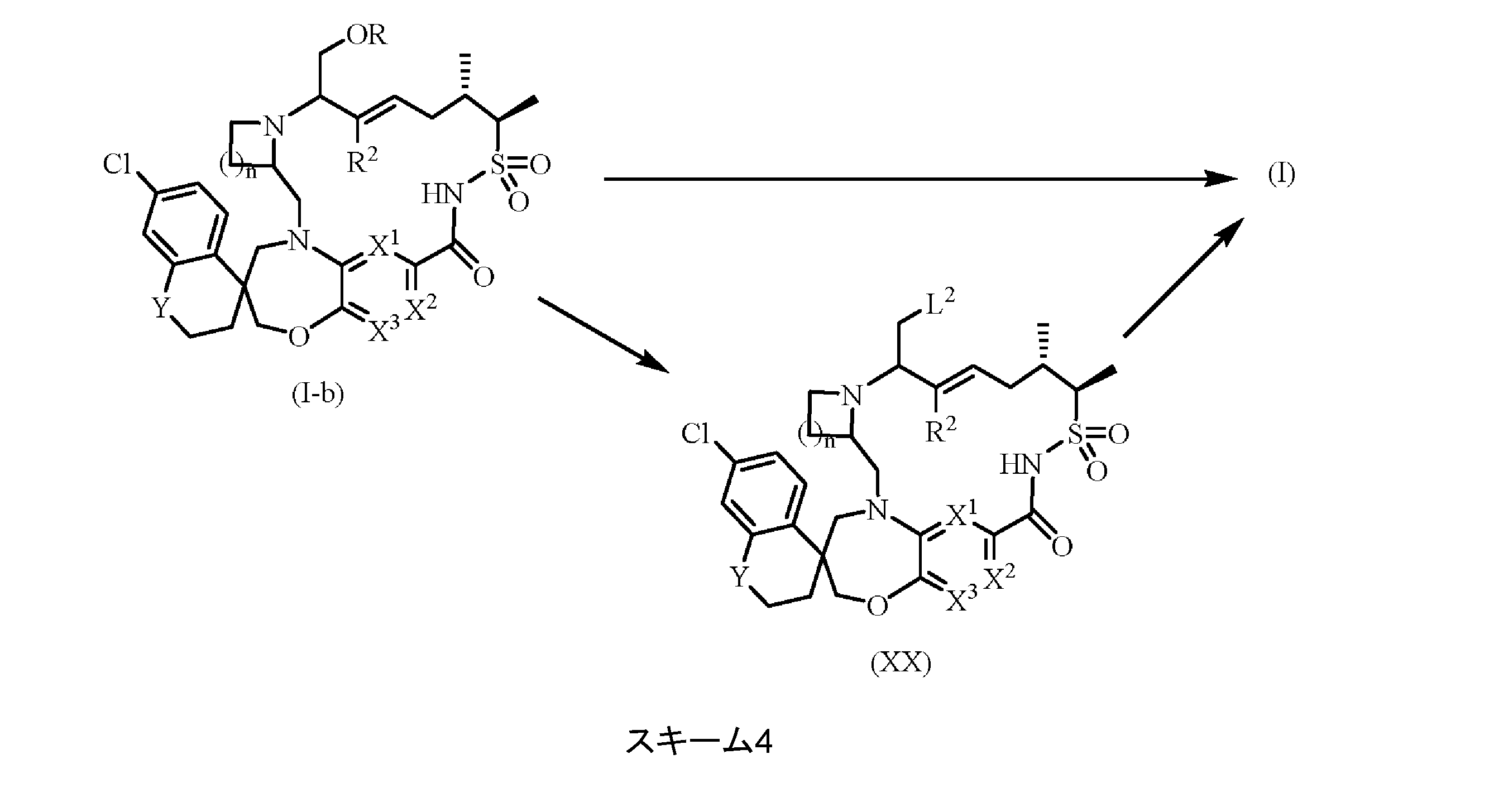
- 好適な温度(例えば、室温~80℃)で、好適な溶媒(例えばACN)中において、式(XX)(式中、X1、X2、X3、Y、R2、及びnは、式(I)で定義された通りであり、R1aは、H(水素)と定義されており、且つL2は、好適な脱離基(例えばメシレート)である)の中間体と、過剰な式HNRbRcの好適なアミン(例えば、3当量)とを反応させる。
- 或いは、好適な温度(例えば、室温~-78℃)で、好適な溶媒(例えばDCM)中において、式(I-b)(式中、X1、X2、X3、Y、R2、及びnは、式(I)で定義された通りであり、且つR1aは、H(水素)と定義されている)の中間体と、好適な活性化剤(例えばトリフリン酸無水物)とを反応させ、得られたトリフレートを、インサイチュで、過剰な式HNRbRcの好適なアミン(例えば4当量)と反応させる。
- 式(XX)の中間体を、好適な温度(例えば室温)で、好適な溶媒(例えばDCM)中において、好適な塩基(例えばEt3N)の存在下で、好適な脱離基(L2)(例えばメシレート)へのアルコール基の変換により、式(I-b)(式中、X1、X2、X3、Y、R2、及びnは、式(I)のように定義されている)の化合物を反応させることにより調製し得る。
Alternatively, when R 1 is defined as —CH 2 NR b R c and R 1a is defined as H (hydrogen), compounds of formula (I) are prepared according to scheme 4 by obtain:
- Formula (XX), wherein X 1 , X 2 , X 3 , Y, R 2 and n are intermediate as defined in formula (I), R 1a is defined as H (hydrogen), and L 2 is a suitable leaving group (eg mesylate); React with a suitable amine of formula HNR b R c (eg 3 equivalents).
or in a suitable solvent (eg DCM) at a suitable temperature (eg room temperature to −78° C.), wherein X 1 , X 2 , X 3 , Y, R 2 , and n are as defined in formula (I) and R 1a is defined as H (hydrogen)) and a suitable activating agent (e.g. triflic anhydride) and the resulting triflate is reacted in situ with an excess of a suitable amine of formula HNR b R c (eg 4 equivalents).
- the intermediate of formula ( XX) is treated with a suitable leaving group (L 2 ) (eg mesylate) to form (Ib) (wherein X 1 , X 2 , X 3 , Y, R 2 and n are defined as in formula (I)). can be prepared by reacting compounds of
或いは、R1が-CH2ORaと定義されるか又はR1及びR1aの両方が
-CH2ORaと定義されている場合には、式(I)の化合物を、下記によりスキーム4に従っても調製し得る:
- 好適な温度(例えば、室温~80℃)で、好適な溶媒(例えばDMF)中において、及び好適な塩基(例えばNaH)の存在下にて、式(I-b)(式中、X1、X2、X3、Y、n、R2は、式(I)のように定義されており、且つR1aは、CH2OH又はH(水素)と定義されている)の化合物と、好適なハロゲン化アルキル(例えば2-ブロモエチルメチルエーテル)とを反応させる。
- 或いは、好適な温度(例えば、室温~50℃)で、好適な溶媒(例えばTHF)中において、及び好適な塩基(例えばNaH)の存在下で、式(I-b)(式中、X1、X2、X3、Y、n、R2は、式(I)のように定義されており、且つR1aは、CH2OH又はH(水素)と定義されている)の化合物と、好適なハロゲン化アリール(例えば2-フルオロピリジン)とを反応させる。
Alternatively, when R 1 is defined as —CH 2 OR a or both R 1 and R 1a are defined as —CH 2 OR a , compounds of formula (I) can be prepared according to scheme 4 below. It can also be prepared according to:
- Formula (Ib) (wherein X 1 , X 2 , X 3 , Y, n, R 2 are defined as in formula (I) and R 1a is defined as CH 2 OH or H (hydrogen); Reaction with a suitable alkyl halide (eg 2-bromoethyl methyl ether).
- or formula (Ib) (wherein X 1 , X 2 , X 3 , Y, n, R 2 are defined as in Formula (I) and R 1a is defined as CH 2 OH or H (hydrogen); is reacted with a suitable aryl halide (eg 2-fluoropyridine).
或いは、R1及び/又はR1aが-CH2Fと定義されている場合には、式(I)の化合物を、好適な温度(例えば-10℃)で、好適な溶媒(例えばTHF)中において、式(I-b)(式中、R1及び/又はR1aは、-CH2OHと定義されている)の中間体と、好適なフッ素化剤(例えばジエチルアミノ硫黄三酸化物)とを反応させることにより、スキーム4に従って調製し得る。 Alternatively, when R 1 and/or R 1a are defined as —CH 2 F, the compound of formula (I) is treated at a suitable temperature (eg −10° C.) in a suitable solvent (eg THF) in which intermediates of formula (Ib) (wherein R 1 and/or R 1a are defined as —CH 2 OH) and a suitable fluorinating agent (e.g. diethylaminosulfur trioxide) can be prepared according to Scheme 4 by reacting
R1aが式CH2ORである場合には、これは、スキーム4において式CH2ORを有するR1に関して示されたのと同様の変換を受け得ることを、当業者は理解するだろう。R1aが式CH2ORである場合には、R1は、水素又は式CH2ORの可能性がある。R1及びR1aの両方が式CH2ORである場合には、試薬の化学量論及び/又は保護基戦略に応じて、両方のCH2OR基の別々の又は同時の変換が可能であることも、当業者は理解するだろう。 Those skilled in the art will appreciate that when R 1a is of formula CH 2 OR, it can undergo similar transformations as shown for R 1 with formula CH 2 OR in Scheme 4. When R 1a is of formula CH 2 OR, R 1 can be hydrogen or of formula CH 2 OR. When both R 1 and R 1a are of formula CH 2 OR, separate or simultaneous transformation of both CH 2 OR groups is possible depending on reagent stoichiometry and/or protecting group strategy. A person skilled in the art will also understand that.
式(I-b)(式中、R基は水素であり、且つX1、X2、X3、Y、R2、及びnは、式(I)で定義された通りである)の化合物を、好適な温度(例えば室温)で、好適な溶媒(例えばTHF)中において、式(I-b)の化合物/中間体(化合物又は中間体は、R基の定義に依存する)(式中、Rは、好適な保護基(例えばTBDMS)である)と、好適な脱保護剤(例えばTBAF)とを反応させることにより調製し得る。 Compounds of formula (Ib), wherein the R group is hydrogen and X 1 , X 2 , X 3 , Y, R 2 , and n are as defined for formula (I) at a suitable temperature (for example room temperature) in a suitable solvent (for example THF) to a compound/intermediate of formula (Ib) (the compound or intermediate depending on the definition of the R group) (wherein , R may be prepared by reacting a suitable protecting group (eg TBDMS) with a suitable deprotecting agent (eg TBAF).
式(I-b)(式中、X1、X2、X3、Y、及びnは、式(I)のように定義されており、R2はH(水素)であり、R1aはH(水素)であり、且つR1はCH2ORと定義されている)の化合物/中間体を、下記によりスキーム5に従って調製し得る:

- 好適な温度(例えば50℃)で、好適な溶媒(例えばDCE)中において、好適な触媒(例えばGrubbs-Hoveyda第2世代触媒)の存在下で、式(XXII)(式中、X1、X2、X3、Y、R2、及びnは、式(I)で定義された通りであり、且つRは、好適な保護基(例えばTBDMS)と定義されている)の中間体を反応させる。
- 式(XXII)の中間体を、好適な温度(例えば100℃)で、好適な触媒(例えばPdCl2(dppf))の存在下で、好適な溶媒(例えばTHF)中において、好適な塩基(例えばDBU)の存在下で、及び好適な圧力(例えば50バール)でのCOガスの存在下で、式(XXIII)(式中、X1、X2、X3、Y、R2、及びnは、式(I)で定義された通りであり、且つRは、好適な保護基(例えばTBDMS)と定義されている)の中間体と、(2R,3S)-3-メチルヘキサ-5-エン-2-スルホンアミドとを反応させることにより調製し得る。
- 式(XXIII)の中間体を、好適な温度(例えば0℃~室温)で、好適な塩基(例えばKOtBu)の存在下にて、好適な溶媒(例えばTHF)中において、式(XXV)(式中、X1、X2、X3、Y、及びnは、式(I)で定義された通りであり、且つRは、好適な保護基(例えばTBDMS)と定義されているか、又はRは、アルキル基(例えばMe)と定義されている)の中間体と、好適なアルキルトリフェニルホスホニウムハロゲン化物(例えばメチルトリフェニルホスホニウムブロミド)とを反応させることにより調製し得る。
- 式(XXV)の中間体を、好適な温度(例えば-70℃~室温)で、好適な塩基(例えばTEA)の存在下にて、好適な溶媒(例えばDCM)中において、式(XXVI)(式中、X1、X2、X3、Y、及びnは、式(I)で定義された通りであり、且つRは、好適な保護基(例えばTBDMS)と定義されているか、又はRは、アルキル基(例えばMe)と定義されている)の中間体と、好適な酸化剤(例えば、DMSOと塩化オキサリルとの混合物)とを反応させることにより調製し得る。
- 式(XXVI)の中間体を、好適な温度(例えば-78℃~室温)で、好適な溶媒(例えばTHF)中において、式(XXVII)(式中、X1、X2、X3、Y、及びnは、式(I)で定義された通りであり、且つRは、好適な保護基(例えばTBDMS)と定義されているか、又はRは、アルキル基(例えばMe)と定義されており、且つR’は、アルキル基(例えば、Me又はEt)と定義されている)の中間体と、好適な還元剤(例えばDIBAH)とを反応させることにより調製し得る。
- 式(XXVII)の中間体を、好適な温度(例えば室温)で、好適な塩基(例えばDIPEA)の存在下にて、好適な溶媒(例えばDMF)中において、式(XXIV)(式中、X1、X2、X3、Y、及びnは、式(I)で定義された通りである)の中間体と、好適なハロアルキルプロパノエート(例えば2-ブロモ-3-メトキシプロパノエート)とを反応させることにより調製し得る。
- 或いは、式(XXVII)の中間体を、第1の工程では、好適な温度(例えば室温)で、好適な塩基(例えばDIPEA)の存在下で、好適な溶媒(例えばDMF)中において、好適なハロアルキルプロパノエート(例えばメチル2-ブロモ-3-ヒドロキシプロパノエート)の存在下で、及び第2の工程では、好適な温度(例えば室温)で、好適な溶媒(例えばDMF)中において、好適な塩基(例えばイミダゾール)の存在下で、好適な保護基(例えば、tert.ブチルジメチルシリルクロリド)の存在下で、式(XXIV)(式中、X1、X2、X3、Y、及びnは、式(I)で定義された通りである)の中間体を反応させることにより、2工程で調製し得る。
Formula (Ib), wherein X 1 , X 2 , X 3 , Y, and n are defined as in Formula (I), R 2 is H (hydrogen), and R 1a is H (hydrogen) and R 1 is defined as CH 2 OR) can be prepared according to Scheme 5 by:
- in the presence of a suitable catalyst (eg Grubbs-Hoveyda 2nd generation catalyst) at a suitable temperature (eg 50°C) in a suitable solvent (eg DCE), wherein X 1 , X 2 , X 3 , Y, R 2 , and n are as defined in Formula (I), and R is defined as a suitable protecting group (e.g., TBDMS). Let
- the intermediate of formula (XXII) at a suitable temperature (e.g. 100°C) in the presence of a suitable catalyst (e.g. PdCl2 (dppf)) in a suitable solvent (e.g. THF) in a suitable base (e.g. DBU ) and in the presence of CO gas at a suitable pressure ( e.g. is as defined in formula (I) and R is defined as a suitable protecting group (eg TBDMS)) and (2R,3S)-3-methylhex-5-ene -2-sulfonamide.
- the intermediate of formula (XXIII) at a suitable temperature (e.g. 0°C to room temperature) in the presence of a suitable base (e.g. KOtBu) in a suitable solvent (e.g. THF) of formula (XXV) ( wherein X 1 , X 2 , X 3 , Y, and n are as defined in formula (I) and R is defined as a suitable protecting group (eg TBDMS), or R can be prepared by reacting an intermediate of an alkyl group (eg defined as Me) with a suitable alkyltriphenylphosphonium halide (eg methyltriphenylphosphonium bromide).
- an intermediate of formula (XXV) at a suitable temperature (eg -70°C to room temperature) in the presence of a suitable base (eg TEA) in a suitable solvent (eg DCM) to a compound of formula (XXVI) wherein X 1 , X 2 , X 3 , Y, and n are as defined in formula (I) and R is defined as a suitable protecting group (e.g. TBDMS), or R may be prepared by reacting an intermediate of an alkyl group (defined as Me for example) with a suitable oxidizing agent such as a mixture of DMSO and oxalyl chloride.
- the intermediate of formula (XXVI) in a suitable solvent (eg THF) at a suitable temperature (eg −78° C. to room temperature) to a compound of formula (XXVII) (wherein X 1 , X 2 , X 3 , Y and n are as defined in formula (I) and R is defined as a suitable protecting group (e.g. TBDMS) or R is defined as an alkyl group (e.g. Me) and R′ can be prepared by reacting an intermediate of an alkyl group (eg defined as Me or Et) with a suitable reducing agent (eg DIBAH).
- the intermediate of formula (XXVII) at a suitable temperature (e.g. room temperature) in the presence of a suitable base (e.g. DIPEA) in a suitable solvent (e.g. DMF) to form (XXIV) (wherein X 1 , X 2 , X 3 , Y and n are as defined in formula (I)) and a suitable haloalkylpropanoate (eg 2-bromo-3-methoxypropanoate) ).
- Alternatively, the intermediate of formula (XXVII), in a first step, at a suitable temperature (e.g. room temperature) in the presence of a suitable base (e.g. DIPEA) in a suitable solvent (e.g. DMF) in a suitable in the presence of a haloalkylpropanoate (e.g. methyl 2-bromo-3-hydroxypropanoate) and in a second step at a suitable temperature (e.g. room temperature) in a suitable solvent (e.g. DMF) In the presence of a suitable base (e.g. imidazole), in the presence of a suitable protecting group (e.g. tert.butyldimethylsilyl chloride), formula (XXIV) (wherein X 1 , X 2 , X 3 , Y, and n are as defined in formula (I)) may be prepared in two steps.
式(XXIV)(式中、X1、X2、X3、Y、及びnは、式(I)で定義された通りである)の中間体を、下記によりスキーム6に従って調製し得る:

- 好適な温度(例えば室温)で、好適な溶媒(例えばDCM)中において、式(XXVIII)(式中、P1は、好適な保護基(例えばBoc)と定義されている)の中間体と、好適な脱保護剤(例えばTFA)とを反応させる。
- 式(XXVIII)の中間体を、式(VII)の中間体の調製に関するものと同様の方法で、式(XVII)(式中、X1、X2、X3、及びYは、式(I)で定義された通りである)の中間体を反応させることにより調製し得る。
Intermediates of formula (XXIV), wherein X 1 , X 2 , X 3 , Y, and n are as defined in formula (I), may be prepared according to scheme 6 by:
- an intermediate of formula (XXVIII), wherein P 1 is defined as a suitable protecting group (eg Boc), in a suitable solvent (eg DCM) at a suitable temperature (eg room temperature) with , with a suitable deprotecting agent (eg TFA).
- the intermediate of formula (XXVIII) is treated in a similar manner as for the preparation of the intermediate of formula (VII), wherein X 1 , X 2 , X 3 and Y are represented by the formula ( It may be prepared by reacting the intermediates of I) as defined in I).
或いは、式(I)(式中、R1及び/又はR1aは、CH2OHである)の化合物を、下記によりスキーム7に従って調製し得る。

- 好適な温度(例えば100℃)で、好適な溶媒(例えばTHF)中において、好適な触媒(例えばPdCl2(dppf))の存在下で、好適な塩基(例えばDBU)の存在下にて、好適な圧力(例えば50バール)でのCO雰囲気下で、式(XXIX)の中間体を反応させる。
- 式(XXIX)の中間体を、好適な温度(例えば室温)で、好適な溶媒(例えばDCM)中において、式(XXX)(式中、X1、X2、X3、Y、n、及びR2は、式(I)で定義された通りであり、R1及び/又はR1aは、CH2OHであり、且つP2は、好適な保護基(例えばp-メトキシベンジル)である)の中間体と、好適な脱保護剤(例えばTFA)とを反応させることにより調製し得る。
- 式(XXX)の中間体を、好適な温度(例えば50℃)で、好適な溶媒(例えばDCM)中において、式(XXIV)の中間体と、式(XXXI)の中間体、及び好適なアルデヒド又は好適なアルデヒド前駆体(例えば1,4-ジオキサン-2,5-ジオール(CAS[23147-58-2]))とを反応させることにより調製し得る。
- 或いは、式(XXX)の中間体を、好適な温度(例えば室温)で、好適な溶媒(例えばDCM)中において、好適な塩基(例えばEt3N)の存在下で、式(XXIV)の中間体と、式(XXXI)の中間体及び好適なケトン(例えば1,3-ジヒドロキシアセトン)とを反応させることにより調製し得る。
Alternatively, compounds of formula (I), wherein R 1 and/or R 1a are CH 2 OH, can be prepared according to Scheme 7 by the following.
at a suitable temperature (eg 100° C.) in a suitable solvent (eg THF) in the presence of a suitable catalyst (eg PdCl 2 (dppf)) in the presence of a suitable base (eg DBU) Intermediate of formula (XXIX) is reacted under CO atmosphere at a suitable pressure (eg 50 bar).
- an intermediate of formula (XXIX), at a suitable temperature (e.g. room temperature) in a suitable solvent (e.g. DCM) to a compound of formula (XXX) where X 1 , X 2 , X 3 , Y, n, and R 2 are as defined in formula (I), R 1 and/or R 1a are CH 2 OH and P 2 is a suitable protecting group (eg p-methoxybenzyl) ) with a suitable deprotecting agent such as TFA.
- the intermediate of formula (XXX) is treated at a suitable temperature (e.g. 50°C) in a suitable solvent (e.g. DCM) with an intermediate of formula (XXIV) and an intermediate of formula (XXXI) and a suitable It may be prepared by reacting an aldehyde or a suitable aldehyde precursor such as 1,4-dioxane-2,5-diol (CAS[23147-58-2]).
- Alternatively, the intermediate of formula (XXX) is treated at a suitable temperature (e.g. room temperature) in a suitable solvent (e.g. DCM) in the presence of a suitable base (e.g. Et 3 N) to It may be prepared by reacting the intermediate with an intermediate of formula (XXXI) and a suitable ketone (eg 1,3-dihydroxyacetone).
式(XXXI)(式中、R2は、F(フッ素)と定義されている)の中間体を、下記によりスキーム8に従って調製し得る:

- 好適な温度(例えば95℃)で、好適な溶媒(例えば1,4-ジオキサン)中において、好適な触媒(例えばPdCl2(dppf).CH2Cl2)の存在下で、好適な塩基(例えば酢酸カリウム)の存在下にて、式(XXXII)の中間体とビス(ピナコラト)ジボロンとを反応させる。
- 式(XXXII)の中間体を、好適な温度(例えば0℃)で、好適な溶媒(例えばTHF)中において、式(XXXIII)の中間体と好適な塩基(例えばLiHMDS)とを反応させることにより調製し得る。
- 式(XXXIII)の中間体を、好適な温度(例えば室温)で、好適な溶媒(例えばTHF)中において、好適なジアルキル亜鉛誘導体(例えばジエチル亜鉛)の存在下で、式(XV)の中間体と、フルオロトリブロモメタン及びトリフェニルホスフィンとを反応させることにより調製し得る。
- 式(XV)の中間体を、好適な温度(例えば-78℃)で、好適な溶媒(例えば、DCM若しくはMeOH、又はこれらの混合物)中において、好適な還元剤(例えばトリフェニルホスフィン)の存在下で、式(XXXVIII)の中間体とオゾンとを反応させることにより調製し得る。
- 式(XXXVIII)の中間体は、文献で説明されているか、又はこの中間体を、当業者に既知の公開された手順と同様に調製し得る。
Intermediates of formula (XXXI), wherein R 2 is defined as F (fluorine), can be prepared according to Scheme 8 by:
- a suitable base ( Intermediate of formula (XXXII) is reacted with bis(pinacolato)diboron in the presence of e.g. potassium acetate).
- reacting the intermediate of formula (XXXII) with a suitable base (eg LiHMDS) in a suitable solvent (eg THF) at a suitable temperature (eg 0°C) can be prepared by
- the intermediate of formula (XXXIII) at a suitable temperature (e.g. room temperature) in a suitable solvent (e.g. THF) in the presence of a suitable dialkylzinc derivative (e.g. diethylzinc) to the intermediate of formula (XV) can be prepared by reacting the compound with fluorotribromomethane and triphenylphosphine.
- the intermediate of formula (XV) in a suitable solvent (eg DCM or MeOH, or mixtures thereof) at a suitable temperature (eg -78°C) with a suitable reducing agent (eg triphenylphosphine) It may be prepared by reacting an intermediate of formula (XXXVIII) with ozone in the presence.
- Intermediates of formula (XXXVIII) are described in the literature or may be prepared analogously to published procedures known to those skilled in the art.
或いは、式(XXXI)(式中、R2は、H(水素)と定義されている)の中間体を、下記によりスキーム8に従って調製し得る:
- 好適な温度(例えば室温)で、好適な溶媒(例えばMeOH)中において、好適な塩基(例えばK2HPO4)の存在下で、好適なホスフィン(例えばトリフェニルホスフィン)の存在下にて、好適な触媒(例えば酸化銅(I))の存在下で、式(XXXIX)の中間体と、好適なホウ素化剤(例えばビス(ピナコラト)ジボロン)とを反応させる。
- 式(XXXIX)の中間体を、好適な温度(例えば室温)で、好適な溶媒(例えばMeOH)中において、好適な塩基(例えばK2CO3)の存在下で、式(XV)の中間体と、アルキル化剤(例えばジメチル(1-ジアゾ-2-オキソプロピル)ホスホネート)とを反応させることにより調製し得る。
Alternatively, intermediates of formula (XXXI), wherein R 2 is defined as H (hydrogen), can be prepared according to Scheme 8 by:
in a suitable solvent (eg MeOH) at a suitable temperature (eg room temperature) in the presence of a suitable base (eg K 2 HPO 4 ) in the presence of a suitable phosphine (eg triphenylphosphine) Intermediate of formula (XXXIX) is reacted with a suitable boronating agent (eg bis(pinacolato)diboron) in the presence of a suitable catalyst (eg copper(I) oxide).
- the intermediate of formula (XXXIX) in a suitable solvent (eg MeOH) at a suitable temperature (eg room temperature) in the presence of a suitable base (eg K 2 CO 3 ) to the intermediate of formula (XV) can be prepared by reacting the compound with an alkylating agent such as dimethyl(1-diazo-2-oxopropyl)phosphonate.
式(XXXIV)の中間体を、好適な温度(例えば室温)で、好適な溶媒(例えばDCM)中において、式(XXXI)の中間体と、好適な脱保護剤(例えばTFA)とを反応させることにより、スキーム8に従って調製し得る。 reacting an intermediate of formula (XXXIV) with a suitable deprotecting agent (e.g. TFA) in a suitable solvent (e.g. DCM) at a suitable temperature (e.g. room temperature) It can be prepared according to scheme 8 by
或いは、式(I)(式中、R1及び/又はR1aは、CH2OHである)の化合物を、下記によりスキーム9に従って調製し得る:

- 好適な温度(例えば室温)で、好適な溶媒(例えばDCM)中において、好適な塩基(例えばEt3N)の存在下で、式(XXXV)の中間体と、好適なアルデヒド又は好適なアルデヒド前駆体(例えば1,4-ジオキサン-2,5-ジオール(CAS[23147-58-2]))とを反応させる。
- 或いは、好適な温度(例えば室温)で、好適な溶媒(例えばDCM)中において、好適な塩基(例えばEt3N)の存在下で、式(XXXV)の中間体と、好適なケトン(例えば1,3-ジヒドロキシアセトン)とを反応させる。
- 式(XXXV)の中間体を、好適な温度(例えば室温)で、好適な溶媒(例えばDCM)中において、式(XXXVI)の中間体と、好適な脱保護剤(例えばTFA)とを反応させることにより調製し得る。
- 式(XXXVI)の中間体を、好適な温度(例えば室温)で、好適な溶媒(例えばDCM)中において、好適な塩基(例えば、Et3N若しくはDMAP、又はこれらの混合物)の存在下で、好適なカップリング剤(例えばEDCI)の存在下にて、式(XXXVII)の中間体と、式(XXXIV)の中間体とを反応させることにより調製し得る。
- 式(XXXVII)の中間体を、好適な温度(例えば50℃)で、好適な溶媒(例えば、水、THF、若しくはMeOH、又はこれらの混合物)中において、式(VII)の中間体と、好適な加水分解剤(例えばLiOH)とを反応させることにより調製し得る。
Alternatively, compounds of formula (I), wherein R 1 and/or R 1a are CH 2 OH, can be prepared according to Scheme 9 by:
- an intermediate of formula (XXXV) in the presence of a suitable base (eg Et 3 N) at a suitable temperature (eg room temperature) in a suitable solvent (eg DCM) with a suitable aldehyde or a suitable aldehyde A precursor (eg 1,4-dioxane-2,5-diol (CAS[23147-58-2])) is reacted.
- Alternatively, intermediates of formula ( XXXV) with a suitable ketone (e.g. 1,3-dihydroxyacetone).
- reacting an intermediate of formula (XXXV) with a suitable deprotecting agent (e.g. TFA) in a suitable solvent (e.g. DCM) at a suitable temperature (e.g. room temperature) It can be prepared by
- an intermediate of formula (XXXVI) at a suitable temperature (e.g. room temperature) in a suitable solvent (e.g. DCM) in the presence of a suitable base (e.g. Et 3 N or DMAP, or mixtures thereof) can be prepared by reacting an intermediate of formula (XXXVII) with an intermediate of formula (XXXIV) in the presence of a suitable coupling agent such as EDCI.
- an intermediate of formula (XXXVII) at a suitable temperature (e.g. 50°C) in a suitable solvent (e.g. water, THF or MeOH, or mixtures thereof) with an intermediate of formula (VII); It may be prepared by reacting with a suitable hydrolyzing agent such as LiOH.
適切な官能基が存在する場合には、様々な式の化合物、又はその調製で使用されるあらゆる中間体は、縮合、置換、酸化、還元、又は開裂反応を用いる1つ又は複数の標準的な合成方法によりさらに誘導体化され得ることが、理解されるだろう。具体的な置換方法として、従来のアルキル化、アリール化、ヘテロアリール化、アシル化、スルホニル化、ハロゲン化、ニトロ化、ホルミル化、及びカップリング手順が挙げられる。 In the presence of appropriate functional groups, compounds of various formulas, or any intermediates used in their preparation, can undergo one or more standard reactions using condensation, substitution, oxidation, reduction, or cleavage reactions. It will be appreciated that they may be further derivatized by synthetic methods. Particular methods of substitution include conventional alkylation, arylation, heteroarylation, acylation, sulfonylation, halogenation, nitration, formylation, and coupling procedures.
式(I)の化合物を、当該技術分野で既知の分割手順に従って互いに分離され得るエナンチオマーのラセミ混合物の形態で合成し得る。塩基性窒素原子を含む式(I)のラセミ化合物を、好適なキラル酸との反応により、対応するジアステレオマー塩の形態に変換し得る。その後、前記ジアステレオマー塩形態を、例えば、選択的結晶化又は分別結晶化により分離し、エナンチオマーは、アルカリによってそれから遊離される。式(I)の化合物のエナンチオマーの形態を分離する代替的な方法として、キラル固定相を使用する液体クロマトグラフィーが挙げられる。前記純粋な立体化学的異性形態を、適切な出発原料の対応する純粋な立体化学異性形態からも誘導し得るが、但し、この反応は立体特異的に起こることを条件とする。 Compounds of formula (I) may be synthesized in the form of racemic mixtures of enantiomers which may be separated from each other according to resolution procedures known in the art. Racemates of formula (I) containing a basic nitrogen atom may be converted into the corresponding diastereomeric salt forms by reaction with a suitable chiral acid. Said diastereomeric salt forms are then separated, for example by selective or fractional crystallization, and the enantiomers are liberated therefrom by alkali. An alternative method of separating the enantiomeric forms of the compounds of formula (I) includes liquid chromatography using a chiral stationary phase. Said pure stereochemically isomeric forms may also be derived from the corresponding pure stereochemically isomeric forms of suitable starting materials, provided that this reaction occurs stereospecifically.
本発明の化合物の調製では、中間体の離れた官能基(例えば、第一級アミン又は第二級アミン)を保護することが必要な場合がある。そのような保護に対する要求は、離れた官能基の性質と、調製法の条件とに応じて変わるだろう。好適なアミノ保護基(NH-Pg)として、アセチル、トリフルオロアセチル、t-ブトキシカルボニル(Boc)、ベンジルオキシカルボニル(CBz)、及び9-フルオレニルメチレンオキシカルボニル(Fmoc)が挙げられる。そのような保護の必要性は、当業者により容易に決定される。保護基とその使用との概要に関して、T.W.Greene and P.G.M.Wuts,Protective Groups in Organic Synthesis,4th ed.,Wiley,Hoboken,New Jersey,2007を参照されたい。 In the preparation of compounds of the present invention it may be necessary to protect remote functional groups (eg primary or secondary amines) of intermediates. Such protection requirements will vary depending on the nature of the remote functional group and the conditions of the preparation process. Suitable amino-protecting groups (NH--Pg) include acetyl, trifluoroacetyl, t-butoxycarbonyl (Boc), benzyloxycarbonyl (CBz), and 9-fluorenylmethylenoxycarbonyl (Fmoc). The need for such protection is readily determined by those skilled in the art. For an overview of protecting groups and their use, see T.W. W. Greene andP. G. M. Wuts, Protective Groups in Organic Synthesis, 4th ed. , Wiley, Hoboken, New Jersey, 2007.
化合物の薬理
本発明の化合物が複数のMCL-1活性(例えば、MCL-1アポトーシス活性)の内の1つを阻害することが発見されている。
Compound Pharmacology It has been discovered that compounds of the invention inhibit one of several MCL-1 activities (eg, MCL-1 apoptotic activity).
MCL-1阻害剤は、1種又は複数種のMCL-1機能(例えば、アポトーシス促進性のエフェクタであるBak及びBax、又はBH3単一感作物質(例えば、Bim、Noxa、若しくはPuma)に結合して抑制する能力)をブロックする化合物である。 MCL-1 inhibitors bind to one or more MCL-1 functions (e.g., the pro-apoptotic effectors Bak and Bax, or BH3 monosensitizers (e.g., Bim, Noxa, or Puma) It is a compound that blocks the ability to inhibit
本発明の化合物は、MCL-1生存促進性機能を阻害し得る。従って、本発明の化合物は、癌等の免疫系の影響を受けやすい疾患の処置及び/又は予防(特に処置)で有用であり得る。 Compounds of the invention may inhibit MCL-1 pro-survival function. Accordingly, the compounds of the invention may be useful in the treatment and/or prophylaxis (particularly treatment) of diseases that are susceptible to the immune system, such as cancer.
本発明の別の実施形態では、本発明の化合物は、例えば免疫調節を介して、抗腫瘍特性を示す。 In another embodiment of the invention, the compounds of the invention exhibit anti-tumor properties, eg through immunomodulation.
ある実施形態では、本発明は、癌(この癌は、本明細書で説明されているものから選択される)を処置する及び/又は予防する方法であって、必要な対象(好ましくはヒト)に、式(I)の化合物、又はその薬学的に許容される塩若しくは溶媒和物の治療上有効な量を投与することを含む方法を対象とする。 In one embodiment, the present invention provides a method of treating and/or preventing cancer, the cancer being selected from those described herein, wherein a subject (preferably a human) in need thereof or a method comprising administering a therapeutically effective amount of a compound of formula (I), or a pharmaceutically acceptable salt or solvate thereof.
ある実施形態では、本発明は、癌を処置する及び/又は予防する方法であって、必要な対象(好ましくはヒト)に、式(I)の化合物、又はその薬学的に許容される塩若しくは溶媒和物の治療上有効な量を投与することを含み、この癌は、下記からなる群から選択される、方法を対象とする:急性リンパ芽球性白血病(ALL)、急性骨髄性白血病(AML)、B細胞急性リンパ芽球性白血病、B細胞慢性リンパ芽球性白血病(CLL)、膀胱癌、乳癌、慢性リンパ性白血病、慢性骨髄性白血病、結腸腺癌、びまん性大細胞型B細胞リンパ腫、食道癌、濾胞性リンパ腫、胃癌、頭頸部癌(例えば、限定されないが、頭頸部扁平上皮癌)、造血癌、肝細胞癌、ホジキンリンパ腫、肝癌、肺癌(例えば、限定されないが、肺腺癌)、リンパ腫、髄芽腫、黒色腫、意義不明の単クローン性免疫グロブリン血症、多発性骨髄腫、骨髄異形成症候群、骨髄線維症、骨髄増殖性疾患、卵巣癌、卵巣明細胞癌、卵巣漿液性嚢胞腺腫、膵癌、真性赤血球増加症、前立腺癌、直腸腺癌、腎細胞癌、くすぶり型多発性骨髄腫、T細胞急性リンパ芽球性白血病、T細胞リンパ腫、及びワルデンストレーム高ガンマグロブリン血症。 In one embodiment, the present invention provides a method of treating and/or preventing cancer comprising administering to a subject (preferably a human) in need thereof a compound of formula (I), or a pharmaceutically acceptable salt thereof, or A method comprising administering a therapeutically effective amount of a solvate, wherein the cancer is selected from the group consisting of: acute lymphoblastic leukemia (ALL), acute myeloid leukemia ( AML), B-cell acute lymphoblastic leukemia, B-cell chronic lymphoblastic leukemia (CLL), bladder cancer, breast cancer, chronic lymphocytic leukemia, chronic myelogenous leukemia, colon adenocarcinoma, diffuse large B-cell Lymphoma, esophageal cancer, follicular lymphoma, gastric cancer, head and neck cancer (e.g., but not limited to head and neck squamous cell carcinoma), hematopoietic carcinoma, hepatocellular carcinoma, Hodgkin's lymphoma, liver cancer, lung cancer (e.g., but not limited to lung adenocarcinoma) cancer), lymphoma, medulloblastoma, melanoma, monoclonal immunoglobulinemia of unknown significance, multiple myeloma, myelodysplastic syndrome, myelofibrosis, myeloproliferative disease, ovarian cancer, ovarian clear cell carcinoma, Ovarian serous cystadenoma, pancreatic cancer, polycythemia vera, prostate cancer, rectal adenocarcinoma, renal cell carcinoma, smoldering multiple myeloma, T-cell acute lymphoblastic leukemia, T-cell lymphoma, and Waldenström hyperplasia gammaglobulinemia.
別の実施形態では、本発明は、癌を処置する及び/又は予防する方法であって、必要な対象(好ましくはヒト)に、式(I)の化合物、又はその薬学的に許容される塩若しくは溶媒和物の治療上有効な量を投与することを含み、この癌は、好ましくは、下記からなる群から選択される、方法を対象とする:急性リンパ芽球性白血病(ALL)、急性骨髄性白血病(AML)、B細胞急性リンパ芽球性白血病、B細胞慢性リンパ芽球性白血病(CLL)、乳癌、慢性リンパ性白血病、慢性骨髄性白血病、びまん性大細胞型B細胞リンパ腫、濾胞性リンパ腫、造血癌、ホジキンリンパ腫、肺癌(例えば、限定されないが、肺腺癌)、リンパ腫、意義不明の単クローン性免疫グロブリン血症、多発性骨髄腫、骨髄異形成症候群、骨髄線維症、骨髄増殖性疾患、くすぶり型多発性骨髄腫、T細胞急性リンパ芽球性白血病、T細胞リンパ腫、及びワルデンストレーム高ガンマグロブリン血症。 In another embodiment, the present invention provides a method of treating and/or preventing cancer, comprising administering to a subject (preferably a human) in need thereof a compound of formula (I), or a pharmaceutically acceptable salt thereof or solvate, wherein the cancer is preferably selected from the group consisting of: acute lymphoblastic leukemia (ALL), acute Myeloid leukemia (AML), B-cell acute lymphoblastic leukemia, B-cell chronic lymphoblastic leukemia (CLL), breast cancer, chronic lymphocytic leukemia, chronic myelogenous leukemia, diffuse large B-cell lymphoma, follicular lymphoma, hematopoietic carcinoma, Hodgkin's lymphoma, lung cancer (e.g., but not limited to lung adenocarcinoma), lymphoma, monoclonal immunoglobulinemia of unknown significance, multiple myeloma, myelodysplastic syndrome, myelofibrosis, bone marrow Proliferative disorders, smoldering multiple myeloma, T-cell acute lymphoblastic leukemia, T-cell lymphoma, and Waldenstrom's hypergammaglobulinemia.
別の実施形態では、本発明は、癌を処置する及び/又は予防する方法であって、必要な対象(好ましくはヒト)に、式(I)の化合物、又はその薬学的に許容される塩若しくは溶媒和物の治療上有効な量を投与することを含み、この癌は、下記からなる群から選択される、方法を対象とする:腺癌、良性単クローン免疫グロブリン症、胆道癌(例えば、限定されないが、胆管癌)、膀胱癌、乳癌(breast cancer)(例えば、限定されないが、乳房の腺癌、乳房の乳頭癌、乳癌(mammary cancer)、乳房の髄様癌)、脳癌(例えば、限定されないが、髄膜腫)、神経膠腫(例えば、限定されないが、星細胞腫、乏突起膠腫;髄芽腫)、気管支癌、子宮頸癌(例えば、限定されないが、子宮頸部腺癌)、脊索腫、絨毛癌、結腸直腸癌(例えば、限定されないが、結腸癌、直腸癌、結腸直腸腺癌)、上皮性癌、内皮肉腫(例えば、限定されないが、カポジ肉腫、多発性特発性出血性肉腫)、子宮内膜癌(例えば、限定されないが、子宮癌、子宮肉腫)、食道癌(例えば、限定されないが、食道の腺癌、バレット腺癌)、ユーイング肉腫、胃癌(例えば、限定されないが、胃腺癌)、消化管間質腫瘍(GIST)、頭頸部癌(例えば、限定されないが、頭頸部扁平上皮癌)、造血癌(例えば、限定されないが、白血病、例えば、急性リンパ性白血病(ALL)(例えば、限定されないが、B細胞ALL、T細胞ALL)、急性骨髄性白血病(AML)(例えば、B細胞AML、T細胞AML)、慢性骨髄性白血病(CML)(例えば、B細胞CML、T細胞CML)、及び慢性リンパ球性白血病(CLL)(例えば、B細胞CLL、T細胞CLL)、リンパ腫、例えば、ホジキンリンパ腫(HL)(例えば、限定されないが、B細胞HL、T細胞HL)、及び非ホジキンリンパ腫(NHL)(例えば、B細胞NHL、例えば、びまん性大細胞型リンパ腫(DLCL)(例えば、びまん性大細胞型B細胞リンパ腫(DLBCL))、濾胞性リンパ腫、慢性リンパ性白血病/小リンパ球性リンパ腫(CLL/SLL)、マントル細胞リンパ腫(MCL)、辺縁帯B細胞リンパ腫(例えば、限定されないが、粘膜内リンパ組織(MALT)、リンパ腫、結節性の辺縁帯B細胞リンパ腫、脾臓の辺縁帯B細胞リンパ腫)、縦隔原発B細胞性リンパ腫、バーキットリンパ腫、リンパ形質細胞性リンパ腫(例えば、限定されないが、ワルデンストレーム高ガンマグロブリン血症)、免疫芽球性大細胞型リンパ腫、有毛細胞白血病、(HCL)、前駆体Bリンパ芽球性リンパ腫及び中枢神経系原発(CNS)リンパ腫、T細胞NHL、例えば、前駆体Tリンパ芽球性リンパ腫/白血病、末梢T細胞リンパ腫(PTCL)(例えば、皮膚性のT細胞リンパ腫(CTCL)(例えば、限定されないが、菌状息肉腫、セザリー症候群)、血管免疫芽球性T細胞リンパ腫、節外性のナチュラルキラーT細胞リンパ腫、腸疾患型T細胞リンパ腫、皮下脂肪織炎様T細胞リンパ腫、未分化大細胞型リンパ腫、上記で説明した1種又は複数種の白血病/リンパ腫の混合物、多発性骨髄腫(MM)、重鎖病(例えば、限定されないが、アルファ鎖病、ガンマ鎖病、ミュー鎖病)、免疫細胞アミロイドーシス、腎癌(例えば、限定されないが、腎芽腫、別名ウィルムス腫瘍、腎細胞癌)、肝癌(例えば、限定されないが、肝細胞癌(HCC)、悪性肝癌)、肺癌(例えば、限定されないが、気管支原性癌、非小細胞肺癌(NSCLC)、扁平上皮肺癌(SLC)、肺の腺癌、ルイス肺癌、肺神経内分泌腫瘍、典型的なカルチノイド、非定型カルチノイド、小細胞肺癌(SCLC)、及び大細胞神経内分泌癌)、骨髄異形成症候群(MDS)、骨髄増殖性疾患(MPD)、真性赤血球増加症(PV)、本態性血小板増加症(ET)、特発性骨髄化生(AMM)、別名骨髄線維症(MF)、慢性特発性骨髄線維症、慢性骨髄性白血病(CML)、慢性好中球性白血病(CNL)、好酸球増加症候群(HES)、卵巣癌(例えば、限定されないが、嚢胞腺癌、卵巣胎児性癌、卵巣腺癌)、膵癌(例えば、限定されないが、膵臓腺癌、膵管内乳頭粘液性腫瘍(IPMN)、膵島細胞腫瘍)、前立腺癌(例えば、限定されないが、前立腺腺癌)、皮膚癌(例えば、限定されないが、扁平上皮癌(SCC)、角化棘細胞腫(KA)、黒色腫、基底細胞癌(BCC))、及び軟部肉腫(例えば、悪性線維性組織球腫(MFH)、脂肪肉腫、悪性末梢神経鞘腫瘍(MPNST)、軟骨肉腫、繊維肉腫、粘液肉腫)。 In another embodiment, the present invention provides a method of treating and/or preventing cancer, comprising administering to a subject (preferably a human) in need thereof a compound of formula (I), or a pharmaceutically acceptable salt thereof or solvate, wherein the cancer is selected from the group consisting of: adenocarcinoma, benign monoclonal immunoglobulinosis, biliary tract cancer (e.g. , but not limited to cholangiocarcinoma), bladder cancer, breast cancer (e.g., but not limited to adenocarcinoma of the breast, papillary carcinoma of the breast, mammary cancer, medullary carcinoma of the breast), brain cancer ( meningioma), glioma (e.g., without limitation, astrocytoma, oligodendroglioma; medulloblastoma), bronchial carcinoma, cervical cancer (e.g., without limitation, cervical cancer) adenocarcinoma), chordoma, choriocarcinoma, colorectal cancer (e.g., without limitation, colon cancer, rectal cancer, colorectal adenocarcinoma), epithelial carcinoma, endothelial sarcoma (e.g., without limitation, Kaposi's sarcoma, multiple idiopathic hemorrhagic sarcoma), endometrial cancer (e.g., without limitation, uterine cancer, uterine sarcoma), esophageal cancer (e.g., without limitation, adenocarcinoma of the esophagus, Barrett's adenocarcinoma), Ewing's sarcoma, gastric cancer ( gastric adenocarcinoma), gastrointestinal stromal tumor (GIST), head and neck cancer (e.g., but not limited to head and neck squamous cell carcinoma), hematopoietic cancer (e.g., but not limited to leukemia, e.g., acute Lymphocytic leukemia (ALL) (e.g., but not limited to B-cell ALL, T-cell ALL), acute myeloid leukemia (AML) (e.g., B-cell AML, T-cell AML), chronic myeloid leukemia (CML) (e.g., , B-cell CML, T-cell CML), and chronic lymphocytic leukemia (CLL) (e.g. B-cell CLL, T-cell CLL), lymphomas such as Hodgkin's lymphoma (HL) (e.g., but not limited to B-cell HL , T-cell HL), and non-Hodgkin's lymphoma (NHL) (e.g. B-cell NHL, e.g. diffuse large cell lymphoma (DLCL) (e.g. diffuse large B-cell lymphoma (DLBCL)), follicular lymphoma , chronic lymphocytic leukemia/small lymphocytic lymphoma (CLL/SLL), mantle cell lymphoma (MCL), marginal zone B-cell lymphoma (including but not limited to intramucosal lymphoid tissue (MALT), lymphoma, nodular marginal zone B-cell lymphoma, splenic marginal zone B-cell lymphoma), primary mediastinal B-cell lymphoma, Burkitt's lymphoma, lymphoplasmacytic lymphoma (e.g. including, but not limited to, Waldenström hypergammaglobulinemia), immunoblastic large cell lymphoma, hairy cell leukemia (HCL), precursor B lymphoblastic lymphoma and primary central nervous system (CNS) ) lymphoma, T-cell NHL, e.g., precursor T-lymphoblastic lymphoma/leukemia, peripheral T-cell lymphoma (PTCL) (e.g., cutaneous T-cell lymphoma (CTCL) (e.g., but not limited to, mycosis fungoides) , Sézary syndrome), angioimmunoblastic T-cell lymphoma, extranodal natural killer T-cell lymphoma, enteropathic T-cell lymphoma, subcutaneous panniculitis-like T-cell lymphoma, anaplastic large cell lymphoma, described above mixed leukemia/lymphoma(s), multiple myeloma (MM), heavy chain disease (e.g., but not limited to alpha chain disease, gamma chain disease, mu chain disease), immune cell amyloidosis, renal cancer (e.g., without limitation, nephroblastoma, aka Wilms tumor, renal cell carcinoma), liver cancer (e.g., without limitation, hepatocellular carcinoma (HCC), malignant liver cancer), lung cancer (e.g., without limitation, bronchogenic carcinoma, non-small cell lung cancer (NSCLC), squamous cell lung cancer (SLC), adenocarcinoma of the lung, Lewis lung carcinoma, lung neuroendocrine tumors, typical carcinoids, atypical carcinoids, small cell lung cancer (SCLC), and large cell nerve endocrine cancer), myelodysplastic syndrome (MDS), myeloproliferative disease (MPD), polycythemia vera (PV), essential thrombocytosis (ET), idiopathic myeloid metaplasia (AMM), also known as myelofibrosis (MF), chronic idiopathic myelofibrosis, chronic myelogenous leukemia (CML), chronic neutrophilic leukemia (CNL), hypereosinophilic syndrome (HES), ovarian cancer (e.g., but not limited to cystadenocarcinoma) , ovarian embryonal carcinoma, ovarian adenocarcinoma), pancreatic cancer (e.g., but not limited to pancreatic adenocarcinoma, intraductal papillary mucinous tumor (IPMN), pancreatic islet cell tumor), prostate cancer (e.g., but not limited to, prostatic adenocarcinoma) ), skin cancer (e.g., but not limited to squamous cell carcinoma (SCC), keratoacanthocytoma (KA), melanoma, basal cell carcinoma (BCC)), and soft tissue sarcoma (e.g., malignant fibrous histiocytoma). (MFH), liposarcoma, malignant peripheral nerve sheath tumor (MPNST), chondrosarcoma, fibrosarcoma, myxosarcoma).
別の実施形態では、本発明は、癌を処置する及び/又は予防する方法であって、必要な対象(好ましくはヒト)に、式(I)の化合物、又はその薬学的に許容される塩若しくは溶媒和物の治療上有効な量を投与することを含み、この癌は、下記からなる群から選択される、方法を対象とする:良性単クローン免疫グロブリン症、乳癌(breast cancer)(例えば、限定されないが、乳房の腺癌、乳房の乳頭癌、乳癌(mammary cancer)、乳房の髄様癌)、造血癌(例えば、限定されないが、白血病、例えば、急性リンパ性白血病(ALL)(例えば、限定されないが、B細胞ALL、T細胞ALL)、急性骨髄性白血病(AML)(例えば、B細胞AML、T細胞AML)、慢性骨髄性白血病(CML)(例えば、B細胞CML、T細胞CML)、及び慢性リンパ球性白血病(CLL)(例えば、B細胞CLL、T細胞CLL)、リンパ腫、例えば、ホジキンリンパ腫(HL)(例えば、限定されないが、B細胞HL、T細胞HL)、及び非ホジキンリンパ腫(NHL)(例えば、B細胞NHL、例えば、びまん性大細胞型リンパ腫(DLCL)(例えば、びまん性大細胞型B細胞リンパ腫(DLBCL))、濾胞性リンパ腫、慢性リンパ性白血病/小リンパ球性リンパ腫(CLL/SLL)、マントル細胞リンパ腫(MCL)、辺縁帯B細胞リンパ腫(例えば、限定されないが、粘膜内リンパ組織(MALT)、リンパ腫、結節性の辺縁帯B細胞リンパ腫、脾臓の辺縁帯B細胞リンパ腫)、縦隔原発B細胞性リンパ腫、バーキットリンパ腫、リンパ形質細胞性リンパ腫(例えば、限定されないが、ワルデンストレーム高ガンマグロブリン血症)、免疫芽球性大細胞型リンパ腫、有毛細胞白血病、(HCL)、前駆体Bリンパ芽球性リンパ腫及び中枢神経系原発(CNS)リンパ腫、T細胞NHL、例えば、前駆体Tリンパ芽球性リンパ腫/白血病、末梢T細胞リンパ腫(PTCL)(例えば、皮膚性のT細胞リンパ腫(CTCL)(例えば、限定されないが、菌状息肉腫、セザリー症候群)、血管免疫芽球性T細胞リンパ腫、節外性のナチュラルキラーT細胞リンパ腫、腸疾患型T細胞リンパ腫、皮下脂肪織炎様T細胞リンパ腫、未分化大細胞型リンパ腫、上記で説明した1種又は複数種の白血病/リンパ腫の混合物、多発性骨髄腫(MM)、重鎖病(例えば、限定されないが、アルファ鎖病、ガンマ鎖病、ミュー鎖病)、免疫細胞アミロイドーシス、肝癌(例えば、限定されないが、肝細胞癌(HCC)、悪性肝癌)、肺癌(例えば、限定されないが、気管支原性癌、非小細胞肺癌(NSCLC)、扁平上皮肺癌(SLC)、肺の腺癌、ルイス肺癌、肺神経内分泌腫瘍、典型的なカルチノイド、非定型カルチノイド、小細胞肺癌(SCLC)、及び大細胞神経内分泌癌)、骨髄異形成症候群(MDS)、骨髄増殖性疾患(MPD)、及び前立腺癌(例えば、限定されないが、前立腺腺癌)。 In another embodiment, the present invention provides a method of treating and/or preventing cancer, comprising administering to a subject (preferably a human) in need thereof a compound of formula (I), or a pharmaceutically acceptable salt thereof or solvate, wherein the cancer is selected from the group consisting of: benign monoclonal immunoglobulinosis, breast cancer (e.g. , but not limited to adenocarcinoma of the breast, papillary carcinoma of the breast, mammary cancer, medullary carcinoma of the breast), hematopoietic carcinoma (e.g., but not limited to leukemia, e.g., acute lymphoblastic leukemia (ALL) (e.g., , but not limited to B-cell ALL, T-cell ALL), acute myeloid leukemia (AML) (e.g., B-cell AML, T-cell AML), chronic myelogenous leukemia (CML) (e.g., B-cell CML, T-cell CML ), and chronic lymphocytic leukemia (CLL) (e.g., B-cell CLL, T-cell CLL), lymphomas, such as Hodgkin's lymphoma (HL) (e.g., but not limited to B-cell HL, T-cell HL), and non- Hodgkin's lymphoma (NHL) (e.g. B-cell NHL, e.g. diffuse large cell lymphoma (DLCL) (e.g. diffuse large B-cell lymphoma (DLBCL)), follicular lymphoma, chronic lymphocytic leukemia/small lymphoma Peripheral lymphoma (CLL/SLL), mantle cell lymphoma (MCL), marginal zone B-cell lymphoma (including but not limited to intramucosal lymphoma (MALT), lymphoma, nodular marginal zone B-cell lymphoma, spleen marginal zone B-cell lymphoma), primary mediastinal B-cell lymphoma, Burkitt's lymphoma, lymphoplasmacytic lymphoma (e.g., but not limited to Waldenström's hypergammaglobulinemia), immunoblastic large cell hairy cell leukemia (HCL), precursor B lymphoblastic lymphoma and primary central nervous system (CNS) lymphoma, T-cell NHL, e.g. precursor T lymphoblastic lymphoma/leukemia, peripheral T-cell Lymphoma (PTCL) (e.g., cutaneous T-cell lymphoma (CTCL) (e.g., but not limited to, mycosis fungoides, Sezary syndrome), angioimmunoblastic T-cell lymphoma, extranodal natural killer T-cell lymphoma) , enteropathic T-cell lymphoma, subcutaneous panniculitis-like T-cell lymphoma, anaplastic large cell lymphoma, mixed leukemia/lymphoma(s) described above, multiple myeloma (MM), heavy chain disease (e.g., but not limited to, alpha chain disease, gamma chain disease, mu chain disease), immune cell amyloidosis, liver cancer (e.g., without limitation, hepatocellular carcinoma (HCC), malignant liver cancer), lung cancer (e.g., without limitation, bronchogenic carcinoma, non-small cell lung cancer (NSCLC), squamous cell lung carcinoma (SLC), adenocarcinoma of the lung, Lewis lung carcinoma, lung neuroendocrine tumor, typical carcinoid, atypical carcinoid, small cell lung cancer (SCLC), and large cell neuroendocrine carcinoma), Myelodysplastic syndromes (MDS), myeloproliferative disorders (MPD), and prostate cancer (eg, but not limited to prostate adenocarcinoma).
別の実施形態では、本発明は、癌を処置する及び/又は予防する方法であって、必要な対象(好ましくはヒト)に、式(I)の化合物、又はその薬学的に許容される塩若しくは溶媒和物の治療上有効な量を投与することを含み、この癌は、前立腺癌、肺癌、膵癌、乳癌、卵巣癌、子宮頸癌、メラノーマ、B細胞性慢性リンパ性白血病(CLL)、急性骨髄性白血病(AML)、及び急性リンパ芽球性白血病(ALL)からなる群から選択される、方法を対象とする。 In another embodiment, the present invention provides a method of treating and/or preventing cancer, comprising administering to a subject (preferably a human) in need thereof a compound of formula (I), or a pharmaceutically acceptable salt thereof or administering a therapeutically effective amount of a solvate, wherein the cancer is prostate cancer, lung cancer, pancreatic cancer, breast cancer, ovarian cancer, cervical cancer, melanoma, B-cell chronic lymphocytic leukemia (CLL), A method selected from the group consisting of acute myelogenous leukemia (AML) and acute lymphoblastic leukemia (ALL).
別の実施形態では、本発明は、癌を処置する及び/又は予防する方法であって、必要な対象(好ましくはヒト)に、式(I)の化合物、又はその薬学的に許容される塩若しくは溶媒和物の治療上有効な量を投与することを含み、この癌は、多発性骨髄腫である、方法を対象とする。 In another embodiment, the present invention provides a method of treating and/or preventing cancer, comprising administering to a subject (preferably a human) in need thereof a compound of formula (I), or a pharmaceutically acceptable salt thereof or solvate, wherein the cancer is multiple myeloma.
本発明に係る化合物、又は前記化合物を含む医薬組成物はまた、免疫調節剤(例えば、PD1/PDL1免疫チェックポイント軸の阻害剤、例えば、PD-1又はPD-L1及び若しくはCTLA-4に結合する及び/又はPD-1又はPD-L1及び若しくはCTLA-4の活性を阻害する抗体(又はペプチド)、又は腫瘍関連抗原を標的とする操作されたキメラ抗原受容体T細胞(CART))との組み合わせでの治療用途も有し得る。 A compound of the invention, or a pharmaceutical composition comprising said compound, may also be an immunomodulatory agent (e.g. inhibitor of the PD1/PDL1 immune checkpoint axis, e.g. binding to PD-1 or PD-L1 and or CTLA-4). and/or antibodies (or peptides) that inhibit the activity of PD-1 or PD-L1 and or CTLA-4, or engineered chimeric antigen receptor T cells (CART) that target tumor-associated antigens. It may also have therapeutic use in combination.
本発明に係る化合物、又は前記化合物を含む医薬組成物はまた、放射線療法若しくは化学療法剤(例えば、限定されないが、抗癌剤)、又は癌を有する対象に、前記対象の癌の処置のためにか又は前記対照の癌の処置と関連する副作用の処置若しくは予防のために投与される任意の他の薬剤とも組み合わされ得る。 A compound of the present invention, or a pharmaceutical composition comprising said compound, may also be administered to a subject with a radiotherapeutic or chemotherapeutic agent (e.g., but not limited to, an anti-cancer agent), or cancer, for the treatment of cancer in said subject. Or, it may be combined with any other drug administered for the treatment or prevention of side effects associated with treatment of said control cancer.
本発明に係る化合物、又は前記化合物を含む医薬組成物はまた、免疫反応を刺激するか又は増強する他の薬剤(例えばワクチン)とも組み合わされ得る。 A compound of the invention, or a pharmaceutical composition comprising said compound, may also be combined with other agents that stimulate or enhance the immune response (eg, vaccines).
ある実施形態では、本発明は、癌(この癌は、本明細書で説明されているものから選択される)を処置する及び/又は予防する方法であって、必要な対象(好ましくはヒト)に、共治療又は組み合わせ治療の治療上有効な量を投与することを含み、この共治療又は組み合わせ治療は、本発明の式(I)の化合物と、(a)免疫調節剤(例えば、PD1/PDL1免疫チェックポイント軸の阻害剤、例えば、PD-1又はPD-L1及び若しくはCTLA-4に結合する及び/又はPD-1又はPD-L1及び若しくはCTLA-4の活性を阻害する抗体(又はペプチド));(b)腫瘍関連抗原を標的とする操作されたキメラ抗原受容体T細胞(CART);(c)放射線療法;(d)化学療法;並びに(e)免疫反応を刺激するか又は増強する薬剤(例えばワクチン)からなる群から選択される1種又は複数種の抗癌剤とを含む、方法を対象とする。 In one embodiment, the present invention provides a method of treating and/or preventing cancer, the cancer being selected from those described herein, wherein a subject (preferably a human) in need thereof or a therapeutically effective amount of a co-therapy or combination therapy, wherein the co-therapy or combination therapy comprises administering a compound of formula (I) of the present invention and (a) an immunomodulatory agent (e.g., PD1/ inhibitors of the PDL1 immune checkpoint axis, such as antibodies (or peptides) that bind to PD-1 or PD-L1 and or CTLA-4 and/or inhibit the activity of PD-1 or PD-L1 and or CTLA-4 (b) engineered chimeric antigen receptor T cells (CART) targeting tumor-associated antigens; (c) radiotherapy; (d) chemotherapy; and (e) stimulating or enhancing immune responses. and one or more anti-cancer agents selected from the group consisting of agents (eg, vaccines) that
本発明は、薬剤としての使用のための、式(I)の化合物、並びにその薬学的に許容される塩及び溶媒和物を対象とする。 The present invention is directed to compounds of formula (I), and pharmaceutically acceptable salts and solvates thereof, for use as pharmaceuticals.
本発明は、MCL-1活性の阻害での使用のための、式(I)の化合物、並びにその薬学的に許容される塩及び溶媒和物を対象とする。 The present invention is directed to compounds of formula (I), and pharmaceutically acceptable salts and solvates thereof, for use in inhibiting MCL-1 activity.
本明細書で使用される場合、別途特記しない限り、「抗癌剤」という用語は、「抗腫瘍細胞増殖剤」及び「抗新生物剤」も包含するものとする。 As used herein, unless otherwise specified, the term "anti-cancer agent" shall also include "anti-tumor cell proliferation agents" and "anti-neoplastic agents."
本発明は、上述した疾患(好ましくは癌)の処置及び/又は予防での使用のための、式(I)の化合物、並びにその薬学的に許容される塩及び溶媒和物を対象とする。 The present invention is directed to compounds of formula (I), and pharmaceutically acceptable salts and solvates thereof, for use in the treatment and/or prevention of the diseases (preferably cancer) mentioned above.
本発明は、上述した疾患(好ましくは癌)の処置及び/又は予防のための、式(I)の化合物、並びにその薬学的に許容される塩及び溶媒和物を対象とする。 The present invention is directed to compounds of formula (I), and pharmaceutically acceptable salts and solvates thereof, for the treatment and/or prevention of the diseases (preferably cancer) mentioned above.
本発明は、本明細書で説明されている疾患(好ましくは癌、例えば多発性骨髄腫)の処置及び/又は予防のための、特に処置のための、式(I)の化合物、並びにその薬学的に許容される塩及び溶媒和物を対象とする。 The present invention provides compounds of formula (I) and pharmaceuticals thereof for the treatment and/or prophylaxis, in particular for treatment, of the diseases described herein (preferably cancer, e.g. multiple myeloma). It is intended to include legally acceptable salts and solvates.
本発明は、本明細書で説明されている疾患(好ましくは癌、例えば多発性骨髄腫)の処置及び/又は予防での使用のための、特に処置のための、式(I)の化合物、並びにその薬学的に許容される塩及び溶媒和物を対象とする。 The present invention provides compounds of formula (I) for use in the treatment and/or prophylaxis of the diseases described herein (preferably cancer, e.g. multiple myeloma), in particular for the treatment of and pharmaceutically acceptable salts and solvates thereof.
本発明は、MCL-1により媒介される疾患又は状態(好ましくは癌、より好ましくは、本明細書で説明されている癌(例えば多発性骨髄腫))の処置及び/又は予防のための、特に処置のための、式(I)の化合物、並びにその薬学的に許容される塩及び溶媒和物を対象とする。 The present invention provides for the treatment and/or prevention of diseases or conditions mediated by MCL-1, preferably cancer, more preferably cancers as described herein (eg, multiple myeloma), Of particular interest are compounds of formula (I), and pharmaceutically acceptable salts and solvates thereof, for treatment.
本発明は、MCL-1により媒介される疾患又は状態(好ましくは癌、より好ましくは、本明細書で説明されている癌(例えば多発性骨髄腫))の処置及び/又は予防での使用のための、特に処置での使用のための、式(I)の化合物、並びにその薬学的に許容される塩及び溶媒和物を対象とする。 The present invention provides for use in the treatment and/or prevention of MCL-1 mediated diseases or conditions, preferably cancer, more preferably cancers as described herein (eg, multiple myeloma). compounds of formula (I), and pharmaceutically acceptable salts and solvates thereof, for use in therapy, particularly in therapy.
本発明は、薬剤の製造のための、式(I)の化合物、並びにその薬学的に許容される塩及び溶媒和物に関する。 The present invention relates to compounds of formula (I) and pharmaceutically acceptable salts and solvates thereof for the manufacture of medicaments.
本発明は、MCL-1の阻害のための薬剤の製造のための、式(I)の化合物、並びにその薬学的に許容される塩及び溶媒和物に関する。 The present invention relates to compounds of formula (I), and pharmaceutically acceptable salts and solvates thereof, for the manufacture of a medicament for the inhibition of MCL-1.
本発明は、癌(好ましくは、本明細書で説明されている癌)の処置及び/又は予防(特に処置)のための薬剤の製造のための、式(I)の化合物、並びにその薬学的に許容される塩及び溶媒和物に関する。より具体的には、この癌は、MCL-1の阻害に反応する癌(例えば多発性骨髄腫)である。 The present invention relates to compounds of formula (I) and pharmaceutical compounds thereof for the manufacture of a medicament for the treatment and/or prevention (especially treatment) of cancer (preferably the cancers described herein). It relates to acceptable salts and solvates of More specifically, the cancer is a cancer that responds to inhibition of MCL-1 (eg multiple myeloma).
本発明は、前述した疾患状態の内のいずれか1つの処置及び/又は予防(特に処置)のための薬剤の製造のための、式(I)の化合物、並びにその薬学的に許容される塩及び溶媒和物を対象とする。 The present invention provides a compound of formula (I), and pharmaceutically acceptable salts thereof, for the manufacture of a medicament for the treatment and/or prophylaxis (especially treatment) of any one of the disease states mentioned above and solvates.
本発明は、前述した疾患状態の内のいずれか1つの処置及び/又は予防のための薬剤の製造のための、式(I)の化合物、並びにその薬学的に許容される塩及び溶媒和物を対象とする。 The present invention provides a compound of formula (I), and pharmaceutically acceptable salts and solvates thereof, for the manufacture of a medicament for the treatment and/or prevention of any one of the aforementioned disease states target.
式(I)の化合物、並びにその薬学的に許容される塩及び溶媒和物を、前述した疾患の内のいずれか1つの処置及び/又は予防のために、対象(好ましくはヒト)に投与し得る。 A compound of formula (I), and pharmaceutically acceptable salts and solvates thereof, is administered to a subject (preferably a human) for the treatment and/or prevention of any one of the aforementioned diseases. obtain.
式(I)の化合物、並びにその薬学的に許容される塩及び溶媒和物の有用性を考慮して、前述した疾患の内のいずれかに罹患している対象(好ましくは、ヒト等の哺乳動物)を処置する方法;又は対象(ヒト)の前述した疾患の内のいずれかの進行を遅延させる方法、又は前述した疾患の内のいずれか1つに罹患している対象(好ましくは、ヒト等の哺乳動物)を予防する方法が提供される。 In view of the utility of compounds of formula (I), and pharmaceutically acceptable salts and solvates thereof, subjects suffering from any of the aforementioned diseases (preferably mammals such as humans) or slowing the progression of any of the aforementioned diseases in a subject (human), or a subject (preferably a human) suffering from any one of the aforementioned diseases mammals, etc.) are provided.
前記方法は、ヒト等の対象への、式(I)の化合物、又はその薬学的に許容されるその塩若しくは溶媒和物の有効な量の投与(即ち、全身投与又は局所投与、好ましくは経口投与又は静脈内投与、より好ましくは経口投与)を含む。 The method comprises administering to a subject, such as a human, an effective amount of a compound of formula (I), or a pharmaceutically acceptable salt or solvate thereof (i.e., systemic or topical, preferably oral administration or intravenous administration, more preferably oral administration).
本発明の化合物の治療上有効な量は、治療活性を有するのに十分な量であること、並びにこの量は、とりわけ、疾患の種類、治療用製剤中のこの化合物の濃度、及び患者の状態に応じて変動することを、当業者は理解するだろう。ある実施形態では、治療上有効な1日当たりの量は、約0.005mg/kg~100mg/kgであり得る。 A therapeutically effective amount of a compound of the invention is an amount sufficient to have therapeutic activity, and this amount depends, inter alia, on the type of disease, the concentration of the compound in the therapeutic formulation, and the patient's condition. Those skilled in the art will understand that it will vary depending on the In certain embodiments, a therapeutically effective daily amount can be from about 0.005 mg/kg to 100 mg/kg.
治療効果を得るのに必要な、本発明に係る化合物(本明細書では有効成分とも称される)の量は、個別的に、例えば、特定の化合物、投与経路、レシピエントの年齢及び状態、並びに処置する特定の障害又は疾患と共に変動し得る。本発明の方法はまた、1日当たり1~4回の服用の投薬計画で有効成分を投与することも含み得る。本発明のこの方法では、本発明に係る化合物は、好ましくは、投与前に製剤化されている。 The amount of a compound of the invention (also referred to herein as an active ingredient) required to produce a therapeutic effect will depend on, for example, the particular compound, the route of administration, the age and condition of the recipient, and may vary with the particular disorder or disease being treated. The methods of the invention may also include administering the active ingredient on a regimen of 1 to 4 doses per day. In this method of the invention, the compounds of the invention are preferably formulated prior to administration.
本発明はまた、本明細書で言及されている障害(好ましくは、本明細書で説明されている癌)の処置及び/又は予防のための組成物も提供する。前記組成物は、式(I)の化合物、又はその薬学的に許容される塩若しくは溶媒和物の治療上有効な量と、薬学的に許容される担体又は希釈剤とを含む。 The present invention also provides compositions for the treatment and/or prevention of the disorders referred to herein (preferably cancers as described herein). Said compositions comprise a therapeutically effective amount of a compound of formula (I), or a pharmaceutically acceptable salt or solvate thereof, and a pharmaceutically acceptable carrier or diluent.
有効成分(例えば、本発明の化合物)を単独で投与することが可能であるが、医薬組成物として投与することが好ましい。従って、本発明は、本発明に係る化合物を、薬学的に許容される担体又は希釈剤と共に含む医薬組成物をさらに提供する。この担体又は希釈剤は、この組成物の他の成分と適合し且つそのレシピエントに有害でないという意味で「許容される」ものでなければならない。 While it is possible for an active ingredient (eg, a compound of the present invention) to be administered alone, it is preferable to administer it as a pharmaceutical composition. Accordingly, the invention further provides pharmaceutical compositions comprising a compound of the invention together with a pharmaceutically acceptable carrier or diluent. The carrier or diluent must be "acceptable" in the sense of being compatible with the other ingredients of the composition and not deleterious to the recipient thereof.
本発明の医薬組成物を、薬学の分野で公知の任意の方法により調製し得、例えば、例えばGennaro et al.Remington’s Pharmaceutical Sciences(18thed.,Mack Publishing Company,1990(特に、Part8:Pharmaceutical preparations and their Manufactureを参照されたい))で説明されているもの等の方法を使用して調製し得る。 The pharmaceutical compositions of the present invention may be prepared by any method known in the art of pharmacy, eg, Gennaro et al. Remington's Pharmaceutical Sciences, 18th ed ., Mack Publishing Company, 1990 (see especially Part 8: Pharmaceutical preparations and their Manufacture)).
本発明の化合物を、単独で投与してもよいし、1種又は複数種の追加の治療薬と組み合わせて投与してもよい。組み合わせ療法として、本発明に係る化合物と1種又は複数種の追加の治療薬とを含む単一医薬製剤の投与、及び本発明に係る化合物と追加の各治療薬とのそれぞれ個別の医薬製剤による投与が挙げられる。 Compounds of the invention can be administered alone or in combination with one or more additional therapeutic agents. As combination therapy, administration of a single pharmaceutical formulation comprising a compound of the invention and one or more additional therapeutic agents, and by separate pharmaceutical formulations of a compound of the invention and each additional therapeutic agent administration.
従って、ある実施形態では、本発明は、癌に罹患している患者の処置での同時の、個別の、又は逐次の使用のための組み合わせ調製物としての、第1の有効成分として本発明に係る化合物を含み、さらに追加の有効成分として1種又は複数種の抗癌剤を含む製品を対象とする。 Accordingly, in one embodiment, the present invention provides as a first active ingredient a combination preparation for simultaneous, separate or sequential use in the treatment of a patient suffering from cancer. Of interest are products comprising such compounds and further comprising one or more anti-cancer agents as additional active ingredients.
1種又は複数種の他の抗癌剤と、本発明に係る化合物とを、同時に(例えば、別個の組成物又は単位組成物で)投与してもよいし、いずれかの順序で逐次的に投与してもよい。ある実施形態では、2種以上の化合物を、有利な効果又は相乗効果が確実に得られるのに十分な期間内に、及び/又は量で、及び/又は方法で投与する。好ましい投与方法及び投与順序、並びに組み合わせた各成分のそれぞれの投薬量及び投薬計画が、投与されている個々の他の抗癌剤及び本発明の化合物、これらの投与経路、処置されている個々の状態(特に腫瘍)、並びに処置されている個々の宿主に依存することが理解されるだろう。 One or more other anti-cancer agents and a compound of the invention can be administered simultaneously (eg, in separate compositions or unit compositions) or administered sequentially in any order. may In certain embodiments, two or more compounds are administered within a time period and/or in amounts and/or in a manner sufficient to ensure a beneficial or synergistic effect. The preferred method and order of administration, as well as the respective dosages and dosing regimens of each component in combination, will depend on the individual other anticancer agents and compounds of the present invention being administered, their route of administration, the individual condition being treated ( particular tumor), as well as the individual host being treated.
下記の実施例は、本発明をさらに説明するものである。 The following examples further illustrate the invention.
本発明の化合物を調製するためのいくつかの方法を、下記の実施例で説明する。別途特記しない限り、全ての出発物質を、市販業者から入手してさらに精製することなく使用したか、或いは、公開されている方法を使用することによって熟練者により合成し得る。 Several methods for preparing compounds of the invention are illustrated in the examples below. Unless otherwise noted, all starting materials were either obtained from commercial suppliers and used without further purification or may be synthesized by the skilled practitioner using published methods.


当業者に理解されるように、示されたプロトコルを使用して合成された化合物は、残留溶媒又は少量の不純物を含み得る。 As will be appreciated by those of skill in the art, compounds synthesized using the protocols provided may contain residual solvents or minor impurities.
下記の実験プロトコルにおいて明示的に言及されていない場合であっても、典型的にはカラムクロマトグラフィー精製後に所望の画分を回収して溶媒を蒸発させたことを当業者は理解するだろう。 Those skilled in the art will appreciate that typically after column chromatographic purification the desired fractions were collected and the solvent was evaporated, even if not explicitly mentioned in the experimental protocols below.
立体化学が示されていない場合には、別途指示されないか又は文脈から明らかでない限り、このことは、立体異性体の混合物であることを意味する。 If no stereochemistry is indicated, this means a mixture of stereoisomers, unless otherwise indicated or clear from the context.
中間体の調製
粗中間体か又は部分的に精製された中間体として次の反応工程で使用した中間体に関して、そのような場合では、次の反応工程において、そのような中間体のmol量が言及されていないか、或いは次の反応工程において、そのような中間体の推定mol量又は理論mol量が、下記で説明する反応プロトコルで示されている。
Preparation of Intermediates For intermediates used in the next reaction step either as crude intermediates or as partially purified intermediates, in such cases, in the next reaction step, the molar amount of such intermediate is Either not mentioned, or in the next reaction step, the estimated or theoretical molar amounts of such intermediates are given in the reaction protocols described below.
A1)
tert-ブチル(S)-2-ホルミルアゼチジン-1-カルボキシレート(中間体1)

DCM(250mL)中の(S)-1-Boc-2-アゼチジンメタノール[161511-85-9](10g、53.4mmol)の撹拌溶液に、0℃で、Dess-Martinペリオジナン[87413-09-0](30g、1.3eq.)を添加した。この反応混合物を、2時間にわたり室温で撹拌した。この反応混合物を、飽和水性NaHCO3溶液中のチオ硫酸ナトリウムの溶液の添加によりクエンチした。得られた混合物を、15分にわたり激しく撹拌した。得られた懸濁液を、Celite(登録商標)のパッドでろ過した。このフィルタパッドを、ジクロロメタンで洗浄した。まとめたろ液を分離し、水層をDCMで抽出した(2×)。まとめた有機層を飽和水性NaHCO3で2回洗浄し、MgSO4で脱水し、ろ過した。ろ液の溶媒を蒸発させて、中間体1 10.17g(定量的)を油状物として得、さらに精製することなく使用した。
A1)
tert-butyl (S)-2-formylazetidine-1-carboxylate (Intermediate 1)
To a stirred solution of (S)-1-Boc-2-azetidinemethanol [161511-85-9] (10 g, 53.4 mmol) in DCM (250 mL) was added Dess-Martin periodinane [87413-09] at 0 °C. -0] (30 g, 1.3 eq.) was added. The reaction mixture was stirred at room temperature for 2 hours. The reaction mixture was quenched by the addition of a solution of sodium thiosulfate in saturated aqueous NaHCO3 solution. The resulting mixture was vigorously stirred for 15 minutes. The resulting suspension was filtered through a pad of Celite®. The filter pad was washed with dichloromethane. The combined filtrates were separated and the aqueous layer was extracted with DCM (2x). The combined organic layers were washed twice with saturated aqueous NaHCO 3 , dried over MgSO 4 and filtered. Evaporation of the filtrate's solvent gave 10.17 g (quantitative) of intermediate 1 as an oil, which was used without further purification.
tert-ブチル(S)-2-((1H-ベンゾ[d][1,2,3]トリアゾール-1-イル)(ヒドロキシ)メチル)アゼチジン-1-カルボキシレート(中間体2)

中間体1(9g、48.59mmol)に、tert-ブチルメチルエーテル(40mL)を添加した。得られた懸濁液を、室温で10分にわたり撹拌し、次いでろ過した。固体を、tert-ブチルメチルエーテルですすいだ。ろ液を丸底フラスコに移し、0℃まで冷却した。この溶液に、1H-ベンゾトリアゾール(5.79g、1eq.)を添加し、この反応混合物を、18時間にわたり室温で撹拌した。溶媒を蒸発させて中間体2(14.79g、定量的)を得、さらに精製することなく使用した。
tert-Butyl (S)-2-((1H-benzo[d][1,2,3]triazol-1-yl)(hydroxy)methyl)azetidine-1-carboxylate (Intermediate 2)
To Intermediate 1 (9 g, 48.59 mmol) was added tert-butyl methyl ether (40 mL). The resulting suspension was stirred at room temperature for 10 minutes and then filtered. The solid was rinsed with tert-butyl methyl ether. The filtrate was transferred to a round bottom flask and cooled to 0°C. To this solution was added 1H-benzotriazole (5.79 g, 1 eq.) and the reaction mixture was stirred at room temperature for 18 hours. Evaporation of the solvent gave Intermediate 2 (14.79 g, quantitative), which was used without further purification.
2-(((2R,3S)-3-メチルヘキサ-5-エン-2-イル)チオ)ピリミジン(中間体3)

脱気THF(300mL)中のPBu3(36.09mL、1.5eq.)に、0℃での窒素雰囲気下にて、DEAD(25.79mL、1.7eq.)のTHF(100mL)溶液を滴下した。この混合物に、0℃で、(2S,3S)-3-メチルヘキサ-5-エン-2-オール[125225-80-1](11g、1eq.)のTHF(200mL)溶液を滴下した。この混合物を、30分にわたり0℃で撹拌した(この溶液は、薄いオレンジ色になった)。この混合物に、ピリミジン-2-チオール[131242-36-9](30.79g、2.85eq.)を徐々に添加した。この反応混合液を1時間にわたり0℃で撹拌し、次いで一晩室温で撹拌した。この反応混合物をろ過した。ろ液に、EtOAc 500mLを添加した。この溶液を1N K2CO3(300mL)で2回洗浄し、次いでブライン(300mL)で2回洗浄した。水層をEtOAc 400mLで逆抽出した。まとめた有機相をNa2SO4で脱水し、真空中で濃縮した。残渣を、シリカゲルのフラッシュカラムクロマトグラフィー(溶離液:石油エーテル/EtOAc 100/0~0/100)により精製した。所望の画分を回収し、溶媒を真空下で濃縮乾固させて、中間体3(35.4g、68%収率)を得た。
2-(((2R,3S)-3-methylhex-5-en-2-yl)thio)pyrimidine (Intermediate 3)
To PBu 3 (36.09 mL, 1.5 eq.) in degassed THF (300 mL) at 0° C. under a nitrogen atmosphere was added a solution of DEAD (25.79 mL, 1.7 eq.) in THF (100 mL). Dripped. To this mixture at 0° C. was added dropwise a solution of (2S,3S)-3-methylhex-5-en-2-ol [125225-80-1] (11 g, 1 eq.) in THF (200 mL). The mixture was stirred at 0° C. for 30 minutes (the solution became pale orange). Pyrimidine-2-thiol [131242-36-9] (30.79 g, 2.85 eq.) was slowly added to this mixture. The reaction mixture was stirred for 1 hour at 0° C. and then overnight at room temperature. The reaction mixture was filtered. To the filtrate was added 500 mL of EtOAc. The solution was washed twice with 1N K 2 CO 3 (300 mL) and then twice with brine (300 mL). The aqueous layer was back extracted with 400 mL of EtOAc. The combined organic phases were dried over Na2SO4 and concentrated in vacuo. The residue was purified by flash column chromatography on silica gel (eluent: petroleum ether/EtOAc 100/0 to 0/100). The desired fractions were collected and the solvent was concentrated to dryness under vacuum to give Intermediate 3 (35.4 g, 68% yield).
2-(((2R,3S)-3-メチルヘキサ-5-エン-2-イル)スルホニル)ピリミジン(中間体4)

Na2WO4[10213-10-2](1.075g、0.1eq.)、フェニルホスホン酸[157171-33-1](0.515g、0.1eq.)、及びテトラブチルアンモニウム硫酸塩(3.75mL、0.1eq.)の混合物に、室温で、H2O2(9.24g、2.5eq.)を一度に添加した。この混合物を5分にわたり室温で寝かせた後、中間体3(10g、1eq.)のトルエン(150mL)溶液を一度に添加した。この二相性反応混合物を、激しく撹拌しつつ50℃まで加熱した。60分後、この反応物を室温まで冷却した。この反応混合物を水(150mL)に注いだ。層を分離し、水層をEtOAc(300mL×3回)で抽出した。まとめた有機層をNa2S2O5の飽和水溶液(200mL×2回)で洗浄し、MgSO4で脱水し、ろ過し、濃縮した。残渣を、シリカゲルのフラッシュカラムクロマトグラフィー(溶離液:石油エーテル/EtOAc 100/0~0/100)により精製した。所望の画分を回収し、溶媒を真空下で濃縮して、中間体4(5.6mg、68%)を黄色油状物として得た。
2-(((2R,3S)-3-methylhex-5-en-2-yl)sulfonyl)pyrimidine (Intermediate 4)
Na 2 WO 4 [10213-10-2] (1.075 g, 0.1 eq.), phenylphosphonic acid [157171-33-1] (0.515 g, 0.1 eq.), and tetrabutylammonium sulfate ( 3.75 mL, 0.1 eq.) at room temperature was added H 2 O 2 (9.24 g, 2.5 eq.) in one portion. After the mixture was aged at room temperature for 5 minutes, a solution of Intermediate 3 (10 g, 1 eq.) in toluene (150 mL) was added in one portion. The biphasic reaction mixture was heated to 50° C. with vigorous stirring. After 60 minutes, the reaction was cooled to room temperature. The reaction mixture was poured into water (150 mL). The layers were separated and the aqueous layer was extracted with EtOAc (3×300 mL). The combined organic layers were washed with a saturated aqueous solution of Na 2 S 2 O 5 (200 mL×2), dried over MgSO 4 , filtered and concentrated. The residue was purified by flash column chromatography on silica gel (eluent: petroleum ether/EtOAc 100/0 to 0/100). The desired fractions were collected and the solvent was concentrated in vacuo to yield Intermediate 4 (5.6 mg, 68%) as a yellow oil.
ナトリウム(2R,3S)-3-メチルヘキサ-5-エン-2-スルホネート(中間体5)

中間体4(5.6g、1eq.)のMeOH(30mL)溶液を0℃まで冷却し、NaOMe(4.794g、1eq.)で処理した。この混合物を、20分にわたり室温まで昇温させた。溶媒を真空下で除去した。この混合物に水(10mL)を添加し、EtOAc(10mL×3回)で抽出した。まとめた有機相を減圧下で濃縮して、中間体5(6.3g、定量的)を黄色固体として得た。この生成物を、さらに精製することなく次の工程に使用した。
Sodium (2R,3S)-3-methylhex-5-ene-2-sulfonate (Intermediate 5)
A solution of Intermediate 4 (5.6 g, 1 eq.) in MeOH (30 mL) was cooled to 0° C. and treated with NaOMe (4.794 g, 1 eq.). The mixture was allowed to warm to room temperature over 20 minutes. Solvent was removed under vacuum. Water (10 mL) was added to the mixture and extracted with EtOAc (10 mL x 3). The combined organic phases were concentrated under reduced pressure to give Intermediate 5 (6.3 g, quantitative) as a yellow solid. This product was used in the next step without further purification.
(2R,3S)-3-メチルヘキサ-5-エン-2-スルホンアミド(中間体6)

中間体5(33.2g、1eq.)を、MeOH(200mL)に溶解させ、NaOAc(18.48g、1.25eq.)で処理し、続いてヒドロキシルアミンO-スルホン酸(25.48g、1.25eq.)の水(15mL)溶液で処理した。この反応物を室温で一晩撹拌した。この混合物を固体のNaHCO3で中和し、EtOAc(400mL×3回)で抽出した。まとめた有機層をMgSO4で脱水し、ろ過し、濃縮した。残渣を、シリカゲルのフラッシュカラムクロマトグラフィー(溶離液:石油エーテル/EtOA 100/0~0/100)により精製した。所望の画分を回収し、溶媒を真空下で濃縮して、中間体6(18.1mg、56%)を透明油状物として得た。
(2R,3S)-3-methylhex-5-ene-2-sulfonamide (Intermediate 6)
Intermediate 5 (33.2 g, 1 eq.) was dissolved in MeOH (200 mL) and treated with NaOAc (18.48 g, 1.25 eq.) followed by hydroxylamine O-sulfonic acid (25.48 g, 1 .25 eq.) in water (15 mL). The reaction was stirred overnight at room temperature. The mixture was neutralized with solid NaHCO 3 and extracted with EtOAc (400 mL×3). The combined organic layers were dried over MgSO4, filtered and concentrated. The residue was purified by flash column chromatography on silica gel (eluent: petroleum ether/EtOA 100/0 to 0/100). The desired fractions were collected and the solvent was concentrated in vacuo to yield Intermediate 6 (18.1 mg, 56%) as a clear oil.
(2R,3S)-3-メチルヘキサ-5-エン-2-スルホンアミド(中間体7)

中間体6(5g、28.2mmol)のDMF(50mL)溶液に、K2CO3(15.593g、4eq.)を添加し、続いて4-メトキシベンジルクロリド(11.474mL、3eq)を緩やかに添加した。この添加が完了すると、この反応物を70℃まで加熱し、この温度で一晩撹拌した。この反応物をdicalite(登録商標)のパッドに通してろ過して無機物を除去し、減圧下で濃縮して淡黄色油状物を得た。この油状物をEtOAc(150mL)に溶解させ、ブライン(2回×100mL)で洗浄した。有機層をMgSO4で脱水し、ろ過し、減圧下で濃縮して、淡黄色油状物を得た。この粗生成物を、シリカゲルのフラッシュカラムクロマトグラフィー(ヘプタン:EtOAc-1:0~8:2)により精製した。生成物を含む画分の蒸発後、残渣を、分取HPLC(固定相:RP XBridge Prep C18 OBD-10μm、50×150mm、移動相:0.25% NH4HCO3水溶液、CH3CN)により精製して、中間体7(5.98g、収率48%)を白色固体として得た。
(2R,3S)-3-methylhex-5-ene-2-sulfonamide (Intermediate 7)
To a solution of intermediate 6 (5 g, 28.2 mmol) in DMF (50 mL) was added K 2 CO 3 (15.593 g, 4 eq.) followed by 4-methoxybenzyl chloride (11.474 mL, 3 eq). was added to Once the addition was complete, the reaction was heated to 70° C. and stirred at this temperature overnight. The reaction was filtered through a pad of dicalite® to remove inorganics and concentrated under reduced pressure to give a pale yellow oil. This oil was dissolved in EtOAc (150 mL) and washed with brine (2×100 mL). The organic layer was dried over MgSO4 , filtered and concentrated under reduced pressure to give a pale yellow oil. The crude product was purified by flash column chromatography on silica gel (Heptane:EtOAc - 1:0 to 8:2). After evaporation of product-containing fractions, the residue was purified by preparative HPLC (stationary phase: RP XBridge Prep C18 OBD-10 μm, 50×150 mm, mobile phase: 0.25% aqueous NH 4 HCO 3 , CH 3 CN). Purification gave Intermediate 7 (5.98 g, 48% yield) as a white solid.
(2R,3S)-N,N-ビス(4-メトキシベンジル)-3-メチル-5-オキソペンタン-2-スルホンアミド(中間体8)

中間体7(1g、2.275mmol)をDCM(12.5mL)及びMeOH(12.5mL)の混合物に溶解させ、得られた混合物を-78℃まで冷却した。その後、青色の持続的な色が観察される(5分)まで、この反応混合物にオゾン(109.199mg、1eq.)をバブリングした。次いで、この溶液に(-78℃のままで)窒素をバブリングして青色を除去し、続いてPPh3(2.984g、5eq)を添加した。添加が完了すると、この反応物を1時間にわたり-78℃で撹拌した。次いで、この反応混合物を室温まで緩やかに昇温させ、1時間にわたり撹拌した。この不均一混合物を、dicalite(登録商標)のパッドに通してろ過した。このパッドを、DCMで完全に洗浄した。ろ液を減圧下で濃縮して緑色油状物を得、この油状物を、シリカゲルのフラッシュカラムクロマトグラフィー(ヘプタン:EtOAc-1:0~3:1)により精製して、中間体8(920mg、収率87%)を無色油状物として得た。
(2R,3S)-N,N-bis(4-methoxybenzyl)-3-methyl-5-oxopentane-2-sulfonamide (Intermediate 8)
Intermediate 7 (1 g, 2.275 mmol) was dissolved in a mixture of DCM (12.5 mL) and MeOH (12.5 mL) and the resulting mixture was cooled to -78°C. Ozone (109.199 mg, 1 eq.) was then bubbled through the reaction mixture until a persistent blue color was observed (5 minutes). Nitrogen was then bubbled through the solution (while still at −78° C.) to remove the blue color, followed by the addition of PPh 3 (2.984 g, 5 eq). Once the addition was complete, the reaction was stirred at −78° C. for 1 hour. The reaction mixture was then slowly warmed to room temperature and stirred for 1 hour. The heterogeneous mixture was filtered through a pad of dicalite®. The pad was thoroughly washed with DCM. The filtrate was concentrated under reduced pressure to give a green oil, which was purified by flash column chromatography on silica gel (heptane:EtOAc - 1:0 to 3:1) to yield intermediate 8 (920 mg, Yield 87%) was obtained as a colorless oil.
(2R,3S)-N,N-ビス[(4-メトキシフェニル)メチル]-3-メチル-ヘキサ-5-イン-2-スルホンアミド(中間体37)

MeOH(5mL)中の中間体8(800mg、1.9mmol)及びK2CO3(527mg、2eq.)の懸濁液に、0℃で、ジメチル(1-ジアゾ-2-オキソプロピル)ホスホネート(0.3mL、1eq.)を添加した。0℃での30分後、この反応混合物を室温まで放置し、4時間にわたり撹拌し続けた。この反応混合物をDCM 10mLで希釈し、ろ過し、ろ液を蒸発させた。残渣を、分取HPLC(固定相:RP XBridge Prep C18 OBD-10μm、50×150mm、移動相:0.25% NH4HCO3水溶液、CH3CN)により精製して、中間体37(500mg、収率:63%)を得た。
(2R,3S)-N,N-bis[(4-methoxyphenyl)methyl]-3-methyl-hex-5-yne-2-sulfonamide (Intermediate 37)
To a suspension of intermediate 8 (800 mg, 1.9 mmol) and K 2 CO 3 (527 mg, 2 eq.) in MeOH (5 mL) at 0° C. was added dimethyl (1-diazo-2-oxopropyl)phosphonate ( 0.3 mL, 1 eq.) was added. After 30 minutes at 0° C., the reaction mixture was allowed to warm to room temperature and kept stirring for 4 hours. The reaction mixture was diluted with 10 mL DCM, filtered and the filtrate was evaporated. The residue was purified by preparative HPLC (stationary phase: RP XBridge Prep C18 OBD-10 μm, 50×150 mm, mobile phase: 0.25% NH 4 HCO 3 aqueous solution, CH 3 CN) to give intermediate 37 (500 mg, Yield: 63%).
(2R,3S,E)-N,N-ビス(4-メトキシベンジル)-3-メチル-6-(4,4,5,5-テトラメチル-1,3,2-ジオキサボロラン-2-イル)ヘキサ-5-エン-2-スルホンアミド(中間体38)

ビス(ピナコラト)ジボロン(187mg、1.5eq.)、酸化銅(I)(19.4mg、0.27eq.)、PPh3(49mg、0.38eq.)、第二リン酸カリウム(171mg、2eq.)、及びMeOH(1.6mL)の混合物を、チューブ中で撹拌した。このチューブを閉じ、10分にわたり窒素でパージした。MeOH(1.6mL)に溶解させた中間体37(200mg、0.48mmol)を添加した。この反応混合物を、3時間にわたり室温で撹拌した。ETOAc(6mL)を添加した。この反応混合物を5分にわたり撹拌し、ろ過した。ろ液を蒸発させ、残渣をDIPE中で撹拌し、固体をろ過し、ろ液を蒸発させて、中間体38(243mg、収率:93%)を得、さらに精製することなく使用した。
(2R,3S,E)-N,N-bis(4-methoxybenzyl)-3-methyl-6-(4,4,5,5-tetramethyl-1,3,2-dioxaborolan-2-yl) Hex-5-ene-2-sulfonamide (Intermediate 38)
Bis( pinacolato )diboron (187 mg, 1.5 eq.), copper(I) oxide (19.4 mg, 0.27 eq.), PPh3 (49 mg, 0.38 eq.), dipotassium phosphate (171 mg, 2 eq.) .), and MeOH (1.6 mL) was stirred in the tube. The tube was closed and purged with nitrogen for 10 minutes. Intermediate 37 (200 mg, 0.48 mmol) dissolved in MeOH (1.6 mL) was added. The reaction mixture was stirred at room temperature for 3 hours. ETOAc (6 mL) was added. The reaction mixture was stirred for 5 minutes and filtered. The filtrate was evaporated, the residue was stirred in DIPE, the solid was filtered and the filtrate was evaporated to give intermediate 38 (243 mg, yield: 93%), used without further purification.
中間体51

乾燥THF(150mL)中の中間体8(8g、19.07mmol)、フルオロトリボロモメタン[353-54-8](2.8mL、1.5eq.)、及びトリフェニルホスフィン[603-35-0](7.5g、1.5eq.)の撹拌溶液に、室温で、シリンジポンプにより4時間かけて、ジエチル亜鉛[557-20-0](27mL、ヘプタン中に1M、1.4eq.)を添加した。添加直後、黄色溶液をMeOH(20mL)でクエンチし、減圧下で蒸発させた。残渣を、ヘプタン/EtOAc(1:0~4:1)によるシリカゲルのカラムクロマトグラフィーにより精製して、中間体51(8.4g、収率:86%)を透明油状物(Z/E異性体の48/52混合物)として得た。
Intermediate 51
Intermediate 8 (8 g, 19.07 mmol), fluorotribolomomethane [353-54-8] (2.8 mL, 1.5 eq.), and triphenylphosphine [603-35-0] in dry THF (150 mL). ] (7.5 g, 1.5 eq.) at room temperature over 4 hours by syringe pump diethylzinc [557-20-0] (27 mL, 1 M in heptane, 1.4 eq.). added. Immediately after addition, the yellow solution was quenched with MeOH (20 mL) and evaporated under reduced pressure. The residue was purified by column chromatography on silica gel with heptane/EtOAc (1:0 to 4:1) to give intermediate 51 (8.4 g, yield: 86%) as a clear oil (Z/E isomers obtained as a 48/52 mixture of
中間体52

乾燥THF(350mL)中の中間体51(28.0g、54.42mmol)の冷(0℃)撹拌溶液に、シリンジポンプにより14時間かけて、LiHMDS[4039-32-1](60mL、THF中に1M、1.1eq.)を添加した。添加後、この混合物を0℃で30分にわたりさらに撹拌した後、水(100mL)でクエンチした。EtOAc(150mL)を添加した。有機層を抽出し、ブライン(100mL)で洗浄し、脱水し(MgSO4)、ろ過し、減圧下で蒸発させた。残渣を、ヘプタン/EtOAc(1:0~4:1)を使用するシリカゲルのカラムクロマトグラフィーにより精製して、中間体52(13.72g、収率:49%)を、>99:1 E/Z比の透明油状物として得た。
Intermediate 52
To a cold (0° C.) stirred solution of intermediate 51 (28.0 g, 54.42 mmol) in dry THF (350 mL) was added LiHMDS [4039-32-1] (60 mL, in THF) over 14 h by syringe pump. 1 M, 1.1 eq.) was added. After addition, the mixture was further stirred at 0° C. for 30 minutes before being quenched with water (100 mL). EtOAc (150 mL) was added. The organic layer was extracted, washed with brine (100 mL), dried (MgSO4), filtered and evaporated under reduced pressure. The residue was purified by column chromatography on silica gel using heptane/EtOAc (1:0 to 4:1) to give intermediate 52 (13.72 g, yield: 49%) >99:1 E/ Obtained as a Z-ratio clear oil.
中間体53

中間体52(1.55g、3.013mmol)を、乾燥1,4-ジオキサン(15mL)に溶解させた。この溶液を、密閉容器中において、95℃で、乾燥1,4-ジオキサン(45mL)中のビス(ピナコラト)ジボロン[73183-34-3](3.1g、4eq.)、酢酸カリウム(900mg、3eq.)、及び1,1’-ビス(ジフェニルホスフィノ)フェロセン-パラジウム(II)ジクロリドジクロロメタン複合体[95464-05-4](250mg、0.1eq.)の脱気溶液に、30分かけて滴下した。添加後、この反応混合物を5時間にわたり95℃で撹拌し、次いで25℃で一晩撹拌した。この反応混合物にジカライト(Dicalite)を添加し、ろ過した。ろ液を濃縮し、残渣をヘプタン中に取り、5分にわたり撹拌し、次いでろ過した。ろ液をヘプタンで洗浄した。まとめたろ液を濃縮し、溶離液としてヘプタン/EtOAc(100:0~70:30)を使用するシリカゲルのフラッシュクロマトグラフィーにより精製して、中間体53(1.4g、収率:83%)を得た。
Intermediate 53
Intermediate 52 (1.55 g, 3.013 mmol) was dissolved in dry 1,4-dioxane (15 mL). This solution was added to bis(pinacolato)diboron [73183-34-3] (3.1 g, 4 eq.) in dry 1,4-dioxane (45 mL), potassium acetate (900 mg, 3 eq.), and 1,1′-bis(diphenylphosphino)ferrocene-palladium(II) dichloride dichloromethane complex [95464-05-4] (250 mg, 0.1 eq.) over 30 minutes. dripped. After addition, the reaction mixture was stirred at 95° C. for 5 hours and then at 25° C. overnight. Dicalite was added to the reaction mixture and filtered. The filtrate was concentrated and the residue was taken up in heptane, stirred for 5 minutes and then filtered. The filtrate was washed with heptane. The combined filtrate was concentrated and purified by flash chromatography on silica gel using heptane/EtOAc (100:0 to 70:30) as eluent to give intermediate 53 (1.4 g, yield: 83%). Obtained.
メチル(S)-5-(((S)-1-(tert-ブトキシカルボニル)アゼチジン-2-イル)メチル)-6’-クロロ-3’,4,4’,5-テトラヒドロ-2H,2’H-スピロ[ベンゾ[b][1,4]オキサゼピン-3,1’-ナフタレン]-7-カルボキシレート(中間体9)
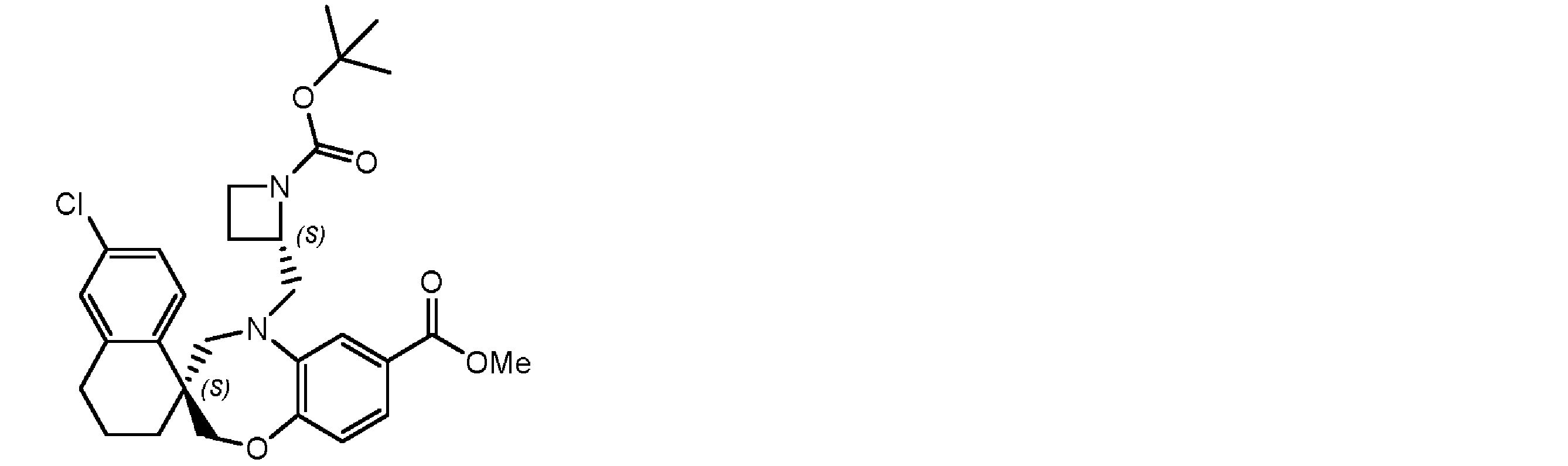
乾燥DCM(50mL)中のメチル(S)-6’-クロロ-3’,4,4’,5-テトラヒドロ-2H,2’H-スピロ[ベンゾ[b][1,4]オキサゼピン-3,1’-ナフタレン]-7-カルボキシレート[1883726-85-9](3g、8.384mmol)及び中間体2(7.82g、3eq.)の溶液に、室温で、AcOH(12mL、25eq.)を添加した。室温で1時間にわたり撹拌した後、この反応混合物を0℃まで冷却した。次いで、30分毎に9回に分けて、ナトリウムトリアセトキシボロヒドリド(890mg、0.5eq.)を添加した。この反応混合物を、飽和NaHCO3の溶液でクエンチし、EtOAcで希釈した。層を分離し、有機層をブラインで洗浄し、MgSO4で脱水し、ろ過し、溶媒を減圧下で除去した。残渣を、シリカゲルのフラッシュクロマトグラフィー(溶離液:EtOAc/ヘプタン:0/100~30/70)により精製して、中間体9(3.6g、収率73%)を白色粉末として得た。
Methyl (S)-5-(((S)-1-(tert-butoxycarbonyl)azetidin-2-yl)methyl)-6′-chloro-3′,4,4′,5-tetrahydro-2H,2 'H-spiro[benzo[b][1,4]oxazepine-3,1'-naphthalene]-7-carboxylate (Intermediate 9)
Methyl (S)-6′-chloro-3′,4,4′,5-tetrahydro-2H,2′H-spiro[benzo[b][1,4]oxazepine-3, in dry DCM (50 mL) To a solution of 1′-naphthalene]-7-carboxylate [1883726-85-9] (3 g, 8.384 mmol) and intermediate 2 (7.82 g, 3 eq.) at room temperature was added AcOH (12 mL, 25 eq.). was added. After stirring at room temperature for 1 hour, the reaction mixture was cooled to 0°C. Sodium triacetoxyborohydride (890 mg, 0.5 eq.) was then added in 9 portions every 30 minutes. The reaction mixture was quenched with a saturated NaHCO 3 solution and diluted with EtOAc. The layers were separated and the organic layer was washed with brine, dried over MgSO4, filtered and the solvent removed under reduced pressure. The residue was purified by flash chromatography on silica gel (eluent: EtOAc/heptane: 0/100 to 30/70) to give Intermediate 9 (3.6 g, 73% yield) as a white powder.
メチル(S)-5-(((S)-アゼチジン-2-イル)メチル)-6’-クロロ-3’,4,4’,5-テトラヒドロ-2H,2’H-スピロ[ベンゾ[b][1,4]オキサゼピン-3,1’-ナフタレン]-7-カルボキシレート(中間体10)

中間体9(1.98g、3.494mmol)のDCM(20mL)溶液に、TFA(9.5mL、35.5eq.)を緩やかに添加した。この反応混合物を、4時間にわたり室温で撹拌した。この反応混合物をDCMで希釈し、NaHCO3/氷/DCMの飽和溶液に滴下した。層を分離し、水層をDCMで2回抽出した。まとめた有機層をブラインで洗浄し、MgSO4で脱水し、ろ過し、減圧下で溶媒を除去して、中間体10(1.23g、収率76%)を白色粉末として得た。
methyl (S)-5-(((S)-azetidin-2-yl)methyl)-6′-chloro-3′,4,4′,5-tetrahydro-2H,2′H-spiro[benzo[b ][1,4]oxazepine-3,1′-naphthalene]-7-carboxylate (Intermediate 10)
To a solution of Intermediate 9 (1.98 g, 3.494 mmol) in DCM (20 mL) was slowly added TFA (9.5 mL, 35.5 eq.). The reaction mixture was stirred at room temperature for 4 hours. The reaction mixture was diluted with DCM and added dropwise to a saturated solution of NaHCO 3 /ice/DCM. The layers were separated and the aqueous layer was extracted twice with DCM. The combined organic layers were washed with brine, dried over MgSO4, filtered and the solvent removed under reduced pressure to give Intermediate 10 (1.23 g, 76% yield) as a white powder.
メチル(3S)-5-(((2S)-1-(2-(ベンゾ[d]チアゾール-2-イルスルホニル)-2-フルオロエチル)アゼチジン-2-イル)メチル)-6’-クロロ-3’,4,4’,5-テトラヒドロ-2H,2’H-スピロ[ベンゾ[b][1,4]オキサゼピン-3,1’-ナフタレン]-7-カルボキシレート(中間体11)

中間体10(500mg、1.113mmol)及び2-((1-フルオロビニル)スルホニル)ベンゾ[d]チアゾール[1200123-14-3](324.8mg、1.2eq.)を、室温で一晩、乾燥DCM(20mL)中で撹拌した。この反応混合物をNH4Clでクエンチし、DCMで3回抽出した。まとめた有機層をブラインで洗浄し、MgSO4で脱水し、溶媒を減圧下で蒸発させた。残渣を、シリカゲルのフラッシュクロマトグラフィー(溶離液:EtOAc/ヘプタン:0/100~40/60)により精製して、中間体11(491mg、66%)を得た。
Methyl (3S)-5-(((2S)-1-(2-(benzo[d]thiazol-2-ylsulfonyl)-2-fluoroethyl)azetidin-2-yl)methyl)-6′-chloro- 3′,4,4′,5-tetrahydro-2H,2′H-spiro[benzo[b][1,4]oxazepine-3,1′-naphthalene]-7-carboxylate (Intermediate 11)
Intermediate 10 (500 mg, 1.113 mmol) and 2-((1-fluorovinyl)sulfonyl)benzo[d]thiazole [1200123-14-3] (324.8 mg, 1.2 eq.) were treated overnight at room temperature. , in dry DCM (20 mL). The reaction mixture was quenched with NH4Cl and extracted with DCM three times. The combined organic layers were washed with brine, dried over MgSO4 and the solvent evaporated under reduced pressure. The residue was purified by flash chromatography on silica gel (eluent: EtOAc/heptane: 0/100 to 40/60) to give intermediate 11 (491 mg, 66%).
メチル(S)-5-(((S)-1-((5S,6R)-6-(N,N-ビス(4-メトキシベンジル)スルファモイル)-2-フルオロ-5-メチルヘプタ-2-エン-1-イル)アゼチジン-2-イル)メチル)-6’-クロロ-3’,4,4’,5-テトラヒドロ-2H,2’H-スピロ[ベンゾ[b][1,4]オキサゼピン-3,1’-ナフタレン]-7-カルボキシレート(E/Z混合物)(中間体12)

THF(10mL)中の中間体11(381mg、0.568mmol)及び中間体8(397.49mg、1.5eq)の溶液に、窒素雰囲気下にて-21℃で、30分かけて、tBuOK(70.17mg、1.1eq)のTHF(5mL)溶液を緩やかに添加した。-21℃で15分間撹拌した後、この反応混合物を室温まで温め、15分にわたり撹拌した。追加の中間体8(0.5eq.)及びtBuOK(0.5eq.)を添加し、この反応混合物をさらに30分にわたり撹拌した。次いで、この反応混合物を-21℃まで冷却し、追加のtBuOK(1.1eq.)を30分かけて添加した。この反応混合物を、NH4Clでクエンチした。DCMを添加した。層を分離し、水層をDCMで抽出した。まとめた有機相をブラインで洗浄し、MgSO4で脱水し、ろ過し、溶媒を減圧下で除去した。残渣を、シリカゲルのフラッシュクロマトグラフィー(溶離液:EtOAc/ヘプタン:0/100~40/60)により精製して、中間体12(226.5g、42%)を白色粉末として得た。
Methyl (S)-5-(((S)-1-((5S,6R)-6-(N,N-bis(4-methoxybenzyl)sulfamoyl)-2-fluoro-5-methylhept-2-ene) -1-yl)azetidin-2-yl)methyl)-6′-chloro-3′,4,4′,5-tetrahydro-2H,2′H-spiro[benzo[b][1,4]oxazepine- 3,1′-Naphthalene]-7-carboxylate (E/Z mixture) (Intermediate 12)
To a solution of intermediate 11 (381 mg, 0.568 mmol) and intermediate 8 (397.49 mg, 1.5 eq) in THF (10 mL) was added tBuOK ( 70.17 mg, 1.1 eq) in THF (5 mL) was slowly added. After stirring for 15 minutes at −21° C., the reaction mixture was warmed to room temperature and stirred for 15 minutes. Additional intermediate 8 (0.5 eq.) and tBuOK (0.5 eq.) were added and the reaction mixture was stirred for an additional 30 min. The reaction mixture was then cooled to −21° C. and additional tBuOK (1.1 eq.) was added over 30 minutes. The reaction mixture was quenched with NH4Cl . DCM was added. The layers were separated and the aqueous layer was extracted with DCM. The combined organic phases were washed with brine, dried over MgSO4, filtered and the solvent removed under reduced pressure. The residue was purified by flash chromatography on silica gel (eluent: EtOAc/heptane: 0/100 to 40/60) to give Intermediate 12 (226.5 g, 42%) as a white powder.
メチル(S)-6’-クロロ-5-(((S)-1-((5S,6R)-2-フルオロ-5-メチル-6-スルファモイルヘプタ-2-エン-1-イル)アゼチジン-2-イル)メチル)-3’,4,4’,5-テトラヒドロ-2H,2’H-スピロ[ベンゾ[b][1,4]オキサゼピン-3,1’-ナフタレン]-7-カルボキシレート(E/Z混合物)(中間体13)

中間体12(226.5mg、0.241mmol)のDCM(7mL)溶液に、窒素雰囲気下で、TFA(1.84mL、100eq.)を滴下した。この反応混合物を、21時間にわたり室温で撹拌した。この反応混合物を飽和水性NaHCO3でクエンチし、DCMで希釈した。水層を、DCMで3回抽出した。まとめた有機層をブラインで洗浄し、MgSO4で脱水し、ろ過し、溶媒を減圧下で除去して、中間体13(131.9mg、57%)を得た。
Methyl (S)-6'-chloro-5-(((S)-1-((5S,6R)-2-fluoro-5-methyl-6-sulfamoylhept-2-en-1-yl) Azetidin-2-yl)methyl)-3′,4,4′,5-tetrahydro-2H,2′H-spiro[benzo[b][1,4]oxazepine-3,1′-naphthalene]-7- Carboxylate (E/Z mixture) (Intermediate 13)
To a solution of intermediate 12 (226.5 mg, 0.241 mmol) in DCM (7 mL) under nitrogen was added TFA (1.84 mL, 100 eq.) dropwise. The reaction mixture was stirred at room temperature for 21 hours. The reaction mixture was quenched with saturated aqueous NaHCO 3 and diluted with DCM. The aqueous layer was extracted with DCM three times. The combined organic layers were washed with brine, dried over MgSO4, filtered and the solvent removed under reduced pressure to give intermediate 13 (131.9 mg, 57%).
(S)-6’-クロロ-5-(((S)-1-((5S,6R)-2-フルオロ-5-メチル-6-スルファモイルヘプタ-2-エン-1-イル)アゼチジン-2-イル)メチル)-3’,4,4’,5-テトラヒドロ-2H,2’H-スピロ[ベンゾ[b][1,4]オキサゼピン-3,1’-ナフタレン]-7-カルボン酸(E/Z混合物)(中間体14)

THF(4mL)及び水(1mL)中の中間体13(131.9mg、0.15mmol)の溶液に、LiOH(14.34mg、4eq.)を添加した。この反応混合物を16時間にわたり室温で撹拌し、続いて50℃で2時間撹拌した。溶媒を蒸発させ、残渣を、分取HPLC(固定相:RP XBridge Prep C18 OBD-10μm、30×150mm、移動相:0.25% NH4HCO3水溶液、CH3CN)により精製して、中間体14(16mg、17%)を得た。
(S)-6′-chloro-5-(((S)-1-((5S,6R)-2-fluoro-5-methyl-6-sulfamoylhept-2-en-1-yl)azetidine -2-yl)methyl)-3′,4,4′,5-tetrahydro-2H,2′H-spiro[benzo[b][1,4]oxazepine-3,1′-naphthalene]-7-carvone Acid (E/Z mixture) (Intermediate 14)
To a solution of intermediate 13 (131.9 mg, 0.15 mmol) in THF (4 mL) and water (1 mL) was added LiOH (14.34 mg, 4 eq.). The reaction mixture was stirred at room temperature for 16 hours, followed by stirring at 50° C. for 2 hours. The solvent was evaporated and the residue was purified by preparative HPLC (stationary phase: RP XBridge Prep C18 OBD-10 μm, 30×150 mm, mobile phase: 0.25% NH 4 HCO 3 aqueous solution, CH 3 CN) to give intermediate Compound 14 (16 mg, 17%) was obtained.
A2)
メチル(S)-5-(((S)-1-アリルアゼチジン-2-イル)メチル)-6’-クロロ-3’,4,4’,5-テトラヒドロ-2H,2’H-スピロ[ベンゾ[b][1,4]オキサゼピン-3,1’-ナフタレン]-7-カルボキシレート(中間体15)

乾燥CH3CN(40mL)中の中間体10(333mg、0.686mmol)及びCs2CO3(1.12g、5eq.)の懸濁液に、室温で、臭化アリル(65.3μL、1.1eq.)を添加した。この反応混合物を、24時間にわたり室温で撹拌した。溶媒を蒸発させた。残渣を水とEtOAcとの間で分配し、層を分離した。水層を、EtOAcで再度抽出した。まとめた有機層をMgSO4で脱水し、ろ過し、蒸発させた。残渣を、カラムクロマトグラフィー(SNAP Ultra 25g;溶離液:AcOEt/EtOH 3/1:ヘプタン 0:100→60:40)により精製して、中間体15(212mg、51%)を無色固体として得、45℃にて真空下で乾燥させた。
A2)
methyl (S)-5-(((S)-1-allylazetidin-2-yl)methyl)-6′-chloro-3′,4,4′,5-tetrahydro-2H,2′H-spiro[benzo [b][1,4]oxazepine-3,1′-naphthalene]-7-carboxylate (Intermediate 15)
Allyl bromide ( 65.3 μL , 1 .1 eq.) was added. The reaction mixture was stirred at room temperature for 24 hours. The solvent was evaporated. The residue was partitioned between water and EtOAc and the layers were separated. The aqueous layer was re-extracted with EtOAc. The combined organic layers were dried over MgSO4, filtered and evaporated. The residue was purified by column chromatography (SNAP Ultra 25 g; eluent: AcOEt/EtOH 3/1:heptane 0:100→60:40) to give intermediate 15 (212 mg, 51%) as a colorless solid, Dried under vacuum at 45°C.
(S)-5-(((S)-1-アリルアゼチジン-2-イル)メチル)-6’-クロロ-3’,4,4’,5-テトラヒドロ-2H,2’H-スピロ[ベンゾ[b][1,4]オキサゼピン-3,1’-ナフタレン]-7-カルボン酸(中間体16)

水、蒸留(5mL)、及びTHF(15mL)中の中間体15(212mg、0.35mmol)の溶液に、LiOH(25.11mg、3eq.)を添加した。この混合物を、一晩室温で撹拌し、次いで24時間にわたり60℃で撹拌した。溶媒を、減圧下で蒸発させた。精製を、分取HPLC(固定相:RP XBridge Prep C18 OBD-10μm、50×150mm、移動相:0.25% NH4HCO3水溶液、CH3CN)により実施し、溶媒の蒸発後に中間体16(104mg、66%)を白色固体として得た。
(S)-5-(((S)-1-allylazetidin-2-yl)methyl)-6′-chloro-3′,4,4′,5-tetrahydro-2H,2′H-spiro[benzo[ b][1,4]oxazepine-3,1′-naphthalene]-7-carboxylic acid (intermediate 16)
To a solution of intermediate 15 (212 mg, 0.35 mmol) in water, distilled (5 mL), and THF (15 mL) was added LiOH (25.11 mg, 3 eq.). The mixture was stirred overnight at room temperature and then at 60° C. for 24 hours. Solvent was evaporated under reduced pressure. Purification was performed by preparative HPLC (stationary phase: RP XBridge Prep C18 OBD-10 μm, 50×150 mm, mobile phase: 0.25% NH 4 HCO 3 aqueous solution, CH 3 CN), intermediate 16 after evaporation of the solvent. (104 mg, 66%) was obtained as a white solid.
(S)-5-(((S)-1-アリルアゼチジン-2-イル)メチル)-6’-クロロ-N-(((2R,3S)-3-メチルヘキサ-5-エン-2-イル)スルホニル)-3’,4,4’,5-テトラヒドロ-2H,2’H-スピロ[ベンゾ[b][1,4]オキサゼピン-3,1’-ナフタレン]-7-カルボキサミド(中間体17)

乾燥DCM(5mL)中の中間体16(104mg、0.23mmol)及び中間体6(101.75mg、2.5eq.)の溶液に、室温で、DMAP(47.68mg、1.7eq.)を添加し、続いてEDC.HCl(88.03mg、2eq.)を添加した。この反応混合物を一晩室温で撹拌した。この反応混合物に飽和水性NH4Cl 3mLを添加し、この混合物を数分にわたり撹拌した。層を分離し、水層をDCMで再度抽出した。まとめた有機層を、Extrelut NT3によるろ過により脱水し、蒸発させた。精製を、分取HPLC(固定相:RP XBridge Prep C18 OBD-10μm、50×150mm、移動相:0.25% NH4HCO3水溶液、CH3CN)により実施して、60℃での溶媒の蒸発後に中間体17(88mg、54%)をオフホワイトの固体として得た。
(S)-5-(((S)-1-allylazetidin-2-yl)methyl)-6′-chloro-N-(((2R,3S)-3-methylhex-5-en-2-yl) sulfonyl)-3′,4,4′,5-tetrahydro-2H,2′H-spiro[benzo[b][1,4]oxazepine-3,1′-naphthalene]-7-carboxamide (Intermediate 17)
DMAP (47.68 mg, 1.7 eq.) was added to a solution of intermediate 16 (104 mg, 0.23 mmol) and intermediate 6 (101.75 mg, 2.5 eq.) in dry DCM (5 mL) at room temperature. addition followed by EDC. HCl (88.03 mg, 2 eq.) was added. The reaction mixture was stirred overnight at room temperature. 3 mL of saturated aqueous NH 4 Cl was added to the reaction mixture and the mixture was stirred for several minutes. The layers were separated and the aqueous layer was re-extracted with DCM. The combined organic layers were dried by filtration through Extrelut NT3 and evaporated. Purification was performed by preparative HPLC (stationary phase: RP XBridge Prep C18 OBD-10 μm, 50×150 mm, mobile phase: 0.25% NH 4 HCO 3 aqueous solution, CH 3 CN) with solvent elution at 60° C. Intermediate 17 (88 mg, 54%) was obtained as an off-white solid after evaporation.
A3)
(6-クロロ-1-((4-ヨード-2-ニトロフェノキシ)メチル)-1,2,3,4-テトラヒドロナフタレン-1-イル)メタノール(中間体18)

この反応を、2つのバッチで実施した。各バッチに関して、(6-クロロ-1,2,3,4-テトラヒドロナフタレン-1,1-ジイル)ジメタノール[1883726-74-6](300g、1.32mol)及び1-フルオロ-4-ヨード-2-ニトロベンゼン(353g、1.32mol)を、アセトニトリル(1.4L)に溶解させた。この反応混合物に、K2CO3(549g、3.97mol)を添加し、16時間にわたり50℃で撹拌した。この反応混合物をろ過し、ろ液を蒸発させた。次いで、2つのバッチをまとめ、残渣を、カラムクロマトグラフィー(SiO2、石油エーテル:ジクロロメタン=3/1から石油エーテル/EtOAc1;1)により精製した。中間体18を、黄色油状物(600g、48%収率)として得た。
A3)
(6-chloro-1-((4-iodo-2-nitrophenoxy)methyl)-1,2,3,4-tetrahydronaphthalen-1-yl)methanol (Intermediate 18)
This reaction was performed in two batches. (6-chloro-1,2,3,4-tetrahydronaphthalene-1,1-diyl)dimethanol [1883726-74-6] (300 g, 1.32 mol) and 1-fluoro-4-iodine for each batch -2-Nitrobenzene (353 g, 1.32 mol) was dissolved in acetonitrile (1.4 L). K 2 CO 3 (549 g, 3.97 mol) was added to the reaction mixture and stirred at 50° C. for 16 hours. The reaction mixture was filtered and the filtrate was evaporated. The two batches were then combined and the residue was purified by column chromatography (SiO 2 , petroleum ether:dichloromethane=3/1 to petroleum ether/EtOAc 1:1). Intermediate 18 was obtained as a yellow oil (600 g, 48% yield).
6-クロロ-1-((4-ヨード-2-ニトロフェノキシ)メチル)-1,2,3,4-テトラヒドロナフタレン-1-カルバルデヒド(中間体19)

この反応を、3つのバッチで実施した。各バッチに関して、(COCl)2(161g、1.27mol)のDCM(2.4L)溶液に、-78℃で、DMSO(99.0g、1.27mol)を添加した。この反応混合物を、15分にわたり-78℃で撹拌した。次いで、-78℃で、DCM(0.90L)中の中間体18(200g、422mmol)を添加し、-78℃で30分にわたり撹拌し続けた。-78℃で、Et3N(214g、2.11mol)を添加し、この反応混合物を室温まで昇温させた。1.5時間にわたり、室温で撹拌し続けた。水性NaHCO3(1L)を添加し、この混合物をDCM(0.5L×2回)で抽出した。次いで、3つのバッチをまとめ、蒸発させて、中間体19(560g)を黄色固体として得、さらに精製することなく使用した。
6-chloro-1-((4-iodo-2-nitrophenoxy)methyl)-1,2,3,4-tetrahydronaphthalene-1-carbaldehyde (Intermediate 19)
This reaction was performed in three batches. For each batch, to a solution of (COCl) 2 (161 g, 1.27 mol) in DCM (2.4 L) at -78°C was added DMSO (99.0 g, 1.27 mol). The reaction mixture was stirred at −78° C. for 15 minutes. Intermediate 18 (200 g, 422 mmol) in DCM (0.90 L) was then added at −78° C. and stirring continued at −78° C. for 30 min. At −78° C., Et 3 N (214 g, 2.11 mol) was added and the reaction mixture was allowed to warm to room temperature. Stirring was continued at room temperature for 1.5 hours. Aqueous NaHCO 3 (1 L) was added and the mixture was extracted with DCM (0.5 L×2). The three batches were then combined and evaporated to give Intermediate 19 (560g) as a yellow solid which was used without further purification.
(S)-6’-クロロ-7-ヨード-3’,4,4’,5-テトラヒドロ-2H,2’H-スピロ[ベンゾ[b][1,4]オキサゼピン-3,1’-ナフタレン](中間体20)(及びそのエナンチオマー)

この反応を、3つのバッチで実施した。中間体19(185g、392mmol)のAcOH(2.5L)溶液に、70℃で、鉄(153g、2.75mol)を添加し、この反応混合物を3時間にわたり70℃で撹拌した。溶媒を蒸発させ、残渣にDCE(1.9L)を添加した。次いで、0℃で、NaBH(OAc)3(333g、1.57mol)を少しずつ添加した。1時間にわたり、室温で撹拌し続けた。3つのバッチをまとめた。クエン酸(10%水溶液、5.L)を添加し、この混合物をDCM(2L×2回)で抽出した。まとめた有機層を蒸発させた。残渣を、SFC(カラム:DAICEL CHIRALPAK AD(250mm×50mm、10μm);移動相:[EtOH中の0.1% NH3H2O];B%:50%-50%、8.5分)により精製して、中間体20(95.2g、40%収率)及びそのエナンチオマー(105.1g、44%収率)を両方とも黄色固体として得た。
(S)-6′-chloro-7-iodo-3′,4,4′,5-tetrahydro-2H,2′H-spiro[benzo[b][1,4]oxazepine-3,1′-naphthalene ] (intermediate 20) (and its enantiomer)
This reaction was performed in three batches. To a solution of Intermediate 19 (185 g, 392 mmol) in AcOH (2.5 L) at 70° C. was added iron (153 g, 2.75 mol) and the reaction mixture was stirred at 70° C. for 3 hours. The solvent was evaporated and DCE (1.9 L) was added to the residue. NaBH(OAc) 3 (333 g, 1.57 mol) was then added in portions at 0°C. Stirring was continued at room temperature for 1 hour. Three batches were combined. Citric acid (10% aqueous solution, 5.L) was added and the mixture was extracted with DCM (2 L x 2). The combined organic layers were evaporated. The residue was subjected to SFC (column: DAICEL CHIRALPAK AD (250 mm x 50 mm, 10 μm); mobile phase: [0.1% NH 3 H 2 O in EtOH]; B%: 50%-50%, 8.5 min). afforded intermediate 20 (95.2 g, 40% yield) and its enantiomer (105.1 g, 44% yield) both as yellow solids.
tert-ブチル(S)-2-(((S)-6’-クロロ-7-ヨード-3’,4’-ジヒドロ-2H,2’H-スピロ[ベンゾ[b][1,4]オキサゼピン-3,1’-ナフタレン]-5(4H)-イル)メチル)アゼチジン-1-カルボキシレート(中間体21)

中間体20(7.58g、17.8mmol)及び中間体2(16.25g、53.4mmol)の混合物をDCM(75mL)に溶解させ、AcOH(25mL)を添加した。この混合物を室温で30分にわたり撹拌し、次いで0℃まで冷却した。ナトリウムトリアセトキシボロヒドリド(11.3g、53.4mmol)を、少しずつ添加した。添加後、この反応混合物を16時間にわたり室温で撹拌した。この反応混合物を、水300mL中のNaOH(21.3g、53.4mmol)の冷(0℃)溶液に少しずつ注いだ。添加後、混合物をDCM及び水で希釈した。有機相を分離し、水で洗浄し、MgSO4で脱水し、ろ過し、ろ液の溶媒を減圧下で蒸発させた。残渣をDCMに溶解させ、シリカのフラッシュクロマトグラフィー(溶離液:ジクロロメタン)により精製した。生成物を含む画分をまとめ、溶媒を蒸発させて、中間体21(9.8g、収率92%)を得た。
tert-butyl (S)-2-(((S)-6'-chloro-7-iodo-3',4'-dihydro-2H,2'H-spiro[benzo[b][1,4]oxazepine -3,1′-naphthalene]-5(4H)-yl)methyl)azetidine-1-carboxylate (Intermediate 21)
A mixture of Intermediate 20 (7.58 g, 17.8 mmol) and Intermediate 2 (16.25 g, 53.4 mmol) was dissolved in DCM (75 mL) and AcOH (25 mL) was added. The mixture was stirred at room temperature for 30 minutes and then cooled to 0°C. Sodium triacetoxyborohydride (11.3 g, 53.4 mmol) was added in portions. After addition, the reaction mixture was stirred at room temperature for 16 hours. The reaction mixture was poured portionwise into a cold (0° C.) solution of NaOH (21.3 g, 53.4 mmol) in 300 mL of water. After the addition, the mixture was diluted with DCM and water. The organic phase was separated, washed with water, dried over MgSO4 , filtered and the filtrate's solvent was evaporated under reduced pressure. The residue was dissolved in DCM and purified by flash chromatography on silica (eluent: dichloromethane). Fractions containing product were combined and the solvent was evaporated to give intermediate 21 (9.8 g, 92% yield).
tert-ブチル(2S)-2-[[(3S)-6’-クロロ-7-ヨード-スピロ[2,4-ジヒドロ-1,5-ベンゾキサゼピン-3,1’-テトラリン]-5-イル]メチル]ピロリジン-1-カルボキシレート(中間体39)

中間体20(13.197g、31mmol)及びN-Boc-L-プロリナール(18.53g、3eq.)を、CH2Cl2(150mL)に溶解させ、次いでAcOH(35.5mL、20eq.)を添加した。この混合物を室温で30分にわたり撹拌し、次いで0℃まで冷却した。次いで、ナトリウムトリアセトキシボロヒドリド(19.711g、3eq.)を少しずつ添加した。添加後、この反応混合物を18時間にわたり室温で撹拌した。この反応混合物を、水620mL中のNaOH(31g)の冷(0℃)溶液に少しずつ注いだ。添加後、この混合物を、CH2Cl2及び水で希釈した。有機層を分離し、水で洗浄し、MgSO4で脱水し、ろ過し、ろ液の溶剤を蒸発させた。残渣を、シリカゲルのフラッシュクロマトグラフィー(溶離液:CH2Cl2)で精製した。生成物を含む画分をまとめ、溶剤を蒸発させた。この残渣を、HPLC(勾配 酢酸エチル/ヘキサン)により再度精製して、中間体39(12.2g、収率:64%)を得た。
tert-butyl (2S)-2-[[(3S)-6′-chloro-7-iodo-spiro[2,4-dihydro-1,5-benzoxazepin-3,1′-tetralin]-5-yl] Methyl]pyrrolidine-1-carboxylate (Intermediate 39)
Intermediate 20 (13.197 g, 31 mmol) and N-Boc-L-prolinal (18.53 g, 3 eq.) were dissolved in CH 2 Cl 2 (150 mL) followed by AcOH (35.5 mL, 20 eq.). added. The mixture was stirred at room temperature for 30 minutes and then cooled to 0°C. Sodium triacetoxyborohydride (19.711 g, 3 eq.) was then added in portions. After addition, the reaction mixture was stirred at room temperature for 18 hours. The reaction mixture was poured portionwise into a cold (0° C.) solution of NaOH (31 g) in 620 mL of water. After addition, the mixture was diluted with CH 2 Cl 2 and water. The organic layer was separated, washed with water, dried over MgSO4 , filtered and the filtrate's solvent was evaporated. The residue was purified by flash chromatography on silica gel ( eluent: CH2Cl2). Fractions containing product were combined and the solvent was evaporated. The residue was purified again by HPLC (gradient ethyl acetate/hexanes) to give intermediate 39 (12.2 g, yield: 64%).
(S)-5-(((S)-アゼチジン-2-イル)メチル)-6’-クロロ-7-ヨード-3’,4,4’,5-テトラヒドロ-2H,2’H-スピロ[ベンゾ[b][1,4]オキサゼピン-3,1’-ナフタレン](中間体22)

中間体21(9.8g、16.5mmol)及びDCM(125mL)の混合物を、室温で撹拌した。TFA(125ml)を滴下した。この反応混合物を3時間にわたり室温で撹拌し、次いで温度を30℃未満に維持して蒸発乾固させた。残渣をDCM中に取り、NaHCO3水溶液に注いだ。層を分離し、有機層をDCMで抽出した。まとめた有機画分を水で洗浄し、MgSO4で脱水し、蒸発させた。残渣を、シリカのフラッシュクロマトグラフィー(溶離液:DCM-MeOH/NH3 勾配100%/0%~95%/5%)により精製した。純粋な画分を回収し、蒸発させた。残渣の油状物を、沈殿が起こるまでCH3CN中で撹拌した。沈殿物をろ過し、乾燥させて、中間体22(5.1g、収率63%)を得た。
(S)-5-(((S)-azetidin-2-yl)methyl)-6′-chloro-7-iodo-3′,4,4′,5-tetrahydro-2H,2′H-spiro[ Benzo[b][1,4]oxazepine-3,1′-naphthalene] (Intermediate 22)
A mixture of intermediate 21 (9.8 g, 16.5 mmol) and DCM (125 mL) was stirred at room temperature. TFA (125 ml) was added dropwise. The reaction mixture was stirred at room temperature for 3 hours and then evaporated to dryness keeping the temperature below 30°C. The residue was taken in DCM and poured into aqueous NaHCO 3 solution. The layers were separated and the organic layer was extracted with DCM. The combined organic fractions were washed with water, dried over MgSO4 and evaporated. The residue was purified by flash chromatography on silica (eluent: DCM-MeOH/NH 3 gradient 100%/0% to 95%/5%). Pure fractions were collected and evaporated. The residual oil was stirred in CH 3 CN until precipitation occurred. The precipitate was filtered and dried to give intermediate 22 (5.1 g, 63% yield).
適切な出発物質を使用して、中間体22と類似の反応プロトコルにより中間体40を調製した。 Intermediate 40 was prepared by a similar reaction protocol to intermediate 22 using appropriate starting materials.

メチル 2-((S)-2-(((S)-6’-クロロ-7-ヨード-3’,4’-ジヒドロ-2H,2’H-スピロ[ベンゾ[b][1,4]オキサゼピン-3,1’-ナフタレン]-5(4H)-イル)メチル)アゼチジン-1-イル)-3-メトキシプロパノエート(中間体23)

中間体22(2.47g、5mmol)、メチル 2-ブロモ-3-メトキシプロパノエート(1.08g、5.5mmol)、DIPEA(1.29g、10mmol)、及びDMF(29mL)の混合物を、72時間にわたり室温で撹拌した。再び、メチル 2-ブロモ-3-メトキシプロパノエート 1.25mmolを添加した。この反応混合物を、さらに48時間にわたり室温で撹拌した。この反応混合物を、Na2CO3(1.1g、10mmol)の水(100mL)溶液に注ぎ、この混合物をEtOAcで抽出した。有機層を水で洗浄し、MgSO4で脱水し、蒸発させた。残渣を、シリカのフラッシュクロマトグラフィー(溶離液:99% DCM/1% MeOH)により精製し、中間体23(3.1g、収率100%)を得た。
methyl 2-((S)-2-(((S)-6′-chloro-7-iodo-3′,4′-dihydro-2H,2′H-spiro[benzo[b][1,4] Oxazepine-3,1′-naphthalene]-5(4H)-yl)methyl)azetidin-1-yl)-3-methoxypropanoate (Intermediate 23)
A mixture of intermediate 22 (2.47 g, 5 mmol), methyl 2-bromo-3-methoxypropanoate (1.08 g, 5.5 mmol), DIPEA (1.29 g, 10 mmol), and DMF (29 mL) was Stir at room temperature for 72 hours. Again 1.25 mmol of methyl 2-bromo-3-methoxypropanoate were added. The reaction mixture was stirred at room temperature for an additional 48 hours. The reaction mixture was poured into a solution of Na 2 CO 3 (1.1 g, 10 mmol) in water (100 mL) and the mixture was extracted with EtOAc. The organic layer was washed with water, dried over MgSO4 and evaporated. The residue was purified by flash chromatography on silica (eluent: 99% DCM/1% MeOH) to give intermediate 23 (3.1 g, 100% yield).
適切な出発物質を使用して、中間体23と類似の反応プロトコルにより中間体41を調製した。 Intermediate 41 was prepared by a similar reaction protocol to intermediate 23 using appropriate starting materials.

2-((S)-2-(((S)-6’-クロロ-7-ヨード-3’,4’-ジヒドロ-2H,2’H-スピロ[ベンゾ[b][1,4]オキサゼピン-3,1’-ナフタレン]-5(4H)-イル)メチル)アゼチジン-1-イル)-3-メトキシプロパン-1-オール(中間体24)

中間体23(3.05g、5mmol)を乾燥THF(50mL)に溶解させ、-78℃まで冷却した。この溶液を、窒素流下で撹拌した。次いで、-78℃にて、THF中のDIBAH 1M(20mL、20mmol)を滴下した。次いで、この反応混合物を、3時間にわたり室温で撹拌した。この反応混合物を氷浴上で冷却し、MeOH 25mLを滴下し、温度を10℃未満に維持した。この反応混合物を、30分にわたり撹拌した。次いで、水を添加し、この反応混合物をDCMで3回抽出した。有機層をMgSO4で脱水し、蒸発させて中間体24(2.6g、収率89%)を得、さらに精製することなく使用した。
2-((S)-2-(((S)-6′-chloro-7-iodo-3′,4′-dihydro-2H,2′H-spiro[benzo[b][1,4]oxazepine -3,1′-naphthalene]-5(4H)-yl)methyl)azetidin-1-yl)-3-methoxypropan-1-ol (Intermediate 24)
Intermediate 23 (3.05 g, 5 mmol) was dissolved in dry THF (50 mL) and cooled to -78°C. The solution was stirred under a stream of nitrogen. DIBAH 1M in THF (20 mL, 20 mmol) was then added dropwise at -78°C. The reaction mixture was then stirred at room temperature for 3 hours. The reaction mixture was cooled on an ice bath and 25 mL of MeOH was added dropwise to maintain the temperature below 10.degree. The reaction mixture was stirred for 30 minutes. Water was then added and the reaction mixture was extracted with DCM three times. The organic layer was dried over MgSO4 and evaporated to give intermediate 24 ( 2.6 g, 89% yield) which was used without further purification.
適切な出発物質を使用して、中間体24と類似の反応プロトコルにより中間体42を調製した。 Intermediate 42 was prepared by a similar reaction protocol to intermediate 24 using appropriate starting materials.

2-((S)-2-(((S)-6’-クロロ-7-ヨード-3’,4’-ジヒドロ-2H,2’H-スピロ[ベンゾ[b][1,4]オキサゼピン-3,1’-ナフタレン]-5(4H)-イル)メチル)アゼチジン-1-イル)-3-メトキシプロパナール(中間体25)
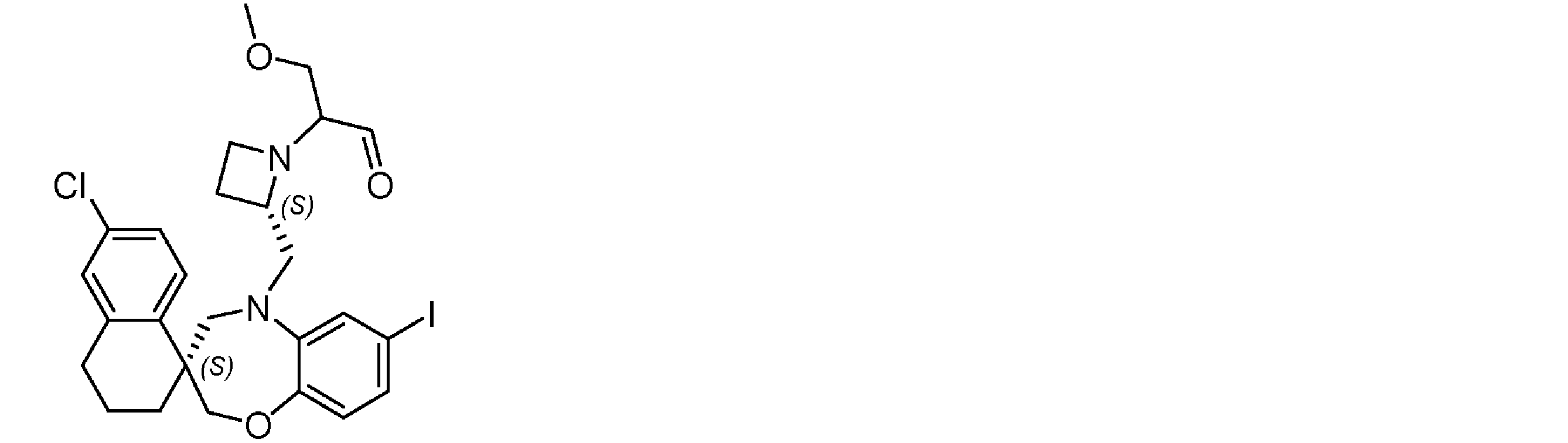
乾燥DCM(15mL)中の乾燥DMSO(0.479mL、6.69mmol)を、窒素流下で-70℃にて撹拌した。-70℃で、塩化オキサリル(1.67mL、3.34mmol)を滴下した。この反応混合物を、-70℃で30分にわたり撹拌した。次いで、-70℃で、DCM 10mL中の中間体24(1.3g、2.23mmol)を滴下した。この反応混合物を、-70℃で2時間にわたり撹拌した。次いで、-70℃で、DCM中のEt3N(1.86mL、13.38mmol)を滴下した。この反応混合物を、1時間にわたり-70℃で撹拌した。次いで、-20℃で、水を滴下した。この反応混合物を室温まで温め、水(20mL)中のNaHCO3(562mg、6.69mmol)を添加した。この反応混合物を、DCMで抽出した。有機層を水で洗浄し、MgSO4で脱水し、蒸発させて、中間体25(1.29g、定量的)を得、さらに精製することなく使用した。
2-((S)-2-(((S)-6′-chloro-7-iodo-3′,4′-dihydro-2H,2′H-spiro[benzo[b][1,4]oxazepine -3,1′-naphthalene]-5(4H)-yl)methyl)azetidin-1-yl)-3-methoxypropanal (Intermediate 25)
Dry DMSO (0.479 mL, 6.69 mmol) in dry DCM (15 mL) was stirred at −70° C. under a stream of nitrogen. At -70°C, oxalyl chloride (1.67 mL, 3.34 mmol) was added dropwise. The reaction mixture was stirred at -70°C for 30 minutes. At −70° C., intermediate 24 (1.3 g, 2.23 mmol) in 10 mL of DCM was then added dropwise. The reaction mixture was stirred at -70°C for 2 hours. Et 3 N (1.86 mL, 13.38 mmol) in DCM was then added dropwise at −70° C. The reaction mixture was stirred at −70° C. for 1 hour. Water was then added dropwise at -20°C. The reaction mixture was warmed to room temperature and NaHCO 3 (562 mg, 6.69 mmol) in water (20 mL) was added. The reaction mixture was extracted with DCM. The organic layer was washed with water, dried over MgSO4 and evaporated to give Intermediate 25 ( 1.29 g, quantitative), used without further purification.
適切な出発物質を使用して、中間体25と類似の反応プロトコルにより中間体43を調製した。 Intermediate 43 was prepared by a similar reaction protocol to intermediate 25 using appropriate starting materials.
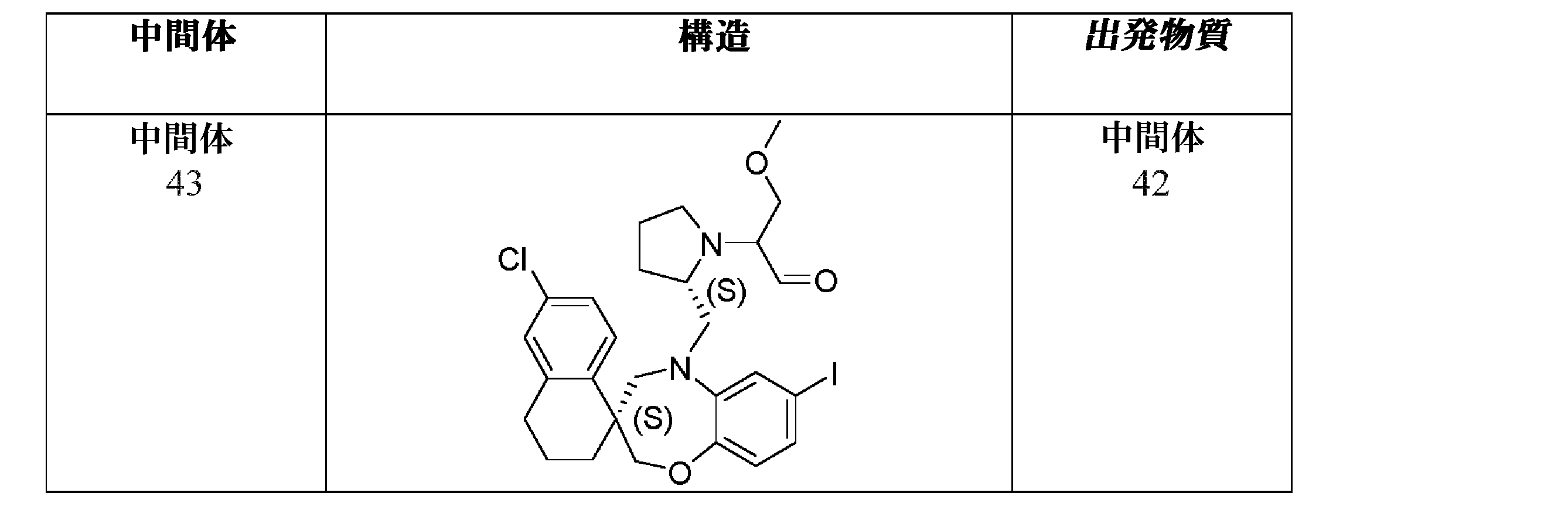
中間体26及び中間体27

乾燥THF(50mL)中のPh3PCH3Br(2.63g、7.36mmol)の混合物に、窒素雰囲気下で0℃にて、THF中のKOtBu 1M(6.69mL、6.69mmol)を滴下した。この混合物を、1時間にわたり0℃で撹拌した。
中間体25(1.29g、2.23mmol)を乾燥THF 25mLに溶解させ、次いで滴下した。乾燥THFの別の25mLを添加し、この反応混合物を16時間にわたり室温で撹拌した。飽和水性NH4Cl溶液を添加し、この反応混合物を10分にわたり撹拌した後、EtOAcで抽出した。有機層をMgSO4で脱水し、蒸発乾固させた。残渣を、シリカのフラッシュクロマトグラフィー(溶離液:DCM 99%/MeOH 1%)により精製して、中間体26及び27のラセミ混合物を得た。この混合物を、分取SFC(固定相:Chiralpak Daicel IG 20×250mm、移動相:CO2、EtOH+0.4% iPrNH2)により精製して、中間体26(383mg、収率30%)及び中間体27(230mg、収率18%)を得た。
Intermediate 26 and Intermediate 27
To a mixture of Ph 3 PCH 3 Br (2.63 g, 7.36 mmol) in dry THF (50 mL) at 0° C. under nitrogen was added KOtBu 1M in THF (6.69 mL, 6.69 mmol) dropwise. did. The mixture was stirred at 0° C. for 1 hour.
Intermediate 25 (1.29 g, 2.23 mmol) was dissolved in 25 mL of dry THF and then added dropwise. Another 25 mL of dry THF was added and the reaction mixture was stirred at room temperature for 16 hours. A saturated aqueous NH 4 Cl solution was added and the reaction mixture was stirred for 10 minutes before being extracted with EtOAc. The organic layer was dried over MgSO4 and evaporated to dryness. The residue was purified by flash chromatography on silica (eluent: DCM 99%/MeOH 1%) to give a racemic mixture of intermediates 26 and 27. This mixture was purified by preparative SFC (stationary phase: Chiralpak Daicel IG 20×250 mm, mobile phase: CO 2 , EtOH+0.4% iPrNH 2 ) to give intermediate 26 (383 mg, 30% yield) and intermediate 27 (230 mg, 18% yield) was obtained.
適切な出発物質を使用して、中間体26及び27と類似の反応プロトコルにより中間体44を調製した。 Intermediate 44 was prepared by analogous reaction protocols to intermediates 26 and 27 using appropriate starting materials.

中間体29

ステンレス鋼製の反応器に、乾燥THF(20mL)中の中間体26(326mg、0.563mmol)、中間体6(150mg、1.5eq.)、PdCl2(dppf)(41mg、0.1eq.)、DBU(171mg、2eq.)を充填した。この反応器を密封し、50バールのCOで加圧した。この混合物を、16時間にわたり100℃で撹拌した。この反応混合物を冷却し、溶媒を蒸発させた。残渣を水に注ぎ、DCMで抽出した。有機層をMgSO4で脱水し、蒸発させた。残渣を、分取HPLC(固定相:RP XBridge Prep C18 OBD-10μm、50×150mm、移動相:0.25% NH4HCO3水溶液、CH3CN)により精製して、中間体29(110mg、収率30%)を得た。
Intermediate 29
A stainless steel reactor was charged with intermediate 26 (326 mg, 0.563 mmol), intermediate 6 (150 mg, 1.5 eq.), PdCl2 (dppf) (41 mg, 0.1 eq.) in dry THF (20 mL). ), DBU (171 mg, 2 eq.) was charged. The reactor was sealed and pressurized with 50 bar CO. The mixture was stirred at 100° C. for 16 hours. The reaction mixture was cooled and the solvent was evaporated. The residue was poured into water and extracted with DCM. The organic layer was dried over MgSO4 and evaporated. The residue was purified by preparative HPLC (stationary phase: RP XBridge Prep C18 OBD-10 μm, 50×150 mm, mobile phase: 0.25% NH 4 HCO 3 aqueous solution, CH 3 CN) to give intermediate 29 (110 mg, Yield 30%) was obtained.
適切な出発物質を使用して、中間体29と類似の反応プロトコルにより中間体45及び46を調製した。 Intermediates 45 and 46 were prepared by analogous reaction protocols to intermediate 29 using appropriate starting materials.

A4)
Tert-ブチル 4-((7-クロロ-4-(ヒドロキシメチル)クロマン-4-イル)メトキシ)-3-ニトロベンゾエート(中間体30)

乾燥THF(60mL)中の(7-クロロクロマン-4,4-ジイル)ジメタノール[2130069-84-8](600mg、2.62mmol)の撹拌溶液に、tert-ブチル 4-フルオロ-3-ニトロベンゾエート(470mg、0.9eq)を添加した。5分後、室温で、2時間かけてLiHMDS(THF中に1.06M)(2.228mL、0.9eq)を滴下し、次いでさらに30分にわたり撹拌した。この反応混合物を0℃まで冷却し、水性NH4Clでクエンチし、EtOAcで抽出した。まとめた有機層を、水性NH4Cl及びブラインで洗浄し、Na2SO4で脱水し、真空下で濃縮した。残渣を、シリカのフラッシュクロマトグラフィー(ヘプタン中に0~40% EtOAc)で精製して、中間体30(630mg、収率54%)を得た。
A4)
Tert-butyl 4-((7-chloro-4-(hydroxymethyl)chroman-4-yl)methoxy)-3-nitrobenzoate (Intermediate 30)
To a stirred solution of (7-chlorochroman-4,4-diyl)dimethanol [2130069-84-8] (600 mg, 2.62 mmol) in dry THF (60 mL) was added tert-butyl 4-fluoro-3-nitro Benzoate (470 mg, 0.9 eq) was added. After 5 minutes at room temperature, LiHMDS (1.06 M in THF) (2.228 mL, 0.9 eq) was added dropwise over 2 hours and then stirred for an additional 30 minutes. The reaction mixture was cooled to 0° C., quenched with aqueous NH 4 Cl and extracted with EtOAc. The combined organic layers were washed with aqueous NH4Cl and brine, dried over Na2SO4 and concentrated in vacuo. The residue was purified by flash chromatography on silica (0-40% EtOAc in heptane) to give Intermediate 30 (630 mg, 54% yield).
tert-ブチル 4-((7-クロロ-4-ホルミルクロマン-4-イル)メトキシ)-3-ニトロベンゾエート(中間体31)

中間体30(680mg、1.667mmol)及びDess-Martinペリオジナン[87413-09-0](1g、1.41eq)を、室温で30分にわたり、乾燥DCM(20mL)中で撹拌した。この反応物を、水性飽和NaHCO3の添加によりクエンチした。層を分離し、水層をEtOAcで抽出した。まとめた有機相を、水性NaHCO3及びブラインで洗浄し、Na2SO4で脱水し、真空下で濃縮して中間体31(676mg、定量的)を得、さらに精製することなく使用した。
tert-butyl 4-((7-chloro-4-formylchroman-4-yl)methoxy)-3-nitrobenzoate (Intermediate 31)
Intermediate 30 (680 mg, 1.667 mmol) and Dess-Martin periodinane [87413-09-0] (1 g, 1.41 eq) were stirred in dry DCM (20 mL) at room temperature for 30 minutes. The reaction was quenched by the addition of aqueous saturated NaHCO3 . The layers were separated and the aqueous layer was extracted with EtOAc. The combined organic phases were washed with aqueous NaHCO 3 and brine, dried over Na 2 SO 4 and concentrated under vacuum to give Intermediate 31 (676 mg, quantitative), which was used without further purification.
メチル 7’-クロロ-4,5-ジヒドロ-2H-スピロ[ベンゾ[b][1,4]オキサゼピン-3,4’-クロマン]-7-カルボキシレート(中間体32)

中間体31(676mg、1.66mmol)のAcOH(20mL)溶液を、70℃まで加熱した。鉄粉(605mg、6.5eq)を添加し、この混合物を70℃で6時間にわたり撹拌した。次いで、溶媒を真空下で除去した。残渣をDCE(15mL)に溶解させ、0℃で、NaBH4(25mg、0.4eq)を0.1eqずつ添加した。この反応混合物を、1時間にわたり室温で撹拌した。この反応混合物を水でクエンチし、DCMで抽出した。まとめた有機層をブラインで洗浄し、Na2SO4で脱水し、減圧下で濃縮した。残渣を、シリカのフラッシュクロマトグラフィー(溶離液:ヘプタン中に0~30%)により精製して、中間体32(420mg、収率64%)を得た。
Methyl 7′-chloro-4,5-dihydro-2H-spiro[benzo[b][1,4]oxazepine-3,4′-chroman]-7-carboxylate (Intermediate 32)
A solution of Intermediate 31 (676 mg, 1.66 mmol) in AcOH (20 mL) was heated to 70.degree. Iron powder (605 mg, 6.5 eq) was added and the mixture was stirred at 70° C. for 6 hours. The solvent was then removed under vacuum. The residue was dissolved in DCE (15 mL) and at 0° C. NaBH 4 (25 mg, 0.4 eq) was added in 0.1 eq portions. The reaction mixture was stirred at room temperature for 1 hour. The reaction mixture was quenched with water and extracted with DCM. The combined organic layers were washed with brine, dried over Na2SO4 and concentrated under reduced pressure. The residue was purified by flash chromatography on silica (eluent: 0-30% in heptane) to give intermediate 32 (420 mg, 64% yield).
メチル 5-(((S)-アゼチジン-2-イル)メチル)-7’-クロロ-4,5-ジヒドロ-2H-スピロ[ベンゾ[b][1,4]オキサゼピン-3,4’-クロマン]-7-カルボキシレート(中間体33)

中間体32(700mg、1.79mmol)及び中間体1(1.658g、5eq)を、1時間にわたり室温にて、DCE(23mL)及びAcOH(11mL)中で撹拌した。この反応混合物を0℃まで冷却し、1時間にわたりこの温度で撹拌した。シアノ水素化ホウ素ナトリウム(49mg、0.4eq)を添加し、この反応混合物を15分にわたり0℃で撹拌した。この反応の完了まで、追加のシアノ水素化ホウ素ナトリウムを少しずつ添加した。この反応物を、飽和水性NaHCO3の添加によりクエンチし、DCMを添加した。層を分離し、水層をDCMで2回抽出した。まとめた有機層をNaHCO3で洗浄し、MgSO4で脱水し、ろ過し、蒸発させた。残渣をTFA(5mL)及びDCM(5mL)に溶解させ、完全な脱保護まで室温で撹拌した。次いで、この反応混合物を、冷水性NaHCO3/DCM混合物に緩やかに注ぎ、一晩撹拌した。層を分離し、水層をDCMで抽出した。まとめた有機層をブラインで洗浄し、Na2SO4で脱水し、濃縮した。残渣を、シリカのフラッシュクロマトグラフィー(溶離液:DCM中に0~10% MeOH)により精製して、中間体33(540mg、収率70%)を得た。
Methyl 5-(((S)-azetidin-2-yl)methyl)-7′-chloro-4,5-dihydro-2H-spiro[benzo[b][1,4]oxazepine-3,4′-chroman ]-7-carboxylate (Intermediate 33)
Intermediate 32 (700 mg, 1.79 mmol) and Intermediate 1 (1.658 g, 5 eq) were stirred in DCE (23 mL) and AcOH (11 mL) at room temperature for 1 hour. The reaction mixture was cooled to 0° C. and stirred at this temperature for 1 hour. Sodium cyanoborohydride (49 mg, 0.4 eq) was added and the reaction mixture was stirred at 0° C. for 15 minutes. Additional sodium cyanoborohydride was added portionwise until the reaction was complete. The reaction was quenched by the addition of saturated aqueous NaHCO 3 and DCM was added. The layers were separated and the aqueous layer was extracted twice with DCM. The combined organic layers were washed with NaHCO3 , dried over MgSO4, filtered and evaporated. The residue was dissolved in TFA (5 mL) and DCM (5 mL) and stirred at room temperature until complete deprotection. The reaction mixture was then slowly poured into a cold aqueous NaHCO 3 /DCM mixture and stirred overnight. The layers were separated and the aqueous layer was extracted with DCM. The combined organic layers were washed with brine, dried over Na2SO4 and concentrated. The residue was purified by flash chromatography on silica (eluent: 0-10% MeOH in DCM) to give intermediate 33 (540 mg, 70% yield).
メチル 5-(((S)-1-アリルアゼチジン-2-イル)メチル)-7’-クロロ-4,5-ジヒドロ-2H-スピロ[ベンゾ[b][1,4]オキサゼピン-3,4’-クロマン]-7-カルボキシレート(中間体34)

乾燥アセトニトリル(3.75mL)中の中間体33(250mg、0.58mmol)及びCs2CO3(949mg、5eq)の懸濁液に、室温で、臭化アリル(101μL、2eq)を添加した。この反応混合物を、1時間にわたり室温で撹拌した。この反応混合物をろ過し、残渣をEtOAcですすいだ。ろ液の溶媒を蒸発させて、中間体34(303mg、定量的)を得、さらに精製することなく使用した。
Methyl 5-(((S)-1-allylazetidin-2-yl)methyl)-7′-chloro-4,5-dihydro-2H-spiro[benzo[b][1,4]oxazepine-3,4′ -chroman]-7-carboxylate (Intermediate 34)
To a suspension of intermediate 33 (250 mg, 0.58 mmol) and Cs 2 CO 3 (949 mg, 5 eq) in dry acetonitrile (3.75 mL) at room temperature was added allyl bromide (101 μL, 2 eq). The reaction mixture was stirred at room temperature for 1 hour. The reaction mixture was filtered and the residue was rinsed with EtOAc. Evaporation of the filtrate's solvent gave intermediate 34 (303 mg, quantitative), which was used without further purification.
5-(((S)-1-アリルアゼチジン-2-イル)メチル)-7’-クロロ-4,5-ジヒドロ-2H-スピロ[ベンゾ[b][1,4]オキサゼピン-3,4’-クロマン]-7-カルボン酸(中間体35)

水(1.5mL)及びTHF(5ml)中の中間体34(300mg、0.64mmol)の溶液に、LiOH(50mg、3.2eq)を添加した。この反応混合物を、18時間にわたり70℃で撹拌した。溶媒を真空下で蒸発させて中間体35(330mg、収率79%、70%純度)を得、さらに精製することなく使用した。
5-(((S)-1-allylazetidin-2-yl)methyl)-7′-chloro-4,5-dihydro-2H-spiro[benzo[b][1,4]oxazepine-3,4′- chroman]-7-carboxylic acid (Intermediate 35)
LiOH (50 mg, 3.2 eq) was added to a solution of intermediate 34 (300 mg, 0.64 mmol) in water (1.5 mL) and THF (5 ml). The reaction mixture was stirred at 70° C. for 18 hours. The solvent was evaporated under vacuum to give intermediate 35 (330 mg, 79% yield, 70% purity) which was used without further purification.
5-(((S)-1-アリルアゼチジン-2-イル)メチル)-7’-クロロ-N-(((2R,3S)-3-メチルヘキサ-5-エン-2-イル)スルホニル)-4,5-ジヒドロ-2H-スピロ[ベンゾ[b][1,4]オキサゼピン-3,4’-クロマン]-7-カルボキサミド(中間体36)

乾燥DCM(5ml)中の中間体35(330mg、508mmol、70%純度)及び中間体6(225mg、2.5eq)の溶液に、室温で、DMAP(105mg、1.7eq)及び1-(3-ジメチルアミノプロピル)-3-エチルカルボジイミド塩酸塩(194mg、2eq)を添加した。この反応混合物を、一晩室温で撹拌した。この反応混合物に飽和水性NH4Cl(3mL)を添加し、数分にわたり撹拌した。層を分離し、水層をDCMで再度抽出した。まとめた有機層を、Na2SO4で脱水し、ろ過し、蒸発させた。残渣を、シリカのフラッシュクロマトグラフィー(DCM中に0~4% MeOH)により精製して、中間体36(110mg、収率35%)を得た。
5-(((S)-1-allylazetidin-2-yl)methyl)-7′-chloro-N-(((2R,3S)-3-methylhex-5-en-2-yl)sulfonyl)-4 ,5-dihydro-2H-spiro[benzo[b][1,4]oxazepine-3,4′-chroman]-7-carboxamide (Intermediate 36)
DMAP (105 mg, 1.7 eq) and 1-(3 -dimethylaminopropyl)-3-ethylcarbodiimide hydrochloride (194 mg, 2 eq) was added. The reaction mixture was stirred overnight at room temperature. Saturated aqueous NH 4 Cl (3 mL) was added to the reaction mixture and stirred for several minutes. The layers were separated and the aqueous layer was re-extracted with DCM. The combined organic layers were dried over Na2SO4 , filtered and evaporated. The residue was purified by flash chromatography on silica (0-4% MeOH in DCM) to give intermediate 36 (110 mg, 35% yield).
中間体47及びそのジアステレオ異性体である中間体47b

中間体22(1.14g、2.31mmol)、中間体53(1.3g、1eq.)、及び1,4-ジオキサン-2,5-ジオール[23147-58-2](595mg、2.1eq.)を、MeOH(50mL)及びDCM(5mL)に溶解させた。得られた混合物を、3時間にわたり50℃で加熱した。室温まで冷却した後、溶媒を減圧下で除去した。粗物質を、ヘプタン/EtOAc(1:0~9:1)を使用するシリカゲルのカラムクロマトグラフィーにより精製して、中間体47(1.69g、収率:75%)及びそのジアステレオ異性体である中間体47b(150mg、収率:7%)をオフホワイトの泡状物として得た。
Intermediate 47 and its diastereoisomer, Intermediate 47b
Intermediate 22 (1.14 g, 2.31 mmol), Intermediate 53 (1.3 g, 1 eq.), and 1,4-dioxane-2,5-diol [23147-58-2] (595 mg, 2.1 eq. .) was dissolved in MeOH (50 mL) and DCM (5 mL). The resulting mixture was heated at 50° C. for 3 hours. After cooling to room temperature, the solvent was removed under reduced pressure. The crude material was purified by column chromatography on silica gel using heptane/EtOAc (1:0 to 9:1) to give intermediate 47 (1.69 g, yield: 75%) and its diastereoisomer. A certain intermediate 47b (150 mg, yield: 7%) was obtained as an off-white foam.
適切な出発物質を使用して、中間体47と類似の反応プロトコルにより中間体48及び中間体54を調製した。 Intermediate 48 and Intermediate 54 were prepared by analogous reaction protocols to Intermediate 47 using appropriate starting materials.

中間体49

乾燥DCM(90mL)中の中間体47(389mg、0.4mmol)及び粉砕された3Åモレキュラーシーブの撹拌溶液に、0℃で、TFA(10mL、326eq.)を滴下した。この混合物を室温まで昇温させ、10時間にわたり撹拌した。TFAのほとんどを、室温にて減圧下で除去した。DCMを添加した。この混合物をセライトでろ過した。フィルタパッドをDCMで洗浄し、まとめたろ液を飽和水性NaHCO3溶液(50mL)に注いだ。有機層を抽出し、水層をDCMで逆抽出した。まとめた有機層を脱水し(MgSO4)、ろ過し、減圧下で蒸発した。残渣を、ヘプタン/EtOAc(1:4)を使用するシリカゲルのカラムクロマトグラフィーにより精製して、中間体49(241mg、収率:82%)をオフホワイトの泡状物として得た。
Intermediate 49
To a stirred solution of intermediate 47 (389 mg, 0.4 mmol) and crushed 3 Å molecular sieves in dry DCM (90 mL) at 0° C. was added TFA (10 mL, 326 eq.) dropwise. The mixture was allowed to warm to room temperature and stirred for 10 hours. Most of the TFA was removed under reduced pressure at room temperature. DCM was added. The mixture was filtered through celite. The filter pad was washed with DCM and the combined filtrate was poured into saturated aqueous NaHCO 3 solution (50 mL). The organic layer was extracted and the aqueous layer was back extracted with DCM. The combined organic layers were dried ( MgSO4), filtered and evaporated under reduced pressure. The residue was purified by column chromatography on silica gel using heptane/EtOAc (1:4) to give Intermediate 49 (241 mg, yield: 82%) as off-white foam.
適切な出発物質を使用して、中間体49と類似の反応プロトコルにより下記の中間体を調製した。 The following intermediates were prepared by analogous reaction protocols to intermediate 49 using appropriate starting materials.

中間体56

0℃まで冷却した乾燥DCM(10mL)中の化合物9(76mg、0.090mmol)及びEt3N(39μL、0.279mmol)の溶液に、MsCl(13μL、0.167mmol、1.85eq.)を添加した。得られた混合物を、2時間にわたり室温で撹拌した。この反応混合物を、DCM(10mL)及び飽和水性NaHCO3(20mL)で希釈した。有機層を分離し、ブライン(10mL)で洗浄し、脱水し(MgSO4)、ろ過し、蒸発させて、中間体56(74mg、収率:定量的)を黄色油状物として得、さらに精製することなく使用した。
Intermediate 56
MsCl (13 μL, 0.167 mmol, 1.85 eq.) was added to a solution of compound 9 (76 mg, 0.090 mmol) and Et 3 N (39 μL, 0.279 mmol) in dry DCM (10 mL) cooled to 0° C. added. The resulting mixture was stirred at room temperature for 2 hours. The reaction mixture was diluted with DCM (10 mL) and saturated aqueous NaHCO 3 (20 mL). The organic layer is separated, washed with brine (10 mL), dried ( MgSO4), filtered and evaporated to give intermediate 56 (74 mg, yield: quantitative) as a yellow oil which is further purified. used without
中間体57

乾燥DCM(140mL)及びモレキュラーシーブ(15g)中の中間体53(15.5g、27.6mmol)の撹拌溶液に、TFA(60mL、784mmol、28.4eq.)を滴下した。得られた混合物を、一晩室温で撹拌した。この反応混合物をセライトでろ過し、フィルタパッドをDCMで洗浄した。ろ液を減圧下で濃縮し、トルエン(10mL)と5回共蒸発させて、中間体57(9.1g、収率:82%)を黄色固体として得、さらに精製することなく使用した。
Intermediate 57
To a stirred solution of intermediate 53 (15.5 g, 27.6 mmol) in dry DCM (140 mL) and molecular sieves (15 g) was added TFA (60 mL, 784 mmol, 28.4 eq.) dropwise. The resulting mixture was stirred overnight at room temperature. The reaction mixture was filtered through celite and the filter pad was washed with DCM. The filtrate was concentrated under reduced pressure and co-evaporated with toluene (10 mL) five times to give Intermediate 57 (9.1 g, yield: 82%) as a yellow solid, used without further purification.
中間体58

オートクレーブに、中間体39(6.7g、0.011mol)、MeOH(940mL)、Et3N(4.87mL、0.0351mol、3.2eq.)、及びTHF(174mL)を充填した。次いで、[1,1’-ビス(ジフェニルホスフィノ)フェロセン]ジクロロパラジウム(II)(CAS[72287-26-4])(1.183g、0.00162mol、0.15eq.)を添加し、この装置を密閉した。これを一酸化炭素で一度フラッシュし、次いで一酸化炭(308mg、0.011mol、1eq.、30bar)で加圧した。この反応混合物を、20時間にわたり100℃で加熱した。この反応混合物を濃縮し、残渣を、シリカゲルのクロマトグラフィー(溶離液:DCM/MeOH 100:0~98:2)により2回精製して、中間体58(5.25g、収率:88%)を得た。
Intermediate 58
An autoclave was charged with intermediate 39 (6.7 g, 0.011 mol), MeOH (940 mL), Et3N (4.87 mL, 0.0351 mol, 3.2 eq.), and THF (174 mL). [1,1′-bis(diphenylphosphino)ferrocene]dichloropalladium(II) (CAS[72287-26-4]) (1.183 g, 0.00162 mol, 0.15 eq.) was then added and the The apparatus was sealed. This was flushed once with carbon monoxide and then pressurized with carbon monoxide (308 mg, 0.011 mol, 1 eq., 30 bar). The reaction mixture was heated at 100° C. for 20 hours. The reaction mixture was concentrated and the residue was purified twice by chromatography on silica gel (eluent: DCM/MeOH 100:0 to 98:2) to give intermediate 58 (5.25 g, yield: 88%) got
中間体59
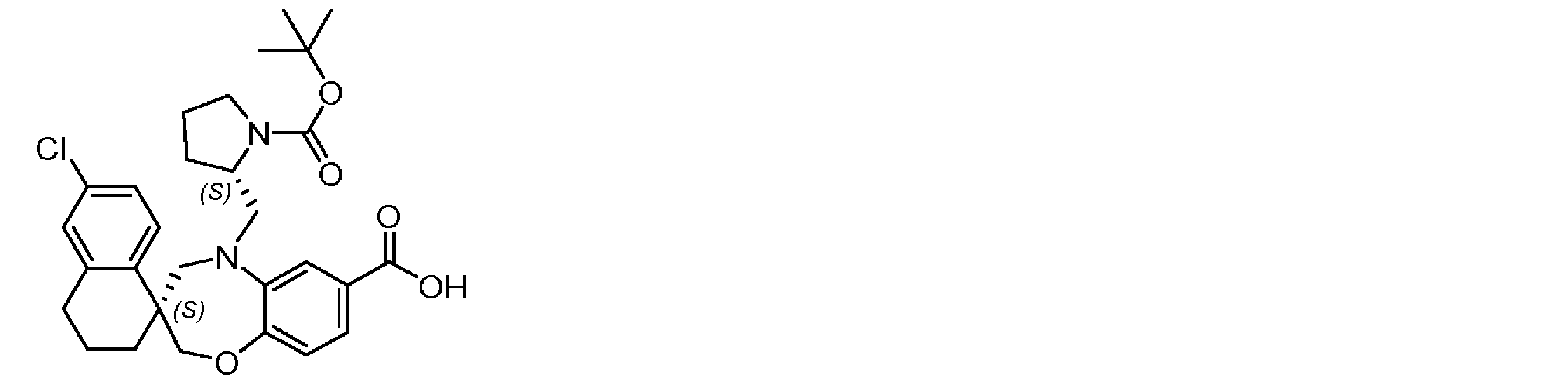
THF(158mL)、水(158mL)、及びMeOH(30mL)中の中間体58(5.25g、9.703mmol)の溶液に、LiOH(1.125g、46.98mmol、4.8eq.)を添加した。この反応混合物を、16時間にわたり50℃で撹拌した。この反応混合物を10℃まで冷却し、1N 水性HClでpH3~4まで酸性化し、DCMで抽出した。有機層をMgSO4で脱水し、ろ過し、蒸発させて、中間体59(5.34g、収率:定量的)をオフホワイトの泡状物として得た。
Intermediate 59
LiOH (1.125 g, 46.98 mmol, 4.8 eq.) was added to a solution of intermediate 58 (5.25 g, 9.703 mmol) in THF (158 mL), water (158 mL), and MeOH (30 mL). did. The reaction mixture was stirred at 50° C. for 16 hours. The reaction mixture was cooled to 10° C., acidified with 1N aqueous HCl to pH 3-4 and extracted with DCM. The organic layer was dried over MgSO4, filtered and evaporated to give Intermediate 59 ( 5.34 g, yield: quantitative) as an off-white foam.
中間体60

中間体58の代わりに中間体9から出発して、中間体59と類似の反応プロトコルにより中間体60を調製した。
Intermediate 60
Intermediate 60 was prepared by an analogous reaction protocol to intermediate 59, starting with intermediate 9 instead of intermediate 58.
中間体61

DCM(15mL)中の中間体59(670mg、1.27mmol)、中間体57(480mg、1.49mmol、1.17eq.)、DMAP(350mg、2.87mmol、2.25eq.)、及びEt3N(1.25mL、8.99mmol、7.1eq.)の混合物に、室温で、EDCI(600mg、3.13mmol、2.46eq.)を添加した。この反応混合物を、24時間にわたり室温で撹拌した。AcOH(1mL、17.468mmol、13.74eq.)を添加した。溶媒を減圧下で除去し、残渣を、シリカゲルのフラッシュクロマトグラフィー(ヘプタン/EtOAc 100/0~0/100)で精製して中間体61(820mg、67%純度)を得、さらに精製することなく使用した。
Intermediate 61
Intermediate 59 (670 mg, 1.27 mmol), Intermediate 57 (480 mg, 1.49 mmol, 1.17 eq.), DMAP (350 mg, 2.87 mmol, 2.25 eq.), and Et 3 in DCM (15 mL). To a mixture of N (1.25 mL, 8.99 mmol, 7.1 eq.) at room temperature was added EDCI (600 mg, 3.13 mmol, 2.46 eq.). The reaction mixture was stirred at room temperature for 24 hours. AcOH (1 mL, 17.468 mmol, 13.74 eq.) was added. The solvent was removed under reduced pressure and the residue was purified by flash chromatography on silica gel (heptane/EtOAc 100/0 to 0/100) to give intermediate 61 (820 mg, 67% pure) without further purification. used.
中間体62

中間体59の代わりに中間体60から出発して、中間体61と類似の反応プロトコルにより中間体62を調製した。
Intermediate 62
Intermediate 62 was prepared by an analogous reaction protocol to Intermediate 61, starting with Intermediate 60 instead of Intermediate 59.
中間体63

DCM(30mL)中の中間体61(2000mg、2.409mmol)の溶液に、室温で、TFA(15mL、196mmol、81eq.)を添加した。この反応混合物を、20時間にわたり室温で撹拌した。この反応混合物を減圧下で濃縮し、トルエンと共蒸発させた。残渣をDIPE中で粉砕した。固体をろ別し、洗浄し、35℃で真空下にて乾燥させて、中間体63(TFA塩、1.9g、収率:93%)を得、さらに精製することなく使用した。
Intermediate 63
To a solution of intermediate 61 (2000 mg, 2.409 mmol) in DCM (30 mL) at room temperature was added TFA (15 mL, 196 mmol, 81 eq.). The reaction mixture was stirred at room temperature for 20 hours. The reaction mixture was concentrated under reduced pressure and co-evaporated with toluene. The residue was triturated in DIPE. The solid was filtered off, washed and dried under vacuum at 35° C. to give intermediate 63 (TFA salt, 1.9 g, yield: 93%), which was used without further purification.
中間体64

中間体61の代わりに中間体62から出発して、中間体63と類似の反応プロトコルにより中間体64を調製した。
Intermediate 64
Intermediate 64 was prepared by an analogous reaction protocol to Intermediate 63, starting with Intermediate 62 instead of Intermediate 61.
化合物の調製
化合物1及び化合物2

DMF(2mL)中の中間体14(16mg、0.026mmol)及びDBU(15.4μL、4eq.)の出発混合物に、ジエチルシアノホスホネート(17.16μL、4eq.)を添加した。この反応混合物を、30分にわたり撹拌した。この反応混合物を水で希釈し、DCMで3回抽出した。まとめた有機層をブラインで洗浄し、MgSO4で脱水し、ろ過し、溶媒を減圧下で除去した。残渣を、分取HPLC(固定相:RP XBridge Prep C18 OBD-10μm、30×150mm、移動相:0.25% NH4HCO3水溶液、CH3CN)により精製して、化合物1(2.4mg、収率15%、実例)及び化合物2(5.2mg、収率33%)を得た。
1H NMR 化合物 1(400MHz,メタノール-d4)δ ppm 1.05(d,J=6.6Hz,3H),1.37-1.43(m,3H),1.43-1.53(m,1H),1.87-2.31(m,8H),2.57-2.68(m,1H),2.72-2.87(m,2H),3.28(br s,1H),3.35(br d,J=9.2Hz,2H),3.48-3.60(m,2H),3.71-4.04(m,5H),4.07-4.13(m,1H),5.45(d,J=21.7Hz,1H),6.87(d,J=8.1Hz,1H),7.08-7.20(m,3H),7.26(s,1H),7.74(d,J=8.4Hz,1H)
1H NMR 化合物 2(400MHz,メタノール-d4)δ ppm 1.05(d,J=6.8Hz,3H),1.34(d,J=7.3Hz,3H),1.57-1.77(m,1H),1.80-2.27(m,8H),2.68-2.95(m,5H),3.07-3.15(m,1H),3.36-3.77(m,5H),3.91-4.13(m,4H),4.79(d,J=37.6Hz,1H),6.84(d,J=8.1Hz,1H),7.03-7.21(m,3H),7.72-7.79(m,1H),8.10(br s,1H)
Compound Preparation Compound 1 and Compound 2
To a starting mixture of intermediate 14 (16 mg, 0.026 mmol) and DBU (15.4 μL, 4 eq.) in DMF (2 mL) was added diethyl cyanophosphonate (17.16 μL, 4 eq.). The reaction mixture was stirred for 30 minutes. The reaction mixture was diluted with water and extracted with DCM three times. The combined organic layers were washed with brine, dried over MgSO4, filtered and the solvent removed under reduced pressure. The residue was purified by preparative HPLC (stationary phase: RP XBridge Prep C18 OBD-10 μm, 30×150 mm, mobile phase: 0.25% NH 4 HCO 3 aqueous solution, CH 3 CN) to give compound 1 (2.4 mg , 15% yield, illustrative) and compound 2 (5.2 mg, 33% yield).
1 H NMR compound 1 (400 MHz, methanol-d4) δ ppm 1.05 (d, J = 6.6 Hz, 3H), 1.37-1.43 (m, 3H), 1.43-1.53 ( m, 1H), 1.87-2.31 (m, 8H), 2.57-2.68 (m, 1H), 2.72-2.87 (m, 2H), 3.28 (br s , 1H), 3.35 (br d, J = 9.2Hz, 2H), 3.48-3.60 (m, 2H), 3.71-4.04 (m, 5H), 4.07- 4.13 (m, 1H), 5.45 (d, J = 21.7Hz, 1H), 6.87 (d, J = 8.1Hz, 1H), 7.08-7.20 (m, 3H ), 7.26 (s, 1H), 7.74 (d, J=8.4Hz, 1H)
1 H NMR compound 2 (400 MHz, methanol-d4) δ ppm 1.05 (d, J = 6.8 Hz, 3H), 1.34 (d, J = 7.3 Hz, 3H), 1.57-1. 77 (m, 1H), 1.80-2.27 (m, 8H), 2.68-2.95 (m, 5H), 3.07-3.15 (m, 1H), 3.36- 3.77 (m, 5H), 3.91-4.13 (m, 4H), 4.79 (d, J = 37.6Hz, 1H), 6.84 (d, J = 8.1Hz, 1H ), 7.03-7.21 (m, 3H), 7.72-7.79 (m, 1H), 8.10 (br s, 1H)
化合物3

中間体17(30mg、0.049mmol)を、DCE(4.2mL)に溶解させた(溶液A)。これを超音波処理し、窒素を流した。[1,3-ビス(2,4,6-トリメチルフェニル)イミダゾリジン-2-イリデン](([2-(プロパン-2-イルオキシ)フェニル]メチリデン))ルテニウムビス(イリウム)ジクロリド[301224-40-8](6.14mg、0.2eq)をDCE(30mL)に溶解させ、超音波処理し、窒素を流した(溶液B)。溶液Aを、シリンジポンプ(0.175mL/h)により溶液Bに添加した。反応容器を、窒素流下で55℃に保持した。室温まで冷却した後、この反応混合物に活性炭を添加し、一晩激しく撹拌した。この反応混合物をdicalite(登録商標)のプラグに通してろ過し、フィルタパッドをDCMですすぎ、続いてMeOHですすいだ。ろ液を、室温で真空下にて蒸発させた。残渣を、分取HPLC(固定相:RP XBridge Prep C18 OBD-10μm、30×150mm、移動相:0.25% NH4HCO3水溶液、CH3CN)により精製して、化合物3(4mg、収率:14%)を得た。
1H NMR(400MHz,メタノール-d4)δ ppm 1.02(d,J=6.8Hz,3H),1.29-1.35(m,3H),1.39-1.50(m,1H),1.84-2.25(m,9H),2.70-2.84(m,2H),3.03-3.13(m,1H),3.17-3.30(m,4H),3.47-3.57(m,1H),3.69(d,J=14.1Hz,1H),3.88-3.98(m,2H),3.98-4.10(m,3H),5.53(d,J=15.2Hz,1H),5.74(d,J=15.6Hz,1H),6.83(d,J=8.1Hz,1H),7.09(d,J=2.2Hz,1H),7.15-7.22(m,2H),7.58(br s,1H),7.74(d,J=8.4Hz,1H)
compound 3
Intermediate 17 (30 mg, 0.049 mmol) was dissolved in DCE (4.2 mL) (solution A). It was sonicated and flushed with nitrogen. [1,3-bis(2,4,6-trimethylphenyl)imidazolidin-2-ylidene](([2-(propan-2-yloxy)phenyl]methylidene))ruthenium bis(irium) dichloride [301224-40 -8] (6.14 mg, 0.2 eq) was dissolved in DCE (30 mL), sonicated and flushed with nitrogen (solution B). Solution A was added to solution B by syringe pump (0.175 mL/h). The reaction vessel was held at 55° C. under a stream of nitrogen. After cooling to room temperature, activated charcoal was added to the reaction mixture and stirred vigorously overnight. The reaction mixture was filtered through a plug of dicalite®, rinsing the filter pad with DCM followed by MeOH. The filtrate was evaporated under vacuum at room temperature. The residue was purified by preparative HPLC (stationary phase: RP XBridge Prep C18 OBD-10 μm, 30×150 mm, mobile phase: 0.25% NH 4 HCO 3 aqueous solution, CH 3 CN) to give compound 3 (4 mg, yield: rate: 14%).
1 H NMR (400 MHz, methanol-d4) δ ppm 1.02 (d, J = 6.8 Hz, 3H), 1.29-1.35 (m, 3H), 1.39-1.50 (m, 1H), 1.84-2.25 (m, 9H), 2.70-2.84 (m, 2H), 3.03-3.13 (m, 1H), 3.17-3.30 ( m, 4H), 3.47-3.57 (m, 1H), 3.69 (d, J = 14.1Hz, 1H), 3.88-3.98 (m, 2H), 3.98- 4.10 (m, 3H), 5.53 (d, J = 15.2Hz, 1H), 5.74 (d, J = 15.6Hz, 1H), 6.83 (d, J = 8.1Hz , 1H), 7.09 (d, J = 2.2Hz, 1H), 7.15-7.22 (m, 2H), 7.58 (br s, 1H), 7.74 (d, J = 8.4Hz, 1H)
化合物4

Easymax(商標)反応容器に、5分にわたり超音波浴で脱気した乾燥DCE(120mL)を入れた。次いで、[1,3-ビス(2,4,6-トリメチルフェニル)イミダゾリジン-2-イリデン](([2-(プロパン-2-イルオキシ)フェニル]メチリデン))ルテニウムビス(イリウム)ジクロリド[301224-40-8](87mg、0.14mmol)を添加し、得られた溶液に、5分にわたり窒素ガスを流した。次いで、窒素雰囲気下で50℃にて、シリンジポンプを使用して、乾燥DCE(20mL)中の中間体29(302mg、0.46mmol)の脱気溶液(超音波浴)を、40時間かけて滴下した(0.5mL/h)。添加後、この反応混合物を、2日にわたり50℃で撹拌した。反応を完了させるために、追加の量の[1,3-ビス(2,4,6-トリメチルフェニル)イミダゾリジン-2-イリデン](([2-(プロパン-2-イルオキシ)フェニル]メチリデン))ルテニウムビス(イリウム)ジクロリド(33mg、0.053mmol)を添加し、この反応混合物を18時間にわたり50℃で撹拌した。この反応を、エチルビニルエーテル(0.44mL、4.6mmol)の添加により50℃でクエンチした。この反応混合物を、1時間にわたり50℃で撹拌した。次いで、0.62gの金属捕捉剤Silicycle SiliaMetS(登録商標)(0.62g、ローディング量0.61mmol/g)を添加して、ルテニウム触媒を捕捉した。得られた懸濁液を、1時間にわたり室温で撹拌した。この混合物を、Dicalite(登録商標)でろ過した。ろ液を、EtOAc及びメタノールで徹底的に洗浄した。ろ液の溶媒を、45℃で減圧下にて蒸発させた。残渣をDCMに溶解させ、分取HPLC(固定相:RP XBridge Prep C18 OBD-10μm、50×150mm、移動相:0.25% NH4HCO3水溶液、CH3CN)により精製した。溶媒を蒸発させ、45℃で減圧下にて、メタノールと共蒸発させた。残渣を、分取SFC(固定相:Chiralpak Diacel AS 20×250mm、移動相:CO2、EtOH+0.4% iPrNH2)により精製して、化合物4(18.5mg、6%収率)を得た。
1H NMR(400MHz,クロロホルム-d)δ ppm 1.01(d,J=5.85Hz,3H)1.29-1.35(m,1H)1.41(d,J=7.21Hz,3H)1.70-1.91(m,2H)2.03-2.11(m,6H)2.66-2.81(m,2H)3.15-3.29(m,4H)3.32(s,3H)3.32-3.38(m,2H)3.40-3.49(m,1H)3.66-3.72(m,2H)3.86(br d,J=15.05Hz,1H)4.02(d,J=12.12Hz,1H)4.06(d,J=12.12Hz,1H)4.19(q,J=7.04Hz,1H)5.70(dd,J=15.26,8.78Hz,1H)5.75-5.85(m,1H)6.87(d,J=8.05Hz,1H)6.98(dd,J=8.05,1.46Hz,1H)7.01(s,1H)7.06(d,J=2.19Hz,1H)7.15(dd,J=8.47,2.30Hz,1H)7.67(d,J=8.57Hz,1H)
compound 4
An Easymax™ reaction vessel was charged with dry DCE (120 mL) that was degassed in an ultrasonic bath for 5 minutes. [1,3-bis(2,4,6-trimethylphenyl)imidazolidin-2-ylidene](([2-(propan-2-yloxy)phenyl]methylidene))ruthenium bis(irium) dichloride [301224 -40-8] (87 mg, 0.14 mmol) was added and the resulting solution was flushed with nitrogen gas for 5 minutes. A degassed solution (ultrasonic bath) of intermediate 29 (302 mg, 0.46 mmol) in dry DCE (20 mL) was then added using a syringe pump at 50° C. under a nitrogen atmosphere over 40 h. added dropwise (0.5 mL/h). After addition, the reaction mixture was stirred at 50° C. for 2 days. An additional amount of [1,3-bis(2,4,6-trimethylphenyl)imidazolidin-2-ylidene](([2-(propan-2-yloxy)phenyl]methylidene) was added to drive the reaction to completion. ) Ruthenium bis(ylium) dichloride (33 mg, 0.053 mmol) was added and the reaction mixture was stirred at 50° C. for 18 h. The reaction was quenched at 50° C. by the addition of ethyl vinyl ether (0.44 mL, 4.6 mmol). The reaction mixture was stirred at 50° C. for 1 hour. Then 0.62 g of metal scavenger Silicycle SiliaMetS® (0.62 g, 0.61 mmol/g loading) was added to scavenge the ruthenium catalyst. The resulting suspension was stirred at room temperature for 1 hour. The mixture was filtered through Dicalite®. The filtrate was thoroughly washed with EtOAc and methanol. The filtrate's solvent was evaporated under reduced pressure at 45°C. The residue was dissolved in DCM and purified by preparative HPLC (stationary phase: RP XBridge Prep C18 OBD-10 μm, 50×150 mm, mobile phase: 0.25% NH 4 HCO 3 aqueous solution, CH 3 CN). The solvent was evaporated and co-evaporated with methanol under reduced pressure at 45°C. The residue was purified by preparative SFC (stationary phase: Chiralpak Diacel AS 20 x 250 mm, mobile phase: CO2 , EtOH + 0.4% iPrNH2 ) to give compound 4 (18.5 mg, 6% yield) .
1H NMR (400 MHz, chloroform-d) δ ppm 1.01 (d, J = 5.85 Hz, 3H) 1.29-1.35 (m, 1H) 1.41 (d, J = 7.21 Hz, 3H ) 1.70-1.91 (m, 2H) 2.03-2.11 (m, 6H) 2.66-2.81 (m, 2H) 3.15-3.29 (m, 4H) 3 .32 (s, 3H) 3.32-3.38 (m, 2H) 3.40-3.49 (m, 1H) 3.66-3.72 (m, 2H) 3.86 (br d, J = 15.05Hz, 1H) 4.02 (d, J = 12.12Hz, 1H) 4.06 (d, J = 12.12Hz, 1H) 4.19 (q, J = 7.04Hz, 1H) 5.70 (dd, J=15.26, 8.78Hz, 1H) 5.75-5.85 (m, 1H) 6.87 (d, J=8.05Hz, 1H) 6.98 (dd, J = 8.05, 1.46Hz, 1H) 7.01 (s, 1H) 7.06 (d, J = 2.19Hz, 1H) 7.15 (dd, J = 8.47, 2.30Hz, 1H) 7.67 (d, J=8.57Hz, 1H)
化合物4の代替の合成方法
反応を、窒素雰囲気下で実施した。Easymax反応容器に、5分にわたり脱気した乾燥トルエン(56mL)を入れた。この反応混合物を、80℃で撹拌した。次いで、[1,3-ビス(2,4,6-トリメチルフェニル)イミダゾリジン-2-イリデン](([2-(プロパン-2-イルオキシ)フェニル]メチリデン))ルテニウムビス(イリウム)ジクロリド[301224-40-8](25.8mg、0.3eq.)を添加し、得られた溶液に、5分にわたり窒素ガスを流した。次いで、窒素雰囲気下で80℃にて、シリンジポンプを使用して、トルエン(8mL)に溶解させた中間体29(90mg、0.137mmol)の脱気溶液を、4時間(2mL/h)の期間をかけて滴下した。添加後、この反応混合物を、16時間にわたり80℃で撹拌した。この反応混合物を室温まで冷却し、エチルビニルエーテル(0.132mL、10eq.)で処理し、1時間にわたり撹拌した。溶媒を蒸発させ、残渣を、シリカゲルのフラッシュクロマトグラフィー(溶離液:勾配DCM 90 MeOH/NH3 10~MeOH 100%)により精製した。生成物画分を、分取SFC(固定相:Chiralpak Diacel AS 20×250mm、移動相:CO2、EtOH+0.4% iPrNH2)により再度精製して、化合物4(36mg、収率:38%)を得た。
Alternative Synthetic Method for Compound 4 The reaction was carried out under a nitrogen atmosphere. An Easymax reaction vessel was charged with dry toluene (56 mL) that was degassed for 5 minutes. The reaction mixture was stirred at 80°C. [1,3-bis(2,4,6-trimethylphenyl)imidazolidin-2-ylidene](([2-(propan-2-yloxy)phenyl]methylidene))ruthenium bis(irium) dichloride [301224 -40-8] (25.8 mg, 0.3 eq.) was added and the resulting solution was flushed with nitrogen gas for 5 minutes. Then, using a syringe pump, a degassed solution of intermediate 29 (90 mg, 0.137 mmol) dissolved in toluene (8 mL) was added at 80° C. under a nitrogen atmosphere for 4 h (2 mL/h). Dropped over a period of time. After addition, the reaction mixture was stirred at 80° C. for 16 hours. The reaction mixture was cooled to room temperature, treated with ethyl vinyl ether (0.132 mL, 10 eq.) and stirred for 1 hour. The solvent was evaporated and the residue was purified by flash chromatography on silica gel (eluent: gradient DCM 90 MeOH/NH 3 10 to MeOH 100%). The product fraction was purified again by preparative SFC (stationary phase: Chiralpak Diacel AS 20×250 mm, mobile phase: CO 2 , EtOH+0.4% iPrNH 2 ) to give compound 4 (36 mg, yield: 38%) got
適切な出発物質を使用して、化合物4と類似の反応プロトコルにより化合物7及び8を調製した。 Compounds 7 and 8 were prepared by analogous reaction protocols to compound 4 using appropriate starting materials.

分析データ
化合物8
1H NMR(400MHz,クロロホルム-d)δ ppm 0.79-0.95(m,2H)1.03(br d,J=5.6Hz,3H)1.45(d,J=7.2Hz,4H)1.52-1.62(m,1H)1.65-1.73(m,1H)1.74-1.84(m,2H)1.85-1.94(m,2H)2.02(br s,3H)2.68-2.80(m,2H)2.84-3.04(m,2H)3.21-3.37(m,3H)3.40(s,3H)3.51(br t,J=9.2Hz,1H)3.81(br s,1H)3.89-4.04(m,3H)4.14(d,J=12.2Hz,1H)4.22-4.34(m,1H)5.45-5.59(m,1H)5.75-5.90(m,1H)6.90(s,2H)6.98-7.10(m,2H)7.19(dd,J=8.5,2.2Hz,1H)7.69(d,J=8.5Hz,1H)
Analysis data compound 8
1H NMR (400 MHz, chloroform-d) δ ppm 0.79-0.95 (m, 2H) 1.03 (br d, J = 5.6 Hz, 3H) 1.45 (d, J = 7.2 Hz, 4H) 1.52-1.62 (m, 1H) 1.65-1.73 (m, 1H) 1.74-1.84 (m, 2H) 1.85-1.94 (m, 2H) 2.02 (br s, 3H) 2.68-2.80 (m, 2H) 2.84-3.04 (m, 2H) 3.21-3.37 (m, 3H) 3.40 (s , 3H) 3.51 (br t, J = 9.2 Hz, 1H) 3.81 (br s, 1H) 3.89-4.04 (m, 3H) 4.14 (d, J = 12.2 Hz , 1H) 4.22-4.34 (m, 1H) 5.45-5.59 (m, 1H) 5.75-5.90 (m, 1H) 6.90 (s, 2H) 6.98 -7.10 (m, 2H) 7.19 (dd, J = 8.5, 2.2Hz, 1H) 7.69 (d, J = 8.5Hz, 1H)
化合物5及び化合物6

[1,3-ビス(2,4,6-トリメチルフェニル)イミダゾリジン-2-イリデン](([2-(プロパン-2-イルオキシ)フェニル]メチリデン))ルテニウムビス(イリウム)ジクロリド[301224-40-8](45mg、0.4eq)をDCE(180mL)に溶解させ、この溶液に窒素を流した(溶液A)。中間体36(110g、0.18mmol)をDCM(20mL)に溶解させ、窒素を流した(溶液B)。溶液Bを、16時間かけて、55℃にて、シリンジポンプにより溶液Aに添加した。添加後、5時間にわたり55℃で撹拌し続けた。エチルビニルエーテル(200μL)を添加し、室温まで冷却した後、金属捕捉剤Silicycle SiliaMetS(登録商標)を添加してルテニウム触媒を捕捉した。1時間激しく撹拌した後、この混合物をCelite(登録商標)でろ過した。固体を、DCM及びMeOHで完全にすすいだ。ろ液の溶媒を、減圧下で蒸発させた。残渣を、シリカのフラッシュクロマトグラフィー(ヘプタン中に0~40% EtOAc)により精製した。生成物のラセミ混合物を含む画分をまとめて蒸発させた。残渣を、分取SFC(固定相:Chiralpak Diacel AD 20×250mm、移動相:CO2、EtOH+0.4% iPrNH2)により精製して、化合物5(13mg、13%収率)及び化合物6(16mg、15%収率)を得た。
Compound 5 and Compound 6
[1,3-bis(2,4,6-trimethylphenyl)imidazolidin-2-ylidene](([2-(propan-2-yloxy)phenyl]methylidene))ruthenium bis(irium) dichloride [301224-40 -8] (45 mg, 0.4 eq) was dissolved in DCE (180 mL) and the solution was flushed with nitrogen (solution A). Intermediate 36 (110 g, 0.18 mmol) was dissolved in DCM (20 mL) and flushed with nitrogen (solution B). Solution B was added to solution A by syringe pump at 55° C. over 16 hours. Stirring was continued at 55° C. for 5 hours after the addition. After adding ethyl vinyl ether (200 μL) and cooling to room temperature, the metal scavenger Silicycle SiliaMetS® was added to scavenge the ruthenium catalyst. After vigorous stirring for 1 hour, the mixture was filtered through Celite®. Solids were thoroughly rinsed with DCM and MeOH. The filtrate's solvent was evaporated under reduced pressure. The residue was purified by flash chromatography on silica (0-40% EtOAc in heptane). The fractions containing the racemic mixture of products were combined and evaporated. The residue was purified by preparative SFC (stationary phase: Chiralpak Diacel AD 20×250 mm, mobile phase: CO 2 , EtOH+0.4% iPrNH 2 ) to yield compound 5 (13 mg, 13% yield) and compound 6 (16 mg). , 15% yield).
化合物5
1H NMR(400MHz,メタノール-d4)δ ppm 1.03(d,J=6.9Hz,3H),1.33(d,J=7.3Hz,3H),1.75-1.86(m,1H),1.93-2.01(m,2H),2.07(dt,J=14.3,2.9Hz,1H),2.15-2.27(m,3H),3.04(br dd,J=14.5,6.3Hz,1H),3.22(br dd,J=15.7,4.7Hz,1H),3.43(d,J=14.3Hz,1H),3.61-3.69(m,1H),3.78(d,J=14.3Hz,1H),3.86-3.92(m,1H),3.94-4.05(m,1H),4.13(q,J=1.0Hz,3H),4.20-4.32(m,2H),5.43-5.51(m,1H),5.63(br dt,J=15.1,6.9Hz,1H),6.80(d,J=2.2Hz,1H),6.89(d,J=8.2Hz,1H),6.92(dd,J=8.6,2.0Hz,1H),7.24(dd,J=8.2,1.9Hz,1H),7.66(d,J=8.5Hz,1H),7.69-7.73(m,1H)
compound 5
1H NMR (400 MHz, methanol-d4) δ ppm 1.03 (d, J = 6.9 Hz, 3H), 1.33 (d, J = 7.3 Hz, 3H), 1.75-1.86 (m , 1H), 1.93-2.01 (m, 2H), 2.07 (dt, J = 14.3, 2.9Hz, 1H), 2.15-2.27 (m, 3H), 3 .04 (br dd, J = 14.5, 6.3 Hz, 1 H), 3.22 (br dd, J = 15.7, 4.7 Hz, 1 H), 3.43 (d, J = 14.3 Hz , 1H), 3.61-3.69 (m, 1H), 3.78 (d, J = 14.3 Hz, 1H), 3.86-3.92 (m, 1H), 3.94-4 .05 (m, 1H), 4.13 (q, J=1.0Hz, 3H), 4.20-4.32 (m, 2H), 5.43-5.51 (m, 1H), 5 .63 (br dt, J=15.1, 6.9 Hz, 1 H), 6.80 (d, J=2.2 Hz, 1 H), 6.89 (d, J=8.2 Hz, 1 H), 6 .92 (dd, J=8.6, 2.0 Hz, 1 H), 7.24 (dd, J=8.2, 1.9 Hz, 1 H), 7.66 (d, J=8.5 Hz, 1 H ), 7.69-7.73 (m, 1H)
化合物6
1H NMR(400MHz,メタノール-d4)δ ppm 1.03(d,J=6.8Hz,3H),1.33(d,J=7.3Hz,3H),1.99-2.09(m,4H),2.16-2.31(m,3H),3.06(br dd,J=14.6,6.5Hz,1H),3.18(br dd,J=15.2,6.2Hz,1H),3.37-3.46(m,2H),3.49(s,2H),3.51-3.57(m,1H),3.69-3.78(m,1H),3.86(br d,J=7.5Hz,1H),4.11-4.17(m,1H),4.21-4.29(m,3H),5.48-5.56(m,1H),5.67-5.75(m,1H),6.82(d,J=2.2Hz,1H),6.88-6.91(m,1H),6.92(d,J=8.1Hz,1H),7.37(d,J=8.4Hz,1H),7.53-7.57(m,1H),7.58-7.63(m,1H)
compound 6
1H NMR (400 MHz, methanol-d4) δ ppm 1.03 (d, J = 6.8 Hz, 3H), 1.33 (d, J = 7.3 Hz, 3H), 1.99-2.09 (m , 4H), 2.16-2.31 (m, 3H), 3.06 (br dd, J = 14.6, 6.5 Hz, 1H), 3.18 (br dd, J = 15.2, 6.2 Hz, 1H), 3.37-3.46 (m, 2H), 3.49 (s, 2H), 3.51-3.57 (m, 1H), 3.69-3.78 ( m, 1H), 3.86 (br d, J=7.5Hz, 1H), 4.11-4.17 (m, 1H), 4.21-4.29 (m, 3H), 5.48 -5.56 (m, 1H), 5.67-5.75 (m, 1H), 6.82 (d, J = 2.2Hz, 1H), 6.88-6.91 (m, 1H) , 6.92 (d, J=8.1 Hz, 1H), 7.37 (d, J=8.4 Hz, 1H), 7.53-7.57 (m, 1H), 7.58-7. 63 (m, 1H)
化合物9

ステンレス鋼製の容器中で、中間体49(241mg、0.329mmol)を乾燥THF(30mL)に溶解させた。DBU[6674-22-2](250μL、5eq.)を添加し、この混合物を窒素でパージした。次に、PdCl2(dppf)[72287-26-4](25mg、0.1eq.)を添加した。この反応器をCOでパージし、この容器を密封した。この反応混合物を、20時間にわたりCO圧(50bar)下にて100℃で加熱した。室温までの冷却後、この混合物をEtOAcで希釈し、セライトに通してろ過し、フィルタをEtOAcで洗浄した。ろ液を減圧下で蒸発させ、残渣を、ヘプタン/EtOAc(1:0~0:1)を使用するシリカゲルのカラムクロマトグラフィーにより精製して、化合物9(58mg、収率:28%)を淡黄色固体として得、不純画分を逆相クロマトグラフィー(固定相:RP XBridge Prep C18 OBD-5μm、50×250mm、移動相:0.25% NH4HCO3水溶液、CH3CN)により精製して、化合物9(90mg、収率:43%)の第2のバッチを白色固体として得た。
1H NMR(400MHz,クロロホルム-d)δ ppm 1.06(d,J=6.6Hz,3H)1.36-1.49(m,5H)1.77-2.17(m,8H)2.32(br dd,J=16.3,7.3Hz,1H)2.70-2.86(m,3H)3.09-3.45(m,6H)3.58(d,J=7.5Hz,2H)3.71-3.90(m,3H)4.02-4.16(m,3H)4.79-5.07(m,1H)5.47(br s,1H)6.91(d,J=7.9Hz,1H)6.97-7.08(m,2H)7.10(d,J=2.0Hz,1H)7.18(dd,J=8.6,2.2Hz,1H)7.70(d,J=8.6Hz,1H)
compound 9
Intermediate 49 (241 mg, 0.329 mmol) was dissolved in dry THF (30 mL) in a stainless steel vessel. DBU[6674-22-2] (250 μL, 5 eq.) was added and the mixture was purged with nitrogen. Then PdCl 2 (dppf)[72287-26-4] (25 mg, 0.1 eq.) was added. The reactor was purged with CO and the vessel was sealed. The reaction mixture was heated at 100° C. under CO pressure (50 bar) for 20 hours. After cooling to room temperature, the mixture was diluted with EtOAc and filtered through celite, washing the filter with EtOAc. The filtrate was evaporated under reduced pressure and the residue was purified by column chromatography on silica gel using heptane/EtOAc (1:0-0:1) to afford compound 9 (58 mg, yield: 28%). Obtained as a yellow solid, impure fractions were purified by reverse-phase chromatography (stationary phase: RP XBridge Prep C18 OBD-5 μm, 50×250 mm, mobile phase: 0.25% aqueous NH 4 HCO 3 , CH 3 CN). , to give a second batch of compound 9 (90 mg, yield: 43%) as a white solid.
1 H NMR (400 MHz, chloroform-d) δ ppm 1.06 (d, J = 6.6 Hz, 3H) 1.36-1.49 (m, 5H) 1.77-2.17 (m, 8H) 2.32 (br dd, J=16.3, 7.3Hz, 1H) 2.70-2.86 (m, 3H) 3.09-3.45 (m, 6H) 3.58 (d, J = 7.5 Hz, 2H) 3.71-3.90 (m, 3H) 4.02-4.16 (m, 3H) 4.79-5.07 (m, 1H) 5.47 (br s, 1H) 6.91 (d, J = 7.9Hz, 1H) 6.97-7.08 (m, 2H) 7.10 (d, J = 2.0Hz, 1H) 7.18 (dd, J = 8.6, 2.2Hz, 1H) 7.70 (d, J = 8.6Hz, 1H)
適切な出発物質を使用して、中間体9と類似の反応プロトコルにより、下記の表中の化合物を調製した。 The compounds in the table below were prepared by analogous reaction protocols to Intermediate 9 using appropriate starting materials.

化合物11

無水THF 1mL中の化合物9(25mg、0.0395mmol)の撹拌溶液に、窒素雰囲気下で室温にて、NaH(鉱物油中60%分散液)(7.9mg、5eq.)を注意深く添加した。得られた混合物を室温で30分にわたり撹拌し、続いて2-フルオロピリジン(19.2mg、5eq.)を滴下した。この反応混合物を、3時間にわたり50℃で撹拌した。この反応混合物を室温まで冷却し、反応を飽和水性NH4Cl溶液でクエンチした。この混合物をAcOEtで抽出した。有機層をMgSO4で脱水し、ろ過し、蒸発させた。残渣を、分取HPLC(固定相:RP XBridge Prep C18 OBD-10μm、50×150mm;移動相:0.25% NH4HCO3水溶液、MeOH)により精製して、化合物11(13mg、収率:46%)を得た。
1H NMR(400MHz,クロロホルム-d)δ ppm 1.04-1.16(m,3H)1.39(br d,J=7.0Hz,6H)1.91-2.17(m,6H)2.22(br s,1H)2.28-2.43(m,1H)2.56-2.70(m,5H)2.76-2.93(m,2H)3.22(br s,1H)3.32(br d,J=14.3Hz,1H)3.42(s,3H)3.75(br d,J=14.1Hz,1H)3.94-4.29(m,6H)4.81-5.13(m,1H)6.84(br d,J=0.9Hz,1H)6.98(br d,J=7.9Hz,1H)7.04-7.19(m,2H)7.35(br d,J=8.4Hz,2H)7.64-7.84(m,2H)8.24(br d,J=3.7Hz,1H)11.90-12.14(m,1H)
compound 11
To a stirred solution of compound 9 (25 mg, 0.0395 mmol) in 1 mL anhydrous THF at room temperature under nitrogen atmosphere was carefully added NaH (60% dispersion in mineral oil) (7.9 mg, 5 eq.). The resulting mixture was stirred at room temperature for 30 minutes followed by dropwise addition of 2-fluoropyridine (19.2 mg, 5 eq.). The reaction mixture was stirred at 50° C. for 3 hours. The reaction mixture was cooled to room temperature and the reaction was quenched with saturated aqueous NH 4 Cl solution. This mixture was extracted with AcOEt. The organic layer was dried over MgSO4 , filtered and evaporated. The residue was purified by preparative HPLC (stationary phase: RP XBridge Prep C18 OBD-10 μm, 50×150 mm; mobile phase: 0.25% NH 4 HCO 3 aqueous solution, MeOH) to give compound 11 (13 mg, yield: 46%) was obtained.
1 H NMR (400 MHz, chloroform-d) δ ppm 1.04-1.16 (m, 3H) 1.39 (br d, J = 7.0 Hz, 6H) 1.91-2.17 (m, 6H ) 2.22 (br s, 1H) 2.28-2.43 (m, 1H) 2.56-2.70 (m, 5H) 2.76-2.93 (m, 2H) 3.22 ( br s, 1H) 3.32 (br d, J=14.3 Hz, 1H) 3.42 (s, 3H) 3.75 (br d, J=14.1 Hz, 1H) 3.94-4.29 (m, 6H) 4.81-5.13 (m, 1H) 6.84 (br d, J=0.9Hz, 1H) 6.98 (br d, J=7.9Hz, 1H) 7.04 -7.19 (m, 2H) 7.35 (br d, J = 8.4Hz, 2H) 7.64 - 7.84 (m, 2H) 8.24 (br d, J = 3.7Hz, 1H) ) 11.90-12.14 (m, 1H)
化合物13

無水THF(10mL)に溶解させた化合物9(58mg、0.091mmol)の撹拌溶液に、NaH(鉱物油中60%分散液、11mg、3eq.)を添加した。30分後、MeI(50μL、8.75eq.)を一度に添加し、このピンク色混合物を2時間にわたり室温で撹拌した。水(10mL)及びEtOAc(20mL)を添加した。有機層を抽出し、ブライン(2回×10mL)で洗浄し、脱水し(Na2SO4)、ろ過し、蒸発させた。残渣を、分取HPLC(固定相:RP XBridge Prep C18 OBD-5μm、50×250mm、移動相:0.25% NH4HCO3水溶液、CH3CN)により精製して、化合物13(35.8mg、収率:60%)を淡褐色粉末として得た。
1H NMR(400MHz,クロロホルム-d)δ ppm 1.06(br d,J=6.2Hz,3H)1.39-1.51(m,3H)1.70-2.18(m,8H)2.36(br dd,J=14.6,7.8Hz,1H)2.67-2.85(m,2H)3.13-3.57(m,10H)3.69-3.82(m,2H)3.88(br d,J=15.2Hz,1H)4.01-4.15(m,2H)4.15-4.25(m,1H)4.76-4.97(m,1H)6.95(q,J=8.1Hz,2H)7.09(br d,J=1.8Hz,2H)7.18(dd,J=8.5,1.9Hz,1H)7.69(d,J=8.6Hz,1H)
Compound 13
NaH (60% dispersion in mineral oil, 11 mg, 3 eq.) was added to a stirred solution of compound 9 (58 mg, 0.091 mmol) dissolved in anhydrous THF (10 mL). After 30 minutes, MeI (50 μL, 8.75 eq.) was added in one portion and the pink mixture was stirred for 2 hours at room temperature. Water (10 mL) and EtOAc (20 mL) were added. The organic layer was extracted, washed with brine (2x10 mL), dried ( Na2SO4 ), filtered and evaporated. The residue was purified by preparative HPLC (stationary phase: RP XBridge Prep C18 OBD-5 μm, 50×250 mm, mobile phase: 0.25% NH 4 HCO 3 aqueous solution, CH 3 CN) to give compound 13 (35.8 mg). , yield: 60%) was obtained as a pale brown powder.
1 H NMR (400 MHz, chloroform-d) δ ppm 1.06 (br d, J = 6.2 Hz, 3H) 1.39-1.51 (m, 3H) 1.70-2.18 (m, 8H ) 2.36 (br dd, J=14.6, 7.8 Hz, 1H) 2.67-2.85 (m, 2H) 3.13-3.57 (m, 10H) 3.69-3. 82 (m, 2H) 3.88 (br d, J=15.2Hz, 1H) 4.01-4.15 (m, 2H) 4.15-4.25 (m, 1H) 4.76-4 .97 (m, 1H) 6.95 (q, J = 8.1Hz, 2H) 7.09 (br d, J = 1.8Hz, 2H) 7.18 (dd, J = 8.5, 1. 9 Hz, 1 H) 7.69 (d, J = 8.6 Hz, 1 H)
化合物14

無水THF(2mL)中の化合物9(30mg、0.047mmol)の撹拌溶液に、室温で、NaH(鉱物油中60%分散液、8mg、4.2eq.)を注意深く添加した。得られた混合物を室温で20分にわたり撹拌し、続いて1-ブロモ-2-(2-メトキシエトキシ)エタン(CAS[54149-17-6])(32μL、5eq.)を滴下した。次いで、この混合物を、1.5時間にわたり50℃で加熱し且つ撹拌した。この反応混合物を室温まで冷却し、EtOAc(10mL)で希釈し、水で洗浄した。有機層をブライン(10mL)で洗浄し、MgSO4で脱水し、ろ過し、蒸発させた。残渣をDIPE中で撹拌し、沈殿物をろ別し、DIPEで洗浄し、真空中で乾燥させて、化合物14(27mg、収率:77%)を白色固体として得た。
1H NMR(400MHz,DMSO-d6)δ ppm 0.88(d,J=6.8Hz,3H)1.13(br d,J=7.0Hz,3H)1.31-1.43(m,1H)1.76-2.05(m,7H)2.13(br dd,J=16.5,7.0Hz,1H)2.63-2.83(m,2H)3.00(br dd,J=15.1,9.4Hz,1H)3.06-3.19(m,3H)3.25(s,3H)3.34-3.40(m,3H)3.41-3.45(m,2H)3.46-3.56(m,6H)3.57-3.69(m,2H)3.80(br d,J=14.1Hz,2H)3.91-3.96(m,1H)3.99-4.05(m,1H)4.93-5.30(m,1H)6.78(d,J=8.1Hz,1H)6.99-7.05(m,1H)7.05-7.13(m,1H)7.16(d,J=2.2Hz,1H)7.26(dd,J=8.5,2.3Hz,1H)7.67(d,J=8.6Hz,1H).
compound 14
To a stirred solution of compound 9 (30 mg, 0.047 mmol) in anhydrous THF (2 mL) at room temperature was carefully added NaH (60% dispersion in mineral oil, 8 mg, 4.2 eq.). The resulting mixture was stirred at room temperature for 20 minutes followed by dropwise addition of 1-bromo-2-(2-methoxyethoxy)ethane (CAS [54149-17-6]) (32 μL, 5 eq.). The mixture was then heated and stirred at 50° C. for 1.5 hours. The reaction mixture was cooled to room temperature, diluted with EtOAc (10 mL) and washed with water. The organic layer was washed with brine ( 10 mL), dried over MgSO4, filtered and evaporated. The residue was stirred in DIPE, the precipitate was filtered off, washed with DIPE and dried in vacuum to give compound 14 (27 mg, yield: 77%) as a white solid.
1 H NMR (400 MHz, DMSO-d 6 ) δ ppm 0.88 (d, J = 6.8 Hz, 3H) 1.13 (br d, J = 7.0 Hz, 3H) 1.31-1.43 ( m, 1H) 1.76-2.05 (m, 7H) 2.13 (br dd, J = 16.5, 7.0Hz, 1H) 2.63-2.83 (m, 2H) 3.00 (br dd, J=15.1, 9.4 Hz, 1H) 3.06-3.19 (m, 3H) 3.25 (s, 3H) 3.34-3.40 (m, 3H)3. 41-3.45 (m, 2H) 3.46-3.56 (m, 6H) 3.57-3.69 (m, 2H) 3.80 (br d, J=14.1Hz, 2H) 3 .91-3.96 (m, 1H) 3.99-4.05 (m, 1H) 4.93-5.30 (m, 1H) 6.78 (d, J = 8.1Hz, 1H) 6 .99-7.05 (m, 1H) 7.05-7.13 (m, 1H) 7.16 (d, J = 2.2Hz, 1H) 7.26 (dd, J = 8.5, 2 .3 Hz, 1 H) 7.67 (d, J = 8.6 Hz, 1 H).
化合物15

1-ブロモ-2-(2-メトキシエトキシ)エタンの代わりに1-ブロモ-2-メチルプロパンを使用して、化合物14と類似の手順に従って化合物15を調製した。
1H NMR(400MHz,クロロホルム-d)δ ppm 0.89(dd,J=6.6,3.5Hz,6H)1.07(d,J=6.6Hz,3H)1.33-1.48(m,5H)1.85(dt,J=13.4,6.7Hz,2H)1.89-2.16(m,7H)2.37(br dd,J=15.7,8.0Hz,1H)2.69-2.86(m,2H)3.10-3.34(m,5H)3.37(br d,J=6.8Hz,1H)3.45(s,2H)3.71-3.81(m,2H)3.88(br d,J=15.2Hz,1H)4.04-4.15(m,2H)4.21(q,J=7.2Hz,1H)4.76-4.92(m,1H)6.94(s,2H)7.09(d,J=2.2Hz,2H)7.19(dd,J=8.6,2.2Hz,1H)7.70(d,J=8.6Hz,1H).
compound 15
Compound 15 was prepared following a procedure analogous to compound 14, substituting 1-bromo-2-methylpropane for 1-bromo-2-(2-methoxyethoxy)ethane.
1 H NMR (400 MHz, chloroform-d) δ ppm 0.89 (dd, J = 6.6, 3.5 Hz, 6H) 1.07 (d, J = 6.6 Hz, 3H) 1.33-1. 48 (m, 5H) 1.85 (dt, J = 13.4, 6.7Hz, 2H) 1.89-2.16 (m, 7H) 2.37 (br dd, J = 15.7, 8 .0Hz, 1H) 2.69-2.86 (m, 2H) 3.10-3.34 (m, 5H) 3.37 (br d, J = 6.8Hz, 1H) 3.45 (s, 2H) 3.71-3.81 (m, 2H) 3.88 (br d, J=15.2Hz, 1H) 4.04-4.15 (m, 2H) 4.21 (q, J=7 .2Hz, 1H) 4.76-4.92 (m, 1H) 6.94 (s, 2H) 7.09 (d, J = 2.2Hz, 2H) 7.19 (dd, J = 8.6 , 2.2 Hz, 1 H) 7.70 (d, J=8.6 Hz, 1 H).
化合物16

1-ブロモ-2-(2-メトキシエトキシ)エタンの代わりにヨウ化エチルを使用して、化合物14と類似の手順に従って化合物16を調製した。
1H NMR(400MHz,DMSO-d6)δ ppm 0.88(d,J=6.8Hz,3H)1.05-1.16(m,6H)1.35-1.45(m,1H)1.76-1.94(m,4H)1.95-2.06(m,3H)2.14(br dd,J=16.5,6.8Hz,1H)2.65-2.84(m,2H)3.02(dd,J=15.2,9.5Hz,1H)3.13-3.30(m,7H)3.39-3.49(m,2H)3.58-3.70(m,2H)3.72-3.84(m,2H)3.90-3.97(m,1H)4.00-4.06(m,1H)5.10-5.32(m,1H)6.75(d,J=8.1Hz,1H)7.05(dd,J=8.1,1.5Hz,1H)7.10-7.17(m,2H)7.25(dd,J=8.5,2.3Hz,1H)7.68(d,J=8.4Hz,1H).
Compound 16
Compound 16 was prepared following a procedure analogous to compound 14 using ethyl iodide instead of 1-bromo-2-(2-methoxyethoxy)ethane.
1 H NMR (400 MHz, DMSO-d 6 ) δ ppm 0.88 (d, J = 6.8 Hz, 3H) 1.05-1.16 (m, 6H) 1.35-1.45 (m, 1H ) 1.76-1.94 (m, 4H) 1.95-2.06 (m, 3H) 2.14 (br dd, J = 16.5, 6.8Hz, 1H) 2.65-2. 84 (m, 2H) 3.02 (dd, J=15.2, 9.5 Hz, 1H) 3.13-3.30 (m, 7H) 3.39-3.49 (m, 2H)3. 58-3.70 (m, 2H) 3.72-3.84 (m, 2H) 3.90-3.97 (m, 1H) 4.00-4.06 (m, 1H) 5.10- 5.32 (m, 1H) 6.75 (d, J = 8.1Hz, 1H) 7.05 (dd, J = 8.1, 1.5Hz, 1H) 7.10-7.17 (m, 2H) 7.25 (dd, J=8.5, 2.3 Hz, 1 H) 7.68 (d, J=8.4 Hz, 1 H).
化合物17

無水THF(3mL)中の化合物9(60mg、0.095mmol)の撹拌溶液に、NaH(鉱物油中60%分散液)(40mg、10eq.)を少しずつ添加した。得られた混合物を、室温で、15分にわたり撹拌した。0℃まで冷却した後、ブロモ酢酸(77mg、5.8eq.)を少しずつ添加し、得られた混合物を5日にわたり50℃で撹拌した。室温まで冷却し、この混合物を水で注意深くクエンチし、pHが5~6に達するまで1M HCl水溶液で酸性化した。DCM(10mL)を添加し、層を分離した。水層を、DCM(3回×5mL)で再度抽出した。まとめた有機層をブライン(2回×20mL)で洗浄し、MgSO4で脱水し、ろ過し、減圧下で蒸発させた。残渣を、最少量のDCMに溶解させ、続いてDIPEを添加した。沈殿物をろ別し、DIPEで洗浄し、真空中で乾燥させて、化合物17(57mg、収率87%)を白色固体として得た。
1H NMR(400MHz,クロロホルム-d)δ ppm 1.09(d,J=6.4Hz,3H)1.47(d,J=7.3Hz,4H)1.76-1.90(m,1H)1.93-2.10(m,4H)2.13-2.25(m,2H)2.29-2.38(m,1H)2.70-2.86(m,2H)3.21(d,J=14.3Hz,1H)3.36(dd,J=15.6,10.3Hz,1H)3.44-3.56(m,3H)3.62-3.70(m,1H)3.77(d,J=14.1Hz,1H)3.91-4.03(m,3H)4.06-4.21(m,4H)4.23-4.31(m,1H)4.94-5.09(m,1H)6.93-7.07(m,3H)7.11(d,J=2.2Hz,1H)7.18(dd,J=8.5,2.3Hz,1H)7.67(d,J=8.6Hz,1H).
compound 17
To a stirred solution of compound 9 (60 mg, 0.095 mmol) in anhydrous THF (3 mL) was added NaH (60% dispersion in mineral oil) (40 mg, 10 eq.) in portions. The resulting mixture was stirred at room temperature for 15 minutes. After cooling to 0° C., bromoacetic acid (77 mg, 5.8 eq.) was added portionwise and the resulting mixture was stirred at 50° C. for 5 days. Cooled to room temperature, the mixture was carefully quenched with water and acidified with 1M aqueous HCl until pH reached 5-6. DCM (10 mL) was added and the layers were separated. The aqueous layer was re-extracted with DCM (3×5 mL). The combined organic layers were washed with brine ( 2x20 mL), dried over MgSO4, filtered and evaporated under reduced pressure. The residue was dissolved in minimal DCM followed by addition of DIPE. The precipitate was filtered off, washed with DIPE and dried in vacuum to give compound 17 (57 mg, 87% yield) as a white solid.
1 H NMR (400 MHz, chloroform-d) δ ppm 1.09 (d, J = 6.4 Hz, 3H) 1.47 (d, J = 7.3 Hz, 4H) 1.76-1.90 (m, 1H) 1.93-2.10 (m, 4H) 2.13-2.25 (m, 2H) 2.29-2.38 (m, 1H) 2.70-2.86 (m, 2H) 3.21 (d, J=14.3 Hz, 1H) 3.36 (dd, J=15.6, 10.3 Hz, 1H) 3.44-3.56 (m, 3H) 3.62-3. 70 (m, 1H) 3.77 (d, J=14.1Hz, 1H) 3.91-4.03 (m, 3H) 4.06-4.21 (m, 4H) 4.23-4. 31 (m, 1H) 4.94-5.09 (m, 1H) 6.93-7.07 (m, 3H) 7.11 (d, J = 2.2Hz, 1H) 7.18 (dd, J=8.5, 2.3 Hz, 1 H) 7.67 (d, J=8.6 Hz, 1 H).
化合物18

DCM(1mL)中の化合物17(25mg、0.036mmol)、モルホリン(15mg、4.75eq.)、及びEt3N(50μL、10eq.)の撹拌溶液に、室温で、1-プロパンホスホン酸無水物(CAS[68957-94-8])(100μL、2.3eq.)を滴下した。添加後、この反応混合物を、2時間にわたり室温で混合した。この反応混合物をDCMで希釈し、飽和水性NaHCO3溶液で洗浄した。有機層をアイソルート(isolute)フィルタで脱水し、ろ液の溶媒を減圧下で蒸発させた。残渣を、溶離液としてDCM/MeOH(100:0から95:5へ)を使用するシリカゲルのフラッシュカラムクロマトグラフィーにより精製した。生成物画分を回収し、蒸発させ、化合物18を白色固体(16mg、収率:58%)として得るまでDIPEと共蒸発させた。
1H NMR(400MHz,クロロホルム-d)δ ppm 1.08(d,J=6.6Hz,3H)1.46(d,J=7.2Hz,3H)1.56-1.74(m,3H)1.77-1.83(m,1H)1.90-1.99(m,3H)2.01-2.06(m,1H)2.08-2.15(m,1H)2.36(br dd,J=15.6,8.1Hz,1H)2.78(br d,J=4.4Hz,2H)3.19(s,1H)3.24(br d,J=14.3Hz,1H)3.29-3.40(m,2H)3.53(br s,4H)3.60-3.63(m,2H)3.69(br d,J=3.9Hz,7H)3.83-3.93(m,1H)4.03-4.15(m,3H)4.15-4.24(m,2H)4.70-4.97(m,1H)6.82-7.07(m,3H)7.09(d,J=2.1Hz,1H)7.19(dd,J=8.5,2.1Hz,1H)7.69(d,J=8.6Hz,1H).
compound 18
To a stirred solution of compound 17 (25 mg, 0.036 mmol), morpholine (15 mg, 4.75 eq.), and Et 3 N (50 μL, 10 eq.) in DCM (1 mL) at room temperature was added 1-propanephosphonic anhydride. (CAS[68957-94-8]) (100 μL, 2.3 eq.) was added dropwise. After the addition, the reaction mixture was mixed for 2 hours at room temperature. The reaction mixture was diluted with DCM and washed with saturated aqueous NaHCO 3 solution. The organic layer was dried through an isolute filter and the filtrate's solvent was evaporated under reduced pressure. The residue was purified by flash column chromatography on silica gel using DCM/MeOH (100:0 to 95:5) as eluent. The product fractions were collected, evaporated and co-evaporated with DIPE until compound 18 was obtained as a white solid (16 mg, yield: 58%).
1 H NMR (400 MHz, chloroform-d) δ ppm 1.08 (d, J = 6.6 Hz, 3H) 1.46 (d, J = 7.2 Hz, 3H) 1.56-1.74 (m, 3H) 1.77-1.83 (m, 1H) 1.90-1.99 (m, 3H) 2.01-2.06 (m, 1H) 2.08-2.15 (m, 1H) 2.36 (br dd, J = 15.6, 8.1 Hz, 1 H) 2.78 (br d, J = 4.4 Hz, 2 H) 3.19 (s, 1 H) 3.24 (br d, J = 14.3Hz, 1H) 3.29-3.40 (m, 2H) 3.53 (br s, 4H) 3.60-3.63 (m, 2H) 3.69 (br d, J = 3 .9Hz, 7H) 3.83-3.93 (m, 1H) 4.03-4.15 (m, 3H) 4.15-4.24 (m, 2H) 4.70-4.97 (m , 1H) 6.82-7.07 (m, 3H) 7.09 (d, J = 2.1 Hz, 1H) 7.19 (dd, J = 8.5, 2.1 Hz, 1H) 7.69 (d, J=8.6 Hz, 1 H).
化合物19

モルホリンの代わりに3,3-ジフルオロアゼチジン塩酸塩を使用して、化合物18と類似の手順に従って化合物19を調製した。
1H NMR(400MHz,クロロホルム-d)δ ppm 1.09(br d,J=6.5Hz,3H)1.46(br d,J=7.1Hz,4H)1.75-1.86(m,1H)1.88-2.18(m,6H)2.37(br dd,J=16.5,7.8Hz,1H)2.79(br d,J=3.3Hz,2H)3.23(br d,J=14.2Hz,5H)3.49(br s,2H)3.75(br d,J=14.7Hz,2H)3.87(br d,J=14.8Hz,1H)4.04-4.24(m,5H)4.38(br t,J=12.0Hz,2H)4.47-4.72(m,2H)4.77-4.97(m,1H)6.94(br d,J=4.8Hz,2H)7.00-7.07(m,1H)7.10(s,1H)7.17-7.22(m,1H)7.69(d,J=8.6Hz,1H)7.98-8.22(m,1H).
Compound 19
Compound 19 was prepared following a procedure analogous to compound 18 using 3,3-difluoroazetidine hydrochloride instead of morpholine.
1 H NMR (400 MHz, chloroform-d) δ ppm 1.09 (br d, J = 6.5 Hz, 3H) 1.46 (br d, J = 7.1 Hz, 4H) 1.75-1.86 ( m, 1H) 1.88-2.18 (m, 6H) 2.37 (br dd, J = 16.5, 7.8 Hz, 1 H) 2.79 (br d, J = 3.3 Hz, 2 H) 3.23 (br d, J=14.2 Hz, 5H) 3.49 (br s, 2H) 3.75 (br d, J=14.7 Hz, 2H) 3.87 (br d, J=14. 8Hz, 1H) 4.04-4.24 (m, 5H) 4.38 (br t, J = 12.0Hz, 2H) 4.47-4.72 (m, 2H) 4.77-4.97 (m, 1H) 6.94 (br d, J = 4.8Hz, 2H) 7.00-7.07 (m, 1H) 7.10 (s, 1H) 7.17-7.22 (m, 1H) 7.69 (d, J=8.6Hz, 1H) 7.98-8.22 (m, 1H).
化合物20

中間体22の代わりに中間体40から出発して、化合物13と類似の手順に従って化合物20を調製した。
compound 20
Compound 20 was prepared following a similar procedure to compound 13, starting with intermediate 40 instead of intermediate 22.
化合物22

THF(1.5mL)中の化合物9(25mg、0.0395mmol)の撹拌溶液に、室温で、NaH(鉱物油中60%分散液)(14mg、8.8eq.)を注意深く添加した。得られた混合物を、室温で30分にわたり撹拌した。次いで、1-ヨード-3-メトキシプロパン[61542-10-7](100mg、12.6eq.)を滴下し、この反応混合物を24時間にわたり50℃で撹拌した。この反応混合物を室温まで冷却し、DCM(10mL)及び水で希釈し、(pHが5に達するまで)AcOHを添加した。層を分離し、有機層を、アイソルートフィルタによるろ過により脱水した。ろ液を濃縮し、残渣を、分取HPLC(固定相:RP XBridge Prep C18 OBD-5μm、50×250mm、移動相:0.25% NH4HCO3水溶液、CH3CN)により精製して、化合物22(6mg、収率:21%)を得た。
Compound 22
To a stirred solution of compound 9 (25 mg, 0.0395 mmol) in THF (1.5 mL) at room temperature was carefully added NaH (60% dispersion in mineral oil) (14 mg, 8.8 eq.). The resulting mixture was stirred at room temperature for 30 minutes. 1-iodo-3-methoxypropane [61542-10-7] (100 mg, 12.6 eq.) was then added dropwise and the reaction mixture was stirred at 50° C. for 24 hours. The reaction mixture was cooled to room temperature, diluted with DCM (10 mL) and water and AcOH was added (until pH reached 5). The layers were separated and the organic layer was dried by filtration through an isoroot filter. The filtrate was concentrated and the residue was purified by preparative HPLC (stationary phase: RP XBridge Prep C18 OBD-5 μm, 50×250 mm, mobile phase: 0.25% NH 4 HCO 3 aqueous solution, CH 3 CN), Compound 22 (6 mg, yield: 21%) was obtained.
1-ヨード-3-メトキシプロパンの代わりに示した試薬を使用して、化合物22の場合と類似の手順を使用して化合物9から下記の化合物を調製した。 The following compounds were prepared from compound 9 using a similar procedure as for compound 22, substituting the indicated reagents for 1-iodo-3-methoxypropane.


化合物28

10mLの予め乾燥させたキャップ付チューブ中で、化合物9(47mg、0.074mmol)及び乾燥DCM(2.4mL)を撹拌した。この反応混合物に10分にわたり窒素をバブリングした後、Et3N(23μL、0.169mmol、2.3eq.)を添加した。この反応混合物を-78℃まで冷却し、-78℃で、トリフリン酸無水物(18μL、0.107mmol、1.4eq.)を滴下した。得られた混合物を、4時間にわたり-78℃で撹拌した。-78℃で、乾燥DCM(0.5mL)中の(S)-オクタヒドロピラジノ[2,1-c][1,4]オキサジン[1089759-42-1](42mg、0.297mmol、4eq.)を滴下した。この反応混合物を30分にわたり-78℃で撹拌し、次いで1時間にわたり室温で撹拌した。この反応混合物を水に注ぎ、DCMで抽出した。有機層をMgSO4で脱水し、ろ過し、蒸発させた。残渣を、分取SFC(固定相:Chiralpak Daicel IG 20×250mm、移動相:CO2、EtOH+0.4% iPrNH2)により精製して、化合物28をそのiPrNH2塩(4mg、収率:6%)として得た。
1H NMR(400MHz,クロロホルム-d)δ ppm 0.80-0.94(m,2H)1.04(br d,J=6.6Hz,3H)1.15-1.30(m,3H)1.32-1.49(m,5H)1.74-2.13(m,8H)2.14-2.24(m,1H)2.30-2.61(m,6H)2.65(br d,J=11.4Hz,2H)2.75(br d,J=10.1Hz,4H)3.08(br dd,J=8.7,3.4Hz,2H)3.18-3.34(m,4H)3.59-3.94(m,8H)4.02(br s,2H)4.81-5.23(m,1H)6.78-6.91(m,1H)6.98(br s,1H)7.03-7.03(m,1H)7.07(br d,J=1.8Hz,2H)7.16(br dd,J=8.6,1.8Hz,1H)7.56-7.56(m,1H)7.69(d,J=8.6Hz,1H)
Compound 28
Compound 9 (47 mg, 0.074 mmol) and dry DCM (2.4 mL) were stirred in a 10 mL pre-dried capped tube. After bubbling nitrogen through the reaction mixture for 10 minutes, Et 3 N (23 μL, 0.169 mmol, 2.3 eq.) was added. The reaction mixture was cooled to −78° C. and at −78° C. triflic anhydride (18 μL, 0.107 mmol, 1.4 eq.) was added dropwise. The resulting mixture was stirred at −78° C. for 4 hours. (S)-octahydropyrazino[2,1-c][1,4]oxazine[1089759-42-1] (42 mg, 0.297 mmol, 4 eq) in dry DCM (0.5 mL) at −78° C. .) was added dropwise. The reaction mixture was stirred at −78° C. for 30 minutes and then at room temperature for 1 hour. The reaction mixture was poured into water and extracted with DCM. The organic layer was dried over MgSO4 , filtered and evaporated. The residue was purified by preparative SFC (stationary phase: Chiralpak Daicel IG 20×250 mm, mobile phase: CO 2 , EtOH+0.4% iPrNH 2 ) to convert compound 28 to its iPrNH 2 salt (4 mg, yield: 6%). ).
1 H NMR (400 MHz, chloroform-d) δ ppm 0.80-0.94 (m, 2H) 1.04 (br d, J = 6.6 Hz, 3H) 1.15-1.30 (m, 3H ) 1.32-1.49 (m, 5H) 1.74-2.13 (m, 8H) 2.14-2.24 (m, 1H) 2.30-2.61 (m, 6H) 2 .65 (br d, J=11.4 Hz, 2 H) 2.75 (br d, J=10.1 Hz, 4 H) 3.08 (br dd, J=8.7, 3.4 Hz, 2 H)3. 18-3.34 (m, 4H) 3.59-3.94 (m, 8H) 4.02 (br s, 2H) 4.81-5.23 (m, 1H) 6.78-6.91 (m, 1H) 6.98 (br s, 1H) 7.03-7.03 (m, 1H) 7.07 (br d, J = 1.8 Hz, 2H) 7.16 (br dd, J = 8.6, 1.8Hz, 1H) 7.56-7.56 (m, 1H) 7.69 (d, J = 8.6Hz, 1H)
化合物29

1-ブロモ-2-(2-メトキシエトキシ)エタンの代わりに2-ブロモエチルメチルエーテルを使用して、化合物14の場合と類似の手順に従って化合物29を調製した。
1H NMR(400MHz,クロロホルム-d)δ ppm 0.91-1.01(m,3H)1.22-1.32(m,4H)1.76-2.37(m,12H)2.66-2.83(m,2H)3.11-3.27(m,4H)3.27 -3.34(m,3H)3.40-3.66(m,6H)3.66-3.88(m,3H)3.99(s,2H)5.03-5.26(m,1H)6.52-6.76(m,1H)7.02-7.24(m,3H)7.70(br d,J=8.5Hz,1H).
Compound 29
Compound 29 was prepared following a similar procedure as for compound 14 using 2-bromoethylmethyl ether instead of 1-bromo-2-(2-methoxyethoxy)ethane.
1 H NMR (400 MHz, chloroform-d) δ ppm 0.91-1.01 (m, 3H) 1.22-1.32 (m, 4H) 1.76-2.37 (m, 12H)2. 66-2.83 (m, 2H) 3.11-3.27 (m, 4H) 3.27-3.34 (m, 3H) 3.40-3.66 (m, 6H) 3.66- 3.88 (m, 3H) 3.99 (s, 2H) 5.03-5.26 (m, 1H) 6.52-6.76 (m, 1H) 7.02-7.24 (m, 3H) 7.70 (br d, J=8.5Hz, 1H).
化合物30

乾燥THF(10mL)中の化合物9(80mg、0.127mmol)の撹拌溶液に、NaH(鉱物油中60%分散液、13mg、0.325mmol、2.6eq)を添加した。30分後、4-(2-クロロエチル)モルホリン(CAS[3240-94-6])(50μL、0.364mmol、2.9eq.)を一度に添加し、得られた混合物を48時間にわたり室温で撹拌した。水(10mL)及びEtOAc(10mL)を添加した。有機層を分離し、ブライン(3回×5mL)で洗浄し、脱水し(MgSO4)、ろ過し、蒸発させた。残渣を、逆相クロマトグラフィー(溶離液:CH3CN/NH4HCO3)により精製し、続いて分取SFC(固定相:Chiralpak Diacel AD 20×250mm、移動相:CO2、EtOH)により精製して、化合物30(2mg、収率:2%)をオフホワイトの固体として得た。
1H NMR(400MHz,クロロホルム-d)δ ppm 1.06-1.10(m,3H)1.43-1.47(m,3H)1.96-2.10(m,10H)2.34-2.42(m,1H)2.50-2.55(m,3H)2.55-2.64(m,2H)2.73-2.83(m,2H)3.14-3.40(m,5H)3.43-3.51(m,2H)3.54-3.79(m,8H)3.82-3.92(m,1H)4.02-4.18(m,3H)4.82-4.97(m,1H)6.85-7.01(m,2H)7.02-7.14(m,2H)7.16-7.23(m,1H)7.66-7.73(m,1H).
compound 30
To a stirred solution of compound 9 (80 mg, 0.127 mmol) in dry THF (10 mL) was added NaH (60% dispersion in mineral oil, 13 mg, 0.325 mmol, 2.6 eq). After 30 minutes, 4-(2-chloroethyl)morpholine (CAS[3240-94-6]) (50 μL, 0.364 mmol, 2.9 eq.) was added in one portion and the resulting mixture was stirred at room temperature for 48 hours. Stirred. Water (10 mL) and EtOAc (10 mL) were added. The organic layer was separated, washed with brine (3 x 5 mL), dried (MgSO4), filtered and evaporated. The residue was purified by reverse phase chromatography ( eluent: CH3CN / NH4HCO3 ) followed by preparative SFC (stationary phase: Chiralpak Diacel AD 20x250 mm, mobile phase: CO2 , EtOH). to give compound 30 (2 mg, yield: 2%) as an off-white solid.
1 H NMR (400 MHz, chloroform-d) δ ppm 1.06-1.10 (m, 3H) 1.43-1.47 (m, 3H) 1.96-2.10 (m, 10H)2. 34-2.42 (m, 1H) 2.50-2.55 (m, 3H) 2.55-2.64 (m, 2H) 2.73-2.83 (m, 2H) 3.14- 3.40 (m, 5H) 3.43-3.51 (m, 2H) 3.54-3.79 (m, 8H) 3.82-3.92 (m, 1H) 4.02-4. 18 (m, 3H) 4.82-4.97 (m, 1H) 6.85-7.01 (m, 2H) 7.02-7.14 (m, 2H) 7.16-7.23 ( m, 1H) 7.66-7.73 (m, 1H).
化合物31

乾燥THF(3mL)中の化合物9(50mg、0.059mmol)の撹拌溶液に、-10℃で、ジエチルアミノ硫黄トリフルオリド(CAS[38078-09-0])(15μL、0.119mmol、2eq.)を添加した。この反応混合物を室温まで緩やかに昇温させ、3日にわたり撹拌した。出発物質の完全な変換時に、この混合物を0℃まで冷却し、この反応を、飽和水性NaHCO3で注意深くクエンチした。この反応混合物を、EtOAc(10mL)及び飽和水性NaHCO3(10mL)で希釈した。有機層を分離し、ブライン(10mL)で洗浄し、脱水し(MgSO4)、ろ過し、減圧下で蒸発させた。残渣を、分取HPLC(固定相:RP XBridge Prep C18 OBD-10μm、30×150mm、移動相:0.5% NH4OAc水溶液+10% CH3CN、CH3CN)により精製して、化合物31(5mg、収率:12%)をオフホワイトの固体として得た。
1H NMR(400MHz,クロロホルム-d)δ ppm 1.07-1.14(m,3H)1.47(d,J=7.3Hz,3H)1.75-1.86(m,2H)1.87-2.09(m,7H)2.13-2.20(m,1H)2.33-2.43(m,1H)2.73-2.82(m,2H)3.14-3.26(m,2H)3.27-3.41(m,2H)3.44-3.61(m,1H)3.72-3.87(m,2H)3.88-3.98(m,1H)4.05-4.17(m,2H)4.21(q,J=7.0Hz,2H)4.81-5.01(m,1H)6.84-7.01(m,2H)7.06-7.25(m,3H)7.66-7.73(m,1H).
Compound 31
To a stirred solution of compound 9 (50 mg, 0.059 mmol) in dry THF (3 mL) at −10° C. was added diethylaminosulfur trifluoride (CAS [38078-09-0]) (15 μL, 0.119 mmol, 2 eq.). was added. The reaction mixture was slowly warmed to room temperature and stirred for 3 days. Upon complete conversion of starting material, the mixture was cooled to 0° C. and the reaction was carefully quenched with saturated aqueous NaHCO 3 . The reaction mixture was diluted with EtOAc (10 mL) and saturated aqueous NaHCO 3 (10 mL). The organic layer was separated, washed with brine (10 mL), dried ( MgSO4), filtered and evaporated under reduced pressure. The residue was purified by preparative HPLC (stationary phase: RP XBridge Prep C18 OBD-10 μm, 30×150 mm, mobile phase: 0.5% aqueous NH 4 OAc+10% CH 3 CN, CH 3 CN) to give compound 31 (5 mg, yield: 12%) was obtained as an off-white solid.
1 H NMR (400 MHz, chloroform-d) δ ppm 1.07-1.14 (m, 3H) 1.47 (d, J = 7.3 Hz, 3H) 1.75-1.86 (m, 2H) 1.87-2.09 (m, 7H) 2.13-2.20 (m, 1H) 2.33-2.43 (m, 1H) 2.73-2.82 (m, 2H)3. 14-3.26 (m, 2H) 3.27-3.41 (m, 2H) 3.44-3.61 (m, 1H) 3.72-3.87 (m, 2H) 3.88- 3.98 (m, 1H) 4.05-4.17 (m, 2H) 4.21 (q, J = 7.0Hz, 2H) 4.81-5.01 (m, 1H) 6.84- 7.01 (m, 2H) 7.06-7.25 (m, 3H) 7.66-7.73 (m, 1H).
化合物32

ACN(5mL)中の中間体56(69mg、0.0971mmol)及び2-メチルオクタヒドロ-2H-ピラジノ[1,2-a]ピラジン(CAS[63285-62-1])(50mg、0.322mmol、3.3eq.)の溶液を、18時間にわたり80℃で撹拌した。出発物質の完全な変換時に、この反応混合物を、分取HPLC(固定相:RP XBridge Prep C18 OBD-10μm、30×150mm、移動相:0.5% NH4OAc水溶液+10% CH3CN、CH3CN)により直接精製して、化合物32(4mg、収率:5%)を黄色固体として得た。
1H NMR(400MHz,クロロホルム-d)δ ppm 1.05-1.08(m,3H)1.42(s,3H)1.55-1.64(m,2H)1.79-1.87(m,2H)1.91-2.11(m,12H)2.16-2.54(m,24H)2.69-2.86(m,9H)2.90-2.95(m,1H)2.98-3.07(m,1H)3.12-3.18(m,1H)3.21-3.27(m,2H)3.32-3.38(m,1H)3.42-3.47(m,1H)3.59-3.75(m,4H)3.75-3.90(m,2H)3.97-4.17(m,4H)4.75-4.96(m,1H)5.26-5.43(m,1H)6.91(d,J=8.1Hz,1H)6.95-7.05(m,2H)7.09(d,J=2.0Hz,1H)7.18(dd,J=8.5,2.3Hz,1H)7.65-7.75(m,1H).
Compound 32
Intermediate 56 (69 mg, 0.0971 mmol) and 2-methyloctahydro-2H-pyrazino[1,2-a]pyrazine (CAS[63285-62-1]) (50 mg, 0.322 mmol) in ACN (5 mL). , 3.3 eq.) was stirred at 80° C. for 18 hours. Upon complete conversion of the starting material, the reaction mixture was subjected to preparative HPLC (stationary phase: RP XBridge Prep C18 OBD-10 μm, 30×150 mm, mobile phase: 0.5% aqueous NH 4 OAc + 10% CH 3 CN, CH 3 CN) to give compound 32 (4 mg, yield: 5%) as a yellow solid.
1 H NMR (400 MHz, chloroform-d) δ ppm 1.05-1.08 (m, 3H) 1.42 (s, 3H) 1.55-1.64 (m, 2H) 1.79-1. 87 (m, 2H) 1.91-2.11 (m, 12H) 2.16-2.54 (m, 24H) 2.69-2.86 (m, 9H) 2.90-2.95 ( m, 1H) 2.98-3.07 (m, 1H) 3.12-3.18 (m, 1H) 3.21-3.27 (m, 2H) 3.32-3.38 (m, 1H) 3.42-3.47 (m, 1H) 3.59-3.75 (m, 4H) 3.75-3.90 (m, 2H) 3.97-4.17 (m, 4H) 4.75-4.96 (m, 1H) 5.26-5.43 (m, 1H) 6.91 (d, J=8.1Hz, 1H) 6.95-7.05 (m, 2H) 7.09 (d, J=2.0 Hz, 1H) 7.18 (dd, J=8.5, 2.3 Hz, 1H) 7.65-7.75 (m, 1H).
化合物33

2-メチルオクタヒドロ-2H-ピラジノ[1,2-a]ピラジンの代わりにモルホリンを使用して、化合物32の場合と類似の手順に従って化合物33を調製した。
1H NMR(400MHz,クロロホルム-d)δ ppm 1.06-1.11(m,3H)1.45(br d,J=6.4Hz,3H)1.90-2.12(m,8H)2.26-2.55(m,6H)2.57-2.63(m,1H)2.67-2.73(m,1H)2.75-2.83(m,2H)3.04-3.52(m,6H)3.61-3.85(m,8H)4.01-4.22(m,3H)4.72-4.95(m,1H)5.04-5.47(m,1H)6.84-6.99(m,2H)7.07(br d,J=2.4Hz,1H)7.09(d,J=2.0Hz,1H)7.15-7.22(m,1H)7.69(d,J=8.6Hz,1H).
Compound 33
Compound 33 was prepared following a similar procedure as for compound 32, substituting morpholine for 2-methyloctahydro-2H-pyrazino[1,2-a]pyrazine.
1 H NMR (400 MHz, chloroform-d) δ ppm 1.06-1.11 (m, 3H) 1.45 (br d, J = 6.4 Hz, 3H) 1.90-2.12 (m, 8H ) 2.26-2.55 (m, 6H) 2.57-2.63 (m, 1H) 2.67-2.73 (m, 1H) 2.75-2.83 (m, 2H) 3 .04-3.52 (m, 6H) 3.61-3.85 (m, 8H) 4.01-4.22 (m, 3H) 4.72-4.95 (m, 1H) 5.04 -5.47 (m, 1H) 6.84 - 6.99 (m, 2H) 7.07 (br d, J = 2.4Hz, 1H) 7.09 (d, J = 2.0Hz, 1H) 7.15-7.22 (m, 1H) 7.69 (d, J=8.6Hz, 1H).
化合物34

乾燥THF(1mL)中の化合物27(25mg、0.0387mmol)の撹拌溶液に、室温で、NaH(鉱物油中60%分散液、10mg、0.25mmol、6.5eq.)を注意深く添加した。10分後、4-(3-ブロモプロピル)モルホリン(CAS[125422-83-5])(50mg、0.173mmol、4.5eq.)を添加し、この反応混合物を3時間にわたり50℃で撹拌した。この反応の完了時に、この混合物を室温まで冷却し、DCM(10mL)で希釈し、水を添加した。水層がpH約5に達するまで、酢酸を添加した。有機層を分離し、脱水し(MgSO4)、ろ過し、減圧下で蒸発させた。残渣を、分取HPLC(固定相:RP XBridge Prep C18 OBD-10μm、30×150mm、移動相:0.5% NH4Ac水溶液+10% CH3CN、CH3CN)により精製して、化合物34(24mg、収率:79%)をオフホワイトの固体として得た。
1H NMR(400MHz,クロロホルム-d)δ ppm 1.06(d,J=6.8Hz,3H)1.41-1.46(m,4H)1.61-1.71(m,3H)1.78-1.86(m,1H)1.90-2.03(m,5H)2.04-2.11(m,2H)2.15-2.24(m,1H)2.68-2.80(m,8H)2.81-2.94(m,4H)3.12(q,J=7.4Hz,1H)3.33(br d,J=14.3Hz,2H)3.55-3.66(m,3H)3.70-3.74(m,1H)3.87(br t,J=4.5Hz,4H)3.90-4.02(m,3H)4.09(q,J=7.4Hz,1H)4.18(d,J=12.3Hz,1H)4.62-4.78(m,1H)6.94(s,2H)7.06-7.13(m,2H)7.21(dd,J=8.6,2.2Hz,1H)7.70(d,J=8.6Hz,1H).
Compound 34
To a stirred solution of compound 27 (25 mg, 0.0387 mmol) in dry THF (1 mL) at room temperature was carefully added NaH (60% dispersion in mineral oil, 10 mg, 0.25 mmol, 6.5 eq.). After 10 minutes, 4-(3-bromopropyl)morpholine (CAS[125422-83-5]) (50 mg, 0.173 mmol, 4.5 eq.) was added and the reaction mixture was stirred at 50° C. for 3 hours. did. Upon completion of the reaction, the mixture was cooled to room temperature, diluted with DCM (10 mL) and water added. Acetic acid was added until the aqueous layer reached pH-5. The organic layer was separated, dried ( MgSO4), filtered and evaporated under reduced pressure. The residue was purified by preparative HPLC (stationary phase: RP XBridge Prep C18 OBD-10 μm, 30×150 mm, mobile phase: 0.5% aqueous NH 4 Ac+10% CH 3 CN, CH 3 CN) to give compound 34 (24 mg, yield: 79%) was obtained as an off-white solid.
1 H NMR (400 MHz, chloroform-d) δ ppm 1.06 (d, J = 6.8 Hz, 3H) 1.41-1.46 (m, 4H) 1.61-1.71 (m, 3H) 1.78-1.86 (m, 1H) 1.90-2.03 (m, 5H) 2.04-2.11 (m, 2H) 2.15-2.24 (m, 1H)2. 68-2.80 (m, 8H) 2.81-2.94 (m, 4H) 3.12 (q, J = 7.4Hz, 1H) 3.33 (br d, J = 14.3Hz, 2H ) 3.55-3.66 (m, 3H) 3.70-3.74 (m, 1H) 3.87 (br t, J = 4.5Hz, 4H) 3.90-4.02 (m, 3H) 4.09 (q, J = 7.4Hz, 1H) 4.18 (d, J = 12.3Hz, 1H) 4.62-4.78 (m, 1H) 6.94 (s, 2H) 7.06-7.13 (m, 2H) 7.21 (dd, J=8.6, 2.2Hz, 1H) 7.70 (d, J=8.6Hz, 1H).
化合物35

DCM(12mL)中の中間体63(100mg、0.118mmol)、1,3-ジヒドロキシアセトン(53mg、0.592mmol、5eq.)、及びEt3N(0.1mL、0.719mmol、6eq.)の混合物を、室温で撹拌した。モレキュラーシーブ4Å(200mg)を添加し、この混合物を一晩室温で撹拌した。この混合物をdicaliteでろ過し、ろ液を水で洗浄し、MgSO4で脱水し、ろ過し、蒸発させた。残渣を、分取HPLC(固定相:RP XBridge Prep C18 OBD-10μm、30×150mm、移動相:0.5% NH4Ac水溶液+10% CH3CN、CH3CN)により精製して、化合物35(13mg、収率:16%)を得た。
1H NMR(400MHz,クロロホルム-d)δ ppm 1.03-1.07(m,3H)1.43-1.49(m,4H)1.51-1.67(m,8H)1.77-1.89(m,4H)1.91-2.07(m,3H)2.38-2.48(m,1H)2.73-2.81(m,2H)2.88-2.99(m,1H)3.13-3.19(m,2H)3.21-3.28(m,1H)3.64-3.82(m,3H)3.99-4.06(m,1H)4.12-4.19(m,1H)4.20-4.31(m,2H)4.68-4.85(m,1H)6.81-6.87(m,1H)6.90-6.95(m,1H)7.08-7.11(m,1H)7.16-7.23(m,2H)7.64-7.70(m,1H).
compound 35
Intermediate 63 (100 mg, 0.118 mmol), 1,3-dihydroxyacetone (53 mg, 0.592 mmol, 5 eq.), and Et 3 N (0.1 mL, 0.719 mmol, 6 eq.) in DCM (12 mL). was stirred at room temperature. Molecular sieves 4 Å (200 mg) were added and the mixture was stirred overnight at room temperature. The mixture was filtered through dicalite and the filtrate was washed with water, dried over MgSO4, filtered and evaporated. The residue was purified by preparative HPLC (stationary phase: RP XBridge Prep C18 OBD-10 μm, 30×150 mm, mobile phase: 0.5% aqueous NH 4 Ac+10% CH 3 CN, CH 3 CN) to give compound 35 (13 mg, yield: 16%).
1 H NMR (400 MHz, chloroform-d) δ ppm 1.03-1.07 (m, 3H) 1.43-1.49 (m, 4H) 1.51-1.67 (m, 8H)1. 77-1.89 (m, 4H) 1.91-2.07 (m, 3H) 2.38-2.48 (m, 1H) 2.73-2.81 (m, 2H) 2.88- 2.99 (m, 1H) 3.13-3.19 (m, 2H) 3.21-3.28 (m, 1H) 3.64-3.82 (m, 3H) 3.99-4. 06 (m, 1H) 4.12-4.19 (m, 1H) 4.20-4.31 (m, 2H) 4.68-4.85 (m, 1H) 6.81-6.87 ( m, 1H) 6.90-6.95 (m, 1H) 7.08-7.11 (m, 1H) 7.16-7.23 (m, 2H) 7.64-7.70 (m, 1H).
化合物36

中間体63の代わりに中間体64を使用して、化合物35の場合と類似の手順に従って化合物36を調製した。
1H NMR(400MHz,クロロホルム-d)δ ppm 1.03-1.08(m,3H)1.44-1.50(m,3H)1.81-2.08(m,8H)2.18-2.27(m,2H)2.41-2.51(m,1H)2.69-2.81(m,2H)3.21-3.33(m,2H)3.35-3.42(m,1H)3.66-3.74(m,3H)3.77(s,2H)3.96(br s,4H)4.02-4.15(m,2H)4.20-4.30(m,1H)4.83-5.03(m,1H)6.89-6.95(m,2H)7.07-7.12(m,2H)7.16-7.21(m,1H)7.65-7.70(m,1H).
Compound 36
Compound 36 was prepared following a similar procedure as for compound 35, substituting intermediate 64 for intermediate 63.
1 H NMR (400 MHz, chloroform-d) δ ppm 1.03-1.08 (m, 3H) 1.44-1.50 (m, 3H) 1.81-2.08 (m, 8H)2. 18-2.27 (m, 2H) 2.41-2.51 (m, 1H) 2.69-2.81 (m, 2H) 3.21-3.33 (m, 2H) 3.35- 3.42 (m, 1H) 3.66-3.74 (m, 3H) 3.77 (s, 2H) 3.96 (br s, 4H) 4.02-4.15 (m, 2H) 4 .20-4.30 (m, 1H) 4.83-5.03 (m, 1H) 6.89-6.95 (m, 2H) 7.07-7.12 (m, 2H) 7.16 -7.21 (m, 1H) 7.65-7.70 (m, 1H).
化合物37

化合物36(8mg、0.0121mmol)のTHF(1mL)溶液に、窒素雰囲気下で室温にて、NaH(鉱物油中60%分散液、2mg、0.0483mmol、4eq.)を添加した。この反応混合物を、室温で30分にわたり撹拌した。ヨードメタン(8mg、0.0604mmol、5eq.)を添加し、この混合物を60℃で1時間にわたり撹拌した。この反応を水でクエンチし、THFを蒸発させた。この水性混合物を、水性HCl 1Nで(pH=6まで)中和した。DCMを添加し、この混合物をExtrelut NT3によるろ過により脱水した。ろ液を蒸発させ、残渣を、分取SFC(固定相:Chiralpak Diacel AD 20×250mm、移動相:CO2、EtOH+0.4% iPrNH2)により精製して、化合物37(4mg、収率:46%)を得た。
1H NMR(400MHz,クロロホルム-d)δ ppm 1.02-1.09(m,3H)1.15-1.21(m,2H)1.25-1.33(m,5H)1.39-1.45(m,3H)1.89-2.14(m,6H)2.35-2.45(m,1H)2.65-2.84(m,2H)3.21-3.34(m,3H)3.43-3.50(m,4H)3.50-3.66(m,3H)3.75-3.97(m,3H)3.97-4.13(m,3H)4.96-5.19(m,1H)6.81-6.92(m,1H)6.94-7.02(m,1H)7.05-7.10(m,1H)7.14-7.20(m,1H)7.22-7.25(m,1H)7.66-7.72(m,1H).
Compound 37
To a solution of compound 36 (8 mg, 0.0121 mmol) in THF (1 mL) at room temperature under nitrogen was added NaH (60% dispersion in mineral oil, 2 mg, 0.0483 mmol, 4 eq.). The reaction mixture was stirred at room temperature for 30 minutes. Iodomethane (8 mg, 0.0604 mmol, 5 eq.) was added and the mixture was stirred at 60° C. for 1 hour. The reaction was quenched with water and THF was evaporated. The aqueous mixture was neutralized with aqueous HCl 1N (until pH=6). DCM was added and the mixture dried by filtration through Extrelut NT3. The filtrate was evaporated and the residue was purified by preparative SFC (stationary phase: Chiralpak Diacel AD 20×250 mm, mobile phase: CO 2 , EtOH+0.4% iPrNH 2 ) to give compound 37 (4 mg, yield: 46 %) was obtained.
1 H NMR (400 MHz, chloroform-d) δ ppm 1.02-1.09 (m, 3H) 1.15-1.21 (m, 2H) 1.25-1.33 (m, 5H)1. 39-1.45 (m, 3H) 1.89-2.14 (m, 6H) 2.35-2.45 (m, 1H) 2.65-2.84 (m, 2H) 3.21- 3.34 (m, 3H) 3.43-3.50 (m, 4H) 3.50-3.66 (m, 3H) 3.75-3.97 (m, 3H) 3.97-4. 13 (m, 3H) 4.96-5.19 (m, 1H) 6.81-6.92 (m, 1H) 6.94-7.02 (m, 1H) 7.05-7.10 ( m, 1H) 7.14-7.20 (m, 1H) 7.22-7.25 (m, 1H) 7.66-7.72 (m, 1H).
化合物37、化合物38、及び化合物39

化合物36(115mg、0.174mmol)のTHF(14mL)溶液に、窒素雰囲気下で室温にて、NaH(鉱物油中60%分散液、28mg、0.695mmol、6eq.)を添加し、この混合物を室温で30分にわたり撹拌した。ヨードメタン(18mg、0.13mmol、0.75eq.)を添加し、この混合物を80℃で2時間にわたり撹拌した。この反応を水でクエンチし、THFを蒸発させた。水溶液をDCMで抽出した。有機層をExtrelut NT3によるろ過により脱水し、蒸発させた。残渣を、分取SFC(固定相:Chiralpak Diacel AD 20×250mm、移動相:CO2、EtOH+0.4% iPrNH2)により精製して、化合物37(40mg、収率:33%)、化合物38(4mg、収率:4%)、及び化合物39(13mg、収率:11%)を得た。
Compound 37, Compound 38, and Compound 39
To a solution of compound 36 (115 mg, 0.174 mmol) in THF (14 mL) at room temperature under nitrogen atmosphere was added NaH (60% dispersion in mineral oil, 28 mg, 0.695 mmol, 6 eq.) and the mixture was was stirred at room temperature for 30 minutes. Iodomethane (18 mg, 0.13 mmol, 0.75 eq.) was added and the mixture was stirred at 80° C. for 2 hours. The reaction was quenched with water and THF was evaporated. The aqueous solution was extracted with DCM. The organic layer was dried by filtration through Extrelut NT3 and evaporated. The residue was purified by preparative SFC (stationary phase: Chiralpak Diacel AD 20×250 mm, mobile phase: CO 2 , EtOH+0.4% iPrNH 2 ) to give compound 37 (40 mg, yield: 33%), compound 38 ( 4 mg, yield: 4%), and compound 39 (13 mg, yield: 11%).
化合物38
1H NMR(400MHz,クロロホルム-d)δ ppm 1.07-1.13(m,3H)1.46-1.52(m,3H)1.95-2.07(m,3H)2.08-2.17(m,1H)2.18-2.26(m,1H)2.34-2.42(m,1H)2.46-2.57(m,2H)2.74-2.84(m,2H)3.08-3.20(m,1H)3.30-3.50(m,2H)3.60-3.71(m,4H)3.75-3.89(m,2H)3.92-4.09(m,3H)4.13-4.29(m,4H)4.30-4.39(m,1H)4.56-4.77(m,1H)5.32-5.56(m,1H)5.59-5.86(m,1H)6.90-7.00(m,2H)7.07-7.12(m,1H)7.15-7.20(m,1H)7.28-7.32(m,1H)7.61-7.68(m,1H)7.78-7.93(m,1H).
Compound 38
1 H NMR (400 MHz, chloroform-d) δ ppm 1.07-1.13 (m, 3H) 1.46-1.52 (m, 3H) 1.95-2.07 (m, 3H)2. 08-2.17 (m, 1H) 2.18-2.26 (m, 1H) 2.34-2.42 (m, 1H) 2.46-2.57 (m, 2H) 2.74- 2.84 (m, 2H) 3.08-3.20 (m, 1H) 3.30-3.50 (m, 2H) 3.60-3.71 (m, 4H) 3.75-3. 89 (m, 2H) 3.92-4.09 (m, 3H) 4.13-4.29 (m, 4H) 4.30-4.39 (m, 1H) 4.56-4.77 ( m, 1H) 5.32-5.56 (m, 1H) 5.59-5.86 (m, 1H) 6.90-7.00 (m, 2H) 7.07-7.12 (m, 1H) 7.15-7.20 (m, 1H) 7.28-7.32 (m, 1H) 7.61-7.68 (m, 1H) 7.78-7.93 (m, 1H) .
化合物39
1H NMR(400MHz,クロロホルム-d)δ ppm 1.01-1.08(m,3H)1.37-1.42(m,1H)1.45-1.49(m,3H)1.55-1.71(m,1H)1.74-2.10(m,7H)2.17(s,3H)2.21-2.29(m,1H)2.42-2.52(m,1H)2.68-2.86(m,2H)3.26-3.34(m,1H)3.37(s,3H)3.71-3.86(m,3H)3.89-4.16(m,5H)4.18-4.47(m,1H)4.82-5.13(m,1H)5.19-5.56(m,1H)6.89-6.97(m,2H)7.07-7.23(m,3H)7.65-7.71(m,1H).
compound 39
1 H NMR (400 MHz, chloroform-d) δ ppm 1.01-1.08 (m, 3H) 1.37-1.42 (m, 1H) 1.45-1.49 (m, 3H)1. 55-1.71 (m, 1H) 1.74-2.10 (m, 7H) 2.17 (s, 3H) 2.21-2.29 (m, 1H) 2.42-2.52 ( m, 1H) 2.68-2.86 (m, 2H) 3.26-3.34 (m, 1H) 3.37 (s, 3H) 3.71-3.86 (m, 3H) 3. 89-4.16 (m, 5H) 4.18-4.47 (m, 1H) 4.82-5.13 (m, 1H) 5.19-5.56 (m, 1H) 6.89- 6.97 (m, 2H) 7.07-7.23 (m, 3H) 7.65-7.71 (m, 1H).
化合物40、化合物41、及び化合物42

化合物36(160mg、0.24mmol)の乾燥DMF(5mL)溶液に、NaH(鉱物油中60%分散液、19mg、0.48mmol、2eq.)を添加し、この混合物を5分にわたり室温で撹拌した。2-ブロモエチルメチルエーテル(67mg、0.48mmol、2eq.)を添加し、この反応混合物を80℃まで直ちに加熱し、1時間にわたりこの温度で撹拌した。この反応混合物を室温まで冷却し、水(100mL)を添加した。この混合物をEtOAcで抽出した。有機層をブラインで洗浄し、MgSO4で脱水し、ろ過し、蒸発させ、メチルイソプロピルケトンと2回共蒸発させた。残渣を、シリカゲルのカラムクロマトグラフィー(DCM/MeOH 100/0~95/5)により精製し、続いて分取HPLC(固定相:RP XBridge Prep C18 OBD-10μm、50×150mm、移動相:0.25% NH4HCO3水溶液、CH3CN)、及び分取SFC(固定相:Chiralpak Diacel AD 20×250mm、移動相:CO2、EtOH+0.4% iPrNH2)により連続的に精製して、化合物40(11mg、収率:7%)、化合物41(10mg、収率:5%)、及び化合物42(29mg、収率:17%)を得た。
Compound 40, Compound 41, and Compound 42
To a solution of compound 36 (160 mg, 0.24 mmol) in dry DMF (5 mL) was added NaH (60% dispersion in mineral oil, 19 mg, 0.48 mmol, 2 eq.) and the mixture was stirred for 5 min at room temperature. did. 2-bromoethyl methyl ether (67 mg, 0.48 mmol, 2 eq.) was added and the reaction mixture was immediately heated to 80° C. and stirred at this temperature for 1 hour. The reaction mixture was cooled to room temperature and water (100 mL) was added. This mixture was extracted with EtOAc. The organic layer was washed with brine, dried over MgSO4, filtered, evaporated and co - evaporated twice with methyl isopropyl ketone. The residue was purified by column chromatography on silica gel (DCM/MeOH 100/0 to 95/5) followed by preparative HPLC (stationary phase: RP XBridge Prep C18 OBD-10 µm, 50 x 150 mm, mobile phase: 0. 25% NH4HCO3 aqueous solution , CH3CN ), and successively purified by preparative SFC (stationary phase: Chiralpak Diacel AD 20 x 250 mm, mobile phase: CO2 , EtOH + 0.4% iPrNH2 ) to give compounds 40 (11 mg, yield: 7%), compound 41 (10 mg, yield: 5%), and compound 42 (29 mg, yield: 17%) were obtained.
化合物40
1H NMR(400MHz,クロロホルム-d)δ ppm 0.83-0.96(m,1H)1.02-1.08(m,3H)1.24-1.41(m,5H)1.42-1.49(m,3H)1.75-1.90(m,1H)1.90-2.01(m,3H)2.03-2.15(m,3H)2.35-2.48(m,1H)2.68-2.81(m,2H)3.24-3.34(m,2H)3.54-3.62(m,2H)3.64-3.69(m,1H)3.71-3.79(m,4H)3.80-3.93(m,5H)3.98-4.12(m,2H)4.13-4.22(m,1H)4.90-5.09(m,1H)6.87-6.98(m,2H)7.05-7.12(m,2H)7.14-7.20(m,1H)7.63-7.71(m,1H).
Compound 40
1 H NMR (400 MHz, chloroform-d) δ ppm 0.83-0.96 (m, 1H) 1.02-1.08 (m, 3H) 1.24-1.41 (m, 5H)1. 42-1.49 (m, 3H) 1.75-1.90 (m, 1H) 1.90-2.01 (m, 3H) 2.03-2.15 (m, 3H) 2.35- 2.48 (m, 1H) 2.68-2.81 (m, 2H) 3.24-3.34 (m, 2H) 3.54-3.62 (m, 2H) 3.64-3. 69 (m, 1H) 3.71-3.79 (m, 4H) 3.80-3.93 (m, 5H) 3.98-4.12 (m, 2H) 4.13-4.22 ( m, 1H) 4.90-5.09 (m, 1H) 6.87-6.98 (m, 2H) 7.05-7.12 (m, 2H) 7.14-7.20 (m, 1H) 7.63-7.71 (m, 1H).
化合物41
1H NMR(400MHz,クロロホルム-d)δ ppm 1.01-1.11(m,3H)1.41-1.48(m,3H)1.52-1.72(m,1H)1.76-2.13(m,8H)2.35-2.48(m,1H)2.69-2.83(m,2H)3.26-3.29(m,3H)3.34(s,5H)3.48-3.60(m,5H)3.61-3.73(m,5H)3.74-3.83(m,4H)3.86-3.96(m,1H)3.97-4.05(m,2H)4.07-4.13(m,2H)4.89-5.16(m,1H)6.85-6.91(m,1H)6.92-6.99(m,1H)7.04-7.09(m,1H)7.12-7.21(m,2H)7.61-7.74(m,1H).
Compound 41
1 H NMR (400 MHz, chloroform-d) δ ppm 1.01-1.11 (m, 3H) 1.41-1.48 (m, 3H) 1.52-1.72 (m, 1H)1. 76-2.13 (m, 8H) 2.35-2.48 (m, 1H) 2.69-2.83 (m, 2H) 3.26-3.29 (m, 3H) 3.34 ( s, 5H) 3.48-3.60 (m, 5H) 3.61-3.73 (m, 5H) 3.74-3.83 (m, 4H) 3.86-3.96 (m, 1H) 3.97-4.05 (m, 2H) 4.07-4.13 (m, 2H) 4.89-5.16 (m, 1H) 6.85-6.91 (m, 1H) 6.92-6.99 (m, 1H) 7.04-7.09 (m, 1H) 7.12-7.21 (m, 2H) 7.61-7.74 (m, 1H).
化合物42
1H NMR(400MHz,クロロホルム-d)δ ppm 1.00-1.10(m,3H)1.26-1.42(m,3H)1.41-1.48(m,3H)1.77-2.10(m,7H)2.13-2.23(m,1H)2.40-2.51(m,1H)2.69-2.84(m,2H)3.21-3.36(m,4H)3.51-3.55(m,2H)3.56-3.61(m,2H)3.61-3.69(m,3H)3.70-3.83(m,2H)3.83-3.91(m,2H)3.92-4.04(m,2H)4.07-4.13(m,1H)4.14-4.26(m,1H)4.83-5.05(m,1H)6.89-6.98(m,2H)7.06-7.13(m,2H)7.15-7.21(m,1H)7.59-7.75(m,1H).
Compound 42
1 H NMR (400 MHz, chloroform-d) δ ppm 1.00-1.10 (m, 3H) 1.26-1.42 (m, 3H) 1.41-1.48 (m, 3H)1. 77-2.10 (m, 7H) 2.13-2.23 (m, 1H) 2.40-2.51 (m, 1H) 2.69-2.84 (m, 2H) 3.21- 3.36 (m, 4H) 3.51-3.55 (m, 2H) 3.56-3.61 (m, 2H) 3.61-3.69 (m, 3H) 3.70-3. 83 (m, 2H) 3.83-3.91 (m, 2H) 3.92-4.04 (m, 2H) 4.07-4.13 (m, 1H) 4.14-4.26 ( m, 1H) 4.83-5.05 (m, 1H) 6.89-6.98 (m, 2H) 7.06-7.13 (m, 2H) 7.15-7.21 (m, 1H) 7.59-7.75 (m, 1H).
分析的解析
LCMS
高速液体クロマトグラフィー(HPLC)測定を、それぞれの方法において指定されているLCポンプ、ダイオードアレイ(DAD)検出器又はUV検出器、及びカラムを使用して実施した。必要に応じて、追加の検出器が含まれた(下記の方法の表を参照されたい)。
analytical analysis LCMS
High performance liquid chromatography (HPLC) measurements were performed using LC pumps, diode array (DAD) detectors or UV detectors and columns as specified in each method. Additional detectors were included as needed (see Methods table below).
カラムからの流れを、大気圧イオン源と共に構成された質量分析計(MS)に導入した。化合物の公称モノアイソトピック分子量(MW)の特定を可能にするイオンを得るために調整パラメータ(例えば、走査範囲、ドウェル時間等)を設定することは、当業者の知識の範囲内である。データ収集を、適当なソフトウェアで実施した。 The stream from the column was introduced into a mass spectrometer (MS) configured with an atmospheric pressure ion source. It is within the knowledge of one skilled in the art to set tuning parameters (eg, scan range, dwell time, etc.) to obtain ions that allow identification of the compound's nominal monoisotopic molecular weight (MW). Data collection was performed with appropriate software.
化合物は、それらの実験保持時間(Rt)及びイオンにより説明されている。データの表に別段記載されていない場合には、報告された分子イオンは、[M+H]+(プロトン化分子)及び/又は[M-H]-(脱プロトン化分子)に対応する。化合物を直接イオン化できなかった場合には、付加物の種類を記載する(即ち、[M+NH4]+、[M+HCOO]-等)。複数の同位体パターンを有する分子(Br、Cl)の場合には、報告された値は、最も低い同位体質量について得られた値である。全ての結果は、使用される方法に通常付随する実験的不確実性を伴って得られた。 Compounds are described by their experimental retention times (R t ) and ions. Unless otherwise indicated in the data tables, the reported molecular ions correspond to [M+H] + (protonated molecules) and/or [M−H] − (deprotonated molecules). If the compound could not be ionized directly, the type of adduct is noted (ie, [M+NH 4 ] + , [M+HCOO] − , etc.). For molecules with multiple isotopic patterns (Br, Cl), the reported value is the value obtained for the lowest isotopic mass. All results were obtained with experimental uncertainties normally associated with the methods used.
これ以降、「SQD」はシングル四重極検出器を意味しており、「MSD」は質量選択検出器を意味しており、「RT」は室温を意味しており、「BEH」は架橋エチルシロキサン/シリカハイブリッドを意味しており、「DAD」はダイオードアレイ検出器を意味しており、「HSS」は高強度シリカを意味している。 Hereafter, "SQD" means single quadrupole detector, "MSD" means mass selective detector, "RT" means room temperature, and "BEH" means bridged ethyl Siloxane/Silica Hybrid, "DAD" means Diode Array Detector, and "HSS" means High Strength Silica.
LCMS法コード(流速をmL/分で表し、カラム温度(T)を℃で表し、分析時間を分で表す)。 LCMS method code (flow rate in mL/min, column temperature (T) in °C, analysis time in minutes).
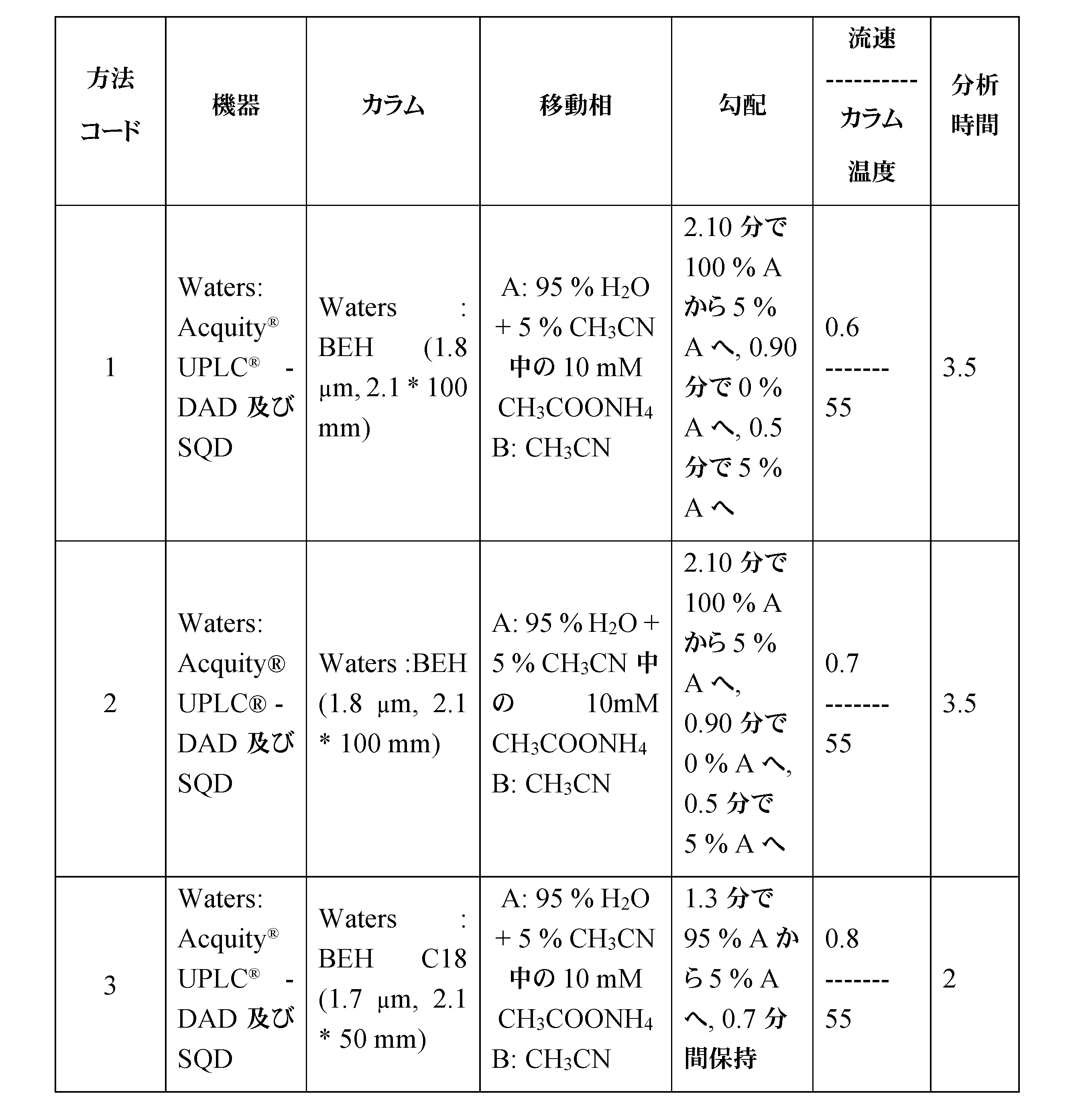


SFC-MS法
SFC測定を、二酸化炭素(CO2)及びモディファイアを送達するバイナリポンプ、オートサンプラー、カラムオーブン、400バールまで耐える高圧フローセルを備えたダイオードアレイ検出器で構成されている分析超臨界流体クロマトグラフィー(SFC)システムを使用して実施した。質量分析計(MS)が配置されている場合には、カラムからの流れを(MS)に導入した。化合物の公称モノアイソトピック分子量(MW)の特定を可能にするイオンを得るために調整パラメータ(例えば、走査範囲、ドウェル時間等)を設定することは、当業者の知識の範囲内である。データ収集を、適当なソフトウェアで実施した。分析SFC-MS法(流速をmL/分で表し、カラム温度(T)を℃で表し、分析時間を分で表し、背圧(BPR)をbarで表す。「iPrNH2」はイソプロピルアミンを意味し、「EtOH」はエタノールを意味し、「min」は分を意味する。
SFC-MS Method Analytical Supercritical SFC measurements consisted of a binary pump delivering carbon dioxide (CO 2 ) and modifiers, an autosampler, a column oven, a diode array detector with a high pressure flow cell to withstand up to 400 bar. Performed using a fluid chromatography (SFC) system. If a mass spectrometer (MS) was installed, the stream from the column was introduced into (MS). It is within the knowledge of one skilled in the art to set tuning parameters (eg, scan range, dwell time, etc.) to obtain ions that allow identification of the compound's nominal monoisotopic molecular weight (MW). Data collection was performed with appropriate software. Analytical SFC-MS method (flow rate in mL/min, column temperature (T) in °C, analysis time in minutes, back pressure (BPR) in bar. “iPrNH 2 ” means isopropylamine). where "EtOH" means ethanol and "min" means minutes.

表:分析的SFCデータ-Rtは、保持時間(分)を意味しており、[M+H]+は、化合物のプロトン化質量を意味しており、方法は、エナンチオマー的に純粋な化合物の(SFC)MS分析に使用した方法を指す。No.は、番号を意味している。 Table: Analytical SFC Data—R t means retention time (min), [M+H] + means protonated mass of compound, method is for enantiomerically pure compounds ( SFC) refers to the method used for MS analysis. No. means a number.

NMR
1H NMRスペクトルを、Bruker Avance III分光計及びAvance NEO分光計で記録した。別途言及しない限り、溶媒としてCDCl3を使用した。化学シフトを、テトラメチルシランに対するppmで表す。
NMR
1 H NMR spectra were recorded on Bruker Avance III and Avance NEO spectrometers. CDCl 3 was used as solvent unless otherwise stated. Chemical shifts are expressed in ppm relative to tetramethylsilane.
薬理学的解析
生物学的実施例1
Mcl-1の結合パートナーとしてBIM BH3ペプチド(H2N-(C/Cy5Mal)WIAQELRRIGDEFN-OH)を利用するテルビウム標識骨髄細胞白血病1(Mcl-1)均一時間分解蛍光(HTRF)結合アッセイ。
Pharmacological Analysis Biological Example 1
Terbium-labeled myeloid cell leukemia 1 (Mcl-1) homogenous time-resolved fluorescence (HTRF) binding assay utilizing the BIM BH3 peptide (H2N-(C/Cy5Mal)WIAQELRRIGDEFN-OH) as binding partner for Mcl-1.
アポトーシス又はプログラム細胞死は、正常な組織恒常性を確保し、この調節不全は、癌等のいくつかのヒト病理を引き起こす可能性がある。外因性アポトーシス経路は、細胞表面の受容体の活性化を介して開始されるが、内因性アポトーシス経路は、ミトコンドリア外膜で起こり、且つMcl-1等のアポトーシス促進Bcl-2ファミリタンパク質と抗アポトーシスBcl-2ファミリタンパク質との間の結合相互作用に支配されている。多くの癌では、Mcl-1等の抗アポトーシスBcl-2タンパク質は上方制御されており、このようにして、癌細胞はアポトーシスを回避し得る。そのため、Mcl-1等のBcl-2タンパク質の阻害により癌細胞のアポトーシスを引き起こし得、前記癌の処置方法が提供される。このアッセイでは、HTRFアッセイフォーマットでCy5標識BIM BH3ペプチド(H2N-(C/Cy5Mal)WIAQELRRIGDEFN-OH)の置き換えを測定することにより、BH3ドメイン:Mcl-1相互作用の阻害を評価した。 Apoptosis or programmed cell death ensures normal tissue homeostasis and this dysregulation can lead to several human pathologies such as cancer. The extrinsic apoptotic pathway is initiated through the activation of cell surface receptors, whereas the intrinsic apoptotic pathway occurs at the outer mitochondrial membrane and involves pro-apoptotic Bcl-2 family proteins such as Mcl-1 and anti-apoptotic proteins. It is governed by binding interactions with Bcl-2 family proteins. In many cancers, anti-apoptotic Bcl-2 proteins such as Mcl-1 are upregulated and in this way cancer cells can escape apoptosis. Therefore, inhibition of Bcl-2 proteins, such as Mcl-1, can lead to apoptosis of cancer cells, providing methods for treating said cancers. This assay assessed inhibition of the BH3 domain:Mcl-1 interaction by measuring displacement of a Cy5-labeled BIM BH3 peptide (H 2 N-(C/Cy5Mal)WIAQELRRIGDEFN-OH) in an HTRF assay format.
アッセイ手順:
このアッセイで使用するために、下記のアッセイ緩衝液及びストック緩衝液を調製した:(a)ストック緩衝液:10mM Tris-HCl、pH=7.5+150mM NaCl、ろ過し、滅菌し、4℃で保管した;及び(b)1×アッセイ緩衝液、下記の成分を、ストック緩衝液に新たに添加した:2mM ジチオスレイトール(DTT)、0.0025% Tween-20、0.1mg/mL ウシ血清アルブミン(BSA)。1×アッセイ緩衝液(b)を使用してタンパク質ストック溶液を25pM Tb-Mcl-1及び8nM Cy5 Bimペプチドまで希釈することにより、1×Tb-Mcl-1+Cy5 Bimペプチド溶液を調製した。
Assay procedure:
The following assay and stock buffers were prepared for use in this assay: (a) Stock buffer: 10 mM Tris-HCl, pH=7.5+150 mM NaCl, filtered, sterilized and stored at 4°C. and (b) 1× assay buffer, the following components were added fresh to the stock buffer: 2 mM dithiothreitol (DTT), 0.0025% Tween-20, 0.1 mg/mL bovine serum albumin. (BSA). A 1×Tb-Mcl-1+Cy5 Bim peptide solution was prepared by diluting the protein stock solution to 25 pM Tb-Mcl-1 and 8 nM Cy5 Bim peptide using 1× assay buffer (b).
Acoustic ECHOを使用して、1×の最終化合物濃度、及び1%の最終DMSO濃度で、白色384ウェルPerkin Elmer Proxiplateの個々のウェルに100×試験化合物 100nLを分注した。阻害剤コントロール及び中性対照(NC、100% DMSO 100nL)を、アッセイプレートの23列目及び24列目にスタンプした。次いで、このプレートの各ウェルに、1×Tb-Mcl-1+Cy5 Bimペプチド溶液10μLを分注した。このプレートを、1分にわたり1000rpmでカバープレートと共に遠心分離し、次いで、プレートを覆いつつ室温で60分にわたりインキュベートした。TR-FRETシグナルを、HTRF光学モジュール(HTRF:励起:337nm、光源:レーザー、発光A:665nm、発光B:620nm、積分開始:60μs、積分時間:400μs)を使用して、室温にて、BMG PHERAStar FSX MicroPlate Readerで読み取った。 Using an Acoustic ECHO, 100 nL of 100× test compound was dispensed into individual wells of a white 384-well Perkin Elmer Proxiplate at a final compound concentration of 1× and a final DMSO concentration of 1%. Inhibitor controls and neutral controls (NC, 100 nL of 100% DMSO) were stamped on rows 23 and 24 of the assay plate. Then, 10 μL of 1×Tb-Mcl-1+Cy5 Bim peptide solution was dispensed into each well of the plate. The plate was centrifuged with the cover plate at 1000 rpm for 1 minute and then incubated for 60 minutes at room temperature with the plate covered. The TR-FRET signal was captured at room temperature using a HTRF optical module (HTRF: excitation: 337 nm, light source: laser, emission A: 665 nm, emission B: 620 nm, integration start: 60 μs, integration time: 400 μs). Read on a PHERAStar FSX MicroPlate Reader.
データ分析
BMG PHERAStar FSX MicroPlate Readerを使用して、665nm及び620nmの2つの発光波長での蛍光強度を測定し、両方の発光に関する相対蛍光単位(RFU)、及び発光の比率(665nm/620nm)×10,000を報告した。RFU値を、下記のように阻害パーセントに正規化した:
阻害%=((NC-IC)-(化合物-IC))/(NC-IC))×100
(式中、IC(阻害剤コントロール、低シグナル)=1×Tb-MCl-1+Cy5 Bimペプチド+阻害剤コントロール又はMcl-1の100%阻害の平均シグナル;NC(中性コントロール、高シグナル)=DMSOのみによる1×Tb-MCl-1+Cy5 Bimペプチド又は0%阻害の平均シグナル)。
下記の方程式に基づいて、(GenDataを使用して)11点用量反応曲線を作成してIC50値を決定した:
Y=Bottom+(Top-Bottom)/(1+10^((log IC50-X)×HillSlope))
(式中、Y=X阻害剤濃度の存在下での阻害%;Top=IC(Mcl-1+阻害剤コントロールの平均シグナル)から導かれる100%阻害;Bottom=NC(Mcl-1+DMSOの平均シグナル)から導かれる0%阻害;Hillslope=Hill係数;及びIC50=最高/中性コントロール(NC)に対する50%阻害での化合物の濃度)。
Data Analysis A BMG PHERAStar FSX MicroPlate Reader was used to measure fluorescence intensity at two emission wavelengths of 665 nm and 620 nm, relative fluorescence units (RFU) for both emissions, and the ratio of emissions (665 nm/620 nm) x 10 ,000 reported. RFU values were normalized to percent inhibition as follows:
% inhibition = ((NC-IC)-(compound-IC))/(NC-IC)) x 100
(where IC (inhibitor control, low signal) = mean signal of 1 x Tb-MCl-1 + Cy5 Bim peptide + inhibitor control or 100% inhibition of Mcl-1; NC (neutral control, high signal) = DMSO mean signal of 1×Tb-MCl-1+Cy5 Bim peptide or 0% inhibition by only).
An 11-point dose-response curve was generated (using GenData) to determine IC50 values based on the following equation:
Y=Bottom+(Top−Bottom)/(1+10̂((log IC50 −X)×HillSlope))
(where Y = % inhibition in the presence of X inhibitor concentrations; Top = 100% inhibition derived from IC (mean signal of Mcl-1 + inhibitor control); Bottom = NC (mean signal of Mcl-1 + DMSO). Hillslope = Hill coefficient; and IC50 = concentration of compound at 50% inhibition relative to maximal/neutral control (NC)).
Ki=IC50/(1+[L]/Kd)
このアッセイでは、[L]=8nM、及びKd=10nM。
Ki = IC50 /(1+[L]/Kd)
[L]=8 nM and Kd=10 nM in this assay.
本発明の代表的な化合物を、上記で説明した手順に従って試験し、下記の表で列挙する結果が得られた(n.d.は未決定を意味する)。下記の表で報告する値は、使用したアッセイ及び機器と関連する許容誤差の影響を受けている。 Representative compounds of the invention were tested according to the procedures described above with the results listed in the table below (n.d. means not determined). The values reported in the table below are subject to tolerances associated with the assay and equipment used.

本発明の代表的な化合物を、上記で説明した手順に従って試験し、下記の表で列挙する結果が得られた(n.d.は未決定を意味する)。下記の表で報告する値を、機器の再較正後に得た。この値は、典型的な許容誤差の影響を受けており、且つ特定の化合物の数回の実行にわたる平均値である。 Representative compounds of the invention were tested according to the procedures described above with the results listed in the table below (n.d. means not determined). The values reported in the table below were obtained after recalibrating the instrument. This value is subject to typical tolerances and is an average value over several runs for a particular compound.

生物学的実施例2
MCL-1は、アポトーシスの制御因子であり、細胞死を回避する腫瘍細胞中で高度に過剰発現されている。このアッセイでは、アポトーシス経路の制御因子(主に、MCL-1、Bfl-1、Bcl-2、及びBcl-2ファミリの他のタンパク質)を標的とする低分子化合物の細胞内での効力を評価する。抗アポトーシス制御因子とBH3ドメインタンパク質との相互作用を破壊するタンパク質-タンパク質阻害剤は、アポトーシスを引き起こす。
Biological Example 2
MCL-1 is a regulator of apoptosis and is highly overexpressed in tumor cells that escape cell death. This assay evaluates the intracellular potency of small molecules that target regulators of apoptotic pathways, primarily MCL-1, Bfl-1, Bcl-2, and other proteins of the Bcl-2 family. do. Protein-protein inhibitors that disrupt the interaction between anti-apoptotic regulators and BH3 domain proteins induce apoptosis.
CellEvent(商標)Caspase-3/7 Green ReadyProbes(商標)Reagent(Thermo Fisher C10423,C10723)を使用して、アポトーシス経路の活性化を測定した。このアッセイでは、アポトーシス経路に入る細胞中において緑色蛍光色素が生じる。CellEvent(登録商標)Caspase-3/7 Green試薬は、DNAに結合していない場合には非蛍光性である核酸結合色素にコンジュゲートした4アミノ酸ペプチド(DEVD)である。CellEvent(登録商標) Caspase-3/7 Green試薬は、本質的に非蛍光性であり、なぜならば、DEVDペプチドが色素のDNAへの結合を阻害するからである。アポトーシス細胞中でカスパーゼ-3/7が活性化されると、DEVDペプチドが開裂されて遊離色素がDNAに結合し得、明るい緑色の蛍光が生じる。カスパーゼ-3及びカスパーゼ-7の活性化は、MCL-1阻害タンパク質又は他のアポトーシス阻害タンパク質に依存している細胞系統でのこれらのタンパク質の阻害の下流である。 Activation of the apoptotic pathway was measured using CellEvent™ Caspase-3/7 Green ReadyProbes™ Reagent (Thermo Fisher C10423, C10723). This assay produces a green fluorescent dye in cells entering the apoptotic pathway. CellEvent® Caspase-3/7 Green reagent is a four amino acid peptide (DEVD) conjugated to a nucleic acid binding dye that is non-fluorescent when not bound to DNA. The CellEvent® Caspase-3/7 Green reagent is essentially non-fluorescent because the DEVD peptide inhibits binding of the dye to DNA. Upon activation of caspase-3/7 in apoptotic cells, the DEVD peptide is cleaved and the free dye can bind to DNA, resulting in bright green fluorescence. Activation of caspase-3 and caspase-7 is downstream of inhibition of these proteins in cell lines dependent on MCL-1 inhibitory protein or other apoptosis-inhibiting proteins.
IncuCyteによる生細胞の読み取りにより、Caspase活性化の経時的な追跡が可能になる。速度論的読み取りは、(a)アポトーシス誘導の機序の差違に関連し得る発症時間の差違(即ち、これがより直接的であるか又は間接的であるか)を明らかにするのに;及び(b)自家発光又は沈殿化合物から生じるアーティファクトの認識を可能にするのに有用であった。IncuCyte読み取りからも細胞数の正規化が可能となり、なぜならば、懸濁液中の細胞を均一に分散させることが困難だからである。 Live-cell readout by IncuCyte allows tracking of caspase activation over time. Kinetic readouts are used to (a) reveal differences in onset time that may be related to differences in mechanisms of apoptosis induction (i.e., whether this is more direct or indirect); and ( b) It was useful to allow recognition of artifacts arising from autoluminescence or precipitated compounds. The IncuCyte reading also allows normalization of cell numbers, since it is difficult to evenly distribute cells in suspension.
シグナルを、22時間の持続時間にわたり2時間毎に測定した。生データとして画像毎にCaspaseマスクとConfluenceマスクとの比率を算出し、全てのウェルに関する速度論的トレースを、分析のためにGenedata Screenerにエクスポートした。 Signals were measured every 2 hours for a duration of 22 hours. The ratio of Caspase and Confluence masks was calculated for each image as raw data and kinetic traces for all wells were exported to the Genedata Screener for analysis.
Genedata Screenerでは、速度論的トレースから6時間、12時間、及び22時間の値を抽出した。これらの値を、陰性コントロール(未処理細胞)に対して正規化した。この正規化データに対して、標準的な用量反応分析を実施した。 The Genedata Screener extracted 6 hour, 12 hour and 22 hour values from the kinetic traces. These values were normalized to the negative control (untreated cells). A standard dose-response analysis was performed on this normalized data.
下記のデータを、下記の3つの前述した時点のそれぞれで報告した:(a)用量反応曲線、(b)qAC50及びqAC50モード、並びに(c)最大活性。 The following data were reported at each of the three aforementioned time points: (a) dose-response curve, (b) qAC50 and qAC50 mode, and (c) maximal activity.
このアッセイで使用した材料は、下記の表に列挙された通りであった。 Materials used in this assay were as listed in the table below.

細胞を、10%加熱不活性化(HI)FBS、2mM L-グルタミン、及び50μg/mLゲンタマイシンフェノールレッドフリーRPMI-1640を含む培養培地中で維持した。細胞を、1週間に2回、40万個/mLで分割した。 Cells were maintained in culture medium containing 10% heat-inactivated (HI) FBS, 2 mM L-glutamine, and 50 μg/mL gentamicin phenol red-free RPMI-1640. Cells were split at 400,000/mL twice a week.
1日目、1つのウェル当たり150nLで、10mM濃度で試験化合物が入った個々のウェルを含むプレート。最終濃度は、100μM~10pM化合物(及び化合物なしコントロール)の範囲であり、化合物を1時間にわたり室温で解凍した。マルチドロップ(1列目、3~22列目、24列目)により、予め温めた培地25μlを各ウェルに添加し、続いて2列目にDMSOコントロール(0.6% DMSO)を添加した。このプレートを、Breathe-Easy(登録商標)密封膜を使用して密封し、室温で30分にわたり振盪して、試験化合物を培地に溶解させた。次いで、このプレートを、37℃、5% CO2で1時間にわたりインキュベーター中に収容した。 On day 1, plate containing individual wells containing test compound at 10 mM concentration at 150 nL per well. Final concentrations ranged from 100 μM to 10 pM compound (and no compound controls) and compounds were thawed at room temperature for 1 hour. 25 μl of pre-warmed medium was added to each well by multidrop (rows 1, 3-22, 24) followed by a DMSO control (0.6% DMSO) in row 2. The plate was sealed using a Breathe-Easy® sealing membrane and shaken at room temperature for 30 minutes to dissolve the test compound in the medium. The plates were then placed in an incubator at 37° C., 5% CO 2 for 1 hour.
40000個/25μl(アッセイでは20000個/50μl最終)での培地中のMOLP8細胞を、4μM(アッセイでは2μM最終)でのCellEvent(商標)Caspase-3/7 Green Detection Reagentにより調製した。調製すると、この細胞を、20000個の量で試験化合物プレートに添加し、このプレートをIncuCyteに直ちに入れ、下記の設定を使用して撮像を開始した:10×対物レンズ、グリーンチャンネルでの2秒露光時間、2時間の間隔、22時間後に取得停止。 MOLP8 cells in medium at 40000/25 μl (20000/50 μl final in assay) were prepared with CellEvent™ Caspase-3/7 Green Detection Reagent at 4 μM (2 μM final in assay). Once prepared, the cells were added to the test compound plate in an amount of 20000 and the plate was immediately placed into the IncuCyte and imaging started using the following settings: 10x objective, 2 seconds on green channel. Exposure time, 2 hour interval, stop acquisition after 22 hours.
IncuCyteでの分析のために、Basic Analysisプロトコルを定義して、下記のように、「相」及び「グリーン」画像から「コンフルエンス」及び「カスパーゼ」面積をそれぞれ算出した:(a)コンフルエンス:分割調整1、ホールフィル(Hole Fill)0、調整サイズ-2、フィルタなし(b)カスパーゼ:Top-Hat分割、半径10、閾値0.3GCU、感度0でのエッジスプリットオン(Edge Split On)、ホールフィル0、調整サイズ1、及び最小面積20μm2でのフィルタ。十分な数の陽性コントロール及び陰性コントロールのウェル並びに化合物処理ウェルで分析器を訓練し、「コンフルエンス」層が生細胞及び死(凝縮)細胞との両方を検出することを検証した。「カスパーゼ面積/コンフルエンス面積」は、Caspase3/7染色に対して陽性である細胞の割合を近似しており、「画像毎」に算出される。 For analysis on the IncuCyte, a Basic Analysis protocol was defined to calculate the 'confluence' and 'caspase' areas from the 'phase' and 'green' images, respectively, as follows: (a) confluence: split adjustment 1, Hole Fill 0, Adjust Size -2, No Filter (b) Caspase: Top-Hat Split, Radius 10, Threshold 0.3 GCU, Edge Split On with Sensitivity 0, Hole Fill Filter with 0, adjusted size 1, and minimum area 20 μm 2 . The analyzer was trained with a sufficient number of positive and negative control wells and compound-treated wells to verify that the "confluence" layer detected both live and dead (condensed) cells. "Caspase area/confluence area" approximates the percentage of cells positive for Caspase 3/7 staining and is calculated "per image".
アッセイ分析を、予め定義されているテンプレートを使用してGenedata Screenerで完了した。より具体的には、実験分析用のアッセイ特異的設定は、下記の通りであった:(a)プレートレイアウト:陰性コントロールウェルは化合物を含まないがDMSOを含み、「中性コントロール」であると定義された、(b)トレースチャンネル:「測定チャンネル」という名称の、タイプ「測定」の1つのトレースチャンネルが存在すべきである。これは、IncuCyteからの生データであった;及び(c)層:「平均6時間」、「平均12時間」、及び「平均22時間」という名称の、タイプ「凝集:時系列」の3つの層。これらは、それぞれ、5.5~6.5時間、11.5~12.5時間、及び21.5~22.5時間の値からの測定の平均を含んだ。 Assay analysis was completed on the Genedata Screener using pre-defined templates. More specifically, the assay-specific settings for the experimental analysis were as follows: (a) Plate layout: Negative control wells contained no compound but DMSO and were designated as "neutral controls"; Defined: (b) trace channel: There should be one trace channel of type "measurement" named "measurement channel". This was the raw data from IncuCyte; and (c) layers: 3 layers of type "Aggregation: Time Series" named "Average 6 hours", "Average 12 hours", and "Average 22 hours". layer. These included the average of measurements from values of 5.5-6.5 hours, 11.5-12.5 hours, and 21.5-22.5 hours, respectively.
正規化及び補正:3つの層のそれぞれを、中心基準としての中性コントロール、及びスケール基準としての刺激剤コントロール(Stimulator Control)で、Percent-of-Controlに対して正規化した。又は、μCRが中心基準の平均であり、且つμSCがスケール基準の平均であった場合には、正規化値を下記のように算出した:

層化合物の結果:Sinf、IC50、及びhをフリーパラメータとし、且つS0を0に固定して、標準的なフィットモデルを下記の様に使用した:

頑強なZ’因子又は「RZ’因子」を、Screenerで算出した。コントロールウェルでの異常値の速度論的トレースを除外した後(下記を参照されたい)、RZ’値は、任意のFBS濃度で及び任意の時点(6時間、12時間、22時間)にわたり試験したMOLP8細胞に関してRZ≧0.5であるべきである。 A robust Z' factor or "RZ' factor" was calculated with the Screener. After excluding outlier kinetic traces in control wells (see below), RZ′ values were tested at any FBS concentration and over any time point (6, 12, 22 hours). RZ should be > 0.5 for MOLP8 cells.
「包括的SD」を、正規化後の陽性コントロール又は陰性コントロールの頑強な標準偏差(いずれか大きい方)として、Screenerで算出した。コントロールウェルでの異常値の速度論的トレースを除外した後(下記を参照されたい)、包括的SDは、任意のFBS濃度で及び任意の時点(6時間、12時間、22時間)にわたり試験したMOLP8細胞に関して包括的SD≦10であるべきである。 "Global SD" was calculated in the Screener as the robust standard deviation of the positive or negative control (whichever is larger) after normalization. After excluding outlier kinetic traces in control wells (see below), global SD was tested at any FBS concentration and over any time point (6, 12, 22 hours). Global SD should be ≦10 for MOLP8 cells.
本発明の式(I)の代表的な化合物を、生物学的実施例で説明した手順に従って試験し、結果を下記の表に列挙する。「NT」は、未試験を意味する。下記の表で報告する値は、使用したアッセイ及び機器と関連する許容誤差の影響を受けている。 Representative compounds of Formula (I) of the present invention were tested according to the procedures described in the Biological Examples and the results are listed in the table below. "NT" means not tested. The values reported in the table below are subject to tolerances associated with the assay and equipment used.

生物学的実施例3
MCL-1は、アポトーシスの制御因子であり、細胞死を回避する腫瘍細胞中で高度に過剰発現されている。このアッセイでは、アポトーシス経路の制御因子(主に、MCL-1、Bfl-1、Bcl-2、及びBcl-2ファミリの他のタンパク質)を標的とする低分子化合物の細胞内での効力を評価する。抗アポトーシス制御因子とBH3ドメインタンパク質との相互作用を破壊するタンパク質-タンパク質阻害剤は、アポトーシスを引き起こす。
Biological Example 3
MCL-1 is a regulator of apoptosis and is highly overexpressed in tumor cells that escape cell death. This assay evaluates the intracellular potency of small molecules that target regulators of apoptotic pathways, primarily MCL-1, Bfl-1, Bcl-2, and other proteins of the Bcl-2 family. do. Protein-protein inhibitors that disrupt the interaction between anti-apoptotic regulators and BH3 domain proteins induce apoptosis.
Caspase-Glo(登録商標)3/7 Assayは、精製された酵素調製物又は付着細胞若しくは浮遊細胞の培養物中でのカスパーゼ-3及び-7の活性を測定する発光アッセイである。このアッセイは、テトラペプチド配列DEVDを含む発光促進性カスパーゼ-3/7基質を提供する。この基質が開裂されて、光の生成で使用されるルシフェラーゼの基質であるアミノルシフェリンが放出される。「添加-混合-測定(add-mix-measure)」方式での単一Caspase-Glo(登録商標)3/7 Reagentの添加により、細胞が溶解し、続いて基質のカスパーゼ開裂が起こり、「グロー型」の発光シグナルが生成される。 The Caspase-Glo® 3/7 Assay is a luminescent assay that measures caspase-3 and -7 activity in purified enzyme preparations or cultures of adherent or suspension cells. This assay provides a luminescence-enhanced caspase-3/7 substrate containing the tetrapeptide sequence DEVD. This substrate is cleaved to release aminoluciferin, a substrate for luciferase used in light production. Addition of a single Caspase-Glo® 3/7 Reagent in an “add-mix-measure” fashion results in cell lysis, followed by caspase cleavage of the substrate, resulting in “Glo A luminescence signal of the type is generated.
このアッセイは、MCL-1阻害に対して感受性であるMOLP-8ヒト多発性骨髄腫細胞系統を使用する。 This assay uses the MOLP-8 human multiple myeloma cell line, which is sensitive to MCL-1 inhibition.
材料:
・ Perkin Elmer Envision
・ Multidrop 384及び少量分注カセット
・ 遠心分離器
・ Countess自動細胞計数器
・ Countess計数チャンバースライド
・ アッセイプレート:ProxiPlate-384 Plus、白色384-浅井戸マイクロプレート
・ 密封テープ:Topseal A plus
・ T175培養フラスコ
material:
・ Perkin Elmer Envision
Multidrop 384 and small dispense cassettes Centrifuge Countess automatic cell counter Countess counting chamber slides Assay plates: ProxiPlate-384 Plus, white 384-shallow well microplates Sealing tape: Topseal A plus
・ T175 culture flask

細胞培養培地: Cell culture medium:

細胞培養:
細胞培養物を、0.2~2.0×10⁶個の細胞/mLで維持した。細胞を、50mLのコニカルチューブへの回収により収集した。次いで、細胞を5分にわたり500gでペレット化した後、上清を除去し、予め温めた新鮮な培養培地に再懸濁させた。細胞を計数し、必要に応じて希釈した。
Cell culture:
Cell cultures were maintained at 0.2-2.0×10 6 cells/mL. Cells were harvested by harvesting into 50 mL conical tubes. Cells were then pelleted at 500 g for 5 minutes before removing the supernatant and resuspending in pre-warmed fresh culture medium. Cells were counted and diluted as necessary.
Caspase-Glo試薬:
このアッセイ試薬を、緩衝溶液を基質バイアルに移して混合することにより調製した。この溶液を、4℃で最高1週間にわたり保存し得、シグナルの喪失はごくわずかであった。
Caspase-Glo Reagent:
The assay reagent was prepared by transferring the buffer solution to the substrate vial and mixing. This solution could be stored at 4° C. for up to 1 week with negligible loss of signal.
アッセイ手順:
化合物を、アッセイレディプレート(Proxiplate)に入れて-20℃で保存した。アッセイは、基準化合物が入った1個の基準化合物プレートを常に含む。このプレートに、化合物(細胞中に0.5% DMSO最終;連続希釈;30μM最高濃度、1/3希釈、10回用量、重複)40nLでスポットした。この化合物を室温で使用し、2列目及び23列目を除く全てのウェルに、予め温めた培地4μLを添加した。培地に1% DMSOを添加することにより、陰性コントロールを調製した。培地に60μMの最終濃度で好適な陽性コントロール化合物を添加することにより、陽性コントロールを調製した。プレートを、23列目に陰性コントロール4μLを添加し、2列目に陽性コントロール4μLを添加し、且つこのプレート中の全てのウェルに細胞懸濁液4μLを添加することにより調製した。次いで、プレートを細胞と共に、2時間にわたり37℃でインキュベートした。アッセイシグナル試薬は、上記で説明したCaspase-Glo溶液であり、全てのウェルに8μLを添加した。次いで、このプレートを密封し、30分後に測定した。
Assay procedure:
Compounds were stored at -20°C in assay ready plates (Proxiplate). Assays always contain one reference compound plate containing a reference compound. The plates were spotted with 40 nL of compound (0.5% DMSO final in cells; serial dilutions; 30 μM top concentration, 1/3 dilution, 10 doses in duplicate). The compound was used at room temperature and 4 μL of pre-warmed medium was added to all wells except rows 2 and 23. A negative control was prepared by adding 1% DMSO to the medium. A positive control was prepared by adding the appropriate positive control compound to the medium at a final concentration of 60 μM. Plates were prepared by adding 4 μL of negative control to row 23, 4 μL of positive control to row 2, and 4 μL of cell suspension to all wells in the plate. Plates were then incubated with cells for 2 hours at 37°C. The assay signal reagent was the Caspase-Glo solution described above and 8 μL was added to all wells. The plate was then sealed and measured after 30 minutes.
試験化合物の活性を、下記のように、アポトーシス誘導での変化率として算出した:
LC=低コントロール値の中央値
=Screenerでの中心基準
=DMSO
=0%
HC=高コントロール値の中央値
=Screenerでのスケール基準
=30μMの陽性コントロール
100%アポトーシス誘導
効果%(AC50)=100-(試料-LC)/(HC-LC)×100
%コントロール=(試料/HC)×100
%コントロール 分=(試料-LC)/(HC-LC)×100
Activity of test compounds was calculated as percent change in apoptosis induction as follows:
LC = median low control value = central reference on Screener = DMSO
= 0%
HC = median high control value = scale reference on Screener = 30 μM positive control 100% apoptosis-inducing effect % (AC 50 ) = 100-(sample-LC)/(HC-LC) x 100
% control = (sample/HC) x 100
% control min = (Sample-LC)/(HC-LC) x 100
表:式(I)の代表的な化合物に関して測定されたAC50。特定の化合物の全てのバッチに対する全ての実行に関して、平均値を報告する。「NT」は、未試験を意味する。 Table: AC 50 measured for representative compounds of formula (I). Average values are reported for all runs for all batches of a particular compound. "NT" means not tested.

Claims (13)

(式中、
R1は、水素;-CH2ORa;-CH2F;若しくは-CH2NRbRcを表し;
R1aは、水素;-CH2ORa;-CH2F;若しくは-CH2NRbRcを表し;
Raは、水素;C1~4アルキル;Heta;C1~4アルキルであって、-C(=O)-NRdRe、-C(=O)-ORf、C3~6シクロアルキル、Hetb、及びHetcからなる群から選択される1個の置換基で置換されているC1~4アルキル;並びに
C2~4アルキルであって、-(OCH2CH2)m-OCH3、Hetd、及び-NRdReからなる群から選択される1個の置換基で置換されているC2~4アルキルからなる群から選択され;
Rb及びRcは、それぞれ独立して、水素、C1~4アルキル、及びC2~4アルキルであって、1個のHet1で置換されているC2~4アルキルからなる群から選択されるか;
又はRb及びRcは、共に、これらが付着するN原子と一緒に、単環式の4~7員の完全飽和ヘテロシクリルであって、少なくとも1個のN原子を含み、任意選択的に、O、S、及びNから選択される1個の追加のヘテロ原子を含み、前記S原子は、S(=O)若しくはS(=O)2を形成するために置換されている可能性がある、単環式の4~7員の完全飽和ヘテロシクリル;又は縮合二環式の6~11員の完全飽和ヘテロシクリルであって、少なくとも1個のN原子を含み、任意選択的に、O、S、及びNからそれぞれ独立して選択される1個若しくは2個の追加のヘテロ原子を含み、前記S原子は、S(=O)若しくはS(=O)2を形成するために置換されている可能性がある、縮合二環式の6~11員の完全飽和ヘテロシクリルを形成し;
前記単環式若しくは縮合二環式のヘテロシクリルは、1個の窒素上において、1個のC1~4アルキルで任意選択的に置換され;
前記単環式若しくは縮合二環式のヘテロシクリルは、1個の炭素原子上において、1個又は2個の置換基であって、それぞれ独立して、C1~4アルキル、オキソ、及びハロからなる群から選択される置換基で任意選択的に置換され;
Rd及びReは、それぞれ独立して、水素、C1~4アルキル、及びC2~4アルキルであって、1個のHet1で置換されているC2~4アルキルからなる群から選択されるか、
又はRd及びReは、共に、これらが付着するN原子と一緒に、単環式の4~7員の完全飽和ヘテロシクリルであって、少なくとも1個のN原子を含み、任意選択的に、O、S、及びNから選択される1個の追加のヘテロ原子を含み、前記S原子は、S(=O)若しくはS(=O)2を形成するために置換されている可能性がある、単環式の4~7員の完全飽和ヘテロシクリル;又は縮合二環式の6~11員の完全飽和ヘテロシクリルであって、少なくとも1個のN原子を含み、任意選択的に、O、S、及びNからそれぞれ独立して選択される1個若しくは2個の追加のヘテロ原子を含み、前記S原子は、S(=O)若しくはS(=O)2を形成するために置換されている可能性がある、縮合二環式の6~11員の完全飽和ヘテロシクリルを形成し;
前記単環式若しくは縮合二環式のヘテロシクリルは、1個の窒素上において、1個のC1~4アルキルで任意選択的に置換され;
前記単環式若しくは縮合二環式のヘテロシクリルは、1個の炭素原子上において、1個又は2個の置換基であって、それぞれ独立して、C1~4アルキル、オキソ、及びハロからなる群から選択される置換基で任意選択的に置換され;
Rfは、水素若しくはC1~4アルキルを表し;
R2は、水素若しくはフルオロを表し;
Hetaは、C結合型の5員若しくは6員の単環式芳香族ヘテロシクリルであって、O、S、及びNからそれぞれ独立して選択される1個、2個、若しくは3個のヘテロ原子を含むC結合型の5員若しくは6員の単環式芳香族ヘテロシクリルを表し、1個の炭素原子は、1個のC1~4アルキルで任意選択的に置換され;
Hetbは、C結合型の4~7員の単環式完全飽和ヘテロシクリルであって、O、S、及びNからそれぞれ独立して選択される1個若しくは2個のヘテロ原子を含むC結合型の4~7員の単環式完全飽和ヘテロシクリルを表し;前記S原子は、S(=O)若しくはS(=O)2を形成するために置換されている可能性があり;
Hetcは、C結合型の5員若しくは6員の単環式芳香族ヘテロシクリルであって、O、S、及びNからそれぞれ独立して選択される1個、2個、若しくは3個のヘテロ原子を含むC結合型の5員若しくは6員の単環式芳香族ヘテロシクリルを表し;1個の炭素原子は、1個のC1~4アルキルで任意選択的に置換され;
Hetdは、N結合型の5員の単環式芳香族ヘテロシクリルであって、1個、2個、若しくは3個のN原子を含むN結合型の5員の単環式芳香族ヘテロシクリルを表し;1個の炭素原子は、1個のC1~4アルキルで任意選択的に置換され;
Het1は、4~7員の単環式完全飽和ヘテロシクリルであって、O、S、及びNからそれぞれ独立して選択される1個若しくは2個のヘテロ原子を含む4~7員の単環式完全飽和ヘテロシクリルを表し;前記S原子は、S(=O)若しくはS(=O)2を形成するために置換されている可能性があり;
nは、1若しくは2であり;
mは、0、1、若しくは2であり;
Yは、O若しくはCH2を表し;
X1は、CHを表し;
X2は、CHを表し;
X3は、CHを表す)
の化合物、又はその薬学的に許容される塩若しくは溶媒和物。 Formula (I)
(In the formula,
R 1 represents hydrogen; —CH 2 OR a ; —CH 2 F; or —CH 2 NR b R c ;
R 1a represents hydrogen; —CH 2 OR a ; —CH 2 F; or —CH 2 NR b R c ;
R a is hydrogen ; C 1-4 alkyl ; Het a ; C 1-4 alkyl substituted with one substituent selected from the group consisting of cycloalkyl, Het b and Het c ; and C 2-4 alkyl wherein —(OCH 2 CH 2 ) m selected from the group consisting of C 2-4 alkyl substituted with one substituent selected from the group consisting of —OCH 3 , Het d , and —NR d R e ;
R b and R c are each independently selected from the group consisting of hydrogen, C 1-4 alkyl, and C 2-4 alkyl substituted with one Het 1 be done;
or R b and R c together, together with the N atom to which they are attached, are monocyclic 4- to 7-membered fully saturated heterocyclyl containing at least one N atom, optionally one additional heteroatom selected from O, S and N, said S atom optionally substituted to form S(=O) or S(=O) 2 , a monocyclic 4- to 7-membered fully saturated heterocyclyl; or a fused bicyclic 6- to 11-membered fully saturated heterocyclyl containing at least one N atom, optionally O, S, and 1 or 2 additional heteroatoms each independently selected from and N, wherein said S atom may be substituted to form S(=O) or S(=O) 2 forming a fused bicyclic 6-11 membered fully saturated heterocyclyl;
said monocyclic or fused bicyclic heterocyclyl is optionally substituted on one nitrogen with one C 1-4 alkyl;
Said monocyclic or fused bicyclic heterocyclyl is one or two substituents on one carbon atom, each independently consisting of C 1-4 alkyl, oxo and halo optionally substituted with a substituent selected from the group;
R d and R e are each independently selected from the group consisting of hydrogen, C 1-4 alkyl, and C 2-4 alkyl substituted with one Het 1 or
or R d and R e together, together with the N atom to which they are attached, are monocyclic 4- to 7-membered fully saturated heterocyclyl containing at least one N atom, optionally one additional heteroatom selected from O, S and N, said S atom optionally substituted to form S(=O) or S(=O) 2 , a monocyclic 4- to 7-membered fully saturated heterocyclyl; or a fused bicyclic 6- to 11-membered fully saturated heterocyclyl containing at least one N atom, optionally O, S, and 1 or 2 additional heteroatoms each independently selected from and N, wherein said S atom may be substituted to form S(=O) or S(=O) 2 forming a fused bicyclic 6-11 membered fully saturated heterocyclyl;
said monocyclic or fused bicyclic heterocyclyl is optionally substituted on one nitrogen with one C 1-4 alkyl;
Said monocyclic or fused bicyclic heterocyclyl is one or two substituents on one carbon atom, each independently consisting of C 1-4 alkyl, oxo and halo optionally substituted with a substituent selected from the group;
R f represents hydrogen or C 1-4 alkyl;
R 2 represents hydrogen or fluoro;
Het a is a C-linked 5- or 6-membered monocyclic aromatic heterocyclyl having 1, 2, or 3 heteroatoms each independently selected from O, S, and N represents a C - attached 5- or 6-membered monocyclic aromatic heterocyclyl containing
Het b is C-attached 4- to 7-membered monocyclic fully saturated heterocyclyl containing 1 or 2 heteroatoms each independently selected from O, S, and N represents a 4-7 membered monocyclic fully saturated heterocyclyl of; said S atom is optionally substituted to form S(=O) or S(=O) 2 ;
Het c is a C-linked 5- or 6-membered monocyclic aromatic heterocyclyl having 1, 2, or 3 heteroatoms each independently selected from O, S, and N represents a C-attached 5- or 6-membered monocyclic aromatic heterocyclyl containing a; one carbon atom is optionally substituted with one C 1-4 alkyl;
Het d represents an N-linked 5-membered monocyclic aromatic heterocyclyl containing 1, 2, or 3 N atoms; one carbon atom is optionally substituted with one C 1-4 alkyl;
Het 1 is a 4- to 7-membered monocyclic fully saturated heterocyclyl containing 1 or 2 heteroatoms each independently selected from O, S, and N. represents the formula fully saturated heterocyclyl; said S atom may be substituted to form S(=O) or S(=O) 2 ;
n is 1 or 2;
m is 0, 1, or 2;
Y represents O or CH2 ;
X 1 represents CH;
X 2 represents CH;
X 3 represents CH)
or a pharmaceutically acceptable salt or solvate thereof.
Rb及びRcは、共に、これらが付着するN原子と一緒に、単環式の4~7員の完全飽和ヘテロシクリルであって、少なくとも1個のN原子を含み、任意選択的に、O、S、及びNから選択される1個の追加のヘテロ原子を含み、前記S原子は、S(=O)若しくはS(=O)2を形成するために置換されている可能性がある、単環式の4~7員の完全飽和ヘテロシクリル;又は縮合二環式の6~11員の完全飽和ヘテロシクリルであって、少なくとも1個のN原子を含み、任意選択的に、O、S、及びNからそれぞれ独立して選択される1個若しくは2個の追加のヘテロ原子を含み、前記S原子は、S(=O)若しくはS(=O)2を形成するために置換されている可能性がある、縮合二環式の6~11員の完全飽和ヘテロシクリルを形成し;
前記単環式又は縮合二環式のヘテロシクリルは、1個の窒素上において、1個のC1~4アルキルで任意選択的に置換され;
Rd及びReは、共に、これらが付着するN原子と一緒に、単環式の4~7員の完全飽和ヘテロシクリルであって、少なくとも1個のN原子を含み、任意選択的に、O、S、及びNから選択される1個の追加のヘテロ原子を含み、前記S原子は、S(=O)又はS(=O)2を形成するために置換されている可能性がある、単環式の4~7員の完全飽和ヘテロシクリルを形成し;
前記単環式のヘテロシクリルは、1個の炭素原子上において、1個又は2個のハロ置換基で任意選択的に置換され;
Rfは、水素を表し;
Hetaは、C結合型の5員又は6員の単環式芳香族ヘテロシクリルであって、O、S、及びNからそれぞれ独立して選択される1個、2個、又は3個のヘテロ原子を含むC結合型の5員又は6員の単環式芳香族ヘテロシクリルを表し;
mは、0又は1である、
請求項1に記載の化合物。 R 1a represents hydrogen or —CH 2 OR a ;
R b and R c together with the N atom to which they are attached are monocyclic 4- to 7-membered fully saturated heterocyclyl containing at least one N atom, optionally O , S, and N, wherein said S atom is optionally substituted to form S( = O) or S(=O) monocyclic 4- to 7-membered fully saturated heterocyclyl; or fused bicyclic 6- to 11-membered fully saturated heterocyclyl containing at least one N atom, optionally O, S, and 1 or 2 additional heteroatoms each independently selected from N, wherein said S atom may be substituted to form S(=O) or S(=O) 2 is a fused bicyclic 6-11 membered fully saturated heterocyclyl;
said monocyclic or fused bicyclic heterocyclyl is optionally substituted on one nitrogen with one C 1-4 alkyl;
R d and R e together with the N atom to which they are attached are monocyclic 4- to 7-membered fully saturated heterocyclyl containing at least one N atom, optionally O , S, and N, wherein said S atom is optionally substituted to form S( = O) or S(=O) forming a monocyclic 4- to 7-membered fully saturated heterocyclyl;
said monocyclic heterocyclyl is optionally substituted on one carbon atom with 1 or 2 halo substituents;
R f represents hydrogen;
Het a is a C-attached 5- or 6-membered monocyclic aromatic heterocyclyl having 1, 2, or 3 heteroatoms each independently selected from O, S, and N represents a C-linked 5- or 6-membered monocyclic aromatic heterocyclyl containing
m is 0 or 1;
A compound according to claim 1 .
Ra、Rb、及びRcは、それぞれ独立して、水素及びC1~4アルキルからなる群から選択され;
Yは、O又はCH2を表す、
請求項1に記載の化合物。 R 1 represents hydrogen; —CH 2 OR a ; or —CH 2 NR b R c ;
R a , R b , and R c are each independently selected from the group consisting of hydrogen and C 1-4 alkyl;
Y represents O or CH2 ,
A compound according to claim 1 .
Raは、C1~4アルキルを表し;
nは、1である、
請求項1又は2に記載の化合物。 R 1 represents hydrogen or —CH 2 OR a ;
R a represents C 1-4 alkyl;
n is 1;
3. A compound according to claim 1 or 2.
A method of treating or preventing cancer, comprising administering to a subject in need thereof a therapeutically effective amount of a compound according to any one of claims 1 to 7 or a pharmaceutical composition according to claim 8 a method comprising:
Applications Claiming Priority (5)
| Application Number | Priority Date | Filing Date | Title |
|---|---|---|---|
| EP19185177 | 2019-07-09 | ||
| EP19185177.3 | 2019-07-09 | ||
| EP19218032 | 2019-12-19 | ||
| EP19218032.1 | 2019-12-19 | ||
| PCT/EP2020/069097 WO2021005043A1 (en) | 2019-07-09 | 2020-07-07 | Macrocyclic spirocycle derivatives as mcl-1 inhibitors |
Publications (2)
| Publication Number | Publication Date |
|---|---|
| JP2022540825A true JP2022540825A (en) | 2022-09-20 |
| JP7573591B2 JP7573591B2 (en) | 2024-10-25 |
Family
ID=71579568
Family Applications (1)
| Application Number | Title | Priority Date | Filing Date |
|---|---|---|---|
| JP2022500888A Active JP7573591B2 (en) | 2019-07-09 | 2020-07-07 | Macrocyclic spirocyclic derivatives as mcl-1 inhibitors |
Country Status (11)
| Country | Link |
|---|---|
| US (1) | US20240067660A1 (en) |
| EP (1) | EP3997097B1 (en) |
| JP (1) | JP7573591B2 (en) |
| KR (1) | KR20220034136A (en) |
| CN (1) | CN114096546A (en) |
| AU (1) | AU2020309745A1 (en) |
| BR (1) | BR112022000251A2 (en) |
| CA (1) | CA3144558A1 (en) |
| ES (1) | ES2987630T3 (en) |
| MX (1) | MX2022000390A (en) |
| WO (1) | WO2021005043A1 (en) |
Families Citing this family (5)
| Publication number | Priority date | Publication date | Assignee | Title |
|---|---|---|---|---|
| TWI778443B (en) | 2019-11-12 | 2022-09-21 | 美商基利科學股份有限公司 | Mcl1 inhibitors |
| AU2020391106B2 (en) | 2019-11-26 | 2024-03-21 | Gilead Sciences, Inc. | Processes and intermediates for preparing MCL1 inhibitors |
| WO2022108984A1 (en) * | 2020-11-19 | 2022-05-27 | Gilead Sciences, Inc. | Processes and intermediates for preparing macrocyclic mcl1 inhibitors |
| MX2023007297A (en) * | 2020-12-17 | 2023-07-04 | Janssen Pharmaceutica Nv | MACROCYCLIC 3-FLUORO-BUT-3-BRANCHED ENAMIDES AS MCL-1 INHIBITORS. |
| KR20240107105A (en) * | 2021-11-16 | 2024-07-08 | 얀센 파마슈티카 엔브이 | Macrocyclic 2-amino-but-3-enamide as an inhibitor of MCL-1 |
Citations (4)
| Publication number | Priority date | Publication date | Assignee | Title |
|---|---|---|---|---|
| WO2017147410A1 (en) * | 2016-02-25 | 2017-08-31 | Amgen Inc. | Compounds that inhibit mcl-1 protein |
| JP2018199667A (en) * | 2017-03-30 | 2018-12-20 | アムジエン・インコーポレーテツド | Compound that inhibits MCL-1 protein |
| WO2019046150A1 (en) * | 2017-08-29 | 2019-03-07 | Amgen Inc. | Macrocyclic compounds that inhibit mcl-1 protein |
| JP2022506973A (en) * | 2018-11-09 | 2022-01-17 | プレリュード セラピューティクス,インコーポレイティド | Spiro-sulfonamide derivative as an inhibitor of myelogenous cell leukemia-1 (MCL-1) protein |
Family Cites Families (6)
| Publication number | Priority date | Publication date | Assignee | Title |
|---|---|---|---|---|
| JO3474B1 (en) | 2014-08-29 | 2020-07-05 | Amgen Inc | Tetrahydronaphthalene derivatives that inhibit mcl-1 protein |
| ES2791319T3 (en) | 2016-04-22 | 2020-11-03 | Astrazeneca Ab | Macrocyclic MCL1 Inhibitors to Treat Cancer |
| TW201904976A (en) | 2017-03-31 | 2019-02-01 | 瑞典商阿斯特捷利康公司 | Mcl-1 inhibitors and methods of use thereof |
| TWI781996B (en) | 2017-03-31 | 2022-11-01 | 瑞典商阿斯特捷利康公司 | Methods of synthesizing an mcl-1 inhibitor |
| ES3036998T3 (en) | 2017-08-18 | 2025-09-26 | Amgen Inc | Compounds that inhibit mcl-1 protein |
| KR102551319B1 (en) | 2018-05-14 | 2023-07-05 | 길리애드 사이언시즈, 인코포레이티드 | MCL-1 inhibitor |
-
2020
- 2020-07-07 KR KR1020227003256A patent/KR20220034136A/en not_active Withdrawn
- 2020-07-07 MX MX2022000390A patent/MX2022000390A/en unknown
- 2020-07-07 US US17/624,949 patent/US20240067660A1/en not_active Abandoned
- 2020-07-07 EP EP20739606.0A patent/EP3997097B1/en active Active
- 2020-07-07 CA CA3144558A patent/CA3144558A1/en active Pending
- 2020-07-07 WO PCT/EP2020/069097 patent/WO2021005043A1/en not_active Ceased
- 2020-07-07 ES ES20739606T patent/ES2987630T3/en active Active
- 2020-07-07 JP JP2022500888A patent/JP7573591B2/en active Active
- 2020-07-07 CN CN202080050978.2A patent/CN114096546A/en active Pending
- 2020-07-07 BR BR112022000251A patent/BR112022000251A2/en unknown
- 2020-07-07 AU AU2020309745A patent/AU2020309745A1/en not_active Abandoned
Patent Citations (4)
| Publication number | Priority date | Publication date | Assignee | Title |
|---|---|---|---|---|
| WO2017147410A1 (en) * | 2016-02-25 | 2017-08-31 | Amgen Inc. | Compounds that inhibit mcl-1 protein |
| JP2018199667A (en) * | 2017-03-30 | 2018-12-20 | アムジエン・インコーポレーテツド | Compound that inhibits MCL-1 protein |
| WO2019046150A1 (en) * | 2017-08-29 | 2019-03-07 | Amgen Inc. | Macrocyclic compounds that inhibit mcl-1 protein |
| JP2022506973A (en) * | 2018-11-09 | 2022-01-17 | プレリュード セラピューティクス,インコーポレイティド | Spiro-sulfonamide derivative as an inhibitor of myelogenous cell leukemia-1 (MCL-1) protein |
Also Published As
| Publication number | Publication date |
|---|---|
| CA3144558A1 (en) | 2021-01-14 |
| WO2021005043A1 (en) | 2021-01-14 |
| EP3997097C0 (en) | 2024-03-20 |
| BR112022000251A2 (en) | 2022-05-17 |
| KR20220034136A (en) | 2022-03-17 |
| MX2022000390A (en) | 2022-02-10 |
| JP7573591B2 (en) | 2024-10-25 |
| AU2020309745A1 (en) | 2022-03-03 |
| EP3997097A1 (en) | 2022-05-18 |
| EP3997097B1 (en) | 2024-03-20 |
| ES2987630T3 (en) | 2024-11-15 |
| CN114096546A (en) | 2022-02-25 |
| US20240067660A1 (en) | 2024-02-29 |
Similar Documents
| Publication | Publication Date | Title |
|---|---|---|
| JP7573591B2 (en) | Macrocyclic spirocyclic derivatives as mcl-1 inhibitors | |
| JP7617861B2 (en) | Macrocyclic inhibitors of MCL-1 | |
| JP2023528965A (en) | Macrocyclic 2-amino-3-fluoro-but-3-enamides as inhibitors of MCL-1 | |
| JP2023502699A (en) | Macrocyclic Indole Derivatives as MCL-1 Inhibitors | |
| JP2023502692A (en) | Macrocyclic Sulfonyl Derivatives as MCL-1 Inhibitors | |
| AU2021222332A1 (en) | Macrocyclic indole derivatives as inhibitors of MCL-1 | |
| EP4330262B1 (en) | Macrocyclic 2-allyltetrahydrofurans as inhibitors of mcl-1 | |
| EP4263558B1 (en) | Macrocyclic branched 3-fluoro-but-3-enamides as inhibitors of mcl-1 | |
| RU2822386C2 (en) | Macrocyclic inhibitors mcl-1 | |
| KR20240107105A (en) | Macrocyclic 2-amino-but-3-enamide as an inhibitor of MCL-1 | |
| KR20230121807A (en) | Branched macrocyclic 4-(pyrazol-5-yl)-indole derivatives as inhibitors of MCL-1 |
Legal Events
| Date | Code | Title | Description |
|---|---|---|---|
| A621 | Written request for application examination |
Free format text: JAPANESE INTERMEDIATE CODE: A621 Effective date: 20230705 |
|
| A977 | Report on retrieval |
Free format text: JAPANESE INTERMEDIATE CODE: A971007 Effective date: 20240613 |
|
| A131 | Notification of reasons for refusal |
Free format text: JAPANESE INTERMEDIATE CODE: A131 Effective date: 20240618 |
|
| A521 | Request for written amendment filed |
Free format text: JAPANESE INTERMEDIATE CODE: A523 Effective date: 20240912 |
|
| TRDD | Decision of grant or rejection written | ||
| A01 | Written decision to grant a patent or to grant a registration (utility model) |
Free format text: JAPANESE INTERMEDIATE CODE: A01 Effective date: 20241008 |
|
| A61 | First payment of annual fees (during grant procedure) |
Free format text: JAPANESE INTERMEDIATE CODE: A61 Effective date: 20241015 |
|
| R150 | Certificate of patent or registration of utility model |
Ref document number: 7573591 Country of ref document: JP Free format text: JAPANESE INTERMEDIATE CODE: R150 |