JP2022524932A - Autonomous vehicle system - Google Patents
Autonomous vehicle system Download PDFInfo
- Publication number
- JP2022524932A JP2022524932A JP2021545802A JP2021545802A JP2022524932A JP 2022524932 A JP2022524932 A JP 2022524932A JP 2021545802 A JP2021545802 A JP 2021545802A JP 2021545802 A JP2021545802 A JP 2021545802A JP 2022524932 A JP2022524932 A JP 2022524932A
- Authority
- JP
- Japan
- Prior art keywords
- vehicle
- data
- sensors
- autonomous
- sensor data
- Prior art date
- Legal status (The legal status is an assumption and is not a legal conclusion. Google has not performed a legal analysis and makes no representation as to the accuracy of the status listed.)
- Pending
Links
Images






Classifications
-
- B—PERFORMING OPERATIONS; TRANSPORTING
- B60—VEHICLES IN GENERAL
- B60W—CONJOINT CONTROL OF VEHICLE SUB-UNITS OF DIFFERENT TYPE OR DIFFERENT FUNCTION; CONTROL SYSTEMS SPECIALLY ADAPTED FOR HYBRID VEHICLES; ROAD VEHICLE DRIVE CONTROL SYSTEMS FOR PURPOSES NOT RELATED TO THE CONTROL OF A PARTICULAR SUB-UNIT
- B60W40/00—Estimation or calculation of non-directly measurable driving parameters for road vehicle drive control systems not related to the control of a particular sub unit, e.g. by using mathematical models
- B60W40/02—Estimation or calculation of non-directly measurable driving parameters for road vehicle drive control systems not related to the control of a particular sub unit, e.g. by using mathematical models related to ambient conditions
-
- B—PERFORMING OPERATIONS; TRANSPORTING
- B60—VEHICLES IN GENERAL
- B60W—CONJOINT CONTROL OF VEHICLE SUB-UNITS OF DIFFERENT TYPE OR DIFFERENT FUNCTION; CONTROL SYSTEMS SPECIALLY ADAPTED FOR HYBRID VEHICLES; ROAD VEHICLE DRIVE CONTROL SYSTEMS FOR PURPOSES NOT RELATED TO THE CONTROL OF A PARTICULAR SUB-UNIT
- B60W60/00—Drive control systems specially adapted for autonomous road vehicles
- B60W60/001—Planning or execution of driving tasks
-
- G—PHYSICS
- G06—COMPUTING OR CALCULATING; COUNTING
- G06N—COMPUTING ARRANGEMENTS BASED ON SPECIFIC COMPUTATIONAL MODELS
- G06N20/00—Machine learning
-
- B—PERFORMING OPERATIONS; TRANSPORTING
- B60—VEHICLES IN GENERAL
- B60W—CONJOINT CONTROL OF VEHICLE SUB-UNITS OF DIFFERENT TYPE OR DIFFERENT FUNCTION; CONTROL SYSTEMS SPECIALLY ADAPTED FOR HYBRID VEHICLES; ROAD VEHICLE DRIVE CONTROL SYSTEMS FOR PURPOSES NOT RELATED TO THE CONTROL OF A PARTICULAR SUB-UNIT
- B60W30/00—Purposes of road vehicle drive control systems not related to the control of a particular sub-unit, e.g. of systems using conjoint control of vehicle sub-units
- B60W30/18—Propelling the vehicle
- B60W30/182—Selecting between different operative modes, e.g. comfort and performance modes
-
- B—PERFORMING OPERATIONS; TRANSPORTING
- B60—VEHICLES IN GENERAL
- B60W—CONJOINT CONTROL OF VEHICLE SUB-UNITS OF DIFFERENT TYPE OR DIFFERENT FUNCTION; CONTROL SYSTEMS SPECIALLY ADAPTED FOR HYBRID VEHICLES; ROAD VEHICLE DRIVE CONTROL SYSTEMS FOR PURPOSES NOT RELATED TO THE CONTROL OF A PARTICULAR SUB-UNIT
- B60W40/00—Estimation or calculation of non-directly measurable driving parameters for road vehicle drive control systems not related to the control of a particular sub unit, e.g. by using mathematical models
- B60W40/02—Estimation or calculation of non-directly measurable driving parameters for road vehicle drive control systems not related to the control of a particular sub unit, e.g. by using mathematical models related to ambient conditions
- B60W40/04—Traffic conditions
-
- B—PERFORMING OPERATIONS; TRANSPORTING
- B60—VEHICLES IN GENERAL
- B60W—CONJOINT CONTROL OF VEHICLE SUB-UNITS OF DIFFERENT TYPE OR DIFFERENT FUNCTION; CONTROL SYSTEMS SPECIALLY ADAPTED FOR HYBRID VEHICLES; ROAD VEHICLE DRIVE CONTROL SYSTEMS FOR PURPOSES NOT RELATED TO THE CONTROL OF A PARTICULAR SUB-UNIT
- B60W40/00—Estimation or calculation of non-directly measurable driving parameters for road vehicle drive control systems not related to the control of a particular sub unit, e.g. by using mathematical models
- B60W40/08—Estimation or calculation of non-directly measurable driving parameters for road vehicle drive control systems not related to the control of a particular sub unit, e.g. by using mathematical models related to drivers or passengers
-
- B—PERFORMING OPERATIONS; TRANSPORTING
- B60—VEHICLES IN GENERAL
- B60W—CONJOINT CONTROL OF VEHICLE SUB-UNITS OF DIFFERENT TYPE OR DIFFERENT FUNCTION; CONTROL SYSTEMS SPECIALLY ADAPTED FOR HYBRID VEHICLES; ROAD VEHICLE DRIVE CONTROL SYSTEMS FOR PURPOSES NOT RELATED TO THE CONTROL OF A PARTICULAR SUB-UNIT
- B60W40/00—Estimation or calculation of non-directly measurable driving parameters for road vehicle drive control systems not related to the control of a particular sub unit, e.g. by using mathematical models
- B60W40/08—Estimation or calculation of non-directly measurable driving parameters for road vehicle drive control systems not related to the control of a particular sub unit, e.g. by using mathematical models related to drivers or passengers
- B60W40/09—Driving style or behaviour
-
- B—PERFORMING OPERATIONS; TRANSPORTING
- B60—VEHICLES IN GENERAL
- B60W—CONJOINT CONTROL OF VEHICLE SUB-UNITS OF DIFFERENT TYPE OR DIFFERENT FUNCTION; CONTROL SYSTEMS SPECIALLY ADAPTED FOR HYBRID VEHICLES; ROAD VEHICLE DRIVE CONTROL SYSTEMS FOR PURPOSES NOT RELATED TO THE CONTROL OF A PARTICULAR SUB-UNIT
- B60W40/00—Estimation or calculation of non-directly measurable driving parameters for road vehicle drive control systems not related to the control of a particular sub unit, e.g. by using mathematical models
- B60W40/10—Estimation or calculation of non-directly measurable driving parameters for road vehicle drive control systems not related to the control of a particular sub unit, e.g. by using mathematical models related to vehicle motion
-
- B—PERFORMING OPERATIONS; TRANSPORTING
- B60—VEHICLES IN GENERAL
- B60W—CONJOINT CONTROL OF VEHICLE SUB-UNITS OF DIFFERENT TYPE OR DIFFERENT FUNCTION; CONTROL SYSTEMS SPECIALLY ADAPTED FOR HYBRID VEHICLES; ROAD VEHICLE DRIVE CONTROL SYSTEMS FOR PURPOSES NOT RELATED TO THE CONTROL OF A PARTICULAR SUB-UNIT
- B60W50/00—Details of control systems for road vehicle drive control not related to the control of a particular sub-unit, e.g. process diagnostic or vehicle driver interfaces
-
- B—PERFORMING OPERATIONS; TRANSPORTING
- B60—VEHICLES IN GENERAL
- B60W—CONJOINT CONTROL OF VEHICLE SUB-UNITS OF DIFFERENT TYPE OR DIFFERENT FUNCTION; CONTROL SYSTEMS SPECIALLY ADAPTED FOR HYBRID VEHICLES; ROAD VEHICLE DRIVE CONTROL SYSTEMS FOR PURPOSES NOT RELATED TO THE CONTROL OF A PARTICULAR SUB-UNIT
- B60W50/00—Details of control systems for road vehicle drive control not related to the control of a particular sub-unit, e.g. process diagnostic or vehicle driver interfaces
- B60W50/0097—Predicting future conditions
-
- B—PERFORMING OPERATIONS; TRANSPORTING
- B60—VEHICLES IN GENERAL
- B60W—CONJOINT CONTROL OF VEHICLE SUB-UNITS OF DIFFERENT TYPE OR DIFFERENT FUNCTION; CONTROL SYSTEMS SPECIALLY ADAPTED FOR HYBRID VEHICLES; ROAD VEHICLE DRIVE CONTROL SYSTEMS FOR PURPOSES NOT RELATED TO THE CONTROL OF A PARTICULAR SUB-UNIT
- B60W50/00—Details of control systems for road vehicle drive control not related to the control of a particular sub-unit, e.g. process diagnostic or vehicle driver interfaces
- B60W50/0098—Details of control systems ensuring comfort, safety or stability not otherwise provided for
-
- B—PERFORMING OPERATIONS; TRANSPORTING
- B60—VEHICLES IN GENERAL
- B60W—CONJOINT CONTROL OF VEHICLE SUB-UNITS OF DIFFERENT TYPE OR DIFFERENT FUNCTION; CONTROL SYSTEMS SPECIALLY ADAPTED FOR HYBRID VEHICLES; ROAD VEHICLE DRIVE CONTROL SYSTEMS FOR PURPOSES NOT RELATED TO THE CONTROL OF A PARTICULAR SUB-UNIT
- B60W50/00—Details of control systems for road vehicle drive control not related to the control of a particular sub-unit, e.g. process diagnostic or vehicle driver interfaces
- B60W50/08—Interaction between the driver and the control system
- B60W50/14—Means for informing the driver, warning the driver or prompting a driver intervention
-
- B—PERFORMING OPERATIONS; TRANSPORTING
- B60—VEHICLES IN GENERAL
- B60W—CONJOINT CONTROL OF VEHICLE SUB-UNITS OF DIFFERENT TYPE OR DIFFERENT FUNCTION; CONTROL SYSTEMS SPECIALLY ADAPTED FOR HYBRID VEHICLES; ROAD VEHICLE DRIVE CONTROL SYSTEMS FOR PURPOSES NOT RELATED TO THE CONTROL OF A PARTICULAR SUB-UNIT
- B60W50/00—Details of control systems for road vehicle drive control not related to the control of a particular sub-unit, e.g. process diagnostic or vehicle driver interfaces
- B60W50/08—Interaction between the driver and the control system
- B60W50/14—Means for informing the driver, warning the driver or prompting a driver intervention
- B60W50/16—Tactile feedback to the driver, e.g. vibration or force feedback to the driver on the steering wheel or the accelerator pedal
-
- B—PERFORMING OPERATIONS; TRANSPORTING
- B60—VEHICLES IN GENERAL
- B60W—CONJOINT CONTROL OF VEHICLE SUB-UNITS OF DIFFERENT TYPE OR DIFFERENT FUNCTION; CONTROL SYSTEMS SPECIALLY ADAPTED FOR HYBRID VEHICLES; ROAD VEHICLE DRIVE CONTROL SYSTEMS FOR PURPOSES NOT RELATED TO THE CONTROL OF A PARTICULAR SUB-UNIT
- B60W60/00—Drive control systems specially adapted for autonomous road vehicles
-
- B—PERFORMING OPERATIONS; TRANSPORTING
- B60—VEHICLES IN GENERAL
- B60W—CONJOINT CONTROL OF VEHICLE SUB-UNITS OF DIFFERENT TYPE OR DIFFERENT FUNCTION; CONTROL SYSTEMS SPECIALLY ADAPTED FOR HYBRID VEHICLES; ROAD VEHICLE DRIVE CONTROL SYSTEMS FOR PURPOSES NOT RELATED TO THE CONTROL OF A PARTICULAR SUB-UNIT
- B60W60/00—Drive control systems specially adapted for autonomous road vehicles
- B60W60/001—Planning or execution of driving tasks
- B60W60/0011—Planning or execution of driving tasks involving control alternatives for a single driving scenario, e.g. planning several paths to avoid obstacles
-
- B—PERFORMING OPERATIONS; TRANSPORTING
- B60—VEHICLES IN GENERAL
- B60W—CONJOINT CONTROL OF VEHICLE SUB-UNITS OF DIFFERENT TYPE OR DIFFERENT FUNCTION; CONTROL SYSTEMS SPECIALLY ADAPTED FOR HYBRID VEHICLES; ROAD VEHICLE DRIVE CONTROL SYSTEMS FOR PURPOSES NOT RELATED TO THE CONTROL OF A PARTICULAR SUB-UNIT
- B60W60/00—Drive control systems specially adapted for autonomous road vehicles
- B60W60/001—Planning or execution of driving tasks
- B60W60/0013—Planning or execution of driving tasks specially adapted for occupant comfort
-
- B—PERFORMING OPERATIONS; TRANSPORTING
- B60—VEHICLES IN GENERAL
- B60W—CONJOINT CONTROL OF VEHICLE SUB-UNITS OF DIFFERENT TYPE OR DIFFERENT FUNCTION; CONTROL SYSTEMS SPECIALLY ADAPTED FOR HYBRID VEHICLES; ROAD VEHICLE DRIVE CONTROL SYSTEMS FOR PURPOSES NOT RELATED TO THE CONTROL OF A PARTICULAR SUB-UNIT
- B60W60/00—Drive control systems specially adapted for autonomous road vehicles
- B60W60/001—Planning or execution of driving tasks
- B60W60/0027—Planning or execution of driving tasks using trajectory prediction for other traffic participants
- B60W60/00274—Planning or execution of driving tasks using trajectory prediction for other traffic participants considering possible movement changes
-
- B—PERFORMING OPERATIONS; TRANSPORTING
- B60—VEHICLES IN GENERAL
- B60W—CONJOINT CONTROL OF VEHICLE SUB-UNITS OF DIFFERENT TYPE OR DIFFERENT FUNCTION; CONTROL SYSTEMS SPECIALLY ADAPTED FOR HYBRID VEHICLES; ROAD VEHICLE DRIVE CONTROL SYSTEMS FOR PURPOSES NOT RELATED TO THE CONTROL OF A PARTICULAR SUB-UNIT
- B60W60/00—Drive control systems specially adapted for autonomous road vehicles
- B60W60/005—Handover processes
- B60W60/0053—Handover processes from vehicle to occupant
-
- B—PERFORMING OPERATIONS; TRANSPORTING
- B60—VEHICLES IN GENERAL
- B60W—CONJOINT CONTROL OF VEHICLE SUB-UNITS OF DIFFERENT TYPE OR DIFFERENT FUNCTION; CONTROL SYSTEMS SPECIALLY ADAPTED FOR HYBRID VEHICLES; ROAD VEHICLE DRIVE CONTROL SYSTEMS FOR PURPOSES NOT RELATED TO THE CONTROL OF A PARTICULAR SUB-UNIT
- B60W60/00—Drive control systems specially adapted for autonomous road vehicles
- B60W60/005—Handover processes
- B60W60/0057—Estimation of the time available or required for the handover
-
- G—PHYSICS
- G05—CONTROLLING; REGULATING
- G05D—SYSTEMS FOR CONTROLLING OR REGULATING NON-ELECTRIC VARIABLES
- G05D1/00—Control of position, course, altitude or attitude of land, water, air or space vehicles, e.g. using automatic pilots
-
- G—PHYSICS
- G05—CONTROLLING; REGULATING
- G05D—SYSTEMS FOR CONTROLLING OR REGULATING NON-ELECTRIC VARIABLES
- G05D1/00—Control of position, course, altitude or attitude of land, water, air or space vehicles, e.g. using automatic pilots
- G05D1/0011—Control of position, course, altitude or attitude of land, water, air or space vehicles, e.g. using automatic pilots associated with a remote control arrangement
- G05D1/0038—Control of position, course, altitude or attitude of land, water, air or space vehicles, e.g. using automatic pilots associated with a remote control arrangement by providing the operator with simple or augmented images from one or more cameras located onboard the vehicle, e.g. tele-operation
-
- G—PHYSICS
- G05—CONTROLLING; REGULATING
- G05D—SYSTEMS FOR CONTROLLING OR REGULATING NON-ELECTRIC VARIABLES
- G05D1/00—Control of position, course, altitude or attitude of land, water, air or space vehicles, e.g. using automatic pilots
- G05D1/0055—Control of position, course, altitude or attitude of land, water, air or space vehicles, e.g. using automatic pilots with safety arrangements
- G05D1/0061—Control of position, course, altitude or attitude of land, water, air or space vehicles, e.g. using automatic pilots with safety arrangements for transition from automatic pilot to manual pilot and vice versa
-
- G—PHYSICS
- G05—CONTROLLING; REGULATING
- G05D—SYSTEMS FOR CONTROLLING OR REGULATING NON-ELECTRIC VARIABLES
- G05D1/00—Control of position, course, altitude or attitude of land, water, air or space vehicles, e.g. using automatic pilots
- G05D1/02—Control of position or course in two dimensions
-
- G—PHYSICS
- G05—CONTROLLING; REGULATING
- G05D—SYSTEMS FOR CONTROLLING OR REGULATING NON-ELECTRIC VARIABLES
- G05D1/00—Control of position, course, altitude or attitude of land, water, air or space vehicles, e.g. using automatic pilots
- G05D1/02—Control of position or course in two dimensions
- G05D1/021—Control of position or course in two dimensions specially adapted to land vehicles
- G05D1/0276—Control of position or course in two dimensions specially adapted to land vehicles using signals provided by a source external to the vehicle
- G05D1/028—Control of position or course in two dimensions specially adapted to land vehicles using signals provided by a source external to the vehicle using a RF signal
- G05D1/0282—Control of position or course in two dimensions specially adapted to land vehicles using signals provided by a source external to the vehicle using a RF signal generated in a local control room
-
- G—PHYSICS
- G06—COMPUTING OR CALCULATING; COUNTING
- G06N—COMPUTING ARRANGEMENTS BASED ON SPECIFIC COMPUTATIONAL MODELS
- G06N3/00—Computing arrangements based on biological models
- G06N3/02—Neural networks
- G06N3/04—Architecture, e.g. interconnection topology
- G06N3/0464—Convolutional networks [CNN, ConvNet]
-
- G—PHYSICS
- G06—COMPUTING OR CALCULATING; COUNTING
- G06N—COMPUTING ARRANGEMENTS BASED ON SPECIFIC COMPUTATIONAL MODELS
- G06N7/00—Computing arrangements based on specific mathematical models
- G06N7/01—Probabilistic graphical models, e.g. probabilistic networks
-
- G—PHYSICS
- G06—COMPUTING OR CALCULATING; COUNTING
- G06T—IMAGE DATA PROCESSING OR GENERATION, IN GENERAL
- G06T1/00—General purpose image data processing
- G06T1/0007—Image acquisition
-
- G—PHYSICS
- G06—COMPUTING OR CALCULATING; COUNTING
- G06T—IMAGE DATA PROCESSING OR GENERATION, IN GENERAL
- G06T9/00—Image coding
-
- G—PHYSICS
- G08—SIGNALLING
- G08G—TRAFFIC CONTROL SYSTEMS
- G08G1/00—Traffic control systems for road vehicles
- G08G1/01—Detecting movement of traffic to be counted or controlled
- G08G1/0104—Measuring and analyzing of parameters relative to traffic conditions
- G08G1/0108—Measuring and analyzing of parameters relative to traffic conditions based on the source of data
- G08G1/0112—Measuring and analyzing of parameters relative to traffic conditions based on the source of data from the vehicle, e.g. floating car data [FCD]
-
- G—PHYSICS
- G08—SIGNALLING
- G08G—TRAFFIC CONTROL SYSTEMS
- G08G1/00—Traffic control systems for road vehicles
- G08G1/01—Detecting movement of traffic to be counted or controlled
- G08G1/0104—Measuring and analyzing of parameters relative to traffic conditions
- G08G1/0108—Measuring and analyzing of parameters relative to traffic conditions based on the source of data
- G08G1/0116—Measuring and analyzing of parameters relative to traffic conditions based on the source of data from roadside infrastructure, e.g. beacons
-
- G—PHYSICS
- G08—SIGNALLING
- G08G—TRAFFIC CONTROL SYSTEMS
- G08G1/00—Traffic control systems for road vehicles
- G08G1/01—Detecting movement of traffic to be counted or controlled
- G08G1/0104—Measuring and analyzing of parameters relative to traffic conditions
- G08G1/0125—Traffic data processing
- G08G1/0129—Traffic data processing for creating historical data or processing based on historical data
-
- G—PHYSICS
- G08—SIGNALLING
- G08G—TRAFFIC CONTROL SYSTEMS
- G08G1/00—Traffic control systems for road vehicles
- G08G1/01—Detecting movement of traffic to be counted or controlled
- G08G1/0104—Measuring and analyzing of parameters relative to traffic conditions
- G08G1/0137—Measuring and analyzing of parameters relative to traffic conditions for specific applications
- G08G1/0141—Measuring and analyzing of parameters relative to traffic conditions for specific applications for traffic information dissemination
-
- G—PHYSICS
- G08—SIGNALLING
- G08G—TRAFFIC CONTROL SYSTEMS
- G08G1/00—Traffic control systems for road vehicles
- G08G1/09—Arrangements for giving variable traffic instructions
- G08G1/0962—Arrangements for giving variable traffic instructions having an indicator mounted inside the vehicle, e.g. giving voice messages
- G08G1/09626—Arrangements for giving variable traffic instructions having an indicator mounted inside the vehicle, e.g. giving voice messages where the origin of the information is within the own vehicle, e.g. a local storage device, digital map
-
- G—PHYSICS
- G08—SIGNALLING
- G08G—TRAFFIC CONTROL SYSTEMS
- G08G1/00—Traffic control systems for road vehicles
- G08G1/09—Arrangements for giving variable traffic instructions
- G08G1/0962—Arrangements for giving variable traffic instructions having an indicator mounted inside the vehicle, e.g. giving voice messages
- G08G1/0967—Systems involving transmission of highway information, e.g. weather, speed limits
- G08G1/096708—Systems involving transmission of highway information, e.g. weather, speed limits where the received information might be used to generate an automatic action on the vehicle control
- G08G1/096725—Systems involving transmission of highway information, e.g. weather, speed limits where the received information might be used to generate an automatic action on the vehicle control where the received information generates an automatic action on the vehicle control
-
- G—PHYSICS
- G08—SIGNALLING
- G08G—TRAFFIC CONTROL SYSTEMS
- G08G1/00—Traffic control systems for road vehicles
- G08G1/09—Arrangements for giving variable traffic instructions
- G08G1/0962—Arrangements for giving variable traffic instructions having an indicator mounted inside the vehicle, e.g. giving voice messages
- G08G1/0967—Systems involving transmission of highway information, e.g. weather, speed limits
- G08G1/096733—Systems involving transmission of highway information, e.g. weather, speed limits where a selection of the information might take place
- G08G1/096741—Systems involving transmission of highway information, e.g. weather, speed limits where a selection of the information might take place where the source of the transmitted information selects which information to transmit to each vehicle
-
- G—PHYSICS
- G08—SIGNALLING
- G08G—TRAFFIC CONTROL SYSTEMS
- G08G1/00—Traffic control systems for road vehicles
- G08G1/09—Arrangements for giving variable traffic instructions
- G08G1/0962—Arrangements for giving variable traffic instructions having an indicator mounted inside the vehicle, e.g. giving voice messages
- G08G1/0967—Systems involving transmission of highway information, e.g. weather, speed limits
- G08G1/096733—Systems involving transmission of highway information, e.g. weather, speed limits where a selection of the information might take place
- G08G1/09675—Systems involving transmission of highway information, e.g. weather, speed limits where a selection of the information might take place where a selection from the received information takes place in the vehicle
-
- G—PHYSICS
- G08—SIGNALLING
- G08G—TRAFFIC CONTROL SYSTEMS
- G08G1/00—Traffic control systems for road vehicles
- G08G1/09—Arrangements for giving variable traffic instructions
- G08G1/0962—Arrangements for giving variable traffic instructions having an indicator mounted inside the vehicle, e.g. giving voice messages
- G08G1/0967—Systems involving transmission of highway information, e.g. weather, speed limits
- G08G1/096733—Systems involving transmission of highway information, e.g. weather, speed limits where a selection of the information might take place
- G08G1/096758—Systems involving transmission of highway information, e.g. weather, speed limits where a selection of the information might take place where no selection takes place on the transmitted or the received information
-
- G—PHYSICS
- G08—SIGNALLING
- G08G—TRAFFIC CONTROL SYSTEMS
- G08G1/00—Traffic control systems for road vehicles
- G08G1/09—Arrangements for giving variable traffic instructions
- G08G1/0962—Arrangements for giving variable traffic instructions having an indicator mounted inside the vehicle, e.g. giving voice messages
- G08G1/0967—Systems involving transmission of highway information, e.g. weather, speed limits
- G08G1/096766—Systems involving transmission of highway information, e.g. weather, speed limits where the system is characterised by the origin of the information transmission
- G08G1/096775—Systems involving transmission of highway information, e.g. weather, speed limits where the system is characterised by the origin of the information transmission where the origin of the information is a central station
-
- G—PHYSICS
- G08—SIGNALLING
- G08G—TRAFFIC CONTROL SYSTEMS
- G08G1/00—Traffic control systems for road vehicles
- G08G1/09—Arrangements for giving variable traffic instructions
- G08G1/0962—Arrangements for giving variable traffic instructions having an indicator mounted inside the vehicle, e.g. giving voice messages
- G08G1/0967—Systems involving transmission of highway information, e.g. weather, speed limits
- G08G1/096766—Systems involving transmission of highway information, e.g. weather, speed limits where the system is characterised by the origin of the information transmission
- G08G1/096783—Systems involving transmission of highway information, e.g. weather, speed limits where the system is characterised by the origin of the information transmission where the origin of the information is a roadside individual element
-
- G—PHYSICS
- G08—SIGNALLING
- G08G—TRAFFIC CONTROL SYSTEMS
- G08G1/00—Traffic control systems for road vehicles
- G08G1/16—Anti-collision systems
- G08G1/161—Decentralised systems, e.g. inter-vehicle communication
- G08G1/162—Decentralised systems, e.g. inter-vehicle communication event-triggered
-
- G—PHYSICS
- G08—SIGNALLING
- G08G—TRAFFIC CONTROL SYSTEMS
- G08G1/00—Traffic control systems for road vehicles
- G08G1/16—Anti-collision systems
- G08G1/161—Decentralised systems, e.g. inter-vehicle communication
- G08G1/163—Decentralised systems, e.g. inter-vehicle communication involving continuous checking
-
- G—PHYSICS
- G08—SIGNALLING
- G08G—TRAFFIC CONTROL SYSTEMS
- G08G1/00—Traffic control systems for road vehicles
- G08G1/16—Anti-collision systems
- G08G1/166—Anti-collision systems for active traffic, e.g. moving vehicles, pedestrians, bikes
-
- G—PHYSICS
- G08—SIGNALLING
- G08G—TRAFFIC CONTROL SYSTEMS
- G08G1/00—Traffic control systems for road vehicles
- G08G1/16—Anti-collision systems
- G08G1/167—Driving aids for lane monitoring, lane changing, e.g. blind spot detection
-
- H—ELECTRICITY
- H04—ELECTRIC COMMUNICATION TECHNIQUE
- H04L—TRANSMISSION OF DIGITAL INFORMATION, e.g. TELEGRAPHIC COMMUNICATION
- H04L9/00—Cryptographic mechanisms or cryptographic arrangements for secret or secure communications; Network security protocols
- H04L9/32—Cryptographic mechanisms or cryptographic arrangements for secret or secure communications; Network security protocols including means for verifying the identity or authority of a user of the system or for message authentication, e.g. authorization, entity authentication, data integrity or data verification, non-repudiation, key authentication or verification of credentials
- H04L9/321—Cryptographic mechanisms or cryptographic arrangements for secret or secure communications; Network security protocols including means for verifying the identity or authority of a user of the system or for message authentication, e.g. authorization, entity authentication, data integrity or data verification, non-repudiation, key authentication or verification of credentials involving a third party or a trusted authority
- H04L9/3213—Cryptographic mechanisms or cryptographic arrangements for secret or secure communications; Network security protocols including means for verifying the identity or authority of a user of the system or for message authentication, e.g. authorization, entity authentication, data integrity or data verification, non-repudiation, key authentication or verification of credentials involving a third party or a trusted authority using tickets or tokens, e.g. Kerberos
-
- H—ELECTRICITY
- H04—ELECTRIC COMMUNICATION TECHNIQUE
- H04W—WIRELESS COMMUNICATION NETWORKS
- H04W4/00—Services specially adapted for wireless communication networks; Facilities therefor
- H04W4/30—Services specially adapted for particular environments, situations or purposes
- H04W4/40—Services specially adapted for particular environments, situations or purposes for vehicles, e.g. vehicle-to-pedestrians [V2P]
-
- H—ELECTRICITY
- H04—ELECTRIC COMMUNICATION TECHNIQUE
- H04W—WIRELESS COMMUNICATION NETWORKS
- H04W4/00—Services specially adapted for wireless communication networks; Facilities therefor
- H04W4/30—Services specially adapted for particular environments, situations or purposes
- H04W4/40—Services specially adapted for particular environments, situations or purposes for vehicles, e.g. vehicle-to-pedestrians [V2P]
- H04W4/46—Services specially adapted for particular environments, situations or purposes for vehicles, e.g. vehicle-to-pedestrians [V2P] for vehicle-to-vehicle communication [V2V]
-
- B—PERFORMING OPERATIONS; TRANSPORTING
- B60—VEHICLES IN GENERAL
- B60W—CONJOINT CONTROL OF VEHICLE SUB-UNITS OF DIFFERENT TYPE OR DIFFERENT FUNCTION; CONTROL SYSTEMS SPECIALLY ADAPTED FOR HYBRID VEHICLES; ROAD VEHICLE DRIVE CONTROL SYSTEMS FOR PURPOSES NOT RELATED TO THE CONTROL OF A PARTICULAR SUB-UNIT
- B60W50/00—Details of control systems for road vehicle drive control not related to the control of a particular sub-unit, e.g. process diagnostic or vehicle driver interfaces
- B60W2050/0001—Details of the control system
- B60W2050/0043—Signal treatments, identification of variables or parameters, parameter estimation or state estimation
- B60W2050/0052—Filtering, filters
-
- B—PERFORMING OPERATIONS; TRANSPORTING
- B60—VEHICLES IN GENERAL
- B60W—CONJOINT CONTROL OF VEHICLE SUB-UNITS OF DIFFERENT TYPE OR DIFFERENT FUNCTION; CONTROL SYSTEMS SPECIALLY ADAPTED FOR HYBRID VEHICLES; ROAD VEHICLE DRIVE CONTROL SYSTEMS FOR PURPOSES NOT RELATED TO THE CONTROL OF A PARTICULAR SUB-UNIT
- B60W50/00—Details of control systems for road vehicle drive control not related to the control of a particular sub-unit, e.g. process diagnostic or vehicle driver interfaces
- B60W2050/0062—Adapting control system settings
- B60W2050/0063—Manual parameter input, manual setting means, manual initialising or calibrating means
- B60W2050/0064—Manual parameter input, manual setting means, manual initialising or calibrating means using a remote, e.g. cordless, transmitter or receiver unit, e.g. remote keypad or mobile phone
-
- B—PERFORMING OPERATIONS; TRANSPORTING
- B60—VEHICLES IN GENERAL
- B60W—CONJOINT CONTROL OF VEHICLE SUB-UNITS OF DIFFERENT TYPE OR DIFFERENT FUNCTION; CONTROL SYSTEMS SPECIALLY ADAPTED FOR HYBRID VEHICLES; ROAD VEHICLE DRIVE CONTROL SYSTEMS FOR PURPOSES NOT RELATED TO THE CONTROL OF A PARTICULAR SUB-UNIT
- B60W50/00—Details of control systems for road vehicle drive control not related to the control of a particular sub-unit, e.g. process diagnostic or vehicle driver interfaces
- B60W2050/0062—Adapting control system settings
- B60W2050/0075—Automatic parameter input, automatic initialising or calibrating means
-
- B—PERFORMING OPERATIONS; TRANSPORTING
- B60—VEHICLES IN GENERAL
- B60W—CONJOINT CONTROL OF VEHICLE SUB-UNITS OF DIFFERENT TYPE OR DIFFERENT FUNCTION; CONTROL SYSTEMS SPECIALLY ADAPTED FOR HYBRID VEHICLES; ROAD VEHICLE DRIVE CONTROL SYSTEMS FOR PURPOSES NOT RELATED TO THE CONTROL OF A PARTICULAR SUB-UNIT
- B60W50/00—Details of control systems for road vehicle drive control not related to the control of a particular sub-unit, e.g. process diagnostic or vehicle driver interfaces
- B60W2050/0062—Adapting control system settings
- B60W2050/0075—Automatic parameter input, automatic initialising or calibrating means
- B60W2050/0083—Setting, resetting, calibration
-
- B—PERFORMING OPERATIONS; TRANSPORTING
- B60—VEHICLES IN GENERAL
- B60W—CONJOINT CONTROL OF VEHICLE SUB-UNITS OF DIFFERENT TYPE OR DIFFERENT FUNCTION; CONTROL SYSTEMS SPECIALLY ADAPTED FOR HYBRID VEHICLES; ROAD VEHICLE DRIVE CONTROL SYSTEMS FOR PURPOSES NOT RELATED TO THE CONTROL OF A PARTICULAR SUB-UNIT
- B60W50/00—Details of control systems for road vehicle drive control not related to the control of a particular sub-unit, e.g. process diagnostic or vehicle driver interfaces
- B60W50/08—Interaction between the driver and the control system
- B60W50/14—Means for informing the driver, warning the driver or prompting a driver intervention
- B60W2050/143—Alarm means
-
- B—PERFORMING OPERATIONS; TRANSPORTING
- B60—VEHICLES IN GENERAL
- B60W—CONJOINT CONTROL OF VEHICLE SUB-UNITS OF DIFFERENT TYPE OR DIFFERENT FUNCTION; CONTROL SYSTEMS SPECIALLY ADAPTED FOR HYBRID VEHICLES; ROAD VEHICLE DRIVE CONTROL SYSTEMS FOR PURPOSES NOT RELATED TO THE CONTROL OF A PARTICULAR SUB-UNIT
- B60W50/00—Details of control systems for road vehicle drive control not related to the control of a particular sub-unit, e.g. process diagnostic or vehicle driver interfaces
- B60W50/08—Interaction between the driver and the control system
- B60W50/14—Means for informing the driver, warning the driver or prompting a driver intervention
- B60W2050/146—Display means
-
- B—PERFORMING OPERATIONS; TRANSPORTING
- B60—VEHICLES IN GENERAL
- B60W—CONJOINT CONTROL OF VEHICLE SUB-UNITS OF DIFFERENT TYPE OR DIFFERENT FUNCTION; CONTROL SYSTEMS SPECIALLY ADAPTED FOR HYBRID VEHICLES; ROAD VEHICLE DRIVE CONTROL SYSTEMS FOR PURPOSES NOT RELATED TO THE CONTROL OF A PARTICULAR SUB-UNIT
- B60W2420/00—Indexing codes relating to the type of sensors based on the principle of their operation
- B60W2420/40—Photo, light or radio wave sensitive means, e.g. infrared sensors
- B60W2420/403—Image sensing, e.g. optical camera
-
- B—PERFORMING OPERATIONS; TRANSPORTING
- B60—VEHICLES IN GENERAL
- B60W—CONJOINT CONTROL OF VEHICLE SUB-UNITS OF DIFFERENT TYPE OR DIFFERENT FUNCTION; CONTROL SYSTEMS SPECIALLY ADAPTED FOR HYBRID VEHICLES; ROAD VEHICLE DRIVE CONTROL SYSTEMS FOR PURPOSES NOT RELATED TO THE CONTROL OF A PARTICULAR SUB-UNIT
- B60W2420/00—Indexing codes relating to the type of sensors based on the principle of their operation
- B60W2420/40—Photo, light or radio wave sensitive means, e.g. infrared sensors
- B60W2420/408—Radar; Laser, e.g. lidar
-
- B—PERFORMING OPERATIONS; TRANSPORTING
- B60—VEHICLES IN GENERAL
- B60W—CONJOINT CONTROL OF VEHICLE SUB-UNITS OF DIFFERENT TYPE OR DIFFERENT FUNCTION; CONTROL SYSTEMS SPECIALLY ADAPTED FOR HYBRID VEHICLES; ROAD VEHICLE DRIVE CONTROL SYSTEMS FOR PURPOSES NOT RELATED TO THE CONTROL OF A PARTICULAR SUB-UNIT
- B60W2540/00—Input parameters relating to occupants
- B60W2540/043—Identity of occupants
-
- B—PERFORMING OPERATIONS; TRANSPORTING
- B60—VEHICLES IN GENERAL
- B60W—CONJOINT CONTROL OF VEHICLE SUB-UNITS OF DIFFERENT TYPE OR DIFFERENT FUNCTION; CONTROL SYSTEMS SPECIALLY ADAPTED FOR HYBRID VEHICLES; ROAD VEHICLE DRIVE CONTROL SYSTEMS FOR PURPOSES NOT RELATED TO THE CONTROL OF A PARTICULAR SUB-UNIT
- B60W2540/00—Input parameters relating to occupants
- B60W2540/047—Prioritizing desires of multiple occupants, e.g. when setting climate control or driving behaviour
-
- B—PERFORMING OPERATIONS; TRANSPORTING
- B60—VEHICLES IN GENERAL
- B60W—CONJOINT CONTROL OF VEHICLE SUB-UNITS OF DIFFERENT TYPE OR DIFFERENT FUNCTION; CONTROL SYSTEMS SPECIALLY ADAPTED FOR HYBRID VEHICLES; ROAD VEHICLE DRIVE CONTROL SYSTEMS FOR PURPOSES NOT RELATED TO THE CONTROL OF A PARTICULAR SUB-UNIT
- B60W2540/00—Input parameters relating to occupants
- B60W2540/215—Selection or confirmation of options
-
- B—PERFORMING OPERATIONS; TRANSPORTING
- B60—VEHICLES IN GENERAL
- B60W—CONJOINT CONTROL OF VEHICLE SUB-UNITS OF DIFFERENT TYPE OR DIFFERENT FUNCTION; CONTROL SYSTEMS SPECIALLY ADAPTED FOR HYBRID VEHICLES; ROAD VEHICLE DRIVE CONTROL SYSTEMS FOR PURPOSES NOT RELATED TO THE CONTROL OF A PARTICULAR SUB-UNIT
- B60W2540/00—Input parameters relating to occupants
- B60W2540/22—Psychological state; Stress level or workload
-
- B—PERFORMING OPERATIONS; TRANSPORTING
- B60—VEHICLES IN GENERAL
- B60W—CONJOINT CONTROL OF VEHICLE SUB-UNITS OF DIFFERENT TYPE OR DIFFERENT FUNCTION; CONTROL SYSTEMS SPECIALLY ADAPTED FOR HYBRID VEHICLES; ROAD VEHICLE DRIVE CONTROL SYSTEMS FOR PURPOSES NOT RELATED TO THE CONTROL OF A PARTICULAR SUB-UNIT
- B60W2540/00—Input parameters relating to occupants
- B60W2540/221—Physiology, e.g. weight, heartbeat, health or special needs
-
- B—PERFORMING OPERATIONS; TRANSPORTING
- B60—VEHICLES IN GENERAL
- B60W—CONJOINT CONTROL OF VEHICLE SUB-UNITS OF DIFFERENT TYPE OR DIFFERENT FUNCTION; CONTROL SYSTEMS SPECIALLY ADAPTED FOR HYBRID VEHICLES; ROAD VEHICLE DRIVE CONTROL SYSTEMS FOR PURPOSES NOT RELATED TO THE CONTROL OF A PARTICULAR SUB-UNIT
- B60W2540/00—Input parameters relating to occupants
- B60W2540/223—Posture, e.g. hand, foot, or seat position, turned or inclined
-
- B—PERFORMING OPERATIONS; TRANSPORTING
- B60—VEHICLES IN GENERAL
- B60W—CONJOINT CONTROL OF VEHICLE SUB-UNITS OF DIFFERENT TYPE OR DIFFERENT FUNCTION; CONTROL SYSTEMS SPECIALLY ADAPTED FOR HYBRID VEHICLES; ROAD VEHICLE DRIVE CONTROL SYSTEMS FOR PURPOSES NOT RELATED TO THE CONTROL OF A PARTICULAR SUB-UNIT
- B60W2540/00—Input parameters relating to occupants
- B60W2540/30—Driving style
-
- B—PERFORMING OPERATIONS; TRANSPORTING
- B60—VEHICLES IN GENERAL
- B60W—CONJOINT CONTROL OF VEHICLE SUB-UNITS OF DIFFERENT TYPE OR DIFFERENT FUNCTION; CONTROL SYSTEMS SPECIALLY ADAPTED FOR HYBRID VEHICLES; ROAD VEHICLE DRIVE CONTROL SYSTEMS FOR PURPOSES NOT RELATED TO THE CONTROL OF A PARTICULAR SUB-UNIT
- B60W2554/00—Input parameters relating to objects
- B60W2554/40—Dynamic objects, e.g. animals, windblown objects
- B60W2554/404—Characteristics
- B60W2554/4046—Behavior, e.g. aggressive or erratic
-
- B—PERFORMING OPERATIONS; TRANSPORTING
- B60—VEHICLES IN GENERAL
- B60W—CONJOINT CONTROL OF VEHICLE SUB-UNITS OF DIFFERENT TYPE OR DIFFERENT FUNCTION; CONTROL SYSTEMS SPECIALLY ADAPTED FOR HYBRID VEHICLES; ROAD VEHICLE DRIVE CONTROL SYSTEMS FOR PURPOSES NOT RELATED TO THE CONTROL OF A PARTICULAR SUB-UNIT
- B60W2556/00—Input parameters relating to data
- B60W2556/35—Data fusion
-
- B—PERFORMING OPERATIONS; TRANSPORTING
- B60—VEHICLES IN GENERAL
- B60W—CONJOINT CONTROL OF VEHICLE SUB-UNITS OF DIFFERENT TYPE OR DIFFERENT FUNCTION; CONTROL SYSTEMS SPECIALLY ADAPTED FOR HYBRID VEHICLES; ROAD VEHICLE DRIVE CONTROL SYSTEMS FOR PURPOSES NOT RELATED TO THE CONTROL OF A PARTICULAR SUB-UNIT
- B60W2556/00—Input parameters relating to data
- B60W2556/45—External transmission of data to or from the vehicle
-
- B—PERFORMING OPERATIONS; TRANSPORTING
- B60—VEHICLES IN GENERAL
- B60W—CONJOINT CONTROL OF VEHICLE SUB-UNITS OF DIFFERENT TYPE OR DIFFERENT FUNCTION; CONTROL SYSTEMS SPECIALLY ADAPTED FOR HYBRID VEHICLES; ROAD VEHICLE DRIVE CONTROL SYSTEMS FOR PURPOSES NOT RELATED TO THE CONTROL OF A PARTICULAR SUB-UNIT
- B60W2556/00—Input parameters relating to data
- B60W2556/45—External transmission of data to or from the vehicle
- B60W2556/50—External transmission of data to or from the vehicle of positioning data, e.g. GPS [Global Positioning System] data
-
- B—PERFORMING OPERATIONS; TRANSPORTING
- B60—VEHICLES IN GENERAL
- B60W—CONJOINT CONTROL OF VEHICLE SUB-UNITS OF DIFFERENT TYPE OR DIFFERENT FUNCTION; CONTROL SYSTEMS SPECIALLY ADAPTED FOR HYBRID VEHICLES; ROAD VEHICLE DRIVE CONTROL SYSTEMS FOR PURPOSES NOT RELATED TO THE CONTROL OF A PARTICULAR SUB-UNIT
- B60W2556/00—Input parameters relating to data
- B60W2556/45—External transmission of data to or from the vehicle
- B60W2556/65—Data transmitted between vehicles
-
- G—PHYSICS
- G06—COMPUTING OR CALCULATING; COUNTING
- G06N—COMPUTING ARRANGEMENTS BASED ON SPECIFIC COMPUTATIONAL MODELS
- G06N3/00—Computing arrangements based on biological models
- G06N3/004—Artificial life, i.e. computing arrangements simulating life
- G06N3/006—Artificial life, i.e. computing arrangements simulating life based on simulated virtual individual or collective life forms, e.g. social simulations or particle swarm optimisation [PSO]
-
- G—PHYSICS
- G06—COMPUTING OR CALCULATING; COUNTING
- G06N—COMPUTING ARRANGEMENTS BASED ON SPECIFIC COMPUTATIONAL MODELS
- G06N3/00—Computing arrangements based on biological models
- G06N3/02—Neural networks
- G06N3/04—Architecture, e.g. interconnection topology
- G06N3/045—Combinations of networks
-
- G—PHYSICS
- G06—COMPUTING OR CALCULATING; COUNTING
- G06N—COMPUTING ARRANGEMENTS BASED ON SPECIFIC COMPUTATIONAL MODELS
- G06N3/00—Computing arrangements based on biological models
- G06N3/02—Neural networks
- G06N3/04—Architecture, e.g. interconnection topology
- G06N3/049—Temporal neural networks, e.g. delay elements, oscillating neurons or pulsed inputs
-
- G—PHYSICS
- G06—COMPUTING OR CALCULATING; COUNTING
- G06N—COMPUTING ARRANGEMENTS BASED ON SPECIFIC COMPUTATIONAL MODELS
- G06N3/00—Computing arrangements based on biological models
- G06N3/02—Neural networks
- G06N3/08—Learning methods
Landscapes
- Engineering & Computer Science (AREA)
- Physics & Mathematics (AREA)
- Automation & Control Theory (AREA)
- General Physics & Mathematics (AREA)
- Mechanical Engineering (AREA)
- Transportation (AREA)
- Human Computer Interaction (AREA)
- Theoretical Computer Science (AREA)
- Mathematical Physics (AREA)
- Software Systems (AREA)
- Life Sciences & Earth Sciences (AREA)
- Atmospheric Sciences (AREA)
- Radar, Positioning & Navigation (AREA)
- Remote Sensing (AREA)
- Aviation & Aerospace Engineering (AREA)
- Artificial Intelligence (AREA)
- Evolutionary Computation (AREA)
- Data Mining & Analysis (AREA)
- Computing Systems (AREA)
- General Engineering & Computer Science (AREA)
- Analytical Chemistry (AREA)
- Chemical & Material Sciences (AREA)
- Computer Networks & Wireless Communication (AREA)
- Signal Processing (AREA)
- Medical Informatics (AREA)
- Computer Vision & Pattern Recognition (AREA)
- Computer Security & Cryptography (AREA)
- Health & Medical Sciences (AREA)
- Multimedia (AREA)
- Mathematical Optimization (AREA)
- Mathematical Analysis (AREA)
- General Health & Medical Sciences (AREA)
- Computational Linguistics (AREA)
- Biophysics (AREA)
- Biomedical Technology (AREA)
- Pure & Applied Mathematics (AREA)
- Molecular Biology (AREA)
- Computational Mathematics (AREA)
- Algebra (AREA)
- Probability & Statistics with Applications (AREA)
Abstract

センサデータが複数のセンサから受信され、複数のセンサは第1セットのセンサを含み、第2セットのセンサおよび複数のセンサの少なくとも一部は車両に結合される。車両の制御は、第1セットのセンサによって生成されたセンサデータの少なくとも一部に基づいて自動化される。自律車両内の1または複数の乗員の乗員属性が、第2セットのセンサによって生成されたセンサデータから決定される。車両の属性は、乗員属性、および、第1セットのセンサによって生成されるセンサデータに基づいて修正される。
Sensor data is received from the plurality of sensors, the plurality of sensors include the first set of sensors, the second set of sensors and at least a portion of the plurality of sensors are coupled to the vehicle. Vehicle control is automated based on at least a portion of the sensor data generated by the first set of sensors. The occupant attributes of one or more occupants in the autonomous vehicle are determined from the sensor data generated by the second set of sensors. Vehicle attributes are modified based on occupant attributes and sensor data generated by the first set of sensors.
Description
[関連出願の相互参照]
本願は、2019年3月29日に出願された、「自律車両システム」と題する米国仮特許出願第62/826,955号の優先権の利益を主張するものであり、その開示の全体は、参照によって本明細書に組み込まれる。
[Cross-reference of related applications]
This application claims the priority benefit of US Provisional Patent Application No. 62 / 626,955, entitled "Autonomous Vehicle Systems," filed March 29, 2019, the entire disclosure of which is: Incorporated herein by reference.
本開示は一般的に、コンピュータシステム、より具体的には、自律車両を可能にするコンピューティングシステムの分野に関する。 The present disclosure generally relates to computer systems, more specifically to the field of computing systems that enable autonomous vehicles.
いくつかの車両は、運転者からの入力がほとんど無いまたは無い状態で車両が環境をナビゲートする自律モードで動作するよう構成される。そのような車両は典型的には、環境についての情報を感知するよう構成される1または複数のセンサを含む。車両は、感知された情報を使用して環境をナビゲートし得る。例えば、車両が障害物に近づいていることをセンサが感知した場合、車両は障害物を迂回するようにナビゲートし得る。 Some vehicles are configured to operate in an autonomous mode in which the vehicle navigates the environment with little or no input from the driver. Such vehicles typically include one or more sensors configured to sense information about the environment. The vehicle can use the perceived information to navigate the environment. For example, if the sensor senses that the vehicle is approaching an obstacle, the vehicle may navigate to bypass the obstacle.
図1は、例示的な自律運転環境を示す簡略図100である。車両(例えば、105、110、115など)には、それぞれの自律運転スタックを可能にするハードウェア、ファームウェア、および/またはソフトウェアにおいて実装されるロジックを有する車載コンピューティングシステムを通じて促進される様々なレベルの自律運転能力が提供され得る。そのような自律運転スタックは、車両が自己制御することを可能にし得る、または、車道を検出し、一地点から別の地点までナビゲートし、他の車両および道路アクター(例えば、歩行者(例えば135)、自転車に乗っている人など)を検出し、障害物および危険(例えば120)ならびに道路条件(例えば、交通、道路条件、天候条件など)を検出し、それに従って、車両の制御およびガイダンスを調整する運転者アシスタンスを提供し得る。本開示において、「車両」とは、1または複数の人間の乗員を運ぶように設計された有人車両(例えば、車、トラック、バン、バス、バイク、電車、空中輸送車両、救急車など)、人間の乗員を有する、または有することなく運転する無人車両(例えば、貨物車両(例えば、トラック、鉄道ベースの車両など))、非人間の乗員の車両(例えば、家畜の輸送など)、および/または、ドローン(例えば、運転環境内で移動する地上ベースまたは航空ドローンまたはロボット(例えば、運転環境に関する情報を収集し、他の車両の自動化に支援を提供し、道路メンテナンスタスクを実行し、工業的タスクを提供し、公共安全性および緊急事態応答タスクなどを提供する))であり得る。いくつかの実装において、数ある例の中でも特に、車両は、複数の異なるモードで代替的に動作するよう構成されるシステム(例えば、乗用車両、無人車両、またはドローン車両)であり得る。車両は、環境内で「運転」し得、地上(例えば、舗装または非舗装道路、経路、または景色)、水中、または空中で車両を移動させる。この意味において、実装に応じて、「道路」または「車道」は、屋外または屋内の地上ベースの経路、水中チャネル、または、定義された空中の境界を具現化し得る。従って、以下の開示および関連する実施形態は、様々なコンテキストおよび車両実装例に等しく適用し得ると理解されるべきである。 FIG. 1 is a simplified diagram 100 showing an exemplary autonomous driving environment. Vehicles (eg, 105, 110, 115, etc.) have various levels facilitated through in-vehicle computing systems with logic implemented in hardware, firmware, and / or software that enable their respective autonomous driving stacks. Autonomous driving ability may be provided. Such an autonomous driving stack may allow the vehicle to self-control, or detect the roadway, navigate from one point to another, and other vehicles and road actors (eg, pedestrians (eg, pedestrians)). 135), detect obstacles and dangers (eg 120) and road conditions (eg traffic, road conditions, weather conditions, etc.), and control and guide the vehicle accordingly. May provide driver assistance to coordinate. In the present disclosure, a "vehicle" is a manned vehicle designed to carry one or more human occupants (eg, car, truck, van, bus, bike, train, aerial transport vehicle, ambulance, etc.), human. Unmanned vehicles with or without occupants (eg, freight vehicles (eg, trucks, railroad-based vehicles, etc.)), non-human occupant vehicles (eg, transporting livestock), and / or Drones (eg, ground-based or air drones or robots that move within the driving environment (eg, gather information about the driving environment, provide assistance in automating other vehicles, perform road maintenance tasks, perform industrial tasks). Provide and provide public safety and emergency response tasks, etc.)). In some implementations, among other examples, the vehicle can be a system (eg, a passenger car, an unmanned vehicle, or a drone vehicle) configured to operate alternatives in a number of different modes. Vehicles can "drive" in the environment and move vehicles on the ground (eg, paved or unpaved roads, routes, or landscapes), underwater, or in the air. In this sense, depending on the implementation, a "road" or "roadway" may embody an outdoor or indoor ground-based route, an underwater channel, or a defined aerial boundary. Therefore, it should be understood that the following disclosures and related embodiments may be equally applicable to various contexts and vehicle implementation examples.
いくつかの実装において、環境内の車両(例えば、105、110、115)は、「接続」され得る。すなわち、車載コンピューティングシステムは、1または複数技術(例えば、IEEE802.11通信(例えばWiFi)、セルラデータネットワーク(例えば第3世代パートナーシッププロジェクト(3GPP)ネットワーク、グローバルシステムフォーモバイルコミュニケーション(GSM(登録商標))、汎用パケット無線サービス、符号分割多重接続(CDMA),4G,5G,6Gなど)、Bluetooth(登録商標)、ミリメートル波(mmWave)、ZigBee(登録商標)、Z-Waveなど)を使用して無線通信をサポートする通信モジュールを含み、これにより、他の車両の車載コンピューティングシステム、路肩ユニット、クラウドベースのコンピューティングシステム、または他のサポートするインフラストラクチャなど、車載コンピューティングシステムが他のコンピューティングシステムと接続および通信することを可能にする。例えば、いくつかの実装において、車両(例えば、105、110、115)は、コンピューティングシステムと通信して、車両自体の自律運転能力をサポートするようにセンサ、データおよびサービスを提供し得る。例えば、図1の説明のための例において示されるように、サポートドローン180(例えば、地上ベースおよび/または空中)、路肩コンピューティングデバイス(例えば140)、様々な外部(車両にとって、または「外的」)センサデバイス(例えば、160、165、170、175など)および他のデバイスは、車両上に実装されるコンピューティングシステム、センサ、およびロジック(例えば、105、110、115)とは別個の自律運転インフラストラクチャとして提供され、数ある例の中でも特に、車両を通じて提供される自律運転結果をサポートおよび改善し得る。車両はまた、無線通信チャネルを介して、他の接続された車両と通信して、数ある例示的な通信の中でも特に、データを共有し、自律運転環境内の移動を協調させ得る。 In some implementations, vehicles in the environment (eg, 105, 110, 115) may be "connected". That is, the in-vehicle computing system includes one or more technologies (eg, IEEE802.11 communication (eg, WiFi), cellular data network (eg, 3rd generation partnership project (3GPP) network, global system for mobile communication (GSM®). ), General-purpose packet wireless service, code split multiplex connection (CDMA), 4G, 5G, 6G, etc.), Bluetooth®, mmWave, ZigBee®, Z-Wave, etc.) Includes a communication module that supports wireless communication, which allows an in-vehicle computing system to perform other computing, such as another vehicle's in-vehicle computing system, roadside unit, cloud-based computing system, or other supporting infrastructure. Allows you to connect and communicate with the system. For example, in some implementations, the vehicle (eg, 105, 110, 115) may communicate with the computing system to provide sensors, data and services to support the autonomous driving capabilities of the vehicle itself. For example, support drones 180 (eg, ground-based and / or aerial), roadside computing devices (eg, 140), various externals (for vehicles, or "external", as shown in the example for illustration in FIG. Sensor devices (eg, 160, 165, 170, 175, etc.) and other devices are autonomous, separate from computing systems, sensors, and logic (eg, 105, 110, 115) mounted on the vehicle. It is provided as a driving infrastructure and, among other examples, can support and improve autonomous driving results provided through the vehicle. Vehicles can also communicate with other connected vehicles via wireless communication channels to share data and coordinate movement within an autonomous driving environment, among other exemplary communications.
図1の例において示されるように、自律運転インフラストラクチャは、様々な異なるシステムを組み込み得る。そのようなシステムは、場所に応じて変動し得る。すなわち、より開発された車道(例えば、特定の地方自治体または通行料金管理者によって制御される車道、市街地における車道、自律車両にとって問題があることが知られている車道の区間など)などは、車道の他の区間より多くの数の、または、より高度なサポート用インフラストラクチャデバイスを有する。例えば、補完センサデバイス(例えば、160、165、170、175)が提供され得る。これらは、車道の一部および環境内において移動する車両を観察して、センサの観察を説明または具現化する、対応するデータを生成するためのセンサを含む。例として、数ある例の中でも特に、センサデバイスが車道自体の中(例えばセンサ160)、路肩上、または、頭上のサイネージ(例えば、標識125上のセンサ165)、電子路肩機器または設備(例えば交通信号機(例えば130)、電子道路標識、電子掲示板など)に取り付けられたセンサ(例えば、170、175)、専用路肩ユニット(例えば140)に組み込まれ得る。センサデバイスはまた、収集されたセンサデータを近くの接続された車両、または、フォグもしくはクラウドベースのコンピューティングシステム(例えば140、150)と直接通信する通信機能を含み得る。車両は、外部センサデバイス(例えば160、165、170、175、180)によって収集されるセンサデータ、または、これらのセンサデバイス(例えば160、165、170、175、180)からのセンサデータに基づいて他のシステム(例えば140、150)によって生成された観察またはレコメンドを具現化するデータを取得し、車載自律運転システムによって実行されるセンサ融合、推論、経路計画、および他のタスクにおいてこのデータを使用し得る。いくつかの場合において、そのような外的センサおよびセンサデータは実際には、車両に取り付けられたアフターマーケットセンサ、車両の乗員が保持または装着するパーソナルコンピューティングデバイス(例えばスマートフォン、ウェアラブルなど)などの形式で車両の中にあり得る。歩行者、自転車、ドローン、無人航空車両、ロボット、電子スクータなどを含む他の道路アクターはまた、数ある例の中でも特に、自律車両によって使用または消費され得る、自律運転環境を記述するセンサデータを生成するためのセンサ、クラウドまたはフォグベースサポートシステム(例えば140、150)、他のセンサデバイス(例えば160、165、170、175、180)を提供され得る、または、保持し得る。
As shown in the example of FIG. 1, the autonomous driving infrastructure can incorporate a variety of different systems. Such systems can vary from place to place. That is, more developed roadways (eg, roadways controlled by a particular local government or toll manager, roadways in urban areas, roadway sections known to be problematic for autonomous vehicles, etc.) are roadways. It has more or more advanced support infrastructure devices than other sectors. For example, complementary sensor devices (eg, 160, 165, 170, 175) may be provided. These include sensors for observing parts of the roadway and vehicles moving in the environment to generate corresponding data that explain or embody the observations of the sensors. As an example, among other examples, the sensor device is in the roadway itself (eg sensor 160), on the shoulder or overhead signage (
自律車両システムは、様々なレベルの機能および洗練度を所持し得るので、いくつかの車両の感知能力だけでなく、いくつかの車両の自律運転機能を可能にするコンピュータおよび機械学習機能も補完するために、サポートインフラストラクチャが必要とされ得る。例えば、機械学習モデル訓練を促進し、そのような機械学習モデルを使用するために使用される計算リソースおよび自律運転ロジックが、車載システムおよびいくつかの外部システム(例えば140、150)の両方に全体的にまたは部分的にある車載コンピューティングシステム上で提供され得る。例えば、接続された車両は、車道の特定区間に局所的な路肩ユニット、エッジシステム、またはクラウドベースデバイス(例えば140)と通信し得、そのようなデバイス(例えば140)は、データ(例えばローカルセンサ(例えば160、165、170、175、180)から集約されたセンサデータ、または、他の車両のセンサからレポートされたデータ)を提供し、車両によって提供されたデータに対して(サービスとして)計算を実行して車両にネイティブな能力を補完する、および/または、通過もしくは接近する車両に情報を(例えばデバイス140で収集された、または、近くのセンサデバイスからなどのセンサデータに基づいて)プッシュすることが可能である。接続された車両(例えば105、110、115)はまた、または代わりに、同様のメモリ、感知、および計算リソースを提供して車両で利用可能なものを強化し得るクラウドベースのコンピューティングシステム(例えば150)と通信し得る。例えば、クラウドベースシステム(例えば150)は、1または複数の場所における様々なデバイスからセンサデータを収集し、このデータを利用して、クラウドベースシステムで使用され得る機械学習モデルをビルドおよび/または訓練し得る(数ある例示的な実装の中でも特に、クラウドベースシステム150と通信する様々な車両(例えば105、110、115)に結果を提供する、または、車載システムによる使用のために車両にプッシュするため)。携帯電話タワー、路肩ユニット、様々な車道インフラストラクチャに搭載されたネットワークアクセスポイント、近隣の車両または建物によって提供されるアクセスポイント、および他のアクセスポイントなどのアクセスポイント(例えば145)が、環境内に提供され、クラウドベースシステム(例えば150)と様々な車両(例えば105、110、115)との間の1または複数のローカルまたはワイドエリアネットワーク(例えば155)を介した通信を促進するために使用され得る。そのようなインフラストラクチャおよびコンピューティングシステムを通じて、本明細書において説明される例、特徴、および解決手法が、そのような車載コンピューティングシステム、フォグベースまたはエッジコンピューティングデバイス、またはクラウドベースのコンピューティングシステムのうち1または複数によって、または、システム間の通信および協調を通じて上記の組み合わせによって全体的に実行され得ることが理解されるべきである。
Autonomous vehicle systems can possess varying levels of functionality and sophistication, thus complementing not only the sensing capabilities of some vehicles, but also the computer and machine learning capabilities that enable autonomous driving capabilities of some vehicles. Therefore, a support infrastructure may be required. For example, the computational resources and autonomous driving logic used to facilitate machine learning model training and use such machine learning models are global to both in-vehicle systems and some external systems (
一般的に、本明細書において説明される「サーバ」、「クライアント」、「コンピューティングデバイス」、「ネットワーク要素」、「ホスト」、「プラットフォーム」、「センサデバイス」、「エッジデバイス」、「自律運転システム」、「自律車両」、「フォグベースシステム」、「クラウドベースシステム」および「システム」などは、概して、自律運転環境と関連付け付けられたデータおよび情報を受信、送信、処理、格納または管理するよう動作可能な電子コンピューティングデバイスを含み得る。本文書において使用される用語「コンピュータ」、「プロセッサ」、「プロセッサデバイス」または「処理デバイス」は、任意の好適な処理装置を包含することを意図されており、数ある例の中でも特に、中央処理装置(CPU)、グラフィック処理ユニット(GPU)、特定用途向け集積回路(ASIC)、フィールドプログラマブルゲートアレイ(FPGA)、デジタル信号プロセッサ(DSP)、テンソルプロセッサ、および他の行列演算プロセッサが含まれる。例えば、環境内の単一のデバイスとして示される要素は、複数のサーバコンピュータを含むサーバプールなど、複数のコンピューティングデバイスおよびプロセッサを使用して実装され得る。更に、コンピューティングデバイスのいずれか、すべて、またはいくつかは、Linux(登録商標)、UNIX(登録商標)、Microsoft(登録商標) Windows(登録商標)、Apple OS、Apple iOS(登録商標)、Google Android(登録商標)、Windows(登録商標) Serverなどを含む任意のオペレーティングシステム、ならびに、カスタマイズされたプロプライエタリなオペレーティングシステムを含む特定のオペレーティングシステムの実行を仮想化するよう適合された仮想マシンを実行するように適合され得る。 In general, "server", "client", "computing device", "network element", "host", "platform", "sensor device", "edge device", "autonomous" as described herein. Driving systems, autonomous vehicles, fog-based systems, cloud-based systems, and systems generally receive, transmit, process, store, or manage data and information associated with an autonomous driving environment. It may include an electronic computing device that can operate to do so. The terms "computer," "processor," "processor device," or "processing device" used in this document are intended to include any suitable processing device, and are particularly central among the many examples. Includes processing units (CPUs), graphic processing units (GPUs), application-specific integrated circuits (ASICs), field programmable gate arrays (FPGAs), digital signal processors (DSPs), tensor processors, and other matrix arithmetic processors. For example, an element shown as a single device in an environment can be implemented using multiple computing devices and processors, such as a server pool containing multiple server computers. In addition, any, all, or some of the computing devices are Linux®, UNIX®, Virtualization® Windows®, Apple OS, Apple ios®, Google. Run any operating system, including Android®, Windows® Server, etc., as well as virtual machines adapted to virtualize the execution of specific operating systems, including customized and proprietary operating systems. Can be adapted as
下に説明される、または、図において示される様々なコンポーネントのいずれかのフロー、方法、プロセス(またはその部分)または機能のいずれかは、1または複数のモジュール、エンジン、ブロック、ユニット、モデル、システム、または他の好適なコンピューティングロジックなど、任意の好適なコンピューティングロジックによって実行され得る。本明細書における「モジュール」、「エンジン」、「ブロック」、「ユニット」、「モデル」、「システム」または「ロジック」への言及は、1または複数の機能を実行するハードウェア、ファームウェア、ソフトウェア、および/または、各々の組み合わせを指し得る。例として、モジュール、エンジン、ブロック、ユニット、モデル、システム、またはロジックは、マイクロコントローラまたはプロセッサによって実行されるよう適合されたコードを格納するための非一時的媒体に関連付けられたマイクロコントローラまたはプロセッサなどの1または複数のハードウェアコンポーネントを含み得る。従って、モジュール、エンジン、ブロック、ユニット、モデル、システム、またはロジックへの言及は、一実施形態において、非一時的媒体に保持されるコードを認識および/または実行するよう特に構成されるハードウェアを指し得る。更に、別の実施形態において、モジュール、エンジン、ブロック、ユニット、モデル、システム、またはロジックの使用は、予め定められたオペレーションを実行するためにマイクロコントローラまたはプロセッサによって実行されるよう特に適合されたコードを含む非一時的媒体を指す。そして、推論できるように、更に別の実施形態において、モジュール、エンジン、ブロック、ユニット、モデル、システム、またはロジックは、ハードウェアおよび非一時的媒体の組み合わせを指し得る。様々な実施形態において、モジュール、エンジン、ブロック、ユニット、モデル、システム、またはロジックは、ソフトウェア命令を実行するよう動作可能なマイクロプロセッサまたは他の処理要素、特定用途向け集積回路(ASIC)などのディスクリートロジック、フィールドプログラマブルゲートアレイ(FPGA)などのプログラミングロジックデバイス、命令を含むメモリデバイス、ロジックデバイスの組み合わせ(例えばプリント回路基板上で見られるような)、または、他の好適なハードウェアおよび/またはソフトウェアを含み得る。モジュール、エンジン、ブロック、ユニット、モデル、システム、またはロジックは、例えばトランジスタによって実装され得る1または複数のゲートまたは他の回路コンポーネントを含み得る。いくつかの実施形態において、モジュール、エンジン、ブロック、ユニット、モデル、システム、またはロジックは、ソフトウェアとして完全に具現化され得る。ソフトウェアは、非一時的コンピュータ可読記憶媒体上に記録されたソフトウェアパッケージ、コード、命令、命令セット、および/または、データとして具現化され得る。ファームウェアは、メモリデバイスにおいてハードコード(例えば非揮発性)されたコード、命令、または命令セット、および/または、データとして具現化され得る。更に、別個として示されるロジックの境界は一般に、変動し、潜在的に重複する。例えば、第1および第2モジュール(または複数のエンジン、ブロック、ユニット、モデル、システム、またはロジック)は、いくつかの独立したハードウェア、ソフトウェア、またはファームウェアを潜在的に保持しながら、ハードウェア、ソフトウェア、ファームウェア、またはそれらの組み合わせを共有し得る。 Any of the flows, methods, processes (or parts thereof) or functions of any of the various components described below or shown in the figure is one or more modules, engines, blocks, units, models, It can be executed by any suitable computing logic, such as a system or other suitable computing logic. References herein to "module," "engine," "block," "unit," "model," "system," or "logic" are hardware, firmware, or software that perform one or more functions. , And / or each combination. As an example, a module, engine, block, unit, model, system, or logic is a microcontroller or processor associated with a non-temporary medium for storing code adapted to be executed by a microcontroller or processor. May include one or more hardware components of. Thus, references to modules, engines, blocks, units, models, systems, or logic, in one embodiment, include hardware specifically configured to recognize and / or execute code held on non-temporary media. Can point. Yet, in another embodiment, the use of a module, engine, block, unit, model, system, or logic is specifically adapted to be performed by a microcontroller or processor to perform a predetermined operation. Refers to non-temporary media including. And, as can be inferred, in yet another embodiment, the module, engine, block, unit, model, system, or logic can refer to a combination of hardware and non-temporary media. In various embodiments, a module, engine, block, unit, model, system, or logic is a discrete such as a microprocessor or other processing element capable of executing software instructions, an application specific integrated circuit (ASIC), etc. Logic, programming logic devices such as field programmable gate arrays (FPGAs), memory devices containing instructions, combinations of logic devices (eg as seen on printed circuit boards), or other suitable hardware and / or software. May include. A module, engine, block, unit, model, system, or logic can include, for example, one or more gates or other circuit components that can be implemented by transistors. In some embodiments, the module, engine, block, unit, model, system, or logic can be fully embodied as software. The software may be embodied as software packages, codes, instructions, instruction sets, and / or data recorded on non-temporary computer-readable storage media. Firmware can be embodied as hard-coded (eg, non-volatile) code, instructions, or instruction sets, and / or data in a memory device. Moreover, the boundaries of logic shown as separate are generally variable and potentially overlapping. For example, the first and second modules (or multiple engines, blocks, units, models, systems, or logics) may potentially retain some independent hardware, software, or firmware, while the hardware, You can share software, firmware, or a combination thereof.
下および添付図面において説明されるフロー、方法、およびプロセスは単に、特定の実施形態において実行され得る機能の代表に過ぎない。他の実施形態において、追加の機能がフロー、方法、およびプロセスにおいて実行され得る。本開示の様々な実施形態は、本明細書において説明される機能を実現するための任意の好適なシグナリング機構を想定する。本明細書において示される機能のいくつかは適宜、フロー、方法、およびプロセスにおいて繰り返され、組み合わされ、修正され、または削除され得る。追加的に、特定の実施形態の範囲を逸脱することなく、フロー、方法、およびプロセスにおいて、機能は任意の好適な順序で実行され得る。 The flows, methods, and processes described below and in the accompanying drawings are merely representative of the functions that may be performed in a particular embodiment. In other embodiments, additional functions may be performed in flows, methods, and processes. Various embodiments of the present disclosure envision any suitable signaling mechanism for achieving the functions described herein. Some of the features presented herein may be repeated, combined, modified or deleted as appropriate in the flow, method and process. Additionally, in the flow, method, and process, the functions may be performed in any suitable order without departing from the scope of a particular embodiment.
ここで図2を参照すると、自律運転機能を備えた車両(および対応する車載コンピューティングシステム)105の例示的実装を示す簡略ブロック図(200)が示される。一例において、車両105には、数ある例の中でも特に、中央処理装置(CPU)、グラフィック処理ユニット(GPU)、特定用途向け集積回路(ASIC)、フィールドプログラマブルゲートアレイ(FPGA)、デジタル信号プロセッサ(DSP)、テンソルプロセッサおよび他の行列演算プロセッサなど、1または複数のプロセッサ202が装備され得る。そのようなプロセッサ202は、数ある例の中でも特に、機械学習推論または訓練(下で説明される機械学習推論または訓練のいずれかを含む)に関連する機能など、特定の処理およびメモリアクセス機能、特定のセンサデータ(例えばカメライメージデータ、LIDARポイントクラウドなど)の処理、自律運転に関する特定の演算機能(例えば行列演算、畳み込み演算など)などの実行を加速するためにハードウェアに提供され得る統合ハードウェアアクセラレータデバイス(例えば204)に結合され得る、または、それを有し得る。車両上で実装される自律運転スタックのモジュールまたはサブモジュールのいずれか1つのすべてまたは一部を実装する機械実行可能命令を格納するために、ならびに、機械学習モデル(例えば256)、センサデータ(例えば258)、および、車両によって実行される自律運転機能に関連して受信、生成、または使用される(または、本明細書において説明される例および解決手法に関連して使用される)他のデータを格納するために、1または複数のメモリ素子(例えば206)が提供され得る。また、様々な通信モジュール(例えば212)が提供され、ハードウェア回路および/またはソフトウェアにおいて実装され得、1または複数のネットワーク通信技術を採用して1または複数のネットワークチャネルを介して他の外的コンピューティングシステムと通信するために車両のシステムによって使用される通信能力を実装する。これらの様々なプロセッサ202、アクセラレータ204、メモリデバイス206、およびネットワーク通信モジュール212は、数ある例の中でも特に、ペリフェラルコンポーネントインターコネクトエクスプレス(PCIe)、イーサネット(登録商標)、OpenCAPI(登録商標)、Gen-Z(登録商標)、UPI、ユニバーサルシリアルバス(USB)、Cache Coherent Interconnect for Accelerators(CCIX(登録商標))、Advanced Micro Device(登録商標)の(AMD(登録商標)) Infinity(登録商標)、Common Communication Interface(CCI)、またはQualcomm(登録商標)のCentriq(登録商標)インターコネクトなどの技術を利用するファブリックなど、1または複数のインターコネクトファブリックまたはリンク(例えば208)を通じて車両システム上で相互接続され得る。
Here, with reference to FIG. 2, a simplified block diagram (200) showing an exemplary implementation of a vehicle (and corresponding in-vehicle computing system) 105 with autonomous driving capabilities is shown. In one example, the
引き続き図2の例において、例示的な車両(および対応する車載コンピューティングシステム)105は、ハードウェアおよび/またはソフトウェアにおいて自律車両の機能を実装する数ある例示的なモジュールの中でも特に、車載処理システム210、運転制御(例えば220)、センサ(例えば225)、およびユーザ/乗員インタフェース(例えば230)を含み得る。例えば、いくつかの実装において、車載処理システム210は、自律運転スタックおよびプロセスフローのすべてまたは一部(例えば、図5の例において示される、または説明される)を実装し得る。自律運転スタックは、ハードウェア、ファームウェア、またはソフトウェアにおいて実装され得る。本明細書の例において説明されるものなどの、車両においてまたは車両について提供および実装される1または複数の自律的機能および特徴に関連して、車両105において提供される様々な機械学習モデル(例えば256)を利用するために機械学習エンジン232が提供され得る。そのような機械学習モデル256は、人工ニューラルネットワークモデル、畳み込みニューラルネットワーク、決定木ベースモデル、サポートベクタマシン(SVM)、ベイジアンモデル、深層学習モデル、および他の例のモデルを含み得る。いくつかの実装において、例示的な機械学習エンジン232は、機械学習モデル256のうち1または複数の訓練(例えば、初期訓練、連続訓練など)に参加するために、1または複数のモデルトレーナエンジン252を含み得る。また、1または複数の推論エンジン254が、訓練された機械学習モデル256を利用して様々な推論、予測、分類、および他の結果を導出するために提供され得る。いくつかの実施形態において、本明細書に説明される機械学習モデル訓練または推論は、コンピューティングシステム140または150などによって車両外で実行され得る。
Continuing in the example of FIG. 2, the exemplary vehicle (and corresponding automotive computing system) 105 is an automotive processing system, among other exemplary modules that implement autonomous vehicle functionality in hardware and / or software. It may include 210, driving controls (eg 220), sensors (eg 225), and user / occupant interfaces (eg 230). For example, in some implementations, the vehicle-mounted
車両において提供される機械学習エンジン232は、自律運転スタック、および、他の自律運転関連の特徴を実装する、車載処理システム210の他の論理コンポーネントおよびモジュールによって使用するための結果をサポートおよび提供するために利用され得る。例えば、データ収集モジュール234には、(例えば、車両によって使用される様々な機械学習モデル256の訓練または使用における入力のために)データの収集元となるソースを決定するためのロジックが提供され得る。例えば、特定のソース(例えば内部センサ(例えば225)または外的ソース(例えば115、140、150、180、215など))が選択され得、データがサンプリングされ得る頻度および忠実度が選択される。いくつかの場合において、そのような選択および構成は、(例えば、特定の検出されたシナリオに応じて適宜データを収集するために)1または複数の対応する機械学習モデルを使用してデータ収集モジュール234によって少なくとも部分的に自律的に行われ得る。
The machine learning engine 232 provided in the vehicle supports and provides results for use by autonomous driving stacks and other logical components and modules of the vehicle-mounted
センサ融合モジュール236はまた、車載処理システムの機械学習エンジン232および他のモジュール(例えば238、240、242、244、246など)によって利用される様々なセンサ入力の使用および処理を管理するために使用され得る。(例えば車両上の、または、車両にとって外的な)複数のセンサデータソースから出力を獲得し得る1または複数のセンサ融合モジュール(例えば236)が提供され得る。ソースは、同種または異種のタイプのソース(例えば、共通のタイプのセンサの複数の事例からの、または、複数の異なるタイプのセンサの事例からの複数の入力)であり得る。例示的なセンサ融合モジュール236は、数ある例示的なセンサ融合技法の中でも特に、直接融合、間接融合を適用し得る。いくつかの場合において、センサ融合の出力は、本明細書において説明される例示的な解決手法において説明されるものなどの自律運転機能または他の機能の提供に関連して、(潜在的に追加の入力と共に)入力として車載処理システムの別のモジュールおよび/または1または複数の機械学習モデルにフィードされ得る。
The
いくつかの例において、いくつかの事例において外的ソースおよび/またはセンサ融合モジュール236からのデータを含む様々なセンサデータ(例えば258)を入力として取得し得る知覚エンジン238が提供され得、車両105が遭遇した(または遭遇する)環境の自律的知覚に対応する、数ある例示的な機能の中でも特に、オブジェクト認識および/または検出されたオブジェクトの追跡が実行される。知覚エンジン238は、1または複数の畳み込みニューラルネットワークおよび他の機械学習モデル256などの深層学習を使用して、センサデータ入力からのオブジェクト認識を実行し得る。また、センサデータ入力に基づいて、オブジェクトが移動しているかどうか、移動している場合、何の軌道に沿っているかを自律的に推定するためにオブジェクト追跡が実行され得る。例えば、所与のオブジェクトが認識された後に、知覚エンジン238は、所与のオブジェクトが車両に対してどのように移動するかを検出し得る。そのような機能は、数ある例示的な使用の中でも特に、例えば、車道上の車両の経路に影響し得る、環境内を移動している他の車両、歩行者、野生動物、自転車に乗っている人などのオブジェクトを検出するために使用され得る。
In some examples, a
また、いくつかの実装において、位置推定エンジン240が車載処理システム210内に含まれ得る。いくつかの場合において、位置推定エンジン240は、知覚エンジン238のサブコンポーネントとして実装され得る。また、位置推定エンジン240は、1または複数の機械学習モデル256および(例えばLIDARおよびGPSデータなどの)センサ融合を使用して、車両の場所を高信頼度で決定し、所与の物理的空間(または「環境」)内にそれが占める空間を決定し得る。
Also, in some implementations, the
車両105は、データ収集234、センサ融合236、知覚エンジン238、および数ある例の中でも特に位置推定エンジン(例えば240)(例えばレコメンドエンジン244)など、様々な他のモジュールの結果を使用して、車両について経路計画および/またはアクション計画を決定し得る経路計画部242を更に含み得る。これは、環境内の車両105の運転を制御するために運転制御(例えば220)によって使用され得る。例えば、経路計画部242は、これらの入力および1または複数の機械学習モデルを利用して、運転環境内の様々なイベントの確率を決定し、環境内で行動するための効果的なリアルタイムの計画を決定し得る。
The
いくつかの実装において、車両105は、車両105自体のセンサ(例えば225)によって生成されるセンサデータ、および、外的センサ(例えばセンサデバイス115、180、215など)からのセンサデータから様々なレコメンドを生成するために、1または複数のレコメンドエンジン244を含み得る。いくつかのレコメンドは、レコメンドエンジン244によって決定され得る。これは、車両の自律運転スタックの他のコンポーネントに入力として提供され得、これらのコンポーネントによる決定に影響を与える。例えば、経路計画部242によって検討されたときに、経路計画部242に、レコメンドが無ければ通常は決定したであろう判断または計画をやめさせるレコメンドが決定され得る。また、レコメンドは、乗員の快適性および体験の考慮に基づいて、レコメンドエンジン(例えば244)によって生成され得る。いくつかの場合において、車両内の内部機能は、車両のセンサおよび/または外的センサなどによってキャプチャされる(センサデータ(例えば258)から決定される)これらのレコメンドに基づいて、予測的および自律的に操作され得る。
In some implementations, the
上で紹介したように、いくつかの車両実装は、ユーザ/乗員体験エンジン(例えば246)を含み得る。これは、センサデータ(例えば258)によってキャプチャされた観察結果に基づいて、運転操縦を変更し、車両の車室環境へ変更を及ぼして、車両内の乗員の体験を強化するべく、車両の自律運転スタック内の他のモジュールのセンサデータおよび出力を利用して車両の制御ユニットを制御し得る。いくつかの事例において、ユーザが車両およびその自律運転システムと相互作用することを可能にするために車両上に提供されるユーザインタフェース(例えば230)の態様が強化され得る。いくつかの場合において、数ある例示的な使用の中でも特に、情報のプレゼンテーションが生成され、ユーザディスプレイに提供され得(例えば音声、視覚、および/または触覚的プレゼンテーション)、車両(例えば105)内の乗員体験に影響を与え改善することを助ける。 As introduced above, some vehicle implementations may include a user / occupant experience engine (eg, 246). It is vehicle autonomy to enhance the occupant's experience in the vehicle by changing driving maneuvers and making changes to the vehicle's cabin environment based on observations captured by sensor data (eg 258). Sensor data and outputs from other modules in the driving stack can be used to control the vehicle's control units. In some cases, aspects of the user interface (eg 230) provided on the vehicle may be enhanced to allow the user to interact with the vehicle and its autonomous driving system. In some cases, among other exemplary uses, a presentation of information can be generated and provided to the user display (eg, audio, visual, and / or tactile presentation), in a vehicle (eg, 105). Helps to influence and improve the occupant experience.
いくつかの場合において、システムマネージャ250も提供され得る。これは、車両上の様々なセンサによって収集された情報をモニタリングして、車両の自律運転システムの性能に関連する問題を検出する。例えば、計算エラー、センサの停止および問題、通信チャネルの利用可能性および品質(例えば通信モジュール212を通じて提供される)、車両システムチェック(例えばモータ、伝送、バッテリ、冷房システム、電気システム、タイヤなどに関連する問題)、または、他の動作イベントがシステムマネージャ250によって検出され得る。そのような問題は、システムマネージャ250によって生成されたシステムレポートデータにおいて識別され得る。これは、いくつかの場合において、機械学習モデル256および関連する自律運転モジュール(例えば232、234、236、238、240、242、244、246など)への入力として利用され得、車両105の自律運転機能におけるセンサデータ258において収集された他の情報と共に、車両システムの健全性および問題が考慮されることも可能にする。
In some cases, a
いくつかの実装において、車両105の自律運転スタックは、運転制御220と結合され得、車両がどのように運転されるか(数ある例の中でも特に、ステアリング制御(例えば260)、アクセラレータ/スロットル制御(例えば262)、ブレーキ制御(例えば264)、シグナリング制御(例えば266)を含む)に影響を与える。いくつかの場合において、車両はまた、ユーザ入力に基づいて、全体的にまたは部分的に制御され得る。例えば、ユーザインタフェース(例えば230)は、運転制御(例えば物理または仮想ステアリングホイール、アクセラレータ、ブレーキ、クラッチなど)を含み得、(例えば、ハンドオーバ、または、それに続く運転者支援アクション)人間の運転者が自律運転システムから制御を引き継ぐことを可能にする。他のセンサが、発話検出292、ジェスチャ検出カメラ294、および他の例などのユーザ/乗員入力を受け付けるために利用され得る。ユーザインタフェース(例えば230)は、乗員/ユーザの望みおよび意図をキャプチャし得、車両105の自律運転スタックは、車両の運転の制御(例えば運転制御220)において、これらを追加入力として考慮し得る。いくつかの実装において、数ある例示的な実装の中でも特に、乗員が外部デバイス(例えばスマートフォンまたはタブレット)を利用して運転方向または制御を提供する場合、または、外部の運転者またはシステムが(例えば緊急事態のイベントに基づいて)車両の制御をテイクオーバするリモートバレットサービスの場合などにおいて、運転制御は、外部コンピューティングシステムによって管理され得る。
In some implementations, the autonomous driving stack of
上記のように、車両の自律運転スタックは、車両上で、または、車両の外部から提供される様々なセンサによって生成される様々なセンサデータ(例えば258)を利用し得る。例として、車両105は、車両の外側および周囲の環境に関連する様々な情報、車両システムステータス、車両内の条件、および、車両の処理システム210のモジュールによって使用可能な他の情報を収集するために、センサ225のアレイを所持し得る。例えば、そのようなセンサ225は、数ある例示的なセンサの中でも特に、全地球測位(GPS)センサ268、光検出および距離測定(LIDAR)センサ270、2次元(2D)カメラ272、3次元(3D)またはステレオカメラ274、音響センサ276、慣性測定ユニット(IMU)センサ278、熱センサ280、超音波センサ282、生体センサ284(例えば顔認識、音声認識、心拍数センサ、体温センサ、感情検出センサなど)、レーダーセンサ286、天気センサ(不図示)を含み得る。そのようなセンサは、数ある例の中でも特に、車両が動作する環境(例えば、天気、障害物、交通、道路条件など)、車両内の乗員(例えば、乗員または運転者の認識または覚醒度、乗員の快適性または感情、乗員の健全性または身体的条件など)、車両の他の内容(例えば、パッケージ、家畜、貨物、荷物など)、車両のサブシステムの様々な属性および条件を決定するために組み合わせて利用され得る。センサデータ258はまた(または代わりに)、他の車両のセンサ(例えば115)(車両-車両間通信または他の技法を通じて車両105に通信され得る)、地上ベースまたは航空ドローン180のセンサ、車両105の外部または内部の人間のユーザによって保持されるユーザデバイス215(例えばスマートフォンまたはウェアラブル)のセンサ、および、路肩ユニット(例えば140)、道路標識、交通信号機、街灯など、他の路肩要素が搭載または提供されたセンサを含む、車両に統合的に結合されていないセンサによって生成され得る。数ある例示的な実装の中でも特に、そのような外的センサデバイスからのセンサデータは、センサデバイスから車両へ直接提供され得る、または、データ集約デバイスを通じて、もしくは、他のコンピューティングシステム(例えば140、150)によってこれらのセンサに基づいて生成された結果として提供され得る。
As mentioned above, the vehicle's autonomous driving stack may utilize various sensor data (eg, 258) generated by various sensors provided on or from outside the vehicle. As an example,
いくつかの実装において、自律車両システム105は、他のコンピューティングシステムによって提供される情報およびサービスとインタフェース接続してそれらを活用し得、デバイス105の自律運転機能を強化する、可能にする、またはそうでない場合、サポートする。いくつかの事例において、いくつかの自律運転の特徴(本明細書において説明される例示的な解決手法のいくつかのを含む)は、車両の外部にあるコンピューティングシステムのサービス、コンピューティングロジック、機械学習モデル、データ、または、他のリソースによって可能となり得る。そのような外部システムが車両にとって利用不可能であるとき、これらの特徴は、少なくとも一時的に無効となっていることがあり得る。例えば、路肩ユニットまたはフォグベースエッジデバイス(例えば140)、他の(例えば高レベル)車両(例えば115)、および、クラウドベースシステム150(例えば様々なネットワークアクセスポイント(例えば145)を通じてアクセス可能)においてホストされる外部コンピューティングシステムが提供および活用され得る。路肩ユニット140またはクラウドベースシステム150(または、車両(例えば105)が相互作用し得る他の協調システム)は、潜在的に追加的な機能およびロジックと共に、例示的な車載処理システム(例えば210)に属するものとして示されるロジックのすべてまたは一部を含み得る。例えば、クラウドベースのコンピューティングシステム、路肩ユニット140、または、他のコンピューティングシステムは、モデル訓練および推論エンジンロジックのいずれかまたは両方をサポートする機械学習エンジンを含み得る。例えば、そのような外部システムは、よりハイエンドのコンピューティングリソース、および、より発展した、または最新の機械学習モデルを所持し得、これらのサービスが、車両の処理システム210上でネイティブに生成されるであろうものより優れた結果を提供することを可能にする。例えば、車載処理システム210は、特定のタスクおよび特定のシナリオの処理についてのクラウドベースのサービスを通じて提供される、機械学習訓練、機械学習推論、および/または機械学習モデルを利用し得る。実際、いくつかの実装において、車両105に属するものとして説明され、示されたモジュールのうち1または複数は代替的に、または冗長的に、自律運転環境をサポートするクラウドベース、フォグベース、または他のコンピューティングシステム内に提供され得ることが理解されるべきである。
In some implementations, the
本明細書の様々な実施形態は、1または複数の機械学習モデルを利用して、自律車両スタックの機能(または本明細書において説明される他の機能)を実行し得る。機械学習モデルは、特定のタスクの性能を徐々に改善するために、コンピューティングシステムによって実行され得る。いくつかの実施形態において、機械学習モデルのパラメータは、訓練データに基づいて、訓練フェーズ中に調整され得る。訓練された機械学習モデルは次に、入力データに基づいて予測または判断するために、推論フェーズ中に使用され得る。 Various embodiments herein may utilize one or more machine learning models to perform the function of an autonomous vehicle stack (or any other function described herein). Machine learning models can be performed by computing systems to gradually improve the performance of specific tasks. In some embodiments, the parameters of the machine learning model can be adjusted during the training phase based on the training data. The trained machine learning model can then be used during the inference phase to make predictions or decisions based on the input data.
本明細書において説明される機械学習モデルは、任意の好適な形態をとり得る、または、任意の好適な技法を利用し得る。例えば、機械学習モデルのいずれかは、教師あり学習、半教師あり学習、教師なし学習、または強化学習技法を利用し得る。 The machine learning model described herein can take any suitable form or can utilize any suitable technique. For example, any of the machine learning models may utilize supervised learning, semi-supervised learning, unsupervised learning, or reinforcement learning techniques.
教師あり学習において、モデルは、入力および対応する所望の出力の両方を含むデータの訓練セットを使用してビルドされ得る。各訓練インスタンスは、1または複数の入力および所望の出力を含み得る。訓練は、訓練インスタンスを反復すること、および、目的関数を使用して、新しい入力についての出力を予測するようにモデルに教えることを含み得る。半教師あり学習において、訓練セットにおける入力の一部は、所望の出力を失敗することがあり得る。 In supervised learning, the model can be built using a training set of data that includes both inputs and corresponding desired outputs. Each training instance may contain one or more inputs and the desired output. Training can include repeating the training instance and using the objective function to teach the model to predict the output for the new input. In semi-supervised learning, some of the inputs in the training set can fail the desired output.
教師なし学習において、モデルは、入力のみを含み所望の出力を含まないデータのセットからビルドされ得る。教師なしモデルは、データにおけるパターンを発見することによって、データにおける構造を見つける(例えば、データポイントのグループ化またはクラスタ化)ために使用され得る。教師なし学習モデルにおいて実装され得る技法は、例えば、自己組織化マップ、最近傍マッピング、k平均クラスタ化、および、特異値分解などを含む。 In unsupervised learning, a model can be built from a set of data that contains only inputs and not desired outputs. Unsupervised models can be used to find structures in data (eg, grouping or clustering data points) by discovering patterns in the data. Techniques that can be implemented in unsupervised learning models include, for example, self-organizing maps, nearest neighbor mapping, k-means clustering, and singular value decomposition.
正確度を改善するべく、強化学習モデルには、正または負のフィードバックが与えられ得る。強化学習モデルは、1または複数の目的/報酬を最大化することを試み得る。強化学習モデルにおいて実装され得る技法は、例えば、Q学習、時間差(TD)、および、敵対的ディープネットワークを含み得る。 Reinforcement learning models can be given positive or negative feedback to improve accuracy. Reinforcement learning models may attempt to maximize one or more goals / rewards. Techniques that can be implemented in reinforcement learning models can include, for example, Q-learning, time lag (TD), and hostile deep networks.
本明細書において説明される様々な実施形態は、1または複数の分類モデルを利用し得る。分類モデルにおいて、出力は、限定された値のセットに制限され得る。分類モデルは、1または複数の入力値の入力セットについてのクラスを出力し得る。本明細書において、分類モデルへの言及は、例えば、以下の技法、すなわち、線形分類器(例えばロジスティック回帰、または、単純ベイズ分類器)、サポートベクタマシン、決定木、ブースティングツリー、ランダムフォレスト、ニューラルネットワーク、または最近傍のうち任意の1または複数を実装するモデルを想定し得る。 The various embodiments described herein may utilize one or more classification models. In the classification model, the output can be limited to a limited set of values. The classification model may output a class for an input set of one or more input values. As used herein, references to classification models include, for example, the following techniques: linear classifiers (eg logistic regression or naive Bayes classifiers), support vector machines, decision trees, boosting trees, random forests, etc. We can envision a neural network, or a model that implements any one or more of the nearest neighbors.
本明細書において説明される様々な実施形態は、1または複数の回帰モデルを利用し得る。回帰モデルは、1または複数の値の入力セットに基づいて、連続する範囲から数値を出力し得る。本明細書において、回帰モデルへの参照は、例えば、以下の技法(または他の好適な技法)、すなわち、線形回帰、決定木、ランダムフォレスト、またはニューラルネットワークのうち任意の1または複数を実装するモデルを想定し得る。 The various embodiments described herein may utilize one or more regression models. Regression models can output numbers from a contiguous range based on an input set of one or more values. As used herein, references to regression models implement, for example, any one or more of the following techniques (or other suitable techniques): linear regression, decision trees, random forests, or neural networks. You can imagine a model.
様々な実施形態において、本明細書において説明される機械学習モデルのいずれかは、1または複数のニューラルネットワークを利用し得る。ニューラルネットワークは、シナプスによって接続されたニューロンの大きいクラスタを含む生物学的脳の構造に倣って緩くモデリングされたニューラルユニットのグループを含み得る。ニューラルネットワークにおいて、ニューラルユニットは、接続されたニューラルユニットの活性状態に対する効果が興奮性または抑制性であり得るリンクを介して他のニューラルユニットに接続される。ニューラルユニットは、その入力の値を利用してニューラルユニットの膜電位を更新する機能を実行し得る。ニューラルユニットに関連付けられた閾値を超えたとき、ニューラルユニットは、接続されたニューラルユニットへスパイク信号を伝搬し得る。ニューラルネットワークは、訓練され得る、またはそうでない場合、コンピュータビジョンタスク、音声認識タスク、または他の好適なコンピューティングタスクなど、様々なデータ処理タスク(自律車両スタックによって実行されるタスクを含む)を実行するよう適合され得る。 In various embodiments, any of the machine learning models described herein may utilize one or more neural networks. Neural networks can include a group of loosely modeled neural units that mimic the structure of a biological brain containing large clusters of neurons connected by synapses. In a neural network, a neural unit is connected to another neural unit via a link whose effect on the active state of the connected neural unit can be excitatory or inhibitory. The neural unit may perform the function of updating the membrane potential of the neural unit by utilizing the value of the input. When the threshold associated with the neural unit is exceeded, the neural unit may propagate the spike signal to the connected neural unit. Neural networks perform a variety of data processing tasks, including tasks performed by autonomous vehicle stacks, such as computer vision tasks, speech recognition tasks, or other suitable computing tasks that may or may not be trained. Can be adapted to.
図3は、特定の実施形態によるニューラルネットワーク300の一部の例を示す。ニューラルネットワーク300はニューラルユニットX1~X9を含む。ニューラルユニットX1~X4は、一次入力I1~I4(ニューラルネットワーク300が出力を処理する間、一定を維持し得る)をそれぞれ受信する入力ニューラルユニットである。任意の好適な一次入力が使用され得る。一例として、ニューラルネットワーク300は、画像処理を実行し、一次入力値は、イメージからの画素の値であり得る(イメージが処理される間、一次入力の値は一定のままであり得る)。別の例として、ニューラルネットワーク300が発話処理を実行するとき、特定の入力ニューラルユニットに適用される一次入力値は、入力された発話の変化に基づいて経時的に変化し得る。
FIG. 3 shows an example of a part of the
具体的なトポロジおよび接続スキームが図3に示されているが、本開示の教示は、任意の好適なトポロジおよび/または接続を有するニューラルネットワークにおいて使用され得る。例えば、ニューラルネットワークは、フィードフォワードニューラルネットワーク、回帰型ネットワーク、または、ニューラルユニット間の任意の好適な接続を有する他のニューラルネットワークであり得る。別の例として、ニューラルネットワークは、入力層、隠れ層、および出力層を有するものとして描写されているが、ニューラルネットワークは、任意の好適な方式で配置された任意の好適な層を有し得る。描写された実施形態において、2つのニューラルユニット間の各リンクは、2つのニューラルユニット間の関係の強さを示すシナプス加重を有する。シナプス加重は、WXYとして描写される。Xはシナプス前ニューラルユニットを示し、Yはシナプス後ニューラルユニットを示す。ニューラルユニット間のリンクは、接続されたニューラルユニットの活性状態に対して、興奮性または抑制性の効果を有し得る。例えば、X1からX5に伝搬するスパイクは、W15の値に応じてX5の膜電位を増加または減少させ得る。様々な実施形態において、接続は、有向または無向であり得る。 Although specific topologies and connection schemes are shown in FIG. 3, the teachings of the present disclosure can be used in neural networks with any suitable topology and / or connection. For example, the neural network can be a feedforward neural network, a recurrent network, or any other neural network with any suitable connection between neural units. As another example, a neural network is described as having an input layer, a hidden layer, and an output layer, but the neural network may have any suitable layer arranged in any suitable manner. .. In the illustrated embodiment, each link between the two neural units has a synaptic weight that indicates the strength of the relationship between the two neural units. Synaptic weighting is described as WXY. X indicates a presynaptic neural unit, and Y indicates a postsynaptic neural unit. Links between neural units can have an excitatory or inhibitory effect on the active state of the connected neural units. For example, spikes propagating from X1 to X5 can increase or decrease the membrane potential of X5 depending on the value of W15. In various embodiments, the connection can be directed or undirected.
様々な実施形態において、ニューラルネットワークの各タイムステップの間、ニューラルユニットは、バイアス値または1または複数の入力スパイクなどの任意の好適な入力を、それぞれのシナプスを介してニューラルユニットに接続されたニューラルユニットのうち1または複数(このニューラルユニットのセットは、ニューラルユニットのファンインニューラルユニットと称される)から受信し得る。ニューラルユニットに適用されるバイアス値は、入力ニューラルユニットに適用される一次入力の関数、および/または、ニューラルユニットに適用されるいくつかの他の値(例えば、ニューラルネットワークの訓練または他のオペレーション中に調整され得る一定値)であり得る。様々な実施形態において、各ニューラルユニットは、それ自体のバイアス値に関連付けられ得、または、バイアス値は複数のニューラルユニットに適用され得る。 In various embodiments, during each time step of the neural network, the neural unit is a neural network in which any suitable input, such as a bias value or one or more input spikes, is connected to the neural unit via their respective synapses. It may be received from one or more of the units (this set of neural units is referred to as the fan-in neural unit of the neural unit). The bias value applied to the neural unit is the function of the primary input applied to the input neural unit and / or some other value applied to the neural unit (eg, during training or other operation of the neural network). Can be a constant value that can be adjusted to). In various embodiments, each neural unit may be associated with its own bias value, or the bias value may be applied to multiple neural units.
ニューラルユニットは、その入力の値、および、その現在の膜電位を利用して関数を実行し得る。例えば、入力はニューラルユニットの現在の膜電位に追加されて、更新された膜電位を生成し得る。別の例として、シグモイド伝達関数などの非線形関数が入力および現在の膜電位に適用され得る。任意の他の好適な関数が使用され得る。次に、ニューラルユニットは、関数の出力に基づいてその膜電位を更新する。 The neural unit can perform a function using its input value and its current membrane potential. For example, the input may be added to the current membrane potential of the neural unit to generate an updated membrane potential. As another example, a non-linear function such as a sigmoid transfer function can be applied to the input and current membrane potential. Any other suitable function may be used. The neural unit then updates its membrane potential based on the output of the function.
図4を参照すると、様々な車両において(例えば、それらの対応する車載コンピューティングシステムによって)サポートされ得る自律運転の例示的なレベルを示す簡略ブロック図400が示される。例えば、レベルの範囲(例えばL0~L5(405~435))が定義され得、レベル5(L5)は、最高レベルの自律運転機能(例えば完全自動化)を有する車両に対応し、レベル0(L0)は、最低レベルの自律運転機能(例えば、自動化なし)に対応する。例えば、L5車両(例えば435)は、人間の運転者によって提供されるものに等しい、または、より優れた、すべての運転シナリオ(厳しい道路条件および天気を含む)における自律運転性能を提供可能な完全自律的コンピューティングシステムを所持し得る。また、L4車両(例えば430)は、完全自律的であり、出発場所から目的地までの行程全体を通じて、セーフティクリティカルな運転機能を自律的に実行し、車道条件を効果的にモニタリングすることが可能であるとみなされ得る。L4車両がL5車両と異なり得る点として、L4の自律的能力は、すべての運転シナリオを含まないことがあり得る、車両の動作可能な設計ドメインの限度内で定義される。L3車両(例えば420)は、一組の特定の交通および環境条件において、セーフティクリティカルな機能を車両に完全にシフトするために、自律運転機能を提供するが、すべての他のシナリオにおいて、運転を扱うために、人間の運転者の関与および利用可能性がなお期待される。従って、L3車両は、人間の運転者から自律運転スタックへの(およびその逆)制御の伝達のオーケストレーションを行うためにハンドオーバプロトコルを提供し得る。L2車両(例えば415)は、運転者アシスタンス機能を提供する。これは、運転者の手および足の両方が車両の物理制御から定期的に解放され得るような形で、運転者が車両を物理的に操作することから時々解放されることを可能にする。L1車両(例えば410)は、1または複数の特定の機能(例えばステアリング、ブレーキなど)の運転者アシスタンスを提供するが、車両の大部分の機能を運転者が一定して制御することをなお要求する。L0車両は、自律的とみなされないことがあり得る。人間の運転者は、車両の運転機能のすべてを制御する(ただし、そのような車両は、それにもかかわらず、センサデータをより高いレベルの車両に提供すること、センサデータを使用して、車両内のGPSおよびインフォテインメントサービスを強化することによって、自律運転環境に受動的に参加し得る)。いくつかの実装において、単一車両は、複数の自律運転レベルでオペレーションをサポートし得る。例えば、運転者は、所与の行程中に使用される、自律性のサポートレベル(例えばL4、または、より低いレベル)を制御して選択し得る。他の場合において、車両は、例えば車道または車両の自律運転システムに影響する条件に基づいて、レベルを自律的に切り替え得る。例えば、数ある例の中でも特に、1または複数のセンサが損なわれたという検出に応答して、L5またはL4車両は、より低いモード(例えばL2、またはより低い)にシフトし得、センサの問題を考慮してから、人間の乗員を関与させる。 Referring to FIG. 4, a simplified block diagram 400 showing an exemplary level of autonomous driving that can be supported in various vehicles (eg, by their corresponding in-vehicle computing systems) is shown. For example, a range of levels (eg L0 to L5 (405 to 435)) can be defined, where level 5 (L5) corresponds to a vehicle with the highest level of autonomous driving function (eg fully automated) and level 0 (L0). ) Corresponds to the lowest level of autonomous driving function (eg, no automation). For example, an L5 vehicle (eg, 435) is fully capable of providing autonomous driving performance in all driving scenarios (including harsh road conditions and weather) that is equal to or better than that provided by a human driver. You may have an autonomous computing system. In addition, L4 vehicles (eg, 430) are fully autonomous, capable of autonomously performing safety-critical driving functions and effectively monitoring roadway conditions throughout the journey from departure to destination. Can be considered to be. The difference between an L4 vehicle and an L5 vehicle is that the autonomous capability of the L4 is defined within the limits of the vehicle's operable design domain, which may not include all driving scenarios. L3 vehicles (eg 420) provide autonomous driving capabilities to completely shift safety-critical functions to vehicles in a set of specific traffic and environmental conditions, but in all other scenarios driving. The involvement and availability of human drivers is still expected to handle. Thus, the L3 vehicle may provide a handover protocol to orchestrate the transmission of control from the human driver to the autonomous driving stack (and vice versa). The L2 vehicle (eg, 415) provides a driver assistance function. This allows the driver to be released from time to time from physically manipulating the vehicle in such a way that both the driver's hands and feet can be released from the physical control of the vehicle on a regular basis. The L1 vehicle (eg 410) provides driver assistance for one or more specific functions (eg steering, braking, etc.), but still requires that the driver consistently control most of the functions of the vehicle. do. L0 vehicles may not be considered autonomous. The human driver controls all of the vehicle's driving functions (although such vehicles nevertheless provide sensor data to higher levels of vehicles, using sensor data, vehicles. Can passively participate in autonomous driving environments by enhancing GPS and infotainment services within). In some implementations, a single vehicle may support operations at multiple autonomous driving levels. For example, the driver may control and select the level of autonomy support (eg L4, or lower) used during a given journey. In other cases, the vehicle may autonomously switch levels, for example based on conditions affecting the roadway or the vehicle's autonomous driving system. For example, the L5 or L4 vehicle may shift to a lower mode (eg L2, or lower) in response to the detection that one or more sensors have been compromised, among other examples, sensor problems. Then involve the human occupants.
図5は、いくつかの自律運転システムにおいて実装され得る例示的な自律運転フローを示す簡略ブロック図500である。例えば、自律(または半自律)車両において実装される自律運転フローは、感知および知覚ステージ505、計画および判断ステージ510、ならびに、制御およびアクションフェーズ515を備え得る。感知および知覚ステージ505中に、データが様々なセンサによって生成され、自律運転システムによる使用のために収集される。いくつかの事例において、データ収集は、データフィルタリング、および、外部ソースからの受信センサを含み得る。このステージはまた、1または複数の機械学習モデルを使用して実行される、センサ融合オペレーションおよびオブジェクト認識、ならびに、位置推定などの他の知覚タスクを含み得る。計画および判断ステージ510は、センサデータおよび様々な知覚オペレーションの結果を利用して、前方の車道の確率的予測を行い、これらの予測に基づいて、リアルタイム経路計画を決定し得るる。計画および判断ステージ510は追加的に、障害物および他のイベントの検出に反応して、経路計画に関連する判断を行い、これらのイベントを考慮して、決定された経路を安全にナビゲートするために、アクションを行うかどうか、何のアクションを行うかを判断することを含み得る。計画および判断ステージ510の経路計画および判断に基づいて、制御およびアクションステージ515は、アクチュエータを通じて、これらの決定をアクションに変換し、ステアリング、加速、およびブレーキを含む運転制御、ならびに、方向指示器、センサクリーナ、ウインドシールドワイパー、ヘッドライトなどの二次的制御を操作し得る。
FIG. 5 is a simplified block diagram 500 showing an exemplary autonomous driving flow that can be implemented in some autonomous driving systems. For example, an autonomous driving flow implemented in an autonomous (or semi-autonomous) vehicle may include a sensing and
より高いレベルの自律車両において、自律運転スタックを実装する車載処理システムは、車両内の乗員の直接的な入力が無くても、車両のシステムが代わりに、車両上のセンサによって自動的に収集されるデータ、他の車両または近くのインフラストラクチャ(例えば路肩センサおよびカメラなど)からのデータ、および、車両が取り得るルートの地理およびマップを記述するデータ(例えばマップデータ)を入力として受け付け得る機械学習モデルを含むモデルの適用を利用して、運転の判断が行われて制御されることを可能にする。自律車両のシステムによって利用されるモデルはまた、グラウンドトゥルースが車両の視点およびそれがセンサを通じて観察または感知する結果に基づき得る、他の前の(当該車両または他の車両による)行程を記述するデータセットに対する訓練を通じて開発され得る。従って、いくつかの実装において、自律車両のオペレーションの「成功」は、機械中心、または、過度に実際的であり、地点Aから地点Bへの安全かつ信頼できる交通手段を提供することに適切に焦点を当て、一方、乗員の固有のプリファレンス、および、変動しやすい人間のコンテキストについては、潜在的にアグノスティックである。例えば、自律車両に多様なセンサが装備されているが、これらのセンサは主に、周囲の車両および障害物ならびに交通イベントの検出など、車両の安全性に焦点を当て、従来の感知-計画‐行動の自律運転パイプライン内における安全かつ信頼できる経路計画および判断を決定することを助ける。乗員体験、および、乗員体験を強化するための自律運転モードに影響を与えるレコメンドは一般的に、既存の実装において欠けている。この意味において、人間が運転する車両は、乗員および人間をより意識した走行体験を提供し得る。なぜなら、人間の運転者は、運転者およびその乗員に影響する人間のコンテキストをより良く認識する可能性が高く、人間の運転者は、運転スタイルを調整して、より良い体験を乗員に提供する(例えば、数ある例示的な調整の中でも特に、加速、ステアリング、およびブレーキスタイルを調整する、(例えば、どの乗員が車両の中にいるか、どこに座っているか、外部の天気などに基づいて)乗員を車酔いまたは神経質にさせる車道を回避するなど)ことが可能であるからである。人間の運転のこれらの残りの利点は、自律車両の広い採用を防止する別のハードルとして働き得る。 In higher-level autonomous vehicles, in-vehicle processing systems that implement autonomous driving stacks are automatically collected by sensors on the vehicle instead of the vehicle's system without the direct input of occupants in the vehicle. Machine learning that can accept data from other vehicles or nearby infrastructure (such as roadside sensors and cameras) and data that describes the geography and maps of the routes a vehicle can take (eg map data). Utilizing the application of models, including models, allows driving decisions to be made and controlled. The model utilized by the autonomous vehicle system is also data describing other previous steps (by the vehicle or other vehicle) that Ground Truth can obtain based on the vehicle's point of view and the results it observes or senses through sensors. Can be developed through training on the set. Therefore, in some implementations, the "success" of autonomous vehicle operation is machine-centric, or overly practical, and adequately to provide a safe and reliable means of transportation from point A to point B. Focusing, on the other hand, is potentially agnostic with respect to the occupant's unique preferences and the variable human context. For example, autonomous vehicles are equipped with a variety of sensors, which primarily focus on vehicle safety, such as detection of surrounding vehicles and obstacles and traffic events, and traditional sensing-planning-. Helps determine safe and reliable route planning and decisions within the autonomous driving pipeline of behavior. Recommendations that affect the occupant experience and the autonomous driving mode to enhance the occupant experience are generally lacking in existing implementations. In this sense, human-driven vehicles can provide a more occupant and human-aware driving experience. Because human drivers are more likely to better recognize the human context that affects the driver and its occupants, human drivers adjust their driving style to provide the occupants with a better experience. For example, adjusting the acceleration, steering, and braking styles (eg, based on which occupant is in the vehicle, where they are sitting, outside weather, etc.), among other exemplary adjustments. It is possible (such as avoiding a roadway that makes you sick or nervous). These remaining benefits of human driving can serve as another hurdle to prevent widespread adoption of autonomous vehicles.
いくつかの実装において、自律車両には、車両に存在する(例えば、車両の車載コンピューティングシステム上に、または、それを使用して実装される)コンピューティングハードウェア、ファームウェア、またはソフトウェアを使用して実装されるレコメンドシステムが提供され得る。これにより、車両上または中に提供されるセンサを活用して、乗員のコンテキストおよびプリファレンスを検出し、性能、選択されたルート、および、車両の内部環境設定を調整する自律車両の機能を強化し、これらの乗員のイベントおよび属性に対処し得る。例えば、車両の中核的な運転自律性機能をサポートするために元々提供されるセンサは、車両の内部および外部の環境属性、ならびに、車両内の乗員の属性を検出することに活用され得る。更に、中核的な自律的経路計画および意思決定の決定のみでなく、改善されカスタマイズされたユーザ体験の乗員への提供においても考慮され得る入力のセットを強化するための追加センサが提供され得る。このようにして、レコメンドシステムは自律運転パイプラインに結び付けられ得、同様の入力を使用して、乗員の不便または不快感の事例を回避することを試み、ポジティブな乗員体験を確実にする。車両の運転挙動に影響を与えることに加えて、レコメンドシステムはまた、車両の車室内の特徴を作動させ、乗員体験を強化し得る(例えば、窓を開ける、換気を提供する、空気フィルタリングを提供する、照明を調整する、ディスプレイ画面の配置を動的に調整する、シートの配置を動的に調整する、音量を調整するなど)。そのような調整は、車両を囲む環境において、または、乗員の車室内において検出された属性およびイベントに応答し得る。 In some implementations, autonomous vehicles use computing hardware, firmware, or software that resides in the vehicle (eg, implemented on or using the vehicle's in-vehicle computing system). A recommendation system that can be implemented is provided. This enhances the ability of autonomous vehicles to detect occupant contexts and preferences and adjust performance, selected routes, and vehicle internal preferences by leveraging sensors provided on or inside the vehicle. And can deal with these occupant events and attributes. For example, sensors originally provided to support the vehicle's core driving autonomy function can be utilized to detect environmental attributes inside and outside the vehicle, as well as attributes of occupants inside the vehicle. In addition, additional sensors may be provided to enhance the set of inputs that can be considered in providing the occupants with an improved and customized user experience as well as core autonomous route planning and decision making. In this way, the recommendation system can be tied to an autonomous driving pipeline, using similar inputs to attempt to avoid cases of occupant inconvenience or discomfort and ensure a positive occupant experience. In addition to influencing the driving behavior of the vehicle, the recommendation system can also activate features in the vehicle's interior to enhance the occupant experience (eg, open windows, provide ventilation, provide air filtering). , Adjust the lighting, dynamically adjust the display screen layout, dynamically adjust the seat layout, adjust the volume, etc.). Such adjustments may respond to attributes and events detected in the environment surrounding the vehicle or in the passenger compartment.
図6に示される簡略ブロック図を参照すると、自律車両のハードウェアおよび/またはソフトウェアにおいて提供されるモジュールは、環境の感知605(データが車両上、および/または、車両を囲む環境内に提供される一組のセンサからサンプリングされる)、センサデータに基づく、環境内の経路計画または操縦の計画610、および、車両の計器に計画された経路または操縦を実行させる行動615を含む自律運転パイプラインを実装する。いくつかの実装において、レコメンドシステム620は自律運転パイプライン(605、610、615)に結合され得る。いくつかの実装において、レコメンドシステム620は、主に中核的な自律運転パイプラインにおいて利用されるセンサ、ならびに、車両の外部および/または内部にある追加センサから収集された情報を活用して、乗員体験に影響し得る条件に関する情報を収集し得る。例えば、パイプラインの感知フェーズ605は、車両の外部センサ、または、数ある例の中でも特に、天候条件、アレルゲンレベル、外部温度、道路表面条件(例えば、濡れている、泥の、クリア、塩など)、道路特性(例えば、カーブ、堤防、坂道など)、高度、湿度、暗さ、太陽の角度、照明条件など、乗員体験に影響し得る外部環境条件からの情報を有するように拡大され得る。追加的に、車両内に配置されたセンサはまた、パイプラインの感知フェーズ605に寄与し得、数ある例の中でも特に、乗員のバイオメトリック(例えば、眼の追跡、体温、心拍数、体温、姿勢、感情など)などの情報、乗員の識別情報認識、計器、画面、シート、および、乗員が相互作用する車両の他の物理的コンポーネントの配置の検出、ならびに、車両車室内の大気条件の検出を提供する。
Referring to the simplified block diagram shown in FIG. 6, the modules provided in the hardware and / or software of the autonomous vehicle are provided in the environment sensing 605 (data is provided on and / or in the environment surrounding the vehicle). An autonomous driving pipeline that includes an in-environment route planning or
図6の例において示される修正されたパイプラインにおいて、レコメンダシステムフェーズ620は、感知フェーズ情報を拡大するためにセンサ情報融合を実行し、複数の形態をとり得る計画フェーズ610にレコメンドを送信し、乗員体験を強化し、乗員の不快感を軽減する。計画フェーズ610は、レコメンドシステム620によって提供されるレコメンドを考慮して、計画フェーズ610によって決定される計画を拡張し得る。
In the modified pipeline shown in the example of FIG. 6,
レコメンドシステム620はまた、車内環境調整フェーズ625を通じて、車両が動いているときにユーザによって使用され得る車両内のデバイスのオペレーションを拡張または指示するために使用され得る。説明のための例として、カーブしている道路において、乗員がVR/ARヘッドセットを使用していると検出され得、自律車両は、ヘッドセットにシグナリングして、ヘッドセット内部の画面を傾けさせることにより、視覚を調整し、乗車および見る体験をより円滑にし得る。車両内の乗員が乗り物酔いの傾向にあると検出された場合、数ある応答アクションの中でも特に、曲がった、またはカーブのある道路において、空気の流入を自動化し、乗員に眼を前に向けるアラートを提示するよう車両に促し得る。更に別の例として、乗員が保持する、または、車両内に提供される生体モニタ(例えば、心拍数または呼吸モニタ)が、乗員が体験している呼吸困難を検出するために使用され得、アレルゲン条件を識別する追加センサまたはデータから、その呼吸困難がアレルゲンレベルに関連し、アレルゲンレベルが原因で任意の喘息発作を自動的にトリガすると結論づけ得る。これが検出されると、数ある例の中でも特に、車の内部においてHEPAフィルタ空気浄化をトリガし得る。
The
前の例から明らかであるはずだが、車両のレコメンドシステムによって使用されるセンサは、車両に元々統合または提供されない、いくつかののセンサを含み得る。例えば、ユーザによって保持される、または、アフターマーケットで車両内に配置されるウェアラブルデバイス、スマートフォン、メディアプレーヤ、および、他のデバイスは、センサを含み、自律運転パイプラインを実装する車載コンピューティングシステムと通信し得、感知フェーズ605においてこれらのデバイスによって収集されるデータを提供する。同様に、レコメンドシステム620の出力は、車両の統合コンポーネントだけでなく、外的デバイス(例えばスマートフォン、AR/VRヘッドセット、ウェアラブルデバイス、アフターマーケットコンポーネントなど)のアクションをトリガするために提供され得る。
As is clear from the previous example, the sensors used by the vehicle's recommendation system may include several sensors that are not originally integrated or provided to the vehicle. For example, wearable devices, smartphones, media players, and other devices held by users or placed in the vehicle in the aftermarket include in-vehicle computing systems that include sensors and implement autonomous driving pipelines. It can communicate and provides the data collected by these devices in
図7を参照すると、レコメンドシステムの論理的表現を示す簡略ブロック図700が示される。概して、上で説明されたものなどの様々なセンサ705が提供され得、これらのセンサから生成されたデータは、センサ融合/意思決定ブロック735に提供され得る。乗員モニタリングセンサ710も提供され得る。そのようなセンサは、車両内の特定の乗員を生体認証機能で識別するために使用され得る。個々の乗員の検出により、いくつかの実装において、レコメンドシステムは、レコメンドシステムによる考慮においても使用され得る、対応する乗員プリファレンスおよび属性データにアクセスすることが可能になり得る。車両および環境センサ(例えば705)と同様に、複数の異なるバイオメトリックおよび乗員モニタリングセンサ(例えば710)が提供され得、これらのセンサから生成されたデータは、センサ融合/意思決定ロジック735を使用して、まとめて処理され得る。この情報は、自律車両による自律運転および経路計画アクションを拡張および強化して乗員体験を強化するために使用され得る。センサ融合ロジック(例えば753)はまた、車室内サービスを提供し、自律運転システムに直接関連しないが、それでもユーザ体験および快適性の強化を支援し得る、車室内の計器(例えば720)を調整するために利用され得る。
Referring to FIG. 7, a simplified block diagram 700 showing a logical representation of the recommendation system is shown. In general,
図7に示されるこの特定の例において、レコメンドシステムは、空気中のアレルゲンに対するアレルギーに苦しむ特定のユーザを支援するために使用され得る。例えば、センサ705は、車両の車室内の空気、または、車両外部の大気におけるアレルゲンの存在および濃度を検出し得るアレルゲンセンサ725を含み得る。特定のアレルゲンに対するアレルギー、喘息、または他の反応に対する感受性に関するアラートを含む個人属性情報が取得され得る、車両内の特定のユーザを識別するために、バイオメトリックモニタ(例えば710)が提供され得る。 この例において、乗員モニタ/センサ710は、車両内の乗員の心拍数の増加(いくつかの場合において、アレルギーまたは喘息の発作に起因して乗員が呼吸に苦労していることが原因であり得る)を検出し得る心拍数モニタ730を含み得る。この例において、センサ融合ブロック735は、このセンサデータを(725および730から)入力として取得し、HEPAフィルタ計器740を起動させて、アレルギーの問題を緩和することを試み得る。アレルゲンのフィルタリングを伴う図7の例は、数ある例の中でも特に、車両内に提供される自律運転パイプラインに統合されたレコメンドシステムの使用を通じて実現され得る多くの異なる乗員体験強化についての、1つの説明のための例であることが理解されるべきである。
In this particular example shown in FIG. 7, the recommendation system can be used to assist certain users suffering from allergies to allergens in the air. For example, the
入力を車両システムに提供して、車内の特徴が調整されることを可能にして、乗員の快適性および体験を強化することに加えて、例示的なレコメンダシステムはまた、自律車両のセンサから収集された情報を利用して、乗員に影響することが検出された現在のルートまたは特性、感情、または、イベントを考慮して、関連するレコメンドを乗員に提供し得る。例えば、車両は、車両における乗員の識別情報を(例えば顔または音声認識などのバイオマーカを通して)検出し、乗員のグループのプリファレンスデータから、様々な他の潜在的なコンシェルジュタイプのサービスおよび他のサービスの中で、車両内の乗員のグループを満足させる可能性が高いとレコメンダシステムが算出した、車両が取っている経路上またはそれに近い特定のホテルまたはレストランのレコメンドを決定し得る。実際、人間と機械との間のギャップが狭くなるにつれて、人間は、機械およびその能力を徐々に歓迎し、受け入れ、信用するようになっている。例えば、クエリを処理し、目的地への最短/最速ルートナビゲーション、もっとも近いコーヒー店、映画のレコメンドの提供、今度の誕生日会はどこに行くかなどの情報または事柄を推奨することが可能なコンピューティングロジックの利用は、例示的なレコメンダシステムを通じて(例えば乗員のプロファイルおよびプリファレンス情報を利用して)実装され得る。 In addition to providing input to the vehicle system to allow the interior features to be adjusted to enhance occupant comfort and experience, the exemplary recommender system is also from the sensors of the autonomous vehicle. The information collected may be used to provide occupants with relevant recommendations, taking into account current routes or characteristics, emotions, or events that have been detected to affect the occupants. For example, the vehicle detects occupant identification information in the vehicle (eg through biomarkers such as face or voice recognition) and from the preference data of a group of occupants, various other potential concierge type services and other. Within the service, recommender systems may determine recommendations for a particular hotel or restaurant on or near the route the vehicle is taking, which the recommender system has determined is likely to satisfy a group of occupants in the vehicle. In fact, as the gap between humans and machines narrows, humans are gradually welcoming, accepting, and trusting machines and their capabilities. For example, a compute that can process queries and recommend information or things such as the shortest / fastest route navigation to a destination, the nearest coffee shop, providing movie recommendations, where the upcoming birthday party is going, and so on. Utilization of wing logic can be implemented through an exemplary recommender system (eg, utilizing occupant profiles and preference information).
システムおよびサービスが改善し、ユーザがこれらのシステムとのインタフェースおよび使用に慣れるにつれて、ユーザの期待が一層厳しくなり得ることが予想され得る。同様に、自律車両がより普及し、広く採用されるにつれて、乗員ユーザは、文字通り自身の生命および安全性を委ねているシステムに対して、同様に高い期待を有する可能性が高い。ユーザが信用を置き得る、そのような自律車両の実装は、カメラ、レーダ、LIDARセンサ、5G通信、Hi-Def GPSなど、無数のハイエンドセンサ、ならびに、車両の(およびその乗員の)周囲の環境の「ロケール」、天気、地勢、道路条件、および、車両内部の乗員の識別情報(例えば単独運転、家族または同僚との運転など)を認識することが可能なセンサおよびモニタ(および付属のロジック)を有する高性能車載コンピューティングリソースインタフェースに依存し得る。そのような高レベルの自律車両は、高い製造およびプログラミングコスト(および全体的なコスト)、ならびに、高価で高度技術のメンテナンス、および、最大限の、信頼できる、正確な性能およびサービス品質(QoS)のための細かくオーケストレーション、調整された収集を必要とすると予想される。したがって、より高いレベルの自律車両(少なくとも、広く採用される前の早い世代)は、平均的な家計にとっては法外に高価であり、メンテナンスおよび交換コストの増加を考慮すると、保険業界にとって非常にリスクが高いことがあり得る。従って、より高いレベルの自律車両解決手法(例えばL3~L5)が市場を支配する前に、低レベルの自律車両の解決手法(例えばL1~L2)が、人気のある選択肢として浮上する可能がある。例えば、部分的に自律的(または、更には非自律的)な車両に、同等のQoSサービスを有する、統合された、または、アフターマーケットのよりローエンドでより低コストの解決手法が提供され得る。 As systems and services improve and users become accustomed to the interface and use of these systems, it can be expected that user expectations may become even more stringent. Similarly, as autonomous vehicles become more widespread and widely adopted, occupant users are likely to have similarly high expectations for systems that literally entrust their lives and safety. Implementations of such autonomous vehicles that users can trust include a myriad of high-end sensors such as cameras, radars, lidar sensors, 5G communications, Hi-Def GPS, and the environment around the vehicle (and its occupants). Sensors and monitors (and attached logic) capable of recognizing the "locality", weather, terrain, road conditions, and occupant identification information inside the vehicle (eg, driving alone, driving with family or colleagues, etc.) Can rely on high performance in-vehicle computing resource interfaces. Such high levels of autonomous vehicles have high manufacturing and programming costs (and overall costs), as well as expensive and highly technical maintenance, and maximum, reliable, accurate performance and quality of service (QoS). Expected to require finely orchestrated, coordinated collection for. Therefore, higher levels of autonomous vehicles (at least early generations before widespread adoption) are prohibitively expensive for the average household and very much for the insurance industry given the increased maintenance and replacement costs. The risk can be high. Therefore, lower level autonomous vehicle solutions (eg L1 to L2) may emerge as a popular option before higher level autonomous vehicle solutions (eg L3 to L5) dominate the market. .. For example, a partially autonomous (or even non-autonomous) vehicle may be provided with an integrated or aftermarket lower-end, lower-cost solution with equivalent QoS services.
いくつかの実装において、より高いレベルの自律車両は、無線通信チャネルを介して近隣の車両およびこれらの近隣の車両内のコンピューティングシステムと通信するための通信機能を所持し、自律車両によって収集および解析された情報、ならびに、自律車両によって決定された計画、イベントおよび他の環境情報を共有し得る。いくつかの実装において、異種自律的/非自律運転環境におけるハイエンド自律車両の存在は、よりローエンドの車両のコンピュータと協力して、それに自律運転の「知識」を与えるために活用され得る。追加的に、いくつかの場合において、路肩コンピューティングシステムまたはクラウドベースのコンピューティングシステムは、よりローエンドの車両のコンピューティングシステムと通信して、これらの車両のインテリジェンスおよび機能を拡張するために利用され得る。そのような解決手法およびシステムは、ハイエンドセンサ一式、および、中核的な自律運転機能を他の近隣の車両に提供する任意のギャップを閉じることを助ける、定義された最小セットの能力およびサービスについてのネイティブサポートに対する、より低いレベルのケアの依存性を最小化することを助け得る。自律運転機能を近隣の車両に提供する際に使用するための情報およびデータをプロビジョニングすることを支援することに加えて、本明細書において説明されるものなどのレコメンドシステムを所持する、より高いレベルの自律車両は同様に、レコメンドシステムを通じて可能となる結果およびサービスを近隣の車両システムに共有し得る。 In some implementations, higher level autonomous vehicles possess communication capabilities to communicate with neighboring vehicles and computing systems in these neighboring vehicles over wireless communication channels, collected and collected by autonomous vehicles. The analyzed information as well as the plans, events and other environmental information determined by the autonomous vehicle may be shared. In some implementations, the presence of high-end autonomous vehicles in heterogeneous / non-autonomous driving environments can be leveraged to work with computers in lower-end vehicles to give them "knowledge" of autonomous driving. In addition, in some cases roadside computing systems or cloud-based computing systems are utilized to communicate with the computing systems of lower-end vehicles to extend the intelligence and capabilities of these vehicles. obtain. Such solutions and systems are for a set of high-end sensors and a defined minimum set of capabilities and services that help close any gaps that provide core autonomous driving capabilities to other nearby vehicles. It can help minimize the dependence of lower levels of care on native support. A higher level of possession of a recommendation system, such as that described herein, in addition to assisting in provisioning information and data for use in providing autonomous driving capabilities to nearby vehicles. Autonomous vehicles may likewise share the results and services possible through the recommendation system with nearby vehicle systems.
スマートフォン、人工知能、ソーシャルメディアの出現、および、他のウェブサイトおよびソフトウェアサービスの数の増大に伴い、様々な業界においてレコメンダシステムの需要が存在する。運転および走行(例えば自律車両内)の分野では、自律運転ロジックが装備された車両上の様々なセンサを通じてアクセス可能な情報に結び付けられ得る、頻繁かつ予想される走行関連クエリおよびサービスのセットが定義され得る。図6に戻ると、感知フェーズ605における一群のセンサは主に、自律車両システムの中核的な経路計画、計画ミス、および意思決定機能についての能力を供給するために提供され得る。従って、計画フェーズ610は、数ある機能の中でも特に、経路計画、潜在的な自律車両レベルの課題のアラートをサポートし得る。追加的に、感知フェーズ605におけるセンサはまた、数ある情報の中でも特に、車両の乗員のステータス、識別情報、および条件、乗員の快適性に関連する環境条件(例えば暑さ、寒さ、湿度など)、安全性(例えば車両制限関与ステータス、事故の傾向があるエリアの走行、鉄砲水の危険、高犯罪率エリアの走行)を反映する情報を収集し得る。乗員識別センサ(例えば特定のユーザ、ユーザの感情、および/または、乗員の人口統計的情報などを識別する)はまた、(例えば、特定の乗員についての対応するプリファレンス設定またはモデルにアクセスすることによって、または、乗員の単一またはマルチモーダルな属性に基づいて)乗員のプリファレンスが識別され、レコメンドシステム620を使用するレコメンド(例えばレストランのレコメンド、アクティビティのレコメンド、経路計画修正、小売店のレコメンドなど)の生成において利用されることを可能にし得る。
With the advent of smartphones, artificial intelligence, social media, and the growing number of other websites and software services, there is a demand for recommender systems in various industries. In the field of driving and driving (eg in autonomous vehicles), a set of frequent and expected driving-related queries and services that can be linked to information accessible through various sensors on the vehicle equipped with autonomous driving logic is defined. Can be done. Returning to FIG. 6, a group of sensors in
いくつかの実装において、レコメンドシステム620の例を通じて、車載自律車両システムは追加的に、数ある例示的なサービスの中でも特に、ルート沿いの天気の懸念の識別(例えば、雨、霧、雪、極端な温度)、経路沿いの食べる場所、泊まる場所、関心のある地点、給油所、小売店などのレコメンド、識別された乗員にカスタマイズされた車内環境への調整を提供し得る。そのようなサービスを取得するために利用される入力は、ナビゲーションおよび代替ルートミッション計画のために利用されるなど、システムの中核的な自律運転機能のコンテキスト内において適用可能なものと共有され得る。いくつかの実装において、レコメンドシステムは、数ある例の中でも特に、前方に検出された運転条件(また、いくつかの実装において、ユーザプリファレンス情報(ユーザのリスクおよび手動運転の許容度を識別する))に基づいて、懸念がある潜在的なエリアを運転者にアラートする、ハンドオーバまたは停車イベントについて1または複数の乗員を準備させる、そのようなイベントの可能性について乗員に警告する、自律運転レベルの潜在的なダウングレード(例えば、L5からL4、L4から3など)について乗員に警告するなど、車両の音声および/またはグラフィックディスプレイ上に提示されるアラートを生成するために利用され得る。いくつかの事例において、レコメンドシステムは、変動する間隔または頻度で、自律車両(例えば、計画フェーズロジック(例えば610)および車内環境調整ブロック(例えば625)のいずれかまたは両方)によって消費されるための結果およびレコメンドを生成し得る。同様に、そのようなレコメンドを近隣の車両と共有するとき、いくつかの共有されたレコメンド情報は、より少ない更新割合でも満足し得るが、天気および交通状態などの他のものは、より多い頻度(最大で1分間のリフレッシュレート)、高い通信帯域幅のサポート、車両からの高精度の測位のレポートを伴い、より低いレベルのタイプのセンサの車両は、これらについてネイティブにサポートすることが困難であり得る。いくつかの事例において、より高いレベルの自律車両からより低いレベルの自律車両へのレコメンド情報配信のレートは、近隣の車両の特定の能力の(より高いレベルの車両による)識別に基づき得る。例えば、近隣の車両には、いくつかの処理機能およびセンサが提供され得、これにより、より高いレベルの車両が、これらの能力を識別したときに、別のより低いレベルの自律車両モデルとインタフェース接続しているときと比較して、異なるレコメンドタイプを送信する、および/または異なる頻度でレコメンドを送信することを可能にする。
In some implementations, through the example of the
図8を参照すると、より低いレベルの自律車両の強化を示す簡略ブロック図800が示され、様々な強化モードは、各々、乗員の基準をパーソナライズする特定のセットの条件について、組み合わされたときに、よりローエンドの自律車両の低レベルの能力を補足/補完する様々なモードの環境記述を提供することを可能にし、特定の領域またはロケール、または、他のセットの条件で動作し得る全体的なレコメンダの応答を効果的に強化する、または、人工的に拡張する。この例に示されるように、特定のより低いレベルの自律(または非自律)車両に装備された、よりローエンドのセンサ805は、様々な外的なより高い能力のセンサ(例えば810~830)を通じて補完され得る。特定の機能を有するいくつかのを含む、そのようなセンサは、よりローエンドの自律車両のセンサ(例えば805)を補足し、更に、低い能力または非自律型のレガシー車両上に提供されるアフターマーケットのレコメンドシステムにデータを提供し得る。 Referring to FIG. 8, a simplified block diagram 800 showing lower level autonomous vehicle enhancements is shown, when the various enhancement modes are combined for a particular set of conditions to personalize occupant criteria, respectively. It makes it possible to provide environment descriptions for various modes that complement / complement the low-level capabilities of lower-end autonomous vehicles, and can operate in specific regions or locales, or in other sets of conditions overall. Effectively enhance or artificially enhance the response of recommenders. As shown in this example, the lower end sensor 805 mounted on a particular lower level autonomous (or non-autonomous) vehicle is through a variety of external higher capacity sensors (eg 810-830). Can be complemented. Such sensors, including some with specific capabilities, complement lower-end autonomous vehicle sensors (eg, 805) and are also offered on low-capacity or non-autonomous legacy vehicles in the aftermarket. May provide data to the recommendation system of.
いくつかの実装において、これらの様々なセンサによって生成されたデータは、1または複数のクラウドまたはフォグベースのコンピューティング環境(例えば835)によって消費および/またはホストされるために提供され得る。いくつかの実装において、そのような解決手法は、自律車両が存在する環境内で収集されるデータを広く使えるようにし、および/または、一般化するように働き得る。このデータの少なくとも一部の組を集約することにより、これらのサービス(例えば835)とインタフェース接続する、変動する「クライアント」車両の特定のニーズに対処するなど、追加の処理が実行されること、データ収集およびオフロードを最大化することを更に可能にし得、例えば、数ある例の中でも特に、欠けているタイプのセンサ誘導データのタイプ、人口統計学データ、コンテキスト、まとまった結果の配信、特定の領域またはエリアに固有の結果を取得する。そのようなコンポーネント、または、それらの部分集合は、数ある例の中でも特に、様々なレベルの知覚情報をクラウド(例えば835)に提供し得、相互相関情報が環境内に収集されることを助け、様々なデータおよびセンサを、よりローエンドのセンサ能力、永久的または一時的に損傷/無効化されたセンサ(ハイエンド自律車両上のものを含む)を有するクライアント自律車両、または、高レベルの感知または算出能力を完全な一式より少なく所持する車両についてのサービスとして効果的に統合する。 In some implementations, the data generated by these various sensors may be provided for consumption and / or hosting by one or more cloud or fog-based computing environments (eg, 835). In some implementations, such solutions may work to make the data collected in the environment in which the autonomous vehicle resides widely available and / or generalize. By aggregating at least a portion of this set of data, additional processing may be performed, such as interfacing with these services (eg, 835), addressing the specific needs of a fluctuating "client" vehicle, etc. It may be possible to further maximize data collection and offload, for example, the type of sensor-guided data that is missing, demographic data, context, cohesive result delivery, identification, among other examples. Get results that are specific to an area or area of. Such components, or subsets thereof, may provide different levels of perceptual information to the cloud (eg, 835), among other examples, helping intercorrelation information to be collected within the environment. , Various data and sensors, lower-end sensor capabilities, client autonomous vehicles with permanently or temporarily damaged / disabled sensors (including those on high-end autonomous vehicles), or higher levels of sensing or Effectively integrate as a service for vehicles with less than a complete set of computing power.
上記のように、様々な外的センサは、集約、相互関連付け、および/または、データもしくはサービスとしての自律運転サポートとしてバンドルされ得る、よりロバストなセンサ入力の組をビルドするために利用され得る。いくつかの例において、センサは、空中交通および/または環境サポートを提供するセンサを有する航空ドローン(例えば815)、飛行船ドローン(例えば810)、または、他の飛行デバイスを含み得る。航空ドローンは、クラウドまたはフォグベースサービスへ、または、範囲内の自律車両デバイスへ直接的に高速アラートを提供する通信能力を含む空中交通解析を提供し得る。そのような交通情報は、交通レポート、安全性レポート、事故レポート、緊急事態アラート、逆走運転者アラート、煽り運転アラートなどの例を含み得る。飛行船ドローン(例えば810)は、航空ドローンによって提供される同様の情報およびサービスを提供し得るが、より荒れた天気において配備可能であり得る。また、オートパイロットの地上ベースドローンおよび他の車両(例えば820)が提供され得る(例えば、無人ドローン車両、スマート除雪機、スマート車道清掃機、公共輸送車両、公共安全車両など)。これらは、様々な道路区間を系統的または日常的にナビゲートし得、これらの道路区間における条件を検出して(例えば、ポットホール、橋の条件、道路のごみ、氷または雪、スモッグレベル、道路のグレード、アレルゲンレベルなどを検出する)、交通の流れ、道路の状態に関する情報をキャプチャすることを支援するためのセンサが装備され得る。上記のように、ビーコン、路肩、および道路組み込みセンサ(例えば830)に加えて、高レベル自律車両(例えば825)など他の自律的乗用車両のセンサも活用され得る。ビーコン、路肩、および道路組み込みセンサ(例えば830)が、市街地および重要な郊外エリア(例えば、鉄砲水、野生動物および家畜の横断、雪崩などの傾向があるエリアに近い)に配置された静止または可動センサとして提供され、情報を検出し、数ある情報の中でも特に、交通の流れ、天気、安全性情報、商業および小売の宣伝情報、旅行情報を記述するデータを提供し得る。いくつかの場合において、これらのセンサは、道路標識、交通信号機、掲示板、バス停など、他の車道の特徴に統合され得る、または結合され得る。追加的に、様々な外的デバイス(例えば810-830)は、数ある例示的な実装の中でも特に、より低いレベルの車両がクラウドサービス(例えば835)にアクセスしてデータを受信し、このデータに基づいて(例えば、レコメンドデータをクエリする、または、プッシュされるときに、車両がこれら他のデバイス(例えば810~830)の1つの近傍にあることに基づいて)データを集約しレコメンドサービスを提供するためのアクセスポイントとして働き得る。 As mentioned above, various external sensors can be utilized to build a more robust set of sensor inputs that can be bundled as aggregates, interconnects, and / or autonomous driving support as data or services. In some examples, the sensor may include an aerial drone (eg, 815), an airship drone (eg, 810), or other flight device that has a sensor that provides air traffic and / or environmental support. Air drones may provide air traffic analysis, including communication capabilities that provide high-speed alerts directly to cloud or fog-based services, or to autonomous vehicle devices within range. Such traffic information may include examples such as traffic reports, safety reports, accident reports, emergency alerts, reverse driver alerts, road rage alerts, and the like. Airship drones (eg, 810) may provide similar information and services provided by airship drones, but may be deployable in rougher weather. Also, autopilot ground-based drones and other vehicles (eg, 820) may be provided (eg, unmanned drone vehicles, smart snowplows, smart road cleaners, public transport vehicles, public safety vehicles, etc.). They can navigate various road sections systematically or on a daily basis and detect conditions in these road sections (eg, potholes, bridge conditions, road debris, ice or snow, smog levels, etc. Sensors may be equipped to assist in capturing information about road grades, allergen levels, etc.), traffic flow, and road conditions. As mentioned above, in addition to beacons, shoulders, and road built-in sensors (eg, 830), sensors from other autonomous passenger vehicles, such as high-level autonomous vehicles (eg, 825), may also be utilized. Stationary or mobile sensors with beacons, road shoulders, and road built-in sensors (eg, 830) located in urban areas and important suburban areas (eg, near areas prone to gun water, wildlife and livestock crossings, avalanches, etc.) It can detect information and provide data describing traffic flow, weather, safety information, commercial and retail advertising information, travel information, among other things. In some cases, these sensors may be integrated or combined with other roadway features such as road signs, traffic lights, bulletin boards, bus stops, etc. In addition, various external devices (eg 810-830), among other exemplary implementations, allow lower level vehicles to access cloud services (eg 835) to receive data and this data. Aggregate and recommend services based on (eg, based on the vehicle being in the vicinity of one of these other devices (eg 810-830) when querying or pushing recommendation data). Can act as an access point to provide.
いくつかの実装において、車両(例えば805)の車載コンピューティングシステムに提供されるデータは、当該車両の特定の特性および能力に基づいて、時間設定され、フィルタリングされ、整理され得る。追加的に、乗員情報が車両において収集され得、外的システム(例えば810~830)と(例えば安全な匿名の方式で)共有され得、車両と共有されるデータは更に、車両の乗員について決定されたプリファレンス情報に基づいて、フィルタリングおよび/または整理され得る。乗員の特定の要因(例えば、乗員の数、乗員の人口統計的特徴、乗員の互いの関係など)に加えて、より低いレベルの車両に提供されるサポートの量およびタイプに影響する追加の要因は、時刻(例えば、ラッシュアワー、食事時間、通学もしくは通勤に対応する時間など)、走行の長さ(例えば、長距離または短距離)、ならびに、車両の特定のモデルのセンサおよび自律レベル情報などを含み得る。図8に示されるように、結合するとき、より低いレベルの車両のセンサから収集された情報、および、車両の算出能力を、他のセンサ(例えば810~830)を通じて提供される情報およびサービス、ならびに、他のシステムの計算リソース(例えば810~835)と(845において)結合するとき、そのようなより低いレベルの車両の能力、QoS、安全性、および、快適性を、より低い、よりアクセス可能なコストで(850において)強化する。いくつかの場合において、これらのロバストなレコメンド能力は、いくつかのより高いレベルの自律車両と同様に、これらのレコメンドを配信するとき、乗員の特定のプリファレンスおよび設定(840)も検出し、更に考慮し得るより低いレベルの車両に及び得る。いくつかの実装において、数ある例示的な実装の中でも特に、広告プラットフォーム(例えば、掲示板)と関連して、または、クラウドベースのセンサもしくはサービスとしてのレコメンドシステムとして、車両にとって外的なそのようなシステムによって提供またはサポートされるレコメンドサービスが、地方自治体、地域、または、国家のインフラストラクチャの一部として提供され得る。いくつかの実装において、レコメンドサービス、ならびに補完的センサデータおよび出力が、より軽い重みのレコメンドシステム、車載GPSシステム、または、他のシステムそのようなによって消費されるために提供され得、この既存システムの情報および機能は、数ある事例の中でも特に、車両の外部に提供される情報およびコンピューティングロジック(例えば、810~835)によって強化および拡張される。 In some implementations, the data provided to the vehicle-mounted computing system of a vehicle (eg, 805) may be timed, filtered, and organized based on the specific characteristics and capabilities of the vehicle. Additionally, occupant information can be collected in the vehicle and shared with external systems (eg 810-830) (eg in a secure anonymous manner), and the data shared with the vehicle is further determined for the vehicle occupants. It can be filtered and / or organized based on the preference information provided. In addition to certain occupant factors (eg, number of occupants, occupant demographic characteristics, occupant relationships with each other, etc.), additional factors that affect the amount and type of support provided to lower level vehicles. Is the time (eg, rush hour, meal time, time to attend school or work, etc.), length of travel (eg, long or short distance), and sensor and autonomous level information for a particular model of vehicle. May include. Information and services, as shown in FIG. 8, information collected from lower level vehicle sensors when coupled, and information and services provided through other sensors (eg, 810-830) the computational power of the vehicle. Also, when combined (in 845) with the computational resources of other systems (eg, 810-835), such lower levels of vehicle capacity, QoS, safety, and comfort are lower, more accessible. Strengthen (at 850) at a possible cost. In some cases, these robust recommendation capabilities, as well as some higher level autonomous vehicles, also detect occupant specific preferences and settings (840) when delivering these recommendations. It can extend to lower level vehicles that can be further considered. In some implementations, among other exemplary implementations, such as external to the vehicle, especially in connection with advertising platforms (eg, bulletin boards) or as a recommendation system as a cloud-based sensor or service. Recommendation services provided or supported by the system may be provided as part of the municipal, regional, or national infrastructure. In some implementations, recommendation services, as well as complementary sensor data and outputs, may be provided to be consumed by lighter weight recommendation systems, in-vehicle GPS systems, or other systems such, this existing system. Information and functionality are enhanced and enhanced by information and computing logic (eg, 810-835) provided outside the vehicle, among other things.
前の例において、車両が複数の他のデバイスによって提供された複数のセンサを活用して、よりロバストなレコメンドを、より低いレベルの自律車両のためにビルドすることを可能にするレコメンダシステムが説明されたが、いくつかの実装において、高レベル自律車両上のレコメンダシステムもサポートする同様のインフラストラクチャが更に利用され得る。いくつかの事例において、高レベル自律車両は、最高レベル(例えばL4またはL5)の自律的オペレーションをサポートするだけでなく、比較的低いレベル(例えばL3)の自律運転機能もサポートし得る。実際、道路条件、センサ完全性、運転者プリファレンス、および他の要因に応じて、車両の車載コンピューティングシステムを通じて実装される自律運転スタックは、複数の異なる自律運転レベルにおけるオペレーションをサポートするためにプログラミングされ得、レベル間で手動または自動的に(例えば、検出されたイベントまたは条件に応答して)切り替えられ得る。例えば、ユーザは概して、車両の最高サポートレベルを維持することを望み得る(例えば、常にL4を使用する)が、車両のセンサ条件および外部運転環境の現実により、いくらかの期間の間、および、いくつかの環境において、より低い人間が支援する自律性レベルにユーザが制限され得る。例として、数ある例の中でも特に、L4自律車両のセンサに泥がかかった、または、氷が張った道路上で塩で覆われた場合、L4モードをサポートする重要なセンサが(一時的に)損なわれ、車両は、より低い自律運転レベルで機能せざるを得ない。 In the previous example, a recommender system that allows a vehicle to leverage multiple sensors provided by multiple other devices to build more robust recommendations for lower level autonomous vehicles. As described, some implementations may further utilize similar infrastructure that also supports recommender systems on high-level autonomous vehicles. In some cases, the high level autonomous vehicle may not only support the highest level of autonomous operation (eg L4 or L5), but also the relatively low level (eg L3) autonomous driving function. In fact, depending on road conditions, sensor integrity, driver preferences, and other factors, the autonomous driving stack implemented through the vehicle's in-vehicle computing system to support operations at multiple different autonomous driving levels. It can be programmed and can be switched between levels manually or automatically (eg, in response to a detected event or condition). For example, users may generally want to maintain the highest level of support for the vehicle (eg, always use L4), but depending on the sensor conditions of the vehicle and the reality of the external driving environment, for some period of time, and how many. In that environment, users may be limited to lower human-assisted levels of autonomy. As an example, among other examples, if the sensor of an L4 autonomous vehicle is mud or salted on an icy road, an important sensor that supports L4 mode is (temporarily). ) Impaired, the vehicle is forced to function at a lower autonomous driving level.
いくつかの実装において、車両の車載コンピュータのレコメンダシステムまたは他のコンポーネントは、車両がその自律運転レベルをダウングレードする必要がある可能性があるであろう事例を検出し、更には予測するために利用され得る。いくつかの例において、そのような条件の検出に応答して、レコメンダシステムは、他のデバイス、または、他のデバイスのセンサを通じて収集されたサービス集約センサデータとインタフェース接続して、追加情報を自律車両に提供し、典型的には損なわれたセンサの1つによって収集され、より高い自律性モードをサポートするために自律車両によって使用される、欠けている情報を埋め得る。一例において、そのような機能をサポートするべく、その能力を車に通知するレコメンダシステムが提供され得る。いくつかの場合において、このレコメンダシステムは、本明細書の例のいくつかにおいて説明されるものなどの、ユーザが消費するためのレコメンドを提供し、および/または、乗員快適性を強化するために、同じ車で提供されるレコメンダシステムとは異なり得る。実際、他のレコメンダシステムと同様に、中核的な感知、計画、行動パイプライン(例えば、図6に示される)はレコメンダシステムによって活用され得る。センサステータスは、いくつかの場合において、システム診断ツールによって決定され得る。他の場合において、自律車両の計画ロジックまたは他の機械学習ロジックは、特定のセンサが何等かの方式で損なわれた(例えば、塞がれた、誤動作している、無効化されたなど)ことを示す、様々なセンサから受信されたデータを検出し得る。検出されたセンサステータスに基づいて、車両のシステムは、車両およびその自律運転機能のステータスをリアルタイムで決定し得る。実際、システムは、ステータス情報に基づいて使用可能な現在の最大レベルの自律性を決定し得る。レコメンドは次に、車両のセンサおよびその自律運転能力の決定された、このステータスに基づいて生成され得る。実際、感知された能力は、車両の使用期間を通じて、更には、個々の運転の間にも変化し得るので、ステータス、および、レコメンダシステムによって生成される対応するレコメンドは、運転と運転との間で変化し得る。いくつかの場合において、レコメンダシステムは、レコメンドを生成して、検出されたシナリオおよびシステムステータスに基づいて、複数のサポートされる自律レベルの特定の1つを使用し得る。センサ情報が利用不可能である、または低品質であるときに自律運転レベルが低下するので、レコメンダシステムは、車両にとって外的な他のデバイスまたはサービスによって生成および伝達されたセンサデータ(例えば、クラウドソースされたデータ、クラウドからの更新)を取得および使用することを試み、この情報を使用して、車両自体の機能の穴を埋め、それにより、車両の自律性のレベルを復元または上昇させ得る。 In some implementations, recommender systems or other components of a vehicle's in-vehicle computer detect and even predict cases in which the vehicle may need to downgrade its autonomous driving level. Can be used for. In some examples, in response to the detection of such conditions, recommender systems interface with other devices, or service aggregate sensor data collected through sensors on other devices, to provide additional information. It can fill in the missing information provided to an autonomous vehicle, typically collected by one of the compromised sensors and used by the autonomous vehicle to support higher autonomous modes. In one example, a recommender system may be provided to notify the vehicle of its capabilities to support such a feature. In some cases, this recommender system provides recommendations for user consumption, such as those described in some of the examples herein, and / or to enhance occupant comfort. In addition, it can be different from the recommender systems offered in the same car. In fact, like other recommender systems, core sensing, planning, and action pipelines (eg, shown in Figure 6) can be leveraged by recommender systems. Sensor status can be determined by system diagnostic tools in some cases. In other cases, autonomous vehicle planning logic or other machine learning logic is that a particular sensor has been compromised in some way (eg blocked, malfunctioning, disabled, etc.). Can detect data received from various sensors. Based on the detected sensor status, the vehicle system may determine the status of the vehicle and its autonomous driving function in real time. In fact, the system may determine the current maximum level of autonomy available based on status information. Recommendations can then be generated based on this determined status of the vehicle's sensors and their autonomous driving capabilities. In fact, the perceived abilities can vary throughout the life of the vehicle and even during individual driving, so status and corresponding recommendations produced by recommender systems are driving and driving. Can change between. In some cases, recommender systems may generate recommendations and use a particular one of multiple supported levels of autonomy based on the scenarios and system status detected. Because the level of autonomous driving is reduced when sensor information is unavailable or of poor quality, the recommendation system is a sensor data generated and transmitted by other devices or services external to the vehicle (eg, for example. Attempts to acquire and use cloud-sourced data (updates from the cloud) and use this information to fill holes in the vehicle's own functionality, thereby restoring or increasing the level of vehicle autonomy. obtain.
図9を参照すると、簡略ブロック図900が示される。1または複数の車両(例えば105、110、115、905など)および他のデバイス(例えば130、180など)、ならびに、車両の自律運転ロジックへの入力に関連し、そのように使用可能(または入力を生成する)であり得る情報を収集するセンサ(例えば160、165、170、915など)が提供された構造物(例えば125、910など)を含む特定のロケールにおける例示的な運転環境を示す。この例において、最大で特定のレベル(例えばL4)の自律運転をサポートし得る自律車両105が提供される。車両105によって実行される経路または判断を決定するために、車両105上のコンピューティングシステムに実装される自律運転パイプラインによって使用されるデータを提供するための様々なセンサ(例えば920、925、930など)が車両105上に提供され得る。
Referring to FIG. 9, a simplified block diagram 900 is shown. One or more vehicles (
一実装において、車載システムは、車両105のセンサ(例えば920、925、930)のうち1または複数が損なわれ、生成するデータの信頼性がより低くなったことを検出し得る。いくつかの場合において、1または複数のセンサが損なわれたと検出すると、車両のレコメンダシステムは、車両105の自律運転機能をサポートする、信頼できるセンサデータの減少に基づいて、運転自律性のレベルをダウングレードし得る。他の場合において、車両105の自律運転レベルのダウングレードを回避する、または、その程度を最小化するべく、車両は、車両105の現在のロケール、または、車両105の計画された経路またはルートに対応するロケールに関連する、他のデバイス(例えば110、115、125、130、180、910など)によって生成されるセンサデータ、オブジェクト認識結果、交通認識結果、道路条件認識結果、および、他のデータにアクセスし得る。例えば、センサ925は、適切に動作できないときに検出され得、車両105のシステムは、他のデバイス(例えば110、115、125、130、180、910など)によって生成されたデータにアクセスし、損なわれたセンサ925によって生じる忠実度の低減を置換または補完し得る。いくつかの場合において、車両105は、(例えば、車両115、航空ドローン180などのセンサ(例えば160、165、175)からデータを取得するための)損なわれたセンサの場所に基づいて、他のソース(例えば110、115、125、130、155、180、910など)から利用可能なデータをフィルタリングし得る。それらは、数ある例の中でも特に、(例えば、車両105の左側にある)損なわれたセンサ925によって通常は提供される情報を提供する可能性がもっとも高い。更に、いくつかの実装において、障害のあるセンサに応答して、データの一定のストリームを車両105に大量に供給するのではなく、目的のあるガイダンスが車両へ送信され得、同様に目的のあるレコメンドは、損なわれたセンサを考慮して、潜在的に問題のある、または困難な場所、または、車両105が遭遇するイベントに対応する。
In one implementation, the vehicle-mounted system may detect that one or more of the sensors in the vehicle 105 (eg, 920, 925, 930) have been compromised, resulting in less reliable data. In some cases, if one or more sensors are detected to be compromised, the vehicle recommender system will support the autonomous driving function of the
本明細書において説明される他の例と同様に、いくつかの事例において、一群のセンサおよびデバイスによって生成されるセンサデータおよび観察結果は、バックエンドサービス(例えばネットワーク155内)に提供され、それによって集約され得る。いくつかの事例において、様々ネットワークアクセスポイント(例えば145)は、車両(例えば105)が、サービスによって蓄積されたインテリジェンスおよび情報にアクセスし得るための低レイテンシネットワーク通信チャネルを提供し得る。いくつかの場合において、サービスは、車両(例えば105)のタイプを識別し、どのセンサ(例えば925)が損なわれているかを識別するレポートを車両105から受信し、この情報を利用して、(レポートされたセンサの問題を考慮して)車両105の特定のニーズまたは需要として決定されたサービスは何かに基づいて、車両105との通信を適切にフィルタリングし、実行/時間設定し得る。補完データのソースに関係なく、レコメンダシステムは、この補完情報を利用して、自律車両105のオペレーションを誘導することを支援し得る。
Similar to the other examples described herein, in some cases sensor data and observations generated by a group of sensors and devices are provided to a back-end service (eg, within network 155). Can be aggregated by. In some cases, various network access points (eg, 145) may provide a low latency network communication channel for the vehicle (eg, 105) to have access to the intelligence and information stored by the service. In some cases, the service receives a report from the
いくつかの事例において、1または複数のセンサのステータスが動作可能状態から損なわれた状態に劣化することは、わずかな瞬間に生じ得る。例えば、泥の跳ね、予期しない機能不良、角度に問題があるヘッドライト、または日光などによってセンサの完全性が瞬間的に損なわれ得る。その瞬間における、レコメンダによって認識される、より低い運転自律性モードへの遷移は、動作および実際的な観点から、非常に困難であり得る。従って、いくつかの実装において、レコメンダシステム(および補完センサおよびオブジェクト認識データ)の使用または自律レベルの変化の可能性がより高い事例を予測するために、車両(例えば105)のレコメンダシステムは、予測分析および機械学習ロジックを所持し得る。例えば、車両のより高いレベルの自律運転機能のオペレーションへのそのような変化を、行程において利用できる可能性があるのはいつかを予測するために、車両(例えば105)のシステムから入力を受け付けるための1または複数の機械学習モデルが提供され得る。例えば、入力は、数ある入力の中でも特に、センサステータス情報、システム診断情報、センサの使用年数または使用統計、天気情報(例えば、滑りやすい道路、塩で処理された道路、可視性の低減などをもたらし得る)、道路条件情報(例えば、センサの機能を妨げる可能性が高い道路(例えば、舗装されていない道路、淀んだ水がある道路など)に対応する)を含み得る。そのような可能性が予測される場合、車両は、1または複数のセンサに問題が生じる場合に備えて、システムを準備し得る(例えば、計画されたルートに沿った道路の現在または今後の区間を記述する、他のデバイスからのデータを受け付けることを先制的に開始する)。これにより、数ある例示的な実装の中でも特に、車両がセンサの問題に迅速に反応して、自律運転ロジックのオペレーションを調整することを可能にする。 In some cases, the deterioration of the status of one or more sensors from an operable state to an impaired state can occur in a fraction of the time. For example, mud splashes, unexpected malfunctions, angle-problematic headlights, or sunlight can momentarily impair sensor integrity. At that moment, the transition to a lower driving autonomy mode recognized by recommenders can be very difficult from an operational and practical point of view. Therefore, in some implementations, recommender systems for vehicles (eg, 105) are used to predict more likely cases of use of recommender systems (and complementary sensors and object recognition data) or changes in autonomous levels. , Can possess predictive analytics and machine learning logic. For example, to accept input from the vehicle's (eg, 105) system to predict when such changes to the operation of the vehicle's higher level autonomous driving function may be available in the journey. One or more machine learning models of may be provided. For example, the inputs may include sensor status information, system diagnostic information, sensor years or statistics, weather information (eg slippery roads, salted roads, reduced visibility, etc.), among other inputs. Can include road condition information (eg, corresponding to roads that are likely to interfere with the functioning of the sensor (eg, unpaved roads, roads with stagnant water, etc.)). If such a possibility is predicted, the vehicle may prepare the system in case of problems with one or more sensors (eg, current or future sections of the road along the planned route). (Start preemptively accepting data from other devices). This allows the vehicle to react quickly to sensor problems and coordinate the operation of autonomous driving logic, among other exemplary implementations.
本明細書の例のいくつかにおいて記載されるように、いくつかの自律運転実装は、車両に統合された、または、そうでない場合、結合されたセンサ(車両の内部および外部の条件を感知するセンサを含む)、および、所与の自律車両の外部の外的なセンサを備える、センサのシステムを利用し得る。このデータの少なくとも一部は、数ある例の中でも特に、車両間通信、車両と路肩または交通標識/信号に搭載されたセンサとの間の通信、バックエンドセンサデータアグリゲータおよびサービスとの通信、ドローンと自律車両との間の通信、および/または、センサデータ集約サービスなどを通じて、他のアクターと通信および共有され得る。ハイエンドセンサを利用する高レベル自律システムにより、このデータの大部分は、サイズが大きく、分解能が高い。従って、そのようなシステムは、収集およびデバイス間通信のために膨大なデータを生成し得、そのような量のデータのスケーリングおよび(例えば、データセンタ、クラウドまたはフォグベースサービス、および、他のデバイスへの)オフロードが高額のオペレーションになる。いくつかの実装において、データオフロードについて、システム内において(例えばコストおよび時間の観点から)最良のアプローチを動的に決定することにより、データ収集を最適化し、効率的に制御するために、システムプロトコルおよびロジックが提供され得る。 As described in some of the examples herein, some autonomous driving implementations have integrated or otherwise coupled sensors (sensing internal and external conditions of the vehicle). A system of sensors can be utilized, including sensors) and external sensors outside a given autonomous vehicle. At least some of this data is, among other things, vehicle-to-vehicle communication, communication between vehicles and sensors mounted on roadsides or traffic signs / signals, communication with back-end sensor data aggregators and services, drones. Can communicate and be shared with other actors, such as through communication between and / or sensor data aggregation services. Due to the high level autonomous system utilizing high-end sensors, most of this data is large in size and high resolution. Thus, such systems can generate vast amounts of data for collection and device-to-device communication, scaling such amounts of data and (eg, data centers, cloud or fog-based services, and other devices). Offloading (to) becomes an expensive operation. In some implementations, the system optimizes and efficiently controls data acquisition by dynamically determining the best approach to data offload within the system (eg, in terms of cost and time). Protocols and logic may be provided.
表1は、単一の自律走行車の例において生成されるセンサデータのいくつかを推定する概要を示す。この例において、総帯域幅は最大40Gbit/秒(例えば約20TB/時間)に達し得る。従って、これを理論上の数百万の自律車両(いつか車道を占有し得る)で乗算するとき、収集されたデータのすべてのビットを送信し、そのような大量のデータを(例えば、深層学習モデルが訓練するために)格納することは、法外なまでに非常に高価であり得る。加えて、既存のネットワークインフラストラクチャは、そのような大量のデータの連続する通信に圧倒され得、解析されたデータを取得し、リアルタイムでシナリオに応答/反応するために同一のインフラストラクチャを使用することが危なくなる。
表1

Table 1
一例において、自律運転システムが提供され得、これにより、システムに参加するデバイス(例えば、個々の自律車両、ドローン、路肩センサデバイス、クラウドベース自律運転サポートをホストするシステムなど)には、機械学習モデルおよびロジックを活用してデータをインテリジェントにアップロードおよび転送することにより、(例えば、車両においてローカルに収集および/または格納されない不要なデータを用いて)収集およびオフロードされたセンサデータの全体的な量をインテリジェントに低減することを支援するためのロジックが提供される。例えば、センサデータ収集は、分散された機械学習訓練および転送モデル技法を適用してこのコスト/オーバーヘッドを低減することによって低減され得る。そのようなアプローチにおいて、追加のデータが任意のデバイスによって「必要」とされる「条件」が指定され、デバイス上の機械学習エンジン(例えば、接続された自律車両における機械学習エンジン)と通信され得る。結果として、接続デバイスは、モデルが開発および訓練を継続するにつれて(例えば動的に)更新され得る、指定された条件を満たすセンサデータのみを収集および移送する。更に、いくつかの実装において、機械学習ベースのインテリジェントなセンサデータのアップロードは、1つのデバイスから別のデバイス、および/または、1つのデバイスからクラウドへのセンサデータの通信をインテリジェントにフィルタリングおよび時間設定されるよう実装され得る。従来のシステムは、オフラインアップロード(例えば、日の最後にデータをアップロードする、または、車両が充電、駐車などしている間にアップロードする)、または、オンラインアップロード(例えば、ネットワーク接続が利用可能であるときはいつでも、運転時間中にデータの常にアップロードする)のいずれかのためにすべてのデータを収集し得る。いくつかのデータは、クラウドまたは別のデバイスに即時にまたは(ほぼ)リアルタイムに転送される必要があり得るが、すべてのデータをリアルタイムに移送することは、効率的でなく、コストが高く、乏しい無線リソースの無駄であり、そのようなシステムのスケーラビリティが危うくなる。従って、改善された例示的な自律システムにおいて、関与するセンサデバイス(例えば、接続された車両)は、追加的な機械学習技法を利用して、データの時間依存性、異なる場所および時刻における、データ移送の選択肢(例えば、セルラWi-Fi(登録商標)、利用可能な移送技術(例えば4G、5G)、ならびに、チャネルのコストおよび利用可能なスループット)の利用可能性、ならびに、車両ユーザの他の使用およびプリファレンス(および、これらの使用に基づく、(例えば車載メディアストリーミングおよびゲーミングなどにおける)対応するネットワークおよびコンピューティングの使用)などの属性から学習して、何のデータをクラウドまたは別の接続デバイスへいつどのように移送するかについての最適な選択肢を決定し得る。 In one example, an autonomous driving system may be provided, which allows devices participating in the system (eg, individual autonomous vehicles, drones, roadside sensor devices, systems hosting cloud-based autonomous driving support, etc.) to have a machine learning model. And by leveraging logic to intelligently upload and transfer data, the overall amount of sensor data collected and offloaded (eg, with unwanted data that is not collected and / or stored locally in the vehicle). Logic is provided to help reduce intelligently. For example, sensor data acquisition can be reduced by applying distributed machine learning training and transfer model techniques to reduce this cost / overhead. In such an approach, additional data can be specified as "conditions" that are "necessary" by any device and communicated with a machine learning engine on the device (eg, a machine learning engine in a connected autonomous vehicle). .. As a result, the connected device collects and transports only sensor data that meets the specified conditions, which can be updated (eg dynamically) as the model continues to be developed and trained. In addition, in some implementations, machine learning-based intelligent sensor data uploads intelligently filter and time sensor data communication from one device to another and / or from one device to the cloud. Can be implemented to be. Traditional systems are available for offline upload (eg, uploading data at the end of the day, or while the vehicle is charging, parking, etc.) or online upload (eg, network connection is available). Whenever you want to collect all the data for any of the above) you can always upload the data during your driving hours. Some data may need to be transferred to the cloud or another device immediately or (nearly) in real time, but transferring all data in real time is inefficient, costly and scarce. It is a waste of radio resources and jeopardizes the scalability of such systems. Thus, in an improved exemplary autonomous system, the sensor devices involved (eg, connected vehicles) utilize additional machine learning techniques to time-dependence of the data, data at different locations and times. Availability of transport options (eg, Cellular Wi-Fi®, available transport technologies (eg 4G, 5G), and channel costs and available throughput), as well as other vehicle users. What data is learned from attributes such as usage and preferences (and the corresponding network and computing usage based on these uses (eg, in in-vehicle media streaming and gaming)) and what data is in the cloud or another connected device You can determine the best option for when and how to transfer to.
図10を参照すると、対応する自律車両上のセンサアレイ1005によって生成されるセンサデータの作成、格納、およびオフロードをインテリジェントに管理する機能を提供するブロック(例えば1005、1035、1040、244など)を含む強化された自律運転システムを示す簡略ブロック図1000が示される。例えば、センサアレイ1005は、複数の異なるタイプのセンサ(本明細書において説明されるものなど)から成り得、更に、いくつかのオブジェクト認識を実行して、オブジェクトリスト結果および生データを提供する前処理用ソフトウェアおよび/またはハードウェアが提供され得る。いくつかの実装において、前処理ロジックはまた、データ配信および生成の最適化を支援し得る。センサアレイ1005からのデータが、自律運転システムの他の機能ブロックによってアクセスおよび使用され得る車両データリザーバ1010(またはメモリ)に提供され得る。例えば、様々な人工知能ロジックおよび機械学習モデルを使用する自律運転スタック1015は、センサデータを受信または取得して、アクチュエーションおよび制御ブロック1020への出力を生成し、車両105を自律的にステアリング、加速、および制動し得る。いくつかの場合において、自律運転スタック1015によって生成される結果は、車両105に対して外的な他のデバイス(例えば1025)と共有され得る。
Referring to FIG. 10, a block (eg, 1005, 1035, 1040, 244, etc.) that provides the ability to intelligently manage the creation, storage, and offload of sensor data generated by the
引き続き、図10の例において、データリザーバ1010に配置されるセンサデータはまた、元の分解能のデータを必要としないことがあり得るプロセスおよびサービスへ配信されるデータのフットプリントを低減することを支援するために処理され得る。例えば、損失が低いトランスコード(1030)が適用され得る。いくつかの実装において、(ブロック1035を使用して)機械学習ベースの非可逆的なインター‐イントラフレームトランスコード、および、機械学習ベースのイベント/シーンおよびシナリオの検出(1040)が実行され得る。これらのブロック(例えば1030、1035、1040)によって生成された変換データは、通信チャネルの属性および準備データの受信先を検出および予測するために利用され得る、自律車両のレコメンダシステム244へ提供され得る。いくつかの場合において、動的データパイプ1045は、更なる処理のためにクラウドおよび/またはフォグベースサービスならびにレポジトリ(例えば1055、1060)へ提供され得るレコメンダシステム244によってサポートされ得る。加えて、レコメンダシステム244(および、自律運転システムの他のコンポーネント)は、数ある例の中でも特に、多くの自律車両および他のセンサデバイスからセンサデータを入力として取得する他の機械学習モデルからの結果など、他のセンサデバイスおよびクラウドベースのサービス(例えば1055、1060)からの結果データ(例えば1050)を使用し得る。
Continuing, in the example of FIG. 10, the sensor data placed in the data reservoir 1010 also helps reduce the footprint of the data delivered to processes and services that may not require the data of the original resolution. Can be processed to. For example, a low loss transcode (1030) may be applied. In some implementations, machine learning-based irreversible inter-intraframe transcoding (using block 1035) and machine learning-based event / scene and scenario detection (1040) may be performed. The transformed data generated by these blocks (eg 1030, 1035, 1040) is provided to an autonomous
例示的な実施形態において、自律運転システムは少なくとも、2つのセンサ(例えば、30フレーム/秒(fps)で動作する2メガピクセル(MP)分解能を有する前方カメラおよび後方カメラ)によって収集されたデータを消費し、経路計画を行い様々なシナリオに応答するために車載自律運転スタックによって実行される1または複数の機械学習モデルを使用してデータを処理および分析し得る。いくつかの事例において、自律車両は、(それ自体のセンサおよび外部ソースからの)一定のデータ収集およびそのモデルの連続的または漸進的な訓練が無い、複雑で動的な環境において完全に動作するほど十分に「経験した」モデルまたはロジックをネイティブに所持しないことがあり得る。実際、特に、数ある例示的な問題および利点の中でも特に、自律車両の展開は初期段階なので、収集データを使用するそのようなメンテナンスの実行は、重要なタスクであり得る。しかしながら、そのようなシナリオにおいて、収集、前処理、および格納され得るデータの量は、非常に高価であり得る。例えば、30fpsで動作する2MPの分解能(画素あたり24ビット)の2台のカメラセンサを各々が有する10台の自律走行車を毎日4時間運転する場合において、2880MBit/秒(360Mbyte/秒)のデータが生成される。わずか4時間で、合計51.48TBのデータが生成される。1年の平均稼働日が261日であると想定すると、これら10台の車によって生成されるデータの総量は、約14ペタバイトのデータとなる。 In an exemplary embodiment, the autonomous driving system captures data collected by at least two sensors (eg, a front camera and a rear camera with 2 megapixel (MP) resolution operating at 30 frames per second (fps)). Data can be processed and analyzed using one or more machine learning models executed by the vehicle-mounted autonomous driving stack to consume, route, and respond to various scenarios. In some cases, autonomous vehicles operate perfectly in complex and dynamic environments without constant data acquisition (from its own sensors and external sources) and continuous or gradual training of its models. You may not have as much "experienced" model or logic as natively. In fact, especially since the deployment of autonomous vehicles is in its infancy, especially among the many exemplary problems and benefits, performing such maintenance using collected data can be an important task. However, in such scenarios, the amount of data that can be collected, preprocessed, and stored can be very expensive. For example, when driving 10 autonomous vehicles each having two camera sensors with 2MP resolution (24 bits per pixel) operating at 30 fps for 4 hours every day, the data is 2880 MBit / sec (360 Mbyte / sec). Is generated. In just 4 hours, a total of 51.48 TB of data will be generated. Assuming an average working day of 261 days per year, the total amount of data generated by these 10 cars would be about 14 petabytes of data.
いくつかの実装において、レコメンダシステム(例えば244)は、接続された車両が現在直面している、または、直面すると予想される条件を検出し得、自律運転システムの他のコンポーネントのために、外部システムへのデータのオフロード、センサデータへのトランスコードおよび圧縮の適用、更には、センサアレイ1005によるセンサデータ自体の生成を含むデータ処理プロシージャをレコメンドおよび指示し得る。例えば、レコメンダシステム244は、センサアレイ1005における1または複数のセンサのオペレーションを、車両が遭遇する決定された条件(例えば、車両についてのネットワークリソースおよびデータ共有の機会に影響する条件、自律運転タスクの複雑性、および、計画された経路沿いの車両に直面する分類に影響する条件など)に基づいて調整することをレコメンドし得る。例えば、レコメンダシステム244は、これらの条件に基づいて、数ある例の中でも特に、(例えば、センサのレート、フレーム/秒、クロップ期間、最大ビットレートなどに基づく)条件に基づくデータの最小限の許容品質を指定することなどにより、センサアレイにおける1または複数のセンサに、センサによって生成される品質、分解能、または忠実度を調整するように命令し得る。
In some implementations, recommender systems (eg, 244) may detect conditions that the connected vehicle is currently facing or is expected to face, and for other components of the autonomous driving system. Data processing procedures may be recommended and directed, including offloading data to external systems, applying transcoding and compression to sensor data, and generating the sensor data itself by the
いくつかの実装において、自律車両上のセンサデバイスによるデータ出力の量を低減するために、データのリサンプリングおよびプルーニングが適用され得る。例えば、自律車両上の例示的なカメラセンサによって生成されたビデオフレーム間の高い相関に起因して、そのようなカメラによって生成されたデータのサイズを数分の1だけ低減するためにリサンプリングが適用され得る(例えば、データを30fpsから1fpsにリサンプリングすることで、データサイズを30分の1に低減する)。いくつかの事例において、可逆圧縮(例えば50xの圧縮レート)も適用され得る。リサンプリングおよび圧縮の両方が適用されるとき、正味のデータ低減は、元のデータサイズのおよそ0.05%である圧縮データを生じさせ得る。従って、前の例から、収集データのダウンサンプリング、および、重い前処理(正確な訓練が実現可能なままである分解能)を通じて、数ある例の中でも特に、2MPカメラセンサを有する2つの30fpsの10台の例示的な車からのデータの量がおよそ6テラバイトのデータに低減され得る。
In some implementations, data resampling and pruning may be applied to reduce the amount of data output by sensor devices on autonomous vehicles. For example, resampling is done to reduce the size of the data generated by such cameras by a fraction due to the high correlation between the video frames generated by the exemplary camera sensors on the autonomous vehicle. Applicable (eg, resampling the data from 30 fps to 1 fps reduces the data size by a factor of 30). In some cases, lossless compression (eg, a compression rate of 50x) may also be applied. When both resampling and compression are applied, net data reduction can result in compressed data that is approximately 0.05% of the original data size. Therefore, from the previous example, through downsampling of the collected data and heavy pre-processing (resolution at which accurate training remains feasible), among other examples, two 30
上の例は、2つのカメラセンサのみを各々が有する10台の自律車両から生成されたデータの処理の困難性を示す。しかしながら、より複雑なシナリオにおいて、数千の自律車両は車道を共有し、遥かに多くの様々なセンサを装備し得る。従って、そのような複雑なシナリオにおいて、数千ペタバイトのデータが生成され、自律運転環境内の無線通信チャネルを介して通信され得る。訓練目的で、このデータをすべて送信し、クラウドシステムに格納することは、非常に高価であり、時間がかかるタスクである。表2は、自律運転システム(例えば、332GFLOPS性能のGPUを有する)において採用され、センサデバイスの複数の自動車からの生成されたセンサデータを使用し得るいくつかの例示的な機械学習モデルについての訓練時間長を示す。
表2
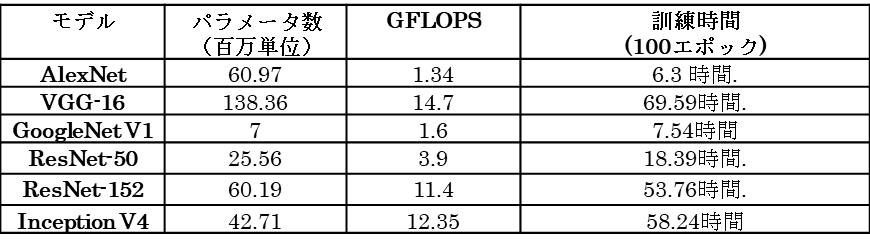
Table 2
いくつかの実装において、図11の簡略ブロック図1100によって示されるように、機械学習ベースの不可逆インター‐イントラフレームトランスコーダ1035は、標準コーデック(JPEG2000、m-jpeg、mpeg4および可逆mpeg4s)、また、高度機械学習ベース超圧縮を使用して、同時データ圧縮を実行できる。この方式のデータ圧縮は、数ある例示的な使用および例示的な潜在的利点の中でも特に、キャプチャされたイメージを異なるプロファイル(例えば、ビットレート、フレームレート、および転送エラー制限)にトランスコードすることを助け得る。例えば、例として、数ある例示的な使用事例およびアプリケーションの中でも特に、車両が低帯域幅エリアを走行しているとき、現在のネットワーク効率を改善するために、高プロファイル、低圧縮ストリームが延期され得る。
In some implementations, the machine learning-based
図12および図13の簡略ブロック図1200、1300によって示されるように、機械学習ベースのイベントまたはシナリオ検出エンジン(例えば1040)は更に、自律運転システム内のデータ転送および格納を改善するために使用され得る。上で紹介したように、受動的な非制御データ収集および伝送は、非常に高価であり得る。いくつかの実装において、フィルタリングデータ収集および伝送は実質的に、機械学習イベントおよび/またはシーン分類(データ収集におけるレコメンドを表す)に基づく内部および/または外部のイベントに基づき得る。例えば、接続された車の1または複数のセンサ障害などのイベントを検出すると、外的データソース(例えば、他の接続された車、または、他のセンサデバイス)との通信が増加し得る。別の例示的なシナリオまたはイベントとして、特定のタイプの悪い天気(例えば、霧、雪、雨など)を検出すると、車両は、数ある例の中でも特に、曖昧なデータを使用すること、高分解能データを保持および使用すること、他の外部ソースからの補完データで自身のセンサデータを強化することを行わなくなり得る。そのようなイベントは、接続された自律車両の1または複数のセンサから1または複数の機械学習モデル(例えば1205)へデータを提供することによって検出され得る。例えば、図12の例に示されるように、数ある例示的な入力の中でも特に、車両を囲む外部環境の条件(例えば、天気情報、道路条件、交通状態など)を記述する、または、決定された経路計画の今後の部分に沿った環境条件を記述する(統合または外的センサからの)データ1215と共に、内部システム健全性情報1210が(例えば、1または複数の内部センサおよび/またはシステム診断モジュールから)提供され得る。機械学習モデル1205は、数ある例の中でも特に、壊れた、もしくはそうでない場合、上で説明されたものなど、損なわれたセンサ(例えば1220)、天気(例えば1225)イベント、および、通信チャネル特性(1230)(例えば、車両がイベントおよび分類モデルを使用して将来の使用のために豊富または高忠実度のデータを収集せざるを得なくなる、カバレッジが無いエリア、信頼性のない信号、または、低帯域幅無線チャネルなど)、道路条件および交通イベント(例えば1235)(車両はリアルタイムの分類およびデータ伝送を優先せざるを得なくなり得る)など、これらの入力から1または複数のタイプのイベントを決定し得る。
Simplified Blocks of FIGS. 12 and 13 Machine learning-based event or scenario detection engines (eg, 1040) are further used to improve data transfer and storage within autonomous driving systems, as shown by FIGS. 1200 and 1300. obtain. As introduced above, passive uncontrolled data acquisition and transmission can be very expensive. In some implementations, filtering data collection and transmission may be essentially based on internal and / or external events based on machine learning events and / or scene classifications (representing recommendations in data collection). For example, detecting an event such as one or more sensor failures in a connected vehicle may increase communication with an external data source (eg, another connected vehicle or other sensor device). When detecting certain types of bad weather (eg fog, snow, rain, etc.) as another exemplary scenario or event, the vehicle uses ambiguous data, among other examples, with high resolution. It may cease to retain and use data and enhance its sensor data with complementary data from other external sources. Such events can be detected by providing data from one or more sensors in a connected autonomous vehicle to one or more machine learning models (eg 1205). For example, as shown in the example of FIG. 12, among many exemplary inputs, the conditions of the external environment surrounding the vehicle (eg, weather information, road conditions, traffic conditions, etc.) are described or determined. Internal system health information 1210 (eg, one or more internal sensors and / or system diagnostic modules), along with data 1215 (from integrated or external sensors) that describe environmental conditions along with future parts of the route planning. Can be provided). The
図13の例を参照すると、簡略ブロック図1300は、接続された車両の自律運転システムに組み込まれ得る、機械学習ベースのシーン分類ブロック1305を示す。カメラデータ、レーダデータ、LIDARデータ、IMUデータ、および他のセンサデータなどの様々なセンサデータ1310が入力(例えばマルチモーダル入力)として、シーン分類が出力され得る分類モデル(例えば訓練された畳み込みニューラルネットワーク)に提供され得る。例えば、提供されたセンサ情報からのモデルは、車両が現在、特定の環境の特徴を所持するロケールにある(または、(経路計画に基づいて)すぐに到達する)と検出し得る。これらの環境的な特徴は、車両の自律運転システムによるデータ収集およびオフロードを管理することを担う、自律車両上のレコメンダシステムに影響し得る。例えば、モデル1305は、数ある例の中でも特に、車両の環境が、高い交通量および動的な条件を特徴とする都市の環境(例えば1315)、概ね静的な運転条件を特徴とする、よく訓練された高速道路(例えば1320)、概ね訓練されていない車道、および、開発中である可能性が高い自律運転サポートインフラストラクチャを特徴とする、広い平野または森林(例えば1325)であると、入力1310から決定し得る。実際、低信号地域、事故、異常障害物、または道路の閉塞など、場所ベースの特定のシーンまたはアラート(例えば1330)はまた、センサデータ1310から検出され得る。例示的なレコメンダシステムの機械学習モデルは、(例えばモデル1205からの)イベント分類および(例えばモデル1305)からのシーン分類を入力として受け付け、どれくらいの忠実度、頻度などで、センサデータを収集およびオフロードするかどうか、およびその方式を決定し得る。例えば、自律運転システムの意思決定がよりアクティブになる可能性が高いシーンおよびイベント(例えば、悪い天気の都市設定)の結果、レコメンダシステムは、数ある例の中でも特に、より高い忠実度のデータ収集、センサデータのリアルタイム分類、および、様々な外部のセンサデバイスおよびサービスとの高帯域幅の低遅延通信を指示し得る。逆の場合において、車両のセンサが完全に機能していると検出される、晴れた天気の高速道路上で、レコメンダシステムは、無数の他の例の中でも特に、センサデータの収集、処理、およびオフロードの異なる扱いを指示し得る。これは究極的に、例示的な自律車両が直面するシーンおよびイベントについて検出された要因の集合によって命令され得る。
Referring to the example of FIG. 13, simplified block FIG. 1300 shows a machine learning based
図14の簡略ブロック図1400を参照すると、自律車両の環境、および、これらの環境が車両の自律運転システムの経路計画および意思決定ロジックに対して課し得る即時の需要を考慮することに加えて、他のデバイス、車両、またはサービスとのデータの送信および受信に利用可能な通信インフラストラクチャの性質も、車両においてその瞬間に適用されるデータオフロードおよび収集ポリシーをどのように指示するか決定する上で、レコメンダシステムによって考慮され得る。例えば、レコメンドは、(例えば、いくつかの予め定義された方式(例えば、夜、駐車されたときなど)においてアップロードを受動的に実行するのでなく)同様に1または複数の機械学習モデルを活用して、アップロードを実行するのに最適な方式をインテリジェントに決定し得る、今度のデータアップロードが動的データアップロードパイプラインに従ってどのように生じるかについて、システムによって決定され得る。そのような動的な機械学習ベースのアプローチは、車両およびこれらのアップロードに使用されるネットワークインフラストラクチャの両方について、コストおよび帯域幅の大幅な節約を実現し得る。 Simplified Block of FIG. 14 Reference to FIG. 1400, in addition to considering the environment of autonomous vehicles and the immediate demand that these environments can impose on the route planning and decision-making logic of vehicle autonomous driving systems. The nature of the communication infrastructure available for sending and receiving data with other devices, vehicles, or services also determines how to direct the data offload and collection policies that apply at that moment in the vehicle. Above, it can be considered by recommender systems. For example, recommendations leverage one or more machine learning models as well (rather than passively performing uploads in some predefined fashion (eg, at night, when parked, etc.)). The system can then determine how the upcoming data upload will occur according to the dynamic data upload pipeline, which can intelligently determine the best method for performing the upload. Such a dynamic machine learning-based approach can provide significant cost and bandwidth savings for both the vehicle and the network infrastructure used to upload them.
図14の例において示されるように、いくつかの事例において、レコメンダシステムは、例えば、車両で生成された少なくともいくつかの選択された部分のセンサまたは結果データをフォグ、クラウド、またはエッジクラウドシステム(例えば、エッジコンピューティングサーバ、フォグデバイスまたは路肩ユニット)にアップロードすることによって、自律車両によるデータアップロードの方式を調整し得る。そのようなアップロードは、アップロードされるデータの量、および、利用可能性接続特性の両方に基づき得る。自律車両システムは、様々な異なる通信技術(例えば、Bluetooth(登録商標)、ミリメートル波、WiFi、セルラデータなど)を通じて、様々な異なるデバイスおよびサービスとの通信をサポートし得、更に、環境内で利用可能な検出された通信チャネル技術、および、潜在的なデータオフロードまたは共有パートナーに基づいて、オフロードの決定を行い得る(例えば、Bluetooth(登録商標)またはWiFi(登録商標)を通じて路肩ユニットに、mmWaveを通じてフォグ要素に、5Gなどを通じてエッジコンピュータサーバまたはクラウドサービスに接続する)。データ転送において消費される時間およびネットワーク帯域幅はまた、レコメンダシステム機械学習モデルによって算出されて、車両のオフロード挙動を決定する上で考慮され得る。例えば、複数の潜在的なオフロード先が利用可能であるとき、レコメンダシステムは、環境内で検出された接続特性に基づいて、複数の潜在的な選択肢から選択し得る。例えば、レコメンダは、特定のオフロード先、および、使用する特定の通信チャネルまたは技術を選択し得る。オフロードされるデータのタイプおよび依存性はまた、数ある例の中でも特に、レコメンダシステムによって考慮され得る(例えば、ミッションクリティカルデータ(例えば事故の後または間)は、マップをビルドするのに使用するために主にオフロードされるデータとは異なるように扱われる)。 As shown in the example of FIG. 14, in some cases, the recommendation system is, for example, a fog, cloud, or edge cloud system with at least some selected sensor or result data generated by the vehicle. By uploading to (eg, an edge computing server, fog device or roadside unit), the method of data upload by the autonomous vehicle may be adjusted. Such uploads may be based on both the amount of data uploaded and the availability connection characteristics. Autonomous vehicle systems can support communication with a variety of different devices and services through a variety of different communication technologies such as Bluetooth®, Millimeter Wave, WiFi, Cellular Data, etc., and can be used in the environment. Offload decisions can be made based on possible detected communication channel technologies and potential data offload or sharing partners (eg, to the roadside unit through Bluetooth® or WiFi®. Connect to fog elements through mmWave, edge computer servers or cloud services through 5G etc.). The time and network bandwidth consumed in data transfer can also be calculated by recommender system machine learning models and taken into account in determining vehicle offload behavior. For example, when multiple potential offload destinations are available, recommender systems may choose from multiple potential options based on the connection characteristics detected in the environment. For example, recommenders may select specific offload destinations and specific communication channels or techniques to use. The types and dependencies of data that are offloaded can also be considered by recommender systems, among other examples (eg, mission-critical data (eg, after or during an accident)) used to build the map. It is treated differently from the data that is primarily offloaded to do so).
図14は、例示的なレコメンダシステムがデータをオフロードするときに行い得る、様々な例のレコメンドを示す。例えば1405において、重要な時間感受性データが(例えばエッジデバイスまたは別の車両(例えば110)へ)オフロードされるが、高帯域幅データ経路が検出されないとき、レコメンダシステムによって適用される機械学習モデルは、車両105によって検出される抽象的な障害物の座標を単に記述するなど、低分解能フォーマットのデータ(例えば1425)を送信するというレコメンドを生じさせ得る。車両105がオフロードするデータを有するが、部分的な帯域幅条件のみが検出される(1410)別の例において、レコメンダシステムは、前処理された低帯域幅フォーマット(例えば1430)のデータをローカルフォグシステムにオフロードすることを決定し得る(例えば1420)。フォグリソース1420は次に、このデータを他のデバイス(例えば車110)に、または、(例えば後の時間に)提供する車両105に利用可能にし得る。更に別の例において、(例えば、数ある例の中でも特に、車両がまた、(例えば高速道路運転中、駐車中などに)ネットワーク通信および計算リソースがキャパシティを有する条件において運転していることが検出され、全分解能データでクラウドベースのバックエンドシステム(例えば150)への直接的なオフロードが実行され得る(例えば1435)とき)低遅延、高帯域幅チャネルが検出され得る。
FIG. 14 shows various example recommendations that an exemplary recommender system can make when offloading data. For example, in 1405, a machine learning model applied by a recommender system when important time-sensitive data is offloaded (eg to an edge device or another vehicle (eg 110)) but no high bandwidth data path is detected. Can generate recommendations for transmitting low resolution format data (eg 1425), such as simply describing the coordinates of an abstract obstacle detected by the
車両が自律的に機能するのに必要な機能のすべては、車載コンピューティングシステムを通じてネイティブに提供され得るが(そして、必要なとき、周期的な通信を通じて、有線または無線の家庭またはガレージベースのネットワーク接続を介して更新される)、無線通信技術および速度が発展するにつれて、いくつかの自律車両実装は、外的データからの通信および計算リソース(例えば、車両の外部、または、車両にネイティブに統合されない)により重く依存し得る。例えば、5Gキャリアネットワークの出現および4G LTEカバレッジの拡大に伴い、接続された自律車両および車両-エブリシング(V2X)システムの実装が、より即時に実現可能になる。例えば、安全性を特に考慮して、車の外部のシステムを使用して、インテリジェンスの強化およびクラウドソースの両方を提供し、また、リアルタイムの高信頼性アプリケーションなどを通じて冗長性を提供することにより、車両の自律運転システムを通じてネイティブに提供される安全性が補完、拡張、および強化され得る。 All of the functionality required for a vehicle to function autonomously can be provided natively through an in-vehicle computing system (and, when needed, through periodic communication, a wired or wireless home or garage-based network. As wireless communication technologies and speeds evolve (updated via connectivity), some autonomous vehicle implementations integrate communication and computing resources from external data (eg, external to the vehicle or natively into the vehicle). Can be more heavily dependent. For example, with the advent of 5G carrier networks and the expansion of 4G LTE coverage, the implementation of connected autonomous vehicles and vehicle-everything (V2X) systems will become more immediate. For example, with special consideration for safety, by using a system outside the vehicle to provide both intelligence enhancement and crowd source, and by providing redundancy through real-time, reliable applications and the like. The safety provided natively through the vehicle's autonomous driving system can be complemented, extended, and enhanced.
自律車両は、外部コンピューティングシステムと通信して指示され得る。そのような制御は、無線(OTA)更新のプッシュなどの低いレベルの制御を含み得る。これにより、車両は、リモート制御/メンテナンスセンタ(例えば、車両または自律運転システムの相手先商標製造会社(OEM)またはプロバイダに属する)からソフトウェアおよび/またはファームウェア更新を受信できる(例えば、車両をメンテナンスセンタに持っていき技師が手動でそれを行うこととは対照的である)。他のより高い制御アプリケーションにおいて、自律車両の完全な制御は、外部コンピューティングシステム、または、リモートコンピューティング端末上のリモートユーザ/仮想運転者へハンドオーバされ得る。例えば、そのようなリモート制御は、例えば、自律車両から車内の乗員へ制御のハンドオーバが実現可能でない、または望ましくないときに、オンデマンドの「リモートバレット」サービスとして提供され得、自律運転システムがルートの特定の部分を正確に、効率的に、または安全にナビゲートするのに苦労している車両を支援し、または、停車イベント、もしくは、そうでない場合、動かない自律車両を支援する。 The autonomous vehicle can be directed by communicating with an external computing system. Such controls may include low levels of control such as push of radio (OTA) updates. This allows the vehicle to receive software and / or firmware updates from a remote control / maintenance center (eg, belonging to the vehicle or the original equipment manufacturer (OEM) or provider of the autonomous driving system) (eg, the vehicle maintenance center). This is in contrast to the technician who takes it to and does it manually). In other higher control applications, full control of the autonomous vehicle may be handed over to an external computing system, or a remote user / virtual driver on a remote computing terminal. For example, such remote control may be provided as an on-demand "remote bullet" service, for example, when control handover from an autonomous vehicle to an in-vehicle occupant is not feasible or desirable, and the autonomous driving system is routed. Assist vehicles that are struggling to navigate accurately, efficiently, or safely in a particular part of the vehicle, or assist a stop event, or otherwise an autonomous vehicle that does not move.
いくつかの実装において、自律車両がどのように確実かつ安全に扱うか知らない状況またはイベントに自律車両が遭遇するとき、車両は、停車イベントを開始するようにプログラミングされ得、このとき、自律運転システムは、車道から(例えば道路の路肩、または、駐車空間などへ)外れるように車両を直接する。将来、車道でより多くの数の自律車両が見られるようになったとき、1つの自律車両に停車を開始させるイベントは、他の近隣の自律車両に同様に影響することがあり得、複数の停車が追加の渋滞および車道の立ち往生を引き起こす可能性を生じさせ、車道、および、これらの車道上の自律運転を麻痺させる可能性がある。いくつかの事例は、自律運転システムから人間の乗員へのハンドオーバイベントを許可して、停車を引き起こす状況をナビゲートし得るが、他の実装において、数ある例示的な状況および実装の中でも特に、(例えば、車両に乗員がいないとき(例えば、ドローン車両、リモート呼び出し機能を使用する乗員に向かっている車両など))リモートバレットサービスがトリガされ得る。 In some implementations, when an autonomous vehicle encounters a situation or event that does not know how to handle it reliably and safely, the vehicle may be programmed to initiate a stop event, in which case autonomous driving. The system directs the vehicle off the roadway (eg, to the shoulder of the road, or to a parking space, etc.). In the future, when more autonomous vehicles are seen on the roadway, an event that causes one autonomous vehicle to start stopping can affect other nearby autonomous vehicles as well, and more than one. Stops can cause additional congestion and roadway stalling, which can paralyze roadways and autonomous driving on these roadways. In some cases, autonomous driving systems can allow handover events to human occupants to navigate situations that cause a stop, but in other implementations, among other exemplary situations and implementations, among others. The remote bullet service can be triggered (eg, when the vehicle is unoccupied (eg, a drone vehicle, a vehicle heading towards an occupant using the remote call feature, etc.)).
上記によれば、自律車両のいくつかの実装は、リモートバレットモードをサポートし得、車両の運転が(車両の自律運転システムから)ハンドオフされること、および、ネットワークを介してリモートコンピューティングシステムによって制御されることを可能にする。例えば、自律車両のリモート制御は、扱うことができない状況(例えば、機能していないセンサ、車両にとって未知である新しい道路状況、車載システムが判断できない、など)に直面したとき、自律車両によってオンデマンドでトリガされ得る。そのようなリモート制御はまた、車両がリモート制御を要求する緊急事態の状況において車両に提供され得る。リモートバレットサービスは、車両をリモートに制御するように操作されるユーザエンドポイントシステムを提供された制御およびメンテナンスセンタにおいてリモートに座っている人間を伴い得る。そのようなシステムは、それ自体またはその環境の行動可能な情報が欠けていることにより操縦できないことに起因して自律車両が停車し得る、または、動かないままであり得るエッジケースを軽減するために使用され得る。リモートバレットシステムはまた、(例えば、車両によってナビゲートされている車道の表示を提供するため、車両のシステムステータス、車両の乗員ステータスに関する情報を提供するために、など)情報を自律システムから受信する機能を装備され得るが、それにもかかわらず、車両の自律運転システムから独立して機能し得る。そのような独立は、使用事例、数ある例示的な利点および実装の中でも特に、自律車両における完全または重大なセンサ障害の条件においても、リモートバレットサービスがそれ自体で機能することを可能にし得る。 According to the above, some implementations of autonomous vehicles may support remote bullet mode, the driving of the vehicle is handed off (from the vehicle's autonomous driving system), and by the remote computing system over the network. Allows you to be controlled. For example, remote control of an autonomous vehicle is on-demand by the autonomous vehicle when faced with unmanageable situations (eg, non-functional sensors, new road conditions unknown to the vehicle, in-vehicle systems unable to determine, etc.). Can be triggered by. Such remote control may also be provided to the vehicle in an emergency situation where the vehicle requires remote control. The remote bullet service may involve a person sitting remotely in a control and maintenance center provided with a user endpoint system operated to control the vehicle remotely. Such systems mitigate edge cases where autonomous vehicles can stop or remain stationary due to inability to steer due to lack of actionable information about themselves or their environment. Can be used for. The remote bullet system also receives information from the autonomous system (eg, to provide an indication of the roadway being navigated by the vehicle, to provide information about the vehicle's system status, vehicle occupant status, etc.). It can be equipped with features, but nevertheless can function independently of the vehicle's autonomous driving system. Such independence may allow the remote bullet service to function on its own, even in conditions of complete or severe sensor failure in autonomous vehicles, among other use cases, a number of exemplary advantages and implementations.
例えば、図15の簡略ブロック図1500に示されるように、自律車両105は、様々センサ(例えば920、925、930など)および自律運転ロジックを含み、自律車両が様々な環境において自己運転することを可能にし得る。上で紹介されたように、いくつかの事例において、車両105の自律運転システムが経路計画におけるルートの一部を確実に、望ましく、または安全にナビゲートできないことが自律車両によって(または、自律車両内の乗員の要求で)決定され得る。自律車両105は、1または複数のネットワーク(例えば155)とインタフェース接続する通信能力を含み、車両105と、リモートバレットサービス1505を実装する1または複数のコンピューティングシステムとの間でデータが交換されることを可能にし得る。リモートバレットサービス1505は、複数のユーザ端末デバイスを提供し得る。これにより、仮想運転者ユーザが、車両上のセンサ(例えば920、925、930など)または他のデバイス(例えば道路路肩システム(例えば130)、空中または地上ベースのドローン(例えば180)、および、更には他の近隣の車両からのセンサ)上のセンサ(例えば175)から提供されるセンサデータ(例えば、カメラビューまたは他のセンサ情報)に基づいて、車両105の周りの条件を観察することが可能になり得る。仮想運転者は次に、リモートバレット端末に入力を提供し、対応する低遅延、高優先度データを車両105に(ネットワーク155を介して)通信し、車両105のステアリング、加速およびブレーキを制御し得る。
For example, as shown in the simplified block FIG. 1500 of FIG. 15, the
いくつかの事例において、車両105は、制御の介在、および、リモートバレットサービス1505へのハンドオーバを自動的に要求し得る。いくつかの場合、この要求は応答性であり得る(例えば、停車イベント、センサ停止、または緊急事態に応答する)が、他の場合において、(ルート上の先の条件を考慮して、停車イベントまたは他の困難が生じる可能性があるという予測に基づいて)先制的にリモートバレットサービス1505に車両の制御をテイクオーバさせるための要求が送信され得る。車両105は、それ自体のセンサ(例えば920、925、930など)からのセンサデータ、ならびに、他のセンサおよびデバイス(例えば130、180など)からのデータ、ならびに、バックエンド自律運転サポートサービス(例えば、クラウドベースのサービス150)を活用して、制御がリモートバレットサービス1505にハンドオーバされるべき条件であると、1または複数の機械学習モデルを使用して決定し得る。
In some cases, the
いくつかの場合において、複数の異なる自律車両のいずれか1つによって活用され得る複数のリモートバレットサービスが存在し得る。実際、複数の自律車両は同時に、単一のリモートバレットサービスに接続され、制御され得る(例えば、異なるリモートの運転者が各車両をそれぞれ誘導する)。いくつかの場合において、1つのリモートバレットサービスは、別のものより多くの利用可能性を宣伝し得る。いくつかの場合において、リモートバレットサービスの品質レーティングは維持され得る。更に他の場合において、複数の異なるリモートバレットサービスの各々のリアルタイム接続条件を識別するために、接続品質および速度情報が維持され得る。従って、リモートハンドオーバが必要である、または可能性が高いことを検出することに加えて、自律車両(例えば105)はまた、そのような入力を考慮して、潜在的な多くの利用可能な代替的リモートバレットサービスのどれが使用および要求され得るかを決定し得る。いくつかの実装において、車両がリモートバレットサービスの特定の1つに関連付けられる事例など(例えば、数ある考慮の中でも特に、特定のプロバイダからのリモートバレットサービスについてのアクティブなサブスクリプションにより、リモートバレットサービスは車の製造者または自律運転システムに関連付けられる)、選択は単純である。 In some cases, there may be multiple remote bullet services that can be utilized by any one of a plurality of different autonomous vehicles. In fact, multiple autonomous vehicles can be connected to and controlled by a single remote bullet service at the same time (eg, different remote drivers guide each vehicle individually). In some cases, one remote bullet service may advertise more availability than another. In some cases, the quality rating of the remote bullet service may be maintained. In yet other cases, connection quality and speed information may be maintained to identify the real-time connection conditions of each of the different remote bullet services. Therefore, in addition to detecting that remote handover is necessary or likely, autonomous vehicles (eg 105) also take into account such inputs and have many potential available alternatives. Can determine which of the target remote bullet services can be used and requested. In some implementations, such as when a vehicle is associated with a particular one of the remote bullet services (eg, with an active subscription to the remote bullet service from a particular provider, among other considerations). Is associated with the car manufacturer or autonomous driving system), the choice is simple.
加えて、リモートバレットサービスはまた、(例えば、ハンドオーバのために要求に含まれる情報、ハンドオーバまたはリモート制御などに関連して受信されるセンサデータから集められた情報からの)リモートバレットサービスによって検出された様々な属性に基づいて、サービスを個々の自律車両(例えば105)およびそれらの所有者および乗員に合わせて適合し得る。例えば、数ある例示的な考慮の中でも特に、制御されている車両の型およびモデル、車両の自律運転システムのバージョンおよび実装、車両上のどのセンサが動作可能で信頼できるままであるか、ハンドオフを促進する特定の条件(例えば、専門のリモート運転者が、難しいコーナーケースから脱するように車両のトラブル対応およびナビゲートの支援を要求される)に基づいて、適合された運転支援ユーザインタフェースおよび制御がリモートバレットサービスの仮想運転者に提供および提示され得る。 In addition, the remote bullet service is also detected by the remote bullet service (eg, from information gathered from sensor data received in connection with the information contained in the request for the handover, handover or remote control, etc.). Based on various attributes, the service may be tailored to individual autonomous vehicles (eg 105) and their owners and occupants. For example, among other exemplary considerations, the type and model of the vehicle being controlled, the version and implementation of the vehicle's autonomous driving system, which sensors on the vehicle remain operational and reliable, and handoffs. Tailored driving assistance user interface and control based on specific conditions to facilitate (eg, professional remote drivers are required to assist in vehicle troubleshooting and navigation to get out of difficult corner cases). Can be provided and presented to the virtual driver of the remote bullet service.
いくつかの実装において、リモートバレットサービスは、政府機関を通じて公共サービスとして提供され得る。他の実装において、リモートバレットサービスは、民間部門の商業的事業として提供され得る。従って、所与の車両(例えば105)の行程に関連して提供されるリモートバレットサービスに関連して、メトリクスが自動的に収集され得、提供されるリモートバレットサービスを説明するために、対応するデータが(例えば、車両(例えば105)およびリモートバレットシステム1505のいずれかまたは両方のセンサまたはモニタによって)生成される。そのようなメトリクスおよびデータは、リモートバレットサービスのそのような特性を、数あるメトリクスの中でも特に、リモートバレットサービスをトリガする条件の重大度(例えば、より難しい問題は、より高いリモートバレットサービスの手数料を有する)、リモートバレットサービス制御下で運転されたマイル数、リモートバレットサービス制御下の時間、リモートバレットサービスを促進するために使用される特定の仮想運転者およびツール、センサ(例えば920、935、930)に対して外的である、リモートバレットサービスによって使用される外的データのソースおよび量(例えば、ソース(例えば175、180)に要求され収集されたデータの量)として記述し得る。これらは、そのサービスについてリモート仮想サービスによって請求される手数料を決定するために考慮および使用され得る。いくつかの場合において、手数料は、車両の所有者、車両製造業者、車両保証プロバイダ、車両の自律運転システムのプロバイダなどによって払われ得る、または、その間で分割され得る。いくつかの場合において、リモートバレットサービスの請求の責任は、ハンドオーバ要求に関連して生成されたデータから自動的に決定され得る。これにより、数ある例示的な実装の中でも特に、どの当事者が、どの量のリモートバレットサービス手数料を担うかを決定する。
In some implementations, remote bullet services may be provided as public services through government agencies. In other implementations, remote bullet services may be offered as a private sector commercial enterprise. Thus, in connection with the remote bullet service provided in connection with the stroke of a given vehicle (eg 105), metrics may be automatically collected and accommodated to account for the remote bullet service provided. Data is generated (eg, by sensors or monitors of either or both of the vehicle (eg 105) and the remote bullet system 1505). Such metrics and data make such a characteristic of the remote bullet service, among other metrics, the severity of the condition that triggers the remote bullet service (eg, the more difficult problem is the higher fee for the remote bullet service). The number of miles driven under the control of the remote bullet service, the time under the control of the remote bullet service, specific virtual drivers and tools used to promote the remote bullet service, sensors (
リモートバレットサービスへのハンドオーバ要求に関連して生成されるデータ、および、所与の行程で車両に提供されるリモートバレットサービスを記録するために生成されるデータが収集され、リモートバレットサービス(例えば1505)のシステム(例えば1510)上、または、クラウドベースのサービス(例えば150)に維持され得る。これらは、数ある例示的な使用の中でも特に、リモートバレットサービスの結果を集約してクラウドソースして、将来のリモートバレットサービスのプロビジョニング、および、自己運転してリモートバレットサービスを要求するために車両が利用する自律運転モデルの両方を改善し得る。 The data generated in connection with the handover request to the remote bullet service and the data generated to record the remote bullet service provided to the vehicle in a given stroke are collected and the remote bullet service (eg 1505) is collected. ) Can be maintained on a system (eg 1510) or on a cloud-based service (eg 150). These are vehicles for aggregating and crowdsource remote bullet service results, provisioning future remote bullet services, and self-driving to request remote bullet services, among other exemplary uses. Can improve both of the autonomous driving models used by.
図16を参照すると、例示的なリモートバレットサービスの配信中のシステム間の通信を示す簡略ブロック図1600が示される。例えば、ハンドオーバ要求1610が、車両(105)(例えば、その自律運転システムのリモートバレットサポートブロック(例えば1605)から、ネットワークを介して、(1または複数のリモートバレットサービスシステム(例えば1505)を通じて提供される)リモートバレットサービスを提供または仲介しているコンピューティングシステムへ送信され得る。他の事例において、(例えば、自律車両105に対して外的な)信用されるサードパーティシステムは、車両105が支援を必要としていることを(例えば、車両を伴う交通をモニタリングする様々なデバイスからのセンサデータのアンサンブルを通じて)決定し得る。いくつかの場合において、車両内の乗員は、数ある例示的な実装の中でも特に、車両105の代わりにハンドオーバ要求(例えば1605')を送信し得るサードパーティのサービスを使用して、リモートバレットサービス(例えば、クラウドベースのサービス150)を(例えば、スマートフォンアプリを通じて)トリガさせ得る。セキュアな高優先度の通信チャネル1615が、車両105とリモートバレットシステム1505との間に確立され得、リモートバレットサービスが提供されることを可能にする。例えば、車両105上のセンサによって収集されたセンサデータ(例えばカメラデータ、LIDARデータなど)が送信され得、リアルタイムに近い車両の位置およびステータスの表示、ならびに周囲の環境を提供し得る。いくつかの場合において、データは、車両105の内部センサからのデータ(例えば、数ある例示的な使用の中でも特に、車両の乗員の表示を可能にし、および/または、乗員とリモートバレットの仮想運転者との間の通信を促進する)を含み得る。リモートバレットの仮想運転者は、車両105のライブ条件を記述する、それらが受信する情報に応答し、それらの端末において制御を使用して、チャネル1615を介して車両へ送信され得る運転命令データを生成し、車両105の運転オペレーションをリモート制御し得る。リモートバレットサービスはまた、(例えば、車両105から受信されるものに加えて)路肩ユニット、他の車両、ドローン、および他のセンサデバイスなどの外的ソースから補完データを取得し得る。そのような情報は、1または複数のバックエンドシステム(例えば150)を通じて促進される高優先度チャネル(例えば1620)を介して提供され得る。いくつかの実装において、リモートバレットシステム1505は、車両105の場所から、センサのセット(リモートバレットの運転者の制御下で経路に沿って車両が移動するにつれて動的に変化し得る)を決定し得る。これにより、リモートバレットシステムは、別のセキュアなチャネル(例えば1620)を確立し、リモートバレットシステムによって制御されている車両の周りのシーンを記述するライブデータを取得し得る。従って、いくつかの実装において、リモートバレットサービスは、制御されている車両105上の、または、それに対して外的なセンサのいずれかまたは両方のセンサデータを使用し得る。
Referring to FIG. 16, a simplified block diagram 1600 showing communication between systems during delivery of an exemplary remote bullet service is shown. For example, a
上記のように、いくつかの実装において、自律車両は、支援のためのリモートバレットサービスを呼び出すべきときの事例を検出し得る。いくつかの場合において、この決定は、1または複数のバックエンドサービス(例えば150)によって支援され得る。いくつかの実装において、車両は、ハンドオーバ要求を促進した条件(例えば1610)を記述するそのようなサービス150へ(または他のクラウドベースシステム、レポジトリおよびサービスへ)データを提供し得る。車両は更に、リモートバレットシステムの性能を説明する(例えば、リモートバレットによって取られる操縦または経路を説明する、サービスに対する乗員満足度を説明する、など)レポートを(サービスの後または間に)提供し得る。そのようなレポートデータ(例えば1630)は、機械学習モデルを訓練する、および、そうでない場合、バックエンドまたはクラウドベースシステム(例えば150)によって提供されるサービスを強化するために後に使用され得る。洞察および改善されたモデルがシステム150によって導出され、次に、車両の自律運転システム(およびリモートバレットサポートロジック1605)と共有され得る。いくつかの場合において、自律車両は、リモートバレットの操縦および反応を説明する情報を記録し、これを使用して、それ自体の自律運転機械学習モデルにおいて使用されるモデルを更に訓練および改善し得る。同様に、本明細書において説明されるものなど、数ある例示的な使用の中でも特に、レポートデータ(例えば1620を通じた)が、リモートバレットシステム1505からクラウドベースのサービスへ、または車両へ提供され、車両(および他の車両)の自律運転ロジックおよびハンドオーバ要求を強化するのに使用され得る。
As mentioned above, in some implementations, the autonomous vehicle may detect when the remote bullet service for assistance should be called. In some cases, this decision may be assisted by one or more backend services (eg 150). In some implementations, the vehicle may provide data to such a service 150 (or to other cloud-based systems, repositories and services) that describes the conditions that facilitated the handover request (eg 1610). The vehicle also provides reports (after or during service) that explain the performance of the remote bullet system (eg, explain the maneuvers or routes taken by the remote bullet, explain occupant satisfaction with the service, etc.). obtain. Such report data (eg 1630) can be used later to train machine learning models and, if not, to enhance the services provided by backends or cloud-based systems (eg 150). Insights and improved models can be derived by
説明のための例として、自律車両(例えば105)は、車両の自律運転システムは、ルートに沿って運転している間に特定の状況を扱うことができないと自律的に決定し得る(または、乗員のフィードバック、または、公安官によって受信もしくはレポートされるフィードバックなどに基づいて決定する)。従って、リモートバレットサービスがトリガされ得る。いくつかの場合、道路の区間に問題があるという予測に基づいて、道路の今後の区間の前に、リモートバレットサービスがコンタクトされ得る。いくつかの実装において、ハンドオフ要求は、(図5の例において説明されるものなどの)自律運転パイプラインにおける経路計画フェーズを実装する自律運転システムロジックを補完するロジックのブロックによって実行され得る。いくつかの事例において、リモートバレットハンドオフ要求がリモートバレットシステムへ発行されると、テレマティクス制御ユニット(TCU)などの自律車両上の通信モジュールが、リモートバレットサービスに接続するために使用され得る。いくつかの実装において、TCUの製造フェーズ中に指定される(緊急事態呼び出しと同様の)緊急事態サービスとの通信として、リモートバレットサービス通信が確立され得る。このハンドオフ要求において、車両場所が提供され得る。いくつかの実装において、ハンドオフ要求およびリモートバレットサービスが、OEMによって提供される呼び出し/制御センタにおいて実装され得る。ここで、「リモートバレット」を扱う人間仮想運転者がアクションを行う。いくつかの実装において、車両とリモートバレットサービスとの間に接続が確立されたことに応答して、リモートバレットは要求を車両へ送信し、すべてのカメラからのビデオをストリーミングし、周囲をリアルタイムで表示するようにし得る。同じ場所における他のセンサ(例えば道路カメラおよび路肩センサ)も識別され得、データ(例えば追加のストリーミングビデオ)を提供し、車両から受信された情報を補完する。車両からストリーミングされた(および、場合によってはまた、補完的ソース(例えば道路カメラ)からの)ビデオを通じてリモートバレットにほぼリアルタイムで表示される車両の周囲および道路条件の表示に基づいて、リモートバレットは、車両を制御して、車両を目的地まで運転する(プレーヤが車のビューを見て、ハンドル、ハンドヘルドコントローラなどを用いて運転および制御する没入型ビデオゲームと同様である)。いくつかの場合において、目的地は、問題が小さいと決定されたルートの次の区間に対応し得る。この地点において、制御が自律運転システムに戻され、標準の自律運転モードにおいて車両の運転が制御され得る。他の場合において、元のハンドオフ要求の環境および検出された特性に基づいて、リモートバレットサービスは、車両において検出された問題に対処する装備があると識別された特定の目的地へ車両を誘導し得る(使用事例の数ある例の中でも特に、損なわれたセンサまたは自律運転システムを有する車両をもっとも近いサービスセンタへ運転する、または、病気もしくは怪我を有する乗員がいる車両を病院へ運転するなど)。 As an example for illustration, an autonomous vehicle (eg 105) may autonomously determine (or) that the vehicle's autonomous driving system is unable to handle a particular situation while driving along the route. Determined based on occupant feedback or feedback received or reported by public security officers). Therefore, the remote bullet service can be triggered. In some cases, remote bullet services may be contacted prior to future sections of the road, based on the prediction that there is a problem with the section of the road. In some implementations, the handoff request can be performed by a block of logic that complements the autonomous driving system logic that implements the routing phase in the autonomous driving pipeline (such as that illustrated in the example of FIG. 5). In some cases, when a remote bullet handoff request is issued to a remote bullet system, a communication module on an autonomous vehicle, such as a telematics control unit (TCU), may be used to connect to the remote bullet service. In some implementations, remote bullet service communication may be established as communication with an emergency service (similar to an emergency call) specified during the manufacturing phase of the TCU. A vehicle location may be provided in this handoff request. In some implementations, handoff requests and remote bullet services may be implemented in the call / control center provided by the OEM. Here, the human virtual driver who handles the "remote bullet" takes action. In some implementations, in response to an established connection between the vehicle and the remote bullet service, the remote bullet sends a request to the vehicle, streams video from all cameras, and surrounds it in real time. Can be displayed. Other sensors at the same location (eg road cameras and shoulder sensors) can also be identified and provide data (eg additional streaming video) to complement the information received from the vehicle. The remote valet is based on a near real-time display of the vehicle's surroundings and road conditions through video streamed from the vehicle (and in some cases also from a complementary source (eg, a road camera)). , Control the vehicle and drive it to its destination (similar to an immersive video game where the player sees the view of the vehicle and drives and controls it using the steering wheel, handheld controller, etc.). In some cases, the destination may correspond to the next section of the route determined to be less problematic. At this point, control is returned to the autonomous driving system and the driving of the vehicle can be controlled in standard autonomous driving modes. In other cases, based on the environment and detected characteristics of the original handoff request, the remote bullet service directs the vehicle to a specific destination identified as having equipment to address the problem detected in the vehicle. Get (especially driving a vehicle with a damaged sensor or autonomous driving system to the nearest service center, or driving a vehicle with a sick or injured occupant to a hospital, among other examples of use cases) ..
上記のように、いくつかの実装において、車両の自律運転システムは、他のリモートセンサデバイス(例えば他の自律車両、ドローン、路肩ユニット、天気モニタなど)によって収集されたデータにアクセスし、道路の今後の区間のあり得る条件を先制的に決定し得る。いくつかの場合において、様々なセンサは、データをクラウドベースシステムに提供し、この一群のデータを集約および処理して、車道の区間およびこれらのルートに影響する条件に関する情報を複数の自律車両に提供し得る。上記のように、いくつかの場合において、クラウドベースシステムおよび他のシステムは、以前の停車およびリモートバレットハンドオーバのイベントに関連付けられた入力を受信し得、これらのイベントに共通する特性を検出し得る。いくつかの実装において、機械学習モデルは、この情報からビルドおよび訓練され得、そのような機械学習モデルは、路肩ユニット、クラウドベースサポートシステム、リモートバレットコンピューティングシステム、または自律車両の車載システム自体に配備され、実行され得、潜在的なリモートバレットハンドオフを予測的に決定するためのロジックを提供する。例えば、所与の自律車両によってアクセスされるセンサデータを通じて、車両は、頻繁な停車が発生した、および/または、リモートバレットハンドオフが一般的である、各道路沿いのエリアを事前に決定し得る。いくつかの事例において、自律車両は、(例えば、対応する機械学習モデルから)道路の今後の区間についてレポートされる条件が、停車および/またはリモートバレットハンドオーバの可能性(停車およびハンドオーバが、道路のその特定の区間で以前に発生しなかった場合でも)を提示することを決定し得る。自律車両は、そのような情報を使用して、車内の運転者またはリモートバレットサービスへのハンドオーバのための準備をするために、先制的に措置を講じ得る。いくつかの場合において、自律車両は、(例えば、リモートバレットをサポートできる通信リソースの利用不可能性、好ましいバレットサービスについてのレポートの利用可能性の欠如、可能な場合にリモートバレットを回避する旨を要求するユーザプリファレンスの検出などにも基づいて)経路計画を変更して、前方の道路の厄介な区間を回避することを判断し得る。いくつかの実装において、自律車両のディスプレイは、今後の予測される問題、ならびに、停車および/またはリモートバレットハンドオーバの可能性に関する警告または命令を車載の乗員に提示し得る。いくつかの場合において、この情報は、インタラクティブなディスプレイに提示され得る。乗員はこれを用いて、乗員へのハンドオーバ、リモートバレットサービスへのハンドオーバ、代替的ルートの選択または停車イベントのいずれかを通じて、今後の行程区間を処理するためのプリファレンスを登録し得る。更に他の実装において、数ある例示的な実装の中でも特に、道路の厄介な区間を反映するクラウドベースの知識は、道路標識または車載道路マップに通信され得、問題のある区間を運転者および他の自律車両に示す。 As mentioned above, in some implementations, the vehicle's autonomous driving system has access to data collected by other remote sensor devices (eg, other autonomous vehicles, drones, shoulder units, weather monitors, etc.) on the road. Possible conditions for future sections can be determined preemptively. In some cases, various sensors provide data to cloud-based systems, aggregating and processing this set of data to provide information about roadway sections and conditions affecting these routes to multiple autonomous vehicles. Can be provided. As mentioned above, in some cases cloud-based systems and other systems may receive inputs associated with previous stop and remote bullet handover events and detect characteristics common to these events. .. In some implementations, machine learning models can be built and trained from this information, such as machine learning models on roadside units, cloud-based support systems, remote bullet computing systems, or on-board systems of autonomous vehicles themselves. It provides the logic to predictively determine potential remote bullet handoffs that can be deployed and executed. For example, through sensor data accessed by a given autonomous vehicle, the vehicle may predetermine the area along each road where frequent stops have occurred and / or remote bullet handoffs are common. In some cases, autonomous vehicles have the possibility of a stop and / or remote bullet handover (stop and handover of the road) that the conditions reported for future sections of the road (eg, from the corresponding machine learning model). It may be decided to present (even if it did not occur previously in that particular section). Autonomous vehicles may use such information to take preemptive steps to prepare for handover to the in-vehicle driver or remote bullet service. In some cases, autonomous vehicles (eg, availability of communication resources capable of supporting remote bullets, lack of availability of reports on preferred bullet services, avoiding remote bullets when possible). It may be possible to modify the route plan (based on the detection of the required user preferences, etc.) to determine to avoid annoying sections of the road ahead. In some implementations, the display of the autonomous vehicle may present to the in-vehicle occupants warnings or instructions regarding future prospective problems and the possibility of a stop and / or remote bullet handover. In some cases, this information may be presented on an interactive display. Crew members may use this to create preferences for processing future travel sections, either through a handover to a occupant, a handover to a remote bullet service, an alternative route selection, or a stop event. In yet other implementations, cloud-based knowledge that reflects awkward sections of the road, among other exemplary implementations, can be communicated to road signs or in-vehicle road maps to drive problematic sections and others. Shown in the autonomous vehicle.
図17を参照すると、停車イベントリスクおよび道路条件の警告に関連する情報の協調的レポートを示す簡略ブロック図1700が示される。これらは更に、リモートバレットサービスを開始して、そのような危険で難しいシナリオにおいて自律車両を支援するために活用され得る。例えば、停車要求および/またはリモートバレットイベントについての情報が、影響を受ける車両および/または周囲のセンサデバイスによって収集され得、この情報は、自律運転システムを強化するために共有および活用され得る。図17の例において、停車またはハンドオフが発生するとき、影響を受ける車両(例えば105)は、このイベントに関連して生成および収集されたデータを組み立て得、この情報をクラウドベースのサポートシステム(例えば150)および/または、路肩ユニットもしくはエッジコンピュータ(またはエッジクラウド)サーバ(例えば140)などのエッジデバイスと共有し得る。 Referring to FIG. 17, a simplified block diagram 1700 showing a coordinated report of information related to stop event risk and road condition warnings is shown. These can also be leveraged to launch remote bullet services to assist autonomous vehicles in such dangerous and difficult scenarios. For example, information about stop requests and / or remote bullet events may be collected by the affected vehicle and / or surrounding sensor devices, and this information may be shared and utilized to enhance autonomous driving systems. In the example of FIG. 17, when a stop or handoff occurs, the affected vehicle (eg 105) may assemble the data generated and collected in connection with this event and use this information in a cloud-based support system (eg, eg 105). 150) and / or may be shared with edge devices such as shoulder units or edge computer (or edge cloud) servers (eg 140).
図18は、様々な車両センサ(例えば920、925)、リモートバレットサービスを提供可能なシステムへのハンドオフ要求をトリガおよび生成することをサポートするための、人工知能/機械学習ベースの自律運転スタック515、およびロジック(例えば1805)を備え得る、例示的な自律車両105の特徴を示す簡略ブロック図1800を示す。ハンドオフ要求を送信し得、車両105と、リモートバレットサービスを提供する仮想運転者端末との間で通信を確立するためのテレマティクス制御ユニット(TCU)1810が提供され得る。
FIG. 18 shows an artificial intelligence / machine learning based
自律運転エンジン(例えば515)が停車イベントを決定するとき、または、リモートバレットサポートロジック(例えば1805)が、ハンドオフ要求を送信するべきと決定するとき、車両場所および停車場所を様々クラウドベースエンティティ(または単一エンティティ、または、この情報を複数のエンティティまたはサービスに配布するゲートウェイ)へ送信するための信号がTCU1810へ送信され得る。実際、多くの異なるサービスは、そのような情報を使用し得る。例えば、一例において、クラウドベースのアプリケーション1715(例えば、車両OEMに関連付けられる)は、この情報の主な対象または受信先であり得る、この情報の一部を他の受信先に配布し得る。他の事例において、車両105自体が複数の異なるクラウドベースのアプリケーション(例えば、受信先あたり1つのアプリケーション)データを提供および配布し得る。例えば、OEMメンテナンスアプリケーション(例えば1720)は、停車またはハンドオフ情報を利用し得、それを、車両(およびそのモデル)が自律運転を扱うことができないコーナーケースの診断および識別に使用し得る。いくつかの例において、停車またはハンドオフ情報の受信先は、従来のナビゲーションマップ、3Dマップ、高分解能(HD)マップなどのプロバイダを含む、マップアプリケーションプロバイダ(例えば1725、1726)を含み得る。当該プロバイダは、車両から直接的に、または、車両から直接的に情報を受信するOEMを通じて、専用クラウドアプリを通じてこの情報を受信できる。マッププロバイダは、停車イベント、および、難しい自律運転条件の傾向があるエリア上の情報をマップに入力することを助けることができる統計のために、停車およびハンドオフ情報を活用し得、この情報は、継続的に更新され得る。更に、HDマップは、数ある例の中でも特に、そのような情報を、HDマップが提供する道路区間ごとの高精度情報の一部として組み込み得る。地方自治体、政府機関、有料道路プロバイダ、および他のインフラストラクチャ企業および管理団体(例えば1730)も停車およびハンドオフ情報の受信先であり得る(例えば、数ある例の中でも特に、車両105から直接的に、別のアプリケーションもしくはエンティティを通じて間接的に、または、関連付けられた路肩センサおよび路肩サポートユニットを通じてそのような情報をキャプチャすることによって受信する)。そのような機関は、この情報を、道路メンテナンスのトリガ、新しい道路およびインフラストラクチャのプロジェクトの証拠、警備、料金徴収、サイネージまたは警告の展開のトリガ、および他の使用に利用し得る。
When the autonomous driving engine (eg, 515) determines a stop event, or when the remote bullet support logic (eg, 1805) decides that a handoff request should be sent, the vehicle location and the stop location are various cloud-based entities (or). A signal for sending to a single entity, or a gateway that distributes this information to multiple entities or services) may be sent to the TCU1810. In fact, many different services may use such information. For example, in one example, a cloud-based application 1715 (eg, associated with a vehicle OEM) may distribute a portion of this information to other recipients, which may be the primary target or recipient of this information. In other cases, the
停車またはハンドオフイベントはまた、情報が車両105によって近くの路肩ユニット、車両および他のセンサデバイスと共有されることをトリガし得る。例示的な路肩ユニット(例えば140)は、この情報を活用して、例えば、受信する他のデータと共にこのデータを処理し、この情報または解析の結果を近傍の他の車両(例えば110)またはシステムと(例えば道路区間アプリケーション1735を通じて)共有し得る。例えば、路肩ユニットは、数ある例示的なアクションの中でも特に、停車イベントのリスクについて、他の車両にアラートし、インフラストラクチャにリモートバレットサービスとの通信をサポートするよう準備させ得る。路肩ユニットはまた、この情報を格納または伝達し得、その結果、関連付けられた地方自治体、メンテナンスプロバイダ、および機関は、この情報にアクセスして使用し得る(例えば、交通信号タイミングに動的に適合し、デジタルサイネージを更新し、追加の交通レーンを開くなど)。
A stop or handoff event can also trigger information to be shared by the
上記のように、様々なクラウドおよびエッジベースのコンピューティングシステムが、様々な車両から経時的に収集された停車およびハンドオフ情報を利用して、モデルを改善し得る。モデルは共有されることにより、数ある例示的な使用および利点の中でも特に、(例えば停車またはリモートバレットハンドオフをレコメンドするために)レコメンダシステムを改善し、予測的または先制的なリモートバレットハンドオフを可能にし、自律運転モデルを改善し、リモートバレットサービスを改善するために使用され得る。 As mentioned above, various cloud and edge-based computing systems can take advantage of stop and handoff information collected over time from various vehicles to improve the model. By sharing the model, among other exemplary uses and benefits, it improves recommender systems (eg to recommend stop or remote bullet handoffs) and provides predictive or preemptive remote bullet handoffs. It can be used to enable, improve autonomous driving models, and improve remote bullet services.
いくつかの実装において、自律運転スタックは、「感知、計画、行動」モデルを利用し得る。例えば、図19は、少なくとも1つの実施形態による、自律車両を制御するための例示的な「感知、計画、行動」モデル1900を示す。モデル1900はまた、いくつかの事例において、自律車両制御パイプラインと称され得る。示される例において、感知/知覚システム1902は、移動エージェント、非移動エージェント、および、感知要素に対するそれらの現在位置を含む、環境の(センサ融合を介する)デジタル構築を可能にするセンサ(例えば、示されるような、LIDAR、レーダ、カメラ、HDマップ、または、他のタイプのセンサ)の単一のタイプまたはマルチモーダルな組み合わせのいずれかから成る。これにより、自律車両は、その周囲の内部表現を構築し、その表現(環境モデルと称され得る)の中に自身を配置することが可能となる。いくつかの場合において、環境モデルは、3タイプのコンポーネント、すなわち、環境についての静的情報(HDマップと関連付けられ得る)、環境についての動的情報(例えば、現在の位置情報および速度ベクトルによって表され得る、道路上の移動するオブジェクト)、および、自律車両がモデル内のどこに収まるかを表す自己位置推定情報を含み得る。
In some implementations, the autonomous driving stack may utilize a "sensing, planning, behavior" model. For example, FIG. 19 shows an exemplary "sensing, planning, behavior"
次に、アクティブに更新される環境情報(例えば、ルート情報、挙動情報、予測情報、および軌跡情報を含む)を取得し、これらの環境条件の予測される挙動に応答して、アクションの計画を構築する、車載自律運転システムの計画システム1904に環境モデルがフィードされ得る。次に、アクチュエーションシステム1906に計画が提供され、(例えば、自律車両のガス、ブレーキ、およびステアリングシステムを作動させることによって)上記計画に従って車を行動させ得る。
It then acquires actively updated environmental information (including, for example, route information, behavior information, prediction information, and trajectory information) and plans actions in response to the predicted behavior of these environmental conditions. The environmental model can be fed to the
1または複数の態様において、社会規範モデリングシステム1908は、感知システムと計画システムとの間に存在し、計画システムへの並行した入力として機能する。提案される社会規範モデリングシステムは、車両の挙動を、特定の場所において観察される社会規範に適合されることを目標に、車両の環境についての適合的でセマンティックな挙動の理解を提供するよう働く。例えば、示される例において、社会規範モデリングシステム1908は、計画システム1904によって使用される挙動モデルと共に、知覚システム1902によって生成される環境モデルを受信し、そのような情報を入力として使用して、考慮のために計画システム1904に再び提供され得る社会規範モデルを決定する。
In one or more embodiments, the social
社会規範モデリングシステム1908は、車両の感知コンポーネントから知覚情報を取得し、運転社会規範の場所ベースの挙動モデルを策定することが可能であり得る。この情報は、人間の運転者が通常の道路のネゴシエーションとみなすことに対して、自律車両がリスク回避的にならないように、人間の運転者の挙動を定量化および解釈するために利用され得るとき、消極的な自律車両の挙動に対処するのに有用であり得る。例えば、現在のモデルは、計算アプローチを採用することにより、特定のアクションが講じられるときの衝突のリスクを測定し得る。しかしながら、このアプローチ単独では、攻撃的な運転が社会規範である環境における高速道路をネゴシエートするとき、自律車両は無力になり得る。
The social
図20は、少なくとも1つの実施形態による簡略化された社会規範理解モデル2000を示す。社会規範理解モデルは、自律車両制御パイプライン1900の社会規範モデリングシステム1908など、自律車両制御パイプラインの社会規範モデリングシステムによって実装され得る。
FIG. 20 shows a simplified social
示される例において、社会規範モデリングシステムは第1に、2002で、自律車両のために環境モデルおよび挙動モデルをロードする。環境モデルは、(例えば、図19に示されるように)自律車両制御パイプラインの知覚システムから社会規範モデリングシステムに渡される環境モデルであり得る。挙動ポリシーは、(例えば図19に示されるように)自律車両制御パイプラインの計画フェーズから受信され得る。いくつかの場合において、計画フェーズによって使用されるデフォルトの挙動ポリシーが送信され得る。他の場合において、挙動ポリシーは、知覚システムによって計画システムに渡される環境モデルに基づき得る。 In the example shown, the social norm modeling system first loads environmental and behavioral models for autonomous vehicles in 2002. The environmental model can be an environmental model passed from the perceptual system of the autonomous vehicle control pipeline to the social norm modeling system (eg, as shown in FIG. 19). Behavioral policies can be received from the planning phase of the autonomous vehicle control pipeline (eg, as shown in FIG. 19). In some cases, the default behavior policy used by the planning phase may be sent. In other cases, the behavior policy may be based on the environmental model passed by the perceptual system to the planning system.
2004において、社会規範モデリングシステムは、環境モデルによって描写されたシナリオが、既存の社会規範プロファイルにマッピングされるかどうかを決定する。そうである場合、既存の社会規範プロファイルが参照のためにロードされる。そうでない場合、新しい社会規範プロファイルが生成される。新しく生成された社会規範プロファイルは、社会規範を記述するデフォルトの制約または他の情報を含み得る。各社会規範プロファイルは、特定のシナリオ/環境(例えば、自律車両の周囲の車の数、時刻、周囲の車両の速度、天候条件など)に関連付けられ得、挙動ポリシーに関して社会規範を記述する制約(下で更に説明する)または他の情報を含み得る。各社会規範プロファイルはまた、特定の地理的場所に関連付けられ得る。例えば、同じシナリオが異なる地理的場所において提示され得るが、各シナリオは、対応する社会規範プロファイルが異なり得る。なぜなら、観察された挙動は、異なる場所において、非常に異なり得るからである。 In 2004, the social norm modeling system determines whether the scenario depicted by the environmental model is mapped to an existing social norm profile. If so, the existing social norm profile is loaded for reference. If not, a new social norm profile is generated. The newly generated social norm profile may contain default constraints or other information that describe the social norm. Each social norm profile can be associated with a particular scenario / environment (eg, number of vehicles around an autonomous vehicle, time of day, speed of surrounding vehicles, weather conditions, etc.) and constraints that describe social norms with respect to behavioral policies (eg,). Further described below) or may include other information. Each social norm profile can also be associated with a particular geographic location. For example, the same scenario may be presented in different geographic locations, but each scenario may have a different corresponding social norm profile. This is because the observed behavior can be very different at different locations.
次に2010において、社会規範モデリングシステムは、環境モデルにおける動的情報を観察する。動的情報は、動的な障害物(例えば道路上の他の車両または人)についての挙動情報を含み得る。社会規範モデリングシステムは次に、並行して、(1)2012において、動的な障害物によって表示される観察された挙動におけるバリエーションを決定または推定し、(2)2014において、自律車両の挙動から、動的な障害物によって表示される観察された挙動の逸脱を決定または推定する。例えば、モデルは、2012において、他の車両の観察された挙動が、2002においてロードされた挙動モデルの現在のパラメータ内にあるかどうかを決定し得、2014において、車両の挙動間の逸脱が挙動モデルの現在のパラメータ内にあるかどうかを決定し得る。 Next, in 2010, the social norm modeling system observes dynamic information in the environmental model. Dynamic information may include behavioral information about dynamic obstacles (eg, other vehicles or people on the road). The social norm modeling system then, in parallel, determines or estimates variations in the observed behavior displayed by the dynamic obstacles in (1) 2012 and (2) from the behavior of the autonomous vehicle in 2014. Determine or estimate deviations in observed behavior displayed by dynamic obstacles. For example, in 2012 the model may determine if the observed behavior of other vehicles is within the current parameters of the behavior model loaded in 2002, and in 2014 deviations between vehicle behaviors behave. It can determine if it is within the current parameters of the model.
2016において、決定されたバリエーションおよび逸脱に基づいて、社会規範理解モデルは、観察された社会規範が社会規範プロファイルから変化したかどうかを決定し得る。そうである場合、新しい情報(例えば下に説明される制約)が社会規範プロファイルに保存され得る。そうでない場合、2020において、モデルは、シナリオが変化したかどうかを決定し得る。そうでない場合、モデルは継続して、動的情報を観察し、上記のように、観察された挙動の変動および逸脱について決定する。シナリオが変化する場合、モデルは、2002で開始するプロセスを最初から実行する。 In 2016, based on the determined variations and deviations, the social norm understanding model may determine whether the observed social norms have changed from the social norm profile. If so, new information (eg, the constraints described below) may be stored in the social norm profile. If not, at 2020, the model may determine if the scenario has changed. If not, the model continues to observe the dynamic information and, as described above, determine the observed behavioral variability and deviation. If the scenario changes, the model runs the process starting in 2002 from the beginning.
いくつかの実施形態において、社会規範理解モデル2000は、自己車両挙動ポリシーについての観察ベースの制約として社会規範を生成することを担い得る。これらの制約の生成は、周囲の車両のシナリオにおける時間的な追跡挙動から導出され得る。特に、2つのプロセスが並行して実行され得る。
・周囲の車両すべての観察結果から、現在の挙動ポリシー/モデルへのユークリッド距離を分析する、挙動のバリエーションの推定
・挙動の限定として作用する負のフィードバックを決定する、観察された運転ポリシー(違反)に対する周囲の車両の応答を分析する、逸脱の推定
In some embodiments, the Social
-Analyzing the Euclidean distance to the current behavior policy / model from the observations of all surrounding vehicles, estimating behavior variations-Determining negative feedback that acts as a behavior limitation, observed driving policy (violation) ), Deviant estimation, analyzing the response of surrounding vehicles to
これら2つの並行プロセスの結果は、社会規範を形成する挙動境界限定を決定するのに使用され得る。この社会規範(例えば境界限界)は次に、計画モジュールに返され、特定の運転シナリオにフィットする制約として作用し得る。並行プロセスにおいて観察される挙動のバリエーションおよび逸脱に応じて、結果の社会規範は、より厳しい、または、より緩い制約を挙動計画部に適用し、より自然な運転挙動を可能にし得る。いくつかの場合において、社会規範構築は、道路のジオメトリおよびシグナリングなどのシナリオ特性、ならびに、観察された周囲の車両に依存し得る。異なる社会規範は、道路環境、および、自己車両とインタラクトする車両参加者の数の組み合わせから生じ得る。いくつかの事例において、モデルは、発生じる社会規範が時間と共に変化することを許可し得る。 The results of these two parallel processes can be used to determine behavioral boundary limits that form social norms. This social norm (eg, boundary limits) can then be returned to the planning module and act as a constraint to fit a particular driving scenario. Depending on the variation and deviation of behavior observed in the parallel process, the resulting social norms may apply stricter or looser constraints to the Behavior Planning Department, allowing for more natural driving behavior. In some cases, social norm construction may depend on scenario characteristics such as road geometry and signaling, as well as observed surrounding vehicles. Different social norms can arise from the combination of the road environment and the number of vehicle participants interacting with the vehicle. In some cases, the model may allow the emerging social norms to change over time.
1つの例示的実装において、シナリオは、HDマップの一部としてレーンを指定する道路マップジオメトリ、および、


従って、車両状態の数mは、セット


Therefore, a few meters of the vehicle state is a set.


(例えば、攻撃的な運転についての)運転文化の理解/社会規範が既知であるとき、計画システムは、攻撃性およびリスクの受け入れの程度を上げる/下げるべく、ネゴシエーション戦略を変更するように適合できる。なぜなら、リスク低減は、リスクが道路上の他のエージェントによって予想されるという知識に由来するからである。更に、社会規範をモニタリングすることによって、特定の地理的コンテキストについて設計される自律運転システムの問題が解決され得る。なぜなら、挙動モデルを、複数の地理的場所について設計でき、時間の経過に伴って改善できるからである。このアプローチはまた、運転の社会規範の作成および配布の基礎を設定する。自律車両が道路上の集団の大部分になるにつれて、この適合型のセマンティックな挙動理解システムは、すべての道路アクターについて道路ネゴシエーションを指示できる共有挙動モデルを可能にし得る。 When an understanding of driving culture / social norms (eg, for aggressive driving) is known, the planning system can be adapted to modify the negotiation strategy to increase / decrease the degree of aggression and risk acceptance. .. This is because risk mitigation comes from the knowledge that risk is expected by other agents on the road. In addition, monitoring social norms can solve the problems of autonomous driving systems designed for a particular geographic context. This is because behavioral models can be designed for multiple geographic locations and can be improved over time. This approach also lays the foundation for the creation and distribution of social norms of driving. As autonomous vehicles become the majority of road populations, this adaptive semantic behavior understanding system may enable a shared behavior model that can direct road negotiations for all road actors.
図19、図20に示される例示的プロセスにおいけるオペレーションは、例示的な自律車両の車載コンピューティングシステムの様々な態様またはコンポーネントによって実行され得る。例示的プロセスは、追加または異なるオペレーションを含み得、オペレーションは、示された順序、または別の順序で実行され得る。いくつかの場合において、図19、図20に示されるオペレーションのうち1または複数は、複数のオペレーション、サブプロセス、または、他のタイプのルーチンを含むプロセスとして実装される。いくつかの場合において、オペレーションが組み合わされ、別の順序で実行され、並行して実行され、反復され、またはそうでない場合、別の方式で繰り返され得る、または実行され得る。 Operations in the exemplary process shown in FIGS. 19 and 20 can be performed by various aspects or components of an exemplary autonomous vehicle in-vehicle computing system. Illustrative processes may include additional or different operations, which may be performed in the order shown or in a different order. In some cases, one or more of the operations shown in FIGS. 19 and 20 may be implemented as a process that includes a plurality of operations, subprocesses, or other types of routines. In some cases, the operations may be combined, performed in a different order, performed in parallel, repeated, or otherwise, repeated or performed in a different manner.
リスク低減を実現するために、車両-車両間通信(V2V)が自律車両によって利用され得る。例えば、そのような通信は、道路における衝突などのイベント、または障害物の位置をブロードキャストするために使用され得る。他の使用事例は、マッピングまたは操縦のコラボレーションなど、協働的タスクのために、リモート感知を使用し得る。協働的タスクの第2のタイプにおいて、概念の大部分は、隊列走行を協調させるために使用される協調適合型クルーズ制御(C-ACC)などの非常に特殊な交通状況または適用に制限される。例えば、C-ACCは、長手方向の協調を採用して、前の車両に対する最小の時間ギャップを維持し、交通の流れを取得し、効率性の改善を促進する。車両の通路および隣接レーンにおけるセキュアな間隔を確立するべく、長手方向および横方向の協調の組み合わせを通じて、レーン変更および合流など、他の協調される操縦がいくつかのシステムにおいてサポートされ得る。しかしながら、長手方向および横方向の協調された制御は、交差点において十分でないことがあり得る。交差点においては、協調を実現するために、複数の自動車の協調、および、通行権規則の適用が必要である。既存の解決手法は、特定の運転シナリオに有用であるが、相互運用性のための機構に欠けている。更に、大部分のそのような解決手法は、各車両が接続および自動化され、同じ戦略で制御されると想定する。この意味において、いくつかの自律運転システムにおいて使用される機械学習モデルは、汎用車両挙動を想定し、これらの想定に基づいて自律運転の判断を適合させる。自律運転システムへの標準のアプローチはまた、理想(例えば、他の車が自律的である、人間の運転者が法則を遵守している、など)を想定するモデルを適用し得るが、しかしながら、そのような解決手法は、人間の運転者およびその挙動が制御できない混合交通シナリオにおいて適用可能でなく、規則もしくは交通協調の目的を遵守してもしなくてもよい。 Vehicle-to-vehicle communication (V2V) can be utilized by autonomous vehicles to achieve risk reduction. For example, such communications can be used to broadcast events such as collisions on the road, or the location of obstacles. Other use cases may use remote sensing for collaborative tasks such as mapping or maneuvering collaboration. In the second type of collaborative task, most of the concepts are limited to very specific traffic conditions or applications such as coordinated cruise control (C-ACC) used to coordinate platooning. To. For example, C-ACC employs longitudinal coordination to maintain a minimum time gap with respect to the vehicle in front, capture traffic flow, and facilitate efficiency improvements. Other coordinated maneuvers, such as lane changes and merging, may be supported in some systems through a combination of longitudinal and lateral coordination to establish secure spacing in the vehicle aisle and adjacent lanes. However, coordinated longitudinal and lateral control may not be sufficient at intersections. At intersections, it is necessary to coordinate multiple vehicles and apply right-of-way rules in order to achieve coordination. Existing solutions are useful for specific operating scenarios, but lack a mechanism for interoperability. Moreover, most such solutions assume that each vehicle is connected and automated and controlled by the same strategy. In this sense, the machine learning models used in some autonomous driving systems assume general-purpose vehicle behavior and adapt autonomous driving decisions based on these assumptions. The standard approach to autonomous driving systems can also apply models that assume ideals (eg, other vehicles are autonomous, human drivers adhere to the law, etc.), however. Such solutions are not applicable to human drivers and mixed traffic scenarios where their behavior is uncontrollable and may or may not adhere to the rules or the objectives of traffic coordination.
いくつかの実装において、特定の車両の車載自律運転システムは、完全自動化または混合交通シナリオにおいて、特定の車両の自律運転意思決定および経路計画機能をサポートして、操縦協調を実行し、V2X通信技術(車両-車両(V2V)またはインフラストラクチャ‐車両(I2V)などを含む)を介して通信される共有挙動モデルを使用するよう構成され得る。例えば、図21に示されるように、車両の少なくとも一部が半または全自律的である、環境における車両間の協調の態様を示すダイアグラム2100a~2100aが示される。例えば、挙動モデルは、自動化車両の場合に運転規則を使用して、または、自然な運転挙動を導出するデータ学習プロセスを介して構築され得る。例えば、上記のように、モデルにおいて定義される学習された制約を修正するための基礎として働く、環境からの観察結果に基づいて適合を通じて連続的な開発および改善が可能な挙動モデルが提供され得る。モデルが存在しないことがあり得る、人間が運転する車両の場合において、人工ニューラルネットワークを使用して、およその挙動モデルが経時的に構築され得る。そのようなニューラルネットワークモデルは、継続的に学習し、モデルに提供された入力に基づいて洗練され得る。例えば、そのようなモデルへの例示的な入力パラメータは、数ある例の中でも特に、道路環境情報(例えばマップデータ)、周囲の車両の位置および速度ベクトル、自車の初期位置、速度ベクトル、運転者識別情報(例えば、人間の運転者の人口統計学データ)を含み得る。従って、車両がその挙動モデルを他の車両と共有するとき、挙動モデルのバージョンは、道路上のオペレーションの間の車両による観察結果および更なる学習に基づいて洗練され、更に調整されたものであり得る。 In some implementations, the vehicle-mounted autonomous driving system of a particular vehicle supports the autonomous driving decision-making and route planning functions of a particular vehicle in a fully automated or mixed traffic scenario to perform maneuvering coordination and V2X communication technology. It may be configured to use a shared behavior model that is communicated via (including vehicle-vehicle (V2V) or infrastructure-vehicle (I2V), etc.). For example, as shown in FIG. 21, diagrams 2100a-2100a showing aspects of coordination between vehicles in an environment where at least a portion of the vehicle is semi- or fully autonomous are shown. For example, a behavior model can be constructed using driving rules in the case of an automated vehicle or through a data learning process that derives natural driving behavior. For example, as described above, behavioral models that can be continuously developed and improved through adaptation based on observations from the environment can be provided that serve as the basis for modifying the learned constraints defined in the model. .. In the case of a human-driven vehicle, where the model may not exist, an artificial neural network can be used to build an approximate behavior model over time. Such a neural network model can be continuously trained and refined based on the inputs provided to the model. For example, exemplary input parameters to such a model include road environment information (eg map data), surrounding vehicle positions and speed vectors, own vehicle initial position, speed vector, driving, among other examples. Person identification information (eg, human driver demographic data) may be included. Therefore, when a vehicle shares its behavior model with other vehicles, the version of the behavior model is refined and further tuned based on vehicle observations and further learning during operations on the road. obtain.
図21に示されるように、ダイアグラム2100aは、運転環境における2つの車両A、Bを示す。車両の一方または両方が観察結果およびセンサデータを他方と共有することを可能にするために、V2V通信が可能であり得る。例えば、車両Aが、車道の区間に影響する障害物(例えば2105)を検出し得、更に、別の車両の存在(例えば、車両Bが、車道の同じ区間にある、または入る)を検出し得る。それに応答して、車両Aは、数ある情報の中でも特に、障害物2105に関する情報(例えば、障害物または危険(例えば、オブジェクト、事故、天気イベント、標識または交通信号機の停止など)の座標、タイプ、障害物について決定されたコンピュータビジョンベースの分類(例えば、障害物が自転車である)を通信し得る。追加的に、上で紹介されたように、車両AおよびBはまた、V2VまたはV2X通信を利用して、挙動モデルを他の車両と共有し得る。これらのモデルは、確率を決定するために受信車両によって利用され得、近隣の車両は、特定の状況において特定のアクションを講じる。これらの決定された確率は、次に、車両自体の機械学習モデルまたは他の(例えばルールベースなどのロジックベース)モデルおよび自律運転ロジックへの入力として使用され得、近隣の車両が存在するときに、意思決定および経路計画に影響する。 As shown in FIG. 21, diagram 2100a shows two vehicles A, B in a driving environment. V2V communication may be possible to allow one or both of the vehicles to share observations and sensor data with the other. For example, vehicle A may detect an obstacle affecting a section of the roadway (eg, 2105) and further detect the presence of another vehicle (eg, vehicle B is in or out of the same section of the roadway). obtain. In response, vehicle A, among other things, coordinates, types of information about obstacle 2105 (eg, obstacles or dangers (eg, objects, accidents, weather events, signs or traffic light stops, etc.)). , Can communicate a computer vision-based classification determined for an obstacle (eg, the obstacle is a bicycle). Additionally, as introduced above, vehicles A and B also communicate with V2V or V2X. Can be used to share behavioral models with other vehicles. These models can be utilized by the receiving vehicle to determine probabilities, and nearby vehicles take specific actions in specific situations. The determined probability of can then be used as an input to the vehicle's own machine learning model or other (logic-based, such as rule-based) models and autonomous driving logic, when there are nearby vehicles. Affects decision making and route planning.
図21は、自律運転環境において挙動モデルを交換および使用するフローを示す。例えば、ダイアグラム2100aにおいて示されるように、2つの車両は、車道の区間内の互いの存在を識別し、送信車両の現在の位置、姿勢、速度などを識別する情報を他の車両へ送信し得る。挙動モデルがまだ他の車両から共有または取得されていないという範囲において、1または複数の挙動モデルは、車両間で、または、インフラストラクチャの仲介物と交換され得る。ダイアグラム2100cにおいて示されるように、挙動モデルは、マッピングおよび他の地理的データ(例えば、どの潜在的経路が運転可能か識別する)、これらの経路において検出される障害物、車両の状態(例えば、その位置、向き、速度、加速、ブレーキなど)を入力として取得する。挙動モデルによって生成された出力は、対応する車両が特定のアクション(例えば、ステアリング、ブレーキ、加速など)を講じる確率を示し得る。挙動モデルは、汎用、または、シナリオ固有であり得る(例えば、レーンの維持、レーンの変更、ランプ合流、または交差点モデルなど)。例えば、挙動モデルは、任意の特定の運転シナリオについて、シナリオにおける対応する車両のアクションの確率を分類するという意味で、「汎用」モデルであり得る。他の場合、複数のシナリオ、または、場所固有の挙動モデルが、単一車両(または車両の型/モデル)について開発され得。一群のモデルが(例えば、パッケージとして一度に、状況によって、車両が他の車両と遭遇する場所またはシナリオに基づいて、など)交換され得る。そのような事例において、数ある例示的な実装の中でも特に、車両は第1に、(例えば、車両自体の経路計画フェーズにおける決定に基づいて)計画しているシナリオを検出し、その結果を使用して、他の車両の共有モデルの特定の1つを識別し、現在のシナリオに最良に「フィット」する挙動モデルを識別し、この挙動モデルを使用し得る。 FIG. 21 shows a flow of exchanging and using behavior models in an autonomous driving environment. For example, as shown in Diagram 2100a, two vehicles may identify each other's presence in a section of the roadway and transmit information identifying the current position, attitude, speed, etc. of the transmitting vehicle to another vehicle. .. To the extent that the behavior model has not yet been shared or obtained from another vehicle, the behavior model may be exchanged between vehicles or as an intermediary for the infrastructure. As shown in Diagram 2100c, the behavior model includes mapping and other geographic data (eg, identifying which potential routes are navigable), obstacles detected on these routes, vehicle conditions (eg, eg). The position, orientation, speed, acceleration, brake, etc.) are acquired as inputs. The output generated by the behavior model may indicate the probability that the corresponding vehicle will take a particular action (eg, steering, braking, acceleration, etc.). The behavior model can be general purpose or scenario specific (eg, lane maintenance, lane change, ramp confluence, or intersection model). For example, a behavior model can be a "general purpose" model in the sense that for any particular driving scenario, it classifies the probabilities of the corresponding vehicle actions in the scenario. In other cases, multiple scenarios or location-specific behavior models may be developed for a single vehicle (or vehicle type / model). A set of models can be exchanged (eg, at once as a package, depending on the situation, based on where or scenario the vehicle encounters another vehicle). In such cases, among other exemplary implementations, the vehicle first detects the scenario being planned (eg, based on decisions in the route planning phase of the vehicle itself) and uses the results. Then, a specific one of the shared models of other vehicles can be identified, the behavior model that best "fits" the current scenario, and this behavior model can be used.
引き続き、図21の例において、車両Aの挙動モデルを受信すると、車両Bは、車両Aが近傍にあると検出し、車両B自体のセンサアレイ、外部データソース(例えば、路肩ユニット)、または、環境、障害物、車両Aの速度などを記述するデータが(例えばビーコン信号を通じて)車両Aによって共有されるV2Vなどから、挙動モデルについての現在の入力を更に検出し得る。これらの入力(例えば2110)は、確率値Pを導出する(例えば2120)ために、入力として、共有挙動モデルに提供され得る(例えば2115)。この確率値2120は(現在の環境、および、車両Aの観察されたステータスを考慮して)、車両Aが、特定の方向のステアリング、加速、ブレーキ、速度維持など特定のアクションを実行する確率を示し得る。この確率値2120は次に、自身の経路を計画し車両Aの存在に対して判断する車両Bの自律運転スタック(例えば2125)によって利用され得る。従って、共有挙動モデルの使用を通じて、数ある例示的な実装の中でも特に、車両Bは、挙動モデルが利用可能でない車両の存在下で運転するとき、運転環境内で講じるアクション、または、自律運転スタック2125が使用するプログラミングを決定する方式をデフォルトのアプローチから変更し得る。
Subsequently, in the example of FIG. 21, upon receiving the behavior model of vehicle A, vehicle B detects that vehicle A is in the vicinity, and the sensor array of vehicle B itself, an external data source (eg, a roadside unit), or Data describing the environment, obstacles, speed of vehicle A, etc. can be further detected from the current input for the behavior model, such as V2V, which is shared by vehicle A (eg, through a beacon signal). These inputs (eg 2110) can be provided as inputs to the shared behavior model (eg 2115) to derive the probability value P (eg 2120). This probability value 2120 (given the current environment and the observed status of vehicle A) determines the probability that vehicle A will perform certain actions such as steering, accelerating, braking, and maintaining speed in a particular direction. Can be shown. This
従って、いくつかの実装において、1つの車両が(自身の機械学習能力を使用して)他の車両、特に、異なる運転自律レベルを有する特定の車両のアクションおよび操縦を予想および計画することを可能にするために、車両は、これらの他の車両についての挙動モデルを取得し得る、またはそうでない場合、アクセスし得る。これら近隣の車両のモデルに基づいて、これらの車両と道路を共有する車両は、車両の各々に影響する、環境において観察される条件に基づいて、これらの車両がどのように応答するかを予測し得る。周囲の車両の挙動モデルを車両に提供することによって、車両は、環境条件の予想を通じて将来のシナリオを推定することが可能であり得る。このように、これらの追加の挙動モデルを装備された車両は、現在の観察結果、および、より低い不確実性を提示するモデルベースの予測に基づいて、リスク最適化された判断を計画し得る。そのような解決手法は、自律運転環境における安全性を増加させるだけでなく、計算的により効率的であり得る。なぜなら、これら他のモデルを使用する車両は、周囲の車両についての確率的予想に基づいて個々の挙動モデルを算出する必要がなく、単に、予想が信頼できるかどうかチェックして、それに従って挙動を修正するからである。 Thus, in some implementations it is possible for one vehicle (using its own machine learning capabilities) to anticipate and plan the actions and maneuvers of other vehicles, especially specific vehicles with different levels of driving autonomy. To be, the vehicle may obtain behavioral models for these other vehicles, or otherwise access them. Based on these models of neighboring vehicles, vehicles that share the road with these vehicles predict how these vehicles will respond based on the conditions observed in the environment that affect each of the vehicles. Can be. By providing the vehicle with a behavior model of the surrounding vehicle, the vehicle may be able to estimate future scenarios through anticipation of environmental conditions. In this way, vehicles equipped with these additional behavioral models can plan risk-optimized decisions based on current observations and model-based predictions that present lower uncertainty. .. Such solutions can not only increase safety in autonomous driving environments, but can also be computationally more efficient. Because vehicles using these other models do not need to calculate individual behavior models based on probabilistic predictions about surrounding vehicles, they simply check if the predictions are reliable and behave accordingly. Because it will be corrected.
図22を参照すると、2つの車両105、110の間で交換される例示的な情報を示すブロック図2200が示される。一例において、接続された車両は、ビーコン交換およびモデル交換を含む、情報交換のための複数の異なるモードを有し得る。一例において、ビーコン交換は、対応する車両の識別情報(例えば、同じ車両の位置、向き、および方位を表す状態ベクトルと共に、接続された自律車両識別子CAVid))をシグナリングするために、ビーコン2208のブロードキャストを伴う。モデル交換は、ブロードキャスト車両の挙動モデルを他の車両(および路肩システム)にブロードキャストすることを伴い得る。
With reference to FIG. 22, a block diagram 2200 showing exemplary information exchanged between the two
将来の車両挙動を予測して対応するアクションを講じるために別の車両によって挙動モデルが作用され得ることを考慮して、いくつかの場合において、挙動モデルは、信用できる車両から受信されたときだけ受け付けられ、使用され得る。従って、車両間のモデルの交換は、デバイスが、その車両から受信された挙動モデルの初期の信用性を確立することを可能にする信用プロトコルを含み得る。いくつかの実装において、出力挙動が観察された車両挙動と著しく異なる場合、この信用性値は、経時的に変化し得る。信用性値が特定の閾値より下に低下した場合、モデルは好適でないと見なされ得る。図22に示されるように、いくつかの実装において、2つの車両105、110が環境内で互いに遭遇したとき、2つの車両(例えば105、110)は、ビーコン交換を使用してそれぞれのCAVidブロードキャストを通じて他方を識別する。車両(例えば105)は、(例えば2210において)CAVidから、他の車両(例えば110)が既知の車両であるかどうか(または、その挙動モデルが既知のモデルであるかどうか)を決定し得、その結果、車両105は、(例えば、ローカルキャッシュにおける、または、信用できる(例えばクラウドまたはフォグベース)のデータベース(例えば2215)に格納される)対応する挙動モデルを識別してアクセスできる。従って、いくつかの実装において、別の車両に遭遇すると、ルックアップが実行され得、必要な挙動モデルが、ビーコン信号に含まれる宣伝されたCAVidに対応するデータベース2215にあるかどうかを決定し得る。車両105が、識別された車両110についての挙動モデルを所持しないと決定されたとき、車両は、トークンの交換を通じてセッションを確立することによってモデル交換を開始し得る(2220)。一例において、各トークン(例えば2225)は、CAVid、公開鍵、および秘密値、ならびにセッションIDを含み得る。各車両(例えば105、110)は、他方のトークンを受信して、トークンの検証2230を実行し得、トークンが有効であることを確認する。トークン署名を検証したとき、肯定応答が他の車両と共有され得、車両が他方を信用しており、モデル交換を進行させることを示す。いくつかの実装において、最後のパッケージにおいてモデル交換2240が完了するまで(例えば、肯定応答によって指示され得る)、モデル交換は、分割された複数のパケットを介して通信される挙動モデル(例えば2235)の通信を伴い得る。2つの車両の間に接続の喪失がある場合、データを復元することを可能にするために、必要なとき、セッションのセッションIDが使用され得る。V2VまたはV2X通信が、2つの車両間の通信において利用され得る。いくつかの事例において、通信チャネルは、5G無線チャネルなど、低遅延、高スループットであり得る。
In some cases, the behavior model is only received from a trusted vehicle, considering that the behavior model can be acted upon by another vehicle to predict future vehicle behavior and take the corresponding action. Can be accepted and used. Thus, exchanging models between vehicles may include a credit protocol that allows the device to establish the initial credibility of the behavior model received from that vehicle. In some implementations, this credibility value can change over time if the output behavior is significantly different from the observed vehicle behavior. If the credibility value drops below a certain threshold, the model may be considered unsuitable. As shown in FIG. 22, in some implementations, when two
別の車両の挙動モデルを受信すると、車両は、モデルについてのモデル検証2245を実行し得る。モデル検証2245は、規格の適合性および受信車両の自律運転スタックまたは機械学習エンジンとの互換性について、モデルをチェックすることを含み得る。いくつかの事例において、受信車両の挙動モデルの過去の入力および記録された出力は、受信車両にキャッシュされ得、受信車両は、これらのキャッシュされた入力を、受信された挙動モデルに適用し、出力を、キャッシュされた出力と比較する(例えば、出力が比較可能である場合、受信された挙動モデルを確認する)ことによって、受信された挙動モデルの有効性を検証し得る。他の実装において、挙動モデル2245の検証は、対応する車両(例えば110)の性能を観察し、観察された性能が、挙動モデルを通じて決定される、予想された性能に対応するかどうかを決定することによって(例えば、現在の環境に対応する入力をモデルに提供し、出力が車両の観察された挙動に適合するかどうかを識別することによって)実行され得る。図22の例において、受信された挙動モデルを検証すると、肯定応答(例えば2250)がソース車両へ送信され得、セッションが閉じられ得る。ここから、車両は引き続き、ビーコンを交換して(2255)、継続する近傍を識別し、他の情報(例えば、それらのモデルのセンサデータ出力など)を共有し得る。
Upon receiving another vehicle behavior model, the vehicle may perform
図22の例は、知らない車両と遭遇し、新しい挙動モデルが共有される事例を示しているが、2つの車両(例えば105、110)が、挙動モデルを互いと既に過去に共有した場合、キャッシュまたは挙動モデルデータベース2215におけるルックアップは、正の結果をもたらし、モデル検証の肯定応答メッセージが2つの車両間で共有され得る。いくつかの場合において、挙動モデルが更新され得る、または、期限切れになり得、その場合、数ある例の中でも特に、車両は別の既知の車両(または車両モデル)への更新を識別し得、モデル更新交換が(例えば、新しいセッションにおける完全モデル交換と同様の方式で)実行され得る。いくつかの場合において、挙動モデルの早期に格納されたバージョンを適用するときに決定された予測挙動に、特定の車両の観察された挙動が適合しないという(特定の車両との後続遭遇における)検出に基づいて、車両(例えば105)は、特定の他の車両(例えば110)についての以前に格納された挙動モデルが期限切れ、不正確、または欠陥を有すると、一方的に決定し得る。そのような決定により、車両(例えば105)は、挙動モデルの更新バージョンを要求し得る(例えば、図22に示されるものと同様のモデル交換をトリガする)。
The example of FIG. 22 shows an example of encountering an unknown vehicle and sharing a new behavior model, but when two vehicles (
検証された、正確で、信用できる挙動モデルの交換および収集を通じて、車両は将来、ビーコン交換を利用して車両を識別し得る。これは、信用でき、正確な挙動モデルを環境のナビゲートにおいて使用し、それにより、周囲の車両の挙動の将来の予測を効率的に生成し得る。いくつかの事例において、挙動モデルおよびCAVidは、車両ごとにあり得る。他の例において、数ある例の中でも特に、特定の自律車両モデル(例えば、型、モデル、および年)の各事例は、同じ挙動モデルを使用するので、車両は、この車モデルの任意の事例に遭遇するとき、この車モデルに関連付けられた単一の挙動モデルの検証を使用し得ると想定され得る。 Through the exchange and collection of validated, accurate and credible behavioral models, vehicles may utilize beacon exchanges to identify vehicles in the future. It uses a credible and accurate behavioral model in navigating the environment, thereby efficiently generating future predictions of the behavior of surrounding vehicles. In some cases, the behavior model and CAVid can be vehicle-specific. In other examples, among other examples, each case of a particular autonomous vehicle model (eg, type, model, and year) uses the same behavior model, so the vehicle is any case of this vehicle model. When encountering, it can be assumed that the verification of a single behavior model associated with this vehicle model can be used.
挙動モデルは、対応する車両における自律運転を可能にするために使用される機械学習モデルに基づき得る。いくつかの場合において、挙動モデルは代わりに、規則エンジンまたはヒューリスティックスに基づき得る(したがってルールベースであり得る)。いくつかの場合において、他の車両と共有および交換される挙動モデルは、車両によって実際に使用される機械学習モデルと異なり得る。例えば、上記のように、挙動モデルは、全体的なモデルの、より小さく、単純な「チャンク」であり得、特定の環境、シナリオ、道路区間などに対応し得る。例として、シナリオ固有の挙動モデルは、ニューラルネットワークモデルを含み得、特定のシナリオのコンテキストにおける対応する車両の様々なアクションの確率を示す(例えば、交差点での操縦、ラウンドアバウトでの操縦、テイクオーバまたは停車イベントの扱い、高速道路での運転、悪い天気での運転、様々なグレードの高度変化での運転、車線変更など)。従って、複数の挙動モデルが単一車両のために提供され、これらのモデルを使用する特定の車両のメモリに格納され得る。更に、数ある例示的な実装の中でも特に、これら複数のモデルの使用は個別に、特定の車両のすべての潜在的な挙動をモデリングする汎用挙動モデルの使用と比較して、特定の車両による、より高速でより効率的な(より正確な)予測を可能にし得る。 Behavioral models can be based on machine learning models used to enable autonomous driving in the corresponding vehicle. In some cases, the behavior model may instead be based on a rule engine or heuristics (and thus can be rule-based). In some cases, the behavior model shared and exchanged with other vehicles may differ from the machine learning model actually used by the vehicle. For example, as described above, the behavior model can be a smaller, simpler "chunk" of the overall model, corresponding to a particular environment, scenario, road section, etc. As an example, a scenario-specific behavior model can include a neural network model, which indicates the probability of various actions of the corresponding vehicle in the context of a particular scenario (eg, maneuvering at an intersection, maneuvering at a roundabout, takeover, or Handling of stop events, driving on highways, driving in bad weather, driving at various grades of altitude changes, lane changes, etc.). Therefore, multiple behavior models may be provided for a single vehicle and stored in the memory of a particular vehicle using these models. Moreover, among other exemplary implementations, the use of these multiple models individually, by a particular vehicle, as compared to the use of a general purpose behavior model, which models all the potential behavior of a particular vehicle. It can enable faster and more efficient (more accurate) predictions.
いくつかの事例において、挙動モデルの交換および収集は、より低いレベルの自律車両を含む、人間が運転する車両をカバーするように拡張され得る。いくつかの事例において、個々の運転者、運転者のグループ(特定の近傍もしくは場所における運転者、特定の人口統計学データを有する運転者など)のための挙動モデル、混合モデル(車両が自律モードまたは人間運転者モードのどちらで動作しているかに依存)、および、他の例が生成され得る。例えば、車両は、人間の運転者の性能を観察し、この運転者または運転者のグループのための挙動モデルを(例えば、モニタリングデータをクラウドベースのアグリゲータアプリケーションと共有することによって)ビルドするためのモニタを(OEMコンポーネントまたはアフターマーケットコンポーネントとして)含み得る。他の事例において、個々の人間の運転者または運転者のグループの観察された運転を記述する、路肩センサおよび/またはクラウドソースされたセンサデータが利用され得、挙動モデルがこの情報に基づいてビルドされ得る。上の例で説明されたものなどの挙動モデルの他の交換に従って、人間の運転者のための挙動モデルが、関連付けられた車両に格納され、他の車両と共有され得る。人間が運転する車が接続されていない、または、モデル交換をサポートしないなど、他の事例において、人間の運転者のための挙動モデルを共有および公表するために、数ある例の中でも特に、路肩ユニット、他の車両によるピアツーピア(例えばV2V)配信など、他のシステムが利用され得る。 In some cases, the exchange and collection of behavioral models can be extended to cover human-driven vehicles, including lower level autonomous vehicles. In some cases, behavioral models, mixed models (vehicles in autonomous mode) for individual drivers, groups of drivers (drivers in a particular neighborhood or location, drivers with specific demographic data, etc.) Or depending on whether it is operating in human driver mode), and other examples can be generated. For example, a vehicle can observe the performance of a human driver and build a behavior model for this driver or group of drivers (eg, by sharing monitoring data with a cloud-based aggregator application). The monitor may be included (as an OEM component or an aftermarket component). In other cases, roadside sensors and / or crowdsourced sensor data describing the observed driving of individual human drivers or groups of drivers may be utilized and behavior models built on this information. Can be done. According to other exchanges of behavioral models such as those described in the above example, behavioral models for human drivers can be stored in the associated vehicle and shared with other vehicles. Road shoulders, among other examples, to share and publish behavioral models for human drivers in other cases, such as when a human-driven vehicle is not connected or does not support model exchange. Other systems may be utilized, such as peer-to-peer (eg V2V) delivery by units, other vehicles.
より多くの道路アクターが自動運転するようになり、都市インフラストラクチャが現代化されるにつれて、様々な自律運転スタックと、アクターが利用する機械学習ベースの挙動モデルとの間に衝突が生じ得る。実際、異なる車および自律システムプロバイダは、独立の解決手法と競合するので、これら多くの車両および他のアクターによって利用される様々なモデル間で協調およびコンセンサスのビルドを促進することが望ましいことがあり得る。様々な技術間の安全性および互換性を促進することを支援するべく、政府の法律および規制、ならびに、産業の規格が策定され得る。しかしながら、複数の主なプレーヤが自身の解決手法を開発しているので、道路上の全体的な安全性を改善する疑問は、未回答のままである。これらの車両による判断をポリシー作成者および公衆が確認する明確な手段が存在しないため、安全性の規格は、まだ初期段階である。更に、自律車両がそれらのモデルおよび対応する意思決定を改善するにつれて、(例えば、自律運転の初期段階において車両に含まれる)時代遅れのモデルおよび解決手法は、道路上において、より多くの危険をもたらし得る。このことは、挙動のコンセンサスの問題を生じさせる。なぜなら、より古い、または、誤動作する自律車両の道路アクターは、競合するモデルを利用し得、より新しく、発展したモデルによって提供される、改善された機能の利点を享受しないことがあり得るからである。 As more road actors become autonomous and urban infrastructure is modernized, conflicts can occur between various autonomous driving stacks and the machine learning-based behavior models used by actors. In fact, different vehicle and autonomous system providers compete with independent solutions, so it may be desirable to facilitate coordination and consensus building among the various models utilized by many of these vehicles and other actors. obtain. Government laws and regulations, as well as industrial standards, may be developed to help promote safety and compatibility between various technologies. However, the question of improving overall safety on the road remains unanswered, as several major players are developing their own solutions. Safety standards are still in their infancy, as there is no clear means for policy makers and the public to confirm these vehicle decisions. Moreover, as autonomous vehicles improve their models and corresponding decisions, outdated models and solutions (eg, included in vehicles in the early stages of autonomous driving) pose more danger on the road. obtain. This raises the issue of behavioral consensus. This is because older or malfunctioning autonomous vehicle road actors may take advantage of competing models and may not enjoy the benefits of the improved features provided by newer and more advanced models. be.
新しく発展中の自律車両業界、ならびに、5Gネットワークおよびインフラストラクチャが初期段階であることを考慮すると、V2X通信および解決手法は同様に限定される。例えば、今日提供される現在のV2X解決手法は主に、位置推定およびマッピングの分野にある。自律車両およびサポートするインフラストラクチャがより主流になるにつれて、接続された車両とそれらの環境との間の協調および相互通信を活用する新しい解決手法を拡大し開発する機会が生じる。例えば、いくつかの実装において、共有され、「最良モデル」を車両に伝搬するために利用され得る、コンセンサス挙動モデルのビルドを可能にするなど、コンセンサスおよびサポートするプロトコルが実装され得、車両の機械学習モデルは、もっとも安全で、もっとも効率的で、乗員に優しいイノベーションおよび「知識」を採用するように継続的に発展する。例えば、高速無線ネットワーク技術(例えば5Gネットワーク)および改善された車道インフラストラクチャが、そのようなコンセンサスシステムを補助するために利用され得る。 Given the newly evolving autonomous vehicle industry, as well as the early stages of 5G networks and infrastructure, V2X communications and solutions are similarly limited. For example, the current V2X solution methods offered today are primarily in the areas of location estimation and mapping. As autonomous vehicles and supporting infrastructure become more mainstream, there will be opportunities to expand and develop new solutions that leverage coordination and intercommunication between connected vehicles and their environment. For example, in some implementations, consensus and supporting protocols may be implemented, such as being shared and used to propagate the "best model" to the vehicle, allowing the build of consensus behavior models, and vehicle machines. Learning models continue to evolve to adopt the safest, most efficient, and occupant-friendly innovations and "knowledge." For example, high-speed wireless network technology (eg, 5G networks) and improved roadway infrastructure can be used to aid such consensus systems.
一例において、障害耐性コンセンサスを実装するために、自律運転システムにおけるアクターの間で、ビザンチンコンセンサスアルゴリズムが定義および実装され得る。そのようなコンセンサスは、コンセンサスシステムに対して正確な情報を寄与するコントリビュータ(例えば、共有挙動モデルのコントリビュータ)の大部分に依存し得る。寄与の正確度は、自律車両コンテキストにおいて問題であり得る。なぜなら、所与の時間の所与の交差点における道路アクターの総量は低い可能性があり得るので、(例えば、いくつかのアクター間で共有されるモデルを通じて)悪いコンセンサスの確率が増加するからである。いくつかの実装において、数ある例示的な場所の中でも特に、車道ランプ、近くの建物、交通信号などに搭載される路肩ユニット(例えば140)など、車道の区間および道路のインターチェンジ(例えば、交差点、ラウンドアバウトなど)と合致するように計算ノードが提供され得る。いくつかの場合において、計算ノードは、道路区間に対応する交通を観察可能であり得る補完センサデバイスと統合または接続され得る。そのような路肩コンピューティングデバイス(本明細書において、「路肩ユニット」または便宜上「RSU」とまとめて称される)は、対応する道路区間場所において、モデル寄与の収集、車両間のモデルの分配、新しい接続自律車両にわたるモデルの確認、これらのモデルからのコンセンサスの決定(可能な場合、RSUのセンサの観察結果に基づく)のための中心点として作用するよう指定および構成され得る。 In one example, a Byzantine consensus algorithm may be defined and implemented among actors in an autonomous driving system to implement fault tolerance consensus. Such consensus may depend on the majority of contributors (eg, contributors of shared behavior models) that contribute accurate information to the consensus system. The accuracy of the contribution can be a problem in the autonomous vehicle context. This is because the total amount of road actors at a given intersection at a given time can be low, increasing the probability of bad consensus (eg, through a model shared among several actors). .. In some implementations, roadway sections and road interchanges (eg intersections, etc.), such as roadside ramps, nearby buildings, roadside units (eg 140) mounted on roadway ramps, traffic lights, etc., among other exemplary locations. Computation nodes may be provided to match (such as roundabouts). In some cases, the compute node may be integrated or connected with a complementary sensor device that may be able to observe the traffic corresponding to the road section. Such roadside computing devices (collectively referred to herein as "roadside units" or "RSUs" for convenience) are used to collect model contributions, distribute models between vehicles, at the corresponding road section locations. It may be designated and configured to act as a central point for model confirmation across new connected autonomous vehicles, consensus determination (if possible, based on RSU sensor observations).
いくつかの実装において、車道の特定区間についてのコンセンサスノードを実装する路肩ユニットは、モデルベースの挙動情報を各車両の固有の感知および知覚スタックから受け付け得、その道路区間にとって何が理想的な挙動モデルであるかを経時的に洗練する。それを行う間、この中心点は、そのときの道路上のピア、および、過去に道路の同じ区間を以前にネゴシエートしたピアと比較したモデルの正確度を確認し得る。このように、コンセンサスノードは、履歴方式で、モデルを考慮し得る。この中心ノードは次に、正確なコンセンサスコントリビュータの変動する量および分配にもかかわらず、変動するアクターの間で道路安全性を標準化するために、ビザンチンコンセンサス通信においてリーダーとして働き得る。 In some implementations, a shoulder unit that implements a consensus node for a particular section of the roadway can receive model-based behavior information from each vehicle's unique perceptual and perceptual stack, and what is the ideal behavior for that road section. Refine over time whether it is a model. While doing so, this center point can confirm the accuracy of the model compared to the peers on the road at that time and the peers who previously negotiated the same section of the road in the past. In this way, the consensus node can consider the model in a historical manner. This central node can then act as a leader in Byzantine consensus communications to standardize road safety among varying actors, despite varying amounts and distributions of accurate consensus contributors.
図23を参照すると、例示的な道路交差点2305を示す簡略ブロック図2300が示される。道路区間2305についてのコンセンサスノードとして機能するために1または複数の路肩ユニット(例えば140)が提供され得る。この例において、コンセンサスノードデバイス(例えば140)は、カメラ2310など、1または複数のセンサを含み得る。いくつかの実装において、数ある例示的な実装の中でも特に、コンセンサスノードは、2以上の異なる、コロケートされたコンピューティングデバイスとして実装され得、対応する道路区間2305のためにコンセンサスサービスを実行するとき、単一デバイスとして通信および相互運用する。 コンセンサスノードを実装する路肩ユニット(例えば140)の信用性は、基礎的であり得、RSU140は、政府機関などの信用できるアクターと連携し得る。いくつかの実装において、数ある例示的な特徴の中でも特に、RSU140は、ハードウェア、ファームウェア、および/またはソフトウェアで構成され、認証トランザクションを実行し、その識別情報および信用性を、他の近くの道路アクター(例えば、車両105、110、115など)に関連付けられた他のコンピューティングシステムに証明し得る。例示的なRSUは、ハードウェアおよび/またはソフトウェアベースのロジックを有するコンピューティングおよびメモリリソースを含み得、他の道路アクターシステムと無線通信し、(図21および図22の例において上で説明されたものなど)車両間の挙動モデル交換を観察およびキャプチャし、挙動モデルを他の道路アクターから直接受信し、(受信するモデル入力から)コンセンサスモデルを(例えば、ビザンチンコンセンサススキームまたはアルゴリズムに基づいて)決定し、対応する道路区間(例えば2305)の道路アクターのナビゲーションを最適化するように内部モデルを更新する(または置換する)のに使用するためにコンセンサスモデルを道路アクター(例えば105、110、115)に配布する。
Referring to FIG. 23, a simplified block diagram 2300 showing an
コンセンサスノードを実装するRSUは、補完センサデバイス無しで行い得ることが理解されるべきである。しかしながら、いくつかの実装において、RSEセンサシステム(例えば2310)は、コンセンサス挙動モデルのビルドにおいてRSEによって利用され得る有用な入力を提供し得る。例えば、RSUは、ローカライズされた(例えば道路区間(例えば2305)についての)モデルを作成し、これらの観察結果をコンセンサスモデルに含めるべく、1または複数のセンサ(例えば2310)を利用して、非自律車両道路アクター(例えば非自律車両、電気スクータ、および他の小さいモータ式交通手段、自転車に乗っている人、歩行者、動物など)を観察し得る。例えば、非自律車両は、挙動モデルを通信できないことがあり得、RSUのセンサシステムは、そのセンサ(例えば2310)の観察結果に基づいて、非自律車両、人間の運転者、および他の道路アクターについての挙動モデルをビルドし得ると想定され得る。例えば、例示的なRSU(例えば140)のセンサシステムおよびロジックは、特定の非自律車両の認識、または、更には、特定の人間の運転者の認識を可能にし得、対応する挙動モデルは、道路環境内の存在(およびこれらのアクターの存在の頻度)に基づいて発展され得る。コンセンサスモデルが、この道路区間2305についてビルドされ得、そのような非自律アクターが、コンセンサスモデルを適用する自律車両(例えば105)によって検出されたとき、経路計画および判断の最良の方式に関する知識を組み込む。更に他の例において、非自律車両は、それにもかかわらず、センサ(例えばOEMまたはアフターマーケット)を装備され得る。これらは、車両またはその運転者のアクションを記録し、これら記録されたアクション(例えば、これらの条件に対する運転反応の検出を可能にする)に対応する環境条件を記録し、この情報を路肩ユニットに通信して、データの寄与を支援し得る。これは、それぞれのロケールまたは道路区間について、これらのRSUの各々によって生成されるコンセンサスモデル内で使用および統合され得る。また、数ある例示的な実装の中でも特に、OEMおよびアフターマーケットシステムが提供され得、非自律車両におけるいくつかの自律運転の特徴を可能にし、および/または、運転者アシスタンスを提供し、そのようなシステムには、RSUと通信して、そのような運転者アシスタンスシステムを通じて提供されるサービスおよび情報を拡張するのに使用されるコンセンサスモデルを取得するための機能が装備され得る。
It should be understood that RSUs that implement consensus nodes can be done without complementary sensor devices. However, in some implementations, the RSE sensor system (eg 2310) may provide useful inputs that can be utilized by the RSE in building consensus behavior models. For example, the RSU may utilize one or more sensors (eg 2310) to create localized models (eg for road sections (eg 2305)) and include these observations in the consensus model. Autonomous Vehicles Road actors (eg, non-autonomous vehicles, electric scooters, and other small motorized means of transportation, cyclists, pedestrians, animals, etc.) can be observed. For example, a non-autonomous vehicle may not be able to communicate the behavior model, and the RSU's sensor system may not be able to communicate with the non-autonomous vehicle, human driver, and other road actors based on the observations of that sensor (eg 2310). It can be assumed that a behavioral model for can be built. For example, an exemplary RSU (eg, 140) sensor system and logic may allow the recognition of a particular non-autonomous vehicle, or even a particular human driver, and the corresponding behavior model may be a road. It can be developed based on its presence in the environment (and the frequency of presence of these actors). A consensus model can be built for this
コンセンサスコントリビュータは、自律車両または非自律車両道路アクターのいずれかであり得る。例えば、車両(例えば105、110、115)が互いの、および、道路区間(例えば2305)を管理する路肩ユニット140の範囲内にあるとき、車両は相互通信して、それぞれの挙動モデルを各々共有し、コンセンサスネゴシエーションに参加し得る。RSU140は、ネゴシエーションにおいて介在し、RSU140によって経時的に開発されたコンセンサスモデルに基づいて、時間切れの、悪意があり不正確な、または、障害のあるモデルを識別し得る。コンセンサスモデルは、作業明細書と類似し、ネゴシエーションにおける少数のアクターが、コンセンサスモデルにおいて具現化される累積的知識の品質を劇的に悪化させ、オーバーライドすることを防止する。図24を参照すると、道路区間についての各コンセンサスネゴシエーションにおける対応するRSU(例えば140)の関与を考慮して、所与の道路区間について、経時的(t)なローカライズされた挙動モデルコンセンサスが収集および決定され得ることを示すダイアグラム2405、2410が示される。この履歴的コンセンサスアプローチは、自律運転システムが変動する異なる型および製造者の自律車両が、現在および過去の両方で互いから恩恵を受けることができるので、道路安全性の改善を可能にする。そのようなコンセンサスベースのシステムは、挙動モデル共有を通じて、道路安全性に対する、ホリスティックで実績のあるアプローチを適用する。各道路アクター(例えば105、110、115)は、自律車両または非自律車両のいずれも、環境を観察し、独立的にどのように行動するべきか判断すると予想される。すべてのコンセンサスコントリビュータ(例えば105、110、115、140など)はまた、それぞれの感知システムを通じて、他の道路アクターのアクションを予測することを試みる。自律車両(例えば105、110、115)は次に、ダイアグラム2405、2410の例示で示されるように、それらの挙動モデルをRSU(例えば140)および互いと共有する。
The consensus contributor can be either an autonomous vehicle or a non-autonomous vehicle road actor. For example, when vehicles (
(例えば、ビザンチンコンセンサスモデルに基づく)コンセンサスビルドスキーム内のモデルの協働的共有を通じて、自律車両は次に、コンセンサス挙動モデルを通じてそれ自体の環境の知覚を利用し、他の道路アクターの厳密なアクションを決定し得る。これにより、それらおよびピアが、互いの初期予測が正確であったかどうか確認することが可能になる。この情報および確認はまた、このコンセンサスネゴシエーションにおいても関与するRSUに対して可視的である。衝突をもたらす、よりリスクの高い挙動モデルの知識を用いて、投票が開始し得、ここでは、衝突、または、他の道路アクターを含む環境の誤解をもたらさない挙動モデルの分配が提供される。選択されたモデルに基づくハッシュまたはシードを使用して、比較を簡潔化し、プロセス中のローカル挙動モデル予測の再実行を回避し得る。いくつかの実装において、コンセンサスノードとして、コンセンサスに対するRSUの寄与が、以前の成功した、関与したコンセンサスネゴシエーションに基づいて重み付けされ得る。これは、他の道路アクターによって考慮されるべきである。コンセンサスの確認は次に、道路アクターのアクションに基づいてチェックされ得る。 Through collaborative sharing of models within a consensus build scheme (eg, based on a Byzantine consensus model), autonomous vehicles then utilize their own environmental perceptions through a consensus behavior model and the rigorous actions of other road actors. Can be determined. This allows them and their peers to see if each other's initial predictions were accurate. This information and confirmation is also visible to the RSUs involved in this consensus negotiation. Voting can be initiated with knowledge of the higher risk behavior models that result in collisions, where distribution of behavior models that do not lead to collisions or misunderstandings of the environment, including other road actors, is provided. Hashes or seeds based on the selected model can be used to simplify the comparison and avoid rerunning local behavior model predictions during the process. In some implementations, as a consensus node, the RSU's contribution to consensus may be weighted based on previous successful, involved consensus negotiations. This should be taken into account by other road actors. Confirmation of consensus can then be checked based on the actions of road actors.
本明細書に記載されるように、高分解能マップが、車載システム自体、ならびに、運転支援を自律車両に提供する外部システム(例えばクラウドまたは路肩ベースのシステム、リモートバレットシステムなど)を含む、様々な自律運転アプリケーションにおいて利用され得る。従って、自律運転/自律車両制御において使用されるHDマップの正確度は必須である。HDマップを生成し、それを維持するために、動的で最新のデータを取得することが重要である。環境に任意の変化がある場合(例えば、道路工事、事故などがある)、HDマップは、変化を反映させるために更新されるべきである。いくつかの実装において、多くの自律車両からのデータは、クラウドソースされ、HDマップを更新するために使用され得る。しかしながら、いくつかの場合において、受信されたデータの信用性または信頼性は、疑問があり得る。1つの課題は、車の各々から受信されたデータの信用性を理解し、体系化することを含み得る。例えば、自律車両から来るデータは、低い忠実度(例えば、より性能の低いセンサから来た)、意図せずして壊れている(例えば、ランダムビットフリップ)、または、悪意をもって修正されたものであり得る。そのような低品質(または限りなく低品質)のデータは、サーバに存在するHDマップを壊し得る。 As described herein, a variety of high resolution maps include the in-vehicle system itself, as well as external systems that provide driving assistance to autonomous vehicles (eg, cloud or shoulder-based systems, remote bullet systems, etc.). It can be used in autonomous driving applications. Therefore, the accuracy of the HD map used in autonomous driving / autonomous vehicle control is essential. In order to generate and maintain an HD map, it is important to get dynamic and up-to-date data. If there are any changes in the environment (eg road construction, accidents, etc.), the HD map should be updated to reflect the changes. In some implementations, data from many autonomous vehicles can be crowdsourced and used to update HD maps. However, in some cases, the credibility or reliability of the received data can be questionable. One task may involve understanding and systematizing the credibility of the data received from each of the cars. For example, data coming from an autonomous vehicle may be of low fidelity (eg, from a lower performance sensor), unintentionally corrupted (eg, random bit flip), or maliciously modified. possible. Such low quality (or infinitely low quality) data can corrupt the HD maps that reside on the server.
従って、特定の実施形態において、自律車両の様々なセンサによって収集されたデータは、自律車両にダウンロードされたHDマップの関連タイルに現在するデータと比較され得る。収集データとHDマップデータとの間に差がある場合、デルタ(HDマップタイトルと新しい収集データとの間の差)が、HDマップをホストするサーバへ転送され得る。その結果、その特定の場所におけるHDマップタイトルが更新され得る。サーバへ転送する前に、データは、各自律車両においてローカルでレーティングされ、HDマップを更新する前にサーバで再度検証され得る。本明細書において、HDマップを更新する前にサーバが自律車両センサデータを確認すると説明しているが、いくつかの場合において、デルタ情報はまた、そのHDマップを迅速に更新するべく、データを収集した自律車両の近くの他の自律車両へ送信され得る。他の自律車両は、そのHDマップを更新する前にサーバが行うのと同じ方式でデータを分析し得る。 Thus, in certain embodiments, the data collected by the various sensors of the autonomous vehicle can be compared to the data currently present in the relevant tiles of the HD map downloaded to the autonomous vehicle. If there is a difference between the collected data and the HD map data, the delta (the difference between the HD map title and the new collected data) may be transferred to the server hosting the HD map. As a result, the HD map title at that particular location can be updated. Prior to transfer to the server, the data may be rated locally in each autonomous vehicle and revalidated on the server before updating the HD map. Although it is described herein that the server checks the autonomous vehicle sensor data before updating the HD map, in some cases Delta information will also update the data to quickly update the HD map. It can be transmitted to other autonomous vehicles near the collected autonomous vehicle. Other autonomous vehicles may analyze the data in the same way that the server does before updating its HD map.
図25は、少なくとも1つの実施形態による、クラウドソースされた自律車両センサデータをレーティングおよび確認する例示的プロセスを示す簡略図である。示される例において、各自律車両2502は、それに結合された1または複数のセンサ(例えば、カメラ、LIDAR、レーダなど)からデータを収集する。自律車両2502はセンサデータを使用して、自律車両の1または複数の態様を制御し得る。各自律車両が1または複数のセンサからデータを収集するにつれて、自律車両は、データ収集に置かれた信頼性の量を決定し得る。例えば、信頼度スコアは、例えば、データ収集の時間における天気データ(例えば、晴れの日のカメラ情報は、霧の日のカメラより大きい信頼度スコアを取得し得る)、センサデバイス構成情報(例えば、カメラストリームのビットレートまたは分解能)、センサデバイスオペレーション情報(例えば、カメラストリームについてのビットエラー率)、センサデバイス認証ステータス情報(例えば、下で更に説明されるように、センサデバイスが自律車両によって以前に認証されたかどうか)、または、ローカルセンサ補強情報(例えば、自律車両の2以上のカメラの各々が同じビデオフレームにおいて。または同時にオブジェクトを検出したことを示す情報)など、センサデータの収集に関連する情報に基づき得る。 FIG. 25 is a simplified diagram illustrating an exemplary process of rating and verifying crowdsourced autonomous vehicle sensor data according to at least one embodiment. In the example shown, each autonomous vehicle 2502 collects data from one or more sensors coupled to it (eg, camera, lidar, radar, etc.). The autonomous vehicle 2502 may use the sensor data to control one or more aspects of the autonomous vehicle. As each autonomous vehicle collects data from one or more sensors, the autonomous vehicle may determine the amount of reliability placed on the data collection. For example, the confidence score may be, for example, weather data at the time of data collection (eg, camera information on a sunny day may obtain a higher confidence score than a camera on a foggy day), sensor device configuration information (eg, eg). Camera stream bit rate or resolution), sensor device operation information (eg, bit error rate for the camera stream), sensor device authentication status information (eg, as further described below, the sensor device was previously by an autonomous vehicle. Related to the collection of sensor data, such as whether it has been authenticated) or local sensor augmentation information (eg, information indicating that each of two or more cameras in the autonomous vehicle has detected an object in the same video frame or at the same time). Obtained based on information.
自律車両は、データに関連付けられたメタデータに維持され得る信頼度スコアを計算し得る。いくつかの実装において、信頼度スコアは、(すべて信用する、または、何も信用しないという二者択一の判断ではなく)ゼロと1との間、または、ゼロと別の数(例えば、10)との間の連続スケールであり得る。追加的に、収集デバイスが認証または証明可能である場合(例えば、自律車両がデータをデバイスから受け付ける前に、デバイスが自律車両によって認証される)において、デバイスの認証/証明ステータスは、センサデバイスによって収集されるデータのメタデータにおいて(例えば、センサデバイスの認証ステータスを示すフラグ、デジタル署名、または他のタイプの情報)示され得、HDマップを更新するためにデータを使用する前に、サーバ2504または他の自律車両がより完全にデータを検証/確認/信用することを可能にする。いくつかの場合において、自律車両自体は、(例えば、デジタル署名技法を使用して)サーバによって認証され得る。そのような場合において、自律車両の異なるセンサから収集されたデータは、サーバまたは近くの自律車両へ転送される、またはそうでない場合、通信される前に、自律車両内のメインプロセッサまたは処理ユニットによって集約され得、いくつかの場合において、認証され得る。
The autonomous vehicle can calculate a confidence score that can be maintained in the metadata associated with the data. In some implementations, the confidence score is between zero and one (rather than an alternative decision to trust everything or nothing), or a different number from zero (eg, 10). ) Can be a continuous scale. Additionally, if the collection device is certifiable or certifiable (eg, the device is authenticated by the autonomous vehicle before the autonomous vehicle accepts data from the device), the device's authentication / certification status is determined by the sensor device. It can be shown in the metadata of the data collected (eg, a flag indicating the authentication status of the sensor device, a digital signature, or other type of information) and before using the data to update the HD map, the
異なるデバイスにスコアを付ける値は、データを収集および集約するためのポリシーによって定義され得る。ポリシーはまた、例えばHDマップを更新するために、自律車両が、新しい収集データをいつアップロードするかを示し得る。例えば、ポリシーは、HDマップタイトルからのデルタ、および、新しい収集データが、HDマップを更新するためにデータを再びサーバへ送信する特定の閾値の上である必要があると規定し得る。例えば、工事ロケールマテリアル(バレル、機器など)は、HDマップデータと収集データとの間の大きいデルタを生じさせ得、一方、道路における石/岩は、より小さいデルタを生じさせ得、工事ロケール関連データはクラウドに渡され得るが、石のデータは渡されないことがあり得る。ポリシーはまた、データをアップロードする前に、データに関連付けられた信頼度スコアが、特定の閾値の上である必要があることを示し得る。例として、すべてのデータがサーバへ送り返される/公開されるには、信頼度スコアは、(例えば)0.8より上である必要があり得る。 The values that score different devices can be defined by policies for collecting and aggregating data. The policy may also indicate when the autonomous vehicle will upload new collected data, for example to update the HD map. For example, the policy may stipulate that the delta from the HD map title and the new collected data must be above a certain threshold to send the data back to the server in order to update the HD map. For example, construction locale materials (barrels, equipment, etc.) can produce large deltas between HD map data and collected data, while stones / rocks on roads can produce smaller deltas, construction locale related. Data can be passed to the cloud, but stone data may not. The policy can also indicate that the confidence score associated with the data must be above a certain threshold before uploading the data. As an example, the confidence score may need to be above 0.8 (eg) for all data to be sent back / published to the server.
自律車両から受信されると、サーバは、デルタ情報でHDマップに更新を適用する前に、追加の検証アクションを実行し得る。例えば、サーバは、(例えばそのメタデータにおける)データと共有された信頼度スコア/メトリクスを検証し得る。信頼度スコア値がサーバポリシーを満たす(例えば、マップを更新するために使用されるすべてのデルタデータは、0.9などの閾値より大きい信頼度スコアを有する必要がある)限り、サーバは、HDマップを更新するためにデータを考慮し得る。いくつかの場合、サーバは、最近見られた自律車両のリストを維持し得、マップを更新するために、データの信頼度スコアに沿って、自律車両の各々について信用スコア/値を追跡し得る。いくつかの実施形態において、信用スコアは、サーバがデータを使用してHDマップを更新するかどうかについて、追加のフィルタとして使用され得る。いくつかの場合において、信用スコアは、受信されたデータの信頼度スコアに基づき得る。例として、信頼度スコアが第1閾値より上である場合、自律車両の信用スコアは増加され得((例えば、インクリメント(+1))、信頼度スコアが第2閾値(第1閾値より低い)より下である場合、自律車両についての信用スコアが減少され得る(例えば、デクリメント(-1))。信頼度スコアが第1閾値と第2閾値との間にある場合、自律車両の信用スコアは同じままであり得る。いくつかの実装において、IoTベースの評判システム(例えばEigenTrustまたはPeerTrust)は、この追跡のために利用され得る。いくつかの場合において、センサデータを信用するかどうか決定するために、センサデータは、エリアにおける他の自律車両からのセンサデータと関連付けられ得る。 Upon being received from the autonomous vehicle, the server may perform additional validation actions before applying the update to the HD map with delta information. For example, the server may validate the confidence score / metric shared with the data (eg in its metadata). As long as the confidence score value meets the server policy (for example, all delta data used to update the map must have a confidence score greater than a threshold such as 0.9), the server will be HD. Data can be considered to update the map. In some cases, the server may maintain a list of recently seen autonomous vehicles and track credit scores / values for each of the autonomous vehicles along with the confidence score of the data to update the map. .. In some embodiments, the credit score can be used as an additional filter as to whether the server uses the data to update the HD map. In some cases, the credit score may be based on the confidence score of the received data. As an example, if the confidence score is above the first threshold, the credit score of the autonomous vehicle can be increased (eg, increment (+1)) and the confidence score is below the second threshold (lower than the first threshold). If below, the credit score for the autonomous vehicle can be reduced (eg, decrement (-1)). If the confidence score is between the first and second thresholds, the credit score for the autonomous vehicle is the same. Up to this point. In some implementations, an IoT-based reputation system (eg, EignTrust or PeerTrust) may be utilized for this tracking. In some cases, to determine whether to trust the sensor data. , Sensor data can be associated with sensor data from other autonomous vehicles in the area.
いくつかの実施形態において、各車がデータをサーバに公開するにつれて、自律車両は、疑似匿名性証明書を用いてデータに署名し得る。自律車両は、例えば、V2X通信のために設計されたスキームの1つを使用し得る。いくつかの場合において、署名されたデータがサーバで受信されたとき、データがブラックリストの自律車両からのものでない限り、HDマップを更新するために、HDマップモジュールへ渡され得る。他の場合、データが署名されるかどうかが、自律車両についての信用スコアの決定において使用され得る。 In some embodiments, the autonomous vehicle may sign the data with a pseudo-anonymity certificate as each vehicle publishes the data to the server. The autonomous vehicle may use, for example, one of the schemes designed for V2X communication. In some cases, when the signed data is received by the server, it may be passed to the HD map module to update the HD map, unless the data is from a blacklisted autonomous vehicle. In other cases, whether the data is signed or not can be used in determining the credit score for an autonomous vehicle.
認証および/または信用検証がサーバにおいて成功しない場合、データが受信された自律車両についての信用スコアは、低く評価され得る、または、減少され得、データは無視され得る、または、HDマップを更新するために使用されないことがあり得る。いくつかの場合において、信用スコアが指定された閾値より下に低下する場合、自律車両はブラックリストに登録され得る。認証および/または信用検証がサーバにおいて成功する場合、自律車両についての信用スコアは増加され得、自律車両から受信されたデータは、HDマップを更新するために使用され得る。本明細書において説明される機構はまた、信用の移行を可能にし得、自律車両が、より遠くにあり、任意の他の目的(例えば、機械学習モデルの訓練)に必要な任意のクラウドソースされたデータをランキング評価するために使用できるソース(例えば他の自律車両)からのデータを使用することを可能にする。 If authentication and / or credit verification is unsuccessful at the server, the credit score for the autonomous vehicle for which the data was received can be underrated or reduced, the data can be ignored, or the HD map is updated. May not be used for. In some cases, an autonomous vehicle may be blacklisted if the credit score drops below a specified threshold. If authentication and / or credit verification is successful on the server, the credit score for the autonomous vehicle can be increased and the data received from the autonomous vehicle can be used to update the HD map. The mechanisms described herein can also enable credit transfer, where autonomous vehicles are farther away and any crowdsourced for any other purpose (eg, training of machine learning models). Allows you to use data from sources that can be used to rank and evaluate the data (eg, other autonomous vehicles).
図26は、少なくとも1つの実施形態による、自律車両のセンサデータをレーティングする例示的プロセスのフロー図である。図26に示される例示的プロセスにおけるオペレーションは、自律車両の様々な態様またはコンポーネントによって実行され得る。例示的プロセスは、追加または異なるオペレーションを含み得、オペレーションは、示される順序または別の順序で実行され得る。いくつかの場合において、図26に示されるオペレーションの1または複数は、複数のオペレーション、サブプロセス、または他のタイプのルーチンを含むプロセスとして実装される。いくつかの場合において、オペレーションが組み合わされ、別の順序で実行され、並行して実行され、反復され、またはそうでない場合、別の方式で繰り返され得る、または実行され得る。 FIG. 26 is a flow diagram of an exemplary process for rating sensor data for autonomous vehicles according to at least one embodiment. Operations in the exemplary process shown in FIG. 26 can be performed by various aspects or components of an autonomous vehicle. Illustrative processes may include additional or different operations, which may be performed in the order shown or in a different order. In some cases, one or more of the operations shown in FIG. 26 may be implemented as a process that includes multiple operations, subprocesses, or other types of routines. In some cases, the operations may be combined, performed in a different order, performed in parallel, repeated, or otherwise, repeated or performed in a different manner.
2602において、センサデータが自律車両のセンサから受信される。センサデータは、カメラデバイス、LIDARセンサデバイス、レーダデバイス、または別のタイプの自律車両センサデバイスからのデータを含み得る。 At 2602, sensor data is received from the sensor of the autonomous vehicle. Sensor data may include data from a camera device, lidar sensor device, radar device, or another type of autonomous vehicle sensor device.
2604において、センサデータの信頼度スコアが決定される。信頼度スコアは、2602で受信されたセンサデータまたは他のセンサデータ(例えば天気または他の環境情報)から取得または獲得された情報、センサデバイス認証ステータス情報(例えば、データを受け付ける前にセンサデバイスが自律車両によって認証されたかどうか)、ローカルセンサ実証データ、または、取得されたセンサデータ(例えば、デバイスセンサ能力または設定(例えばカメラビデオビットレート)、受信されたセンサデータについてのビットエラー率など)を信用するかどうか決定するために有用であり得る他の情報に基づき得る。 At 2604, the reliability score of the sensor data is determined. The confidence score is information obtained or obtained from sensor data received at 2602 or other sensor data (eg, weather or other environmental information), sensor device authentication status information (eg, before the sensor device accepts the data). Whether authenticated by an autonomous vehicle), local sensor verification data, or acquired sensor data (eg, device sensor capabilities or settings (eg camera video bit rate), bit error rate for received sensor data, etc.) It may be based on other information that may be useful in deciding whether to trust.
2606において、信頼度スコアが閾値より上かどうかが決定される。そうである場合、2602で受信されたセンサデータとHDマップデータとの間のデルタ値が2608で決定され、2610でデルタ値が閾値より上であると決定される場合、自律車両はデータに署名し、2612でHDマップの更新のためにサーバへデータを公開する。信頼度スコアがその対応する閾値より下である、または、デルタ値がその対応する閾値より下である場合、データは、HDマップの更新のためにサーバに公開されない。 At 2606, it is determined whether the confidence score is above the threshold. If so, the autonomous vehicle signs the data if the delta value between the sensor data received at 2602 and the HD map data is determined at 2608 and at 2610 the delta value is determined to be above the threshold. Then, in 2612, the data is released to the server for updating the HD map. If the confidence score is below the corresponding threshold or the delta value is below the corresponding threshold, the data will not be published to the server for HD map updates.
図27は、少なくとも1つの実施形態による、自律車両のセンサデータをレーティングする例示的プロセスのフロー図である。図27に示される例示的プロセスにおけるオペレーションは、自律車両についてのHDマップを維持するサーバなど、サーバデバイスの様々な態様またはコンポーネントによって、または、自律車両の1または複数のコンポーネントによって実行され得る。例示的プロセスは、追加または異なるオペレーションを含み得、オペレーションは、示される順序、または、別の順序で実行され得る。いくつかの場合において、図27に示されるオペレーションの1または複数は、複数のオペレーション、サブプロセス、または他のタイプのルーチンを含むプロセスとして実装される。いくつかの場合において、オペレーションが組み合わされ、別の順序で実行され、並行して実行され、反復され、またはそうでない場合、別の方式で繰り返され得る、または実行され得る。 FIG. 27 is a flow diagram of an exemplary process for rating sensor data for autonomous vehicles according to at least one embodiment. Operations in the exemplary process shown in FIG. 27 may be performed by various aspects or components of the server device, such as a server that maintains an HD map for an autonomous vehicle, or by one or more components of an autonomous vehicle. Illustrative processes may include additional or different operations, which may be performed in the order shown or in a different order. In some cases, one or more of the operations shown in FIG. 27 may be implemented as a process that includes multiple operations, subprocesses, or other types of routines. In some cases, the operations may be combined, performed in a different order, performed in parallel, repeated, or otherwise, repeated or performed in a different manner.
2702において、センサデータが自律車両から受信される。センサデータは、センサデバイスによって収集されたデータにおける信頼性のレベルを示すセンサデータに関連付けられる信頼度スコアを含み得る。信頼度スコアは、上記のプロセス2600に従って算出され得る。いくつかの場合において、信頼度スコアは、メタデータに含まれ得る。
At 2702, sensor data is received from the autonomous vehicle. The sensor data may include a confidence score associated with the sensor data that indicates the level of reliability in the data collected by the sensor device. The confidence score can be calculated according to
2704において、信頼度スコアはポリシー閾値と比較される。信頼度スコアが閾値より大きい場合、自律車両についての信用スコアは、2706において、信頼度スコアに基づいて更新される。そうでない場合、2712において、センサデータは無視される。 At 2704, the confidence score is compared to the policy threshold. If the confidence score is greater than the threshold, the credit score for the autonomous vehicle is updated at 2706 based on the confidence score. Otherwise, at 2712, the sensor data is ignored.
2708において、信用スコアに少なくとも部分的に基づいて、自律車両が信用されるかどうかが決定される。いくつかの場合において、自律車両が信用されるかどうかの決定は、(例えば上記のように)自律車両がブラックリストに登録されているかどうかに基づき得る。いくつかの場合において、自律車両が信用されるかどうかの決定は、近くの他の自律車両からのセンサデータとの、自律車両のセンサデータの相関に基づき得る(例えば、センサデータが正確であると検証する)。自律車両が信用される場合、2710において、センサデータはHDマップを更新するために使用され得る。そうでない場合、2712において、センサデータは無視される。代替的に、信用スコアに基づく信用のレベルは、自律車両がセンサデータを信用しているレベルを決定し、従って、範囲またはスケールに基づいてHDマップを適宜更新するために使用され得る。 At 2708, it is determined whether the autonomous vehicle is trusted, at least in part, based on the credit score. In some cases, the determination of whether an autonomous vehicle is trusted may be based on whether the autonomous vehicle is blacklisted (eg, as described above). In some cases, the determination of whether an autonomous vehicle is trusted may be based on the correlation of the sensor data of the autonomous vehicle with the sensor data from other nearby autonomous vehicles (eg, the sensor data is accurate). To verify). At 2710, sensor data can be used to update the HD map if the autonomous vehicle is trusted. Otherwise, at 2712, the sensor data is ignored. Alternatively, the level of credit based on the credit score can be used to determine the level at which the autonomous vehicle trusts the sensor data and therefore to update the HD map appropriately based on range or scale.
本明細書において説明されるように、データ収集のクラウドソースは、自律車両の大きいグループの助けにより、データセットをビルドすることから成り得る。関連する、欠けている、または新しい情報でデータを豊富にすることに積極的なソースおよびデータ供給元がある。 As described herein, a crowdsource of data collection can consist of building a dataset with the help of a large group of autonomous vehicles. There are sources and data sources that are willing to enrich the data with relevant, missing, or new information.
自律車両の大きいグループからデータを取得することにより、データ収集を迅速にすることができ、自律車両についてのモデル生成が高速になる。データをクラウドソースするとき、データの一部は不完全または不正確であり得、データが完全および正確であり得るときでも、そのような大量のデータを管理することはなお難しいことがあり得る。更に、クラウドソースされたデータは、異なる自律車両によって使用される多様なセンサによってもたらされるノイズレベルの差と共に、バランスのとれたポジティブおよびネガティブなカテゴリを有していないという現実世界の課題を提示する。したがって、適合度を識別するのを助けるように、クラウドソースによって収集されたデータのスコアおよびランクを決めることが有益であり得る。 By acquiring data from a large group of autonomous vehicles, data collection can be expedited and model generation for autonomous vehicles can be accelerated. When crowdsourcing data, some of the data can be incomplete or inaccurate, and even when the data can be complete and accurate, managing such large amounts of data can still be difficult. In addition, crowdsourced data presents the real-world challenge of not having a balanced positive and negative category, along with the difference in noise levels brought about by the various sensors used by different autonomous vehicles. .. Therefore, it may be useful to determine the score and rank of the data collected by crowd source to help identify goodness of fit.
従って、いくつかの態様において、自律車両についての地理位置情報に基づいて、クラウドソースされたデータのスコアおよびランクが決められ得る。いくつかの態様において、車両のメタデータに加えて、場所メタデータを考慮することによって、クラウドソースされたデータのスコアおよびランクが決められ得る。地理位置情報を使用して、データのスコアおよびランクを決めることにより、車両固有モデルとは対照的に、場所固有のモデルが生成され得る。 Thus, in some embodiments, the score and rank of crowdsourced data may be determined based on geolocation information about autonomous vehicles. In some embodiments, the score and rank of crowdsourced data can be determined by considering location metadata in addition to vehicle metadata. By using geolocation to determine the score and rank of the data, a location-specific model can be generated as opposed to a vehicle-specific model.
図28は、少なくとも1つの実施形態による、自律車両データ収集についての例示的な環境2800の簡略図である。例示的な環境2800は、自律車両データスコアリングサーバ2802、クラウドソースデータストア2806、および、複数の自律車両2810を含み、各々はネットワーク2808を介して互いに接続される。不図示であるが、自律車両2810の各々は、自律車両を制御すること、および、自律車両が場所間で行程をネゴシエートすることのために自律車両によって使用される1または複数のセンサを含む。更に説明されるように、例示的な環境2800は、自律車両2810の各々からデータ収集をクラウドソースするために使用され得る。特に、自律車両2810の各々が運転するとき、自律車両は、自律車両に結合された複数のセンサの各々から、カメラデータ、LIDARデータ、地理的位置データ、温度または他の天気データなど、センサデータを集める。いくつかの場合において、自律車両は、ネットワーク2808を介して、そのセンサデータを自律車両データスコアリングサーバ2802へ送信し得る。自律車両データスコアリングサーバ2802は次に、本明細書において説明されるように、データのスコアリングまたはランキングを行い、スコアリングおよび/ランキングに基づいて、データをクラウドソースデータストア2806に格納するかどうか決定し得る。
FIG. 28 is a simplified diagram of an
いくつかの場合において、自律車両によって送信されたデータは、イメージデータおよびセンサデータを含み、いくつかの関連付けられたメタデータも有し得る。データソースの両方は、場所に関連するメタデータ/タグを抽出および生成するために、連携して、または単独で使用され得る。累積的な場所固有メタデータは、地理的座標、例えば、"45°31'22.4256''Nおよび122°59'23.3880''W"のような情報であり得る。また、それは、地勢情報(例えば、「丘」または「平ら」)、高度情報(例えば59.1m)、温度情報(例えば20℃)、または、その地理的位置に関連付けられた天気情報(例えば、「晴れ」、「霧」または「雪」)などの環境的コンテキストを示す追加の環境情報であり得る。クラウドソースデータストアにデータを格納するかどうかを決定するべく、場所固有および関連メタデータ(天気など)のすべては、自律車両によって送信されたデータのスコアを決めるために使用され得る。いくつかの場合において、データスコアリングアルゴリズムは、下で更に説明されるように、データのスコアを決めるために一連の場所コンテキストベースのヒートマップまたは密度マップを使用することによって、データ収集に関する地理についての飽和を実現し得る。 In some cases, the data transmitted by the autonomous vehicle may include image data and sensor data, as well as some associated metadata. Both data sources can be used together or alone to extract and generate location-related metadata / tags. Cumulative location-specific metadata can be geographic coordinates, such as information such as "45 ° 31'22.4256" N and 122 ° 59'23.3880 "W". It may also be terrain information (eg, "hill" or "flat"), altitude information (eg, 59.1 m), temperature information (eg, 20 ° C), or weather information associated with its geographic location (eg, eg). It can be additional environmental information indicating an environmental context such as "sunny", "fog" or "snow"). All of the location-specific and related metadata (such as weather) can be used to score the data transmitted by the autonomous vehicle to determine whether to store the data in a crowdsource data store. In some cases, the data scoring algorithm describes the geography of data acquisition by using a set of location context-based heatmaps or density maps to score the data, as further explained below. Saturation can be achieved.
例えば、地理的座標、高度、天気などのような多くの場所メタデータカテゴリがある場合、自律車両のセンサデータについての全体的な適合性スコアは、場所スコアを使用して決定され得る。場所スコアは、すべてのカテゴリにわたる、重み付けされた合計であり得、以下のように記述され得る。


場所スコアの計算の後、センサデータに関連付けられた追加の品質が、センサデータ(例えば、ノイズレベル、イメージデータにおける関心のあるオブジェクトなど)についての全体的な適合性スコアを決定するために使用され得る。いくつかの場合において、センサデータについての全体的な適合性スコアは、すべてのデータ品質の累積的加重和であり、以下によって記述され得る。

いくつかの実装において、例示的な自律車両データスコアリングサーバ2802は、プロセッサ2803およびメモリ2804を備える。例示的なプロセッサ2803は、例えば、本明細書に説明される1または複数の機能を実行するために命令を実行する。命令は、プログラム、コード、スクリプト、または、メモリに格納される他のタイプのデータを含み得る。追加的または代替的に、命令は、事前にプログラムされた、または再プログラム可能なロジック回路、ロジックゲート、または他のタイプのハードウェアもしくはファームウェアコンポーネントとしてエンコードされ得る。プロセッサ2803は、専用のコプロセッサ、または、別のタイプのデータ処理装置としての汎用マイクロプロセッサであり得る、または、それを含み得る。いくつかの場合において、プロセッサ2803は、メモリ2804に格納された、ソフトウェア、スクリプト、プログラム、関数、実行可能ファイル、または他の命令を実行または解釈するよう構成され得る。いくつかの事例において、プロセッサ2803は、複数のプロセッサまたはデータ処理装置を含む。例示的なメモリ2804は、1または複数のコンピュータ可読媒体を含む。例えば、メモリ2804は、揮発性メモリデバイス、非揮発性メモリデバイス、またはそれらの組み合わせを含み得る。メモリ2804は、1または複数のリードオンリーメモリデバイス、ランダムアクセスメモリデバイス、バッファメモリデバイス、または、これらおよび他のタイプのメモリデバイスの組み合わせを含み得る。メモリ2804は、プロセッサ2803によって実行可能な命令(例えば、プログラム、コード、スクリプト、または他のタイプの実行可能命令)を格納し得る。不図示であるが、自律車両2810の各々は、プロセッサ2803およびメモリ2804と同様のプロセッサおよびメモリを含み得る。
In some implementations, the exemplary autonomous vehicle
図29は、少なくとも1つの実施形態による、自律車両についての例示的なクラウドソースされたデータ収集環境2900の簡略ブロック図である。例示的な環境2900は、自律車両2902、クラウドにおける自律車両データスコアリング/ランキングサーバ2904、および、クラウドソースデータストレージ2906を含む。示される例において、自律車両は、センサデータのためのそれ自体のストレージ、および、センサデータに基づいて自律車両をナビゲートするために使用されるAIシステムを含み得る。自律車両は、センサデータの全部または一部を自律車両データスコアリング/ランキングサーバへ送信し、これは、データと共に含まれるメタデータを抽出し、メタデータを格納する。サーバはまた、追加情報/メタデータを抽出するために自律車両からのイメージおよびセンサデータを分析し、情報を格納する。格納されたメタデータは次に、場所ベースのスコア(例えば、上記の場所スコア)およびデータ品質スコア(例えば、上記の全体的な適合性スコア)を算出するために、サーバのスコアリングモジュールによって使用される。スコアに基づいて、サーバは、自律車両センサデータをクラウドソースされたデータストレージへ渡すかどうかを決定する。
FIG. 29 is a simplified block diagram of an exemplary crowdsourced
いくつかの場合において、サーバはまた、自律車両に関連付けられる車両依存性スコアを算出し得る。このスコアは、履歴場所スコア、適合性スコア、または他の情報に基づき得、将来のデータスコアリング/ランキングのために自律車両についての識別情報を提供するためのいくつかのコンテキストとしてクラウドソース管理システムによって使用されるメトリクスであり得る。車両依存性スコアはまた、将来においてデータを提供することに自律車両が参加するための動機付けのために使用され得る。 In some cases, the server may also calculate the vehicle dependency score associated with the autonomous vehicle. This score is obtained based on historical location scores, suitability scores, or other information, and is a crowdsource management system as some context for providing identification information about autonomous vehicles for future data scoring / ranking. Can be the metric used by. Vehicle dependency scores can also be used to motivate autonomous vehicles to participate in providing data in the future.
図30は、少なくとも1つの実施形態による、センサデータ適合性スコアを算出するために使用される例示的なヒートマップ図、3000の簡略図である。示される例において、ヒートマップは、地理的座標メタデータによる、クラウドソースされたデータの利用可能性を示す。ヒートマップにおける各場所は、データ利用可能性と関連付けられた値を示す。示される例において、値の範囲は0から1である。マップにおけるより明るいエリアは、それらの場所から利用可能なデータの量がもっとも少ないことを示し、より暗いエリアは、高密度の収集データのエリアを示す。収集データ密度におけるバリエーションの理由は、人口密度、工業開発、地理的条件などのうち、1または複数の要因であり得る。したがって、データスコアリングアルゴリズムの目標は、ヒートマップのより明るいエリアの地理的座標において十分なデータが収集されるように、データのスコアを決めることであり得る。収集データは、より明るい領域において乏しいので、より緩やかにスコアが決められる。他方、データがマップのより暗い領域(密度の高いデータを有する)から収集される場合、データにおけるノイズなどの要因が、データスコアに対してより多くの影響を与える。 FIG. 30 is an exemplary heatmap diagram, 3000, which is used to calculate the sensor data suitability score according to at least one embodiment. In the example shown, the heatmap shows the availability of crowdsourced data with geographic coordinate metadata. Each location in the heatmap indicates a value associated with data availability. In the example shown, the range of values is 0 to 1. Lighter areas on the map indicate the least amount of data available from those locations, and darker areas indicate areas of densely collected data. The reason for the variation in the collected data density can be one or more factors such as population density, industrial development, geographical conditions, and the like. Therefore, the goal of the data scoring algorithm may be to score the data so that sufficient data is collected in the geographic coordinates of the brighter areas of the heatmap. Collected data is scarce in brighter areas, so scoring is more lenient. On the other hand, if the data is collected from darker areas of the map (having denser data), factors such as noise in the data will have more impact on the data score.
場所スコアの各変数/要因は、それに関連付けられた別個のヒートマップを有し得る。例えば、上の場所スコアに関連して、地理座標変数は、関連付けられた第1ヒートマップを有し、高度変数は、関連付けられた第2ヒートマップを有し、天気変数は、関連付けられた第3ヒートマップを有する。変数の各々について収集されたデータの量は場所に応じて変動し得るので、ヒートマップの各々は、異なる値を含み得る。異なるヒートマップの値は、例えば、上記のような重み付けされた合計を通じて、場所スコアの算出において使用され得る。 Each variable / factor in the location score may have a separate heatmap associated with it. For example, in relation to the location score above, the geographic coordinate variable has an associated first heatmap, the altitude variable has an associated second heatmap, and the weather variable has an associated first heatmap. Has 3 heatmaps. Each of the heatmaps can contain different values, as the amount of data collected for each of the variables can vary from place to place. Different heatmap values can be used in the calculation of location scores, for example through weighted sums as described above.
図31は、少なくとも1つの実施形態による自律車両センサデータについての適合性スコアを算出する例示的プロセス3100のフロー図である。例示的プロセス3100におけるオペレーションは、自律車両データスコアリングサーバ2802の、または、それに接続されたコンポーネント(例えば図28のサーバ)によって実行され得る。例示的プロセス3100は、追加の、または異なるオペレーションを含み得、オペレーションは、示される順序、または別の順序で実行され得る。いくつかの場合において、図31に示されるオペレーションの1または複数は、複数のオペレーション、サブプロセス、または他のタイプのルーチンを含むプロセスとして実装される。いくつかの場合において、オペレーションが組み合わされ、別の順序で実行され、並行して実行され、反復され、またはそうでない場合、別の方式で繰り返され得る、または実行され得る。
FIG. 31 is a flow diagram of an
3102において、センサデータが1または複数の自律車両から受信される。センサデータは、1または複数のビデオまたはイメージデータ(例えばカメラからの)およびポイントデータ値(例えば温度、大気圧など)を含み得る。 At 3102, sensor data is received from one or more autonomous vehicles. Sensor data may include one or more video or image data (eg from a camera) and point data values (eg temperature, atmospheric pressure, etc.).
3104において、地理的位置および他の環境情報がセンサデータから取得される。 At 3104, geographic location and other environmental information is obtained from the sensor data.
3106において、その全体的な適合度または品質を示すセンサデータについてスコアが算出される。スコアは、3104において取得された地理的位置および環境情報に基づく。例えば、スコアは、上記の地理的位置および環境情報から算出された場所スコアに基づき得る。いくつかの場合において、スコアはまた、センサデータに関連付けられた追加のスコアリング情報に基づき得る。例えば、スコアは、ノイズスコア、オブジェクト多様性スコア、または、センサデータから算出された他のスコアに基づき得る。 At 3106, a score is calculated for the sensor data indicating its overall goodness of fit or quality. Scores are based on geographic location and environmental information obtained at 3104. For example, the score may be based on a location score calculated from the above geographic location and environmental information. In some cases, the score may also be based on additional scoring information associated with the sensor data. For example, the score may be based on a noise score, an object diversity score, or another score calculated from sensor data.
3108において、3106で算出されたスコアが閾値または値の範囲より上かどうかが決定される。そうである場合、クラウドソースされた自律車両センサデータを収集するために使用されるデータベースにおいて、3110でセンサデータが格納される。格納されたとき、センサデータは、計算された適合性スコアに関連付けられ得る。3109において、スコアが閾値より下である、または、値の範囲の外側である場合、センサデータは破棄され、またはそうでない場合、格納されない。 At 3108, it is determined whether the score calculated at 3106 is above the threshold or range of values. If so, the sensor data is stored at 3110 in the database used to collect the crowdsourced autonomous vehicle sensor data. When stored, the sensor data can be associated with the calculated fitness score. At 3109, if the score is below the threshold or outside the range of values, the sensor data is discarded or otherwise not stored.
自律車両が、文書化された運転慣行に適合しない不規則挙動を示し得る、人間が運転する車両(HV)と道路を共有することを継続すると予想される。人間の運転者は、攻撃的挙動(例えば、煽り運転、または、交通の割り込み)、または、慎重な挙動(例えば、提示される速度制限より著しく遅い速度で運転する(これも事故を引き起こし得る))を示し得る。不規則な人間の運転パターンはまた、いくつかの事例において、特定の領域における運転慣行から生じ得る。例えば、西ペンシルベニアにおいて観察される「ピッツバーグ左折」と称されることがある操縦は、交差点における車両の優先に関する標準の規則に違反する。すなわち、(例えば信号機が両方の方向で緑に切り替わった後に)最初に左折する車両が、交差点を直線する車両より優先されることを可能にする。別の例として、国の特定の領域における運転者はまた、国の他の領域における運転者より攻撃的な、または、攻撃的でない方式で運転し得る。 It is expected that autonomous vehicles will continue to share roads with human-driven vehicles (HVs) that may exhibit irregular behavior that does not conform to documented driving practices. A human driver may behave aggressively (eg, driving in a hurry or interrupting traffic) or behave cautiously (eg, drive at a speed significantly slower than the speed limit presented (which can also cause an accident)). ) Can be shown. Irregular human driving patterns can also result from driving practices in a particular area in some cases. For example, maneuvers sometimes referred to as "Pittsburgh left turns" observed in Western Pennsylvania violate standard rules regarding vehicle priority at intersections. That is, it allows the first vehicle to turn left (eg, after the traffic light has switched to green in both directions) to take precedence over the vehicle straight at the intersection. As another example, a driver in a particular territory of a country may also drive in a more aggressive or less aggressive manner than a driver in another territory of the country.
例示的な自律車両の車載コンピューティングシステムを通じて実装される自律運転スタックは、HVによって示される不規則挙動を学習および検出し、それらに安全に応答するために強化され得る。いくつかの態様において、例えば、自律車両システムは、不規則挙動(例えば、下の表において示される)を観察し、その頻度を追跡し、個々のHVが近い将来に不規則挙動を示す可能性が高いと、または、特定のタイプの不規則挙動が国の所与の領域において発生する可能性がより高いと予測することを学習し得る。

いくつかの実施形態において、不規則な運転パターンは、自律車両によって予想される通常の挙動から逸脱する運転アクションのシーケンスとしてモデリングされ得る。図32および図33は、不規則な運転パターンの2つの例、および、自律車両がそのような挙動の観察に応答してどのように挙動を適合することを学習し得るかを示す。 In some embodiments, the irregular driving pattern can be modeled as a sequence of driving actions that deviates from the normal behavior expected by an autonomous vehicle. 32 and 33 show two examples of irregular driving patterns and how autonomous vehicles can learn to adapt their behavior in response to observations of such behavior.
図32は上記の「ピッツバーグ左折」シナリオの例を示す。示される例において、信号3208が緑に変わったとき、HV3202および自律車両3204は両方、交差点3206で停止する。典型的なシナリオにおいて、自律車両は、HVの前に、優先的に引き続き交差点を通る。しかしながら、示されるピッツバーグ左折のシナリオにおいて、交差点を直線しようとする自律車両に譲る代わりに、HVが最初に左折する。地理的領域においてこの挙動を複数回にわたって観察すると、自律車両は、これ(最初に左折する車両が優先される)のような挙動を予想することを学習し得、その地理的領域にあるときに、より警戒して交差点に入る。
FIG. 32 shows an example of the above “Pittsburgh left turn” scenario. In the example shown, when the traffic light 3208 turns green, both the HV3202 and the
図33は、HVによる「あおり運転」シナリオの例を示す。示される例において、HVの運転者は、自律車両に怒っていることがあり得、従って、自律車両の前に割り込むことがあり得、突然速度を遅くすることがあり得る。それに応答して、自律車両は、速度を遅くし、レーンを変更してHVを回避し得る。HVは次に、更に加速して、自律車両の前に割り込むことがあり得、次に、再度速度を突然に遅くすることがあり得る。HVはこの操縦をHVから複数回見ているので、自律車両は、HVが、自律車両の前に繰り返し割り込む、怒っている運転者であると検出し得る。従って、自律車両は、例えば、次回に特定のHVに遭遇したとき、制御を人間の運転者に再びハンドオフするなどの是正措置を講じ得る。 FIG. 33 shows an example of an HV “driving” scenario. In the example shown, the driver of the HV may be angry with the autonomous vehicle and therefore may interrupt in front of the autonomous vehicle and suddenly slow down. In response, the autonomous vehicle may slow down and change lanes to avoid the HV. The HV can then accelerate further and interrupt in front of the autonomous vehicle, and then suddenly slow down again. Since the HV sees this maneuver multiple times from the HV, the autonomous vehicle can detect that the HV is an angry driver who repeatedly interrupts in front of the autonomous vehicle. Thus, the autonomous vehicle may take corrective action, for example, the next time it encounters a particular HV, such as rehandling control to a human driver.
図34は、少なくとも1つの実施形態による、自律車両についての不規則/異常挙動追跡モデル3400を示す簡略ブロック図である。示される例において、自律車両ソフトウェアスタックの感知フェーズ3410は、センサデータを自律車両のセンサ3402から受信し、センサデータを使用して、(例えば、示されるような異常挙動検出ソフトウェアモジュール3404において)特定のHVによって観察される異常挙動を検出/識別する。異常挙動の検出に応答して、または、検出と並行して、(例えば、示されるような匿名識別情報作成ソフトウェアモジュール3406において)HVについての匿名識別情報が生成される。観察された挙動、および、HVの関連付けられた識別情報は次に、(例えば、示されるような非安全挙動追跡ソフトウェアモジュール3408において)自律車両の周囲のHVおよび他のHVによる、観察された挙動の頻度を追跡するために使用される。いくつかの場合において、HVにおいて異常挙動のパターンが見られることに応答して、自律車両についての動的挙動ポリシーをトリガするために、追跡された挙動は、自律車両ソフトウェアスタックの計画フェーズ3420によって使用され得る。モデル3400の態様は、以下で更に説明される。
FIG. 34 is a simplified block diagram showing an irregular / abnormal
いくつかの実施形態において、自律車両は、例えば以下の運転アクションのシーケンスを追跡することによって、所与のHVによる異常または不規則挙動を検出し得る。
・自律車両の安全性モデルに違反する(例えば、責任感知型安全規則セットに従って安全横方向距離を維持していない運転者)。
・運転挙動が近傍の他の運転者と著しく異なる運転者(例えば、他の運転者より著しく遅く、または速く運転している運転者、または、交通に割り込む運転者)。調査によれば、速度が周囲の交通と著しく異なる運転者は、事故の可能性を増加させ得ることが示されている。
・アクションによって他の運転者を敵対的に反応させる運転者(例えば、複数の運転者から回避される運転者、または、複数の運転者からクラクションを鳴らされる運転者)。
In some embodiments, the autonomous vehicle may detect anomalous or irregular behavior due to a given HV, for example by tracking the following sequence of driving actions.
• Violates the safety model of autonomous vehicles (eg, drivers who do not maintain a safe lateral distance according to the responsibility-sensitive safety rule set).
-A driver whose driving behavior is significantly different from other drivers in the vicinity (for example, a driver who is driving significantly slower or faster than another driver, or a driver who interrupts traffic). Studies have shown that drivers whose speed is significantly different from the surrounding traffic can increase the likelihood of an accident.
-A driver who makes another driver react hostilely by an action (for example, a driver who is avoided by multiple drivers or a driver who is honked by multiple drivers).
運転アクションのシーケンスを追跡することに加えて、いくつかの実施形態において、自律車両はまた、音声および視覚的コンテクスチュアル情報を使用して、近い将来において非安全挙動をもたらす可能性が高いことがあり得る、運転者のタイプ(例えば、注意散漫な運転者、および、他の車からの安全距離を遵守する安全な運転者)、運転者属性(例えば、道路に注意を払っている、および、電話を見ている)、または、車両属性(例えば、ミラーが欠けている、フロントガラスが壊れている、または、車両が道路に適さなくなる他の特性)をカテゴリ化し得る。例えば、自律車両上の、外部に向いているカメラからの映像が、事故のリスクを増加させる車両または運転者属性(携帯電話を使用している人間の運転者、または、雪に覆われた窓に起因する、限定された可視性など)を検出するためにコンピュータビジョンモデルを訓練するために使用され得る。特定の事例において、攻撃的なクラクション、怒鳴り声などの攻撃的な挙動、または、ブレーキの鋭い音などの非安全状況を認識し得る音響モデルを用いて、コンピュータビジョンモデルは拡張され得る。下の表は、将来の非安全挙動の可能性の増加を示し得る音声および視覚的コンテクスチュアル情報の特定の例を列挙する。

いくつかの実施形態において、自律車両は、特定の車両(例えばHV)による、観察された不規則挙動の頻度を追跡して、それが所与の期間において同じ挙動を示す単一の運転者であるかどうか(一人の非安全運転者を示し得る)、または、所与のロケールにおいて同じ挙動を示す複数の運転者がいるか(ロケールにおける社会規範を示し得る)どうかを決定し得る。 In some embodiments, an autonomous vehicle is a single driver that tracks the frequency of observed irregular behavior by a particular vehicle (eg, an HV) and that exhibits the same behavior over a given period of time. It can be determined if there is one (which can indicate one unsafe driver) or whether there are multiple drivers who behave the same in a given locale (which can indicate social norms in the locale).
人間の運転者のプライバシーを保護するべく、自律車両は、非安全HVについての匿名識別情報を作成し得、この識別情報を非安全挙動でタグ付けし、HVまたは他のHVによる再発を追跡し得る。匿名識別情報は、常に利用可能または信頼可能でないことがあり得るナンバープレート認識に依存することなく生成され得る。いくつかの実施形態において、匿名署名は、車の認識に使用される深層学習モデルから代表的特徴を抽出することによって生成され得る。例えば、自律車両の深層学習ネットワークの特定の層は、その形状および色などの車についての特徴をキャプチャし得る。これらの特徴はまた、型、モデル、または、凹み、擦り傷、壊れたフロントガラス、欠けているサイドビューミラーなどの異常な特徴など、私たちが認識する車についての追加の属性で拡張され得る。次に、暗号ハッシュが組み合わされた特徴に適用され得、自律車両の現在の行程中に、ハッシュがHVの識別子として使用され得る。いくつかの場合において、この署名は、車両に完全に固有でないことがあり得る(例えば、自律車両の周囲に同様の見た目の車両がある場合)。しかしながら、行程の時間長にわたって自律車両が非安全車両を識別するのに十分であり得る。自律車両が危険な車両を当局にアラートする必要があるなど特定の場合において、ナンバープレート認識が使用され得る。 To protect the privacy of human drivers, autonomous vehicles may create anonymous identification information about unsafe HVs, tag this identification information with unsafe behavior, and track recurrences due to HVs or other HVs. obtain. Anonymous identification information can be generated without relying on license plate recognition, which may always be available or unreliable. In some embodiments, anonymous signatures can be generated by extracting representative features from deep learning models used for vehicle recognition. For example, a particular layer of an autonomous vehicle's deep learning network may capture features about the vehicle, such as its shape and color. These features can also be extended with additional attributes about the car we recognize, such as molds, models, or anomalous features such as dents, scratches, broken windshields, and missing side view mirrors. The cryptographic hash can then be applied to the combined feature and the hash can be used as an identifier for the HV during the current journey of the autonomous vehicle. In some cases, this signature may not be completely unique to the vehicle (eg, if there is a similar looking vehicle around the autonomous vehicle). However, it may be sufficient for autonomous vehicles to identify unsafe vehicles over the length of the journey. License plate recognition may be used in certain cases, such as when an autonomous vehicle needs to alert authorities to a dangerous vehicle.
自律車両は、例えば、非安全イベントの間の時間長が減少しているかどうか、または、非安全アクションの深刻度が増加しているかどうかをモニタリングすることによって、非安全挙動がエスカレートしていると決定し得る。この情報は次に、ADパイプラインの計画フェーズにフィードされ得、自律車両が非安全車両に再度遭遇した場合に回避する、または、非安全挙動が道路上の他の運転者を危険にさらしている場合に当局にアラートするなどの動的ポリシーをトリガする。自律車両はまた、所与の車両について、非安全挙動の追跡についての保持ポリシーを定義し得る。例えば、保持ポリシーは、行程の時間長、行程の設定された回数、設定された時間長などのみにわたって、非安全運転者についての情報を維持するよう自律車両に求め得る。 Autonomous vehicles say that unsafe behavior is escalating, for example, by monitoring whether the length of time between unsafe events is decreasing or whether the severity of unsafe actions is increasing. Can be decided. This information can then be fed into the planning phase of the AD pipeline, avoiding if the autonomous vehicle encounters an unsafe vehicle again, or unsafe behavior endangers other drivers on the road. Trigger a dynamic policy, such as alerting authorities if there is. Autonomous vehicles may also define retention policies for tracking unsafe behavior for a given vehicle. For example, a retention policy may require an autonomous vehicle to maintain information about an unsafe driver only over the length of the journey, the set number of strokes, the set number of hours, and so on.
いくつかの実施形態において、自律車両は、検出した異常な挙動についてのデータを車両ごとにクラウドへ送信し得る。データは、人間の運転の不規則挙動のパターンを学習し、そのような挙動が所与のコンテキストにおいて発生する可能性が高いかどうかを決定するために使用され得る。例えば、車両間の横方向の間隙が特定の距離より大きいとき、所与の都市における運転者が交通に割り込む可能性が高いこと、特定の交差点における運転者は、ゆっくり停止する傾向が高いこと、または、携帯電話を使用している運転者は、そのレーンから逸脱する可能性が高いことが学習され得る。自律車両からクラウドへ送信されるデータは、例えば、以下を含み得る。
・非安全車両、それに隣接する車両、および自律車両の軌道
・非安全車両について運転者および車両属性、例えば、携帯電話を使用している運転者、雪に覆われた窓に起因する不明瞭な視野
・地理的場所、天候条件、交通標識、および交通信号機データ
・非安全アクションのタイプ(自律車両の安全性モデルに違反する急激な停止など既知のアクション、または、システムによってフラグを付けられた未知の異常な挙動のいずれかによってタグ付けされ得る)
In some embodiments, the autonomous vehicle may transmit data about the detected anomalous behavior to the cloud on a vehicle-by-vehicle basis. The data can be used to learn patterns of irregular behavior of human driving and to determine if such behavior is likely to occur in a given context. For example, when the lateral gap between vehicles is greater than a certain distance, the driver in a given city is more likely to interrupt traffic, the driver at a particular intersection is more likely to stop slowly, Alternatively, it can be learned that a driver using a mobile phone is likely to deviate from that lane. The data transmitted from the autonomous vehicle to the cloud may include, for example:
-Unsafe vehicles, adjacent vehicles, and autonomous vehicle trajectories-For unsafe vehicles Drivers and vehicle attributes, such as drivers using mobile phones, obscure due to snow-covered windows Perspectives-Geographical locations, weather conditions, traffic signs, and traffic light data-Types of unsafe actions (known actions such as sudden stops that violate the safety model of autonomous vehicles, or unknowns flagged by the system Can be tagged by any of the anomalous behaviors of
いくつかの実施形態において、人間が運転する不規則挙動のコンテキストベースのパターンの学習は、最長共通部分列(LCS)などの技法を使用して、非安全挙動と関連付けられた運転アクションの時間的シーケンスをクラスタ化することを伴い得る。クラスタ化により、車両軌道データの次元が低減され得、各非安全挙動についての運転アクションの代表的シーケンスが識別され得る。下の表は、クラスタ化され得る特定の時間的シーケンスの例を提供する。

更に、いくつかの実施形態において、所与のコンテキストにおいて発生する可能性が高い運転パターンが学習され得る。例えば、追跡されたシーケンスに基づいて、雪が降っているときに特定の不規則な運転パターンが所与の都市において、より一般的であるかどうか、または、怒っている運転者の場合に特定の運転アクションが発生する可能性が高いかどうかが学習され得る。この情報は、所与のコンテキストについての運転パターンの条件付き確率分布をモデリングするために使用され得る。これらのコンテキストベースのモデルは、自律車両が、所与のシナリオにおいて非安全車両が講じ得る可能性が高いアクションのシーケンスを予想することを可能にする。例えば、所与のコンテキストにおいて運転パターンが発生する頻度を追跡するコンテクスチュアルグラフが図35において示される。示されるように、コンテクスチュアルグラフは、コンテキスト情報(図35における「コンテキスト」ノード)、ならびに、シーケンスおよびコンテキストの観察結果の関連付けられた頻度(図35におけるエッジの重み)と共に、識別されたシーケンス(図35における「運転パターン」ノード)を追跡し、特定のコンテキストにおいて、他より頻繁に発生する特定の挙動パターン(例えば、特定の地理的コンテキスト、時間、コンテキストなどにおいて非常に多く発生するパターン)があることを識別し得る。識別されたパターンはまた、非安全挙動を回避するために自律車両が講じるべきアクションを識別する強化学習モデルを訓練するために使用され得る。例えば、学習されたコンテクスチュアル挙動パターンは、例えばコンテクスチュアル挙動パターンに関連付けられた特定のコンテキストに自律車両が入るまたはそれを観察するときなどに動的に自律車両の挙動モデルを修正するために使用され得る。 In addition, in some embodiments, driving patterns that are likely to occur in a given context can be learned. For example, based on a tracked sequence, whether certain irregular driving patterns are more common in a given city when it is snowing, or in the case of an angry driver. It can be learned whether driving actions are likely to occur. This information can be used to model the conditional probability distribution of driving patterns for a given context. These context-based models allow autonomous vehicles to anticipate the sequence of actions that an unsafe vehicle is likely to take in a given scenario. For example, a contextual graph that tracks how often driving patterns occur in a given context is shown in FIG. As shown, the contextual graph is the identified sequence (the "context" node in FIG. 35), as well as the associated frequency of the sequence and the observations of the context (edge weights in FIG. 35). Tracking the "driving pattern" node in FIG. 35), a particular behavior pattern that occurs more frequently than others in a particular context (eg, a pattern that occurs very often in a particular geographic context, time, context, etc.). Can be identified as being. The identified patterns can also be used to train reinforcement learning models that identify actions that autonomous vehicles should take to avoid unsafe behavior. For example, the learned contextual behavior pattern can be used to dynamically modify the behavior model of an autonomous vehicle, for example when an autonomous vehicle enters or observes a particular context associated with the contextual behavior pattern. Can be done.
図36は、少なくとも1つの実施形態による、車両によって観察される不規則挙動を追跡する例示的プロセス3600のフロー図である。例示的プロセス3600におけるオペレーションが、自律車両の1または複数のコンポーネント、または、クラウドベース学習モジュールによって実行され得る。例示的プロセス3600は、追加の、または異なるオペレーションを含み得、オペレーションは、示される順序、または別の順序で実行され得る。いくつかの場合において、図36に示されるオペレーションの1または複数は、複数のオペレーション、サブプロセス、または他のタイプのルーチンを含むプロセスとして実装される。いくつかの場合において、オペレーションが組み合わされ、別の順序で実行され、並行して実行され、反復され、またはそうでない場合、別の方式で繰り返され得る、または実行され得る。
FIG. 36 is a flow diagram of an
3602において、車両および周囲を識別するために自律車両によって使用されるカメラ、LIDAR、または他のセンサを含む、自律車両に結合された複数のセンサからセンサデータが受信される。 At 3602, sensor data is received from a plurality of sensors coupled to the autonomous vehicle, including cameras, lidar, or other sensors used by the autonomous vehicle to identify the vehicle and its surroundings.
3604において、1または複数の車両によって実行されている不規則または異常な挙動が検出される。いくつかの場合において、検出は、特定の車両によって実行された観察された挙動を自律車両の安全性モデルと比較し、比較に基づいて、観察された挙動が自律車両の安全性モデルに違反していると決定することによって行われ得る。いくつかの場合において、検出は、特定の車両によって実行された観察された挙動を他の車両によって実行された観察された挙動と比較し、比較に基づいて、特定の車両によって実行された観察された挙動が、他の車両によって実行された観察された挙動から逸脱していると決定することによって行われ得る。いくつかの場合において、検出は、特定の車両によって実行された観察された挙動を他の車両によって実行された観察された挙動と比較し、比較に基づいて、特定の車両によって実行された観察された挙動が、他の車両によって実行された観察された挙動から逸脱していると決定することによって行われ得る。検出は別の方式で行われ得る。検出は、センサデータにおける音声および視覚的コンテクスチュアル情報に基づき得る。 At 3604, irregular or anomalous behavior performed by one or more vehicles is detected. In some cases, the detection compares the observed behavior performed by a particular vehicle with the autonomous vehicle safety model, and based on the comparison, the observed behavior violates the autonomous vehicle safety model. It can be done by determining that. In some cases, detection compares the observed behavior performed by a particular vehicle with the observed behavior performed by another vehicle, and based on the comparison, the observed behavior performed by a particular vehicle. It can be done by determining that the behavior deviates from the observed behavior performed by another vehicle. In some cases, detection compares the observed behavior performed by a particular vehicle with the observed behavior performed by another vehicle, and based on the comparison, the observed behavior performed by a particular vehicle. It can be done by determining that the behavior deviates from the observed behavior performed by another vehicle. The detection can be done in another way. Detection may be based on audio and visual contextual information in sensor data.
3606において、不規則挙動が観察された各車両について識別子が生成される。識別子は、特定の車両のそれぞれの特徴についての値を取得し、暗号を値の組み合わせに適用して識別子を取得することによって生成され得る。値は、他の車両を認識するために自律車両によって使用される深層学習モデルから代表的特徴を抽出することによって取得され得る。識別子は別の方式で生成され得る。 At 3606, an identifier is generated for each vehicle in which irregular behavior is observed. The identifier can be generated by obtaining a value for each feature of a particular vehicle and applying a cipher to the combination of values to obtain the identifier. Values can be obtained by extracting representative features from deep learning models used by autonomous vehicles to recognize other vehicles. The identifier can be generated in another way.
3608において、3604で検出された不規則挙動は、それぞれの不規則挙動を実行した車両についての、3606で生成された識別子と関連付けられる。 At 3608, the irregular behavior detected at 3604 is associated with the identifier generated at 3606 for the vehicle that performed each irregular behavior.
3610において、識別された車両について、不規則挙動の発生の頻度が追跡される。 At 3610, the frequency of occurrence of irregular behavior is tracked for the identified vehicle.
3612において、観察された不規則挙動が、閾値より多くの回数にわたって特定の車両によって実行されるときに観察されたかどうかが決定される。その場合、3614において、(例えば、車両を更に回避するために)動的挙動ポリシーが開始される。そうでない場合、自律車両は、デフォルトの挙動ポリシー下で動作を継続する。 At 3612, it is determined whether the observed irregular behavior was observed when performed by a particular vehicle more times than the threshold. In that case, at 3614, a dynamic behavior policy is initiated (eg, to further avoid the vehicle). Otherwise, the autonomous vehicle will continue to operate under the default behavior policy.
図37は、少なくとも1つの実施形態による、コンテクスチュアル挙動パターンを識別する例示的プロセス3700のフロー図である。例示的プロセス3700におけるオペレーションは、自律車両の学習モジュール、または、クラウドベースの学習モジュールによって実行され得る。例示的プロセス3700は、追加の、または異なるオペレーションを含み得、オペレーションは、示される順序、または別の順序で実行され得る。いくつかの場合において、図37に示されるオペレーションの1または複数は、複数のオペレーション、サブプロセス、または他のタイプのルーチンを含むプロセスとして実装される。いくつかの場合において、オペレーションが組み合わされ、別の順序で実行され、並行して実行され、反復され、またはそうでない場合、別の方式で繰り返され得る、または実行され得る。
FIG. 37 is a flow diagram of an
3702において、不規則挙動追跡データが複数の自律車両から受信される。不規則挙動追跡データは、車両識別子、車両識別子に関連付けられた車両によって実行されるときに観察される関連付けられた不規則挙動、および、不規則挙動が自律車両によって検出されたコンテキストを示すコンテキストデータを含むエントリを備え得る。いくつかの場合において、コンテキストデータは、不規則挙動を実行する車両についての1または複数の軌跡情報、不規則挙動を実行している車両についての車両属性、不規則挙動を実行している車両についての運転者属性、不規則挙動を実行している車両の地理的場所、不規則挙動を実行している車両の周囲の天候条件、および、不規則挙動を実行している車両の周囲の交通状態を示す交通情報を含み得る。 At 3702, irregular behavior tracking data is received from a plurality of autonomous vehicles. Irregular behavior tracking data is contextual data that indicates the vehicle identifier, the associated irregular behavior observed when performed by the vehicle associated with the vehicle identifier, and the context in which the irregular behavior was detected by the autonomous vehicle. May have an entry containing. In some cases, the context data is one or more track information about the vehicle performing the irregular behavior, the vehicle attributes about the vehicle performing the irregular behavior, and the vehicle performing the irregular behavior. Driver attributes, the geographic location of the vehicle performing the irregular behavior, the weather conditions around the vehicle performing the irregular behavior, and the traffic conditions around the vehicle performing the irregular behavior. May include traffic information indicating.
3704において、不規則挙動の1または複数のシーケンスが識別される。これは、最長共通部分列(LCS)技法などを使用するなど、挙動をクラスタ化することによって行われ得る。 At 3704, one or more sequences of irregular behavior are identified. This can be done by clustering the behavior, such as by using the longest common subsequence (LCS) technique.
3706において、コンテクスチュアルグラフが、3704で識別されたシーケンスおよび3702で受信されたデータに基づいて生成される。コンテクスチュアルグラフは、識別されたシーケンスを示す第1セットのノード、および、コンテキストデータを示す第2セットのノードを含み得、コンテクスチュアルグラフのエッジは、ノード間の関連の頻度を示す。 At 3706, a contextual graph is generated based on the sequence identified at 3704 and the data received at 3702. The contextual graph may include a first set of nodes showing the identified sequence and a second set of nodes showing contextual data, the edges of the contextual graph showing the frequency of associations between the nodes.
3708において、コンテクスチュアルグラフを使用してコンテクスチュアル挙動パターンが識別され、3710において、1または複数の自律車両についての挙動ポリシーが、識別されたコンテクスチュアル挙動パターンに基づいて修正される。例えば、1または複数の自律車両が、識別されたコンテクスチュアル挙動パターンに関連付けられた特定のコンテキスト内にあるという検出に基づいて、1または複数の自律車両について挙動ポリシーが修正され得る。 At 3708, the contextual graph is used to identify the contextual behavior pattern, and at 3710, the behavior policy for one or more autonomous vehicles is modified based on the identified contextual behavior pattern. For example, the behavior policy may be modified for one or more autonomous vehicles based on the detection that one or more autonomous vehicles are within a particular context associated with the identified contextual behavior pattern.
本明細書において説明されるように、現代のコンピュータビジョン(CV)および人工知能(AI)の原理および特徴が、高度に自動化された自律車両に使用される例示的な自律運転スタックを実装するために車載コンピューティングシステムにおいて利用され得る。しかしながら、CVおよびAIモデルおよびロジックは、場合によっては、誤分類および操作の傾向があり得る。典型的な侵入検出システム(IDS)は遅く複雑であり、著しい量のノイズおよび誤検知を生成し得る。ディープニューラルネットワーク(DNN)アルゴリズムにおける単一ビットフリップは、全体的にイメージの誤分類を生じさせ得る。従って、高度に自動化された自律車両上で障害および攻撃をより正確に識別するために、改善された自律運転システムが実装され得る。 As described herein, the principles and features of modern computer vision (CV) and artificial intelligence (AI) are to implement an exemplary autonomous driving stack used in highly automated autonomous vehicles. Can be used in in-vehicle computing systems. However, CV and AI models and logic may be prone to misclassification and manipulation in some cases. A typical intrusion detection system (IDS) is slow and complex and can generate significant amounts of noise and false positives. A single bit flip in a deep neural network (DNN) algorithm can result in an overall misclassification of the image. Therefore, improved autonomous driving systems may be implemented to more accurately identify obstacles and attacks on highly automated autonomous vehicles.
以下の開示は、図38に示されるような高度に自動化された自律車両についての障害および侵入検出システム3800を実装するための様々な可能な実施形態または例を提供する。1または複数の実施形態において、車両動き予測イベントおよび制御コマンド(両方ともより高いレベルの抽象化である)がモニタリングされる。車両移動パラメータおよび道路パラメータの現在の状態に基づいて、車両は特定のモーションエンベロープ内のままである。時間的通常挙動モデル3841は、モーションエンベロープの遵守を維持するよう構築される。少なくとも1つの実施形態において、少なくとも2つのアルゴリズムが、時間的通常挙動モデルをビルドするために使用される。アルゴリズムは、通常の車両挙動を学習するための車両挙動モデル3842(例えば隠れマルコフモデル(HMM)に基づく)、および、車両挙動モデルから逸脱を見つけるための回帰モデル3844を含む。特に、回帰モデルは、車両挙動モデルが正確に障害を検出するかどうかを決定するために使用され、障害は、車両システムエラーまたは車両システム上の悪意ある攻撃であり得る。
The following disclosures provide various possible embodiments or examples for implementing a fault and
高度に自動化された自律車両についての障害および侵入検出システムの複数の実施形態を示す目的で、高度に自動化された自律車両に関連する可能なアクティビティを第1に理解することが重要である。従って、以下の基本的な情報は、本開示が適切に説明され得る基礎として見られ得る。 It is important to first understand the possible activities associated with a highly automated autonomous vehicle for the purpose of demonstrating multiple embodiments of a fault and intrusion detection system for a highly automated autonomous vehicle. Therefore, the following basic information can be seen as the basis on which this disclosure can be adequately explained.
自律車両に使用される現代のコンピュータビジョン(CV)および人工知能(AI)は、誤分類および操作の傾向がある。例えば、攻撃者は、実際は別の何かを意味する標識を信じるよう車両を騙し得るステッカーを生成し得る。図39は、「love/hate」グラフィック3900に示されるような操作を示し、ここで、「LOVE」は一時停止標識上の「停止」の上に印刷され、「HATE」は一時停止標識上の「停止」の下に印刷される。落書きされた標識は、英語を話す運転者にとっては、一時停止標識であることは明らかであるが、この落書きによって、少なくともいくつかのコンピュータ視覚アルゴリズムは、一時停止標識が実際には速度制限または譲れを意味する標識であると信じることがあり得る。加えて、イメージを分類するディープニューラルネットワーク(DNN)アルゴリズムにおける単一ビットフリップのエラーは、イメージの誤分類を生じさせ得る。例えば、単なる単一ビットフリップによって、分類器は、大きいトラックではなく、小さい動物または鳥を見る。 Modern computer vision (CV) and artificial intelligence (AI) used in autonomous vehicles are prone to misclassification and manipulation. For example, an attacker can generate a sticker that can trick a vehicle into believing a sign that actually means something else. FIG. 39 shows an operation as shown in the "love / hate" graphic 3900, where "LOVE" is printed above the "stop" on the stop sign and "HATE" is on the stop sign. Printed under "Stop". It is clear that the graffitied sign is a stop sign for an English-speaking driver, but with this graffiti, at least some computer visual algorithms are that the stop sign is actually a speed limit or yield. It is possible to believe that it is a sign that means. In addition, single-bit flip errors in deep neural network (DNN) algorithms that classify images can result in misclassification of images. For example, with just a single bit flip, the classifier sees a small animal or bird instead of a large truck.
現在(規則ベース)の侵入検出システム(IDS)は、自動車ネットワークの非決定論的性質に起因して、多すぎるノイズおよび多すぎる誤検知を生成し、異常な挙動の全範囲をカバーするのに不適切になる。誤り検出訂正(ECC)アルゴリズムは限界を有し、概して人工知能において役に立たない。敵対的生成ネットワーク(GAN)は価値を有するが、訓練セットにおける敵対的データの選択に重く依存する。現在の機械学習ベースの侵入検出システムは、高い複雑性、ならびに、モニタリングされる多くの内部ネットワークおよび外部接続に起因して、自動車システムにおける使用には適切でない。 Current (rule-based) intrusion detection systems (IDS), due to the non-deterministic nature of automotive networks, generate too much noise and too many false positives, failing to cover the full range of anomalous behavior. Become appropriate. Error detection and correction (ECC) algorithms have limitations and are generally useless in artificial intelligence. Generative adversarial networks (GANs) have value, but are heavily dependent on the choice of hostile data in the training set. Current machine learning-based intrusion detection systems are not suitable for use in automotive systems due to their high complexity and the large number of internal and external connections that are monitored.
図38において示される障害および侵入検出システム3800は、上記の問題の多く(さらに多く)を解決する。システム3800は、2つのアルゴリズム、すなわち、車両の通常の挙動を学習するための車両挙動モデル3842と、時間区間tにわたる車両の挙動の可能性を予測するための回帰モデル3844を有する時間的通常挙動モデル3841を備える。車両挙動モデルは、通常の車両挙動についての確率的モデルであり得る。車両挙動モデルは、ベースライン低ランク静止モデルを学習し、次に、静止モデルからの時間的モデルの逸脱をモデリングする。イベントセットは概して経時的に静的であるので、車両挙動モデルは、障害侵入検出システムに合格して保持されている、以前および新しい、吟味された訓練サンプルを与えられた、時折のパラメータ再重み付けを通じて更新され得る。回帰アルゴリズムは、車両挙動モデルから算出された、新しく受信された制御イベントに基づく動きの変化の可能性を、回帰アルゴリズムによって予測されるモデル(例えばモーションエンベロープ)と比較する。
The fault and
障害および侵入検出システム3800は、複数の潜在的利点を提供する。例えば、システム3800は、車両動き予測イベントおよび制御コマンドをモニタリングする。これらは、典型的な侵入検出システムによってモニタリングされるものより高いレベルの抽象化である。本明細書の実施形態は、典型的な侵入検出システムによって検出されないことがあり得る低いレベルの変化ではなく、悪意ある攻撃および意図を検出できる、より高いレベルにおける検出を可能にする。従って、システム3800は、高性能で複雑な攻撃およびシステム障害の検出を可能にする。
The fault and
図38を参照すると、障害および侵入検出システム3800は、クラウド処理システム3810、車両3850、他のエッジデバイス3830、および、車両3850とクラウド処理システム3810との間、および、車両3850と他のエッジデバイス3830との間の通信を促進する1または複数のネットワーク(例えばネットワーク3805)を備える。クラウド処理システム3810はクラウド車両データシステム3820を備える。車両3850は、CCU3840、および、センサ3855A-3855Eなど多くのセンサを含む。図38の要素はまた、多くの異なる実施形態において実現され得る適切なハードウェアコンポーネントを含む。それらは、プロセッサ(例えば3817、3857)およびメモリ(例えば3819、3859)を含むが必ずしもこれらに限定されない。
Referring to FIG. 38, the fault and
車両3850において、CCU3840は、センサ3855A-3855Eから、ほぼ連続的なデータフィードを受信し得る。センサは、ステアリング、スロットル、およびブレーキセンサを含む、本明細書において説明される任意のタイプのセンサを含み得る。多くの他のタイプのセンサ(例えばイメージキャプチャデバイス、タイヤの空気圧センサ、道路条件センサなど)はまた、データをCCU3840に提供し得る。CCU3840は、車両挙動モデル3842、回帰モデル3844、および比較器3846を含む時間的通常挙動モデル3841を含む。
In
車両挙動モデル3842は、ステアリングセンサデータ、スロットルセンサデータ、およびブレーキセンサデータなど、センサの生データに対して訓練し、低レベルの車両挙動を学習し得る。車両において発生するイベントは概して、経時的に静的であるので、障害および侵入検出システムに合格して保持されている、以前および新しい、吟味された訓練サンプルを与えられた時折のパラメータ再重み付けを通じて車両挙動モデルを更新できる。
The
少なくとも1つの例において、車両挙動モデル3842は確率的モデルである。確率的モデルは、変数間の関係を定義するために使用される統計モデルである。少なくともいくつかの実施形態において、これらの変数は、ステアリングセンサデータ、スロットルセンサデータ、およびブレーキセンサデータを含む。確率的モデルにおいて、他の変数からの一可変の予測においてエラーがあり得る。他の要因がデータの変動の原因となり得、確率的モデルは、これらの他の要因の原因となる1または複数の確率分布を含む。少なくとも1つの実施形態において、確率的モデルは隠れマルコフモデル(HMM)であり得る。HMMにおいて、モデリングされるシステムは、観察されない(例えば隠れた)状態を有するマルコフプロセスであると想定される。
In at least one example, the
少なくとも1つの実施形態において、車両挙動モデルは、物理車両アクチュエーションへのパイプライン内にある。アクチュエーションイベント(本明細書において「制御イベント」とも称される)は、以前のソフトウェア層によってアクチュエーションイベントとしてマークされ得る。異なるタイプの入力データについて、ベクトル構造が車両挙動モデル3842によって使用され得る(例えば、天気のベクトル、速度のベクトル、方向のベクトルなど)。ベクトル構造における各パラメータについて、車両挙動モデル3842は確率を割り当てる。車両挙動モデル3842は、車両のアクチュエータへ向かうデータに対して継続的に実行し得る。従って、すべてのコマンド(例えば、車両の動きを変更する)は、車両挙動モデルを通過し得、車両が何を行っているかについての挙動状態が維持され得る。
In at least one embodiment, the vehicle behavior model is in the pipeline to the physical vehicle actuation. Actuation events (also referred to herein as "control events") can be marked as actuation events by the previous software layer. For different types of input data, vector structures can be used by the vehicle behavior model 3842 (eg, weather vector, velocity vector, direction vector, etc.). For each parameter in the vector structure, the
典型的には、制御イベントは、運転者コマンド(例えば、ステアリングホイールを回す、ブレーキをかける、スロットルをかける)によって、または、車両の次のアクションを示す自律走行車のセンサから開始される。制御イベントはまた、センサおよびアクチュエータ自体からのフィードバックループに由来し得る。概して、制御イベントは、車両による動きの変化を示す。車両挙動モデル3842は、動きの変化が、潜在的に異常であるか、または、予想される挙動であるかを決定し得る。特に、車両挙動モデルの出力は、動きの変化の分類であり得る。一例において、分類は、動きの変化が障害(例えば、車両コンピュータシステムにおける悪意ある攻撃または故障)である可能性を示す。
Typically, the control event is initiated by a driver command (eg, turning the steering wheel, braking, throttle) or from an autonomous vehicle sensor indicating the vehicle's next action. The control event can also come from a feedback loop from the sensor and the actuator itself. In general, control events indicate changes in vehicle movement. The
回帰モデル3844は、所与の時間区間tで発生する制御イベントによって指示される、車両の動きの変化の可能性を予測する。回帰アルゴリズムは、2以上の変数間の関係を検討するための統計的方法である。概して、回帰アルゴリズムは、依存変数に対する1または複数の独立変数の影響を検討する。
The
回帰モデル3844についての入力は、制御イベントに関連付けられた動きセンサ以外の動きセンサからの入力など、より高いレベルのイベントを含み得る。例えば、制御もブレーキセンサに関連付けられているとき、回帰モデルについての入力はまた、スロットルセンサおよびステアリングセンサからの入力を含み得る。入力は、例えば、車両の慣性を示すジャイロスコープなど、他の関連する車両センサから受信され得る。回帰モデル3844はまた、車両に関連付けられたイメージキャプチャデバイス(例えばカメラ)によってキャプチャされたイメージを分類し得るイメージ分類器など、車両における他のモデルから入力を受信し得る。加えて、回帰モデル3944は、必ずしも限定されないが、セルタワー、料金所、インフラストラクチャデバイス、衛星、他の車両、(例えば天気予報、交通状態などの)無線局など、他のエッジデバイスを含むリモートソースからの入力を含み得る。他のエッジデバイスからの入力は、追加情報(例えば、環境条件、天気予報、道路条件、時刻、車両の場所、交通状態など)を提供する環境データを含み得る。これらは、追加情報が制御イベントにどのように影響するか決定するために回帰モデルによって検討され得る。
Inputs for the
少なくとも1つの実施形態において、回帰モデル3844はバックグラウンドで実行し、センサ、他のモデル、他のエッジデバイスなどのリモートソースなどからの入力の検討に基づいて、車両が何を行っているかについてのメモリを作成し、通常(障害がない)条件において車両が何をするべきか予測する。限定を車両挙動モデルに適用するためにモーションエンベロープが生成され得る。モーションエンベロープは、所与の時間区間tの間の車両の経路および車両の目的地の入力に基づく、計算された予測であり、何も誤っていないことを想定する。回帰モデル3844は、モーションエンベロープの外部の車両についての動きの変化を制御イベントが示すかどうかを決定し得る。例えば、制御イベントがハードブレーキイベントである場合、車両挙動モデルは、ブレーキイベントがブレーキについての通常の閾値の外部であると決定し得、車両システムにおける障害の高い確率を示す。しかしながら、回帰モデルは、(例えば事故に起因して)交通が混雑していることを示す路肩インフラストラクチャデバイスからの入力を検討し得る。したがって、回帰モデルは、時間区間t中の特定の交通状態に少なくとも部分的に基づいて計算される予測モーションエンベロープ内においてハードブレーキイベントが発生する可能性が高いと決定し得る。
In at least one embodiment, the
障害および侵入検出システム3800は、使用される回帰アルゴリズムのタイプに依存しない。例えば、期待値最大化(EM)アルゴリズムが使用され得る。これは、隠れ変数に依存するHMMなどの統計モデルにおけるパラメータの最大の可能性を見つけるための反復的方法である。少なくとも1つの実施形態において、望ましいモーションエンベロープサイズに応じて、回帰アルゴリズム(例えば線形またはラッソ)が、逸脱に対する耐性が高くなる、または低くなるように選択され得る。例えば、民間人によって使用される車両については、1つのモーションエンベロープが制限され得る(または小さい)。一方、別のモーションエンベロープは、軍事使用のための車両について、より緩和され得る。
The fault and
比較器3846は、車両挙動モデル3842に限定を適用するために使用され得る。比較器は、車両挙動モデル3842の出力分類を、回帰モデル3844の出力予測と比較し、制御イベントによって指示される動きの変化が障害であるか、または、予測されるモーションエンベロープ内で発生し得る動きの許容される変化であるかを決定し得る。車両挙動モデルの出力分類は、制御イベントによって示される動きの変化が障害(例えば、車両コンピュータシステムにおける悪意ある攻撃または故障)である可能性の指示であり得る。回帰モデル3844の出力予測は、車両におけるセンサ、エッジデバイス、他のモデルなどからの入力データに基づく、所与の時間区間tにおいて動きの変化が発生する可能性であり得る。比較器は、回帰モデルを使用して、車両挙動モデルごとに限定を制御イベントの出力分類に適用し得る。
The
比較器機能の一例において、車両挙動モデルが、ブレーキイベントが潜在的に異常であると示すが、回帰モデルが、入力として受信された特定の環境条件(例えば、センサからの速度の高いレート、道路マップからの前方の信号機、天気予報からの雨)について、予想されるブレーキイベントが許容閾値内(例えば、モーションエンベロープ内)であることを示す。ブレーキイベントは、モーションエンベロープに基づく許容閾値内にあるので、比較器は、ブレーキイベントが潜在的に異常であるという車両挙動モデルの評価はオーバーライドできると決定し得、ブレーキアクションが継続することを可能にするために制御信号が送信され得る。別の説明のための例において、回帰モデル3844は、車両が町の車道上で35mphで進んでいることを認識し、マップにアクセスできるので、交差する車道において一時停止標識があると予想する。回帰モデルはまた、天気予報が凍結であることを認識する。対照的に、そのイメージ分類器が、今後の一時停止標識が高い速度を意味すると不正確に決定したので、または、ハッカーが制御データを操作して、誤ったコマンドをアクセラレータへ送信したので、車両挙動モデル3842は、加速するための制御イベント(例えばアクチュエータへのコマンド)を受信する。このシナリオにおいて、車両挙動モデルからの出力分類は、制御イベントが潜在的に異常であることを示さないが、比較器は、モーションエンベロープを考慮して、所与の時間区間tにわたって制御イベントが発生する可能性が低いが低いという回帰モデル出力予測に基づいてエラーまたは制御信号を生成できる。これは、車両は一時停止標識に近づくときにブレーキをかけるべきであることを示す。
In one example of the comparer function, the vehicle behavior model indicates that the braking event is potentially anomalous, while the regression model receives certain environmental conditions as input (eg, high speed rate from the sensor, road). For traffic lights ahead from the map, rain from the weather forecast), it indicates that the expected braking event is within the permissible threshold (eg, within the motion envelope). Since the braking event is within the tolerance threshold based on the motion envelope, the comparator can determine that the vehicle behavior model's assessment that the braking event is potentially anomalous can be overridden, allowing the braking action to continue. A control signal can be transmitted to. In another explanatory example, the
複数の好適な比較器の任意の1つは、時間的通常挙動モデル3841の尤度比較機能を実装するために使用され得る。少なくとも1つの実施形態において、比較器は、特定の車両挙動モデルおよび使用される回帰モデルに基づいて選択され得る。
Any one of the plurality of suitable comparators can be used to implement the likelihood comparison function of the temporal
比較器3846は、そのモデルを修正するためにフィードバックを車両挙動モデル3842へ送信するようトリガされ得る。車両挙動モデルについてのフィードバックは再訓練を可能にする。一例において、システムは、フィードバックに基づいて、発生したミスのメモリを生成し、例えば場所および時間に基づいて同様のシナリオを識別するために再訓練される。他の変数も再訓練において使用され得る。
The
クラウド車両データシステム3820は、複数の自動車について回帰モデル(例えば3844)を訓練および更新し得る。一例において、クラウド車両データシステム3820は、フィードバック3825を動作中の車両(例えば3850)回帰モデル(例えば3844)から受信し得る。フィードバック3825は、集約および再計算のために、クラウド車両データシステム3820へ送信され得、複数の自動車における回帰モデルを更新し、挙動を最適化する。少なくともいくつかの例において、1または複数のエッジデバイス3830は、集約、および、場合によっては、いくつかの訓練/更新オペレーションを実行し得る。これらの例において、フィードバック3835が回帰モデル(例えば3844)から受信され得、これらの集約、訓練および/または更新オペレーションを可能にする。
The cloud vehicle data system 3820 may train and update regression models (eg, 3844) for multiple vehicles. In one example, the cloud vehicle data system 3820 may receive feedback 3825 from a moving vehicle (eg 3850) regression model (eg 3844). The feedback 3825 may be sent to the cloud vehicle data system 3820 for aggregation and recalculation, updating the regression model in multiple vehicles and optimizing the behavior. In at least some examples, one or
図40を参照すると、少なくとも1つの実施形態による、車両についての簡略化された集中型車両制御アーキテクチャ4000のブロック図が示される。車両制御アーキテクチャにおいて、バス4020(例えばコントローラエリアネットワーク(CAN)、FlexRayバスなど)がタイヤ4010A、4010B、4010Cおよび4010Dおよびそれぞれのアクチュエータ4012A、4012B、4012Cおよび4012Dを、ステアリングECU4056A、スロットルECU4056B、およびブレーキECU4056Cを含む様々なエンジン制御ユニット(ECU)に接続する。バスはまた、接続制御ユニット(CCU)4040をECUに接続する。CCU4040は、ステアリングセンサ4055A、スロットルセンサ4055B、およびブレーキセンサ4055Cなどのセンサに通信可能に接続される。CCU4040は、ステアリング、スロットル、ブレーキセンサおよび/またはアクチュエータのうち1または複数からのフィードバックに加えて、命令を自律ECUまたは運転者から受信し得、コマンドを適切なECUへ送信する。車両挙動モデルを生成するための車両挙動学習は多くの場合、上記のように生成され得る生データを使用する。例えば、特定のタイプの角度だけ現在傾いているホイール、特定の割合であるブレーキ圧力、加速レートなど。
Referring to FIG. 40, a block diagram of a simplified centralized
図41は自律的な感知および制御パイプライン4100の簡略ブロック図である。車両の制御は、アクチュエーションを担うエンジン制御ユニット(ECU)に行く。図41は、センサ融合および計画ECUを通じた、および、車両制御ECUを通じたセンサからの自律的処理パイプラインを示す。図41は、見通し外、見通し内、車両状態、および配置を含む、様々なセンサ入力を示す。特に、そのような入力は、V2X 4154A、レーダ4154B、カメラ4154C、LIDAR4154D、超音波デバイス4154E、車両4154Fの動き、車両4154Gの速度、GPS、慣性、テレメトリ4154H、および/または、高分解能(HD)マップ4154Iによって提供され得る。これらの入力は、センサモデル4155を介して中央ユニット(例えば中央処理装置)へフィードされる。センサモデル4155は、入力を提供し、確率的センサ融合および動き計画4110を実行する。概して、センサ融合は、車両状態、動き、および環境を理解するために入力データのすべてを評価することを伴う。車両の次のオペレーションを予測し、車両の計器クラスタ4120において関連情報を表示し、適切な信号を車両制御アクチュエータ4130へ送信するために、連続ループが使用され得る。
FIG. 41 is a simplified block diagram of the autonomous sensing and
図42は、高度に自動化された、または自律車両のx・バイ・ワイヤアーキテクチャ4200の例を示す簡略ブロック図である。CCU4240は、車両のステアリングホイール4202およびペダル4204から入力(例えば制御信号)を受信し得る。しかしながら、自律車両において、ステアリングホイールおよび/またはペダルは存在しないことがあり得る。代わりに、自律運転(AD)ECUは、これらの機構を置換して、すべての運転の判断を行い得る。
FIG. 42 is a simplified block diagram showing an example of a highly automated or autonomous vehicle x-by-
有線ネットワーク(例えばCAN、FlexRay)は、CCU4240をステアリングECU4256Aおよびステアリングアクチュエータ4258Aに、ブレーキECU4256Bおよびそのブレーキアクチュエータ4258Bに、ならびに、スロットルECU4256Cおよびそのスロットルアクチュエータ4258Cに接続する。有線ネットワークは、ステアリング・バイ・ワイヤ4210、ブレーキ・バイ・ワイヤ4220、およびスロットル・バイ・ワイヤ4230によって指定される。自律または高度自律車両において、CCU4240などのCCUは、閉鎖システムであり、セキュアなブート、証明、およびソフトウェアコンポーネントがデジタル署名される必要がある。しかしながら、攻撃者がセンサへの入力を制御し(例えばイメージ、レーダスプーフィングなど)、CCUまでのネットワークトラフィックを操作し、および/または、車両における他のECU(CCU以外)に不正侵入し得ることは可能であり得る。許可されたトラフィックおよび接続に対する追加のハードウェアチェックに起因して、CCU4240とアクチュエータ4258A-4258Cとの間のネットワークには不正侵入できない。特に、CCU4240以外のECUは、有線ネットワークで許可されない。施行は、これらのデバイスを結合すること、および/または、トラフィック送信機および受信機(Tx/Rx)を使用する他の物理施行を使用することによる暗号化であり得る。
A wired network (eg CAN, FlexRay) connects the
図43は、少なくとも1つの実施形態による、高度自動化または自律車両の例示的な安全性リセットアーキテクチャ4300を示す簡略ブロック図である。アーキテクチャ4300は、バス4320(例えばCAN、FlexRay)に接続されたCCU4340、および、ハードウェア/ソフトウェアモニタ4360を含む。HW/SWモニタ4360は、エラーについてCCU4340をモニタリングし、制御イベントによって指示される動きの変化が、回帰モデルによって計算されるモーションエンベロープの外部であると決定された場合、CCUをリセットする。少なくとも1つの実施形態において、HW/SWモニタ4360は、エラー信号を送信するかどうか決定する比較器からの入力を受信し得る。少なくともいくつかの実施形態において、エラー信号が送信され、CCU上の自己リセットが、予測されたモーションエンベロープ内になるように車両挙動を効果的に修正しない場合、CCU4340は車両を安全に停止し得る。
FIG. 43 is a simplified block diagram illustrating an exemplary
図44は、少なくとも1つの実施形態による、高度自動化または自律車両の一般的な安全性アーキテクチャ4400の例を示す簡略ブロック図である。安全性アーキテクチャ4400は、バス4420(例えばCAN、FlexRay)を介して、ステアリングECU4456Aおよびステアリングアクチュエータ4458A、スロットルECU4456Bおよびそのスロットルアクチュエータ4458B、ならびに、ブレーキECU4456Cおよびそのブレーキアクチュエータ4458Cに接続されたCCU4440を備える。CCU4440はまた、ステアリングセンサ4455A、スロットルセンサ4455B、およびブレーキセンサ4455Cに通信可能に接続される。CCU4440はまた、環境メタデータ4415を受信するために、他のエンティティに通信可能に接続され得る。そのような他のエンティティは、必ずしも限定されないが、他のセンサ、エッジデバイス、他の車両などを含み得る。
FIG. 44 is a simplified block diagram showing an example of a
安全性を伴う複数の通信が発生し得る。第1に、スロットル、ステアリング、およびブレーキコマンド、ならびに感知フィードバックが、アクチュエータおよび/またはセンサからCCUで受信される。加えて、環境メタデータ4415が自律運転者アシスタンスシステム(ADAS)または自律運転者ECU(AD ECU)から渡され得る。このメタデータは例えば、車道および道路のタイプ、天候条件、ならびに交通情報を含み得る。それは、制限するモーションエンベロープを作成し、次の数分間の動きを予測するために使用され得る。例えば、車が郊外の車道で移動している場合、速度制限は、時間あたり25または35マイルに制限され得る。速度制限と対照的なAD ECUからのコマンドが受信される場合、CCUは、それを障害(例えば、悪意ある攻撃または非悪意のエラー)と識別し得る。 Multiple secure communications can occur. First, throttle, steering, and brake commands, as well as sensing feedback, are received in the CCU from actuators and / or sensors. In addition, environmental metadata 4415 may be passed from an autonomous driver assistance system (ADAS) or an autonomous driver ECU (AD ECU). This metadata may include, for example, road and road types, weather conditions, and traffic information. It can be used to create a limiting motion envelope and predict movement over the next few minutes. For example, if the car is traveling on a suburban roadway, the speed limit may be limited to 25 or 35 miles per hour. When a command from the AD ECU as opposed to the speed limit is received, the CCU may identify it as a failure (eg, a malicious attack or a non-malicious error).
他の冗長なスキームはまた、システムが復元できるかどうかを確認するために使用され得る。時間的冗長性4402は、コマンドを複数回読み取り、中位投票を使用するために使用され得る。情報冗長性4404は、値を複数回処理し、複数のコピーをメモリに格納するために使用され得る。加えて、大部分の投票4406は、ECUについて制御コマンドをスケジュールするために使用され得る。冗長スキームによって、システムがエラーから復元しない場合、CCUは、車両を安全に停止させ得る。例えば4408において、他の安全性制御は、車両動きベクトル仮説を構築し、仮設エンベロープ内の動きを制限し、制御値がエンベロープの外部になる場合に車両を停止することを含み得る。
Other redundant schemes can also be used to see if the system can be restored. The
図45は少なくとも1つの実施形態による、高度自動化および自律車両についての障害および侵入検出システムの例示的な動作フロー4500を示す簡略ブロック図である。図45において、CCU4540内の複数のオペレーションが示される。CCU4540は、CCU3840の一例を表し、CCU3840で発生し得る可能なオペレーションおよびアクティビティを示す。オペレーションは、時間的通常挙動モデル(例えば3841)のアルゴリズムに対応する。HMM評価4542は、車両挙動モデル(例えば3842)に対応し、回帰評価4544は、回帰モデル(例えば3844)に対応し、尤度比較4546は、比較器(例えば3846)に対応する。
FIG. 45 is a simplified block diagram showing an
制御イベント4502はCCU4540によって受信され、HMM評価4542および回帰評価4544の両方において使用され得る。制御イベントは運転者コマンドから、次の車両のアクションを示す自律走行車のセンサから、または、センサもしくはアクチュエータからのフィードバックループから生じ得る。HMM評価は、制御イベントによって示される動きの変化が障害である可能性を決定し得る。HMM評価4542はまた、センサデータ4555(例えばスロットルセンサデータ、ステアリングセンサデータ、タイヤの空気圧センサデータなど)を受信し得、動きの変化が通常の挙動であるか、または、障害を示すものであるかを決定することを助ける。車両挙動モデルは、比較器(例えば3846)からフィードバック4504を受信し得、例えば、フィードバックは車両挙動モデルを修正して、以前発生したミスを認識し、同様の場合を(例えば、場所および/または時間に基づいて)識別する。従って、HMM評価4542は、比較器からのフィードバックに基づいて、異なるように実行し得る。
Control event 4502 is received by CCU4540 and can be used in both HMM evaluation 4542 and regression evaluation 4544. The control event can arise from a driver command, from an autonomous vehicle sensor indicating the next vehicle action, or from a feedback loop from the sensor or actuator. The HMM assessment can determine that the change in motion indicated by the control event may be an obstacle. The HMM rating 4542 may also receive sensor data 4555 (eg throttle sensor data, steering sensor data, tire pressure sensor data, etc.) and the change in motion is normal behavior or indicates a failure. Helps determine. The vehicle behavior model may receive
回帰評価4544は、通常の条件下で所与の時間区間tにおいて発生する制御イベントによって示される、動きの変化の可能性を予測する。回帰評価についての入力は、センサデータ4555およびリモートデータソース4530(例えば他のエッジデバイス3830)からの入力データを含み得る。加えて、クラウドから(例えば、クラウド車両データシステム3820から)のフィードバック4504は、回帰評価4544を実行する回帰モデルを更新し得る。ここでは、回帰モデルは、車両挙動、および、他の車両における学習からの利点を最適化するように更新される。
Regression assessment 4544 predicts the potential for motion changes, as indicated by control events that occur in a given time interval t under normal conditions. Inputs for regression evaluation may include input data from sensor data 4555 and remote data source 4530 (eg, other edge devices 3830). In addition,
一例において、回帰評価4544は、センサ、他のモデル、他のエッジデバイスなどからの入力の検討に基づいて、通常の車両挙動についての1または複数の限界または閾値によって定義されるモーションエンベロープを作成する。回帰評価4544は次に、制御イベントによって示される動きの変化が、モーションエンベロープの限界または閾値のうち1または複数の外部にあるかどうかを決定し得る。 In one example, regression rating 4544 creates a motion envelope defined by one or more limits or thresholds for normal vehicle behavior, based on consideration of inputs from sensors, other models, other edge devices, and so on. .. Regression evaluation 4544 may then determine whether the change in motion indicated by the control event is outside one or more of the limits or thresholds of the motion envelope.
尤度比較4546は、HMM評価4542からの動きの変化の出力分類、および、回帰評価4544からの出力予測に基づいて実行され得る。HMM評価からの出力分類は、動きの変化が障害(例えば、車両コンピュータシステムにおける悪意ある攻撃または故障)である可能性の指示であり得る。回帰評価4544からの出力予測は、車両におけるセンサ、エッジデバイス、他のモデルなどからの入力データに基づく、動きの変化が所与の時間区間tにおいて発生する可能性であり得る。回帰評価からの出力予測が、動きの変化が所与の時間区間t中に発生する可能性が低いことを示す場合、および、HMM評価から出力分類が、動きの変化が障害である可能性が高いことを示す場合、予測は、モーションエンベロープの限界または閾値の外部であり得、4547に示されるように、出力分類は、通常の閾値の外部であり得、エラー信号4506は、是正措置を講じるために適切なECUへ、および/または、適切な計器ディスプレイへ送信され得る。回帰評価からの出力予測が、動きの変化が所与の時間区間t中に発生する可能性が高いことを示す場合、および、HMM評価による出力分類が、動きの変化が障害である可能性が低い(例えば、通常である可能性が高い)ことを示す場合、予測はモーションエンベロープの限界または閾値内であり得、出力分類は、4548に示されるように、通常の閾値内であり得、制御イベントによって示される動きの変化を生じさせるアクション4508が発生することが可能になる。少なくともいくつかの実装において、アクションが発生することを可能にするための信号が送信され得る。他の実装において、エラー信号の不存在下でアクションが発生し得る。
Likelihood comparison 4546 can be performed based on the output classification of movement changes from the HMM rating 4542 and the output prediction from the regression rating 4544. The output classification from the HMM assessment can be an indication that the change in motion may be a failure (eg, a malicious attack or failure in the vehicle computer system). The output prediction from the regression evaluation 4544 may be the possibility that a change in motion will occur in a given time interval t, based on input data from sensors, edge devices, other models, etc. in the vehicle. If the output prediction from the regression evaluation indicates that the change in motion is unlikely to occur during a given time interval t, and if the output classification from the HMM evaluation is that the change in motion is an obstacle. If it indicates high, the prediction can be outside the limits or thresholds of the motion envelope, the output classification can be outside the normal thresholds, as shown in 4547, and the
他のシナリオにおいて、回帰評価4544による出力予測およびHMM評価4542による出力分類は競合し得る。例えば、回帰評価による出力予測が、動きの変化が所与の時間区間t中に発生する可能性が低いことを示す場合、および、HMM評価の出力分類が、動きの変化が障害である可能性が低い(例えば、通常の挙動である可能性が高い)ことを示す場合、エラー信号4506は、車両挙動を制御するために適切なECUへ送信され得る、および/または、適切な計器ディスプレイへ送信され得る。これは、モーションエンベロープを制限する(例えば、他のセンサデータ、環境データなどからの)追加の条件および要因を考慮する回帰評価に起因し得、動きの変化はモーションエンベロープの限界または閾値のうち1または複数の外部であり、それらの特定の条件および要因の下で発生する可能性が低い。結果として、HMM評価による出力分類は、動きの変化が通常であることを示すが、回帰評価は、エラー信号が送信されるようにし得る。
In other scenarios, output prediction by regression evaluation 4544 and output classification by HMM evaluation 4542 can conflict. For example, if the output prediction by regression evaluation shows that the change in motion is unlikely to occur during a given time interval t, and the output classification of the HMM evaluation, the change in motion may be an obstacle. Is low (eg, likely to be normal behavior), the
別の例において、回帰評価による出力予測が、制御イベントによって示される動きの変化が所与の時間区間t中に発生する可能性が高いことを示す場合、および、HMM評価による出力分類が、動きの変化が障害である可能性が高いことを示す場合、HMM評価からの出力分類が、所望の閾値を超える障害の可能性を示すかどうか決定するために閾値が評価され得る。例えば、HMM出力分類が、動きの変化が異常な挙動である確率が95%であることを示すが、回帰評価出力予測が、動きの変化が、予測されたモーションエンベロープの限界または閾値内にあるので、発生する可能性が高いことを示す場合、異常な挙動の確率が所望の閾値を超えるかどうか決定するためにHMM出力分類が評価され得る。その場合、車両挙動を制御する、またはそうでない場合、それに影響を与えるためにエラー信号4506が適切なECUへ送信され得、および/または、適切な計器ディスプレイへ送信され得る。しかしながら、所望の閾値を超えない場合、モーションエンベロープを緩和する(例えば他のセンサデータ、環境データなどからの)追加条件および要因を考慮する回帰評価に起因して、動きの変化を生じさせるアクションが許可され得、動きの変化がモーションエンベロープの限界または閾値内であり、それらの特定の条件および要因の下で予想される挙動を表す。
In another example, if the output prediction by regression evaluation indicates that the change in motion indicated by the control event is likely to occur during a given time interval t, and the output classification by HMM evaluation is motion. If the change in is likely to indicate a failure, the threshold may be evaluated to determine if the output classification from the HMM evaluation indicates a likelihood of failure exceeding the desired threshold. For example, the HMM output classification shows that there is a 95% probability that the change in motion is anomalous behavior, while the regression evaluation output prediction shows that the change in motion is within the limits or thresholds of the predicted motion envelope. Therefore, if it indicates that it is likely to occur, the HMM output classification may be evaluated to determine if the probability of anomalous behavior exceeds the desired threshold. In that case, the
追加的に、特定の制御イベント(またはすべての制御イベント)についての尤度比較4546の結果のサンプル保持4549が保存され、車両挙動モデルおよび/または回帰モデルを再訓練するために使用され得、および/または、評価のために保存および使用され得る。 In addition, a sample retention 4549 of the result of the likelihood comparison 4546 for a particular control event (or all control events) can be stored and used to retrain the vehicle behavior model and / or the regression model, and / Or can be stored and used for evaluation.
図46は、システム3800など、障害および侵入検出システムに関連付けられたオペレーションの高レベルの可能なフロー4600を示す簡略フローチャートである。少なくとも1つの実施形態において、オペレーションのセットは、図46のアクティビティに対応する。車両3850におけるCCU3840など、車両におけるCCUは、オペレーションのセットの少なくとも一部を利用し得る。車両3850は、オペレーションを実行するために1または複数のデータプロセッサ(例えば3857)を含み得る。少なくとも1つの実施形態において、車両挙動モデル3842は、オペレーションのうち1または複数を実行する。
FIG. 46 is a simplified flow chart showing a high level
4602において、制御イベントが車両挙動モデル3842によって受信される。4604において、車両のセンサデータが車両挙動モデルによって取得される。4606において、車両挙動モデルは、障害または障害でないものとして制御イベントによって示される動きの変化(例えば、ブレーキ、加速、ステアリング)を分類するために使用される。少なくとも1つの実施形態において、分類は、動きの変化が障害である可能性(例えば確率)の指示であり得る。4608において、動きの変化の出力分類が比較器へ提供される。
At 4602, the control event is received by the
図47は、システム3800などの障害および侵入検出システムに関連付けられたオペレーションの高レベルの可能なフロー4700を示す簡略フローチャートである。少なくとも1つの実施形態において、オペレーションのセットは図47のアクティビティに対応する。車両3850におけるCCU3840など、車両におけるCCUは、オペレーションのセットの少なくとも一部を利用し得る。車両3850は、オペレーションを実行するための1または複数のデータプロセッサ(例えば3857)を含み得る。少なくとも1つの実施形態において、回帰モデル3844は、オペレーションのうち1または複数を実行し得る。
FIG. 47 is a simplified flow chart showing a high level
4702において、制御イベントが回帰モデル3844によって受信される。制御イベントは、ブレーキ、ステアリングまたは加速などの動きの変化を示す。4704において、車両のセンサデータが回帰モデルによって取得される。4706において、他のソース(例えば、エッジデバイス3830などのリモートソース、車両にダウンロードおよび更新されたローカルソースなど)からの関連データが回帰モデルによって取得される。
At 4702, the control event is received by the
4708において、所与の時間区間t中に発生する制御イベントによって示される動きの変化の可能性を予測するために回帰モデルが使用される。予測は少なくとも部分的に、センサデータおよび他のソースからのデータに基づく。4710において、時間区間t中に発生する動きの変化の可能性の出力予測が比較器へ提供される。 At 4708, a regression model is used to predict the potential for motion changes indicated by control events that occur during a given time interval t. Forecasts are, at least in part, based on sensor data and data from other sources. At 4710, an output prediction of the possibility of motion changes occurring during the time interval t is provided to the comparator.
図48Aは、システム3800などの障害および侵入検出システムに関連付けられたオペレーションの高レベルの可能なフロー4800を示す簡略フローチャートである。少なくとも1つの実施形態において、オペレーションのセットは図47のアクティビティに対応する。車両3850におけるCCU3840などの車両におけるCCUは、オペレーションのセットの少なくとも一部を利用し得る。車両3850は、オペレーションを実行するための1または複数のデータプロセッサ(例えば3857)を備える。少なくとも1つの実施形態において、比較器3846は、オペレーションの1または複数を実行する。
FIG. 48A is a simplified flow chart showing a high level
4802において、車両についての動きの変化の分類が車両挙動モデルから受信される。図46の4608で比較器へ提供された出力分類は、図48Aの4802で車両挙動モデルから分類を受信することに対応する。 At 4802, the classification of movement changes for the vehicle is received from the vehicle behavior model. The output classification provided to the comparator in 4608 of FIG. 46 corresponds to receiving the classification from the vehicle behavior model in 4802 of FIG. 48A.
4804において、時間区間t中に発生する動きの変化の可能性の予測が回帰モデルから受信される。図47の4710で比較器へ提供される出力予測は、図48Aの4804で予測を受信することに対応する。 At 4804, a prediction of the possibility of a change in motion occurring during the time interval t is received from the regression model. The output prediction provided to the comparator at 4710 in FIG. 47 corresponds to receiving the prediction at 4804 in FIG. 48A.
4806において、比較器は、動きの変化の分類を、時間区間t中に発生する動きの変化の可能性の予測と比較する。4808において、車両挙動モデルによって分類された動きの変化が、回帰モデルによって予測された予想車両挙動の閾値(または限界)内にあるかどうか決定される。概して、車両挙動モデルによって分類される動きの変化が、回帰モデルによって予測される予想車両挙動の閾値内にある場合、4810において、動きの変化が進むことを可能にするための信号が送信され得る(または、動きの変化は、エラー信号の不存在時に進み得る)。概して、車両挙動モデルによって分類される動きの変化が、回帰モデルによって予測される車両挙動の閾値(または限界)内にない場合、4812において、エラー信号が送信され得、是正措置を講じるよう運転者にアラートする、または、是正措置を講じるよう自律運転システムにアラートする。可能な比較器オペレーションのより詳細な説明が図48Bに提供される。 At 4806, the comparator compares the classification of movement changes with the prediction of the likelihood of movement changes occurring during the time interval t. At 4808, it is determined whether the change in motion classified by the vehicle behavior model is within the threshold (or limit) of the expected vehicle behavior predicted by the regression model. In general, if the motion changes classified by the vehicle behavior model are within the thresholds of the expected vehicle behavior predicted by the regression model, at 4810 a signal may be transmitted to allow the motion changes to proceed. (Or the change in motion can proceed in the absence of an error signal). In general, if the change in motion classified by the vehicle behavior model is not within the threshold (or limit) of the vehicle behavior predicted by the regression model, an error signal may be transmitted at 4812 and the driver should take corrective action. Alert or alert the autonomous driving system to take corrective action. A more detailed description of possible comparator operations is provided in FIG. 48B.
図48Bは、図48Aにおいて、より具体的には4808で示される比較器オペレーションに関連付けられた追加オペレーションの高レベルの可能なフロー4850を示す簡略フローチャートである。
FIG. 48B is a simplified flow chart showing a high level
4852において、車両挙動モデル(例えばHMM)からの出力分類が障害を示す、および、回帰モデルによる出力予測が、同じ制御イベントに基づく障害を示すという条件が真かどうか決定される。両方の条件が真である場合、4854において、エラー信号(または制御信号)が送信され得、是正措置を講じるよう運転者にアラートする、または、是正措置を講じるよう自律運転システムにアラートする。 At 4852, it is determined whether the condition that the output classification from the vehicle behavior model (eg, HMM) indicates a failure and that the output prediction by the regression model indicates a failure based on the same control event is true. If both conditions are true, at 4854, an error signal (or control signal) may be transmitted to alert the driver to take corrective action, or to alert the autonomous driving system to take corrective action.
4852における少なくとも1つの条件が真でない場合、4856において、車両挙動モデルからの出力分類が障害を示す、および、回帰モデルによる出力予測が、同じ制御イベントに基づく障害を示さないという2つの条件が真であるかどうか決定される。両方の条件が真である場合、4858において、車両挙動モデルからの出力分類が、回帰モデル出力をオーバーライドし得る所望の閾値を超えるかどうかについて、別の決定が行われる。そうである場合、4854において、エラー信号(または制御信号)が送信され得、是正措置を講じるよう運転者にアラートする、または、是正措置を講じるよう自律運転システムにアラートする。そうでない場合、4860において、制御イベントによって示される車両挙動を進める(または、エラー信号の不存在時に動きの変化が進み得る)ことを可能にするために、信号が送信され得る。 If at least one condition in 4852 is not true, then in 4856 two conditions are true: the output classification from the vehicle behavior model shows a failure, and the output prediction by the regression model does not show a failure based on the same control event. Is determined. If both conditions are true, at 4858 another determination is made as to whether the output classification from the vehicle behavior model exceeds a desired threshold that can override the regression model output. If so, at 4854, an error signal (or control signal) may be transmitted to alert the driver to take corrective action, or to alert the autonomous driving system to take corrective action. Otherwise, at 4860, a signal may be transmitted to allow the vehicle behavior indicated by the control event to proceed (or the change in motion may proceed in the absence of the error signal).
4856における少なくとも1つの条件が真でない場合、4862において、車両挙動モデルからの出力分類が障害を示さない、および、回帰モデルによる出力予測が、同じ制御イベントに基づく障害を示すという条件が真であるかどうか決定される。両方の条件が真である場合、4864において、エラー信号(または制御信号)が送信され得、是正措置を講じるよう運転者にアラートする、または、是正措置を講じるよう自律運転システムにアラートする。 If at least one condition in 4856 is not true, then in 4862 the condition that the output classification from the vehicle behavior model shows no failure and that the output prediction by the regression model shows failure based on the same control event is true. Whether or not it is decided. If both conditions are true, at 4864, an error signal (or control signal) may be transmitted to alert the driver to take corrective action, or to alert the autonomous driving system to take corrective action.
4862における少なくとも1つの条件が真でない場合、4866において、車両挙動モデルからの出力分類が障害を示さない、および、回帰モデルによる出力予測が、同じ制御イベントに基づく障害を示さないという条件が真であるべできである。両方の条件が真である場合、4868において、制御イベントによって示される車両挙動を進める(または、エラー信号の不存在時に動きの変化が進み得る)ことを可能にするために、信号が送信され得る。 If at least one condition in 4862 is not true, then in 4866 the condition that the output classification from the vehicle behavior model does not show a fault and that the output prediction by the regression model does not show a fault based on the same control event is true. It should be. If both conditions are true, a signal may be transmitted at 4868 to allow the vehicle behavior indicated by the control event to proceed (or the change in motion may proceed in the absence of an error signal). ..
自律車両についてのAIアルゴリズムを訓練することを助けるためにデータの連続的収集を伴うアプローチは、スケーラビリティ(このデータを取得するために運転する必要なデータおよびマイルの量が大きいことに起因)および厳密な利用可能性(自律車両が遭遇し得るすべての可能な道路シナリオをカバーのに必要な十分な数のデータセットのデータを有する可能性)という問題に遭遇し得る。従って、自律車両は、自律車両についてのAIシステムを訓練するために、より効率的で豊富なデータセットから恩恵を受け得る。本開示の様々な実施形態において、データセットは、データセットをカテゴリ化して各カテゴリの収集プロセスをガイドすることによって改善され得る。いくつかの実施形態において、各データセットは、カテゴリに基づいてスコアを決められ得、データセットのスコアは、収集データについての処理技法を決定するのに使用され得る。 Approaches that involve continuous data collection to help train AI algorithms for autonomous vehicles are scalable (due to the large amount of data and miles required to drive to obtain this data) and rigorous. You may encounter the problem of availability (the possibility of having enough data set data to cover all possible road scenarios that an autonomous vehicle may encounter). Therefore, autonomous vehicles can benefit from more efficient and abundant datasets for training AI systems for autonomous vehicles. In various embodiments of the present disclosure, datasets can be improved by categorizing datasets and guiding the collection process for each category. In some embodiments, each dataset may be scored based on category, and the dataset score may be used to determine processing techniques for the collected data.
特定の実施形態において、自律車両によって収集されるデータは、カテゴリ化、スコアリング、および、カテゴリ化またはスコアリングに基づく処理を含む新規の処理を受ける。様々な実施形態において、この新規の処理(または、それらの1または複数のサブ部分)は、自律車両にネットワーク接続された(例えばクラウドにおける)コンピューティングシステム(例えばリモート処理システム4904)によってオフラインで実行され得る、および/または、自律車両のコンピューティングシステム(例えば自律車両コンピューティングシステム4902)によってオンラインで実行され得る。 In certain embodiments, the data collected by the autonomous vehicle undergoes new processing, including categorization, scoring, and processing based on categorization or scoring. In various embodiments, this new processing (or one or more subparts thereof) is performed offline by a computing system (eg, remote processing system 4904) networked to an autonomous vehicle (eg, in the cloud). And / or may be performed online by an autonomous vehicle computing system (eg, autonomous vehicle computing system 4902).
図49は、特定の実施形態による、データのカテゴリ化、スコアリング、および処理のフローを描写する。図1は、リモート処理システム4904に結合される自律車両コンピューティングシステム4902を描写する。システム4902および4904における様々なモジュールの各々は、任意の好適なコンピューティングロジックを使用して実装され得る。自律車両コンピューティングシステム4902は、ポイントツーポイントリンク、ネットワーク、ファブリックなどを含む任意の好適なインターコネクトを介してリモート処理システム4904に結合され得、データを車両からリモート処理システム(例えばデータを車からコピーし、次に、データをクラウドクラスタに再コピーする特殊なデバイス)へ転送する。他の実施形態において、システム4902からのデータは、(例えば、そのようなデータを含むストレージをシステムの1つから除去し、それを他方と結合することによって)好適な通信チャネルを介してシステム4904に利用可能になり得る(または、その逆も成立する)。自律車両コンピューティングシステム4902は、本明細書に説明される他の車両の任意の好適なコンポーネントまたは特性を有し得る自律車両内に統合され得、リモート処理システム4904は、本明細書において説明される他のリモート(例えばクラウド)処理システムの任意の好適なコンポーネントまたは特性を有し得る。例えば、リモート処理システム4904は、システム140または150の任意の好適な特性を有し得、コンピューティングシステム4902は、コンピューティングシステムまたは車両105の任意の好適な特性を有し得る。
FIG. 49 illustrates the flow of data categorization, scoring, and processing according to a particular embodiment. FIG. 1 depicts an autonomous
フローにおいて、データ4906の様々なストリームが車両4902によって収集される。データ4906の各ストリームは、本明細書において説明されるセンサまたは他の好適なセンサのうち任意の1または複数など、車両のセンサから収集され得る。ストリーム4906は、車両のストレージデバイス4908に格納され得、また、リモート処理システム4904にアップロードされ得る。
In the flow, various streams of
データストリームは人工知能(AI)オブジェクト検出部4910に提供され得る。検出器4910は、オブジェクト検出に関連付けられたオペレーションを実行し得る。特定の実施形態において、検出器4910は、訓練モジュールおよび推論モジュールを含み得る。訓練モジュールは、推論モジュールを訓練するのに使用され得る。例えば、経時的に、訓練モジュールは、複数のアップロードされたデータセットを分析して、推論モジュールによって使用されるパラメータを決定し得る。アップロードされたデータストリームは、入力として推論モジュールへフィードされ得、推論モジュールは、1または複数の検出されたオブジェクト4912に関連付けられた情報を出力し得る。
The data stream may be provided to the artificial intelligence (AI)
オブジェクト検出部4910の推論モジュールの出力のフォーマットは、アプリケーションに基づいて変動し得る。一例において、検出オブジェクト情報4912は、1または複数の検出されたオブジェクトを含む1または複数のイメージを含み得る。例えば、検出オブジェクト情報4912は、より大きいイメージの関心領域を含み得、関心領域は1または複数の検出されたオブジェクトを含む。いくつかの実施形態において、検出オブジェクト情報4912の各インスタンスは、関心のあるオブジェクトのイメージを含む。いくつかの事例において、関心のあるオブジェクトは、複数の検出されたオブジェクトを含み得る。例えば、検出された車両は、ホイール、フレーム、窓などの複数の検出されたオブジェクトを含み得る。様々な実施形態において、検出オブジェクト情報4912はまた、検出されたオブジェクトに関連付けられたメタデータを含み得る。例えば、検出オブジェクト情報4912のインスタンスにおいて検出された各オブジェクトについて、メタデータは、オブジェクト(例えば車両、木、歩行者など)のタイプ、オブジェクトの位置(例えば座標)、オブジェクトの深度、オブジェクトに関連付けられたコンテキスト(例えば、オブジェクトを検出するのに使用されたデータのキャプチャに関連付けられた、時刻、道路のタイプ、または地理的場所など、本明細書において説明された任意のコンテキスト)、または他の好適な情報を記述する1または複数の分類器を含み得る。
The format of the output of the inference module of the
検出オブジェクト情報4912は、更なる処理のためにオブジェクトチェッカ4914に提供され得る。オブジェクトチェッカ4914は、カテゴリを検出オブジェクト情報4912のインスタンスに割り当てるために使用される出力を提供する任意の好適な数のチェッカを含み得る。描写される実施形態において、オブジェクトチェッカ4914は、もっともよく知られたオブジェクト(BKO)チェッカ4916、オブジェクト多様性チェッカ4918、および、ノイズチェッカ4920を含むが、本開示において、任意の好適なチェッカまたはチェッカの組み合わせが想定される。様々な実施形態において、オブジェクトチェッカ4914のチェッカは、互いに並行に、または順次、オペレーションを実行し得る。
The detected
検出オブジェクト情報4912に加えて、オブジェクトチェッカ4914はまた、アップロードされたデータストリームを受信し得る。様々な実施形態において、BKOチェッカ4916、オブジェクト多様性チェッカ4918、およびノイズチェッカ4920のうち任意の1または複数は、生データストリームを利用し得る。
In addition to the detected
検出オブジェクト情報4912のインスタンスの受信に応答して、BKOチェッカ4916は、BKOデータベース(DB)4922を参照して、検出オブジェクト情報4912のインスタンスの1または複数の検出されたオブジェクトの一般性のレベルを決定する。BKO DB4922は、もっともよく知られた(例えばもっとも一般的に検出される)オブジェクトの指示を格納するデータベースである。いくつかの実施形態において、BKO DB4922は、もっともよく知られたオブジェクトのリストを含み得、リストに無いオブジェクトは、もっともよく知られたオブジェクトとみなされないことがあり得るので、特定のオブジェクトの一般性のレベルは、二値(もっともよく知られた、または、もっともよく知られていない)を使用して表され得る。他の実施形態において、BKO DB4922は、複数のオブジェクトの各々について、より粒度の高い一般性のレベルを含み得る。例えば、BKO DB4922は、各オブジェクトについての範囲(例えば0から10)から選択されたスコアを含み得る。特定の実施形態において、複数のレベルの一般性が各オブジェクトについて格納され得、各レベルは、特定のコンテキストについてのオブジェクトの一般性のレベルを示す。例えば、自転車は街路上で高レベルの一般性を有し得るが、高速道路上で低いレベルの一般性を有し得る。別の例において、荷車を引くロバまたは馬などの動物は、世界中で、わずかなコンテキストおよび領域を除くすべてにおいて、低いレベルの一般性を有し得る。 また、一般性の組み合わせレベルが決定され得る。例えば、高速道路上でも1または複数のモペッドがレーンにおいて移動することは、西洋の国より東南アジアの国において一般的である。一般性スコアは、具体的な環境について適用される具体的な規則セットに従って定義され得る。
In response to receiving an instance of Discovered
データが収集されるとき、BKO DB4922は、動的に更新され得る。例えば、BKO DB4922のロジックは、検出されたオブジェクトを識別する情報をBKOチェッカ4916(例えば、そのような情報は、オブジェクトの一般性のレベルについての要求に含まれ得る)から、または、別のエンティティ(例えば、オブジェクト検出部4910)から受信し得る。様々な実施形態において、情報はまた、検出されたオブジェクトに関連付けられたコンテキストを含み得る。ロジックは、特定のオブジェクトを検出する回数および/または頻度を示す、BKO DB4922における情報を更新し得る。いくつかの実施形態において、ロジックはまた、オブジェクトの一般性のレベルが変化したかどうかを決定し得る(例えば、オブジェクトが検出された頻度が閾値を超えた場合、オブジェクトの一般性のレベルが上昇し得る)。 BKO DB4922 may be dynamically updated when data is collected. For example, the logic of BKO DB4922 may provide information that identifies the detected object from the BKO checker 4916 (eg, such information may be included in the request for the level of generality of the object), or another entity. It can be received from (for example, the object detection unit 4910). In various embodiments, the information may also include a context associated with the detected object. The logic may update the information in BKO DB4922 that indicates the number and / or frequency of detecting a particular object. In some embodiments, the logic can also determine if the level of generality of the object has changed (eg, if the frequency at which the object is detected exceeds a threshold, the level of generality of the object increases. Can be).
BKOチェッカ4916からの要求に応答して、BKO DB4922は、オブジェクトの一般性のレベルを戻し得る。BKOチェッカ4916は次に、このレベルをカテゴリ割り当て部24に提供し得る。
In response to a request from the
オブジェクト多様性チェッカ4918は、多様性(例えば、ストリームあたりのオブジェクトの数、および、各オブジェクトの一般性に基づき得る、オブジェクトを含むストリームが多様であるかどうか)に基づいて検出オブジェクト情報4912のインスタンスのスコアを決める。検出オブジェクト情報4912のインスタンスの多様性スコアは、インスタンスがより大きな数の検出されたオブジェクトを含むとき、より高くなり得る、検出されたオブジェクトが異種混合であるとき、更に高くなり得る。例えば、検出された車または自転車は、複数の検出されたオブジェクト(例えばホイール、フレームなど)を含み得、比較的高い多様性スコアを受け得る。しかしながら、異種混合オブジェクトは、比較的低い多様性スコアをもたらし得る。しかしながら、共に見られることが珍しい複数のオブジェクトは、比較的高い多様性スコアを受け得る。例えば、レースにおける複数の自転車、または、(例えば、マラソンにおける)道路上の複数のランナーは、1人が走っているシーンと比較して、多様であるとみなされ得る。オブジェクト多様性チェッカ4918は、生のセンサデータ、BKOチェッカ4916からの検出されたオブジェクトの指示、および、BKOチェッカ4916から検出されたオブジェクトの数など、任意の好適な情報に基づいて多様性を決定し得る。
The
ノイズチェッカ4920は、検出オブジェクト情報4912のインスタンスに関連付けられたアップロードされたデータストリームを分析し、インスタンスに関連付けられたノイズスコアを決定する。例えば、インスタンスは、基礎のデータストリームが低い信号/ノイズ比を有するとき、より高いスコアを有し得る。基礎のデータストリームのうち1または複数が壊れているように見える場合、ノイズスコアは低くなる。
The
カテゴリ割り当て部4924は、オブジェクトチェッカ4914の様々なチェッカの出力を受信し、チェッカの出力に基づいて、検出オブジェクト情報4912のインスタンスについて1または複数のカテゴリを選択する。本開示は、データ処理ポリシーに影響を与えるために使用され得る任意の好適なカテゴリを想定する。いくつかの例示的なカテゴリは、一般的データ、少数派クラスデータ、多様オブジェクト豊富データ、および、ノイジーデータである。これらのカテゴリの任意の1または複数は、オブジェクトチェッカ4914から受信された出力に基づいてインスタンスに適用され得る。
The
一般的データカテゴリは、頻繁に遭遇されるオブジェクトに適用され得るので、システムは、そのようなオブジェクトについてのロバストなデータセットを既に有し得る。少数派クラスデータカテゴリは、1回目、または、比較的低頻度のオブジェクトを含むインスタンスに適用され得る。様々な実施形態において、一般的データカテゴリおよび少数派クラスデータの両方は、オブジェクトの検出の絶対的頻度、および/または、オブジェクトの検出のコンテキスト固有頻度に基づき得る。多様オブジェクト豊富データカテゴリは、複数の多様なオブジェクトを含むインスタンスに適用され得る。ノイジーデータカテゴリは、比較的高いノイズを有するデータを有するインスタンスに適用され得る。他の実施形態において、任意の好適なカテゴリが使用され得る。例として、カテゴリは、「非常に珍しい」、「やや珍しい」、「やや一般的」、および「非常に一般的」カテゴリまたは「非常にノイジー」、「いくらかノイジー」、および「非ノイジー」カテゴリを含み得る。 Since general data categories can be applied to frequently encountered objects, the system may already have a robust dataset for such objects. Minority class data categories can be applied to instances that contain objects for the first time or relatively infrequently. In various embodiments, both general data categories and minority class data may be based on the absolute frequency of object discovery and / or the context-specific frequency of object discovery. A variety of object rich data categories can be applied to instances containing multiple diverse objects. The noisy data category can be applied to instances with data with relatively high noise. In other embodiments, any suitable category may be used. As an example, the categories are "very rare", "somewhat unusual", "somewhat general", and "very common" categories or "very noisy", "somewhat noisy", and "non-noisy" categories. Can include.
いくつかの実施形態において、検出オブジェクト情報4912のインスタンスについて、1または複数のカテゴリが選択された(または、カテゴリが選択されない)後に、カテゴリ選択に基づく追加のメタデータが、メタデータモジュール4926によってインスタンスに関連付けられ得る。特定の実施形態において、そのようなメタデータは、カテゴリ選択に基づく検出オブジェクト情報4912のインスタンスについてのスコアを含み得る。特定の実施形態において、スコアは、データの重要性を示し得る。スコアは、任意の好適な方式で決定され得る。一例として、一般的データとして分類される(または、そうでない場合、高い頻度の発生を示すカテゴリに割り当てられた)インスタンスは、比較的低いスコアを受け得る、なぜなら、そのようなデータは、同様のデータがシステムを訓練するために既に使用された可能性が高いことに起因して、システムの機能を改善しないことがあり得るからである。別の例において、少数派クラスデータとして分類されたインスタンスは、比較的高いスコアを受信し得る。なぜなら、そのようなデータは、システムを訓練するために既に使用された可能性が低いからである。別の例において、多様オブジェクト豊富データとして分類されたインスタンスは、多様オブジェクト豊富データとして分類されていない同様のインスタンスより高いスコアを受け得る。なぜなら、多様なオブジェクトを有するインスタンスは、訓練の目的に対してより有用と見なされ得るからである。別の例として、ノイジーデータとして分類されたインスタンスは、ノイジーデータとして分類されない同様のインスタンスより低いスコアを受け得る。なぜなら、より高いノイズを有するインスタンスは、訓練の目的に対して有用性が低いと見なされ得るからである。
In some embodiments, for an instance of
いくつかの実施形態において、スコアに加えて(または、それに代替的に)、任意の好適なメタデータが、検出オブジェクト情報4912のインスタンスに関連付けられ得る。例えば、基礎のデータストリームに関連付けられたコンテキストのいずれかは、メタデータ内に含まれ得、コンテキストはスコアに影響し得る(例えば、第1コンテキストにおける一般的データは、第2コンテキストにおける少数派データであり得る)。
In some embodiments, in addition to (or alternative to) the score, any suitable metadata may be associated with the instance of
データのインスタンス、カテゴリ化の判断、カテゴリ化に基づくスコア、および/または、追加のメタデータは、データハンドラ4930に提供され得る。データハンドラ4930は、データのインスタンスに関する1または複数のアクションを実行し得る。任意の好適なアクションが、本開示によって想定される。例えば、データハンドラ4930は、より低いスコアを有するインスタンス、または、特定のカテゴリもしくはカテゴリの組み合わせのインスタンスをパージし得る。別の例において、データハンドラ4930は、より高いスコアを有するインスタンス、または、特定のカテゴリもしくはカテゴリの組み合わせのインスタンスを格納し得る。別の例として、データハンドラ4930は、インスタンスに関連付けられた合成データの生成のための要求を生成し得る(例えば、データハンドラ4930は、少数派クラスデータとして分類されたオブジェクトに関連付けられた合成データの生成を要求し得る)。別の例として、データハンドラ4930は、1または複数の自律車両のセンサによる、インスタンスのオブジェクトに関連するより多くのデータの収集の要求を生成し得る。更に別の例において、データハンドラ4930は、インスタンス(および/または基礎のデータストリーム)が、(例えばオブジェクト検出部4910によって)訓練に使用され得るデータのセットに含まれるべきであると決定し得る。
Instances of the data, categorization decisions, categorization-based scores, and / or additional metadata may be provided to the
データのインスタンス、カテゴリ化判断、カテゴリ化に基づくスコア、および/または、追加のメタデータもデータスコアリングトレーナ4928に提供され得る。データスコアリングトレーナ4928は、カテゴリおよび/またはスコアに対してモデルを訓練する。様々な実施形態において、検出されたオブジェクトのインスタンスおよびそれらの関連付けられたスコアおよび/またはカテゴリは、データスコアリングトレーナ4928によってグラウンドトゥルースとして使用され得る。トレーナ4928は、訓練モデル4932を出力する。訓練モデルは、車両AIシステム4934に提供され、車両AIシステム4934によって検出されたオブジェクトをカテゴリ化する、および/または、そのスコアを決めるために車両によって使用され得る。様々な実施形態において、モデルを訓練するのに使用されるデータのインスタンスは、カテゴリおよび/またはスコアに基づいてフィルタリングされる。例えば、一般に遭遇されるオブジェクトを含むインスタンスは、訓練セットから省略され得る。
Data instances, categorization decisions, categorization-based scores, and / or additional metadata may also be provided to the
車両AIシステム4934は、自律車両スタックのオペレーションのうち1または複数など、任意の好適な自律運転オペレーションを実行するための回路および他のロジックを含み得る。特定の実施形態において、車両AIシステム4934は、データストリーム4906を受信し、オブジェクトを検出するためにデータストリーム4906を処理し得る。
The
車載カテゴリ割り当て部4936は、カテゴリ割り当て部4924の任意の1または複数の特性を有し得る。検出されたオブジェクト(例えば検出されたオブジェクトおよびコンテキスト)のインスタンスについての情報は、インスタンスについて1または複数のカテゴリ(上記のカテゴリまたは他の好適なカテゴリのうち1または複数など)を選択するカテゴリ割り当て部4936に提供され得る。いくつかの実施形態において、コンピューティングシステム4902のカテゴリ割り当て部4936または他のロジックはまた(または代替的に)、検出されたオブジェクトのインスタンスにスコアを割り当て得る。いくつかの実施形態において、スコアは、検出されたオブジェクトのカテゴリ割り当て部4936によるカテゴリ化に基づき得る。他の実施形態において、スコアは、自律車両によるカテゴリの任意の明示的な決定無しで、自律車両によって決定され得る。様々な実施形態において、検出されたオブジェクトに割り当てられたカテゴリおよび/またはスコアは、データスコアリングトレーナ4928によって生成されたパラメータを利用する1または複数の機械学習推論モジュールを使用して決定される。
The vehicle-mounted
カテゴリ割り当て部4936の出力は、データハンドラ4930の任意の1または複数の特性を有し得る車載データハンドラ4938に提供され得る。様々な実施形態において、カテゴリ割り当て部4936の出力はまた、オンライン学習およびスコアリングに基づくBKOデータの更新を促進するためにBKO DB4922に提供され得る。
The output of the
データハンドラ4938は、データハンドラ4930の任意の1または複数の特性を有し得る。データハンドラ4938は、車載カテゴリ割り当て部4936の出力に基づいて、車両によってキャプチャされるデータストリームをどのように扱うかについて判断し得る。例えば、データハンドラ4938は、上記のアクションのいずれかを講じ得る、または、カテゴリ割り当て部4936の出力に基づいてデータに関連付けられた他の好適なアクションを実行し得る。ただの一例として、データハンドラ4938は、データスコアリングに基づいて、検出されたオブジェクトに関連付けられたデータが車両に格納されるか、または、パージされるかを決定し得る。
The
様々な実施形態において、データのスコアを決めるために使用される場所ベースモデルは、データの緊急性および重要性を合成し、自律車両による、より良い意思決定のための有用なガイダンスを提供し得る。キャプチャされたデータの場所は、自律車両コンピューティングシステム4902、または、リモートコンピューティングシステム4904によって、(例えば、場所を入力として使用することによって、データベースまたは他のサービスから)天気、交通、歩行者フローなど、データのキャプチャに関連付けられた他のコンテキストデータを取得するために使用され得る。そのようなキャプチャデータは、特定の粒度で収集され得、時系列の情報を形成する。同じ場所は、場所のある半径内でキャプチャされた各データストリームに関連付けられ得、車両がこの領域内のその知覚および判断能力を改善することを可能にし得る。場所は、上記のモジュールのいずれかによって考慮され得る。ただの一例として、BKO DB4922は、場所固有データ(例えば、第1の場所についての様々なオブジェクトの一連の一般性レベル、第2の場所についての様々なオブジェクトの一般性レベルの別個のリストなど)を格納し得る。
In various embodiments, the location-based model used to score the data may synthesize the urgency and importance of the data and provide useful guidance for better decision making by autonomous vehicles. .. The location of the captured data can be determined by the autonomous
図50は、特定の実施形態による、カテゴリ化に基づいてデータを扱うための例示的なフローを描写する。5002において、車両の1または複数のセンサによってキャプチャされたデータからの1または複数のオブジェクトのインスタンスが識別される。5004において、複数のカテゴリに対してインスタンスをチェックし、複数のカテゴリの少なくとも1つのカテゴリをインスタンスに割り当ることによって、インスタンスのカテゴリ化が実行される。5006において、インスタンスのカテゴリ化に基づいてスコアが決定される。5008において、インスタンスのデータ処理ポリシーが、スコアに少なくとも部分的に基づいて選択される。5010において、決定されたデータ処理ポリシーに基づいてインスタンスが処理される。 FIG. 50 illustrates an exemplary flow for working with data based on categorization according to a particular embodiment. At 5002, an instance of one or more objects is identified from the data captured by one or more sensors in the vehicle. In 5004, instance categorization is performed by checking instances for a plurality of categories and assigning at least one category of the plurality of categories to the instance. At 5006, the score is determined based on the categorization of the instances. In 5008, the instance's data processing policy is selected based at least in part on the score. At 5010, the instance is processed based on the determined data processing policy.
高品質の機械学習モデルを作成することは、モデル作成のための訓練中にロバストなデータセットを使用することを含む。一般的に、モデルは、それが訓練に使用するデータセットの分だけ良い。オブジェクトまたは人の識別のためのイメージの訓練など多くの適用において、データセット収集は非常に単純である。しかしながら、他の場合において、低い一般性のコンテキスト、または、その組み合わせについてのデータセット収集は非常に難しいことがあり得る。これは、モデルの開発にとって難しい課題を提示する。なぜなら、モデルには、不適切なデータに基づいてコンテキストを識別または分類するタスクが課され得るからである。理想的な状況において、オブジェクト検出モデルを訓練するために使用されるデータセットは、各カテゴリについて、等しい、または同様の量のデータを有する。しかしながら、車両はネガティブなデータより、遥かに多くのポジティブなデータに遭遇するので、車両センサから収集されたデータセットは概して、バランスがとれていない。 Creating a high-quality machine learning model involves using a robust dataset during training for modeling. In general, a model is as good as the dataset it uses for training. In many applications, such as training images to identify objects or people, dataset collection is very simple. However, in other cases, data set collection for low generality contexts, or combinations thereof, can be very difficult. This presents a difficult challenge for model development. This is because the model can be tasked with identifying or classifying contexts based on inappropriate data. In an ideal situation, the dataset used to train the object detection model will have equal or similar amounts of data for each category. However, the datasets collected from vehicle sensors are generally unbalanced, as vehicles encounter far more positive data than negative data.
本開示の様々な実施形態において、システムは、1または複数のコンテキストについて現実のデータを欠いているデータセットを強化するべく、合成データを作成し得る。いくつかの実施形態において、敵対的生成ネットワーク(GAN)イメージ生成器は、合成データを作成する。GANは、機械学習を使用する生成モデルのタイプであり、より具体的には、GANへの入力として提示されるキーワードのリストに基づいてイメージ(例えば、静止イメージまたはビデオクリップ)を生成するための深層学習である。GANは、イメージを作成するために使用されるこれらのキーワードを使用する。様々な実施形態はまた、どのキーワードがイメージ生成のためにGANに供給されるか決定するためのロジックを採用する。単にランダムにデータをGANにフィードすることは、多くの使用不可能なデータを生じさせる。特定のコンテキストの組み合わせは、現実世界における発生に合致しないことがあり得る。例えば、サウジアラビアにおける吹雪の中の高速道路の中央の道化師は、非常に可能性が低く、ほぼあり得ないイベントである。別の例として、雪の高速道路上で自転車に遭遇することは、可能性が低い(前のシナリオより遥かに可能性は高いが)。従って、システムは、(例えば、「自転車」、「雪」および「高速道路」というキーワードを使用することによって)このシナリオについてイメージを生成し得るが、前のシナリオについては生成しない。合成データ作成をインテリジェントに制御することによって、システムは、本来なら現実世界では車両が遭遇するのに非常に長い時間が必要となるであろうイメージを(訓練のために)作成し得る。 In various embodiments of the present disclosure, the system may create synthetic data to enhance a dataset that lacks real data for one or more contexts. In some embodiments, the hostile generation network (GAN) image generator creates synthetic data. GAN is a type of generative model that uses machine learning, more specifically for generating images (eg, still images or video clips) based on a list of keywords presented as input to GAN. It is deep learning. GAN uses these keywords used to create the image. Various embodiments also employ logic to determine which keywords are fed to the GAN for image generation. Simply feeding data randomly to the GAN results in a lot of unusable data. Certain combinations of contexts may not match their occurrence in the real world. For example, a clown in the middle of a highway in a snowstorm in Saudi Arabia is a very unlikely and almost impossible event. As another example, encountering a bike on a snowy highway is unlikely (although much more likely than in the previous scenario). Thus, the system may generate an image for this scenario (eg, by using the keywords "bicycle", "snow" and "highway"), but not for the previous scenario. By intelligently controlling synthetic data creation, the system can create images (for training) that would otherwise take a very long time for a vehicle to encounter in the real world.
データの利用可能性およびモデル作成を広く利用できるようにするために、様々な実施形態が有用であり得る。例えば、サービスとしての自律運転など、空間におけるエンティティの成功は、エンティティにアクセス可能なデータセットの量および多様性に大きく依存し得る。従って、市場が成熟に到達する数年後には、データ収集を早く開始した既存のプレーヤは、不当な利点を有し得、新規参入者によるイノベーションを妨害する可能性がある。そのようなデータ格差はまた、大量のデータセットを蓄積した他のエンティティとの関係を通じて組織が大量のデータにアクセスしない限り、学術界における研究を妨げ得る。様々な実施形態は、モデルを訓練するのに利用可能なデータの利用可能性を増加させることによって、そのような圧力を緩和し得る。 Various embodiments may be useful to make data availability and modeling widely available. The success of an entity in space, for example autonomous driving as a service, can be highly dependent on the amount and variety of datasets accessible to the entity. Therefore, a few years after the market reaches maturity, existing players who start collecting data early can have unfair advantages and hinder innovation by new entrants. Such data disparities can also hinder research in academia unless an organization accesses large amounts of data through relationships with other entities that have accumulated large amounts of data sets. Various embodiments may relieve such pressure by increasing the availability of data available to train the model.
図51は、特定の実施形態による、合成データをインテリジェントに生成するためのシステム5100を描写する。システム5100は、任意の好適なコンピューティングシステムを表す。情報を格納するためのメモリ、および、システム5100の機能のいずれかを実行するための1または複数のプロセッサなどの任意の好適なコンポーネントを備える。描写された実施形態において、システム5100は現実のデータソース5102にアクセスし、現実のデータソースをイメージデータセット5104および非イメージセンサデータセット5106に格納する。現実のデータソース5102は、現実の車両またはシミュレートされた運転環境から収集されたデータを表し得る。そのような現実のデータは、1または複数のカメラからのビデオデータストリーミング、1または複数のLIDARからのポイントクラウド、または、1または複数の車両もしくはサポートインフラストラクチャ(例えば路肩カメラ)から取得された同様のイメージングデータなどのイメージデータを含み得る。収集されたイメージデータは、任意の好適な記憶媒体を使用してイメージデータセット5104に格納され得る。現実のデータソースはまた、車両に関連付けられ得る多くのセンサのいずれかからのデータなどの非イメージセンサデータを含み得る。非イメージセンサデータはまた、時系列データと称され得る。このデータは、タイムスタンプおよび関連付けられた値などの任意の好適な形態をとり得る。非イメージセンサデータは例えば、任意の所与のレートでデータを生成する車両において使用される動きセンサ、GPS、温度センサ、または任意のプロセスからの測定結果を含み得る。収集された非イメージセンサデータは、任意の好適な記憶媒体を使用して非イメージデータセット5106に格納され得る。
FIG. 51 illustrates a
コンテキスト抽出モジュール5108は、イメージデータおよび非イメージセンサデータのインスタンスにアクセスし得、データに関連付けられたコンテキストを決定し得る。本明細書において説明されるコンテキストのいずれかなど、(単一の条件または条件の組み合わせを表し得る)コンテキストを生成するために、2つのタイプのデータが共にまたは別個に使用され得る。例えば、イメージングデータが単独で、コンテキスト「雪」を生成するために使用され得る。別の例として、イメージングデータおよび温度データが、コンテキスト「霧および高湿度」を生成するために使用され得る。更に別の例において、センサデータは単独で、「速度制限超過」のコンテキストを生成するために使用され得る。決定されたコンテキストは、多くの場合、生データに関連付けられたメタデータで表される。
The
コンテキスト抽出モジュール5108は、任意の好適な形式であり得る。特定の実施形態において、モジュール5108は、1または複数のデータのストリームを入力として受信して、そこからコンテキストを生成できる分類アルゴリズム(例えば機械学習アルゴリズム)を実装する。決定されたコンテキストは、コンテキストを生データストリーム(例えば、イメージデータおよび/または非イメージセンサデータセット)に再びマッピングするために使用され得る関連付けられたタイムスタンプと共に、メタデータ/コンテキストデータセット5110に格納され得る。これら格納されたメタデータストリームは、ある期間にわたる運転環境条件の説明を示し得る。モデル開発のために、イメージデータおよび非センサイメージデータは多くの場合、クラウドにおいて収集され、データサイエンティストおよび機械学習の専門家にアクセスが付与され、自律車両の異なる部分において使用され得るモデルを生成することを可能にする。
The
キーワードスコアリングモジュール5112は、コンテキストデータのインスタンスを検討し(コンテキストは1または複数のメタデータを含み得る)、検討された各インスタンスについて、各コンテキストインスタンスの発生頻度を示す一般性のレベルを識別する。一般性のレベルは、(現実のデータソースに適用されたコンテキストを通じて、または、合成的に生成されたイメージに適用されたコンテキストを通じて)システムが特定のコンテキストに遭遇した頻度を示し得る。特定のコンテキストについての一般性のレベルは、その特定のコンテキストを有するどれだけのデータがシステムにとって利用可能であるか(例えばモデル訓練において使用される)を表し得る。一般性のレベルは、コンテキストに関連付けられて(例えば、メタデータ/コンテキストデータセット5110または他の好適なストレージの場所に)保存され得る。
The
キーワードスコアリングモジュール5112は、任意の好適な方式で一般性のレベルを決定し得る。例えば、コンテキストインスタンスに遭遇するたびび、そのコンテキスト固有のカウンタがインクリメントされ得る。他の例において、そのコンテキストのいくつのインスタンスがデータベース5110に格納されるかを決定するために、メタデータ/コンテキストデータセット5110が検索され得る。一例において、コンテキストに閾値回数だけ遭遇すると、コンテキストは、合成イメージ生成の候補として選択されないように、「一般に知られる」などとしてラベリングされ得る。いくつかの実施形態において、メタデータ/コンテキストデータセット5110は、コンテキストのテーブルを、各コンテキストの関連付けられた一般性のレベルと共に格納し得る。
The
キーワード/コンテキスト選択モジュール5114は、メタデータ/コンテキストデータセット(または他のストレージ)にアクセスして、様々なコンテキストおよびそれらの関連付けられた一般性のレベルを分析し、合成イメージ生成の候補を識別し得る。特定の実施形態において、モジュール5114は、より一般性が低いコンテキストを探す(システムは、非常に一般的であるコンテキストについてのデータを既に十分有し得るため)。モジュール5114は、1セッションにおける複数のコンテキストを(例えば定期的に、またはトリガによって)分析することによって、バッチ方式でそのようなコンテキストを検索し得る、または、一般性のレベルの変化に応答してコンテキストを分析し得る。モジュール5114は、コンテキストを記述する1または複数のキーワードを各々が含む1または複数のコンテキストを選択し得る。例えば、上の例を参照すると、選択されたコンテキストは、キーワード「自転車」、「雪」および「高速道路」を含み得る。
Keyword /
コンテキストを合成イメージ生成の候補として選択した後に、モジュール5114は、コンテキスト尤度データベース5116を参照して、選択されたコンテキストが現実世界において発生するかどうか決定し得る。コンテキスト尤度データベース5116は、本、記事、インターネットのウェブサイト、または他の好適なソースからまとめられたデータ(例えばテキスト、ピクチャ、およびビデオ)を使用して生成され得る。より多くのデータがオンラインで利用可能になるにつれて、コンテキスト尤度データベース5116のデータはより豊富になり得る。データは、例えば、ウェブサイトをクロールして、そのようなウェブサイトからデータを抽出し、データソースのアプリケーションプログラミングインタフェースを利用すること、または他の好適な方法によって、任意の好適な方式でオンラインソースから取得され得る。イメージデータ(ピクチャおよびビデオ)を含むはイメージに存在するオブジェクトおよびコンテキストに関連付けられたキーワードを決定するために、機械学習または他の分類アルゴリズムを使用して処理され得る。キーワードの、他のキーワードに対する近接性を検索するとき、データベースにおけるキーワードの検索を促進するために、収集データはインデックスされ得る。収集されたデータは、特定のコンテキストが現実世界において発生するかどうかの推論を可能にする、コンテキストのライブラリを形成し得る。
After selecting a context as a candidate for synthetic image generation,
合成イメージ生成の候補としてコンテキストを選択した後に、モジュールq14は、コンテキスト尤度データベース5116を参照して、コンテキストのキーワードがコンテキスト尤度データベース5116内において収集データソースと共に現れる頻度を決定し得る。キーワードが共に現れない場合、モジュール5114は、コンテキストが現実世界において現れないと決定し得、コンテキストについての合成イメージを生成しないことを決定し得る。いくつかの実施形態において、キーワードが共に現れる(または、閾値の回数より多く共に現れる)場合、コンテキストが現実世界において発生すると判断され、コンテキストのキーワードがGANイメージ生成器5118に渡される。
After selecting a context as a candidate for composite image generation, module q14 may refer to the context-
特定の実施形態において、コンテキストが現実世界において発生するかどうか、および/または、合成イメージがコンテキストについて生成されたかどうかの指示が、コンテキストと関連付けられて、メタデータ/コンテキストデータセット5110(または他の好適なストレージ)に格納され得、モジュール5114は、特定のコンテキストについてコンテキスト尤度データベース5116の不必要なルックアップを実行することを回避し得る。追加的に、特定のコンテキストが現実世界において発生しないと決定された場合、モジュール5114は、特定のコンテキストについての子コンテキストも、現実世界において発生しないと決定し得る(子コンテキストは、親コンテキストのキーワードをすべて承継し、少なくとも1つの追加キーワードを含む)。いくつかの実施形態において、第1解析において現実世界で発生しないと決定された場合でも、特定の条件下における現実世界での発生について、(例えば、コンテキスト尤度データベース5116への大きな更新があるときに)コンテキストが再度解析され得る。
In certain embodiments, an indication of whether the context occurs in the real world and / or whether a composite image was generated for the context is associated with the context and is associated with the metadata / context dataset 5110 (or other). Can be stored in a suitable storage), the
コンテキスト尤度データベース5116内の情報に従って、合成イメージ生成についての候補として選択されたコンテキストが現実世界において発生すると決定されると、コンテキストはGANイメージ生成器5118に提供される。イメージ生成器5118は、コンテキストを表すイメージデータ(例えば、1または複数のピクチャまたはビデオクリップ)を生成するために好適なロジックを含み得る。例えば、引き続き上の例において、コンテキストがキーワード「自転車」、「雪」および「高速道路」を含む場合、イメージ生成器5118は、雪の高速道路上の自転車を各々が描画する1または複数のイメージデータのインスタンスを生成し得る。様々な実施形態において、GANイメージ生成器5118は、モデル訓練に有用なイメージデータを提供するために調整され得る。例として、生成器5118は、様々タイプの雪の高速道路上の様々なタイプの(任意で、イメージ内の異なる位置にある)自転車を有するイメージを生成し得る。
If, according to the information in the
イメージ生成器5118によって生成されるイメージデータは、イメージデータセットに配置され、イメージを生成するために使用されるコンテキストと関連付けて格納され得る。そのようなイメージは、オブジェクトを検出するために自律車両によって使用される1または複数のモデル(例えば機械学習モデル)を訓練するために使用され得る。従って、システム5100は、可能性が低いコンテキストを識別し、そのようなコンテキストが現実世界に存在する可能性が高いかどうか決定し、次に、データセットを豊富にして分類およびオブジェクト識別性能を改善するべく、そのようなコンテキストの合成イメージを生成し得る。
The image data generated by the
様々な実施形態において、システム100はまた、本明細書において説明される機能のいずれかをガイドするために、人間または他のアクター(例えばコンピューティングエンティティ)から入力を受信するためのモジュールを備え得る。例えば、特定のコンテキストが可能かどうかに関する明示的な入力が受信され得る。いくつかの実施形態において、コンテキスト尤度データベース5116に対するクエリの部分集合は、コンテキストが現実的かどうかについて人間のオペレータにクエリするために使用され得る。例えば、データベース5116の検索が、コンテキストのキーワードの非常に少ないインスタンスを共に返す場合、コンテキストをイメージ生成器5118に渡す前に、人間のオペレータは、コンテキストが現実的かどうかについてクエリされ得る。別の例として、人間のオペレータまたはコンピューティングエンティティは、望ましいコンテキストについてのイメージの生成のためにキーワードをGANイメージ生成器5118へ直接注入し得る。そのようなイメージは次に、関連付けられたコンテキストと共にイメージデータセット5104に格納され得る。いくつかの実施形態において、人間からの入力は、自律車両によって、または、Amazon Mechanical Turkなどのクラウドソースプラットフォームによって使用されるために、コンピューティングモデルの開発元を介して提供され得る。
In various embodiments, the
いくつかの実施形態において、システムは、特定のセットのコンテキストおよび関連付けられたキーワードに対して偏り得る。例えば、モデル開発元が、モデルが霧の中で、または夜に正確性が低くなると認識している場合、モデル開発元は、モデルを訓練して性能を改善するべく、これらのキーワードを使用して、追加の合成イメージデータセットの生成をトリガし得る。様々な実施形態において、生成された合成イメージデータはまた、モデルの正確度を決定するためにモデルテストに使用され得る。いくつかの実施形態において、合成データイメージは、イメージデータセットに追加される前にモデルをテストするために使用され得る。例えば、現在のモデルが、合成イメージを正確に分類するのに苦労している場合、そのようなイメージは、モデル性能を改善するための訓練に有用であるとみなされ得、次に、イメージデータセット5104に追加され得る。 In some embodiments, the system can be biased towards a particular set of contexts and associated keywords. For example, if the model developer recognizes that the model will be less accurate in the fog or at night, the model developer will use these keywords to train the model and improve its performance. Can trigger the generation of additional composite image datasets. In various embodiments, the generated synthetic image data can also be used in model tests to determine the accuracy of the model. In some embodiments, the composite data image can be used to test the model before it is added to the image dataset. For example, if the current model is having difficulty classifying the composite image accurately, such an image can be considered useful for training to improve model performance, and then the image data. Can be added to set 5104.
様々な実施形態において、システム5100の全部または一部は、車両の搭載コンピューティングシステムとは別個であり得る(例えば、システム5100またはそのコンポーネントは、クラウドコンピューティング環境に配置され得る)。他の実施形態において、システム5100の全部または一部は、本明細書において説明されるものなど、車両に搭載された車載コンピューティングシステムに統合され得る。
In various embodiments, all or part of the
特定の実施形態において、車載コンテキスト検出アルゴリズムが、車両によるデータキャプチャに応答して車両によって実行され得る。車両は、(例えば、GANと並行の方法として)コンテキスト尤度データベース5116のスナップショットを格納および使用し得る。珍しいイベントに関連付けられたデータがアップロードされると、イメージ生成器5118は、車両によって実行されたコンテキスト検出アルゴリズムからのデータを入力として使用し、これらの珍しいコンテキストのより多くのインスタンスを生成し得る。
In certain embodiments, the vehicle-mounted context detection algorithm may be performed by the vehicle in response to data capture by the vehicle. The vehicle may store and use a snapshot of the context likelihood database 5116 (eg, as a method parallel to GAN). When the data associated with the unusual event is uploaded, the
図52は、特定の実施形態による、合成データを生成するためのフローを描写する。5202において、車両の1または複数のセンサからキャプチャされたセンサデータに関連付けられたコンテキストが識別され、コンテキストは複数のテキストキーワードを含む。5204において、コンテキストについての追加の画像データが望ましいと決定される。5206において、コンテキストの複数のテキストキーワードが合成イメージ生成器へ提供され、合成イメージ生成器は、コンテキストの複数のテキストキーワードに基づいて複数のイメージを生成する。 FIG. 52 depicts a flow for generating synthetic data according to a particular embodiment. In 5202, a context associated with sensor data captured from one or more sensors in the vehicle is identified, the context containing a plurality of text keywords. At 5204, it is determined that additional image data about the context is desirable. At 5206, a plurality of contextual text keywords are provided to the composite image generator, which generates a plurality of images based on the plurality of contextual text keywords.
自律車両のオペレーション中、多くの量のビジョン分類および音声認識アルゴリズムが実行される。最新の性能に起因して、深層学習アルゴリズムは、そのような用途に使用され得る。しかしながら、そのようなアルゴリズムは、高度に効果的な分類性能にもかかわらず、攻撃に対して脆弱であり得る。コンピュータビジョンに関して、敵対的な攻撃者は、非常に小さい摂動でイメージを操作し得、人間の眼には気付かれないことがあり得るが、深層学習アルゴリズムにイメージを誤って分類させるのに十分にイメージを変形し得る。そのような攻撃は標的化されないことがあり得、イメージが誤って分類されない限り、攻撃者はイメージの結果的な分類に無関心であり得、または、攻撃は標的化され得、目的の分類器で分類されるように、イメージが変形される。同様に、音声空間において、攻撃者は、実際の文を人間が聞くことに影響しないが、音声テキスト化アルゴリズムは音声を完全に誤解するノイズを注入し得る。近年の結果はまた、敵対的摂動に対する脆弱性が深層学習アルゴリズムに限定されず、古典的な機械学習方法にも影響し得ることを示す。 During the operation of autonomous vehicles, a large amount of vision classification and speech recognition algorithms are performed. Due to the latest performance, deep learning algorithms can be used for such applications. However, such algorithms can be vulnerable to attacks, despite their highly effective classification performance. With respect to computer vision, hostile attackers can manipulate images with very small perturbations and may go unnoticed by the human eye, but enough to cause deep learning algorithms to misclassify images. The image can be transformed. Such attacks may not be targeted and the attacker may be indifferent to the resulting classification of the image unless the image is misclassified, or the attack may be targeted and in the classifier of interest. The image is transformed to be classified. Similarly, in speech space, an attacker does not affect human hearing of the actual sentence, but speech texting algorithms can inject noise that completely misunderstands speech. Recent results also show that vulnerability to hostile perturbations is not limited to deep learning algorithms, but can also affect classical machine learning methods.
機械学習アルゴリズムのセキュリティを改善するべく、本開示の様々な実施形態は、敵対者が作成し得る攻撃を具体的に模倣する合成データを作成するためのシステムを含む。イメージについての攻撃データを合成するべく、複数の敵対者が想定され、敵対的イメージは、分類器が既に知られているイメージから生成され、次に、基礎の良性イメージと共に訓練セット(少なくともその一部は敵対的イメージについての基礎のイメージとして使用された)において使用され、車両によってオブジェクト検出のために使用される機械学習モデルを訓練する。 To improve the security of machine learning algorithms, various embodiments of the present disclosure include systems for creating synthetic data that specifically mimics an attack that an adversary can create. Multiple adversaries are envisioned to synthesize attack data about the image, the hostile image is generated from an image for which the classifier is already known, and then a training set (at least one of them) along with the underlying benign image. The part was used as a basic image for hostile images) and trains machine learning models used by vehicles for object detection.
図53は、敵対的サンプルを生成し、敵対的サンプルに基づいて機械学習モデルを訓練するためのフローを描写する。フローは、複数の異なる攻撃方法5302を使用して敵対的サンプルを生成することを含み得る。1または複数のパラメータ5304が、訓練データセットをビルドするために決定され得る。パラメータは例えば、良性サンプルと敵対的サンプルとの比率、使用される様々な攻撃強度(および攻撃方法の各々についての特定の攻撃強度の比率)、攻撃タイプの割合(例えば、いくつの攻撃が第1攻撃方法を利用し、いくつが第2攻撃方法を利用するか、など)、および、敵対的サンプルの誤分類についてのペナルティ項のうち1または複数を含み得る。敵対的サンプルは、本明細書において説明されたものなどの任意の好適なコンピューティングによって生成され得る。
FIG. 53 depicts a flow for generating a hostile sample and training a machine learning model based on the hostile sample. The flow may include generating hostile samples using a plurality of
敵対的サンプルがパラメータに従って生成された後、5306において敵対的サンプルは訓練セットの良性サンプルに追加され得る。訓練セットは次に、コンピューティングシステムによって、5308において分類モデルを訓練するために使用され得る。訓練の出力は、5310において、車両についてのロバストなAI分類システム(例えば、推論エンジン254によって実行され得る、例えばMLモデル)をビルドするために使用され得る。フローの様々な部分は、下でより詳細に説明される。
After the hostile sample is generated according to the parameters, the hostile sample can be added to the benign sample of the training set at 5306. The training set can then be used by the computing system to train the classification model at 5308. The training output can be used in 5310 to build a robust AI classification system for the vehicle (eg, which can be performed by the
任意の数の予想攻撃方法が、合成イメージを生成するために使用され得る。例えば、高速勾配符号法、反復高速勾配符号法、ディープフール、一般敵対的摂動、または他の好適な攻撃方法の1または複数が、合成イメージを生成するために利用され得る。 Any number of predictive attack methods can be used to generate a composite image. For example, one or more of fast gradient coding, iterative fast gradient coding, deep fools, general hostile perturbations, or other suitable attack methods can be utilized to generate a composite image.
高速勾配符号法を介して敵対的イメージを生成することは、基礎のイメージに従って、ニューラルネットワークの損失関数の勾配を評価すること、勾配の符号を取得すること、および、次にそれをステップサイズ(例えば攻撃強度)で乗算することを含み得る。次に、結果が元のイメージに追加され、敵対的イメージを作成する。反復高速勾配符号法を介して敵対的イメージを生成することは、(高速勾配符号法の場合のような)単一の攻撃でなく、多くの勾配ステップにわたるステップサイズの反復的攻撃を含み得、各反復がイメージに追加される。ディープフール法を介して敵対的イメージを生成することは、入力ポイントにおいて損失関数を線型化すること、および、線形近似が正確な場合にクラスを切り替えるのに必要となる最小の摂動を適用することを含み得る。ネットワークの選択されたクラスが切り替わるまで、これは反復的に実行され得る。一般敵対的摂動方法を介して敵対的イメージを生成することは、訓練セット全体に対して摂動を計算すること、および、次にそれをイメージのすべてに追加することを含み得る(他の攻撃方法の一部はイメージを個別に攻撃する)。 Generating a hostile image via the fast gradient coding method, according to the underlying image, evaluates the gradient of the loss function of the neural network, obtains the sign of the gradient, and then steps it (step size). For example, it may include multiplying by (attack intensity). The result is then added to the original image to create a hostile image. Generating hostile images via iterative fast gradient coding can involve step-sized iterative attacks over many gradient steps rather than a single attack (as in fast gradient coding). Each iteration is added to the image. Generating a hostile image via the deep fool method linearizes the loss function at the input point and applies the minimum perturbation required to switch classes if the linear approximation is accurate. May include. This can be done iteratively until the selected class of network switches. Generating a hostile image via a general hostile perturbation method can include calculating the perturbation for the entire training set and then adding it to all of the images (other attack methods). Some of them attack the image individually).
いくつかの実施形態において、異なる攻撃強度を使用して、既知の分類器を有する単一イメージから複数の敵対的イメージが生成され得る。例えば、特定の攻撃方法について、第1攻撃強度を使用して、同じ良性イメージから第1敵対的イメージが生成され得、第2攻撃強度を使用して、良性イメージから第2敵対的イメージが生成され得る。 In some embodiments, different attack intensities can be used to generate multiple hostile images from a single image with a known classifier. For example, for a particular attack method, the first attack intensity can be used to generate a first hostile image from the same benign image, and the second attack intensity can be used to generate a second hostile image from a benign image. Can be done.
いくつかの実施形態において、複数の攻撃方法が、単一の良性イメージから複数の敵対的イメージを生成するために適用され得る。例えば、1または複数の攻撃強度を有する第1攻撃方法が、良性イメージから1または複数の敵対的イメージを生成するために使用され得、1または複数の攻撃強度を有する第2攻撃方法が、同じ良性イメージから1または複数の追加の敵対的イメージを生成するために使用され得る。 In some embodiments, multiple attack methods may be applied to generate multiple hostile images from a single benign image. For example, a first attack method with one or more attack intensities can be used to generate one or more hostile images from a benign image, and a second attack method with one or more attack intensities is the same. It can be used to generate one or more additional hostile images from a benign image.
任意の好適な数の攻撃方法、および、任意の好適な数の攻撃強度が、合成データセットについての敵対的イメージを生成するために使用され得る。更に、いくつかの実施形態において、攻撃方法および攻撃強度は、良性イメージにわたって分布し得る(例えば、すべての方法および/または強度が各良性イメージに適用されるわけではない)。例えば、1または複数の攻撃方法および/または1または複数の攻撃強度が第1良性イメージに適用されて1または複数の敵対的イメージを生成し得、異なる1または複数の攻撃方法および/または1または複数の攻撃強度が第2良性イメージに適用されて1または複数の追加の敵対的イメージを生成し得る、などである。いくつかの実施形態において、攻撃強度は、訓練される各クラスからのイメージに対する攻撃ごとに変動し得る。 Any suitable number of attack methods, and any suitable number of attack intensities, can be used to generate a hostile image of the composite dataset. Moreover, in some embodiments, attack methods and attack intensities may be distributed across benign images (eg, not all methods and / or intensities apply to each benign image). For example, one or more attack methods and / or one or more attack intensities may be applied to a first benign image to produce one or more hostile images, with different one or more attack methods and / or one or more. Multiple attack intensities may be applied to the second benign image to generate one or more additional hostile images, and so on. In some embodiments, the attack intensity can vary from attack to image from each trained class.
様々な実施形態において、攻撃の各タイプの割合は、(例えば、予想される攻撃のタイプの比率に合致するように)現実世界の条件の推定に基づいて変動し得る。例えば、合成データセットにおける敵対的イメージの50%は、第1攻撃方法を使用して生成され得、敵対的イメージの30%は、第2攻撃方法を使用して生成され得、敵対的イメージの20%は、第3攻撃方法を使用して生成され得る。 In various embodiments, the proportion of each type of attack can vary based on estimates of real-world conditions (eg, to match the proportion of expected attack types). For example, 50% of hostile images in a composite dataset can be generated using the first attack method and 30% of the hostile images can be generated using the second attack method, of the hostile image. 20% can be generated using a third attack method.
様々な実施形態において、良性イメージと敵対的イメージとの割合はまた、1つの合成データセットと別の合成データセットとの間で変動し得る。例えば、良性イメージと敵対的イメージとの異なる比率を有する複数の合成データセットが、(例えば、オブジェクト検出の正確度に基づいて)最適比率を決定するためにテストされ得る。 In various embodiments, the proportion of benign and hostile images can also vary between one synthetic data set and another. For example, multiple composite datasets with different ratios of benign and hostile images may be tested to determine the optimal ratio (eg, based on the accuracy of object detection).
各敵対的イメージは、正確なグラウンドトゥルースレベル(例えば、基礎の良性イメージのクラス)に関連付けられて格納される。いくつかの実施形態において、敵対的イメージは各々、それぞれの攻撃ラベル(例えば、分類器が、標的化された攻撃における攻撃者の望ましいラベルであり得る敵対的データに対して訓練されなかった場合に敵対的イメージが通常受けるであろうラベル)と共に格納され得る。一群のそのような敵対的イメージおよび関連付けられた分類器は、シミュレートされた攻撃データセットを形成し得る。 Each hostile image is stored associated with the exact ground truth level (eg, a class of underlying benign images). In some embodiments, each hostile image is not trained against its respective attack label (eg, if the classifier is not trained against hostile data that could be the attacker's desired label in the targeted attack. Can be stored with a label) that a hostile image would normally receive. A group of such hostile images and associated classifiers can form a simulated attack dataset.
シミュレートされた攻撃データセットが良性イメージのセット(および関連付けられた既知の分類器)と混合され、ニューラルネットワーク、決定木、サポートベクタマシン、ロジスティック回帰、k最近傍アルゴリズム、または他の好適な分類モデルなど、教師あり機械学習分類モデルを訓練するのに使用され得る。したがって、合成攻撃データは、深層学習アルゴリズムまたは古典的なMLアルゴリズムへの攻撃に対するレジリエンシを高めるための増強として使用され得る。訓練中、学習モデルを洗練するために、正確ラベルを有する敵対的イメージが、訓練セットの一部として組み込まれる。更に、いくつかの実施形態において、訓練中に学習アルゴリズムが敵対的イメージを攻撃者の望ましいラベルに分類する傾向がある場合、学習モデルの損失関数は、ペナルティを受け得る。その結果、学習アルゴリズムは、イメージへの敵対的攻撃に対するレジリエンシを発展させる。 The simulated attack data set is mixed with a set of benign images (and associated known classifiers), including neural networks, decision trees, support vector machines, logistic regression, k-nearest algorithms, or other suitable classifications. Can be used to train supervised machine learning classification models, such as models. Therefore, synthetic attack data can be used as an enhancement to increase resilience to attacks on deep learning algorithms or classical ML algorithms. During training, hostile images with accurate labels are incorporated as part of the training set to refine the learning model. Moreover, in some embodiments, the loss function of the learning model can be penalized if the learning algorithm tends to classify hostile images into the attacker's desired label during training. As a result, the learning algorithm develops resilience to hostile attacks on the image.
上記のアプローチのいずれかが、音声データへの同様の攻撃に適合され得る。音声データへの任意の好適な攻撃方法が、敵対的音声サンプルを生成するために使用され得る。例えば、勾配降下に基づく入力サンプルの摂動に基づく方法が使用され得る。これらの攻撃方法は、一回の攻撃または反復の攻撃であり得る。イメージ攻撃と同様に、複数の異なる攻撃方法が使用され得、音声攻撃の攻撃強度は変動し得、攻撃方法から生成された敵対的サンプルの比率は変動し得、敵対的サンプルと良性サンプルとの比率も変動し得る。敵対的音声サンプルは、任意の好適なテキスト音声変換(例えば、WaveNet、DeepVoice、Tacotronなど)または音声認識(例えば、隠れマルコフモデル、コネクショニスト時間分類モデル、注意ベースのモデルなどを用いたディープモデル)機械学習モデルを訓練するために使用され得る。 Any of the above approaches may be adapted for similar attacks on voice data. Any suitable method of attacking audio data can be used to generate hostile audio samples. For example, a method based on the perturbation of an input sample based on gradient descent may be used. These attack methods can be a single attack or a repetitive attack. Similar to image attacks, different attack methods can be used, the attack intensity of voice attacks can vary, the proportion of hostile samples generated from the attack methods can vary, and between hostile and benign samples. The ratio can also fluctuate. The hostile speech sample is any suitable text speech conversion (eg WaveNet, DeepVoice, Tacotron, etc.) or speech recognition (eg, deep model with hidden Markov model, connectionist time classification model, attention-based model, etc.) machine. Can be used to train learning models.
図54は、特定の実施形態に従って、シミュレートされた攻撃データセットを生成し、シミュレートされた攻撃データセットを使用して分類モデルを訓練するためのフローを描写する。5402において、複数のイメージサンプルまたは複数の音声サンプルを含む良性データセットがアクセスされる。良性データセットのサンプルは既知のラベルを有する。5404において、複数の敵対的サンプルを含むシミュレートされた攻撃データセットが生成され、敵対的サンプルは、良性データセットのサンプルへの複数の異なる攻撃方法を実行することによって生成される。5406において、機械学習分類モデルは、敵対的サンプル、既知のラベル、および複数の良性サンプルを使用して訓練される。 FIG. 54 illustrates a flow for generating a simulated attack dataset and training a classification model using the simulated attack dataset according to a particular embodiment. At 5402, a benign data set containing a plurality of image samples or a plurality of audio samples is accessed. Samples of benign datasets have known labels. At 5404, a simulated attack dataset containing a plurality of hostile samples is generated, and the hostile samples are generated by performing a plurality of different attack methods on the samples of the benign dataset. At 5406, the machine learning classification model is trained using hostile samples, known labels, and multiple benign samples.
半自律および自律車両システムは、オブジェクト識別について、機械学習(ML)技法に大きく依存する。時間が経過するにつれて、分類に使用されるモデルは、新規のイベント(例えば吹雪の変化)および変化するパターン(例えば交通密度の増加)の両方の観点において、使用中に経験される環境変化を正確に反映することを継続するように更新(再訓練を含む)される必要がある。MLモデルへの更新は周期的な方式で実行され得るが、そのような更新は、有効モデルが不必要に置換されるときに過剰なリソース使用をもたらし得る、または、更新が十分に頻繁でないときにより多くの数の誤分類をもたらし得る。 Semi-autonomous and autonomous vehicle systems rely heavily on machine learning (ML) techniques for object identification. Over time, the model used for classification accurately captures the environmental changes experienced during use, both in terms of new events (eg, changes in snowstorms) and changing patterns (eg, increased traffic density). Needs to be updated (including retraining) to continue to reflect on. Updates to the ML model can be performed in a periodic fashion, but such updates can result in excessive resource usage when the valid model is replaced unnecessarily, or when the updates are not frequent enough. Can lead to a larger number of misclassifications.
本開示の様々な実施形態において、異なる特性を各々が有する複数の分類器がオブジェクト検出中に使用され、1つの分類器の挙動は、他の分類器をいつ更新する(例えば、最近検出されたオブジェクトを使用して再訓練する)べきかを決定するために使用され得る。例えば、単純な分類器(例えば線形分類器)の挙動は、よりロバストまたは複雑な分類器(例えば非線形分類器)がいつ更新されるか決定するために使用され得る。単純な分類器は、よりロバストな分類器への必要な更新のために、早期検出システムとして(「炭鉱のカナリア」のように)行動し得る。単純な分類器が、他の分類器と同じくらいロバストまたは正確なオブジェクト検出を提供し得ないとき、単純な分類器は、環境の変化をより受けやすくなり得るので、非線形分類器と比較して、環境の変化の検出をより容易にすることが可能であり得る。特定の実施形態において、変化する環境における正確度の悪化を比較的受けやすい分類器はがモニタリングされ、この分類器の正確度が特定の量だけ低下するとき、分類器の再訓練がトリガされる。 In various embodiments of the present disclosure, multiple classifiers, each with different characteristics, are used during object detection, and the behavior of one classifier updates when the other classifier is updated (eg, recently detected). Can be used to determine if it should be retrained using an object). For example, the behavior of a simple classifier (eg, a linear classifier) can be used to determine when a more robust or complex classifier (eg, a non-linear classifier) will be updated. A simple classifier can act as an early detection system (like a "coal mine canary") for the necessary updates to a more robust classifier. Compared to non-linear classifiers, simple classifiers can be more vulnerable to changes in the environment when simple classifiers cannot provide as robust or accurate object detection as other classifiers. It may be possible to make it easier to detect changes in the environment. In certain embodiments, a classifier that is relatively susceptible to deterioration in accuracy in a changing environment is monitored, and when the accuracy of this classifier is reduced by a certain amount, retraining of the classifier is triggered. ..
本開示は、線形分類器を単純な分類器として、非線形分類器をよりロバストな分類器として使用する実施形態に焦点を当てるが、他の実施形態は、任意の好適な分類器を単純でロバストな分類器として利用し得る。例えば、特定の実施形態において、ロバストな分類器は、複雑な非線形分類器であり得、単純な分類器は、あまり高性能でない非線形分類器であり得る。単純な分類器(例えば線形分類器)およびロバストな分類器(例えば非線形分類器)は、任意の好適なコンピューティングシステムによって実装され得る。 The present disclosure focuses on embodiments in which a linear classifier is used as a simple classifier and a non-linear classifier is used as a more robust classifier, whereas other embodiments are simple and robust of any suitable classifier. Can be used as a classifier. For example, in certain embodiments, a robust classifier can be a complex nonlinear classifier, and a simple classifier can be a less sophisticated nonlinear classifier. Simple classifiers (eg, linear classifiers) and robust classifiers (eg, non-linear classifiers) can be implemented by any suitable computing system.
説明を単純化するために、下の例における線形および非線形分類器のクラス境界は、2次元(xおよびy次元)に沿ってサンプルを分類するように描写されているが、様々な実施形態において、線形分類器または非線形分類器は、任意の好適な数の次元に沿ってサンプルを分類し得る(例えば、分類器への入力ベクトルは、任意の数の特徴値を有し得る)。例えば、線形分類器についてのクラス境界の線の代わりに、n次元の入力空間を分割するために超平面が使用され得、超平面の片側のすべてのサンプルは、1つのラベルで分類され、超平面の他方の側のサンプルは、別のラベルで分類される。 To simplify the description, the class boundaries of the linear and non-linear classifiers in the example below are depicted to classify samples along two dimensions (x and y dimensions), but in various embodiments. , A linear or non-linear classifier may classify the sample along any suitable number of dimensions (eg, the input vector to the classifier may have any number of feature values). For example, instead of a line of class boundaries for a linear classifier, a hyperplane can be used to divide the n-dimensional input space, and all samples on one side of the hyperplane are classified under one label and super Samples on the other side of the plane are classified under different labels.
線形分類器は、入力サンプルの複数の特性(特徴値とも称される)の線形組み合わせの値に基づいて分類判断を行い得る。本開示は、任意の好適な線形分類器を単純な分類器として使用することを想定する。例えば、正則化最小二乗法、ロジスティック回帰、サポートベクタマシン、ナイーブベイズ、線形判別分類器、パーセプトロン、または他の好適な線形分類技術に基づく分類器が使用され得る。 A linear classifier can make a classification decision based on the value of a linear combination of multiple characteristics (also referred to as feature values) of an input sample. The present disclosure envisions the use of any suitable linear classifier as a simple classifier. For example, regularized least squares methods, logistic regression, support vector machines, naive bays, linear discriminant classifiers, perceptrons, or classifiers based on other suitable linear classification techniques can be used.
非線形分類器は概して、線形超平面でうまく近似できないクラス境界を決定するので、クラス境界は非線形である。本開示は、ロバストな分類器として任意の好適な非線形分類器を使用することを想定する。例えば、二次判別分類器、多層パーセプトロン、決定木、ランダムフォレスト、K最近傍、アンサンブル、または他の好適な非線形分類技術に基づく分類器が使用され得る。 Class boundaries are non-linear because non-linear classifiers generally determine class boundaries that cannot be well approximated on a linear hyperplane. The present disclosure envisions the use of any suitable nonlinear classifier as a robust classifier. For example, a quadratic discriminant classifier, a multi-layer perceptron, a decision tree, a random forest, a k-nearest neighbor, an ensemble, or a classifier based on other suitable non-linear classification techniques can be used.
図55は、特定の実施形態による非線形分類器のオペレーションを示す。非線形分類器は、1または複数の特徴値を有する任意の好適な入力サンプル(例えばイベント)を分類するために使用され得る。図55は、第1クラスの複数のサンプル5504、および、第2クラスの複数のサンプル5506を有する第1データセット5500を描写する。非線形分類器は、サンプルの特徴値、および、非線形分類器によって定義されるクラス境界に基づいて、サンプルが第1クラスであるか、または第2クラスであるかを区別するよう構成される。
FIG. 55 shows the operation of a nonlinear classifier according to a particular embodiment. Non-linear classifiers can be used to classify any suitable input sample (eg, event) with one or more feature values. FIG. 55 depicts a
データセット5500は、非線形分類器を訓練するために使用されるサンプルを表し得、データセット5550は、同じサンプル、ならびに、第1タイプの追加サンプル5508、および、第2タイプの追加サンプル5510を表し得る。新しいサンプル5508および5510を含む訓練セットに基づいて非線形分類器が再訓練された後に、クラス境界5512は、非線形分類器についてのクラス境界を表す。新しいクラス境界5512はなお、非線形分類器が新しいサンプルを正確にラベリングすることを可能にし得、クラス境界5502および5512は概して同様の特性を有するので、シフトデータパターンは、容易に明らかでないことがあり得る。
The
図56は、特定の実施形態による線形分類器のオペレーションを示す。図56は、図55と同じデータセット5500および5550を描写する。クラス境界5602は、データセット5500に対する訓練後の線形分類器のクラス境界を表し、クラス境界5604は、新しいサンプル5508および5510を含む訓練セットに基づいて線形分類器が再訓練された後の線形分類器のクラス境界を表す。新しいサンプルは線形分類器の再訓練無しで不正確に分類されるので、(新しいサンプル5508および5510によって例示される)新しいデータパターンは明らかであり得る。
FIG. 56 shows the operation of a linear classifier according to a particular embodiment. FIG. 56 depicts the
したがって、線形分類器は、データが変化しているという早期の警告を提供し得、変化しているデータセットをモニタリングし、新しいモデルを事前に訓練する能力をもたらす。特定の実施形態において、システムは、線形分類器の正確度をモニタリングし得、正確度が閾値量より下に低下するとき、線形および非線形分類器の両方の再訓練がトリガされ得る。再訓練は、より最近のデータを含む訓練セットを使用して実行され得る。 Therefore, linear classifiers can provide early warning that data is changing, providing the ability to monitor changing datasets and pre-train new models. In certain embodiments, the system can monitor the accuracy of the linear classifier, and when the accuracy drops below a threshold amount, retraining of both the linear and non-linear classifiers can be triggered. Retraining can be performed using a training set that contains more recent data.
分類器の組み合わせは、ロバストな分類を保持しながら早期の変化検出を提供するように設計されているので、環境におけるシフトを検出することに加えて、様々な実施形態が攻撃を検出することに使用され得る。攻撃データは概して、(例えば、1または複数の自律車両のセンサから)クリーンな方式で、または、合成生成技法(本明細書において説明されるもの、または、他の好適なデータ生成技法など)を使用して収集されることが想定される訓練データと異なる。従って、線形分類器の正確度の損失は、攻撃の早期の指示を提供する(例えば、線形分類器の正確度は、非線形分類器の正確度より高速いペースで低下する)。追加的に、分類器は異なって機能するので、攻撃者が両方のシステムを同時にバイパスすることはより難しいことがあり得る。 The combination of classifiers is designed to provide early change detection while preserving robust classification, so that in addition to detecting shifts in the environment, various embodiments detect attacks. Can be used. Attack data is generally clean (eg, from sensors in one or more autonomous vehicles) or synthetically generated techniques (such as those described herein or other suitable data generation techniques). Different from the training data expected to be collected using. Therefore, the loss of accuracy of a linear classifier provides an early indication of an attack (eg, the accuracy of a linear classifier drops at a faster pace than the accuracy of a non-linear classifier). In addition, the classifiers work differently, so it can be more difficult for an attacker to bypass both systems at the same time.
特定の実施形態において、線形分類器における経時的な変化は、どのデータが新しい、または、更なる訓練のために維持のために関心があるかをシステムが決定することを可能にし得る。例えば、線形分類器の正確度の変化が検出されるとき、関心のあるデータを決定するために、最近獲得されたデータ(および/または、不正確に分類されたデータ)は解析され得、この関心のあるデータは、線形および非線形分類器を訓練するのに使用される、関連するデータセットを合成的に生成するために使用され得る(本明細書において説明される技法のいずれか、または、他の好適な合成データ生成技法を使用して)。 In certain embodiments, changes over time in a linear classifier may allow the system to determine which data is new or of interest for maintenance for further training. For example, when a change in the accuracy of a linear classifier is detected, recently acquired data (and / or inaccurately classified data) can be analyzed to determine the data of interest. The data of interest can be used to synthetically generate relevant data sets used to train linear and non-linear classifiers (either of the techniques described herein, or). Using other suitable synthetic data generation techniques).
訓練データと似ていないデータに起因して分類器が変化するので、新しいサンプルのインスタンスが解析され、更なる訓練のために維持され得る。例えば、図56において、サンプル5508および5510は、線形分類器のクラス境界をシフトさせた。これら新しいサンプルの部分集合がサンプリングされ、将来の訓練セットのために維持され得る。特定の実施形態において、訓練セットにデータバイアスをもたらすことを回避するべく、これらの新しいサンプルはランダムにサンプリングされ得る。他の実施形態において、(例えば、そのクラスのサンプルの数が、他のクラスのサンプルの数より著しく少ない場合に)不均衡な量の特定のクラスが、将来の訓練セットのために維持され得る。
As the classifier changes due to data that does not resemble the training data, instances of new samples can be analyzed and maintained for further training. For example, in FIG. 56,
例は2クラス分類器を説明するが、様々な実施形態はまた、(例えば、単純およびロバストな分類器を利用して)本明細書において説明された概念に従って、マルチクラス分類を提供し得る。例えば、一連の超平面が使用され得、各クラスi(1~n)が、全体としての他のクラスと比較される(例えば1対全部)。別の例として、一連の超平面が使用され得、各クラスi(1~n)が、他のクラスj(1~n)と個別に比較される(例えば1体1)。 Although examples illustrate two-class classifiers, various embodiments may also provide multi-class classification according to the concepts described herein (eg, utilizing simple and robust classifiers). For example, a series of hyperplanes can be used and each class i (1n) is compared to the other classes as a whole (eg one-to-all). As another example, a series of hyperplanes can be used, where each class i (1 n) is individually compared to another class j (1 n) (eg, 1 body 1).
図57は、線形分類器の正確度に基づいてアクションをトリガするためのフローを描写する。5702において、線形分類器は、車両からの入力サンプルを分類する。5704において、非線形分類器は、車両からの同じ入力サンプルを分類する。特定の実施形態において、そのような分類は並行に実行され得る。5706において、線形分類器の正確度における変化が検出される。5708において、少なくとも1つのアクションが、線形分類器の正確度の変化に応答してトリガされる。 FIG. 57 depicts a flow for triggering an action based on the accuracy of a linear classifier. At 5702, the linear classifier classifies the input sample from the vehicle. At 5704, the nonlinear classifier classifies the same input sample from the vehicle. In certain embodiments, such classifications can be performed in parallel. At 5706, changes in the accuracy of the linear classifier are detected. At 5708, at least one action is triggered in response to a change in the accuracy of the linear classifier.
道路安全性モデルは、すべての道路エージェントがモデルを遵守する場合に安全性を保証する、または、事故の場合に過失を正確に割り当てる数学モデルとして実装され得る。例えば、道路安全性モデルは、数学的に計算された2つの道路エージェント間の長手方向および横方向の最小安全距離を利用し得、規定された制約のセットに対するエージェントの挙動を結合することによってモデリングされた最悪な場合のシナリオにおいて衝突を回避する。 The road safety model can be implemented as a mathematical model that guarantees safety if all road agents adhere to the model, or that accurately assigns negligence in the event of an accident. For example, a road safety model can utilize the minimum longitudinal and lateral safety distances between two mathematically calculated road agents and is modeled by combining the agent's behavior with respect to a defined set of constraints. Avoid conflicts in the worst-case scenarios.
2つのエージェント間の距離が、道路安全性モデルによって規定される安全距離より下に低下する状況(例えば危険状況)が生じるときは常に、両方のエージェントが、以前に規定された境界内での加速を施行する(例えば、「適切な応答」を施行する)ことによって応答する場合に、道路安全性モデルは衝突の防止を数学的に保証する。他方で、エージェントの1つが非遵守である場合、事故が発生した場合、そのエージェントの過失となり得る。 Whenever there is a situation where the distance between the two agents falls below the safety distance specified by the road safety model (eg dangerous situation), both agents accelerate within the previously defined boundaries. Road safety models mathematically guarantee the prevention of collisions when responding by enforcing (eg, enforcing an "appropriate response"). On the other hand, if one of the agents is non-compliant, it can be the agent's fault in the event of an accident.
道路安全性モデルは、長手方向および横方向の次元に別個に焦点を当てることによって、2つのエージェントを伴う状況の解析を単純化する。例えば、エージェントの速度および加速度、これらの速度および加速度を使用して計算される最小安全距離、ならびに、エージェント間の実際の距離はすべて、座標系上の長手方向および横方向成分の観点で解析される。座標系では、レーンの中心がy軸にあるとみなされる(従って、長手方向成分はyの観点から表され、横方向成分はxの観点から表される)。 The road safety model simplifies the analysis of situations involving two agents by focusing separately on the longitudinal and lateral dimensions. For example, agent velocities and accelerations, minimum safe distances calculated using these velocities and accelerations, and actual distances between agents are all analyzed in terms of longitudinal and lateral components on the coordinate system. To. In the coordinate system, the center of the lane is considered to be on the y-axis (thus the longitudinal component is represented in terms of y and the transverse component is represented in terms of x).
図58は、特定の実施形態による様々な道路安全性モデル運転フェーズを描写する。図58において、エージェント5802および5804は、3つのフェーズ5806、5808および5810において描写される。道路安全性モデルを遵守するべく、エージェントは、長手方向および横方向両方の最小安全距離に違反したとき、適切な応答を施行する必要があり、適切な応答自体は、どの違反がもっとも最近に発生したかに依存する。第1フェーズ5806において、エージェント5802および5804は、非安全横方向距離だけ隔てられるが、安全長手方向距離である。第2フェーズww08は、長手方向距離がなお安全である最後の時点(「過失時間」と称される)を描写する。過失時間の後の次の時点において、長手方向安全距離も違反される。第3フェーズ5810において、エージェントは、安全状況に戻り、長手方向における適切な応答を施行した後に衝突を回避した。
FIG. 58 depicts various road safety model driving phases according to a particular embodiment. In FIG. 58,
RSSは、エージェントのポリシーから完全に切り離されるように設計される。RSSを遵守するべく、自律運転スタックは、エージェントのポリシーによって判断されたRSS遵守をチェックするため、および、エージェントのポリシーがRSS遵守でないアクションを要求するときに、デフォルトのRSS遵守判断を施行するための追加のコンポーネントを含み得る。 RSS is designed to be completely separate from agent policy. To comply with RSS, the autonomous driving stack checks for RSS compliance as determined by the agent's policy, and enforces the default RSS compliance decision when the agent's policy requires non-RSS compliance actions. May include additional components of.
RSSは、自律車両を前提に設計されたが、本開示の様々な実施形態は、人間の運転者の判断による事故を回避するための機構としてRSS(または他の同様の事故回避数学モデル)を使用する制御システムを有する車両を含む。そのような実施形態は潜在的に、人間の運転者についての、より高い全体的な安全性をもたらし得、また、RSSの過失割り当て機構と比較可能な方式で現行法が過失を割り当てる事故について運転者が過失に問われないことの証拠または保証を提供し得る(例えば、過失はモデルの条件を違反したエージェントに割り当てられる)。RSSモデルに従って、本明細書に説明される様々な実施形態は、別の潜在的、長期的な利点を提示する。例えば、より多くのエージェント(人間またはそれ以外)にRSSエンフォーサ(または同様のモデルのエンフォーサ)が装備されるにつれて、道路事故の全体的な量は減少し、すべてのエージェントにとっての理想的状況に向けて発展する。 Although the RSS was designed for autonomous vehicles, various embodiments of the present disclosure use the RSS (or other similar accident avoidance mathematical model) as a mechanism for avoiding accidents at the discretion of the human driver. Includes vehicles with control systems to use. Such embodiments can potentially provide higher overall safety for human drivers, and for accidents where current law allocates negligence in a manner comparable to RSS's negligence allocation mechanism. May provide evidence or assurance that is not subject to negligence (eg, negligence is assigned to an agent who violates the terms of the model). According to the RSS model, the various embodiments described herein present another potential, long-term benefit. For example, as more agents (human or otherwise) are equipped with RSS Enforcers (or similar model Enforcers), the overall amount of road accidents will decrease towards the ideal situation for all agents. And develop.
本開示の特定の実施形態において、車両は、RSS準拠加速の範囲内に含まれる加速を生成することが保証される、RSS非遵守加速をもたらす運転者の入力を、合成的に生成された入力と置換する制御システムを含む。RSSを遵守する運転者の入力が、アクチュエーションシステムを通じて変更なく渡され、それにより、潜在的に危険な状況の間のみにテイクオーバするシステムを実装する。 In certain embodiments of the present disclosure, the vehicle is a synthetically generated input of the driver's input resulting in RSS non-compliant acceleration, which is guaranteed to generate acceleration within the range of RSS compliant acceleration. Includes a control system to replace with. An RSS-compliant driver's input is passed unchanged through the actuation system, thereby implementing a system that takes over only during potentially dangerous situations.
図59は、特定の実施形態による、RSS準拠加速を確実にするために運転者の入力を修正するためのシステム5900のダイアグラムを描写する。様々な実施形態において、システム5900は、車両、例えば105の一部であり得、示されるモジュールのいずれかは、車両、例えば105のコンピューティングシステムの任意の好適なロジックによって実装され得る。他の実施形態において、モジュールのいずれかは、車両(例えば140または150)の外部で実装され得、結果は車両へ通信され得る。システム5900は、制御部5902(様々な実施形態において、制御部5902は、運転制御220の任意の好適な特性を有し得る)、センサ群5904(様々な実施形態において、センサ群590はセンサ225の任意の好適な特性を有し得る)、RSSモデル5906、RSSエンフォーサ5908、制御-加速変換器5910、および加速-制御変換部5912を備える。特定の実施形態において、システム5900のコンポーネントはすべて、車両内に統合され得る。他の実施形態において、1または複数のコンポーネントは、車両から離れており、車両に通信可能に結合され得る。
FIG. 59 depicts a diagram of the
人間の運転者が入力を車両のアクチュエーションシステムへ提供することを可能にするために制御部5902が提供され得る。例えば、制御部は、ステアリングホイールまたは他のステアリング機構、加速ペダルまたは他のスロットル、およびブレーキペダルまたは他おブレーキ機構を含み得る。実施形態において、制御部は、ギアシフタ、緊急事態用ブレーキ、ジョイスティック、タッチスクリーン、ジェスチャ認識システム、または、車両の速度または方向に影響し得る他の好適な入力制御など他のコンポーネントを含み得る。
A
センサ群5904は、車両に関連付けられた世界状態についての情報を収集するために車両によって利用される1または複数のセンサの任意の好適な組み合わせを含み得る。例えば、センサ群5904は、1または複数のLIDAR、レーダ、カメラ、全地球測位システム(GPS)、慣性測定ユニット(IMU)、オーディオセンサ、赤外線センサ、または本明細書において説明される他のセンサを含み得る。世界状態情報は、本明細書において説明されるコンテキスト、センサによって検出されるオブジェクト、オブジェクトに関連付けられた場所情報、または他の好適な情報のいずれかなどの任意の好適な情報を含み得る。
The
世界状態は、RSSモデル5906、制御-加速変換器5910、または加速-制御変換部5912などのシステム5900の任意の好適なコンポーネントに提供され得る。例えば、世界状態情報はRSSモデル5906に提供され得る。RSSモデル5906は、世界状態情報を利用して、車両についてRSS準拠加速の範囲を決定し得る。それを行うとき、RSSモデル5906は、車両と他の車両または他のオブジェクトとの間の長手方向および横方向距離を追跡し得る。加えて、RSSモデル5906はまた、車両の長手方向および横方向速度を追跡し得る。RSSモデル5906は定期的に、RSS準拠加速の範囲を更新し、加速範囲をRSSエンフォーサ5908に提供し得る。RSS準拠加速は、長手方向におけるRSS準拠加速の範囲、および、長手方向におけるRSS準拠加速の範囲を指定し得る。加速は、メートル/秒2など任意の好適な単位で表され得、正もしくは負の値を有し得る(またはゼロの値を有し得る)。
World conditions may be provided to any suitable component of
RSSエンフォーサ5908は運転者の入力からの制御信号を受信し、制御-加速変換器5910を呼び出す。これは、運転者の入力がアクチュエーションシステム5914に渡された場合に、運転者の入力を、予測される車両加速度(いくつかの実施形態において、横方向および長手方向両方の加速度成分を含む)を示す加速度値に変換する。RSSエンフォーサ5908は加速度値が、RSSモデル5906から受信されたRSS準拠加速のもっとも最近の範囲内にあるかどうかを決定し得る。加速度値がRSS準拠加速の範囲内にある場合、RSSエンフォーサは、制御部5902からの運転者の入力が、アクチュエーションシステム5914に渡されることを可能にする。加速度値がRSS準拠加速の範囲内に無い場合、RSSエンフォーサは運転者の入力をブロックし、受信された範囲内のRSS準拠加速度値を選択する。RSSエンフォーサ5908は次に、選択された加速度値で、加速度‐制御変換部5912を呼び出し得、応答として1または複数の制御信号を受信し得る。特定の実施形態において、加速度‐制御変換部5912によって提供される制御信号は、運転者の入力に応答してアクチュエーションシステム5914に提供される制御信号と同じフォーマットを有し得る。例えば、制御信号は、ブレーキの量、加速度の量、および/または、ステアリングの量および方向、または、他の好適な制御信号を指定し得る。RSSエンフォーサ5908は、これら新しい制御信号を、制御信号を使用して車両に指定通りに加速させ得るアクチュエーションシステム5914に提供し得る。
The
様々な実施形態において、RSSエンフォーサ5908は、RSS準拠加速の範囲内の任意の好適な加速度値を選択し得る。特定の実施形態において、RSSエンフォーサ5908は、範囲からランダムに加速度値を選択し得る。別の実施形態において、RSSエンフォーサ5908は、もっとも慎重な値、または、もっとも慎重でない値を範囲から選択し得る。別の実施形態において、RSSエンフォーサ5908は、範囲の中央から値を選択し得る。更に別の実施形態において、RSSエンフォーサ5908は、(例えば運転者のプリファレンスに基づく、または、安全性の考慮に基づく)ポリシー情報を使用して、加速度値を決定し得る。例えば、RSSエンフォーサ5908は、横方向の加速より長手方向の加速を選好し得る(またはその逆も成立する)。別の例として、RSSエンフォーサ5908は、運転者にとってより快適な加速度を選好し得る(例えば、より遅いブレーキ、または、より小さいステアリング調整が、ハードブレーキまたは旋回より優先され得る)。様々な実施形態において、判断は、移動パラメータおよび車両特性の同じセットから計算された、関連するメトリクスを有する安全性および快適性の両方に基づき得る。
In various embodiments, the
上記のように、制御-加速変換器5910は、運転者の入力(例えば、ステアリングホイールの回転およびスロットル/ブレーキペダル圧力)を加速に変換する。様々な実施形態において、変換部5910は、世界状態(例えば、車両の速度、天気、道路条件、道路レイアウトなど)およびホスト車両の物理特性(例えば、車両の重み、車両の形状、タイヤ特性、ブレーキ特性など)など、任意の好適な情報を変換中に考慮し得る。一実施形態において、変換は、車両のダイナミクス(例えば、車両の製造者によって供給される)の高性能な数学モデルに基づき得る。いくつかの実施形態において、変換部5910は、変換を実行するために機械学習モデルを実装し得る(例えば、任意の好適な回帰モデルを実装する)。例として、制御-加速変換についての機械学習モデルが、図60および図61に関連して、より詳細に説明される。
As mentioned above, the control-
加速度-制御変換部5912は、テイクオーバ中にRSSエンフォーサ5908によって施行されるRSS準拠加速をアクチュエーションシステム5914に好適な入力へ変換するためのロジックを含み得る。変換部5912は、任意の好適な情報を利用してこの変換を実行し得る。例えば、変換部5912は、制御-加速変換器5910によって使用される任意の1または複数の情報を利用し得る。同様に、変換部5912は、加速度の入力を考慮して制御信号を出力するよう適合される機械学習モデルなど、同様の方法を変換部5910として使用し得る。特定の実施形態において、加速度‐制御変換部は、加速度値に基づいて望ましい制御信号を決定するために、比例・積分・微分(PID)コントローラを含み得る。PIDコントローラは、比例・積分・微分係数を有する古典的なコントローラアルゴリズムを使用して実装され得る、または、機械学習ベースであり得、これらの係数は、安全性および快適性を考慮する最適化なメトリクスを利用する(例えば、機械学習エンジン232によって実装される)MLアルゴリズムを使用して予測される。
The acceleration-
5914は、1または複数の制御信号を受信し、車両に1または複数の制御信号に応答させる任意の好適なアクチュエーションシステムを表し得る。例えば、アクチュエーションシステムは、車両のエンジンまたはモータに供給されるガソリンまたは電力(または他の動力源)の量、車両のホイールに適用されるブレーキ圧力の量、車両の1または複数のホイールに適用される角度の量を調整し得る、または、車両の加速度に影響し得る任意の他の好適な調整を加え得る。 5914 may represent any suitable actuation system that receives one or more control signals and causes the vehicle to respond to one or more control signals. For example, an actuation system applies to the amount of gasoline or power (or other power source) supplied to a vehicle engine or motor, the amount of braking pressure applied to the wheels of the vehicle, to one or more wheels of the vehicle. The amount of angle to be made may be adjusted, or any other suitable adjustment may be made that may affect the acceleration of the vehicle.
図60は、特定の実施形態による、制御-加速変換器5910についての訓練フェーズを描写する。モデルについての訓練入力6002は、制御信号に応答して施行される加速度に影響し得る任意の好適な情報を含み得る。例えば、訓練入力は、車両の初期速度、道路条件、タイヤ条件、天候条件、ホイール回転、加速ペダル、圧力レベル、ブレーキペダル圧力レベル、道路レイアウト、車両の物理特性、または、他の好適な情報の任意の組み合わせ、および、そのような情報の各セットの下の結果的な加速度を含み得る。そのようなデータは、制御信号および他の情報(例えば世界状態情報、車両の物理特性)を加速度値に変換するために車両によって使用され得る回帰モデル6006を訓練するために、機械学習訓練フェーズ6004中に使用され得る。様々な実施形態において、回帰モデル6006は、多くの異なる天気、道路、および車両状態条件下での車両のクラスのうち1または複数の車両を使用して収集されるグラウンドトルースデータに対して訓練される。様々な実施形態において、訓練は、(車載コンピューティングシステム、クラウドベースシステム、または、他のデータ処理環境において)任意の好適なコンピューティングシステムによって実行され得る。
FIG. 60 depicts a training phase for a control-
図61は、特定の実施形態による、制御-加速変換器5910の推論フェーズを描写する。推論フェーズ中、車両に関連付けられた様々な入力6102が、入力に基づいて予測される加速を出力する回帰モデル6006に提供される。入力は、モデル6006を訓練するのに使用される入力タイプと同じであり得るが、そのような入力のリアルタイムな値を含み得る。回帰モデル6006は加速度値6104を出力する。
FIG. 61 depicts the inference phase of the control-
同様の回帰モデルが、加速度‐制御変換部5912に使用され得る。同様の入力データが、モデルを訓練するのに使用され得るが、推論中、モデルは(世界状態および/または車両状態のリアルタイム値と共に)望ましい加速度を入力として受信し得、望ましい加速度を生じさせると予測される制御信号を出力し得る。
A similar regression model can be used for the acceleration-
図62は、特定の実施形態による、許容可能な制御信号を車両アクチュエーションシステムへ提供するためのフローを描写する。6202において、第1セットの1または複数の制御信号が、車両への人間からの入力に応答して生成される。6204において、第1セットの制御信号が車両の許容可能な加速を生じさせるかどうかが決定される。制御信号が許容可能な加速を生じさせる場合、6206において、制御信号は変更なく車両アクチュエーションシステムに提供される。制御信号が許容されない加速を生じさせる場合、許容可能な加速が6208で識別される。6210において、許容可能な加速は1または複数の制御信号の第2セットに変換される。6212において、1または複数の制御信号のうち第2セットが、1または複数の制御信号のうち第1セットの代わりに車両アクチュエーションシステムに提供される。 FIG. 62 illustrates a flow for providing an acceptable control signal to a vehicle actuation system according to a particular embodiment. At 6202, a first set of one or more control signals is generated in response to human input to the vehicle. At 6204 it is determined whether the control signals of the first set give rise to acceptable acceleration of the vehicle. If the control signal produces acceptable acceleration, at 6206 the control signal is provided unchanged to the vehicle actuation system. If the control signal causes an unacceptable acceleration, the acceptable acceleration is identified by 6208. At 6210, the acceptable acceleration is converted into a second set of one or more control signals. At 6212, a second set of one or more control signals is provided to the vehicle actuation system in place of the first set of one or more control signals.
自律車両から人間への運転責任の安全なハンドオーバは、非常に重大なタスクである(その逆も成立する)。上記のように、人間から自律車両へのハンドオーバの1つのアプローチは、RSSモデルまたは同様のものに基づ得、自律車両は、許可されない人間からの入力をインターセプトし、安全な入力で置換し得る。 Safe handover of driving responsibility from autonomous vehicles to humans is a very important task (and vice versa). As mentioned above, one approach to human-to-autonomous vehicle handover may be based on the RSS model or the like, where the autonomous vehicle may intercept input from unauthorized humans and replace it with secure input. ..
本開示の様々な実施形態において、ハンドオフの容易性は、測定が行われるコンテキストに対する、車両のセンサの全体的な信号品質の測定に基づき得る。コンテキストは、交通状況(例えば、高速道路または混んでいる車道)または天候条件(例えば、青空、雨、存在する水たまり、存在する薄氷など)など、本明細書において説明される任意の好適なコンテキストであり得る。信号品質メトリクスは、センサデータおよびコンテキスト情報を入力として受信して信号品質メトリクスを出力する機械学習(ML)アルゴリズムを使用して決定され得る。信号品質メトリクスは、車両衝突情報を使用して訓練される別のMLアルゴリズムを使用して、ハンドオフの容易性を決定するために使用される。信号品質メトリクスが、コンテキストの観点から、低い信号品質を示す場合、人間の運転者から自律車両へのハンドオフは非安全であり得るので、許可されないことがあり得る。 In various embodiments of the present disclosure, the ease of handoff may be based on a measurement of the overall signal quality of the vehicle's sensors with respect to the context in which the measurement is made. The context is any suitable context described herein, such as traffic conditions (eg, highways or crowded roadways) or weather conditions (eg, blue sky, rain, existing puddles, existing thin ice, etc.). possible. Signal quality metrics can be determined using machine learning (ML) algorithms that receive sensor data and contextual information as inputs and output signal quality metrics. Signal quality metrics are used to determine the ease of handoff using another ML algorithm that is trained using vehicle collision information. If the signal quality metrics show low signal quality from a contextual point of view, the handoff from the human driver to the autonomous vehicle may be unsafe and may not be permitted.
図63は、特定の実施形態による、コンテキストモデル6308をビルドするための訓練フェーズを描写する。様々な実施形態において、コンテキストモデル6308は、センサデータ6304およびコンテキスト情報グラウンドトゥルース6306を使用してビルドされる分類モデルであり得る。MLアルゴリズム6302は、センサデータ6304およびコンテキスト情報グラウンドトゥルース6306に基づいてコンテキストモデル6308を訓練するための任意の好適なアルゴリズムを表し得る。センサデータ6304は、1または複数のLIDAR、レーダ、カメラ、全地球測位システム(GPS)、慣性測定ユニット(IMU)、オーディオセンサ、赤外線センサ、または他のセンサなど、車両の1または複数のセンサからの任意の好適なセンサデータを含み得る。MLアルゴリズム6302は、センサデータ6304およびコンテキスト情報グラウンドトゥルース6306の様々なインスタンスを使用してコンテキストモデル6308を訓練し得、各インスタンスは、センサデータのセット、および、関連付けられたコンテキストを含み得る。様々な実施形態において、訓練データは、(例えば、本明細書において説明される方法を使用して生成される合成イメージからの)実際のセンサデータおよび関連付けられたコンテキスト、シミュレーションデータ、および関連付けられたコンテキスト、および/または、合成データ、および関連付けられたコンテキストを含み得る。特定の実施形態において、コンテキストは、「霧」および「濡れた道路」などのコンテキストを説明する1または複数のテキストキーワードを含み得るが、コンテキストの任意の好適な表現が本開示によって想定される。
FIG. 63 depicts the training phase for building the
図64は、特定の実施形態による、信号品質メトリクスモデル6408をビルドするための訓練フェーズを描写する。様々な実施形態において、信号品質メトリクスモデル6408は、センサデータおよびコンテキスト情報グラウンドトゥルースを使用してビルドされる回帰モデルであり得る。様々な実施形態において、センサデータ6404は、センサデータ6304と同じセンサデータであり得る、または、少なくとも部分的に異なり得る。いくつかの実施形態において、コンテキスト情報グラウンドトゥルース6406は、コンテキスト情報グラウンドトゥルース6306と同じコンテキスト情報であり得る、または、少なくとも部分的に異なり得る。MLアルゴリズム6402は、センサデータ6404およびコンテキスト情報グラウンドトゥルース6406の様々なインスタンスを使用して、信号品質メトリクスモデル6408を訓練し得、各インスタンスは、センサデータのセット、および、関連付けられたコンテキストを含み得る。様々な実施形態において、訓練データは、実際のセンサデータ、および関連付けられたコンテキスト、シミュレーションデータおよび関連付けられたコンテキスト、および/または、合成データおよび関連付けられたコンテキストを含み得る。特定のコンテキストに関連付けられたセンサデータの複数の異なるインスタンスを分析することにより、MLアルゴリズム6402は、特定のコンテキストについてのセンサデータ6404の様々なインスタンスの品質を区別するために信号品質メトリクスモデル6408を訓練することが可能であり得る。同様の訓練は、任意の好適な数の異なるコンテキストについて行われ得る。
FIG. 64 depicts a training phase for building a signal quality
信号品質メトリクスモデルが訓練された後に、センサデータのインスタンス(センサデータのインスタンスは、ある期間にわたって収集されたセンサデータを含む)および関連付けられたコンテキストを受信し、センサデータ品質の1または複数の指示を出力することが可能であり得る。例えば、信号品質メトリクスは、センサデータのインスタンスの品質の複合スコアを含み得る。別の例において、信号品質メトリクスは、複数のタイプのセンサデータの各々の品質についてのスコアを含み得る。例えば、信号品質メトリクスは、カメラデータについてのスコアおよびLIDARデータについてのスコアを含み得る。いくつかの実施形態において、スコアは、信号対ノイズ比の測定結果、分解能の測定結果、または、他の好適なタイプの品質メトリックなど、複数のタイプの品質メトリックのいずれかであり得る。いくつかの実施形態において、信号品質メトリクスは、複数のタイプの品質メトリックについてのスコアを含み得る、または、複数のタイプの品質メトリックに基づく単一スコアを含み得る。いくつかの実施形態において、信号品質メトリクスのスコアは、正規化された値であり得る(例えば0から1)。
After the signal quality metric model has been trained, it receives an instance of sensor data (an instance of sensor data contains sensor data collected over a period of time) and an associated context to indicate one or more of the sensor data qualities. Can be output. For example, signal quality metrics may include a composite score of the quality of an instance of sensor data. In another example, the signal quality metric may include a score for each quality of multiple types of sensor data. For example, the signal quality metric may include a score for camera data and a score for lidar data. In some embodiments, the score can be one of several types of quality metrics, such as a signal-to-noise ratio measurement result, a resolution measurement result, or another suitable type of quality metric. In some embodiments, the signal quality metric may include scores for multiple types of quality metrics, or may include a single score based on multiple types of quality metrics. In some embodiments, the signal quality metric score can be a normalized value (
図65は、特定の実施形態による、ハンドオフ準備モデル6508をビルドするための訓練フェーズを描写する。様々な実施形態において、ハンドオフ準備モデル6508は、信号品質メトリクス情報6504および衝突情報グラウンドトゥルース6506を使用してビルドされる分類モデルであり得る。
FIG. 65 depicts a training phase for building a
MLアルゴリズム6502は、信号品質メトリクス6504および衝突情報グラウンドトゥルース6506に基づいてハンドオフ準備モデル6508を訓練するための任意の好適なアルゴリズムを表し得る。MLアルゴリズム6502は、信号品質メトリクス6504および衝突情報グラウンドトゥルース6506の様々なインスタンスを使用してコンテキストモデル6308を訓練し得る。訓練に使用される事例は、信号品質メトリクスおよび衝突情報のセットを含み得る。衝突情報のセットは、信号品質メトリクスの特定のインスタンスに関連付けられた任意の好適な安全性結果を含み得る。例えば、衝突情報のインスタンスは、自律車両が信号品質メトリクス下で操作されたときに事故が発生したかどうかを示し得る。別の例として、衝突情報のインスタンスは、信号品質メトリクス下で自律車両が操作されたときに事故が発生しそうだったかどうかを示し得る。別の例において、衝突情報のインスタンスは、信号品質メトリクス下で自律車両が操作されたとき、事故が発生したか、または、発生しそうだったかどうかを示し得る(例えば、起こりそうだった事故は、実際の事故と同じおうに扱われ得る)。様々な実施形態において、訓練データは、実際のデータ信号品質メトリクスおよび衝突情報、シミュレーションデータ信号品質メトリクスおよび衝突情報、合成データ信号品質メトリクスおよび衝突情報、またはそれらの組み合わせを含み得る。
The
図66は、特定の実施形態による、センサデータ6602に基づいてハンドオフ判断6608を決定するための推論フェーズを描写する。運転時間に、例えば車載コンピューティングシステムによって実装され得る推論フェーズにおいて、センサデータ6602が収集されて、訓練されたコンテキストモデル6308に提供される。コンテキストモデルは、センサデータ6308を分析し、センサデータ6602からコンテキスト6604を決定する。決定されたコンテキスト6604は、センサデータ6602と共に信号品質メトリクスモデル6408に提供される。信号品質メトリクスモデル6408は、センサデータ6602およびコンテキスト6604を分析し、コンテキスト6604の観点から、センサデータ6602の品質に基づいて信号品質メトリクス6606を決定する。信号品質メトリクス6606は、それに基づくハンドオフ判断6608を決定するハンドオフ準備モデル6508に提供される。特定の実施形態において、ハンドオフ判断6608は、ハンドオフが安全か、またはそうでないかの二値の指示である。他の実施形態において、これは、3以上の可能な結果を有するマルチクラスの判断であり得る。例えば、ハンドオフ判断は、ハンドオフの安全性の異なる範囲を各々が表す任意の数の結果を含み得る。様々な実施形態において、車両は、ハンドオフ判断6608結果を利用して、ハンドオフするか、またはしないかを決定し得る、または、部分的ハンドオフ、例えば、いくつかの制御をハンドオフするが他はしない(例えばステアリングのみハンドオフするが、ブレーキはしない、その逆も成立する)ことを実行し得る。
FIG. 66 depicts an inference phase for determining a
様々な実施形態において、推論フェーズは、定期的に、または、トリガに応答して(または両方)実行され得る。例えば、自律車両が運転制御を処理している間、推論フェーズは定期的に実行され、自律車両がなお運転制御を確実に処理可能かどうか決定し得る。別の例として、推論フェーズは、制御を車両に移すための要求が人間の運転者から受信されたときにトリガされ得る。更に別の例として、推論フェーズは、コンテキストの変化、または、センサデータの品質の著しい変化によってトリガされ得る。 In various embodiments, the inference phase can be performed periodically and / or in response to a trigger. For example, while the autonomous vehicle is processing the driving control, the inference phase may be performed periodically to determine if the autonomous vehicle can still reliably handle the driving control. As another example, the inference phase can be triggered when a request to transfer control to the vehicle is received from a human driver. As yet another example, the inference phase can be triggered by a change in context or a significant change in the quality of the sensor data.
特定の実施形態において、車両が走行する道路についての高分解能マップの利用可能性など、静的データの既知のレベルに基づくハンドオフの先制的な計画。データのタイプは、車両が運転する必要がある特定エリアについて利用不可能であり得る。例えば、特定エリアのHDマップデータがまだ収集されていないからである。そのような場合において、システムは、ハンドオフについて先制的に(例えば、行程の開始前に)計画し、本明細書において説明されるハンドオフ技法のいずれかを使用して安全なハンドオフについて運転者を事前に準備させ得る。特定の例において、HDマップデータ無しで、ある地域に車両が入ったとき(または入る直前に)ハンドオフ判断を決定するための推論フェーズがトリガされる。いくつかの実施形態において、HDマップデータの利用可能性は、信号品質メトリクスにポジティブ(HDマップデータが利用可能である場合)またはネガティブ(HDマップデータが利用可能でない場合)な影響を与えるために信号品質メトリクスモデル6408への入力として使用され得る。いくつかの実施形態において、HDマップは基本的に、追加センサ入力として扱われる。
Preemptive planning of handoffs based on known levels of static data, such as the availability of high resolution maps for the road on which the vehicle travels, in certain embodiments. The type of data may not be available for a particular area where the vehicle needs to drive. For example, the HD map data of a specific area has not been collected yet. In such cases, the system plans the handoff preemptively (eg, before the start of the journey) and uses any of the handoff techniques described herein to pre-advance the driver for a safe handoff. Can be prepared. In certain examples, without HD map data, an inference phase is triggered to determine a handoff decision when a vehicle enters (or just before) enters an area. In some embodiments, the availability of HD map data has a positive (if HD map data available) or negative (if HD map data is not available) impact on signal quality metrics. It can be used as an input to the signal quality
様々な実施形態において、図63~図66を参照して説明されるMLアルゴリズムまたはモデルは、車載コンピューティングシステム、クラウドおよび/またはフォグベースコンピューティングリソースを使用して実装されるサポートシステムなどの任意の好適なコンピューティングシステムによって、または、別のデータ処理環境において訓練または実行され得る。 In various embodiments, the ML algorithm or model described with reference to FIGS. 63-66 is optional, such as an in-vehicle computing system, a cloud and / or a support system implemented using fog-based computing resources. Can be trained or performed by a suitable computing system in, or in another data processing environment.
図67は、特定の実施形態による、車両の制御をハンドオフするかどうか決定するためのフローを描写する。6702において、車両のコンピューティングシステムは、センサデータおよびセンサデータのコンテキストに基づいて信号品質メトリクスを決定する。6704において、車両の制御のハンドオフに関連付けられた安全性の可能性は、信号品質メトリクスに基づいて決定される。6706において、安全性の可能性に基づいて、ハンドオフが防止される、または開始される。 FIG. 67 depicts a flow for determining whether to hand off control of a vehicle according to a particular embodiment. At 6702, the vehicle computing system determines the signal quality metrics based on the sensor data and the context of the sensor data. At 6704, the safety potential associated with the vehicle control handoff is determined based on signal quality metrics. At 6706, handoffs are prevented or initiated based on the possibility of safety.
自律車両は、疲れ、覚醒度の変動レベル、感情の振れ、または他の要因など、人間に負の影響を与える要因の影響を受けないことに起因して、運転イベントに対してより良く、より一貫して応答するという観点から、人間の運転者より良い利点を提供する可能性があると予想される。しかしながら、自律車両は、機器の故障が起き得る、または、自律車両が適切に動作する準備がされちない状況を体験し得る(例えば、自律車両は、車両アルゴリズムが訓練されていない新しい特徴を有する地域に入り得る)ので、人間の運転者への車両のハンドオフ、または、車両の停車が必要となる。 Autonomous vehicles are better and better at driving events due to being unaffected by factors that have a negative impact on humans, such as fatigue, levels of arousal fluctuations, emotional swings, or other factors. It is expected that it may offer better advantages than human drivers in terms of consistent response. However, autonomous vehicles can experience situations where equipment failure can occur or the autonomous vehicle is not prepared to operate properly (eg, autonomous vehicles have new features where the vehicle algorithm is not trained). It is possible to enter the area), so it is necessary to hand off the vehicle to a human driver or stop the vehicle.
本開示の様々な実施形態において、車両を人間の運転者にハンドオフする前に、運転者の状態(例えば、疲れのレベル、覚醒度のレベル、感情条件、または他の状態)が解析され、ハンドオフプロセスの安全性を改善する。最近のテスト車両の最近レポートされた多くの事故によって示唆されるように、準備できていない人への突然のハンドオフ制御は、まったくハンドオフしないことより危険となり得る。 In various embodiments of the present disclosure, the driver's condition (eg, fatigue level, arousal level, emotional condition, or other condition) is analyzed and handed off prior to handing off the vehicle to a human driver. Improve process safety. Sudden handoff control for an unprepared person can be more dangerous than no handoff at all, as suggested by many recently reported accidents on recent test vehicles.
典型的には、自律車両は、外に向いているセンサを有する。なぜなら、知覚システムは、環境のマッピングに焦点を当てられ、位置推定システムは、これらのセンサおよびマップデータからのデータに基づいて自車の場所を発見することに焦点を当てられるからである。本開示の様々な実施形態は、1または複数の車載カメラまたは他のセンサを提供して運転者の状態を追跡する。 Typically, the autonomous vehicle has an outward facing sensor. This is because the perceptual system is focused on the mapping of the environment, and the position estimation system is focused on finding the location of the vehicle based on the data from these sensors and map data. Various embodiments of the present disclosure provide one or more vehicle-mounted cameras or other sensors to track the driver's condition.
図68は、特定の実施形態による、運転者状態モデル6808の訓練フェーズを描写する。訓練フェーズにおいて、センサデータ6804および運転者状態グラウンドトゥルースデータ6806が、データに基づいて運転者状態モデル6808を訓練するMLアルゴリズム6802に提供される。様々な実施形態において、運転者状態モデル6808は、運転者の状態を記述するクラスを出力する分類モデルであり得る。他の実施形態において、運転者状態モデル6808は、運転者の状態についてのスコアを出力する回帰モデルであり得る(より高いスコアは、より望ましい状態を示す)。
FIG. 68 depicts the training phase of the
様々な実施形態において、センサデータ6804は、任意の好適なセンサデータおよび/またはセンサデータから導出される情報を表し得る。例えば、センサデータ6804は、車両の内部のイメージをキャプチャする1または複数のカメラから収集されるイメージデータを含み得る、またはそれに基づき得る。いくつかの実施形態において、カメラに結合された1または複数のカメラまたはコンピューティングシステムは、顔、眉、または眼の動きを検出し、特徴を抽出し、検出された特徴によって示される疲れおよび覚醒度のレベルを追跡するためにAIアルゴリズムを実装し得る。
In various embodiments, the
様々な実施形態において、センサデータ6804は、赤外線カメラから収集された1または複数の温度マップを含み得る、またはそれに基づき得る。いくつかの実施形態において、赤外線カメラに結合された赤外線カメラまたはコンピューティングシステムは、これらの温度マップに基づいて運転者の感情状態または他の物理的状態を追跡するためにAIアルゴリズムを実装し得る。ただの一例として、(例えば、温度マップにおいて赤色の領域の数の増加で示される)人間の運転者の体温の上昇は、興奮状態を示し得る。様々な実施形態において、センサデータ6804は、ステアリングホイール、アクセラレータ、または運転者シート上の触覚またはハプティックセンサから収集された圧力データを含み得る、またはそれに基づき得る。いくつかの実施形態において、そのような触覚またはハプティックセンサに結合れたコンピューティングシステムは、そのような圧力データを分析して、運転者の覚醒度レベルまたは他の物理的状態を追跡するためにAIアルゴリズムを実装し得る。
In various embodiments, the
様々な実施形態において、センサデータ6804は、スマートウォッチまたは健康トラッカバンドなどのウェアラブルからの心電図(EKG)または慣性測定ユニット(IMU)データを含み得る、またはそれに基づき得る。そのようなウェアラブルまたはウェアラブル自体に結合されたコンピューティングシステムは、AIアルゴリズムを利用して、EKG機能を抽出し、運転者の健康状態または他の物理的状態を追跡し得る、または、IMUデータを分析して、特徴を抽出し、運転者の覚醒度または他の物理的状態のレベルを追跡し得る。
In various embodiments, the
様々な実施形態において、センサデータ6804は、車室内マイクからの音声データを含み得る、またはそれに基づき得る。そのようなデータは、車両における乗員によって生成される音を隔離するために、ノイズキャンセリング技法で前処理され得る。例えば、音声が車載インフォテインメントシステムによって再生されている場合、再生されている音声からの信号が、任意の更なる処理の前に車室内マイクによってキャプチャされる音声から除かれ得る。生の音声の特徴は、ユーザの反応性レベル、または、全体的な物理的状態を測定するために直接使用され得る(例えば、不明瞭な発話は、酩酊を示し得る)が、運転者の状態を示す更なる特徴として使用できる音声イベント(例えば、笑う、泣く、欠伸、いびき、吐気、または他のイベント)を分類するためにも使用され得る。解析された音声データはまた、乗員が互いに、または、車両のインフォテインメントシステムと話している会話から検出された発話を含み得る(例えば、発話は、自動音声認識エンジンなどによってテキストに変換され得る)。一例において、ハンドオフについての運転者との通信に加えて、車両の会話システムは、間近のハンドオフについて運転者の確認を取得することを試み得る。発話はテキストに変換され、次に、高性能自然言語処理パイプライン(または同様のもの)によって解析され得、発話者の意図(例えば、ポジティブまたはネガティブな確認)を分類し、インタラクションの感情を分析し(例えば、罵り言葉などの言語的素材の場合はネガティブな感情)、または、話されている話題をモデリングする。そのような出力は次に、運転者の状態の追跡アルゴリズムに対する追加の特徴として使用され得る。
In various embodiments, the
車両の状態についての特徴はまた、運転者の現在の覚醒度レベルについての洞察を提供し得る。例として、そのような特徴は、車両において現在再生されているメディア(例えば、映画、ビデオゲーム、音楽)、車室における照明のレベル、ダッシュボードの制御部との運転者のインタラクティブ性の量、窓の隙間レベル、車室内温度制御システムの状態(例えば、空調または暖房)、車両に接続されたデバイスの状態(例えば、Bluetooth(登録商標)を介して接続される携帯電話)、または、他の車両の状態の入力のうち1または複数を含み得る。そのような特徴は、運転者状態モデル6808を訓練するために、MLアルゴリズム6802への入力としてセンサデータ6804内に含まれ得る。
Characteristics of vehicle condition can also provide insights into the driver's current arousal level. As an example, such features include the media currently being played in the vehicle (eg, movies, video games, music), the level of lighting in the vehicle compartment, the amount of driver interaction with the dashboard controls, Window clearance level, state of the vehicle interior temperature control system (eg, air conditioning or heating), state of devices connected to the vehicle (eg, mobile phones connected via Bluetooth®), or other It may include one or more of the vehicle state inputs. Such features may be included in the
特定の実施形態において、アクティビティラベルが、アクティビティ分類モデルによってセンサデータから導出され得る。例えば、モデルは、運転者が(例えば、イメージデータにおいて眼が閉じていること、音声データにおいていびきが聞かれること、および、体温の減少に基づいて)眠っているかどうか、(例えば、声の音量の上昇、心拍数の上昇、悪口のやりとりに基づいて)車室内の別の乗員と喧嘩しているかどうか、(例えば、マイクによって、吐く音がキャプチャされたこと、および、イメージデータに示される運転者が頭を下に曲げていることに基づいて)気分が悪いかどうか、または、任意の他の好適なアクティビティを検出し得る。 In certain embodiments, activity labels can be derived from sensor data by an activity classification model. For example, the model determines whether the driver is asleep (eg, based on closed eyes in image data, snoring in audio data, and decreased body temperature) (eg, voice volume). Whether you are snoring with another occupant in the passenger compartment (based on rising, heart rate rising, or snoring), that the vomit was captured by a microphone (for example, by a microphone, and driving as shown in the image data). Whether a person feels sick (based on the person bending his head down) or can detect any other suitable activity.
様々な実施形態において、生のセンサデータは、訓練アルゴリズム6802に供給され得る。加えて、または代替的に、生のセンサデータに基づく分類は、MLアルゴリズム6802に供給され得、運転者状態モデル6808を訓練する。いくつかの実施形態において、上記のアクティビティラベルは、よりロバストな運転者状態追跡結果のために、(任意でより低いレベルの特徴および/または生のセンサデータと共に)訓練アルゴリズム6802に供給され得る。
In various embodiments, raw sensor data can be fed to
運転者状態グラウンドトゥルース6806は、センサデータ6804のインスタンスに対応する既知の運転者の状態を含み得る。運転者状態モデル6808が分類アルゴリズムを実装するとき、運転者状態グラウンドトゥルース6806は様々なクラスの運転者状態を含み得る。運転者状態モデル6808が回帰アルゴリズムを実装するとき、運転者状態グラウンドトゥルース6806の各インスタンスは、運転者状態を示す数値スコアを含み得る。
The driver
様々な実施形態において、運転者状態グラウンドトゥルース6806およびセンサデータ6804は、運転者に固有であり得る、または、複数の異なる運転者について集約されるデータを含み得る。
In various embodiments, the driver
図69は、ハンドオフ判断モデル6910についての訓練フェーズを描写する。ML訓練アルゴリズム6902は、運転者履歴データ6904、運転者の状態6906、およびハンドオフ判断グラウンドトゥルース6908を使用してハンドオフ判断モデル6910を訓練する。代替的実施形態において、MLアルゴリズム6902は単純に、運転者の状態6906およびハンドオフ判断グラウンドトゥルース6908を使用してハンドオフ判断モデル6910を訓練し得る。ハンドオフ判断グラウンドトゥルース6908は、実際の以前のハンドオフ判断およびそれぞれの結果(例えば、衝突または他の危険イベントが発生したかどうか)を含み得る。特定の実施形態において、データセットを強化するために、ハンドオフ判断グラウンドトゥルース6908のすべてまたは部分集合がシミュレートされ得る。
FIG. 69 depicts the training phase for the
運転者履歴データ6904は、運転者の注意のレベルを通知し得る任意の好適なバックグラウンド情報を含み得る。例えば、履歴データ6904は、飲酒運転(DUI)のインスタンス、過去の事故、運転者によって講じられる潜在的に危険なアクションのインスタンス(例えば、近づいてくる交通に向かって旋回する、別の車両の後部に追突することを回避するためにブレーキを急に踏む、ランブルストリップスの上を走行する)、運転者の健康状態、または他の好適なバックグラウンド情報を含む運転者についての履歴データを含み得る。いくつかの実施形態において、自律車両は、運転者が特殊IDを挿入するための運転者IDスロットを有し得、自律車両接続システムは、運転者についての関連する履歴データを引き出す。運転者のバックグラウンド情報は、任意の他の好適な方式で取得され得る。
The
描写される実施形態において、2以上のクラスを出力するハンドオフ判断モデル6910をビルドするために、訓練フェーズ中に、運転者の履歴データ6904は、運転者状態情報6906と共にMLアルゴリズム6902に供給される。一実施形態において、ハンドオフ判断モデル6910は、3クラス、すなわち、ハンドオフ、ハンドオフなし、または短期ハンドオフを出力する。別の実施形態において、ハンドオフ判断モデル6910は、2つのクラス、すなわち、ハンドオフまたはハンドオフ無しを出力する。更に別の実施形態において、クラスの1つは部分的ハンドオフであり得る。様々な例として、「ハンドオフ」のクラスは、ハンドオフが高レベルの信頼性で実行され得ることを示し得、「ハンドオフ無し」のクラスは、低いレベルの信頼性を示し得、車両による継続的制御が望ましくない状況において、運転者が準備できるまで、または、車が安全停止するまで、車の制御をリモートモニタリングシステムがテイクオーバするハンドオフの延期をもたらし得、「短期ハンドオフ」のクラスは、運転者の中間レベルの信頼性を表し得、いくつかの実施形態において、時間が限定された運転者への制御のハンドオフをもたらし得、その間、車は強制的に停止される(例えば、車は、車を制御し得る、または、ストレージ場所を車に提供し得る通信システムなどのスタンバイユニットによって安全停止され得る)。別の実施形態において、「部分的ハンドオフ」は、運転者の中間レベルの信頼性を表し得、一部の制御のみ(例えば、ブレーキ制御のみ、またはステアリング制御のみ)を運転者に渡すことをもたらし得る。一実施形態において、「条件付きハンドオフ」は、運転者の中間レベルの信頼性を表し得、運転者へハンドオフを渡すこと、ならびに、運転者アクションおよび/またはユーザの状態をモニタリングすることをもたらし得、車両が安全に操作されていることを確実にする。上は単に、可能なハンドオフクラスの例を表し、ハンドオフ判断モデル6910は、上のハンドオフクラスまたは他の好適なハンドオフクラスの任意の組み合わせを出力し得る。
In the embodiment depicted, during the training phase, the
様々な実施形態において、車両の外部センサを介して検出されたコンテキストはまた、ハンドオフの処理に成功する運転者の能力を評価するために考慮され得る。例えば、天候条件、可視性、条件、道路条件、交通状態または他の条件は、ハンドオフに望まししい覚醒度のレベルに影響し得る。例えば、条件が悪い場合、運転者にハンドオフする前に、異なるレベルの認識が必要とされ得る。これは、コンテキスト情報を機械学習アルゴリズム6902にフィードすることによって、または、任意の他の好適な方式で実装され得る。
In various embodiments, the context detected via the vehicle's external sensors can also be considered to assess the driver's ability to successfully process the handoff. For example, weather conditions, visibility, conditions, road conditions, traffic conditions or other conditions can affect the desired level of arousal for handoffs. For example, under adverse conditions, different levels of awareness may be required before handing off to the driver. This can be implemented by feeding the context information to the
図70は、特定の実施形態による、ハンドオフ判断7008を決定するための推論フェーズを描写する。上記のセンサデータ7002は、運転者の状態7004を出力する運転者状態モデル6808に提供される。運転者の状態7004および履歴データ7006は、上記のようなハンドオフ判断7008または別の好適なハンドオフ判断を出力するハンドオフ判断モデル6910に提供される。他の実施形態において、ハンドオフ判断モデルは、他の要因(例えば、1または複数の外を向くセンサから決定される運転状況のコンテキスト)を考慮し得る、または、履歴データ7006を省略し得る。
FIG. 70 depicts an inference phase for determining a
推論フェーズは、任意の好適なトリガに応答して実行され得る。例えば、推論フェーズは、車両が許容される安全性レベルで、それ自体独立に動作できないという決定に応答して実行され得る。別の例として、推論フェーズは、人間の運転者が車両を操作している間に定期的に実行され得、推論フェーズの結果は、運転者が車両を操作することに適するかどうかの決定であり得る。運転者が適していない場合、車両は、運転制御の全部または一部の制御をテイクオーバし得、警告を運転者に提供し得、または、運転者の覚醒度を増加させるアクション(例えば、大音量の音楽をかける、窓を開ける、運転者のシートまたはステアリングホイールを振動させる、または他の好適なアクション)を講じ得る。 The inference phase can be performed in response to any suitable trigger. For example, the inference phase may be performed in response to a decision that the vehicle cannot operate independently at an acceptable level of safety. As another example, the inference phase can be performed periodically while the human driver is manipulating the vehicle, and the result of the inference phase is in determining whether the driver is suitable for manipulating the vehicle. possible. If the driver is not suitable, the vehicle may take over control of all or part of the driving control, may provide a warning to the driver, or an action that increases the driver's arousal (eg, loud volume). You can play music, open windows, vibrate the driver's seat or steering wheel, or take other suitable actions).
システムが人間の運転者へのハンドオフを決定したとき、運転者は間近のハンドオフを通知される。それを行うべく、システムは、複数の可能な方式のうち1または複数で運転者に関与し得る。例えば、システムは言葉の方式で運転者に関与し得る。例えば、正確なセマンティックスおよびシンタックスのテキストが自然言語生成エンジンによってビルドされ、次に、テキスト音声変換エンジンによって合成発話音声に変換され得、ハンドオフを説明する言葉のメッセージを生成する。別の例として、システムは、運転者に物理的に関与し得る。例えば、運転者のシートまたはステアリングホイールに設置されたモータは、運転者を驚かせて事故を生じさせないように、運転者の安全性を考慮して、シートまたはステアリングホイールを激しく振動させ得る。他の実施形態において、システムは、ハンドオフを伝達するために任意の好適な方式で運転者に関与し得る。 When the system decides to hand off to a human driver, the driver is notified of the upcoming handoff. To do so, the system may involve the driver in one or more of the possible ways. For example, the system can involve the driver in a verbal way. For example, accurate semantics and syntax text can be built by a natural language generation engine and then converted into synthetic speech by a text-to-speech conversion engine, producing a verbal message explaining the handoff. As another example, the system may be physically involved with the driver. For example, a motor installed in the driver's seat or steering wheel may violently vibrate the seat or steering wheel in consideration of the driver's safety so as not to surprise the driver and cause an accident. In other embodiments, the system may involve the driver in any suitable manner for communicating the handoff.
図71は、特定の実施形態による、ハンドオフ判断を生成するためのフローを描写する。7102において、センサデータが、車両の内部に配置された少なくとも1つのセンサから収集される。7104において、車両の内部の人の物理的状態を決定するために、センサデータは解析される。7106において、ハンドオフ判断が、人の物理的状態に少なくとも部分的に基づいて生成され、ハンドオフ判断は、人が車両を安全に操作可能であると予想されるかどうかを示す。 FIG. 71 depicts a flow for generating a handoff decision according to a particular embodiment. At 7102, sensor data is collected from at least one sensor located inside the vehicle. At 7104, sensor data is analyzed to determine the physical state of a person inside the vehicle. At 7106, the handoff decision is generated based at least in part on the physical condition of the person, and the handoff decision indicates whether the person is expected to be able to safely operate the vehicle.
説明された本明細書において、いくつかの自律運転システムは、自律車両から車両内または(例えばリモートバレット用途における)遠隔の場所の人間のユーザへ制御を移すことをサポートする機能を装備され得る。いくつかの実装において、自律運転システムは、異なる条件および状況下で、乗員および道路安全性の両方を強化する目的で、乗員(EGO)から自律(エージェント)車へ(その逆も成立する)制御を円滑に移すためのロジックベースのフレームワークを採用し得る。このフレームワークの少なくともいくつかの態様は、自律運転システムのハードウェアで実装されるように(例えば、FPGA、Hadoopクラスタなどを通じて)並列化され得る。 As described herein, some autonomous driving systems may be equipped with features that support the transfer of control from an autonomous vehicle to a human user in a vehicle or at a remote location (eg, in remote bullet applications). In some implementations, autonomous driving systems control occupants (EGOs) to autonomous (agent) vehicles (and vice versa) for the purpose of enhancing both occupant and road safety under different conditions and circumstances. It is possible to adopt a logic-based framework for smooth transfer. At least some aspects of this framework can be parallelized (eg, through FPGAs, Hadoop clusters, etc.) to be implemented in the hardware of autonomous driving systems.
例えば、例示的なフレームワークは、自律車両または人間の運転者のいずれかが車両の制御を引き継ぐこと、および、2つの当事者間のこれらの制御要求を実装するための機構を示唆することが安全である異なる状況を考慮し得る。例として、安全な運転のために、自律車両が車両の制御を取り戻したいことがあり得る条件があり得る。自律車両には、運転者の認識状態を感知し(例えば、運転者が電話の呼び出に注意をそらされている、または、眠気を感じている、眠くなっているかどうかを決定する)、運転者の認識に基づいて制御をテイクオーバするかどうか決定するために使用され得るカメラまたは他の内部センサ(例えばマイク)が装備され得る。自律車両は、センサデータ(例えば、車内部からのカメラおよびマイクデータに対する分析結果)を分析し、運転者の認識レベルが低い場合、または、そうでなければ運転者が非安全と見なされる場合(例えば、飲酒運転、手を離した運転、運転席で眠っている、テキストを入力しながら運転している、無謀運転など)、または、自律車両が車における任意の異常なアクティビティ(例えば、喧嘩、または叫び声、または、人間の運転者もしくは乗員による他の非安全な運転挙動)を感知した場合に、運転者に制御を要求してテイクオーバするための機構を備え得る。このように、自律車両の内部および外部両方の人の安全性が強化され得る。 For example, an exemplary framework is safe to suggest a mechanism for either an autonomous vehicle or a human driver to take over control of the vehicle and to implement these control requirements between the two parties. Can consider different situations. As an example, there may be conditions under which an autonomous vehicle may want to regain control of the vehicle for safe driving. The autonomous vehicle senses the driver's cognitive state (eg, determines if the driver is distracted from calling the phone, feels drowsy, or is drowsy) and drives. It may be equipped with a camera or other internal sensor (eg, a microphone) that may be used to determine whether to take over control based on one's perception. Autonomous vehicles analyze sensor data (eg, analysis results for camera and microphone data from inside the vehicle) and if the driver's recognition level is low, or otherwise the driver is considered unsafe () For example, drunk driving, letting go, sleeping in the driver's seat, driving while typing text, reckless driving, etc., or any unusual activity in the car by an autonomous vehicle (eg, fighting, fighting, etc.) Or it may be equipped with a mechanism for requesting control from the driver and taking over when it senses a scream or other unsafe driving behavior by a human driver or occupant. In this way, the safety of both inside and outside of the autonomous vehicle can be enhanced.
いくつかの実装において、認証ベース(例えばバイオメトリックを使用)コマンド制御が、自律走行車の未認可の使用を防止するために利用され得る。例として、いくつかの実施形態において、自律車両が盗まれる、または、誤った手に渡るとき、自律車両は、このシナリオを検出して、制御されないようそれ自体をロックすることが可能であり得る。例えば、自律車両の制御を要求するユーザを認証するために、認証機構が、バイオメトリック(例えば指紋、声および顔認識、運転者の免許証など)を使用する自律車両に含まれ得る。これらの機構は、自律車両の未認可の使用を防止し得る。いくつかの場合において、自律車両またはその態様の使用が、異なる許可レベルに基づいて提供され得る。例えば、一ユーザが、手動でどこでも車を完全に制御することが可能であり得る一方、別のユーザは、特定のジオフェンスされた場所における車を制御することのみ可能であり得る。別の例として、いくつかの実施形態において、非常に混雑した道路、悪い天気、壊れたセンサ(例えばカメラ、LIDAR、レーダなど)など特定の状況に遭遇したとき、乗員は、自律車両の制御を要求し得る。要求に応答して、自律車両は、ユーザのバイオメトリックのうち1または複数に基づいてユーザを認証し得、認証した場合、自律車両の制御をユーザに渡し得る。別の例として、いくつかの実施形態において、エンティティ/ユーザ(例えば法執行機関、第1応答者、政府機関など)が自律車両をリモートで制御したいとき、自律車両は、制御をエンティティ/ユーザに移す前にユーザを確認し得る。 In some implementations, authentication-based (eg, using biometrics) command control can be utilized to prevent unauthorized use of autonomous vehicles. As an example, in some embodiments, when an autonomous vehicle is stolen or falls into the wrong hand, it may be possible for the autonomous vehicle to detect this scenario and lock itself out of control. .. For example, an authentication mechanism may be included in an autonomous vehicle that uses biometrics (eg, fingerprints, voice and face recognition, driver's license, etc.) to authenticate a user who requests control of the autonomous vehicle. These mechanisms can prevent unauthorized use of autonomous vehicles. In some cases, the use of autonomous vehicles or embodiments thereof may be provided based on different permission levels. For example, one user may be able to manually control the car anywhere, while another user may only be able to control the car at a particular geofenced location. As another example, in some embodiments, occupants take control of an autonomous vehicle when they encounter certain situations such as very congested roads, bad weather, broken sensors (eg cameras, lidar, radar, etc.). Can be requested. In response to a request, the autonomous vehicle may authenticate the user based on one or more of the user's biometrics, and if authenticated, may pass control of the autonomous vehicle to the user. As another example, in some embodiments, when an entity / user (eg, law enforcement agency, first responder, government agency, etc.) wants to remotely control an autonomous vehicle, the autonomous vehicle gives control to the entity / user. You can see the user before moving.
いくつかの実施形態において、例えば、周囲の自律車両が、自律車両が危険に運転している、または、他の車の挙動モデルの許容限界内にないと考える事例において、自律車両の制御は、複数の周囲の車(法執行機関の車両を含む)またはインフラストラクチャベースのセンサ/コントローラにクラウドソースされ得る。そのような事例において、制御を要求するエンティティ/エンティティは、制御を要求する人のバイオメトリックを通じて、または、自律車両/インフラストラクチャセンサについてのデジタルセキュリティ情報(例えばデジタル証明書)などによって認証され得る。 In some embodiments, control of the autonomous vehicle is, for example, in the case where the surrounding autonomous vehicle considers that the autonomous vehicle is driving dangerously or is not within the permissible limits of other vehicle behavior models. It can be crowdsourced to multiple surrounding vehicles (including law enforcement vehicles) or infrastructure-based sensors / controllers. In such cases, the entity / entity requesting control may be authenticated through the biometric of the person requesting control, or by digital security information (eg, a digital certificate) about the autonomous vehicle / infrastructure sensor.
図72は、少なくとも1つの実施形態による、上のフレームワークの高レベルブロック図を示す。例えば、シナリオ7202において、自律車両は、人間運転/手動オペレーションモードで操作している。自律車両が(例えば、自律車両の内部からのカメラまたはマイクデータを介して)非安全運転条件(例えば、図72または他の非安全条件に列挙されるもの)を検出し、従って、制御を自律車両に戻し、自律運転モードに進む。このシナリオにおいて、自律車両は、制御を取り戻す前に、車両の制御を取り戻すための要求を運転者に現在し得る。
FIG. 72 shows a high level block diagram of the above framework according to at least one embodiment. For example, in
シナリオ7204において、人間の運転者は、自律オペレーションモードを進行させることに対して運転者が快適性を感じない状況(例えば、図72に列挙されたもの、またはその他)を運転者が識別することなどに応答して、自律車両の制御を要求する。自律車両は、7205で認証要求を開始し得、例えば、バイオメトリックまたは他の認証方法を使用して、人間の運転者を認証し、有効な認証に応答して、それに基づいて、自律車両から人間の運転者へ制御を渡し得る(そうでない場合、自律車両は制御を保持する)。
In
シナリオにおいて、7206で、例えば、自律車両による非安全運転を観察したことに起因して、自律車両が盗まれたことがレポートされたことに起因して、混雑/道路制御の目的で自律車両を移動させる必要があることなどに起因して、法執行機関の職員または近隣の自律車両は、自律車両の制御を要求し得る。自律車両は、応答して、要求する人/エンティティを認証しするために7207で認証要求を開始し得、認証が有効であるとき、制御を自律車両から職員/近隣の自律車両へ渡し得る(そうでない場合、自律車両は制御を保持する)。 In the scenario, at 7206, for example, due to the fact that the autonomous vehicle was reported stolen due to observing unsafe driving by the autonomous vehicle, the autonomous vehicle for the purpose of congestion / road control. Law enforcement officials or nearby autonomous vehicles may require control of the autonomous vehicle, such as due to the need to move. The autonomous vehicle may respond and initiate an authentication request at 7207 to authenticate the requesting person / entity, and when authentication is valid, control may be passed from the autonomous vehicle to the employee / neighboring autonomous vehicle ( Otherwise, the autonomous vehicle retains control).
図73は、少なくとも1つの実施形態による、自律車両のテイクオーバを制御する例示的プロセスのダイアグラムである。例示的プロセスにおけるオペレーションは、自律車両の態様またはコンポーネントによって実行され得る。例示的プロセス7300は、追加の、または異なるオペレーションを含み得、オペレーションは、示される順序、または別の順序で実行され得る。いくつかの場合において、図73に示されるオペレーションの1または複数は、複数のオペレーション、サブプロセス、または他のタイプのルーチンを含むプロセスとして実装される。いくつかの場合において、オペレーションが組み合わされ、別の順序で実行され、並行して実行され、反復され、またはそうでない場合、別の方式で繰り返され得る、または実行され得る。
FIG. 73 is a diagram of an exemplary process for controlling takeover of an autonomous vehicle according to at least one embodiment. Operations in the exemplary process may be performed by the mode or component of the autonomous vehicle. The
7302において、自律車両は自律モードで操作され、これにより、自律車両は、自律車両のオペレーションの多くまたはすべての態様を制御する。 At 7302, the autonomous vehicle is operated in autonomous mode, whereby the autonomous vehicle controls many or all aspects of the autonomous vehicle's operation.
7304において、自律車両は、別のエンティティから要求を受信し、自律車両の制御をテイクオーバする。エンティティは、自律車両の人間の乗員/運転者、自律車両から遠隔地にいる人(例えば、法執行機関または政府職員)、または別の自律車両もしくは自律車両の近くの複数の自律車両(例えばクラウドソースされた制御)を含み得る。 At 7304, the autonomous vehicle receives a request from another entity and takes over control of the autonomous vehicle. An entity is a human occupant / driver of an autonomous vehicle, a person remote from the autonomous vehicle (eg, a law enforcement agency or government employee), or another autonomous vehicle or multiple autonomous vehicles near the autonomous vehicle (eg, the cloud). Sourced control) can be included.
7306において、自律車両は、クレデンシャルのエンティティに、制御を要求するエンティティを認証するよう促す。促すことは、指紋、音声認識のための声サンプル、顔認識のための顔サンプル、または、別のタイプのバイオメトリックなどのバイオメトリックを促すことを含み得る。促すことは、ユーザ名、パスワードなど、他のタイプのクレデンシャルを促すことを含み得る。 At 7306, the autonomous vehicle prompts the credential entity to authenticate the entity requesting control. Encouraging can include encouraging biometrics such as fingerprints, voice samples for speech recognition, face samples for face recognition, or other types of biometrics. Prompting can include prompting for other types of credentials such as usernames, passwords, and so on.
7308において、自律車両は、要求エンティティから入力を受信し、7310において、受信された入力に基づいて、エンティティが認証されたかどうか決定する。エンティティが認証された場合、自律車両は、テイクオーバを可能にし、7312で制御を要求エンティティに渡す。エンティティが入力に基づいて認証されない場合、自律車両はテイクオーバ要求を拒否し、自律オペレーションモードで動作することを継続する。 At 7308, the autonomous vehicle receives the input from the requesting entity, and at 7310, it determines if the entity has been authenticated based on the received input. If the entity is authenticated, the autonomous vehicle allows takeover and passes control to the requesting entity at 7312. If the entity is not authenticated based on the input, the autonomous vehicle rejects the takeover request and continues to operate in autonomous operation mode.
図74は、少なくとも1つの実施形態による、自律車両のテイクオーバを制御する別の例示的プロセスのダイアグラムである。例示的プロセスにおけるオペレーションは、自律車両の態様またはコンポーネントによって実行され得る。例示的プロセス7400は、追加の、または異なるオペレーションを含み得、オペレーションは、示される順序、または別の順序で実行され得る。いくつかの場合において、図74に示されるオペレーションの1または複数は、複数のオペレーション、サブプロセス、または他のタイプのルーチンを含むプロセスとして実装される。いくつかの場合において、オペレーションが組み合わされ、別の順序で実行され、並行して実行され、反復され、またはそうでない場合、別の方式で繰り返され得る、または実行され得る。
FIG. 74 is a diagram of another exemplary process of controlling takeover of an autonomous vehicle according to at least one embodiment. Operations in the exemplary process may be performed by the mode or component of the autonomous vehicle. The
7402において、自律車両は、手動/人間運転モードのオペレーションで操作され、これにより、(自律車両内部、または、自律車両から遠隔地のいずれかにいる)人間は、自律車両のオペレーションの1または複数の態様を制御する。 At 7402, the autonomous vehicle is operated in a manual / human driving mode operation, whereby the human (either inside the autonomous vehicle or at a remote location from the autonomous vehicle) is one or more of the operations of the autonomous vehicle. To control the aspect of.
7404において、自律車両は、自律車両の内部に配置された1または複数のセンサからセンサデータを受信し、7406において、センサデータを分析し、人間のオペレータからの入力が安全かどうか決定する。入力が安全と決定された場合、自律車両は、手動オペレーションモードで動作することを継続する。入力が非安全と決定された場合、自律車両は、7408で人間のオペレータに制御のテイクオーバを要求し、自律車両は7410で自律オペレーションモードで動作する。 At 7404, the autonomous vehicle receives sensor data from one or more sensors located inside the autonomous vehicle, and at 7406, it analyzes the sensor data to determine if the input from the human operator is safe. If the input is determined to be safe, the autonomous vehicle will continue to operate in manual operation mode. If the input is determined to be unsafe, the autonomous vehicle requires a human operator to take control takeover at 7408 and the autonomous vehicle operates at 7410 in autonomous operation mode.
レベル2(「L2」または「L2+」)自律車両から、完全自律性のレベル5(「L5」)自律車両に移行することは数年かかり得、自律車両業界は、いつでもどこで(運転者がいない状態で)完全な自律性の状態に到達するまで、人間の運転者の役割から責任を徐々に移すことを観察し得る。機械制御(自律モード)から人間制御(人間運転モード)への安全なテイクオーバの実装は、移行フェーズにおいて重大であるが、複数の課題がある。例えば、潜在的な課題の1つは、自律システムからの要求無しで発生する、人間の運転者からのランダムな介在を制御することである。別の課題は、イベントドリブンの介在から生じる。自律車両において発生し得る、3つのタイプのテイクオーバは、以下を含む。 The transition from a Level 2 (“L2” or “L2 +”) autonomous vehicle to a fully autonomous Level 5 (“L5”) autonomous vehicle can take several years, and the autonomous vehicle industry is at any time and anywhere (no driver). It can be observed that the responsibility gradually shifts from the role of the human driver until a state of complete autonomy is reached. Implementing a safe takeover from machine control (autonomous mode) to human control (human driving mode) is critical in the transition phase, but has multiple challenges. For example, one of the potential challenges is to control the random intervention from a human driver that occurs without a request from an autonomous system. Another challenge arises from event-driven intervention. Three types of takeovers that can occur in autonomous vehicles include:
車両要求テイクオーバ:車両が運転者に対して、自律モードから人間運転モードへのテイクオーバおよび受け渡しを要求するとき。いくつかの場合において、これは、最良の判断にいくらかの不確実があるとき、または、車両がジオフェンスされた領域から出てくるときなど、自律車両が知覚システムにとっての新しい状況に直面したときに発生し得る。人間のテイクオーバを要求するための一般的アプローチは、1または複数の方式(例えば、ダッシュボードに表示されるメッセージ、ビープ、または、ステアリングホイールの振動)で運転者に警告することによるものである。人間の運転者がテイクオーバに対応している間に、予想より長くかかる人間の反応時間、人間の集中力の欠如、または別の理由に起因して、テイクオーバにおいていくつかのミスが発生し得る。 Vehicle Request Takeover: When the vehicle requires the driver to take over and pass from autonomous mode to human driving mode. In some cases, this is when the autonomous vehicle faces a new situation for the perceptual system, such as when there is some uncertainty in the best decision, or when the vehicle comes out of the geofenced area. Can occur in. A common approach to requesting a human takeover is to alert the driver in one or more ways (eg, a message displayed on the dashboard, a beep, or vibration of the steering wheel). While a human driver is responding to a takeover, some mistakes can occur in the takeover due to a longer than expected human reaction time, lack of human concentration, or for another reason.
人間の運転者によるランダムなテイクオーバ:可能なテイクオーバは、人間の運転者によりランダムに(例えば、車両から要求無しで)、予測されない理由で発生し得る。例えば、人間の運転者は、注意をそらされ得る、または、不適切に意図されない睡眠反応から目が覚め得る(完全な認識無しで、迅速にハンドルの制御を得る)。別の例として、人間の運転者は、急いでいて(例えば、飛行機、または、重要イベントに間に合わせる)、自律モードにおける車両速度に不満足であり得るので、速度を上げるために制御をテイクオーバし得る。これらのタイプのランダムなテイクオーバは、望ましくないことがあり得る。なぜなら、そのような予測されないテイクオーバにおいて、運転規則/ポリシーを設定することは実現可能でなく、ランダムなテイクオーバ自体が事故/衝突を引き起こし得るからである。 Random takeover by a human driver: Possible takeovers can occur randomly by a human driver (eg, without a request from the vehicle) for unpredictable reasons. For example, a human driver may be distracted or awakened from an improperly unintended sleep response (quick steering control without full awareness). As another example, a human driver may be in a hurry (eg, in time for an airplane or a critical event) and may be unsatisfied with the vehicle speed in autonomous mode, so he may take over control to increase speed. .. Random takeovers of these types can be undesirable. This is because it is not feasible to set rules / policies for such unpredictable takeovers, and random takeovers themselves can cause accidents / collisions.
イベントドリブンの人間によるテイクオーバ:予測されないイベントに起因して人間による別の可能なテイクオーバが発生し得る。例えば、人間の運転者は、(例えば、閉所恐怖症、気分が悪いなどに起因して)突然に車から出る必要性を感じ得る。別の例として、人間の運転者と共に乗っている乗員が突然に高リスクシナリオに遭遇し得、人間の運転者はテイクオーバして車を停止させ得る。別の例として、人間の運転者は、走行している道路を不快に感じることがあり得((例えば、暗い、未知の道路)、より快適に感じるために、制御を取得する必要性をトリガする。これらのタイプのテイクオーバは、予測されない方式で自律運転モードを撹乱し得、テイクオーバ自体が事故/衝突につながり得るので、望ましくないことがあり得る。また、以前の場合と同様に、そのような予測されないテイクオーバに運転規則/ポリシーを適用することは実現可能でなく、予測されないイベントによって引き起こされるテイクオーバは安全でない可能性が高いので、このタイプのテイクオーバは望ましくない。 Event-driven human takeover: Another possible human takeover can occur due to an unpredictable event. For example, a human driver may feel the need to suddenly get out of the car (eg, due to claustrophobia, feeling sick, etc.). As another example, a occupant riding with a human driver may suddenly encounter a high-risk scenario, and the human driver may take over and stop the vehicle. As another example, a human driver can feel uncomfortable on the road he is driving on (eg, a dark, unknown road), triggering the need to gain control in order to feel more comfortable. These types of takeovers can be undesirable as they can disrupt autonomous driving modes in unpredictable ways and the takeovers themselves can lead to accidents / collisions, and as before. This type of takeover is not desirable because it is not feasible to apply rules / policies to unpredictable takeovers and takeovers caused by unpredictable events are likely to be unsafe.
これらのタイプのうち、ランダムおよびイベントドリブンテイクオーバは、非安全とみなされ得、従って、自律運転システムは具体的に、これらのタイプのテイクオーバを検出および制御するよう構成され得、自律運転モード中により安全な運転および予測不可能な挙動の回避を可能にし得る。特定の実施形態において、これらの潜在的な非安全テイクオーバの状況を軽減するべく、
・自律運転知覚フェーズ(例えば、車載知覚ソフトウェアスタックにおいて実装される)は、リアルタイムの非安全テイクオーバ検出についてのソフトウェアモジュールを含むように拡張され得る。
・自律運転行動フェーズ(例えば、車載システムにおいて実装される車両制御ソフトウェアおよびハードウェアは、検出された非安全テイクオーバをリアルタイムに緩和するためのソフトウェアモジュールを含むように拡大され得る。
・自律運転計画フェーズ(例えば、ルート計画サブシステム)は、乗員または運転者が不快になることを回避するための潜在的なルート変更または自律運転モードへの他の調整の考慮を含めるために、緩和の実行の手段として拡大され得る。
Of these types, random and event-driven takeovers can be considered unsafe, so autonomous driving systems can be specifically configured to detect and control these types of takeovers during autonomous driving modes. May enable safer driving and avoidance of unpredictable behavior. In certain embodiments, to mitigate these potential unsafe takeover situations.
The autonomous driving perception phase (eg, implemented in an in-vehicle perception software stack) can be extended to include software modules for real-time unsafe takeover detection.
The autonomous driving behavior phase (eg, vehicle control software and hardware implemented in an in-vehicle system can be expanded to include software modules to mitigate detected unsafe takeovers in real time.
-The autonomous driving planning phase (eg, the route planning subsystem) is to include consideration of potential route changes or other adjustments to autonomous driving modes to avoid discomfort to the occupants or drivers. It can be expanded as a means of implementing mitigation.
図75は、少なくとも1つの実施形態による、自律車両についての例示的な知覚、計画、行動の自律運転パイプライン7600のダイアグラムである。特に、図75は、潜在的な非安全テイクオーバをリアルタイムに検出および軽減するための自律車両知覚および制御における特定の考慮の概要を示す。知覚、計画、行動パイプラインのオペレーションは、自律車両の車載制御システムによって実行され得る。示されるように、例示的な知覚、計画、行動パイプラインは、感知/知覚フェーズ、計画フェーズおよび行動/制御フェーズを含む。
FIG. 75 is a diagram of an exemplary perception, planning, and behavioral
示される例において、制御システムは、車両知覚センサ(例えばカメラ、LIDARなど)、車両制御要素(例えば、ステアリングホイールセンサ、ブレーキ/加速ペダルセンサ、内部カメラ、内部マイクなど)を含む、自律車両に結合された複数のセンサからセンサデータを受信する。制御システムは、感知/知覚フェーズにおけるセンサデータを使用して、自律車両の人間の運転者による非安全テイクオーバ要求を検出する。非安全テイクオーバの検出は、受信されたセンサデータに少なくとも部分的に基づき得る。例えば、テイクオーバの行動を感知するために、非安全テイクオーバは、アクセルペダル、ブレーキペダル、および/またはステアリングホイールに結合されたセンサに基づいて検出され得る。いくつかの場合において、車内部のカメラおよび/またはマイクは、運転者のアクションが自律車両の制御をテイクオーバするためのものであることを検出するために(例えば人工知能と共に)使用され得る。いくつかの実施形態において、ペダル/ステアリングホイールセンサおよび車載カメラからのデータは、人間による潜在的なテイクオーバ要求を検出するべく、および、アクションが実際に要求されたテイクオーバかどうかを決定するために、関連付けられ得る。例えば、突然目を覚ました、または注意散漫な運転者は、制御のランダムなテイクオーバを開始することを意図しないまま、ブレーキ、アクセラレータ、またはステアリングホイールのうち1または複数を作動させ得る。 In the example shown, the control system is coupled to an autonomous vehicle, including a vehicle perception sensor (eg, camera, LIDAR, etc.), vehicle control elements (eg, steering wheel sensor, brake / acceleration pedal sensor, internal camera, internal microphone, etc.). Sensor data is received from multiple sensors. The control system uses the sensor data in the sensing / perception phase to detect unsafe takeover requests by the human driver of the autonomous vehicle. Detection of unsafe takeovers can be at least partially based on received sensor data. For example, to detect takeover behavior, unsafe takeovers can be detected based on sensors coupled to the accelerator pedal, brake pedal, and / or steering wheel. In some cases, cameras and / or microphones inside the vehicle can be used to detect that the driver's action is to take over control of an autonomous vehicle (eg, with artificial intelligence). In some embodiments, data from pedal / steering wheel sensors and dashcams are used to detect potential human takeover requests and to determine if an action is actually a requested takeover. Can be associated. For example, a suddenly awakened or distracted driver may activate one or more of the brakes, accelerators, or steering wheels without intending to initiate a random takeover of control.
要求されたテイクオーバが非安全であるという検出の後に、制御システムは非安全テイクオーバ要求を緩和する。このことは例えば、人間の運転者が自律車両を制御することを許可され得ないように、テイクオーバ要求をブロックすることを含み得る。例えば、ステアリングホイール、ブレーキアクチュエータ/ペダル、アクセラレータアクチュエータペダルは、自律運転モード中にロックされ得、(下で説明されるようにランダムテイクオーバ要求が安全であるという検出に応答し得て)自律車両が人間によるテイクオーバを要求しているときのみロック解除され得る。更に、非安全テイクオーバ要求に応答して、ドアはロックされたままであり得る。なぜなら、いくつかの場合において、ドアのロック解除は、車両が停止状態(移動していない)ときのみ可能になり得るからである。 After detecting that the requested takeover is unsafe, the control system relaxes the unsafe takeover request. This may include, for example, blocking takeover requests so that a human driver cannot be allowed to control an autonomous vehicle. For example, the steering wheel, brake actuator / pedal, accelerator actuator pedal can be locked during autonomous driving mode and can respond to the detection that a random takeover request is safe as described below. Can only be unlocked when is requesting a human takeover. In addition, the door may remain locked in response to an unsafe takeover request. This is because, in some cases, unlocking the door may only be possible when the vehicle is stationary (not moving).
いくつかの場合において、非安全テイクオーバ要求の緩和は、運転者/乗員の望みに合致するように自律運転モードを修正することを含み得る。例えば、制御システムは、運転者/乗員の快適性を保証するために、および、テイクオーバ要求によって導入される乗員/運転者に対するリスクを最小化するために、自律車両のルート(例えば、方向、速度など)を再計画し得る。いくつかの場合において、制御システムは、テイクオーバ要求に応答して、(例えば、音声プロンプト(音声認識に対応する自律車両の場合)および/またはテキストプロンプトを使用して)人間の運転者および/または乗員に入力を催促し得、運転者/乗員から受信された入力に基づいて、自律モードの1または複数の態様を修正し得る。 In some cases, mitigation of unsafe takeover requirements may include modifying the autonomous driving mode to meet the driver / occupant's wishes. For example, the control system may route the autonomous vehicle (eg, direction, speed) to ensure driver / occupant comfort and to minimize the risk to the occupant / driver introduced by the takeover request. Etc.) can be replanned. In some cases, the control system responds to a takeover request with a human driver (eg, using a voice prompt (for autonomous vehicles that support voice recognition) and / or a text prompt) and / or The occupant may be prompted for input and one or more aspects of autonomous mode may be modified based on the input received from the driver / occupant.
図76は、少なくとも1つの実施形態による、自律車両の人間の運転者によるテイクオーバ要求を制御する例示的プロセスのダイアグラムである。特に、図76は、非安全テイクオーバの検出および緩和のスキームを示す。例示的プロセスにおけるオペレーションは、自律車両のコンポーネントによって実行され得る(例えば、自律車両の制御システム)。例示的プロセス7600は、追加の、または異なるオペレーションを含み得、オペレーションは、示される順序、または別の順序で実行され得る。いくつかの場合において、図76に示されるオペレーションの1または複数は、複数のオペレーション、サブプロセス、または他のタイプのルーチンを含むプロセスとして実装される。いくつかの場合において、オペレーションが組み合わされ、別の順序で実行され、並行して実行され、反復され、またはそうでない場合、別の方式で繰り返され得る、または実行され得る。
FIG. 76 is a diagram of an exemplary process controlling a takeover request by a human driver of an autonomous vehicle according to at least one embodiment. In particular, FIG. 76 shows a scheme for detecting and mitigating unsafe takeovers. Operations in the exemplary process can be performed by components of the autonomous vehicle (eg, autonomous vehicle control system). The
7602において、自律車両は、自律運転モードで動作している。例えば、自律車両の制御システムが、知覚、計画、行動パイプラインなどを通じて、自律車両のオペレーションの1または複数の態様を制御し得る。7604において、自律車両は、(例えば、制御システムに渡されたセンサデータに基づいて)不規則または未知の状況に遭遇するかどうかを決定する。その場合、7606において、自律車両は、人間の運転者が自律車両の制御をテイクオーバすることを要求し、7608において、自律車両は人間運転モードのオペレーション(人間の運転者が自律車両を制御する)に入り、それで動作する。自律車両は次に、7610において、人間運転モードのオペレーション中に、通常/既知の条件に遭遇したかどうかを決定し得る。そうである場合、自律車両は、7612において、制御のテイクオーバを要求し得る、または、自律車両の制御を取り戻し得、自律オペレーションモードに再び入り得る。7604において不規則/未知の状況に遭遇しない場合、自律車両は、自律運転モードのオペレーションを継続し、これにより、不規則/未知の状況に遭遇したかどうかを継続的に決定し得る。 At 7602, the autonomous vehicle is operating in autonomous driving mode. For example, an autonomous vehicle control system may control one or more aspects of autonomous vehicle operation through perception, planning, action pipelines, and the like. At 7604, the autonomous vehicle determines whether it encounters an irregular or unknown situation (eg, based on sensor data passed to the control system). In that case, in 7606, the autonomous vehicle requires the human driver to take over control of the autonomous vehicle, and in 7608, the autonomous vehicle operates in human driving mode (the human driver controls the autonomous vehicle). Enter and work with it. The autonomous vehicle may then determine at 7610 whether it has encountered normal / known conditions while operating in human driving mode. If so, the autonomous vehicle may request a takeover of control at 7612, or may regain control of the autonomous vehicle and re-enter autonomous operation mode. If no irregular / unknown situation is encountered at 7604, the autonomous vehicle may continue to operate in autonomous driving mode, thereby continuously determining whether it has encountered an irregular / unknown situation.
7614において、自律車両は、人間の運転者によるテイクオーバ要求を検出する。テイクオーバ要求は、自律車両の内部に配置されたセンサ(例えば、ステアリングホイールに結合されたセンサ、ブレーキアクチュエータ、アクセラレータアクチュエータ、または内部カメラまたはマイク)を含み得る、自律車両に結合された1または複数のセンサからのセンサデータに基づき得る。 At 7614, the autonomous vehicle detects a takeover request by a human driver. The takeover request may include one or more sensors coupled to the autonomous vehicle, which may include sensors located inside the autonomous vehicle (eg, sensors coupled to the steering wheel, brake actuators, accelerator actuators, or internal cameras or microphones). Obtained based on sensor data from the sensor.
7616において、自律車両は、テイクオーバ要求が非安全かどうか決定する。そうである場合、自律車両は、それに応答して非安全テイクオーバ要求を軽減し得る。例えば、7618において、自律車両はテイクオーバ要求をブロックし得る。加えて、自律車両は、テイクオーバ要求の原因または不規則な状況についてより深く理解するために、7618において、運転者に入力を促し得る(例えば、音声認識ソフトウェアを使用して運転者との会話を可能にする)。 At 7616, the autonomous vehicle determines if the takeover request is unsafe. If so, the autonomous vehicle may reduce the unsafe takeover request in response. For example, at 7618, the autonomous vehicle may block the takeover request. In addition, the autonomous vehicle may prompt the driver for input at 7618 to better understand the cause or irregular situation of the takeover request (eg, use voice recognition software to have a conversation with the driver). to enable).
7620において、運転者から受信された入力に基づいて、自律車両は、運転者の状況は何か、または、運転者がテイクオーバ要求を開始した理由を決定する。例えば、状況が、運転者または乗員にとってリスク(例えば、叫び声、非安全挙動など)であると識別される場合、ルートについての再計画が考慮される必要があり得るので、7622において自律車両は自律運転モードを修正して、路肩に停止し得る。例えば、状況が、運転者および/または乗員にとっての自律運転モードの不快感(例えば、未知のルート/道路、非常に暗い環境など)であると識別された場合、自律車両は自律運転モードを修正して、より多くの視覚情報を運転者/乗員に提供し得る(例えば、(追加の)ルートの詳細を表示する)、自律車両はまた、運転者および/または乗員が、自律運転モードでより高い快適性を獲得することを助けるべく、7624において、表示される追加情報を運転者が見ることを可能にするために、車内の照明を調整し得る。例えば、状況が、速度についての不満であると識別された場合(例えば、運転者が、速度を上げる、または遅くすることを自律車両に希望する)、計画フェーズは、別の速度および/またはルートを考慮し得、自律車両は、速度(またはルート)を変更するために自律運転モードを修正し得る。他の緩和戦略が、受信された運転者の入力に応答して採用され得る。 At 7620, based on the input received from the driver, the autonomous vehicle determines what the driver's situation is or why the driver has initiated the takeover request. For example, if a situation is identified as a risk to the driver or occupant (eg, screaming, unsafe behavior, etc.), the autonomous vehicle is autonomous at 7622, as replanning of the route may need to be considered. The driving mode can be modified to stop on the shoulder. For example, if the situation is identified as an autonomous driving mode discomfort for the driver and / or occupant (eg, unknown route / road, very dark environment, etc.), the autonomous vehicle will modify the autonomous driving mode. Autonomous vehicles may also provide more visual information to the driver / occupant (eg, display (additional) route details), and the driver and / or occupant may be more in autonomous driving mode. In order to help obtain high comfort, in the 7624, the lighting in the vehicle may be adjusted to allow the driver to see the additional information displayed. For example, if the situation is identified as a dissatisfaction with speed (eg, the driver wants the autonomous vehicle to speed up or slow down), the planning phase will be another speed and / or route. The autonomous vehicle may modify the autonomous driving mode to change the speed (or route). Other mitigation strategies may be adopted in response to received driver input.
自律車両の潜在的利点の1つは、遥かに安全な運転環境の可能性である。しかしながら、自動化のためにエラーが無いシステムを作成するように最大限に努力しても、車両上の摩耗または裂けによって生じる機械的、物理的、および/または電子的損傷は不可避である。そのような損傷は、自律車両の機能不良を生じさせ得る。 One of the potential benefits of autonomous vehicles is the potential for a much safer driving environment. However, even with the utmost efforts to create an error-free system for automation, mechanical, physical, and / or electronic damage caused by wear or tear on the vehicle is inevitable. Such damage can result in malfunction of the autonomous vehicle.
自律車両、特にセンサに損傷が発生したとき、車両の機能が落ち得ることは不可避である。図77に示されるように、自律車両の自動化のレベルは、人間の運転者から要求される参加の量に対して定義される。自律車両が問題に遭遇したとき、人間の乗員(またはリモートモニタリングエンティティ)は、運転制御をテイクオーバする必要があり得る、または、車両はオペレーションを中止し得る。 It is inevitable that the function of an autonomous vehicle, especially when a sensor is damaged, can be impaired. As shown in FIG. 77, the level of automation of an autonomous vehicle is defined for the amount of participation required by a human driver. When an autonomous vehicle encounters a problem, a human occupant (or remote monitoring entity) may need to take over driving control, or the vehicle may cease operation.
更に、車両に問題があるとき、その問題がセンサの問題、プロセッサもしくはメモリの機能不良、または、任意の他のハードウェア/ソフトウェアの問題のいずれであっても、事故が発生する確率が増加する。これは、人間の運転者が車両の制御を強制的にテイクオーバされる場合(特に、運転者がテイクオーバの準備をしていない場合)にも当てはまり得る。車両上で何が発生しているかを追跡する能力は、多くの当事者にとって貴重であると分かり得る。例えば、保険会社、運転者、または車両の製造者は、様々な責任問題について恩恵を受け得る。更に、車両の設計者は重大な状況において何が発生するか理解することから恩恵を受け得る。 In addition, when there is a problem with the vehicle, whether the problem is a sensor problem, a processor or memory malfunction, or any other hardware / software problem, the probability of an accident increases. .. This may also be the case if the human driver is forced to take over control of the vehicle (especially if the driver is not prepared for takeover). The ability to track what is happening on the vehicle can prove valuable to many parties. For example, an insurance company, driver, or vehicle manufacturer can benefit from a variety of liability issues. In addition, vehicle designers can benefit from understanding what happens in critical situations.
包括的認知監視システム7800が図78に示される。システム7800は、運転条件の連続的な解析結果および自律車両の(特に、自律車両の感知、計画、行動層の)正確度に基づいて、車両の自律性のレベルを監視および調整するようロジックで構成されたコンピューティングシステム(本明細書において説明されたコンピューティングシステムのサブシステムまたは実装など)である。システム7800は、人間の運転者をモニタリングし、アラートし、再び関与させ、人間の運転者に対する運転制御の安全なハンドオフを実行することによって、自律車両に生じ得る問題を扱うためのマルチレベルのスマートな機構を備え得る。システム7800はまた、自律車両のリモート監視および/または制御を可能にするよう構成され得る。システム7800はまた、自律車両の自律レベルを低減し、それにより、車両のセンサまたはコンポーネントの故障の状況、または、車両が扱うことができない他の状況において、人間の運転者へに依存度を高めるためのシステムとみなされ得る。
Comprehensive
システム7800は、自律車両における自律性のレベルをモニタリングし得る。更に、システムは、自律レベルが正確かどうか決定し得、そうでない場合、車両の自律レベルを変更し得る。加えて、変更が必要である場合、システム7800は、変更について運転者にアラートし得る。システムはまた、変更についてリモート監視システム7810にアラートし得る。
包括的認知監視システム(C2S2)7805は、自律車両の通常の自動化システムの最上位にあり得る(例えば監視し得る)。一例において、システム7805は、車両のセンサ(7820)、計画(7830)、および実行(7840)システムの上にあり得る。いくつかの実装にいて、C2S2は、自律車両の車載コンピューティングシステムのより上にあり得る、または、それと協調し得ることに留意されたい。特に、C2S2は、車両の自律レベルに影響し得る任意のシステムの上にあり得る。システム7805はまた、自律運転レベルおよびセンサ健全性モニタリングの履歴を記録し得る。収集データは、非常に簡潔であり、オフラインでアクセス可能であり得るので、任意の機能不良または事故の場合に参照できる。
The comprehensive cognitive monitoring system (C2S2) 7805 may be at the top of the normal automation system for autonomous vehicles (eg, may be monitored). In one example, the
いくつかの例において、C2S27805は、車における自律性のレベルをモニタリングするために実行可能なロジックを含み、機能保証、品質保証、および安全性保証という3つの主なモジュールを含む。これら主なモジュールの各々は、車両についての自律性セットの現在の状態を受け入れる、または拒否するために、予め定義された重要業績評価指標(KPI)のセットを有し得る。モニタリングされているモジュールのいずれかに起因して、自律性のレベルが許容されないとC2S2が決定した場合、C2S2は、車両の自律レベルを変更する能力を有し得る。更に、システムは、人間の運転者に変更を通知し得る。自律レベルを変更する能力は、非常に有益であり得る。例えば、何等かのセンサ障害がある場合に、車両の自律性を完全にオフにする代わりに、C2S2は、自律性を完全に除去することとは対照的に自律レベルを下げることができると決定し得る。このことは、(例えば、図79に描写されるように)車両がL4からL3レベルに移行することを意味し得る。そのような変更がある場合、人間の運転者は、車両の制御に関与する必要ないことがあり得るが、いくつかの実施形態において、自律性の変化は運転者に伝達され得、運転者が必要とされた場合に、運転者がより多くの注意を払うことを可能にする。 In some examples, the C2S27805 contains executable logic to monitor the level of autonomy in the vehicle and includes three main modules: functional assurance, quality assurance, and safety assurance. Each of these major modules may have a set of predefined key performance indicators (KPIs) to accept or reject the current state of the autonomy set for the vehicle. If the C2S2 determines that the level of autonomy is unacceptable due to any of the monitored modules, the C2S2 may have the ability to change the level of autonomy of the vehicle. In addition, the system may notify the human driver of the change. The ability to change the level of autonomy can be very beneficial. For example, in the event of some sensor failure, instead of turning off the vehicle's autonomy altogether, it is determined that C2S2 can reduce the level of autonomy as opposed to completely eliminating the autonomy. Can be. This can mean that the vehicle transitions from L4 to L3 level (eg, as depicted in FIG. 79). In the presence of such changes, the human driver may not need to be involved in the control of the vehicle, but in some embodiments, changes in autonomy may be communicated to the driver and the driver Allows the driver to pay more attention when needed.
引き続き図78の例において、C2S27805は、3つのシステム(センサ7820、計画7830、実行7840)の3つの主なブロック(機能保証、品質保証、安全性保証)の各々のKPIを評価する。C2S27805がシステムについて任意の問題を検出した場合、自律レベルを変更する必要があるかどうかを評価し得る。すべての問題が自律レベルの変更を必要とするわけではないことがあり得る。例えば、車両はセンサの1つに問題を有し得る。しかしながら、このセンサが、別のセンサに関して繰り返しのデータを生成する場合、車両は、自律性の現在のレベルを維持する能力を失わないことがあり得る。
Continuing in the example of FIG. 78, the C2S27805 evaluates the KPIs of each of the three main blocks (functional assurance, quality assurance, safety assurance) of the three systems (
しかしながら、他の例において、センサの問題は問題を引き起こし得る。製造者が、L4レベルの自律性あ可能な特定の車両を導入した場合でも、そのような指定は、実践では条件付きであり、車両の自律能力は経時的に変動し得る。例えば、センサコンポーネントの故障のようなシナリオにおいて、センサが故障する、または、乗員の安全性が危険にさらされるとき、自律レベルは変化する必要があり得る。C2S27805は、自律性のレベルを変更し、運転者およびリモート監視システムの両方に通知し得る(7810)。 However, in other examples, sensor problems can cause problems. Even if the manufacturer introduces a particular vehicle capable of L4 level autonomy, such designation is conditional in practice and the vehicle's autonomy can fluctuate over time. The level of autonomy may need to change when a sensor fails or occupant safety is compromised, for example in a scenario such as a sensor component failure. C2S27805 may change the level of autonomy and notify both the driver and the remote monitoring system (7810).
自律レベルのモニタリングおよび変更に加えて、C2S27805はまた、アクションをリモート監視システム7810にレポートし返し得る。C2S27805は自律レベルの変更をレポートするだけでなく、C2S27805は、任意の重要なデータをリモートシステム7810にレポートし得る。例えば、必要な自律レベル変更がある状況において、または、自律車両を伴う事故がある状況においても、車両の移動、計画、自律レベルなどに関連するレベル変更およびデータの完全な記録が監視システム7810へ送信されて格納され得る。そのようなデータは、事故の障害を決定するため、および、改善などのためのデータに有用であり得る。望ましい場合、キャプチャされ得る任意のデータがリモート監視システム7810へ送信され得ることが想定される。
In addition to autonomous level monitoring and modification, the C2S27805 may also report the action back to the
図78に記載のシステムは単に、特定の実施形態において発生し得る代表的なモジュールである。他の実施形態は、本明細書で具体的に言及されない追加のモジュールを含み得る。加えて、すべてのモジュールが必要でないことがあり得、または、モジュールは他の実施形態において組み合わされ得る。 The system described in FIG. 78 is merely a representative module that can occur in a particular embodiment. Other embodiments may include additional modules not specifically mentioned herein. In addition, not all modules may be needed, or the modules may be combined in other embodiments.
完全に人間が関与しない運転体験を自律車両に対して提供することが理想的であり得るが、自律車両における自律性のレベルに応じて、車両がオペレーション状態にあるとき、いくらかの人間の運転者のインタラクションが必要になり得る。これは特に、人間の運転者が制御をテイクオーバする必要があり得る緊急事態の場合において当てはまる。そのような状況において、人間の運転者への典型的なハンドオフは、成功する場合、平均で約3秒間かかり得る。しかしながら、人間は多くの場合不注意であり、容易に注意をそらされ、多くの場合、特定の状況に対する応答が遅い。したがって、迅速かつ安全なハンドオフを実現するべく、車両が自律ノードにおいて動作している間に運転者を関与させたままにすることは、困難であり得る。 It may be ideal to provide a completely human-free driving experience to the autonomous vehicle, but depending on the level of autonomy in the autonomous vehicle, some human driver when the vehicle is in operational state. Interaction may be required. This is especially true in emergencies where a human driver may need to take over control. In such situations, a typical handoff to a human driver, if successful, can take on average about 3 seconds. However, humans are often careless, easily distracted, and often slow to respond to certain situations. Therefore, it can be difficult to keep the driver involved while the vehicle is operating at the autonomous node in order to achieve a quick and safe handoff.
従って、少なくともいくつかの状況において、自律車両におけるハンドオフのコンテキストにおいて、人はバックアップとして信頼できないことがあり得る。人が十分に迅速に反応できない場合、潜在的に危険な状況は、適時に反応できない不注意な運転者によって、一層悪化し得る。上のシステムの様々な実装は、自律運転者と人間の運転者との間のハンドオフを実行するための、より安全な方式を提供し得る。 Therefore, in at least some situations, in the context of handoffs in autonomous vehicles, one can be unreliable as a backup. Potentially dangerous situations can be exacerbated by inadvertent drivers who are unable to respond in a timely manner if a person is unable to respond quickly enough. Various implementations of the above system may provide a safer way to perform a handoff between an autonomous driver and a human driver.
図80は、L4自律レベルにおいて動作する自律車両のデータのアーキテクチャフローの例を示す。図80の例示的なフローは、感知モジュール8010、計画モジュール8020、行動モジュール8030、およびドライバ・バイ・ワイヤ(DBW)モジュール8040を含み得る。例として、感知モジュール8010は、様々な知覚センサ(例えばカメラ、レーダ、LIDAR、GPSなど)からのデータを処理することを担い得る。感知モジュール8010は、センサ225の任意の好適な特性を有し得る。車両の移動パラメータ(例えば、速度、位置、向きなど)を表し得る、感知モジュールによるデータ出力は、車両の周囲のオブジェクトを表すデータと共に、計画モジュール8020(本明細書のどこかで説明されるものなど、経路計画部モジュール(例えば242)の任意の好適な特性を有し得る)に渡され得る。計画モジュール8020は、現在の状況に基づき、運転中に道路上で講じられるアクションについて関連する判断を行い得る。DBWモジュール8040に与えられる特定の車両コマンドを生成するべく、計画モジュールによる判断は、コントローラを含み得る行動モジュール8030に通信され得る。そのようなコマンドは、例えば、具体的なステアリング角度および/または加速のためのコマンドを含み得る。これらのコマンドは次に、DBWモジュールによって実行される。上のフローは単に例示的であり、他のフローが存在し得ることに留意されたい。加えて、異なるレベルのインテリジェンスが異なる車両に存在することが可能である。例えば、L2レーティング車両は、L4レーティング車両と異なるレベルのインテリジェンスを有する。
FIG. 80 shows an example of the data architecture flow of an autonomous vehicle operating at the L4 autonomy level. The exemplary flow of FIG. 80 may include a
現在、図80の例のモジュールレベルのうち1つに故障がある状況において、または、車両の計画アルゴリズムが、特定の運転シナリオにおいてアクションを講じることができない場合に、車両は、運転者がテイクオーバする必要があることを示す信号を運転者へ自動的に送信する。この信号は視覚的、音声、またはその組み合わせであり得る。図81は、運転者へのビデオ信号の例を示す。 Currently, the vehicle is taken over by the driver if one of the module levels in the example of FIG. 80 has a failure, or if the vehicle planning algorithm is unable to take action in a particular driving scenario. It automatically sends a signal to the driver indicating that it is necessary. This signal can be visual, audio, or a combination thereof. FIG. 81 shows an example of a video signal to the driver.
図82は、例示的な自律車両ハンドオフ状況のフローを示す。示されるように、フローの開始時、8210において車両は自律モードにあり得る。問題に気付き、自律レベルを変化する必要が生じると、テイクオーバ信号が送信される(8220)。最終的に、8230で自律モードが非アクティブ化される。 FIG. 82 shows a flow of an exemplary autonomous vehicle handoff situation. As shown, at the start of the flow, the vehicle may be in autonomous mode at 8210. When a problem is noticed and the level of autonomy needs to be changed, a takeover signal is transmitted (8220). Eventually, the autonomous mode is deactivated at 8230.
急激および突然でないハンドオフプロセスは、必要なときに運転者が車両に関与することを助ける。加えて、センサに故障がある場合に、車両が完全に非自律になる必要がないことがあり得る。単に自律レベルを低くすることが安全であり得る。例えば、L4モードで動作する自律車両については、車両が人間の運転者へ直接ハンドオフして自律性を切る必要がないことがあり得る。計画アルゴリズム(例えば計画モジュール8020によって実行される)は、複数のセンサ入力に依存する。自律システムの信頼性は、これらのセンサ入力に基づいて計画アルゴリズムが判断し得る精度によって定義される。すべてのシステムは、計画モジュールによる判断の信頼レベルを定義する重大および非重大センサ入力のセットを有する。そのセンサ(主に冗長なセンサ)の部分集合が動作を停止する場合、L4レベル車両は、もはや同じ信頼レベルで動作できない。例示的な状況において、車両は単純にL4からL3レベルの信頼性にダウングレードし得、運転者からのより大きいレベルの注意が必要となる。しかしながら、運転者が完全にテイクオーバして、車両が自律性システムを切る必要が無いことがあり得る。 The abrupt and non-abrupt handoff process helps the driver get involved in the vehicle when needed. In addition, the vehicle may not need to be completely non-autonomous in the event of a sensor failure. It can be safe to simply lower the level of autonomy. For example, for an autonomous vehicle operating in L4 mode, it may not be necessary for the vehicle to hand off directly to a human driver to turn off autonomy. The planning algorithm (eg, executed by the planning module 8020) relies on multiple sensor inputs. The reliability of an autonomous system is defined by the accuracy that the planning algorithm can determine based on these sensor inputs. All systems have a set of critical and non-critical sensor inputs that define the confidence level of judgment by the planning module. If a subset of the sensors (mainly redundant sensors) stop working, the L4 level vehicle can no longer operate at the same confidence level. In an exemplary situation, the vehicle may simply be downgraded from L4 to L3 level reliability, requiring greater level of attention from the driver. However, it is possible that the driver will take over completely and the vehicle will not need to turn off the autonomy system.
図83は、自律車両の制御を人間の運転者へハンドオフするフローの例を示す。加えて、図83は、人間の反応と自律車両のアクションとの間の協調を示す。この協調は、点線によって示される。図83の例示的なフローは、自律車両の計画モジュール8020において生じ得る。しかしながら、図83のフローは、本明細書において言及されないものを含む、任意のモジュール、または、コンピューティングシステムの組み合わせによって実行され得ることに留意するべきである。
FIG. 83 shows an example of a flow in which control of an autonomous vehicle is handed off to a human driver. In addition, FIG. 83 shows the coordination between human reaction and autonomous vehicle action. This coordination is indicated by the dotted line. The exemplary flow of FIG. 83 can occur in the autonomous
図83の例は最初(8310)に、自律車両が通常、この例ではL4レベルにおいて自律モードで動作していることを示す。結果として、人間の運転者は非アクティブである(8315)。これは特に、自律車両の自律レベルが高い場合に当てはまり得る。 The example of FIG. 83 first shows (8310) that the autonomous vehicle is normally operating in autonomous mode at the L4 level in this example. As a result, the human driver is inactive (8315). This can be especially true if the autonomous vehicle has a high level of autonomy.
問題が発生するとき、車両はシステム機能不良アラートを送信し得る(8320)。従って、人間の運転者はアラートを受信し得る(8325)。このアラートは視覚的、聴覚的、触覚的または任意の他のタイプのアラートであり得る。 When a problem occurs, the vehicle may send a system malfunction alert (8320). Therefore, a human driver may receive an alert (8325). This alert can be visual, auditory, tactile or any other type of alert.
機能不良が、即時の運転者のインタラクションを必要とするほど十分に深刻でないと決定され場合、車両はより低い自律モードに切り替わり得る(8330)。この例において、車両はL4からL3に切り替わった。従って、人間の運転者は、(例えば8325で受信されたアラートに基づいて)この遷移を認識し、運転条件に注意を払い得、必要な場合は特定の量の時間にわたって車両の制御を取得し得る(8335)。いくつかの例において、車両は、特定のセンサの使用およびモニタリングを通じて運転者の関与を確認できる。例えば、車両は、注視モニタリング、ハプティックフィードバック、音声フィードバックなどを使用し得る。 If it is determined that the malfunction is not severe enough to require immediate driver interaction, the vehicle may switch to a lower autonomous mode (8330). In this example, the vehicle switched from L4 to L3. Thus, the human driver is aware of this transition (e.g. based on the alert received at 8325), can pay attention to the driving conditions and, if necessary, gain control of the vehicle over a certain amount of time. Get (8335). In some examples, the vehicle can confirm the driver's involvement through the use and monitoring of specific sensors. For example, the vehicle may use gaze monitoring, haptic feedback, voice feedback, and the like.
別のエラーがある場合、車両は再度、システム機能不良アラートを送信し得る(8340)。送信後、運転者は再度、アラートを受信する(8345)。 If there is another error, the vehicle may again send a system malfunction alert (8340). After transmission, the driver receives the alert again (8345).
次に、自律性のレベルが(この例ではL3からL2に)再度低減され得ることが再度決定された場合、車両は自律レベルを再度低くする(8350)。現在、対応する動きにおいて、運転者は、より大きな注意を払うことを開始している(8355)。この例において、車がL2モードなので、人間の運転者は、常に注意を払っている。 Then, if it is determined again that the level of autonomy can be reduced again (from L3 to L2 in this example), the vehicle will lower the level of autonomy again (8350). Now, in the corresponding move, the driver has begun to pay more attention (8355). In this example, since the car is in L2 mode, the human driver is always paying attention.
車は再度、自律レベルを(このときはL1に)低くする必要があるので、運転者はテイクオーバする必要がある。従って、車両はテイクオーバ信号を送信し得る(8360)。対応する動きにおいて、運転者は、テイクオーバ信号を受信し得る(8370)。 The car needs to lower the autonomy level again (in this case to L1), so the driver needs to take over. Therefore, the vehicle may transmit a takeover signal (8360). In the corresponding movement, the driver may receive a takeover signal (8370).
現在、車両は、運転者が車両の制御を取得可能かどうか確認し得る。従って、車両は、運転者が制御を取得することを待機する(8362)。上で言及されたように、車両は、運転者が実際に制御を取得しているかどうかモニタリングすることに加えて、モニタリングおよびセンサを使用して、運転者の準備状態を決定し得る。 Currently, the vehicle can check if the driver can gain control of the vehicle. Therefore, the vehicle waits for the driver to gain control (8632). As mentioned above, the vehicle may use monitoring and sensors to determine the driver's readiness, in addition to monitoring whether the driver is actually gaining control.
ある期間の後に、運転者が制御を取得していない(または、安全に制御を取得できない)と車両が決定した場合、エマージェンシーシステムが起動される(8364)。これは、状況に応じて異なるアクションを実行することを含み得る。例えば、車両を停車させる必要があり得る。いくつかの状況において、停車して停止することが安全でないことがあり得るので、車両はある期間継続し得る。従って、車両は、安全に停止できるまで、減速し得る、および/または、道路の片側に停車し得る。エマージェンシーシステムが起動されると、対応して、緊急事態アクションの状態が完了する(8374)。 If, after a period of time, the vehicle determines that the driver has not gained control (or cannot safely gain control), the emergency system is activated (8364). This may include performing different actions depending on the situation. For example, it may be necessary to stop the vehicle. In some situations, it may not be safe to stop and stop, so the vehicle may continue for a period of time. Thus, the vehicle may decelerate and / or stop on one side of the road until it can be safely stopped. When the emergency system is activated, the emergency action state is correspondingly completed (8374).
しかしながら、運転者がテイクオーバでき、ハンドオフが成功した場合、自律モードは非アクティブ化され得る(8366)。対応するアクションにおいて、運転者は、完全に関与して車両を運転する(8376)。示されるように、早期のアラート(ハンドオフが必要となる前に複数回)は、システム障害の前、および、運転者のテイクオーバが必須になる前に運転者がハンドオフの準備をすることを可能にする。 However, if the driver can take over and the handoff is successful, the autonomous mode can be deactivated (8366). In the corresponding action, the driver is fully involved in driving the vehicle (8376). As shown, early alerts (multiple times before a handoff is needed) allow the driver to prepare for a handoff before a system failure and before a driver's takeover becomes mandatory. do.
自律車両には、比較的小さい期間(例えばミリ秒)でも大量のデータを生成する複数のセンサが装備され得る。そのようなシステムに重要なリアルタイムデータ処理方式の想定の下で、時刻Tに収集されたデータは、生成される次のデータが時刻T+1(ここでの単位1は、特定のセンサの最大分解能である)に記録される前に処理されるべきである。カメラ(概して、30フレーム/秒で動作する)およびLIDAR(概して、20スイープ/秒で動作する)の場合、それぞれ、33msおよび50msの分解能が、許容可能な分解能とみなされ得る。したがって、高速の判断が望ましい。ある期間にわたる一連の記録によってイベントまたは状況が形成されるので、現在のデータポイントおよび以前のデータポイントに基づく時系列の問題に基づいて様々な判断が行われ得る。実践において、予め定義された処理期間が考慮される。なぜなら、記録されたデータすべてを処理することは実現可能でないことがあり得る、経時的な記録データの効果は低減する傾向があるからである。
Autonomous vehicles may be equipped with multiple sensors that generate large amounts of data even in relatively short periods (eg milliseconds). Under the assumption of a real-time data processing method that is important for such a system, the data collected at time T will be generated at time T + 1 (where
センサデータの予想される挙動に合致しないパターンを検出するプロセスは異常検出と呼ばれる。異常の理由の決定は、異常認識と称される。異常認識は、様々な理由から、機械学習アルゴリズムにとって難しいタスクである。第1に、機械学習アルゴリズムは、オブジェクトを検出および認識するための予測モデルのパラメータを推定するために、既知のデータを利用する(訓練フェーズ)。しかしながら、このことは、予め定義特性を有しない、珍しいイベントである異常の特性と対照的である(したがって、従来の訓練データに含まれる可能性が低い)。第2に、異常の概念は、必ずしも一定でないので、従来の分類問題において単一クラスとみなされないことがあり得る。第3に、従来の機械学習アルゴリズムにおけるクラスの数は、予め定義され、関連しない入力データが受信されるとき、MLアルゴリズムは、もっとも可能性があるクラスを見つけ得、それに従ってデータをラベリングするので、異常は未検出になり得る。 The process of detecting patterns that do not match the expected behavior of the sensor data is called anomaly detection. Determining the reason for an anomaly is called anomaly recognition. Anomaly recognition is a difficult task for machine learning algorithms for a variety of reasons. First, machine learning algorithms utilize known data to estimate predictive model parameters for detecting and recognizing objects (training phase). However, this is in contrast to the characteristic of anomalies, which are rare events that do not have predefined characteristics (and are therefore unlikely to be included in conventional training data). Second, the concept of anomalies is not always constant and may not be considered a single class in traditional classification problems. Third, the number of classes in traditional machine learning algorithms is predefined, and when irrelevant input data is received, the ML algorithm can find the most probable classes and label the data accordingly. , Abnormalities can be undetected.
本開示の様々な実施形態において、異常検出および認識についての機械学習アーキテクチャが提供される。特定の実施形態において、新しいクラス(例えば「既知でない」)が回帰型ニューラルネットワークに追加され、モデルを強化し、時間ベースの異常検出を可能にすると共に、不正確なポジティブケースを除去することによって異常検出レートを増加させる。様々な実施形態が、自律車両のためのオブジェクト検出を含む、様々な用途において好適であり得る。従って、一実施形態において、アーキテクチャの少なくとも一部が知覚エンジン238によって実装され得る。
In various embodiments of the present disclosure, machine learning architectures for anomaly detection and recognition are provided. In certain embodiments, new classes (eg, "unknown") have been added to recurrent neural networks to enhance the model, enable time-based anomaly detection, and eliminate inaccurate positive cases. Increase the anomaly detection rate. Various embodiments may be suitable in a variety of applications, including object detection for autonomous vehicles. Thus, in one embodiment, at least a portion of the architecture may be implemented by the
特定の実施形態において、アーキテクチャは、ゲート付き回帰型ユニット(GRU)または長短期メモリネットワーク(LSTM)ニューラルネットワークを含む、またはそれに基づく1または複数のMLモデルを含み得る。図84は、例示的なGRUおよびLSTMアーキテクチャを表す。そのようなネットワークは、自然言語処理(NLP)によく使用される。2014年に導入されたGRUは、LSTMより単純なアーキテクチャを有し、近年、ますます多くの数の用途において使用されるようになってきている。GRUアーキテクチャにおいて、忘却ゲートおよび入力ゲートの両方が共に統合されて「更新ゲート」を形成する。また、セル状態および隠れ状態が組み合わされる。 In certain embodiments, the architecture may include a gated recurrent unit (GRU) or long short-term memory network (LSTM) neural network, or may include one or more ML models based on it. FIG. 84 represents an exemplary GRU and LSTM architecture. Such networks are often used for natural language processing (NLP). Introduced in 2014, the GRU has a simpler architecture than the LSTM and has been used in an increasing number of applications in recent years. In the GRU architecture, both the forgetting gate and the input gate are integrated to form an "update gate". Also, the cell state and the hidden state are combined.
図85は、特定の実施形態による、異常検出のためのシステム8500を描写する。異常検出部の追加は、システムのインテリジェンスを強化し、以前に検出されなかった未知の状況(例えば時間ベースのイベント)のレポートを可能にし得る。LSTMまたはGRUアーキテクチャに基づく新しいMLモデル(本明細書において、スマート回帰型ユニット(SRU)モデル8502と称される)が提供され、標準のLSTMまたはGRUモデル(「基準モデル」8504)に関連して使用され得る。様々な実施形態において、SRUモデル8502のアーキテクチャは、ベースライン予測部のアーキテクチャと同様であり得るが、異常を検出するために特別に調整され得る。様々な実施形態において、システム8500は、新しく到達する異常データのシーケンスをエンコードすること(例えば、未知のクラスとしてシーケンスをエンコードすること)および異常タグに対して所与のデータ表現をデコードすること(例えば経時的に、新しい異常クラスを識別し、それに従ってラベルを適用する)の両方が可能である。任意の好適なデータシーケンスが、システム8500によって異常として認識され得る。例えば、異常は未知の検出されたオブジェクト、または、未知の検出されたイベントシーケンスであり得る。様々な実施形態において、SRUモデルの追加は、以前にシステムによって知られていない未知の状況(時間ベースのイベント)をレポートするための、システムのインテリジェンスを強化し得る(訓練またはテストフェーズのいずれか)。システムは、異常データの新しいシーケンスをエンコードし、ラベルをそれに割り当て、新しいクラスを作成することを可能にし得る。ラベルが生成されるとき、このタイプの異常に対する任意の所与のデータ表現がデコードされ得る。
FIG. 85 illustrates a
システム8500は、訓練および推論フェーズにおける異常イベントを抽出するためのアプローチを示す。異常閾値8506は、訓練フェーズ中に計算され、ネットワークは、学習された、学習されていない、異常なイベント間の境界を計算する。特定の実施形態において、異常閾値8506は、基準モデル8504およびSRUモデル8502の一方または両方によって使用されるシグモイド関数に基づく。異常閾値8506は、訓練中にSRUモデル8502のパラメータを調整するために使用され得る。
予想される通常ケースを包含するように訓練データセット8508を豊富にすることによって、ネットワーク全体は、未知の状況のみを異常とみなす状態に収束し得る(これにより、異常サンプルは訓練データセットに含まれる必要がない)。これは、学習されたデータを用いて状況を正確に扱うことができないと異常検出部8510が認識する検出ポイントである。訓練データセット8508は、カメラからのイメージ、LIDARからのポイントクラウド、イメージもしくはポイントクラウドから抽出された特徴、または、他の好適な入力データなど、任意の好適な情報を含み得る、または、それらに基づき得る。
By enriching the training dataset 8508 to include the expected normal cases, the entire network can converge to a state where only unknown situations are considered anomalous (so that anomalous samples are included in the training dataset. Does not have to be). This is a detection point that the
訓練中、訓練データセット8508は、基準モデル8504およびSRUモデル8502の両方に提供される。各モデルは、例えば、予測されたクラス、および、予測信頼性(例えば、分類が正確であるという、評価された確率を表す)を出力し得る。いくつかの実施形態において、出力は、関連付けられた予測信頼性を各々有する複数のクラスを含み得る。いくつかの実施形態において、例えば、GRUモデルに基づいて、出力は、入力に基づいて出力がどのように変化しているかを示す時系列であり得る。SRUモデル8502は、未知のクラスに対して基準モデル(例えば8504)より敏感であり得る。エラー算出部8512は、基準モデル8504の出力とSRUモデル8502の出力との間の差に基づいてエラーを決定し得る。
During training, the training data set 8508 is provided for both the
推論中、テストデータ8514(いくつかの実施形態において、自律車両の1または複数のセンサから収集または導出される情報を含み得る)が基準モデル8504およびSRUモデル8502に提供される。エラー算出部8512によって計算される、モデルの出力間の差を表すエラーが比較的高い場合、システム8500は、オブジェクトのクラスが訓練データに含まれず、異常が検出されると決定する。例えば、推論中、システムは異常検出部8510を使用して、テストデータのエラーが異常閾値8506より大きいかどうか決定し得る。一例において、エラーが異常閾値8506より大きい場合、異常クラスはオブジェクトに割り当てられ得る。
During inference,
様々な実施形態において、異常検出部8510は、未知のクラスのキャッチオールラベルをオブジェクトに割り当て得る。別の実施形態において、異常検出部8510は、特定の異常クラスをオブジェクトに割り当て得る。様々な実施形態において、異常検出部は、様々な異常クラスを様々なオブジェクトに割り当て得る。例えば、第1異常クラスは、同様の特性を有する第1の複数のオブジェクトの各々に割り当てられ得、第2異常クラスは、同様の特性を有する第2の複数のオブジェクトの各々に割り当てられ得る、などである。いくつかの実施形態において、オブジェクトのセットが、キャッチオール(例えばデフォルト)異常クラスとして分類され得るが、システム8500が同様のオブジェクトを、同様の特性を有するものとして認識すると、新しい異常クラスがそのようなオブジェクトについて生成され得る。
In various embodiments, the
ラベリングされた出力8514は、予測されるクラス(訓練データセットのクラスまたは異常クラスの1つであり得る)を示す。様々な実施形態において、ラベリングされた出力はまた、予測されたクラスについての予測信頼性(いくつかの場合、異常クラスの予測信頼性であり得る)を含み得る。
The labeled
図86は、特定の実施形態による、異常を検出するフローを描写する。8602において、イメージデータから抽出された特徴は、第1クラス予測モデルおよび第2クラス予測モデルに提供される。8604において、第1クラス予測モデルの出力と、第2クラス予測モデルの出力との間の差が決定される。8606において、異常クラスは、第1クラス予測モデルの出力と第2クラス予測モデルの出力との間の差に基づいて、抽出された特徴に割り当てられる。 FIG. 86 depicts a flow for detecting anomalies according to a particular embodiment. In 8602, the features extracted from the image data are provided to the first class predictive model and the second class predictive model. At 8604, the difference between the output of the first class predictive model and the output of the second class predictive model is determined. In 8606, the anomaly class is assigned to the extracted features based on the difference between the output of the first class predictive model and the output of the second class predictive model.
自律車両は、その特性において大幅に変動する。例えば、車両の自律性のレベルは、L1からL5の範囲であり得る。更なる例として、車両は、幅広い様々なセンサを有し得る。そのようなセンサの例は、LIDAR、カメラ、GPS、超音波、レーダ、ハイパースペクトルセンサ、慣性測定ユニットおよび本明細書において説明される他のセンサを含む。加えて、車両は、装備する各タイプのセンサの数について変動し得る。例えば、特定の車両は、2つのカメラを有し得るが、別の車両は12のカメラを有する。 Autonomous vehicles vary significantly in their characteristics. For example, the level of vehicle autonomy can range from L1 to L5. As a further example, the vehicle may have a wide variety of sensors. Examples of such sensors include lidars, cameras, GPS, ultrasound, radar, hyperspectral sensors, inertial measurement units and other sensors described herein. In addition, the vehicle can vary with the number of sensors of each type equipped. For example, one vehicle may have two cameras, while another vehicle has twelve cameras.
加えて、車両は、異なる物理ダイナミクスを有し、異なる制御システムを装備する。一製造者は、別の製造者とは異なる制御スキームを有する異なる車載処理システムを有し得る。同様に、同じ製造者からの異なるモデル、または、同じモデルの車両からの異なるトリムレベルも、異なる車載処理および制御システムを有し得る。更に、異なるタイプの車両は、異なるコンピュータビジョンまたは他のコンピューティングアルゴリズムを実装し得、従って、車両は、同様の状況において、互いに異なるように応答し得る。 In addition, the vehicle has different physical dynamics and is equipped with different control systems. One manufacturer may have different in-vehicle processing systems with different control schemes than other manufacturers. Similarly, different models from the same manufacturer, or different trim levels from vehicles of the same model, may have different in-vehicle processing and control systems. Moreover, different types of vehicles may implement different computer visions or other computing algorithms, so vehicles may respond differently to each other in similar situations.
自律車両間の可能な差(例えば、自律レベル、センサ、アルゴリズム、処理システムなど)を考慮すると、異なる車両の相対的安全性レベルの間に差がある。これらの差はまた、各車両が走行する道路の一部に依存し得る。加えて、異なる車両は、他と比較して、例えば悪い天気など特定の状況の処理に優れ得る。 Considering possible differences between autonomous vehicles (eg, autonomous levels, sensors, algorithms, processing systems, etc.), there are differences between the relative safety levels of different vehicles. These differences may also depend on the part of the road on which each vehicle travels. In addition, different vehicles may be better at handling certain situations, such as bad weather, than others.
現在の自律車両は、遭遇し得るすべての状況、特に、遭遇し得るすべてのタイプの条件を扱うことが可能でないので、自律車両が、現在の条件における道路の一部を扱う能力を有するかどうかを決定するのに有用であり得る。 Whether the autonomous vehicle is capable of handling part of the road in the current conditions, as the current autonomous vehicle is not capable of handling all possible situations, in particular all types of conditions that may be encountered. Can be useful in determining.
図87は、一実施形態による、道路の一部上の車両の自律レベルを制限する方法8700の例を示す。方法8700は、自律運転安全性スコアを使用する、動的なジオフェンスの方法とみなされ得る。
FIG. 87 shows an example of
方法8700は、8710において、道路の一部について道路安全性スコアを決定する段階を備える。これは、道路の一部について、自律運転安全性スコアの限界を決定することを含み得る。この道路安全性スコアは、自律車両の安全性に重大な運転パラメータを重み付けおよびスコアリングすることによって計算される単一スコアであり得る。このスコアは、道路のエリアについての現在の安全性レベルを表し得る。このスコアは、正規化された値であり得、道路上の個々の自律車両のすべてについて、この値が同じであることを意味する。いくつかの実施形態において、この安全性スコアは、動的であり得、道路の特定のエリアの現在の条件に応じて常に変化する。スコアの計算において使用され得る基準の例は、これらに限定されないが、天候条件、時刻、運転表面の条件、道路上の他の車両の数、道路上の自律車両の割合、エリア内の歩行者の数、および、工事があるかどうかを含み得る。道路の一部上の自律的に運転する車両の安全性に影響し得る、これらの条件または他の条件のうち任意の1または複数が、道路スコアの決定において考慮され得る。いくつかの例において、スコア基準は、専門家および/またはレギュレータのグループによって決定され得る。特定の条件が他より安全性スコアに影響することを可能にするために、基準は重み付けされ得る。一例において、安全性スコアは、0から100の範囲であり得るが、任意の数のセットが使用され得る、または、安全性スコアは、任意の他の好適な方式で表され得る。
図88は、マップ8800の例を示し、列挙された車道8810の各エリアは、道路の一部についての道路安全性スコア8820を示す。このマップは、現在のGPSマップと同様の方式で車両により表示され得、交通および速度制限がマップに表示される。いくつかの例において、マッピングシステム(例えば、経路計画部モジュール242)は、センサからの入力、または、道路の地理的領域における他のデータに基づいて安全性スコアを計算し得る。他の例において、スコアは、車両の外部で(例えば140または150によって)計算され得、スコアは車両へ送信される。
FIG. 88 shows an example of Map 8800, where each area of the listed
方法8700は更に、8720において、車両についての安全性スコアを決定する段階を備え得る。この安全性スコアは、自律車両安全性スコアとみなされ得る。安全性スコアは、自律車両の相対的安全性を表すために使用され得、車が自律的に運転し得る道路のスコア限界を決定するために使用され得る。道路安全性スコアと同様に、車両安全性スコアは、車両の重要な安全性要素を重み付けすることによって計算される単一スコアであり得る。車両安全性スコアに考慮される基準の例は、車両上のセンサのタイプ(例えば、LIDAR、カメラ、GPS、超音波、レーダ、ハイパースペクトルセンサ、および慣性測定ユニット)、各センサの数、センサの品質、車両によって実装される運転アルゴリズムの品質、利用可能な道路マッピングデータの量などを含み得る。各車両の安全性スコア(またはその一部)を決定するべく、車両の各タイプのテストが、専門家/レギュレータによって実行され得る。一例において、先進アルゴリズムおよび非常に多様なセットのセンサを有する車両は、100点中80点など、より高いスコアを有し得る。より低い先進アルゴリズムおよびより少ない数およびタイプのセンサを有する別の車両は、100点中40など、より低いスコアを有する。
次に、方法8700は、8730において、車両安全性スコアを道路安全性スコアと比較する段階を備える。比較は、自律車両が、道路の所与の一部上で自律的に運転するのに十分に安全かどうかを決定することを含み得る。例えば、道路が95の安全性スコアを有し、車が50のスコアを有する場合、車は、道路のその区間を自律的に運転するほど十分に安全でないとみなされる。しかしながら、道路の安全性スコアが50以下に低下すると、車は再度、自律的に運転され得る。車が自律的に運転するのに十分に安全でない場合、運転者は、運転の義務をテイクオーバするべきであり、従って、車両は運転者にハンドオフをアラートし得る。いくつかの例において、車が自律的に運転するのに十分安全かどうか決定するための階層的アプローチがあり得る。例えば、道路は複数のスコア、すなわち、L5スコア、L4スコア、およびL3スコアなどを有し得る。そのような例において、車安全性スコアは、個々の車両が、道路の所与の一部について、何の自律性のレベルを使用し得るか決定するために使用され得る。車が50のスコアを有し、そのスコアが、L4オペレーションに好適なスコアの範囲内である場合、車両は、L4レベルの自律性で運転され得る。
Next,
最終的に、方法8700は、8740において、道路の非安全部分から自律車両を防止して完了する。これは、道路の特定の区間において自律的に運転されることが可能でない車両にアラートすることを含み得る。追加的または代替的に、これは、運転者が運転義務をテイクオーバする必要がることを運転者にアラートし、運転者が関与したら、運転義務を運転者へハンドオーバすることを含み得る。上記のように、道路が階層的なスコアリングレベルを有する場合、道路の特定の一部において車両に許可される適切な自律性のレベルに応じて、車両の適切な自律レベルが決定され得、自律レベルが低下するので運転者が関与する、または関与の準備をする必要があるというアラートが提供され得る。
Finally,
イメージおよびビデオデータは、移動車両(例えば車、バス、電車、ドローン、地下鉄など)および他の輸送車両、路肩センサ、歩行者、および他のソースなど、運転環境内の様々なアクターによって収集され得る。そのようなイメージおよびビデオデータは、場合によっては、人のイメージを含む可能性が高い。そのようなイメージは、例えば、車両に搭載された、外向きまたは内向きのイメージキャプチャデバイスによって、または、他の電子デバイスまたはネットワークから、車両に統合されたコンピューティングシステムへのイメージのデータ伝送によって取得され得る。このデータは、特定の時点における、人およびその場所を識別するために使用され得、安全性およびプライバシーに対する懸念の両方を生じさせる。それは特に、イメージが子供または他の脆弱な人を描写するときに問題である。 Image and video data can be collected by various actors in the driving environment, such as mobile vehicles (eg cars, buses, trains, drones, subways, etc.) and other transport vehicles, shoulder sensors, pedestrians, and other sources. .. Such image and video data are likely to include human images in some cases. Such images are produced, for example, by an outward or inward image capture device mounted on the vehicle, or by data transmission of the image from another electronic device or network to a computing system integrated into the vehicle. Can be obtained. This data can be used to identify a person and their location at a particular point in time, raising both safety and privacy concerns. It is especially problematic when the image depicts a child or other vulnerable person.
いくつかの実装において、例示的な自律運転システム(車載自律運転システム、および、クラウドまたはフォグにおいて実装されるサポートシステムを含む)は、機械学習モデルを利用して、車両に統合された、または、取り付けられたカメラまたは他のイメージキャプチャデバイスによってキャプチャされたイメージに描写される顔を偽装し得る。例示的実施形態において、訓練された敵対的生成ネットワーク(GAN)が、単一モデルを使用する複数のドメイン(例えば顔属性)についてのイメージ‐イメージ変換を実行するために使用され得る。訓練されたGANモデルは、既知の顔を修正(または偽装する)ためにイメージにおいて描写される既知の顔に転写されるときに顔検出モデルが修正された(または偽装された)顔において既知の顔を識別することに失敗する顔属性、または、顔属性の組み合わせを選択するためにテストされ得る。訓練されたGANモデルは、選択された顔属性または顔属性の組み合わせを用いて構成され得る。構成されたGANモデルは、車両に関連付けられたイメージキャプチャデバイスによってキャプチャされたイメージ、または、他の電子デバイスまたはネットワークから車両におけるコンピューティングシステムによって受信された他のイメージを受信するために、車両においてプロビジョニングされ得る。構成されたGANモデルは、顔に関連付けられた、人についての情報を明らかにする特定の属性(または特徴)を保持しながら顔を偽装するべく、顔を描写する、キャプチャされた、または受信されたイメージに適用され得る。そのような情報は、例えば、イメージがキャプチャされたとき、人の注視および/または感情を含み得る。 In some implementations, exemplary autonomous driving systems, including in-vehicle autonomous driving systems and support systems implemented in the cloud or fog, utilize machine learning models to integrate or integrate into the vehicle. It can disguise the face depicted in an image captured by an attached camera or other image capture device. In an exemplary embodiment, a trained hostile generation network (GAN) can be used to perform image-image transformations for multiple domains (eg, facial attributes) that use a single model. The trained GAN model is known for the modified (or disguised) face when the face detection model is transferred to the known face depicted in the image to correct (or disguise) the known face. It can be tested to select face attributes or combinations of face attributes that fail to identify the face. The trained GAN model can be constructed with selected facial attributes or combinations of facial attributes. The configured GAN model is in the vehicle to receive images captured by the image capture device associated with the vehicle, or other images received by the computing system in the vehicle from other electronic devices or networks. Can be provisioned. The configured GAN model depicts, captures, or receives a face to disguise the face while retaining certain attributes (or features) associated with the face that reveal information about the person. Can be applied to the image. Such information may include, for example, a person's gaze and / or emotion when the image is captured.
移動車両において実装されるスマート運転システムが、より高性能に、更には、部分的または完全に自律的になるにつれて、移動車両によって収集されるイメージおよびビデオデータの量および品質は著しく増加した。イメージおよびビデオデータは、これらに必ずしも限定されないが、車、バス、電車、ドローン、ボート、地下鉄、飛行機、および他の輸送車両を含む任意のタイプの移動車両によって収集され得る。移動車両に搭載されたイメージキャプチャデバイスによって取得されるイメージおよびビデオデータの品質および品質が増加することにより、イメージおよびビデオデータにおいてキャプチャされた人の識別を可能にし得、特定の時点におけるそのような人の場所に関連する情報を明らかにし得る。そのような情報は、安全性およびプライバシーに対する懸念の両方を提起する。このことは、キャプチャされたデータが子供または他の脆弱な個人を含むとき、特に厄介であり得る。 As smart driving systems implemented in mobile vehicles have become more sophisticated, and even partially or completely autonomous, the amount and quality of image and video data collected by mobile vehicles has increased significantly. Image and video data can be collected by any type of mobile vehicle, including but not limited to cars, buses, trains, drones, boats, subways, planes, and other transport vehicles. By increasing the quality and quality of the image and video data acquired by the image capture device mounted on the moving vehicle, it may be possible to identify the person captured in the image and video data, such at a particular point in time. Can reveal information related to a person's location. Such information raises both security and privacy concerns. This can be especially annoying when the captured data includes children or other vulnerable individuals.
自律車両の場合において、車両によって収集されたイメージおよびビデオデータ(例えば最大5TB/時間)は、自律運転機械学習(ML)モデルを訓練するのに使用できる。これらのモデルは、オブジェクトおよび歩行者を検出し、それらの軌道を予測して、車両の周囲のシーンを理解することを目的とする。 In the case of autonomous vehicles, the image and video data collected by the vehicle (eg, up to 5 TB / hour) can be used to train autonomous driving machine learning (ML) models. These models aim to detect objects and pedestrians, predict their trajectories, and understand the scene around the vehicle.
いくつかの地理的場所(例えば、欧州連合、米国のいくつかの州など)において、識別情報は保護され、その保護された情報を保持する任意のエンティティに対して、厳しい金銭的ペナルティが課され得る。更に、輸送車両が継続的にこのデータを収集していると知ることは、公共の信用および自律車両の採用に影響し得、更には、サービス車両に対する公共の感情に負の影響を与え得る。結果として、これらのユーザプライバシー問題は、対処されない場合、少なくともいくつかの自律車両技術の採用を潜在的に妨げ得る。 In some geographic locations (eg, the European Union, some states of the United States, etc.), identification information is protected and severe financial penalties are imposed on any entity that holds that protected information. obtain. Moreover, knowing that transport vehicles are continuously collecting this data can affect public credibility and the adoption of autonomous vehicles, as well as negatively affect public sentiment towards service vehicles. As a result, these user privacy issues can potentially hinder the adoption of at least some autonomous vehicle technologies if not addressed.
イメージおよびビデオデータのプライバシーを保護するための1つのアプローチは、データにおける顔をぼかす、または、ピクセル化することである。ぼかしおよびピクセル化は、人を総体的に検出することを目標とする基本のコンピュータ視覚アルゴリズムが採用される場合において効果的であり得るが、これらのアプローチは、人の注視および意図を理解することを目的とする現代のアルゴリズムでは効果的でない。そのような情報は特に、例えば、自律走行車が歩行者に遭遇して、歩行者が何をするか(例えば、横断歩道に入る、信号が変化するのを待つなど)の予測に基づいて反応(例えば、遅くする、停止する、クラクションを鳴らす、通常に継続する、など)を決定するときに有用であり得、更には必要であり得る。車両に内蔵された「インテリジェンス」を増加するために、歩行者の注視および意図は、ますます多く研究されいる。歩行者の顔から注視および意図を検出することによって、インテリジェンスアルゴリズムは、歩行者の軌道を予測し、ひいては事故を回避することを目的とする。例えば、自分の電話を見ている歩行者は、車両を直接見ている別の歩行者より、通過する車両を見逃す可能性が高い。機械学習アルゴリズムは、注視を予測するために顔からいくつかの目印を抽出する必要がある。顔のぼかしまたはピクセル化は、このタスクを非現実的にする。 One approach to protecting the privacy of image and video data is to blur or pixelate the face in the data. Blurring and pixelation can be effective when basic computer visual algorithms aimed at detecting the person as a whole are employed, but these approaches are to understand the person's gaze and intent. It is not effective with modern algorithms aimed at. Such information is particularly responsive, for example, based on predictions of what an autonomous vehicle will encounter a pedestrian and what the pedestrian will do (eg, enter a pedestrian crossing, wait for a signal to change, etc.). It can be useful and even necessary when deciding (eg, slowing down, stopping, honking, continuing normally, etc.). Pedestrian gaze and intent are being studied more and more to increase the "intelligence" built into the vehicle. By detecting gaze and intent from the pedestrian's face, intelligence algorithms aim to predict the pedestrian's trajectory and thus avoid accidents. For example, a pedestrian looking at his phone is more likely to miss a passing vehicle than another pedestrian looking directly at the vehicle. Machine learning algorithms need to extract some landmarks from the face to predict gaze. Blurring or pixelating the face makes this task unrealistic.
図89に示される通信システム8900は、上記の問題の多く(それ以上)を解決する。少なくとも1つの実施形態において、プライバシー保護コンピュータビジョンシステムは、敵対的生成ネットワーク(GAN)を採用して、データの実用性を維持しコンピュータビジョン能力への影響を最小限に抑えながら、コンピュータビジョンアプリケーションにおけるプライバシーを保護する。GANは通常、本明細書において「生成器」(または「生成モデル」)および「識別器」(または「識別モデル」)と称され得る2つのニューラルネットワークから構成される。生成器は、1つ(真)データセットから学習し、次に、訓練データセットに似た新しいデータを生成することを試行する。識別器は、(生成器によって生成された)新しいデータと真のデータとを識別することを試行する。生成器の目標は、真のデータ分布から来たように見える新規の合成されたインスタンスを生成することによって、識別ネットワークのエラー率を増加させる(例えば識別器ネットワークを「だます」)ことである。
The
少なくとも1つの実施形態は、顔属性転写を専門とした、事前訓練されたGANモデルを使用し得る。通信システム8900において、事前訓練されたGANモデルは、車両のコンピュータビジョン能力の一部であり得る他の機械学習能力が必要とする顔属性を維持しながら、現実の人のイメージにおける顔属性を、それらの属性のバリエーションと置き換えるために使用され得る。概して、GANモデルは、属性の修正またはバリエーションを有する顔を描画する新しいイメージを生成するために、顔を描画する入力イメージ(例えば、現実の人の顔のデジタル画像)を処理するように事前訓練される。この新しいイメージは、本明細書において、「偽装された顔」または「偽の顔」と称される。通信システム8900は、どの属性または特徴が入力イメージを修正するのに使用されるかを制御するために、1または複数の選択されたドメイン属性(例えば年齢、性別)を用いて、事前訓練されたGANモデルを構成し得る。
At least one embodiment may use a pre-trained GAN model that specializes in facial attribute transcription. In the
構成されたGANモデルは、車両の特定の範囲内に入る歩行者、他の車両オペレータの動作、乗員、または任意の他の個人のイメージをキャプチャするための1または複数のイメージキャプチャデバイスを有する車両においてプロビジョニングされ得る。人のイメージが車両のイメージキャプチャデバイスの1つによってキャプチャされるとき、イメージは、構成されたGANモデルによる処理のために準備され得る。処理は、例えば、イメージのサイズ修正、イメージにおいて描写される顔の検出、および、顔の調整を含み得る。処理されたイメージは、事前構成されたドメイン属性(例えば年齢、性別)に基づいてイメージに描写された顔を修正する、事前構成されたGANモデルに提供され得る。GANモデルの生成器は、修正または偽装された顔を描画する新しいイメージを生成し、情報収集または他の目的で、顔が偽装された人の識別情報を明らかにすることなく、それを他の車両コンピュータビジョンアプリケーションおよび/または(例えばクラウドにおける)データ収集レポジトリへ提供する。GANモデルによって生成された新しいイメージは、本明細書において、「偽装イメージ」および「偽イメージ」と称される。 The configured GAN model is a vehicle with one or more image capture devices for capturing images of pedestrians, other vehicle operator movements, occupants, or any other individual within a specific range of the vehicle. Can be provisioned in. When an image of a person is captured by one of the vehicle's image capture devices, the image may be prepared for processing by the configured GAN model. Processing may include, for example, resizing the image, detecting the face depicted in the image, and adjusting the face. The processed image may be provided in a preconfigured GAN model that modifies the face depicted in the image based on preconfigured domain attributes (eg, age, gender). The GAN model generator produces a new image that depicts a modified or disguised face and, for information gathering or other purposes, without revealing the identity of the person whose face is disguised. Provide to vehicle computer vision applications and / or data collection repositories (eg in the cloud). The new images generated by the GAN model are referred to herein as "fake images" and "fake images".
通信システム8900は、複数の例示的な潜在的利点を提供し得る。自律車両技術の予想される継続的成長により、日常的な使用において、大量の識別可能なイメージが生成される可能性が高い。本明細書において説明される実施形態は、データの実用性を維持しコンピュータビジョン能力への影響を最小限に抑えながら、個人を撮影することのプライバシーに対する懸念に対処する。特に、本明細書における実施形態は、車両において実装される他のコンピュータビジョン能力に必要な顔属性を保持しながら、人の顔のイメージを認識不可能にし得る。ユーザプライバシーは、社会的含意および法律的含意の両方を有し得る。例えば、リアルタイムにキャプチャされるイメージに固有のユーザプライバシー問題に対処しなければ、コンピュータビジョン能力の採用が妨げられ得る。本明細書における実施形態は、自律車両(およびイメージキャプチャデバイスを有する他の車両)のユーザプライバシー問題を軽減するので、実施形態は、自律車両への信用を増加させ、技術の採用を促進することを助け得、更に、車両製造業者、車両所有者、および無線サービスプロバイダが、数が増加している連邦、州、および/または地域のプライバシー規制を遵守することを助ける。
The
図89を参照すると、図89は、本明細書に説明される少なくとも1つの実施形態による、車両のコンピュータビジョンシステムにおけるプライバシーを保護するための通信システム8900を示す。通信システム8900は、敵対的生成ネットワーク(GAN)構成システム8910、データ収集システム8940、および車両8950を備える。ネットワーク8905など、1または複数のネットワークは、車両8950とGAN構成システム8910との間の通信、および、車両8950とデータ収集システム8940との間の通信を促進し得る。
Referring to FIG. 89, FIG. 89 shows a
GAN構成システム8910は、生成器8922および識別器8924を有するGANモデル8920を備える。GANモデル8920は、選択された標的ドメインで構成され得、結果として、生成器8932、識別器8934、および標的ドメイン8936を有する、構成されたGANモデル8930が生じる。GANモデル8920はまた、必ずしもこれらに限定されないが、多くの異なる実施形態で実現され得るプロセッサ8937およびメモリ8939を含む適切なハードウェアコンポーネントを含む。
The GAN configuration system 8910 comprises a GAN model 8920 with a
構成されたGANモデルは、車両8950などの車両においてプロビジョニングされ得る。少なくとも1つの実施形態において、構成されたGANモデルは、車両のプライバシー保護コンピュータビジョンシステム8955の一部としてプロビジョニングされ得る。車両8950はまた、歩行者8902などの歩行者、他の運転者、乗員、および、車両の近傍の任意の他の人のイメージ(例えば(デジタル写真)をキャプチャするためのイメージキャプチャデバイス8954などの1または複数のイメージキャプチャデバイスを備え得る。コンピュータビジョンシステム8955はまた、イメージの評価を実行し、特定の実装に基づいて任意の適切なアクション(例えば、自律車両についての運転反応、運転者へのアラートの送信など)を講じるために、構成されたGANモデル8930からの偽装イメージを処理するためのアプリケーション8956を備え得る。必ずしもこれらに限定されないが、多くの異なる実施形態で実現され得るプロセッサ8957およびメモリ8959を含む適切なハードウェアコンポーネントはまた、車両8950においてプロビジョニングされる。
The configured GAN model can be provisioned in a vehicle such as
データ収集システム8940は、車両にプロビジョニングされるときに、構成されたGANモデル8930によって生成された、偽装イメージを格納するためのデータレポジトリ8942を含み得る。偽装イメージは、イメージ評価に関連付けられた情報、および/または、コンピュータビジョンシステム8952によって講じられるアクションと関連して格納され得る。一例示的実装において、データ収集システム8940は、偽装イメージなどの車両データ、および、自律車両によって生成された潜在的な他のデータを受信するためのクラウド処理システムであり得る。データ収集システム8940はまた、必ずしもこれらに限定されないが、多くの異なる実施形態において実現され得るプロセッサ8947およびメモリ8949を含む、適切なハードウェアコンポーネントを含む。
The
図90Aおよび図90Bは、デジタル画像において描写された顔へ顔属性を転写することをもたらすために、本明細書において説明される実施形態において使用され得るGANモデル(例えば8920)を生成するための敵対的生成ネットワーク(GAN)についての例示的な機械学習フェーズを示す。 90A and 90B are for generating a GAN model (eg, 8920) that can be used in the embodiments described herein to result in the transfer of facial attributes to the face depicted in a digital image. An exemplary machine learning phase for the Generative Adversarial Network (GAN) is shown.
図90Aにおいて、初期訓練フェーズが識別器8924について示される。一例において、識別器8924は、イメージを処理してそれらのイメージを現実または偽物として分類することを学習する標準畳み込みニューラルネットワーク(CNN)であり得る。訓練データ9010は、現実のイメージ9012および偽イメージ9014を含み得る。現実のイメージ9012は人間の顔を描写し、偽イメージ9014は、人間の顔以外のものを描写する。深層学習(例えば畳み込みニューラルネットワークを介する)を適用してイメージを現実の顔または偽の顔として分類することを学習するために、訓練データは、識別器8924にフィードされる。
In FIG. 90A, the initial training phase is shown for the
識別器が人間の顔のイメージを現実または偽物として分類するように訓練されると、GANは、図90Bに示されるように訓練され得る。一例において、生成器8922は、デコンボリューション(または逆畳み込み)ニューラルネットワークであり得る。生成器8922は、入力イメージ9022から入力イメージを取得し、標的ドメイン9024に基づいて顔属性転写を実行することによって、それを偽装された(または偽の)イメージに変換し得る。少なくとも1つの実施形態において、ドメイン属性は、空間的に複製され、入力イメージと連結される。生成器8922は、識別器によって現実のイメージから区別できない偽イメージ9026を生成することを試みる。
Once the discriminator is trained to classify the image of the human face as real or fake, the GAN can be trained as shown in FIG. 90B. In one example, the
図90Aに示されるように現実または偽の人間の顔を認識するように訓練された識別器8924は、偽イメージ9026を受信し、畳み込みオペレーションを偽イメージに適用し、それを「現実」または「偽」として分類し得る。生成器は最初に高い損失値で偽イメージを生成し得る。訓練が継続するにつれて、生成器損失の逆伝搬は、生成器の重みおよびバイアスを更新して、より現実的なイメージを生成するために使用され得る。偽イメージが識別器を「騙して」、それを「現実」として分類させるとき、「現実」の人間の顔を「偽」の(例えば生成器によって生成された)人間の顔からより正確に区別するべく、識別器の重みおよびバイアスを更新するのに逆伝搬が使用される。図90Bに示されるように、閾値の割合の偽イメージが識別器によって現実として分類されるまで、訓練は継続し得る。
The
図91は、少なくとも1つの実施形態による、GAN構成システム8910の追加の可能なコンポーネントおよび動作の詳細を示す。GAN構成システム8910において、標的ドメインが識別され、GANモデル8920を構成するために使用され得る。標的ドメインは、入力イメージにおいて描写される顔を修正するためにGANモデルによって使用される1または複数の属性を示す。標的ドメインにない特定の他の属性は修正されないので、従って、GANモデルの生成器8922によって生成された、偽装イメージに保持される。例えば、車両技術において、保持することが望ましいことがあり得る属性は、顔によって表される、人の意図を示し得る注視属性を含む。人の軌道は、人の注視および推論された意図に基づいて決定され得る。車両技術において有用であり得る別の属性は感情である。キャプチャされたイメージにおける顔によって示される感情は、顔によって表される人が特定の感情を特定の時間に経験しているかどうか(例えば、ライドシェアサービスの乗員が満足しているかどうか、別の車両の運転者があおり運転の兆候を示しているか、歩行者が恐れているか、もしくは興奮しているかなど)を示し得る。任意の顔属性が保持され得るが、説明を容易にするべく、図91に示されるGAN構成システム8910は、顔の他の識別する特徴を必要とすることなく、顔における注視および感情属性を変更なく維持する最適な標的ドメインを有するGANモデル8920の構成を参照して説明され得る。
FIG. 91 shows details of additional possible components and operations of the GAN configuration system 8910 according to at least one embodiment. In the GAN configuration system 8910, the target domain can be identified and used to construct the GAN model 8920. The target domain indicates one or more attributes used by the GAN model to modify the face depicted in the input image. Certain other attributes that are not in the target domain are not modified and are therefore retained in the spoofed image generated by the
少なくとも1つの実施形態において、イメージ変換に使用される標的ドメインは、顔の注視および/または感情を維持ながら、識別情報を最大限に偽装することを実現するために、選択され得る。例えば、最適な標的ドメインは、注視および感情表現を元のイメージのように、または、元のイメージと実質的に同様に維持しながら、人を認識する確率を最小化する1または複数の属性を示し得る。図91は、最適な標的ドメインを決定するための1つの可能な実施形態を示す。 In at least one embodiment, the target domain used for image transformation may be selected to achieve maximum disguise of identification information while maintaining facial gaze and / or emotion. For example, the optimal target domain has one or more attributes that minimize the probability of recognizing a person while maintaining gaze and emotional expression as in the original image, or substantially the same as the original image. Can be shown. FIG. 91 shows one possible embodiment for determining the optimal target domain.
GAN構成システム8910は、GANモデル8920、属性検出エンジン8917(例えば感情検出モジュールおよび/または注視検出モジュール)および顔認識エンジン8918を含む。GANモデル8920は、1または複数の顔属性を顔に転写することによって新しい偽装イメージ(例えば偽装イメージ9116)を生成するために、イメージに描写された顔を修正するよう事前訓練される。転写されるこの特定の顔属性は、GANモデルの生成器の提供される、選択された標的ドメイン9114に基づく。例えば、StarGAN、IcGAN、DIAT、またはCycleGANを含む任意の数の好適なGANモデルが使用され得る。
The GAN configuration system 8910 includes a GAN model 8920, an attribute detection engine 8917 (eg, an emotion detection module and / or a gaze detection module) and a
望ましい顔属性(例えば、注視および意図、感情)を保持すると同時に、匿名の顔についての最適な標的ドメインでGANモデル8920を構成するべく、選択された標的ドメイン9114と共に、テストイメージ9112がGANモデル8920の生成器8922へフィードされ得る。所与のテストイメージについて、生成器8922は、選択された標的ドメイン9114に対応するテストイメージにおける属性が修正される、偽装イメージ(例えば、偽装イメージ9116)を生成し得る。例えば、選択された標的ドメインが「年齢」および「性別」についての属性識別子を含む場合、偽装イメージにおいて描写される顔は、テストイメージから修正され、より高齢に見える、または、反対の性別に見える。しかしながら、注視および感情など、顔における他の属性は不変のままであるか、または、少なくとも最小限に変更される。
Along with the
少なくとも1つの実施形態において、属性検出エンジン8917が提供され得、望ましい属性が、偽装イメージ9116においてまだ検出可能であるかどうか評価する。例えば、感情検出器モジュールは、偽装イメージを評価し得、偽装イメージにおいて描写された、修正された顔において検出された感情が、テストイメージ(例えば9112)において描写された、対応する現実の顔において検出された感情と同じ(または実質的に同じ)かどうか決定し得る。別の例において、注視検出器モジュールは、偽装イメージを評価して、偽装イメージにおいて描写された、修正された顔において検出された注視が、テストイメージにおいて描写された、対応する現実のイメージにおいて検出された注視と同じ(または実質的に同じ)かどうかを決定し得る。従って、少なくともいくつかの実施形態において、テストイメージ9112、または、テストイメージにおいて示された属性を指定するラベル(例えば、うれしい、怒っている、注意をそらされている、注視の方向など)も属性検出エンジン8917に提供され得、比較を行う。他の望ましい属性はまた、偽装イメージにおける検出可能かどうかを決定するために評価され得る。望ましい1または複数の属性(例えば感情、注視)が検出されない場合、新しい属性または新しい属性のセットを示す新しい標的ドメインが、生成器8922への入力のために選択され得る。しかしながら、望ましい1または複数の属性が検出される場合、偽装イメージが顔認識エンジン8918にフィードされ得、偽装された顔が認識可能かどうか決定する。
In at least one embodiment, the
顔認識エンジン8918は、選択された人のグループ(例えば有名人のグループ)を認識するよう構成または訓練される任意の好適な顔認識ソフトウェアであり得る。例えば、Celebrity Endpointは、1万人以上の有名人を検出できる顔認識エンジンであり、本明細書において説明される1または複数のテストシナリオにおいて使用され得、テストイメージ9112は、Celebrity Endpointによって認識可能な有名人のイメージである。少なくとも1つのシナリオにおいて、GANモデル8920がテストイメージ9112を処理する前に、これらのテストイメージは、顔認識エンジン8918によって処理され得、顔認識エンジンにより認識可能であることを確実にする。別のシナリオにおいて、顔認識エンジン8918によって認識可能な特定のイメージは、テストイメージ9112として使用するためにGAN構成システム8910からアクセス可能であり得る。
The
偽装イメージが生成されると(望ましい属性は偽装イメージにおいてなお検出可能である)、偽装イメージから人を識別できるかどうか決定するために、偽装イメージは顔認識エンジン8918にフィードされ得る。顔認識エンジンが偽装イメージから人を認識する場合、生成器は、顔を十分に匿名化しない。したがって、新しい属性または新しい属性のセットを示す新しい標的ドメインが、生成器8922へ入力するために選択され得る。しかしながら、顔認識エンジンが偽装イメージから人を認識しない場合、偽装イメージを生成するために使用された、選択された標的ドメインが、望ましい属性を保持しながら顔の匿名化に成功したと決定される。少なくとも1つの実施形態において、望ましい属性を保持しながら、閾値の数(または割合)のイメージの匿名化に成功すると、イメージの匿名化に成功した、選択された標的ドメインは、GANモデル8920を構成するのに使用され得る。一例において、選択された標的ドメインは、自律車両のリアルタイムオペレーションにおいて使用するためのGANモデル8920の標的ドメインのセットであり得る。
Once the camouflaged image is generated (desirable attributes are still detectable in the camouflaged image), the camouflaged image can be fed to the
GAN構成システム8910におけるアクティビティのいくつかは、ユーザアクションによって実行され得る、または自動化され得ることは明らかである。例えば、新しい標的ドメインは、最適な標的ドメインでGANモデルを構成する役割を担う、ユーザによるGANモデル8920への入力のために選択され得る。他のシナリオにおいて、標的ドメインは、自動的に選択され得る。また、偽装イメージとテストイメージとが視覚に比較され得るが、そのような手動の取り組みは、イメージにおいて描写される人の識別情報が十分に偽装されているかどうか、および、偽装イメージがコンピュータビジョンアプリケーションにおいて有用であるように望ましい属性が十分に保持されているかどうかを決定する効率性および正確度を著しく低減し得る。 It is clear that some of the activities in the GAN configuration system 8910 can be performed or automated by user actions. For example, a new target domain may be selected for input to the GAN model 8920 by the user, who is responsible for constructing the GAN model with the optimal target domain. In other scenarios, the target domain may be selected automatically. Also, spoofed images and test images can be visually compared, but such manual effort is to ensure that the identity of the person depicted in the image is sufficiently spoofed, and that the spoofed image is a computer vision application. It can significantly reduce the efficiency and accuracy of determining if the desired attributes are sufficiently retained to be useful in.
図92は、StarGANベースのモデルを使用して入力イメージ9202の異なる顔属性を修正することによって生成される、例示的な偽装イメージ9204を示す。入力イメージ9202を修正するのに使用される属性は、髪の色(例えば黒髪、金髪、茶髪)および性別(例えば男性、女性)を含む。StarGANベースのモデルはまた、年齢(例えば高齢に見える)および肌の色(例えば、青白い、茶色、オリーブなど)などの他の属性が修正されたイメージを生成するために使用され得る。加えて、これらの属性の組み合わせはまた、H+G(例えば、髪の色および性別)、H+A(例えば、髪の色および年齢)、G+A(例えば、性別および年齢)およびH+G+A(例えば、髪の色、性別、および年齢)を含むイメージを修正するのに使用され得る。他の既存のGANモデルは、再構築(例えば、顔構造の変化)、禿、前髪、眼鏡、厚化粧および笑顔などの属性修正を提供し得る。これらの属性の変換のうち1または複数は、テストイメージに適用され得、本明細書において以前に説明されたように、車両において使用されるGANモデルを構成するために使用される最適な標的ドメインを決定するために、変換されたもの(または偽装イメージ)は評価され得る。
FIG. 92 shows an exemplary
図93は、現実の顔の入力イメージ9302、ならびに、現実および偽装イメージを評価する顔認識エンジンの結果(例えば8918)から、StarGANベースのモデルによって生成された例示的な偽装イメージ9304を示す。偽装イメージ9304は、入力イメージ9302の異なる顔属性を変更することによって生成される。この例において入力イメージ9302を修正するのに使用される属性は、黒髪、金髪、茶髪、および性別(例えば男性)を含む。顔認識エンジンの使用は、GANモデルから生成されたイメージが顔をどのように匿名化し得るかを示す。例えば、例示的な顔認識エンジンは、有名人を認識する。従って、非有名人の入力イメージが顔認識エンジンによって処理されるとき、結果は、入力イメージが認識されないこと、または、潜在的に非有名人入力イメージを誤識別し得ることを示し得る。図93に示される顔認識エンジンの結果9306は、入力イメージ9302によって表される人が、顔認識エンジンが認識するよう訓練された有名人でないことを示す。しかしながら、顔認識エンジンは、偽装イメージ9304のいくつかを誤識別し得る。例えば、結果9306は、黒髪を有する偽装イメージは、女性有名人1として認識され、性別変換を有する偽装イメージは、男性有名人2として認識されることを示す。更に、性別が変更されるとき、顔認識エンジンは、偽装イメージが反対の性別の人を描画していると認識し、現実の人のプライバシー保護を増加させることに留意されたい。
FIG. 93 shows an exemplary
他のテストシナリオにおいて、入力イメージは、顔認識エンジンによって認識可能な有名人を含み得る。有名人のこれらの入力イメージは、GANモデルを通じてフィードされ、選択された標的ドメインに基づいて偽装され得る。本明細書において以前に説明されたように、最適な標的ドメインは、閾値の数の偽装イメージを認識しない、および/または、閾値の数の偽装イメージを不正確に認識する顔認識エンジンに基づいて識別され得る。 In other test scenarios, the input image may include a celebrity recognizable by a face recognition engine. These input images of celebrities can be fed through the GAN model and disguised based on the selected target domain. As previously described herein, optimal target domains are based on facial recognition engines that do not recognize a number of threshold images and / or inaccurately recognize a number of threshold images. Can be identified.
図94Aは、現実の顔の入力イメージ9402、ならびに、現実および偽装イメージを評価する感情検出エンジンの結果から、StarGANベースのモデルによって生成された例示的な偽装イメージ9404を示す。偽装イメージ9404は、入力イメージ9402の異なる顔属性を変更することによって生成される。入力イメージ9402を修正するのに使用される属性は、黒髪、金髪、茶髪、および性別(例えば男性)を含む。図94Aはまた、感情検出エンジンの例示的な結果9408A-9408Eを示す。1つの例示的な感情検出エンジンは、イメージにおける顔の表情を入力として取得し得、顔の表情における感情を検出する。結果9408A-9408Eに示されるように、黒髪を有する偽装イメージについての結果9408Bにおける怒りの最小限の検出、および、性別変換を有する偽装イメージについての結果9408Eにおける怒りおよび驚きの最小限の検出を例外として、怒り、軽蔑、嫌悪、恐怖、中立、悲しみ、驚きの感情は、概ね感情検出エンジンによって検出されない。代わりに、エンジンは入力イメージおよびすべての偽装イメージにおいて喜びを強く検出する。図94Aは、人の認識に失敗しているが、GANモデルの偽装アプローチは、偽装イメージ9404の各々における入力イメージ9402からの感情を保持することを示す。
FIG. 94A shows an exemplary
図94Bは、図94Aに示される入力イメージ9402および偽装イメージ9404についての感情検出エンジンの例示的な処理に対応する、入力パラメータおよび出力結果のリスト9450を示す。
FIG. 94B shows a list of input parameters and
図95は、IcGANベースモデルによって実行される、現実の顔の入力イメージ9510から偽装イメージ9520への変換例を示す。図95において、フレーム9512によって強調される、入力イメージにおける人の注視は、フレーム9522によって強調される偽装イメージにおいて同じまたは実質的に同じである。特定の識別用の特徴が修正されているので、顔は同じ人として認識可能されないことがあり得るが、注視など顔の他の特徴は保持される。自律車両シナリオにおいて、顔のイメージにおける注視の保持は、車両の車載インテリジェンスが、注視に基づいて、歩行している人の軌道を予測および予想すること、および、個々のプライバシーを犠牲にすることなく、保持された特徴から他の有用な情報を潜在的に収集することを可能にする。
FIG. 95 shows an example of conversion from a real
図96は、車両(例えば8950)において実装される、構成されたGANモデル(例えば8930)の追加的な可能な動作の詳細を示す。構成されたGANモデル8930は、キャプチャされたイメージに適用される1または複数の属性を示す標的ドメイン8936で構成される。少なくとも1つの実施形態において、標的ドメイン8936は、性別、髪の色、年齢、肌の色などの属性を表す1または複数の属性識別子を含み得る。一例において、生成器8932は、標的ドメイン8936によって示された属性を、キャプチャされたイメージ9612において描写される顔に転写し得る。この属性転写の結果は、生成器8932によって生成された偽装イメージ9616である。1つの非限定的な例において、標的ドメイン8936は、性別および年齢の属性識別子を含む。
FIG. 96 shows details of additional possible movements of a configured GAN model (eg 8930) implemented in a vehicle (eg 8950). The configured
キャプチャされたイメージ9612は、車両に搭載されたカメラまたは他のイメージキャプチャデバイスによって取得され得る。キャプチャされたイメージの可能なタイプの例は、必ずしもこれらに限定されないが、歩行者、自転車に乗っている人、走っている人、他の車両の運転者、および、車両内の乗員を含む。これらのタイプのキャプチャされたイメージの各々は関連する情報を提供し得、それにより、車両のコンピュータビジョンシステムは、車両の近傍にある人および他の車両を伴うリアルタイムのイベントについてインテリジェントな予測を行う。 The captured image 9612 may be captured by a camera mounted on the vehicle or other image capture device. Examples of possible types of captured images include, but are not limited to, pedestrians, cyclists, runners, drivers of other vehicles, and occupants in the vehicle. Each of these types of captured images can provide relevant information so that the vehicle's computer vision system makes intelligent predictions about real-time events involving people and other vehicles in the vicinity of the vehicle. ..
偽装イメージ9616は、データを受信する権限がある任意の好適なシステム、アプリケーション、クラウドなどに提供され得る。例えば、偽装イメージ9616は、車両またはクラウドにおけるコンピュータビジョンシステム(例えば8955)のアプリケーション(例えば8956)に、および/または、データ収集システム(例えば89140)に提供され得る。
The
少なくともいくつかの実施形態において、構成されたGANモデル8930は、継続的にリアルタイムに訓練され得る。これらの実施形態において、構成されたGANモデル8930は、生成器によって生成された、偽装イメージ9616などの偽装イメージを受信する識別器8934を実行する。識別器は、偽装イメージが現実か、または偽かを決定する。識別器が偽装イメージを現実として分類する場合、イメージが現実か、または偽かをより良く予測する方式を学習するために、識別器の損失値は、識別器に逆伝搬され得る。識別器が偽装イメージを偽として分類する場合、識別器を騙して現実として分類させる可能性がより高い偽装イメージを生成するように継続的に生成器を訓練するために、生成器の損失値は、生成器に逆伝搬され得る。しかしながら、連続的なリアルタイムの訓練は、少なくともいくつかの実施形態において実装されないことがあり得ることは明らかである。代わりい、構成されたGANモデル8930の生成器8932は、対応する識別器8934無しで、または、非アクティブな、または選択的にアクティブな識別器8934を用いて実装され得る。
In at least some embodiments, the configured
図97は、少なくとも1つの実施形態による、偽装イメージ9716を生成するための、車両8950における構成されたGANモデル8930の例示的なオペレーション、および、機械学習タスクにおける偽装イメージの使用を示す。9712において、人間の顔を有する車両データが、車両に搭載された1または複数のイメージキャプチャデバイスによって収集される。図97に示されるオペレーションを視覚的に示すために、現実の顔を描画する例示的な入力イメージ9702、および、修正された顔を描画する例示的な偽装イメージ9708が示される。これらの例示的なイメージは、図95を参照して以前に示され、説明された。イメージ9702は、説明の目的で提供されたものであり、顔は、車両に関連付けられたイメージキャプチャデバイスによって典型的にキャプチャされるイメージの小さい一部であり得ることに留意されたい。加えて、いくつかのシナリオにおいて、人間の顔9712を有する車両データは、車両に関連付けられたイメージキャプチャデバイスから受信された、キャプチャされたイメージ、および/または、車両とは別個(例えば、他の車両、ドローン、交通信号機など)のイメージキャプチャデバイスから受信されたキャプチャされたイメージを含み得る。
FIG. 97 illustrates an exemplary operation of a configured
顔検出および調整モデル9720は、車両データからのイメージにおける顔を検出および調整し得る。少なくとも1つの実施形態において、マルチタスクカスケード畳み込みネットワーク(MTCNN)などの教師あり学習モデルが、検出および調整の両方に使用され得る。顔の調整は、顔の特定のコンポーネント(例えば眼、鼻、口)の場所を推定することを伴うコンピュータビジョン技術である。図97において、顔検出は、例示的なイメージ9704において示され、眼の調整は、例示的なイメージ9706において示される。
Face detection and adjustment model 9720 can detect and adjust faces in images from vehicle data. In at least one embodiment, a supervised learning model such as a multitasking cascade convolutional network (MTCNN) can be used for both detection and tuning. Face adjustment is a computer vision technique that involves estimating the location of specific components of the face (eg, eyes, nose, mouth). In FIG. 97, face detection is shown in
検出された顔は、標的ドメイン8936と共に、構成されたGANモデル8930にフィードされる。一例において、検出された顔に対する性別および年齢の変換の組み合わせは、感情および注視情報など、顔の望ましい特徴を維持しながら、顔認識の確率を低くし得る。イメージ9708に示されるように、構成されたGANモデル8930の生成器は、標的ドメイン8936、および、顔検出および調整モデル9720からの入力イメージに基づいて、偽装イメージ9716を生成する。
The detected faces are fed to the constructed
この例では顔認識9718は失敗しているが(例えば、偽装イメージ9708の顔は元のイメージ9702に示される同じ人として認識可能でない)、注視などの顔の特定の特徴は保持されていることに留意されたい。自律車両シナリオにおいて、車両の車載インテリジェンス(例えばコンピュータビジョンシステム8955)はなお、移動する人(例えば、歩行している、走っている、自転車に乗っている、車を運転しているなど)の軌道を注視に基づいて予測および予想し得る。イメージデータにおける人の識別用の特徴のいくつかは、イメージが処理されるときに(例えば変換または修正によって)破棄されるので、偽装イメージから有用な情報を取得するコンピュータビジョンアプリケーションの能力を損なうことなく、データにおいて人の識別情報を復元しようとする悪意のある、または詮索するアクター(例えば、ハッカーまたは監視エンティティ)の試みは失敗する。
Face
偽装イメージは、特定の実装および必要性に基づいて、任意のシステム、アプリケーションまたはクラウドに提供され得る。この例において、顔によって表される人のアクションを予測することを助けるために、偽装イメージ9716は、車両上のコンピュータビジョンアプリケーション9740に提供される。例えば、注視検出9742は、人(例えば歩行者、別の運転者など)がどこを見ているかを決定し得、軌道予測9744は、人が取る可能性が高い軌道または経路を予測し得る。例えば、歩行者が電話を見えている、または、注意をそらされている他の兆候を示す場合、および、予測軌道が、人が車両の経路に入る可能性が高いことを示す場合、運転者にアラートする、クラクションを鳴らす、速度を低減する、停止する、または、任意の他の適切なアクション、またはアクションの組み合わせなど、1または複数のアクションを講じるために、適切なコマンドが発行され得る。
The camouflaged image may be provided to any system, application or cloud based on a particular implementation and need. In this example, to help predict the human action represented by the face, the
別の例において、偽装イメージ9716は、顔によって表される人の感情を決定するために使用され得る。これは、例えば、乗員がサービスに満足しているか、または不満足かを決定するために、輸送サービスプロバイダなどのサービスプロバイダにとって有用であり得る。少なくともいくつかのシナリオにおいて、そのような評価は、車両からリモートで、例えば、サービスプロバイダのクラウド処理システム9750によって行われ得る。したがって、車両上のイメージキャプチャデバイスによってキャプチャされた個人(例えばタクシーの中の乗員)の写真は、他のシステム、アプリケーション、デバイスなどと共有され得る。例えば、感情検出9752は、偽装イメージにおいて描写される人の特定の感情を検出し得る。アクション予測/評価9754は、偽装イメージにおいて描写される人が講じる可能性が高い特定のアクションを予測し得る。例えば、極端な怒りまたは苦痛は、アラートを運転者に送信するために使用され得る。本明細書における実施形態は、注視および感情検出の成功を可能にする特定の属性を保持しながら、顔を偽装することによってユーザのプライバシーを保護し、顔認識を防止する。
In another example, the
図98を参照すると、図98は、顔のイメージに対して属性転写を実行するように訓練される敵対的生成ネットワーク(GAN)を構成することに関連付けられるオペレーションの高レベルの可能なフロー9800を示す簡略フローチャートである。少なくとも1つの実施形態において、オペレーションのセットは図98のアクティビティに対応する。GAN構成システム8910は、オペレーションのセットの少なくとも一部を利用し得る。GAN構成システム8910は、オペレーションを実行するための1または複数のデータプロセッサ8937を含み得る。少なくとも1つの実施形態において、GANモデル8920の生成器8922、属性検出エンジン8917、および顔認識エンジン8918は各々、オペレーションの1または複数を実行し得る。いくつかの実施形態において、フロー9800のオペレーションの少なくともいくつかは、ユーザインタラクションを用いて実行され得る。例えば、いくつかのシナリオにおいて、ユーザは、テストされる新しい標的ドメインについての属性を選択し得る。他の実施形態において、新しい標的ドメインについての属性が、例えばランダムに、または、アルゴリズムに基づいて自動的に選択され得る。
Referring to FIG. 98, FIG. 98 provides a high level
9802において、GANモデルの生成器は、顔のテストイメージを受信する。少なくとも1つの実施形態において、フロー9800において処理されたテストイメージは、エンジンによって認識可能であることを確実にするために、顔認識エンジン8918によってアプリオリに評価され得る。9804において、生成器は、テストイメージにおける顔を偽装するために使用される1または複数の属性を示す標的ドメインを取得する。
At 9802, the GAN model generator receives a face test image. In at least one embodiment, the test image processed in
9806において、生成器はテストイメージに適用され、選択された標的ドメイン(例えば性別、年齢、髪の色など)に基づいて偽装イメージを生成する。偽装イメージは、1または複数の属性に基づいて修正されるテストイメージから顔を描写する。 At 9806, the generator is applied to the test image to generate a camouflaged image based on the selected target domain (eg, gender, age, hair color, etc.). The camouflaged image depicts the face from a test image that is modified based on one or more attributes.
9808において、偽装イメージが属性検出エンジンに提供され、偽装イメージにおいて望ましい属性が検出可能かどうかを決定する。例えば、注視属性は、保持することが望ましいことがあり得るので、コンピュータビジョンシステムアプリケーションは、注視を検出して、注視に関連付けられた人の意図および/または軌道を予測し得る。別の例において、感情は、第三者が顧客である人の感情を評価して、顧客の体験のタイプ(例えば、満足している、苛立っているなど)を決定し得るように、保持されることが望ましい属性であり得る。任意の他の所望の属性が、特定の実装および必要性、および/または、偽装イメージを消費する機械学習システムのタイプに基づいて評価され得る。 At 9808, a spoofed image is provided to the attribute detection engine to determine if the desired attribute is detectable in the spoofed image. For example, the gaze attribute may be desirable to retain, so a computer vision system application can detect gaze and predict the person's intention and / or trajectory associated with gaze. In another example, emotions are retained so that a third party can evaluate the emotions of the person who is the customer and determine the type of customer experience (eg, satisfied, frustrated, etc.). Can be a desirable attribute. Any other desired attribute may be evaluated based on a particular implementation and need, and / or the type of machine learning system that consumes the spoofed image.
9810において、所望の属性が検出可能かどうかについて決定される。所望の属性のうち1または複数が検出可能でない場合、9816において、新しい標的ドメインがテストのために選択され得る。新しい標的ドメインは、単一属性または属性の組み合わせを示し得、ユーザによって手動で選択され得る、または自動的に選択され得る。フローが9804に戻り、ここで、新しく選択された標的ドメインが生成器で受信され、新しく選択された標的ドメインを使用して別のテストが実行される。 At 9810, it is determined whether the desired attribute is detectable. In 9816, a new target domain may be selected for testing if one or more of the desired attributes are not detectable. The new target domain may indicate a single attribute or combination of attributes and may be manually selected or automatically selected by the user. The flow returns to 9804, where the newly selected target domain is received by the generator and another test is run using the newly selected target domain.
9810において、望ましい属性が偽装イメージにおいて検出可能であると決定された場合、9812において、偽装イメージが顔認識エンジンに提供され、偽装イメージが認識可能であるかどうかが決定される。9814において、偽装イメージが顔検出エンジンによって認識されるかどうかについて決定される。偽装イメージが認識される場合、9816において、新しい標的ドメインがテストのために選択され得る。新しい標的ドメインは、単一属性または属性の組み合わせを示し得、ユーザによって手動で選択され得る、または、自動的に選択され得る。フローは9804に戻り、ここで、新しく選択された標的ドメインが生成器で受信され、新しく選択された標的ドメインを使用して別のテストが実行される。 If it is determined in 9810 that the desired attribute is detectable in the camouflaged image, then in 9812 the camouflaged image is provided to the face recognition engine to determine if the camouflaged image is recognizable. At 9814, it is determined whether the camouflaged image is recognized by the face detection engine. If the spoofed image is recognized, in 9816 a new target domain may be selected for testing. The new target domain may indicate a single attribute or combination of attributes and may be manually selected or automatically selected by the user. The flow returns to 9804, where the newly selected target domain is received by the generator and another test is run using the newly selected target domain.
9814において、偽装イメージが顔検出エンジンによって認識されないと決定された場合、9818において、GANモデルは、その標的ドメインを、偽装イメージを生成するために生成器によって使用された標的ドメインとして設定することによって構成され得る。少なくとも1つの実施形態において、生成器によって使用された、選択された標的ドメインは、同じ選択された標的ドメインに基づいて偽装された、特定の閾値の数の偽装イメージが顔検出エンジンによって認識されなくなるまで、生成器を構成するために使用されないことがあり得る。 In 9814, if it is determined that the spoofed image is not recognized by the face detection engine, in 9818 the GAN model sets its target domain as the target domain used by the generator to generate the spoofed image. Can be configured. In at least one embodiment, the selected target domain used by the generator will be disguised based on the same selected target domain, and a certain threshold number of disguised images will not be recognized by the face detection engine. Until, it may not be used to configure the generator.
図99は、構成されたGANモデル(例えば8930)がシステムにおいて実装されるとき、車両(例えば8950)のプライバシー保護コンピュータビジョンシステム(例えば8955)のオペレーションに関連付けられたオペレーションの高レベルの可能なフロー9900を示す簡略フローチャートである。少なくとも1つの実施形態において、オペレーションのセットは図99のアクティビティに対応する。構成されたGANモデル8930ならびに顔検出および調整モデル9720は各々、オペレーションのセットのうち少なくとも一部を利用し得る。構成されたGANモデル8930ならびに顔検出および調整モデル9720は、オペレーションを実行するための1つより多くのデータプロセッサ8957を含み得る。
FIG. 99 shows a high level possible flow of operations associated with the operation of a vehicle (eg 8950) privacy protection computer vision system (eg 8955) when the configured GAN model (eg 8930) is implemented in the system. It is a simplified flowchart which shows 9900. In at least one embodiment, the set of operations corresponds to the activity of FIG. 99. Each of the configured
9902において、プライバシー保護コンピュータビジョンシステムは、車両に関連付けられたイメージキャプチャデバイスによってキャプチャされたイメージを受信する。他のシナリオにおいて、コンピュータビジョンシステムは、車両の近傍にある別のデバイスからイメージを受信し得る。例えば、イメージは、イメージを受信する車両の近くを通る別の車両によって取得され得る。 At 9902, the privacy protection computer vision system receives an image captured by an image capture device associated with the vehicle. In other scenarios, the computer vision system may receive an image from another device in the vicinity of the vehicle. For example, an image may be acquired by another vehicle passing near the vehicle receiving the image.
9904において、キャプチャされたイメージが顔を描写するかどうかが決定される。キャプチャされたイメージが顔を描写しないと決定された場合、フロー9900は終了し得、構成されたGANモデルはキャプチャされたイメージを処理しない。
At 9904, it is determined whether the captured image depicts a face. If it is determined that the captured image does not depict a face, the
キャプチャされたイメージが顔を描写すると9904で決定された場合、9906において、キャプチャされたイメージにおいて顔が検出される。例えば、顔に対応する画素のセットが、キャプチャされたイメージにおいて検出され得る。9908において、顔のコンポーネント(例えば、眼頭、口角など)の場所を推定するために、検出された顔は調整される。9910において、生成器についての入力イメージが、検出された顔、および、顔コンポーネントの推定された場所に基づいて生成され得る。少なくとも1つの例において、マルチタスクカスケード畳み込みネットワーク(MTCNN)などの教師あり学習モデルは、検出および調整の両方に使用され得る。 At 9906, a face is detected in the captured image if it is determined in 9904 that the captured image portrays a face. For example, a set of pixels corresponding to a face can be detected in a captured image. In 9908, the detected face is adjusted to estimate the location of facial components (eg, inner corners of the eyes, corners of the mouth, etc.). At 9910, an input image for the generator may be generated based on the detected face and the estimated location of the face component. In at least one example, a supervised learning model such as a multitasking cascade convolutional network (MTCNN) can be used for both detection and tuning.
9912において、構成されたGANモデルの生成器は、入力イメージに適用され、生成器における標的ドメインセットに基づいて偽装イメージを生成する。標的ドメインによって示される属性は、少なくとも1つの実施形態における年齢および/または性別を含み得る。他の実施形態において、属性(例えば、髪の色、眼の色、肌の色、化粧など)の他の組み合わせ、または、単一属性は、そのような属性が認識可能されないが望ましい属性を保持する偽装イメージをもたらす場合、標的ドメインによって示され得る。 At 9912, the configured GAN model generator is applied to the input image to generate a spoofed image based on the target domain set in the generator. The attributes indicated by the target domain may include age and / or gender in at least one embodiment. In other embodiments, other combinations of attributes (eg, hair color, eye color, skin color, makeup, etc.), or a single attribute, retain such attributes that are not recognizable but desirable. If it results in a camouflaged image, it can be indicated by the target domain.
9914において、偽装イメージは、これらに必ずしも限定されないが、クラウドデータ収集システム、コンピュータビジョンシステムにおけるアプリケーション、および政府エンティティ(例えば、運輸省などの規制エンティティ)の1または複数を含む適切なデータ受信者へ送信される。 In 9914, the camouflage image is to the appropriate data recipient, including, but not limited to, cloud data collection systems, applications in computer vision systems, and one or more government entities (eg, regulatory entities such as the Ministry of Transport). Will be sent.
図100は、構成されたGANモデル(例えば8930)が入力イメージに適用されるときに発生し得るオペレーションと関連付けられたオペレーションの高レベルの可能なフロー10000を示す簡略フローチャートである。少なくとも1つの実施形態において、オペレーションのセットは、図100のアクティビティに対応する。生成器8932および識別器8934を含む、構成されたGANモデル8930は各々、オペレーションのセットの少なくとも一部を利用し得る。構成されたGANモデル8930は、オペレーションを実行するために、1または複数のデータプロセッサ8957を含み得る。少なくとも1つの実施形態において、フロー10000のオペレーションは、9912において示されるオペレーションに対応し得る。
FIG. 100 is a simplified flow chart showing a high level possible flow of
10002において、車両における構成されたGANモデルの生成器は、入力イメージを受信する。入力イメージは、例えば、車両によってキャプチャされたイメージにおいて描写される顔を検出および調整することによって生成され得る。10004において、生成器は、生成器の事前構成された標的ドメイン(例えば性別および年齢)に基づいて入力イメージから偽装イメージを生成する。 At 10002, the configured GAN model generator in the vehicle receives the input image. The input image can be generated, for example, by detecting and adjusting the faces depicted in the image captured by the vehicle. At 1004, the generator produces a camouflaged image from the input image based on the generator's preconfigured target domains (eg, gender and age).
10006において、構成されたGANモデルの識別器は、偽装イメージを生成器から受信する。10008において、識別器は、偽装イメージを現実または偽として分類するために、偽装イメージに対して畳み込みニューラルネットワークオペレーションを実行する。 In 10006, the configured GAN model classifier receives a camouflaged image from the generator. At 10008, the classifier performs a convolutional neural network operation on the spoofed image in order to classify the spoofed image as real or false.
10010において、偽装イメージの分類について決定される。識別器が偽装イメージを偽として分類した場合、10012において、識別器によって「現実」として分類される偽装イメージ(例えば識別器を騙す偽装イメージ)を生成するように生成器を継続的に訓練するために、生成器の損失が生成器へ伝搬される。10014において、生成器は、標的ドメインおよび生成器の損失に基づいて、入力イメージから別の偽装イメージを生成し得る。フローは次に10010に移り得、識別器が新しい偽装イメージをどのように分類するかが決定される。 At 10010, the classification of camouflaged images is determined. To continuously train the generator to generate a spoofed image (eg, a spoofed image that tricks the discriminator) that is classified as "reality" by the discriminator in 10012 if the discriminator classifies the spoofed image as false. In addition, the loss of the generator is propagated to the generator. At 10014, the generator may generate another spoofed image from the input image based on the target domain and generator loss. The flow can then move to 10010 to determine how the classifier classifies the new camouflaged image.
10010において、識別器が偽装イメージを現実として分類した場合、10016において、より正確に偽イメージを認識するように継続的に識別器を訓練するために、識別器の損失は、識別器へ伝搬され得る。 At 10010, if the discriminator classifies the spoofed image as reality, at 10016, the discriminator loss is propagated to the discriminator in order to continuously train the discriminator to recognize the spoofed image more accurately. obtain.
フロー10000は、構成されたGANモデルが、車両において実装されたときに、リアルタイムに生成器および識別器を継続的に訓練する例示的なフローを示す。いくつかのシナリオにおいて、例えば構成されたGANモデルを更新するために、追加の訓練が望ましくなるまで、訓練は、選択された期間中に停止され得る。これらのシナリオにおいて、少なくともいくらかの期間中、キャプチャされたイメージが処理されるとき、生成器のみがニューラルネットワークオペレーションを実行し得る。追加の訓練が開始されるまで、識別器は実行されないことがあり得る。
自律運転システムに関連して収集されるイメージデータに関連付けて保護されるプライバシーを提供するために、追加的(または代替的)な機能がいくつかの実装において提供され得る。例えば、オンデマンドプライバシー遵守システムが、自律車両のために提供され得る。実施形態において、プライバシー措置が必要となるまで、収集された車両データに対するプライバシー措置の適用を遅らせる「レイジー」なオンデマンド方式に関連して記述タグが使用される。記述タグが、データの異なる属性を指定するために使用される。図101から図111を参照して使用されるように、「属性」という用語は、データの特徴、特性、または性質を意味することが意図される。属性は、プライバシー規制および要件を遵守するために、プライバシーのプロビジョニングを主観的に定義するために使用され得る。「レイジー」なポリシーがデータセットに適用されるかどうかを決定するために、特定の車両からのデータセットに適用されるタグは、クラウドまたは車両において評価される。レイジーなポリシーが適用される場合、潜在的にプライバシーを損ない得る方式でデータセットが使用されるまで、データセットの特定の態様をプライバシー保護または匿名化するための処理を遅らせる。 Additional (or alternative) functionality may be provided in some implementations to provide protected privacy associated with the image data collected in connection with autonomous driving systems. For example, an on-demand privacy compliance system may be provided for autonomous vehicles. In embodiments, descriptive tags are used in connection with a "lazy" on-demand scheme that delays the application of privacy measures to collected vehicle data until privacy measures are required. Descriptive tags are used to specify different attributes of the data. As used with reference to FIGS. 101-111, the term "attribute" is intended to mean a feature, characteristic, or property of data. Attributes can be used to subjectively define privacy provisioning in order to comply with privacy regulations and requirements. Tags applied to a dataset from a particular vehicle are evaluated in the cloud or in a vehicle to determine if a "lazy" policy applies to the dataset. If lazy policies are applied, delay the process of privacy-protecting or anonymizing certain aspects of the dataset until the dataset is used in a manner that could potentially compromise privacy.
自律車両などの新しい技術は、(i)膨大なセンサデータの一群、および、(ii)収集データの使用および扱いを規制する、現行、策定中、および頻繁に変化する厳格な法則および規制を特徴とする。L4/L5自律車両、カメラ、およびビデオデータなど、いくつかのエッジデバイスにおいて、5TB/時間のレートで生成され得る。このデータは、プライバシーおよび安全性の懸念を提起し得る、様々な政府の規制の対象となり得る個人識別情報を含み得る。この個人識別情報は、これらに必ずしも限定されないが、子を含む人のイメージ、私有地の住所またはイメージ、車両の場所の厳密な座標、および/または、車両ナンバープレートのイメージを含み得る。いくつかの地方(例えば欧州連合)において、個人識別情報は、法律的に保護され、その保護された情報を保持する任意のエンティティに対して金銭的ペナルティが課され得る。 New technologies, such as autonomous vehicles, are characterized by (i) a vast collection of sensor data, and (ii) strict laws and regulations that regulate the use and handling of collected data, which are currently, under development, and frequently changing. And. It can be generated at a rate of 5TB / hour in some edge devices such as L4 / L5 autonomous vehicles, cameras, and video data. This data may contain personally identifiable information that may be subject to various government regulations that may raise privacy and security concerns. This personally identifiable information may include, but is not limited to, an image of a person, including a child, an address or image of private land, exact coordinates of the location of the vehicle, and / or an image of the vehicle license plate. In some regions (eg, the European Union), personally identifiable information is legally protected and financial penalties may be imposed on any entity that retains the protected information.
従来のデータセンタにおいて、データ管理技法は典型的に、新しいまたは修正された政府の法令の結果として突然に無効になり得る1つの遵守ポリシーを使用して、通常は1回だけ、データセット全体にわたって実装され得る。更に、いくつかのエッジデバイスによって生成されるデータの量(例えば5TB/時間)は、効率的な遵守ポリシーの適用を非スケーラブルにする。 In traditional data centers, data management techniques typically use one compliance policy that can suddenly become invalid as a result of new or amended government legislation, usually only once, across the dataset. Can be implemented. In addition, the amount of data generated by some edge devices (eg 5TB / hour) makes the application of efficient compliance policies non-scalable.
概して、遵守を確実にするべく、データプライバシーなどの現在の遵守ポリシーは、すべてのデータファイルを処理することによって適用される。これらのポリシーは典型的に、潜在的なプライバシー違反を検出するために、予め定義された検索基準のセットを採用する。このアプローチは、自律車両などデータが豊富な環境において非効率であり、スケーラブルでない。現在、自律車両は、センサのアレイ全体で、5TB/時間ものデータを収集し得る。他のモバイルエッジデバイスと組み合わされたとき、センサデータが生成されるレートは、標準の処理チャネル、および、遵守を施行する追加のデータ管理分析を潜在的にあふれさせる。 In general, to ensure compliance, current compliance policies such as data privacy are applied by processing all data files. These policies typically employ a set of predefined search criteria to detect potential privacy breaches. This approach is inefficient and not scalable in data-rich environments such as autonomous vehicles. Currently, autonomous vehicles can collect as much as 5 TB / hour of data across an array of sensors. The rate at which sensor data is generated when combined with other mobile edge devices potentially floods standard processing channels and additional data management analysis to enforce compliance.
追加的に、現在の遵守の解決手法は、プライバシー規制の連続的な変化および進歩、ならびに、ロケール、コンテキスト、および業界に関するこれらの規制の多様な性質に迅速に適合できない厳格な1回の実装である。例えば、米国における自律的な救急車は、運輸省の規制および医療保険の携行と責任に関する法律(HIPAA)の両方の対象となるデータを収集し得る。更に、プライバシー規制は、州および国ごとに異なり得る。州または国の境界線を越える自律車両は、新しいロケールにおける規制を遵守するために、リアルタイムに処理を調整する必要がある。厳格な1回の実装は、潜在的に、これらおよび他のシナリオにおいて、遵守責任に晒されることを生じさせる。 In addition, current compliance solutions are in a rigorous one-time implementation that cannot quickly adapt to the continuous changes and advances in privacy regulations, as well as the diverse nature of these regulations regarding locales, contexts, and industries. be. For example, autonomous ambulances in the United States may collect data subject to both the Department of Transport's regulations and the Health Insurance Portability and Accountability Act (HIPAA). In addition, privacy regulations can vary from state to state and country to country. Autonomous vehicles that cross state or national boundaries need to coordinate processing in real time to comply with regulations in the new locale. A rigorous one-time implementation potentially results in exposure to compliance liability in these and other scenarios.
現代のデータ遵守技法はまた、アプリケーションの開発を妨げ、展開の問題を生じさせ得る。典型的に、これらの技法は、データをサイロ化する、または、未処理のデータを共に削除するかのいずれかである。そのようなアクションは、データ処理に基づく、企業の能力開発パイプラインに対する重大な障害である。 Modern data compliance techniques can also hinder application development and create deployment issues. Typically, these techniques either silo the data or delete the raw data together. Such actions are a significant obstacle to a company's capacity building pipeline based on data processing.
図101に示される、自律車両のためのオンデマンドプライバシー遵守システム10100は、上記の問題の多く(それ以上)を解決する。本明細書の実施形態は、データに記述タグを取り付けることによって、車両によってキャプチャされた、またはそうでない場合、取得されたデータを豊富にする。タグは、遵守に必要なプライバシープロビジョニングを主観的に定義するために使用され得る異なる属性を指定する。少なくとも1つの実施形態において、タグはフラットであり、人間が割り当てること、理解することが容易である。それらは、例えば、場所、品質、時刻および/または使用を含む、データの異なる態様を説明するために使用され得る。本明細書において説明される少なくともいくつかの実施形態はまた、ピクチャにおけるオブジェクト、現在の場所、および/または時刻など、データの実際のコンテンツに基づく機械学習を使用する自動的タグ割り当てを含み得る。
The on-demand
実施形態はまた、プライバシー遵守に対処するために、「レイジー」なオンデマンド方式を適用する。レイジーなオンデマンド方式において、プライバシーポリシーを適用するためのデータ処理は、プライバシーを損ない得る状況においてデータが実際に使用されるまで可能な限り延期される。自律車両において収集されるデータは多くの場合、機械学習(ML)に使用される。機械学習は典型的には、データにサンプリングを適用して、訓練およびテストデータセットを生成する。単一の自律車両のみによって収集される大量のデータを考慮すると、これらのサンプルデータセットを処理してプライバシーポリシーをオンデマンドで適用することは、コンピューティングリソースのより良い使用を確実にする。更に、タグに基づいて、データがインデックス化および/またはストレージのために選択され得、これも、リソース使用を最適化する。 The embodiment also applies a "lazy" on-demand approach to address privacy compliance. In a lazy on-demand manner, data processing for applying privacy policies is postponed as much as possible until the data is actually used in situations where privacy may be compromised. The data collected in autonomous vehicles is often used for machine learning (ML). Machine learning typically applies sampling to the data to generate training and test datasets. Given the large amount of data collected by only a single autonomous vehicle, processing these sample datasets and applying privacy policies on demand ensures better use of computing resources. In addition, data can be selected for indexing and / or storage based on tags, which also optimizes resource usage.
オンデマンドプライバシー遵守システム10100は複数の利点を提供する。システムは、車両内(モバイルエッジデバイス)で、または、データセンタ/クラウドインフラストラクチャのいずれかで実行され得る、コンピューティングが効率的でコンテクスチュアルドリブンの遵守ポリシーエンジンを含む。車両データ収集の実用性は、構造化メタデータと異なり、技術的および非技術的にフラットで人間が割り当て理解することが容易なタグを使用して豊富化される。本明細書の実施形態におけるタグの使用は、データセットにおけるすべてのフレームまたはファイルを検討する必要なく、正確なプライバシー遵守プロセスが正確なデータセットに対して実行されることを確実にする。従って、著しいデータセンタリソースが節約され得る。これらのタグは、車両データが規制プライバシー違反しないことを確実にする。従って、車両データを使用、格納、または処理するエンティティ(例えば企業、サービスプロバイダ、車両製造業者など)は、関連する遵守および規制法令への遵守を維持する。これにより、そのようなエンティティが重大な罰金を課されることを防止し得る。更に、規制が変更するとき、本明細書における実施形態は、重大なコードの変更またはシステムの再実装を必要とすることなく、これらの変更に対応できる。規制は、例えば、規制団体がプライバシー規制を追加または更新するとき、車両が1つの規制団体の対象となるエリアを出て別の規制団体の対象となるエリアに入る(例えば、運転して州の境界線を越える、運転して国境を越えるなど)ときに変化し得る。また、規制遵守に対処することにより、本明細書において説明される実施形態は、車両(および他のエッジデバイス)によって収集されたデータの信用性およびその管理ライフサイクルを増加させ得る。データプライバシーの保証に加えて、実施形態は、監査およびレポートの目的のために、追跡可能性を可能にする。更に、本明細書において説明されるモジュール型の拡張可能なフレームワークは、新しい革新的なプロセスを包含し得る。
The on-demand
図101を参照すると、オンデマンドプライバシー遵守システム10100は、クラウド処理システム10110、車両10150、および、車両10150とクラウド処理システム10110との間の通信を促進するネットワーク10105を備える。クラウド処理システム10110は、クラウド車両データシステム10120、車両データを受信するためのデータインジェストコンポーネント10112、クラウドポリシー10114、およびタグインデックスデータ10116を含む。車両10150は、エッジ車両データシステム10140、エッジポリシー10154、データ収集部10152、および多くのセンサ10155A-10155Fを備える。図101の要素はまた、これらに必ずしも限定されないが、多くの異なる実施形態において実現され得るプロセッサ(例えば10117、10157)およびメモリ(例えば10119、10159)を含む適切なハードウェアコンポーネントを含み得る。
Referring to FIG. 101, the on-demand
車両10150において、データ収集部10152は、センサ10155A-10155Fからのほぼ連続的なデータフィードを受信し得る。センサは、静止イメージ(例えばピクチャ)および動くイメージ(例えばビデオ)をキャプチャするためのイメージキャプチャデバイスを含む、本明細書において説明される任意のタイプのセンサを含み得る。収集データは、少なくとも一時的にデータ収集部10152に格納され、タグおよびエッジポリシー10154を収集データから形成されたデータセットに適用するためにエッジ車両データシステム10140に提供され得る。タグは、ウェブコンテンツを整理し、人間が容易に理解できる方式でラベリングし、検索のためにインデックス化することを助ける、任意のユーザ生成単語であり得る。エッジポリシー10154が、タグに基づいてデータセットに適用され得る。ポリシーが、データセットに関連付けられた1または複数のタグを1または複数のプロセスに関連付ける。プロセスが、データセットに対する何等かの修正を実行するシステム設計における第1クラスのエンティティとして定義され、任意の個人識別情報へのアクセスを防止する。
In
少なくともいくつかのシナリオにおいて、車両によって収集された車両データのデータセットがクラウド処理システム10110におけるクラウド車両データシステム10120に提供され、タグに基づいてクラウドポリシー10114をデータセットに適用する。このシナリオにおいて、車両から収集されたデータは、データセットに形成され、タグを付けられ、データインジェストコンポーネント10112に提供され得る。これは次に、クラウドポリシー10114がタグに基づいてデータセットに適用されるように、データセットをクラウド車両データシステム10120に提供する。少なくとも1つの実施形態において、特定の車両(例えば10150)からのデータセットに適用されるクラウドポリシー10114は、データセットが車両に留まる場合にエッジ車両データシステム10140によってデータセットに適用されるポリシーと同じであり得る。少なくともいくつかのシナリオにおいて、クラウド車両データシステム10120はまた、タグをデータ(または、エッジ車両データシステム10140によって既に適用されたタグを補完する追加タグ)に適用し得る。少なくともいくつかの実施形態において、タグ付けは、もっとも効率的に達成できる場所で実行され得る。例えば、クラウドにおいて地理的な(ジオ)タグ付けを可能にする技法が存在するが、多くの場合、それは車両によって実行される。なぜなら、イメージキャプチャデバイスは、全地球測位システムを含み、対象の場所に関連するリアルタイム情報を提供し得る。
In at least some scenarios, a dataset of vehicle data collected by the vehicle is provided to the cloud vehicle data system 10120 in the
図102を参照すると、図102は、車両によって収集されたデータ10210、および、データのプライバシー遵守を確実にするために定義されるオブジェクトの表現を示す。オブジェクトは、1または複数のタグ10220、1または複数のポリシー10230、および1または複数のプロセス10240を含む。少なくとも1つの実施形態において、データ10210は、1または複数のファイル、イメージ、ビデオフレーム、記録、または、電子フォーマットの情報を含む任意のオブジェクトを含むデータセットであり得る。概して、データセットは、別個の要素(例えばファイル、イメージ、ビデオフレームなど)から形成される情報の関連するセットの一群である。
Referring to FIG. 102, FIG. 102 shows the
タグ10220などのタグは、データの特性メタデータであり得る。タグは、データフォーマット(例えばビデオなど)、品質(例えば低分解能など)、ロケール(例えば米国、欧州連合など)、エリア(例えば高速道路、田舎、郊外、都市など)、交通量(例えば、少ない、普通、多いなど)、人間の存在(例えば、歩行者、自転車に乗っている人、運転者など)、および、データに関連する任意の他の情報を指定し得る。タグは、ウェブコンテンツを整理し、人間が容易に理解できる方式でラベリングし、検索のためにインデックス化することを助ける、任意のユーザ生成単語であり得る。いくつかの実施形態において、1または複数のタグが手動で割り当てられ得る。機械学習を使用して、少なくともいくつかのタグが自動的に割り当てられ得る。例えば、ニューラルネットワークは、収集データの様々な特性を識別し、各データセットをそれに従って分類するように訓練され得る。例えば、畳み込みニューラルネットワーク(CNN)またはサポートベクタマシン(SVM)アルゴリズムが、高速道路および郊外地域で取得された、データセットにおけるピクチャまたはビデオフレームを識別するために使用され得る。後者は、歩行者のピクチャおよびプライベート特性を含む確率がより高く、潜在的にプライバシー規制の対象となる。データセットは、「郊外」として分類され得、適切なタグがデータセットに取り付けられ得る、または、そうでない場合、関連付けられ得る。
Tags such as
プロセス10240などのプロセスは、入力とsちえデータセットを取得していくつかの処理をデータセットに適用する(その結果新しいデータセットが生じる)RESTアプリケーションプログラミングインタフェース(API)として定義されるアクチュエーションアクションであり得る。プロセスの例は、これらに必ずしも限定されないが、データ匿名化スクリプトを個人識別情報(例えばGPS場所など)に適用すること、個人識別情報またはイメージ(例えば顔、ナンバープレート、プライベートまたは機密施設住所など)をぼかすこと、機密データをピクセル化すること、および、機密データを改訂することを含む。
Processes such as
プロセスは、システム設計において第1クラスのエンティティとして定義される。少なくとも1つの実施形態において、プロセスは、典型的な匿名化、改変、修正、圧縮、格納などであり得る。このことは、プロセスが容易に中止可能、交換可能、および追跡可能であるモジュール型のパイプライン設計が使用されることを可能にする。従って、データの変更は追跡され得、遵守要件は検査され得る。加えて、このモジュール型パイプライン設計は、新しい規制が施行される、または、既存の規制が更新されるとき、新しいプライバシープロセスの導入を促進する。 A process is defined as a first class entity in system design. In at least one embodiment, the process can be typical anonymization, modification, modification, compression, storage, and the like. This makes it possible to use a modular pipeline design that allows the process to be easily aborted, replaceable, and traceable. Therefore, data changes can be tracked and compliance requirements can be inspected. In addition, this modular pipeline design facilitates the introduction of new privacy processes when new regulations are enforced or existing regulations are updated.
ポリシー10230などのポリシーは、1または複数のタグを1または複数のプロセスに関連付ける。例えば、以前に説明されたように「郊外」でタグ付けされたデータセットは、人の顔およびプライベート特性情報を匿名化する(例えば、ぼかす、編集する、ピクセル化するなど)ために「郊外」タグをプライバシープロセスに関連付けるポリシーの対象になり得る。その場合のタグは、正しいプロセスを正しいデータセットに合致させることを、そのデータセットの性質、および、それが含む潜在的なプライバシーの含意に基づいて可能にする。
Policies such as
図103は、少なくとも1つの実施形態による、オンデマンドプライバシー遵守システム10100についての例示的なポリシーテンプレート10310を示す。ポリシーテンプレート10310は、ポリシーをオンデマンドポリシーとして定義する「レイジー」属性10312を含み、その適用は延期され、後に要求されたときに適用される。より具体的には、潜在的にプライバシーを損ない得る状況においてデータセットが使用されるまで、ポリシーは適用されない。ポリシーがレイジーなポリシーとして指定されることが決定されると、データセットは、後の処理のためにマークされる。例えば、マークされた(例えばイメージの)データセットが機械学習のためにサンプリングされる前に、ポリシーは、データセットにおけるイメージにおける顔をぼかすために適用され得る。
FIG. 103 shows an
ポリシーテンプレート10310はまた、タグの連結または分離によって示される条件10314を含む。したがって、1または複数のタグは、望ましい連結および/または分離で、条件10314において使用され得る。タグの例は、必ずしもこれらに限定されないが、歩行者、夜、日、高速道路、田舎、郊外、都市、米国、EU、アジア、低分解能、高分解能、地理的(ジオ)場所、日付、時間を含み得る。
ポリシーテンプレート10310は更に、データセット上のタグから、条件が満たされた場合に、データセットに対して実行される単一のプロセスまたはプロセスの連結を示すアクション10316を含む。図103に示されるように、例示的な条件は、High-Res AND Pedestrian AND (US OR Europe)であり得、プロセスの例示的な連結は、顔をぼかし、データを圧縮する。したがって、この例示的なポリシーは、そのタグに従って、高分解能データおよび歩行者を含む、米国または欧州のいずれかで収集されたデータセットに適用可能である。データセットがタグのこの組み合わせを満たす場合、イメージにおける歩行者の顔をぼかし、データを圧縮するために、1または複数のプロセスが適用される。
図104は、可能なコンポーネントを示す簡略ブロック図、および、車両データシステム10400のオペレーションの一般的フローである。車両データシステム10400は、クラウド車両データシステム(例えば10120)および/またはエッジ車両データシステム(例えば10140)を表し得る。車両データシステム10400は、セグメンテーションエンジン10410、タグ付けエンジン10420、およびポリシー施行エンジン10430を含む。車両データシステム10400は、車両からのデータセットをタグ付けし、データセットに取り付けられたタグに基づいてポリシーをデータセットに適用することによって、自律車両(例えば10150)に取り付けられたセンサ(例えば10155A-10155F)から収集されたデータについてのプライバシー遵守を確実にする。
FIG. 104 is a simplified block diagram showing possible components and a general flow of operations for the vehicle data system 10400. The vehicle data system 10400 may represent a cloud vehicle data system (eg 10120) and / or an edge vehicle data system (eg 10140). The vehicle data system 10400 includes a segmentation engine 10410, a
セグメンテーションエンジン10410は、新しいデータ10402を受信し得る。これは、車両(例えば10150)のデータ収集部(例えば10152)によって収集されたデータである。セグメンテーションエンジン10410は、新しいデータからデータセットを形成するために、新しいデータ10402に対してセグメント化プロセスを実行し得る。例えば、新しいデータは、情報の関連するセットの一群を各々が含むデータセットにセグメント化され得る。例えば、データセットは、特定の日、地理的場所などに関連付けられたデータを含み得る。また、セグメント化は、用途に固有であり得る。少なくとも1つの実施形態において、タグは、データセットごとに適用され得る。 The segmentation engine 10410 may receive new data 10402. This is the data collected by the data collection unit (eg 10152) of the vehicle (eg 10150). The segmentation engine 10410 may perform a segmentation process on the new data 10402 to form a dataset from the new data. For example, new data can be segmented into datasets, each containing a set of related sets of information. For example, a dataset may contain data associated with a particular day, geographic location, and so on. Also, segmentation can be application specific. In at least one embodiment, the tag may be applied per dataset.
タグ付けエンジン10420は、データセットのためにタグ10424を出力する機械学習モデル10422を含み得る。機械学習モデル10422は、所与のデータ入力に基づいて適切なタグを識別するために訓練され得る。例えば、高速道路、郊外の車道、街路、または、田舎の道路のイメージまたはビデオフレームを与えられることにより、モデル10422は、「高速道路」、「郊外」、「都市」または「田舎」などの適切なタグを識別し得る。使用され得る好適な機械学習技法の例は、必ずしもこれらに限定されないが、畳み込みニューラルネットワーク(CNN)またはサポートベクタマシン(SVM)アルゴリズムを含む。いくつかの例において、単一の機械学習モデル10422は、各データセットについて1または複数のタグを生成し得る。他の実施形態において、1または複数の機械学習モデルは、データセットに適用可能であり得る様々なタグを識別するためにタグ付けエンジンにおいて使用され得る。
The tagging
ポリシー施行エンジン10430は、ポリシー選択部10432、ポリシー10434および処理キュー10439を含み得る。ポリシー選択部10432は、タグ付けエンジン10420から、タグ付けされたデータセットを受信し得る。ポリシー10434は、車両データシステム10400がエッジデバイス(例えば車両10150)において実装される場合はエッジポリシー(例えば10154)を、または、車両データシステム10400がクラウド処理システム(例えば10110)において実装される場合はクラウドポリシー(例えば10113)を表す。ポリシー選択部10432は、データセット上で1または複数のタグを検出し、10433において、検出されたタグに基づいて1または複数のポリシーを識別する。ポリシーは、どのプロセスがどの場合に適用可能が定義する。例えば、ポリシーは、米国のタグが付いたすべてのイメージについて、ナンバープレートをぼかし得る。
The
10435において示されるように、ポリシー選択部10432は、識別された1または複数のポリシーがレイジーなポリシーとして指定されるかどうかを決定する。データセットのタグに基づいてデータセットについて識別されるポリシーがレイジーとして指定される場合、データセットは、10436に示されるように、オンデマンド処理についてマークされる。従って、レイジーなポリシーは、データセットに即時に適用されない。むしろ、データセットのコンテンツのプライバシーを損ない得る任意の他の方式でデータセットがクエリされ、読み取られ、コピーされ、またはアクセスされるまで、データセットはポリシーと共に格納される。例えば、識別されたポリシーが、イメージにおける顔をぼかすプロセスを示し、レイジーなポリシーとして指定される場合、データセットにおける任意のイメージは、顔をぼかすために即時に処理されず、むしろ、データセットはオンデマンド処理についてマークされて格納される。データセットが後にアクセスされるとき、識別されたポリシーを適用してデータセットのイメージにおける顔をぼかすために、データセットは処理キュー10439に追加され得る。ポリシーが適用されると、データセットのアクセス要求が満たされ得る。 As shown in 10435, policy selection unit 10432 determines whether one or more identified policies are designated as lazy policies. If a policy identified for a dataset based on the dataset's tags is specified as lazy, the dataset is marked for on-demand processing, as shown in 10436. Therefore, lazy policies do not apply immediately to datasets. Rather, the dataset is stored with the policy until the dataset is queried, read, copied, or accessed in any other way that could compromise the privacy of the dataset's content. For example, if the identified policy indicates the process of blurring a face in an image and is specified as a lazy policy, then any image in the dataset will not be processed immediately to blur the face, rather the dataset will Marked and stored for on-demand processing. When the dataset is later accessed, the dataset may be added to processing queue 10439 to apply the identified policy and blur the face in the dataset's image. Once the policy is applied, the access request for the dataset can be met.
データセットのタグに基づいてデータセットについて識別されるポリシーがレイジーとして指定されない場合、データセットは、10438に示されるように、処理キュー10439に追加される。識別されたポリシーは次にデータセットに適用される。例えば、データセットについての識別されたポリシーが、ファイルにおけるデータを暗号化するためのプロセスを示し、レイジーなポリシーとして指定されない場合、データセットは、データセットの暗号化のために処理キュー10439に追加される。データセットに関連付けられ、レイジーとして指定されるポリシーが無い場合、ポリシーのすべてがデータセットに適用される(例えば暗号化される)と、ポリシーはポリシー遵守データ10406に追加され、ここで、更なるプライバシーポリシー処理無しでアクセスされ得る。
If the policy identified for the dataset based on the dataset's tags is not specified as lazy, the dataset is added to the processing queue 10439 as shown in 10438. The identified policy is then applied to the dataset. For example, if the identified policy for the dataset indicates the process for encrypting the data in the file and is not specified as a lazy policy, the dataset is added to the processing queue 10439 for dataset encryption. Will be done. If there is no policy associated with the dataset and designated as lazy, then if all of the policies are applied to the dataset (eg encrypted), the policy will be added to the
車両データシステム10400の能力のいくつかは、データフローを最適化するために、エッジデバイス(例えば車両10150)において実装され得る。例えば、機密データがクラウド(例えば10110)に保存されることを防止するために、プライバシーフィルタは、エッジに適用され得、したがって、EU一般データ保護規則(GDPR)などの最近の規制によって施行されるような、データ最小化規則の遵守を確実にする。例えば、プライバシーポリシーは、GPS座標を都市など精度がより低い場所データで置き換えることによって場所データを匿名化することとして定義され得る。このポリシーは、高精度の場所がクラウドへ送信されることを防止するために、車両(エッジ)におけるすべての場所データに対して適用される非レイジーポリシーとして定義され得る。 Some of the capabilities of the vehicle data system 10400 may be implemented in an edge device (eg, vehicle 10150) to optimize data flow. For example, to prevent sensitive data from being stored in the cloud (eg 10110), privacy filters can be applied to the edge and are therefore enforced by recent regulations such as the EU General Data Protection Regulation (GDPR). Ensure compliance with data minimization rules, such as. For example, a privacy policy can be defined as anonymizing location data by replacing GPS coordinates with less accurate location data such as cities. This policy can be defined as a non-lazy policy that applies to all location data in the vehicle (edge) to prevent precision locations from being sent to the cloud.
少なくとも1つの実施形態において、コンテクスチュアルポリシーは、追加のコンテキストを、タグ付けされたデータセットに追加するリアルタイムイベントまたは他の情報に基づいて、車載処理に影響を与えるために使用され得る。限定ではなく例示として、2つの例を説明する。第1の例において、多くの国は、子供が危険にさらされたときにアラート(例えば、米国ではAMBERアラート)がトリガされるシステムを採用する。この子供安全性コンテクスチュアルポリシーは、インシデントの動的検索半径など、マイクロターゲティング地理領域へ、所有者がそのAMBERアラートタイプシステムを選択した車両へ伝達され得る。「高速道路」でタグ付けされたデータについては、AMBERアラートタイプ条件下において、レイジーなポリシーは、「No」に設定され、データは、文字認識(OCR)、車両の色(与えられる場合)、車両の説明(与えられる場合)と共に、ナンバープレートのリアルタイム処理のために車両機械学習エンジンへ送信される。このシナリオにおいて、「多数の車両」のプライバシーを維持するべく、「開始ヒットおよびヒット終了」内に取得されたGPS情報のみが、AMBERアラートのアクター車両対象の周囲の「多数の車両」からpingまたはヒットを三角測量できる法執行機関へ送信される。 In at least one embodiment, the contextual policy can be used to influence in-vehicle processing based on real-time events or other information that adds additional context to the tagged dataset. Two examples will be described as examples rather than limitations. In the first example, many countries employ systems that trigger alerts (eg, AMBER alerts in the United States) when a child is at risk. This child safety contextual policy may be communicated to micro-targeting geographic areas, such as the dynamic search radius of an incident, to vehicles where the owner has selected the Amber Alert Type system. For data tagged with "Highway", under the AMBER alert type condition, the lazy policy is set to "No" and the data is character recognition (OCR), vehicle color (if given), Along with the vehicle description (if given), it is sent to the vehicle machine learning engine for real-time processing of the license plate. In this scenario, in order to maintain the privacy of the "many vehicles", only the GPS information acquired within the "start hits and hit ends" is pinged or pinged from the "many vehicles" around the Amber Alert actor vehicle target. Hits are sent to law enforcement agencies that can triangulate.
コンテクスチュアルポリシーを適用する第2の非限定的な例において、マイクロターゲティング地理領域がコンテクスチュアルポリシーについて選択され得る。例えば、いくつかの都市において、大きいホームレス人口は、公共公園の周囲、および、高速道路のランプ構造の横または下においてクラスタ化する傾向があり、固有のマイクロターゲティング地理領域を生じさせる。これらのローカライズされたマイクロ領域の場合、コンテクスチュアルポリシーまたは機能は、「人間の可能性が高い」である。データセットは「高速道路」または「高速道路ランプ」でタグ付けされ得、これらのタグについての関連ポリシーがレイジーなポリシーとして指定され得る場合でも、コンテクスチュアルポリシーは、レイジー処理をオーバーライドし、人間/歩行者についての処理のために、データを車載車両データシステム(例えば10400)へ送り得る。人間/歩行者は、道路自体では検出され得ないが、高速道路の周囲の人間のクラスタは、ほとんど警戒することなく道路を横断する個人の最高のインスタンスを有し得る。人間/歩行者の識別は、車両に反応時間を与えるために、そうでない場合に保証されるより遅い速度で作動するように車両における判断処理エンジンへ信号を送り得る。 In a second non-limiting example of applying a contextual policy, a microtargeting geographic area may be selected for the contextual policy. For example, in some cities, large homeless populations tend to cluster around public parks and beside or below highway ramp structures, resulting in unique micro-targeting geographic areas. For these localized micro-regions, the contextual policy or function is "most likely human." Datasets can be tagged with "highways" or "highway ramps", and even if the relevant policy for these tags can be specified as a lazy policy, the contextual policy overrides the lazy process and humans / Data may be sent to an in-vehicle vehicle data system (eg, 10400) for processing on pedestrians. Humans / pedestrians cannot be detected on the road itself, but human clusters around the highway can have the best instances of individuals crossing the road with little caution. Human / pedestrian identification may signal the vehicle's decision processing engine to operate at a slower speed otherwise guaranteed to give the vehicle reaction time.
継続的に高分解能マップを更新し、交通渋滞を追跡し、または、新しい使用事例が生じるときにモデルを再訓練するために、車両データシステム10400は、研究および設計システム(ここでは、機械学習モデルをビルドするために大量のデータが車両から収集される)、および、データが車両から収集される動作システムの両方において使用され得る。研究および設計システムにおいて、適切なタグを有するデータセットをどのように分類するかを学習するために、機械学習モデル10414は、テストデータを用いて継続的に訓練され得る。テストデータは、テスト車両からの現実のデータを含み得る。 The vehicle data system 10400 is a research and design system (here, a machine learning model) to continuously update high resolution maps, track traffic congestion, or retrain the model when new use cases arise. A large amount of data is collected from the vehicle to build), and data can be used in both operating systems where data is collected from the vehicle. Machine learning model 10414 can be continuously trained with test data to learn how to classify datasets with appropriate tags in research and design systems. The test data may include real data from the test vehicle.
車両データシステム10400におけるタグ付け、ポリシー、および処理は、車両の計算リソース利用フレームワークに容易に統合される非常に効率的な施行ワークフローを作成するために使用される。150を超える電子制御ユニット、1~2個のADAS/AVエンジン、および、中央サーバコントローラを有する車両において、算出された利用可能性およびポリシーに基づいて、処理を異なる算出ユニットへルーティングすることが可能である。 Tagging, policies, and processing in the vehicle data system 10400 are used to create highly efficient enforcement workflows that are easily integrated into the vehicle's computational resource utilization framework. In vehicles with more than 150 electronic control units, one or two ADAS / AV engines, and a central server controller, processing can be routed to different calculation units based on calculated availability and policies. Is.
図105を参照すると、図105は、様々な可能な人間アクターならびにハードウェアおよび/またはソフトウェアアクターの視点から、エッジまたはクラウド車両データシステム10400の特徴およびアクティビティ10500を示す。少なくとも1つの例において、タグ付け10550は、適切なタグ(例えば歩行者、高速道路、田舎、郊外、都市、GPS、場所など)をデータセットに適用することを指す。少なくとも1つの実施形態において、自動化されたデータセットタグ付け10412は、タグ付けエンジン10420によって実行され得る。以前に説明されたように、タグ付けエンジン10420(例えばCNN、SVM)の機械学習モデルは、車両から収集されたイメージおよびデータにおける他の情報を認識し、入力データに適用するタグを出力するよう訓練され得る。また(または代替的に)、手動のタグ付けが、車両データシステムにおいて使用され得る。例えば、データプロバイダ10538は、タグを定義し(10515)、タグを更新し(10517)、手動データセットタグ付け(10519)を実行し得る。
Referring to FIG. 105, FIG. 105 shows the features and
データサイエンティスト10536は、タグを定義し(10515)、タグを更新し得(10517)、加えて、モデルを定義し(10512)てモデルを更新し得る(10513)。適切なタグを選択するために、CNNまたはSVMのような機械学習モデルは、データセットのコンテンツを区別するように訓練され得る。例えば、モデルは、高速道路および田舎の道路のイメージと、郊外の道路および街路のイメージとを区別するよう訓練され得る。郊外の道路および街路のイメージは、より多くの歩行者を有する可能性が高く、例えば顔をぼかすためのプライバシーポリシーが適用されるべきである。従って、一例において、タグ付けエンジン10420によって使用される、訓練されたCNNまたはSVMモデルは、イメージのデータセットを、「高速道路」、「田舎」、「都市」または「郊外」として分類する。タグ付けエンジン10420は、タグをデータセットに自動的に付加し得る。
The
ポリシー施行10560について、データエンジニア10534は、プロセスを定義し(10525)プロセスを更新し得る(10527)。例えば、第1プロセスは、イメージの顔をぼかすこととして定義され得、第2プロセスは、車のナンバープレートをぼかすこととして定義され得、第3プロセスは、GPS座標をより精度が低い場所情報に置き換えることとして定義され得、第4プロセスは、データを暗号化することとして定義され得る。データ所有者10532は、ポリシーを定義し(10521)、ポリシーを更新し得る(10523)。例えば、ポリシーは、特定の条件(例えば、タグの連結または分離)を選択し、アクション(例えばプロセスの連結)を条件に割り当てることによって定義され得る。ポリシーは、条件を満たすデータセットと関連付けられ得る。本明細書において更に説明されるように、ポリシーが「レイジー」なポリシーとして指定される場合、ポリシーによって定義されるアクションは、即時に、または、オンデマンドのいずれかで、タグ付けされたデータセットに対して実行される。
For policy enforcement 10560, the
ポリシー施行エンジン10430は、ポリシーがレイジーとして指定されない場合、ポリシーをリアルタイムに施行でき(10504)、ポリシーがレイジーとして指定される場合、ポリシーをオンデマンドで施行できる(10502)。データセットを消費する(例えば、データセットへのアクセスを要求する)データコンシューマ10540は、ポリシー施行エンジン10430をトリガして、データセットに関連付けられたポリシーを施行し得る。これは、ポリシーがレイジーなポリシーとして指定されるデータセットに関連付けられることに起因して、データセットがオンデマンド処理についてマークされるときに発生し得る。
The
図106は、自律車両によって収集されたデータについてポリシーを作成するためのオンデマンドプライバシー遵守システムの例示的なポータル画面ディスプレイ10600である。ポータル画面ディスプレイ10600は、ポリシーが生成され、任意で「レイジー」として指定されることを可能にする。説明10602フィールドとは、ユーザが、「ナンバープレートをぼかす」などのポリシーの説明を提供することを可能にする。タグ選択ボックス10604は、ユーザが、ポリシーについての条件として使用されるタグを選択することを可能にする。オンデマンドボックス10606は、ポリシーを「レイジー」として指定するためにユーザによって選択され得る。ボックスが選択されない場合、ポリシーは「レイジー」として指定されない。ポリシー説明テーブル10608は、どのポリシーが「レイジー」として指定され、どのポリシーが「レイジー」として指定されないかについての表示を提供する。例えば、図106の例において、顔をぼかすためのポリシーは、レイジーとして指定され、従って、オンデマンドでデータセットに適用される。別の例において、ナンバープレートぼかしポリシーは、「レイジー」として指定されず、従って、データセットに即時に適用され、データセットにおけるイメージにおけるナンバープレートをぼかす。
FIG. 106 is an exemplary
図107は、ナンバープレートぼかしポリシーをイメージに適用する前、および後に、車両から収集された例示的なイメージを示す。イメージ10700Aは、不明瞭でなく、解読可能なナンバープレート10704Aを有するイメージである。ナンバープレートをぼかすポリシーは、10710で適用され、イメージ10700Bを生じさせる。これは、イメージにおけるナンバープレートを表す画素に適用されたぼかし技法に起因して、不明瞭で解読不可能なナンバープレート10704Bを有する。
FIG. 107 shows exemplary images collected from the vehicle before and after applying the license plate blur policy to the image.
図108は、顔をぼかすポリシーをイメージに適用する前および後に車両から収集された例示的なイメージを示す。イメージ10800Aは、いくつかの不明瞭でなく認識可能な人間の顔(白色のフレームで強調される)を有するイメージである。顔をぼかすポリシーは、10810で適用され、イメージ10800Bを生じさせる。これは、イメージにおける顔を表す画素に適用されるぼかし技法に起因して、不明瞭で認識不可能な顔(白色のフレームで強調される)を有する。
FIG. 108 shows exemplary images collected from the vehicle before and after applying the blurring policy to the image.
図109を参照すると、図109は、システム10100などのオンデマンドプライバシー遵守システムにおける、車両で収集されたデータのタグ付けに関連付けられたオペレーションの高レベルの可能なフロー10900を示す簡略フローチャートでわる。少なくとも1つの実施形態において、オペレーションのセットは、図109のアクティビティに対応する。車両データシステム10400は、オペレーションのセットの少なくとも一部を利用し得る。車両データシステム10400は、オペレーションを実行するための1または複数のデータプロセッサ(例えば、クラウド車両データシステムの場合10127、エッジ車両データシステムの場合10157)を含み得る。少なくとも1つの実施形態において、セグメンテーションエンジン10410およびタグ付けエンジン10420の各々は、オペレーションの1または複数を実行する。説明を容易にするために、車両10150におけるエッジ車両データシステム10140を参照してフロー10900が説明される。
Referring to FIG. 109, FIG. 109 is a simplified flow chart illustrating a high level
10902において、車両10150によって収集されたデータがエッジ車両データシステム10140によって受信される。データは、車両におけるデータ収集部10152によって、イメージキャプチャデバイスを含む複数のセンサから収集され得る。
At 10902, the data collected by the
10904において、車両の地理的場所が決定され、10906において、日付および時刻が決定され得る。いくつかの実装において、地理的タグ付け、および/または、日付・時刻のタグ付けは、エッジにおいて実行されることが望ましいことがあり得る。ここでは、収集データが後に対応するクラウド車両データシステムへ、追加のタグ付けおよびポリシー施行のために送信される場合でも、リアルタイムの情報が容易に利用可能である。従って、10908において、データがデータセットにセグメント化され得る。 At 10904, the geographic location of the vehicle may be determined, and at 10906, the date and time may be determined. In some implementations, geographic tagging and / or date / time tagging may be desirable to be performed at the edge. Here, real-time information is readily available, even if the collected data is later sent to the corresponding cloud vehicle data system for additional tagging and policy enforcement. Therefore, at 10908, the data can be segmented into a dataset.
10910において、1または複数のタグが、車両の場所、および/または、一群のデータに関連付けられた日付および時刻を示すデータに取り付けられる。このシナリオにおいて、タグが適用され、地理的位置タグおよび/または日付・時刻タグがデータセットに適用され得る前に、セグメント化が実行される。他のシナリオにおいて、地理的位置タグおよび/または日付・時刻タグは、後にデータセットにセグメント化され、かつ、適切な地理的位置タグおよび/または日付・時刻タグでタグ付けされるデータの個々のインスタンスに適用され得る。 At 10910, one or more tags are attached to the vehicle location and / or data indicating the date and time associated with the set of data. In this scenario, segmentation is performed before the tags are applied and geographic location tags and / or date / time tags can be applied to the dataset. In other scenarios, the geographic location tag and / or date / time tag is an individual piece of data that is later segmented into a dataset and tagged with the appropriate geographic location tag and / or date / time tag. Can be applied to an instance.
10912において、データセットに関連付けられる1または複数のタグを識別するために、機械学習モデル(例えば、CNN、SVM)がデータセットに適用される。10914において、識別された1または複数のタグがデータセットに関連付けられる。ポリシーは、データセットと共に格納される、それに添付される、それにマッピングされる、それにリンクされる、または、そうでない場合、それに関連付けられることにより、データセットに「取り付け」られ得る。 At 10912, a machine learning model (eg, CNN, SVM) is applied to the dataset to identify one or more tags associated with the dataset. At 10914, one or more identified tags are associated with the dataset. A policy can be "attached" to a dataset by being stored with the dataset, attached to it, mapped to it, linked to it, or otherwise associated with it.
少なくともいくつかのシナリオにおいて、ユーザ(例えば車両所有者、データプロバイダ)が、タグをデータセットに手動で付加し得る。例えば、運転者が道路上で障害物または事故を見た場合、運転者は、手動で情報を車両データシステムに入れ得る。タグ付けエンジンは、その情報を使用して、1または複数の関連するデータセットについての新しいタグを作成し得る。したがって、追加のコンテクスチュアル情報が、リアルタイムでデータに手動で追加され得る。 In at least some scenarios, users (eg vehicle owners, data providers) may manually add tags to the dataset. For example, if the driver sees an obstacle or accident on the road, the driver may manually put the information into the vehicle data system. The tagging engine may use that information to create new tags for one or more related datasets. Therefore, additional contextual information can be manually added to the data in real time.
図110は、システム10100などのオンデマンドプライバシー遵守システムにおいて、ポリシー施行に関連付けられたオペレーションの高レベルの可能なフロー11000を示す簡略フローチャートである。少なくとも1つの実施形態において、オペレーションのセットは、図110のアクティビティに対応する。車両データシステム10400などの車両データシステムは、オペレーションの少なくとも一部のセットを利用し得る。車両データシステム10400は、オペレーションを実行するために、1または複数のデータプロセッサ(例えば、クラウド車両データシステムの場合は10127、エッジ車両データシステムの場合は10157)を含み得る。少なくとも1つの実施形態において、ポリシー施行エンジン10430は、オペレーションのうち1または複数を実行する。説明を容易にするために、車両10150におけるエッジ車両データシステム10140を参照して、フロー11000が説明される。
FIG. 110 is a simplified flow chart showing a high level
11002において、車両10150のエッジ車両データシステム10140におけるポリシー施行エンジンは、車両によって収集されたデータを含むタグ付けされたデータセットを受信する。データセットは、図109を参照して説明されたアクティビティの後に受信され得る。例えば、車両から収集されたデータがデータセットにセグメント化され、タグ付けエンジンによってタグ付けされると、タグ付けされたデータセットはポリシー施行エンジンによって受信される。
At 11002, the policy enforcement engine in the edge vehicle data system 10140 of
11004において、データに関連付けられた1または複数のタグが識別される。11006において、どのポリシーがデータセットに適用されるか決定される。例えば、データセットに関連付けられたタグが、特定のポリシーの条件を満たす場合、そのポリシーはデータセットに適用される。11008において、決定されたポリシーはデータセットに関連付けられる。ポリシーは、データセットと共に格納される、それに取り付けられる、それに添付される、それにマッピングされる、それにリンクされる、またはそうでない場合、それに任意の好適な方式で関連付けられることによって、データセットに「関連付け」られ得る。 At 11004, one or more tags associated with the data are identified. At 11006, it is determined which policy applies to the dataset. For example, if the tag associated with a dataset meets the conditions of a particular policy, that policy will be applied to the dataset. In 11008, the determined policy is associated with the dataset. A policy is stored with a dataset, attached to it, attached to it, mapped to it, linked to it, or otherwise associated with it in any suitable way to "" Can be "associated".
11010において、任意のコンテクスチュアルポリシーがデータセットに関連付けられるかどうかが決定される。コンテクスチュアルポリシーは、レイジーなポリシーおよび/または非レイジーポリシーをオーバーライドし得る。例えば、車両がAMBERタイプの子アラートを受信する場合、「高速道路」でタグ付けされたデータセットにおけるナンバープレートをぼかすためのレイジーなポリシーが「NO」に設定され得る。しかしながら、データセットにおけるナンバープレートを即時にぼかす代わりに、データセットにおけるナンバープレート情報を取得するためにOCRが使用され得る。従って、コンテクスチュアルポリシーが適用可能である場合、11012において、コンテクスチュアルポリシーがデータセットに適用されるように、データセットが処理キューに追加される。フローは次に、11024に進み得、ここでは、データセットは、ポリシー遵守としてマークされ、後の使用(例えば、法執行機関への送信など)のために格納される。いくつかの場合において、コンテクスチュアルポリシーがもはや有効でなくなる(例えば、AMBERタイプの子アラートがキャンセルされる)まで、使用は一時的であり得る。このシナリオにおいて、任意のレイジーなポリシーがデータセットに関連付けられ、まだデータセットに適用されていない場合、ポリシー施行エンジンは、データセットを再び処理して、任意の非レイジーポリシーを適用し、オンデマンドの処理のためにデータセットをマークし得る。 At 11010, it is determined whether any contextual policy is associated with the dataset. Contextual policies can override lazy and / or non-lazy policies. For example, if the vehicle receives an AMBER type child alert, the lazy policy for blurring the license plate in the dataset tagged with "highway" may be set to "NO". However, instead of immediately blurring the license plate in the dataset, OCR can be used to obtain the license plate information in the dataset. Therefore, if the contextual policy is applicable, at 11012 the dataset is added to the processing queue so that the contextual policy is applied to the dataset. The flow can then proceed to 11024, where the dataset is marked as policy compliance and stored for later use (eg, transmission to law enforcement). In some cases, use may be temporary until the contextual policy is no longer in effect (eg, AMBER type child alerts are canceled). In this scenario, if any lazy policy is associated with the dataset and has not yet been applied to the dataset, the policy enforcement engine will process the dataset again to apply any non-lazy policy and on-demand. The dataset can be marked for processing.
11010において、コンテクスチュアルポリシーがデータセットに関連付けられていないと決定される場合、11014において、任意の非レイジーポリシーがデータセットに関連付けられるかどうか決定され得る。非レイジーポリシーがデータセットに関連付けられない場合、このことは、11016に示されるように、1または複数のレイジーなポリシーがデータセットに関連付けられることを意味する。すなわち、11008において、1または複数のポリシーがデータセットに関連付けられる場合、および、1または複数のポリシーがコンテクスチュアルでない(11010で決定される)、かつ、非レイジー(11014で決定される)でない場合、ポリシーはレイジーである。従って、11018において、データセットは、オンデマンドのレイジーなポリシー処理についてマークされ、格納される。 If at 11010 it is determined that the contextual policy is not associated with the dataset, then at 11014 it may be determined whether any non-lazy policy is associated with the dataset. If a non-lazy policy is not associated with a dataset, this means that one or more lazy policies are associated with the dataset, as shown in 11016. That is, in 11008, if one or more policies are associated with the dataset, and if one or more policies are not contextual (determined by 11010) and non-lazy (determined by 11014). , The policy is lazy. Thus, at 11018, the dataset is marked and stored for on-demand lazy policy processing.
11014において、1または複数の非レイジーポリシーがデータセットに関連付けられると決定された場合、11020において、非レイジーポリシーがデータセットに適用されるように、データセットが処理キューに追加される。11022において、任意のレイジーなポリシーがデータセットに関連付けられるかどうかが決定される。1または複数のレイジーなポリシーがデータセットに関連付けられる場合、11018において、データセットがオンデマンドのレイジーなポリシー処理についてマークされ、格納される。1または複数のレイジーなポリシーがデータセットに関連付けられない場合、11024において、データセットはポリシー遵守としてマークされ、後のアクセスおよび/または使用のために格納される。 If it is determined in 11014 that one or more non-lazy policies are associated with the dataset, then in 11020 the dataset is added to the processing queue so that the non-lazy policies are applied to the dataset. At 11022, it is determined whether any lazy policy is associated with the dataset. If one or more lazy policies are associated with the dataset, at 11018 the dataset is marked and stored for on-demand lazy policy processing. If one or more lazy policies are not associated with the dataset, at 11024 the dataset is marked as policy compliance and stored for later access and / or use.
図111は、システム10100などのオンデマンドプライバシー遵守システムにおいて、ポリシー施行に関連付けられたオペレーションの高レベルの可能なフロー11100を示す簡略フローチャートである。少なくとも1つの実施形態において、オペレーションのセットは、図111のアクティビティに対応する。車両データシステム10400などの車両データシステムは、オペレーションの少なくとも一部のセットを利用し得る。車両データシステム10400は、オペレーションを実行するために、1または複数のデータプロセッサ(例えば、クラウド車両データシステムの場合は10127、エッジ車両データシステムの場合は10157)を含み得る。少なくとも1つの実施形態において、ポリシー施行エンジン10430は、オペレーションのうち1または複数を実行する。概して、フロー11100は、オンデマンド処理についてマークされたデータセットに適用され得る。
FIG. 111 is a simplified flow chart showing a high level
少なくとも1つの実施形態において、データセットへのアクセスの要求が受信されたとき、データセットがオンデマンド処理についてマークされているかどうか決定され得ることに留意されたい。データセットがオンデマンド処理についてマークされる場合、11102において、アクセスが要求されたデータセットがオンデマンド処理についてマークされているかについて決定される。データセットがオンデマンド処理についてマークされたので、データセットに関連付けられた少なくとも1つのポリシーがレイジーなポリシーとして指定される。データセットへのアクセスの要求は、例えば、任意の他の好適な方式でデータセットを読み取り、共有し、受信し、サンプリングし、またはアクセスするための、任意のデバイスまたはアプリケーションからの要求であり得る。 Note that in at least one embodiment, when a request for access to a dataset is received, it can be determined whether the dataset is marked for on-demand processing. If the dataset is marked for on-demand processing, at 11102 it is determined whether the dataset requested to be accessed is marked for on-demand processing. Since the dataset has been marked for on-demand processing, at least one policy associated with the dataset is designated as a lazy policy. A request for access to a dataset can be, for example, a request from any device or application to read, share, receive, sample, or access the dataset in any other suitable manner. ..
11104において、データセットに関連付けられたポリシーが識別される。11104において、識別されたポリシーがレイジーとして指定されているかどうかが決定される。識別されたポリシーがレイジーとして指定されていることが決定された場合、識別されたポリシーが11106においてデータセットに適用される。識別されたポリシーがレイジーとして指定されない場合、または、識別されたポリシーがデータセットに適用されたとき、11108において、別のポリシーがデータセットに関連付けられているかどうか決定される。別のポリシーがデータセットに関連付けられる場合、フローは11104に戻り、データセットに関連付けられた別のポリシーを識別し、以前に説明されたように処理を継続する。データセットに関連付けられ、レイジーとして指定されたすべてのポリシーがデータセットに適用されるまで、フローはループを継続し得る。 At 11104, the policy associated with the dataset is identified. At 11104, it is determined whether the identified policy is designated as lazy. If it is determined that the identified policy is designated as lazy, the identified policy is applied to the dataset at 11106. If the identified policy is not designated as lazy, or when the identified policy is applied to the dataset, at 11108 it is determined whether another policy is associated with the dataset. If another policy is associated with the dataset, the flow returns to 11104, identifies the other policy associated with the dataset, and continues processing as previously described. The flow can continue the loop until all the policies associated with the dataset and designated as lazy have been applied to the dataset.
11108において、別のポリシーがデータセットに関連付けられていないと決定された場合、11110において、適用可能な規制場所が変化したかどうか決定される。例えば、車両が、レイジーとして指定された少なくとも1つのポリシーを有するデータセットをローカルに(例えば車両に)格納する場合、および、車両が次に別の規制エリアに移動しする場合、新しい規制エリアが追加のプライバシー遵守アクションを要求するかどうかを決定するための評価が実行され得る。したがって、適用可能な規制場所が変化していない場合、フローは11118に移り得、ポリシー遵守データセットへのアクセスが許可される。 If it is determined in 11108 that another policy is not associated with the dataset, then in 11110 it is determined whether the applicable regulatory location has changed. For example, if the vehicle stores a dataset with at least one policy designated as lazy locally (eg, in the vehicle), and if the vehicle then moves to another regulated area, a new regulated area will be created. An assessment may be performed to determine whether to request additional privacy compliance actions. Therefore, if the applicable regulatory location has not changed, the flow can move to 11118 and access to the policy compliance dataset is granted.
適用可能な規制場所が変化した場合、11112において、更新された地理的位置タグがデータセットに関連付けられる。11114において、任意の新しい1または複数のポリシーがデータセットに適用するかどうかが決定される。(新しい地理的位置タグに少なくとも部分的に基づいて)新しいポリシーがデータセットに適用しない場合、フローは11118に進み得、ポリシー遵守データセットへのアクセスが許可される。 At 11112, the updated geographic location tag is associated with the dataset if the applicable regulated location changes. At 11114, it is determined whether any new one or more policies apply to the dataset. If the new policy does not apply to the dataset (at least partially based on the new geolocation tag), the flow can proceed to 11118 and access to the policy compliance dataset is granted.
少なくとも1つの新しいポリシーがデータセットに適用する場合、11116において、新しいポリシー(または複数の新しいポリシー)がデータセットに適用される。次に、11118において、ポリシー遵守データセットへのアクセスが許可され得る。 At 11116, if at least one new policy applies to the dataset, the new policy (or multiple new policies) will be applied to the dataset. Next, at 11118, access to the policy compliance dataset may be granted.
データセットがオンデマンド処理についてマークされず、データセットへのアクセスの要求が受信された場合、少なくとも1つの実施形態において、データセットがポリシー遵守であると決定され、フローが11110に進み得ることに留意されたい。したがて、車両の新しい規制場所が、データセットに適用されるポリシーに影響するかどうかを決定するために、ポリシー遵守データセットがなお評価され得る。 If the dataset is not marked for on-demand processing and a request to access the dataset is received, then in at least one embodiment the dataset is determined to be policy compliant and the flow can proceed to 11110. Please note. Therefore, policy compliance datasets may still be evaluated to determine if the new regulatory location of the vehicle will affect the policies that apply to the dataset.
図112は、少なくとも1つの実施形態による、自律車両11210の自動化についての制御ループの簡略図である。図112に示されるように、自動運転は、論理エンジン11202(知覚、融合計画、運転者ポリシー、および意思決定の態様を含む)を、および、そのようなエンジンの出力に基づくAV11204の分散型アクチュエーションを使用する非常に高速のフィードバックループを利用し得る。これらメタモジュールの各々は、信用できると想定される入力または処理に依存し得る。 FIG. 112 is a simplified diagram of a control loop for automation of autonomous vehicle 11210 according to at least one embodiment. As shown in FIG. 112, autonomous driving includes the logic engine 11202 (including perception, fusion planning, driver policy, and decision-making aspects), and the distributed acces of AV11204 based on the output of such engines. You can take advantage of a very fast feedback loop that uses tuition. Each of these metamodules may depend on input or processing that is assumed to be credible.
図113は、少なくとも1つの実施形態による、自律車両の自動化のための汎用データ入力(GDI)の簡略図である。スマートシティおよびスマートインフラストラクチャにおける自動運転および輸送のコンテキストにおいて、入力は、生データ11302(例えば数、記号、事実)、情報11304(例えば、処理されてモデルに整理されるデータ)、知識11308(例えば、構造化またはコンテクスチュアルであり得る収集された情報)、体験11310(例えば、過去のアクションを通じて取得された知識)、理論フレームワーク11306(例えば、挙動を説明するため)、または、理解11312(例えば、意味を割り当る、なぜ挙動が発生したか説明する、または解析を適用する)の形態をとり得る。これらの異なるタイプの入力の各々は、汎用データ入力(GDI)と称され得る。図113に示されるように、GDIは、知恵(例えば、判断、評価された理解、適切/良好/正確/正しいアクション)を提供するために使用され得る。表示されるデータは、任意の好適なタイプのメモリによって格納され得、および/または、自律車両の車載コンピューティングシステムの1または複数のプロセッサによって処理され得る。 FIG. 113 is a simplified diagram of a general purpose data entry (GDI) for automation of an autonomous vehicle according to at least one embodiment. In the context of automated driving and transportation in smart cities and smart infrastructure, the inputs are raw data 11302 (eg numbers, symbols, facts), information 11304 (eg data processed and organized into models), knowledge 11308 (eg). , Information collected that can be structured or contextual), experience 11310 (eg, knowledge acquired through past actions), theoretical framework 11306 (eg, to explain behavior), or understanding 11312 (eg, to explain behavior). It can take the form of (assigning meaning, explaining why the behavior occurred, or applying an analysis). Each of these different types of inputs can be referred to as a general purpose data input (GDI). As shown in FIG. 113, GDI can be used to provide wisdom (eg, judgment, evaluated understanding, appropriate / good / accurate / correct action). The displayed data may be stored in any suitable type of memory and / or processed by one or more processors in the vehicle-mounted computing system of the autonomous vehicle.
図114は、少なくとも1つの実施形態による、例示的なGDI共有環境11400のダイアグラムである。示される例において、他の車両アクター11404によって囲まれる自車(例えば対象の自律車両)11402、および、自車11402の周囲の近傍11412における車両アクター11406の一団がある。加えて、自車11402の周囲にインフラストラクチャセンサ(交通信号機センサ11408および車道ランプセンサ11410を含む)がある。
FIG. 114 is a diagram of an exemplary GDI shared
示されるように、自車11402は、環境11400における他のアクターまたはセンサのうち1または複数と通信し得る。GDIは、示されるアクターの間で共有され得る。自車11402と他のアクターとの間の通信は、以下ののシナリオ、すなわち、(1)自車と自車、(2)他の自律車両へのブロードキャスト(1:1または1:多)、(3)他のタイプのアクター/センサへのブロードキャスト(1:1または1:多)、(4)他の自律車両からの受信(1:1または1:多)、または(5)他のタイプのアクター/センサからの受信(1:1または1:多)のうち1または複数で実装され得る。
As shown, the
いくつかの実施形態において、自車11402は、自身のセンサによって生成されたGDIを処理し得、いくつかの場合において、GDIを近傍11400における他の車両と共有し得、その結果、他の車両は、GDIを使用して、判断を行い得る(例えば、計画および意思決定のためにそれぞれの論理エンジンを使用する)。(信用できると想定され得る)GDIは、自己の自律車両自身の異種混合センサ(以下の電子制御ユニット、すなわち、適合型クルーズ制御、電子ブレーキシステム、センサクラスタ、ゲートウェイデータトランスミッタ、荷重フィードバックアクセルペダル、ドア制御ユニット、サンルーフ制御ユニット、シートベルトプリテンショナ、シート制御ユニット、ブレーキアクチュエータ、閉鎖速度センサ、サイドサテライト、前方センサ、エアバッグ制御ユニット、または他の好適なコントローラもしくは制御ユニットのうち1または複数からの情報を含み得る)に、または、他のGDIアクター車両(例えば、バス、または他のタイプの車両など、近くの車、一団のアクター車両)、スマートシティインフラストラクチャ要素(例えば、頭上の街灯または信号機などにおけるセンサ/コンピュータなどのインフラストラクチャセンサ)、マップサービスもしくはソフトウェア更新プロバイダのサードパーティアプリ、車両のOEM、政府エンティティなどに由来し得る。更に、いくつかの実施形態において、自車11402は、近傍における他の車両および/またはインフラストラクチャセンサのうち1または複数からGDIを受信し得る。これらのGDIソースのうち任意の1つに対する任意の悪意ある攻撃は、1または複数の個人の怪我または死亡をもたらし得る。悪意ある攻撃が一団における車両、都市、またはインフラストラクチャに適用されるとき、車両は、恐ろしい結果をもたらすスケールで、誤ったアクションを伝搬し得、混乱を引き起こし、技術に対する公共の信用を損なう。
In some embodiments, the
いくつかの事例において、潜在的に信用できないソースとデータを共有することは、ブロックチェーン技法を介して行われ得る。GDIの共有は、車両に関連付けられた1または複数のコンピューティングシステムによって実装される以下の要素のうち1または複数を含み得る。
・GDIをパッケージングする構造
・GDIがどのように他のGDIに関連するか説明するトポロジ
・例えば許可ポリシー(例えば、Linux(登録商標)/UNIX(登録商標)システムにおけるchmodと同様)
・誰がGDIを読み取れるか決定するための読み取りアクセスポリシー
・誰がGDIを書き込めるか決定するための書き込み制御ポリシー
・誰が実際に実行可能GDIコンポーネントを実行できるか(例えば、モデルを実行する、ソフトウェアを更新するなど)を決定する実行制御ポリシー
・トポロジの有効な状態を決定するための状態ポリシー
・GDIに適用される所有ポリシー(Linux(登録商標)/UNIX(登録商標)システムにおけるchgrp/chownと同様)。例えば、自己、グループ、すべて。
In some cases, sharing data with potentially untrustworthy sources can be done via blockchain techniques. GDI sharing may include one or more of the following elements implemented by one or more computing systems associated with a vehicle.
-Structure to package GDI-Topology explaining how GDI is related to other GDI-For example permission policy (eg chmod in Linux® / UNIX® system)
-Read access policy to determine who can read GDI-Write control policy to determine who can write GDI-Who can actually run executable GDI components (eg run models, update software) Execution control policy to determine (eg) -State policy to determine the valid state of the topology-Ownership policy applied to GDI (similar to chgrp / chown in Linux® / UNIX® systems). For example, self, group, everything.
図115は、少なくとも1つの実施形態による、例示的なブロックチェーントポロジ11500のダイアグラムである。示として、GDIの構造は、ヘッダ、ボディ(GDIの詳細を含む)、およびフッタを含む「ブロック」11502を含み得る。トポロジは、暗号ベースのヘッダおよびフッタ(例えば図115を参照)を有する、ブロックの連結リスト(または線形ネットワーク)を含む。チェーンにおけるブロックnのヘッダは、連結リストにおける先行ブロックn-1の後継として確立する情報を含む。いくつかの事例において、ブロックチェーンを(例えばブロックを格納し、新しいブロックを検証することによって)実装するコンピューティングシステムは、以下の要素の1または複数を施行し得る。
・例えば以下を含み得る許可ポリシー。
1.楕円曲線デジタル信号アルゴリズムなどの暗号ハッシュから生成された公開鍵‐秘密鍵のペアの合致に基づいて、誰がブロック情報を読み取ることができるかを示す読み取りアクセスポリシー。
2. 検証までの時間を重要な制約として、以前のブロックを検証する能力に基づいて、誰がブロックを追加できるか、ひいては、誰がヘッダ情報を付加ブロックに「書き込む」ことができるかを示す書き込み制御ポリシー。
3.スマートコントラクトとしてブロック情報に組み込まれた実行制御ポリシー。
・競合する状態情報が提示されるとき、ブロックチェーンのどの状態が有効かを決定するために、分散コンセンサスに基づく状態ポリシー。「有効な状態」を確立するの報酬は、書き込み制御許可である。これの例は、プルーフオブワーク(難易度が中央プラットフォームによって動的に調整される、目標経過時間内の暗号パズルを解く第1のマイナーは、「有効な状態」を確立したと見なされ、特定の時間に書き込み制御許可を報酬として与えられる)、プルーフオブステーク(暗号パズルを、最高のステーク/富/利益を有するマイナーに割り当て、パズルが解かれると、書き込み制御許可を報酬としてマイナーに割り当てる)、プルーフオブバーン(自分の通過を焼却することと引き換えに、書き込み制御許可を報酬として与える)などを含む。
・メッセージ詳細内にキャプチャされ得る所有権情報
FIG. 115 is a diagram of an
-A permit policy that may include, for example:
1. 1. A read access policy that indicates who can read the block information based on the matching of the public / private key pair generated from a cryptographic hash such as an elliptic curve digital signal algorithm.
2. 2. A write control policy that indicates who can add blocks and thus "write" header information to additional blocks, based on the ability to validate previous blocks, with time to validation as an important constraint.
3. 3. Execution control policy embedded in block information as a smart contract.
• A state policy based on distributed consensus to determine which state of the blockchain is valid when conflicting state information is presented. The reward for establishing a "valid state" is write control permission. An example of this is Proof of Work, where the first miner who solves a crypto puzzle within a target elapsed time, whose difficulty is dynamically adjusted by the central platform, is considered to have established a "valid state" and is specific. Write control permission is given as a reward at the time of), Proof of Stake (assign a crypto puzzle to the miner with the highest stake / wealth / profit, and when the puzzle is solved, assign write control permission to the miner as a reward) , Proof of Burn (giving write control permission as a reward in exchange for burning your passage), etc.
· Ownership information that can be captured in the message details
図116は、少なくとも1つの実施形態による、有向非巡回グラフ(DAG)トポロジ11600を使用する例示的な「チェーンレス」ブロックのダイアグラムである。いくつかの事例において、スケーラビリティに対処するために、IOTAプラットフォームなどのDAGを使用する新しいプラットフォームが開発された。DAGにおいて、状態ポリシー(および書き込み制御許可)は、以前のブロックから任意の現在確認されないブロックを確認するために使用され得るプルーフオブワークに基づき得る。
FIG. 116 is a diagram of an exemplary “chainless” block using a directed acyclic graph (DAG)
しかしながら、いくつかの場合において、これらなどのブロック状技術は、所与のプラットフォームの許可ポリシー、状態ポリシー、またはスケーラビリティのうち1または複数を通じて、課題を提示し得る。例えば、許可および状態ポリシーにおいて固有のものは、現在まで十分である楕円曲線暗号(ECC)の利用であり得るが、これらの暗号技術日付は、前進するのに不十分であり得る。例えば、ECCベースの署名(楕円曲線離散対数問題に基づき得る)は、効率的な量子アルゴリズムの対象になるとき、もっともリスクの高い技術のコンポーネントの1つであり得、もっとも危険なコンポーネントは、(1)公開鍵に関連付けられた静的アドレス、および、(2)未処理のブロック(ブロックチェーンまたはブロック‐DAGにまだ付加されていないブロック)。更に、そのような技術は、(例えば、一団の車両アクターに対する)悪いアクターによるサプライチェーン傍受の影響を受け得る。 However, in some cases, blocking techniques such as these may present challenges through one or more of a given platform's authorization policy, state policy, or scalability. For example, what is unique in authorization and state policies may be the use of Elliptic Curve Cryptography (ECC), which is sufficient to date, but these cryptographic technology dates may be inadequate to move forward. For example, ECC-based signatures (which can be based on elliptic curve discrete logarithmic problems) can be one of the riskiest technical components when they are subject to efficient quantum algorithms, and the most dangerous component is (which can be based on the elliptic curve discrete logarithm problem). 1) the static address associated with the public key, and (2) the unprocessed block (blockchain or block-block not yet attached to the DAG). Moreover, such techniques can be affected by supply chain interception by bad actors (eg, against a group of vehicle actors).
そのようなブロック状技術およびシステムの例示的な問題は、許可ポリシーの問題を含む。静的アドレスが盗まれた場合、関連付けられたデータおよびトランザクション、ならびに貨幣価値のすべてがハッカー泥棒の財産になり得る。なぜなら、ハッカー泥棒は、完全な所有権を通じて、読み取り、書き込み、および/または実行許可を取得し得るからである。他の問題は、状態ポリシーに関連し得る。例えば、未処理ブロックの場合、量子アルゴリズムは、2028年までに公開鍵から秘密鍵を導出することが可能であると推定される。特に、ショアのアルゴリズムは、量子コンピュータを使用して、主な要因を決定し得る。グローバーのアルゴリズムは、キー検索を行うことができる。秘密鍵および既知のアドレスを用いて、そのアドレスから新しいブロックを導入することが可能である(場合によっては、有害なデータまたは有害なコントラクトと共に)。読み取りアクセスおよびコンセンサス(ひいては書き込み制御)は、楕円曲線暗号に基づいてきた。しかしながら、暗号通過実装における違反は、著しい貨幣の損失につながった。自律車両について提案された現在のブロックチェーン技術では、アドレスの窃盗、または、メッセージの窃盗(スマートコントラクトの窃盗を含む)は、車両のフィードバックループを通じて負の影響を与え、人間の生命の損失および/またはインフラストラクチャの災害的損傷をもたらし得る。他の問題はスケーラビリティに対応し得る。現代の分散化したブロックチェーン技術は現在、(分散化したピアツーピアプッシュモデルを使用して)秒あたり20未満のトランザクションを実行する。一方、VisaNetは、(集中型プルモデルを使用して)秒あたり最大56Kのトランザクションメッセージを実行できる。自動運転およびスマートシティの場合、トランザクションは、少なくともVisaNetのオーダで実行される必要がある。 Illustrative issues of such block-like techniques and systems include authorization policy issues. If a static address is stolen, all associated data and transactions, as well as monetary value, can be the property of a hacker thief. Because a hacker thief can obtain read, write, and / or execute permission through full ownership. Other issues may be related to state policies. For example, in the case of unprocessed blocks, it is estimated that the quantum algorithm can derive the private key from the public key by 2028. In particular, Shor's algorithm can use a quantum computer to determine the main factors. Grover's algorithm can perform key searches. With a private key and a known address, it is possible to introduce a new block from that address (possibly with harmful data or harmful contracts). Read access and consensus (and thus write control) have been based on elliptic curve cryptography. However, violations in cryptocurrency implementations have led to significant monetary losses. In the current blockchain technology proposed for autonomous vehicles, address theft or message theft (including smart contract theft) has a negative impact through the vehicle's feedback loop, resulting in loss of human life and /. Or it can cause catastrophic damage to the infrastructure. Other issues can address scalability. Modern decentralized blockchain technology currently executes less than 20 transactions per second (using a decentralized peer-to-peer push model). VisaNet, on the other hand, can execute transaction messages up to 56K per second (using a centralized pull model). For autonomous driving and smart cities, transactions must be executed at least on the order of VisaNet.
従って、本開示の態様は、これらの問題に対処することを助けるために、自律運転コンピューティングシステムにおいて実装され得る以下の要素のうち1または複数を含み得る。
・自律車両内において、(例えば、Intel SGX(Software Guard Extension)を利用して)1または複数のセキュアな秘密鍵が生成され得る。秘密鍵は、対応するそれぞれの公開鍵を生成するために使用され得る。
・デジタル署名は、秘密鍵に基づいてすべてのデータに使用され得る。デジタル署名は、後に秘密鍵を使用して暗号化されるセンサデータのハッシュであり得る。
・非許可型ブロックチェーンが自律車両の内部で使用され得る(例えば、誰かがブロックチェーンに追加することを検証する必要はないことがあり得る)。すべての通信バスは、ブロックを読み取ることが可能であり得、自律車両の内部ネットワークは、誰がブロックチェーンに書き込むことができるかを決定し得る。
・外来データが予想されるとき、自律車両は、(例えば、一団の車両(例えばバス)、所有された乗用車両、一時的/レンタルの乗用車両(例えばタクシー)などの車両タイプに基づき得、読み取りアクセスは鍵共有に基づき得るアクセスポリシーで)許可型ブロックチェーン、または、動的DAGシステムにインタフェース接続し得る。読み取りアクセスは、サブスクリプションベースであり得、例えば、ソフトウェアアップデートは、有料アップグレードポリシーに基づいて許可され得る。
・データ共有のためにデータをブロードキャストするとき、一時的公開鍵(例えば、一時的楕円曲線ディフィー・ヘルマン鍵共有、または別のタイプの1回時間署名スキームに基づく)が、共有されるデータをロック解除する秘密鍵を生成するために使用され得る。
Accordingly, aspects of the present disclosure may include one or more of the following elements that may be implemented in an autonomous driving computing system to help address these issues:
-In an autonomous vehicle, one or more secure private keys may be generated (eg, using Intel SGX (Softword Extension)). The private key can be used to generate the corresponding public key.
-Digital signatures can be used for all data based on the private key. The digital signature can be a hash of sensor data that will later be encrypted using the private key.
-Unauthorized blockchains can be used inside autonomous vehicles (eg, it may not be necessary to verify that someone adds them to the blockchain). All communication buses may be able to read the block and the internal network of the autonomous vehicle may determine who can write to the blockchain.
• When foreign data is expected, autonomous vehicles can be obtained and read based on vehicle type (eg, group of vehicles (eg bus), owned passenger car, temporary / rental passenger car (eg taxi)). Access can be interfaced to an authorized blockchain (with an access policy that can be based on key sharing) or a dynamic DAG system. Read access can be subscription-based, for example software updates can be granted under a paid upgrade policy.
• When broadcasting data for data sharing, a temporary public key (eg, based on a temporary elliptic curve Diffie-Hellmann key sharing, or another type of one-time signing scheme) locks the shared data. Can be used to generate a private key to unlock.
デジタル署名を使用することによって、タイムスタンプおよび真の署名が、更なる下流での使用のために、すべてのデータに関連付けられ得る。静的秘密鍵はセキュアなエンクレーブにおいて維持され得る。加えて、コンセンサスプロトコルに対する時間的制約をアクチュエーション時間調整のオーダ(例えばミリ秒)に設定することにより、1または複数のセンサを標的とするスプーフィングまたはハッキングの試みが阻止され得る。更に、自律車両の内部ネットワーク内の(バスインタフェースまたはゲートウェイプロトコルレベルにおける)ネットワーク/ゲートウェイプロトコルは、検証されたブロックチェーンのみを中継し得る。追加的に、(ブロックチェーンを介して)車両内データベースを作成することにより、「ブラックボックス」(監査可能なデータレコーダ)が自律車両について生成され得る。 By using digital signatures, time stamps and true signatures can be associated with all data for further downstream use. The static private key can be maintained in a secure enclave. In addition, setting time constraints on the consensus protocol to actuation time adjustment orders (eg, milliseconds) can prevent spoofing or hacking attempts targeting one or more sensors. In addition, the network / gateway protocol (at the bus interface or gateway protocol level) within the internal network of the autonomous vehicle can only relay the verified blockchain. Additionally, by creating an in-vehicle database (via the blockchain), a "black box" (auditable data recorder) can be generated for autonomous vehicles.
図117は、少なくとも1つの実施形態による、自律車両についての例示的なセキュアな車両内通信プロトコル11700の簡略ブロック図である。例えば、プロトコル11700は、悪意のあるアクターに対してデータを保護するために、図114の自車11402によって使用され得る。例示的なプロトコルは、自律車両に結合されたセンサ(例えばLIDAR、カメラ、レーダ、超音波など)からのデータを自律車両のロジックユニット(例えば、図112に関連して上記されたものと同様のロジックユニット)へ通信するために使用され得る。示される例において、デジタル署名がセンサデータ(例えばオブジェクトリスト)に付加される。デジタル署名は、センサのためのセキュアな秘密鍵に基づき得る。秘密鍵は、例えば、secp256k1などECCベースのプロトコルに基づいて生成され得る。いくつかの場合、デジタル署名は、センサデータをハッシュ化し、秘密鍵を使用してハッシュを暗号化することによって生成され得る。
FIG. 117 is a simplified block diagram of an exemplary secure in-
(デジタル署名を有する)センサデータ11702が、特定のネットワークプロトコル11706を通じて、知覚、融合、意思決定ロジックユニット11708(例えば車載コンピューティングシステム)へ通信される前に、ブロックベーストポロジー(例えば、示されるような非許可型ブロックチェーン)11704においてブロックとして追加される。特定の実施形態において、ブロックチェーン上のデータのみが、自律車両内部のネットワーク/通信プロトコルによって転送され得る。ネットワークプロトコルは、ブロック/センサデータをロジックユニットへ通信する前に、ブロックのデータを検証し得る(例えば、センサデータのタイムスタンプをブロックチェーンのコンセンサスプロトコルにおける時間的制約と比較する)。更に、特定の実施形態において、ネットワークプロトコルは、ブロックをロジックユニットへ転送する前に、ブロックにおけるセンサデータのデジタル署名を検証し得る。例えば、ネットワークプロトコルは、センサデータのデジタル署名を生成するために使用された秘密鍵に関連付けられた公開鍵へのアクセスを有し得、(例えば、公開鍵を使用してハッシュを解読し、ハッシュが合致することを検証することにより)公開鍵を使用してデジタル署名を検証し得る。ブロックチェーン11704は、ブロックチェーンに追加する前に任意の検証を要求しないので、非許可型とみなされ得る。いくつかの場合において、自律車両の1または複数の態様は、誰がブロックチェーンに書き込むことができるかを決定し得る。例えば、好ましくない地域を運転する間に、「好ましくない」地域のカメラ検出またはナビゲーションマップのアラートによってトリガされることにより、車両が当該地域を安全に脱出する時間まで、自律車両の内部ネットワークがすべてを検証するように戻り得ることが可能である。
As shown, block-based topology (eg, as shown) before sensor data 11702 (with a digital signature) is communicated to the perception, fusion, and decision-making logic unit 11708 (eg, an in-vehicle computing system) through a
図118は、少なくとも1つの実施形態による、自律車両についての例示的なセキュアな車両間通信プロトコル11800の簡略ブロック図である。例えば、プロトコル11800は、図114の自車11402によって、他の車両、バックエンド(例えばクラウドベース)サポートシステム、またはインフラストラクチャセンサのうち1または複数からのデータを検証するために使用され得る。例示的なプロトコルは、自律車両(所有される車両、一時的/レンタル車両、または一団の車両を含み得る)からのセンサデータを別の自律車両のロジックユニット(例えば、図112に関して上記されるものと同様のロジックユニット)へ通信するために使用され得る。示される例において、第1自律車両からのセンサデータ(上記のデジタル署名を含み得る)が、ブロックベーストポロジー(例えば、または許可型ブロックチェーンまたは動的DAGのノード)11802においてブロックとして追加され、第2自律車両へ送信され、ここで、1または複数のスマートコントラクト11804が抽出される。スマートコントラクトは、知覚、融合、意思決定ロジックユニット11808においてデータがどのように処理されるかをオーバーライドし得る、新しい規制遵守処理ポリシーまたは更には実行可能コードなどの情報を含み得る。例えば、新しいポリシーは、知覚フローをオーバーライドし得、その結果、歩行者/人およびその顔を検出するカメラ知覚エンジンコンポーネントは、顔の目印、姿勢、動きだけを抽出でき、全体的な特徴マップを抽出しない。同様に、第1自律車両が政府の警察の車である場合、スマートコントラクトは、一時的な知覚処理オーバーライドおよびナンバープレート検索を含み、現在の自律車両のカメラがその近傍において関心のあるナンバープレートを識別したかどうかを検出し得る。
FIG. 118 is a simplified block diagram of an exemplary secure
特定の実施形態において、車両にとって外来のデータおよびソフトウェアアップデートは、スマートコントラクトとして到来し得る。スマートコントラクトおよび/またはセンサデータがネットワークプロトコル11806によって検証される場合、センサデータは、第2自律車両の知覚、融合、意思決定ロジックユニット11808へ通信される。いくつかの場合において、ネットワークプロトコルは(例えば、楕円曲線ディフィー・ヘルマンに基づいて)一時的公開鍵を使用し得る。一時的公開鍵を動的環境において使用することにより、車が運転してすれ違うアクター車両またはインフラストラクチャに一時的に接続されている間に、公開鍵が生成されてオンザフライで共有されることが可能になる。このタイプの一時的な鍵の交換は、自己の車が接続されている短い時間長の間だけのセキュアなデータ交換を可能にする。
In certain embodiments, outpatient data and software updates for the vehicle can arrive as smart contracts. When the smart contract and / or sensor data is validated by the
図119は、少なくとも1つの実施形態による、自律車両についての例示的なセキュアな車両内通信プロトコルの簡略ブロック図である。示される例において、セキュアな車両内通信プロトコルは、互いに相互作用する2つのブロックチェーン(AおよびB)を利用する。加えて、車両内通信プロトコルは、車載「ブラックボックス」データベース11920を利用する。例示的なセンサデータ11902および11912、ブロックチェーン11904および11914、ネットワークプロトコル11906、およびロジックユニット11908は、図117および上記で示される同様のコンポーネントと同様に実装され得、スマートコントラクト11916は、図118おおび上記で示されるスマートコントラクト11804と同様に実装され得る。
FIG. 119 is a simplified block diagram of an exemplary secure in-vehicle communication protocol for an autonomous vehicle, according to at least one embodiment. In the example shown, the secure in-vehicle communication protocol utilizes two blockchains (A and B) that interact with each other. In addition, the in-vehicle communication protocol utilizes the in-vehicle "black box"
示される例において、自律車両のオペレーションを作動および制御するために、ロジックユニット11908によって生成された情報は、(例えば、図112に関して上記されるように)自律車両のアクチュエーションユニット11910に提供され得、アクチュエーションユニットはフィードバックをロジックユニットへ提供し得る。アクチュエーションに使用された後に、センサデータ11902、ロジックユニット11908によって生成された情報、または、アクチュエーションユニット11910によって生成された情報は、自律車両についての「ブラックボックス」として作用し得る車載データベース11920に格納され得る。
In the example shown, the information generated by the
「ブラックボックス」は、特定の態様、ならびに、航空輸送の提供に使用される通信およびデータのロギングに使用されるブラックボックスと同様に作用し得る。例えば、ブロックチェーンに記録されるGDIは不変なので、自律車両の内部のストレージシステムに格納される場合、事故のシナリオにおいて政府エンティティによって、または、ソフトウェアアップデート中にソフトウェアシステムベンダによって復元され得る。GDIは次に、潜在的な下流のアクチュエーションの大きいセットをシミュレートするために使用され得る。追加的に、アクチュエーションロガーがストレージシステムにも記録する場合、エンドポイントアクチュエーションロガーデータは、上流のGDIと共に、任意の異常な中間ステージを識別するために使用され得る。このことは、自車の内部の障害の属性と共に、自律車両内における高確率の障害識別を、アクター車両、一団、インフラストラクチャ、または他の第三者からの異常なデータに提供する。 A "black box" can act in a particular manner as well as a black box used for communication and data logging used to provide air transport. For example, the GDI recorded on the blockchain is immutable and can be restored by a government entity in an accident scenario or by a software system vendor during a software update if stored in a storage system inside an autonomous vehicle. GDI can then be used to simulate a large set of potential downstream actuations. Additionally, if the actuation logger also records in the storage system, the endpoint actuation logger data, along with the upstream GDI, can be used to identify any anomalous intermediate stages. This provides a high probability of failure identification within an autonomous vehicle, as well as the attributes of the failure inside the vehicle, to anomalous data from actor vehicles, gangs, infrastructure, or other third parties.
自律車両は、1または複数のLIDAR、レーダ、カメラ、全地球測位システム(GPS)、慣性測定ユニット(IMU)、オーディオセンサ、熱センサ、または他のセンサ(本明細書において説明されるもの、または、他の好適なセンサなど)など、様々な異なるタイプのセンサを有し得る。センサは、毎秒に大量のデータ(例えばテラバイト)をまとめて生成し得る。そのようなデータは、自律車両スタックの知覚およびセンサ融合システムによって消費され得る。多くの状況において、(例えば、静かな高速道路上で運転している間、少ない交通状態の間、または、信号機で停止している間などに)センサデータは、同じ情報をキャプチャする異なるセンサ、または、変化していない、もしくは、わずかに変化するだけの情報をキャプチャする特定のセンサに起因する様々な冗長性を含み得る。これらの冗長性は、処理パイプラインの異なるステージにおいて、ほぼリアルタイムにデータを処理するために使用されるハードウェア、特殊データを処理するビッグデータエコシステム、センサ融合アルゴリズム、および他のアルゴリズム最適化などのリソースの要件を著しく増加させ得る。いくつかのシステムにおいて、センサシステムの信号対ノイズ比(SNR)を改善するべく、センサ融合アルゴリズム(例えば、カルマンフィルタに基づくアルゴリズムなど)は、等しい重みを使用して、複数のセンサからのデータを組み合わ得る。この結果、全体的な変動の改善に起因して、単一センサからのデータと比較して、SNRが改善され得る。 An autonomous vehicle may be one or more lidars, radars, cameras, Global Positioning System (GPS), inertial measurement units (IMUs), audio sensors, thermal sensors, or other sensors (as described herein, or other sensors). , Other suitable sensors, etc.), etc., may have various different types of sensors. Sensors can collectively generate large amounts of data (eg, terabytes) per second. Such data can be consumed by the perception and sensor fusion system of the autonomous vehicle stack. In many situations (eg, while driving on a quiet highway, during low traffic conditions, or while stopped at a traffic light), sensor data captures the same information in different sensors, Alternatively, it may include various redundancy due to a particular sensor that captures information that has not changed or has changed only slightly. These redundancies include hardware used to process data in near real time at different stages of the processing pipeline, big data ecosystems that process specialized data, sensor fusion algorithms, and other algorithm optimizations. Resource requirements can be significantly increased. In some systems, to improve the signal-to-noise ratio (SNR) of a sensor system, sensor fusion algorithms (eg, algorithms based on Kalman filters) combine data from multiple sensors using equal weights. obtain. As a result, the SNR can be improved compared to the data from a single sensor due to the improvement in overall variability.
本開示の特定の実施形態において、改善されたセンサ融合システムは、システム全体のSNR要件をなお満たしたまま、費用効果の高い、および/または、電力効率的なセンサからの低品質信号を利用し得、システム全体のコスト低減をもたらす。様々な実施形態は、1)コンテキストに基づく非均一データサンプリング、および、2)コンテキストに基づく適合型センサ融合の一方または両方を通じて、センサデータ冗長性に関連付けられた欠点を低減し得る。 In certain embodiments of the present disclosure, the improved sensor fusion system utilizes low quality signals from cost effective and / or power efficient sensors while still meeting the SNR requirements of the entire system. It brings about cost reduction of the whole system. Various embodiments may reduce the shortcomings associated with sensor data redundancy through one or both of 1) context-based non-uniform data sampling and 2) context-based adaptive sensor fusion.
特定の実施形態において、自律車両のサンプリングシステムは、自律車両に関連付けられたコンテキストに基づいてデータをサンプリングすることによって、非均一データサンプリングを実行し得る。サンプリングは、シーン変更の頻度、天候条件、交通状況、または他のコンテクスチュアル情報(本明細書において説明されるコンテキストのいずれかなど)など、任意の好適なコンテキストに基づき得る。そのような非均一データサンプリングは、リソースの要件、および、全体的な処理パイプラインのコストを著しく低減し得る。設定された間隔(例えば1秒ごとに)ですべてのセンサからのデータをサンプリングする代わりに、1または複数のセンサのサンプリングはコンテキストに基づいてカスタマイズされ得る。 In certain embodiments, the autonomous vehicle sampling system may perform non-uniform data sampling by sampling data based on the context associated with the autonomous vehicle. Sampling may be based on any suitable context, such as the frequency of scene changes, weather conditions, traffic conditions, or other contextual information (such as any of the contexts described herein). Such non-uniform data sampling can significantly reduce resource requirements and the cost of the overall processing pipeline. Instead of sampling data from all sensors at set intervals (eg, every second), sampling of one or more sensors can be customized based on context.
一実施形態において、センサのサンプリングレートは、所与の天候条件についてのセンサの感度に合わせて調整され得る。例えば、特定の天候条件が存在するときに有用なデータを生成することが分かっているセンサについてのサンプリングレートは、当該天候条件において使用不可能なデータな生成するセンサより頻繁にサンプリングされ得る。いくつかの実施形態において、様々なセンサのそれぞれのサンプリングレートは、交通密度またはシーン変更のレートと関連付けられる。例えば、少ない交通においてキャプチャされたサンプルと比較して、高密度の交通においては、より高いサンプリングレートが、1または複数のセンサに使用され得る。別の例として、シーンが静的であるときnキャプチャされるサンプルの数と比較して、シーンが急激に変化するときは、単位時間あたり、より多くのサンプルがキャプチャされ得る。様々な実施形態において、安全性要件を危険にさらすことなくコストおよびエネルギーを節約するために、高いコスト、消費される単位電力あたりの低いスループット、および/または、高い電力要件を有するセンサが、低コスト、消費される単位電力あたりの高いスループット、および/または、低い電力要件を有するセンサと比較して、控えめに使用される。 In one embodiment, the sampling rate of the sensor may be adjusted to the sensitivity of the sensor for a given weather condition. For example, a sampling rate for a sensor that is known to produce useful data in the presence of certain weather conditions may be sampled more often than a sensor that produces data that is unavailable in that weather condition. In some embodiments, the respective sampling rate of the various sensors is associated with the traffic density or the rate of scene change. For example, in denser traffic, higher sampling rates may be used for one or more sensors compared to samples captured in less traffic. As another example, more samples may be captured per unit time when the scene changes abruptly compared to the number of samples captured when the scene is static. In various embodiments, sensors with high cost, low throughput per unit power consumed, and / or high power requirements are low in order to save cost and energy without jeopardizing safety requirements. Used sparingly compared to sensors with cost, high throughput per unit power consumed, and / or low power requirements.
図120Aは、特定の実施形態による、複数のセンサについてのサンプリングレートを決定するためのシステムを描写する。システムは、グラウンドトルースデータ12002、機械学習アルゴリズム12004、および出力モデル12006を備える。グラウンドトルースデータ12002は、そのようなデータを処理して出力モデル12006を提供する機械学習アルゴリズム12004に提供される。特定の実施形態において、機械学習アルゴリズム12004および/または出力モデル12006は、機械学習エンジン232または異なるコンピューティングシステム(例えば140、150)の機械学習エンジンによって実装され得る。
FIG. 120A illustrates a system for determining sampling rates for multiple sensors, according to a particular embodiment. The system includes
本例において、グラウンドトルースデータ12002は、センサ群構成データ、センサあたりのサンプリングレート、コンテキスト、および安全性結果データを含み得る。グラウンドトルースデータ12002は、サンプリング期間に各々が対応し、センサ群構成、センサごとに使用されるサンプリングレート、サンプリング期間についてのコンテキスト、サンプリング期間にわたる安全性結果を示す複数のデータセットを含み得る。データセットは、実際の自律車両によって実行されるサンプリング、またはシミュレータによって生成されるデータに対応し得る。センサ群構成データは、センサのタイプ(例えば、LIDAR、2Dカメラ、3Dカメラなど)、各タイプのセンサの数、センサの分解能、センサの自律車両上の場所、または、他の好適なセンサ情報など、自律車両のセンサの構成に関連付けられた情報を含み得る。センサごとのサンプリングレートは、サンプリング期間にわたって、対応する組の構成における各センサに使用されるサンプリングレートを含み得る。コンテキストデータは、サンプリング期間中に存在する任意の好適なコンテキストデータ(例えば、天気、交通、シーン変更など)を含み得る。安全性結果データは、サンプリング期間にわたる安全性データを含み得る。例えば、安全性結果データは、サンプリング期間にわたって事故が発生したかどうか、サンプリング期間にわたって、自律車両がどれくらい事故に近かったか、または、サンプリング期間にわたる他の安全性の表現の指示を含み得る。
In this example, the
機械学習アルゴリズム12004は、グラウンドトルースデータを分析し、モデル12006を出力する任意の好適な機械学習アルゴリズムであり得る。モデル12006は、特定のコンテキストに基づいて所与のセンサ群の複数のセンサの各々についてのサンプリングレートを提供するように調整される。各センサについてのサンプリングレートは、訓練フェーズ中に機械学習アルゴリズム12004を介して学習される。任意の好適な機械学習アルゴリズムが、出力モデル12006を提供するために使用され得る。非限定的な例として、機械学習アルゴリズムは、ランダムフォレスト、サポートベクタマシン、任意の好適なニューラルネットワーク、または(下で説明されるもの、または他の強化アルゴリズムなど)強化アルゴリズムを含み得る。特定の実施形態において、モデル12006は機械学習モデル256と共に格納され得る。
出力モデル12006は、特定のコンテキストを考慮して、サンプリングレートのベクトル(例えば、使用されるセンサ群の各センサにつき1つ)を出力するために推論フェーズ中に使用され得る。様々な実施形態において、許容されるレベルの安全性(例えば、事故が無い、交通の法律に従う割合など)をなお維持しながら、出力モデル12006は、サンプリング中に使用されるサンプリングレートまたは電力を可能な限り減少させるために調整され得る。他の実施形態において、モデル12006は、安全性、使用電力、センサスループット、または他の好適な特性など、任意の好適なオペレーション特性を選好するよう調整され得る。特定の実施形態において、モデル12006は、安全性と電力消費との間の同時最適化に基づく(例えば、モデルは、安全性の閾値レベルを維持しながら電力消費を最小化することを試み得る)。
The
センサのサンプリングレートを変動させることに加えて、または、代替的に、いくつかの実施形態において、センサ融合改善は、コンテキストに基づいて各センサについて重みを適合することによって実現される。SNR(および結果として全体的な変動)は、コンテキストに基づいて異なるように、センサからのデータを適合的に重み付けすることによって改善され得る。 In addition to or alternative to varying the sampling rate of the sensors, in some embodiments, sensor fusion improvements are achieved by fitting weights for each sensor based on context. The signal-to-noise ratio (and consequent overall variation) can be improved by adaptively weighting the data from the sensors to be different based on the context.
特定の実施形態において、オブジェクト追跡を支援するために、グラウンドトルースデータが異なるコンテキスト、および、これらの異なるコンテキスト下の様々な瞬間におけるオブジェクト位置について利用可能であるとき、融合加重は、コンテキストを予測する機械学習アルゴリズム、および、オブジェクト位置の予測を促進する追跡融合アルゴリズムの組み合わせを使用して、訓練データから決定され得る。 In certain embodiments, fusion weighting predicts the context when ground truth data is available for different contexts and object positions at different moments under these different contexts to aid in object tracking. It can be determined from training data using a combination of machine learning algorithms and tracking fusion algorithms that facilitate prediction of object position.
図120Bは、特定の実施形態による、コンテキストモデル12058を生成するための機械学習アルゴリズム12052を描写する。特定の実施形態において、機械学習アルゴリズム12052およびコンテキストモデル12058は、機械学習エンジン232、または、異なるコンピューティングシステムの機械学習エンジン(例えば140、150)によって実行され得る。図120Bは、コンテキストを確認するためのMLモデルをビルドするための訓練フェーズを描写する。機械学習アルゴリズム12052は、センサデータ12056および対応するコンテキスト情報12054(グラウンドトゥルースとして)を分析するための任意の好適な機械学習アルゴリズムであり得る。センサデータ12056は、1または複数の自律車両のセンサからキャプチャされ得る、または、シミュレーションデータであり得る。機械学習アルゴリズム12052は、動作する自律車両からのセンサデータ入力に基づいてコンテキストを提供するように調整されるモデル12058を出力する。機械学習アルゴリズムの任意の好適なタイプが、出力モデル12058を訓練および出力するために使用され得る。非限定的な例として、コンテキストを予測するための機械学習アルゴリズムは、サポートベクタマシンまたはディープニューラルネットワークなどの分類アルゴリズムを含み得る。
FIG. 120B depicts a
図121は、特定の実施形態による、融合コンテキストディクショナリ12110を生成するための融合アルゴリズム12102を描写する。図121は、センサ融合加重を確認するためのMLモデルをビルドするための訓練フェーズを描写する。融合アルゴリズム12102は、センサデータ12104、対応するコンテキスト情報12106(グラウンドトゥルースとして)、および対応するオブジェクトの場所12108(グラウンドトゥルースとして)を分析するための任意の好適な機械学習アルゴリズムであり得る。センサデータ12104は、1または複数の自律車両のセンサからキャプチャされ得る、または、シミュレーションデータであり得る(例えば、本明細書において説明されるシミュレーション技法、または、他の好適なシミュレーション技法のいずれかを使用する)。いくつかの実施形態において、センサデータ12104は、MLモデルを訓練するために使用されるセンサデータ12056と同じであり得る、または、少なくとも部分的に異なるデータであり得る。同様に、コンテキスト情報12106は、コンテキスト情報12054と同じであり得る、または、少なくとも部分的に異なる情報であり得る。融合アルゴリズム12102は、動作する自律車両からのセンサデータ入力に基づいて重みを提供するように調整される融合コンテキストディクショナリ12110を出力する。
FIG. 121 depicts a
任意の好適な機械学習アルゴリズムが、融合コンテキストディクショナリを訓練および実装するために使用され得る。非限定的な例として、機械学習アルゴリズムは、センサ融合加重を予測するための回帰モデルを含み得る。 Any suitable machine learning algorithm can be used to train and implement the fusion context dictionary. As a non-limiting example, machine learning algorithms may include regression models for predicting sensor fusion weights.
様々な実施形態において、融合アルゴリズム12102はニューラルネットワークベースである。訓練中、融合アルゴリズム12102は、様々なセンサからのデータ(例えばセンサデータ12104)およびグラウンドトゥルースコンテキスト情報12106を入力として取得し、異なる重みを使用してデータを共に融合し、融合されたデータを使用してオブジェクト位置を予測し、予測位置とグラウンドトゥルース位置(例えば、オブジェクトの場所12108の対応する場所)との間の誤差を最小化する費用関数(平均平方二乗誤差(RMSE)または同様のものなど)を利用し得る。様々な実施形態において、融合アルゴリズムは、オブジェクト追跡性能を最大化するために、所与のコンテキストについて融合加重を選択し得る。したがって、融合アルゴリズム12102は、特定の特性(例えばオブジェクト追跡性能)を最大化または最小化することを試みる最適化アルゴリズムを使用して訓練され得、融合コンテキストディクショナリ12110の結果の重みは次に、予測条件の結果を考慮して、センサからのデータの新しいセットをより効果的に融合するために使用され得る。
In various embodiments, the
図122は、特定の実施形態による、選択的サンプリングおよび融合センサ重みを決定するための推論フェーズを描写する。特定の実施形態において、推論フェーズは、機械学習エンジン232および/またはセンサ融合モジュール236によって実行され得る。推論フェーズ中に、自律車両によってキャプチャされたセンサデータ12202は、コンテキストモデル12058に提供される。コンテキストモデル12058の出力はコンテキスト12206である。コンテキスト12206は、12212において選択的サンプリングをトリガするために使用され得る。例えば、コンテキストは、自律車両の複数のセンサの各センサについてのサンプリングレートを提供し得る出力モデル12006に提供され得る。自律車両は次に、指定されたサンプリングレートを使用して、そのセンサを用いてデータをサンプルし得る。
FIG. 122 depicts an inference phase for determining selective sampling and fusion sensor weights according to a particular embodiment. In certain embodiments, the inference phase can be performed by the machine learning engine 232 and / or the
12214において、補間が実行され得る。例えば、第1センサが第2センサの2倍の頻度でサンプリングされ、第1および第2センサからのサンプルが共に融合される場合、第2センサのサンプルは、各センサについてのサンプル間の時間が同じになるように補間され得る。任意の好適な補間アルゴリズムが使用され得る。例えば、補間されたサンプルは、以前(時間的に)の実際のサンプルの値を取り得る。別の例として、補間されたサンプルは、以前の実際のサンプルおよび次の実際のサンプルの平均であり得る。例はセンサデータのレベルでの融合に焦点を当てるが、融合は追加または代替的に、出力でも実行され得る。例えば、オブジェクト追跡問題の解決において、異なるセンサで異なるアプローチが取られ得る。最終的に、後の解析ステージにおいて、個々の出力の補足的な面が組み合わされて、融合された出力が生成される。したがって、いくつかの実施形態において、代替的に、センサデータが共に融合された後に補間が実行され得る。 At 12214, interpolation may be performed. For example, if the first sensor is sampled twice as often as the second sensor and the samples from the first and second sensors are fused together, the sample from the second sensor will have the time between samples for each sensor. Can be interpolated to be the same. Any suitable interpolation algorithm can be used. For example, the interpolated sample can take the value of the previous (temporally) actual sample. As another example, the interpolated sample can be the average of the previous real sample and the next real sample. The example focuses on fusion at the level of sensor data, but fusion can be performed in addition or alternative to the output. For example, different sensors can take different approaches in solving object tracking problems. Finally, in a later analysis stage, the complementary aspects of the individual outputs are combined to produce a fused output. Therefore, in some embodiments, the interpolation may optionally be performed after the sensor data have been fused together.
コンテキスト12206はまた、融合コンテキストディクショナリ12110へ提供され得、一連の融合加重12210が融合コンテキストディクショナリ12110から出力され、ここで、各融合加重は対応するセンサについての重みを指定する。融合加重は、センサデータに適合的に重み付けし、融合されたセンサデータ12218を出力するために、融合ポリシーモジュール12216において使用される。任意の好適な融合ポリシーが、2以上のセンサからのデータを組み合わせるために使用され得る。一実施形態において、融合ポリシーは、2以上のセンサからのデータの単純な重み付けされた平均を指定する。他の実施形態において、本明細書において説明された、より高性能の融合ポリシー(任意の融合ポリシーなど)が使用され得る。例えば、デンプスター・シェイファーベースのアルゴリズムがマルチセンサ融合に使用され得る。融合されたセンサデータ12218は、オブジェクトの場所を検出するなど任意の好適な目的に使用され得る。
様々な実施形態において、シミュレーション、および、強化学習などの技法も、コンテキストベースのサンプリングポリシー(例えばレート)およびセンサ融合加重を自動的に学習するために使用され得る。どれだけ頻繁に異なるセンサをサンプリングするか、および、何の重みをどのセンサに割り当てるかを決定することは、運転シナリオの数が大きいことに起因して困難である。コンテキストベースのサンプリングの複雑性はまた、安全性を損なうことなく、高いオブジェクト追跡の正確度および低電力消費などの異なる目的を達成する要望によって増加する。現実世界において収集されたセンサデータをリプレイする、または、仮想道路ネットワークおよび交通状態をシミュレートするシミュレーションフレームワークは、コンテキストベースのモデルを訓練し、適合的なポリシーの影響を探索するための安全な環境を提供する。 In various embodiments, techniques such as simulation and reinforcement learning can also be used to automatically learn context-based sampling policies (eg rates) and sensor fusion weights. Determining how often different sensors are sampled and what weights are assigned to which sensors is difficult due to the large number of driving scenarios. The complexity of context-based sampling is also increased by the desire to achieve different goals such as high object tracking accuracy and low power consumption without compromising safety. A simulation framework that replays sensor data collected in the real world or simulates virtual road networks and traffic conditions is a secure way to train context-based models and explore the impact of conforming policies. Provide an environment.
上記の教師あり学習技法に加えて、様々な実施形態において、コンテキストベースのサンプリングおよび融合ポリシーの学習は、複数の目的を(例えば、安全性および電力消費の両方)サポートする強化学習モデルを訓練することによって決定され得る。様々な実施形態において、オブジェクト検出の正確度、オブジェクト追跡の正確度、電力消費、または安全性のうち任意の1または複数は、最適化された目的であり得る。いくつかの実施形態において、十分な実際のデータが利用可能でない場合、そのような学習は、シミュレートされた環境において実行され得る。特定の実施形態において、強化学習が、車両の経路におけるオブジェクト(例えば車および歩行者)を正確に識別することによって安全性を維持しながら、電力消費を低減するセンサ融合加重およびサンプリングポリシーを見つけるという目的を有するエージェントを訓練するために使用される。訓練中に、安全性は、安全性の閾値レベルが実現される厳しい制約であり得るが、電力消費の低減は、望ましいが必須ではない緩い制約である。 In addition to the supervised learning techniques described above, in various embodiments, learning context-based sampling and fusion policies trains reinforcement learning models that support multiple objectives (eg, both safety and power consumption). Can be determined by In various embodiments, any one or more of the accuracy of object detection, the accuracy of object tracking, power consumption, or safety can be an optimized purpose. In some embodiments, such training can be performed in a simulated environment if sufficient actual data is not available. In certain embodiments, reinforcement learning finds sensor fusion weighted and sampling policies that reduce power consumption while maintaining safety by accurately identifying objects (eg, vehicles and pedestrians) in the vehicle's path. Used to train agents with a purpose. During training, safety can be a severe constraint that a safety threshold level is achieved, while reducing power consumption is a loose constraint that is desirable but not essential.
図123は、様々なコンテキストについてのセンサの異なる重みを提示する。表におけるHは、特定のセンサからの測定結果に高いレーティングが与えられるシナリオを表す。様々な例において、カメラセンサ、レーダーセンサ、または音響センサに比べて、LIDARセンサには、夜に比較的大きい重みが与えられるが、日中の間、カメラセンサには比較的大きい重みが与えられ得る。 FIG. 123 presents different weights of the sensor for different contexts. H in the table represents a scenario in which a measurement result from a particular sensor is given a high rating. In various examples, the lidar sensor is given a relatively large weight at night compared to the camera sensor, radar sensor, or acoustic sensor, but the camera sensor can be given a relatively large weight during the day.
図123は、融合コンテキストディクショナリ12110によって、または、本明細書において説明される強化学習モデルによって提供され得る出力の例を表す(例えば、この例は、異なるコンテキストにおける様々なセンサの相対的な重みを表す)。他の実施形態において、センサ重み出力は、図123に示される高い、低いの分類によるレーティングの代わりに、数値であり得る。
FIG. 123 represents an example of the output that can be provided by the
図124Aは、特定の実施形態による、異なるコンテキスト下のセンサの重みを学習するためのアプローチを示す。第1に、オブジェクトを可能な限り正確に検出するモデルが、例えば、カメラ、LIDAR、またはレーダなどの各個々のセンサについて訓練され得る。任意の好適な機械学習モデルがオブジェクト検出モデルのために使用され得るが、いくつかの実施形態において、オブジェクト検出モデルは、カメラデータの場合、ディープニューラルネットワークなどの教師あり機械学習モデル、または、LIDARポイントクラウドの場合、DBSCAN(ノイズのあるアプリケーションの密度ベース空間クラスタリング)などの教師なしモデルである。 FIG. 124A shows an approach for learning sensor weights under different contexts according to a particular embodiment. First, a model that detects objects as accurately as possible can be trained for each individual sensor, such as a camera, lidar, or radar. Any suitable machine learning model can be used for the object detection model, but in some embodiments, the object detection model is, in the case of camera data, a supervised machine learning model such as a deep neural network, or LIDAR. In the case of point clouds, it is an unsupervised model such as DBSCAN (density-based spatial clustering of noisy applications).
次に、強化学習を使用することによって、コンテキストベースのセンサ融合ポリシーを自動的に学習するためにモデルが訓練され得る。強化学習モデルは、各センサによって検出されたオブジェクトの現在のセット、および、コンテキストを使用して、センサ融合ポリシーを学習する。ポリシーは、例えば、オブジェクト追跡の正確度を最大化する、および、電力消費を最小化するなど、複数の目的を含む報酬を最大化する各時間ステップで、適用するセンサ重みを予測する。 The model can then be trained to automatically learn context-based sensor fusion policies by using reinforcement learning. The reinforcement learning model uses the current set of objects detected by each sensor and the context to learn the sensor fusion policy. The policy predicts the sensor weights to apply at each time step that maximizes rewards with multiple objectives, such as maximizing the accuracy of object tracking and minimizing power consumption.
したがって、図124Aに描写されるように、強化学習アルゴリズムエージェント(例えば、コンピューティングシステムの機械学習エンジンによって実装される)は、センサデータおよびコンテキストを含む環境に基づくセンサ融合ポリシー、ならびに、追跡正確度および電力消費などの結果に基づく報酬を管理し、センサ融合中に使用するためにセンサ重みの形成でアクションを生成し得る。任意の好適な強化学習アルゴリズムが、Q学習ベースのアルゴリズムなどのエージェントを実装するために使用され得る。 Therefore, as depicted in FIG. 124A, the enhanced learning algorithm agent (eg, implemented by the machine learning engine of a computing system) has an environment-based sensor fusion policy, including sensor data and context, as well as tracking accuracy. And manage rewards based on results such as power consumption and can generate actions in the formation of sensor weights for use during sensor fusion. Any suitable reinforcement learning algorithm can be used to implement an agent such as a Q-learning based algorithm.
このフレームワークにおいて、特定のセンサについての重みは、特定のコンテキストについてゼロの値であり得る。ゼロ値の重みまたは所与の閾値より下の重みは、その出力はセンサ融合中に使用されないので、センサがその特定のコンテキストについてサンプリングされる必要がないことを示す。各時間ステップにおいて、モデルは、所与のコンテキストについて、センサあたり1つの重みを有するベクトルを生成する。 In this framework, the weight for a particular sensor can be a value of zero for a particular context. Zero value weights or weights below a given threshold indicate that the sensor does not need to be sampled for that particular context because its output is not used during sensor fusion. At each time step, the model produces a vector with one weight per sensor for a given context.
このアプローチの代替的な実装は、マルチエージェント(センサごとに1エージェント)強化学習モデルを利用し得る。ここで、各エージェントは、重みおよびサンプリングレートに対してローカルの判断を行うが、モデルは、オブジェクト追跡の正確度の増加、および低電力消費など、全体的な目的(または目的の組み合わせ)を実現することを試みる。そのような実施形態において、特定のエージェントは、全体の目的を実現しない判断を行う場合、ペナルティを課され得る。 An alternative implementation of this approach may utilize a multi-agent (one agent per sensor) reinforcement learning model. Here, each agent makes local decisions about weights and sampling rates, but the model achieves overall objectives (or combinations of objectives), such as increased object tracking accuracy and low power consumption. Try to do. In such embodiments, a particular agent may be penalized if it makes a decision that does not achieve its overall purpose.
図124Bは、特定の実施形態による、異なるコンテキストにおいてセンサについての重みを学習するためのより詳細なアプローチを示す。このアプローチにおいて、オブジェクト検出モデル12452はLIDARについて訓練され、オブジェクト検出モデル12454はカメラについて訓練される。特定の実施形態において、オブジェクト検出モデル12454は、ディープニューラルネットワークなどの教師あり機械学習モデルであり、オブジェクト検出モデルは、LIDARポイントクラウドについてのDBSCANなどの教師なしモデルである。
FIG. 124B shows a more detailed approach for learning weights for sensors in different contexts, according to a particular embodiment. In this approach, the
図124Bに描写されるように、強化学習アルゴリズムエージェントは、例えば、コンテキスト、検出されたオブジェクト、グラウンドトゥルースオブジェクト、センサ電力消費、および安全性、ならびに、検出の正確度、電力消費、安全性などの結果に基づく報酬12460を含む、環境12458に基づくセンサ融合ポリシー12456を管理し得る。アクション12462は、センサ融合中に使用するために、センサ重み12464の形態で生成され得る。Q学習ベースのアルゴリズムなど、任意の好適な強化学習アルゴリズムが、エージェントを実装するために使用され得る。
As depicted in FIG. 124B, the enhanced learning algorithm agent may include, for example, context, detected objects, ground truth objects, sensor power consumption, and safety, as well as detection accuracy, power consumption, safety, and the like. A
図125は、特定の実施形態による、サンプリングポリシーを決定するためのフローを描写する。12502において、車両の複数のセンサによってサンプリングされたセンサデータが取得される。12504において、サンプリングされたセンサデータに関連付けられたコンテキストが取得される。12506において、車両のセンサについてのサンプリングレートのグループ、または、センサデータの融合を実行するために使用されるセンサについての重みのグループのうち一方または両方は、コンテキストに基づいて決定される。 FIG. 125 depicts a flow for determining a sampling policy according to a particular embodiment. At 12502, sensor data sampled by a plurality of sensors in the vehicle is acquired. At 12504, the context associated with the sampled sensor data is acquired. At 12506, one or both of the sampling rate groups for the vehicle sensors and / or the weight groups for the sensors used to perform the sensor data fusion are determined based on the context.
様々な実施形態において、上記の推論モジュールのいずれかが、自律車両のコンピューティングシステム、または、自律車両に結合された他のコンピューティングシステムによって実装され得、一方、上記の訓練モジュールのいずれかが、1または複数の自律車両に結合されたコンピューティングシステムによって(例えば、複数の自律車両に結合された集中型コンピューティングシステムによって)、または、自律車両のコンピューティングシステムによって実装され得る。 In various embodiments, any of the above inference modules may be implemented by an autonomous vehicle computing system, or another computing system coupled to an autonomous vehicle, while any of the above training modules. It can be implemented by a computing system coupled to one or more autonomous vehicles (eg, by a centralized computing system coupled to multiple autonomous vehicles) or by a computing system of autonomous vehicles.
上の例は、オブジェクト検出に関連して説明されたが、当該概念は、セマンティックセグメント化およびオブジェクト追跡などの他の自律運転オペレーションに適用され得る。 The above example has been described in relation to object detection, but the concept can be applied to other autonomous driving operations such as semantic segmentation and object tracking.
レベル5(「L5」完全自律)自律車両は、幅広い末端消費者への経済的なスケーラビリティを助けない主要な送信ソースとしてLIDARセンサを使用し得る。レベル2(「L2」)または他のより低いレベルの自律車両(より低いレベルの自動化)は、他方で、典型的にはカメラを主な感知ソースとして使用し得、情報の冗長およびカメラセンサとの相関のために、プログレッシブモード(通常、LIDARセンサの低コストバージョン)においてLIDARを導入し得る。LIDARがカメラを通じて提供する1つの情報は、車両と、その周囲にある車両/オブジェクトとの間の距離、また、周囲の車両およびオブジェクトの高さ情報である。しかしながら、LIDARは、自律車両に含まれるもっとも高価なセンサ技術の1つであり得る。 Level 5 (“L5” fully autonomous) autonomous vehicles may use lidar sensors as a primary source of transmission that does not aid in economic scalability to a wide range of end consumers. Level 2 (“L2”) or other lower level autonomous vehicles (lower level automation), on the other hand, can typically use the camera as the primary sensing source, with information redundancy and camera sensors. Due to the correlation of lidar, lidar can be introduced in progressive mode (usually a low cost version of the lidar sensor). One piece of information provided by LIDAR through the camera is the distance between the vehicle and the vehicles / objects around it, as well as the height information of the surrounding vehicles and objects. However, lidar can be one of the most expensive sensor techniques included in autonomous vehicles.
従って、いくつかの実施形態において、低コストの光ベースの通信技術が、LIDARセンサの代替として使用され得、情報を置き換えることによってセンサのコストの節約を提供しながら、LIDARが提供する深度および高さ情報を提供する。そのような通信モジュールは、自律車両、路肩ユニット、および、運転環境内の交通およびイベントをモニタリングする他のシステムに配置され得る。いくつかの実装において、各車両の厳密な場所、車両の高さ、および、周囲の車両が安全距離を保持するために有用され得る車両のサイズ/高さに関連する任意の他の情報を(リアルタイムに)提供するためにLi-Fi(Light Fidelity)技術が活用され得る。車両に光源(例えばLED)および光検出器を装備することによって、光ベースの通信技術(例えばLi-Fi)が、自動車、バイク、自転車を含む異なるタイプの車両に適用され得る。Li-Fiは、異なるタイプの車両の間に適用され得る(例えば、自転車は、LiFiを使用して、その周囲の車両に対し、場所、および、安全距離を維持することを助ける任意の他の有益な情報を提供し得る。 Thus, in some embodiments, low cost optical based communication techniques can be used as an alternative to lidar sensors, providing depth and height provided by lidar while providing sensor cost savings by replacing information. Provide information. Such communication modules may be located in autonomous vehicles, shoulder units, and other systems that monitor traffic and events in the driving environment. In some implementations, the exact location of each vehicle, the height of the vehicle, and any other information related to the size / height of the vehicle that may be useful for surrounding vehicles to maintain a safe distance ( Li-Fi (Light Distance) technology can be utilized to provide (in real time). By equipping the vehicle with a light source (eg LED) and a photodetector, light-based communication technology (eg Li-Fi) can be applied to different types of vehicles, including cars, bikes, and bicycles. Li-Fi can be applied between different types of vehicles (eg, bicycles can use LiFi to help maintain a location and safe distance to vehicles around it). Can provide useful information.
Li-Fiは、光波を通じてデータ(例えば位置情報)を送信するために光を使用するデバイス間の無線通信についての新しい技術である。Li-Fiは、無線通信(例えば、IEEE802.11プロトコルなどの同様のプロトコルを利用し得る)の観点ではWi-Fi(登録商標)と同様であるとみなされ得るが、Li-Fiは、無線周波数の電波の代わりに、光無線通信を使用し、より大きい帯域幅を可能にし得るという点で、Wi-Fi(登録商標)と異なる。Li-Fiは、ギガビット/秒(Gbps)帯域幅に到達できる可視光無線通信(VLC)を介して高速データの送信を可能にし得る。Li-Fiは、400THz(780nm)と800THz(375nm)との間の可視光を通信に使用し得るが、いくつかの事例において、紫外線(UV)または赤外線(IR)放射も通信に使用し得る。 Li-Fi is a new technique for wireless communication between devices that use light to transmit data (eg, location information) through light waves. Li-Fi can be considered similar to Wi-Fi® in terms of wireless communication (eg, similar protocols such as the IEEE802.11 protocol may be available), whereas Li-Fi is wireless. It differs from Wi-Fi® in that it can use optical wireless communication instead of frequency radio waves to allow for greater bandwidth. Li-Fi may enable the transmission of high speed data via visible light wireless communication (VLC) capable of reaching gigabit per second (GBps) bandwidth. Li-Fi may use visible light between 400 THz (780 nm) and 800 THz (375 nm) for communication, but in some cases ultraviolet (UV) or infrared (IR) radiation may also be used for communication. ..
図126は、少なくとも1つの実施形態による、自律車両12610、12620の間の例示的なVLCまたはLi-Fi通信の簡略図である。示される例において、送信側である車両の光源(例えば12612、12622)(例えば、発光ダイオード(LED)が取り付けられた車両のランプ)は、変調光ビーム(例えば12631、12632)を別の車両の光検出器(例えばフォトダイオード)へ送信する。車両には、ビームが組み込みデータ(例えば上記のような、および、下で更に説明されるような、送信車両の位置または高さ情報)を含むように、放射された照明ビームを変調し、受信された光信号を復調する信号処理モジュール(例えば12616、12626)が装備され得る。受信車両の光検出器(例えば12614、12624)は、送信車両から光信号を受信し、振幅の変化を電気信号(これは次に復調を通じて再びデータストリームに変換される)に変換する。いくつかの実施形態において、複数の光源からのLi-Fiデバイスの同時受信は、光検出器(例えばフォトダイオード)のアレイを含む光センサを有することによって可能となる。
FIG. 126 is a simplified diagram of exemplary VLC or Li-Fi communication between autonomous vehicles 12610, 12620, according to at least one embodiment. In the example shown, the transmitting vehicle light source (
これはまた、いくつか事例において、スループットを増加させるために、1つの光源からの、または、複数の光源からの複数のチャネルからの複数の受信を可能にし得る。複数のチャネルは、光(可視光、赤外線、および/または紫外線)スペクトル上の異なるチャネル(波長)として実装され得る。 It may also allow multiple receptions from a single light source or from multiple channels from multiple light sources in some cases to increase throughput. Multiple channels can be implemented as different channels (wavelengths) on the light (visible, infrared, and / or ultraviolet) spectrum.
位置または他の車両データ(例えば、車両の高さ、車両のサイズ、または、他の周囲の車両が送信車両の構造を作成することを助け得る他の情報)が、光波の変調を通じて送信され得る。送信されたデータのサイズは、数バイトのオーダであり得る。例えば、車両の位置情報は、およそ7~8バイト(例えば、「ASCIIコード」の各数字につき4ビット、各文字につき4ビット)を利用し得る、度分秒(DMS)フォーマットに従う場合、およそ12個の数字および2個の文字を利用し得る(例えば、自由の女神にもっとも近い場所の場合、40° 41' 21.4" N 74° 02' 40.2" W)。別の例として、車両の高さ情報(例えば、1つの10進数を用いるメートル)は、およそ4ビットのデータを利用し得る。別の例として、(メートル単位で車両の長さおよび幅を含み得る)車両のサイズ情報は、長さについておよそ1バイトのデータを、幅について4ビットのデータを利用し得る(例えば、「バスとみなされる」長さについて1~2個の10進数、幅について1個の10進数)。
Position or other vehicle data (eg, vehicle height, vehicle size, or other information that can help other surrounding vehicles create the structure of the transmitting vehicle) can be transmitted through lightwave modulation. .. The size of the transmitted data can be on the order of several bytes. For example, vehicle location information may be approximately 7-8 bytes (eg, 4 bits for each number in the "ASCII code", 4 bits for each character), approximately 12 if according to the degrees, minutes, seconds (DMS) format. One number and two letters may be used (eg, 40 ° 41 '21.4 "
任意の好適な変調スキームが、車両間の通信に使用され得る。本開示の実施形態において使用され得る変調スキームの例は、以下を含む。
・振幅シフトキーイング(ASK)の形態である、オンオフキーイング(OOK):2進数の数字列をモデリングするためにLEDはオンまたはオンを切り替えられ得る。
・可変パルス位置変調(VPPM):2Mの可能な必要な時間シフトの1つにおける単一パルスを送信することによって、Mビットがエンコードされる。これは、ビットレート(M/T bps)を有するために、T秒(変数である)ごとに繰り返される。
・色相偏移変調(CSK):定義するIEEE802.15.7規格において導入され、赤色、緑色、および青色LEDの混合を使用する光においてデータをエンコードし、各LEDの点滅のレートを変動させてデータを送信する。
Any suitable modulation scheme can be used for vehicle-to-vehicle communication. Examples of modulation schemes that can be used in the embodiments of the present disclosure include:
On-off keying (OK), a form of amplitude shift keying (ASK): LEDs can be switched on or on to model a sequence of binary digits.
Variable Pulse Position Modulation (VPPM): M bits are encoded by transmitting a single pulse in one of the possible required time shifts of 2M. This is repeated every T seconds (variable) to have a bit rate (M / T bps).
Hue Shift Modulation (CSK): Introduced in the defining IEEE802.1.7 standard, it encodes data in light using a mixture of red, green, and blue LEDs and varies the blink rate of each LED. Send the data.
車両によって送信される位置、高さ、サイズ、または他の情報のサンプリングレートは、少なくとも2つの形態をとり得る。1つの例として、サンプリングはプロアクティブであり得、各車両は、その位置(または他の)情報を所与の頻度で常に送信する。例えば、プロアクティブなサンプリングは、非常に混雑したエリア、衝突のリスクが高いエリアにおいて、または、夜間時間の間に選択され得る。この場合における光検出器は、光検出器からの入力を常に考慮するセンサ融合を用いて、受信されたデータから「深度」情報を感知することをもたらす物理センサとみなされ得る。別の例として、サンプリングはイベントベースであり得、各車両は、周囲における他の車両を検出すると、その位置情報を送信する。この場合における光検出器は、周囲に交通車両が検出されたときはいつでもオンデマンドで受信されたデータから「深度」情報を感知することをもたらす物理センサとみなされ得、センサ融合は、イベントベース方式で、光検出器からの入力を考慮し得る。 The sampling rate of position, height, size, or other information transmitted by the vehicle can take at least two forms. As an example, sampling can be proactive, with each vehicle constantly transmitting its location (or other) information at a given frequency. For example, proactive sampling can be selected in very crowded areas, areas at high risk of collision, or during night time. The photodetector in this case can be regarded as a physical sensor that results in sensing "depth" information from the received data, using sensor fusion that always considers the input from the photodetector. As another example, sampling can be event-based, where each vehicle detects other vehicles in its surroundings and transmits its location information. In this case, the photodetector can be regarded as a physical sensor that results in sensing "depth" information from data received on demand whenever a traffic vehicle is detected in the vicinity, and sensor fusion is event-based. The method may take into account the input from the photodetector.
いくつか場合において、各車両は、既存の光源(フロントライト、バックライト、サイドライト、または屋根に配置されたLED)を活用し、それらのソースからの光波を変調して、特定の周波数で、または、イベントドリブンの形態(例えば、車両カメラが周囲の車両を検出するとき、または、車両が交通信号機または一時停止標識で停止するとき)で、要求されたデータを送信し得る。 In some cases, each vehicle leverages existing light sources (front lights, backlights, side lights, or LEDs located on the roof) to modulate light waves from their sources, at specific frequencies. Alternatively, the requested data may be transmitted in an event driven manner (eg, when the vehicle camera detects a surrounding vehicle, or when the vehicle stops at a traffic light or a stop sign).
図127A、図127Bは、少なくとも1つの実施形態による、例示的なVLCまたはLi-Fiセンサの、自律車両12700上での場所の簡略図である。図127Aは、自律車両12700の鳥観図を示し、図127Bは、自律車両12700の側面図を示す。自律車両12700は、センサ12702、12703、12704、12705、12706、12707、12708を含む。各センサは、光源(または複数の光源、例えばLEDのアレイ)および光検出器(または複数の光検出器、例えば、光検出器のアレイ)の両方を含み得る。いくつかの実施形態において、車両の既存の光源(例えば、フロントライト(センサ12702、12703の場合)、バックライト(センサ12707、12708の場合)、サイドライト(センサ12704、12705の場合)が、各車両の位置情報をすべての視野の周囲の車両にリアルタイムに通信するために活用され得る。これにより、各車両は、すべての周囲の車両からの距離を計算する(LIDARが現在提供する深度情報を置換する)ことが可能となる。高さ情報(および、サイズ、または、安全距離を維持し、周囲をリアルタイムに発見することを助ける任意の関連する情報)が提供され得る。センサはまた、センサ12706について示されるように、車両の上部など、現在の光源が無い、車両の他の場所に配置され得る。センサはまた、図127Aおよび図127Bに示されるもの以外の、自律車両12700上の他の場所に配置され得る。
127A, 127B are simplified views of the location of an exemplary VLC or Li-Fi sensor on
図128は、少なくとも1つの実施形態による、対象の車両12810と、交通車両12820との間の例示的なVLCまたはLi-Fi通信の簡略図である。特に、図128は、対象の自律車両が、そのセンサ融合プロセスにおいて、交通車両によるLi-Fiデータ伝送から来る周囲の交通車両の位置情報をどのように考慮するか(および、交通車両が、周囲にある対象の車両の位置情報を同様の方式でどのように取得するか)を示す。対象の自律車両は、同じプロセスを利用して、他の交通車両からの他のLi-Fiデータ伝送(不図示)も処理し得る。
FIG. 128 is a simplified diagram of exemplary VLC or Li-Fi communication between a vehicle of
示される例において、各車両には、(数ある他のセンサの中でも特に)視覚システムおよびLi-Fi送信機(例えばLEDおよび信号処理回路/ソフトウェア)およびLi-Fi受信機(例えば光検出器(PD)および信号処理回路/ソフトウェア)が装備される。示されるように、各車両におけるセンサ融合モジュール/スタックは、カメラベースの視覚システムから通常の入力を、光検出器から追加の入力を取得する。 In the examples shown, each vehicle will include a visual system (especially among many other sensors) and a Li-Fi transmitter (eg LED and signal processing circuit / software) and a Li-Fi receiver (eg photodetector (eg photodetector). PD) and signal processing circuit / software) are installed. As shown, the sensor fusion module / stack in each vehicle gets the normal input from the camera-based visual system and the additional input from the photodetector.
図129は、少なくとも1つの実施形態による、自律車両のセンサ融合プロセスにおけるVLCまたはLi-Fi情報を使用する例示的プロセスの簡略図である。例示的プロセス12900におけるオペレーションは、(例えば、図128の自律車両の一方または両方)自律車両のコンポーネントによって実行され得る。例示的プロセス12900は、追加の、または異なるオペレーションを含み得、オペレーションは、示される順序、または別の順序で実行され得る。いくつかの場合において、図129に示されるオペレーションの1または複数は、複数のオペレーション、サブプロセス、または他のタイプのルーチンを含むプロセスとして実装される。いくつかの場合において、オペレーションが組み合わされ、別の順序で実行され、並行して実行され、反復され、またはそうでない場合、別の方式で繰り返され得る、または実行され得る。
FIG. 129 is a simplified diagram of an exemplary process using VLC or Li-Fi information in a sensor fusion process for an autonomous vehicle, according to at least one embodiment. Operations in the
12902において、自律車両は、別の車両(「交通車両」)から、変調された光信号を受信する。いくつかの場合において、自律車両は、複数の交通車両から、変調された光信号を受信し得る。 At 12902, the autonomous vehicle receives a modulated optical signal from another vehicle (“traffic vehicle”). In some cases, autonomous vehicles may receive modulated optical signals from multiple traffic vehicles.
12904において、変調された光信号はサンプリングされる。サンプリングは、特定の周波数(例えば、数ミリ秒ごと)で、または検出されたイベント(例えば、自律車両の周囲のエリアにおける交通車両の存在の検出)に応答して行われ得る。 At 12904, the modulated optical signal is sampled. Sampling can be done at a specific frequency (eg, every few milliseconds) or in response to a detected event (eg, detection of the presence of a traffic vehicle in the area surrounding the autonomous vehicle).
12906において、サンプリングされた信号が復調され、交通車両についての位置およびサイズ情報が取得される。位置情報は、交通車両の厳密な場所を示す情報を含み得る。例えば、位置情報は、DMSフォーマット、または別のフォーマットで、交通車両の地理座標を含み得る。サイズ情報は、交通車両のサイズを示す情報を含み得、交通車両の長さ、幅、および/または高さ(例えば、メートル単位)を含み得る。 At 12906, the sampled signal is demodulated to obtain position and size information about the traffic vehicle. The location information may include information indicating the exact location of the traffic vehicle. For example, the location information may include the geographic coordinates of the traffic vehicle in DMS format or another format. The size information may include information indicating the size of the traffic vehicle and may include the length, width and / or height of the traffic vehicle (eg, in meters).
12908において、12906で取得された位置情報は、自律車両のセンサ融合プロセスにおいて使用される。例えば、自律車両は、自律運転パイプラインの知覚フェーズにおいて位置情報を使用し得る。 At 12908, the position information acquired at 12906 is used in the sensor fusion process of the autonomous vehicle. For example, an autonomous vehicle may use location information in the perceptual phase of an autonomous driving pipeline.
自律運転機能を実装するために利用される基礎的な技術およびコンポーネントのコストの低減は、大衆消費者市場に対して自律運転を経済的に実現可能にするために、および、道路上でのその採用を早めるために、重要な要素とみなされ得る。自律車両の高いコストの一部は、LIDARセンサ、レーダーセンサ、カメラ、慣性測定ユニット(IMU)、全地球航法衛星システム(GNSS)受信機、およびその他など、高性能のセンサの使用が原因である。高コストの一部は、高性能データ処理、高帯域幅のデータ通信、および高容量のストレージが必要とされることが原因である。センサおよびコンピューティング能力の両方は、自動車グレードコンポーネントを使用して、機能安全性規格を満たして、非常に大量のデータを非常にロバストな方式でリアルタイム処理する必要がある。高コストの一部は、自律車両の開発プロセスが原因である。 The cost reduction of the underlying technologies and components used to implement autonomous driving capabilities is to make autonomous driving economically feasible for the mass consumer market, and its on the road. It can be seen as an important factor in expediting recruitment. Part of the high cost of autonomous vehicles is due to the use of high performance sensors such as LIDAR sensors, radar sensors, cameras, inertial measurement units (IMUs), Global Navigation Satellite Systems (GNSS) receivers, and others. .. Part of the high cost is due to the need for high performance data processing, high bandwidth data communication, and high capacity storage. Both sensors and computing power need to use automotive-grade components to meet functional safety standards and process very large amounts of data in a very robust manner in real time. Part of the high cost is due to the autonomous vehicle development process.
自律車両、および、関連付けられたセンサの開発プロセスは、典型的には、様々な方法のシミュレーションおよびフィールドテストによる、知覚、計画、および制御ソフトウェアアルゴリズム、ならびに、ハードウェアコンポーネントの開発、訓練、およびテストを含む。特に、自律車両についての現代の知覚システムは、知覚(例えばコンピュータビジョン)アルゴリズムの訓練を必要とする機械学習方法を利用し得、タスクおよびセンサに固有の訓練済みモデルを手元にもたらす。現代の機械学習ベースの方法は、非常に大量のデータセットの収集、および、グラウンドトゥルースアルゴリズム出力(例えば「データラベリング」)を取得するための非常に大きい努力を必要とするので、非常に高額である。これらのデータセットは一般に、使用される具体的なセンサおよびデータの特性に依存する。知覚アルゴリズムを、当該アルゴリズムが開発されたときに元々意図されたドメイン以外のドメインにおいて再利用することを容易にする取り組みは、転移学習およびドメイン適合の概念を伴う。著しい努力にもかかわらず、これらのアルゴリズムの再利用は、難しく解決不可能な問題のままである。 The process of developing autonomous vehicles and associated sensors typically involves the development, training, and testing of perception, planning, and control software algorithms, as well as hardware components, through simulation and field testing in various ways. including. In particular, modern perceptual systems for autonomous vehicles can utilize machine learning methods that require training of perceptual (eg, computer vision) algorithms, providing trained models specific to tasks and sensors. Modern machine learning-based methods are very expensive as they require very large data set collections and very large efforts to obtain ground truth algorithm output (eg "data labeling"). be. These datasets generally depend on the specific sensors used and the characteristics of the data. Efforts to facilitate the reuse of perceptual algorithms in domains other than the originally intended domain when the algorithm was developed involve the concepts of transfer learning and domain fit. Despite significant efforts, the reuse of these algorithms remains a difficult and unsolvable problem.
コストを低減する1つのアプローチは、様々な感知および計画データ処理サブシステムを、より少ないコンピューティングコンポーネントに統合し、処理パイプラインに必要なフットプリントおよび電力を徐々に低減し、経済的なスケールに到達することを含み得る。コスト低減に対する別のアプローチは、より少ないデータ処理コンポーネントの再利用を最大化し、単一の自律車両において実行される必要がある複数のタスク、および、自律車両の複数のタイプに跨って共通コンポーネントを利用することである。これは、共通の知覚アルゴリズム、共通のアルゴリズム訓練データセット、および共通の機械学習モデルの使用を伴い得る。 One approach to reducing costs is to integrate various sensing and planning data processing subsystems into fewer computing components, gradually reducing the footprint and power required for the processing pipeline, to an economical scale. May include reaching. Another approach to cost reduction maximizes the reuse of fewer data processing components, multiple tasks that need to be performed in a single autonomous vehicle, and common components across multiple types of autonomous vehicles. To use. This can involve the use of common perceptual algorithms, common algorithm training datasets, and common machine learning models.
いくつか実施形態によれば、データ処理パイプラインは、カメラ(視覚)データおよびLIDAR(深度/距離/範囲)データの両方について共通コンポーネントを利用し、これにより、カメラデータおよびLIDARデータの両方について、共通の処理コンポーネントの利用を可能にし得る。これにより、自律車両の開発コストを低減し得、コンポーネント自体のコストを低減し得る。 According to some embodiments, the data processing pipeline utilizes common components for both camera (visual) data and lidar (depth / distance / range) data, thereby for both camera data and lidar data. It may enable the use of common processing components. As a result, the development cost of the autonomous vehicle can be reduced, and the cost of the component itself can be reduced.
いくつかの実施形態において、センサデータは、カメラデータおよびLIDARデータの両方が所持する生の物理特性から、より均一な方式のデータ処理を可能にする、より正規化されたフォーマットへ抽象化されたものであり得る。これらの技法は、データの忠実度、および、それに含まれる重大なシーンの情報を保持しながら、ノイズを低減し得る、または、データのセンサ固有の特性を低減し得る一種の前処理とみなされ得る。結果として生じる抽象化および正規化されたデータは、標準的な知覚コンポーネント/アルゴリズム(例えば、自律車両についての制御プロセスの知覚フェーズ/サブシステム)、例えば、自律運転に必要である、オブジェクト検出、道路標識検出、交通標識検出、交通信号検出、車両検出、または歩行者検出に提供され得る。結果として生じる抽象化および正規化されたデータは、データから、自律車両の周囲の世界の状態を認識する必要がある知覚アルゴリズムおよび他の処理コンポーネントについての、より容易な転移学習およびドメイン適合を可能にする。検出に加えて、知覚フェーズ/サブシステムは、より一般に、分類機能、例えば、特定の交通標識の検出、および/または、交通標識の厳密なタイプの分類、または、乗用車、バン、トラック、緊急車両、およびその他など、特定のタイプへの車両の分類を含み得る。更に、知覚フェーズ/サブシステムは、道路エージェントの位置および速度、ならびに、それらの状態の他の次元を推定することを伴い得る。更に、自律車両知覚フェーズ/サブシステムは、道路エージェントのアクションまたは挙動を分類または認識し得る。知覚フェーズ/システムのすべてのそのような機能は、センサの仕様に依存し得、センサデータの抽象の恩恵を受け得る。 In some embodiments, the sensor data is abstracted from the raw physical properties possessed by both the camera data and the lidar data into a more normalized format that allows for more uniform data processing. It can be a thing. These techniques are considered a type of preprocessing that can reduce noise or reduce the sensor-specific characteristics of the data while preserving the fidelity of the data and the critical scene information contained therein. obtain. The resulting abstraction and normalized data are standard perceptual components / algorithms (eg, perceptual phases / subsystems of the control process for autonomous vehicles), such as object detection, roads, which are required for autonomous driving. It may be provided for sign detection, traffic sign detection, traffic signal detection, vehicle detection, or pedestrian detection. The resulting abstraction and normalized data enable easier transfer learning and domain adaptation for perceptual algorithms and other processing components that need to recognize the state of the world around the autonomous vehicle from the data. To. In addition to detection, perceptual phases / subsystems are more commonly classified functions, such as the detection of specific traffic signs and / or the exact type of traffic sign classification, or passenger vehicles, vans, trucks, emergency vehicles. , And others, may include the classification of vehicles into specific types. In addition, perceptual phases / subsystems may involve estimating the position and velocity of road agents, as well as other dimensions of their state. In addition, the autonomous vehicle perception phase / subsystem may classify or recognize the actions or behaviors of road agents. All such functions of the perceptual phase / system can depend on the specifications of the sensor and can benefit from the abstraction of the sensor data.
いくつか事例において、センサデータ抽象化および正規化は、単一車両において使用される同じタイプの異なるセンサの間での共通処理を可能にし得る。例えば、複数のタイプのカメラが、単一車両において使用され得る(例えば、以下の遠近投影カメラ、魚眼カメラ、パノラマカメラの1または複数の組み合わせ)。異なるタイプのカメラは、非常に異なる視野、または、イメージプレーンへの異なる投影を有し得る。各タイプのカメラはまた、車両上の特定の構成において使用され得る。可視光、赤外線、サーマルビジョン、および他の波長でのイメージングなどのモダリティは、それ自体の特性を各々有する。同様に、異なる特性を有する複数のタイプのLIDARが車両上で使用され得る。従って、本開示の特定の態様において、異なるタイプのカメラからのセンサデータは、共通フォーマットに抽象化され得、異なるタイプのLIDARからのセンサデータは、同様に共通フォーマットに抽象化され得る。 In some cases, sensor data abstraction and normalization may allow common processing between different sensors of the same type used in a single vehicle. For example, multiple types of cameras may be used in a single vehicle (eg, one or more combinations of the following perspective cameras, fisheye cameras, panoramic cameras). Different types of cameras can have very different fields of view, or different projections onto the image plane. Each type of camera can also be used in a particular configuration on the vehicle. Modality such as visible light, infrared, thermal vision, and imaging at other wavelengths each has its own characteristics. Similarly, multiple types of lidar with different properties can be used on a vehicle. Thus, in certain embodiments of the present disclosure, sensor data from different types of cameras can be abstracted into a common format, and sensor data from different types of lidar can be abstracted into a common format as well.
本開示の態様は、モダリティおよびセンサタイプ内、および、それらに跨るセンサデータの低レベルの融合を可能にし得る。概して、自律運転およびモバイルロボティクスについての低レベルのセンサ融合は、重複する視野を有する複数のモダリティからのセンサデータを組み合わせることを含む。いくつかの場合、例えば、センサ融合は、以下の1または複数を含み得る。
・重複する視野内でデータを厳密に組み合わせるが、いくつかの重複(例えば、イメージモザイク、パノラマイメージ作成)を有する異なる視野からのデータを共に繋ぎ合わせることも含み得る。
・所与の分解能でキャプチャされた複数のカメライメージを組み合わせて、超分解能を実現する(例えば、カメラの分解能より高い分解能のイメージの作成)。これにより、より低コストのカメラを使用することによって、より高コストのカメラの分解能を実現することを可能にし得る。
・複数のLIDARデータスキャンを組み合わせて、その分解能を増加させる。我々の知識の範囲では、LIDARデータで超分解能を実現することは、完全に新しい分野である。
・所与の限定されたダイナミックレンジでキャプチャされた複数のカメライメージを組み合わせて、より高いダイナミックレンジを実現する。
・複数のカメライメージまたは複数のLIDARスキャンを組み合わせて、ノイズ低減を実現する。例えば、各個々のカメライメージまたはLIDARスキャンに存在するノイズを抑制する。
・カメラおよびLIDARイメージを組み合わせて、両方のモダリティにおいて現在するオブジェクトの、より高い検出レートを実現する。ただし、「ノイズ」ソースは独立している。
Aspects of the present disclosure may allow low-level fusion of sensor data within and across modality and sensor types. In general, low-level sensor fusion for autonomous driving and mobile robotics involves combining sensor data from multiple modality with overlapping fields of view. In some cases, for example, the sensor fusion may include one or more of the following:
• Strictly combine data within overlapping fields of view, but may also include joining together data from different fields of view with some overlap (eg, image mosaic, panoramic image creation).
-Combining multiple camera images captured at a given resolution to achieve super-resolution (eg, creating an image with a higher resolution than the camera's resolution). This may make it possible to achieve higher cost camera resolution by using a lower cost camera.
-Combine multiple lidar data scans to increase their resolution. To the best of our knowledge, achieving super-resolution with lidar data is a completely new field.
-Achieve a higher dynamic range by combining multiple camera images captured with a given limited dynamic range.
-Combining multiple camera images or multiple LIDAR scans to achieve noise reduction. For example, it suppresses noise present in each individual camera image or lidar scan.
-Combine cameras and lidar images to achieve higher detection rates for current objects in both modality. However, the "noise" source is independent.
一実施形態が図130Aに示される。単一のセンサに由来するセンサデータ13002の単一のストリームについての処理パイプライン13000を示す。複数のセンサ抽象化アクション13004、13006、13008によって、元のセンサデータは、「シーンデータ」フォーマット13010に変換および正規化される。シーンデータは後に、検出ステージ/アルゴリズム13012へ提供される。これは、自律運転に重要な車両検出、歩行者検出、または他の検出コンポーネントを含み得る。シーンデータ13010は元のセンサデータ13002から抽象化されたので、検出ステージは、複数のタイプのセンサに由来するシーンデータと組み合わせて使用され得る共通のオブジェクトモデルを使用する。ディープニューラルネット、畳み込みニューラルネット、完全接続ニューラルネット、再帰型ニューラルネットなどの機械学習モデルの場合、抽象化アクション(13004、13006、13008)が、訓練および推論の両方において適用される。簡潔性のために、図130Aは、推論ステージのみを示す。
One embodiment is shown in FIG. 130A. Shown is a
一例において、例示的なセンサ抽象化プロセスは、センサ応答値を正規化するアクション(例えば13004)を含み得る。カメライメージの場合、例えば、これは、画素値(例えば、グレースケールまたは色値)を正規化することを含み得る。例えば、自律車両の異なるカメラは、画素あたり8ビット、画素あたり10ビットもしくは12ビットなど、異なるビット深度、または、異なる色空間(多くの場合、RGBまたはYUV(ルミナンス、クロミナンス)として、または、異なる色空間において表される)を有し得る。応答正規化アクションは、センサ応答(例えば、カメラ応答機能)のモデルを使用して、応答値を正規化された範囲および表現に変換し得る。これはまた、いくつかの実施形態において、異なる露出を有する、キャプチャされたカメライメージを組み合わせて、高ダイナミックレンジのイメージにすることを可能にし得る。センサ応答モデルのパラメータは、(例えば、露出および他のセンサ設定から)既知であり得る、または、データ自体から推定され得る。 In one example, the exemplary sensor abstraction process may include an action (eg, 13004) that normalizes the sensor response value. For camera images, for example, this may include normalizing pixel values (eg, grayscale or color values). For example, different cameras in autonomous vehicles have different bit depths, such as 8 bits per pixel, 10 bits or 12 bits per pixel, or different color spaces (often as RGB or YUV (luminance, chrominance), or different). Can have) (represented in color space). Response normalization actions can use a model of sensor response (eg, camera response function) to translate response values into normalized ranges and representations. This may also allow, in some embodiments, to combine captured camera images with different exposures into a high dynamic range image. The parameters of the sensor response model can be known (eg, from exposure and other sensor settings) or can be estimated from the data itself.
LIDARの場合、生のセンサデータは、深度または距離の値の形態であり得る。水平角度(方位角)および鉛直角度(上下角)に基づいて、深度値は、X、Y、Z点位置の値に変換され得る。例として、X軸は、車両の長手方向軸に対して鉛直に近いことがあり得、Y軸は、車両の長手方向軸に対して並行に近いことがあり得、Z軸は、地上から上向きに近いことがあり得る。オブジェクト認識の目的で、生の深度値、または、X、Y、Z値のうち1もしくは2つのいずれかが、もっとも有用であり得る。したがって、LIDAR値は、単一スカラーとして、または、値のペアもしくはトリプレットのいずれかとして表され得る。いくつかの実施形態において、値自体は、正規化された範囲に変換され得る。いくつかの事例において、LIDARセンサは、水平および鉛直の視野に跨る深度または距離の値の2次元(2D)アレイを提供し得、アレイは、2Dイメージと同じ形式であり得る。LIDARデータから直接取得されるそのようなイメージの例が図130Bに示される。本開示の特定の態様において、LIDARセンサデータは、ポイントクラウドとして表されるのではなく、この2Dアレイ形式で保持され得る。データを2Dアレイに保持する重要な結果として、カメラおよびLIDARデータの両方が、2Dアレイまたはイメージとして表される。 In the case of lidar, the raw sensor data can be in the form of depth or distance values. Based on the horizontal angle (azimuth) and vertical angle (vertical angle), the depth value can be converted to the value at the X, Y, Z point position. As an example, the X-axis can be close to vertical to the vehicle's longitudinal axis, the Y-axis can be close to parallel to the vehicle's longitudinal axis, and the Z-axis is upward from the ground. Can be close to. For object recognition purposes, raw depth values, or one or two of the X, Y, Z values may be most useful. Thus, lidar values can be represented either as a single scalar or as either a pair of values or a triplet. In some embodiments, the value itself can be converted into a normalized range. In some cases, lidar sensors can provide a two-dimensional (2D) array of depth or distance values across horizontal and vertical fields of view, the array can be in the same format as a 2D image. An example of such an image taken directly from lidar data is shown in FIG. 130B. In certain aspects of the disclosure, lidar sensor data may be retained in this 2D array format rather than represented as a point cloud. As an important result of retaining data in a 2D array, both the camera and lidar data are represented as a 2D array or image.
引き続きこの例において、センサ抽象化プロセスは、センサデータを変形する(例えば13006)ことによって継続し得る。いくつかの実施形態において、変形ステージは、空間アップスケーリングまたはダウンスケールオペレーションを含み得る。単純なアップスケーリングまたはダウンスケーリングが、カメライメージまたはLIDARアレイの空間分解能を変更するために使用され得る。図130Bに示される例に示されるように、LIDARセンサデータ13050の分解能は、水平次元において高いことがあり得るが、鉛直次元において低いことがあり得る。共通の検出モデルを使用してセンサ抽象化、センサ融合およびオブジェクト検出を促進するべく、従って、LIDARアレイの鉛直分解能を増加させることが望ましいことがあり得る。これを行うもっとも1つの方法は、画像処理において開発されたものと同一または同様の技法を使用するアップスケーリングオペレーションを適用することである。
Continuing in this example, the sensor abstraction process can be continued by transforming the sensor data (eg, 13006). In some embodiments, the deformation stage may include spatial upscaling or downscaling operations. Simple upscaling or downscaling can be used to change the spatial resolution of a camera image or lidar array. As shown in the example shown in FIG. 130B, the resolution of the
いくつかの実施形態において、変形はまた、感知プロセスに固有の幾何学的影響の訂正を組み込む。例として、変形は、遠近投影カメラと魚眼カメラとの間の差を修正し得る。変形アクションは、魚眼イメージを遠近投影イメージまたはパノラマイメージに変換し得る。また、これは、後のステージにおいて、共通の検出モデルを可能にし得る。変形アクションはまた、カメラまたはLIDARセンサの構成および視野を考慮し得る。これにより、複数のセンサからのイメージまたはLIDARスキャンをモザイクまたはパノラマイメージに組み合わせること(すなわち、イメージの繋ぎ合わせ)を可能にし得る。 In some embodiments, the deformation also incorporates the correction of geometrical effects inherent in the sensing process. As an example, the transformation can correct the difference between a perspective camera and a fisheye camera. The transform action can transform the fisheye image into a perspective or panoramic image. It may also enable a common detection model at a later stage. The transforming action may also take into account the configuration and field of view of the camera or lidar sensor. This may allow images from multiple sensors or lidar scans to be combined into a mosaic or panoramic image (ie, stitching the images).
いくつかの実施形態において、変形アクションはまた、車の動きに起因する動き、および、振動に起因する意図されない動きの両方を含む、カメラの動きの訂正を組み込み得る。これにより、わずかに異なる時間にキャプチャされた複数のイメージまたはLIDARスキャンを組み合わせること、および、2つのキャプチャ時間の間のセンサの動きを説明することを可能にし得る。同じシーンの複数のイメージをこのように組み合わせることにより、分解能の改善(超分解能)、ノイズ低減、および、他の形式のセンサ融合が可能になる。センサの動きのパラメータ、および、他の必要なパラメータは(例えば他のセンサを使用して)測定され得る、または、データ自体から推定され得る。まとめると、変形アクションは、センサデータストリーム間の多くのタイプの幾何学的差を説明し得、正規化された構成への、データの空間的および時間的調整(または登録)をもたらし得る。 In some embodiments, the deforming action may also incorporate correction of camera movement, including both movement due to vehicle movement and unintended movement due to vibration. This may make it possible to combine multiple images or lidar scans captured at slightly different times and to account for sensor movement during the two capture times. This combination of multiple images of the same scene allows for improved resolution (super-resolution), noise reduction, and other forms of sensor fusion. Sensor motion parameters, as well as other required parameters, can be measured (eg, using other sensors) or estimated from the data itself. Taken together, the transformation action can explain many types of geometric differences between sensor data streams and can result in spatial and temporal adjustment (or registration) of the data to a normalized configuration.
いくつかの実装において、センサ抽象化は、データに対するフィルタリング(例えば13008)の適用を継続し得る。このフィルタリングは、単一の瞬間からのデータを利用し得る、または、以前および現在の瞬間からのデータを使用するフィルタリングを伴い得る。例えば、単一のカメライメージまたは複数のカメライメージ(またはイメージフレーム)が使用され得る。 In some implementations, the sensor abstraction may continue to apply filtering (eg, 1308) to the data. This filtering may utilize data from a single moment, or may involve filtering using data from previous and current moments. For example, a single camera image or multiple camera images (or image frames) may be used.
いくつかの実施形態において、フィルタリングの時間再帰的方法が使用され得る。時間再帰的イメージフィルタは、以前の瞬間に以前にフィルタリングされたイメージを使用し、それを現在時間に感知されたイメージデータと組み合わせ得る。具体的な例として、カルマンフィルタ(またはカルマンフィルタの変形)が使用され得る。フィルタ(例えば、カルマンフィルタまたはその変形)は、以前の瞬間からのデータに基づく予測アクション、および、現在時間からのデータに基づく更新アクションを組み込み得る。粒子フィルタ、ヒストグラムフィルタ、情報フィルタ、ベイズフィルタ、ガウスフィルタなど、当技術分野において既知の他のフィルタも使用され得る。 In some embodiments, a time-recursive method of filtering may be used. A time recursive image filter can use a previously filtered image at a previous moment and combine it with the image data sensed at the current time. As a specific example, a Kalman filter (or a variant of the Kalman filter) can be used. Filters (eg, Kalman filters or variants thereof) may incorporate data-based predictive actions from previous moments and data-based update actions from the current time. Other filters known in the art, such as particle filters, histogram filters, information filters, Bayesian filters, Gaussian filters, may also be used.
いくつかの場合において、フィルタリングアクションは、センサノイズモデルを使用して、異なるタイプのセンサ、カメラおよび/またはLIDARからのノイズを適切に説明し、抑制し得る。ノイズモデルは、フィルタリングの前にパイプラインオペレーションを追跡しながら(例えば、応答正規化および変形)、元のセンサデータにおけるノイズの性質および強さを、および、データにおけるノイズに対するそれらの影響を記述する。例として、元のデータにおけるノイズの強さは、応答正規化アクション中に調整される。また、ノイズの空間特性は変形アクション中に影響され得る。センサノイズモデルのパラメータは、測定に基づき得る、または、データ自体から推定され得る。フィルタリングアクションはまた、以前のデータから現在のデータを予測する不確実またはノイズをキャプチャし得るシーンモデルを使用し得る。例えば、現在時間のアクションのデータと、以前の時間のアクションのデータとの間の関係は、自律車両の動き、およびそのセンサに依存する。この動きは、いくらかの残りの不確実またはノイズ内で測定または推定され得る。シーンモデルは、この不確実性を説明する。シーンモデルはまた、(ノイズ無しで)シーン自体に起因して、真の信号における著しいバリエーションの大きさを記述し得る。この情報は、データにおいて観察されたバリエーションの大きさを重み付けするために、フィルタリングアクションによって使用され得る。フィルタリングアクションはまた、カメラの場合には、レンズ、イメージング、ソリッドステートセンサ特性など、追加の特性を含むセンサのモデルを使用し得、空間的なぼかし、または、他の効果を生じさせ得る。フィルタリングアクションは、これらの特性の効果を低減し得る、または、データを共通レベル、例えば、ぼかしの共通レベルに正規化し得る。したがって、イメージ(例えば)の場合において、フィルタリングアクションは、既知の畳み込みまたは逆畳み込み技法を使用して、状況に応じて、ぼかしのレベルを低減する、または、増加させるように動作し得る。センサモデルは、データ全体においても、ぼかしのレベルに対する、以前のデータ抽象化アクションの影響を追跡する。最終的に、フィルタリングアクションは、出力データ全体にわたって、その出力におけるノイズおよびぼかしのレベルを追跡する。この情報は、フィルタリングアクションが時間再帰的プロセス、例えば、カルマンフィルタリングのタイプである場合、次の瞬間に使用され得る。この情報はまた、抽象化されたセンサデータのセンサ融合など、後のプロセスによって、または、検出ステージによって使用され得る。 In some cases, the filtering action may use a sensor noise model to adequately account for and suppress noise from different types of sensors, cameras and / or lidars. The noise model describes the nature and intensity of noise in the original sensor data, and their effect on noise in the data, while tracking pipeline operations prior to filtering (eg, response normalization and deformation). .. As an example, the noise intensity in the original data is adjusted during the response normalization action. Also, the spatial characteristics of noise can be affected during the deformation action. The parameters of the sensor noise model can be obtained based on measurements or estimated from the data itself. The filtering action can also use a scene model that can capture uncertainty or noise that predicts the current data from the previous data. For example, the relationship between the current time action data and the previous time action data depends on the movement of the autonomous vehicle and its sensors. This movement can be measured or estimated within some remaining uncertainty or noise. The scene model explains this uncertainty. The scene model can also describe the magnitude of significant variation in a true signal due to the scene itself (without noise). This information can be used by filtering actions to weight the magnitude of the variations observed in the data. Filtering actions can also use a model of the sensor that includes additional characteristics, such as lens, imaging, solid-state sensor characteristics, in the case of a camera, and can produce spatial blurring or other effects. Filtering actions can reduce the effect of these properties or normalize the data to a common level, eg, a common level of blurring. Thus, in the case of images (eg), filtering actions may act to reduce or increase the level of blur, depending on the situation, using known convolution or deconvolution techniques. The sensor model also tracks the impact of previous data abstraction actions on the level of blurring across the data. Ultimately, the filtering action tracks the level of noise and blur in the output across the output data. This information can be used at the next moment if the filtering action is a time recursive process, eg, a type of Kalman filtering. This information can also be used by later processes, such as sensor fusion of abstracted sensor data, or by a detection stage.
フィルタアクションはまた、個々のサンプルの有効性を考慮し得、有効性または占有マップを使用して、有効なサンプルを示し得る。LIDARデータにおいて、例えば、LIDARのリターンが受信されなかった、または、十分な信号強度で受信されなかった場合に、個々のサンプルは無効であり得る。また、異なる画角および視野でキャプチャされた複数のセンサイメージまたはアレイを考慮して、例えば、イメージを重複する(しかし同一でない)視野と組み合わせるとき、イメージまたはセンサアレイのいくつかの部分は有用でないとみなされ得る。 Filter actions can also take into account the validity of individual samples and can use efficacy or occupancy maps to indicate valid samples. In the lidar data, for example, individual samples may be invalid if the return of lidar is not received or is not received with sufficient signal strength. Also, considering multiple sensor images or arrays captured at different angles of view and fields of view, some parts of the images or sensor arrays are not useful, for example, when combining images with overlapping (but not identical) fields of view. Can be considered.
図131、図132および図133は、複数のセンサに由来するセンサデータの複数のストリームについての処理パイプラインの実施形態を示す。 131, 132 and 133 show embodiments of a processing pipeline for a plurality of streams of sensor data from a plurality of sensors.
図131は、センサデータ13102の複数のストリームを処理するための例示的な並列処理パイプライン13100を示す。パイプライン13100の各態様は、異なるセンサ(センサAおよびB)からの各パイプラインハンドラインセンサデータを有する、図130Aおよび上記で示されるパイプライン13000における対応する態様と同一である。示される例において、共通の検出/知覚アルゴリズム(または訓練された機械学習モデル)(例えば13112)は、1つより多くのセンサデータストリーム13102に適用されるが、いずれの融合も無い。例えば、示される例において、共通オブジェクトモデルは、2つのパイプライン13100の検出ブロック13112両方にフィードされる。データ抽象の概念の1つの利点は、検出/知覚アルゴリズムは、様々なセンサからの「抽象化」データに対して訓練され、それに適用され得、したがって、各センサについての検出アルゴリズムを開発するために必要なコスト/努力が低くなり得る。
FIG. 131 shows an exemplary parallel processing pipeline 13100 for processing multiple streams of sensor data 13102. Each aspect of pipeline 13100 is identical to the corresponding aspect in
図132は、複数のセンサからのデータがフィルタリングアクションによって組み合わされる処理パイプライン13200を示す。示される例において、センサ抽象化プロセスは、フィルタリングアクション13208でストリームを組み合わせる前に、13204でセンサデータ13202の各ストリームをそれぞれ正規化すること、および、13206でセンサデータ13202の各ストリームをそれぞれ変形することを含む。センサ抽象化プロセスの各アクションは、上の図130Aに関して説明された対応するセンサ抽象化プロセスアクションと同様に実行され得る。フィルタリングアクション13208は、抽象化シーンデータ13210を生成するためのシーンモデルと共に、各センサデータストリームそれぞれについてセンサノイズモデルを利用し得る。抽象化シーンデータは次に、オブジェクト検出のために検出プロセス/アルゴリズム13212に渡され得る。検出プロセス/アルゴリズムは、図130Aに関して上記された検出ステージ/アルゴリズムと同様に実行され得る。例として、パイプライン13200は、イメージモザイク処理、超分解能、または、高いダイナミックレンジイメージングの場合に使用され得、これにより、複数のイメージが、フィルタリングアクションによって組み合わされ得る。
FIG. 132 shows a
図133は、上で説明されたセンサ抽象化のすべてのアクションの後に、複数のセンサからのデータが融合アクションによって組み合わされている処理パイプライン13300を示す。示される例において、センサ抽象化プロセスは、13304でセンサデータ13302の各ストリームをそれぞれ正規化すること、13306でセンサデータ13302の各ストリームをそれぞれ変形すること、および、13208でセンサデータ13303の各ストリームにそれぞれフィルタリングを適用することを含む。センサ抽象化プロセスの各アクションは、上の図130Aに関連して説明される対応するセンサ抽象化プロセスアクションと同様に実行され得る。各データストリームについてのそれぞれのフィルタリングアクション13208は、それぞれのセンサデータについての抽象化シーンデータ13210を生成するためのシーンモデルと共に、対応するセンサデータストリームについてのセンサノイズモデルを利用し得る。抽象化シーンデータは次に、融合ステージ13312に渡され得、ここで、融合データをオブジェクト検出のために検出プロセス/アルゴリズム13214に提供する前に、抽象化シーンデータが融合される。検出プロセス/アルゴリズムは、図130Aに関して上記された検出ステージ/アルゴリズムと同様に実行され得る。例として、パイプライン13300は、LIDARおよびカメラデータの融合の場合に使用され得、これにより、LIDARセンサからのデータおよびカメラからのデータは、検出ステージの前に組み合わされる。
FIG. 133 shows a
図130A、図130B、図132、図133において示される例示的プロセスにおけるオペレーションは、自律車両の様々な態様またはコンポーネントによって実行され得る。例示的プロセスは、追加または異なるオペレーションを含み得、オペレーションは、示される順序、または、別の順序で実行され得る。いくつかの場合において、図130A、図130B、図132、図133に示されるオペレーションのうち1または複数は、複数のオペレーション、サブプロセス、または他のタイプのルーチンを含むプロセスとして実装される。いくつかの場合において、オペレーションが組み合わされ、別の順序で実行され、並行して実行され、反復され、またはそうでない場合、別の方式で繰り返され得る、または実行され得る。 Operations in the exemplary processes shown in FIGS. 130A, 130B, 132, 133 may be performed by various aspects or components of an autonomous vehicle. Illustrative processes may include additional or different operations, which may be performed in the order shown or in a different order. In some cases, one or more of the operations shown in FIGS. 130A, 130B, 132, 133 are implemented as processes that include multiple operations, subprocesses, or other types of routines. In some cases, the operations may be combined, performed in a different order, performed in parallel, repeated, or otherwise, repeated or performed in a different manner.
自律車両は、1または複数のLIDAR、レーダ、カメラ、全地球測位システム(GPS)、慣性測定ユニット(IMU)、オーディオセンサ、熱センサ、または他のセンサ(本明細書において説明されるもの、または、他の好適なセンサなど)など、様々な異なるタイプのセンサを有し得る。これらのセンサは、車両によって実行される知覚を補助するために使用され得る。知覚は概して、自律車両スタックにおいて実行される第1の機能であるので、知覚におけるエラーは、センサ融合、位置推定、経路計画、または他のフェーズなどの後の機能に有害な方式で影響する。そのようなエラーは、事故につながり、結果として、自律車両の信用性および受け入れの損失につながり得る。知覚におけるエラーを軽減するべく、多くのシステムは、高品質、高分解能のカメラおよび他のセンサを利用する。しかしながら、これらの高品質コンポーネントは、自律車両のコストを増加させ、電力消費を増加させ得、その結果、自律車両の受け入れが遅くなり得る。 An autonomous vehicle may be one or more lidars, radars, cameras, Global Positioning System (GPS), inertial measurement units (IMUs), audio sensors, thermal sensors, or other sensors (as described herein, or other sensors). , Other suitable sensors, etc.), etc., may have various different types of sensors. These sensors can be used to assist the perception performed by the vehicle. Since perception is generally the first function performed in the autonomous vehicle stack, errors in perception affect later functions such as sensor fusion, position estimation, route planning, or other phases in a detrimental manner. Such errors can lead to accidents and, as a result, loss of credibility and acceptance of autonomous vehicles. To mitigate perceptual errors, many systems utilize high quality, high resolution cameras and other sensors. However, these high quality components can increase the cost of autonomous vehicles and increase power consumption, resulting in slower acceptance of autonomous vehicles.
本開示の様々な実施形態は、超分解能アップスケーリング法に基づくスケーラブルセンサアプローチを提供することによって、この問題に対処し得る。例えば、比較的低分解能のセンサが配置され得る。そのようなセンサによって取得された低分解能データは、超分解能処理方法の使用によって、高分解能データにアップスケーリングされ得る。任意の好適な超分解能アップスケーリング法が利用され得る。例えば、アップスケーリングは、ディープ生成モデルなどの様々なディープニューラルネットワークによって実行され得る。別の例として、アップスケーリングは、知識蒸留技法を使用するモデル訓練を使用して実行され得る。様々な実施形態においてそのようなネットワークは、低分解能データから高分解能データを導出するために、現実世界データに対して訓練され得る。 Various embodiments of the present disclosure can address this problem by providing a scalable sensor approach based on the super-resolution upscaling method. For example, a relatively low resolution sensor may be placed. The low resolution data acquired by such sensors can be upscaled to high resolution data by using superresolution processing methods. Any suitable super-resolution upscaling method can be utilized. For example, upscaling can be performed by various deep neural networks such as deep generative models. As another example, upscaling can be performed using model training using knowledge distillation techniques. In various embodiments, such networks can be trained against real-world data to derive high-resolution data from low-resolution data.
図134は、特定の実施形態による、高分解能、および、対応する低分解能イメージを含む訓練データを生成するためのフローを描写する。フローは、1または複数の高分解能センサを使用する、(高品質を有する)高分解能イメージ13402のキャプチャから開始し得る。13404において、高分解能イメージは次に、1または複数の低分解能センサ(例えば低分解能イメージ13406)を使用して生成されるイメージに見えるように変換される。高-低分解能変換13404は、任意の好適な方式で実行され得る。様々な例において、1または複数のローパスフィルタが高分解能イメージに適用され得(例えば、イメージの円滑化をもたらす)、サブサンプリングが高分解能イメージに対して実行され得、ノイズが高分解能イメージに追加され得(例えば、天候条件(例えば雨または雪)を模倣するために、ごま塩ノイズが追加され得る)、高分解能イメージがダウンサンプリングされ得、カラーイメージのチャネル(例えばRGB値)がランダム化され得(例えば、様々な照明条件をシミュレートする)、他の技法が実行され得、または、技法の組み合わせがコンピューティングシステム(例えば車載コンピューティングシステム)によって実行され得る。図134のフローは、豊富な訓練データセットを生成するために、任意の数のセンサからのデータを使用して、任意の回数だけ実行され得る。
FIG. 134 illustrates a flow for generating training data, including high resolution and corresponding low resolution images, according to a particular embodiment. The flow can start with a capture of high resolution image 13402 (with high quality) using one or more high resolution sensors. At 13404, the high resolution image is then transformed to appear as an image produced using one or more low resolution sensors (eg, low resolution image 13406). The high-
加えて、または代替的に、訓練データは、高分解能センサおよび低分解能センサを使用してイメージを同時にキャプチャすることによって取得され得る。結果として生じるイメージは、位置およびタイミングに関して較正され得、その結果、イメージは同じ視野を同時に表す。したがって、各高分解能イメージは、対応する低分解能イメージを有し得る。 In addition, or alternative, training data can be acquired by simultaneously capturing images using high resolution and low resolution sensors. The resulting image can be calibrated with respect to position and timing so that the images represent the same field of view at the same time. Therefore, each high resolution image may have a corresponding low resolution image.
図135は、特定の実施形態による、低分解能イメージからの高分解能イメージを生成するためのモデル13510についての訓練フェーズを描写する。訓練フェーズ中に、深層学習ベースの生成ネットワーク13502は、グラウンドトゥルースとしての高分解能イメージ13506、および、対応する低分解能イメージ13504を受信し得る。ネットワーク13502は、出力として高分解能イメージ13508を生成し、これらをグラウンドトゥルース高分解能イメージ13506と比較する。生成された高分解能イメージと対応するグラウンドトゥルースイメージとの間のエラーは、逆伝搬され、ネットワーク13502のパラメータを訓練する。いくつかの実施形態において、エラーは、敵対的攻撃に対するロバスト性も考慮する損失関数に基づく。モデル13510が訓練されると、それは、低分解能カメラが装備された車における推論のために車両に配置され得る(例えば推論エンジンを使用)。訓練のための本方法の特定の利点は、グラウンドトゥルースについての高価ラベリングプロセスを要求せず、従って、感知において監督されないことである。
FIG. 135 depicts a training phase for
様々な実施形態において、任意の好適な機械学習モデルが、低分解能イメージ(イメージ超分解能とも称される)から高分解能イメージを生成するために使用され得る。例えば、生成系ニューラルネットワークが使用され得る(敵対は現在でもそうでなくてもよい)。いくつかの実施形態において、モデルは畳み込みニューラルネットワーク(CNN)、近傍組み込み回帰、ランダムフォレスト、または他の好適な機械学習アーキテクチャに基づき得る。様々な例として、Very-Deep Super-Resolution(VDSR)モデル、学習方法Single Image Super-Resolution(SISR)モデル、再構築方法SISRモデル、超分解能畳み込みニューラルネットワーク(SRCNN)、または、任意の他の好適なモデルが使用され得る。 In various embodiments, any suitable machine learning model can be used to generate a high resolution image from a low resolution image (also referred to as image superresolution). For example, a generating neural network may be used (hostility may or may not be present). In some embodiments, the model may be based on a convolutional neural network (CNN), neighborhood built-in regression, random forest, or other suitable machine learning architecture. As various examples, a Very-Deep Super-Resolution (VDSR) model, a learning method Single Image Super-Resolution (SISR) model, a reconstruction method SISR model, a super-resolution convolutional neural network (SRCNN), or any other suitable. Model can be used.
図136は、特定の実施形態による、モデル13510が低分解能イメージから高分解能イメージを生成するための推論フェーズを描写する。推論フェーズ中、1または複数の低分解能カメラによってキャプチャされた低分解能イメージ13602は、生成モデル13510に供給される。生成モデル13510は、訓練中に決定されたパラメータを使用してイメージ13602を処理し、高分解能イメージ13606を出力する。生成モデル13510によって生成された高分解能イメージは、自律車両スタックの知覚または他の好適なブロックに使用され得る。
FIG. 136 depicts, according to a particular embodiment, the inference phase for
上の例は、カメライメージデータの処理に焦点を当てるが、同様の超分解能アップスケーリング法が、LIDARデータなどの他のセンサデータに適用され得る。生のLIDARデータは、視野にまたがる深度または距離の測定値のアレイを含み得る。超分解能処理は、カメライメージデータと非常に似た方式で、そのような2次元(2D)アレイに適用され得る。上のように、深層学習ベースの生成ネットワークは、収集された高分解能LIDARデータをグラウンドトゥルースとして使用して訓練され得る。次に、訓練されたネットワークは、自律車両に配備され得、低分解能LIDARデータを高分解能LIDARデータにアップスケーリングする。特定の実施形態において、同様の超分解能処理方法がまた、ポイントクラウドフォーマットのLIDARデータをアップスケーリングするために使用され得る。 The above example focuses on the processing of camera image data, but similar superresolution upscaling methods may be applied to other sensor data such as lidar data. Raw lidar data may include an array of depth or distance measurements across the field of view. Super-resolution processing can be applied to such two-dimensional (2D) arrays in a manner very similar to camera image data. As mentioned above, deep learning-based generation networks can be trained using the collected high resolution lidar data as ground truth. The trained network can then be deployed in an autonomous vehicle, upscaling low resolution lidar data to high resolution lidar data. In certain embodiments, similar super-resolution processing methods can also be used to upscale lidar data in point cloud format.
本開示の様々な実施形態において、知識蒸留技法が、スケーラブル感知をサポートするために使用され得る。知識蒸留は、より大きい教師モデル、または、教師モデルのアンサンブルから知識を生徒に転送するための生徒モデルの正確度を改善するための技法である。LIDARおよびカメラなどのセンサ間の感知技術における差にもかかわらず、検出できる特徴に重複がある。例えば、3Dカメラは、シーンの高分解能3Dマッピングを提供するLIDARセンサより低い分解能であるが、深度情報を提供し得る。一般的に、人間の観察者は低分解能イメージにおけるオブジェクトを正確に識別することが可能であり得るが、より低い分解能のセンサを使用して訓練されるモデルは、より高い分解能のセンサを使用して訓練されるモデルより正確度が低い傾向がある。本開示の特定の実施形態において、知識蒸留は、様々なタイプの高コストセンサ(例えばLIDARおよび高分解能カメラ)を使用して訓練された教師モデルのアンサンブルから、低コストのセンサ(例えば、低分解能カメラまたは低分解能LIDAR)を使用する生徒モデルへ知識を転送するために使用され得る。 In various embodiments of the present disclosure, knowledge distillation techniques can be used to support scalable sensing. Knowledge distillation is a technique for improving the accuracy of a student model for transferring knowledge from a larger teacher model or ensemble of teacher models to the student. Despite differences in sensing techniques between sensors such as lidar and cameras, there are overlaps in detectable features. For example, a 3D camera may provide depth information, although it has a lower resolution than a lidar sensor that provides high resolution 3D mapping of the scene. In general, human observers may be able to accurately identify objects in low resolution images, but models trained with lower resolution sensors use higher resolution sensors. Tends to be less accurate than the model trained in. In certain embodiments of the present disclosure, knowledge distillation is performed from an ensemble of teacher models trained using various types of high cost sensors (eg, lidar and high resolution cameras) to low cost sensors (eg, low resolution). It can be used to transfer knowledge to a student model that uses a camera or low resolution lidar).
訓練中、知識蒸留は、モデルの主なタスク(例えばオブジェクト検出)についての損失を最小化するマルチタスク損失、および、教師ネットワークがその特徴をエンコードする方式と、生徒ネットワークがそれらをエンコードする方式との間の蒸留損失を使用して、教師から生徒へ知識を転送する。訓練データは、較正およびタイムスタンプを使用してデータを同期することによって生成され、高コストおよび低コストのセンサの両方が同じシーンを見ていることを確実にする。 During training, knowledge distillation is a multitasking loss that minimizes the loss of the model's main tasks (eg object detection), and how the teacher network encodes its features and the student network encodes them. Transfer knowledge from teacher to student using distillation loss during. Training data is generated by synchronizing the data using calibration and time stamps to ensure that both high-cost and low-cost sensors are viewing the same scene.
図137は、特定の実施形態による、知識蒸留を使用して生徒モデル13704を訓練するための訓練フェーズを描写する。第1に、モデル13710および13712のアンサンブル13702を含む教師モデルは、高コストのセンサ13706および13708を使用して訓練され、可能な限り正確にオブジェクトを検出する。次に、教師モデル13710および13712のアンサンブル13702からの知識は、教師モデルのアンサンブル13702によって予測されるオブジェクト確率の分布からソフトターゲット13712および13714を算出し、それを使用して、情報をどのように一般化するかを生徒モデル13720に教えることによって、生徒モデル13720へ転送される。ソフトターゲット13712および13714は、生徒モデルの正確度を改善するために、グラウンドトゥルースラベル13726から取得されたハードターゲット(予測13724)に関連して使用される。
FIG. 137 depicts a training phase for training student model 13704 using knowledge distillation, according to a particular embodiment. First, the teacher model, including the
任意の好適なモデルが、モデルのアンサンブル13702または生徒モデル13720のいずれかに使用され得る。特定の実施形態において、これらのモデルの1または複数は、畳み込みニューラルネットワーク(CNN)を含む。いくつかの実施形態において、これらのモデルの1または複数は、回帰型ニューラルネットワーク(RNN)を含む(例えば、セグメント化モデルは、オブジェクトの境界となる多角形座標のシーケンスを予測することによって、シーンにおける画素をどのようにカテゴリ化するかを学習する。更に他の実施形態は、任意の好適なニューラルネットワーク、または、他の機械学習モデルを含むモデルを含み得る。
Any suitable model can be used in either the
特定の実施形態において、ソフトターゲット13712、13714および13722は、最終出力でないそれぞれの分類アルゴリズム(例えば、ニューラルネットワーク)の層から抽出され得る。例えば、オブジェクト検出モデルにおいて、ソフトターゲットは、オブジェクトの境界ボックスの次元の1または複数、オブジェクトについて決定された1または複数のクラス、または、各クラス(例えば、.7cat、.3dog)に関連付けられた可能性を示し得る。セグメント化モデルにおいて、ソフトターゲットは、各画素について、異なるセマンティックカテゴリに関連するその画素のソフトマックス確率を示し得る。特定の実施形態において、ソフトターゲットは、ニューラルネットワークの特定の層の特徴マップからの情報を含み得る。
In certain embodiments, the
融合されたソフトターゲット13716は、任意の好適な方式でソフトターゲット13712および13714から決定され得る。様々な例として、ソフトターゲットは、重み付けされた平均、デンプスター・シェイファー理論、決定木、ベイジアン推論、ファジーロジック、本明細書において説明されたコンテキストベースのセンサ融合方法から導出された任意の技法、または他の好適な方式を使用して組み合わされ得る。一実施形態において、境界ボックスについてユニオンオペレーションが実行され得、モデル13710によって予測された境界ボックス、および、モデル13712によって予測された境界ボックスに共通するエリアは、13716において融合ソフトターゲットの境界ボックスであると決定される。様々な実施形態において、ソフトターゲットは、任意の好適な方式で共に融合され得る。
The fused
ハード予測13724は、モデル13720の最終的な出力であり得る。例として、ハード予測13724は、検出されたオブジェクトまたは画素についてのクラス予測を含み得る。
The
蒸留損失13730は、高コストセンサによって予測された融合ソフトターゲット13716と、低コストカメラ13718によって予測された、対応するソフトターゲット13722との間の差である。
単に生徒損失13728、例えば、ハード予測13724とグラウンドトゥルースレベル13726との間の差に対する生徒モデル13720を最適化する代わりに、マルチタスク損失(生徒損失13728および蒸留損失13730を含む)が、生徒モデル13720のパラメータを調整するために使用される。
Instead of simply optimizing the
図138は、特定の実施形態による、知識蒸留を使用して訓練される生徒モデルについての推論フェーズを描写する。推論中、生徒モデルは、1または複数の低コストのセンサからのデータのみを使用してオブジェクトを検出する(カメライメージデータの場合)。他の実施形態において、同様の推論プロセスは、(例えば、より低い分解能を有する低コストのLIDARからの)LIDARデータ入力を伴い得る。その場合、生徒モデルはまた、LIDARデータを入力として用いて訓練され得る。 FIG. 138 depicts an inference phase for a student model trained using knowledge distillation, according to a particular embodiment. During inference, the student model detects objects using only data from one or more low-cost sensors (for camera image data). In other embodiments, a similar inference process may involve inputting lidar data (eg, from a low cost lidar with lower resolution). In that case, the student model can also be trained using lidar data as input.
様々な実施形態において、描写されるモデルは、任意の好適なセンサに適合され得る。親アンサンブル13702または生徒モデルは、任意の数、品質、および/またはタイプのセンサを含み得る。例えば、生徒モデルは、(例えば、教師アンサンブルの一部である高分解能LIDARセンサより低い分解能を有する)低コストLIDARセンサからのデータを使用して訓練され得る。別の実施形態において、生徒モデルは、生徒損失13728を決定するために使用される融合ソフトおよびハードターゲットを用いて、低分解能カメラ13718および低分解能LIDAR(または任意の他の好適な品質またはタイプのセンサ)の両方からデータで訓練され、蒸留損失13730を決定するために融合ソフトターゲット13716と比較され得る。そのような実施形態において、同様の推論プロセスが、車両に配備されるときに入力されるLIDARおよびカメラデータの組み合わせに利用され得る。
In various embodiments, the model depicted may be fitted to any suitable sensor. The
特定の実施形態において、高分解能センサデータが自律車両からキャプチャされる。高分解能センサデータは、ローパスフィルタリング、サブサンプリング、または他の好適な技法などの技法を使用して、低分解能センサデータに変換される。低分解能センサデータを高分解能センサデータに変換するために、生成機械学習モデルが訓練される。推論中、訓練された生成機械学習モデルを使用して低分解能センサデータを高分解能センサデータに変換することによって、オブジェクト検出オペレーションが車両で実行される。 In certain embodiments, high resolution sensor data is captured from an autonomous vehicle. High resolution sensor data is converted to low resolution sensor data using techniques such as low pass filtering, subsampling, or other suitable techniques. A generator machine learning model is trained to convert low resolution sensor data to high resolution sensor data. During inference, an object detection operation is performed on the vehicle by transforming the low resolution sensor data into high resolution sensor data using a trained generated machine learning model.
別の特定の実施形態において、異なるタイプのセンサ(例えばカメラ、LIDARなど)からの高分解能データを使用することによって、自律車両スタックのタスクを実行するために、機械学習モデルのアンサンブルが訓練される。高分解能センサデータを使用して訓練される機械学習モデルのアンサンブルからの知識は、機械学習モデルのアンサンブルの融合ソフト予測目標と、生徒機械学習モデルのソフト予測目標との間の蒸留損失を組み込むことによって低分解能センサデータを使用して訓練される生徒機械学習モデルへ転送される。推論中、オブジェクト検出オペレーションは、低分解能センサデータを使用して訓練された生徒機械学習モデルを使用することによって、車両で実行される。 In another particular embodiment, an ensemble of machine learning models is trained to perform autonomous vehicle stack tasks by using high resolution data from different types of sensors (eg cameras, lidar, etc.). .. Knowledge from an ensemble of machine learning models trained using high-resolution sensor data incorporates distillation losses between the fusion soft predictive goals of the machine learning model ensemble and the soft predictive goals of the student machine learning model. Transferred to a student machine learning model trained using low resolution sensor data. During inference, the object detection operation is performed on the vehicle by using a student machine learning model trained with low resolution sensor data.
図139は、特定の実施形態による、オブジェクト検出において使用されるキャプチャされたイメージの分解能を増加させるためのフローを描写する。13902において、第1画像データは、車両の第1センサによってキャプチャされ、第1画像データは第1分解能を有する。13904において、第1画像データは、機械学習モデルを使用して、第2分解能を有する第2イメージデータに変換され、第2分解能は第1分解能より高い。13906において、オブジェクト検出オペレーションが、第2イメージデータに基づいて車両について実行される。 FIG. 139 depicts a flow for increasing the resolution of a captured image used in object detection, according to a particular embodiment. At 13902, the first image data is captured by the first sensor of the vehicle and the first image data has the first resolution. In 13904, the first image data is converted into second image data having a second resolution using a machine learning model, and the second resolution is higher than the first resolution. At 13906, an object detection operation is performed on the vehicle based on the second image data.
図140は、特定の実施形態による方法のアンサンブルに基づいて機械学習モデルを訓練するためのフローを描写する。14002において、機械学習モデルのアンサンブルは、自律車両スタックのタスクを実行するために訓練され、アンサンブルは、第1分解能および第2機械学習モデルを有するイメージデータを使用して訓練された第1機械学習モデルを含む。14004において、第3機械学習モデルは、機械学習モデルのアンサンブルの融合ソフト予測目標と、第3機械学習モデルのソフト予測目標との間の蒸留損失に少なくとも部分的に基づいて訓練される。 FIG. 140 depicts a flow for training a machine learning model based on an ensemble of methods according to a particular embodiment. In 14002, an ensemble of machine learning models was trained to perform the tasks of an autonomous vehicle stack, and the ensemble was trained using image data with first resolution and a second machine learning model. Includes model. At 14004, the third machine learning model is trained on at least partly based on the distillation loss between the fusion soft prediction goal of the machine learning model ensemble and the soft prediction goal of the third machine learning model.
人間の感知能力には限定があることが広く知られている。自律車両の可能な利点の1つは、自律車両上に複数のセンサがあることを前提とすれば、道路についての大量の情報を受信し、それにより、安全性を増加させる能力である。しかしながら、センサのアレイを有する自律車両であっても、エラーおよび死角の傾向がある。自律車両のこれらの知覚および動き計画部における限界を認め、説明することが重要である。 It is widely known that human sensing ability is limited. One of the possible advantages of an autonomous vehicle is the ability to receive large amounts of information about the road, thereby increasing safety, given that there are multiple sensors on the autonomous vehicle. However, even autonomous vehicles with an array of sensors are prone to errors and blind spots. It is important to recognize and explain these limitations of autonomous vehicles in their perception and motion planning departments.
路肩ユニットに設置されたLIDARおよびレーダは、車道に沿って存在し得、道路上の車両に追加情報を提供し得る。同様に、協調感知の使用は、自律車両の協調運転に適する。一例として、協調運転が使用されながら、トラックおよびサービスフリートの隊列走行は、協調感知を使用し得る。別の例として、道路上のコンシューマ車両(互いを知らないことがあり得る)はまた、協調運転に寄与し、協調感知を実行し得る。 Lidar and radar installed on the shoulder unit may be along the roadway and may provide additional information to vehicles on the road. Similarly, the use of coordinated sensing is suitable for coordinated driving of autonomous vehicles. As an example, platooning of trucks and service fleets may use coordinated sensing while coordinated driving is used. As another example, consumer vehicles on the road (which may not know each other) can also contribute to coordinated driving and perform coordinated sensing.
図141は、自律車両が、閉塞されたセンサを有すし、それにより、運転状況が潜在的に危険である状況の例を示す。示されるように、車両14105は、車両14110の後ろを走行している。車両14110のサイズを考慮すれば、車両14115は車両14105について閉塞されている。図141に描写される状況において、車両14105は、移動して車両14110とすれ違う。しかしながら、同時に車両14115がレーンを変更し、車両14105は、この状況の潜在的な危険を認識しない。しかしながら、自律車両が周囲の車両および/または他の外部センサからの追加情報を受信することが可能であるとき、危険はいくらか緩和され得る。加えて、車両間の他の通信の使用は、更に安全な運転環境を生じさせ得る。
FIG. 141 shows an example of a situation in which an autonomous vehicle has a blocked sensor, thereby making the driving situation potentially dangerous. As shown,
仮想現実知覚の概念は、例えば、道路上の動的な車、監視カメラ、交差点またはカーブに設置されたカメラ、交通標識、および交通信号機など、周囲の交通エージェントの眼を通じて車がその環境を見ていると想定する。この情報は、車両の知覚および/または動的マップが最新でないときに、オクルージョン検出に使用され得る。加えて、強化された知覚は、車両上のセンサのセットのみに依存することによって達成可能でない方式で知覚の視野を強化することによって、意思決定を改善し得る。例えば、車両上に無いセンサからの情報を有することにより、閉塞された歩行者の横断歩道に車両が近づくときに安全性を改善できる。車が他の交通エージェントからのセンサを使用して、閉塞された横断歩道を現在見ることができる場合、車両に近づく速度は、適切に決定され得る。 The concept of virtual reality perception is that a car sees its environment through the eyes of surrounding traffic agents, such as dynamic cars on the road, surveillance cameras, cameras installed at intersections or curves, traffic signs, and traffic lights. It is assumed that it is. This information can be used for occlusion detection when the vehicle's perception and / or dynamic map is out of date. In addition, enhanced perception can improve decision making by enhancing the perceptual field of view in ways that are not achievable by relying solely on the set of sensors on the vehicle. For example, having information from a sensor that is not on the vehicle can improve safety when the vehicle approaches a blocked pedestrian crosswalk. If the vehicle can now see the blocked pedestrian crossing using sensors from other traffic agents, the speed of approaching the vehicle can be determined appropriately.
協調感知、協調意思決定、およびセマンティック通信言語を組み合わせるシステムおよび方法は、自律車両の安全性を大幅に改善できる。車両協調を使用するシステムの例は、図142に示される高レベルのアーキテクチャダイアグラムに示される。図142のシステム14200は、協調感知、意思決定、および、共通セマンティック通信言語を自律車両に提供し得る。それぞれの車両のセンサによって感知されたデータに基づいてデータを通信するとき、車両が1または複数の周囲の車両と通信するときに協調感知が発生する。
Systems and methods that combine coordinated sensing, coordinated decision making, and semantic communication languages can significantly improve the safety of autonomous vehicles. An example of a system using vehicle coordination is shown in the high level architectural diagram shown in FIG. 142. The
図142の例は、協調的に通信する2つの車両(V1およびV2)を含むシステムを示す。図142に描写される例によれば、各車両は、内部感知モジュール14220、拡張感知モジュール14230、外部感知モジュール14210、協調型意思決定部14250、自律車両意思決定モジュール14240、ならびに、軌跡計画および実行モジュール14260を備える。
The example of FIG. 142 shows a system that includes two vehicles (V1 and V2) that communicate cooperatively. According to the example depicted in FIG. 142, each vehicle has an
内部感知モジュール14220は、ルート計画および実行において自律車両によって従来使用されていたデータなどの自律車両の感知情報を含む。例として、感知モジュール14220は、車載センサによって感知された情報を含み得る。外部感知モジュール14210は、別の車両(例えば、V1の感知モジュール14210は、V2から受信された感知情報を含み得る)から取得された情報を含む。このデータは任意の形態をとり得る。いくつかの実施形態において、データはセマンティック通信を介して交換される。本開示の様々な実施形態において、交通要素例えば、車両または路肩コンピューティングユニット)によって利用される新規のセマンティック言語は、車両が、高速かつセキュアなモードでその通信を管理することを可能にする。輸送における通信のための汎用言語は、感知データおよび計画データの両方を含み得、他の交通コンポーネントによって共有および利用され得る。セマンティック通信は、ブロードキャストとして、または、要求/応答方式に基づいて実行され得る。更に、セマンティック言語は、例えば、Bluetooth(登録商標)またはZigBee(登録商標)など任意の利用可能な伝送プロトコルを使用して送信され得る。2つの車両が、それらのセンサから受信するデータすべてを共有することを試みる場合、データ転送のサイズは、大きすぎ、長すぎて、送信および分析できないことがあり得る。即時に判断される必要がある状況において、セマンティック通信は、道路上の重要な安全性問題に関する迅速な通信を可能にする。例として、セマンティック言語は、車両または他のオブジェクトの場所、車両またはオブジェクトについての移動パターンまたは計画(車両がレーンを変更する計画など)などの詳細を車両が互いに共有することを可能にする。
The
上記のように、1つの車両から別の車両への感知データの伝送は、協調感知とみなされ得る。自律車両には通常、広い範囲の多くの数のセンサが装備される。これらのセンサによって提供されるデータは、コンピュータ視覚アルゴリズムまたはLIDAR/RADARベースのデータ処理方法を使用して、リアルタイムで解析され得る。本明細書に提示される実施形態によれば、センサからのデータが処理よび解析され得、結果は、車両間で共有され得る。物理センサの各々は、範囲、視野、天候条件などに関して、それ自体の限定を有する。図141の例を参照して説明されるように、道路上には、車両のセンサのうち1または複数が閉塞されるような多くの事例がある。協調感知は、車両が、別の車両または他の交通オブジェクト(例えば、図1に示される任意のものなどの、道路に沿った交通センサおよびカメラ、または、他の好適なセンサ)からのデータを使用して自律車両の視野を拡張することを可能にする。 As mentioned above, the transmission of sensing data from one vehicle to another can be considered coordinated sensing. Autonomous vehicles are usually equipped with a large number of sensors over a wide range. The data provided by these sensors can be analyzed in real time using computer visual algorithms or lidar / lidar-based data processing methods. According to the embodiments presented herein, data from sensors can be processed and analyzed, and the results can be shared between vehicles. Each of the physical sensors has its own limitations with respect to range, field of view, weather conditions, etc. As described with reference to the example of FIG. 141, there are many cases on the road where one or more of the vehicle's sensors are blocked. Coordinated sensing means that the vehicle receives data from another vehicle or other traffic object (eg, traffic sensors and cameras along the road, such as any of those shown in FIG. 1, or other suitable sensors). Allows you to use to extend the field of view of autonomous vehicles.
図142の例を参照すると、システム14200はまた、各車両上の協調意思決定モジュール14250を含み得る。協調意思決定モジュール14250は、車両について計画されたルートなど、別の車両の意思決定に関連するデータを受信し得る。したがって、自律車両は、新しいデータセットを考慮して、それ自体の経路計画、および、特に、動き計画を調整し得る。別の車両の意思決定に関連するデータは、他の車両が行う判断に関するデータを含み得る。例えば、2つの車両がレーンの切り替えを計画している場合、それらは互いにアラートし得、2つの車両はそれらのアクションをそれに従って協調および計画し得る。協調意思決定は、自律車両間の単純なネゴシエーションを使用することに比べて、より一般的で信頼性が高いことがあり得、いくつかの実施形態において、車両または他のセンサによって感知された追加のオブジェクトを考慮し得る。協調意思決定は、より複雑な最適化問題が解決されることを可能にし得、結果は、周囲の交通コンポーネント(例えば、他の車両または路肩支援コンピューティングユニット)と共有され得る。いくつかの例によれば、協調意思決定モジュール14250は、セマンティック言語を使用して互いに通信する。
With reference to the example of FIG. 142, the
協調意思決定、協調感知、およびセマンティック言語のうち任意の1または複数は、自律車両がより効率的かつ安全に走行することを可能にし得る。例として、2つの主な潜在的な衝突状況は、2つの車両の間の速度差が大きいこと、および/または、前方の車両と後方の車両との間の距離が小さいことを伴う。時間ベース衝突インジケータは、数学的に定義され得る。そのようなインジケータは、安全な軌道と非安全な軌道とを区別するために使用され得る。いくつかの実施形態において、車両は、別の車両によって知覚された生データに対する計算および解析を繰り返すことなく、潜在的に危険な状況の全体的なピクチャを分析し得る。データセットが小さくされるとき、より小さい帯域幅が、情報を送信するために利用される。図143は、複数の自動車による複数のアクションが想定される状況の例を示す。協調意思決定、協調感知、およびセマンティック言語の組み合わせは、車両が、この状況および他の状況において、安全に操縦することを可能にする。 Any one or more of coordinated decision making, coordinated sensing, and semantic language may allow an autonomous vehicle to travel more efficiently and safely. As an example, the two main potential collision situations involve a large speed difference between the two vehicles and / or a small distance between the vehicle in front and the vehicle behind. The time-based collision indicator can be mathematically defined. Such indicators can be used to distinguish between safe and unsafe orbits. In some embodiments, the vehicle may analyze the overall picture of a potentially dangerous situation without repeating calculations and analyzes on the raw data perceived by another vehicle. As the dataset gets smaller, less bandwidth is used to send the information. FIG. 143 shows an example of a situation in which a plurality of actions by a plurality of automobiles are assumed. The combination of coordinated decision-making, coordinated sensing, and semantic language allows the vehicle to maneuver safely in this and other situations.
システム14200はまた、拡張された感知モジュール14230を備える。これらのモジュールは、センサ情報を外部ソース(例えば、図1に示されるソースのいずれかなど、車両の外部の任意のソース)から受信する。このデータは、外部感知モジュール14210およびセマンティック通信を介して、他の車両から受信されたセンサデータを補完し得る。一例において、モジュール14230は、近くの別の車両または交通エージェントからの1または複数のセンサによって収集された(または、それによって収集されたデータに基づく)データを含む完全なデータストリームを受信し得る。
The
自律車両意思決定モジュール14240は、内部または外部のセンサから受信された情報に基づいて、自律車両の運転の判断を行い得る。1つの例示的実施形態によれば、協調意思決定モジュール14250は、自律車両意思決定モジュール14240とは別個であり、意思決定および計画において自律車両によって追加情報が考慮されることを可能にする。
The autonomous
システム14200はまた、各車両について、軌跡計画および実行モジュール14260を備える。モジュール14260は、車両の意思決定モジュール14240または14250によって行われた運転の判断を実行し得る、または、これらのモジュールによって決定された判断に基づいて、車両の軌道を計画し得る。
The
図142において説明されるシステムは単に、特定の実施形態において発生し得るモジュールの代表である。他の実施形態は、本明細書において具体的に言及されない追加モジュールを含み得る。加えて、他の実施形態において、1または複数のモジュールが省略され得る、または、モジュールが組み合わされ得る。 The system described in FIG. 142 is merely representative of the modules that may occur in a particular embodiment. Other embodiments may include additional modules not specifically mentioned herein. In addition, in other embodiments, one or more modules may be omitted or modules may be combined.
自律車両の周囲360度の認識を実現するべく、様々なシステムは、異なるモダリティを有する多くのセンサを備え得る。いくつかの状況において、そのようなセンサは、センサ間の冗長性をもたらし得る。しかしながら、センサの数の増加により、ハードウェアコストが追加され得(例えば、センサ、関連付けられた処理ユニットの価格の両方の観点で)、具体的なセンサ構成に対する自律車両スタックの依存性をもたらし得る。このことは、様々なタイプの車両に跨る自律車両解決手法のスケーラビリティを阻害する(例えば、コンパクトな車両は、スポーツユーティリティ車両の構成とは非常に異なる構成を利用し得る)。固定センサが使用されるとき、センサ構成(例えば、センサのタイプ、および、車両上のセンサ位置)が、各自律車両タイプについてカスタマイズされ、車両の周囲の知覚の範囲における完全な冗長性を実現する。 To achieve 360-degree perception of the surroundings of an autonomous vehicle, various systems may be equipped with many sensors with different modality. In some situations, such sensors can provide redundancy between the sensors. However, increasing the number of sensors can add hardware costs (eg, in terms of both the price of the sensor and the associated processing unit) and can result in the dependence of the autonomous vehicle stack on the specific sensor configuration. .. This impedes the scalability of autonomous vehicle resolution techniques across different types of vehicles (eg, compact vehicles may utilize configurations that are very different from those of sport utility vehicles). When fixed sensors are used, the sensor configuration (eg, sensor type and sensor position on the vehicle) is customized for each autonomous vehicle type to provide full redundancy within the perceptual range around the vehicle. ..
本開示の様々な実施形態は、適合型イメージセンサを提供し、可変の視野(FOV)および焦点範囲を可能にする。人間の視覚システムと同様に、特定の実施形態は、センサの鉛直および水平回転を可能にすることによって、物理的な動きをセンサに追加し得る(視野を拡大するための眼球および首の動きと同様)。特定の実施形態は、より大きいFOVをカバーするために回転し得る1または複数のパン、チルト、ズーム(PTZ)カメラを利用し得る。カメラの回転後、車両に取り付けられた1または複数のマーカを使用して、較正フェーズが実行され得る。いくつかの実施形態において、較正プロセスを自動化するために機械学習アルゴリズムが訓練され得、特定のセンサが再構成されるときにマーカの使用を呼び出す。様々な実施形態は、車両上のセンサの固定位置、および、視野のフルカバレッジを実現するために利用される冗長センサの数に対する依存性を無くす。様々な実施形態において、外部機械施行およびインテリジェンス(例えば、生のセンサデータの前処理)は、既に存在するセンサに機能を追加し得る。センサ数の低減、感知される必要があるデータ量の低減、または、感知中に使用される電力の低減など、様々な利点が、本明細書において説明される実施形態のうち1または複数によって実現され得る。 Various embodiments of the present disclosure provide a adaptive image sensor, allowing a variable field of view (FOV) and focal range. Similar to the human visual system, certain embodiments may add physical movement to the sensor by allowing vertical and horizontal rotation of the sensor (with eye and neck movements to expand the field of view). Similarly). Certain embodiments may utilize one or more pan, tilt, zoom (PTZ) cameras that can be rotated to cover a larger FOV. After rotating the camera, a calibration phase can be performed using one or more markers attached to the vehicle. In some embodiments, machine learning algorithms may be trained to automate the calibration process, calling for the use of markers when a particular sensor is reconfigured. Various embodiments eliminate the dependence on the fixed position of the sensors on the vehicle and the number of redundant sensors used to achieve full field of view coverage. In various embodiments, external machine enforcement and intelligence (eg, preprocessing of raw sensor data) can add functionality to existing sensors. Various advantages, such as reducing the number of sensors, reducing the amount of data that needs to be sensed, or reducing the power used during sensing, are realized by one or more of the embodiments described herein. Can be done.
標準的な単眼カメラの標準的な視野は、40°×30°であり、自律車両のコンテキストにおいて、比較的狭く、視野が限定されている。この制限されたセンサの視野に起因して、多くの自律車両は、車両上で異なる位置に複数のセンサを備える。AVの軌道に応じて、車両周囲の様々なセンサによって感知されたデータは、等しく重要でなく、等しく有益な情報を有していない。例えば、空いた高速道路上で運転しているAVの場合、AVにとってもっとも有益な情報は、1または複数の前向きのセンサから取得され得る(一方、後方センサからのデータは重要でないが、時々チェックされ得る)。 The standard field of view of a standard monocular camera is 40 ° × 30 °, which is relatively narrow and limited in the context of an autonomous vehicle. Due to this limited sensor field of view, many autonomous vehicles have multiple sensors at different locations on the vehicle. Depending on the track of the AV, the data sensed by various sensors around the vehicle is not equally important and does not have equally useful information. For example, in the case of an AV driving on an open highway, the most useful information for the AV can be obtained from one or more forward-looking sensors (while the data from the rear sensors is not important, but checked from time to time. Can be).
本開示の様々な実施形態において、車両は、センサが上下左右の方向に回転することを可能にするために、センサ用の自動化機械的マウントを備え得る。カメラの固定的な注視は限定され得るが(例えば、40°×30°)、機械的マウントの動きは、視野を効果的に増加させる。したがって、1または複数のセンサの注視/注意を移動させることによって、車両の環境からの有益な情報がキャプチャされ得る。特定の実施形態において、センサの移動は、車両周囲の検出された動きに基づいてインテリジェントに自動化される。 In various embodiments of the present disclosure, the vehicle may be equipped with an automated mechanical mount for the sensor to allow the sensor to rotate in the up, down, left, and right directions. Although the fixed gaze of the camera can be limited (eg, 40 ° x 30 °), the movement of the mechanical mount effectively increases the field of view. Therefore, by moving the gaze / attention of one or more sensors, useful information from the vehicle environment can be captured. In certain embodiments, the movement of the sensor is intelligently automated based on the detected movement around the vehicle.
図144は、動的に適合可能なイメージセンサ14402A-Cおよび較正マーカ14404A-Dを有する車両14400を描写する。車両144は、本明細書において説明される車両(例えば105)のいずれかの特性のうち任意の1または複数を有し得る。イメージセンサ14402は、センサの機能を実装するための任意の好適なロジックを含み得る。例は特定の数および位置のイメージセンサ14402および較正マーカ14404を描写するが、様々な実施形態は、車両の任意の好適な場所に搭載された任意の好適な数のイメージセンサおよび較正マーカを含み得る。
FIG. 144 depicts a
様々な実施形態において、較正マーカ14404は車両14400に取り付けられる。マーカ14404は、任意の好適な場所で車両の外側に配置され得る。マーカ14404は、任意の好適な形状(例えば、小さい球、ドット、円柱など)を有し得る。較正中に実行されるイメージキャプチャ中の検出を助けるように、マーカは、マーカが取り付けられる車両14400の外側の部分とは異なる色であり得る。マーカおよびカメラの具体的な場所(およびそれらの間の距離)は、較正中に、イメージセンサ14402の視野または他のパラメータを動的に調整するために使用され得る。
In various embodiments, the calibration marker 14404 is attached to the
車両14400の制御ユニット(例えばシステムマネージャ250)からの制御信号に応答して、イメージセンサ14402は水平および/または鉛直方向に回転し得る。いくつかの実施形態において、イメージセンサ14402はまた、レール、または、他の機械的装置上に搭載され得る。その結果、イメージセンサは、制御信号に応答して、鉛直方向または水平方向に変位し得る。イメージセンサ14402は、任意の好適な条件に応答して、任意の好適な位置へ移動(例えば、水平および/または鉛直方向に回転および/または変位)し得る。例えば、描写される実施形態において、車両は、通常のオペレーション中に、3つの前向きカメラ14402A、14402Bおよび1440Cを有し得る。今後の車線変更に応答して、イメージセンサ14402Cは、(例えば、車両14400の側面および後方の視野をキャプチャするために)図145に描写されるように水平方向に回転し得る。車線変更が完了すると(または、例えば、潜在的に危険なオブジェクトが視野にないという決定に応答して)、イメージセンサはその元の位置に戻り得る。センサ14402Bは、制御信号に応答して、車両の他の側をキャプチャするために同様に回転し得る。別の例において、通常は前向きのセンサ(例えば14402A)は、車両14400の後方のイメージを定期的にキャプチャするために、水平方向(例えば180度)に回転し得る。
The image sensor 14402 may rotate horizontally and / or vertically in response to a control signal from the control unit of the vehicle 14400 (eg, system manager 250). In some embodiments, the image sensor 14402 may also be mounted on rails or other mechanical devices. As a result, the image sensor can be displaced vertically or horizontally in response to the control signal. The image sensor 14402 may move (eg, rotate and / or displace horizontally and / or vertically) to any suitable position in response to any suitable conditions. For example, in the embodiment depicted, the vehicle may have three forward facing
1または複数のマーカ14404が、イメージセンサ14402のうち1または複数の動きを較正するために使用され得る。例として、イメージセンサ14402が動かされるとき、制御ユニットは、調整命令を提供し得る(命令は例えば、直接的な調整の単位、または、イメージセンサ14402が調整の単位に変換し得るセンサ構成の識別情報を含み得る)。様々な例において、調整のユニットは、水平回転の角度、鉛直方向の回転の角度、水平方向の距離、鉛直方向の距離、ズームレベル、および/または他の好適な調整を含み得る。センサ14402は、命令された調整に影響し得、イメージデータ(例えばピクチャまたはビデオ)のキャプチャを開始し得る。 One or more markers 14404 may be used to calibrate one or more movements of the image sensor 14402. As an example, when the image sensor 14402 is moved, the control unit may provide an adjustment command (the instruction may be, for example, a direct unit of adjustment, or an identification of a sensor configuration that the image sensor 14402 can convert into a unit of adjustment. May contain information). In various examples, the adjusting unit may include a horizontal rotation angle, a vertical rotation angle, a horizontal distance, a vertical distance, a zoom level, and / or other suitable adjustments. Sensor 14402 can influence the instructed adjustment and initiate the capture of image data (eg, picture or video).
センサ14402からのイメージデータが、車両の制御ユニットへフィードバックされる。制御ユニットは、イメージを処理し、イメージデータにおける1または複数のマーカ14404Dの場所および/またはサイズを検出し得る。1または複数のマーカがイメージにおける正確な場所に無い、および/または、正確なサイズでない場合、制御ユニットは、追加の調整命令を決定し、それらのセンサへ提供し得る。マーカが望ましいサイズになるまで、および/または、イメージデータ内における望ましい場所を有するまで、追加のイメージキャプチャおよび調整が実行され得る(いくつかの実施形態において、第2の調整の後に、イメージセンサは、マーカの追加的な解析無しで、好適な構成であるとと想定され得る)。様々な実施形態において、調整命令および結果(例えば、イメージにおけるマーカの場所およびサイズが反映される)は、制御ユニットによって格納され、将来の調整命令を洗練するために使用される。
The image data from the sensor 14402 is fed back to the control unit of the vehicle. The control unit may process the image and detect the location and / or size of one or
特定の実施形態において、車両14400に組み込まれた明示的なマーカの代わりに、較正のためのマーカとして車の輪郭が使用され得るが、そのような実施形態は、較正のためにより集中的な処理を引き起こし得る。
In certain embodiments, the vehicle contour can be used as a marker for calibration instead of the explicit marker built into the
いくつかの実施形態において、較正は、センサ14402が動かされるたびに実行されない。他の実施形態において、較正は、センサ14402が動かされるたびに実行されず、例えば定期的に、センサがn回動かされるたびに、または、較正が有用であるという決定に応答して実行され得る。 In some embodiments, calibration is not performed each time sensor 14402 is moved. In other embodiments, the calibration is not performed each time the sensor 14402 is moved, eg, periodically, every time the sensor is rotated n, or in response to a determination that the calibration is useful. ..
様々な実施形態において、制御ユニットは、車に関連付けられた、検出された条件に応答して、1または複数のセンサの動きを指示し得る。特定の実施形態において、そのような条件は、(例えば、1または複数のイメージセンサ14402、または、車両もしくは関連付けられたセンサの他のセンサからの)センサデータの時間ベースの解析に基づいて検出され得る。いくつかの実施形態において、センサの動きは、1または複数のセンサの視野の動きに応答して指示され得る(例えば、特定のイメージセンサ14402は、オブジェクトを追跡するように、例えば、車両100とすれ違う、またはすれ違われる別の車両を追跡するように調整された動きを有し得る)。様々な実施形態において、動きは、運転環境の変化の検出に応答して指示され得る(例えば、高速道路上を運転している間、センサは主に前方方向を向き得るが、都市での運転中は、より頻繁に横を向き得る)。いくつかの実施形態において、センサの動きを指示するために使用される条件は、予測される条件であり得る(例えば、速度が遅くなること、都市での運転を示すオブジェクトを検出すること、および/または、GPSデータに基づく、高速道路から都市への予測された合流)。様々な実施形態において、機械学習は、1または複数のセンサの動きをトリガするための条件を検出するために利用され得る。 In various embodiments, the control unit may direct the movement of one or more sensors in response to the detected conditions associated with the vehicle. In certain embodiments, such conditions are detected based on a time-based analysis of sensor data (eg, from one or more image sensors 14402, or other sensors of the vehicle or associated sensor). obtain. In some embodiments, the movement of the sensor may be directed in response to the movement of the visual field of one or more sensors (eg, the particular image sensor 14402 may track an object, eg, with the vehicle 100). Can have movements tuned to track another vehicle passing by or passing by). In various embodiments, motion can be directed in response to detection of changes in the driving environment (eg, while driving on a highway, the sensor may point primarily forward, but driving in a city. Inside, you can turn sideways more often). In some embodiments, the conditions used to indicate the movement of the sensor can be predicted conditions (eg, slowing down, detecting an object indicating driving in a city, and). / Or the predicted confluence from the highway to the city based on GPS data). In various embodiments, machine learning can be utilized to detect conditions for triggering the movement of one or more sensors.
図146は、特定の実施形態による、車両のイメージセンサを調整するためのフローを描写する。14602において、車両のイメージセンサについての位置調整命令が生成される。14604において、車両のイメージセンサからのイメージデータが受信される。14606において、イメージデータ内の車両のマーカの場所およびサイズが検出される。14608において、車両のイメージセンサについての第2位置調整命令が、イメージデータ内の車両のマーカの場所およびサイズに基づいて生成される。 FIG. 146 illustrates a flow for adjusting a vehicle image sensor according to a particular embodiment. At 14602, a position adjustment command for the vehicle image sensor is generated. At 14604, image data from the image sensor of the vehicle is received. At 14606, the location and size of the vehicle marker in the image data is detected. At 14608, a second position adjustment instruction for the vehicle image sensor is generated based on the location and size of the vehicle marker in the image data.
自律車両の自律性のレベルに応じて、車両が動作中に、いくつかの人間の運転者のインタラクションが必要となり得る。車両が通常は完全に自律的な方式で動作可能であるときでも、人間の運転者が制御をテイクオーバする必要があり得るいくつかの状況(例えば緊急事態)があり得る。他の状況において、例えば、人間の運転者が運転を望んでいるとき、または、人が車両を制御する有益な理由があるとき運転者が自律車両の制御をテイクオーバすることが望ましいことがあり得る。しかしながら、人間は多くの場合不注意であり、容易に注意をそらされ、特定の状況への応答が遅くなる。従って、少なくともいくつかの状況において、人は、自律車両におけるハンドオフのコンテキストにおいて、バックアップとして信頼できないことがあり得る。更に、人間の応答時間および反応は、状況のコンテキストに応じて変動し得る。例えば、一部の人は、他の人より反応時間が遅い。別の例として、一部の人は、緊急事態の状況において落ち着いて反応するが、他の人はパニックになる。 Depending on the level of autonomy of the autonomous vehicle, some human driver interaction may be required while the vehicle is in operation. There may be some situations (eg, emergencies) where a human driver may need to take over control, even when the vehicle is normally capable of operating in a completely autonomous manner. In other situations, for example, when a human driver wants to drive, or when there is a useful reason for a person to control the vehicle, it may be desirable for the driver to take over control of the autonomous vehicle. .. However, humans are often careless, easily distracted, and slow to respond to certain situations. Thus, in at least some situations, one may be unreliable as a backup in the context of handoffs in autonomous vehicles. Moreover, human response times and responses can vary depending on the context of the situation. For example, some people have slower reaction times than others. As another example, some respond calmly in an emergency situation, while others panic.
自律車両のハンドオフシステムおよびプロシージャが、車両の制御を人間にハンドオフするために、パーソナライズされたアプローチを実装することは有益であり得る。そのようなシステムおよびプロシージャは、ハンドオフの安全性および有効性を強化し得る。これは特に、人間の運転者が概して必要とされないレベル5の自律車両に当てはまり得る。いくつかの状況において、人間の運転者は、眠っている、または、注意をそらされていることがあり得るので、ハンドオフに関連付けられた危険が増加する。パーソナライズされ、協調されたハンドオフのためのアプローチは、ハンドオフを計画するとき、そのような状況における人間の運転者の注意レベルおよび/または反応特性を考慮し得る。
It can be beneficial for autonomous vehicle handoff systems and procedures to implement a personalized approach to handing off control of the vehicle to humans. Such systems and procedures may enhance the safety and effectiveness of handoffs. This can be especially true for
様々な実施形態において、パーソナライズされ、協調されたハンドオフのためのアプローチは、自律車両における計画されたハンドオフおよび計画されないハンドオフの両方に適用され得る。完全な自律性は望ましいことがあり得るが、現実世界のシナリオ(例えば、重大なセンサ障害、予期しない突然の道路条件変化(例えば鉄砲水)など)は、自律車両の能力を超えす状況を生じさせ得る。 In various embodiments, the approach for personalized and coordinated handoffs can be applied to both planned and unplanned handoffs in autonomous vehicles. Full autonomy may be desirable, but real-world scenarios (eg, severe sensor failures, unexpected sudden changes in road conditions (eg flash floods), etc.) create situations that exceed the capabilities of autonomous vehicles. obtain.
本明細書における実施形態によれば、ハンドオフ問題に対する解決手法は、ハンドオフを計画するときに、運転者のアクティビティ、個人的な能力、および、目標ルートのうち1または複数を考慮する多角的アプローチを含み得る。このアプローチは、車両の制御を人間の運転者へハンドオフするかどうか、いつするかについて、システム(例えば車載処理システム210)がより良い判断を行うことを可能にする。加えて、様々な実施形態はまた、運転者に対してパーソナライズを経時的に提供し得、ハンドオフプロセスを徐々に改善するためにコンテクスチュアル情報参照を常に維持し得る。 According to embodiments herein, the solution to the handoff problem is a multifaceted approach that considers one or more of the driver's activity, personal abilities, and target routes when planning the handoff. Can include. This approach allows the system (eg, in-vehicle processing system 210) to make better decisions as to when and when to hand off control of the vehicle to a human driver. In addition, various embodiments may also provide the driver with personalization over time and may always maintain a contextual information reference to gradually improve the handoff process.
図147は、自律車両を人間の運転者にハンドオフするための例示的なシステム14700を示す。システムはまた、自律車両を人間の運転者へ安全、適時、適合的にハンドオフするためのシステムとみなされ得る。いくつかの実施形態において、様々なモジュールは、車載処理システム(例えば210)によって実装され得る。他の実施形態において、モジュールの1または複数が、クラウドベースのコンピューティングシステム(例えば140または150)によって実装され得る。システム14700は、乗員アクティビティモニタリングモジュール14710、パーソナライズ化乗員能力データベース14715、一般乗員能力データベース14720、ハンドオフ予想モジュール14725、ハンドオフ処理モジュール14730、および実行評価および最適化モジュール14735を含む。システム14700は単に例示的なものであり、本明細書に具体的に提示される実施形態に限定されない。
FIG. 147 shows an
乗員アクティビティモニタリング(OAM)モジュール14710は、自律車両の人間の運転者に関連する情報を抽出する。特定の実施形態において、OAMモジュール14710は、規則ベースの機械学習および深層学習方法の組み合わせを実装する。OAMは、人間の運転者に関連付けられたステータス特性、例えば、運転者が向いている方向(例えば、人が道路を向いて座っているか、または車両の後方を向いて座っているか)、運転者のシートの配置(例えば、ステアリングホイールから運転者のシートまでの距離、シートの背もたれの傾斜角度、または、ステアリングホイールに対する運転者のシートの任意の他の特性)、運転者が起きているか、または眠っているか、運転者が別のアクティビティ(例えば、読書している、ビデオを見ている、ゲームで遊んでいるなど)に関与しているかどうか、または他のステータス特性を決定し得る。ここで列挙されるOAMモジュール14710による決定は単に例示的なものであり、OAMは、車両の完全の、または部分的な制御を取得する運転者の能力に関連するとみなされる、運転者の任意の特性を決定するために使用され得る。
The Crew Activity Monitoring (OAM)
OAMモジュール14710は、複数の異なるセンサからのデータを入力として使用し得る。例えば、情報をOAMモジュール14710へ提供し得る車載センサは、例えば、カメラ、慣性測定ユニット、シート、および背もたれセンサ、超音波センサ、またはバイオメトリックセンサ(例えば、心拍数モニタ、体温モニタなど)を含む。センサからのデータは、生のフォーマットであり得る、または、前処理され得る。本明細書において列挙されるセンサは単に例示的なものであり、本明細書において列挙されているかどうかにかかわらず、任意のタイプのセンサが、OAMモジュール14710へのデータ入力として使用され得る。
The
一般乗員能力(GOC)データベース14720は、自律車両の実際の運転者と同様の一般的な運転者の特性の統計的情報に関連するデータを含み得る。例えば、GOCデータベース14720は、実際の運転者と同様の特性(例えば、性別、年齢、身体的フィットネスレベル)を有する運転者の特性応答の情報を含み得る。更に、データベース14720に格納された情報は、グローバルであり得る、または、1または複数の特定の地理的エリアに固有であり得る。いくつかの実施形態において、GOCデータベース14720は、車両の外部にあり得、クラウドを通じて自律車両が利用可能であり得る。GOCデータベース14720は、任意の好適な時間で、または間隔で更新され得、その結果、自律車両のハンドオフオペレーションが経時的に改善され得る。DOCデータベース14720は、1より多くのデータベースを含み得ることに留意されたい。
The General Crew Capacity (GOC)
GOCデータベースにおけるデータのタイプの例は、特徴的な運転者(例えば、運転者と同様の特性、例えば、年齢、性別などを有する人)が、プロンプトに応答する、シートを180度回転させる、シートを特定の距離だけ長手方向に移動させる、自分の膝に置かれた自分の手をステアリングホイールに置く、離れているときに道路に関与する(これは、関与についてアラートされる前の運転者のアクティビティに依存し得る)時間量、または、ハンドオフに関連付けられた他の好適なアクティビティの時間量を含み得る。加えて、運転者の特性(例えば、運転者の健康状態)は、運転者の状況のコンテキストに対応する統計的データを生成するために使用され得る。例えば、データベースは、自律車両の運転者と同じ腰の問題を有する平均的な運転者は、シートを直立位置に動かす、または、シートをステアリングホイールに向かって前方に動かすために、平均で特定の量の時間を費やし得ることを示す情報をキャプチャし得る。
Examples of data types in the GOC database are characteristic drivers (eg, people with similar characteristics to the driver, eg age, gender, etc.) who respond to prompts, rotate the
利用可能な統計的データを利用する以外に、例えば車載処理システム210によって実装される機械学習モデルはまた、自律車両の車内の生データを処理するために使用され得る。他の実施形態において、そのような機械学習モデルは、(自律車両にローカルに搭載されるのではなく)クラウド上で実行され得、推論出力が、車両の車内で利用され得る。
Besides utilizing the available statistical data, machine learning models implemented, for example, by the in-
パーソナライズ化乗員能力(POC)データベース14715は、GOCデータベース14720と性質が同様であるデータを含み得る。しかしながら、POCデータベースは、GOCデータベースと同様に、複数の運転者から集約された情報ではなく、運転者および車両固有の情報を含み得る。POCデータベース14715におけるデータは、システム14700の機能を改善することを助け売る。なぜなら、各人は、GOCデータベース14720によって確立されるベースラインから変動するからである。POCデータベース14715におけるデータは、経時的に観察および測定され得る。システム14700のPOCモジュール14715は、運転者と仮想的な運転者との間の差を追跡する中心的な場所とみなされ得る。
The personalized occupant capacity (POC)
運転者固有の情報に加えて、POCデータベース14715はまた、車両固有の情報を含み得る。例えば、運転者がシートを180度回転させる時間は、車両の技術的能力に依存し得、運転者はこのプロセスの速度を早くする、または遅くすることができない。
In addition to driver-specific information, the
例として、運転者は音声プロンプトに応答するのに、平均的な運転者よりX1秒長い時間を費やす;運転者は自分のシートを回転させるのに平均よりX2秒短い時間を費やす(例えば、車両が迅速な回転動作を有する、および/または、運転者が比較的迅速に応答することが原因であり得る);運転者は自分のシートを長手方向に動かすのに、平均的な運転者よりX3秒遅い;運転者は自分の手をステアリングホイールに乗せるのが平均よりX4秒速い;運転者は目を覚ましているときに道路に関与するのが、平均的な運転者よりX5秒速いなどのタイプのデータがPOCデータベースに格納され得る。これらの例は、平均的な運転者に対する測定結果を説明するが、いくつかの実施形態において、POCデータベースによって格納された情報は、絶対的な測定結果(例えば、運転者は、音声プロンプトに応答するのに平均でY1秒費やし、運転者は、自分のシートを回転させるのに、平均でY2秒費やす、など)を含み得る。加えて、GOCデータベースと同様に、POCデータベースは、より多くのコンテキストを運転者の状況に提供し得る統計的データを生成するのに使用され得る運転者の他の特性を含み得る。例として、POCデータベースは、背中の怪我に起因して、運転者がどれだけ迅速に自分のシートを直立位置に動かすか、または、自分のシートを前方に動かすかを示す情報を含み得る。 As an example, a driver spends X1 seconds longer than the average driver to respond to a voice prompt; a driver spends X2 seconds less than average to rotate his seat (eg, a vehicle). Has a rapid rotational movement and / or may be due to the driver responding relatively quickly); the driver moves his seat longitudinally by X3 than the average driver. Seconds slower; drivers put their hands on the steering wheel X4 seconds faster than average; drivers get involved in the road when awake, X5 seconds faster than the average driver, etc. Type data may be stored in the POC database. These examples describe measurement results for the average driver, but in some embodiments, the information stored by the POC database is an absolute measurement result (eg, the driver responds to a voice prompt). It may include an average of Y1 seconds to do, and the driver spends an average of Y2 seconds to rotate his seat, etc.). In addition, like the GOC database, the POC database may contain other characteristics of the driver that can be used to generate statistical data that can provide more context to the driver's situation. As an example, a POC database may contain information indicating how quickly a driver can move his seat upright or forward due to a back injury.
ハンドオフ予想(HOF)モジュール14725は、ハンドオフがいつ必要であり得るかを決定する。HOFモジュールは、自律運転者から人間の運転者へのハンドオフがいつどこで必要になり得るかを決定するために、例えば、事故、道路の渋滞、公共のイベント、歩行者、工事などの道路条件を考慮し得る。HOFモジュールは、例えば、リアルタイムの交通、事故、危険、および道路メンテナンスの更新と共に、ローカルマップおよびルート情報を受信し得る。この情報の一部または全部は、自律車両内にローカルで格納され得る、または、クラウドに格納され得る(車両はクラウドを通じて、そのような情報についての更新を受信し得る)。
The Handoff Prediction (HOF)
図148は、地点Aから地点Bへ行くために車両14805が取るルート14800の例を示す。ルート14800は、車14805のナビゲーションシステム(例えば経路計画部モジュール242)によって選択された。HOFモジュール14725は、事故、渋滞のある道路区間、道路工事現場などの道路条件を考慮し得、人間の運転者へのハンドオフがどこで必要となり得るか決定する。図148の例において、そのようなハンドオフが必要となり得る3つのエリア(14810、14820、および14830)が決定された。可能性のあるハンドオフ場所を識別した後に、HOFモジュール14725は、異なる基準に基づいて、場所にランクを付け得る。そのような基準の例には、以下が含まれ得る。
FIG. 148 shows an example of
1.あまり好ましくないことがあり得るが、識別された場所において人間の運転者へのハンドオフを必要としない代替的ルートがあるか?例として、場所14820は、代替的ルート14815と関連付けられ得る。
1. 1. Is there an alternative route that may not be as desirable, but does not require a handoff to a human driver at the identified location? As an example,
2.自律車両は、必要な場合に速度を低減することによって、および/または、断続的に停止することによって、識別されたハンドオフ場所を扱うことができるか?例として、場所14830は、制御された安全な方式で交通を遅くさせる可能性がある、進行中の道路工事を有する。
2. 2. Can autonomous vehicles handle identified handoff locations by reducing speed when necessary and / or by stopping intermittently? As an example,
3.人間の介入無しでは自律車両が扱うことが可能でない任意の区間がルート沿いにあるか。例として、場所14810は、そのような場所であり得る。なぜなら、事故が交通に深刻な中断をもたらし得るからである。自律車両は、この特定の場所に近づいているとき、人間の運転者が準備できているかどうかを事前に確認する必要がある。
3. 3. Is there any section along the route that cannot be handled by autonomous vehicles without human intervention? As an example,
様々な実施形態において、HOFモジュール14725は、ルート沿いのハンドオフ場所を決定し、その相対的重要性をレーティングし得る(例えば、どのハンドオフ場所がハンドオフを必要とする可能性がより高いか)。
In various embodiments, the
図147に戻ると、ハンドオフ処理(HOH)モジュール14730は、ハンドオフ関連情報を考慮してハンドオフ判断を行い得る。HOHモジュール14730は、OAMモジュール14710、POCデータベース14715、GOCデータベース14720、およびHOFモジュール14725の出力を受け付け、これらの1または複数に基づいてハンドオフ判断を行う。
Returning to FIG. 147, the handoff processing (HOH)
最終的に、実行評価および最適化(EAO)モジュール14735は、ハンドオフの予想された結果を運転者のアクションと比較する。将来のハンドオフを改善するために、比較の結果は、POCデータベース14715およびHOHモジュール14730にフィードバックされる。情報を収集するために、EAOモジュール14735は、ルートに沿った各ハンドオフイベントで、以下の例示的な基準、すなわち、運転者がハンドオフ要求に反応するのにどれだけ長くかかったか;ハンドオフの後に、運転者は予想されたステアリング範囲内であったかどうか;ハンドオフの後に、運転者の加速/減速が、予想された加速/減速範囲内であったかどうか;ハンドオフのすぐ後に、運転者が道路に関与するのにどれだけ長くかかったかを使用し得る。ここで列挙される基準は単に例示的なものであり、様々な実施形態において、すべての基準が使用されるわけでなく、または、列挙されていない基準が使用され得る。
Finally, the run evaluation and optimization (EAO)
POCデータベース14715内の更新は、ハンドオフプロセスが、運転者および自律車両の技術的能力に従って、よりパーソナライズされた情報を考慮することを可能にする。したがって、経時的に、自律車両における乗車の数が増加するとき、POCデータベース14715は、GOCデータベース14720からの区別を開始する。
Updates in the
HOHモジュール14730は、EAOモジュール14735に由来するフィードバック情報を使用して、運転者が典型的挙動からの逸脱をいつどこで示したかを計算する。これは、運転者の予想される挙動からの逸脱に関連するので、POCデータベース14715が運転者について格納するものとは異なり得、将来のハンドオフにおいて考慮され得る。HOHモジュール14730がそのような逸脱を将来のハンドオフに考慮する場合、自律車両が、運転者および自律車両のより代表的なデータに基づいてハンドオフの判断およびハンドオフ実行評価を行うとき、それは現実世界の観察に基づくので、道路安全性は改善し得る。
The
図149は、HOHモジュール14730の高レベルの動作フロー14900の例を示す。この動作フローはまた、自律車両を人間の運転者にハンドオフするための方法とみなされ得る。最初、当該方法は、HOFモジュール14725から、決定されたハンドオフ場所を取得することから開始する。これらは、ルートの算出された優先度から決定され得る。
FIG. 149 shows an example of a high
次に、方法14900は、GOCデータベース14720から一般的運転データを取得することを継続する。任意の一般的運転データを取得することは必要でないことがあり得ることに留意されたい。例えば、POCデータベース14715に格納されたデータの量が十分であるとき、GOCデータベース14720からデータは、特定の決定から省略され得る。例えば、運転者が新しい車両を購入するとき、情報が古い車両またはクラウドから新しい車両へ転送され得るなど、1つの場所から別の場所へ、パーソナライズされたデータを転送することが可能であり得ることも留意されるべきである。
The
一般的データを取得した後に(利用される場合)、HOHモジュールは、POCデータベース14715からパーソナライズされたデータを取得することを継続する。例えば、車両が新品で、データがまだ取得されちないときなど、パーソナライズされたデータがない状況があり得ることに留意されたい。
After retrieving the general data (if used), the HOH module continues to retriev the personalized data from the
次に、方法14900は、OAMモジュール14710からデータを取得することを継続する。このデータは、運転者の注意レベル、アクティビティなどに関し、運転者についての情報を含み得る。
The
HOHモジュールは次に、HOFモジュール14725によって決定される可能なハンドオフ場所の各々について、予想される運転者処理挙動を決定し得る。HOHモジュール14730が、ハンドオフの時間であると決定した場合、運転者が促される。そうでない場合、HOHモジュール14730は、他のモジュールのいずれかからの任意のリアルタイム更新があるかどうかを決定し得る。ある場合、1または複数の更新が、予想される運転者処理挙動を再決定するために使用され得る。
The HOH module can then determine the expected driver processing behavior for each of the possible handoff locations determined by the
引き続き図149の例において、運転者が促された後に、HOHモジュール14730は、運転者がテイクオーバ可能かどうかを決定する。そうである場合、HOHモジュールは、予想される運転者挙動をEAOモジュール14735へ提供し得、次に、車両の制御を運転者に渡し得る。更に、ハンドオフ中に運転者がどれだけうまく実行したかについてのデータがEAOモジュール14735から取得され得、予想される運転者挙動が、それに応答して更新され得る。例えば、運転者が制御を譲る準備ができるまで、または、AVが安全に制御を再開すると決定されるまで、運転者は運転を継続し得る。
Continuing in the example of FIG. 149, after the driver is prompted, the
促されたときに運転者がテイクオーバの準備ができていない場合、HOHモジュール14730は、ハンドオフの代替的手段があるかどうか評価し得る。これは例えば、代替ルートを取る、速度を遅くするなどを含み得る。代替的手段がある場合、代替的手段が選択され得る。車両が移動を継続することを可能にする代替的手段が無い場合、HOHモジュールは、車両を停止させ得る。これは、車両が安全な場所および方式で停止できることを確実にするために望ましいルートの変更を伴い得ることに留意されたい。車両が停止する場合、運転者がテイクオーバの準備をするまで、車両は静止したままであり得る。次に、運転者は、また自律車両に安全にテイクオーバさせる準備ができるまで運転し得る。他の実施形態において、車両が再び移動することを可能にする代替的手段があるまで、車両が停止したままであることも可能であり得る。これは例えば、車両を停止させた道路条件の変化、または、更には、開いた新しいルートを含み得る。
If the driver is not ready for takeover when prompted, the
下の例は、図148のルートの例と組み合わせて、図149の例示的な動作フローを利用することによって、HOHモジュール14730のオペレーションを示す。
The example below shows the operation of the
移動の前に: Before moving:
1.AとBとの間の最適ルート(14800)が計算され、HOFモジュールに提供された。 1. 1. The optimal route (14800) between A and B was calculated and provided to the HOF module.
2.HOFモジュール14725は、リアルタイムの更新を使用して、3つのハンドオフエリア(14810、14820、14830)を識別する。
2. 2. The
3.HOFモジュールは、場所14810が、(そのスポットにおける事故についての情報がほとんど無いので)運転者サポートが必要である可能性がもっとも高い場所であると判断する。
3. 3. The HOF module determines that
4.場所14830は、継続中の道路工事に起因して、別のハンドオフが必要とされ得る、次に可能性の高い場所として選択される。
4.
5.場所14820は、道路上での歩行者の交通の増加が観察される別の潜在的ハンドオフエリアとして識別される。自律車両は、運転者からの支援を必要とすることなく、代替ルート14815を取ることによって、乗車のこの区間を容易に扱うことができる。
5.
6.GOCデータベース14720は、運転者についての一般情報をHOHモジュール14730hに提供する。
6. The
7.POCデータベースは空である(運転者は自分の車を買ったばかりであり、自分に基づいてパーソナライズされた情報が限定されるため)。 7. The POC database is empty (because the driver has just bought his car and the personalized information based on him is limited).
8.OAMモジュール14710は、運転者が運転席に座っていること、その息子が後ろに座っていることを確認する。
8. The
9.運転者が運転している車両のモデルは、完全に回転可能な運転者シートを有し、運転中に運転者が後ろの席の乗員と自由に対話することを可能にする。したがって、運転者は、背中を道路に向け、息子と話すことを開始する。 9. The model of the vehicle the driver is driving has a fully rotatable driver seat, which allows the driver to freely interact with the occupants in the back seat while driving. Therefore, the driver turns his back to the road and begins talking to his son.
10.車室内カメラは、車において発生することのフルカバレッジを有するので、OAMモジュール14710は、この会話アクティビティ、および、運転者のシート位置をリアルタイムに通知される。OAMモジュール14710はまた、運転者が、話しながら、前に傾きながら、シートを息子の近くへわずかに移動させたことを通知する。
10. Since the vehicle interior camera has full coverage of what happens in the car, the
移動中: During the move:
11.自律車両は、第1のハンドオフ場所14810へ向かって前に移動することを開始する。この第1のハンドオフ場所は、もっとも重要な1つであり、車両が運転者の介在を必要とするので、HOHモジュール14730は、今後のハンドオフについて、運転者に早く通知することを開始する。
11. The autonomous vehicle begins to move forward towards the
12.HOHモジュール14730は、運転者が向きを変えて手をステアリングホイールに置くのにどれだけ長くかかる可能性が高いか認識する。
12. The
13.HOHモジュール14730はまた、若い運転者と比べて、高齢の運転者が完全に気付くには、概してより長くかかるとGOCデータベース14720から認識する。従って、例として、運転者が50歳の男性である場合、運転者が自分の手をステアリングホイールに置いてすぐに、完全に運転のコンテキストを認識するのに15~20秒かかる。従って、場所14810におけるハンドオフが近づくにつれて、追加の時間もHOHモジュール14730によって考慮される。
13. The
14.HOHモジュール14730はまた、ハンドオフをどのように実行するかを評価するために、運転者による予想応答時間をEAOモジュール14735に提供する。運転者は、車両によるハンドオフ要求に応答し、道路上の事故の中で車を誘導することに成功する。
14. The
15.運転者は、事故の場所を立ち去った後に、スマートフォンで着信を受信したときに自律車両にハンドオフする。 15. After leaving the location of the accident, the driver hands off to the autonomous vehicle when he receives an incoming call on his smartphone.
16.EAOモジュール14735は、場所14810におけるハンドオフの評価を開始する。運転者は、HOHモジュール14730によって予想されるより10秒後に反応したと考えられる。OAMモジュール14710上のタイムスタンプは、運転者が車の制御を受けることが期待されたとき、予期しない遅延を生じさせた時間に玩具を息子に渡すことに忙しかったことを示す。
16. The
17.計画されたハンドオフの追加の時間を残すべく、この異常は将来の参照のためにHOHモジュール14730にレポートされる。
17. This anomaly is reported to
18.ハンドオフ中の運転者のパフォーマンスも、内部更新のために、POCモジュール14715にレポートされた。
18. Driver performance during the handoff was also reported to
19.車両がハンドオフ14820に近づくにつれて、OAMモジュール14710は、運転者がまだ電話を使用していること、および、非常に悲嘆している兆候があるように見えることを確認する。
19. As the vehicle approaches the
20.HOHモジュール14730は、代替ルート14815に従うことによって、ハンドオフ場所14820が回避され得ると認識する。このルートにより、余分な2分間が移動に追加されるが、運転者は妨害されることなく、電話の会話を継続することが可能である。
20. The
21.HOHモジュール14730は、場所14820でハンドオフを要求しないと判断し、車両は自律的に継続する。
21. The
22.HOHモジュール14730は、ハンドオフ場所14830における道路工事を認識し、この場所におけるハンドオフは場所14810ほど重要でないが、人間の介在により、移動時間は少し短くなり得る。
22. The
23.OAMモジュール14710は、運転者がもはや電話で話しておらず、前方を向いて、車の前の交通を何気なく見ていることを示す。
23. The
24.HOHモジュール14730は、運転者が、非常に容易にテイクオーバ可能であり得ることを判断し、移動時間を節約するために任意のハンドオーバを通知する。
24. The
25.テイクオーバによって更に数分節約することが良い考えであると判断すると、運転者はテイクオーバに同意し、場所14830におけるハンドオフの実行が成功する。
25. If the driver decides that it is a good idea to save a few more minutes by takeover, the driver agrees to takeover and the handoff at
26.POCモジュール14715は、ハンドオフの後にEAOモジュール14735によって更新され、異常が検出されなかったので、HOHモジュール14730はこの時間に通知を受信しない。
26. The
27.移動の残りの間、運転者は、ハンドオフしないと判断し、目的地まで手動モードで運転する。 27. For the rest of the move, the driver decides not to hand off and drives to his destination in manual mode.
上の例は、単に例示的なものであり、より多くの、または、より少ない、更には異なるアクションが講じられ得る。同様に、図149の方法の例も例示的であり、方法におけるより多く、または、より少ない段階が講じられ得る。 The above example is merely exemplary and more, less, or even different actions can be taken. Similarly, the example of the method of FIG. 149 is exemplary and more or less steps in the method can be taken.
人間の運転者がテイクオーバできる状態でない間、(ルート、ETAなどの観点で、移動の元々の目的を達成するべく)自律車両が人間の運転者へのハンドオフ以外に選択肢を有しない状況があり得ることにも留意されるべきである。そのようなシナリオにおいて、自律車両は、以下の安全な選択肢を選択し得る。停車して、人間の運転者がテイクオーバ可能になるまでの時間、安全停止する;遅いレーンへ向かって移動し、走行時間の増加と引き換えに、交通および道路条件に従って、移動速度を低減する;車両がハンドオーバ無しで進むことを可能にする代替的ルートを計算する(そのようなルートは、より長い、および/または、より遅いことがあり得る);または、車両が最終目的地までずっと、ハンドオフ無しで進むことを可能にしないが、人間の運転者がテイクオーバする準備ができた時間まで、車両が安全停止することを可能にする代替的ルートを計算する。これらの解決手法は単に例示的なものであり、車両の強制ハンドオフに対する他の解決手法があり得る。 While the human driver is not ready to take over, there may be situations where the autonomous vehicle has no choice but to hand off to the human driver (to achieve the original purpose of the move in terms of route, ETA, etc.). It should also be noted that. In such a scenario, the autonomous vehicle may choose the following safe options: Stop and safely stop for the time it takes for a human driver to be able to take over; move towards slower lanes and reduce travel speed according to traffic and road conditions in exchange for increased travel time; vehicle Compute alternative routes that allow the vehicle to travel without handover (such routes can be longer and / or slower); or the vehicle can travel all the way to its final destination, without handoffs. It does not allow you to proceed with, but calculates an alternative route that allows the vehicle to stop safely until the time when the human driver is ready to take over. These solutions are merely exemplary and there may be other solutions for forced handoffs of vehicles.
自律車両の自律性のレベルは、自律車両が装備するセンサの数およびタイプに大きく依存する。加えて、例えば自律高速道路運転など、自律車両の異なる機能の多くは、車両の制御システムのアルゴリズムによって処理される適切な情報を自律車両に提供する、特定のセットの正しく機能しているセンサで実現される。 The level of autonomy of an autonomous vehicle largely depends on the number and type of sensors that the autonomous vehicle is equipped with. In addition, many of the different features of autonomous vehicles, such as autonomous highway driving, are in a particular set of properly functioning sensors that provide the autonomous vehicle with the appropriate information processed by the algorithms of the vehicle's control system. It will be realized.
センサは、自律車両のオペレーションにおいてそのような不可欠の役割を担うので、様々なセンサの健全性が知られることは重要である。センサの健全性の安全性の懸念に加えて(センサ障害がある場合、車両が自律的に運転を継続できない可能性がある)、車両のセンサの健全性を知ることには他の利点がある。これは例えば、運転者/乗員の信頼性を増加させること、および、自律車両の効率性を改善することを含み得る。 Since sensors play such an essential role in the operation of autonomous vehicles, it is important that the integrity of the various sensors is known. In addition to sensor health concerns (in the event of a sensor failure, the vehicle may not be able to continue driving autonomously), knowing the health of the vehicle's sensors has other benefits. .. This may include, for example, increasing the reliability of the driver / occupant and improving the efficiency of the autonomous vehicle.
自律車両技術が改善するにつれて、自律車両上のセンサの数が増加する。例えば、自動化のレベル3に達するべく、一部の車の製造者は、車に14以上のセンサを装備した。図150は、自律車両において一般に見られるセンサのアレイの例を示す。センサは例えば、レーダ、LIDAR、カメラ、および超音波センサを含み得る。より多くのセンサがあることは、冗長性および機能の増加の原因となり得る。しかしながら、センサ障害のイベントにおいて、自律車両は、自己認識するよう構成され得、故障の後に車両の能力を決定可能であり得る。
As autonomous vehicle technology improves, the number of sensors on autonomous vehicles will increase. For example, to reach
図151は、車両にとって利用可能な感知および処理能力に基づいて自律車両機能を適合する動的自律レベル検出(DALD)システム15100の例を示す。いくつかの実施形態において、システム15100は、運転者の望ましい体験(例えば、運転者が望む自律性レベル)、および、車両の現在のアクションの経過を考慮し得る。このDALDシステムは,例えば、天候条件、センサ性能、車両カスタマイズ、および運転者の計画のうち1または複数など、異なる入力を活用して、定義されたルートについて、車両が機能するべき自律性の最大の必要なレベルを動的に決定する。したがって、車両は、既存のセンサの健全性、車両カスタマイズ(例えば、後方センサをブロックするトレーラを有する車両)、天候条件などに基づいてその機能を適合し得る。
FIG. 151 shows an example of a dynamic autonomous vehicle level detection (DALD)
引き続き図151を参照すると、システム15100はスコアモジュール15105および安全性モジュール15110を備える。スコアモジュール15105はまた、「L」スコア計算モジュールとみなされ得る。スコアモジュールは、システム15100によって受信された異なる入力に基づいて、車両が実装できる自律性のレベル(L)を推定する。DALDシステム15100によって受信された入力の例は、センサ状態(または健全性)情報15130、望ましいユーザ体験15140、天候条件15150、計算リソース15120、および車両カスタマイズ状態15160を含み得る。本明細書における入力のリストは単に例示的なものであり、列挙されたものより多くの、または少ない入力がシステム15100の入力とみなされ得ることに留意されたい。
Continuing with reference to FIG. 151, the
例として、「L」スコアは以下のように定義され得る。

inputiは、図151に描写されるDALDシステム15100へのN個の異なる入力の1つである。wiは、各inputiに関連付けられた異なる重みである。自律車両の能力が経時的に変化し、例えば車両のセンサおよびアルゴリズムなどの自律車両のアーキテクチャに依存するにつれて、重みは動的に変化し得る。wi=0は、inputiが無効であったことを意味する。自律車両は次に、車で利用可能な異なるレベルの自動化に対応する数にLscoreを適合させる必要がある。これは、車において利用可能な最大自動化レベルがレベル5である場合、0から5の整数であり得る。
input i is one of N different inputs to the
少なくとものいくつかの実施形態において、寄与する入力の数が変化するとき、一貫してLscoreを生成するために、重みは以下の条件も満たす必要がある。

従って、実施形態において、1または複数の入力が0の重みを有するとき、残りの非ゼロの重みは、すべての時間で合計されて1となるよう調整される。 Thus, in embodiments, when one or more inputs have a weight of 0, the remaining nonzero weights are adjusted to add up to 1 at all times.
上のLscoreの例は、線形関係を示すが、Lscoreは、より複雑な計算および較正を利用する、より高次の多項式に関して定義され得ることも可能である。従って、上の線形関係は、Lscoreを計算するための比較的単純な方式を表す例として提供された。 The example of L score above shows a linear relationship, but L score can also be defined for higher order polynomials that utilize more complex computations and calibrations. Therefore, the above linear relationship is provided as an example of a relatively simple method for calculating L score .
引き続き図151を参照すると、「L」スコア計算モジュール15105は、車両に依存し、現在の状態に基づく車両の能力を示すことが意図される。「L」スコアに影響し得る入力の例は、車両の計算能力15120、車両のセンサ15130、ユーザ体験15140、天気15150、および車両カスタマイズ15160を含み得る。リストは、「L」スコアを計算するために使用され得るすべての要因を網羅するものではなく、列挙される要因のすべてが「L」スコア計算において使用される必要があるわけではない。
Continuing with reference to FIG. 151, the "L"
上記のように、センサ15130は、自律車両の自律レベルに役立つ。したがって、センサ15120は、「L」スコアに大きく影響し得る。センサまたは複数のセンサが損傷されるとき、DALDシステム15100は、センサを無効化し得る、または、影響のある/影響される1または複数のセンサについて、より小さい入力の重みを設定する。したがって、より低い信用性レベルを示し、「L」スコアを下げる可能性が高い。損傷したセンサ以外に、センサ入力の重み付けされたスコアが「L」スコア計算において下がり得る理由の例として、センサのパフォーマンスが不十分、センサの機能異常(例えば、漸進的な劣化に起因して異常に実行を開始するセンサ)、センサドリフト、および、計算およびバッテリ電力を節約し得るセンサの意図的な無効化(現在の運転性能に必要ない場合)がある。
As mentioned above, the
他の環境条件を含み得る天気15150はまた、車両の自律レベルに対する影響を有し得る。例として、自律車両は、例えば、適切に対応する準備ができていないにもかかわらずルート沿いに雪が降っているなど、危険な天候条件を検出した場合、自律レベルを下げ得る。そのような環境条件は、自律車両の感知能力に悪影響を与え得る、または、タイヤのトラクションを著しく減少させ得る。これは、自律レベルの退行を促し得る。
また、車両カスタマイズ15160は、車両の自律レベルに影響し得る。センサが較正された後に、人が要素を車両に追加する場合、いくつかのセンサが閉塞され得る。いくつかの例において、車両の修正を行うとき、センサは、無効化される必要があり得る。そのような状況において、センサは、一時的または永続的な修正に起因して、より低い重みに重み付けされる必要があり得る。車両修正の例は、例えば、車両の後部に対するトレーラ/他のものの取り付け、ルーフラックの取り付け、または、更なる追加の積載(例えば、スーツケース、家具など)を含み得る。車両のセンサまたは処理に影響し得る車両の任意の変化は、車両カスタマイズ15160に含まれ得ることに留意されたい。
Also,
車両の運転者/乗員は、運転/ルートの特定の態様を優先する必要があり得る。このユーザ体験15140はまた、車両の自律レベルに影響し得る。例として、運転者は、自律車両が何回テイクオーバを要求し得る(市街地を運転する)かにかかわらず、走行の時間を優先することを望み得る。または、運転者は、より時間がかかるが、景色を優先させることを望み得る。運転者は、高速道路の運転など(最小限のセットのセンサで実現され得る)、より高いレベルの自律性が必要とされないルートを優先することもあり得る。例えば、運転者が単純に車の運転を楽しんでいる、または、景色を楽しんでいるときなど、いくつかの状況において、自律性のレベルは、完全に重要でないことがあり得る。
The driver / occupant of the vehicle may need to prioritize certain aspects of driving / route. This
「L」スコアにおける別の要因は、利用可能な計算能力15120でる。例えば、車のバッテリが完全に充電されていない場合、または、故障している場合、自律車両のより高いレベルの自動化を達成するのに必要な余分な計算のための電力が十分に無いことがあり得る。別の例として、ハードドライブなど、自律車両の自動運転能力に関連するコンポーネントが誤動作する、または、データを保持するための空間が限定される場合、自律車両は、所持する計算能力に基づいて、自律性のレベルを適合させる必要がある。
Another factor in the "L" score is the available computing
上記の入力を受信後、DALDシステム15100は、ルート沿いでどの機能を有効化するか決定し得る。したがって、システム15100は、移動の前に、自律車両に対して、高度なコンテクスチュアル認識を提供する。例えば、異常に機能するセンサがある場合、車両は、センサを無効化し得、そのセンサが現在の自律レベルにどのように寄与したか、および、どのアルゴリズムがそのセンサ情報に依存したかを決定し得る。車がセンサを無効化することによって機能し得る場合、センサの冗長性に起因して、「L」スコアは同じままであり得る。しかしながら、例えば、レベル4における位置推定に使用される360度LIDARセンサなど、そのセンサが自律車両の性能に重要であった場合、自律車両は、センサ無しで自動化機能を最大化できるところまで、自律性のレベルを低減する必要がある。このことは、車両の設計に応じて、L3またはL2などの自律レベルに落とすことを意味し得る。別の例において、トレーラが車両に取り付けられていて任意の後方センサをブロックしている場合、自律レベルを低下させる必要もあり得る。更に別の例として、スノーボードを有するルーフラックが車のGPS信号に干渉しているとき、自律レベルは低下し得る。
After receiving the above input, the
引き続き図151を参照すると、自動化レベルインジケータ15170は、より良い視覚化のために現在の「L」スコアを表示し得る。これにより、ユーザの認識および自律車両への信用が増加し得る。インジケータ15170は、車両の能力に影響し得るイベントの後に自律レベルがどのように変化するかをユーザが見ることを可能にする。結果として、ユーザは、車両に対する変化(例えば、センサ損傷、カスタマイズなど)が車両の自律レベルにどのように影響するか認識し得、例えば、ユーザがルート沿いの安全性および自動化能力についてより懸念している場合、トレーラを引かないなど、他の代替的手段を考慮し得る。別の例として、ルート沿いの状況を扱うユーザの能力に対する自己信頼性のレベルにも影響し得る、または、車両が常にまたは時々、能力/期待を下回って実行している場合、運転者/所有者に対して車両のサービスを取得することを促し得る。
Continuing with reference to FIG. 151, the
DALDシステム15100はまた、自律車両のどのパラメータが経路計画アルゴリズムにとって重要であるかを決定することを担う安全性チェックモジュール15180を備える。そのようなパラメータの例は、異なる天候条件に起因して変化し得る、ルートの特定エリアにおける摩擦の係数、車両カスタマイズに起因して変化し得る、自律車両の最大加速度ならびに最大および最小ブレーキに影響する自律車両の重みを含み得る。各ルートおよび経路計画アルゴリズムに固有のパラメータを修正することが可能であることは、自律車両の安全性において重要な役割を果たす。安全性モジュールは、ユーザについての最良の制御パラメータを推定するべく、これらのパラメータの正確度を利用する。
The
明確な安全性の利点に加えて、システム15100の追加の利点は、自律車両に自己認識させ、その機能を動的に適合させることにより、車の電力消費および自律車両のメンテナンスコストが長期的に低減し得ることである。したがって、ユーザの入力は、システム15100にとって重要であり得る。最速ルート、または、景色の良いルートで行くというユーザの望みに応じて、例えば、L5自律車両は、センサステータスおよび予測された天候条件をチェックした後に、当該ルート(またはルートの一部)沿いで、L3モードに留まることを選択し得る。これにより、高価なセンサおよび計算リソースの劣化を回避し得る。
In addition to the clear safety benefits, the additional benefit of the
自律車両の普及に伴い、それらは家庭の共通の一部となり、通常の家庭用車両と置き換わる。それらがより一般化するにつれて、通常の日常的な通学または通勤だけでなく、従来の人間が運転する車両の機能を実行することが予想される。このことは、人が自律車両に対し、例えば、キャンプ旅行、週末のビーチまたは湖での保養、または、スポーツイベントでのテールゲートパーティを促進するなど、より多機能を提供することを期待することを意味する。従って、自律車両は、機器の一時的な運搬を実行可能であることが期待され得る。例として、そのような機器は、キャンピングギア、自転車、ボート、ジェットスキー、クーラー、グリルなどを含み得る。従って、自律車両は、トレーラ、フック、プラットフォーム、拡張、または同様のものを引く能力を含み得る。 With the widespread use of autonomous vehicles, they will become a common part of the home and replace regular home vehicles. As they become more generalized, it is expected to perform the functions of traditional human-driven vehicles, as well as the usual routine commuting to school or work. This is expected to provide autonomous vehicles with more versatility, such as promoting camping trips, weekend beach or lake retreats, or tailgate parties at sporting events. Means. Therefore, autonomous vehicles can be expected to be capable of carrying out temporary transportation of equipment. As an example, such equipment may include camping gear, bicycles, boats, jet skis, coolers, grills and the like. Thus, an autonomous vehicle may include the ability to pull trailers, hooks, platforms, extensions, or the like.
しかしながら、自律車両上のそのような付属物は、センサのオクルージョンを生じさせ得、車両の寸法に関する、車両挙動モデルの変化を生じさせ得る。これは特に、車道に沿って操縦するときに、車両が現在補償する必要がある安全距離を維持するために不可欠の部分である事前に存在したパラメータに当てはまる。例として、図152を参照すると、自律車両が、別の車両の前に、寄せるための余裕が十分にあると考えるが、むしろ、制御システムが気付くより遥かに長い場合、後ろの車が停止するための十分な空間を有することを防止し得、または更に悪いことに、自律車両がすれ違う車両と衝突する。 However, such appendages on autonomous vehicles can cause sensor occlusion and change the vehicle behavior model with respect to vehicle dimensions. This is especially true of pre-existing parameters that are an integral part of maintaining the safe distance that the vehicle currently needs to compensate when maneuvering along the road. As an example, referring to Figure 152, we believe that an autonomous vehicle has plenty of room to move in front of another vehicle, but rather the vehicle behind it stops if it is much longer than the control system notices. It can be prevented from having enough space for, or worse, an autonomous vehicle collides with a passing vehicle.
他の例として、車両を下げる、または、オーバーサイズのタイヤ(ホイールウェルの外部に突出し得る)、スポイラ、または他の追加物を組み込むなど、車両所有者が車両カスタマイズを開始する場合、同様に考慮される必要がある。これらのカスタマイズは、車両パラメータのモデリングおよび較正を変更し得る。 As another example, consider the same if the vehicle owner initiates vehicle customization, such as lowering the vehicle or incorporating oversized tires (which may protrude outside the wheelwell), spoilers, or other additions. Need to be done. These customizations can change the modeling and calibration of vehicle parameters.
したがって、車両の次元が修正によって拡張された限りにおいて、新しい車両寸法を取得することは重要であり得る。このことは、自律車両が、拡張を補償するために安全距離クリアランスモデルを変更するのにどれほどのガードバンドが必要かを決定することを可能にする。この距離はナビゲーションにとって重要であり、自律車両が事故を回避することを可能にし、駐車スポットからバックで出るとき、および、同様の自律アクションを実行するとき、適合型クルーズ制御などのシステムに適用可能である。 Therefore, it may be important to obtain new vehicle dimensions as long as the vehicle dimensions are extended by the modification. This allows autonomous vehicles to determine how much guard band is needed to modify the safety distance clearance model to compensate for expansion. This distance is important for navigation and allows autonomous vehicles to avoid accidents and is applicable to systems such as adaptive cruise control when backing out of a parking spot and when performing similar autonomous actions. Is.
例えば、安全運転距離などの運転の安全性についてのモデルが存在するが、車両の寸法が変化したことを自律車両が認識している場合、自律車両の安全性は増加し得る。更に、自律車両のロボット運転者は、適切な実行のために、センサおよび厳格な較正を利用する。車両センサ較正の一部として、おそらく高度を除く車両参照ポイントが移動/変更される可能性が非常に低い座標系が採用される。一例として、図153に示されるアッカーマンモデルは、2つのホイールの間に車両の後方軸中心点を含む。このモデルに対する任意の変化は、そのような座標に関して考慮および参照され得る。例として、車両寸法の拡張が、ヒッチが車両に取り付けられる結果であるとき、ヒッチポイントを説明するために座標はオフセットされる。 For example, if there is a model for driving safety such as safe driving distance, but the autonomous vehicle is aware that the dimensions of the vehicle have changed, the safety of the autonomous vehicle can be increased. In addition, robotic drivers of autonomous vehicles utilize sensors and rigorous calibration for proper execution. As part of the vehicle sensor calibration, a coordinate system is adopted that is very unlikely to move / change vehicle reference points except altitude. As an example, the Ackermann model shown in FIG. 153 includes the vehicle's rear axis center point between the two wheels. Any changes to this model can be considered and referenced with respect to such coordinates. As an example, when the expansion of vehicle dimensions is the result of the hitch being attached to the vehicle, the coordinates are offset to account for the hitch point.
車両モデリングシステムの妨害に加えて、トレーラヒッチの追加などのカスタマイズは、車両のセンサおよび車両の操縦性の両方を妨害し得る。これらの妨害は、車両の自律性のレベルに影響する可能性が高い。図154は、付属物15410を有する車両15400の例を示す(例えば、この例では車両によって牽引されるボート)。例に示されるように、カスタマイズは閉塞エリア15420を生成する。
In addition to disturbing the vehicle modeling system, customizations such as the addition of trailer hitches can interfere with both the vehicle's sensors and the vehicle's maneuverability. These disturbances are likely to affect the level of vehicle autonomy. FIG. 154 shows an example of a
車両の新しい寸法に対処するための1つの可能な解決手法は、トレーラまたはヒッチに対応するセンサを装着することである。しかしながら、これは、システムの複雑性を追加し、時間がかかり、高価であり得る。例えば、ユーザは、既存の車両システムに対する新しいセンサシステムの互換性について考慮する必要がある。較正のために厳格なステップを完了することは高価であり時間がかかる。要素に対する曝露があり得る(例えば、拡張がボート、ジェットスキー、カヌーなどである場合、センサは水中に浸され得る)。トレーラを越えて延在するポールまたは他のハードウェアがあり得る(例えば、ボートはトレーラより遥かに大きいことがあり得る)。加えて、そのような(例えば、ボートのための)トレーラの使用は、一時的(週末の外出)なので、この解決手法は非現実的であり、施行/観察される可能性が低い。 One possible solution to address the new dimensions of the vehicle is to install a sensor corresponding to the trailer or hitch. However, this adds complexity to the system, can be time consuming and expensive. For example, the user needs to consider the compatibility of the new sensor system with the existing vehicle system. Completing rigorous steps for calibration is expensive and time consuming. There can be exposure to the element (eg, if the expansion is a boat, jet ski, canoe, etc., the sensor can be submerged). There can be poles or other hardware that extends beyond the trailer (for example, a boat can be much larger than the trailer). In addition, the use of such trailers (eg for boats) is temporary (weekend outings), so this solution is impractical and unlikely to be enforced / observed.
別の可能な代替的形態は、センサのオクルージョンを生じさせるカスタマイズの幅および深度を、いくらかの近似を伴ってキャプチャし得る3Dモデリングが可能である、車両モデルと同じ座標系に沿った超音波センサのアレイから実装される。 Another possible alternative is an ultrasonic sensor along the same coordinate system as the vehicle model, which allows for 3D modeling that can capture the width and depth of customization that results in sensor occlusion with some approximation. Implemented from an array of.
更に別の例として、単純で低コストの解決手法は、カスタマイズの結果(例えば、取り付けられたトレーラ/ヒッチ)である新しい外側の車両寸法をキャプチャおよびトレースする方法を含む。自律車両は次に、一時的に、(トレーラ/ヒッチが取り付けられている間に)必要に応じて補償し得る。 Yet another example, simple, low-cost solutions include capturing and tracing new outer vehicle dimensions that are the result of customization (eg, mounted trailers / hitches). The autonomous vehicle can then be temporarily compensated (while the trailer / hitch is installed) as needed.
図155は、車両に結合された拡張によって追加された寸法を組み込んで、車両の新しい寸法をトレースする単純な方法の使用の例を示す。比較として、15510は、車両に取り付けられていても、そうでなくてもよい超音波センサによって感知され得る、車両および拡張の3D超音波マップを示す。いくつか例において、15510の例は自動化され得る。そのような例において、車両がオクルージョン、または、トレーラの取り付けを検出するとき、自動超音波走査が開始し、3Dモデルのレンダリングを作成する。別の例を15530で示す。15530の例において、車両の新しい寸法は、例えば、LIDARベースの局などを使用して、LIDARを使用してキャプチャされる。15520は、車両の新しい寸法をトレースすることを促進するために、手動のウォークスルーを実行するユーザの例を示す。ウォークスルー後、車両の寸法の新しいモデル15540が生成される。ウォークスルーを実行するべく、車両所有者は、センサを持ちながら、車両、および、所与の長さ(例えば腕の長さ)の拡張の経路に沿って歩き得る。いくつか例においてこのセンサは、スマートフォンとペアリングされ得る(例えば、通信可能に結合される)。他の例において、センサは車両とペアリングされ得る。様々な実施形態において、15520に示されるように、車両の寸法は、車両の周囲を物理的に歩行することとは対照的に、ドローンおよびカメラを使用してトレースされ得る。トレースの結果は次に、自律車両に配信され得、多角形モデル表現15540が近似され得る。このモデルは、自律車両の運転アルゴリズムに組み込まれ得る。
FIG. 155 shows an example of the use of a simple method of tracing the new dimensions of a vehicle by incorporating the dimensions added by the extension coupled to the vehicle. For comparison,
上の選択肢を組み込むためのシステムは、以下の要素、すなわち、ヒッチが拡張物に取り付けられたとき、または、それから取り外されたときを登録するセンサを有する車両上の統合型ヒッチを有する車両;ヒッチの取り付けの感知に応答して、「安全性なウォークスルー」が必要であることを運転者に警告するアラーム;トレースを作成するための感知要素/デバイス;トレース進行中に、相互参照として確認および働く非閉塞センサ;ならびにトレースの結果としての自律性レベルの変化および残った機能的センサを運転者に警告する車両警告システムのうち1または複数を含む。一実施形態において、感知要素/トレースデバイスは、スマートフォンカメラによってキャプチャされる1または複数のイメージに基づいて、新しい自律車両寸法を計算するスマートフォンアプリを含み得る。ユーザは単純に、車の周囲を歩き得る、または、ドローンが新しい寸法をスキャンするために使用され得る。別の例において、スキャンデバイスは、上記と同様の機能を実行する、統合型の取り外し可能な車両カメラを含み得る。スキャン後、トレースにギャップが存在する場合、または、結果が厳密な直線トレースでない(または、厳密に原点で停止しない)場合、トレースはなお、トレースのキャプチャされたポイントに基づいて車両の周囲の閉じ多角形/ループに変換され得る。車両は、元の寸法を考慮して、曲率上の「ピボット」ポイントの効果を補償し得、寸法の新しいモデルは、モデルが車両の限界の外部にあることを保証するオフセットを含み得る。これは追加された安全性バッファであり得る。他の実施形態において、例えば、車両に取り付けられても、そうでなくてもよい、超音波およびLIDARセンサなどの新しい寸法を決定する他の方法が使用され得る。 The system for incorporating the above options is a vehicle with an integrated hitch on the vehicle that has a sensor that registers when the hitch is attached to or removed from the extension: the following elements; the hitch An alarm alerting the driver that a "safe walkthrough" is needed in response to the detection of the installation; sensory elements / devices for creating the trace; confirmed as a mutual reference while the trace is in progress and Non-blocking sensors that work; as well as one or more of vehicle warning systems that warn the driver of changes in the level of autonomy as a result of tracing and remaining functional sensors. In one embodiment, the sensing element / trace device may include a smartphone app that calculates new autonomous vehicle dimensions based on one or more images captured by a smartphone camera. The user can simply walk around the car, or the drone can be used to scan for new dimensions. In another example, the scanning device may include an integrated removable vehicle camera that performs a function similar to the above. After scanning, if there are gaps in the trace, or if the result is not an exact straight trace (or does not stop exactly at the origin), the trace will still be closed around the vehicle based on the captured point of the trace. Can be converted to polygons / loops. The vehicle may compensate for the effect of the "pivot" point on the curvature, taking into account the original dimensions, and new models of dimensions may include offsets that ensure that the model is outside the limits of the vehicle. This can be an added safety buffer. In other embodiments, other methods of determining new dimensions, such as ultrasound and lidar sensors, which may or may not be mounted on the vehicle, may be used.
図156は、少なくとも1つの実施形態による、車両モデルオクルージョン補償フローの例を示す。図156の例はまた、自律車両の車両寸法を更新する方法とみなされ得る。 FIG. 156 shows an example of a vehicle model occlusion compensation flow according to at least one embodiment. The example of FIG. 156 can also be seen as a method of updating the vehicle dimensions of an autonomous vehicle.
図156の例は、ヒッチスイッチが係合したかどうかを決定することを含むアクションを含む。いくつかの実施形態において、ヒッチは、ヒッチが係合したかどうかを示す自動センサ(例えば、スイッチ)を含み得る。様々な実施形態において、自律車両は追加的または代替的い、ヒッチが係合したことを示す手動スイッチを含み得る。 The example of FIG. 156 includes actions including determining if the hitch switch is engaged. In some embodiments, the hitch may include an automatic sensor (eg, a switch) that indicates whether the hitch is engaged. In various embodiments, the autonomous vehicle may include additional or alternative, manual switches indicating that the hitch is engaged.
ヒッチスイッチが係合した場合、車両は、チェックを実行し、寸法が追加された車両が移動する前に、必要な安全性アクションのすべてが実行されたかどうかを決定し得る。実行された場合、フローは終了する。そうでない場合、車両は、新しい車両寸法をキャプチャする安全性ウォークスルーが完了したかどうかを決定し得る。そうでない場合、運転者は、ウォークスルーが必要であると警告され得、ウォークスルーが開始し得る。 If the hitch switch is engaged, the vehicle may perform a check and determine if all required safety actions have been performed before the vehicle with the added dimensions moved. If executed, the flow ends. If not, the vehicle may determine if the safety walkthrough to capture the new vehicle dimensions has been completed. Otherwise, the driver may be warned that a walkthrough is needed and the walkthrough may begin.
ウォークスルーを実行するべく、車両は第1に、感知デバイスをアクティブ化し、および/または、ペアリングする。これは、スマートフォン内に統合された、または、それとペアリングされた感知デバイス、または同様のデバイス、または、車両に直接接続された別個のデバイスであり得る。デバイスがペアリング/アクティブされた後に、所有者は車両の周囲でウォークスルーを実行する。 To perform a walkthrough, the vehicle first activates and / or pairs the sensing device. It can be a sensing device integrated or paired with it within a smartphone, or a similar device, or a separate device directly connected to the vehicle. After the device is paired / activated, the owner will perform a walkthrough around the vehicle.
次に、感知デバイスは、ウォークスルー中に取得されたデータを自律車両へ転送する。自律車両は次に、感知デバイスによって取得されたデータを多角形モデルへ変換し得る。自律車両は次に、例えば、安全距離アルゴリズムを含む自律車両アルゴリズムにおける新しい寸法を使用し得る。最終的に、自律車両は、自己テストを実行して、車両が動作する自律レベルに新しい寸法が影響するかどうかを決定し得る。レベルが変化した場合、この新しいレベルは、運転者に表示され得る(または、そうでない場合、伝達される)(または、レベルが変化していないことを示す指示が運転者に表示され得る、または伝達され得る)。 The sensing device then transfers the data acquired during the walkthrough to the autonomous vehicle. The autonomous vehicle can then transform the data acquired by the sensing device into a polygonal model. Autonomous vehicles may then use new dimensions in autonomous vehicle algorithms, including, for example, safety distance algorithms. Ultimately, the autonomous vehicle may perform self-tests to determine if the new dimensions will affect the level of autonomy in which the vehicle operates. If the level changes, this new level may be displayed to the driver (or otherwise communicated) (or an instruction indicating that the level has not changed may be displayed to the driver, or Can be transmitted).
図157および図158は、本明細書において開示される実施形態に従って使用され得る例示的コンピュータアーキテクチャのブロック図である。プロセッサおよびコンピューティングシステムについての、当技術分野において知られた他のコンピュータアーキテクチャ設計も使用され得る。概して、本明細書において開示される実施形態の好適なコンピュータアーキテクチャは、これに限定されないが、図157および図158に示される構成を含み得る。 157 and 158 are block diagrams of an exemplary computer architecture that can be used according to the embodiments disclosed herein. Other computer architecture designs known in the art for processors and computing systems may also be used. In general, preferred computer architectures of the embodiments disclosed herein may include, but are not limited to, the configurations shown in FIGS. 157 and 158.
図157は、実施形態によるプロセッサの例示的な説明図である。プロセッサ15700は、上の実装に関連して使用され得るハードウェアデバイスのタイプの例である。プロセッサ15700は、マイクロプロセッサ、組み込みプロセッサ、デジタル信号プロセッサ(DSP)、ネットワークプロセッサ、マルチコアプロセッサ、シングルコアプロセッサ、または、コードを実行するための他のデバイスなど、任意のタイプのプロセッサであり得る。1つのプロセッサ15700のみが図157に示されているが、処理要素は代替的に、図157に示されるプロセッサ15700を1つより多く含み得る。プロセッサ15700はシングルスレッドコアであり得、または、少なくとも一実施形態では、プロセッサ15700は1つのコアにつき2つ以上のハードウェアスレッドコンテキスト(または「論理プロセッサ」)を含み得るという点で、マルチスレッドであってよい。
FIG. 157 is an exemplary explanatory diagram of a processor according to an embodiment.
図157はまた、実施形態による、プロセッサ15700に結合されたメモリ15702を示す。メモリ15702は、当業者に知られている、またはそうでなければ当業者に利用可能な様々な種類のメモリ(メモリ階層の様々な層を含む)のいずれでもよい。そのようなメモリ素子は、これらに限定されないが、ランダムアクセスメモリ(RAM)、リードオンリメモリ(ROM)、フィールドプログラマブルゲートアレイ(FPGA)のロジックブロック、消去可能プログラマブルリードオンリメモリ(EPROM)、および、電気消去可能プログラマブルROM(EEPROM)を含み得る。
FIG. 157 also shows
プロセッサ15700は、本明細書で詳述されたアルゴリズム、プロセス、または動作に関連付けられた任意のタイプの命令を実行することができる。概して、プロセッサ15700は、要素または項目(例えばデータ)を1つの状態または物から別の状態または物に変換し得る。
プロセッサ15700によって実行される1または複数の命令であってよいコード15704が、メモリ15702に格納されてよく、あるいは、ソフトウェア、ハードウェア、ファームウェア、若しくはこれらの任意の好適な組み合わせに、または必要に応じて特定のニーズに基づき、任意の他の内部または外部のコンポーネント、デバイス、要素、若しくはオブジェクトに格納されてよい。一例において、プロセッサ15700は、コード15704により示された命令のプログラムシーケンスに従い得る。各命令はフロントエンドロジック15706に入り、1または複数のデコーダ15708によって処理される。デコーダは、その出力として、固定幅のマイクロオペレーションのようなマイクロオペレーションを、予め定義されたフォーマットで生成してよく、または、元のコード命令を反映する他の命令、マイクロ命令、もしくは制御信号を生成してよい。フロントエンドロジック15706は、レジスタリネーミングロジック15710およびスケジューリングロジック15712も含む。これらのロジックは概して、リソースを割り当て、実行のために、命令に対応する動作をキューに入れる。
Code 15704, which may be one or more instructions executed by
プロセッサ15700はまた、実行ユニット15716a、15716b、15716nなどのセットを有する実行ロジック15714を含み得る。いくつかの実施形態は、特定の機能または機能のセット専用の多くの実行ユニットを含み得る。他の実施形態は、実行ユニットを1つのみを含んでよく、または特定の機能を実行する1つの実行ユニットを含んでよい。実行ロジック15714はコード命令が特定するオペレーションを実行する。
コード命令によって指定される動作の実行の完了後、バックエンドロジック15718は、コード15704の命令をリタイアし得る。一実施形態において、プロセッサ15700はアウトオブオーダー実行を許可するが、命令のインオーダリタイアメントを要求する。リタイアメントロジック15720は、様々な既知の形態(例えば、リオーダバッファ等)を取り得る。このようにプロセッサ15700は、少なくとも、レジスタリネーミングロジック15710が使用するデコーダ、ハードウェアレジスタおよびテーブルと、実行ロジック15714が変更する任意のレジスタ(図示せず)と、が生成する出力に関して、コード15704の実行中に変換される。
After completing the execution of the operation specified by the code instruction, the
図157には示されていないが、処理要素が、プロセッサ15700を備えたチップ上に他の要素を含むことができる。例えば、処理要素は、プロセッサ15700と共にメモリ制御ロジックを含み得る。処理要素は、I/O制御ロジックを含んでよく、および/または、メモリ制御ロジックと統合されたI/O制御ロジックを含んでよい。処理要素は、1または複数のキャッシュを含んでもよい。いくつかの実施形態において、非揮発性メモリ(フラッシュメモリまたはヒューズなど)も、プロセッサ15700と共にチップに含まれ得る。
Although not shown in FIG. 157, the processing element may include other elements on the chip with the
図158は、一実施形態によるポイントツーポイント(PtP)構成で配置されたコンピューティングシステム15800を示す。特に、図158は、プロセッサ、メモリ、および入力/出力デバイスが多くの数のポイントツーポイントインタフェースにより相互接続されているシステムを示す。概して、本明細書に説明されるコンピューティングシステムの1または複数は、コンピューティングシステム15700と同じまたは同様の方式で構成され得る。
FIG. 158 shows a
プロセッサ15870および15880はまた、メモリ素子15832および15834と通信するための統合メモリコントローラロジック(MC)15872および15882を各々含み得る。代替的な実施形態において、メモリコントローラロジック15872および15882は、プロセッサ15870および15880とは別個のディスクリートロジックであり得る。メモリ素子15832および/または15834は、本明細書において説明されるオペレーションおよび機能を実現するために、プロセッサ15870および15880によって使用される様々なデータを格納し得る。
プロセッサ15870および15880は、本明細書において他の図に関連して説明されるものなど、任意のタイプのプロセッサであり得る。プロセッサ15870および15880はそれぞれ、ポイントツーポイントインタフェース回路15878および15888を使用して、ポイントツーポイント(PtP)インタフェース15850を介してデータを交換し得る。プロセッサ15870および15880は各々、ポイントツーポイントインタフェース回路15876、15886、15894および15898を使用して、個々のポイントツーポイントインタフェース15852および15854を介してチップセット15890とデータを交換し得る。チップセット15890はまた、PtPインタフェース回路であり得るインタフェース15839を介して高性能グラフィック回路、機械学習アクセラレータ、または他のコプロセッサ15838などのコプロセッサ15838とデータを交換し得る。代替的な実施形態において、図158に示されるPtPリンクのいずれか、またはすべては、PtPリンクではなく、マルチドロップバスとして実装され得る。
チップセット15890は、インタフェース回路15896を介してバス15820と通信し得る。バス15820は、バスブリッジ15818およびI/Oデバイス15816など、バスを介して通信する1または複数のデバイスを有し得る。バス15810を介して、バスブリッジ15818は、ユーザインタフェース15812(キーボード、マウス、タッチスクリーン、または他の入力デバイスなど)、通信デバイス15826(モデム、ネットワークインタフェースデバイス、または、コンピュータネットワーク15860を通じて通信し得る他のタイプの通信デバイスなど)、音声I/Oデバイス15814、および/または、データストレージデバイス15828などの他のデバイスと通信し得る。データストレージデバイス15828は、プロセッサ15870および/または15880によって実行され得るコード15830を格納し得る。代替的な実施形態において、バスアーキテクチャの任意の部分は、1または複数のPtPリンクで実装され得る。
The chipset 15890 may communicate with the
図158に示されるコンピュータシステムは、本明細書で論じられる様々な実施形態を実装するのに利用され得るコンピューティングシステムの一実施形態に関する概略説明図である。図158に示されるシステムの様々なコンポーネントが、システムオンチップ(SoC)アーキテクチャ、または本明細書で提供された例および実装態様の機能および特徴を実現することができる任意の他の好適な構成に、組み合わされてよいことが理解されよう。 The computer system shown in FIG. 158 is a schematic illustration of an embodiment of a computing system that can be used to implement the various embodiments discussed herein. The various components of the system shown in FIG. 158 are in a system-on-chip (SoC) architecture, or any other suitable configuration capable of implementing the features and features of the examples and implementations provided herein. It will be understood that they can be combined.
本明細書において説明され示されるシステムおよび解決手法のいくつかは、複数の要素を含むものとして、または、それと関連付けられて説明されたが、明示的に示される、または説明されるすべての要素が、本開示の代替的な実装の各々において利用され得るわけではない。追加的に、本明細書において説明される要素の1または複数は、システムの外部に配置され得るが、他の事例において、特定の要素は、他の説明された要素、および、示された実装において説明されない他の要素のうちの1または複数の中に、または、その一部として含まれ得る。更に特定の要素は、他のコンポーネントと組み合わされ得、本明細書において説明される目的に加えて、代替的または追加的な目的で使用され得る。 Some of the systems and solutions described and presented herein have been described as including, or associated with, all elements expressly shown or described. , Not available in each of the alternative implementations of this disclosure. Additionally, one or more of the elements described herein may be located outside the system, but in other cases, certain elements may be other described elements, and the implementations shown. It may be included in, or as part of, one or more of the other elements not described in. Further specific elements may be combined with other components and may be used for alternative or additional purposes in addition to the purposes described herein.
更に、上で提示された例は、単に特定の原理および特徴を示す目的で提供される非限定的な例であり、本明細書において説明された概念の潜在的な実施形態を必ずしも限定または制限するものではないことが理解されるべきである。例えば、様々な異なる実施形態が、本明細書において説明されるコンポーネントの様々な実装を通じて実現される組み合わせを含む、本明細書において説明される特徴およびコンポーネントの様々な組み合わせを利用して実現され得る。他の実装、特徴および詳細が、本明細書の内容から理解されるはずである。 Moreover, the examples presented above are non-limiting examples provided solely for the purpose of demonstrating specific principles and features, and do not necessarily limit or limit potential embodiments of the concepts described herein. It should be understood that it does not. For example, various different embodiments may be realized utilizing different combinations of features and components described herein, including combinations realized through different implementations of the components described herein. .. Other implementations, features and details should be understood from the content of this specification.
本開示は、特定の実装態様および概ね関連した方法の観点で説明されたが、これらの実装態様および方法の変更例および置換例が、当業者には明らかであろう。例えば、本明細書において説明される複数のアクションは、説明されるのとは異なる順序で実行され、なおも所望の複数の結果を実現し得る。一例として、添付図面において描写されるプロセスは、望ましい結果を実現するために、示される特定の順序または順番を必ずしも要求しない。特定の実装において、マルチタスクおよび並行処理が有利であり得る。追加的に、他のユーザインタフェースのレイアウトおよび機能がサポートされ得る。他のバリエーションは、以下の請求項の範囲内である。 The present disclosure has been described in terms of specific implementations and generally related methods, but modifications and substitutions of these implementations and methods will be apparent to those of skill in the art. For example, the actions described herein may be performed in a different order than described and may still achieve the desired result. As an example, the process depicted in the accompanying drawings does not necessarily require the particular order or order shown to achieve the desired result. Multitasking and concurrency can be advantageous in a particular implementation. In addition, other user interface layouts and features may be supported. Other variations are within the scope of the following claims.
本明細書は多数の特定の実装態様の詳細を含むが、これらは、あらゆる発明の範囲および特許請求され得ることの範囲を限定するものと解釈されるべきではなく、むしろ、特定の発明の特定の実施形態に特有の特徴を説明するものと解釈されるべきである。別個の実施形態の文脈において本明細書で説明される特定の特徴は、単一の実施形態に組み合わせて実装されることもできる。逆に、単一の実施形態の文脈において説明される様々な特徴は、複数の実施形態で別個に、または任意の好適なサブコンビネーションで実装されることもできる。さらに、特徴は、特定の組み合わせで動作するものとして上述され、さらに最初にそのようなものとして特許請求され得るが、特許請求される組み合わせの1または複数の特徴は、いくつかの場合において、組み合わせから削除されることができ、特許請求される組み合わせは、サブコンビネーションまたはサブコンビネーションの変形形態を対象としてよい。 Although the present specification contains details of a number of specific implementations, they should not be construed as limiting the scope of any invention and the scope of claims, but rather the identification of a particular invention. It should be construed as explaining the characteristics specific to the embodiment of. The particular features described herein in the context of separate embodiments may also be implemented in combination with a single embodiment. Conversely, the various features described in the context of a single embodiment can also be implemented separately in multiple embodiments or in any suitable subcombination. Further, the features are described above as those that operate in a particular combination, and may be claimed as such first, but one or more features of the claimed combination may be a combination in some cases. The combination that can be removed from and claimed may be a subcombination or a variant of the subcombination.
同様に、動作が特定の順序で図面に示されているが、これによって、望ましい結果を実現するために、そのような動作が示された特定の順序で実行される、若しくは順番に実行されること、または示された全ての動作が実行されることが必要とされていると理解されるべきではない。特定の環境では、マルチタスク処理および並列処理が有利になり得る。更に、上記の実施形態における様々なシステムコンポーネントを分離することは、全ての実施形態においてそのような分離を要求するものと理解されるべきでない。一般に、説明されるプログラムコンポーネントおよびシステムは、単一のソフトウェア製品に一緒に統合され、または複数のソフトウェア製品にパッケージされ得ることを理解されたい。 Similarly, the actions are shown in the drawings in a particular order, which allows such actions to be performed or in order to achieve the desired result. It should not be understood that it is required that all the indicated actions be performed. In certain environments, multitasking and parallel processing can be advantageous. Moreover, separating the various system components in the above embodiments should not be understood as requiring such separation in all embodiments. It should be understood that, in general, the program components and systems described may be integrated together into a single software product or packaged into multiple software products.
車載コンピューティングシステム(例えば、自動運転スタックの少なくとも一部を実装し、車両の自動運転機能を可能にするため使用される)、自律運転環境をサポートするクラウドまたはフォグベースシステムを実装する1または複数のコンピューティングシステム上の路肩コンピューティングシステム(例えば、車両とは別個であり、専用路肩キャビネット、交通標識、交通信号、または、街灯などにおいて実装される)を備えるコンピューティングシステムが提供され得る、または、自律運転環境からリモートにあるコンピューティングシステムは、1または複数のデータ処理装置(例えば、中央処理装置、グラフィクス処理ユニット、テンソル処理装置、ASIC、FPGAなど)、加速器ハードウェア、他のハードウェア回路、ファームウェア、および/またはソフトウェアのうち1つまたはその組み合わせを使用して実装されるロジックを含み得る。当該ロジックは、以下のうちの1つまたはその組み合わせを実行または実装するためのものである。 One or more in-vehicle computing systems (eg, used to implement at least part of an automated driving stack to enable automated driving capabilities of a vehicle), cloud or fog-based systems that support an autonomous driving environment. A computing system with a roadside computing system (eg, separate from the vehicle and implemented in a dedicated roadside cabinet, traffic sign, traffic signal, or street light, etc.) on the computing system of the can be provided, or , Computing systems remote from autonomous operating environments include one or more data processors (eg, central processor, graphics processor, tensor processor, ASIC, FPGA, etc.), accelerator hardware, and other hardware circuits. , Firmware, and / or may include logic implemented using one or a combination thereof. The logic is for executing or implementing one or a combination of the following:
例1は、命令を格納した非一時的機械可読ストレージデバイスであって、命令は機械によって実行されるとき、複数のセンサからセンサデータを受信することであって、複数のセンサは、第1セットのセンサおよび第2セットのセンサを含み、複数のセンサの少なくとも一部は車両に結合される、こと、第1セットのセンサによって生成されたセンサデータの少なくとも一部に基づいて、車両上のデータプロセッサを使用して、車両の制御を自動化すること、車両上のデータプロセッサを使用して、第2セットのセンサによって生成されたセンサデータから、自律車両内の1または複数の乗員の乗員属性を決定すること、乗員属性、および、第1セットのセンサによって生成されたセンサデータに基づいて、車両の車両属性を修正することを機械に行わせる、ストレージデバイスである。 Example 1 is a non-temporary machine-readable storage device that stores instructions, which, when the instructions are executed by the machine, receive sensor data from a plurality of sensors, wherein the plurality of sensors are in the first set. The data on the vehicle is based on at least a portion of the sensor data generated by the first set of sensors, that at least a portion of the plurality of sensors is coupled to the vehicle, including the sensor of Use the processor to automate the control of the vehicle, use the on-vehicle data processor to determine the occupant attributes of one or more occupants in the autonomous vehicle from the sensor data generated by the second set of sensors. A storage device that allows a machine to make decisions, modify occupant attributes, and modify the vehicle attributes of a vehicle based on sensor data generated by a first set of sensors.
例2は、例1の主題を含み、車両の自動制御は、車両の第1経路を決定することを含み、乗員属性に基づいて車両属性を修正することは、第1経路を第2経路に変更させ、車両の後の自動化制御を第2経路に基づかせる。 Example 2 includes the subject of Example 1, where automatic control of the vehicle involves determining the first route of the vehicle, modifying vehicle attributes based on occupant attributes makes the first route the second route. It is changed so that the automated control after the vehicle is based on the second path.
例3は、例1から2のいずれか一項の主題を含み、車両属性は、車両の車室の物理的属性を含み、乗員は車室内にいる。 Example 3 includes the subject of any one of Examples 1 and 2, the vehicle attributes include the physical attributes of the vehicle interior, and the occupant is in the vehicle interior.
例4は、例3の主題を含み、車室は、乗員の快適性を促進するよう構成される1または複数のデバイスを含み、車両属性の修正は、1または複数のデバイスを自律的に調整することを含む。 Example 4 includes the subject of Example 3, the cabin comprises one or more devices configured to promote occupant comfort, and vehicle attribute modifications autonomously adjust one or more devices. Including doing.
例5は、例1から4のいずれか一項の主題を含み、車両属性を修正することは、車両の自動化された制御、および、乗員属性に関連して決定された経路に基づいて、提示デバイスを使用して、レコメンドを乗員に提示することを含む。 Example 5 includes the subject matter of any one of Examples 1 to 4, and modification of the vehicle attributes is presented based on the automated control of the vehicle and the route determined in relation to the occupant attributes. Includes using the device to present recommendations to the occupants.
例6は、例5の主題を含み、レコメンドは、乗員の属性に基づいて、車両の目的地または経路を変更するためのレコメンドを含む。 Example 6 includes the subject matter of Example 5, where the recommendations include recommendations for changing the destination or route of the vehicle based on the attributes of the occupants.
例7は、例1から6のいずれか一項の主題を含み、乗員属性は、車両内の1または複数の乗員の快適性またはプリファレンスに影響する属性を含む。 Example 7 includes the subject matter of any one of Examples 1-6, where the occupant attributes include attributes that affect the comfort or preferences of one or more occupants in the vehicle.
例8は、例1から7のいずれか一項の主題を含み、車両の自動化された制御は、第1機械学習モデルを使用して決定され、乗員属性は、第2機械学習モデルを使用して決定される。 Example 8 includes the subject of any one of Examples 1 to 7, where the automated control of the vehicle is determined using the first machine learning model and the occupant attributes are determined using the second machine learning model. Will be decided.
例9は、例1から8のいずれか一項の主題を含み、車両属性は、車両の自動化された制御を通じて実現される運転スタイルを含み、車両属性を修正することは、乗員属性に基づいて運転スタイルを変更させる。 Example 9 includes the subject of any one of Examples 1-8, vehicle attributes include driving styles realized through automated control of the vehicle, and modification of vehicle attributes is based on occupant attributes. Change the driving style.
例10は、例1から9のいずれか一項の主題を含み、第1セットのセンサおよび第2セットのセンサは少なくとも1つのセンサを共通に含む。 Example 10 includes the subject of any one of Examples 1-9, wherein the first set of sensors and the second set of sensors commonly include at least one sensor.
例11は、例1から10のいずれか一項の主題を含み、第1セットのセンサおよび第2セットのセンサのうち少なくとも1つのセンサは、車両にとって外的である。 Example 11 includes the subject of any one of Examples 1-10, wherein at least one of the first set of sensors and the second set of sensors is external to the vehicle.
例12は、例1から11のいずれか一項の主題を含み、命令は更に、第2セットのセンサからのセンサデータに基づいて、乗員の各々の識別情報を決定すること、および、1または複数の乗員の識別情報に対応するプリファレンス情報にアクセスすることであって、乗員属性はプリファレンス情報を含む、ことを機械に行わせるために実行可能である。 Example 12 includes the subject matter of any one of Examples 1-11, in which the instruction further determines the identification information of each of the occupants based on the sensor data from the second set of sensors, and 1 or Accessing the preference information corresponding to the identification information of the plurality of occupants, the occupant attribute includes the preference information, can be performed to make the machine do.
例13は、例1から12のいずれか一項の主題を含み、乗員属性は乗員の人間の属性を記述する。 Example 13 includes the subject of any one of Examples 1 to 12, where the occupant attribute describes the human attribute of the occupant.
例14は、例13の主題を含み、乗員は複数の乗員を含み、人間の属性は、複数の乗員を含む乗員のグループの組み合わされた属性を含み、車両属性は、組み合わされた属性に基づいて修正される。 Example 14 includes the subject of Example 13, the occupants include a plurality of occupants, the human attributes include the combined attributes of a group of occupants including the plurality of occupants, and the vehicle attributes are based on the combined attributes. Will be fixed.
例15は、例1から14のいずれか一項の主題を含み、命令は更に、無線通信チャネルを介して、第1セットのセンサまたは第2セットのセンサからのデータを含む特定のセンサデータをリモートコンピューティングシステムへ送信すること、および、特定のセンサデータに基づいて、リモートコンピューティングシステムからレコメンドデータを受信することであって、車両属性はレコメンドデータに基づいて修正される、ことを機械に行わせるために実行可能である。 Example 15 includes the subject of any one of Examples 1-14, and the instruction further captures specific sensor data, including data from a first set of sensors or a second set of sensors, via a wireless communication channel. Sending to the remote computing system and receiving the recommendation data from the remote computing system based on the specific sensor data, the vehicle attributes are modified based on the recommendation data, to the machine. It is feasible to do.
例16は、複数のセンサからセンサデータを受信する段階であって、複数のセンサは、第1セットのセンサおよび第2セットのセンサを含み、複数のセンサの少なくとも一部は車両に結合される、段階と、第1セットのセンサによって生成されたセンサデータの少なくとも一部に基づいて、車両上のデータプロセッサを使用して、車両の制御を自動化する段階と、車両上のデータプロセッサを使用して、第2セットのセンサによって生成されたセンサデータから、自律車両内の1または複数の乗員の乗員属性を決定する段階と、乗員属性、および、第1セットのセンサによって生成されたセンサデータに基づいて、車両の車両属性を修正する段階とを備える方法である。 Example 16 is a stage of receiving sensor data from a plurality of sensors, wherein the plurality of sensors include a first set of sensors and a second set of sensors, and at least a part of the plurality of sensors is coupled to the vehicle. , Stages, and stages of automating vehicle control using the on-vehicle data processor based on at least a portion of the sensor data generated by the first set of sensors, and using the on-vehicle data processor. From the sensor data generated by the second set of sensors to the stage of determining the occupant attributes of one or more occupants in the autonomous vehicle, the occupant attributes, and the sensor data generated by the first set of sensors. Based on this, it is a method including a step of modifying the vehicle attribute of the vehicle.
例17は、例16の主題を含み、車両の自動制御は、車両の第1経路を決定することを含み、乗員属性に基づいて車両属性を修正することは、第1経路を第2経路に変更させ、車両の後の自動化制御を第2経路に基づかせる。 Example 17 includes the subject matter of Example 16, where automatic control of the vehicle involves determining the first route of the vehicle, modifying vehicle attributes based on occupant attributes makes the first route the second route. It is changed so that the automated control after the vehicle is based on the second path.
例18は、例16から17のいずれか一項の主題を含み、車両属性は、車両の車室の物理的属性を含み、乗員は車室内にいる。 Example 18 includes the subject of any one of Examples 16 to 17, the vehicle attributes include the physical attributes of the vehicle interior, and the occupant is in the vehicle interior.
例19は、例18の主題を含み、車室は、乗員の快適性を促進するよう構成される1または複数のデバイスを含み、車両属性の修正は、1または複数のデバイスを自律的に調整することを含む。 Example 19 includes the subject of Example 18, the cabin comprises one or more devices configured to promote occupant comfort, and vehicle attribute modifications autonomously adjust one or more devices. Including doing.
例20は、例16から19のいずれか一項の主題を含み、車両属性を修正することは、車両の自動化された制御、および、乗員属性に関連して決定された経路に基づいて、提示デバイスを使用して、レコメンドを乗員に提示することを含む。 Example 20 includes the subject matter of any one of Examples 16-19, and modifying the vehicle attributes is presented based on the automated control of the vehicle and the routes determined in relation to the occupant attributes. Includes using the device to present recommendations to the occupants.
例21は、例20の主題を含み、レコメンドは、乗員の属性に基づいて、車両の目的地または経路を変更するためのレコメンドを含む。 Example 21 includes the subject matter of Example 20, where the recommendations include recommendations for changing the destination or route of the vehicle based on the attributes of the occupants.
例22は、例16から21のいずれか一項の主題を含み、乗員属性は、車両内の1または複数の乗員の快適性またはプリファレンスに影響する属性を含む。 Example 22 includes the subject matter of any one of Examples 16-21, wherein the occupant attributes include attributes that affect the comfort or preferences of one or more occupants in the vehicle.
例23は、例16から22のいずれか一項の主題を含み、車両の自動化された制御は、第1機械学習モデルを使用して決定され、乗員属性は、第2機械学習モデルを使用して決定される。 Example 23 includes the subject of any one of Examples 16 to 22, where automated control of the vehicle is determined using a first machine learning model and occupant attributes are determined using a second machine learning model. Will be decided.
例24は、例16から23のいずれか一項の主題を含み、車両属性は、車両の自動化された制御を通じて実現される運転スタイルを含み、車両属性を修正することは、乗員属性に基づいて運転スタイルを変更させる。 Example 24 includes the subject matter of any one of Examples 16 to 23, vehicle attributes include driving styles realized through automated control of the vehicle, and modification of vehicle attributes is based on occupant attributes. Change the driving style.
例25は、第1セットのセンサおよび第2セットのセンサは少なくとも1つのセンサを共通に含む、例16から24のいずれか一項の主題を含む。 Example 25 includes the subject of any one of Examples 16-24, wherein the first set of sensors and the second set of sensors commonly include at least one sensor.
例26は、例16から25のいずれか一項の主題を含み、第1セットのセンサおよび第2セットのセンサのうち少なくとも1つのセンサは、車両にとって外的である。 Example 26 includes the subject of any one of Examples 16-25, wherein at least one of the first set of sensors and the second set of sensors is external to the vehicle.
例27は、例16から26のいずれか一項の主題を含み、更に、第2セットのセンサからセンサデータに基づいて乗員の各々の識別情報を決定すること、および、乗員の1または複数の識別情報に対応するプリファレンス情報にアクセスすることであって、乗員属性はプリファレンス情報を含む、ことを含む。 Example 27 includes the subject matter of any one of Examples 16-26, further determining the identification information of each occupant from a second set of sensors based on sensor data, and one or more of the occupants. Accessing the preference information corresponding to the identification information, the occupant attribute includes including the preference information.
例28は、例16から27のいずれか一項の主題を含み、乗員属性は、乗員の人間の属性を記述する。 Example 28 includes the subject of any one of Examples 16-27, where the occupant attributes describe the human attributes of the occupants.
例29は、例28の主題を含み、乗員は複数の乗員を含み、人間の属性は、複数の乗員を含む乗員のグループの組み合わされた属性を含み、車両属性は、組み合わされた属性に基づいて修正される。 Example 29 includes the subject of Example 28, the occupants include a plurality of occupants, the human attributes include the combined attributes of a group of occupants including the plurality of occupants, and the vehicle attributes are based on the combined attributes. Will be fixed.
例30は、以下を更に含む、例16から29のいずれか一項の主題を含む。 Example 30 includes the subject of any one of Examples 16-29, further comprising:
第1セットのセンサまたは第2セットのセンサからのデータを含む特定のセンサデータを、無線通信チャネルを介してリモートコンピューティングシステムへ送信すること。 Sending specific sensor data, including data from a first set of sensors or a second set of sensors, to a remote computing system over a wireless communication channel.
特定のセンサデータに基づいてリモートコンピューティングシステムからレコメンドデータを受信することであって、車両属性は、レコメンドデータに基づいて修正される、こと。 Receiving recommendation data from a remote computing system based on specific sensor data, vehicle attributes being modified based on the recommendation data.
例31は、例16から30のいずれか一項の方法を実行するための手段を備えるシステムである。 Example 31 is a system comprising means for performing the method of any one of Examples 16-30.
例32は、命令を格納する非一時的機械可読記憶媒体であって、命令は機械によって実行されるとき、機械に、第1セットのセンサによって生成された第1センサデータを受信することであって、第1センサデータは運転環境の属性を識別する、こと、第2セットのセンサによって生成された第2センサデータを受信することであって、第2センサデータは、運転環境における特定の車両内の一組の乗員の属性を識別する、こと、第1センサデータおよび第2センサデータに基づいてレコメンドを決定すること、無線通信チャネルを介して、レコメンドデータを特定の車両の車載コンピューティングシステムへ送信することであって、レコメンドデータはレコメンドを識別し、特定の車両のオペレーションに影響を及ぼすために車載コンピューティングシステムによって消費可能である、ことを行わせる、記憶媒体である。 Example 32 is a non-temporary machine-readable storage medium that stores instructions, wherein when the instructions are executed, the machine receives first sensor data generated by the first set of sensors. The first sensor data identifies the attributes of the driving environment, that is, the reception of the second sensor data generated by the second set of sensors, and the second sensor data is the specific vehicle in the driving environment. Identifying the attributes of a set of occupants within, determining recommendations based on first and second sensor data, and recommending data via wireless communication channels in-vehicle computing systems for specific vehicles. The recommendation data is a storage medium that identifies the recommendation and causes it to be consumed by an in-vehicle computing system to influence the operation of a particular vehicle.
例33は、例32の主題を含み、第1セットのセンサは、特定の車両上に統合される1または複数のセンサを含む。 Example 33 includes the subject of Example 32, the first set of sensors comprising one or more sensors integrated on a particular vehicle.
例34は、例32から33のいずれか一項の主題を含み、第1セットのセンサは、特定の車両にとって外的な1または複数のセンサを含む。 Example 34 includes the subject of any one of Examples 32 to 33, the first set of sensors comprising one or more sensors external to a particular vehicle.
例35は例34の主題を含み、命令は更に、機械に、特定の車両の場所を決定すること、場所における1または複数の特定のセンサを識別すること、特定のセンサから特定のセンサデータにアクセスすることであって、第1センサデータは特定のセンサデータを含む、ことを行わせるために実行可能である。 Example 35 includes the subject matter of Example 34, in which the instruction further indicates to the machine that the location of a particular vehicle, the identification of one or more particular sensors at a location, from a particular sensor to a particular sensor data. By accessing, the first sensor data includes the specific sensor data, which is feasible to do.
例36は、例35の主題を含み、第1セットのセンサは、場所における別の車両に搭載された1または複数のセンサを含む。 Example 36 includes the subject of Example 35, where the first set of sensors comprises one or more sensors mounted on another vehicle at a location.
例37は、例35から36のいずれか一項の主題を含み、第1セットのセンサは、場所における路肩ユニットを含む。 Example 37 includes the subject of any one of Examples 35-36, and the first set of sensors comprises a shoulder unit at a location.
例38は、例32から37のいずれか一項の主題を含み、命令は更に、一組の乗員に関連付けられた1または複数のプロファイルを第2センサデータから決定することであって、レコメンドは1または複数のプロファイルに基づく、ことを機械に行わせるために実行可能である。 Example 38 includes the subject of any one of Examples 32 to 37, the instruction is further to determine one or more profiles associated with a set of occupants from the second sensor data, the recommendation is. It is feasible to get the machine to do things based on one or more profiles.
例39は、例32から38のいずれか一項の主題を含み、レコメンドは、レコメンドに基づいて特定の車両の自動化された制御を車載コンピューティングシステムに変更させるために車載コンピューティングシステムによって消費可能である。 Example 39 includes the subject of any one of Examples 32 to 38, and recommendations can be consumed by an in-vehicle computing system to transform automated control of a particular vehicle into an in-vehicle computing system based on the recommendations. Is.
例40は、例39の主題を含み、自動化された制御の変更は、車両に、以前に決定された経路から逸脱させる。 Example 40 includes the subject of Example 39, in which automated control changes cause the vehicle to deviate from a previously determined route.
例41は、例39から40のいずれか一項の主題を含み、自動化された制御の変更は、レコメンドに基づいて、車両を第1運転スタイルから第2運転スタイルに変更させる。 Example 41 includes the subject matter of any one of Examples 39-40, where automated control changes cause the vehicle to change from a first driving style to a second driving style based on recommendations.
例42は、第1セットのセンサによって生成された第1センサデータを受信する段階であって、第1センサデータは運転環境の属性を識別する、段階と、第2セットのセンサによって生成された第2センサデータを受信する段階であって、第2センサデータは、運転環境における特定の車両内の一組の乗員の属性を識別する、段階と、第1センサデータおよび第2センサデータに基づいてレコメンドを決定する段階と、無線通信チャネルを介して、レコメンドデータを特定の車両の車載コンピューティングシステムへ送信する段階であって、レコメンドデータはレコメンドを識別し、特定の車両のオペレーションに影響を及ぼすために車載コンピューティングシステムによって消費可能である、段階とを備える方法である。 Example 42 is a step of receiving the first sensor data generated by the first set of sensors, the first sensor data identifying the attributes of the driving environment, and the step generated by the second set of sensors. The stage of receiving the second sensor data, the second sensor data is based on the stage of identifying the attributes of a set of occupants in a particular vehicle in the driving environment, and the first sensor data and the second sensor data. The recommendation data identifies the recommendation and affects the operation of the specific vehicle, in the stage of determining the recommendation and the stage of transmitting the recommendation data to the in-vehicle computing system of the specific vehicle via the wireless communication channel. It is a method with steps that can be consumed by an in-vehicle computing system to exert.
例43は、例42の主題を含み、第1セットのセンサは、特定の車両上に統合される1または複数のセンサを含む。 Example 43 includes the subject of Example 42, where the first set of sensors comprises one or more sensors integrated onto a particular vehicle.
例44は、例42から43のいずれか一項の主題を含み、第1セットのセンサは、特定の車両にとって外的な1または複数のセンサを含む。 Example 44 comprises the subject of any one of Examples 42-43, the first set of sensors comprising one or more sensors external to a particular vehicle.
例45は例44の主題を含み、命令は更に、特定の車両の場所を決定すること、場所における1または複数の特定のセンサを識別すること、特定のセンサから特定のセンサデータにアクセスすることであって、第1センサデータは特定のセンサデータを含む、ことを機械に行わせるために実行可能である。 Example 45 includes the subject of Example 44, in which the instruction further determines the location of a particular vehicle, identifies one or more particular sensors at a location, and accesses particular sensor data from a particular sensor. The first sensor data includes specific sensor data, which is feasible to cause the machine to do.
例46は、例45の主題を含み、第1セットのセンサは、場所における別の車両に搭載された1または複数のセンサを含む。 Example 46 includes the subject of Example 45, where the first set of sensors includes one or more sensors mounted on another vehicle at a location.
例47は、例45から46のいずれか一項の主題を含み、第1セットのセンサは、場所における路肩ユニットを含む。 Example 47 includes the subject of any one of Examples 45-46, and the first set of sensors comprises a shoulder unit at a location.
例48は、例42から47のいずれか一項の主題を含み、命令は更に、一組の乗員に関連付けられた1または複数のプロファイルを第2センサデータから決定することであって、レコメンドは1または複数のプロファイルに基づく、ことを機械に行わせるために実行可能である。 Example 48 includes the subject of any one of Examples 42-47, the instruction further is to determine one or more profiles associated with a set of occupants from the second sensor data, the recommendation is. It is feasible to get the machine to do things based on one or more profiles.
例49は、例42から48のいずれか一項の主題を含み、レコメンドは、レコメンドに基づいて特定の車両の自動化された制御を車載コンピューティングシステムに変更させるために車載コンピューティングシステムによって消費可能である。 Example 49 includes the subject of any one of Examples 42-48, where recommendations can be consumed by an in-vehicle computing system to transform automated control of a particular vehicle into an in-vehicle computing system based on the recommendations. Is.
例50は、例49の主題を含み、自動化された制御の変更は、車両に、以前に決定された経路から逸脱させる。 Example 50 includes the subject of Example 49, where automated control changes cause the vehicle to deviate from a previously determined route.
例51は、例49から50のいずれか一項の主題を含み、自動化された制御の変更は、レコメンドに基づいて、車両を第1運転スタイルから第2運転スタイルに変更させる。 Example 51 includes the subject matter of any one of Examples 49-50, where automated control changes cause the vehicle to change from a first driving style to a second driving style based on recommendations.
例52は、例42から51のいずれか一項の方法を実行するための手段を備えるシステムである。 Example 52 is a system comprising means for performing the method of any one of Examples 42-51.
例53は、車両についての車載コンピューティングシステムであって、プロセッサハードウェアを備え、プロセッサハードウェアは、機械学習ハードウェアを含む、車載コンピューティングシステムと、ローカルセンサのセットと、アクチュエータのセットと、環境における運転条件を記述する第1センサデータを識別することであって、車両は環境の中、または近くに配置され、車載コンピューティングシステムは、第1センサデータを使用して車両の制御を自動化する、こと、第2センサデータを識別することであって、第2センサデータの少なくとも一部は、ローカルセンサのセットによって生成される、こと、車両内の一組の乗員の1または複数の乗員属性を第2センサデータから決定すること、ならびに、第1センサデータおよび第2センサデータに基づいて車載コンピューティングシステムについてのレコメンドを決定することを行うためにプロセッサハードウェアによって実行可能なレコメンドシステムとを備え、車載コンピューティングシステムは、車両の条件を変更するようにアクチュエータのセットのうち1または複数を作動させるためにレコメンドを消費する、システムである。 Example 53 is an in-vehicle computing system for a vehicle, comprising processor hardware, wherein the processor hardware includes an in-vehicle computing system including machine learning hardware, a set of local sensors, a set of actuators, and the like. Identifying first sensor data that describes driving conditions in the environment, where the vehicle is located in or near the environment, and the in-vehicle computing system uses the first sensor data to automate vehicle control. To identify the second sensor data, at least a portion of the second sensor data is generated by a set of local sensors, that is, one or more occupants of a set of occupants in the vehicle. With a recommendation system that can be performed by the processor hardware to determine the attributes from the second sensor data and to determine the recommendations for the in-vehicle computing system based on the first sensor data and the second sensor data. An in-vehicle computing system is a system that consumes recommendations to actuate one or more of a set of actuators to change vehicle conditions.
例54は、例53の主題を含み、1または複数のアクチュエータは、車両のステアリング、加速、またはブレーキのうち1つを制御するためのアクチュエータを含む。 Example 54 includes the subject of Example 53, wherein one or more actuators include an actuator for controlling one of steering, acceleration, or braking of the vehicle.
例55は、例54の主題を含み、車載コンピューティングシステムは、車両についての第1経路計画を決定する、および、第1経路計画を拡張して、レコメンドに基づいて、車両についての異なる第2経路計画を形成するための経路計画エンジンを含む。 Example 55 includes the subject of Example 54, in which the vehicle-mounted computing system determines a first route plan for the vehicle and extends the first route plan to a different second for the vehicle based on recommendations. Includes a route planning engine for forming route plans.
例56は、例53の主題を含み、1または複数はアクチュエータは、車両の車室内の物理的条件を調整するためのアクチュエータを含み、乗員は、車両の車室内に乗車する。 Example 56 includes the subject matter of Example 53, wherein the actuator comprises an actuator for adjusting physical conditions in the vehicle interior, and the occupant rides in the vehicle interior.
例57は、例53の主題を含み、第1センサデータの少なくとも一部は、ローカルセンサのセットによって生成される。 Example 57 includes the subject of Example 53, at least a portion of the first sensor data is generated by a set of local sensors.
例58は、例53の主題を含み、レコメンドシステムは、無線通信チャネルを介してリモートコンピューティングシステムと通信すること、および、リモートコンピューティングシステムからレコメンドデータを受信することであって、レコメンドは、レコメンドデータに更に基づいて決定される、ことを行う。 Example 58 includes the subject of Example 53, wherein the recommendation system communicates with the remote computing system over a wireless communication channel and receives recommendation data from the remote computing system. Do what is further determined based on the recommendation data.
例59は、例53の主題を含み、第1センサデータまたは第2センサデータの一部は、車両にとって外的であるセンサから受信される。 Example 59 includes the subject of Example 53, where the first sensor data or part of the second sensor data is received from a sensor that is external to the vehicle.
例60は、例53から59のいずれか一項の主題を含み、レコメンドシステムは更に、レコメンドを記述するレコメンドデータを生成し、環境に関連付けられた別のシステムへレコメンドデータを送信させる。 Example 60 includes the subject of any one of Examples 53-59, the recommendation system further generates recommendation data describing the recommendation and causes the recommendation data to be transmitted to another system associated with the environment.
例61は、センサデータを複数のセンサから受信する段階であって、複数のセンサは、第1セットのセンサおよび第2セットのセンサを含み、複数のセンサの少なくとも一部は車両に結合される、段階と、車両上のデータプロセッサを使用して、少なくとも第1セットのセンサによって生成されたデータから車両についての経路を決定する段階と、車両上のデータプロセッサを使用して、少なくとも第2セットのセンサによって生成されたデータから、自律車両内の乗員の快適性またはプリファレンスに影響する属性を決定する段階とを備える方法である。 Example 61 is a stage of receiving sensor data from a plurality of sensors, wherein the plurality of sensors include a first set of sensors and a second set of sensors, and at least a part of the plurality of sensors is coupled to the vehicle. At least the second set, using the on-vehicle data processor, and at least the second set, using the on-vehicle data processor to determine the route for the vehicle from the data generated by at least the first set of sensors. It is a method including a step of determining an attribute that affects the comfort or preference of an occupant in an autonomous vehicle from the data generated by the sensor of.
例62は、例61の主題を含み、更に、人間の属性に基づいて経路の変更を決定する段階を含む。 Example 62 includes the subject matter of Example 61, and further includes a step of determining a route change based on human attributes.
例63は、例61から62のいずれか一項の主題を含み、更に、属性に基づいて、車両の車室内の1または複数のデバイスを自動的に調整する段階を含む。 Example 63 includes the subject matter of any one of Examples 61-62, and further comprises the step of automatically adjusting one or more devices in the vehicle interior of the vehicle based on the attributes.
例64は、例63の主題を含み、1または複数のデバイスは、車室に統合されたデバイスを含む。 Example 64 includes the subject of Example 63, where one or more devices include devices integrated into the vehicle interior.
例65は、例63から64のいずれか一項の主題を含み、1または複数のデバイスは、車両にとって外的なデバイスを含む。 Example 65 includes the subject of any one of Examples 63-64, and one or more devices include devices external to the vehicle.
例66は、例61から65のいずれか一項の主題を含み、経路は、第1機械学習モデルを使用して決定され、属性は、第2機械学習モデルを使用して決定される。 Example 66 includes the subject of any one of Examples 61-65, the route is determined using the first machine learning model, and the attributes are determined using the second machine learning model.
例67は、例61から66のいずれか一項の主題を含み、更に、属性に基づいて車両の自律運転制御によって適用される運転のスタイルを調整することを含む。 Example 67 includes the subject matter of any one of Examples 61-66, further comprising adjusting the driving style applied by the autonomous driving control of the vehicle based on the attributes.
例68は、例61から67のいずれか一項の主題を含み、第1セットのセンサおよび第2セットのセンサは、少なくとも1つのセンサを共通に含む。 Example 68 includes the subject of any one of Examples 61-67, wherein the first set of sensors and the second set of sensors commonly include at least one sensor.
例69は、例61から68のいずれか一項の主題を含み、第2セットのセンサにおける1または複数のセンサは、車両の周囲の環境に関連する環境情報を収集する。 Example 69 comprises the subject of any one of Examples 61-68, wherein one or more sensors in the second set of sensors collect environmental information related to the environment around the vehicle.
例70は、例61から69のいずれか一項の主題を含み、第2セットのセンサにおける1または複数のセンサは、車両における乗員の特性に関する情報を収集する。 Example 70 includes the subject matter of any one of Examples 61-69, wherein one or more sensors in the second set of sensors collect information about the characteristics of the occupant in the vehicle.
例71は、例61から70のいずれか一項の主題を含み、更に、乗員の各々の識別情報を決定すること、および、乗員のうち1または複数の識別情報に対応するプリファレンス情報にアクセスすることを含む。 Example 71 includes the subject matter of any one of Examples 61-70, further determines the identification information of each of the occupants, and accesses the preference information corresponding to one or more of the identification information of the occupants. Including doing.
例72は、例61から71のいずれか一項の主題を含み、属性は、乗員の人間の属性を記述する。 Example 72 includes the subject of any one of Examples 61-71, where the attributes describe the human attributes of the occupant.
例73は、例72の主題を含み、乗員は複数の乗員を含み、人間の属性は、複数の乗員を含む乗員のグループの組み合わされた属性を含む。 Example 73 includes the subject matter of Example 72, where the occupants include a plurality of occupants, and the human attributes include the combined attributes of a group of occupants, including the plurality of occupants.
例74は、例61から73のいずれか一項の主題を含み、属性は、自律運転経路計画に対応する車道の属性を記述する。 Example 74 includes the subject of any one of Examples 61-73, where the attributes describe the attributes of the roadway corresponding to the autonomous driving route plan.
例75は、例61から74のいずれか一項の主題を含み、属性は、自律運転経路計画に関する天候条件を記述する。 Example 75 includes the subject of any one of Examples 61-74, the attributes describing the weather conditions for autonomous driving route planning.
例76は、例61から75のいずれか一項の方法を実行するための手段を備えるシステムである。 Example 76 is a system comprising means for performing the method of any one of Examples 61-75.
例77は、例76の主題を含み、手段は、命令を格納するためのコンピュータ可読媒体を含み、命令は、機械によって実行されるとき、例61から75のいずれか一項の方法の少なくとも一部を機械に実行させる。 Example 77 includes the subject matter of Example 76, the means include a computer-readable medium for storing the instructions, and when the instructions are executed by a machine, at least one of the methods of any one of Examples 61-75. Let the machine execute the part.
例78は、命令を格納した非一時的機械可読記憶媒体であり、命令は機械によって実行されるとき、複数のセンサからセンサデータを受信することであって、複数のセンサは第1セットのセンサおよび第2セットのセンサを含み、複数のセンサの少なくとも一部は車両に結合される、こと、車両上のデータプロセッサを使用して、少なくとも第1セットのセンサによって生成されたデータから車両についての経路を決定すること、および、車両上のデータプロセッサを使用して、少なくとも第2セットのセンサによって生成されたデータから、自律車両内の乗員の快適性またはプリファレンスに影響する属性を決定することを機械に行わせる。 Example 78 is a non-temporary machine-readable storage medium containing instructions, where the instructions are to receive sensor data from a plurality of sensors when executed by the machine, wherein the plurality of sensors are the first set of sensors. And that at least some of the sensors, including the second set of sensors, are coupled to the vehicle, that the data processor on the vehicle is used to from the data generated by at least the first set of sensors about the vehicle. Determining routes and using data processors on the vehicle to determine attributes that affect occupant comfort or preferences in an autonomous vehicle from data generated by at least a second set of sensors. Let the machine do it.
例79は、例78の主題を含み、命令は更に、人間の属性に基づいて、経路の変更を決定するために実行可能である。 Example 79 includes the subject of Example 78, and the instructions are further executable to determine the route change based on human attributes.
例80は、例78から79のいずれか一項の主題を含み、命令は更に、属性に基づいて車両の車室内の1または複数のデバイスを自動的に調整するために実行可能である。 Example 80 includes the subject matter of any one of Examples 78-79, and the instruction can further be executed to automatically adjust one or more devices in the vehicle interior based on the attributes.
例81は、例80の主題を含み、1または複数のデバイスは、車室に統合されたデバイスを含む。 Example 81 includes the subject of Example 80, where one or more devices include devices integrated into the vehicle interior.
例82は、例80から81のいずれか一項の主題を含み、1または複数のデバイスは、車両にとって外的なデバイスを含む。 Example 82 includes the subject of any one of Examples 80-81, and one or more devices include devices external to the vehicle.
例83は、例78から82のいずれか一項の主題を含み、経路は、第1機械学習モデルを使用して決定され、属性は、第2機械学習モデルを使用して決定される。 Example 83 includes the subject of any one of Examples 78-82, the route is determined using the first machine learning model, and the attributes are determined using the second machine learning model.
例84は、例78から83のいずれか一項の主題を含み、命令は更に、属性に基づいて車両の自律運転制御によって適用される運転のスタイルを調整するために実行可能である。 Example 84 includes the subject of any one of Examples 78-83, and the instructions are further executable to adjust the driving style applied by the autonomous driving control of the vehicle based on the attributes.
例85は、例78から84のいずれか一項の主題を含み、第1セットのセンサおよび第2セットのセンサは、少なくとも1つのセンサを共通に含む。 Example 85 includes the subject of any one of Examples 78-84, wherein the first set of sensors and the second set of sensors commonly include at least one sensor.
例86は、例78から85のいずれか一項の主題を含み、第2セットのセンサにおける1または複数のセンサは、車両の周囲の環境に関連する環境情報を収集する。 Example 86 includes the subject matter of any one of Examples 78-85, wherein one or more sensors in the second set of sensors collect environmental information related to the environment around the vehicle.
例87は、例78から86のいずれか一項の主題を含み、第2セットのセンサにおける1または複数のセンサは、車両における乗員の特性に関する情報を収集する。 Example 87 includes the subject matter of any one of Examples 78-86, wherein one or more sensors in the second set of sensors collect information about the characteristics of the occupant in the vehicle.
例88は、例78から87のいずれか一項の主題を含み、命令は更に、乗員の各々の識別情報を決定すること、および、乗員のうち1または複数の識別情報に対応するプリファレンス情報にアクセスすることを行うために実行可能である。 Example 88 includes the subject matter of any one of Examples 78-87, the instruction further determining the identification information of each of the occupants, and the preference information corresponding to one or more identification information of the occupants. It is feasible to do so to access.
例89は、例78から88のいずれか一項の主題を含み、属性は、乗員の人間の属性を記述する。 Example 89 includes the subject of any one of Examples 78-88, where the attributes describe the human attributes of the occupant.
例90は、例89の主題を含み、乗員は複数の乗員を含み、人間の属性は、複数の乗員を含む乗員のグループの組み合わされた属性を含む。 Example 90 includes the subject of Example 89, the occupants include a plurality of occupants, and the human attributes include the combined attributes of a group of occupants including the plurality of occupants.
例91は、例78から90のいずれか一項の主題を含み、属性は、自律運転経路計画に対応する車道の属性を記述する。 Example 91 includes the subject of any one of Examples 78 to 90, where the attributes describe the attributes of the roadway corresponding to the autonomous driving route plan.
例92は、例78-91のいずれか一項の主題を含み、属性は、自律運転経路計画に関する天候条件を記述する。 Example 92 includes the subject of any one of Examples 78-91, the attributes describing the weather conditions for autonomous driving route planning.
例93は、特定のロケール内の特定の車両を識別する段階と、特定の車両の能力を決定する段階であって、能力は、特定の車両のセンサ能力を含む、段階と、レコメンドデータを特定の車両へ送信する段階であって、レコメンドデータは、特定の車両にとって外的な1または複数のセンサによって生成されたセンサデータに基づき、レコメンドデータは、特定の車両内の乗員にレコメンドを提示するためのものである、段階とを備える方法である。 Example 93 is a step of identifying a particular vehicle in a particular locale and a step of determining the capability of a particular vehicle, wherein the capability identifies a step and recommendation data, including the sensor capability of the particular vehicle. The recommendation data is based on sensor data generated by one or more sensors external to the particular vehicle at the stage of transmission to the vehicle, and the recommendation data presents the recommendation to the occupants in the particular vehicle. It is a method with steps, which is for.
例94は、例93の主題を含み、1または複数の外的センサは、航空ドローン、自律車両、または路肩ユニットのうち1つの上のセンサを含む。 Example 94 includes the subject of Example 93, wherein one or more external sensors include a sensor on one of an aerial drone, an autonomous vehicle, or a shoulder unit.
例95は、例93から94のいずれか一項の主題を含み、1または複数の外的センサは、複数の異なるデバイスからの複数のセンサを含む。 Example 95 includes the subject of any one of Examples 93-94, and the one or more external sensors comprises a plurality of sensors from a plurality of different devices.
例96は、例93から95のいずれか一項の主題を含み、特定の車両にとって外的なコンピューティングシステムにおいて1または複数の外的センサからセンサデータを収集する段階を更に含み、コンピューティングシステムは、レコメンドデータを特定の車両へ送信する。 Example 96 comprises the subject of any one of Examples 93-95, further comprising the step of collecting sensor data from one or more external sensors in a computing system external to a particular vehicle, the computing system. Sends the recommendation data to a specific vehicle.
例97は、例96の主題を含み、コンピューティングシステムは、センサデータの解析からレコメンドデータを生成する。 Example 97 includes the subject of Example 96, in which the computing system generates recommendation data from the analysis of sensor data.
例98は、例97の主題を含み、解析は、機械学習モデルの適用を含む。 Example 98 includes the subject of Example 97, and the analysis involves the application of a machine learning model.
例99は、例93から98のいずれか一項の主題を含み、特定の車両の能力に基づいて、特定の車両に提供されるレコメンドデータのタイプを決定する段階を更に含む。 Example 99 includes the subject matter of any one of Examples 93-98, further comprising determining the type of recommendation data provided to a particular vehicle based on the capabilities of the particular vehicle.
例100は、例93から99のいずれか一項の主題を含み、特定の車両の能力に基づいて、レコメンドデータを特定の車両へ送信するためのタイミングを決定する段階を更に含む。 Example 100 includes the subject matter of any one of Examples 93-99, further comprising determining the timing for transmitting the recommendation data to a particular vehicle based on the capabilities of the particular vehicle.
例101は、例93から100のいずれか一項の方法を実行するための手段を備えるシステムである。 Example 101 is a system comprising means for performing the method of any one of Examples 93-100.
例102は、例101の主題を含み、手段は、命令を格納するためのコンピュータ可読媒体を含み、命令は、機械によって実行されるとき、例93から100のいずれか一項の方法の少なくとも一部を機械に実行させる。 Example 102 includes the subject matter of Example 101, the means include a computer-readable medium for storing the instructions, and when the instructions are executed by a machine, at least one of the methods of any one of Examples 93-100. Let the machine execute the part.
例103は、第1車両に固定的に接続された1または複数の接続センサによって生成されたデータを受信する段階と、第1車両の外部のソースからレコメンドデータを受信する段階であって、レコメンドデータは、第1車両にとって外的な1または複数のセンサによって生成されたセンサデータに基づく、段階と、第1車両の車室内の1または複数の乗員についてのレコメンドを決定する段階と、第1車両内にレコメンドを提示する段階とを備える方法である。 Example 103 is a step of receiving data generated by one or more connection sensors fixedly connected to the first vehicle and a step of receiving recommendation data from a source outside the first vehicle, which is a recommendation. The data are based on sensor data generated by one or more sensors external to the first vehicle, a stage that determines recommendations for one or more occupants in the passenger compartment of the first vehicle, and a first. It is a method of providing a stage of presenting a recommendation in the vehicle.
例104は、例103の主題を含み、1または複数の外的センサは、航空ドローン、別の車両、または路肩ユニットのうち1つの上のセンサを含む。 Example 104 includes the subject of Example 103, where one or more external sensors include a sensor on one of an aerial drone, another vehicle, or a shoulder unit.
例105は、例103から104のいずれか一項の主題を含み、外的センサは、1または複数の接続センサに存在しないセンサを含む。 Example 105 includes the subject of any one of Examples 103-104, and the external sensor includes a sensor that is not present in one or more connected sensors.
例106は、例103から105のいずれか一項の主題を含み、更に、接続センサによって生成されたデータを使用して第1車両の車室における1または複数の乗員の識別情報を決定することを含む。 Example 106 includes the subject matter of any one of Examples 103 to 105, and further uses the data generated by the connection sensor to determine the identification information of one or more occupants in the passenger compartment of the first vehicle. including.
例107は、例106の主題を含み、識別情報に基づいて、乗員のうち1または複数のプリファレンスを決定することを更に含み、レコメンドは、プリファレンスに少なくとも部分的に基づいて決定される。 Example 107 includes the subject matter of Example 106, further comprising determining one or more of the occupants' preferences based on the identification information, and recommendations are determined at least in part based on the preferences.
例108は、例103から107のいずれか一項の主題を含み、レコメンドは、小売店、レストランのうち1つのレコメンドを含む。 Example 108 includes the subject of any one of Examples 103 to 107, and the recommendation includes a recommendation of one of a retail store and a restaurant.
例109は、例103から108のいずれか一項の主題を含み、レコメンドは、第1車両について決定された経路を変更するためのレコメンドを含む。 Example 109 includes the subject of any one of Examples 103 to 108, and the recommendation includes a recommendation for changing the route determined for the first vehicle.
例110は、例109の主題を含み、第1車両は自律運転ロジックを含み、レコメンドは自律運転ロジックに、変更を経路に適用させる。 Example 110 includes the subject of Example 109, where the first vehicle includes autonomous driving logic, and recommendations cause autonomous driving logic to apply changes to the route.
例111は、例103から110のいずれか一項の方法を実行するための手段を備えるシステムである。 Example 111 is a system comprising means for performing the method of any one of Examples 103 to 110.
例112は、例111の主題を含み、手段は、命令を格納するためのコンピュータ可読媒体を含み、命令は、機械によって実行されるとき、例103から110のいずれか一項の方法の少なくとも一部を機械に実行させる。 Example 112 includes the subject matter of Example 111, the means include a computer-readable medium for storing the instructions, and the instructions are at least one of the methods of any one of Examples 103-110 when executed by a machine. Let the machine execute the part.
例113は、例111の主題を含み、手段は、第1車両内の車載コンピューティングシステムを含む。 Example 113 includes the subject of Example 111, and the means include an in-vehicle computing system in a first vehicle.
例114は、命令が格納された非一時的機械可読記憶媒体であり、命令は機械によって実行されるとき、特定のロケール内の特定の車両を識別すること、特定の車両の能力を決定することであって、能力は、特定の車両のセンサ能力を含む、こと、レコメンドデータを特定の車両へ送信することであって、レコメンドデータは、特定の車両にとって外的な1または複数のセンサによって生成されたセンサデータに基づき、レコメンドデータは、特定の車両内の乗員にレコメンドを提示するためのものである、ことを機械に行わせる。 Example 114 is a non-temporary machine-readable storage medium in which instructions are stored, identifying a particular vehicle within a particular locale when the instructions are executed by the machine, determining the capabilities of a particular vehicle. And the capability includes the sensor capability of a particular vehicle, that the recommendation data is transmitted to a particular vehicle, and the recommendation data is generated by one or more sensors external to the particular vehicle. Based on the sensor data provided, the recommendation data causes the machine to do that it is intended to present the recommendation to an occupant in a particular vehicle.
例115は例114の主題を含み、1または複数の外的センサは、航空ドローン、自律車両、または路肩ユニットのうち1つの上のセンサを含む。 Example 115 includes the subject of Example 114, where one or more external sensors include a sensor on one of an aerial drone, an autonomous vehicle, or a shoulder unit.
例116は、例114から115のいずれか1つの主題を含み、1または複数の外的センサは、複数の異なるデバイスからの複数のセンサを含む。 Example 116 includes any one subject of Examples 114-115, and one or more external sensors include a plurality of sensors from a plurality of different devices.
例117は、例114から116いずれか一項の主題を含み、命令は更に、特定の車両にとって外的なコンピューティングシステムにおいて1または複数の外的センサからセンサデータを収集することであって、コンピューティングシステムは、レコメンドデータを特定の車両へ送信する、ことを機械に行わせるために実行可能である。 Example 117 includes the subject matter of any one of Examples 114-116, further indicating that the instruction is to collect sensor data from one or more external sensors in a computing system external to a particular vehicle. A computing system can be performed to force a machine to send recommendation data to a particular vehicle.
例118は、例117の主題を含み、コンピューティングシステムは、センサデータの解析からレコメンドデータを生成する。 Example 118 includes the subject of Example 117, where the computing system produces recommendation data from the analysis of sensor data.
例119は、例58の主題を含み、解析は、機械学習モデルの適用を含む。 Example 119 includes the subject of Example 58, and the analysis involves the application of a machine learning model.
例120は、例114-119のいずれか一項の主題を含み、命令は更に、特定の車両の能力に基づいて、特定の車両に提供されるレコメンドデータのタイプを決定することを機械に行わせるために実行可能である。 Example 120 includes the subject matter of any one of Examples 114-119, in which the instruction further makes the machine determine the type of recommendation data provided to a particular vehicle based on the capabilities of the particular vehicle. It is feasible to make it.
例121は、例114から120のいずれか一項の主題を含み、命令は更に、特定の車両の能力に基づいて、レコメンドデータを特定の車両へ送信するためのタイミングを決定することを機械に行わせるために実行可能である。 Example 121 comprises the subject of any one of Examples 114-120, and the instruction further tells the machine to determine when to send the recommendation data to a particular vehicle based on the capabilities of the particular vehicle. It is feasible to do.
例122は、命令が格納された非一時的機械可読記憶媒体であり、命令は機械によって実行されるとき、第1車両に固定的に接続された1または複数の接続センサによって生成されたデータを受信すること、第1車両にとって外部なソースからレコメンドデータを受信することであって、レコメンドデータは、第1車両にとって外的な1または複数のセンサによって生成されるセンサデータに基づく、こと、第1車両の車室内の1または複数の乗員についてのレコメンドを決定すること、および、第1車両内のレコメンドを提示することを機械に行わせる。 Example 122 is a non-temporary machine-readable storage medium in which an instruction is stored, and when the instruction is executed by the machine, the data generated by one or more connection sensors fixedly connected to the first vehicle. Receiving, receiving recommendation data from a source external to the first vehicle, the recommendation data being based on sensor data generated by one or more sensors external to the first vehicle. Have the machine determine the recommendations for one or more occupants in the passenger compartment of one vehicle and present the recommendations in the first vehicle.
例123は、例122の主題を含み、1または複数の外的センサは、航空ドローン、別の車両、または路肩ユニットのうち1つの上のセンサを含む。 Example 123 includes the subject of Example 122, where one or more external sensors include a sensor on one of an aerial drone, another vehicle, or a shoulder unit.
例124は、例122から123のいずれか一項の主題を含み、外的センサは、1または複数の接続センサに存在しないセンサを含む。 Example 124 includes the subject of any one of Examples 122-123, and the external sensor includes a sensor that is not present in one or more connected sensors.
例125は、例122-124のいずれか一項の主題を含み、命令は更に、接続センサによって生成されたデータを使用して、第1車両の車室における1または複数の乗員の識別情報を決定することを機械に行わせるために実行可能である。 Example 125 includes the subject matter of any one of Examples 122-124, and the instruction further uses the data generated by the connection sensor to identify one or more occupants in the cabin of the first vehicle. It is feasible to let the machine make the decision.
例126は、例125の主題を含み、命令は更に、識別情報に基づいて、乗員のうち1または複数のプリファレンスを決定することであって、レコメンドは、プリファレンスに少なくとも部分的に基づいて決定される、ことを機械に行わせるために実行可能である。 Example 126 includes the subject matter of Example 125, the instruction is to determine one or more preferences of the occupants based on the identification information, and the recommendations are at least partially based on the preferences. It is feasible to let the machine do what is determined.
例127は、例122-126のいずれか一項の主題を含み、レコメンドは、小売店、レストランのうち1つのレコメンドを含む。 Example 127 includes the subject of any one of Examples 122-126, and the recommendation includes a recommendation of one of a retail store and a restaurant.
例128は、例122から127のいずれか一項の主題を含み、レコメンドは、第1車両について決定された経路を変更するためのレコメンドを含む。 Example 128 includes the subject of any one of Examples 122 to 127, and the recommendation includes a recommendation for changing the route determined for the first vehicle.
例129は、例128の主題を含み、第1車両は自律運転ロジックを含み、レコメンドは、自律運転ロジックに経路に変更を適用させる。 Example 129 includes the subject of Example 128, the first vehicle comprises autonomous driving logic, and the recommendation causes the autonomous driving logic to apply the change to the route.
例130は、自律車両の少なくとも1つのデータプロセッサを使用して、自律車両上の少なくとも1つの特定のセンサのオペレーションが損なわれていると決定する段階と、無線通信チャネルを通じて、自律車両においてレコメンドデータを受信する段階であって、レコメンドデータは、自律車両にとって外的である1または複数のセンサによって生成されたセンサデータに基づく、段階と、レコメンドデータを使用して、少なくとも1つのセンサのオペレーションが損なわれているという決定に基づいて、自律車両の自律運転をサポートする段階とを備える方法である。 Example 130 uses at least one data processor of the autonomous vehicle to determine that the operation of at least one particular sensor on the autonomous vehicle is impaired, and recommend data in the autonomous vehicle through a wireless communication channel. The recommendation data is based on the sensor data generated by one or more sensors that are external to the autonomous vehicle, and the operation of at least one sensor using the recommendation data. It is a method of providing a stage for supporting autonomous driving of an autonomous vehicle based on the determination that it is impaired.
例131は、例130の主題を含み、レコメンドデータはセンサデータを含む。 Example 131 includes the subject of Example 130, and the recommendation data includes sensor data.
例132は、例130または131のいずれか一項の主題を含み、自律車両のセンサのセットを使用して、ローカルセンサデータを生成する段階であって、特定のセンサはセンサのセットの外部にあり、レコメンドデータは、自律車両の自律運転をサポートするためにローカルセンサデータと共に使用される、段階を更に備える。 Example 132 includes the subject matter of any one of Example 130 or 131, in which a set of sensors for an autonomous vehicle is used to generate local sensor data, wherein the particular sensor is outside the set of sensors. Yes, the recommendation data further comprises a stage that is used with local sensor data to support autonomous driving of the autonomous vehicle.
例133は、例130から132のいずれか一項の主題を含み、自律車両上の特定のセンサの場所を決定する段階と、レコメンドデータが自律車両の外部の位置に対応すると識別する段階であって、特定のセンサは、特定のセンサの場所に基づく位置に対応する情報を感知し、レコメンドデータは、特定のセンサを通じて取得される情報を少なくとも部分的に置換するための情報を提供する段階とを更に備える。 Example 133 includes the subject matter of any one of Examples 130-132, the step of determining the location of a particular sensor on the autonomous vehicle and the step of identifying that the recommendation data corresponds to a position outside the autonomous vehicle. The specific sensor senses the information corresponding to the position based on the location of the specific sensor, and the recommendation data provides the information to at least partially replace the information acquired through the specific sensor. Further prepare.
例134は、例130から133のいずれか一項の主題を含み、特定のセンサを失うことは、自律車両によってサポートされる自律性の最大レベルを特定のレベルからの別のより低いレベルに低下させ、レコメンドデータの使用は、自律車両が特定のレベルにオペレーションを維持することを可能にする。 Example 134 includes the subject of any one of Examples 130-133, and the loss of a particular sensor reduces the maximum level of autonomy supported by the autonomous vehicle from a particular level to another lower level. And the use of recommendation data allows autonomous vehicles to maintain operation at a particular level.
例135は、例130から134のいずれか一項の主題を含み、自律車両上のセンサの1または複数が行程中に損なわれる可能性を予測するために、機械学習モデルを自律車両における入力に適用する段階と、可能性に基づいてレコメンダシステムを構成する段階とを更に備える。 Example 135 includes the subject of any one of Examples 130-134, using a machine learning model as an input in an autonomous vehicle to predict the possibility that one or more of the sensors on the autonomous vehicle will be compromised during the journey. It further provides a stage of application and a stage of configuring a recommender system based on its potential.
例136は、例135の主題を含み、可能性に基づいてレコメンダシステムを構成する段階は、特定のセンサが損なわれていることを検出する前に、レコメンドデータの受信および処理を開始するために、レコメンダシステムのオペレーションを先制的にトリガする段階を含む。 Example 136 includes the subject of Example 135, in order to initiate the reception and processing of recommender data before the stage of configuring a recommender system based on the possibility detects that a particular sensor is compromised. Including the stage of preemptively triggering the operation of a recommender system.
例137は、例130から136のいずれか一項の主題を含み、特定のセンサは、自律運転をサポートするための入力として使用するための一群のセンサデータを生成するための自律車両上の組のセンサのうちの1つであり、方法は更に、特定のセンサが損なわれている結果として欠けている一群のセンサデータの一部に対応するレコメンドデータの一部を保持するためにレコメンドデータをフィルタリングする段階を備える。 Example 137 includes the subject of any one of Examples 130-136, a set on an autonomous vehicle for a particular sensor to generate a set of sensor data for use as an input to support autonomous driving. One of the sensors in the method is also a method of making recommendations to retain a portion of the recommendation data that corresponds to a portion of the set of sensor data that is missing as a result of the particular sensor being compromised. Prepare for filtering steps.
例138は、例130から137のいずれか一項の主題を含み、1または複数の外的センサは、複数の他のデバイス上のセンサを含む。 Example 138 includes the subject of any one of Examples 130-137, and one or more external sensors include sensors on a plurality of other devices.
例139は、例138の主題を含み、複数の他のデバイスは、他の自律車両、航空ドローン、および路肩センサのうち1または複数を含む。 Example 139 includes the subject of Example 138, wherein the plurality of other devices include one or more of other autonomous vehicles, aerial drones, and shoulder sensors.
例140は、例130から139のいずれか一項の主題を含み、自律車両についての走行計画を生成する段階であって、レコメンドデータは、走行計画に基づく道路の今後の区間に関する条件を記述する、段階を更に備える。 Example 140 includes the subject of any one of Examples 130 to 139 and is a stage of generating a travel plan for an autonomous vehicle, where the recommendation data describes conditions for future sections of the road based on the travel plan. , Further prepare for the stage.
例141は、例130から140のいずれか一項の方法を実行するための手段を備えるシステムである。 Example 141 is a system comprising means for performing the method of any one of Examples 130-140.
例142は、例141の主題を含み、手段は、命令を格納するためのコンピュータ可読媒体を含み、命令は、機械によって実行されるとき、例130から140のいずれか一項の方法の少なくとも一部を機械に実行させる。 Example 142 includes the subject matter of Example 141, the means include a computer-readable medium for storing the instructions, and the instructions are at least one of the methods of any one of Examples 130-140 when executed by a machine. Let the machine execute the part.
例143は、命令を格納した非一時的機械可読記憶媒体であり、命令は機械によって実行されるとき、自律車両の少なくとも1つのデータプロセッサを使用して、自律車両上の少なくとも1つの特定のセンサのオペレーションが損なわれていると決定すること、無線通信チャネルを通じて、自律車両においてレコメンドデータを受信することであって、レコメンドデータは、自律車両にとって外的である1または複数のセンサによって生成されたセンサデータに基づく、こと、レコメンドデータを使用して、少なくとも1つのセンサのオペレーションが損なわれているという決定に基づいて、自律車両の自律運転をサポートすることを機械に行わせる。 Example 143 is a non-temporary machine-readable storage medium containing an instruction, which uses at least one data processor of the autonomous vehicle when the instruction is executed by the machine and at least one particular sensor on the autonomous vehicle. Determining that the operation of the is impaired, receiving the recommendation data in the autonomous vehicle through the wireless communication channel, the recommendation data was generated by one or more sensors that are external to the autonomous vehicle. Based on the sensor data, and using the recommendation data, let the machine perform to support the autonomous driving of the autonomous vehicle based on the determination that the operation of at least one sensor is impaired.
例144は、例143の主題を含み、レコメンドデータはセンサデータを 含む。 Example 144 includes the subject of Example 143, and the recommendation data includes sensor data.
例145は、例143から144のいずれか一項の主題を含み、命令は更に、自律車両のセンサのセットを使用してローカルセンサデータを生成することを機械に行わせるために実行可能であり、特定のセンサは、センサのセットの外部にあり、レコメンドデータは、自律車両の自律運転をサポートするためにローカルセンサデータと共に使用される。 Example 145 includes the subject of any one of Examples 143 to 144, and the instruction can further be executed to force the machine to generate local sensor data using a set of sensors for the autonomous vehicle. , Specific sensors are outside the set of sensors, and recommendation data is used with local sensor data to support autonomous driving of autonomous vehicles.
例146は、例143から145のいずれか一項の主題を含み、命令は更に、自律車両上の特定のセンサの場所を決定すること、および、レコメンドデータが自律車両の外部の位置に対応すると識別することであって、特定のセンサは、特定のセンサの場所に基づく位置に対応する情報を感知し、レコメンドデータは、特定のセンサを通じて取得される情報を少なくとも部分的に置換するための情報を提供することを機械に行わせるために実行可能である。 Example 146 includes the subject of any one of Examples 143 to 145, the instruction further determines the location of a particular sensor on the autonomous vehicle, and the recommendation data corresponds to a position outside the autonomous vehicle. By identifying, a particular sensor senses information that corresponds to a position based on the location of a particular sensor, and recommendation data is information that at least partially replaces the information obtained through the particular sensor. It is feasible to have the machine do what it provides.
例147は、例143から146のいずれか一項の主題を含み、特定のセンサを失うことは、自律車両によってサポートされる自律性の最大レベルを特定のレベルからの別のより低いレベルに低下させ、レコメンドデータの使用は、自律車両が特定のレベルにオペレーションを維持することを可能にする。 Example 147 includes the subject of any one of Examples 143 to 146, and the loss of a particular sensor reduces the maximum level of autonomy supported by the autonomous vehicle from a particular level to another lower level. And the use of recommendation data allows autonomous vehicles to maintain operation at a particular level.
例148は、例143から147のいずれか一項の主題を含み、命令は更に、自律車両上のセンサの1または複数が行程中に損なわれる可能性を予測するために、機械学習モデルを自律車両における入力に適用すること、および、可能性に基づいてレコメンダシステムを構成することを機械に行わせるために実行可能である。 Example 148 includes the subject of any one of Examples 143 to 147, and the instructions further autonomously make a machine learning model to predict the possibility that one or more of the sensors on the autonomous vehicle will be compromised during the journey. It is feasible to apply to inputs in the vehicle and to force the machine to configure recommender systems based on the possibilities.
例149は、例148の主題を含み、可能性に基づいてレコメンダシステムを構成する段階は、特定のセンサが損なわれていることを検出する前に、レコメンドデータの受信および処理を開始するために、レコメンダシステムのオペレーションを先制的にトリガする段階を含む。 Example 149 includes the subject of Example 148, in order to initiate the reception and processing of recommender data before the stage of configuring a recommender system based on the possibility detects that a particular sensor is compromised. Including the stage of preemptively triggering the operation of a recommender system.
例150は、例143から149のいずれか一項の主題を含み、特定のセンサは、自律運転をサポートするための入力として使用するための一群のセンサデータを生成するための自律車両上の組のセンサのうちの1つであり、記憶媒体は更に、特定のセンサが損なわれている結果として欠けている一群のセンサデータの一部に対応するレコメンドデータの一部を保持するためにレコメンドデータをフィルタリングすることを備える。 Example 150 includes the subject of any one of Examples 143 to 149, wherein a particular sensor is a set on an autonomous vehicle for generating a set of sensor data for use as an input to support autonomous driving. One of the sensors in the storage medium is also the recommendation data to hold a portion of the recommendation data corresponding to the portion of the set of sensor data that is missing as a result of the particular sensor being compromised. Be prepared to filter.
例151は、例143から150のいずれか一項の主題を含み、1または複数の外的センサは、複数の他のデバイス上のセンサを含む。 Example 151 includes the subject of any one of Examples 143 to 150, and one or more external sensors include sensors on a plurality of other devices.
例152は、例151の主題を含み、複数の他のデバイスは、他の自律車両、航空ドローン、および路肩センサのうち1または複数を含む。 Example 152 includes the subject of Example 151, wherein the plurality of other devices include one or more of other autonomous vehicles, aerial drones, and shoulder sensors.
例153は、例143から152のいずれか一項の主題を含み、命令は更に、自律車両についての走行計画を生成することを機械に行わせるために実行可能であり、レコメンドデータは、走行計画に基づいて道路の今後の区間に関する条件を記述する。 Example 153 includes the subject of any one of Examples 143 to 152, the instruction can be further executed to force the machine to generate a travel plan for the autonomous vehicle, and the recommendation data is the travel plan. Describe the conditions for future sections of the road based on.
例154は、車両上の1または複数のセンサのセットから、自律車両においてセンサデータを生成する段階と、自律車両が動作する環境の条件をセンサデータから決定する段階と、少なくとも1つの機械学習モデルへの入力として条件を提供することによって、自律車両で生成されるセンサデータを管理するための1または複数のプロシージャを自律的に決定する段階と、1または複数のプロシージャを車両におけるセンサデータの一群の少なくとも1つに適用し、車両の外部の1または複数のコンピューティングシステムにセンサデータをオフロードする段階とを備える方法である。 Example 154 is a stage of generating sensor data in an autonomous vehicle from a set of one or more sensors on the vehicle, a stage of determining the conditions of the environment in which the autonomous vehicle operates from the sensor data, and at least one machine learning model. A step of autonomously determining one or more procedures for managing sensor data generated in an autonomous vehicle by providing a condition as input to, and a group of sensor data in the vehicle. It is a method that is applied to at least one of the above and includes a step of offloading the sensor data to one or more computing systems outside the vehicle.
例155は、例154の主題を含み、1または複数のプロシージャは、センサデータの少なくとも一部を車両の外部の1または複数のコンピューティングシステムにオフロードするためのプロシージャを含む。 Example 155 includes the subject of Example 154, where one or more procedures include procedures for offloading at least a portion of sensor data to one or more computing systems outside the vehicle.
例156は、例155の主題を含み、条件は、車両が利用可能な無線通信チャネルの条件を含む。 Example 156 includes the subject matter of Example 155, the conditions including the conditions of the radio communication channel available to the vehicle.
例157は、例155から156のいずれか一項の主題を含み、条件は、データの一部の量、および、データの一部の緊急性を含む。 Example 157 includes the subject of any one of Examples 155 to 156, the condition comprising a portion of the data and a portion of the urgency of the data.
例158は、例155から157のいずれか一項の主題を含み、データの一部をオフロードするためのプロシージャは、特定の分解能でデータの一部を送信することを含む。 Example 158 includes the subject of any one of Examples 155 to 157, and the procedure for offloading a portion of the data comprises transmitting a portion of the data at a particular resolution.
例159は、例155から158のいずれか一項の主題を含み、データの一部をオフロードするためのプロシージャは、特定の目標外部コンピューティングシステムへデータを送信することを含む。 Example 159 includes the subject of any one of Examples 155 to 158, and the procedure for offloading a portion of the data comprises sending the data to a particular target external computing system.
例160は、例155から159のいずれか一項の主題を含み、車両の外部の1または複数のコンピューティングシステムは、他の車両、路肩ユニット、フォグベースのコンピューティングシステム、およびクラウドベースのコンピューティングシステムのうち1または複数を含む。 Example 160 includes the subject of any one of Examples 155 to 159, where one or more computing systems outside the vehicle are other vehicles, shoulder units, fog-based computing systems, and cloud-based computing. Includes one or more of the ing systems.
例161は、例154から160のいずれか一項の主題を含み、1または複数のプロシージャは、車両で生成されたセンサデータをフィルタリングして、車両内のデータレポジトリにおいて収集されるようにするためのプロシージャを含む。 Example 161 comprises the subject of any one of Examples 154-160 so that one or more procedures may filter the sensor data generated in the vehicle so that it is collected in the in-vehicle data repository. Includes procedures for.
例162は、例161の主題を含み、センサデータをフィルタするためのプロシージャは、センサデータのフィルタリングされた部分をドロップさせる。 Example 162 includes the subject of Example 161 and the procedure for filtering the sensor data drops the filtered portion of the sensor data.
例163は、例154から162のいずれか一項の主題を含み、更に、1または複数の自律運転機械学習モデルを使用して、車両についての経路計画を決定する段階であって、センサデータの少なくともいくつかは、入力として自律運転機械学習モデルに提供される、段階を備える。 Example 163 includes the subject of any one of Examples 154 to 162, and further uses one or more autonomous driving machine learning models to determine a route plan for the vehicle of the sensor data. At least some have steps that are provided as input to the autonomous driving machine learning model.
例164は、例163の主題を含み、条件は、決定された経路計画におけるルート区間に影響するものとして検出されたイベントを含む。 Example 164 includes the subject of Example 163, the condition comprising an event detected as affecting a route interval in a determined route plan.
例165は、例163から164のいずれか一項の主題を含み、条件は、決定された経路計画に関する運転環境の識別を含み、運転環境は、経路計画に影響する天気、経路計画の影響する交通状態、および、経路計画に影響する道路条件のうち1または複数を含む。 Example 165 includes the subject of any one of Examples 163 to 164, the conditions include identification of the driving environment with respect to the determined route plan, the driving environment is affected by the weather, the route plan, which affects the route plan. Includes one or more of the road conditions that affect traffic conditions and route planning.
例166は、例154から165のいずれか一項の主題を含み、1または複数のプロシージャは、車両で実装された機械学習ベースのレコメンダシステムのレコメンドとして提供される。 Example 166 includes the subject of any one of Examples 154 to 165, and one or more procedures are provided as recommendations for a vehicle-implemented machine learning-based recommender system.
例167は、例154から166のいずれか一項の主題を含み、1または複数のプロシージャは、車両の内部計算リソース、車両の内部メモリリソース、ネットワーク帯域幅、および、外部コンピューティングシステムのリソースのうち1または複数の車両の使用の効率性を強化するためのものである。 Example 167 includes the subject of any one of Examples 154 to 166, wherein one or more procedures are vehicle internal computational resources, vehicle internal memory resources, network bandwidth, and external computing system resources. The purpose is to enhance the efficiency of use of one or more vehicles.
例168は、例154から167のいずれか一項の主題を含み、条件に基づいてセンサのセットのうち1または複数の品質レベルを調整することを更に含む。 Example 168 includes the subject matter of any one of Examples 154 to 167, further comprising adjusting one or more quality levels of a set of sensors based on conditions.
例169は、例154から168のいずれか一項の方法を実行するための手段を備えるシステムである。 Example 169 is a system comprising means for performing the method of any one of Examples 154 to 168.
例170は、例16の主題を含み、手段は、命令を格納するためのコンピュータ可読媒体を含み、命令は、機械によって実行されるとき、例154から168のいずれか一項の方法の少なくとも一部を機械に実行させる。 Example 170 includes the subject matter of Example 16, the means comprising a computer-readable medium for storing the instructions, and when the instructions are executed by a machine, at least one of the methods of any one of Examples 154 to 168. Let the machine execute the part.
例171は、命令を格納した非一時的機械可読記憶媒体であり、命令が機械によって実行されるとき、車両上の1または複数のセンサのセットから、自律車両においてセンサデータを生成すること、自律車両が動作する環境の条件をセンサデータから決定すること、少なくとも1つの機械学習モデルへの入力として条件を提供することによって、自律車両で生成されるセンサデータを管理するための1または複数のプロシージャを自律的に決定すること、ならびに、1または複数のプロシージャを車両におけるセンサデータの一群の少なくとも1つに適用し、車両の外部の1または複数のコンピューティングシステムにセンサデータをオフロードすることを機械に行わせる。 Example 171 is a non-temporary machine-readable storage medium containing instructions that, when an instruction is executed by a machine, generates sensor data in an autonomous vehicle from a set of one or more sensors on the vehicle, autonomous. One or more procedures for managing sensor data generated by an autonomous vehicle by determining the conditions of the environment in which the vehicle operates from the sensor data, and by providing the conditions as input to at least one machine learning model. To autonomously determine, and to apply one or more procedures to at least one of a set of sensor data in a vehicle to offload the sensor data to one or more computing systems outside the vehicle. Let the machine do it.
例172は、例171の主題を含み、1または複数のプロシージャは、センサデータの少なくとも一部を車両の外部の1または複数のコンピューティングシステムにオフロードするためのプロシージャを含む。 Example 172 includes the subject matter of Example 171 and one or more procedures include procedures for offloading at least a portion of sensor data to one or more computing systems outside the vehicle.
例173は、例172の主題を含み、条件は、車両が利用可能な無線通信チャネルの条件を含む。 Example 173 includes the subject matter of Example 172, the conditions including the conditions of the radio communication channel available to the vehicle.
例174は、例172から173のいずれか一項の主題を含み、条件は、データの一部の量、および、データの一部の緊急性を含む。 Example 174 includes the subject of any one of Examples 172 to 173, the condition comprising a portion of the data and a portion of the urgency of the data.
例175は、例172から174のいずれか一項の主題を含み、データの一部をオフロードするためのプロシージャは、特定の分解能でデータの一部を送信することを含む。 Example 175 includes the subject of any one of Examples 172 to 174, and the procedure for offloading a portion of the data comprises transmitting a portion of the data at a particular resolution.
例176は、例172から175のいずれか一項の主題を含み、データの一部をオフロードするためのプロシージャは、特定の目標外部コンピューティングシステムへデータを送信することを含む。 Example 176 includes the subject of any one of Examples 172 to 175, and the procedure for offloading a portion of the data comprises sending the data to a particular target external computing system.
例177は、例172から176のいずれか一項の主題を含み、車両の外部の1または複数のコンピューティングシステムは、他の車両、路肩ユニット、フォグベースのコンピューティングシステム、およびクラウドベースのコンピューティングシステムのうち1または複数を含む。 Example 177 includes the subject of any one of Examples 172 to 176, where one or more computing systems outside the vehicle are other vehicles, shoulder units, fog-based computing systems, and cloud-based computing. Includes one or more of the ing systems.
例178は、例171から177のいずれか一項の主題を含み、1または複数のプロシージャは、車両で生成されたセンサデータをフィルタリングして、車両内のデータレポジトリにおいて収集されるようにする ためのプロシージャを含む。 Example 178 includes the subject of any one of Examples 171 to 177 so that one or more procedures filter the sensor data generated in the vehicle so that it is collected in the in-vehicle data repository. Includes procedures for.
例179は、例178の主題を含み、センサデータをフィルタするためのプロシージャは、センサデータのフィルタリングされた部分をドロップさせる。 Example 179 includes the subject of Example 178, and the procedure for filtering the sensor data drops the filtered portion of the sensor data.
例180は、例171から179のいずれか一項の主題を含み、命令は更に、1または複数の自律運転機械学習モデルを使用して車両についての経路計画を決定することを機械に行わせるために実行可能であり、センサデータの少なくともいくつかは、入力として自律運転機械学習モデルに提供される。 Example 180 includes the subject of any one of Examples 171 to 179, in order to further force the machine to determine a route plan for the vehicle using one or more autonomous driving machine learning models. At least some of the sensor data is provided to the autonomous driving machine learning model as input.
例181は、例180の主題を含み、条件は、決定された経路計画におけるルート区間に影響するものとして検出されたイベントを含む。 Example 181 includes the subject of Example 180, the condition comprising an event detected as affecting a route interval in a determined route plan.
例182は、例180から181のいずれか一項の主題を含み、条件は、決定された経路計画に関する運転環境の識別を含み、運転環境は、経路計画に影響する天気、経路計画の影響する交通状態、および、経路計画に影響する道路条件のうち1または複数を含む。 Example 182 includes the subject of any one of Examples 180-181, the conditions include identification of the driving environment with respect to the determined route plan, the driving environment is affected by the weather, the route plan, which affects the route plan. Includes one or more of the road conditions that affect traffic conditions and route planning.
例183は、例171から182のいずれか一項の主題を含み、1または複数のプロシージャは、車両で実装された機械学習ベースのレコメンダシステムのレコメンドとして提供される。 Example 183 includes the subject of any one of Examples 171 to 182, and one or more procedures are provided as recommendations for a vehicle-implemented machine learning-based recommender system.
例184は、例171から183のいずれか一項の主題を含み、1または複数のプロシージャは、車両の内部計算リソース、車両の内部メモリリソース、ネットワーク帯域幅、および、外部コンピューティングシステムのリソースのうち1または複数の車両の使用の効率性を強化するためのものである。 Example 184 includes the subject of any one of Examples 171 to 183, wherein one or more procedures include vehicle internal computational resources, vehicle internal memory resources, network bandwidth, and external computing system resources. The purpose is to enhance the efficiency of use of one or more vehicles.
例185は、例171から184のいずれか一項の主題を含み、命令は更に、条件に基づいてセンサのセットうち1または複数の品質レベルを調整することを機械に行わせるために実行可能である。 Example 185 includes the subject matter of any one of Examples 171 to 184, and the instruction can further be performed to force the machine to adjust one or more quality levels out of a set of sensors based on conditions. be.
例186は、車両上のセンサのセットからセンサデータを生成する段階と、車両の経路計画を決定する段階と、1または複数の機械学習モデルおよびセンサデータに基づいて、経路計画に従って車両の運転を自律的に制御する段階と、車両の自律制御を中止するべきであると決定する段階と、ハンドオフ要求をリモートコンピューティングシステムへ送信する段階であって、リモートコンピューティングシステムは、リモートバレットサービスを提供する、段階と、リモートコンピューティングシステムから運転命令データを受信する段階と、命令データに含まれる命令に応答して、車両の自動運転を再開する段階とを備える方法。 Example 186 drives the vehicle according to a route plan based on a stage of generating sensor data from a set of sensors on the vehicle, a stage of determining the route plan of the vehicle, and one or more machine learning models and sensor data. The remote computing system provides the remote bullet service at the stage of controlling autonomously, the stage of deciding that the autonomous control of the vehicle should be stopped, and the stage of sending the handoff request to the remote computing system. A method of providing a step of receiving driving command data from a remote computing system, and a step of resuming automatic driving of the vehicle in response to a command contained in the command data.
例187は、例186の主題を含み、運転命令データは、リモートコンピューティングシステムにおいて人間のユーザの入力に基づいて生成される。 Example 187 includes the subject of Example 186, in which driving instruction data is generated based on human user input in a remote computing system.
例188は、例186から187のいずれか一項の主題を含み、停車イベントを検出する段階であって、車両は、停車イベントに関連して停車して運転を中止し、ハンドオフ要求は停車イベントに応答して送信される、段階を更に備える。 Example 188 includes the subject of any one of Examples 186 to 187, in which a stop event is detected, the vehicle stops and stops driving in connection with the stop event, and the handoff request is the stop event. Further provided with steps to be transmitted in response to.
例189は、例186から188のいずれか一項の主題を含み、車両の自律制御が中止するべきであると決定する段階は、特定の機械学習モデルを使用して、経路計画の今後の区間に関する条件が、今後の区間中に自律運転に対して困難性を提示する段階を予測する段階を含む。 Example 189 includes the subject of any one of Examples 186 to 188, and the stage in which it is determined that the autonomous control of the vehicle should be stopped is a future section of route planning using a specific machine learning model. Conditions include predicting the stages that present difficulties for autonomous driving during future sections.
例190は、例186から189のいずれか一項の主題を含み、自律制御は、車両上の1または複数の損なわれたセンサの検出に基づいて中止すべきであると決定される。 Example 190 includes the subject of any one of Examples 186-189, and it is determined that autonomous control should be discontinued based on the detection of one or more damaged sensors on the vehicle.
例191は、例186-190のいずれか一項の主題を含み、更に、車両内に適格な乗員が存在しないと決定する段階であって、ハンドオフ要求は、適格な乗員が存在しないという決定に少なくとも部分的に基づいて送信される、段階を備える。 Example 191 includes the subject matter of any one of Examples 186-190, and further determines that there is no qualified occupant in the vehicle, and the handoff request is to determine that there is no qualified occupant. It has a stage that is transmitted on the basis of at least a part.
例192は、例186から191のいずれか一項の主題を含み、更に、車両の周囲の動的表現をリモートコンピューティングシステムのユーザに提示するために、センサデータをリモートコンピューティングシステムへ送信する段階を備える。 Example 192 includes the subject of any one of Examples 186 to 191 and further transmits sensor data to the remote computing system to present a dynamic representation of the surroundings of the vehicle to the user of the remote computing system. Prepare for stages.
例193は、例192の主題を含み、センサデータはビデオデータを含む。 Example 193 includes the subject of Example 192, and the sensor data includes video data.
例194は、例192から193のいずれか一項の主題を含み、センサデータは送信され、運転命令データは、1または複数の低遅延、高優先度の通信チャネルを介して受信される。 Example 194 includes the subject of any one of Examples 192 to 193, sensor data is transmitted, and operation instruction data is received via one or more low delay, high priority communication channels.
例195は、例186から194のいずれか一項の主題を含み、更に、車両の制御がリモートバレットサービスにハンドオーバされると識別するために、車両の乗員による消費のためのアラートを提示する段階を備える。 Example 195 includes the subject matter of any one of Examples 186 to 194, and further presents an alert for consumption by the vehicle occupants to identify that control of the vehicle is handed over to a remote bullet service. To prepare for.
例196は、例186から195のいずれか一項の主題を含み、更に、経路計画に沿った条件の変化を検出する段階と、車両の運転の制御をリモートバレットサービスから車両の自律運転ロジックに戻す段階とを備える。 Example 196 includes the subject of any one of Examples 186 to 195, and further shifts the control of vehicle driving from the remote bullet service to the autonomous driving logic of the vehicle, as well as the step of detecting changes in conditions along the route plan. Prepare for a return stage.
例197は、例186から196のいずれか一項の方法を実行するための手段を備えるシステムである。 Example 197 is a system comprising means for performing the method of any one of Examples 186 to 196.
例198は、例197の主題を含み、手段は、命令を格納するためのコンピュータ可読媒体を含み、命令は、機械によって実行されるとき、例186から196のいずれか一項の方法の少なくとも一部を機械に実行させる。 Example 198 comprises the subject matter of Example 197, the means comprises a computer-readable medium for storing the instructions, and when the instructions are executed by a machine, at least one of the methods of any one of Examples 186-196. Let the machine execute the part.
例199は、コンピューティング端末デバイスにおいて人間のユーザにユーザインタフェースを提供する段階と、自律的に運転するよう構成される車両からハンドオフ要求を受信する段階と、車両の周囲の環境を記述するセンサデータをリモートセンサデバイスから受信する段階と、センサデータに基づいて、ユーザインタフェース上に環境の表現を提示する段階と、表現に応答して、コンピューティング端末デバイスにおいてユーザ入力を受信する段階であって、ユーザ入力は、環境内の車両の運転を指示するための入力を含む、段階と、ユーザ入力に従って、車両をリモートに運転するために、ユーザ入力に対応する車両へ命令データを送信する段階とを備える方法である。 Example 199 is sensor data that describes the stage of providing a user interface to a human user in a computing terminal device, the stage of receiving a handoff request from a vehicle configured to drive autonomously, and the environment surrounding the vehicle. From the remote sensor device, to present a representation of the environment on the user interface based on the sensor data, and to receive user input on the computing terminal device in response to the representation. The user input includes a step including an input for instructing the driving of the vehicle in the environment, and a step of transmitting instruction data to the vehicle corresponding to the user input in order to drive the vehicle remotely according to the user input. It is a method to prepare.
例200は、例199の主題を含み、ハンドオフ要求は、車両の場所を識別する。 Example 200 includes the subject of Example 199, where the handoff request identifies the location of the vehicle.
例201は、例200の主題を含み、更に、場所に対応するセンサデバイスを決定する段階であって、センサデバイスは、車両の外部にある、段階と、センサデバイスから補完センサデータにアクセスする段階であって、表現は、補完センサデータに少なくとも部分的に基づいて提示される、段階を備える。 Example 201 includes the subject matter of Example 200, further determining a sensor device corresponding to a location, wherein the sensor device is outside the vehicle, and a stage of accessing complementary sensor data from the sensor device. And the representation comprises steps that are presented at least in part based on the complementary sensor data.
例202は、例199から201のいずれか一項の主題を含み、センサデバイスは、車両上のセンサデバイスを含む。 Example 202 includes the subject of any one of Examples 199-201, and the sensor device includes a sensor device on a vehicle.
例203は、例199から202のいずれか一項の主題を含み、センサデバイスは、車両とは別個のセンサデバイスを含む。 Example 203 includes the subject of any one of Examples 199-202, wherein the sensor device comprises a sensor device separate from the vehicle.
例204は、例199から203のいずれか一項の主題を含み、更に、車両の運転の制御を車両に戻すための要求を車両から受信する段階と、制御を戻す確認を車両へ送信する段階と、車両へ命令データを伝送することを中止する段階とを備える。 Example 204 includes the subject matter of any one of Examples 199 to 203, further including a step of receiving a request from the vehicle to return control of the vehicle's operation to the vehicle and a step of transmitting a confirmation to return control to the vehicle. And a stage to stop transmitting instruction data to the vehicle.
例205は、例199から203のいずれか一項の主題を含み、リモートバレットサービスによる車両の制御中にユーザ入力に基づいて、環境および車両の性能を記述するレポートデータを生成する段階と、レポートデータをクラウドベースシステムへ送信する段階とを更に備える。 Example 205 includes the subject of any one of Examples 199-203, including the stage of generating report data describing the environment and vehicle performance based on user input during control of the vehicle by the remote bullet service, and the report. Further prepare for the stage of sending data to the cloud-based system.
例206は、例199から205のいずれか一項の方法を実行するための手段を備えるシステムである。 Example 206 is a system comprising means for performing the method of any one of Examples 199-205.
例207は、例206の主題を含み、手段は、命令を格納するためのコンピュータ可読媒体を含み、命令は、機械によって実行されるとき、例199から205のいずれか一項の方法の少なくとも一部を機械に実行させる。 Example 207 includes the subject matter of Example 206, the means include a computer-readable medium for storing the instructions, and when the instructions are executed by a machine, at least one of the methods of any one of Examples 199-205. Let the machine execute the part.
例208は、命令を格納した非一時的機械可読記憶媒体であり、命令は、機械によって実行されるとき、車両上のセンサのセットからセンサデータを生成すること、車両の経路計画を決定すること、1または複数の機械学習モデルおよびセンサデータに基づいて、経路計画に従って車両の運転を自律的に制御すること、車両の自律制御を中止するべきであると決定すること、ハンドオフ要求をリモートコンピューティングシステムへ送信することであって、リモートコンピューティングシステムは、リモートバレットサービスを提供する、こと、リモートコンピューティングシステムから運転命令データを受信すること、命令データに含まれる命令に応答して、車両の自動運転を再開することを機械に行わせる。 Example 208 is a non-temporary machine-readable storage medium containing instructions, which, when executed by a machine, generate sensor data from a set of sensors on the vehicle, determine vehicle route planning. Autonomous control of vehicle driving according to route planning, determination that vehicle autonomous control should be discontinued, remote computing of handoff requests based on one or more machine learning models and sensor data By transmitting to the system, the remote computing system provides remote bullet services, receives driving instruction data from the remote computing system, and responds to the instructions contained in the instruction data of the vehicle. Have the machine do the restart of automatic operation.
例209は、例208の主題を含み、運転命令データは、リモートコンピューティングシステムにおいて人間のユーザの入力に基づいて生成される。 Example 209 includes the subject of Example 208, where driving instruction data is generated based on human user input in a remote computing system.
例210は、例208から209のいずれか一項の主題を含み、命令は更に、停車イベントを検出することを機械に行わせるために実行可能であり、車両は、停車イベントに関連して停車して運転を中止し、ハンドオフ要求は停車イベントに応答して送信される。 Example 210 includes the subject of any one of Examples 208-209, the instruction can further be executed to force the machine to detect a stop event, and the vehicle will stop in connection with the stop event. The operation is stopped and the handoff request is sent in response to the stop event.
例211は、例208から209のいずれか一項の主題を含み、車両の自律制御が中止するべきであると決定する段階は、特定の機械学習モデルを使用して、経路計画の今後の区間に関する条件が、今後の区間中に自律運転に対して困難性を提示する段階を予測する段階を含む。 Example 211 includes the subject of any one of Examples 208 to 209, and the stage in which it is determined that the autonomous control of the vehicle should be discontinued, using a specific machine learning model, is a future section of route planning. Conditions include predicting the stages that present difficulties for autonomous driving during future sections.
例212は、例208から211のいずれか一項の主題を含み、自律制御は、車両上の1または複数の損なわれたセンサの検出に基づいて中止すべきであると決定される。 Example 212 includes the subject of any one of Examples 208-211 and it is determined that autonomous control should be discontinued based on the detection of one or more damaged sensors on the vehicle.
例213は、例208から212のいずれか一項の主題を含み、命令は更に、車両上に適格な乗員が現在しないと決定することを機械に行わせるために実行可能であり、ハンドオフ要求は、適格な乗員が存在しないという決定に少なくとも部分的に基づいて送信される。 Example 213 includes the subject matter of any one of Examples 208-212, the instruction is further feasible to force the machine to determine that a qualified occupant is not currently on the vehicle, and the handoff request is. , Sent based at least in part on the determination that there are no qualified occupants.
例214は、例208から213のいずれか一項の主題を含み、命令は更に、リモートコンピューティングシステムのユーザに車両の周囲の動的表現を提示するために、センサデータをリモートコンピューティングシステムへ送信することを機械に行わせるために実行可能である。 Example 214 comprises the subject of any one of Examples 208-213, and the instruction further transfers sensor data to the remote computing system to present a dynamic representation of the vehicle's surroundings to the user of the remote computing system. It can be done to get the machine to do the transmission.
例215は、例214の主題を含み、センサデータはビデオデータを含む。 Example 215 includes the subject of Example 214 and the sensor data includes video data.
例216は、例214から215のいずれか一項の主題を含み、センサデータは送信され、運転命令データは、1または複数の低遅延、高優先度の通信チャネルを介して受信される。 Example 216 includes the subject of any one of Examples 214 to 215, sensor data is transmitted, and operation instruction data is received via one or more low delay, high priority communication channels.
例217は、例208から216のいずれか一項の主題を含み、命令は更に、車両の制御がリモートバレットサービスにハンドオーバされることを識別するために車両の乗員によって消費されるアラートを現在することを機械に行わせるために実行可能である。 Example 217 includes the subject of any one of Examples 208-216, the instruction further presenting an alert consumed by the vehicle occupant to identify that control of the vehicle is handed over to a remote bullet service. It is feasible to get the machine to do that.
例218は、例208から217のいずれか一項の主題を含み、命令は更に、経路計画に沿った条件の変化を検出すること、車両の運転の制御をリモートバレットサービスから車両の自律運転ロジックに戻すことを機械に行わせるために実行可能である。 Example 218 includes the subject matter of any one of Examples 208-217, the instruction further detecting changes in conditions along a route plan, controlling vehicle driving from a remote bullet service to vehicle autonomous driving logic. It is feasible to let the machine do the return to.
例219は、命令が格納された非一時的機械可読記憶媒体であり、命令は機械によって実行されるとき、コンピューティング端末デバイスにおいて人間のユーザにユーザインタフェースを提供すること、自律的に運転するよう構成される車両からハンドオフ要求を受信すること、車両の周囲の環境を記述するセンサデータをリモートセンサデバイスから受信すること、センサデータに基づいて、ユーザインタフェース上に環境の表現を提示すること、表現に応答して、コンピューティング端末デバイスにおいてユーザ入力を受信することであって、ユーザ入力は、環境内の車両の運転を指示するための入力を含む、こと、ユーザ入力に従って、車両をリモートに運転するために、ユーザ入力に対応する車両へ命令データを送信することを機械に行わせる。 Example 219 is a non-temporary machine-readable storage medium in which instructions are stored, providing a user interface to a human user in a computing terminal device when the instructions are executed by the machine, to operate autonomously. Receiving a handoff request from a configured vehicle, receiving sensor data describing the environment around the vehicle from a remote sensor device, presenting a representation of the environment on the user interface based on the sensor data, representation. In response to receiving user input in a computing terminal device, the user input includes input for instructing the driver to drive the vehicle in the environment, driving the vehicle remotely according to the user input. In order to do so, the machine is made to transmit the instruction data to the vehicle corresponding to the user input.
例220は、例219の主題を含み、ハンドオフ要求は、車両の場所を識別する。 Example 220 includes the subject of Example 219, where the handoff request identifies the location of the vehicle.
例221は、例220の主題を含み、命令は更に、場所に対応するセンサデバイスを決定することであって、センサデバイスは、車両の外部にある、こと、および、センサデバイスから補完センサデータにアクセスすることであって、表現は、補完センサデータに少なくとも部分的に基づいて提示される、ことを機械に行わせるために実行可能である。 Example 221 includes the subject of Example 220, the instruction is further to determine the sensor device corresponding to the location, that the sensor device is outside the vehicle, and from the sensor device to complementary sensor data. By accessing, the representation is feasible to force the machine to do what is presented, at least in part, on the complementary sensor data.
例222は、例219から221のいずれか一項の主題を含み、センサデバイスは、車両上のセンサデバイスを含む。 Example 222 includes the subject of any one of Examples 219 to 221 and the sensor device includes a sensor device on a vehicle.
例223は、例219から222のいずれか一項の主題を含み、センサデバイスは、車両とは別個のセンサデバイスを含む。 Example 223 includes the subject of any one of Examples 219 to 222, and the sensor device includes a sensor device separate from the vehicle.
例224は、例219から223のいずれか一項の主題を含み、命令は更に、車両の運転の制御を車両に戻すための要求を車両から受信すること、制御を戻す確認を車両へ送信すること、車両へ命令データを伝送することを中止することを機械に行わせるために実行可能である。 Example 224 includes the subject matter of any one of Examples 219 to 223, the instruction further receiving a request from the vehicle to return control of the vehicle's driving to the vehicle, transmitting a confirmation to return control to the vehicle. That is, it can be done to make the machine stop transmitting the instruction data to the vehicle.
例225は、例219から224のいずれか一項の主題を含み、命令は更に、リモートバレットサービスによる車両の制御中にユーザ入力に基づいて、環境および車両の性能を記述するレポートデータを生成すること、ならびに、レポートデータをクラウドベースシステムへ送信することを機械に行わせるために実行可能である。 Example 225 includes the subject of any one of Examples 219 to 224, and the instruction further generates report data describing the environment and vehicle performance based on user input during control of the vehicle by the remote bullet service. It can be done to get the machine to do that, as well as send the report data to the cloud-based system.
例226は、車両上のセンサのセットからセンサデータを生成する段階と、車両についての経路計画を決定する段階と、1または複数の機械学習モデルおよびセンサデータに基づいて、経路計画に従って、車両の運転を自律的に制御する段階と、経路計画の今後の一部に関する条件を識別する段階と、条件に基づいて車両の運転の制御をリモートバレットサービスへハンドオフする機会を決定する段階と、機会に基づいて、ハンドオフ要求をリモートコンピューティングシステムへ送信する段階であって、リモートコンピューティングシステムは、リモートバレットサービスを提供する段階と、リモートコンピューティングシステムから運転命令データを受信する段階と、命令データに含まれる命令に応答して車両の運転を自動化する段階とを備える方法である。 Example 226 is a step of generating sensor data from a set of sensors on the vehicle, a step of determining a route plan for the vehicle, and a step of the vehicle according to the route plan based on one or more machine learning models and sensor data. At the stage of autonomous control of driving, the stage of identifying conditions for future parts of the route planning, and the stage of determining the opportunity to hand off control of vehicle driving to the remote bullet service based on the conditions. Based on the stage of sending the handoff request to the remote computing system, the remote computing system is in the stage of providing the remote bullet service, the stage of receiving the operation instruction data from the remote computing system, and the instruction data. It is a method comprising a step of automating the driving of the vehicle in response to the contained instructions.
例227は、例226の主題を含み、ハンドオフおよびハンドオフに対応する条件を識別するレポートデータを別のコンピューティングシステムへ送信する段階を更に備える。 Example 227 includes the subject of Example 226 and further comprises the step of transmitting the handoff and the report data identifying the conditions corresponding to the handoff to another computing system.
例228は、例227の主題を含み、レポートデータはクラウドベースのアプリケーションへ送信される。 Example 228 includes the subject of Example 227, where report data is transmitted to a cloud-based application.
例229は、例227から228のいずれか一項の主題を含み、レポートデータは路肩ユニットへ送信される。 Example 229 includes the subject of any one of Examples 227 to 228, and report data is transmitted to the shoulder unit.
例230は、例226から229のいずれか一項の主題を含み、条件は、別のコンピューティングシステムから受信されたデータを識別する。 Example 230 comprises the subject of any one of Examples 226 to 229, the condition identifying data received from another computing system.
例231は、例230の主題を含み、条件は、機械学習モデルの適用を通じて識別され、他のシステムからのデータは、機械学習モデルへの入力として提供される。 Example 231 includes the subject of Example 230, conditions are identified through the application of a machine learning model, and data from other systems are provided as inputs to the machine learning model.
例232は、例231の主題を含み、機械学習モデルは、リモートバレットサービスへのハンドオフまたは停車イベントのいずれかの他のインスタンスをレポートするデータに基づいて訓練される。 Example 232 includes the subject of Example 231 and the machine learning model is trained on the basis of data reporting other instances of either a handoff to a remote bullet service or a stop event.
例233は、例226から232のいずれか一項の主題を含み、ハンドオフ要求は、停車イベントを回避するために送信される。 Example 233 includes the subject matter of any one of Examples 226 to 232, and the handoff request is transmitted to avoid a stop event.
例234は、例226から233のいずれか一項の主題を含み、機会は、車両の自律運転機能の性能が条件に関して不十分であるという予測に対応する。 Example 234 includes the subject of any one of Examples 226 to 233, and the opportunity corresponds to the prediction that the performance of the vehicle's autonomous driving function is inadequate in terms of conditions.
例235は、例226から234のいずれか一項の主題を含み、機会は、センサデータに含まれる情報に少なくとも部分的に基づいて決定される。 Example 235 includes the subject of any one of Examples 226 to 234, and the opportunity is determined at least in part based on the information contained in the sensor data.
例236は、例226から235のいずれか一項の主題を含み、追加のデータにアクセスする段階と、追加のデータに基づいて、今後の経路に従う経路計画の別の一部に関する条件の改善を予測する段階と、予測される条件の改善に基づいて、制御を車両に返すことを要求するために要求データをリモートコンピューティングシステムへ送信する段階と、車両の運転の自律的制御を再開する段階とを更に備える。 Example 236 includes the subject of any one of Examples 226 to 235, improving the conditions for accessing additional data and, based on the additional data, another part of the route planning to follow the future route. The stage of predicting, the stage of sending request data to the remote computing system to request that control be returned to the vehicle based on the improvement of the predicted conditions, and the stage of resuming autonomous control of the vehicle's driving. And further prepare.
例237は、例226から236のいずれか一項の主題を含み、制御をハンドオフする機会を決定することは、停車イベントを検出することを含む。 Example 237 includes the subject matter of any one of Examples 226 to 236, and determining an opportunity to hand off control includes detecting a stop event.
例238は、例237の主題を含み、停車イベントに関連付けられたセンサデータから条件を決定する段階と、条件を記述するデータをリモートコンピューティングシステムにアップロードする段階とを更に備える。 Example 238 includes the subject of Example 237 and further comprises a step of determining a condition from sensor data associated with a stop event and a step of uploading data describing the condition to a remote computing system.
例239は、例226から238のいずれか一項の方法を実行するための手段を備えるシステムである。 Example 239 is a system comprising means for performing the method of any one of Examples 226-238.
例240は、例239の主題を含み、手段は、命令を格納するためのコンピュータ可読媒体を含み、命令は、機械によって実行されるとき、例226から238のいずれか一項の方法の少なくとも一部を機械に実行させる。 Example 240 comprises the subject of Example 239, the means comprises a computer readable medium for storing the instructions, and the instructions are at least one of the methods of any one of Examples 226-238 when executed by a machine. Let the machine execute the part.
例241は、命令を格納する非一時的機械可読記憶媒体であり、命令は機械によって実行されるとき、車両上のセンサのセットからセンサデータを生成すること、車両についての経路計画を決定すること、1または複数の機械学習モデルおよびセンサデータに基づいて、経路計画に従って、車両の運転を自律的に制御すること、経路計画の今後の一部に関する条件を識別すること、条件に基づいて車両の運転の制御をリモートバレットサービスへハンドオフする機会を決定すること、機会に基づいて、ハンドオフ要求をリモートコンピューティングシステムへ送信することであって、リモートコンピューティングシステムは、リモートバレットサービスを提供すること、リモートコンピューティングシステムから運転命令データを受信すること、ならびに、命令データに含まれる命令に応答して車両の運転を自動化することを機械に行わせる。 Example 241 is a non-temporary machine-readable storage medium that stores instructions, generating sensor data from a set of sensors on the vehicle when the instructions are executed by the machine, determining route planning for the vehicle. Autonomous control of vehicle driving according to route planning based on one or more machine learning models and sensor data, identifying conditions for future parts of route planning, condition-based vehicle Determining an opportunity to hand off control of driving to a remote bullet service, sending a handoff request to a remote computing system based on the opportunity, the remote computing system providing the remote bullet service, Have the machine receive driving instruction data from the remote computing system and automate the driving of the vehicle in response to the instructions contained in the instruction data.
例242は、例241の主題を含み、命令は更に、ハンドオフおよびハンドオフに対応する条件を識別するレポートデータを別のコンピューティングシステムへ送信することを機械に行わせるために実行可能である。 Example 242 includes the subject of Example 241 and instructions can be further executed to force the machine to send report data identifying the handoff and the conditions corresponding to the handoff to another computing system.
例243は、例242の主題を含み、レポートデータはクラウドベースのアプリケーションへ送信される。 Example 243 includes the subject of Example 242, where report data is transmitted to a cloud-based application.
例244は、例242から243のいずれか一項の主題を含み、レポートデータは路肩ユニットへ送信される。 Example 244 includes the subject of any one of Examples 242 to 243 and the report data is transmitted to the shoulder unit.
例245は、例241から244のいずれか一項の主題を含み、条件は、別のコンピューティングシステムから受信されたデータから識別される。 Example 245 comprises the subject of any one of Examples 241 to 244, the condition being identified from data received from another computing system.
例246は、例245の主題を含み、条件は、機械学習モデルの適用を通じて識別され、他のシステムからのデータは、機械学習モデルへの入力として提供される。 Example 246 includes the subject of Example 245, conditions are identified through the application of a machine learning model, and data from other systems are provided as inputs to the machine learning model.
例247は、例246の主題を含み、機械学習モデルは、リモートバレットサービスへのハンドオフまたは停車イベントのいずれかの他のインスタンスをレポートするデータに基づいて訓練される。 Example 247 includes the subject of Example 246, where the machine learning model is trained on the basis of data reporting other instances of either a handoff to a remote bullet service or a stop event.
例248は、例241から247のいずれか一項の主題を含み、ハンドオフ要求は、停車イベントを回避するために送信される。 Example 248 includes the subject of any one of Examples 241 to 247, and the handoff request is transmitted to avoid a stop event.
例249は、例241から248のいずれか一項の主題を含み、機会は、車両の自律運転機能の性能が条件に関して不十分であるという予測に対応する。 Example 249 includes the subject of any one of Examples 241 to 248, and the opportunity corresponds to the prediction that the performance of the vehicle's autonomous driving function is inadequate in terms of conditions.
例250は、例241から249のいずれか一項の主題を含み、機会は、センサデータに含まれる情報に少なくとも部分的に基づいて決定される。 Example 250 includes the subject of any one of Examples 241 to 249, and the opportunity is determined at least in part based on the information contained in the sensor data.
例251は、例241から250のいずれか一項の主題を含み、命令は更に、追加のデータにアクセスすること、追加のデータに基づいて、今後の経路に従う経路計画の別の一部に関する条件の改善を予測すること、予測される条件の改善に基づいて、制御を車両に返すことを要求するために要求データをリモートコンピューティングシステムへ送信すること、ならびに、車両の運転の自律的制御を再開することを機械に行わせるために実行可能である。 Example 251 includes the subject matter of any one of Examples 241 to 250, further indicating that the instruction has access to additional data, another part of the route planning that follows the future route based on the additional data. Predicting improvement in the vehicle, sending request data to the remote computing system to request that control be returned to the vehicle based on the expected improvement in conditions, and autonomous control of vehicle driving. It is feasible to let the machine do the restart.
例252は、例241から251のいずれか一項の主題を含み、制御をハンドオフする機会を決定することは、停車イベントを検出することを含む。 Example 252 includes the subject matter of any one of Examples 241 to 251 and determining an opportunity to hand off control includes detecting a stop event.
例253は、例252の主題を含み、命令は更に、停車イベントに関連付けられたセンサデータから条件を決定すること、および、条件を記述するデータをリモートコンピューティングシステムにアップロードすることを機械に行わせるために実行可能である。 Example 253 includes the subject of Example 252, where the instruction further performs on the machine to determine a condition from the sensor data associated with the stop event and to upload data describing the condition to a remote computing system. It is feasible to make it.
例254は、自律車両に結合された複数のセンサからのセンサデータに基づいて生成される環境モデルを受信する段階と、環境モデルにおける情報に基づいて、自律車両以外の車両の1または複数の挙動のバリエーションを決定する段階と、環境モデルにおける情報に基づいて、自律車両以外の車両の1または複数の挙動と、自律車両によって実行される同じ1または複数の挙動との間の逸脱を決定する段階と、決定されたバリエーションおよび逸脱に基づいて、自律車両についての挙動モデルに対する1または複数の制約を決定する段階と、1または複数の制約を挙動モデルに適用して、自律車両のオペレーションを制御する段階とを備える方法である。 Example 254 is a stage of receiving an environmental model generated based on sensor data from a plurality of sensors coupled to an autonomous vehicle, and one or more behaviors of a vehicle other than the autonomous vehicle based on the information in the environmental model. And the step of determining the deviation between one or more behaviors of a non-autonomous vehicle and the same one or more behaviors performed by the autonomous vehicle, based on the information in the environmental model. And, based on the determined variations and deviations, the stage of determining one or more constraints on the behavior model for the autonomous vehicle and applying the one or more constraints to the behavior model to control the operation of the autonomous vehicle. It is a method with stages.
例255は、例254の主題を含み、環境モデルおよび自律車両についての地理的位置情報に基づいてシナリオを構築する段階と、自律車両の挙動モデルについての社会規範プロファイルにおけるシナリオに制約を関連付ける段階とを更に備える。 Example 255 includes the subject of Example 254 and includes a stage of constructing a scenario based on an environmental model and geolocation information about an autonomous vehicle, and a stage of associating a constraint with a scenario in a social norm profile for an autonomous vehicle behavior model. Further prepare.
例256は、例255の主題を含み、シナリオは、自律車両の近くの車両の数、自律車両の近くの1または複数の車両の各々の速度、時刻、および天候条件情報のうち1または複数に基づく。 Example 256 includes the subject of Example 255, where the scenario is one or more of the number of vehicles near the autonomous vehicle, the speed, time, and weather condition information of each of one or more vehicles near the autonomous vehicle. Based on.
例257は、例254から256のいずれか一項の主題を含み、バリエーションを決定することは、観察された挙動が自律車両についての挙動モデルの現在のパラメータ内にあるかどうかを決定することを含む。 Example 257 includes the subject of any one of Examples 254 to 256, and determining variation determines whether the observed behavior is within the current parameters of the behavior model for an autonomous vehicle. include.
例258は、例257の主題を含み、バリエーションは、周囲の車両の観察結果からの現在の挙動モデルへのユークリッド距離に基づく。 Example 258 includes the subject of Example 257, the variation being based on the Euclidean distance from the observations of surrounding vehicles to the current behavior model.
例259は、例254から256のいずれか一項の主題を含み、逸脱の決定は、挙動の逸脱が、自律車両についての挙動モデルの現在のパラメータ内にあるかどうかを決定することを含む。 Example 259 includes the subject of any one of Examples 254 to 256, and the determination of deviation includes determining whether the deviation of behavior is within the current parameters of the behavior model for an autonomous vehicle.
例260は、例259の主題を含み、逸脱は、挙動の制限として作用する負のフィードバックの違反(transgressions)に基づく。 Example 260 includes the subject of Example 259, where deviations are based on negative feedback violations that act as behavioral limitations.
例261は、例254から260のいずれか一項の主題を含み、バリエーションおよび逸脱は、動的な障害物に関連付けられた環境モデルにおける情報に基づく。 Example 261 includes the subject of any one of Examples 254 to 260, the variations and deviations being based on information in the environmental model associated with the dynamic obstacle.
例262は、メモリと、例254から261の方法のうち1または複数を実行するためにメモリに結合された処理回路とを備える装置である。 Example 262 is a device comprising a memory and a processing circuit coupled to the memory to perform one or more of the methods of Examples 254 to 261.
例263は、例254から261の方法のうち1または複数を実行するための手段を備えるシステムである。 Example 263 is a system comprising means for performing one or more of the methods of Examples 254 to 261.
例264は、少なくとも1つのコンピュータプロセッサによって実行されるとき、少なくとも1つのコンピュータプロセッサが例254から261の方法のオペレーションを実装することを可能にするように動作可能であるコンピュータ実行可能命令を含む1または複数の有形コンピュータ可読非一時的記憶媒体を備える製品である。 Example 264 includes computer executable instructions that, when executed by at least one computer processor, are capable of operating to allow at least one computer processor to implement the operations of the methods of Examples 254 to 2611. Or a product with multiple tangible computer readable non-temporary storage media.
例265は、命令を格納した非一時的機械可読記憶媒体であり、命令は機械によって実行されるとき、自律車両に結合された複数のセンサからのセンサデータに基づいて生成される環境モデルを受信すること、環境モデルにおける情報に基づいて、自律車両以外の車両の1または複数の挙動のバリエーションを決定すること、環境モデルにおける情報に基づいて、自律車両以外の車両の1または複数の挙動と、自律車両によって実行される同じ1または複数の挙動との間の逸脱を決定すること、決定されたバリエーションおよび逸脱に基づいて、自律車両についての挙動モデルに対する1または複数の制約を決定すること、および、1または複数の制約を挙動モデルに適用して、自律車両のオペレーションを制御することを機械に行わせる。 Example 265 is a non-temporary machine-readable storage medium containing instructions that, when executed by a machine, receive an environmental model generated based on sensor data from multiple sensors coupled to an autonomous vehicle. To determine the variation of one or more behaviors of a vehicle other than an autonomous vehicle based on the information in the environmental model, and one or more behaviors of a vehicle other than the autonomous vehicle based on the information in the environmental model. Determining deviations from the same one or more behaviors performed by an autonomous vehicle, determining one or more constraints on a behavior model for an autonomous vehicle based on the determined variations and deviations, and. Apply one or more constraints to the behavior model to let the machine control the operation of the autonomous vehicle.
例266は、例265の主題を含み、命令は更に、環境モデルおよび自律車両についての地理的位置情報に基づいてシナリオを構築すること、および、自律車両の挙動モデルについての社会規範プロファイルにおけるシナリオに制約を関連付けることを機械に行わせるために実行可能である。 Example 266 includes the subject of Example 265, in which the instruction further builds a scenario based on geolocation information about an environmental model and an autonomous vehicle, and a scenario in a social norm profile for an autonomous vehicle behavior model. It can be done to force the machine to associate the constraint.
例267は、例266の主題を含み、シナリオは、自律車両の近くの車両の数、自律車両の近くの1または複数の車両の各々の速度、時刻、および天候条件情報のうち1または複数に基づく。 Example 267 includes the subject of Example 266, where the scenario is one or more of the number of vehicles near the autonomous vehicle, the speed, time, and weather condition information of each of one or more vehicles near the autonomous vehicle. Based on.
例268は、例265から267のいずれか一項の主題を含み、バリエーションの決定は、観察された挙動が、自律車両についての挙動モデルの現在のパラメータ内にあるかどうかを決定することを含む。 Example 268 includes the subject of any one of Examples 265 to 267, the determination of variation comprising determining whether the observed behavior is within the current parameters of the behavior model for the autonomous vehicle. ..
例269は、例268の主題を含み、バリエーションは、周囲の車両の観察結果からの現在の挙動モデルへのユークリッド距離に基づく。 Example 269 includes the subject of Example 268, the variation being based on the Euclidean distance from the observations of surrounding vehicles to the current behavior model.
例270は、例265から267のいずれか一項の主題を含み、逸脱の決定は、挙動の逸脱が、自律車両についての挙動モデルの現在のパラメータ内にあるかどうかを決定することを含む。 Example 270 includes the subject of any one of Examples 265 to 267, the determination of deviation includes determining whether the deviation of behavior is within the current parameters of the behavior model for an autonomous vehicle.
例271は、例270の主題を含み、逸脱は、挙動の制限として作用する負のフィードバックの違反(transgressions)に基づく。 Example 271 includes the subject of Example 270, where deviations are based on negative feedback violations that act as behavioral limitations.
例272は、例265から271のいずれか一項の主題を含み、バリエーションおよび逸脱は、動的な障害物に関連付けられた環境モデルにおける情報に基づく。 Example 272 includes the subject of any one of Examples 265 to 271, and variations and deviations are based on information in the environmental model associated with dynamic obstacles.
例273は、第1車両上のセンサのセットからセンサデータを生成する段階と、第1車両についての経路計画を決定する段階と、1または複数の機械学習モデルおよびセンサデータに基づいて、経路計画に従って、第1車両の運転を自律的に制御する段階と、第1車両の近傍における別の第2車両を識別する信号を第1車両において受信する段階と、第2車両に関連付けられた挙動モデルを取得するために第2車両と伝達する段階であって、挙動モデルは、第2車両の運転挙動を決定するための特定の機械学習モデルを含む、段階と、挙動モデルの信用性を決定する段階と、挙動モデルを使用して第2車両のアクションを予測する段階とを備える方法である。 Example 273 is based on a stage of generating sensor data from a set of sensors on a first vehicle, a stage of determining a route plan for the first vehicle, and one or more machine learning models and sensor data. Therefore, a stage of autonomously controlling the operation of the first vehicle, a stage of receiving a signal in the first vehicle for identifying another second vehicle in the vicinity of the first vehicle, and a behavior model associated with the second vehicle. The stage of communicating with the second vehicle to obtain, the behavior model determines the stage and the credibility of the behavior model, including a specific machine learning model for determining the driving behavior of the second vehicle. It is a method including a stage and a stage of predicting the action of the second vehicle using a behavior model.
例274は、例273の主題を含み、第2車両は自律運転機能を含み、挙動モデルは、自律運転挙動を決定するために第2車両によって使用される機械学習モデルに対応する。 Example 274 includes the subject of Example 273, the second vehicle comprises an autonomous driving function, and the behavior model corresponds to a machine learning model used by the second vehicle to determine autonomous driving behavior.
例275は、例273から274のいずれか一項の主題を含み、挙動モデルの信用性を決定する段階は、モデルのフォーマットを検証する段階を含む。 Example 275 includes the subject of any one of Examples 273 to 274, and the step of determining the credibility of the behavior model includes the step of verifying the format of the model.
例276は、例273から275のいずれか一項の主題を含み、挙動モデルの信用性を決定する段階は、モデルの正確度を検証する段階を含む。 Example 276 includes the subject of any one of Examples 273 to 275, and the step of determining the credibility of the behavior model includes the step of verifying the accuracy of the model.
例277は、例276の主題を含み、挙動モデルの正確度を検証する段階は、機械学習モデルの少なくとも1つに提供される入力、および、少なくとも1つの機械学習モデルによる対応する出力を格納する段階を含み、モデルの正確度は、入力を挙動モデルに提供し、挙動モデルの出力を、少なくとも1つの機械学習モデルの出力と比較することによって検証される。 Example 277 includes the subject of Example 276, where the stage of verifying the accuracy of the behavior model stores the inputs provided to at least one of the machine learning models and the corresponding outputs of at least one machine learning model. Including steps, the accuracy of the model is verified by providing inputs to the behavior model and comparing the output of the behavior model with the output of at least one machine learning model.
例278は、例276の主題を含み、挙動モデルの正確度を検証する段階は、観察された条件に対応する挙動モデルに入力を提供する段階と、入力に基づいて、挙動モデルから第2車両の予想される挙動を決定する段階と、観察された条件に対応する第2車両の挙動を観察する段階と、観察された挙動を予想される挙動と比較する段階とを含む。 Example 278 includes the subject of Example 276, where the steps of verifying the accuracy of the behavior model are the steps of providing inputs to the behavior model corresponding to the observed conditions and, based on the inputs, the second vehicle from the behavior model. It includes a step of determining the expected behavior of the vehicle, a step of observing the behavior of the second vehicle corresponding to the observed condition, and a step of comparing the observed behavior with the expected behavior.
例279は、例273から278のいずれか一項の主題を含み、第2車両と通信する段階は、第1車両と第2車両との間でセキュア通信セッションを確立する段階を含み、挙動モデルは、セキュア通信セッション内の通信において受信される。 Example 279 includes the subject of any one of Examples 273 to 278, the step of communicating with the second vehicle includes the step of establishing a secure communication session between the first vehicle and the second vehicle, a behavior model. Is received in the communication within the secure communication session.
例280は、例279の主題を含み、セキュア通信セッションを確立する段階は、第1車両と第2車両との間でトークンを交換する段階を含み、各トークンは、対応する車両のそれぞれの識別子、それぞれの公開鍵、および、共有される秘密値を含む。 Example 280 includes the subject of Example 279, the step of establishing a secure communication session includes the step of exchanging tokens between the first vehicle and the second vehicle, where each token is an identifier for the corresponding vehicle. , Each public key, and shared secret value.
例281は、例273から280のいずれか一項の主題を含み、信号は、第2車両の識別情報および位置を示すためのビーコンを含む。 Example 281 includes the subject of any one of Examples 273 to 280, and the signal includes a second vehicle identification information and a beacon to indicate the position.
例282は、例273から281のいずれか一項の主題を含み、第1車両と他の車両とを識別するために、信号を第1車両の近傍における他の車両にブロードキャストする段階を更に備える。 Example 282 includes the subject of any one of Examples 273 to 281 and further comprises a step of broadcasting a signal to another vehicle in the vicinity of the first vehicle in order to distinguish the first vehicle from the other vehicle. ..
例283は、例273から282のいずれか一項の主題を含み、挙動モデルは第2挙動モデルを含み、第2挙動モデルは、第1挙動モデルと第2挙動モデルとの間の挙動モデルの交換において取得され、第1車両は、機械学習モデルの1または複数に基づいて、挙動モデルの交換において、第1挙動モデルを第2車両へ送信する。 Example 283 includes the subject of any one of Examples 273 to 282, the behavior model includes a second behavior model, and the second behavior model is a behavior model between the first behavior model and the second behavior model. Acquired in the exchange, the first vehicle transmits the first behavior model to the second vehicle in the exchange of behavior models based on one or more of the machine learning models.
例284は、例273から283のいずれか一項の主題を含み、第2モデルについての挙動モデルが第1車両のモデルデータベースにあるかどうかを決定する段階であって、第2モデルについての挙動モデルは、挙動モデルがまだモデルデータベースにないという決定に基づいて取得される、段階を更に備える。 Example 284 includes the subject of any one of Examples 273 to 283 and is a step of determining whether the behavior model for the second model is in the model database of the first vehicle, the behavior for the second model. The model further comprises steps that are acquired based on the determination that the behavior model is not yet in the model database.
例285は、例273の主題を含み、第2車両は、人間運転モード、および、人間運転モード中の第2車両における人間の運転者の挙動モデルモデル特性を含む。 Example 285 includes the subject of Example 273, wherein the second vehicle includes a human driving mode and behavior model model characteristics of a human driver in the second vehicle during the human driving mode.
例286は、例273から285のいずれか一項の主題を含み、挙動モデルは、第2車両についての挙動モデルのセットの1つを含み、挙動モデルのセットは、複数のシナリオ固有の挙動モデルを含む。 Example 286 includes the subject of any one of Examples 273 to 285, the behavior model comprises one of the set of behavior models for the second vehicle, and the set of behavior models is a set of behavior models specific to a plurality of scenarios. including.
例287は、例286の主題を含み、センサデータに少なくとも部分的に基づいて特定のシナリオを決定する段階と、挙動モデルのセットにおける特定の挙動モデルが特定のシナリオに対応すると決定する段階であって、特定の挙動モデルは、特定の挙動モデルが特定のシナリオに対応するという決定に基づいて、第2車両のアクションを予測するために使用される、段階とを更に備える。 Example 287 includes the subject of Example 286 and is a step of determining a particular scenario based at least in part on sensor data and a step of determining that a particular behavior model in a set of behavior models corresponds to a particular scenario. Thus, the particular behavior model further comprises a stage used to predict the action of the second vehicle based on the determination that the particular behavior model corresponds to a particular scenario.
例288は、例273から287のいずれか一項の主題を含み、挙動モデルから導出された、予測されたアクションを記述するデータを、第1車両の機械学習モデルの少なくとも1つへの入力として、第2車両へ提供する段階と、入力に基づいて機械学習モデルの少なくとも1つにおいて導出される出力に基づいて第1車両を運転する段階とを更に備える。 Example 288 includes the subject of any one of Examples 273 to 287, and the data describing the predicted action derived from the behavior model is input to at least one of the machine learning models of the first vehicle. , A step of providing to the second vehicle and a step of driving the first vehicle based on the output derived in at least one of the machine learning models based on the inputs.
例289は、例288の主題を含み、予測されたアクションに基づいて第1車両を運転することは、第1車両のデフォルトの運転の判断とは異なる第1車両の挙動を生じさせる。 Example 289 includes the subject of Example 288, and driving the first vehicle based on the predicted action causes the behavior of the first vehicle to be different from the default driving judgment of the first vehicle.
例290は、例273から289のいずれか一項の方法を実行するための手段を備えるシステムである。 Example 290 is a system comprising means for performing the method of any one of Examples 273 to 289.
例291は、例290の主題を含み、手段は、命令を格納するためのコンピュータ可読媒体を含み、命令は、機械によって実行されるとき、例273から289のいずれか一項の方法の少なくとも一部を機械に実行させる。 Example 291 includes the subject of Example 290, the means include a computer-readable medium for storing the instructions, and the instructions are at least one of the methods of any one of Examples 273-289 when executed by a machine. Let the machine execute the part.
例292は、命令が格納された非一時的機械可読記憶媒体であり、命令は機械によって実行されるとき、第1車両上のセンサのセットからセンサデータを生成すること、第1車両についての経路計画を決定すること、1または複数の機械学習モデルおよびセンサデータに基づいて、経路計画に従って、第1車両の運転を自律的に制御すること、第1車両の近傍における別の第2車両を識別する信号を第1車両において受信すること、第2車両に関連付けられた挙動モデルを取得するために第2車両と伝達することであって、挙動モデルは、第2車両の運転挙動を決定するための特定の機械学習モデルを含む、こと、挙動モデルの信用性を決定すること、挙動モデルを使用して第2車両のアクションを予測することを機械に行わせる。 Example 292 is a non-temporary machine-readable storage medium in which instructions are stored, generating sensor data from a set of sensors on the first vehicle when the instructions are executed by the machine, a route for the first vehicle. Determining a plan, autonomously controlling the operation of a first vehicle according to a route plan based on one or more machine learning models and sensor data, identifying another second vehicle in the vicinity of the first vehicle To receive the signal in the first vehicle and to transmit it to the second vehicle to acquire the behavior model associated with the second vehicle, the behavior model for determining the driving behavior of the second vehicle. Including a specific machine learning model of, determining the credibility of the behavior model, and letting the machine predict the action of the second vehicle using the behavior model.
例293は、例292の主題を含み、第2車両は、自律運転機能を含み、挙動モデルは、自律運転挙動を決定するために第2車両によって使用される機械学習モデルに対応する。 Example 293 includes the subject of Example 292, the second vehicle comprises an autonomous driving function, and the behavior model corresponds to a machine learning model used by the second vehicle to determine autonomous driving behavior.
例294は、例292から293のいずれか一項の主題を含み、挙動モデルの信用性を決定する段階は、モデルのフォーマットを検証する段階を含む。 Example 294 includes the subject of any one of Examples 292 to 293, and the step of determining the credibility of the behavior model includes the step of verifying the format of the model.
例295は、例292から294のいずれか一項の主題を含み、挙動モデルの信用性を決定する段階は、モデルの正確度を検証する段階を含む。 Example 295 includes the subject of any one of Examples 292 to 294, and the step of determining the credibility of the behavior model includes the step of verifying the accuracy of the model.
例296は、例295の主題を含み、挙動モデルの正確度を検証する段階は、機械学習モデルの少なくとも1つに提供された入力、および、少なくとも1つの機械学習モデルによる対応する出力を格納する段階であって、モデルの正確度は、入力を挙動モデルに提供し、挙動モデルの出力を、少なくとも1つの機械学習モデルの出力と比較することによって検証される、段階を含む。 Example 296 includes the subject of Example 295, where the stage of verifying the accuracy of the behavior model stores the inputs provided to at least one of the machine learning models and the corresponding outputs of at least one machine learning model. Steps, the accuracy of the model comprises steps that are verified by providing inputs to the behavior model and comparing the output of the behavior model with the output of at least one machine learning model.
例297は、例295の主題を含み、挙動モデルの正確度を検証する段階は、観察された条件に対応する挙動モデルに入力を提供する段階と、入力に基づいて、挙動モデルから第2車両の予想される挙動を決定する段階と、観察された条件に対応する第2車両の挙動を観察する段階と、観察された挙動を予想される挙動と比較する段階とを備える。 Example 297 includes the subject of Example 295, in which the stage of verifying the accuracy of the behavior model is the stage of providing inputs to the behavior model corresponding to the observed conditions and, based on the inputs, the second vehicle from the behavior model. It includes a stage of determining the expected behavior of the vehicle, a stage of observing the behavior of the second vehicle corresponding to the observed conditions, and a stage of comparing the observed behavior with the expected behavior.
例298は、例292-297のいずれか一項の主題を含み、第2車両と通信する段階は、第1車両と第2車両との間にセキュア通信セッションを確立する段階を含み、挙動モデルは、セキュア通信セッション内で通信において受信される。 Example 298 comprises the subject of any one of Examples 292-297, the step of communicating with the second vehicle includes the step of establishing a secure communication session between the first vehicle and the second vehicle, a behavior model. Is received in communication within a secure communication session.
例299は、例298の主題を含み、セキュア通信セッションを確立する段階は、第1車両と第2車両との間でトークンを交換する段階を含み、各トークンは、対応する車両のそれぞれの識別子、それぞれの公開鍵、および、共有される秘密値を含む。 Example 299 includes the subject of Example 298, where the step of establishing a secure communication session includes the step of exchanging tokens between the first vehicle and the second vehicle, where each token is an identifier for the corresponding vehicle. , Each public key, and shared secret value.
例300は、例292から299のいずれか一項の主題を含み、信号は、第2車両の識別情報および位置を示すためのビーコンを含む。 Example 300 includes the subject of any one of Examples 292-299, the signal comprising a second vehicle identification information and a beacon to indicate the location.
例301は、例292から300のいずれか一項の主題を含み、第1車両と他の車両とを識別するために、信号を第1車両の近傍における他の車両にブロードキャストする段階を更に備える。 Example 301 includes the subject of any one of Examples 292-300 and further comprises a step of broadcasting a signal to other vehicles in the vicinity of the first vehicle in order to distinguish the first vehicle from the other vehicle. ..
例302は、例292から301のいずれか一項の主題を含み、挙動モデルは第2挙動モデルを含み、第2挙動モデルは、第1挙動モデルと第2挙動モデルとの間の挙動モデルの交換において取得され、第1車両は、機械学習モデルの1または複数に基づいて、挙動モデルの交換において、第1挙動モデルを第2車両へ送信する。 Example 302 includes the subject of any one of Examples 292 to 301, the behavior model includes a second behavior model, and the second behavior model is a behavior model between the first behavior model and the second behavior model. Acquired in the exchange, the first vehicle transmits the first behavior model to the second vehicle in the exchange of behavior models based on one or more of the machine learning models.
例303は、例292から302のいずれか一項の主題を含み、命令は更に、第2モデルについての挙動モデルが第1車両のモデルデータベースにあるかどうかを決定することであって、第2モデルについての挙動モデルは、挙動モデルがまだモデルデータベースにないという決定に基づいて取得される、ことを機械に行わせるために実行可能である。 Example 303 includes the subject of any one of Examples 292-302, and the instruction is further to determine if the behavior model for the second model is in the model database of the first vehicle, second. A behavioral model for a model is feasible to let the machine do that, which is obtained based on the determination that the behavioral model is not yet in the model database.
例304は、例292の主題を含み、第2車両は、人間運転モード、および、人間運転モード中の第2車両における人間の運転者の挙動モデルモデル特性を含む。 Example 304 includes the subject of Example 292, wherein the second vehicle includes a human driving mode and behavior model model characteristics of a human driver in the second vehicle during the human driving mode.
例305は、例292から304のいずれか一項の主題を含み、挙動モデルは、第2車両についての挙動モデルのセットの1つを含み、挙動モデルのセットは、複数のシナリオ固有の挙動モデルを含む。 Example 305 includes the subject of any one of Examples 292-304, the behavior model includes one of the set of behavior models for the second vehicle, and the set of behavior models is a set of behavior models specific to multiple scenarios. including.
例306は、例305の主題を含み、命令は更に、センサデータに少なくとも部分的に基づいて特定のシナリオを決定すること、挙動モデルのセットにおける特定の挙動モデルが特定のシナリオに対応すると決定することであって、特定の挙動モデルは、特定の挙動モデルが特定のシナリオに対応するという決定に基づいて、第2車両のアクションを予測するために使用される、ことを機械に行わせるために実行可能である。 Example 306 includes the subject matter of Example 305, further determining that the instruction determines a particular scenario based at least in part on sensor data, that a particular behavior model in a set of behavioral models corresponds to a particular scenario. That is, a particular behavior model is used to predict the action of a second vehicle based on the determination that the particular behavior model corresponds to a particular scenario, in order to force the machine to do that. It is feasible.
例307は、例292から306のいずれか一項の主題を含み、命令は更に、挙動モデルから導出された、予測されたアクションを記述するデータを、第1車両の機械学習モデルの少なくとも1つへの入力として、第2車両へ提供すること、および、入力に基づいて機械学習モデルの少なくとも1つにおいて導出される出力に基づいて第1車両を運転することを機械に行わせるために実行可能である。 Example 307 includes the subject of any one of Examples 292 to 306, and the instruction further includes data describing the predicted action derived from the behavior model at least one of the machine learning models of the first vehicle. Can be done to provide the second vehicle as input to and to force the machine to drive the first vehicle based on the output derived in at least one of the machine learning models based on the input. Is.
例308は、例307の主題を含み、予測されたアクションに基づいて第1車両を運転することは、第1車両のデフォルトの運転の判断とは異なる第1車両の挙動を生じさせる。 Example 308 includes the subject of Example 307, and driving the first vehicle based on the predicted action causes the behavior of the first vehicle to be different from the default driving judgment of the first vehicle.
例309は、第1の複数の車両との第1コンセンサスネゴシエーションに参加する段階であって、第1の複数の車両の少なくとも一部の挙動モデルが第1コンセンサスネゴシエーションにおいて交換され、第1コンセンサスネゴシエーションに参加することは、交換された挙動モデルの各々を受信すること、および、第1コンセンサスネゴシエーションにおける挙動モデルの各々の有効性を決定することを含む、段階と、第2の複数の車両との第2コンセンサスネゴシエーションに参加する段階であって、第2の複数の車両の少なくとも一部の挙動モデルが、第2コンセンサスネゴシエーションにおいて交換され、第2コンセンサスネゴシエーションに参加することは、交換された挙動モデルの各々を受信すること、および、第2コンセンサスネゴシエーションにおける挙動モデルの各々の有効性を決定することを含む、段階と、第1および第2コンセンサスネゴシエーションからコンセンサス挙動モデルを生成する段階とを備える方法である。 Example 309 is a stage of participating in a first consensus negotiation with a plurality of first vehicles, in which at least a part of the behavior models of the first plurality of vehicles are exchanged in the first consensus negotiation, and the first consensus negotiation is performed. Participation in a stage and a second plurality of vehicles involves receiving each of the exchanged behavior models and determining the effectiveness of each of the behavior models in a first consensus negotiation. At the stage of participating in the second consensus negotiation, at least a part of the behavior models of the second plurality of vehicles are exchanged in the second consensus negotiation, and participating in the second consensus negotiation is the exchanged behavior model. A method comprising receiving each of the steps and generating a consensus behavior model from the first and second consensus negotiations, which comprises determining the validity of each of the behavior models in the second consensus negotiation. Is.
例310は、例309の主題を含み、コンセンサス挙動モデルを第3の複数の車両に配布する段階を更に備える。 Example 310 includes the subject of Example 309 and further comprises the step of distributing the consensus behavior model to a third plurality of vehicles.
例311は、例310の主題を含み、コンセンサス挙動モデルは、第3のコンセンサスネゴシエーションにおいて配布される。 Example 311 includes the subject of Example 310, and the consensus behavior model is distributed in a third consensus negotiation.
例312は、例309から311のいずれか一区の主題を含み、第1および第2コンセンサスネゴシエーションは、ビザンチンフォールトトレランスコンセンサスアルゴリズムに基づく。 Example 312 includes the subject of any one of Examples 309 to 311 and the first and second consensus negotiations are based on the Byzantine Fault Tolerance Consensus Algorithm.
例313は、例309から312のいずれか一項の主題を含み、挙動モデルは、ニューラルネットワークベースのモデルを含む。 Example 313 includes the subject of any one of Examples 309 to 312, and the behavior model includes a neural network based model.
例314は、例309から313のいずれか一項の主題を含み、第1または第2の複数の車両の少なくとも1つは、人間の運転者を有する非自律車両を含む。 Example 314 includes the subject of any one of Examples 309 to 313, wherein at least one of the first or second plurality of vehicles includes a non-autonomous vehicle having a human driver.
例315は、例314の主題を含み、非自律車両に対応する挙動モデルを決定する段階を更に備える。 Example 315 includes the subject of Example 314 and further comprises a step of determining a behavior model corresponding to a non-autonomous vehicle.
例316は、例315の主題を含み、1または複数の非自律車両の複数の挙動を観察するために、1または複数のローカルセンサにおいてセンサデータを生成する段階であって、非自律車両に対応する挙動モデルはセンサデータに基づく、段階を更に備える。 Example 316 includes the subject of Example 315 and is a step of generating sensor data in one or more local sensors to observe multiple behaviors of one or more non-autonomous vehicles, corresponding to non-autonomous vehicles. The behavioral model is based on sensor data and further comprises steps.
例317は、例316の主題を含み、非自律車両に対応する挙動モデルは更に、コンセンサス挙動モデルに基づく。 Example 317 includes the subject of Example 316, and the behavior model corresponding to the non-autonomous vehicle is further based on a consensus behavior model.
例318は、例309から317のいずれか一項の主題を含み、方法は、特定の道路区間に対応する静止コンピューティングノードを使用して実行され、静止コンピューティングノードは、特定の道路区間の近傍に配置される。 Example 318 includes the subject matter of any one of Examples 309-317, the method being performed using a quiescent computing node corresponding to a particular road section, the quiescent computing node being a particular road section. Placed in the vicinity.
例319は、例318の主題を含み、コンセンサス挙動モデルは、特定の道路区間上の理想的な運転挙動を記述することを試みる。 Example 319 includes the subject of Example 318, and a consensus behavior model attempts to describe ideal driving behavior on a particular road section.
例320は、例309から319のいずれか一項の方法を実行するための手段を備えるシステムである。 Example 320 is a system comprising means for performing the method of any one of Examples 309 to 319.
例321は、例320の主題を含み、手段は、命令を格納するためのコンピュータ可読媒体を含み、命令は、機械によって実行されるとき、例309から319のいずれか一項の方法の少なくとも一部を機械に実行させる。 Example 321 includes the subject matter of Example 320, the means include a computer-readable medium for storing the instructions, and when the instructions are executed by a machine, at least one of the methods of any one of Examples 309-319. Let the machine execute the part.
例322は、命令を格納した非一時的機械可読記憶媒体であり、命令は機械によって実行されるとき、第1の複数の車両との第1コンセンサスネゴシエーションに参加することであって、第1の複数の車両の少なくとも一部の挙動モデルが第1コンセンサスネゴシエーションにおいて交換され、第1コンセンサスネゴシエーションに参加することは、交換された挙動モデルの各々を受信すること、および、第1コンセンサスネゴシエーションにおける挙動モデルの各々の有効性を決定することを含む、こと、第2の複数の車両との第2コンセンサスネゴシエーションに参加することであって、第2の複数の車両の少なくとも一部の挙動モデルが、第2コンセンサスネゴシエーションにおいて交換され、第2コンセンサスネゴシエーションに参加することは、交換された挙動モデルの各々を受信すること、および、第2コンセンサスネゴシエーションにおける挙動モデルの各々の有効性を決定することを含む、こと、ならびに、第1および第2コンセンサスネゴシエーションからコンセンサス挙動モデルを生成することを機械に行わせる。 Example 322 is a non-temporary machine-readable storage medium containing instructions, wherein the instructions, when executed by the machine, participate in a first consensus negotiation with a first plurality of vehicles, the first. At least a part of the behavior models of a plurality of vehicles are exchanged in the first consensus negotiation, and participating in the first consensus negotiation receives each of the exchanged behavior models, and the behavior model in the first consensus negotiation. Participating in a second consensus negotiation with a second plurality of vehicles, including determining the effectiveness of each of the second plurality of vehicles, is a behavioral model of at least a portion of the second plurality of vehicles. Being exchanged in two consensus negotiations and participating in a second consensus negotiation involves receiving each of the exchanged behavior models and determining the effectiveness of each of the behavior models in the second consensus negotiation. And let the machine generate a consensus behavior model from the first and second consensus negotiations.
例323は、例322の主題を含み、命令は更に、コンセンサス挙動モデルを第3の複数の車両に配布することを機械に行わせるために実行可能である。 Example 323 includes the subject of Example 322, and the instructions can be further executed to force the machine to distribute the consensus behavior model to a third plurality of vehicles.
例324は、例323の主題を含み、コンセンサス挙動モデルは、第3のコンセンサスネゴシエーションに配布される。 Example 324 includes the subject of Example 323, and the consensus behavior model is distributed to a third consensus negotiation.
例325は、例322から324のいずれか一項の主題を含み、第1および第2コンセンサスネゴシエーションは、ビザンチンフォールトトレランスコンセンサスアルゴリズムに基づく。 Example 325 includes the subject of any one of Examples 322 to 324, and the first and second consensus negotiations are based on the Byzantine fault tolerance consensus algorithm.
例326は、例322から325のいずれか一項の主題を含み、挙動モデルはニューラルネットワークベースのモデルを含む。 Example 326 includes the subject of any one of Examples 322 to 325, and the behavior model includes a neural network based model.
例327は、例322から326のいずれか一項の主題を含み、第1または第2の複数の車両の少なくとも1つは、人間の運転者を有する非自律車両を含む。 Example 327 includes the subject of any one of Examples 322 to 326, wherein at least one of the first or second plurality of vehicles includes a non-autonomous vehicle having a human driver.
例328は、例327の主題を含み、命令は更に、非自律車両に対応する挙動モデルを決定することを機械に行わせるために実行可能である。 Example 328 includes the subject of Example 327, and the instructions can further be executed to force the machine to determine the behavior model corresponding to the non-autonomous vehicle.
例329は、例328の主題を含み、命令は更に、1または複数の非自律車両の複数の挙動を観察するために、1または複数のローカルセンサにおいてセンサデータを生成することであって、非自律車両に対応する挙動モデルはセンサデータに基づく、ことを機械に行わせるために実行可能である。 Example 329 includes the subject of Example 328, in which the instruction is to generate sensor data in one or more local sensors to observe multiple behaviors of one or more non-autonomous vehicles, which is non-existent. Behavioral models corresponding to autonomous vehicles are based on sensor data and can be done to get the machine to do.
例330は、例329の主題を含み、非自律車両に対応する挙動モデルは更に、コンセンサス挙動モデルに基づく。 Example 330 includes the subject of Example 329, and the behavior model corresponding to the non-autonomous vehicle is further based on a consensus behavior model.
例331は、例322から330のいずれか一項の主題を含み、記憶媒体は、特定の道路区間に対応する静止コンピューティングノードを使用して実行される場合、静止コンピューティングノードは、特定の道路区間の近傍に配置される。 Example 331 includes the subject of any one of Examples 322 to 330, where the quiescent computing node is specific if the storage medium is run using a quiesced computing node corresponding to a particular road section. It is placed near the road section.
例332は、例331の主題を含み、コンセンサス挙動モデルは、特定の道路区間上の理想的な運転挙動を記述することを試みる。 Example 332 includes the subject of Example 331, and the consensus behavior model attempts to describe ideal driving behavior on a particular road section.
例33は、HDマップデータをサーバから受信する段階と、センサデータを、自律車両に結合されたセンサデバイスから受信する段階と、センサデータの一群に関連付けられた情報に基づいてセンサデータについての信頼度スコアを算出する段階と、センサデータが取得されたときの自律車両の場所に対応するHDマップにおけるセンサデータおよび情報の比較に基づいてデルタ値を算出する段階と、信頼度スコアおよびデルタ値に基づいて、HDマップの更新のために、センサデータをサーバに公開するかどうかを決定する段階とを備える方法である。 Example 33 relies on sensor data based on information associated with a group of sensor data, a stage of receiving HD map data from a server, a stage of receiving sensor data from a sensor device coupled to an autonomous vehicle, and a stage of receiving sensor data from a group of sensor data. The stage of calculating the degree score, the stage of calculating the delta value based on the comparison of the sensor data and information in the HD map corresponding to the location of the autonomous vehicle when the sensor data was acquired, and the stage of calculating the reliability score and the delta value. Based on this, it is a method including a step of deciding whether to publish the sensor data to the server for updating the HD map.
例334は、例333の主題を含み、信頼度スコアが第1閾値より上である、および、デルタ値が第2閾値より上であるという決定に応答して、センサデータをサーバに公開する段階を更に備える。 Example 334 includes the subject of Example 333 and exposes the sensor data to the server in response to the determination that the confidence score is above the first threshold and the delta value is above the second threshold. Further prepare.
例335は、例333の主題を含み、センサデータの一群に関連付けられた情報は、データ収集の時間の天気データ、センサデバイス構成情報、センサデバイスオペレーション情報、ローカルセンサ実証データ、またはセンサデバイス認証ステータス情報のうち1または複数を含む。 Example 335 includes the subject of Example 333, where the information associated with the set of sensor data is weather data at the time of data collection, sensor device configuration information, sensor device operation information, local sensor verification data, or sensor device authentication status. Contains one or more of the information.
例336は、例333から335のいずれか一項の主題を含み、疑似匿名性デジタル証明書を用いてセンサデータを署名する段階を更に備える。 Example 336 includes the subject matter of any one of Examples 333 to 335, further comprising the step of signing the sensor data with a pseudo-anonymity digital certificate.
例337は、例336の主題を含み、疑似匿名性デジタル証明書は、V2Xプロトコルに基づく。 Example 337 includes the subject of Example 336, where the pseudo-anonymity digital certificate is based on the V2X protocol.
例338は、例333から337の方法のうち1または複数を実行するための手段を備えるシステムである。 Example 338 is a system comprising means for performing one or more of the methods of Examples 333 to 337.
例339は、少なくとも1つのコンピュータプロセッサによって実行されるとき、少なくとも1つのコンピュータプロセッサが例333から337の方法のオペレーションを実装することを可能にするように動作可能であるコンピュータ実行可能命令を含む1または複数の有形コンピュータ可読非一時的記憶媒体を備える製品である。 Example 339 includes computer executable instructions that, when executed by at least one computer processor, are capable of operating to allow at least one computer processor to implement the operations of the methods of Examples 333-337. Or a product with multiple tangible computer readable non-temporary storage media.
例340は、自律車両からセンサデータを受信する段階であって、センサデータは、センサデータの信頼レベルを示す信頼度スコアを含む、段階と、自律車両に関連付けられた信用スコアに少なくとも部分的に基づいて、自律車両が信用されるかどうかを決定する段階であって、信用スコアは、信頼度スコア、および、以前に自律車両から受信されたセンサデータについての1または複数の他の信頼度スコアに少なくとも部分的に基づく、段階と、自律車両が信用されるという決定に応答して、センサデータを使用してHDマップを更新する段階とを備える方法である。 Example 340 is a stage of receiving sensor data from an autonomous vehicle, wherein the sensor data includes, at least in part, a stage and a credit score associated with the autonomous vehicle, including a confidence score indicating the confidence level of the sensor data. Based on this step in determining whether an autonomous vehicle is trusted, the credit score is a confidence score and one or more other confidence scores for sensor data previously received from the autonomous vehicle. It is a method that comprises, at least in part, a step and a step of updating the HD map using sensor data in response to a decision that the autonomous vehicle is trusted.
例341は、例340の主題を含み、信頼度スコアが閾値より上かどうかを決定する段階であって、HDマップの更新は更に、信頼度スコアが閾値より上であることに応答する、段階を更に備える。 Example 341 includes the subject of Example 340, a step of determining whether the confidence score is above the threshold, and updating the HD map further responds to the confidence score being above the threshold. Further prepare.
例342は、例340の主題を含み、信用スコアは更に、センサデータが、疑似匿名性デジタル証明書を使用して自律車両によって署名されるかどうかに基づく。 Example 342 includes the subject of Example 340, and the credit score is further based on whether the sensor data is signed by an autonomous vehicle using a pseudo-anonymity digital certificate.
例343は、例340の主題を含み、自律車両が信用されるかどうかを決定する段階は、更に、自律車両がブラックリストに登録されているかどうかに基づく。 Example 343 includes the subject of Example 340, and the step of determining whether an autonomous vehicle is trusted is further based on whether the autonomous vehicle is blacklisted.
例344は、例340の主題を含み、自律車両が信用されるかどうかを決定する段階は更に、センサデータと、自律車両の近くの他の自律車両からのセンサデータとの相関に基づく。 Example 344 includes the subject of Example 340, and the step of determining whether an autonomous vehicle is trusted is further based on the correlation between the sensor data and sensor data from other autonomous vehicles near the autonomous vehicle.
例345は、例340の主題を含み、信頼度スコアに基づいて、自律車両についての信用スコアを更新する段階を更に備える。 Example 345 includes the subject of Example 340 and further comprises a step of updating the credit score for an autonomous vehicle based on the confidence score.
例346は、例345の主題を含み、信用スコアを更新する段階は、信頼度スコアが第1閾値より上であることに応答して、信用スコアをインクリメントする段階、および、信頼度スコアが第2閾値より下であることに応答して、信用スコアをデクリメントする段階のうち1または複数を含む。 Example 346 includes the subject of Example 345, in which the step of updating the credit score is the step of incrementing the credit score in response to the confidence score being above the first threshold, and the confidence score is the first. 2 Includes one or more of the steps of decrementing the credit score in response to being below the threshold.
例347は、例340から346の方法のうち1または複数を実行するための手段を備えるシステムである。 Example 347 is a system comprising means for performing one or more of the methods of Examples 340-346.
例348は、少なくとも1つのコンピュータプロセッサによって実行されるとき、少なくとも1つのコンピュータプロセッサが例340から346の方法のオペレーションを実装することを可能にするように動作可能であるコンピュータ実行可能命令を含む1または複数の有形コンピュータ可読非一時的記憶媒体を備える製品である。 Example 348 includes computer executable instructions that, when executed by at least one computer processor, are capable of operating to allow at least one computer processor to implement the operations of the methods of Examples 340-3461. Or a product with multiple tangible computer readable non-temporary storage media.
例349は、命令が格納された非一時的機械可読記憶媒体であり、命令は機械によって実行されるとき、HDマップデータをサーバから受信すること、センサデータを、自律車両に結合されたセンサデバイスから受信すること、センサデータの一群に関連付けられた情報に基づいてセンサデータについての信頼度スコアを算出すること、センサデータが取得されたときの自律車両の場所に対応するHDマップにおけるセンサデータおよび情報の比較に基づいてデルタ値を算出すること、信頼度スコアおよびデルタ値に基づいて、HDマップの更新のために、センサデータをサーバに公開するかどうかを決定することを機械に行わせる。 Example 349 is a non-temporary machine-readable storage medium in which instructions are stored, receiving HD map data from a server when the instructions are executed by the machine, sensor data coupled to an autonomous vehicle, and sensor devices. Receive from, calculate confidence scores for sensor data based on information associated with a group of sensor data, sensor data in an HD map corresponding to the location of the autonomous vehicle when the sensor data was acquired, and It lets the machine calculate the delta value based on the comparison of the information and, based on the confidence score and the delta value, decide whether to expose the sensor data to the server for updating the HD map.
例350は、例349の主題を含み、命令は更に、信頼度スコアが第1閾値より上である、および、デルタ値が第2閾値より上であるという決定に応答して、センサデータをサーバに公開することを機械に行わせるために実行可能である。 Example 350 includes the subject of Example 349, in which the instruction further servers the sensor data in response to the determination that the confidence score is above the first threshold and the delta value is above the second threshold. It is feasible to let the machine do the publishing to.
例351は、例349の主題を含み、センサデータの一群に関連付けられた情報は、データ収集の時間の天気データ、センサデバイス構成情報、センサデバイスオペレーション情報、ローカルセンサ実証データ、またはセンサデバイス認証ステータス情報のうち1または複数を含む。 Example 351 includes the subject of Example 349, where the information associated with the set of sensor data is weather data at the time of data collection, sensor device configuration information, sensor device operation information, local sensor verification data, or sensor device authentication status. Contains one or more of the information.
例352は、例349から351のいずれか一項の主題を含み、命令は更に、疑似匿名性デジタル証明書を用いてセンサデータを署名することを機械に行わせるために実行可能である。 Example 352 includes the subject of any one of Examples 349-351, and the instruction can further be executed to force the machine to sign the sensor data with a pseudo-anonymity digital certificate.
例353は、例352の主題を含み、疑似匿名性デジタル証明書は、V2Xプロトコルに基づく。 Example 353 includes the subject matter of Example 352, where the pseudo-anonymity digital certificate is based on the V2X protocol.
例354は、命令が格納された非一時的機械可読記憶媒体であり、命令は機械によって実行されるとき、自律車両からセンサデータを受信することであって、センサデータは、センサデータの信頼レベルを示す信頼度スコアを含む、こと、自律車両に関連付けられた信用スコアに少なくとも部分的に基づいて、自律車両が信用されるかどうかを決定することであって、信用スコアは、信頼度スコア、および、以前に自律車両から受信されたセンサデータについての1または複数の他の信頼度スコアに少なくとも部分的に基づく、こと、ならびに、自律車両が信用されるという決定に応答して、センサデータを使用してHDマップを更新することを機械に行わせる。 Example 354 is a non-temporary machine-readable storage medium in which an instruction is stored, the instruction is to receive sensor data from an autonomous vehicle when executed by the machine, where the sensor data is the confidence level of the sensor data. Includes a confidence score that indicates whether an autonomous vehicle is trusted, at least in part, based on the credit score associated with the autonomous vehicle. And, at least partially based on one or more other confidence scores for the sensor data previously received from the autonomous vehicle, and in response to the decision that the autonomous vehicle is trusted, the sensor data. Use to force the machine to update the HD map.
例355は、例354の主題を含み、命令は更に、信頼度スコアが閾値より上であるかどうかを決定することを機械に行わせるために実行可能であり、HDマップの更新は更に、信頼度スコアが閾値より上であることに応答する。 Example 355 includes the subject of Example 354, the instruction can be further executed to force the machine to determine if the confidence score is above the threshold, and the HD map update is further reliable. Responds to a degree score above the threshold.
例356は、例354の主題を含み、信用スコアは更に、センサデータが、疑似匿名性デジタル証明書を使用して自律車両によって署名されるかどうかに基づく。 Example 356 includes the subject of Example 354, where the credit score is further based on whether the sensor data is signed by an autonomous vehicle using a pseudo-anonymity digital certificate.
例357は、例354の主題を含み、自律車両が信用されるかどうかを決定することは更に、自律車両がブラックリストに登録されているかどうかに基づく。 Example 357 includes the subject of Example 354, and determining whether an autonomous vehicle is trusted is further based on whether the autonomous vehicle is blacklisted.
例358は、例354の主題を含み、自律車両が信用されるかどうかを決定する段階は更に、センサデータと、自律車両の近くの他の自律車両からのセンサデータとの相関に基づく。 Example 358 includes the subject of Example 354, and the step of determining whether an autonomous vehicle is trusted is further based on the correlation between the sensor data and sensor data from other autonomous vehicles near the autonomous vehicle.
例359は、例354の主題を含み、命令は更に、信頼度スコアに基づいて、自律車両の信用スコアを更新することを機械に行わせるために実行可能である。 Example 359 includes the subject of Example 354, and the instruction can further be executed to force the machine to update the credit score of the autonomous vehicle based on the confidence score.
例360は、例359の主題を含み、信用スコアを更新する段階は、信頼度スコアが第1閾値より上であることに応答して、信用スコアをインクリメントする段階、および、信頼度スコアが第2閾値より下であることに応答して、信用スコアをデクリメントする段階のうち1または複数を含む。 Example 360 includes the subject of Example 359, in which the stage of updating the credit score is the stage of incrementing the credit score in response to the confidence score being above the first threshold, and the stage of updating the credit score is the first. 2 Includes one or more of the steps of decrementing the credit score in response to being below the threshold.
例361は、自律車両からセンサデータを受信する段階と、センサデータから地理位置情報を取得する段階であって、地理位置情報は、自律車両の場所を示す、段階と、少なくとも地理位置情報に基づいてセンサデータについての適合性スコアを算出する段階と、適合性スコアを閾値と比較する段階と、適合性スコアが閾値より上であることに応答して、センサデータをデータベースに格納する段階とを備える方法である。 Example 361 is a stage of receiving sensor data from an autonomous vehicle and a stage of acquiring geolocation information from the sensor data, and the geolocation information is based on a stage indicating the location of the autonomous vehicle and at least the geolocation information. The step of calculating the suitability score for the sensor data, the step of comparing the suitability score with the threshold, and the step of storing the sensor data in the database in response to the suitability score being above the threshold. It is a way to prepare.
例362は、例361の主題を含み、方法は更に、地理位置情報に基づいて場所スコアを算出する段階を備え、適合性スコアを算出することは、場所スコア、および、センサデータに関連付けられた1または複数の他のスコアに基づく。 Example 362 includes the subject of Example 361, the method further comprises a step of calculating a location score based on geolocation information, and calculating a suitability score is associated with a location score and sensor data. Based on one or more other scores.
例363は、例362の主題を含み、場所スコアを算出する段階は、地理位置情報に関連付けられたヒートマップにアクセスする段階であって、ヒートマップは、複数の場所で収集されたセンサデータの量を示す、段階と、地理位置情報によって示される場所に関連付けられたヒートマップから値を取得する段階と、場所スコアを算出するためにヒートマップからの値を使用する段階とを含む。 Example 363 includes the subject of Example 362, where the step of calculating the location score is the step of accessing the heatmap associated with the geolocation information, where the heatmap is of sensor data collected at multiple locations. It includes a step that indicates the quantity, a step that retrieves the value from the heatmap associated with the location indicated by the geolocation, and a step that uses the value from the heatmap to calculate the location score.
例364は、例362から363のいずれか一項の主題を含み、適合性スコアは、場所スコア、および、センサデータに関連付けられた1または複数の他のスコアの加重和である。 Example 364 includes the subject of any one of Examples 362 to 363, where the suitability score is the location score and the weighted sum of one or more other scores associated with the sensor data.
例365は、例362から364のいずれか一項の主題を含み、場所スコアは、地理位置情報、および、環境情報の1または複数の追加カテゴリの加重和であり、環境情報の各カテゴリは、自律車両の場所の条件を示す。 Example 365 includes the subject of any one of Examples 362 to 364, where the location score is the geolocation and the weighted sum of one or more additional categories of environmental information, where each category of environmental information is. Shows the conditions of the location of the autonomous vehicle.
例366は、例365の主題を含み、環境情報の1または複数の追加カテゴリは、自律車両の高度を示す高度情報、自律車両の外部の温度を示す温度情報、自律車両の近くの天候条件を示す天気情報、および、自律車両が横断するエリアの特徴を示す地勢情報のうち1または複数を含む。 Example 366 includes the subject of Example 365, where one or more additional categories of environmental information include altitude information indicating the altitude of the autonomous vehicle, temperature information indicating the temperature outside the autonomous vehicle, and weather conditions near the autonomous vehicle. It includes one or more of the weather information shown and the terrain information showing the characteristics of the area crossed by the autonomous vehicle.
例367は、例365の主題を含み、場所スコアを算出する段階は、環境情報の1または複数の追加カテゴリの各々について、追加カテゴリに関連付けられたヒートマップにアクセスする段階であって、ヒートマップは、複数の場所で収集されたセンサデータの量を示す、段階と、地理位置情報によって示される場所に関連付けられたヒートマップからの値を取得する段階と、取得された値を使用して場所スコアを算出する段階とを備える。 Example 367 includes the subject of Example 365, where the step of calculating the location score is to access the heatmap associated with the additional category for each of one or more additional categories of environmental information. Shows the amount of sensor data collected at multiple locations, the stage to get the value from the heat map associated with the location indicated by the geolocation, and the location using the retrieved value. It has a stage to calculate the score.
例368は、例362から367のいずれか一項の主題を含み、1または複数の他のスコアは、センサデータのノイズスコア、および、センサデータについてのオブジェクト多様性スコアのうち1または複数を含む。 Example 368 includes the subject of any one of Examples 362 to 367, and one or more other scores include one or more of the noise score of the sensor data and the object diversity score for the sensor data. ..
例369は、例361から368のいずれか一項の主題を含み、センサデータから地理位置情報を取得する段階は、センサデータにおける地理的座標情報を取得する段階、および、センサデータのメタデータを分析して地理位置情報を取得する段階のうち1または複数を含む。 Example 369 includes the subject of any one of Examples 361 to 368, and the step of acquiring the geolocation information from the sensor data is the step of acquiring the geolocation information in the sensor data, and the metadata of the sensor data. Includes one or more of the steps to analyze and obtain geolocation information.
例370は、例361から369のいずれか一項の主題を含み、適合性スコアに基づいて、自律車両に関連付けられた車両依存性スコアを算出する段階を更に備える。 Example 370 includes the subject of any one of Examples 361 to 369, further comprising the step of calculating the vehicle dependence score associated with the autonomous vehicle based on the suitability score.
例271は、例361から370の方法のうち1または複数を実行するための手段を備えるシステムである。 Example 271 is a system comprising means for performing one or more of the methods of Examples 361-370.
例372は、少なくとも1つのコンピュータプロセッサによって実行されるとき、少なくとも1つのコンピュータプロセッサが例361から370の方法のオペレーションを実装することを可能にするように動作可能であるコンピュータ実行可能命令を含む1または複数の有形コンピュータ可読非一時的記憶媒体を備える製品である。 Example 372 includes computer executable instructions that, when executed by at least one computer processor, are capable of operating to allow at least one computer processor to implement the operations of the methods of Examples 361-3701. Or a product with multiple tangible computer readable non-temporary storage media.
例373は、命令が格納された非一時的機械可読記憶媒体であり、命令は機械によって実行されるとき、自律車両からセンサデータを受信すること、センサデータから地理位置情報を取得することであって、地理位置情報は、自律車両の場所を示す、こと、少なくとも地理位置情報に基づいて、センサデータについての適合性スコアを算出すること、適合性スコアを閾値と比較すること、および、適合性スコアが閾値より上であることに応答して、センサデータをデータベースに格納することを機械に行わせる。 Example 373 is a non-temporary machine-readable storage medium in which instructions are stored, where the instructions are to receive sensor data from an autonomous vehicle and to obtain geolocation information from the sensor data when executed by the machine. The geolocation information indicates the location of the autonomous vehicle, at least based on the geolocation information, to calculate the suitability score for the sensor data, to compare the suitability score with the threshold, and to fit. Have the machine store the sensor data in the database in response to the score being above the threshold.
例374は、例373の主題を含み、記憶媒体は更に、地理位置情報に基づいて場所スコアを算出する段階を備え、適合性スコアを算出することは、場所スコア、および、センサデータに関連付けられた1または複数の他のスコアに基づく。 Example 374 includes the subject of Example 373, the storage medium further comprises a step of calculating a location score based on geolocation information, and calculating the suitability score is associated with the location score and the sensor data. Based on one or more other scores.
例375は、例374の主題を含み、場所スコアを算出する段階は、地理位置情報に関連付けられたヒートマップにアクセスする段階であって、ヒートマップは、複数の場所で収集されたセンサデータの量を示す、段階と、地理位置情報によって示される場所に関連付けられたヒートマップから値を取得する段階と、場所スコアを算出するためにヒートマップからの値を使用する段階とを含む。 Example 375 includes the subject of Example 374, where the step of calculating the location score is the step of accessing the heatmap associated with the geolocation information, where the heatmap is of sensor data collected at multiple locations. It includes a step that indicates the quantity, a step that retrieves the value from the heatmap associated with the location indicated by the geolocation, and a step that uses the value from the heatmap to calculate the location score.
例376は、例374から375のいずれか一項の主題を含み、適合性スコアは、場所スコア、および、センサデータに関連付けられた1または複数の他のスコアの加重和である。 Example 376 includes the subject of any one of Examples 374 to 375, where the suitability score is the location score and the weighted sum of one or more other scores associated with the sensor data.
例377は、例374から376のいずれか一項の主題を含み、場所スコアは、地理位置情報、および、環境情報の1または複数の追加カテゴリの加重和であり、環境情報の各カテゴリは、自律車両の場所の条件を示す。 Example 377 includes the subject of any one of Examples 374 to 376, where the location score is the geolocation and the weighted sum of one or more additional categories of environmental information, where each category of environmental information is. Shows the conditions of the location of the autonomous vehicle.
例378は、例377の主題を含み、環境情報の1または複数の追加カテゴリは、自律車両の高度を示す高度情報、自律車両の外部の温度を示す温度情報、自律車両の近くの天候条件を示す天気情報、および、自律車両が横断するエリアの特徴を示す地勢情報のうち1または複数を含む。 Example 378 includes the subject of Example 377, where one or more additional categories of environmental information include altitude information indicating the altitude of the autonomous vehicle, temperature information indicating the temperature outside the autonomous vehicle, and weather conditions near the autonomous vehicle. It includes one or more of the weather information shown and the terrain information showing the characteristics of the area crossed by the autonomous vehicle.
例379は、例378の主題を含み、場所スコアを算出する段階は、環境情報の1または複数の追加カテゴリの各々について、追加カテゴリに関連付けられたヒートマップにアクセスする段階であって、ヒートマップは、複数の場所で収集されたセンサデータの量を示す、段階と、地理位置情報によって示される場所に関連付けられたヒートマップからの値を取得する段階と、取得された値を使用して場所スコアを算出する段階とを備える。 Example 379 includes the subject of Example 378, where the step of calculating the location score is to access the heatmap associated with the additional category for each of one or more additional categories of environmental information. Shows the amount of sensor data collected at multiple locations, the stage to get the value from the heat map associated with the location indicated by the geolocation, and the location using the retrieved value. It has a stage to calculate the score.
例380は、例374から379のいずれか一項の主題を含み、1または複数の他のスコアは、センサデータのノイズスコア、および、センサデータについてのオブジェクト多様性スコアのうち1または複数を含む。 Example 380 includes the subject of any one of Examples 374-379, and one or more other scores include one or more of the noise score of the sensor data and the object diversity score for the sensor data. ..
例381は、例373から380のいずれか一項の主題を含み、センサデータから地理位置情報を取得する段階は、センサデータにおける地理的座標情報を取得する段階、および、センサデータのメタデータを分析して地理位置情報を取得する段階のうち1または複数を含む。 Example 381 includes the subject of any one of Examples 373 to 380, and the step of acquiring the geolocation information from the sensor data is the step of acquiring the geolocation information in the sensor data, and the metadata of the sensor data. Includes one or more of the steps to analyze and obtain geolocation information.
例382は、例373から381のいずれか一項の主題を含み、命令は更に、適合性スコアに基づいて、自律車両に関連付けられた車両依存性スコアを算出することを機械に行わせるために実行可能である。 Example 382 includes the subject of any one of Examples 373 to 381, in order to further force the machine to calculate the vehicle dependency score associated with the autonomous vehicle based on the suitability score. It is feasible.
例383は、自律車両に結合された複数のセンサからセンサデータを受信する段階と、センサデータに基づいて、自律車両以外の特定の車両によって実行される不規則挙動を検出する段階と、特定の車両についての識別子を生成する段階と、閾値数より多くの回数だけ不規則挙動が特定の車両によって実行されることの検出に応答して、自律車両の動的挙動ポリシーを開始する段階とを備える方法である。 Example 383 includes receiving sensor data from a plurality of sensors coupled to an autonomous vehicle, and detecting irregular behavior performed by a specific vehicle other than the autonomous vehicle based on the sensor data. It comprises generating an identifier for a vehicle and initiating a dynamic behavior policy for an autonomous vehicle in response to detection that irregular behavior is performed by a particular vehicle more than a threshold number of times. The method.
例384は、例383の主題を含み、特定の車両によって実行される不規則挙動を検出する段階は、特定の車両によって実行される、観察された挙動を、自律車両の安全性モデルと比較する段階と、比較に基づいて、観察された挙動が自律車両の安全性モデルに違反すると決定する段階とを含む。 Example 384 includes the subject of Example 383, where the step of detecting irregular behavior performed by a particular vehicle compares the observed behavior performed by the particular vehicle with the safety model of the autonomous vehicle. It includes a stage and a stage where the observed behavior is determined to violate the autonomous vehicle safety model based on the comparison.
例385は、例383の主題を含み、特定の車両によって実行される不規則挙動を検出する段階は、特定の車両によって実行される、観察された挙動を、他の車両によって実行される、観察された挙動と比較する段階と、比較に基づいて、特定の車両によって実行される、観察された挙動が、他の車両によって実行される、観察された挙動から逸脱していると決定する段階とを含む。 Example 385 includes the subject of Example 383, in which the step of detecting an irregular behavior performed by a particular vehicle is performed by a particular vehicle, the observed behavior performed by another vehicle, observation. A step of comparing with the behavior performed and a step of determining based on the comparison that the observed behavior performed by a particular vehicle deviates from the observed behavior performed by another vehicle. including.
例386は、例383の主題を含み、特定の車両によって実行される不規則挙動を検出する段階は、特定の車両によって実行される、観察された挙動を、他の車両によって実行される、観察された挙動と比較する段階と、比較に基づいて、他の車両によって実行される、観察された挙動が、特定の車両によって実行される、観察された挙動に反応して実行されると決定する段階とを含む。 Example 386 includes the subject of Example 383, in which the step of detecting an irregular behavior performed by a particular vehicle is performed by a particular vehicle, the observed behavior performed by another vehicle, observation. It is determined that the observed behavior performed by another vehicle is performed in response to the observed behavior performed by a particular vehicle, based on the stage of comparison with the performed behavior and the comparison. Including stages.
例387は、例383から386のいずれか一項の主題を含み、不規則挙動の検出は、センサデータにおける音声および視覚的コンテクスチュアル情報に基づく。 Example 387 includes the subject of any one of Examples 383-386, and the detection of irregular behavior is based on audio and visual contextual information in the sensor data.
例388は、例383から387のいずれか一項の主題を含み、特定の車両についての識別子を生成する段階は、特定の車両のそれぞれの特徴についての値を取得する段階と、値の組み合わせに暗号を適用して識別子を取得する段階とを含む。 Example 388 includes the subject of any one of Examples 383 to 387, and the step of generating an identifier for a specific vehicle is a step of acquiring a value for each feature of a specific vehicle and a combination of the values. Includes the steps of applying cryptography and obtaining an identifier.
例389は、例388の主題を含み、値は、他の車両を認識するために自律車両によって使用される深層学習モデルから代表的特徴を抽出することによって取得される。 Example 389 includes the subject of Example 388, where values are obtained by extracting representative features from deep learning models used by autonomous vehicles to recognize other vehicles.
例390は、例383から389のいずれか一項の主題を含み、他の車両によって不規則挙動の検出の頻度を追跡することを更に含む。 Example 390 includes the subject of any one of Examples 383-389 and further comprises tracking the frequency of detection of irregular behavior by other vehicles.
例391は、例383から390の方法のうち1または複数を実行するための手段を備えるシステムである。 Example 391 is a system comprising means for performing one or more of the methods of Examples 383-390.
例392は、少なくとも1つのコンピュータプロセッサによって実行されるとき、少なくとも1つのコンピュータプロセッサが例383から390の方法のうち1または複数のオペレーションを実装することを可能にするように動作可能であるコンピュータ実行可能命令を含む1または複数の有形コンピュータ可読非一時的記憶媒体を備える製品である。 Example 392 can operate to allow at least one computer processor to implement one or more of the operations of the methods of Examples 383-390 when executed by at least one computer processor. A product comprising one or more tangible computer readable non-temporary storage media containing possible instructions.
例393は、複数の自律車両から不規則挙動追跡データを受信する段階であって、不規則挙動追跡データは、車両識別子を含むエントリを含み、関連付けられた不規則挙動は、車両識別子に関連付けられた車両によって実行されるものとして観察され、コンテキストデータは、自律車両によって不規則挙動が検出されたコンテキストを示す、段階と、1または複数の車両によって実行された不規則挙動の1または複数のシーケンスを識別する段階と、識別されたシーケンスおよび不規則挙動追跡データに基づいてコンテクスチュアル挙動パターンを識別する段階と、識別されたコンテクスチュアル挙動パターンに基づいて、1または複数の自律車両についての挙動ポリシーを修正する段階とを備える方法である。 Example 393 is a stage of receiving irregular behavior tracking data from a plurality of autonomous vehicles, the irregular behavior tracking data includes an entry including a vehicle identifier, and the associated irregular behavior is associated with a vehicle identifier. Observed as being performed by a vehicle, the contextual data indicates the context in which the irregular behavior was detected by the autonomous vehicle, a stage and one or more sequences of irregular behavior performed by one or more vehicles. A behavior policy for one or more autonomous vehicles based on the identified context behavior pattern, the identified sequence and the contextual behavior pattern identification based on the irregular behavior tracking data, and the identified contextual behavior pattern. It is a method to prepare for the stage of correcting.
例394は、例393の主題を含み、コンテクスチュアル挙動パターンを識別する段階は、識別されたシーケンスを示す第1セットのノードおよびコンテキストデータを示す第2セットのノードを含むコンテクスチュアルグラフを生成する段階であって、コンテクスチュアルグラフのエッジは、ノード間の関連の頻度を示す、段階と、コンテクスチュアルグラフを使用してコンテクスチュアル挙動パターンを識別する段階とを含む。 Example 394 includes the subject of Example 393, where the step of identifying a contextual behavior pattern produces a contextual graph containing a first set of nodes showing the identified sequence and a second set of nodes showing contextual data. A step, the edge of the contextual graph, includes a step that indicates the frequency of associations between nodes and a step that uses the contextual graph to identify contextual behavior patterns.
例395は、例393の主題を含み、1または複数の自律車両についての挙動ポリシーを修正する段階は、1または複数の自律車両が、識別されたコンテクスチュアル挙動パターンと関連付けられた特定のコンテキスト内にあると検出することに基づく。 Example 395 includes the subject of Example 393, where the step of modifying the behavior policy for one or more autonomous vehicles is that the one or more autonomous vehicles are within a particular context associated with the identified contextual behavior pattern. Based on detecting that it is in.
例396は、例393から395のいずれか一項の主題を含み、コンテキストデータは、不規則挙動を実行する車両についての軌跡情報、不規則挙動を実行する車両についての車両属性、不規則挙動を実行する車両についての運転者属性、不規則挙動を実行する車両の地理的場所、不規則挙動を実行する車両の周囲の天候条件、および、不規則挙動を実行する車両の周囲の交通状態を示す交通情報のうち1または複数を含む。 Example 396 includes the subject of any one of Examples 393 to 395, and the context data includes track information about a vehicle that performs irregular behavior, vehicle attributes for a vehicle that performs irregular behavior, and irregular behavior. Shows the driver attributes of the vehicle performing the irregular behavior, the geographic location of the vehicle performing the irregular behavior, the weather conditions around the vehicle performing the irregular behavior, and the traffic conditions around the vehicle performing the irregular behavior. Includes one or more of the traffic information.
例397は、例393から396のいずれか一項の主題を含み、不規則挙動の1または複数のシーケンスは、最長共通部分列(LCS)に基づいて識別される。 Example 397 includes the subject of any one of Examples 393 to 396, where one or more sequences of irregular behavior are identified based on the longest common subsequence (LCS).
例398は、例393から396の方法のうち1または複数を実行するための手段を備えるシステムである。 Example 398 is a system comprising means for performing one or more of the methods of Examples 393-396.
例399は、少なくとも1つのコンピュータプロセッサによって実行されるとき、少なくとも1つのコンピュータプロセッサが例393から396の方法のうち1または複数のオペレーションを実装することを可能にするように動作可能であるコンピュータ実行可能命令を含む1または複数の有形コンピュータ可読非一時的記憶媒体を備える製品である。 Example 399 is a computer execution that, when executed by at least one computer processor, is capable of operating to allow at least one computer processor to implement one or more operations of the methods of Examples 393-396. A product comprising one or more tangible computer readable non-temporary storage media containing possible instructions.
例400は、命令が格納された非一時的機械可読記憶媒体であり、命令は機械によって実行されるとき、自律車両に結合された複数のセンサからセンサデータを受信すること、センサデータに基づいて、自律車両以外の特定の車両によって実行される不規則挙動を検出すること、特定の車両についての識別子を生成すること、および、閾値数より多くの回数だけ不規則挙動が特定の車両によって実行されることの検出に応答して、自律車両の動的挙動ポリシーを開始することを機械に行わせる。 Example 400 is a non-temporary machine-readable storage medium in which an instruction is stored, which receives sensor data from a plurality of sensors coupled to an autonomous vehicle when the instruction is executed by the machine, based on the sensor data. Detecting irregular behavior performed by a specific vehicle other than an autonomous vehicle, generating an identifier for a specific vehicle, and performing irregular behavior more than a threshold number of times by a specific vehicle. In response to the detection of this, the machine is made to initiate the dynamic behavior policy of the autonomous vehicle.
例401は、例400の主題を含み、特定の車両によって実行される不規則挙動を検出する段階は、特定の車両によって実行される、観察された挙動を、自律車両の安全性モデルと比較する段階と、比較に基づいて、観察された挙動が自律車両の安全性モデルに違反すると決定する段階とを含む。 Example 401 includes the subject of Example 400, where the step of detecting irregular behavior performed by a particular vehicle compares the observed behavior performed by the particular vehicle with the safety model of the autonomous vehicle. It includes a stage and a stage where the observed behavior is determined to violate the autonomous vehicle safety model based on the comparison.
例402は、例400の主題を含み、特定の車両によって実行される不規則挙動を検出する段階は、特定の車両によって実行される、観察された挙動を、他の車両によって実行される、観察された挙動と比較する段階と、比較に基づいて、特定の車両によって実行される、観察された挙動が、他の車両によって実行される、観察された挙動から逸脱していると決定する段階とを含む。 Example 402 includes the subject of Example 400, in which the step of detecting an irregular behavior performed by a particular vehicle is performed by a particular vehicle, the observed behavior performed by another vehicle, observation. A step of comparing with the behavior performed and a step of determining based on the comparison that the observed behavior performed by a particular vehicle deviates from the observed behavior performed by another vehicle. including.
例403は、例400の主題を含み、特定の車両によって実行される不規則挙動を検出する段階は、特定の車両によって実行される、観察された挙動を、他の車両によって実行される、観察された挙動と比較する段階と、比較に基づいて、他の車両によって実行される、観察された挙動が、特定の車両によって実行される、観察された挙動に反応して実行されると決定する段階とを含む。 Example 403 includes the subject of Example 400, in which the steps of detecting irregular behavior performed by a particular vehicle are performed by a particular vehicle, the observed behavior performed by another vehicle, observation. It is determined that the observed behavior performed by another vehicle is performed in response to the observed behavior performed by a particular vehicle, based on the stage of comparison with the performed behavior and the comparison. Including stages.
例404は、例400から403のいずれか一項の主題を含み、不規則挙動の検出は、センサデータにおける音声および視覚的コンテクスチュアル情報に基づく。 Example 404 includes the subject of any one of Examples 400-403, and the detection of irregular behavior is based on audio and visual contextual information in the sensor data.
例405は、例400から404のいずれか一項の主題を含み、特定の車両についての識別子を生成する段階は、特定の車両のそれぞれの特徴についての値を取得する段階と、値の組み合わせに暗号を適用して識別子を取得する段階とを含む。 Example 405 includes the subject of any one of Examples 400 to 404, and the step of generating an identifier for a specific vehicle is a step of acquiring a value for each feature of a specific vehicle and a combination of the values. Includes the steps of applying cryptography and obtaining an identifier.
例406は、例405の主題を含み、値は、他の車両を認識するために自律車両によって使用される深層学習モデルから代表的特徴を抽出することによって取得される。 Example 406 includes the subject of Example 405, and the values are obtained by extracting representative features from the deep learning model used by the autonomous vehicle to recognize other vehicles.
例407は、例400から406のいずれか一項の主題を含み、他の車両によって不規則挙動の検出の頻度を追跡することを更に含む。 Example 407 includes the subject of any one of Examples 400-406 and further comprises tracking the frequency of detection of irregular behavior by other vehicles.
例408は、命令が格納された非一時的機械可読記憶媒体であり、命令は機械によって実行されるとき、複数の自律車両から不規則挙動追跡データを受信することであって、不規則挙動追跡データは、車両識別子を含むエントリを含み、関連付けられた不規則挙動は、車両識別子に関連付けられた車両によって実行されるものとして観察され、コンテキストデータは、自律車両によって不規則挙動が検出されたコンテキストを示す、こと、1または複数の車両によって実行された不規則挙動の1または複数のシーケンスを識別すること、識別されたシーケンスおよび不規則挙動追跡データに基づいてコンテクスチュアル挙動パターンを識別すること、識別されたコンテクスチュアル挙動パターンに基づいて、1または複数の自律車両についての挙動ポリシーを修正することを機械に行わせる。 Example 408 is a non-temporary machine-readable storage medium in which instructions are stored, where the instructions are to receive irregular behavior tracking data from multiple autonomous vehicles when executed by the machine, that is, irregular behavior tracking. The data contains an entry containing the vehicle identifier, the associated irregular behavior is observed as being performed by the vehicle associated with the vehicle identifier, and the context data is the context in which the irregular behavior was detected by the autonomous vehicle. To identify one or more sequences of irregular behavior performed by one or more vehicles, to identify contextual behavior patterns based on the identified sequences and irregular behavior tracking data, Have the machine modify the behavior policy for one or more autonomous vehicles based on the identified contextual behavior pattern.
例409は、例408の主題を含み、コンテクスチュアル挙動パターンを識別することは、識別されたシーケンスを示す第1セットのノードおよびコンテキストデータを示す第2セットのノードを含むコンテクスチュアルグラフを生成することであって、コンテクスチュアルグラフのエッジは、ノード間の関連の頻度を示す、こと、ならびに、コンテクスチュアルグラフを使用してコンテクスチュアル挙動パターンを識別することを含む。 Example 409 includes the subject of Example 408, and identifying a contextual behavior pattern produces a contextual graph containing a first set of nodes showing the identified sequence and a second set of nodes showing contextual data. That is, the edges of the contextual graph include indicating the frequency of associations between the nodes, as well as using the contextual graph to identify contextual behavior patterns.
例410は、例408の主題を含み、1または複数の自律車両についての挙動ポリシーを修正することは、1または複数の自律車両が、識別されたコンテクスチュアル挙動パターンと関連付けられた特定のコンテキスト内にあると検出することに基づく。 Example 410 includes the subject of Example 408, modifying a behavior policy for one or more autonomous vehicles within a particular context in which one or more autonomous vehicles are associated with an identified contextual behavior pattern. Based on detecting that it is in.
例411は、例408から410のいずれか一項の主題を含み、コンテキストデータは、不規則挙動を実行する車両についての軌跡情報、不規則挙動を実行する車両についての車両属性、不規則挙動を実行する車両についての運転者属性、不規則挙動を実行する車両の地理的場所、不規則挙動を実行する車両の周囲の天候条件、および、不規則挙動を実行する車両の周囲の交通状態を示す交通情報のうち1または複数を含む。 Example 411 includes the subject of any one of Examples 408 to 410, and the context data includes track information about a vehicle that performs irregular behavior, vehicle attributes for a vehicle that performs irregular behavior, and irregular behavior. Shows the driver attributes of the vehicle performing the irregular behavior, the geographic location of the vehicle performing the irregular behavior, the weather conditions around the vehicle performing the irregular behavior, and the traffic conditions around the vehicle performing the irregular behavior. Includes one or more of the traffic information.
例412は、例408から411のいずれか一項の主題を含み、不規則挙動の1または複数のシーケンスは、最長共通部分列(LCS)に基づいて識別される。 Example 412 comprises the subject of any one of Examples 408-411, where one or more sequences of irregular behavior are identified based on the longest common subsequence (LCS).
例413は、車両についての動きの第1の変更の分類を車両挙動モデルから受信する段階と、車両の動きの第1の変更が所与の時間間隔中に発生する可能性の予測を回帰モデルから受信する段階と、車両挙動モデルからの分類を回帰モデルからの予測と比較する段階と、比較に少なくとも部分的に基づいて、車両についての動きの第1の変更が障害であると決定する段階と、車両についての動きの第1の変更が障害であるという決定に基づいて、車両についての動きの第1の変更に影響を及ぼすために第1制御信号を送信する段階とを備える方法である。 Example 413 is a regression model that receives a classification of the first change in motion for the vehicle from the vehicle behavior model and predicts the likelihood that the first change in vehicle motion will occur during a given time interval. The stage of receiving from, the stage of comparing the classification from the vehicle behavior model with the prediction from the regression model, and the stage of determining that the first change in motion for the vehicle is an obstacle, at least partially based on the comparison. And a method comprising transmitting a first control signal to influence the first change in motion for the vehicle, based on the determination that the first change in motion for the vehicle is an obstacle. ..
例414は、例413の主題を含み、車両についての動きの第1の変更を示す第1制御イベントを車両挙動モデルにおいて受信する段階と、第1制御イベント、および、車両における1または複数のセンサからのデータに少なくとも部分的に基づいて、動きの第1の変更の分類を生成する段階とを更に備える。 Example 414 includes the subject of Example 413, the stage of receiving a first control event in the vehicle behavior model indicating a first change in motion for the vehicle, the first control event, and one or more sensors in the vehicle. Further provided with a step of generating a first classification of changes in motion, at least in part, based on the data from.
例415は、例413の主題を含み、第1制御イベントを回帰モデルにおいて受信する段階と、現在の条件を示す1または複数の変数を取得する段階と、第1制御イベント、および、現在の条件を示す1または複数の変数の少なくとも一部に基づいて予測を生成する段階とを更に備える。 Example 415 includes the subject of Example 413, the stage of receiving the first control event in the regression model, the stage of acquiring one or more variables indicating the current condition, the first control event, and the current condition. It further comprises a step of generating a prediction based on at least a portion of one or more variables indicating.
例416は、例415の主題を含み、現在の条件は、少なくとも1つの環境条件を含む。 Example 416 includes the subject of Example 415, where the current conditions include at least one environmental condition.
例417は、例415から416のいずれか一項の主題を含み、現在の条件は、少なくとも1つの車両条件を含む。 Example 417 includes the subject of any one of Examples 415 to 416, and the current conditions include at least one vehicle condition.
例418は、例415から417のいずれか一項の主題を含み、1または複数の変数のうち少なくとも1つは、1または複数のリモートソースから取得される。 Example 418 includes the subject of any one of Examples 415 to 417, and at least one of one or more variables is obtained from one or more remote sources.
例419は、例414から418のいずれか一項の主題を含み、第1制御イベントは、ブレーキアクチュエータ、ステアリングアクチュエータ、またはスロットルアクチュエータに関連付けられる。 Example 419 includes the subject of any one of Examples 414 to 418, wherein the first control event is associated with a brake actuator, a steering actuator, or a throttle actuator.
例420は、例413から419のいずれかの主題を含み、車両挙動モデルは隠れマルコフモデル(HMM)アルゴリズムである。 Example 420 includes any subject of Examples 413 to 419, where the vehicle behavior model is a Hidden Markov Model (HMM) algorithm.
例421は、例413から420のいずれか一項の主題を含み、回帰モデルは、期待値最大化(EM)アルゴリズムである。 Example 421 includes the subject of any one of Examples 413-420, and the regression model is an expected value maximization (EM) algorithm.
例422は、例413から421のいずれか一項の主題を含み、障害は、車両のコンピューティングシステムに対する悪意ある攻撃、または、車両のコンピューティングシステムにおける故障のうちの1つである。 Example 422 includes the subject matter of any one of Examples 413-421, where the failure is one of a malicious attack on the vehicle's computing system or a failure in the vehicle's computing system.
例423は、例413から422の方法のうち1または複数を実行するための手段を備えるシステムである。 Example 423 is a system comprising means for performing one or more of the methods of Examples 413-422.
例424は、命令を含む機械可読媒体であり、命令は実行されるとき、例413-422のうちのいずれか1つにおける例としての装置を実現する、または、方法を実装する。 Example 424 is a machine-readable medium containing an instruction, which, when executed, realizes or implements a method as an example in any one of Examples 413-422.
例425は、命令が格納された非一時的機械可読記憶媒体であり、命令は機械によって実行されるとき、車両についての動きの第1の変更の分類を車両挙動モデルから受信すること、車両の動きの第1の変更が所与の時間間隔中に発生する可能性の予測を回帰モデルから受信すること、車両挙動モデルからの分類を回帰モデルからの予測と比較すること、比較に少なくとも部分的に基づいて、車両についての動きの第1の変更が障害であると決定すること、車両についての動きの第1の変更が障害であるという決定に基づいて、車両についての動きの第1の変更に影響を及ぼすために第1制御信号を送信することを機械に行わせる。 Example 425 is a non-temporary machine-readable storage medium in which an instruction is stored, the instruction receiving from the vehicle behavior model the classification of the first change in motion for the vehicle when executed by the machine, of the vehicle. Receiving a prediction from the regression model that the first change in motion may occur during a given time interval, comparing the classification from the vehicle behavior model with the prediction from the regression model, at least partial comparison. Based on the determination that the first change of movement for the vehicle is an obstacle, and that the first change of movement for the vehicle is an obstacle, the first change of movement for the vehicle Have the machine perform a first control signal to affect.
例426は、例425の主題を含み、命令は更に、車両についての動きの第1の変更を示す第1制御イベントを車両挙動モデルにおいて受信すること、第1制御イベント、および、車両における1または複数のセンサからのデータに少なくとも部分的に基づいて、動きの第1の変更の分類を生成することを機械に行わせるために実行可能である。 Example 426 includes the subject of Example 425, in which the instruction further receives a first control event in the vehicle behavior model indicating a first change in motion for the vehicle, a first control event, and one or one in the vehicle. It is feasible to force the machine to generate a first classification of changes in motion, at least in part, based on data from multiple sensors.
例427は、例425の主題を含み、命令は更に、第1制御イベントを回帰モデルにおいて受信すること、現在の条件を示す1または複数の変数を取得すること、第1制御イベント、および、現在の条件を示す1または複数の変数の少なくとも一部に基づいて予測を生成することを機械に行わせるために実行可能である。 Example 427 includes the subject of Example 425, in which the instruction further receives the first control event in the regression model, obtains one or more variables indicating the current condition, the first control event, and the present. It is feasible to force the machine to generate a prediction based on at least a portion of one or more variables indicating the condition of.
例428は、例427の主題を含み、現在の条件は、少なくとも1つの環境条件を含む。 Example 428 includes the subject of Example 427, where the current conditions include at least one environmental condition.
例429は、例427から428のいずれか一項の主題を含み、現在の条件は、少なくとも1つの車両の条件を含む。 Example 429 includes the subject of any one of Examples 427-428, the current condition comprising the condition of at least one vehicle.
例430は、例427から429のいずれか一項の主題を含み、1または複数の変数の少なくとも1つは、1または複数のリモートソースから取得される。 Example 430 includes the subject of any one of Examples 427 to 429, and at least one of one or more variables is obtained from one or more remote sources.
例431は、例426から430のいずれか一項の主題を含み、第1制御イベントは、ブレーキアクチュエータ、ステアリングアクチュエータ、またはスロットルアクチュエータに関連付けられる。 Example 431 includes the subject of any one of Examples 426 to 430, wherein the first control event is associated with a brake actuator, a steering actuator, or a throttle actuator.
例432は、例425から431のいずれか一項の主題を含み、車両挙動モデルは、隠れマルコフモデル(HMM)アルゴリズムである。 Example 432 includes the subject of any one of Examples 425 to 431, and the vehicle behavior model is a hidden Markov model (HMM) algorithm.
例433は、例425から432のいずれか一項の主題を含み、回帰モデルは、期待値最大化(EM)アルゴリズムである。 Example 433 includes the subject of any one of Examples 425 to 432, and the regression model is an expected value maximization (EM) algorithm.
例434は、例425から433のいずれか一項の主題を含み、障害は、車両のコンピューティングシステムに対する悪意ある攻撃、または、車両のコンピューティングシステムにおける故障のうちの1つである。 Example 434 includes the subject of any one of Examples 425 to 433, where the failure is one of a malicious attack on the vehicle's computing system or a failure in the vehicle's computing system.
例435は、車両の1または複数のセンサによってキャプチャされたデータから1または複数のオブジェクトのインスタンスを識別する段階と、インスタンスを複数のカテゴリに対してチェックし、インスタンスの複数のカテゴリのうちの少なくとも1つのカテゴリを割り当てることによってインスタンスのカテゴリ化を実行する段階と、インスタンスのカテゴリ化に基づいてスコアを決定する段階と、スコアに少なくとも部分的に基づいて、インスタンスについてのデータ処理ポリシーを選択する段階と、決定されたデータ処理ポリシーに基づいてインスタンスを処理する段階とを備える方法である。 Example 435 identifies an instance of one or more objects from data captured by one or more sensors in the vehicle, checks the instances against a plurality of categories, and checks at least one of the plurality of categories of instances. The stage of performing instance categorization by assigning one category, the stage of determining the score based on the instance categorization, and the stage of selecting a data processing policy for the instance based on the score at least partially. And a step of processing the instance based on the determined data processing policy.
例436は、例435の主題を含み、複数のカテゴリのうちのカテゴリは、1または複数のオブジェクトの検出の頻度を示すカテゴリである。 Example 436 includes the subject of Example 435, where the category of the plurality of categories is a category indicating the frequency of detection of one or more objects.
例437は、例436の主題を含み、検出の頻度は、インスタンスの1または複数の基礎のセンサデータストリームのキャプチャに関連付けられた特定のコンテキスト内の1または複数のオブジェクトの検出の頻度を示す。 Example 437 includes the subject of Example 436, where the frequency of detection indicates the frequency of detection of one or more objects within a particular context associated with the capture of one or more underlying sensor data streams of an instance.
例438は、例435から437のいずれかの主題を含み、複数のカテゴリのうちのカテゴリは、インスタンスの複数の検出されたオブジェクトのうちの多様性のレベルを示すカテゴリである。 Example 438 includes any subject of Examples 435 to 437, wherein the category of the plurality of categories is a category indicating the level of diversity among the plurality of detected objects of the instance.
例439は、例435から438のいずれかの主題を含み、複数のカテゴリのうちのカテゴリは、インスタンスについての1または複数の基礎のデータストリームのノイズレベルを示すカテゴリである。 Example 439 includes any subject of Examples 435 to 438, wherein the category of the plurality of categories indicates the noise level of one or more underlying data streams for an instance.
例440は、例435から439のいずれかの主題を含み、更に以下を含む。 Example 440 includes any subject of Examples 435 to 439, further including:
インスタンスのカテゴリ化、および、1または複数のセンサによってキャプチャされたデータのコンテキストに基づいてスコアを決定する。 Scores are determined based on instance categorization and the context of the data captured by one or more sensors.
例441は、例435から440のいずれかの主題を含み、選択されたデータ処理ポリシーは、インスタンス、および、インスタンスについての1または複数の基礎のセンサデータストリームを削除することである。 Example 441 includes any subject of Examples 435 to 440, the data processing policy selected is to delete the instance and one or more underlying sensor data streams for the instance.
例442は、例435から440のいずれかの主題を含み、選択されたデータ処理ポリシーは、インスタンス、および、事例についての1または複数の基礎のセンサデータストリームを、オブジェクト検出モデルの訓練において使用するために保存することである。 Example 442 includes the subject of any of Examples 435 to 440, where the selected data processing policy uses an instance and one or more underlying sensor data streams for the case in training an object detection model. Is to save for.
例443は、例435から440のいずれかの主題を含み、選択されたデータ処理ポリシーは、インスタンスの検出されたイメージと同じタイプのオブジェクトである少なくとも1つのイメージを含む合成データを生成することであり、合成データは、オブジェクト検出モデルの訓練において使用される。 Example 443 comprises any subject of Examples 435 to 440, wherein the selected data processing policy generates synthetic data containing at least one image that is an object of the same type as the detected image of the instance. Yes, the synthetic data is used in training the object detection model.
例444は、例435から443のいずれかの主題を含み、更に、カテゴリ化結果を機械学習訓練モデルに提供する段階と、車両によって検出されたオブジェクトのカテゴリ化において使用するために、機械学習訓練モデルのパラメータを車両のコンピューティングシステムに提供する段階とを備える。 Example 444 includes the subject of any of Examples 435 to 443, and further uses machine learning training for use in the stage of providing categorization results to a machine learning training model and in categorizing objects detected by a vehicle. It has a stage of providing model parameters to the vehicle's computing system.
例445は、例435から444の方法のうち1または複数を実行するためのコンピューティングシステムを備える車両である。 Example 445 is a vehicle comprising a computing system for performing one or more of the methods of Examples 435 to 444.
例446は、例435から444の方法のうちの1または複数を実行するための手段を備えるシステムである。 Example 446 is a system comprising means for performing one or more of the methods of Examples 435 to 444.
例447は、命令を含む機械可読媒体であり、命令は実行されるとき、例435-444のうちのいずれか1つにおける例としての装置を実現する、または、方法を実装する。 Example 447 is a machine-readable medium comprising an instruction, which, when the instruction is executed, realizes or implements a method as an example in any one of Examples 435-444.
例448は、命令が格納された非一時的機械可読記憶媒体であり、命令は機械によって実行されるとき、車両の1または複数のセンサによってキャプチャされたデータから1または複数のオブジェクトのインスタンスを識別すること、インスタンスを複数のカテゴリに対してチェックし、インスタンスの複数のカテゴリのうちの少なくとも1つのカテゴリを割り当てることによってインスタンスのカテゴリ化を実行すること、インスタンスのカテゴリ化に基づいてスコアを決定すること、スコアに少なくとも部分的に基づいて、インスタンスについてのデータ処理ポリシーを選択すること、決定されたデータ処理ポリシーに基づいてインスタンスを処理することを機械に行わせる。 Example 448 is a non-temporary machine-readable storage medium in which an instruction is stored, which, when executed by the machine, identifies an instance of one or more objects from data captured by one or more sensors in the vehicle. Do, check the instance against multiple categories, perform instance categorization by assigning at least one category of the instance's multiple categories, and determine the score based on the instance categorization. Let the machine choose a data processing policy for the instance, at least partially based on the score, and process the instance based on the determined data processing policy.
例449は、例448の主題を含み、複数のカテゴリのうちのカテゴリは、1または複数のオブジェクトの検出の頻度を示すカテゴリである。 Example 449 includes the subject of Example 448, where the category of the plurality of categories is a category indicating the frequency of detection of one or more objects.
例450は、例449の主題を含み、検出の頻度は、インスタンスの1または複数の基礎のセンサデータストリームのキャプチャに関連付けられた特定のコンテキスト内の1または複数のオブジェクトの検出の頻度を示す。 Example 450 includes the subject of Example 449, where the frequency of detection indicates the frequency of detection of one or more objects within a particular context associated with the capture of one or more underlying sensor data streams of an instance.
例451は、例448から450のいずれかの主題を含み、複数のカテゴリのうちのカテゴリは、インスタンスの複数の検出されたオブジェクトのうちの多様性のレベルを示すカテゴリである。 Example 451 includes any subject of Examples 448-450, where the category of the plurality of categories is a category indicating the level of diversity among the plurality of detected objects of the instance.
例452は、例448から451のいずれかの主題を含み、複数のカテゴリのうちのカテゴリは、インスタンスについての1または複数の基礎のデータストリームのノイズレベルを示すカテゴリである。 Example 452 includes the subject matter of any of Examples 448-451, wherein the category of the plurality of categories indicates the noise level of one or more underlying data streams for an instance.
例453は、例448から452のいずれかの主題を含み、命令は更に、インスタンスのカテゴリ化、および、1または複数のセンサによってキャプチャされたデータのコンテキストに基づいてスコアを決定することを機械に行わせるために実行可能である。 Example 453 comprises the subject of any of Examples 448-452, the instruction further machined to determine the score based on the categorization of instances and the context of the data captured by one or more sensors. It is feasible to do.
例454は、例448から453のいずれかの主題を含み、選択されたデータ処理ポリシーは、インスタンス、および、インスタンスについての1または複数の基礎のセンサデータストリームを削除することである。 Example 454 includes any subject of Examples 448-453, the data processing policy selected is to delete the instance and one or more underlying sensor data streams for the instance.
例455は、例448から454のいずれかの主題を含み、選択されたデータ処理ポリシーは、インスタンス、および、事例についての1または複数の基礎のセンサデータストリームを、オブジェクト検出モデルの訓練において使用するために保存することである。 Example 455 includes any subject of Examples 448-454, the selected data processing policy uses an instance and one or more underlying sensor data streams for the case in training an object detection model. Is to save for.
例456は、例448から454のいずれかの主題を含み、選択されたデータ処理ポリシーは、インスタンスの検出されたイメージと同じタイプのオブジェクトである少なくとも1つのイメージを含む合成データを生成することであり、合成データは、オブジェクト検出モデルの訓練において使用される。 Example 456 comprises any subject of Examples 448-454, wherein the selected data processing policy generates synthetic data containing at least one image that is an object of the same type as the detected image of the instance. Yes, the synthetic data is used in training the object detection model.
例457は、例448から456のいずれかの主題を含み、命令は更に、カテゴリ化結果を機械学習訓練モデルに提供すること、および、車両によって検出されたオブジェクトのカテゴリ化において使用するために、機械学習訓練モデルのパラメータを車両のコンピューティングシステムに提供することを機械に行わせるために実行可能である。 Example 457 includes the subject matter of any of Examples 448-456, the instruction further providing categorization results to the machine learning training model and for use in categorizing objects detected by the vehicle. It is feasible to force the machine to provide the parameters of the machine learning training model to the vehicle's computing system.
例458は、車両の1または複数のセンサからキャプチャされたセンサデータと関連付けられたコンテキストを識別する段階であって、コンテキストは複数のテキストキーワードを含む、段階と、コンテキストについての追加の画像データが望ましいと決定する段階と、コンテキストの複数のテキストキーワードを合成イメージ生成器に提供する段階であって、合成イメージ生成器は、コンテキストの複数のテキストキーワードに基づいて複数のイメージを生成するためのものである、段階とを備える方法である。 Example 458 is a step of identifying a context associated with sensor data captured from one or more sensors of the vehicle, where the context contains multiple text keywords, a step, and additional image data about the context. The stage of deciding that it is desirable and the stage of providing multiple text keywords in the context to the composite image generator, which is for generating multiple images based on multiple text keywords in the context. It is a method of providing a stage.
例459は、例458の主題を含み、合成イメージ生成器は敵対的生成ネットワークである。 Example 459 includes the subject of Example 458, where the synthetic image generator is a hostile generation network.
例460は、例458から459のいずれかの主題を含み、コンテキストについての追加の画像データが望ましいと決定する段階は、コンテキストに関連付けられた利用可能なセンサデータの量を示すコンテキストの一般性のレベルを決定する段階を含む。 Example 460 includes any subject of Examples 458 to 459, and the step of determining that additional image data about the context is desirable is the generality of the context, which indicates the amount of available sensor data associated with the context. Includes a level determination stage.
例461は、例458から460のいずれかの主題を含み、コンテキストについての追加の画像データが望ましいと決定する段階は、データベースからの結果を分析して、識別されたコンテキストが現実であるかどうかを決定する段階を含む。 Example 461 includes any subject of Examples 458 to 460, and at the stage where additional image data about the context is determined to be desirable, the results from the database are analyzed to see if the identified context is real. Including the stage of determining.
例462は、例461の主題を含み、データベースは、様々な内部データソースから取得されたデータのコンパイルを含む。 Example 462 includes the subject of Example 461 and the database comprises compiling data obtained from various internal data sources.
例463は、例461から462のいずれかの主題を含み、データベースは、様々な内部データソースから取得されたイメージデータから抽出された複数のテキストキーワードを含む。 Example 463 includes any subject of Examples 461 to 462, and the database contains a plurality of text keywords extracted from image data obtained from various internal data sources.
例464は、例458から463のいずれかの主題を含み、コンテキストの一般性のレベルを決定することに応答して、コンテキストが現実かどうかを決定する段階を更に備え、コンテキストが現実かどうかを決定することは、コンテキストの一般性のレベルの決定とは独立に決定される。 Example 464 includes any subject of Examples 458 to 463, further comprising a step of determining whether the context is real in response to determining the level of generality of the context, whether the context is real or not. The decision is independent of the determination of the level of generality of the context.
例465は、例458から464のいずれかの主題を含み、コンテキストの複数のテキストキーワードを合成イメージ生成器に提供することは、コンテキストが低いレベルの一般性を有するが、なお現実であるという決定に応答して実行される。 Example 465 includes the subject matter of any of Examples 458 to 464, and it is determined that providing multiple text keywords in context to a synthetic image generator has a low level of generality in context, but is still a reality. Is executed in response to.
例466は、例458から465のいずれかの主題を含み、複数のテキストキーワードは、車両の動作環境を記述する。 Example 466 includes any subject of Examples 458 to 465, the plurality of text keywords describing the operating environment of the vehicle.
例467は、例458から466のいずれかの主題を含み、識別されたコンテキストに関連付けられたセンサデータ、および、合成イメージ生成器によって生成された複数のイメージは、車両についての1または複数のモデルの訓練において使用するためにデータセットに追加される。 Example 467 includes any subject of Examples 458 to 466, where the sensor data associated with the identified context and the plurality of images generated by the composite image generator are one or more models of the vehicle. Added to the dataset for use in training.
例468は、例458から467の方法のうちの1または複数を実行するための手段を備えるシステムである。 Example 468 is a system comprising means for performing one or more of the methods of Examples 458-467.
例469は、命令を含む機械可読媒体であり、命令は実行されるとき、例458から467のうちのいずれか1つにおける例としての装置を実現する、または、方法を実装する。 Example 469 is a machine-readable medium containing an instruction, which, when executed, realizes or implements a method as an example in any one of Examples 458-467.
例470は、命令が格納された非一時的機械可読記憶媒体であり、命令は機械によって実行されるとき、車両の1または複数のセンサからキャプチャされたセンサデータと関連付けられたコンテキストを識別することであって、コンテキストは複数のテキストキーワードを含む、こと、コンテキストについての追加の画像データが望ましいと決定すること、コンテキストの複数のテキストキーワードを合成イメージ生成器に提供することであって、合成イメージ生成器は、コンテキストの複数のテキストキーワードに基づいて複数のイメージを生成するためのものである、ことを機械に行わせる。 Example 470 is a non-temporary machine-readable storage medium in which instructions are stored, identifying the context associated with sensor data captured from one or more sensors in the vehicle when the instructions are executed by the machine. The context contains multiple text keywords, determines that additional image data about the context is desirable, and provides multiple text keywords for the context to the composite image generator, which is a composite image. The generator is for the machine to generate multiple images based on multiple text keywords in the context.
例471は、例470の主題を含み、合成イメージ生成器は敵対的生成ネットワークである。 Example 471 includes the subject of Example 470, where the synthetic image generator is a hostile generation network.
例472は、例470から471のいずれかの主題を含み、コンテキストについての追加の画像データが望ましいと決定することは、コンテキストに関連付けられた利用可能なセンサデータの量を示すコンテキストの一般性のレベルを決定することを含む。 Example 472 includes any subject of Examples 470-471, and determining that additional image data about the context is desirable indicates the amount of available sensor data associated with the context of the generality of the context. Includes determining the level.
例473は、例470から472のいずれかの主題を含み、コンテキストについての追加の画像データが望ましいと決定することは、データベースからの結果を分析して、識別されたコンテキストが現実かどうかを決定することを含む。 Example 473 includes any subject of Examples 470-472, and determining that additional image data about the context is desirable analyzes the results from the database to determine if the identified context is real. Including doing.
例474は、例473の主題を含み、データベースは、様々な内部データソースから取得されたデータのコンパイルを含む。 Example 474 includes the subject of Example 473, the database containing compilations of data obtained from various internal data sources.
例475は、例473から474のいずれかの主題を含み、データベースは、様々な内部データソースから取得されたイメージデータから抽出された複数のテキストキーワードを含む。 Example 475 includes any subject of Examples 473 to 474, and the database contains a plurality of text keywords extracted from image data obtained from various internal data sources.
例476は、例470から475のいずれかの主題を含み、命令は実行されるとき、コンテキストの一般性のレベルを決定することに応答して、コンテキストが現実かどうかを決定することを更に機械に行わせ、コンテキストが現実かどうかを決定することは、コンテキストの一般性のレベルの決定とは独立に決定される。 Example 476 includes the subject matter of any of Examples 470-475, further mechanically determining whether the context is real in response to determining the level of generality of the context when the instruction is executed. Determining whether a context is real or not is determined independently of determining the level of generality of the context.
例477は、例470から476のいずれかの主題を含み、コンテキストの複数のテキストキーワードを合成イメージ生成器に提供することは、コンテキストが低いレベルの一般性を有するが、なお現実であるという決定に応答して実行される。 Example 477 includes any subject of Examples 470-476, and it is determined that providing multiple text keywords in context to a synthetic image generator has a low level of generality in context, but is still a reality. Is executed in response to.
例478は、例470から477のいずれかの主題を含み、複数のテキストキーワードは、車両の動作環境を記述する。 Example 478 includes any subject of Examples 470 to 477, and the plurality of text keywords describe the operating environment of the vehicle.
例479は、例470から478のいずれかの主題を含み、識別されたコンテキストに関連付けられたセンサデータ、および、合成イメージ生成器によって生成された複数のイメージは、車両についての1または複数のモデルの訓練において使用するためにデータセットに追加される。 Example 479 includes any subject of Examples 470-478, the sensor data associated with the identified context, and the plurality of images generated by the composite image generator are one or more models of the vehicle. Added to the dataset for use in training.
例480は、複数のイメージサンプルまたは複数の音声サンプルを含む良性データセットにアクセスする段階であって、良性データセットのサンプルは、既知のラベルを有する、段階と、複数の敵対的サンプルを含むシミュレートされた攻撃データセットを生成する段階であって、敵対的サンプルは、良性データセットのサンプルに対して複数の異なる攻撃方法を実行することによって生成される、段階と、敵対的サンプル、既知のラベル、および複数の良性サンプルを使用して機械学習分類モデルを訓練する段階とを備える方法である。 Example 480 is a stage of accessing a benign data set containing a plurality of image samples or a plurality of audio samples, wherein the sample of the benign data set has a stage and a simulation including a plurality of hostile samples having a known label. The stage and the hostile sample, known, are the stages in which the attack data set is generated, and the hostile sample is generated by performing several different attack methods against the sample of the benign data set. It is a method that includes a label and a step of training a machine learning classification model using multiple benign samples.
例481は、例480の主題を含み、車両の1または複数のセンサによって検出されたサンプルの分類に使用するために、訓練された機械学習分類モデルを車両に提供する段階を更に備える。 Example 481 includes the subject of Example 480 and further comprises providing a trained machine learning classification model to the vehicle for use in the classification of samples detected by one or more sensors of the vehicle.
例482は、例480から481のいずれかの主題を含み、複数の異なる攻撃方法は、高速勾配符号法、反復高速勾配符号法、ディープフール法、または一般敵対的摂動のうち1または複数を含む。 Example 482 includes any subject of Examples 480-481, and the plurality of different attack methods include one or more of fast gradient coding, repeated fast gradient coding, deep fooling, or general hostile perturbations. ..
例483は、例480から482のいずれかの主題を含み、予想された攻撃比率に基づく比率に従って、複数の異なる攻撃方法を実行することによって、シミュレートされた攻撃データセットを生成する段階を更に備える。 Example 483 further comprises the subject of any of Examples 480-482 and further generates a simulated attack dataset by performing a number of different attack methods according to a ratio based on the expected attack ratio. Be prepared.
例484は、例480から483のいずれかの主題を含み、シミュレートされた攻撃データセットを生成することは、複数の異なる攻撃方法のうちの少なくとも1つの攻撃方法について複数の異なる攻撃強度を利用することを含む。 Example 484 includes any subject of Examples 480 to 483, and generating a simulated attack data set utilizes multiple different attack intensities for at least one of several different attack methods. Including doing.
例485は、例480から484のいずれかの主題を含み、良性サンプルと敵対的サンプルとの複数の比率についての分類正確度を測定して、訓練中に使用する良性サンプルと敵対的サンプルとの最適比率を決定する段階を更に備える。 Example 485 includes any subject of Examples 480 to 484, measuring the classification accuracy for multiple ratios of benign and hostile samples to the benign and hostile samples used during training. Further prepare for the stage of determining the optimum ratio.
例486は、例480から485のいずれかの主題を含み、敵対的サンプルの誤分類についての訓練中にペナルティを課すことを更に備える。 Example 486 includes any subject of Examples 480-485, further comprising imposing a penalty during training for misclassification of hostile samples.
例487は、例480から486のいずれかの主題を含み、良性データセットは、一群のイメージサンプルを含む。 Example 487 includes the subject of any of Examples 480-486, and the benign data set comprises a set of image samples.
例488は、例480から486のいずれかの主題を含み、良性データセットは、一群の音声サンプルを含む。 Example 488 comprises the subject of any of Examples 480-486, and the benign data set comprises a set of audio samples.
例489は、例480から488の方法のうちの1または複数を実行するための手段を備えるシステムである。 Example 489 is a system comprising means for performing one or more of the methods of Examples 480-488.
例490は、命令を含む機械可読媒体であり、命令は実行されるとき、例480から488のうちのいずれか1つにおける例としての装置を実現する、または、方法を実装する。 Example 490 is a machine-readable medium containing an instruction, which, when executed, realizes or implements a method as an example in any one of Examples 480-488.
例491は、命令を格納した非一時的機械可読記憶媒体であり、命令は機械によって実行されるとき、複数のイメージサンプルまたは複数の音声サンプルを含む良性データセットにアクセスすることであって、良性データセットのサンプルは、既知のラベルを有する、こと、複数の敵対的サンプルを含むシミュレートされた攻撃データセットを生成することであって、敵対的サンプルは、良性データセットのサンプルに対して複数の異なる攻撃記憶媒体を実行することによって生成される、こと、ならびに、敵対的サンプル、既知のラベル、および複数の良性サンプルを使用して機械学習分類モデルを訓練することを機械に行わせる。 Example 491 is a non-temporary machine-readable storage medium containing instructions that, when executed by the machine, access a benign data set containing multiple image samples or multiple audio samples, benign. The dataset sample is to have a known label, to generate a simulated attack dataset containing multiple hostile samples, and the hostile sample is multiple to the benign dataset sample. Generated by running different attack storage media, as well as letting machines train machine learning classification models using hostile samples, known labels, and multiple benign samples.
例492は、例491の主題を含み、命令は更に、実行されるとき、車両の1または複数のセンサによって検出されたサンプルの分類に使用するために、訓練された機械学習分類モデルを車両に提供することを機械に行わせる。 Example 492 includes the subject of Example 491, and when the instruction is further executed, a trained machine learning classification model is applied to the vehicle for use in the classification of samples detected by one or more sensors of the vehicle. Let the machine do what you provide.
例493は、例491から492のいずれかの主題を含み、複数の異なる攻撃記憶媒体は、高速勾配符号記憶媒体、反復高速勾配符号記憶媒体、ディープフール記憶媒体、または一般敵対的摂動のうち1または複数を含む。 Example 493 includes any subject of Examples 491 to 492, wherein the plurality of different attack storage media is one of a fast gradient code storage medium, a repetitive fast gradient code storage medium, a deep fool storage medium, or a general hostile perturbation. Or include multiple.
例494は、例491から493のいずれかの主題を含み、命令は更に、実行されるとき、予想された攻撃比率に基づく比率に従って、複数の異なる攻撃記憶媒体を実行することによって、シミュレートされた攻撃データセットを生成することを機械に行わせる。 Example 494 includes the subject matter of any of Examples 491 to 493, and the instruction is further simulated when executed by executing a plurality of different attack storage media according to a ratio based on the expected attack ratio. Have the machine generate the attack data set.
例495は、例491から494のいずれかの主題を含み、シミュレートされた攻撃データセットを生成することは、複数の異なる攻撃記憶媒体のうちの少なくとも1つの攻撃記憶媒体について複数の異なる攻撃強度を利用することを含む。 Example 495 includes any of the subjects of Examples 491 to 494, and generating a simulated attack data set can be used to generate a plurality of different attack intensities for at least one of a plurality of different attack storage media. Including using.
例496は、例491から495のいずれかの主題を含み、命令は更に、実行されるとき、良性サンプルと敵対的サンプルとの複数の比率についての分類正確度を測定して、訓練中に使用する良性サンプルと敵対的サンプルとの最適比率を決定することを機械に行わせる。 Example 496 includes the subject of any of Examples 491-495, and when the instruction is further executed, it measures the classification accuracy for multiple ratios of benign and hostile samples and is used during training. Have the machine determine the optimal ratio of benign and hostile samples to do.
例497は、例491から496のいずれかの主題を含み、命令は更に、実行されるとき、敵対的サンプルの誤分類についての訓練中にペナルティを課すことを機械に行わせる。 Example 497 includes any subject of Examples 491 to 496, and the instruction further causes the machine to impose a penalty during training for misclassification of hostile samples when executed.
例498は、例491から497のいずれかの主題を含み、良性データセットは、一群のイメージサンプルを含む。 Example 498 includes the subject of any of Examples 491 to 497, and the benign data set comprises a set of image samples.
例499は、例491から497のいずれかの主題を含み、良性データセットは、一群の音声サンプルを含む。 Example 499 includes the subject of any of Examples 491 to 497, and the benign data set comprises a set of audio samples.
例500は、線形分類器によって車両からの入力サンプルを分類する段階と、非線形分類器によって車両からの入力サンプルを分類する段階と、線形分類器の正確度の変化を検出する段階と、線形分類器の正確度の変化に応答して少なくとも1つのアクションをトリガする段階とを備える方法である。 Example 500 includes a step of classifying an input sample from a vehicle by a linear classifier, a step of classifying an input sample from a vehicle by a nonlinear classifier, a step of detecting a change in accuracy of the linear classifier, and a linear classification. It is a method comprising a step of triggering at least one action in response to a change in the accuracy of the vessel.
例501は、例500の主題を含み、トリガされた少なくとも1つのアクションは、線形分類器および非線形分類器の再訓練を含む。 Example 501 includes the subject of Example 500, where at least one triggered action involves retraining a linear and nonlinear classifier.
例502は、例500から501のいずれかの主題を含み、トリガされた少なくとも1つのアクションは、最近分類された入力サンプルに基づいて合成データを生成する段階を含む。 Example 502 comprises any subject of Examples 500-501, wherein the triggered at least one action comprises generating synthetic data based on a recently classified input sample.
例503は、例500から502のいずれかの主題を含み、トリガされた少なくとも1つのアクションは、入力サンプルに対して攻撃が行われたかどうかを決定することを含む。 Example 503 includes any subject of Examples 500 to 502, the at least one triggered action comprising determining if an attack has been made against the input sample.
例504は、例500から503のいずれかの主題を含み、トリガされた少なくとも1つのアクションは、最近分類された入力サンプルのランダムサンプリング、線形分類器および非線形分類器の再訓練に使用されるランダムサンプリング、再訓練において使用されない最近分類された入力サンプルの他のサンプルを含む。 Example 504 includes any subject of Examples 500-503, where at least one triggered action is a random sampling of recently classified input samples, a random classifier and a non-linear classifier retraining. Includes other samples of recently classified input samples that are not used in sampling, retraining.
例505は、例500から504のいずれかの主題を含み、線形分類器の正確度の変化を検出する段階は、線形分類器の正確度が閾値より下に下がったと検出する段階を含む。 Example 505 includes any subject of Examples 500 to 504, the step of detecting a change in the accuracy of the linear classifier includes the step of detecting that the accuracy of the linear classifier has fallen below the threshold.
例506は、例500から505のいずれかの主題を含み、非線形分類器を使用して入力サンプルを分類することに少なくとも部分的に基づいてオブジェクト検出を実行する段階を更に備える。 Example 506 includes any subject of Examples 500 to 505 and further comprises performing object detection based at least in part on classifying the input sample using a nonlinear classifier.
例507は、例500から506のいずれかの主題を含み、入力サンプルは、車両の1または複数のセンサから収集される。 Example 507 includes any subject of Examples 500 to 506, and the input sample is collected from one or more sensors of the vehicle.
例508は、例500から507の方法の1または複数を実行するための手段を備えるシステムである。 Example 508 is a system comprising means for performing one or more of the methods of Examples 500-507.
例509は、命令を含む機械可読媒体であり、命令は実行されるとき、例500から507のうちのいずれか1つにおける例としての装置を実現する、または、方法を実装する。 Example 509 is a machine-readable medium containing an instruction, which, when executed, realizes or implements a method as an example in any one of Examples 500-507.
例510は、命令を格納した非一時的機械可読記憶媒体であり、命令は機械によって実行されるとき、線形分類器によって車両からの入力サンプルを分類すること、非線形分類器によって車両からの入力サンプルを分類すること、線形分類器の正確度の変化を検出すること、線形分類器の正確度の変化に応答して少なくとも1つのアクションをトリガすることを機械に行わせる。 Example 510 is a non-temporary machine-readable storage medium containing an instruction that, when the instruction is executed by a machine, classifies the input sample from the vehicle by a linear classifier, the input sample from the vehicle by a nonlinear classifier. Have the machine perform to classify, detect changes in the accuracy of the linear classifier, and trigger at least one action in response to changes in the accuracy of the linear classifier.
例511は、例510の主題を含み、トリガされた少なくとも1つのアクションは、線形分類器および非線形分類器の再訓練を含む。 Example 511 includes the subject of Example 510, where the triggered at least one action involves retraining a linear classifier and a non-linear classifier.
例512は、例510から511のいずれかの主題を含み、トリガされた少なくとも1つのアクションは、最近分類された入力サンプルに基づく合成データの生成を含む。 Example 512 includes any subject of Examples 510 to 511, the triggered at least one action comprising generating synthetic data based on a recently classified input sample.
例513は、例510から512のいずれかの主題を含み、トリガされた少なくとも1つのアクションは、入力サンプルに対して攻撃が行われたかどうかを決定することを含む。 Example 513 includes any subject of Examples 510 to 512, wherein at least one triggered action comprises determining whether an attack has been made against the input sample.
例514は、例510から513のいずれかの主題を含み、トリガされた少なくとも1つのアクションは、最近分類された入力サンプルのランダムサンプリング、線形分類器および非線形分類器の再訓練に使用されるランダムサンプリング、再訓練において使用されない最近分類された入力サンプルの他のサンプルを含む。 Example 514 includes any subject of Examples 510 to 513, where at least one triggered action is a random sampling of recently classified input samples, a random classifier and a non-linear classifier retraining. Includes other samples of recently classified input samples that are not used in sampling, retraining.
例515は、例510から514のいずれかの主題を含み、線形分類器の正確度の変化を検出することは、線形分類器の正確度が閾値より下に下がったと検出することを含む。 Example 515 includes any subject of Examples 510 to 514, and detecting a change in the accuracy of a linear classifier includes detecting that the accuracy of the linear classifier has fallen below a threshold.
例516は、例510から515のいずれかの主題を含み、命令は更に、実行されるとき、非線形分類器を使用して入力サンプルを分類することに少なくとも部分的に基づいてオブジェクト検出を実行することを機械に行わせる。 Example 516 includes the subject matter of any of Examples 510 to 515, and when the instruction is further executed, it performs object detection based at least in part on classifying the input sample using a nonlinear classifier. Let the machine do that.
例517は、例510から516のいずれかの主題を含み、入力サンプルは、車両の1または複数のセンサから収集される。 Example 517 includes any subject of Examples 510 to 516, and the input sample is collected from one or more sensors of the vehicle.
例518は、車両への人間からの入力に応答して、1または複数の制御信号の第1セットを生成する段階と、1または複数の制御信号の第1セットが許容されない加速を生じさせるという決定に応答して、許容可能な加速を識別する段階と、許容可能な加速を、1または複数の制御信号の第2セットに変換する段階と、1または複数の制御信号の第1セットの代わりに、1または複数の制御信号の第2セットを車両アクチュエーションシステムに提供する段階とを備える方法である。 Example 518 states that in response to human input to the vehicle, a step of generating a first set of one or more control signals and a first set of one or more control signals cause unacceptable acceleration. A step of identifying an acceptable acceleration in response to a decision, a step of converting the acceptable acceleration into a second set of one or more control signals, and an alternative to the first set of one or more control signals. A method comprising providing a second set of one or more control signals to the vehicle actuation system.
例519は、例518の主題を含み、許容可能な加速値の範囲を受信する段階と、許容可能な加速値の範囲から許容可能な加速を識別する段階とを更に備える。 Example 519 includes the subject of Example 518 and further comprises a step of receiving a range of acceptable acceleration values and a step of identifying an acceptable acceleration from a range of acceptable acceleration values.
例520は、例519の主題を含み、許容可能な加速値の範囲は、事故回避数学モデルに従って決定される。 Example 520 includes the subject of Example 519, and the range of acceptable acceleration values is determined according to the accident avoidance mathematical model.
例521は、例519から520のいずれかの主題を含み、許容可能な加速値の範囲は、責任感知型安全性モデルに従って決定される。 Example 521 includes any subject of Examples 519 to 520, and the range of acceptable acceleration values is determined according to the responsibility-sensitive safety model.
例522は、例518から521のいずれかの主題を含み、1または複数の制御信号が許容されない加速を生じさせると決定することは、機械学習モデルを使用して、1または複数の制御信号を予想される加速に変換することを含む。 Example 522 includes any subject of Examples 518-521, and determining that one or more control signals cause unacceptable acceleration uses a machine learning model to generate one or more control signals. Includes converting to the expected acceleration.
例523は、例518から522のいずれかの主題を含み、許容可能な加速を1または複数の制御信号の第2セットに変換することは、車両に関連付けられたコンテキストに基づいて許容可能な加速を変換することを含み、コンテキストは、車両の1または複数のセンサを介して受信された入力に基づいて決定される。 Example 523 includes any subject of Examples 518-522, where converting an acceptable acceleration into a second set of one or more control signals is an acceptable acceleration based on the context associated with the vehicle. The context is determined based on the input received through one or more sensors of the vehicle, including transforming.
例524は、例523の主題を含み、車両の1または複数のセンサを介して受信される入力は、道路条件、天候条件、タイヤ条件、または道路レイアウトのうち1または複数を示す。 Example 524 includes the subject of Example 523, where the input received via one or more sensors of the vehicle indicates one or more of road conditions, weather conditions, tire conditions, or road layouts.
例525は、例518から524のいずれかの主題を含み、許容可能な加速を1または複数の制御信号の第2セットに変換することは、車両の重みに基づいて許容可能な加速を変換することを含む。 Example 525 includes any subject of Examples 518-524, where converting an acceptable acceleration into a second set of one or more control signals converts an acceptable acceleration based on the weight of the vehicle. Including that.
例526は、例518から525のいずれかの主題を含み、許容可能な加速の識別は、許容可能な加速の範囲から、車両の運転者によって提供されたポリシー情報に基づいて、許容可能な加速を選択することを含む。 Example 526 includes any subject of Examples 518 to 525, where the identification of acceptable acceleration is from the acceptable acceleration range, based on the policy information provided by the driver of the vehicle. Includes selecting.
例527は、例518から526のいずれかの主題を含み、車両への人間からの入力に応答して、1または複数の制御信号の第3セットを生成する段階と、1または複数の制御信号の第3セットが許容可能な加速を生じさせるという決定に応答して、1または複数の制御信号の第3セットを車両アクチュエーションシステムに変更なく提供する段階とを更に備える。 Example 527 comprises any subject of Examples 518-526, with a step of generating a third set of one or more control signals in response to human input to the vehicle and one or more control signals. In response to the determination that the third set of the above produces acceptable acceleration, further comprises providing a third set of one or more control signals to the vehicle actuation system unchanged.
例528は、例518から527の方法のうちの1または複数を実行するための手段を備えるシステムである。 Example 528 is a system comprising means for performing one or more of the methods of Examples 518-527.
例529は、命令が格納された非一時的機械可読記憶媒体であり、命令は機械によって実行されるとき、車両への人間からの入力に応答して、1または複数の制御信号の第1セットを生成すること、1または複数の制御信号の第1セットが許容されない加速を生じさせるという決定に応答して、許容可能な加速を識別すること、許容可能な加速を、1または複数の制御信号の第2セットに変換すること、ならびに、1または複数の制御信号の第1セットの代わりに、1または複数の制御信号の第2セットを車両アクチュエーションシステムに提供することを機械に行わせる。 Example 529 is a non-temporary machine-readable storage medium in which instructions are stored, the first set of one or more control signals in response to human input to the vehicle when the instructions are executed by the machine. To identify an acceptable acceleration in response to a decision that the first set of one or more control signals causes unacceptable acceleration, an acceptable acceleration, one or more control signals. The machine is made to convert to a second set of, and to provide the vehicle actuation system with a second set of one or more control signals instead of the first set of one or more control signals.
例530は、例529の主題を含み、命令は更に、実行されるとき、許容可能な加速値の範囲を受信すること、および、許容可能な加速値の範囲から許容可能な加速を識別することを機械に行わせる。 Example 530 includes the subject of Example 529, further indicating that the instruction receives a range of acceptable acceleration values when executed and identifies an acceptable acceleration from a range of acceptable acceleration values. Let the machine do it.
例531は、例530の主題を含み、許容可能な加速値の範囲は、事故回避数学モデルに従って決定される。 Example 531 includes the subject of Example 530, and the range of acceptable acceleration values is determined according to the accident avoidance mathematical model.
例532は、例530から531のいずれかの主題を含み、許容可能な加速値の範囲は、責任感知型安全性モデルに従って決定される。 Example 532 includes any subject of Examples 530 to 531 and the range of acceptable acceleration values is determined according to the responsibility-sensitive safety model.
例533は、例529から532のいずれかの主題を含み、1または複数の制御信号が許容されない加速を生じさせると決定することは、機械学習モデルを使用して、1または複数の制御信号を予想される加速に変換することを含む。 Example 533 includes any subject of Examples 529 to 532, and determining that one or more control signals cause unacceptable acceleration uses a machine learning model to generate one or more control signals. Includes converting to the expected acceleration.
例534は、例529から533のいずれかの主題を含み、許容可能な加速を1または複数の制御信号の第2セットに変換することは、車両に関連付けられたコンテキストに基づいて許容可能な加速を変換することを含み、コンテキストは、車両の1または複数のセンサを介して受信された入力に基づいて決定される。 Example 534 includes any subject of Examples 529 to 533, where converting an acceptable acceleration into a second set of one or more control signals is an acceptable acceleration based on the context associated with the vehicle. The context is determined based on the input received through one or more sensors of the vehicle, including transforming.
例535は、例534の主題を含み、車両の1または複数のセンサを介して受信される入力は、道路条件、天候条件、タイヤ条件、または道路レイアウトのうち1または複数を示す。 Example 535 includes the subject of Example 534, where the input received via one or more sensors of the vehicle indicates one or more of road conditions, weather conditions, tire conditions, or road layouts.
例536は、例529から535のいずれかの主題を含み、許容可能な加速を1または複数の制御信号の第2セットに変換することは、車両の重みに基づいて許容可能な加速を変換することを含む。 Example 536 includes any subject of Examples 529 to 535, converting an acceptable acceleration into a second set of one or more control signals transforms an acceptable acceleration based on the weight of the vehicle. Including that.
例537は、例529から536のいずれかの主題を含み、許容可能な加速の識別は、許容可能な加速の範囲から、車両の運転者によって提供されたポリシー情報に基づいて、許容可能な加速を選択することを含む。 Example 537 includes any subject of Examples 529 to 536, where the identification of acceptable acceleration is from the range of acceptable acceleration, based on the policy information provided by the driver of the vehicle. Includes selecting.
例538は、例529から537のいずれかの主題を含み、命令は更に、実行されるとき、車両への人間からの入力に応答して、1または複数の制御信号の第3セットを生成すること、1または複数の制御信号の第3セットが許容可能な加速を生じさせるという決定に応答して、1または複数の制御信号の第3セットを車両アクチュエーションシステムに変更なく提供することを機械に行わせる。 Example 538 includes any subject of Examples 529 to 537, and when the instruction is further executed, it produces a third set of one or more control signals in response to human input to the vehicle. That, in response to the decision that a third set of one or more control signals results in acceptable acceleration, the machine provides the vehicle actuation system with a third set of one or more control signals unchanged. Let me do it.
例539は、車両のコンピューティングシステムによって、センサデータおよびセンサデータのコンテキストに基づいて信号品質メトリクスを決定する段階と、信号品質メトリクスに基づいて、車両の制御のハンドオフに関連付けられた安全性の可能性を決定する段階と、安全性の可能性に基づいて車両の制御のハンドオフを防止する、または、ハンドオフを開始する段階とを備える方法である。 Example 539 is a safety possibility associated with a step of determining signal quality metrics based on sensor data and the context of the sensor data by the vehicle's computing system and a handoff of vehicle control based on the signal quality metrics. It is a method including a step of determining sex and a step of preventing or initiating a handoff of control of the vehicle based on the possibility of safety.
例540は、例539の主題を含み、機械学習モデルを使用して、センサデータに基づいてセンサデータのコンテキストを決定する段階を更に備える。 Example 540 includes the subject of Example 539 and further comprises a step of using a machine learning model to determine the context of the sensor data based on the sensor data.
例541は、例539から540のいずれかの主題を含み、機械学習モデルを使用して、信号品質メトリクスに基づいて安全性の可能性を決定する段階を更に備える。 Example 541 includes any subject of Examples 539 to 540 and further comprises a step of using a machine learning model to determine safety potential based on signal quality metrics.
例542は、例539から541のいずれかの主題を含み、機械学習モデルを使用して、センサデータおよびセンサデータのコンテキストに基づいて信号品質メトリクスを決定する段階を更に備える。 Example 542 includes any subject of Examples 539 to 541 and further comprises a step of using a machine learning model to determine sensor data and signal quality metrics based on the context of the sensor data.
例543は、例539から542のいずれかの主題を含み、車両が自律的に制御されている間に、車両の制御のハンドオフと関連付けられた安全性の可能性を定期的に決定する段階を更に備える。 Example 543 includes any subject of Examples 539 to 542, a step of periodically determining the safety potential associated with a vehicle control handoff while the vehicle is autonomously controlled. Further prepare.
例544は、例539から543のいずれかの主題を含み、車両の制御をハンドオフするための人間の運転者からの要求に応答して、車両の制御のハンドオフに関連付けられた安全性の可能性を決定する段階を更に備える。 Example 544 includes any subject of Examples 539 to 543, and the safety potential associated with the handoff of vehicle control in response to a request from a human driver to handoff control of the vehicle. Further prepare for the stage of determining.
例545は、例539から544のいずれかの主題を含み、エリアの高分解能マップが車両にとって利用不可能であるエリアに車両が入ることに応答して、車両の制御のハンドオフに関連付けられた安全性の可能性を決定する段階を更に備える。 Example 545 includes the subject matter of any of Examples 539-544 and is associated with a safety associated with a vehicle control handoff in response to the vehicle entering an area where a high resolution map of the area is not available to the vehicle. Further prepare for the step of determining the possibility of sex.
例546は、例539から545のいずれかの主題を含み、信号品質メトリクスは、少なくとも部分的にセンサデータの信号対ノイズ比を示す。 Example 546 includes any subject of Examples 539 to 545, where the signal quality metric indicates at least partly the signal-to-noise ratio of the sensor data.
例547は、例539から546のいずれかの主題を含み、信号品質メトリクスは、センサデータの分解能を少なくとも部分的に示す。 Example 547 includes the subject matter of any of Examples 539-546, where signal quality metrics indicate at least a partial resolution of the sensor data.
例548は、例539から547の方法のうち1または複数を実行するための手段を備えるシステムである。 Example 548 is a system comprising means for performing one or more of the methods of Examples 539-547.
例549は、命令が格納された非一時的機械可読記憶媒体であり、命令は機械によって実行されるとき、車両のコンピューティングシステムによって、センサデータおよびセンサデータのコンテキストに基づいて信号品質メトリクスを決定すること、信号品質メトリクスに基づいて、車両の制御のハンドオフに関連付けられた安全性の可能性を決定すること、ならびに、安全性の可能性に基づいて車両の制御のハンドオフを防止する、または、ハンドオフを開始することを機械に行わせる。 Example 549 is a non-temporary machine-readable storage medium in which an instruction is stored, and when the instruction is executed by the machine, the vehicle's computing system determines the sensor data and signal quality metrics based on the context of the sensor data. To determine the safety potential associated with the vehicle control handoff based on signal quality metrics, and to prevent or prevent vehicle control handoff based on the safety potential. Have the machine do the start of the handoff.
例550は、例549の主題を含み、命令は更に、実行されるとき、機械学習モデルを使用して、センサデータに基づいてセンサデータのコンテキストを決定することを機械に行わせる。 Example 550 includes the subject of Example 549, which further causes the machine to determine the context of the sensor data based on the sensor data using a machine learning model when the instruction is executed.
例551は、例549から550のいずれかの主題を含み、命令は更に、実行されるとき、機械学習モデルを使用して、信号品質メトリクスに基づいて安全性の可能性を決定することを機械に行わせる。 Example 551 includes the subject of any of Examples 549 to 550, in which the instruction further uses a machine learning model to determine safety potential based on signal quality metrics when executed. Let me do it.
例552は、例549から551のいずれかの主題を含み、命令は更に、実行されるとき、機械学習モデルを使用して、センサデータおよびセンサデータのコンテキストに基づいて信号品質メトリクスを決定することを機械に行わせる。 Example 552 includes the subject matter of any of Examples 549-551, further indicating that when the instruction is executed, the machine learning model is used to determine the signal quality metrics based on the sensor data and the context of the sensor data. Let the machine do it.
例553は、例549から552のいずれかの主題を含み、命令は更に、実行されるとき、車両が自律的に制御されている間に、車両の制御のハンドオフと関連付けられた安全性の可能性を定期的に決定することを機械に行わせる。 Example 553 includes the subject matter of any of Examples 549-552, further indicating that when the instruction is executed, the safety possibilities associated with the handoff of control of the vehicle while the vehicle is autonomously controlled. Have the machine make regular decisions about sex.
例554は、例549から553のいずれかの主題を含み、命令は更に、実行されるとき、車両の制御をハンドオフするための人間の運転者からの要求に応答して、車両の制御のハンドオフに関連付けられた安全性の可能性を決定することを機械に行わせる。 Example 554 includes the subject matter of any of Examples 549-553, further in response to a request from a human driver to hand off control of the vehicle when the instruction is executed, handoff of control of the vehicle. Have the machine make decisions about the safety potential associated with.
例555は、例549から554のいずれかの主題を含み、命令は更に、実行されるとき、エリアの高分解能マップが車両にとって利用不可能であるエリアに車両が入ることに応答して、車両の制御のハンドオフに関連付けられた安全性の可能性を決定することを機械に行わせる。 Example 555 includes the subject of any of Examples 549 to 554, in response to the vehicle entering an area where a high resolution map of the area is not available to the vehicle when the instruction is further executed. Have the machine make decisions about the safety potential associated with the control handoff.
例556は、例549から555のいずれかの主題を含み、信号品質メトリクスは、センサデータの信号対ノイズ比を少なくとも部分的に示す。 Example 556 includes the subject matter of any of Examples 549 to 555, where the signal quality metrics at least partially indicate the signal-to-noise ratio of the sensor data.
例557は、例549から556のいずれかの主題を含み、信号品質メトリクスは、センサデータの分解能を少なくとも部分的に示す。 Example 557 includes the subject matter of any of Examples 549 to 556, where the signal quality metrics indicate at least a partial resolution of the sensor data.
例558は、車両の内部に配置された少なくとも1つのセンサからセンサデータを収集する段階と、センサデータを分析して、車両内部の人の物理的状態を決定する段階と、人の物理的状態に少なくとも部分的に基づいてハンドオフ判断を生成する段階であって、ハンドオフ判断は、人が車両を安全に操作することが可能であると予想されるかどうかを示す、段階とを備える方法である。 Example 558 includes collecting sensor data from at least one sensor located inside the vehicle, analyzing the sensor data to determine the physical state of the person inside the vehicle, and the physical state of the person. A step of generating a handoff decision on the basis of at least partly, the handoff decision is a method comprising a step indicating whether a person is expected to be able to operate the vehicle safely. ..
例559は、例558の主題を含み、車両内部の人の履歴運転データを識別する段階と、人の履歴運転データに更に基づいてハンドオフ判断を生成する段階とを更に備える。 Example 559 includes the subject of Example 558 and further comprises a step of identifying a person's historical driving data inside the vehicle and a step of generating a handoff decision based further on the person's historical driving data.
例560は、例558から559のいずれかの主題を含み、センサデータを分析して、車両の外部の条件を示すコンテキストを決定する段階と、更にコンテキストに基づいてハンドオフ判断を生成する段階とを更に備える。 Example 560 includes any subject of Examples 558 to 559, analyzing sensor data to determine a context indicating conditions outside the vehicle, and further generating a handoff decision based on the context. Further prepare.
例561は、例558から560のいずれかの主題を含み、車両内部の人の物理的状態は、車両内部の人のイメージデータを含むセンサデータに少なくとも部分的に基づく。 Example 561 includes any subject of Examples 558 to 560, the physical state of a person inside the vehicle is at least partially based on sensor data including image data of the person inside the vehicle.
例562は、例558から561のいずれかの主題を含み、車両内部の人の物理的状態は、車両内部の人の音声データを含むセンサデータに少なくとも部分的に基づく。 Example 562 includes any subject of Examples 558 to 561, where the physical condition of a person inside the vehicle is at least partially based on sensor data, including voice data of the person inside the vehicle.
例563は、例558から562のいずれかの主題を含み、車両内部の人の物理的状態は、車両内部の人の温度データを含むセンサデータに少なくとも部分的に基づく。 Example 563 includes any subject of Examples 558 to 562, where the physical condition of a person inside the vehicle is at least partially based on sensor data including temperature data of the person inside the vehicle.
例564は、例558から563のいずれかの主題を含み、車両内部の人の物理的状態は、接触感知器からの圧力データを含むセンサデータに少なくとも部分的に基づく。 Example 564 includes any subject of Examples 558 to 563, where the physical condition of a person inside the vehicle is at least partially based on sensor data, including pressure data from a contact detector.
例565は、例558から564のいずれかの主題を含み、車両内部の人の物理的状態は、人によって装着される健全性追跡デバイスから受信されたデータに少なくとも部分的に基づく。 Example 565 includes any subject of Examples 558 to 564, where the physical condition of a person inside the vehicle is at least partially based on data received from a health tracking device worn by the person.
例566は、例558から565のいずれかの主題を含み、センサデータに基づいて、車両内部の人によって特定のアクティビティが実行されると決定する段階であって、車両内部の人の物理的状態は、決定されたアクティビティに少なくとも部分的に基づく、段階を更に備える。 Example 566 includes any subject of Examples 558 to 565, a step of determining that a particular activity is performed by a person inside the vehicle based on sensor data, the physical state of the person inside the vehicle. Further provides a stage that is at least partially based on the determined activity.
例567は、例558から566のいずれかの主題を含み、センサデータの音声データを前処理して、車両内部の人または1または複数の乗員によって発せられた音を単離する段階であって、車両内部の人の物理的状態は、前処理された音声データに少なくとも部分的に基づく、段階を更に備える。 Example 567 includes any subject of Examples 558 to 566, in which the audio data of the sensor data is preprocessed to isolate the sound emitted by a person or one or more occupants inside the vehicle. The physical condition of the person inside the vehicle further comprises a step, which is at least partially based on the preprocessed audio data.
例568は、例558から567のいずれかの主題を含み、センサデータは、車両で再生されているメディア、車両内部の照明レベル、人と1または複数のダッシュボード制御部との間のインタラクティブ性の量、窓の隙間レベル、車室内温度制御システムの状態、または、人の電話の状態のうち1または複数を含む。 Example 568 includes the subject matter of any of Examples 558 to 567, where the sensor data is the media being played in the vehicle, the lighting level inside the vehicle, the interactivity between the person and one or more dashboard controls. Includes one or more of the amount, window clearance level, vehicle interior temperature control system status, or human telephone status.
例569は、例558から568のいずれかの主題を含み、人の物理的状態は、センサデータを入力として使用する機械学習アルゴリズムを使用して実行される。 Example 569 includes any subject of Examples 558 to 568, in which a person's physical state is performed using a machine learning algorithm that uses sensor data as an input.
例570は、例558から569のいずれかの主題を含み、機械学習アルゴリズムを使用してハンドオフ判断を生成する段階を更に備える。 Example 570 includes any subject of Examples 558 to 569, further comprising a step of generating a handoff decision using a machine learning algorithm.
例571は、例558から570の方法のうち1または複数を実行するための手段を備えるシステムである。 Example 571 is a system comprising means for performing one or more of the methods of Examples 558-570.
例572は、命令が格納された非一時的機械可読記憶媒体であり、命令は機械によって実行されるとき、車両の内部に配置された少なくとも1つのセンサからセンサデータを収集すること、センサデータを分析して、車両内部の人の物理的状態を決定すること、人の物理的状態に少なくとも部分的に基づいてハンドオフ判断を生成することであって、ハンドオフ判断は、人が車両を安全に操作することが可能であると予想されるかどうかを示す、ことを機械に行わせる。 Example 572 is a non-temporary machine-readable storage medium in which an instruction is stored, collecting sensor data from at least one sensor located inside the vehicle when the instruction is executed by the machine, sensor data. Analyzing to determine the physical condition of a person inside the vehicle, generating a handoff judgment based at least in part on the physical condition of the person, the handoff judgment is that the person safely operates the vehicle. Have the machine do something to show if it is expected to be possible.
例573は、例572の主題を含み、命令は更に、実行されるとき、車両内部の人の履歴運転データを識別すること、および、人の履歴運転データに更に基づいてハンドオフ判断を生成することを機械に行わせる。 Example 573 includes the subject matter of Example 572, further identifying the person's historical driving data inside the vehicle when the instruction is executed, and generating a handoff decision based further on the person's historical driving data. Let the machine do it.
例574は、例572から573のいずれかの主題を含み、命令は更に、実行されるとき、センサデータを分析して、車両の外部の条件を示すコンテキストを決定すること、および、更にコンテキストに基づいてハンドオフ判断を生成することを機械に行わせる。 Example 574 includes the subject matter of any of Examples 572 to 573, further analyzing sensor data when the instruction is executed to determine a context indicating conditions outside the vehicle, and further to context. Have the machine generate a handoff decision based on it.
例575は、例572から574のいずれかの主題を含み、車両内部の人の物理的状態は、車両内部の人のイメージデータを含むセンサデータに少なくとも部分的に基づく。 Example 575 includes any subject of Examples 572 to 574, the physical state of the person inside the vehicle is at least partially based on sensor data including image data of the person inside the vehicle.
例576は、例572から575のいずれかの主題を含み、車両内部の人の物理的状態は、車両内部の人の音声データを含むセンサデータに少なくとも部分的に基づく。 Example 576 includes any subject of Examples 572 to 575, where the physical condition of a person inside the vehicle is at least partially based on sensor data, including voice data of the person inside the vehicle.
例577は、例572から576のいずれかの主題を含み、車両内部の人の物理的状態は、車両内部の人の温度データを含むセンサデータに少なくとも部分的に基づく。 Example 577 includes any subject of Examples 572 to 576, in which the physical condition of a person inside the vehicle is at least partially based on sensor data including temperature data of the person inside the vehicle.
例578は、例572から577のいずれかの主題を含み、車両内部の人の物理的状態は、接触感知器からの圧力データを含むセンサデータに少なくとも部分的に基づく。 Example 578 includes any subject of Examples 572 to 577, where the physical condition of a person inside the vehicle is at least partially based on sensor data, including pressure data from a contact detector.
例579は、例572から578のいずれかの主題を含み、車両内部の人の物理的状態は、人によって装着される健全性追跡デバイスから受信されたデータに少なくとも部分的に基づく。 Example 579 includes any subject of Examples 572 to 578, where the physical condition of a person inside the vehicle is at least partially based on data received from a health tracking device worn by the person.
例580は、例572から579のいずれかの主題を含み、命令は更に、実行されるとき、センサデータに基づいて、車両内部の人によって特定のアクティビティが実行されると決定することであって、車両内部の人の物理的状態は、決定されたアクティビティに少なくとも部分的に基づく、ことを機械に行わせる。 Example 580 includes any subject of Examples 572 to 579, in which the instruction further determines, when executed, that a particular activity is performed by a person inside the vehicle, based on sensor data. Let the machine do that the physical condition of the person inside the vehicle is at least partially based on the determined activity.
例581は、例572から580のいずれかの主題を含み、命令は更に、実行されるとき、センサデータの音声データを前処理して、車両内部の人または1または複数の乗員によって発せられた音を単離することであって、車両内部の人の物理的状態は、前処理された音声データに少なくとも部分的に基づく、ことを機械に行わせる。 Example 581 includes any subject of Examples 572 to 580, further preprocessing the audio data of the sensor data when the instruction is executed and issued by a person or one or more occupants inside the vehicle. Isolating the sound, causing the machine to do that the physical condition of the person inside the vehicle is at least partially based on the preprocessed audio data.
例582は、例572から581のいずれかの主題を含み、センサデータは、車両で再生されているメディア、車両内部の照明レベル、人と1または複数のダッシュボード制御部との間のインタラクティブ性の量、窓の隙間レベル、車室内温度制御システムの状態、または、人の電話の状態のうち1または複数を含む。 Example 582 includes any subject of Examples 572 to 581, where the sensor data is the media being played in the vehicle, the lighting level inside the vehicle, the interactivity between the person and one or more dashboard controls. Includes one or more of the amount, window clearance level, vehicle interior temperature control system status, or human telephone status.
例583は、例572から582のいずれかの主題を含み、人の物理的状態は、センサデータを入力として使用する機械学習アルゴリズムを使用して実行される。 Example 583 includes any subject of Examples 572 to 582, in which a person's physical state is performed using a machine learning algorithm that uses sensor data as an input.
例584は、例572から283のいずれかの主題を含み、命令は更に、実行されるとき、機械学習アルゴリズムを使用してハンドオフ判断を生成することを機械に行わせる。 Example 584 includes any subject of Examples 572 to 283, and the instruction further causes the machine to generate a handoff decision using a machine learning algorithm when executed.
例585は、自律車両のコントローラによって、自律運転モードで自律車両を操作する段階と、コントローラ以外のエンティティによる自律車両の制御のテイクオーバの要求を受信する段階と、自律車両の制御のテイクオーバの要求の受信に応答して、要求エンティティにクレデンシャル催促する段階と、催促に応答して、入力を受信する段階と、受信された入力に基づく要求エンティティの認証に応答して、自律車両の制御をテイクオーバする要求を許可する段階とを備える方法である。 Example 585 is a step of operating the autonomous vehicle in the autonomous driving mode by the controller of the autonomous vehicle, a step of receiving a takeover request for control of the autonomous vehicle by an entity other than the controller, and a request for takeover of control of the autonomous vehicle. Take over control of the autonomous vehicle in response to receiving a credential reminder to the requesting entity, in response to a reminder to receive input, and in response to authentication of the requesting entity based on the received input. It is a method of providing a step of permitting a request.
例586は、例585の主題を含み、要求エンティティにクレデンシャルを催促する段階は、認証のためのバイオメトリックを提供するように要求エンティティに催促する段階を含む。 Example 586 includes the subject of Example 585, where the step of prompting the requesting entity for credentials includes the step of prompting the requesting entity to provide a biometric for authentication.
例587は、例586の主題を含み、バイオメトリックは、指紋、音声認識のための声サンプル、および、顔認識のための顔サンプルのうち1または複数を含む。 Example 587 includes the subject of Example 586, and the biometric includes one or more of a fingerprint, a voice sample for speech recognition, and a face sample for face recognition.
例588は、例585から587のいずれか一項の主題を含み、要求エンティティは、自律車両内部の人を含む。 Example 588 includes the subject of any one of Examples 585 to 587, and the requesting entity includes a person inside an autonomous vehicle.
例589は、例585から587のいずれか一項の主題を含み、要求エンティティは、自律車両から遠隔地にいる人を含む。 Example 589 includes the subject of any one of Examples 585 to 587, and the requesting entity includes a person who is remote from the autonomous vehicle.
例590は、例585から587のいずれか一項の主題を含み、要求エンティティは、自律車両の近接にある1または複数の他の自律車両を含む。 Example 590 includes the subject of any one of Examples 585 to 587, and the requesting entity includes one or more other autonomous vehicles in the vicinity of the autonomous vehicle.
例591は、例585から590方法の1または複数を実行するための手段を備えるシステムである。 Example 591 is a system comprising means for performing one or more of the methods from Examples 585 to 590.
例592は、自律車両を手動オペレーションモードで操作する段階であって、自律車両は、人間からの入力に基づいて制御される、段階と、自律車両内部の複数のセンサからセンサデータを受信する段階と、センサデータの解析に基づいて、人間からの入力が非安全であると検出する段階と、非安全な人間からの入力の検出に応答して、自律オペレーションモードで自律車両を操作する段階とを備える方法である。 Example 592 is a stage in which the autonomous vehicle is operated in the manual operation mode, in which the autonomous vehicle is controlled based on human input, and a stage in which sensor data is received from a plurality of sensors inside the autonomous vehicle. And, based on the analysis of sensor data, the stage of detecting that the input from a human is unsafe, and the stage of operating the autonomous vehicle in the autonomous operation mode in response to the detection of the input from an unsafe human. Is a method of providing.
例593は、例592の主題を含み、人間からの入力が非安全であると検出する段階は、入力を提供する人間が注意をそらされていると決定する段階と、入力を提供する人間が酔っていると決定する段階と、入力を提供する人間に意識が無いと決定する段階とのうち1または複数を含む。 Example 593 includes the subject of Example 592, where the step of detecting an input from a human being unsafe is the step of determining that the person providing the input is distracted and the stage of determining that the person providing the input is distracted. It includes one or more of the stages of determining to be drunk and the stage of determining that the person providing the input is unconscious.
例594は、例592から593の方法のうち1または複数を実行するための手段を備えるシステムである。 Example 594 is a system comprising means for performing one or more of the methods of Examples 592-593.
例595は、命令が格納された非一時的機械可読記憶媒体であり、命令は機械によって実行されるとき、自律車両のコントローラによって、自律運転モードで自律車両を操作すること、コントローラ以外のエンティティによる自律車両の制御のテイクオーバの要求を受信すること、自律車両の制御のテイクオーバの要求の受信に応答して、要求エンティティにクレデンシャル催促すること、催促に応答して、入力を受信すること、受信された入力に基づく要求エンティティの認証に応答して、自律車両の制御をテイクオーバする要求を許可することを機械に行わせる。 Example 595 is a non-temporary machine-readable storage medium in which an instruction is stored, where when the instruction is executed by the machine, the controller of the autonomous vehicle operates the autonomous vehicle in autonomous driving mode, by an entity other than the controller. Receiving a takeover request for autonomous vehicle control, credentially urging the requesting entity in response to receiving an autonomous vehicle control takeover request, receiving input in response to a reminder, received In response to the authentication of the request entity based on the input, the machine is allowed to allow the request to take over the control of the autonomous vehicle.
例596は、例595の主題を含み、要求エンティティにクレデンシャルを催促することは、認証のためのバイオメトリックを提供するように要求エンティティに催促することを含む。 Example 596 includes the subject matter of Example 595, where prompting a requesting entity for credentials includes prompting the requesting entity to provide a biometric for authentication.
例597は、例596の主題を含み、バイオメトリックは、指紋、音声認識のための声サンプル、および、顔認識のための顔サンプルのうち1または複数を含む。 Example 597 includes the subject of Example 596, where the biometric comprises one or more of a fingerprint, a voice sample for speech recognition, and a face sample for face recognition.
例598は、例595から597のいずれか一項の主題を含み、要求エンティティは、自律車両内部の人を含む。 Example 598 includes the subject of any one of Examples 595-597, where the requesting entity includes a person inside an autonomous vehicle.
例599は、例595から597のいずれか一項の主題を含み、要求エンティティは、自律車両から遠隔地にいる人を含む。 Example 599 includes the subject of any one of Examples 595-597, where the requesting entity includes a person who is remote from the autonomous vehicle.
例600は、例595から597のいずれか一項の主題を含み、要求エンティティは、自律車両の近接にある1または複数の他の自律車両を含む。 Example 600 includes the subject of any one of Examples 595-597, where the requesting entity includes one or more other autonomous vehicles in the vicinity of the autonomous vehicle.
例601は、命令が格納された非一時的機械可読記憶媒体であり、命令は機械によって実行されるとき、自律車両を手動オペレーションモードで操作することであって、自律車両は、人間からの入力に基づいて制御される、こと、自律車両内部の複数のセンサからセンサデータを受信すること、センサデータの解析に基づいて、人間からの入力が非安全であると検出すること、非安全な人間からの入力の検出に応答して、自律オペレーションモードで自律車両を操作することを機械に行わせる。 Example 601 is a non-temporary machine-readable storage medium in which an instruction is stored, in which the instruction is to operate the autonomous vehicle in manual operation mode when executed by the machine, wherein the autonomous vehicle is input from a human. Controlled based on, receiving sensor data from multiple sensors inside an autonomous vehicle, detecting unsafe human input based on sensor data analysis, unsafe human beings In response to the detection of the input from, the machine is made to operate the autonomous vehicle in the autonomous operation mode.
例602は、例601の主題を含み、人間からの入力が非安全であると検出することは、入力を提供する人間が注意をそらされていると決定すること、入力を提供する人間が酔っていると決定すること、および、入力を提供する人間に意識が無いと決定することのうち1または複数を含む。 Example 602 includes the subject of Example 601 and detecting that an input from a human is unsafe determines that the person providing the input is distracted, the person providing the input is drunk. Includes one or more of determining that the person is unconscious and that the person providing the input is unconscious.
例603は、自律車両の制御システムによって、自律車両に結合された複数のセンサから取得されたセンサデータに基づいて自律オペレーションモードで自律車両を操作する段階と、自律車両の制御システムによって、自律車両の乗員によるテイクオーバ要求を検出する段階と、自律車両の制御システムによって、センサデータに基づいて、要求されたテイクオーバが安全かどうかを決定する段階と、要求されたテイクオーバが非安全であるという決定に応答して、要求されたテイクオーバをブロックする段階とを備える方法である。 Example 603 is a step of operating the autonomous vehicle in the autonomous operation mode based on sensor data acquired from a plurality of sensors coupled to the autonomous vehicle by the control system of the autonomous vehicle, and an autonomous vehicle by the control system of the autonomous vehicle. To detect takeover requests by occupants, to determine whether the requested takeover is safe based on sensor data by the autonomous vehicle control system, and to determine that the requested takeover is unsafe. It is a method that comprises a step of responding and blocking the requested takeover.
例604は、例603の主題を含み、要求テイクオーバが非安全であるという決定に応答して、自律オペレーションモードを修正する段階を更に備える。 Example 604 includes the subject of Example 603 and further comprises a step of modifying the autonomous operation mode in response to the determination that the required takeover is unsafe.
例605は、例604の主題を含み、決定に応答して、乗員に入力を催促する段階と、催促に応答して、乗員から入力を受信する段階であって、自律オペレーションモードの修正は、受信された入力に基づく、段階とを更に備える。 Example 605 includes the subject matter of Example 604, in which the occupant is prompted for input in response to a decision and the occupant receives input in response to the reminder. Further provided with steps based on the input received.
例606は、例603の主題を含み、自律車両に結合された複数のセンサは、自律車両内部の内部センサを含み、要求されたテイクオーバが安全かどうかを決定する段階は、内部センサから受信されたセンサデータに基づく。 Example 606 includes the subject of Example 603, the plurality of sensors coupled to the autonomous vehicle include an internal sensor inside the autonomous vehicle, and the step of determining whether the requested takeover is safe is received from the internal sensor. Based on the sensor data.
例607は、例606の主題を含み、内部センサは、カメラおよびマイクの1または複数を含む。 Example 607 includes the subject of Example 606, the internal sensor comprising one or more of a camera and a microphone.
例608は、例603から607のいずれか一項の主題を含み、要求されたテイクオーバが通常であるという決定に応答して、テイクオーバ要求を許可する段階を更に備える。 Example 608 includes the subject matter of any one of Examples 603 to 607, further comprising a step of allowing a takeover request in response to a determination that the requested takeover is normal.
例609は、例603から607のいずれか一項の主題を含み、要求されたテイクオーバが非安全であるという決定に応答してテイクオーバ要求をブロックする段階を更に備える。 Example 609 includes the subject of any one of Examples 603 to 607 and further comprises a step of blocking the takeover request in response to the determination that the requested takeover is unsafe.
例610は、例603から609のいずれか一項の主題を含み、要求されたテイクオーバが非安全かどうかの決定は、自律運転パイプラインの感知/知覚フェーズ中に実行される。 Example 610 includes the subject of any one of Examples 603 to 609, and the determination of whether the requested takeover is unsafe is performed during the sensing / perception phase of the autonomous driving pipeline.
例611は、例603から609のいずれか一項の主題を含み、要求されたテイクオーバのブロックは、自律運転パイプラインの行動/制御フェーズ中に実行される。 Example 611 includes the subject of any one of Examples 603 to 609, and the requested takeover block is performed during the action / control phase of the autonomous driving pipeline.
例612は、例605の主題を含み、自律オペレーションモードの修正は、自律運転パイプラインの計画フェーズ中に実行される。 Example 612 includes the subject of Example 605, where modifications to the autonomous operating mode are performed during the planning phase of the autonomous driving pipeline.
例613は、例603から612の方法の1または複数を実行するための手段を備えるシステムである。 Example 613 is a system comprising means for performing one or more of the methods of Examples 603 to 612.
例614は、命令が格納された非一時的機械可読記憶媒体であり、命令は機械によって実行されるとき、自律車両の制御システムによって、自律車両に結合された複数のセンサから取得されたセンサデータに基づいて自律オペレーションモードで自律車両を操作すること、自律車両の制御システムによって、自律車両の乗員によるテイクオーバ要求を検出すること、自律車両の制御システムによって、センサデータに基づいて、要求されたテイクオーバが安全かどうかを決定すること、および、要求されたテイクオーバが非安全であるという決定に応答して、要求されたテイクオーバをブロックすることを機械に行わせる。 Example 614 is a non-temporary machine-readable storage medium in which instructions are stored, and when the instructions are executed by the machine, sensor data acquired from a plurality of sensors coupled to the autonomous vehicle by the control system of the autonomous vehicle. To operate the autonomous vehicle in the autonomous operation mode based on, detect the takeover request by the occupant of the autonomous vehicle by the control system of the autonomous vehicle, and takeover requested based on the sensor data by the control system of the autonomous vehicle. Causes the machine to determine if is safe and to block the requested takeover in response to the determined that the requested takeover is unsafe.
例615は、例614の主題を含み、命令は更に、実行されるとき、要求テイクオーバが非安全であるという決定に応答して、自律オペレーションモードを修正することを機械に行わせる。 Example 615 includes the subject of Example 614, in which the instruction further causes the machine to modify the autonomous operation mode in response to the determination that the request takeover is unsafe when executed.
例616は、例615の主題を含み、命令は更に、実行されるとき、決定に応答して、乗員に入力を催促すること、催促に応答して、乗員から入力を受信することであって、自律オペレーションモードの修正は、受信された入力に基づく、ことを機械に行わせる。 Example 616 includes the subject matter of Example 615, further comprising prompting the occupant for input in response to a decision, receiving input from the occupant in response to a reminder, when the instruction is executed. The modification of the autonomous operation mode causes the machine to do that, based on the input received.
例617は、例614の主題を含み、自律車両に結合された複数のセンサは、自律車両内部の内部センサを含み、要求されたテイクオーバが安全かどうかを決定する段階は、内部センサから受信されたセンサデータに基づく。 Example 617 includes the subject of Example 614, the plurality of sensors coupled to the autonomous vehicle include an internal sensor inside the autonomous vehicle, and the step of determining whether the requested takeover is safe is received from the internal sensor. Based on the sensor data.
例618は、例617の主題を含み、内部センサは、カメラおよびマイクの1または複数を含む。 Example 618 includes the subject of Example 617, the internal sensor comprising one or more of a camera and a microphone.
例619は、例614から618のいずれか一項の主題を含み、命令は更に、実行されるとき、要求されたテイクオーバが通常であるという決定に応答して、テイクオーバ要求を許可することを機械に行わせる。 Example 619 comprises the subject of any one of Examples 614 to 618, and the instruction further permits the machine to allow a takeover request when executed in response to a determination that the requested takeover is normal. Let me do it.
例620は、例614から618のいずれか一項の主題を含み、命令は更に、実行されるとき、要求されたテイクオーバが非安全であるという決定に応答して、テイクオーバ要求をブロックすることを機械に行わせる。 Example 620 includes the subject of any one of Examples 614 to 618, further indicating that the instruction, when executed, blocks the takeover request in response to the determination that the requested takeover is unsafe. Let the machine do it.
例621は、例614から620のいずれか一項の主題を含み、要求されたテイクオーバが非安全かどうかの決定は、自律運転パイプラインの感知/知覚フェーズ中に実行される。 Example 621 includes the subject of any one of Examples 614 to 620, and the determination of whether the requested takeover is unsafe is performed during the sensing / perception phase of the autonomous driving pipeline.
例622は、例614から620のいずれか一項の主題を含み、要求されたテイクオーバのブロックは、自律運転パイプラインの行動/制御フェーズ中に実行される。 Example 622 includes the subject of any one of Examples 614 to 620, and the requested takeover block is performed during the action / control phase of the autonomous driving pipeline.
例623は、例616の主題を含み、自律オペレーションモードの修正は、自律運転パイプラインの計画フェーズ中に実行される。 Example 623 includes the subject of Example 616, where modifications to the autonomous operating mode are performed during the planning phase of the autonomous driving pipeline.
例624は、監視システムによって、自律車両の少なくとも1つのサブシステムをモニタリングする段階と、監視システムによって、少なくとも1つのサブシステムのモニタリングに基づいて、第1自律レベルから第2自律レベルへ自律車両の自律レベルの変更を開始する段階とを備える方法である。 Example 624 is an autonomous vehicle from a first autonomous level to a second autonomous vehicle based on a step of monitoring at least one subsystem of the autonomous vehicle by a monitoring system and monitoring of at least one subsystem by a monitoring system. It is a method that includes a stage for initiating a change in the level of autonomy.
例625は、例624の主題を含み、自律車両の自律レベルをリモート監視システムに変更することを伝達する段階を更に備える。 Example 625 includes the subject of Example 624 and further comprises a step of communicating that the autonomous level of the autonomous vehicle is changed to a remote monitoring system.
例626は、例624から625のいずれかの主題を含み、自律レベルおよびセンサステータスの履歴を経時的に記録する段階を更に備える。 Example 626 includes any subject of Examples 624 to 625, further comprising a step of recording the history of autonomy level and sensor status over time.
例627は、例624から626の主題のいずれかを含み、少なくとも1つのサブシステムは、センササブシステムを含み、自律レベルの変更は、センササブシステムの変更に少なくとも部分的に基づく。 Example 627 includes any of the subjects of Examples 624 to 626, the at least one subsystem comprises a sensor subsystem, and the change in autonomy level is at least partially based on the change in the sensor subsystem.
例628は、例624から627の1または複数のいずれかの主題を含み、少なくとも1つのサブシステムは計画サブシステムを含み、自律レベルの変更は、計画サブシステムの変更に少なくとも部分的に基づく。 Example 628 includes one or more of the subjects of Examples 624-627, at least one subsystem comprises a planning subsystem, and changes in the autonomy level are at least partially based on changes in the planning subsystem.
例628は、例624から628の1または複数のいずれかの主題を含み、少なくとも1つのサブシステムは、実行サブシステムを含み、自律レベルの変更は、実行サブシステムの変更に少なくとも部分的に基づく。 Example 628 includes one or more of the subjects of Examples 624-628, at least one subsystem comprises an execution subsystem, and changes in the autonomy level are at least partially based on changes in the execution subsystem. ..
例630は、例624から629の1または複数のいずれかの主題を含み、監視システムは、少なくとも1つのサブシステムの機能保証をモニタリングするためのものである。 Example 630 includes one or more of the subjects of Examples 624 to 629, wherein the monitoring system is for monitoring the functional assurance of at least one subsystem.
例631は、例624から630の1または複数のいずれかの主題を含み、包括的認知監視システムは、少なくとも1つのサブシステムの品質保証をモニタリングする。 Example 631 includes one or more of the subjects of Examples 624-630, the comprehensive cognitive monitoring system monitors the quality assurance of at least one subsystem.
例632は、例624から631の方法の1または複数を実行するための手段を備えるシステムである。 Example 632 is a system comprising means for performing one or more of the methods of Examples 624-631.
例633は、命令が格納された非一時的機械可読記憶媒体であり、命令は機械によって実行されるとき、監視システムによって、自律車両の少なくとも1つのサブシステムをモニタリングすること、監視システムによって、少なくとも1つのサブシステムのモニタリングに基づいて、第1自律レベルから第2自律レベルへ自律車両の自律レベルの変更を開始することを機械に行わせる。 Example 633 is a non-temporary machine-readable storage medium in which an instruction is stored, and when the instruction is executed by the machine, the monitoring system monitors at least one subsystem of the autonomous vehicle, at least by the monitoring system. Based on the monitoring of one subsystem, the machine is made to initiate the change of the autonomous vehicle's autonomous level from the first autonomous level to the second autonomous level.
例634は、例633の主題を含み、命令は更に、実行されるとき、自律車両の自律レベルをリモート監視システムに変更することを伝達することを機械に行わせる。 Example 634 includes the subject of Example 633, and the instruction further causes the machine to convey that, when executed, change the autonomous level of the autonomous vehicle to a remote monitoring system.
例635は、例633から634のいずれかの主題を含み、命令は更に、実行されるとき、自律レベルおよびセンサステータスの履歴を経時的に記録することを機械に行わせる。 Example 635 includes any subject of Examples 633 to 634, and the instruction further causes the machine to record a history of autonomy levels and sensor status over time when executed.
例636は、例633から635のいずれかの主題を含み、少なくとも1つのサブシステムは、センササブシステムを含み、自律レベルの変更は、センササブシステムの変更に少なくとも部分的に基づく。 Example 636 includes any subject of Examples 633 to 635, the at least one subsystem comprises a sensor subsystem, and the change in autonomy level is at least partially based on the change in the sensor subsystem.
例637は、例633から636の1または複数のいずれかの主題を含み、少なくとも1つのサブシステムは、計画サブシステムを含み、自律レベルの変更は、計画サブシステムの変更に少なくとも部分的に基づく。 Example 637 includes one or more of the subjects of Examples 633-636, at least one subsystem comprises a planning subsystem, and changes in the autonomy level are at least partially based on changes in the planning subsystem. ..
例638は、例633から637の1または複数のいずれかの主題を含み、少なくとも1つのサブシステムは、実行サブシステムを含み、自律レベルの変更は、実行サブシステムの変更に少なくとも部分的に基づく。 Example 638 includes one or more of the subjects of Examples 633-637, at least one subsystem comprises an execution subsystem, and changes in the autonomy level are at least partially based on changes in the execution subsystem. ..
例639は、例633から638の1または複数のいずれかの主題を含み、監視システムは、少なくとも1つのサブシステムの機能保証をモニタリングするためのものである。 Example 639 includes one or more of the subjects of Examples 633-638, wherein the monitoring system is for monitoring the functional assurance of at least one subsystem.
例640は、例633-639の1または複数のいずれかの主題を含み、包括的認知監視システムは、少なくとも1つのサブシステムの品質保証をモニタリングする。 Example 640 includes one or more of the subjects of Example 633-639, the comprehensive cognitive monitoring system monitors the quality assurance of at least one subsystem.
例641は、自律車両のシステム障害を決定する段階と、自律車両の自律レベルを、運転者がテイクオーバを要求しない第1レベルに低減できると決定する段階と、自律レベルが第1レベルに低減すると運転者にアラートする段階と、自律レベルを第1レベルに低減する段階とを備える方法である。 In Example 641, when the system failure of the autonomous vehicle is determined, the autonomous level of the autonomous vehicle is determined to be reduced to the first level where the driver does not require takeover, and the autonomous level is reduced to the first level. It is a method including a stage of alerting the driver and a stage of reducing the autonomy level to the first level.
例642は、例641の主題を含み、自律車両の追加的なシステム障害があると決定する段階と、自律レベルを第2レベルに低減できると決定する段階と、自律レベルが第2レベルに低減されると運転者にアラートする段階と、自律レベルを第2レベルに低減する段階とを更に備える。 Example 642 includes the subject of Example 641, the stage of determining that there is an additional system failure of the autonomous vehicle, the stage of determining that the autonomous level can be reduced to the second level, and the step of reducing the autonomous level to the second level. When it is done, it further includes a stage of alerting the driver and a stage of reducing the autonomy level to the second level.
例643は、例641-642の1または複数のいずれかの主題を含み、運転者の関与を確認する段階を更に備える。 Example 643 includes one or more of the subjects of Example 641-642, further comprising a step of confirming the driver's involvement.
例644は、例643の主題を含み、運転者の関与を確認する段階は、運転者をモニタリングする段階を含む。 Example 644 includes the subject of Example 643, and the step of confirming the driver's involvement includes the step of monitoring the driver.
例645は、例641から644の1または複数のいずれかの主題を含み、自律車両の追加のシステム障害があると決定する段階と、車両の自律性を非アクティブ化する必要があると決定する段階と、車両の自律性を非アクティブ化する必要があるという決定に応答して、運転者へのハンドオフを試行する段階とを更に備える。 Example 645 includes one or more of the subjects of Examples 641 to 644, determining that there is an additional system failure of the autonomous vehicle and that the vehicle's autonomy needs to be deactivated. It further comprises a stage and a stage of attempting a handoff to the driver in response to the decision that the vehicle's autonomy needs to be deactivated.
例646は、例645の主題を含み、ハンドオフが成功したかどうかを決定する段階を更に備える。 Example 646 includes the subject of Example 645 and further comprises a step of determining whether the handoff was successful.
例647は、例646の主題を含み、ハンドオフが成功した場合に、車両の自律性を非アクティブ化する段階を更に備える。 Example 647 includes the subject of Example 646 and further comprises a step of deactivating the vehicle's autonomy if the handoff is successful.
例648は、例646の主題を含み、ハンドオフが成功しなかった場合に、エマージェンシーシステムをアクティブ化する段階を更に備える。 Example 648 includes the subject of Example 646 and further comprises a step of activating the emergency system if the handoff is unsuccessful.
例649は、例648の主題を含み、エマージェンシーシステムは、自律車両を安全停止させるためのものである。 Example 649 includes the subject of Example 648, in which the emergency system is for safely stopping an autonomous vehicle.
例650は、例641から649の1または複数のいずれかを実行するための手段を備えるシステムである。 Example 650 is a system comprising means for performing one or more of Examples 641 to 649.
例651は、命令が格納された非一時的機械可読記憶媒体であり、命令は機械によって実行されるとき、自律車両のシステム障害を決定すること、自律車両の自律レベルを、運転者がテイクオーバを要求しない第1レベルに低減できると決定すること、自律レベルが第1レベルに低減すると運転者にアラートすること、および、自律レベルを第1レベルに低減することを機械に行わせる。 Example 651 is a non-temporary machine-readable storage medium in which an instruction is stored, where when the instruction is executed by the machine, the driver determines the system failure of the autonomous vehicle, the autonomous level of the autonomous vehicle, and the driver takes over. Have the machine determine that it can be reduced to an unsolicited first level, alert the driver when the autonomy level is reduced to the first level, and reduce the autonomy level to the first level.
例652は、例651の主題を含み、命令は更に、実行されるとき、自律車両の追加的なシステム障害があると決定すること、自律レベルを第2レベルに低減できると決定すること、自律レベルが第2レベルに低減されると運転者にアラートすること、および、自律レベルを第2レベルに低減することを機械に行わせる。 Example 652 includes the subject of Example 651, further determining that when the instruction is executed, there is an additional system failure of the autonomous vehicle, determining that the level of autonomy can be reduced to a second level, autonomy. It alerts the driver when the level is reduced to the second level and causes the machine to reduce the autonomy level to the second level.
例653は、例651から652の1または複数のいずれかの主題を含み、命令は更に、実行されるとき、運転者の関与を確認することを機械に行わせる。 Example 653 includes one or more of the subjects of Examples 651 to 652, and the instruction further causes the machine to confirm the driver's involvement when executed.
例654は、例653の主題を含み、運転者の関与の確認は、運転者をモニタリングすることを含む。 Example 654 includes the subject of Example 653, and confirmation of driver involvement involves monitoring the driver.
例655は、例651から654の1または複数のいずれかの主題を含み、命令は更に、実行されるとき、自律車両の追加のシステム障害があると決定すること、車両の自律性を非アクティブ化する必要があると決定すること、および、車両の自律性を非アクティブ化する必要があるという決定に応答して、運転者へのハンドオフを試行することを機械に行わせる。 Example 655 includes one or more of the subjects of Examples 651 to 654, further determining that there is an additional system failure of the autonomous vehicle when the instruction is executed, deactivating the vehicle's autonomy. Have the machine attempt a handoff to the driver in response to the decision that the vehicle needs to be deactivated and that the vehicle's autonomy needs to be deactivated.
例656は、例655の主題を含み、命令は更に、実行されるとき、ハンドオフが成功したかどうかを決定することを機械に行わせる。 Example 656 includes the subject of Example 655, and the instruction further causes the machine to determine if the handoff was successful when executed.
例657は、例656の主題を含み、命令は更に、実行されるとき、ハンドオフが成功した場合に車両の自律性を非アクティブ化することを機械に行わせる。 Example 657 includes the subject of Example 656, and the instruction further causes the machine to deactivate the vehicle's autonomy if the handoff is successful when executed.
例658は、例656の主題を含み、命令は更に、実行されるとき、ハンドオフが成功しなかった場合にエマージェンシーシステムをアクティブ化することを機械に行わせる。 Example 658 includes the subject of Example 656, and the instruction further causes the machine to activate the emergency system if the handoff is unsuccessful when executed.
例659は、例658の主題を含み、エマージェンシーシステムは、自律車両を安全停止させるためのものである。 Example 659 includes the subject of Example 658, the emergency system for safely stopping an autonomous vehicle.
例660は、イメージデータから抽出された特徴を第1クラス予測モデルおよび第2クラス予測モデルに提供する段階と、第1クラス予測モデルの出力と第2クラス予測モデルの出力との間の差を決定する段階と、第1クラス予測モデルの出力と第2クラス予測モデルの出力との間の差に基づいて、異常クラスを抽出された特徴に割り当てる段階とを備える方法である。 Example 660 describes the difference between the stage of providing the features extracted from the image data to the first-class and second-class predictive models and the output of the first-class predictive model and the output of the second-class predictive model. It is a method comprising a step of determining and a step of assigning anomalous classes to extracted features based on the difference between the output of the first class predictive model and the output of the second class predictive model.
例661は、例660の主題を含み、第1クラス予測モデルは、ゲート付き回帰型ユニット(GRU)または長短期メモリネットワーク(LSTM)ニューラルネットワークを含むベースライン予測モデルである。 Example 661 includes the subject of Example 660, where the first class predictive model is a baseline predictive model that includes a gated recurrent unit (GRU) or long short term memory network (LSTM) neural network.
例662は、例660から661のいずれかの主題を含み、第2クラス予測モデルは、LSTMニューラルネットワークに基づく。 Example 662 includes any subject of Examples 660 to 661, and the second class predictive model is based on an LSTM neural network.
例663は、例660から662のいずれかの主題を含み、第1クラス予測モデルの第2出力と第2クラス予測モデルの第2出力との間の第2の差に基づいて、第2異常クラスを第2抽出された特徴に割り当る段階を更に備える。 Example 663 includes any subject of Examples 660 to 662 and is based on the second anomaly between the second output of the first class predictive model and the second output of the second class predictive model. Further prepare for the stage of assigning the class to the second extracted feature.
例664は、例660から663のいずれかの主題を含み、第1クラス予測モデルの出力と第2クラス予測モデルの出力との間の差に基づいて第1クラス予測モデルおよび第2クラス予測モデルの訓練中に異常閾値を決定する段階を更に備える。 Example 664 includes any of the subjects of Examples 660 to 663 and is a first-class and second-class predictive model based on the difference between the output of the first-class predictive model and the output of the second-class predictive model. Further prepare for the step of determining the abnormal threshold during the training of.
例665は、例660から664のいずれかの主題を含み、抽出された特徴に割り当てられた異常クラスに関連付けられた予測信頼性を出力する段階を更に備える。 Example 665 includes any subject of Examples 660 to 664 and further comprises a step of outputting the predictive reliability associated with the anomalous class assigned to the extracted features.
例666は、例660から665の方法の1または複数を実行するための手段を備えるシステムである。 Example 666 is a system comprising means for performing one or more of the methods of Examples 660 to 665.
例667は、命令が格納された非一時的機械可読記憶媒体であり、命令は機械によって実行されるとき、イメージデータから抽出された特徴を第1クラス予測モデルおよび第2クラス予測モデルに提供すること、第1クラス予測モデルの出力と第2クラス予測モデルの出力との間の差を決定すること、および、第1クラス予測モデルの出力と第2クラス予測モデルの出力との間の差に基づいて、異常クラスを抽出された特徴に割り当てることを機械に行わせる。 Example 667 is a non-temporary machine-readable storage medium in which an instruction is stored, and when the instruction is executed by the machine, it provides the features extracted from the image data to the first-class and second-class predictive models. To determine the difference between the output of the first class predictive model and the output of the second class predictive model, and the difference between the output of the first class predictive model and the output of the second class predictive model. Based on this, let the machine assign the anomaly class to the extracted features.
例668は、例667の主題を含み、第1クラス予測モデルは、ゲート付き回帰型ユニット(GRU)または長短期メモリネットワーク(LSTM)ニューラルネットワークを含むベースライン予測モデルである。 Example 668 includes the subject of Example 667, where the first class predictive model is a baseline predictive model that includes a gated recurrent unit (GRU) or long short term memory network (LSTM) neural network.
例669は、例667から668のいずれかの主題を含み、第2クラス予測モデルは、LSTMニューラルネットワークに基づく。 Example 669 includes any subject of Examples 667 to 668, and the second class predictive model is based on an LSTM neural network.
例670は、例667から669のいずれかの主題を含み、命令は更に、実行されるとき、第1クラス予測モデルの第2出力と第2クラス予測モデルの第2出力との間の第2の差に基づいて、第2異常クラスを第2抽出された特徴に割り当てることを機械に行わせる。 Example 670 includes any subject of Examples 667 to 669, and when the instruction is further executed, a second output between the second output of the first class predictive model and the second output of the second class predictive model. Let the machine assign the second anomaly class to the second extracted feature based on the difference.
例671は、例667から670のいずれかの主題を含み、命令は更に、実行されるとき、第1クラス予測モデルの出力と第2クラス予測モデルの出力との間の差に基づいて第1クラス予測モデルおよび第2クラス予測モデルの訓練中に異常閾値を決定することを機械に行わせる。 Example 671 includes the subject matter of any of Examples 667 to 670, and when the instruction is further executed, the first is based on the difference between the output of the first class predictive model and the output of the second class predictive model. Have the machine perform anomalous threshold determination during training of the class predictive model and the second class predictive model.
例672は、例667から671のいずれかの主題を含み、命令は更に、実行されるとき、抽出された特徴に割り当てられた異常クラスに関連付けられた予測信頼性を出力することを機械に行わせる。 Example 672 includes the subject of any of Examples 667 to 671, and the instruction further makes the machine output the predictive reliability associated with the anomalous class assigned to the extracted features when executed. Let me.
例673は、道路の一部上の車両の自律レベルを制限するための方法であり、車両についての安全性スコアを決定する段階と、道路の少なくとも一部についての道路スコアを決定する段階と、道路スコアを安全性スコアと比較する段階と、道路の少なくとも一部上の車両の許容可能な自律レベルを決定する段階とを備える。 Example 673 is a method for limiting the level of autonomy of a vehicle on a portion of a road, a step of determining a safety score for the vehicle, a step of determining a road score for at least a portion of the road, and a step. It comprises comparing the road score with the safety score and determining the acceptable level of autonomy for the vehicle on at least a portion of the road.
例674は、例673の主題を含み、車両の許容可能な自律レベルを決定する段階は、安全性スコアが道路スコア以上である場合に、車両の自律的な運転を許可することを決定する段階を含む。 Example 674 includes the subject of Example 673, where the step of determining an acceptable level of autonomy for a vehicle is the step of determining to allow autonomous driving of the vehicle if the safety score is greater than or equal to the road score. including.
例675は、例673から674の1または複数のいずれかの主題を含み、安全性スコアは、複数の重み付けされた要素を使用して決定される。 Example 675 includes one or more of the subjects of Examples 673 to 674, and the safety score is determined using a plurality of weighted elements.
例676は、例673から675の1または複数のいずれかの主題を含み、道路スコアは、複数の重み付けされた要素を使用して決定される。 Example 676 includes one or more of the subjects of Examples 673-675, where the road score is determined using a plurality of weighted factors.
例677は、例673から676の1または複数のいずれかの主題を含み、道路の少なくとも一部の現在の条件を考慮するために、道路スコアは動的に計算される。 Example 677 includes one or more of the subjects of Examples 673 to 676, and the road score is dynamically calculated to take into account the current conditions of at least some of the roads.
例678は、例673から677の1または複数のいずれかの主題を含み、車両の現在の条件を考慮するために、安全性スコアは動的に計算される。 Example 678 includes one or more of the subjects of Examples 673-677, and the safety score is dynamically calculated to take into account the current conditions of the vehicle.
例679は、例673から678の1または複数のいずれかの主題を含み、マップユーザインタフェース上の道路の少なくとも一部についての道路スコアを表示する段階を更に備える。 Example 679 includes one or more of the subjects of Examples 673 to 678, further comprising displaying a road score for at least a portion of the road on the map user interface.
例680は、例673から679の1または複数のいずれかの主題を含み、道路スコアは、天候条件についての重み値を使用して決定される。 Example 680 includes one or more of the subjects of Examples 673-679, where road scores are determined using weight values for weather conditions.
例681は、例673から680の1または複数のいずれかの主題を含み、道路スコアは、道路の少なくとも一部の条件についての重み値を使用して決定される。 Example 681 includes one or more of the subjects of Examples 673 to 680, and the road score is determined using weight values for at least some conditions of the road.
例682は、例673から681の1または複数のいずれかの主題を含み、安全性スコアは、車両のセンサについての重み値を使用して決定される。 Example 682 includes one or more of the subjects of Examples 673-681, the safety score being determined using the weight values for the vehicle sensors.
例683は、例673から682の1または複数のいずれかの主題を含み、安全性スコアは、車両によって実装される1または複数の自律運転アルゴリズムについての重み値を使用して決定される。 Example 683 includes one or more of the subjects of Examples 673-682, the safety score being determined using weight values for one or more autonomous driving algorithms implemented by the vehicle.
例684は、例673から683の1または複数のいずれかの主題を含み、安全性スコアの計算は、車両に対してテストを実行することを含む。 Example 684 includes one or more of the subjects of Examples 673-683, the calculation of the safety score comprising performing a test on the vehicle.
例685は、例673から684の1または複数のいずれかを実行するための手段を備えるシステムである。 Example 685 is a system comprising means for performing one or more of Examples 673-684.
例686は、命令が格納された非一時的機械可読記憶媒体であり、命令は機械によって実行されるとき、車両についての安全性スコアを決定すること、道路の少なくとも一部についての道路スコアを決定すること、道路スコアを安全性スコアと比較すること、および、道路の少なくとも一部上の車両の許容可能な自律レベルを決定することを機械に行わせる。 Example 686 is a non-temporary machine-readable storage medium in which an instruction is stored, determining a safety score for the vehicle when the instruction is executed by the machine, determining a road score for at least a portion of the road. Have the machine do what it does, compare the road score to the safety score, and determine the acceptable level of autonomy for the vehicle on at least part of the road.
例687は、例686の主題を含み、車両の許容可能な自律レベルを決定する段階は、安全性スコアが道路スコア以上である場合に、車両の自律的な運転を許可することを決定する段階を含む。 Example 687 includes the subject of Example 686, where the step of determining an acceptable level of autonomy for a vehicle is the step of determining to allow autonomous driving of the vehicle if the safety score is greater than or equal to the road score. including.
例688は、例686から687の1または複数のいずれかの主題を含み、安全性スコアは、複数の重み付けされた要素を使用して決定される。 Example 688 includes one or more of the subjects of Examples 686 to 687, and the safety score is determined using a plurality of weighted factors.
例689は、例686から688の1または複数のいずれかの主題を含み、道路スコアは、複数の重み付けされ要素を使用して決定される。 Example 689 includes one or more of the subjects of Examples 686-688, where the road score is determined using a plurality of weighted elements.
例690は、例686から689の1または複数のいずれかの主題を含み、道路の少なくとも一部の現在の条件を考慮するために、道路スコアは動的に計算される。 Example 690 includes one or more of the subjects of Examples 686-689, and the road score is dynamically calculated to take into account the current conditions of at least some of the roads.
例691は、例686から690の1または複数のいずれかの主題を含み、車両の現在の条件を考慮するために、安全性スコアは動的に計算される。 Example 691 includes one or more of the subjects of Examples 686-690 and the safety score is dynamically calculated to take into account the current conditions of the vehicle.
例692は、例686-691の1または複数のいずれかの主題を含み、命令は更に、実行されるとき、マップユーザインタフェース上に、道路の少なくとも一部についての道路スコアを表示することを機械に行わせる。 Example 692 includes one or more of the subjects of Example 686-691, further indicating that the instruction, when executed, displays a road score for at least a portion of the road on the map user interface. Let me do it.
例693は、例686から692の1または複数のいずれかの主題を含み、道路スコアは、天候条件についての重み値を使用して決定される。 Example 693 comprises one or more of the subjects of Examples 686-692, the road score being determined using weight values for weather conditions.
例694は、例686から693の1または複数のいずれかの主題を含み、道路スコアは、道路の少なくとも一部の条件についての重み値を使用して決定される。 Example 694 includes one or more of the subjects of Examples 686-693, where the road score is determined using weight values for at least some conditions of the road.
例695は、例686から694の1または複数のいずれかの主題を含み、安全性スコアは、車両のセンサについての重み値を使用して決定される。 Example 695 includes one or more of the subjects of Examples 686-694, where the safety score is determined using weight values for vehicle sensors.
例696は、例686から695の1または複数のいずれかの主題を含み、安全性スコアは、車両によって実装される1または複数の自律運転アルゴリズムについての重み値を使用して決定される。 Example 696 includes one or more of the subjects of Examples 686-695, where the safety score is determined using weight values for one or more autonomous driving algorithms implemented by the vehicle.
例697は、例686から696の1または複数のいずれかの主題を含み、安全性スコアの計算は、車両に対してテストを実行することを含む。 Example 697 includes one or more of the subjects of Examples 686-696, the calculation of the safety score comprising performing a test on the vehicle.
例698は、車両に関連付けられたイメージキャプチャデバイスによってキャプチャされたイメージを受信する段階と、キャプチャされたイメージにおける顔を検出する段階と、敵対的生成ネットワーク(GAN)の第1ニューラルネットワークについての入力イメージを生成する段階であって、入力イメージは、キャプチャされたイメージにおいて検出された顔を描画する段階と、第1ニューラルネットワークを入力イメージに適用することに少なくとも部分的に基づいて、偽装イメージを生成する段階であって、入力イメージにおいて描写された顔の注視属性は偽装イメージに含まれ、入力イメージにおいて描写される顔の1または複数の他の属性は、偽装イメージにおいて修正される、段階とを備える方法である。 Example 698 receives an image captured by an image capture device associated with the vehicle, detects a face in the captured image, and inputs for a first neural network of a hostile generation network (GAN). At the stage of generating the image, the input image is a camouflaged image based at least in part on drawing the face detected in the captured image and applying the first neural network to the input image. At the stage of generation, the gaze attribute of the face depicted in the input image is included in the camouflaged image, and one or more other attributes of the face depicted in the input image are modified in the camouflaged image. Is a method of providing.
例699は、例698の主題を含み、第1ニューラルネットワークは生成モデルであり、GANは、識別モデルである第2ニューラルネットワークを含む。 Example 699 includes the subject of Example 698, where the first neural network is a generative model and GAN includes a second neural network, which is a discriminative model.
例700は、例698から699のいずれか一項の主題を含み、第2ニューラルネットワークは、第1ニューラルネットワークによって生成された偽装イメージを現実または偽として分類するための畳み込みニューラルネットワークである。 Example 700 includes the subject of any one of Examples 698 to 699, and the second neural network is a convolutional neural network for classifying the camouflaged image generated by the first neural network as real or false.
例701は、例698から700のいずれか一項の主題を含み、第1ニューラルネットワークは、偽装イメージを生成する逆畳み込みニューラルネットワークである。 Example 701 includes the subject of any one of Examples 698 to 700, and the first neural network is a deconvolutional neural network that produces a camouflaged image.
例702は、例698から701のいずれか一項の主題を含み、キャプチャされたイメージにおいて検出された顔の1または複数の顔コンポーネントの場所を推定する段階であって、入力イメージは、1または複数の顔コンポーネントの検出されたイメージおよび場所の少なくとも一部にに基づいて生成される、段階を更に備える。 Example 702 includes the subject of any one of Examples 698-701 and is a step of estimating the location of one or more face components of the face detected in the captured image, wherein the input image is one or more. It further comprises steps generated based on at least a portion of the detected images and locations of multiple face components.
例703は、例698から702のいずれか一項の主題を含み、偽装イメージにおいて修正される1または複数の他の属性は、年齢および性別を含む。 Example 703 includes the subject of any one of Examples 698-702, and one or more other attributes modified in the camouflaged image include age and gender.
例704は、例698から702のいずれか一項の主題を含み、偽装イメージにおいて修正される1または複数の他の属性は、年齢、性別、髪の色、禿、前髪、眼鏡、化粧、肌の色、および口の表情を含む属性のグループから選択される。 Example 704 includes the subject of any one of Examples 698-702, and one or more other attributes modified in the camouflaged image are age, gender, hair color, baldness, bangs, glasses, makeup, skin. It is selected from a group of attributes including the color of the hair and the facial expression of the mouth.
例705は、例698から704のいずれか一項の主題を含み、第1ニューラルネットワークは、キャプチャされたイメージにおいて検出された顔における、修正する1または複数の他の属性を示す標的ドメインに少なくとも部分的に基づいて、偽装イメージを生成する。 Example 705 includes the subject of any one of Examples 698-704, where the first neural network is at least in the target domain exhibiting one or more other attributes to be modified in the face detected in the captured image. Generate a fake image based in part.
例706は、例705のいずれか一項の主題を含み、GANモデルは、テストイメージから偽装イメージを生成するGANモデル、および、偽装イメージの少なくとも閾値数を識別できない顔認識モデルに基づいて標的ドメインで事前構成される。 Example 706 includes the subject of any one of Examples 705, where the GAN model is a target domain based on a GAN model that produces a camouflaged image from a test image and a face recognition model that cannot identify at least a threshold number of camouflaged images. Pre-configured with.
例707は、例698から706のいずれか一項の主題を含み、キャプチャされたイメージにおいて検出された顔における感情属性は偽装イメージに含まれる。 Example 707 includes the subject of any one of Examples 698 to 706, and the emotional attributes in the face detected in the captured image are included in the camouflaged image.
例708は、例707の主題を含み、偽装イメージを、車両に関連付けられたデータ収集システムへ送信する段階であって、データ収集システムは、偽装イメージにおける感情属性に基づいて感情を検出するためのものである、段階を更に備える。 Example 708 includes the subject of Example 707 and is a step of transmitting a camouflaged image to a data collection system associated with the vehicle, for the data collection system to detect emotions based on emotional attributes in the camouflaged image. It has more stages, which are things.
例709は、例698から708のいずれか一項の主題を含み、偽装イメージを車両のコンピュータビジョンアプリケーションに提供する段階であって、コンピュータビジョンアプリケーションは、偽装イメージにおける注視属性に基づいて注視を検出し、検出された注視に基づいて偽装イメージに表される人間の軌道を識別する、段階を更に備える。 Example 709 includes the subject of any one of Examples 698 to 708 and is a step of providing a camouflaged image to a computer vision application of a vehicle, wherein the computer vision application detects gaze based on the gaze attribute in the camouflaged image. It further comprises a step of identifying the human trajectory represented in the camouflaged image based on the detected gaze.
例710は、例698から709の方法の1または複数を実行するための手段を備えるシステムである。 Example 710 is a system comprising means for performing one or more of the methods of Examples 698-709.
例711は、命令が格納された非一時的機械可読記憶媒体であり、命令は機械によって実行されるとき、車両に関連付けられたイメージキャプチャデバイスによってキャプチャされたイメージを受信すること、キャプチャされたイメージにおける顔を検出すること、敵対的生成ネットワーク(GAN)の第1ニューラルネットワークについての入力イメージを生成することであって、入力イメージは、キャプチャされたイメージにおいて検出された顔を描画する、こと、第1ニューラルネットワークを入力イメージに適用することに少なくとも部分的に基づいて、偽装イメージを生成することであって、入力イメージにおいて描写された顔の注視属性は偽装イメージに含まれ、入力イメージにおいて描写される顔の1または複数の他の属性は、偽装イメージにおいて修正される、ことを機械に行わせる。 Example 711 is a non-temporary machine-readable storage medium in which an instruction is stored, receiving an image captured by an image capture device associated with the vehicle when the instruction is executed by the machine, the captured image. To detect a face in, to generate an input image for the first neural network of a hostile generation network (GAN), where the input image draws the face detected in the captured image. Generating a camouflaged image based, at least in part, on applying a first neural network to the input image, the gaze attributes of the face depicted in the input image are included in the camouflaged image and depicted in the input image. One or more other attributes of the face to be made are modified in the camouflaged image, causing the machine to do.
例712は、例711の主題を含み、第1ニューラルネットワークは、生成モデルであり、GANは、識別モデルである第2ニューラルネットワークを含む。 Example 712 includes the subject of Example 711, the first neural network is a generative model, and GAN includes a second neural network, which is a discriminative model.
例713は、例1から712のいずれか一項の主題を含み、第2ニューラルネットワークは、第1ニューラルネットワークによって生成された偽装イメージを現実または偽として分類するための畳み込みニューラルネットワークである。 Example 713 includes the subject of any one of Examples 1 to 712, and the second neural network is a convolutional neural network for classifying the camouflaged image generated by the first neural network as real or false.
例714は、例711から713のいずれか一項の主題を含み、第1ニューラルネットワークは、偽装イメージを生成する逆畳み込みニューラルネットワークである。 Example 714 includes the subject of any one of Examples 711 to 713, and the first neural network is a deconvolutional neural network that produces a camouflaged image.
例715は、例711から714のいずれか一項の主題を含み、命令は更に、実行されるとき、キャプチャされたイメージにおいて検出された顔の1または複数の顔コンポーネントの場所を推定することであって、入力イメージは、1または複数の顔コンポーネントの検出されたイメージおよび場所の少なくとも一部にに基づいて生成される、ことを機械に行わせる。 Example 715 includes the subject of any one of Examples 711 to 714, in which the instruction further estimates the location of one or more face components of the face detected in the captured image when executed. There, the input image causes the machine to do that it is generated based on at least a portion of the detected images and locations of one or more face components.
例716は、例711から715のいずれか一項の主題を含み、偽装イメージにおいて修正される1または複数の他の属性は、年齢および性別を含む。 Example 716 includes the subject of any one of Examples 711 to 715, and one or more other attributes modified in the camouflaged image include age and gender.
例717は、例711から715のいずれか一項の主題を含み、偽装イメージにおいて修正される1または複数の他の属性は、年齢、性別、髪の色、禿、前髪、眼鏡、化粧、肌の色、および口の表情を含む属性のグループから選択される。 Example 717 includes the subject of any one of Examples 711 to 715, and one or more other attributes modified in the camouflaged image are age, gender, hair color, baldness, bangs, glasses, makeup, skin. It is selected from a group of attributes including the color of the hair and the facial expression of the mouth.
例718は、例711から717のいずれか一項の主題を含み、第1ニューラルネットワークは、キャプチャされたイメージにおいて検出された顔における、修正する1または複数の他の属性を示す標的ドメインに少なくとも部分的に基づいて、偽装イメージを生成する。 Example 718 comprises the subject of any one of Examples 711 to 717, wherein the first neural network is at least in the target domain exhibiting one or more other attributes to be modified in the face detected in the captured image. Generate a fake image based in part.
例719は、例718のいずれか一項の主題を含み、GANモデルは、テストイメージから偽装イメージを生成するGANモデル、および、偽装イメージの少なくとも閾値数を識別できない顔認識モデルに基づいて標的ドメインで事前構成される。 Example 719 includes the subject of any one of Examples 718, where the GAN model is a target domain based on a GAN model that produces a camouflaged image from a test image and a face recognition model that cannot identify at least a threshold number of camouflaged images. Pre-configured with.
例720は、例711から719のいずれか一項の主題を含み、キャプチャされたイメージにおいて検出された顔における感情属性は、偽装イメージに含まれる。 Example 720 includes the subject of any one of Examples 711 to 719, and the emotional attributes in the face detected in the captured image are included in the camouflaged image.
例721は、例720の主題を含み、命令は更に、実行されるとき、偽装イメージを、車両に関連付けられたデータ収集システムへ送信することであって、データ収集システムは、偽装イメージにおける感情属性に基づいて感情を検出するためのものである、ことを機械に行わせる。 Example 721 includes the subject of Example 720, in which the instruction further sends a camouflaged image to a data collection system associated with the vehicle when executed, which is an emotional attribute in the camouflaged image. Let the machine do that, which is to detect emotions based on.
例722は、例711から721のいずれか一項の主題を含み、命令は更に、実行されるとき、偽装イメージを車両のコンピュータビジョンアプリケーションに提供することであって、コンピュータビジョンアプリケーションは、偽装イメージにおける注視属性に基づいて注視を検出し、検出された注視に基づいて偽装イメージにおいて表される人間の軌道を識別する、ことを機械に行わせる。 Example 722 includes the subject matter of any one of Examples 711 to 721, wherein the instruction further provides a camouflaged image to the vehicle's computer vision application when executed, wherein the computer vision application is a camouflaged image. The machine is made to detect the gaze based on the gaze attribute in and identify the human trajectory represented in the camouflaged image based on the detected gaze.
例723は、車両によって収集されたデータを含むデータセットを受信する段階であって、1または複数のタグはデータセットに関連付けられる、段階と、1または複数のタグに基づいて、データセットに適用される第1ポリシーを決定する段階と、第1ポリシーがレイジーなポリシーとして指定されるかどうかを決定する段階と、第1ポリシーがレイジーなポリシーとして指定されるという決定に基づいて、第1ポリシーをデータセットに適用することなく、オンデマンド処理についてデータセットをマークする段階と、オンデマンド処理についてデータセットをマークした後に、データセットについての第1要求を受信する段階と、データセットについての第1要求の受信に応答して、第1ポリシーをデータセットに適用する段階とを備える方法である。 Example 723 is a step of receiving a dataset containing data collected by a vehicle, one or more tags associated with the dataset, applied to the dataset based on the step and one or more tags. The first policy is based on the decision to determine the first policy to be done, whether the first policy is designated as a lazy policy, and the decision that the first policy is designated as a lazy policy. Marking the dataset for on-demand processing, receiving the first request for the dataset after marking the dataset for on-demand processing, and the first for the dataset, without applying to the dataset. It is a method comprising one step of applying a first policy to a data set in response to the receipt of one request.
例724は、例723の主題を含み、第1ポリシーをデータセットに適用する段階は、データセットにおけるイメージにおける1または複数の顔を不明瞭化する段階と、データセットにおけるイメージにおける1または複数のナンバープレートを不明瞭化する段階と、データセットにおける個人識別情報を匿名化する、または、データセットにおける場所情報を修正する段階とのうち少なくとも1つを含む。 Example 724 includes the subject of Example 723, where the steps of applying the first policy to a dataset are the step of obscuring one or more faces in the image in the dataset and the step of obscuring one or more faces in the image in the dataset. It includes at least one step of obscuring the number plate and anonymizing the personally identifiable information in the dataset or modifying the location information in the dataset.
例725は、例723から724のいずれか一項の主題を含み、車両の地理的場所を決定する段階と、タグをデータセットに関連付ける段階であって、タグは、車両の地理的場所を示す情報を含む、段階を更に備える。 Example 725 includes the subject of any one of Examples 723 to 724, a step of determining the geographic location of the vehicle and a step of associating the tag with the dataset, wherein the tag indicates the geographic location of the vehicle. Further prepare for steps, including information.
例726は、例723から725のいずれか一項の主題を含み、機械学習モデルを使用して、データセットと関連付ける1または複数のタグの少なくとも1つを識別する段階を更に備える。 Example 726 includes the subject of any one of Examples 723 to 725, further comprising the step of identifying at least one of one or more tags associated with the dataset using a machine learning model.
例727は、例723から726のいずれか一項の主題を含み、データセットは、車両または車両から遠隔地にあるクラウド処理システムのうちの1つにおけるポリシー施行エンジンで受信される。 Example 727 comprises the subject of any one of Examples 723 to 726, and the dataset is received by the policy enforcement engine in the vehicle or one of the cloud processing systems remote from the vehicle.
例728は、例723から727のうちのいずれか一項の主題を含み、1または複数のタグに基づいて、データセットに適用される第2ポリシーを決定する段階と、第2ポリシーがレイジーなポリシーとして指定されるかどうかを決定する段階と、第2ポリシーがレイジーなポリシーとして指定されないという決定に基づいて、第2ポリシーをデータセットに適用する段階とを更に備える。 Example 728 includes the subject of any one of Examples 723 to 727, the stage of determining a second policy applied to the dataset based on one or more tags, and the second policy being lazy. It further comprises a step of deciding whether to be designated as a policy and a step of applying the second policy to the dataset based on the decision that the second policy is not designated as a lazy policy.
例729は、例728の主題を含み、第2ポリシーをデータセットに適用する段階は、データセットにおける少なくともいくつかのデータを不明瞭化、匿名化、または修正する段階を含む。 Example 729 includes the subject of Example 728, the step of applying the second policy to the dataset includes the step of obscuring, anonymizing, or modifying at least some data in the dataset.
例730は、例723から729のいずれか一項の主題を含み、車両によって収集された第2データを含む第2データセットを受信する段階であって、1または複数の第2タグは、第2データセットに関連付けられる、段階と、1または複数の第2タグに基づいて、第2データセットに適用される第2ポリシーを決定する段階であって、第2ポリシーはレイジーなポリシーとして指定される、段階と、コンテクスチュアルポリシーが第2データセットに適用可能であるという決定に基づいて、レイジーなポリシーの指定をオーバーライドし、コンテクスチュアルポリシーを第2データセットに適用する段階とを更に備える。 Example 730 is a step of receiving a second data set comprising the subject matter of any one of Examples 723 to 729 and containing second data collected by the vehicle, wherein the one or more second tags are the second. The stage associated with the two datasets and the stage of determining the second policy applied to the second dataset based on one or more second tags, the second policy being designated as a lazy policy. It further provides a step and a step of overriding the lazy policy specification and applying the contextual policy to the second dataset based on the determination that the contextual policy is applicable to the second dataset.
例731は、例730の主題を含み、コンテクスチュアルポリシーは、第2ポリシーによって必要とされる少なくとも1つのアクションを含む。 Example 731 includes the subject of Example 730, and the contextual policy comprises at least one action required by the second policy.
例732は、例723から731のいずれか一項の主題を含み、データセットについての第1要求の受信に基づいて、車両の現在の場所を決定する段階と、車両の現在の場所が、データセットに関連付けられた前の場所とは異なる規制に関連付けられているかどうかを決定する段階と、車両の現在の場所が異なる規制に関連付けられているかどうかの決定に基づいて、更新されたタグをデータセットに付加する段階であって、更新されたタグは、車両の現在の場所を示す情報を含む、段階と、更新されたタグに少なくとも部分的に基づいて、新しいポリシーがデータセットに適用されると決定する段階と、新しいポリシーをデータセットに適用する段階とを更に備える。 Example 732 includes the subject matter of any one of Examples 723 to 731, in which the stage of determining the current location of the vehicle and the current location of the vehicle based on the receipt of the first request for the dataset are the data. Data updated tags based on the stage of determining if the vehicle's current location is associated with a different regulation and the stage of determining if it is associated with a different regulation than the previous location associated with the set. At the stage of adding to the set, the updated tag contains information that indicates the current location of the vehicle, and the new policy is applied to the dataset based on the stage and at least partly based on the updated tag. Further prepare for the decision to apply the new policy to the dataset.
例733は、例723から732のいずれか一項の主題を含み、車両によって収集された第3データを含む第3データセットを受信する段階であって、1または複数の第3タグは、第3データセットに関連付けられる、段階と、1または複数の第3タグに基づいて、第3データセットに適用される第3ポリシーを決定する段階と、第3ポリシーがレイジーなポリシーとして指定されていないという決定に基づいて、第3ポリシーを第3データセットに適用し、レイジーなポリシーとして指定される、第3データセットに適用されるポリシーが無いという決定、および、第3データセットに適用可能と決定された各ポリシーの第3データセットへの適用に基づいて、第3データセットをポリシー遵守としてマークする段階とを更に備える。 Example 733 is a step of receiving a third data set comprising the subject of any one of Examples 723 to 732 and containing third data collected by the vehicle, wherein one or more third tags are th. The stage associated with the three datasets, the stage of determining the third policy applied to the third dataset based on one or more third tags, and the third policy not specified as a lazy policy. Based on the decision, the third policy is applied to the third dataset, and it is specified as a lazy policy, the decision that there is no policy applied to the third dataset, and the applicability to the third dataset. Further provided with a step of marking the third dataset as policy compliance based on the application of each determined policy to the third dataset.
例734は、例723から733のいずれか一項の主題を含み、データセットについての第1要求の受信の後に、データセットについての第2要求を受信する段階と、データセットについての第2要求の受信に応答して、第4ポリシーをデータセットに適用する段階であって、規制の変化がデータセットにおけるデータに適用可能であることに応答して、1または複数のタグが第4ポリシーに関連付けられる、段階とを更に備える。 Example 734 includes the subject of any one of Examples 723 to 733, the stage of receiving the second request for the dataset after receiving the first request for the dataset, and the second requirement for the dataset. At the stage of applying the fourth policy to the dataset in response to the receipt of, one or more tags to the fourth policy in response to regulatory changes being applicable to the data in the dataset. Further prepare for the associated stages.
例735は、例723から734の方法の1または複数を実行するための手段を備えるシステムである。 Example 735 is a system comprising means for performing one or more of the methods of Examples 723-734.
例736は、命令が格納された非一時的機械可読記憶媒体であり、命令は機械によって実行されるとき、車両によって収集されたデータを含むデータセットを受信することであって、1または複数のタグはデータセットに関連付けられる、こと、1または複数のタグに基づいて、データセットに適用される第1ポリシーを決定すること、第1ポリシーがレイジーなポリシーとして指定されるかどうかを決定すること、第1ポリシーがレイジーなポリシーとして指定されるという決定に基づいて、第1ポリシーをデータセットに適用することなく、オンデマンド処理についてデータセットをマークすること、オンデマンド処理についてデータセットをマークした後に、データセットについての第1要求を受信すること、データセットについての第1要求の受信に応答して、第1ポリシーをデータセットに適用することを機械に行わせる。 Example 736 is a non-temporary machine-readable storage medium in which an instruction is stored, wherein the instruction, when executed by the machine, is to receive a dataset containing data collected by the vehicle, one or more. Tags are associated with a dataset, that one or more tags are used to determine the first policy that applies to a dataset, and that the first policy is designated as a lazy policy. Marking the dataset for on-demand processing, marking the dataset for on-demand processing, without applying the first policy to the dataset, based on the decision that the first policy is designated as a lazy policy. Later, the machine is made to receive the first request for the dataset and to apply the first policy to the dataset in response to receiving the first request for the dataset.
例737は、例736の主題を含み、第1ポリシーをデータセットに適用することは、データセットにおけるイメージにおける1または複数の顔を不明瞭化すること、データセットにおけるイメージにおける1または複数のナンバープレートを不明瞭化すること、データセットにおける個人識別情報を匿名化する、または、データセットにおける場所情報を修正することのうち少なくとも1つを含む。 Example 737 includes the subject of Example 736, applying the first policy to a dataset obscures one or more faces in the image in the dataset, one or more numbers in the image in the dataset. Includes at least one of obscuring the plate, anonymizing personally identifiable information in the dataset, or modifying location information in the dataset.
例738は、例736から737のいずれか一項の主題を含み、命令は更に、実行されるとき、車両の地理的場所を決定すること、および、タグをデータセットに関連付けることであって、タグは、車両の地理的場所を示す情報を含む、ことを機械に行わせる。 Example 738 includes the subject matter of any one of Examples 736-737, further indicating that the instruction, when executed, determines the geographic location of the vehicle and associates the tag with the dataset. The tag causes the machine to do that, including information indicating the geographic location of the vehicle.
例739は、例736から738のいずれか一項の主題を含み、命令は更に、実行されるとき、機械学習モデルを使用して、データセットに関連付ける1または複数のタグの少なくとも1つを識別することを機械に行わせる。 Example 739 includes the subject of any one of Examples 736-738, and the instruction further uses a machine learning model to identify at least one of the tags associated with the dataset when executed. Let the machine do what you do.
例740は、例736から739のいずれか一項の主題を含み、データセットは、車両または車両から遠隔地にあるクラウド処理システムのうちの1つにおけるポリシー施行エンジンで受信される。 Example 740 includes the subject of any one of Examples 736 to 739, and the dataset is received by the policy enforcement engine in the vehicle or one of the cloud processing systems remote from the vehicle.
例741は、例736から740のうちのいずれか一項の主題を含み、命令は更に、実行されるとき、1または複数のタグに基づいて、データセットに適用される第2ポリシーを決定すること、第2ポリシーがレイジーなポリシーとして指定されるかどうかを決定すること、および、第2ポリシーがレイジーなポリシーとして指定されないという決定に基づいて、第2ポリシーをデータセットに適用することを機械に行わせる。 Example 741 includes the subject of any one of Examples 736-740, and when the instruction is further executed, it determines a second policy applied to the dataset based on one or more tags. Machines to apply the second policy to the dataset based on the decision that the second policy is designated as a lazy policy and that the second policy is not designated as a lazy policy. Let me do it.
例742は、例741の主題を含み、第2ポリシーをデータセットに適用することは、データセットにおける少なくともいくつかのデータを不明瞭化、匿名化、または修正することを含む。 Example 742 includes the subject matter of Example 741, and applying the second policy to a dataset involves obscuring, anonymizing, or modifying at least some data in the dataset.
例743は、例736から742のいずれか一項の主題を含み、命令は更に、実行されるとき、車両によって収集された第2データを含む第2データセットを受信することであって、1または複数の第2タグは、第2データセットに関連付けられる、こと、1または複数の第2タグに基づいて、第2データセットに適用される第2ポリシーを決定することであって、第2ポリシーはレイジーなポリシーとして指定される、こと、および、コンテクスチュアルポリシーが第2データセットに適用可能であるという決定に基づいて、レイジーなポリシーの指定をオーバーライドし、コンテクスチュアルポリシーを第2データセットに適用することを機械に行わせる。 Example 743 comprises the subject of any one of Examples 736-742, wherein the instruction further, when executed, is to receive a second data set containing second data collected by the vehicle. Or the plurality of second tags are associated with the second dataset, that one or more second tags are based on determining a second policy applied to the second dataset, the second. Based on the fact that the policy is designated as a lazy policy and that the contextual policy is applicable to the second dataset, the lazy policy specification is overridden and the contextual policy is the second dataset. Let the machine do what it applies to.
例744は、例743の主題を含み、コンテクスチュアルポリシーは、第2ポリシーによって必要とされる少なくとも1つのアクションを含む。 Example 744 includes the subject of Example 743, and the contextual policy comprises at least one action required by the second policy.
例745は、例736から744のいずれか一項の主題を含み、命令は更に、実行されるとき、データセットについての第1要求の受信に基づいて、車両の現在の場所を決定すること、車両の現在の場所が、データセットに関連付けられた前の場所とは異なる規制に関連付けられているかどうかを決定すること、車両の現在の場所が異なる規制に関連付けられているかどうかの決定に基づいて、更新されたタグをデータセットに付加することであって、更新されたタグは、車両の現在の場所を示す情報を含む、こと、更新されたタグに少なくとも部分的に基づいて、新しいポリシーがデータセットに適用されると決定すること、および、新しいポリシーをデータセットに適用することを機械に行わせる。 Example 745 includes the subject matter of any one of Examples 736-744, further determining the current location of the vehicle when the instruction is executed, based on the receipt of the first request for the dataset. Based on determining whether the vehicle's current location is associated with a different regulation than the previous location associated with the dataset, and whether the vehicle's current location is associated with a different regulation. The updated tag is to attach the updated tag to the dataset, and the updated tag contains information indicating the current location of the vehicle, that the new policy is based on the updated tag, at least in part. Have the machine decide to apply to the dataset and apply the new policy to the dataset.
例746は、例736から745のいずれか一項の主題を含み、命令は更に、実行されるとき、車両によって収集された第3データを含む第3データセットを受信することであって、1または複数の第3タグは、第3データセットに関連付けられる、こと、1または複数の第3タグに基づいて、第3データセットに適用される第3ポリシーを決定すること、第3ポリシーがレイジーなポリシーとして指定されていないという決定に基づいて、第3ポリシーを第3データセットに適用し、レイジーなポリシーとして指定される、第3データセットに適用されるポリシーが無いという決定、および、第3データセットに適用可能と決定された各ポリシーの第3データセットへの適用に基づいて、第3データセットをポリシー遵守としてマークすることを機械に行わせる。 Example 746 includes the subject matter of any one of Examples 736-745, further comprising receiving a third data set containing third data collected by the vehicle when the instruction is executed. Or, multiple third tags are associated with a third dataset, that one or more third tags are based on determining a third policy that applies to the third dataset, that the third policy is lazy. The third policy is applied to the third dataset based on the decision that it is not specified as a lazy policy, the decision that there is no policy applied to the third dataset, and the second. 3 Have the machine mark the third dataset as policy compliance based on the application of each policy determined to be applicable to the third dataset.
例747は、例736から746のいずれか一項の主題を含み、命令は更に、実行されるとき、データセットについての第1要求の受信の後に、データセットについての第2要求を受信すること、および、データセットについての第2要求の受信に応答して、第4ポリシーをデータセットに適用することであって、規制の変化がデータセットにおけるデータに適用可能であることに応答して、1または複数のタグが第4ポリシーに関連付けられる、ことを機械に行わせる。 Example 747 includes the subject matter of any one of Examples 736 to 746, further indicating that when the instruction is executed, it receives a second request for the data set after receiving the first request for the data set. , And in response to receiving a second request for the dataset, applying the fourth policy to the dataset, in response to regulatory changes being applicable to the data in the dataset. Have the machine do that one or more tags are associated with the fourth policy.
例748は、自律車両に結合されたセンサからセンサデータを受信する段階と、デジタル署名をセンサデータに適用する段階と、新しいブロックをブロックベーストポロジーに追加する段階であって、新しいブロックはセンサデータおよびデジタル署名を含む、段階と、デジタル署名を検証する段階と、デジタル署名の検証に基づいて自律車両のロジックユニットにブロックを伝達する段階とを備える方法である。 Example 748 is a step of receiving sensor data from a sensor coupled to an autonomous vehicle, a step of applying a digital signature to the sensor data, and a step of adding a new block to the block-based topology, where the new block is the sensor data. And a method including a digital signature, a step of verifying the digital signature, and a step of transmitting the block to the logic unit of the autonomous vehicle based on the verification of the digital signature.
例749は、例748の主題を含み、ブロックベーストポロジーは非許可型ブロックチェーンである。 Example 749 includes the subject of Example 748, where the block-based topology is an unauthorized blockchain.
例750は、例748の主題を含み、デジタル署名は楕円曲線暗号(ECC)プロトコルに基づく。 Example 750 includes the subject of Example 748, and the digital signature is based on the Elliptic Curve Cryptography (ECC) protocol.
例751は、例748から750のいずれか一項の主題を含み、ブロックを検証する段階は、コンセンサスプロトコルの時間的制約を使用してセンサデータのタイムスタンプを検証する段階を含む。 Example 751 includes the subject of any one of Examples 748 to 750, and the step of verifying the block includes the step of verifying the time stamp of the sensor data using the time constraints of the consensus protocol.
例752は、例748から751の方法のうち1または複数を実行するための手段を備えるシステムである。 Example 752 is a system comprising means for performing one or more of the methods of Examples 748-751.
例753は、ブロックベーストポロジーのブロックを第1自律車両で受信する段階であって、ブロックは、第2自律車両に結合されたセンサからのセンサデータ、および、センサデータに関連付けられたデジタル署名を含む、段階と、デジタル署名を検証する段階と、デジタル署名の検証に応答して、第1自律車両のロジックユニットにブロックを伝達する段階とを備える方法である。 Example 753 is a stage in which a block of the block-based topology is received by the first autonomous vehicle, in which the block receives the sensor data from the sensor coupled to the second autonomous vehicle and the digital signature associated with the sensor data. It is a method including, including, a step of verifying a digital signature, and a step of transmitting a block to a logic unit of a first autonomous vehicle in response to the verification of the digital signature.
例754は、例753の主題を含み、ブロックベーストポロジーは、ブロックチェーンまたは有向非巡回グラフ(DAG)のうち1または複数を含む。 Example 754 includes the subject of Example 753, and the block-based topology comprises one or more of the blockchain or directed acyclic graph (DAG).
例755は、例753の主題を含み、ブロックベーストポロジーは、許可型ブロックチェーンである。 Example 755 includes the subject of Example 753, where the block-based topology is an authorized blockchain.
例756は、例753から755のいずれか一項の主題を含み、デジタル署名は、一時的公開鍵に基づいて生成される秘密鍵を使用して検証される。 Example 756 includes the subject of any one of Examples 753 to 755, the digital signature being validated using a private key generated based on a temporary public key.
例757は、例756の主題を含み、一時的公開鍵は、楕円曲線ディフィー・ヘルマン鍵共有に基づく。 Example 757 includes the subject of Example 756, where the temporary public key is based on the elliptic curve Diffie-Hellmann key sharing.
例758は、例753から757のいずれか一項の主題を含み、ブロックから1または複数のスマートコントラクトを抽出する段階を更に備える。 Example 758 comprises the subject of any one of Examples 753 to 757, further comprising the step of extracting one or more smart contracts from the block.
例759は、例753から758の方法のうち1または複数を実行するための手段を備えるシステムである。 Example 759 is a system comprising means for performing one or more of the methods of Examples 753 to 758.
例760は、命令が格納された非一時的機械可読記憶媒体であり、命令は機械によって実行されるとき、自律車両に結合されたセンサからセンサデータを受信すること、デジタル署名をセンサデータに適用すること、新しいブロックをブロックベーストポロジーに追加することであって、新しいブロックはセンサデータおよびデジタル署名を含む、こと、デジタル署名を検証すること、デジタル署名の検証に基づいて自律車両のロジックユニットにブロックを伝達することを機械に行わせる。 Example 760 is a non-temporary machine-readable storage medium in which instructions are stored, receiving sensor data from a sensor coupled to an autonomous vehicle when the instructions are executed by the machine, applying a digital signature to the sensor data. To do, add a new block to the block-based topology, the new block contains sensor data and a digital signature, to verify the digital signature, to the logic unit of the autonomous vehicle based on the verification of the digital signature. Have the machine do the work of transmitting the block.
例761は、例760の主題を含み、ブロックベーストポロジーは非許可型ブロックチェーンである。 Example 761 includes the subject of Example 760, where the block-based topology is an unauthorized blockchain.
例762は、例761の主題を含み、デジタル署名は、楕円曲線暗号(ECC)プロトコルに基づく。 Example 762 includes the subject of Example 761, and the digital signature is based on the Elliptic Curve Cryptography (ECC) protocol.
例763は、例760から762のいずれか一項の主題を含み、ブロックを検証することは、コンセンサスプロトコルの時間的制約を使用してセンサデータのタイムスタンプを検証することを含む。 Example 763 includes the subject of any one of Examples 760 to 762, and verifying the block involves verifying the time stamp of the sensor data using the time constraints of the consensus protocol.
例764は、命令が格納された非一時的機械可読記憶媒体であり、命令は機械によって実行されるとき、ブロックベーストポロジーのブロックを第1自律車両で受信することであって、ブロックは、第2自律車両に結合されたセンサからのセンサデータ、および、センサデータに関連付けられたデジタル署名を含む、こと、デジタル署名を検証すること、および、デジタル署名の検証に応答して、第1自律車両のロジックユニットにブロックを伝達することを機械に行わせる。 Example 764 is a non-temporary machine-readable storage medium in which instructions are stored, wherein when the instructions are executed by the machine, the blocks of the block-based topology are received by the first autonomous vehicle, the blocks being the first. 2 In response to the sensor data from the sensor coupled to the autonomous vehicle and the digital signature associated with the sensor data, verifying the digital signature, and verifying the digital signature, the first autonomous vehicle Have the machine do the work of transmitting the block to the logic unit of.
例765は、例764の主題を含み、ブロックベーストポロジーは、ブロックチェーンまたは有向非巡回グラフ(DAG)の1または複数を含む。 Example 765 includes the subject of Example 764, the block-based topology comprising one or more of a blockchain or directed acyclic graph (DAG).
例766は、例764の主題を含み、ブロックベーストポロジーは、許可型ブロックチェーンである。 Example 766 includes the subject of Example 764, where the block-based topology is an authorized blockchain.
例767は、例764から766のいずれか一項の主題を含み、デジタル署名は、一時的公開鍵に基づいて生成された秘密鍵を使用して検証される。 Example 767 includes the subject of any one of Examples 764 to 766, and the digital signature is verified using a private key generated based on a temporary public key.
例768は、例767の主題を含み、一時的公開鍵は、楕円曲線ディフィー・ヘルマン鍵共有に基づく。 Example 768 includes the subject of Example 767, where the temporary public key is based on the elliptic curve Diffie-Hellmann key sharing.
例769は、例764から768のいずれか一項の主題を含み、命令は更に、実行されるとき、ブロックから1または複数のスマートコントラクトを抽出することを機械に行わせる。 Example 769 includes the subject of any one of Examples 764 to 768, and the instruction further causes the machine to extract one or more smart contracts from the block when executed.
例770は、車両の複数のセンサによってサンプリングされたセンサデータを取得する段階と、サンプリングされたセンサデータに関連付けられたコンテキストを決定する段階と、コンテキストに基づいて、車両のセンサについてのサンプリングレートのグループ、または、センサデータの融合を実行するために使用されるセンサについての重みのグループの一方または両方を決定する段階とを備える方法である。 Example 770 captures sensor data sampled by multiple sensors in the vehicle, determines the context associated with the sampled sensor data, and based on the context, the sampling rate for the sensor in the vehicle. A method comprising: determining one or both of groups or groups of weights for a sensor used to perform sensor data fusion.
例771は、例770の主題を含み、サンプリングされたセンサデータを入力として受信する機械学習アルゴリズムの出力としてコンテキストを提供する段階を更に備える。 Example 771 further comprises the subject of Example 770 and further comprises providing context as the output of a machine learning algorithm that receives sampled sensor data as input.
例772は、例771の主題を含み、機械学習アルゴリズムは、データセットをグラウンドトゥルースとして使用して訓練され、各データセットは、コンテキスト、複数のセンサについてのサンプリングレート、および、安全性結果を含む。 Example 772 includes the subject of Example 771, where machine learning algorithms are trained using datasets as ground truths, where each dataset contains context, sampling rates for multiple sensors, and safety results. ..
例773は、例770から772のいずれかの主題を含み、入力として複数のセンサからコンテキストを受信し、重みのグループを出力する融合コンテキストディクショナリを使用して、センサについての重みグループを提供する段階を更に備える。 Example 773 includes the subject of any of Examples 770 to 772, and provides a weight group for a sensor using a fusion context dictionary that receives context from multiple sensors as input and outputs a group of weights. Further prepare.
例774は、例773の主題を含み、融合コンテキストディクショナリは、グラウンドトゥルースとしてコンテキスト情報およびオブジェクトの場所を使用して機械学習アルゴリズムを訓練することによって提供される。 Example 774 includes the subject of Example 773, and a fusion context dictionary is provided by training a machine learning algorithm using contextual information and object locations as ground truth.
例775は、例770から774のいずれかの主題を含み、コンテキストは、車両のセンサについてのサンプリングレートのグループ、および、センサデータの融合を実行するために使用されるセンサについての重みのグループを決定するために使用される。 Example 775 includes any subject of Examples 770 to 774, where the context is a group of sampling rates for vehicle sensors and a group of weights for sensors used to perform sensor data fusion. Used to determine.
例776は、例770から775のいずれかの主題を含み、重みのグループに基づいて、複数のセンサからのサンプルを組み合わせる段階を更に備える。 Example 776 includes any subject of Examples 770 to 775, further comprising a step of combining samples from multiple sensors based on a group of weights.
例777は、例770から776のいずれかの主題を含み、強化学習モデルを使用してコンテキストに基づいて重みのグループを決定する段階を更に備える。 Example 777 includes any subject of Examples 770 to 776 and further comprises a step of determining a group of weights based on context using a reinforcement learning model.
例778は、例777の主題を含み、強化学習モデルは、センササンプルの環境およびコンテキストを使用して訓練される。 Example 778 includes the subject of Example 777, and the reinforcement learning model is trained using the environment and context of the sensor sample.
例779は、例777から778のいずれかの主題を含み、強化学習モデルは、オブジェクト追跡の正確度、および、電力消費の最小化に基づく報酬を使用して訓練される。 Example 779 includes the subject of any of Examples 777 to 778, and the reinforcement learning model is trained using the accuracy of object tracking and rewards based on minimization of power consumption.
例780は、例770から779の方法の1または複数を実行するための手段を備えるシステムである。 Example 780 is a system comprising means for performing one or more of the methods of Examples 770-779.
例781は、命令が格納された非一時的機械可読記憶媒体であり、命令は機械によって実行されるとき、車両の複数のセンサによってサンプリングされたセンサデータを取得すること、サンプリングされたセンサデータに関連付けられたコンテキストを決定すること、コンテキストに基づいて、車両のセンサについてのサンプリングレートのグループ、または、センサデータの融合を実行するために使用されるセンサについての重みのグループの一方または両方を決定することを機械に行わせる。 Example 781 is a non-temporary machine-readable storage medium in which instructions are stored, the acquisition of sensor data sampled by multiple sensors in the vehicle when the instructions are executed by the machine, to the sampled sensor data. Determine the associated context, based on the context, one or both of the sampling rate groups for the vehicle's sensors, or the weight groups for the sensors used to perform the sensor data fusion. Let the machine do what you do.
例782は、例781の主題を含み、命令は更に、実行されるとき、サンプリングされたセンサデータを入力として受信する機械学習アルゴリズムの出力としてコンテキストを提供することを機械に行わせる。 Example 782 includes the subject of Example 781, and the instruction further causes the machine to provide context as output of a machine learning algorithm that receives sampled sensor data as input when executed.
例783は、例782の主題を含み、機械学習アルゴリズムは、データセットをグラウンドトゥルースとして使用して訓練され、各データセットは、コンテキスト、複数のセンサについてのサンプリングレート、および、安全性結果を含む。 Example 783 includes the subject of Example 782, where machine learning algorithms are trained using datasets as ground truths, where each dataset contains context, sampling rates for multiple sensors, and safety results. ..
例784は、例781から783のいずれかの主題を含み、命令は更に、実行されるとき、入力として複数のセンサからコンテキストを受信し、重みのグループを出力する融合コンテキストディクショナリを使用して、センサについての重みグループを提供することを機械に行わせる。 Example 784 includes any subject of Examples 781 to 783, further using a fusion context dictionary that receives context from multiple sensors as input and outputs a group of weights when the instruction is executed. Have the machine do it to provide a weight group for the sensor.
例785は、例784の主題を含み、融合コンテキストディクショナリは、グラウンドトゥルースとしてコンテキスト情報およびオブジェクトの場所を使用して機械学習アルゴリズムを訓練することによって提供される。 Example 785 includes the subject of Example 784, and a fusion context dictionary is provided by training a machine learning algorithm using contextual information and object locations as ground truth.
例786は、例781から785のいずれかの主題を含み、コンテキストは、車両のセンサについてのサンプリングレートのグループ、および、センサデータの融合を実行するために使用されるセンサについての重みのグループを決定するために使用される。 Example 786 includes any subject of Examples 781 to 785, where the context is a group of sampling rates for vehicle sensors and a group of weights for sensors used to perform sensor data fusion. Used to determine.
例787は、例781から786のいずれかの主題を含み、命令は更に、実行されるとき、重みのグループに基づいて、複数のセンサからのサンプルを組み合わせることを機械に行わせる。 Example 787 includes any subject of Examples 781 to 786, and the instruction further causes the machine to combine samples from multiple sensors based on a group of weights when executed.
例788は、例781から787のいずれかの主題を含み、命令は更に、実行されるとき、強化学習モデルを使用してコンテキストに基づいて重みのグループを決定することを機械に行わせる。 Example 788 includes any subject of Examples 781 to 787, and the instruction further causes the machine to determine a group of weights based on context using a reinforcement learning model when executed.
例789は、例788の主題を含み、強化学習モデルは、センササンプルの環境およびコンテキストを使用して訓練される。 Example 789 includes the subject of Example 788, and the reinforcement learning model is trained using the environment and context of the sensor sample.
例790は、例788から789のいずれかの主題を含み、強化学習モデルは、オブジェクト追跡の正確度、および、電力消費の最小化に基づく報酬を使用して訓練される。 Example 790 includes any subject of Examples 788 to 789, where reinforcement learning models are trained using object tracking accuracy and rewards based on minimization of power consumption.
例791は、変調された光信号を交通車両からの対象の自律車両で受信する段階と、変調された光信号をサンプリングする段階と、サンプリングされた光信号を復調して、交通車両についての位置情報を取得する段階と、自己のセンサ融合プロセスにおける交通車両の位置情報を使用する段階とを備える方法である。 Example 791 is a stage in which the modulated optical signal is received by the target autonomous vehicle from the traffic vehicle, a stage in which the modulated optical signal is sampled, and a stage in which the sampled optical signal is demodulated to position the traffic vehicle. It is a method including a step of acquiring information and a step of using the position information of a traffic vehicle in its own sensor fusion process.
例792は、例791の主題を含み、変調された光信号は、特定の周波数でサンプリングされる。 Example 792 includes the subject of Example 791, where the modulated optical signal is sampled at a specific frequency.
例793は、例792の主題を含み、特定の周波数は事前に選択される。 Example 793 includes the subject of Example 792, where specific frequencies are preselected.
例794は、例792の主題を含み、特定の周波数は、イベントに基づいて選択される。 Example 794 includes the subject of Example 792, where specific frequencies are selected based on the event.
例795は、例791の主題を含み、変調された光信号は、交通車両の存在の検出に応答してサンプリングされる。 Example 795 includes the subject of Example 791, where the modulated optical signal is sampled in response to the detection of the presence of a traffic vehicle.
例796は、例791の主題を含み、位置情報は、度分秒フォーマットで交通車両の地理座標を含む。 Example 796 includes the subject of Example 791, where the location information includes the geographic coordinates of the traffic vehicle in degrees, minutes, and seconds format.
例797は、例791の主題を含み、交通車両についてのサイズ情報を更に取得するために変調光は復調され、サイズ情報は、交通車両の長さ、幅または高さのうち1または複数を含む。 Example 797 includes the subject of Example 791, where the modulated light is demodulated to further obtain size information about the traffic vehicle, and the size information includes one or more of the length, width or height of the traffic vehicle. ..
例798は、例791から797のいずれか一項の主題を含み、変調光はLi-Fiプロトコルに従って送信される。 Example 798 comprises the subject of any one of Examples 791-797, in which the modulated light is transmitted according to the Li-Fi protocol.
例799は、例791から797のいずれか一項の主題を含み、変調された光信号は、オンオフキーイング(OOK)、振幅シフトキーイング(ASK)、可変パルス位置変調(VPPM)、または色相偏移変調(CSK)に従って変調される。 Example 799 includes the subject of any one of Examples 791 to 797, wherein the modulated optical signal is on-off keying (OK), amplitude shift keying (ASK), variable pulse position modulation (VPPM), or hue shift. It is modulated according to modulation (CSK).
例800は、例791から797のいずれか一項の主題を含み、変調光は、375nmから780nmの間の波長を有する可視光、赤外線、および紫外線のうち1または複数を含む。 Example 800 comprises the subject of any one of Examples 791-797, wherein the modulated light comprises one or more of visible light, infrared light, and ultraviolet light having a wavelength between 375 nm and 780 nm.
例801は、例791から800の方法のうち1または複数を実行するための手段を備えるシステムである。 Example 801 is a system comprising means for performing one or more of the methods of Examples 791-800.
例802は、命令が格納された非一時的機械可読記憶媒体であり、命令は機械によって実行されるとき、変調された光信号を交通車両からの対象の自律車両で受信すること、変調された光信号をサンプリングすること、サンプリングされた光信号を復調して、交通車両についての位置情報を取得すること、および、自己のセンサ融合プロセスにおける交通車両の位置情報を使用することを機械に行わせる。 Example 802 is a non-temporary machine-readable storage medium in which an instruction is stored, the instruction being modulated to receive a modulated optical signal from a traffic vehicle on the subject autonomous vehicle when executed by the machine. Have the machine sample the optical signal, demolish the sampled optical signal to obtain position information about the traffic vehicle, and use the location information of the traffic vehicle in its sensor fusion process. ..
例803は、例802の主題を含み、変調された光信号は特定の周波数でサンプリングされる。 Example 803 includes the subject of Example 802, where the modulated optical signal is sampled at a specific frequency.
例804は、例803の主題を含み、特定の周波数は事前に選択される。 Example 804 includes the subject of Example 803, in which specific frequencies are preselected.
例805は、例803の主題を含み、特定の周波数は、イベントに基づいて選択される。 Example 805 includes the subject of Example 803, where specific frequencies are selected based on the event.
例806は、例802の主題を含み、変調された光信号は、交通車両の存在の検出に応答してサンプリングされる。 Example 806 includes the subject of Example 802, where the modulated optical signal is sampled in response to detection of the presence of a traffic vehicle.
例807は、例802の主題を含み、位置情報は、度分秒フォーマットで交通車両の地理座標を含む。 Example 807 includes the subject of Example 802, where the location information includes the geographic coordinates of the traffic vehicle in degrees, minutes, and seconds format.
例808は、例802の主題を含み、交通車両についてのサイズ情報を更に取得するために変調光は復調され、サイズ情報は、交通車両の長さ、幅または高さのうち1または複数を含む。 Example 808 includes the subject of Example 802, where the modulated light is demodulated to further obtain size information about the traffic vehicle, and the size information includes one or more of the length, width or height of the traffic vehicle. ..
例809は、例802から808のいずれか一項の主題を含み、変調光は、Li-Fiプロトコルに従って送信される。 Example 809 includes the subject of any one of Examples 802 to 808, and the modulated light is transmitted according to the Li-Fi protocol.
例810は、例802から808のいずれか一項の主題を含み、変調された光信号は、オンオフキーイング(OOK)、振幅シフトキーイング(ASK)、可変パルス位置変調(VPPM)、または色相偏移変調(CSK)に従って変調される。 Example 810 includes the subject of any one of Examples 802 to 808, wherein the modulated optical signal is on-off keying (OK), amplitude shift keying (ASK), variable pulse position modulation (VPPM), or hue shift. It is modulated according to modulation (CSK).
例811は、例802から808のいずれか一項の主題を含み、変調光は、375nmから780nmの間の波長を有する可視光、赤外線、および紫外線のうち1または複数を含む。 Example 811 includes the subject of any one of Examples 802 to 808, wherein the modulated light comprises one or more of visible light, infrared light, and ultraviolet light having a wavelength between 375 nm and 780 nm.
例812は、自律車両に結合されたセンサからセンサデータを取得する段階と、センサ抽象化プロセスをセンサデータに適用して、抽象化シーンデータを生成する段階であって、センサ抽象化プロセスは、応答正規化プロセスをセンサデータに適用すること、変形プロセスをセンサデータに適用すること、フィルタリングプロセスをセンサデータに適用することのうち1または複数を含む、段階と、自律車両についての制御プロセスの知覚フェーズにおいて抽象化シーンデータを使用する段階とを備える方法である。 Example 812 is a step of acquiring sensor data from a sensor coupled to an autonomous vehicle and a step of applying the sensor abstraction process to the sensor data to generate abstraction scene data. Perception of the control process for the stage and autonomous vehicle, including one or more of applying the response normalization process to the sensor data, applying the transformation process to the sensor data, and applying the filtering process to the sensor data. It is a method including a stage of using abstracted scene data in a phase.
例813は、例812の主題を含み、センサデータは、第1センサからの第1センサデータおよび第2センサからの第2センサデータを含み、第1センサおよび第2センサは、同じセンサタイプであり、センサ抽象化プロセスの適用は、それぞれの応答正規化プロセスを第1センサデータおよび第2センサデータの各々に適用すること、それぞれの変形プロセスを第1センサデータおよび第2センサデータの各々に適用すること、および、フィルタリングプロセスを第1センサデータおよび第2センサデータの組み合わせに適用することのうち1または複数を含む。 Example 813 includes the subject of Example 812, where the sensor data includes first sensor data from the first sensor and second sensor data from the second sensor, the first sensor and the second sensor having the same sensor type. Yes, the application of the sensor abstraction process is to apply each response normalization process to each of the first sensor data and the second sensor data, and to apply each transformation process to each of the first sensor data and the second sensor data. Includes one or more of applying and applying the filtering process to a combination of first and second sensor data.
例814は、例812の主題を含み、センサデータは、第1センサからの第1センサデータおよび第2センサからの第2センサデータを含み、第1センサおよび第2センサは異なるセンサタイプであり、センサ抽象化プロセスの適用は、それぞれの応答正規化プロセスを第1センサデータおよび第2センサデータの各々に適用すること、それぞれの変形プロセスを第1センサデータおよび第2センサデータの各々に適用すること、ならびに、それぞれのフィルタリングプロセスを第1センサデータおよび第2センサデータの各々に適用して、第1センサデータに対応する第1抽象化シーンデータおよび第2センサデータに対応する第2抽象化シーンデータを生成することのうち1または複数を含み、方法は更に、融合プロセスを第1および第2抽象化シーンデータに適用する段階を備え、融合された第1および第2抽象化シーンデータは、知覚フェーズにおいて使用される。 Example 814 includes the subject of Example 812, where the sensor data includes first sensor data from the first sensor and second sensor data from the second sensor, where the first sensor and the second sensor are of different sensor types. The application of the sensor abstraction process applies each response normalization process to each of the first sensor data and the second sensor data, and each transformation process to each of the first sensor data and the second sensor data. And apply each filtering process to each of the first sensor data and the second sensor data, the first abstraction scene data corresponding to the first sensor data and the second abstraction corresponding to the second sensor data. Containing one or more of generating the fused scene data, the method further comprises applying the fusion process to the first and second abstracted scene data, the fused first and second abstracted scene data. Is used in the perceptual phase.
例815は、例812から814のいずれか一項の主題を含み、応答正規化プロセスの適用は、イメージの画素値の正規化、イメージのビット深度の正規化、イメージの色空間の正規化、および、LIDARデータにおける深度または距離の値の範囲の正規化のうち1または複数を含む。 Example 815 includes the subject of any one of Examples 812 to 814, and the application of the response normalization process is to normalize the pixel values of the image, normalize the bit depth of the image, normalize the color space of the image, and so on. And include one or more of the normalization of a range of depth or distance values in the LIDAR data.
例816は、例812から814のいずれか一項の主題を含み、応答正規化プロセスの適用は、センサ応答のモデルに基づく。 Example 816 includes the subject of any one of Examples 812 to 814, and the application of the response normalization process is based on a model of sensor response.
例817は、例812から814のいずれか一項の主題を含み、変形プロセスの適用は、空間アップスケールオペレーション、ダウンスケールオペレーション、センサに関連付けられた幾何学的影響についての補正処理、および、センサの動きについての補正処理のうち1または複数を実行することを含む。 Example 817 includes the subject of any one of Examples 812 to 814, the application of the transformation process to spatial upscale operations, downscale operations, corrections for geometric effects associated with the sensor, and sensors. Includes performing one or more of the correction processes for the movement of.
例818は、例812から814のいずれか一項の主題を含み、変形プロセスの適用は、センサ構成情報に基づく。 Example 818 includes the subject of any one of Examples 812 to 814, and the application of the transformation process is based on sensor configuration information.
例819は、例812から814のいずれか一項の主題を含み、フィルタリングプロセスの適用は、カルマンフィルタ、カルマンフィルタの変形、粒子フィルタ、ヒストグラムフィルタ、情報フィルタ、ベイズフィルタ、およびガウスフィルタのうち1または複数の適用を含む。 Example 819 includes the subject of any one of Examples 812 to 814, and the application of the filtering process is one or more of a Kalman filter, a Kalman filter variant, a particle filter, a histogram filter, an information filter, a Bayesian filter, and a Gaussian filter. Including the application of.
例820は、例812から814のいずれか一項の主題を含み、フィルタリングプロセスの適用は、センサについてのモデルおよびシーンモデルの1または複数に基づく。 Example 820 includes the subject matter of any one of Examples 812 to 814, and the application of the filtering process is based on one or more of the models and scene models for the sensor.
例821は、例812から814のいずれか一項の主題を含み、フィルタリングプロセスの適用は、センサデータの有効性を決定すること、および、センサデータが無効であるという決定に応答してセンサデータを破棄することを含む。 Example 821 includes the subject of any one of Examples 812 to 814, the application of the filtering process determining the validity of the sensor data, and the sensor data in response to the determination that the sensor data is invalid. Including destroying.
例822は、例812から821の方法の1または複数を実行するための手段を備えるシステムである。 Example 822 is a system comprising means for performing one or more of the methods of Examples 812 to 821.
例823は、命令が格納された非一時的機械可読記憶媒体であり、命令は機械によって実行されるとき、自律車両に結合されたセンサからセンサデータを取得すること、センサ抽象化プロセスをセンサデータに適用して、抽象化シーンデータを生成することであって、センサ抽象化プロセスは、応答正規化プロセスをセンサデータに適用すること、変形プロセスをセンサデータに適用すること、フィルタリングプロセスをセンサデータに適用することのうち1または複数を含む、こと、および、自律車両についての制御プロセスの知覚フェーズにおいて抽象化シーンデータを使用することを機械に行わせる。 Example 823 is a non-temporary machine-readable storage medium in which instructions are stored, acquiring sensor data from a sensor coupled to an autonomous vehicle when the instructions are executed by the machine, sensor data for the sensor abstraction process. The sensor abstraction process applies the response normalization process to the sensor data, the transformation process to the sensor data, and the filtering process to the sensor data. Including one or more of the applications to, and letting the machine use the abstracted scene data in the perceptual phase of the control process for the autonomous vehicle.
例824は、例823の主題を含み、センサデータは、第1センサからの第1センサデータおよび第2センサからの第2センサデータを含み、第1センサおよび第2センサは、同じセンサタイプであり、センサ抽象化プロセスの適用は、それぞれの応答正規化プロセスを第1センサデータおよび第2センサデータの各々に適用すること、それぞれの変形プロセスを第1センサデータおよび第2センサデータの各々に適用すること、および、フィルタリングプロセスを第1センサデータおよび第2センサデータの組み合わせに適用することのうち1または複数を含む。 Example 824 includes the subject of Example 823, the sensor data includes the first sensor data from the first sensor and the second sensor data from the second sensor, and the first sensor and the second sensor are of the same sensor type. Yes, the application of the sensor abstraction process is to apply each response normalization process to each of the first sensor data and the second sensor data, and to apply each transformation process to each of the first sensor data and the second sensor data. Includes one or more of applying and applying the filtering process to a combination of first and second sensor data.
例825は、例823の主題を含み、センサデータは、第1センサからの第1センサデータおよび第2センサからの第2センサデータを含み、第1センサおよび第2センサは異なるセンサタイプであり、センサ抽象化プロセスの適用は、それぞれの応答正規化プロセスを第1センサデータおよび第2センサデータの各々に適用すること、それぞれの変形プロセスを第1センサデータおよび第2センサデータの各々に適用すること、ならびに、それぞれのフィルタリングプロセスを第1センサデータおよび第2センサデータの各々に適用して、第1センサデータに対応する第1抽象化シーンデータおよび第2センサデータに対応する第2抽象化シーンデータを生成することのうち1または複数を含み、記憶媒体は更に、融合プロセスを第1および第2抽象化シーンデータに適用することを備え、融合された第1および第2抽象化シーンデータは、知覚フェーズにおいて使用される。 Example 825 includes the subject of Example 823, where the sensor data includes first sensor data from the first sensor and second sensor data from the second sensor, where the first sensor and the second sensor are of different sensor types. The application of the sensor abstraction process applies each response normalization process to each of the first sensor data and the second sensor data, and each transformation process to each of the first sensor data and the second sensor data. And apply each filtering process to each of the first sensor data and the second sensor data, the first abstraction scene data corresponding to the first sensor data and the second abstraction corresponding to the second sensor data. Containing one or more of generating the fused scene data, the storage medium further comprises applying the fusion process to the first and second abstracted scene data, the fused first and second abstracted scenes. The data is used in the perception phase.
例825は、例823から825のいずれか一項の主題を含み、応答正規化プロセスの適用は、イメージの画素値の正規化、イメージのビット深度の正規化、イメージの色空間の正規化、および、LIDARデータにおける深度または距離の値の範囲の正規化のうち1または複数を含む。 Example 825 includes the subject of any one of Examples 823 to 825, and the application of the response normalization process is to normalize the pixel values of the image, normalize the bit depth of the image, normalize the color space of the image, and so on. And include one or more of the normalization of a range of depth or distance values in the LIDAR data.
例827は、例823から825のいずれか一項の主題を含み、応答正規化プロセスの適用は、センサ応答のモデルに基づく。 Example 827 includes the subject of any one of Examples 823-825, and the application of the response normalization process is based on a model of sensor response.
例828は、例823から825のいずれか一項の主題を含み、変形プロセスの適用は、空間アップスケールオペレーション、ダウンスケールオペレーション、センサに関連付けられた幾何学的影響についての補正処理、および、センサの動きについての補正処理のうち1または複数を実行することを含む。 Example 828 comprises the subject of any one of Examples 823-825, the application of the transformation process to spatial upscale operations, downscale operations, corrections for geometric effects associated with the sensor, and sensors. Includes performing one or more of the correction processes for the movement of.
例829は、例823から825のいずれか一項の主題を含み、変形プロセスの適用は、センサ構成情報に基づく。 Example 829 includes the subject of any one of Examples 823-825, and the application of the transformation process is based on sensor configuration information.
例830は、例823から825のいずれか一項の主題を含み、フィルタリングプロセスの適用は、カルマンフィルタ、カルマンフィルタの変形、粒子フィルタ、ヒストグラムフィルタ、情報フィルタ、ベイズフィルタ、およびガウスフィルタのうち1または複数の適用を含む。 Example 830 includes the subject of any one of Examples 823 to 825, and the application of the filtering process is one or more of a Kalman filter, a Kalman filter variant, a particle filter, a histogram filter, an information filter, a Bayesian filter, and a Gaussian filter. Including the application of.
例831は、例823から825のいずれか一項の主題を含み、フィルタリングプロセスの適用は、センサについてのモデルおよびシーンモデルのうち1または複数に基づく。 Example 831 includes the subject of any one of Examples 823-825, and the application of the filtering process is based on one or more of the models and scene models for the sensor.
例832は、例823から825のいずれか一項の主題を含み、フィルタリングプロセスの適用は、センサデータの有効性を決定すること、および、センサデータが無効であるという決定に応答してセンサデータを破棄することを含む。 Example 832 includes the subject of any one of Examples 823-825, the application of the filtering process determining the validity of the sensor data, and the sensor data in response to the determination that the sensor data is invalid. Including destroying.
例833は、車両の第1センサによって第1画像データをキャプチャする段階であって、第1画像データは第1分解能を有する、段階と、機械学習モデルを使用して、第1画像データを、第2分解能を有する第2イメージデータに変換する段階であって、第2分解能は第1分解能より高い、段階と、第2イメージデータに基づいて車両についてのオブジェクト検出オペレーションを実行する段階とを備える方法である。 Example 833 is a stage in which the first image data is captured by the first sensor of the vehicle, the first image data has the first resolution, and the first image data is obtained by using the stage and the machine learning model. The stage of converting to the second image data having the second resolution, the second resolution is higher than the first resolution, and the stage of executing the object detection operation for the vehicle based on the second image data. The method.
例834は、例833の主題を含み、車両の第1センサはカメラを含む。 Example 834 includes the subject of Example 833, the first sensor of the vehicle includes a camera.
例835は、例833の主題を含み、車両の第1センサはLIDARを含む。 Example 835 includes the subject of Example 833, the first sensor of the vehicle comprising LIDAR.
例836は、例833から835のいずれかの主題を含み、機械学習モデルは、第2センサによってキャプチャされた第3イメージ、および、第3イメージを変形することによって生成された第4イメージを含む訓練セットを使用して訓練され、第3イメージより低い分解能を有するように見せる。 Example 836 includes the subject of any of Examples 833 to 835, and the machine learning model includes a third image captured by a second sensor and a fourth image generated by transforming the third image. Trained using a training set to appear to have lower resolution than the third image.
例837は、例836の主題を含み、第4イメージは、ローパスフィルタの第3イメージへの適用、第3イメージのサブサンプリング、第3イメージのダウンサンプリング、第3イメージへのノイズの注入、または、第3イメージのチャネルのランダム化のうち1または複数のいずれかを使用して第3イメージを変形することによって生成される。 Example 837 includes the subject of Example 836, where the fourth image is the application of a low-pass filter to a third image, subsampling of a third image, downsampling of a third image, injecting noise into a third image, or , Generated by transforming the third image using either one or more of the channel randomizations of the third image.
例838は、例833から836のいずれかの主題を含み、機械学習モデルは、第1分解能を有する第2センサによってキャプチャされた第3イメージ、および、第2分解能を有する第3センサによってキャプチャされた第4イメージを含む訓練セットを使用して訓練される。 Example 838 includes any subject of Examples 833-836, where the machine learning model is captured by a third image captured by a second sensor with a first resolution and by a third sensor with a second resolution. It is trained using a training set that includes a fourth image.
例839は、例833から838のいずれかの主題を含み、機械学習モデルは、畳み込みニューラルネットワークアーキテクチャを含む。 Example 839 includes the subject of any of Examples 833 to 838, and the machine learning model includes a convolutional neural network architecture.
例840は、例833から839のいずれかの主題を含み、機械学習モデルは生成系ニューラルネットワークを含む。 Example 840 includes the subject of any of Examples 833-839, and the machine learning model includes a generating neural network.
例841は、例833から840の方法のうち1または複数を実行するための手段を備えるシステムである。 Example 841 is a system comprising means for performing one or more of the methods of Examples 833-840.
例842は、自律車両スタックのタスクを実行するために機械学習モデルのアンサンブルを訓練する段階であって、アンサンブルは、第1分解能を有するイメージデータを使用して訓練された第1機械学習モデル、および、第2機械学習モデルを含む、段階と、機械学習モデルのアンサンブルの融合されたソフト予測目標と第3機械学習モデルのソフト予測目標との間の蒸留損失に少なくとも部分的に基づいて第3機械学習モデルを訓練する段階とを備える方法である。 Example 842 is a step of training an ensemble of machine learning models to perform tasks in an autonomous vehicle stack, where the ensemble is a first machine learning model trained using image data with first resolution. And a third, at least partially based on the distillation loss between the stages, including the second machine learning model, and the soft predictive goal of the fusion of the machine learning model ensemble and the soft predictive goal of the third machine learning model. It is a method that includes a stage for training a machine learning model.
例843は、例842の主題を含み、グラウンドトゥルースレベルと、第3機械学習モデルのハード予測目標との間の差を表す損失に更に基づいて第3機械学習モデルを訓練する段階を更に備える。 Example 843 includes the subject of Example 842 and further comprises a step of training the third machine learning model based on the loss representing the difference between the ground truth level and the hard prediction goal of the third machine learning model.
例844は、例842から843のいずれかの主題を含み、第1分解能を有するイメージデータは、1または複数のLIDARによってキャプチャされたデータである。 Example 844 includes any subject of Examples 842 to 843, and the image data having the first resolution is data captured by one or more lidars.
例845は、例842から843のいずれかの主題を含み、第1分解能を有するイメージデータは、1または複数のカメラによってキャプチャされるデータである。 Example 845 includes any subject of Examples 842 to 843, the image data having the first resolution being data captured by one or more cameras.
例846は、例842から845のいずれかの主題を含み、第3機械学習モデルは、第2分解能を有するイメージデータを使用して訓練され、第2分解能は、第1分解能より低い。 Example 846 includes any subject of Examples 842 to 845, the third machine learning model is trained using image data having a second resolution, the second resolution being lower than the first resolution.
例847は、例842から846のいずれかの主題を含み、第3機械学習モデルは、1または複数のカメラによってキャプチャされたイメージデータを使用して訓練される。 Example 847 includes any subject of Examples 842-846, where the third machine learning model is trained using image data captured by one or more cameras.
例848は、例842から846のいずれかの主題を含み、第3機械学習モデルは、1または複数のLIDARによってキャプチャされたイメージデータを使用して訓練される。 Example 848 includes any subject of Examples 842-846, where the third machine learning model is trained using image data captured by one or more lidars.
例849は、例842から848のいずれかの主題を含み、第3機械学習モデルは、1または複数のLIDARによってキャプチャされたイメージデータを使用して訓練された第4機械学習モデル、および、1または複数のカメラによってキャプチャされたイメージデータを使用して訓練される第5機械学習モデルの組み合わせである。 Example 849 includes any subject of Examples 842-848, the third machine learning model is a fourth machine learning model trained using image data captured by one or more LIDARs, and one. Or a combination of fifth machine learning models trained using image data captured by multiple cameras.
例850は、例842から849の方法のうち1または複数を実行するための手段を備えるシステムである。 Example 850 is a system comprising means for performing one or more of the methods of Examples 842-849.
例851は、命令が格納された非一時的機械可読記憶媒体であり、命令は機械によって実行されるとき、車両の第1センサによって第1画像データをキャプチャすることであって、第1画像データは第1分解能を有する、こと、機械学習モデルを使用して、第1画像データを、第2分解能を有する第2イメージデータに変換することであって、第2分解能は第1分解能より高い、こと、および、第2イメージデータに基づいて車両についてのオブジェクト検出オペレーションを実行することを機械に行わせる。 Example 851 is a non-temporary machine-readable storage medium in which an instruction is stored, wherein the instruction is to capture the first image data by the first sensor of the vehicle when executed by the machine, the first image data. Is to have a first resolution, that is, to convert the first image data into a second image data having a second resolution using a machine learning model, the second resolution being higher than the first resolution. And let the machine perform an object detection operation on the vehicle based on the second image data.
例852は、例851の主題を含み、車両の第1センサはカメラを含む。 Example 852 includes the subject of Example 851, where the first sensor of the vehicle includes a camera.
例853は、例851の主題を含み、車両の第1センサはLIDARを含む。 Example 853 includes the subject of Example 851, the first sensor of the vehicle comprising LIDAR.
例854は、例851から853のいずれかの主題を含み、機械学習モデルは、第2センサによってキャプチャされた第3イメージ、および、第3イメージを変形することによって生成された第4イメージを含む訓練セットを使用して訓練され、第3イメージより低い分解能を有するように見せる。 Example 854 includes any subject of Examples 851 to 853, and the machine learning model includes a third image captured by a second sensor and a fourth image generated by transforming the third image. Trained using a training set to appear to have lower resolution than the third image.
例855は、例854の主題を含み、第4イメージは、ローパスフィルタの第3イメージへの適用、第3イメージのサブサンプリング、第3イメージのダウンサンプリング、第3イメージへのノイズの注入、または、第3イメージのチャネルのランダム化のうち1または複数のいずれかを使用して第3イメージを変形することによって生成される。 Example 855 includes the subject of Example 854, where the fourth image is the application of a low-pass filter to a third image, subsampling of a third image, downsampling of a third image, injecting noise into a third image, or , Generated by transforming the third image using either one or more of the channel randomizations of the third image.
例856は、例851から854のいずれかの主題を含み、機械学習モデルは、第1分解能を有する第2センサによってキャプチャされた第3イメージ、および、第2分解能を有する第3センサによってキャプチャされた第4イメージを含む訓練セットを使用して訓練される。 Example 856 includes any subject of Examples 851 to 854, where the machine learning model is captured by a third image captured by a second sensor with a first resolution and by a third sensor with a second resolution. It is trained using a training set that includes a fourth image.
例857は、例851から855のいずれかの主題を含み、機械学習モデルは、畳み込みニューラルネットワークアーキテクチャを含む。 Example 857 includes the subject of any of Examples 851 to 855, and the machine learning model includes a convolutional neural network architecture.
例858は、例851から856のいずれかの主題を含み、機械学習モデルは生成系ニューラルネットワークを含む。 Example 858 includes the subject of any of Examples 851 to 856, and the machine learning model includes a generating neural network.
例859は、命令が格納された非一時的機械可読記憶媒体であり、命令は機械によって実行されるとき、自律車両スタックのタスクを実行するために機械学習モデルのアンサンブルを訓練することであって、アンサンブルは、第1分解能を有するイメージデータを使用して訓練された第1機械学習モデル、および、第2機械学習モデルを含む、こと、および、機械学習モデルのアンサンブルの融合されたソフト予測目標と第3機械学習モデルのソフト予測目標との間の蒸留損失に少なくとも部分的に基づいて第3機械学習モデルを訓練することを機械に行わせる。 Example 859 is a non-temporary machine-readable storage medium containing instructions, which, when executed by a machine, is to train an ensemble of machine learning models to perform the tasks of an autonomous vehicle stack. , The ensemble includes a first machine learning model trained using image data with first resolution, and a second machine learning model, and a fused soft prediction goal of the machine learning model ensemble. Have the machine train the third machine learning model based at least in part on the distillation loss between and the soft prediction target of the third machine learning model.
例860は、例859の主題を含み、グラウンドトゥルースレベルと、第3機械学習モデルのハード予測目標との間の差を表す損失に更に基づいて第3機械学習モデルを訓練する段階を更に備える。 Example 860 includes the subject of Example 859 and further comprises a step of training the third machine learning model based on the loss representing the difference between the ground truth level and the hard prediction goal of the third machine learning model.
例861は、例859から860のいずれかの主題を含み、第1分解能を有するイメージデータは、1または複数のLIDARによってキャプチャされたデータである。 Example 861 includes any subject of Examples 859 to 860, and the image data having the first resolution is data captured by one or more lidars.
例862は、例859から860のいずれかの主題を含み、第1分解能を有するイメージデータは、1または複数のカメラによってキャプチャされたデータである。 Example 862 includes any subject of Examples 859 to 860, and the image data having the first resolution is data captured by one or more cameras.
例863は、例859から862のいずれかの主題を含み、第3機械学習モデルは、第2分解能を有するイメージデータを使用して訓練され、第2分解能は、第1分解能より低い。 Example 863 includes any subject of Examples 859-862, the third machine learning model is trained using image data having a second resolution, the second resolution being lower than the first resolution.
例864は、例859から863のいずれかの主題を含み、第3機械学習モデルは、1または複数のカメラによってキャプチャされたイメージデータを使用して訓練される。 Example 864 includes the subject of any of Examples 859-863, where the third machine learning model is trained using image data captured by one or more cameras.
例865は、例859から863のいずれかの主題を含み、第3機械学習モデルは、1または複数のLIDARによってキャプチャされたイメージデータを使用して訓練される。 Example 865 includes any subject of Examples 859-863, where the third machine learning model is trained using image data captured by one or more lidars.
例866は、例859から865のいずれかの主題を含み、第3機械学習モデルは、1または複数のLIDARによってキャプチャsらえたイメージデータを使用して訓練された第4機械学習モデル、および、1または複数のカメラによってキャプチャされたイメージデータを使用して訓練される第5機械学習モデルの組み合わせである。 Example 866 includes any subject of Examples 859-865, the third machine learning model is a fourth machine learning model trained using image data captured by one or more LIDARs, and A combination of fifth machine learning models trained using image data captured by one or more cameras.
例867は、感知されたデータを格納するメモリと、第1自律車両の内部感知モジュールであって、第1自律車両によって感知されたデータを第2自律車両の外部感知モジュールに伝達することを開始する回路を含む、内部感知モジュールと、第1自律車両の外部感知モジュールであって、第2自律車両の内部感知モジュールからデータを受信する、第1自律車両の外部感知モジュールと、第1自律車両の協調型意思決定部であって、第2自律車両の協調型意思決定部との通信に基づいて、運転アクションを決定する回路を含む、協調型意思決定部とを備えるシステムである。 Example 867 starts to transmit the data sensed by the first autonomous vehicle to the external sensing module of the second autonomous vehicle, which is the internal sensing module of the first autonomous vehicle and the memory for storing the sensed data. The external sensing module of the first autonomous vehicle and the external sensing module of the first autonomous vehicle, which are the external sensing modules of the first autonomous vehicle and receive data from the internal sensing module of the second autonomous vehicle. It is a system including a cooperative decision-making unit including a circuit for determining a driving action based on communication with the cooperative decision-making unit of the second autonomous vehicle.
例868は、例867の主題を含み、第1自律車両の内部感知モジュールは、セマンティック言語を使用して第2自律車両の外部感知モジュールと通信する。 Example 868 includes the subject of Example 867, in which the internal sensing module of the first autonomous vehicle communicates with the external sensing module of the second autonomous vehicle using semantic language.
例869は、例867-868の1または複数のいずれかの主題を含み、第1自律車両の外部感知モジュールは、セマンティック言語を使用して、第2自律車両の内部感知モジュールと通信する。 Example 869 includes one or more of the subjects of Example 867-868, wherein the external sensing module of the first autonomous vehicle communicates with the internal sensing module of the second autonomous vehicle using a semantic language.
例870は、例867から869の1または複数のいずれかの主題を含み、第1自律車両の協調型意思決定部は、セマンティック言語を使用して、第2自律車両の協調意思決定モジュールと通信する。 Example 870 includes one or more of the subjects of Examples 867 to 869, in which the coordinated decision-making unit of the first autonomous vehicle communicates with the coordinated decision-making module of the second autonomous vehicle using a semantic language. do.
例871は、例867から870の1または複数のいずれかの主題を含み、第1自律車両の拡張された感知モジュールを更に備える。 Example 871 includes one or more of the subjects of Examples 867 to 870, further comprising an extended sensing module of a first autonomous vehicle.
例872は、例867から871の1または複数のいずれかの主題を含み、第1自律車両の協調型意思決定部と第2自律車両の協調型意思決定部との間で伝達されるデータは、第1自律車両または第2自律車両のアクションの計画に関するデータを含む。 Example 872 comprises one or more of the subjects of Examples 867 to 871, and the data transmitted between the coordinated decision-making unit of the first autonomous vehicle and the coordinated decision-making unit of the second autonomous vehicle , Includes data on the planning of actions for the first autonomous vehicle or the second autonomous vehicle.
例873は、例867から872の1または複数のいずれかの主題を含み、第1自律車両の内部感知モジュールは、第1自律車両によって感知されたデータを分析する。 Example 873 comprises one or more of the subjects of Examples 867-872, the internal sensing module of the first autonomous vehicle analyzes the data sensed by the first autonomous vehicle.
例874は、例867から873の1または複数のいずれかの主題を含み、1または複数の外部エージェントから感知されたデータを使用して第1自律車両の周囲を表示するために、1または複数の外部エージェントから感知されたデータを受信する回路を含む仮想現実知覚モジュールを更に備える。 Example 874 includes one or more of the subjects of Examples 867-873 and one or more to display the perimeter of the first autonomous vehicle using data sensed from one or more external agents. It further comprises a virtual reality perception module containing a circuit that receives data sensed from an external agent.
例875は、セマンティック言語を使用して第1自律車両から第2自律車両へデータを共有する段階を備える方法である。 Example 875 is a method comprising sharing data from a first autonomous vehicle to a second autonomous vehicle using a semantic language.
例876は、例875の主題を含み、データは、1または複数の交通状況に関連するクリティカルデータを含む。 Example 876 includes the subject of Example 875, and the data includes critical data related to one or more traffic conditions.
例877は、例875から876の1または複数のいずれかを実行するための手段を備えるシステムである。 Example 877 is a system comprising means for performing one or more of Examples 875 to 876.
例878は、例877の主題を含み、手段は、命令を含む少なくとも1つの機械可読媒体を備え、命令は実行されるとき、例875-876の1または複数のいずれかの方法を実装する。 Example 878 includes the subject of Example 877, the means comprising at least one machine-readable medium comprising the instruction, which implements one or more of the methods of Example 875-876 when the instruction is executed.
例879は、回路を含む制御ユニットによって、車両のイメージセンサについての位置調整命令を生成する段階と、車両のイメージセンサからのイメージデータを制御ユニットで受信する段階と、イメージデータ内の車両のマーカの場所およびサイズを検出する段階と、制御ユニットによって、イメージデータ内の車両のマーカの場所およびサイズに基づいて、車両のイメージセンサについての第2位置調整命令を生成する段階とを備える方法である。 Example 879 includes a stage in which a control unit including a circuit generates a position adjustment command for an image sensor of the vehicle, a stage in which the control unit receives image data from the image sensor of the vehicle, and a marker of the vehicle in the image data. It is a method including a step of detecting the location and size of the vehicle and a step of generating a second position adjustment command for the image sensor of the vehicle based on the location and size of the vehicle marker in the image data by the control unit. ..
例880は、例879の主題を含み、位置調整命令は、車両のイメージセンサの水平回転の角度を指定する。 Example 880 includes the subject of Example 879, where the position adjustment command specifies the angle of horizontal rotation of the vehicle image sensor.
例881は、例879から880のいずれかの主題を含み、位置調整命令は、車両のイメージセンサの鉛直方向の回転の角度を指定する。 Example 881 includes any subject of Examples 879 to 880, where the position adjustment command specifies the angle of vertical rotation of the vehicle image sensor.
例882は、例879から881のいずれかの主題を含み、位置調整命令は、車両のイメージセンサの水平方向の動きの距離を指定する。 Example 882 includes any subject of Examples 879 to 881, and the position adjustment command specifies the distance of horizontal movement of the vehicle image sensor.
例883は、例879から882のいずれかの主題を含み、位置調整命令は、車両のイメージセンサの鉛直方向の動きの距離を指定する。 Example 883 includes any subject of Examples 879 to 882, where the position adjustment command specifies the distance of vertical movement of the vehicle image sensor.
例884は、例879から883のいずれかの主題を含み、車両に関連付けられた検出された条件に応答して、イメージセンサについての位置調整命令を生成する段階を更に備える。 Example 884 includes any subject of Examples 879 to 883 and further comprises a step of generating a position adjustment command for the image sensor in response to the detected conditions associated with the vehicle.
例885は、例879から884のいずれかの主題を含み、位置調整命令は、車両のイメージセンサの一連の定期的な位置調整命令の一部である。 Example 885 includes any subject of Examples 879 to 884, where the position adjustment command is part of a series of periodic position adjustment commands for the vehicle image sensor.
例886は、例879から885のいずれかの主題を含み、車両のマーカは、車両の外側に配置され、車両の外側とは異なる色である。 Example 886 includes any subject of Examples 879-885, the vehicle marker is located on the outside of the vehicle and is a different color than the outside of the vehicle.
例887は、例879から886の方法の1または複数を実行するための手段を備えるシステムである。 Example 887 is a system comprising means for performing one or more of the methods of Examples 879-886.
例888は、命令が格納された非一時的機械可読記憶媒体であり、命令は機械によって実行されるとき、回路を含む制御ユニットによって、車両のイメージセンサについての位置調整命令を生成すること、車両のイメージセンサからのイメージデータを制御ユニットで受信すること、イメージデータ内の車両のマーカの場所およびサイズを検出すること、制御ユニットによって、イメージデータ内の車両のマーカの場所およびサイズに基づいて、車両のイメージセンサについての第2位置調整命令を生成することを機械に行わせる。 Example 888 is a non-temporary machine-readable storage medium in which an instruction is stored, and when the instruction is executed by the machine, a control unit containing a circuit generates a position adjustment instruction for the image sensor of the vehicle, the vehicle. To receive image data from the image sensor in the control unit, to detect the location and size of the vehicle marker in the image data, by the control unit based on the location and size of the vehicle marker in the image data. Have the machine generate a second position adjustment command for the vehicle image sensor.
例889は、例888の主題を含み、位置調整命令は、車両のイメージセンサの水平回転の角度を指定する。 Example 889 includes the subject of Example 888, where the position adjustment command specifies the angle of horizontal rotation of the vehicle image sensor.
例890は、例888から889のいずれかの主題を含み、位置調整命令は、車両のイメージセンサの鉛直方向の回転の角度を指定する。 Example 890 includes any subject of Examples 888-889, where the position adjustment command specifies the angle of vertical rotation of the vehicle image sensor.
例891は、例888から890のいずれかの主題を含み、位置調整命令は、車両のイメージセンサの水平方向の動きの距離を指定する。 Example 891 includes any subject of Examples 888 to 890, where the position adjustment command specifies the distance of horizontal movement of the vehicle image sensor.
例892は、例888から891のいずれかの主題を含み、位置調整命令は、車両のイメージセンサの鉛直方向の動きの距離を指定する。 Example 892 includes any subject of Examples 888 to 891, where the position adjustment command specifies the distance of vertical movement of the vehicle image sensor.
例893は、例888から892のいずれかの主題を含み、命令は更に、車両に関連付けられた検出された条件に応答して、イメージセンサについての位置調整命令を生成することを機械に行わせるように実行可能である。 Example 893 comprises the subject of any of Examples 888-892, the instruction further causing the machine to generate a position adjustment instruction for the image sensor in response to the detected conditions associated with the vehicle. It is feasible.
例894は、例888から893のいずれかの主題を含み、位置調整命令は、車両のイメージセンサの一連の定期的な位置調整命令の一部である。 Example 894 includes any subject of Examples 888-893, where the position adjustment command is part of a series of periodic position adjustment commands for the vehicle image sensor.
例895は、例888から894のいずれかの主題を含み、車両のマーカは、車両の外側に配置され、車両の外側とは異なる色である。 Example 895 includes the subject matter of any of Examples 888-894, in which the vehicle marker is located on the outside of the vehicle and is in a different color than the outside of the vehicle.
例896は、ルート上の運転者の自律車両の少なくとも1つのハンドオフ場所を決定する段階と、運転者の特性に関する情報を受信する段階と、運転者の注意の現在の状態に関する情報を受信する段階と、少なくとも1つのハンドオフ場所の各々の間の予想される運転者挙動を決定する段階とを備える方法である。 Example 896 is a step of determining at least one handoff location for the driver's autonomous vehicle on the route, a step of receiving information about the driver's characteristics, and a step of receiving information about the current state of the driver's attention. And a step of determining the expected driver behavior between each of at least one handoff location.
例897は、例896の主題を含み、運転者の特性に関する情報は一般情報を含む。 Example 897 includes the subject matter of Example 896, where information about the driver's characteristics includes general information.
例898は、例896から897の1または複数のいずれかの主題を含み、運転者の特性に関する情報は、運転者に固有の情報を含む。 Example 898 includes one or more of the subjects of Examples 896-897, the information about the driver's characteristics includes information specific to the driver.
例899は、例896から898の1または複数のいずれかの主題を含み、運転者がハンドオフの準備をできているかどうか決定する段階を更に備える。 Example 899 includes one or more of the subjects of Examples 896-898 and further comprises a step of determining whether the driver is ready for a handoff.
例900は、例899の主題を含み、運転者がハンドオフの準備をできていると決定することに応答して、車両の制御を運転者にハンドオーバする段階を更に備える。 Example 900 includes the subject of Example 899 and further comprises a step of handing over control of the vehicle to the driver in response to determining that the driver is ready for handoff.
例901は、例899の主題を含み、運転者がハンドオフの準備をできていない場合、ハンドオフの代替的手段を算出する段階を更に備える。 Example 901 includes the subject of Example 899 and further comprises a step of calculating alternative means of handoff if the driver is not ready for handoff.
例902は、例901の主題を含み、代替的手段は、代替ルートの発見を含む。 Example 902 includes the subject matter of Example 901, and alternative means include the discovery of alternative routes.
例903は、例901の主題を含み、代替的手段は、車両を停止させることを含む。 Example 903 includes the subject matter of Example 901, and alternative means include stopping the vehicle.
例904は、例896から903の1または複数のいずれかの主題を含み、運転者の特性に関する情報を更新する段階を更に備える。 Example 904 includes one or more of the subjects of Examples 896-903 and further comprises a step of updating information about the driver's characteristics.
例905は、例896から904の1または複数のいずれかを実行する手段を備えるシステムである。 Example 905 is a system comprising means for performing one or more of Examples 896-904.
例906は、例905の主題を含み、手段は、命令を含む少なくとも1つの機械可読媒体を備え、命令は実行されるとき、例896から904の1または複数のいずれかの方法を実装する。 Example 906 includes the subject of Example 905, the means comprising at least one machine-readable medium comprising the instruction, which implements one or more of the methods of Examples 896-904 when the instruction is executed.
例907は、乗員アクティビティモニタリングモジュール、パーソナライズ乗員能力データベース、一般乗員能力データベース、ハンドオフ予測モジュール、実行評価および最適化モジュール、ならびに、ハンドオフ処理モジュールを備えるシステムである。 Example 907 is a system including an occupant activity monitoring module, a personalized occupant capacity database, a general occupant capacity database, a handoff prediction module, an execution evaluation and optimization module, and a handoff processing module.
例908は、メモリ、メモリに結合されたプロセッサ、安全性モジュール、および、車両のセンサの健全性に少なくとも部分的に基づいて、車両の自律レベルスコアを決定するスコアモジュールを備えるシステムである。 Example 908 is a system comprising a memory, a processor coupled to the memory, a safety module, and a score module that determines the vehicle's autonomy level score, at least in part, based on the health of the vehicle's sensors.
例909は、例908の主題を含み、自律レベルスコアを表示する自動化レベルインジケータを更に備える。 Example 909 includes the subject of Example 908 and further comprises an automated level indicator displaying an autonomous level score.
例910は、例908から909の1または複数のいずれかの主題を含み、少なくとも1つの入力は、1または複数のセンサに関連するデータを含む。 Example 910 comprises any one or more subjects of Examples 908-909, at least one input comprising data relating to one or more sensors.
例911は、例908から910の1または複数のいずれかの主題を含み、少なくとも1つの入力は、天候条件に関連するデータを含む。 Example 911 includes one or more of the subjects of Examples 908 to 910, at least one input containing data related to weather conditions.
例912は、例908から911の1または複数のいずれかの主題を含み、少なくとも1つの入力は、車両にとって利用可能な計算能力に関連するデータを含む。 Example 912 includes one or more of the subjects of Examples 908 to 911, at least one input containing data related to the computational power available to the vehicle.
例913は、例908から912の1または複数のいずれかの主題を含み、少なくとも1つの入力は、車両カスタマイズに関連するデータを含む。 Example 913 includes one or more of the subjects of Examples 908 to 912, with at least one input containing data related to vehicle customization.
例914は、例908から913の1または複数のいずれかの主題を含み、少なくとも1つの入力は、ユーザ体験に関連するデータを含む。 Example 914 comprises any one or more subjects of Examples 908 to 913, and at least one input contains data related to the user experience.
例915は、車両に関連する複数の入力を受信する段階と、複数の入力を重み付けする段階と、複数の重み付けされた入力を組み合わせる段階と、組み合わされた重み付けされた入力を使用して、車両についての自律レベルスコアを決定する段階とを備える方法である。 Example 915 uses a vehicle to receive a plurality of inputs related to the vehicle, to weight the plurality of inputs, to combine the plurality of weighted inputs, and to use the combined weighted inputs. It is a method of providing a step of determining an autonomy level score for.
例916は、例915の主題を含み、自動化レベルインジケータ上に自律レベルスコアを表示することを更に備える。 Example 916 includes the subject of Example 915 and further comprises displaying an autonomous level score on an automated level indicator.
例917は、例915から916の1または複数のいずれかの主題を含み、運転者の特性に関する情報を更新することを更に備える。 Example 917 includes any one or more of the subjects of Examples 915 to 916 and further comprises updating information about the characteristics of the driver.
例918は、例915から917の1または複数のいずれかを実行するための手段を備えるシステムである。 Example 918 is a system comprising means for performing one or more of Examples 915-917.
例919は、例918の主題を含み、手段は、命令を含む少なくとも1つの機械可読媒体を含み、命令は実行されるとき、例915から917の1または複数のいずれかの任意の方法を実装する。 Example 919 comprises the subject of Example 918, the means comprises at least one machine-readable medium comprising the instruction, and when the instruction is executed, implements any method of any one or more of Examples 915-917. do.
例920は、車両の寸法が修正されたかどうかを決定する段階と、新しい車両寸法を取得する段階と、新しい車両寸法に基づいて新しい車両モデルを生成する段階と、新しい車両モデルに基づいて自律車両スタックの1または複数のアルゴリズムを調整する段階とを備える方法である。 Example 920 is a step of determining whether a vehicle dimension has been modified, a step of acquiring a new vehicle dimension, a step of generating a new vehicle model based on the new vehicle dimension, and an autonomous vehicle based on the new vehicle model. It is a method comprising adjusting one or more algorithms of the stack.
例921は、例920の主題を含み、車両の寸法が修正されたかどうかを決定する段階は、センサを使用して、ヒッチが係合したかどうかを決定する段階を含む。 Example 921 includes the subject of Example 920, the step of determining whether the vehicle dimensions have been modified includes the step of using a sensor to determine if the hitch is engaged.
例922は、例920から921の1または複数のいずれかの主題を含み、新しい車両寸法を取得する段階は、超音波走査を実行する段階を含む。 Example 922 includes one or more of the subjects of Examples 920 to 921, the step of acquiring new vehicle dimensions includes the step of performing an ultrasonic scan.
例923は、例920から921の1または複数のいずれかの主題を含み、新しい車両寸法を取得する段階は、ウォークスルー中に車両をスキャンする段階を含む。 Example 923 includes one or more of the subjects of Examples 920 to 921, the step of acquiring new vehicle dimensions includes the step of scanning the vehicle during a walkthrough.
例924は、例923の主題を含み、ウォークスルー中にスキャンする段階は、スマートフォンを使用する段階を含む。 Example 924 includes the subject of Example 923, and the step of scanning during the walkthrough includes the step of using a smartphone.
例925は、例920から924の1または複数のいずれかの主題を含み、車両寸法が変化したときに、運転者に新しい車両寸法を催促する段階を更に備える。 Example 925 includes one or more of the subjects of Examples 920 to 924, further comprising a step of prompting the driver for a new vehicle dimension when the vehicle dimension changes.
例926は、例920から925の1または複数のいずれかの主題を含み、車両の寸法が修正された後に、車両の自律レベルを決定する段階を更に備える。 Example 926 includes one or more of the subjects of Examples 920 to 925, further comprising a step of determining the level of autonomy of the vehicle after the dimensions of the vehicle have been modified.
例927は、例920から926の1または複数のいずれかの主題を含み、センサを使用して新しい車両寸法を確認する段階を更に備える。 Example 927 includes one or more of the subjects of Examples 920-926, further comprising the step of confirming new vehicle dimensions using sensors.
例928は、例920から927の1または複数のいずれかを実行するための手段を備えるシステムである。 Example 928 is a system comprising means for performing one or more of Examples 920-927.
例929は、命令が格納された非一時的機械可読記憶媒体であり、命令は機械によって実行されるとき、車両の寸法が修正されたかどうかを決定すること、新しい車両寸法を取得すること、新しい車両寸法に基づいて新しい車両モデルを生成すること、および、新しい車両モデルに基づいて自律車両スタックの1または複数のアルゴリズムを調整することを機械に行わせる。 Example 929 is a non-temporary machine-readable storage medium in which an instruction is stored, determining whether the vehicle dimensions have been modified when the instructions are executed by the machine, acquiring new vehicle dimensions, and new. Have the machine generate a new vehicle model based on the vehicle dimensions and adjust one or more algorithms of the autonomous vehicle stack based on the new vehicle model.
例930は、例929の主題を含み、車両の寸法が修正されたかどうかを決定する段階は、センサを使用して、ヒッチが係合されたかどうかを決定する段階を含む。 Example 930 includes the subject matter of Example 929, the step of determining whether the vehicle dimensions have been modified includes the step of using a sensor to determine if the hitch has been engaged.
例931は、例929から930の1または複数のいずれかの主題を含み、新しい車両寸法を取得する段階は、超音波走査を実行する段階を含む。 Example 931 includes one or more of the subjects of Examples 929-930, the step of acquiring new vehicle dimensions includes the step of performing an ultrasonic scan.
例932は、例929から930の1または複数のいずれかの主題を含み、新しい車両寸法を取得する段階は、ウォークスルー中に車両をスキャンする段階を含む。 Example 932 includes one or more of the subjects of Examples 929-930, the step of acquiring new vehicle dimensions includes the step of scanning the vehicle during a walkthrough.
例933は、例932の主題を含み、ウォークスルー中にスキャンする段階は、スマートフォンを使用する段階を含む。 Example 933 includes the subject of Example 932, and the step of scanning during the walkthrough includes the step of using a smartphone.
例934は、例929から933の1または複数のいずれかの主題を含み、命令は更に、車両寸法が変化したときに運転者に新しい車両寸法を催促することを機械に行わせるように実行可能である。 Example 934 includes one or more of the subjects of Examples 929-933, the instruction can further be executed to force the machine to prompt the driver for new vehicle dimensions when the vehicle dimensions change. Is.
例935は、例929から934の1または複数のいずれかの主題を含み、命令は更に、車両の寸法が修正された後に、車両の自律レベルを決定することを機械に行わせるように実行可能である。 Example 935 includes one or more of the subjects of Examples 929-934, the instruction can further be executed to force the machine to determine the vehicle's autonomy level after the vehicle's dimensions have been modified. Is.
例936は、例929から935の1または複数のいずれかの主題を含み、命令は更に、センサを使用して新しい車両寸法を確認することを機械に行わせるように実行可能である。 Example 936 includes one or more of the subjects of Examples 929-935, the instruction can further be executed to force the machine to confirm new vehicle dimensions using sensors.
例937は、車両の複数のセンサからセンサデータを受信するための少なくとも1つのインタフェースと、センサデータに基づいて経路計画に従って車両の運転を自律的に制御し、車両の自律制御を中止すべきであると決定し、ハンドオフ要求をリモートコンピューティングシステムへ送信するための1または複数のプロセッサとを備える装置を含み、リモートコンピューティングシステムは、リモートバレットサービスを提供し、リモートコンピューティングシステムから運転命令データを受信し、運転命令データに含まれる命令に基づいて、車両の運転を制御する。 Example 937 should autonomously control the vehicle's driving according to a route plan based on at least one interface for receiving sensor data from the vehicle's sensors and the sensor data, and discontinue the vehicle's autonomous control. Includes a device with one or more processors for determining to be and sending a handoff request to the remote computing system, the remote computing system provides remote bullet service and driving instruction data from the remote computing system. Is received and the driving of the vehicle is controlled based on the command included in the driving command data.
例938は、例937の例を含み、運転命令データは、リモートコンピューティングシステムにおける人間のユーザの入力に基づいて生成される。 Example 938 includes the example of Example 937, in which driving instruction data is generated based on human user input in a remote computing system.
例939は、例937から938のいずれか一項を含み、1または複数のプロセッサは、停車イベントを検出し、車両は、停車イベントに関連して、停車して運転を中止し、ハンドオフ要求は、停車イベントに応答して送信される。 Example 939 includes any one of Examples 937 to 938, where one or more processors detect a stop event, the vehicle stops and stops driving in connection with the stop event, and the handoff request is. , Sent in response to a stop event.
例940は、例937から938のいずれか一項を含み、車両の自律制御を中止すべきであると決定することは、特定の機械学習モデルを使用して、経路計画の今後の区間に関する条件が、今後の区間中の自律運転に対して困難を提示すると予測することを含む。 Example 940 comprises any one of Examples 937 to 938, and determining that the autonomous control of the vehicle should be discontinued is a condition for future sections of route planning using a particular machine learning model. Includes predicting that it will present difficulties for autonomous driving in future sections.
例941は、例937から940のいずれか一項を含み、1または複数のプロセッサは、車両の1または複数の損なわれたセンサの検出に基づいて、車両の自律制御を中止すべきであると決定する。 Example 941 includes any one of Examples 937 to 940 that one or more processors should discontinue autonomous control of the vehicle based on the detection of one or more damaged sensors in the vehicle. decide.
例942は、例937から941のいずれか一項を含み、1または複数のプロセッサは、車両内に適格な乗員が存在しないと決定し、ハンドオフ要求は、適格な乗員が存在しないという決定に少なくとも部分的に基づいて送信される。 Example 942 comprises any one of Examples 937-941 in which one or more processors determine that there is no qualified occupant in the vehicle and the handoff request is at least in the determination that there is no qualified occupant. Sent on a partial basis.
例943は、例937から942のいずれか一項を含み、1または複数のプロセッサは、センサデータをリモートコンピューティングシステムへ送信し、車両の周囲の動的表現をリモートコンピューティングシステムのユーザに提示する。 Example 943 comprises any one of Examples 937-942, where one or more processors transmit sensor data to the remote computing system to present a dynamic representation of the vehicle's surroundings to the user of the remote computing system. do.
例944は、例943の装置を含み、センサデータは、ビデオデータを含む。 Example 944 includes the device of Example 943, and the sensor data includes video data.
例945は、例937から944のいずれか一項を含み、1または複数のプロセッサは、車両の制御がリモートバレットサービスにハンドオーバされると識別するために、車両の乗員による消費についてのアラートを伝達する。 Example 945 comprises any one of Examples 937-944 and one or more processors convey an alert about consumption by the occupants of the vehicle to identify that control of the vehicle is handed over to a remote bullet service. do.
例946は、例937から945のいずれか一項の装置を含み、1または複数のプロセッサは、経路計画に沿った条件の変化を検出し、車両の運転の制御をリモートバレットサービスから車両の自律運転ロジックに戻す。 Example 946 includes the device of any one of Examples 937 to 945, wherein one or more processors detect changes in conditions along a route plan and control vehicle operation from a remote bullet service to vehicle autonomy. Return to driving logic.
例947は、車両の一組のセンサから生成されたセンサデータに基づいて、経路計画に従って車両の運転を自律的に制御する段階と、車両の自律制御を中止すべきであると決定する段階と、ハンドオフ要求をリモートコンピューティングシステムへ送信する段階であって、リモートコンピューティングシステムは、リモートバレットサービスを提供する、段階と、リモートコンピューティングシステムから運転命令データを受信し、運転命令データに含まれる命令に基づいて車両の運転を制御する段階とを備える方法である。 Example 947 includes a step of autonomously controlling the driving of the vehicle according to a route plan and a step of determining that the autonomous control of the vehicle should be stopped based on the sensor data generated from a set of sensors of the vehicle. , The stage of sending a handoff request to the remote computing system, the remote computing system provides the remote bullet service, and receives the driving instruction data from the remote computing system and is included in the driving instruction data. It is a method including a step of controlling the operation of the vehicle based on an instruction.
例948は、例947の方法を含み、運転命令データは、リモートコンピューティングシステムにおける人間のユーザの入力に基づいて生成される。 Example 948 includes the method of Example 947, in which driving instruction data is generated based on human user input in a remote computing system.
例949は、例947から948のいずれか一項の方法を含み、停車イベントを検出する段階を更に備え、車両は、停車イベントに関連して、停車して運転を中止し、ハンドオフ要求は、停車イベントに応答して送信される。 Example 949 comprises the method of any one of Examples 947 to 948, further comprising a step of detecting a stop event, the vehicle stops and stops driving in connection with the stop event, and the handoff request is: Sent in response to a stop event.
例950は、例947から948のいずれか一項の方法を含み、車両の自律制御を中止すべきであると決定することは、特定の機械学習モデルを使用して、経路計画の今後の区間に関する条件が、今後の区間中の自律運転に対して困難を提示すると予測することを含む。 Example 950 comprises the method of any one of Examples 947 to 948, and determining that autonomous control of a vehicle should be discontinued uses a particular machine learning model to determine future sections of route planning. Conditions include predicting that it will present difficulties for autonomous driving during future sections.
例951は、例947から950のいずれか一項の方法を含み、車両上の1または複数の損なわれたセンサの検出に基づいて、車両の自律制御を中止すべきであると決定される。 Example 951 comprises the method of any one of Examples 947 to 950, and it is determined that autonomous control of the vehicle should be discontinued based on the detection of one or more damaged sensors on the vehicle.
例952は、例947から951のいずれか一項の方法を含み、車両内に適格な乗員が存在しないと決定する段階を更に備え、ハンドオフ要求は、適格な乗員が存在しないという決定に少なくとも部分的に基づいて送信される。 Example 952 comprises the method of any one of Examples 947-951, further comprising a step of determining that there is no qualified occupant in the vehicle, and the handoff request is at least part of the determination that there is no qualified occupant. Is sent based on the target.
例953は、例947から952のいずれか一項の方法を含み、センサデータをリモートコンピューティングシステムへ送信して、車両の周囲の動的表現をリモートコンピューティングシステムのユーザに提示する段階を更に備える。 Example 953 comprises the method of any one of Examples 947 to 952, further comprising transmitting sensor data to the remote computing system to present a dynamic representation of the vehicle's surroundings to the user of the remote computing system. Be prepared.
例954は、例953の方法を含み、センサデータはビデオデータを含む。 Example 954 includes the method of Example 953, and the sensor data includes video data.
例955は、例947から954のいずれか一項を含み、車両の制御がリモートバレットサービスにハンドオーバされることを識別するために、車両の乗員による消費のためにアラートを提示する段階を更に備える。 Example 955 comprises any one of Examples 947 to 954, further comprising the step of presenting an alert for consumption by the occupant of the vehicle to identify that control of the vehicle is handed over to a remote bullet service. ..
例956は、例947から955のいずれか一項の方法を含み、経路計画に沿った条件の変化を検出する段階と、車両の運転の制御をリモートバレットサービスから車両の自律運転ロジックに戻す段階とを更に備える。 Example 956 includes any one of Examples 947 to 955, a step of detecting a change in conditions along a route plan and a step of returning control of vehicle driving from a remote bullet service to the autonomous driving logic of the vehicle. And further prepare.
例957は、車両の一組のセンサから生成されたセンサデータに基づいて、経路計画に従って、車両の運転を自律的に制御する手段と、車両の自律制御を中止するべきと決定する手段と、ハンドオフ要求をリモートコンピューティングシステムへ送信する手段であって、リモートコンピューティングシステムはリモートバレットサービスを提供する、手段と、リモートコンピューティングシステムから運転命令データを受信する手段と、運転命令データに含まれる命令に基づいて、車両の運転を制御する手段とを備えるシステムを含む。 Example 957 is a means of autonomously controlling the driving of the vehicle according to a route plan based on sensor data generated from a set of sensors of the vehicle, and a means of determining that the autonomous control of the vehicle should be stopped. A means of sending a handoff request to a remote computing system, which is included in the means of providing remote bullet services, the means of receiving driving instruction data from the remote computing system, and the driving instruction data. Includes a system with means for controlling the driving of the vehicle based on instructions.
例958は、例957のシステムを含み、運転命令データは、リモートコンピューティングシステムにおける人間のユーザの入力に基づいて生成される。 Example 958 includes the system of Example 957, where driving instruction data is generated based on human user input in a remote computing system.
例959は、例957から958のいずれかのシステムを含み、停車イベントを検出する手段を更に備え、車両は、停車イベントに関連して、停車して運転を中止し、ハンドオフ要求は、停車イベントに応答して送信される。 Example 959 includes any of the systems of Examples 957 to 958, further comprising means for detecting a stop event, the vehicle stops and stops driving in connection with the stop event, and the handoff request is a stop event. Is sent in response to.
例960は、例957のシステムを含み、車両の自律制御を中止すべきであると決定することは、特定の機械学習モデルを使用して、経路計画の今後の区間に関する条件が、今後の区間中の自律運転に対して困難を提示すると予測することを含む。 Example 960 includes the system of Example 957 and determines that the autonomous control of the vehicle should be discontinued, using a particular machine learning model, with respect to future sections of route planning. Includes predicting that it presents difficulties for autonomous driving in.
例961は、命令が格納されたコンピュータ可読媒体を含み、命令は機械によって実行されるとき、車両の一組のセンサから生成されたセンサデータに基づいて、経路計画に従って車両の運転を自律的に制御すること、車両の自律制御を中止すべきであると決定すること、ハンドオフ要求をリモートコンピューティングシステムへ送信することであって、リモートコンピューティングシステムは、リモートバレットサービスを提供する、こと、リモートコンピューティングシステムから運転命令データを受信し、運転命令データに含まれる命令に基づいて車両の運転を制御することを機械に実行させる。 Example 961 includes a computer-readable medium in which instructions are stored, and when the instructions are executed by a machine, autonomously drive the vehicle according to a route plan based on sensor data generated from a set of sensors in the vehicle. Controlling, deciding that autonomous control of the vehicle should be discontinued, sending handoff requests to the remote computing system, which provides remote bullet services, remote It receives driving command data from the computing system and causes the machine to control the driving of the vehicle based on the commands contained in the driving command data.
例962は、コンピューティング端末デバイスにおいて人間のユーザにユーザインタフェースを提供する段階と、自律的に運転するよう構成される車両からハンドオフ要求を受信する段階と、車両の周囲の環境を記述するセンサデータをリモートセンサデバイスから受信する段階と、センサデータに基づいて、ユーザインタフェース上に環境の表現を提示する段階と、表現に応答して、コンピューティング端末デバイスにおいてユーザ入力を受信する段階であって、ユーザ入力は、環境内の車両の運転を指示するための入力を含む、段階と、ユーザ入力に従って、車両をリモートに運転するために、ユーザ入力に対応する車両へ命令データを送信する段階とを備える方法を含む。 Example 962 is sensor data that describes the stage of providing a user interface to a human user in a computing terminal device, the stage of receiving a handoff request from a vehicle configured to drive autonomously, and the environment surrounding the vehicle. From the remote sensor device, to present a representation of the environment on the user interface based on the sensor data, and to receive user input on the computing terminal device in response to the representation. The user input includes a step including an input for instructing the driving of the vehicle in the environment, and a step of transmitting instruction data to the vehicle corresponding to the user input in order to drive the vehicle remotely according to the user input. Including how to prepare.
例963は、例962の方法を含み、ハンドオフ要求は車両の場所を識別する。 Example 963 includes the method of Example 962, where the handoff request identifies the location of the vehicle.
例964は、例963の方法を含み、更に、場所に対応するセンサデバイスを決定する段階であって、センサデバイスは、車両の外部にある、段階と、センサデバイスから補完センサデータにアクセスする段階であって、表現は、補完センサデータに少なくとも部分的に基づいて提示される、段階とを備える。 Example 964 includes the method of Example 963, further determining the sensor device corresponding to the location, wherein the sensor device is outside the vehicle, and the stage of accessing complementary sensor data from the sensor device. Yet, the representation comprises a step, which is presented at least in part based on the complementary sensor data.
例965は、例962から964のいずれか一項の方法を含み、センサデバイスは車両上のセンサデバイスを含む。 Example 965 includes the method of any one of Examples 962 to 964, wherein the sensor device includes a sensor device on a vehicle.
例966は、例962から965のいずれか一項の方法を含み、センサデバイスは、車両とは別個のセンサデバイスを含む。 Example 966 includes the method of any one of Examples 962 to 965, wherein the sensor device includes a sensor device separate from the vehicle.
例967は、例962から966のいずれか一項の方法を含み、更に、車両の運転の制御を車両に戻すための要求を車両から受信する段階と、制御を戻す確認を車両へ送信する段階と、車両へ命令データを伝送することを中止する段階とを備える。 Example 967 includes any one of Examples 962 to 966, further comprising receiving a request from the vehicle to return control of the vehicle's operation to the vehicle and transmitting a confirmation to return control to the vehicle. And a stage to stop transmitting instruction data to the vehicle.
例968は、例962から966のいずれか一項の方法を含み、リモートバレットサービスによる車両の制御中にユーザ入力に基づいて、環境および車両の性能を記述するレポートデータを生成する段階と、レポートデータをクラウドベースシステムへ送信する段階とを更に備える。 Example 968 comprises the method of any one of Examples 962 to 966, including the step of generating report data describing the environment and vehicle performance based on user input during control of the vehicle by the remote bullet service, and the report. Further prepare for the stage of sending data to the cloud-based system.
例969は、例962から968のいずれか一項の方法を実行する手段を備えるシステムを含む。 Example 969 includes a system comprising means for performing the method of any one of Examples 962-968.
例970は、例969のシステムを含み、手段は、命令を格納するためのコンピュータ可読媒体を含み、命令は、機械によって実行されるとき、例962から968のいずれか一項の方法の少なくとも一部を機械に実行させる。 Example 970 includes the system of Example 969, the means include a computer readable medium for storing the instructions, and when the instructions are executed by a machine, at least one of the methods of any one of Examples 962-968. Let the machine execute the part.
例971は、車両上のセンサのセットからセンサデータを生成する段階と、車両についての経路計画を決定する段階と、1または複数の機械学習モデルおよびセンサデータに基づいて、経路計画に従って、車両の運転を自律的に制御する段階と、経路計画の今後の一部に関する条件を識別する段階と、条件に基づいて車両の運転の制御をリモートバレットサービスへハンドオフする機会を決定する段階と、機会に基づいて、ハンドオフ要求をリモートコンピューティングシステムへ送信する段階であって、リモートコンピューティングシステムは、リモートバレットサービスを提供する段階と、リモートコンピューティングシステムから運転命令データを受信する段階と、命令データに含まれる命令に応答して車両の運転を自動化する段階とを備える方法を含む。 Example 971 is a step of generating sensor data from a set of sensors on a vehicle, a step of determining a route plan for the vehicle, and a step of the vehicle according to the route plan based on one or more machine learning models and sensor data. At the stage of autonomous control of driving, the stage of identifying conditions for future parts of the route planning, and the stage of determining the opportunity to hand off control of vehicle driving to the remote bullet service based on the conditions. Based on the stage of sending the handoff request to the remote computing system, the remote computing system is in the stage of providing the remote bullet service, the stage of receiving the operation instruction data from the remote computing system, and the instruction data. Includes a method comprising a step of automating the driving of the vehicle in response to the included instructions.
例972は、例971の方法を含み、ハンドオフおよびハンドオフに対応する条件を識別するレポートデータを別のコンピューティングシステムへ送信する段階を更に備える。 Example 972 includes the method of Example 971 and further comprises a step of transmitting a handoff and report data identifying the conditions corresponding to the handoff to another computing system.
例973は、例972の方法を含み、レポートデータはクラウドベースのアプリケーションへ送信される。 Example 973 includes the method of Example 972, where the report data is sent to a cloud-based application.
例974は、例972から973のいずれか一項の方法を含み、レポートデータは路肩ユニットへ送信される。 Example 974 comprises the method of any one of Examples 972 to 973, and the report data is transmitted to the roadside unit.
例975は、例971から974のいずれか一項の方法を含み、条件は、別のコンピューティングシステムから受信されたデータから識別される。 Example 975 comprises the method of any one of Examples 971 to 974, the condition being identified from the data received from another computing system.
例976は、例975の方法を含み、条件は、機械学習モデルの適用を通じて識別され、他のシステムからのデータは、機械学習モデルへの入力として提供される。 Example 976 includes the method of Example 975, where conditions are identified through the application of a machine learning model and data from other systems are provided as inputs to the machine learning model.
例977は、例976の方法を含み、機械学習モデルは、リモートバレットサービスへのハンドオフまたは停車イベントのいずれかの他のインスタンスをレポートするデータに基づいて訓練される。 Example 977 includes the method of Example 976, where the machine learning model is trained based on data reporting other instances of either a handoff to a remote bullet service or a stop event.
例978は、例971から977のいずれか一項の方法を含み、ハンドオフ要求は、停車イベントを回避するために送信される。 Example 978 comprises the method of any one of Examples 971 to 977, the handoff request being transmitted to avoid a stop event.
例979は、例971から978のいずれか一項の方法を含み、機会は、車両の自律運転機能の性能が条件を考慮して不十分であるという予測に対応する。 Example 979 includes the method of any one of Examples 971 to 978, and the opportunity corresponds to the prediction that the performance of the vehicle's autonomous driving function is inadequate in view of the conditions.
例980は、例971から979のいずれか一項の方法を含み、機会は、センサデータに含まれる情報に少なくとも部分的に基づいて決定される。 Example 980 includes the method of any one of Examples 971 to 979, and the opportunity is determined at least in part based on the information contained in the sensor data.
例981は、例971から980のいずれか一項の方法を含み、追加のデータにアクセスする段階と、追加のデータに基づいて、今後の経路に従う経路計画の別の一部に関する条件の改善を予測する段階と、予測される条件の改善に基づいて、制御を車両に返すことを要求するために要求データをリモートコンピューティングシステムへ送信する段階と、車両の運転の自律的制御を再開する段階とを更に備える。 Example 981 comprises the method of any one of Examples 971 to 980 to improve the conditions for accessing additional data and for another part of the route planning to follow the future route based on the additional data. The stage of predicting, the stage of sending request data to the remote computing system to request that control be returned to the vehicle based on the improvement of the predicted conditions, and the stage of resuming autonomous control of the vehicle's driving. And further prepare.
例982は、例971から981のいずれか一項の方法を含み、制御をハンドオフする機会を決定する段階は、停車イベントを検出する段階を含む。 Example 982 includes the method of any one of Examples 971 to 981, and the step of determining the opportunity to hand off control includes the step of detecting a stop event.
例983は、例982の方法を含み、停車イベントに関連付けられたセンサデータから条件を決定する段階と、条件を記述するデータをリモートコンピューティングシステムにアップロードする段階とを更に備える。 Example 983 includes the method of Example 982, further comprising a step of determining a condition from sensor data associated with a stop event and a step of uploading data describing the condition to a remote computing system.
例984は、例971から983のいずれか一項の方法を実行するための手段を備えるシステムを含む。 Example 984 includes a system comprising means for performing the method of any one of Examples 971 to 983.
例985は、例984のシステムを含み、手段は、命令を格納するためのコンピュータ可読媒体を含み、命令は、機械によって実行されるとき、例971から983のいずれか一項の方法の少なくとも一部を機械に実行させる。 Example 985 includes the system of Example 984, the means include a computer readable medium for storing the instructions, and the instructions are at least one of the methods of any one of Examples 971-983 when executed by a machine. Let the machine execute the part.
例986は、自律車両に結合されたセンサからセンサデータを取得する段階と、センサ抽象化プロセスをセンサデータに適用して、抽象化シーンデータを生成する段階であって、センサ抽象化プロセスは、応答正規化プロセスをセンサデータに適用すること、変形プロセスをセンサデータに適用すること、フィルタリングプロセスをセンサデータに適用することのうち1または複数を含む、段階と、自律車両についての制御プロセスの知覚フェーズにおいて抽象化シーンデータを使用する段階とを備える方法である。 Example 986 is a step of acquiring sensor data from a sensor coupled to an autonomous vehicle and a step of applying the sensor abstraction process to the sensor data to generate abstraction scene data. Perception of the control process for the stage and autonomous vehicle, including one or more of applying the response normalization process to the sensor data, applying the transformation process to the sensor data, and applying the filtering process to the sensor data. It is a method including a stage of using abstracted scene data in a phase.
例987は、例986の主題を含み、センサデータは、第1センサからの第1センサデータおよび第2センサからの第2センサデータを含み、第1センサおよび第2センサは、同じセンサタイプであり、センサ抽象化プロセスの適用は、それぞれの応答正規化プロセスを第1センサデータおよび第2センサデータの各々に適用すること、それぞれの変形プロセスを第1センサデータおよび第2センサデータの各々に適用すること、および、フィルタリングプロセスを第1センサデータおよび第2センサデータの組み合わせに適用することのうち1または複数を含む。 Example 987 includes the subject of Example 986, where the sensor data includes first sensor data from the first sensor and second sensor data from the second sensor, the first sensor and the second sensor having the same sensor type. Yes, the application of the sensor abstraction process is to apply each response normalization process to each of the first sensor data and the second sensor data, and to apply each transformation process to each of the first sensor data and the second sensor data. Includes one or more of applying and applying the filtering process to a combination of first and second sensor data.
例988は、例986の主題を含み、センサデータは、第1センサからの第1センサデータおよび第2センサからの第2センサデータを含み、第1センサおよび第2センサは異なるセンサタイプであり、センサ抽象化プロセスの適用は、それぞれの応答正規化プロセスを第1センサデータおよび第2センサデータの各々に適用すること、それぞれの変形プロセスを第1センサデータおよび第2センサデータの各々に適用すること、ならびに、それぞれのフィルタリングプロセスを第1センサデータおよび第2センサデータの各々に適用して、第1センサデータに対応する第1抽象化シーンデータおよび第2センサデータに対応する第2抽象化シーンデータを生成することのうち1または複数を含み、方法は更に、融合プロセスを第1および第2抽象化シーンデータに適用する段階を備え、融合された第1および第2抽象化シーンデータは、知覚フェーズにおいて使用される。 Example 988 includes the subject of Example 986, where the sensor data includes first sensor data from the first sensor and second sensor data from the second sensor, where the first sensor and the second sensor are of different sensor types. The application of the sensor abstraction process applies each response normalization process to each of the first sensor data and the second sensor data, and each transformation process to each of the first sensor data and the second sensor data. And apply each filtering process to each of the first sensor data and the second sensor data, the first abstraction scene data corresponding to the first sensor data and the second abstraction corresponding to the second sensor data. Containing one or more of generating the fused scene data, the method further comprises applying the fusion process to the first and second abstracted scene data, the fused first and second abstracted scene data. Is used in the perceptual phase.
例989は、例N1から988のいずれか一項の主題を含み、応答正規化プロセスの適用は、イメージの画素値の正規化、イメージのビット深度の正規化、イメージの色空間の正規化、および、LIDARデータにおける深度または距離の値の範囲の正規化のうち1または複数を含む。 Example 989 includes the subject of any one of Examples N1 to 988, and the application of the response normalization process is to normalize the pixel values of the image, normalize the bit depth of the image, normalize the color space of the image, and so on. And include one or more of the normalization of a range of depth or distance values in the LIDAR data.
例990は、例986から988のいずれか一項の主題を含み、応答正規化プロセスの適用は、センサ応答のモデルに基づく。 Example 990 includes the subject of any one of Examples 986 to 988, and the application of the response normalization process is based on a model of sensor response.
例991は、例986から988のいずれか一項の主題を含み、変形プロセスの適用は、空間アップスケールオペレーション、ダウンスケールオペレーション、センサに関連付けられた幾何学的影響についての補正処理、および、センサの動きについての補正処理のうち1または複数を実行することを含む。 Example 991 includes the subject of any one of Examples 986 to 988, the application of the transformation process to spatial upscale operations, downscale operations, corrections for geometric effects associated with the sensor, and sensors. Includes performing one or more of the correction processes for the movement of.
例992は、例986から988のいずれか一項の主題を含み、変形プロセスの適用は、センサ構成情報に基づく。 Example 992 includes the subject of any one of Examples 986 to 988, and the application of the transformation process is based on sensor configuration information.
例993は、例986から988のいずれか一項の主題を含み、フィルタリングプロセスの適用は、カルマンフィルタ、カルマンフィルタの変形、粒子フィルタ、ヒストグラムフィルタ、情報フィルタ、ベイズフィルタ、およびガウスフィルタのうち1または複数の適用を含む。 Example 993 includes the subject of any one of Examples 986 to 988, and the application of the filtering process is one or more of a Kalman filter, a Kalman filter variant, a particle filter, a histogram filter, an information filter, a Bayesian filter, and a Gaussian filter. Including the application of.
例994は、例986から988のいずれか一項の主題を含み、フィルタリングプロセスの適用は、センサについてのモデルおよびシーンモデルのうち1または複数に基づく。 Example 994 includes the subject of any one of Examples 986 to 988, and the application of the filtering process is based on one or more of the models and scene models for the sensor.
例995は、例986から988のいずれか一項の主題を含み、フィルタリングプロセスの適用は、センサデータの有効性を決定し、センサデータが無効であるという決定に応答してセンサデータを破棄することを含む。 Example 995 includes the subject of any one of Examples 986 to 988, the application of the filtering process determines the validity of the sensor data and discards the sensor data in response to the determination that the sensor data is invalid. Including that.
例996は、メモリ、および、例986から995の方法の1または複数を実行するためにメモリに結合された処理回路を備える装置である。 Example 996 is a device comprising a memory and a processing circuit coupled to the memory to perform one or more of the methods of Examples 986 to 995.
例997は、例986から995の方法の1または複数を実行するための手段を備えるシステムである。 Example 997 is a system comprising means for performing one or more of the methods of Examples 986-995.
例998は、少なくとも1つのコンピュータプロセッサによって実行されるとき、少なくとも1つのコンピュータプロセッサが例986から995の方法のうち1または複数のオペレーションを実装することを可能にするように動作可能であるコンピュータ実行可能命令を含む1または複数の有形コンピュータ可読非一時的記憶媒体を備える製品である。 Example 998 is a computer execution that, when executed by at least one computer processor, is capable of operating to allow at least one computer processor to implement one or more operations of the methods of Examples 986-995. A product comprising one or more tangible computer readable non-temporary storage media containing possible instructions.
こうして、主題に関する特定の実施形態が説明された。他の実施形態が、以下の特許請求の範囲内である。いくつかの場合において、特許請求の範囲において列挙される複数のアクションは、異なる順序で実行され、なおも所望の結果を実現し得る。加えて、添付図面に示した処理は、望ましい結果を実現するために、示されている特定の順序または順番を必ずしも必要とするものではない。
他の可能な項目
(項目1)
命令を格納した少なくとも1つの非一時的機械可読記憶媒体であって、上記命令は上記機械によって実行されるとき、上記機械に、
複数のセンサからセンサデータを受信することであって、上記複数のセンサは第1セットのセンサおよび第2セットのセンサを含み、上記複数のセンサの少なくとも一部は車両に結合される、こと、
上記第1セットのセンサによって生成された上記センサデータの少なくとも一部に基づいて、上記車両におけるプロセッサを使用して、上記車両の制御を自動化すること、
上記車両におけるプロセッサを使用して、上記第2セットのセンサによって生成されたセンサデータから上記自律車両内の1または複数の乗員の乗員属性を決定すること、および、
上記乗員属性、および、上記第1セットのセンサによって生成された上記センサデータに基づいて上記車両の車両属性を修正すること
を行わせる、記憶媒体。
(項目2)
上記車両の自動制御は、上記車両の第1経路を決定すること、および、上記乗員属性に基づいて上記車両属性を修正して上記第1経路を第2経路に変更することであって、上記車両の後の自動化制御は上記第2経路に基づく、ことを含む、項目1に記載の記憶媒体。
(項目3)
上記車両属性は、上記車両の車室の物理的属性を含み、上記乗員は上記車室内にいる、項目1から2のいずれか一項に記載の記憶媒体。
(項目4)
上記車室は、上記乗員の快適性を促進するよう構成される1または複数のデバイスを含み、上記車両属性の修正は、上記1または複数のデバイスを自律的に調整することを含む、項目3に記載の記憶媒体。
(項目5)
上記車両属性を修正することは、上記車両の自動化された制御および上記乗員属性に関連付けられたナビゲーション計画に基づいて、ユーザインタフェースデバイスを使用して、レコメンドを上記乗員に提示することを含む、項目1から4のいずれか一項に記載の記憶媒体。
(項目6)
上記レコメンドは、上記乗員属性に基づいて上記車両の目的地またはルートを変更するためのレコメンドを含む、項目5に記載の記憶媒体。
(項目7)
上記乗員属性は、上記車両における上記1または複数の乗員の快適性、プリファレンス、または必要性に影響する属性を含む、項目1から6のいずれか一項に記載の記憶媒体。
(項目8)
上記車両の自動化された制御は、第1機械学習モデルを使用して決定され、上記乗員属性は、第2機械学習モデルを使用して決定される、項目1から7のいずれか一項に記載の記憶媒体。
(項目9)
上記車両属性は、上記車両の上記自動化された制御を通じて実現される運転スタイルを含み、上記車両属性の修正は、上記乗員属性に基づいて上記運転スタイルを変更する、項目1から8のいずれか一項に記載の記憶媒体。
(項目10)
上記第1セットのセンサおよび上記第2セットのセンサは、少なくとも1つのセンサを共通して含む、項目1から9のいずれか一項に記載の記憶媒体。
(項目11)
上記第1セットのセンサおよび上記第2セットのセンサのうち少なくとも1つのセンサは、上記車両にとって外的である、項目1から10のいずれか一項に記載の記憶媒体。
(項目12)
上記命令は更に、
上記第2セットのセンサからのセンサデータに基づいて、上記乗員のうち1または複数の識別情報を決定すること、および、
上記1または複数の乗員の上記識別情報に対応するプリファレンス情報にアクセスすることであって、上記乗員属性は上記プリファレンス情報を含む、こと
を上記機械に行わせるために実行可能である、項目1から11のいずれか一項に記載の記憶媒体。
(項目13)
上記乗員属性は、上記乗員の人間の属性を説明する、項目1から12のいずれか一項に記載の記憶媒体。
(項目14)
上記乗員は複数の乗員を含み、上記人間の属性は、上記複数の乗員を含む乗員のグループの組み合わされた属性を含み、上記車両属性は、上記組み合わされた属性に基づいて修正される、項目13に記載の記憶媒体。
(項目15)
上記命令は更に、
無線通信チャネルを介して、上記第1セットのセンサまたは上記第2セットのセンサからのデータを含む特定のセンサデータを上記リモートコンピューティングシステムへ送信すること、および、
上記特定のセンサデータに基づいて、上記リモートコンピューティングシステムからレコメンドデータを受信することであって、上記車両属性はzレコメンドデータに基づいて修正される、こと
を上記機械に行わせるために実行可能である、項目1から14のいずれか一項に記載の記憶媒体。
(項目16)
複数のセンサからセンサデータを受信する段階であって、上記複数のセンサは、第1セットのセンサおよび第2セットのセンサを含み、上記複数のセンサの少なくとも一部は車両に結合される、段階と、
上記第1セットのセンサによって生成された上記センサデータの少なくとも一部に基づいて、上記車両上のデータプロセッサを使用して、上記車両の制御を自動化する段階と、
上記車両上のデータプロセッサを使用して、上記第2セットのセンサによって生成されたセンサデータから、上記自律車両内の1または複数の乗員の乗員属性を決定する段階と、
上記乗員属性、および、上記第1セットのセンサによって生成されたセンサデータに基づいて、上記車両の車両属性を修正する段階と
を備える方法。
(項目17)
上記車両の自動制御は、上記車両の第1経路を決定することを含み、上記乗員属性に基づいて上記車両属性を修正することは、上記第1経路を第2経路に変更させ、上記車両の後の自動化制御を上記第2経路に基づかせる、項目16に記載の方法。
(項目18)
上記車両属性は、上記車両の車室の物理的属性を含み、上記乗員は上記車室内にいる、項目16または17のいずれか一項に記載の方法。
(項目19)
上記車両属性を修正することは、上記車両の自動化された制御、および、上記乗員属性に関連して決定された経路に基づいて、提示デバイスを使用して、レコメンドを上記乗員に提示することを含む、項目16から18のいずれか一項に記載の方法。
(項目20)
上記車両属性は、上記車両の上記自動化された制御を通じて実現される運転スタイルを含み、上記車両属性を修正することは、上記乗員属性に基づいて上記運転スタイルを変更させる、項目16から19のいずれか一項に記載の方法。
(項目21)
項目16から20のいずれか一項に記載の方法を実行するための手段を備えるシステム。
(項目22)
命令を格納する少なくとも1つの非一時的機械可読記憶媒体であって、上記命令は機械によって実行されるとき、上記機械に、
第1セットのセンサによって生成された第1センサデータを受信することであって、上記第1センサデータは運転環境の属性を識別する、こと、
第2セットのセンサによって生成された第2センサデータを受信することであって、上記第2センサデータは、上記運転環境における特定の車両内の一組の乗員の属性を識別する、こと、
上記第1センサデータおよび上記第2センサデータに基づいてレコメンドを決定すること、
無線通信チャネルを介して、レコメンドデータを上記特定の車両の車載コンピューティングシステムへ送信することであって、上記レコメンドデータは上記レコメンドを識別し、上記特定の車両のオペレーションに影響を及ぼすために上記車載コンピューティングシステムによって消費可能である、こと
を行わせる、記憶媒体。
(項目23)
上記第1セットのセンサは、上記特定の車両に統合される1または複数のセンサを含む、項目22に記載の記憶媒体。
(項目24)
上記第1セットのセンサは、上記特定の車両にとって外的な1または複数のセンサを含む、項目22から23のいずれか一項に記載の記憶媒体。
(項目25)
上記命令は更に、上記機械に、
上記特定の車両の場所を決定すること、
上記場所における1または複数の特定のセンサを識別すること、
上記特定のセンサから特定のセンサデータにアクセスすることであって、第1センサデータは上記特定のセンサデータを含む、こと
を行わせるために実行可能である、項目24に記載の記憶媒体。
(項目26)
上記第1セットのセンサは、上記場所における別の車両に搭載された1または複数のセンサを含む、項目25に記載の記憶媒体。
(項目27)
上記第1セットのセンサは、上記場所における路肩ユニットを含む、項目25から26のいずれか一項に記載の記憶媒体。
(項目28)
上記命令は更に、上記一組の乗員に関連付けられた1または複数のプロファイルを上記第2センサデータから決定することであって、上記レコメンドは上記1または複数のプロファイルに基づく、ことを上記機械に行わせるために実行可能である、項目22から27のいずれか一項に記載の記憶媒体。
(項目29)
上記レコメンドは、上記レコメンドに基づいて上記特定の車両の自動化された制御を上記車載コンピューティングシステムに変更させるために上記車載コンピューティングシステムによって消費可能である、項目22から28のいずれか一項に記載の記憶媒体。
(項目30)
上記自動化された制御の上記変更は、上記車両に、以前に決定された経路から逸脱させる、項目29に記載の記憶媒体。
(項目31)
上記自動化された制御の上記変更は、上記レコメンドに基づいて、上記車両を第1運転スタイルから第2運転スタイルに変更させる、項目29から30のいずれか一項に記載の記憶媒体。
(項目32)
第1セットのセンサによって生成された第1センサデータを受信する段階であって、上記第1センサデータは運転環境の属性を識別する、段階と、
第2セットのセンサによって生成された第2センサデータを受信する段階であって、上記第2センサデータは、上記運転環境における特定の車両内の一組の乗員の属性を識別する、段階と、
上記第1センサデータおよび上記第2センサデータに基づいてレコメンドを決定する段階と、
無線通信チャネルを介して、レコメンドデータを上記特定の車両の車載コンピューティングシステムへ送信する段階であって、上記レコメンドデータは上記レコメンドを識別し、上記特定の車両のオペレーションに影響を及ぼすために上記車載コンピューティングシステムによって消費可能である、段階と
を備える方法。
(項目33)
項目32に記載の方法を実行するための手段を備えるシステム。
(項目34)
システムであって、
車両についての車載コンピューティングシステムであって、プロセッサハードウェアを含み、上記プロセッサハードウェアは、機械学習ハードウェアを含む、車載コンピューティングシステムと、
ローカルセンサのセットと、
アクチュエータのセットと、
環境における運転条件を記述する第1センサデータを識別することであって、上記車両は上記環境の中、または近くに配置され、上記車載コンピューティングシステムは、上記第1センサデータを使用して上記車両の制御を自動化する、こと、
第2センサデータを識別することであって、上記第2センサデータの少なくとも一部は、上記ローカルセンサのセットによって生成される、こと
上記車両内の一組の乗員の1または複数の乗員属性を上記第2センサデータから決定すること、ならびに、
上記第1センサデータおよび上記第2センサデータに基づいて上記車載コンピューティングシステムについてのレコメンドを決定すること
を行うために上記プロセッサハードウェアによって実行可能なレコメンドシステムと
を備え、上記車載コンピューティングシステムは、上記車両の条件を変更するように上記アクチュエータのセットのうち1または複数を作動させるために上記レコメンドを消費する、
システム。
(項目35)
上記1または複数のアクチュエータは、上記車両のステアリング、加速、またはブレーキのうち1つを制御するためのアクチュエータを含む、項目34に記載のシステム。
(項目36)
上記車載コンピューティングシステムは、
上記車両についての第1経路計画を決定する、および、
上記第1経路計画を拡張して、上記レコメンドに基づいて、上記車両についての異なる第2経路計画を形成する
ための経路計画エンジンを含む、項目35に記載のシステム。
(項目37)
上記1または複数はアクチュエータは、上記車両の車室内の物理的条件を調整するためのアクチュエータを含み、上記乗員は、上記車両の上記車室内に乗車する、項目34に記載のシステム。
(項目38)
上記第1センサデータの少なくとも一部は、上記ローカルセンサのセットによって生成される、項目34に記載のシステム。
(項目39)
上記レコメンドシステムは、
無線通信チャネルを介してリモートコンピューティングシステムと通信すること、および、
上記リモートコンピューティングシステムからレコメンドデータを受信することであって、上記レコメンドは、上記レコメンドデータに更に基づいて決定される、こと
を行う、項目34に記載のシステム。
(項目40)
上記第1センサデータまたは上記第2センサデータの一部は、上記車両にとって外的であるセンサから受信される、項目34に記載のシステム。
(項目41)
自律車両に結合されたセンサからセンサデータを取得する段階と、
抽象化シーンデータを生成するためにセンサ抽象化プロセスをセンサデータに適用する段階であって、上記センサ抽象化プロセスは、
応答正規化プロセスを上記センサデータに適用すること、
変形プロセスを上記センサデータに適用すること、および、
フィルタリングプロセスを上記センサデータに適用すること
のうち1または複数を含む、段階と、
上記自律車両についての制御プロセスの知覚フェーズにおいて上記抽象化シーンデータを使用する段階と
を備える方法。
(項目42)
車両の第1センサによって第1画像データをキャプチャする段階であって、上記第1画像データは第1分解能を有する、段階と、
機械学習モデルを使用して、上記第1画像データを、第2分解能を有する第2イメージデータに変換する段階であって、上記第2分解能は上記第1分解能より高い、段階と、
上記第2イメージデータに基づいて、上記車両についてのオブジェクト検出オペレーションを実行する段階と
を備える方法。
(項目43)
自律車両(AV)のコントローラによって、上記AVを自律運転モードで操作する段階と、
上記コントローラ以外のエンティティによって、上記AVの制御をテイクオーバするための要求を受信する段階と、
上記AVの制御をテイクオーバするための要求を受信することに応答して、上記要求エンティティにクレデンシャルを催促する段階と、
上記催促に応答して入力を受信する段階と、
受信された上記入力に基づいて、上記要求エンティティを認証することに応答して、上記AVの制御をテイクオーバするための要求を許可する段階と
を備える方法。
(項目44)
自律車両(AV)の制御システムによって、上記AVに結合された複数のセンサから取得されたセンサデータに基づいて、上記AVを自律オペレーションモードで操作する段階と、
上記AVの上記制御システムによって、上記AVの乗員によるテイクオーバ要求を検出する段階と、
上記AVの上記制御システムによって、上記センサデータに基づいて、上記要求されたテイクオーバが安全かどうかを決定する段階と、
上記要求されたテイクオーバが非安全であるという決定に応答して、上記要求されたテイクオーバをブロックする段階と
を備える方法。
(項目45)
道路の一部上で車両の自律レベルを制限するための方法であって、
車両についての安全性スコアを決定する段階と、
道路の少なくとも一部について道路スコアを決定する段階と、
上記道路スコアを上記安全性スコアと比較する段階と、
上記道路の少なくとも一部における上記車両の許容可能な自律レベルを決定する段階と
を備える方法。
(項目46)
車両に関連付けられたイメージキャプチャデバイスによってキャプチャされたイメージを受信する段階と、
上記キャプチャされたイメージにおける顔を検出する段階と、
敵対的生成ネットワーク(GAN)の第1ニューラルネットワークについての入力イメージを生成する段階であって、上記入力イメージは、上記キャプチャされたイメージにおいて検出された上記直面を描画する、段階と、
上記第1ニューラルネットワークを上記入力イメージに適用することに少なくとも部分的に基づいて偽装イメージを生成する段階であって、上記入力イメージにおいて描写される上記顔の注視属性が上記偽装イメージに含まれ、上記入力イメージにおいて描写された上記顔の1または複数の他の属性が上記偽装イメージにおいて修正される、段階と
を備える方法。
(項目47)
自律車両(AV)に結合されたセンサからセンサデータを受信する段階と、
デジタル署名を上記センサデータに適用する段階と、
新しいブロックをブロックベーストポロジーに追加する段階であって、上記新しいブロックは上記センサデータおよび上記デジタル署名を含む、段階と、
上記デジタル署名を検証する段階と、
検証される上記デジタル署名に基づいて、上記ブロックを上記AVのロジックユニットに伝達する段階と
を備える方法。
(項目48)
ルート上の、自律車両の運転者への少なくとも1つのハンドオフ場所を決定する段階と、
運転者の特性に関する情報を受信する段階と、
上記運転者の注意の現在の状態に関する情報を受信する段階と、
上記少なくとも1つのハンドオフ場所の各々にいる間に、予想される上記運転者の挙動を決定する段階と
を備える方法。
(項目49)
車両のコンピューティングシステムによって、センサデータおよび上記センサデータのコンテキストに基づいて信号品質メトリクスを決定する段階と、
上記信号品質メトリクスに基づいて、上記車両の制御のハンドオフに関連付けられた安全性の可能性を決定する段階と、
上記安全性の可能性に基づいて、上記車両の制御のハンドオフを防止する、またはハンドオフを開始する段階と
を備える方法。
(項目50)
自律車両のシステム障害を決定する段階と、
上記自律車両の自律レベルを、運転者のテイクオーバを必要としない第1レベルに低減できると決定する段階と、
上記自律レベルを上記第1レベルに低減することを上記運転者にアラートする段階と、
上記自律レベルを上記第1レベルに低減する段階と
を備える方法。
Thus, specific embodiments relating to the subject have been described. Other embodiments are within the scope of the following claims. In some cases, the actions listed in the claims may be performed in a different order and still achieve the desired result. In addition, the processes shown in the accompanying drawings do not necessarily require the particular order or order shown to achieve the desired result.
Other possible items (Item 1)
At least one non-temporary machine-readable storage medium containing an instruction, the instruction to the machine when executed by the machine.
Receiving sensor data from a plurality of sensors, wherein the plurality of sensors include a first set of sensors and a second set of sensors, and at least a portion of the plurality of sensors is coupled to the vehicle.
Using a processor in the vehicle to automate control of the vehicle, based on at least a portion of the sensor data generated by the first set of sensors.
Using the processor in the vehicle to determine the occupant attributes of one or more occupants in the autonomous vehicle from the sensor data generated by the second set of sensors, and
A storage medium for modifying the vehicle attributes of the vehicle based on the occupant attributes and the sensor data generated by the first set of sensors.
(Item 2)
The automatic control of the vehicle is to determine the first route of the vehicle and to modify the vehicle attribute based on the occupant attribute to change the first route to the second route. The storage medium according to
(Item 3)
The storage medium according to any one of
(Item 4)
The vehicle interior includes one or more devices configured to promote the comfort of the occupant, and modification of the vehicle attributes comprises autonomously adjusting the one or more devices. The storage medium described in.
(Item 5)
Modifying the vehicle attributes includes presenting recommendations to the occupants using a user interface device based on the automated control of the vehicle and the navigation plan associated with the occupant attributes. The storage medium according to any one of 1 to 4.
(Item 6)
The storage medium according to
(Item 7)
The storage medium according to any one of
(Item 8)
The automated control of the vehicle is determined using the first machine learning model, and the occupant attributes are determined using the second machine learning model, according to any one of
(Item 9)
The vehicle attribute includes a driving style realized through the automated control of the vehicle, and modification of the vehicle attribute changes the driving style based on the occupant attribute, any one of
(Item 10)
The storage medium according to any one of
(Item 11)
The storage medium according to any one of
(Item 12)
The above command further
Determining the identification information of one or more of the occupants based on the sensor data from the second set of sensors, and
An item that is feasible to cause the machine to access the preference information corresponding to the identification information of one or more occupants, wherein the occupant attribute includes the preference information. The storage medium according to any one of 1 to 11.
(Item 13)
The storage medium according to any one of
(Item 14)
The occupants include a plurality of occupants, the human attributes include the combined attributes of a group of occupants including the plurality of occupants, and the vehicle attributes are modified based on the combined attributes. 13. The storage medium according to 13.
(Item 15)
The above command further
Sending specific sensor data, including data from the first set of sensors or the second set of sensors, to the remote computing system over a wireless communication channel, and
Receiving recommendation data from the remote computing system based on the specific sensor data, the vehicle attributes are modified based on the z-recommendation data, which can be done to make the machine do The storage medium according to any one of
(Item 16)
A stage in which sensor data is received from a plurality of sensors, wherein the plurality of sensors include a first set of sensors and a second set of sensors, and at least a part of the plurality of sensors is coupled to a vehicle. When,
A step of automating control of the vehicle using a data processor on the vehicle based on at least a portion of the sensor data generated by the first set of sensors.
A step of determining the occupant attributes of one or more occupants in the autonomous vehicle from the sensor data generated by the second set of sensors using the data processor on the vehicle.
A method comprising the steps of modifying the vehicle attributes of the vehicle based on the occupant attributes and the sensor data generated by the first set of sensors.
(Item 17)
The automatic control of the vehicle includes determining the first route of the vehicle, and modifying the vehicle attribute based on the occupant attribute causes the first route to be changed to the second route of the vehicle. The method of
(Item 18)
The method according to any one of
(Item 19)
Modifying the vehicle attributes means presenting recommendations to the occupants using the presentation device based on the automated control of the vehicle and the routes determined in connection with the occupant attributes. The method according to any one of
(Item 20)
The vehicle attribute includes a driving style realized through the automated control of the vehicle, and modifying the vehicle attribute causes the driving style to be changed based on the occupant attribute, any of
(Item 21)
A system comprising means for performing the method according to any one of
(Item 22)
At least one non-temporary machine-readable storage medium that stores an instruction, the instruction to the machine when executed by the machine.
Receiving the first sensor data generated by the first set of sensors, wherein the first sensor data identifies the attributes of the driving environment.
Receiving the second sensor data generated by the second set of sensors, wherein the second sensor data identifies the attributes of a set of occupants in a particular vehicle in the driving environment.
Determining recommendations based on the first sensor data and the second sensor data,
The recommendation data is transmitted to the vehicle-mounted computing system of the specific vehicle via a wireless communication channel, and the recommendation data identifies the recommendation and influences the operation of the specific vehicle. A storage medium that allows you to do things that can be consumed by an in-vehicle computing system.
(Item 23)
22. The storage medium of item 22, wherein the first set of sensors comprises one or more sensors integrated into the particular vehicle.
(Item 24)
The storage medium according to any one of items 22 to 23, wherein the first set of sensors includes one or more sensors external to the particular vehicle.
(Item 25)
The above command further gives the above machine
Determining the location of the above specific vehicle,
Identifying one or more specific sensors in the above location,
24. The storage medium of item 24, wherein the access to the particular sensor data from the particular sensor, wherein the first sensor data includes the particular sensor data, is feasible to do so.
(Item 26)
25. The storage medium of
(Item 27)
The storage medium according to any one of
(Item 28)
The instruction further tells the machine that the one or more profiles associated with the set of occupants are to be determined from the second sensor data and that the recommendations are based on the one or more profiles. The storage medium according to any one of items 22 to 27, which is feasible to be performed.
(Item 29)
The recommendation is any one of items 22 to 28, which can be consumed by the vehicle-mounted computing system in order to change the automated control of the specific vehicle to the vehicle-mounted computing system based on the recommendation. The storage medium described.
(Item 30)
29. The storage medium of item 29, wherein the modification of the automated control causes the vehicle to deviate from a previously determined route.
(Item 31)
The storage medium according to any one of items 29 to 30, wherein the modification of the automated control causes the vehicle to change from a first driving style to a second driving style based on the recommendations.
(Item 32)
The stage of receiving the first sensor data generated by the first set of sensors, the first sensor data identifying the attributes of the driving environment, and the stage.
A step of receiving the second sensor data generated by the second set of sensors, wherein the second sensor data identifies the attributes of a set of occupants in a particular vehicle in the driving environment.
The stage of determining recommendations based on the first sensor data and the second sensor data, and
At the stage of transmitting the recommendation data to the in-vehicle computing system of the specific vehicle via the wireless communication channel, the recommendation data identifies the recommendation and influences the operation of the specific vehicle. A method of providing steps that can be consumed by an in-vehicle computing system.
(Item 33)
A system comprising means for performing the method according to item 32.
(Item 34)
It ’s a system,
An in-vehicle computing system for a vehicle, including processor hardware, wherein the processor hardware includes an in-vehicle computing system including machine learning hardware.
With a set of local sensors,
With a set of actuators
Identifying first sensor data that describes driving conditions in an environment, where the vehicle is located in or near the environment, and the vehicle-mounted computing system uses the first sensor data to identify the first sensor data. To automate the control of the vehicle,
Identifying the second sensor data, at least a portion of the second sensor data is generated by the set of local sensors, that one or more occupant attributes of a set of occupants in the vehicle. Determining from the above second sensor data, and
The vehicle-mounted computing system comprises a recommendation system that can be executed by the processor hardware to determine recommendations for the vehicle-mounted computing system based on the first sensor data and the second sensor data. Consume the recommendations to activate one or more of the set of actuators to change the conditions of the vehicle.
system.
(Item 35)
34. The system of
(Item 36)
The above-mentioned in-vehicle computing system is
Determine a first route plan for the vehicle, and
35. The system of item 35, comprising a route planning engine for extending the first route plan to form a different second route plan for the vehicle based on the recommendations.
(Item 37)
The system according to
(Item 38)
34. The system of
(Item 39)
The above recommendation system is
Communicating with remote computing systems over wireless communication channels, and
34. The system of
(Item 40)
34. The system of
(Item 41)
At the stage of acquiring sensor data from the sensor coupled to the autonomous vehicle,
At the stage of applying the sensor abstraction process to the sensor data in order to generate the abstraction scene data, the above sensor abstraction process is
Applying the response normalization process to the above sensor data,
Applying the transformation process to the above sensor data, and
Steps and steps, including one or more of applying the filtering process to the sensor data above.
A method comprising the stage of using the abstracted scene data in the perceptual phase of the control process for the autonomous vehicle.
(Item 42)
The stage in which the first image data is captured by the first sensor of the vehicle, and the first image data has the first resolution.
A stage in which the first image data is converted into a second image data having a second resolution using a machine learning model, and the second resolution is higher than the first resolution.
A method comprising a step of executing an object detection operation for the vehicle based on the second image data.
(Item 43)
At the stage of operating the above AV in the autonomous driving mode by the controller of the autonomous vehicle (AV),
At the stage of receiving a request to take over the control of the AV by an entity other than the controller, and
In response to receiving the request to take over the control of the AV, the stage of prompting the request entity for credentials and
At the stage of receiving input in response to the above reminder,
A method comprising: allowing a request to take over control of the AV in response to authenticating the requesting entity based on the input received.
(Item 44)
The stage of operating the AV in the autonomous operation mode based on the sensor data acquired from the plurality of sensors coupled to the AV by the control system of the autonomous vehicle (AV).
The stage of detecting the takeover request by the occupant of the AV by the control system of the AV, and
Based on the sensor data, the control system of the AV determines whether the requested takeover is safe, and
A method of providing a step of blocking the requested takeover in response to the determination that the requested takeover is unsafe.
(Item 45)
A way to limit the level of autonomy of a vehicle on a part of the road,
At the stage of determining the safety score for the vehicle,
At the stage of determining the road score for at least a part of the road,
At the stage of comparing the above road score with the above safety score,
A method comprising: determining an acceptable level of autonomy for the vehicle on at least a portion of the road.
(Item 46)
At the stage of receiving the image captured by the image capture device associated with the vehicle, and
The stage of detecting the face in the above captured image and
A step of generating an input image for a first neural network of a hostile generation network (GAN), wherein the input image depicts the face detected in the captured image, and
At the stage of generating a camouflaged image based at least partially on applying the first neural network to the input image, the camouflaged image includes the gaze attribute of the face depicted in the input image. A method comprising a step in which one or more other attributes of the face depicted in the input image are modified in the camouflaged image.
(Item 47)
The stage of receiving sensor data from a sensor coupled to an autonomous vehicle (AV),
At the stage of applying the digital signature to the above sensor data,
In the stage of adding a new block to the block-based topology, the new block contains the sensor data and the digital signature.
The stage of verifying the above digital signature and
A method comprising a step of transmitting the block to the AV logic unit based on the verified digital signature.
(Item 48)
At the stage of determining at least one handoff location for the driver of the autonomous vehicle on the route, and
At the stage of receiving information about the driver's characteristics,
At the stage of receiving information about the current state of the driver's attention above,
A method comprising: determining the expected behavior of the driver while at each of the at least one handoff location.
(Item 49)
The stage in which the vehicle's computing system determines signal quality metrics based on the sensor data and the context of the sensor data,
Based on the signal quality metrics, the steps to determine the safety potential associated with the vehicle control handoff, and
A method comprising a step of preventing or initiating a handoff of control of the vehicle based on the safety potential.
(Item 50)
The stage of determining the system failure of an autonomous vehicle and
The stage of determining that the autonomous level of the autonomous vehicle can be reduced to the first level that does not require the driver's takeover, and
At the stage of alerting the driver to reduce the autonomy level to the first level, and
A method comprising a step of reducing the autonomy level to the first level.
Claims (36)
前記第1セットのセンサによって生成された前記センサデータの少なくとも一部に基づいて、前記車両におけるプロセッサを使用して、前記車両の制御を自動化する手順、
前記車両におけるプロセッサを使用して、前記第2セットのセンサによって生成されたセンサデータから前記車両内の1または複数の乗員の乗員属性を決定する手順、および、
前記乗員属性、および、前記第1セットのセンサによって生成された前記センサデータに基づいて前記車両の車両属性を修正する手順
をコンピュータに行わせるプログラム。 A procedure for receiving sensor data from a plurality of sensors, wherein the plurality of sensors include a first set of sensors and a second set of sensors, wherein at least a portion of the plurality of sensors is coupled to the vehicle.
A procedure for automating control of a vehicle using a processor in the vehicle based on at least a portion of the sensor data generated by the first set of sensors.
A procedure for determining the occupant attributes of one or more occupants in the vehicle from the sensor data generated by the second set of sensors using the processor in the vehicle, and
A program that causes a computer to perform a procedure for modifying the vehicle attributes of the vehicle based on the occupant attributes and the sensor data generated by the first set of sensors.
前記第2セットのセンサからのセンサデータに基づいて、前記1または複数の乗員の識別情報を決定する手順、および、
前記1または複数の乗員の前記識別情報に対応するプリファレンス情報にアクセスする手順であって、前記乗員属性は前記プリファレンス情報を含む、手順
を前記コンピュータに行わせる、請求項1から11のいずれか一項に記載のプログラム。 The program further
A procedure for determining the identification information of the one or more occupants based on the sensor data from the second set of sensors, and
Any of claims 1 to 11, wherein the procedure for accessing the preference information corresponding to the identification information of the one or more occupants, wherein the occupant attribute includes the preference information, causes the computer to perform the procedure. The program described in one paragraph.
無線通信チャネルを介して、前記第1セットのセンサまたは前記第2セットのセンサからのデータを含む特定のセンサデータをリモートコンピューティングシステムへ送信する手順、および、
前記特定のセンサデータに基づいて、前記リモートコンピューティングシステムからレコメンドデータを受信する手順であって、前記車両属性は前記レコメンドデータに基づいて修正される、手順
をコンピュータに行わせる、請求項1から14のいずれか一項に記載のプログラム。 The program further
Procedures for transmitting specific sensor data, including data from the first set of sensors or the second set of sensors, to a remote computing system over a wireless communication channel, and.
The procedure for receiving recommendation data from the remote computing system based on the specific sensor data, wherein the vehicle attribute is modified based on the recommendation data, and the procedure is made to be performed by a computer, according to claim 1. The program according to any one of 14.
前記第1セットのセンサによって生成された前記センサデータの少なくとも一部に基づいて、前記車両上のデータプロセッサを使用して、前記車両の制御を自動化する段階と、
前記車両上のデータプロセッサを使用して、前記第2セットのセンサによって生成されたセンサデータから、前記車両内の1または複数の乗員の乗員属性を決定する段階と、
前記乗員属性、および、前記第1セットのセンサによって生成された前記センサデータに基づいて、前記車両の車両属性を修正する段階と
を備える方法。 A stage in which sensor data is received from a plurality of sensors, wherein the plurality of sensors include a first set of sensors and a second set of sensors, and at least a part of the plurality of sensors is coupled to a vehicle. When,
A step of automating the control of the vehicle using a data processor on the vehicle based on at least a portion of the sensor data generated by the first set of sensors.
A step of determining the occupant attributes of one or more occupants in the vehicle from the sensor data generated by the second set of sensors using the data processor on the vehicle.
A method comprising the steps of modifying the vehicle attributes of the vehicle based on the occupant attributes and the sensor data generated by the first set of sensors.
第2セットのセンサによって生成された第2センサデータを受信する段階であって、前記第2センサデータは、前記運転環境における特定の車両内の一組の乗員の属性を識別する、段階と、
前記第1センサデータおよび前記第2センサデータに基づいてレコメンドを決定する段階と、
無線通信チャネルを介して、レコメンドデータを前記特定の車両の車載コンピューティングシステムへ送信する段階であって、前記レコメンドデータは前記レコメンドを識別し、前記特定の車両のオペレーションに影響を及ぼすために前記車載コンピューティングシステムによって消費可能である、段階と
を備える方法。 A step of receiving the first sensor data generated by the first set of sensors, wherein the first sensor data identifies an attribute of the driving environment.
A step of receiving second sensor data generated by a second set of sensors, wherein the second sensor data identifies the attributes of a set of occupants in a particular vehicle in said driving environment.
The stage of determining the recommendation based on the first sensor data and the second sensor data, and
At the stage of transmitting recommendation data to the vehicle-mounted computing system of the particular vehicle via a wireless communication channel, the recommendation data identifies the recommendation and influences the operation of the particular vehicle. A method of providing steps that can be consumed by an in-vehicle computing system.
前記場所における1または複数の特定のセンサを識別する段階と、
前記特定のセンサから特定のセンサデータにアクセスする段階であって、第1センサデータは前記特定のセンサデータを含む、段階と
を更に備える、請求項25に記載の方法。 The stage of determining the location of the specific vehicle and
The step of identifying one or more specific sensors at the location,
25. The method of claim 25, further comprising a step of accessing the particular sensor data from the particular sensor, wherein the first sensor data includes the particular sensor data.
車両についての車載コンピューティングシステムであって、プロセッサハードウェアを含み、前記プロセッサハードウェアは、機械学習ハードウェアを含む、車載コンピューティングシステムと、
ローカルセンサのセットと、
アクチュエータのセットと、
レコメンドシステムを
を備え、前記レコメンドシステムは、
環境における運転条件を記述する第1センサデータを識別することであって、前記車両は前記環境の中、または近くに配置され、前記車載コンピューティングシステムは、前記第1センサデータを使用して前記車両の制御を自動化する、こと、
第2センサデータを識別することであって、前記第2センサデータの少なくとも一部は、前記ローカルセンサのセットによって生成される、こと
前記車両内の一組の乗員の1または複数の乗員属性を前記第2センサデータから決定すること、ならびに、
前記第1センサデータおよび前記第2センサデータに基づいて前記車載コンピューティングシステムについてのレコメンドを決定すること
を行うために前記プロセッサハードウェアによって実行可能であり、
前記車載コンピューティングシステムは、前記車両の条件を変更するように前記アクチュエータのセットのうち1または複数を作動させるために前記レコメンドを消費する、
システム。 It ’s a system,
An in-vehicle computing system for a vehicle, including processor hardware, wherein the processor hardware includes an in-vehicle computing system including machine learning hardware.
With a set of local sensors,
With a set of actuators
The recommendation system is equipped with the recommendation system.
Identifying first sensor data that describes driving conditions in an environment, wherein the vehicle is located in or near the environment, and the vehicle-mounted computing system uses the first sensor data to describe the first sensor data. To automate the control of the vehicle,
Identifying the second sensor data, wherein at least a portion of the second sensor data is generated by the set of local sensors, that is, one or more occupant attributes of a set of occupants in the vehicle. Determining from the second sensor data, and
It can be performed by the processor hardware to make recommendations for the in-vehicle computing system based on the first sensor data and the second sensor data.
The vehicle-mounted computing system consumes the recommendations to activate one or more of the set of actuators to change the conditions of the vehicle.
system.
前記車両についての第1経路計画を決定する、および、
前記第1経路計画を拡張して、前記レコメンドに基づいて、前記車両についての異なる第2経路計画を形成する
ための経路計画エンジンを含む、請求項33に記載のシステム。 The in-vehicle computing system is
Determine a first route plan for the vehicle, and
33. The system of claim 33, comprising a route planning engine for extending the first route plan to form a different second route plan for the vehicle based on the recommendations.
無線通信チャネルを介してリモートコンピューティングシステムと通信すること、および、
前記リモートコンピューティングシステムからレコメンドデータを受信することであって、前記レコメンドは、前記レコメンドデータに更に基づいて決定される、こと
を行う、請求項32に記載のシステム。 The recommendation system is
Communicating with remote computing systems over wireless communication channels, and
32. The system of claim 32, wherein the recommendation is received from the remote computing system, wherein the recommendation is further determined based on the recommendation data.
Applications Claiming Priority (3)
| Application Number | Priority Date | Filing Date | Title |
|---|---|---|---|
| US201962826955P | 2019-03-29 | 2019-03-29 | |
| US62/826,955 | 2019-03-29 | ||
| PCT/US2020/025404 WO2020205597A1 (en) | 2019-03-29 | 2020-03-27 | Autonomous vehicle system |
Publications (1)
| Publication Number | Publication Date |
|---|---|
| JP2022524932A true JP2022524932A (en) | 2022-05-11 |
Family
ID=72666352
Family Applications (5)
| Application Number | Title | Priority Date | Filing Date |
|---|---|---|---|
| JP2021548178A Active JP7707487B2 (en) | 2019-03-29 | 2020-03-27 | Autonomous Vehicle Systems |
| JP2021546208A Active JP7593645B2 (en) | 2019-03-29 | 2020-03-27 | Autonomous Vehicle Systems |
| JP2021544522A Active JP7460044B2 (en) | 2019-03-29 | 2020-03-27 | Autonomous vehicle, and apparatus, program, and computer-readable medium relating to an autonomous vehicle system |
| JP2021545802A Pending JP2022524932A (en) | 2019-03-29 | 2020-03-27 | Autonomous vehicle system |
| JP2024199150A Pending JP2025024097A (en) | 2019-03-29 | 2024-11-14 | Method, device, system, program and computer-readable storage medium |
Family Applications Before (3)
| Application Number | Title | Priority Date | Filing Date |
|---|---|---|---|
| JP2021548178A Active JP7707487B2 (en) | 2019-03-29 | 2020-03-27 | Autonomous Vehicle Systems |
| JP2021546208A Active JP7593645B2 (en) | 2019-03-29 | 2020-03-27 | Autonomous Vehicle Systems |
| JP2021544522A Active JP7460044B2 (en) | 2019-03-29 | 2020-03-27 | Autonomous vehicle, and apparatus, program, and computer-readable medium relating to an autonomous vehicle system |
Family Applications After (1)
| Application Number | Title | Priority Date | Filing Date |
|---|---|---|---|
| JP2024199150A Pending JP2025024097A (en) | 2019-03-29 | 2024-11-14 | Method, device, system, program and computer-readable storage medium |
Country Status (7)
| Country | Link |
|---|---|
| US (4) | US20220126864A1 (en) |
| EP (5) | EP3947094A4 (en) |
| JP (5) | JP7707487B2 (en) |
| KR (3) | KR20210134634A (en) |
| CN (5) | CN121671665A (en) |
| DE (4) | DE112020001649T5 (en) |
| WO (4) | WO2020205655A1 (en) |
Cited By (2)
| Publication number | Priority date | Publication date | Assignee | Title |
|---|---|---|---|---|
| JP7433542B1 (en) * | 2023-02-24 | 2024-02-19 | 三菱電機株式会社 | Remote monitoring device, remote monitoring system, and remote monitoring method |
| JP2025131506A (en) * | 2024-02-28 | 2025-09-09 | トヨタ自動車株式会社 | Systems and methods for mitigating vehicle collisions with bicycles |
Families Citing this family (760)
| Publication number | Priority date | Publication date | Assignee | Title |
|---|---|---|---|---|
| US20220018906A1 (en) * | 2014-02-27 | 2022-01-20 | Invently Automotive Inc. | Predicting An Outcome Associated With A Driver Of A vehicle |
| US9786154B1 (en) | 2014-07-21 | 2017-10-10 | State Farm Mutual Automobile Insurance Company | Methods of facilitating emergency assistance |
| WO2016072116A1 (en) * | 2014-11-07 | 2016-05-12 | ソニー株式会社 | Control system, control method, and storage medium |
| WO2016126317A1 (en) * | 2015-02-06 | 2016-08-11 | Delphi Technologies, Inc. | Method of automatically controlling an autonomous vehicle based on electronic messages from roadside infrastructure of other vehicles |
| EP3559601B1 (en) * | 2016-12-22 | 2024-06-12 | Nissan North America, Inc. | Autonomous vehicle service system |
| CN119773813A (en) * | 2016-12-23 | 2025-04-08 | 御眼视觉技术有限公司 | System and method for navigating a host vehicle |
| WO2018176000A1 (en) | 2017-03-23 | 2018-09-27 | DeepScale, Inc. | Data synthesis for autonomous control systems |
| US10671349B2 (en) | 2017-07-24 | 2020-06-02 | Tesla, Inc. | Accelerated mathematical engine |
| US11409692B2 (en) | 2017-07-24 | 2022-08-09 | Tesla, Inc. | Vector computational unit |
| US11157441B2 (en) | 2017-07-24 | 2021-10-26 | Tesla, Inc. | Computational array microprocessor system using non-consecutive data formatting |
| US11893393B2 (en) | 2017-07-24 | 2024-02-06 | Tesla, Inc. | Computational array microprocessor system with hardware arbiter managing memory requests |
| US10569784B2 (en) * | 2017-09-28 | 2020-02-25 | Waymo Llc | Detecting and responding to propulsion and steering system errors for autonomous vehicles |
| US12307350B2 (en) | 2018-01-04 | 2025-05-20 | Tesla, Inc. | Systems and methods for hardware-based pooling |
| US11215984B2 (en) * | 2018-01-09 | 2022-01-04 | Uatc, Llc | Systems and methods for controlling an autonomous vehicle |
| US11561791B2 (en) | 2018-02-01 | 2023-01-24 | Tesla, Inc. | Vector computational unit receiving data elements in parallel from a last row of a computational array |
| CA3096472A1 (en) * | 2018-05-09 | 2019-11-14 | Cavh Llc | Systems and methods for driving intelligence allocation between vehicles and highways |
| US10467903B1 (en) * | 2018-05-11 | 2019-11-05 | Arnold Chase | Passive infra-red pedestrian detection and avoidance system |
| WO2019220235A1 (en) * | 2018-05-14 | 2019-11-21 | 3M Innovative Properties Company | Autonomous navigation systems for temporary zones |
| US11215999B2 (en) | 2018-06-20 | 2022-01-04 | Tesla, Inc. | Data pipeline and deep learning system for autonomous driving |
| US11167836B2 (en) | 2018-06-21 | 2021-11-09 | Sierra Nevada Corporation | Devices and methods to attach composite core to a surrounding structure |
| EP3810409A4 (en) | 2018-06-21 | 2022-03-16 | Sierra Nevada Corporation | JUNCTION OF COMPOSITE CORE AT THE EDGE OF MESH FOR AIRCRAFT WING |
| US11361457B2 (en) | 2018-07-20 | 2022-06-14 | Tesla, Inc. | Annotation cross-labeling for autonomous control systems |
| US10909866B2 (en) * | 2018-07-20 | 2021-02-02 | Cybernet Systems Corp. | Autonomous transportation system and methods |
| WO2020018688A1 (en) | 2018-07-20 | 2020-01-23 | May Mobility, Inc. | A multi-perspective system and method for behavioral policy selection by an autonomous agent |
| US10614709B2 (en) | 2018-07-24 | 2020-04-07 | May Mobility, Inc. | Systems and methods for implementing multimodal safety operations with an autonomous agent |
| US10768629B2 (en) | 2018-07-24 | 2020-09-08 | Pony Ai Inc. | Generative adversarial network enriched driving simulation |
| US11636333B2 (en) | 2018-07-26 | 2023-04-25 | Tesla, Inc. | Optimizing neural network structures for embedded systems |
| US11036807B2 (en) | 2018-07-31 | 2021-06-15 | Marvell Asia Pte Ltd | Metadata generation at the storage edge |
| DE102018118761A1 (en) * | 2018-08-02 | 2020-02-06 | Robert Bosch Gmbh | Method for at least partially automated driving of a motor vehicle |
| US11562231B2 (en) | 2018-09-03 | 2023-01-24 | Tesla, Inc. | Neural networks for embedded devices |
| EP3850546A4 (en) | 2018-09-10 | 2022-06-15 | Drisk, Inc. | GRAPH-BASED AI TRAINING SYSTEMS AND METHODS |
| CN112752683B (en) * | 2018-09-24 | 2023-08-01 | 罗伯特·博世有限公司 | Method and device for monitoring a motor cycle |
| KR102637599B1 (en) * | 2018-10-08 | 2024-02-19 | 주식회사 에이치엘클레무브 | Apparatus and Method for Controlling Lane Changing using Vehicle-to-Vehicle Communication and Tendency Information Calculation Apparatus therefor |
| KR102813985B1 (en) | 2018-10-11 | 2025-05-29 | 테슬라, 인크. | Systems and methods for training machine models with augmented data |
| US12330646B2 (en) | 2018-10-18 | 2025-06-17 | Autobrains Technologies Ltd | Off road assistance |
| US11196678B2 (en) | 2018-10-25 | 2021-12-07 | Tesla, Inc. | QOS manager for system on a chip communications |
| US10748038B1 (en) | 2019-03-31 | 2020-08-18 | Cortica Ltd. | Efficient calculation of a robust signature of a media unit |
| US11816585B2 (en) | 2018-12-03 | 2023-11-14 | Tesla, Inc. | Machine learning models operating at different frequencies for autonomous vehicles |
| US11537811B2 (en) | 2018-12-04 | 2022-12-27 | Tesla, Inc. | Enhanced object detection for autonomous vehicles based on field view |
| US11610117B2 (en) | 2018-12-27 | 2023-03-21 | Tesla, Inc. | System and method for adapting a neural network model on a hardware platform |
| US10997461B2 (en) | 2019-02-01 | 2021-05-04 | Tesla, Inc. | Generating ground truth for machine learning from time series elements |
| US11150664B2 (en) | 2019-02-01 | 2021-10-19 | Tesla, Inc. | Predicting three-dimensional features for autonomous driving |
| US11567514B2 (en) | 2019-02-11 | 2023-01-31 | Tesla, Inc. | Autonomous and user controlled vehicle summon to a target |
| US10969470B2 (en) | 2019-02-15 | 2021-04-06 | May Mobility, Inc. | Systems and methods for intelligently calibrating infrastructure devices using onboard sensors of an autonomous agent |
| US10956755B2 (en) | 2019-02-19 | 2021-03-23 | Tesla, Inc. | Estimating object properties using visual image data |
| US11209279B2 (en) | 2019-03-06 | 2021-12-28 | Lyft, Inc. | Systems and methods for autonomous vehicle performance evaluation |
| US11694088B2 (en) * | 2019-03-13 | 2023-07-04 | Cortica Ltd. | Method for object detection using knowledge distillation |
| CN110069064B (en) * | 2019-03-19 | 2021-01-29 | 驭势科技(北京)有限公司 | A method for upgrading an automatic driving system, an automatic driving system and an in-vehicle device |
| US11440471B2 (en) * | 2019-03-21 | 2022-09-13 | Baidu Usa Llc | Automated warning system to detect a front vehicle slips backwards |
| DE102019204318A1 (en) * | 2019-03-28 | 2020-10-01 | Conti Temic Microelectronic Gmbh | Automatic detection and classification of adversarial attacks |
| DE102019205520A1 (en) * | 2019-04-16 | 2020-10-22 | Robert Bosch Gmbh | Method for determining driving courses |
| US11288111B2 (en) | 2019-04-18 | 2022-03-29 | Oracle International Corporation | Entropy-based classification of human and digital entities |
| EP3953856A1 (en) * | 2019-04-25 | 2022-02-16 | Huawei Technologies Co., Ltd. | Recommender system selecting a driver out of multiple candidates |
| US11417212B1 (en) * | 2019-04-29 | 2022-08-16 | Allstate Insurance Company | Risk management system with internet of things |
| EP3739521A1 (en) * | 2019-05-14 | 2020-11-18 | Robert Bosch GmbH | Training system for training a generator neural network |
| US11775770B2 (en) | 2019-05-23 | 2023-10-03 | Capital One Services, Llc | Adversarial bootstrapping for multi-turn dialogue model training |
| CN112055364B (en) * | 2019-06-06 | 2023-04-07 | 华为技术有限公司 | Network system grading method and device |
| EP3748455B1 (en) * | 2019-06-07 | 2022-03-16 | Tata Consultancy Services Limited | A method and a system for hierarchical network based diverse trajectory proposal |
| DE102019208735B4 (en) * | 2019-06-14 | 2021-12-23 | Volkswagen Aktiengesellschaft | Method for operating a driver assistance system for a vehicle and a driver assistance system for a vehicle |
| US11287829B2 (en) * | 2019-06-20 | 2022-03-29 | Cisco Technology, Inc. | Environment mapping for autonomous vehicles using video stream sharing |
| US12296860B2 (en) * | 2019-06-24 | 2025-05-13 | Lg Electronics Inc. | Travel method of autonomous vehicle |
| US20200410368A1 (en) * | 2019-06-25 | 2020-12-31 | International Business Machines Corporation | Extended rule generation |
| US11645685B2 (en) * | 2019-06-26 | 2023-05-09 | Lyft, Inc. | Dynamically adjusting transportation provider pool size |
| US11727265B2 (en) * | 2019-06-27 | 2023-08-15 | Intel Corporation | Methods and apparatus to provide machine programmed creative support to a user |
| US12248852B2 (en) * | 2019-06-28 | 2025-03-11 | Intel Corporation | Decision architecture for autonomous systems |
| CN110300175B (en) * | 2019-07-02 | 2022-05-17 | 腾讯科技(深圳)有限公司 | Message pushing method and device, storage medium and server |
| US12002361B2 (en) * | 2019-07-03 | 2024-06-04 | Cavh Llc | Localized artificial intelligence for intelligent road infrastructure |
| US11386229B2 (en) * | 2019-07-04 | 2022-07-12 | Blackberry Limited | Filtering personally identifiable information from vehicle data |
| CN110281950B (en) * | 2019-07-08 | 2020-09-04 | 睿镞科技(北京)有限责任公司 | Three-dimensional acoustic image sensor-based vehicle control and visual environment experience |
| WO2021010383A1 (en) * | 2019-07-16 | 2021-01-21 | キヤノン株式会社 | Optical device, and vehicle-mounted system and moving device provided with same |
| JP2021015565A (en) * | 2019-07-16 | 2021-02-12 | トヨタ自動車株式会社 | Vehicle control device |
| JP7310403B2 (en) * | 2019-07-23 | 2023-07-19 | トヨタ自動車株式会社 | Vehicle control device and automatic driving prohibition system |
| US11787407B2 (en) * | 2019-07-24 | 2023-10-17 | Pony Ai Inc. | System and method for sensing vehicles and street |
| EP3770881B1 (en) * | 2019-07-26 | 2023-11-15 | Volkswagen AG | Methods, computer programs, apparatuses, a vehicle, and a traffic entity for updating an environmental model of a vehicle |
| US12142143B1 (en) * | 2019-07-30 | 2024-11-12 | Terry Tedford | Vehicle alert system and method of use |
| CN110415543A (en) * | 2019-08-05 | 2019-11-05 | 北京百度网讯科技有限公司 | Exchange method, device, equipment and the storage medium of information of vehicles |
| US11482015B2 (en) * | 2019-08-09 | 2022-10-25 | Otobrite Electronics Inc. | Method for recognizing parking space for vehicle and parking assistance system using the method |
| US11775816B2 (en) | 2019-08-12 | 2023-10-03 | Micron Technology, Inc. | Storage and access of neural network outputs in automotive predictive maintenance |
| US12061971B2 (en) | 2019-08-12 | 2024-08-13 | Micron Technology, Inc. | Predictive maintenance of automotive engines |
| US11586943B2 (en) | 2019-08-12 | 2023-02-21 | Micron Technology, Inc. | Storage and access of neural network inputs in automotive predictive maintenance |
| US11853863B2 (en) | 2019-08-12 | 2023-12-26 | Micron Technology, Inc. | Predictive maintenance of automotive tires |
| US11635893B2 (en) | 2019-08-12 | 2023-04-25 | Micron Technology, Inc. | Communications between processors and storage devices in automotive predictive maintenance implemented via artificial neural networks |
| US11748626B2 (en) | 2019-08-12 | 2023-09-05 | Micron Technology, Inc. | Storage devices with neural network accelerators for automotive predictive maintenance |
| US12249189B2 (en) | 2019-08-12 | 2025-03-11 | Micron Technology, Inc. | Predictive maintenance of automotive lighting |
| US11586194B2 (en) | 2019-08-12 | 2023-02-21 | Micron Technology, Inc. | Storage and access of neural network models of automotive predictive maintenance |
| US11361552B2 (en) | 2019-08-21 | 2022-06-14 | Micron Technology, Inc. | Security operations of parked vehicles |
| US11498388B2 (en) | 2019-08-21 | 2022-11-15 | Micron Technology, Inc. | Intelligent climate control in vehicles |
| US11702086B2 (en) | 2019-08-21 | 2023-07-18 | Micron Technology, Inc. | Intelligent recording of errant vehicle behaviors |
| US12497055B2 (en) | 2019-08-21 | 2025-12-16 | Micron Technology, Inc. | Monitoring controller area network bus for vehicle control |
| US11042350B2 (en) | 2019-08-21 | 2021-06-22 | Micron Technology, Inc. | Intelligent audio control in vehicles |
| WO2021041091A1 (en) * | 2019-08-31 | 2021-03-04 | Cavh Llc | Distributed driving systems and methods for automated vehicles |
| CN114286772B (en) * | 2019-09-02 | 2024-11-19 | 三菱电机株式会社 | Automatic driving control device and automatic driving control method |
| US11822091B2 (en) | 2019-09-03 | 2023-11-21 | Apple Inc. | Head-mounted device with tension adjustment |
| US11436076B2 (en) | 2019-09-05 | 2022-09-06 | Micron Technology, Inc. | Predictive management of failing portions in a data storage device |
| US11435946B2 (en) | 2019-09-05 | 2022-09-06 | Micron Technology, Inc. | Intelligent wear leveling with reduced write-amplification for data storage devices configured on autonomous vehicles |
| US12210401B2 (en) | 2019-09-05 | 2025-01-28 | Micron Technology, Inc. | Temperature based optimization of data storage operations |
| US11650746B2 (en) | 2019-09-05 | 2023-05-16 | Micron Technology, Inc. | Intelligent write-amplification reduction for data storage devices configured on autonomous vehicles |
| US11409654B2 (en) | 2019-09-05 | 2022-08-09 | Micron Technology, Inc. | Intelligent optimization of caching operations in a data storage device |
| US11693562B2 (en) | 2019-09-05 | 2023-07-04 | Micron Technology, Inc. | Bandwidth optimization for different types of operations scheduled in a data storage device |
| US11077850B2 (en) * | 2019-09-06 | 2021-08-03 | Lyft, Inc. | Systems and methods for determining individualized driving behaviors of vehicles |
| US11577756B2 (en) * | 2019-09-13 | 2023-02-14 | Ghost Autonomy Inc. | Detecting out-of-model scenarios for an autonomous vehicle |
| US11460856B2 (en) * | 2019-09-13 | 2022-10-04 | Honda Motor Co., Ltd. | System and method for tactical behavior recognition |
| US10768620B1 (en) * | 2019-09-17 | 2020-09-08 | Ha Q Tran | Smart vehicle |
| DE102019214445B4 (en) * | 2019-09-23 | 2026-01-08 | Robert Bosch Gmbh | Procedure for assisting a motor vehicle |
| DE102019214482A1 (en) * | 2019-09-23 | 2021-03-25 | Robert Bosch Gmbh | Method for the safe, at least partially automated, driving of a motor vehicle |
| US11455515B2 (en) * | 2019-09-24 | 2022-09-27 | Robert Bosch Gmbh | Efficient black box adversarial attacks exploiting input data structure |
| US11780460B2 (en) * | 2019-09-30 | 2023-10-10 | Ghost Autonomy Inc. | Determining control operations for an autonomous vehicle |
| US11645518B2 (en) * | 2019-10-07 | 2023-05-09 | Waymo Llc | Multi-agent simulations |
| US11210952B2 (en) * | 2019-10-17 | 2021-12-28 | Verizon Patent And Licensing Inc. | Systems and methods for controlling vehicle traffic |
| US12374224B2 (en) * | 2019-10-29 | 2025-07-29 | Sony Group Corporation | Vehicle control in geographical control zones |
| US20210133493A1 (en) * | 2019-10-30 | 2021-05-06 | safeXai, Inc. | Disrupting object recognition functionality |
| US11577757B2 (en) * | 2019-11-01 | 2023-02-14 | Honda Motor Co., Ltd. | System and method for future forecasting using action priors |
| TWI762828B (en) * | 2019-11-01 | 2022-05-01 | 緯穎科技服務股份有限公司 | Signal adjusting method for peripheral component interconnect express and computer system using the same |
| CN110764509A (en) * | 2019-11-11 | 2020-02-07 | 北京百度网讯科技有限公司 | Task scheduling method, device, equipment and computer readable storage medium |
| KR102732509B1 (en) * | 2019-11-15 | 2024-11-21 | 한국전자통신연구원 | Relay node, relay network system and method for operating thereof |
| US11838400B2 (en) * | 2019-11-19 | 2023-12-05 | International Business Machines Corporation | Image encoding for blockchain |
| US11454967B2 (en) * | 2019-11-20 | 2022-09-27 | Verizon Patent And Licensing Inc. | Systems and methods for collecting vehicle data to train a machine learning model to identify a driving behavior or a vehicle issue |
| US11433892B2 (en) * | 2019-12-02 | 2022-09-06 | Gm Cruise Holdings Llc | Assertive vehicle detection model generation |
| KR102898487B1 (en) | 2019-12-04 | 2025-12-09 | 삼성전자주식회사 | Device, method, and program for enhancing output content through iterative generation |
| JP6663072B1 (en) | 2019-12-06 | 2020-03-11 | 株式会社ショーワ | Steering determination device, steering control device, and steering device |
| EP3832420B1 (en) * | 2019-12-06 | 2024-02-07 | Elektrobit Automotive GmbH | Deep learning based motion control of a group of autonomous vehicles |
| JP6679801B1 (en) | 2019-12-06 | 2020-04-15 | 株式会社ショーワ | Steering device, steering control device, and steering device |
| KR102854951B1 (en) * | 2019-12-11 | 2025-09-04 | 현대자동차주식회사 | Information sharing platform for providing bidrectional vehicle state information, System having the vehicle, and Method thereof |
| US12183125B2 (en) * | 2019-12-13 | 2024-12-31 | Marvell Asia Pte Ltd. | Automotive data processing system with efficient generation and exporting of metadata |
| US11250648B2 (en) | 2019-12-18 | 2022-02-15 | Micron Technology, Inc. | Predictive maintenance of automotive transmission |
| US11748488B2 (en) * | 2019-12-24 | 2023-09-05 | Sixgill Ltd. | Information security risk management |
| US11885633B1 (en) * | 2019-12-26 | 2024-01-30 | Lyft, Inc. | Intelligently restricting transportation changes based on transportation signals in a transportation matching system |
| CN114930422B (en) * | 2019-12-26 | 2024-09-03 | 索尼半导体解决方案公司 | Information processing device, mobile device, information processing system, information processing method and program |
| US11765067B1 (en) * | 2019-12-28 | 2023-09-19 | Waymo Llc | Methods and apparatus for monitoring a sensor validator |
| US20210221390A1 (en) * | 2020-01-21 | 2021-07-22 | Qualcomm Incorporated | Vehicle sensor calibration from inter-vehicle communication |
| US11734836B2 (en) * | 2020-01-27 | 2023-08-22 | Pacefactory Inc. | Video-based systems and methods for generating compliance-annotated motion trails in a video sequence for assessing rule compliance for moving objects |
| US11709625B2 (en) | 2020-02-14 | 2023-07-25 | Micron Technology, Inc. | Optimization of power usage of data storage devices |
| US11531339B2 (en) * | 2020-02-14 | 2022-12-20 | Micron Technology, Inc. | Monitoring of drive by wire sensors in vehicles |
| US11511771B2 (en) * | 2020-02-17 | 2022-11-29 | At&T Intellectual Property I, L.P. | Enhanced navigation and ride hailing |
| US11873000B2 (en) * | 2020-02-18 | 2024-01-16 | Toyota Motor North America, Inc. | Gesture detection for transport control |
| US12162516B2 (en) | 2020-02-18 | 2024-12-10 | Toyota Motor North America, Inc. | Determining transport operation level for gesture control |
| US12430889B2 (en) | 2020-02-18 | 2025-09-30 | Toyota Motor North America, Inc. | Distinguishing gesture actions among transport occupants |
| WO2021170617A1 (en) * | 2020-02-24 | 2021-09-02 | Telefonaktiebolaget Lm Ericsson (Publ) | Improving uplink performance avoiding parameter conflicts in a wireless network |
| US11445369B2 (en) * | 2020-02-25 | 2022-09-13 | International Business Machines Corporation | System and method for credential generation for wireless infrastructure and security |
| US11531865B2 (en) * | 2020-02-28 | 2022-12-20 | Toyota Research Institute, Inc. | Systems and methods for parallel autonomy of a vehicle |
| US12223734B2 (en) * | 2020-03-05 | 2025-02-11 | Aurora Operations, Inc. | Systems and methods for training machine-learned models with deviating intermediate representations |
| US11768958B2 (en) * | 2020-03-09 | 2023-09-26 | Truata Limited | System and method for objective quantification and mitigation of privacy risk |
| US12475281B1 (en) | 2020-03-11 | 2025-11-18 | Aurora Operations, Inc. | Validating autonomous vehicle simulation scenarios |
| US12204823B1 (en) | 2020-03-11 | 2025-01-21 | Aurora Operations, Inc. | Generating perception scenarios for an autonomous vehicle from simulation data |
| US12367086B2 (en) | 2020-03-11 | 2025-07-22 | Aurora Operations, Inc. | Generating autonomous vehicle simulation data from logged data |
| EP3885237B1 (en) * | 2020-03-24 | 2025-06-11 | Aptiv Technologies AG | Vehicle, system, and method for determining a position of a camera mounted on a steering wheel in a vehicle |
| JP2021157343A (en) * | 2020-03-25 | 2021-10-07 | 京セラドキュメントソリューションズ株式会社 | Data linkage system and anonymization control system |
| JPWO2021192194A1 (en) * | 2020-03-27 | 2021-09-30 | ||
| CN112512890B (en) * | 2020-04-02 | 2021-12-07 | 华为技术有限公司 | Abnormal driving behavior recognition method |
| US11493354B2 (en) * | 2020-04-13 | 2022-11-08 | At&T Intellectual Property I, L.P. | Policy based navigation control |
| US12018980B2 (en) * | 2020-04-20 | 2024-06-25 | Schlumberger Technology Corporation | Dynamic systems and processes for determining a condition thereof |
| DE102020110733A1 (en) * | 2020-04-21 | 2021-10-21 | Bayerische Motoren Werke Aktiengesellschaft | System and method for controlling a stop function or a door opening function of a vehicle |
| US20210331686A1 (en) * | 2020-04-22 | 2021-10-28 | Uatc, Llc | Systems and Methods for Handling Autonomous Vehicle Faults |
| US11945404B2 (en) * | 2020-04-23 | 2024-04-02 | Toyota Motor Engineering & Manufacturing North America, Inc. | Tracking and video information for detecting vehicle break-in |
| US11790458B1 (en) * | 2020-04-23 | 2023-10-17 | State Farm Mutual Automobile Insurance Company | Systems and methods for modeling telematics, positioning, and environmental data |
| CN111413892B (en) * | 2020-04-29 | 2024-12-03 | 卡斯柯信号有限公司 | Cloud simulation device and method for rail transit fully automatic unmanned driving scenario verification |
| WO2021221671A1 (en) * | 2020-04-30 | 2021-11-04 | Google Llc | Privacy preserving sensor including a machine-learned object detection model |
| WO2021222794A1 (en) * | 2020-04-30 | 2021-11-04 | Intel Corporation | Integrating artificial intelligence into vehicles |
| WO2021220658A1 (en) * | 2020-04-30 | 2021-11-04 | ソニーグループ株式会社 | Information processing device and program |
| KR20210135389A (en) * | 2020-05-04 | 2021-11-15 | 현대자동차주식회사 | Apparatus for recognizing an obstacle, a vehicle system having the same and method thereof |
| US11443045B2 (en) * | 2020-05-05 | 2022-09-13 | Booz Allen Hamilton Inc. | Methods and systems for explaining a decision process of a machine learning model |
| US20210347376A1 (en) * | 2020-05-07 | 2021-11-11 | Steering Solutions Ip Holding Corporation | Autonomous driver-feedback system and method |
| US11318960B1 (en) * | 2020-05-15 | 2022-05-03 | Gm Cruise Holdings Llc | Reducing pathogen transmission in autonomous vehicle fleet |
| US11526711B1 (en) * | 2020-05-20 | 2022-12-13 | State Farm Mutual Automobile Insurance Company | Synchronizing image data with either vehicle telematics data or infrastructure data pertaining to a road segment |
| KR20210144076A (en) * | 2020-05-21 | 2021-11-30 | 현대자동차주식회사 | Vehicle and method for supporting safety driving thereof |
| CN113763693B (en) * | 2020-06-05 | 2023-07-14 | 北京图森未来科技有限公司 | A vehicle data processing method, device, medium and equipment |
| US11760361B2 (en) * | 2020-06-11 | 2023-09-19 | Waymo Llc | Extracting agent intent from log data for running log-based simulations for evaluating autonomous vehicle software |
| US11769332B2 (en) * | 2020-06-15 | 2023-09-26 | Lytx, Inc. | Sensor fusion for collision detection |
| CN113905413A (en) * | 2020-06-19 | 2022-01-07 | 中兴通讯股份有限公司 | Positioning method, edge computing platform, positioning platform and computer readable medium |
| CN113835420A (en) * | 2020-06-23 | 2021-12-24 | 上海丰豹商务咨询有限公司 | Function distribution system for automatic driving system |
| WO2021261167A1 (en) * | 2020-06-26 | 2021-12-30 | ソニーグループ株式会社 | Information processing system, information processing device, and information processing method |
| JP2022007246A (en) * | 2020-06-26 | 2022-01-13 | ロベルト・ボッシュ・ゲゼルシャフト・ミト・ベシュレンクテル・ハフツング | Control device for saddle riding type vehicle, rider assist system, and method of controlling saddle riding type vehicle |
| US11807240B2 (en) * | 2020-06-26 | 2023-11-07 | Toyota Research Institute, Inc. | Methods and systems for evaluating vehicle behavior |
| WO2021261680A1 (en) * | 2020-06-26 | 2021-12-30 | 주식회사 에스오에스랩 | Sensor data sharing and utilizing method |
| US11605306B2 (en) * | 2020-06-30 | 2023-03-14 | Toyota Research Institute, Inc. | Systems and methods for driver training during operation of automated vehicle systems |
| US11588830B1 (en) | 2020-06-30 | 2023-02-21 | Sequoia Benefits and Insurance Services, LLC | Using machine learning to detect malicious upload activity |
| WO2022004413A1 (en) * | 2020-07-01 | 2022-01-06 | ソニーセミコンダクタソリューションズ株式会社 | Information processing device, information processing method, and program |
| WO2022006418A1 (en) | 2020-07-01 | 2022-01-06 | May Mobility, Inc. | Method and system for dynamically curating autonomous vehicle policies |
| DE102020208642A1 (en) * | 2020-07-09 | 2022-01-13 | Robert Bosch Gesellschaft mit beschränkter Haftung | Method and device for anomaly detection in technical systems |
| WO2022015235A1 (en) * | 2020-07-13 | 2022-01-20 | Grabtaxi Holdings Pte. Ltd. | System and method for handling events of a fleet of personal mobility devices |
| US20220017095A1 (en) * | 2020-07-14 | 2022-01-20 | Ford Global Technologies, Llc | Vehicle-based data acquisition |
| JP7789745B2 (en) * | 2020-07-15 | 2025-12-22 | アルコン インコーポレイティド | Digital Image Optimization for Ophthalmic Surgery |
| US20230239726A1 (en) * | 2020-07-22 | 2023-07-27 | Beijing Xiaomi Mobile Software Co., Ltd. | Method for information transmission, and communication device |
| US11975726B1 (en) * | 2020-07-28 | 2024-05-07 | Uatc, Llc | Systems and methods for interaction-based trajectory prediction |
| DE102020209538A1 (en) * | 2020-07-29 | 2022-02-03 | Robert Bosch Gesellschaft mit beschränkter Haftung | Device and method for determining a physical property of a physical object |
| US11915122B2 (en) * | 2020-07-29 | 2024-02-27 | Micron Technology, Inc. | Gateway for distributing an artificial neural network among multiple processing nodes |
| US20220031208A1 (en) * | 2020-07-29 | 2022-02-03 | Covidien Lp | Machine learning training for medical monitoring systems |
| CA3126236A1 (en) * | 2020-07-29 | 2022-01-29 | Uatc, Llc | Systems and methods for sensor data packet processing and spatial memoryupdating for robotic platforms |
| JP7593755B2 (en) * | 2020-07-30 | 2024-12-03 | 株式会社Subaru | Operation shift control device |
| US20220036094A1 (en) * | 2020-08-03 | 2022-02-03 | Healthcare Integrated Technologies Inc. | Method and system for monitoring subjects for conditions or occurrences of interest |
| US12054164B2 (en) * | 2020-08-14 | 2024-08-06 | Nvidia Corporation | Hardware fault detection for feedback control systems in autonomous machine applications |
| JP7351814B2 (en) * | 2020-08-17 | 2023-09-27 | トヨタ自動車株式会社 | Vehicle response prediction device, learning device, method, and program |
| US20240010226A1 (en) * | 2020-08-17 | 2024-01-11 | Harman International Industries, Incorporated | Systems and methods for object detection in autonomous vehicles |
| JP6935837B1 (en) | 2020-08-20 | 2021-09-15 | トヨタ自動車株式会社 | Machine learning device and machine learning system |
| JP7010343B1 (en) * | 2020-08-20 | 2022-01-26 | トヨタ自動車株式会社 | Machine learning device |
| US12387537B2 (en) * | 2020-08-25 | 2025-08-12 | ANI Technologies Private Limited | Determination of health status of vehicular systems in vehicles |
| CL2021002230A1 (en) * | 2020-08-27 | 2022-04-18 | Tech Resources Pty Ltd | Method and Apparatus for Coordinating Multiple Cooperative Vehicle Paths on Shared Highway Networks |
| CN112124319B (en) * | 2020-08-28 | 2021-04-23 | 青岛慧拓智能机器有限公司 | an intelligent driving system |
| US11715007B2 (en) * | 2020-08-28 | 2023-08-01 | UMNAI Limited | Behaviour modeling, verification, and autonomous actions and triggers of ML and AI systems |
| US20220063660A1 (en) * | 2020-08-31 | 2022-03-03 | Nissan North America, Inc. | Drive Mode Selection |
| US11670120B2 (en) * | 2020-08-31 | 2023-06-06 | Toyota Research Institute, Inc. | System and method for monitoring test data for autonomous operation of self-driving vehicles |
| US11769410B2 (en) * | 2020-09-01 | 2023-09-26 | Qualcomm Incorporated | Techniques for sharing sensor messages in sidelink communications |
| EP4208823A1 (en) * | 2020-09-02 | 2023-07-12 | Volkswagen Aktiengesellschaft | A method for controlling a driver assistance system during operation of a vehicle |
| US12221118B2 (en) * | 2020-09-04 | 2025-02-11 | Waymo Llc | Knowledge distillation for autonomous vehicles |
| US20220076074A1 (en) * | 2020-09-09 | 2022-03-10 | Beijing Didi Infinity Technology And Development Co., Ltd. | Multi-source domain adaptation with mutual learning |
| US11615702B2 (en) * | 2020-09-11 | 2023-03-28 | Ford Global Technologies, Llc | Determining vehicle path |
| WO2022054220A1 (en) * | 2020-09-11 | 2022-03-17 | 日本電信電話株式会社 | Recommended action selecting device, recommended action selecting method, and recommended action selecting program |
| EP3967565B1 (en) * | 2020-09-14 | 2022-09-28 | Bayerische Motoren Werke Aktiengesellschaft | Methods and apparatuses for estimating an environmental condition |
| US12091303B2 (en) * | 2020-09-14 | 2024-09-17 | Lance A. Stacy | Motorized vehicles having sensors and methods of operating the same |
| KR20220037025A (en) * | 2020-09-16 | 2022-03-24 | 현대자동차주식회사 | Apparatus and method for determining position of vehicle |
| US20220086175A1 (en) * | 2020-09-16 | 2022-03-17 | Ribbon Communications Operating Company, Inc. | Methods, apparatus and systems for building and/or implementing detection systems using artificial intelligence |
| US11610412B2 (en) * | 2020-09-18 | 2023-03-21 | Ford Global Technologies, Llc | Vehicle neural network training |
| KR20220039903A (en) * | 2020-09-21 | 2022-03-30 | 현대자동차주식회사 | Apparatus and method for controlling autonomous driving of vehicle |
| EP4218272A1 (en) * | 2020-09-23 | 2023-08-02 | Telefonaktiebolaget LM Ericsson (publ) | Retrieving automotive informaton in the cellular networks |
| CN114283606A (en) * | 2020-09-27 | 2022-04-05 | 阿波罗智联(北京)科技有限公司 | Method, device, equipment and system for vehicle navigation and cloud control platform |
| US11866070B2 (en) * | 2020-09-28 | 2024-01-09 | Guangzhou Automobile Group Co., Ltd. | Vehicle control method and apparatus, storage medium, and electronic device |
| US12100180B2 (en) * | 2020-09-28 | 2024-09-24 | Griffyn Robotech Pvt. Ltd. | Automated tuning and calibration of a computer vision system |
| US12572841B2 (en) * | 2020-09-29 | 2026-03-10 | International Business Machines Corporation | Mobile AI |
| US20220101336A1 (en) * | 2020-09-30 | 2022-03-31 | EMC IP Holding Company LLC | Compliant and auditable data handling in a data confidence fabric |
| US12049116B2 (en) | 2020-09-30 | 2024-07-30 | Autobrains Technologies Ltd | Configuring an active suspension |
| DE102020212565A1 (en) * | 2020-10-06 | 2022-04-07 | Volkswagen Aktiengesellschaft | Vehicle, device, computer program and method for implementation in a vehicle |
| KR20220045846A (en) * | 2020-10-06 | 2022-04-13 | 현대자동차주식회사 | A simultaneous estimating method for movement and shape of target vehicle using preliminary distribution model of tracklet |
| US12190653B2 (en) * | 2020-10-06 | 2025-01-07 | Ford Global Technologies, Llc | Automated detection of vehicle data manipulation and mechanical failure |
| JP2022061874A (en) * | 2020-10-07 | 2022-04-19 | トヨタ自動車株式会社 | Automated vehicle driving system |
| US12169775B2 (en) * | 2020-10-08 | 2024-12-17 | Toyota Motor Engineering & Manufacturing North America, Inc. | Methods and systems for enhanced scene perception using vehicle platoon |
| CN114415163A (en) | 2020-10-13 | 2022-04-29 | 奥特贝睿技术有限公司 | Camera-based distance measurement |
| US20220114888A1 (en) * | 2020-10-14 | 2022-04-14 | Deka Products Limited Partnership | System and Method for Intersection Navigation |
| US12157503B2 (en) * | 2020-10-15 | 2024-12-03 | Atieva, Inc. | Defining driving envelope for assisted-driving system |
| US11927962B2 (en) * | 2020-10-15 | 2024-03-12 | Ford Global Technologies, Llc | System and method for detecting and addressing errors in a vehicle localization |
| KR20220052430A (en) * | 2020-10-20 | 2022-04-28 | 현대자동차주식회사 | Apparatus for controlling behavior of autonomous vehicle and method thereof |
| US20220122456A1 (en) * | 2020-10-20 | 2022-04-21 | Here Global B.V. | Explanation of erratic driving behavior |
| US12367684B2 (en) * | 2020-10-21 | 2025-07-22 | Motional Ad Llc | Identifying objects using LiDAR |
| CN112567374A (en) * | 2020-10-21 | 2021-03-26 | 华为技术有限公司 | Simulated traffic scene file generation method and device |
| US11516613B1 (en) * | 2020-10-22 | 2022-11-29 | Zoox, Inc. | Emergency sound localization |
| CN112257850B (en) * | 2020-10-26 | 2022-10-28 | 河南大学 | Vehicle track prediction method based on generation countermeasure network |
| CN112258842A (en) * | 2020-10-26 | 2021-01-22 | 北京百度网讯科技有限公司 | Traffic monitoring method, device, equipment and storage medium |
| JP7294301B2 (en) * | 2020-10-28 | 2023-06-20 | トヨタ自動車株式会社 | Mobile body, server and judgment program |
| US12306951B2 (en) * | 2020-10-29 | 2025-05-20 | EMC IP Holding Company LLC | Secure enclave pathing configuration for data confidence fabrics |
| CN112406892B (en) * | 2020-11-03 | 2022-11-18 | 上海大学 | An Endogenous Guarantee Method for Functional Safety and Network Security of Intelligent Connected Vehicle Perception Decision-Making Module |
| US11500374B2 (en) * | 2020-11-03 | 2022-11-15 | Kutta Technologies, Inc. | Intelligent multi-level safe autonomous flight ecosystem |
| KR20220063856A (en) * | 2020-11-10 | 2022-05-18 | 현대자동차주식회사 | Method and apparatus for controlling autonomous driving |
| US20230410486A1 (en) * | 2020-11-17 | 2023-12-21 | Sony Group Corporation | Information processing apparatus, information processing method, and program |
| EP4252145A1 (en) * | 2020-11-26 | 2023-10-04 | Zenuity AB | Augmented path planning for automotive applications |
| US20220173889A1 (en) * | 2020-11-30 | 2022-06-02 | Motional Ad Llc | Secure Safety-Critical System Log |
| US12026621B2 (en) * | 2020-11-30 | 2024-07-02 | Robert Bosch Gmbh | Method and system for low-query black-box universal attacks |
| US20220169286A1 (en) * | 2020-12-01 | 2022-06-02 | Scott L. Radabaugh | Techniques for detecting and preventing vehicle wrong way driving |
| US11671857B2 (en) * | 2020-12-03 | 2023-06-06 | Mitsubishi Electric Corporation | Roadside communication system for monitoring and maintaining sensor data transmission |
| FR3117223B1 (en) * | 2020-12-04 | 2022-11-04 | Renault Sas | Machine learning-based vehicle control system and method |
| EP4009001A1 (en) * | 2020-12-04 | 2022-06-08 | Zenuity AB | Road segment selection along a route to be travelled by a vehicle |
| US12033445B1 (en) * | 2020-12-07 | 2024-07-09 | Amazon Technologies, Inc. | Systems and methods for causal detection and diagnosis of vehicle faults |
| US11734017B1 (en) * | 2020-12-07 | 2023-08-22 | Waymo Llc | Methods and systems for processing vehicle sensor data across multiple digital signal processing cores virtually arranged in segments based on a type of sensor |
| CN112455465B (en) * | 2020-12-08 | 2022-02-01 | 广州小鹏自动驾驶科技有限公司 | Driving environment sensing method and device, electronic equipment and storage medium |
| US20220180193A1 (en) * | 2020-12-09 | 2022-06-09 | Google Llc | Three-dimensional object detection using pseudo-labels |
| JP7610713B2 (en) | 2020-12-14 | 2025-01-08 | メイ モビリティー,インコーポレイテッド | Autonomous vehicle safety platform system and method |
| DE102020215852B4 (en) * | 2020-12-14 | 2022-07-28 | Fraunhofer-Gesellschaft zur Förderung der angewandten Forschung eingetragener Verein | Robust time-of-arrival estimation using convolutional neural networks (or other function approximations) on randomized channel models |
| JP7363756B2 (en) * | 2020-12-16 | 2023-10-18 | トヨタ自動車株式会社 | Autonomous driving systems, control methods for autonomous vehicles |
| US12187315B2 (en) * | 2020-12-16 | 2025-01-07 | Mobileye Vision Technologies Ltd. | Safe and scalable model for culturally sensitive driving by automated vehicles |
| US12353509B1 (en) * | 2020-12-16 | 2025-07-08 | Amdocs Development Limited | System, method, and computer program for identifying a hidden class |
| DE102020133937A1 (en) * | 2020-12-17 | 2022-06-23 | Bayerische Motoren Werke Aktiengesellschaft | Method and device for determining a driving route for an automated vehicle |
| JP7567059B2 (en) * | 2020-12-17 | 2024-10-15 | メイ モビリティー,インコーポレイテッド | Method and system for dynamically updating an autonomous agent's representation of an environment - Patents.com |
| US20220198351A1 (en) * | 2020-12-17 | 2022-06-23 | Here Global B.V. | Contextually defining an interest index for shared and autonomous vehicles |
| US20220197236A1 (en) * | 2020-12-18 | 2022-06-23 | Rockwell Collins, Inc. | Hierarchical high integrity automation system |
| US11995991B2 (en) | 2020-12-22 | 2024-05-28 | Stack Av Co. | Shared control for vehicles travelling in formation |
| US12082082B2 (en) * | 2020-12-22 | 2024-09-03 | Intel Corporation | Validation and training service for dynamic environment perception based on local high confidence information |
| EP4268199A4 (en) * | 2020-12-23 | 2025-03-12 | ClearMotion, Inc. | SYSTEMS AND METHODS FOR VEHICLE CONTROL USING TERRAIN-BASED LOCALIZATION |
| KR102622243B1 (en) * | 2020-12-23 | 2024-01-08 | 네이버 주식회사 | Method and system for determining action of device for given state using model trained based on risk measure parameter |
| US20220324421A1 (en) * | 2020-12-23 | 2022-10-13 | ClearMotion, Inc. | Systems and methods for terrain-based insights for advanced driver assistance systems |
| US20220198921A1 (en) * | 2020-12-23 | 2022-06-23 | Sensible 4 Oy | Data collection and modeling systems and methods for autonomous vehicles |
| CN116802697A (en) * | 2020-12-23 | 2023-09-22 | 动态清晰公司 | Systems and methods for terrain-based insights for advanced driver assistance systems |
| CN112712719B (en) * | 2020-12-25 | 2022-05-03 | 阿波罗智联(北京)科技有限公司 | Vehicle control method, vehicle-road coordination system, road side equipment and automatic driving vehicle |
| JP7196149B2 (en) * | 2020-12-28 | 2022-12-26 | 本田技研工業株式会社 | VEHICLE CONTROL DEVICE, VEHICLE CONTROL METHOD, AND PROGRAM |
| WO2022144313A1 (en) * | 2020-12-29 | 2022-07-07 | Telecom Italia S.P.A. | Tracking a moving entity |
| WO2022147445A1 (en) * | 2020-12-30 | 2022-07-07 | Koireader Technologies, Inc. | System for monitoring transportation, logistics, and distribution facilities |
| CN112686161A (en) * | 2020-12-31 | 2021-04-20 | 遵义师范学院 | Fatigue driving detection method based on neural network |
| US11978289B2 (en) * | 2021-01-04 | 2024-05-07 | Guangzhou Automobile Group Co., Ltd. | Method, apparatus and non-transitory computer readable storage medium for driving evaluation |
| FR3118671A1 (en) * | 2021-01-06 | 2022-07-08 | Psa Automobiles Sa | Methods and systems for masking recorded personal visual data for testing a driver assistance function |
| US11858507B2 (en) * | 2021-01-13 | 2024-01-02 | GM Global Technology Operations LLC | Methods for cognitive situation awareness using an attention-based event structure |
| US12195043B2 (en) * | 2021-01-14 | 2025-01-14 | Cavh Llc | Intelligent information conversion for automatic driving |
| US12003966B2 (en) * | 2021-01-19 | 2024-06-04 | Qualcomm Incorporated | Local misbehavior prevention system for cooperative intelligent transportation systems |
| US12257949B2 (en) | 2021-01-25 | 2025-03-25 | Autobrains Technologies Ltd | Alerting on driving affecting signal |
| US20220237309A1 (en) * | 2021-01-26 | 2022-07-28 | EMC IP Holding Company LLC | Signal of risk access control |
| US20220234622A1 (en) * | 2021-01-28 | 2022-07-28 | Drisk, Inc. | Systems and Methods for Autonomous Vehicle Control |
| EP4036891B1 (en) * | 2021-01-29 | 2024-10-09 | Zenseact AB | Unforeseen vehicle driving scenarios |
| US11975725B2 (en) * | 2021-02-02 | 2024-05-07 | Toyota Research Institute, Inc. | Systems and methods for updating the parameters of a model predictive controller with learned external parameters generated using simulations and machine learning |
| US12559128B2 (en) | 2021-02-02 | 2026-02-24 | Toyota Research Institute, Inc. | Systems and methods for updating the parameters of a model predictive controller with learned operational and vehicle parameters generated using simulations and machine learning |
| US12459497B2 (en) | 2021-02-02 | 2025-11-04 | Toyota Research Institute, Inc. | Systems and methods for updating the parameters of a model predictive controller with learned controls parameters generated using simulations and machine learning |
| JP7509247B2 (en) * | 2021-02-03 | 2024-07-02 | 株式会社デンソー | Processing device, processing method, processing program, processing system |
| DE102021102460A1 (en) * | 2021-02-03 | 2022-08-04 | Ford Global Technologies, Llc | Procedure for performing a simulation |
| DE112022000970T5 (en) * | 2021-02-03 | 2023-11-16 | Denso Corporation | PROCESSING APPARATUS, PROCESSING METHOD, PROCESSING PROGRAM AND PROCESSING SYSTEM |
| JP2022119498A (en) * | 2021-02-04 | 2022-08-17 | 本田技研工業株式会社 | vehicle seat belt device |
| CN114913501A (en) * | 2021-02-10 | 2022-08-16 | 通用汽车环球科技运作有限责任公司 | Attention-Driven Streaming System |
| CN114910089A (en) * | 2021-02-10 | 2022-08-16 | 华为技术有限公司 | Event position transmission method, device and system |
| DE102021201522A1 (en) * | 2021-02-17 | 2022-08-18 | Robert Bosch Gesellschaft mit beschränkter Haftung | Method for determining a spatial orientation of a trailer |
| DE102021201512A1 (en) * | 2021-02-17 | 2022-08-18 | Robert Bosch Gesellschaft mit beschränkter Haftung | Method for modeling the environment of an automated vehicle |
| DE102021104220A1 (en) * | 2021-02-23 | 2022-08-25 | Bayerische Motoren Werke Aktiengesellschaft | Increasing a degree of automation of a driver assistance system of a motor vehicle |
| CN114969223A (en) * | 2021-02-26 | 2022-08-30 | 华为技术有限公司 | Map updating method, device and system |
| EP4052983B1 (en) * | 2021-03-04 | 2023-08-16 | Volvo Car Corporation | Method for transitioning a drive mode of a vehicle, drive control system for vehice and vehicle |
| US11727694B2 (en) * | 2021-03-04 | 2023-08-15 | Tangerine Innovation Holding Inc. | System and method for automatic assessment of comparative negligence for one or more vehicles involved in an accident |
| US11827245B2 (en) | 2021-03-09 | 2023-11-28 | Toyota Motor Engineering & Manufacturing North America, Inc. | Systems and methods for estimating motion of an automated vehicle for cooperative driving |
| JP7737462B2 (en) * | 2021-03-10 | 2025-09-10 | エヌイーシー ラボラトリーズ ヨーロッパ ゲーエムベーハー | Method and system for classifying vehicles by a data processing system |
| JP2024511005A (en) * | 2021-03-15 | 2024-03-12 | ホアウェイ・テクノロジーズ・カンパニー・リミテッド | Data transmission methods, devices and systems |
| WO2022195929A1 (en) * | 2021-03-17 | 2022-09-22 | 日立Astemo株式会社 | Object recognition device |
| US12332614B2 (en) * | 2021-03-19 | 2025-06-17 | Nvidia Corporation | Combining rule-based and learned sensor fusion for autonomous systems and applications |
| EP4063222A1 (en) * | 2021-03-24 | 2022-09-28 | Zenseact AB | Precautionary vehicle path planning |
| US11810225B2 (en) * | 2021-03-30 | 2023-11-07 | Zoox, Inc. | Top-down scene generation |
| US11858514B2 (en) | 2021-03-30 | 2024-01-02 | Zoox, Inc. | Top-down scene discrimination |
| US20220318602A1 (en) * | 2021-03-31 | 2022-10-06 | Fujitsu Limited | Provision of semantic feedback on deep neural network (dnn) prediction for decision making |
| JP7668373B2 (en) | 2021-04-02 | 2025-04-24 | メイ モビリティー,インコーポレイテッド | Method and system for operating an autonomous agent with incomplete environmental information - Patents.com |
| US20220317635A1 (en) * | 2021-04-06 | 2022-10-06 | International Business Machines Corporation | Smart ecosystem curiosity-based self-learning |
| US12046046B2 (en) * | 2021-04-09 | 2024-07-23 | Magna Electronics, Llc | Tagging objects with fault override patterns during calibration of vehicle sensing systems |
| US12277859B2 (en) * | 2021-04-12 | 2025-04-15 | International Business Machines Corporation | Cooperative operation of vehicles |
| CN113954879B (en) * | 2021-04-15 | 2023-09-19 | 上海丰豹商务咨询有限公司 | Vehicle-mounted intelligent unit and control method with integrated sensing and collaborative decision-making functions |
| CN113033471A (en) * | 2021-04-15 | 2021-06-25 | 北京百度网讯科技有限公司 | Traffic abnormality detection method, apparatus, device, storage medium, and program product |
| US11983933B1 (en) * | 2021-04-16 | 2024-05-14 | Zoox, Inc. | Boundary aware top-down trajectory prediction |
| US20220340153A1 (en) * | 2021-04-22 | 2022-10-27 | Gm Cruise Holdings Llc | Simulated test creation |
| US11661077B2 (en) | 2021-04-27 | 2023-05-30 | Toyota Motor Engineering & Manufacturing North America. Inc. | Method and system for on-demand roadside AI service |
| US11854280B2 (en) * | 2021-04-27 | 2023-12-26 | Toyota Research Institute, Inc. | Learning monocular 3D object detection from 2D semantic keypoint detection |
| US11767032B2 (en) | 2021-04-29 | 2023-09-26 | Tusimple, Inc. | Direct autonomous vehicle to autonomous vehicle communications |
| US11767031B2 (en) | 2021-04-29 | 2023-09-26 | Tusimple, Inc. | Oversight system to autonomous vehicle communications |
| US12139165B2 (en) * | 2021-04-29 | 2024-11-12 | Tusimple, Inc. | Autonomous vehicle to oversight system communications |
| US11511772B2 (en) * | 2021-04-30 | 2022-11-29 | Deepx Co., Ltd. | NPU implemented for artificial neural networks to process fusion of heterogeneous data received from heterogeneous sensors |
| CN117296058A (en) * | 2021-05-07 | 2023-12-26 | 甲骨文国际公司 | Variant Inconsistency Attack (VIA) as a Simple and Effective Adversarial Attack Method |
| US11892314B2 (en) * | 2021-05-17 | 2024-02-06 | International Business Machines Corporation | Thermally efficient route selection |
| US20220374745A1 (en) * | 2021-05-18 | 2022-11-24 | Guangzhou Automobile Group Co., Ltd. | Electronic device and method for scoring driving behavior using vehicle inputs and outputs |
| JP7621885B2 (en) * | 2021-05-26 | 2025-01-27 | 株式会社日立製作所 | Calculation system and calculation method |
| US12187282B2 (en) * | 2021-05-26 | 2025-01-07 | Oshkosh Corporation | Condition based vehicle performance management |
| US12077177B2 (en) * | 2021-05-26 | 2024-09-03 | Nissan North America, Inc. | Autonomous vehicle control and map accuracy determination based on predicted and actual trajectories of surrounding objects and vehicles |
| US11565717B2 (en) * | 2021-06-02 | 2023-01-31 | May Mobility, Inc. | Method and system for remote assistance of an autonomous agent |
| JP7491267B2 (en) | 2021-06-04 | 2024-05-28 | トヨタ自動車株式会社 | Information processing server, processing method for information processing server, and program |
| JP7521490B2 (en) * | 2021-06-04 | 2024-07-24 | トヨタ自動車株式会社 | Information processing server, processing method for information processing server, and program |
| US12139166B2 (en) * | 2021-06-07 | 2024-11-12 | Autobrains Technologies Ltd | Cabin preferences setting that is based on identification of one or more persons in the cabin |
| US12511873B2 (en) * | 2021-06-07 | 2025-12-30 | Cortica, Ltd. | Isolating unique and representative patterns of a concept structure |
| US12151702B2 (en) * | 2021-06-07 | 2024-11-26 | Toyota Motor North America, Inc. | Transport limitations from malfunctioning sensors |
| JP7533371B2 (en) * | 2021-06-08 | 2024-08-14 | トヨタ自動車株式会社 | Multi-agent Simulation System |
| US11955020B2 (en) | 2021-06-09 | 2024-04-09 | Ford Global Technologies, Llc | Systems and methods for operating drone flights over public roadways |
| US11624831B2 (en) * | 2021-06-09 | 2023-04-11 | Suteng Innovation Technology Co., Ltd. | Obstacle detection method and apparatus and storage medium |
| WO2022271752A1 (en) * | 2021-06-21 | 2022-12-29 | Cyngn, Inc. | Self-adaptive lidar-camera synchronization system |
| US12462572B2 (en) * | 2021-06-22 | 2025-11-04 | Grabtaxi Holdings Pte. Ltd. | Method and system for gathering image training data for a machine learning model |
| KR20220170151A (en) * | 2021-06-22 | 2022-12-29 | 현대자동차주식회사 | Method and Apparatus for Intrusion Response to In-Vehicle Network |
| US20220413502A1 (en) * | 2021-06-25 | 2022-12-29 | Here Global B.V. | Method, apparatus, and system for biasing a machine learning model toward potential risks for controlling a vehicle or robot |
| US12326931B2 (en) | 2021-06-29 | 2025-06-10 | EMC IP Holding Company LLC | Malicious data access as highlighted graph visualization |
| US12168461B2 (en) * | 2021-06-29 | 2024-12-17 | Toyota Research Institute, Inc. | Systems and methods for predicting the trajectory of a moving object |
| US20230004170A1 (en) * | 2021-06-30 | 2023-01-05 | Delta Electronics Int'l (Singapore) Pte Ltd | Modular control system and method for controlling automated guided vehicle |
| WO2023276434A1 (en) * | 2021-07-01 | 2023-01-05 | 住友電気工業株式会社 | Vehicle-mounted device, operation method therefor, and vehicle |
| US12423994B2 (en) | 2021-07-01 | 2025-09-23 | Autobrains Technologies Ltd | Lane boundary detection |
| DE102021207246A1 (en) * | 2021-07-05 | 2023-01-05 | Robert Bosch Gesellschaft mit beschränkter Haftung | Device, storage medium, computer program and in particular computer-implemented method for validating a data-based model |
| US12057016B2 (en) * | 2021-07-20 | 2024-08-06 | Autobrains Technologies Ltd | Environmental model based on audio |
| US20230029093A1 (en) * | 2021-07-20 | 2023-01-26 | Nissan North America, Inc. | Computing Framework for Vehicle Decision Making and Traffic Management |
| JP7548149B2 (en) * | 2021-07-21 | 2024-09-10 | トヨタ自動車株式会社 | Remotely driven taxi system, mobility service management method, and remotely driven taxi management device |
| US12174638B2 (en) * | 2021-07-22 | 2024-12-24 | Cnh Industrial America Llc | Systems and methods for obstacle detection |
| JP7729751B2 (en) * | 2021-07-28 | 2025-08-26 | 株式会社Subaru | Vehicle control device |
| DE102021208192A1 (en) * | 2021-07-29 | 2023-02-02 | Robert Bosch Gesellschaft mit beschränkter Haftung | Method and system for controlling a vehicle by an operator |
| US12340328B1 (en) * | 2021-07-29 | 2025-06-24 | United Services Automobile Association (Usaa) | Crowd sourcing roadside assistance |
| US12012125B2 (en) * | 2021-07-30 | 2024-06-18 | Nvidia Corporation | Communicating faults to an isolated safety region of a system on a chip |
| EP4336297A4 (en) * | 2021-07-30 | 2024-07-10 | Huawei Technologies Co., Ltd. | ERROR DETECTION METHOD, ERROR DETECTION DEVICE, SERVER AND VEHICLE |
| DE102021208349B3 (en) * | 2021-08-02 | 2022-12-15 | Continental Autonomous Mobility Germany GmbH | Method and sensor system for merging sensor data and vehicle with a sensor system for merging sensor data |
| US11919534B2 (en) * | 2021-08-03 | 2024-03-05 | Denso Corporation | Driver state guide device and driver state guide method |
| JP7571685B2 (en) * | 2021-08-03 | 2024-10-23 | トヨタ自動車株式会社 | Information processing device, information processing method, and system |
| US11657701B2 (en) | 2021-08-03 | 2023-05-23 | Toyota Motor North America, Inc. | Systems and methods for emergency alert and call regarding driver condition |
| US12110075B2 (en) | 2021-08-05 | 2024-10-08 | AutoBrains Technologies Ltd. | Providing a prediction of a radius of a motorcycle turn |
| US20230053243A1 (en) * | 2021-08-11 | 2023-02-16 | Baidu Usa Llc | Hybrid Performance Critic for Planning Module's Parameter Tuning in Autonomous Driving Vehicles |
| US12258020B2 (en) * | 2021-08-12 | 2025-03-25 | International Business Machines Corporation | Intelligent advanced engine braking system |
| US11861762B2 (en) * | 2021-08-12 | 2024-01-02 | Adobe Inc. | Generating synthesized digital images utilizing class-specific machine-learning models |
| US11769227B2 (en) | 2021-08-12 | 2023-09-26 | Adobe Inc. | Generating synthesized digital images utilizing a multi-resolution generator neural network |
| US12311754B1 (en) | 2021-08-13 | 2025-05-27 | Oshkosh Defense, Llc | Power export system for a military vehicle |
| US12030479B1 (en) | 2021-08-13 | 2024-07-09 | Oshkosh Defense, Llc | Prioritized charging of an energy storage system of a military vehicle |
| US11498409B1 (en) | 2021-08-13 | 2022-11-15 | Oshkosh Defense, Llc | Electrified military vehicle |
| US12060053B1 (en) | 2021-08-13 | 2024-08-13 | Oshkosh Defense, Llc | Military vehicle with control modes |
| US12083995B1 (en) | 2021-08-13 | 2024-09-10 | Oshkosh Defense, Llc | Power export system for a military vehicle |
| US12358361B1 (en) | 2021-08-13 | 2025-07-15 | Oshkosh Defense, Llc | Electrified military vehicle with electric weaponry support system |
| US11485228B1 (en) | 2021-08-13 | 2022-11-01 | Oshkosh Defense, Llc | Electrified military vehicle |
| US12319160B1 (en) | 2021-08-13 | 2025-06-03 | Oshkosh Defense, Llc | Convoy operations for electrified military vehicles |
| US12351028B1 (en) | 2021-08-13 | 2025-07-08 | Oshkosh Defense, Llc | Military vehicle with modular battery units |
| US12130122B1 (en) | 2021-08-13 | 2024-10-29 | Oshkosh Defense, Llc | Military vehicle with battery armor |
| WO2023023272A1 (en) | 2021-08-19 | 2023-02-23 | Tesla, Inc. | Vision-based system training with simulated content |
| US12462575B2 (en) | 2021-08-19 | 2025-11-04 | Tesla, Inc. | Vision-based machine learning model for autonomous driving with adjustable virtual camera |
| US20230058508A1 (en) * | 2021-08-19 | 2023-02-23 | GM Global Technology Operations LLC | System amd method for providing situational awareness interfaces for a vehicle occupant |
| US11988749B2 (en) | 2021-08-19 | 2024-05-21 | Argo AI, LLC | System and method for hybrid LiDAR segmentation with outlier detection |
| JP7407152B2 (en) * | 2021-08-20 | 2023-12-28 | Lineヤフー株式会社 | Information processing device, information processing method, and information processing program |
| US20230056233A1 (en) * | 2021-08-20 | 2023-02-23 | Motional Ad Llc | Sensor attack simulation system |
| US12319303B1 (en) * | 2021-08-24 | 2025-06-03 | Lytx, Inc. | Context driven state machine system for alert generation |
| EP4377716A4 (en) * | 2021-08-25 | 2024-09-18 | Huawei Technologies Co., Ltd. | METHOD AND DEVICE FOR INTRUSION DETECTION |
| AU2021107499A4 (en) * | 2021-08-25 | 2021-12-23 | Microcom Pty Ltd | Sensor arrays, methods, systems and devices |
| JP7661828B2 (en) * | 2021-08-25 | 2025-04-15 | トヨタ自動車株式会社 | Operation handover system and operation handover method |
| CN113434355B (en) * | 2021-08-26 | 2021-12-17 | 苏州浪潮智能科技有限公司 | Module verification method, UVM verification platform, electronic device and storage medium |
| US20230060261A1 (en) * | 2021-09-01 | 2023-03-02 | State Farm Mutual Automobile Insurance Company | High Efficiency Isolation of Intersection and Road Crossings for Driving Analytics |
| US20230061830A1 (en) * | 2021-09-02 | 2023-03-02 | Canoo Technologies Inc. | Metamorphic labeling using aligned sensor data |
| US20230073933A1 (en) * | 2021-09-07 | 2023-03-09 | Argo AI, LLC | Systems and methods for onboard enforcement of allowable behavior based on probabilistic model of automated functional components |
| US11989853B2 (en) * | 2021-09-08 | 2024-05-21 | Qualcomm Incorporated | Higher-resolution terrain elevation data from low-resolution terrain elevation data |
| US20210403004A1 (en) * | 2021-09-10 | 2021-12-30 | Intel Corporation | Driver monitoring system (dms) data management |
| WO2023043684A1 (en) * | 2021-09-14 | 2023-03-23 | University Of Washington | Safe occlusion-aware cooperative adaptive cruise control under environmental interference |
| CN113747500B (en) * | 2021-09-15 | 2023-07-14 | 北京航空航天大学 | Energy-efficient and low-latency workflow application migration method based on generative adversarial network in complex heterogeneous mobile edge computing |
| US20240233534A1 (en) * | 2021-09-24 | 2024-07-11 | Soo Jin Tan | Multi-level disengagement service for autonomous vehicles |
| US12358518B2 (en) * | 2021-09-24 | 2025-07-15 | Embark Trucks, Inc. | Autonomous vehicle automated scenario characterization |
| KR20230045490A (en) * | 2021-09-28 | 2023-04-04 | 에스케이플래닛 주식회사 | Apparatus for providing traffic information based on driving noise and method therefor |
| US12333656B1 (en) * | 2021-09-30 | 2025-06-17 | United Services Automobile Association (Usaa) | Systems and methods for providing real-time feedback based on operational data |
| US12518182B2 (en) * | 2021-10-11 | 2026-01-06 | EMC IP Holding Company LLC | Open set classification based on heterogenous model ensemble in multisensor environments |
| US20230113168A1 (en) * | 2021-10-12 | 2023-04-13 | International Business Machines Corporation | Decentralized policy gradient descent and ascent for safe multi-agent reinforcement learning |
| US12136342B2 (en) * | 2021-10-14 | 2024-11-05 | Lear Corporation | Passing assist system |
| DE102021126820A1 (en) * | 2021-10-15 | 2023-04-20 | Bayerische Motoren Werke Aktiengesellschaft | Method and processing device for controlling a driver assistance function and driver assistance system |
| US20240326839A1 (en) * | 2021-10-15 | 2024-10-03 | Sony Group Corporation | Information processing device, information processing method, and program |
| CN113963200A (en) * | 2021-10-18 | 2022-01-21 | 郑州大学 | Modal data fusion processing method, device, device and storage medium |
| TWI786893B (en) * | 2021-10-19 | 2022-12-11 | 財團法人車輛研究測試中心 | Cabin monitoring and situation understanding perceiving method and system thereof |
| WO2023069556A1 (en) * | 2021-10-19 | 2023-04-27 | Cyngn, Inc. | System and method of same-loop adaptive simulation for autonomous driving |
| US20230126842A1 (en) * | 2021-10-22 | 2023-04-27 | Dell Products, L.P. | Model prediction confidence utilizing drift |
| US20230126294A1 (en) * | 2021-10-22 | 2023-04-27 | Dell Products, L.P. | Multi-observer, consensus-based ground truth |
| US12088717B2 (en) * | 2021-10-25 | 2024-09-10 | Verizon Patent And Licensing Inc. | Systems and methods for AI/machine learning-based blockchain validation and remediation |
| CN114115230B (en) * | 2021-10-25 | 2023-10-03 | 武汉理工大学 | Man-machine collaborative ship remote driving control method, system, device and medium |
| US12293560B2 (en) | 2021-10-26 | 2025-05-06 | Autobrains Technologies Ltd | Context based separation of on-/off-vehicle points of interest in videos |
| JP7810540B2 (en) * | 2021-10-26 | 2026-02-03 | 株式会社デンソー | Data storage system, mobile object, and data storage program |
| US20230130814A1 (en) * | 2021-10-27 | 2023-04-27 | Nvidia Corporation | Yield scenario encoding for autonomous systems |
| US12187319B2 (en) * | 2021-10-29 | 2025-01-07 | Tusimple, Inc. | Autonomous vehicle navigation in response to a stopped vehicle at a railroad crossing |
| US20230137541A1 (en) * | 2021-11-01 | 2023-05-04 | Robert Bosch Gmbh | Switching recurrent kalman network |
| US11753017B2 (en) * | 2021-11-01 | 2023-09-12 | Ford Global Technologies, Llc | Systems and methods for providing off-track drivability guidance |
| US20230138610A1 (en) * | 2021-11-02 | 2023-05-04 | Robert Bosch Gmbh | Customizing Operational Design Domain of an Autonomous Driving System for a Vehicle Based on Driver's Behavior |
| US11781878B2 (en) * | 2021-11-04 | 2023-10-10 | International Business Machines Corporation | Recommend routes in enhanced navigation system |
| US12475363B2 (en) * | 2021-11-08 | 2025-11-18 | Groq, Inc. | Tensor processor visualization and analysis tool |
| EP4177125B1 (en) * | 2021-11-08 | 2026-04-01 | Volvo Car Corporation | Driver controlling system for a vehicle |
| DE102021129085B3 (en) * | 2021-11-09 | 2023-02-02 | Dr. Ing. H.C. F. Porsche Aktiengesellschaft | Method for generating a model for the automated prediction of interactions of a user with a user interface of a motor vehicle, also data processing unit for a motor vehicle and motor vehicle |
| DE102021212681A1 (en) * | 2021-11-11 | 2023-05-11 | Robert Bosch Gesellschaft mit beschränkter Haftung | Method for at least partially automated driving of a motor vehicle |
| JP7759164B2 (en) * | 2021-11-11 | 2025-10-23 | パナソニックオートモーティブシステムズ株式会社 | In-vehicle device and sensor data transmission method |
| JPWO2023084847A1 (en) * | 2021-11-12 | 2023-05-19 | ||
| US12136185B2 (en) * | 2021-11-16 | 2024-11-05 | Adobe Inc. | Multi-scale distillation for low-resolution detection |
| US12057013B2 (en) | 2021-11-17 | 2024-08-06 | Here Global B.V. | Method, apparatus and computer program product for suppressing false positives of road work detection within a road network |
| WO2023096632A1 (en) * | 2021-11-23 | 2023-06-01 | Hitachi, Ltd. | Method for false alarm prediction and severity classification in event sequences |
| WO2023096642A1 (en) | 2021-11-24 | 2023-06-01 | Bluware, Inc. | Interactive qualitative-quantitative live labeling for deep learning artificial intelligence |
| US12417327B2 (en) * | 2021-11-24 | 2025-09-16 | Gm Cruise Holdings Llc | Techniques for heuristics-based simulation of atmospheric effects in an AV simulation system |
| KR102788703B1 (en) * | 2021-11-24 | 2025-03-31 | 재단법인대구경북과학기술원 | Apparatus and method for modeling noise and apparatus for simulating driving environment using thereof |
| DE102021213418A1 (en) * | 2021-11-29 | 2023-06-01 | Fraunhofer-Gesellschaft zur Förderung der angewandten Forschung eingetragener Verein | Interface component for distributed components of a machine learning system |
| US11804080B2 (en) * | 2021-11-29 | 2023-10-31 | Institute For Information Industry | Method and system for inspecting and scoring vehicle transportation |
| KR102730205B1 (en) * | 2021-11-30 | 2024-11-14 | (주)케이앤엘정보시스템 | Infotainment system for vehicle |
| US20230169420A1 (en) * | 2021-11-30 | 2023-06-01 | Motive Technologies, Inc. | Predicting a driver identity for unassigned driving time |
| US12131599B1 (en) * | 2021-11-30 | 2024-10-29 | Zoox, Inc. | Vehicle operation and/or simulation based on decision registry |
| WO2023102098A1 (en) | 2021-12-01 | 2023-06-08 | May Mobility, Inc. | Method and system for impact-based operation of an autonomous agent |
| US20230171275A1 (en) * | 2021-12-01 | 2023-06-01 | Gm Cruise Holdings Llc | Anomaly detection and onboard security actions for an autonomous vehicle |
| EP4191451A1 (en) | 2021-12-01 | 2023-06-07 | Nxp B.V. | Architecture for monitoring, analyzing, and reacting to safety and cybersecurity events |
| US12208820B2 (en) * | 2021-12-01 | 2025-01-28 | International Business Machines Corporation | Hybrid challenger model through peer-peer reinforcement for autonomous vehicles |
| WO2023102116A1 (en) | 2021-12-02 | 2023-06-08 | May Mobility, Inc. | Method and system for feasibility-based operation of an autonomous agent |
| US12555418B2 (en) * | 2021-12-03 | 2026-02-17 | State Farm Mutual Automobile Insurance Company | Systems and methods of determining effectiveness of vehicle safety features |
| US12452687B2 (en) * | 2021-12-03 | 2025-10-21 | Hewlett Packard Enterprise Development Lp | Radio frequency plan generation for network deployments |
| US12314364B2 (en) * | 2021-12-07 | 2025-05-27 | Samsung Electronics Co., Ltd. | Electronic device and vehicle driver authentication method by the electronic device |
| DE102021132466B3 (en) | 2021-12-09 | 2023-06-15 | Joynext Gmbh | Detecting an object near a road user |
| US11887200B2 (en) * | 2021-12-10 | 2024-01-30 | GM Global Technology Operations LLC | Systems and methods for enabling yielding decisions, conflict resolution, and user profile generation |
| US20230185621A1 (en) * | 2021-12-15 | 2023-06-15 | Coupang Corp. | Computer resource allocation systems and methods for optimizing computer implemented tasks |
| CN116300842A (en) * | 2021-12-20 | 2023-06-23 | 北京三快在线科技有限公司 | An unmanned equipment control method, device, storage medium and electronic equipment |
| CN114385113B (en) * | 2021-12-20 | 2024-07-23 | 同济大学 | Test scene generation method based on self-adaptive driving style dynamic switching model |
| WO2023116987A1 (en) * | 2021-12-20 | 2023-06-29 | Continental Autonomous Mobility Germany GmbH | Method for creating a database for recognizing driving context |
| US20230195724A1 (en) * | 2021-12-21 | 2023-06-22 | Elektrobit Automotive Gmbh | Smart data ingestion |
| US20230192130A1 (en) * | 2021-12-22 | 2023-06-22 | Gm Cruise Holdings Llc | System and method of using a machine learning model to aid a planning stack to choose a route |
| US12365362B2 (en) * | 2021-12-22 | 2025-07-22 | Intel Corporation | Systems and methods for brokering peer-assisted safety models for autonomous and assisted-driving vehicles |
| KR102418566B1 (en) * | 2021-12-22 | 2022-07-08 | 재단법인 지능형자동차부품진흥원 | Autonomous driving safety control system based on edge infrastructure and method thereof |
| CN114283619A (en) * | 2021-12-25 | 2022-04-05 | 重庆长安汽车股份有限公司 | Vehicle obstacle avoidance system, platform framework, method and vehicle based on V2X |
| US12371010B2 (en) | 2021-12-28 | 2025-07-29 | Ford Global Technologies, Llc | Integrated trajectory forecasting, error estimation, and vehicle handling when detecting an observed scenario |
| US20250061694A1 (en) * | 2021-12-28 | 2025-02-20 | Sony Group Corporation | Information processing apparatus, information processing method, information processing program, and information processing system |
| WO2023126861A1 (en) * | 2021-12-29 | 2023-07-06 | Harman Becker Automotive Systems Gmbh | Methods and systems for navigation guidance based on driver state events |
| EP4206740B1 (en) * | 2021-12-30 | 2025-06-18 | Y. E. Hub Armenia LLC | Method and a system of determining lidar data degradation degree |
| US11973847B2 (en) | 2022-01-10 | 2024-04-30 | Ford Global Technologies, Llc | Intelligent ticketing and data offload planning for connected vehicles |
| US12345795B2 (en) * | 2022-01-14 | 2025-07-01 | Honeywell International Inc. | Ground map monitor for map-based, vision navigation systems |
| CN114755998B (en) * | 2022-01-17 | 2025-08-05 | 深圳市星卡科技股份有限公司 | Adaptive cruise system remote dynamic calibration method, device and computer equipment |
| JP7501548B2 (en) * | 2022-01-18 | 2024-06-18 | トヨタ自動車株式会社 | Driver monitor device, driver monitor method, and computer program for driver monitor |
| US12417629B2 (en) * | 2022-01-24 | 2025-09-16 | Tomahawk Robotics, Inc. | Architecture for distributed artificial intelligence augmentation with objects detected using artificial intelligence models from data received from multiple sources |
| US12125269B2 (en) * | 2022-01-26 | 2024-10-22 | Ford Global Technologies, Llc | Sensor fusion |
| US11999386B2 (en) | 2022-01-31 | 2024-06-04 | Stack Av Co. | User interfaces for autonomy state control and alerts |
| EP4224288B1 (en) * | 2022-02-07 | 2025-12-17 | Robert Ohrenstein | Gaze direction determination apparatus |
| US11954916B2 (en) * | 2022-02-07 | 2024-04-09 | GM Global Technology Operations LLC | Systems and methods for classifying detected objects in an image at an automated driving system |
| DE112023000858T5 (en) * | 2022-02-08 | 2024-11-21 | Mobileye Vision Technologies Ltd. | KNOWLEDGE DISTILLATION TECHNIQUES |
| US20230251384A1 (en) * | 2022-02-09 | 2023-08-10 | Gm Cruise Holdings Llc | Augmentation of sensor data under various weather conditions to train machine-learning systems |
| US11814072B2 (en) | 2022-02-14 | 2023-11-14 | May Mobility, Inc. | Method and system for conditional operation of an autonomous agent |
| US12170016B2 (en) * | 2022-02-15 | 2024-12-17 | Tyco Fire & Security Gmbh | Systems and methods for detecting security events in an environment |
| EP4230494A1 (en) * | 2022-02-18 | 2023-08-23 | TuSimple, Inc. | System copmprising three groups of sensors |
| US12005914B2 (en) * | 2022-02-22 | 2024-06-11 | Mitsubishi Electric Research Laboratories, Inc. | Method and system for driving condition-agnostic adaptation of advanced driving assistance systems |
| US12038870B2 (en) * | 2022-02-24 | 2024-07-16 | GM Global Technology Operations LLC | System and apparatus for on-demand, feature focused data collection in autonomous vehicles and autonomous driving systems |
| KR20230132022A (en) * | 2022-03-07 | 2023-09-15 | 현대자동차주식회사 | Apparatus and method for controlling autonomous driving vehicle |
| CN114343661B (en) * | 2022-03-07 | 2022-05-27 | 西南交通大学 | Method, device and equipment for estimating reaction time of driver in high-speed rail and readable storage medium |
| US20230289672A1 (en) * | 2022-03-14 | 2023-09-14 | Gm Cruise Holdings Llc | Adaptive social activities for autonomous vehicle (av) passengers |
| US12408039B2 (en) * | 2022-03-17 | 2025-09-02 | Qualcomm Incorporated | Reputation score assignment for vehicle-based communications |
| CN116811908A (en) * | 2022-03-21 | 2023-09-29 | 通用汽车环球科技运作有限责任公司 | Reputation score management systems and methods associated with malicious V2V message detection |
| WO2023183348A1 (en) * | 2022-03-21 | 2023-09-28 | Vayu Technology Corp. | System and method to predict performance, injury risk, and recovery status from smart clothing and other wearables using machine learning |
| JP7823451B2 (en) * | 2022-03-22 | 2026-03-04 | 三菱電機株式会社 | Image generation device, image generation method, and image generation program |
| CN114596574A (en) * | 2022-03-22 | 2022-06-07 | 北京百度网讯科技有限公司 | Text recognition method, apparatus, electronic device and medium |
| GB2617062A (en) * | 2022-03-23 | 2023-10-04 | Aptiv Tech Ltd | Sensor processing method, apparatus, computer program product, and automotive sensor system |
| TWI812102B (en) * | 2022-03-23 | 2023-08-11 | 國立高雄大學 | Method for two unmanned vehicles cooperatively navigating and system thereof |
| US11488377B1 (en) | 2022-03-23 | 2022-11-01 | Motional Ad Llc | Adding tags to sensor data via a plurality of models and querying the sensor data |
| JP2023142475A (en) * | 2022-03-25 | 2023-10-05 | ロジスティード株式会社 | Operation support method, operation support system and server |
| CA3242309A1 (en) * | 2022-03-28 | 2023-10-05 | Seegrid Corporation | Context-sensitive hybrid localization system for land vehicles |
| JP7348343B1 (en) * | 2022-03-28 | 2023-09-20 | ソフトバンク株式会社 | Vehicles and servers |
| CN114780655B (en) * | 2022-03-28 | 2025-01-03 | 阿波罗智联(北京)科技有限公司 | Model training and map data processing method, device, equipment and storage medium |
| US11842632B2 (en) * | 2022-03-29 | 2023-12-12 | Populus Technologies, Inc. | Fleet tracking and behavior modification in geographic areas of interest |
| US12153710B2 (en) * | 2022-03-30 | 2024-11-26 | Amazon Technologies, Inc. | Synthetic data generation |
| US20230311898A1 (en) * | 2022-03-30 | 2023-10-05 | Rivian Ip Holdings, Llc | Recommending activities for occupants during vehicle servicing |
| US12300035B1 (en) * | 2022-03-30 | 2025-05-13 | Amazon Technologies, Inc. | Liveness detection based on motion, face, and context cues |
| US12026996B2 (en) * | 2022-04-04 | 2024-07-02 | Ford Global Technologies, Llc | Vehicle data storage activation |
| HUE070820T2 (en) * | 2022-04-06 | 2025-07-28 | Elektrobit Automotive Gmbh | Face anonymization using a generative adversarial network |
| US11889351B2 (en) * | 2022-04-13 | 2024-01-30 | James Tagg | Blockchain-based dynamic cellular network with proof-of-service |
| US20230329612A1 (en) * | 2022-04-14 | 2023-10-19 | Micron Technology, Inc. | Determining driver capability |
| CN114454889B (en) * | 2022-04-14 | 2022-06-28 | 新石器慧通(北京)科技有限公司 | Driving road condition feedback method and device for remote driving and unmanned vehicle |
| EP4261093B1 (en) * | 2022-04-14 | 2024-09-11 | TuSimple, Inc. | Method comprising the detection of an abnormal operational state of an autonomous vehicle |
| CN116959231A (en) * | 2022-04-15 | 2023-10-27 | 北京美大智达科技有限公司 | Data collection methods, devices, electronic equipment and readable storage media |
| DE102022203816A1 (en) * | 2022-04-19 | 2023-10-19 | Robert Bosch Gesellschaft mit beschränkter Haftung | Method for determining a driver condition of a motor-assisted vehicle; Method for training a machine learning system; motor-assisted vehicle |
| US12091001B2 (en) * | 2022-04-20 | 2024-09-17 | Gm Cruise Holdings Llc | Safety measurement of autonomous vehicle driving in simulation |
| US12174927B2 (en) | 2022-04-20 | 2024-12-24 | Ford Global Technologies, Llc | Blockchain method and system to prevent camera spoofing before operating vehicle |
| CN114779752B (en) * | 2022-04-21 | 2024-06-07 | 厦门大学 | Intelligent electric vehicle track tracking control method under network attack |
| CN114973707B (en) * | 2022-04-25 | 2023-12-01 | 天地(常州)自动化股份有限公司 | Combined control method for coal mine underground roadway intersections |
| US12062281B1 (en) * | 2022-05-02 | 2024-08-13 | John Gregory Baker | Roadway sight restriction early warning alarm system |
| US11507041B1 (en) * | 2022-05-03 | 2022-11-22 | The Florida International University Board Of Trustees | Systems and methods for boosting resiliency of a power distribution network |
| DE102022204557A1 (en) | 2022-05-10 | 2023-11-16 | Robert Bosch Gesellschaft mit beschränkter Haftung | COMPUTER-IMPLEMENTED METHOD FOR PREVENTING LOSS OF FUNCTION IN THE EVENT OF A CONNECTION FAILURE TO A BACKEND IN A COMMUNICATIONS SYSTEM |
| DE102022204556A1 (en) * | 2022-05-10 | 2023-11-16 | Robert Bosch Gesellschaft mit beschränkter Haftung | COMPUTER-IMPLEMENTED METHOD FOR MAINTAINING A FUNCTION IN LOCAL INSTANCES IN THE EVENT OF A CONNECTION TO A BACKEND IN A COMMUNICATIONS SYSTEM |
| US20230365143A1 (en) * | 2022-05-11 | 2023-11-16 | Tusimple, Inc. | System and method for remote control guided autonomy for autonomous vehicles |
| DE102022001720B3 (en) * | 2022-05-17 | 2023-08-10 | Mercedes-Benz Group AG | Process for anonymizing vehicle data |
| DE102022204862A1 (en) * | 2022-05-17 | 2023-11-23 | Robert Bosch Gesellschaft mit beschränkter Haftung | Update of a vehicle's software based on vehicle field data |
| US12449541B2 (en) * | 2022-05-17 | 2025-10-21 | Ford Global Technologies, Llc | Anonymizing personally identifiable information in sensor data |
| FR3135810B1 (en) * | 2022-05-19 | 2024-10-11 | Thales Sa | Method for generating a peripheral image of an aircraft, associated electronic generation device and computer program product |
| US11623658B1 (en) * | 2022-05-19 | 2023-04-11 | Aurora Operations, Inc. | System and method for generating information on remainder of measurement using sensor data |
| DE102022205084B3 (en) * | 2022-05-20 | 2023-10-12 | Volkswagen Aktiengesellschaft | Method, computer program and device for perceiving the environment in the vehicle and corresponding vehicle |
| US12115974B2 (en) * | 2022-05-25 | 2024-10-15 | GM Global Technology Operations LLC | Data fusion-centric method and system for vehicle motion control |
| US20240017696A1 (en) * | 2022-05-25 | 2024-01-18 | Tusimple, Inc. | Chain of custody provenance for an autonomous vehicle |
| DE102022113271B4 (en) * | 2022-05-25 | 2023-12-28 | Cariad Se | Method for operating a vehicle interior monitoring system, control device, vehicle interior monitoring system and vehicle |
| CN117125073A (en) * | 2022-05-26 | 2023-11-28 | 株式会社斯巴鲁 | vehicle |
| CN114839998B (en) * | 2022-05-26 | 2024-09-10 | 四川轻化工大学 | Energy-saving path planning method for mobile robot with limited energy supply |
| CN114973676B (en) * | 2022-05-27 | 2023-08-29 | 重庆大学 | A mixed traffic crowd containment control method in lane reduction zone of expressway |
| US20230382350A1 (en) | 2022-05-30 | 2023-11-30 | Toyota Connected North America, Inc. | Vehicle security mode |
| US12269371B2 (en) | 2022-05-30 | 2025-04-08 | Toyota Connected North America, Inc. | In-cabin detection framework |
| US12330691B2 (en) * | 2022-05-31 | 2025-06-17 | Motional Ad Llc | Motion prediction in an autonomous vehicle using fused synthetic and camera images |
| DE102022113992A1 (en) | 2022-06-02 | 2023-12-07 | Porsche Ebike Performance Gmbh | Method, system and computer program product for interactive communication between a moving object and a user |
| US20230399016A1 (en) * | 2022-06-14 | 2023-12-14 | Gm Cruise Holdings Llc | Multi-mode vehicle controller |
| FR3136882A1 (en) * | 2022-06-21 | 2023-12-22 | Psa Automobiles Sa | Method and device for predicting the driving ability of a vehicle following an accident |
| DE102022206280B4 (en) * | 2022-06-23 | 2024-01-18 | Zf Friedrichshafen Ag | Computer-implemented method and device for determining a control command for controlling a vehicle |
| US20230419271A1 (en) * | 2022-06-24 | 2023-12-28 | Gm Cruise Holdings Llc | Routing field support to vehicles for maintenance |
| US12333863B1 (en) | 2022-06-27 | 2025-06-17 | Amazon Technologies, Inc. | Liveness detection based on gesture validation, facial expression analysis, and concurrency validation |
| EP4300458A1 (en) * | 2022-06-27 | 2024-01-03 | Aptiv Technologies Limited | Method and device for determining at least one characteristic of a flow of traffic |
| CN115042783A (en) * | 2022-06-28 | 2022-09-13 | 重庆长安汽车股份有限公司 | Vehicle speed planning method and device, electronic equipment and medium |
| CN115123299B (en) * | 2022-06-29 | 2025-09-16 | 阿波罗智联(北京)科技有限公司 | Automatic driving method and device, electronic equipment and automatic driving vehicle |
| US20220335714A1 (en) * | 2022-06-30 | 2022-10-20 | Intel Corporation | Autonomous agent task priority scheduling |
| US12116003B2 (en) * | 2022-06-30 | 2024-10-15 | Nissan North America, Inc. | Vehicle notification system |
| CN115297230B (en) * | 2022-07-01 | 2024-05-14 | 智己汽车科技有限公司 | System and method for multiplexing electronic exterior rearview mirror and intelligent driving side rearview camera |
| CN117392490A (en) * | 2022-07-05 | 2024-01-12 | 华为技术有限公司 | Data processing methods and related devices |
| CN115190079B (en) * | 2022-07-05 | 2023-09-15 | 吉林大学 | Integrated interaction method for high-speed railway self-powered sensing and communication based on hierarchical reinforcement learning |
| US12071161B1 (en) * | 2022-07-06 | 2024-08-27 | Waymo Llc | Intervention behavior prediction |
| EP4307079B1 (en) * | 2022-07-12 | 2025-02-12 | Koa Health Digital Solutions S.L.U. | Method and system for optimizing model accuracy, battery consumption and data storage amounts |
| DE102022117683A1 (en) | 2022-07-14 | 2024-01-25 | Bayerische Motoren Werke Aktiengesellschaft | Method, system and computer program for training a neural network designed to operate a vehicle and for operating a vehicle with a neural network |
| DE102022117676A1 (en) | 2022-07-14 | 2024-01-25 | Bayerische Motoren Werke Aktiengesellschaft | Method, system and computer program for training a neural network designed to operate a vehicle and for operating a vehicle with a neural network |
| US12346110B2 (en) * | 2022-07-14 | 2025-07-01 | Microsoft Technology Licensing, Llc | Controllable latent space discovery using multi-step inverse model |
| US12560439B2 (en) | 2022-07-20 | 2026-02-24 | Hitachi Rail Gts Canada Inc. | High integrity path extraction in rail using autonomy sensors |
| US11698910B1 (en) | 2022-07-21 | 2023-07-11 | Plusai, Inc. | Methods and apparatus for natural language-based safety case discovery to train a machine learning model for a driving system |
| DE102022207506A1 (en) * | 2022-07-22 | 2024-01-25 | Continental Automotive Technologies GmbH | Device and method for providing information and entertainment in a motor vehicle |
| CN115378653B (en) * | 2022-07-25 | 2024-04-23 | 中国电子科技集团公司第三十研究所 | A network security situation awareness and prediction method and system based on LSTM and random forest |
| CN115757498B (en) * | 2022-07-26 | 2026-02-24 | 成都秦川物联网科技股份有限公司 | Smart city place flow control method and Internet of things system |
| JP7786314B2 (en) * | 2022-07-26 | 2025-12-16 | 株式会社デンソー | Attack estimation verification device, attack estimation verification method, and attack estimation verification program |
| DE102022207741A1 (en) * | 2022-07-27 | 2024-02-01 | Continental Autonomous Mobility Germany GmbH | Method and system for generating an environment model |
| EP4316937B1 (en) * | 2022-08-04 | 2024-11-27 | e.solutions GmbH | Electronic apparatus for trainable vehicle component setting and vehicle |
| US12246739B2 (en) | 2022-08-08 | 2025-03-11 | Honda Motor Co., Ltd. | Adaptive driving style |
| US12122417B2 (en) * | 2022-08-09 | 2024-10-22 | Motional Ad Llc | Discriminator network for detecting out of operational design domain scenarios |
| KR20240021580A (en) * | 2022-08-10 | 2024-02-19 | 현대자동차주식회사 | Apparatus for managing autonomous driving data and method thereof |
| US20240051553A1 (en) * | 2022-08-14 | 2024-02-15 | Nvidia Corporation | Sensor performance monitoring for autonomous systems and applications |
| US20240051581A1 (en) * | 2022-08-15 | 2024-02-15 | Motional Ad Llc | Determination of an action for an autonomous vehicle in the presence of intelligent agents |
| JP7586151B2 (en) * | 2022-08-23 | 2024-11-19 | トヨタ自動車株式会社 | MOBILE BODY CONTROL METHOD, CONTROL SYSTEM, AND CONTROL PROGRAM |
| US12377862B2 (en) | 2022-08-26 | 2025-08-05 | Atieva, Inc. | Data driven customization of driver assistance system |
| US12391246B2 (en) * | 2022-08-31 | 2025-08-19 | Zoox, Inc. | Trajectory optimization in multi-agent environments |
| JP7453298B1 (en) * | 2022-08-31 | 2024-03-19 | 本田技研工業株式会社 | Vehicle control device |
| DE102022122110A1 (en) * | 2022-09-01 | 2024-03-07 | Valeo Schalter Und Sensoren Gmbh | METHOD FOR DRIVING IN A PARKING AREA |
| CN120813498A (en) * | 2022-09-02 | 2025-10-17 | 图森有限公司 | Sensor arrangement for an autonomous vehicle |
| CN117697733A (en) * | 2022-09-09 | 2024-03-15 | 北京极智嘉科技股份有限公司 | Robot scheduling method and device |
| WO2024053116A1 (en) * | 2022-09-11 | 2024-03-14 | 株式会社Subaru | Vehicle service provision system |
| US12494066B1 (en) * | 2022-09-13 | 2025-12-09 | Zoox, Inc. | Systems and methods for construction zone detection |
| TWI807997B (en) * | 2022-09-19 | 2023-07-01 | 財團法人車輛研究測試中心 | Timing Synchronization Method for Sensor Fusion |
| WO2024059925A1 (en) * | 2022-09-20 | 2024-03-28 | Huawei Technologies Canada Co., Ltd. | Systems and methods for cooperative perception |
| EP4343731B1 (en) * | 2022-09-23 | 2024-11-13 | Tata Consultancy Services Ltd. | Method and system for delay prediction for scheduled public transport using multi architectural deep learning |
| CN115830440B (en) * | 2022-09-27 | 2025-04-25 | 成都信息工程大学 | A remote sensing monitoring and recognition system based on high-resolution reconstruction of remote sensing images |
| JP7694522B2 (en) * | 2022-09-27 | 2025-06-18 | トヨタ自動車株式会社 | Method and device for processing time series data |
| CN115489597B (en) * | 2022-09-27 | 2024-08-23 | 吉林大学 | Corner control system suitable for four-wheel steering intelligent automobile by wire |
| DE102022125227A1 (en) | 2022-09-29 | 2024-04-04 | Cariad Se | Method and system for comparing vehicle models between computing devices during access control to a zone into which a vehicle is trying to enter, as well as corresponding computing devices |
| US12491888B2 (en) * | 2022-10-04 | 2025-12-09 | Toyota Motor Engineering & Manufacturing North America, Inc. | Verification of the origin of abnormal driving |
| DE102022125794A1 (en) * | 2022-10-06 | 2024-04-11 | Valeo Schalter Und Sensoren Gmbh | Method for remotely carrying out a driving maneuver using vehicle-external sensor information for a remote controller, and electronic remote control system |
| US12233874B2 (en) * | 2022-10-06 | 2025-02-25 | Ford Global Technologies, Llc | Drive mode adaptation systems and methods using wheel sensor data |
| US20240116507A1 (en) * | 2022-10-06 | 2024-04-11 | Ford Global Technologies, Llc | Adaptive control systems and methods using wheel sensor data |
| US20240124020A1 (en) * | 2022-10-13 | 2024-04-18 | Zoox, Inc. | Stopping action of an autonomous vehicle |
| US20240227854A9 (en) * | 2022-10-20 | 2024-07-11 | Industry-Academic Cooperation Foundation, Dankook University | System for providing autonomous driving safety map service |
| EP4357212A1 (en) * | 2022-10-21 | 2024-04-24 | Zenseact AB | Ads development |
| US12243302B2 (en) * | 2022-10-25 | 2025-03-04 | Accenture Global Solutions Limited | Utilizing machine learning models to classify vehicle trajectories and collect road use data in real-time |
| US12358496B2 (en) | 2022-10-26 | 2025-07-15 | Ford Global Technologies, Llc | Coordinated vehicle movement for presence simulation |
| CN115439719B (en) * | 2022-10-27 | 2023-03-28 | 泉州装备制造研究所 | Deep learning model defense method and model for resisting attack |
| US12242646B2 (en) * | 2022-10-28 | 2025-03-04 | Blackberry Limited | Access restriction of vehicle-associated information |
| US12545274B2 (en) * | 2022-10-28 | 2026-02-10 | Volvo Car Corporation | Peer-to-peer vehicular provision of artificially intelligent traffic analysis |
| US12269475B2 (en) * | 2022-11-04 | 2025-04-08 | Gm Cruise Holdings Llc | Using mapping data for generating perception-impacting environmental features for autonomous vehicles |
| KR102713984B1 (en) * | 2022-11-10 | 2024-10-07 | 주식회사 윌로그 | Cargo inflow and outflow quantity counting device, and operating method thereof |
| US20240157977A1 (en) * | 2022-11-16 | 2024-05-16 | Toyota Research Institute, Inc. | Systems and methods for modeling and predicting scene occupancy in the environment of a robot |
| US12499346B2 (en) * | 2022-11-16 | 2025-12-16 | Sap Se | Machine learning-infused analysis engine |
| KR102752299B1 (en) * | 2022-11-16 | 2025-01-09 | 숭실대학교산학협력단 | Method of protecting ai model of autonomous vehicle and computer-readable recording medium storing program for implementing the method |
| US20240166236A1 (en) * | 2022-11-17 | 2024-05-23 | Gm Cruise Holdings Llc | Filtering autonomous driving simulation scenarios |
| US20240199068A1 (en) * | 2022-11-18 | 2024-06-20 | Nvidia Corporation | Object pose estimation |
| US12415539B2 (en) * | 2022-11-22 | 2025-09-16 | Toyota Motor Engineering & Manufacturing North America, Inc. | Systems and methods for active road surface maintenance with cloud-based mobility digital twin |
| US12105205B2 (en) * | 2022-11-23 | 2024-10-01 | Gm Cruise Holdings Llc | Attributing sensor realism gaps to sensor modeling parameters |
| KR102533710B1 (en) * | 2022-11-24 | 2023-05-18 | 한국전자기술연구원 | System for vehicle driving control at roundabout |
| KR102533711B1 (en) * | 2022-11-24 | 2023-05-18 | 한국전자기술연구원 | System for vehicle driving control at roundabout |
| GB2624926A (en) * | 2022-12-01 | 2024-06-05 | Continental Autonomous Mobility Germany GmbH | A computer-implemented method for reducing false positives in a computer vision task and application thereof to motor vehicle exterior monitoring |
| KR20240083634A (en) * | 2022-12-05 | 2024-06-12 | 현대자동차주식회사 | Apparatus for controlling vehicla and method thereof |
| US11691632B1 (en) * | 2022-12-06 | 2023-07-04 | Mercedes-Benz Group AG | Vehicle simulating method and system |
| US20240182083A1 (en) * | 2022-12-06 | 2024-06-06 | Zoox, Inc. | Systems and methods for disengaging or engaging autonomy remotely |
| KR102708275B1 (en) * | 2022-12-07 | 2024-09-24 | 주식회사 에스더블유엠 | Generation apparatus and method for polygon mesh based 3d object medel and annotation data for deep learning |
| US12286138B2 (en) * | 2022-12-08 | 2025-04-29 | Honda Motor Co., Ltd. | Adaptive trust calibration |
| CN116152887B (en) * | 2022-12-08 | 2023-09-26 | 山东省人工智能研究院 | A dynamic facial expression recognition method based on DS evidence theory |
| US11697435B1 (en) * | 2022-12-09 | 2023-07-11 | Plusai, Inc. | Hierarchical vehicle action prediction |
| US12422259B2 (en) | 2022-12-13 | 2025-09-23 | Stmicroelectronics International N.V. | System and method for time synchronized fusion of multiple inertial sensors |
| WO2024129832A1 (en) | 2022-12-13 | 2024-06-20 | May Mobility, Inc. | Method and system for assessing and mitigating risks encounterable by an autonomous vehicle |
| CN115907591B (en) * | 2022-12-15 | 2024-07-02 | 浙江蓝景科技有限公司杭州分公司 | Abnormal behavior early warning method and system for ocean cloud bin pollutant transport vehicle |
| DE102022133370A1 (en) | 2022-12-15 | 2024-06-20 | Valeo Schalter Und Sensoren Gmbh | Method for recalibrating a sensor of a device |
| US20240202854A1 (en) * | 2022-12-16 | 2024-06-20 | Here Global B.V. | Method to compute pedestrian real-time vulnerability index |
| US20240212488A1 (en) * | 2022-12-21 | 2024-06-27 | Cariad Se | Intelligent speed check |
| US20240210939A1 (en) * | 2022-12-21 | 2024-06-27 | Apollo Autonomous Driving USA LLC | Camera image compression for autonomous driving vehicles |
| US12532178B2 (en) * | 2022-12-21 | 2026-01-20 | Qualcomm Incorporated | Mitigating the effects of disinforming rogue actors in perceptive wireless communications |
| US12322289B2 (en) * | 2022-12-22 | 2025-06-03 | Here Global B.V. | Method and system of special vehicle notification in HD map to improve AV driving safety |
| EP4389551B1 (en) * | 2022-12-22 | 2025-05-14 | Zenseact AB | A computer-implemented method for managing an operational design domain s expansion for an automated driving system |
| US20240208537A1 (en) * | 2022-12-23 | 2024-06-27 | Toyota Motor North America, Inc. | Driver modifications of improper actions |
| US20240211748A1 (en) * | 2022-12-27 | 2024-06-27 | Nvidia Corporation | Determining object associations using machine learning in autonomous systems and applications |
| JP2024098395A (en) * | 2023-01-10 | 2024-07-23 | トヨタ自動車株式会社 | Autonomous Driving System |
| DE102023100418A1 (en) * | 2023-01-10 | 2024-07-11 | Bayerische Motoren Werke Aktiengesellschaft | Method and device for tracking the lateral distance of an object |
| CN115933412B (en) * | 2023-01-12 | 2023-07-14 | 中国航发湖南动力机械研究所 | Aeroengine control method and device based on event-triggered predictive control |
| US12583482B2 (en) * | 2023-01-12 | 2026-03-24 | Woven By Toyota, Inc. | Systems and methods for mode confusion avoidance |
| KR20240114527A (en) * | 2023-01-17 | 2024-07-24 | 숭실대학교산학협력단 | Method and apparatus for determining vehicle behavior for bottleneck congestion control |
| US20240248983A1 (en) * | 2023-01-25 | 2024-07-25 | Crowdstrike, Inc. | Data-only decision validation models to update false predictions |
| US12488147B2 (en) * | 2023-01-30 | 2025-12-02 | Shanghai United Imaging Intelligence Co., Ltd. | Systems and methods for anonymizing images |
| EP4414963A1 (en) * | 2023-02-06 | 2024-08-14 | ZF CV Systems Global GmbH | Method, driver assistance system for wireless communication between a vehicle and a traffic infrastructure and system for controlling the traffic flow |
| EP4660983A4 (en) | 2023-02-06 | 2026-03-04 | Nec Corp | INFORMATION PROCESSING SYSTEM, INFORMATION PROCESSING DEVICE, INFORMATION PROCESSING METHOD AND RECORDING MEDIUM |
| US20240264603A1 (en) * | 2023-02-07 | 2024-08-08 | Andrés Felipe Chavez Cortes | Assisted Navigation System for Assisted Automation of Mobile Robots |
| JP2024113750A (en) * | 2023-02-10 | 2024-08-23 | パナソニックオートモーティブシステムズ株式会社 | Driving assistance device, driving assistance system, and driving assistance method |
| US12583484B2 (en) | 2023-02-14 | 2026-03-24 | Woven By Toyota, Inc. | Systems and methods for providing post-takeover complexity |
| CN116030418B (en) * | 2023-02-14 | 2023-09-12 | 北京建工集团有限责任公司 | Automobile lifting line state monitoring system and method |
| US12291220B2 (en) * | 2023-02-22 | 2025-05-06 | GM Global Technology Operations LLC | Systems and methods for collection and analysis of vehicular data |
| EP4421775A1 (en) * | 2023-02-24 | 2024-08-28 | XENSE Vision AB | Autonomous control of vehicles |
| EP4649473A1 (en) * | 2023-02-28 | 2025-11-19 | Siemens Aktiengesellschaft | Method and apparatus for determine a risk profile of a traffic participant of a traffic scenario |
| US20240294189A1 (en) * | 2023-03-01 | 2024-09-05 | Continental Automotive Systems, Inc. | Crash avoidance via intelligent infrastructure |
| US20240294177A1 (en) * | 2023-03-01 | 2024-09-05 | Continental Automotive Systems, Inc. | Crash avoidance via intelligent infrastructure |
| CN115991186B (en) * | 2023-03-06 | 2023-08-11 | 郑州轻工业大学 | A longitudinal and lateral control method for an anti-motion sickness automatic driving vehicle |
| CN116067434B (en) * | 2023-03-07 | 2023-07-04 | 中铁大桥局集团有限公司 | A visual installation system and installation method of a large-segment bridge |
| US20240303349A1 (en) * | 2023-03-08 | 2024-09-12 | Arizona Board Of Regents On Behalf Of Arizona State University | Targeted attacks on deep reinforcement learning-based autonomous driving with learned visual patterns |
| US12576878B2 (en) | 2023-03-08 | 2026-03-17 | International Business Machines Corporation | Autonomous vehicle traffic management |
| US20240300528A1 (en) * | 2023-03-10 | 2024-09-12 | LoopX Innovation Inc. | Systems and methods for estimating a state for positioning autonomous vehicles transitioning between different environments |
| CN116486193A (en) * | 2023-03-10 | 2023-07-25 | 特斯联科技集团有限公司 | Self-supervised algorithm training method and device based on content awareness and self-distillation structure |
| CN115951325B (en) * | 2023-03-15 | 2023-06-02 | 中国电子科技集团公司第十五研究所 | Multi-ship target tracking method, storage medium and products based on BiGRU |
| US12430414B2 (en) | 2023-03-20 | 2025-09-30 | Microsoft Technology Licensing, Llc. | System and method for generating synthetic profiles for training biometric verification systems |
| US20240329632A1 (en) * | 2023-03-28 | 2024-10-03 | Nissan North America, Inc. | Transmitting Sideband Data to Enable Tele-Operation of a Vehicle |
| US20240326868A1 (en) * | 2023-03-31 | 2024-10-03 | Woven By Toyota, Inc. | Systems and methods for activating unified architecture components based on vehicle mode |
| US12547913B2 (en) * | 2023-04-04 | 2026-02-10 | International Business Machines Corporation | Decision tree training and inference with mixed precision |
| JP2024150100A (en) * | 2023-04-10 | 2024-10-23 | トヨタ自動車株式会社 | Display device |
| FR3148313A1 (en) * | 2023-04-26 | 2024-11-01 | Psa Automobiles Sa | Collaborative management of the remote update of an autonomous driving functionality provided by a driving assistance device of a motor vehicle |
| CN116545890B (en) * | 2023-04-26 | 2024-10-29 | 苏州维格纳信息科技有限公司 | Information transmission management method and system based on block chain |
| US20240371260A1 (en) * | 2023-05-04 | 2024-11-07 | Forge Core Inc. | Road Sentinel AI Pylon |
| CN118918719A (en) | 2023-05-06 | 2024-11-08 | 通用汽车环球科技运作有限责任公司 | Deadlock prevention and prevention of autonomous vehicles |
| CN116226788B (en) * | 2023-05-06 | 2023-07-25 | 鹏城实验室 | A modeling method and related equipment for integrating multiple data types |
| CN116546458B (en) * | 2023-05-09 | 2024-08-13 | 西安电子科技大学 | Method for bidirectional multi-hop communication in Internet of Vehicles under mixed traffic scenarios |
| US20240375670A1 (en) * | 2023-05-10 | 2024-11-14 | Mercedes-Benz Group AG | Autonomous vehicle system on chip |
| JP7816282B2 (en) * | 2023-05-22 | 2026-02-18 | トヨタ自動車株式会社 | Autonomous vehicles |
| US12522228B2 (en) * | 2023-05-22 | 2026-01-13 | Mercedes-Benz Group AG | Workload execution in deterministic pipelines |
| US12511113B2 (en) * | 2023-05-24 | 2025-12-30 | Fca Us Llc | Systems and methods for automated driving high performance computing |
| US12397821B2 (en) * | 2023-05-25 | 2025-08-26 | Gm Cruise Holdings Llc | Metrics for modeling construction zones |
| US20240403465A1 (en) * | 2023-05-31 | 2024-12-05 | Palantir Technologies Inc. | Systems and methods for providing security level based geospatial notification |
| US20240400073A1 (en) * | 2023-06-01 | 2024-12-05 | GM Global Technology Operations LLC | Rule based lane touch analysis for automated driving |
| US12524778B2 (en) * | 2023-06-23 | 2026-01-13 | Toyota Jidosha Kabushiki Kaisha | Methods and systems for sharing detected changes in roads using blockchains |
| US12552408B2 (en) | 2023-06-27 | 2026-02-17 | Autonomous Solutions, Inc. | Operator instigated false positive muting for autonomous vehicles |
| US20250002046A1 (en) * | 2023-06-29 | 2025-01-02 | Hyprlabs, Inc. | System And Methods For Providing Driver Assistance Alerts Using An End-To-End Artificially Intelligent Collision Avoidance System And Advanced Driver Assistance Systems |
| US20250002032A1 (en) * | 2023-06-29 | 2025-01-02 | Hyprlabs, Inc. | System And Methods For Providing Driver Assistance Alerts Using An End-To-End Artificially Intelligent Collision Avoidance System And Advanced Driver Assistance Systems |
| DE102023206245A1 (en) * | 2023-06-30 | 2025-01-02 | BSH Hausgeräte GmbH | Method for operating a mobile, self-propelled device |
| TWI866318B (en) * | 2023-07-04 | 2024-12-11 | 國立中興大學 | Dual-vehicle heterogeneous collaborative navigation system and navigation method thereof |
| JP2025010824A (en) * | 2023-07-10 | 2025-01-23 | トヨタ自動車株式会社 | Log management system and log management method |
| US12462586B2 (en) | 2023-07-10 | 2025-11-04 | Nvidia Corporation | Occupant evaluation using multi-modal sensor fusion for in-cabin monitoring systems and applications |
| CN116588015B (en) * | 2023-07-14 | 2023-11-03 | 北京芯驰半导体科技有限公司 | Vehicle control method, vehicle control system, and storage medium |
| FI131120B1 (en) * | 2023-07-20 | 2024-10-14 | Nokia Solutions & Networks Oy | Methods and devices for providing a geographic location of a sensor for collecting data |
| CN116959283B (en) * | 2023-07-25 | 2026-02-27 | 上海海事大学 | A method for predicting parking space resources in a dynamic shared parking lot |
| CN116665064B (en) * | 2023-07-27 | 2023-10-13 | 城云科技(中国)有限公司 | Urban change map generation method based on distillation generation and characteristic disturbance and application thereof |
| US12046137B1 (en) * | 2023-08-02 | 2024-07-23 | Plusai, Inc. | Automatic navigation based on traffic management vehicles and road signs |
| US12545285B2 (en) * | 2023-08-08 | 2026-02-10 | Dish Wireless L.L.C. | Cloud-based automated navigation |
| US12570323B2 (en) * | 2023-08-11 | 2026-03-10 | Zoox, Inc. | Crosswalk handling for vehicles |
| CN116811918A (en) * | 2023-08-17 | 2023-09-29 | 宁波博登智能科技有限公司 | An automatic driving decision-making system and method based on situation awareness |
| US12565230B2 (en) * | 2023-08-22 | 2026-03-03 | Qualcomm Incorporated | Vehicle environment sensor reliability determination |
| DE102023208040A1 (en) | 2023-08-22 | 2025-02-27 | Volkswagen Aktiengesellschaft | Method and sensor data evaluation device for a vehicle for carrying out at least one at least partially automatic vehicle function |
| KR20250030258A (en) * | 2023-08-24 | 2025-03-05 | 현대자동차주식회사 | Apparatus for controlling driving and method thereof |
| US12469377B2 (en) * | 2023-08-25 | 2025-11-11 | GM Global Technology Operations LLC | Context-based reminder system for a vehicle |
| DE102023123325A1 (en) * | 2023-08-30 | 2025-03-06 | Bayerische Motoren Werke Aktiengesellschaft | Methods related to the movement of vehicles, as well as a user device, system and computer program product |
| US12499565B2 (en) * | 2023-08-30 | 2025-12-16 | Qualcomm Incorporated | Free space detection for parking and driving in puddle areas with permuted fusion network |
| CN117152093B (en) * | 2023-09-04 | 2024-05-03 | 山东奇妙智能科技有限公司 | Tire defect detection system and method based on data fusion and deep learning |
| JP2025035855A (en) * | 2023-09-04 | 2025-03-14 | トヨタ自動車株式会社 | Autonomous Driving System |
| US20250091609A1 (en) * | 2023-09-14 | 2025-03-20 | Qualcomm Incorporated | Advanced driving assistance system constraint based routing |
| US12583461B2 (en) | 2023-09-18 | 2026-03-24 | Ford Global Technologies, Llc | Systems and methods for detecting driver behavior |
| US12576870B2 (en) | 2023-09-29 | 2026-03-17 | Ford Global Technologies, Llc | Vulnerable road user identification system |
| US20250115280A1 (en) * | 2023-10-04 | 2025-04-10 | Plusai, Inc. | Offboard infrastructure to augment vehicle systems |
| CN117061581B (en) * | 2023-10-08 | 2024-04-19 | 腾讯科技(深圳)有限公司 | Remote control method, device, electronic device, storage medium and program product |
| US20250126232A1 (en) * | 2023-10-11 | 2025-04-17 | Ford Global Technologies, Llc | Rf and optical message association |
| WO2025081179A2 (en) * | 2023-10-12 | 2025-04-17 | Cerence Operating Company | Proactive multi-modal automotive concierge |
| US12511997B2 (en) | 2023-10-13 | 2025-12-30 | Plusai, Inc. | Techniques for autonomous vehicle accident mitigation |
| EP4538090A1 (en) * | 2023-10-13 | 2025-04-16 | Volvo Car Corporation | Method for providing data configured for demonstrating a driver assistance function of a vehicle |
| US12394317B2 (en) * | 2023-10-16 | 2025-08-19 | Plusai, Inc. | Automatic event capturing for autonomous vehicle driving |
| US20250139913A1 (en) * | 2023-10-25 | 2025-05-01 | Toyota Motor Engineering & Manufacturing North America, Inc. | Systems and methods for edge-driven object detection for resource optimization |
| DE102023129345A1 (en) | 2023-10-25 | 2025-04-30 | Connaught Electronics Ltd. | Allocating computing resources to an electronic control unit |
| US20250139119A1 (en) * | 2023-10-26 | 2025-05-01 | Woven By Toyota, Inc. | Systems and methods for determining differences between vector datasets |
| US20250147202A1 (en) * | 2023-11-03 | 2025-05-08 | Ford Global Technologies, Llc | Weather detection for a vehicle environment |
| DE102023132230A1 (en) * | 2023-11-20 | 2025-05-22 | Dr. Ing. H.C. F. Porsche Aktiengesellschaft | Procedure and system for route planning taking into account an event category |
| US20250162609A1 (en) * | 2023-11-20 | 2025-05-22 | Adeia Guides Inc. | System and methods for providing immersive virtual content during a self-driving mode of an autonomous vehicle |
| CN117278328B (en) * | 2023-11-21 | 2024-02-06 | 广东车卫士信息科技有限公司 | Data processing method and system based on Internet of vehicles |
| US12479457B2 (en) * | 2023-11-27 | 2025-11-25 | GM Global Technology Operations LLC | Individualized vehicle power consumption profile generation |
| US20250173514A1 (en) * | 2023-11-27 | 2025-05-29 | Internet Truckstop Group LLC | Systems and methods for a conversational assistant using artificial intelligence in a freight management platform |
| US20250171047A1 (en) * | 2023-11-29 | 2025-05-29 | Fca Us Llc | Real-time road condition monitoring and communication amongst autonomous vehicles for improved safety |
| DE102023212144A1 (en) * | 2023-12-04 | 2025-06-05 | Volkswagen Aktiengesellschaft | Method for operating at least one human-machine interface in an at least partially autonomously drivable vehicle, device and vehicle |
| US12437653B2 (en) | 2023-12-04 | 2025-10-07 | OnStation LLC | System and method for speech-enabled adaptive training for human pilot verbal data capture and reporting for flight operations quality assurance |
| TWI906705B (en) * | 2023-12-05 | 2025-12-01 | 優車智能股份有限公司 | Driver intervention guiding system and driver intervention guiding method |
| US12152889B1 (en) * | 2023-12-07 | 2024-11-26 | Novateur Research Solution | Generating trajectories from implicit neural models |
| DE102023134311A1 (en) * | 2023-12-07 | 2025-06-12 | Bayerische Motoren Werke Aktiengesellschaft | Procedure for setting data protection for data collected by a vehicle |
| CN117395726B (en) * | 2023-12-12 | 2024-03-01 | 江西师范大学 | Mobile edge computing service migration method based on path planning |
| US20250191468A1 (en) * | 2023-12-12 | 2025-06-12 | Volvo Car Corporation | External controlled driving within a geographical area technical field |
| WO2025129170A1 (en) * | 2023-12-14 | 2025-06-19 | May Mobility, Inc. | Method and system for predicting external agent behavior |
| WO2025124781A1 (en) * | 2023-12-15 | 2025-06-19 | Schreiber Carl Albert | Autonomous control of a device by means of a technical motivation value |
| EP4575825A1 (en) * | 2023-12-20 | 2025-06-25 | Zenseact AB | Methods and systems for setting dynamic triggers for event recordings for a vehicle |
| US12541212B1 (en) * | 2023-12-21 | 2026-02-03 | Zoox, Inc. | Systems and methods for identifying road segments and determining vehicle performance metrics |
| US12535827B2 (en) * | 2023-12-21 | 2026-01-27 | Zoox, Inc. | Systems and methods for determining driving scenario probability metrics and vehicle performance metrics |
| US20250206351A1 (en) * | 2023-12-22 | 2025-06-26 | Zoox, Inc. | Probabilistic collision detection system |
| US20250206326A1 (en) * | 2023-12-22 | 2025-06-26 | Toyota Jidosha Kabushiki Kaisha | Dynamically setting a limit that effects an actuator of a vehicle |
| US12497000B2 (en) * | 2023-12-28 | 2025-12-16 | Aspinity, Inc. | Vehicle in-cabin audio detection of vandalism |
| US20250216851A1 (en) * | 2023-12-29 | 2025-07-03 | Robert Bosch Gmbh | System and method for learning sensor measurement uncertainty |
| KR102734080B1 (en) * | 2024-01-01 | 2024-11-25 | 주식회사 플랜터 | AI Optimized Cloud Computing System for Dynamic Memory Adjustment and High-Speed Stream Processing |
| DE102024200002B3 (en) | 2024-01-02 | 2024-12-05 | Volkswagen Aktiengesellschaft | Method and apparatus for providing a trained machine learning model for detecting a hands-on/hands-off state on a steering wheel of a vehicle |
| DE102024200003B3 (en) | 2024-01-02 | 2024-12-05 | Volkswagen Aktiengesellschaft | Method and apparatus for providing a trained machine learning model for detecting a hands-on/hands-off state on a steering wheel of a vehicle |
| US12352588B1 (en) | 2024-01-04 | 2025-07-08 | Charter Communications Operating, Llc | Methods and apparatus for optimizing data offloading in electric vehicles |
| DE102024101098A1 (en) | 2024-01-16 | 2025-07-17 | Valeo Schalter Und Sensoren Gmbh | Method and system for remotely controlling a vehicle detected by an infrastructure facility by a teleoperator and computer program product for a remote control station |
| US20250244768A1 (en) * | 2024-01-29 | 2025-07-31 | Onstation Corporation | System and method for training AI Selectively-Autonomous, Selectively- Collaborative Low-Cost Attritable Aircraft (SA-SC-LCAA) |
| WO2025170894A1 (en) * | 2024-02-05 | 2025-08-14 | Rekor Systems, Inc. | Systems and methods for hybrid cloud-edge processing |
| US12466405B2 (en) * | 2024-02-09 | 2025-11-11 | Toyota Motor Engineering & Manufacturing North America, Inc. | Trigger event personalized adaptive cruise control (P-ACC) |
| US20250263093A1 (en) * | 2024-02-15 | 2025-08-21 | Valeo Schalter Und Sensoren Gmbh | Method for improving safety of autonomous driving by recognizing damaged motor vehicles and risky drivers |
| DE102024122761A1 (en) * | 2024-02-17 | 2025-08-21 | Cariad Se | Method and system for coordinating a first road user with a second road user and corresponding processor circuits for the system |
| WO2025184029A1 (en) * | 2024-02-28 | 2025-09-04 | Banner Engineering Corp. | Light curtain safety cascading control protocol |
| JP2025132509A (en) * | 2024-02-29 | 2025-09-10 | トヨタ自動車株式会社 | Data generation device, data generation method, data generation program, and transportation service provision system |
| EP4625284B1 (en) * | 2024-03-26 | 2026-02-11 | Sick Ag | Security system combination for monitoring an area and a method for monitoring such an area |
| EP4625197A1 (en) * | 2024-03-27 | 2025-10-01 | INTEL Corporation | Adaptive data curation |
| US20250313217A1 (en) * | 2024-04-05 | 2025-10-09 | Rivian Ip Holdings, Llc | Dynamic presentation of vehicle action predictions using machine learning |
| US12112555B1 (en) | 2024-04-12 | 2024-10-08 | Samsara Inc. | Drowsy driving detection |
| EP4636623A1 (en) * | 2024-04-19 | 2025-10-22 | Nxp B.V. | Secure element and operating method |
| US12165393B1 (en) * | 2024-04-23 | 2024-12-10 | Samsara Inc. | Lane departure monitoring |
| WO2025234328A1 (en) * | 2024-05-08 | 2025-11-13 | ソニーグループ株式会社 | Information processing device, information processing method, and remote support system |
| US20250346257A1 (en) * | 2024-05-10 | 2025-11-13 | Toyota Motor North America, Inc. | Artificial intelligence-based measurement of road condition |
| US12583405B2 (en) | 2024-05-10 | 2026-03-24 | Toyota Motor North America, Inc. | Vehicle modifications to optimize an occupant's condition |
| US12263861B1 (en) | 2024-05-15 | 2025-04-01 | Samsara Inc. | Automatic training assignment based on operator behavior |
| US12523479B1 (en) * | 2024-05-16 | 2026-01-13 | Transit Labs Inc. | Constraint-based route generation in a ride-sharing service |
| DE102024114267B3 (en) | 2024-05-22 | 2025-06-05 | Dr. Ing. H.C. F. Porsche Aktiengesellschaft | Computer-implemented method for calibrating an engine control unit of a motor vehicle |
| US12266123B1 (en) | 2024-05-23 | 2025-04-01 | Samsara Inc. | Monitoring the safe distance between vehicles while driving |
| US20250384694A1 (en) * | 2024-06-17 | 2025-12-18 | Qualcomm Incorporated | Occlusion and uncertainty sensitive model training for vehicle applications |
| US12272138B1 (en) | 2024-06-21 | 2025-04-08 | Samsara Inc. | Forward collision warning |
| CN118450404B (en) * | 2024-07-02 | 2024-11-19 | 北京邮电大学 | Contract-stimulated heterogeneous data transmission method and device |
| US20260014995A1 (en) * | 2024-07-11 | 2026-01-15 | Applied Electric Vehicles Ltd | Data Safety Observer System |
| US20260017855A1 (en) * | 2024-07-12 | 2026-01-15 | Ford Global Technologies, Llc | Transforming digital images |
| CN118736834A (en) * | 2024-07-24 | 2024-10-01 | 招商局重庆交通科研设计院有限公司 | Multi-vehicle interactive joint decision-making method based on roadside computing unit |
| US20260057108A1 (en) * | 2024-08-26 | 2026-02-26 | Ford Global Technologies, Llc | Vehicle based anonymization of localization vehicle data |
| EP4703226A1 (en) * | 2024-08-26 | 2026-03-04 | Aptiv Technologies AG | System and method for rule-based operation of a motor vehicle |
| US20260062031A1 (en) * | 2024-08-27 | 2026-03-05 | cogniBIT GmbH | Human intent prediction for driver assistance system |
| DE102024208651A1 (en) | 2024-09-11 | 2026-03-12 | Robert Bosch Gesellschaft mit beschränkter Haftung | Methods for secure data transmission from a device |
| DE102024208631A1 (en) * | 2024-09-11 | 2026-03-12 | Robert Bosch Gesellschaft mit beschränkter Haftung | Methods for secure data transmission from a device |
| US12487564B2 (en) | 2024-12-19 | 2025-12-02 | Digital Global Systems, Inc. | Systems and methods of sensor data fusion |
| US12314346B2 (en) | 2024-12-19 | 2025-05-27 | Digital Global Systems, Inc. | Systems and methods of sensor data fusion |
| US12479105B2 (en) | 2024-12-19 | 2025-11-25 | Digital Global Systems, Inc | Systems and methods of sensor data fusion |
| CN119370112A (en) * | 2024-12-25 | 2025-01-28 | 太原大船科技股份有限公司 | A big data analysis system and method based on cloud computing |
| US12459535B1 (en) * | 2024-12-26 | 2025-11-04 | Aurora Operations, Inc. | Autonomous vehicle anomalous event detection |
| CN119541247B (en) * | 2025-01-20 | 2025-04-04 | 交通运输部规划研究院 | Path planning method based on distributed dynamic road network |
| US12451003B1 (en) * | 2025-03-07 | 2025-10-21 | Cintra US Services, LLC | Systems and methods for optimizing traffic flow based on future roadway conditions |
Citations (18)
| Publication number | Priority date | Publication date | Assignee | Title |
|---|---|---|---|---|
| JP2008116357A (en) * | 2006-11-06 | 2008-05-22 | Toyota Motor Corp | Object detection device |
| JP2008149909A (en) * | 2006-12-18 | 2008-07-03 | Toyota Motor Corp | Vehicle diffused reflection prevention device |
| JP2010036751A (en) * | 2008-08-06 | 2010-02-18 | Denso Corp | Vehicular seat air-conditioning system |
| JP2014167438A (en) * | 2013-02-28 | 2014-09-11 | Denso Corp | Information notification device |
| JP2017024653A (en) * | 2015-07-27 | 2017-02-02 | トヨタ自動車株式会社 | Crew information acquisition device and vehicle control system |
| JP2017062700A (en) * | 2015-09-25 | 2017-03-30 | 株式会社デンソー | Control apparatus and vehicle control system |
| JP2017081195A (en) * | 2015-10-22 | 2017-05-18 | 株式会社デンソー | Air conditioner for vehicles |
| JP2017202720A (en) * | 2016-05-10 | 2017-11-16 | 本田技研工業株式会社 | Vehicle control system, vehicle control method, and vehicle control program |
| WO2018037446A1 (en) * | 2016-08-22 | 2018-03-01 | 三菱電機株式会社 | Information presentation device, information presentation system, and information presentation method |
| JP2018055442A (en) * | 2016-09-29 | 2018-04-05 | パナソニックIpマネジメント株式会社 | Local information viewing support apparatus and method |
| WO2018079392A1 (en) * | 2016-10-26 | 2018-05-03 | パナソニックIpマネジメント株式会社 | Information processing system, information processing method, and program |
| JP2018101400A (en) * | 2016-12-20 | 2018-06-28 | バイドゥ・ユーエスエイ・リミテッド・ライアビリティ・カンパニーBaidu USA LLC | Method and system for recognizing individual driving preference of autonomous vehicle |
| JP2018127169A (en) * | 2017-02-10 | 2018-08-16 | 本田技研工業株式会社 | Vehicle seat control system, vehicle seat control method, and program |
| JP2018149872A (en) * | 2017-03-10 | 2018-09-27 | オムロン株式会社 | Driving control operation support device, driving control operation support method, and driving control operation support program |
| JP2018160136A (en) * | 2017-03-23 | 2018-10-11 | 株式会社東芝 | Driving support device and driving support system |
| JP2018177188A (en) * | 2017-04-11 | 2018-11-15 | 株式会社デンソー | Controlling apparatus |
| WO2018230640A1 (en) * | 2017-06-16 | 2018-12-20 | 本田技研工業株式会社 | Vehicle control system, vehicle control method, and program |
| WO2019026438A1 (en) * | 2017-08-03 | 2019-02-07 | 株式会社小糸製作所 | Vehicular lighting system, vehicle system, and vehicle |
Family Cites Families (79)
| Publication number | Priority date | Publication date | Assignee | Title |
|---|---|---|---|---|
| JP3374042B2 (en) * | 1997-05-16 | 2003-02-04 | 本田技研工業株式会社 | Inter-vehicle communication method |
| US9075136B1 (en) * | 1998-03-04 | 2015-07-07 | Gtj Ventures, Llc | Vehicle operator and/or occupant information apparatus and method |
| JP3438642B2 (en) * | 1999-04-06 | 2003-08-18 | トヨタ自動車株式会社 | Vehicle control device |
| DE10130663A1 (en) * | 2001-06-28 | 2003-01-23 | Continental Teves Ag & Co Ohg | Method for modifying a driving stability control of a vehicle |
| JP3990623B2 (en) * | 2002-11-19 | 2007-10-17 | 富士重工業株式会社 | Vehicle behavior control device |
| JP2006085285A (en) * | 2004-09-14 | 2006-03-30 | Matsushita Electric Ind Co Ltd | Dangerous vehicle prediction device |
| KR101188584B1 (en) * | 2007-08-28 | 2012-10-05 | 주식회사 만도 | Apparatus for Discriminating Forward Objects of Vehicle by Using Camera And Laser Scanner |
| TWI314115B (en) * | 2007-09-27 | 2009-09-01 | Ind Tech Res Inst | Method and apparatus for predicting/alarming the moving of hidden objects |
| EP3876510B1 (en) * | 2008-05-20 | 2024-08-28 | FotoNation Limited | Capturing and processing of images using monolithic camera array with heterogeneous imagers |
| EP2209091B1 (en) * | 2009-01-16 | 2012-08-08 | Honda Research Institute Europe GmbH | System and method for object motion detection based on multiple 3D warping and vehicle equipped with such system |
| US11067405B2 (en) * | 2010-06-07 | 2021-07-20 | Affectiva, Inc. | Cognitive state vehicle navigation based on image processing |
| US9834153B2 (en) * | 2011-04-25 | 2017-12-05 | Magna Electronics Inc. | Method and system for dynamically calibrating vehicular cameras |
| DE112012004782T5 (en) | 2011-11-16 | 2014-08-07 | Flextronics Ap, Llc | Control of device features based on vehicle indications and condition |
| US8788121B2 (en) * | 2012-03-09 | 2014-07-22 | Proxy Technologies, Inc. | Autonomous vehicle and method for coordinating the paths of multiple autonomous vehicles |
| US8457827B1 (en) * | 2012-03-15 | 2013-06-04 | Google Inc. | Modifying behavior of autonomous vehicle based on predicted behavior of other vehicles |
| US9495874B1 (en) | 2012-04-13 | 2016-11-15 | Google Inc. | Automated system and method for modeling the behavior of vehicles and other agents |
| US9361409B2 (en) | 2013-01-10 | 2016-06-07 | International Business Machines Corporation | Automatic driver modeling for integration of human-controlled vehicles into an autonomous vehicle network |
| US9342074B2 (en) * | 2013-04-05 | 2016-05-17 | Google Inc. | Systems and methods for transitioning control of an autonomous vehicle to a driver |
| US10007263B1 (en) * | 2014-11-13 | 2018-06-26 | State Farm Mutual Automobile Insurance Company | Autonomous vehicle accident and emergency response |
| CN111016928B (en) * | 2014-12-12 | 2023-06-27 | 索尼公司 | Automatic driving control device, automatic driving control method and program |
| US10449957B2 (en) * | 2014-12-29 | 2019-10-22 | Robert Bosch Gmbh | Systems and methods for operating autonomous vehicles using personalized driving profiles |
| JP6552316B2 (en) * | 2015-07-29 | 2019-07-31 | 修一 田山 | Automatic vehicle driving system |
| DE102015215929A1 (en) * | 2015-08-20 | 2017-02-23 | Volkswagen Aktiengesellschaft | Apparatus, methods and computer program for providing information about a probable driving intention |
| EP3347253A1 (en) * | 2015-09-08 | 2018-07-18 | Apple Inc. | Comfort profiles for autonomous vehicle |
| US9738287B2 (en) * | 2015-09-15 | 2017-08-22 | Ford Global Technologies, Llc | Preconditioning for vehicle subsystems |
| US10139828B2 (en) * | 2015-09-24 | 2018-11-27 | Uber Technologies, Inc. | Autonomous vehicle operated with safety augmentation |
| US10229363B2 (en) * | 2015-10-19 | 2019-03-12 | Ford Global Technologies, Llc | Probabilistic inference using weighted-integrals-and-sums-by-hashing for object tracking |
| EP3369050A4 (en) * | 2015-10-30 | 2019-06-26 | Zemcar, Inc. | Rules based driver selection |
| US10620635B2 (en) | 2015-11-05 | 2020-04-14 | Hitachi, Ltd. | Moving object movement system and movement path selection method |
| WO2017095852A1 (en) * | 2015-11-30 | 2017-06-08 | Faraday & Future Inc. | Infotainment based on vehicle navigation data |
| US10384678B1 (en) * | 2016-01-22 | 2019-08-20 | State Farm Mutual Automobile Insurance Company | Autonomous vehicle action communications |
| KR101765635B1 (en) * | 2016-02-02 | 2017-08-07 | 현대자동차 주식회사 | System and method for driving mode conversion of hybrid vehicle |
| US10239529B2 (en) | 2016-03-01 | 2019-03-26 | Ford Global Technologies, Llc | Autonomous vehicle operation based on interactive model predictive control |
| US10035519B2 (en) * | 2016-03-15 | 2018-07-31 | GM Global Technology Operations LLC | System and method for autonomous vehicle driving behavior modification |
| DE102016205153A1 (en) * | 2016-03-29 | 2017-10-05 | Avl List Gmbh | A method for generating control data for rule-based driver assistance |
| US10872379B1 (en) * | 2016-04-11 | 2020-12-22 | State Farm Mutual Automobile Insurance Company | Collision risk-based engagement and disengagement of autonomous control of a vehicle |
| US9877470B2 (en) * | 2016-05-10 | 2018-01-30 | Crinklaw Farm Services, Inc. | Robotic agricultural system and method |
| US10059346B2 (en) * | 2016-06-07 | 2018-08-28 | Ford Global Technologies, Llc | Driver competency during autonomous handoff |
| KR102521934B1 (en) * | 2016-06-13 | 2023-04-18 | 삼성디스플레이 주식회사 | Touch sensor and method for sensing touch using thereof |
| US10019009B2 (en) * | 2016-06-15 | 2018-07-10 | Allstate Insurance Company | Vehicle control systems |
| JP6778872B2 (en) * | 2016-06-28 | 2020-11-04 | パナソニックIpマネジメント株式会社 | Driving support device and driving support method |
| US20180005052A1 (en) * | 2016-07-01 | 2018-01-04 | Uber Technologies, Inc. | Static object detection for operating autonomous vehicle |
| US20180012197A1 (en) * | 2016-07-07 | 2018-01-11 | NextEv USA, Inc. | Battery exchange licensing program based on state of charge of battery pack |
| US11443395B2 (en) * | 2016-07-19 | 2022-09-13 | Redmon Jeang LLC | Mobile legal counsel system and method |
| US20180053102A1 (en) * | 2016-08-16 | 2018-02-22 | Toyota Jidosha Kabushiki Kaisha | Individualized Adaptation of Driver Action Prediction Models |
| US10671068B1 (en) * | 2016-09-21 | 2020-06-02 | Apple Inc. | Shared sensor data across sensor processing pipelines |
| KR101891599B1 (en) * | 2016-09-30 | 2018-08-24 | 엘지전자 주식회사 | Control method of Autonomous vehicle and Server |
| US9823657B1 (en) * | 2016-11-02 | 2017-11-21 | Smartdrive Systems, Inc. | Measuring operator readiness and readiness testing triggering in an autonomous vehicle |
| US11267461B2 (en) | 2016-11-18 | 2022-03-08 | Mitsubishi Electric Corporation | Driving assistance apparatus and driving assistance method |
| US10192171B2 (en) * | 2016-12-16 | 2019-01-29 | Autonomous Fusion, Inc. | Method and system using machine learning to determine an automotive driver's emotional state |
| DE102016225606B4 (en) | 2016-12-20 | 2022-12-29 | Audi Ag | Method for operating a driver assistance device of a motor vehicle |
| JP6513069B2 (en) | 2016-12-27 | 2019-05-15 | 本田技研工業株式会社 | Driving support device and driving support method |
| US10268195B2 (en) * | 2017-01-06 | 2019-04-23 | Qualcomm Incorporated | Managing vehicle driving control entity transitions of an autonomous vehicle based on an evaluation of performance criteria |
| EP3577528B1 (en) * | 2017-02-06 | 2021-10-27 | Telefonaktiebolaget LM Ericsson (PUBL) | Enabling remote control of a vehicle |
| JP6938177B2 (en) * | 2017-03-14 | 2021-09-22 | パイオニア株式会社 | Control device, control method, and program |
| JP6809364B2 (en) * | 2017-05-09 | 2021-01-06 | 株式会社デンソー | Automatic valet parking system, automatic valet vehicle, and automatic valet parking method |
| JP6524144B2 (en) | 2017-06-02 | 2019-06-05 | 本田技研工業株式会社 | Vehicle control system and method, and driving support server |
| US10831190B2 (en) * | 2017-08-22 | 2020-11-10 | Huawei Technologies Co., Ltd. | System, method, and processor-readable medium for autonomous vehicle reliability assessment |
| US10246015B2 (en) * | 2017-08-25 | 2019-04-02 | Cubic Corporation | Remote operation of non-driving functionality autonomous vehicles |
| US10649458B2 (en) | 2017-09-07 | 2020-05-12 | Tusimple, Inc. | Data-driven prediction-based system and method for trajectory planning of autonomous vehicles |
| JP6859907B2 (en) * | 2017-09-08 | 2021-04-14 | トヨタ自動車株式会社 | Vehicle control unit |
| US20180022348A1 (en) * | 2017-09-15 | 2018-01-25 | GM Global Technology Operations LLC | Methods and systems for determining lane health from an autonomous vehicle |
| US10957201B2 (en) * | 2017-09-15 | 2021-03-23 | Qualcomm Incorporated | System and method for relative positioning based safe autonomous driving |
| US20200228988A1 (en) * | 2017-09-29 | 2020-07-16 | Lg Electronics Inc. | V2x communication device and method for inspecting forgery/falsification of key thereof |
| US10890920B2 (en) * | 2018-02-15 | 2021-01-12 | Aptiv Technologies Limited | Vehicle map-data gathering system and method |
| US11086317B2 (en) | 2018-03-30 | 2021-08-10 | Intel Corporation | Emotional adaptive driving policies for automated driving vehicles |
| JP7087623B2 (en) * | 2018-04-19 | 2022-06-21 | トヨタ自動車株式会社 | Vehicle control unit |
| US11104334B2 (en) * | 2018-05-31 | 2021-08-31 | Tusimple, Inc. | System and method for proximate vehicle intention prediction for autonomous vehicles |
| US11749124B2 (en) * | 2018-06-12 | 2023-09-05 | Skydio, Inc. | User interaction with an autonomous unmanned aerial vehicle |
| JP6934840B2 (en) * | 2018-06-15 | 2021-09-15 | 本田技研工業株式会社 | Remote operation management device and program |
| US11299149B2 (en) * | 2018-07-23 | 2022-04-12 | Denso International America, Inc. | Considerate driving system |
| US10442444B1 (en) * | 2018-08-06 | 2019-10-15 | Denso International America, Inc. | Vehicle behavior and driver assistance modules for a mobile network device implementing pseudo-vehicle behavior signal generation based on mobile sensor signals |
| US11214265B2 (en) * | 2018-08-22 | 2022-01-04 | Phantom Auto Inc. | Vehicle teleoperator ranking and selection |
| US10902726B2 (en) * | 2018-08-23 | 2021-01-26 | Intel Corporation | Rogue vehicle detection and avoidance |
| US11178712B2 (en) * | 2018-10-02 | 2021-11-16 | Deere & Company | Systems and methods to establish secure vehicle networks |
| US11059478B2 (en) * | 2018-10-10 | 2021-07-13 | GM Global Technology Operations LLC | System and method for autonomous control of a vehicle |
| US11192543B2 (en) * | 2018-12-21 | 2021-12-07 | Ford Global Technologies, Llc | Systems and methods for automated stopping and/or parking of autonomous vehicles |
| US11186241B2 (en) * | 2019-01-30 | 2021-11-30 | Cobalt Industries Inc. | Automated emotion detection and environmental response |
| US11077850B2 (en) * | 2019-09-06 | 2021-08-03 | Lyft, Inc. | Systems and methods for determining individualized driving behaviors of vehicles |
-
2020
- 2020-03-27 KR KR1020217027157A patent/KR20210134634A/en not_active Ceased
- 2020-03-27 CN CN202511939238.5A patent/CN121671665A/en active Pending
- 2020-03-27 JP JP2021548178A patent/JP7707487B2/en active Active
- 2020-03-27 CN CN202080017414.9A patent/CN113811473A/en active Pending
- 2020-03-27 WO PCT/US2020/025520 patent/WO2020205655A1/en not_active Ceased
- 2020-03-27 WO PCT/US2020/025501 patent/WO2020205648A1/en not_active Ceased
- 2020-03-27 DE DE112020001649.8T patent/DE112020001649T5/en active Pending
- 2020-03-27 US US17/434,710 patent/US20220126864A1/en not_active Abandoned
- 2020-03-27 CN CN202080020333.4A patent/CN113811474A/en active Pending
- 2020-03-27 US US17/434,713 patent/US20220126878A1/en active Pending
- 2020-03-27 KR KR1020217027159A patent/KR20210134635A/en not_active Ceased
- 2020-03-27 EP EP20782890.6A patent/EP3947094A4/en active Pending
- 2020-03-27 DE DE112020001663.3T patent/DE112020001663T5/en active Pending
- 2020-03-27 KR KR1020217027324A patent/KR20210134317A/en not_active Ceased
- 2020-03-27 EP EP25215656.7A patent/EP4693249A3/en active Pending
- 2020-03-27 DE DE112020001643.9T patent/DE112020001643T5/en active Pending
- 2020-03-27 JP JP2021546208A patent/JP7593645B2/en active Active
- 2020-03-27 JP JP2021544522A patent/JP7460044B2/en active Active
- 2020-03-27 JP JP2021545802A patent/JP2022524932A/en active Pending
- 2020-03-27 US US17/434,716 patent/US20220126863A1/en not_active Abandoned
- 2020-03-27 EP EP20784044.8A patent/EP3947080A4/en active Pending
- 2020-03-27 WO PCT/US2020/025474 patent/WO2020205629A1/en not_active Ceased
- 2020-03-27 CN CN202080019759.8A patent/CN113825689A/en active Pending
- 2020-03-27 EP EP20785355.7A patent/EP3947095B1/en active Active
- 2020-03-27 WO PCT/US2020/025404 patent/WO2020205597A1/en not_active Ceased
- 2020-03-27 EP EP20784924.1A patent/EP3947081A4/en active Pending
- 2020-03-27 US US17/434,721 patent/US20220161815A1/en active Pending
- 2020-03-27 CN CN202080017720.2A patent/CN113508066A/en active Pending
- 2020-03-27 DE DE112020001642.0T patent/DE112020001642T5/en active Pending
-
2024
- 2024-11-14 JP JP2024199150A patent/JP2025024097A/en active Pending
Patent Citations (18)
| Publication number | Priority date | Publication date | Assignee | Title |
|---|---|---|---|---|
| JP2008116357A (en) * | 2006-11-06 | 2008-05-22 | Toyota Motor Corp | Object detection device |
| JP2008149909A (en) * | 2006-12-18 | 2008-07-03 | Toyota Motor Corp | Vehicle diffused reflection prevention device |
| JP2010036751A (en) * | 2008-08-06 | 2010-02-18 | Denso Corp | Vehicular seat air-conditioning system |
| JP2014167438A (en) * | 2013-02-28 | 2014-09-11 | Denso Corp | Information notification device |
| JP2017024653A (en) * | 2015-07-27 | 2017-02-02 | トヨタ自動車株式会社 | Crew information acquisition device and vehicle control system |
| JP2017062700A (en) * | 2015-09-25 | 2017-03-30 | 株式会社デンソー | Control apparatus and vehicle control system |
| JP2017081195A (en) * | 2015-10-22 | 2017-05-18 | 株式会社デンソー | Air conditioner for vehicles |
| JP2017202720A (en) * | 2016-05-10 | 2017-11-16 | 本田技研工業株式会社 | Vehicle control system, vehicle control method, and vehicle control program |
| WO2018037446A1 (en) * | 2016-08-22 | 2018-03-01 | 三菱電機株式会社 | Information presentation device, information presentation system, and information presentation method |
| JP2018055442A (en) * | 2016-09-29 | 2018-04-05 | パナソニックIpマネジメント株式会社 | Local information viewing support apparatus and method |
| WO2018079392A1 (en) * | 2016-10-26 | 2018-05-03 | パナソニックIpマネジメント株式会社 | Information processing system, information processing method, and program |
| JP2018101400A (en) * | 2016-12-20 | 2018-06-28 | バイドゥ・ユーエスエイ・リミテッド・ライアビリティ・カンパニーBaidu USA LLC | Method and system for recognizing individual driving preference of autonomous vehicle |
| JP2018127169A (en) * | 2017-02-10 | 2018-08-16 | 本田技研工業株式会社 | Vehicle seat control system, vehicle seat control method, and program |
| JP2018149872A (en) * | 2017-03-10 | 2018-09-27 | オムロン株式会社 | Driving control operation support device, driving control operation support method, and driving control operation support program |
| JP2018160136A (en) * | 2017-03-23 | 2018-10-11 | 株式会社東芝 | Driving support device and driving support system |
| JP2018177188A (en) * | 2017-04-11 | 2018-11-15 | 株式会社デンソー | Controlling apparatus |
| WO2018230640A1 (en) * | 2017-06-16 | 2018-12-20 | 本田技研工業株式会社 | Vehicle control system, vehicle control method, and program |
| WO2019026438A1 (en) * | 2017-08-03 | 2019-02-07 | 株式会社小糸製作所 | Vehicular lighting system, vehicle system, and vehicle |
Cited By (3)
| Publication number | Priority date | Publication date | Assignee | Title |
|---|---|---|---|---|
| JP7433542B1 (en) * | 2023-02-24 | 2024-02-19 | 三菱電機株式会社 | Remote monitoring device, remote monitoring system, and remote monitoring method |
| WO2024176438A1 (en) * | 2023-02-24 | 2024-08-29 | 三菱電機株式会社 | Remote monitoring device, remote monitoring system, and remote monitoring method |
| JP2025131506A (en) * | 2024-02-28 | 2025-09-09 | トヨタ自動車株式会社 | Systems and methods for mitigating vehicle collisions with bicycles |
Also Published As
Similar Documents
| Publication | Publication Date | Title |
|---|---|---|
| JP2022524932A (en) | Autonomous vehicle system | |
| US12032730B2 (en) | Methods and systems for using artificial intelligence to evaluate, correct, and monitor user attentiveness | |
| US20200151479A1 (en) | Method and apparatus for providing driver information via audio and video metadata extraction | |
| US12567096B2 (en) | Systems and methods for using artificial intelligence to present geographically relevant user-specific recommendations based on user attentiveness | |
| EP4042322A1 (en) | Methods and systems for using artificial intelligence to evaluate, correct, and monitor user attentiveness | |
| CN114662378A (en) | Transportation environment data service | |
| KR102948088B1 (en) | autonomous vehicle system | |
| WO2023001636A1 (en) | Electronic device and method | |
| US12230021B2 (en) | System and method for feature visualization in a convolutional neural network | |
| US20260037648A1 (en) | Adaptive data collection in vehicles for enhanced privacy and data security |
Legal Events
| Date | Code | Title | Description |
|---|---|---|---|
| A621 | Written request for application examination |
Free format text: JAPANESE INTERMEDIATE CODE: A621 Effective date: 20230320 |
|
| A131 | Notification of reasons for refusal |
Free format text: JAPANESE INTERMEDIATE CODE: A131 Effective date: 20231128 |
|
| A521 | Request for written amendment filed |
Free format text: JAPANESE INTERMEDIATE CODE: A523 Effective date: 20240226 |
|
| A131 | Notification of reasons for refusal |
Free format text: JAPANESE INTERMEDIATE CODE: A131 Effective date: 20240402 |
|
| A521 | Request for written amendment filed |
Free format text: JAPANESE INTERMEDIATE CODE: A523 Effective date: 20240620 |
|
| A02 | Decision of refusal |
Free format text: JAPANESE INTERMEDIATE CODE: A02 Effective date: 20241001 |
|
| A521 | Request for written amendment filed |
Free format text: JAPANESE INTERMEDIATE CODE: A523 Effective date: 20241111 |
|
| A911 | Transfer to examiner for re-examination before appeal (zenchi) |
Free format text: JAPANESE INTERMEDIATE CODE: A911 Effective date: 20241119 |