JP2022023007A - Polyurethane foam - Google Patents
Polyurethane foam Download PDFInfo
- Publication number
- JP2022023007A JP2022023007A JP2021109087A JP2021109087A JP2022023007A JP 2022023007 A JP2022023007 A JP 2022023007A JP 2021109087 A JP2021109087 A JP 2021109087A JP 2021109087 A JP2021109087 A JP 2021109087A JP 2022023007 A JP2022023007 A JP 2022023007A
- Authority
- JP
- Japan
- Prior art keywords
- polyol
- polyurethane foam
- polycarbonate polyol
- polycarbonate
- polyurethane
- Prior art date
- Legal status (The legal status is an assumption and is not a legal conclusion. Google has not performed a legal analysis and makes no representation as to the accuracy of the status listed.)
- Pending
Links
Images


Landscapes
- Polyurethanes Or Polyureas (AREA)
Abstract
Description
本発明は、ポリウレタンフォームに関する。 The present invention relates to polyurethane foam.
ポリウレタンフォームは、ポリウレタン樹脂に気体を分散させて得られる発泡体である。ポリウレタンフォームは、気泡が連通し柔らかくて復元性のある軟質ポリウレタンフォームと、独立気泡であり硬くて復元性が無い硬質ポリウレタンフォーム、それらの中間的な性状の半硬質ポリウレタンフォームに大別される。軟質ポリウレタンフォームとしては、気泡を連通させるために整泡剤を用いた設計が知られている(特許文献1)。硬質ポリウレタンフォームは、気泡が独立しており断熱性に優れ、また軽量で機械的強度も高いことから、断熱性の要求される建築材等に用いられる。 Polyurethane foam is a foam obtained by dispersing a gas in a polyurethane resin. Polyurethane foams are roughly classified into flexible polyurethane foams in which air bubbles communicate and are soft and resilient, rigid polyurethane foams which are closed cells and are hard and non-restorable, and semi-rigid polyurethane foams having intermediate properties. As a flexible polyurethane foam, a design using a defoaming agent for communicating air bubbles is known (Patent Document 1). Rigid polyurethane foam is used for building materials and the like that require heat insulating properties because bubbles are independent and excellent heat insulating properties, and because it is lightweight and has high mechanical strength.
ポリウレタンフォームは、大きくポリエーテル系とポリエステル系に区分することができる。ポリエーテル系はランダム性のある化学構造を有するために弾性に優れ、加水分解性が低く、製造コストが低いという特徴を有する。軟質ポリウレタンフォームでは、要求される特性を備えていることからポリエーテル系のポリオールが用いられている(非特許文献1)。 Polyurethane foam can be broadly classified into polyether-based and polyester-based. Since the polyether system has a random chemical structure, it has excellent elasticity, low hydrolyzability, and low manufacturing cost. In the flexible polyurethane foam, a polyether-based polyol is used because it has the required properties (Non-Patent Document 1).
また、ポリオールとして、ポリカーボネートポリオールが知られている。ポリカーボネートポリオールは、カーボネート基に由来する高い凝集力によって耐水性、耐熱性、耐油性、応力緩和性能、耐摩耗性、耐候性等に優れた材料を与えうることが知られている。特定の構造を有する鎖状のポリカーボネートポリオールや(特許文献2)、高度に分岐した構造を有する、所謂ハイパーブランチポリマーとして設計されたポリカーボネートポリオール(特許文献3)が、ポリウレタン樹脂の原料として検討されている。また、ポリカーボネートポリオールを用いてのポリウレタンフォームの製造が試みられている(特許文献4~6)。 Further, as a polyol, a polycarbonate polyol is known. It is known that the polycarbonate polyol can provide a material having excellent water resistance, heat resistance, oil resistance, stress relaxation performance, wear resistance, weather resistance and the like due to the high cohesive force derived from the carbonate group. Chain-shaped polycarbonate polyols having a specific structure (Patent Document 2) and polycarbonate polyols designed as so-called hyperbranched polymers having a highly branched structure (Patent Document 3) have been studied as raw materials for polyurethane resins. There is. Further, an attempt is made to produce a polyurethane foam using a polycarbonate polyol (Patent Documents 4 to 6).
ポリウレタンフォームには、構造材としての用途が多いことから機械的強度が要求されることが多い。これらの特性のいくつかはポリカーボネートポリオールが有する特性と共通しているものの、ポリウレタンフォームは膜状物とは全く異なる構造を有している。そのため、ポリカーボネートポリオールを用いたウレタンフォームについては、特性について不明確な点が多かった。
また、ポリウレタンフォームは発泡により形成されるが、発泡の度合いが小さいとフォームとしての要求を満足しないため、ある程度以上の発泡倍率で体積膨張することが要求される。
Polyurethane foam is often required to have mechanical strength because it is often used as a structural material. Although some of these properties are common to those of polycarbonate polyols, polyurethane foam has a completely different structure from the film-like material. Therefore, there are many unclear points about the characteristics of urethane foam using polycarbonate polyol.
Further, although the polyurethane foam is formed by foaming, if the degree of foaming is small, the requirement as a foam is not satisfied, so that the volume expansion is required at a foaming ratio of a certain level or more.
そこで本発明の課題は、上記の不明点を明らかにし、良好な体積膨張率を備えた硬質又は軟質のポリウレタンフォームであって、機械的強度や耐熱性に優れたポリウレタンフォーム、及びその製造方法を提供することを課題とする。 Therefore, the subject of the present invention is to clarify the above-mentioned unclear points, to obtain a rigid or soft polyurethane foam having a good volume expansion rate, a polyurethane foam having excellent mechanical strength and heat resistance, and a method for producing the same. The challenge is to provide.
本発明は、具体的には以下のとおりである。
[1]2種以上のポリオール由来の構造及びポリイソシアネート由来の構造を有するポリウレタンを含有し、前記ポリオールに少なくとも1種類のポリカーボネートポリオールが含まれる、ポリウレタンフォーム。
[2]前記ポリカーボネートポリオールが、ポリオール由来の構造中に、第3級又は第4級炭素原子を有する、前記[1]記載のポリウレタンフォーム。
[3]前記ポリカーボネートポリオールが、1分子に3つ以上の水酸基を有するポリオール由来の構造を有する、前記[1]又は[2]記載のポリウレタンフォーム。
[4]前記ポリカーボネートポリオールが、脂肪族ジオール由来の構造及び1分子に3つ以上の水酸基を有するポリオール由来の構造を有し、分岐度ファクターg’が0.55~0.82の範囲である、高分岐ポリカーボネートポリオールである、前記[1]~[3]のいずれか一項記載のポリウレタンフォーム。
[5]前記ポリカーボネートポリオールが、脂環式構造を有する、前記[1]又は[2]に記載のポリウレタンフォーム。
[6]前記ポリカーボネートポリオールの原料であるポリオールモノマー中の脂環式構造を有するポリオールモノマーの割合が、20~80モル%の範囲である、前記[5]記載のポリウレタンフォーム。
[7]前記脂環式構造が、シクロヘキサンジメタノール由来の構造である、前記[5]記載のポリウレタンフォーム。
[8]前記ポリカーボネートポリオールの75℃での粘度が10~5000cPの範囲である、前記[1]~[7]のいずれかに記載のポリウレタンフォーム。
[9]ポリイソシアネートのイソシアネート基と、ポリオールの水酸基とのモル比OH/NCOが0.1~0.7の範囲である、前記[1]~[8]のいずれかに記載のポリウレタンフォーム。
[10]ポリオールとしてポリカーボネートポリオール及びポリエーテルポリオールを含み、ポリカーボネートポリオール及びポリエーテルポリオールの合計値に対するポリカーボネートポリオールのモル比が0.005~0.5の範囲である、前記[1]~[9]のいずれかに記載のポリウレタンフォーム。
[11]ポリオールとしてポリカーボネートポリオール及びポリエーテルポリオールを含み、ポリカーボネートポリオール及びポリエーテルポリオールの合計値に対するポリカーボネートポリオールの割合が0.5~50.0質量%の範囲である、前記[1]~[9]のいずれかに記載のポリウレタンフォーム。
[12]ポリオール及びポリイソシアネートを含む配合物、触媒、整泡剤、及び発泡剤を混合して混合物を調製する工程、及び該混合物を発泡させる工程を含む、ポリウレタンフォームを製造する方法であって、
前記ポリオールは、少なくとも1種類のポリカーボネートポリオールを含み、
ポリイソシアネートのイソシアネート基と、ポリオールの水酸基とのモル比OH/NCOが0.1~0.7の範囲である、ポリウレタンフォームの製造方法。
[13]前記[1]~[11]のいずれかに記載のウレタンフォームの、自動車シートのクッション、家電用断熱材、配管断熱材、ソファー又は椅子のクッション、寝具用マットレス又は枕、建築用断熱材、靴底、梱包材、吸音材又はクリーナー用スポンジとしての使用。
Specifically, the present invention is as follows.
[1] A polyurethane foam containing a polyurethane having a structure derived from two or more kinds of polyols and a structure derived from polyisocyanate, and the polyol contains at least one kind of polycarbonate polyol.
[2] The polyurethane foam according to the above [1], wherein the polycarbonate polyol has a tertiary or quaternary carbon atom in a structure derived from the polyol.
[3] The polyurethane foam according to the above [1] or [2], wherein the polycarbonate polyol has a structure derived from a polyol having three or more hydroxyl groups in one molecule.
[4] The polycarbonate polyol has a structure derived from an aliphatic diol and a structure derived from a polyol having three or more hydroxyl groups in one molecule, and the branching degree factor g'is in the range of 0.55 to 0.82. The polyurethane foam according to any one of the above [1] to [3], which is a highly branched polycarbonate polyol.
[5] The polyurethane foam according to the above [1] or [2], wherein the polycarbonate polyol has an alicyclic structure.
[6] The polyurethane foam according to the above [5], wherein the proportion of the polyol monomer having an alicyclic structure in the polyol monomer which is the raw material of the polycarbonate polyol is in the range of 20 to 80 mol%.
[7] The polyurethane foam according to the above [5], wherein the alicyclic structure is a structure derived from cyclohexanedimethanol.
[8] The polyurethane foam according to any one of [1] to [7], wherein the polycarbonate polyol has a viscosity in the range of 10 to 5000 cP at 75 ° C.
[9] The polyurethane foam according to any one of [1] to [8] above, wherein the molar ratio OH / NCO of the isocyanate group of the polyisocyanate and the hydroxyl group of the polyol is in the range of 0.1 to 0.7.
[10] The above-mentioned [1] to [9], which comprises a polycarbonate polyol and a polyether polyol as the polyol, and the molar ratio of the polycarbonate polyol to the total value of the polycarbonate polyol and the polyether polyol is in the range of 0.005 to 0.5. Polyurethane foam described in any of.
[11] The above-mentioned [1] to [9] include a polycarbonate polyol and a polyether polyol as the polyol, and the ratio of the polycarbonate polyol to the total value of the polycarbonate polyol and the polyether polyol is in the range of 0.5 to 50.0% by mass. ] The polyurethane foam described in any of.
[12] A method for producing a polyurethane foam, which comprises a step of mixing a mixture containing a polyol and a polyisocyanate, a catalyst, a foam stabilizer, and a foaming agent to prepare a mixture, and a step of foaming the mixture. ,
The polyol contains at least one polycarbonate polyol and contains
A method for producing a polyurethane foam, wherein the molar ratio OH / NCO of the isocyanate group of the polyisocyanate and the hydroxyl group of the polyol is in the range of 0.1 to 0.7.
[13] The urethane foam according to any one of [1] to [11] above, such as a cushion for an automobile seat, a heat insulating material for home appliances, a heat insulating material for pipes, a cushion for a sofa or a chair, a mattress or pillow for bedding, and a heat insulating material for construction. Use as a material, shoe sole, packing material, sound absorbing material or cleaner sponge.
本発明によれば、良好な体積膨張率を備えた硬質又は軟質のポリウレタンフォームであって、強度に優れたポリウレタンフォーム、及びその製造方法を提供することができる。 According to the present invention, it is possible to provide a rigid or soft polyurethane foam having a good volume expansion rate, which has excellent strength, and a method for producing the same.
本発明のポリウレタンフォームは、2種以上のポリオール由来の構造及びポリイソシアネート由来の構造を有するポリウレタンを含有し、前記ポリオールに少なくとも1種類のポリカーボネートポリオールが含まれる、ポリウレタンフォームであり、前記ポリウレタンが、ポリオール由来の構造として、ポリカーボネートポリオール以外のポリオール由来の構造をさらに含むことが好ましい。
以下、本発明のポリウレタンフォームの原料、製造方法等について、例示によって項目ごとに、詳細に説明する。
The polyurethane foam of the present invention is a polyurethane foam containing a polyurethane having a structure derived from two or more kinds of polyols and a structure derived from polyisocyanate, and the polyol contains at least one kind of polycarbonate polyol. As the structure derived from the polyol, it is preferable to further include a structure derived from a polyol other than the polycarbonate polyol.
Hereinafter, the raw material, the manufacturing method, and the like of the polyurethane foam of the present invention will be described in detail for each item by way of example.
[ポリオール]
本発明において、ウレタンフォームにおけるポリオール由来の構造とは、ポリオールの分子構造のうち、ポリウレタン化反応に関与する基以外の部分構造のことを示す。したがって、ポリウレタンフォームに含まれるポリウレタンには、2以上の水酸基を有する、ポリオールに分類される化合物が原料として用いられる。ポリオール化合物は、1分子中に2つ以上の水酸基を有していれば、その種類に特に制限はない。ただし、少なくとも1種類のポリカーボネートポリオールが含まれる。また、ポリオールとしては、その構造の主鎖に分岐となる構造があることが好ましい。例えば、ポリオール由来の構造中に、第3級若しくは第4級炭素原子又は酸素に結合した第2級炭素原子を有することが好ましい。また、ポリオールとして高度に分岐した構造を有する、所謂ハイパーブランチポリマーと言われるものを用いることもできる。ポリオール化合物には、高分子量ポリオール又は低分子量ポリオールを用いることができる。
[Polyol]
In the present invention, the structure derived from the polyol in the urethane foam indicates a partial structure of the molecular structure of the polyol other than the group involved in the polyurethane-forming reaction. Therefore, as the polyurethane contained in the polyurethane foam, a compound classified as a polyol having two or more hydroxyl groups is used as a raw material. The type of the polyol compound is not particularly limited as long as it has two or more hydroxyl groups in one molecule. However, at least one type of polycarbonate polyol is included. Further, it is preferable that the polyol has a structure in which the main chain of the structure is branched. For example, it is preferable to have a tertiary or quaternary carbon atom or a secondary carbon atom bonded to oxygen in the structure derived from the polyol. Further, a so-called hyperbranched polymer having a highly branched structure as a polyol can also be used. As the polyol compound, a high molecular weight polyol or a low molecular weight polyol can be used.
高分子量ポリオールとしては、ポリウレタン樹脂の構成成分となりうるものであれば特に制限されないが、数平均分子量が200~10000であるものが好ましく、250~5000であるものがより好ましく、300~4000であるものがさらに好ましく、350~4000であるものが特に好ましく、400~2500であるものが最も好ましい。数平均分子量がこの範囲であれば、適切な粘度及び良好な取り扱い性が得られ、ポリウレタンフォームの発泡性を向上できる。また、ソフトセグメントとしての性能の確保が容易であり、得られたポリウレタン樹脂を含むポリウレタンフォームの硬度を抑制し易い。 The high molecular weight polyol is not particularly limited as long as it can be a constituent component of the polyurethane resin, but the one having a number average molecular weight of 200 to 10000 is preferable, the one having a number average molecular weight of 250 to 5000 is more preferable, and the amount is 300 to 4000. Those having a molecular weight of 350 to 4000 are particularly preferable, and those having a molecular weight of 400 to 2500 are most preferable. When the number average molecular weight is in this range, appropriate viscosity and good handleability can be obtained, and the foamability of the polyurethane foam can be improved. In addition, it is easy to secure the performance as a soft segment, and it is easy to suppress the hardness of the obtained polyurethane foam containing the polyurethane resin.
高分子量ポリオールの数平均分子量は、公知の方法によって算出することができる。例えば、JIS K 1557に準拠して測定した水酸基価に基づいて算出した数平均分子量とすることができる。具体的にはこの方法では、水酸基価を測定し、末端基定量法により、(56.1×1,000×価数)/水酸基価 [mgKOH/g]で算出する。前記式中において、価数は1分子中の水酸基の数である。 The number average molecular weight of the high molecular weight polyol can be calculated by a known method. For example, it can be a number average molecular weight calculated based on the hydroxyl value measured according to JIS K 1557. Specifically, in this method, the hydroxyl value is measured and calculated as (56.1 × 1,000 × valence) / hydroxyl value [mgKOH / g] by the end group quantification method. In the above formula, the valence is the number of hydroxyl groups in one molecule.
水酸基価は、以下の手順により算出することができる。
ポリオール0.9gとフタル化剤(無水フタル酸160g、イミダゾール24gとピリジン1000mLとの混合物)10mLとを100℃付近で30分間反応させる。次いで、この反応液に、水4mLとピリジン20mLを添加した後、0.5mol/L水酸化カリウム・エタノール溶液で滴定する。
なお、フタル化剤を0.5mol/L水酸化カリウム・エタノール溶液で滴定した(これはブランク値を求める空試験である)。
得られた滴定量に基づき、以下の式(1)により水酸基価を算出する。
水酸基価(mgKOH/g)=[B(mL)-A(mL)]×f×28.05/S(g)+酸価(mgKOH/g)・・・式(1)
A:試料を滴定するのに必要な0.5mol/L水酸化カリウム・エタノール溶液の使用量(mL)B:ブランクを滴定するのに必要な0.5mol/L水酸化カリウム・エタノール溶液の使用量(mL)
f:0.5mol/L水酸化カリウム・エタノール溶液の力価
S:試料の質量(g)
なお、酸価は、下記の方法で算出することができる。
10gの試料をトルエン/エタノールの50/50(質量比)溶液に溶解させたものを調製し、0.1NのKOHエタノール溶液で滴定した。酸価は、次の式(2):
5.61×(C-B1)×f/s・・・式(2)
によって求められる。
ここで、B1は、ブランクを中和するのに要する0.1NのKOHエタノール標準溶液の量(mL)であり、Cは、試料を中和するのに要する0.1NのKOHエタノール標準溶液の量(mL)であり、fは、0.1NのKOHエタノール標準溶液のファクターであり、sは、試料の質量(g)である。
The hydroxyl value can be calculated by the following procedure.
A reaction of 0.9 g of the polyol and 10 mL of a phthalating agent (a mixture of 160 g of phthalic anhydride, 24 g of imidazole and 1000 mL of pyridine) at about 100 ° C. for 30 minutes. Next, 4 mL of water and 20 mL of pyridine are added to this reaction solution, and then titrated with a 0.5 mol / L potassium hydroxide / ethanol solution.
The phthalating agent was titrated with a 0.5 mol / L potassium hydroxide / ethanol solution (this is a blank test for obtaining a blank value).
Based on the obtained titration amount, the hydroxyl value is calculated by the following formula (1).
Hydroxy group value (mgKOH / g) = [B (mL) -A (mL)] x f x 28.05 / S (g) + acid value (mgKOH / g) ... Formula (1)
A: Amount of 0.5 mol / L potassium hydroxide / ethanol solution required for titration of sample (mL) B: Use of 0.5 mol / L potassium hydroxide / ethanol solution required for titration of blank Amount (mL)
f: Potency of 0.5 mol / L potassium hydroxide / ethanol solution S: Mass of sample (g)
The acid value can be calculated by the following method.
A 10 g sample was prepared by dissolving it in a 50/50 (mass ratio) solution of toluene / ethanol, and titrated with a 0.1 N KOH ethanol solution. The acid value is calculated by the following formula (2):
5.61 x (C-B1) x f / s ... Expression (2)
Is required by.
Here, B1 is the amount (mL) of the 0.1 N KOH ethanol standard solution required to neutralize the blank, and C is the 0.1 N KOH ethanol standard solution required to neutralize the sample. The amount (mL), f is a factor of 0.1 N KOH ethanol standard solution, and s is the mass (g) of the sample.
ポリオールとしてはポリウレタン樹脂の製造の容易さから、高分子量ポリオールを用いることが好ましい。高分子量ポリオールとしては、例えば、必須の原料として含まれるポリカーボネートポリオールのほか、ポリエステルポリオール、ポリエーテルポリオール等が挙げられる。これらは1種類以上のポリカーボネートポリオールを含んでいれば、複数種を混合して用いてもよいが、ポリオール由来の構造として、ポリカーボネートポリオール以外のポリオール由来の構造をさらに含むことが好ましく、ポリエーテルポリオール由来の構造をさらに含むことがより好ましい。 As the polyol, it is preferable to use a high molecular weight polyol because of the ease of production of the polyurethane resin. Examples of the high molecular weight polyol include a polycarbonate polyol contained as an essential raw material, a polyester polyol, a polyether polyol, and the like. As long as these contain one or more types of polycarbonate polyols, a plurality of types may be mixed and used, but it is preferable that the structure derived from the polyol further contains a structure derived from a polyol other than the polycarbonate polyol, and a polyether polyol. It is more preferable to further include the derived structure.
ポリカーボネートポリオールは、1種以上のポリオールモノマーと、炭酸エステルやホスゲンとを反応させることにより得られる。製造が容易な点及び末端塩素化物の副生成がない点から、1種以上のポリオールモノマーと、炭酸エステルとを反応させて得られるポリカーボネートポリオールが好ましい。本発明でいうポリカーボネートポリオールは、その分子中に、1分子中の平均のカーボネート結合の数と同じ又はそれ以下の数のエーテル結合やエステル結合を含有していてもよい。 The polycarbonate polyol is obtained by reacting one or more kinds of polyol monomers with a carbonic acid ester or phosgene. A polycarbonate polyol obtained by reacting one or more kinds of polyol monomers with a carbonic acid ester is preferable because it is easy to produce and there is no by-production of terminal chlorinated products. The polycarbonate polyol referred to in the present invention may contain the same number of ether bonds or ester bonds as the average number of carbonate bonds in one molecule or less in the molecule.
<高分岐ポリオール>
本発明の一つの態様において、ポリカーボネートポリオールは、1分子に3つ以上の水酸基を有するポリオール由来の構造を有することが好ましい。そのような構造を有する多価アルコールとしては、例えば、グリセリン、トリメチロールエタン、トリメチロールプロパン、ペンタエリスリトール、ジペンタエリスリトールなどの1分子中に3個以上の水酸基を有する化合物が挙げられる。これらは単独又は2種以上を併用してもよい。多価アルコールを用いることで、ポリカーボネートポリオールが高度に分岐した構造を有する、ハイパーブランチポリマーと呼ばれる構造をとる。したがって、本発明の一つの態様は、高分岐ポリカーボネートポリオールを含むポリオール由来の構造及びポリイソシアネート由来の構造を有するポリウレタンを含有する、ポリウレタンフォームである。
<Highly branched polyol>
In one embodiment of the present invention, the polycarbonate polyol preferably has a structure derived from a polyol having three or more hydroxyl groups in one molecule. Examples of the polyhydric alcohol having such a structure include compounds having three or more hydroxyl groups in one molecule such as glycerin, trimethylolethane, trimethylolpropane, pentaerythritol, and dipentaerythritol. These may be used alone or in combination of two or more. By using a polyhydric alcohol, the polycarbonate polyol has a highly branched structure, which is called a hyperbranched polymer. Therefore, one aspect of the present invention is a polyurethane foam containing a polyurethane having a polyol-derived structure containing a highly branched polycarbonate polyol and a polyisocyanate-derived structure.
ポリオールモノマーとして多価アルコールを用いる場合、多価アルコールのみを原料としてもよいし、ジオールと組み合わせて用いてもよい。ジオールとしては、例えば、エチレングリコール、1,3-プロパンジオール、1,4-ブタンジオール、1,5-ペンタンジオール、1,6-ヘキサンジオール、1,7-ヘプタンジオール、1,8-オクタンジオール、1,9-ノナンジオール、1,10-デカンジオール、1,11-ウンデカンジオール、1,12-ドデカンジオールなどの炭素原子数2~12の直鎖状の脂肪族ジオール;2-メチル-1,3-プロパンジオール、2-又は3-メチル-1,5-ペンタンジオール、2,2,4-又は2,4,4-トリメチルヘキサンジオール、1,5-ヘキサンジオールなどの炭素原子数3~18の分岐状の脂肪族ジオール;1,3-シクロヘキサンジオール、1,4-シクロヘキサンジオール、1,4-シクロヘキサンジメタノールなどの炭素原子数6~18の環状脂肪族ジオールが使用される。なお、これらは単独又は2種以上を併用してもよい。 When a polyhydric alcohol is used as the polyol monomer, only the polyhydric alcohol may be used as a raw material, or it may be used in combination with a diol. Examples of the diol include ethylene glycol, 1,3-propanediol, 1,4-butanediol, 1,5-pentanediol, 1,6-hexanediol, 1,7-heptanediol, and 1,8-octanediol. , 1,9-Nonanediol, 1,10-decanediol, 1,11-undecanediol, 1,12-dodecanediol and other linear aliphatic diols with 2 to 12 carbon atoms; 2-methyl-1 , 3-Propanediol, 2- or 3-Methyl-1,5-pentanediol, 2,2,4- or 2,4,4-trimethylhexanediol, 1,5-hexanediol, etc. Eighteen branched aliphatic diols; cyclic aliphatic diols having 6 to 18 carbon atoms such as 1,3-cyclohexanediol, 1,4-cyclohexanediol, and 1,4-cyclohexanedimethanol are used. These may be used alone or in combination of two or more.
ポリカーボネートポリオールが、脂肪族ジオール由来の構造及び1分子に3つ以上の水酸基を有するポリオール由来の構造を有し、分岐度ファクターg’が0.55~0.82である、高分岐ポリカーボネートポリオールであることが好ましい。
本発明において「高分岐」とは、ゲルパーミッションクロマトグラフィー(GPC)により算出される分岐度ファクターg’が0.55~0.82である状態を指す。したがって高分岐ポリカーボネートポリオールは、分岐度ファクターg’が0.55~0.82であることが好ましい。分岐度ファクターg’は、0.55~0.82であることが好ましく、0.58~0.80であることがより好ましく、0.60~0.78であることがさらに好ましく、0.60~0.75であることが特に好ましい。以下、特に断りがない限り、分岐度ファクターg’を0.55~0.82であると説明している部分にも、上記好適な範囲の記載が適用される。
A highly branched polycarbonate polyol having a structure derived from an aliphatic diol and a structure derived from a polyol having three or more hydroxyl groups in one molecule, and having a branching degree factor g'of 0.55 to 0.82. It is preferable to have.
In the present invention, "high branching" refers to a state in which the branching degree factor g'calculated by gel permission chromatography (GPC) is 0.55 to 0.82. Therefore, the highly branched polycarbonate polyol preferably has a branching degree factor g'of 0.55 to 0.82. The branching degree factor g'is preferably 0.55 to 0.82, more preferably 0.58 to 0.80, still more preferably 0.60 to 0.78, and 0. It is particularly preferably 60 to 0.75. Hereinafter, unless otherwise specified, the description in the above-mentioned suitable range is applied to the portion where the branching degree factor g'is explained to be 0.55 to 0.82.
(分岐度ファクター(g’))
分岐度ファクターg’は、ポリマーがどの程度の分岐を有しているかを評価するための値である。一般に分岐度ファクターg’は、ポリマーの分岐が多いほど小さい値をとる。
高分岐ポリカーボネートポリオールの分岐度ファクター(g’)は、ゲルパーミッションクロマトグラフィー(GPC)により算出することができる。
GPCは、カラムとしてShodex KF-Gを1本、KF-805Lを2本及びKF-800Dを1本取り付け、検出器としてViscotek製TriSEC302TDAを付けた東ソー社製HLC-8220GPCを用い、溶離液がテトラヒドロフラン、流速が1.0mL/分、濃度が0.1質量/体積%、注入量が300マイクロL、温度が40℃の条件で測定を行い、解析ソフトOmniSec4.0を用いてMark-Houwinkプロットを行い、分子量と固有粘度から分岐度ファクターg’を算出する。
(Branch degree factor (g'))
The degree of branching factor g'is a value for evaluating how much branching the polymer has. Generally, the degree of branching factor g'takes a smaller value as the number of branches of the polymer increases.
The branching degree factor (g') of the highly branched polycarbonate polyol can be calculated by gel permission chromatography (GPC).
As the GPC, one Shodex KF-G, two KF-805L and one KF-800D were attached as columns, and HLC-8220GPC manufactured by Tosoh Co., Ltd. with TriSEC302TDA manufactured by Viscotek was used as a detector, and the eluent was tetrahydrofuran. Measurements were made under conditions of flow velocity of 1.0 mL / min, concentration of 0.1 mass / volume%, injection volume of 300 microL, and temperature of 40 ° C., and Mark-Houwink plot using analysis software OmniSec 4.0. Then, the branching degree factor g'is calculated from the molecular weight and the intrinsic viscosity.
分岐度ファクターg’は、高分子がどのくらい分岐を有するかの度合いを示すものである。分岐度ファクターg’は分子量との相関関係があるため、例えば球状に近いのか、楕円に近いのかというような高分子の形状をより詳しく表すことができる。一方で、本発明の高分岐ポリカーボネートポリオールは、高度に分岐した分子鎖の末端にポリオール由来の水酸基が複数個存在するような構造を有している。つまり分岐の程度に応じて高分子末端の水酸基の数が変動するので、分岐度ファクターg’は、ポリカーボネートポリオール1分子当たりの末端平均水酸基数(以下、「価数」と称することもある)と関連づけることもできる。価数によって本発明の高分岐ポリカーボネートポリオールを表現する場合、価数が4.0~15の範囲であるポリカーボネートポリオールが、本発明においてはより好ましい態様である。そのうえで前記分岐度ファクターg’の範囲を満たしていることが、さらに好ましい。 The degree of branching factor g'indicates the degree of branching of the polymer. Since the branching degree factor g'has a correlation with the molecular weight, it is possible to express the shape of the polymer in more detail, for example, whether it is close to a sphere or an ellipse. On the other hand, the highly branched polycarbonate polyol of the present invention has a structure in which a plurality of polyol-derived hydroxyl groups are present at the ends of highly branched molecular chains. That is, since the number of hydroxyl groups at the end of the polymer varies depending on the degree of branching, the branching degree factor g'is the average number of hydroxyl groups per molecule of the polycarbonate polyol (hereinafter, also referred to as "valence"). It can also be related. When the highly branched polycarbonate polyol of the present invention is represented by a valence, a polycarbonate polyol having a valence in the range of 4.0 to 15 is a more preferable embodiment in the present invention. In addition, it is more preferable that the range of the branching degree factor g'is satisfied.
本発明の高分岐ポリカーボネートポリオールの分岐度ファクターg’は、0.55~0.82である。分岐度ファクターg’がこの範囲にあることで、室温で液状の物質として取扱いが容易になり、ポリウレタンとしたときに高強度と高い伸び率を両立することができる。 The branching degree factor g'of the highly branched polycarbonate polyol of the present invention is 0.55 to 0.82. When the branching degree factor g'is in this range, it becomes easy to handle as a liquid substance at room temperature, and when polyurethane is used, both high strength and high elongation can be achieved.
高分岐ポリカーボネートポリオールの室温での性状は、80℃で3時間加熱したサンプルを25℃で24時間置いたあとの状態を目視により確認する。液状であるかどうかの判断は、ポリカーボネートポリオールを80℃で3時間加熱した後、室温すなわち25℃で24時間放置した際に、透明で流動性があるかどうかを確認することによって行う。固体が目視できず、白濁していない状態を透明であると判断する。 The properties of the highly branched polycarbonate polyol at room temperature are visually confirmed after the sample heated at 80 ° C. for 3 hours is left at 25 ° C. for 24 hours. Judgment as to whether or not it is liquid is performed by confirming whether or not the polycarbonate polyol is transparent and fluid when it is heated at 80 ° C. for 3 hours and then left at room temperature, that is, at 25 ° C. for 24 hours. A state in which the solid is not visible and is not cloudy is judged to be transparent.
高分岐ポリカーボネートポリオールは実質的に分岐度ファクターg’が0.55~0.82を有していればよく、末端の水酸基の一部が不飽和結合(例えば、末端エチレン)や、エーテル結合(例えば、末端メトキシ基や末端フェノキシ基)となっていてもよい。
ここで、高分岐ポリカーボネートポリオールの末端構造における末端水酸基の割合は、1H-NMRで測定することができ、好ましくは90%以上、より好ましくは95%以上である。この範囲であることで、例えば、本発明の高分岐ポリカーボネートポリオールを用いたウレタン化反応の分子量の増大が図れる。
また、末端の水酸基のうち、1級末端水酸基の比率は好ましくは95%以上である。この範囲であることで、例えば、高分岐ポリカーボネートポリオールを用いたウレタン化反応がスムーズに進行する。
The highly branched polycarbonate polyol may have a branching degree factor g'of 0.55 to 0.82, and a part of the hydroxyl group at the terminal may have an unsaturated bond (for example, terminal ethylene) or an ether bond (for example). For example, it may be a terminal methoxy group or a terminal phenoxy group).
Here, the ratio of the terminal hydroxyl group in the terminal structure of the highly branched polycarbonate polyol can be measured by 1 H-NMR, and is preferably 90% or more, more preferably 95% or more. Within this range, for example, the molecular weight of the urethanization reaction using the highly branched polycarbonate polyol of the present invention can be increased.
Further, the ratio of the primary terminal hydroxyl group among the terminal hydroxyl groups is preferably 95% or more. Within this range, for example, the urethanization reaction using a highly branched polycarbonate polyol proceeds smoothly.
(高分岐ポリカーボネートポリオールの製造)
高分岐ポリカーボネートポリオールの製造方法は、特に限定されないが、例えば、多価アルコール、脂肪族ジオール、炭酸エステル及び触媒を混合して、低沸点成分(例えば、副生するアルコールなど)を留去しながら、反応させるなどの方法によって行われる。
なお、高分岐ポリカーボネートポリオールの製造は、一旦、高分岐ポリカーボネートポリオールのプレポリマー(目的とする高分岐ポリカーボネートポリオールより低分子量)を得た後、更に分子量を上げるためにプレポリマーを反応させるなど、反応を複数回に分けて行うこともできる。
(Manufacturing of highly branched polycarbonate polyol)
The method for producing the highly branched polycarbonate polyol is not particularly limited, but for example, a polyhydric alcohol, an aliphatic diol, a carbonic acid ester and a catalyst are mixed to distill off low boiling point components (for example, by-produced alcohol). , It is done by a method such as reacting.
In the production of the highly branched polycarbonate polyol, a reaction such as once obtaining a prepolymer of the highly branched polycarbonate polyol (lower molecular weight than the target highly branched polycarbonate polyol) and then reacting the prepolymer to further increase the molecular weight is performed. Can be divided into multiple times.
(脂肪族ジオールと多価アルコールのモル比)
脂肪族ジオールを多価アルコールと組み合わせて高分岐ポリカーボネートポリオールを製造する場合、脂肪族ジオール及び多価アルコールの使用量(モル比)は、高分岐ポリカーボネートポリオールの分岐度ファクターg’が0.55~0.82の範囲となるような使用量(モル比)であれば特に限定されない。「多価アルコールの総水酸基モル数/脂肪族ジオールの総水酸基モル数」に換算したとき、好ましくは0.3~4.0である。一例として、高分岐ポリカーボネートポリオールを完全に加水分解し、脂肪族ジオールと多価アルコールをガスクロマトグラフィー、マススペクトル、NMR測定などの手段により同定、定量することで、脂肪族ジオールと多価アルコールのモル比を求めることができる。
(Mole ratio of aliphatic diol to polyhydric alcohol)
When a highly branched polycarbonate polyol is produced by combining an aliphatic diol with a polyhydric alcohol, the amount (molar ratio) of the aliphatic diol and the polyhydric alcohol used is such that the branching degree factor g'of the highly branched polycarbonate polyol is 0.55 or more. The amount (molar ratio) used is not particularly limited as long as it is in the range of 0.82. When converted to "total number of moles of hydroxyl group of polyhydric alcohol / total number of moles of hydroxyl group of aliphatic diol", it is preferably 0.3 to 4.0. As an example, the highly branched polycarbonate polyol is completely hydrolyzed, and the aliphatic diol and the polyhydric alcohol are identified and quantified by means such as gas chromatography, mass spectrum, and NMR measurement to obtain the aliphatic diol and the polyhydric alcohol. The molar ratio can be determined.
好ましくは本発明の高分岐ポリカーボネートポリオールは、下記式(I):
-(O-C(=O)-O-R)n-OH (I)
(式中、Rは、脂肪族ジオールに由来する基であり、nは繰り返し単位の数であり、1以上の整数である)
で示され、多価アルコールに由来する基に結合している構造を、分岐度ファクターg’が0.55~0.82となる量だけ有する。例えば、構造を単純化して多価アルコールとしてペンタエリスリトールに由来する構造を1つだけ有する分子を考えたとき、前記式(I)で示される構造は、C(CH2-)4で表される構造の4つのメチレン基それぞれに結合している。分岐度ファクターg’が0.55~0.82の前記式(I)で示される構造において、各R及びnは、各々異なっていてもよく、また同じであってもよい。また、分岐度ファクターg’が0.55~0.82の前記式(I)で示される構造は、各々独立して、同一の又は異なる多価アルコールに由来する基に結合していてもよい。
Preferably, the highly branched polycarbonate polyol of the present invention has the following formula (I):
-(OC (= O) -OR) n -OH (I)
(In the formula, R is a group derived from an aliphatic diol, n is a number of repeating units, and is an integer of 1 or more).
It has a structure bonded to a group derived from a polyhydric alcohol, which is shown in the above, in an amount such that the branching degree factor g'is 0.55 to 0.82. For example, when considering a molecule having only one structure derived from pentaerythritol as a polyhydric alcohol by simplifying the structure, the structure represented by the above formula (I) is represented by C (CH2-) 4 . It is attached to each of the four methylene groups in the structure. In the structure represented by the above formula (I) having a branching degree factor g'of 0.55 to 0.82, each R and n may be different or the same. Further, the structures represented by the above formula (I) having a branching degree factor g'of 0.55 to 0.82 may be independently bonded to a group derived from the same or different polyhydric alcohols. ..
<鎖状ポリカーボネートポリオール>
本発明の一態様では、ポリカーボネートポリオールは鎖状の構造を有する。ポリカーボネートポリオールの構成要素となるポリオールモノマーとして、脂環式構造を有するポリオールモノマー、直鎖状脂肪族ポリオールモノマー、分岐鎖状脂肪族ポリオールモノマー、芳香族ポリオールモノマー、ポリエステルポリオールモノマー又はポリエーテルポリオールモノマーが用いられ、脂環式構造を有するポリオールモノマー及び/又は脂肪族ポリオールモノマーが用いられることが好ましく、脂環式構造を有するポリオールモノマー及び/又は分岐脂肪族ポリオールモノマーを用いることがより好ましい。これらのモノマーを1種類単独で用いてもよく、複数種類を組み合わせて用いてもよい。所望の高分子量ポリオールに合わせて用いるモノマー種を選択・設計することができる。
<Chain Polycarbonate Polyol>
In one aspect of the invention, the polycarbonate polyol has a chain structure. Examples of the polyol monomer that is a component of the polycarbonate polyol include a polyol monomer having an alicyclic structure, a linear aliphatic polyol monomer, a branched chain aliphatic polyol monomer, an aromatic polyol monomer, a polyester polyol monomer, or a polyether polyol monomer. It is preferable to use a polyol monomer having an alicyclic structure and / or an aliphatic polyol monomer, and more preferably to use a polyol monomer having an alicyclic structure and / or a branched aliphatic polyol monomer. These monomers may be used alone or in combination of two or more. It is possible to select and design the monomer type to be used according to the desired high molecular weight polyol.
(脂環式構造を有するポリカーボネートポリオール)
本発明の一態様では、ポリカーボネートポリオールが、脂環式構造を有することが好ましい。脂環式構造を有するポリカーボネートポリオール由来の構造をポリウレタンに導入するポリカーボネートポリオールとしては、例えば、炭素原子数が5~12の脂環式構造を有するポリオール由来の構造を有するポリカーボネートポリオールが挙げられる。
前記炭素原子数が5~12の脂環式構造を有するポリオール由来の構造とは、炭素原子数が5~12の脂環式構造を有するポリオール分子のうち、カーボネート化反応に関与する基以外の部分構造のことを示す。
炭素原子数が5~12の脂環式構造を有するポリオール由来の構造をポリカーボネートポリオールに導入するためのポリオールとしては、具体的には、1,4-シクロヘキサンジメタノール、1,3-シクロヘキサンジメタノール、1,4-シクロヘキサンジオール、1,3-シクロペンタンジオール、1,4-シクロヘプタンジオール、2,5-ビス(ヒドロキシメチル)-1,4-ジオキサン、2,7-ノルボルナンジオール、テトラヒドロフランジメタノール、1,4-ビス(ヒドロキシエトキシ)シクロヘキサン等が挙げられるが、これらに限定されない。中でも、1,4-シクロヘキサンジメタノールを使用することが好ましい。
(Polycarbonate polyol having an alicyclic structure)
In one aspect of the invention, the polycarbonate polyol preferably has an alicyclic structure. Examples of the polycarbonate polyol that introduces a structure derived from a polycarbonate polyol having an alicyclic structure into polyurethane include a polycarbonate polyol having a structure derived from a polyol having an alicyclic structure having 5 to 12 carbon atoms.
The structure derived from a polyol having an alicyclic structure having 5 to 12 carbon atoms is a group of polyol molecules having an alicyclic structure having 5 to 12 carbon atoms other than the groups involved in the carbonateization reaction. Indicates a partial structure.
Specific examples of the polyol for introducing a structure derived from a polyol having an alicyclic structure having 5 to 12 carbon atoms into a polycarbonate polyol include 1,4-cyclohexanedimethanol and 1,3-cyclohexanedimethanol. 1,4-Cyclohexanediol, 1,3-Cyclopentanediol, 1,4-Cycloheptandiol, 2,5-bis (hydroxymethyl) -1,4-dioxane, 2,7-norbornanediol, tetrahydrofurandimethanol , 1,4-Bis (hydroxyethoxy) cyclohexane and the like, but are not limited thereto. Above all, it is preferable to use 1,4-cyclohexanedimethanol.
更に、脂環式構造を有するポリカーボネートポリオールは、その構造の一部に脂環式構造を有しないポリオールに由来する構造を有していてもよい。脂環式構造を有しないポリオールに由来する構造をポリカーボネートポリオールに導入するためのポリオールとしては、例えば、脂肪族ポリオールが挙げられ、例えば、炭素原子数2~12の脂肪族ポリオールである。炭素原子数2~12の脂肪族ポリオールとしては、後述の脂肪族ポリオールが挙げられるが、1,5-ペンタンジオール、1,6-ヘキサンジオールを使用することが好ましく、1,6-ヘキサンジオールを使用することがより好ましい。 Further, the polycarbonate polyol having an alicyclic structure may have a structure derived from a polyol having no alicyclic structure as a part of the structure. Examples of the polyol for introducing a structure derived from a polyol having no alicyclic structure into a polycarbonate polyol include an aliphatic polyol, and for example, an aliphatic polyol having 2 to 12 carbon atoms. Examples of the aliphatic polyol having 2 to 12 carbon atoms include the aliphatic polyol described later, but 1,5-pentanediol and 1,6-hexanediol are preferably used, and 1,6-hexanediol is used. It is more preferable to use.
脂環式構造を有さないポリオールに由来する構造を分子中に有するようなポリカーボネートポリオールは、脂環式構造を有するポリオールとそれ以外のポリオールとを用いて通常の方法でポリカーボネートポリオールを調製することで、得ることができる。 For a polycarbonate polyol having a structure derived from a polyol having no alicyclic structure in the molecule, a polycarbonate polyol shall be prepared by a usual method using a polyol having an alicyclic structure and a polyol other than the polyol. And you can get it.
脂環式構造を有するポリカーボネートポリオールにおける、脂環式構造を有するポリオールモノマーの割合を、ポリカーボネートポリオールの調製の際に加えるポリオールの比率によって適宜調節することができる。ポリカーボネートポリオールの原料であるポリオールモノマー中の脂環式構造を有するポリオールモノマーの割合は、20~80モル%であることが好ましく、40~60モル%であることがさらに好ましい。この範囲とすることで、引張り強度の力学特性により優れ、また良好な発泡倍率でポリウレタンフォームを得ることができる。 The ratio of the polyol monomer having an alicyclic structure in the polycarbonate polyol having an alicyclic structure can be appropriately adjusted by the ratio of the polyol added at the time of preparing the polycarbonate polyol. The proportion of the polyol monomer having an alicyclic structure in the polyol monomer which is the raw material of the polycarbonate polyol is preferably 20 to 80 mol%, more preferably 40 to 60 mol%. Within this range, polyurethane foam can be obtained with excellent mechanical properties of tensile strength and a good foaming ratio.
(その他のポリカーボネートポリオール)
本発明の一態様では、上記高分岐ポリカーボネートポリオールや脂環式構造を有するポリオールモノマー以外のポリオールモノマーから得られるポリカーボネートポリオールを用いることもできる。そのようなモノマーとしては、上記のようにカテゴリ分けされたモノマー種を用いることができる。脂肪族ポリオールモノマーとしては、特に制限されないが、例えば、1,3-プロパンジオール、1,4-ブタンジオール、1,5-ペンタンジオール、1,6-ヘキサンジオール、1,7-ヘプタンジオール、1,8-オクタンジオール、1,9-ノナンジオール等の直鎖状脂肪族ジオール;2-メチル-1,3-プロパンジオール、2-メチル-1,5-ペンタンジオール、3-メチル-1,5-ペンタンジオール、2-メチル-1,9-ノナンジオール等の分岐鎖状脂肪族ジオールが挙げられる。脂肪族ポリオールモノマーを単独で用いる場合には、ポリウレタンフォームとしたときの発泡倍率が高くなる傾向があることから、分岐鎖状脂肪族ポリオールモノマーを用いることが好ましい。脂肪族ポリオールモノマーは、前述の高分岐ポリカーボネートポリオール又は脂環式構造を有するポリオールモノマーと組み合わせて用いることが好ましい。脂肪族ポリオールモノマーの複数種を用いる場合には、発泡倍率が高くなる傾向があることから、2種の脂肪族ポリオールモノマーを使用することが好ましく、1,5-ペンタンジオール及び1,6-ヘキサンジオールを用いることがより好ましい。また、前記脂肪族ポリオールモノマーに加えてラクトンモノマーを原料に用いて部分的にエステル結合を有するポリカーボネートポリオールを使用してもよい。具体的には、このポリカーボネートポリオールは、前記脂肪族ポリオールモノマー由来の構造及びラクトン由来の構造を含み、ラクトンとしては、ω-ラクトン、β-プロピオラクトン、β-ブチロラクトン、β-バレロラクトン、δ-バレロラクトン、β-メチル-δ-バレロラクトン、δ-カプロラクトン、ε-カプロラクトン、α-メチル-ε-カプロラクトン、ω-エナントラクトン、ω-カプリロラクトン、ω-ラウロラクトン等の炭素数3~21のラクトン類が挙げられ、好ましくはε-カプロラクトンである。
(Other polycarbonate polyols)
In one aspect of the present invention, a polycarbonate polyol obtained from a polyol monomer other than the highly branched polycarbonate polyol or the polyol monomer having an alicyclic structure can also be used. As such a monomer, the monomer species categorized as described above can be used. The aliphatic polyol monomer is not particularly limited, but for example, 1,3-propanediol, 1,4-butanediol, 1,5-pentanediol, 1,6-hexanediol, 1,7-heptanediol, 1 , 8-octanediol, linear aliphatic diols such as 1,9-nonanediol; 2-methyl-1,3-propanediol, 2-methyl-1,5-pentanediol, 3-methyl-1,5 Examples thereof include branched chain aliphatic diols such as pentandiol and 2-methyl-1,9-nonanediol. When the aliphatic polyol monomer is used alone, it is preferable to use the branched chain aliphatic polyol monomer because the foaming ratio tends to be high when the polyurethane foam is used. The aliphatic polyol monomer is preferably used in combination with the above-mentioned highly branched polycarbonate polyol or a polyol monomer having an alicyclic structure. When a plurality of types of aliphatic polyol monomers are used, the foaming ratio tends to be high, so it is preferable to use two types of aliphatic polyol monomers, 1,5-pentanediol and 1,6-hexane. It is more preferable to use a diol. Further, in addition to the aliphatic polyol monomer, a polycarbonate polyol having a partially ester bond may be used by using a lactone monomer as a raw material. Specifically, this polycarbonate polyol contains a structure derived from the aliphatic polyol monomer and a structure derived from lactone, and examples of the lactone include ω-lactone, β-propiolactone, β-butyrolactone, β-valerolactone, and δ. -Valerolactone, β-methyl-δ-valerolactone, δ-caprolactone, ε-caprolactone, α-methyl-ε-caprolactone, ω-enant lactone, ω-caprilolactone, ω-laurolactone, etc. Twenty-one lactones are mentioned, preferably ε-caprolactone.
芳香族ポリオールモノマーとしては、特に制限されないが、例えば、1,4-ベンゼンジメタノール、1,3-ベンゼンジメタノール、1,2-ベンゼンジメタノール、4,4’-ナフタレンジメタノール、3,4’-ナフタレンジメタノールが挙げられる。 The aromatic polyol monomer is not particularly limited, and is, for example, 1,4-benzenedimethanol, 1,3-benzenedimethanol, 1,2-benzenedimethanol, 4,4'-naphthalenemethanol, 3,4. '-Naphthalene methanol can be mentioned.
ポリエステルポリオールモノマーとしては、特に制限されないが、例えば、6-ヒドロキシカプロン酸とヘキサンジオールとのポリエステルポリオール等のヒドロキシカルボン酸とジオールとのポリエステルポリオール、アジピン酸とヘキサンジオールとのポリエステルポリオール等のジカルボン酸とジオールとのポリエステルポリオールが挙げられる。 The polyester polyol monomer is not particularly limited, and is, for example, a polyester polyol of hydroxycarboxylic acid and diol such as a polyester polyol of 6-hydroxycaproic acid and hexanediol, and a dicarboxylic acid such as a polyester polyol of adipic acid and hexanediol. And polyester polyol with diol.
ポリエーテルポリオールモノマーとしては、特に制限されないが、例えば、ポリエチレングリコールやポリプロピレングリコールやポリテトラメチレングリコール等のポリアルキレングリコールが挙げられる。 The polyether polyol monomer is not particularly limited, and examples thereof include polyalkylene glycols such as polyethylene glycol, polypropylene glycol, and polytetramethylene glycol.
[ポリカーボネートポリオールの製造方法]
ポリカーボネートポリオールは一般的に、上述のようなポリオールと炭酸エステル又はホスゲンとの反応で得ることができる。製造が容易な点及び末端塩素化物の副生成がない点から、1種以上のポリオールモノマーと、炭酸エステルとを反応させることが好ましい。用いる炭酸エステルとしては、特に制限されないが、例えば、ジメチルカーボネート、ジエチルカーボネート等の脂肪族炭酸エステル、ジフェニルカーボネート等の芳香族炭酸エステル、エチレンカーボネート等の環状炭酸エステルが挙げられる。その他に、ポリカーボネートポリオールを生成することができるホスゲン等も使用できる。中でも、ポリカーボネートポリオールの製造のしやすさから、脂肪族炭酸エステルが好ましく、ジメチルカーボネートが特に好ましい。
[Manufacturing method of polycarbonate polyol]
Polycarbonate polyols can generally be obtained by reacting the polyols as described above with carbonic acid esters or phosgenes. It is preferable to react one or more kinds of polyol monomers with a carbonic acid ester from the viewpoint of easy production and no by-production of terminal chlorinated products. The carbonic acid ester to be used is not particularly limited, and examples thereof include aliphatic carbonic acid esters such as dimethyl carbonate and diethyl carbonate, aromatic carbonic acid esters such as diphenyl carbonate, and cyclic carbonate esters such as ethylene carbonate. In addition, phosgene or the like capable of producing a polycarbonate polyol can also be used. Of these, aliphatic carbonic acid esters are preferable, and dimethyl carbonate is particularly preferable, because of the ease of production of polycarbonate polyols.
前記炭酸エステルの使用量は、ポリオールの種類によって変動しうる。当業者であればポリオールの種類等に合わせて炭酸エステルの使用量は適宜設計できる。 The amount of the carbonic acid ester used may vary depending on the type of polyol. Those skilled in the art can appropriately design the amount of carbonic acid ester used according to the type of polyol and the like.
(触媒)
ポリカーボネートポリオールを得る反応で使用する触媒として、公知のエステル交換触媒を使用することができる。
(catalyst)
A known transesterification catalyst can be used as the catalyst used in the reaction for obtaining the polycarbonate polyol.
(反応温度、及び反応圧力)
高分岐ポリカーボネートポリオールを得る反応における反応温度は、炭酸エステルの種類に応じて適宜調整することができるが、好ましくは50~250℃、更に好ましくは70~230℃である。また、高分岐ポリカーボネートポリオールを得る反応における反応圧力は、低沸点成分を除去しながら反応させる態様となるような圧力ならば特に制限されない。
(Reaction temperature and reaction pressure)
The reaction temperature in the reaction for obtaining the highly branched polycarbonate polyol can be appropriately adjusted depending on the type of carbonic acid ester, but is preferably 50 to 250 ° C, more preferably 70 to 230 ° C. Further, the reaction pressure in the reaction for obtaining the highly branched polycarbonate polyol is not particularly limited as long as the pressure is such that the reaction is carried out while removing the low boiling point component.
[ポリカーボネートポリオールの特性]
本発明において用いられるポリカーボネートポリオールは、上記原料及び方法により調製することができ、その限りにおいてその種類、特性等で制限されるものではないが、75℃での粘度が、好ましくは10~5000cPであり、更に好ましくは、50~3000cPである。粘度がこの範囲であることで、ポリウレタン化反応において取り扱い性が良好であるとともに、ポリウレタンフォームとしたときの発泡倍率が高くなる傾向がある。なお、粘度は、E型粘度計を用いて測定される粘度であり、例えば特開2011-148886に記載の方法により、測定される。
[Characteristics of polycarbonate polyol]
The polycarbonate polyol used in the present invention can be prepared by the above-mentioned raw materials and methods, and is not limited by the type, characteristics, etc., but the viscosity at 75 ° C. is preferably 10 to 5000 cP. Yes, more preferably 50-3000 cP. When the viscosity is in this range, the handleability is good in the polyurethane-forming reaction, and the foaming ratio of the polyurethane foam tends to be high. The viscosity is a viscosity measured using an E-type viscometer, and is measured by, for example, the method described in JP-A-2011-148886.
[その他のポリオール]
本発明において用いられるポリウレタンは、少なくとも1種類のポリカーボネートポリオールを含むものであるが、それ以外のポリオールを含んでいてもよい。そのようなポリオールの例として、ポリエーテルポリオール、ポリエステルポリオール、低分子量ポリオール等が挙げられる。本発明において用いられるポリウレタンは、ポリオール由来の構造として、ポリカーボネートポリオール以外のポリオールに由来する構造を1種類含むことが好ましい。
[Other polyols]
The polyurethane used in the present invention contains at least one type of polycarbonate polyol, but may contain other polyols. Examples of such polyols include polyether polyols, polyester polyols, low molecular weight polyols and the like. The polyurethane used in the present invention preferably contains one kind of structure derived from a polyol other than the polycarbonate polyol as the structure derived from the polyol.
ポリエーテルポリオールとしては、例えば、ポリエチレングリコール、ポリプロピレングリコール、ポリテトラメチレングリコール、エチレンオキシドとプロピレンオキシド、エチレンオキシドとブチレンオキシドとのランダム共重合体やブロック共重合体等が挙げられる。更に、エーテル結合とエステル結合とを有するポリエーテルポリエステルポリオール等を用いてもよい。ポリオールとしてポリエーテルポリオールを含むことが、フォームの成形性を向上させる観点から好ましい。 Examples of the polyether polyol include polyethylene glycol, polypropylene glycol, polytetramethylene glycol, ethylene oxide and propylene oxide, random copolymers of ethylene oxide and butylene oxide, block copolymers and the like. Further, a polyether polyester polyol having an ether bond and an ester bond may be used. It is preferable to include a polyether polyol as the polyol from the viewpoint of improving the formability of the foam.
ポリエステルポリオールとしては、例えば、ポリエチレンアジペートジオール、ポリブチレンアジペートジオール、ポリエチレンブチレンアジペートジオール、ポリへキサメチレンイソフタレートアジペートジオール、ポリエチレンサクシネートジオール、ポリブチレンサクシネートジオール、ポリエチレンセバケートジオール、ポリブチレンセバケートジオール、ポリ-ε-カプロラクトンジオール、ポリ(3-メチル-1,5-ペンチレンアジペート)ジオール、1,6-へキサンジオールとダイマー酸の重縮合物等が挙げられる。 Examples of the polyester polyol include polyethylene adipate diol, polybutylene adipate diol, polyethylene butylene adipate diol, polyhexamethylene isophthalate adipate diol, polyethylene succinate diol, polybutylene succinate diol, polyethylene sebacate diol, and polybutylene sebacate. Examples thereof include diols, poly-ε-caprolactone diols, poly (3-methyl-1,5-pentylene adipate) diols, and polycondensates of 1,6-hexanediol and dimer acid.
低分子量ポリオールは、ポリカーボネートポリオールを構成するポリオールモノマーとして先に挙げたものであれば特に制限されないが、例えば、数平均分子量が60以上400未満のものが挙げられる。
また低分子量ポリオールとしては、低分子量ジオールを好適に用いることができる。低分子量ジオールとしては、例えば、エチレングリコール、1,3-プロパンジオール、2-メチル-1,3-プロパンジオール、2,2-ジメチル-1,3-プロパンジオール、2-ブチル-2-エチル-1,3-プロパンジオール、1,4-ブタンジオール、1,5-ペンタンジオール、3-メチル-1,5-ペンタンジオール、1,6-ヘキサンジオール、1,9-ノナンジオール、2-メチル-1,8-オクタンジオール、ジエチレングリコール、トリエチレングリコール、テトラエチレングリコール等の炭素数2~9の脂肪族ジオール;1,4-シクロヘキサンジメタノール、1,3-シクロヘキサンジメタノール、1,4-シクロヘキサンジオール、1,4-ビス(ヒドロキシエチル)シクロヘキサン、2,7-ノルボルナンジオール、テトラヒドロフランジメタノール、2,5-ビス(ヒドロキシメチル)-1,4-ジオキサン等の炭素数6~12の環式構造を有するジオールを挙げることができる。また、前記低分子量ポリオールとして、トリメチロールプロパン、ペンタエリスリトール、ソルビトール等の低分子量多価アルコールを用いることもできる。
The low molecular weight polyol is not particularly limited as long as it is the polyol monomer constituting the polycarbonate polyol, and examples thereof include those having a number average molecular weight of 60 or more and less than 400.
Further, as the low molecular weight polyol, a low molecular weight diol can be preferably used. Examples of the low molecular weight diol include ethylene glycol, 1,3-propanediol, 2-methyl-1,3-propanediol, 2,2-dimethyl-1,3-propanediol, and 2-butyl-2-ethyl-. 1,3-Propanediol, 1,4-butanediol, 1,5-pentanediol, 3-methyl-1,5-pentanediol, 1,6-hexanediol, 1,9-nonanediol, 2-methyl- An aliphatic diol having 2 to 9 carbon atoms such as 1,8-octanediol, diethylene glycol, triethylene glycol, tetraethylene glycol; 1,4-cyclohexanedimethanol, 1,3-cyclohexanedimethanol, 1,4-cyclohexanediol , 1,4-Bis (hydroxyethyl) cyclohexane, 2,7-norbornandiol, tetrahydrofurandimethanol, 2,5-bis (hydroxymethyl) -1,4-dioxane, etc. The diol to have can be mentioned. Further, as the low molecular weight polyol, a low molecular weight polyhydric alcohol such as trimethylolpropane, pentaerythritol, and sorbitol can also be used.
本発明において用いられるポリウレタンは、原料のポリオールとしてポリカーボネートポリオール及びポリエーテルポリオールを含み、ポリカーボネートポリオール及びポリエーテルポリオールの合計値に対するポリカーボネートポリオールのモル比が0.005~0.5の範囲であることが好ましい。この範囲とすることで、良好な発泡倍率を保ち、又は引張強度を向上することができる。さらに、ポリカーボネートポリオール及びポリエーテルポリオールの合計値に対し、ポリカーボネートポリオールのモル比が0.005~0.5の範囲であることがより好ましい。 The polyurethane used in the present invention contains a polycarbonate polyol and a polyether polyol as raw material polyols, and the molar ratio of the polycarbonate polyol to the total value of the polycarbonate polyol and the polyether polyol is in the range of 0.005 to 0.5. preferable. Within this range, a good foaming ratio can be maintained or the tensile strength can be improved. Further, it is more preferable that the molar ratio of the polycarbonate polyol is in the range of 0.005 to 0.5 with respect to the total value of the polycarbonate polyol and the polyether polyol.
調製の際に定量が簡便であることから、ポリオールの配合を質量比で行うこともできる。一つの態様において、本発明において用いられるポリウレタンは、原料のポリオールとしてポリカーボネートポリオール及びポリエーテルポリオールを含み、ポリカーボネートポリオール及びポリエーテルポリオールの合計値に対するポリカーボネートポリオールの割合が0.5~50.0質量%の範囲であることが、ポリウレタンフォームの成形において好ましく、0.5~35.0質量%の範囲であることが、得られるポリウレタンフォームを軟質のものとするうえではより好ましい。 Since the quantification is easy at the time of preparation, the polyol can be blended by mass ratio. In one embodiment, the polyurethane used in the present invention contains a polycarbonate polyol and a polyether polyol as raw material polyols, and the ratio of the polycarbonate polyol to the total value of the polycarbonate polyol and the polyether polyol is 0.5 to 50.0% by mass. The range is preferably in the range of 0.5 to 35.0% by mass in the molding of the polyurethane foam, and more preferably in the range of 0.5 to 35.0% by mass in order to make the obtained polyurethane foam soft.
[ポリイソシアネート由来の構造]
ポリイソシアネート由来の構造とは、ポリイソシアネートの分子構造のうち、ポリウレタン化反応に関与する基以外の部分構造のことを示す。
本発明のポリウレタンフォームに用いられるポリウレタンにおいて、ポリイソシアネート由来の構造は、脂肪族ポリイソシアネート由来の構造と、芳香族ポリイソシアネート由来の構造とを含むことが好ましい。
更に、脂肪族ポリイソシアネート由来の構造とは、ポリイソシアネートの分子構造のうち、ポリウレタン化反応に関与する基以外の部分構造のことを示し、芳香族ポリイソシアネート由来の構造とは、芳香族ポリイソシアネートの分子構造のうち、ポリウレタン化反応に関与する基以外の部分構造のことを示す。
[Structure derived from polyisocyanate]
The structure derived from polyisocyanate refers to a partial structure of the molecular structure of polyisocyanate other than the groups involved in the polyurethane-forming reaction.
In the polyurethane used in the polyurethane foam of the present invention, the polyisocyanate-derived structure preferably includes a structure derived from an aliphatic polyisocyanate and a structure derived from an aromatic polyisocyanate.
Further, the structure derived from the aliphatic polyisocyanate indicates a partial structure of the molecular structure of the polyisocyanate other than the group involved in the polyurethaneization reaction, and the structure derived from the aromatic polyisocyanate is the aromatic polyisocyanate. Of the molecular structures of, the partial structures other than the groups involved in the polyurethaneization reaction are shown.
<脂肪族ポリイソシアネート>
脂肪族ポリイソシアネート由来の構造をポリウレタンに導入するポリイソシアネートとしては、2個以上のイソシアナト基を有する脂肪族ポリイソシアネート化合物が挙げられ、具体的には、エチレンジイソシアネート、テトラメチレンジイソシアネート、ヘキサメチレンジイソシアネート(HDI)、ドデカメチレンジイソシアネート、1,6,11-ウンデカントリイソシアネート、2,2,4-トリメチルヘキサメチレンジイソシアネート、リジンジイソシアネート、2,6-ジイソシアナトメチルカプロエート、ビス(2-イソシアナトエチル)フマレート、ビス(2-イソシアナトエチル)カーボネート、2-イソシアナトエチル-2,6-ジイソシアナトヘキサノエート等の脂肪族ポリイソシアネート及びイソホロンジイソシアネート(IPDI)、4,4’-ジシクロヘキシルメタンジイソシアネート(水素添加MDI)、シクロヘキシレンジイソシアネート、メチルシクロヘキシレンジイソシアネート(水素添加TDI)、ビス(2-イソシアナトエチル)-4-ジクロヘキセン-1,2-ジカルボキシレート、2,5-ノルボルナンジイソシアネート、2,6-ノルボルナンジイソシアネーネート等の脂環式構造を有する脂肪族ポリシアネート等が挙げられるが、これらに限定されない。
<Alphatic polyisocyanate>
Examples of the polyisocyanate that introduces the structure derived from the aliphatic polyisocyanate into polyurethane include aliphatic polyisocyanate compounds having two or more isocyanato groups, and specific examples thereof include ethylene diisocyanate, tetramethylene diisocyanate, and hexamethylene diisocyanate (). HDI), dodecamethylene diisocyanate, 1,6,11-undecantryisocyanate, 2,2,4-trimethylhexamethylenediisocyanate, lysine diisocyanate, 2,6-diisocyanatomethylcaproate, bis (2-isocyanatoethyl) Aliphatic polyisocyanates such as fumarate, bis (2-isocyanatoethyl) carbonate, 2-isocyanatoethyl-2,6-diisocyanatohexanoate and isophorone diisocyanate (IPDI), 4,4'-dicyclohexylmethanediisocyanate ( Hydrogenated MDI), cyclohexylene diisocyanate, methylcyclohexylene diisocyanate (hydrogenated TDI), bis (2-isocyanatoethyl) -4-diclohexene-1,2-dicarboxylate, 2,5-norbornandiisocyanate, 2,6 -Examples include, but are not limited to, aliphatic polycyanates having an alicyclic structure such as norbornandiisocyanate.
<芳香族ポリイソシアネート>
芳香族ポリイソシアネート由来の構造をポリウレタンに導入するポリイソシアネート化合物としては、2個以上のイソシアナト基を有する芳香族ポリイソシアネートが挙げられ、具体的には、1,3-フェニレンジイソシアネート、1,4-フェニレンジイソシアネート、2,4-トリレンジイソシアネート、2,6-トリレンジイソシアネート、4,4’-ジフェニレンメタンジイソシアネート(MDI)、ポリメリックジフェニルメタンジイソシアネート、粗(クルード)ジフェニルメタンジイソシアネート、2,4-ジフェニルメタンジイソシアネート、4,4’-ジイソシアネトビフェニル、3,3’-ジメチル-4,4’-ジイソシアナトビフェニル、3,3’-ジメチル-4,4’-ジイソシアナトジフェニルメタン、1,5-ナフチレンジイソシアネート、m-イソシアナトフェニルスルホニルイソシアネート、p-イソシアナトフェニルスルホニルイソシアネート等が挙げられるが、これらに限定されない。好ましくは2,4-トリレンジイソシアネート、2,6-トリレンジイソシアネート、4,4’-ジフェニレンメタンジイソシアネート(MDI)、ポリメリックジフェニルメタンジイソシアネート、粗(クルード)ジフェニルメタンジイソシアネート、2,4-ジフェニルメタンジイソシアネートであり、2種以上を併用することもできる。
<Aromatic polyisocyanate>
Examples of the polyisocyanate compound that introduces a structure derived from an aromatic polyisocyanate into polyurethane include aromatic polyisocyanates having two or more isocyanato groups, and specific examples thereof include 1,3-phenylenediocyanate and 1,4-. Phenylene diisocyanate, 2,4-tolylene diisocyanate, 2,6-tolylene diisocyanate, 4,4'-diphenylene methanediisocyanate (MDI), polypeptide diphenylmethane diisocyanate, crude (crude) diphenylmethane diisocyanate, 2,4-diphenylmethane diisocyanate, 4,4'-Diisocyanatobiphenyl, 3,3'-dimethyl-4,4'-diisocyanatobiphenyl, 3,3'-dimethyl-4,4'-diisocyanatodiphenylmethane, 1,5-naphthylrange Examples thereof include, but are not limited to, isocyanate, m-isocyanatophenylsulfonyl isocyanate, p-isocyanatophenylsulfonyl isocyanate and the like. Preferred are 2,4-toluene diisocyanate, 2,6-toluene diisocyanate, 4,4'-diphenylene methane diisocyanate (MDI), polypeptide diphenylmethane diisocyanate, crude (crude) diphenylmethane diisocyanate, and 2,4-diphenylmethane diisocyanate. Two or more types can be used in combination.
[ポリウレタンの原料としてのその他の成分]
本発明において用いられるポリウレタンには、当業者に公知のその他の成分を原料として用いることができる。
[Other ingredients as raw materials for polyurethane]
For the polyurethane used in the present invention, other components known to those skilled in the art can be used as raw materials.
[ポリウレタン]
本発明のポリウレタンフォームには、少なくとも1種類のポリカーボネートポリオールを含む2種以上のポリオール由来の構造及びポリイソシアネート由来の構造を有するポリウレタンが含まれる。ポリウレタンにおいて各々の構造の由来となるポリオール、ポリイソシアネートの例は先に説明したとおりである。ポリウレタンは、ポリオールの水酸基(OH基)とポリイソシアネートのイソシアネート基(NCO基)とを反応させてウレタン基を形成することにより得られる。ポリオールとポリイソシアネートの配合は、ポリイソシアネートのイソシアネート基とポリオールの水酸基とのモル比(水酸基/イソシアネート基(モル))により設計することができる。該モル比OH/NCOは、0.05~1.5となる範囲であればポリウレタン化反応が順調に進行するため好ましく、0.05~1.0となる範囲であるとより好ましく、0.1~0.7となる範囲であると、ポリウレタンフォームとしたときの発泡倍率がより高くなる点で更に好ましく、0.1~0.55となる範囲であると、より効率的にポリウレタンフォームが得られる傾向にあることから、特に好ましい。
[Polyurethane]
The polyurethane foam of the present invention includes polyurethane having a structure derived from two or more kinds of polyols including at least one kind of polycarbonate polyol and a structure derived from polyisocyanate. Examples of polyols and polyisocyanates from which each structure is derived in polyurethane are as described above. Polyurethane is obtained by reacting a hydroxyl group (OH group) of a polyol with an isocyanate group (NCO group) of a polyisocyanate to form a urethane group. The composition of the polyol and the polyisocyanate can be designed by the molar ratio of the isocyanate group of the polyisocyanate to the hydroxyl group of the polyol (hydroxyl group / isocyanate group (mol)). The molar ratio of OH / NCO is preferably in the range of 0.05 to 1.5 because the polyurethaneization reaction proceeds smoothly, and more preferably in the range of 0.05 to 1.0. The range of 1 to 0.7 is more preferable in that the foaming ratio of the polyurethane foam is higher, and the range of 0.1 to 0.55 is more efficient for the polyurethane foam. It is particularly preferable because it tends to be obtained.
[ポリウレタンフォーム]
ポリウレタンフォームは、ポリオールとポリイソシアネートとを主成分として、発泡剤、整泡剤、触媒、着色剤などを混合し樹脂化させながら発泡させることで得られる。本発明のポリウレタンフォームを製造する方法としては、当業者に公知の製造方法が用いられ、原料を金型中に注入して発泡させるモールド発泡法、混合した原料を吐出しながら矩形ブロックとするスラブ発泡法などが利用可能である。
ポリウレタンフォームの製造方法は、ポリオール及びポリイソシアネートを含む配合物、触媒、整泡剤、及び発泡剤を混合して混合物を調製する工程、並びに該混合物を発泡させる工程を含む、ポリウレタンフォームを製造する方法であって、
前記ポリオールは、少なくとも1種類のポリカーボネートポリオールを含み、
ポリオールの水酸基に対するポリイソシアネートのイソシアネート基のモル比OH/NCOが0.1~0.7の範囲である、方法である。
[Polyurethane foam]
Polyurethane foam is obtained by mixing a foaming agent, a foam stabilizer, a catalyst, a colorant and the like with a polyol and a polyisocyanate as main components and foaming while resinifying. As a method for producing the polyurethane foam of the present invention, a production method known to those skilled in the art is used, a mold foaming method in which a raw material is injected into a mold to foam the polyurethane foam, and a slab in which a mixed raw material is discharged to form a rectangular block. A foaming method or the like can be used.
A method for producing a polyurethane foam comprises a step of mixing a mixture containing a polyol and a polyisocyanate, a catalyst, a foam stabilizer, and a foaming agent to prepare a mixture, and a step of foaming the mixture. It ’s a method,
The polyol contains at least one polycarbonate polyol and contains
This is a method in which the molar ratio OH / NCO of the isocyanate group of the polyisocyanate to the hydroxyl group of the polyol is in the range of 0.1 to 0.7.
発泡剤は、化学反応を利用するか又はそれ自身が気体であるためにガスを発生させることができる物質であり、発生したガスを樹脂中に分散させることで発泡体を得るための成分である。発泡剤としては、HFC類(代替フロン)、炭化水素化合物、HFO類(ノンフロン)、二酸化炭素、水等の、従来公知のものを使用することができる。水はイソシアネート基との反応で炭酸ガスを発生し、炭酸ガスがポリウレタン樹脂中に分散して空隙を形成することによりポリウレタンを発泡させる。容易に入手することができ、環境負荷の観点からも、発泡剤として水を用いることが好ましい。これらは1種類を単独で用いてもよく、複数種類を併用してもよい。 The foaming agent is a substance that can generate a gas by utilizing a chemical reaction or because it is a gas itself, and is a component for obtaining a foam by dispersing the generated gas in a resin. .. As the foaming agent, conventionally known substances such as HFCs (alternative CFCs), hydrocarbon compounds, HFOs (non-CFCs), carbon dioxide, and water can be used. Water generates carbon dioxide gas by reacting with isocyanate groups, and the carbon dioxide gas is dispersed in the polyurethane resin to form voids, thereby foaming polyurethane. It is easily available, and it is preferable to use water as a foaming agent from the viewpoint of environmental load. One of these may be used alone, or a plurality of types may be used in combination.
発泡剤の配合量は、ポリウレタンフォーム生成用の混合物中に0.8~1.5mmol/gの濃度であることが好ましい。
発泡剤として水を用いる場合、過剰に加えると発泡の反応に関与せず水が残存することや、ウレタン化反応を阻害することがありえ、過小量であると発泡が十分でないことがありえる。発泡剤としての水の添加量は、ポリウレタンフォームの生成が阻害されない量を当業者であれば適宜設定することができる。例えば、水のモル数とポリオールのOH基のモル数の合計が、ポリイソシアネートのNCO基のモル数の0.3倍~2.5倍の範囲になるように設計することができる。
The blending amount of the foaming agent is preferably a concentration of 0.8 to 1.5 mmol / g in the mixture for producing polyurethane foam.
When water is used as the foaming agent, if it is added in an excessive amount, it may remain without participating in the foaming reaction, or it may inhibit the urethanization reaction, and if it is too small, the foaming may not be sufficient. The amount of water added as a foaming agent can be appropriately set by those skilled in the art in an amount that does not inhibit the formation of polyurethane foam. For example, the total number of moles of water and the number of moles of OH groups of the polyol can be designed to be in the range of 0.3 to 2.5 times the number of moles of NCO groups of polyisocyanate.
整泡剤は、樹脂中に生じたガスによる気泡の分散を容易にし、気泡を連通するなどして気泡構造を調整する作用を有する物質である。整泡剤を用いることで発泡を安定させることができ、また得られるフォームの寸法安定性等が高まる。整泡剤としては、シリコーン系界面活性剤、例えばポリジメチルシロキサン-ポリアルキレンオキシドブロックコポリマー等の公知の整泡剤を用いることができる。 The defoaming agent is a substance having an action of facilitating the dispersion of bubbles due to the gas generated in the resin and adjusting the bubble structure by communicating the bubbles. By using a defoaming agent, foaming can be stabilized, and the dimensional stability of the obtained foam is enhanced. As the defoaming agent, a known defoaming agent such as a silicone-based surfactant, for example, a polydimethylsiloxane-polyalkylene oxide block copolymer or the like can be used.
整泡剤の配合量は、ポリオール100質量部当たり0.1質量部以上3質量部以下であることが好ましく、0.5質量部以上2.0質量部以下であることがより好ましい。整泡剤の配合量が0.1質量部未満の場合、気泡の連通化を十分に促進することができず、クラッシング処理時のポリウレタンフォームの内部破壊の発生を十分に抑制することができないおそれがある。一方、ポリオール100質量部に対する整泡剤の配合量が2.0質量部を超える場合、気泡膜が不安定となり、気泡が粗くなってポリウレタンフォームの表面が粗くなったり、均一な気泡が十分に形成されずにポリウレタンフォームの耐久性が低下したりすることがある。 The blending amount of the foam stabilizer is preferably 0.1 part by mass or more and 3 parts by mass or less, and more preferably 0.5 part by mass or more and 2.0 parts by mass or less per 100 parts by mass of the polyol. When the blending amount of the defoaming agent is less than 0.1 parts by mass, it is not possible to sufficiently promote the communication of bubbles, and it is not possible to sufficiently suppress the occurrence of internal destruction of the polyurethane foam during the crushing treatment. There is a risk. On the other hand, when the blending amount of the defoaming agent with respect to 100 parts by mass of the polyol exceeds 2.0 parts by mass, the bubble film becomes unstable, the bubbles become rough and the surface of the polyurethane foam becomes rough, or uniform bubbles are sufficiently formed. The durability of the polyurethane foam may decrease without being formed.
整泡剤としては、例えば、Momentive社製の「L6164」、「L626」、「L6186」、「L6900」等の表面張力が低いシリコーン系界面活性剤、Evonik社製の「B8742」や、Momentive社製の「L598」等の気泡連通化作用を実質的に有さない界面活性剤を用いることができる。 Examples of the defoaming agent include silicone-based surfactants having a low surface tension such as "L6164", "L626", "L6186", and "L6900" manufactured by Momentive, "B8742" manufactured by Evonik, and Momentive. A surfactant such as "L598" manufactured by Mf. Co., Ltd., which has substantially no bubble-coupling action, can be used.
触媒としては、三級アミンやスズ、チタンなどの有機金属塩などに代表される公知のウレタン重合触媒を用いる事ができる。フォーム内に残存する金属がなくポリウレタン樹脂の分解のような影響が小さいことから、三級アミンを用いることが好ましい。三級アミン触媒としては、当該分野において公知のものが使用できる。例えば、トリエチルアミン、トリプロピルアミン、トリブチルアミン、N-メチルモルホリン、N-エチルモルホリン、ジメチルベンジルアミン、N,N,N’,N’-テトラメチルヘキサメチレンジアミン、N,N,N’,N’,N’’-ペンタメチルジエチレントリアミン、ビス-(2-ジメチルアミノエチル)エーテル、トリエチレンジアミン、1,5-ジアザビシクロ(4,3,0)ノネン-5、1,8-ジアザ-ビシクロ(5,4,0)ウンデセン-7、1,2-ジメチルイミダゾール、1-ブチル-2-メチルイミダゾール、1,4-ジメチルピペラジン、1,4-ジアザビシクロ[2.2.2]オクタン等の三級アミン及びこれらの有機酸塩、ジメチルエタノールアミン、N-トリオキシエチレン-N,N-ジメチルアミン、N,N-ジメチル-N-ヘキサノールアミン等のアミノアルコール類、及びこれらの有機酸塩が上げられる。 As the catalyst, a known urethane polymerization catalyst typified by an organic metal salt such as tertiary amine, tin, or titanium can be used. It is preferable to use a tertiary amine because there is no metal remaining in the foam and the influence such as decomposition of the polyurethane resin is small. As the tertiary amine catalyst, those known in the art can be used. For example, triethylamine, tripropylamine, tributylamine, N-methylmorpholin, N-ethylmorpholin, dimethylbenzylamine, N, N, N', N'-tetramethylhexamethylenediamine, N, N, N', N'. , N''-pentamethyldiethylenetriamine, bis- (2-dimethylaminoethyl) ether, triethylenediamine, 1,5-diazabicyclo (4,3,0) nonen-5,1,8-diazabicyclo (5,4) , 0) Tertiary amines such as undecene-7, 1,2-dimethylimidazole, 1-butyl-2-methylimidazole, 1,4-dimethylpiperazine, 1,4-diazabicyclo [2.2.2] octane and these. Organic acid salts, amino alcohols such as N-trioxyethylene-N, N-dimethylamine, N, N-dimethyl-N-hexanolamine, and organic acid salts thereof.
更に、本発明のポリウレタンフォームには、上記ポリウレタン、発泡剤、整泡剤、触媒のほかに、本発明の目的を妨げない範囲で任意の成分を含有してもよい。具体的には、必要に応じて例えば架橋剤、難燃剤、充填剤、顔料、染料、酸化防止剤、光安定剤等の各種添加剤を含有していてもよい。 Further, the polyurethane foam of the present invention may contain any component in addition to the above-mentioned polyurethane, foaming agent, foam stabilizer and catalyst as long as the object of the present invention is not impaired. Specifically, various additives such as a cross-linking agent, a flame retardant, a filler, a pigment, a dye, an antioxidant, and a light stabilizer may be contained, if necessary.
架橋剤としては、水酸基、1級アミノ基及び2級アミノ基などのイソシアネート基と反応可能な活性水素含有基を2個以上有する低分子化合物を用いることができる。具体的には、架橋剤としては、特に限定されることなくエチレングリコール、ジエチレングリコール、プロピレングリコール、ジプロピレングリコール、1,4-ブタンジオール、1,6-ヘキサンジオール、ネオペンチルグリコール、グリセリン、トリメチロールプロパン、トリエタノールアミン、ビスフェノールAのアルキレンオキシド付加物等の多価アルコールや、ジエチルトルエンジアミン、クロロジアミノベンゼン、エチレンジアミン、1,6-ヘキサンジアミン等のポリアミンを用いることができる。 As the cross-linking agent, a low molecular weight compound having two or more active hydrogen-containing groups capable of reacting with an isocyanate group such as a hydroxyl group, a primary amino group and a secondary amino group can be used. Specifically, the cross-linking agent is not particularly limited, but ethylene glycol, diethylene glycol, propylene glycol, dipropylene glycol, 1,4-butanediol, 1,6-hexanediol, neopentyl glycol, glycerin, and trimethylol. Polyhydric alcohols such as propane, triethanolamine and alkylene oxide adducts of bisphenol A, and polyamines such as diethyltoluenediamine, chlorodiaminobenzene, ethylenediamine and 1,6-hexanediamine can be used.
難燃剤としては、特に限定されず、ポリウレタンフォームに用いられる市販の難燃剤を使用することができる。例えば、トリス(クロロエチル)ホスフェート、亜リン酸エチル、芳香族系リン酸オリゴマーエステル等のハロゲン系リン酸エステル又は非ハロゲン系リン酸エステル及びそのオリゴマー、テトラブロモビスフェノールA等のハロゲン含有有機化合物、炭酸マグネシウム、炭酸カルシウム、水酸化マグネシウム、水酸化カルシウム、メラミン樹脂、クレー、亜鉛華等の無機化合物等が挙げられる。なかでも、難燃性の高さから、ハロゲン系リン酸エステル又は非ハロゲン系リン酸エステル及びそれらのオリゴマー、ポリリン酸アンモニウムが好ましい。 The flame retardant is not particularly limited, and a commercially available flame retardant used for polyurethane foam can be used. For example, halogen-based phosphate esters such as tris (chloroethyl) phosphate, ethyl phosphite, aromatic phosphate oligomer ester or non-halogen phosphate esters and their oligomers, halogen-containing organic compounds such as tetrabromobisphenol A, carbonic acid. Examples thereof include inorganic compounds such as magnesium, calcium carbonate, magnesium hydroxide, calcium hydroxide, melamine resin, clay and zinc flower. Among them, halogen-based phosphoric acid esters or non-halogen-based phosphoric acid esters, their oligomers, and ammonium polyphosphate are preferable because of their high flame retardancy.
顔料としては、特に限定されず、ポリウレタンフォームに用いられる市販の顔料を使用することができ、着色の必要に応じて適宜選択することができる。例えば、酸化チタン、クロム酸鉛、酸化クロム、ウルトラマリン、コバルトブルー、シアニンブルー、シアニングリーン、レーキレッド、キナクリドンレッド等が挙げられる。 The pigment is not particularly limited, and a commercially available pigment used for polyurethane foam can be used, and a commercially available pigment can be appropriately selected depending on the need for coloring. For example, titanium oxide, lead chromate, chromium oxide, ultramarine, cobalt blue, cyanine blue, cyanine green, lake red, quinacridone red and the like can be mentioned.
耐熱性を高めるために、酸化防止剤を用いることもできる。酸化防止剤としては、ヒンダードフェノール系、モノフェノール系、ビスフェノール系、ポリフェノール系が例示され、市販のものを用いることができる。 Antioxidants can also be used to increase heat resistance. Examples of the antioxidant include hindered phenol-based, monophenol-based, bisphenol-based, and polyphenol-based, and commercially available ones can be used.
ポリウレタンフィラーの光酸化劣化を防止するために、光安定剤を使用することができる。光安定剤としてベンゾトリアゾール系、ヒンダードアミン系、ベンゾエート系化合物等が例示できるが、ヒンダードアミン系化合物を用いることが好ましい。 A light stabilizer can be used to prevent photooxidation degradation of the polyurethane filler. Examples of the light stabilizer include benzotriazole-based compounds, hindered amine-based compounds, and benzoate-based compounds, but it is preferable to use hindered amine-based compounds.
[ポリウレタンフォームの製造方法]
本発明のポリウレタンフォームは、連続発砲ラインで製造したのち所定の形状に加工するスラブフォーム、又は金型を用いて製造するモールドフォームのいずれの方法によっても製造することができる。両製造方法共、ポリイソシアネート以外の成分をあらかじめ混合してポリオールプレミックスを準備し、これとポリイソシアネートとの2成分を混合発泡させる方法、一部又は全ての成分を別々に混合装置に導入し、発泡する方法が可能である。本発明においては、ポリウレタンフォームの製造方法において、ポリオールとして少なくとも1種類のポリカーボネートポリオールを含む2種類以上のポリオールを用い、ポリオールの水酸基に対するポリイソシアネートのイソシアネート基のモル比OH/NCOが0.1~0.7の範囲であることが好ましい。
[Manufacturing method of polyurethane foam]
The polyurethane foam of the present invention can be produced by either a slab foam produced by a continuous firing line and then processed into a predetermined shape, or a molded foam produced by using a mold. In both manufacturing methods, components other than polyisocyanate are mixed in advance to prepare a polyol premix, and the two components of this and polyisocyanate are mixed and foamed, and some or all of the components are separately introduced into the mixing device. , Foaming method is possible. In the present invention, in the method for producing a polyurethane foam, two or more kinds of polyols containing at least one kind of polycarbonate polyol are used as the polyol, and the molar ratio OH / NCO of the isocyanate group of the polyisocyanate to the hydroxyl group of the polyol is 0.1 to 1. It is preferably in the range of 0.7.
スラブフォームの製造方法としては、原料混合用として当業界で公知のローター回転式混合ヘッドを備えた低圧発泡機、又は、高圧衝突混合式の混合ヘッドを有する高圧発泡機を用い、ヘッドにて全ての成分を混合した後、混合液を発泡用容器又は連続的にベルトコンベア上に供給して発泡する方法が採られる。
モールドフォームの製造方法としては、低圧発泡機又は高圧発泡機で原料液を混合した後、所定の金型に注入する方法が挙げられる。この方法では、金型の温度を30~120℃の範囲で調節することが望ましい。いずれの方法でも、原料液の混合にかける時間は、通常は10秒以上20秒以下である。この範囲であれば、ポリウレタンフォームの原料を均一に混合することができ、製造工程全体としても効率的である。発泡にかける時間は適宜設定され、通常は上限で7分ほどである。ポリウレタンフォームの発泡にかける時間は、軟質ポリウレタンフォーム用途であれば好ましくは10秒以上1分以下である。硬質ポリウレタンフォームの場合は凡そ10秒程度とすることが好ましい。得られたポリウレタンフォームは、既知の方法を用いてクラッシング処理を施してもよい。
As a method for producing slab foam, a low-pressure foaming machine equipped with a rotor rotary mixing head known in the art for mixing raw materials or a high-pressure foaming machine having a high-pressure collision mixing type mixing head is used, and all heads are used. After mixing the components of the above, a method of foaming by supplying the mixed solution onto a foaming container or a belt conveyor continuously is adopted.
Examples of the method for producing the mold foam include a method in which the raw material liquid is mixed with a low-pressure foaming machine or a high-pressure foaming machine and then injected into a predetermined mold. In this method, it is desirable to adjust the temperature of the mold in the range of 30 to 120 ° C. In either method, the time required for mixing the raw material liquid is usually 10 seconds or more and 20 seconds or less. Within this range, the raw materials of the polyurethane foam can be uniformly mixed, and the manufacturing process as a whole is efficient. The time required for foaming is appropriately set, and is usually about 7 minutes at the upper limit. The time required for foaming the polyurethane foam is preferably 10 seconds or more and 1 minute or less for flexible polyurethane foam applications. In the case of rigid polyurethane foam, it is preferably about 10 seconds. The obtained polyurethane foam may be crushed using a known method.
ポリウレタンフォームは、発泡によりウレタン化の前より体積が大幅に膨張する。膨張の度合いは、ポリウレタンフォームにおいては発泡倍率として表される。より適切な発泡倍率は用途に応じて異なっており、当業者であれば自由に設定可能であるが、発泡倍率は、10倍以上であることが好ましい。 The volume of polyurethane foam expands significantly due to foaming compared to before urethanization. The degree of expansion is expressed as a foaming ratio in polyurethane foam. A more appropriate foaming ratio varies depending on the application and can be freely set by those skilled in the art, but the foaming ratio is preferably 10 times or more.
本発明のポリウレタンフォームの密度は、特に限定されないが、構造材としての強度と軽さとのバランスをとる観点から、20kg/m3以上であることが好ましい。上記密度は、ASTM D 3574-17に従って測定される。 The density of the polyurethane foam of the present invention is not particularly limited, but is preferably 20 kg / m 3 or more from the viewpoint of balancing the strength and lightness of the structural material. The density is measured according to ASTM D 3574-17.
本発明のポリウレタンフォームは、良好な引張強度を示す。引張強度のパラメータは機械的強度に直結する。機械的強度の観点からは、120kPa以上であることが好ましい。引張強度(kPa)の上限は特に限定されず、ポリウレタンフォームの用途に応じて適宜調整することができるが、一般的には500kPa以下である。上記引張強さは、ASTM D 3574-17に従って測定される。 The polyurethane foam of the present invention exhibits good tensile strength. The tensile strength parameter is directly linked to the mechanical strength. From the viewpoint of mechanical strength, it is preferably 120 kPa or more. The upper limit of the tensile strength (kPa) is not particularly limited and can be appropriately adjusted depending on the use of the polyurethane foam, but is generally 500 kPa or less. The tensile strength is measured according to ASTM D 3574-17.
本発明のポリウレタンフォームは、押す力に対しても高い硬度を示す。「押込力たわみ」(Indentation Force Deflection)は試験材料に物体を押し込んだ際の押込力たわみ応力(N)としてフォームの硬さを示すものであり、本発明のポリウレタンフォームにおいては25%の押込力たわみで19.8N以上であることが好ましい。押込力たわみの上限は特に限定されず、ポリウレタンフォームの用途に応じて調整することができるが、一般的には300N以下である。押込力たわみは、ASTM D 3574-17に従って測定される。 The polyurethane foam of the present invention also exhibits high hardness against a pushing force. "Indentation Force Deflection" indicates the hardness of the foam as the indentation force deflection stress (N) when an object is pushed into the test material. In the polyurethane foam of the present invention, the indentation force is 25%. The deflection is preferably 19.8 N or more. The upper limit of the pushing force deflection is not particularly limited and can be adjusted according to the use of the polyurethane foam, but is generally 300 N or less. Indentation deflection is measured according to ASTM D 3574-17.
本発明のポリウレタンフォームは、加熱における重量減少が少なく、一般的なポリウレタンの耐熱温度の上限を超える環境下でも、高い耐熱性を示す。140℃で22時間保持された後での重量減少が1%以下であることが、構造材としての強度をさらに高めることができるため好ましい。耐熱性は、ASTM D 3574-17に従って測定される。 The polyurethane foam of the present invention has little weight loss due to heating, and exhibits high heat resistance even in an environment exceeding the upper limit of the heat resistant temperature of general polyurethane. It is preferable that the weight loss after being held at 140 ° C. for 22 hours is 1% or less because the strength as a structural material can be further increased. Heat resistance is measured according to ASTM D 3574-17.
本発明のポリウレタンフォームは、ポリカーボネートポリオールを用いることで気泡の状態を制御することができるという特徴を有する。脂環式構造や分岐を有するポリカーボネートポリオールを用いると気泡の孔径を小さくすることができ、ポリウレタンフォーム全体での表面積が大きくなり、機械的強度、耐熱性の面において好ましい。高分岐ポリカーボネートポリオールを用いると、気泡の壁面を厚くすることができ、機械的な強度を高める目的において好ましい。 The polyurethane foam of the present invention has a feature that the state of bubbles can be controlled by using a polycarbonate polyol. When a polycarbonate polyol having an alicyclic structure or branching is used, the pore diameter of bubbles can be reduced, the surface area of the entire polyurethane foam is increased, which is preferable in terms of mechanical strength and heat resistance. When a highly branched polycarbonate polyol is used, the wall surface of the bubbles can be thickened, which is preferable for the purpose of increasing the mechanical strength.
[用途]
本発明のポリウレタンフォームは軟質ポリウレタンフォーム、硬質ウレタンフォーム、スプレーウレタンに使用でき、その具体的な用途としては自動車(例えばシート用クッション)、家電(例えば冷蔵庫用断熱材)、家具(例えばソファや椅子のクッション)、寝具(例えばマットレスや枕)、雑貨、建築用断熱材、靴(例えば靴底)、梱包材、吸音材、クリーナー用スポンジ等が挙げられる。
[Use]
The polyurethane foam of the present invention can be used for flexible polyurethane foam, rigid urethane foam, and spray urethane, and its specific applications include automobiles (for example, cushions for seats), home appliances (for example, heat insulating materials for refrigerators), and furniture (for example, sofas and chairs). Cushions), bedding (eg mattresses and pillows), miscellaneous goods, building insulation, shoes (eg soles), packing materials, sound absorbing materials, cleaner sponges and the like.
以下、本発明を実施例及び比較例により更に詳細に説明するが、本発明はこれら実施例により限定されるものではない。 Hereinafter, the present invention will be described in more detail with reference to Examples and Comparative Examples, but the present invention is not limited to these Examples.
<測定方法>
[フォームの密度測定]
ASTM D 3574-17に従い、サイズ40×40×40(mm)のサンプル3つの測定を行い、平均値を算出した。
<Measurement method>
[Measurement of foam density]
Three samples of size 40 × 40 × 40 (mm) were measured according to ASTM D 3574-17, and the average value was calculated.
[押込力たわみ(Indentation Force Deflection)試験]
ASTM D 3574-17に従い、サイズ50×50×25(mm)のサンプルを用いて測定した。まず1分間、70%の圧縮を保持し、荷重を除去した。続いて25%の圧縮を行い、20秒間保持し荷重を測定した。続いて50%の圧縮を行い、20秒間保持し荷重を測定した。
[Indentation Force Deflection test]
Measurements were made using a sample of size 50 × 50 × 25 (mm) according to ASTM D 3574-17. First, the load was removed by holding 70% compression for 1 minute. Subsequently, compression of 25% was performed, held for 20 seconds, and the load was measured. Subsequently, 50% compression was performed, held for 20 seconds, and the load was measured.
[引張試験]
ASTM D 3574-17に従い、厚さ10mmのサンプル3つの測定を行い、平均値を算出した。
[Tensile test]
According to ASTM D 3574-17, three samples with a thickness of 10 mm were measured, and the average value was calculated.
[耐熱性試験]
40×40×40(mm)のサンプル3つを100-105℃で6時間予備乾燥させた後、ASTM D 3574-17(TEST K-DRY HEAT AGING)に従い、140℃で22時間保持し、重量減少をそれぞれ測定した後、平均値を算出した。
[Heat resistance test]
Three 40 × 40 × 40 (mm) samples were pre-dried at 100-105 ° C. for 6 hours, then held at 140 ° C. for 22 hours according to ASTM D 3574-17 (TEST K-DRY HEAT AGING) and weighted. After measuring each decrease, the average value was calculated.
[実施例1]
(ポリウレタンフォームの作成)
ポリプロピレンオキシドグリコール(PPG:数平均分子量約2,000、水酸基価56mgKOH/g)10.0g、1,6-ヘキサンジオール及び1,5-ペンタンジオールを原料とするPCD-1(水酸基価224mgKOH/g)5.0g、シリコーン系界面活性剤としてL6900(モメンティブ社製)0.24g、水0.3g、DABCO(1,4-ジアザビシクロ[2.2.2]オクタン)0.08g、PMDI(ポリメリックMDI(ジフェニルメタンジイソシアネート);NCO濃度32.6質量%)7.5gを容量300mlのプラスチックカップ内で室温にて14秒間混合(混合時間)し静置し、泡が発生し始めてからフォームとして膨張が停止するまでの時間を測定した(発泡時間)。OH/NCOは[原料中のOH基のモル数]/[原料中のNCO基のモル数]にて算出した。膨張後の体積を測定し、原料の体積との比較により体積膨張率を計算した。外観より、フレキシブルタイプフォーム(F)、リジッドタイプフォーム(R)に分類した。
[Example 1]
(Creation of polyurethane foam)
Polypropylene oxide glycol (PPG: number average molecular weight about 2,000, hydroxyl value 56 mgKOH / g) 10.0 g, PCD-1 (hydroxyl value 224 mgKOH / g) made from 1,6-hexanediol and 1,5-pentanediol as raw materials ) 5.0 g, L6900 (manufactured by Momentive) 0.24 g, DABCO (1,4-diazabicyclo [2.2.2] octane) 0.08 g, PMDI (polymeric MDI) as a silicone-based surfactant (Diphenylmethane diisocyanate); NCO concentration 32.6% by mass) 7.5 g is mixed (mixing time) at room temperature for 14 seconds in a plastic cup having a capacity of 300 ml and allowed to stand. The time to do so was measured (foaming time). OH / NCO was calculated by [the number of moles of OH groups in the raw material] / [the number of moles of NCO groups in the raw material]. The volume after expansion was measured, and the volume expansion rate was calculated by comparing with the volume of the raw material. From the appearance, they were classified into flexible type foam (F) and rigid type foam (R).
[実施例2~40、比較例1、2]
(ポリウレタンフォームの作成)
原料の質量(g)、種類、混合時間を以下の表2~10に記載の通り変更した以外は実施例1と同じ方法で反応を行い、ポリウレタンフォームを得た。比較例として、ポリカーボネートポリオールのみをポリオールとして用いたもの(比較例1)と、ポリカーボネートポリオールを用いなかったもの(比較例2)をそれぞれ掲示する。
[Examples 2 to 40, Comparative Examples 1 and 2]
(Creation of polyurethane foam)
The reaction was carried out in the same manner as in Example 1 except that the mass (g), type and mixing time of the raw materials were changed as shown in Tables 2 to 10 below to obtain polyurethane foam. As comparative examples, those using only the polycarbonate polyol as the polyol (Comparative Example 1) and those not using the polycarbonate polyol (Comparative Example 2) are posted.
各実施例、比較例において、ポリウレタンの原料となるポリカーボネートポリオールとして使用したもの(PCD-1~8及び高分岐ポリカーボネートポリオールであるHPCP)の組成、分子量、水酸基価及び粘度を表1に示す。 Table 1 shows the composition, molecular weight, hydroxyl value and viscosity of the polycarbonate polyols used as the raw materials for polyurethane (PCD-1 to 8 and HPCP, which is a highly branched polycarbonate polyol) in each Example and Comparative Example.
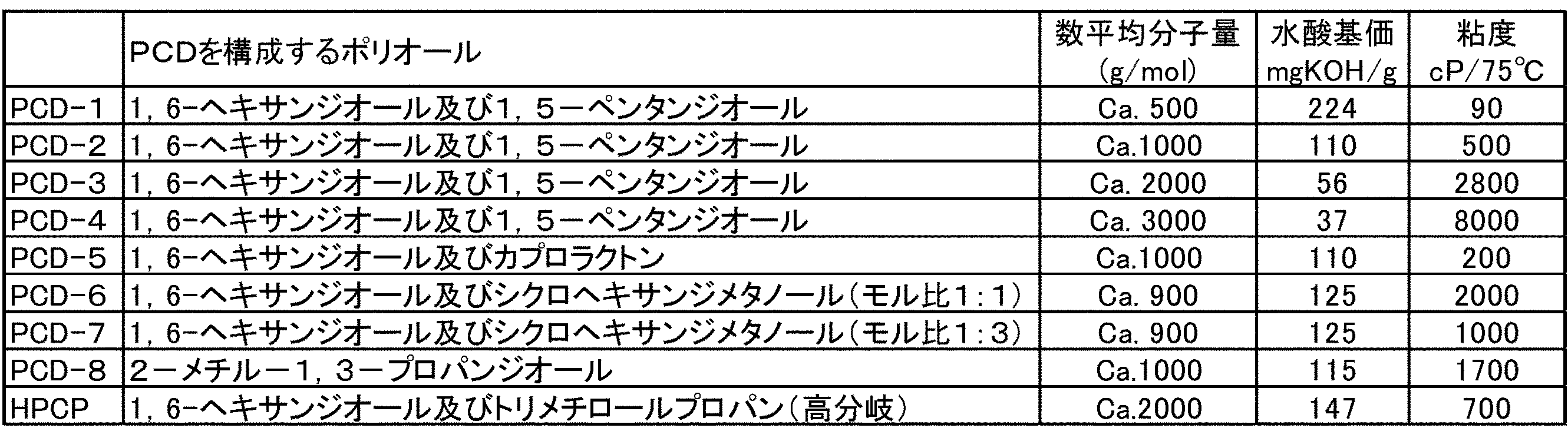

表2では、分子量又は分子骨格の異なるポリカーボネートジオールを用いてポリウレタンフォームを製造した結果を示す。ポリカーボネートポリオールを含むポリオールをウレタンの原料とすることで、体積膨張率が高い軟質ポリウレタンフォームを得ることができた。 Table 2 shows the results of producing polyurethane foam using polycarbonate diols having different molecular weights or molecular skeletons. By using a polyol containing a polycarbonate polyol as a raw material for urethane, a flexible polyurethane foam having a high volume expansion rate could be obtained.


表3及び表4では、脂環式構造又は分岐鎖を有するポリカーボネートポリオールを用いて、イソシアネートの使用量を変えてポリウレタンフォームを製造した結果を示す。実施例8、9、13及び14において、特に実施例8及び13において、気泡の大きさが均一に保たれており、形状に優れたフォームを得ることができた(図1)。このことより、OH/NCO比を0.3前後に設計することが特に好ましいことが理解される。 Tables 3 and 4 show the results of producing a polyurethane foam by using a polycarbonate polyol having an alicyclic structure or a branched chain and changing the amount of isocyanate used. In Examples 8, 9, 13 and 14, especially in Examples 8 and 13, the size of the bubbles was kept uniform, and a foam having an excellent shape could be obtained (FIG. 1). From this, it is understood that it is particularly preferable to design the OH / NCO ratio to be around 0.3.


表5及び6は、ポリオール中に含まれるポリカーボネートポリオールの量による効果の違いを示す。ポリカーボネートポリオールの含有量が全ポリオールに対して35質量%程以下であると、体積膨張率が高く、軟質のポリウレタンフォームが得られる。一方でポリカーボネートポリオールの含有量が全ポリオールに対して35質量%程以上、70質量%程以下であれば、硬質ポリウレタンフォームが得られる。ポリカーボネートポリオールのみをポリオールとして用いた場合(比較例1)は、発泡が十分でなくポリウレタンフォームを得ることができなかった。 Tables 5 and 6 show the difference in the effect depending on the amount of the polycarbonate polyol contained in the polyol. When the content of the polycarbonate polyol is about 35% by mass or less with respect to the total polyol, the volume expansion rate is high and a soft polyurethane foam can be obtained. On the other hand, when the content of the polycarbonate polyol is about 35% by mass or more and about 70% by mass or less with respect to the total polyol, a rigid polyurethane foam can be obtained. When only the polycarbonate polyol was used as the polyol (Comparative Example 1), the foaming was not sufficient and the polyurethane foam could not be obtained.


表7及び8では、ポリカーボネートポリオールを添加することによる効果を示す。ポリカーボネートポリオールを用いなかった比較例2と比べて、ポリカーボネートポリオールを加えることで、同程度の混合時間、同程度乃至より短い発泡時間で、体積膨張率が高いポリウレタンフォームを得ることができる。 Tables 7 and 8 show the effect of adding the polycarbonate polyol. Compared with Comparative Example 2 in which the polycarbonate polyol was not used, by adding the polycarbonate polyol, a polyurethane foam having a high volume expansion rate can be obtained in the same mixing time and the same or shorter foaming time.
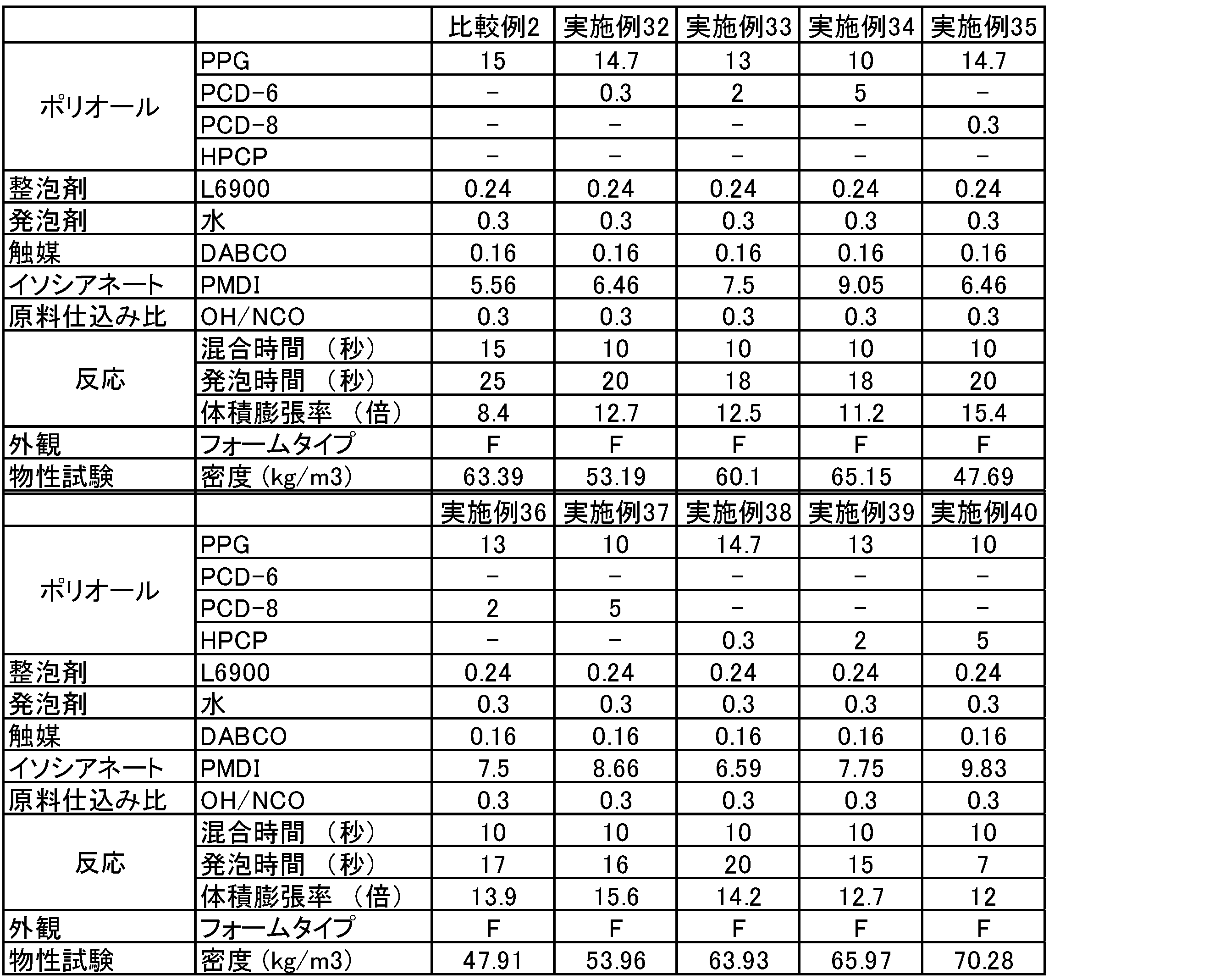
表9は、ポリカーボネートポリオールの添加量に対するポリウレタンフォームの密度への影響を示す。実施例の試料はポリカーボネートポリオールの添加がない場合(比較例2)と比較して高い体積膨張率を有するが、ポリカーボネートポリオールの添加量が増えることで、より高密度なポリウレタンフォームを得ることができる。 Table 9 shows the effect on the density of polyurethane foam with respect to the amount of polycarbonate polyol added. The sample of the example has a high volume expansion rate as compared with the case where the polycarbonate polyol is not added (Comparative Example 2), but a higher density polyurethane foam can be obtained by increasing the amount of the polycarbonate polyol added. ..

表10は、ポリウレタンフォームの各種特性を比較したものである。ポリカーボネートポリオールの添加によって、ポリウレタンフォームがより高い引張強度を有する。また、押込力たわみ試験では、ポリカーボネートポリオールの添加によってポリウレタンフォームの押す力に対する強度も向上していることが示された。さらに、ポリカーボネートポリオールの添加によって耐熱性も向上しており、物理的に強度の高いポリウレタンフォームが得られることが示された。
また、表10記載の試料について、光学顕微鏡を用いてポリウレタンフォームの微細構造を観察した。倍率40倍で撮影したものを図2~5に示す。実施例33、36のポリウレタンフォームは、比較例2のポリウレタンフォームとより小さい孔径の非貫通気泡を有している。また実施例39のポリウレタンフォームは、厚い壁面を有していることが観察される。非貫通孔によりポリウレタンフォームの応力集中を緩和させるために、厚い壁面はその厚みゆえにポリウレタンフォームの機械的強度を向上させる。これらの気泡の状態は、上記引張試験等の結果とよく適合している。
Table 10 compares various properties of polyurethane foam. With the addition of polycarbonate polyol, the polyurethane foam has higher tensile strength. In addition, the indentation force deflection test showed that the addition of the polycarbonate polyol also improved the strength of the polyurethane foam against the indentation force. Furthermore, the addition of the polycarbonate polyol also improved the heat resistance, indicating that a polyurethane foam having high physical strength can be obtained.
In addition, the fine structure of the polyurethane foam was observed with respect to the samples shown in Table 10 using an optical microscope. FIGS. 2 to 5 show images taken at a magnification of 40 times. The polyurethane foams of Examples 33 and 36 have non-penetrating bubbles having a smaller pore size than the polyurethane foam of Comparative Example 2. It is also observed that the polyurethane foam of Example 39 has a thick wall surface. Thick walls improve the mechanical strength of the polyurethane foam due to its thickness in order to alleviate the stress concentration of the polyurethane foam due to the non-through holes. The state of these bubbles is in good agreement with the results of the above tensile test and the like.
本開示によれば、良好な発泡倍率を有し、物理的強度に優れたポリウレタンフォームを提供することができる。また軟質・硬質の作り分けも可能であり、自動車、家電、家具、寝具、雑貨、断熱材(建材、冷蔵庫等)、靴、梱包材等、各種材料として広範に利用することができる。 According to the present disclosure, it is possible to provide a polyurethane foam having a good foaming ratio and excellent physical strength. It is also possible to make soft and hard materials, and it can be widely used as various materials such as automobiles, home appliances, furniture, bedding, miscellaneous goods, heat insulating materials (building materials, refrigerators, etc.), shoes, packaging materials, etc.
Claims (13)
前記ポリオールに少なくとも1種類のポリカーボネートポリオールが含まれる、ポリウレタンフォーム。 Containing polyurethane having a structure derived from two or more kinds of polyols and a structure derived from polyisocyanate,
A polyurethane foam containing at least one polycarbonate polyol in the polyol.
前記ポリオールは、少なくとも1種類のポリカーボネートポリオールを含み、
ポリイソシアネートのイソシアネート基と、ポリオールの水酸基とのモル比OH/NCOが0.1~0.7の範囲である、ポリウレタンフォームの製造方法。 A method for producing a polyurethane foam, which comprises a step of mixing a mixture containing a polyol and a polyisocyanate, a catalyst, a foam stabilizer, and a foaming agent to prepare a mixture, and a step of foaming the mixture.
The polyol contains at least one polycarbonate polyol and contains
A method for producing a polyurethane foam, wherein the molar ratio OH / NCO of the isocyanate group of the polyisocyanate and the hydroxyl group of the polyol is in the range of 0.1 to 0.7.
The urethane foam according to any one of claims 1 to 11, such as automobile seat cushions, home appliance insulation, piping insulation, sofa or chair cushions, bedding mattresses or pillows, building insulation, shoe soles, and packaging. Use as a material, sound absorbing material or cleaner sponge.
Priority Applications (1)
| Application Number | Priority Date | Filing Date | Title |
|---|---|---|---|
| JP2021109087A JP2022023007A (en) | 2021-06-30 | 2021-06-30 | Polyurethane foam |
Applications Claiming Priority (1)
| Application Number | Priority Date | Filing Date | Title |
|---|---|---|---|
| JP2021109087A JP2022023007A (en) | 2021-06-30 | 2021-06-30 | Polyurethane foam |
Publications (1)
| Publication Number | Publication Date |
|---|---|
| JP2022023007A true JP2022023007A (en) | 2022-02-07 |
Family
ID=80225074
Family Applications (1)
| Application Number | Title | Priority Date | Filing Date |
|---|---|---|---|
| JP2021109087A Pending JP2022023007A (en) | 2021-06-30 | 2021-06-30 | Polyurethane foam |
Country Status (1)
| Country | Link |
|---|---|
| JP (1) | JP2022023007A (en) |
Cited By (1)
| Publication number | Priority date | Publication date | Assignee | Title |
|---|---|---|---|---|
| WO2025141889A1 (en) * | 2023-12-28 | 2025-07-03 | 株式会社イノアックコーポレーション | Polyurethane foam and impact absorbing material |
-
2021
- 2021-06-30 JP JP2021109087A patent/JP2022023007A/en active Pending
Cited By (1)
| Publication number | Priority date | Publication date | Assignee | Title |
|---|---|---|---|---|
| WO2025141889A1 (en) * | 2023-12-28 | 2025-07-03 | 株式会社イノアックコーポレーション | Polyurethane foam and impact absorbing material |
Similar Documents
| Publication | Publication Date | Title |
|---|---|---|
| CN105229047B (en) | High strength polyurethane foam composition and method | |
| KR101453333B1 (en) | Two-component curable foam polyurethane resin composition, molded body formed from the same, and shoe sole | |
| CN101679578B (en) | Polyurethane elastomer with enhanced hydrolysis resistance | |
| CN101412798B (en) | Soft polyurethane low resilience foam and preparation method thereof | |
| CN107922560B (en) | Polyurethane foam material, molded product, and method for producing foamed polyurethane material | |
| JP5386144B2 (en) | Polyurethane foam and polyisocyanate for polyurethane foam | |
| EP1309642A1 (en) | Manufacture of mdi-tdi based flexible polyurethane foams | |
| JP3658753B2 (en) | Method for producing sheet-like flexible polyurethane mold foam | |
| US20260035505A1 (en) | Imide-containing polyester polyols and intumescent rigid foams | |
| JP2022023007A (en) | Polyurethane foam | |
| JP2023029435A (en) | Foamed polyurethane resin composition, foamed polyurethane elastomer and midsole | |
| US20090005467A1 (en) | Polyol Composition and Low Resilience Polyurethane Foam | |
| JP5201523B2 (en) | Polyisocyanate composition for flexible polyurethane foam and method for producing flexible polyurethane foam using the composition | |
| CA3190006A1 (en) | Biobased polyurethane elastomer memory foam compositions | |
| JP2011190392A (en) | Foam | |
| JP2008019353A (en) | Method for producing polyurethane foam | |
| TW201008965A (en) | Soft polyurethane foam and manufacturing method thereof | |
| JP2014198846A (en) | Method of manufacturing flexible polyurethane foam | |
| JP2012107119A (en) | Flexible polyurethane foam for carpet | |
| HK1262996A1 (en) | High strength polyurethane foam compositions and methods | |
| HK40001705A (en) | High strength polyurethane foam compositions and methods | |
| WO2026079247A1 (en) | Polyol composition, polyurethane resin composition, polyurethane foam, and molded body | |
| MXPA06005972A (en) | Carbon dioxide blown low density, flexible microcellular polyurethane elastomers |
Legal Events
| Date | Code | Title | Description |
|---|---|---|---|
| A521 | Request for written amendment filed |
Free format text: JAPANESE INTERMEDIATE CODE: A523 Effective date: 20211214 |