JP2021502100A - Bispecific and monospecific antibodies using novel anti-PD-1 sequences - Google Patents
Bispecific and monospecific antibodies using novel anti-PD-1 sequences Download PDFInfo
- Publication number
- JP2021502100A JP2021502100A JP2020526039A JP2020526039A JP2021502100A JP 2021502100 A JP2021502100 A JP 2021502100A JP 2020526039 A JP2020526039 A JP 2020526039A JP 2020526039 A JP2020526039 A JP 2020526039A JP 2021502100 A JP2021502100 A JP 2021502100A
- Authority
- JP
- Japan
- Prior art keywords
- domain
- seq
- fab
- antibody
- scfv
- Prior art date
- Legal status (The legal status is an assumption and is not a legal conclusion. Google has not performed a legal analysis and makes no representation as to the accuracy of the status listed.)
- Pending
Links
Images
































Classifications
-
- C—CHEMISTRY; METALLURGY
- C07—ORGANIC CHEMISTRY
- C07K—PEPTIDES
- C07K16/00—Immunoglobulins [IG], e.g. monoclonal or polyclonal antibodies
- C07K16/18—Immunoglobulins [IG], e.g. monoclonal or polyclonal antibodies against material from animals or humans
- C07K16/28—Immunoglobulins [IG], e.g. monoclonal or polyclonal antibodies against material from animals or humans against receptors, cell surface antigens or cell surface determinants
- C07K16/2803—Immunoglobulins [IG], e.g. monoclonal or polyclonal antibodies against material from animals or humans against receptors, cell surface antigens or cell surface determinants against the immunoglobulin superfamily
- C07K16/2818—Immunoglobulins [IG], e.g. monoclonal or polyclonal antibodies against material from animals or humans against receptors, cell surface antigens or cell surface determinants against the immunoglobulin superfamily against CD28 or CD152
-
- A—HUMAN NECESSITIES
- A61—MEDICAL OR VETERINARY SCIENCE; HYGIENE
- A61K—PREPARATIONS FOR MEDICAL, DENTAL OR TOILETRY PURPOSES
- A61K39/00—Medicinal preparations containing antigens or antibodies
- A61K39/395—Antibodies; Immunoglobulins; Immune serum, e.g. antilymphocytic serum
- A61K39/39533—Antibodies; Immunoglobulins; Immune serum, e.g. antilymphocytic serum against materials from animals
- A61K39/39541—Antibodies; Immunoglobulins; Immune serum, e.g. antilymphocytic serum against materials from animals against normal tissues, cells
-
- A—HUMAN NECESSITIES
- A61—MEDICAL OR VETERINARY SCIENCE; HYGIENE
- A61P—SPECIFIC THERAPEUTIC ACTIVITY OF CHEMICAL COMPOUNDS OR MEDICINAL PREPARATIONS
- A61P35/00—Antineoplastic agents
-
- C—CHEMISTRY; METALLURGY
- C07—ORGANIC CHEMISTRY
- C07K—PEPTIDES
- C07K16/00—Immunoglobulins [IG], e.g. monoclonal or polyclonal antibodies
- C07K16/18—Immunoglobulins [IG], e.g. monoclonal or polyclonal antibodies against material from animals or humans
- C07K16/28—Immunoglobulins [IG], e.g. monoclonal or polyclonal antibodies against material from animals or humans against receptors, cell surface antigens or cell surface determinants
- C07K16/2803—Immunoglobulins [IG], e.g. monoclonal or polyclonal antibodies against material from animals or humans against receptors, cell surface antigens or cell surface determinants against the immunoglobulin superfamily
-
- C—CHEMISTRY; METALLURGY
- C07—ORGANIC CHEMISTRY
- C07K—PEPTIDES
- C07K16/00—Immunoglobulins [IG], e.g. monoclonal or polyclonal antibodies
- C07K16/18—Immunoglobulins [IG], e.g. monoclonal or polyclonal antibodies against material from animals or humans
- C07K16/28—Immunoglobulins [IG], e.g. monoclonal or polyclonal antibodies against material from animals or humans against receptors, cell surface antigens or cell surface determinants
- C07K16/2896—Immunoglobulins [IG], e.g. monoclonal or polyclonal antibodies against material from animals or humans against receptors, cell surface antigens or cell surface determinants against molecules with a "CD"-designation, not provided for elsewhere
-
- C—CHEMISTRY; METALLURGY
- C07—ORGANIC CHEMISTRY
- C07K—PEPTIDES
- C07K16/00—Immunoglobulins [IG], e.g. monoclonal or polyclonal antibodies
- C07K16/46—Hybrid immunoglobulins
- C07K16/468—Immunoglobulins having two or more different antigen binding sites, e.g. multifunctional antibodies
-
- A—HUMAN NECESSITIES
- A61—MEDICAL OR VETERINARY SCIENCE; HYGIENE
- A61K—PREPARATIONS FOR MEDICAL, DENTAL OR TOILETRY PURPOSES
- A61K39/00—Medicinal preparations containing antigens or antibodies
- A61K2039/505—Medicinal preparations containing antigens or antibodies comprising antibodies
-
- C—CHEMISTRY; METALLURGY
- C07—ORGANIC CHEMISTRY
- C07K—PEPTIDES
- C07K2317/00—Immunoglobulins specific features
- C07K2317/30—Immunoglobulins specific features characterized by aspects of specificity or valency
- C07K2317/31—Immunoglobulins specific features characterized by aspects of specificity or valency multispecific
-
- C—CHEMISTRY; METALLURGY
- C07—ORGANIC CHEMISTRY
- C07K—PEPTIDES
- C07K2317/00—Immunoglobulins specific features
- C07K2317/50—Immunoglobulins specific features characterized by immunoglobulin fragments
- C07K2317/51—Complete heavy chain or Fd fragment, i.e. VH + CH1
-
- C—CHEMISTRY; METALLURGY
- C07—ORGANIC CHEMISTRY
- C07K—PEPTIDES
- C07K2317/00—Immunoglobulins specific features
- C07K2317/50—Immunoglobulins specific features characterized by immunoglobulin fragments
- C07K2317/515—Complete light chain, i.e. VL + CL
-
- C—CHEMISTRY; METALLURGY
- C07—ORGANIC CHEMISTRY
- C07K—PEPTIDES
- C07K2317/00—Immunoglobulins specific features
- C07K2317/50—Immunoglobulins specific features characterized by immunoglobulin fragments
- C07K2317/52—Constant or Fc region; Isotype
- C07K2317/524—CH2 domain
-
- C—CHEMISTRY; METALLURGY
- C07—ORGANIC CHEMISTRY
- C07K—PEPTIDES
- C07K2317/00—Immunoglobulins specific features
- C07K2317/50—Immunoglobulins specific features characterized by immunoglobulin fragments
- C07K2317/52—Constant or Fc region; Isotype
- C07K2317/526—CH3 domain
-
- C—CHEMISTRY; METALLURGY
- C07—ORGANIC CHEMISTRY
- C07K—PEPTIDES
- C07K2317/00—Immunoglobulins specific features
- C07K2317/60—Immunoglobulins specific features characterized by non-natural combinations of immunoglobulin fragments
- C07K2317/62—Immunoglobulins specific features characterized by non-natural combinations of immunoglobulin fragments comprising only variable region components
- C07K2317/622—Single chain antibody (scFv)
-
- C—CHEMISTRY; METALLURGY
- C07—ORGANIC CHEMISTRY
- C07K—PEPTIDES
- C07K2317/00—Immunoglobulins specific features
- C07K2317/70—Immunoglobulins specific features characterized by effect upon binding to a cell or to an antigen
- C07K2317/76—Antagonist effect on antigen, e.g. neutralization or inhibition of binding
-
- C—CHEMISTRY; METALLURGY
- C07—ORGANIC CHEMISTRY
- C07K—PEPTIDES
- C07K2317/00—Immunoglobulins specific features
- C07K2317/90—Immunoglobulins specific features characterized by (pharmaco)kinetic aspects or by stability of the immunoglobulin
- C07K2317/92—Affinity (KD), association rate (Ka), dissociation rate (Kd) or EC50 value
Landscapes
- Health & Medical Sciences (AREA)
- Chemical & Material Sciences (AREA)
- Immunology (AREA)
- Organic Chemistry (AREA)
- Medicinal Chemistry (AREA)
- Life Sciences & Earth Sciences (AREA)
- General Health & Medical Sciences (AREA)
- Proteomics, Peptides & Aminoacids (AREA)
- Molecular Biology (AREA)
- Genetics & Genomics (AREA)
- Biophysics (AREA)
- Biochemistry (AREA)
- Pharmacology & Pharmacy (AREA)
- Public Health (AREA)
- Veterinary Medicine (AREA)
- Animal Behavior & Ethology (AREA)
- Engineering & Computer Science (AREA)
- Nuclear Medicine, Radiotherapy & Molecular Imaging (AREA)
- General Chemical & Material Sciences (AREA)
- Chemical Kinetics & Catalysis (AREA)
- Bioinformatics & Cheminformatics (AREA)
- Biomedical Technology (AREA)
- Microbiology (AREA)
- Mycology (AREA)
- Epidemiology (AREA)
- Peptides Or Proteins (AREA)
- Preparation Of Compounds By Using Micro-Organisms (AREA)
- Micro-Organisms Or Cultivation Processes Thereof (AREA)
- Medicines Containing Antibodies Or Antigens For Use As Internal Diagnostic Agents (AREA)
- Medicinal Preparation (AREA)
Abstract
本発明は、二重特異性の、ヘテロ二量体チェックポイント抗体に関する。
【選択図】図1A、図 1 B、図 1 C、図 1 DThe present invention relates to bispecific, heterodimer checkpoint antibodies.
[Selection diagram] Fig. 1A, Fig. 1B, Fig. 1C, Fig. 1D
Description
I.優先権主張
この出願は、2017年11月8日に提出された米国特許出願第62/583,438号、2017年12月14日に提出された第62/598,938号および2018年4月16日に提出された第62/658,227号の優先権を主張し、これらのすべては、その中の図、説明文、および請求の範囲を特に参照して、参照によりその全体が本明細書に明示的に組み込まれる。
I. Priority Claim This application was filed on November 8, 2017, US Patent Application No. 62 / 583,438, December 14, 2017, No. 62 / 598,938, and April 2018. Claiming the priority of No. 62 / 658,227 filed on 16th, all of which are hereby in their entirety by reference, with particular reference to the figures, description and claims therein. Explicitly incorporated into the book.
II.配列表
本出願は、ASCIIフォーマットで電子的に提出され、参照によりその全体が本明細書に組み込まれる配列表を含む。2018年4月16日に作成された上記のASCIIコピーの名前は067461_5215−PR_SL.txtで、サイズは33,716,782キロバイトである。
II. Sequence Listing This application includes a sequence listing that is submitted electronically in ASCII format and is incorporated herein by reference in its entirety. The name of the above ASCII copy made on April 16, 2018 is 067461_5215-PR_SL. In txt, the size is 33,716,782 kilobytes.
CTLA−4、PD−1(プログラムされた細胞死1)、TIM−3(T細胞免疫グロブリンおよびムチンドメイン3)、LAG−3(リンパ球活性化遺伝子3)、TIGIT(IgおよびITIMドメインを有するT細胞免疫受容体)などのチェックポイント受容体は、T細胞やその他の細胞型の活性化、増殖、および/またはエフェクター活性を阻害する。チェックポイント受容体が腫瘍細胞に対する内在性T細胞応答を抑制するという仮説に導かれて、ニボルマブ、ペンブロリズマブ、イピリムマブ、およびトレメリムマブを含む抗CTLA4および抗PD1抗体の前臨床および臨床試験は、免疫チェックポイント遮断が様々な悪性腫瘍を有する一部の患者において優れた抗腫瘍応答をもたらし、内在性T細胞を刺激して腫瘍細胞を攻撃し、長期の癌寛解をもたらすことを実証した。残念なことに、これらの治療法に応答するのは一部の患者だけであり、適応症および他の要因により異なるが、奏効率は一般に10〜30%の範囲で、場合によっては単剤療法についてより高くなる。これらの剤の治療的組み合わせ、例えばイピリムマブ+ニボルマブはさらに高い奏効率をもたらし、場合によっては60%に近づく。前臨床試験では、抗PD−1抗体および/または抗CTLA−4抗体の間に、LAG−3、TIM−3、BTLA、TIGITなどの最近確認されたチェックポイント受容体の遮断による追加の相乗効果が示されている。多重チェックポイント遮断の可能性は非常に有望であるが、そのような薬剤との併用療法は高い経済的負担を伴うと予想される。さらに、併用療法、例えばニボルマブ+イピリムマブの自己免疫毒性は、単独療法と比較して顕著に上昇し、多くの患者に療法を中止させる。 It has CTLA-4, PD-1 (programmed cell death 1), TIM-3 (T cell immunoglobulin and mutin domain 3), LAG-3 (lymphocyte activation gene 3), TIGIT (Ig and ITIM domains). Checkpoint receptors such as T cell immunoreceptors) inhibit the activation, proliferation, and / or effector activity of T cells and other cell types. Preclinical and clinical trials of anti-CTLA4 and anti-PD1 antibodies, including nivolumab, pembrolizumab, ipilimumab, and tremelimumab, led to the hypothesis that checkpoint receptors suppress the endogenous T cell response to tumor cells, are immune checkpoints. It has been demonstrated that blockade provides excellent antitumor response in some patients with various malignancies, stimulates endogenous T cells to attack tumor cells, and results in long-term cancer remission. Unfortunately, only some patients respond to these treatments, depending on the indication and other factors, but the response rate is generally in the range of 10-30%, and in some cases monotherapy. Will be higher about. Therapeutic combinations of these agents, such as ipilimumab + nivolumab, result in even higher response rates, approaching 60% in some cases. In preclinical studies, additional synergies between anti-PD-1 and / or anti-CTLA-4 antibodies by blocking recently confirmed checkpoint receptors such as LAG-3, TIM-3, BTLA, and TIGIT. It is shown. Although the possibility of multiple checkpoint blockade is very promising, combination therapy with such agents is expected to be highly economically burdensome. In addition, the autoimmune toxicity of combination therapies, such as nivolumab plus ipilimumab, is significantly increased compared to monotherapy, causing many patients to discontinue therapy.
腫瘍浸潤リンパ球(TIL)を試験している、多くの研究(Ahmadzadeh et al., Blood 114:1537(2009)、Matsuzaki et al.,PNAS 107(17):7875−7880(2010)、Fourcade et al.,Cancer Res.72(4):887−896(2012)およびGros et al., J.Clinical Invest.124(5):2246(2014))は、TILが、一般に複数のチェックポイント受容体を発現することを示している。さらに、複数のチェックポイントを発現するTILが、実際には腫瘍反応性が最も高い可能性がある。対照的に、末梢における非腫瘍反応性T細胞は、単一のチェックポイントを発現する可能性がより高い。単一特異性の完全長抗体によるチェックポイントの遮断は、自己免疫毒性に寄与すると想定される自己抗原反応性の単一発現T細胞と比較して、腫瘍反応性TILの脱抑制に関して非差別的である可能性が高い。 Many studies investigating tumor-infiltrating lymphocytes (TIL) (Ahmadzadeh et al., Blood 114: 1537 (2009), Matsuzaki et al., PNAS 107 (17): 7875-7880 (2010), Fourcade et. al., Cancer Res. 72 (4): 887-896 (2012) and Gros et al., J. Clinical Invest. 124 (5): 2246 (2014)), where the TIL is generally a plurality of checkpoint receptors. Is shown to be expressed. In addition, TILs that express multiple checkpoints may actually be the most tumor responsive. In contrast, peripheral non-tumor-reactive T cells are more likely to express a single checkpoint. Blocking checkpoints with unispecific full-length antibodies is non-discriminatory with respect to tumor-reactive TIL disinhibition compared to self-antigen-reactive monoexpressive T cells that are postulated to contribute to autoimmune toxicity Is likely to be.
したがって、本発明は、ヒトPD−1と、第2の、異なるチェックポイント阻害剤タンパク質とに結合する、二重特異性抗体に関する。ヒトPD−1に結合する単一特異性モノクローナル抗体も提供される。 Accordingly, the present invention relates to bispecific antibodies that bind human PD-1 and a second, different checkpoint inhibitor protein. Unispecific monoclonal antibodies that bind to human PD-1 are also provided.
本発明は、新規の抗PD−1抗原結合ドメイン(ABD)、ならびにPD−1と、CTLA−4、LAG−3、TIM−3、TIGIT、BTLAおよびICOSからなる群から選択される第2の標的抗原と、に結合する抗PD−1一価モノクローナル抗体およびヘテロ二量体二重特異性抗体の作製におけるそれらの使用、およびこの抗体の作成方法と使用方法に関する。 The present invention comprises a novel anti-PD-1 antigen binding domain (ABD) and a second selected from the group consisting of PD-1 and CTLA-4, LAG-3, TIM-3, TIGIT, BTLA and ICOS. The present invention relates to target antigens and their use in the preparation of anti-PD-1 monovalent monoclonal antibodies and heterodimer bispecific antibodies that bind to, and methods of making and using these antibodies.
したがって、いくつかの態様において、本発明は、抗PD−1一価モノクローナル抗体を提供する。本態様では、抗PD−1モノクローナル抗体であって、a)N末端からC末端に向かってVH−CH1−ヒンジ−CH2−CH3を含む重鎖と、b)N末端からC末端に向かってVL−CLを含む軽鎖と、を含み、VHCDR1、VHCDR2、VHCDR3、VLCDR1、VLCDR2、およびVLCDR3が、図24のXENP26940由来のCDRおよび図40のXNE28652由来のCDRからなる群から選択される。 Therefore, in some embodiments, the invention provides an anti-PD-1 monovalent monoclonal antibody. In this aspect, it is an anti-PD-1 monoclonal antibody, a) a heavy chain containing VH-CH1-hinge-CH2-CH3 from the N-terminus to the C-terminus, and b) VL from the N-terminus to the C-terminus. VHCDR1, VHCDR2, VHCDR3, VLCDR1, VLCDR2, and VLCDR3 are selected from the group consisting of CDRs from XENP26940 in FIG. 24 and CDRs from XNE28652 in FIG. 40, including a light chain comprising −CL.
追加の態様では、抗体は、図24に示されるXENP26940由来のVHおよびVLを有する。 In an additional aspect, the antibody has VH and VL from XENP26940 shown in FIG.
さらなる態様では、抗体は、図40に示されるXENP28652由来のVHおよびVLを有する。 In a further aspect, the antibody has VH and VL from XENP28652 shown in FIG.
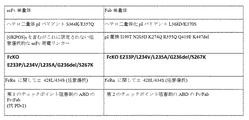
いずれかの態様では、ヒンジ−CH2−CH3は、ヒトIgG1、IgG2、IgG3およびIgG4由来のFcドメインからなる群から選択されるFcドメインであり得る。IgG1に由来する場合、Fcドメインは、例えばアミノ酸置換427L/434Sを含むバリアントヒトIgG1ドメインであり得る。さらに、バリアントIgG1 Fcドメインは、図5に示されているものから選択された切除バリアント、特にE233P/L234V/L235A/G236del/S267K置換を含むことができる。FcドメインがバリアントヒトIgG4ドメインである場合、それはS228Pアミノ酸置換を含むことができる。 In any aspect, the hinge-CH2-CH3 can be an Fc domain selected from the group consisting of Fc domains derived from human IgG1, IgG2, IgG3 and IgG4. When derived from IgG1, the Fc domain can be, for example, a variant human IgG1 domain containing amino acid substitutions 427L / 434S. In addition, the variant IgG1 Fc domain can include excision variants selected from those shown in FIG. 5, in particular E233P / L234V / L235A / G236del / S267K substitutions. If the Fc domain is a variant human IgG4 domain, it can include an S228P amino acid substitution.
さらなる態様では、本発明は、重鎖をコードする第1の核酸と、軽鎖をコードする第2の核酸とを含む、核酸組成物を提供する。また、第1の核酸を含む第1の発現ベクターおよび前記第2の核酸を含む第2の発現ベクターを含む発現ベクター組成物、または前記第1および第2の核酸を含む単一の発現ベクターが含まれる。さらに含まれるのは、発現ベクター組成物または発現ベクターを含む、宿主細胞である。抗PD−1抗体を作製する方法も含まれ、前記抗体が発現される条件下で宿主細胞を培養することと、前記抗体を回収することと、を含む。さらに、本発明は、癌の治療を必要とする患者における癌を治療する方法であって、抗体を前記患者に投与することを含む方法を提供する。 In a further aspect, the invention provides a nucleic acid composition comprising a first nucleic acid encoding a heavy chain and a second nucleic acid encoding a light chain. Further, an expression vector composition containing a first expression vector containing a first nucleic acid and a second expression vector containing the second nucleic acid, or a single expression vector containing the first and second nucleic acids included. Also included are host cells containing the expression vector composition or expression vector. A method for producing an anti-PD-1 antibody is also included, which comprises culturing a host cell under conditions in which the antibody is expressed and recovering the antibody. Furthermore, the present invention provides a method of treating cancer in a patient in need of treatment of the cancer, comprising administering an antibody to said patient.
さらなる態様では、ヘテロ二量体二重特異性抗体が提供される。これらの抗体は、a)第1の単量体であって、i)ヒトPD−1に結合する一本鎖Fvドメイン(scFv)であって、1)第1の可変重鎖ドメイン(VH1)、2)scFvリンカー、および3)第1の可変軽鎖ドメイン(VL1)を含む、前記scFvドメインと、ii)第1のバリアントFcドメインと、を含む、第1の単量体と、b)第2の単量体であって、i)第2の可変重鎖ドメイン(VH2)−CH1−ヒンジ−CH2−CH3を含む重鎖、を含む、第2の単量体と、c)第2の可変軽鎖ドメイン(VL2)および定常軽鎖ドメイン(CL)を含む軽鎖と、を含み、前記第1の可変重鎖ドメインおよび前記第1の可変軽鎖ドメインが、第1の抗原結合ドメイン(ABD1)を形成し、前記第2の可変重鎖ドメインおよび前記第2の可変軽鎖ドメインが、ヒトCTLA−4、ヒトLAG−3、ヒトTIM−3、ヒトTIGIT、ヒトBTLAおよびヒトICOSから選択される抗原に結合する第2のABD(ABD2)を形成する。ABD1は、図13、15、16、18、20、21、24、33、および40で概説されている1C11 VHおよびVLドメインのいずれかであり得る。 In a further aspect, a heterodimer bispecific antibody is provided. These antibodies are a) a first monomer, i) a single chain Fv domain (scFv) that binds to human PD-1, and 1) a first variable heavy chain domain (VH1). , 2) the scFv linker, and 3) the scFv domain comprising the first variable light chain domain (VL1), and ii) the first monomer comprising the first variant Fc domain, b). A second monomer comprising a second monomer i) a heavy chain containing a second variable heavy chain domain (VH2) -CH1-hinge-CH2-CH3, and c) a second. A light chain comprising a variable light chain domain (VL2) and a constant light chain domain (CL), wherein the first variable heavy chain domain and the first variable light chain domain are first antigen-binding domains. The second variable heavy chain domain and the second variable light chain domain form (ABD1) from human CTLA-4, human LAG-3, human TIM-3, human TIGIT, human BTLA and human ICOS. It forms a second ABD (ABD2) that binds to the antigen of choice. ABD1 can be any of the 1C11 VH and VL domains outlined in FIGS. 13, 15, 16, 18, 20, 21, 24, 33, and 40.
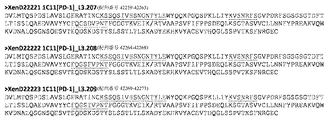
特定の態様では、ABD1は、図15のXENP25806由来の1C11[PD−1]_H3.234_L3.144、図15のXENP25812由来の1C11[PD−1]_H3.240_L3.148、図15のXENP25813由来の1C11[PD−1]_H3.241_L3.148および図15のXENP25819由来の1C11[PD−1]_H3.241_L3.92からなる対から選択される配列を有する。 In a particular embodiment, ABD1 is derived from 1C11 [PD-1] _H3.234_L3.144 from XENP25806 in FIG. 15, 1C11 [PD-1] _H3.240_L3.148 from XENP25812 in FIG. 15, and XENP25813 from FIG. It has a sequence selected from a pair consisting of 1C11 [PD-1] _H3.241_L3.148 and 1C11 [PD-1] _H3.241_L3.92 from XENP25819 in FIG.
これらの態様では、第1の単量体は、N末端からC末端に向かって、VH1−scFvリンカー−VL1−ヒンジ−バリアントFcドメインを含み得る。 In these embodiments, the first monomer may comprise a VH1-scFv linker-VL1-hinge-variant Fc domain from the N-terminus to the C-terminus.
さらなる態様では、第1の単量体は、N末端からC末端に向かって、VL1−scFvリンカー−VH1−ヒンジ−バリアントFcドメインを含み得る。 In a further aspect, the first monomer may comprise a VL1-scFv linker-VH1-hinge-variant Fc domain from the N-terminus to the C-terminus.
特定の態様では、ABD1は、図15のXENP25806由来の1C11[PD−1]_H3.234_L3.144、図15のXENP25812由来の1C11[PD−1]_H3.240_L3.148、図15のXENP25813由来の1C11[PD−1]_H3.241_L3.148および図15のXENP25819由来の1C11[PD−1]_H3.241_L3.92からなる対から選択される配列を有し、ABD2は、ヒトCTLA−4、ヒトLAG−3、ヒトTIM−3、ヒトTIGIT、ヒトBTLAおよびヒトICOSから選択される抗原に結合する。 In a particular embodiment, ABD1 is derived from 1C11 [PD-1] _H3.234_L3.144 from XENP25806 in FIG. 15, 1C11 [PD-1] _H3.240_L3.148 from XENP25812 in FIG. 15, and XENP25813 from FIG. It has a sequence selected from a pair consisting of 1C11 [PD-1] _H3.241_L3.148 and 1C11 [PD-1] _H3.241_L3.92 from XENP25819 in FIG. 15, where ABD2 is human CTLA-4, human. It binds to antigens selected from LAG-3, human TIM-3, human TIGIT, human BTLA and human ICOS.
追加の態様では、抗CTLA−4 ABD2は、配列表の配列番号38134および38138、36739および36743、36747および36751、36755および36759、36763および36767、36771および36775、36779および36783、36787および36791、36795および36799、36803および36807、ならびに36811および36815、の対から選択される配列を有する。 In an additional aspect, anti-CTLA-4 ABD2 is sequenced in SEQ ID NOs: 38134 and 38138, 36739 and 37643, 36747 and 36751, 36755 and 36759, 36763 and 36767, 37671 and 36775, 36779 and 36787, 36787 and 36791, 36795. And 36799, 36803 and 36807, and 36811 and 36815, having sequences selected from the pair.
追加の態様では、抗LAG−3 ABD2は、配列番号32755および32760、36819および36823、36827および36831、36835および36839、36843および36847、36851および36855、36859および36863、36867および36871、36875および36879、36883および36887、36891および36895、36899および36903、36907および36911、36915および36919、36923および36927、36931および36935、36939および36943、36947および36951ならびに36955および36959、の対から選択される配列を有する。 In additional embodiments, the anti-LAG-3 ABD2 has SEQ ID NOs: 32755 and 32760, 36891 and 36823, 36827 and 36831, 36835 and 36839, 36843 and 36847, 36851 and 36855, 36859 and 36863, 36867 and 36871, 36875 and 36879, It has sequences selected from a pair of 36883 and 36887, 36891 and 36895, 36899 and 36903, 36907 and 36911, 36915 and 36919, 36923 and 36927, 36931 and 36935, 36939 and 36943, 36947 and 36951 and 36955 and 36959.
追加の態様では、抗TIM−3 ABD2は、配列番号36508および36513、35757および37591、37959および37599、37603および37607、37611および37615、37619および37623、37627および37631、37635および37639、37643および37647、37651および37655、37659および37663、37667および37671、37675および37679、37683および37687ならびに37691および37695、の対から選択される配列を有する。 In additional embodiments, the anti-TIM-3 ABD2 has SEQ ID NOs: 36508 and 36513, 35757 and 37591, 37959 and 37599, 37603 and 37607, 37611 and 37615, 37619 and 37623, 37627 and 37631, 37635 and 37639, 37643 and 37647, It has sequences selected from a pair of 37651 and 37655, 37655 and 37663, 37667 and 37671, 37675 and 37679, 37683 and 37678 and 37691 and 37695.
追加の態様では、抗TIGIT ABD2は、配列番号37435および37439、37443および37447、37451および37455、37459および37463、37467および37471、37475および37479、37483および37487、37491および37495、37499および37503、37507および37511、37515および37519、37523および37527、37531および37535、37539および37543、37547および37551、37555および37559、37563および37567、37571および37575ならびに37579および37583、の対から選択される配列を有する。 In an additional aspect, the anti-TIGIT ABD2s are SEQ ID NOs: 37435 and 37439, 37443 and 37447, 37451 and 37455, 37459 and 37463, 37467 and 37471, 37475 and 37479, 37484 and 37487, 37491 and 37495, 37499 and 37503, 37507 and It has a sequence selected from a pair of 37511, 37515 and 37519, 37523 and 37527, 37531 and 37535, 37539 and 37543, 37547 and 37551, 37555 and 37559, 37563 and 37567, 37571 and 37575 and 37579 and 37583.
追加の態様では、抗ICOS ABD2は、a)US2018/0127501からの配列表からの配列番号26323および26328、27477および27452ならびに26353および26358の対、b)図49のXENCS500のVHおよびVLの配列、c)図49のXENCS501のVHおよびVLの配列、からなる群から選択される配列を有する。 In an additional embodiment, the anti-ICOS ABD2 is a) a pair of SEQ ID NOs: 26323 and 26328, 27477 and 27452 and 26353 and 26358 from the sequence listing from US2018 / 0127501, b) the sequence of VH and VL of XENCS500 in FIG. c) It has a sequence selected from the group consisting of the VH and VL sequences of XENCS501 of FIG.
追加の態様では、抗BTLA ABD2は、配列番号20936および20941、36707および36711、36715および36719、36723および36727ならびに36761および36735、の対から選択される配列を有する。 In an additional aspect, the anti-BTLA ABD2 has a sequence selected from the pair of SEQ ID NOs: 20936 and 20941, 36707 and 36711, 36715 and 36719, 36723 and 36727 and 37661 and 36735.
多くの態様では、本発明のヘテロ二量体抗体は、アミノ酸置換N208D/Q295E/N384D/Q418E/N421Dを含む、第2のバリアントIgG1 Fcドメインを有し、前記第1および第2のバリアントIgG1 Fcドメインが、それぞれアミノ酸置換E233P/L234V/L235A/G236del/S267Kを含み、および前記第1のバリアントIgG1 Fcドメインが、アミノ酸置換S364K/E357Qを含み、第2のバリアントIgG1 Fcドメインが、アミノ酸置換L368D/K370Sを含み、付番は、KabatにあるようなEUインデックスに従って行われる。 In many embodiments, the heterodimer antibody of the invention has a second variant IgG1 Fc domain comprising amino acid substitutions N208D / Q295E / N384D / Q418E / N421D, said first and second variant IgG1 Fc. The domains each contain an amino acid substitution E233P / L234V / L235A / G236del / S267K, and the first variant IgG1 Fc domain comprises an amino acid substitution S364K / E357Q, and a second variant IgG1 Fc domain contains an amino acid substitution L368D /. Including K370S, numbering is done according to the EU index as in Kabat.
さらなる態様では、本発明は、a)前記第1の単量体をコードする第1の核酸と、b)前記第2の単量体をコードする第2の核酸と、c)請求項15〜30のいずれかに記載の前記軽鎖をコードする第3の核酸と、を含む核酸組成物を提供する。 In a further aspect, the invention comprises a) a first nucleic acid encoding the first monomer, b) a second nucleic acid encoding the second monomer, and c) claims 15-. A nucleic acid composition comprising a third nucleic acid encoding said light chain according to any of 30 is provided.
追加の態様では、本発明は、a)前記第1の核酸を含む第1の発現ベクターと、b)前記第2の核酸を含む第2の発現ベクターと、c)前記第3の核酸を含む第3の発現ベクターと、を含む発現ベクター組成物を提供する。発現ベクター組成物を含む宿主細胞および、抗体を作製する方法であって、前記抗体が発現される条件下で宿主細胞を培養することと、前記抗体を回収することと、による方法、もまた提供する。さらに、癌の治療を必要とする患者の癌を治療する方法であって、本発明のヘテロ二量体二重特異性抗体を患者に投与することを含む、方法を提供する。 In an additional aspect, the invention comprises a) a first expression vector containing the first nucleic acid, b) a second expression vector containing the second nucleic acid, and c) the third nucleic acid. An expression vector composition comprising a third expression vector is provided. Also provided is a method of producing a host cell containing an expression vector composition and an antibody, wherein the host cell is cultured under conditions in which the antibody is expressed, and the antibody is recovered. To do. Further provided is a method of treating cancer in a patient in need of treatment of the cancer, comprising administering to the patient the heterodimer bispecific antibody of the invention.
A.資料の組み込み
1.図および説明文
2017年11月8日に出願された米国特許出願第62/583,438号、2017年12月14日に出願された同第62/598,938号、2018年4月16日に出願された同第62/658,227号、2016年11月10日に出願された同第62/420,500号、2016年6月22日に出願された同第62/353,511号、2016年6月14日に出願された同第62/350,145号、2017年6月14日に出願された同第15/623,314号、および2017年6月14日に出願されたPCT/US17/37555、のすべての図、付随する説明文および配列(それらの識別子および/または説明付き)、とりわけそこに示されたアミノ酸配列に関して、すべて、参照によりその全体が明示的かつ独立して本明細書に組み込まれる。
A. Incorporation of
2.配列
添付の配列表について以下のように説明する:ABDとしての使用に好適な抗PD−1配列には、配列番号6209〜11464(PD−1 scFv配列であるが、それらの中のFv配列はFabとしての形式をとることができる)、配列番号11465〜17134(PD−1 Fab配列であるが、それらの中のFv配列はscFvとしての形式をとることができる)、配列番号33003〜33072(追加のPD−1 Fab配列であるが、それらの中のFv配列はscFvとしての形式をとることができる)、配列番号33073〜35394(追加のPD−1 scFv配列であるが、それらの中のFv配列はFabとしての形式をとることができる)および配列番号36127〜36146(PD−1の二価の構築物で、scFvまたはFabのいずれかとしての形式をとることができる)が含まれる。ABDとしての使用に好適な抗CTLA−4配列には、配列番号21〜2918(CTLA−4 scFv配列であるが、それらの中のFv配列はFabとしての形式をとることができる)、配列番号2919〜6208(CTLA−4 Fab配列であるが、それらの中のFv配列はscFvとしての形式をとることができる)、配列番号36739〜36818(追加のCTLA−4 Fab配列であるが、それらの中のFv配列はscFvとしての形式をとることができる)および配列番号35395〜35416(CTLA−4のワンアーム構築物で、FabまたはscFvのいずれかとしての形式をとることができる)が含まれる。ABDとしての使用に好適な抗LAG−3配列には、配列番号17135〜20764(LAG−3 Fabであるが、それらの中のFv配列はscFvとしての形式をとることができる)、配列番号36819〜36962(追加のLAG−3 Fabであるが、それらの中のFv配列はscFvとしての形式をとることができる)、配列番号35417〜35606(追加のLAG−3 Fabsであるが、それらの中のFv配列はscFvとしての形式をとることができる)、配列番号25194〜32793(追加のLAG−3 Fabsであるが、それらの中のFv配列はscFvとしての形式をとることができる)および配列番号32794〜33002(FabまたはscFvのいずれかとしての形式をとることができるワンアームLAG−3構築物)が含まれる。ABDとしての使用に好適な抗TIM−3配列には、配列番号20765〜20884(TIM−3 Fabであるが、それらの中のFv配列はscFvとしての形式をとることができる)、配列番号37587〜37698(追加のTIM−3 Fabであるが、それらの中のFv配列は、scFvとしての形式をとることができる)および配列番号36347〜36706(FabまたはscFvのいずれかとしての形式をとることができる二価のTIM−3構築物)が含まれる。ABDとしての使用に好適な抗BTLA配列には、配列番号20885〜21503(BTLA Fabであるが、それらの中のFv配列はscFvとしての形式をとることができる)および配列番号36707〜36738(追加のBTLA Fabであるが、それらの中のFv配列はscFvとしての形式をとることができる)が含まれる。ABDとしての使用に好適な抗TIGIT配列には、配列番号21504〜21523(TIGIT Fabであるが、それらの中のFv配列はscFvとしての形式をとることができる)および配列番号37435〜37586(追加のTIGIT Fabであるが、それらの中のFv配列はscFvとしての形式をとることができる)が含まれる。当業者から理解されるように、これらの配列識別子は、配列識別子から明らかであるように、可変重鎖および軽鎖について「対」になる。
2. 2. Sequence The attached sequence table is described below: The anti-PD-1 sequences suitable for use as ABD include SEQ ID NOs: 6209 to 11464 (PD-1 scFv sequences, but the Fv sequences within them are: (Can take the form as Fab), SEQ ID NOs: 11465-17134 (PD-1 Fab sequences, but the Fv sequences in them can take the form as scFv), SEQ ID NOs: 33003-3302 (can take the form as scFv). Additional PD-1 Fab sequences, but the Fv sequences in them can take the form as scFv), SEQ ID NOs: 33073-35394 (additional PD-1 scFv sequences, but in them. The Fv sequence can be in the form of Fab) and SEQ ID NOs: 36127 to 36146 (a divalent construct of PD-1, which can be in the form of either scFv or Fab). Anti-CTLA-4 sequences suitable for use as ABD include SEQ ID NOs: 21-2918 (CTLA-4 scFv sequences, but the Fv sequence within them can take the form of Fab), SEQ ID NO: 2919-6208 (CTLA-4 Fab sequences, but the Fv sequence within them can take the form as scFv), SEQ ID NOs: 36739-36818 (additional CTLA-4 Fab sequences, but their The Fv sequence in it can be in the form of scFv) and SEQ ID NO: 35395-35416 (one-arm construct of CTLA-4, which can be in the form of either Fab or scFv). Anti-LAG-3 sequences suitable for use as ABD include SEQ ID NO: 17135-20764 (LAG-3 Fab, but the Fv sequence within them can take the form of scFv), SEQ ID NO: 36819. ~ 36962 (additional LAG-3 Fabs, but the Fv sequence within them can take the form as scFv), SEQ ID NOs: 35417-35606 (additional LAG-3 Fabs, among them Fv sequences can take the form as scFv), SEQ ID NOs: 25194 to 32793 (additional LAG-3 Fabs, but the Fv sequences in them can take the form as scFv) and sequences. Included are numbers 32794-3302, a one-arm LAG-3 construct that can take the form of either Fab or scFv. Anti-TIM-3 sequences suitable for use as ABD include SEQ ID NO: 20765-20884 (TIM-3 Fab, but the Fv sequence within them can take the form of scFv), SEQ ID NO: 37587. ~ 37698 (additional TIM-3 Fabs, but the Fv sequences within them can take the form as scFv) and SEQ ID NOs: 36347-36706 (form as either Fab or scFv). A divalent TIM-3 construct) capable of Anti-BTLA sequences suitable for use as ABD include SEQ ID NOs: 20885-21503 (BTLA Fab, but the Fv sequence within them can take the form of scFv) and SEQ ID NOs: 36707-36738 (additional). BTLA Fabs, but the Fv sequences in them can take the form of scFv). Anti-TIGIT sequences suitable for use as ABD include SEQ ID NOs: 21504 to 21523 (TIGIT Fab, but the Fv sequence within them can take the form of scFv) and SEQ ID NOs: 37435-37586 (additional). TIGIT Fabs, but the Fv sequences in them can take the form of scFv). As will be appreciated by those skilled in the art, these sequence identifiers are "paired" for variable heavy and light chains, as evidenced by the sequence identifiers.
本発明の二重特異性抗体には、配列番号35607〜35866および配列番号21524〜22620のLAG3 X CTLA4構築物が含まれる。PD−1 X CTLA4の構築物には、配列番号36167〜36346および配列番号23316〜23735として記載されるものが含まれる。PD−1 X TIM3構築物には、配列番号25174〜25193として記載されるものが含まれる。PD−1 X LAG3構築物には、配列番号35867〜36126および配列番号23736−25133として記載されるものが含まれる。PD−1 X TIGIT構築物には、配列番号25134〜25173として記載されるものが含まれる。PD−1 X BTLA構築物には、配列番号22724〜23315および配列番号36147−36166として記載されるものが含まれる。CTLA4 X BTLA構築物には、配列番号22624〜22723として記載されるものが含まれる。最後に、XENP23552、XENP22841、XENP22842、XENP22843、XENP22844、XENP22845、XENP22846、XENP22847、XENP22848、XENP22849、XENP22850、XENP22851、XENP22852、XENP22858、XENP22854、XENPXENP22855の名前はすべて、不注意で省略された、「M428L/N434S」の表記を表題に含むべきであった。 Bispecific antibodies of the invention include the LAG3 X CTLA4 constructs of SEQ ID NOs: 35607 to 35866 and SEQ ID NOs: 21524 to 22620. Constructs of PD-1 X CTLA4 include those described as SEQ ID NOs: 36167 to 36346 and SEQ ID NOs: 23316 to 23735. PD-1 X TIM3 constructs include those described as SEQ ID NOs: 25174-25193. PD-1 X LAG3 constructs include those described as SEQ ID NOs: 35867-36126 and SEQ ID NOs: 23736-25133. PD-1 X TIGIT constructs include those described as SEQ ID NOs: 25134-25173. PD-1 X BTLA constructs include those described as SEQ ID NOs: 22724 to 23315 and SEQ ID NOs: 36147-36166. CTLA4 X BTLA constructs include those described as SEQ ID NOs: 22624 to 22723. Finally, XENP23552, XENP22841, XENP22842, XENP22843, XENP22844, XENP22845, XENP22846, XENP22847, XENP22848, XENP22849, XENP22850, XENP22851, XENP22852, XEN22851, XENP22852, XENP22852 Should have been included in the title.
B.命名法
本発明の二重特異性抗体を、いくつかの異なるフォーマットに列挙する。各ポリペプチドには固有の「XENP」番号(もしくは場合によっては、「XENCS」番号)が付与されるが、当技術分野で理解されるように、より長い配列はより短い配列を含み得る。例えば、所与の配列のボトルオープナー形式のscFv側単量体の重鎖は第1のXENP番号を有し、一方でscFvドメインは異なるXENP番号を有する。いくつかの分子には3つのポリペプチドがあるため、XENP番号が構成要素とともに名称として使用される。したがって、ボトルオープナー形式である、分子XENP20717は、一般に、「XENP20717 HC−Fab」、「XENP20717HC−scFv」、および「XENP20717LC」と称される3つの配列、または等価物含むが、当業者は、配列アライメントによりこれらを容易に同定することができるだろう。これらのXENP番号は、配列表ならびに識別子にあり、図で使用される。さらに、3つの構成要素を含む1つの分子は、複数の配列識別子を生成する。例えば、Fab単量体のリストには、完全長配列、可変重配列、可変重配列の3つのCDRがあり、軽鎖には、完全長配列、可変軽配列、および可変軽配列の3つのCDRがあり、scFv−Fcドメインには、完全長配列、scFv配列、可変軽配列、3つの軽鎖CDR、scFvリンカー、可変重配列、および3つの重鎖CDRがあり、scFvドメインを含む本明細書のすべての分子は、単一の荷電scFvリンカー(+H)を使用するが、他の分子も使用できることに留意されたい。さらに、特定の可変ドメインの命名法では、「Hx.xx_Ly.yy」タイプの形式が使用され、番号は特定の可変鎖配列の一意の識別子である。したがって、XENP22841のFab側の可変ドメインは、「7G8_H3.30_L1.34」であり、これは、可変重鎖ドメインH3.30が軽鎖ドメインL1.34と組み合わされたことを示す。これらの配列がscFvとして使用される場合、名称「7G8_H3.30_L1.34」は、可変重鎖ドメインH3.30が軽鎖ドメインL1.34と組み合わされ、NからC末端に向かってvh−リンカー−vl配向にあることを示す。重鎖可変ドメインと軽鎖可変ドメインの同一の配列を有するが逆順のこの分子は、「7G8_L1.34_H3.30」と名付けられる。同様に、配列表および図から明らかなように、異なる構築物は重鎖および軽鎖を「混合および適合」し得る。
B. Nomenclature The bispecific antibodies of the invention are listed in several different formats. Each polypeptide is given a unique "XENP" number (or, in some cases, a "XENCS" number), but as will be appreciated in the art, longer sequences may contain shorter sequences. For example, the heavy chain of a bottle opener-style scFv-side monomer of a given sequence has a first XENP number, while the scFv domain has a different XENP number. Since some molecules have three polypeptides, the XENP number is used as the name along with the components. Thus, the bottle opener form, the molecule XENP20717, generally includes three sequences, or equivalents, referred to as "XENP20717 HC-Fab", "XENP20717HC-scFv", and "XENP20717LC", but those skilled in the art will appreciate the sequences. Alignment will make it easier to identify them. These XENP numbers are in sequence listings as well as identifiers and are used in the figures. In addition, one molecule containing the three components produces multiple sequence identifiers. For example, the list of Fab monomers has three CDRs of full length sequence, variable weight sequence, and variable weight sequence, and the light chain has three CDRs of full length sequence, variable light sequence, and variable light sequence. The scFv-Fc domain includes a full-length sequence, a scFv sequence, a variable light sequence, three light chain CDRs, a scFv linker, a variable heavy sequence, and three heavy chain CDRs, and includes the scFv domain. Note that all of the molecules use a single charged scFv linker (+ H), but other molecules can also be used. In addition, certain variable domain nomenclatures use the "Hx.xx_Ly.yy" type format, where the number is a unique identifier for a particular variable chain sequence. Therefore, the Fab-side variable domain of XENP22841 is "7G8_H3.30_L1.34", which indicates that the variable heavy chain domain H3.30 was combined with the light chain domain L1.34. When these sequences are used as scFv, the name "7G8_H3.30_L1.34" is that the variable heavy chain domain H3.30 is combined with the light chain domain L1.34 and vh-linker-from N to C-terminus. Indicates that it is in the vr orientation. This molecule, which has the same sequence of heavy and light chain variable domains but in reverse order, is named "7G8_L1.34_H3.30". Similarly, as is apparent from the sequence listings and figures, different constructs can "mix and match" heavy and light chains.
C.定義
本出願をより完全に理解できるようにするため、いくつかの定義を以下に示す。そのような定義は、文法的同等物を包含することを意図する。
C. Definitions To help you understand this application more completely, some definitions are given below. Such a definition is intended to include grammatical equivalents.
本明細書において「除去」とは、活性の低下または排除を意味する。したがって、例えば、「FcγR結合を切除する」とは、特定のバリアントを含有しないFc領域と比較して、Fc領域アミノ酸バリアントが、開始結合の50%未満を有することを意味し、活性を70〜80〜90〜95〜98%超えて喪失していることが好ましく、一般に、活性は、Biacore、SPR、またはBLIアッセイにおいて、検出可能な結合レベルを下回る。FcγR結合の切除において特に使用されるものは、図5に示すものであり、これらは一般に両方の単量体に付加される。 As used herein, "removal" means reduction or elimination of activity. Thus, for example, "removing the FcγR bond" means that the Fc region amino acid variant has less than 50% of the initiation bond as compared to the Fc region that does not contain a particular variant, with activity of 70- It is preferably lost by more than 80-90-95-98% and generally the activity is below the detectable binding level in the Biacore, SPR, or BLI assay. Particularly used in the excision of FcγR bonds are those shown in FIG. 5, which are generally added to both monomers.
本明細書で使用される「ADCC」または「抗体依存性細胞媒介性細胞傷害」とは、FcγRを発現する非特異的細胞傷害性細胞が標的細胞上の結合抗体を認識し、続いて標的細胞の溶解を引き起こす細胞媒介反応を意味する。ADCCは、FcγRIIIaへの結合と相関し、FcγRIIIaへの結合の増加はADCC活性の増加をもたらす。 As used herein, "ADCC" or "antibody-dependent cellular cytotoxicity" refers to non-specific cytotoxic cells expressing FcγR recognizing binding antibodies on target cells, followed by target cells. Means a cell-mediated reaction that causes the lysis of. ADCC correlates with binding to FcγRIIIa, and increased binding to FcγRIIIa results in increased ADCC activity.
本明細書で使用される「ADCP」または「抗体依存性細胞媒介性細胞食作用」とは、FcγRを発現する非特異的食細胞が標的細胞上の結合抗体を認識し、続いて標的細胞の食作用を引き起こす細胞媒介反応を意味する。 As used herein, "ADCP" or "antibody-dependent cell-mediated phagocytosis" means that a non-specific phagocytosis expressing FcγR recognizes a binding antibody on the target cell, followed by the target cell. It means a cell-mediated reaction that causes phagocytosis.
本明細書において「抗原結合ドメイン」または「ABD」とは、ポリペプチド配列の一部として存在する場合、本明細書で考察される標的抗原と特異的に結合する6つの相補性決定領域(CDR)のセットを意味する。したがって、「チェックポイント抗原結合ドメイン」は、本明細書に概説されるように標的チェックポイント抗原に結合する。当該技術分野で知られているように、これらのCDRは、可変重鎖CDR(vhCDRまたはVHCDR)の第1のセットおよび可変軽鎖CDRの第2のセット(vlCDRまたはVLCDR)として一般に存在し、各々が3つのCDR、即ち重鎖についてvhCDR1、vhCDR2、vhCDR3、軽鎖についてvlCDR1、vlCDR2およびvlCDR3を含む。CDRは、可変重および可変軽鎖ドメインにそれぞれ存在し、一緒になってFv領域を形成する。(CDR付番スキームについては、表1および上記の関連する説明を参照されたい)。したがって、場合によっては、抗原結合ドメインの6つのCDRには、可変重鎖および可変軽鎖ドメインが寄与する。「Fab」フォーマットにおいて、6つのCDRのセットには、2つの異なるポリペプチド配列、すなわち可変重鎖ドメイン(vhまたはVH、vhCDR1、vhCDR2およびvhCDR3を含む)および可変軽鎖ドメイン(vlまたはVL、vlCDR1、vlCDR2およびvlCDR3を含む)が寄与され、このうちvhドメインのC末端が重鎖のCH1ドメインのN末端と結合し、vlドメインのC末端が定常軽鎖ドメインのN末端と結合している(したがって、軽鎖を形成する)。scFv形式では、vhおよびvlドメインは、一般に本明細書に概説されているように、リンカー(「scFvリンカー」)の使用によって、単一のポリペプチド配列に共有結合され、それは(N末端から開始して)vh−リンカー−vlまたはvl−リンカー−vhのいずれかであってよく、前者が一般的に好ましい(使用される形式(例えば、図1からのもの)に応じて、両側の任意選択的なドメインリンカーを含む)。一般に、scFvドメインのC末端は、第2の単量体のヒンジのN末端に結合される。 As used herein, an "antigen binding domain" or "ABD", when present as part of a polypeptide sequence, refers to six complementarity determining regions (CDRs) that specifically bind to the target antigens discussed herein. ) Means a set. Thus, a "checkpoint antigen binding domain" binds to a target checkpoint antigen as outlined herein. As is known in the art, these CDRs are used as a first set of variable heavy chain CDRs (vh CDRs or VH CDRs) and a second set of variable light chain CDRs (vr CDRs or VL CDRs). There are generally three CDRs, each containing vhCDR1, vhCDR2, vhCDR3 for the heavy chain, vlCDR1, vlCDR2 and vlCDR3 for the light chain. CDRs are present in the variable weight and variable light chain domains, respectively, and together form the Fv region. (See Table 1 and the relevant description above for CDR numbering schemes). Thus, in some cases, the variable heavy and variable light chain domains contribute to the six CDRs of the antigen binding domain. In the "Fab" format, a set of 6 CDRs contains two different polypeptide sequences, namely the variable heavy chain domain (including vh or VH , vhCDR1, vhCDR2 and vhCDR3) and the variable light chain domain (vr or VL). , VlCDR1, vlCDR2 and vlCDR3), of which the C-terminus of the vh domain binds to the N-terminus of the heavy chain CH1 domain and the C-terminus of the vl domain binds to the N-terminus of the constant light chain domain. (Thus, it forms a light chain). In the scFv format, the vh and vl domains are covalently linked to a single polypeptide sequence by the use of a linker (“scFv linker”), as generally outlined herein, which starts from the N-terminus. It may be either vh-linker-vr or vl-linker-vh, with the former being generally preferred (arbitrary choice on either side, depending on the format used (eg, from FIG. 1). Domain linker included). Generally, the C-terminus of the scFv domain is attached to the N-terminus of the hinge of the second monomer.
本明細書における「修飾」とは、ポリペプチド配列におけるアミノ酸の置換、挿入、および/もしくは欠失、またはタンパク質に化学的に連結された部分への改変を意味する。例えば、修飾は、タンパク質に結合した改変された炭水化物またはPEG構造であってもよい。本明細書における「アミノ酸修飾」は、ポリペプチド配列中のアミノ酸の置換、挿入、および/または欠失を意味する。明確にするために、別段の記載がない限り、アミノ酸修飾は常に、DNAによってコードされるアミノ酸、例えばDNAおよびRNA中にコドンを有する20個のアミノ酸に対するものである。 As used herein, "modification" means a substitution, insertion, and / or deletion of an amino acid in a polypeptide sequence, or modification to a portion chemically linked to a protein. For example, the modification may be a modified carbohydrate or PEG structure bound to a protein. As used herein, "amino acid modification" means a substitution, insertion, and / or deletion of an amino acid in a polypeptide sequence. For clarity, amino acid modifications are always for amino acids encoded by DNA, such as DNA and 20 amino acids with codons in RNA, unless otherwise stated.
本明細書における「アミノ酸置換」または「置換」は、親ポリペプチド配列中の特定の位置のアミノ酸を異なるアミノ酸で置換することを意味する。特に、いくつかの実施形態では、置換は、特定の位置で天然に存在しない(生物内で天然に存在しないか、またはいずれの生物中にも存在しないかのいずれか)アミノ酸に対するものである。例えば、置換E272Yは、272位のグルタミン酸がチロシンで置換されているバリアントポリペプチド、この場合はFcバリアント体を指す。明確にするために、核酸コード配列を変化させるが、開始アミノ酸を変化させない(例えば、宿主生物発現レベルを増加させるためにCGG(アルギニンをコードする)をCGA(アルギニンをなおコードする)に交換する)ように操作されたタンパク質は、「アミノ酸置換」ではない。すなわち、同じタンパク質をコードする新たな遺伝子の創出にもかかわらず、タンパク質は、それが開始される特定の位置に同じアミノ酸を有する場合、それはアミノ酸置換ではない。
As used herein, "amino acid substitution" or "substitution" means substituting an amino acid at a specific position in the parent polypeptide sequence with a different amino acid. In particular, in some embodiments, the substitution is for an amino acid that is not naturally present at a particular position (either not naturally present in the organism or not present in any organism). For example, the substituted E272Y refers to a variant polypeptide in which glutamic acid at
本明細書で使用される「アミノ酸挿入」または「挿入」は、親ポリペプチド配列の特定の位置にアミノ酸配列を付加することを意味する。例えば、−233Eまたは233Eは、233位の後、および234位の前のグルタミン酸の挿入を示す。さらに、−233ADEまたはA233ADEは、233位の後、かつ234位の前のAlaAspGluの挿入を示す。 As used herein, "amino acid insertion" or "insertion" means adding an amino acid sequence at a particular position on the parent polypeptide sequence. For example, -233E or 233E indicates the insertion of glutamate after position 233 and before position 234. In addition, -233ADE or A233ADE indicates the insertion of AlaAsspGlu after position 233 and before position 234.
本明細書で使用される「アミノ酸欠失」または「欠失」は、親ポリペプチド配列中の特定の位置でアミノ酸配列を除去することを意味する。例えば、E233−またはE233#、E233()またはE233delは、233位のグルタミン酸の欠失を示す。さらに、EDA233−またはEDA233#は、233位で始まる配列GluAspAlaの欠失を示す。 As used herein, "amino acid deletion" or "deletion" means removing the amino acid sequence at a particular position in the parent polypeptide sequence. For example, E233- or E233 #, E233 () or E233del indicate a deletion of glutamate at position 233. In addition, EDA233- or EDA233 # indicate a deletion of the sequence GluAspAla starting at position 233.
本明細書で使用される「バリアントタンパク質」または「タンパク質バリアント」または「バリアント」とは、少なくとも1つのアミノ酸修飾に基づいて親タンパク質のそれとは異なるタンパク質を意味する。タンパク質バリアントは、親タンパク質と比較して少なくとも1つのアミノ酸修飾を有するが、バリアントタンパク質は、以下に記載されるようなアライメントプログラムを使用して親タンパク質と整列しないほど多くはない。一般に、本明細書で概説するバリアントタンパク質(バリアントFcドメインなど)は、BLASTなど、以下に説明するアラインメントプログラムを使用して親タンパク質に対して、一般に少なくとも75、80、85、90、91、92、93、94、95、96、97、98、または99%同一である。 As used herein, "variant protein" or "protein variant" or "variant" means a protein that differs from that of the parent protein based on at least one amino acid modification. Protein variants have at least one amino acid modification compared to the parent protein, but variant proteins are not so numerous that they do not align with the parent protein using an alignment program as described below. In general, variant proteins outlined herein (such as variant Fc domains) are generally at least 75, 80, 85, 90, 91, 92 relative to the parent protein using the alignment program described below, such as BLAST. , 93, 94, 95, 96, 97, 98, or 99% identical.
以下に記載するように、いくつかの実施形態では、親ポリペプチド、例えばFc親ポリペプチドは、IgG1、IgG2、IgG3、またはIgG4由来の重鎖定常ドメインまたはFc領域などのヒト野生型配列であるが、バリアントを有するヒト配列もまた、「親ポリペプチド」として機能することができ、例えば、米国公開第2006/0134105号のIgG1/2ハイブリッドを含めることができる。本明細書のタンパク質バリアントの配列は、好ましくは、親タンパク質配列と少なくとも約80%の同一性、最も好ましくは少なくとも約90%の同一性、より好ましくは少なくとも約95−98−99%の同一性を有する。したがって、本明細書で使用される「抗体バリアント」または「バリアント抗体」とは、少なくとも1つのアミノ酸修飾に基づいて親抗体とは異なる抗体を意味し、本明細書で使用される「IgGバリアント」または「バリアントIgG」とは、少なくとも1つのアミノ酸修飾に基づいて親IgG(ここでも、多くの場合はヒトIgGに由来)とは異なる抗体を意味し、本明細書で使用される「免疫グロブリンバリアント」または「バリアント免疫グロブリン」とは、少なくとも1つのアミノ酸修飾に基づいて親免疫グロブリン配列のそれとは異なる免疫グロブリン配列を意味する。本明細書で使用される「Fcバリアント」または「バリアントFc」は、ヒトIgG1、IgG2、またはIgG4のFcドメインと比較してアミノ酸修飾を含むタンパク質を意味する。 As described below, in some embodiments, the parent polypeptide, eg, the Fc parent polypeptide, is a human wild-type sequence such as a heavy chain constant domain or Fc region derived from IgG1, IgG2, IgG3, or IgG4. However, human sequences with variants can also function as "parent polypeptides" and can include, for example, the IgG1 / 2 hybrids of US Publication No. 2006/0134105. The sequences of the protein variants herein preferably have at least about 80% identity with the parent protein sequence, most preferably at least about 90% identity, and more preferably at least about 95-98-99% identity. Has. Thus, as used herein, an "antibody variant" or "variant antibody" means an antibody that is different from the parent antibody based on at least one amino acid modification and is the "IgG variant" used herein. Alternatively, "variant IgG" means an antibody that differs from the parent IgG (again, often derived from human IgG) based on at least one amino acid modification and is the "immunoglobulin variant" used herein. "Or" variant immunoglobulin "means an immunoglobulin sequence that differs from that of the parental immunoglobulin sequence based on at least one amino acid modification. As used herein, "Fc variant" or "variant Fc" means a protein that contains an amino acid modification as compared to the Fc domain of human IgG1, IgG2, or IgG4.
本発明のFcバリアントは、それらを構成するアミノ酸修飾に従って定義される。したがって、例えば、N434Sまたは434Sは、親Fcポリペプチドに対して434位に置換セリンを有するFcバリアントであり、ここで付番はEUインデックスに従う。同様に、M428L/N434Sは、親Fcポリペプチドに対して置換M428LおよびN434Sを有するFc変異を定義する。WTアミノ酸の同一性は特定されていなくてもよく、その場合、前述のバリアントは428L/434Sと称される。置換が提供される順序は任意であり、すなわちそれは、例えばN434S/M428LはM428L/N434Sと同一のFcバリアントである、などということである。抗体に関連する本発明において論じられる全ての位置について、特に明記しない限り、アミノ酸位置の付番はEUインデックスに従う。EUインデックス、またはKabatもしくはEU付番スキームにあるようなEUインデックスは、EU抗体の付番を指す。Kabatらは、重鎖および軽鎖の可変領域の多数の一次配列を収集した。配列の保存の程度に基づき、Kabatらは、個々の一次配列をCDRおよびフレームワークに分類し、そのリストを作成した(参照により全体が組み込まれるSEQUENCES OF IMMUNOLOGICAL INTEREST,5th edition,NIH publication,No.91−3242,E.A.Kabat et al.を参照されたい)。Edelman et al.,1969,Proc Natl Acad Sci USA 63:78−85(これにより参照によりその全体が組み込まれる)も参照されたい。修飾は、付加、欠失、または置換であり得る。 The Fc variants of the invention are defined according to the amino acid modifications that make them up. Thus, for example, N434S or 434S is an Fc variant having a substituted serine at position 434 with respect to the parent Fc polypeptide, where the numbering follows the EU index. Similarly, M428L / N434S defines an Fc mutation with substitutions M428L and N434S for the parent Fc polypeptide. The identity of the WT amino acids need not be specified, in which case the aforementioned variant is referred to as 428L / 434S. The order in which the substitutions are provided is arbitrary, that is, for example, N434S / M428L is the same Fc variant as M428L / N434S, and so on. For all positions discussed in the present invention relating to antibodies, amino acid position numbering follows the EU index unless otherwise stated. The EU index, or EU index as in Kabat or the EU numbering scheme, refers to the numbering of EU antibodies. Kabat et al. Collected numerous primary sequences of variable regions of heavy and light chains. Based on the degree of sequence conservation, Kabat et al. Classified individual primary sequences into CDRs and frameworks and created a list of them (SEQUENCES OF IMMUNOLOGICAL INTEREST, 5th edition, NIH publication, No. 91-3242, EA Kabat et al.). Edelman et al. , 1969, Proc Natl Acad Sci USA 63: 78-85, which is incorporated by reference in its entirety. Modifications can be additions, deletions, or substitutions.
本明細書における「タンパク質」は、タンパク質、ポリペプチド、オリゴペプチド、およびペプチドを含む、少なくとも2つの共有結合したアミノ酸を意味する。さらに、本発明の抗体を作成するポリペプチドには、1つ以上の側鎖または末端の合成誘導体化、グリコシル化、PEG化、円順列、環化、他の分子へのリンカー、タンパク質またはタンパク質ドメインへの融合、およびペプチドタグまたは標識の付加が含まれ得る。 As used herein, "protein" means at least two covalently linked amino acids, including proteins, polypeptides, oligopeptides, and peptides. In addition, the polypeptides that make up the antibodies of the invention include one or more side chain or terminal synthetic derivatizations, glycosylations, PEGylations, circular sequences, cyclizations, linkers to other molecules, proteins or protein domains. Fusion to, and addition of a peptide tag or label may be included.
「残基」とは、本明細書で使用されるとき、タンパク質における位置およびその関連するアミノ酸素性を意味する。例えば、アスパラギン297(Asn297またはN297とも称される)は、ヒト抗体IgG1中の297位の残基である。 As used herein, "residue" means a position in a protein and its associated amino acid features. For example, asparagine 297 (also referred to as Asn297 or N297) is the residue at position 297 in the human antibody IgG1.
本明細書で使用される「Fab」または「Fab領域」とは、概して2つの異なるポリペプチド鎖の(例えば、一方の鎖のVH−CH1、他方の鎖のVL−CL)、VH、CH1、VL、およびCL免疫グロブリンドメインを含むポリペプチドを意味する。Fabは、この領域単独、または本発明の二重特異性抗体との関係においてこの領域を指し得る。Fabの関連で、Fabは、CH1およびCLドメインに加えてFv領域を含む。 As used herein, "Fab" or "Fab region" is generally referred to as two different polypeptide chains (eg, VH-CH1 on one chain, VL-CL on the other), VH, CH1, ,. It means a polypeptide containing VL and CL immunoglobulin domains. Fab can refer to this region alone or in relation to the bispecific antibody of the invention. In the context of Fab, Fab includes the Fv region in addition to the CH1 and CL domains.
本明細書で使用される「Fv」または「Fvフラグメント」または「Fv領域」は、ABDのVLドメインおよびVHドメインを含むポリペプチドを意味する。Fv領域は、Fab(上述のとおり、概して上記に概説されている定常領域も含む2つの異なるポリペプチド)とscFvの両方としてフォーマットすることができ、vlおよびvhドメインを(一般に、本明細書で考察されるリンカーで)組み合わせてscFvを形成する。 As used herein, "Fv" or "Fv fragment" or "Fv region" means a polypeptide comprising the VL and VH domains of ABD. The Fv region can be formatted as both Fab (two different polypeptides, as described above, generally also including the constant region outlined above) and scFv, and the vr and vh domains (generally, herein). Combine to form scFv (with the linkers considered).
本明細書における「一本鎖Fv」または「scFv」は概して、本明細書で論じられるscFvリンカーを使用してscFvまたはscFvドメインを形成する、可変軽鎖ドメインに共有結合した可変重鎖ドメインを意味する。scFvドメインは、N末端からC末端に向かって(vh−リンカー−vlまたはvl−リンカー−vh)のいずれの向きにもあり得る。配列表および図に示す配列では、vhおよびvlドメインの順序が名前に示される。例えば、H.X_L.Yは、N末端からC末端方向に、vh−リンカー−vl、およびL.Y_H.Xがvl−リンカー−vhであることを意味する。 As used herein, "single chain Fv" or "scFv" generally refers to a variable heavy chain domain covalently linked to a variable light chain domain that forms a scFv or scFv domain using the scFv linkers discussed herein. means. The scFv domain can be in either direction from the N-terminus to the C-terminus (vh-linker-vr or vr-linker-vh). In the sequences shown in the sequence listings and figures, the order of the vh and vr domains is indicated by name. For example, H. X_L. Y is from the N-terminus to the C-terminus, vh-linker-vr, and L. Y_H. It means that X is vl-linker-vh.
本明細書で使用される「IgGサブクラス修飾」または「アイソタイプ修飾」とは、1つのIgGアイソタイプの1つのアミノ酸を、異なる、整合したIgGアイソタイプの対応するアミノ酸に変換するアミノ酸修飾を意味する。例えば、EU位置296においてIgG1はチロシンを含み、IgG2はフェニルアラニンを含むので、IgG2におけるF296Y置換は、IgGサブクラス修飾であると考えられる。 As used herein, "IgG subclass modification" or "isotype modification" means an amino acid modification that converts one amino acid of one IgG isotype into the corresponding amino acid of a different, matched IgG isotype. For example, since IgG1 contains tyrosine and IgG2 contains phenylalanine at EU position 296, the F296Y substitution in IgG2 is considered to be an IgG subclass modification.
本明細書で使用される「天然に存在しない修飾」とは、アイソタイプ性ではないアミノ酸修飾を意味する。例えば、ヒトIgGのうちのいずれも434位にセリンを含まないので、IgG1、IgG2、IgG3、またはIgG4(またはそれらのハイブリッド)における置換434Sは、天然に生じない修飾であると見なされる。 As used herein, "non-naturally occurring modification" means an amino acid modification that is not isotypic. For example, since none of the human IgGs contain serine at position 434, substitution 434S in IgG1, IgG2, IgG3, or IgG4 (or a hybrid thereof) is considered a non-naturally occurring modification.
本明細書で使用される「アミノ酸」および「アミノ酸同一性」は、DNAおよびRNAによってコードされている20種の天然に存在するアミノ酸のうちの1つを意味する。 As used herein, "amino acid" and "amino acid identity" mean one of 20 naturally occurring amino acids encoded by DNA and RNA.
本明細書で使用される「エフェクター機能」とは、抗体Fc領域とFc受容体またはリガンドとの相互作用から生じる生化学的事象を意味する。エフェクター機能には、ADCC、ADCP、およびCDCが含まれるが、これらに限定されない。 As used herein, "effector function" means a biochemical event resulting from the interaction of an antibody Fc region with an Fc receptor or ligand. Effector functions include, but are not limited to, ADCC, ADCP, and CDC.
本明細書で使用される「IgG Fcリガンド」とは、IgG抗体のFc領域と結合してFc/Fcリガンド複合体を形成する任意の生物由来の分子、好ましくはポリペプチドを意味する。Fcリガンドには、FcγRI、FcγRII、FcγRIII、FcRn、C1q、C3、マンナン結合レクチン、マンノース受容体、staphylococcalプロテインA、streptococcalプロテインG、およびウイルスFcγRが含まれるが、これらに限定されない。Fcリガンドにはまた、FcγRと相同なFc受容体のファミリーである、Fc受容体相同体(FcRH)が含まれる(Davis et al.,2002,Immunological Reviews190:123−136(参照により全体が組み込まれる))。Fcリガンドは、Fcに結合する未発見の分子を含み得る。特定のIgG Fcリガンドは、FcRnおよびFcガンマ受容体である。本明細書で使用される「Fcリガンド」とは、抗体のFc領域と結合してFc/Fcリガンド複合体を形成する任意の生物由来の分子、好ましくはポリペプチドを意味する。 As used herein, "IgG Fc ligand" means any biological molecule, preferably a polypeptide, that binds to the Fc region of an IgG antibody to form an Fc / Fc ligand complex. Fc ligands include, but are not limited to, FcγRI, FcγRII, FcγRIII, FcRn, C1q, C3, mannan-binding lectin, mannose receptor, stapleylococcal protein A, streptococcal protein G, and viral FcγR. Fc ligands also include the Fc receptor homologue (FcRH), a family of Fc receptors homologous to FcγR (Davis et al., 2002, Immunological Reviews 190: 123-136 (incorporated in its entirety by reference). )). The Fc ligand may include an undiscovered molecule that binds to Fc. Specific IgG Fc ligands are FcRn and Fc gamma receptors. As used herein, "Fc ligand" means a molecule, preferably a polypeptide, of any organism that binds to the Fc region of an antibody to form an Fc / Fc ligand complex.
本明細書で使用される「Fcガンマ受容体」、「FcγR」、または「FcガンマR」とは、IgG抗体Fc領域に結合し、かつFcγR遺伝子によってコードされるタンパク質ファミリーの任意のメンバーを意味する。ヒトにおいて、このファミリーには、アイソフォームであるFcγRIa、FcγRIb、およびFcγRIcを含むFcγRI(CD64);アイソフォームであるFcγRIIa(アロタイプであるH131およびR131を含む)、FcγRIIb(FcγRIIb−1およびFcγRIIb−2を含む)、ならびにFcγRIIcを含むFcγRII(CD32);ならびにアイソフォームであるFcγRIIIa(アロタイプであるV158およびF158を含む)、ならびにFcγRIIIb(アロタイプであるFcγRIIb−NA1およびFcγRIIb−NA2を含む)を含むFcγRIII(CD16)(参照により全体が組み込まれるJefferis et al.,2002,Immunol Lett 82:57−65)、ならびに任意の発見されていないヒトFcγRまたはFcγRアイソフォームもしくはアロタイプが含まれるが、これらに限定されない。FcγRは、ヒト、マウス、ラット、ウサギ、およびサルを含むが、これらに限定されない任意の生物由来であり得る。マウスFcγRには、FcγRI(CD64)、FcγRII(CD32)、FcγRIII(CD16)、およびFcγRIII−2(CD16−2)、ならびに任意の未発見のマウスFcγRまたはFcγRアイソフォームもしくはアロタイプが含まれるが、これらに限定されない。 As used herein, "Fc gamma receptor," "FcγR," or "Fc gamma R" means any member of the protein family that binds to the IgG antibody Fc region and is encoded by the FcγR gene. To do. In humans, this family includes the isoforms FcγRIa, FcγRIb, and FcγRIc (CD64); the isoforms FcγRIIa (including allotypes H131 and R131), FcγRIIb (FcγRIIb-1 and FcγRIIb-2). FcγRII (CD32) containing FcγRIIc; and FcγRIIIa containing the isoforms FcγRIIIa (including allotypes V158 and F158), and FcγRIIIb (including allotypes FcγRIIb-NA1 and FcγRIIb-NA2). CD16) (Jefferis et al., 2002, Immunol Lett 82: 57-65), as well as any undiscovered human FcγR or FcγR isoforms or allotypes, but not limited to these. FcγRs can be of any organism, including but not limited to humans, mice, rats, rabbits, and monkeys. Mouse FcγRs include FcγRI (CD64), FcγRII (CD32), FcγRIII (CD16), and FcγRIII-2 (CD16-2), as well as any undiscovered mouse FcγR or FcγR isoforms or allotypes. Not limited to.
本明細書で使用される「FcRn」または「新生児Fc受容体」とは、IgG抗体のFc領域に結合し、少なくとも部分的にFcRn遺伝子によってコードされるタンパク質を意味する。FcRnは、ヒト、マウス、ラット、ウサギ、およびサルを含むが、これらに限定されない任意の生物由来であり得る。当該技術分野において既知のように、機能的FcRnタンパク質は、しばしば重鎖および軽鎖と称される2つのポリペプチドを含む。軽鎖はβ−2−ミクログロブリンであり、重鎖はFcRn遺伝子によってコードされている。本明細書において別段の記載がない限り、FcRnまたはFcRnタンパク質は、FcRn重鎖とβ−2−ミクログロブリンとの複合体を指す。FcRn受容体への結合を増加させるために、そしていくつかの場合には血清半減期を増加させるために使用される様々なFcRnバリアントが使用できる。「FcRnバリアント」とは、FcRnへの結合を増加させるものであり、好適なFcRnバリアントを以下に示す。 As used herein, "FcRn" or "neonatal Fc receptor" means a protein that binds to the Fc region of an IgG antibody and is at least partially encoded by the FcRn gene. FcRn can be of any organism, including but not limited to humans, mice, rats, rabbits, and monkeys. As is known in the art, functional FcRn proteins include two polypeptides, often referred to as heavy and light chains. The light chain is β-2-microglobulin and the heavy chain is encoded by the FcRn gene. Unless otherwise stated herein, FcRn or FcRn protein refers to a complex of FcRn heavy chains and β-2-microglobulins. Various FcRn variants can be used to increase binding to the FcRn receptor and, in some cases, to increase serum half-life. The "FcRn variant" is one that increases binding to FcRn, and suitable FcRn variants are shown below.
本明細書で使用される「親ポリペプチド」とは、バリアントを生成するようにその後修飾される出発ポリペプチドを意味する。親ポリペプチドは、天然に存在するポリペプチド、または天然に存在するポリペプチドのバリアントもしくは操作されたバージョンであってもよい。したがって、本明細書で使用される「親免疫グロブリン」とは、バリアントを生成するように修飾される非修飾免疫グロブリンポリペプチドを意味し、本明細書で使用される「親抗体」とは、バリアント抗体を生成するように修飾される非修飾抗体を意味する。「親抗体」には、以下に概説するように、既知の市販の組み換えで産生した抗体が含まれることに注意すべきである。このような関係では、「親Fcドメイン」は、列挙されたバリアントに関連するものであり、したがって、「バリアントヒトIgG1 Fcドメイン」はヒトIgG1の親Fcドメインと比較され、「バリアントヒトIgG4 Fcドメイン」は親FcドメインヒトIgG4と比較される等である。 As used herein, "parent polypeptide" means a starting polypeptide that is subsequently modified to produce a variant. The parent polypeptide may be a naturally occurring polypeptide, or a variant or engineered version of a naturally occurring polypeptide. Thus, as used herein, "parental immunoglobulin" means an unmodified immunoglobulin polypeptide that is modified to produce a variant, and "parental antibody" as used herein is. Means an unmodified antibody that is modified to produce a variant antibody. It should be noted that "parent antibody" includes known commercially available recombinantly produced antibodies, as outlined below. In such a relationship, the "parent Fc domain" is associated with the listed variants, thus the "variant human IgG1 Fc domain" is compared to the parent Fc domain of human IgG1 and the "variant human IgG4 Fc domain". Is compared with the parent Fc domain human IgG4 and so on.
本明細書で使用される「Fc」または「Fc領域」または「Fcドメイン」とは、IgG分子のCH2−CH3ドメインを含むポリペプチドを意味し、場合によってはヒンジを含む。ヒトIgG1のEU付番では、CH2−CH3ドメインはアミノ酸231〜447を含み、ヒンジは216〜230である。したがって、「Fcドメイン」の定義には、アミノ酸231〜447(CH2−CH3)または216〜447(ヒンジ−CH2−CH3)の両方、またはそのフラグメントが含まれる。このような関係では「Fcフラグメント」は、N末端およびC末端のいずれかまたは両方のより少ないアミノ酸を含有してもよいが、一般的にサイズに基づく標準的な方法(例えば、非変性クロマトグラフィー、サイズ排除クロマトグラフィーなど)を使用して検出できるように、別のFcドメインまたはFcフラグメントと二量体を形成する能力を依然として保持する。ヒトIgG Fcドメインは、本発明において、特に有用なものであり、ヒトIgG1、IgG2、またはIgG4由来のFcドメインであってよい。 As used herein, "Fc" or "Fc region" or "Fc domain" means a polypeptide comprising the CH2-CH3 domain of an IgG molecule, optionally including a hinge. In the EU numbering of human IgG1, the CH2-CH3 domain contains amino acids 231-447 and the hinges are 216-230. Thus, the definition of "Fc domain" includes both amino acids 231-447 (CH2-CH3) or 216-447 (hinge-CH2-CH3), or fragments thereof. In such a relationship, the "Fc fragment" may contain less amino acids at either the N-terminus and / or C-terminus, but is generally a standard size-based method (eg, non-denaturing chromatography). It still retains the ability to form a dimer with another Fc domain or Fc fragment so that it can be detected using size exclusion chromatography, etc.). Human IgG Fc domains are particularly useful in the present invention and may be Fc domains derived from human IgG1, IgG2, or IgG4.
「バリアントFc領域」は、親のFcドメインと比較したアミノ酸修飾を含む。したがって、「バリアントヒトIgG1Fcドメイン」は、ヒトIgG1Fcドメインと比較して、アミノ酸修飾(切除バリアントの場合はアミノ酸欠失が含まれるが、一般的にアミノ酸置換)を含むものである。一般に、バリアントFcドメインは、対応する親ヒトIgGFcドメインに対して少なくとも約80、85、90、95、97、98または99パーセントの同一性を有する(以下に考察する同一性アルゴリズム(一実施形態では当技術分野で既知のBLASTアルゴリズム)をデフォルトパラメータを用いて使用する)。代替的に、バリアントFcドメインは、親Fcドメインと比較して1、2、3、4、5、6、7、8、9、10、11、12、13、14、15、16、11、12、13、14、15、16、17、18、19、または20のアミノ酸修飾を有し得る。さらに、本明細書で考察されるように、本明細書のバリアントFcドメインは、非変性ゲル電気泳動などの本明細書に記載の既知の技術を使用して測定される別のFcドメインとともに二量体を形成する能力を依然として保持する。 The "variant Fc region" comprises an amino acid modification compared to the parent Fc domain. Thus, a "variant human IgG1Fc domain" is one that contains amino acid modifications (including amino acid deletions in the case of excised variants, but generally amino acid substitutions) as compared to human IgG1Fc domains. In general, variant Fc domains have at least about 80, 85, 90, 95, 97, 98 or 99% identity to the corresponding parent human IgG Fc domain (identity algorithms discussed below (in one embodiment). Use the BLAST algorithm known in the art) with default parameters). Alternatively, the variant Fc domain is 1,2,3,4,5,6,7,8,9,10,11,12,13,14,15,16,11, compared to the parent Fc domain. It may have 12, 13, 14, 15, 16, 17, 18, 19, or 20 amino acid modifications. In addition, as discussed herein, the variant Fc domain herein is combined with another Fc domain measured using known techniques described herein, such as non-denatured gel electrophoresis. It still retains the ability to form a body.
本明細書における「重鎖定常領域」とは、可変重鎖ドメインを除く、抗体(またはそのフラグメント)のCH1−ヒンジ−CH2−CH3部分を意味し、ヒトIgG1のEU付番では、これはアミノ酸118〜447である。本明細書における「重鎖定常領域フラグメント」とは、N末端およびC末端のいずれかまたは両方からのアミノ酸がより少ない重鎖定常領域を意味するが、別の重鎖定常領域と二量体を形成する能力を依然として保持する重鎖定常領域を意味する。 As used herein, the term "heavy chain constant region" means the CH1-hinge-CH2-CH3 portion of an antibody (or fragment thereof), excluding the variable heavy chain domain, which is an amino acid in the EU numbering of human IgG1. It is 118 to 447. As used herein, "heavy chain constant region fragment" means a heavy chain constant region with less amino acids from either or both of the N-terminus and C-terminus, but with another heavy chain constant region and a dimer. It means a heavy chain constant region that still retains its ability to form.
本明細書で使用される「位置」は、タンパク質の配列中の場所を意味する。位置は、順番に付番されるか、または確立されたフォーマット、例えば、抗体付番のためのEUインデックスによって付番されてもよい。 As used herein, "position" means a location in a protein sequence. Positions may be numbered in sequence or by an established format, eg, the EU index for antibody numbering.
「標的抗原」は、本明細書で使用されるとき、所与の抗体の可変領域を含む抗体結合ドメインによって特異的に結合される分子を意味する。以下で論じるように、本事例の場合、標的抗原はチェックポイントタンパク質である。 As used herein, "target antigen" means a molecule that is specifically bound by an antibody binding domain that comprises the variable region of a given antibody. As discussed below, in this case the target antigen is the checkpoint protein.
本明細書中の本発明のヘテロ二量体抗体の単量体に牽連して「撚り度(strandedness)」は、「マッチ」する2本鎖DNAと同様に、「マッチ」してヘテロ二量体を形成する能力を保持するようにヘテロ二量体化バリアントを各単量体に組み込むことを意味する。例えば、いくつかのpIバリアントが単量体Aへと操作される(例えば、pIをより高くする)場合、同様に利用され得る「電荷対」である立体変異はpIバリアントを妨害せず、例えば、pIを高くした電荷変異が同一の「鎖」または「単量体」に置かれ、両方の機能を保持する。同様に、以下により詳細に概説されるように、対のセットになる「スキュー(skew)」バリアントついて、当業者は、対の1つのセットが、どちらの鎖または単量体に入るかを決定する際に、pIを考慮し、そのため、pI分離もまた、スキューのpIを使用して最大化される。 The "strandedness" associated with the monomer of the heterodimer antibody of the invention herein is "matched" and heterodimer, similar to "matching" double-stranded DNA. It means incorporating a heterodimerized variant into each monomer so as to retain its ability to form a body. For example, if some pI variants are engineered to monomeric A (eg, higher pI), steric mutations, which are also available "charge pairs", do not interfere with the pI variants, eg. , PI-enhanced charge mutations are placed on the same "chain" or "monomer" and retain both functions. Similarly, for "skew" variants that are paired sets, as outlined in more detail below, one of ordinary skill in the art will determine which chain or monomer the paired set falls into. In doing so, pI is taken into account, so pI separation is also maximized using skewed pI.
「標的細胞」は、本明細書で使用されるとき、標的抗原を発現する細胞を意味する。 "Target cell", as used herein, means a cell that expresses a target antigen.
本明細書の本発明による二重特異性抗体を製造する文脈における「宿主細胞」とは、二重特異性抗体の構成要素をコードする外因性核酸を含み、好適な条件下で二重特異性抗体を発現できる細胞を意味する。好適な宿主細胞について以下で説明する。 As used herein, a "host cell" in the context of producing a bispecific antibody according to the invention comprises an exogenous nucleic acid encoding a component of the bispecific antibody and is bispecific under suitable conditions. It means a cell capable of expressing an antibody. Suitable host cells will be described below.
本明細書で使用される「可変領域」または「可変ドメイン」とは、カッパ、ラムダ、および重鎖免疫グロブリン遺伝子座をそれぞれ構成するVκ、Vλ、および/またはVH遺伝子のいずれかによって実質的にコードされる1つ以上のIgドメインを含み、抗原特異性を付与するCDRを含有する、免疫グロブリンの領域を意味する。したがって、「可変重鎖ドメイン」は「可変軽鎖ドメイン」と対になって抗原結合ドメイン(「ABD」)を形成する。さらに、各可変ドメインは、3つの超可変領域(「相補性決定領域」、「CDR」)(可変重鎖ドメインではvhCDR1、vhCDR2およびvhCDR3、可変軽鎖ドメインではvlCDR1、vlCDR2およびvlCDR3)と4つのフレームワーク(FR)領域とを含み、アミノ末端からカルボキシ末端に向かって、次の順序で配置される:FR1−CDR1−FR2−CDR2−FR3−CDR3−FR4。 As used herein, a "variable region" or "variable domain" is substantially by any of the Vκ, Vλ, and / or VH genes that make up the kappa, lambda, and heavy chain immunoglobulin loci, respectively. Means a region of immunoglobulin that contains one or more Ig domains encoded and contains a CDR that imparts antigen specificity. Therefore, the "variable heavy chain domain" is paired with the "variable light chain domain" to form an antigen binding domain ("ABD"). In addition, each variable domain has three hypervariable regions (“complementarity determining regions”, “CDRs”) (vhCDR1, vhCDR2 and vhCDR3 in the variable heavy chain domain, vlCDR1, vlCDR2 and vlCDR3 in the variable light chain domain) and four. It contains the framework (FR) regions and is arranged in the following order from the amino terminus to the carboxy terminus: FR1-CDR1-FR2-CDR2-FR3-CDR3-FR4.
本明細書における「野生型またはWT」とは、対立遺伝子変異を含む、天然に見出されるアミノ酸配列またはヌクレオチド配列を意味する。WTタンパク質は、意図的に修飾されていないアミノ酸配列またはヌクレオチド配列を有する。 As used herein, "wild-type or WT" means a naturally found amino acid or nucleotide sequence that comprises an allelic mutation. The WT protein has an unintentionally unmodified amino acid or nucleotide sequence.
本発明は、ヒト抗体ドメインと配列同一性を有するいくつかの抗原結合ドメインを提供する。2つの類似する配列(抗体可変ドメインなど)間の配列同一性は、Smith,T.F.&Waterman,M.S.(1981)“Comparison Of Biosequences,”Adv.Appl.Math.2:482[局所的相同性アルゴリズム]、Needleman,S.B.& Wunsch,CD.(1970)“A General Method Applicable To The Search For Similarities In The Amino Acid Sequence Of Two Proteins,”J.Mol.Biol.48:443[相同性アライメントアルゴリズム]、Pearson,W.R.& Lipman,D.J.(1988)“Improved Tools For Biological Sequence Comparison,”Proc.Natl.Acad.Sci.(U.S.A.)85:2444[類似性検索法]、またはAltschul,S.F.et al,(1990)”Basic Local Alignment Search Tool,“J.Mol.Biol.215:403−10,「BLAST」アルゴリズム(https://blast.ncbi.nlm.nih.gov/Blast.cgiを参照されたい)などのアルゴリズムによって測定できる。前述のアルゴリズムのいずれかを使用する場合、デフォルトパラメータ(ウィンドウの長さ、ギャップペナルティなど)が使用される。一実施形態では、配列同一性は、デフォルトパラメータを使用して、BLASTアルゴリズムを使用して測定される。 The present invention provides several antigen binding domains that have sequence identity with human antibody domains. Sequence identity between two similar sequences (such as antibody variable domains) is described in Smith, T. et al. F. & Waterman, M.D. S. (1981) "Comparison Of Biosequences," Adv. Apple. Math. 2: 482 [Local Homology Algorithm], Needleman, S. et al. B. & Wunsch, CD. (1970) "A General Method Applicable To The Sequencing For Sequencing For Similarties In The Amino Acid Sequence Of Two Proteins," J. et al. Mol. Biol. 48: 443 [Homology Alignment Algorithm], Pearson, W. et al. R. & Lipman, D.I. J. (1988) "Improved Tools For Biological Sequencing Sequencing," Proc. Natl. Acad. Sci. (USA) 85: 2444 [Similarity Search Method], or Altschul, S. et al. F. et al, (1990) "Basic Local Element Search Tool," J. Mol. Mol. Biol. It can be measured by algorithms such as 215: 403-10, "BLAST" algorithm (see https://blast.ncbi.nlm.nih.gov/Blast.cgi). If you use any of the above algorithms, the default parameters (window length, gap penalty, etc.) will be used. In one embodiment, sequence identity is measured using the BLAST algorithm, using default parameters.
本発明の抗体は一般に、単離されるか、または組換えである。本明細書に開示される様々なポリペプチドを説明するために使用される「単離された」とは、それが発現された細胞または細胞培養物から特定および分離および/または回収されたポリペプチドを意味する。通常、単離されたポリペプチドは、少なくとも1つの精製ステップによって調製されるであろう。「単離された抗体」とは、異なる抗原特異性を有する他の抗体を実質的に含まない抗体を指す。「組み換え体」は、外来性宿主細胞において組み換え核酸技術を用いて抗体が生成されることを意味し、それらも単離され得る。 Antibodies of the invention are generally isolated or recombinant. As used to describe the various polypeptides disclosed herein, "isolated" is a polypeptide identified and isolated and / or recovered from the cell or cell culture in which it was expressed. Means. Usually, the isolated polypeptide will be prepared by at least one purification step. "Isolated antibody" refers to an antibody that is substantially free of other antibodies with different antigen specificities. "Recombinant" means that antibodies are produced in foreign host cells using recombinant nucleic acid technology, and they can also be isolated.
特定の抗原またはエピトープとの「特異的結合」もしくは「〜に特異的に結合する」または特定の抗原またはエピトープ「〜に対して特異的である」とは、非特異的相互作用とは測定可能な程度に異なる結合を意味する。特異的結合は、例えば、一般に結合活性を有さない同様の構造の分子である対照分子の結合と比較した分子の結合を決定することによって、測定することができる。例えば、特異的結合は、標的と同様である対照分子との競合によって決定することができる。 “Specific binding” or “specific binding to” or “specific to” a specific antigen or epitope “specific to” is measurable as a non-specific interaction. It means a combination that is different to some extent. Specific binding can be measured, for example, by determining the binding of a molecule compared to that of a control molecule, which is a molecule of similar structure that generally does not have binding activity. For example, specific binding can be determined by competition with a control molecule that is similar to the target.
特定の抗原またはエピトープに対する特異的結合は、例えば、抗原またはエピトープに対して少なくとも約10−4M、少なくとも約10−5M、少なくとも約10−6M、少なくとも約10−7M、少なくとも約10−8M、少なくとも約10−9M、代替的に少なくとも約10−10M、少なくとも約10−11M、少なくとも約10−12M、またはそれ以上のKDを有する抗体によって示され得、KDとは特定の抗体−抗原相互作用の解離速度を指す。典型的には、抗原に特異的に結合する抗体は、抗原またはエピトープと比べて、対照分子に対して20倍、50倍、100倍、500倍、1000倍、5,000倍、10,000倍、またはそれを超えて大きいKDを有することになる。 Specific binding to a particular antigen or epitope is, for example, at least about 10-4 M, at least about 10-5 M, at least about 10-6 M, at least about 10-7 M, at least about 10 to the antigen or epitope. Can be indicated by an antibody having -8 M, at least about 10-9 M, alternatively at least about 10-10 M, at least about 10-11 M, at least about 10-12 M, or more, with KD. Refers to the dissociation rate of a particular antibody-antigen interaction. Typically, an antibody that specifically binds to an antigen is 20-fold, 50-fold, 100-fold, 500-fold, 1000-fold, 5,000-fold, 10,000-fold, compared to the antigen or epitope. You will have a KD that is twice as large or greater than that.
また、特定の抗原またはエピトープへの特異的結合は、例えば、抗原またはエピトープに対するKAまたはKaが、対照と比べて、そのエピトープに対して少なくとも20倍、50倍、100倍、500倍、1000倍、5,000倍、10,000倍、またはそれを超えて大きい抗体によって示され得、KAまたはKaは、特定の抗体−抗原相互作用の会合速度を指す。結合親和性は一般的に、Biacore、SPRまたはBLIアッセイを用いて測定される。 In addition, specific binding to a specific antigen or epitope, for example, KA or Ka to the antigen or epitope is at least 20 times, 50 times, 100 times, 500 times, 1000 times, as compared with the control. , 5,000-fold, 10,000-fold, or more, can be indicated by antibodies, KA or Ka refers to the association rate of a particular antibody-antigen interaction. Binding affinity is generally measured using the Biacore, SPR or BLI assay.
D.抗体
本発明は、本明細書で論じられるような2つの異なるチェックポイント抗原に結合する二重特異性チェックポイント抗体の生成に関する。以下で考察するように、「抗体」という用語は全般的に使用される。本発明で使用される抗体は、本明細書に記載されているようにいくつかのフォーマットをとることができ、本明細書に記載され図に示される従来の抗体、および抗体誘導体、断片および模倣物を含む。
D. Antibodies The present invention relates to the production of bispecific checkpoint antibodies that bind to two different checkpoint antigens as discussed herein. As discussed below, the term "antibody" is used in general. The antibodies used in the present invention can take several formats as described herein, the conventional antibodies described herein and shown in the drawings, and antibody derivatives, fragments and mimics. Including things.
従来の抗体構造単位は、典型的には四量体を含む。各四量体は、典型的には、2本の同一のポリペプチド鎖対からなり、各対は、1本の「軽」鎖(典型的には、約25kDaの分子量)と、1本の「重」鎖(典型的には、約50〜70kDaの分子量)とを有する。ヒト軽鎖は、κ軽鎖およびλ軽鎖として分類される。本発明は、一般にIgGクラスに基づく二重特異性抗体を対象とし、これは、IgG1、IgG2、IgG3、およびIgG4を含むがこれらに限定されない、いくつかのサブクラスを有する。一般に、IgG1、IgG2、およびIgG4が、IgG3よりも頻繁に使用される。IgG1は、356(DまたはE)および358(LまたはM)で多型を有する異なるアロタイプを有することに留意すべきである。本明細書に示される配列は356E/358Mアロタイプを使用するが、他のアロタイプも本明細書に含まれる。すなわち、本明細書に含まれるIgG1 Fcドメインを含む任意の配列は、356E/358Mアロタイプの代わりに356D/358Lを有することができる。 Traditional antibody structural units typically include tetramers. Each tetramer typically consists of two identical polypeptide chain pairs, each pair having one "light" chain (typically a molecular weight of about 25 kDa) and one. It has a "heavy" chain (typically a molecular weight of about 50-70 kDa). Human light chains are classified as κ light chains and λ light chains. The present invention generally targets bispecific antibodies based on the IgG class, which have several subclasses including, but not limited to, IgG1, IgG2, IgG3, and IgG4. In general, IgG1, IgG2, and IgG4 are used more frequently than IgG3. It should be noted that IgG1 has different allotypes with polymorphisms at 356 (D or E) and 358 (L or M). The sequences shown herein use 356E / 358M allotypes, but other allotypes are also included herein. That is, any sequence comprising the IgG1 Fc domain included herein can have 356D / 358L instead of the 356E / 358M allotype.
さらに、本明細書中の配列の多くは、位置220の少なくとも1つのシステインをセリンで置換したものであり、これは一般に、本明細書に記載の配列の大部分について「scFv単量体」側にあるが、ジスルフィド形成を減少させるために「Fab単量体」側、またはその両方にすることもできる。本明細書中の配列内に具体的に含まれるのは、これらのシステインの一方または両方が置換されたもの(C220S)である。
In addition, many of the sequences herein are those in which at least one cysteine at
したがって、本明細書で使用されるとき、「アイソタイプ」は、それらの定常領域の化学的および抗原的特徴によって定義される免疫グロブリンの任意のサブクラスを意味する。治療用抗体は、アイソタイプおよび/またはサブクラスのハイブリッドも含み得ることを理解されたい。例えば、参照により組み込まれる米国公開第2009/0163699号に示されるように、本発明は、ヒトIgG1/G2ハイブリッドの使用である。 Thus, as used herein, "isotype" means any subclass of immunoglobulins defined by the chemical and antigenic characteristics of their constant regions. It should be understood that therapeutic antibodies may also include hybrids of isotypes and / or subclasses. For example, the present invention is the use of human IgG1 / G2 hybrids, as shown in US Publication No. 2009/016369, incorporated by reference.
超可変領域は、一般に、軽鎖可変領域においておよそ、アミノ酸残基24〜34(LCDR1、「L」は軽鎖を表す)、50〜56(LCDR2)、および89〜97(LCDR3)、ならびに重鎖可変領域においてはおよそ約31〜35B(HCDR1、「H」は重鎖を表す)、50〜65(HCDR2)、および95〜102(HCDR3)からのアミノ酸残基(Kabat et al.,SEQUENCES OF PROTEINS OF IMMUNOLOGICAL INTEREST,5th Ed.Public Health Service,National Institutes of Health,Bethesda,Md.(1991))ならびに/または超可変ループを形成する残基(例えば、軽鎖可変領域における残基26〜32(LCDR1)、50〜52(LCDR2)、および91〜96(LCDR3)、ならびに重鎖可変領域における26〜32(HCDR1)、53〜55(HCDR2)、および96−101(HCDR3)を包含する(Chothia and Lesk(1987)J.Mol.Biol.196:901−917)。本発明の特定のCDRを以下に記載する。
The hypervariable regions are generally approximately amino acid residues 24-34 (LCDR1, "L" stands for light chain), 50-56 (LCDR2), and 89-97 (LCDR3), as well as heavy in the light chain variable region. In the chain variable region, amino acid residues (Kabat et al., SEQENCES OF) from approximately 31-35B (HCDR1, "H" stands for heavy chain), 50-65 (HCDR2), and 95-102 (HCDR3). PROTEINS OF IMMUNOLOGICAL INTEREST, 5th Ed. Public Health Service, National Institutes of Health, Bethesda, Md. (1991) and / or residues forming a hypervariable loop (eg,
当業者には理解されるように、CDRの正確な付番および配置は、異なる付番システムで異なり得る。しかしながら、可変重鎖および/または可変軽鎖配列の開示は、関連する(固有の)CDRの開示を含むことが理解されるべきである。したがって、各可変重領域の開示は、vhCDR(例えば、vhCDR1、vhCDR2、およびvhCDR3)の開示であり、各可変軽領域の開示は、vlCDR(例えば、vlCDR1、vlCDR2、およびvlCDR3)の開示である。CDR付番の有用な比較は以下のとおりであり、Lafranc et al.,Dev.Comp.Immunol.27(1):55−77(2003)を参照されたい。

本明細書全体を通して、Kabat付番系は一般に、可変ドメイン内の残基(およそ、軽鎖可変領域の残基1〜107および重鎖可変領域の残基1〜113)を参照するときに使用され、EU付番系は、Fc領域に対するものである(例えば、Kabat et al.、上述(1991))。 Throughout the specification, the Kabat numbering system is generally used to refer to residues within the variable domain (approximately residues 1-107 of the light chain variable region and residues 1-113 of the heavy chain variable region). The EU numbering system is for the Fc region (eg, Kabat et al., Supra (1991)).
重鎖のIgドメインの別の種類は、ヒンジ領域である。本明細書において「ヒンジ」または「ヒンジ領域」または「抗体ヒンジ領域」または「ヒンジドメイン」とは、抗体の第1のおよび第2の定常ドメイン間のアミノ酸を含む可動性ポリペプチドを意味する。構造的に、IgG CH1ドメインはEU位置215で終わり、IgG CH2ドメインは残基EU位置231で始まる。したがって、IgGについては、抗体ヒンジは、本明細書では、位置216(IgG1中のE216)〜230(IgG1中のP230)を含むように定義され、付番はKabatにあるようなEUインデックスによる。場合によっては、「ヒンジフラグメント」が使われ、それは、ヒンジドメインのN末端またはC末端のいずれかまたは両方でより少ないアミノ酸を含有する。本明細書に記載のとおり、pIバリアントはヒンジ領域にも同様に作製することができる。 Another type of heavy chain Ig domain is the hinge region. As used herein, the term "hinge" or "hinge region" or "antibody hinge region" or "hinge domain" means a mobile polypeptide comprising amino acids between the first and second constant domains of an antibody. Structurally, the IgG CH1 domain ends at EU position 215 and the IgG CH2 domain begins at residue EU position 231. Thus, for IgG, antibody hinges are defined herein to include positions 216 (E216 in IgG1) to 230 (P230 in IgG1), numbered by EU indexes as in Kabat. In some cases, a "hinge fragment" is used, which contains less amino acids at either or both of the N-terminus and C-terminus of the hinge domain. As described herein, pI variants can be made in the hinge region as well.
軽鎖は、一般に、可変軽鎖ドメイン(軽鎖CDRを含み、可変重鎖ドメインとともにFv領域を形成する)、および定常軽領域(しばしばCLまたはCκと称される)の2つのドメインを含む。 The light chain generally comprises two domains: a variable light chain domain (containing a light chain CDR and forming an Fv region with the variable heavy chain domain) and a stationary light region (often referred to as CL or Cκ).
以下に概説される追加の置換のための別の目的とする領域は、Fc領域である。 Another object of interest for the additional substitutions outlined below is the Fc region.
本発明は、多数の異なるCDRセットを提供する。この場合において、「完全CDRセット」は、3つの可変軽鎖および3つの可変重鎖CDR、例えばvlCDR1、vlCDR2、vlCDR3、vhCDR1、vhCDR2、およびvhCDR3を含む。これらは、それぞれより大きな可変軽または可変重鎖ドメインの一部であり得る。さらに、本明細書により完全に概説されているように、可変重および可変軽鎖ドメインは、重鎖および軽鎖が使用されるとき(例えば、Fabが使用されるとき)には別個のポリペプチド鎖上に、またはscFv配列の場合には単一ポリペプチド鎖上にあり得る。 The present invention provides a number of different CDR sets. In this case, the "complete CDR set" includes three variable light chains and three variable heavy chain CDRs, such as vlCDR1, vlCDR2, vlCDR3, vhCDR1, vhCDR2, and vhCDR3. These can be part of a larger variable light or variable heavy chain domain, respectively. Moreover, as fully outlined herein, variable and variable light chain domains are separate polypeptides when heavy and light chains are used (eg, when Fabs are used). It can be on a chain or, in the case of scFv sequences, on a single polypeptide chain.
CDRは、抗原結合の形成、またはより具体的には、抗体のエピトープ結合部位の形成に寄与する。「エピトープ」とは、パラトープとして知られている抗体分子の可変領域内の特異的抗原結合部位と相互作用する決定基を指す。エピトープは、アミノ酸または糖側鎖などの分子の群分けであり、通常、特異的構造特性、ならびに特異的電荷特性を有する。単一抗原が、2つ以上のエピトープを有してもよい。 CDRs contribute to the formation of antigen binding, or more specifically, the formation of epitope binding sites for antibodies. "Epitope" refers to a determinant that interacts with a specific antigen binding site within the variable region of an antibody molecule known as a paratope. Epitopes are groups of molecules such as amino acids or sugar side chains and usually have specific structural and specific charge properties. A single antigen may have more than one epitope.
エピトープは、結合に直接関与するアミノ酸残基(エピトープの免疫優性構成要素とも称される)および結合に直接関与しない他のアミノ酸残基、例えば、特異的抗原結合ペプチドによって効果的に遮断されるアミノ酸残基、換言すると、特異的抗原結合ペプチドのフットプリント内にあるアミノ酸残基を含み得る。 Epitopes are amino acid residues that are directly involved in binding (also referred to as the immunodominant component of the epitope) and other amino acid residues that are not directly involved in binding, such as amino acids that are effectively blocked by a specific antigen-binding peptide. Residues, in other words, may include amino acid residues within the footprint of a specific antigen-binding peptide.
エピトープは、立体配座または直線状のいずれかであってもよい。立体配座エピトープは、直線状のポリペプチド鎖の異なるセグメントからのアミノ酸の空間的な並置によって作り出される。直線状エピトープは、ポリペプチド鎖内の隣接アミノ酸残基によって作り出されるものである。立体配座エピトープおよび非立体配座エピトープは、変性溶媒の存在下で前者への結合は失われるが、後者への結合は失われないという点で区別され得る。 The epitope may be either conformational or linear. Conformational epitopes are created by spatial juxtaposition of amino acids from different segments of a linear polypeptide chain. Linear epitopes are created by adjacent amino acid residues within the polypeptide chain. Conformational epitopes and non-conformational epitopes can be distinguished in that they lose their binding to the former in the presence of a denaturing solvent, but not the latter.
エピトープは、典型的には、固有の空間立体構造内に、少なくとも3個、より一般的には、少なくとも5個、または8〜10個のアミノ酸を含む。同一のエピトープを認識する抗体は、ある抗体の別の抗体の標的抗原への結合を遮断する能力、例えば、「ビニング」を示す単純な免疫アッセイにおいて検証され得る。以下に概説するように、本発明は、列挙された抗原結合ドメインおよび本明細書の抗体を含むだけでなく、列挙された抗原結合ドメインによって結合されるエピトープとの結合について競合するものも含む。 Epitopes typically contain at least 3, more generally at least 5, or 8-10 amino acids within a unique spatial conformation. Antibodies that recognize the same epitope can be validated in a simple immune assay that exhibits the ability of one antibody to block the binding of another antibody to a target antigen, eg, "binning." As outlined below, the invention includes not only the listed antigen-binding domains and antibodies herein, but also those that compete for binding to epitopes bound by the listed antigen-binding domains.
したがって、本発明は異なる抗体ドメインを提供する。本明細書中に記載され、当技術分野において既知のとおり、本発明のヘテロ二量体抗体は、重鎖および軽鎖内に異なるドメインを含み、これもまた重複し得る。これらのドメインは、Fcドメイン、CH1ドメイン、CH2ドメイン、CH3ドメイン、ヒンジドメイン、重鎖定常ドメイン(CH1−ヒンジ−FcドメインまたはCH1−ヒンジ−CH2−CH3)、可変重鎖ドメイン、可変軽鎖ドメイン、軽鎖定常ドメイン、Fabドメイン、およびscFvドメインを含むが、これらに限定されない。 Therefore, the present invention provides different antibody domains. As described herein and known in the art, the heterodimer antibodies of the invention contain different domains within the heavy and light chains, which can also overlap. These domains are Fc domain, CH1 domain, CH2 domain, CH3 domain, hinge domain, heavy chain constant domain (CH1-hinge-Fc domain or CH1-hinge-CH2-CH3), variable heavy chain domain, variable light chain domain. , Light chain constant domain, Fab domain, and scFv domain, but not limited to these.
したがって、「Fcドメイン」は、−CH2−CH3ドメイン、任意選択的にヒンジドメイン(−H−CH2−CH3)を含む。IgGの場合、Fcドメインは免疫グロブリンドメインCH2およびCH3(Cγ2およびCγ3)と、CH1(Cγ1)とCH2(Cγ2)の間の下部ヒンジ領域を含む。Fc領域の境界は変化し得るが、ヒトIgG重鎖Fc領域は通常、カルボキシル末端に残基C226またはP230を含むように定義され、付番は、KabatにあるようなEUインデックスに従っている。したがって、IgGに関連して「CH」ドメインは次のとおりである:「CH1」は、KabatにあるようなEUインデックスに従って位置118〜215を指す。「ヒンジ」は、KabatにあるようなEUインデックスに従って位置216〜230を指す。「CH2」はKabatにあるようなEUインデックスに従って位置231−340に、「CH3」はKabatにあるようなEUインデックスに従って位置341−447を指す。したがって、「Fcドメイン」には−CH2−CH3ドメインおよび、任意選択的にヒンジドメイン(ヒンジ−CH2−CH3)が含まれる。本明細書の実施形態では、scFvがFcドメインに結合しているとき、Fcドメインのヒンジの全部または一部に結合しているのはscFv構築物のC末端であり、例えば、それは一般にヒンジの始まりである配列EPKSに結合している。いくつかの実施形態では、以下により詳細に記載されるように、例えば本明細書に概説されるように、1つ以上のFcγR受容体またはFcRn受容体への結合を変化させるために、およびヘテロ二量体の形成および精製を可能にするために、Fc領域に対してアミノ酸修飾が行われる。 Thus, the "Fc domain" includes the -CH2-CH3 domain, optionally the hinge domain (-H-CH2-CH3). In the case of IgG, the Fc domain comprises the immunoglobulin domains CH2 and CH3 (Cγ2 and Cγ3) and the lower hinge region between CH1 (Cγ1) and CH2 (Cγ2). Although the boundaries of the Fc region can vary, the human IgG heavy chain Fc region is usually defined to contain residues C226 or P230 at the carboxyl ends, numbering according to the EU index as in Kabat. Thus, in relation to IgG, the "CH" domain is: "CH1" points to positions 118-215 according to the EU index as in Kabat. "Hinge" refers to positions 216-230 according to the EU index as in Kabat. "CH2" points to position 231-340 according to the EU index as in Kabat and "CH3" points to position 341-447 according to the EU index as in Kabat. Therefore, the "Fc domain" includes the -CH2-CH3 domain and optionally the hinge domain (hinge-CH2-CH3). In embodiments herein, when scFv is attached to the Fc domain, it is the C-terminus of the scFv construct that is attached to all or part of the hinge of the Fc domain, eg, it is generally the beginning of the hinge. Is bound to the sequence EPKS. In some embodiments, as described in more detail below, for example, as outlined herein, to alter binding to one or more FcγR or FcRn receptors, and hetero. Amino acid modifications are made to the Fc region to allow dimer formation and purification.
重鎖は、可変重鎖ドメインおよび定常ドメインを含み、これは、CH1−任意選択的なCH2−CH3を含むヒンジ−Fcドメインを含む。軽鎖は、可変軽鎖および軽鎖定常ドメインを含む。scFvは、可変重鎖、scFvリンカー、および可変軽鎖ドメインを含む。本明細書に概説した構築物および配列のほとんどにおいて、可変重鎖のC末端はscFvリンカーのN末端に結合し、そのC末端は可変軽鎖のN末端に結合している(N−vh−リンカー−vl−C)が、これはスイッチすることができる(N−vl−リンカー−vh−C)。 The heavy chain comprises a variable heavy chain domain and a constant domain, which includes a hinge-Fc domain containing CH1-optional CH2-CH3. Light chains include variable light chains and light chain constant domains. The scFv comprises a variable heavy chain, a scFv linker, and a variable light chain domain. In most of the constructs and sequences outlined herein, the C-terminus of the variable heavy chain is attached to the N-terminus of the scFv linker and the C-terminus is attached to the N-terminus of the variable light chain (N-vh-linker). -Vl-C), but this can be switched (N-vr-linker-vh-C).
本発明のいくつかの実施形態は、少なくとも1つのscFvドメインを含み、それは天然に生じないが、scFvリンカーによってともに連結した可変重鎖ドメインと可変軽鎖ドメインとを一般に含む。本明細書に概説するように、scFvドメインは、一般に、N末端からC末端方向にvh−scFvリンカー−vlであるが、これは、scFvドメイン(または、Fab由来のvhおよびvl配列を使用して構築されたドメイン)のいずれに関しても、形式に応じて片端または両端の任意のリンカーを用いて、vl−scFvリンカー−vhへと逆転させることができる(一般的に図1を参照されたい。)。 Some embodiments of the invention include at least one scFv domain, which does not occur naturally, but generally comprises a variable heavy chain domain and a variable light chain domain linked together by an scFv linker. As outlined herein, the scFv domain is generally vh-scFv linker-vr from the N-terminus to the C-terminus, but this uses the scFv domain (or the vh and vl sequences from Fab). For any of the domains constructed in (see FIG. 1 in general), any linker at one end or both ends can be used to reverse to vl-scFv linker-vh, depending on the format. ).
本明細書に示されるように、好適なリンカー(ドメインリンカーまたはscFvリンカーのいずれかとして使用)にはいくつかあり、列挙されたドメインに共有結合(組み換え技術により生成される従来型ペプチド結合を含む)するために使用することができる。いくつかの実施形態では、リンカーペプチドは、主に、以下のアミノ酸残基Gly、Ser、Ala、またはThrを含み得る。リンカーペプチドは、それらが所望の活性を保持するように互いに対して正しい立体配座をとるような方法で2つの分子を結合させるのに十分な長さを有するべきである。一実施形態では、リンカーは、約1〜50アミノ酸長、好ましくは約1〜30アミノ酸長である。一実施形態では、1〜20アミノ酸長のリンカーが使用されてもよく、いくつかの実施形態では、約5〜約10アミノ酸が使用されている。有用なリンカーには、例えば、(GS)n、(GSGGS)n(配列番号37756)、(GGGGS)n(配列番号37757)、および(GGGS)n(配列番号37758)、(nは少なくとも1(および一般に3〜4)の整数である)を含むグリシン−セリンポリマー、グリシン−アラニンポリマー、アラニン−セリンポリマー、ならびに他の可動性リンカーが含まれる。代替的に、ポリエチレングリコール(PEG)、ポリプロピレングリコール、ポリオキシアルキレン、またはポリエチレングリコールとポリプロピレングリコールとのコポリマーを含むがこれらに限定されない様々な非タンパク質性ポリマーが、リンカーとして有用であり得る。 As shown herein, there are several suitable linkers (used as either domain linkers or scFv linkers) that covalently bind to the listed domains, including conventional peptide bonds generated by recombinant techniques. ) Can be used to. In some embodiments, the linker peptide may predominantly contain the following amino acid residues Gly, Ser, Ala, or Thr. The linker peptides should be long enough to bind the two molecules in such a way that they are in the correct conformation to each other so that they retain the desired activity. In one embodiment, the linker is about 1-50 amino acids long, preferably about 1-30 amino acids long. In one embodiment, a linker having a length of 1 to 20 amino acids may be used, and in some embodiments, about 5 to about 10 amino acids are used. Useful linkers include, for example, (GS) n, (GSGGS) n (SEQ ID NO: 37756), (GGGGS) n (SEQ ID NO: 37757), and (GGGS) n (SEQ ID NO: 37758), (n is at least 1 (n). And generally include glycine-serine polymers, glycine-alanine polymers, alanine-serine polymers, and other mobile linkers, including (which is an integer of 3-4). Alternatively, various non-proteinaceous polymers including, but not limited to, polyethylene glycol (PEG), polypropylene glycol, polyoxyalkylene, or copolymers of polyethylene glycol and polypropylene glycol may be useful as linkers.
他のリンカー配列は、任意の長さのCL/CH1ドメインの任意の配列を含むが、CL/CH1ドメインの全ての残基を含まない場合があり、例えば、CL/CH1ドメインの最初の5〜12アミノ酸残基である。リンカーは、免疫グロブリン軽鎖、例えば、CκまたはCλに由来し得る。リンカーは、例えば、Cγ1、Cγ2、Cγ3、Cγ4、Cα1、Cα2、Cδ、Cε、およびCμを含む任意のアイソタイプの免疫グロブリン重鎖に由来し得る。リンカー配列はまた、Ig様タンパク質(例えば、TCR、FcR、KIR)、ヒンジ領域由来配列、および他のタンパク質由来の他の天然配列などの他のタンパク質に由来してもよい。 Other linker sequences include any sequence of CL / CH1 domain of any length, but may not contain all residues of CL / CH1 domain, eg, the first 5-5 of CL / CH1 domain. It is a 12 amino acid residue. The linker can be derived from an immunoglobulin light chain, such as Cκ or Cλ. The linker can be derived from any isotype of immunoglobulin heavy chain, including, for example, Cγ1, Cγ2, Cγ3, Cγ4, Cα1, Cα2, Cδ, Cε, and Cμ. The linker sequence may also be derived from other proteins such as Ig-like proteins (eg, TCR, FcR, KIR), hinge region-derived sequences, and other naturally occurring sequences from other proteins.
いくつかの実施形態では、リンカーは、本明細書に概説される任意の2つのドメインをともに連結するために使用される「ドメインリンカー」である。例えば、図1Fにおいて、FabのCH1ドメインのC末端をscFvのN末端に結合するドメインリンカーがあってよく、別の任意のドメインリンカーはscFvのC末端をCH2ドメインに結合している(ただし、多くの実施形態では、このドメインリンカーとしてヒンジが使用される)。任意の好適なリンカーを使用することができるが、多くの実施形態は、例えば、(GS)n、(GSGGS)n(配列番号37756)、(GGGGS)n(配列番号37757)、および(GGGS)n(配列番号37758)(nは、少なくとも1(一般に3〜4〜5)の整数である)、を含むドメインリンカーとしてグリシン−セリンポリマー、ならびに各ドメインがその生物学的機能を保持できるように十分な長さおよび柔軟性を有する2つのドメインの組み換え結合を可能にする任意のペプチド配列を利用する。場合によっては、以下に概説する「鎖性(strandedness)」に注意を払って、scFvリンカーのいくつかの実施形態において使用されるように、荷電ドメインリンカーを使用することができる。 In some embodiments, the linker is a "domain linker" used to concatenate any two domains outlined herein. For example, in FIG. 1F, there may be a domain linker that binds the C-terminus of the CH1 domain of Fab to the N-terminus of scFv, and any other domain linker binds the C-terminus of scFv to the CH2 domain (although In many embodiments, a hinge is used as this domain linker). Any suitable linker can be used, but many embodiments have, for example, (GS) n, (GSGGS) n (SEQ ID NO: 37756), (GGGGS) n (SEQ ID NO: 37757), and (GGGS). The glycine-serine polymer as a domain linker containing n (SEQ ID NO: 37758) (where n is an integer of at least 1 (generally 3-4-5)), as well as allowing each domain to retain its biological function. Utilize any peptide sequence that allows recombinant binding of the two domains with sufficient length and flexibility. In some cases, a charged domain linker can be used, as used in some embodiments of the scFv linker, paying attention to the "strandenedness" outlined below.
いくつかの実施形態では、リンカーは、本明細書で考察されるvhおよびvlドメインを共有結合するために使用されるscFvリンカーである。多くの場合では、scFvリンカーは、荷電scFvリンカーであり、そのいくつかは図7に示されている。したがって、本発明はさらに、第1の単量体と第2の単量体との間のpIの分離を促進するための荷電scFvリンカーを提供する。すなわち、正または負のいずれかの荷電scFvリンカー(または異なる単量体に対してscFvを使用する足場の場合は両方)を組み込むことによって、Fcドメインをさらに変化させずに、荷電リンカーを含む単量体はpIを変えることを可能にする。これらの荷電リンカーは、標準的なリンカーを含む任意のscFv中に置換することができる。また、当業者には理解されるように、pIの所望の変化に従って、荷電scFvリンカーが正しい「鎖」または単量体上に使用される。例えば、本明細書で論じられるように、トリプルFフォーマットヘテロ二量体抗体を作製するために、所望の抗原結合ドメインのそれぞれについてのFv領域の元のpIが計算され、そしてscFvを作製するために1つが選択され、pIに応じて、正または負のリンカーのいずれかが選択される。 In some embodiments, the linker is an scFv linker used to covalently bind the vh and vr domains discussed herein. In many cases, the scFv linkers are charged scFv linkers, some of which are shown in FIG. Therefore, the present invention further provides a charged scFv linker to facilitate the separation of pI between the first monomer and the second monomer. That is, by incorporating either a positive or negative charged scFv linker (or both for scaffolds that use scFv for different monomers), the Fc domain is not further altered and the single containing the charged linker is included. The metric makes it possible to change the pI. These charged linkers can be substituted in any scFv containing standard linkers. Also, as will be appreciated by those skilled in the art, charged scFv linkers are used on the correct "chain" or monomer according to the desired change in pI. For example, to make a triple F format heterodimer antibody, as discussed herein, to calculate the original pI of the Fv region for each of the desired antigen binding domains, and to make scFv. Is selected for, and either a positive or negative linker is selected, depending on the pI.
荷電ドメインリンカーも同様に、本発明の単量体のpI分離を増加させるために使用することができ、したがって、 Charged domain linkers can also be used to increase the pI separation of the monomers of the invention and therefore.
図7に含まれるものは、リンカーが利用される本明細書の任意の実施形態で使用することができる。 Those included in FIG. 7 can be used in any embodiment of the specification in which the linker is utilized.
具体的には、図1に示す形式は、「ヘテロ二量体抗体」と称される抗体であり、タンパク質が、ヘテロ二量体Fcドメインに自己組織化した少なくとも2つの関連Fc配列、およびFabとしてまたはscFvとしてであれ少なくとも2つのFv領域を有することを意味する。 Specifically, the form shown in FIG. 1 is an antibody referred to as a "heterodimer antibody", at least two related Fc sequences in which the protein is self-assembled into the heterodimer Fc domain, and Fab. Means having at least two Fv regions, either as or as scFv.
E.キメラ抗体およびヒト化抗体
特定の実施形態では、本発明の抗体は、特定の生殖細胞系列重鎖免疫グロブリン遺伝子由来の重鎖可変領域および/または特定の生殖細胞系列軽鎖免疫グロブリン遺伝子由来の軽鎖可変領域を含む。例えば、そのような抗体は、特定の生殖細胞系列配列「の産物」であるまたはそれ「に由来する」重鎖または軽鎖可変領域を含むヒト抗体を含み得るかまたはそれからなり得る。ヒト生殖細胞系列免疫グロブリン配列「の産物」であるまたはそれ「に由来する」ヒト抗体は、ヒト抗体のアミノ酸配列をヒト生殖細胞系列免疫グロブリンのアミノ酸配列と比較することと、ヒト抗体の配列に最も近い配列である(即ち、最も高い同一性%)ヒト生殖細胞系列免疫グロブリンを選択することとによって(本明細書に概説される方法を使用する)、そのようなものとして同定され得る。特定のヒト生殖細胞系列免疫グロブリン配列「の産物」であるまたはそれ「に由来する」ヒト抗体は、例えば、天然に生じる体細胞突然変異または部位特異的突然変異の意図的導入に起因して、生殖細胞系列配列と比較してアミノ酸の相違を含み得る。しかしながら、ヒト化抗体は、典型的には、ヒト生殖細胞系列免疫グロブリン遺伝子によってコードされるアミノ酸配列とアミノ酸配列において少なくとも90%同一であり、他の種の生殖細胞系列免疫グロブリンアミノ酸配列(例えば、マウス生殖細胞系列配列)と比較したときに、抗体をヒト配列に由来するものとして特定するアミノ酸残基を含む。ある特定の場合には、ヒト化抗体は、生殖細胞系列免疫グロブリン遺伝子によってコードされるアミノ酸配列と、アミノ酸配列において少なくとも95、96、97、98もしくは99%、または少なくとも96%、97%、98%、または99%までも同一であり得る。典型的には、特定のヒト生殖細胞系配列に由来するヒト化抗体は、ヒト生殖細胞系免疫グロブリン遺伝子によってコードされるアミノ酸配列と10〜20個以下のアミノ酸差しか示さない(本明細書中の任意のスキューバリアント、pIバリアント、および切除バリアントの導入前、すなわち、本発明のバリアントの導入前は、バリアントの数は一般に少ない)。ある特定の場合には、ヒト化抗体は、生殖細胞系列免疫グロブリン遺伝子によってコードされるアミノ酸配列とは5個以下、またはさらには4、3、2、もしくは1個以下のアミノ酸差しか示さない場合がある(同様に、本明細書における任意のスキューバリアント、pIバリアント、および切除バリアントの導入前、すなわち、本発明のバリアントの導入前は、バリアントの数は一般に少ない)。
E. Chimeric and Humanized Antibodies In certain embodiments, the antibodies of the invention are heavy chain variable regions derived from a particular germline heavy chain immunoglobulin gene and / or light from a particular germline light chain immunoglobulin gene. Includes chain variable region. For example, such antibodies may include or consist of human antibodies that contain heavy or light chain variable regions that are or are "derived from" a particular germline sequence. Human antibodies that are or are "derived from" the human germline immunoglobulin sequence compare the amino acid sequence of the human antibody with the amino acid sequence of the human germline immunoglobulin and in the sequence of the human antibody. It can be identified as such by selecting the closest sequence (ie, the highest% identity) of a human germline immunoglobulin (using the method outlined herein). Human antibodies that are or are "derived from" a particular human germline immunoglobulin sequence are, for example, due to the deliberate introduction of naturally occurring somatic or site-specific mutations. May contain differences in amino acids compared to germline sequences. However, humanized antibodies are typically at least 90% identical in amino acid sequence to the amino acid sequence encoded by the human germline immunoglobulin gene, and germline immunoglobulin amino acid sequences of other species (eg, eg). Contains amino acid residues that identify the antibody as derived from the human sequence when compared to the mouse germline sequence). In certain cases, humanized antibodies are at least 95, 96, 97, 98 or 99%, or at least 96%, 97%, 98 in the amino acid sequence encoded by the germline immunoglobulin gene. %, Or up to 99% can be the same. Typically, a humanized antibody derived from a particular human germline sequence indicates only an amino acid sequence encoded by a human germline immunoglobulin gene and no more than 10 to 20 amino acids (in the specification). Prior to the introduction of any skew variant, pI variant, and excision variant of, i.e., prior to the introduction of the variants of the invention, the number of variants is generally small). In certain cases, the humanized antibody may indicate no more than 5 or even 4, 3, 2, or 1 amino acid sequence to the amino acid sequence encoded by the germline immunoglobulin gene. (Similarly, prior to the introduction of any skew variant, pI variant, and excision variant herein, ie, prior to the introduction of the variants of the invention, the number of variants is generally small).
一実施形態では、親抗体は、当技術分野で既知のとおり、親和性成熟されたものである。構造に基づく方法が、例えば、USSN11/004,590に記載されているように、ヒト化および親和性成熟のために用いられ得る。Wu et al.,1999,J.Mol.Biol.294:151−162;Baca et al.,1997,J.Biol.Chem.272(16):10678−10684;Rosok et al.,1996,J.Biol.Chem.271(37):22611−22618;Rader et al.,1998,Proc.Natl.Acad.Sci.USA 95:8910−8915;Krauss et al.,2003,Protein Engineering 16(10):753−759に記載される方法を含むがこれらに限定されない選択に基づく方法が抗体可変領域のヒト化および/または親和性成熟のために使用でき、これらは全て参照により本明細書に組み込まれる。他のヒト化方法は、CDRの一部のみを移植することを含んでもよく、これには、これらに限定されないが、USSN09/810,510、Tan et al.,2002,J.Immunol. 169:1119−1125、De Pascalis et al.,2002,J.Immunol. 169:3076−3084に記載される方法が含まれ、これらは参照によりすべての内容が組み込まれる。 In one embodiment, the parent antibody is affinity matured, as is known in the art. Structure-based methods can be used for humanization and affinity maturation, for example, as described in USSN11 / 004,590. Wu et al. , 1999, J.M. Mol. Biol. 294: 151-162; Baca et al. , 1997, J. Mol. Biol. Chem. 272 (16): 10678-10684; Rosok et al. , 1996, J. Mol. Biol. Chem. 271 (37): 22611-22618; Radar et al. , 1998, Proc. Natl. Acad. Sci. USA 95: 8910-8915; Krauss et al. , 2003, Protein Engineering 16 (10): 753-759, selection-based methods including, but not limited to, can be used for humanization and / or affinity maturation of antibody variable regions. All are incorporated herein by reference. Other humanization methods may include transplanting only a portion of the CDRs, including, but not limited to, USSN09 / 810,510, Tan et al. , 2002, J. et al. Immunol. 169: 1119-1125, De Pascalis et al. , 2002, J. et al. Immunol. 169: 3076-3084 are included, which are all incorporated by reference.
VII.ヘテロ二量体抗体
したがって、いくつかの実施形態では、本発明は、自己組織化してヘテロ二量体Fcドメインおよびヘテロ二量体抗体を形成する、2つの異なる重鎖バリアントFc配列の使用に依存するヘテロ二量体チェックポイント抗体を提供する。
VII. Heterodimer Antibodies Therefore, in some embodiments, the invention relies on the use of two different heavy chain variant Fc sequences that self-assemble to form a heterodimer Fc domain and a heterodimer antibody. To provide a heterodimer checkpoint antibody.
本発明は、例えば二重特異性結合を可能にするために、2つ以上のチェックポイント抗原またはリガンドへの結合を可能にするヘテロ二量体抗体を提供するための新規構築物に関する。ヘテロ二量体抗体構築物は、抗体の重鎖の2つのFcドメイン、例えば、集合して「二量体」を構築する2つの「単量体」の自己組織化の性質に基づく。ヘテロ二量体抗体は、以下でさらに詳しく説明するとおり、各単量体のアミノ酸配列を変えることによって作製される。したがって、本発明は概して、ヘテロ二量体チェックポイント抗体の生成に関し、それはヘテロ二量体形成を促進するために、かつ/またはホモ二量体よりもヘテロ二量体の精製を容易にするために、各鎖で異なる定常領域中のアミノ酸バリアントに応じて、抗原をいくつかの方法で共結合することができるものである。 The present invention relates to novel constructs for providing heterodimer antibodies that allow binding to two or more checkpoint antigens or ligands, eg, to allow bispecific binding. The heterodimer antibody construct is based on the self-assembling nature of the two Fc domains of the heavy chain of the antibody, eg, the two "monomers" that aggregate to form a "dimer". Heterodimer antibodies are made by altering the amino acid sequence of each monomer, as described in more detail below. Therefore, the invention generally relates to the production of heterodimer checkpoint antibodies, in order to promote heterodimer formation and / or to facilitate purification of heterodimers over homodimers. In addition, the antigen can be co-linked in several ways, depending on the amino acid variants in different constant regions in each chain.
したがって、本発明は二重特異性抗体を提供する。抗体技術における継続的な問題は、2つの異なる抗原に同時に結合する「二重特異性」抗体であって、一般に、異なる抗原を近接させ、新しい機能と新しい治療法をもたらすことができる、「二重特異性」抗体に対する要望である。一般に、これらの抗体は、各重鎖および軽鎖の遺伝子を宿主細胞に含めることによって作成される。これにより、一般に、2つのホモ二量体(A−AおよびB−B(軽鎖ヘテロ二量体の問題は含まない))だけでなく、所望のヘテロ二量体(A−B)が形成される。しかしながら、二重特異性抗体形成における主な障壁は、ホモ二量体抗体から離してヘテロ二量体抗体を精製すること、および/またはホモ二量体形成を上回るようにヘテロ二量体形成に偏らせることが困難であるということである。 Therefore, the present invention provides bispecific antibodies. A continuing problem in antibody technology is "bispecific" antibodies that bind to two different antigens at the same time, which can generally bring different antigens into close proximity, resulting in new functions and new therapies. This is a request for "heavy specificity" antibodies. Generally, these antibodies are made by including the genes for each heavy and light chain in the host cell. This generally results in the formation of the desired heterodimer (AB) as well as the two homodimers (AA and BB (not including the light chain heterodimer problem)). Will be done. However, the main barriers to bispecific antibody formation are the purification of the heterodimer antibody away from the homodimer antibody and / or the heterodimer formation to outweigh the homodimer formation. It is difficult to bias.
本発明のヘテロ二量体を生成するために使用することができるいくつかのメカニズムが存在する。さらに、当業者には理解されるように、これらのメカニズムを組み合わせて高いヘテロ二量体化を確実にすることができる。したがって、ヘテロ二量体の産生をもたらすアミノ酸バリアントは、「ヘテロ二量体化バリアント」と称される。後述するように、ヘテロ二量体化バリアントは、ヘテロ二量体からのホモ二量体の精製を可能にする立体バリアント(例えば、後述の「ノブアンドホール」または「スキュー」バリアントおよび「電荷対」変異)ならびに「pIバリアント」を含み得る。一般にWO2014/145806に記載されように、その全体が参照により本明細書に組み込まれ、具体的には以下で「ヘテロ二量体化バリアント」の考察について本明細書に援用されるように、ヘテロ二量体化の有用な機構には「ノブアンドホール」(「KIH」、本明細書において時折「スキュー」バリアントとして(WO2014/145806中の考察を参照)、「WO2014/145806に記載されているような「静電ステアリング」または「電荷対」、WO2014/145806に記載されるようなpI変異、およびWO2014/145806および以下に概説されているような一般的なさらなるFcバリアントが含まれる。 There are several mechanisms that can be used to produce the heterodimers of the invention. Moreover, as will be appreciated by those skilled in the art, these mechanisms can be combined to ensure high heterodimerization. Therefore, the amino acid variant that results in the production of the heterodimer is referred to as the "heterodimerized variant". As described below, heterodimerized variants are steric variants that allow purification of homodimers from heterodimers (eg, "knob and hole" or "skew" variants and "charge pairs" described below. May include "mutations") as well as "pI variants". Heterogeneous, as generally described in WO2014 / 145806, which is incorporated herein by reference in its entirety and specifically incorporated herein by reference to the discussion of "heterodimerized variants" below. A useful mechanism of dimerization is described in "WO2014 / 145806" as "knob and hole" ("KIH", occasionally as a "skew" variant herein (see discussion in WO2014 / 145806). Such as "electrostatic steering" or "charge pair", pI mutations as described in WO2014 / 145806, and WO2014 / 145806 and general additional Fc variants as outlined below are included.
本発明において、ヘテロ二量体抗体の精製を容易にすることができるいくつかの基本的な機構が存在し、その1つは、各単量体が異なるpIを有することによって、A−A、A−BおよびB−B二量体タンパク質の等電点精製が可能になるpIバリアントの使用に依存する。代替的に、「トリプルF」フォーマットなどの一部の足場フォーマットでは、サイズに基づいて分離することもできる。以下にさらに概説するように、ホモ二量体よりもヘテロ二量体の形成を「スキューさせる」ことも可能である。したがって、立体的ヘテロ二量体化バリアントおよびpIバリアントまたは電荷対バリアントの組み合わせは、本発明において特に使用される。 In the present invention, there are several basic mechanisms that can facilitate the purification of heterodimer antibodies, one of which is that each monomer has a different pI, thereby facilitating AA, It depends on the use of pI variants that allow isoelectric point purification of AB and BB dimeric proteins. Alternatively, some scaffolding formats, such as the "triple F" format, can also be separated based on size. It is also possible to "skew" the formation of heterodimers rather than homodimers, as further outlined below. Therefore, combinations of steric heterodimerization variants and pI variants or charge pair variants are particularly used in the present invention.
一般に、本発明において特に使用される実施形態は、スキューバリアントを含むバリアントのセットに依存し、これは、2つの単量体間でpI差異を増加させるpIバリアントと組み合わせて、ホモ二量体化形成より優先してヘテロ二量体化形成を促し、ホモ二量体を除去してヘテロ二量体の精製を容易にする。 In general, embodiments specifically used in the present invention depend on a set of variants, including skew variants, which are homodimerized in combination with pI variants that increase the pI difference between the two monomers. It promotes heterodimerization formation in preference to formation and removes homodimers to facilitate purification of heterodimers.
さらに、以下により詳細に概説されるように、ヘテロ二量体抗体の形式に応じて、pIバリアントは単量体の定常ドメインおよび/またはFcドメイン内に含まれるか、またはドメインリンカーまたはscFvリンカーのいずれかである荷電リンカーを使用され得る。すなわち、トリプルF形式などのscFv(複数可)を利用する足場には、精製目的でさらにpIを高めることができる、荷電scFvリンカー(正または負のいずれか)を含めることができる。当業者によって理解されるように、いくつかのトリプルF形式では、帯電scFvリンカーのみで、追加のpI調整なしで有用であるが、本発明は、単量体の一方または両方にあるpIバリアント、および/または荷電ドメインリンカーも提供する。さらに、代替の機能性のためのさらなるアミノ酸操作もまた、Fc、FcRn、およびKOバリアントなどのpI変化を付与し得る。 Furthermore, as outlined in more detail below, depending on the form of the heterodimer antibody, the pI variant is contained within the constant domain and / or Fc domain of the monomer, or of a domain linker or scFv linker. A charged linker that is either can be used. That is, scaffolds that utilize scFv (s), such as the triple F format, can include charged scFv linkers (either positive or negative) that can further increase pI for purification purposes. As will be appreciated by those skilled in the art, in some triple F formats, only the charged scFv linker is useful without additional pI adjustment, but the present invention is a pI variant in one or both monomers. And / or a charged domain linker is also provided. In addition, additional amino acid manipulations for alternative functionality can also confer pI changes such as Fc, FcRn, and KO variants.
ヘテロ二量体タンパク質の精製を可能にするための分離機構としてpIを利用する本発明においては、アミノ酸変異を一方または両方の単量体のポリペプチドに導入することができ、すなわち、単量体の一方(本明細書では簡単のために「単量体A」と呼ぶ)のpIを単量体Bと異なるように操作でき、または、単量体AとBの両方の変化を、単量体AのpIを増加させ、単量体BのpIを減少させるように改変できる。論じられるように、いずれかまたは両方の単量体のpI変化は、荷電残基を除去または付加することによって(例えば中性アミノ酸を正または負に荷電したアミノ酸残基で置換する、例えばグリシンからグルタミン酸)、荷電残基を正または負から反対の電荷への変更することによって(例えばアスパラギン酸からリジンへ)、または荷電残基を中性残基への変更することよって(例えば電荷の消失、リジンからセリン)、実施することができる。いくつかのこれらのバリアントを図に示す。 In the present invention, which utilizes pI as a separation mechanism to enable purification of heterodimer proteins, amino acid mutations can be introduced into one or both monomeric polypeptides, ie, monomers. The pI of one (referred to herein as "monomer A" for simplicity) can be manipulated differently from monomer B, or changes in both monomers A and B can be monomerized. It can be modified to increase the pI of body A and decrease the pI of monomer B. As discussed, pI changes in either or both monomers are made by removing or adding charged residues (eg, replacing neutral amino acids with positively or negatively charged amino acid residues, eg from glycine. Glutamic acid), by changing the charged residue from positive or negative to the opposite charge (eg from aspartic acid to lysine), or by changing the charged residue to a neutral residue (eg loss of charge, From lysine to serine), can be performed. Some of these variants are shown in the figure.
したがって、本発明のこの実施形態は、ヘテロ二量体をホモ二量体から分離することができるように、少なくとも1つの単量体に十分なpIの変化を生じさせることを提供する。当業者には理解されるように、そして以下にさらに論じるように、これは、「野生型」重鎖定常領域およびそのpI(wtA−+BまたはwtA−−B)を増加または減少させるように操作された変異領域を使用することによって、または一方の領域を増加して他方の領域を減少させることによって(A+−B−またはA−B+)、実施できる。 Therefore, this embodiment of the present invention provides that at least one monomer undergoes a sufficient change in pI so that the heterodimer can be separated from the homodimer. As will be appreciated by those skilled in the art, and as further discussed below, this is engineered to increase or decrease the "wild-type" heavy chain constant region and its pI (wtA− + B or wtA−B). It can be carried out by using the mutant regions that have been modified, or by increasing one region and decreasing the other region (A + -B- or AB +).
したがって、一般に、本発明のいくつかの実施形態の構成要素は、二量体タンパク質の単量体の両方ではないにしても少なくとも一方の等電点(pI)を、アミノ酸置換(「pIバリアント」または「pI置換」)を単量体の一方または両方に組み込むことによって、変化させて「pI抗体」を形成することを目的とする、抗体の定常領域におけるアミノ酸バリアントである。本明細書中に示されるように、2つのホモ二量体からのヘテロ二量体の分離は、2つの単量体のpIが0.1pH単位とわずかに異なる場合に達成でき、0.2、0.3、0.4、および0.5以上異なるものがすべて本発明において使用される。 Thus, in general, the components of some embodiments of the invention are amino acid substitutions (“pI variants”) of at least one isoelectric point (pI), if not both of the monomers of the dimeric protein. Alternatively, it is an amino acid variant in the constant region of an antibody that is intended to be altered to form a "pI antibody" by incorporating "pI substitution") into one or both of the monomers. As shown herein, separation of the heterodimer from the two homodimers can be achieved when the pIs of the two monomers differ slightly from 0.1 pH units, 0.2. , 0.3, 0.4, and 0.5 or more are all used in the present invention.
当業者には理解されるように、良好な分離を得るために各単量体または両単量体(複数可)に含まれるべきpIバリアントの数は、構成要素の出発pI、例えばトリプルF形式における目的のscFvおよびFabの出発pIに部分的に依存するであろう。すなわち、どの単量体を操作するか、またはどの「方向」か(例えば、より正またはより負)を決定するために、2つの標的抗原のFv配列を計算し、そこから決定される。当技術分野において既知のように、異なるFvは、本発明において利用される異なる出発pIを有するであろう。概して、本明細書に概説されるように、pIは、少なくとも約0.1logの各単量体の総pI差をもたらすように操作され、本明細書に概説されるように0.2〜0.5が好ましい。 As will be appreciated by those skilled in the art, the number of pI variants that should be included in each monomer or both monomers (s) for good separation is the starting pI of the component, eg triple F form. Will depend in part on the desired scFv and Fab starting pI in. That is, the Fv sequences of the two target antigens are calculated and determined from which monomer is manipulated or which "direction" (eg, more positive or more negative) is determined. As is known in the art, different Fvs will have different starting pIs utilized in the present invention. Generally, as outlined herein, pI is engineered to result in a total pI difference of at least about 0.1 log of each monomer, 0.2-0 as outlined herein. .5 is preferable.
さらに、当業者には理解され、本明細書に概説されるように、いくつかの実施形態では、ヘテロ二量体はサイズに基づいてホモ二量体から分離することができる。図1に示すように、例えば、形式のいくつかは、サイズに基づいてヘテロ二量体およびホモ二量体の分離を可能にする。 Moreover, as understood by those of skill in the art and outlined herein, in some embodiments the heterodimer can be separated from the homodimer based on size. As shown in FIG. 1, for example, some of the forms allow the separation of heterodimers and homodimers based on size.
A.ヘテロ二量体化バリアント
本発明は、ヘテロ二量体形成および/またはホモ二量体からの精製を可能にするためにヘテロ二量体化バリアントを利用する、様々な形式のヘテロ二量体抗体を含む、ヘテロ二量体タンパク質を提供する。
A. Heterodimerized Variants The present invention utilizes various forms of heterodimer antibodies that utilize heterodimerized variants to allow heterodimer formation and / or purification from homodimers. To provide a heterodimer protein, including.
ヘテロ二量体化スキューバリアントのセットのいくつかの好適な対がある。これらのバリアントは、「セット」の「対」になる。すなわち、一方のセットの対が第1の単量体に組み込まれ、他のセットの対が第2の単量体に組み込まれる。注目すべきは、これらのセットは、一方の単量体上の残基と他方の単量体上の残基との間で一対一の対応関係を有する「ノブインホール」バリアントとして必ずしも振舞わないことであり、すなわち、これらのセットの対は、ヘテロ二量体形成を促進し、ホモ二量体形成を妨げる2つの単量体間の境界面を形成し、生物学的条件下で自発的に形成するヘテロ二量体の割合を予想の50%(25%ホモ二量体A/A:50%ヘテロ二量体A/B:25%ホモ二量体B/B)ではなく90%以上にする。 There are several suitable pairs of sets of heterodimerized skew variants. These variants are "pairs" of "sets". That is, one set of pairs is incorporated into the first monomer and the other set of pairs is incorporated into the second monomer. Notably, these sets do not necessarily behave as "knob-in-hole" variants that have a one-to-one correspondence between residues on one monomer and residues on the other. That is, the pair of these sets forms a interface between two monomers that promote heterodimer formation and prevent homodimer formation, spontaneously under biological conditions. The proportion of heterodimers formed in is 90% or more, not the expected 50% (25% homodimer A / A: 50% heterodimer A / B: 25% homodimer B / B). To.
B.立体バリアント
いくつかの実施形態において、ヘテロ二量体の形成は、立体バリアントの付加によって促進され得る。すなわち、各重鎖中のアミノ酸を変えることによって、異なる重鎖が会合して同一のFcアミノ酸配列を有するホモ二量体を形成するよりもヘテロ二量体構造を形成する可能性が高い。図には、好適な立体バリアントが含まれる。
B. Three-dimensional variants In some embodiments, the formation of heterodimers can be facilitated by the addition of three-dimensional variants. That is, by changing the amino acids in each heavy chain, it is more likely that different heavy chains will associate to form a heterodimer structure rather than forming a homodimer having the same Fc amino acid sequence. The figure contains suitable steric variants.
1つの機構は、当該技術分野において一般的に「ノブアンドホール」と称され、ヘテロ二量体形成を有利にし、ホモ二量体形成を不利にする立体効果をもたらすアミノ酸操作を指し、任意選択的に使用することもできる;これは時折、「ノブアンドホール」と称され、USSN 61/596,846、Ridgway et al.,Protein Engineering 9(7):617(1996)、Atwell et al.,J.Mol.Biol.1997270:26、米国特許第8,216,805号に記載されるようなものであり、それらの全ては参照によりそれらの全体が本明細書に組み込まれる。これらの図は、「ノブアンドホール」に依存するいくつかの「単量体A−単量体B」対を特定する。さらに、Merchant et al.,Nature Biotech.16:677(1998)に記載されているように、これらの「ノブアンドホール(knobs and hole)」変異は、ヘテロ二量体化に対するスキュー形成へのジスルフィド結合と組み合わせることができる。
One mechanism, commonly referred to in the art as "knob and hole", refers to an amino acid manipulation that produces a steric effect that favors heterodimer formation and disadvantages homodimer formation, and is optional. It can also be used for; this is sometimes referred to as "knob and hole",
ヘテロ二量体の生成に使用される追加のメカニズムは、その全体が参照により本明細書に組み込まれるGunasekaran et al.,J.Biol.Chem.285(25):19637(2010)に記載されているように、時折「静電ステアリング」と称される。これは、本明細書において、時折「電荷対」と称される。この実施形態では、静電学を使用して、ヘテロ二量体化に向けて形成をスキューさせる。当業者には理解されるように、これらは、pI、すなわち精製にも影響を及ぼす可能性があり、したがって場合によってはpIバリアントと見なすこともできる。しかしながら、これらはヘテロ二量体化を強制するために生成され、精製手段として使用されなかったので、それらは「立体バリアント」として分類される。これらには、D221R/P228R/K409Rと対になったD221E/P228E/L368E(例えば、これらは「単量体の対応セットである)、およびC220R/E224R/P228R/K409Rと対になったC220E/P228E/368Eが含まれるがこれらに限定されない。 Additional mechanisms used in the production of heterodimers are incorporated herein by reference in their entirety, Gunasekaran et al. , J. Biol. Chem. Occasionally referred to as "electrostatic steering" as described in 285 (25): 19637 (2010). This is sometimes referred to herein as a "charge pair". In this embodiment, electrostatics are used to skew the formation towards heterodimerization. As will be appreciated by those skilled in the art, these can also affect pI, i.e. purification, and can therefore also be considered as pI variants in some cases. However, since they were produced to force heterodimerization and were not used as a means of purification, they are classified as "stereovariates". These include D221E / P228E / L368E paired with D221R / P228R / K409R (eg, these are the corresponding sets of monomers) and C220E / paired with C220R / E224R / P228R / K409R. Includes, but is not limited to, P228E / 368E.
さらなる単量体Aおよび単量体Bのバリアントは、本明細書に概説されるpIバリアントまたは参照によりその図、説明文および配列番号それらの全てが本明細書に明示的に組み込まれるUS2012/0149876の図37に示される他の立体バリアントなどの他のバリアントと、任意の量で任意選択的にかつ独立して組み合わせることができる。 Additional Monomer A and Monomer B variants are pI variants outlined herein or reference to their figures, descriptions and SEQ ID NOs, all of which are expressly incorporated herein by US2012 / 0149876. Can be arbitrarily and independently combined in any amount with other variants, such as the other steric variants shown in FIG. 37.
いくつかの実施形態では、本明細書に概説される立体バリアントは、任意のpIバリアント(またはFcバリアント、FcRnバリアント等の他のバリアント)を一方または両方の単量体に任意選択的にかつ独立して組み込むことができ、本発明のタンパク質に独立してかつ任意選択的に含むかまたは除外することができる。 In some embodiments, the steric variants outlined herein allow any pI variant (or other variant, such as an Fc variant, FcRn variant, etc.) to be optionally and independently to one or both monomers. Can be incorporated or excluded from the proteins of the invention independently and optionally.
好適なスキューバリアントのリストが図3に見られおよび図8は多くの実施形態における特に有用性のいくつかの対を示す。多くの実施形態において特に有用であるのは、S364K/E357Q:L368D/K370S、L368D/K370S:S364K、L368E/K370S:S364K、T411T/E360E/Q362E:D401K、L368D/K370S:S364K/E357L、K370S:S364K/E357Q、およびT366S/L368A/Y407V:T366W(任意選択的に架橋ジスルフィドT366S/L368A/Y407V/Y349C:T366W/S354Cを含む)を含むがこれらに限定されないセットの対である。命名法に関して、対「S364K/E357Q:L368D/K370S」は、一方の単量体が二重バリアントセットS364K/E357Qを有し、他方が二重バリアントセットL368D/K370Sを有することを意味し、上述のように、これらの対の「鎖性(strandedness)」は出発pIに依存する。 A list of suitable skew variants can be found in FIG. 3 and FIG. 8 shows some pairs of particularly usefulness in many embodiments. Particularly useful in many embodiments are S364K / E357Q: L368D / K370S, L368D / K370S: S364K, L368E / K370S: S364K, T411T / E360E / Q362E: D401K, L368D / K370S: S364K / E. A pair of sets including, but not limited to, S364K / E357Q and T366S / L368A / Y407V: T366W (optionally including crosslinked disulfides T366S / L368A / Y407V / Y349C: T366W / S354C). With respect to the nomenclature, pair "S364K / E357Q: L368D / K370S" means that one monomer has a double variant set S364K / E357Q and the other has a double variant set L368D / K370S, as described above. As such, the "strandenedness" of these pairs depends on the starting pI.
C.ヘテロ二量体のpI(等電点)バリアント
一般に、当業者には理解されるように、pI変異には2つの一般的なカテゴリーがある:タンパク質のpIを増加させるもの(塩基性変化)とタンパク質のpIを減少させるもの(酸性変化)。本明細書中に記載されるように、これらの変異の全ての組み合わせがなされ得る:一方の単量体は野生型、または野生型と顕著に異なるpIを示さない変異であり得、他方がより塩基性またはより酸性のいずれかであり得る。代替的に、各単量体は、1つがより塩基性に、1つがより酸性へと変化する。
C. Heterodimer pI (isoelectric point) variants As will be appreciated by those skilled in the art, there are two general categories of pI mutations: those that increase the pI of proteins (basic changes). Those that reduce the pI of a protein (acid change). As described herein, all combinations of these mutations can be made: one monomer can be wild-type, or a mutation that does not exhibit a significantly different pI from the wild-type, the other more. It can be either basic or more acidic. Alternatively, each monomer changes one to be more basic and one to be more acidic.
pIバリアントの好ましい組み合わせを図4に示す。本明細書に概説し、図に示すように、これらの変化はIgG1と比較して示されているが、すべてのアイソタイプをこのように変更することができ、アイソタイプハイブリッドも同様である。重鎖定常ドメインがIgG2〜4に由来する場合、R133EおよびR133Qもまた使用され得る。 The preferred combination of pI variants is shown in FIG. As outlined herein and shown in the figure, these changes are shown in comparison to IgG1, but all isotypes can be modified in this way, as do isotype hybrids. If the heavy chain constant domain is derived from IgG2-4, R133E and R133Q can also be used.
一実施形態において、例えば図1A、E、F、G、HおよびI形式において、pIバリアントの好ましい組み合わせは、208D/295E/384D/418E/421Dバリアント(ヒトIgG1に対しての場合、N208D/Q295E/N384D/Q418E/N421D)を含む1つの単量体(負のFab側)と、(GKPGS)4(配列番号37755)を含む正に荷電したscFvリンカーを含む第2の単量体(正のscFv側)とを有する。しかしながら、当業者によって理解されるように、第1の単量体は、位置208を含むCH1ドメインを含む。したがって、CH1ドメインを含まない構築物(例えば、ドメインの1つにCH1ドメインを利用しないヘテロ二量体抗体の場合、たとえば、図1B、C、またはDに示されているようなデュアルscFv形式または「ワンアーム」形式の場合)において、好ましい負のpIバリアントFcセットは、295E/384D/418E/421Dバリアント(ヒトIgG1に対しての場合、Q295E/N384D/Q418E/N421D)を含む。 In one embodiment, for example in FIGS. 1A, E, F, G, H and I, the preferred combination of pI variants is the 208D / 295E / 384D / 418E / 421D variants (N208D / Q295E for human IgG1). One monomer (negative Fab side) containing / N384D / Q418E / N421D) and a second monomer containing a positively charged scFv linker containing (GKPGS) 4 (SEQ ID NO: 37755) (positive) (scFv side) and. However, as will be appreciated by those skilled in the art, the first monomer comprises a CH1 domain containing position 208. Thus, for constructs that do not contain the CH1 domain (eg, for heterodimer antibodies that do not utilize the CH1 domain in one of the domains, for example, the dual scFv format as shown in FIGS. 1B, C, or D or ". In the "one-arm" form), preferred negative pI variant Fc sets include 295E / 384D / 418E / 421D variants (Q295E / N384D / Q418E / N421D for human IgG1).
したがって、いくつかの実施形態では、一方の単量体は図4からの置換のセットを有し、他方の単量体は荷電リンカー(形式に示されるように、その単量体がscFvまたは荷電ドメインリンカーを含むため荷電scFvリンカーの形式のいずれかで、図7に示されているものから選択できる)を有する。 Thus, in some embodiments, one monomer has a set of substitutions from FIG. 4 and the other monomer is a charged linker (as shown in the form, the monomer is scFv or charged. It contains a domain linker and thus has any of the forms of a charged scFv linker, which can be selected from those shown in FIG.
1.同型変異体
さらに、本発明の多くの実施形態は、あるIgGアイソタイプから別のIgGアイソタイプへの特定の位置でのpIアミノ酸の「移入」に依存し、したがって、バリアントに望ましくない免疫原性が導入される可能性を低減または排除する。これらのいくつかは、米国公開第2014/0370013号の図21に示され、参照により本明細書に組み込まれる。すなわち、IgG1は、高いエフェクター機能を含む様々な理由から治療用抗体の一般的なアイソタイプである。しかしながら、IgG1の重定常領域は、IgG2のそれよりも高いpIを有する(8.10対7.31)。特定の位置でIgG2残基をIgG1骨格に導入することによって、得られる単量体のpIは低下(または上昇)し、さらにより長い血清半減期を示す。例えば、IgG1は137位にグリシン(pI5.97)を有し、IgG2はグルタミン酸(pI3.22)を有し、グルタミン酸を移入すると、得られるタンパク質のpIに影響を与える。以下に記載されるように、いくつかのアミノ酸置換は一般に、バリアント抗体のpIに顕著な影響を与えるために必要とされる。しかしながら、IgG2分子中の変化でさえも血清半減期の増加を可能にすることが以下に論じられるように留意されるべきである。
1. 1. Isomorphic variants In addition, many embodiments of the invention rely on the "transfer" of pI amino acids at specific positions from one IgG isotype to another, thus introducing unwanted immunogenicity into the variant. Reduce or eliminate the possibility of being mutated. Some of these are shown in Figure 21 of US Publication No. 2014/0370013 and are incorporated herein by reference. That is, IgG1 is a common isotype of therapeutic antibody for a variety of reasons, including high effector function. However, the heavy constant region of IgG1 has a higher pI than that of IgG2 (8.10 vs. 7.31). By introducing an IgG2 residue into the IgG1 backbone at a particular position, the pI of the resulting monomer is reduced (or increased), indicating an even longer serum half-life. For example, IgG1 has glycine (pI 5.97) at position 137, IgG2 has glutamic acid (pI 3.22), and transfer of glutamic acid affects the pI of the resulting protein. As described below, some amino acid substitutions are generally required to have a significant effect on the pI of the variant antibody. However, it should be noted that even changes in the IgG2 molecule allow an increase in serum half-life, as discussed below.
他の実施形態では、非アイソタイプのアミノ酸変化を行って、(例えば、高pIのアミノ酸から低pIのアミノ酸へと変化させることによって)得られるタンパク質の全体的な荷電状態を低下させるか、または以下でさらに詳細に説明する安定性等のための構造の調整を可能にする。 In other embodiments, non-isotyped amino acid changes are made to reduce the overall charge state of the resulting protein (eg, by changing from high pI amino acids to low pI amino acids), or: Allows structural adjustment for stability, etc., described in more detail in.
さらに、重定常ドメインと軽定常ドメインの両方をpI操作することによって、ヘテロ二量体の各単量体における顕著な変化を見ることができる。本明細書で考察されるように、2つの単量体のpIが少なくとも0.5だけ異なることが、イオン交換クロマトグラフィーもしくは等電点電気泳動、または等電点に高感度な他の方法による分離を可能する。 Furthermore, by pI manipulation of both the heavy and light constant domains, significant changes can be seen in each monomer of the heterodimer. As discussed herein, the difference in pI between the two monomers by at least 0.5 is due to ion exchange chromatography or isoelectric focusing, or other methods sensitive to isoelectric points. Allows separation.
D.pIの計算
各単量体のpIは、バリアント重鎖定常ドメインのpIおよび全単量体のpIに依存し、バリアント重鎖定常ドメインおよび融合パートナーを含み得る。したがって、いくつかの実施形態において、pIの変化は、米国特許出願公開第2014/0370013号の図19のチャートを用いて、バリアント重鎖定常ドメインに基づいて計算される。本明細書で論じるように、どの単量体を操作するかは概して、Fvおよび足場の固有のpIによって決定される。代替的に、各単量体のpIを比較することができる。
D. Calculation of pI The pI of each monomer depends on the pI of the variant heavy chain constant domain and the pI of all monomers and may include the variant heavy chain constant domain and fusion partners. Therefore, in some embodiments, changes in pI are calculated based on the variant heavy chain constant domain using the chart of FIG. 19 of US Patent Application Publication No. 2014/0370013. As discussed herein, which monomer is engineered is generally determined by the Fv and the unique pI of the scaffold. Alternatively, the pI of each monomer can be compared.
E.より良好なインビボ結合のFcRnも付与するpIバリアント
pIバリアントが単量体のpIを減少させる場合、それらはインビボでの血清保持を改善するというさらなる利点を有することができる。
E. PI variants that also impart better in vivo binding FcRn pI variants can have the additional advantage of improving serum retention in vivo if they reduce the pI of the monomer.
まだ検討中ではあるが、エンドソームにおいてpH6でFcRnに結合するとFcが捕捉されるため、Fc領域はインビボでより長い半減期を有すると考えられている(Ghetie and Ward,1997 Immunol Today.18(12):592−598、参照によりその全体が組み込まれる)。次いでエンドソーム区画はFcを細胞表面にリサイクルする。区画が細胞外空間に開くと、約7.4のより高いpHが、血中へのFcの放出を誘導する。マウスにおいて、Dall’Acquaらは、pH6およびpH7.4でのFcRn結合が増加したFc変異は、実際に血清濃度を低下させおよび野生型Fcと同一の半減期を有することを示した(Dall’Acqua et al.2002,J.Immunol.169:5171−5180、参照によりその全体が組み込まれる)。pH7.4でのFcRnに対するFcの親和性の増加は、血中へのFcの放出を妨げると考えられる。したがって、インビボでのFcの半減期を増加させるFc変異は、理想的には、より高いpHでのFcの放出をなお可能にしながら、より低いpHでのFcRn結合を増加させる。アミノ酸ヒスチジンは、6.0〜7.4のpH範囲でその荷電状態を変化させる。それ故、Fc/FcRn複合体中の重要な位置にHis残基を見出すことは驚くべきことではない。
Although still under investigation, the Fc region is believed to have a longer half-life in vivo due to Fc capture at
最近、より低い等電点を有する可変領域を有する抗体は、より長い血清半減期も有する可能性があることが示唆されている(Igawa et al.,2010 PEDS.23(5):385−392、参照によりその全体が組み込まれる)。しかし、このメカニズムはまだよくわかっていない。さらに、可変領域は抗体ごとに異なる。本明細書に記載されるように、pIが低下し半減期が延長された定常領域バリアントは、抗体の薬物動態特性を改善するためのよりモジュール化されたアプローチを提供するであろう。 Recently, it has been suggested that antibodies with variable regions with lower isoelectric points may also have longer serum half-lives (Igawa et al., 2010 PEDS.23 (5): 385-392). , The whole is incorporated by reference). However, this mechanism is not yet well understood. In addition, the variable region is different for each antibody. As described herein, constant region variants with reduced pI and extended half-life will provide a more modular approach to improving the pharmacokinetic properties of antibodies.
F.追加の機能性のための追加のFcバリアント
pIアミノ酸変異に加えて、1つ以上のFcγR受容体への結合の改変、FcRn受容体への結合の改変等を含むがこれらに限定されない、様々な理由で実施することができるいくつかの有用なFcアミノ酸修飾が存在する。
F. Additional Fc Variants for Additional Functionality A variety of pI amino acid mutations, including, but not limited to, modification of binding to one or more FcγR receptors, modification of binding to FcRn receptors, and the like. There are several useful Fc amino acid modifications that can be performed for a reason.
したがって、本発明のタンパク質は、pIバリアントおよび立体バリアントを含む、本明細書に概説したヘテロ二量体化バリアントを含むアミノ酸修飾を含むことができる。バリアントの各セットは独立して任意選択的に特定のヘテロ二量体タンパク質に含み得るかまたはそれから除外し得る。 Thus, the proteins of the invention can include amino acid modifications, including the heterodimerized variants outlined herein, including pI variants and steric variants. Each set of variants can be independently and optionally included in or excluded from a particular heterodimer protein.
G.FcγRバリアント
FcγR受容体のうちの1つ以上への結合を改変するために実施され得るいくつかの有用なFc置換が存在する。結合の増加ならびに結合の減少をもたらす置換が有用であり得る。例えば、FcγRIIIaへの結合の増加は、一般に、ADCC(抗体依存性細胞媒介性細胞傷害性、すなわち、FcγRを発現する非特異的細胞傷害性細胞が標的細胞上の結合抗体を認識し、その後、標的細胞の溶解を引き起こす細胞媒介性反応)の増加をもたらすことが知られている。同様に、いくつかの状況下では、FcγRIIb(抑制性受容体)への結合の減少も有益であり得る。本発明で使用されるアミノ酸置換には、USSN11/124,620(特に図41)、USSN11/174,287、USSN11/396,495、USSN11/538,406に列挙されるものが含まれ、それらのすべてはその全体が、具体的にはそこで開示されるバリアントが参照により、明示的に本明細書に組み込まれる。使用される特定のバリアントには、236A、239D、239E、332E、332D、239D/332E、267D、267E、328F、267E/328F、236A/332E、239D/332E/330Y、239D、332E/330L、243A、243L、264A、264V、および299Tが含まれるがこれらに限定されない。
G. FcγR Variants There are several useful Fc substitutions that can be performed to modify binding to one or more of the FcγR receptors. Substitutions that result in increased binding as well as reduced binding may be useful. For example, increased binding to FcγRIIIa generally results in ADCC (Antibody Dependent Cell-Mediated Cytotoxicity, ie, non-specific cytotoxic cells expressing FcγR recognizing the binding antibody on the target cell, followed by It is known to bring about an increase in cell-mediated reactions) that cause lysis of target cells. Similarly, under some circumstances, reduced binding to FcγRIIb (inhibitory receptor) may also be beneficial. Amino acid substitutions used in the present invention include those listed in USSN11 / 124,620 (particularly FIG. 41), USSN11 / 174,287, USSN11 / 396,495, USSN11 / 538,406, among which All in their entirety, specifically the variants disclosed therein, are expressly incorporated herein by reference. The specific variants used include 236A, 239D, 239E, 332E, 332D, 239D / 332E, 267D, 267E, 328F, 267E / 328F, 236A / 332E, 239D / 332E / 330Y, 239D, 332E / 330L, 243A. 243L, 264A, 264V, and 299T are included, but not limited to.
さらに、参照によりその全体が本明細書に組み込まれるUSSN12/341,769に具体的に開示されているように、434S、434A、428L、308F、259I、428L/434S、259I/308F、436I/428L、436IまたはV/434S、436V/428L、および259I/308F/428Lを含むがこれらに限定されない、FcRn受容体への結合の増加および血清半減期の増加に利用される追加のFc置換が存在する。 In addition, 434S, 434A, 428L, 308F, 259I, 428L / 434S, 259I / 308F, 436I / 428L, as specifically disclosed in USSN12 / 341,769, which is incorporated herein by reference in its entirety. There are additional Fc substitutions utilized to increase binding to the FcRn receptor and increase serum half-life, including but not limited to, 436I or V / 434S, 436V / 428L, and 259I / 308F / 428L. ..
H.切除バリアント
同様に、機能性バリアントの別のカテゴリーは「FcγR切除バリアント」または「Fcノックアウト(FcKOまたはKO)」バリアントである。これらの実施形態では、いくつかの治療用途のために、1つ以上またはすべてのFcγ受容体(例えば、FcγR1、FcγRIIa、FcγRIIb、FcγRIIIaなど)へのFcドメインの正常な結合を低減または除去して、追加の作用機序を回避することが望ましい。これは、例えば、多くの実施形態において、特に、Fcドメインのうちの1つが1つ以上のFcγ受容体切除バリアントを含むように、FCγRIIIa結合を切除してADCC活性を排除または顕著に減少させることが望ましい二重特異性免疫調節抗体の使用においてである。これらの切除バリアントは、図5に示され、それぞれは、G236R/L328R、E233P/L234V/L235A/G236del/S239K、E233P/L234V/L235A/G236del/S267K、E233P/L234V/L235A/G236del/S239K/A327G、E233P/L234V/L235A/G236del/S267K/A327G、およびE233P/L234V/L235A/G236delからなる群から選択される切除バリアントを用いる好ましい態様で、独立して任意選択的に含まれるか除外することができる。本明細書で言及される切除バリアントは、FcγR結合を切除するが、FcRn結合を切除しないことに留意されたい。
H. As with excision variants, another category of functional variants is the "FcγR excision variant" or "Fc knockout (FcKO or KO)" variant. In these embodiments, for some therapeutic applications, the normal binding of the Fc domain to one or more or all Fcγ receptors (eg, FcγR1, FcγRIIa, FcγRIIb, FcγRIIIa, etc.) is reduced or eliminated. , It is desirable to avoid additional mechanisms of action. This means, for example, in many embodiments, excision of FCγRIIIa binding to eliminate or significantly reduce ADCC activity, particularly such that one of the Fc domains comprises one or more Fcγ receptor excision variants. Is desirable in the use of bispecific immunomodulatory antibodies. These excision variants are shown in FIG. 5, G236R / L328R, E233P / L234V / L235A / G236del / S239K, E233P / L234V / L235A / G236del / S267K, E233P / L234V / L235A / G236d, respectively. , E233P / L234V / L235A / G236del / S267K / A327G, and E233P / L234V / L235A / G236del may be included or excluded independently and optionally in a preferred embodiment using excision variants selected from the group. it can. Note that the excision variants referred to herein excise the FcγR binding but not the FcRn binding.
当技術分野で知られているように、ヒトIgG1のFcドメインはFcγ受容体への結合が最も高く、したがってヘテロ二量体抗体の骨格の定常ドメイン(またはFcドメイン)がIgG1である場合、切除バリアントを使用できる。代替的に、またはIgG1バックグラウンドの切除バリアントに加えて、グリコシル化位置297(一般にAまたはSへの)での変異は、例えば、FcγRIIIaへの結合を有意に切除することができる。ヒトIgG2およびIgG4は、Fcγ受容体への結合が自然に低下しているため、これらの骨格は、切除バリアントの有無にかかわらず使用できる。 As is known in the art, the Fc domain of human IgG1 has the highest binding to the Fcγ receptor and is therefore resected if the constant domain (or Fc domain) of the backbone of the heterodimeric antibody is IgG1. Variants can be used. Alternatively, or in addition to the IgG1 background excision variant, mutations at glycosylation position 297 (generally to A or S) can significantly excise the binding to FcγRIIIa, for example. Human IgG2 and IgG4 have naturally reduced binding to the Fcγ receptor, so these scaffolds can be used with or without excision variants.
I.ヘテロ二量体とFcバリアントの組み合わせ
当業者には理解されるように、列挙されたヘテロ二量体化バリアント(スキューバリアントおよび/またはpIバリアントを含む)はすべて、それらの「鎖性(strandedness)」または「単量体分割」を保持する限り、任意の方法で任意選択的にかつ独立して組み合わせることができる。さらに、これらのバリアントはすべて、ヘテロ二量体化フォーマットのいずれにも組み合わせることができる。
I. Combination of Heterodimer and Fc Variants As will be appreciated by those skilled in the art, all of the listed heterodimerized variants (including skew variants and / or pI variants) are their "strandenedness". Can be arbitrarily and independently combined in any way as long as "" or "monomer division" is retained. Moreover, all of these variants can be combined with any of the heterodimerization formats.
pIバリアントの場合、特に使用される実施形態が図面に示されているが、精製を促進するために2つの単量体間のpIの差異を変えるという基本的な規則に従って、他の組み合わせを生成できる。 For pI variants, the embodiments specifically used are shown in the drawings, but other combinations are produced according to the basic rule of changing the difference in pI between the two monomers to facilitate purification. it can.
さらに、ヘテロ二量体化変異、スキュー、およびpIのいずれも、本明細書で一般的に概説されるように、Fc除去変異、Fc変異、FcRn変異と独立して任意選択的に組み合わせることができる。図6に、好ましい組み合わせを示す。 In addition, any of the heterodimerized mutations, skews, and pIs can be independently and optionally combined with Fc-removing mutations, Fc mutations, and FcRn mutations, as generally outlined herein. it can. FIG. 6 shows a preferred combination.
標的抗原への抗原結合ドメイン
本発明の二重特異性抗体は、図1に一般的に示されるように、二価、二重特異性形式または三価、二重特異性形式のいずれかで、2つの異なる標的抗原(「標的対」)に結合する2つの異なる抗原結合ドメイン(ABD)を有する。本発明において、二重特異性ヘテロ二量体抗体は、一方の側でヒトPD−1を標的とし、もう一方の側で、それらの配列を図2に示す、CTLA−4、TIM−3、LAG−3、TIGIT、ICOSおよびBTLAから選択される第2の抗原を標的とする。したがって、好適な二重特異性抗体は、PD−1およびCTLA−4、PD−1およびTIM−3、PD−1およびLAG−3、PD−1およびTIGIT、PD−1およびBTLAならびにPD−1およびICOSに結合する。一般に、これらの二重特異性抗体は「抗PD−1 X 抗CTLA−4」と呼ばれるか、一般に単純化されて、または簡単に(したがって交換可能に)各ペアの「PD−1 X CTLA−4」などと呼ばれることに注意されたい。ここで指示されていない限り、名前の抗原リストの順序は構造を与えないことに注意されたく、すなわち、PD−1 X CTLA−4ボトルオープナー抗体はscFvをPD−1またはCTLA−4に結合させることができるが、場合によっては、指示されているとおりの順序で構造が特定される。
Antigen-Binding Domain to Target Antigen The bispecific antibody of the invention is in either a bivalent, bispecific or trivalent, bispecific form, as commonly shown in FIG. It has two different antigen-binding domains (ABDs) that bind to two different target antigens (“target pairs”). In the present invention, bispecific heterodimer antibodies target human PD-1 on one side and their sequences on the other side are shown in FIG. 2, CTLA-4, TIM-3, Targets a second antigen selected from LAG-3, TIMIT, ICOS and BTLA. Therefore, suitable bispecific antibodies are PD-1 and CTLA-4, PD-1 and TIM-3, PD-1 and LAG-3, PD-1 and TIGIT, PD-1 and BTLA and PD-1. And bind to ICOS. Generally, these bispecific antibodies are referred to as "anti-PD-1 X anti-CTLA-4" or are generally simplified or easily (and therefore interchangeable) in each pair of "PD-1 X CTLA-". Note that it is called "4" and so on. It should be noted that the order of the antigen list of names does not give structure unless otherwise indicated, that is, the PD-1 X CTLA-4 bottle opener antibody binds scFv to PD-1 or CTLA-4. However, in some cases, the structures are identified in the order instructed.
本明細書でより詳細に概説されるように、ABDのこれらの組み合わせは、以下に概説されるように、一般に一方のABDがFab形式であり、他方がscFv形式である組み合わせで、様々な形式であり得る。ここで説明し、図1に示すように、一部の形式は単一のFabと単一のscFvを使用し(図1A、CおよびD)、一部の形式は2つのFabと単一のscFvを使用する(図1E、F、G、HおよびI)。 As outlined herein in more detail, these combinations of ABDs are in various forms, generally one ABD in Fab format and the other in scFv format, as outlined below. Can be. Described here, as shown in FIG. 1, some formats use a single Fab and a single scFv (FIGS. 1A, C and D), and some formats are single with two Fabs. Use scFv (FIGS. 1E, F, G, H and I).
VIII.抗原結合ドメイン
本明細書で論じられるように、本発明の二重特異性ヘテロ二量体抗体は、それぞれが異なる標的タンパク質に結合する2つの抗原結合ドメイン(ABD)を含む。本明細書で概説するように、これらのヘテロ二量体抗体は、二重特異性および二価(各抗原は、例えば、図1Aに示される形式で単一のABDによって結合される)、または二重特異性および三価(例えば、図1Fに示すように、1つの抗原は単一のABDによって結合され、他は2つのABDによって結合される)であり得る。
VIII. Antigen Binding Domains As discussed herein, the bispecific heterodimer antibodies of the invention contain two antigen binding domains (ABDs), each of which binds to a different target protein. As outlined herein, these heterodimer antibodies are bispecific and divalent (each antigen is bound, for example, by a single ABD in the form shown in FIG. 1A), or. It can be bispecific and trivalent (eg, one antigen is bound by a single ABD and the other is bound by two ABDs, as shown in FIG. 1F).
さらに、一般に、ABDのうちの1つは、vh−scFvリンカー−vlまたはvl−scFvリンカー−vhのN末端からC末端への方向で、本明細書に概説されるようなscFvを含む。方式に応じて、他のABDのうちの1つまたは両方は一般にFabであり、1つのタンパク質鎖にvhドメイン(一般的に重鎖の構成要素として)と別のタンパク質鎖にvlドメイン(一般的に軽鎖の構成要素として)を含む。 Moreover, in general, one of the ABDs comprises scFv as outlined herein in the N-terminal to C-terminal direction of vh-scFv linker-vr or vr-scFv linker-vh. Depending on the scheme, one or both of the other ABDs are generally Fabs, with the vh domain on one protein chain (generally as a component of the heavy chain) and the vr domain on another protein chain (generally). As a component of the light chain).
本発明は、以下に概説するように、いくつかの異なる標的タンパク質に結合するいくつかのABDを提供する。当業者によって理解されるように、6つのCDRまたはvhおよびvlドメインの任意のセットは、scFv形式またはFab形式であり得、それは次に、重定常ドメインがバリアントを含む(CH1ドメインとFcドメイン内を含む)、重および軽定常ドメインに追加される。配列リストに含まれるscFv配列は特定の荷電リンカーを利用するが、ここで概説するように、図7に示されるものを含めて、非荷電または他の荷電リンカーを使用できる。 The present invention provides several ABDs that bind to several different target proteins, as outlined below. As will be appreciated by those skilled in the art, any set of six CDR or vh and vl domains can be in scFv or Fab format, which in turn contains variants in the heavy constant domain (within the CH1 and Fc domains). (Including), added to heavy and light constant domains. The scFv sequences included in the sequence list utilize specific charged linkers, but uncharged or other charged linkers can be used, including those shown in FIG. 7, as outlined here.
さらに、上記で考察されるように、CDRの識別のために配列リストで使用される付番はKabatであるが、表1に示すように、CDRのアミノ酸配列を変更する別の付番を使用できる。 Further, as discussed above, the numbering used in the sequence listing to identify the CDRs is Kabat, but as shown in Table 1, another numbering that modifies the amino acid sequence of the CDRs is used. it can.
本明細書に記載されているすべての可変重鎖および軽鎖ドメインについて、さらなるバリアントを作製することができる。本明細書で概説されるように、いくつかの実施形態では、6つのCDRのセットは、0、1、2、3、4または5のアミノ酸修飾(特に使用されるアミノ酸置換による)を有し、ならびに、可変重鎖および軽鎖ドメインのフレームワーク領域であって、このフレームワーク(CDRを除く)が、図と説明文が組み込まれている米国特許第7,657,380号の図1に列挙されているもの(その図および説明文は、参照によりその全体が本明細書に組み込まれる。)から選択されたヒト生殖系列配列と少なくとも約80、85、または90%の同一性を保持している限りにおいてそのフレームワーク領域の変化を、有することができる。したがって、例えば、フレームワーク領域が米国特許第7,657,380号の図1に列挙されたものから選択されたヒト生殖系列配列と少なくとも80、85または90%の同一性を保持している限り、本明細書に記載の同一のCDRをヒト生殖系列配列由来の異なるフレームワーク配列と組み合わせることができる。代替的に、CDRはアミノ酸修飾(たとえば、CDRのセット内の1、2、3、4、または5アミノ酸修飾(すなわち、CDRは、6つのCDRのセット内の変更の総数が6アミノ酸未満の修飾である限り、修飾でき、CDRの任意の組み合わせが変更され、例えば、vlCDR1で1つの変更、vhCDR2で2つ、vhCDR3で何も変更されないなど))を有することができ、およびフレームワーク領域が、米国特許第7,657,380号の図1に列挙されたものから選択されたヒト生殖系列配列と少なくとも80、85または90%の同一性を保持している限り、フレームワーク領域の変更を有する。 Further variants can be made for all variable heavy and light chain domains described herein. As outlined herein, in some embodiments, the set of 6 CDRs has 0, 1, 2, 3, 4 or 5 amino acid modifications (especially due to the amino acid substitutions used). , And a framework region of the variable heavy and light chain domains, of which this framework (excluding CDRs) is incorporated in Figure 1 of US Pat. No. 7,657,380. Retains at least about 80, 85, or 90% identity with human germline sequences selected from those listed (whose figures and descriptions are incorporated herein by reference in their entirety). As long as it is, it can have changes in its framework domain. Thus, for example, as long as the framework region retains at least 80, 85 or 90% identity with human germline sequences selected from those listed in FIG. 1 of US Pat. No. 7,657,380. , The same CDRs described herein can be combined with different framework sequences from human germline sequences. Alternatively, CDRs are amino acid modifications (eg, 1, 2, 3, 4, or 5 amino acid modifications within a set of CDRs (ie, CDRs are modifications in which the total number of changes in a set of 6 CDRs is less than 6 amino acids. As long as it can be modified, any combination of CDRs can be modified, eg, one modification with vrCDR1, two with vhCDR2, nothing modified with vhCDR3, etc.), and the framework area. Has a change in the framework region as long as it retains at least 80, 85 or 90% identity with the human germline sequence selected from those listed in FIG. 1 of US Pat. No. 7,657,380. ..
A.PD−1抗原結合ドメイン
本発明の実施形態では、ABDのうちの1つはヒトPD−1に結合する。参照によりその全体が明示的に本明細書に組み込まれる国際公開第2017/218707号、具体的には、抗PD−1配列を示す図、説明文および配列識別子は、他のチェックポイント阻害剤に対するABDと組み合わせて使用できる多数の抗PD−1 ABDの概要を説明する。しかしながら、本開示は、図13、15、16、18、20、21、24、33および40に示される、1C11クローンに基づく追加の抗PD−1 ABDを対象とする。
A. PD-1 Antigen Binding Domain In embodiments of the invention, one of the ABDs binds to human PD-1. WO 2017/218707, which is incorporated herein by reference in its entirety, specifically, diagrams, descriptions and sequence identifiers indicating anti-PD-1 sequences, refer to other checkpoint inhibitors. An overview of a number of anti-PD-1 ABDs that can be used in combination with ABD will be given. However, the present disclosure covers additional anti-PD-1 ABD based on 1C11 clones shown in FIGS. 13, 15, 16, 18, 20, 21, 24, 33 and 40.
当技術分野で知られているように、可変ドメインの安定性は、形式に基づいて変化する可能性がある。つまり、Fab形式で識別しおよび/または有用なVHドメインとVLドメインは、scFv形式では安定性が低く、このため安定性を高めるためにときには追加の操作が行われる(例えば、Tm)。 As is known in the art, the stability of variable domains can vary formally. That is, VH and VL domains that are identified and / or useful in the Fab format are less stable in the scFv format, so additional operations are sometimes performed to increase stability (eg, Tm).
有用な実施形態では、本発明は、アミノ酸配列HYG(M/I)Nを含むVHCDR1、アミノ酸配列WINT(Y/H)TGEP(T/Y)YA(D/P)GF(T/Q)(G/E)を含むVHCDR2、アミノ酸配列DY(F/Y)GSSPYを含むVHCDR3、アミノ酸配列VLCDR1 R(S/A)SQSIV(F/H)SNGNTYLEを含むVLCDR1、アミノ酸配列KVSNRF(S/T)を含むVLCDR2、およびアミノ酸配列FQGSHVPNを含むVHCDR3、を含む抗PD−1 ABDを提供する。知られているように、「(S/T)」と表示されているアミノ酸は、どちらかのアミノ酸がこの位置にある可能性があることを意味する。さらに、**GGを含む In a useful embodiment, the present invention relates to VHCDR1, which comprises the amino acid sequence HYG (M / I) N, amino acid sequence WINT (Y / H) TGEP (T / Y) YA (D / P) GF (T / Q) ( VHCDR2 containing G / E), VHCDR3 containing amino acid sequence DY (F / Y) GSSPY, VLCDR1 containing amino acid sequence VLCDR1 R (S / A) SQSIV (F / H) SNGNTYLE, amino acid sequence KVSNRF (S / T). Provided is an anti-PD-1 ABD comprising VLCDR2 comprising, and VHCDR3 comprising the amino acid sequence FQGSHVPN. As is known, the amino acid labeled "(S / T)" means that either amino acid may be in this position. In addition, including ** GG
有用な実施形態では、本発明の二重特異性抗体は、ヒトPD−1に対するABDを含む。これらの実施形態では、PD−1への結合を与える6つのCDRは、図13、15、16、18、20、21、24、33および40のいずれかに示されるものから選択される。代替的に、これらの実施形態では、PD−1への結合を与えるVHおよびVLドメインは、図13、15、16、18、20、21、24、33および40のいずれかに示されるものから選択される。 In a useful embodiment, the bispecific antibody of the invention comprises ABD against human PD-1. In these embodiments, the six CDRs that provide binding to PD-1 are selected from those shown in any of FIGS. 13, 15, 16, 18, 20, 21, 24, 33 and 40. Alternatively, in these embodiments, the VH and VL domains that provide binding to PD-1 are from those shown in any of FIGS. 13, 15, 16, 18, 20, 21, 24, 33 and 40. Be selected.
いくつかの実施形態では、本発明の二重特異性抗体は、Fab形式のPD−1に対するABDを含む。いくつかの実施形態では、PD−1に対するABDは、図13、16、18、20、21、24、33および40の任意のABDの6つのCDR、または図13、16、18、20、21、24、33および40の任意のABDからのVHおよびVLドメインを含む。 In some embodiments, the bispecific antibody of the invention comprises ABD against Fab form PD-1. In some embodiments, the ABD for PD-1 is the 6 CDRs of any ABD of FIGS. 13, 16, 18, 20, 21, 24, 33 and 40, or FIGS. 13, 16, 18, 20, 21. , 24, 33 and 40 include VH and VL domains from any ABD.
PD−1に対するFab ABDを有する多くの実施形態において特に有用なものは、図24のXENP26940 1C11[PD−1]_H3.303_L3.152のABDである。したがって、XENP026940からの6つのCDRおよび/またはVHおよびVLドメインは、本発明の構築物において使用され得る。 Particularly useful in many embodiments having Fab ABD for PD-1 is the ABD of XENP26940 1C11 [PD-1] _H3.330_L3.152 in FIG. Therefore, the six CDR and / or VH and VL domains from XENP026940 can be used in the constructs of the present invention.
PD−1に対するFab ABDを有する多くの実施形態で特に有用なものは、図40のXENP28652 1C11[PD−1]_H3.328_L3.153のABDである。したがって、XENP28652からの6つのCDRおよび/またはVHおよびVLドメインは、本発明の構築物において使用され得る。 Particularly useful in many embodiments having Fab ABD for PD-1 is the ABD of XENP28652 1C11 [PD-1] _H3.328_L3.153 in FIG. Therefore, the six CDR and / or VH and VL domains from XENP28652 can be used in the constructs of the present invention.
いくつかの実施形態では、本発明の二重特異性抗体は、scFv形式のPD−1に対するABDを含む。いくつかの実施形態では、PD−1に対するABDは、図15の任意のABDの6つのCDR、または図15の任意のABDからのVHおよびVLドメインを含む。 In some embodiments, the bispecific antibody of the invention comprises an ABD against PD-1 in the scFv form. In some embodiments, the ABD for PD-1 comprises 6 CDRs of any ABD of FIG. 15, or VH and VL domains from any ABD of FIG.
図15に示すように、PD−1に対するscFv ABDを有する多くの実施形態で特に有用なものは、XENP025806 1C11[PD−1]_H3.234_L3.144のABDである。したがって、XENP025806からの6つのCDRおよび/またはVHおよびVLドメインは、本発明の構築物において使用され得る。 As shown in FIG. 15, particularly useful in many embodiments having scFv ABD for PD-1, is ABD of XENP025806 1C11 [PD-1] _H3.234_L3.144. Therefore, the six CDR and / or VH and VL domains from XENP025806 can be used in the constructs of the present invention.
図15に示すように、PD−1に対するscFv ABDを有する多くの実施形態で特に有用なものは、XENP025812 1C11[PD−1]_H3.240_L3.148のABDである。したがって、XENP025812からの6つのCDRおよび/またはVHおよびVLドメインは、本発明の構築物において使用され得る。 As shown in FIG. 15, particularly useful in many embodiments having scFv ABD for PD-1, is ABD of XENP025812 1C11 [PD-1] _H3.240_L3.148. Therefore, the six CDR and / or VH and VL domains from XENP025812 can be used in the constructs of the present invention.
図15に示すように、PD−1に対するscFv ABDを有する多くの実施形態で特に有用なものは、XENP025813 1C11[PD−1]_H3.241_L3.148のABDである。したがって、XENP025813からの6つのCDRおよび/またはVHおよびVLドメインは、本発明の構築物において使用され得る。 As shown in FIG. 15, particularly useful in many embodiments having scFv ABD for PD-1, is the ABD of XENP025813 1C11 [PD-1] _H3.241_L3.148. Therefore, the six CDR and / or VH and VL domains from XENP025813 can be used in the constructs of the present invention.
図15に示すように、PD−1に対するscFv ABDを有する多くの実施形態で特に有用なものは、XENP025819 1C11[PD−1]_H3.241_L3.92のABDである。したがって、XENP025819からの6つのCDRおよび/またはVHおよびVLドメインは、本発明の構築物において使用され得る。 As shown in FIG. 15, particularly useful in many embodiments having scFv ABD for PD-1, is the ABD of XENP025819 1C11 [PD-1] _H3.241_L3.92. Therefore, the six CDR and / or VH and VL domains from XENP025819 can be used in the constructs of the present invention.
B.CTLA−4抗原結合ドメイン
当業者に理解されるように、二重特異性抗体の作製において、任意の数の抗CTLA−4 ABD配列を本発明のscFv抗PD−1配列と組み合わせて使用することができる。ABDとしての使用に好適な抗CTLA−4配列には、配列番号21〜2918(CTLA−4 scFv配列であるが、それらの中のFv配列はFabとしての形式をとることができる)、配列番号2919〜6208(CTLA−4 Fab配列であるが、それらの中のFv配列はscFvとしての形式をとることができる)、配列番号36739〜36818(追加のCTLA−4 Fab配列であるが、それらの中のFv配列はscFvとしての形式をとることができる)および配列番号35395〜35416(CTLA−4のワンアーム構築物で、FabまたはscFvのいずれかとしての形式をとることができる)が含まれる。当業者から理解されるように、これらの配列識別子は、配列識別子から明らかであるように、可変重鎖および軽鎖について「対」になる。
B. CTLA-4 Antigen Binding Domain As will be appreciated by those skilled in the art, the use of any number of anti-CTLA-4 ABD sequences in combination with the scFv anti-PD-1 sequences of the invention in the production of bispecific antibodies. Can be done. Anti-CTLA-4 sequences suitable for use as ABD include SEQ ID NOs: 21-2918 (CTLA-4 scFv sequences, but the Fv sequence within them can take the form of Fab), SEQ ID NO: 2919-6208 (CTLA-4 Fab sequences, but the Fv sequence within them can take the form as scFv), SEQ ID NOs: 36739-36818 (additional CTLA-4 Fab sequences, but their The Fv sequence in it can be in the form of scFv) and SEQ ID NO: 35395-35416 (one-arm construct of CTLA-4, which can be in the form of either Fab or scFv). As will be appreciated by those skilled in the art, these sequence identifiers are "paired" for variable heavy and light chains, as evidenced by the sequence identifiers.
いくつかの実施形態では、抗CTLA−4 Fabは、配列表の配列番号36739および36743、36747および36751、36755および36759、36763および36767、36771および36775、36779および36783、36787および36791、36795および36799、36803および36807ならびに36811および36815の対から選択される。 In some embodiments, the anti-CTLA-4 Fabs are SEQ ID NOs: 36739 and 37643, 36747 and 36751, 36755 and 36759, 36763 and 36767, 37671 and 36775, 36779 and 367873, 36787 and 36791, 36795 and 36799. , 36803 and 36807 and 36811 and 36815 pairs are selected.
本発明において特に興味深いのは、VH(配列番号38134、VHCDR(配列番号38135、38136および38137を含む)およびVL(配列番号38138、VLCDR(配列番号38139、38140および38141を含む)を含む、CTLA−4 H3_L0.22のFab CTLA−4 ABDの配列である。 Of particular interest in the present invention are CTLA-, including VH (including SEQ ID NOs: 38134, VHCDR (including SEQ ID NOs: 38135, 38136 and 38137) and VL (including SEQ ID NOs: 38138, VLCDR (including SEQ ID NOs: 38139, 38140 and 38141)). 4 H3_L0.22 Fab CTLA-4 ABD sequence.
C.LAG−3抗原結合ドメイン
当業者に理解されるように、二重特異性抗体の作製において、任意の数の抗LAG−3 ABD配列を本発明のscFv抗PD−1配列と組み合わせて使用することができる。ABDとしての使用に好適な抗LAG−3配列には、配列番号17135〜20764(LAG−3 Fabであるが、それらの中のFv配列はscFvとしての形式をとることができる)、配列番号36819〜36962(追加のLAG−3 Fabであるが、それらの中のFv配列はscFvとしての形式をとることができる)、配列番号35417〜35606(追加のLAG−3 Fabsであるが、それらの中のFv配列はscFvとしての形式をとることができる)、配列番号25194〜32793(追加のLAG−3 Fabsであるが、それらの中のFv配列はscFvとしての形式をとることができる)および配列番号32794〜33002(FabまたはscFvのいずれかとしての形式をとることができるワンアームLAG−3構築物)が含まれる。当業者から理解されるように、これらの配列識別子は、配列識別子から明らかであるように、可変重鎖および軽鎖について「対」になる。
C. LAG-3 Antigen Binding Domain As will be appreciated by those skilled in the art, any number of anti-LAG-3 ABD sequences may be used in combination with the scFv anti-PD-1 sequence of the invention in the production of bispecific antibodies. Can be done. Anti-LAG-3 sequences suitable for use as ABD include SEQ ID NO: 17135-20764 (LAG-3 Fab, but the Fv sequence within them can take the form of scFv), SEQ ID NO: 36819. ~ 36962 (additional LAG-3 Fabs, but the Fv sequence within them can take the form as scFv), SEQ ID NOs: 35417-35606 (additional LAG-3 Fabs, among them Fv sequences can take the form as scFv), SEQ ID NOs: 25194 to 32793 (additional LAG-3 Fabs, but the Fv sequences in them can take the form as scFv) and sequences. Included are numbers 32794-3302, a one-arm LAG-3 construct that can take the form of either Fab or scFv. As will be appreciated by those skilled in the art, these sequence identifiers are "paired" for variable heavy and light chains, as evidenced by the sequence identifiers.
いくつかの実施形態では、抗LAG−3 Fabは、配列番号36819および36823、36827および36831、36835および36839、36843および36847、36851および36855、36859および36863、36867および36871、36875および36879、36883および36887、36891および36895、36899および36903、36907および36911、36915および36919、36923および36927、36931および36935、36939および36943、36947および36951ならびに36955と36959の対から選択される。 In some embodiments, the anti-LAG-3 Fab has SEQ ID NOs: 36819 and 36823, 36827 and 36831, 36835 and 36839, 36843 and 36847, 36851 and 36855, 36859 and 36863, 36867 and 36871, 36875 and 36879, 36883 and It is selected from the pair of 36887, 36891 and 36895, 36899 and 36903, 36907 and 36911, 36915 and 36919, 36923 and 36927, 36931 and 36935, 36939 and 36943, 36947 and 36951 and 36955 and 36959.
本発明において特に興味深いのは、VH(配列番号32755、VHCDR(配列番号32756、32757および32758を含む)およびVL(配列番号32760、VLCDR(配列番号32761、32762および32763を含む)を含む、XENP22594のLAG−3 Fab ABDの配列である。 Of particular interest in the present invention is of XENP22594, which comprises VH (including SEQ ID NOs: 32755, VHCDR (including SEQ ID NOs: 32756, 32757 and 32758) and VL (including SEQ ID NOs: 32760, VLCDR (including SEQ ID NOs: 32761, 32762 and 32763)). It is a sequence of LAG-3 Fab ABD.
本発明において特に興味深いのは、VH(配列番号28815、VHCDR(配列番号28816、28817、および28118を含む)およびVL(配列番号28820、VLCDR(配列番号28821、28822および28823を含む)を含む、XENP22656のLAG−3 Fab ABDの配列である。 Of particular interest in the present invention is XENP22656, including VH (including SEQ ID NOs: 28815, VHCDR (including SEQ ID NOs: 28816, 28817, and 28118) and VL (including SEQ ID NOs: 28820, VLCDR (including SEQ ID NOs: 28821, 28822 and 28823)). LAG-3 Fab ABD sequence of.
D.TIM−3抗原結合ドメイン
当業者に理解されるように、二重特異性抗体の作製において、任意の数の抗TIM−3 ABD配列を本発明のscFv抗PD−1配列と組み合わせて使用することができる。ABDとしての使用に好適な抗TIM−3配列には、配列番号20765〜20884(TIM−3 Fabであるが、それらの中のFv配列はscFvとしての形式をとることができる)、配列番号37587〜37698(追加のTIM−3 Fabであるが、それらの中のFv配列は、scFvとしての形式をとることができる)および配列番号36347〜36706(FabまたはscFvのいずれかとしての形式をとることができる二価のTIM−3構築物)が含まれる。当業者から理解されるように、これらの配列識別子は、配列識別子から明らかであるように、可変重鎖および軽鎖について「対」になる。
D. TIM-3 Antigen Binding Domain As will be appreciated by those skilled in the art, the use of any number of anti-TIM-3 ABD sequences in combination with the scFv anti-PD-1 sequences of the invention in the production of bispecific antibodies. Can be done. Anti-TIM-3 sequences suitable for use as ABD include SEQ ID NO: 20765-20884 (TIM-3 Fab, but the Fv sequence within them can take the form of scFv), SEQ ID NO: 37587. ~ 37698 (additional TIM-3 Fabs, but the Fv sequences within them can take the form as scFv) and SEQ ID NOs: 36347-36706 (form as either Fab or scFv). A divalent TIM-3 construct) capable of As will be appreciated by those skilled in the art, these sequence identifiers are "paired" for variable heavy and light chains, as evidenced by the sequence identifiers.
いくつかの実施形態では、抗TIM−3 ABDは、配列番号35757および37591、37959および37599、37603および37607、37611および37615、37619および37623、37627および37631、37635および37639、37643および37647、37651および37655、37659および37663、37667および37671、37675および37679、37683および37687ならびに37691および37695、の対から選択される。 In some embodiments, the anti-TIM-3 ABD has SEQ ID NOs: 35757 and 37591, 37959 and 37599, 37603 and 37607, 37611 and 37615, 37619 and 37623, 37627 and 37631, 37635 and 37639, 37643 and 37647, 37651 and It is selected from a pair of 37655, 37655 and 37663, 37667 and 37671, 37675 and 37679, 37683 and 37678 and 37691 and 37695.
本発明において特に興味深いのは、VH(配列番号36508、VHCDR(配列番号36509、36510、および36511を含む)およびVL(配列番号36513、VLCDR(配列番号36514、36515および36516を含む)を含む、XENP21189の抗TIM−3 ABDのFab配列である。 Of particular interest in the present invention is XENP2189, including VH (including SEQ ID NOs: 36508, VHCDR (including SEQ ID NOs: 36509, 36510, and 36511) and VL (including SEQ ID NOs: 36513, VLCDR (including SEQ ID NOs: 36514, 36515 and 36516)). Fab sequence of anti-TIM-3 ABD.
E.BTLA抗原結合ドメイン
当業者に理解されるように、二重特異性抗体の作製において、任意の数の抗BTLA ABD配列を本発明のscFv抗PD−1配列と組み合わせて使用することができる。ABDとしての使用に好適な抗BTLA配列には、配列番号20885〜21503(BTLA Fabであるが、それらの中のFv配列はscFvとしての形式をとることができる)および配列番号36707〜36738(追加のBTLA Fabであるが、それらの中のFv配列はscFvとしての形式をとることができる)が含まれる。当業者から理解されるように、これらの配列識別子は、配列識別子から明らかであるように、可変重鎖および軽鎖について「対」になる。
E. BTLA Antigen Binding Domain As will be appreciated by those skilled in the art, any number of anti-BTLA ABD sequences can be used in combination with the scFv anti-PD-1 sequence of the invention in the production of bispecific antibodies. Anti-BTLA sequences suitable for use as ABD include SEQ ID NOs: 20885-21503 (BTLA Fab, but the Fv sequence within them can take the form of scFv) and SEQ ID NOs: 36707-36738 (additional). BTLA Fabs, but the Fv sequences in them can take the form of scFv). As will be appreciated by those skilled in the art, these sequence identifiers are "paired" for variable heavy and light chains, as evidenced by the sequence identifiers.
いくつかの実施形態では、本発明で使用される抗BTLA ABDは、配列番号36707および36711、36715および36719、36723および36727ならびに36761および36735の対から選択される。 In some embodiments, the anti-BTLA ABD used in the present invention is selected from the pair of SEQ ID NOs: 36707 and 36711, 36715 and 36719, 36723 and 36727 and 37661 and 36735.
本発明において特に興味深いのは、VH(配列番号20936、VHCDR(配列番号20937、20938、および20939を含む)およびVL(配列番号20941、VLCDR(配列番号20942、20943および20944を含む)を含む、XENP20269の抗BTLA ABDのFab配列である。 Of particular interest in the present invention is XENP20269, including VH (including SEQ ID NOs: 20936, VHCDR (including SEQ ID NOs: 20937, 20938, and 20939) and VL (including SEQ ID NOs: 20941, VLCDR (including SEQ ID NOs: 20942, 20943, 20944)). Fab sequence of anti-BTLA ABD.
F.ICOS抗原結合ドメイン
当業者に理解されるように、二重特異性抗体の作製において、任意の数の抗ICOS ABD配列を本発明のscFv抗PD−1配列と組み合わせて使用することができる。ABDとしての使用に適した抗ICOS配列には、参照によりその全体が明示的に本明細書に組み込まれ、具体的には説明文および図19、20および24、その中に示される配列にあるUS2018/0127501に開示されている多くのもの、ならびに命名法で示されているいくつかのICOS Fab配列(重鎖VH1−CH1および軽鎖VL1−CL)を含有するUS2018/0127501からの配列番号27869〜28086が含まれる。当業者から理解されるように、これらの配列識別子は、配列識別子から明らかであるように、可変重鎖および軽鎖について「対」になる。
F. ICOS Antigen Binding Domain As will be appreciated by those skilled in the art, any number of anti-ICOS ABD sequences can be used in combination with the scFv anti-PD-1 sequence of the invention in the production of bispecific antibodies. Anti-ICOS sequences suitable for use as ABD are expressly incorporated herein by reference in their entirety, specifically in the description and the sequences shown in FIGS. 19, 20 and 24. SEQ ID NO: 27869 from US2018 / 0127501 containing many of those disclosed in US2018 / 0127501, as well as some of the ICOS Fab sequences indicated by the nomenclature (heavy chain VH1-CH1 and light chain VL1-CL). Includes ~ 28086. As will be appreciated by those skilled in the art, these sequence identifiers are "paired" for variable heavy and light chains, as evidenced by the sequence identifiers.
いくつかの実施形態では、本発明で使用される抗ICOS ABDは、US2018/0127501からの配列表からの配列番号26323および26328、27477および27452および26353および26358の対から選択される。 In some embodiments, the anti-ICOS ABD used in the present invention is selected from the pair of SEQ ID NOs: 26323 and 26328, 27477 and 27452 and 26353 and 26358 from the Sequence Listing from US2018 / 0127501.
本発明において特に興味深いのは、VH_ICOS_H0_L0およびVL_ICOS_H0_L0を含む、図49のXENCS500からの抗ICOS ABDのFab配列である。 Of particular interest in the present invention is the Fab sequence of anti-ICOS ABD from XENCS500 in FIG. 49, which comprises VH_ICOS_H0_L0 and VL_ICOS_H0_L0.
本発明において特に興味深いのは、VH_ICOS_H0.66_L0およびVL_ICOS_H0.66_L0を含む、図49のXENCS501からの抗ICOS ABDのFab配列である。 Of particular interest in the present invention is the Fab sequence of anti-ICOS ABD from XENCS501 in FIG. 49, which comprises VH_ICOS_H0.66_L0 and VL_ICOS_H0.66_L0.
G.TIGIT抗原結合ドメイン
ABDとしての使用に好適な抗TIGIT配列には、配列番号21504〜21523および配列番号37435〜37586(当業者から理解されるように、これらの配列識別子は、配列識別子から明らかであるように、可変重鎖および軽鎖について「対」になっている)、ならびに、配列番号37435および37439、37443および37447、37451および37455、37459および37463、37467および37471、37475および37479、37483および37487、37491および37495、37499および37503、37507および37511、37515および37519、37523および37527、37531および37535、37539および37543、37547および37551、37555および37559、37563および37567、37571および37575ならびに37579および37583、の対から選択されるTIGIT ABDが含まれる。
G. Anti-TIGIT sequences suitable for use as the TIGIT antigen binding domain ABD include SEQ ID NOs: 21504 to 21523 and SEQ ID NOs: 37435-37586 (as will be appreciated by those skilled in the art, these sequence identifiers are apparent from the sequence identifiers. As such, they are "paired" for variable heavy and light chains), and SEQ ID NOs: 37435 and 37439, 37443 and 37447, 37451 and 37455, 37459 and 37463, 37467 and 37471, 37475 and 37479, 37483 and 37487. , 37491 and 37495, 37499 and 37503, 37507 and 37511, 37515 and 37519, 37523 and 37527, 37531 and 37535, 37539 and 37543, 37547 and 37551, 37555 and 37559, 37563 and 37567, 37571 and 37575 and 37579 and 37583. Includes TIGIT ABD selected from pairs.
IX.一価抗PD−1抗体
さらに、当業者によって理解されるように、本明細書に概説される新規のFv配列はまた、単一特異性抗体(例えば、「従来のモノクローナル抗体」)または非ヘテロ二量体二重特異性形式の両方で使用され得る。
IX. Monovalent Anti-PD-1 Antibodies In addition, as will be appreciated by those skilled in the art, the novel Fv sequences outlined herein are also monospecific antibodies (eg, "conventional monoclonal antibodies") or non-heterogeneous. It can be used in both dimeric bispecific forms.
したがって、本発明は、図からの6つのCDRおよび/またはvhおよびvl配列を含み、一般にIgG1、IgG2、IgG3またはIgG4定常領域を有する、モノクローナル(単一特異性)抗体を提供し、IgG1、IgG2およびIgG4(S228Pアミノ酸置換を含むIgG4定常領域を含む)を有する場合、いくつかの実施形態において特に使用される。すなわち、本明細書で「H_L」の名称を有する任意の配列は、ヒトIgG1抗体の定常領域に連結することができる。 Accordingly, the present invention provides monoclonal (unispecific) antibodies comprising 6 CDRs and / or vh and vl sequences from the figure, generally having IgG1, IgG2, IgG3 or IgG4 constant regions, IgG1, IgG2. And when it has IgG4 (including an IgG4 constant region containing S228P amino acid substitution), it is particularly used in some embodiments. That is, any sequence having the name "H_L" herein can be linked to the constant region of a human IgG1 antibody.
A.抗PD−1モノクローナル抗体
当業者によって理解されるように、本明細書に概説される新規のFv配列はまた、単一特異性抗体(例えば、「従来のモノクローナル抗体」)または非ヘテロ二量体二重特異性形式の両方で使用され得る。したがって、本発明は、図からの6つのCDRおよび/またはvhおよびvl配列を含み、一般にIgG1、IgG2、IgG3またはIgG4定常領域を有する、モノクローナル(単一特異性)抗体を提供し、IgG1、IgG2およびIgG4(S228Pアミノ酸置換を含むIgG4定常領域を含む)を有する場合、いくつかの実施形態において特に使用される。すなわち、本明細書で「H_L」の名称を有する任意の配列は、ヒトIgG1抗体の定常領域に連結することができる。
A. Anti-PD-1 Monoclonal Antibodies As will be appreciated by those skilled in the art, the novel Fv sequences outlined herein are also monospecific antibodies (eg, "conventional monoclonal antibodies") or non-heterodimers. It can be used in both bispecific forms. Accordingly, the present invention provides monoclonal (unispecific) antibodies comprising 6 CDRs and / or vh and vl sequences from the figure, generally having IgG1, IgG2, IgG3 or IgG4 constant regions, IgG1, IgG2. And when it has IgG4 (including an IgG4 constant region containing S228P amino acid substitution), it is particularly used in some embodiments. That is, any sequence having the name "H_L" herein can be linked to the constant region of a human IgG1 antibody.
いくつかの実施形態では、モノクローナル抗体は、図13、16、18、20、21、24、33および40に示されるものから選択される。 In some embodiments, the monoclonal antibody is selected from those shown in FIGS. 13, 16, 18, 20, 21, 24, 33 and 40.
いくつかの実施形態では、抗体は図24のXENP26940 1C11[PD−1]_H3.303_L3.152からのVHおよびVLドメインを含む。したがって、XENP026940からの6つのCDRおよび/またはVHおよびVLドメインは、モノクローナル抗体の作製に使用することができる。いくつかの実施形態では、XENP026940からのVHおよびVLは、IgG1定常ドメインとともに使用することができる。いくつかの実施形態では、XENP026940からのVHおよびVLは、追加のFcバリアント、特に428L/434S FcRnバリアントを含み得るIgG1定常ドメインと共に使用することができる。いくつかの実施形態では、XENP026940からのVHおよびVLは、IgG4定常ドメイン、特にS228Pアミノ酸置換と共に使用することができる。いくつかの実施形態では、抗体はXENP026940である。 In some embodiments, the antibody comprises the VH and VL domains from XENP26940 1C11 [PD-1] _H3.330_L3.152 in FIG. Therefore, the six CDR and / or VH and VL domains from XENP026940 can be used in the production of monoclonal antibodies. In some embodiments, VH and VL from XENP026940 can be used with the IgG1 constant domain. In some embodiments, VH and VL from XENP026940 can be used with IgG1 constant domains that may include additional Fc variants, particularly 428L / 434S FcRn variants. In some embodiments, VH and VL from XENP026940 can be used with the IgG4 constant domain, especially the S228P amino acid substitution. In some embodiments, the antibody is XENP026940.
いくつかの実施形態では、抗体は、図40のXENP28652 1C11[PD−1]_H3.328_L3.153からのVHおよびVLドメインを含む。したがって、XENP28652からの6つのCDRおよび/またはVHおよびVLドメインは、モノクローナル抗体の作製に使用することができる。いくつかの実施形態では、XENP28652からのVHおよびVLは、IgG1定常ドメインとともに使用することができる。いくつかの実施形態では、XENP28652からのVHおよびVLは、追加のFcバリアント、特に428L/434S FcRnバリアントを含み得るIgG1定常ドメインと共に使用することができる。いくつかの実施形態では、XENP28652からのVHおよびVLは、IgG4定常ドメイン、特にS228Pアミノ酸置換と共に使用することができる。いくつかの実施形態では、抗体はXENP28652である。 In some embodiments, the antibody comprises VH and VL domains from XENP28652 1C11 [PD-1] _H3.328_L3.153 in FIG. Therefore, the six CDR and / or VH and VL domains from XENP28652 can be used in the production of monoclonal antibodies. In some embodiments, VH and VL from XENP28652 can be used with the IgG1 constant domain. In some embodiments, VH and VL from XENP28652 can be used with IgG1 constant domains that may include additional Fc variants, particularly 428L / 434S FcRn variants. In some embodiments, VH and VL from XENP28652 can be used with IgG4 constant domain, especially S228P amino acid substitution. In some embodiments, the antibody is XENP28652.
X.本発明の有用な形式
当業者には理解され、以下でより詳細に説明するように、概して図1に示すように、本発明の二重特異性ヘテロ二量体抗体は、多種多様な立体配置をとることができる。いくつかの図は、「シングルエンド型」立体配置を示し、分子の一方の「アーム」には1つのタイプの特異性があり、他方の「アーム」には異なる特異性がある。他の図は、「デュアルエンド型」立体配置を示し、分子の「上部」に少なくとも1つのタイプの特異性があり、分子の「底部」に1つ以上の異なる特異性がある。したがって、本発明は、異なる第1および第2の抗原を共結合させる新規な免疫グロブリン組成物に関する。
X. Useful Forms of the Invention As will be appreciated by those skilled in the art and, as will be described in more detail below, the bispecific heterodimer antibodies of the invention generally have a wide variety of configuration, as shown in FIG. Can be taken. Some figures show a "single-ended" configuration, with one "arm" of the molecule having one type of specificity and the other "arm" having different specificities. Other figures show a "dual-ended" configuration, with at least one type of specificity at the "top" of the molecule and one or more different specificities at the "bottom" of the molecule. Therefore, the present invention relates to novel immunoglobulin compositions that co-bind different first and second antigens.
当業者には理解されるように、本発明のヘテロ二量体形式は、異なる価数を有し得るとともに、二重特異性であり得る。すなわち、本発明のヘテロ二量体抗体は、二価かつ二重特異性であり得、ここで、一方のチェックポイント標的は、一方のABDによって結合され、他方のチェックポイント標的は、第2のABDによって結合される。ヘテロ二量体抗体はまた、三価および二重特異性であり得、第1の抗原は2つの結合ドメインによって結合され、第2の抗原は第2の結合ドメインによって結合される。 As will be appreciated by those skilled in the art, the heterodimer form of the present invention can have different valences and can be bispecific. That is, the heterodimer antibody of the present invention can be divalent and bispecific, where one checkpoint target is bound by one ABD and the other checkpoint target is a second. Combined by ABD. Heterodimer antibodies can also be trivalent and bispecific, with the first antigen bound by two binding domains and the second antigen bound by a second binding domain.
A.ボトルオープナー形式
本発明において特に使用されるヘテロ二量体足場は、図1に示されるような「トリプルF」または「ボトルオープナー」足場形式である。この実施形態では、抗体の一方の重鎖は一本鎖Fv(本明細書で定義される「scFv」)を含み、他方の重鎖は、可変重鎖および軽鎖を含む「通常の」Fab形式である。この構造は、ボトルオープナーと視覚的に大まかに似ているため、ここでは「トリプルF」形式(scFv−Fab−Fc)または「ボトルオープナー」(BO)形式と称されることがある(図1Aを参照)。2つの鎖は、以下により詳細に記載されるように、ヘテロ二量体抗体の形成を促進する定常領域(例えば、Fcドメイン、CH1ドメインおよび/またはヒンジ領域)におけるアミノ酸バリアントの使用により一緒にされる。
A. Bottle opener type The heterodimer scaffold specifically used in the present invention is a "triple F" or "bottle opener" scaffold type as shown in FIG. In this embodiment, one heavy chain of the antibody comprises a single chain Fv (“scFv” as defined herein) and the other heavy chain is a “normal” Fab containing a variable heavy chain and a light chain. The format. This structure is visually similar to a bottle opener and is therefore sometimes referred to here as a "triple F" format (scFv-Fab-Fc) or a "bottle opener" (BO) format (FIG. 1A). See). The two strands are combined by the use of amino acid variants in constant regions (eg, Fc domain, CH1 domain and / or hinge region) that promote the formation of heterodimer antibodies, as described in more detail below. To.
本発明の「トリプルF」形式には、いくつかの明確な利点がある。当技術分野で知られているように、2つのscFv構築物に依存する抗体類似体は、安定性および凝集の問題を有することが多く、本発明では、「通常の」重鎖および軽鎖の対合を加えることによって軽減できる。さらに、2つの重鎖と2つの軽鎖に依存する形式とは対照的に、重鎖と軽鎖の誤った対合(たとえば、重鎖1と軽鎖2の対合など)の問題はない。
The "triple F" format of the present invention has several distinct advantages. As is known in the art, antibody analogs that depend on two scFv constructs often have stability and aggregation problems, and in the present invention, "normal" heavy and light chain pairs. It can be reduced by adding an antibody. Moreover, there is no problem of incorrect pairing of heavy and light chains (eg, pairing of
本明細書で概説される実施形態の多くは、一般に、scFvを含む第1の単量体を含むボトルオープナー形式に依存し(本明細書では、BO形式の「scFv単量体」または「scFv鎖」と称されることもある)、このscFvは、scFvリンカー(全ての場合ではないが、多くの場合は荷電されている)を使用して共有結合された可変重鎖および可変軽鎖ドメインを含み、scFvは通常ドメインリンカー(本明細書で概説されるように、非荷電または荷電されているを介して第1のFcドメインのN末端に共有結合され、外因性または内在性であり得る(例えば、全部または一部が天然ヒンジドメイン)。したがって、scFv単量体は、N末端からC末端に向かって、VH1−scFvリンカー−VL1−オプションのリンカー−CH2−CH3、VL1−scFvリンカー−VH1−任意選択的なリンカー−CH2−CH3、VH1−scFvリンカー−VL1−ヒンジ−CH2−CH3およびVL1−scFvリンカー−VH1−ヒンジ−CH2−CH3、から選択される構造を有することができる。ボトルオープナー形式の第2の単量体は重鎖(VH2−CH1−ヒンジ−CH2−CH3)であり、組成物はさらに軽鎖(VL2−CL)を含む。 Many of the embodiments outlined herein generally rely on a bottle opener format that includes a first monomer containing scFv (here, a BO format "scFv monomer" or "scFv". This scFv (sometimes referred to as a "chain") is a variable heavy chain and variable light chain domain covalently linked using a scFv linker (which is often, if not all, charged). ScFv is usually covalently attached to the N-terminus of the first Fc domain via an uncharged or charged domain linker (as outlined herein, and can be extrinsic or endogenous. (For example, all or part of the natural hinge domain). Therefore, the scFv monomer is a VH1-scFv linker-VL1-optional linker-CH2-CH3, VL1-scFv linker-from the N-terminus to the C-terminus. The bottle can have a structure selected from VH1-optional linker-CH2-CH3, VH1-scFv linker-VL1-hinge-CH2-CH3 and VL1-scFv linker-VH1-hinge-CH2-CH3. The second monomer in opener form is a heavy chain (VH2-CH1-hinge-CH2-CH3) and the composition further comprises a light chain (VL2-CL).
さらに、ボトルオープナー形式のFcドメインは、一般にスキューバリアント(例えば、図3および図8に示すようなアミノ酸置換のセットであって、特に有用なスキューバリアントはS364K/E357Q:L368D/K370S、L368D/K370S:S364K、L368E/K370S:S364K、T411T/E360E/Q362E:D401K、L368D/K370S:S364K/E357L、K370S:S364K/E357Q、T366S/L368A/Y407V:T366WおよびT366S/L368A/Y407V/Y349C:T366W/S354Cからなる群から選択される)、任意選択的に切除バリアント(図5に示すものを含む)、任意選択的に荷電scFvリンカー(図7に示すものを含む)を含み、および重鎖はpIバリアントを含む(図4に示すものを含む)。 In addition, bottle opener-style Fc domains are generally skew variants (eg, sets of amino acid substitutions as shown in FIGS. 3 and 8, with particularly useful skew variants being S364K / E357Q: L368D / K370S, L368D / K370S. : S364K, L368E / K370S: S364K, T411T / E360E / Q362E: D401K, L368D / K370S: S364K / E357L, K370S: S364K / E357Q, T366S / L368A / Y407V: T366W / Y347V: T366W (Selected from the group consisting of), optionally containing excised variants (including those shown in FIG. 5), optionally containing charged scFv linkers (including those shown in FIG. 7), and heavy chains pI variants. (Including those shown in FIG. 4).
いくつかの実施形態では、ボトルオープナー形式は、スキューバリアント、pIバリアント、および切除バリアントを含む。したがって、いくつかの実施形態は、ボトルオープナー形式であって、a)荷電scFvリンカー(いくつかの実施形態では図7の+H配列が好ましい)、スキューバリアントS364K/E357Q、切除バリアントE233P/L234V/L235A/G236del/S267K、および本明細書で概説するPD−1に結合するFvを含む第1の単量体(「scFv単量体」)と、b)スキューバリアントL368D/K370S、pIバリアントN208D/Q295E/N384D/Q418E/N421D、切除バリアントE233P/L234V/L235A/G236del/S267K、および可変軽鎖ドメインと一緒に、本明細書に概説する第2の抗原に結合するFvを構成する可変重鎖ドメインを含む第2の単量体(「Fab単量体」)と、c)軽鎖と、を含む、ボトルオープナー形式、を含む。 In some embodiments, the bottle opener format comprises a skew variant, a pI variant, and a resection variant. Therefore, some embodiments are in the bottle opener form, a) charged scFv linker (preferably the + H sequence of FIG. 7 in some embodiments), skew variants S364K / E357Q, excision variants E233P / L234V / L235A. A first monomer containing / G236del / S267K and Fv bound to PD-1 outlined herein (“scFv monomer”) and b) skew variant L368D / K370S, pI variant N208D / Q295E. Together with / N384D / Q418E / N421D, excision variants E233P / L234V / L235A / G236del / S267K, and variable light chain domains, the variable heavy chain domains that make up Fv that binds to the second antigen outlined herein. Includes a bottle opener form, comprising a second monomer (“Fab monomer”) containing, and c) a light chain.
この形式について、いくつかの好適な組み合わせがWO2017/218707に概説されている。一般に、本発明は、新しく同定されたクローン1C11に基づく新しい抗PD−1 ABDの使用を対象とする。この場合、ヘテロ二量体抗体はPD−1およびCTLA−4、LAG−3、TIM−3、BTLA、TIGIT(すべてチェックポイント受容体として分類される)およびICOS(これは活性化体である)からなる群から選択された第2の標的抗原に結合する。 Several suitable combinations for this format are outlined in WO2017 / 218707. In general, the present invention is directed to the use of new anti-PD-1 ABD based on the newly identified clone 1C11. In this case, the heterodimeric antibodies are PD-1 and CTLA-4, LAG-3, TIM-3, BTLA, TIGIT (all classified as checkpoint receptors) and ICOS (which are activators). It binds to a second target antigen selected from the group consisting of.
一部の実施形態では、抗PD−1 ABDは、ボトルオープナー形式のscFv側である。したがって、好適なABD対には、(第1がscFv、第2がFab)、PD−1 X CTLA−4、PD−1 X LAG−3、PD−1 X TIM−3、PD−1 X BTLA、PD−1 X TIGITおよびPD−1 X ICOSが挙げられる。好適なCDRセットならびにABDが以下に記載され、特に有用な組み合わせが同様に以下に記載される。 In some embodiments, the anti-PD-1 ABD is on the scFv side of the bottle opener form. Therefore, suitable ABD pairs include (first scFv, second Fab), PD-1 X CTLA-4, PD-1 X LAG-3, PD-1 X TIM-3, PD-1 X BTLA. , PD-1 X TIGIT and PD-1 X ICOS. Suitable CDR sets as well as ABDs are described below, and particularly useful combinations are also described below.
いくつかの実施形態では、ボトルオープナー形式は、スキューバリアント、pIバリアント、切除バリアントおよびFcRnバリアントを含む。したがって、いくつかの実施形態は、ボトルオープナー形式であって、a)荷電scFvリンカー(いくつかの実施形態では図7の+ H配列が好ましい)、スキューバリアントS364K/E357Q、切除バリアントE233P/L234V/L235A/G236del/S267K、FcRnバリアントM428L/N434Sおよび本明細書で概説するPD−1に結合するFvを含む第1の単量体(「scFv単量体」)と、 b)スキューバリアントL368D/K370S、pIバリアントN208D/Q295E/N384D/Q418E/N421D、切除バリアントE233P/L234V/L235A/G236del/S267K、FcRnバリアントM428L/N434Sおよび可変軽鎖ドメインと一緒に、本明細書に概説する第2の抗原に結合するFvを構成する可変重鎖ドメインを含む第2の単量体(「Fab単量体」)と、c)軽鎖と、を含む、ボトルオープナー形式、を含む。 In some embodiments, the bottle opener format includes skew variants, pI variants, excision variants and FcRn variants. Therefore, some embodiments are in the bottle opener form, a) charged scFv linker (preferably the + H sequence of FIG. 7 in some embodiments), skew variants S364K / E357Q, excision variants E233P / L234V /. A first monomer (“scFv monomer”) containing Fv that binds to L235A / G236del / S267K, FcRn variant M428L / N434S and PD-1 outlined herein, and b) skew variant L368D / K370S. , PI variants N208D / Q295E / N384D / Q418E / N421D, excision variants E233P / L234V / L235A / G236del / S267K, FcRn variants M428L / N434S and variable light chain domains to the second antigens outlined herein. Includes a bottle opener form, comprising a second monomer (“Fab monomer”) comprising a variable heavy chain domain constituting the Fv to which it binds, and c) a light chain.
具体的には、図50は、PD−1 scFv単量体を有するが反対側で使用できるFab配列が欠落しているいくつかのボトルオープナー「骨格」配列を示している。すなわち、本明細書で論じられるようなCTLA−4、TIM−3、LAG−3、BTLA−、TIGITおよびICOSに対する任意のABDのFab部分に対するFv配列である。 Specifically, FIG. 50 shows some bottle opener "skeleton" sequences that have PD-1 scFv monomers but lack the Fab sequence that can be used on the opposite side. That is, an Fv sequence for the Fab portion of any ABD for CTLA-4, TIM-3, LAG-3, BTLA-, TIGIT and ICOS as discussed herein.
特定のボトルオープナー実施形態を以下に概説する。 Specific bottle opener embodiments are outlined below.
B.mAb−Fv
本発明において特に使用されるヘテロ二量体足場は、図1に示されるmAb−Fv形式である。この実施形態では、形式は、「余分な」可変重鎖ドメインの1つの単量体へのC末端結合と、「余分な」可変軽鎖ドメインのもう一方の単量体へのC末端結合の使用に依存し、これにより第3の抗原結合ドメインを形成し、2つの単量体のFab部分は、本明細書で概説されるように標的抗原に結合し、「余分な」scFvドメインはPD−1に結合する。
B. mAb-Fv
The heterodimer scaffold specifically used in the present invention is in the mAb-Fv format shown in FIG. In this embodiment, the form is C-terminal binding of the "extra" variable heavy chain domain to one monomer and C-terminal binding of the "extra" variable light chain domain to the other monomer. Depending on use, this forms a third antigen binding domain, the Fab portion of the two monomers binding to the target antigen as outlined herein, and the "extra" scFv domain is PD. -1 binds.
この実施形態では、第1の単量体は、第1の可変重鎖ドメインおよび第1のFcドメインを含む第1の定常重鎖ドメインを含む第1の重鎖を含み、ドメインリンカーを使用して第1のFcドメインのC末端に共有結合されている第1の可変軽鎖ドメインを有する(vh1−CH1−ヒンジ−CH2−CH3−[任意選択的なリンカー]−vl2)。第2の単量体は、第2のFcドメインを含む第2の定常重鎖ドメインの第2の可変重鎖ドメインと、ドメインリンカーを使用して第2のFcドメインのC末端に共有結合されている第3の可変重鎖ドメインを含む(vj1−CH1−ヒンジ−CH2−CH3−[任意選択的なリンカー]−vh2。2つのC末端に結合した可変ドメインは、PD−1に結合するFvを構成する。この実施形態はさらに、重鎖と会合して標的抗原に結合する2つの同一のFabを形成する可変軽鎖ドメインおよび定常軽鎖ドメインを含む共通の軽鎖を利用する。本明細書の実施形態の多くに関して、これらの構築物には、本明細書で所望され、説明されるように、スキューバリアント、pIバリアント、切除バリアント、追加のFcバリアントなどが含まれる。 In this embodiment, the first monomer comprises a first heavy chain containing a first variable heavy chain domain and a first constant heavy chain domain containing a first Fc domain, using a domain linker. It has a first variable light chain domain covalently attached to the C-terminal of the first Fc domain (vh1-CH1-hinge-CH2-CH3- [optional linker] -vl2). The second monomer is covalently attached to the C-terminal of the second Fc domain using a domain linker with the second variable heavy chain domain of the second constant heavy chain domain containing the second Fc domain. Contains a third variable heavy chain domain (vj1-CH1-hinge-CH2-CH3- [optional linker] -vh2. The variable domain bound to the two C-terminals is Fv that binds to PD-1. This embodiment further utilizes a common light chain that comprises a variable light chain domain and a constant light chain domain that associate with the heavy chain to form two identical Fabs that bind to the target antigen. For many of the embodiments of the book, these constructs include skew variants, pI variants, excision variants, additional Fc variants, and the like, as desired and described herein.
さらに、mAb−Fv形式のFcドメインは、スキューバリアント(例えば、図3および8に示すようなアミノ酸置換のセットであって、特に有用なスキューバリアントはS364K/E357Q:L368D/K370S、L368D/K370S:S364K、L368E/K370S:S364K、T411T/E360E/Q362E:D401K、L368D/K370S:S364K/E357L、K370S:S364K/E357Q、T366S/L368A/Y407V:T366WおよびT366S/L368A/Y407V/Y349C:T366W/S354Cからなる群から選択される)、任意選択的に切除バリアント(図5に示すものを含む)、任意選択的に荷電scFvリンカー(図7に示すものを含む)を含み、および重鎖はpIバリアントを含む(図4に示すものを含む)。 In addition, the mAb-Fv format Fc domain is a set of skew variants (eg, a set of amino acid substitutions as shown in FIGS. 3 and 8, and particularly useful skew variants are S364K / E357Q: L368D / K370S, L368D / K370S: S364K, L368E / K370S: S364K, T411T / E360E / Q362E: D401K, L368D / K370S: S364K / E357L, K370S: S364K / E357Q, T366S / L368A / Y347V: T366W / Y347V: T366W / S366W (Selected from the group), optionally containing excised variants (including those shown in FIG. 5), optionally containing charged scFv linkers (including those shown in FIG. 7), and heavy chains containing pI variants. Includes (including those shown in FIG. 4).
一部の実施形態では、mAb−Fv形式は、スキューバリアント、pIバリアント、および切除バリアントを含む。したがって、いくつかの実施形態は、mAb−Fv形式であって、a)スキューバリアントS364K/E357Q、切除バリアントE233P/L234V/L235A/G236del/S267K、ならびに軽鎖の第1の可変軽鎖ドメインと一緒にFvを構成する第1の可変重鎖ドメインおよび第2の可変重鎖ドメインを含む、第1の単量体と、b)スキューバリアントL368D/K370S、pIバリアントN208D/Q295E/N384D/Q418E/N421D、切除バリアントE233P/L234V/L235A/G236del/S267K、ならびに第1の可変軽鎖ドメインと一緒にFvを構成する第1の可変重鎖ドメインおよび、第2の可変重鎖ドメインと一緒になってPD−1に結合するFv(ABD)を形成する第2の可変軽鎖を含む、第2の単量体と、c)第1の可変軽鎖ドメインおよび定常軽鎖ドメインを含む軽鎖と、を含む、mAb−Fv形式、を含む。 In some embodiments, the mAb-Fv format includes skew variants, pI variants, and excision variants. Thus, some embodiments are in the mAb-Fv form with a) skew variants S364K / E357Q, excision variants E233P / L234V / L235A / G236del / S267K, and the first variable light chain domain of the light chain. A first monomer comprising a first variable heavy chain domain and a second variable heavy chain domain constituting Fv, and b) skew variant L368D / K370S, pI variant N208D / Q295E / N384D / Q418E / N421D. , Resection variant E233P / L234V / L235A / G236del / S267K, and PD together with the first variable heavy chain domain and the second variable heavy chain domain constituting Fv together with the first variable light chain domain. A second monomer comprising a second variable light chain forming an Fv (ABD) attached to -1, and c) a light chain containing a first variable light chain domain and a constant light chain domain. Includes, including mAb-Fv format.
いくつかの実施形態では、mAb−Fv形式は、スキューバリアント、pIバリアント、切除バリアントおよびFcRnバリアントを含む。したがって、いくつかの実施形態は、mAb−Fv形式であって、a)スキューバリアントS364K/E357Q、切除バリアントE233P/L234V/L235A/G236del/S267K、FcRnバリアントM428L/N434S、ならびに軽鎖の第1の可変軽鎖ドメインと一緒に抗原に結合するFvを構成する第1の可変重鎖ドメイン、および第2の可変重鎖ドメインを含む、第1の単量体と、b)スキューバリアントL368D/K370S、pIバリアントN208D/Q295E/N384D/Q418E/N421D、切除バリアントE233P/L234V/L235A/G236del/S267K、FcRnバリアントM428L/N434S、ならびに第1の可変軽鎖ドメインと一緒に本明細書で概説する抗原に結合するFvを構成する第1の可変重鎖ドメインおよび、第1の単量体の第2の可変重鎖ドメインと一緒になってPD−1に結合するFv(ABD)を形成する第2の可変軽鎖を含む、第2の単量体と、c)第1の可変軽鎖ドメインおよび定常軽鎖ドメインを含む軽鎖と、を含む、mAb−Fv形式を含む。 In some embodiments, the mAb-Fv format includes skew variants, pI variants, excision variants and FcRn variants. Therefore, some embodiments are in the mAb-Fv form, a) skew variant S364K / E357Q, excision variant E233P / L234V / L235A / G236del / S267K, FcRn variant M428L / N434S, and the first of the light chains. A first monomer comprising a first variable heavy chain domain and a second variable heavy chain domain constituting Fv that binds to an antigen together with a variable light chain domain, and b) skew variant L368D / K370S, Binds to the antigens outlined herein with pI variants N208D / Q295E / N384D / Q418E / N421D, excision variants E233P / L234V / L235A / G236del / S267K, FcRn variants M428L / N434S, and a first variable light chain domain. A second variable that forms an Fv (ABD) that binds to PD-1 together with a first variable heavy chain domain that constitutes Fv and a second variable heavy chain domain of the first monomer. Includes a mAb-Fv form comprising a second monomer comprising a light chain and c) a light chain comprising a first variable light chain domain and a constant light chain domain.
C.mAb−scFv
本発明において特に使用されるヘテロ二量体足場は、図1に示されるmAb−scFv形式である。この実施形態では、形式は、単量体うちの1つへのscFvのC末端結合の使用に依存し、これにより第3の抗原結合ドメインを形成し、2つの単量体のFab部分は、本明細書に概説される抗原の1つに結合し、「余分な」scFvドメインはPD−1に結合する。したがって、第1の単量体は、第1の重鎖(可変重鎖ドメインと定常ドメインを含む)を含み、いずれかの向きでscFv可変軽鎖ドメイン、scFvリンカー、およびscFv可変重鎖ドメインを含む、C末端で共有結合されたscFvを有する(vh1−CH1−ヒンジ−CH2−CH3−[任意選択的なリンカー]−vh2−scFvリンカー−vl2またはvh1−CH1−ヒンジ−CH2−CH3−[任意選択的なリンカー]−vl2−scFvリンカー−vh2)。この実施形態は、重鎖と会合して抗原に結合する2つの同一のFabを形成する、可変軽鎖ドメインおよび定常軽鎖ドメインを含む共通の軽鎖をさらに利用する。本明細書の実施形態の多くに関して、これらの構築物には、本明細書で所望され、説明されるように、スキューバリアント、pIバリアント、切除バリアント、追加のFcバリアントなどが含まれる。
C. mAb-scFv
The heterodimer scaffold specifically used in the present invention is in the mAb-scFv format shown in FIG. In this embodiment, the form depends on the use of the C-terminal binding of scFv to one of the monomers, thereby forming a third antigen binding domain, where the Fab portion of the two monomers It binds to one of the antigens outlined herein and the "extra" scFv domain binds to PD-1. Thus, the first monomer comprises a first heavy chain, including a variable heavy chain domain and a constant domain, with the scFv variable light chain domain, scFv linker, and scFv variable heavy chain domain in either orientation. Has a C-terminal covalently linked scFv, including (vh1-CH1-hinge-CH2-CH3-[optional linker] -vh2-scFv linker-vr2 or vh1-CH1-hinge-CH2-CH3- [optional] Selective linker] -vr2-scFv linker-vh2). This embodiment further utilizes a common light chain, including a variable light chain domain and a stationary light chain domain, which associate with the heavy chain to form two identical Fabs that bind to the antigen. For many of the embodiments herein, these constructs include skew variants, pI variants, excision variants, additional Fc variants, and the like, as desired and described herein.
さらに、mAb−scFv形式のFcドメインは、スキューバリアント(例えば、図3および8に示すようなアミノ酸置換のセットであって、特に有用なスキューバリアントはS364K/E357Q:L368D/K370S、L368D/K370S:S364K、L368E/K370S:S364K、T411T/E360E/Q362E:D401K、L368D/K370S:S364K/E357L、K370S:S364K/E357Q、T366S/L368A/Y407V:T366WおよびT366S/L368A/Y407V/Y349C:T366W/S354Cからなる群から選択される)、任意選択的に切除バリアント(図5に示すものを含む)、任意選択的に荷電scFvリンカー(図7に示すものを含む)を含み、および重鎖はpIバリアントを含む(図4に示すものを含む)。 In addition, the mAb-scFv format Fc domain is a set of skew variants (eg, a set of amino acid substitutions as shown in FIGS. 3 and 8, with particularly useful skew variants being S364K / E357Q: L368D / K370S, L368D / K370S: S364K, L368E / K370S: S364K, T411T / E360E / Q362E: D401K, L368D / K370S: S364K / E357L, K370S: S364K / E357Q, T366S / L368A / Y347V: T366W / Y347V: T366W / S366W (Selected from the group), optionally containing excised variants (including those shown in FIG. 5), optionally containing charged scFv linkers (including those shown in FIG. 7), and heavy chains containing pI variants. Includes (including those shown in FIG. 4).
一部の実施形態では、mAb−scFv形式は、スキューバリアント、pIバリアント、および切除バリアントを含む。したがって、いくつかの実施形態は、mAb−scFv形式であって、a)スキューバリアントS364K/E357Q、切除バリアントE233P/L234V/L235A/G236del/S267K、ならびに共通の軽鎖の可変軽鎖ドメインと一緒に本明細書で概説されるように標的抗原に結合するFvを構成する可変重鎖ドメイン、およびPD−1に結合するscFvドメインを含む、第1の単量体と、b)スキューバリアントL368D/K370S、pIバリアントN208D/Q295E/N384D/Q418E/N421D、切除バリアントE233P/L234V/L235A/G236del/S267K、ならびに共通の軽鎖の可変軽鎖ドメインと一緒に本明細書で概説されるように標的抗原に結合するFvを構成する可変重鎖ドメインを含む、第2の単量体と、c)可変軽鎖ドメインおよび定常軽鎖ドメインを含む共通の軽鎖と、を含む、mAb−scFv形式、を含む。 In some embodiments, the mAb-scFv format comprises skew variants, pI variants, and excision variants. Thus, some embodiments are in the mAb-scFv format, with a) skew variant S364K / E357Q, excision variant E233P / L234V / L235A / G236del / S267K, and the variable light chain domain of the common light chain. A first monomer comprising a variable heavy chain domain constituting Fv that binds to a target antigen and a scFv domain that binds to PD-1 as outlined herein, and b) skew variant L368D / K370S. , PI variants N208D / Q295E / N384D / Q418E / N421D, excision variants E233P / L234V / L235A / G236del / S267K, as well as target antigens as outlined herein with the variable light chain domain of the common light chain. Includes mAb-scFv form, comprising a second monomer comprising a variable heavy chain domain constituting the Fv to which it binds, and c) a common light chain comprising a variable light chain domain and a constant light chain domain. ..
いくつかの実施形態では、mAb−scFv形式は、スキューバリアント、pIバリアント、切除バリアントおよびFcRnバリアントを含む。したがって、いくつかの実施形態は、mAb−scFv形式であって、a)スキューバリアントS364K/E357Q、切除バリアントE233P/L234V/L235A/G236del/S267K、FcRnバリアントM428L/N434S、ならびに共通の軽鎖の可変軽鎖ドメインと一緒に本明細書で概説されるように標的抗原に結合するFvを構成する可変重鎖ドメイン、およびPD−1に結合するscFvドメインを含む、第1の単量体と、 b)スキューバリアントL368D/K370S、pIバリアントN208D/Q295E/N384D/Q418E/N421D、切除バリアントE233P/L234V/L235A/G236del/S267K、FcRnバリアントM428L/N434S、ならびに共通の軽鎖の可変軽鎖ドメインと一緒に本明細書で概説されるように標的抗原に結合するFvを構成する可変重鎖ドメインを含む、第2の単量体と、c)可変軽鎖ドメインおよび定常軽鎖ドメインを含む共通の軽鎖と、を含む、mAb−scFv形式、を含む。 In some embodiments, the mAb-scFv format includes skew variants, pI variants, excision variants and FcRn variants. Thus, some embodiments are in the mAb-scFv format, a) skew variants S364K / E357Q, excision variants E233P / L234V / L235A / G236del / S267K, FcRn variants M428L / N434S, and variable light chains in common. A first monomer comprising a variable heavy chain domain that constitutes Fv that binds to a target antigen as outlined herein along with a light chain domain, and an scFv domain that binds to PD-1, b. ) Skew variant L368D / K370S, pI variant N208D / Q295E / N384D / Q418E / N421D, excision variant E233P / L234V / L235A / G236del / S267K, FcRn variant M428L / N434S, and the variable light chain domain of the common light chain. A second monomer comprising a variable heavy chain domain constituting an Fv that binds to a target antigen as outlined herein, and a common light chain comprising a variable light chain domain and a constant light chain domain. Includes mAb-scFv format, including.
D.セントラルscFv
本発明において特に使用されるヘテロ二量体足場は、図1に示されるセントラルscFv形式(「2+1」形式とも称されることもある)である。この実施形態では、形式は、挿入されたscFvドメインの使用に依存し、これにより第3の抗原結合ドメインを形成し、2つの単量体のFab部分は標的抗原に結合し、「余分な」scFvドメインはPD−1に結合する。scFvドメインは、単量体のうちの1つのFcドメインとCH1−Fv領域の間に挿入され、これにより第3の抗原結合ドメインを提供する。これは実際にはボトルオープナー形式への追加と考えることができ、共通の軽鎖を利用するscFvのN末端に追加のVH−CH1ドメインが追加される。
D. Central scFv
The heterodimer scaffold particularly used in the present invention is the central scFv format (sometimes also referred to as "2 + 1" format) shown in FIG. In this embodiment, the form depends on the use of the inserted scFv domain, thereby forming a third antigen binding domain, in which the Fab portion of the two monomers binds to the target antigen and is "extra". The scFv domain binds to PD-1. The scFv domain is inserted between the Fc domain of one of the monomers and the CH1-Fv region, thereby providing a third antigen binding domain. This can actually be thought of as an addition to the bottle opener format, with an additional VH-CH1 domain added to the N-terminus of scFv utilizing a common light chain.
この実施形態では、1つの単量体は、第1の可変重鎖ドメイン、CH1ドメイン(および任意選択的なヒンジ)およびFcドメインを含む第1重鎖を含み、scFv可変軽鎖ドメイン、scFvリンカーおよびscFv可変重鎖ドメインを含むscFvを有する。scFvは、任意選択的なドメインリンカーを使用して、重鎖定常ドメインのCH1ドメインのC末端と第1のFcドメインのN末端の間に共有結合される。(vh1−CH1−[任意選択的なリンカー]−vh2−scFvリンカー−vl2−[ヒンジを含む任意選択的なリンカー]−CH2−CH3、またはscFvに対して反対方向の、vh1−CH1−[任意選択的なリンカー]−vl2−scFvリンカー−vh2−[ヒンジを含む任意選択的なリンカー]−CH2−CH3)。もう1つの単量体は、標準のFab側である。この実施形態は、重鎖と会合して標的抗原に結合する2つの同一のFabを形成する、可変軽鎖ドメインおよび定常軽鎖ドメインを含む共通の軽鎖をさらに利用する。本明細書の実施形態の多くに関して、これらの構築物には、本明細書で所望され、説明されるように、スキューバリアント、pIバリアント、切除バリアント、追加のFcバリアントなどが含まれる。 In this embodiment, one monomer comprises a first heavy chain comprising a first variable heavy chain domain, a CH1 domain (and an optional hinge) and an Fc domain, a scFv variable light chain domain, a scFv linker. And scFv with scFv containing variable heavy chain domains. The scFv is covalently linked between the C-terminus of the CH1 domain of the heavy chain constant domain and the N-terminus of the first Fc domain using an optional domain linker. (Vh1-CH1- [optional linker] -vh2-scFv linker-vr2- [optional linker containing hinges] -CH2-CH3, or vh1-CH1- [optional] opposite to scFv. Selective linker] -vr2-scFv linker-vh2- [optional linker including hinge] -CH2-CH3). The other monomer is the standard Fab side. This embodiment further utilizes a common light chain that includes a variable light chain domain and a constant light chain domain that associate with the heavy chain to form two identical Fabs that bind to the target antigen. For many of the embodiments herein, these constructs include skew variants, pI variants, excision variants, additional Fc variants, and the like, as desired and described herein.
さらに、セントラルscFv形式のFcドメインは、スキューバリアント(例えば、図3および8に示すようなアミノ酸置換のセットであって、特に有用なスキューバリアントはS364K/E357Q:L368D/K370S、L368D/K370S:S364K、L368E/K370S:S364K、T411T/E360E/Q362E:D401K、L368D/K370S:S364K/E357L、K370S:S364K/E357Q、T366S/L368A/Y407V:T366WおよびT366S/L368A/Y407V/Y349C:T366W/S354Cからなる群から選択される)、任意選択的に切除バリアント(図5に示すものを含む)、任意選択的に荷電scFvリンカー(図7に示すものを含む)を含み、および重鎖はpIバリアントを含む(図4に示すものを含む)。 In addition, the central scFv format Fc domain is a set of skew variants (eg, a set of amino acid substitutions as shown in FIGS. 3 and 8, with particularly useful skew variants being S364K / E357Q: L368D / K370S, L368D / K370S: S364K. , L368E / K370S: S364K, T411T / E360E / Q362E: D401K, L368D / K370S: S364K / E357L, K370S: S364K / E357Q, T366S / L368A / Y407V: T366W and T366W / T366W and T366W (Selected from the group), optionally containing excised variants (including those shown in FIG. 5), optionally containing charged scFv linkers (including those shown in FIG. 7), and heavy chains containing pI variants. (Including those shown in FIG. 4).
一部の実施形態では、セントラルscFv形式は、スキューバリアント、pIバリアント、および切除バリアントを含む。したがって、いくつかの実施形態は、セントラルscFv形式であって、a)スキューバリアントS364K/E357Q、切除バリアントE233P/L234V/L235A/G236del/S267K、ならびに軽鎖の可変軽鎖ドメインと一緒に本明細書で概説されるように標的抗原に結合するFvを構成する可変重鎖ドメイン、およびPD−1に結合するscFvドメインを含む、第1の単量体と、b)スキューバリアントL368D/K370S、pIバリアントN208D/Q295E/N384D/Q418E/N421D、切除バリアントE233P/L234V/L235A/G236del/S267K、ならびに軽鎖の可変軽鎖ドメインと一緒に本明細書で概説されるように標的抗原に結合するFvを構成する可変重鎖ドメインを含む、第2の単量体と、c)可変軽鎖ドメインおよび定常軽鎖ドメインを含む軽鎖と、を含む、セントラルscFv形式、を含む。 In some embodiments, the central scFv format includes skew variants, pI variants, and excision variants. Thus, some embodiments are in central scFv form, a) skew variants S364K / E357Q, excision variants E233P / L234V / L235A / G236del / S267K, and the variable light chain domain of the light chain herein. The first monomer comprising the variable heavy chain domain constituting Fv that binds to the target antigen and the scFv domain that binds to PD-1 as outlined in b) Skew variant L368D / K370S, pI variant. Together with N208D / Q295E / N384D / Q418E / N421D, excision variants E233P / L234V / L235A / G236del / S267K, and the variable light chain domain of the light chain, it constitutes an Fv that binds to the target antigen as outlined herein. Includes a central scFv form, comprising a second monomer comprising a variable heavy chain domain and c) a light chain comprising a variable light chain domain and a constant light chain domain.
一部の実施形態では、セントラルscFv形式は、スキューバリアント、pIバリアント、切除バリアント、およびFcRnバリアントを含む。したがって、いくつかの実施形態は、セントラルscFv形式であって、a)スキューバリアントS364K/ E357Q、切除バリアントE233P/L234V/L235A/G236del/S267K、FcRnバリアントM428L/N434S、ならびに軽鎖の可変軽鎖ドメインと一緒に本明細書で概説されるように標的抗原に結合するFvを構成する可変重鎖ドメイン、およびPD−1に結合するscFvドメインを含む、第1の単量体と、 b)スキューバリアントL368D/K370S、pIバリアントN208D/Q295E/N384D/Q418E/N421D、切除バリアントE233P/L234V/L235A/G236del/S267K、FcRnバリアントM428L/N434S、ならびに軽鎖の可変軽鎖ドメインと一緒に本明細書で概説されるようにSSTR2に結合するFvを構成する可変重鎖ドメインを含む、第2の単量体と、c)可変軽鎖ドメインおよび定常軽鎖ドメインを含む軽鎖と、を含む、セントラルscFv形式、を含む。 In some embodiments, the central scFv format includes skew variants, pI variants, excision variants, and FcRn variants. Thus, some embodiments are in the central scFv format, a) skew variant S364K / E357Q, excision variant E233P / L234V / L235A / G236del / S267K, FcRn variant M428L / N434S, and variable light chain domain of the light chain. A first monomer comprising a variable heavy chain domain constituting Fv that binds to a target antigen, and an scFv domain that binds to PD-1, as outlined herein, and b) a skew variant. Outlined herein with L368D / K370S, pI variants N208D / Q295E / N384D / Q418E / N421D, excision variants E233P / L234V / L235A / G236del / S267K, FcRn variants M428L / N434S, and variable light chain domains of light chains. Central scFv format comprising a second monomer comprising a variable heavy chain domain constituting Fv that binds to SSTR2 as described in c) a light chain comprising a variable light chain domain and a constant light chain domain. ,including.
E.セントラルFv
本発明で特に使用されるヘテロ二量体足場は、図1Gに示されるセントラルFv形式である。この実施形態では、形式は、挿入されたFvドメイン(すなわち、セントラルFvドメイン)の使用に依存し、これにより第3の抗原結合ドメインを形成し、2つの単量体のFab部分は標的抗原に結合し、「セントラルFv」はPD−1に結合する。scFvドメインはFcドメインと単量体のCH1−Fv領域の間に挿入され、第3の抗原結合ドメインを提供し、各単量体はscFvの構成要素を含む(例えば、1つの単量体は可変重鎖ドメインを含み、もう1つは可変軽鎖ドメインを含む)。
E. Central Fv
The heterodimer scaffold specifically used in the present invention is in the central Fv format shown in FIG. 1G. In this embodiment, the form depends on the use of the inserted Fv domain (ie, the central Fv domain), thereby forming a third antigen binding domain, with the Fab portion of the two monomers becoming the target antigen. Combine, "Central Fv" binds to PD-1. The scFv domain is inserted between the Fc domain and the CH1-Fv region of the monomer to provide a third antigen binding domain, where each monomer contains a component of scFv (eg, one monomer Includes a variable heavy chain domain, the other contains a variable light chain domain).
この実施形態では、1つの単量体は、第1の可変重鎖ドメイン、CH1ドメイン、およびFcドメインを含む第1の重鎖ならびに追加の可変軽鎖ドメインを含む。軽鎖ドメインは、ドメインリンカーを使用して、重鎖定常ドメインのCH1ドメインのC末端と第1のFcドメインのN末端の間に共有結合される(vh1−CH1−[任意選択的なリンカー]−vl2−ヒンジ−CH2−CH3)。もう1つの単量体は、第1の可変重鎖ドメイン、CH1ドメインおよびFcドメインを含む第1の重鎖ならびに追加の可変重鎖ドメインを含む(vh1−CH1−[任意選択的なリンカー]−vh2−ヒンジ−CH2−CH3)。軽鎖ドメインは、ドメインリンカーを使用して、重鎖定常ドメインのCH1ドメインのC末端と第1のFcドメインのN末端の間に共有結合される。 In this embodiment, one monomer comprises a first heavy chain including a first variable heavy chain domain, a CH1 domain, and an Fc domain, as well as an additional variable light chain domain. The light chain domain is covalently linked between the C-terminus of the CH1 domain of the heavy chain constant domain and the N-terminus of the first Fc domain using a domain linker (vh1-CH1- [optional linker]. -Vl2-Hingin-CH2-CH3). The other monomer comprises a first variable heavy chain domain, a first heavy chain containing a CH1 domain and an Fc domain, and an additional variable heavy chain domain (vh1-CH1- [optional linker]-. vh2-Hingin-CH2-CH3). The light chain domain is covalently linked between the C-terminus of the CH1 domain of the heavy chain constant domain and the N-terminus of the first Fc domain using a domain linker.
この実施形態は、重鎖と会合して標的抗原に結合する2つの同一のFabを形成する、可変軽鎖ドメインおよび定常軽鎖ドメインを含む共通の軽鎖をさらに利用する。本明細書の実施形態の多くに関して、これらの構築物には、本明細書で所望され、説明されるように、スキューバリアント、pIバリアント、切除バリアント、追加のFcバリアントなどが含まれる。 This embodiment further utilizes a common light chain that includes a variable light chain domain and a constant light chain domain that associate with the heavy chain to form two identical Fabs that bind to the target antigen. For many of the embodiments herein, these constructs include skew variants, pI variants, excision variants, additional Fc variants, and the like, as desired and described herein.
F.ワンアームセントラルscFv
本発明において特に使用されるヘテロ二量体足場の1つは、図1に示されるワンアームセントラルscFv形式である。この実施形態では、一方の単量体はFcドメインのみを含み、他方の単量体は挿入されたscFvドメインを使用し、したがって第2の抗原結合ドメインを形成する。この形式では、Fab部分が標的抗原に結合し、scFvがPD−1に結合するか、またはその逆である。scFvドメインは、単量体のうちの1つのFcドメインとCH1−Fv領域の間に挿入される。
F. One arm central scFv
One of the heterodimer scaffolds specifically used in the present invention is the one-arm central scFv format shown in FIG. In this embodiment, one monomer contains only the Fc domain and the other monomer uses the inserted scFv domain, thus forming a second antigen binding domain. In this form, the Fab portion binds to the target antigen and scFv binds to PD-1 or vice versa. The scFv domain is inserted between the Fc domain of one of the monomers and the CH1-Fv region.
この実施形態では、1つの単量体は、第1の可変重鎖ドメイン、CH1ドメインおよびFcドメインを含む第1の重鎖を含み、scFvは、scFv可変軽鎖ドメイン、scFvリンカーおよびscFv可変重鎖ドメインを含む。scFvは、ドメインリンカーを使用して、重鎖定常ドメインのCH1ドメインのC末端と第1のFcドメインのN末端の間に共有結合される。第二の単量体はFcドメインを含む。この実施形態はさらに、重鎖と会合してFabを形成する可変軽鎖ドメインおよび定常軽鎖ドメインを含む軽鎖を利用する。本明細書の実施形態の多くに関して、これらの構築物には、本明細書で所望され、説明されるように、スキューバリアント、pIバリアント、切除バリアント、追加のFcバリアントなどが含まれる。 In this embodiment, one monomer comprises a first heavy chain containing a first variable heavy chain domain, CH1 domain and Fc domain, and scFv is a scFv variable light chain domain, scFv linker and scFv variable weight. Includes chain domain. The scFv is covalently linked between the C-terminus of the CH1 domain of the heavy chain constant domain and the N-terminus of the first Fc domain using a domain linker. The second monomer contains the Fc domain. This embodiment further utilizes a light chain containing a variable light chain domain and a stationary light chain domain that associate with the heavy chain to form a Fab. For many of the embodiments herein, these constructs include skew variants, pI variants, excision variants, additional Fc variants, and the like, as desired and described herein.
さらに、ワンアームセントラルscFv形式のFcドメインには、一般にスキューバリアント(例えば、図3および8に示すようなアミノ酸置換のセットであって、特に有用なスキューバリアントはS364K/E357Q:L368D/K370S、L368D/K370S:S364K、L368E/K370S:S364K、 T411T/E360E/Q362E:D401K、L368D/K370S:S364K/E357L、K370S:S364K/E357Q、T366S/L368A/Y407V:T366WおよびT366S/L368A/Y407V/Y349C:T366W/S354Cからなる群から選択される)、任意選択的に切除バリアント(図5に示すものを含む)、任意選択的に荷電scFvリンカー(図7に示すものを含む)が含まれ、および重鎖はpIバリアント(図4に示すものを含む)を含む。 In addition, Fc domains in the single-arm central scFv format generally include skew variants (eg, sets of amino acid substitutions as shown in FIGS. 3 and 8, and particularly useful skew variants are S364K / E357Q: L368D / K370S, L368D /. K370S: S364K, L368E / K370S: S364K, T411T / E360E / Q362E: D401K, L368D / K370S: S364K / E357L, K370S: S364K / E357Q, T366S / L368A / Y347V: 366S / L368A / Y It contains (selected from the group consisting of S354C), optionally excised variants (including those shown in FIG. 5), optionally charged scFv linkers (including those shown in FIG. 7), and heavy chains. Includes pI variants (including those shown in FIG. 4).
一部の実施形態では、ワンアームセントラルscFv形式は、スキューバリアント、pIバリアント、および切除バリアントを含む。したがって、ワンアームセントラルscFv形式のいくつかの実施形態は、a)スキューバリアントS364K/E357Q、切除バリアントE233P/L234V/L235A/G236del/S267K、ならびに軽鎖の可変軽鎖ドメインと一緒に、本明細書に概説されるように標的抗原に結合するFvを構成する可変重鎖ドメイン、およびPD−1に結合するscFvドメインを含む、第1の単量体と、b)スキューバリアントL368D/K370S、pIバリアントN208D/Q295E/N384D/Q418E/N421D、切除バリアントE233P/L234V/L235A/G236del/S267Kを含むFcドメインを含む、第2の単量体と、c)可変軽鎖ドメインおよび定常軽鎖ドメインを含む軽鎖と、を含む。 In some embodiments, the one-arm central scFv format includes skew variants, pI variants, and excision variants. Therefore, some embodiments of the one-arm central scFv format are described herein together with a) skew variant S364K / E357Q, excision variant E233P / L234V / L235A / G236del / S267K, and the variable light chain domain of the light chain. A first monomer comprising a variable heavy chain domain constituting Fv that binds to a target antigen and a scFv domain that binds to PD-1 as outlined, and b) skew variant L368D / K370S, pI variant N208D. A second monomer comprising an Fc domain comprising / Q295E / N384D / Q418E / N421D, excision variants E233P / L234V / L235A / G236del / S267K, and c) a light chain comprising a variable light chain domain and a constant light chain domain. And, including.
いくつかの実施形態では、ワンアームセントラルscFv形式は、スキューバリアント、pIバリアント、切除バリアントおよびFcRnバリアントを含む。したがって、ワンアームセントラルscFv形式のいくつかの実施形態は、a)スキューバリアントS364K/E357Q、切除バリアントE233P/L234V/L235A/G236del/S267K、FcRnバリアントM428L/N434S、ならびに軽鎖の可変軽鎖ドメインと一緒に、本明細書に概説されるように標的抗原に結合するFvを構成する可変重鎖ドメイン、およびPD−1に結合するscFvドメインを含む、第1の単量体と、b)スキューバリアントL368D/K370S、pIバリアントN208D/Q295E/N384D/Q418E/N421D、切除バリアントE233P/L234V/L235A/G236del/S267K、およびFcRnバリアントM428L/N434Sを有する、Fcドメインを含む、第2の単量体と、c)可変軽鎖ドメインおよび定常軽鎖ドメインを含む軽鎖と、を含む。 In some embodiments, the one-arm central scFv format includes skew variants, pI variants, excision variants and FcRn variants. Thus, some embodiments of the one-arm central scFv format include a) skew variants S364K / E357Q, excision variants E233P / L234V / L235A / G236del / S267K, FcRn variants M428L / N434S, and the variable light chain domain of the light chain. In addition, a first monomer comprising a variable heavy chain domain that constitutes an Fv that binds to a target antigen, and an scFv domain that binds to PD-1, as outlined herein, and b) skew variant L368D. A second monomer containing the Fc domain with / K370S, pI variant N208D / Q295E / N384D / Q418E / N421D, excision variant E233P / L234V / L235A / G236del / S267K, and FcRn variant M428L / N434S, and c. ) Includes light chains, including variable light chain domains and constant light chain domains.
G. ワンアームscFv−mAb
本発明において特に使用されるヘテロ二量体足場の1つは、図1に示されるワンアームscFv−mAb形式である。この実施形態では、一方の単量体はFcドメインのみを含み、他方の単量体は、一般にリンカーの使用を通じて、重鎖のN末端に結合したscFvドメインを使用する。vh−scFvリンカー−vl−[オプションのドメインリンカー]−CH1−ヒンジ−CH2−CH3または(反対方向)vl−scFvリンカー−vh−[オプションのドメインリンカー]−CH1−ヒンジ−CH2−CH3。この形式では、Fab部分はそれぞれターゲット抗原に結合し、scFvはPD−1に結合する。この実施形態はさらに、重鎖と会合してFabを形成する可変軽鎖ドメインおよび定常軽鎖ドメインを含む軽鎖を利用する。本明細書の実施形態の多くに関して、これらの構築物には、本明細書で所望され、説明されるように、スキューバリアント、pIバリアント、切除バリアント、追加のFcバリアントなどが含まれる。
G. One arm scFv-mAb
One of the heterodimer scaffolds specifically used in the present invention is the one-arm scFv-mAb format shown in FIG. In this embodiment, one monomer contains only the Fc domain and the other monomer uses the scFv domain attached to the N-terminus of the heavy chain, generally through the use of a linker. vh-scFv Linker-vr- [Optional Domain Linker] -CH1-Hinge-CH2-CH3 or (opposite) vr-scFv Linker-vh- [Optional Domain Linker] -CH1-Hinge-CH2-CH3. In this form, each Fab portion binds to the target antigen and scFv binds to PD-1. This embodiment further utilizes a light chain containing a variable light chain domain and a stationary light chain domain that associate with the heavy chain to form a Fab. For many of the embodiments herein, these constructs include skew variants, pI variants, excision variants, additional Fc variants, and the like, as desired and described herein.
さらに、ワンアームscFv−mAb形式のFcドメインには、一般にスキューバリアント(例えば、図3および8に示すようなアミノ酸置換のセットであって、特に有用なスキューバリアントはS364K/E357Q:L368D/K370S、L368D/K370S:S364K、L368E/K370S:S364K、T411T/E360E/Q362E:D401K、L368D/K370S:S364K/E357L、K370S:S364K/E357Q、T366S/L368A/Y407V:T366WおよびT366S/L368A/Y407V/Y349C:T366W/S354Cからなる群から選択される)、任意選択的に切除バリアント(図5に示すものを含む)、任意選択的に荷電scFvリンカー(図7に示すものを含む)が含まれ、および重鎖はpIバリアント(図4に示すものを含む)を含む。 In addition, for single-arm scFv-mAb format Fc domains, generally skew variants (eg, sets of amino acid substitutions as shown in FIGS. 3 and 8 and particularly useful skew variants are S364K / E357Q: L368D / K370S, L368D. / K370S: S364K, L368E / K370S: S364K, T411T / E360E / Q362E: D401K, L368D / K370S: S364K / E357L, K370S: S364K / E357Q, T366S / L368A / Y347V: 366S / L368A / Y (Selected from the group consisting of / S354C), optionally containing excision variants (including those shown in FIG. 5), optionally charged scFv linkers (including those shown in FIG. 7), and heavy chains. Includes pI variants (including those shown in FIG. 4).
いくつかの実施形態では、ワンアームscFv−mAb形式は、スキューバリアント、pIバリアント、および切除バリアントを含む。したがって、ワンアームscFv−mAb形式のいくつかの実施形態は、a)スキューバリアントS364K/E357Q、切除バリアントE233P/L234V/L235A/G236del/S267K、ならびに軽鎖の可変軽鎖ドメインと一緒に、本明細書に概説されるように標的抗原に結合するFvを構成する可変重鎖ドメイン、およびPD−1に結合するscFvドメインを含む第1の単量体と、b)スキューバリアントL368D/K370S、pIバリアントN208D/Q295E/N384D/Q418E/N421D、切除バリアントE233P/L234V/L235A/G236del/S267Kを有する、Fcドメインを含む、第2の単量体と、c)可変軽鎖ドメインおよび定常軽鎖ドメインを含む軽鎖と、を含む。 In some embodiments, the one-arm scFv-mAb format comprises skew variants, pI variants, and excision variants. Therefore, some embodiments of the one-arm scFv-mAb format, along with a) skew variant S364K / E357Q, excision variant E233P / L234V / L235A / G236del / S267K, and the variable light chain domain of the light chain, are described herein. A first monomer containing a variable heavy chain domain constituting Fv that binds to a target antigen and a scFv domain that binds to PD-1 as outlined in b) Skew variant L368D / K370S, pI variant N208D. A second monomer containing the Fc domain with / Q295E / N384D / Q418E / N421D, excision variant E233P / L234V / L235A / G236del / S267K, and c) light containing the variable and constant light chain domains. Includes chains.
いくつかの実施形態では、ワンアームscFv−mAb形式は、スキューバリアント、pIバリアント、切除バリアントおよびFcRnバリアントを含む。したがって、いくつかの実施形態のワンアームscFv−mAb形式は、a)スキューバリアントS364K/E357Q、切除バリアントE233P/L234V/L235A/G236del/S267K、FcRnバリアントM428L/N434S、ならびに軽鎖の可変軽鎖ドメインと一緒に、本明細書に概説されるように標的抗原に結合するFvを構成する可変重鎖ドメイン、およびPD−1に結合するscFvドメインを含む第1の単量体と、b)スキューバリアントL368D/K370S、pIバリアントN208D/Q295E/N384D/Q418E/N421D、切除バリアントE233P/L234V/L235A/G236del/S267KおよびFcRnバリアントM428L/N434Sを有する、Fcドメインを含む、第2の単量体と、c)可変軽鎖ドメインおよび定常軽鎖ドメインを含む軽鎖と、を含む。 In some embodiments, the one-arm scFv-mAb format comprises skew variants, pI variants, excision variants and FcRn variants. Therefore, the one-arm scFv-mAb form of some embodiments is a) with skew variants S364K / E357Q, excision variants E233P / L234V / L235A / G236del / S267K, FcRn variants M428L / N434S, and variable light chain domains of light chains. Together, a first monomer containing a variable heavy chain domain that constitutes an Fv that binds to a target antigen, and an scFv domain that binds to PD-1, as outlined herein, and b) skew variant L368D / K370S, pI variant N208D / Q295E / N384D / Q418E / N421D, excision variant E233P / L234V / L235A / G236del / S267K and FcRn variant M428L / N434S, including Fc domain, second monomer and c) Includes light chains, including variable light chain domains and constant light chain domains.
H. scFv−mAb
本発明において特に使用されるヘテロ二量体足場は、図1Eに示されるmAb−scFv形式である。この実施形態では、形式は、単量体のうちの1つへのscFvのN末端結合の使用に依存し、これにより第3の抗原結合ドメインを形成し、2つの単量体のFab部分は標的抗原に結合しおよび「余分」のscFvドメインはPD−1に結合する。
H. scFv-mAb
The heterodimer scaffold specifically used in the present invention is in the mAb-scFv format shown in FIG. 1E. In this embodiment, the form depends on the use of the N-terminal binding of scFv to one of the monomers, thereby forming a third antigen binding domain, where the Fab portion of the two monomers It binds to the target antigen and the "extra" scFv domain binds to PD-1.
この実施形態では、第1の単量体は、第1の重鎖(可変重鎖ドメインおよび定常ドメインを含む)を含み、N末端に共有結合されたscFvは、scFv可変軽鎖ドメイン、scFvリンカーおよびscFv可変重鎖ドメインをいずれかの方向で含む((vh1−scFvリンカー−vl1− [任意選択的なドメインリンカー]−vh2−CH1−ヒンジ−CH2−CH3)または(反対方向のscFvを使用して)((vl1−scFvリンカー−vh1−[任意選択的なドメインリンカー]−vh2−CH1−ヒンジ−CH2−CH3))。この実施形態はさらに、重鎖と会合して標的に結合する2つの同一のFabを形成する可変軽鎖ドメインおよび定常軽鎖ドメインを含む共通の軽鎖を利用する。本明細書の実施形態の多くに関して、これらの構築物には、本明細書で所望され、説明されるように、スキューバリアント、pIバリアント、切除バリアント、追加のFcバリアントなどが含まれる。 In this embodiment, the first monomer comprises a first heavy chain (including a variable heavy chain domain and a constant domain), and the scFv covalently attached to the N-terminus is a scFv variable light chain domain, scFv linker. And scFv variable heavy chain domains in either direction ((vh1-scFv linker-vr1- [optional domain linker] -vh2-CH1-hinge-CH2-CH3) or (using scFv in the opposite direction) ((Vl1-scFv linker-vh1- [optional domain linker] -vh2-CH1-hinge-CH2-CH3)). This embodiment further associates with a heavy chain and binds to a target. Utilizing a common light chain that includes a variable light chain domain and a constant light chain domain that form the same Fab. For many of the embodiments herein, these constructs are desired and described herein. As such, skew variants, pI variants, excision variants, additional Fc variants and the like are included.
さらに、scFv−mAb形式のFcドメインは、一般にスキューバリアント(例えば、図3および8に示すようなアミノ酸置換のセットであって、特に有用なスキューバリアントはS364K/E357Q:L368D/K370S、L368D/K370S:S364K、L368E/K370S:S364K、T411T/E360E/Q362E:D401K、L368D/K370S:S364K/E357L、K370S:S364K/E357Q、T366S/L368A/Y407V:T366WおよびT366S/L368A/Y407V/Y349C:T366W/S354Cからなる群から選択される)、任意選択的に切除バリアント(図5に示すものを含む)、任意選択的に荷電scFvリンカー(図7に示すものを含む)を含み、および重鎖はpIバリアント(図4に示すものを含む)を含む。 In addition, scFv-mAb format Fc domains are generally skew variants (eg, sets of amino acid substitutions as shown in FIGS. 3 and 8, with particularly useful skew variants being S364K / E357Q: L368D / K370S, L368D / K370S. : S364K, L368E / K370S: S364K, T411T / E360E / Q362E: D401K, L368D / K370S: S364K / E357L, K370S: S364K / E357Q, T366S / L368A / Y407V: T366W / Y347V: T366W (Selected from the group consisting of), optionally containing excised variants (including those shown in FIG. 5), optionally containing charged scFv linkers (including those shown in FIG. 7), and heavy chains pI variants. Includes (including those shown in FIG. 4).
一部の実施形態では、scFv−mAb形式は、スキューバリアント、pIバリアント、および切除バリアントを含む。したがって、いくつかの実施形態は、scFv−mAb形式であって、a)スキューバリアントS364K/E357Q、切除バリアントE233P/L234V/L235A/G236del/S267K、ならびに共通の軽鎖の可変軽鎖ドメインと一緒に本明細書で概説されるように標的抗原に結合するFvを構成する可変重鎖ドメイン、およびPD−1に結合するscFvドメインを含む、第1の単量体と、b)スキューバリアントL368D/K370S、pIバリアントN208D/Q295E/N384D/Q418E/N421D、切除バリアントE233P/L234V/L235A/G236del/S267K、ならびに軽鎖の可変軽鎖ドメインと一緒に本明細書で概説されるように標的抗原に結合するFvを構成する可変重鎖ドメインを含む、第2の単量体と、c)可変軽鎖ドメインおよび定常軽鎖ドメインを含む共通の軽鎖と、を含む、scFv−mAb形式を含む。 In some embodiments, the scFv-mAb format comprises skew variants, pI variants, and excision variants. Thus, some embodiments are in the scFv-mAb form, with a) skew variant S364K / E357Q, excision variant E233P / L234V / L235A / G236del / S267K, and the variable light chain domain of the common light chain. A first monomer comprising a variable heavy chain domain constituting Fv that binds to a target antigen and a scFv domain that binds to PD-1 as outlined herein, and b) skew variant L368D / K370S. , PI variant N208D / Q295E / N384D / Q418E / N421D, excision variant E233P / L234V / L235A / G236del / S267K, and binds to the target antigen as outlined herein with the variable light chain domain of the light chain. Includes the scFv-mAb form, which comprises a second monomer comprising a variable heavy chain domain constituting Fv and c) a common light chain comprising a variable light chain domain and a constant light chain domain.
いくつかの実施形態では、scFv−mAb形式は、スキューバリアント、pIバリアント、切除バリアントおよびFcRnバリアントを含む。したがって、いくつかの実施形態は、scFv−mAb形式であって、a)スキューバリアントS364K/E357Q、切除バリアントE233P/L234V/L235A/G236del/S267K、FcRnバリアントM428L/N434S、ならびに共通の軽鎖の可変軽鎖ドメインと一緒に、本明細書で概説されるように標的抗原に結合するFvを構成する可変重鎖ドメイン、およびPD−1に結合するscFvドメインを含む第1の単量体と、b)スキューバリアントL368D/K370S、pIバリアントN208D/Q295E/N384D/Q418E/N421D、切除バリアントE233P/L234V/L235A/G236del/S267K、FcRnバリアントM428L/N434S、ならびに共通の軽鎖の可変軽鎖ドメインと一緒に、本明細書で概説されるように標的に結合するFvを構成する可変重鎖ドメインと、c)可変軽鎖ドメインと定常軽鎖ドメインを含む共通の軽鎖と、を含む、scFv−mAb形式を含む。 In some embodiments, the scFv-mAb format includes skew variants, pI variants, excision variants and FcRn variants. Therefore, some embodiments are in the scFv-mAb format, a) skew variant S364K / E357Q, excision variant E233P / L234V / L235A / G236del / S267K, FcRn variant M428L / N434S, and variable light chains in common. Along with the light chain domain, a first monomer comprising a variable heavy chain domain that constitutes Fv that binds to the target antigen as outlined herein, and an scFv domain that binds to PD-1, b. ) Skew variant L368D / K370S, pI variant N208D / Q295E / N384D / Q418E / N421D, excision variant E233P / L234V / L235A / G236del / S267K, FcRn variant M428L / N434S, along with the variable light chain domain of the common light chain. , ScFv-mAb format, comprising a variable heavy chain domain that constitutes an Fv that binds to a target as outlined herein, and c) a common light chain that includes a variable light chain domain and a constant light chain domain. including.
I.デュアルscFv形式
本発明はまた、当技術分野で知られており、図1Bに示されているようなデュアルscFv形式を提供する。この実施形態では、SSTR2 x CD3ヘテロ二量体二重特異性抗体は、2つのscFv−Fc単量体(両方とも(vh−scFvリンカー−vl−[任意選択的なドメインリンカー]−CH2−CH3)形式または(vl−scFvリンカー−vh−[任意選択的なドメインリンカー]−CH2−CH3)形式のいずれかで、あるいは一方の単量体を一方の方向に、もう一方を他方の方向にして構成される。
I. Dual scFv Format The present invention is also known in the art and provides a dual scFv format as shown in FIG. 1B. In this embodiment, the SSTR2 x CD3 heterodimer bispecific antibody is composed of two scFv-Fc monomers, both (vh-scFv linker-vr- [optional domain linker] -CH2-CH3. ) Form or (vl-scFv linker-vh- [optional domain linker] -CH2-CH3) form, or with one monomer in one direction and the other in the other. It is composed.
いくつかの実施形態では、デュアルscFv形式は、スキューバリアント、pIバリアント、および切除バリアントを含む。したがって、いくつかの実施形態は、デュアルscFv形式であって、a)スキューバリアントS364K/E357Q、切除バリアントE233P/L234V/L235A/G236del/S267K、およびPD−1または他の標的抗原のいずれかに結合する第1のscFvを含む、第1の単量体と、b)スキューバリアントL368D/K370S、pIバリアントN208D/Q295E/N384D/Q418E/N421D、切除バリアントE233P/L234V/L235A/G236del/S267K、およびPD−1または他の標的抗原のいずれかに結合する第2のscFvを含む、第2の単量体と、を含むデュアルscFv形式を含む。 In some embodiments, the dual scFv format includes skew variants, pI variants, and excision variants. Thus, some embodiments are in dual scFv format and bind to either a) skew variant S364K / E357Q, excision variant E233P / L234V / L235A / G236del / S267K, and PD-1 or other target antigens. The first monomer containing the first scFv to be used, and b) skew variant L368D / K370S, pI variant N208D / Q295E / N384D / Q418E / N421D, excision variant E233P / L234V / L235A / G236del / S267K, and PD. Includes a dual scFv form that includes a second monomer, which comprises a second scFv that binds to -1 or any other target antigen.
いくつか実施形態では、デュアルscFv形式は、スキューバリアント、pIバリアント、切除バリアントおよびFcRnバリアントを含む。いくつかの実施形態では、デュアルscFv形式は、スキューバリアント、pIバリアント、および切除バリアントを含む。したがって、いくつかの実施形態は、デュアルscFv形式であって、a)スキューバリアントS364K/E357Q、切除バリアントE233P/L234V/L235A/G236del/S267K、FcRnバリアントM428L/N434S、および第1のscFvを含む、第1の単量体と、b)スキューバリアントL368D/K370S、pIバリアントN208D/Q295E/N384D/Q418E/N421D、切除バリアントE233P/L234V/L235A/G236del/S267K、FcRnバリアントM428L/N434S、および第2のscFvを含む第2の単量体と、を含むデュアルscFv形式を含む。 In some embodiments, the dual scFv format includes skew variants, pI variants, excision variants and FcRn variants. In some embodiments, the dual scFv format includes skew variants, pI variants, and excision variants. Thus, some embodiments are in dual scFv format and include a) skew variant S364K / E357Q, excision variant E233P / L234V / L235A / G236del / S267K, FcRn variant M428L / N434S, and a first scFv. The first monomer and b) skew variant L368D / K370S, pI variant N208D / Q295E / N384D / Q418E / N421D, excision variant E233P / L234V / L235A / G236del / S267K, FcRn variant M428L / N434S, and second Includes a second monomer containing scFv and a dual scFv format containing.
XI.本発明の特定の実施形態
当業者によって理解されるように、本発明は、本発明の異なる形式における異なる標的抗原について、抗PD−1 scFv配列とABDとの多数の可能な組み合わせを提供する。
XI. Specific Embodiments of the Invention As will be appreciated by those skilled in the art, the invention provides a number of possible combinations of anti-PD-1 scFv sequences and ABD for different target antigens in different forms of the invention.
いくつかの実施形態では、図1の任意の形式で、図13、15、16、18、20、21、24、33および40の任意のPD−1 ABDを、任意の抗TIM−3 ABD、任意の抗CTLA−4 ABD、任意の抗ICOS ABD、任意の抗TIM−3 ABD、任意の抗LAG−3 ABD、または任意の抗BTLA ABDと組み合わせることができる。特に有用なのは、これらのABDに対する配列表のFab ABDと組み合わせた図15の抗PD−1 scFv配列である。いくつかの実施形態では、これらの組み合わせは、米国公開第2016/0355608号の図162に示されているようなボトルオープナー形式の「骨格」配列を使用して(セントラルscFv形式にも使用できる)、または米国公開第2016/0355608号の図163に示されている「mAb−scFv」形式の骨格」配列を使用して作成されたものであり、その両方の図(および付随する説明文)は、参照により本明細書に明示的に組み込まれる。 In some embodiments, in any form of FIG. 1, any PD-1 ABD of FIGS. 13, 15, 16, 18, 20, 21, 24, 33 and 40, any anti-TIM-3 ABD,. It can be combined with any anti-CTLA-4 ABD, any anti-ICOS ABD, any anti-TIM-3 ABD, any anti-LAG-3 ABD, or any anti-BTLA ABD. Particularly useful is the anti-PD-1 scFv sequence of FIG. 15 in combination with Fab ABD in the sequence listing for these ABDs. In some embodiments, these combinations use a bottle opener-style "skeleton" sequence as shown in Figure 162 of US Publication No. 2016/0355608 (also available in central scFv format). , Or the "skeleton of the form" mAb-scFv "sequence" shown in Figure 163 of US Publication No. 2016/0355608, both figures (and accompanying descriptive text). , By reference, expressly incorporated herein.
A. PD−1 X CTLA−4ボトルオープナーの実施形態
いくつかの実施形態では、本発明は、ヒトPD−1およびヒトCTLA−4の両方に結合する二重特異性ヘテロ二量体抗体を提供する。当業者に理解されるように、抗PD−1 scFv配列とCTLA−4のABDとの可能な組み合わせは多数ある。
A. PD-1 X CTLA-4 Bottle Opener Embodiment In some embodiments, the invention provides a bispecific heterodimer antibody that binds to both human PD-1 and human CTLA-4. As will be appreciated by those skilled in the art, there are many possible combinations of anti-PD-1 scFv sequences and CTLA-4 ABD.
いくつかの実施形態では、PD−1 ABDはscFvであり、CTLA−4 ABDはFab構築物である。これらの実施形態では、図15からの任意のscFv ABDを、任意の抗CTLA−4 ABD配列と組み合わせることができる。本発明での使用に適した抗CTLA−4 ABD配列には、配列番号21〜2918(CTLA−4 scFv配列であるが、それらの中のFv配列はFabとしての形式をとることができる)、配列番号2919〜6208(CTLA−4 Fab配列であるが、それらの中のFv配列はscFvとしての形式をとることができる)、配列番号36739〜36818(追加のCTLA−4 Fab配列であるが、それらの中のFv配列はscFvとしての形式をとることができる)および配列番号35395〜35416(CTLA −4のワンアーム構築物で、FabまたはscFvのいずれかとしての形式をとることができる)が含まれる。当業者から理解されるように、これらの配列識別子は、配列識別子から明らかであるように、可変重鎖および軽鎖について「対」になる。 In some embodiments, PD-1 ABD is scFv and CTLA-4 ABD is a Fab construct. In these embodiments, any scFv ABD from FIG. 15 can be combined with any anti-CTLA-4 ABD sequence. Anti-CTLA-4 ABD sequences suitable for use in the present invention include SEQ ID NOs: 21-2918 (CTLA-4 scFv sequences, but the Fv sequences within them can take the form of Fab), SEQ ID NOs: 2919 to 6208 (CTLA-4 Fab sequences, but the Fv sequence within them can take the form as scFv), SEQ ID NOs: 36739 to 36818 (additional CTLA-4 Fab sequences, but The Fv sequences within them can be in the form of scFv) and SEQ ID NOs: 35395-35416 (one-arm constructs of CTLA-4, which can be in the form of either Fab or scFv). .. As will be appreciated by those skilled in the art, these sequence identifiers are "paired" for variable heavy and light chains, as evidenced by the sequence identifiers.
いくつかの実施形態では、本発明のヘテロ二量体抗体は、CTLA−4 ABDが本配列表の配列番号2919〜6208と配列番号35395〜35416の対から選択される場合、図15からのPD−1 ABDをscFvとして使用し、CTLA−4 ABDをFab Fvとして使用するボトルオープナー形式で作製される。いくつかの実施形態では、CTLA−4 FabのVHドメインがUS2016/0355608の配列番号471に追加され、CTLA−4 FabのVLが配列番号473に追加され、PD−1 scFvがその配列番号472に追加される。 いくつかの実施形態では、CTLA−4 FabのVHドメインがUS2016/0355608の配列番号474に追加され、CTLA−4 FabのVLが配列番号476に追加され、PD−1 scFvがその配列番号475に追加される。いくつかの実施形態では、CTLA−4 FabのVHドメインがUS2016/0355608の配列番号477に追加され、CTLA−4 FabのVLが配列番号479に追加され、PD−1 scFvがその配列番号478に追加される。いくつかの実施形態では、CTLA−4 FabのVHドメインがUS2016/0355608の配列番号480に追加され、CTLA−4 FabのVLが配列番号482に追加され、PD−1 scFvがその配列番号481に追加される。 In some embodiments, the heterodimer antibody of the invention is a PD from FIG. 15 when CTLA-4 ABD is selected from the pair of SEQ ID NOs: 2919-6208 and SEQ ID NOs: 35395-35416 in this Sequence Listing. It is made in the form of a bottle opener using -1 ABD as scFv and CTLA-4 ABD as Fab Fv. In some embodiments, the VH domain of CTLA-4 Fab has been added to SEQ ID NO: 471 of US2016 / 0355608, the VL of CTLA-4 Fab has been added to SEQ ID NO: 473, and PD-1 scFv has been added to its SEQ ID NO: 472. Will be added. In some embodiments, the VH domain of CTLA-4 Fab has been added to SEQ ID NO: 474 of US2016 / 0355608, the VL of CTLA-4 Fab has been added to SEQ ID NO: 476, and PD-1 scFv has been added to SEQ ID NO: 475. Will be added. In some embodiments, the VH domain of CTLA-4 Fab has been added to SEQ ID NO: 477 of US2016 / 0355608, the VL of CTLA-4 Fab has been added to SEQ ID NO: 479, and PD-1 scFv has been added to its SEQ ID NO: 478. Will be added. In some embodiments, the VH domain of CTLA-4 Fab is added to SEQ ID NO: 480 of US2016 / 0355608, VL of CTLA-4 Fab is added to SEQ ID NO: 482, and PD-1 scFv is added to SEQ ID NO: 481. Will be added.
いくつかの実施形態では、CTLA−4 Fabは、配列番号38134の可変重鎖ドメインおよび配列番号38138の可変軽鎖ドメインを含む。 In some embodiments, CTLA-4 Fab comprises a variable heavy chain domain of SEQ ID NO: 38134 and a variable light chain domain of SEQ ID NO: 38138.
いくつかの実施形態では、抗CTLA−4 Fabは、本明細書の配列番号2919〜6208および配列番号36739〜36818のいずれかから選択され、配列番号38134の可変重鎖ドメインおよび配列番号38138の可変軽鎖ドメインを含むCTLA−4 Fabは、特に使用される。これらの実施形態では、ヘテロ二量体抗体の残部は図50のXENCS556であり、すなわち、CTLA−4 FabからのVHはXENCS556のFab鎖のN末端に追加され、CTLA−4 FabからのVLはXENCS556の軽鎖のN末端に追加される。 In some embodiments, the anti-CTLA-4 Fab is selected from any of SEQ ID NOs: 2919-6208 and SEQ ID NOs: 36739-36818 herein, the variable heavy chain domain of SEQ ID NO: 38134 and the variable of SEQ ID NO: 38138. CTLA-4 Fabs containing the light chain domain are particularly used. In these embodiments, the rest of the heterodimer antibody is XENCS556 in FIG. 50, i.e., VH from CTLA-4 Fab is added to the N-terminus of the Fab chain of XENCS556, and VL from CTLA-4 Fab is It is added to the N-terminus of the light chain of XENCS556.
いくつかの実施形態では、抗CTLA−4 Fabは、本明細書の配列番号2919〜6208および配列番号36739〜36818のいずれかから選択され、配列番号38134の可変重鎖ドメインおよび配列番号38138の可変軽鎖ドメインを含むCTLA−4 Fabは、特に使用される。これらの実施形態では、ヘテロ二量体抗体の残部は図50のXENCS557であり、すなわち、CTLA−4 FabからのVHはXENCS557のFab鎖のN末端に追加され、CTLA−4 FabからのVLはXENCS557の軽鎖のN末端に追加される。 In some embodiments, the anti-CTLA-4 Fab is selected from any of SEQ ID NOs: 2919-6208 and SEQ ID NOs: 36739-36818 herein, the variable heavy chain domain of SEQ ID NO: 38134 and the variable of SEQ ID NO: 38138. CTLA-4 Fabs containing the light chain domain are particularly used. In these embodiments, the rest of the heterodimer antibody is XENCS557 in FIG. 50, i.e., VH from CTLA-4 Fab is added to the N-terminus of the Fab chain of XENCS557 and VL from CTLA-4 Fab is It is added to the N-terminus of the light chain of XENCS557.
いくつかの実施形態では、抗CTLA−4 Fabは、本明細書の配列番号2919〜6208および配列番号36739〜36818のいずれかから選択され、配列番号38134の可変重鎖ドメインおよび配列番号38138の可変軽鎖ドメインを含むCTLA−4 Fabは、特に使用される。これらの実施形態では、ヘテロ二量体抗体の残部は図50のXENCS558であり、すなわち、CTLA−4 FabからのVHはXENCS558のFab鎖のN末端に追加され、CTLA−4 FabからのVLはXENCS558の軽鎖のN末端に追加される。 In some embodiments, the anti-CTLA-4 Fab is selected from any of SEQ ID NOs: 2919-6208 and SEQ ID NOs: 36739-36818 herein, the variable heavy chain domain of SEQ ID NO: 38134 and the variable of SEQ ID NO: 38138. CTLA-4 Fabs containing the light chain domain are particularly used. In these embodiments, the rest of the heterodimer antibody is XENCS558 in FIG. 50, i.e., VH from CTLA-4 Fab is added to the N-terminus of the Fab chain of XENCS558 and VL from CTLA-4 Fab is It is added to the N-terminus of the light chain of XENCS558.
いくつかの実施形態では、抗CTLA−4 Fabは、本明細書の配列番号2919〜6208および配列番号36739〜36818のいずれかから選択され、配列番号38134の可変重鎖ドメインおよび配列番号38138の可変軽鎖ドメインを含むCTLA−4 Fabは、特に使用される。これらの実施形態では、ヘテロ二量体抗体の残部は図50のXENCS559であり、すなわち、CTLA−4 FabからのVHはXENCS559のFab鎖のN末端に追加され、CTLA−4 FabからのVLはXENCS559の軽鎖のN末端に追加される。 In some embodiments, the anti-CTLA-4 Fab is selected from any of SEQ ID NOs: 2919-6208 and SEQ ID NOs: 36739-36818 herein, the variable heavy chain domain of SEQ ID NO: 38134 and the variable of SEQ ID NO: 38138. CTLA-4 Fabs containing the light chain domain are particularly used. In these embodiments, the rest of the heterodimer antibody is XENCS559 in FIG. 50, i.e., VH from CTLA-4 Fab is added to the N-terminus of the Fab chain of XENCS559, and VL from CTLA-4 Fab is It is added to the N-terminus of the light chain of XENCS559.
いくつかの実施形態では、抗CTLA−4 Fabは、本明細書の配列番号2919〜6208および配列番号36739〜36818のいずれかから選択され、配列番号38134の可変重鎖ドメインおよび配列番号38138の可変軽鎖ドメインを含むCTLA−4 Fabは、特に使用される。これらの実施形態では、ヘテロ二量体抗体の残部は図50のXENCS560であり、すなわち、CTLA−4 FabからのVHはXENCS560のFab鎖のN末端に追加され、CTLA−4 FabからのVLはXENCS560の軽鎖のN末端に追加される。 In some embodiments, the anti-CTLA-4 Fab is selected from any of SEQ ID NOs: 2919-6208 and SEQ ID NOs: 36739-36818 herein, the variable heavy chain domain of SEQ ID NO: 38134 and the variable of SEQ ID NO: 38138. CTLA-4 Fabs containing the light chain domain are particularly used. In these embodiments, the rest of the heterodimer antibody is XENCS560 in FIG. 50, i.e., VH from CTLA-4 Fab is added to the N-terminus of the Fab chain of XENCS560 and VL from CTLA-4 Fab is It is added to the N-terminus of the light chain of XENCS560.
いくつかの実施形態では、抗CTLA−4 Fabは、本明細書の配列番号2919〜6208および配列番号36739〜36818のいずれかから選択され、配列番号38134の可変重鎖ドメインおよび配列番号38138の可変軽鎖ドメインを含むCTLA−4 Fabは、特に使用される。これらの実施形態では、ヘテロ二量体抗体の残部は図50のXENCS561であり、すなわち、CTLA−4 FabからのVHはXENCS561のFab鎖のN末端に追加され、CTLA−4 FabからのVLはXENCS561の軽鎖のN末端に追加される。 In some embodiments, the anti-CTLA-4 Fab is selected from any of SEQ ID NOs: 2919-6208 and SEQ ID NOs: 36739-36818 herein, the variable heavy chain domain of SEQ ID NO: 38134 and the variable of SEQ ID NO: 38138. CTLA-4 Fabs containing the light chain domain are particularly used. In these embodiments, the rest of the heterodimer antibody is XENCS561 in FIG. 50, i.e., VH from CTLA-4 Fab is added to the N-terminus of the Fab chain of XENCS561, and VL from CTLA-4 Fab is It is added to the N-terminus of the light chain of XENCS561.
いくつかの実施形態では、抗CTLA−4 Fabは、本明細書の配列番号2919〜6208および配列番号36739〜36818のいずれかから選択され、配列番号38134の可変重鎖ドメインおよび配列番号38138の可変軽鎖ドメインを含むCTLA−4 Fabは、特に使用される。これらの実施形態では、ヘテロ二量体抗体の残部は図50のXENCS562であり、すなわち、CTLA−4 FabからのVHはXENCS562のFab鎖のN末端に追加され、CTLA−4 FabからのVLはXENCS562の軽鎖のN末端に追加される。 In some embodiments, the anti-CTLA-4 Fab is selected from any of SEQ ID NOs: 2919-6208 and SEQ ID NOs: 36739-36818 herein, the variable heavy chain domain of SEQ ID NO: 38134 and the variable of SEQ ID NO: 38138. CTLA-4 Fabs containing the light chain domain are particularly used. In these embodiments, the rest of the heterodimer antibody is XENCS562 in FIG. 50, i.e., VH from CTLA-4 Fab is added to the N-terminus of the Fab chain of XENCS562, and VL from CTLA-4 Fab is It is added to the N-terminus of the light chain of XENCS562.
いくつかの実施形態では、抗CTLA−4 Fabは、本明細書の配列番号2919〜6208および配列番号36739〜36818のいずれかから選択され、配列番号38134の可変重鎖ドメインおよび配列番号38138の可変軽鎖ドメインを含むCTLA−4 Fabは、特に使用される。これらの実施形態では、ヘテロ二量体抗体の残部は図50のXENCS563であり、すなわち、CTLA−4 FabからのVHはXENCS563のFab鎖のN末端に追加され、CTLA−4 FabからのVLはXENCS563の軽鎖のN末端に追加される。 In some embodiments, the anti-CTLA-4 Fab is selected from any of SEQ ID NOs: 2919-6208 and SEQ ID NOs: 36739-36818 herein, the variable heavy chain domain of SEQ ID NO: 38134 and the variable of SEQ ID NO: 38138. CTLA-4 Fabs containing the light chain domain are particularly used. In these embodiments, the rest of the heterodimer antibody is XENCS563 in FIG. 50, i.e., VH from CTLA-4 Fab is added to the N-terminus of the Fab chain of XENCS563 and VL from CTLA-4 Fab is It is added to the N-terminus of the light chain of XENCS563.
いくつかの実施形態では、抗CTLA−4 Fabは、配列表の配列番号36739および36743、36747および36751、36755および36759、36763および36767、36771および36775、36779および36783、36787および36791、36795および36799、36803および36807ならびに36811および36815の対から選択される。これらの実施形態では、ヘテロ二量体抗体の残部は図50のXENCS556であり、すなわち、CTLA−4 FabからのVHはXENCS556のFab鎖のN末端に追加され、CTLA−4 FabからのVLはXENCS556の軽鎖のN末端に追加される。 In some embodiments, the anti-CTLA-4 Fabs are SEQ ID NOs: 36739 and 37643, 36747 and 36751, 36755 and 36759, 36763 and 36767, 37671 and 36775, 36779 and 367873, 36787 and 36791, 36795 and 36799. , 36803 and 36807 and 36811 and 36815 pairs are selected. In these embodiments, the rest of the heterodimer antibody is XENCS556 in FIG. 50, i.e., VH from CTLA-4 Fab is added to the N-terminus of the Fab chain of XENCS556, and VL from CTLA-4 Fab is It is added to the N-terminus of the light chain of XENCS556.
いくつかの実施形態では、抗CTLA−4 Fabは、配列表の配列番号36739および36743、36747および36751、36755および36759、36763および36767、36771および36775、36779および36783、36787および36791、36795および36799、36803および36807ならびに36811および36815の対から選択される。これらの実施形態では、ヘテロ二量体抗体の残部は図50のXENCS557であり、すなわち、CTLA−4 FabからのVHはXENCS557のFab鎖のN末端に追加され、CTLA−4 FabからのVLはXENCS557の軽鎖のN末端に追加される。 In some embodiments, the anti-CTLA-4 Fabs are SEQ ID NOs: 36739 and 37643, 36747 and 36751, 36755 and 36759, 36763 and 36767, 37671 and 36775, 36779 and 367873, 36787 and 36791, 36795 and 36799. , 36803 and 36807 and 36811 and 36815 pairs are selected. In these embodiments, the rest of the heterodimer antibody is XENCS557 in FIG. 50, i.e., VH from CTLA-4 Fab is added to the N-terminus of the Fab chain of XENCS557 and VL from CTLA-4 Fab is It is added to the N-terminus of the light chain of XENCS557.
いくつかの実施形態では、抗CTLA−4 Fabは、配列表の配列番号36739および36743、36747および36751、36755および36759、36763および36767、36771および36775、36779および36783、36787および36791、36795および36799、36803および36807ならびに36811および36815の対から選択される。これらの実施形態では、ヘテロ二量体抗体の残部は図50のXENCS558であり、すなわち、CTLA−4 FabからのVHはXENCS558のFab鎖のN末端に追加され、CTLA−4 FabからのVLはXENCS558の軽鎖のN末端に追加される。 In some embodiments, the anti-CTLA-4 Fabs are SEQ ID NOs: 36739 and 37643, 36747 and 36751, 36755 and 36759, 36763 and 36767, 37671 and 36775, 36779 and 367873, 36787 and 36791, 36795 and 36799. , 36803 and 36807 and 36811 and 36815 pairs are selected. In these embodiments, the rest of the heterodimer antibody is XENCS558 in FIG. 50, i.e., VH from CTLA-4 Fab is added to the N-terminus of the Fab chain of XENCS558 and VL from CTLA-4 Fab is It is added to the N-terminus of the light chain of XENCS558.
いくつかの実施形態では、抗CTLA−4 Fabは、配列表の配列番号36739および36743、36747および36751、36755および36759、36763および36767、36771および36775、36779および36783、36787および36791、36795および36799、36803および36807ならびに36811および36815の対から選択される。これらの実施形態では、ヘテロ二量体抗体の残部は図50のXENCS559であり、すなわち、CTLA−4 FabからのVHはXENCS559のFab鎖のN末端に追加され、CTLA−4 FabからのVLはXENCS559の軽鎖のN末端に追加される。 In some embodiments, the anti-CTLA-4 Fabs are SEQ ID NOs: 36739 and 37643, 36747 and 36751, 36755 and 36759, 36763 and 36767, 37671 and 36775, 36779 and 367873, 36787 and 36791, 36795 and 36799. , 36803 and 36807 and 36811 and 36815 pairs are selected. In these embodiments, the rest of the heterodimer antibody is XENCS559 in FIG. 50, i.e., VH from CTLA-4 Fab is added to the N-terminus of the Fab chain of XENCS559, and VL from CTLA-4 Fab is It is added to the N-terminus of the light chain of XENCS559.
いくつかの実施形態では、抗CTLA−4 Fabは、配列表の配列番号36739および36743、36747および36751、36755および36759、36763および36767、36771および36775、36779および36783、36787および36791、36795および36799、36803および36807ならびに36811および36815の対から選択される。これらの実施形態では、ヘテロ二量体抗体の残部は図50のXENCS560であり、すなわち、CTLA−4 FabからのVHはXENCS560のFab鎖のN末端に追加され、CTLA−4 FabからのVLはXENCS560の軽鎖のN末端に追加される。 In some embodiments, the anti-CTLA-4 Fabs are SEQ ID NOs: 36739 and 37643, 36747 and 36751, 36755 and 36759, 36763 and 36767, 37671 and 36775, 36779 and 367873, 36787 and 36791, 36795 and 36799. , 36803 and 36807 and 36811 and 36815 pairs are selected. In these embodiments, the rest of the heterodimer antibody is XENCS560 in FIG. 50, i.e., VH from CTLA-4 Fab is added to the N-terminus of the Fab chain of XENCS560 and VL from CTLA-4 Fab is It is added to the N-terminus of the light chain of XENCS560.
いくつかの実施形態では、抗CTLA−4 Fabは、配列表の配列番号36739および36743、36747および36751、36755および36759、36763および36767、36771および36775、36779および36783、36787および36791、36795および36799、36803および36807ならびに36811および36815の対から選択される。これらの実施形態では、ヘテロ二量体抗体の残部は図50のXENCS561であり、すなわち、CTLA−4 FabからのVHはXENCS561のFab鎖のN末端に追加され、CTLA−4 FabからのVLはXENCS561の軽鎖のN末端に追加される。 In some embodiments, the anti-CTLA-4 Fabs are SEQ ID NOs: 36739 and 37643, 36747 and 36751, 36755 and 36759, 36763 and 36767, 37671 and 36775, 36779 and 367873, 36787 and 36791, 36795 and 36799. , 36803 and 36807 and 36811 and 36815 pairs are selected. In these embodiments, the rest of the heterodimer antibody is XENCS561 in FIG. 50, i.e., VH from CTLA-4 Fab is added to the N-terminus of the Fab chain of XENCS561, and VL from CTLA-4 Fab is It is added to the N-terminus of the light chain of XENCS561.
いくつかの実施形態では、抗CTLA−4 Fabは、配列表の配列番号36739および36743、36747および36751、36755および36759、36763および36767、36771および36775、36779および36783、36787および36791、36795および36799、36803および36807ならびに36811および36815の対から選択される。これらの実施形態では、ヘテロ二量体抗体の残部は図50のXENCS562であり、すなわち、CTLA−4 FabからのVHはXENCS562のFab鎖のN末端に追加され、CTLA−4 FabからのVLはXENCS562の軽鎖のN末端に追加される。 In some embodiments, the anti-CTLA-4 Fabs are SEQ ID NOs: 36739 and 37643, 36747 and 36751, 36755 and 36759, 36763 and 36767, 37671 and 36775, 36779 and 367873, 36787 and 36791, 36795 and 36799. , 36803 and 36807 and 36811 and 36815 pairs are selected. In these embodiments, the rest of the heterodimer antibody is XENCS562 in FIG. 50, i.e., VH from CTLA-4 Fab is added to the N-terminus of the Fab chain of XENCS562, and VL from CTLA-4 Fab is It is added to the N-terminus of the light chain of XENCS562.
いくつかの実施形態では、抗CTLA−4 Fabは、配列表の配列番号36739および36743、36747および36751、36755および36759、36763および36767、36771および36775、36779および36783、36787および36791、36795および36799、36803および36807ならびに36811および36815の対から選択される。これらの実施形態では、ヘテロ二量体抗体の残部は図50のXENCS563であり、すなわち、CTLA−4 FabからのVHはXENCS563のFab鎖のN末端に追加され、CTLA−4 FabからのVLはXENCS563の軽鎖のN末端に追加される。 In some embodiments, the anti-CTLA-4 Fabs are SEQ ID NOs: 36739 and 37643, 36747 and 36751, 36755 and 36759, 36763 and 36767, 37671 and 36775, 36779 and 367873, 36787 and 36791, 36795 and 36799. , 36803 and 36807 and 36811 and 36815 pairs are selected. In these embodiments, the rest of the heterodimer antibody is XENCS563 in FIG. 50, i.e., VH from CTLA-4 Fab is added to the N-terminus of the Fab chain of XENCS563 and VL from CTLA-4 Fab is It is added to the N-terminus of the light chain of XENCS563.
いくつかの実施形態では、本発明のPD−1 X CTLA−4ヘテロ二量体抗体は、XENCS502、XENCS509、XENCS516、XENCS523、XENCS530、XENCS537、XENCS544およびXENCS551からなる群から選択される。 In some embodiments, the PD-1 X CTLA-4 heterodimer antibody of the invention is selected from the group consisting of XENCS502, XENCS509, XENCS516, XENCS523, XENCS530, XENCS537, XENCS544 and XENCS551.
B. PD−1 X ICOSボトルオープナーの実施形態
いくつかの実施形態では、本発明は、ヒトPD−1およびヒトICOSの両方に結合する二重特異性ヘテロ二量体抗体を提供する。当業者によって理解されるように、抗PD−1 scFv配列とICOSのABDとの可能な組み合わせは多数ある。
B. PD-1 X ICOS Bottle Opener Embodiment In some embodiments, the invention provides a bispecific heterodimer antibody that binds to both human PD-1 and human ICOS. As will be appreciated by those skilled in the art, there are many possible combinations of anti-PD-1 scFv sequences with ABD of ICOS.
いくつかの実施形態では、PD−1 ABDはscFvであり、ICOS ABDはFab構築物である。これらの実施形態では、図15からの任意のscFv ABDを任意の抗ICOS ABD配列と組み合わせることができる。ABDとしての使用に適した抗ICOS配列には、参照によりその全体が明示的に本明細書に組み込まれ、具体的には説明文および図19、20および24、その中に示される配列にあるUS2018/0127501に開示されている多くのもの、ならびに命名法で示されているいくつかのICOS Fab配列(重鎖VH1−CH1および軽鎖VL1−CL)を含有するUS2018/0127501からの配列番号27869〜28086が含まれる。さらに、US2018/0127501からの配列表からの配列番号26323および26328、27477および27452および26353および26358のVH/VL対の抗ICOS ABDも含まれる。当業者から理解されるように、これらの配列識別子は、配列識別子から明らかであるように、可変重鎖および軽鎖について「対」になる。 In some embodiments, PD-1 ABD is a scFv and ICOS ABD is a Fab construct. In these embodiments, any scFv ABD from FIG. 15 can be combined with any anti-ICOS ABD sequence. Anti-ICOS sequences suitable for use as ABD are expressly incorporated herein by reference in their entirety, specifically in the description and the sequences shown in FIGS. 19, 20 and 24. SEQ ID NO: 27869 from US2018 / 0127501 containing many of those disclosed in US2018 / 0127501, as well as some of the ICOS Fab sequences indicated by the nomenclature (heavy chain VH1-CH1 and light chain VL1-CL). Includes ~ 28086. Also included is the VH / VL pair anti-ICOS ABD of SEQ ID NOs: 26323 and 26328, 27477 and 27452 and 26353 and 26358 from the Sequence Listing from US2018 / 0127501. As will be appreciated by those skilled in the art, these sequence identifiers are "paired" for variable heavy and light chains, as evidenced by the sequence identifiers.
本発明において特に興味深いのは、VH_ICOS_H0_L0およびVL_ICOS_H0_L0を含む、図49のXENCS500からの抗ICOS ABDのFab配列である。本発明において特に興味深いのは、VH_ICOS_H0.66_L0およびVL_ICOS_H0.66_L0を含む、図49のXENCS501からの抗ICOS ABDのFab配列である。 Of particular interest in the present invention is the Fab sequence of anti-ICOS ABD from XENCS500 in FIG. 49, which comprises VH_ICOS_H0_L0 and VL_ICOS_H0_L0. Of particular interest in the present invention is the Fab sequence of anti-ICOS ABD from XENCS501 in FIG. 49, which comprises VH_ICOS_H0.66_L0 and VL_ICOS_H0.66_L0.
いくつかの実施形態では、ICOS FabのVHドメインがUS2016/0355608の配列番号471に追加され、ICOS FabのVLが配列番号473に追加され、PD−1 scFvがUS2016の配列番号472に追加される。いくつかの実施形態では、ICOS FabのVHドメインがUS2016/0355608の配列番号474に追加され、ICOS FabのVLが配列番号476に追加され、PD−1 scFvがUS2016の配列番号475に追加される。いくつかの実施形態では、ICOS FabのVHドメインがUS2016/0355608の配列番号477に追加され、ICOS FabのVLが配列番号479に追加され、PD−1 scFvがUS2016の配列番号478に追加される。いくつかの実施形態では、ICOS FabのVHドメインがUS2016/0355608の配列番号480に追加され、ICOS FabのVLが配列番号482に追加され、PD−1 scFvがUS2016の配列番号481に追加される。 In some embodiments, the VH domain of ICOS Fab is added to SEQ ID NO: 471 of US2016 / 0355608, VL of ICOS Fab is added to SEQ ID NO: 473, and PD-1 scFv is added to SEQ ID NO: 472 of US2016. .. In some embodiments, the VH domain of ICOS Fab is added to SEQ ID NO: 474 of US2016 / 0355608, VL of ICOS Fab is added to SEQ ID NO: 476, and PD-1 scFv is added to SEQ ID NO: 475 of US2016. .. In some embodiments, the VH domain of ICOS Fab is added to SEQ ID NO: 477 of US2016 / 0355608, VL of ICOS Fab is added to SEQ ID NO: 479, and PD-1 scFv is added to SEQ ID NO: 478 of US2016. .. In some embodiments, the VH domain of ICOS Fab is added to SEQ ID NO: 480 of US2016 / 0355608, VL of ICOS Fab is added to SEQ ID NO: 482, and PD-1 scFv is added to SEQ ID NO: 481 of US2016. ..
いくつかの実施形態では、抗ICOS Fabは、US2018/0127501の配列表からの配列番号26323および26328、27477および27452ならびに26353および26358のVH/VL対から選択され、図49のXENCS500からの抗ICOS ABD(VH_ICOS_H0_L0およびVL_ICOS_H0_L0)および図49のXENCS501からの抗ICOS ABD(VH_ICOS_H0.66_L0およびVL_ICOS_H0.66_L0)のFab配列は特に使用される。これらの実施形態では、ヘテロ二量体抗体の残部は図50のXENCS556であり、すなわち、ICOS FabからのVHはXENCS556のFab鎖のN末端に追加され、ICOS FabからのVLはXENCS556の軽鎖のN末端に追加される。 In some embodiments, the anti-ICOS Fab is selected from the VH / VL pairs of SEQ ID NOs: 26323 and 26328, 27477 and 27452 and 26353 and 26358 from the sequence listing of US2018 / 0127501, and the anti-ICOS from XENCS500 in FIG. The Fab sequences of ABD (VH_ICOS_H0_L0 and VL_ICOS_H0_L0) and anti-ICOS ABD (VH_ICOS_H0.66_L0 and VL_ICOS_H0.66_L0) from XENCS501 in FIG. 49 are particularly used. In these embodiments, the rest of the heterodimer antibody is XENCS556 in FIG. 50, i.e., VH from the ICOS Fab is added to the N-terminus of the Fab chain of XENCS556, and the VL from the ICOS Fab is the light chain of XENCS556. Is added to the N-terminus of.
いくつかの実施形態では、抗ICOS Fabは、US2018/0127501の配列表からの配列番号26323および26328、27477および27452ならびに26353および26358のVH/VL対から選択され、図49のXENCS500からの抗ICOS ABD(VH_ICOS_H0_L0およびVL_ICOS_H0_L0)および図49のXENCS501からの抗ICOS ABD(VH_ICOS_H0.66_L0およびVL_ICOS_H0.66_L0)のFab配列は特に使用される。これらの実施形態では、ヘテロ二量体抗体の残部は図50のXENCS557であり、すなわち、ICOS FabからのVHはXENCS557のFab鎖のN末端に追加され、ICOS FabからのVLはXENCS557の軽鎖のN末端に追加される。 In some embodiments, the anti-ICOS Fab is selected from the VH / VL pairs of SEQ ID NOs: 26323 and 26328, 27477 and 27452 and 26353 and 26358 from the sequence listing of US2018 / 0127501, and the anti-ICOS from XENCS500 in FIG. The Fab sequences of ABD (VH_ICOS_H0_L0 and VL_ICOS_H0_L0) and anti-ICOS ABD (VH_ICOS_H0.66_L0 and VL_ICOS_H0.66_L0) from XENCS501 in FIG. 49 are particularly used. In these embodiments, the rest of the heterodimer antibody is XENCS557 in FIG. 50, i.e., VH from the ICOS Fab is added to the N-terminus of the Fab chain of XENCS557 and the VL from the ICOS Fab is the light chain of XENCS557. Is added to the N-terminus of.
いくつかの実施形態では、抗ICOS Fabは、US2018/0127501の配列表からの配列番号26323および26328、27477および27452ならびに26353および26358のVH/VL対から選択され、図49のXENCS500からの抗ICOS ABD(VH_ICOS_H0_L0およびVL_ICOS_H0_L0)および図49のXENCS501からの抗ICOS ABD(VH_ICOS_H0.66_L0およびVL_ICOS_H0.66_L0)のFab配列は特に使用される。これらの実施形態では、ヘテロ二量体抗体の残部は図50のXENCS558であり、すなわち、ICOS FabからのVHはXENCS558のFab鎖のN末端に追加され、ICOS FabからのVLはXENCS558の軽鎖のN末端に追加される。 In some embodiments, the anti-ICOS Fab is selected from the VH / VL pairs of SEQ ID NOs: 26323 and 26328, 27477 and 27452 and 26353 and 26358 from the sequence listing of US2018 / 0127501, and the anti-ICOS from XENCS500 in FIG. The Fab sequences of ABD (VH_ICOS_H0_L0 and VL_ICOS_H0_L0) and anti-ICOS ABD (VH_ICOS_H0.66_L0 and VL_ICOS_H0.66_L0) from XENCS501 in FIG. 49 are particularly used. In these embodiments, the rest of the heterodimer antibody is XENCS558 in FIG. 50, i.e., VH from the ICOS Fab is added to the N-terminus of the Fab chain of XENCS558 and the VL from the ICOS Fab is the light chain of XENCS558. Is added to the N-terminus of.
いくつかの実施形態では、抗ICOS Fabは、US2018/0127501の配列表からの配列番号26323および26328、27477および27452ならびに26353および26358のVH/VL対から選択され、図49のXENCS500からの抗ICOS ABD(VH_ICOS_H0_L0およびVL_ICOS_H0_L0)および図49のXENCS501からの抗ICOS ABD(VH_ICOS_H0.66_L0およびVL_ICOS_H0.66_L0)のFab配列は特に使用される。これらの実施形態では、ヘテロ二量体抗体の残部は図50のXENCS559であり、すなわち、ICOS FabからのVHはXENCS559のFab鎖のN末端に追加され、ICOS FabからのVLはXENCS559の軽鎖のN末端に追加される。 In some embodiments, the anti-ICOS Fab is selected from the VH / VL pairs of SEQ ID NOs: 26323 and 26328, 27477 and 27452 and 26353 and 26358 from the sequence listing of US2018 / 0127501, and the anti-ICOS from XENCS500 in FIG. The Fab sequences of ABD (VH_ICOS_H0_L0 and VL_ICOS_H0_L0) and anti-ICOS ABD (VH_ICOS_H0.66_L0 and VL_ICOS_H0.66_L0) from XENCS501 in FIG. 49 are particularly used. In these embodiments, the remainder of the heterodimer antibody is XENCS559 in FIG. 50, i.e., VH from the ICOS Fab is added to the N-terminus of the Fab chain of XENCS559, and the VL from the ICOS Fab is the light chain of XENCS559. Is added to the N-terminus of.
いくつかの実施形態では、抗ICOS Fabは、US2018/0127501の配列表からの配列番号26323および26328、27477および27452ならびに26353および26358のVH/VL対から選択され、図49のXENCS500からの抗ICOS ABD(VH_ICOS_H0_L0およびVL_ICOS_H0_L0)および図49のXENCS501からの抗ICOS ABD(VH_ICOS_H0.66_L0およびVL_ICOS_H0.66_L0)のFab配列は特に使用される。これらの実施形態では、ヘテロ二量体抗体の残部は図50のXENCS560であり、すなわち、ICOS FabからのVHはXENCS560のFab鎖のN末端に追加され、ICOS FabからのVLはXENCS560の軽鎖のN末端に追加される。 In some embodiments, the anti-ICOS Fab is selected from the VH / VL pairs of SEQ ID NOs: 26323 and 26328, 27477 and 27452 and 26353 and 26358 from the sequence listing of US2018 / 0127501, and the anti-ICOS from XENCS500 in FIG. The Fab sequences of ABD (VH_ICOS_H0_L0 and VL_ICOS_H0_L0) and anti-ICOS ABD (VH_ICOS_H0.66_L0 and VL_ICOS_H0.66_L0) from XENCS501 in FIG. 49 are particularly used. In these embodiments, the remainder of the heterodimer antibody is XENCS560 in FIG. 50, i.e., VH from the ICOS Fab is added to the N-terminus of the Fab chain of XENCS560, and the VL from the ICOS Fab is the light chain of XENCS560. Is added to the N-terminus of.
いくつかの実施形態では、抗ICOS Fabは、US2018/0127501の配列表からの配列番号26323および26328、27477および27452ならびに26353および26358のVH/VL対から選択され、図49のXENCS500からの抗ICOS ABD(VH_ICOS_H0_L0およびVL_ICOS_H0_L0)および図49のXENCS501からの抗ICOS ABD(VH_ICOS_H0.66_L0およびVL_ICOS_H0.66_L0)のFab配列は特に使用される。これらの実施形態では、ヘテロ二量体抗体の残部は図50のXENCS561であり、すなわち、ICOS FabからのVHはXENCS561のFab鎖のN末端に追加され、ICOS FabからのVLはXENCS561の軽鎖のN末端に追加される。 In some embodiments, the anti-ICOS Fab is selected from the VH / VL pairs of SEQ ID NOs: 26323 and 26328, 27477 and 27452 and 26353 and 26358 from the sequence listing of US2018 / 0127501, and the anti-ICOS from XENCS500 in FIG. The Fab sequences of ABD (VH_ICOS_H0_L0 and VL_ICOS_H0_L0) and anti-ICOS ABD (VH_ICOS_H0.66_L0 and VL_ICOS_H0.66_L0) from XENCS501 in FIG. 49 are particularly used. In these embodiments, the remainder of the heterodimer antibody is XENCS561 in FIG. 50, i.e., VH from the ICOS Fab is added to the N-terminus of the Fab chain of XENCS561, and the VL from the ICOS Fab is the light chain of XENCS561. Is added to the N-terminus of.
いくつかの実施形態では、抗ICOS Fabは、US2018/0127501の配列表からの配列番号26323および26328、27477および27452ならびに26353および26358のVH/VL対から選択され、図49のXENCS500からの抗ICOS ABD(VH_ICOS_H0_L0およびVL_ICOS_H0_L0)および図49のXENCS501からの抗ICOS ABD(VH_ICOS_H0.66_L0およびVL_ICOS_H0.66_L0)のFab配列は特に使用される。これらの実施形態では、ヘテロ二量体抗体の残部は図50のXENCS562であり、すなわち、ICOS FabからのVHはXENCS562のFab鎖のN末端に追加され、ICOS FabからのVLはXENCS562の軽鎖のN末端に追加される。 In some embodiments, the anti-ICOS Fab is selected from the VH / VL pairs of SEQ ID NOs: 26323 and 26328, 27477 and 27452 and 26353 and 26358 from the sequence listing of US2018 / 0127501, and the anti-ICOS from XENCS500 in FIG. The Fab sequences of ABD (VH_ICOS_H0_L0 and VL_ICOS_H0_L0) and anti-ICOS ABD (VH_ICOS_H0.66_L0 and VL_ICOS_H0.66_L0) from XENCS501 in FIG. 49 are particularly used. In these embodiments, the rest of the heterodimer antibody is XENCS562 in FIG. 50, i.e., VH from the ICOS Fab is added to the N-terminus of the Fab chain of XENCS562, and the VL from the ICOS Fab is the light chain of XENCS562. Is added to the N-terminus of.
いくつかの実施形態では、抗ICOS Fabは、US2018/0127501の配列表からの配列番号26323および26328、27477および27452ならびに26353および26358のVH/VL対から選択され、図49のXENCS500からの抗ICOS ABD(VH_ICOS_H0_L0およびVL_ICOS_H0_L0)および図49のXENCS501からの抗ICOS ABD(VH_ICOS_H0.66_L0およびVL_ICOS_H0.66_L0)のFab配列は特に使用される。これらの実施形態では、ヘテロ二量体抗体の残部は図50のXENCS563であり、すなわち、ICOS FabからのVHはXENCS563のFab鎖のN末端に追加され、ICOS FabからのVLはXENCS563の軽鎖のN末端に追加される。 In some embodiments, the anti-ICOS Fab is selected from the VH / VL pairs of SEQ ID NOs: 26323 and 26328, 27477 and 27452 and 26353 and 26358 from the sequence listing of US2018 / 0127501, and the anti-ICOS from XENCS500 in FIG. The Fab sequences of ABD (VH_ICOS_H0_L0 and VL_ICOS_H0_L0) and anti-ICOS ABD (VH_ICOS_H0.66_L0 and VL_ICOS_H0.66_L0) from XENCS501 in FIG. 49 are particularly used. In these embodiments, the remainder of the heterodimer antibody is XENCS563 in FIG. 50, i.e., VH from the ICOS Fab is added to the N-terminus of the Fab chain of XENCS563 and the VL from the ICOS Fab is the light chain of XENCS563. Is added to the N-terminus of.
いくつかの実施形態では、本発明のPD−1 X ICOSヘテロ二量体抗体は、XENCS500、XENCS501、XENCS507、XENCS508、XENCS514、XENCS515、XENCS521、XENCS522、XENCS528、XENCS529、XENCS535、XENCS526、XENCS542、XENCS543、XENCS549およびXENCS550からなる群から選択される。 In some embodiments, the PD-1 X ICS heterodimer antibodies of the invention are XENCS500, XENCS501, XENCS507, XENCS508, XENCS514, XENCS515, XENCS521, XENCS522, XENCS528, XENCS529, XENCS535, XENCS526, It is selected from the group consisting of XENCS549 and XENCS550.
C.PD−1 X LAG−3ボトルオープナーの実施形態
いくつかの実施形態では、本発明は、ヒトPD−1およびヒトLAG−3の両方に結合する二重特異性ヘテロ二量体抗体を提供する。当業者に理解されるように、抗PD−1 scFv配列とLAG−3のABDとの可能な組み合わせは多数ある。
C. PD-1 X LAG-3 Bottle Opener Embodiment In some embodiments, the invention provides a bispecific heterodimer antibody that binds to both human PD-1 and human LAG-3. As will be appreciated by those skilled in the art, there are many possible combinations of anti-PD-1 scFv sequences with ABD of LAG-3.
いくつかの実施形態では、PD−1 ABDはscFvであり、LAG−3 ABDはFab構築物である。これらの実施形態では、図15からの任意のscFv ABDを、任意の抗LAG−3 ABD配列と組み合わせることができる。ABDとしての使用に適した抗LAG−3配列には、配列番号17135〜20764、配列番号36819〜36962、配列番号35417〜35606、配列番号25194〜32793、配列番号32794〜33002(当業者から理解されるように、これらの配列識別子のすべては、配列識別子から明らかであるように、可変重鎖および軽鎖について「対」になる。)、抗LAG−3 Fab(配列番号36819および36823、36827および36831、36835および36839、36843および36847、36851および36855、36859および36863、36867および36871、36875および36879、36883および36887、36891および36895、36899および36903、36907および36911、36915および36919、36923および36927、36931および36935、36939および36943、36947および36951、および36955および36959の対から選択される)、ならびに、XENP22594のLAG−3 Fab ABDの配列であって、VH(配列番号32755、VHCDR(配列番号32756、32757および32758を含む)およびVL(配列番号32760、VLCDR(配列番号32761、32762および32763)を含む)が含まれる配列、およびXENP22656のLAG−3 Fab ABDの配列であって、VH(配列番号28815、VHCDR(配列番号28816、28817、および28118を含む)およびVL(配列番号28820、VLCDR(配列番号28821、28822、および28823を含む)が含まれる配列、が含まれる。 In some embodiments, PD-1 ABD is scFv and LAG-3 ABD is a Fab construct. In these embodiments, any scFv ABD from FIG. 15 can be combined with any anti-LAG-3 ABD sequence. Anti-LAG-3 sequences suitable for use as ABD include SEQ ID NOs: 17135-20764, SEQ ID NOs: 36819 to 36962, SEQ ID NOs: 35417 to 35606, SEQ ID NOs: 25194 to 32793, SEQ ID NOs: 32794 to 33002 (understood by those skilled in the art). As such, all of these sequence identifiers are "paired" for variable heavy and light chains, as evidenced by the sequence identifiers), anti-LAG-3 Fab (SEQ ID NOs: 36819 and 36823, 36827 and). 36831, 36835 and 36839, 36843 and 36847, 36851 and 36855, 36859 and 36863, 36867 and 36871, 36875 and 36879, 36883 and 36888, 36891 and 36895, 36899 and 36903, 36907 and 36911, 36915 and 36919, 36923 and 36927, A sequence of LAG-3 Fab ABD of 36931 and 36935, 36939 and 36943, 36947 and 36951, and 36955 and 36959), and VH (SEQ ID NO: 32755, VHCDR (SEQ ID NO: 32756). , 32757 and 32758) and VL (including SEQ ID NO: 32760, VLCDR (SEQ ID NOs: 32761, 32762 and 32763)), and the sequence of LAG-3 Fab ABD of XENP22656, VH (SEQ ID NO: 3276, 32762 and 32763). Includes 28815, sequences including VHCDR (including SEQ ID NOs: 28816, 28817, and 28118) and VL (including SEQ ID NOs: 28820, VLCDR (including SEQ ID NOs: 28821, 28822, and 28823).
いくつかの実施形態では、LAG−3 FabのVHドメインがUS2016/0355608の配列番号471に追加され、LAG−3 FabのVLが配列番号473に追加され、PD−1 scFvがその配列番号472に追加される。いくつかの実施形態では、LAG−3 FabのVHドメインがUS2016/0355608の配列番号474に追加され、LAG−3 FabのVLが配列番号476に追加され、PD−1 scFvがその配列番号475に追加される。いくつかの実施形態では、LAG−3 FabのVHドメインがUS2016/0355608の配列番号477に追加され、LAG−3 FabのVLが配列番号479に追加され、PD−1 scFvがその配列番号478に追加される。いくつかの実施形態では、LAG−3 FabのVHドメインがUS2016/0355608の配列番号480に追加され、LAG−3 FabのVLが配列番号482に追加され、PD−1 scFvがその配列番号481に追加される。 In some embodiments, the VH domain of LAG-3 Fab is added to SEQ ID NO: 471 of US2016 / 0355608, VL of LAG-3 Fab is added to SEQ ID NO: 473, and PD-1 scFv is added to SEQ ID NO: 472. Will be added. In some embodiments, the VH domain of LAG-3 Fab has been added to SEQ ID NO: 474 of US2016 / 0355608, the VL of LAG-3 Fab has been added to SEQ ID NO: 476, and PD-1 scFv has been added to its SEQ ID NO: 475. Will be added. In some embodiments, the VH domain of LAG-3 Fab is added to SEQ ID NO: 477 of US2016 / 0355608, the VL of LAG-3 Fab is added to SEQ ID NO: 479, and PD-1 scFv is added to its SEQ ID NO: 478. Will be added. In some embodiments, the VH domain of LAG-3 Fab is added to SEQ ID NO: 480 of US2016 / 0355608, the VL of LAG-3 Fab is added to SEQ ID NO: 482, and PD-1 scFv is added to SEQ ID NO: 481. Will be added.
いくつかの実施形態では、抗LAG−3 Fabは、配列番号36819および36823、36827および36831、36835および36839、36843および36847、36851および36855、36859および36863、36867および36871、36875および36879、36883および36887、36891および36895、36899および36903、36907および36911、36915および36919、36923および36927、36931および36935、36939および36943、36947および36951ならびに36955および36959の対から選択され、XENP22594のVH/VL(VH配列番号32755およびVL配列番号32760)およびXENP22656のVH/VL(VH配列番号28815 VL配列番号28820)は、特に使用される。 In some embodiments, the anti-LAG-3 Fab has SEQ ID NOs: 36819 and 36823, 36827 and 36831, 36835 and 36839, 36843 and 36847, 36851 and 36855, 36859 and 36863, 36867 and 36871, 36875 and 36879, 36883 and 36887, 36891 and 36895, 36899 and 36903, 36907 and 36911, 36915 and 36919, 36923 and 36927, 36931 and 36935, 36939 and 36943, 36947 and 36951 and 36955 and 36959 pairs of VH / VL (VH) VH / VL of SEQ ID NOs: 32755 and VL SEQ ID NO: 32760) and XENP22656 (VH SEQ ID NO: 28815 VL SEQ ID NO: 28820) are particularly used.
いくつかの実施形態では、抗LAG−3 Fabは、配列番号36819および36823、36827および36831、36835および36839、36843および36847、36851および36855、36859および36863、36867および36871、36875および36879、36883および36887、36891および36895、36899および36903、36907および36911、36915および36919、36923および36927、36931および36935、36939および36943、36947および36951ならびに36955および36959の対から選択され、XENP22594のVH/VL(VH配列番号32755およびVL配列番号32760)およびXENP22656のVH/VL(VH配列番号28815 VL配列番号28820)は、特に使用される。これらの実施形態では、ヘテロ二量体抗体の残部は図50のXENCS556であり、すなわち、LAG−3 FabからのVHはXENCS556のFab鎖のN末端に追加され、LAG−3 FabからのVLはXENCS556の軽鎖のN末端に追加される。 In some embodiments, the anti-LAG-3 Fab has SEQ ID NOs: 36819 and 36823, 36827 and 36831, 36835 and 36839, 36843 and 36847, 36851 and 36855, 36859 and 36863, 36867 and 36871, 36875 and 36879, 36883 and 36887, 36891 and 36895, 36899 and 36903, 36907 and 36911, 36915 and 36919, 36923 and 36927, 36931 and 36935, 36939 and 36943, 36947 and 36951 and 36955 and 36959 pairs of VH / VL (VH) VH / VL of SEQ ID NOs: 32755 and VL SEQ ID NO: 32760) and XENP22656 (VH SEQ ID NO: 28815 VL SEQ ID NO: 28820) are particularly used. In these embodiments, the rest of the heterodimer antibody is XENCS556 in FIG. 50, i.e., VH from LAG-3 Fab is added to the N-terminus of the Fab chain of XENCS556, and VL from LAG-3 Fab is It is added to the N-terminus of the light chain of XENCS556.
いくつかの実施形態では、抗LAG−3 Fabは、配列番号36819および36823、36827および36831、36835および36839、36843および36847、36851および36855、36859および36863、36867および36871、36875および36879、36883および36887、36891および36895、36899および36903、36907および36911、36915および36919、36923および36927、36931および36935、36939および36943、36947および36951ならびに36955および36959の対から選択され、XENP22594のVH/VL(VH配列番号32755およびVL配列番号32760)およびXENP22656のVH/VL(VH配列番号28815 VL配列番号28820)は、特に使用される。これらの実施形態では、ヘテロ二量体抗体の残部は図50のXENCS557であり、すなわち、LAG−3 FabからのVHはXENCS557のFab鎖のN末端に追加され、LAG−3 FabからのVLはXENCS557の軽鎖のN末端に追加される。 In some embodiments, the anti-LAG-3 Fab has SEQ ID NOs: 36819 and 36823, 36827 and 36831, 36835 and 36839, 36843 and 36847, 36851 and 36855, 36859 and 36863, 36867 and 36871, 36875 and 36879, 36883 and 36887, 36891 and 36895, 36899 and 36903, 36907 and 36911, 36915 and 36919, 36923 and 36927, 36931 and 36935, 36939 and 36943, 36947 and 36951 and 36955 and 36959 pairs of VH / VL (VH) VH / VL of SEQ ID NOs: 32755 and VL SEQ ID NO: 32760) and XENP22656 (VH SEQ ID NO: 28815 VL SEQ ID NO: 28820) are particularly used. In these embodiments, the rest of the heterodimer antibody is XENCS557 in FIG. 50, i.e., VH from LAG-3 Fab is added to the N-terminus of the Fab chain of XENCS557 and VL from LAG-3 Fab is It is added to the N-terminus of the light chain of XENCS557.
いくつかの実施形態では、抗LAG−3 Fabは、配列番号36819および36823、36827および36831、36835および36839、36843および36847、36851および36855、36859および36863、36867および36871、36875および36879、36883および36887、36891および36895、36899および36903、36907および36911、36915および36919、36923および36927、36931および36935、36939および36943、36947および36951ならびに36955および36959の対から選択され、XENP22594のVH/VL(VH配列番号32755およびVL配列番号32760)およびXENP22656のVH/VL(VH配列番号28815 VL配列番号28820)は、特に使用される。これらの実施形態では、ヘテロ二量体抗体の残部は図50のXENCS558であり、すなわち、LAG−3 FabからのVHはXENCS558のFab鎖のN末端に追加され、LAG−3 FabからのVLはXENCS558の軽鎖のN末端に追加される。 In some embodiments, the anti-LAG-3 Fab has SEQ ID NOs: 36819 and 36823, 36827 and 36831, 36835 and 36839, 36843 and 36847, 36851 and 36855, 36859 and 36863, 36867 and 36871, 36875 and 36879, 36883 and 36887, 36891 and 36895, 36899 and 36903, 36907 and 36911, 36915 and 36919, 36923 and 36927, 36931 and 36935, 36939 and 36943, 36947 and 36951 and 36955 and 36959 pairs of VH / VL (VH) VH / VL of SEQ ID NOs: 32755 and VL SEQ ID NO: 32760) and XENP22656 (VH SEQ ID NO: 28815 VL SEQ ID NO: 28820) are particularly used. In these embodiments, the rest of the heterodimer antibody is XENCS558 in FIG. 50, i.e., VH from LAG-3 Fab is added to the N-terminus of the Fab chain of XENCS558 and VL from LAG-3 Fab is It is added to the N-terminus of the light chain of XENCS558.
いくつかの実施形態では、抗LAG−3 Fabは、配列番号36819および36823、36827および36831、36835および36839、36843および36847、36851および36855、36859および36863、36867および36871、36875および36879、36883および36887、36891および36895、36899および36903、36907および36911、36915および36919、36923および36927、36931および36935、36939および36943、36947および36951ならびに36955および36959の対から選択され、XENP22594のVH/VL(VH配列番号32755およびVL配列番号32760)およびXENP22656のVH/VL(VH配列番号28815 VL配列番号28820)は、特に使用される。これらの実施形態では、ヘテロ二量体抗体の残部は図50のXENCS559であり、すなわち、LAG−3 FabからのVHはXENCS559のFab鎖のN末端に追加され、LAG−3 FabからのVLはXENCS559の軽鎖のN末端に追加される。 In some embodiments, the anti-LAG-3 Fab has SEQ ID NOs: 36819 and 36823, 36827 and 36831, 36835 and 36839, 36843 and 36847, 36851 and 36855, 36859 and 36863, 36867 and 36871, 36875 and 36879, 36883 and 36887, 36891 and 36895, 36899 and 36903, 36907 and 36911, 36915 and 36919, 36923 and 36927, 36931 and 36935, 36939 and 36943, 36947 and 36951 and 36955 and 36959 pairs of VH / VL (VH) VH / VL of SEQ ID NOs: 32755 and VL SEQ ID NO: 32760) and XENP22656 (VH SEQ ID NO: 28815 VL SEQ ID NO: 28820) are particularly used. In these embodiments, the rest of the heterodimer antibody is XENCS559 in FIG. 50, i.e., VH from LAG-3 Fab is added to the N-terminus of the Fab chain of XENCS559 and VL from LAG-3 Fab is It is added to the N-terminus of the light chain of XENCS559.
いくつかの実施形態では、抗LAG−3 Fabは、配列番号36819および36823、36827および36831、36835および36839、36843および36847、36851および36855、36859および36863、36867および36871、36875および36879、36883および36887、36891および36895、36899および36903、36907および36911、36915および36919、36923および36927、36931および36935、36939および36943、36947および36951ならびに36955と36959の対から選択され、XENP22594のVH/VL(VH配列番号32755およびVL配列番号32760)およびXENP22656のVH/VL(VH配列番号28815 VL配列番号28820)は、特に使用される。これらの実施形態では、ヘテロ二量体抗体の残部は図50のXENCS560であり、すなわち、LAG−3 FabからのVHはXENCS560のFab鎖のN末端に追加され、LAG−3 FabからのVLはXENCS560の軽鎖のN末端に追加される。 In some embodiments, the anti-LAG-3 Fab has SEQ ID NOs: 36819 and 36823, 36827 and 36831, 36835 and 36839, 36843 and 36847, 36851 and 36855, 36859 and 36863, 36867 and 36871, 36875 and 36879, 36883 and 36887, 36891 and 36895, 36899 and 36903, 36907 and 36911, 36915 and 36919, 36923 and 36927, 36931 and 36935, 36939 and 36943, 36947 and 36951 and 36955 and 36959 pairs of VH / VL (VH) The VH / VL of SEQ ID NOs: 32755 and VL SEQ ID NO: 32760) and XENP22656 (VH SEQ ID NO: 28815 VL SEQ ID NO: 28820) are particularly used. In these embodiments, the rest of the heterodimer antibody is the XENCS560 of FIG. 50, i.e., the VH from the LAG-3 Fab is added to the N-terminus of the Fab chain of the XENCS560 and the VL from the LAG-3 Fab is It is added to the N-terminus of the light chain of XENCS560.
いくつかの実施形態では、抗LAG−3 Fabは、配列番号36819および36823、36827および36831、36835および36839、36843および36847、36851および36855、36859および36863、36867および36871、36875および36879、36883および36887、36891および36895、36899および36903、36907および36911、36915および36919、36923および36927、36931および36935、36939および36943、36947および36951ならびに36955および36959の対から選択され、XENP22594のVH/VL(VH配列番号32755およびVL配列番号32760)およびXENP22656のVH/VL(VH配列番号28815 VL配列番号28820)は、特に使用される。これらの実施形態では、ヘテロ二量体抗体の残部は図50のXENCS561であり、すなわち、LAG−3 FabからのVHはXENCS561のFab鎖のN末端に追加され、LAG−3 FabからのVLはXENCS561の軽鎖のN末端に追加される。 In some embodiments, the anti-LAG-3 Fab has SEQ ID NOs: 36819 and 36823, 36827 and 36831, 36835 and 36839, 36843 and 36847, 36851 and 36855, 36859 and 36863, 36867 and 36871, 36875 and 36879, 36883 and 36887, 36891 and 36895, 36899 and 36903, 36907 and 36911, 36915 and 36919, 36923 and 36927, 36931 and 36935, 36939 and 36943, 36947 and 36951 and 36955 and 36959 pairs of VH / VL (VH) VH / VL of SEQ ID NOs: 32755 and VL SEQ ID NO: 32760) and XENP22656 (VH SEQ ID NO: 28815 VL SEQ ID NO: 28820) are particularly used. In these embodiments, the rest of the heterodimer antibody is XENCS561 in FIG. 50, i.e., VH from LAG-3 Fab is added to the N-terminus of the Fab chain of XENCS561, and VL from LAG-3 Fab is It is added to the N-terminus of the light chain of XENCS561.
いくつかの実施形態では、抗LAG−3 Fabは、配列番号36819および36823、36827および36831、36835および36839、36843および36847、36851および36855、36859および36863、36867および36871、36875および36879、36883および36887、36891および36895、36899および36903、36907および36911、36915および36919、36923および36927、36931および36935、36939および36943、36947および36951ならびに36955および36959の対から選択され、XENP22594のVH/VL(VH配列番号32755およびVL配列番号32760)およびXENP22656のVH/VL(VH配列番号28815 VL配列番号28820)は、特に使用される。これらの実施形態では、ヘテロ二量体抗体の残部は図50のXENCS562であり、すなわち、LAG−3 FabからのVHはXENCS562のFab鎖のN末端に追加され、LAG−3 FabからのVLはXENCS562の軽鎖のN末端に追加される。 In some embodiments, the anti-LAG-3 Fab has SEQ ID NOs: 36819 and 36823, 36827 and 36831, 36835 and 36839, 36843 and 36847, 36851 and 36855, 36859 and 36863, 36867 and 36871, 36875 and 36879, 36883 and 36887, 36891 and 36895, 36899 and 36903, 36907 and 36911, 36915 and 36919, 36923 and 36927, 36931 and 36935, 36939 and 36943, 36947 and 36951 and 36955 and 36959 pairs of VH / VL (VH) VH / VL of SEQ ID NOs: 32755 and VL SEQ ID NO: 32760) and XENP22656 (VH SEQ ID NO: 28815 VL SEQ ID NO: 28820) are particularly used. In these embodiments, the rest of the heterodimer antibody is XENCS562 in FIG. 50, i.e., VH from LAG-3 Fab is added to the N-terminus of the Fab chain of XENCS562, and VL from LAG-3 Fab It is added to the N-terminus of the light chain of XENCS562.
いくつかの実施形態では、抗LAG−3 Fabは、配列番号36819および36823、36827および36831、36835および36839、36843および36847、36851および36855、36859および36863、36867および36871、36875および36879、36883および36887、36891および36895、36899および36903、36907および36911、36915および36919、36923および36927、36931および36935、36939および36943、36947および36951ならびに36955および36959の対から選択され、XENP22594のVH/VL(VH配列番号32755およびVL配列番号32760)およびXENP22656のVH/VL(VH配列番号28815 VL配列番号28820)は、特に使用される。これらの実施形態では、ヘテロ二量体抗体の残部は図50のXENCS563であり、すなわち、LAG−3 FabからのVHはXENCS563のFab鎖のN末端に追加され、LAG−3 FabからのVLはXENCS563の軽鎖のN末端に追加される。 In some embodiments, the anti-LAG-3 Fab has SEQ ID NOs: 36819 and 36823, 36827 and 36831, 36835 and 36839, 36843 and 36847, 36851 and 36855, 36859 and 36863, 36867 and 36871, 36875 and 36879, 36883 and 36887, 36891 and 36895, 36899 and 36903, 36907 and 36911, 36915 and 36919, 36923 and 36927, 36931 and 36935, 36939 and 36943, 36947 and 36951 and 36955 and 36959 pairs of VH / VL (VH) VH / VL of SEQ ID NOs: 32755 and VL SEQ ID NO: 32760) and XENP22656 (VH SEQ ID NO: 28815 VL SEQ ID NO: 28820) are particularly used. In these embodiments, the rest of the heterodimer antibody is XENCS563 in FIG. 50, i.e., VH from LAG-3 Fab is added to the N-terminus of the Fab chain of XENCS563 and VL from LAG-3 Fab It is added to the N-terminus of the light chain of XENCS563.
いくつかの実施形態では、本発明のPD−1 X LAG−3ヘテロ二量体抗体は、XENCS503、XENCS504、XENCS510、XENCS511、XENCS517、XENCS518、XENCS521、XENCS524、XENCS525、XENCS531、XENCS532、XENCS538、XENCS539、XENCS545、XENCS546、XENCS552およびXENCS553からなる群から選択される。 In some embodiments, the PD-1 X LAG-3 heterodimer antibodies of the invention are XENCS503, XENCS504, XENCS510, XENCS511, XENCS517, XENCS518, XENCS521, XENCS524, XENCS525, XENCS531, XENCS532, XENCS535 It is selected from the group consisting of XENCS545, XENCS546, XENCS552 and XENCS553.
D.PD−1 X TIM−3ボトルオープナーの実施形態
いくつかの実施形態では、本発明は、ヒトPD−1およびヒトTIM−3の両方に結合する二重特異性ヘテロ二量体抗体を提供する。当業者に理解されるように、抗PD−1 scFv配列とTIM−3のABDとの可能な組み合わせは多数ある。
D. PD-1 X TIM-3 Bottle Opener Embodiment In some embodiments, the invention provides a bispecific heterodimer antibody that binds to both human PD-1 and human TIM-3. As will be appreciated by those skilled in the art, there are many possible combinations of anti-PD-1 scFv sequences and TIM-3 ABD.
いくつかの実施形態では、PD−1 ABDはscFvであり、TIM−3 ABDはFab構築物である。これらの実施形態では、図15からの任意のscFv ABDを、任意の抗TIM−3 ABD配列と組み合わせることができる。ABDとしての使用に好適な抗TIM−3配列には、配列番号20765〜20884、配列番号37587〜37698、配列番号36347〜36706(当業者から理解されるように、これらの配列識別子は、配列識別子から明らかであるように、可変重鎖および軽鎖について「対」になっている)、抗TIM−3 ABDで配列番号35757および37591、37959および37599、37603および37607、37611および37615、37619および37623、37627および37631、37635および37639、37643および37647、37651および37655、37659および37663、37667および37671、37675および37679、37683および37687ならびに37691および37695、の対から選択される抗TIM−3 ABD、が含まれ、ならびにXENP21189(VH配列番号36508およびVL配列番号36513)の抗TIM−3 ABDのFab配列が特に使用される。 In some embodiments, PD-1 ABD is scFv and TIM-3 ABD is a Fab construct. In these embodiments, any scFv ABD from FIG. 15 can be combined with any anti-TIM-3 ABD sequence. Anti-TIM-3 sequences suitable for use as ABD include SEQ ID NOs: 20765-20884, SEQ ID NOs: 37587-37698, SEQ ID NOs: 36347-36706 (as will be appreciated by those skilled in the art, these sequence identifiers are sequence identifiers. (Paired) for variable heavy and light chains), anti-TIM-3 ABD with SEQ ID NOs: 35757 and 37591, 37959 and 37599, 37603 and 37607, 37611 and 37615, 37619 and 37623. , 37627 and 37631, 37635 and 37639, 37643 and 37647, 37651 and 37655, 37659 and 37663, 37667 and 37671, 37675 and 37679, 37683 and 37687 and 37691 and 37695, anti-TIM-3 ABD. Included, as well as the Fab sequence of anti-TIM-3 ABD of XENP2189 (VH SEQ ID NO: 36508 and VL SEQ ID NO: 36513) are specifically used.
いくつかの実施形態では、TIM−3 FabのVHドメインがUS2016/0355608の配列番号471に追加され、TIM−3 FabのVLが配列番号473に追加され、PD−1 scFvがその配列番号472に追加される。いくつかの実施形態では、TIM−3 FabのVHドメインがUS2016/0355608の配列番号474に追加され、TIM−3 FabのVLが配列番号476に追加され、PD−1 scFvがその配列番号475に追加される。いくつかの実施形態では、TIM−3 FabのVHドメインがUS2016/0355608の配列番号477に追加され、TIM−3 FabのVLが配列番号479に追加され、PD−1 scFvがその配列番号478に追加される。いくつかの実施形態では、TIM−3 FabのVHドメインがUS2016/0355608の配列番号480に追加され、TIM−3 FabのVLが配列番号482に追加され、PD−1 scFvがその配列番号481に追加される。 In some embodiments, the VH domain of TIM-3 Fab is added to SEQ ID NO: 471 of US2016 / 0355608, VL of TIM-3 Fab is added to SEQ ID NO: 473, and PD-1 scFv is added to its SEQ ID NO: 472. Will be added. In some embodiments, the VH domain of TIM-3 Fab is added to SEQ ID NO: 474 of US2016 / 0355608, VL of TIM-3 Fab is added to SEQ ID NO: 476, and PD-1 scFv is added to SEQ ID NO: 475. Will be added. In some embodiments, the VH domain of TIM-3 Fab is added to SEQ ID NO: 477 of US2016 / 0355608, VL of TIM-3 Fab is added to SEQ ID NO: 479, and PD-1 scFv is added to its SEQ ID NO: 478. Will be added. In some embodiments, the VH domain of TIM-3 Fab is added to SEQ ID NO: 480 of US2016 / 0355608, VL of TIM-3 Fab is added to SEQ ID NO: 482, and PD-1 scFv is added to SEQ ID NO: 481. Will be added.
ABDとしての使用に好適な抗TIM−3配列には、配列番号20765〜20884、配列番号37587〜37698、配列番号36347〜36706(当業者から理解されるように、これらの配列識別子は、配列識別子から明らかであるように、可変重鎖および軽鎖について「対」になっている)、抗TIM−3 ABDで配列番号35757および37591、37959および37599、37603および37607、37611および37615、37619および37623、37627および37631、37635および37639、37643および37647、37651および37655、37659および37663、37667および37671、37675および37679、37683および37687ならびに37691および37695、の対から選択される抗TIM−3 ABD、が含まれ、ならびにXENP21189(VH配列番号36508およびVL配列番号36513)の抗TIM−3 ABDのFab配列が特に使用される。これらの実施形態では、ヘテロ二量体抗体の残部は図50のXENCS556であり、すなわち、TIM−3 FabからのVHはXENCS556のFab鎖のN末端に追加され、TIM−3 FabからのVLはXENCS556の軽鎖のN末端に追加される。 Anti-TIM-3 sequences suitable for use as ABD include SEQ ID NOs: 20765-20884, SEQ ID NOs: 37587-37698, SEQ ID NOs: 36347-36706 (as will be appreciated by those skilled in the art, these sequence identifiers are sequence identifiers. (Paired) for variable heavy and light chains), anti-TIM-3 ABD with SEQ ID NOs: 35757 and 37591, 37959 and 37599, 37603 and 37607, 37611 and 37615, 37619 and 37623. , 37627 and 37631, 37635 and 37639, 37643 and 37647, 37651 and 37655, 37659 and 37663, 37667 and 37671, 37675 and 37679, 37683 and 37687 and 37691 and 37695, anti-TIM-3 ABD. Included, as well as the Fab sequence of anti-TIM-3 ABD of XENP2189 (VH SEQ ID NO: 36508 and VL SEQ ID NO: 36513) are specifically used. In these embodiments, the rest of the heterodimer antibody is XENCS556 in FIG. 50, i.e., VH from TIM-3 Fab is added to the N-terminus of the Fab chain of XENCS556 and VL from TIM-3 Fab is It is added to the N-terminus of the light chain of XENCS556.
ABDとしての使用に好適な抗TIM−3配列には、配列番号20765〜20884、配列番号37587〜37698、配列番号36347〜36706(当業者から理解されるように、これらの配列識別子は、配列識別子から明らかであるように、可変重鎖および軽鎖について「対」になっている)、抗TIM−3 ABDで配列番号35757および37591、37959および37599、37603および37607、37611および37615、37619および37623、37627および37631、37635および37639、37643および37647、37651および37655、37659および37663、37667および37671、37675および37679、37683および37687ならびに37691および37695、の対から選択される抗TIM−3 ABD、が含まれ、ならびにXENP21189(VH配列番号36508およびVL配列番号36513)の抗TIM−3 ABDのFab配列が特に使用される。これらの実施形態では、ヘテロ二量体抗体の残部は図50のXENCS557であり、すなわち、TIM−3 FabからのVHはXENCS557のFab鎖のN末端に追加され、TIM−3 FabからのVLはXENCS557の軽鎖のN末端に追加される。 Anti-TIM-3 sequences suitable for use as ABD include SEQ ID NOs: 20765-20884, SEQ ID NOs: 37587-37698, SEQ ID NOs: 36347-36706 (as will be appreciated by those skilled in the art, these sequence identifiers are sequence identifiers. (Paired) for variable heavy and light chains), anti-TIM-3 ABD with SEQ ID NOs: 35757 and 37591, 37959 and 37599, 37603 and 37607, 37611 and 37615, 37619 and 37623. , 37627 and 37631, 37635 and 37639, 37643 and 37647, 37651 and 37655, 37659 and 37663, 37667 and 37671, 37675 and 37679, 37683 and 37687 and 37691 and 37695, anti-TIM-3 ABD. Included, as well as the Fab sequence of anti-TIM-3 ABD of XENP2189 (VH SEQ ID NO: 36508 and VL SEQ ID NO: 36513) are specifically used. In these embodiments, the remainder of the heterodimer antibody is XENCS557 in FIG. 50, i.e., VH from TIM-3 Fab is added to the N-terminus of the Fab chain of XENCS557 and VL from TIM-3 Fab is It is added to the N-terminus of the light chain of XENCS557.
ABDとしての使用に好適な抗TIM−3配列には、配列番号20765〜20884、配列番号37587〜37698、配列番号36347〜36706(当業者から理解されるように、これらの配列識別子は、配列識別子から明らかであるように、可変重鎖および軽鎖について「対」になっている)、抗TIM−3 ABDで配列番号35757および37591、37959および37599、37603および37607、37611および37615、37619および37623、37627および37631、37635および37639、37643および37647、37651および37655、37659および37663、37667および37671、37675および37679、37683および37687ならびに37691および37695、の対から選択される抗TIM−3 ABD、が含まれ、ならびにXENP21189(VH配列番号36508およびVL配列番号36513)の抗TIM−3 ABDのFab配列が特に使用される。これらの実施形態では、ヘテロ二量体抗体の残部は図50のXENCS558であり、すなわち、TIM−3 FabからのVHはXENCS558のFab鎖のN末端に追加され、TIM−3 FabからのVLはXENCS558の軽鎖のN末端に追加される。 Anti-TIM-3 sequences suitable for use as ABD include SEQ ID NOs: 20765-20884, SEQ ID NOs: 37587-37698, SEQ ID NOs: 36347-36706 (as will be appreciated by those skilled in the art, these sequence identifiers are sequence identifiers. (Paired) for variable heavy and light chains), anti-TIM-3 ABD with SEQ ID NOs: 35757 and 37591, 37959 and 37599, 37603 and 37607, 37611 and 37615, 37619 and 37623. , 37627 and 37631, 37635 and 37639, 37643 and 37647, 37651 and 37655, 37659 and 37663, 37667 and 37671, 37675 and 37679, 37683 and 37687 and 37691 and 37695, anti-TIM-3 ABD. Included, as well as the Fab sequence of anti-TIM-3 ABD of XENP2189 (VH SEQ ID NO: 36508 and VL SEQ ID NO: 36513) are specifically used. In these embodiments, the rest of the heterodimer antibody is XENCS558 in FIG. 50, i.e., VH from TIM-3 Fab is added to the N-terminus of the Fab chain of XENCS558 and VL from TIM-3 Fab is It is added to the N-terminus of the light chain of XENCS558.
ABDとしての使用に好適な抗TIM−3配列には、配列番号20765〜20884、配列番号37587〜37698、配列番号36347〜36706(当業者から理解されるように、これらの配列識別子は、配列識別子から明らかであるように、可変重鎖および軽鎖について「対」になっている)、抗TIM−3 ABDで配列番号35757および37591、37959および37599、37603および37607、37611および37615、37619および37623、37627および37631、37635および37639、37643および37647、37651および37655、37659および37663、37667および37671、37675および37679、37683および37687ならびに37691および37695、の対から選択される抗TIM−3 ABD、が含まれ、ならびにXENP21189(VH配列番号36508およびVL配列番号36513)の抗TIM−3 ABDのFab配列が特に使用される。これらの実施形態では、ヘテロ二量体抗体の残部は図50のXENCS559であり、すなわち、TIM−3 FabからのVHはXENCS559のFab鎖のN末端に追加され、TIM−3 FabからのVLはXENCS559の軽鎖のN末端に追加される。 Anti-TIM-3 sequences suitable for use as ABD include SEQ ID NOs: 20765-20884, SEQ ID NOs: 37587-37698, SEQ ID NOs: 36347-36706 (as will be appreciated by those skilled in the art, these sequence identifiers are sequence identifiers. (Paired) for variable heavy and light chains), anti-TIM-3 ABD with SEQ ID NOs: 35757 and 37591, 37959 and 37599, 37603 and 37607, 37611 and 37615, 37619 and 37623. , 37627 and 37631, 37635 and 37639, 37643 and 37647, 37651 and 37655, 37659 and 37663, 37667 and 37671, 37675 and 37679, 37683 and 37687 and 37691 and 37695, anti-TIM-3 ABD. Included, as well as the Fab sequence of anti-TIM-3 ABD of XENP2189 (VH SEQ ID NO: 36508 and VL SEQ ID NO: 36513) are specifically used. In these embodiments, the rest of the heterodimer antibody is XENCS559 in FIG. 50, i.e., VH from TIM-3 Fab is added to the N-terminus of the Fab chain of XENCS559 and VL from TIM-3 Fab is It is added to the N-terminus of the light chain of XENCS559.
ABDとしての使用に好適な抗TIM−3配列には、配列番号20765〜20884、配列番号37587〜37698、配列番号36347〜36706(当業者から理解されるように、これらの配列識別子は、配列識別子から明らかであるように、可変重鎖および軽鎖について「対」になっている)、抗TIM−3 ABDで配列番号35757および37591、37959および37599、37603および37607、37611および37615、37619および37623、37627および37631、37635および37639、37643および37647、37651および37655、37659および37663、37667および37671、37675および37679、37683および37687ならびに37691および37695、の対から選択される抗TIM−3 ABD、が含まれ、ならびにXENP21189(VH配列番号36508およびVL配列番号36513)の抗TIM−3 ABDのFab配列が特に使用される。これらの実施形態では、ヘテロ二量体抗体の残部は図50のXENCS560であり、すなわち、TIM−3 FabからのVHはXENCS560のFab鎖のN末端に追加され、TIM−3 FabからのVLはXENCS560の軽鎖のN末端に追加される。 Anti-TIM-3 sequences suitable for use as ABD include SEQ ID NOs: 20765-20884, SEQ ID NOs: 37587-37698, SEQ ID NOs: 36347-36706 (as will be appreciated by those skilled in the art, these sequence identifiers are sequence identifiers. (Paired) for variable heavy and light chains), anti-TIM-3 ABD with SEQ ID NOs: 35757 and 37591, 37959 and 37599, 37603 and 37607, 37611 and 37615, 37619 and 37623. , 37627 and 37631, 37635 and 37639, 37643 and 37647, 37651 and 37655, 37659 and 37663, 37667 and 37671, 37675 and 37679, 37683 and 37687 and 37691 and 37695, anti-TIM-3 ABD. Included, as well as the Fab sequence of anti-TIM-3 ABD of XENP2189 (VH SEQ ID NO: 36508 and VL SEQ ID NO: 36513) are specifically used. In these embodiments, the rest of the heterodimer antibody is the XENCS560 of FIG. 50, i.e., the VH from the TIM-3 Fab is added to the N-terminus of the Fab chain of the XENCS560 and the VL from the TIM-3 Fab is It is added to the N-terminus of the light chain of XENCS560.
ABDとしての使用に好適な抗TIM−3配列には、配列番号20765〜20884、配列番号37587〜37698、配列番号36347〜36706(当業者から理解されるように、これらの配列識別子は、配列識別子から明らかであるように、可変重鎖および軽鎖について「対」になっている)、抗TIM−3 ABDで配列番号35757および37591、37959および37599、37603および37607、37611および37615、37619および37623、37627および37631、37635および37639、37643および37647、37651および37655、37659および37663、37667および37671、37675および37679、37683および37687ならびに37691および37695、の対から選択される抗TIM−3 ABD、が含まれ、ならびにXENP21189(VH配列番号36508およびVL配列番号36513)の抗TIM−3 ABDのFab配列が特に使用される。これらの実施形態では、ヘテロ二量体抗体の残部は図50のXENCS561であり、すなわち、TIM−3 FabからのVHはXENCS561のFab鎖のN末端に追加され、TIM−3 FabからのVLはXENCS561の軽鎖のN末端に追加される。 Anti-TIM-3 sequences suitable for use as ABD include SEQ ID NOs: 20765-20884, SEQ ID NOs: 37587-37698, SEQ ID NOs: 36347-36706 (as will be appreciated by those skilled in the art, these sequence identifiers are sequence identifiers. (Paired) for variable heavy and light chains), anti-TIM-3 ABD with SEQ ID NOs: 35757 and 37591, 37959 and 37599, 37603 and 37607, 37611 and 37615, 37619 and 37623. , 37627 and 37631, 37635 and 37639, 37643 and 37647, 37651 and 37655, 37659 and 37663, 37667 and 37671, 37675 and 37679, 37683 and 37687 and 37691 and 37695, anti-TIM-3 ABD. Included, as well as the Fab sequence of anti-TIM-3 ABD of XENP2189 (VH SEQ ID NO: 36508 and VL SEQ ID NO: 36513) are specifically used. In these embodiments, the rest of the heterodimer antibody is XENCS561 in FIG. 50, i.e., VH from TIM-3 Fab is added to the N-terminus of the Fab chain of XENCS561, and VL from TIM-3 Fab is It is added to the N-terminus of the light chain of XENCS561.
ABDとしての使用に好適な抗TIM−3配列には、配列番号20765〜20884、配列番号37587〜37698、配列番号36347〜36706(当業者から理解されるように、これらの配列識別子は、配列識別子から明らかであるように、可変重鎖および軽鎖について「対」になっている)、抗TIM−3 ABDで配列番号35757および37591、37959および37599、37603および37607、37611および37615、37619および37623、37627および37631、37635および37639、37643および37647、37651および37655、37659および37663、37667および37671、37675および37679、37683および37687ならびに37691および37695、の対から選択される抗TIM−3 ABD、が含まれ、ならびにXENP21189(VH配列番号36508およびVL配列番号36513)の抗TIM−3 ABDのFab配列が特に使用される。これらの実施形態では、ヘテロ二量体抗体の残部は図50のXENCS562であり、すなわち、TIM−3 FabからのVHはXENCS562のFab鎖のN末端に追加され、TIM−3 FabからのVLはXENCS562の軽鎖のN末端に追加される。 Anti-TIM-3 sequences suitable for use as ABD include SEQ ID NOs: 20765-20884, SEQ ID NOs: 37587-37698, SEQ ID NOs: 36347-36706 (as will be appreciated by those skilled in the art, these sequence identifiers are sequence identifiers. (Paired) for variable heavy and light chains), anti-TIM-3 ABD with SEQ ID NOs: 35757 and 37591, 37959 and 37599, 37603 and 37607, 37611 and 37615, 37619 and 37623. , 37627 and 37631, 37635 and 37639, 37643 and 37647, 37651 and 37655, 37659 and 37663, 37667 and 37671, 37675 and 37679, 37683 and 37687 and 37691 and 37695, anti-TIM-3 ABD. Included, as well as the Fab sequence of anti-TIM-3 ABD of XENP2189 (VH SEQ ID NO: 36508 and VL SEQ ID NO: 36513) are specifically used. In these embodiments, the rest of the heterodimer antibody is XENCS562 in FIG. 50, i.e., VH from TIM-3 Fab is added to the N-terminus of the Fab chain of XENCS562, and VL from TIM-3 Fab is It is added to the N-terminus of the light chain of XENCS562.
ABDとしての使用に好適な抗TIM−3配列には、配列番号20765〜20884、配列番号37587〜37698、配列番号36347〜36706(当業者から理解されるように、これらの配列識別子は、配列識別子から明らかであるように、可変重鎖および軽鎖について「対」になっている)、抗TIM−3 ABDで配列番号35757および37591、37959および37599、37603および37607、37611および37615、37619および37623、37627および37631、37635および37639、37643および37647、37651および37655、37659および37663、37667および37671、37675および37679、37683および37687ならびに37691および37695、の対から選択される抗TIM−3 ABD、が含まれ、ならびにXENP21189(VH配列番号36508およびVL配列番号36513)の抗TIM−3 ABDのFab配列が特に使用される。これらの実施形態では、ヘテロ二量体抗体の残部は図50のXENCS563であり、すなわち、TIM−3 FabからのVHはXENCS563のFab鎖のN末端に追加され、TIM−3 FabからのVLはXENCS563の軽鎖のN末端に追加される。 Anti-TIM-3 sequences suitable for use as ABD include SEQ ID NOs: 20765-20884, SEQ ID NOs: 37587-37698, SEQ ID NOs: 36347-36706 (as will be appreciated by those skilled in the art, these sequence identifiers are sequence identifiers. (Paired) for variable heavy and light chains), anti-TIM-3 ABD with SEQ ID NOs: 35757 and 37591, 37959 and 37599, 37603 and 37607, 37611 and 37615, 37619 and 37623. , 37627 and 37631, 37635 and 37639, 37643 and 37647, 37651 and 37655, 37659 and 37663, 37667 and 37671, 37675 and 37679, 37683 and 37687 and 37691 and 37695, anti-TIM-3 ABD. Included, as well as the Fab sequence of anti-TIM-3 ABD of XENP2189 (VH SEQ ID NO: 36508 and VL SEQ ID NO: 36513) are specifically used. In these embodiments, the rest of the heterodimer antibody is XENCS563 in FIG. 50, i.e., VH from TIM-3 Fab is added to the N-terminus of the Fab chain of XENCS563 and VL from TIM-3 Fab is It is added to the N-terminus of the light chain of XENCS563.
いくつかの実施形態では、本発明のPD−1 X TIM−3ヘテロ二量体抗体は、XENCS505、XENCS512、XENCS519、XENCS526、XENCS533、XENCS540、XENCS547およびXENCS554からなる群から選択される。 In some embodiments, the PD-1 X TIM-3 heterodimer antibody of the invention is selected from the group consisting of XENCS505, XENCS512, XENCS518, XENCS526, XENCS533, XENCS540, XENCS547 and XENCS554.
E.PD−1 X TIGITボトルオープナーの実施形態
いくつかの実施形態では、本発明は、ヒトPD−1およびヒトTIGITの両方に結合する二重特異性ヘテロ二量体抗体を提供する。当業者によって理解されるように、抗PD−1 scFv配列とTIGITのABDとの可能な組み合わせは多数ある。
E. PD-1 X TIGIT Bottle Opener Embodiment In some embodiments, the present invention provides a bispecific heterodimer antibody that binds to both human PD-1 and human TIGIT. As will be appreciated by those skilled in the art, there are many possible combinations of anti-PD-1 scFv sequences and TIGIT ABDs.
いくつかの実施形態では、PD−1 ABDはscFvであり、TIGIT ABDはFab構築物である。これらの実施形態では、図15からの任意のscFv ABDを任意の抗TIGIT ABD配列と組み合わせることができる。ABDとしての使用に好適な抗TIGIT配列には、配列番号21504〜21523および配列番号37435〜37586(当業者から理解されるように、これらの配列識別子は、配列識別子から明らかであるように、可変重鎖および軽鎖について「対」になっている)、ならびに、配列番号37435および37439、37443および37447、37451および37455、37459および37463、37467および37471、37475および37479、37483および37487、37491および37495、37499および37503、37507および37511、37515および37519、37523および37527、37531および37535、37539および37543、37547および37551、37555および37559、37563および37567、37571および37575ならびに37579および37583、の対から選択されるTIGIT ABDが含まれる。 In some embodiments, PD-1 ABD is a scFv and TIGIT ABD is a Fab construct. In these embodiments, any scFv ABD from FIG. 15 can be combined with any anti-TIGIT ABD sequence. Anti-TIGIT sequences suitable for use as ABD include SEQ ID NOs: 21504 to 21523 and SEQ ID NOs: 37435-37586 (as will be appreciated by those skilled in the art, these sequence identifiers are variable, as is apparent from the sequence identifiers. (Paired) for heavy and light chains), and SEQ ID NOs: 37435 and 37439, 37443 and 37447, 37451 and 37455, 37459 and 37463, 37467 and 37471, 37475 and 37479, 37483 and 37487, 37491 and 37495. , 37499 and 37503, 37507 and 37511, 37515 and 37519, 37523 and 37527, 37531 and 37535, 37539 and 37543, 37547 and 37551, 37555 and 37559, 37563 and 37567, 37571 and 37575 and 37579 and 37583 TIGIT ABD is included.
いくつかの実施形態では、TIGIT FabのVHドメインがUS2016/0355608の配列番号471に追加され、TIGIT FabのVLが配列番号473に追加され、PD−1 scFvがUS2016の配列番号472に追加される。いくつかの実施形態では、TIGIT FabのVHドメインがUS2016/0355608の配列番号474に追加され、TIGIT FabのVLが配列番号476に追加され、PD−1 scFvがUS2016の配列番号475に追加される。いくつかの実施形態では、TIGIT FabのVHドメインがUS2016/0355608の配列番号477に追加され、TIGIT FabのVLが配列番号479に追加され、PD−1 scFvがUS2016の配列番号478に追加される。いくつかの実施形態では、TIGIT FabのVHドメインがUS2016/0355608の配列番号480に追加され、TIGIT FabのVLが配列番号482に追加され、PD−1 scFvがUS2016の配列番号481に追加される。 In some embodiments, the VH domain of TIGIT Fab is added to SEQ ID NO: 471 of US2016 / 0355608, VL of TIGIT Fab is added to SEQ ID NO: 473, and PD-1 scFv is added to SEQ ID NO: 472 of US2016. .. In some embodiments, the VH domain of TIGIT Fab is added to SEQ ID NO: 474 of US2016 / 0355608, VL of TIGIT Fab is added to SEQ ID NO: 476, and PD-1 scFv is added to SEQ ID NO: 475 of US2016. .. In some embodiments, the VH domain of TIGIT Fab is added to SEQ ID NO: 477 of US2016 / 0355608, VL of TIGIT Fab is added to SEQ ID NO: 479, and PD-1 scFv is added to SEQ ID NO: 478 of US2016. .. In some embodiments, the VH domain of the TIGIT Fab is added to SEQ ID NO: 480 of US2016 / 0355608, the VL of the TIGIT Fab is added to SEQ ID NO: 482, and the PD-1 scFv is added to SEQ ID NO: 481 of US2016. ..
ABDとしての使用に好適な抗TIGIT配列には、配列番号21504〜21523および配列番号37435〜37586(当業者から理解されるように、これらの配列識別子は、配列識別子から明らかであるように、可変重鎖および軽鎖について「対」になっている)、ならびに、配列番号37435および37439、37443および37447、37451および37455、37459および37463、37467および37471、37475および37479、37483および37487、37491および37495、37499および37503、37507および37511、37515および37519、37523および37527、37531および37535、37539および37543、37547および37551、37555および37559、37563および37567、37571および37575ならびに37579および37583、の対から選択されるTIGIT ABDが含まれる。これらの実施形態では、ヘテロ二量体抗体の残部は図50のXENCS556であり、すなわち、TIGIT FabからのVHはXENCS556のFab鎖のN末端に追加され、TIGIT FabからのVLはXENCS556の軽鎖のN末端に追加される。 Anti-TIGIT sequences suitable for use as ABD include SEQ ID NOs: 21504 to 21523 and SEQ ID NOs: 37435-37586 (as will be appreciated by those skilled in the art, these sequence identifiers are variable, as is apparent from the sequence identifiers. (Paired) for heavy and light chains), and SEQ ID NOs: 37435 and 37439, 37443 and 37447, 37451 and 37455, 37459 and 37463, 37467 and 37471, 37475 and 37479, 37483 and 37487, 37491 and 37495. , 37499 and 37503, 37507 and 37511, 37515 and 37519, 37523 and 37527, 37531 and 37535, 37539 and 37543, 37547 and 37551, 37555 and 37559, 37563 and 37567, 37571 and 37575 and 37579 and 37583 TIGIT ABD is included. In these embodiments, the rest of the heterodimer antibody is XENCS556 in FIG. 50, i.e., VH from TIGIT Fab is added to the N-terminus of the Fab chain of XENCS556, and VL from TIGIT Fab is the light chain of XENCS556. Is added to the N-terminus of.
ABDとしての使用に好適な抗TIGIT配列には、配列番号21504〜21523および配列番号37435〜37586(当業者から理解されるように、これらの配列識別子は、配列識別子から明らかであるように、可変重鎖および軽鎖について「対」になっている)、ならびに、配列番号37435および37439、37443および37447、37451および37455、37459および37463、37467および37471、37475および37479、37483および37487、37491および37495、37499および37503、37507および37511、37515および37519、37523および37527、37531および37535、37539および37543、37547および37551、37555および37559、37563および37567、37571および37575ならびに37579および37583、の対から選択されるTIGIT ABDが含まれる。これらの実施形態では、ヘテロ二量体抗体の残部は図50のXENCS557であり、すなわち、TIGIT FabからのVHはXENCS557のFab鎖のN末端に追加され、TIGIT FabからのVLはXENCS557の軽鎖のN末端に追加される。 Anti-TIGIT sequences suitable for use as ABD include SEQ ID NOs: 21504 to 21523 and SEQ ID NOs: 37435-37586 (as will be appreciated by those skilled in the art, these sequence identifiers are variable, as is apparent from the sequence identifiers. (Paired) for heavy and light chains), and SEQ ID NOs: 37435 and 37439, 37443 and 37447, 37451 and 37455, 37459 and 37463, 37467 and 37471, 37475 and 37479, 37483 and 37487, 37491 and 37495. , 37499 and 37503, 37507 and 37511, 37515 and 37519, 37523 and 37527, 37531 and 37535, 37539 and 37543, 37547 and 37551, 37555 and 37559, 37563 and 37567, 37571 and 37575 and 37579 and 37583 TIGIT ABD is included. In these embodiments, the rest of the heterodimer antibody is XENCS557 in FIG. 50, i.e., VH from TIGIT Fab is added to the N-terminus of the Fab chain of XENCS557 and VL from TIGIT Fab is the light chain of XENCS557. Is added to the N-terminus of.
ABDとしての使用に好適な抗TIGIT配列には、配列番号21504〜21523および配列番号37435〜37586(当業者から理解されるように、これらの配列識別子は、配列識別子から明らかであるように、可変重鎖および軽鎖について「対」になっている)、ならびに、配列番号37435および37439、37443および37447、37451および37455、37459および37463、37467および37471、37475および37479、37483および37487、37491および37495、37499および37503、37507および37511、37515および37519、37523および37527、37531および37535、37539および37543、37547および37551、37555および37559、37563および37567、37571および37575ならびに37579および37583、の対から選択されるTIGIT ABDが含まれる。これらの実施形態では、ヘテロ二量体抗体の残部は図50のXENCS558であり、すなわち、TIGIT FabからのVHはXENCS558のFab鎖のN末端に追加され、TIGIT FabからのVLはXENCS558の軽鎖のN末端に追加される。 Anti-TIGIT sequences suitable for use as ABD include SEQ ID NOs: 21504 to 21523 and SEQ ID NOs: 37435-37586 (as will be appreciated by those skilled in the art, these sequence identifiers are variable, as is apparent from the sequence identifiers. (Paired) for heavy and light chains), and SEQ ID NOs: 37435 and 37439, 37443 and 37447, 37451 and 37455, 37459 and 37463, 37467 and 37471, 37475 and 37479, 37483 and 37487, 37491 and 37495. , 37499 and 37503, 37507 and 37511, 37515 and 37519, 37523 and 37527, 37531 and 37535, 37539 and 37543, 37547 and 37551, 37555 and 37559, 37563 and 37567, 37571 and 37575 and 37579 and 37583 TIGIT ABD is included. In these embodiments, the rest of the heterodimer antibody is XENCS558 in FIG. 50, i.e., VH from TIGIT Fab is added to the N-terminus of the Fab chain of XENCS558, and VL from TIGIT Fab is the light chain of XENCS558. Is added to the N-terminus of.
ABDとしての使用に好適な抗TIGIT配列には、配列番号21504〜21523および配列番号37435〜37586(当業者から理解されるように、これらの配列識別子は、配列識別子から明らかであるように、可変重鎖および軽鎖について「対」になっている)、ならびに、配列番号37435および37439、37443および37447、37451および37455、37459および37463、37467および37471、37475および37479、37483および37487、37491および37495、37499および37503、37507および37511、37515および37519、37523および37527、37531および37535、37539および37543、37547および37551、37555および37559、37563および37567、37571および37575ならびに37579および37583、の対から選択されるTIGIT ABDが含まれる。これらの実施形態では、ヘテロ二量体抗体の残部は図50のXENCS559であり、すなわち、TIGIT FabからのVHはXENCS559のFab鎖のN末端に追加され、TIGIT FabからのVLはXENCS559の軽鎖のN末端に追加される。 Anti-TIGIT sequences suitable for use as ABD include SEQ ID NOs: 21504 to 21523 and SEQ ID NOs: 37435-37586 (as will be appreciated by those skilled in the art, these sequence identifiers are variable, as is apparent from the sequence identifiers. (Paired) for heavy and light chains), and SEQ ID NOs: 37435 and 37439, 37443 and 37447, 37451 and 37455, 37459 and 37463, 37467 and 37471, 37475 and 37479, 37483 and 37487, 37491 and 37495. , 37499 and 37503, 37507 and 37511, 37515 and 37519, 37523 and 37527, 37531 and 37535, 37539 and 37543, 37547 and 37551, 37555 and 37559, 37563 and 37567, 37571 and 37575 and 37579 and 37583 TIGIT ABD is included. In these embodiments, the remainder of the heterodimer antibody is XENCS559 in FIG. 50, i.e., VH from TIGIT Fab is added to the N-terminus of the Fab chain of XENCS559, and VL from TIGIT Fab is the light chain of XENCS559. Is added to the N-terminus of.
ABDとしての使用に好適な抗TIGIT配列には、配列番号21504〜21523および配列番号37435〜37586(当業者から理解されるように、これらの配列識別子は、配列識別子から明らかであるように、可変重鎖および軽鎖について「対」になっている)、ならびに、配列番号37435および37439、37443および37447、37451および37455、37459および37463、37467および37471、37475および37479、37483および37487、37491および37495、37499および37503、37507および37511、37515および37519、37523および37527、37531および37535、37539および37543、37547および37551、37555および37559、37563および37567、37571および37575ならびに37579および37583、の対から選択されるTIGIT ABDが含まれる。これらの実施形態では、ヘテロ二量体抗体の残部は図50のXENCS560であり、すなわち、TIGIT FabからのVHはXENCS560のFab鎖のN末端に追加され、TIGIT FabからのVLはXENCS560の軽鎖のN末端に追加される。 Anti-TIGIT sequences suitable for use as ABD include SEQ ID NOs: 21504 to 21523 and SEQ ID NOs: 37435-37586 (as will be appreciated by those skilled in the art, these sequence identifiers are variable, as is apparent from the sequence identifiers. (Paired) for heavy and light chains), and SEQ ID NOs: 37435 and 37439, 37443 and 37447, 37451 and 37455, 37459 and 37463, 37467 and 37471, 37475 and 37479, 37483 and 37487, 37491 and 37495. , 37499 and 37503, 37507 and 37511, 37515 and 37519, 37523 and 37527, 37531 and 37535, 37539 and 37543, 37547 and 37551, 37555 and 37559, 37563 and 37567, 37571 and 37575 and 37579 and 37583 TIGIT ABD is included. In these embodiments, the rest of the heterodimer antibody is XENCS560 in FIG. 50, i.e., VH from TIGIT Fab is added to the N-terminus of the Fab chain of XENCS560, and VL from TIGIT Fab is the light chain of XENCS560. Is added to the N-terminus of.
ABDとしての使用に好適な抗TIGIT配列には、配列番号21504〜21523および配列番号37435〜37586(当業者から理解されるように、これらの配列識別子は、配列識別子から明らかであるように、可変重鎖および軽鎖について「対」になっている)、ならびに、配列番号37435および37439、37443および37447、37451および37455、37459および37463、37467および37471、37475および37479、37483および37487、37491および37495、37499および37503、37507および37511、37515および37519、37523および37527、37531および37535、37539および37543、37547および37551、37555および37559、37563および37567、37571および37575ならびに37579および37583、の対から選択されるTIGIT ABDが含まれる。これらの実施形態では、ヘテロ二量体抗体の残部は図50のXENCS561であり、すなわち、TIGIT FabからのVHはXENCS561のFab鎖のN末端に追加され、TIGIT FabからのVLはXENCS561の軽鎖のN末端に追加される。 Anti-TIGIT sequences suitable for use as ABD include SEQ ID NOs: 21504 to 21523 and SEQ ID NOs: 37435-37586 (as will be appreciated by those skilled in the art, these sequence identifiers are variable, as is apparent from the sequence identifiers. (Paired) for heavy and light chains), and SEQ ID NOs: 37435 and 37439, 37443 and 37447, 37451 and 37455, 37459 and 37463, 37467 and 37471, 37475 and 37479, 37483 and 37487, 37491 and 37495. , 37499 and 37503, 37507 and 37511, 37515 and 37519, 37523 and 37527, 37531 and 37535, 37539 and 37543, 37547 and 37551, 37555 and 37559, 37563 and 37567, 37571 and 37575 and 37579 and 37583 TIGIT ABD is included. In these embodiments, the rest of the heterodimer antibody is XENCS561 in FIG. 50, i.e., VH from the TIGIT Fab is added to the N-terminus of the Fab chain of XENCS561, and the VL from the TIGIT Fab is the light chain of XENCS561. Is added to the N-terminus of.
ABDとしての使用に好適な抗TIGIT配列には、配列番号21504〜21523および配列番号37435〜37586(当業者から理解されるように、これらの配列識別子は、配列識別子から明らかであるように、可変重鎖および軽鎖について「対」になっている)、ならびに、配列番号37435および37439、37443および37447、37451および37455、37459および37463、37467および37471、37475および37479、37483および37487、37491および37495、37499および37503、37507および37511、37515および37519、37523および37527、37531および37535、37539および37543、37547および37551、37555および37559、37563および37567、37571および37575ならびに37579および37583、の対から選択されるTIGIT ABDが含まれる。これらの実施形態では、ヘテロ二量体抗体の残部は図50のXENCS562であり、すなわち、TIGIT FabからのVHはXENCS562のFab鎖のN末端に追加され、TIGIT FabからのVLはXENCS562の軽鎖のN末端に追加される。 Anti-TIGIT sequences suitable for use as ABD include SEQ ID NOs: 21504 to 21523 and SEQ ID NOs: 37435-37586 (as will be appreciated by those skilled in the art, these sequence identifiers are variable, as is apparent from the sequence identifiers. (Paired) for heavy and light chains), and SEQ ID NOs: 37435 and 37439, 37443 and 37447, 37451 and 37455, 37459 and 37463, 37467 and 37471, 37475 and 37479, 37483 and 37487, 37491 and 37495. , 37499 and 37503, 37507 and 37511, 37515 and 37519, 37523 and 37527, 37531 and 37535, 37539 and 37543, 37547 and 37551, 37555 and 37559, 37563 and 37567, 37571 and 37575 and 37579 and 37583 TIGIT ABD is included. In these embodiments, the rest of the heterodimer antibody is XENCS562 in FIG. 50, i.e., VH from TIGIT Fab is added to the N-terminus of the Fab chain of XENCS562, and VL from TIGIT Fab is the light chain of XENCS562. Is added to the N-terminus of.
ABDとしての使用に好適な抗TIGIT配列には、配列番号21504〜21523および配列番号37435〜37586(当業者から理解されるように、これらの配列識別子は、配列識別子から明らかであるように、可変重鎖および軽鎖について「対」になっている)、ならびに、配列番号37435および37439、37443および37447、37451および37455、37459および37463、37467および37471、37475および37479、37483および37487、37491および37495、37499および37503、37507および37511、37515および37519、37523および37527、37531および37535、37539および37543、37547および37551、37555および37559、37563および37567、37571および37575ならびに37579および37583、の対から選択されるTIGIT ABDが含まれる。これらの実施形態では、ヘテロ二量体抗体の残部は図50のXENCS563であり、すなわち、TIGIT FabからのVHはXENCS563のFab鎖のN末端に追加され、TIGIT FabからのVLはXENCS563の軽鎖のN末端に追加される。 Anti-TIGIT sequences suitable for use as ABD include SEQ ID NOs: 21504 to 21523 and SEQ ID NOs: 37435-37586 (as will be appreciated by those skilled in the art, these sequence identifiers are variable, as is apparent from the sequence identifiers. (Paired) for heavy and light chains), and SEQ ID NOs: 37435 and 37439, 37443 and 37447, 37451 and 37455, 37459 and 37463, 37467 and 37471, 37475 and 37479, 37483 and 37487, 37491 and 37495. , 37499 and 37503, 37507 and 37511, 37515 and 37519, 37523 and 37527, 37531 and 37535, 37539 and 37543, 37547 and 37551, 37555 and 37559, 37563 and 37567, 37571 and 37575 and 37579 and 37583 TIGIT ABD is included. In these embodiments, the remainder of the heterodimer antibody is XENCS563 in FIG. 50, i.e., VH from TIGIT Fab is added to the N-terminus of the Fab chain of XENCS563 and VL from TIGIT Fab is the light chain of XENCS563. Is added to the N-terminus of.
F.PD−1 X BTLAボトルオープナーの実施形態
いくつかの実施形態では、PD−1 ABDはscFvであり、BTLA ABDはFab構築物である。これらの実施形態では、図15からの任意のscFv ABDを、任意の抗BTLA ABD配列と組み合わせることができる。ABDとしての使用に適した抗BTLA配列は、配列番号20885〜21503および配列番号36707〜36738(当業者から理解されるように、これらの配列識別子は、配列識別子から明らかであるように、可変重鎖および軽鎖について「対」になっている)、配列番号36707および36711、36715および36719、36723および36727および36761および36735の対から選択される抗BTLA ABDが含まれ、XENP20269(VH 配列番号20936およびVL 配列番号20941)のFab抗BTLA ABDが特に使用される。
F. PD-1 X BTLA Bottle Opener Embodiment In some embodiments, PD-1 ABD is scFv and BTLA ABD is a Fab construct. In these embodiments, any scFv ABD from FIG. 15 can be combined with any anti-BTLA ABD sequence. Anti-BTLA sequences suitable for use as ABD are SEQ ID NOs: 20885-21503 and SEQ ID NOs: 36707-36738 (as will be appreciated by those skilled in the art, these sequence identifiers are variable weight as is apparent from the sequence identifiers. Includes anti-BTLA ABD selected from pairs of SEQ ID NOs: 36707 and 36711, 36715 and 36719, 36723 and 36727 and 37661 and 36735 (paired for chains and light chains), XENP20269 (VH SEQ ID NO: 20936) And the Fab anti-BTLA ABD of VL SEQ ID NO: 200941) are particularly used.
いくつかの実施形態では、BTLA FabのVHドメインがUS2016/0355608の配列番号471に追加され、BTLA FabのVLが配列番号473に追加され、PD−1 scFvがUS2016の配列番号472に追加される。いくつかの実施形態では、BTLA FabのVHドメインがUS2016/0355608の配列番号474に追加され、BTLA FabのVLが配列番号476に追加され、PD−1 scFvがUS2016の配列番号475に追加される。いくつかの実施形態では、BTLA FabのVHドメインがUS2016/0355608の配列番号477に追加され、BTLA FabのVLが配列番号479に追加され、PD−1 scFvがUS2016の配列番号478に追加される。いくつかの実施形態では、BTLA FabのVHドメインがUS2016/0355608の配列番号480に追加され、BTLA FabのVLが配列番号482に追加され、PD−1 scFvがUS2016の配列番号481に追加される。 In some embodiments, the VH domain of the BTLA Fab is added to SEQ ID NO: 471 of US2016 / 0355608, the VL of the BTLA Fab is added to SEQ ID NO: 473, and the PD-1 scFv is added to SEQ ID NO: 472 of US2016. .. In some embodiments, the VH domain of BTLA Fab is added to SEQ ID NO: 474 of US2016 / 0355608, VL of BTLA Fab is added to SEQ ID NO: 476, and PD-1 scFv is added to SEQ ID NO: 475 of US2016. .. In some embodiments, the VH domain of BTLA Fab is added to SEQ ID NO: 477 of US2016 / 0355608, VL of BTLA Fab is added to SEQ ID NO: 479, and PD-1 scFv is added to SEQ ID NO: 478 of US2016. .. In some embodiments, the VH domain of the BTLA Fab is added to SEQ ID NO: 480 of US2016 / 0355608, the VL of the BTLA Fab is added to SEQ ID NO: 482, and the PD-1 scFv is added to SEQ ID NO: 481 of US2016. ..
ABDとしての使用に適した抗BTLA配列には、配列番号20885〜21503および配列番号36707〜36738(当業者から理解されるように、これらの配列識別子は、配列識別子から明らかであるように、可変重鎖および軽鎖について「対」になっている)、配列番号36707および36711、36715および36719、36723および36727および36761および36735の対から選択される抗BTLA ABDが含まれ、XENP20269(VH 配列番号20936およびVL 配列番号20941)のFab抗BTLA ABDが特に使用される。これらの実施形態では、ヘテロ二量体抗体の残部は図50のXENCS556であり、すなわち、BTLA FabからのVHはXENCS556のFab鎖のN末端に追加され、BTLA FabからのVLはXENCS556の軽鎖のN末端に追加される。 Anti-BTLA sequences suitable for use as ABD include SEQ ID NOs: 20885 to 21503 and SEQ ID NOs: 36707 to 36738 (as will be appreciated by those skilled in the art, these sequence identifiers are variable, as is apparent from the sequence identifiers. Includes anti-BTLA ABD selected from pairs of SEQ ID NOs: 36707 and 36711, 36715 and 36719, 36723 and 36727 and 37661 and 36735 (paired for heavy and light chains), XENP20269 (VH SEQ ID NO:). The Fab anti-BTLA ABD of 20936 and VL SEQ ID NO: 200941) is particularly used. In these embodiments, the rest of the heterodimer antibody is XENCS556 in FIG. 50, i.e., VH from BTLA Fab is added to the N-terminus of the Fab chain of XENCS556, and VL from BTLA Fab is the light chain of XENCS556. Is added to the N-terminus of.
ABDとしての使用に適した抗BTLA配列には、配列番号20885〜21503および配列番号36707〜36738(当業者から理解されるように、これらの配列識別子は、配列識別子から明らかであるように、可変重鎖および軽鎖について「対」になっている)、配列番号36707および36711、36715および36719、36723および36727および36761および36735の対から選択される抗BTLA ABDが含まれ、XENP20269(VH 配列番号20936およびVL 配列番号20941)のFab抗BTLA ABDが特に使用される。これらの実施形態では、ヘテロ二量体抗体の残部は図50のXENCS557であり、すなわち、BTLA FabからのVHはXENCS557のFab鎖のN末端に追加され、BTLA FabからのVLはXENCS557の軽鎖のN末端に追加される。 Anti-BTLA sequences suitable for use as ABD include SEQ ID NOs: 20885 to 21503 and SEQ ID NOs: 36707 to 36738 (as will be appreciated by those skilled in the art, these sequence identifiers are variable, as is apparent from the sequence identifiers. Includes anti-BTLA ABD selected from pairs of SEQ ID NOs: 36707 and 36711, 36715 and 36719, 36723 and 36727 and 37661 and 36735 (paired for heavy and light chains), XENP20269 (VH SEQ ID NO:). The Fab anti-BTLA ABD of 20936 and VL SEQ ID NO: 200941) is particularly used. In these embodiments, the rest of the heterodimer antibody is XENCS557 in FIG. 50, i.e., VH from BTLA Fab is added to the N-terminus of the Fab chain of XENCS557 and VL from BTLA Fab is the light chain of XENCS557. Is added to the N-terminus of.
ABDとしての使用に適した抗BTLA配列には、配列番号20885〜21503および配列番号36707〜36738(当業者から理解されるように、これらの配列識別子は、配列識別子から明らかであるように、可変重鎖および軽鎖について「対」になっている)、配列番号36707および36711、36715および36719、36723および36727および36761および36735の対から選択される抗BTLA ABDが含まれ、XENP20269(VH 配列番号20936およびVL 配列番号20941)のFab抗BTLA ABDが特に使用される。これらの実施形態では、ヘテロ二量体抗体の残部は図50のXENCS558であり、すなわち、BTLA FabからのVHはXENCS558のFab鎖のN末端に追加され、BTLA FabからのVLはXENCS558の軽鎖のN末端に追加される。 Anti-BTLA sequences suitable for use as ABD include SEQ ID NOs: 20885 to 21503 and SEQ ID NOs: 36707 to 36738 (as will be appreciated by those skilled in the art, these sequence identifiers are variable, as is apparent from the sequence identifiers. Includes anti-BTLA ABD selected from pairs of SEQ ID NOs: 36707 and 36711, 36715 and 36719, 36723 and 36727 and 37661 and 36735 (paired for heavy and light chains), XENP20269 (VH SEQ ID NO:). The Fab anti-BTLA ABD of 20936 and VL SEQ ID NO: 200941) is particularly used. In these embodiments, the rest of the heterodimer antibody is XENCS558 in FIG. 50, i.e., VH from BTLA Fab is added to the N-terminus of the Fab chain of XENCS558 and VL from BTLA Fab is the light chain of XENCS558. Is added to the N-terminus of.
ABDとしての使用に適した抗BTLA配列には、配列番号20885〜21503および配列番号36707〜36738(当業者から理解されるように、これらの配列識別子は、配列識別子から明らかであるように、可変重鎖および軽鎖について「対」になっている)、配列番号36707および36711、36715および36719、36723および36727および36761および36735の対から選択される抗BTLA ABDが含まれ、XENP20269(VH 配列番号20936およびVL 配列番号20941)のFab抗BTLA ABDが特に使用される。これらの実施形態では、ヘテロ二量体抗体の残部は図50のXENCS559であり、すなわち、BTLA FabからのVHはXENCS559のFab鎖のN末端に追加され、BTLA FabからのVLはXENCS559の軽鎖のN末端に追加される。 Anti-BTLA sequences suitable for use as ABD include SEQ ID NOs: 20885 to 21503 and SEQ ID NOs: 36707 to 36738 (as will be appreciated by those skilled in the art, these sequence identifiers are variable, as is apparent from the sequence identifiers. Includes anti-BTLA ABD selected from pairs of SEQ ID NOs: 36707 and 36711, 36715 and 36719, 36723 and 36727 and 37661 and 36735 (paired for heavy and light chains), XENP20269 (VH SEQ ID NO:). The Fab anti-BTLA ABD of 20936 and VL SEQ ID NO: 200941) is particularly used. In these embodiments, the remainder of the heterodimer antibody is XENCS559 in FIG. 50, i.e., VH from BTLA Fab is added to the N-terminus of the Fab chain of XENCS559, and VL from BTLA Fab is the light chain of XENCS559. Is added to the N-terminus of.
ABDとしての使用に適した抗BTLA配列には、配列番号20885〜21503および配列番号36707〜36738(当業者から理解されるように、これらの配列識別子は、配列識別子から明らかであるように、可変重鎖および軽鎖について「対」になっている)、配列番号36707および36711、36715および36719、36723および36727および36761および36735の対から選択される抗BTLA ABDが含まれ、XENP20269(VH 配列番号20936およびVL 配列番号20941)のFab抗BTLA ABDが特に使用される。これらの実施形態では、ヘテロ二量体抗体の残部は図50のXENCS560であり、すなわち、BTLA FabからのVHはXENCS560のFab鎖のN末端に追加され、BTLA FabからのVLはXENCS560の軽鎖のN末端に追加される。 Anti-BTLA sequences suitable for use as ABD include SEQ ID NOs: 20885 to 21503 and SEQ ID NOs: 36707 to 36738 (as will be appreciated by those skilled in the art, these sequence identifiers are variable, as is apparent from the sequence identifiers. Includes anti-BTLA ABD selected from pairs of SEQ ID NOs: 36707 and 36711, 36715 and 36719, 36723 and 36727 and 37661 and 36735 (paired for heavy and light chains), XENP20269 (VH SEQ ID NO:). The Fab anti-BTLA ABD of 20936 and VL SEQ ID NO: 200941) is particularly used. In these embodiments, the rest of the heterodimer antibody is XENCS560 in FIG. 50, i.e., VH from BTLA Fab is added to the N-terminus of the Fab chain of XENCS560, and VL from BTLA Fab is the light chain of XENCS560. Is added to the N-terminus of.
ABDとしての使用に適した抗BTLA配列には、配列番号20885〜21503および配列番号36707〜36738(当業者から理解されるように、これらの配列識別子は、配列識別子から明らかであるように、可変重鎖および軽鎖について「対」になっている)、配列番号36707および36711、36715および36719、36723および36727および36761および36735の対から選択される抗BTLA ABDが含まれ、XENP20269(VH 配列番号20936およびVL 配列番号20941)のFab抗BTLA ABDが特に使用される。これらの実施形態では、ヘテロ二量体抗体の残部は図50のXENCS561であり、すなわち、BTLA FabからのVHはXENCS561のFab鎖のN末端に追加され、BTLA FabからのVLはXENCS561の軽鎖のN末端に追加される。 Anti-BTLA sequences suitable for use as ABD include SEQ ID NOs: 20885 to 21503 and SEQ ID NOs: 36707 to 36738 (as will be appreciated by those skilled in the art, these sequence identifiers are variable, as is apparent from the sequence identifiers. Includes anti-BTLA ABD selected from pairs of SEQ ID NOs: 36707 and 36711, 36715 and 36719, 36723 and 36727 and 37661 and 36735 (paired for heavy and light chains), XENP20269 (VH SEQ ID NO:). The Fab anti-BTLA ABD of 20936 and VL SEQ ID NO: 200941) is particularly used. In these embodiments, the remainder of the heterodimer antibody is XENCS561 in FIG. 50, i.e., VH from BTLA Fab is added to the N-terminus of the Fab chain of XENCS561, and VL from BTLA Fab is the light chain of XENCS561. Is added to the N-terminus of.
ABDとしての使用に適した抗BTLA配列には、配列番号20885〜21503および配列番号36707〜36738(当業者から理解されるように、これらの配列識別子は、配列識別子から明らかであるように、可変重鎖および軽鎖について「対」になっている)、配列番号36707および36711、36715および36719、36723および36727および36761および36735の対から選択される抗BTLA ABDが含まれ、XENP20269(VH 配列番号20936およびVL 配列番号20941)のFab抗BTLA ABDが特に使用される。これらの実施形態では、ヘテロ二量体抗体の残部は図50のXENCS562であり、すなわち、BTLA FabからのVHはXENCS562のFab鎖のN末端に追加され、BTLA FabからのVLはXENCS562の軽鎖のN末端に追加される。 Anti-BTLA sequences suitable for use as ABD include SEQ ID NOs: 20885 to 21503 and SEQ ID NOs: 36707 to 36738 (as will be appreciated by those skilled in the art, these sequence identifiers are variable, as is apparent from the sequence identifiers. Includes anti-BTLA ABD selected from pairs of SEQ ID NOs: 36707 and 36711, 36715 and 36719, 36723 and 36727 and 37661 and 36735 (paired for heavy and light chains), XENP20269 (VH SEQ ID NO:). The Fab anti-BTLA ABD of 20936 and VL SEQ ID NO: 200941) is particularly used. In these embodiments, the rest of the heterodimer antibody is XENCS562 in FIG. 50, i.e., VH from BTLA Fab is added to the N-terminus of the Fab chain of XENCS562, and VL from BTLA Fab is the light chain of XENCS562. Is added to the N-terminus of.
ABDとしての使用に適した抗BTLA配列には、配列番号20885〜21503および配列番号36707〜36738(当業者から理解されるように、これらの配列識別子は、配列識別子から明らかであるように、可変重鎖および軽鎖について「対」になっている)、配列番号36707および36711、36715および36719、36723および36727および36761および36735の対から選択される抗BTLA ABDが含まれ、XENP20269(VH 配列番号20936およびVL 配列番号20941)のFab抗BTLA ABDが特に使用される。これらの実施形態では、ヘテロ二量体抗体の残部は図50のXENCS563であり、すなわち、BTLA FabからのVHはXENCS563のFab鎖のN末端に追加され、BTLA FabからのVLはXENCS563の軽鎖のN末端に追加される。 Anti-BTLA sequences suitable for use as ABD include SEQ ID NOs: 20885 to 21503 and SEQ ID NOs: 36707 to 36738 (as will be appreciated by those skilled in the art, these sequence identifiers are variable, as is apparent from the sequence identifiers. Includes anti-BTLA ABD selected from pairs of SEQ ID NOs: 36707 and 36711, 36715 and 36719, 36723 and 36727 and 37661 and 36735 (paired for heavy and light chains), XENP20269 (VH SEQ ID NO:). The Fab anti-BTLA ABD of 20936 and VL SEQ ID NO: 200941) is particularly used. In these embodiments, the rest of the heterodimer antibody is XENCS563 in FIG. 50, i.e., VH from BTLA Fab is added to the N-terminus of the Fab chain of XENCS563 and VL from BTLA Fab is the light chain of XENCS563. Is added to the N-terminus of.
XII.本発明の核酸
本発明はさらに、本発明のヘテロ二量体二重特異性抗体ならびに本明細書に概説される単一特異性抗体をコードする核酸組成物を提供する。
XII. Nucleic Acids of the Invention The present invention further provides nucleic acid compositions encoding heterodimer bispecific antibodies of the invention as well as monospecific antibodies outlined herein.
当業者には理解されるように、核酸組成物はヘテロ二量体タンパク質の形式および足場に依存する。したがって、例えば、トリプルF形式(例えば、FcドメインとscFvを含む第1のアミノ酸単量体、重鎖と軽鎖を含む第2のアミノ酸単量体)など、3つのアミノ酸配列が形式に必要な場合、発現のために、3つの核酸配列を1つ以上の発現ベクターに組み込むことができる。同様に、いくつかの形式(例えば、図1に開示されているようなデュアルscFvフォーマット)は2つの核酸のみを必要とし、同様に、それらを1つまたは2つの発現ベクターに組み込むことができる。 As will be appreciated by those skilled in the art, the nucleic acid composition depends on the form and scaffolding of the heterodimer protein. Thus, three amino acid sequences are required for the form, for example, triple F form (eg, first amino acid monomer containing Fc domain and scFv, second amino acid monomer containing heavy and light chains). If so, three nucleic acid sequences can be integrated into one or more expression vectors for expression. Similarly, some formats (eg, dual scFv formats as disclosed in FIG. 1) require only two nucleic acids, which can also be incorporated into one or two expression vectors.
当該技術分野で知られているように、本発明の構成要素をコードする核酸は、本発明のヘテロ二量体抗体を産生するために使用される宿主細胞に応じて、当該技術分野で知られているように、発現ベクターに組み込むことができる。一般に、核酸は任意の数の調節エレメント(プロモーター、複製起点、選択可能マーカー、リボソーム結合部位、インデューサーなど)に作動可能に連結されている。発現ベクターは、染色体外ベクターまたは組み込みベクターであり得る。 As is known in the art, nucleic acids encoding the components of the invention are known in the art, depending on the host cell used to produce the heterodimer antibody of the invention. As shown, it can be incorporated into an expression vector. In general, nucleic acids are operably linked to any number of regulatory elements (promoters, origins of replication, selectable markers, ribosome binding sites, inducers, etc.). The expression vector can be an extrachromosomal vector or an integrated vector.
次いで、本発明の核酸および/または発現ベクターを、哺乳動物細胞、細菌細胞、酵母細胞、昆虫細胞および/または真菌細胞を含む当該技術分野で周知の任意の数の異なる種類の宿主細胞に形質転換するが、哺乳動物細胞(例えばCHO細胞)が、多くの実施形態において使用される。 The nucleic acid and / or expression vector of the invention is then transformed into any number of different types of host cells known in the art, including mammalian cells, bacterial cells, yeast cells, insect cells and / or fungal cells. However, mammalian cells (eg, CHO cells) are used in many embodiments.
いくつかの実施形態では、各単量体をコードする核酸および、形式に応じて適用可能な、軽鎖をコードする任意の核酸は、一般に異なるまたは同じプロモーター制御下で単一の発現ベクター内にそれぞれ含有される。本発明において特に使用される実施形態では、これら2つまたは3つの核酸の各々は異なる発現ベクターに含まれる。本明細書および参照により本明細書に組み込まれる62/025,931に示されるように、ヘテロ二量体形成を推進するために異なるベクター比を使用することができる。すなわち、驚くべきことに、(ヘテロ二量体抗体を含む3つのポリペプチド有する本明細書の実施形態の多くの場合)タンパク質は、第1単量体:第2単量体:軽鎖を1:1:2の比率で含むが、これらは最高の結果が得られる比率ではない。 In some embodiments, the nucleic acid encoding each monomer and any nucleic acid encoding the light chain, applicable depending on the form, is generally within a single expression vector under different or the same promoter control. Each is contained. In embodiments specifically used in the present invention, each of these two or three nucleic acids is contained in a different expression vector. Different vector ratios can be used to promote heterodimer formation, as shown herein and in 62 / 025, 931 incorporated herein by reference. That is, surprisingly, the protein (often in the embodiments herein having three polypeptides comprising a heterodimer antibody) has 1 first monomer: 2nd monomer: light chain. Included in a ratio of 1: 2, but these are not the ratios that give the best results.
本発明のヘテロ二量体抗体は、当該技術分野において周知のように、発現ベクター(複数可)を含む宿主細胞を培養することによって作製される。生成されると、イオン交換クロマトグラフィー工程を含む従来の抗体精製工程が実施される。本明細書で考察されるように、2つの単量体のpIが少なくとも0.5だけ異なることが、イオン交換クロマトグラフィーもしくは等電点電気泳動、または等電点に高感度な他の方法による分離を可能する。すなわち、各単量体の等電点(pI)が異なるpIを有し、かつヘテロ二量体も異なるpIを有するように各単量体の等電点(pI)を変化させるpI置換を含むことによって、「トリプルF」ヘテロ二量体の等電点精製(例えば、陰イオン交換カラム、陽イオン交換カラム)を促進する。これらの置換はまた、精製後、混入したデュアルscFv−FcおよびmAbホモ二量体の決定およびモニタリングにも役立つ(例えば、IEFゲル、cIEF、および分析用IEXカラム)。 The heterodimer antibody of the present invention is produced by culturing a host cell containing an expression vector (s), as is well known in the art. Once produced, conventional antibody purification steps, including ion exchange chromatography steps, are performed. As discussed herein, the difference in pI between the two monomers by at least 0.5 is due to ion exchange chromatography or isoelectric focusing, or other methods sensitive to isoelectric points. Allows separation. That is, it includes a pI substitution that changes the isoelectric point (pI) of each monomer so that the isoelectric point (pI) of each monomer has a different pI and the heterodimer also has a different pI. This facilitates isoelectric point purification of the "triple F" heterodimer (eg, anion exchange column, cation exchange column). These substitutions also help determine and monitor contaminating dual scFv-Fc and mAb homodimers after purification (eg, IEF gels, cIEFs, and analytical IEX columns).
XIII.ヘテロ二量体チェックポイント抗体の生物学的および生化学的機能
一般に、本発明の二重特異性ヘテロ二量体抗体は、癌を有する患者に投与され、そして有効性は、本明細書中に記載されるようないくつかの方法で評価される。このため、癌量、腫瘍のサイズ、転移の存在または程度の評価等の、有効性の標準的なアッセイを実行し得るが、免疫腫瘍学的治療もまた免疫状態評価に基づいて評価され得る。これは、生体外アッセイおよび生体内アッセイの両方を含むいくつかの方法で行うことができる。例えば、腫瘍量、サイズ、侵襲性、LN関与、転移などといった「古典的な」測定と併せて、免疫状態(例えば、ipi治療後のICOS+CD4+T細胞の存在)の変化の評価を実施することができる。したがって、以下のいずれかまたはすべてを評価できる:CD4+T細胞の活性化または増殖、CD8+T(CTL)細胞の活性化または増殖、CD8+T細胞媒介性細胞傷害活性および/またはCTL媒介性細胞枯渇、NK細胞活性およびNK媒介性細胞枯渇、に対するチェックポイントの阻害効果。
XIII. Biological and Biochemical Functions of Heterodimer Checkpoint Antibodies In general, the bispecific heterodimer antibodies of the invention are administered to patients with cancer, and efficacy is described herein. It is evaluated in several ways as described. Thus, while standard assays for efficacy can be performed, such as assessing cancer volume, tumor size, presence or extent of metastasis, immuno-oncological treatment can also be assessed based on immune status assessment. This can be done in several ways, including both in vitro and in vivo assays. For example, an assessment of changes in immune status (eg, the presence of ICOS + CD4 + T cells after ipi treatment) can be performed in conjunction with "classical" measurements such as tumor mass, size, invasiveness, LN involvement, metastasis, etc. .. Therefore, any or all of the following can be assessed: CD4 + T cell activation or proliferation, CD8 + T (CTL) cell activation or proliferation, CD8 + T cell-mediated cytotoxic activity and / or CTL-mediated cell depletion, NK cell activity. And the inhibitory effect of checkpoints on NK-mediated cell depletion.
いくつかの実施形態では、治療の評価は、例えば、CFSE希釈法、免疫エフェクター細胞のKi67細胞内染色、および3H−チミジン組み込み法を使用して、免疫細胞増殖を評価することによって行われる。 In some embodiments, evaluation of treatment is performed by assessing immune cell proliferation using, for example, CFSE dilution, Ki67 intracellular staining of immune effector cells, and 3H-thymidine integration.
いくつかの実施形態では、治療の評価は、CD25、CD69、CD137、ICOS、PD1、GITR、OX40、およびCD107Aの表面発現によって測定される細胞脱顆粒のうちの1つ以上を含む、遺伝子発現の増加または活性化関連マーカーの増加したタンパク質レベルを評価することによって行われる。 In some embodiments, the evaluation of treatment comprises one or more of cell degranulation measured by surface expression of CD25, CD69, CD137, ICOS, PD1, GITR, OX40, and CD107A of gene expression. It is done by assessing the increased protein levels of the increased or activation-related markers.
一般に、遺伝子発現アッセイは、当該技術分野で既知であるように行われる。 In general, gene expression assays are performed as known in the art.
一般に、タンパク質発現測定も同様に、当該技術分野で知られているように実施される。 In general, protein expression measurements are also performed as known in the art.
いくつかの実施形態において、治療の評価は、酵素活性(プロテアーゼ活性を含む)、細胞膜透過性、細胞接着、ATP産生、補酵素産生、およびヌクレオチド取り込み活性などの多数の細胞パラメータを推測することを通した標的細胞生存検出によって測定される細胞傷害性活性を評価することによって行なわれる。これらのアッセイの具体的な例としては、トリパンブルーまたはPI染色、51Crまたは35S放出法、LDH活性、MTTおよび/またはWSTアッセイ、カルセイン−AMアッセイ、発光系アッセイ、ならびに他のものが含まれるが、これらに限定されない。 In some embodiments, evaluation of treatment infers a number of cellular parameters such as enzyme activity (including protease activity), cell membrane permeability, cell adhesion, ATP production, coenzyme production, and nucleotide uptake activity. This is done by assessing cytotoxic activity as measured by targeted cell survival detection through. Specific examples of these assays include trypan blue or PI staining, 51 Cr or 35 S release methods, LDH activity, MTT and / or WST assay, calcein-AM assay, luminescent system assay, and others. However, it is not limited to these.
いくつかの実施形態では、治療の評価は、サイトカイン産生によって測定されるT細胞活性を評価することによって行われ、周知の技法を使用して、IFNγ、TNFα、GM−CSF、IL2、IL6、IL4、IL5、IL10、IL13を含むがこれらに限定されないサイトカインを使用して、培養上清液中で細胞内のいずれかで測定する。
**製剤化等
**EE
**TT
In some embodiments, evaluation of treatment is performed by assessing T cell activity as measured by cytokine production and using well-known techniques, IFNγ, TNFα, GM-CSF, IL2, IL6, IL4. , IL5, IL10, IL13, but not limited to cytokines, are measured intracellularly in culture supernatant.
** Formulation, etc. ** EE
** TT
A.実施例1 XmAb22841のインビトロでの結合の調査
1.1A:XmAb20717は、細胞表面に発現したPD−1とCTLA−4を同時に占有する
CTLA−4を安定して発現するHEK293T細胞(Crown Bioscience、Santa Clara、Calif.)に、PD−1をコードするpCMV6−AC−GFPベクター(OriGene、Rockville、MD)をトランスフェクトした。トランスフェクションの3日後、細胞を指示された試験物質で、4℃で30分間処理した。インキュベーション後、細胞を2回洗浄し、パシフィックブルーコンジュゲートXENP20111(XmAb20717由来の抗PD−1アームに基づくワンアームscFv−Fc)およびAPCコンジュゲートXENP20059(XmAb20717由来の抗CTLA−4アームに基づくワンアームFab−Fc)で4℃で30分間で染色しし、フローサイトメトリーでアッセイした。図57および図58は、染色により示される占有されていないCTLA−4および/またはPD−1受容体を有するGFP+(CTLA−4+PD−1 +)HEK293T細胞の様々な集団のパーセンテージで示される、様々な試験物質による処理後の受容体占有率を示す。例えば、CTLA−4受容体の占有率は、PD−1+ CTLA−4+およびPD−1− CTLA−4+集団のパーセンテージを減少させ、およびPD−1+ CTLA−4−およびPD−1− CTLA−4−集団のパーセンテージを増加させる。図57A〜Bは、PD−1+ CTLA−4+およびPD−1 − CTLA−4−の有病率を示す。図58は、12.5μg/mLの指定された試験物質による処理後の様々な集団の有病率を表す散布図を示している。データは、XmAb20717がPD−1とCTLA−4を同時に発現する細胞を選択的に標的とすることを示している。
A. Example 1 Investigation of binding of XmAb22841 in vitro 1.1A: XmAb20717 is a HEK293T cell (Crown Bioscience, Santa) that stably expresses CTLA-4, which simultaneously occupies PD-1 and CTLA-4 expressed on the cell surface. Clara, Calif.) Was transfected with a pCMV6-AC-GFP vector (OriGene, Rockville, MD) encoding PD-1. Three days after transfection, cells were treated with the indicated test material at 4 ° C. for 30 minutes. After incubation, cells were washed twice and Pacific Blue conjugate XENP20111 (one-arm scFv-Fc based on anti-PD-1 arm derived from XmAb20717) and APC conjugate XENP20059 (one-arm Fab-based on anti-CTLA-4 arm derived from XmAb20717) Fc) was stained at 4 ° C. for 30 minutes and assayed by flow cytometry. 57 and 58 show the percentages of different populations of GFP + (CTLA-4 + PD-1 +) HEK293T cells with unoccupied CTLA-4 and / or PD-1 receptors shown by staining. Receptor occupancy after treatment with various test substances is shown. For example, occupancy of the CTLA-4 receptor, PD-1 + CTLA-4 + and PD-1 - decreasing the percentage of CTLA-4 + population, and PD-1 + CTLA-4 - and PD-1 - CTLA-4 - to increase the percentage of the population. FIG 57A~B is, PD-1 + CTLA-4 + and PD-1 - shows the prevalence of - CTLA-4. FIG. 58 shows a scatter plot showing the prevalence of various populations after treatment with the specified test substance at 12.5 μg / mL. The data show that XmAb20717 selectively targets cells that co-express PD-1 and CTLA-4.
B.実施例2:XmAb20717はマウスの同種抗腫瘍応答を増強する
NOD SCIDガンマ(NSG)マウスは、0日目にKG1A−lucがん細胞を移植した。21日目に、ヒトPBMCをマウスの腹腔内に移植した。PBMC生着後、指示された試験物質を腹腔内注射で(コントロールマウスはPBSを投与)4週間、毎週投与した(または合計4回投与)。腫瘍増殖は、インビボイメージングシステム(IVIS(登録商標)Lumina III)を用いて、マウス当たりの総フラックスを測定することによりモニターし、データは、(1回目の投与後の日数)
B. Example 2: XmAb20717 Enhances Allogeneic Antitumor Response in Mice NOD SCID gamma (NSG) mice were transplanted with KG1A-luc cancer cells on
図59に示される。 It is shown in FIG.
C.実施例3:XmAb22841のインビトロでの結合の調査
1.CTLA−4およびLAG−3を発現するHEK293TへのXmAb22841の結合
CTLA−4を安定して発現するHEK293T細胞(Crown Bioscience、Santa Clara、Calif.)に、LAG−3をコードするpCMV6−AC−GFPベクター(OriGene、Rockville、MD)をトランスフェクトした。トランスフェクションの3日後、細胞を以下の試験物質の指示された濃度で、4℃で30分間インキュベートした:XmAb22841、XENP16433(XmAb22841の抗CTLA−4アームが由来する親クローンに基づく二価mAb)、XENP16436(XmAb22841の抗LAG−3アームが由来する親クローンに基づく二価mAb)、XENP24893(XmAb22841由来の抗CTLA−4アームに基づくワンアームscFv−Fc)、XENP24895(XmAb22841由来の抗LAG−3アームをベースにしたワンアームFab−Fc)およびXENP15074(対照としての二価の抗RSV mAb)。インキュベーション後、細胞を2回洗浄し、抗ヒトFc−A647コンジュゲート二次抗体(Jackson Immunoresearch、West Grove、PA)で結合を検出した。GFP+細胞(すなわちCTLA−4 +LAG−3+)への試験物質の結合を示すMFIを図60に示す。
C. Example 3: Investigation of binding of XmAb22841 in
2.XmAb22841によるCTLA−4およびLAG−3を発現するHEK293TでのCTLA−4およびLAG−3の占有率
CTLA−4を安定して発現するHEK293T細胞(Crown Bioscience、Santa Clara、Calif.)に、LAG−3をコードするpCMV6−AC−GFPベクター(OriGene、Rockville、MD)をトランスフェクトした。トランスフェクションの3日後、細胞を4℃で30分間、次の試験物質で処理した:XmAb22841、XENP16433、XENP16436、XENP24893、XENP24895、およびXENP15074。インキュベーション後、細胞を2回洗浄し、パシフィックブルーコンジュゲートXENP24895およびA647コンジュゲートXENP23552で染色した。図61A−Dは、染色により示される占有されていないCTLA−4および/またはLAG−3受容体を有するGFP+(CTLA−4+LAG−3+)HEK293T細胞の様々な集団のパーセンテージで示される、様々な試験物質による処理後の受容体占有率を示す。例えば、CTLA−4受容体の占有率は、LAG−3+ CTLA−4+およびLAG−3− CTLA−4+集団のパーセンテージを減少させおよびLAG−3+ CTLA−4−およびLAG−3− CTLA−4−集団のパーセンテージの増加させる。図62A〜Bは、XENP24895およびXENP23552の結合によって示されるように、試験物質による処理後のGFP+細胞上の占有されていないLAG−3およびCTLA−4受容体の量をそれぞれ示す。
2. 2. Occupation of CTLA-4 and LAG-3 in HEK293T expressing CTLA-4 and LAG-3 by XmAb22841 LAG- on HEK293T cells (Crown Bioscience, Santa Clara, California) that stably express CTLA-4. The pCMV6-AC-GFP vector (OriGene, Rockville, MD)
3.XmAb22841のSEB刺激T細胞への結合
T細胞へのXmAb22841の結合をSEB刺激PBMCアッセイで測定した。ブドウ球菌(Staphylococcal)エンテロトキシンB(SEB)は、LAG−3およびCTLA−4などのチェックポイント受容体の発現を含む、T細胞受容体(TCR)を介した活性化によって達成されるのと同様にT細胞の活性化および増殖を引き起こす超抗原である。したがって、6ドナーからのヒトPBMCを500ng/mLのSEBで3日間刺激した。次に、細胞を指示された試験物質の指示された濃度で30分間処理した。インキュベーション後、細胞を洗浄し、抗ヒトFc−A647抗体(Jackson Immunoresearch)で染色した。CD3+ T細胞への試験物質の結合を示すMFIを、各ドナーについてそれぞれ図63A〜Fに示す。
3. 3. Binding of XmAb22841 to SEB-stimulated T cells Binding of XmAb22841 to T cells was measured by SEB-stimulated PBMC assay. Staphylococcal enterotoxin B (SEB) is similarly achieved by activation via the T cell receptor (TCR), including expression of checkpoint receptors such as LAG-3 and CTLA-4. It is a superantigen that causes activation and proliferation of T cells. Therefore, human PBMCs from 6 donors were stimulated with 500 ng / mL SEB for 3 days. The cells were then treated at the indicated concentration of the indicated test substance for 30 minutes. After incubation, cells were washed and stained with anti-human Fc-A647 antibody (Jackson Immunoreseeach). MFIs showing binding of the test substance to CD3 + T cells are shown in FIGS. 63A-F for each donor, respectively.
データは、各ドナーからのPBMCで、XmAb22841が単一特異性対照と比較してCD3+ T細胞により強く結合することを示し、ヒトT細胞への結合が、単一特異性抗体によるよりも、各アームが異なる抗原に一価結合する二重特異性抗体XmAb22841によるほうが著しく優れていることを示している。 The data show that in PBMCs from each donor, XmAb22841 binds more strongly to CD3 + T cells compared to unispecific controls, and binding to human T cells is better than with unispecific antibodies. It is shown that the bispecific antibody XmAb22841, in which each arm monovalently binds to a different antigen, is significantly superior.
D.実施例4:二重特異性チェックポイント抗体による治療後のサイトカイン放出および免疫関連遺伝子発現プロファイルの調査
ヒトPBMCを100ng/mLのSEBで2日間刺激した。刺激後、細胞を2回洗浄し、100 ng/mLのSEBと20μg/mLの指示された試験物質で再刺激した。細胞上清を処理の24時間後に収集し、MULTI−SPOT 384−Well Spotプレート(Meso Scale Discovery、 Rockville、 Md.)でのマルチプレックスアッセイによりIL−2およびIFNγについてアッセイした。RNAを細胞から抽出し、免疫応答をカバーする770の標的遺伝子をアッセイするnCounter(登録商標)PanCancer Immune Profiling Panel(NanoString Technologies、 Seattle、Wash.)でアッセイした。
D. Example 4: Examination of cytokine release and immune-related gene expression profile after treatment with bispecific checkpoint antibody Human PBMCs were stimulated with 100 ng / mL SEB for 2 days. After stimulation, cells were washed twice and restimulated with 100 ng / mL SEB and 20 μg / mL indicated test material. Cell supernatants were collected 24 hours after treatment and assayed for IL-2 and IFNγ by multiplex assay on MULTI-SPOT 384-Well Spot plates (Meso Scale Discovery, Rockville, Md.). RNA was extracted from cells and assayed with the nCounter® PanCancer Immune Profiling Panel (NanoString Technologies, Seattle, Wash.), Which assayes 770 target genes that cover the immune response.
図64と図65は、抗RSV mAb(XENP15074)と比較した、抗PD−1 mAb(XENP16432)、XmAb20717、およびXmAb22841、ならびに抗PD−1 mAbと組み合わせたXmAb22841による処理後のIL−2およびIFNγの倍数増加を、それぞれ示す。特に、XmAb22841と抗PD−1 mAbの組み合わせは、単独の場合よりも著しく多くのサイトカイン放出をもたらし、トリプル免疫チェックポイント遮断の利点を示している。図66〜図72は、二重特異性チェックポイント抗体、抗PD−1 mAb、および抗RSV mAb間の様々な遺伝子の発現(Nanostring nCounter(登録商標)によって決定)の倍数変化を示している。 64 and 65 show IL-2 and IFNγ after treatment with anti-PD-1 mAb (XENP16432), XmAb20717, and XmAb22841 compared to anti-RSV mAb (XENP15074), and XmAb22841 in combination with anti-PD-1 mAb. The multiple increase of is shown respectively. In particular, the combination of XmAb22841 and anti-PD-1 mAb resulted in significantly higher cytokine release than when used alone, demonstrating the benefits of triple immune checkpoint blocking. FIGS. 66-72 show multiple changes in expression of various genes (determined by Monoclonal Counter®) between bispecific checkpoint antibodies, anti-PD-1 mAbs, and anti-RSV mAbs.
E.実施例5:抗PD−1クローン1C11の生成
1.抗PD−1ハイブリドーマの生成とスクリーニング
さらなるPD−1標的化アームを開発するために、ImmunoPreciseを介する、それらの標準法およびラピッドプライム法によって、ハイブリドーマ技術により、モノクローナル抗体を最初に作成した。標準法では、抗原を3匹のBALB/cマウスに注射した。ハイブリドーマ生成のために犠牲にされる7〜10日前に、免疫されたマウスは抗原追加免疫を受けた。抗体力価を抗原に対するELISAによって評価し、そして最も応答のよいマウスを融合のために選択する。最後の抗原追加免疫は融合の4日前に与えられる。マウス由来のリンパ球をプールし、精製し、次いでSP2/0骨髄腫細胞と融合させる。融合細胞をHAT選択的シングルステップクローニング培地上で10〜12日間増殖させ、その時点でハイブリドーマはスクリーニングの準備ができていた。ラピッドプライム法では、抗原を3匹のBALB/cマウスに注射した。19日後、全てのマウス由来のリンパ球をプールし、精製し、次いでSP2/0骨髄腫細胞と融合させる。融合細胞をHAT選択的シングルステップクローニング培地上で10〜12日間増殖させ、その時点でハイブリドーマはスクリーニングの準備ができていた。使用した抗原(複数可)は、ヒトPD−1のマウスFc融合体(huPD−1−mFc)、カニクイザルPD−1のマウスFc融合体(cynoPD−1−mFc)、Hisタグ付きヒトPD−1(huPD−1−His)、Hisタグ付きカニクイザルPD−1(cynoPD−1−His)またはそれらの混合物であった。
E. Example 5: Generation of anti-PD-1
上述のようにして生成した抗PD−1ハイブリドーマクローンを、Octet、BioLayer干渉法(BLI)に基づく方法を用いて2回のスクリーニングにかけた。Octetの実験工程は、一般的に以下を含んでいた:固定化(バイオセンサ上へのリガンドまたは試験物質の捕捉)、会合(対応する試験物質またはリガンドの連続希釈物を含むウェルへのリガンドまたは試験物質をコーティングしたバイオセンサの浸漬)、および試験物質の親和性を決定するための解離(緩衝液を含むウェルにバイオセンサを戻すこと)。緩衝液のみを含む参照ウェルもまた、データ処理中のバックグラウンド補正のための方法に含まれた。 The anti-PD-1 hybridoma clones generated as described above were screened twice using a method based on Octet, BioLayer interferometry (BLI). The Octet experimental steps generally included: immobilization (capture of ligand or test substance on a biosensor), association (ligand to well containing a serial dilution of the corresponding test substance or ligand or Immersion of the biosensor coated with the test substance), and dissociation to determine the affinity of the test substance (returning the biosensor to the well containing the buffer). Reference wells containing only buffer were also included in the method for background correction during data processing.
1回目のラウンドでは、抗マウスFc(AMC)バイオセンサを用いてクローンを500nMの二価ヒトおよびカニクイザルPD−1−Fc−Hisに浸漬して捕捉した。2回目のラウンドでは、1回目のラウンドで同定された、ヒトとカニクイザルのPD−1の両方に陽性のクローンをAMCバイオセンサに捕捉し、500nMの一価ヒトとカニクイザルのPD−1−Hisに浸した。 In the first round, clones were captured by dipping them in 500 nM divalent human and cynomolgus monkey PD-1-Fc-His using an anti-mouse Fc (AMC) biosensor. In the second round, clones identified in the first round that were positive for both human and cynomolgus monkey PD-1 were captured by the AMC biosensor and converted to 500 nM monovalent human and cynomolgus monkey PD-1-His. Soaked.
2.クローン1C11の特徴付け
例1で同定された1つのハイブリドーマクローンはクローン1C11であった。ハイブリドーマクローン1C11のVHおよびVLをコードするDNAを遺伝子合成によって生成し、E233P/L234V/L235A/G236del/S267K置換を有するヒトIgG1定常領域を含む発現ベクターpTT5に標準的な分子生物学技術を用いてサブクローニングしてXENP21575を生成し、その配列を図9に示す。
2. 2. Characterization of clone 1C11 One hybridoma clone identified in Example 1 was clone 1C11. DNA encoding the VH and VL of hybridoma clone 1C11 was generated by gene synthesis and used standard molecular biology techniques on an expression vector pTT5 containing a human IgG1 constant region with E233P / L234V / L235A / G236del / S267K substitutions. Subcloning to generate XENP21575, the sequence of which is shown in FIG.
3.クローン1C11によるPD−L1遮断
チェックポイント受容体/リガンド相互作用の遮断はT細胞活性化に必要である。XENP16432(ニボルマブの可変領域を有する抗PD−1 mAb)、XENP21461(ペムブロリズマブの可変領域を有する抗PD−1 mAb)、およびコントロールとしてXENP15074(モタビズマブの可変領域を有する抗RSVMab)について、XENP21575の遮断能力を細胞結合アッセイで調査した。PD−1を発現するようにトランスフェクトしたHEK293T細胞を、XENP21575、および対照抗体と共にインキュベートした。インキュベーション後、PD−L1のマウスFc融合体を添加してインキュベートした。HEK293T細胞へのPD−L1−mFcの結合を抗マウスIgG二次抗体で検出し、そのデータを図10に示す。データは、XENP21575によるPD−L1遮断がXENP16432およびXENP21461による遮断に類似していたことを示している。
3. 3. Blocking PD-L1 by clone 1C11 Blocking checkpoint receptor / ligand interactions is required for T cell activation. XENP21575 blocking capacity for XENP16432 (anti-PD-1 mAb with variable region of nivolumab), XENP21461 (anti-PD-1 mAb with variable region of pembrolizumab), and XENP15074 (anti-RSVMab with variable region of motaburizumab) as a control. Was investigated by cell binding assay. HEK293T cells transfected to express PD-1 were incubated with XENP21575 and a control antibody. After incubation, a mouse Fc fusion of PD-L1 was added and incubated. Binding of PD-L1-mFc to HEK293T cells was detected with an anti-mouse IgG secondary antibody, and the data are shown in FIG. The data show that PD-L1 blockade by XENP21575 was similar to blockade by XENP16432 and XENP21461.
4.クローン1C11のT細胞表面結合
T細胞への抗PD−1クローン1C11の結合をSEB刺激PBMCアッセイで測定した。ブドウ球菌エンテロトキシンB(SEB)は、PD−1などのチェックポイント受容体の発現を含む、T細胞受容体(TCR)を介した活性化によって達成されるのと同様にT細胞の活性化および増殖を引き起こす超抗原である。ヒトPBMCを100ng/mLで3日間刺激した。刺激後、PBMCを示された濃度の指示された試験物質と共に4℃で30分間インキュベートした。PBMCを抗CD3−FITC(UCHT1)およびヒト免疫グロブリンκ軽鎖のためのAPC標識抗体で染色した。FITC+細胞上のAPC MFIによって示されるような試験物質のT細胞への結合を図11に示す。
4. T cell surface binding of clone 1C11 Binding of anti-PD-1 clone 1C11 to T cells was measured by SEB-stimulated PBMC assay. Staphylococcal enterotoxin B (SEB) activates and proliferates T cells as it is achieved by activation via the T cell receptor (TCR), including expression of checkpoint receptors such as PD-1. It is a superantigen that causes. Human PBMCs were stimulated at 100 ng / mL for 3 days. After stimulation, PBMCs were incubated with indicated concentrations of the indicated test material at 4 ° C. for 30 minutes. PBMCs were stained with anti-CD3-FITC (UCHT1) and APC-labeled antibody for human immunoglobulin κ light chain. The binding of the test substance to T cells as shown by APC MFI on FITC + cells is shown in FIG.
5.クローン1C11によるT細胞活性化
サイトカイン分泌によって示されるように、クローン1C11によるT細胞活性化を、SEB刺激PBMCアッセイにおいて調べた。ヒトPBMCを500ng/mLのSEBで2日間刺激した。次いで細胞を培地中で2回洗浄し、示された試験物質の示された量と組み合わせた500ng/mLのSEBで24時間刺激した。次いで上清を細胞によってIL−2およびIFNγについてアッセイし、そのデータを図12に示す。
5. T cell activation by clone 1C11 T cell activation by clone 1C11 was examined in a SEB-stimulated PBMC assay, as indicated by cytokine secretion. Human PBMCs were stimulated with 500 ng / mL SEB for 2 days. The cells were then washed twice in medium and stimulated with 500 ng / mL SEB in combination with the indicated amount of test substance for 24 hours. The supernatant is then assayed by cells for IL-2 and IFNγ and the data are shown in FIG.
6.クローン1C11のヒト化
クローン1C11は、ストリング含有量最適化を用いてヒト化した(例えば、2010年2月2日に発行された米国特許第7,657,380号を参照)。重鎖および軽鎖をコードするDNAを遺伝子合成によって生成し、そして標準的な分子生物学技術を用いて発現ベクターpTT5にサブクローニングした。二価抗体形式のクローン1C11の例示的ヒト化バリアントの配列を図13に示す。
6. Humanization of Clone 1C11 Clone 1C11 was humanized using string content optimization (see, eg, US Pat. No. 7,657,380 issued February 2, 2010). DNA encoding heavy and light chains was generated by gene synthesis and subcloned into the expression vector pTT5 using standard molecular biology techniques. The sequence of an exemplary humanized variant of clone 1C11 in divalent antibody form is shown in FIG.
XENP22553の親和性は、概して実施例に記載さているように、Octetを用いて決定した。特に、抗ヒトFc(AHC)バイオセンサを使用して、試験物質を複数濃度のヒスチジンタグ付きPD−1に浸漬して捕捉した。親和性の結果および対応するセンサグラムを図14に示す。 The affinity of XENP22553 was determined using Octet, as generally described in the Examples. In particular, an anti-human Fc (AHC) biosensor was used to immerse and capture the test material in multiple concentrations of histidine-tagged PD-1. Affinity results and corresponding sensorgrams are shown in FIG.
7.scFv形式でのクローン1C11のヒト化バリアントの安定性最適化
抗PD−1クローン1C11ヒト化バリアントH3L3(XENP22553と同様)の可変領域は、scFvに関連して(親和性を維持しながら)安定性を向上させるために(たとえば、二重特異性抗体で使用するために)操作された。XENP22553の可変重鎖領域と可変軽鎖領域を含むscFvをコードするDNAを遺伝子合成によって生成し、標準的な分子生物学技術を使用して発現ベクターpTT5にサブクローニングした。scFvのC末端には、精製用のポリヒスチジンタグは含んでいた。次に、標準的な変異誘発により、scFvバリアントのライブラリーを構築した。その例示的な配列を図15に示す(ただし、ポリヒスチジンタグは削除されている)。
7. Stability optimization of humanized variant of clone 1C11 in scFv format The variable region of anti-PD-1 clone 1C11 humanized variant H3L3 (similar to XENP22553) is stable (while maintaining affinity) in relation to scFv. Was manipulated (eg, for use with bispecific antibodies) to improve. DNA encoding scFv containing the variable heavy and variable light chain regions of XENP22553 was generated by gene synthesis and subcloned into the expression vector pTT5 using standard molecular biology techniques. The C-terminus of scFv contained a polyhistidine tag for purification. A library of scFv variants was then constructed by standard mutagenesis. An exemplary sequence is shown in FIG. 15 (although the polyhistidine tag has been removed).
scFv−Hisの安定性を、示差走査蛍光分析(DSF)を使用して評価した。DSF実験は、Bio−Rad CFX Connect Real−Time PCR Detection Systemを用いて実施した。タンパク質をSYPROオレンジ蛍光色素と混合し、PBSで0.2mg/mLに希釈した。SYPROオレンジの最終濃度は10倍であった。25℃で最初の10分間のインキュベーション期間の後、タンパク質を1℃/分の加熱速度で25℃〜95℃に加熱した。蛍光測定は30秒ごとに実施された。融解温度(Tm)は機器のソフトウェアを用いて計算した。安定性の結果を図17に示す。データは、融解温度(Tm)が最大19°C上昇したことを示す。 The stability of scFv-His was evaluated using differential scanning calorimetry (DSF). DSF experiments were performed using the Bio-Rad CFX Connect Real-Time PCR Detection System. The protein was mixed with SYPRO orange fluorescent dye and diluted with PBS to 0.2 mg / mL. The final concentration of SYPRO orange was 10 times. After the first 10 minute incubation period at 25 ° C., the proteins were heated to 25 ° C.-95 ° C. at a heating rate of 1 ° C./min. Fluorescence measurements were performed every 30 seconds. The melting temperature ( Tm ) was calculated using the software of the instrument. The stability results are shown in FIG. The data show that the melting temperature ( Tm ) increased by up to 19 ° C.
バリアントの親和性を決定するために、scFvからの可変領域を、E233P/L234V/L235A/G236del/S267K置換を含む二価IgG1のFabとして形式化した。例示的な配列を、図16に示す。重鎖および軽鎖をコードするDNAを遺伝子合成によって生成し、そして標準的な分子生物学技術を用いて発現ベクターpTT5にサブクローニングした。HEK293E細胞に一時的にトランスフェクトした。上清のアフィニティスクリーニングは、Octetを使用して行った。抗ヒトFc(AHC)バイオセンサを使用して、各上清の1:2希釈を2.0nmの密度まで捕捉し、KD決定のためにPD−1−Hisに浸漬した。親和性の結果を、図17に示す。 To determine the affinity of the variant, the variable region from scFv was formalized as a Fab of divalent IgG1 containing E233P / L234V / L235A / G236del / S267K substitutions. An exemplary sequence is shown in FIG. DNA encoding heavy and light chains was generated by gene synthesis and subcloned into the expression vector pTT5 using standard molecular biology techniques. HEK293E cells were transiently transfected. Affinity screening of the supernatant was performed using Octet. Using anti-human Fc (AHC) biosensor, each supernatant 1: 2 diluted captures to a density of 2.0 nm, was immersed in PD-1-His for determining the K D. The result of affinity is shown in FIG.
8.Fab形式でのクローン1C11のヒト化バリアントの親和性最適化
抗PD−1クローン1C11ヒト化バリアントH3L3(XENP22553と同様)の可変領域は、Fab形式で生成され、例えば、二価の単一特異性抗体としての使用に、または二重特異性抗体での使用に、最適化された親和性のために操作された。
8. Affinity Optimization of Humanized Variant of Clone 1C11 in Fab Format The variable region of the anti-PD-1 clone 1C11 humanized variant H3L3 (similar to XENP22553) is generated in Fab format, eg, divalent unispecificity. Manipulated for optimized affinity for use as an antibody or with bispecific antibodies.
最初のライブラリーでは、親和性が増加していることが判明した、例4Dで生成されたscFvからの可変の重鎖領域と軽鎖領域を組み合わせて、E233P/L234V/L235A/G236del/S267K置換を有する二価IgG1形式を生成した。その例示的な配列を図20に示す。重鎖および軽鎖をコードするDNAを遺伝子合成によって生成し、そして標準的な分子生物学技術を用いてIgG1定常領域を含む発現ベクターpTT5にサブクローニングした。HEK293E細胞に一時的にトランスフェクトした。抗体をプロテインAクロマトグラフィーで精製し、Octetを使用してアフィニティースクリーニングを行った。AHCバイオセンサを使用して抗体を捕捉し、KD測定のために複数の濃度のPD−1−Hisに浸漬した。親和性の結果を、図19に示す。 In the first library, the variable heavy and light chain regions from scFv generated in Example 4D, which were found to have increased affinity, were combined to replace E233P / L234V / L235A / G236del / S267K. Divalent IgG1 form with. An exemplary sequence is shown in FIG. DNA encoding heavy and light chains was generated by gene synthesis and subcloned into an expression vector pTT5 containing the IgG1 constant region using standard molecular biology techniques. HEK293E cells were transiently transfected. Antibodies were purified by protein A chromatography and subjected to affinity screening using Octet. The antibody was captured using AHC biosensor was immersed in PD-1-His multiple concentrations for a K D measurement. The result of affinity is shown in FIG.
2番目のライブラリでは、XENP22553の重鎖または軽鎖のいずれかをコードする発現ベクター上で、標準的な変異誘発によって追加のバリアントが構築された。追加の重鎖および軽鎖バリアントの例示的な配列を図20および図21に示す。追加の重鎖バリアントをコードするDNAとXENP22553の軽鎖をコードするDNA、またはXENP22553の重鎖をコードするDNAと追加の軽鎖バリアントをコードするDNAを含む発現ベクターをHEK293E細胞に一時的にトランスフェクトした。上清のアフィニティスクリーニングは、Octetを使用して行った。抗ヒトFc(AHC)バイオセンサを使用して、各上清の1:2希釈を2.0nmの密度まで捕捉し、KD決定のためにPD−1−Hisに浸漬した。親和性の結果を、図22に示す。フォローアップスクリーニングで、選択した抗体をコードするDNAをHEK293E細胞にトランスフェクトし、抗体をプロテインAクロマトグラフィーで抗体を精製し、Octetを使用して親和性をスクリーニングした。抗ヒトFc(AHC)バイオセンサを使用して抗体を捕捉し、KD測定のために複数の濃度のPD−1−Hisに浸漬した。それらの結果を図23に示す。 In the second library, additional variants were constructed by standard mutagenesis on expression vectors encoding either the heavy or light chains of XENP22553. Illustrative sequences of additional heavy and light chain variants are shown in FIGS. 20 and 21. Temporarily transpose an expression vector containing DNA encoding an additional heavy chain variant and DNA encoding the light chain of XENP22553, or DNA encoding the heavy chain of XENP22553 and DNA encoding an additional light chain variant into HEK293E cells. It was perfect. Affinity screening of the supernatant was performed using Octet. Using anti-human Fc (AHC) biosensor, each supernatant 1: 2 diluted captures to a density of 2.0 nm, was immersed in PD-1-His for determining the K D. The result of affinity is shown in FIG. In follow-up screening, DNA encoding the selected antibody was transfected into HEK293E cells, the antibody was purified by protein A chromatography, and affinity was screened using Octet. The antibodies were captured using anti-human Fc (AHC) biosensor was immersed in PD-1-His multiple concentrations for a K D measurement. The results are shown in FIG.
上記で一般的に説明したように、別のライブラリが生成された。得られた抗体の例示的な配列を図24に示す。選択した抗体をコードするDNAをHEK293E細胞にトランスフェクトし、抗体をプロテインAクロマトグラフィーで精製し、Octetを使用して親和性をスクリーニングした。抗ヒトFc(AHC)バイオセンサを使用して抗体を捕捉し、KD測定のために複数の濃度のPD−1−Hisに浸漬した。それらの結果を図25に示す。 Another library was generated, as commonly described above. An exemplary sequence of the resulting antibody is shown in FIG. DNA encoding the selected antibody was transfected into HEK293E cells, the antibody was purified by Protein A chromatography, and Octet was used to screen for affinity. Antibodies were captured using an anti-human Fc (AHC) biosensor and immersed in multiple concentrations of PD-1-His for KD measurement. The results are shown in FIG.
9.Biacoreによって決定された、親和性が最適化された1C11バリアントの親和性スクリーニング
上記のように生成された1C11バリアントの親和性と、ニボルマブ(XENP16432)およびペンブロリズマブ(XENP21461)に基づく対照mAbの親和性は、表面プラズモン共鳴(SPR)ベースの技術であるBiacoreを使用して決定された。Biacoreの実験手順には、一般的に次のものが含まれた:固定化(センサチップへのリガンドの捕捉)、会合(センサチップ上での様々な濃度の検体の流れ)、および試験物質の親和性を決定するための解離(センサチップ上を流れる緩衝液)。緩衝液のみを含む参照流れもまた、データ処理中のバックグラウンド補正のための方法に含まれた。結合親和性と速度定数は、1:1結合モデルを使用して処理されたデータを分析することにより得られた。特に、抗PD−1 mAbがプロテインAセンサチップに捕捉させ、次に複数の濃度のヒスチジンタグ付きヒトPD−1またはヒスチジンタグ付きカニクイザルPD−1がセンサチップ上に流された。得られた解離定数(KD)を図26に示す。
9. Affinity screening of affinity-optimized 1C11 variants determined by Biacore The affinity of the 1C11 variants generated above and the affinity of control mAbs based on nivolumab (XENP16432) and pembrolizumab (XENP21461) , Determined using Biacore, a surface plasmon resonance (SPR) -based technique. Biacore's experimental procedures generally included the following: immobilization (capture of ligand on the sensor chip), association (flow of specimens of various concentrations on the sensor chip), and test material. Dissociation (buffer flowing over the sensor chip) to determine affinity. A reference stream containing only buffer was also included in the method for background correction during data processing. Binding affinities and rate constants were obtained by analyzing the data processed using the 1: 1 binding model. In particular, anti-PD-1 mAbs were trapped on the protein A sensor chip, and then multiple concentrations of histidine-tagged human PD-1 or histidine-tagged cynomolgus monkey PD-1 were flushed onto the sensor chip. The resulting dissociation constant (K D) shown in FIG. 26.
10.親和性最適化1C11バリアントのT細胞表面結合
T細胞への親和性最適化1C11バリアントの結合は、SEB刺激PBMCアッセイで測定された。ヒトPBMCを500ng/mLのSEBで3日間刺激した。刺激後、PBMCを示された濃度の指示された試験物質と共に30分間インキュベートした。PBMCを抗CD3−FITC(UCHT1)およびヒトFcのためのA647標識抗体で染色した。FITC+細胞上のA647 MFIによって示されるような試験物質のT細胞への結合を図27に示す。
10. T-cell surface binding of affinity-optimized 1C11 variants Binding of affinity-optimized 1C11 variants to T cells was measured in a SEB-stimulated PBMC assay. Human PBMCs were stimulated with 500 ng / mL SEB for 3 days. After stimulation, PBMCs were incubated for 30 minutes with the indicated concentrations of the indicated test material. PBMCs were stained with anti-CD3-FITC (UCHT1) and A647-labeled antibody for human Fc. The binding of the test substance to T cells as shown by A647 MFI on FITC + cells is shown in FIG.
11.親和性最適化1C11バリアントによるPD−L1およびPD−L2のPD−1への結合の遮断
PD−L1およびPD−L2のPD−1への結合を遮断する親和性最適化1C11バリアントの能力は、Octet HTX機器を使用したタンデムエピトープビニングアッセイで調査された。Octetの実験手順は、概して実施例で記載された。具体的には、ヒトPD−1のマウスFc融合をAMC(抗マウスFc捕捉)バイオセンサに搭載してから、100nMの第1の試験物質(図28に示す表の左側に示されている)に浸漬し、次に、100nMの第2の試験物質(図28に示す表の上部に示されている)に浸漬した。試験物質には、ヒト化クローン1C11の親和性最適化バリアントとPD−L1とPD−L2のFc融合(RnD Systems、Minneapolis,Minn.)が含まれていた。各試験物質対のBLI応答は、バイオセンサをHBS−EP緩衝液に浸漬してから試験物質に浸漬した場合の応答に対して正規化された。各試験物質対の正規化されたBLI応答を図に示す。第2の試験物質が0.4未満の正規化されたBLI応答を提示した場合、第2の試験物質のPD−1への結合は第1の試験物質によって遮断されたと見なされた。第2の試験物質が0.4と0.6の間の正規化されたBLI応答を提示した場合、遮断は境界にある見なされる。第2の試験物質が0.6より大きい正規化されたBLI応答を提示した場合、第2の試験物質のPD−1への結合は、第1の試験物質によって遮断されていないと見なされた。データは、抗PD−1 1C11バリアントのそれぞれがPD−L1およびPD−L2のPD−1への結合を遮断したことを示している。
11. Blocking the binding of PD-L1 and PD-L2 to PD-1 by the affinity-optimized 1C11 variant The ability of the affinity-optimized 1C11 variant to block the binding of PD-L1 and PD-L2 to PD-1 It was investigated in a tandem epitope binning assay using Octet HTX equipment. Octet's experimental procedures were generally described in the Examples. Specifically, after mounting the mouse Fc fusion of human PD-1 on an AMC (anti-mouse Fc capture) biosensor, a 100 nM first test substance (shown on the left side of the table shown in FIG. 28). And then immersed in 100 nM of second test material (shown at the top of the table shown in FIG. 28). The test material contained an affinity-optimized variant of humanized clone 1C11 and an Fc fusion of PD-L1 and PD-L2 (RnD Systems, Minneapolis, Minn.). The BLI response for each test substance pair was normalized to the response when the biosensor was immersed in HBS-EP buffer and then immersed in the test substance. The normalized BLI response for each test substance pair is shown in the figure. If the second test substance presented a normalized BLI response of less than 0.4, binding of the second test substance to PD-1 was considered blocked by the first test substance. If the second test substance presents a normalized BLI response between 0.4 and 0.6, the blockade is considered to be at the boundary. If the second test substance presented a normalized BLI response greater than 0.6, binding of the second test substance to PD-1 was considered unblocked by the first test substance. .. The data show that each of the anti-PD-1 1C11 variants blocked the binding of PD-L1 and PD-L2 to PD-1.
F.実施例6:さらに操作された親和性最適化1C11バリアント
前述のアプローチを使用して、ならびに親和性を最適に調節すると思われる置換をうまく組み合わせることにより、さらに1C11バリアントを操作してPD−1親和性を調節した。さらに、バリアント1C11可変重鎖とバリアント1C11可変軽鎖を組み合わせて、好ましい親和性調節を実証した。得られた抗体の例示的な配列を図40に示す。
F. Example 6: Further Manipulated Affinity Optimization 1C11 Variant Further manipulating the 1C11 variant using the aforementioned approach and by successfully combining substitutions that appear to optimally regulate affinity, PD-1 affinity. Adjusted sex. In addition, variant 1C11 variable heavy chains and variant 1C11 variable light chains were combined to demonstrate preferred affinity regulation. An exemplary sequence of the resulting antibody is shown in FIG.
1.追加の親和性操作1C11バリアントのアフィニティスクリーニング
追加の親和性操作1C11バリアントの親和性は、一般的に上記のように、Octetを使用して決定された。特に、AHCバイオセンサを使用して1C11バリアントを捕捉させ、Hisタグ付きヒトPD−1(ならびに図41に示すデータのHisタグ付きカニクイザルPD−1)の複数の濃度に浸漬した。得られた解離定数(KD)、会合速度(ka)、および解離速度(kd)を図41〜45(各図は別々の実験セットを示している)に示す。
1. 1. Affinity Screening for Additional Affinity Operations 1C11 Variants The affinity of additional affinity operations 1C11 variants was generally determined using Octet as described above. In particular, 1C11 variants were captured using an AHC biosensor and immersed in multiple concentrations of His-tagged human PD-1 (and His-tagged cynomolgus monkey PD-1 in the data shown in FIG. 41). The resulting dissociation constants (K D), the association rate (k a), and a dissociation rate (k d) FIG. 41-45 (each figure shows separate sets of experiments) are shown in.
2.SEB刺激PBMCアッセイにおける1C11バリアントによるサイトカイン分泌の誘導
実験間およびOctetまたはBiacoreから得られたデータ間で技術的なばらつきがあったが、1C11_H3L3(Octetで測定)の親和性は一般に15〜19nMの範囲であった(実験の4/6から)。操作の様々なラウンドから、ヒトPD−1に対する、親和性がはるかに強い1C11バリアント(例えば、Octetによって決定される親和性が0.51〜0.74nMの範囲のXENP26940、および0.77nMの親和性を有するXENP28652)と、親和性がはるかに弱いバリアント(例えば、Octetによって決定される333nMの親和性を有するXENP26928)が得られた。したがって、SEB刺激PBMCアッセイで、サイトカイン分泌によって示されるように、親和性の異なるバリアントによるT細胞の活性化を調査した。18の固有のドナー由来のPBMCを100ng/mLのSEBで2日間刺激した。次に、細胞を洗浄し、SEBと20μg/mLの試験物質で再刺激した。IFNγおよびIL−2分泌を示すデータを、それぞれ図46および図47に示す。データは、XENP26928の弱い結合親和性と対応するサイトカイン分泌の弱い誘導によって示されるように、1C11バリアントの活性とそれらの親和性の間の相関を示唆している。
2. 2. Induction of Cytokine Secretion by 1C11 Variant in SEB-Stimulated PBMC Assay Although there was technical variation between experiments and data obtained from Octet or Biacore, the affinity of 1C11_H3L3 (measured by Octet) is generally in the range of 15-19 nM. (From 4/6 of the experiment). From various rounds of manipulation, 1C11 variants with much stronger affinity for human PD-1 (eg, XENP26940, with affinity determined by Octet in the range of 0.51 to 0.74 nM, and 0.77 nM affinity. XENP28652) with sex and a variant with much weaker affinity (eg, XENP26928 with 333 nM affinity as determined by Octet) were obtained. Therefore, SEB-stimulated PBMC assays investigated activation of T cells by variants with different affinities, as indicated by cytokine secretion. PBMCs from 18 unique donors were stimulated with 100 ng / mL SEB for 2 days. The cells were then washed and restimulated with SEB and 20 μg / mL test material. Data showing IFNγ and IL-2 secretion are shown in FIGS. 46 and 47, respectively. The data suggest a correlation between the activity of the 1C11 variants and their affinity, as indicated by the weak binding affinity of XENP26928 and the corresponding weak induction of cytokine secretion.
要約すると、1C11_H3L3(XENP22533)としてヒト化すると、ニボルマブに基づく抗PD−1 mAb XENP16432と比較して同様の親和性を有する新規の抗PD−1 mAb 1C11が特定された(Biacoreによる決定でそれぞれ8.6 nMおよび4.5 nM 、Octetによる決定でそれぞれ約18nMおよび10nM)。図11に示すように、XENP22533は同様の親和性にもかかわらず、XENP16432よりもT細胞に強く結合する。Octetで測定したPD−1に対して2桁を超える調節した親和性を持つバリアントを生成するようにXENP22533を操作した。この「アフィニティラダー(affinity ladder)」は、PD−1受容体のリサイクル、抗体:抗原複合体の寿命、および抗体血清の半減期の複雑な生理的挙動を最もうまくナビゲートできるPD−1に対する最適な親和性を特定するのに役立つ。これらのファクターは、将来のインビボマウス腫瘍モデルで検討される。 In summary, humanization as 1C11_H3L3 (XENP22533) identified a novel anti-PD-1 mAb 1C11 with similar affinity compared to nivolumab-based anti-PD-1 mAb XENP16432 (8 in each decision by Biacore). .6 nM and 4.5 nM, about 18 nM and 10 nM, respectively, as determined by Octet). As shown in FIG. 11, XENP22533 binds more strongly to T cells than XENP16432, despite similar affinity. XENP22533 was engineered to generate variants with adjusted affinities of more than two orders of magnitude for PD-1 measured in Octet. This "affinity ladder" is optimal for PD-1 capable of best navigating the complex physiological behavior of PD-1 receptor recycling, antibody: antigen complex lifetime, and antibody serum half-life. Helps identify the affinity. These factors will be investigated in future in vivo mouse tumor models.
G.実施例7:XmAb22841およびαPD−1によるトリプルチェックポイント遮断は、SEB刺激細胞からのサイトカイン分泌を増強する。
ヒトPBMCを100ng/mLのSEBで2日間刺激した。細胞を2回洗浄し、100ng/mLのSEBと20μg/mLの指示された被験物質で24時間再刺激した。図29および図30に示すように、細胞上清を収集し、IFNγおよびIL−2分泌についてアッセイした。データは、XmAb22841とXENP16432(ニボルマブに基づく切除されたエフェクター機能を有する二価のαPD−1mAb)の組み合わせによって有効になるトリプルチェックポイント遮断が、XENP16432またはXmAb22841単独のいずれかを超えてサイトカイン分泌を増強することを示している。特に、XmAb22841とXENP16432の組み合わせは、XENP16432、XENP16433(イピリムマブに基づく切除されたエフェクター機能を有する二価のαCTLA−4mAb)、およびXENP16436(25F7に基づく切除されたエフェクター機能を有する二価のαLAG−3mAb)の組み合わせによるトリプルチェックポイント遮断と同様のレベルにサイトカイン分泌を強化する。
G. Example 7: Triple checkpoint blockade with XmAb22841 and αPD-1 enhances cytokine secretion from SEB-stimulated cells.
Human PBMCs were stimulated with 100 ng / mL SEB for 2 days. Cells were washed twice and restimulated with 100 ng / mL SEB and 20 μg / mL indicated test substance for 24 hours. Cell supernatants were collected and assayed for IFNγ and IL-2 secretion, as shown in FIGS. 29 and 30. The data show that triple checkpoint blockade enabled by a combination of XmAb22841 and XENP16432 (a divalent αPD-1mAb with nivolumab-based excised effector function) enhances cytokine secretion beyond either XENP16432 or XmAb22841 alone. It shows that it does. In particular, the combination of XmAb22841 and XENP16432 includes XENP16432, XENP16433 (divalent αCTLA-4mAb with ablated effector function based on ipilimumab), and XENP16436 (divalent αLAG-3mAb with ablated effector function based on 25F7). ) Enhances cytokine secretion to a level similar to triple checkpoint blockade.
H.実施例8:XmAb22841の結合活性がMLRからのサイトカイン放出の原因である
2人の固有のドナーからのPBMCを混合し(400,000細胞/ドナー)、20μg/mLの指示された試験物質と5日間インキュベートした。インキュベーション後、図31に示すように、細胞をIFNγについてアッセイした。同様の実験で、混合PBMCを様々な濃度の指示された試験物質と5日間インキュベートし、PBSに対するIFNγの倍数誘導を図32に示す。データは、XmAb22841が、XENP24895(XmAb22841の抗LAG−3アームに基づくワンアーム一価mAb)とXENP24893(XmAb22841の抗CTLA−4アームに基づくワンアーム一価mAb)の組み合わせを超えてIFNγ分泌を増強することを示しており、二価結合によって可能になる結合活性は、サイトカイン放出を高めるために必要であることを示している。
H. Example 8: PBMCs from two unique donors whose binding activity of XmAb22841 is responsible for cytokine release from the MLR (400,000 cells / donor) mixed with 20 μg / mL of indicated test material and 5 Incubated for days. After incubation, cells were assayed for IFNγ as shown in FIG. In a similar experiment, mixed PBMCs were incubated with various concentrations of the indicated test material for 5 days and the induction of multiples of IFNγ relative to PBS is shown in FIG. The data show that XmAb22841 enhances IFNγ secretion beyond the combination of XENP24895 (one-arm monovalent mAb based on XmAb22841's anti-LAG-3 arm) and XENP24893 (one-arm monovalent mAb based on XmAb22841's anti-CTLA-4 arm). The binding activity enabled by divalent binding is required to enhance cytokine release.
I.実施例9:XmAb22841およびαPD−1によるトリプルチェックポイント遮断は、NSGマウスのGVHDを増強する
NOD SCIDガンマ(NSG)マウス(グループあたり10匹)に、0日目に10 x 106のヒトPBMCをIV−OSPで移植した。4週間にわたり、1日目に、マウスにXENP26842(切除したエフェクター機能とM428L/N434S Xtend変異を有するニボルマブに基づく二価のαPD−1mAb、図33に示す配列)、XmAb22841、XmAb22841とXENP16432の組み合わせ、またはPBSを投与した(合計4回投与)。7、14、および21日目に採血して、図34(14日目)に示すように様々なリンパ球集団と、図35(7日目)に示すようにIFNγの血清濃度を計数した。
I. Example 9: Triple checkpoint blockade with XmAb22841 and αPD-1 IVs 10 x 106 human PBMCs on
J.実施例10:XmAb22841とαPD−1によるトリプルチェックポイント遮断は、マウスの抗腫瘍応答を増強する。
NOD SCIDガンマ(NSG)マウス(1グループあたり10匹)に、14日目に、背腹部に3×106個のpp65を発現するMCF−7細胞を皮内移植した。0日目に、マウスに、T細胞pp65反応性(または対照マウスのPBS)に対して陽性とスクリーニングされたHLA適合CMV+ドナーからの5×10⁶個のヒトPBMCを腹腔内に移植した。マウスを毎週、XENP16432、XmAb22841、XmAb22841とXENP16432の組み合わせ、またはPBS(対照マウス用)で4週間処理した(合計4回投与)。腫瘍体積はキャリパー測定によりモニターされ、そのデータを図36A〜Bに示す(初回投与後の日数)。図37A〜Dに示すように、7、12、19、および26日目に採血し、フローサイトメトリーで分析して、様々なリンパ球集団を計数した。データは、リンパ球数(特にCD8+T細胞)が、様々なチェックポイント阻害剤の有無にかかわらず類似していたことを示している。しかしながら、様々な試験物質での処理は、腫瘍体積の顕著な減少をもたらし、チェックポイント遮断によるT細胞活性の抑制解除による抗腫瘍応答の増強を示した。さらに、データは、XmAb22841(CTLA−4およびLAG−3を標的とする)とXENP16432(PD−1を標的とする)の組み合わせ処理により、トリプルチェックポイント遮断が有効になり、XmAb22841またはXENP16432単独の処理よりも抗腫瘍応答が相乗的に増強したことを示している。
J. Example 10: Triple checkpoint blockade with XmAb22841 and αPD-1 enhances the antitumor response of mice.
NOD SCID gamma (NSG) mice (10 per group) were intradermally transplanted with 3 × 10 6 pp65-expressing MCF-7 cells in the dorsoventral region on
K.実施例11:抗PD−1 mAb 1C11はPBMC移植NSGマウスのGVHDを増強する
GVHD研究では、ヒト化抗PD−1 mAb 1C11_H3L3(XENP22553)の効果を調査した。NSGマウスに、0日目に10 x 106のヒトPBMCを静脈内移植し、続いて1、8、15、および21日目に以下の試験物質で処置した:PBS対照、XENP16432(E233P/L234V/L235A/G236del/S267K切除バリアントを有するニボルマブに基づく抗PD−1抗体)、およびXENP22553。図38は、マウスの体重の変化(初期体重のパーセンテージとして)を示し、図39は、マウスの血液中のヒトCD45+細胞数、CD4+T細胞数、およびCD8+T細胞数を経時的に示す。
K. Example 11: Anti-PD-1 mAb 1C11 enhances GVHD in PBMC-transplanted NSG mice In a GVHD study, the effect of humanized anti-PD-1 mAb 1C11_H3L3 (XENP22553) was investigated. NSG mice were intravenously transplanted with 10 x 106 human PBMCs on
L.実施例12:Xtend Fcドメインは、hFcRnトランスジェニックマウスにおける抗PD−1 x 抗CTLA−4二重特異性抗体の半減期を延長する
Tg276トランスジェニックhFcRnマウス(hFcRnに対して半接合性、n=5)は、0日目に2mg/kgのXmAb20717またはXENP20053(XmAb20717の無Xtend類似体)で処理した。全血サンプルを、処理後1時間、2、5、8、12、15、19、22、16、29、33、および35日目に収集した。試験物質濃度は、ヒトPD−1およびヒトCTLA−4抗原を使用して検出した。PK解釈分析は、Phoenix WinNonlinソフトウェア(バージョン6.4.0.768)を使用して、遊離薬物の血清濃度と時間の非コンパートメント分析のPKパラメータを使用して実行された。XmAb20717およびXENP20053の薬物動態プロファイルを図76に示し、半減期を図77に示し、Cmaxを図78に示す。追加のPKパラメータを図79に要約する。
L. Example 12: The Xtend Fc domain prolongs the half-life of anti-PD-1 x anti-CTLA-4 bispecific antibodies in hFcRn transgenic mice Tg276 transgenic hFcRn mice (semi-zygous to hFcRn, n = 5) was treated on
M.実施例13:XmAb20717は、ナイーブT細胞Pにおいてサイトカイン放出を誘導しない
BMCを一晩解凍し、20μg/mLの指示された可溶性またはプレート結合の試験物質で24時間処理した。抗CD3抗体はクローンOKT3であった。次に、細胞上清を収集し、V−PLEX炎症促進性パネル1ヒトキット(Meso Scale,Rockville,Md.)でアッセイした。各ポイントは、テクニカルシングレットで試験された固有のヒトドナーを表す。対応のあるt検定を使用して、統計的有意性を決定した(n.s.はp値>0.05を示す)。図80に示すデータは、XmAb20717がナイーブT細胞で、サイトカインの放出を誘導しないことを示している(A:IFNγ、B:IL−1β、C:IL−2、D:IL−4、E:IL−8、F:IL−6、G:IL−10;H:IL−12p70;I:IL−13、J:TNFα)。
M. Example 13: XmAb20717 thawed BMCs that do not induce cytokine release in naive T cells P overnight and treated with 20 μg / mL of indicated soluble or plate-bound test material for 24 hours. The anti-CD3 antibody was clone OKT3. Cell supernatants were then collected and assayed with the V-PLEX
N.実施例14:XmAb20717による結合のさらなる特徴付け
1.A:XmAb20717は、ヒトおよびカニクイザルのCTLA−4およびPD−1に結合する
XmAb20717のヒトおよびカニクイザルCTLA−4およびPD−1への結合は、BioLayer干渉法(BLI)に基づく方法であるOctetを使用して特徴付けられた。結合親和性は、1:1結合モデルを使用して処理されたデータを包括的に分析することによって取得された。Octetのセンサグラムを図81と図82に示す。結果として生じる平衡解離定数(KD)、会合速度定数(ka)、および解離定数(kd)を図83に示す。ヒトとカニクイザルの両方のCTLA−4の親和性は、それぞれ約4.1および23nMと測定された。ヒトおよびカニクイザルのPD−1の結合親和性は、それぞれ1.4および5.5nMであった。
N. Example 14: Further characterization of binding by
2.B:XmAb20717は、CTLA−4およびPD−1のリガンドとの結合について競合する
XmAb20717あり/なしのCTLA−4へのCD80とCD86の結合、およびXmAb20717あり/なしのPD−1へのPD−L1とPD−L2の結合は、BioLayer干渉法(BLI)に基づく方法であるOctetを使用して特徴付けられた。Octetのセンサグラムを図84および図85に示す。すべての場合において、100nM CTLA−4および100 nM PD−1は、それらのリガンド(それぞれCD80/CD86およびPDL1/PDL2)との結合シグナルを示す。過剰なXmAb20717の存在下、実験前にCTLA−4またはPD−1と室温で1時間プレインキュベートした場合、それぞれそれらのリガンドCD80/CD86およびPD−L1/PD−L2に対するXmAb20717とCTLA−4およびPD−1との競合により、いずれのリガンドにも結合シグナルは観察されない。
2. 2. B: XmAb20717 binds CD80 and CD86 to CTLA-4 with / without XmAb20717 competing for binding of CTLA-4 and PD-1 ligands, and PD-L1 to PD-1 with / without XmAb20717. The binding of PD-L2 to PD-L2 was characterized using Octet, a method based on BioLayer interferometry (BLI). Octet sensorgrams are shown in FIGS. 84 and 85. In all cases, 100 nM CTLA-4 and 100 nM PD-1 show binding signals to their ligands (CD80 / CD86 and PDL1 / PDL2, respectively). XmAb20717 and CTLA-4 and PD for their ligands CD80 / CD86 and PD-L1 / PD-L2 when pre-incubated with CTLA-4 or PD-1 for 1 hour at room temperature prior to the experiment in the presence of excess XmAb20717. No binding signal is observed for any of the ligands due to competition with -1.
3.C:XmAb20717はFcγRに結合しない
XmAb20717のヒト、カニクイザル、およびマウスのFcγRへの結合は、BioLayer干渉法(BLI)に基づく方法であるOctetを使用して特徴付けられた。コンパレータ(comparator)抗体も同様の方法を使用して試験された:天然IgG1定常領域を有する抗CD19抗体。Octetのセンサグラムを図86〜図88に示す。天然ヒトIgG1抗体の予想される結合パターンはコンパレータ抗体で観察されたが、XmAb20717ではFcγRへのいずれの結合も検出されなかった
3. 3. C: XmAb20717 does not bind to FcγR The binding of XmAb20717 to human, cynomolgus monkey, and mouse FcγR was characterized using Octet, a method based on the BioLayer interferometry (BLI). Comparator antibodies were also tested using a similar method: anti-CD19 antibody with a native IgG1 constant region. Octet sensorgrams are shown in FIGS. 86-88. The expected binding pattern of the native human IgG1 antibody was observed with the comparator antibody, but none of the bindings to FcγR was detected with XmAb20717.
4.D:XmAb20717は、pH 6.0でヒト、カニクイザル、およびマウスのFcRnに結合する
XmAb20717のpH 6.0でのヒト、カニクイザル、およびマウスのFcRnへの結合は、BioLayer干渉法(BLI)に基づく方法であるOctetを使用して特徴付けられた。コンパレータ抗体も同様の方法を使用して試験された:XmAb20717と同じ可変領域と操作された定常領域を含むが、XmAb20717がFcRn結合を強化するために含有するアミノ酸置換を欠く、抗PD1×抗CTLA4二重特異性抗体、XENP20053。結合親和性は、1:1ラングミュアモデルを使用して処理されたデータを包括的に分析することによって取得された。Octetのセンサグラムを図90に示す。得られた平衡解離定数(KD)を図89に示す。XmAb20717で測定された親和性は、コンパレータで測定されたものよりも強力であり、XmAb20717に含まれるFc置換が、エンドソーム輸送の生理学的に適切なpH、pH 6.0でのFcRnに対する親和性を改善することを示す。
4. D: XmAb20717 binds to human, cynomolgus monkey, and mouse FcRn at pH 6.0 Binding of XmAb20717 to human, cynomolgus monkey, and mouse FcRn at pH 6.0 is based on BioLayer interferometry (BLI). It was characterized using the method Octet. Comparator antibodies were also tested using a similar method: anti-PD1 x anti-CTLA4, containing the same variable regions and engineered constant regions as XmAb20717, but lacking the amino acid substitutions that XmAb20717 contains to enhance FcRn binding. Bispecific antibody, XENP20053. Binding affinities were obtained by comprehensive analysis of the data processed using the 1: 1 Langmuir model. The Octet sensorgram is shown in FIG. The obtained equilibrium dissociation constant (K D) shown in FIG. 89. The affinity measured with XmAb20717 is stronger than that measured with a comparator, and the Fc substitutions contained in XmAb20717 provide an affinity for endosomal transport to FcRn at a physiologically appropriate pH, pH 6.0. Show improvement.
5.E:XmAb20717はPD−1とCTLA−4を同時に結合する
PD1およびCTLA4抗原の両方へのXmAb20717の結合は、Octet HTX機器でBLIテクノロジーを使用したインタンデムディップアプローチ(in−tandem dip approach)を使用して試験された。最初に、バイオセンサにPD−1を搭載し、次にXmAb20717または対照としての緩衝液に浸漬し、最後にCTLA−4に浸漬した。図91は、XmAb20717が両方の抗原に同時に結合できることを示す結合センサグラムを示している。XmAb20717センサグラムは、最後のCTLA4抗原の浸漬中に信号が増加し続けるが、XmAb20717が搭載されていない対照センサグラムは平坦なままである。
5. E: XmAb20717 Simultaneously Binds PD-1 and CTLA-4 Binding of XmAb20717 to both PD1 and CTLA4 antigens uses an in-tandem dip approach using BLI technology in Octet HTX equipment. Was tested. First, the biosensor was loaded with PD-1, then immersed in XmAb20717 or buffer as a control, and finally in CTLA-4. FIG. 91 shows a binding sensorgram showing that XmAb20717 can bind to both antigens at the same time. The XmAb20717 sensorgram continues to increase in signal during the final immersion of CTLA4 antigen, while the control sensorgram without XmAb20717 remains flat.
O.実施例15:さらなるXmAb20717のインビトロ特徴付け
1.A:XmAb20717は、抗PD−1抗体と比較して、SEB刺激PBMCからのIL−2分泌を促進する
22の固有のドナー由来のPBMCは、500ng/mLのSEBで48時間刺激された。次に、細胞を培養液で2回洗浄し、500ng/mLのSEBと20μg/mLの指定された試験物質で18時間再刺激した。培養上清を収集し、ELISAによってIL−2濃度についてアッセイした。そのデータを図92に示す。
O. Example 15: Further in vitro characterization of
2.B:XmAb20717は、抗PD−1抗体と比較して、刺激されていないヒトPBMCからのIL−2分泌を抑制する
22の固有のドナー由来の刺激されていないPBMCは、20μg/mLの指定された試験物質で72時間処理された。培養上清を収集し、ELISAによってIL−2濃度についてアッセイした。そのデータを図93に示す。
2. 2. B: XmAb20717 suppresses IL-2 secretion from unstimulated human PBMCs compared to anti-PD-1
3.C:XmAb20717は、XmAb20717を含む構成要素アームの混合物と比較して、ヒトリンパ球からのIL−2分泌を促進する
22の固有のドナー由来のPBMCは、500ng/mLのSEBで48時間刺激された(図92から複製されたXENP15074およびXENP20717からのデータ)。次に、細胞を培養液で2回洗浄し、500ng/mLのSEBと20μg/mLの指示された試験物質で18時間再刺激した。培養上清を収集し、ELISAによってIL−2存在量をアッセイした。そのデータを図94に示す。
3. 3. C: XmAb20717 promotes IL-2 secretion from human lymphocytes compared to a mixture of component
P.実施例16:マウスモデルにおけるインビボ試験のさらなる分析
以前の実施例で説明したGVHD調査のデータをさらに分析した。図95は、経時的なマウスの体重の平均変化(初期体重のパーセンテージとして)を示す。図96は、経時的なマウスの生存率を示す。図97は、マウスの経時的な平均IFNγレベルを示す。図98は、経時的なマウスの血液中のヒトCD45+細胞数、CD4+ T細胞数、およびCD8+ T細胞数を示す。
P. Example 16: Further Analysis of In vivo Tests in Mouse Models The data from the GVHD survey described in the previous examples were further analyzed. FIG. 95 shows the average change in mouse body weight over time (as a percentage of initial body weight). FIG. 96 shows the survival rate of mice over time. FIG. 97 shows the average IFNγ level of mice over time. FIG. 98 shows the number of human CD45 + cells, CD4 + T cells, and CD8 + T cells in mouse blood over time.
Q.実施例17:XmAb20717はGVHDモデルのPD−L1遮断と組み合わせる
別のGVHD研究では、XmAb20717とPD−L1遮断(抗PD−L1 mAb)の組み合わせを調査した。NSGマウスに、0日目に10 x 106個のヒトPBMCを静脈内移植し、その後1、8、15、および21日目に以下の試験物質で処置した:PBS対照、XmAb20717、XENP16434(E233P/L234V/L235A/G236del/S267K切除バリアントを有するアテゾリズマブに基づく抗PD−L1抗体、図99に示す配列)、およびXENP16434と組み合わせたXmAb20717。図100は、経時的なマウスの体重の変化(初期体重のパーセンテージとして)を示し、図101は、経時的なマウスの生存を示し、図102は、14日目のマウス血液中のヒトCD45+細胞数、CD4+ T細胞数、およびCD8+ T 細胞数を示す。
Q. Example 17: XmAb20717 Combined with PD-L1 Blocking in GVHD Model In another GVHD study, a combination of XmAb20717 and PD-L1 blocking (anti-PD-L1 mAb) was investigated. NSG mice were intravenously transplanted with 10 x 10 6 human PBMCs on
R.実施例18:XmAb20717とコンパレータ抗PD−1抗体との相互作用
ペンブロリズマブまたはニボルマブがXmAb20717の結合活性を妨げるかどうかを判断するために、PD−1−GFPおよびCTLA−4を安定して発現する293T細胞をニボルマブまたはペンブロリズマブで、4°Cで30分間処理した(100μg/mLで開始する16ポイント2倍段階希釈)。細胞を200μLの氷冷FACS緩衝液(PBSに3%FBS)で2回洗浄し、氷上でAlexa647にコンジュゲートしたXmAb20717(200μg/ mLで開始する16ポイント3倍段階希釈)で30分間染色した。次に、細胞を、XmAb20717による結合についてFACSによって分析した。そのデータは図103および図104に示す。図103に示したデータは、ニボルマブがXmAb20717のPD−1+CTLA−4+細胞への結合を大幅に妨害しないことを示している。図104に示すデータは、ペムブロリズマブがXmAb20717のPD−1+ CTLA−4+細胞への結合を妨害することを示しているが、ただし、図105に示されているデータは、ペンブロリズマブによる干渉が高濃度のXmAb20717で克服できることを示している。これは、XmAb20717がニボルマブまたはペンブロリズマブによる治療と組み合わせて、またはそれに続いて対象に投与できることを示唆している。
R. Example 18: Interaction of XmAb20717 with a comparator anti-PD-1 antibody 293T that stably expresses PD-1-GFP and CTLA-4 to determine if pembrolizumab or nivolumab interferes with the binding activity of XmAb20717. Cells were treated with nivolumab or pembrolizumab at 4 ° C for 30 minutes (16-point 2-fold serial dilution starting at 100 μg / mL). Cells were washed twice with 200 μL ice-cold FACS buffer (3% FBS in PBS) and stained with XmAb20717 (16-point 3-fold serial dilution starting at 200 μg / mL) conjugated to Alexa647 on ice for 30 minutes. Cells were then analyzed by FACS for binding by
S.実施例19:XmAb22841はナイーブT細胞でサイトカイン放出を誘導せず、超アゴニスト性(superagonistic)ではない
PBMCを一晩解凍し、20μg/mLの指示された可溶性またはプレート結合の試験物質で24時間処理した。抗CD3抗体はクローンOKT3であった。次に、細胞上清を収集し、V−PLEX炎症促進性パネル1ヒトキット(Meso Scale, Rockville,Md.)でアッセイした。各ポイントは、テクニカルシングレットで試験された固有のヒトドナーを表す。対応のあるt検定を使用して、統計的有意性を決定した(n.s.はp値>0.05を示す)。図106に示すデータは、XmAb22841がナイーブT細胞で、サイトカインの放出を誘導しないことを示している(A:IFNγ、B:IL−1β、C:IL−2、D:IL−4、E:IL−8、F:IL−6、G:IL−10;H:IL−12p70;I:IL−13、J:TNFα)。
S. Example 19: XmAb22841 does not induce cytokine release in naive T cells, non-superagonist PBMCs are thawed overnight and treated with 20 μg / mL of indicated soluble or plate-bound test material for 24 hours. did. The anti-CD3 antibody was clone OKT3. Cell supernatants were then collected and assayed with the V-PLEX
XmAb22841の超アゴニスト特性は、Stebbingsプロトコル(Stebbings R. et al.2007)に従って風乾によっても評価された。試験物質の風乾は、SpeedVac TMで2時間、室温で乾燥することにより行った。ヒトPBMCを10μgの風乾XmAb22841で24時間処理し、活性は10μgの風乾XENP15074(抗RSV陰性アイソタイプ対照)または超アゴニストTGN1412(XENP29154、図107に示されている配列)と比較した。)。TGN1412は、水性吸着法を使用してアッセイプレートに結合させた場合、なんら活性がなかったが、ただし、風乾TGN1412は、刺激されていないヒトPBMCからのIFNγ、IL−1β、IL−2、IL−4、IL−6、IL−8、IL−10、IL−13、およびTNFサイトカイン分泌を促進した。比較すると、風乾XmAb22841で処理したPBMCのサイトカインレベルは、風乾XENP15074の陰性対照と同様のままであった(図108に示すデータ)。 The hyperagonist properties of XmAb22841 were also evaluated by air drying according to the Stebbings protocol (Stepbbings R. et al. 2007). The test substance was air-dried by drying with SpeedVac TM for 2 hours at room temperature. Human PBMCs were treated with 10 μg of air-dried XmAb22841 for 24 hours and the activity was compared to 10 μg of air-dried XENP15074 (anti-RSV negative isotype control) or superagonist TGN1412 (XENP29154, sequence shown in FIG. 107). ). TGN1412 had no activity when bound to the assay plate using the aqueous adsorption method, except that air-dried TGN1412 had IFNγ, IL-1β, IL-2, IL from unstimulated human PBMCs. -4, IL-6, IL-8, IL-10, IL-13, and TNF cytokine secretion were promoted. By comparison, cytokine levels of PBMCs treated with air-dried XmAb22841 remained similar to negative controls for air-dried XENP15074 (data shown in FIG. 108).
T.実施例20:XmAb22841による結合のさらなる特徴付け
1.A:XmAb22841は、ヒトおよびカニクイザルのCTLA−4およびLAG−3に結合する
XmAb22841のヒトおよびカニクイザルCTLA−4およびLAG−3への結合は、BioLayer干渉法(BLI)に基づく方法であるOctetを使用して特徴付けられた。結合親和性は、1:1結合モデルを使用して処理されたデータを包括的に分析することによって取得された。Octetのセンサグラムを図109と図110に示す。結果として得られる平衡解離定数(KD)、会合速度定数(ka)、および解離定数(kd)を図111に示す。ヒトとカニクイザルの両方のCTLA−4の親和性は、それぞれ約4.6および17.6nMと測定された。ヒトおよびカニクイザルのLAG−3の結合親和性は、それぞれ1.4および1.3nMであった。
T. Example 20: Further characterization of binding by
2.B:XmAb22841は、CTLA−4およびLAG−3のリガンドとの結合について競合する
XmAb22841がある場合とない場合のCTLA−4へのCD80およびCD86の結合は、BioLayer干渉法(BLI)ベースの方法であるOctetを使用して特徴付けられた。Octetのセンサグラムを図112に示す。どちらの場合も、100 nM CTLA−4はそれらのリガンド(CD80/CD86)との結合シグナルを示す。過剰なXmAb22841の存在下、実験前にCTLA−4と室温で1時間プレインキュベートした場合、そのリガンドCD80/CD86に対するXmAb22841とCTLA−4との競合により、いずれのリガンドにも結合シグナルは観察されない。
2. 2. B: XmAb22841 competes for binding of CTLA-4 and LAG-3 to ligands. Binding of CD80 and CD86 to CTLA-4 with and without competing XmAb22841 is a BioLayer interferometry (BLI) based method. It was characterized using an Octet. The Octet sensorgram is shown in FIG. In both cases, 100 nM CTLA-4 exhibits a binding signal to their ligands (CD80 / CD86). When pre-incubated with CTLA-4 at room temperature for 1 hour prior to the experiment in the presence of excess XmAb22841, no binding signal is observed for any of the ligands due to competition between XmAb22841 and CTLA-4 for its ligands CD80 / CD86.
可溶性LAG−3は、がん細胞系の表面に発現するMHCクラスIIに結合する。したがって、XmAb22841と複合体を形成したときに、XmAb22841がMHCII+ Ramos細胞への可溶性LAG−3結合を遮断できるかどうかを決定した。図113に示すように、XmAb22841は、Ramos細胞への可溶性LAG−3抗原の結合を用量依存的に遮断した。 Soluble LAG-3 binds to MHC class II expressed on the surface of cancer cell lines. Therefore, it was determined whether XmAb22841 could block soluble LAG-3 binding to MHCII + Ramos cells when complexed with XmAb22841. As shown in FIG. 113, XmAb22841 blocked the binding of soluble LAG-3 antigen to Ramos cells in a dose-dependent manner.
3.C:XmAb22841はFcγRに結合しない
XmAb22841のヒト、カニクイザル、およびマウスのFcγRへの結合は、BioLayer干渉法(BLI)に基づく方法であるOctetを使用して特徴付けられた。コンパレータ抗体も同様の方法を使用して試験された:天然IgG1定常領域を有する抗CD19抗体。Octetのセンサグラムを図114〜図116に示す。天然ヒトIgG1抗体の予想される結合パターンはコンパレータ抗体で観察されたが、XmAb22841ではFcγRへのいずれの結合も検出されなかった
3. 3. C: XmAb22841 does not bind to FcγR The binding of XmAb22841 to human, cynomolgus monkey, and mouse FcγR was characterized using Octet, a method based on the BioLayer interferometry (BLI). Comparator antibodies were also tested using a similar method: anti-CD19 antibody with a native IgG1 constant region. Octet sensorgrams are shown in FIGS. 114-116. The expected binding pattern of the native human IgG1 antibody was observed with the comparator antibody, but none of the bindings to FcγR was detected with XmAb22841.
4.D:XmAb22841は、pH 6.0でヒト、カニクイザル、およびマウスのFcRnに結合する
XmAb22841のpH 6.0でのヒト、カニクイザル、およびマウスのFcRnへの結合は、BioLayer干渉法(BLI)に基づく方法であるOctetを使用して特徴付けられた。コンパレータ抗体も同様の方法を使用してテストされた:XmAb22841と同じ可変領域と操作された定常領域を含むが、XmAb22841がFcRn結合を強化するために含有するアミノ酸置換を欠く、抗CTLA−4 x抗LAG−3二重特異性抗体、XENP22602。結合親和性は、1:1ラングミュアモデルを使用して処理されたデータを包括的に分析することによって取得された。Octetのセンサグラムを図118に示す。得られた平衡解離定数(KD)を図117に示す。XmAb22841で測定された親和性は、コンパレータで測定されたものよりも強力であり、XmAb22841に含まれるFc置換が、エンドソーム輸送の生理学的に適切なpH、pH 6.0でのFcRnに対する親和性を改善することを示す。
4. D: XmAb22841 binds to human, cynomolgus monkey, and mouse FcRn at pH 6.0 Binding of XmAb22841 to human, cynomolgus monkey, and mouse FcRn at pH 6.0 is based on BioLayer interferometry (BLI). It was characterized using the method Octet. Comparator antibodies were also tested using a similar method: anti-CTLA-4 x, which contains the same variable regions and engineered constant regions as XmAb22841, but lacks the amino acid substitutions that XmAb22841 contains to enhance FcRn binding. Anti-LAG-3 bispecific antibody, XENP22602. Binding affinities were obtained by comprehensive analysis of the data processed using the 1: 1 Langmuir model. The Octet sensorgram is shown in Figure 118. The obtained equilibrium dissociation constant (K D) shown in FIG 117. The affinity measured with XmAb22841 is stronger than that measured with a comparator, and the Fc substitutions contained in XmAb22841 provide an affinity for endosomal transport to FcRn at a physiologically appropriate pH, pH 6.0. Show improvement.
5.E:XmAb22841はCTLA−4とLAG−3を同時に結合する
アプローチは、Octet HTX機器でBLIテクノロジーを使用する。最初に、バイオセンサにLAG3を搭載し、次にXmAb22841または対照としての緩衝液に浸漬し、最後にCTLA4に浸漬した。図119は、XmAb22841が両方の抗原に同時に結合できることを示す結合センサグラムを示している。XmAb22841センサグラムは、最後のCTLA4抗原の浸漬中に信号が増加し続けるが、XmAb22841が搭載されていない対照センサグラムは平坦なままである。
5. E: XmAb22841 combines CTLA-4 and LAG-3 at the same time The approach uses BLI technology in Octet HTX equipment. First, the biosensor was loaded with LAG3, then immersed in XmAb22841 or buffer as a control, and finally in CTLA4. FIG. 119 shows a binding sensorgram showing that XmAb22841 can bind to both antigens at the same time. The XmAb22841 sensorgram continues to increase in signal during the final immersion of CTLA4 antigen, while the control sensorgram without XmAb22841 remains flat.
U.実施例21:XmAb22841およびPD−1の遮断によるGVHDのさらなる分析
以前の例で説明したXmAb22841およびPD−1の遮断によるトリプルチェックポイント遮断を調査するGVHD研究からのデータをさらに分析した。図120は、経時的なマウスの体重の平均変化(初期体重のパーセンテージとして)を示す。図121は、経時的なマウスの生存率を示す。図122は、7日目と14日目のIFNγとIL−10の濃度を示す。
U.S. Example 21: Further Analysis of GVHD by Blocking XmAb22841 and PD-1 Data from a GVHD study investigating triple checkpoint blocking by blocking XmAb22841 and PD-1 described in the previous example were further analyzed. FIG. 120 shows the average change in mouse body weight over time (as a percentage of initial body weight). FIG. 121 shows the survival rate of mice over time. FIG. 122 shows the concentrations of IFNγ and IL-10 on
Claims (35)
a)N末端からC末端に向かってVH−CH1−ヒンジ−CH2−CH3を含む重鎖と、
b)N末端からC末端に向かってVL−CLを含む軽鎖と、を含み、
VHCDR1、VHCDR2、VHCDR3、VLCDR1、VLCDR2、およびVLCDR3が、図24のXENP26940由来のCDRおよび図40のXNE28652由来のCDRからなる群から選択される、抗体。 It is an anti-PD-1 monoclonal antibody
a) A heavy chain containing VH-CH1-hinge-CH2-CH3 from the N-terminus to the C-terminus,
b) Containing a light chain containing VL-CL from the N-terminus to the C-terminus,
An antibody in which VHCDR1, VHCDR2, VHCDR3, VLCDR1, VLCDR2, and VLCDR3 are selected from the group consisting of CDRs from XENP26940 in FIG. 24 and CDRs from XNE28652 in FIG.
b)請求項1〜8のいずれかに記載の前記軽鎖をコードする第2の核酸と、を含む、核酸組成物。 a) The first nucleic acid encoding the heavy chain according to any one of claims 1 to 8.
b) A nucleic acid composition comprising a second nucleic acid encoding the light chain according to any one of claims 1-8.
b)請求項9に記載の前記第2の核酸を含む第2の発現ベクターと、を含む、発現ベクター組成物。 a) A first expression vector containing the first nucleic acid according to claim 9,
b) An expression vector composition comprising a second expression vector containing the second nucleic acid according to claim 9.
a)第1の単量体であって、
i)ヒトPD−1に結合する一本鎖Fvドメイン(scFv)であって、
1)第1の可変重鎖ドメイン(VH1)、
2)scFvリンカー、および
3)第1の可変軽鎖ドメイン(VL1)を含む、前記scFvドメインと、
ii)第1のバリアントFcドメインと、を含む、第1の単量体と、
b)第2の単量体であって、
i)第2の可変重鎖ドメイン(VH2)−CH1−ヒンジ−CH2−CH3を含む重鎖、を含む、第2の単量体と、
c)第2の可変軽鎖ドメイン(VL2)および定常軽鎖ドメイン(CL)を含む軽鎖と、を含み、
前記第1の可変重鎖ドメインおよび前記第1の可変軽鎖ドメインが、図15のXENP25806由来の1C11[PD−1]_H3.234_L3.144、図15のXENP25812由来の1C11[PD−1]_H3.240_L3.148、図15のXENP25813由来の1C11[PD−1]_H3.241_L3.148、および図15のXENP25819由来の1C11[PD−1]_H3.241_L3.92からなる対から選択される配列を有する、第1の抗原結合ドメイン(ABD1)を形成し、前記第2の可変重鎖ドメインおよび前記第2の可変軽鎖ドメインが、ヒトCTLA−4、ヒトLAG−3、ヒトTIM−3、ヒトTIGIT、ヒトBTLA、およびヒトICOSから選択される抗原に結合する、第2のABD(ABD2)を形成する、ヘテロ二量体二重特異性抗体。 Heterodimer bispecific antibody,
a) The first monomer,
i) A single-chain Fv domain (scFv) that binds to human PD-1.
1) First variable heavy chain domain (VH1),
2) the scFv linker, and 3) the scFv domain comprising a first variable light chain domain (VL1).
ii) A first monomer, including a first variant Fc domain,
b) A second monomer,
i) A second monomer comprising a second variable heavy chain domain (VH2) -CH1-hinge-a heavy chain containing CH2-CH3.
c) Containing a light chain containing a second variable light chain domain (VL2) and a stationary light chain domain (CL),
The first variable heavy chain domain and the first variable light chain domain are 1C11 [PD-1] _H3.234_L3.144 derived from XENP25806 in FIG. 15 and 1C11 [PD-1] _H3 derived from XENP25812 in FIG. A sequence selected from a pair consisting of .240_L3.148, 1C11 [PD-1] _H3.241_L3.148 from XENP25813 in FIG. 15, and 1C11 [PD-1] _H3.241_L3.92 from XENP25819 in FIG. It forms a first antigen-binding domain (ABD1), and the second variable heavy chain domain and the second variable light chain domain are human CTLA-4, human LAG-3, human TIM-3, and human. A heterodimer bispecific antibody that forms a second ABD (ABD2) that binds to an antigen selected from TIGIT, human BTLA, and human ICOS.
a)US2018/0127501からの配列表からの配列番号26323および26328、27477および27452ならびに26353および26358の対、
b)図49のXENCS500のVHおよびVLの配列、
c)図49のXENCS501のVHおよびVLの配列、からなる群から選択される配列を有する、請求項22に記載のヘテロ二量体抗体。 The anti-ICOS ABD2
a) Pairs of SEQ ID NOs: 26323 and 26328, 27477 and 27452 and 26353 and 26358 from the Sequence Listing from US2018 / 0127501,
b) Sequence of VH and VL of XENCS500 in FIG. 49,
c) The heterodimer antibody of claim 22, having a sequence selected from the group consisting of the VH and VL sequences of XENCS501 of FIG. 49.
b)請求項15〜30のいずれかに記載の前記第2の単量体をコードする第2の核酸と、
c)請求項15〜30のいずれかに記載の前記軽鎖をコードする第3の核酸と、を含む、核酸組成物。 a) The first nucleic acid encoding the first monomer according to any one of claims 15 to 30 and
b) The second nucleic acid encoding the second monomer according to any one of claims 15 to 30 and
c) A nucleic acid composition comprising a third nucleic acid encoding the light chain according to any one of claims 15-30.
b)請求項31に記載の前記第2の核酸を含む第2の発現ベクターと、
c)請求項31に記載の前記第3の核酸を含む第3の発現ベクターと、を含む、発現ベクター組成物。 a) A first expression vector containing the first nucleic acid according to claim 31.
b) A second expression vector containing the second nucleic acid according to claim 31.
c) An expression vector composition comprising a third expression vector comprising the third nucleic acid according to claim 31.
A method of treating cancer in a patient in need of treatment for the cancer, comprising administering to the patient the antibody according to any of claims 15-30.
Applications Claiming Priority (7)
| Application Number | Priority Date | Filing Date | Title |
|---|---|---|---|
| US201762583438P | 2017-11-08 | 2017-11-08 | |
| US62/583,438 | 2017-11-08 | ||
| US201762598938P | 2017-12-14 | 2017-12-14 | |
| US62/598,938 | 2017-12-14 | ||
| US201862658227P | 2018-04-16 | 2018-04-16 | |
| US62/658,227 | 2018-04-16 | ||
| PCT/US2018/059887 WO2019094637A1 (en) | 2017-11-08 | 2018-11-08 | Bispecific and monospecific antibodies using novel anti-pd-1 sequences |
Publications (1)
| Publication Number | Publication Date |
|---|---|
| JP2021502100A true JP2021502100A (en) | 2021-01-28 |
Family
ID=64661442
Family Applications (1)
| Application Number | Title | Priority Date | Filing Date |
|---|---|---|---|
| JP2020526039A Pending JP2021502100A (en) | 2017-11-08 | 2018-11-08 | Bispecific and monospecific antibodies using novel anti-PD-1 sequences |
Country Status (8)
| Country | Link |
|---|---|
| US (2) | US11312770B2 (en) |
| EP (1) | EP3706793A1 (en) |
| JP (1) | JP2021502100A (en) |
| KR (1) | KR20200085828A (en) |
| CN (1) | CN112272563A (en) |
| AU (1) | AU2018366199A1 (en) |
| CA (1) | CA3082383A1 (en) |
| WO (1) | WO2019094637A1 (en) |
Families Citing this family (44)
| Publication number | Priority date | Publication date | Assignee | Title |
|---|---|---|---|---|
| US12466897B2 (en) | 2011-10-10 | 2025-11-11 | Xencor, Inc. | Heterodimeric human IgG1 polypeptides with isoelectric point modifications |
| US11053316B2 (en) | 2013-01-14 | 2021-07-06 | Xencor, Inc. | Optimized antibody variable regions |
| US9605084B2 (en) | 2013-03-15 | 2017-03-28 | Xencor, Inc. | Heterodimeric proteins |
| US10968276B2 (en) | 2013-03-12 | 2021-04-06 | Xencor, Inc. | Optimized anti-CD3 variable regions |
| CA2898100C (en) | 2013-01-14 | 2023-10-10 | Xencor, Inc. | Novel heterodimeric proteins |
| US10858417B2 (en) | 2013-03-15 | 2020-12-08 | Xencor, Inc. | Heterodimeric proteins |
| JP6775422B2 (en) | 2014-03-28 | 2020-10-28 | ゼンコー・インコーポレイテッドXencor、 Inc. | Bispecific antibody that binds to CD38 and CD3 |
| BR112017011166A2 (en) | 2014-11-26 | 2018-02-27 | Xencor, Inc. | heterodimeric antibodies that bind to cd3 and cd38 |
| US10259887B2 (en) | 2014-11-26 | 2019-04-16 | Xencor, Inc. | Heterodimeric antibodies that bind CD3 and tumor antigens |
| CN110894240B (en) | 2014-11-26 | 2022-04-15 | 森科股份有限公司 | Heterodimeric antibodies that bind CD3 and tumor antigens |
| EP3334757A4 (en) | 2015-08-14 | 2019-04-03 | Merck Sharp & Dohme Corp. | ANTI-TIGIT ANTIBODIES |
| JP7058219B2 (en) | 2015-12-07 | 2022-04-21 | ゼンコア インコーポレイテッド | Heterodimer antibody that binds to CD3 and PSMA |
| SI3468586T1 (en) * | 2016-06-14 | 2025-01-31 | Xencor, Inc. | Bispecific checkpoint inhibitor antibodies |
| WO2018005706A1 (en) | 2016-06-28 | 2018-01-04 | Xencor, Inc. | Heterodimeric antibodies that bind somatostatin receptor 2 |
| US11084863B2 (en) | 2017-06-30 | 2021-08-10 | Xencor, Inc. | Targeted heterodimeric Fc fusion proteins containing IL-15 IL-15alpha and antigen binding domains |
| KR102785809B1 (en) * | 2017-11-02 | 2025-03-26 | 시스트이뮨, 인코포레이티드 | Bispecific antibodies and methods for their preparation and use |
| US10981992B2 (en) * | 2017-11-08 | 2021-04-20 | Xencor, Inc. | Bispecific immunomodulatory antibodies that bind costimulatory and checkpoint receptors |
| JP2021502100A (en) | 2017-11-08 | 2021-01-28 | ゼンコア インコーポレイテッド | Bispecific and monospecific antibodies using novel anti-PD-1 sequences |
| US11319355B2 (en) | 2017-12-19 | 2022-05-03 | Xencor, Inc. | Engineered IL-2 Fc fusion proteins |
| WO2019195623A2 (en) | 2018-04-04 | 2019-10-10 | Xencor, Inc. | Heterodimeric antibodies that bind fibroblast activation protein |
| CA3097625A1 (en) | 2018-04-18 | 2019-10-24 | Xencor, Inc. | Il-15/il-15ra heterodimeric fc fusion proteins and uses thereof |
| KR20210003813A (en) | 2018-04-18 | 2021-01-12 | 젠코어 인코포레이티드 | IL-15/IL-15Rα Fc-fusion protein and LAG-3 targeting heterodimer fusion protein containing the LAG-3 antigen binding domain |
| EP3861016A2 (en) | 2018-10-03 | 2021-08-11 | Xencor, Inc. | Il-12 heterodimeric fc-fusion proteins |
| CN113438961A (en) | 2018-12-20 | 2021-09-24 | Xencor股份有限公司 | Targeting heterodimeric Fc fusion proteins containing IL-15/IL-15R α and NKG2D antigen binding domains |
| UA128825C2 (en) | 2019-03-01 | 2024-10-30 | Ксенкор, Інк. | HETERODIMER ANTIBODIES BINDING ENPP3 AND CD3 |
| WO2021063201A1 (en) * | 2019-09-30 | 2021-04-08 | 四川科伦博泰生物医药股份有限公司 | Anti-pd-1 antibody and use thereof |
| CN115916233A (en) | 2019-10-03 | 2023-04-04 | Xencor股份有限公司 | Targeting IL-12 heterodimeric Fc fusion protein |
| TW202128757A (en) | 2019-10-11 | 2021-08-01 | 美商建南德克公司 | Pd-1 targeted il-15/il-15ralpha fc fusion proteins with improved properties |
| EP4061838A1 (en) * | 2019-11-19 | 2022-09-28 | Amgen Inc. | Novel multispecific antibody format |
| US20230044381A1 (en) * | 2019-12-20 | 2023-02-09 | Guangdong Feipeng Pharmaceutical Co., Ltd | Anti-human programmed death-1 monoclonal antibody |
| WO2021195415A1 (en) * | 2020-03-26 | 2021-09-30 | Cureimmune Therapeutics Inc. | Anti-pd-1 antibodies and methods of use |
| CN113563473A (en) * | 2020-04-29 | 2021-10-29 | 三生国健药业(上海)股份有限公司 | Tetravalent bispecific antibody, preparation method and application thereof |
| WO2021231976A1 (en) | 2020-05-14 | 2021-11-18 | Xencor, Inc. | Heterodimeric antibodies that bind prostate specific membrane antigen (psma) and cd3 |
| CN115916348A (en) | 2020-06-18 | 2023-04-04 | 基因泰克公司 | Treatment with Anti-TIGIT Antibodies and PD-1 Axis Binding Antagonists |
| CA3192204A1 (en) | 2020-08-19 | 2022-02-24 | Xencor, Inc. | Anti-cd28 and/or anti-b7h3 compositions |
| CN113151186B (en) * | 2021-02-04 | 2022-02-18 | 上海交通大学 | Monoclonal antibody of anti-human CD271 and application |
| JP2024511319A (en) | 2021-03-09 | 2024-03-13 | ゼンコア インコーポレイテッド | Heterodimeric antibody that binds to CD3 and CLDN6 |
| JP2024509274A (en) | 2021-03-10 | 2024-02-29 | ゼンコア インコーポレイテッド | Heterodimeric antibody that binds to CD3 and GPC3 |
| AU2022283436A1 (en) * | 2021-05-28 | 2023-11-30 | Dana-Farber Cancer Institute, Inc. | Multi-specific antibody constructs against the muc1-c/extracellular domain ( muc1-c/ecd) |
| CN118871463A (en) | 2021-07-28 | 2024-10-29 | 基因泰克公司 | Methods and compositions for treating cancer |
| TW202321308A (en) | 2021-09-30 | 2023-06-01 | 美商建南德克公司 | Methods for treatment of hematologic cancers using anti-tigit antibodies, anti-cd38 antibodies, and pd-1 axis binding antagonists |
| WO2023081915A1 (en) * | 2021-11-08 | 2023-05-11 | Xencor, Inc. | Il-8 as a predictive biomarker and methods of use thereof for the treatment of cancer |
| EP4537107A2 (en) | 2022-06-07 | 2025-04-16 | Genentech, Inc. | Method for determining the efficacy of a lung cancer treatment comprising an anti-pd-l1 antagonist and an anti-tigit antagonist antibody |
| JP2025531168A (en) * | 2022-09-14 | 2025-09-19 | 大塚製薬株式会社 | PD-1 agonist antibody |
Citations (6)
| Publication number | Priority date | Publication date | Assignee | Title |
|---|---|---|---|---|
| WO2014209804A1 (en) * | 2013-06-24 | 2014-12-31 | Biomed Valley Discoveries, Inc. | Bispecific antibodies |
| JP2016504418A (en) * | 2013-01-14 | 2016-02-12 | ゼンコア インコーポレイテッド | Novel heterodimeric protein |
| JP2016514463A (en) * | 2013-03-15 | 2016-05-23 | ゼンコア インコーポレイテッド | Heterodimeric protein |
| WO2017019846A1 (en) * | 2015-07-30 | 2017-02-02 | Macrogenics, Inc. | Pd-1-binding molecules and methods use thereof |
| JP2017506067A (en) * | 2014-01-24 | 2017-03-02 | デイナ ファーバー キャンサー インスティチュート,イ | Antibody molecules against PD-1 and uses thereof |
| WO2017079112A1 (en) * | 2015-11-03 | 2017-05-11 | Janssen Biotech, Inc. | Antibodies specifically binding pd-1 and their uses |
Family Cites Families (400)
| Publication number | Priority date | Publication date | Assignee | Title |
|---|---|---|---|---|
| US3773919A (en) | 1969-10-23 | 1973-11-20 | Du Pont | Polylactide-drug mixtures |
| CU22545A1 (en) | 1994-11-18 | 1999-03-31 | Centro Inmunologia Molecular | OBTAINING A CHEMICAL AND HUMANIZED ANTIBODY AGAINST THE RECEPTOR OF THE EPIDERMAL GROWTH FACTOR FOR DIAGNOSTIC AND THERAPEUTIC USE |
| US4179337A (en) | 1973-07-20 | 1979-12-18 | Davis Frank F | Non-immunogenic polypeptides |
| US4169888A (en) | 1977-10-17 | 1979-10-02 | The Upjohn Company | Composition of matter and process |
| US4307016A (en) | 1978-03-24 | 1981-12-22 | Takeda Chemical Industries, Ltd. | Demethyl maytansinoids |
| US4256746A (en) | 1978-11-14 | 1981-03-17 | Takeda Chemical Industries | Dechloromaytansinoids, their pharmaceutical compositions and method of use |
| JPS55102583A (en) | 1979-01-31 | 1980-08-05 | Takeda Chem Ind Ltd | 20-acyloxy-20-demethylmaytansinoid compound |
| JPS55162791A (en) | 1979-06-05 | 1980-12-18 | Takeda Chem Ind Ltd | Antibiotic c-15003pnd and its preparation |
| JPS6023084B2 (en) | 1979-07-11 | 1985-06-05 | 味の素株式会社 | blood substitute |
| JPS5645483A (en) | 1979-09-19 | 1981-04-25 | Takeda Chem Ind Ltd | C-15003phm and its preparation |
| JPS5645485A (en) | 1979-09-21 | 1981-04-25 | Takeda Chem Ind Ltd | Production of c-15003pnd |
| EP0028683A1 (en) | 1979-09-21 | 1981-05-20 | Takeda Chemical Industries, Ltd. | Antibiotic C-15003 PHO and production thereof |
| US4364935A (en) | 1979-12-04 | 1982-12-21 | Ortho Pharmaceutical Corporation | Monoclonal antibody to a human prothymocyte antigen and methods of preparing same |
| WO1982001188A1 (en) | 1980-10-08 | 1982-04-15 | Takeda Chemical Industries Ltd | 4,5-deoxymaytansinoide compounds and process for preparing same |
| US4450254A (en) | 1980-11-03 | 1984-05-22 | Standard Oil Company | Impact improvement of high nitrile resins |
| US4315929A (en) | 1981-01-27 | 1982-02-16 | The United States Of America As Represented By The Secretary Of Agriculture | Method of controlling the European corn borer with trewiasine |
| US4313946A (en) | 1981-01-27 | 1982-02-02 | The United States Of America As Represented By The Secretary Of Agriculture | Chemotherapeutically active maytansinoids from Trewia nudiflora |
| JPS57192389A (en) | 1981-05-20 | 1982-11-26 | Takeda Chem Ind Ltd | Novel maytansinoid |
| US4640835A (en) | 1981-10-30 | 1987-02-03 | Nippon Chemiphar Company, Ltd. | Plasminogen activator derivatives |
| US4496689A (en) | 1983-12-27 | 1985-01-29 | Miles Laboratories, Inc. | Covalently attached complex of alpha-1-proteinase inhibitor with a water soluble polymer |
| US4943533A (en) | 1984-03-01 | 1990-07-24 | The Regents Of The University Of California | Hybrid cell lines that produce monoclonal antibodies to epidermal growth factor receptor |
| US4970198A (en) | 1985-10-17 | 1990-11-13 | American Cyanamid Company | Antitumor antibiotics (LL-E33288 complex) |
| DE3675588D1 (en) | 1985-06-19 | 1990-12-20 | Ajinomoto Kk | HAEMOGLOBIN TIED TO A POLY (ALKENYLENE OXIDE). |
| AU597574B2 (en) | 1986-03-07 | 1990-06-07 | Massachusetts Institute Of Technology | Method for enhancing glycoprotein stability |
| WO1987006265A1 (en) | 1986-04-17 | 1987-10-22 | Kyowa Hakko Kogyo Co., Ltd. | Novel compounds dc-88a and dc-89a1 and process for their preparation |
| US4791192A (en) | 1986-06-26 | 1988-12-13 | Takeda Chemical Industries, Ltd. | Chemically modified protein with polyethyleneglycol |
| US4880935A (en) | 1986-07-11 | 1989-11-14 | Icrf (Patents) Limited | Heterobifunctional linking agents derived from N-succinimido-dithio-alpha methyl-methylene-benzoates |
| IL85035A0 (en) | 1987-01-08 | 1988-06-30 | Int Genetic Eng | Polynucleotide molecule,a chimeric antibody with specificity for human b cell surface antigen,a process for the preparation and methods utilizing the same |
| US5770701A (en) | 1987-10-30 | 1998-06-23 | American Cyanamid Company | Process for preparing targeted forms of methyltrithio antitumor agents |
| US5606040A (en) | 1987-10-30 | 1997-02-25 | American Cyanamid Company | Antitumor and antibacterial substituted disulfide derivatives prepared from compounds possessing a methyl-trithio group |
| US5053394A (en) | 1988-09-21 | 1991-10-01 | American Cyanamid Company | Targeted forms of methyltrithio antitumor agents |
| WO1989006692A1 (en) | 1988-01-12 | 1989-07-27 | Genentech, Inc. | Method of treating tumor cells by inhibiting growth factor receptor function |
| IL106992A (en) | 1988-02-11 | 1994-06-24 | Bristol Myers Squibb Co | Acylhydrazone derivatives of anthracycline and methods for their preparation |
| US5084468A (en) | 1988-08-11 | 1992-01-28 | Kyowa Hakko Kogyo Co., Ltd. | Dc-88a derivatives |
| US5530101A (en) | 1988-12-28 | 1996-06-25 | Protein Design Labs, Inc. | Humanized immunoglobulins |
| JP2598116B2 (en) | 1988-12-28 | 1997-04-09 | 協和醗酵工業株式会社 | New substance DC113 |
| US5187186A (en) | 1989-07-03 | 1993-02-16 | Kyowa Hakko Kogyo Co., Ltd. | Pyrroloindole derivatives |
| JP2510335B2 (en) | 1989-07-03 | 1996-06-26 | 協和醗酵工業株式会社 | DC-88A derivative |
| US5208020A (en) | 1989-10-25 | 1993-05-04 | Immunogen Inc. | Cytotoxic agents comprising maytansinoids and their therapeutic use |
| CA2026147C (en) | 1989-10-25 | 2006-02-07 | Ravi J. Chari | Cytotoxic agents comprising maytansinoids and their therapeutic use |
| US5859205A (en) | 1989-12-21 | 1999-01-12 | Celltech Limited | Humanised antibodies |
| EP0530225A4 (en) | 1990-05-07 | 1993-09-22 | Scripps Clinic And Research Foundation | Intermediates in the formation of the calicheamicin and esperamicin oligosaccharides |
| US5968509A (en) | 1990-10-05 | 1999-10-19 | Btp International Limited | Antibodies with binding affinity for the CD3 antigen |
| EP0531472B1 (en) | 1991-03-06 | 2003-08-13 | MERCK PATENT GmbH | Humanized monoclonal antibodies |
| WO1994004679A1 (en) | 1991-06-14 | 1994-03-03 | Genentech, Inc. | Method for making humanized antibodies |
| EP1400536A1 (en) | 1991-06-14 | 2004-03-24 | Genentech Inc. | Method for making humanized antibodies |
| US5264586A (en) | 1991-07-17 | 1993-11-23 | The Scripps Research Institute | Analogs of calicheamicin gamma1I, method of making and using the same |
| US5622929A (en) | 1992-01-23 | 1997-04-22 | Bristol-Myers Squibb Company | Thioether conjugates |
| GB9206422D0 (en) | 1992-03-24 | 1992-05-06 | Bolt Sarah L | Antibody preparation |
| ES2149768T3 (en) | 1992-03-25 | 2000-11-16 | Immunogen Inc | CONJUGATES OF BINDING AGENTS OF CELLS DERIVED FROM CC-1065. |
| ZA932522B (en) | 1992-04-10 | 1993-12-20 | Res Dev Foundation | Immunotoxins directed against c-erbB-2(HER/neu) related surface antigens |
| US6329507B1 (en) | 1992-08-21 | 2001-12-11 | The Dow Chemical Company | Dimer and multimer forms of single chain polypeptides |
| US5736137A (en) | 1992-11-13 | 1998-04-07 | Idec Pharmaceuticals Corporation | Therapeutic application of chimeric and radiolabeled antibodies to human B lymphocyte restricted differentiation antigen for treatment of B cell lymphoma |
| US5635483A (en) | 1992-12-03 | 1997-06-03 | Arizona Board Of Regents Acting On Behalf Of Arizona State University | Tumor inhibiting tetrapeptide bearing modified phenethyl amides |
| ATE199392T1 (en) | 1992-12-04 | 2001-03-15 | Medical Res Council | MULTIVALENT AND MULTI-SPECIFIC BINDING PROTEINS, THEIR PRODUCTION AND USE |
| WO1994013806A1 (en) | 1992-12-11 | 1994-06-23 | The Dow Chemical Company | Multivalent single chain antibodies |
| US5780588A (en) | 1993-01-26 | 1998-07-14 | Arizona Board Of Regents | Elucidation and synthesis of selected pentapeptides |
| US6214345B1 (en) | 1993-05-14 | 2001-04-10 | Bristol-Myers Squibb Co. | Lysosomal enzyme-cleavable antitumor drug conjugates |
| KR100332254B1 (en) | 1993-10-01 | 2002-09-27 | 데이꼬꾸 조끼 세이야꾸 가부시키가이샤 | Novel Peptide Derivatives |
| GB9401182D0 (en) | 1994-01-21 | 1994-03-16 | Inst Of Cancer The Research | Antibodies to EGF receptor and their antitumour effect |
| CA2165819C (en) | 1994-04-22 | 2005-12-27 | Nobuyoshi Amishiro | Dc-89 derivatives |
| JPH07309761A (en) | 1994-05-20 | 1995-11-28 | Kyowa Hakko Kogyo Co Ltd | Stabilization of duocarmycin derivatives |
| US5945311A (en) | 1994-06-03 | 1999-08-31 | GSF--Forschungszentrumfur Umweltund Gesundheit | Method for producing heterologous bi-specific antibodies |
| US5773001A (en) | 1994-06-03 | 1998-06-30 | American Cyanamid Company | Conjugates of methyltrithio antitumor agents and intermediates for their synthesis |
| US5550246A (en) | 1994-09-07 | 1996-08-27 | The Scripps Research Institute | Calicheamicin mimics |
| US5541087A (en) | 1994-09-14 | 1996-07-30 | Fuji Immunopharmaceuticals Corporation | Expression and export technology of proteins as immunofusins |
| US5663149A (en) | 1994-12-13 | 1997-09-02 | Arizona Board Of Regents Acting On Behalf Of Arizona State University | Human cancer inhibitory pentapeptide heterocyclic and halophenyl amides |
| US5731168A (en) | 1995-03-01 | 1998-03-24 | Genentech, Inc. | Method for making heteromultimeric polypeptides |
| US5714586A (en) | 1995-06-07 | 1998-02-03 | American Cyanamid Company | Methods for the preparation of monomeric calicheamicin derivative/carrier conjugates |
| AU6267896A (en) | 1995-06-07 | 1996-12-30 | Imclone Systems Incorporated | Antibody and antibody fragments for inhibiting the growth oftumors |
| US5712374A (en) | 1995-06-07 | 1998-01-27 | American Cyanamid Company | Method for the preparation of substantiallly monomeric calicheamicin derivative/carrier conjugates |
| US7696338B2 (en) | 1995-10-30 | 2010-04-13 | The United States Of America As Represented By The Department Of Health And Human Services | Immunotoxin fusion proteins and means for expression thereof |
| ATE234635T1 (en) | 1995-12-22 | 2003-04-15 | Bristol Myers Squibb Co | COUPLERS CONTAINING BRANCHED HYDRAZONE GROUPS |
| US6177078B1 (en) | 1995-12-29 | 2001-01-23 | Medvet Science Pty Limited | Monoclonal antibody antagonists to IL-3 |
| US5834597A (en) | 1996-05-20 | 1998-11-10 | Protein Design Labs, Inc. | Mutated nonactivating IgG2 domains and anti CD3 antibodies incorporating the same |
| AUPN999096A0 (en) | 1996-05-22 | 1996-06-13 | Northstar Biologicals Pty Ltd | Peptides, antibodies, vaccines & uses thereof |
| JP4213224B2 (en) | 1997-05-02 | 2009-01-21 | ジェネンテック,インコーポレーテッド | Method for producing multispecific antibody having heteromultimer and common component |
| US6235883B1 (en) | 1997-05-05 | 2001-05-22 | Abgenix, Inc. | Human monoclonal antibodies to epidermal growth factor receptor |
| ES2234241T3 (en) | 1998-01-23 | 2005-06-16 | Vlaams Interuniversitair Instituut Voor Biotechnologie | DERIVATIVES OF ANTIBODY OF MULTIPLE PURPOSES. |
| ES2434961T5 (en) | 1998-04-20 | 2018-01-18 | Roche Glycart Ag | Antibody glycosylation engineering to improve antibody-dependent cell cytotoxicity |
| CZ302070B6 (en) | 1998-04-21 | 2010-09-29 | Micromet Ag | Single-chain multifunctional polypeptide, polynucleotide, vector containing this polynucleotide, cell transformed with this polynucleotide, agent containing this polypeptide, polynucleotide or vector and their use as well as method for identification |
| US6455677B1 (en) | 1998-04-30 | 2002-09-24 | Boehringer Ingelheim International Gmbh | FAPα-specific antibody with improved producibility |
| WO1999066951A2 (en) | 1998-06-22 | 1999-12-29 | Immunomedics, Inc. | Use of bi-specific antibodies for pre-targeting diagnosis and therapy |
| GB9815909D0 (en) | 1998-07-21 | 1998-09-16 | Btg Int Ltd | Antibody preparation |
| US6723538B2 (en) | 1999-03-11 | 2004-04-20 | Micromet Ag | Bispecific antibody and chemokine receptor constructs |
| EP1176195B1 (en) | 1999-04-09 | 2013-05-22 | Kyowa Hakko Kirin Co., Ltd. | Method for controlling the activity of immunologically functional molecule |
| US6939545B2 (en) | 1999-04-28 | 2005-09-06 | Genetics Institute, Llc | Composition and method for treating inflammatory disorders |
| AU775373B2 (en) | 1999-10-01 | 2004-07-29 | Immunogen, Inc. | Compositions and methods for treating cancer using immunoconjugates and chemotherapeutic agents |
| US7303749B1 (en) | 1999-10-01 | 2007-12-04 | Immunogen Inc. | Compositions and methods for treating cancer using immunoconjugates and chemotherapeutic agents |
| CA2388245C (en) | 1999-10-19 | 2012-01-10 | Kyowa Kirin Co., Ltd. | The use of serum-free adapted rat cells for producing heterologous polypeptides |
| US6716410B1 (en) | 1999-10-26 | 2004-04-06 | The Regents Of The University Of California | Reagents and methods for diagnosing, imaging and treating atherosclerotic disease |
| CN1427891A (en) | 2000-02-25 | 2003-07-02 | 美国政府由(美国)卫生和福利部部长代表 | Anti-EGFRvIII scFv with improved cytotoxi city and yield, immunotoxins based thereon, and methods of use thereof |
| US20010035606A1 (en) | 2000-03-28 | 2001-11-01 | Schoen Alan H. | Set of blocks for packing a cube |
| AU5943201A (en) | 2000-05-03 | 2001-11-12 | Amgen Inc | Modified peptides as therapeutic agents |
| CN1239701C (en) | 2000-05-19 | 2006-02-01 | 梨树化学株式会社 | Humanised antibodies to epidermal growth factor receptor |
| EP1299419A2 (en) | 2000-05-24 | 2003-04-09 | Imclone Systems, Inc. | Bispecific immunoglobulin-like antigen binding proteins and method of production |
| JP2004523205A (en) | 2000-07-25 | 2004-08-05 | イムノメディクス, インコーポレイテッド | Multivalent target binding protein |
| US6333410B1 (en) | 2000-08-18 | 2001-12-25 | Immunogen, Inc. | Process for the preparation and purification of thiol-containing maytansinoids |
| DE10043437A1 (en) | 2000-09-04 | 2002-03-28 | Horst Lindhofer | Use of trifunctional bispecific and trispecific antibodies for the treatment of malignant ascites |
| CA2424977C (en) | 2000-10-06 | 2008-03-18 | Kyowa Hakko Kogyo Co., Ltd. | Process for purifying antibody |
| ES2639222T5 (en) | 2000-10-06 | 2023-11-24 | Kyowa Kirin Co Ltd | Cells that produce antibody compositions |
| US20030133939A1 (en) | 2001-01-17 | 2003-07-17 | Genecraft, Inc. | Binding domain-immunoglobulin fusion proteins |
| AU2002251913A1 (en) | 2001-02-02 | 2002-08-19 | Millennium Pharmaceuticals, Inc. | Hybrid antibodies and uses thereof |
| EP1243276A1 (en) | 2001-03-23 | 2002-09-25 | Franciscus Marinus Hendrikus De Groot | Elongated and multiple spacers containing activatible prodrugs |
| US20030003097A1 (en) | 2001-04-02 | 2003-01-02 | Idec Pharmaceutical Corporation | Recombinant antibodies coexpressed with GnTIII |
| US6884869B2 (en) | 2001-04-30 | 2005-04-26 | Seattle Genetics, Inc. | Pentapeptide compounds and uses related thereto |
| US7129261B2 (en) | 2001-05-31 | 2006-10-31 | Medarex, Inc. | Cytotoxic agents |
| US6441163B1 (en) | 2001-05-31 | 2002-08-27 | Immunogen, Inc. | Methods for preparation of cytotoxic conjugates of maytansinoids and cell binding agents |
| NZ530212A (en) | 2001-06-13 | 2006-09-29 | Genmab As | An isolated human monoclonal antibody that binds to human epidermal growth factor receptor (EGFR) |
| CA2452058A1 (en) | 2001-06-26 | 2003-01-09 | Imclone Systems Incorporated | Bispecific antibodies that bind to vegf receptors |
| HUP0600342A3 (en) | 2001-10-25 | 2011-03-28 | Genentech Inc | Glycoprotein compositions |
| US20080219974A1 (en) | 2002-03-01 | 2008-09-11 | Bernett Matthew J | Optimized antibodies that target hm1.24 |
| US8188231B2 (en) | 2002-09-27 | 2012-05-29 | Xencor, Inc. | Optimized FC variants |
| US7332580B2 (en) | 2002-04-05 | 2008-02-19 | The Regents Of The University Of California | Bispecific single chain Fv antibody molecules and methods of use thereof |
| US7217796B2 (en) | 2002-05-24 | 2007-05-15 | Schering Corporation | Neutralizing human anti-IGFR antibody |
| WO2005056606A2 (en) | 2003-12-03 | 2005-06-23 | Xencor, Inc | Optimized antibodies that target the epidermal growth factor receptor |
| SI1545613T1 (en) | 2002-07-31 | 2011-11-30 | Seattle Genetics Inc | Auristatin conjugates and their use for treating cancer, an autoimmune disease or an infectious disease |
| US8946387B2 (en) | 2002-08-14 | 2015-02-03 | Macrogenics, Inc. | FcγRIIB specific antibodies and methods of use thereof |
| US20060235208A1 (en) | 2002-09-27 | 2006-10-19 | Xencor, Inc. | Fc variants with optimized properties |
| US7820166B2 (en) | 2002-10-11 | 2010-10-26 | Micromet Ag | Potent T cell modulating molecules |
| JP2006507322A (en) | 2002-11-14 | 2006-03-02 | シンタルガ・ビーブイ | Prodrugs constructed as multiple self-detaching release spacers |
| US7438907B2 (en) | 2002-11-15 | 2008-10-21 | Genmab A/S | Human monoclonal antibodies against CD25 |
| CN1753912B (en) | 2002-12-23 | 2011-11-02 | 惠氏公司 | Anti-PD-1 antibodies and uses thereof |
| US8084582B2 (en) | 2003-03-03 | 2011-12-27 | Xencor, Inc. | Optimized anti-CD20 monoclonal antibodies having Fc variants |
| US7610156B2 (en) | 2003-03-31 | 2009-10-27 | Xencor, Inc. | Methods for rational pegylation of proteins |
| PL3524611T3 (en) | 2003-05-20 | 2021-06-14 | Immunogen, Inc. | Improved cytotoxic agents comprising new maytansinoids |
| US7276497B2 (en) | 2003-05-20 | 2007-10-02 | Immunogen Inc. | Cytotoxic agents comprising new maytansinoids |
| CA2522586C (en) | 2003-05-31 | 2017-02-21 | Micromet Ag | Pharmaceutical compositions comprising bispecific anti-cd3, anti-cd19 antibody constructs for the treatment of b-cell related disorders |
| KR20060015602A (en) | 2003-05-31 | 2006-02-17 | 마이크로메트 에이지 | Pharmaceutical composition comprising a bispecific antibody against EVCA |
| US7888134B2 (en) | 2003-06-05 | 2011-02-15 | Oakland University | Immunosensors: scFv-linker design for surface immobilization |
| KR20060041205A (en) | 2003-07-01 | 2006-05-11 | 이뮤노메딕스, 인코오포레이티드 | Multivalent Carriers of Bispecific Antibodies |
| US20150071948A1 (en) | 2003-09-26 | 2015-03-12 | Gregory Alan Lazar | Novel immunoglobulin variants |
| US20060134105A1 (en) | 2004-10-21 | 2006-06-22 | Xencor, Inc. | IgG immunoglobulin variants with optimized effector function |
| US20050176028A1 (en) | 2003-10-16 | 2005-08-11 | Robert Hofmeister | Deimmunized binding molecules to CD3 |
| US7498298B2 (en) | 2003-11-06 | 2009-03-03 | Seattle Genetics, Inc. | Monomethylvaline compounds capable of conjugation to ligands |
| CA2548817A1 (en) | 2003-12-04 | 2005-06-23 | Xencor, Inc. | Methods of generating variant proteins with increased host string content and compositions thereof |
| KR100956913B1 (en) | 2003-12-19 | 2010-05-11 | 제넨테크, 인크. | Monovalent Antibody Fragments Useful as Therapeutic Agents |
| US7235641B2 (en) | 2003-12-22 | 2007-06-26 | Micromet Ag | Bispecific antibodies |
| DK2511297T3 (en) | 2004-02-06 | 2015-06-15 | Morphosys Ag | Human anti-CD38 antibodies and their applications |
| US8435517B2 (en) | 2008-09-17 | 2013-05-07 | Xencor, Inc. | Compositions and methods for treating IgE-mediated disorders |
| WO2005103081A2 (en) | 2004-04-20 | 2005-11-03 | Genmab A/S | Human monoclonal antibodies against cd20 |
| RU2402548C2 (en) | 2004-05-19 | 2010-10-27 | Медарекс, Инк. | Chemical linkers and conjugates thereof |
| JP4806680B2 (en) | 2004-05-19 | 2011-11-02 | メダレックス インコーポレイテッド | Self-sacrificing linker and drug conjugate |
| JP5139800B2 (en) | 2004-06-03 | 2013-02-06 | ノビミューン エスアー | Anti-CD3 antibody and method of use thereof |
| US20060018897A1 (en) | 2004-06-28 | 2006-01-26 | Transtarget Inc. | Bispecific antibodies |
| JP2008512352A (en) | 2004-07-17 | 2008-04-24 | イムクローン システムズ インコーポレイティド | Novel tetravalent bispecific antibody |
| WO2006028956A2 (en) | 2004-09-02 | 2006-03-16 | Genentech, Inc. | Anti-fc-gamma riib receptor antibody and uses therefor |
| KR101270829B1 (en) | 2004-09-23 | 2013-06-07 | 제넨테크, 인크. | Cystein engineered antibodies and conjugates |
| EA011879B1 (en) | 2004-09-24 | 2009-06-30 | Эмджин Инк. | MODIFIED Fc MOLECULES |
| US8546543B2 (en) | 2004-11-12 | 2013-10-01 | Xencor, Inc. | Fc variants that extend antibody half-life |
| US8367805B2 (en) | 2004-11-12 | 2013-02-05 | Xencor, Inc. | Fc variants with altered binding to FcRn |
| US8066989B2 (en) | 2004-11-30 | 2011-11-29 | Trion Pharma Gmbh | Method of treating tumor growth and metastasis by using trifunctional antibodies to reduce the risk for GvHD in allogeneic antitumor cell therapy |
| CN103555733A (en) | 2005-01-05 | 2014-02-05 | F-星生物技术研究与开发有限公司 | Synthetic immunoglobulin domains with binding properties engineered in regions of the molecule different from the complementarity determining regions |
| JP4986633B2 (en) | 2005-01-12 | 2012-07-25 | 協和発酵キリン株式会社 | Stabilized human IgG2 and IgG3 antibodies |
| EP3050963B1 (en) | 2005-03-31 | 2019-09-18 | Chugai Seiyaku Kabushiki Kaisha | Process for production of polypeptide by regulation of assembly |
| US7714016B2 (en) | 2005-04-08 | 2010-05-11 | Medarex, Inc. | Cytotoxic compounds and conjugates with cleavable substrates |
| US9284375B2 (en) | 2005-04-15 | 2016-03-15 | Macrogenics, Inc. | Covalent diabodies and uses thereof |
| WO2006124641A2 (en) | 2005-05-12 | 2006-11-23 | The Government Of The United States, As Represented By The Secretary Of Health And Human Services, National Institutes Of Health | Anti-mesothelin antibodies useful for immunological assays |
| NZ563580A (en) | 2005-06-07 | 2010-09-30 | Esbatech An Alcon Biomedical R | Stable and soluble antibodies inhibiting TNFaplha |
| EP1920072A2 (en) | 2005-07-01 | 2008-05-14 | Dako Denmark A/S | In situ hybridization detection method |
| CA2614181A1 (en) | 2005-07-01 | 2007-01-11 | Medimmune, Inc. | An integrated approach for generating multidomain protein therapeutics |
| JP2009502936A (en) | 2005-07-25 | 2009-01-29 | トルビオン ファーマシューティカルズ, インコーポレイテッド | Single dose of CD20 specific binding molecule |
| HRP20140338T1 (en) | 2005-07-25 | 2014-06-20 | Emergent Product Development Seattle, Llc | B-cell reduction using cd37-specific and cd20-specific binding molecules |
| CA2617907A1 (en) | 2005-08-05 | 2007-02-15 | Syntarga B.V. | Triazole-containing releasable linkers and conjugates comprising the same |
| US7612181B2 (en) | 2005-08-19 | 2009-11-03 | Abbott Laboratories | Dual variable domain immunoglobulin and uses thereof |
| AR057807A1 (en) | 2005-09-12 | 2007-12-19 | Novimmune Sa | ANTI-CD3 ANTIBODY FORMULATIONS |
| WO2007041635A2 (en) | 2005-10-03 | 2007-04-12 | Xencor, Inc. | Fc variants with optimized fc receptor binding properties |
| AU2006301492B2 (en) | 2005-10-11 | 2011-06-09 | Amgen Research (Munich) Gmbh | Compositions comprising cross-species-specific antibodies and uses thereof |
| EP2860192B1 (en) | 2005-10-12 | 2017-09-27 | MorphoSys AG | Generation and profiling of fully human HuCAL GOLD-derived therapeutic antibodies specific for human CD38 |
| KR20080073293A (en) | 2005-10-14 | 2008-08-08 | 메디뮨 엘엘씨 | Cell display of antibody library |
| WO2007047829A2 (en) | 2005-10-19 | 2007-04-26 | Laboratoires Serono S.A. | Novel heterodimeric proteins and uses thereof |
| EP1777294A1 (en) | 2005-10-20 | 2007-04-25 | Institut National De La Sante Et De La Recherche Medicale (Inserm) | IL-15Ralpha sushi domain as a selective and potent enhancer of IL-15 action through IL-15Rbeta/gamma, and hyperagonist (IL15Ralpha sushi -IL15) fusion proteins |
| AR056142A1 (en) | 2005-10-21 | 2007-09-19 | Amgen Inc | METHODS TO GENERATE THE MONOVALENT IGG ANTIBODY |
| CA2627190A1 (en) | 2005-11-10 | 2007-05-24 | Medarex, Inc. | Duocarmycin derivatives as novel cytotoxic compounds and conjugates |
| WO2007062037A2 (en) | 2005-11-21 | 2007-05-31 | Laboratoires Serono Sa | Compositions and methods of producing hybrid antigen binding molecules and uses thereof |
| JP2009521474A (en) | 2005-12-21 | 2009-06-04 | メディミューン,エルエルシー | EphA2BiTE molecules and uses thereof |
| EP2366787B1 (en) | 2006-01-13 | 2019-12-11 | The Government Of The U.S.A, As Represented By The Secretary, Dept. Of Health And Human Services | Codon optimized IL-15 and IL-15R-Alpha genes for expression in mammalian cells |
| EP1994000B1 (en) | 2006-02-02 | 2017-08-23 | Syntarga B.V. | Water-soluble cc-1065 analogs and their conjugates |
| EP1820513A1 (en) | 2006-02-15 | 2007-08-22 | Trion Pharma Gmbh | Destruction of tumor cells expressing low to medium levels of tumor associated target antigens by trifunctional bispecific antibodies |
| EP1829895A1 (en) | 2006-03-03 | 2007-09-05 | f-star Biotechnologische Forschungs- und Entwicklungsges.m.b.H. | Bispecific molecule binding TLR9 and CD32 and comprising a T cell epitope for treatment of allergies |
| KR101516823B1 (en) | 2006-03-17 | 2015-05-07 | 바이오겐 아이덱 엠에이 인코포레이티드 | Stabilized polypeptide compositions |
| US8871912B2 (en) | 2006-03-24 | 2014-10-28 | Merck Patent Gmbh | Engineered heterodimeric protein domains |
| ES2892925T3 (en) | 2006-03-31 | 2022-02-07 | Chugai Pharmaceutical Co Ltd | Methods for monitoring the blood pharmacokinetics of antibodies |
| US9670269B2 (en) | 2006-03-31 | 2017-06-06 | Chugai Seiyaku Kabushiki Kaisha | Methods of modifying antibodies for purification of bispecific antibodies |
| CA2647282A1 (en) | 2006-04-05 | 2007-10-11 | Pfizer Products Inc. | Ctla4 antibody combination therapy |
| WO2007147901A1 (en) | 2006-06-22 | 2007-12-27 | Novo Nordisk A/S | Production of bispecific antibodies |
| AT503889B1 (en) | 2006-07-05 | 2011-12-15 | Star Biotechnologische Forschungs Und Entwicklungsges M B H F | MULTIVALENT IMMUNE LOBULINE |
| AT503902B1 (en) | 2006-07-05 | 2008-06-15 | F Star Biotech Forsch & Entw | METHOD FOR MANIPULATING IMMUNE LOBULINS |
| AT503861B1 (en) | 2006-07-05 | 2008-06-15 | F Star Biotech Forsch & Entw | METHOD FOR MANIPULATING T-CELL RECEPTORS |
| EP2069558B1 (en) | 2006-10-02 | 2013-05-01 | Sea Lane Biotechnologies,llc. | Design and construction of diverse synthetic peptide and polypeptide libraries |
| US7795411B2 (en) | 2006-10-05 | 2010-09-14 | Fred Hutchinson Cancer Research Center | Vectors for expressing in vivo biotinylated recombinant proteins |
| CA2666642C (en) | 2006-10-16 | 2015-11-17 | The Salk Institute For Biological Studies | Receptor(sstr2)-selective somatostatin antagonists |
| US7862825B2 (en) | 2007-02-21 | 2011-01-04 | Mladen Vranic | Method of controlling tight blood glucose by somatostatin receptor antagonists |
| BRPI0809435A2 (en) | 2007-03-27 | 2014-09-09 | Sea Lane Biotechnologies, Llc | CONSTRUCTS AND LIBRARIES UNDERSTANDING ANTIBODY SUBSTITUTED LIGHT CHAIN SEQUENCES |
| EP1975178A1 (en) | 2007-03-30 | 2008-10-01 | f-star Biotechnologische Forschungs- und Entwicklungsges.m.b.H. | Transcytotic modular antibody |
| WO2008119566A2 (en) | 2007-04-03 | 2008-10-09 | Micromet Ag | Cross-species-specific bispecific binders |
| WO2008119565A2 (en) | 2007-04-03 | 2008-10-09 | Micromet Ag | Cross-species-specific binding domain |
| WO2008124858A2 (en) | 2007-04-11 | 2008-10-23 | F-Star Biotechnologische Forschungs- Und Entwicklungsges. M.B.H. | Targeted receptor |
| MX2009012343A (en) | 2007-05-14 | 2010-02-10 | Biogen Idec Inc | REGIONS FC (SC FC) OF SIMPLE CHAIN, LINK POLYPEPTIDES THAT INCLUDE THE SAME, AND METHODS RELATED TO IT. |
| CA2693053C (en) | 2007-05-30 | 2021-01-05 | Xencor, Inc. | Methods and compositions for inhibiting cd32b expressing cells |
| AU2008255352B2 (en) | 2007-05-31 | 2014-05-22 | Genmab A/S | Stable IgG4 antibodies |
| WO2008156713A2 (en) | 2007-06-12 | 2008-12-24 | Wyeth | Anti-cd20 therapeutic compositions and methods |
| HRP20131167T1 (en) | 2007-06-18 | 2014-01-03 | Merck Sharp & Dohme B.V. | Antibodies to human programmed death receptor pd-1 |
| EP3241842B1 (en) | 2007-06-26 | 2024-01-31 | F-star Therapeutics Limited | Display of binding agents |
| CA2695297C (en) | 2007-08-01 | 2017-03-21 | Syntarga B.V. | Substituted cc-1065 analogs and their conjugates |
| WO2009017823A2 (en) | 2007-08-01 | 2009-02-05 | The Government Of The United States Of America, As Represented By The Secretary, Department Of Health Of Human Services, National Institutes Of Health | A fold-back diabody diphtheria toxin immunotoxin and methods of use |
| CA2697922A1 (en) | 2007-08-28 | 2009-03-12 | Biogen Idec Ma Inc. | Compositions that bind multiple epitopes of igf-1r |
| EP2033657A1 (en) | 2007-09-04 | 2009-03-11 | Trion Pharma Gmbh | Intraoperative trifunctional antibody application for prophylatic intraperitonal tumour cell dissemination |
| MX2010002683A (en) | 2007-09-14 | 2010-03-26 | Amgen Inc | POPULATIONS OF HOMOGENEO ANTIBODIES. |
| CN101874042B9 (en) | 2007-09-26 | 2019-01-01 | 中外制药株式会社 | Method for changing isoelectric point of antibody by using amino acid substitution of CDR |
| WO2009040562A1 (en) | 2007-09-26 | 2009-04-02 | Ucb Pharma S.A. | Dual specificity antibody fusions |
| AU2008304748C1 (en) | 2007-09-26 | 2014-06-12 | Chugai Seiyaku Kabushiki Kaisha | Modified antibody constant region |
| RU2529951C2 (en) | 2007-12-26 | 2014-10-10 | Ксенкор, Инк. | Fc VERSIONS WITH MODIFIED BINDING WITH FcRn |
| ES2563027T3 (en) | 2008-01-07 | 2016-03-10 | Amgen Inc. | Method for manufacturing antibody Fc heterodimer molecules using electrostatic conduction effects |
| WO2009106096A1 (en) | 2008-02-27 | 2009-09-03 | Fresenius Biotech Gmbh | Treatment of resistant tumors with trifunctional antibodies |
| EP2365003A1 (en) | 2008-04-11 | 2011-09-14 | Emergent Product Development Seattle, LLC | CD37 immunotherapeutic and combination with bifunctional chemotherapeutic thereof |
| EP2280997A2 (en) | 2008-04-18 | 2011-02-09 | Xencor, Inc. | Human equivalent monoclonal antibodies engineered from nonhuman variable regions |
| US8163551B2 (en) | 2008-05-02 | 2012-04-24 | Seattle Genetics, Inc. | Methods and compositions for making antibodies and antibody derivatives with reduced core fucosylation |
| PE20100092A1 (en) | 2008-06-03 | 2010-03-12 | Abbott Lab | IMMUNOGLOBULIN WITH DUAL VARIABLE DOMAIN AND USES OF THE SAME |
| MX2011000970A (en) | 2008-08-29 | 2011-03-15 | Symphogen As | Anti-cd5 antibodies. |
| WO2010028796A1 (en) | 2008-09-10 | 2010-03-18 | F. Hoffmann-La Roche Ag | Trispecific hexavalent antibodies |
| JP5794917B2 (en) | 2008-09-12 | 2015-10-14 | アイシス・イノベーション・リミテッドIsis Innovationlimited | PD-1-specific antibodies and uses thereof |
| US20170247470A9 (en) | 2008-09-17 | 2017-08-31 | Xencor, Inc. | Rapid clearance of antigen complexes using novel antibodies |
| AU2009296297A1 (en) | 2008-09-26 | 2010-04-01 | Roche Glycart Ag | Bispecific anti-EGFR/anti-IGF-1R antibodies |
| NZ591087A (en) | 2008-10-01 | 2012-08-31 | Micromet Ag | Cross-species-specific pscaxcd3, cd19xcd3, c-metxcd3, endosialinxcd3, epcamxc d3, igf-1rxcd3 or fapalpha xcd3 bispecific single chain antibody |
| PL2352763T5 (en) | 2008-10-01 | 2023-01-30 | Amgen Research (Munich) Gmbh | Bispecific single chain antibodies with specificity for high molecular weight target antigens |
| CA2738568C (en) | 2008-10-01 | 2024-02-20 | Micromet Ag | Cross-species-specific single domain bispecific single chain antibody |
| JP6126782B2 (en) | 2008-10-01 | 2017-05-10 | アムゲン リサーチ (ミュンヘン) ゲーエムベーハー | Cross-species specific PSMA × CD3 bispecific single chain antibody |
| CN105218673A (en) | 2008-10-10 | 2016-01-06 | 新兴产品开发西雅图有限公司 | TCR mixture immunotherapeutic agent |
| AU2009320481C1 (en) | 2008-11-03 | 2016-12-08 | Syntarga B.V. | Novel CC-1065 analogs and their conjugates |
| EP2389192A4 (en) | 2009-01-23 | 2013-01-16 | Biogen Idec Inc | Stabilized fc polypeptides with reduced effector function and methods of use |
| WO2010089411A2 (en) * | 2009-02-09 | 2010-08-12 | Universite De La Mediterranee | Pd-1 antibodies and pd-l1 antibodies and uses thereof |
| AR076640A1 (en) | 2009-03-06 | 2011-06-29 | Genentech Inc | FORMULATION WITH ANTIBODY. METHOD FOR STABILIZING ANTIBODY. ARTICLE OF MANUFACTURE |
| EP2233500A1 (en) | 2009-03-20 | 2010-09-29 | LFB Biotechnologies | Optimized Fc variants |
| PE20120591A1 (en) | 2009-04-02 | 2012-05-23 | Roche Glycart Ag | MULTI-SPECIFIC ANTIBODIES INCLUDING FULL-LENGTH ANTIBODIES AND SINGLE-CHAIN FAB FRAGMENTS |
| BRPI1014449A2 (en) | 2009-04-07 | 2017-06-27 | Roche Glycart Ag | bispecific antibodies anti-erbb-2 / anti-c-met. |
| MX2011010166A (en) | 2009-04-07 | 2011-10-11 | Roche Glycart Ag | Bispecific anti-erbb-3/anti-c-met antibodies. |
| JP5616428B2 (en) | 2009-04-07 | 2014-10-29 | ロシュ グリクアート アクチェンゲゼルシャフト | Trivalent bispecific antibody |
| EP2241576A1 (en) | 2009-04-17 | 2010-10-20 | Trion Pharma Gmbh | Use of trifunctional bispecific antibodies for the treatment of tumors associated with CD133+/EpCAM+ cancer stem cells |
| TW201100543A (en) | 2009-05-27 | 2011-01-01 | Hoffmann La Roche | Tri-or tetraspecific antibodies |
| JP5816170B2 (en) | 2009-06-26 | 2015-11-18 | リジェネロン・ファーマシューティカルズ・インコーポレイテッドRegeneron Pharmaceuticals, Inc. | Easily isolated bispecific antibodies with natural immunoglobulin formats |
| KR101829073B1 (en) | 2009-06-26 | 2018-02-13 | 아이2 파마슈티컬스, 인크. | Expression of surrogate light chains |
| CA2766166A1 (en) | 2009-07-08 | 2011-01-13 | Amgen Inc. | Design of stable and aggregation free antibody fc molecules through ch3 domain interface engineering |
| US9493578B2 (en) | 2009-09-02 | 2016-11-15 | Xencor, Inc. | Compositions and methods for simultaneous bivalent and monovalent co-engagement of antigens |
| DE102009045006A1 (en) | 2009-09-25 | 2011-04-14 | Technische Universität Dresden | Anti-CD33 antibodies and their use for immuno-targeting in the treatment of CD33-associated diseases |
| CN107227335A (en) | 2009-10-27 | 2017-10-03 | 安进研发(慕尼黑)股份有限公司 | Dosage regimen for applying CD19xCD3 bispecific antibodies |
| ES2688978T3 (en) | 2009-11-23 | 2018-11-07 | Amgen Inc. | Fc monomeric antibody |
| WO2011066342A2 (en) | 2009-11-24 | 2011-06-03 | Amplimmune, Inc. | Simultaneous inhibition of pd-l1/pd-l2 |
| ES2751549T3 (en) | 2009-11-30 | 2020-04-01 | Janssen Biotech Inc | Fc antibody mutants with ablated effector functions |
| KR101856792B1 (en) | 2009-12-25 | 2018-05-11 | 추가이 세이야쿠 가부시키가이샤 | Polypeptide modification method for purifying polypeptide multimers |
| US20130129723A1 (en) | 2009-12-29 | 2013-05-23 | Emergent Product Development Seattle, Llc | Heterodimer Binding Proteins and Uses Thereof |
| CN102958942A (en) | 2009-12-29 | 2013-03-06 | 新兴产品开发西雅图有限公司 | Heterodimer binding proteins and uses thereof |
| US20110189178A1 (en) | 2010-02-04 | 2011-08-04 | Xencor, Inc. | Immunoprotection of Therapeutic Moieties Using Enhanced Fc Regions |
| SI2501817T2 (en) | 2010-02-08 | 2021-09-30 | Regeneron Pharmaceuticals, Inc. | A mouse with a simple light chain |
| BR112012024489A2 (en) | 2010-03-29 | 2016-05-31 | Zymeworks Inc | antibodies with suppressed or increased effector function |
| TWI653333B (en) | 2010-04-01 | 2019-03-11 | 安進研究(慕尼黑)有限責任公司 | Cross-species specific PSMAxCD3 bispecific single chain antibody |
| DK2560993T3 (en) | 2010-04-20 | 2024-10-14 | Genmab As | HETERODIMERIC ANTIBODY FC-CONTAINING PROTEINS AND METHODS FOR PRODUCTION THEREOF |
| CN102946906B (en) | 2010-04-23 | 2015-07-15 | 弗·哈夫曼-拉罗切有限公司 | Production of heteromultimeric proteins |
| US9527926B2 (en) | 2010-05-14 | 2016-12-27 | Rinat Neuroscience Corp. | Heterodimeric proteins and methods for producing and purifying them |
| DK2580243T3 (en) | 2010-06-09 | 2020-01-13 | Genmab As | ANTIBODIES AGAINST HUMAN CD38 |
| JP2013532153A (en) | 2010-06-18 | 2013-08-15 | ザ ブリガム アンド ウィメンズ ホスピタル インコーポレイテッド | Bispecific antibodies against TIM-3 and PD-1 for immunotherapy against chronic immune disease |
| EP3029066B1 (en) | 2010-07-29 | 2019-02-20 | Xencor, Inc. | Antibodies with modified isoelectric points |
| EP2601216B1 (en) | 2010-08-02 | 2018-01-03 | MacroGenics, Inc. | Covalent diabodies and uses thereof |
| WO2012025530A1 (en) | 2010-08-24 | 2012-03-01 | F. Hoffmann-La Roche Ag | Bispecific antibodies comprising a disulfide stabilized - fv fragment |
| WO2012032080A1 (en) | 2010-09-07 | 2012-03-15 | F-Star Biotechnologische Forschungs- Und Entwicklungsges.M.B.H | Stabilised human fc |
| PL2635607T3 (en) | 2010-11-05 | 2020-05-18 | Zymeworks Inc. | Stable heterodimeric antibody design with mutations in the fc domain |
| CN103533943B (en) | 2010-11-10 | 2018-02-13 | 安进研发(慕尼黑)股份有限公司 | Prevention of Adverse Effects Caused by CD3-Specific Binding Domains |
| EP2638072A4 (en) | 2010-11-12 | 2014-05-07 | Univ Rockefeller | FUSION PROTEINS FOR THERAPY AGAINST HIV |
| RS67768B1 (en) | 2010-11-30 | 2026-03-31 | Chugai Pharmaceutical Co Ltd | Cytotoxicity-inducing therapeutic agent |
| HUE029139T2 (en) | 2011-02-10 | 2017-02-28 | Roche Glycart Ag | Mutant interleukin-2 polypeptides |
| AU2012222833B2 (en) | 2011-03-03 | 2017-03-16 | Zymeworks Inc. | Multivalent heteromultimer scaffold design and constructs |
| US20140038285A1 (en) | 2011-03-11 | 2014-02-06 | Amgen Inc. | Method of correlated mutational analysis to improve therapeutic antibodies |
| EP2686345B1 (en) | 2011-03-16 | 2018-04-25 | Amgen Inc. | Fc variants |
| US9683052B2 (en) | 2011-03-25 | 2017-06-20 | Glenmark Pharmaceuticals S.A. | Hetero-dimeric immunoglobulins |
| TWI588156B (en) | 2011-03-28 | 2017-06-21 | 賽諾菲公司 | Dual variable region antibody binding protein with cross-binding domain orientation |
| SG10201602394QA (en) | 2011-03-29 | 2016-05-30 | Roche Glycart Ag | Antibody FC Variants |
| KR102345943B1 (en) | 2011-04-28 | 2021-12-31 | 암젠 리서치 (뮌헨) 게엠베하 | Dosage regimen for administering a cd19xcd3 bispecific antibody to patients at risk for potential adverse effects |
| EA201892619A1 (en) | 2011-04-29 | 2019-04-30 | Роше Гликарт Аг | IMMUNOCONJUGATES CONTAINING INTERLEUKIN-2 MUTANT POLYPETIPS |
| DK2714733T3 (en) | 2011-05-21 | 2019-05-06 | Macrogenics Inc | CD3 BINDING MOLECULES ABLE TO BIND TO HUMAN AND NON-HUMAN CD3 |
| US9328170B2 (en) | 2011-05-25 | 2016-05-03 | Merck Sharp & Dohme Corp. | Method for preparing Fc containing polypeptides having improved properties |
| US20140155581A1 (en) | 2011-07-06 | 2014-06-05 | Medimmune, Llc | Methods For Making Multimeric Polypeptides |
| WO2013016714A1 (en) | 2011-07-28 | 2013-01-31 | Sea Lane Biotechnologies | Sur-binding proteins against erbb3 |
| PT2740793T (en) | 2011-08-04 | 2018-02-23 | Toray Industries | Drug composition for cancer treatment and/or prevention |
| WO2013022855A1 (en) | 2011-08-05 | 2013-02-14 | Xencor, Inc. | Antibodies with modified isoelectric points and immunofiltering |
| CN103890246A (en) | 2011-08-18 | 2014-06-25 | 亲和生物科学公司 | Soluble polypeptides |
| MY169358A (en) | 2011-08-23 | 2019-03-26 | Roche Glycart Ag | Bispecific t cell activating antigen binding molecules |
| EP2748197A2 (en) | 2011-08-26 | 2014-07-02 | Merrimack Pharmaceuticals, Inc. | Tandem fc bispecific antibodies |
| JP6322411B2 (en) | 2011-09-30 | 2018-05-09 | 中外製薬株式会社 | Antigen-binding molecules that promote the disappearance of antigens with multiple physiological activities |
| WO2013055809A1 (en) | 2011-10-10 | 2013-04-18 | Xencor, Inc. | A method for purifying antibodies |
| US10851178B2 (en) | 2011-10-10 | 2020-12-01 | Xencor, Inc. | Heterodimeric human IgG1 polypeptides with isoelectric point modifications |
| MX2014004521A (en) | 2011-10-20 | 2014-05-28 | Esbatech A Novartis Co Llc | Stable multiple antigen-binding antibody. |
| SG10201603411WA (en) | 2011-10-28 | 2016-07-28 | Teva Pharmaceuticals Australia Pty Ltd | Polypeptide constructs and uses thereof |
| CN104011207B (en) | 2011-10-31 | 2018-09-18 | 中外制药株式会社 | Antigen-binding molecules that control the association of heavy and light chains |
| CA2854233C (en) | 2011-11-04 | 2020-05-12 | Zymeworks Inc. | Stable heterodimeric antibody design with mutations in the fc domain |
| CA2854806A1 (en) | 2011-11-07 | 2013-05-16 | Medimmune, Llc | Multispecific and multivalent binding proteins and uses thereof |
| LT2794658T (en) | 2011-12-19 | 2017-05-10 | Synimmune Gmbh | Bispecific antibody molecule |
| EP3446707A1 (en) | 2011-12-22 | 2019-02-27 | i2 Pharmaceuticals, Inc. | Surrogate binding proteins |
| SG10201805584YA (en) | 2012-02-24 | 2018-08-30 | Chugai Pharmaceutical Co Ltd | ANTIGEN-BINDING MOLECULE FOR PROMOTING DISAPPEARANCE OF ANTIGEN VIA FcγRIIB |
| SI2838917T1 (en) | 2012-04-20 | 2019-11-29 | Merus Nv | Methods and means for the production of heterodimeric ig-like molecules |
| CN110563850A (en) | 2012-04-30 | 2019-12-13 | 比奥孔有限公司 | Targeted/immunomodulatory fusion proteins and methods of making same |
| US9745381B2 (en) | 2012-05-18 | 2017-08-29 | Scott & White Healthcare (Swh) | Bispecific scFv immunofusion (BIf) |
| EP2857419B1 (en) | 2012-05-30 | 2021-01-13 | Chugai Seiyaku Kabushiki Kaisha | Antigen-binding molecule for eliminating aggregated antigens |
| WO2014004586A1 (en) | 2012-06-25 | 2014-01-03 | Zymeworks Inc. | Process and methods for efficient manufacturing of highly pure asymmetric antibodies in mammalian cells |
| WO2014012085A2 (en) | 2012-07-13 | 2014-01-16 | Zymeworks Inc. | Bispecific asymmetric heterodimers comprising anti-cd3 constructs |
| US20140072581A1 (en) | 2012-07-23 | 2014-03-13 | Zymeworks Inc. | Immunoglobulin Constructs Comprising Selective Pairing of the Light and Heavy Chains |
| JOP20200236A1 (en) | 2012-09-21 | 2017-06-16 | Regeneron Pharma | Anti-cd3 antibodies, bispecific antigen-binding molecules that bind cd3 and cd20, and uses thereof |
| CA2886433C (en) | 2012-10-04 | 2022-01-04 | Dana-Farber Cancer Institute, Inc. | Human monoclonal anti-pd-l1 antibodies and methods of use |
| EP2904016B1 (en) | 2012-10-08 | 2018-11-14 | Roche Glycart AG | Fc-free antibodies comprising two fab-fragments and methods of use |
| WO2014078866A2 (en) | 2012-11-19 | 2014-05-22 | Xencor, Inc. | Engineered immunoglobulins with extended in vivo half-life |
| CN104271602B (en) | 2012-11-21 | 2020-08-21 | 武汉友芝友生物制药有限公司 | bispecific antibody |
| EP3878964A1 (en) | 2012-11-27 | 2021-09-15 | Ajou University Industry-Academic Cooperation Foundation | Ch3 domain variant pair inducing formation of heterodimer of heavy chain constant region of antibody at high efficiency, method for preparing same, and use thereof |
| WO2014100490A1 (en) | 2012-12-19 | 2014-06-26 | Adimab, Llc | Multivalent antibody analogs, and methods of their preparation and use |
| US9701759B2 (en) | 2013-01-14 | 2017-07-11 | Xencor, Inc. | Heterodimeric proteins |
| US10487155B2 (en) | 2013-01-14 | 2019-11-26 | Xencor, Inc. | Heterodimeric proteins |
| US9605084B2 (en) | 2013-03-15 | 2017-03-28 | Xencor, Inc. | Heterodimeric proteins |
| US10131710B2 (en) | 2013-01-14 | 2018-11-20 | Xencor, Inc. | Optimized antibody variable regions |
| US10968276B2 (en) | 2013-03-12 | 2021-04-06 | Xencor, Inc. | Optimized anti-CD3 variable regions |
| US9738722B2 (en) | 2013-01-15 | 2017-08-22 | Xencor, Inc. | Rapid clearance of antigen complexes using novel antibodies |
| CA2904969C (en) | 2013-03-13 | 2025-06-17 | Imaginab, Inc. | Antigen binding constructs to cd8 |
| US10519242B2 (en) | 2013-03-15 | 2019-12-31 | Xencor, Inc. | Targeting regulatory T cells with heterodimeric proteins |
| AU2014236769B2 (en) | 2013-03-15 | 2018-09-27 | Amgen Inc. | Heterodimeric bispecific antibodies |
| US10106624B2 (en) | 2013-03-15 | 2018-10-23 | Xencor, Inc. | Heterodimeric proteins |
| US10858417B2 (en) * | 2013-03-15 | 2020-12-08 | Xencor, Inc. | Heterodimeric proteins |
| EP2970486B1 (en) | 2013-03-15 | 2018-05-16 | Xencor, Inc. | Modulation of t cells with bispecific antibodies and fc fusions |
| GB201311487D0 (en) | 2013-06-27 | 2013-08-14 | Alligator Bioscience Ab | Bispecific molecules |
| BR112016002614B8 (en) | 2013-08-08 | 2023-11-07 | Hopitaux Paris Assist Publique | Immunocytokine and pharmaceutical composition |
| EP2839842A1 (en) | 2013-08-23 | 2015-02-25 | MacroGenics, Inc. | Bi-specific monovalent diabodies that are capable of binding CD123 and CD3 and uses thereof |
| CN110627907B (en) | 2013-11-04 | 2024-03-29 | 艾科诺斯科技股份有限公司 | Production of heterodimeric immunoglobulins that re-target T cells |
| AU2014364606A1 (en) | 2013-12-17 | 2016-07-07 | Genentech, Inc. | Combination therapy comprising OX40 binding agonists and PD-1 axis binding antagonists |
| MX2016007885A (en) | 2013-12-17 | 2017-01-11 | Genentech Inc | Methods of treating cancer using pd-1 axis binding antagonists and an anti-cd20 antibody. |
| UA129760C2 (en) | 2013-12-17 | 2025-07-30 | Дженентек, Інк. | ANTI-CD3 ANTIBODY AND METHOD OF USE THEREOF |
| BR112016015140A2 (en) | 2013-12-30 | 2018-01-23 | Epimab Biotherapeutics Inc. | tandem-fab immunoglobulin and its uses |
| RU2689717C2 (en) | 2014-01-08 | 2019-05-28 | Шанхай Хэнжуй Фармасьютикал Ко., Лтд. | Heterodimeric il-15 protein and use thereof |
| US9603927B2 (en) | 2014-02-28 | 2017-03-28 | Janssen Biotech, Inc. | Combination therapies with anti-CD38 antibodies |
| US20150259420A1 (en) * | 2014-03-14 | 2015-09-17 | Novartis Ag | Antibody molecules to lag-3 and uses thereof |
| TWI754319B (en) | 2014-03-19 | 2022-02-01 | 美商再生元醫藥公司 | Methods and antibody compositions for tumor treatment |
| JP6775422B2 (en) | 2014-03-28 | 2020-10-28 | ゼンコー・インコーポレイテッドXencor、 Inc. | Bispecific antibody that binds to CD38 and CD3 |
| RU2577226C2 (en) | 2014-04-10 | 2016-03-10 | Общество с ограниченной ответственностью, "Международный биотехнологический центр "Генериум" ("МБЦ "Генериум") | Methods for making bispecific antibodies against cd3*cd19 in flexybody format in mammalian cells |
| JP7348708B2 (en) | 2014-04-30 | 2023-09-21 | プレジデント・アンド・フェロウズ・オブ・ハーバード・カレッジ | Combination vaccine device and method for killing cancer cells |
| EP3152235B1 (en) | 2014-05-29 | 2021-08-25 | MacroGenics, Inc. | Tri-specific binding molecules and methods of use thereof |
| US20160060360A1 (en) | 2014-07-24 | 2016-03-03 | Xencor, Inc. | Rapid clearance of antigen complexes using novel antibodies |
| WO2016020856A2 (en) | 2014-08-05 | 2016-02-11 | MabQuest SA | Immunological reagents |
| JO3663B1 (en) | 2014-08-19 | 2020-08-27 | Merck Sharp & Dohme | Anti-lag3 antibodies and antigen-binding fragments |
| ES2791248T3 (en) | 2014-08-19 | 2020-11-03 | Novartis Ag | Anti-CD123 chimeric antigen receptor (CAR) for use in cancer treatment |
| MX386886B (en) | 2014-09-09 | 2025-03-12 | Janssen Biotech Inc | COMBINATION OF ANTI-CD38 ANTIBODIES AND ALL-TRANS RETINOIC ACID FOR USE IN THERAPIES. |
| MA40764A (en) | 2014-09-26 | 2017-08-01 | Chugai Pharmaceutical Co Ltd | THERAPEUTIC AGENT INDUCING CYTOTOXICITY |
| MA40894A (en) | 2014-11-04 | 2017-09-12 | Glenmark Pharmaceuticals Sa | HETERODIMERIC IMMUNOGLOBULINS RE-TARGET CD3 / CD38 T-LYMPHOCYTES AND THEIR PRODUCTION PROCESSES |
| DK3221355T3 (en) | 2014-11-20 | 2020-12-07 | Hoffmann La Roche | Combination therapy with T cell activating bispecific antigen binding molecules CD3 and folate receptor 1 (FolR1) as well as PD-1 axis binding antagonists |
| US10259887B2 (en) | 2014-11-26 | 2019-04-16 | Xencor, Inc. | Heterodimeric antibodies that bind CD3 and tumor antigens |
| US20160176969A1 (en) | 2014-11-26 | 2016-06-23 | Xencor, Inc. | Heterodimeric antibodies including binding to cd8 |
| CN110894240B (en) | 2014-11-26 | 2022-04-15 | 森科股份有限公司 | Heterodimeric antibodies that bind CD3 and tumor antigens |
| BR112017011166A2 (en) | 2014-11-26 | 2018-02-27 | Xencor, Inc. | heterodimeric antibodies that bind to cd3 and cd38 |
| WO2016105450A2 (en) | 2014-12-22 | 2016-06-30 | Xencor, Inc. | Trispecific antibodies |
| EP3623386B1 (en) | 2015-01-08 | 2022-04-13 | BioNTech SE | Agonistic tnf receptor binding agents |
| WO2016115274A1 (en) | 2015-01-14 | 2016-07-21 | Compass Therapeutics Llc | Multispecific immunomodulatory antigen-binding constructs |
| MA41414A (en) | 2015-01-28 | 2017-12-05 | Centre Nat Rech Scient | ICOS AGONIST BINDING PROTEINS |
| WO2016141387A1 (en) | 2015-03-05 | 2016-09-09 | Xencor, Inc. | Modulation of t cells with bispecific antibodies and fc fusions |
| BR112017023943A2 (en) | 2015-05-08 | 2018-07-31 | Xencor, Inc. | cd3-binding heterodimeric antibodies and tumor antigens |
| TWI773646B (en) * | 2015-06-08 | 2022-08-11 | 美商宏觀基因股份有限公司 | Lag-3-binding molecules and methods of use thereof |
| HRP20240338T1 (en) | 2015-06-24 | 2024-05-24 | Janssen Biotech, Inc. | Immune modulation and treatment of solid tumors with antibodies that specifically bind cd38 |
| JOP20160154B1 (en) | 2015-07-31 | 2021-08-17 | Regeneron Pharma | Anti-psma antibodies, bispecific antigen-binding molecules that bind psma and cd3, and uses thereof |
| TWI796283B (en) | 2015-07-31 | 2023-03-21 | 德商安美基研究(慕尼黑)公司 | Antibody constructs for msln and cd3 |
| CN106467573B (en) | 2015-08-21 | 2021-05-25 | 佧珐药业有限公司 | Anti-mesothelin fully human antibody and immune effector cells targeting mesothelin |
| EA201890790A1 (en) * | 2015-09-29 | 2018-10-31 | Селджин Корпорейшн | CONNECTING PD-1 PROTEINS AND METHODS OF THEIR APPLICATION |
| US20170096485A1 (en) | 2015-10-02 | 2017-04-06 | Hoffmann-La Roche Inc. | Bispecific t cell activating antigen binding molecules |
| US20190112385A1 (en) | 2015-10-30 | 2019-04-18 | Nbe-Therapeutics Ag | Anti-mesothelin antibodies |
| US20180305465A1 (en) | 2015-11-25 | 2018-10-25 | Amgen Inc. | Heterodimeric antibodies that bind cd3 and cd38 |
| JP7058219B2 (en) | 2015-12-07 | 2022-04-21 | ゼンコア インコーポレイテッド | Heterodimer antibody that binds to CD3 and PSMA |
| US10954301B2 (en) * | 2015-12-14 | 2021-03-23 | Macrogenics, Inc. | Bispecific molecules having immunoreactivity with PD-1 and CTLA-4, and methods of use thereof |
| FI3389699T3 (en) * | 2015-12-15 | 2024-05-28 | Oncoc4 Inc | CHIMERIC AND HUMANIZED HUMAN MONOCLONAL CTLA4 ANTIBODIES AND USES THEREOF |
| JP7126941B2 (en) | 2015-12-22 | 2022-08-29 | リジェネロン・ファーマシューティカルズ・インコーポレイテッド | Combination of anti-PD-1 antibody and bispecific anti-CD20/anti-CD3 antibody for treating cancer |
| EP3411404B1 (en) | 2016-02-03 | 2022-11-09 | Amgen Research (Munich) GmbH | Psma and cd3 bispecific t cell engaging antibody constructs |
| EP3464365A1 (en) | 2016-06-01 | 2019-04-10 | Xencor, Inc. | Bispecific antibodies that bind cd123 and cd3 |
| WO2017210485A1 (en) | 2016-06-01 | 2017-12-07 | Xencor, Inc. | Bispecific antibodies that bind cd20 and cd3 for use in the treatment of lymphoma |
| EP3252078A1 (en) | 2016-06-02 | 2017-12-06 | F. Hoffmann-La Roche AG | Type ii anti-cd20 antibody and anti-cd20/cd3 bispecific antibody for treatment of cancer |
| MX2018014950A (en) | 2016-06-07 | 2019-04-25 | Macrogenics Inc | Combination therapy. |
| SI3468586T1 (en) | 2016-06-14 | 2025-01-31 | Xencor, Inc. | Bispecific checkpoint inhibitor antibodies |
| KR102379464B1 (en) | 2016-06-20 | 2022-03-29 | 키맵 리미티드 | anti-PD-L1 antibody |
| WO2018005706A1 (en) | 2016-06-28 | 2018-01-04 | Xencor, Inc. | Heterodimeric antibodies that bind somatostatin receptor 2 |
| US20190309092A1 (en) | 2016-07-21 | 2019-10-10 | Development Center For Biotechnology | Modified antigen-binding fab fragments and antigen-binding molecules comprising the same |
| CN119614520A (en) | 2016-08-29 | 2025-03-14 | 阿卡米斯生物公司 | Adenovirus carrying a bispecific T cell engager |
| WO2018045110A1 (en) | 2016-08-30 | 2018-03-08 | Xencor, Inc. | Bispecific immunomodulatory antibodies that bind costimulatory and checkpoint receptors |
| US10793632B2 (en) | 2016-08-30 | 2020-10-06 | Xencor, Inc. | Bispecific immunomodulatory antibodies that bind costimulatory and checkpoint receptors |
| CN107840891A (en) | 2016-09-19 | 2018-03-27 | 上海吉倍生物技术有限公司 | The anti-MSLN antibody of high-affinity and its application |
| CN110214147A (en) | 2016-10-14 | 2019-09-06 | Xencor股份有限公司 | IL15/IL15R α heterodimer FC- fusion protein |
| US11111305B2 (en) | 2017-01-09 | 2021-09-07 | Torch Therapeutics | Method of using a bispecific antibody to conditionally inhibit a receptor signaling complex |
| JP2020515637A (en) | 2017-04-03 | 2020-05-28 | オンコロジー、インコーポレイテッド | Method for treating cancer using PS targeting antibody with immunotumor agent |
| WO2018209304A1 (en) | 2017-05-12 | 2018-11-15 | Harpoon Therapeutics, Inc. | Msln targeting trispecific proteins and methods of use |
| WO2019050521A1 (en) | 2017-09-07 | 2019-03-14 | Macrogenics, Inc. | Dosing regimens of bi-specific cd123 x cd3 diabodies in the treatment of hematologic malignancies |
| CA3078800A1 (en) | 2017-10-10 | 2019-04-18 | Sanofi | Anti-cd38 antibodies and methods of use |
| US10981992B2 (en) | 2017-11-08 | 2021-04-20 | Xencor, Inc. | Bispecific immunomodulatory antibodies that bind costimulatory and checkpoint receptors |
| JP2021502100A (en) | 2017-11-08 | 2021-01-28 | ゼンコア インコーポレイテッド | Bispecific and monospecific antibodies using novel anti-PD-1 sequences |
| EP3713962A4 (en) | 2017-11-21 | 2021-08-25 | Novartis AG | TRISPECIFIC BINDING MOLECULES DIRECTED AGAINST TUMOR-ASSOCIATED ANTIGENS AND THEIR USES |
| MX2020009272A (en) | 2018-03-06 | 2021-01-08 | Univ Pennsylvania | Prostate-specific membrane antigen cars and methods of use thereof. |
| US10869888B2 (en) | 2018-04-17 | 2020-12-22 | Innovative Cellular Therapeutics CO., LTD. | Modified cell expansion and uses thereof |
| SG11202011633SA (en) | 2018-05-24 | 2020-12-30 | Janssen Biotech Inc | Psma binding agents and uses thereof |
| WO2020023553A1 (en) | 2018-07-24 | 2020-01-30 | Inhibrx, Inc. | Multispecific polypeptide constructs containing a constrained cd3 binding domain and a receptor binding region and methods of using the same |
| MX2021001510A (en) | 2018-08-08 | 2021-07-02 | Dragonfly Therapeutics Inc | NKG2D-BINDING PROTEINS, CD16, AND AN ANTIGEN ASSOCIATED WITH TUMORS. |
| EP3972993A1 (en) | 2019-05-21 | 2022-03-30 | Novartis AG | Variant cd58 domains and uses thereof |
| US20210102002A1 (en) | 2019-08-06 | 2021-04-08 | Xencor, Inc. | HETERODIMERIC IgG-LIKE BISPECIFIC ANTIBODIES |
-
2018
- 2018-11-08 JP JP2020526039A patent/JP2021502100A/en active Pending
- 2018-11-08 US US16/184,895 patent/US11312770B2/en active Active
- 2018-11-08 CN CN201880082885.0A patent/CN112272563A/en active Pending
- 2018-11-08 EP EP18815837.2A patent/EP3706793A1/en not_active Withdrawn
- 2018-11-08 CA CA3082383A patent/CA3082383A1/en active Pending
- 2018-11-08 AU AU2018366199A patent/AU2018366199A1/en not_active Abandoned
- 2018-11-08 WO PCT/US2018/059887 patent/WO2019094637A1/en not_active Ceased
- 2018-11-08 KR KR1020207016323A patent/KR20200085828A/en not_active Ceased
-
2022
- 2022-03-16 US US17/696,799 patent/US12152076B2/en active Active
Patent Citations (6)
| Publication number | Priority date | Publication date | Assignee | Title |
|---|---|---|---|---|
| JP2016504418A (en) * | 2013-01-14 | 2016-02-12 | ゼンコア インコーポレイテッド | Novel heterodimeric protein |
| JP2016514463A (en) * | 2013-03-15 | 2016-05-23 | ゼンコア インコーポレイテッド | Heterodimeric protein |
| WO2014209804A1 (en) * | 2013-06-24 | 2014-12-31 | Biomed Valley Discoveries, Inc. | Bispecific antibodies |
| JP2017506067A (en) * | 2014-01-24 | 2017-03-02 | デイナ ファーバー キャンサー インスティチュート,イ | Antibody molecules against PD-1 and uses thereof |
| WO2017019846A1 (en) * | 2015-07-30 | 2017-02-02 | Macrogenics, Inc. | Pd-1-binding molecules and methods use thereof |
| WO2017079112A1 (en) * | 2015-11-03 | 2017-05-11 | Janssen Biotech, Inc. | Antibodies specifically binding pd-1 and their uses |
Non-Patent Citations (1)
| Title |
|---|
| CLINICAL CANCER RESEARCH, vol. 19, no. 19, JPN6022040256, 2013, pages 5300 - 5309, ISSN: 0004879222 * |
Also Published As
| Publication number | Publication date |
|---|---|
| US20220204624A1 (en) | 2022-06-30 |
| KR20200085828A (en) | 2020-07-15 |
| WO2019094637A9 (en) | 2019-09-06 |
| US12152076B2 (en) | 2024-11-26 |
| US20190263909A1 (en) | 2019-08-29 |
| EP3706793A1 (en) | 2020-09-16 |
| AU2018366199A1 (en) | 2020-05-28 |
| CA3082383A1 (en) | 2019-05-16 |
| US11312770B2 (en) | 2022-04-26 |
| WO2019094637A1 (en) | 2019-05-16 |
| CN112272563A (en) | 2021-01-26 |
Similar Documents
| Publication | Publication Date | Title |
|---|---|---|
| US12152076B2 (en) | Bispecific and monospecific antibodies using novel anti-PD-1 sequences | |
| US20240026002A1 (en) | Bispecific immunomodulatory antibodies that bind costimulatory and checkpoint receptors | |
| US11492407B2 (en) | Bispecific checkpoint inhibitor antibodies | |
| JP2026041734A (en) | Anti-CD28 and/or ANTI-B7H3 Compositions | |
| US20200140512A1 (en) | Pd-1 targeted il-15/il-15ralpha fc fusion proteins and uses in combination therapies thereof | |
| KR20210134725A (en) | Heterodimeric Antibodies that Bind to ENPP3 and CD3 | |
| KR20230156079A (en) | Heterodimeric antibody binding to CD3 and CLDN6 | |
| JP7080219B2 (en) | Bispecific immunomodulatory antibodies that link to co-stimulatory and checkpoint receptors | |
| KR20240161977A (en) | Anti-CD28 x anti-PSMA antibodies | |
| JP2019529368A5 (en) | ||
| US20220144956A1 (en) | HETERODIMERIC ANTIBODIES THAT BIND TGFbetaRII | |
| KR20230154311A (en) | Heterodimeric antibodies binding to CD3 and GPC3 | |
| JP7853939B2 (en) | Bispecificity checkpoint inhibitor antibodies | |
| RU2788521C2 (en) | Bispecific immunomodulatory antibodies that bind costimulatory receptors and checkpoint receptors | |
| HK40014565A (en) | Bispecific immunomodulatory antibodies that bind costimulatory and checkpoint receptors |
Legal Events
| Date | Code | Title | Description |
|---|---|---|---|
| A521 | Request for written amendment filed |
Free format text: JAPANESE INTERMEDIATE CODE: A523 Effective date: 20200713 |
|
| A621 | Written request for application examination |
Free format text: JAPANESE INTERMEDIATE CODE: A621 Effective date: 20211105 |
|
| A131 | Notification of reasons for refusal |
Free format text: JAPANESE INTERMEDIATE CODE: A131 Effective date: 20220922 |
|
| A02 | Decision of refusal |
Free format text: JAPANESE INTERMEDIATE CODE: A02 Effective date: 20230414 |