JP2015530840A - User plane handover for heterogeneous networks - Google Patents
User plane handover for heterogeneous networks Download PDFInfo
- Publication number
- JP2015530840A JP2015530840A JP2015533506A JP2015533506A JP2015530840A JP 2015530840 A JP2015530840 A JP 2015530840A JP 2015533506 A JP2015533506 A JP 2015533506A JP 2015533506 A JP2015533506 A JP 2015533506A JP 2015530840 A JP2015530840 A JP 2015530840A
- Authority
- JP
- Japan
- Prior art keywords
- base station
- user plane
- plane
- user
- radio
- Prior art date
- Legal status (The legal status is an assumption and is not a legal conclusion. Google has not performed a legal analysis and makes no representation as to the accuracy of the status listed.)
- Pending
Links
Images


Classifications
-
- H—ELECTRICITY
- H04—ELECTRIC COMMUNICATION TECHNIQUE
- H04W—WIRELESS COMMUNICATION NETWORKS
- H04W36/00—Hand-off or reselection arrangements
- H04W36/04—Reselecting a cell layer in multi-layered cells
-
- H—ELECTRICITY
- H04—ELECTRIC COMMUNICATION TECHNIQUE
- H04W—WIRELESS COMMUNICATION NETWORKS
- H04W64/00—Locating users or terminals or network equipment for network management purposes, e.g. mobility management
- H04W64/003—Locating users or terminals or network equipment for network management purposes, e.g. mobility management locating network equipment
-
- H—ELECTRICITY
- H04—ELECTRIC COMMUNICATION TECHNIQUE
- H04W—WIRELESS COMMUNICATION NETWORKS
- H04W8/00—Network data management
- H04W8/02—Processing of mobility data, e.g. registration information at HLR [Home Location Register] or VLR [Visitor Location Register]; Transfer of mobility data, e.g. between HLR, VLR or external networks
Landscapes
- Engineering & Computer Science (AREA)
- Computer Networks & Wireless Communication (AREA)
- Signal Processing (AREA)
- Databases & Information Systems (AREA)
- Mobile Radio Communication Systems (AREA)
Abstract
ユーザ機器(2)を第1の基地局(1)から第2の基地局(5)にハンドオーバする方法であって、前記第1の基地局(1)が、制御プレーンのためのモビリティ管理エンティティと、ユーザ・プレーンのためのサービング・ゲートウェイとに接続され、無線アクセス・ベアラごとのユーザ・プレーン無線プロトコル・スタック(3)と制御プレーン無線プロトコル・スタック(4)とをユーザ機器(2)に提供し、前記第2の基地局(5)が、第1の基地局(1)の制御の下のセルによって覆われたセルを制御し、制御プレーンのためのモビリティ管理エンティティとユーザ・プレーンのためのサービング・ゲートウェイとに接続され、前記方法は、− 対応するユーザ・プレーン・トラフィックが前記第2の基地局のユーザ・プレーン無線プロトコル・スタック(3)によってユーザ機器(2)に送出されるように、少なくとも無線アクセス・ベアラのためにユーザ・プレーン(3)無線プロトコル・スタックを前記第2の基地局(5)に再配置するステップと、− ユーザ機器が、無線アクセス・ベアラのユーザ・プレーン・アップリンク・データを第2の基地局にのみ、および制御プレーン・アップリンク・データを第1の基地局にのみ送るように、再配置に従って無線リソース制御接続を介してユーザ機器(2)を再構成するステップと、− 第2の基地局からのユーザ・プレーン(3)を更新し、第1の基地局からモビリティ管理エンティティの方への制御プレーン(4)を変わらないままにするために、モビリティ管理エンティティによってサービング・ゲートウェイの方への少なくとも無線アクセス・ベアラのユーザ・プレーン切替を実行するステップとを含む、方法。A method for handing over a user equipment (2) from a first base station (1) to a second base station (5), wherein the first base station (1) is a mobility management entity for the control plane A user plane radio protocol stack (3) and a control plane radio protocol stack (4) for each radio access bearer to the user equipment (2). The second base station (5) controls a cell covered by a cell under the control of the first base station (1), and a mobility management entity for the control plane and a user plane Connected to a serving gateway for said method, wherein the corresponding user plane traffic is user plane radio of said second base station Relocating the user plane (3) radio protocol stack to the second base station (5) for at least the radio access bearer as sent by the protocol stack (3) to the user equipment (2) The user equipment sends the radio access bearer user plane uplink data only to the second base station and the control plane uplink data only to the first base station. Reconfiguring the user equipment (2) via the radio resource control connection according to the relocation, and updating the user plane (3) from the second base station and from the first base station to the mobility management entity In order to keep the control plane (4) towards At least and performing a user plane switching of radio access bearers, the method of the.
Description
本発明は、ロング・ターム・エボリューション(LTE)・システム内のプロトコル・スタック・アーキテクチャに関する。 The present invention relates to a protocol stack architecture in a long term evolution (LTE) system.
セルラ・ネットワーク内にスモール・セルを配備するとネットワーク容量を高める効果があることが知られている。したがって、広帯域サービスを促進し、トラフィック増加に応じるために、キロメートルからメートルに至るまでの範囲の様々なセル・サイズを含む様々な無線ネットワーク配備が存在している。 It is known that deploying small cells in a cellular network has the effect of increasing network capacity. Accordingly, there are various wireless network deployments that include various cell sizes ranging from kilometers to meters to facilitate broadband services and respond to increased traffic.
具体的には、セルラ・ネットワークは、それぞれ、マクロ・セルと呼ばれる大きいアンブレラ・セルで覆われた複数の組のスモール・セルを含む。マイクロ・セル、ピコ・セル、およびフェムト・セルを含むスモール・セルは、従来、都市/郊外区域および都市中心部などの高密度トラフィック環境に配備されている。 Specifically, the cellular network includes multiple sets of small cells each covered by a large umbrella cell called a macro cell. Small cells, including micro cells, pico cells, and femto cells, are traditionally deployed in high density traffic environments such as urban / suburban areas and urban centers.
結果として、所与の区域の高密度トラフィックをサポートするために、異なる周波数の多数のスモール・セルが配備され、それにより、周波数間ヘテロジニアス・ネットワークがもたらされることになる。例えば、マクロ・セル・オーバレイ・ネットワーク層と比較してスモール・セル層でより高い周波数を使用することにより、スモール・セル・トラフィックでは高データ・レートが可能になる。 As a result, many small cells of different frequencies are deployed to support high density traffic in a given area, thereby providing an inter-frequency heterogeneous network. For example, using higher frequencies in the small cell layer compared to the macro cell overlay network layer allows for high data rates in small cell traffic.
しかしながら、スモール・セル・ネットワーキングの最も困難な問題の1つはハンドオーバ管理であり、より一般的には、マクロ・セルとスモール・セルとの間のモビリティ管理である。実際、スモール・セル配備が高密度になるほど、移動局がセルを横切って移動する頻度が多くなり、その結果、ハンドオーバ要求が多くなる。それゆえに、スモール・セルによって取り扱われる高いデータ・レートの利益のために、移動局は、マクロ・セルとスモール・セルとの間の非常に頻繁な重いハンドオーバ機構を経験するように制約され、それが、サービスの品質の低下(すなわち、通信品質の劣化、一時的中断、データ損失、潜在的なサービス低下のリスク)、およびより速い移動局の電力消費をもたらす。特に、このサービス品質劣化は、スモール・セル配備が高密度になるにつれて一層厳しくなる。 However, one of the most difficult problems of small cell networking is handover management, and more generally mobility management between macro cells and small cells. In fact, the higher the density of small cell deployments, the more frequently mobile stations move across cells, resulting in more handover requests. Hence, due to the high data rate benefits handled by small cells, mobile stations are constrained to experience a very frequent heavy handover mechanism between macro and small cells, which Results in degraded service quality (ie, degraded communication quality, temporary interruptions, data loss, potential risk of service degradation), and faster mobile station power consumption. In particular, this quality of service degradation becomes more severe as small cell deployments become more dense.
本発明の目的は、スモール・セルがマクロ・セル・ネットワークによって覆われる場合の高密度スモール・セル・ネットワークのネットワーク・サービス品質を高めることである。 An object of the present invention is to enhance the network service quality of a high density small cell network when the small cell is covered by a macro cell network.
本発明の別の目的は、周波数間ヘテロジニアス・ネットワーク内の、特に、複数のスモール・セルを覆う大きいセル(マクロ・セル)内のハンドオーバ機構を増強し、この環境においてハンドオーバをよりシームレスにすることである。 Another object of the present invention is to enhance the handover mechanism in inter-frequency heterogeneous networks, especially in large cells (macro cells) covering multiple small cells, making handover more seamless in this environment. That is.
本発明の別の目的は、所与のマクロ・セルに属するスモール・セルのハンドオーバ・シグナリング負荷を緩和することである。 Another object of the present invention is to alleviate the handover signaling load of small cells belonging to a given macro cell.
本発明の別の目的は、ユーザ機器をマクロ・セルの制御プレーンが取り扱ったままにしながらより高いデータ・レートから利益を得るためにスモール・セルを介してユーザ・プレーン・トラフィックを送出する方法を提供することである。 Another object of the invention is a method for sending user plane traffic over a small cell to benefit from higher data rates while leaving the user equipment handled by the control plane of the macro cell. Is to provide.
様々な実施形態は、上記の問題の1つまたは複数の影響に対処することに関する。下記は、様々な実施形態のいくつかの態様の基本的理解を与えるために実施形態の簡単化した概要を提供する。この概要はこれらの様々な実施形態の網羅的な概観ではない。この概要は、決定的な要素の手掛かりを識別すること、またはこれらの様々な実施形態の範囲を正確に概説することを意図していない。その唯一の目的は、後で論じるより詳細な説明の前置きとして簡単化した形態でいくつかの概念を提示することである。 Various embodiments relate to addressing the impact of one or more of the above problems. The following provides a simplified overview of the embodiments to provide a basic understanding of some aspects of the various embodiments. This summary is not an exhaustive overview of these various embodiments. This summary is not intended to identify key elements of a critical factor or to provide an accurate overview of the scope of these various embodiments. Its sole purpose is to present some concepts in a simplified form as a prelude to the more detailed description that is discussed later.
様々な実施形態は、ユーザ機器を第1の基地局から第2の基地局にハンドオーバする方法に関し、前記第1の基地局は、制御プレーンのためのモビリティ管理エンティティと、ユーザ・プレーンのためのサービング・ゲートウェイとに接続され、無線アクセス・ベアラごとのユーザ・プレーン無線プロトコル・スタックと制御プレーン無線プロトコル・スタックとをユーザ機器に提供し、前記第2の基地局は、第1の基地局の制御の下のセルによって覆われたセルを制御し、制御プレーンのためのモビリティ管理エンティティとユーザ・プレーンのためのサービング・ゲートウェイとに接続され、前記方法は、
− 対応するユーザ・プレーン・トラフィックが前記第2の基地局のユーザ・プレーン無線プロトコル・スタックによってユーザ機器に送出されるように、少なくとも無線アクセス・ベアラのためにユーザ・プレーン無線プロトコル・スタックを前記第2の基地局に再配置するステップと、
− ユーザ機器が、無線アクセス・ベアラのユーザ・プレーン・アップリンク・データを第2の基地局にのみ、および制御プレーン・アップリンク・データを第1の基地局にのみ送るように、再配置に従って無線リソース制御接続を介してユーザ機器を再構成するステップと、
− 第2の基地局からのユーザ・プレーンを更新し、第1の基地局からモビリティ管理エンティティの方への制御プレーンを変わらないままにするために、モビリティ管理エンティティによってサービング・ゲートウェイの方への少なくとも無線アクセス・ベアラのユーザ・プレーン切替を実行するステップと
を含む、方法。
Various embodiments relate to a method for handing over user equipment from a first base station to a second base station, wherein the first base station includes a mobility management entity for a control plane and a user plane A user plane radio protocol stack and a control plane radio protocol stack for each radio access bearer connected to the serving gateway to the user equipment, the second base station comprising: Controlling a cell covered by a cell under control and connected to a mobility management entity for the control plane and a serving gateway for the user plane, said method comprising:
-A user plane radio protocol stack for at least a radio access bearer, so that corresponding user plane traffic is sent to the user equipment by the user plane radio protocol stack of the second base station; Relocating to a second base station;
-According to the relocation so that the user equipment sends user plane uplink data of the radio access bearer only to the second base station and control plane uplink data only to the first base station. Reconfiguring the user equipment via a radio resource control connection;
-To update the user plane from the second base station and leave the control plane from the first base station towards the mobility management entity unchanged, towards the serving gateway by the mobility management entity. Performing at least user plane switching of the radio access bearer.
広い態様によれば、モバイル管理エンティティは、第1の基地局を無線アクセス・ネットワーク・アンカとして保持する。 According to a broad aspect, the mobile management entity maintains the first base station as a radio access network anchor.
様々な実施形態は、さらに、ユーザ機器を第1の基地局から第2の基地局にハンドオーバする通信システムに関し、前記第1の基地局は、制御プレーンのためのモビリティ管理エンティティと、ユーザ・プレーンのためのサービング・ゲートウェイとに接続され、無線アクセス・ベアラごとのユーザ・プレーン無線プロトコル・スタックと制御プレーン無線プロトコル・スタックとをユーザ機器に提供し、前記第2の基地局は、第1の基地局の制御の下のセルによって覆われたセルを制御し、制御プレーンのためのモビリティ管理エンティティとユーザ・プレーンのためのサービング・ゲートウェイとに接続され、前記第1の基地局は、
− 対応するユーザ・プレーン・トラフィックが前記第2の基地局のユーザ・プレーン無線プロトコル・スタックによってユーザ機器に送出されるように、少なくとも無線アクセス・ベアラのためにユーザ・プレーン無線プロトコル・スタックを前記第2の基地局に再配置し、
− ユーザ機器が、無線アクセス・ベアラのユーザ・プレーン・アップリンク・データを第2の基地局にのみ、および制御プレーン・アップリンク・データを第1の基地局にのみ送るように、再配置に従って無線リソース制御接続を介してユーザ機器を再構成し、
− 第2の基地局からのユーザ・プレーンを、第1の基地局からモビリティ管理エンティティの方への制御プレーンを変わらないままにするために、モビリティ管理エンティティによってサービング・ゲートウェイの方への少なくとも無線アクセス・ベアラのユーザ・プレーン切替を実行する
ように構成される、通信システム。
Various embodiments further relate to a communication system for handing over user equipment from a first base station to a second base station, wherein the first base station includes a mobility management entity for a control plane and a user plane. And providing a user plane radio protocol stack and a control plane radio protocol stack for each radio access bearer to user equipment, the second base station comprising: Controlling a cell covered by a cell under the control of a base station, connected to a mobility management entity for a control plane and a serving gateway for a user plane, the first base station comprising:
-A user plane radio protocol stack for at least a radio access bearer, so that corresponding user plane traffic is sent to the user equipment by the user plane radio protocol stack of the second base station; Relocated to the second base station,
-According to the relocation so that the user equipment sends user plane uplink data of the radio access bearer only to the second base station and control plane uplink data only to the first base station. Reconfigure the user equipment via the radio resource control connection,
At least radio towards the serving gateway by the mobility management entity in order to keep the user plane from the second base station unchanged the control plane from the first base station towards the mobility management entity A communication system configured to perform user plane switching of an access bearer.
様々な実施形態は様々な変更および代替形態の余地があるが、本発明の特定の実施形態が例として図面に示される。しかしながら、特定の実施形態の本明細書の説明は、様々な実施形態を、開示する特定の形態に限定することを意図していないことが理解されるべきである。 While various embodiments are susceptible to various modifications and alternative forms, specific embodiments of the invention are shown by way of example in the drawings. However, it should be understood that the description herein of specific embodiments is not intended to limit the various embodiments to the specific forms disclosed.
そのような実際の実施形態の開発において、システム関連およびビジネス関連の制約条件の遵守などの開発者固有の目標を達成するために実施態様固有の判断をしなければならないことが当然理解されよう。そのような開発努力は時間がかかることがあるが、それにもかかわらず、この開示の利益を有する当業者にとって型通りの理解であり得ることが理解されよう。 It will be appreciated that in developing such actual embodiments, implementation-specific decisions must be made to achieve developer-specific goals such as compliance with system-related and business-related constraints. It will be appreciated that such development efforts may be time consuming, but nevertheless can be a routine understanding for those skilled in the art having the benefit of this disclosure.
本発明の目的、利点、および他の特徴は、以下の開示および特許請求の範囲からより明らかになるであろう。好適な実施形態の以下の非限定的な説明は、例証のためにのみ添付図面に関連して与えられる。 Objects, advantages, and other features of the present invention will become more apparent from the following disclosure and claims. The following non-limiting description of the preferred embodiments is given by way of example only in connection with the accompanying drawings.
ユーザ機器(UE)という用語は、LTEもしくはLTE−A、または両方をサポートする任意のユーザ・デバイス(移動局、加入者局、移動端末、ユーザ端末、または無線デバイスとしても知られている)を意味することが意図される。 The term user equipment (UE) refers to any user device (also known as a mobile station, subscriber station, mobile terminal, user terminal, or wireless device) that supports LTE or LTE-A, or both. Intended to mean.
マクロ・セルを制御するeNodeB(またはベース・トランシーバ・システム、基地局、もしくはアクセス・ポイントとしても知られている、進化型ノードBを表すeNB)は、今後、マクロeNodeB(またはマクロ基地局)と呼ぶ。同様に、スモール・セル(マイクロ・セル、ピコ・セル、またはフェムト・セル)を制御するeNodeBは、スモールeNodeB(small eNodeB)またはスモール基地局(それぞれ、マイクロeNodeB、ピコeNodeB、フェムトeNodeB)と呼ぶ。 The eNodeB (or eNB representing the evolved Node B, also known as the base transceiver system, base station, or access point) that controls the macro cell is now referred to as the macro eNodeB (or macro base station). Call. Similarly, an eNodeB that controls a small cell (micro cell, pico cell, or femto cell) is referred to as a small eNodeB (small eNodeB) or a small base station (micro eNodeB, pico eNodeB, and femto eNodeB, respectively). .
図1を参照すると、マクロeNodeB1が、S1制御プレーン(S1−C)とS1ユーザ・プレーン(S1−U)とに分割されている3GPP規定S1インタフェースによってコア・ネットワークに接続されることが示されている。eNodeB1は、S1−MMEインタフェースとも呼ばれるS1−Cによってモビリティ管理エンティティ(MME)に、およびS1−Uインタフェースによってサービング・ゲートウェイ(S−GW)に接続する(MMEおよびS−GWは図3に示される)。その上、マクロeNodeB1は、LTE無線インタフェースUuを介して、ユーザ・プレーン3および制御プレーン4をUE2に提供する。
Referring to FIG. 1, it is shown that the macro eNodeB1 is connected to the core network by a 3GPP specified S1 interface divided into an S1 control plane (S1-C) and an S1 user plane (S1-U). ing. The eNodeB 1 connects to the mobility management entity (MME) via S1-C, also called S1-MME interface, and to the serving gateway (S-GW) via the S1-U interface (MME and S-GW are shown in FIG. 3). ). In addition, the macro eNodeB 1 provides the
LTEネットワーク内で、eNodeBは3GPP規定X2インタフェースによって相互接続される。 Within the LTE network, eNodeBs are interconnected by 3GPP specified X2 interfaces.
UE2とマクロeNodeB1との間の無線インタフェース・プロトコルの層は、開放型システム間相互接続(OSI)モデルに基づく。 The layer of the radio interface protocol between UE2 and macro eNodeB1 is based on the Open Systems Interconnection (OSI) model.
実際には、UE2のデータ・トラフィックの搬送(すなわち、ユーザ・データ伝送)を担当するユーザ・プレーン3は、マクロeNodeB1に配置されるE−RAB(EUTRAN無線アクセス・ベアラ)ごとの無線プロトコル・スタックに依拠する。この無線プロトコル・スタックは、パケット・データ収束プロトコル(PDCP)層、無線リンク制御(RLC)層、メディア・アクセス制御(MAC)層、および物理(PHY)層を含む。
In practice, the
制御情報を搬送すること(シグナリングとしても知られる)によって制御機構を担当する制御プレーン4は、マクロeNodeB1に配置される無線プロトコル・スタックに基づく。この無線プロトコル・スタックは、パケット・データ収束プロトコル(PDCP)層、無線リンク制御(RLC)層、メディア・アクセス制御(MAC)層、および物理(PHY)層を含む。 The control plane 4 responsible for the control mechanism by carrying control information (also known as signaling) is based on a radio protocol stack located in the macro eNodeB1. The radio protocol stack includes a packet data convergence protocol (PDCP) layer, a radio link control (RLC) layer, a media access control (MAC) layer, and a physical (PHY) layer.
無線アクセス・ベアラは、ユーザ機器2とマクロeNodeB1との間の単一データ・ストリームまたはフローに対応する論理チャネルまたは接続(パケット・データ接続、音声接続、または映像接続など)である。
A radio access bearer is a logical channel or connection (such as a packet data connection, a voice connection or a video connection) corresponding to a single data stream or flow between the
特に、図1に示されるような先行技術によれば、ユーザ・プレーン3の無線プロトコル・スタックおよび制御プレーン4の無線プロトコル・スタックは両方ともマクロeNodeB1に常駐する。
In particular, according to the prior art as shown in FIG. 1, both the radio protocol stack of the
次に図2を参照すると、制御プレーン4の無線プロトコル・スタックおよびユーザ・プレーン3の無線プロトコル・スタックは、2つのeNodeB、すなわち、サービング・マクロeNodeB1およびサービング・ユーザ・プレーン・スモールeNodeB5の間で分割される。制御プレーン4スタックはサービング・マクロeNodeB1に配置されたままである。実際には、EUTRAN無線アクセス・ベアラ(E−RAB)の一部またはすべてのためのユーザ・プレーン3スタックはスモールeNodeB5に再配置され(すなわち、転送され)、それにより、スモールeNodeB5においてE−RABの一部またはすべてのためのユーザ・プレーン3の最終場所がもたらされる(他のE−RABのユーザ・プレーン・スタックは、もしあれば、マクロeNB1に残る)。
Referring now to FIG. 2, the control plane 4 radio protocol stack and the
ユーザ・プレーン・スタックがマクロeNodeB1からスモールeNodeB5に配置換えになるとは、このプレーンの機能をスモールeNodeB5の対応するユーザ・プレーン・スタックに委譲または転送することを意味するものである。 The relocation of the user plane stack from the macro eNodeB1 to the small eNodeB5 means delegating or transferring the function of this plane to the corresponding user plane stack of the small eNodeB5.
言い換えれば、関係するE−RABのPDCP、RLC、MAC、およびPHYユーザ・プレーン・エンティティはすべて再配置されてスモールeNodeB5に入り、一方、制御プレーン4の(および選択されないE−RABのユーザ・プレーン・スタックの)PDCP、RLC、MACエンティティはマクロeNodeB1に残る。
In other words, the associated E-RAB PDCP, RLC, MAC, and PHY user plane entities are all relocated to enter the
図2のプロトコル・アーキテクチャは、マクロ・セルによって取り扱われるUE2が、マクロ・セルで覆われたスモール・セル(すなわち、潜在的なハンドオーバ・ターゲット・スモール・セル)のカバレッジ(またはカバレッジ縁部)の下にある(またはその方に移動する)場合、このUEのE−RABの一部またはすべてがスモールeNodeB5に再配置され、一方、制御プレーン4はマクロeNodeB1に保持されることに基づく。
The protocol architecture of FIG. 2 shows that the
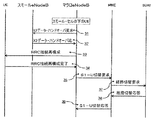
その目的のために、3GPP規定X2インタフェース(今後、「X2データ・ハンドオーバ」と呼ぶ)に基づくハンドオーバ手順が、図3に示すように、採用される。このX2データ・ハンドオーバにより、図1の構成(先行技術)から図2の構成(一部またはすべてのE−RABに対して2つのセルの間で制御プレーン4およびユーザ・プレーン3が分割されている)に移動することができる。
To that end, a handover procedure based on the 3GPP prescribed X2 interface (hereinafter referred to as “X2 data handover”) is adopted as shown in FIG. This X2 data handover splits the control plane 4 and
「X2データ・ハンドオーバ」は、一部またはすべてのE−RABのデータ・ベアラのみ(すなわちユーザ・プレーン・トラフィック)をスモールeNodeB5に転送し、一方、シグナリング無線ベアラ(すなわち、制御プレーン・トラフィック)をマクロ・セルに保持する。
“X2 data handover” forwards only some or all E-RAB data bearers (ie user plane traffic) to the
実際には、「X2データ・ハンドオーバ」は以下のステップを含む。
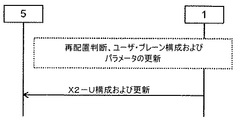
− 対応するユーザ・プレーン・トラフィックがスモールeNodeB5のユーザ・プレーン3によってユーザ機器2に送出されるように、一部またはすべてのE−RABのユーザ・プレーン3(すなわち、データ・ベアラ情報)をサービング・マクロeNodeB1からスモールeNodeB5にX2データ・ハンドオーバ要求/応答メッセージによって再配置するステップ(図3のステップ32〜33)。この目的のために、X2構成メッセージおよび/または情報要素が、図4に提示されるように、ユーザ・プレーン構成および動作のためのマクロeNodeB1順序性(macro eNodeB 1 ordering)変更および更新を可能にするために導入される。特に、X2メッセージ(図4のX2−U構成および更新メッセージなど)は、スモールeNodeB5に配置されるユーザ・プレーン・エンティティの構成および動作の更新を、マクロeNodeB1から制御し、再配置を実行するように設計される。
− UE2が、選択されたERABのユーザ・プレーン・アップリンク・データをスモールeNodeB5にのみ、および制御プレーン・アップリンク・データをマクロeNodeB1にのみ送るように、再配置に従ってUE2のRRC(無線リソース制御)接続を介した再構成を行うステップ(図3のステップ33〜34)。
− S1−Uのみを更新し、eNodeB1とMMEの間に残るS1制御プレーン(すなわち、S1−MME)を変わらないままにする、MMEを介した「S1−U切替」(S1−U切替要求/応答メッセージ)を実行するステップ(図3のステップ35〜36)。
− スモールeNodeB5からSGWの方への関係するERABのユーザ・プレーン切替を実現するためにMMEとSGWとの間で「経路切替」を実行するステップ(図3のステップ37〜38)。
In practice, “X2 Data Handover” includes the following steps:
-Serving some or all E-RAB user plane 3 (ie, data bearer information) so that corresponding user plane traffic is sent by the
-UE2 RRC (Radio Resource Control) according to the relocation so that UE2 sends user plane uplink data of the selected ERAB only to the small eNodeB5 and control plane uplink data only to the macro eNodeB1. Step for performing reconfiguration via connection (
-Update only S1-U and leave the S1 control plane (ie, S1-MME) remaining between eNodeB1 and MME unchanged, "S1-U switch" via SME (S1-U switch request / A response message) (
Performing “path switching” between the MME and the SGW to realize the relevant ERAB user plane switching from the
これが意味するところは、MMEが、S1−MME終端のための無線アクセス・ネットワーク・アンカとしてマクロeNodeB1を保持し、一方、関係するE−RABに関してスモールeNodeB5とSGWとの間でユーザ・プレーンを直接切り替えるために、データ経路切替要求をSGWの方に(適切なデータで)発出する(図3のステップ37〜38)ことである。
This means that the MME maintains the macro eNodeB1 as a radio access network anchor for the S1-MME termination, while directly communicating the user plane between the small eNodeB5 and the SGW for the associated E-RAB. In order to switch, a data path switching request is issued to the SGW (with appropriate data) (
X2データ・ハンドオーバは、ユーザ・プレーン3の関係するPDCP、RLC、MACエンティティだけでなくUEコンテキスト(セキュリティ情報などの)の一部またはすべてをスモールeNodeB5に再配置する。
X2 data handover relocates some or all of the UE context (such as security information) to the
再配置が初期に行われると仮定すると、UE2は、新しいスモール・セルへの同期に関連する中断時間を避けることができる。その上、制御プレーン・スタックがマクロeNB1に残っているので、RRCによるUEへの必要な再構成(ハンドオーバ)メッセージの送出は迅速で信頼でき、それはハンドオーバをほとんどシームレスにするのに大幅に寄与する。 Assuming that relocation occurs early, UE2 can avoid the downtime associated with synchronization to a new small cell. Moreover, since the control plane stack remains in the macro eNB1, sending the necessary reconfiguration (handover) message to the UE by RRC is quick and reliable, which greatly contributes to making the handover almost seamless. .
同様に、UEが移動してスモール・セルを出てマクロ・セルに戻る場合、同じ「X2データ・ハンドオーバ」法を、ほとんど中断なしに、制御プレーン・アンカをマクロeNodeB1で変わらないままにして、ほとんどシームレスで使用することができる。 Similarly, if the UE moves and exits the small cell and returns to the macro cell, the same “X2 data handover” method can be used, leaving the control plane anchor unchanged on the macro eNodeB1, with little interruption, It can be used almost seamlessly.
1つの実施形態では、ユーザ・プレーン・ベアラのすべてではなく一部がスモール・セルのみによって転送される。これは、ユーザ・プレーン・ベアラの一部がマクロeNodeB1に残っていることを意味する。この柔軟性により、マクロeNodeB1は、スモールeNodeB5への転送されるユーザ・プレーン・ベアラの選択を制御することができるはずである。 In one embodiment, some but not all of the user plane bearers are transferred by small cells only. This means that part of the user plane bearer remains in the macro eNodeB1. With this flexibility, the macro eNodeB1 should be able to control the selection of user plane bearers that are forwarded to the small eNodeB5.
有利には、上述のプロトコル・アーキテクチャは、マクロeNodeB1とスモールeNodeB5との間でUEの制御プレーンを再配置する必要なしに、ユーザ・プレーンのすべてまたは一部をマクロ・セルとスモール・セルとの間で行ったり来たり切り替えることができるようにし、それゆえに、ほとんどシームレスのハンドオーバ手順(中断時間の減少)が保証される。これは、スモール・セルの高密度配備をもっているが、スモール・セル層の連続的なカバレッジをもたないヘテロジニアス・ネットワークを横切ってUEが移動するという広範囲に及ぶシナリオを考慮すると、性能強化目標に関して特に重要である。それゆえに、本発明により、UEは、スモール・セルでのユーザ・データの高いデータ・レートとともに、制御プレーン・モビリティ性能を劣化させないことから利益を得ることができる。 Advantageously, the protocol architecture described above allows all or part of the user plane between macro and small cells without having to relocate the UE control plane between macro eNodeB1 and small eNodeB5. It is possible to switch back and forth between, thus ensuring an almost seamless handover procedure (reduction of interruption time). This is a performance enhancement target given the wide range of scenarios where UEs move across heterogeneous networks that have small cell high density deployments but do not have continuous coverage of the small cell layer. Is particularly important with respect to. Therefore, according to the present invention, the UE can benefit from not degrading the control plane mobility performance with the high data rate of user data in the small cell.
上述の方法の別の利点は、周波数間ヘテロジニアス・ネットワークにおけるスモール・セルの高密度化を容易にしながら、周波数間ヘテロジニアス・ネットワークでのシームレスで円滑なハンドオーバ実行を保証し、それがサービスのよりよいネットワーク品質をもたらすことである。 Another advantage of the above method is that it facilitates small cell density in the inter-frequency heterogeneous network while ensuring seamless and smooth handover execution in the inter-frequency heterogeneous network, To bring better network quality.
上述のプロトコル・アーキテクチャの実施態様およびその実施は、周波数間ヘテロジニアス・ネットワークにおけるスモール・セル高度化のために制御/ユーザ・プレーン分割を変更することによって新しい手順を使用する利点を提供する。 The implementation of the protocol architecture described above and its implementation provide the advantage of using the new procedure by changing control / user plane partitioning for small cell enhancement in inter-frequency heterogeneous networks.
上述の方法によれば、UEは、マクロeNodeB1からの制御されたシグナリングと、より高品質のサービスを提供するスモールeNodeB5からのサービスとを受けることができる。それによって、マクロ・セル・カバレッジ内のどこでも、ユーザは安定で高品質(広帯域)のサービスを享受する。
According to the method described above, the UE can receive controlled signaling from the
上述の実施形態は、1つを超えるより小さいサイズのセル(例えば、ピコ・セルまたはフェムト・セル)を覆う他のセル(例えば、マイクロ・セル)に同様に適用することができることに留意されるべきである。 It is noted that the above-described embodiments are equally applicable to other cells (eg, micro cells) that cover more than one smaller size cell (eg, pico cell or femto cell). Should.
上述のプロトコル・アーキテクチャは、現在の3GPPリリースに好適であることも留意されるべきである。 It should also be noted that the protocol architecture described above is suitable for the current 3GPP release.
Claims (6)
− 対応するユーザ・プレーン・トラフィックが前記第2の基地局の前記ユーザ・プレーン無線プロトコル・スタック(3)によって前記ユーザ機器(2)に送出されるように、少なくとも無線アクセス・ベアラのために前記ユーザ・プレーン(3)無線プロトコル・スタックを前記第2の基地局(5)に再配置するステップと、
− 前記ユーザ機器が、前記無線アクセス・ベアラのユーザ・プレーン・アップリンク・データを前記第2の基地局にのみ、および制御プレーン・アップリンク・データを前記第1の基地局にのみ送るように、前記再配置に従って無線リソース制御接続を介して前記ユーザ機器(2)を再構成するステップと、
− 前記第2の基地局からの前記ユーザ・プレーン(3)を更新し、前記第1の基地局から前記モビリティ管理エンティティの方への前記制御プレーン(4)を変わらないままにするために、前記モビリティ管理エンティティによって前記サービング・ゲートウェイの方への前記少なくとも無線アクセス・ベアラのユーザ・プレーン切替を実行するステップと
を含む、方法。 A method for handing over a user equipment (2) from a first base station (1) to a second base station (5), wherein the first base station (1) is a mobility management entity for the control plane And a user plane radio protocol stack (3) and a control plane radio protocol stack (4) for each radio access bearer connected to the serving gateway for the user plane, the user equipment (2) The second base station (5) controls a cell covered by a cell under the control of the first base station (1), and the mobility management entity for the control plane; Connected to the serving gateway for the user plane, the method comprising:
-At least for the radio access bearer, so that corresponding user plane traffic is sent to the user equipment (2) by the user plane radio protocol stack (3) of the second base station. Relocating a user plane (3) radio protocol stack to the second base station (5);
-The user equipment sends user plane uplink data of the radio access bearer only to the second base station and control plane uplink data only to the first base station; Reconfiguring the user equipment (2) via a radio resource control connection according to the relocation;
-To update the user plane (3) from the second base station and leave the control plane (4) from the first base station towards the mobility management entity unchanged. Performing a user plane switch of the at least radio access bearer towards the serving gateway by the mobility management entity.
− 対応するユーザ・プレーン・トラフィックが前記第2の基地局の前記ユーザ・プレーン無線プロトコル・スタック(3)によって前記ユーザ機器(2)に送出されるように、少なくとも無線アクセス・ベアラのために前記ユーザ・プレーン(3)無線プロトコル・スタックを前記第2の基地局(5)に再配置し、
− 前記ユーザ機器が、前記無線アクセス・ベアラのユーザ・プレーン・アップリンク・データを前記第2の基地局にのみ、および制御プレーン・アップリンク・データを前記第1の基地局にのみ送るように、前記再配置に従って無線リソース制御接続を介して前記ユーザ機器(2)を再構成し、
− 前記第2の基地局からの前記ユーザ・プレーン(3)を更新し、前記第1の基地局から前記モビリティ管理エンティティの方への前記制御プレーン(4)を変わらないままにするために、前記モビリティ管理エンティティによって前記サービング・ゲートウェイの方への前記少なくとも無線アクセス・ベアラのユーザ・プレーン切替を実行するように構成される、通信システム。 A communication system for handing over a user equipment (2) from a first base station (1) to a second base station (5), wherein the first base station (1) manages mobility for a control plane Connected to the entity and the serving gateway for the user plane, the user plane radio protocol stack (3) and control plane radio protocol stack (4) for each radio access bearer are connected to the user equipment (2 The mobility management entity for the control plane, wherein the second base station (5) controls a cell covered by a cell under the control of the first base station (1) And the serving gateway for the user plane, the first base station (1)
-At least for the radio access bearer, so that corresponding user plane traffic is sent to the user equipment (2) by the user plane radio protocol stack (3) of the second base station. Relocating the user plane (3) radio protocol stack to the second base station (5);
-The user equipment sends user plane uplink data of the radio access bearer only to the second base station and control plane uplink data only to the first base station; Reconfigure the user equipment (2) via a radio resource control connection according to the relocation,
-To update the user plane (3) from the second base station and leave the control plane (4) from the first base station towards the mobility management entity unchanged. A communication system configured to perform user plane switching of the at least radio access bearer towards the serving gateway by the mobility management entity.
Applications Claiming Priority (3)
| Application Number | Priority Date | Filing Date | Title |
|---|---|---|---|
| EP12306190.5A EP2713653A1 (en) | 2012-09-28 | 2012-09-28 | User plane handover for heterogeneous networks |
| EP12306190.5 | 2012-09-28 | ||
| PCT/EP2013/067993 WO2014048676A1 (en) | 2012-09-28 | 2013-08-30 | User plane handover for heterogeneous networks field of the invention |
Publications (1)
| Publication Number | Publication Date |
|---|---|
| JP2015530840A true JP2015530840A (en) | 2015-10-15 |
Family
ID=47002800
Family Applications (1)
| Application Number | Title | Priority Date | Filing Date |
|---|---|---|---|
| JP2015533506A Pending JP2015530840A (en) | 2012-09-28 | 2013-08-30 | User plane handover for heterogeneous networks |
Country Status (6)
| Country | Link |
|---|---|
| US (1) | US20150282024A1 (en) |
| EP (1) | EP2713653A1 (en) |
| JP (1) | JP2015530840A (en) |
| KR (1) | KR20150052145A (en) |
| CN (1) | CN104685929A (en) |
| WO (1) | WO2014048676A1 (en) |
Families Citing this family (9)
| Publication number | Priority date | Publication date | Assignee | Title |
|---|---|---|---|---|
| US9271324B2 (en) | 2012-12-19 | 2016-02-23 | Blackberry Limited | Method and apparatus for assisted serving cell configuration in a heterogeneous network architecture |
| US9832717B2 (en) | 2012-12-19 | 2017-11-28 | Blackberry Limited | Method and apparatus for layer 3 configuration in a heterogeneous network |
| KR101802157B1 (en) | 2013-10-28 | 2017-12-28 | 엘지전자 주식회사 | Method and apparatus for performing dual connectivity in heterogeneous network |
| CN105792292B (en) * | 2014-12-26 | 2021-03-30 | 中兴通讯股份有限公司 | A base station handover method, system and related device |
| CN106211244B (en) * | 2015-05-07 | 2021-01-22 | 中兴通讯股份有限公司 | A method and base station for realizing cellular network relocation |
| US10064098B2 (en) * | 2015-12-07 | 2018-08-28 | Google Llc | Dual connectivity and carrier aggregation at an IP layer |
| CN111314973B (en) * | 2016-08-12 | 2021-12-14 | 华为技术有限公司 | Data processing method and related equipment |
| CN108337693B (en) * | 2017-01-20 | 2021-06-08 | 成都鼎桥通信技术有限公司 | Reset method of S1 interface and communication equipment |
| WO2024055242A1 (en) * | 2022-09-15 | 2024-03-21 | Oppo广东移动通信有限公司 | Communication method and apparatus, communication device, and converged networking architecture |
Citations (2)
| Publication number | Priority date | Publication date | Assignee | Title |
|---|---|---|---|---|
| WO2011137775A1 (en) * | 2010-08-03 | 2011-11-10 | 华为技术有限公司 | Cellular communication system, method for terminal handover between cells and macro base station |
| JP2014007499A (en) * | 2012-06-22 | 2014-01-16 | Ntt Docomo Inc | Radio communication system |
Family Cites Families (4)
| Publication number | Priority date | Publication date | Assignee | Title |
|---|---|---|---|---|
| DE10046342A1 (en) * | 2000-09-19 | 2002-04-04 | Siemens Ag | Radio access network for a mobile radio communication system and operating method therefor |
| EP2234445B1 (en) * | 2007-10-01 | 2018-11-21 | NEC Corporation | Wireless communication system, wireless communication method, base station and mobile station |
| US20120071190A1 (en) * | 2010-09-21 | 2012-03-22 | Infineon Technologies Ag | Base stations and radio devices |
| US20130272219A1 (en) * | 2012-03-13 | 2013-10-17 | Qualcomm Incorporated | Methods and apparatus for backhaul sharing by femtocells |
-
2012
- 2012-09-28 EP EP12306190.5A patent/EP2713653A1/en not_active Withdrawn
-
2013
- 2013-08-30 WO PCT/EP2013/067993 patent/WO2014048676A1/en not_active Ceased
- 2013-08-30 KR KR1020157007931A patent/KR20150052145A/en not_active Ceased
- 2013-08-30 US US14/431,559 patent/US20150282024A1/en not_active Abandoned
- 2013-08-30 CN CN201380050802.7A patent/CN104685929A/en active Pending
- 2013-08-30 JP JP2015533506A patent/JP2015530840A/en active Pending
Patent Citations (3)
| Publication number | Priority date | Publication date | Assignee | Title |
|---|---|---|---|---|
| WO2011137775A1 (en) * | 2010-08-03 | 2011-11-10 | 华为技术有限公司 | Cellular communication system, method for terminal handover between cells and macro base station |
| US20130165130A1 (en) * | 2010-08-03 | 2013-06-27 | Huawei Technologies Co., Ltd. | Cellular communication system, inter-cell handover method for ue, and macro base station |
| JP2014007499A (en) * | 2012-06-22 | 2014-01-16 | Ntt Docomo Inc | Radio communication system |
Non-Patent Citations (1)
| Title |
|---|
| NTT DOCOMO, INC.: "Requirements, CandidateSolutions & Technology Roadmapfor LTE Rel-12 Onward", 3GPP WORKSHOP ON RELEASE 12 AND ONWARDS, RWS-120010, JPN6016009410, 11 June 2012 (2012-06-11), ISSN: 0003274857 * |
Also Published As
| Publication number | Publication date |
|---|---|
| WO2014048676A1 (en) | 2014-04-03 |
| WO2014048676A8 (en) | 2015-02-05 |
| US20150282024A1 (en) | 2015-10-01 |
| KR20150052145A (en) | 2015-05-13 |
| CN104685929A (en) | 2015-06-03 |
| EP2713653A1 (en) | 2014-04-02 |
Similar Documents
| Publication | Publication Date | Title |
|---|---|---|
| US12262269B2 (en) | Communication system | |
| CN106171039B (en) | Small cell cluster for signaling load reduction, time synchronization, KPI filtering and spectrum coordination | |
| KR101450406B1 (en) | Ue visited cells history information usage for identifying home base station | |
| JP2015530840A (en) | User plane handover for heterogeneous networks | |
| KR101730088B1 (en) | Wireless communication system and method for processing handover thereof | |
| KR101804712B1 (en) | Method and system for setup or modification of data flows, primary node, secondary node, ue and computer program product | |
| TW201739302A (en) | A Macro-assisted Multi-Connectivity scheme in multi-RAT cellular systems | |
| CN104378793A (en) | Switching method, master control base station and controlled base station | |
| CN103037451A (en) | Radio resource control connection re-establishment method, user equipment and base station | |
| US20150223127A1 (en) | Method for handover management within heterogeneous networks | |
| CN105580434A (en) | exchange master node | |
| CN104247504B (en) | Cell switching method and equipment | |
| CN105792292B (en) | A base station handover method, system and related device | |
| WO2016161785A1 (en) | Cross-menb switching method and apparatus and base station | |
| WO2016107144A1 (en) | Method, device, and system for updating user-side path | |
| CN105580432A (en) | Base station providing handover among small cells | |
| KR20150072081A (en) | Method and apparatus for processing of handover | |
| WO2016101468A1 (en) | Mobility management method and device |
Legal Events
| Date | Code | Title | Description |
|---|---|---|---|
| A621 | Written request for application examination |
Free format text: JAPANESE INTERMEDIATE CODE: A621 Effective date: 20150519 |
|
| A977 | Report on retrieval |
Free format text: JAPANESE INTERMEDIATE CODE: A971007 Effective date: 20160303 |
|
| A131 | Notification of reasons for refusal |
Free format text: JAPANESE INTERMEDIATE CODE: A131 Effective date: 20160310 |
|
| A601 | Written request for extension of time |
Free format text: JAPANESE INTERMEDIATE CODE: A601 Effective date: 20160610 |
|
| A02 | Decision of refusal |
Free format text: JAPANESE INTERMEDIATE CODE: A02 Effective date: 20170131 |