JP2015160999A - Rebar - Google Patents
Rebar Download PDFInfo
- Publication number
- JP2015160999A JP2015160999A JP2014037355A JP2014037355A JP2015160999A JP 2015160999 A JP2015160999 A JP 2015160999A JP 2014037355 A JP2014037355 A JP 2014037355A JP 2014037355 A JP2014037355 A JP 2014037355A JP 2015160999 A JP2015160999 A JP 2015160999A
- Authority
- JP
- Japan
- Prior art keywords
- ferrite
- steel
- strength
- content
- less
- Prior art date
- Legal status (The legal status is an assumption and is not a legal conclusion. Google has not performed a legal analysis and makes no representation as to the accuracy of the status listed.)
- Granted
Links
Images


Landscapes
- Heat Treatment Of Strip Materials And Filament Materials (AREA)
- Preventing Corrosion Or Incrustation Of Metals (AREA)
Abstract
Description
本発明は、例えば、鉄筋コンクリート構造物に用いられる引張強さが1600MPa以上のせん断補強筋等に使用される鉄筋に関するものである。 The present invention relates to a reinforcing bar used for, for example, a shear reinforcing bar having a tensile strength of 1600 MPa or more used for a reinforced concrete structure.
例えば、鉄筋コンクリート構造物には、その崩壊を防ぐために、補強材としてせん断補強筋が使用される。せん断補強筋を使用した鉄筋コンクリート構造物では、鉄筋コンクリート構造物がせん断変形する際に、せん断補強筋が伸びて塑性変形することにより、鉄筋コンクリート構造物の変形エネルギーがせん断補強筋に吸収され鉄筋コンクリート構造物の崩壊が防がれる。 For example, in a reinforced concrete structure, a shear reinforcing bar is used as a reinforcing material in order to prevent its collapse. In reinforced concrete structures using shear reinforcement, when the reinforced concrete structure undergoes shear deformation, the shear reinforcement is stretched and plastically deformed, so that the deformation energy of the reinforced concrete structure is absorbed by the shear reinforcement and the reinforced concrete structure Collapse is prevented.
これまで使用されているせん断補強筋は、引張強さが1200MPa程度のものが使用されている。しかし、近年、鉄筋コンクリート構造物の断面をスリム化および軽量化したり、また鉄筋コンクリート構造物を高層化する、ニーズがあり、超高強度コンクリートの開発が急速に進んでいる。これに伴って、コンクリート強度の上昇とのバランスをとるために、せん断補強筋の高強度化も必要となる。 The shear reinforcement which has been used so far has a tensile strength of about 1200 MPa. However, in recent years, there is a need for slimming and lightening the cross section of a reinforced concrete structure, or increasing the height of a reinforced concrete structure, and development of ultra-high strength concrete is rapidly progressing. Along with this, in order to balance the increase in concrete strength, it is necessary to increase the strength of the shear reinforcement.
しかしながら、一般に鋼材を高強度化すると、遅れ破壊に対する感受性が鋭敏になり、特にコンクリート中での鋼材の腐食に起因して鋼材表面で発生する水素が該鋼材中に侵入すると、応力集中部での水素集積による遅れ破壊を引き起こし易くなる。従って、せん断補強筋の高強度化をはかった場合に、特にコンクリートに埋設される鉄筋ではコンクリート中に存在する塩化物イオンによる表面の腐食に伴って発生する水素が増加すると想定されることから、遅れ破壊特性の低下が懸念されている。 However, in general, when the strength of a steel material is increased, the sensitivity to delayed fracture becomes sharper. In particular, when hydrogen generated on the steel surface due to corrosion of the steel material in concrete penetrates into the steel material, the stress concentration portion Prone to delayed destruction due to hydrogen accumulation. Therefore, when the strength of the shear reinforcement is increased, it is assumed that the hydrogen generated due to the corrosion of the surface by chloride ions existing in the concrete increases especially in the reinforcing bars embedded in concrete. There is concern about the deterioration of delayed fracture characteristics.
そこで、上記問題を克服するため、いくつかの提案がなされている。
例えば、特許文献1には、鋼材中のC、Si、Mnの含有量を適正範囲に制御し、かつ、鋼材をオーステナイト域に加熱した後の冷却条件を制御することによって、鋼材の表面のフェライト脱炭相を0.12mm以上確保し、内部をフェライト・パーライト組織とするための熱処理方法が開示されている。しかしながら、フェライト脱炭相が0.12mm以上になると、強度確保が困難となる。また、内部の組織がフェライト・パーライト組織であり、高強度の鉄筋を得ることが困難である。
Thus, several proposals have been made to overcome the above problems.
For example,
特許文献2には、鋼線材中のC、Si、Mn、Ni、Alの含有量の最適化、鋼線材の表層のフェライト脱炭層を0.12mm以上に制御し、内部をフェライト・パーライト組織あるいは球状化セメンタイト組織に制御した、遅れ破壊特性に優れた鋼線材が開示されている。しかしながら、上述したとおり、フェライト脱炭が0.12mm以上になると、強度確保が困難となる。また、内部の組織がフェライト・パーライト組織あるいは球状化セメンタイト組織であるため、高強度の鉄筋を得ることが困難である。
In
上述の通り、超高強度コンクリートの開発に伴い、鉄筋の高強度化が必要であるところ、鉄筋を高強度化すると、遅れ破壊感受性が高まって遅れ破壊が発生しやすくなることが、解決しなければならない課題となっていた。 As described above, with the development of ultra-high-strength concrete, it is necessary to increase the strength of the reinforcing bars. However, if the strength of the reinforcing bars is increased, the susceptibility to delayed fracture increases and delayed fracture tends to occur. It was an issue that had to be done.
本発明は、このような課題を解決すべくなされたものであり、引張強さが1600MPa以上となる高い強度特性を有するとともに、耐遅れ破壊特性に優れた鉄筋を提供することを目的とする。 The present invention has been made to solve such a problem, and an object of the present invention is to provide a reinforcing bar having high strength characteristics with a tensile strength of 1600 MPa or more and excellent delayed fracture resistance.
発明者らは、前記課題を解決するため、表面から少なくとも10μmの深さまでの領域のC量、鋼組織および組織分率を変化させた高強度鉄筋を製作し、遅れ破壊特性について鋭意調査した。その結果、鉄筋の表面側をフェライト単相組織(以下、表層フェライトとも言う)とし、かつ、鉄筋の表面から所定の深さまでの領域のC含有量を低減することにより、鉄筋表面で発生する水素量を低減させ、これにより鉄筋中に侵入する水素量を低減できるという知見を得た。さらに、鉄筋の芯部をマルテンサイト単相組織(以下、芯部マルテンサイトとも言う)とし、全組織(表層フェライト+芯部マルテンサイト)に対するフェライトの分率を面積率で5%未満とすれば、引張強さ1600MPa以上を確保でき、かつ、上記の表層フェライトによる侵入水素の低減効果は維持されるという知見も得た。このように、表面から少なくとも10μm深さまでの領域のC含有量を0.01mass%以下とし、鋼組織が表層のフェライトと芯部のマルテンサイトとからなり、全組織中のフェライトの分率が5%未満という条件を満足すれば、鉄筋中への拡散性水素の侵入量を低減でき、引張強さ1600MPa以上の高強度を有する鋼であっても良好な遅れ破壊特性を付与できることを見出し、本発明を完成するに至った。 In order to solve the above-mentioned problems, the inventors manufactured high-strength reinforcing bars in which the amount of C, the steel structure, and the structure fraction in the region from the surface to a depth of at least 10 μm were changed, and intensively investigated the delayed fracture characteristics. As a result, the surface side of the reinforcing bar has a ferrite single-phase structure (hereinafter also referred to as surface ferrite), and the C content in the region from the reinforcing bar surface to a predetermined depth is reduced, thereby generating hydrogen generated on the reinforcing bar surface. It was found that the amount of hydrogen penetrating into the reinforcing bar can be reduced by reducing the amount. Furthermore, if the core part of the reinforcing bar has a martensite single-phase structure (hereinafter also referred to as core martensite) and the fraction of ferrite with respect to the entire structure (surface ferrite + core martensite) is less than 5% by area ratio. Further, it was found that the tensile strength of 1600 MPa or more can be secured, and the effect of reducing the intrusion hydrogen by the surface layer ferrite is maintained. In this way, the C content in the region from the surface to a depth of at least 10 μm is set to 0.01 mass% or less, the steel structure is composed of ferrite in the surface layer and martensite in the core, and the ferrite fraction in the entire structure is 5%. If satisfying the condition of less than, it was found that the amount of diffusible hydrogen permeating into the rebar can be reduced, and even if the steel has a high strength with a tensile strength of 1600 MPa or more, good delayed fracture characteristics can be imparted. It came to complete.
すなわち、本発明の要旨構成は、以下のとおりである。
表面から少なくとも10μmの深さまでの領域のC含有量が0.01mass%以下の鋼からなり、該鋼が表層のフェライトと芯部のマルテンサイトとの2相組織を有し、全組織中のフェライトの分率が5%未満であり、引張強さが1600MPa以上である鉄筋。
That is, the gist configuration of the present invention is as follows.
The C content in the region from the surface to a depth of at least 10 μm is 0.01 mass% or less, and the steel has a two-phase structure of ferrite in the surface layer and martensite in the core. Rebar with a fraction of less than 5% and a tensile strength of 1600 MPa or more.
ここで、フェライトの分率は、鉄筋の長さ方向に垂直な断面における面積率{フェライト面積/(フェライト面積+マルテンサイト面積)}である。 Here, the ferrite fraction is an area ratio {ferrite area / (ferrite area + martensite area)} in a cross section perpendicular to the length direction of the reinforcing bar.
本発明によれば、従来の鉄筋に比べて高強度でありながら優れた遅れ破壊特性を有する鉄筋を提供することが可能となる。本発明の鉄筋は、引張強さが1600MPa以上を有し、優れた遅れ破壊特性を有しており、鉄筋コンクリート構造物の断面スリム化および軽量化や、鉄筋コンクリート構造物の高層化にも寄与するため、産業上有益な効果がもたらされる。 ADVANTAGE OF THE INVENTION According to this invention, it becomes possible to provide the reinforcement which has the delayed fracture characteristic which was excellent in strength compared with the conventional reinforcement. The reinforcing bar of the present invention has a tensile strength of 1600 MPa or more, has excellent delayed fracture characteristics, and contributes to slimming and weight reduction of the reinforced concrete structure and increasing the height of the reinforced concrete structure. , Industrially beneficial effects are brought about.
以下、本発明の鉄筋について、所定の領域のC含有量並びに鋼組織を具体的に説明する。
[表面から少なくとも10μmの深さまでの領域のC含有量:0.01mass%以下]
鉄筋の表面から少なくとも10μmの深さまでの領域(以下、低C領域ともいう)のC含有量が0.01mass%を超えると、固溶C量の増加、さらにはベイナイト組織および/またはマルテンサイト組織の生成により、遅れ破壊感受性が高くなる。また、この低C領域のC含有量が0.01mass%を超えると、鉄筋表面の腐食に伴って発生する水素量が増加し、遅れ破壊の原因となる水素の鉄筋中への侵入量も増加する。
なお、低C領域のC含有量は、完全にC含有量を0mass%とすることは困難であるため、0.001mass%以上とすることが好ましい。
Hereinafter, the C content in a predetermined region and the steel structure will be specifically described for the reinforcing bar of the present invention.
[C content in region from surface to depth of at least 10 μm: 0.01 mass% or less]
When the C content in the region from the surface of the reinforcing bar to a depth of at least 10 μm (hereinafter also referred to as a low C region) exceeds 0.01 mass%, the amount of solute C increases, and further, the bainite structure and / or the martensite structure Generation increases susceptibility to delayed fracture. In addition, when the C content in the low C region exceeds 0.01 mass%, the amount of hydrogen generated along with the corrosion of the rebar surface increases, and the amount of hydrogen entering the rebar that causes delayed fracture also increases. .
In addition, since it is difficult for C content of a low C area | region to completely make
ここで、C含有量を0.01mass%以下とする領域を、表面から少なくとも10μmの深さまで、すなわち低C領域の厚みを10μm以上としたのは、低C領域の厚さが10μm未満になると、腐食に伴って発生する水素量の低減効果が不十分となり、鋼中に侵入する水素量が増加し、鋼材内部にある硬質なマルテンサイト組織に水素が溜まりやすくなり、遅れ破壊が促進されるからである。この低C領域の厚さは15μm以上であることが、好ましい。 Here, the region where the C content is 0.01 mass% or less is at least 10 μm deep from the surface, that is, the thickness of the low C region is 10 μm or more, when the thickness of the low C region is less than 10 μm, Because the effect of reducing the amount of hydrogen generated due to corrosion becomes insufficient, the amount of hydrogen entering the steel increases, hydrogen tends to accumulate in the hard martensite structure inside the steel, and delayed fracture is promoted. It is. The thickness of the low C region is preferably 15 μm or more.
なお、高強度鉄筋としての強度、具体的には引張強さ1600MPa以上を得るためには、C含有量が0.01mass%以下となる領域の厚みを、100μm以下とすることが好ましい。なぜなら、C含有量が0.01mass%以下となる領域の厚みが100μm超となると、表層フェライトにかかる力が大きくなり、引張時に表層フェライトにき裂が入り、その後、すぐにき裂が進展し、引張強さが低下する。 In order to obtain strength as a high-strength reinforcing bar, specifically, a tensile strength of 1600 MPa or more, the thickness of the region where the C content is 0.01 mass% or less is preferably 100 μm or less. Because, when the thickness of the region where the C content is 0.01 mass% or less exceeds 100 μm, the force applied to the surface ferrite increases, and the surface ferrite is cracked at the time of tension, and then the crack progresses immediately, Tensile strength decreases.
[鋼組織:表層のフェライトと芯部のマルテンサイトとの2相組織を有し、全組織中のフェライトの分率が5%未満]
鋼は、表層のフェライトと、その内側の芯部となるマルテンサイトとの2相組織とする。マルテンサイト相は、鋼を高強度化する上では有用であるが、鉄筋の表層をマルテンサイト組織とすると遅れ破壊感受性が増大し、耐遅れ破壊特性が低下する。そこで、鉄筋の表層を遅れ破壊感受性の小さいフェライト単相組織とし、芯部すなわち表層以外は強度を確保するためのマルテンサイト単相組織とすることが肝要である。一方、全組織中のフェライトの分率が5%以上となると、マルテンサイトよりも強度が小さいフェライトの分率が大きくなって所望の強度を確保することが難しくなるために、フェライトの分率は5%未満とする。
以上のことから、鋼組織は、表層のフェライトと芯部のマルテンサイトとからなり、全組織中のフェライトの分率が5%未満である2相組織とした。
[Steel structure: It has a two-phase structure of ferrite in the surface layer and martensite in the core, and the ferrite fraction in the entire structure is less than 5%]
The steel has a two-phase structure of ferrite on the surface layer and martensite that forms the core part inside. The martensite phase is useful for increasing the strength of steel, but if the surface layer of the reinforcing bar has a martensite structure, delayed fracture susceptibility increases and delayed fracture resistance decreases. Therefore, it is important that the surface layer of the reinforcing bar has a ferrite single-phase structure with low delayed fracture susceptibility and a martensite single-phase structure other than the core, that is, the surface layer, to ensure strength. On the other hand, when the ferrite fraction in the entire structure is 5% or more, the ferrite fraction having a lower strength than martensite becomes large and it becomes difficult to secure a desired strength. Less than 5%.
From the above, the steel structure was composed of a ferrite in the surface layer and martensite in the core, and a two-phase structure in which the ferrite fraction in the entire structure was less than 5%.
引張強さ:1600MPa以上
鉄筋の引張強さが1600MPa未満では、鉄筋がコンクリートの高強度化に対応できないため、1600MPa以上とした。好ましくは、1650MPa以上である。
Tensile strength: 1600MPa or more Reinforcing bars cannot be used to increase the strength of concrete if the tensile strength of the reinforcing bars is less than 1600MPa. Preferably, it is 1650 MPa or more.
以上の鉄筋は、転炉による溶製あるいは真空溶製した鋼を、鋼塊、スラブ、ブルームまたはビレットなどに鋳造して素材とし、該素材を加熱して熱間圧延または熱間鍛伸加工に供して、その後、酸洗してスケールを除去して伸線により所定の太さに整えたのち、加熱・保持、焼入れ、あるいはさらに焼戻しを施すことによって、製造される。 These rebars are made from steel melted in a converter or vacuum melted into steel ingots, slabs, blooms, billets, etc., and heated to hot rolling or hot forging. Then, after pickling, removing the scale and adjusting to a predetermined thickness by wire drawing, it is manufactured by heating / holding, quenching, or further tempering.
ここで、前記の溶製時に、マルテンサイト組織とすれば引張強さが1600MPa以上となり得る。好ましくは、表層フェライト生成による強度低下分を考慮してマルテンサイト組織とすれば1650MPa以上の引張強さとなり得る鋼組成の素材を溶製する。 Here, if the martensite structure is used at the time of melting, the tensile strength can be 1600 MPa or more. Preferably, a material having a steel composition that can have a tensile strength of 1650 MPa or more is melted if a martensite structure is formed in consideration of the strength reduction due to the formation of surface ferrite.
次いで、上述の加熱・保持の際に表層に脱炭を生じさせることにより、表面から少なくとも10μmの深さまでの領域のC含有量を0.01mass%以下に調整する。すなわち、脱炭雰囲気(大気、N2雰囲気等)中で、加熱・保持することにより表面から少なくとも10μmの深さまでの領域のC含有量を0.01mass%以下とする。この際、低C領域内側の芯部のC含有量は溶製時のC含有量が維持されるように、加熱温度および保持時間を適宜調整する。表面から少なくとも10μmの深さまでの領域のC含有量を0.01mass%以下にまで脱炭させるための加熱温度および保持時間の条件は、素材の鋼組成によっても変化するため、鋼組成に応じて最適な条件を予め求めておけばよい。そして、加熱・保持の後に、焼入れ処理を施すことによって、芯部はマルテンサイト組織となり表層はフェライト組織となる。同様に、全組織に対するフェライトの分率の調整についても、熱処理時の加熱温度および保持時間を制御することにより、脱炭が生じる表層深さを調整して行うことができる。 Next, by decarburizing the surface layer during the heating and holding described above, the C content in the region from the surface to a depth of at least 10 μm is adjusted to 0.01 mass% or less. That is, by heating and holding in a decarburizing atmosphere (air, N 2 atmosphere, etc.), the C content in the region from the surface to a depth of at least 10 μm is set to 0.01 mass% or less. At this time, the heating temperature and the holding time are appropriately adjusted so that the C content of the core portion inside the low C region is maintained at the time of melting. The conditions of heating temperature and holding time for decarburizing the C content in the region from the surface to a depth of at least 10 μm to 0.01 mass% or less vary depending on the steel composition of the material, so it is optimal for the steel composition What is necessary is just to obtain | require an appropriate condition beforehand. And after heating and holding, the core part has a martensite structure and the surface layer has a ferrite structure by performing a quenching treatment. Similarly, the ferrite fraction with respect to the entire structure can be adjusted by adjusting the surface depth at which decarburization occurs by controlling the heating temperature and holding time during heat treatment.
なお、表層のフェライト組織の厚さは、C含有量が0.01mass%以下の低C領域の厚さよりも大きくなる。なぜなら、C含有量が0.01mass%超であり、かつ、芯部よりもC含有量が小さく、焼入れを施してもマルテンサイトにならずフェライトとなる領域が低C領域よりも内側(芯部側)に生じるためである。 In addition, the thickness of the ferrite structure of the surface layer is larger than the thickness of the low C region where the C content is 0.01 mass% or less. This is because the C content is more than 0.01 mass%, the C content is smaller than the core, and the region that does not become martensite and becomes ferrite even when quenched is inside the low C region (the core side). ).
かくして得られた鉄筋は、安価に製造できるにも関わらず、高強度でありながら優れた遅れ破壊特性を有し、1600MPa以上の高強度を必要とする、高層マンションなどのせん断補強筋への適用が可能である。 Although the reinforcing bars thus obtained can be manufactured at low cost, they have excellent delayed fracture characteristics despite their high strength, and are applicable to shear reinforcements such as high-rise apartment buildings that require high strength of 1600 MPa or more. Is possible.
鉄筋の遅れ破壊特性の評価は、実際に鉄筋を製造し、鉄筋コンクリート構造物に用いて評価するのが最も好ましいが、この方法では時間がかかるため、本実施例では次の通り評価した。
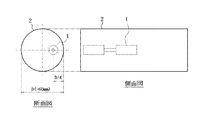
すなわち、表1に示す成分組成を有する鋼を溶製、鋳造した後、熱間鍛伸加工により、直径60mmの丸棒にした。この丸棒から、図1に示す仕様に従って試験片を採取した。試験片の採取は、図2に示すように、丸棒2の表面から丸棒直径Dの1/4の深さ位置(1/4D位置)が試験片1の軸中心となるように行った。採取した試験片を、表2に示す加熱温度、850℃以上での在炉時間にて加熱・保持を行い、その後、60℃油冷の条件にて焼入れを施した。その後、表2に示す加熱温度および保持時間での焼戻しを施した。ここでの加熱・保持は高強度鉄筋に施す焼入れ時の加熱を模擬したものである。次に、焼戻し処理後の試験片を酸洗して脱スケールを行った後、以下の条件にて表層のC含有量、引張強さおよび拡散性水素量を測定し、また遅れ破壊特性を評価し、さらに鋼組織の観察を行った。
The evaluation of the delayed fracture characteristics of a reinforcing bar is most preferably performed by actually manufacturing a reinforcing bar and using it for a reinforced concrete structure. However, since this method takes time, this example was evaluated as follows.
That is, after melting and casting steel having the component composition shown in Table 1, it was formed into a round bar having a diameter of 60 mm by hot forging. A test piece was collected from the round bar according to the specifications shown in FIG. As shown in FIG. 2, the test piece was collected so that the 1/4 depth position (1 / 4D position) of the round bar diameter D from the surface of the
[表層のC含有量]
表層のC含有量は、図1に示す試験片の平行部の中央部を切り出し、試験片の軸と直交する断面が観察面となるように樹脂に埋め込み、鏡面研磨後、電子線マイクロアナライザ(以下、EPMAと示す)を利用して測定した。EPMAの測定条件は、ビーム径:5μmφ、加速電圧:20kV、電流:4×10⁻⁷Aにて、表面から深さ1mmまで線分析を実施し、表面からの深さ毎(5μmピッチ)にC量を測定した。そして、C含有量が0.01mass%以下となる領域の表面からの深さの値を求めた。
[C content of surface layer]
The C content of the surface layer is obtained by cutting out the central part of the parallel part of the test piece shown in FIG. 1 and embedding it in a resin so that the cross section perpendicular to the axis of the test piece becomes the observation surface. Hereinafter, it was measured using EPMA). The measurement conditions of EPMA are: beam diameter: 5 μmφ, acceleration voltage: 20 kV, current: 4 × 10 −7 A, line analysis from the surface to a depth of 1 mm, and every depth from the surface (5 μm pitch) The amount of C was measured. And the value of the depth from the surface of the area | region where C content will be 0.01 mass% or less was calculated | required.
[組織観察]
組織の調査は、上記したC濃度を測定した試験片を用いて、鏡面研磨後に3%ナイタルで腐食を行ってから、光学顕微鏡500倍にて観察を行い、試験片断面におけるフェライト組織およびマルテンサイト組織の面積をそれぞれ求め、次式
F=(フェライト面積/試験片の断面積)×100(%)
但し、試験片の断面積:フェライト面積+マルテンサイト面積
に従ってフェライト分率Fを求めた。
[Tissue observation]
The structure is examined by using the above-mentioned test piece whose C concentration is measured, corroding with 3% nital after mirror polishing, and then observing with an optical microscope 500 times, and the ferrite structure and martensite in the cross section of the test piece. Obtain the area of the structure, respectively. F = (Ferrite area / Cross-sectional area of test piece) × 100 (%)
However, the ferrite fraction F was determined according to the cross-sectional area of the test piece: ferrite area + martensite area.
[引張試験]
引張強さは、図1の試験片を引張速度5mm/minにてJIS Z2241に準拠して引張試験を行うことで評価した。
[Tensile test]
The tensile strength was evaluated by conducting a tensile test on the test piece of FIG. 1 according to JIS Z2241 at a tensile speed of 5 mm / min.
[遅れ破壊特性]
高強度鉄筋としての遅れ破壊特性を調べるために、図1に示す試験片を使用して、FIP試験を実施した。FIP試験は、JSCE S 1201:2012(社団法人 腐食防食協会)に従い試験を実施した。すなわち、50℃の20%チオシアン酸アンモニウム(NH4SCN)水溶液中に浸漬して、引張強さの70%となる試験荷重を負荷し、試験時間100時間経過しても破断しない場合、遅れ破壊特性が良好と定義した。
[Delayed fracture characteristics]
In order to investigate the delayed fracture characteristics as a high-strength reinforcing bar, the FIP test was conducted using the test piece shown in FIG. The FIP test was conducted in accordance with JSCE S 1201: 2012 (Corrosion Protection Association). That is, when immersed in a 20% ammonium thiocyanate (NH 4 SCN) aqueous solution at 50 ° C and loaded with a test load that becomes 70% of the tensile strength, if it does not break even after 100 hours of test time, delayed fracture The property was defined as good.
[拡散性水素量]
拡散性水素量は、上述したFIP試験で破断または試験満了した後、破断した試験片は破面から、未破断の試験片は平行部から10mm長さのサンプルを切断して、株式会社ジェイ・サイエンス・ラボ製 GC7000Tで昇温速度200℃/時間で昇温を行い、350℃までに放出された水素量を拡散性水素量と定義して、拡散性水素量の測定を行った。
[Amount of diffusible hydrogen]
The amount of diffusible hydrogen was determined by cutting a 10 mm long sample from the fractured surface of the fractured test piece and the unbroken test piece from the parallel part after fracture or completion of the test in the FIP test described above. The temperature was increased at a rate of temperature increase of 200 ° C / hour with GC7000T manufactured by Science Lab. The amount of hydrogen released up to 350 ° C was defined as the amount of diffusible hydrogen, and the amount of diffusible hydrogen was measured.

表2に、表層に存在するC含有量が0.01mass%以下の領域の深さ、フェライト分率、拡散性水素量、FIP試験での破断時間ならびに引張強さを示す。全ての例において、表層の鋼組織はフェライト単相であり、芯部の組織はマルテンサイト単相であった。本発明のC量が0.01mass%以下の領域が10μm以上およびフェライト分率が5%未満の要件を満たす鋼No.1〜3、6、7、10、12(いずれも発明例)は、FIP試験での破断は認められなかった。一方、本発明の範囲外である鋼No.4、5、8(比較例)はFIP試験で早期破断を生じており、遅れ破壊特性が低下していることが分かる。また、鋼No.9、11は加熱保持時間が長く、表層の脱炭量またはフェライト分率が増加し、遅れ破壊特性が良好ではあるものの、引張強さが本発明の範囲外であることがわかる。なお、表2に示した結果について、拡散性水素量と破断時間との関係を示したグラフを図3に示す。本発明例において、優れた耐遅れ破壊特性を示すのは、拡散性水素量が3mass ppmの低い値となっていることに起因するものと考えられる。 Table 2 shows the depth, the ferrite fraction, the amount of diffusible hydrogen, the rupture time in the FIP test, and the tensile strength in the region where the C content existing in the surface layer is 0.01 mass% or less. In all examples, the steel structure of the surface layer was a ferrite single phase, and the core structure was a martensite single phase. Steel Nos. 1-3, 6, 7, 10, and 12 (all invention examples) satisfying the requirement that the amount of C of the present invention is 0.01 mass% or less and the ferrite fraction is less than 5% are FIP. No breakage was observed in the test. On the other hand, it can be seen that Steel Nos. 4, 5, and 8 (Comparative Examples), which are outside the scope of the present invention, are prematurely broken in the FIP test, and the delayed fracture characteristics are reduced. Steel Nos. 9 and 11 have a long heating and holding time, the surface decarburization amount or the ferrite fraction increases, and the delayed fracture property is good, but the tensile strength is out of the range of the present invention. Recognize. In addition, about the result shown in Table 2, the graph which showed the relationship between the amount of diffusible hydrogen and fracture | rupture time is shown in FIG. In the examples of the present invention, the excellent delayed fracture resistance is attributed to the fact that the amount of diffusible hydrogen is a low value of 3 mass ppm.
1 試験片
2 丸棒
1
Claims (1)
Priority Applications (1)
| Application Number | Priority Date | Filing Date | Title |
|---|---|---|---|
| JP2014037355A JP6244980B2 (en) | 2014-02-27 | 2014-02-27 | Rebar |
Applications Claiming Priority (1)
| Application Number | Priority Date | Filing Date | Title |
|---|---|---|---|
| JP2014037355A JP6244980B2 (en) | 2014-02-27 | 2014-02-27 | Rebar |
Publications (2)
| Publication Number | Publication Date |
|---|---|
| JP2015160999A true JP2015160999A (en) | 2015-09-07 |
| JP6244980B2 JP6244980B2 (en) | 2017-12-13 |
Family
ID=54184316
Family Applications (1)
| Application Number | Title | Priority Date | Filing Date |
|---|---|---|---|
| JP2014037355A Expired - Fee Related JP6244980B2 (en) | 2014-02-27 | 2014-02-27 | Rebar |
Country Status (1)
| Country | Link |
|---|---|
| JP (1) | JP6244980B2 (en) |
Cited By (1)
| Publication number | Priority date | Publication date | Assignee | Title |
|---|---|---|---|---|
| JP2021509147A (en) * | 2017-12-26 | 2021-03-18 | ポスコPosco | Ultra-high-strength hot-rolled steel sheets, steel pipes, members, and their manufacturing methods |
Citations (5)
| Publication number | Priority date | Publication date | Assignee | Title |
|---|---|---|---|---|
| JPS4945819A (en) * | 1972-09-08 | 1974-05-01 | ||
| JPH02107743A (en) * | 1988-10-17 | 1990-04-19 | Nippon Steel Corp | Ultrahigh tensile strength pc steel wire or steel rod excellent in uniform elongation and its production |
| JPH03120315A (en) * | 1989-10-03 | 1991-05-22 | Kanai Hiroyuki | Wire for wire saw |
| JPH07278663A (en) * | 1994-04-08 | 1995-10-24 | Nippon Steel Corp | Method for manufacturing high strength PC steel rod |
| JP2014043612A (en) * | 2012-08-27 | 2014-03-13 | Nippon Steel & Sumitomo Metal | High strength steel excellent in delayed fracture resistance |
-
2014
- 2014-02-27 JP JP2014037355A patent/JP6244980B2/en not_active Expired - Fee Related
Patent Citations (5)
| Publication number | Priority date | Publication date | Assignee | Title |
|---|---|---|---|---|
| JPS4945819A (en) * | 1972-09-08 | 1974-05-01 | ||
| JPH02107743A (en) * | 1988-10-17 | 1990-04-19 | Nippon Steel Corp | Ultrahigh tensile strength pc steel wire or steel rod excellent in uniform elongation and its production |
| JPH03120315A (en) * | 1989-10-03 | 1991-05-22 | Kanai Hiroyuki | Wire for wire saw |
| JPH07278663A (en) * | 1994-04-08 | 1995-10-24 | Nippon Steel Corp | Method for manufacturing high strength PC steel rod |
| JP2014043612A (en) * | 2012-08-27 | 2014-03-13 | Nippon Steel & Sumitomo Metal | High strength steel excellent in delayed fracture resistance |
Cited By (3)
| Publication number | Priority date | Publication date | Assignee | Title |
|---|---|---|---|---|
| JP2021509147A (en) * | 2017-12-26 | 2021-03-18 | ポスコPosco | Ultra-high-strength hot-rolled steel sheets, steel pipes, members, and their manufacturing methods |
| JP7186229B2 (en) | 2017-12-26 | 2022-12-08 | ポスコ | Ultra-high-strength hot-rolled steel sheet, steel pipe, member, and manufacturing method thereof |
| US11939639B2 (en) | 2017-12-26 | 2024-03-26 | Posco Co., Ltd | Ultra-high-strength hot-rolled steel sheet, steel pipe, member, and manufacturing methods therefor |
Also Published As
| Publication number | Publication date |
|---|---|
| JP6244980B2 (en) | 2017-12-13 |
Similar Documents
| Publication | Publication Date | Title |
|---|---|---|
| JP5135557B2 (en) | High-strength steel material and high-strength bolt excellent in delayed fracture resistance | |
| JP5177323B2 (en) | High-strength steel material and high-strength bolt excellent in delayed fracture resistance | |
| JP5802162B2 (en) | Wire rod and steel wire using the same | |
| JP5833485B2 (en) | Wire rod and steel wire using the same | |
| MX2014014448A (en) | HIGH RESISTANCE STEEL CABLE FOR SPRING WITH EXCELLENT WINDING PERFORMANCE AND RESISTANCE TO HYDROGEN FRAGILITY AND METHOD TO MANUFACTURE THE SAME. | |
| JP2004360005A (en) | High strength PC steel wire excellent in delayed fracture characteristics and method for producing the same | |
| JP6288265B2 (en) | Steel wire | |
| JP5251633B2 (en) | High strength steel material with excellent delayed fracture resistance, high strength bolt and manufacturing method thereof | |
| JP5870852B2 (en) | Manufacturing method of hot-dip galvanized steel wire with excellent twisting characteristics | |
| JP5741773B2 (en) | Steel and rebar for rebar | |
| JP6244980B2 (en) | Rebar | |
| JP4043754B2 (en) | High strength PC steel bar with excellent delayed fracture characteristics | |
| KR102139255B1 (en) | Steel wire with excellent delay resistance | |
| JP6682863B2 (en) | High carbon steel wire rod and high carbon steel wire | |
| JP5682933B2 (en) | High-strength PC steel strand and its manufacturing method | |
| JP6135553B2 (en) | Reinforcing bar and method for manufacturing the same | |
| JP6168132B2 (en) | Hot-dip galvanized steel wire with excellent twisting characteristics | |
| JP2004323870A (en) | High strength PC steel wire excellent in delayed fracture resistance and method of manufacturing the same | |
| JP3957582B2 (en) | High-strength PC steel bar with excellent delayed fracture characteristics of spot welds and method for producing the same | |
| KR101597756B1 (en) | Prestressing Strand having high stress corrosion feature | |
| JP2847508B2 (en) | Salt-resistant PC steel bar with excellent delayed fracture characteristics | |
| JP2017179399A (en) | Steel material for building | |
| JP2020176286A (en) | PC steel with excellent delayed fracture resistance and its manufacturing method | |
| JPH0559967B2 (en) |
Legal Events
| Date | Code | Title | Description |
|---|---|---|---|
| A621 | Written request for application examination |
Free format text: JAPANESE INTERMEDIATE CODE: A621 Effective date: 20150924 |
|
| A977 | Report on retrieval |
Free format text: JAPANESE INTERMEDIATE CODE: A971007 Effective date: 20160818 |
|
| A131 | Notification of reasons for refusal |
Free format text: JAPANESE INTERMEDIATE CODE: A131 Effective date: 20160830 |
|
| A521 | Request for written amendment filed |
Free format text: JAPANESE INTERMEDIATE CODE: A523 Effective date: 20161026 |
|
| A131 | Notification of reasons for refusal |
Free format text: JAPANESE INTERMEDIATE CODE: A131 Effective date: 20170321 |
|
| TRDD | Decision of grant or rejection written | ||
| A01 | Written decision to grant a patent or to grant a registration (utility model) |
Free format text: JAPANESE INTERMEDIATE CODE: A01 Effective date: 20171017 |
|
| A61 | First payment of annual fees (during grant procedure) |
Free format text: JAPANESE INTERMEDIATE CODE: A61 Effective date: 20171030 |
|
| R150 | Certificate of patent or registration of utility model |
Ref document number: 6244980 Country of ref document: JP Free format text: JAPANESE INTERMEDIATE CODE: R150 |
|
| R250 | Receipt of annual fees |
Free format text: JAPANESE INTERMEDIATE CODE: R250 |
|
| R250 | Receipt of annual fees |
Free format text: JAPANESE INTERMEDIATE CODE: R250 |
|
| R250 | Receipt of annual fees |
Free format text: JAPANESE INTERMEDIATE CODE: R250 |
|
| LAPS | Cancellation because of no payment of annual fees |