JP2014135902A - Measuring method of bacteria, evaluation method of antibacterial property and/or reduction property of bacteria, and holding material - Google Patents
Measuring method of bacteria, evaluation method of antibacterial property and/or reduction property of bacteria, and holding material Download PDFInfo
- Publication number
- JP2014135902A JP2014135902A JP2013004488A JP2013004488A JP2014135902A JP 2014135902 A JP2014135902 A JP 2014135902A JP 2013004488 A JP2013004488 A JP 2013004488A JP 2013004488 A JP2013004488 A JP 2013004488A JP 2014135902 A JP2014135902 A JP 2014135902A
- Authority
- JP
- Japan
- Prior art keywords
- bacteria
- test object
- test
- holding material
- antibacterial
- Prior art date
- Legal status (The legal status is an assumption and is not a legal conclusion. Google has not performed a legal analysis and makes no representation as to the accuracy of the status listed.)
- Granted
Links
Images



Landscapes
- Investigating Or Analysing Biological Materials (AREA)
- Apparatus Associated With Microorganisms And Enzymes (AREA)
- Measuring Or Testing Involving Enzymes Or Micro-Organisms (AREA)
Abstract
Description
本発明は、菌測定方法、抗菌性及び/又は菌減少性評価方法、及び保持材に関する。 The present invention relates to a bacteria measuring method, an antibacterial and / or bacteria reducing evaluation method, and a holding material.
近年、菌による被害が多く報告されるようになった。菌による被害としては、例えば、メチシリン耐性黄色ブドウ球菌(MRSA)、バンコマイシン耐性黄色ブドウ球菌(VRSA)、バンコマイシン耐性腸球菌(VRE)、多剤耐性緑膿菌(MDRP)などの薬剤耐性菌による院内感染、大腸菌O−157による食中毒などが挙げられる。医療機関やそれに準ずる施設、高齢者介護施設、幼児施設、公共機関など(以下、説明の便宜上、単に「医療機関等」という。)では、易感染者や高齢者、幼児が、前記した薬剤耐性菌だけでなく一般的な細菌や真菌による日和見感染を引き起こす場合もあり、効果的な対策が求められている。 In recent years, many damages caused by bacteria have been reported. Examples of the damage caused by bacteria include in-hospital caused by drug-resistant bacteria such as methicillin-resistant Staphylococcus aureus (MRSA), vancomycin-resistant Staphylococcus aureus (VRSA), vancomycin-resistant enterococci (VRE), and multidrug-resistant Pseudomonas aeruginosa (MDRP). Examples thereof include infection and food poisoning caused by E. coli O-157. In medical institutions and similar facilities, elderly care facilities, infant facilities, public institutions, etc. (hereinafter simply referred to as “medical institutions, etc.” for convenience of explanation) There are cases where opportunistic infections are caused not only by bacteria but also by general bacteria and fungi, and effective countermeasures are required.
前記した菌の感染経路として、空気感染、飛沫感染、接触感染がある。これらのうちでも、接触感染は感染経路として大きなウェイトを占めている。接触感染の予防策として、手洗いによる手指衛生や環境表面の清掃が行われている。また、菌の接触感染の感染リスク低減のため、抗菌物質を使用した製品の開発も行われている。 As the above-mentioned infection route of the bacteria, there are air infection, droplet infection, and contact infection. Among these, contact infection occupies a large weight as an infection route. As a preventive measure against contact infection, hand hygiene and environmental surface cleaning are carried out by hand washing. In addition, products using antibacterial substances are being developed to reduce the infection risk of bacterial contact infection.
抗菌物質を使用した製品を使用するためには、抗菌性能を評価する必要がある。そのため、さまざまな評価法が提案されている。例えば、特許文献1に記載の評価法、JIS Z 2801に規定の評価法(規格名称:抗菌加工製品―抗菌性試験方法・抗菌効果)、JIS L 1902に規定の評価法(規格名称:繊維製品の抗菌性試験方法及び抗菌効果)などが提案されている。
In order to use products using antibacterial substances, it is necessary to evaluate antibacterial performance. Therefore, various evaluation methods have been proposed. For example, the evaluation method described in
特許文献1には、抗菌加工製品の抗菌性能評価方法であって、特定細菌専用の培地を用いて細菌液を調整し、これを、抗菌加工を施した抗菌加工試験片と、抗菌加工を施していない抗菌無加工試験片と、に所定量各々接種し、被覆フィルムを被せて所定温度で所定時間保管し、これらの試験及び被覆フィルムに付着している前記細菌液を洗浄して第一の培地と第二の培地に接種し、所定温度で所定時間保管した後、前記第一の培地と、前記第二の培地と、に各々出現した前記特定細菌のコロニー数を比較することを特徴とする抗菌加工製品の抗菌性能評価方法が記載されている。
JIS Z 2801に規定の評価法は、フィルム密着法とも呼ばれている。JIS Z 2801には、試験菌液を試験片に滴下した後、滴下した試験菌液の上に被覆フィルムを載せて試験菌液の蒸発を抑制し、シャーレ内で35℃、90%RH(相対湿度)以上という条件で24時間保存した後の抗菌加工試験片の生菌数と無加工試験片の生菌数との差を抗菌活性値として算出する旨記載されている。 The evaluation method defined in JIS Z 2801 is also called a film adhesion method. In JIS Z 2801, after a test bacterial solution is dropped onto a test piece, a coating film is placed on the dropped test bacterial solution to suppress evaporation of the test bacterial solution, and 35 ° C. and 90% RH (relative to the petri dish). It is described that the difference between the number of viable bacteria of the antibacterial processed test piece after being stored for 24 hours under the condition of (humidity) and the number of viable bacteria of the unprocessed test piece is calculated as an antibacterial activity value.
JIS L 1902に規定の評価法には、評価を行うための定量試験の一つとして菌転写法が挙げられている。菌転写法は、外衣やカーテン、カーペットなどのあまり水分が関与しない低湿潤状態下での抗菌加工繊維製品の評価法として確立されたものである。この菌転写法によれば、試験菌液をメンブレンフィルター上に捕集し、高湿潤状態下、被検物に転写装置を使って転写した後、寒天培地入りシャーレに入れて20℃、70%RH以上という条件で1〜4時間保存し、標準布上の生菌数との差を菌減少値として算出することで、低湿潤状態下での抗菌加工繊維製品の評価を行うことができる。 As an evaluation method defined in JIS L 1902, a bacterial transcription method is cited as one of quantitative tests for evaluation. The fungus transfer method has been established as an evaluation method for antibacterial processed fiber products under low moisture conditions such as outer garments, curtains, and carpets that do not involve much moisture. According to this bacterial transfer method, a test bacterial solution is collected on a membrane filter, transferred to a test object using a transfer device in a highly humid state, and then placed in a petri dish containing an agar medium at 20 ° C. and 70%. By storing for 1 to 4 hours under the condition of RH or more, and calculating the difference from the number of viable bacteria on the standard cloth as the bacteria reduction value, the antibacterial processed fiber product under a low wet condition can be evaluated.
既に説明したように、感染経路として大きなウェイトを占める接触感染は、罹患者との直接接触を除けば、ドアノブ、手すり、ベッド周りなど(以下、説明の便宜上、単に「ドアノブ等」という。)を介して、間接的に行われる。ドアノブ等は、材料表面が低湿潤状態乃至乾燥状態であるため、抗菌物質の効果が発揮され難い状態である反面、菌にとって厳しいものであり、菌の数は右肩下がりに減少し易いと推察される。 As described above, contact infections that occupy a large weight as an infection route involve door knobs, handrails, beds, etc. (hereinafter simply referred to as “doorknob etc.” for convenience of explanation) except for direct contact with affected persons. Through indirectly. The door knob, etc. are in a state where the surface of the material is in a low wet or dry state, so that the effect of antibacterial substances is difficult to be exerted, but on the other hand, it is severe for bacteria, and it is assumed that the number of bacteria tends to decrease downward Is done.
これに対して、特許文献1に記載の評価法やJIS Z 2801に規定の評価法は、液体を吸収しない疎水性表面を有する材料等からなる試験片上に試験菌液を滴下した後、試験菌液の蒸発等に起因する細菌の死滅や減少を防ぐため、被覆フィルムを載せて材料表面が高湿潤状態を維持するようにしている。
On the other hand, in the evaluation method described in
高湿潤状態は、抗菌物質の効果が発揮され易い状態である反面、菌が増殖し易いと推察される。つまり、特許文献1に記載の評価法やJIS Z 2801に規定の評価法は、高湿潤状態下で右肩上がりに増殖している菌をどの程度抑制することができるか、ということを評価していることになる。
The high humidity state is a state where the effect of the antibacterial substance is easily exhibited, but it is presumed that the bacteria easily grow. In other words, the evaluation method described in
従って、これらの評価法は、実際に使用される環境状態、すなわち、材料表面が低湿潤状態乃至乾燥状態と乖離した状態における抗菌性能を評価していることになる。さらに、これらの評価法は、被検物が平滑面の場合には適用できるが、例えば屈曲面や球面などの場合には、菌液を滴下する際に流れ落ちてしまい、また被覆フィルムが密着できず剥がれてしまうため、屈曲面や球面などに適用するのは困難である。 Therefore, these evaluation methods evaluate the antibacterial performance in an actually used environment state, that is, in a state where the material surface is deviated from a low wet state or a dry state. Furthermore, these evaluation methods can be applied when the test object is a smooth surface, but, for example, when the test object is a curved surface or a spherical surface, it flows down when the bacterial solution is dropped, and the coated film can be adhered. Since it peels off, it is difficult to apply to a bent surface or a spherical surface.
また、JIS L 1902に規定の評価法によれば、材料表面が低湿潤状態下における抗菌加工繊維製品の評価を行うことは可能である。しかしながら、液体を吸収しない疎水性表面を有する材料に対しては、試験菌液がはじかれてしまうため、被検物への細菌の転写が困難となる。そのため、抗菌性能を評価することができない。つまり、実際に使用される環境に近い状態を模擬して評価することができない。 Moreover, according to the evaluation method prescribed | regulated to JISL1902, it is possible to evaluate the antibacterial processed fiber product in the state where a material surface is a low moisture state. However, for a material having a hydrophobic surface that does not absorb liquid, the test bacterial solution is repelled, making it difficult to transfer bacteria to the test object. Therefore, antibacterial performance cannot be evaluated. In other words, it is impossible to simulate and evaluate a state close to the environment actually used.
また、例えば、医療施設のドアノブや手すり、ベッド周りなどは患者や患者と接触した医療従事者が頻繁に接触する場所であり、手指から分泌される汗や皮脂の付着が起こる。皮脂成分は、菌の付着性、菌の増殖に影響を与える一方で、抗菌性にも影響を与える要因となり得る。しかし、前記したいずれの評価法も被検物に付着する皮脂成分の影響をまったく考慮していない。従って、いずれの評価法も、この点でも実際に使用される環境状態と乖離した状態を評価していることになる。 In addition, for example, doorknobs, handrails, and beds around medical facilities are places where patients and medical workers who have contacted the patient frequently come into contact, and sweat and sebum secreted from fingers occur. The sebum component can affect the adhesion of bacteria and the growth of bacteria, but can also affect the antibacterial properties. However, none of the evaluation methods described above considers the influence of sebum components adhering to the specimen. Therefore, any of these evaluation methods evaluates a state deviating from an actually used environmental state in this respect.
前記したように、抗菌物質を使用した製品を使用するためには、抗菌性能を評価する必要があるが、実際に使用される環境に近い状態を模擬して評価できる適当な評価法がないのが現状である。 As described above, in order to use products using antibacterial substances, it is necessary to evaluate antibacterial performance, but there is no appropriate evaluation method that can simulate and evaluate conditions close to the actual use environment. Is the current situation.
本発明は前記状況に鑑みてなされたものであり、材料表面の低湿潤状態や皮脂成分の付着など、実際に使用される環境に近い状態を模擬して評価することが可能な菌測定方法、抗菌性及び/又は菌減少性評価方法、及び保持材を提供することを課題とする。 The present invention has been made in view of the above situation, a method for measuring bacteria capable of simulating and evaluating a state close to the environment actually used, such as the low wet state of the material surface and the adhesion of sebum components, It is an object of the present invention to provide an antibacterial and / or fungus reduction evaluation method and a holding material.
請求項1に係る発明は、皮脂成分と、特定の菌を含有する試験液と、を基材に含ませてなる保持材を、被検物と接触させる接触工程と、前記被検物に付着した前記特定の菌の数又は数に相関する指標の測定を行う測定工程と、を含むことを特徴とする菌測定方法である。
なお、特定の菌数に相関する指標は、細胞内に存在するATP量又は菌由来の遺伝子量を測定対象としたが、これに限らず、他の菌量評価値を用いてもよい。
このような構成とすれば、前記した保持材から皮脂成分と菌を含有する試験液とを低湿潤状態で被検物に移行させることが可能となる。そのため、実際に使用される環境に近い状態、つまり、皮脂成分の付着及び低湿潤状態下で菌を評価することができる。
The invention according to
In addition, although the index correlating with the specific number of bacteria is the measurement target, the amount of ATP present in the cells or the amount of genes derived from the bacteria, the present invention is not limited thereto, and other bacteria amount evaluation values may be used.
With such a configuration, it becomes possible to transfer the sebum component and the test solution containing the bacteria from the holding material to the test object in a low-humidity state. Therefore, the bacteria can be evaluated in a state close to the environment in which they are actually used, that is, in a state where the sebum component is adhered and in a low wet state.
本発明においては、前記測定工程は、生菌数測定法、ATP測定法及び遺伝子定量法のうちの少なくとも一つで前記特定の菌の数又は数に相関する指標の測定を行うのが好ましい。
このような構成とすれば、菌の数又は数に相関する指標の測定を適切に行うことができる。
In the present invention, it is preferable that the measurement step measures at least one of a viable cell count method, an ATP measurement method, and a gene quantification method and measures an index correlated with the number of the specific bacteria.
If it is set as such a structure, the measurement of the parameter | index correlated with the number of bacteria or a number can be performed appropriately.
請求項2に係る発明は、抗菌性及び/又は菌減少性を評価する抗菌性及び/又は菌減少性評価方法であって、皮脂成分と、特定の菌を含有する試験液と、を基材に含ませてなる保持材を、抗菌性が付与されていない第1の被検物及び抗菌性が付与された第2の被検物のそれぞれに、個別に接触させる接触工程と、前記第1の被検物及び前記第2の被検物に付着した前記特定の菌の数又は数に相関する指標の測定を行う測定工程と、前記測定工程で測定された結果から前記第2の被検物の抗菌性及び/又は菌減少性を評価する評価工程と、を含み、前記指標は、ATP量又は遺伝子量であり、前記測定工程では、前記第1の被検物に前記保持材を接触させた直後に前記特定の菌の数又は数に相関する指標の測定を行って、その結果をMaとし、前記第1の被検物に前記保持材を接触させた後、当該被検物を所定温度で所定時間保管した後に前記特定の菌の数又は数に相関する指標の測定を行って、その結果をMbとし、前記第2の被検物に前記保持材を接触させた直後に前記特定の菌の数又は数に相関する指標の測定を行って、その結果をMcとし、前記第2の被検物に前記保持材を接触させた後、当該被検物を所定温度で所定時間保管した後に前記特定の菌の数又は数に相関する指標の測定を行って、その結果をMdとしたとき、前記評価工程で、(Mc−Md)−(Ma−Mb)、Ma−Md及びMb−Mdのうちの少なくとも一つの式を用いて前記第2の被検物の抗菌性及び/又は菌減少性を評価することを特徴とする抗菌性及び/又は菌減少性評価方法である。
このような構成とすれば、実際に使用される環境に近い状態、つまり、皮脂成分の付着及び低湿潤状態下で菌を評価することができるとともに、被検物の抗菌性及び/又は菌減少性を示す客観的な指標を得ることができる。そのため、抗菌性及び/又は菌減少性の絶対評価及び相対評価が可能となる。
The invention according to
With such a configuration, it is possible to evaluate bacteria under conditions close to the environment in which they are actually used, that is, adhesion of sebum components and low humidity, and antibacterial properties and / or bacteria reduction of the test object. An objective index indicating sex can be obtained. Therefore, an absolute evaluation and a relative evaluation of antibacterial properties and / or bacteria reduction are possible.
請求項3に係る発明においては、前記基材は、前記第1の被検物及び前記第2の被検物に重なる部分がなく密着して貼りつけることができる形状であるのが好ましい。
このような構成とすれば、第1及び第2の被検物の形状に関わらず、異なる形状の被検物を同時に評価して、比較することができる。さらに、被検物が平滑面以外の例えば屈曲面や球面などの場合にも、前記形状の基材に皮脂成分及び特定の菌を含有する試験液を含ませてなる保持材を接触させることによって、被検物の抗菌性及び/又は菌減少性を示す客観的な指標を得ることができる。また、基材と第1及び第2の被検物との間で接触しない部分が生じないため、より正確に抗菌性及び/又は菌減少性の評価をすることができる。
In the invention which concerns on
With such a configuration, regardless of the shapes of the first and second specimens, specimens having different shapes can be simultaneously evaluated and compared. Furthermore, even when the test object is other than a smooth surface, such as a bent surface or a spherical surface, by contacting a holding material containing a test liquid containing a sebum component and a specific fungus to the base material having the shape described above. It is possible to obtain an objective index indicating the antibacterial property and / or the bacteria-reducing property of the test object. Moreover, since the part which does not contact between a base material and a 1st and 2nd test object does not arise, antimicrobial property and / or microbe reduction property can be evaluated more correctly.
請求項4に係る発明は、皮脂成分を含む基材と、前記基材に含浸させた試験液と、を有する保持材であって、前記基材は、被検物に重なる部分がなく密着して貼りつけることができる形状であり、前記試験液は、特定の菌を含有することを特徴とする保持材である。
このような構成の保持材を被検物に貼り付けると、皮脂成分と試験液とを同時に被検物に移行させることができる。
The invention according to claim 4 is a holding material having a base material containing a sebum component and a test solution impregnated in the base material, the base material being in close contact with a portion that does not overlap the test object. The test solution is a holding material characterized by containing a specific fungus.
When the holding material having such a configuration is attached to the test object, the sebum component and the test solution can be simultaneously transferred to the test object.
本発明においては、前記皮脂成分の含有量が0.05〜5.0mg/cm2であるのが好ましく、前記試験液の含有量が10〜40μL/cm2であるのが好ましい。
このような構成とすれば、より確実に、低湿潤状態で皮脂成分と試験液とを被検物に移行させることができるようになる。
In the present invention, the content of the sebum component is preferably from range from 0.05 to 5.0 mg / cm 2, the content of the test liquid is preferably 10~40μL / cm 2.
With such a configuration, the sebum component and the test solution can be transferred to the test object more reliably in a low-humidity state.
また、本発明においては、皮脂成分を含有する溶剤を基材に含浸させる溶剤含浸工程と、前記基材から前記溶剤を除去する溶剤除去工程と、前記溶剤を除去した基材に、特定の菌を含有する試験液を含浸させる試験液含浸工程と、を含むことを特徴とする保持材製造方法である。
このような構成とすれば、前記した保持材を確実に製造することができる。
Further, in the present invention, a specific bacterium is added to the solvent impregnation step of impregnating the base material with a solvent containing a sebum component, the solvent removal step of removing the solvent from the base material, and the base material from which the solvent is removed. And a test liquid impregnation step of impregnating a test liquid containing a holding liquid.
With such a configuration, the above-described holding material can be reliably manufactured.
本発明によれば、実際に使用される環境に近い状態を模擬して評価することが可能な菌測定方法、抗菌性及び/又は菌減少性評価方法、及び保持材を提供することができる。 ADVANTAGE OF THE INVENTION According to this invention, the microbe measurement method which can simulate and evaluate the state close | similar to the environment actually used, an antimicrobial property and / or microbe reduction evaluation method, and a holding | maintenance material can be provided.
以下、適宜図面を参照して本発明に係る菌測定方法、抗菌性及び/又は菌減少性評価方法、及び保持材を実施するための形態(実施形態)について詳細に説明する。
なお、本発明では、「抗菌」とは、細菌の増殖を抑制する状態と定義し、「抗菌性」とは、細菌の増殖を抑制する性質と定義して、発明の詳細を述べる。
Hereinafter, the microbe measurement method, the antibacterial and / or microbe reduction evaluation method, and the mode for carrying out the holding material (embodiment) according to the present invention will be described in detail with reference to the drawings as appropriate.
In the present invention, “antibacterial” is defined as a state of suppressing bacterial growth, and “antibacterial” is defined as a property of suppressing bacterial growth, and the details of the invention will be described.
本実施形態に係る菌測定方法、及び抗菌性及び/又は菌減少性評価方法を説明する前に、説明の便宜上、これらに用いる保持材の一実施形態について説明する。 Before describing the bacteria measurement method and the antibacterial and / or bacteria reduction evaluation method according to this embodiment, an embodiment of a holding material used for these will be described for convenience of explanation.
[保持材]
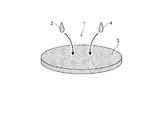
図1に示すように、本実施形態に係る保持材1は、皮脂成分2を含む基材3と、基材3に含浸させた試験液4と、を有する。そして、この基材3は、被検物に重なる部分がなく密着して貼りつけることができる形状であり、この試験液4は、特定の菌を含有している。
[Retaining material]
As shown in FIG. 1, the holding
かかる保持材1を被検物と接触させると、保持材1に含有されている皮脂成分2と試験液4を同時に被検物へ移行させることができる。前記したように、皮脂成分2は、菌の付着性、菌の増殖に影響を与える一方で、抗菌性にも影響を与える要因となり得る。従って、皮脂成分2と試験液4を同時に被検物へ移行させることによって、実際に使用される環境に近い状態を模擬することができる。
When the holding
特に、皮脂成分2が複数種の成分を含有している場合には、被検物との親和性が高い成分ほどより多く移行し、残存することになる。そのため、より実際に使用される環境に近い状態を模擬することができる。なお、基材3に皮脂成分2を染み込ませただけでは、皮脂成分2の被検物への移行は殆ど起こらないおそれがある。また、基材3に試験液4を染み込ませただけでは、金属、樹脂、セラミックなど(以下、単に「金属等」ということもある。)の疎水性表面を有する被検物の表面で試験液4がはじかれて均一に広がらないおそれがある。
In particular, when the
皮脂成分2は、例えば、トリグリセリド、不飽和脂肪酸、脂肪酸エステル、スクワレン、脂肪族炭化水素、コレステロール、コレステロールエステルなどから選択される一又は二以上を含有したものを用いることができる。なお、皮脂成分2に含有される成分はこれらに限定されるものではなく、ヒトの接触によって被検物に移行し得るものであれば、前記した成分以外の成分を含有させることができる。皮脂成分2が複数種の成分を含有していると、被検物との親和性が高い成分ほどより多く被検物へ移行し、残存することになる。従って、複数種の成分を含有する皮脂成分2を使用すると、実際に使用される環境により近い状態を模擬することが可能となる。また、このようにすると、被検物ごとに人の接触により移行する皮脂成分の種類と量を調べ、それぞれを付着させた被検物を調製する必要がないので、そのための手間と労力を省くことができる。なお、皮脂成分2は、ヒトの皮脂成分を分析し、その分析結果を基に再現すると、実際に使用される環境にさらに近い状態を模擬することができるので好ましい。
As the
被検物の材質などによって、ヒトから移行する皮脂成分の種類や量が異なる場合がある。被検物に応じて皮脂成分2の含有量を変更することで、ヒトから移行する皮脂成分の種類や量を異ならしめることも可能である。このようにしても、より実際に使用される環境に近い状態を模擬することが可能である。
Depending on the material of the test object, the type and amount of sebum components transferred from humans may vary. By changing the content of the
皮脂成分2の含有量は、例えば、0.05〜5.0mg/cm2とすることができる。皮脂成分2の含有量がこの数値範囲内にあると、実際に使用される環境に近い状態を模擬することができる。
皮脂成分2の含有量が0.05mg/cm2よりも少ないと、金属等の疎水性表面を有する被検物の場合に、試験液4がはじかれて均一に広がらないおそれがある。他方、皮脂成分2の含有量が5.0mg/cm2よりも多いと、皮脂成分2の被検物への移行量が多くなりすぎる結果、実際に使用される環境状態と乖離した状態となってしまうおそれがある。
Content of the
If the content of the
特定の菌とは、後記する菌測定方法においては、測定することを目的として予め選定された菌のうちの少なくとも一方をいい、後記する抗菌性及び/又は菌減少性評価方法においては、抗菌性及び/又は菌減少性を評価することを目的として予め選定された菌のうちの少なくとも一方をいう。特定の菌は、ヒト、ウシ、ブタ、イヌ、ネコなどの哺乳類に疾患を引き起こす病原体となることが多い。特定の菌としては、細菌及び真菌が挙げられる。細菌としては、例えば、大腸菌、大腸菌O−157、黄色ブドウ球菌、肺炎桿菌、腸炎ビブリオ、サルモネラ、セレウス菌、ウェルシュ菌、カンピロバクター菌、リステリア菌、エルシニア菌、エロモナス菌、メチシリン耐性黄色ブドウ球菌(MRSA)、バンコマイシン耐性黄色ブドウ球菌(VRSA)、バンコマイシン耐性腸球菌(VRE)、多剤耐性緑膿菌(MDRP)、緑膿菌、セパシア菌、セラチア菌、クロストリジウム菌、アシネトバクター菌、ヘリコバクター菌、レジオネラ菌、レンサ球菌、ブレバンディモナス属に属する菌、腸球菌、枯草菌、耐熱性好酸性菌、ジンジバリス菌、ストレプトコッカス菌、アクネ菌、マラセチア菌、トリコフィトン菌、白癬菌、表皮ブドウ球菌、メチロバクテリウムなどが挙げられる。また、真菌としては、例えば、クロカビ、黒色酵母、エクソフィアラ、クロコウジカビ、アオカビ、ケタマカビ、カンジダ、サッカロミセス、赤色酵母、耐浸透圧性酵母などが挙げられる。なお、特定の菌はこれらに限定されるものではなく、接触感染によって感染し得るものであればどのようなものも対象となる。また、例えば、菌が完全に同定されていなくても、性状、形態、遺伝子情報などで特定できれば、対象菌とすることができる。特定の菌は、前記した選択肢から適宜に選択される一種類のみを用いることができるが、二種以上を適宜に組み合わせて用いることもできる。二種以上を適宜に組み合わせた場合、菌の複合的な挙動を把握することが可能になる。 The specific bacteria refers to at least one of bacteria selected in advance for the purpose of measurement in the bacteria measurement method described below, and in the antibacterial and / or bacteria reduction evaluation methods described below, antibacterial properties. And / or at least one of the bacteria selected in advance for the purpose of evaluating the bacteria reducing ability. Certain fungi are often pathogens that cause disease in mammals such as humans, cows, pigs, dogs and cats. Specific fungi include bacteria and fungi. Examples of the bacteria include Escherichia coli, Escherichia coli O-157, Staphylococcus aureus, Klebsiella pneumoniae, Vibrio parahaemolyticus, Salmonella, Bacillus cereus, Clostridium perfringens, Campylobacter, Listeria, Yersinia, Eromonas, Methicillin-resistant Staphylococcus aureus (MRSA). ), Vancomycin-resistant Staphylococcus aureus (VRSA), vancomycin-resistant enterococci (VRE), multi-drug resistant Pseudomonas aeruginosa (MDRP), Pseudomonas aeruginosa, Sephacia, Serratia, Clostridium, Acinetobacter, Helicobacter, Legionella , Streptococcus, Brevundimonas spp., Enterococcus, Bacillus subtilis, Heat-resistant acidophilic bacteria, Gingivalis, Streptococcus, Acne, Malassezia, Trichophyton, Trichophyton, Staphylococcus epidermidis, Methylobacterium Um etc. are mentioned. Examples of the fungus include black mold, black yeast, exophylla, black mold, blue mold, kingfish, candida, saccharomyces, red yeast, and osmotic pressure yeast. In addition, specific bacteria are not limited to these, What kind of thing will be object if it can infect by contact infection. Further, for example, even if a bacterium is not completely identified, it can be a target bacterium if it can be specified by properties, forms, gene information, and the like. As the specific bacteria, only one kind appropriately selected from the above-mentioned options can be used, but two or more kinds can be used in appropriate combination. When two or more kinds are appropriately combined, it becomes possible to grasp the complex behavior of the bacteria.
特定の菌は、American Type Culture Collection(ATCC)、World Federation for Culture Collections(WFCC)、日本微生物資源学会(JSCC)、NITE生物遺伝資源部門(NBRC)、理化学研究所バイオリソースセンター微生物材料開発室(JCM)、農業生物資源研究所ジーンバンク微生物遺伝資源部門(NIAS−MAFF)、国立環境研究所微生物系統保存施設(NIES)、NITE特許微生物寄託センター(NPMD)などから入手することができる。また、環境中から単離した菌を用いることもできる。 Specific bacteria include: American Type Culture Collection (ATCC), World Federation for Culture Collections (WFCC), Japanese Society for Microbial Resources (JSCC), NITE Biogenetic Resource Department (NBRC), RIKEN BioResource Center, Microbial Materials Development Office (JCM) ), Genebank Microbial Genetic Resources Department (NIAS-MAFF), National Institute for Agrobiological Sciences (NIES), NITE Patent Microorganism Deposit Center (NPMD), etc. In addition, bacteria isolated from the environment can also be used.
試験液4は、前記した特定の菌を含有している。
特定の菌として細菌及び/又は真菌を用いる場合は、細菌及び/又は真菌を前培養し、低濃度培地(菌液調製溶液)で希釈して105〜109個/mLに調製したものを用いるのが好ましいが、菌の種類によって変更できる。細菌を培養する培地としては、ニュートリエント培地、ニュートリエント寒天培地、普通寒天培地、普通ブイヨン培地などが挙げられる。また、真菌を培養する培地としては、麦芽エキス寒天培地、サブロー寒天培地などを用いることができるが、これらに限定されるものではない。
The test solution 4 contains the specific bacteria described above.
When bacteria and / or fungi are used as specific bacteria, the bacteria and / or fungi are pre-cultured and diluted with a low-concentration medium (bacterial solution preparation solution) to prepare 10 5 to 10 9 cells / mL. It is preferable to use it, but it can be changed depending on the type of bacteria. Examples of the medium for culturing bacteria include a nutrient medium, a nutrient agar medium, a normal agar medium, and a normal bouillon medium. Further, as a medium for culturing fungi, malt extract agar medium, Sabouraud agar medium, and the like can be used, but are not limited thereto.
前培養条件としては、ニュートリエント寒天培地(37℃、24〜48時間)、ニュートリエント培地(37℃、18〜24時間)、ニュートリエント培地(37℃、2〜4時間)の順で培養したり、普通寒天培地(35℃、16〜24時間)、普通寒天培地(35℃、16〜20時間)の順で培養したり、ニュートリエント寒天培地(37℃、16〜24時間)、ニュートリエント寒天培地(37℃、16〜20時間)の順で培養したりすることができるが、これらに限定されるものではない。
菌液調製液としては、1/20〜1/200濃度のニュートリエント培地、1/20〜1/500濃度の普通ブイヨン培地などが挙げられるが、これらに限定されるものではない。
Pre-culture conditions are as follows: Nutrient agar medium (37 ° C., 24-48 hours), Nutrient medium (37 ° C., 18-24 hours), Nutrient medium (37 ° C., 2-4 hours). Ordinary agar medium (35 ° C, 16-24 hours), normal agar medium (35 ° C, 16-20 hours) in order, Nutrient agar medium (37 ° C, 16-24 hours), Nutrient Although it can culture | cultivate in order of an agar medium (37 degreeC, 16-20 hours), it is not limited to these.
Examples of the bacterial solution preparation liquid include, but are not limited to, a neutral medium having a concentration of 1/20 to 1/200, a normal broth medium having a concentration of 1/20 to 1/500, and the like.
基材3に含有させる試験液4の含有量は、基材3の保持力(保水力)に大きく左右される。試験液4は、基材3の保持力が高いほど多くの量を含有させることができる。試験液4は、保持材1を垂直な面に貼り付けたときに流れ落ちない量を上限とすることができる。これは、菌液が流れ落ちると移行量が変動し、正確な評価ができなくなることを考慮したものである。
試験液4の含有量は、例えば、10〜40μL/cm2とすることができる。試験液4の含有量がこの範囲内であれば、高湿潤状態となり難いので、実際に使用される環境に近い状態(低湿潤状態)を模擬することができる。試験液4の含有量が10μL/cm2よりも低くなると、被検物への菌の移行が困難になるおそれがある。他方、試験液4の含有量が40μL/cm2よりも高くなると、高湿潤状態になり易く、実際に使用される環境状態と乖離した状態となってしまうおそれがある。
The content of the test solution 4 to be contained in the
The content of the test solution 4 can be set to, for example, 10 to 40 μL / cm 2 . If the content of the test solution 4 is within this range, it is difficult to achieve a high wet state, and therefore a state close to the environment in which it is actually used (low wet state) can be simulated. If the content of the test solution 4 is lower than 10 μL / cm 2, it may be difficult to transfer the bacteria to the test object. On the other hand, when the content of the test solution 4 is higher than 40 μL / cm 2 , the test liquid 4 is likely to be in a highly moist state and may be in a state of being deviated from the actually used environmental state.
なお、試験液4の含有量は、用いる菌に応じて適宜変更することができる。例えば、乾燥に強いMRSAや黄色ブドウ球菌などは15〜20μL/cm2とするのが好ましく、乾燥に弱い緑膿菌や大腸菌などは、30〜35μL/cm2とするのが好ましい。 In addition, content of the test liquid 4 can be suitably changed according to the microbe to be used. For example, MRSA or Staphylococcus aureus resistant to drying is preferably 15 to 20 μL / cm 2, and Pseudomonas aeruginosa or Escherichia coli vulnerable to drying is preferably 30 to 35 μL / cm 2 .
また、試験液4の含有量は、前記数値範囲内において、基材3に含ませる前に測定した菌の濁度や単位数量当たりの菌数に基づいて適宜に調整するとよい。このようにすると、保持材1に含まれる菌数のばらつきが少なくなり、サンプル間の比較が容易となる。
In addition, the content of the test solution 4 may be appropriately adjusted based on the turbidity of bacteria measured before being included in the
基材3は、皮脂成分2と試験液4を含むことができるものであればよく、柔軟性のあるものが好ましい。このような基材3としては、例えば、ろ紙、布、不織布、メンブレンフィルターなどが挙げられる。このような基材3を用いているので、保持材1は、皮脂成分2と試験液4を保持できるだけでなく、被検物の形状に追従させて貼り付けることも可能となる。本発明は、所定量の皮脂成分2と所定量の試験液4を含む、面積が定まった柔軟性のある保持材1を用いることによって、単位面積当たりの皮脂量及び菌量が定まるとともに、金属、樹脂、セラミックなどの疎水性表面を有する被検物が平滑面であっても、屈曲面や球面であっても貼り付けることができ、塗布面全体に(被検物の表面全体に)皮脂成分2と試験液4を移行させることができる。従って、例えば、図2〜4に示す例は従来では困難であったが、本発明では保持材1を被検物に貼り付け、評価することができる。具体的には以下のとおりである。
The
図2(a)は、被検物として、面積の大きい樹脂製のオーバーテーブル5aを例示しており、(b)は、被検物として、面積の小さい金属板5bを例示しており、(c)は、被検物として、直径の大きい樹脂製の円柱状の手すり5cを例示しており、(d)は、被検物として、直径の小さい金属製の円柱状のドアノブ5dを例示しており、それらにそれぞれ保持材1を貼り付けている。なお、図2(a)及び(b)では、保持材1を円形としており、(c)及び(d)では、保持材1を矩形としている。また、(a)及び(c)と、(b)及び(d)はそれぞれの保持材1の面積が同一である。
2A illustrates a resin-made overtable 5a having a large area as the test object, and FIG. 2B illustrates a
図2(a)及び(b)と、(c)及び(d)のように保持材1の形状が同じで面積が異なる場合であっても、保持材1に含有する単位面積当たりの皮脂量及び菌量を同一にすることができるため、被検物も単位面積当たりの値として比較することができる。また、(a)及び(c)と、(b)及び(d)のように、保持材1の面積が同じで形状が異なる場合であっても、同じように貼り付けることができるため、被検物当たりや被検物単位面積当たりの値として比較することができる。さらに、(a)及び(d)や、(b)及び(c)のように保持材1の面積及び形状が異なる場合であっても、同じように貼り付けることができ、被検物の単位面積当たりの値として比較することができる。
2 (a) and (b) and the amount of sebum per unit area contained in the holding
また、図3(a)は、被検物として、複雑な形状の受話器5eを例示しており、(b)は、被検物として、球面を有する球体5fを例示している。図3(a)に示すように、保持材1は、音声を拾うマイク部分を切り取って略D字形状とし、受話器5eに貼り付けることができる。また、図3(b)に示すように、保持材1は、球体5fに貼り付けたときに球面と接しない部分が生じないよう、保持材1の中心近傍から四隅にかけて保持材1の一部を切り取って貼り付けることができる。これらのようにすると、被検物と接触しない部分を無くすことができ、保持材1の全体を被検物の表面に確実に接触させて皮脂成分2と試験液4を確実に移行することができる。そのため、より正確に菌の測定を行うことが可能となる。さらに、保持材1に含有する単位面積当たりの皮脂量及び菌量を同一にすることができるため、受話器5eと球体5fを単位面積当たりの値として比較することもできる。
FIG. 3A illustrates a
また、樹脂製の円柱形状の手すりの一部(直径大)及び金属製の円柱形状のドアノブの一部(直径小)を比較する場合には、同一面積で形状の異なる保持材1を用いることができる。手すりに合わせた保持材1をより直径の小さいドアノブに適用すると、一周以上の貼り付けとなり、重なり部分が生じるおそれがあるため、長手方向を長くする。さらに、2枚に分けて貼り付けてもよい。このようにすることによって、直径や材質が異なる円柱形状の手すりと、ドアノブの比較が可能となる。
In addition, when comparing a part of a resin-made columnar handrail (large diameter) and a part of a metal columnar doorknob (small diameter), use
以上に説明した本実施形態に係る保持材1によれば、基材3に皮脂成分2と、特定の菌を含有する試験液4とを含んでいるので、実際に使用される環境に近い状態を模擬することができる。
そのため、従来行われてきたような、被検物に試験液を滴下してコンラージ棒などで塗り広げる態様では抗菌性の評価が困難とされてきた被検物、具体的には、金属等の疎水性表面を有する被検物や、表面が繊維のような、親水性や吸水性の高い被検物に対しても、実際に使用される環境に近い状態を模擬して評価することが可能となる。
According to the holding
Therefore, the test object, which has been considered to be difficult to evaluate antibacterial properties in a mode in which the test solution is dropped onto the test object and spread with a large stick or the like, which has been conventionally performed, specifically, metal or the like It is possible to evaluate by simulating the condition close to the actual environment even for specimens with a hydrophobic surface and specimens with a hydrophilic or water-absorbing surface such as fibers. It becomes.
[保持材製造方法]
次に、図5を参照して、前記した保持材1を製造する保持材製造方法の一実施形態について説明する。
図5に示すように、本実施形態に係る保持材製造方法は、溶剤含浸工程S12と、溶剤除去工程S13と、試験液含浸工程S15と、を含んでおり、少なくともこれらの工程をこの順序で行う。
[Retaining material manufacturing method]
Next, an embodiment of a holding material manufacturing method for manufacturing the holding
As shown in FIG. 5, the holding material manufacturing method according to the present embodiment includes a solvent impregnation step S12, a solvent removal step S13, and a test liquid impregnation step S15. At least these steps are performed in this order. Do.
(溶剤含浸工程)
溶剤含浸工程S12は、皮脂成分2を含有する溶剤(図示せず)を基材3に含浸させる工程である。
皮脂成分2については既に詳述しているので、ここでの説明は省略する。皮脂成分2には疎水性の有機化合物が含まれている。従って、皮脂成分2を基材3に含浸させる場合、任意の溶剤に溶かし込んだ人工皮脂溶液を用いるのが好ましい。このようにすると、皮脂成分2を基材3に均一に含有させることができる。任意の溶剤としては、例えば、メタノール、エタノール、アセトンなどの有機溶剤及び水又はこれらの混合液が挙げられる。後記する溶剤除去工程S13での溶剤の除去効率を考慮すると、容易に揮発して水よりも除去が簡単な有機溶剤を用いるのが好ましい。
(Solvent impregnation process)
The solvent impregnation step S12 is a step of impregnating the
Since the
基材3への、皮脂成分2を含有する溶剤の含浸は、保持材1から被検物の表面への移行に必要な所定量の皮脂成分2を含む液量の浸漬、塗布、滴下、噴霧、スプレーなどにより行うことができる。
基材3の形状は、皮脂成分2を含浸させる前に、予め所定の大きさ及び形状に成形しておくのが好ましい。
また、皮脂成分2や溶剤は、フィルターろ過等により滅菌しておくのが好ましく、基材3もオートクレーブ等により滅菌しておくのが好ましい。
The
It is preferable that the shape of the
In addition, the
(溶剤除去工程)
溶剤除去工程S13は、基材3から溶剤を除去する工程である。
皮脂成分2を溶かし込む溶剤、特に、有機溶剤は、試験液4に含有されている菌に悪影響を与えることが多い。試験液4に含有される菌は、生きた状態で被検物に移行させる必要があることから、有機溶剤と菌を接触させないようにするのが好ましい。そのため、特に有機溶剤は、試験液4を含浸させる前に基材3から除去するのが好ましい。
溶剤の除去は、例えば、減圧乾燥、自然乾燥、凍結乾燥、熱風乾燥などにより好適に行うことができる。
(Solvent removal process)
The solvent removal step S13 is a step of removing the solvent from the
A solvent for dissolving the
The removal of the solvent can be suitably performed by, for example, vacuum drying, natural drying, freeze drying, hot air drying, or the like.
(試験液含浸工程)
試験液含浸工程S15は、特定の菌を含有する試験液4を、溶剤を除去した基材3に、含浸させる工程である。
試験液4については既に詳述しているので、ここでの説明は省略する。基材3への試験液4の含浸は、クリーンベンチなどを使用して雑菌の混入を防止した状態で行うのが好ましい。また、基材3への試験液4の含浸は、滅菌済みのチップを取り付けたピペッターを使用し、所定容量滴下させて行うと、操作が簡便且つ雑菌の混入を防止することができるので好ましい。
(Test liquid impregnation process)
The test solution impregnation step S15 is a step of impregnating the
Since the test solution 4 has already been described in detail, the description thereof is omitted here. It is preferable to impregnate the
保持材1を使用する度に、溶剤含浸工程S12と、溶剤除去工程S13と、試験液含浸工程S15とを行って、逐次、保持材1を製造することもできるが、操作が煩雑となってしまう。そのため、溶剤含浸工程S12と、溶剤除去工程S13とを行い、基材3に皮脂成分2のみを含浸させたプレ保持材(図示せず)を作製し、無菌状態で保存しておくとよい。このようにすると、ユーザは、使用時にプレ保持材を取り出して試験液4を含浸させる(試験液含浸工程S15)だけで、容易に保持材1を得ることができる。プレ保持材の保存方法は、個別に無菌包装しておくこともできるが、複数個をまとめて無菌包装しておくこともできる。
Each time the holding
また、試験液含浸工程S15まで行った保持材1は、数時間乃至2週間程度の短時間であれば4℃で保存することも可能であり、それ以上の保存期間の場合には−20℃乃至−80℃で保存しておくことも可能である。このようにすると、ユーザは、保持材1の使用時に冷蔵庫又は冷凍庫に保存しておいた保持材1を常温に戻すだけでその後の操作を容易に行うことが可能となる。
In addition, the holding
本実施形態に係る保持材製造方法は、溶剤含浸工程S12と、溶剤除去工程S13と、試験液含浸工程S15とを、この順序で行えばよいが、溶剤含浸工程S12の前、溶剤除去工程S13と試験液含浸工程S15との間、及び試験液含浸工程S15の後に、必要に応じて適宜の工程を行うこともできる。
溶剤含浸工程S12の前に行う工程としては、例えば、前記したように、基材3の形状を予め所定の大きさ及び形状に成形しておく基材成形工程S11が挙げられる。
溶剤除去工程S13と試験液含浸工程S15との間に行う工程としては、例えば、前記したように、皮脂成分2を含有させ、溶剤を除去したプレ保持材を無菌状態で保存しておくプレ保持材保存工程S14が挙げられる。
そして、試験液含浸工程S15の後に行う工程としては、例えば、前記したように、皮脂成分2と試験液4を含浸させた保持材1を冷蔵又は冷凍して保存しておく保持材保存工程S16が挙げられる。
In the holding material manufacturing method according to the present embodiment, the solvent impregnation step S12, the solvent removal step S13, and the test liquid impregnation step S15 may be performed in this order, but before the solvent impregnation step S12, the solvent removal step S13. And the test solution impregnation step S15 and after the test solution impregnation step S15, an appropriate step can be performed as necessary.
As a process performed before solvent impregnation process S12, as mentioned above, base material shaping | molding process S11 which shape | molds the shape of the
As a process performed between the solvent removal process S13 and the test liquid impregnation process S15, for example, as described above, the pre-holding material in which the pre-holding material containing the
And as a process performed after test liquid impregnation process S15, as mentioned above, holding material preservation | save process S16 which preserve | saved refrigerated or frozen and preserve | saved the retaining
[菌測定方法]
次に、図6を参照して、本実施形態に係る菌測定方法について説明する。
図6に示すように、本実施形態に係る菌測定方法は、接触工程S21と、測定工程S22と、を含んでおり、少なくともこれらの工程をこの順序で行う。
[Bacteria measurement method]
Next, with reference to FIG. 6, the bacteria measuring method according to the present embodiment will be described.
As shown in FIG. 6, the bacteria measuring method according to the present embodiment includes a contact step S21 and a measuring step S22, and at least these steps are performed in this order.
(接触工程)
接触工程S21は、保持材1を被検物と接触させる工程である。保持材1と被検物を接触させる時間は例えば、30〜180秒などとすることができるが、これに限定されない。
(Contact process)
The contact step S21 is a step of bringing the holding
当該接触工程S21で保持材1を被検物に接触させる場合、何ら圧力を加えることなく、単に保持材1を被検物に貼り付けるのみとすることもできるが、図7に示すようにして適度な圧力を加えることもできる。ヒトがドアノブ等を握ったり、オーバーテーブルに手を載せたりすると圧力が加わり、手のひらとドアノブ等との密着性が増すが、保持材1に圧力を加えれば、実際の使用状態を再現することができるので、より実環境に近い状態を模擬することが可能となる。また、保持材1が剥がれ易い形状及び/又は材質の被検物であっても、保持材1を確実に被検物と接触させることができ、菌を移行させることができる。
When the holding
なお、図7(a)は、図2(c)に示した手すり5cと保持材1を、圧力を加えて接触させる一態様を示し、図7(b)は、図3(a)に示した受話器5eと保持材1を、圧力を加えて接触させる一態様を示し、図7(c)は、図2(c)に示した手すり5cと保持材1を、圧力を加えて接触させる他の態様を示している。
図7(a)及び(b)に示すように、手すり5cや受話器5eに圧力を加えるにあたって、ウレタンフォームなどの低反発素材6を備えたシート状治具7を用いるのが好ましい。シート状治具7に備えられた低反発素材6を保持材1に当ててシート状治具7の両端を引っ張ると、低反発素材6によって保持材1全体を万遍なく均一に圧力を加えることができる。また、被検物の形状が予め決まっている場合は、図7(c)に示すように、手すり5cの形状と合致する形状を有する押当材8を用いることもできる。押当材8を押圧することにより、保持材1全体を万遍なく均一に圧力を加えることができる。なお、保持材1と対向する面の裏面を平らにしておくと、所定重量の重りを載せることができ、画一的な試験等が可能となるので好ましい。重りは、例えば、300グラム(g)などとすることができるが、任意に変更可能である。
7A shows one mode in which the
As shown in FIGS. 7A and 7B, when applying pressure to the
(測定工程)
測定工程S22は、被検物に付着した特定の菌の数又は数に相関する指標の測定を行う工程である。なお、この指標は、ATP量又は遺伝子量である。
測定工程S22では、生菌数測定法、ATP測定法及び遺伝子定量法のうちの少なくとも一つで特定の菌の数又は数に相関する指標の測定を行うのが好ましい。これらの測定法によれば特定の菌の数又は数に相関する指標を正確に得ることができる。また、これらの測定法を複数併用すると正確性が増すので好ましい。
(Measurement process)
The measurement step S22 is a step of measuring the number of specific bacteria attached to the test object or an index correlated with the number. This index is an ATP amount or a gene amount.
In the measurement step S22, it is preferable to measure the number of specific bacteria or an index correlating with the number by virtue of at least one of viable cell count method, ATP measurement method and gene quantification method. According to these measuring methods, the number of specific bacteria or an index correlating with the number can be obtained accurately. In addition, it is preferable to use a plurality of these measuring methods in combination because accuracy increases.
ここで、生菌数測定法は、試料中にある生きた菌の数を測定する方法である。生菌数測定法は、対象となる試料から菌を取り出し、培養してコロニーの数などを数えて、もとの試料の中の菌数を測定する方法である。本実施形態においては、滅菌した所定量の液体培地(例えば、SCDLP培地)や生理食塩水などで、保持材1が接触した被検物の表面全体を洗い出し、任意の寒天培地などに接種してコロニー数を測定するとよい(寒天平板法、寒天平板混釈法、寒天平板表面塗沫法)。生菌数測定法は、細菌や真菌が測定対象である場合に好適である。なお、生菌数測定法としては、前記した以外にも、メンブレンフィルター法、最確数法(MPN法)、フローサイトメトリー法、蛍光抗体法などが挙げられる。
Here, the viable count method is a method of measuring the number of live bacteria in a sample. The viable cell count method is a method of measuring the number of bacteria in the original sample by taking out the bacteria from the target sample, culturing and counting the number of colonies. In the present embodiment, the entire surface of the test object in contact with the holding
ATP測定法とは、細胞内に存在するATP(アデノシン三リン酸)を、ルシフェラーゼなどを用いて発光させ、その発光量(Relative Light Unit;RLU)を測定する方法をいう。ATP測定法は、細胞内に存在するATP量を測定することから、細菌や真菌が測定対象である場合に好適である。ATP測定法は、市販されているATP測定キットで容易に実施できる。本実施形態においては、滅菌した所定量の液体培地や生理食塩水などで、保持材1が接触した被検物の表面全体を洗い出し、遠心分離等で濃縮したものに対してATP測定法を行うとよい。
The ATP measurement method refers to a method in which ATP (adenosine triphosphate) present in a cell is caused to emit light using luciferase or the like, and the light emission amount (Relative Light Unit; RLU) is measured. Since the ATP measurement method measures the amount of ATP present in the cells, it is suitable when bacteria or fungi are the measurement target. The ATP measurement method can be easily carried out with a commercially available ATP measurement kit. In the present embodiment, the entire surface of the test object in contact with the holding
遺伝子定量法とは、菌に含まれている特定の塩基配列からなる遺伝子の量を測定する方法をいう。遺伝子はDNAからなるものでもよいし、RNAからなるものでもよい。遺伝子定量法としては、例えば、定量的リアルタイムPCR(Polymerase Chain Reaction)法、LAMP(Loop-Mediated Isothermal Amplification)法、競合的PCR法、細胞内遺伝子増幅法、FISH(Fluorescence in situ Hybridization)法、活性染色法、T−RFLP(Terminal Restriction Fragment Length Polymorphism)法などが挙げられる。本実施形態の場合、滅菌した所定量の液体培地や生理食塩水などで、保持材1が接触した被検物の表面全体を洗い出し、任意の手法で菌のDNAやRNAを得た後、前記したいずれかの手法にて遺伝子量を測定するとよい。
The gene quantification method refers to a method for measuring the amount of a gene comprising a specific base sequence contained in a bacterium. The gene may be composed of DNA or RNA. Examples of gene quantification methods include quantitative real-time PCR (Polymerase Chain Reaction) method, LAMP (Loop-Mediated Isothermal Amplification) method, competitive PCR method, intracellular gene amplification method, FISH (Fluorescence in situ Hybridization) method, activity Examples thereof include a staining method and a T-RFLP (Terminal Restriction Fragment Length Polymorphism) method. In the case of this embodiment, the whole surface of the test object in contact with the holding
なお、基材3を所定の形状に成形している場合は、生菌数、ATP量、遺伝子量を単位面積当たりの数値に換算すると、他の被検物との比較が容易である。
In addition, when the
本実施形態に係る菌測定方法は、接触工程S21と、測定工程S22と、をこの順序で行えばよいが、接触工程S21と測定工程S22との間に、必要に応じて適宜の工程を行うこともできる。 The bacteria measurement method according to the present embodiment may be performed in this order in the contact step S21 and the measurement step S22, but an appropriate step is performed as necessary between the contact step S21 and the measurement step S22. You can also.
接触工程S21と測定工程S22との間に行う工程としては、例えば、接触工程S21で保持材1と接触させた被検物を無菌条件下、一般的な環境である20〜28℃、40〜65%RHで任意の時間保存する保存工程(図示せず)を挙げることができる。なお、保存時間は、例えば、1〜48時間とすることができるが、これに限定されない。
ここで、被検物が光触媒を含む場合、光照射下での保存及び暗所下での保存を行い、比較することによって光触媒による抗菌効果及び/又は菌減少効果を比較することができる。光照射条件としては、紫外光応答型光触媒の場合には、紫外光下で放射照度0.001〜0.25mW/cm2とするのが好ましく、可視光応答型光触媒の場合には、可視光下で200〜1000ルクス(lx)とするのが好ましい。
なお、接触工程S21の直後に測定工程S22を行い、後記する評価工程S33によって評価することによって、被検物への菌の移行量を明らかにできるとともに、菌が付着し易い材質か否かを確認することも併せて評価することができる。
As a process performed between the contact process S21 and the measurement process S22, for example, the test object brought into contact with the holding
Here, when the test object contains a photocatalyst, the antibacterial effect and / or the bacteria reducing effect by the photocatalyst can be compared by performing storage under light irradiation and storage in the dark and comparing them. As the light irradiation conditions, in the case of an ultraviolet light responsive photocatalyst, the irradiance is preferably 0.001 to 0.25 mW / cm 2 under ultraviolet light, and in the case of a visible light responsive photocatalyst, visible light is used. It is preferable to set it as 200-1000 lux (lx) below.
In addition, while performing measurement process S22 immediately after contact process S21 and evaluating by evaluation process S33 mentioned later, while being able to clarify the transfer amount of the microbe to a test object, it is whether it is the material which microbe tends to adhere. Confirmation can also be evaluated.
[抗菌性及び/又は菌減少性評価方法]
次に、図8を参照して、本実施形態に係る抗菌性及び/又は菌減少性評価方法(以下、単に「評価方法」ということもある。)について説明する。
図8に示すように、本実施形態に係る評価方法は、接触工程S31と、測定工程S32と、を行った後に評価工程S33を行う。
[Method for evaluating antibacterial and / or bacterial reduction]
Next, with reference to FIG. 8, the antibacterial and / or fungus reduction evaluation method according to the present embodiment (hereinafter, also simply referred to as “evaluation method”) will be described.
As shown in FIG. 8, the evaluation method according to the present embodiment performs the evaluation step S33 after performing the contact step S31 and the measurement step S32.
前記した接触工程S31及び測定工程S32は、既に説明した接触工程S21及び測定工程S22と同様であるが、本実施形態に係る評価方法を実施するにあたって、次のようにするのが好ましい。 The contact step S31 and the measurement step S32 described above are the same as the contact step S21 and the measurement step S22 already described. However, when the evaluation method according to the present embodiment is performed, the following is preferable.
(接触工程)
接触工程S31では、保持材1を抗菌性が付与されていない第1の被検物及び抗菌性が付与された第2の被検物のそれぞれに、個別に接触させる。
ここで、抗菌性の付与は、被検物の表面に抗菌物質を塗布、メッキ、コーティング、焼き付けしたり、材料中に配合したりすることで行うことができる。
抗菌物質としては、例えば、銀や銅、ニッケル、亜鉛などの抗菌金属、酸化チタンに代表される光触媒、白金、銅、銀、鉄などを修飾した光触媒、ピリジン系抗菌剤、ヒノキチオールなどの天然系抗菌剤を用いることができる。
(Contact process)
In the contact step S31, the holding
Here, the imparting of antibacterial properties can be performed by applying, plating, coating, baking, or blending in the material an antibacterial substance on the surface of the test object.
Antibacterial substances include, for example, antibacterial metals such as silver, copper, nickel and zinc, photocatalysts typified by titanium oxide, photocatalysts modified with platinum, copper, silver, iron, etc., natural systems such as pyridine antibacterial agents and hinokitiol Antibacterial agents can be used.
(測定工程)
測定工程S32では、
〔1〕第1の被検物に保持材1を接触させた直後に菌の数又は数に相関する指標の測定を行って、その結果をMaとし、
〔2〕第1の被検物に保持材1を接触させた後、当該被検物を所定温度で所定時間保管した後に菌の数又は数に相関する指標の測定を行って、その結果をMbとし、
〔3〕第2の被検物に保持材1を接触させた直後に菌の数又は数に相関する指標の測定を行って、その結果をMcとし、
〔4〕第2の被検物に保持材1を接触させた後、当該被検物を所定温度で所定時間保管した後に菌の数又は数に相関する指標の測定を行って、その結果をMdとする。
前記したMa、Mb、Mc、Mdは、対数値とするとよい。生菌数の把握が容易となり、抗菌性の評価も容易となる。
(Measurement process)
In the measurement step S32,
[1] Immediately after the holding
[2] After the holding
[3] Immediately after the holding
[4] After the holding
Ma, Mb, Mc, and Md described above may be logarithmic values. The number of viable bacteria can be easily grasped and the antibacterial property can be easily evaluated.
前記した〔1〕及び〔3〕における直後とは、5分以内をいう。
前記した〔2〕及び〔4〕における所定温度としては、例えば、20〜28℃とすることができ、所定時間としては、例えば、1〜48時間とすることができる。また、湿度は、40〜65%RHとすることができる。なお、これらの温度、時間、湿度はこれらに限定されるものではなく、任意に変更可能である。
Immediately after the above [1] and [3] means within 5 minutes.
The predetermined temperature in [2] and [4] described above can be, for example, 20 to 28 ° C., and the predetermined time can be, for example, 1 to 48 hours. The humidity can be 40 to 65% RH. In addition, these temperature, time, and humidity are not limited to these, It can change arbitrarily.
(評価工程)
そして、測定工程S32に続けて行う評価工程S34では、(Mc−Md)−(Ma−Mb)、Ma−Md及びMb−Mdのうちの少なくとも一つの式を用いて第2の被検物の抗菌性及び/又は菌減少性を評価する。このようにすると、第2の被検物の抗菌性及び/又は菌減少性を示す客観的な指標を得ることができる。そのため、抗菌性及び/又は菌減少性の絶対評価及び相対評価が可能となる。
(Evaluation process)
Then, in the evaluation step S34 performed following the measurement step S32, the second test object is analyzed using at least one of the formulas (Mc-Md)-(Ma-Mb), Ma-Md, and Mb-Md. Antibacterial and / or fungus reduction is evaluated. If it does in this way, the objective parameter | index which shows the antibacterial property and / or microbe reduction property of a 2nd test object can be obtained. Therefore, an absolute evaluation and a relative evaluation of antibacterial properties and / or bacteria reduction are possible.
次に、本発明の効果を確認した実施例について説明する。 Next, examples in which the effects of the present invention have been confirmed will be described.
[1]皮脂成分の有無による緑膿菌の定着状況について
はじめに、保持材に皮脂成分が含まれるか否かによって、緑膿菌の定着状況に差異が生じるか否か、次のようにして確認した。
[1] Regarding the Pseudomonas aeruginosa colonization status depending on the presence or absence of sebum components First, check whether the Pseudomonas aeruginosa colonization status varies depending on whether the retaining material contains sebum components as follows. did.
(1)試験液(菌液)の調製
緑膿菌を普通寒天培地で35℃、20時間培養したものを1/20濃度の普通ブイヨン培地に懸濁し、菌液を調製した。なお、普通ブイヨン培地への接種濃度は108/mLとした。
(1) Preparation of test solution (bacterial solution) Pseudomonas aeruginosa cultured in a normal agar medium at 35 ° C for 20 hours was suspended in a 1 / 20-concentration normal bouillon medium to prepare a bacterial solution. The inoculation concentration in the normal broth medium was 10 8 / mL.
(2)人工皮脂溶液の調製
成分割合が、オレイン酸41%、トリオレイン41%、スクアレン8%の成分割合となる皮脂成分をエタノールに溶解し、人工皮脂溶液を調製した。
(2) Preparation of Artificial Sebum Solution A sebum component having a component ratio of 41% oleic acid, 41% triolein, and 8% squalene was dissolved in ethanol to prepare an artificial sebum solution.
(3)保持材の調製
φ50mmのろ紙に皮脂成分の含有量が2mg/cm2となるように塗布し、エタノールを揮発させた後、0.3mLの菌液を添加して保持材を調製した(実施例1)。
また、φ50mmのろ紙に0.3mLの菌液(低湿潤状態を実現する場合の液量)を添加して保持材を調製した(比較例1)。
(3) Preparation of Retaining Material A 50 mm mm filter paper was applied so that the content of sebum component was 2 mg / cm 2 , ethanol was volatilized, and then 0.3 mL of bacterial solution was added to prepare a retentive material. (Example 1).
In addition, a holding material was prepared by adding 0.3 mL of bacterial solution (the amount of liquid in the case of realizing a low wet state) to a filter paper of φ50 mm (Comparative Example 1).
(4)菌液と試験片の接触
試験片として、抗菌剤を使用していない樹脂製板を2枚用意し、それぞれの平滑面に実施例1に係る保持材及び比較例1に係る保持材を載せた。この状態で30秒間静置した後、それぞれの保持材を剥がして菌液及び皮脂成分を試験片に移行させた。
(4) Contact between bacterial solution and test piece As a test piece, two resin plates not using an antibacterial agent are prepared, and the holding material according to Example 1 and the holding material according to Comparative Example 1 are provided on each smooth surface. I put. After leaving still for 30 seconds in this state, each holding | maintenance material was peeled and the microbe liquid and the sebum component were transferred to the test piece.
(5)生菌数測定
試験片に菌を移行させた直後に、SCDLP培地10mLを用いてピペットで洗い出し、それぞれ生菌数測定を行った。生菌数測定は、標準寒天培地を用いた混釈平板培養法(35℃、40〜48時間培養)で行った。その結果を図9に示す。
(5) Viable count measurement Immediately after transferring the bacteria to the test piece, 10 mL of SCDLP medium was used to wash out with a pipette, and the viable count was measured. The viable cell count was measured by the pour plate culture method (35 ° C., 40-48 hours culture) using a standard agar medium. The result is shown in FIG.
(6)考察
図9に示すように、実施例1に係る保持材は皮脂成分を含んでいるので、皮脂成分を含んでいない比較例1に係る保持材よりも、試験片当たりの生菌数が対数値で3桁多いことが確認された。つまり、保持材に皮脂成分が含まれるか否かによって、緑膿菌の定着状況に差異が生じることが確認された。低湿潤状態乃至乾燥状態では細菌数が減少する可能性が高く、被検物への定着が対数値で2桁と低い比較例1では、抗菌剤の有無による評価が困難である。
(6) Consideration As shown in FIG. 9, since the holding material according to Example 1 contains a sebum component, the number of viable bacteria per test piece is higher than the holding material according to Comparative Example 1 that does not contain a sebum component. Was confirmed to be 3 digits higher in logarithmic value. In other words, it was confirmed that the Pseudomonas aeruginosa colonization status varies depending on whether or not the sebum component is contained in the holding material. In the low wet state or the dry state, the number of bacteria is highly likely to decrease, and in Comparative Example 1 in which the colonization on the test object is as low as two digits in logarithmic value, evaluation based on the presence or absence of the antibacterial agent is difficult.
[2]本発明に係る方法と従来法による緑膿菌の経時変化について
次に、本発明に係る方法と従来法による緑膿菌の経時変化を確認した。
[2] About the time course of Pseudomonas aeruginosa by the method according to the present invention and the conventional method Next, the time course of Pseudomonas aeruginosa by the method according to the present invention and the conventional method was confirmed.
(1)実施例2の準備
普通ブイヨン培地への接種濃度を109/mLとした以外は、実施例1と同様にして保持材を調製した(実施例2)。
そして、この実施例2に係る保持材を、抗菌剤を使用していない樹脂製板の平滑面に載せ、30秒間静置した後に剥がして菌液及び皮脂成分を試験片に移行させた。
(1) Preparation of Example 2 A holding material was prepared in the same manner as in Example 1 except that the inoculation concentration in a normal broth medium was 10 9 / mL (Example 2).
And the holding material which concerns on this Example 2 was mounted on the smooth surface of the resin-made board which does not use an antibacterial agent, and after leaving still for 30 seconds, it peeled and the microbe liquid and the sebum component were transferred to the test piece.
(2)実施例2の生菌数測定
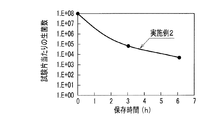
菌を移行させた直後の試験片と、温度28℃、湿度50%RH、無菌状態下で3時間保存した後の試験片と、同条件で6時間保存した後の試験片と、について、それぞれSCDLP培地10mLを用いてピペットで洗い出し、それぞれ生菌数測定を行った。生菌数測定は、標準寒天培地を用いた混釈平板培養法(35℃、40〜48時間培養)で行った。その結果を図10に示す。
(2) Viable count measurement of Example 2 A test piece immediately after transferring the bacteria, a test piece after storage for 3 hours under a temperature of 28 ° C., a humidity of 50% RH and aseptic conditions, and 6 hours under the same conditions About the test piece after preservation | save, it washed out with the pipette using 10 mL of SCDLP culture media, respectively, and performed viable count measurement, respectively. The viable cell count was measured by the pour plate culture method (35 ° C., 40-48 hours culture) using a standard agar medium. The result is shown in FIG.
(3)比較例2について
比較例2として、従来法であるJIS Z 2801に規定の方法に準拠して緑膿菌の生菌数を測定した。つまり、この比較例では皮脂成分を用いない。なお、普通ブイヨン培地への接種濃度を105/mLとした。生菌数は試験片への移行直後、6時間後、24時間後に測定した。なお、生菌数は試験片1cm2当たりの値ではなく、試験片当たりの値とした。その結果を図11に示す。
(3) About Comparative Example 2 As Comparative Example 2, the viable count of Pseudomonas aeruginosa was measured based on the method defined in JIS Z 2801, which is a conventional method. That is, the sebum component is not used in this comparative example. The inoculation concentration in the normal broth medium was 10 5 / mL. The number of viable bacteria was measured immediately after transfer to the test piece, 6 hours later, and 24 hours later. The number of viable bacteria was not a value per 1 cm 2 of the test piece but a value per test piece. The result is shown in FIG.
(4)考察
図10に示すように、実施例2では、保存時間が長くなるにつれて緑膿菌の生菌数が減少していた。これに対し、比較例2では、図11に示すように、保存時間が長くなるにつれて緑膿菌の生菌数が増加していた。
低湿潤状態乃至乾燥状態である材料表面で細菌数が増加するようなことはほぼ有り得ず、細菌数は減少するはずであるから、保存時間が長くなるにつれて緑膿菌の生菌数が減少する実施例2は、実際に使用される環境に近い状態を模擬できていることが確認された。
対象品が抗菌物質を使用した抗菌性製品の場合、図10に示すグラフの傾きはより大きくなり、その傾きを評価することで、抗菌性の評価を行うことが可能である。
(4) Discussion As shown in FIG. 10, in Example 2, the viable count of Pseudomonas aeruginosa decreased as the storage time increased. On the other hand, in Comparative Example 2, as shown in FIG. 11, the viable count of Pseudomonas aeruginosa increased as the storage time increased.
The number of bacteria is unlikely to increase on the surface of a material that is low or dry, and the number of bacteria should decrease, so the viable count of Pseudomonas aeruginosa decreases as the storage time increases. It was confirmed that Example 2 was able to simulate a state close to the environment actually used.
In the case where the target product is an antibacterial product using an antibacterial substance, the slope of the graph shown in FIG. 10 becomes larger, and it is possible to evaluate antibacterial properties by evaluating the slope.
1 保持材
2 皮脂成分
3 基材
4 試験液
S12 溶剤含浸工程
S13 溶剤除去工程
S15 試験液含浸工程
S21 接触工程
S22 測定工程
S31 接触工程
S32 測定工程
S33 評価工程
DESCRIPTION OF
Claims (4)
前記被検物に付着した前記特定の菌の数又は数に相関する指標の測定を行う測定工程と、を含み、
前記指標は、ATP量又は遺伝子量である
ことを特徴とする菌測定方法。 A contact step in which a holding material containing a sebum component and a test solution containing a specific bacterium in a base material is brought into contact with a specimen;
Measuring the index correlating with the number or number of the specific bacteria attached to the test object,
The indicator is an ATP amount or a gene amount.
皮脂成分と、特定の菌を含有する試験液と、を基材に含ませてなる保持材を、抗菌性が付与されていない第1の被検物及び抗菌性が付与された第2の被検物のそれぞれに、個別に接触させる接触工程と、
前記第1の被検物及び前記第2の被検物に付着した前記特定の菌の数又は数に相関する指標の測定を行う測定工程と、
前記測定工程で測定された結果から前記第2の被検物の抗菌性及び/又は菌減少性を評価する評価工程と、を含み、
前記指標は、ATP量又は遺伝子量であり、
前記測定工程では、
前記第1の被検物に前記保持材を接触させた直後に前記特定の菌の数又は数に相関する指標の測定を行って、その結果をMaとし、
前記第1の被検物に前記保持材を接触させた後、当該被検物を所定温度で所定時間保管した後に前記特定の菌の数又は数に相関する指標の測定を行って、その結果をMbとし、
前記第2の被検物に前記保持材を接触させた直後に前記特定の菌の数又は数に相関する指標の測定を行って、その結果をMcとし、
前記第2の被検物に前記保持材を接触させた後、当該被検物を所定温度で所定時間保管した後に前記特定の菌の数又は数に相関する指標の測定を行って、その結果をMdとしたとき、
前記評価工程で、
(Mc−Md)−(Ma−Mb)、Ma−Md及びMb−Mdのうちの少なくとも一つの式を用いて前記第2の被検物の抗菌性及び/又は菌減少性を評価する
ことを特徴とする抗菌性及び/又は菌減少性評価方法。 An antibacterial and / or microbial reduction evaluation method for evaluating antibacterial and / or microbial reduction,
A holding material comprising a sebum component and a test solution containing a specific bacterium in a base material, a first test object to which antibacterial property is not imparted and a second test substance to which antibacterial property is imparted. A contact process for contacting each specimen individually;
A measuring step for measuring an index correlating with the number or the number of the specific bacteria attached to the first test object and the second test object;
An evaluation step for evaluating the antibacterial properties and / or fungus reduction of the second test object from the results measured in the measurement step,
The indicator is ATP amount or gene amount,
In the measurement step,
Immediately after bringing the holding material into contact with the first test object, the number of the specific bacteria is measured or an index correlated with the number is measured, and the result is Ma.
After bringing the holding material into contact with the first test object, the test object is stored at a predetermined temperature for a predetermined time, and then the number of the specific bacteria or the index correlated with the number is measured, and the result Is Mb,
Immediately after bringing the holding material into contact with the second test object, the number of the specific bacteria is measured or an index correlated with the number is measured, and the result is Mc.
After bringing the holding material into contact with the second specimen, the specimen is stored at a predetermined temperature for a predetermined time, and then the number of the specific bacteria or the index correlated with the number is measured. Is Md,
In the evaluation step,
Evaluating the antibacterial activity and / or fungus reduction of the second test object using at least one of the formulas (Mc-Md)-(Ma-Mb), Ma-Md and Mb-Md. A method for evaluating antibacterial and / or fungus reduction characteristics.
前記基材は、被検物に重なる部分がなく密着して貼りつけることができる形状であり、
前記試験液は、特定の菌を含有することを特徴とする保持材。 A holding material having a base material containing a sebum component and a test liquid impregnated in the base material,
The base material has a shape that can be adhered and pasted without a portion overlapping the test object,
The test liquid contains a specific fungus.
Priority Applications (1)
| Application Number | Priority Date | Filing Date | Title |
|---|---|---|---|
| JP2013004488A JP6153731B2 (en) | 2013-01-15 | 2013-01-15 | Bacteria measurement method, antibacterial and / or bacteria reduction evaluation method, and holding material |
Applications Claiming Priority (1)
| Application Number | Priority Date | Filing Date | Title |
|---|---|---|---|
| JP2013004488A JP6153731B2 (en) | 2013-01-15 | 2013-01-15 | Bacteria measurement method, antibacterial and / or bacteria reduction evaluation method, and holding material |
Publications (2)
| Publication Number | Publication Date |
|---|---|
| JP2014135902A true JP2014135902A (en) | 2014-07-28 |
| JP6153731B2 JP6153731B2 (en) | 2017-06-28 |
Family
ID=51413784
Family Applications (1)
| Application Number | Title | Priority Date | Filing Date |
|---|---|---|---|
| JP2013004488A Active JP6153731B2 (en) | 2013-01-15 | 2013-01-15 | Bacteria measurement method, antibacterial and / or bacteria reduction evaluation method, and holding material |
Country Status (1)
| Country | Link |
|---|---|
| JP (1) | JP6153731B2 (en) |
Cited By (15)
| Publication number | Priority date | Publication date | Assignee | Title |
|---|---|---|---|---|
| WO2016027433A1 (en) * | 2014-08-18 | 2016-02-25 | パナソニックIpマネジメント株式会社 | Antibacterial test solution, antibacterial test solution adhesion device, and antibacterial test method |
| CN110272954A (en) * | 2019-03-15 | 2019-09-24 | 李文杰 | ATP bioluminescence lgCA-lgIAThe method for marking bent method evaluation liquid disinfectant fungi killing effect |
| CN110272962A (en) * | 2019-03-15 | 2019-09-24 | 李文杰 | ATP bioluminescence lgCA-lgIAMethod for detecting antibacterial performance of antibacterial ceramic by standard curve method |
| CN110272942A (en) * | 2019-03-15 | 2019-09-24 | 李文杰 | A method for the detection of antibacterial properties of antibacterial ceramics by ATP bioluminescence lgCB-lgIB calibration method |
| CN110272964A (en) * | 2019-03-15 | 2019-09-24 | 李文杰 | ATP fluorescence lgCA-lgIAThe method for marking bent method evaluation disposable sanitary articles killing bacteria effect |
| CN110272950A (en) * | 2019-03-15 | 2019-09-24 | 李文杰 | ATP bioluminescence lgCA-lgIAThe method for marking bent method evaluation liquid disinfectant killing bacteria effect |
| CN110272965A (en) * | 2019-03-15 | 2019-09-24 | 李文杰 | ATP bioluminescence lgCB-lgIBThe method for marking bent method detection nano inorganic material anti-fungal property |
| CN110272939A (en) * | 2019-03-15 | 2019-09-24 | 李文杰 | ATP bioluminescence lgCA-lgIAThe method for marking bent method detection nano inorganic material bacteria resistance energy |
| CN110272970A (en) * | 2019-03-15 | 2019-09-24 | 李文杰 | ATP bioluminescence lgCA-lgIAThe method for marking bent method detection nano inorganic material anti-fungal property |
| CN110283873A (en) * | 2019-03-15 | 2019-09-27 | 李文杰 | ATP bioluminescence lgCB-lgIBThe method for marking bent method detection nano inorganic material bacteria resistance energy |
| CN110283876A (en) * | 2019-03-15 | 2019-09-27 | 李文杰 | ATP bioluminescence lgCB-lgIBThe method for marking bent method evaluation liquid disinfectant killing bacteria effect |
| CN110305931A (en) * | 2019-03-15 | 2019-10-08 | 李文杰 | ATP bioluminescence lgCB-lgIBThe method of calibration curve method detection anti-bacteria ceramic anti-fungal property |
| JP2022062713A (en) * | 2014-07-30 | 2022-04-20 | ビオメリュー | Characterization of microorganisms via maldi-tof |
| KR20240030398A (en) * | 2022-08-30 | 2024-03-07 | 가천대학교 산학협력단 | Method for measuring the quantitative antibacterial activity of antibacterial substances |
| CN121026618A (en) * | 2025-07-16 | 2025-11-28 | 南京鼓楼医院集团宿迁医院有限公司 | Safety testing methods and systems for gastric lavage equipment |
Citations (4)
| Publication number | Priority date | Publication date | Assignee | Title |
|---|---|---|---|---|
| JPH11192A (en) * | 1997-06-11 | 1999-01-06 | Rinnai Corp | Evaluation of antimicrobial performance of antimicrobial processed product |
| JP2005516649A (en) * | 2001-12-13 | 2005-06-09 | エスシーエー・ハイジーン・プロダクツ・アーベー | Sanitary tissue impregnated with a composition comprising lactic acid producing bacteria suspended in lipids |
| JP2007175012A (en) * | 2005-12-28 | 2007-07-12 | Ishikawajima Harima Heavy Ind Co Ltd | Biological index production method, production apparatus, and biological index |
| JP2011246828A (en) * | 2010-05-24 | 2011-12-08 | Ist Corp | Producing method of antibacterial animal fiber structure, antibacterial animal fiber structure, antibacterial animal spun yarn and antibacterial animal fabric |
-
2013
- 2013-01-15 JP JP2013004488A patent/JP6153731B2/en active Active
Patent Citations (4)
| Publication number | Priority date | Publication date | Assignee | Title |
|---|---|---|---|---|
| JPH11192A (en) * | 1997-06-11 | 1999-01-06 | Rinnai Corp | Evaluation of antimicrobial performance of antimicrobial processed product |
| JP2005516649A (en) * | 2001-12-13 | 2005-06-09 | エスシーエー・ハイジーン・プロダクツ・アーベー | Sanitary tissue impregnated with a composition comprising lactic acid producing bacteria suspended in lipids |
| JP2007175012A (en) * | 2005-12-28 | 2007-07-12 | Ishikawajima Harima Heavy Ind Co Ltd | Biological index production method, production apparatus, and biological index |
| JP2011246828A (en) * | 2010-05-24 | 2011-12-08 | Ist Corp | Producing method of antibacterial animal fiber structure, antibacterial animal fiber structure, antibacterial animal spun yarn and antibacterial animal fabric |
Non-Patent Citations (3)
| Title |
|---|
| オリーブオイルの基礎知識-成分と健康, JPN6016048008, 2009 * |
| 太田敏子: "目に見えないヒト常在菌叢のネットワークをのぞく", 宇宙航空環境医学, vol. Vol. 49, No. 3, JPN6016048011, 1 September 2012 (2012-09-01), JP, pages Page. 37-51 * |
| 小島政幸: "油脂分解微生物製剤の開発", 高知工科大学附属情報図書館 学位論文・卒業論文, JPN6016048006, 19 August 2007 (2007-08-19) * |
Cited By (16)
| Publication number | Priority date | Publication date | Assignee | Title |
|---|---|---|---|---|
| JP2022062713A (en) * | 2014-07-30 | 2022-04-20 | ビオメリュー | Characterization of microorganisms via maldi-tof |
| WO2016027433A1 (en) * | 2014-08-18 | 2016-02-25 | パナソニックIpマネジメント株式会社 | Antibacterial test solution, antibacterial test solution adhesion device, and antibacterial test method |
| CN110272964A (en) * | 2019-03-15 | 2019-09-24 | 李文杰 | ATP fluorescence lgCA-lgIAThe method for marking bent method evaluation disposable sanitary articles killing bacteria effect |
| CN110283873A (en) * | 2019-03-15 | 2019-09-27 | 李文杰 | ATP bioluminescence lgCB-lgIBThe method for marking bent method detection nano inorganic material bacteria resistance energy |
| CN110272962A (en) * | 2019-03-15 | 2019-09-24 | 李文杰 | ATP bioluminescence lgCA-lgIAMethod for detecting antibacterial performance of antibacterial ceramic by standard curve method |
| CN110272950A (en) * | 2019-03-15 | 2019-09-24 | 李文杰 | ATP bioluminescence lgCA-lgIAThe method for marking bent method evaluation liquid disinfectant killing bacteria effect |
| CN110272965A (en) * | 2019-03-15 | 2019-09-24 | 李文杰 | ATP bioluminescence lgCB-lgIBThe method for marking bent method detection nano inorganic material anti-fungal property |
| CN110272939A (en) * | 2019-03-15 | 2019-09-24 | 李文杰 | ATP bioluminescence lgCA-lgIAThe method for marking bent method detection nano inorganic material bacteria resistance energy |
| CN110272970A (en) * | 2019-03-15 | 2019-09-24 | 李文杰 | ATP bioluminescence lgCA-lgIAThe method for marking bent method detection nano inorganic material anti-fungal property |
| CN110272942A (en) * | 2019-03-15 | 2019-09-24 | 李文杰 | A method for the detection of antibacterial properties of antibacterial ceramics by ATP bioluminescence lgCB-lgIB calibration method |
| CN110283876A (en) * | 2019-03-15 | 2019-09-27 | 李文杰 | ATP bioluminescence lgCB-lgIBThe method for marking bent method evaluation liquid disinfectant killing bacteria effect |
| CN110305931A (en) * | 2019-03-15 | 2019-10-08 | 李文杰 | ATP bioluminescence lgCB-lgIBThe method of calibration curve method detection anti-bacteria ceramic anti-fungal property |
| CN110272954A (en) * | 2019-03-15 | 2019-09-24 | 李文杰 | ATP bioluminescence lgCA-lgIAThe method for marking bent method evaluation liquid disinfectant fungi killing effect |
| KR20240030398A (en) * | 2022-08-30 | 2024-03-07 | 가천대학교 산학협력단 | Method for measuring the quantitative antibacterial activity of antibacterial substances |
| KR102665427B1 (en) | 2022-08-30 | 2024-05-13 | 가천대학교 산학협력단 | Method for measuring antibacterial activity of volatile antibacterial substances against high concentration strains |
| CN121026618A (en) * | 2025-07-16 | 2025-11-28 | 南京鼓楼医院集团宿迁医院有限公司 | Safety testing methods and systems for gastric lavage equipment |
Also Published As
| Publication number | Publication date |
|---|---|
| JP6153731B2 (en) | 2017-06-28 |
Similar Documents
| Publication | Publication Date | Title |
|---|---|---|
| JP6153731B2 (en) | Bacteria measurement method, antibacterial and / or bacteria reduction evaluation method, and holding material | |
| Ioriatti et al. | Drosophila suzukii (Diptera: Drosophilidae) contributes to the development of sour rot in grape | |
| Riedel et al. | Slippery surfaces of carnivorous plants: composition of epicuticular wax crystals in Nepenthes alata Blanco pitchers | |
| Moore et al. | Problems associated with traditional hygiene swabbing: the need for in‐house standardization | |
| Macarisin et al. | Survival of outbreak, food, and environmental strains of Listeria monocytogenes on whole apples as affected by cultivar and wax coating | |
| Alves et al. | Scanning electron microscopy for fungal sample examination | |
| Chang et al. | A novel methodology to study antimicrobial properties of high-touch surfaces used for indoor hygiene applications—A study on Cu metal | |
| Mechan Llontop et al. | Exploring rain as source of biological control agents for fire blight on apple | |
| Abidi et al. | Detection of Mycobacterium smegmatis biofilm and its control by natural agents | |
| Avila-Quezada et al. | Silver nanoparticles offer effective control of pathogenic bacteria in a wide range of food | |
| WO2015088237A1 (en) | Antimicrobial agent screening method | |
| Amiri et al. | Adhesion and germination of waterborne and airborne conidia of Penicillium expansum to apple and inert surfaces | |
| Kim et al. | Risk of Erwinia amylovora transmission in viable but nonculturable (VBNC) state via contaminated pruning shears | |
| Pujol et al. | Epiphytic fitness of a biological control agent of fire blight in apple and pear orchards under Mediterranean weather conditions | |
| Sammonds et al. | Pre‐infection processes of Botryosphaeriaceae spp.: adhesion of conidia to different substrata | |
| Piperakis et al. | Investigation of the genotoxic effect of pesticides on greenhouse workers' lymphocytes | |
| CN102823446A (en) | Efficient method for sugarcane infection by smut spores | |
| Perry | Infection of seeds of Pisum sativum by Pythium ultimum | |
| CN100394182C (en) | A method for measuring the toxicity of fungicides to cucumber downy mildew | |
| Whiting et al. | Development and initial testing of a novel slime mould biosensor | |
| Pirttilä et al. | Prospects and Applications for Plant-Associated Microbes, A laboratory manual: Part B: Fungi | |
| JP2019503173A (en) | Antimicrobial screening method | |
| JP2022171340A (en) | Sterilization evaluation method and simple sterilization evaluation instrument | |
| Caschera et al. | Antimicrobial testing of dry surfaces through large droplet inoculation | |
| Eleojo et al. | Bacteriological studies on egg yolk forms and different formulations of yolk-citrate semen extender |
Legal Events
| Date | Code | Title | Description |
|---|---|---|---|
| A621 | Written request for application examination |
Free format text: JAPANESE INTERMEDIATE CODE: A621 Effective date: 20150909 |
|
| RD02 | Notification of acceptance of power of attorney |
Free format text: JAPANESE INTERMEDIATE CODE: A7422 Effective date: 20160506 |
|
| A977 | Report on retrieval |
Free format text: JAPANESE INTERMEDIATE CODE: A971007 Effective date: 20160628 |
|
| A131 | Notification of reasons for refusal |
Free format text: JAPANESE INTERMEDIATE CODE: A131 Effective date: 20160719 |
|
| A521 | Request for written amendment filed |
Free format text: JAPANESE INTERMEDIATE CODE: A523 Effective date: 20160822 |
|
| A131 | Notification of reasons for refusal |
Free format text: JAPANESE INTERMEDIATE CODE: A131 Effective date: 20161220 |
|
| A521 | Request for written amendment filed |
Free format text: JAPANESE INTERMEDIATE CODE: A523 Effective date: 20170117 |
|
| TRDD | Decision of grant or rejection written | ||
| A01 | Written decision to grant a patent or to grant a registration (utility model) |
Free format text: JAPANESE INTERMEDIATE CODE: A01 Effective date: 20170509 |
|
| A61 | First payment of annual fees (during grant procedure) |
Free format text: JAPANESE INTERMEDIATE CODE: A61 Effective date: 20170531 |
|
| R150 | Certificate of patent or registration of utility model |
Ref document number: 6153731 Country of ref document: JP Free format text: JAPANESE INTERMEDIATE CODE: R150 |
|
| R250 | Receipt of annual fees |
Free format text: JAPANESE INTERMEDIATE CODE: R250 |
|
| R250 | Receipt of annual fees |
Free format text: JAPANESE INTERMEDIATE CODE: R250 |
|
| R250 | Receipt of annual fees |
Free format text: JAPANESE INTERMEDIATE CODE: R250 |