JP2013122514A - Wraparound label - Google Patents
Wraparound label Download PDFInfo
- Publication number
- JP2013122514A JP2013122514A JP2011270701A JP2011270701A JP2013122514A JP 2013122514 A JP2013122514 A JP 2013122514A JP 2011270701 A JP2011270701 A JP 2011270701A JP 2011270701 A JP2011270701 A JP 2011270701A JP 2013122514 A JP2013122514 A JP 2013122514A
- Authority
- JP
- Japan
- Prior art keywords
- label
- end portion
- adhesive
- resin
- wound
- Prior art date
- Legal status (The legal status is an assumption and is not a legal conclusion. Google has not performed a legal analysis and makes no representation as to the accuracy of the status listed.)
- Pending
Links
Images




Landscapes
- Details Of Rigid Or Semi-Rigid Containers (AREA)
Abstract
【課題】不必要に剥れることなく、かつ、剥がそうとしたときに容易に剥れる胴巻きラベルを提供する。
【解決手段】ラベル本体11と、ラベル本体11の両側部のうちの一方を始端部12、他方を終端部13とし、終端部13の裏面11Bに設けられる第1接着部14とを備え、始端部12の裏面11Bから順次、ペットボトルの胴部外周に巻きつけて、終端部13を始端部12に重ね合わせ、第1接着部14を介して終端部13と始端部12とを接着し、筒状に形成される胴巻きラベル10において、終端部13と始端部12とが重なり合った箇所を重ね合せ部OLとし、重ね合せ部OLにおける引張せん断接着強さが、0.05N/mm2以上、かつ、0.32N/mm2以下となる。
【選択図】図1The present invention provides a body-wound label that can be easily peeled off without being unnecessarily peeled off.
A label main body (11) and a first adhesive portion (14) provided on a back surface (11B) of the terminal end portion (13) are provided with a start end portion (12) on one side of the label main body (11) and a terminal end portion (13) on the other side. Wrapping around the outer periphery of the body of the PET bottle sequentially from the back surface 11B of the part 12, the terminal part 13 is overlapped with the starting part 12, and the terminal part 13 and the starting part 12 are bonded via the first adhesive part 14, In the body-wrapped label 10 formed in a cylindrical shape, a portion where the end portion 13 and the start end portion 12 overlap is defined as an overlap portion OL, and the tensile shear adhesive strength in the overlap portion OL is 0.05 N / mm 2 or more, And it becomes 0.32 N / mm < 2 > or less.
[Selection] Figure 1
Description
本発明は、清涼飲料水、乳飲料、ビール、ワイン、栄養ドリンク、調味料、化粧品などの内容物を充填可能なプラスチック製、ガラス製などの容器の胴部表面に巻きつけて装着する胴巻きラベルに関する。 The present invention relates to a body-wound label that is wound around a body surface of a plastic or glass container that can be filled with soft drinks, milk beverages, beer, wine, nutrition drinks, seasonings, cosmetics, and the like. About.
従来、胴巻きラベルは略矩形状に形成された合成樹脂製のラベル本体と、そのラベル本体の終端部の裏面に沿って形成された接着剤層とを備える。また、容器の内容物を表示する目的で使用する場合には、印刷層を備え、容器の内容物を遮光する目的で使用する場合には、ラベル本体を着色して形成したり、別途、着色のための印刷層を備える。 Conventionally, a body-wound label includes a label body made of a synthetic resin formed in a substantially rectangular shape, and an adhesive layer formed along the back surface of the end portion of the label body. In addition, when used for the purpose of displaying the contents of the container, it is provided with a printed layer, and when used for the purpose of shielding the contents of the container, the label body may be colored or formed separately. A printing layer is provided.
そして、接着剤層の形成されていない側、すなわち、先端部から胴巻きラベルを順次、容器の胴部に接触させ、後端部にある接着剤層を先端部の表面に押し当てて張り合わせて筒状の胴巻きラベルを形成することで容器に取り付ける。 Then, the cylinder-wrapped label is brought into contact with the body of the container sequentially from the side where the adhesive layer is not formed, that is, from the front end, and the adhesive layer at the rear end is pressed against the surface of the front end and pasted together. It is attached to the container by forming a cylindrical wound label.
このような胴巻きラベルは、(1)商品を流通する際には商品の落下などによって不必要に剥れることなく、かつ、(2)商品を使用後、剥がそうとしたときに容易に剥れる、という2つの目的を同時に達成することが求められる。 Such a body-wound label (1) is not unnecessarily peeled off when the product is distributed, and (2) is easily peeled off when the product is used and then peeled off. These two objectives are required to be achieved simultaneously.
このような胴巻きラベルを実現するべく、特許文献1が開示されている。 Patent document 1 is disclosed in order to realize such a body-wound label.
しかし、上記特許文献1で開示された胴巻きラベルでは、どの程度の強度で胴巻きラベルを接着すれば上記2つの目的を達成することができるのか、具体的に示されていない。そこで、この発明の目的は、不必要に剥れることなく、かつ、剥がそうとしたときに容易に剥れる胴巻きラベルを提供することにある。 However, the body-wrapped label disclosed in Patent Document 1 does not specifically indicate how much strength the body-wrapped label can be used to achieve the two purposes. Accordingly, an object of the present invention is to provide a body-wound label that does not peel unnecessarily and can be easily peeled off when attempting to peel off.
このため請求項1に記載の発明は、略長方形の可撓性フィルムであるラベル本体と、
該ラベル本体の両側部のうちの一方を始端部、他方を終端部とし、前記終端部の裏面に設けられる第1接着部とを備え、
前記始端部の裏面から順次、容器の胴部外周に巻きつけて、前記終端部を前記始端部に重ね合わせ、前記第1接着部を介して前記終端部と前記始端部とを接着し、筒状に形成される胴巻きラベルにおいて、
前記終端部と前記始端部とが重なり合った箇所を重ね合せ部とし、
該重ね合せ部における引張せん断接着強さが、0.05N/mm2以上、かつ、0.32N/mm2以下となることを特徴とする。
Therefore, the invention according to claim 1 is a label main body which is a substantially rectangular flexible film,
One of the two side portions of the label main body is a start end portion, the other is a termination portion, and includes a first adhesive portion provided on the back surface of the termination portion,
Sequentially wound around the outer periphery of the body portion of the container from the back surface of the start end portion, the end portion is overlapped with the start end portion, the end portion and the start end portion are bonded via the first adhesive portion, In the body-wound label formed into a shape,
A place where the end portion and the start end portion overlap each other is an overlapping portion,
Shear strength tensile at heavy I combined unit, 0.05 N / mm 2 or more, and is characterized in that a 0.32 N / mm 2 or less.
請求項2に記載の発明は、請求項1に記載の胴巻きラベルにおいて、前記始端部の裏面に第2接着部を設け、
該第2接着部を前記容器の胴部に貼り付けることで前記容器に取り付けられることを特徴とする。
The invention according to claim 2 is the body-wrapped label according to claim 1, wherein a second adhesive portion is provided on the back surface of the start end portion,
It attaches to the said container by affixing this 2nd adhesion part on the trunk | drum of the said container, It is characterized by the above-mentioned.
請求項3に記載の発明は、請求項1または2に記載の胴巻きラベルにおいて、前記終端部の裏面で、かつ、前記第1接着部の設けられていない部分をツマミ部とし、
該ツマミ部をつまんで前記終端部を前記始端部から剥がすことを特徴とする。
The invention according to claim 3 is the body-wrapped label according to claim 1 or 2, wherein the portion on the back surface of the terminal portion and the first adhesive portion is not provided is a knob portion.
The terminal portion is peeled off from the starting end portion by pinching the knob portion.
請求項4に記載の発明は、請求項3に記載の胴巻きラベルにおいて、前記ツマミ部は、前記終端部の上下端のいずれかに設けられることを特徴とする。 According to a fourth aspect of the present invention, in the body-wrapped label according to the third aspect, the knob portion is provided on either the upper or lower end of the terminal end portion.
請求項1に記載の発明によれば、略長方形の可撓性フィルムであるラベル本体と、該ラベル本体の両側部のうちの一方を始端部、他方を終端部とし、前記終端部の裏面に設けられる第1接着部とを備え、前記始端部の裏面から順次、容器の胴部外周に巻きつけて、前記終端部を前記始端部に重ね合わせ、前記第1接着部を介して前記終端部と前記始端部とを接着し、筒状に形成される胴巻きラベルにおいて、前記終端部と前記始端部とが重なり合った箇所を重ね合せ部とし、該重ね合せ部における引張せん断接着強さが、0.05N/mm2以上、かつ、0.32N/mm2以下となる。 According to the first aspect of the present invention, the label main body, which is a substantially rectangular flexible film, and one of the two side portions of the label main body as a start end portion and the other end portion, and the back surface of the end portion A first adhesive portion provided, and wound around the outer periphery of the body of the container sequentially from the back surface of the start end portion, and the end portion is overlapped with the start end portion, and the end portion is interposed via the first adhesive portion. In the body-wrapped label formed in a cylindrical shape, the portion where the end portion and the start end portion overlap is defined as the overlap portion, and the tensile shear adhesive strength at the overlap portion is 0. 0.05 N / mm 2 or more and 0.32 N / mm 2 or less.
したがって、不必要に剥れることなく、かつ、剥がそうとしたときに容易に剥れる胴巻きラベルを、重ね合せ部における引張せん断接着強さを示して提供することができる。 Therefore, it is possible to provide a wound label that does not peel unnecessarily and easily peels when it is peeled off, showing the tensile shear adhesive strength at the overlapping portion.
請求項2に記載の発明によれば、前記始端部の裏面に第2接着部を設け、該第2接着部を前記容器の胴部に貼り付けることで前記容器に取り付けられるので、胴巻きラベルをより確実に容器の胴部に巻きつけて固定することができる。 According to the second aspect of the present invention, the second adhesive portion is provided on the back surface of the start end portion, and the second adhesive portion is attached to the barrel portion of the container, so that it is attached to the container. It can be more securely wound around the body of the container.
請求項3に記載の発明によれば、前記終端部の裏面で、かつ、前記第1接着部の設けられていない部分をツマミ部とし、該ツマミ部をつまんで前記終端部を前記始端部から剥がすので、容易に胴巻きラベルを剥がすことができる。 According to the third aspect of the present invention, a portion on the back surface of the end portion and where the first adhesive portion is not provided is a knob portion, and the end portion is separated from the start end portion by pinching the knob portion. Since it peels off, a body-wound label can be peeled off easily.
請求項4に記載の発明によれば、前記ツマミ部は、前記終端部の上下端のいずれかに設けられるので、作業者が右利き・左利きであるに係らず、容易に胴巻きラベルを剥がすことができる。 According to invention of Claim 4, since the said knob part is provided in either the upper or lower end of the said termination | terminus part, regardless of whether an operator is right-handed or left-handed, it can peel off a waist-wrap label easily. Can do.
本発明の胴巻きラベルを構成するラベル本体は、一軸、若しくは、二軸に延伸した合成樹脂フィルム(可撓性フィルム)であれば、どのようなものであってもよい。このような合成樹脂フィルムは、胴巻きラベルを装着する容器の用途によって適宜選択することができる。 As long as the label main body which comprises the trunk wound label of this invention is a synthetic resin film (flexible film) extended | stretched to uniaxial or biaxial, what kind of thing may be sufficient as it. Such a synthetic resin film can be appropriately selected depending on the use of the container to which the body-wound label is attached.
例えば、ポリエチレンテレフタレートフィルム等のポリエステルフィルム、ポリスチレンフィルム、ポリプロピレンフィルム、6ナイロンフィルム、6,6ナイロンフィルム等のポリアミドフィルム、低密度ポリエチレンフィルム、中密度ポリエチレンフィルム、高密度ポリエチレンフィルム、低密度直鎖状ポリエチレンフィルム等のポリエチレンフィルム、環状ポリオレフィンフィルム、ポリスチレンフィルム、エチレン−プロピレン共重合体、エチレン−酢酸ビニル共重合体、アイオノマー樹脂、エチレン−アクリル酸共重合体、エチレン−アクリル酸メチル共重合体等の樹脂から製膜されたポリオレフィン系フィルム、塩素化ポリエチレン,塩素化ポリプロピレンなどの樹脂から製膜された変性ポリオレフィンフィルム、塩化ビニル−酢酸ビニル共重合体の樹脂から製膜されたフィルム、アクリル系樹脂フィルム等が使用できる。 For example, polyester film such as polyethylene terephthalate film, polystyrene film, polypropylene film, polyamide film such as 6 nylon film, 6,6 nylon film, low density polyethylene film, medium density polyethylene film, high density polyethylene film, low density linear Polyethylene film such as polyethylene film, cyclic polyolefin film, polystyrene film, ethylene-propylene copolymer, ethylene-vinyl acetate copolymer, ionomer resin, ethylene-acrylic acid copolymer, ethylene-methyl acrylate copolymer, etc. Polyolefin film formed from resin, modified polyolefin film formed from resin such as chlorinated polyethylene, chlorinated polypropylene, vinyl chloride Film formed as a film of a resin acid vinyl copolymer, an acrylic resin film or the like can be used.
また、これらのフィルムをラミネートして、2層以上の積層フィルムとして、使用してもよい。 Further, these films may be laminated and used as a laminated film having two or more layers.
上記合成樹脂フィルムは、それを構成する樹脂の1種または2種以上を使用し、押し出し法、キャスト成形法、Tダイ法、切削法、インフレーション法、その他等の製膜化法を用いて単層で製膜化したもの、または2種以上の樹脂を使用して共押し出しなどで多層製膜したもの、または2種以上の樹脂を混合使用して製膜し、テンター方式やチューブラー方式等で1軸ないし2軸方向に延伸してなる各種の樹脂フィルムを使用することができる。 The synthetic resin film uses one or more of the resins constituting it, and is formed by a film forming method such as an extrusion method, a cast molding method, a T-die method, a cutting method, an inflation method, or the like. Films formed in layers, multilayer films formed by coextrusion using two or more resins, or films formed using a mixture of two or more resins, tenter method, tubular method, etc. Various resin films formed by stretching in a uniaxial or biaxial direction can be used.
さらに、上記合成樹脂フィルムには、必要に応じて、滑剤、充填剤、熱安定剤、酸化防止剤、紫外線吸収剤、帯電防止剤、難燃剤、着色剤等の各種添加剤を添加してもよい。また、合成樹脂フィルムの表面には、印刷性を向上させるため、コロナ放電処理、プラズマ処理、火炎処理、酸処理などの慣用の表面処理を施してもよい。 Furthermore, various additives such as a lubricant, a filler, a heat stabilizer, an antioxidant, an ultraviolet absorber, an antistatic agent, a flame retardant, and a colorant may be added to the synthetic resin film as necessary. Good. Further, the surface of the synthetic resin film may be subjected to conventional surface treatment such as corona discharge treatment, plasma treatment, flame treatment, and acid treatment in order to improve printability.
合成樹脂フィルムの厚さは、10〜100μm程度に形成されることが好ましい。この中でも、特に耐熱性に優れた延伸ポリプロピレンフィルム(OPPフィルム)、二軸延伸ポリエチレンテレフタレートフィルム(PETフィルム)が好ましく使用できる。 The thickness of the synthetic resin film is preferably about 10 to 100 μm. Among these, a stretched polypropylene film (OPP film) and a biaxially stretched polyethylene terephthalate film (PET film) that are particularly excellent in heat resistance can be preferably used.
本発明において、胴巻きラベルを構成する接着部(接着剤層)には、感熱接着剤を使用する。感熱接着剤には、常温で固体のもの(ホットメルト接着剤)と、液状のもの(ディレードタック接着剤)とがある。 In the present invention, a heat-sensitive adhesive is used for the adhesive part (adhesive layer) constituting the body-wrapped label. Thermally sensitive adhesives include those that are solid at room temperature (hot melt adhesives) and those that are liquid (delay tack adhesives).
ホットメルト接着剤は、塗布時に高温にして溶融させる必要がある上、高粘度であり、これに対し、ディレードタック接着剤は、塗布時に高温にする必要はなく、また、低粘度である。ディレードタック型感熱接着剤は、常温で粘着性がなく、60℃以上に加熱すると粘着性を生じ、この粘着性が冷却後も1日〜数年間持続する。ディレードタック型感熱接着剤としては、熱可塑性樹脂成分からなるベースポリマーと、粘着付与剤と、結晶性の固体可塑剤から形成されるものが好適に用いられる。また、ディレードタック型感熱接着剤はアルカリ水溶液に接触すると溶解され接着力が低下する性質を有するものである。 Hot melt adhesives need to be melted at a high temperature at the time of application, and have a high viscosity. On the other hand, a delayed tack adhesive does not need to be heated at the time of application and has a low viscosity. The delayed tack-type heat-sensitive adhesive is not sticky at room temperature, and becomes sticky when heated to 60 ° C. or higher, and this stickiness persists for one day to several years after cooling. As the delayed tack-type heat-sensitive adhesive, those formed from a base polymer composed of a thermoplastic resin component, a tackifier, and a crystalline solid plasticizer are preferably used. In addition, the delayed tack type heat-sensitive adhesive has the property of being dissolved when it comes into contact with an alkaline aqueous solution and the adhesive force being lowered.
本発明にかかる感熱接着剤の熱可塑性樹脂としては、粘着剤のベースとなるものであり、可塑剤との相溶性があり、これにより使用時の凝集力が得られる。 The thermoplastic resin of the heat-sensitive adhesive according to the present invention serves as a base for the pressure-sensitive adhesive and is compatible with the plasticizer, thereby obtaining cohesive force during use.
また、アルカリ可溶性の樹脂であり、これによりラベルを剥がす際、アルカリ処理により、容易に剥がすこともできる。 Moreover, it is alkali-soluble resin, and when peeling a label by this, it can also peel easily by an alkali treatment.
例えば、アクリル酸メチル、アクリル酸エチル、アクリル酸−イソプロピレン、アクリル酸イソブチル、アクリル酸n−ブチル、アクリル酸アミル、アクリル酸ヘキシル、アクリル酸2−エチルヘキシル等のアクリル酸エステル、メタクリル酸エステル類と、アクリル酸、マイレン酸等の不飽和カルボン酸よりなる共重合樹脂等のアクリル酸エステル共重合体、スチレン−アクリル酸エステル、スチレン−ブタジエン等が挙げられる。この中でも、自己架橋型アクリル酸エステル共重合体は、加熱時に耐水性が向上する性質を有するため、本発明の感熱接着ラベルに適している。 For example, acrylic acid esters such as methyl acrylate, ethyl acrylate, acrylic acid-isopropylene, isobutyl acrylate, n-butyl acrylate, amyl acrylate, hexyl acrylate, 2-ethylhexyl acrylate, and methacrylic acid esters , Acrylic acid ester copolymers such as copolymer resins made of unsaturated carboxylic acids such as acrylic acid and maleic acid, styrene-acrylic acid esters, styrene-butadiene and the like. Among these, the self-crosslinking acrylic ester copolymer is suitable for the heat-sensitive adhesive label of the present invention because it has the property of improving water resistance upon heating.
本発明にかかる感熱接着剤の固形可塑剤としては、融点以下では樹脂に可塑性を与えず、結晶状態であり、加熱により溶融して樹脂中に相溶して樹脂を膨潤あるいは軟化させるので、常温では非粘着性のブロッキング防止剤となり、加熱により粘着性となる機能を有する。例えば、フタル酸ジフェニル、フタル酸ジヘキシル、フタル酸ジシクロヘキシル、フタル酸ジヒドロアビエチル、イソフタル酸ジメチル、安息香酸スクロ−ス、ジ安息香酸エチレングリコ−ル、トリ安息香酸トリメチロ−ルエタン、トリ安息香酸グリセリド、テトラ安息香酸ペンタエリトリット、八酢酸スクロ−ス、クエン酸トリシクロヘキシル、N−シクロヘキシル−p−トルエンスルホンアミド等が挙げられる。而して、融点が50〜100℃程度のものが好ましく使用できる。融点が50℃以下の場合、ラベルの保管時に接着剤を活性化する恐れがあり、使用前の保管や運搬がシビアになり、好ましくない。一方、融点が100℃以上の場合、ラベルの接着層を活性化するための効率が悪くなり、好ましくない。 As the solid plasticizer of the heat-sensitive adhesive according to the present invention, the resin is not plasticized at a melting point or lower, is in a crystalline state, melts by heating and is compatible with the resin to swell or soften the resin. Then, it becomes a non-adhesive anti-blocking agent and has a function of becoming adhesive when heated. For example, diphenyl phthalate, dihexyl phthalate, dicyclohexyl phthalate, dihydroabiethyl phthalate, dimethyl isophthalate, sucrose benzoate, ethylene glycol dibenzoate, trimethylol ethane tribenzoate, triglyceride tribenzoate, And tetrabenzoic acid pentaerythritol, octaacetic acid sucrose, tricyclohexyl citrate, and N-cyclohexyl-p-toluenesulfonamide. Thus, those having a melting point of about 50 to 100 ° C. can be preferably used. If the melting point is 50 ° C. or lower, the adhesive may be activated during storage of the label, and storage and transportation before use become severe, which is not preferable. On the other hand, when the melting point is 100 ° C. or higher, the efficiency for activating the adhesive layer of the label deteriorates, which is not preferable.
本発明で使用しうる感熱接着剤の粘着付与剤は、粘着剤の粘着性能を向上させる作用を有する。このような粘着付与剤としては、テルペン樹脂、脂肪族系石油樹脂、芳香族系石油樹脂、クマロン−インデン樹脂、スチレン系樹脂、フェノ−ル樹脂、テルペン−フェノール樹脂、ロジン誘導体(ロジン、重合ロジン、水添ロジンおよびそれらのグリセリン、ペンタエリスリト−ル等とのエステル、樹脂酸ダイマ−等)が挙げられる。 The heat-sensitive adhesive tackifier that can be used in the present invention has an action of improving the pressure-sensitive adhesive performance of the pressure-sensitive adhesive. Examples of such tackifiers include terpene resins, aliphatic petroleum resins, aromatic petroleum resins, coumarone-indene resins, styrene resins, phenol resins, terpene-phenol resins, rosin derivatives (rosins, polymerized rosins). Hydrogenated rosin and esters thereof with glycerin, pentaerythritol, etc., resin acid dimers, etc.).
上記固形可塑剤、熱可塑性樹脂および粘着性付与剤は、熱可塑性樹脂の粒子(固体粒子または液滴)が水中に乳化分散されているエマルション、または、熱可塑性樹脂が有機溶剤に溶解または分散して、単独あるいは2種類以上の混合物で使用することができる。
また、必要に応じて顔料、フィラー、蛍光性添加物、フローおよびレベリング添加物、湿潤剤、界面活性剤、消泡剤、レオロジー改質剤、安定剤、および坑酸化剤などをその特性を損なわない範囲で含んでもよい。
The solid plasticizer, thermoplastic resin and tackifier are an emulsion in which thermoplastic resin particles (solid particles or droplets) are emulsified and dispersed in water, or the thermoplastic resin is dissolved or dispersed in an organic solvent. These can be used alone or in a mixture of two or more.
In addition, the properties of pigments, fillers, fluorescent additives, flow and leveling additives, wetting agents, surfactants, antifoaming agents, rheology modifiers, stabilizers, antioxidants, etc. are impaired as necessary. You may include in the range which is not.
本発明において、印刷インキ層(印刷層)と接着剤層(第1接着部/第2接着部)との層間の接着力を向上させるためにアンカーコート層を設けることができる。このようなアンカーコートとしては、ポリオレフィン系、有機チタネート系、ポリエチレンイミン系、ポリブタジエン系、イソシアネート系、ポリエステル系、アクリル系などの非硬化型または、硬化型のアンカーコート剤が挙げられる。前記のアンカーコート層は、グラビアコート法、ロールコート法、リバースロールコート法のコーティング方法により形成できる。なお、アンカーコート層は必要に応じて設ければよい。 In the present invention, an anchor coat layer can be provided to improve the adhesive force between the printing ink layer (printing layer) and the adhesive layer (first adhesive portion / second adhesive portion). Examples of such an anchor coat include non-curing or curable anchor coating agents such as polyolefin, organic titanate, polyethyleneimine, polybutadiene, isocyanate, polyester, and acrylic. The anchor coat layer can be formed by a gravure coat method, a roll coat method, or a reverse roll coat method. The anchor coat layer may be provided as necessary.
本発明で使用する感熱接着剤としては、アクリル系感熱接着剤を使用することが好ましい。なお、接着剤層の厚さは、0.5〜45μmであることが好ましい。 As the heat-sensitive adhesive used in the present invention, it is preferable to use an acrylic heat-sensitive adhesive. In addition, it is preferable that the thickness of an adhesive bond layer is 0.5-45 micrometers.
本発明に係る胴巻きラベルには印刷層が形成されていてもよく、ラベル本体に部分的に図形、文字、記号等の絵柄を形成することができる。 A printing layer may be formed on the body-wrapped label according to the present invention, and a pattern such as a figure, a character, or a symbol can be partially formed on the label body.
印刷方法に限定はなく、例えばグラビア印刷で印刷層を形成することができる。印刷層としては、樹脂と溶媒から通常のインキビヒクルの1種ないし2種以上を調製し、これに、必要ならば、可塑剤、安定剤、酸化防止剤、光安定剤、紫外線吸収剤、硬化剤、架橋剤、滑剤、帯電防止剤、充填剤、その他等の助剤の1種ないし2種以上を任意に添加し、更に、染料・顔料等の着色剤を添加し、溶媒、希釈剤等で充分に混練してインキ組成物を調整して得たインキ組成物を使用することができる。 There is no limitation in the printing method, for example, a printing layer can be formed by gravure printing. As the printing layer, one or more ordinary ink vehicles are prepared from a resin and a solvent, and if necessary, a plasticizer, a stabilizer, an antioxidant, a light stabilizer, an ultraviolet absorber, and a curing agent. 1 to 2 or more kinds of auxiliaries such as additives, crosslinking agents, lubricants, antistatic agents, fillers, etc. are optionally added, and further colorants such as dyes and pigments are added, and solvents, diluents, etc. The ink composition obtained by sufficiently kneading and adjusting the ink composition can be used.
このようなインキビヒクルとしては、公知のもの、例えば、あまに油、きり油、大豆油、炭化水素油、ロジン、ロジンエステル、ロジン変性樹脂、シェラック、アルキッド樹脂、フェノール系樹脂、マレイン酸樹脂、天然樹脂、炭化水素樹脂、ポリ塩化ビニル系樹脂、ポリ酢酸系樹脂、ポリスチレン系樹脂、ポリビニルブチラール樹脂、アクリルまたはメタクリル系樹脂、ポリアミド系樹脂、ポリエステル系樹脂、ポリウレタン系樹脂、エポキシ系樹脂、尿素樹脂、メラミン樹脂、アミノアルキッド系樹脂、ニトロセルロース、エチルセルロース、塩化ゴム、環化ゴム、その他などの1種または2種以上を併用することができる。インクビヒクルは、版から被印刷物に着色剤を運び、被膜として固着させる働きをする。なお、印刷層に使用されるインキとしては、合成樹脂フィルムからなる基材層と接着性があり、必要な耐性を有している一般的に用いられているインキが使用できる。 As such an ink vehicle, known ones such as sesame oil, drill oil, soybean oil, hydrocarbon oil, rosin, rosin ester, rosin modified resin, shellac, alkyd resin, phenolic resin, maleic resin, Natural resin, hydrocarbon resin, polyvinyl chloride resin, polyacetic acid resin, polystyrene resin, polyvinyl butyral resin, acrylic or methacrylic resin, polyamide resin, polyester resin, polyurethane resin, epoxy resin, urea resin , Melamine resin, amino alkyd resin, nitrocellulose, ethyl cellulose, chlorinated rubber, cyclized rubber, etc. can be used alone or in combination. The ink vehicle serves to carry the colorant from the plate to the substrate and fix it as a coating. In addition, as ink used for a printing layer, the commonly used ink which has adhesiveness with the base material layer which consists of a synthetic resin film, and has required tolerance can be used.
また、溶剤によってインキの乾燥性が異なる。印刷インキに使用される主な溶剤は、トルエン、MEK、酢酸エチル、IPAであり、速く乾燥させるために沸点の低い溶剤を用いるが、乾燥が速すぎると印刷物がかすれたり、うまく印刷できない場合があり、沸点の高い溶剤を適宜混合することができる。これによって、細かい文字もきれいに印刷できるようになる。着色剤には、溶剤に溶ける染料と、溶剤には溶けない顔料とがあり、グラビアインキでは顔料を使用する。顔料は無機顔料と有機顔料に分けられ、無機顔料としては酸化チタン(白色)、カーボンブラック(黒色)、アルミ粉末(金銀色)などがあり、有機顔料としてはアゾ系のものを好適に使用することができる。 Further, the drying property of the ink varies depending on the solvent. The main solvents used in printing inks are toluene, MEK, ethyl acetate, and IPA. Solvents with a low boiling point are used for quick drying. However, if the drying is too fast, the printed matter may be faded or printing may not be successful. Yes, a solvent having a high boiling point can be appropriately mixed. This makes it possible to print fine characters neatly. Colorants include dyes that are soluble in solvents and pigments that are insoluble in solvents, and gravure inks use pigments. Pigments are classified into inorganic pigments and organic pigments. Examples of inorganic pigments include titanium oxide (white), carbon black (black), and aluminum powder (gold and silver), and organic pigments are preferably azo. be able to.
上記は、グラビア印刷で説明したが、凸版印刷、スクリーン印刷、転写印刷、フレキソ印刷、その他等の印刷方式であってもよい。また、印刷は、裏印刷でも、表印刷でもよい。 Although the above was demonstrated by gravure printing, printing systems, such as letterpress printing, screen printing, transfer printing, flexographic printing, etc., may be sufficient. The printing may be back printing or front printing.
また、本発明では、胴巻きラベルの全長に亘って印刷層を形成してもよいし、接着剤層には印刷層を設けなくてもよい。 Moreover, in this invention, a printing layer may be formed over the full length of a body-wound label, and it is not necessary to provide a printing layer in an adhesive bond layer.
本発明において、印刷層の厚みは、例えば1〜8μm、好ましくは2〜5μm程度である。 In the present invention, the thickness of the print layer is, for example, about 1 to 8 μm, preferably about 2 to 5 μm.
本発明の胴巻きラベルには、ラベル本体の表面側に更に外層を設けてもよい。このような外層としては、胴巻きラベルの用途や意匠性などによって適宜選択することができ、ラベル表面の滑り性を付与する場合にはOPニスを、ラベルを触ったときの触感を付与する場合にはスエードインキによる印刷層を、マット感を付与する場合にはマットOPなどを使用することが好ましい。なお、外層が印刷層であってもよく、外層が印刷層と他の層などの、2以上の層からなる積層であってもよい。特に、基材層の外側に印刷層を形成する場合には、形成した印刷層を保護するために、透明ニス等によって形成されるオーバーコート層を設けておくことが望ましい。 The body-wrapped label of the present invention may further be provided with an outer layer on the surface side of the label body. As such an outer layer, it can be appropriately selected depending on the use and design properties of the body-wound label, and when giving the label surface slipperiness, OP varnish, when giving the tactile feeling when touching the label In the case of using a suede ink, it is preferable to use a matte OP or the like when giving a matte feeling. The outer layer may be a printed layer, or the outer layer may be a laminate composed of two or more layers such as a printed layer and another layer. In particular, when a printed layer is formed outside the base material layer, it is desirable to provide an overcoat layer formed of a transparent varnish or the like in order to protect the formed printed layer.
本発明には、上記胴巻きラベルのいずれかの層の形成に先立ち、予め表面処理を行った後に他の層を形成し、または積層してもよい。このような表面処理としては、コロナ放電処理、オゾン処理、酸素ガス若しくは窒素ガス等を用いた低温プラズマ処理、グロー放電処理、化学薬品等を用いて処理する酸化処理、その他等の前処理などがある。また、このような表面処理として、プライマーコート剤、アンダーコート剤、アンカーコート剤、接着剤、あるいは、蒸着アンカーコート剤等を任意に塗布し、表面処理としてもよい。 In the present invention, prior to the formation of any layer of the above-described body-wrapped label, another layer may be formed or laminated after performing a surface treatment in advance. Such surface treatments include corona discharge treatment, ozone treatment, low temperature plasma treatment using oxygen gas or nitrogen gas, glow discharge treatment, oxidation treatment using chemicals, etc., and other pretreatments, etc. is there. In addition, as such a surface treatment, a primer coating agent, an undercoat agent, an anchor coating agent, an adhesive, an evaporation anchor coating agent, or the like may be arbitrarily applied to perform the surface treatment.
本発明の胴巻きラベルが、ラベル本体の裏面側に印刷層を備えたり、ラベル本体の表面側に外層を備える場合には、予め合成樹脂フィルムに印刷層や外層を形成し、次いで貼付部に接着剤層を形成することが簡便である。前記外層は、上記合成樹脂フィルムに印刷層を形成した後に反転させて、例えばOPニスなどによる印刷を行うことで形成することができる。 When the body-wrapped label of the present invention is provided with a printing layer on the back side of the label body or an outer layer on the surface side of the label body, the printing layer and the outer layer are previously formed on the synthetic resin film, and then adhered to the pasting portion. It is convenient to form the agent layer. The outer layer can be formed by forming a printing layer on the synthetic resin film, inverting it, and printing with, for example, OP varnish.
本発明の胴巻きラベルにおいて、接着剤層(第1接着部/第2接着部)を形成するには、ダイレクトロールやグラビアロールなどを用いたロールコーター方式やエクストルージョンコーター方式やスリットオリフィスコーター方式などがあり、本発明ではどのような塗工方法でも差し支えなく、溶剤に溶解し塗工した後溶剤を取り除いても構わない。例えば、胴巻きラベルに接着剤層を形成するには、予め合成樹脂フィルムにデザイン印刷層や外層を形成した積層フィルムに、グラビア印刷法により接着剤層を形成してラベル原反とすることができる。また、グラビア印刷法に代えて、接着剤コーターや接着剤アプリケーターを用いて感熱接着剤を塗工する方法を採用することもできる。 In the case of the body-wrapped label of the present invention, in order to form an adhesive layer (first adhesive portion / second adhesive portion), a roll coater method using an direct roll or a gravure roll, an extrusion coater method, a slit orifice coater method, etc. In the present invention, any coating method may be used, and the solvent may be removed after dissolving and coating in a solvent. For example, in order to form an adhesive layer on a body-wrapped label, an adhesive layer can be formed by a gravure printing method on a laminated film in which a design printing layer and an outer layer have been previously formed on a synthetic resin film to form a label original fabric. . Further, instead of the gravure printing method, a method of applying a heat-sensitive adhesive using an adhesive coater or an adhesive applicator can be employed.
前記した熱可塑性樹脂成分からなるベースポリマーと、粘着付与剤と、固形可塑剤とを溶媒に分散させてなるディレードタック型感熱接着剤は、エマルジョンの状態でグラビアコート法、ロールコート法、リバースロールコート法、リップコート法、ナイフコート法等のような通常の感熱接着剤を塗布するための手段を用いて、基材の印刷層を形成している方の面の全面にまたは部分的に塗布して接着剤層を形成させ、例えば、40〜60℃の温度で乾燥することにより、合成樹脂ボトル用ラベルを製造することができる。 The delayed tack type heat-sensitive adhesive in which the base polymer comprising the thermoplastic resin component, the tackifier, and the solid plasticizer are dispersed in a solvent is a gravure coating method, a roll coating method, a reverse roll in an emulsion state. Apply to the entire surface of the surface on which the printed layer of the substrate is formed using a means for applying a normal heat-sensitive adhesive such as a coating method, a lip coating method, a knife coating method, etc. Then, an adhesive layer is formed, and for example, a label for a synthetic resin bottle can be produced by drying at a temperature of 40 to 60 ° C.
なお、本発明において接着剤層の形成は、胴巻きラベル原反ロールを所定サイズに切断した後に接着剤層を形成してもよく、接着剤層を形成した後に所定サイズに切断してもよい。 In the present invention, the adhesive layer may be formed by cutting the body wound label original roll into a predetermined size and then forming the adhesive layer, or after forming the adhesive layer and cutting into a predetermined size.
本発明の胴巻きラベルを取り付ける容器としては、どのような材質の容器であってもよい。特に、胴巻きラベルを容器に接着して取り付ける場合にあっては、感熱接着剤が接着強度を発揮する材質、すなわち、ガラス容器、PETなどの合成樹脂性容器、セラミックボトルなどの無機物容器、アルミ・鉄・SUSなどの金属製容器、ガラス・合成樹脂・セラミック・金属・紙などを含む複合材からなることが必要である。 As a container to which the body-wound label of the present invention is attached, a container of any material may be used. In particular, in the case of attaching a body-wound label to a container, the heat-sensitive adhesive exhibits a bonding strength, that is, a glass container, a synthetic resin container such as PET, an inorganic container such as a ceramic bottle, aluminum It is necessary to be made of a metal container such as iron or SUS, or a composite material including glass, synthetic resin, ceramic, metal, paper, or the like.
一方、前記容器が合成樹脂製容器である場合には、該容器を構成する熱可塑性樹脂層としては、ポリエステル樹脂を使用することが、軽量で、機械的強度、耐熱性、ガス遮断性、耐薬品性、保香性、衛生性等に優れるため好ましい。容器は、ポリエステル樹脂を射出成形、真空成形、圧空成形等することにより製造することができる。 On the other hand, when the container is a synthetic resin container, it is lightweight to use a polyester resin as the thermoplastic resin layer constituting the container, and the mechanical strength, heat resistance, gas barrier property, It is preferable because it is excellent in chemical properties, aroma retention, hygiene and the like. The container can be manufactured by injection molding, vacuum forming, pressure forming or the like of polyester resin.
上記のポリエステル樹脂としては、具体的に、飽和ジカルボン酸と飽和二価アルコールとからなる熱可塑性樹脂が使用できる。飽和ジカルボン酸としては、テレフタル酸、イソフタル酸、フタル酸、ナフタレン−1,4−又は2,6−ジカルボン酸、ジフェニルエーテル−4,4´−ジカルボン酸、ジフェニルジカルボン酸類、ジフェノキシエタンジエタンジカルボン酸類等の芳香族ジカルボン酸類、アジピン酸、セバチン酸、アゼライン酸、デカン−1.10−ジカルボン酸等の脂肪族ジカルボン酸、シクロヘキサンジカルボン酸等の脂環族ジカルボン酸等を使用することができる。また飽和二価アルコールとしては、エチレングリコール、プロピレングリコール、トリメチレングリコール、テトラメチレングリコール、ジエチレングリコール、ポリエチレングリコール、ポリプロピレングリコール、ポリテトラメチレングリコール、ヘキサメチレングリコール、ドデカメチレングリコール、ネオペンチルグリコール等の脂肪族グリコール類、シクロヘキサンジメタノール等の脂環族グリコール、2,2−ビス(4´−β−ヒドロキシエトキシフェニル)プロパン、その他の芳香族ジオール類等を使用することができる。好ましいポリエステルは、テレフタル酸とエチレングリコールとからなるポリエチレンテレフタレートである。 Specifically, as the polyester resin, a thermoplastic resin composed of a saturated dicarboxylic acid and a saturated dihydric alcohol can be used. Saturated dicarboxylic acids include terephthalic acid, isophthalic acid, phthalic acid, naphthalene-1,4- or 2,6-dicarboxylic acid, diphenyl ether-4,4'-dicarboxylic acid, diphenyldicarboxylic acids, diphenoxyethanediethanedicarboxylic acids Aromatic dicarboxylic acids such as adipic acid, sebacic acid, azelaic acid, decane-1.10-dicarboxylic acid and other alicyclic dicarboxylic acids such as cyclohexanedicarboxylic acid, and the like can be used. As the saturated dihydric alcohol, aliphatics such as ethylene glycol, propylene glycol, trimethylene glycol, tetramethylene glycol, diethylene glycol, polyethylene glycol, polypropylene glycol, polytetramethylene glycol, hexamethylene glycol, dodecamethylene glycol, neopentyl glycol, etc. Glycols, alicyclic glycols such as cyclohexanedimethanol, 2,2-bis (4′-β-hydroxyethoxyphenyl) propane, other aromatic diols, and the like can be used. A preferred polyester is polyethylene terephthalate composed of terephthalic acid and ethylene glycol.
上記のポリエステル樹脂は、固有粘度が0.5〜1.5の範囲のものを使用でき、0.55〜0.85の範囲のものを使用することが好ましい。また、このようなポリエステルは、溶融重合で製造され、180〜250℃の温度下で減圧処理または不活性ガス雰囲気で熱処理されたもの、または固相重合して低分子量重合物であるオリゴマーやアセトアルデヒドの含有量を低減させたものが好ましい。 As the polyester resin, those having an intrinsic viscosity in the range of 0.5 to 1.5 can be used, and those in the range of 0.55 to 0.85 are preferably used. In addition, such polyester is produced by melt polymerization and is subjected to a reduced pressure treatment or an inert gas atmosphere at a temperature of 180 to 250 ° C., or an oligomer or acetaldehyde which is a low molecular weight polymer by solid phase polymerization. What reduced content of is preferable.
また、本発明に係る容器は、上記熱可塑性樹脂層の単層からなるものであってもよいが、ガスバリア性や遮光性を確保するために、多層構造としてもよい。 The container according to the present invention may be a single layer of the above thermoplastic resin layer, but may have a multilayer structure in order to ensure gas barrier properties and light shielding properties.
ガスバリア性樹脂層としては、酸素、炭酸ガス等のガスバリア性に優れるものとして、共重合ポリエステル樹脂、ポリアミド樹脂、エチレンビニルアルコール共重合樹脂(以下「EVOH」ともいう。)、ポリグリコール酸(以下「PGA」ともいう。)、ハイニトリル樹脂、ポリアクリロニトリル、アクリロニトリルとメチルアクリレートとブタジエンとのコポリマー(商品名:バレックス)、ポリ塩化ビニル、メタキシリレンジアミンとアジピン酸とからなるナイロンMXD6、ポリエチレンイソフタレート系コポリマー、及び各種の液晶ポリエステル等使用できる。より具体的には、B010(三井ペット樹脂(株)製共重合ポリエステル樹脂)、MXナイロン(三菱ガス化学(株)製ポリアミド樹脂)、XYDAR(ダートコ製)、VECTRA(セラニーズポリプラスチック製)、エコノール(住友化学製)、ロッドラン(ユニチカ製)、EPE(三菱化成製)、X7G(イーストマン製)、ULTRAX(BASF製)等がある。 As the gas barrier resin layer, those having excellent gas barrier properties such as oxygen and carbon dioxide, such as copolymer polyester resin, polyamide resin, ethylene vinyl alcohol copolymer resin (hereinafter also referred to as “EVOH”), polyglycolic acid (hereinafter “ PGA "), high nitrile resin, polyacrylonitrile, copolymer of acrylonitrile, methyl acrylate and butadiene (trade name: Barex), polyvinyl chloride, nylon MXD6 consisting of metaxylylenediamine and adipic acid, polyethylene isophthalate Copolymers and various liquid crystal polyesters can be used. More specifically, B010 (copolyester resin manufactured by Mitsui Pet Resin Co., Ltd.), MX nylon (polyamide resin manufactured by Mitsubishi Gas Chemical Co., Ltd.), XYDAR (manufactured by Dartco), VECTRA (manufactured by Celanese Polyplastics), Econol (manufactured by Sumitomo Chemical), rod run (manufactured by Unitika), EPE (manufactured by Mitsubishi Kasei), X7G (manufactured by Eastman), ULTRAX (manufactured by BASF) and the like.
またガスバリア性と水分バリア性の両方に優れたものとしては、テレフタル酸、エチレングリコール及びシクロヘキサンジメタノールからなるポリエチレンコポリマー(PETG)と、エチレンビニルアルコール共重合体とのブレンドポリマーや、上記PETGとポリビニルアルコールとのブレンドポリマー等を使用することができる。なかでも、ナイロンMXD−6は、遷移金属化合物を触媒量添加して使用することにより、酸素を遮断し、かつ酸素を捕捉することができるので、ボトル容器内の酸素を実質的にゼロにできるので内容物の酸化防止性に優れる点で好ましい。 In addition, as a material excellent in both gas barrier properties and moisture barrier properties, a blend polymer of a polyethylene copolymer (PETG) composed of terephthalic acid, ethylene glycol and cyclohexanedimethanol and an ethylene vinyl alcohol copolymer, or the above PETG and polyvinyl A blend polymer with alcohol can be used. Especially, nylon MXD-6 can block oxygen and trap oxygen by adding a catalytic amount of a transition metal compound, so that oxygen in the bottle container can be substantially zero. Therefore, it is preferable at the point which is excellent in the antioxidant property of the content.
上記のナイロンMXD−6に添加する遷移金属系触媒は、酸素との反応性高めるために必要であり、具体的に、例えば、コバルト、マンガン、ニッケル、銅、ロジウム、ルテニウム等を使用でき、中でもコバルトを使用することが好ましい。上記の遷移金属は、通常、炭酸塩、亜硫酸塩、チオ硫酸塩、第三リン酸塩、第二リン酸塩、有機酸塩、ハロゲン化物等と組み合わせて使用され、中でも、2−エチルへキサン酸コバルト、ネオデカン酸コバルト、ステアリン酸コバルト等のような遷移金属塩を使用することが好ましい。 The transition metal catalyst added to the nylon MXD-6 is necessary to increase the reactivity with oxygen. Specifically, for example, cobalt, manganese, nickel, copper, rhodium, ruthenium, etc. can be used. It is preferred to use cobalt. The above transition metals are usually used in combination with carbonates, sulfites, thiosulfates, tertiary phosphates, secondary phosphates, organic acid salts, halides, etc., among which 2-ethylhexane It is preferred to use transition metal salts such as cobalt acid, cobalt neodecanoate, cobalt stearate and the like.
当該金属塩の添加量としては、当該樹脂組成物に対して0.001%〜1%程度で使用することが好ましい。 The added amount of the metal salt is preferably about 0.001% to 1% with respect to the resin composition.
なお、酸素を捕捉する機能を付与した容器とするには、例えば、上記のMXD−6ナイロン以外に、ポリブタジエン、ポリイソプレンのポリオレフィン系樹脂、グリコール、ポリブタジエンジオール等のジオール系樹脂等と遷移金属を添加した樹脂組成物、及び還元性で水に不溶なもの、例えば、アルカリ土類金属の水酸化物、亜硫酸塩、炭酸塩、アスコルビン酸等の有機酸塩を使用することができ、更に、必要に応じて上記の増感材を使用することができる。増感剤としては、具体的に、例えば、ベンゾフェノン、o−メトキシベンゾフェノン、アセトフェノン、o−メトキシアセトフェノン、アセナフテンキノン、メチルエチルケトン、バレロフェノン、ヘキサノフェノン、α−フェニルブチロフェノン、p−モルホリノプロピオフェノン、ジベンゾスベロン、4−モルホリノベンゾフェノン、ベンゾイン、ベンゾインメチルエーテル等を使用できる。 In order to obtain a container having a function of capturing oxygen, for example, in addition to the above MXD-6 nylon, a polybutadiene, a polyisoprene polyolefin resin, a diol resin such as glycol or polybutadiene diol, and a transition metal are used. Added resin composition and reducing and insoluble in water, for example, alkaline earth metal hydroxides, sulfites, carbonates, ascorbic acid and other organic acid salts can be used. Depending on the above, the above-described sensitizer can be used. Specific examples of the sensitizer include, for example, benzophenone, o-methoxybenzophenone, acetophenone, o-methoxyacetophenone, acenaphthenequinone, methyl ethyl ketone, valerophenone, hexanophenone, α-phenylbutyrophenone, p-morpholinopropiophenone, Dibenzosuberone, 4-morpholinobenzophenone, benzoin, benzoin methyl ether and the like can be used.
また、上記のガスバリア性樹脂層は、上記の熱可塑性樹脂層を構成する樹脂を含有できる。このことによって、熱可塑性樹脂層とガスバリア性樹脂層との層間密着性を向上させることができるという利点を有する。 Moreover, said gas barrier resin layer can contain resin which comprises said thermoplastic resin layer. This has the advantage that the interlayer adhesion between the thermoplastic resin layer and the gas barrier resin layer can be improved.
さらに、本発明において、前記容器を構成する熱可塑性樹脂層やガスバリア性樹脂層の樹脂中には、紫外光を吸収する光吸収剤を含有してもよい。更に、容器を形成する樹脂中に、本発明の目的を損なわない範囲で滑剤、安定剤、酸化防止剤、熱劣化防止剤、帯電防止剤、抗菌剤等の添加剤やその他の樹脂を適量加えることができる。なお、上記ガスバリア層は、熱可塑性樹脂の重量に対して5質量%以下であることが好ましい。5質量%を超えると、容器の再生PET樹脂の用途が限定されてしまうため好ましくない。 Furthermore, in this invention, you may contain the light absorber which absorbs ultraviolet light in the resin of the thermoplastic resin layer and gas barrier resin layer which comprise the said container. Furthermore, additives such as lubricants, stabilizers, antioxidants, anti-thermal degradation agents, antistatic agents, antibacterial agents and other resins and other resins are added to the resin forming the container as long as the object of the present invention is not impaired. be able to. In addition, it is preferable that the said gas barrier layer is 5 mass% or less with respect to the weight of a thermoplastic resin. When it exceeds 5 mass%, the use of the recycled PET resin in the container is limited, which is not preferable.
本発明で使用する容器の内側には、更に遮光性、ガスバリア性を確保するため無機酸化物蒸着層を積層してもよい。酸素ガスバリア性、水蒸気バリア性に優れると共に、容器を構成する樹脂からの溶出物を抑制することができ、保香性に優れ、充填物を長期間にわたって品質維持できるため好ましい。上記薄膜は、化学気相成長法により形成することができる。 An inorganic oxide vapor deposition layer may be laminated on the inner side of the container used in the present invention in order to further secure light shielding properties and gas barrier properties. It is preferable because it has excellent oxygen gas barrier properties and water vapor barrier properties, can suppress the eluate from the resin constituting the container, has excellent fragrance retention, and can maintain the quality of the filling for a long period of time. The thin film can be formed by chemical vapor deposition.
更に、例えば、ポリエチレンテレフタレート(以下「PET」ともいう。)等のポリエステル樹脂、ポリプロピレン樹脂、ポリエチレン樹脂等のプラスチックボトルやガラス瓶等も好適に使用することができる。中でも、PETボトルは、最近、分別回収等による容器リサイクル化が活発化してきている。 Furthermore, for example, a polyester resin such as polyethylene terephthalate (hereinafter also referred to as “PET”), a plastic bottle such as a polypropylene resin or a polyethylene resin, a glass bottle, or the like can be suitably used. Among these, PET bottles have recently been actively recycled by separating and collecting containers.
本発明において、容器の注ぎ口に装着されるキャップは、例えば、ポリエチレン系樹脂、ポリプロピレン系樹脂、ポリスチレン系樹脂、ポリカーボネート系樹脂、ポリエステル系樹脂、ポリアミド系樹脂、アクリロニトリル−スチレン共重合体(AS樹脂)、アクリロニトリル−スチレン−ブタジエン共重合体(ABS樹脂)、ポリアセタ−ル系樹脂、その他等の耐熱性等に富む樹脂を使用し、射出成形法等を利用して製造することができる。また、ピルファープループ性機能を有する環状体を設けたキャップ等であってもよく、この場合にも、上記のような樹脂を使用し、その形状に合致した成形金型等を使用して、射出成形法等を利用して製造することが可能である。また、キャップには、酸素ガスバリア性を付与するために、アルミニウム等の金属製、あるいは上記の耐熱性等に富む樹脂層の内面側に酸素ガスバリア性樹脂層を設けた構造からなるプラスチック製のキャップを使用することができる。また、プラスチック製のキャップの仕様としては、酸素ガス吸収性樹脂層をインシェルモールドによりキャップの内面側に形成する1ピース仕様のものでも良く、あるいは、同機能を有するシート、いわゆるライナーを内面側に貼り合わせる2ピース仕様のものでも良い。 In the present invention, the cap attached to the spout of the container is, for example, a polyethylene resin, a polypropylene resin, a polystyrene resin, a polycarbonate resin, a polyester resin, a polyamide resin, an acrylonitrile-styrene copolymer (AS resin). ), An acrylonitrile-styrene-butadiene copolymer (ABS resin), a polyacetal resin, and other resins having high heat resistance and the like, and can be produced using an injection molding method or the like. Further, it may be a cap provided with an annular body having a pilfer-prone function, and in this case, the resin as described above is used, and a molding die that matches the shape is used. It can be manufactured using an injection molding method or the like. Also, the cap is made of a metal such as aluminum or a plastic cap having a structure in which an oxygen gas barrier resin layer is provided on the inner surface side of the resin layer rich in heat resistance and the like in order to impart oxygen gas barrier properties. Can be used. In addition, the specification of the plastic cap may be a one-piece specification in which an oxygen gas absorbing resin layer is formed on the inner surface side of the cap by an in-shell mold, or a sheet having the same function, a so-called liner, is provided on the inner surface side. A two-piece specification may be used.
容器の形状としては、胴部の胴巻きラベル装着部の容器横断面が丸型に限定されず、四角、八角などの多角型であってもよいが、胴巻きラベル装着部が平坦であることが好ましい。 As the shape of the container, the container cross section of the body-wound label mounting portion of the body portion is not limited to a round shape, and may be a polygonal shape such as a square or an octagon, but the body-wrapping label mounting portion is preferably flat. .
本発明の胴巻きラベルを容器に接着して取り付けてもよい。この場合には、一般的に使用されているボトルラベラーを用い、先ず胴巻きラベルを加熱して接着剤層を活性化させる。次に、容器全体を熱風や、水蒸気、及び、水蒸気が結露した湯気により加熱するスチームや、高周波シール、赤外線等の輻射熱を作用させて加熱しながら胴巻きラベルを押圧して容器に貼り付ける。あるいは、胴巻きラベルを熱板等により押圧して容器に貼り付けるようにしてもよい。 The waist-wrap label of the present invention may be attached to a container. In this case, a generally used bottle labeler is used, and first, the body-wound label is heated to activate the adhesive layer. Next, the body-wound label is pressed and affixed to the container while heating the whole container by heating with hot air, water vapor, steam heated by steam, steam, high-frequency seal, or radiant heat such as infrared rays. Alternatively, the body-wound label may be pressed with a hot plate or the like and attached to the container.
また、胴巻きラベルを加熱する工程は、胴巻きラベルを容器に装着する前の工程、あるいは、胴巻きラベルを容器に装着する工程のうち、適宜の段階で施すことができる。この結果、胴巻きラベルの接着層をたとえば90〜100℃程度にヒーターからの熱風で再加熱して活性化させた状態で容器にラベルが密着される。 The step of heating the body-wound label can be performed at an appropriate stage of the step before attaching the body-wound label to the container or the step of attaching the body-wound label to the container. As a result, the label is brought into close contact with the container in a state where the adhesive layer of the body-wound label is activated by reheating with hot air from a heater at, for example, about 90 to 100 ° C.
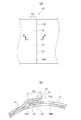
図1(a),(b)には、本発明の一例の胴巻きラベル10の基本構成を示す。胴巻きラベル10は、長さL、幅Hの長方形の二軸延伸ポリプロピレンフィルム(可撓性フィルム)からなるラベル本体11と、ラベル本体11に備える第1接着部14などで構成される。ラベル本体11は、その右側の短辺11Eに沿って一定幅(W1)で形成される終端部13と、ラベル本体11の左側の短辺11Tに沿って一定幅(W1)で形成される始端部12とを備える。そして、終端部13の裏面11Bに第1接着部14を設ける。この第1接着部14はホットメルト接着剤で構成される。また、この第1接着部14は、右側の短辺11Eに沿って一定幅W1で形成される(したがって、第1接着部14の面積=H×W1である)。
1A and 1B show a basic configuration of a body-
このように構成された胴巻きラベル10は、ペットボトル(容器)30の胴部に取り付けられる。図2(a)に示すように、ペットボトル30は略円筒形状に形成され、上部30A、胴部30B、下部30Cとで構成される。上部30Aは、上方に向かって直径が小さくなるように形成され、その頂部に液状の内容物(例えば、飲料や液体洗剤)を注ぎ出すための注ぎ口30Tを形成する。また、注ぎ口30Tの外周にはキャップCPを取り外し可能にネジつける。一方、胴部30Bは上下方向に渡って同一の直径で構成され、その外周には胴巻きラベル10が巻きつけられる。胴部30Bの高さhは、胴巻きラベル10の幅Hと同一かそれよりもやや大きく形成される。また、下部30Cはペットボトル30の底部を構成するものである。
The body-wrapped
ここで、胴部30Bと上部30Aおよび、胴部30Bと下部30Cとの境界部分にはそれぞれ段差G,Gが形成される。この段差Gは、胴部30Bの外径よりも上部30Aおよび下部30Cの外径をそれぞれ大きくすることで形成される。これによって、胴巻きラベル10をペットボトル30に取り付けたとき、胴部30Bと上部30Aとの間に形成される段差Gによって胴巻きラベル10が上方にずれることが抑制される。また、胴部30Bと下部30Cとの間に形成される段差Gによって胴巻きラベル10が下方にずれることが抑制される。
Here, steps G and G are formed at the boundary portions between the
次に、胴巻きラベル10をペットボトル30に取り付ける方法について説明する。なお、胴巻きラベル10をペットボトル30へ巻きつける作業は、通常、ボトルラベラーにて行われる。まず、図2(b)に示すように、胴巻きラベル10の始端部12の裏面11Bを胴部30Bの外周に当てる。詳しくは、始端部12の短辺11Tを胴部30Bから順次、ペットボトル30の胴部30Bの外周に巻きつける。そして、略1周したところで、終端部13の第1接着部14をラベル本体11の表面11Sに重ね合わせる。詳しくは、第1接着部14を始端部12と重ね合わせる(図2(c))。なお、図3(a)に示すように、この始端部12と終端部13とが重ね合わせられた部分を重ね合せ部OLと称する。
Next, a method for attaching the body-
そして、胴巻きラベル10をペットボトル30に巻きつけた状態で、95℃で5秒間第1接着部14を加熱・溶融させて、重ね合せ部OLを接着(すなわち、始端部12と終端部13とを接着)する。
Then, with the body-wrapped
重ね合せ部OLでは、図3(b)に示すように、第1接着部14を介して終端部13と始端部12とが接着されている。このようにして、筒状の胴巻きラベル10が形成されるとともに、その胴巻きラベル10がペットボトル30の胴部30Bに取り付けられる。
In the overlapping portion OL, as shown in FIG. 3B, the
なお、胴巻きラベル10は、ペットボトル30の胴部30Bにほぼ隙間なく巻きつけられる。したがって、胴巻きラベル10はペットボトル30に接着剤などによって固定されてはいない。しかし、胴部30Bの上下端に形成された段差Gによって、胴巻きラベル10は上下方向に動きを規制されている。
In addition, the
ところで、図4(a),(b)に示すように、胴巻きラベル10の終端部13の裏面11Bに第1接着部14を形成しない非接着部15を設けると好適である。そして、ペットボトル30を使用し終えたときには、この非接着部15をツマミ部として指でつまんで、短辺11Eを起こすようにして貼り合わせ部OLを引き剥がす。胴巻きラベル10をペットボトル30より分離する。これによって、ペットボトル30と胴巻きラベル10を容易に分別して回収することができる。
By the way, as shown to Fig.4 (a), (b), it is suitable to provide the
図5〜17には、ラベル本体11の終端部13に形成される第1接着部14の実施例1〜14を示す。また、これらの実施例において、(1)重ね合わせ部OLにおける引張せん断強度、(2)剥がしやすさ、および、(3)落下における耐久性、についてそれぞれ評価を行った。この結果を表1に示す。
In FIGS. 5-17, Examples 1-14 of the

以下に、上記(1)〜(3)の測定方法について説明する。 Below, the measuring method of said (1)-(3) is demonstrated.
(1)重ね合わせ部OLにおける引張せん断強さの測定
胴巻きラベル10の重ね合わせ部OLの引張せん断接着強さの測定方法について図18(a)〜(c)を用いて説明する。
(1) Measurement of tensile shear strength in overlapped portion OL A method for measuring the tensile shear adhesive strength of the overlapped portion OL of the body-
まず、長さ250mm、幅65mm、厚さ50μmの長方形の二軸延伸ポリプロピレン樹脂フィルム(可撓性フィルム:東洋紡製、製品名:P2761)からなるラベル本体11を2つ用意する。そして、一方のポリプロピレンフィルム(以下、「フィルムA」と称す)の終端部11Eの裏面に所定面積にわたってホットメルト接着剤(接着剤)を塗布量5g/m2で塗布して、第1接着部14を形成する(なお、ホットメルト接着剤は所定の接着強度を有するように調製されるものとする)。このホットメルト接着剤の塗布された面積を接着剤塗布面積P(mm2)とする。次に、フィルムAの後端部を、もう一つのポリプロピレンフィルム(以下、「フィルムB」と称す)の先端部11上に重ね合わせる。この重なり合う部分が重ね合わせ部OLとなる。
First, two
そして、95℃で5秒間加熱し、ホットメルト接着剤を溶融させて重ね合わせ部OLを接着する。さらに、フィルムAとフィルムBを引張試験機にて両側に向けて引っ張る。詳しくは、株式会社オリエンテック製テンシロンSTA−1150の引張試験機に上下方向に配置された、一対のつかみ具にフィルムAとフィルムBを固定する。つかみ具は、フィルムAとフィルムBの重ね合わせ部OLの端から両側に50±1mm離れた位置をそれぞれ掴んで対称的に固定する。そして、速度300(m/分)でフィルムAとフィルムBを重ね合わせ部OLが剥れて離れるまで上下方向(図18(c)にて矢印F方向)に引っ張り、引張力の最高値を破断力(N)とする。そして、この破断力を接着剤塗布面積P(mm2)で除して引張せん断接着強さ(N/mm2)を求める。 And it heats at 95 degreeC for 5 second, a hot-melt-adhesive agent is fuse | melted, and the overlapping part OL is adhere | attached. Furthermore, the film A and the film B are pulled toward both sides with a tensile tester. Specifically, the film A and the film B are fixed to a pair of grips arranged in a vertical direction on a tensile tester of Tensilon STA-1150 manufactured by Orientec Co., Ltd. The gripping tool grips and fixes symmetrically at positions 50 ± 1 mm apart on both sides from the end of the overlapping portion OL of the film A and the film B. Then, the film A and the film B are pulled at a speed of 300 (m / min) in the vertical direction (in the direction of arrow F in FIG. 18 (c)) until the overlapping portion OL is peeled off and the maximum value of the tensile force is broken. Force (N). Then, this breaking force is divided by the adhesive application area P (mm 2 ) to obtain the tensile shear bond strength (N / mm 2 ).
(2)剥がしやすさの評価
剥がしやすさは、実際に実施例1〜14の胴巻きラベル10のツマミ部をつまんで剥がすことで評価した。なお、表1の「剥がしやすさ」欄の右側が全体の評価者数、左側が剥がしやすいと感じた評価者数を示す。
(2) Evaluation of ease of peeling The ease of peeling was evaluated by actually pinching and removing the knob portion of the body-
(3)耐落下適性(落下に対する耐久性)
実施例1〜14それぞれの胴巻きラベル10を取り付けた14本のペットボトル30を用意した。次に、注ぎ口30Tが上を向くようにして立てた状態で、地上から高さ60cmの位置にペットボトル30の底面が位置するように配置してそれぞれ自由落下させた。そして、落下後の各ペットボトル30の胴巻きラベル10が剥離しているか否かを評価した。
(3) Drop resistance (durability against dropping)
Fourteen
図18から、実施例1〜14の全ての胴巻きラベル10において、「剥がしやすさ」が良好であるとともに、「耐落下適性」が良好であった。したがって、ペットボトルの落下によって不必要に剥れることなく、かつ、ペットボトルを使用後、剥がそうとしたときに容易に剥れる胴巻きラベルを実現するためには、胴巻きラベル10の重ね合わせ部OLのせん断強度(N/mm2)は、0.05以上、かつ、0.32以下とする必要があることが分かった。
From FIG. 18, in all the body-wound
図5(a),(b)は、第1接着部14の上端部(すなわち、ラベル本体11の後端部13の裏面11Bの上端部)に、ホットメルト接着剤の塗布されない部分、非接着部15を形成した例である。非接着部15は、所定長さ(W2)×所定長さ(L2)の略矩形状に形成され、その1つの角に丸みARをつけてなる。非接着部15のあるラベル本体11は、胴巻きラベル10をペットボトル30に装着したときにツマミ部となる箇所である。ツマミ部は、ペットボトル30の内容物を使用した後、胴巻きラベル10をペットボトル30から剥がす際に指でつまんで使用する部分である。非接着部15に形成される丸みARは、直径rの円弧の一部で形成される。なお、6mm<r<12mm、好ましくは、7mm<r<11mmとする。この直径rは、ユニバーサルデザインとして、30代の女性の親指(調査値の平均幅18mm)の指先にフィットし、ツマミ部を容易に持ち上げ易くするものである。なお、非接着部15は、第1接着部14の下端部に形成してもよいし、第1接着部14の上端部および下端部の両方に形成してもよい。
5 (a) and 5 (b) show a portion where the hot melt adhesive is not applied to the upper end portion of the first bonding portion 14 (that is, the upper end portion of the
非接着部15の長さW2は、(r+4)mm<W2<12mmであることが好ましい。また、長さL2は、(r+6)mm<L2<12mmであることが好ましく、より好ましくは(r+8)mm<L2<10mmである。なお、第1接着部14の幅W1は、4mm<W1<18mmとする。
The length W2 of the
図6(a),(b)には、図5(a),(b)の変形例を示す。この例では、前の例に比べて、非接着部15に円形の補助接着部14Xを設ける点のみが異なる。それ以外の構成は、前の例と同様である。補助接着部14Xは、直径が6〜12mmで形成される。ラベル本体11の幅Hが短い場合には、非接着部15を形成することによって、第1接着部14全体の接着強度が不十分であることから、これを補う目的で、補助接着部14Xを形成する。この場合、補助接着部14Xの直径を適宜変化させることで、補助接着部14Xの接着強度を容易に設定することができる。なお、補助接着部14Xは円形に限定されるものではない。
6 (a) and 6 (b) show modified examples of FIGS. 5 (a) and 5 (b). This example differs from the previous example only in that a circular auxiliary
図7には、図6(a),(b)のさらに変形例を示す。この例では、円形の補助接着部14Xに代えて、カギ状の補助接着部14X´とする。この場合も、補助接着部14X´の大きさを適宜変化させることで、補助接着部14X´の接着強度を容易に設定することができる。
FIG. 7 shows a further modification of FIGS. 6 (a) and 6 (b). In this example, instead of the circular
図8(a),(b)には、図5(a),(b)の別の変形例を示す。この例では、非接着部15の丸みARの直径rは、4mm<r<18mmとする。そして、非接着部15の外縁に沿って所定幅で、弱接着部14Wを形成する。弱接着部14Wに塗布するホットメルト接着剤の接着強度は、第1接着部14に塗布するそれよりも弱くする。弱接着部14Wは、ホットメルト接着剤の濃度を変えることで、また、接着強度の異なるホットメルト接着剤を使用することで形成する。それ以外の構成は、前の例と同様である。
8 (a) and 8 (b) show another modification of FIGS. 5 (a) and 5 (b). In this example, the diameter r of the roundness AR of the
さらに、図9に示すように、非接着部15の丸みARを図5のそれよりも緩やかな弧状に形成してもよい。この例では、4mm<W2<12mm、4mm<L2<20mm、かつ、W2<L2とする。このように構成すると、胴巻きラベル10を剥がす際、ラベル本体11の終端部13に上から下に向けて親指を容易に入れることができ、ツマミ部を簡単に把持することができる。それ以外の構成は、前の例と同様である。
Furthermore, as shown in FIG. 9, the roundness AR of the
また、図10に示すように、非接着部15の縁辺を2つの円弧AR1を組み合わせで形成してもよい。この例では、W2=L2とし、4mm<W2<16mmとする。また、円弧AR1を直径6〜10mmで形成する。このように構成すると、胴巻きラベル10を剥がす際、ラベル本体11の終端部13の上端部に上から下に向けて親指を入れる場合およびラベル本体11の終端部13の上端部に横から親指を入れる場合のいずれの場合に対しても、容易に親指を入れることができ、ツマミ部を簡単に把持することができる。それ以外の構成は、前の例と同様である。
Further, as shown in FIG. 10, the edge of the
さらに、図11に示すように、ラベル本体11の後端部13の裏面11Bには、上端部、下端部、中央部の合計3ヶ所に、ホットメルト接着剤の塗布されない部分、非接着部15を形成してもよい。これらの非接着部15は、胴巻きラベル10を剥がすときにはツマミ部となる。これらの非接着部15はすべて、縁辺に弧状の丸みARを有する。このように構成すると、胴巻きラベル10を剥がす際、ラベル本体11の終端部13の上端部に上から下に向けて親指を入れる場合、ラベル本体11の終端部13の中央部に横向きに親指を入れる場合、ラベル本体11の終端部13の下端部に下から上に向けて親指を入れる場合のいずれに対しても、容易に親指を入れることができ、ツマミ部を簡単に把持することができる。それ以外の構成は、前の例と同様である。
Furthermore, as shown in FIG. 11, the
また、図12に示すように、第1接着部14の上端部(すなわち、ラベル本体11の後端部13の裏面11Bの上端部)、および第1接着部14の下端部、さらに、第1接着部14の中央部に2ヶ所の合計4ヶ所に、ホットメルト接着剤の塗布されない部分、非接着部15を形成してもよい。これらの非接着部15は、胴巻きラベル10を剥がすときにはツマミ部となる。これらの非接着部15はすべて、縁辺に弧状の丸みARを有する。このように構成すると、胴巻きラベル10を剥がす際、ラベル本体11の終端部13の上端部に上から下に向けて親指を入れる場合、ラベル本体11の終端部13の中央部に横向きに親指を入れる場合、ラベル本体11の終端部13の下端部に下から上に向けて親指を入れる場合のいずれに対しても、容易に親指を入れることができ、ツマミ部を簡単に把持することができる。それ以外の構成は、前の例と同様である。
Further, as shown in FIG. 12, the upper end portion of the first adhesive portion 14 (that is, the upper end portion of the
また、図13に示すように、第1接着部14の両側端に、複数の円弧状の非接着部15を形成してもよい。これらの非接着部15は、胴巻きラベル10を剥がすときにはツマミ部となる。これらの非接着部15はすべて、縁辺に弧状の丸みを有する。このように構成すると、胴巻きラベル10を剥がす際、親指を掛ける箇所を任意に選択することができ、利便性に優れる。それ以外の構成は、前の例と同様である。
Further, as shown in FIG. 13, a plurality of arc-shaped
ところで、複数の非接着部15を形成した場合、重ね合せ部OL(図3(a)参照)内における接着強度のばらつきが大きくなってしまい、引張せん断強さが所定値よりも小さくなる箇所が出てきてしまい、ペットボトル30を保管時・輸送時・販売時などに誤って落下した場合に、その箇所が剥離してしまう可能性がある。このようなことを防止するため、図13に示すように、一方の縁辺にて隣接する2つの半円状の非接着部15,15の間に対応する位置で、かつ、他方の縁辺に半円状の非接着部15を形成する。このように非接着部15を配置することで、重ね合せ部OLの引張せん断強さを一定に確保することを可能にしている。
By the way, when a plurality of
図14(a),(b)には、さらに別の実施例を示す。ここでは、ラベル本体11の短辺11Eから距離W3の位置に仮想線VLを形成する(なお、この例では、距離W3=2mmとしている。より好ましくは2〜12mmである。2mmを下回ると、指かかりの機能が低下する)。そして、第1接着部14の縁辺を仮想線VLに対して対称な波状に形成する。この波の山―山間の距離はL3(同様に谷−谷間の距離もL3)である(なお、この例では、距離L3=14mmである。距離L3=8〜20mmとすると好適、より好ましくは9〜19mm、特に好ましくは9〜16mmである)。
FIGS. 14A and 14B show still another embodiment. Here, an imaginary line VL is formed at a position of a distance W3 from the
そして、仮想線VLから距離W1の位置を第1接着部14の反対側の縁辺とする。このように構成することで、非接着部15は波状に形成され、ツマミ部に親指をかけやすい。この例では、第1接着部14の縁辺が仮想線VLに対して対称な波状であるので、ホットメルト接着剤塗布面積は、矩形に形成された第1接着部14のそれと略同一である。したがって、重ね合せ部OLの引張せん断強さも略同一に維持することができる。上述以外の胴巻きラベル10の構成は、前述の例と同様である。
Then, a position at a distance W1 from the virtual line VL is set as an edge on the opposite side of the first
図15には、図14(a),(b)の変形例を示す。この例は、前の例と比べて、仮想線VLから短辺11E側に突出した第1接着部14を削除している。この例の谷−谷間の距離はL3である(なお、この例では、距離L3=14mmである。距離L3=8〜20mmとすると好適、より好ましくは9〜19mm、特に好ましくは9〜16mmである。18mmの8割、すなわち14mmを中心にして上記範囲の波状を形成すると、指先の形状に適合するためラベル端部を指先で持ち上げやすいことが判明した)。このように構成することで、非接着部15には一定間隔で谷部が形成され、ツマミ部に親指をかけやすい。上述以外の胴巻きラベル10の構成は、前述の例と同様である。
FIG. 15 shows a modification of FIGS. 14 (a) and 14 (b). In this example, as compared with the previous example, the first
図16(a)には、さらに、別の実施例を示す。この例では、ラベル本体11の短辺11Eから距離W3の位置に第1接着部14を形成する(なお、この例では、距離W3=2mmとしている。より好ましくは2〜12mmである。2mmを下回ると、指かかりの機能が低下する)。したがって、ラベル本体11の短辺11Eから距離W3の間は、非接着部15となる。加えて、第1接着部14の上端部(すなわち、ラベル本体11の後端部13の裏面11Bの上端部)にも、ホットメルト接着剤の塗布されない部分、非接着部15´を形成する。非接着部15´は、長さ=W4、幅=L2の直角三角形状に形成される。上述の例と同様に、非接着部15および非接着部15´がツマミ部として使用される。その他の構成は、上述の例と同様である。
FIG. 16A shows still another embodiment. In this example, the
図16(b)には、図16(a)の変形例を示す。この例では、第1接着部14の上端部に加えて、第1接着部14の下端部(すなわち、ラベル本体11の後端部13の裏面11Bの下端部)にも、ホットメルト接着剤の塗布されない部分、非接着部15´を形成する。この非接着部15´は、長さ=W4、幅=L2の直角三角形状に形成される。上述の例と同様に、非接着部15および非接着部15´がツマミ部として使用される。このように、第1接着部14の上下端部にそれぞれ非接着部15´を形成すると、右利き、左利きに係らず、いずれかのツマミ部を使用することができる。その他の構成は、上述の例と同様である。
FIG. 16B shows a modification of FIG. In this example, in addition to the upper end portion of the first
図17(a),(b)は、図16(b)の実施例の変形例である。この例では、図16(b)の上下それぞれの非接着部15´,15´に、補助接着部14X´,14X´を形成する。補助接着部14X´は所定の幅を有する線分状に形成され、第1接着部14の縁辺に沿って配置される。その他の構成は、上述の例と同様である。
17 (a) and 17 (b) are modifications of the embodiment of FIG. 16 (b). In this example,
図19(a),(b)には、さらに別の例を示す。この例では、図1(a),(b)の例に加えて、第2接着部16を胴巻きラベル10に備える。第2接着部16は、ラベル本体11の始端部12の裏面11Sに設けられる。この第2接着部16は、ホットメルト接着剤で構成される。また、この第2接着部16は、左側の短辺11Tに沿って一定幅W2で形成される(この例ではW2<W1であるが、これに限定されるものではない)。それ以外の構成は、図1(a),(b)の例と同様である。また、前述のように、胴巻きラベル10の終端部13にツマミ部を備えると好適である。
19A and 19B show still another example. In this example, in addition to the example of FIGS. 1A and 1B, the second
このように構成された胴巻きラベル10は、ペットボトル(容器)30の胴部に取り付けられる。なお、ペットボトル30の構成は図2(a)に示すものと同様である。
The body-wrapped
次に、胴巻きラベル10をペットボトル30に取り付ける方法について説明する。なお、胴巻きラベル10をペットボトル30へ巻きつける作業は、通常、ボトルラベラーにて行われる。まず、図20(a),(b)に示すように、胴巻きラベル10の始端部12の裏面11Bをペットボトル30の胴部30Bの外周に当てる。詳しくは、始端部12の第2接着部16を胴部30Bの外周にあて、以後、順次、胴巻きラベル10を胴部30Bに巻きつける。そして、略1周したところで、終端部13の第1接着部14をラベル本体11の表面11Sに重ね合わせる。詳しくは、第1接着部14を始端部12と重ね合わせる(図20(c))。なお、この始端部12と終端部13とが重ね合わせられた部分を重ね合せ部OLと称する。
Next, a method for attaching the body-
そして、胴巻きラベル10をペットボトル30に巻きつけた状態で、95℃で5秒間第1接着部14、第2接着部16を加熱・溶融させて、重ね合せ部OLを接着(すなわち、始端部12と終端部13とを接着)するとともに、始端部12とペットボトル30の胴部30Bとを接着する。なお、胴巻きラベル10の長さLをペットボトル30の胴部30Bの外周長に合わせて決定することで、胴巻きラベル10をペットボトル30に巻きつけたとき、第1接着部14と第2接着部16とが略同一箇所となる。このようにすることで、第1接着部14と第2接着部16とを同時に加熱・溶融することができ、加熱工程を簡略化することができる。
Then, with the body-wrapped
また、上述の例と同様に、胴巻きラベル10の終端部13には、ツマミ部を形成すると好適である。
Further, as in the above-described example, it is preferable to form a knob portion at the
なお、ペットボトル30の形状は、図2(a)に限定されるものではない。すなわち、ペットボトル30が、胴部30Bと上部30Aおよび、胴部30Bと下部30Cとの境界部分に段差G,Gを有しなくてもよい。このようにフラットな側面形状のペットボトルにすることで、胴巻きラベル10を取り付ける箇所を任意に選択することができる。
The shape of the
さらに、ラベル本体11の裏面11Bに印刷層を形成してもよい。この印刷層には、ペットボトル30に充填された内容物の表示、絵柄、広告などを形成したり、遮光目的で暗色系に一面色づけしたりすることができる。この場合、印刷層は、第1接着部14および第2接着部16とラベル本体11との間に形成する。
Further, a printing layer may be formed on the
また、印刷層をラベル本体11の表面11Sに形成してもよい。
A printed layer may be formed on the
本発明に係る胴巻きラベルは、清涼飲料水、乳飲料、ビール、ワイン、栄養ドリンクなど液体飲料、液体調味料、流動性のある食品(たとえば、蜂蜜、ゼリーなど)、液体洗剤、液体化粧品、さらには、液体農薬や液体肥料など、あらゆる液体を収容する容器(ペットボトル、ガラス瓶、プラスチックボトルなど)に適用することができる。また、収容する内容物は液体に限定されるものではなく、粉状、顆粒状であってもよい。 The body-wound label according to the present invention includes soft drinks, milk drinks, beer, wine, energy drinks and other liquid drinks, liquid seasonings, fluid foods (eg, honey, jelly, etc.), liquid detergents, liquid cosmetics, Can be applied to containers (such as plastic bottles, glass bottles, and plastic bottles) that contain all liquids such as liquid pesticides and liquid fertilizers. Further, the contents to be stored are not limited to liquids, and may be powdery or granular.
10 胴巻きラベル
11 ラベル本体
11B 裏面
11S 表面
12 始端部
13 終端部
14 第1接着部
15 非接着部(ツマミ部)
16 第2接着部
30 ペットボトル(容器)
30B 胴部
DESCRIPTION OF
16
30B trunk
Claims (4)
該ラベル本体の両側部のうちの一方を始端部、他方を終端部とし、前記終端部の裏面に設けられる第1接着部とを備え、
前記始端部の裏面から順次、容器の胴部外周に巻きつけて、前記終端部を前記始端部に重ね合わせ、前記第1接着部を介して前記終端部と前記始端部とを接着し、筒状に形成される胴巻きラベルにおいて、
前記終端部と前記始端部とが重なり合った箇所を重ね合せ部とし、
該重ね合せ部における引張せん断接着強さが、0.05N/mm2以上、かつ、0.32N/mm2以下となることを特徴とする、胴巻きラベル。 A label body which is a substantially rectangular flexible film;
One of the two side portions of the label main body is a start end portion, the other is a termination portion, and includes a first adhesive portion provided on the back surface of the termination portion,
Sequentially wound around the outer periphery of the body portion of the container from the back surface of the start end portion, the end portion is overlapped with the start end portion, the end portion and the start end portion are bonded via the first adhesive portion, In the body-wound label formed into a shape,
A place where the end portion and the start end portion overlap each other is an overlapping portion,
Shear strength tensile at heavy I combined unit, 0.05 N / mm 2 or more, and is characterized in that a 0.32 N / mm 2 or less, wrapping the label.
該第2接着部を前記容器の胴部に貼り付けることで前記容器に取り付けられることを特徴とする、請求項1に記載の胴巻きラベル。 A second adhesive portion is provided on the back surface of the starting end portion,
The body-wound label according to claim 1, wherein the body-wound label is attached to the container by pasting the second adhesive portion onto the body of the container.
該ツマミ部をつまんで前記終端部を前記始端部から剥がすことを特徴とする、請求項1または2に記載の胴巻きラベル。 The back surface of the end portion and the portion where the first adhesive portion is not provided is a knob portion.
The body-wrapped label according to claim 1 or 2, wherein the knob portion is pinched to peel off the end portion from the start end portion.
Priority Applications (1)
| Application Number | Priority Date | Filing Date | Title |
|---|---|---|---|
| JP2011270701A JP2013122514A (en) | 2011-12-09 | 2011-12-09 | Wraparound label |
Applications Claiming Priority (1)
| Application Number | Priority Date | Filing Date | Title |
|---|---|---|---|
| JP2011270701A JP2013122514A (en) | 2011-12-09 | 2011-12-09 | Wraparound label |
Publications (1)
| Publication Number | Publication Date |
|---|---|
| JP2013122514A true JP2013122514A (en) | 2013-06-20 |
Family
ID=48774508
Family Applications (1)
| Application Number | Title | Priority Date | Filing Date |
|---|---|---|---|
| JP2011270701A Pending JP2013122514A (en) | 2011-12-09 | 2011-12-09 | Wraparound label |
Country Status (1)
| Country | Link |
|---|---|
| JP (1) | JP2013122514A (en) |
Cited By (3)
| Publication number | Priority date | Publication date | Assignee | Title |
|---|---|---|---|---|
| JP2015016902A (en) * | 2013-07-12 | 2015-01-29 | 株式会社フジシール | Labeled container |
| JP2016203430A (en) * | 2015-04-17 | 2016-12-08 | 大日本印刷株式会社 | Composite container and manufacturing method thereof, composite preform, plastic member, inner label member and label |
| JP2017026875A (en) * | 2015-07-24 | 2017-02-02 | 株式会社フジシール | Heat-shrinkable cylindrical label |
Citations (1)
| Publication number | Priority date | Publication date | Assignee | Title |
|---|---|---|---|---|
| JP2008152145A (en) * | 2006-12-19 | 2008-07-03 | Dainippon Printing Co Ltd | Torso winding label |
-
2011
- 2011-12-09 JP JP2011270701A patent/JP2013122514A/en active Pending
Patent Citations (1)
| Publication number | Priority date | Publication date | Assignee | Title |
|---|---|---|---|---|
| JP2008152145A (en) * | 2006-12-19 | 2008-07-03 | Dainippon Printing Co Ltd | Torso winding label |
Cited By (3)
| Publication number | Priority date | Publication date | Assignee | Title |
|---|---|---|---|---|
| JP2015016902A (en) * | 2013-07-12 | 2015-01-29 | 株式会社フジシール | Labeled container |
| JP2016203430A (en) * | 2015-04-17 | 2016-12-08 | 大日本印刷株式会社 | Composite container and manufacturing method thereof, composite preform, plastic member, inner label member and label |
| JP2017026875A (en) * | 2015-07-24 | 2017-02-02 | 株式会社フジシール | Heat-shrinkable cylindrical label |
Similar Documents
| Publication | Publication Date | Title |
|---|---|---|
| JP6210991B2 (en) | Cylindrical shrink label and manufacturing method thereof | |
| JP4909266B2 (en) | Battery exterior label | |
| US20150248849A1 (en) | Pressure Sensitive Shrink Label | |
| JP4568743B2 (en) | Heat-shrinkable multilayer film and heat-shrinkable label | |
| JP2008145498A (en) | Roll shrink label, container with roll shrink label, and production method thereof | |
| JP4459551B2 (en) | Body-wound label and labeled container | |
| JP2004205768A (en) | Label and labeled container using it | |
| JP4612278B2 (en) | Insulating label and labeled container | |
| JP2013122514A (en) | Wraparound label | |
| JP5001487B2 (en) | Battery exterior label | |
| JP2009092777A (en) | Torso winding label | |
| JP2017068101A (en) | Shrinkable label | |
| JP2008152145A (en) | Torso winding label | |
| JP4980802B2 (en) | Shrink film and shrink label | |
| JP2006349749A (en) | Cylindrical shrink label, container with label, and coating agent for shrink label | |
| JP4578307B2 (en) | Thermal label | |
| JP4989000B2 (en) | Battery exterior label | |
| JP4546210B2 (en) | Thermal label | |
| JP2008207859A (en) | Shrink label | |
| JP5266673B2 (en) | Cylindrical shrink label, container with cylindrical shrink label | |
| JP6345422B2 (en) | Shrink label | |
| JP6339334B2 (en) | Shrink label | |
| JP4880993B2 (en) | Thermal labels and labeled containers | |
| JP6345456B2 (en) | Shrink label and manufacturing method thereof | |
| JP6669525B2 (en) | Shrink labels and labeled containers |
Legal Events
| Date | Code | Title | Description |
|---|---|---|---|
| A621 | Written request for application examination |
Free format text: JAPANESE INTERMEDIATE CODE: A621 Effective date: 20141024 |
|
| A131 | Notification of reasons for refusal |
Free format text: JAPANESE INTERMEDIATE CODE: A131 Effective date: 20151222 |
|
| A977 | Report on retrieval |
Free format text: JAPANESE INTERMEDIATE CODE: A971007 Effective date: 20151225 |
|
| A521 | Written amendment |
Free format text: JAPANESE INTERMEDIATE CODE: A523 Effective date: 20160219 |
|
| A02 | Decision of refusal |
Free format text: JAPANESE INTERMEDIATE CODE: A02 Effective date: 20160913 |