JP2008527394A - System and method for positioning using multipath signals - Google Patents
System and method for positioning using multipath signals Download PDFInfo
- Publication number
- JP2008527394A JP2008527394A JP2007552245A JP2007552245A JP2008527394A JP 2008527394 A JP2008527394 A JP 2008527394A JP 2007552245 A JP2007552245 A JP 2007552245A JP 2007552245 A JP2007552245 A JP 2007552245A JP 2008527394 A JP2008527394 A JP 2008527394A
- Authority
- JP
- Japan
- Prior art keywords
- signal
- multipath
- path
- location
- tag
- Prior art date
- Legal status (The legal status is an assumption and is not a legal conclusion. Google has not performed a legal analysis and makes no representation as to the accuracy of the status listed.)
- Pending
Links
- 238000000034 method Methods 0.000 title claims abstract description 52
- 238000005259 measurement Methods 0.000 claims abstract description 69
- 238000013179 statistical model Methods 0.000 claims description 7
- 238000000528 statistical test Methods 0.000 claims description 2
- 238000013459 approach Methods 0.000 abstract description 27
- 238000012545 processing Methods 0.000 abstract description 6
- 230000004807 localization Effects 0.000 abstract description 2
- 239000013598 vector Substances 0.000 description 29
- 238000001914 filtration Methods 0.000 description 16
- 239000011159 matrix material Substances 0.000 description 16
- 238000004088 simulation Methods 0.000 description 12
- 238000004422 calculation algorithm Methods 0.000 description 8
- 230000008901 benefit Effects 0.000 description 6
- 239000002245 particle Substances 0.000 description 6
- 230000005540 biological transmission Effects 0.000 description 5
- 238000007781 pre-processing Methods 0.000 description 5
- 230000008569 process Effects 0.000 description 5
- 238000004364 calculation method Methods 0.000 description 4
- 238000010586 diagram Methods 0.000 description 4
- 238000004458 analytical method Methods 0.000 description 3
- 238000001514 detection method Methods 0.000 description 3
- 238000011161 development Methods 0.000 description 3
- 230000018109 developmental process Effects 0.000 description 3
- 230000000694 effects Effects 0.000 description 3
- 230000006870 function Effects 0.000 description 3
- 230000014509 gene expression Effects 0.000 description 3
- 230000002411 adverse Effects 0.000 description 2
- 230000001419 dependent effect Effects 0.000 description 2
- 238000009826 distribution Methods 0.000 description 2
- 238000005516 engineering process Methods 0.000 description 2
- 230000006698 induction Effects 0.000 description 2
- 230000033001 locomotion Effects 0.000 description 2
- 230000000644 propagated effect Effects 0.000 description 2
- 230000004044 response Effects 0.000 description 2
- 238000005309 stochastic process Methods 0.000 description 2
- 230000009466 transformation Effects 0.000 description 2
- 239000004165 Methyl ester of fatty acids Substances 0.000 description 1
- 238000010521 absorption reaction Methods 0.000 description 1
- 238000009825 accumulation Methods 0.000 description 1
- 230000003190 augmentative effect Effects 0.000 description 1
- 239000006227 byproduct Substances 0.000 description 1
- 238000007796 conventional method Methods 0.000 description 1
- 230000007812 deficiency Effects 0.000 description 1
- 230000001934 delay Effects 0.000 description 1
- 238000009795 derivation Methods 0.000 description 1
- 238000009472 formulation Methods 0.000 description 1
- 230000012010 growth Effects 0.000 description 1
- 238000003780 insertion Methods 0.000 description 1
- 230000037431 insertion Effects 0.000 description 1
- 238000002955 isolation Methods 0.000 description 1
- 239000002184 metal Substances 0.000 description 1
- 239000000203 mixture Substances 0.000 description 1
- 238000012986 modification Methods 0.000 description 1
- 230000004048 modification Effects 0.000 description 1
- 230000000135 prohibitive effect Effects 0.000 description 1
- 239000000523 sample Substances 0.000 description 1
- 230000035945 sensitivity Effects 0.000 description 1
- 238000000926 separation method Methods 0.000 description 1
- 230000007704 transition Effects 0.000 description 1
Images




Classifications
-
- G—PHYSICS
- G01—MEASURING; TESTING
- G01C—MEASURING DISTANCES, LEVELS OR BEARINGS; SURVEYING; NAVIGATION; GYROSCOPIC INSTRUMENTS; PHOTOGRAMMETRY OR VIDEOGRAMMETRY
- G01C21/00—Navigation; Navigational instruments not provided for in groups G01C1/00 - G01C19/00
- G01C21/20—Instruments for performing navigational calculations
- G01C21/206—Instruments for performing navigational calculations specially adapted for indoor navigation
-
- G—PHYSICS
- G01—MEASURING; TESTING
- G01S—RADIO DIRECTION-FINDING; RADIO NAVIGATION; DETERMINING DISTANCE OR VELOCITY BY USE OF RADIO WAVES; LOCATING OR PRESENCE-DETECTING BY USE OF THE REFLECTION OR RERADIATION OF RADIO WAVES; ANALOGOUS ARRANGEMENTS USING OTHER WAVES
- G01S19/00—Satellite radio beacon positioning systems; Determining position, velocity or attitude using signals transmitted by such systems
- G01S19/38—Determining a navigation solution using signals transmitted by a satellite radio beacon positioning system
- G01S19/39—Determining a navigation solution using signals transmitted by a satellite radio beacon positioning system the satellite radio beacon positioning system transmitting time-stamped messages, e.g. GPS [Global Positioning System], GLONASS [Global Orbiting Navigation Satellite System] or GALILEO
- G01S19/42—Determining position
- G01S19/428—Determining position using multipath or indirect path propagation signals in position determination
-
- G—PHYSICS
- G01—MEASURING; TESTING
- G01S—RADIO DIRECTION-FINDING; RADIO NAVIGATION; DETERMINING DISTANCE OR VELOCITY BY USE OF RADIO WAVES; LOCATING OR PRESENCE-DETECTING BY USE OF THE REFLECTION OR RERADIATION OF RADIO WAVES; ANALOGOUS ARRANGEMENTS USING OTHER WAVES
- G01S5/00—Position-fixing by co-ordinating two or more direction or position line determinations; Position-fixing by co-ordinating two or more distance determinations
- G01S5/02—Position-fixing by co-ordinating two or more direction or position line determinations; Position-fixing by co-ordinating two or more distance determinations using radio waves
- G01S5/0252—Radio frequency fingerprinting
- G01S5/02521—Radio frequency fingerprinting using a radio-map
- G01S5/02524—Creating or updating the radio-map
- G01S5/02525—Gathering the radio frequency fingerprints
-
- G—PHYSICS
- G01—MEASURING; TESTING
- G01S—RADIO DIRECTION-FINDING; RADIO NAVIGATION; DETERMINING DISTANCE OR VELOCITY BY USE OF RADIO WAVES; LOCATING OR PRESENCE-DETECTING BY USE OF THE REFLECTION OR RERADIATION OF RADIO WAVES; ANALOGOUS ARRANGEMENTS USING OTHER WAVES
- G01S5/00—Position-fixing by co-ordinating two or more direction or position line determinations; Position-fixing by co-ordinating two or more distance determinations
- G01S5/02—Position-fixing by co-ordinating two or more direction or position line determinations; Position-fixing by co-ordinating two or more distance determinations using radio waves
- G01S5/0273—Position-fixing by co-ordinating two or more direction or position line determinations; Position-fixing by co-ordinating two or more distance determinations using radio waves using multipath or indirect path propagation signals in position determination
Landscapes
- Engineering & Computer Science (AREA)
- Radar, Positioning & Navigation (AREA)
- Remote Sensing (AREA)
- Physics & Mathematics (AREA)
- General Physics & Mathematics (AREA)
- Computer Networks & Wireless Communication (AREA)
- Automation & Control Theory (AREA)
- Position Fixing By Use Of Radio Waves (AREA)
- Radar Systems Or Details Thereof (AREA)
Abstract
RFの能動的か、受動的か、又は支援された位置確認アプローチのための信号処理技法である。該信号処理技法は、フィルタか又は推定器、例えば、非線形フィルタと共に、追加的な測定値としてマルチパス信号を利用する。前記フィルタは、インダイレクト及びダイレクトパス測定値か又は任意の他の利用可能な信号を使用して、観測可能なインダイレクトパスのパラメトリックモデルを構築する。1つか又は複数のダイレクトパス測定値が、(例えば、障害のせいで)その後、失われる場合には、インダイレクトパス測定値を用いて、人間か又は対象となる物体の位置の推定をフィルタが維持する。Signal processing techniques for RF active, passive or assisted localization approaches. The signal processing technique utilizes a multipath signal as an additional measurement along with a filter or estimator, eg, a non-linear filter. The filter uses indirect and direct path measurements or any other available signal to build an observable indirect path parametric model. If one or more direct path measurements are subsequently lost (eg, due to a fault), the indirect path measurements are used to filter the estimation of the position of the person or target object. maintain.
Description
発明の分野
本発明は、一般に、ナビゲーション及び位置決め(測位)を行うためのシステム及び方法に関し、特に、マルチパス信号を用いてナビゲーション及び位置決めを行うためのシステム及び方法に関する。
The present invention relates generally to systems and methods for performing navigation and positioning (positioning), and more particularly to systems and methods for performing navigation and positioning using multipath signals.
関連事例の相互参照
本出願は、2005年1月19日にファイリングされた米国仮特許出願第60/645,390号の利益を請求し、該米国仮特許出願第60/645,390号は、その全体があたかも記載されているかのごとく参照によって本明細書内において組み込まれる。本出願はまた、2004年2月17日に発行された米国特許第6,693,592号の開示も、その全体が記載されているかのごとく本明細書内において組み込む。
This application claims the benefit of US Provisional Patent Application No. 60 / 645,390 filed on Jan. 19, 2005, which is hereby incorporated by reference It is incorporated herein by reference as if set forth in its entirety. This application also incorporates the disclosure of US Pat. No. 6,693,592, issued February 17, 2004, as if set forth in its entirety.
アーバンキャニオンか、又は建築物などの囲まれた構造のような、散乱した環境内において移動している人々か又は存在(アセット:assets)の位置決めを行うために無線周波数(RF)信号を用いる幾つかの試みが存在している。一般的には、これら先行技術の試みは、固定された基準局か又はビーコンを、受信する幾つかの形態か又は追跡される物体上の応答タグと共に、典型的には利用する。この装置と共に、前記基準局からのRF信号強度(RSS:RF signal strength)か、到来時間(TOA:time of arrival)か、到来時間差(TDOA:time difference of arrival)か、又は到来角度(AOA:angle of arrival)の事象(現象)を用いた三角測量の形態が、前記タグの位置を決定するために用いられている。 Some use radio frequency (RF) signals to locate people or assets moving in scattered environments, such as urban canyons or enclosed structures such as buildings There is an attempt. In general, these prior art attempts typically utilize a fixed reference station or beacon with some form of reception or response tag on the tracked object. With this device, the RF signal strength (RSS) from the reference station, the time of arrival (TOA), the time difference of arrival (TDOA), or the angle of arrival (AOA) angle The form of triangulation using the event of arrival is used to determine the position of the tag.
大部分のこれら先行技術のアプローチのうちの1つの欠陥は、散乱した環境内において生成されたRFマルチパス信号によって、それらが悪い方向に影響を受けることである。前記基準ビーコンと前記タグとの間のダイレクトパス(直接経路)が、確実に一貫して測定されることが不可能な時には、マルチパス信号は、結果として、RSS、TOA、TDOA、及びAOA事象の不正確な測定値を生じさせる可能性がある。従って、これらのアプローチは、典型的には、マルチパス信号を、正確な位置結果を提供するための削除されるべきエラーとみなす。 One deficiency of most of these prior art approaches is that they are adversely affected by RF multipath signals generated in a scattered environment. When the direct path between the reference beacon and the tag cannot be reliably measured consistently, the multipath signal will result in an RSS, TOA, TDOA, and AOA event. May cause inaccurate measurements. Thus, these approaches typically view multipath signals as errors to be deleted to provide accurate position results.
位置決め(測位)の問題に対する、代表的な第1のクラスのアプローチは、慣性システム、すなわち、各々の停止において更新するゼロ(零)速度を有する慣性システムと、ドップラー測定値か、気圧高度か、磁力計か、又は視覚システムによって、増強又は更新することとを含む。このクラスのアプローチは、繰り返される交差点を識別するためにか、又は動的な慣性の較正を提供するために、時として特別なアルゴリズムを必要とし、典型的には、建築物の寸法及び配置の事前知識を必要とする。これらアプローチのうちの幾つかは、影となる(受信不良となる)真っただ中の散乱された環境内において、信号が忠実に受信されることが可能となる程度にまで、全地球測位システム(GPS)か又は、E911のような携帯電話(セルフォン)のナビゲーションの支援を利用する。 A typical first class approach to positioning (positioning) problems is an inertial system, i.e., an inertial system with a zero velocity that updates at each stop, and a Doppler measurement, barometric altitude, Augmenting or updating with a magnetometer or vision system. This class of approaches sometimes requires special algorithms to identify repeated intersections or to provide dynamic inertia calibration, typically for building dimensions and placement. Requires prior knowledge. Some of these approaches are global positioning systems (to the extent that a signal can be faithfully received in a shadowed (shadowed) middle scattered environment. GPS) or mobile phone (cell phone) navigation assistance such as E911.
アプローチの第2クラスは、802.11xか、ブルートゥースか、又は別のRF技法を用いて、協同のインフラ(構造基盤)を使用する。いくつかのインフラは、そのような目的のために特別に設計されている。1つの特定のアプローチは、幾つかのトランシーバによって受信されるような、ネットワーク素子送信器の信号強度を用い、該信号強度は、更にマッピングされて、吸収、屈折、及び反射のような影響の原因となる既知の建築物構造に対して較正される。別のアプローチは、特化された送信器か又は受信器のセットを三角測量することによってもたらされるキャリア位相測定値を使用する。この第2のクラスにおいて、RFID技術が、比較的狭いエリアにわたって対象物を位置付けるために使用されることもまた可能であるが、より広いエリアにわたって実用化されるためには、典型的には、多くの統合センサを必要とする。 The second class of approaches uses a collaborative infrastructure (structural infrastructure) using 802.11x, Bluetooth, or another RF technique. Some infrastructure is specially designed for such purposes. One particular approach uses the signal strength of a network element transmitter, as received by several transceivers, which is further mapped to cause effects such as absorption, refraction, and reflection. Is calibrated against a known building structure. Another approach uses carrier phase measurements that result from triangulating a specialized transmitter or set of receivers. In this second class, RFID technology can also be used to position objects over a relatively small area, but in order to be put into practical use over a larger area, typically Requires many integrated sensors.
第1のクラスの独立した(自律性の)アプローチに関連した1つの問題はコストである。これらのアプローチは、良好な性能を提供することができるが、それらは典型的には、コストがかかる素子を用い、該素子がコストがかかるシステム内へと統合化される。更には、このクラスのアプローチは、典型的には、各々の人間か又は対象物に、ナビゲーション装置を携帯することを要求し、このことが、システム全体を高価にさせる可能性がある。そのようなアプローチは、独立性(自律性)が重要で且つコストがあまり重要でない場合の用途には適合するが、商業的な用途に対するそれらのアプリケーションは、コストが法外に高くなる可能性がある。 One problem associated with the first class of independent (autonomous) approaches is cost. While these approaches can provide good performance, they typically use costly elements that are integrated into a costly system. Furthermore, this class of approaches typically requires each person or object to carry a navigation device, which can make the entire system expensive. Such an approach is suitable for applications where independence (autonomy) is important and cost is less important, but those applications for commercial applications can be cost prohibitive. is there.
第2のクラスによるアプローチは、それらのインフラ(構造基盤)内において組み込まれたそれらの主要コストが有する利点を享受する。そのコストは、引き続いて、802.11x技術が備わった携帯情報端末のような比較的低コストの受信器か又は中継器を各々が携帯することになる個別ユーザによって償却される。しかしながら、第2のクラスによるアプローチは、依然として、典型的には、マルチパス信号に対する感度による影響を受ける。
従って、アーバンキャニオンか、又は建築物などの囲まれた構造のような、散乱した環境内において移動している人々か又は存在(アセット)を、これら環境内において生成されたマルチパス信号からの悪影響を受けること無く、測位すること(位置決めを行うこと)が可能な改善されたシステム及び方法の必要性がある。 Thus, people or entities (assets) moving in scattered environments, such as urban canyons or enclosed structures such as buildings, can be adversely affected by multipath signals generated in those environments. There is a need for an improved system and method capable of positioning (performing positioning) without being subjected to any problems.
発明の概要
本発明は、アーバンキャニオンか、又は建築物などの囲まれた構造のような、散乱した環境内において移動する人々か又は存在(アセット)の位置決め(測位)を行うためのシステム及び方法に関する。本発明のシステム及び方法は、ダイレクトパス(DP)が無いか又は検出されない時でさえ、実質的なエネルギーが利用可能であることを認識し、及び、ローカルな環境内における様々な物体によって送信された信号が反射された時には、結果として生じるマルチパス信号によって十分な情報が伝達されることを認識する。
SUMMARY OF THE INVENTION The present invention is a system and method for locating people or entities (assets) that move within a scattered environment, such as an urban canyon or an enclosed structure such as a building. About. The system and method of the present invention recognizes that substantial energy is available even when no direct path (DP) is detected or detected, and is transmitted by various objects in the local environment. When the reflected signal is reflected, it is recognized that sufficient information is conveyed by the resulting multipath signal.
本発明の実施形態は、現実の物理的な環境内において、小さな空間の隔離、多くのマルチパス構成要素は、共有され共通であると仮定することを認める。従って、本発明の実施形態は、再帰的推定技法を用いて環境のモデルを構築する。これらの技法は、新たなパスの生成を、それらが重要になったものとして許可し、及び、古いパスの終結を、それらが無関係になったものとして許可する。従って、各々の個別のマルチパス要素と、各々の受信した送信位置との間の信号を含む利用可能な情報の効率的な使用によって、ローカルなインフラ(構造基盤)の事前知識の必要性が排除される。 Embodiments of the present invention allow for small space isolation, assuming that many multipath components are shared and common within a real physical environment. Thus, embodiments of the present invention use a recursive estimation technique to build a model of the environment. These techniques allow the generation of new paths as they become important and the termination of old paths as they become irrelevant. Thus, the efficient use of available information, including signals between each individual multipath element and each received transmission location, eliminates the need for prior knowledge of the local infrastructure Is done.
本発明の実施形態は、位置付け及び追跡する場合に、測定されたマルチパスTOA遅延を直接的に使用する。レイクフィルタ(Rake filter)か又は類似の手段を用いて、差分の遅延がリアルタイムに追跡される。後述されるように、ある単一時間におけるシングルパスについての差分の遅延と、タグの3次元の位置との間の関係を、任意の数の反射の場合について4つのパラメータを用いて説明することができる。この関係の理解によって、マルチパスパラメータを、ダイレクトパス(直接的な経路)、インダイレクトパス(間接的な経路)、及び他の利用可能な測定値を用いて、リアルタイムに推定することができる。ダイレクトパスが遮断されるか又は他の測定値が利用不可能になった場合には、従って、これらのマルチパスパラメータを、3次元の位置付けか又は追跡を行う場合の推定技法と共に、引き続き用いることができる。 Embodiments of the present invention directly use the measured multipath TOA delay when positioning and tracking. Using a Rake filter or similar means, the differential delay is tracked in real time. Describe the relationship between the differential delay for a single path at a single time and the three-dimensional position of the tag using four parameters for any number of reflections, as described below. Can do. By understanding this relationship, multipath parameters can be estimated in real time using direct paths (direct paths), indirect paths (indirect paths), and other available measurements. If the direct path is interrupted or other measurements become unavailable, these multipath parameters should therefore continue to be used, along with estimation techniques when performing 3D positioning or tracking. Can do.
差分の遅延とタグ位置との間の関係を説明するマルチパスパラメータの知識(情報)が、完全マルチパスの解を決定する(すなわち、正反射点の位置を提供する)には不十分である時でさえ、ジオロケーション(地理位置情報)の解は、典型的には、完全マルチパスの解を必要としない。マルチパス信号を用いるジオロケーションは、ダイレクト及びインダイレクトな経路の測定値の組み合わされた観測からか、又は位置の、事前の初期知識から、マルチパスパラメータが決定可能である時の状況において、成し遂げられることが可能である。マルチパスパラメータの積算された時間の増大が、従って、建築物構造の内部の画像を提供するために使用することができる可能性がある。 Multipath parameter knowledge (information) describing the relationship between differential delay and tag position is insufficient to determine a complete multipath solution (ie, provide the location of specular reflection points) Even sometimes, geolocation solutions typically do not require full multipath solutions. Geolocation using multipath signals is accomplished in situations where multipath parameters can be determined from a combined observation of direct and indirect path measurements or from prior initial knowledge of the location. It is possible to be The accumulated time increase of the multipath parameters may therefore be used to provide an image of the interior of the building structure.
ある特定の状況において、線形化(例えば拡張カルマンフィルタ)を用いるフィルタリング方法は適切ではない。何故ならば、測定値とフィルタ状態との間の関係が、非常に非線形である場合があるからである。例えば、マルチパス反射は、マルチパスパラメータ及びタグ位置を含む、少なくとも双線形(バイリニア)測定値を結果として生じる可能性がある。少なくともこの理由のため、線形化の想定か又は特定の確率分布に依存しない、パーティクルフィルタリング(particle filtering)のような、非線形のフィルタリング技法を使用することができる。初期のタグ位置の不確定性が非常に大きい場合には、パーティクルフィルタリングは、特に有用である可能性がある。初期のタグ位置が、比較的小さい場合には、拡張カルマンフィルタで十分である可能性がある。 In certain situations, filtering methods that use linearization (eg, an extended Kalman filter) are not appropriate. This is because the relationship between the measured value and the filter state may be very nonlinear. For example, multipath reflections can result in at least bilinear measurements including multipath parameters and tag positions. For at least this reason, non-linear filtering techniques such as particle filtering can be used that do not depend on linearization assumptions or specific probability distributions. Particle filtering may be particularly useful when the initial tag position uncertainty is very large. If the initial tag position is relatively small, an extended Kalman filter may be sufficient.
一態様において、本発明は、マルチパス無線信号を用いて位置決めを行うための方法に関する。初期位置が決定されて、少なくとも1つの位置において受信された少なくとも1つのマルチパス無線信号における少なくとも1つの特性に対して、該初期位置のような、該少なくとも1つの位置に関する情報が生成される。後続する無線マルチパス信号が受信されて、該後続する信号と該生成された情報とに基づいて、ある位置が確立される。前記無線マルチパス信号を、GPS送信器のような送信器によって生成することができる。前記生成された情報は、典型的には、少なくとも1つのパラメータを含む。 In one aspect, the invention relates to a method for performing positioning using a multipath wireless signal. An initial position is determined and information about the at least one position, such as the initial position, is generated for at least one characteristic in at least one multipath radio signal received at the at least one position. A subsequent wireless multipath signal is received and a location is established based on the subsequent signal and the generated information. The wireless multipath signal can be generated by a transmitter such as a GPS transmitter. The generated information typically includes at least one parameter.
一実施形態において、初期位置を決定することは、タグに、複数位置において、少なくとも1つの送信された信号を受信させることを含む。タグによって受信された少なくとも1つの信号の大きさは、各位置において、及び初期位置においても決定される。次いで、決定された信号の大きさが、初期位置を推定するために統計モデルによって使用される。該統計モデルには、タグと、複数の信号送信器の各々との間の信号間隔に関連付けられた信号伝搬特性を示すデータを含めることができる。別の実施形態において、初期位置を決定することは、受信信号強度の測定値のような、初期位置のダイレクトパス測定値を生成することを含む。更に別の実施形態において、初期位置を決定することは、初期位置の事前知識を利用することを含む。 In one embodiment, determining the initial position includes having the tag receive at least one transmitted signal at multiple positions. The magnitude of at least one signal received by the tag is determined at each location and also at the initial location. The determined signal magnitude is then used by the statistical model to estimate the initial position. The statistical model can include data indicative of signal propagation characteristics associated with signal spacing between the tag and each of the plurality of signal transmitters. In another embodiment, determining the initial position includes generating a direct path measurement of the initial position, such as a measurement of the received signal strength. In yet another embodiment, determining the initial position includes utilizing prior knowledge of the initial position.
別の実施形態において、位置を確立することは、複数の候補位置を計算することと、そこから最もふさわしい位置を選択することとを含む。前記最もふさわしい位置を、統計的な試験を用いて決定することができる。 In another embodiment, establishing the location includes calculating a plurality of candidate locations and selecting a most suitable location therefrom. The most suitable position can be determined using statistical tests.
更に別の実施形態において、情報を生成することは、内部環境の少なくとも部分的なジオメトリと、その中のマルチパス信号のジオメトリとを特徴付けることを含む。該マルチパスのジオメトリは、前記環境内における反射点に対する無線源からのインダイレクトパスセグメント長を含む。インダイレクトパスセグメント長を、パス遅延測定値によって表すことができる。 In yet another embodiment, generating the information includes characterizing at least a partial geometry of the internal environment and the geometry of the multipath signal therein. The multipath geometry includes the indirect path segment length from the wireless source for reflection points in the environment. The indirect path segment length can be represented by a path delay measurement.
様々な実施形態において、少なくとも1つの特性には、パス遅延か又はパスセグメント長を含めることができる。これらの実施形態において、生成された情報は、パス遅延か又はパスセグメント長を、環境内における位置に関連付けることができる。 In various embodiments, the at least one characteristic can include path delay or path segment length. In these embodiments, the generated information can relate a path delay or path segment length to a position in the environment.
別の態様において、本発明は、マルチパス無線信号を用いて位置決めを行うための装置に関する。該装置は、少なくとも1つの位置において受信された少なくとも1つのマルチパス無線信号における少なくとも1つの特性に対する、初期位置のような該少なくとも1つの位置に関する情報を有するメモリと、後続する無線マルチパス信号を受信するための受信器と、前記後続する信号と前記生成された信号とに基づいて位置を決定するための回路構成とを含む。前記少なくとも1つの特性は、例えば、パス遅延か又はパスセグメント長とすることができ、前記情報は、従って、パス遅延か又はパスセグメント長を、環境内における位置に関連付けることができる。無線マルチパス信号を、送信器、例えば全地球測位システム(GPS)送信器によって、生成することができる。 In another aspect, the present invention relates to an apparatus for performing positioning using multipath radio signals. The apparatus includes a memory having information about the at least one location, such as an initial location, for at least one characteristic in at least one multipath radio signal received at the at least one location, and a subsequent radio multipath signal. A receiver for receiving and circuitry for determining a position based on the subsequent signal and the generated signal. The at least one characteristic can be, for example, a path delay or path segment length, and the information can thus relate the path delay or path segment length to a position in the environment. The wireless multipath signal can be generated by a transmitter, such as a global positioning system (GPS) transmitter.
一実施形態において、情報は、内部環境の少なくとも部分的なジオメトリと、そこの中のマルチパス信号のジオメトリとを特徴付ける。該マルチパスのジオメトリは、該環境内における反射点に対する無線源からのインダイレクトパスセグメント長を含む。インダイレクトパスセグメント長を、パス遅延測定値によって表すことができる。 In one embodiment, the information characterizes at least a partial geometry of the internal environment and the geometry of the multipath signal therein. The multipath geometry includes the indirect path segment length from the wireless source for reflection points in the environment. The indirect path segment length can be represented by a path delay measurement.
上述の及び他の、本発明の特徴と利点とが、説明、図面、及び添付の特許請求の範囲からより明らかにされることになるであろう。 The foregoing and other features and advantages of the present invention will become more apparent from the description, drawings, and appended claims.
本発明の利点は、添付図面を、それに伴う説明と連携して参照することによって、より良く理解されることが可能である。 The advantages of the present invention may be better understood by reference to the accompanying drawings in conjunction with the accompanying description.
図面内において、同様の参照文字は、概して、異なる図を通して、対応する部分を指す。該図面は、一定の縮尺に必ずしも従っているとは限らず、本発明の原理及び概念において代りに強調されている。 In the drawings, like reference characters generally refer to corresponding parts throughout the different views. The drawings are not necessarily to scale, emphasis instead being placed upon the principles and concepts of the invention.
本発明の詳細な説明
GPSが使用できない、建築物内側か又は散乱された都市環境内における人々及び物体を追跡するために多くのアプローチが提案されてきた。これらアプローチの大部分は、RF現象を利用し、性能は典型的には、人間か又は対象となる物体に対する多くの基準源からのダイレクトパス距離を決定する能力に依存する。これらアプローチの多くは、いくつかは成功するが、大抵のものは、性能と信頼性とがRFマルチパスによって制限される。典型的な建築物の内側で生じる多くの反射とパス減衰のため、ダイレクトパス距離を一貫して確実に識別することに対する無能性が、これらアプローチの有効性(効率)を制限してきた。
DETAILED DESCRIPTION OF THE INVENTION Many approaches have been proposed to track people and objects inside buildings or scattered urban environments where GPS is not available. Most of these approaches utilize RF phenomena, and performance typically depends on the ability to determine direct path distances from a number of reference sources to a person or object of interest. Many of these approaches are successful, but most are limited in performance and reliability by RF multipath. Due to the many reflections and path attenuations that occur inside typical buildings, the inability to consistently and reliably identify direct path distances has limited the effectiveness (efficiency) of these approaches.
概要を簡単に述べると、本発明の実施形態は、ある信号処理技法を提供する。該信号処理技法を、屋内のRFの能動的か、受動的か、又は支援された位置確認アプローチに適用することができる。ノイズとしてマルチパス信号を扱って、マルチパス挿入エラーを軽減するように試みるのではなく、この技法は、フィルタか又は推定器、例えば非線形フィルタと共に、マルチパス信号を追加的な測定値として利用する。該フィルタは、インダイレクト及びダイレクトパス測定値(又は任意の他の利用可能な信号)を使用して、観測可能なインダイレクトパスのパラメトリックモデルを構築する。1つか又は複数のダイレクトパス測定値が、(例えば、障害のせいで)その後、失われる場合には、インダイレクトパス測定値を用いて、人間か又は対象となる物体の位置の推定をフィルタが維持する。従って、本発明の実施形態は、ダイレクトパス技法が失敗する場合のシナリオにおいて、追跡精度を維持するために、屋内のナビゲーション用途においてマルチパス信号を用いることができ、ローカルなインフラ(構造基盤)の事前知識の必要性を低減するか又は除去し、全ての利用可能な情報の効果的な利用を可能にし、情報の冗長性を有利に利用する。 Briefly described, embodiments of the present invention provide certain signal processing techniques. The signal processing techniques can be applied to indoor RF active, passive or assisted localization approaches. Rather than treat the multipath signal as noise and attempt to mitigate multipath insertion errors, this technique uses the multipath signal as an additional measure with a filter or estimator, eg, a non-linear filter. . The filter uses indirect and direct path measurements (or any other available signal) to build an observable indirect path parametric model. If one or more direct path measurements are subsequently lost (eg, due to a fault), the indirect path measurements are used to filter the estimation of the position of the person or target object. maintain. Thus, embodiments of the present invention can use multipath signals in indoor navigation applications to maintain tracking accuracy in scenarios where the direct path technique fails, and provide local infrastructure (structural infrastructure) It reduces or eliminates the need for prior knowledge, enables effective use of all available information, and takes advantage of information redundancy.
これらの展開(発展)に関連して、平面からの正反射に対するインダイレクトパス距離を、2次元では2つのパラメータだけを用いて、及び、3次元では3つのパラメータだけを用いて、正反射の数に関係無く、モデル化することができることが決定される。このモデルを使用して、下記に詳細に説明されるように、上記のパラメトリックモデルが、リアルタイムに推定される。 In connection with these developments, the indirect path distance for specular reflection from a plane is calculated using only two parameters in two dimensions and only three parameters in three dimensions. It is determined that it can be modeled regardless of the number. Using this model, the parametric model described above is estimated in real time, as described in detail below.
一実施形態において、ダイレクト及びインダイレクトマルチパス信号の時間遅延測定値が、1つか又は複数のデータ関連付け、初期化、パラメータ推定、及び追跡フィルタを用いて処理される。該データ関連付けのアルゴリズムは、断続的なダイレクト及びインダイレクトパス測定値の追跡機能を高めるために使用される。別の実施形態において、パーティクルフィルタを用いて、インダイレクトパスパラメータ推定と追跡との両方に拡張カルマンフィルタを使用することが可能な領域に対する初期位置の不確定性を低減することができる。更なる実施形態において、推測航法センサを使用して、測定値におけるエラーの増殖を緩慢にすることができるか、又はデータ関連付け処理を支援することができる。 In one embodiment, time delay measurements of direct and indirect multipath signals are processed using one or more data association, initialization, parameter estimation, and tracking filters. The data association algorithm is used to enhance the ability to track intermittent direct and indirect path measurements. In another embodiment, a particle filter can be used to reduce initial position uncertainty for regions where the extended Kalman filter can be used for both indirect path parameter estimation and tracking. In further embodiments, dead reckoning sensors can be used to slow down the growth of errors in the measurements or to assist the data association process.
ダイレクトパス測位の概要
囲まれた構造の内側か、又は接近した距離の建物間を、個々の位置か又は存在(アセット)が移動する時に、都会環境内における位置決めによる重要な結果(issue)が、該個々の位置か又は存在を決定している。この問題に対する、RF現象を利用する多くのアプローチが提案されてきた。多くの様々な屋内ナビゲーションアプローチが、現在開発されている最中であり、該アプローチは、人間か又は対象となる物体(その一例が、図1内に示されている)に取り付けられたモバイルタグか又は変換器と連携して、既知の固定された送信器か、中継器か、又はビーコンのセットを用いる。
Overview of Direct Path Positioning When individual locations or entities (assets) move between enclosed structures or between buildings at close distances, important issues due to positioning within the urban environment are: The individual location or presence is determined. Many approaches to this problem using the RF phenomenon have been proposed. A number of different indoor navigation approaches are currently being developed that include a mobile tag attached to a person or object of interest (an example of which is shown in FIG. 1). Or in conjunction with a transducer, use a known fixed transmitter, repeater, or set of beacons.
RF位置センサが、実現可能な位置測定基準として、RSS、AOA、TOA、TDOA、及び遅延電力プロファイルのシグニチャを測定することを可能にする。一般的には、RSS及びAOAを測定する容易性は、信頼できない結果を生む。TOAセンサは、距離の、より正確な測定を提供するが、TOAの性能は、典型的には、人間か又は対象となる物体に対する多くの基準源からのダイレクトパス距離を決定することに依存し、典型的には、第1の検出ピークの到着時間を使用する。ダイレクトパス距離を決定するための過去のアプローチは、超広帯域のプローブ波形を用いてノイズフロア(noise floor)に到来する視界のダイレクトラインを追跡することを含んでおり、それら両方は、ほんのわずかな利点しかない。 RF position sensors allow RSS, AOA, TOA, TDOA, and delay power profile signatures to be measured as possible position metrics. In general, the ease of measuring RSS and AOA yields unreliable results. While TOA sensors provide a more accurate measurement of distance, TOA performance typically relies on determining direct path distances from many reference sources to a person or target object. Typically, the arrival time of the first detection peak is used. Past approaches to determine the direct path distance include tracking the direct line of sight coming into the noise floor using an ultra-wideband probe waveform, both of which are very small There are only advantages.
図2Aは、内部トランシーバと、タグを装備した動き回る物体とを有する建築物の一例を示す。図2Aはまた、該トランシーバからの、タグに到来する最後の10の射線(ray)を示し、そのうちの幾つかの射線は直接的に到来し、幾つかの射線は金属製の物体によって遮断され、幾つかの射線は屈折させられて、複数の反射の後に到来する。 FIG. 2A shows an example of a building having an internal transceiver and a moving object equipped with a tag. FIG. 2A also shows the last 10 rays coming from the transceiver at the tag, some of which are coming directly, some of which are blocked by a metal object. , Some rays are refracted and come after multiple reflections.
図2Bは、任意の単一トランシーバからの、動き回るタグにおいて受信された信号の一例を示す。該トランシーバからタグへのDPは、TOAの期待値をもたらす。多くの反射及び伝送に遭った他のインダイレクト信号は、DP信号の後に、タグに到達することになる。実際には、トランシーバの帯域幅が制限されるので、タグにおいて受信された信号は、インパルス信号のような振幅と到達時間とを有することとなるが、形状はパルス信号により類似することとなる。これらのパルス形状の合計が、タグにおいて受信された信号を形成し、該信号は、本明細書内において「チャンネルプロファイル」と呼ばれる。音楽アルゴリズムか、又はDSSS信号による従来の相互相関技法のような超解像技法を用いて、これらTOA要素を高解像度に分解することができる。 FIG. 2B shows an example of a signal received at a moving tag from any single transceiver. The DP from the transceiver to the tag yields the expected value of TOA. Other indirect signals that encounter many reflections and transmissions will reach the tag after the DP signal. In practice, because the transceiver bandwidth is limited, the signal received at the tag will have an amplitude and arrival time like an impulse signal, but the shape will be more similar to the pulse signal. The sum of these pulse shapes forms the signal received at the tag, which is referred to herein as the “channel profile”. These TOA elements can be resolved to high resolution using music algorithms or super-resolution techniques such as conventional cross-correlation techniques with DSSS signals.
図2Bを更に参照すると、屋内ナビゲーションシステムは、典型的には、DPの推定されたTOAとして、検出閾値を越えた、前記チャンネルプロファイル内の第1のピークを扱う。タグが単一パス環境内において動作していると仮定すると、実際の期待されたDPと、推定されたDPとが典型的には等しくなることとなる。しかしながら、マルチパス信号が生成されている環境内において、チャンネルプロファイルのピークは、期待されたTOAからはずれるようにシフトされて、結果として推定エラーが生じる。この誤ったTOA推定によって生じられる分布エラーは、本明細書内において「距離測定値エラー」(DME:distance measurement error)と呼ばれる。システムの伝送帯域幅が拡大すると、異なるパスから到来するパルスが、より狭まることとなり、第1のDPの推定されたTOAが、期待されたTOA値に近づく。 Still referring to FIG. 2B, the indoor navigation system typically treats the first peak in the channel profile that exceeds the detection threshold as the DP estimated TOA. Assuming that the tag is operating in a single path environment, the actual expected DP and the estimated DP will typically be equal. However, within the environment in which the multipath signal is being generated, the peak of the channel profile is shifted out of the expected TOA, resulting in an estimation error. Distribution errors caused by this incorrect TOA estimation are referred to herein as “distance measurement errors” (DME). As the transmission bandwidth of the system increases, the pulses coming from different paths become narrower and the estimated TOA of the first DP approaches the expected TOA value.
遮断された視界線(line-of-sight)マルチパス条件において、DP信号の大きさが検出閾値を下まわった時には、チャンネルプロファイル内に現われる第1のDPは、DPの実際の到達時間に依存しておらず、未検出ダイレクトパス(UDP:undetected direct path)条件が発生することにより、大きなDME値が生じることになる。図2Bは、そのようなUDP条件に起因して、いかに大きなDMEが発生する可能性があるかを示し、このケースの場合には、200MHzの帯域幅で送信されたパルスについて、シミュレートされた射線追跡(レイトレーシング)の結果生じている。受信した最強度のパスと、DPそれ自体との間の差分が、受信器の動的帯域幅を越えるので、その結果はUDP条件である。UDP条件の結果生じるDMEは、チャンネルインパルス応答の全てのマルチパス成分を解決するために、たとえ帯域幅が超広域に拡大されたとしても、残存する可能性がある。 In a blocked line-of-sight multipath condition, the first DP that appears in the channel profile when the magnitude of the DP signal falls below the detection threshold depends on the actual arrival time of the DP However, when an undetected direct path (UDP) condition occurs, a large DME value is generated. FIG. 2B shows how large DME can occur due to such a UDP condition, in this case simulated for a pulse transmitted with a bandwidth of 200 MHz. This occurs as a result of ray tracing. The result is a UDP condition because the difference between the strongest path received and the DP itself exceeds the dynamic bandwidth of the receiver. The DME resulting from the UDP condition may remain even if the bandwidth is extended to a very wide area to resolve all multipath components of the channel impulse response.
マルチパス測位
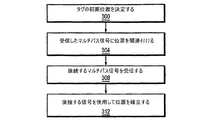
図3に関して、本発明の実施形態は、タグの初期位置の推定を開始する(ステップ300)。このような推定を、例えば、GPS測位か、又はタグ位置の事前知識を利用することによってか、又は既知パスにタグの軌道を強いることによって、決定することができる。
Multipath Positioning With respect to FIG. 3, embodiments of the present invention begin estimating the initial position of the tag (step 300). Such an estimate can be determined, for example, by GPS positioning or by using prior knowledge of the tag position or by forcing the tag trajectory into a known path.
初期位置の推定によって、受信したマルチパス信号の決定された特性に該位置を関連付けて(ステップ304)、パラメトリックモデルが展開される。例えば、タグにおいてか、又はトランシーバのうちの1つにおいてかのいずれかにおいて、マルチパス信号を受信することができる。該パラメトリックモデルと、その展開が、より詳細に以下に説明される。 By estimating the initial position, the position is associated with the determined characteristic of the received multipath signal (step 304) and a parametric model is developed. For example, multipath signals can be received either at a tag or at one of the transceivers. The parametric model and its development are described in more detail below.
受信したマルチパス信号の決定された特性にタグの位置を関連付けるこの情報によって、後続するマルチパス信号が、受信される(ステップ308)。本発明によるパラメトリックモデルを用いるフィルタに対して、後続するマルチパス信号を適用することは、タグの位置を推定する結果となる(ステップ312)。 With this information associating the tag position with the determined characteristics of the received multipath signal, a subsequent multipath signal is received (step 308). Applying the subsequent multipath signal to the filter using the parametric model according to the present invention results in an estimation of the tag position (step 312).
図4に関して、一実施形態において、マルチパス無線信号の特性に位置を関連付ける情報を生成するためにか、又は後続するマルチパス信号を用いて位置を確立するために、受信したマルチパス信号が使用される前に、該受信したマルチパス信号は、最初に前処理される。前処理ステップの出力は、後続するステップ内においてインダイレクトパス(マルチパス)パラメータの正確な推定を可能にするための十分な長さの時間の間存続するインダイレクトパスのセットを含む。 With reference to FIG. 4, in one embodiment, a received multipath signal is used to generate information that associates a position with the characteristics of the multipath radio signal or to establish a position using a subsequent multipath signal. Before being done, the received multipath signal is first preprocessed. The output of the preprocessing step includes a set of indirect paths that last for a sufficient amount of time to allow accurate estimation of indirect path (multipath) parameters in subsequent steps.
前処理を行うことには、例えば、レイクフィルタを使用して(ステップ400)、個々の信号パス(ダイレクトとインダイレクトとの両方)を検出することと、測定値遅延のセット(等価的には、パスに沿って測定された距離)を計算することとを含めることができる。レイクフィルタ前処理を、次いで、データ関連付けアルゴリズムを適用すること(ステップ404)によって続けることができる。該データ関連付けアルゴリズムは、パスのクロスオーバーの影響を軽減するように動作して、ドロップアウトした期間を通じて該パスを追跡する。該データ関連付けアルゴリズムからの出力は、後続するステップ内においてインダイレクトパス(マルチパス)パラメータの正確な推定を可能にする十分な長さの時間の間存続する、インダイレクトパスのセットである。 Preprocessing includes, for example, using a rake filter (step 400) to detect individual signal paths (both direct and indirect) and a set of measurement delays (equivalently, , Calculating the measured distance along the path). Rake filter preprocessing can then continue by applying a data association algorithm (step 404). The data association algorithm operates to mitigate the effects of path crossover and tracks the path throughout the dropout period. The output from the data association algorithm is a set of indirect paths that last for a sufficient length of time to allow accurate estimation of indirect path (multipath) parameters in subsequent steps.
図5に関して、未処理の形態におけるか、又はデータ関連付けアルゴリズムのような前処理ステップからかのいずれかにおけるインダイレクトパスデータが、ダイレクト及びインダイレクトパスを検出し且つ識別するために処理される(ステップ500)。後述されるように、マルチパスモデルを使用して、インダイレクトパス(マルチパス)パラメータの初期推定値を決定するために(ステップ504)、インダイレクトパス測定値が使用される。次いで、非線形フィルタリング技法が、前記初期推定値と、後続するダイレクトパス及びインダイレクトパス測定値と共に使用されて、タグの位置が決定される(ステップ508)。 With respect to FIG. 5, indirect path data, either in raw form or from a pre-processing step such as a data association algorithm, is processed to detect and identify direct and indirect paths ( Step 500). As described below, indirect path measurements are used to determine an initial estimate of indirect path (multipath) parameters using a multipath model (step 504). A non-linear filtering technique is then used with the initial estimate and subsequent direct and indirect path measurements to determine the position of the tag (step 508).
図6は、データ関連付け処理の別の実施形態を示す。この実施形態において、最小二乗法(OLS:ordinary least-squares)分析を用いて、低オーダの多項式モデルによって経路長(パスの長さ)がモデル化される。測定値の差分が閾値よりも低く、且つ、全ての既存パスにわたって最小の場合には、新規の測定値が既存のパスに関連付けられる。そうでなければ、新規のパスが作成される。 FIG. 6 illustrates another embodiment of the data association process. In this embodiment, path length (path length) is modeled by a low order polynomial model using an least least squares (OLS) analysis. If the measured value difference is below the threshold and is the smallest across all existing paths, a new measured value is associated with the existing path. Otherwise, a new path is created.
マルチパスモード及びパラメータ推定
一般に、マルチパスの解を決定する処理は、ナビケーションか又はジオロケーションの解を取得するための処理と区別することができる。マルチパスの解は、マルチパスのジオメトリから生じ、全ての反射面の位置及び配向と同様に、無線源及び受信器の位置が十分な程度の特定性において既知であるコンフィギュレーションについて決定されることが可能である。
Multipath Mode and Parameter Estimation In general, the process of determining a multipath solution can be distinguished from the process for obtaining a navigation or geolocation solution. The multipath solution arises from the multipath geometry and, as well as the position and orientation of all reflective surfaces, is determined for configurations where the position of the radio source and receiver is known with a sufficient degree of specificity. Is possible.
マルチパスの解は、一般的には、無線源から反射点の位置までのインダイレクトパスセグメントの長さを示す情報を含む。インダイレクトパスセグメント長を、マルチパスを含む個々のパスセグメントに沿った無線信号伝搬に関連した伝搬遅延に対応するパス遅延測定値によって表すこともできる。それとは対照的に、ジオロケーションの解は、一連のインダイレクト及びダイレクトパス遅延測定値からタグ位置を推定する。結果として、ジオロケーションの解は、全てのマルチパス変数の推定を必要としない代りに、それらのサブセットだけで、機能を果たすことができる。 The multipath solution typically includes information indicating the length of the indirect path segment from the wireless source to the location of the reflection point. The indirect path segment length can also be represented by a path delay measurement corresponding to the propagation delay associated with radio signal propagation along individual path segments including multipath. In contrast, the geolocation solution estimates the tag position from a series of indirect and direct path delay measurements. As a result, geolocation solutions can work with only a subset of them instead of requiring estimation of all multipath variables.
マルチパス条件下において、タグ位置をインダイレクトパス長に関連付けるモデルを用いて(ステップ312)、インダイレクトパス遅延の測定値から(ステップ308)、タグ位置を直接的に追跡することができる。典型的には他の手段によって取得される初期タグ位置推定値(ステップ300)を用いて、このモデルをリアルタイムに生成し及び更新することができる(ステップ304)。 Under multipath conditions, the tag position can be tracked directly from the measured indirect path delay (step 308) using a model that associates the tag position with the indirect path length (step 312). This model can be generated and updated in real time (step 304) using initial tag position estimates (step 300), typically obtained by other means.
図7に関して、このモデルの導出は、単一平面からの理想的な正反射を仮定することによって開始される。次式は、インダイレクトパス長τ=d0+d1と、タグ位置ベクトルrとの間の関係を説明する。 With respect to FIG. 7, the derivation of this model begins by assuming ideal specular reflection from a single plane. The following equation describes the relationship between the indirect path length τ = d 0 + d 1 and the tag position vector r.

反射面と、sとが固定されていると仮定すると、時間tにおけるインダイレクトパス長は、次式を満足する。 Assuming that the reflecting surface and s are fixed, the indirect path length at time t satisfies the following equation.
信号源が反射面にあまり接近していない場合には、適切に小領域にr(t)が制限されると仮定されるのであれば、4つのマルチパスパラメータw1(t)及びτ0(t)が、本質的には一定である。τ(t)とr(t)のほぼ同時の測定値が利用可能であり且つタグが動作中の場合には、このことは、標準的なフィルタリングか又は推定技法を用いて、領域内におけるw1とτ0の推定を可能にする。 If the signal source is not very close to the reflecting surface, then if it is assumed that r (t) is appropriately limited to a small area, then four multipath parameters w 1 (t) and τ 0 ( t) is essentially constant. If near simultaneous measurements of τ (t) and r (t) are available and the tag is in operation, this can be done using standard filtering or estimation techniques to Allows estimation of 1 and τ 0 .
r(t)の他の測定値が利用不可能である時には(例えば、ダイレクトパスが失われた時には)、インダイレクトパス測定値を用いてr(t)を追跡するためにこれらのマルチパスパラメータの推定値を引き続き使用することができる。r(t)、w1(i)、及びτ0(i)が、ランダムな変数であり、τ(i)の測定値がエラーを受けやすいので、タグ位置r(i)を正確に追跡するためには非線形フィルタが必要とされる。 These multipath parameters are used to track r (t) using indirect path measurements when other measurements of r (t) are not available (eg, when the direct path is lost). Can continue to be used. Since r (t), w 1 (i), and τ 0 (i) are random variables and the measured value of τ (i) is susceptible to errors, the tag position r (i) is accurately tracked. This requires a non-linear filter.
この分析は、単一マルチパスのはね返りに対して示されるが、その結果は、4つのマルチパスパラメータが異なる解析的形態を有するにもかかわらず、発生するマルチパス反射の数とは無関係に適用可能である。例えば、図8は、2つの正反射の場合の、一般化された3次元マルチパスジオメトリを示す。該ジオメトリは、図7内に図示されたものと類似しており、単位ベクトルu2及びスカラー値c2により画定される第2の反射面を含んでいる。次式は、インダイレクトパス長τ=d0+d1+d2と、タグ位置ベクトルrとの間の関係を説明する。 This analysis is shown for a single multipath rebound, but the results apply regardless of the number of multipath reflections that occur, despite the fact that the four multipath parameters have different analytical forms. Is possible. For example, FIG. 8 shows a generalized three-dimensional multipath geometry for two specular reflection cases. The geometry is similar to that illustrated in FIG. 7 and includes a second reflective surface defined by a unit vector u 2 and a scalar value c 2 . The following equation describes the relationship between the indirect path length τ = d 0 + d 1 + d 2 and the tag position vector r.
反射面と、信号源とが両方とも固定されていると仮定すると、時間tにおけるインダイレクトパス長を、次式のように記載することができる。 Assuming that the reflecting surface and the signal source are both fixed, the indirect path length at time t can be described as:
タグ位置rと4つのマルチパスパラメータ{w2,τ02}を同時に推定するために、式(1)と(2)とが両方とも、適切なフィルタ(例えば、拡張カルマンフィルタ、非線形フィルタ、パーティクルフィルタ)によって使用されることが可能な測定値式の形態にある。 In order to estimate the tag position r and the four multipath parameters {w 2 , τ 02 } simultaneously, both equations (1) and (2) are suitable filters (eg, extended Kalman filter, nonlinear filter, particle filter). ) In the form of a measurement formula that can be used.
付録Aにおいて説明されるように、単一の及び二重のマルチパスの場合を、任意の数の正反射の場合のタグ位置及び4つのパラメータの関数としてインダイレクトパス長についての式を公式化するために一般化することができる。n個の反射の場合には、4つのパラメータは、{wn,τ0n}である。ここで、wnは、最後の反射面からのパスの方向における単位ベクトルであり、τ0nは、スカラーのジオメトリ依存性オフセットである。wnを2つの角度の関数として表すことができるため、推定されることになる3つの独立したパラメータだけが存在する。 Formulate the formula for indirect path length as a function of tag position and four parameters for any number of specular reflections, as described in Appendix A. Can be generalized for. In the case of n reflections, the four parameters are {w n , τ 0n }. Here, w n is a unit vector in the direction of the path from the last reflecting surface, and τ 0n is a scalar geometry-dependent offset. Since w n can be expressed as a function of two angles, there are only three independent parameters to be estimated.
最も堅牢なモデル(すなわち、4つのパラメータか又は3つのパラメータ)がアプリケーション依存性であることが、シミュレーションから経験的に決定される。 It is empirically determined from simulation that the most robust model (ie, 4 or 3 parameters) is application dependent.
統計的なモデリングと非線形フィルタリング
一実施形態において、インダイレクトパス(すなわち、式(1)及び式(2))についての時間遅延τ(t)が、マルチパス単位ベクトルwn(t)及びタグ位置r(t)の双線形関数であるため、上述のマルチパスパラメータ及びタグ位置を同時に推定するために、非線形フィルタリングが用いられる。
Statistical Modeling and Non-Linear Filtering In one embodiment, the time delay τ (t) for the indirect path (ie, Equation (1) and Equation (2)) is expressed as the multipath unit vector w n (t) and the tag position. Since it is a bilinear function of r (t), non-linear filtering is used to simultaneously estimate the multipath parameters and tag positions described above.
ある特定のアプリケーションに最も適する、特定のタイプの非線形フィルタは、該アプリケーションの詳細に依存する。初期タグ位置におけるエラーが、比較的小さい場合には、拡張カルマンフィルタで十分である可能性がある(A.H.Jazwinskiによる「Stochastic Processes and Filtering Theory」, Academic Press, New York, 1970年、A.Gelb編集の「Applied Optimal Estimation」,MIT Press, 1974年を参照のこと)。初期タグ位置におけるエラーが、比較的大きい場合には、パーティクルフィルタが、良好な性能を提供する可能性がある(B.Ristic, S.Arulampalam, N.Gordonによる「Beyond the Kalman Filter」,Artech House, Boston, 2004年を参照のこと)。以下の説明を簡単化するために、拡張カルマンフィルタの使用が仮定される。 The particular type of nonlinear filter that is most appropriate for a particular application depends on the details of the application. If the error at the initial tag position is relatively small, an extended Kalman filter may be sufficient ("Stochastic Processes and Filtering Theory" by AHJazwinski, Academic Press, New York, 1970, edited by A. Gelb (See Applied Optimal Estimation, MIT Press, 1974). If the error at the initial tag position is relatively large, the particle filter may provide good performance ("Beyond the Kalman Filter" by B. Ristic, S. Arulampalam, N. Gordon, Artech House , Boston, 2004). To simplify the following description, the use of an extended Kalman filter is assumed.
統計的モデルは、状態ベクトル、統計的伝搬モデル、及び統計的測定値モデルからなる。状態ベクトルがx(t)の場合には、統計的モデルは、例えば、次式のように表すことができる。 The statistical model consists of a state vector, a statistical propagation model, and a statistical measurement model. When the state vector is x (t), the statistical model can be expressed as the following equation, for example.
(3)の状態ベクトル定義を想定すると、時間tiから時間ti+1まで状態ベクトルを伝搬させるために実現可能な統計的モデルは、次式のようになる。 Assuming the state vector definition of (3), a statistical model that can be realized to propagate a state vector from time t i to time t i + 1 is as follows.
フィルタ内において、推定される状態が次式を用いて伝搬される。 Within the filter, the estimated state is propagated using:
想定したモデル下において、2つの別個の測定値が利用可能である。すなわち、ダイレクトパス遅延測定値と、インダイレクトパス遅延測定値である。時間tiにおける送信ノードからタグへの、ダイレクトパス遅延測定値は、次式のようにモデル化される。 Under the assumed model, two separate measurements are available. That is, a direct path delay measurement value and an indirect path delay measurement value. From the transmission node at the time t i to the tag, the direct path delay measurements, is modeled as follows.
測定値の更新
マルチパス環境内において成功しているナビゲーションは、マルチパスパラメータと状態ベクトルとを、リアルタイムで同時に正確に推定することを必要とする。この定式化によって、これらの目的(ゴール)が、非線形フィルタイリング理論の周知のツールを用いることによって実現されることになることが可能となる。具体的には、インダイレクトパス測定値の双線形形態が、それ自身を、特に簡単な再帰的非線形フィルタ機構化に加える。
Measurement Updates Successful navigation within a multipath environment requires accurate estimation of multipath parameters and state vectors simultaneously in real time. This formulation allows these objectives (goals) to be realized by using well-known tools of nonlinear filtering theory. Specifically, the bilinear form of indirect path measurements adds itself to a particularly simple recursive nonlinear filter mechanics.
ダイレクトパス測定値を用いて、状態ベクトル推定値と、エラー共分散行列推定値とを更新する処理を検討する。これは、標準的な非線形フィルタリング方法を直接使用することであり、拡張カルマンフィルタリングと、パーティクルフィルタリングとを含む。簡単化のために、以下の説明は、拡張カルマンフィルタの使用を仮定する。 Consider processing to update state vector estimates and error covariance matrix estimates using direct path measurements. This is a direct use of standard non-linear filtering methods, including extended Kalman filtering and particle filtering. For simplicity, the following description assumes the use of an extended Kalman filter.
ダイレクトパス測定値は、(7)によってもたらされる。従って、この測定値のフィルタの推定値は、次式のようになる。 The direct path measurement is given by (7). Therefore, the estimated value of the filter of this measured value is as follows:
インダイレクトパス測定値を用いて、状態ベクトル推定値と、エラー共分散行列推定値とを更新することを、次に検討する。インダイレクトパス測定値は、(8)によってもたらされる。これにより、測定値のフィルタの推定値は、次式のように表される。 We next consider updating the state vector estimate and the error covariance matrix estimate using the indirect path measurements. The indirect path measurement is given by (8). As a result, the estimated value of the measured value filter is expressed as follows.
エラーが十分に小さく、式(15)内における第2のオーダのエラー項を無視することができると仮定すると、その結果、インダイレクトパス遅延測定値について、
続いて、測定値の剰余は、
幾つかの異なるやり方において、インダイレクトパス測定値を用いて、状態ベクトルを更新することができる。以下の例は、状態ベクトル推定値と、マルチパスパラメータ推定値とが、2つの分離ステップ内において連続的に更新されると仮定する。両ステップ内において、拡張カルマンフィルタが使用されると仮定される。 In several different ways, indirect path measurements can be used to update the state vector. The following example assumes that the state vector estimate and the multipath parameter estimate are updated continuously within two separation steps. Within both steps, it is assumed that an extended Kalman filter is used.
単一送信ノードからの単一マルチパス遅延測定値を処理する場合の計算が示されている。同時間における複数のノードからの複数のインダイレクトパス遅延測定値を、同一の拡張カルマンフィルタ式の形態を用いて連続的に処理することができる。 Calculations for processing a single multipath delay measurement from a single sending node are shown. Multiple indirect path delay measurements from multiple nodes at the same time can be processed sequentially using the same extended Kalman filter form.
インダイレクトパス測定値を用いて、状態ベクトル推定値を更新するために、測定値の剰余υx(ti)が、次式の形態で書かれる。 In order to update the state vector estimate using the indirect path measurement, the remainder of the measurement value ν x (t i ) is written in the form:
次式のように、標準的な拡張カルマンフィルタの式を用いて、状態ベクトルとエラー共分散行列との更新された推定値が計算される。 An updated estimate of the state vector and the error covariance matrix is calculated using the standard extended Kalman filter equation:
マルチパスパラメータ推定値を更新するために、パラメータベクトルが、
式(17)においてもたらされる、測定値の剰余は、次いで、次式のように書かれる。 The remainder of the measurement, resulting in equation (17), is then written as:
これらの想定下において、測定値の剰余の分散は、次式のように表される。 Under these assumptions, the variance of the remainder of the measured value is expressed as follows:
例示的なマルチパスのアルゴリズム例
マルチパス信号遅延を利用する屋内ナビゲーションの比較的簡単な一例が、例示的な目的のために、本明細書において示されている。示されたシナリオは、2つの固定されたトランシーバノードと動き回るトランシーバタグとを利用する平面ジオメトリ内における屋内のジオロケーションの簡単なケースの代表である。そのようなコンセプトは、多くのUWBか又は802.11のようなアプローチの代表であり、該アプローチは、軍事用途と商業用途との両方の場合について提案されている。
Exemplary Multipath Algorithm Example A relatively simple example of indoor navigation utilizing multipath signal delay is shown herein for exemplary purposes. The scenario shown is representative of a simple case of indoor geolocation in a planar geometry that utilizes two fixed transceiver nodes and a moving transceiver tag. Such a concept is representative of many UWB or 802.11-like approaches, which have been proposed for both military and commercial applications.
図9A〜9Dの例示的なジオメトリは、初期には障害物が無く動き回るタグを図示しており、それにより、直接的視界線(DLOS:direct line-of-sight)パスが、観測できることとなり、ジオロケーションの目的のために、第1のリターンを用いることができることとなる。該タグは、ある一定の高さにおける2次元(北方及び東方)内において移動していると仮定される。ジオメトリはまた、いずれかの送信源に関連してマルチパス信号を導入することを可能にする正反射面も含む。 The example geometries of FIGS. 9A-9D illustrate tags that initially move around without obstacles, so that a direct line-of-sight (DLOS) path can be observed, The first return could be used for geolocation purposes. The tag is assumed to be moving in two dimensions (north and east) at a certain height. The geometry also includes a specular surface that allows multipath signals to be introduced in connection with any transmission source.
図9Aは、初期時間(t=0)におけるジオメトリを示す。その最初の50秒の移動において、両ダイレクトRFパスに対してタグが露出されており、両ノードに関するこのダイレクトパスデータを利用して、その自身の位置を決定し、同時に、両インダイレクトパスについてのマルチパスパラメータを推定する。図9Bは、t=50秒におけるジオメトリを示し、該t=50秒は、全てのパスが遮断されないシミュレーションにおける最終時点である。 FIG. 9A shows the geometry at the initial time (t = 0). In the first 50 seconds of movement, the tags are exposed for both direct RF paths, and using this direct path data for both nodes, its own position is determined, and simultaneously for both indirect paths. Estimate multipath parameters. FIG. 9B shows the geometry at t = 50 seconds, which is the final point in the simulation where all paths are not blocked.
図9Cは、ノード#1に対するダイレクトパスが遮断されることになる時であるt=51秒におけるジオメトリを示す。この時点では、システムは、本発明に従った位置推定のために、ノード#1のインダイレクトパスと、ノード#2のダイレクトパスとを使用する。ノード#2からのインダイレクトパス測定値が、t=50秒の後には、もはや利用可能ではないこともまた仮定されている。図9Dは、最終的な時間t=100秒におけるジオメトリを示し、ノード#1からのダイレクトパスは、遮断されたままである。
FIG. 9C shows the geometry at t = 51 seconds, when the direct path for
上述のように、各パス内において反射面から生じる可能性のあるRFのはね返りの数とは無関係に、マルチパス信号を用いてナビゲートするために、各インダイレクトパスごとに、4つのパラメータが推定される。図10は、タグ移動の最初の50秒の間にノード#1についてフィルタによって生成される北方及び東方オフセットパラメータを示す。この例において、指向性パラメータベクトルw(t)は、
垂直パラメータは、この垂直反射表面の例の場合には、ゼロ(零)である。図内における実線が、真のパラメータ値を表しており、点線が、推定値を表している。パラメータは、最初の50秒のみにわたって推定されて、そして、適度に正確な推定値が40秒後に得られる。北方パラメータは、全時間にわたって比較的小さな変動を示す一方で、東方パラメータ及びオフセットパラメータは、ごくわずかな変動を示す。 The vertical parameter is zero in the case of this vertical reflective surface example. The solid line in the figure represents the true parameter value, and the dotted line represents the estimated value. The parameters are estimated over the first 50 seconds only and a reasonably accurate estimate is obtained after 40 seconds. The north parameter shows relatively little variation over time, while the east and offset parameters show very little variation.
図11及び図12は、従来の技法の場合と本発明のマルチパス技法の場合との、全時間にわたる比較による位置推定を示す。従来のフィルタは、その推定のために、ダイレクトパス測定値のみを用いる。図面内の実線は、実際にとられたパスを表し、点線は、その推定値を表す。 11 and 12 show the position estimation by comparison over time between the conventional technique and the multipath technique of the present invention. Conventional filters use only direct path measurements for the estimation. The solid line in the drawing represents the path actually taken, and the dotted line represents the estimated value.
図11内において明らかであるように、右側に示された従来のフィルタが、(タグが方向を変えたところである)60秒を越えて、パス変更を追跡することができないのに対し、左側に示されたマルチパスフィルタは、ダイレクトパスが遮断されるようになる時に、パス変更を正確に追跡し続ける。東方に沿ったエラーは、北方に沿ったエラーよりも幾分大きく、ノード#2からのダイレクトパス測定値に関連した劣化したジオメトリを反射している。 As is evident in FIG. 11, the conventional filter shown on the right cannot track path changes beyond 60 seconds (where the tag has changed direction), whereas on the left The illustrated multi-pass filter keeps track of path changes accurately when the direct path becomes blocked. The error along the east is somewhat larger than the error along the north, reflecting the degraded geometry associated with the direct path measurements from node # 2.
従って、マルチパス信号を用いた位置決め(測位)に対する非常に有利なアプローチを上記が示すように思われるであろう。本明細書内において用いられる用語及び表現は、説明の語句として使用され、限定するものではなく、そのような用語及び表現の利用において、示され且つ説明された特徴又はその一部のどのような等価物も除外する意図はないが、特許請求の範囲における発明の範囲内において様々な修正が可能であることが認められる。 Thus, it appears that the above shows a very advantageous approach to positioning (positioning) using multipath signals. The terms and expressions used in this specification are used as descriptive terms and are not intended to be limiting, and any use of such features or portions thereof shown and described in the use of such terms and expressions While equivalents are not intended to be excluded, it will be appreciated that various modifications can be made within the scope of the invention as defined in the claims.
例えば、示された幾つかのサンプルは、タグに信号を送るトランシーバに言及しているが、当業者であれば、本発明がまた、トランシーバに信号を送るタグか、又は互いに信号を同時に送受信するトランシーバとタグとの任意の組み合わせを含むことを認めるであろう。更には、全時間にわたって、マルチパスパラメータを決定する処理は、反射データの蓄積から、建築物の内部の完全構造の3次元地図を作り出すことを可能にさせる。多相要素のドップラー測定値もまた、複雑な建築物内のどこか違った場所での活動を観測するために有用であり、ジオロケーションの働きの有用な副産物を表す。 For example, although some of the samples shown refer to transceivers that send signals to a tag, those skilled in the art will also recognize that the present invention also includes tags that send signals to the transceivers or send and receive signals simultaneously to each other. It will be appreciated that any combination of transceiver and tag is included. Furthermore, the process of determining multipath parameters over time allows the creation of a three-dimensional map of the complete structure inside the building from the accumulation of reflection data. Doppler measurements of polymorphic elements are also useful for observing activity at different locations within a complex building and represent a useful byproduct of geolocation work.
従って、図示された実施形態が、例示することを目的としてのみ示されており、添付の特許請求の範囲によって画定される発明を限定するものとしてとらえられるべきではないことが明白に理解されるはずである。添付の特許請求の範囲は、従って、特許請求の範囲によって記載されたものを文字通りに含んでいるだけではなく、上記において示され且つ説明されたものに関して、他がたとえ同一でなくても、不十分に異なる全ての等価物もまた含むように、読み取られるべきである。 Therefore, it should be clearly understood that the illustrated embodiments are shown for illustrative purposes only and should not be taken as limiting the invention as defined by the appended claims. It is. The appended claims, therefore, not only literally include what is stated by the claims, but also the others shown and described above, even if they are not identical. It should be read to include all sufficiently different equivalents.
付録A:マルチパスの解の詳細な展開
この付録は、屋内/都市ナビゲーションに適切な、基本的なジオメトリ及びマルチパス解を示す。上述の屋内ナビゲーション問題を解くために必要とされる測定値式が、マルチパスの解から直接的に得られる。
Appendix A: Detailed Development of Multipath Solutions This appendix shows basic geometry and multipath solutions suitable for indoor / urban navigation. The measurement formulas required to solve the indoor navigation problem described above are obtained directly from the multipath solution.
下記の説明は、任意の数の正反射を有するインダイレクトパスに関連したジオメトリを検討する。ソースから受信器(例えばタグか又は中継器)への一方向の距離が、経路長(パス長)の尺度(メジャー)として使用される。検討される第1のケースは、1つのソースと、1つのインダイレクトパスであり、任意の数のソースとインダイレクトパスとに平凡に一般化される。 The following discussion considers the geometry associated with an indirect path with any number of specular reflections. The one-way distance from the source to the receiver (eg tag or repeater) is used as a measure of the path length (path length). The first case considered is one source and one indirect path, which is generalized to any number of sources and indirect paths.
屋内ナビゲーションシステムに利用可能な根本的な測定値は、ダイレクト及びインダイレクトパス長である。パス認識(すなわち、ダイレクトとインダイレクト)が、不明であり、該測定値から推測される必要がある。全てのソースの認識と位置とが既知であることと、全ての反射面の位置と配向とが不明であることと、全てのインダイレクトパスに関連した反射の数が不明であることとが、この議論を通じて仮定される。これらの仮定の下、確定的(決定論的)式が、任意の数の反射の場合についてのインダイレクトパス長について導出される。これらの式は、屋内ナビゲーションシステムによって使用される測定値式の基礎を形成する。 The fundamental measurements available for indoor navigation systems are direct and indirect path lengths. Path recognition (ie direct and indirect) is unknown and needs to be inferred from the measurements. That the recognition and location of all sources are known, the location and orientation of all reflective surfaces are unknown, and the number of reflections associated with all indirect paths are unknown, Assumed throughout this discussion. Under these assumptions, a deterministic (deterministic) formula is derived for the indirect path length for any number of reflection cases. These formulas form the basis of the measurement formula used by the indoor navigation system.
1つの正反射の場合のジオメトリが、図A−1に示されている。ソースは、既知の位置sにあり、タグは、未知の位置rにある。ダイレクトパス長は、d0=‖s−r‖であり、(一方向の)インダイレクトパス長は、d=d1+d2である。単位ベクトルw1及びw2が、入射信号と反射信号の方向を表し、uは、反射面に対して垂直な単位ベクトルであり、pは、正反射点(specular point)である。 The geometry for one specular reflection is shown in Figure A-1. The source is at a known position s and the tag is at an unknown position r. The direct path length is d 0 = ‖s−r‖, and the indirect path length (in one direction) is d = d 1 + d 2 . The unit vectors w 1 and w 2 represent the directions of the incident signal and the reflected signal, u is a unit vector perpendicular to the reflecting surface, and p is a specular point.
1つの反射の場合のマルチパスジオメトリを説明する式は、
(A.1)と(A.2)から、
E1 −1=E1を用いて、その結果、
2つの正反射の場合のジオメトリが、図A−2に示されている。このマルチパスジオメトリを説明する式は、
(A.9)と(A.10)から、
(A.12)から、及びE2 −1=E2を用いると、その結果、
次に、
(A.8)と(A.19)とに基づき、m個の正反射の場合のインダイレクトパス長が、
これは、真とするための誘導によって次に実証される。その関係式は、
(A.22)と(A.26)から、
従って、
(A.24)と(A.25)から、
続いて、
誘導により、(A.30)、(A.34)、及び(A.35)から、
特に興味を引くのはk=1の場合であり、この場合、
式(A.38)は、屋内ナビゲーションシステムにおいて用いられる測定値式の基礎を形成する。(A.38)が、任意の数の反射について正確に4つのインダイレクトパスパラメータ{w,c}を明確に含む、インダイレクトパス長の現象学的モデルであることに注目することには価値がある。このことは、現在の測定値に関連した4つのインダイレクトパスパラメータが既知であるか又は十分正確に推定されることが可能である場合には、インダイレクトパス測定値を用いるナビゲーションが、成し遂げられることが可能であることを意味する。更には、wが2つの角度によって一意的に画定されるので、4つのインダイレクトパスパラメータが独立していない。従って、インダイレクトパス長の現象学的モデルは、実際には、3つの独立パラメータを含む。 Equation (A.38) forms the basis of the measurement equation used in indoor navigation systems. It is worth noting that (A.38) is a phenomenological model of indirect path length that clearly contains exactly four indirect path parameters {w, c} for any number of reflections. There is. This is achieved by navigation using indirect path measurements if the four indirect path parameters associated with the current measurement are known or can be estimated sufficiently accurately. Means that it is possible. Furthermore, since w is uniquely defined by two angles, the four indirect path parameters are not independent. Therefore, the phenomenological model of indirect path length actually includes three independent parameters.
屋内ナビゲーションシステムの性能をシミュレートするために、全てのインダイレクトパスに関連付けられた全ての解が、該シミュレーション内において計算される。該シミュレーション内において、タグ位置rは、既知であり、位置{bi;i=1,2,・・・,m}、配向{ui;i=1,2,・・・,m}、及び全ての反射面の大きさが、既知である。この情報により、反射の順番(すなわち、順番に面を反射することの認識)が既知である仮定の下における全てのインダイレクトパス解を決定することが可能である。事前の実現可能性の分析において使用されるシミュレーションの場合には、この仮定が常に保持されることになる。更に一般的な場合において、(典型的には、かなりより多くの計算リソースを必要とする)射線追跡(レイトレーシング)を使用することができる。 In order to simulate the performance of an indoor navigation system, all solutions associated with all indirect paths are calculated within the simulation. Within the simulation, the tag position r is known, position {b i ; i = 1, 2,..., M}, orientation {u i ; i = 1, 2,. And the size of all reflective surfaces is known. With this information, it is possible to determine all indirect path solutions under the assumption that the order of reflection (i.e. recognition of reflecting surfaces in order) is known. In the case of simulations used in a prior feasibility analysis, this assumption will always be maintained. In the more general case, ray tracing can be used (typically requiring significantly more computational resources).
1つの反射の場合には、(A.3)及び(A.6)から、
(A.5)から、
From (A.5)
全ての解は、次のように見出される。最初の計算はすなわち、
2つの反射の場合には、(A.11)及び(A.16)から、
次いで、
2つの反射の場合の全ての解は、次のように見出される。最初の計算はすなわち、
m個の反射の場合には、関連する式は、(A.31)及び(A.33)に従うと、
続いて、
誘導により、(A.50)、(A.51)、及び(A.52)から、
全ての解は、次のように見出せる。最初の計算はすなわち、
従って、距離{di;i=1,2,・・・,m}を、(A.33)から計算することができ、(A.22)を用いて、正反射点{pi;i=1,2,・・・,m}を計算することができる。 Therefore, the distance {d i ; i = 1, 2,..., M} can be calculated from (A.33), and the specular reflection point {p i ; i is used using (A.22). = 1, 2,..., M}.
Claims (29)
初期位置を決定し、
少なくとも1つの位置において受信した少なくとも1つのマルチパス無線信号における少なくとも1つの特性に対する該少なくとも1つの位置に関する情報を生成し、
後続する無線マルチパス信号を受信し、及び、
前記後続する信号と前記生成された情報とに基づいて、位置を確立する
といった各ステップを含む、方法。 A method for positioning using a multipath radio signal,
Determine the initial position,
Generating information about the at least one location for at least one characteristic in at least one multipath radio signal received at the at least one location;
Receiving a subsequent wireless multipath signal; and
A method comprising the steps of establishing a position based on the subsequent signal and the generated information.
タグに、複数の位置において、少なくとも1つの送信された信号を受信させ、
各位置において前記タグによって受信された前記少なくとも1つの信号の大きさを決定し、
前記初期位置において前記タグによって受信された少なくとも1つの信号の大きさを決定し、及び、
前記初期位置を推定するために、前記決定された信号の大きさと、統計的なモデルとを用いる
ことを含むことからなる、請求項1に記載の方法。 Determining the initial position;
Causing the tag to receive at least one transmitted signal at a plurality of locations;
Determining the magnitude of the at least one signal received by the tag at each location;
Determining the magnitude of at least one signal received by the tag at the initial position; and
The method of claim 1, comprising using the determined signal magnitude and a statistical model to estimate the initial position.
少なくとも1つの位置において受信した少なくとも1つのマルチパス無線信号における少なくとも1つの特性に対する該少なくとも1つの位置に関する情報を含むメモリと、
後続する無線マルチパス信号を受信するための受信器と、
前記後続する信号と前記生成された情報とに基づいて、位置を決定するための回路構成
とを備える、装置。 A device for positioning using a multipath radio signal,
A memory containing information about the at least one location for at least one characteristic in at least one multipath radio signal received at the at least one location;
A receiver for receiving a subsequent wireless multipath signal;
An apparatus comprising: circuitry for determining a position based on the subsequent signal and the generated information.
Applications Claiming Priority (2)
| Application Number | Priority Date | Filing Date | Title |
|---|---|---|---|
| US64539005P | 2005-01-19 | 2005-01-19 | |
| PCT/US2006/001811 WO2006088599A1 (en) | 2005-01-19 | 2006-01-19 | Systems and methods for positioning using multipath signals |
Publications (1)
| Publication Number | Publication Date |
|---|---|
| JP2008527394A true JP2008527394A (en) | 2008-07-24 |
Family
ID=36485176
Family Applications (1)
| Application Number | Title | Priority Date | Filing Date |
|---|---|---|---|
| JP2007552245A Pending JP2008527394A (en) | 2005-01-19 | 2006-01-19 | System and method for positioning using multipath signals |
Country Status (4)
| Country | Link |
|---|---|
| US (1) | US7679561B2 (en) |
| EP (1) | EP1856550A1 (en) |
| JP (1) | JP2008527394A (en) |
| WO (1) | WO2006088599A1 (en) |
Cited By (2)
| Publication number | Priority date | Publication date | Assignee | Title |
|---|---|---|---|---|
| JP2015184113A (en) * | 2014-03-24 | 2015-10-22 | 一般財団法人生産技術研究奨励会 | Position detection device, position detection system, and position detection method |
| JP2022545327A (en) * | 2019-07-08 | 2022-10-27 | グーグル エルエルシー | Increase sensitivity to reflected GNSS signals |
Families Citing this family (35)
| Publication number | Priority date | Publication date | Assignee | Title |
|---|---|---|---|---|
| US7973716B2 (en) * | 2005-01-19 | 2011-07-05 | The Charles Stark Draper Laboratory, Inc. | Systems and methods for transparency mapping using multipath signals |
| US8279119B2 (en) * | 2005-01-19 | 2012-10-02 | The Charles Stark Draper Laboratory, Inc. | Systems and methods for transparency mapping using multipath signals |
| WO2007145890A2 (en) * | 2006-06-05 | 2007-12-21 | Bp Corporation North America Inc. | Method for accounting for people in emergencies in industrial settings |
| US8890677B2 (en) * | 2007-03-29 | 2014-11-18 | Zebra Enterprise Solutions Corp. | Active virtual fence using mesh networked RF tags |
| US8208587B2 (en) * | 2007-04-27 | 2012-06-26 | Ntt Docomo, Inc. | Method and system for joint time-of-arrival and amplitude estimation based on a super-resolution technique |
| WO2009039161A2 (en) * | 2007-09-18 | 2009-03-26 | The Charles Stark Draper Laboratory, Inc. | Systems and methods for transparency mapping using multipath signals |
| US9262912B2 (en) * | 2008-02-25 | 2016-02-16 | Checkpoint Systems, Inc. | Localizing tagged assets using modulated backscatter |
| JP4977077B2 (en) * | 2008-03-27 | 2012-07-18 | 株式会社Kddi研究所 | Signal source position estimation method |
| EP2335086A4 (en) * | 2008-10-01 | 2012-09-05 | Korea Electronics Telecomm | DEVICE AND METHOD FOR POSITION DETERMINATION |
| US8208860B2 (en) * | 2009-11-03 | 2012-06-26 | International Business Machines Corporation | Reducing multipath signal degradation effects in a wireless transmission system |
| FR2965061A1 (en) | 2010-09-16 | 2012-03-23 | Commissariat Energie Atomique | METHOD AND SYSTEM FOR OPERATING INDIRECT PATHS OF UWB-TYPE SIGNALS TO LOCATE A WIRELESS COMMUNICATION NODE INCLUDED BY A BODY |
| US8504288B2 (en) | 2011-05-11 | 2013-08-06 | Google Inc. | Quality control of mapping data |
| US8583400B2 (en) | 2011-05-13 | 2013-11-12 | Google Inc. | Indoor localization of mobile devices |
| US8386422B1 (en) | 2011-07-08 | 2013-02-26 | Google Inc. | Using constructed paths to supplement map data |
| US8548738B1 (en) | 2011-07-08 | 2013-10-01 | Google Inc. | Constructing paths based on a particle model |
| US9453905B2 (en) * | 2012-01-13 | 2016-09-27 | Ziva Corporation | Geolocation |
| WO2014054044A1 (en) * | 2012-10-04 | 2014-04-10 | Ramot At Tel-Aviv University Ltd. | Method and system for estimating position |
| EP2984502A4 (en) * | 2013-04-12 | 2016-10-12 | Hewlett Packard Entpr Dev Lp | Distance determination of a mobile device |
| WO2014188919A1 (en) * | 2013-05-20 | 2014-11-27 | 一般財団法人生産技術研究奨励会 | Position detection device, position detection system, and position detection method |
| CN105580460A (en) * | 2013-07-31 | 2016-05-11 | 慧与发展有限责任合伙企业 | Determining the position of a mobile device within a structure |
| US9363645B2 (en) | 2013-10-17 | 2016-06-07 | Symbol Technologies, Llc | Locationing system performance in non-line of sight conditions |
| CN104122566B (en) * | 2014-07-01 | 2017-04-19 | 华东师范大学 | Multi-path error removing method of navigation satellite system and multi-path hemisphere model |
| WO2016095050A1 (en) * | 2014-12-18 | 2016-06-23 | Innerspace Technology Inc. | Method and system for sensing interior spaces to auto-generate a navigational map |
| US9661470B1 (en) * | 2015-10-05 | 2017-05-23 | Google Inc. | Methods and systems for locating an actor within an environment |
| WO2018004509A1 (en) * | 2016-06-27 | 2018-01-04 | Nokia Technologies Oy | Method, apparatus, and computer program product for improving reliability in wireless communication |
| US10109059B1 (en) | 2016-06-29 | 2018-10-23 | Google Llc | Methods and systems for background subtraction re-initialization |
| US10215858B1 (en) | 2016-06-30 | 2019-02-26 | Google Llc | Detection of rigid shaped objects |
| CN107121677B (en) * | 2017-06-02 | 2019-10-11 | 太原理工大学 | Obstacle avoidance radar method and device based on ultra-wideband cognitive CPPM signal |
| US11385315B2 (en) | 2018-02-23 | 2022-07-12 | Lg Electronics Inc. | Method for determining a position of NLoS Tx UE |
| US11474231B2 (en) * | 2018-08-16 | 2022-10-18 | Movano Inc. | Calibration, classification and localization using channel templates |
| US11448774B2 (en) | 2018-08-16 | 2022-09-20 | Movano Inc. | Bayesian geolocation and parameter estimation by retaining channel and state information |
| US10379215B1 (en) * | 2018-09-01 | 2019-08-13 | Nxp B.V. | Localization of wireless nodes |
| US11181628B2 (en) * | 2018-10-31 | 2021-11-23 | Hewlett Packard Enterprise Development Lp | Accurate localization of an object by a network device |
| DE102020201149A1 (en) * | 2020-01-30 | 2021-08-05 | Fraunhofer-Gesellschaft zur Förderung der angewandten Forschung eingetragener Verein | DecaWave Ultra Broadband Reflectance Error Correction |
| CN115343713B (en) * | 2022-07-13 | 2025-07-18 | 惠州市德赛西威智能交通技术研究院有限公司 | Vehicle millimeter wave radar obstacle detection method, system, radar and automobile |
Citations (5)
| Publication number | Priority date | Publication date | Assignee | Title |
|---|---|---|---|---|
| JP2001501307A (en) * | 1996-09-27 | 2001-01-30 | ルートガース ユニヴァーシティ | Moving position estimation method and system |
| WO2002052225A2 (en) * | 2000-12-22 | 2002-07-04 | The Charles Stark Draper Laboratory, Inc. | Geographical navigation using multipath wireless navigation signals |
| JP2002532691A (en) * | 1998-12-04 | 2002-10-02 | ユー.エス. ワイアレス コーポレイション | Wireless location determination using spatial signature information |
| JP2003501665A (en) * | 1999-06-08 | 2003-01-14 | ノキア モービル フォーンズ リミテッド | Method and apparatus for determining the geographical location of a wireless communication station operable in a non-ideal propagation environment |
| WO2003096055A2 (en) * | 2002-05-13 | 2003-11-20 | The Charles Stark Draper Laboratory, Inc. | Low-cost, low-power geolocation system |
Family Cites Families (102)
| Publication number | Priority date | Publication date | Assignee | Title |
|---|---|---|---|---|
| US3537008A (en) | 1967-05-09 | 1970-10-27 | Trw Inc | Communications system incorporating means for combatting multipath interference |
| US3869673A (en) | 1973-05-21 | 1975-03-04 | Magnavox Co | Method and apparatus for measuring multipath distortion |
| US4433334A (en) | 1982-09-21 | 1984-02-21 | Eaton Corporation | Passive ranging system |
| DE3335128A1 (en) | 1983-09-28 | 1985-04-11 | Siemens AG, 1000 Berlin und 8000 München | MOBILE RADIO NETWORK |
| US4675880A (en) | 1985-05-02 | 1987-06-23 | The United States Of America As Represented By The Administrator Of The National Aeronautics And Space Administration | Antimultipath communication by injecting tone into null in signal spectrum |
| AU582038B2 (en) | 1986-02-04 | 1989-03-09 | British Aerospace Australia Limited | Spread-spectrum multiplexed transmission system |
| US4812991A (en) | 1986-05-01 | 1989-03-14 | Magnavox Govt. And Industrial Electronics Company | Method for precision dynamic differential positioning |
| US4916455A (en) | 1987-02-20 | 1990-04-10 | Scientific Development Inc. | Locating system and method |
| US4888593A (en) | 1987-12-15 | 1989-12-19 | Signal Science, Inc. | Time difference of arrival geolocation method, etc. |
| US4975710A (en) | 1989-08-01 | 1990-12-04 | Baghdady Elie J | Methods and apparatus for direction of arrival measurement and radio navigation aids |
| US5119104A (en) | 1990-05-04 | 1992-06-02 | Heller Alan C | Location system adapted for use in multipath environments |
| US5506864A (en) | 1990-12-05 | 1996-04-09 | Interdigital Technology Corporation | CDMA communications and geolocation system and method |
| US5293642A (en) | 1990-12-19 | 1994-03-08 | Northern Telecom Limited | Method of locating a mobile station |
| US5216429A (en) | 1991-04-17 | 1993-06-01 | Ricoh Company, Ltd. | Position measuring system using pseudo-noise signal transmission and reception |
| US5390339A (en) | 1991-10-23 | 1995-02-14 | Motorola Inc. | Method and apparatus for selecting a serving transceiver |
| US5402450A (en) | 1992-01-22 | 1995-03-28 | Trimble Navigation | Signal timing synchronizer |
| US5414729A (en) | 1992-01-24 | 1995-05-09 | Novatel Communications Ltd. | Pseudorandom noise ranging receiver which compensates for multipath distortion by making use of multiple correlator time delay spacing |
| US5347286A (en) | 1992-02-13 | 1994-09-13 | Trimble Navigation Limited | Automatic antenna pointing system based on global positioning system (GPS) attitude information |
| CA2089123A1 (en) | 1992-03-04 | 1993-09-05 | Robert Edwin Penny, Jr. | Position locating transceiver |
| US5748147A (en) | 1992-03-04 | 1998-05-05 | Motorola Inc | Position locating rescue transceiver |
| US5592180A (en) | 1992-08-20 | 1997-01-07 | Nexus1994 Limited | Direction finding and mobile location system for trunked mobile radio systems |
| US5296861A (en) | 1992-11-13 | 1994-03-22 | Trimble Navigation Limited | Method and apparatus for maximum likelihood estimation direct integer search in differential carrier phase attitude determination systems |
| US5590043A (en) | 1993-06-17 | 1996-12-31 | Trimble Navigation Limited | Satellite positioning system filter |
| JP2570967B2 (en) | 1993-07-08 | 1997-01-16 | 日本電気株式会社 | CDMA receiver |
| US5796773A (en) | 1994-03-22 | 1998-08-18 | Trimble Navigation Limited | Compensating for multipath errors, ionospheric time delay and noise errors in differential satellite positioning systems |
| US5606732A (en) | 1994-04-26 | 1997-02-25 | Rockwell International Corporation | Direct connect radio and antenna assembly |
| US5630208A (en) | 1994-07-19 | 1997-05-13 | Trimble Navigation Limited | Adaptive multipath equalization |
| JP3442156B2 (en) | 1994-08-31 | 2003-09-02 | 富士通株式会社 | Multi-propagation characteristics measurement device |
| JP3483962B2 (en) | 1994-12-05 | 2004-01-06 | 株式会社ザナヴィ・インフォマティクス | Navigation equipment |
| US6285318B1 (en) | 1994-12-13 | 2001-09-04 | Neil Charles Schoen | Micro-miniature beacon transmit-only geo-location emergency system for personal security |
| DE19511751C2 (en) | 1995-03-30 | 1998-07-09 | Siemens Ag | Process for the reconstruction of signals disturbed by multipath propagation |
| US5689431A (en) | 1995-04-18 | 1997-11-18 | Leading Edge Technologies, Inc. | Golf course yardage and information system |
| US5926113A (en) | 1995-05-05 | 1999-07-20 | L & H Company, Inc. | Automatic determination of traffic signal preemption using differential GPS |
| US5717406A (en) | 1995-06-07 | 1998-02-10 | Sanconix Inc. | Enhanced position calculation |
| US5608411A (en) | 1995-06-09 | 1997-03-04 | Litton Systems, Inc. | Apparatus for measuring a spatial angle to an emitter using squinted antennas |
| GB9519087D0 (en) | 1995-09-19 | 1995-11-22 | Cursor Positioning Sys Ltd | Navigation and tracking system |
| US5726659A (en) | 1995-09-21 | 1998-03-10 | Stanford University | Multipath calibration in GPS pseudorange measurements |
| US5991345A (en) | 1995-09-22 | 1999-11-23 | Qualcomm Incorporated | Method and apparatus for diversity enhancement using pseudo-multipath signals |
| US5883598A (en) | 1995-12-15 | 1999-03-16 | Signatron Technology Corporation | Position location system and method |
| US5760909A (en) | 1996-03-25 | 1998-06-02 | Trimble Navigation Limited | Integrated apparatus and method for EDM and GPS surveying |
| US6198765B1 (en) | 1996-04-25 | 2001-03-06 | Sirf Technologies, Inc. | Spread spectrum receiver with multi-path correction |
| US6002361A (en) | 1996-04-30 | 1999-12-14 | Trimble Navigation Limited | Direct integrated approach to multipath signal identification |
| US5903597A (en) | 1996-05-20 | 1999-05-11 | Trimble Navigation Limited | Suppression on multipath signal effects |
| US5963601A (en) | 1996-05-20 | 1999-10-05 | Trimble Navigation Limited | Variable suppression of multipath signal effects |
| US5745075A (en) | 1996-06-05 | 1998-04-28 | Trimble Navigation Limited | Multi-tone DGPS beacon transmitter and receiver |
| US5828694A (en) | 1996-07-01 | 1998-10-27 | Trimble Navigation Limited | Determination of multipath tracking error |
| US5950140A (en) | 1996-07-05 | 1999-09-07 | Trimble Navigation Limited | Method and apparatus for slope creep monitoring |
| US5883817A (en) | 1996-07-08 | 1999-03-16 | Trimble Navigation Limited | Method and apparatus for precise positioning of large structures |
| US5771456A (en) | 1996-08-09 | 1998-06-23 | Trimble Navigation Limited | Enhanced suppression of multipath interference |
| US5719584A (en) | 1996-09-03 | 1998-02-17 | Harris Corporation | System and method for determining the geolocation of a transmitter |
| US6236365B1 (en) | 1996-09-09 | 2001-05-22 | Tracbeam, Llc | Location of a mobile station using a plurality of commercial wireless infrastructures |
| US5808582A (en) | 1996-09-13 | 1998-09-15 | Litton Consulting Group, Inc. | Global positioning system receiver with improved multipath signal rejection |
| US6031881A (en) | 1996-09-19 | 2000-02-29 | Weill; Lawrence | Method for mitigating multipath effects in radio ranging systems |
| AU5426298A (en) | 1996-10-17 | 1998-05-11 | Pinpoint Corporation | Article tracking system |
| US5724047A (en) | 1996-11-27 | 1998-03-03 | Hughes Electronics | Phase and time-difference precision direction finding system |
| US5917445A (en) | 1996-12-31 | 1999-06-29 | Honeywell Inc. | GPS multipath detection method and system |
| US6084546A (en) | 1997-01-08 | 2000-07-04 | Us Wireless Corporation | Location determination in wireless communication systems using velocity information |
| US6112095A (en) * | 1997-01-08 | 2000-08-29 | Us Wireless Corporation | Signature matching for location determination in wireless communication systems |
| US6026304A (en) | 1997-01-08 | 2000-02-15 | U.S. Wireless Corporation | Radio transmitter location finding for wireless communication network services and management |
| US5918161A (en) | 1997-01-16 | 1999-06-29 | The United States Of America As Represented By The Administrator Of The National Aeronautics And Space Administration | Method and apparatus for reducing multipath signal error using deconvolution |
| US6233459B1 (en) | 1997-04-10 | 2001-05-15 | The Atlantis Company, Limited, Japan | System for providing Geolocation of a mobile transceiver |
| US5999131A (en) | 1997-07-01 | 1999-12-07 | Information Systems Laboratories, Inc. | Wireless geolocation system |
| US5936573A (en) | 1997-07-07 | 1999-08-10 | Trimble Navigation Limited | Real-time kinematic integrity estimator and monitor |
| US5926133A (en) | 1997-07-21 | 1999-07-20 | Denso Corporation | Differentially corrected position location system and method for mobile communication networks |
| US5883595A (en) | 1997-09-15 | 1999-03-16 | Rockwell International Corporation | Method and apparatus for mitigating multipath effects and smoothing groundtracks in a GPS receiver |
| US6414634B1 (en) * | 1997-12-04 | 2002-07-02 | Lucent Technologies Inc. | Detecting the geographical location of wireless units |
| US6272350B1 (en) | 1997-12-04 | 2001-08-07 | Lucent Technologies Inc. | Method for improved line of sight signal detection using time/frequency analysis |
| US6100845A (en) | 1997-12-23 | 2000-08-08 | Litton Systems Inc. | Emitter location using RF carrier or PRF measurement ratios |
| US5949364A (en) | 1998-01-06 | 1999-09-07 | The United States Of America As Represented By The Administration Of The National Aeronautics And Space Administration | Method and system for producing images of an object |
| US6054950A (en) | 1998-01-26 | 2000-04-25 | Multispectral Solutions, Inc. | Ultra wideband precision geolocation system |
| US6133876A (en) | 1998-03-23 | 2000-10-17 | Time Domain Corporation | System and method for position determination by impulse radio |
| US6313786B1 (en) * | 1998-07-02 | 2001-11-06 | Snaptrack, Inc. | Method and apparatus for measurement processing of satellite positioning system (SPS) signals |
| US6031601A (en) | 1998-07-08 | 2000-02-29 | Trimble Navigation Limited | Code-space optical electronic distance meter |
| US6114989A (en) | 1998-08-04 | 2000-09-05 | Trimble Navigation Limited | GPS data recorder and playback system |
| US6292665B1 (en) | 1998-10-08 | 2001-09-18 | Harris Corporation | Geolocation of cellular phone using supervisory audio tone transmitted from single base station |
| US6150979A (en) | 1998-11-30 | 2000-11-21 | The United States Of America As Represented By The Secretary Of The Air Force | Passive ranging using global positioning system |
| KR100303290B1 (en) | 1999-01-23 | 2001-09-26 | 윤종용 | A method for computing error distance and distance between base station and mobile telephone |
| US6611232B1 (en) | 1999-03-18 | 2003-08-26 | Robert L. Stanley | Lock box locator |
| US6263208B1 (en) | 1999-05-28 | 2001-07-17 | Lucent Technologies Inc. | Geolocation estimation method for CDMA terminals based on pilot strength measurements |
| US6061022A (en) | 1999-06-04 | 2000-05-09 | Itt Manufacturing Enterprises, Inc. | Azimuth and elevation direction finding system based on hybrid amplitude/phase comparison |
| JP2000346655A (en) * | 1999-06-08 | 2000-12-15 | Matsushita Electric Ind Co Ltd | Position detection device |
| US6243648B1 (en) | 1999-07-12 | 2001-06-05 | Eagle Eye, Inc. | Fast acquisition position reporting system |
| US6541950B2 (en) * | 2000-01-26 | 2003-04-01 | Novatel, Inc. | Multipath meter |
| JP3722461B2 (en) * | 2000-03-24 | 2005-11-30 | パイオニア株式会社 | Current position detection device using GPS |
| US6658048B1 (en) | 2000-04-07 | 2003-12-02 | Nokia Mobile Phones, Ltd. | Global positioning system code phase detector with multipath compensation and method for reducing multipath components associated with a received signal |
| US6255992B1 (en) | 2000-04-13 | 2001-07-03 | The United States Of America As Represented By The Secretary Of The Air Force | Self-calibrating large baseline interferometer for very precise emitter location using time difference of arrival and time difference of arrival rate |
| US6362782B1 (en) * | 2000-04-19 | 2002-03-26 | The Charles Stark Draper Laboratories, Inc. | Multipath propagation detection and avoidance method and system |
| US6744442B1 (en) | 2000-08-29 | 2004-06-01 | Harris Corporation | Texture mapping system used for creating three-dimensional urban models |
| US6634959B2 (en) | 2001-01-05 | 2003-10-21 | Oblon, Spivak, Mcclelland, Maier & Neustadt, P.C. | Golf ball locator |
| US6473038B2 (en) | 2001-01-05 | 2002-10-29 | Motorola, Inc. | Method and apparatus for location estimation |
| US6522296B2 (en) | 2001-06-25 | 2003-02-18 | Harris Corporation | Method and system for calibrating wireless location systems |
| US6608593B2 (en) | 2001-06-25 | 2003-08-19 | Harris Corporation | System and method for determining the location of a transmitter using passive reflectors or refractors as proxy receivers |
| US6593883B2 (en) | 2001-06-25 | 2003-07-15 | Motorola, Inc. | Timing estimation method and apparatus for a location system |
| US6580393B2 (en) | 2001-06-25 | 2003-06-17 | Harris Corporation | System and method for determining the location of a transmitter using passive reflectors or refractors as proxy receivers and using database querying |
| GB0121083D0 (en) * | 2001-08-31 | 2001-10-24 | Koninkl Philips Electronics Nv | Method of operating a radio station |
| US6871077B2 (en) | 2001-10-09 | 2005-03-22 | Grayson Wireless | System and method for geolocating a wireless mobile unit from a single base station using repeatable ambiguous measurements |
| US6900758B1 (en) * | 2001-10-17 | 2005-05-31 | Sirf Technology, Inc. | System, method, apparatus and means for constructing building tomography and timing information |
| GB0229689D0 (en) * | 2002-12-19 | 2003-01-29 | Koninkl Philips Electronics Nv | Positioning system and method |
| US6744408B1 (en) | 2003-03-04 | 2004-06-01 | Rockwell Collins | Enhancements for GPS based bi-static radar |
| US7313403B2 (en) | 2003-08-06 | 2007-12-25 | Hong Kong Applied Science And Technology Research Institute Co., Ltd. | Location positioning in wireless networks |
| US7212160B2 (en) | 2004-02-17 | 2007-05-01 | Polytechnic University | Locating an object of interest using back tracked-rays derived from multipath signals |
| US7205933B1 (en) | 2004-09-10 | 2007-04-17 | Rockwell Collins, Inc. | Hostile platform position location utilizing networked communications |
-
2006
- 2006-01-19 EP EP06748164A patent/EP1856550A1/en not_active Withdrawn
- 2006-01-19 US US11/335,160 patent/US7679561B2/en active Active
- 2006-01-19 WO PCT/US2006/001811 patent/WO2006088599A1/en not_active Ceased
- 2006-01-19 JP JP2007552245A patent/JP2008527394A/en active Pending
Patent Citations (5)
| Publication number | Priority date | Publication date | Assignee | Title |
|---|---|---|---|---|
| JP2001501307A (en) * | 1996-09-27 | 2001-01-30 | ルートガース ユニヴァーシティ | Moving position estimation method and system |
| JP2002532691A (en) * | 1998-12-04 | 2002-10-02 | ユー.エス. ワイアレス コーポレイション | Wireless location determination using spatial signature information |
| JP2003501665A (en) * | 1999-06-08 | 2003-01-14 | ノキア モービル フォーンズ リミテッド | Method and apparatus for determining the geographical location of a wireless communication station operable in a non-ideal propagation environment |
| WO2002052225A2 (en) * | 2000-12-22 | 2002-07-04 | The Charles Stark Draper Laboratory, Inc. | Geographical navigation using multipath wireless navigation signals |
| WO2003096055A2 (en) * | 2002-05-13 | 2003-11-20 | The Charles Stark Draper Laboratory, Inc. | Low-cost, low-power geolocation system |
Cited By (3)
| Publication number | Priority date | Publication date | Assignee | Title |
|---|---|---|---|---|
| JP2015184113A (en) * | 2014-03-24 | 2015-10-22 | 一般財団法人生産技術研究奨励会 | Position detection device, position detection system, and position detection method |
| JP2022545327A (en) * | 2019-07-08 | 2022-10-27 | グーグル エルエルシー | Increase sensitivity to reflected GNSS signals |
| JP7586885B2 (en) | 2019-07-08 | 2024-11-19 | グーグル エルエルシー | Increasing sensitivity to reflected GNSS signals |
Also Published As
| Publication number | Publication date |
|---|---|
| US7679561B2 (en) | 2010-03-16 |
| EP1856550A1 (en) | 2007-11-21 |
| WO2006088599A1 (en) | 2006-08-24 |
| US20080198072A1 (en) | 2008-08-21 |
Similar Documents
| Publication | Publication Date | Title |
|---|---|---|
| JP2008527394A (en) | System and method for positioning using multipath signals | |
| US7973716B2 (en) | Systems and methods for transparency mapping using multipath signals | |
| US8279119B2 (en) | Systems and methods for transparency mapping using multipath signals | |
| US6674687B2 (en) | System and method for navigation using two-way ultrasonic positioning | |
| KR100591751B1 (en) | Complex navigation system and neural network application method using neural network | |
| Tian et al. | An INS and UWB fusion approach with adaptive ranging error mitigation for pedestrian tracking | |
| US10567918B2 (en) | Radio-location method for locating a target device contained within a region of space | |
| Plets et al. | Experimental performance evaluation of outdoor tdoa and rss positioning in a public lora network | |
| JP2011214920A (en) | Position estimating device, position estimation method, and program | |
| AU2003230547A1 (en) | System and method for navigating using two-way ultrasonic positioning | |
| CN116567531B (en) | Sensor fusion indoor positioning method and system based on particle filter algorithm | |
| Aernouts et al. | Combining TDoA and AoA with a particle filter in an outdoor LoRaWAN network | |
| WO2009039161A2 (en) | Systems and methods for transparency mapping using multipath signals | |
| Kaveripakam et al. | Enhancement of precise underwater object localization | |
| Abdellatif et al. | An improved indoor positioning based on crowd-sensing data fusion and particle filter | |
| US9035762B2 (en) | Method and system for locating signal emitters using cross-correlation of received signal strengths | |
| CN113484824B (en) | RSS differential trilateral positioning method based on separate transceiver and receiver RFID positioning systems | |
| Chen et al. | TDOA/FDOA mobile target localization and tracking with adaptive extended Kalman filter | |
| Jose et al. | Taylor series method in TDOA approach for indoor positioning system. | |
| Du | Indoor localization techniques for wireless sensor networks | |
| Sun et al. | Multi-robot range-only SLAM by active sensor nodes for urban search and rescue | |
| Chan et al. | Fusion-based smartphone positioning using unsupervised calibration of crowdsourced Wi-fi FTM | |
| KR101480834B1 (en) | Target motion analysis method using target classification and ray tracing of underwater sound energy | |
| Mak et al. | A time-of-arrival-based positioning technique with non-line-of-sight mitigation using low-frequency sound | |
| WO2016038881A1 (en) | Position estimation device, position estimation system, method, and recording medium |
Legal Events
| Date | Code | Title | Description |
|---|---|---|---|
| A621 | Written request for application examination |
Free format text: JAPANESE INTERMEDIATE CODE: A621 Effective date: 20090116 |
|
| A977 | Report on retrieval |
Free format text: JAPANESE INTERMEDIATE CODE: A971007 Effective date: 20110922 |
|
| A131 | Notification of reasons for refusal |
Free format text: JAPANESE INTERMEDIATE CODE: A131 Effective date: 20111004 |
|
| A02 | Decision of refusal |
Free format text: JAPANESE INTERMEDIATE CODE: A02 Effective date: 20120403 |