JP2008087947A - Search support system, management device, terminal device, label device, and program - Google Patents
Search support system, management device, terminal device, label device, and program Download PDFInfo
- Publication number
- JP2008087947A JP2008087947A JP2006273181A JP2006273181A JP2008087947A JP 2008087947 A JP2008087947 A JP 2008087947A JP 2006273181 A JP2006273181 A JP 2006273181A JP 2006273181 A JP2006273181 A JP 2006273181A JP 2008087947 A JP2008087947 A JP 2008087947A
- Authority
- JP
- Japan
- Prior art keywords
- search
- mark
- unit
- search target
- terminal
- Prior art date
- Legal status (The legal status is an assumption and is not a legal conclusion. Google has not performed a legal analysis and makes no representation as to the accuracy of the status listed.)
- Pending
Links
Images




Landscapes
- Warehouses Or Storage Devices (AREA)
Abstract
【課題】検索対象物が大量にあったり、検索対象物の外見が類似していたり、検索対象者や検索対象物の入れ替わりが多い場合であっても、識別情報と検索対象物との組み合わせの数を無用に増加させることなく、検索対象物を効率的に検索することができる検索支援システムを提供する。
【解決手段】動的情報記憶部の内容を更新しつつ、端末装置及び検索対象が位置する検索エリアのマーク使用状況に基づいて使用可能なマークを検索対象に割り当て、該検索対象に対応付けられたラベル装置及び該検索対象を検索要求した端末装置に対してマークを設定する。
【選択図】図1[PROBLEMS] To provide a combination of identification information and a search target even when there are a large number of search targets, the appearance of the search target is similar, or the search target or the search target is frequently replaced. Provided is a search support system capable of efficiently searching for a search object without unnecessarily increasing the number.
While updating the contents of a dynamic information storage unit, a usable mark is assigned to a search target based on the mark usage status of a search area where the terminal device and the search target are located, and is associated with the search target. A mark is set for the label device and the terminal device that has requested the search for the search target device.
[Selection] Figure 1
Description
この発明は、利用者による対象物の検索を支援する検索支援システム、管理装置、端末装置、ラベル装置及びプログラムに関するものである。 The present invention relates to a search support system, a management device, a terminal device, a label device, and a program that support a search for an object by a user.
人間や物品を検索するシステムとして、GPS(Global Positioning System)やRFID(Radio Frequency Identification)タグを用いるものがあり、検索対象物の位置を効率的に把握できるようになった。例えば、ナビゲーションシステムでは、目標地点の位置を緯度経度で示したり、目標の建物の名称や識別マークを地図上に示すことで検索対象物を特定することができる。 As a system for searching for people and articles, there are systems that use GPS (Global Positioning System) and RFID (Radio Frequency Identification) tags, and it has become possible to efficiently grasp the position of a search object. For example, in the navigation system, the search target can be specified by indicating the position of the target point by latitude and longitude, or by displaying the name of the target building or the identification mark on the map.
また、大量の段ボールの管理等のように検索対象物が大量にある場合、例えばRFIDタグや何らかの無線信号の送受信により測位可能な端末を段ボールに貼付して段ボールの位置を特定し管理するシステムがある。このようなシステムでは、RFIDタグや測位端末による測位結果を利用して地図上に検索対象の段ボールの位置を表示して検索者に提示することができる。 In addition, when there are a large number of search objects such as management of a large amount of cardboard, a system for identifying and managing the position of the cardboard by attaching a terminal capable of positioning by transmitting and receiving RFID tags or some wireless signals, for example, to the cardboard is there. In such a system, the position of a cardboard to be searched can be displayed on a map and presented to a searcher using a positioning result obtained by an RFID tag or a positioning terminal.
しかしながら、位置を表示された場所において大量に同型の段ボールがある場合、位置特定の精度によっては、検索者が、検索対象の段ボールが実際にどこにあるのかを的確に特定することが困難である。 However, if there are a large number of cardboards of the same type at the location where the position is displayed, it is difficult for the searcher to accurately specify where the cardboard to be searched is actually located depending on the accuracy of specifying the position.
このような不具合に対して、特許文献1に開示されるシステムでは、音や光を識別情報として発する手段をRFIDタグや測位端末に設けておき、検索対象である物品に貼付したRFIDタグや測位端末と通信して音や光を発することで、検索対象の物品がどこにあるのかを検索者に知らせることが可能である。
With respect to such a problem, in the system disclosed in
従来のシステムでは、検索対象物が同じエリアに大量にあり、複数の検索対象物を同時に検索したい場合、検索対象物に貼付されたRFIDタグや測位端末からの音や光が同じであると、目的の検索対象物との対応付けができず、どこに検索対象物があるのかを特定することが難しくなる。 In the conventional system, there are a large number of search objects in the same area, and when it is desired to search a plurality of search objects at the same time, if the sound and light from the RFID tag and positioning terminal attached to the search object are the same, Correspondence with the target search object cannot be made, and it becomes difficult to specify where the search object is located.
また、検索対象物ごとに識別情報である音や発光色を変えることも考えられるが、検索対象物が大量にあると、それぞれに異なる識別情報を設定する必要があり現実的でない。さらに、検索者が短時間で把握できる識別情報と検索対象物との組み合わせの数には限りがある。 Although it is conceivable to change the sound or emission color as identification information for each search object, if there are a large number of search objects, it is necessary to set different identification information for each search object, which is not practical. Furthermore, the number of combinations of identification information and search objects that the searcher can grasp in a short time is limited.
この発明は、上記のような課題を解決するためになされたもので、検索対象物が大量にあったり、検索対象物の外見が類似していたり、検索対象者や検索対象物の入れ替わりが多い場合であっても、識別情報と検索対象物との組み合わせの数を無用に増加させることなく、検索対象物を効率的に検索することができる検索支援システム、該システムに用いる管理装置、端末装置及びラベル装置、これら装置としてコンピュータを機能させるプログラムを得ることを目的とする。 The present invention has been made to solve the above-described problems, and there are many search objects, appearances of search objects are similar, search persons and search objects are often replaced. Even in this case, a search support system capable of efficiently searching for a search target without unnecessarily increasing the number of combinations of identification information and search target, a management device used in the system, and a terminal device It is another object of the present invention to obtain a label device and a program for causing a computer to function as these devices.
この発明に係る検索支援システムは、検索対象に対応付けられ、該検索対象に割り当てられたマークを表示するラベル側表示部を有するラベル装置と、検索要求した検索対象に割り当てられたマークを表示する端末側表示部と、自装置を識別する端末IDを記憶するID記憶部と、ID記憶部から読み出した端末ID及び検索要求する検索対象を識別する検索対象IDを問い合わせ信号として出力する問い合わせ部を有する端末装置と、端末装置の端末ID及び該端末装置で検索要求された検索対象の検索対象IDを対応付けて記憶する静的情報記憶部と、検索エリアごとのマーク使用状況を記憶する動的情報記憶部と、端末装置からの問い合わせ信号における端末ID及び検索対象IDが前記静的情報記憶部に登録されているか否かを判定し、静的情報記憶部にIDが登録されている端末装置及び検索対象の位置する検索エリアのマーク使用状況を動的情報記憶部から取得する問い合わせ対応部と、問い合わせ対応部で取得された検索エリアのマーク使用状況に基づいて使用可能なマークを検索対象に割り当て、該検索対象に対応付けられたラベル装置及び該検索対象を検索要求した端末装置にマークを設定する表示マーク決定部を有する管理装置とを備えるものである。 The search support system according to the present invention displays a label device having a label-side display unit that displays a mark assigned to a search target and that is assigned to the search target, and a mark assigned to the search target requested to be searched. A terminal-side display unit, an ID storage unit that stores a terminal ID that identifies the device itself, and a query unit that outputs a terminal ID read from the ID storage unit and a search target ID that identifies a search target to be searched for as a query signal A static information storage unit that stores the terminal device having the terminal ID of the terminal device and the search target ID of the search target requested by the terminal device in association with each other, and the dynamic that stores the mark usage status for each search area Determine whether the information storage unit and the terminal ID and search target ID in the inquiry signal from the terminal device are registered in the static information storage unit , A terminal device whose ID is registered in the static information storage unit, a query usage unit that acquires the mark usage status of the search area where the search target is located from the dynamic information storage unit, and a search area acquired by the query response unit Management device having a display device for assigning a mark that can be used to a search target based on the mark usage status of the label, and setting a mark on a label device associated with the search target and a terminal device that has requested the search for the search target Are provided.
この発明によれば、動的情報記憶部の内容を更新しつつ、端末装置及び検索対象が位置する検索エリアのマーク使用状況に基づいて使用可能なマークを検索対象に割り当て、該検索対象に対応付けられたラベル装置及び該検索対象を検索要求した端末装置にマークを設定するので、欲しい情報だけに絞って、動的にわかりやすくマークを表示できることから、検索対象物が大量にあったり、検索対象物の入れ替わりが多い場合であっても、識別情報と検索対象物との組み合わせの数を無用に増加させることなく、検索対象物を効率的に検索できるという効果がある。 According to the present invention, while updating the contents of the dynamic information storage unit, the usable mark is allocated to the search target based on the mark usage status of the search area where the terminal device and the search target are located, and the search target is supported. Since the mark is set on the attached label device and the terminal device that requested the search target, the mark can be dynamically displayed in an easy-to-understand manner by focusing only on the desired information. Even when the objects are frequently replaced, there is an effect that the search object can be efficiently searched without unnecessarily increasing the number of combinations of the identification information and the search object.
実施の形態1.
図1は、この発明の実施の形態1による検索支援システムの構成を示すブロック図である。図1に示すように、実施の形態1による検索支援システムは、検索端末装置100、検索ラベル装置110、位置管理装置120、スタティックデータベース(スタティックDB)210及びダイナミックデータベース(ダイナミックDB)220を備える。
FIG. 1 is a block diagram showing a configuration of a search support system according to
また、検索端末装置(端末装置)100は、受信部101、送信部102、I/O部103、問い合わせ部104、ID記憶部105、マーク表示部(端末側表示部)106及びマーク利用終了部107を備える。受信部101及び送信部102は、外部の装置と通信するための構成部であり、検索端末装置100として機能するコンピュータの通信機能に関するハードウエア及びソフトウエアにより具現化される。
The search terminal device (terminal device) 100 includes a
I/O部103は、検索端末装置100への情報の入力及び情報の出力を行う構成部である。I/O部103には、例えばキーボード(若しくは操作ボタン)やマウス等の他、情報の設定入力を行うためのGUI(Graphical User Interface)を実現するソフトウエア及びハードウエアも含まれる。
The I /
問い合わせ部104は、検索対象の検索ラベル装置110の位置を位置管理装置120が管理しているかを問い合わせる処理を行う。例えば、利用者により入力された検索ラベルIDを問い合わせ信号として、送信部102を介して位置管理装置120に送信する。ID記憶部105は、検索端末装置100に固有な端末IDを格納する記憶部であり、検索端末装置100のメモリに構築される。
The
マーク表示部106及びマーク利用終了部107は、検索端末装置100のモニタを介して利用者に各機能を提供するGUIとして構成される。マーク表示部106は、I/O部103を介してモニタ表示画面上の対応するアイコン等を操作することにより、位置管理装置120により検索ラベル装置110に設定されたマークを表示する。
The
例えば、色で検索ラベル装置110を識別するマークである場合、マーク表示部106は、検索ラベル装置110に割り当てられたマークIDのコード情報をRGBに対応させることで、該マークIDで特定される特有の色をモニタ画面に表示する。また、マーク利用終了部107は、I/O部103を介して表示画面上の対応するアイコン等を操作することにより、マーク表示部106によるマーク表示を終了する。
For example, in the case of a mark that identifies the
上述のように、受信部101、送信部102、I/O部103、問い合わせ部104、マーク表示部106及びマーク利用終了部107は、例えば実施の形態1による検索端末装置100を構成するコンピュータの演算処理装置に本発明の趣旨に従う処理プログラムを実行させてその動作を制御することにより、ハードウエアとソフトウエアが協働した具体的な手段として実現することができる。
As described above, the
検索ラベル装置(ラベル装置)110は、受信部111、送信部112、マーク表示部(ラベル側表示部)113、ID記憶部114及び管理部115を備える。実施の形態1では、パッシブRFIDタグによって検索ラベル装置110を具現化した場合について説明する。受信部111及び送信部112は、検索ラベル装置110が外部の装置と通信するための構成部であり、検索ラベル装置110の通信機能に関するハードウエア及びソフトウエアにより具現化される。
The search label device (label device) 110 includes a
また、受信部111は、無線通信を介して受信した電波により起電力を生成し、管理部115を起動する。例えば、アンテナコイルを備え、受信電波によってアンテナコイルで発生した電力を管理部115に伝達することで、検索ラベル装置110内部構成を起動するものが考えられる。また、送信部112は、管理部115による制御の下、無線通信を介して検索ラベルIDを位置管理装置120に送信する。
In addition, the
マーク表示部113は、自装置に割り当てられたマークを表示する構成部である。例えば、マークが色で識別するものである場合、割り当てられたマークIDに対応するコード情報によって特有のマーク色を発光するLED等のデバイスが考えられる。ID記憶部114は、検索ラベル装置110内のメモリに構築され、自装置に固有な検索ラベルIDを記憶する。管理部115は、受信電波により発生した電力で起動し、送信部112を制御してID記憶部114から読み出した検索ラベルIDを位置管理装置120に返信する。
The
位置管理装置(管理装置)120は、受信部122、送信部123、表示マーク決定部121、問い合わせ部(問い合わせ対応部)124及び場所特定部131を備える。受信部122及び送信部123は、検索端末装置100及び検索ラベル装置110とデータ通信する構成部であり、位置管理装置120として機能するコンピュータの通信機能に関するハードウエア及びソフトウエアにより具現化される。
The location management device (management device) 120 includes a
表示マーク決定部121は、スタティックDB210及びダイナミックDB220の内容に基づいて検索ラベル装置110に割り当てるべきマークを決定する。問い合わせ部124は、検索端末装置100から問い合わされた検索ラベルIDで識別される検索ラベル装置110が管理しているか否かを確認する処理を行う。例えば、検索端末装置100から問い合わせ信号に含まれる検索ラベルIDでダイナミックDB220を検索し、該検索ラベルIDで特定される情報の有無を確認する。
The display
場所特定部131は、検索端末装置100や検索ラベル装置110の位置算出及びダイナミックDB220の更新を行う。例えば、検索ラベル装置110から発信された、検索ラベルIDを送信する電波の強度を既存の解析方法で解析して、該検索ラベル装置110の位置や自装置から検索ラベル装置110までの距離を算出する。または、検索ラベルIDを送信する電波の到達時間と、検索端末装置100を起動させるために自装置から送信した電波の送信時間とを既存の解析方法で解析して該検索ラベル装置110の位置や自装置から検索ラベル装置110までの距離を算出するようにしても良い。
The
上述した、受信部122、送信部123、表示マーク決定部121、問い合わせ部124及び場所特定部131は、例えば位置管理装置120を構成するコンピュータの演算処理装置に本発明の趣旨に従う処理プログラムを実行させてその動作を制御することにより、ハードウエアとソフトウエアが協働した具体的な手段として実現することができる。
The
なお、以下の説明において、本発明の検索端末装置100及び位置管理装置120を具現化するコンピュータ自体の構成及びその基本的な機能については、当業者が当該技術分野の技術常識に基づいて容易に認識できるものであり、本発明の本質に直接関わるものでないので詳細な記載を省略する。
In the following description, the configuration and basic functions of the computer that implements the
スタティックDB(静的情報記憶部)210は、検索ラベル装置110の検索に使用する基礎情報が登録されたデータベースである。検索に使用する基礎情報としては、検索端末装置100の端末ID、マーク及びマークID、検索エリアを区画した各区画のエリアIDとその座標、エリア間の隣接関係を規定する情報、検索ラベル装置110の検索ラベルID等の検索処理において変更がない静的な情報が挙げられる。
The static DB (static information storage unit) 210 is a database in which basic information used for searching the
ダイナミックDB(動的情報記憶部)220は、検索処理において動的に変更される情報が登録されるデータベースである。検索処理において動的に変更される情報としては、端末IDとこれで特定される検索端末装置100の位置、検索ラベルIDとこれで特定される検索ラベル装置110の位置、各エリアごとのマークの使用状況などの情報が挙げられる。
The dynamic DB (dynamic information storage unit) 220 is a database in which information that is dynamically changed in the search process is registered. Information that is dynamically changed in the search process includes the terminal ID and the position of the
スタティックDB210及びダイナミックDB220は、例えば位置管理装置120を具現化するコンピュータのメモリに構築するか、若しくは、有線又は無線の通信によって検索端末装置100及び位置管理装置120と通信可能な他のコンピュータのメモリに構築される。
The
図2は、実施の形態1による検索支援システムの概要を説明するための図であり、工場における物品の検索操作の一例を示している。図2の例では、物品検索者が携帯可能なPDA(Personal Digital Assistant)で検索端末装置100を構成し、該検索端末装置100が物品検索者と共に敷地内を移動する。また、位置管理装置120は、検索ラベル装置110を取り付けた物品の位置の他、物品検索者と移動する検索端末装置100の位置も管理する。
FIG. 2 is a diagram for explaining the outline of the search support system according to the first embodiment, and shows an example of an article search operation in a factory. In the example of FIG. 2, the
先ず、物品検索者である作業員が、自身が検査を担当する物品がどこに保管されているかを検索する場合、I/O部103を操作して検品管理アプリ想定画面を検索端末装置100に表示させる。この検品管理アプリ想定画面には、図2に示すように、該作業員が管理を担当している物品の一覧が表示される。
First, when a worker who is an article searcher searches for where an article he or she is in charge of inspection is stored, the inspection management application assumption screen is displayed on the
続いて、作業員が、I/O部103を操作して、物品一覧表中の検索対象の物品(例えば、物品8)を選択し、物品検索ボタン(図中、丸で囲った部分)をクリックすると、位置管理装置120に該物品の位置を管理しているか否かが問い合わされる。位置管理装置120では、後述する処理によって検索対象の物品の位置(該物品に取り付けられた検索ラベル装置110の位置)が特定され、該物品の位置及び検索要求した作業員の位置(検索端末装置100の位置)に関する情報を検索端末装置100に送信する。
Subsequently, the operator operates the I /
検索端末装置100では、位置管理装置120から受信した情報を用いて、選択した物品のある部屋と自装置の位置(作業員のいる位置)とを作業員誘導画面に表示する。この作業員誘導画面において、例えば保管室の物品を示す星印をクリックすると、作業員誘導画面から物品位置表示画面に切り替わり、保管室を区画したブロック単位で物品8の位置が表示される。なお、図2に示すように、物品8の詳細情報(管理番号、物品名、購入年月日、在庫数など)を合わせて表示するようにしても良い。
Using the information received from the
また、検索端末装置100において、過去に検索した物品の情報を蓄積しておき、検品管理アプリ想定画面で周辺物品一覧をクリックすると、現在検索対象とした物品の周辺に保管されている物品の情報(物品名やその位置など)を一覧として表示するように構成しても良い。これにより、作業員は、検索処理をしなくても、周辺の物品の位置に基づいて物品位置を推測することができる。
Further, in the
次に動作について説明する。
図3は、図1中の検索支援システムによる検索処理のフローチャートであり、図2の例と同様に、検索ラベル装置110を取り付けた物品は移動せず、検索端末装置100を携帯する物品検索者が移動する場合を示している。なお、この実施の形態1によるシステムにおいて、スタティックDB210は、図4に示す内容であるものとする。
Next, the operation will be described.
FIG. 3 is a flowchart of the search processing by the search support system in FIG. 1, and the article searcher who carries the
図4(a)に示す人の属性情報には、物品検索者である作業員の名前と作業員を識別するための人IDとの対応関係がまとめられている。なお、この実施の形態1において、物品IDは、該物品IDで識別される物品に取り付けられた検索ラベル装置110の検索ラベルIDと同一であるものとする。
The attribute information of the person shown in FIG. 4A summarizes the correspondence between the name of the worker who is the article searcher and the person ID for identifying the worker. In the first embodiment, the article ID is assumed to be the same as the search label ID of the
図4(b)に示す物品の属性情報には、物品を識別するための物品IDと該物品のラベル名との対応関係がまとめられている。ラベル名としては、図4(b)に示すように、物品を送付する宛先や、在庫品であるかの指定、材料等がある。図4(c)に示す物品の担当者情報は、物品IDと該物品の管理を担当する作業員の人IDとの対応関係がまとめられている。 The article attribute information shown in FIG. 4B summarizes the correspondence between the article ID for identifying the article and the label name of the article. As shown in FIG. 4B, the label name includes a destination to which the article is sent, designation of whether it is an inventory, a material, and the like. In the person-in-charge information of the article shown in FIG. 4C, the correspondence relationship between the article ID and the person ID of the worker in charge of managing the article is collected.
図4(d)の登録情報は、マークを識別するためのマークIDと該マークIDに対応する色のコード情報との関係を示している。マークIDに対応するコード情報は、検索端末装置100及び検索ラベル装置110でデコードされてマークIDに固有な色がマークとして表示される。図4(e)に示すエリアIDは、検索処理を行う検索エリア(例えば、工場の敷地など)を区画した各エリアを識別するためのID情報である。
The registration information in FIG. 4D shows the relationship between a mark ID for identifying a mark and color code information corresponding to the mark ID. The code information corresponding to the mark ID is decoded by the
この実施の形態1では、図5に示すように検索エリアに二次元座標系をあてはめ、各エリアに含まれる位置座標の範囲を規定している。スタティックDB210には、図4(e)に示すように、エリアIDとこれにより識別されるエリアの位置座標範囲との対応関係が登録される。また、スタティックDB210には、各エリアの隣接関係も登録される。図4(f)の例では、エリアIDで識別されるエリアとこれに隣接するエリアのエリアIDとが対応付けられている。
In the first embodiment, as shown in FIG. 5, a two-dimensional coordinate system is applied to the search area to define the range of position coordinates included in each area. In the
また、検索端末装置100及び検索ラベル装置110の双方が移動する場合にも対応するため、ダイナミックDB220において動的に更新される内容は、例えば図6に示すようなものとなる。具体的に説明すると、この実施の形態1では、検索端末装置100を携帯する物品検索者が移動するので、図6(a)に示すように、物品検索者である作業員の人ID、該人IDで識別される作業員の位置、及び該位置が属するエリアのエリアIDが登録される。
Further, in order to cope with the case where both the
図6(b)は、検索対象となり得る物品の物品ID、該物品IDで識別される物品の位置、及び該物品位置が属するエリアのエリアIDをそれぞれ対応付けた情報である。また、検索端末装置100を携帯する作業員が移動するので、作業員の人IDと該作業員が携帯する検索端末装置100の端末IDとは対応関係にある。そこで、図6(c)に示すように、人IDと端末IDとの対応関係がダイナミックDB220に登録される。
FIG. 6B shows information in which the article ID of an article that can be searched, the position of the article identified by the article ID, and the area ID of the area to which the article position belongs are associated with each other. In addition, since the worker carrying the
この実施の形態1ではエリアごとに利用可能なマークを管理するため、ダイナミックDB220には、図6(d)や図6(e)に示すように、マークIDで識別されるマークの利用状況がエリアごとに登録される。図6の例は、エリアIDが「A2」及び「A3」のエリアにおけるマークの利用状況を示している。なお、利用状況における丸記号(○)は、対応するマークが利用可能であることを示し、バツ記号(×)は、対応するマークが利用不可であることを示している。また、三角記号(△)は、端末IDで特定される検索端末装置100がいるエリアに隣接するエリアで使用中のマークであることを示している。
In the first embodiment, since the marks that can be used for each area are managed, the
図3のフローチャートに沿って動作を説明する。
先ず、作業員が、I/O部103を操作して、検索したい物品の物品IDを検索端末装置100に入力する(ステップST3a−1)。この他、検索者ごとに割り当てられた物品の物品IDを、図2で示したような検品管理アプリ画面の物品一覧表として表示し、該物品一覧表から検索したい物品を選択しても良い。この場合、例えば検索端末装置100からスタティックDB210にアクセスし、スタティックDB210の物品の担当者情報(図4(c)参照)を作業員の人IDで検索し、該人IDに対応する物品IDを検索端末装置100にダウンロードする。
The operation will be described with reference to the flowchart of FIG.
First, the worker operates the I /
次に、検索端末装置100の問い合わせ部104は、ID記憶部105から自装置の端末IDを読み出し(ステップST3a−2)、ステップST3a−1で選択された物品ID及び該端末IDを含む問い合わせ信号を生成して、送信部102を介して位置管理装置120に送信する(ステップST3a−3)。問い合わせを実行すると、検索端末装置100は、位置管理装置120からの応答待ち状態に移行する。
Next, the
なお、位置管理装置120は、定期的又は常時、ステップST3b−1からステップST3b−3までに示すダイナミックDB220の更新処理を実行する。先ず、ステップST3b−1において、位置管理装置120の場所特定部131は、受信部122が受信した電波強度や電波到達時間などに基づいて、検索ラベルID(物品ID)を送信してきた検索ラベル装置110の位置を算出し、さらに人IDや端末IDに対応する検索端末装置100の位置を算出する。
In addition, the
次に、場所特定部131は、ステップST3b−1で求めた装置の位置に基づいて、スタティックDB210におけるエリアと座標の対応関係(図4(e)参照)を検索し、物品ID(検索ラベルID)で識別される物品の位置及び人IDや端末IDに対応する検索端末装置100が位置するエリアのエリアIDを求める(ステップST3b−2)。
Next, the
この後、ステップST3b−3において、場所特定部131は、ステップST3b−2で求めたエリアIDやステップST3b−1で求めた装置の位置で、ダイナミックDB220における人の位置情報(図6(a)参照)や物品の位置情報(図6(b)参照)の内容を更新する。
Thereafter, in step ST3b-3, the
ステップST3a−3で検索端末装置100から問い合わせがあると、位置管理装置120の問い合わせ部124は、問い合わせ信号に含まれる物品ID及び端末IDを用いてダイナミックDB220を検索し、該物品IDの有無、該端末IDに対応する検索端末装置100の位置、該検索端末装置100が位置するエリアでのマークの利用状況等に関する情報を取得する(ステップST3b−4)。
When there is an inquiry from the
表示マーク決定部121は、問い合わせ部124によりダイナミックDB220から取得された情報を用い、端末IDで特定される検索端末装置100があるエリアにおいて、利用可能なマークを選択し、物品IDに対応する検索ラベル装置110に設定すべきマークとして決定する(ステップST3b−5)。なお、決定したマークのマークIDに対応するコード情報は、表示マーク決定部121によりスタティックDB210から読み出される。
The display
この後、表示マーク決定部121は、決定したマークのマーク情報(マークID及びコード情報)と、各ID(人IDや端末ID、物品ID)で特定される装置が存在するエリアのエリア情報(エリアID)とを、送信部123を介して検索端末装置100に送信する(ステップST3b−6)。
Thereafter, the display
また、表示マーク決定部121は、マークを決定した検索ラベル装置110に対し、送信部123を介して該マークのマーク情報(コード情報)を送信する(ステップST3b−7)。検索ラベル装置110のマーク表示部113は、受信部111を介して位置管理装置120からマーク情報(コード情報)を受信すると、予め設定された表示時間が経過するまで該コード情報に特有のマーク色を表示する(ステップST3c−1)。
Further, the display
検索端末装置100の問い合わせ部104は、位置管理装置120から受信したマーク情報とエリア情報を用いて、自装置が位置するエリア内に検索対象として問い合わせた物品があるか否かを判定する(ステップST3a−4)。例えば、問い合わせ部104が、ダイナミックDB220にアクセスして人ID又は自装置の端末IDの現在位置に関するエリアIDを取得し、該エリアIDと、位置管理装置120から受信した検索対象の物品が位置するエリアのエリアIDとを比較する。これにより、位置管理装置120で作業員と検索対象の物品が同一エリアにあると判定した後、作業員が移動した場合であっても、視認可能なエリア内に検索対象の物品があるかどうかを的確に判断することができる。
The
ステップST3a−4において同じエリアに検索対象の物品があると判定されると、マーク表示部106は、該物品に取り付けられた検索ラベル装置110に割り当てられたマークのコード情報をRGBに対応させることで、該マークIDで特定される特有の色をモニタ画面に表示する(ステップST3a−5)。
When it is determined in step ST3a-4 that there is an article to be searched in the same area, the
例えば、図2に示した物品8が検索対象であり、物品検索者である作業員が保管室にいるのであれば、マーク表示部106は、部品位置表示画面に切り替え、物品8の位置を示すブロックを、該物品の検索ラベル装置110に割り当てられたマークの色で表示する。これにより、作業員は、物品8の位置を示すブロックの色と同じ色を表示している検索ラベル装置110を探すことで、目的の物品を見つけることができる。
For example, if the
一方、同じエリアに検索対象の物品がないと判定されると、マーク表示部106は、位置管理装置120から受信したマーク情報とエリア情報を用いて、図2に示したような作業員誘導画面を表示するか、エリア情報が添付されずに送信されてきたマークであれば、その表示を行わない(ステップST3a−6)。
On the other hand, if it is determined that there are no articles to be searched in the same area, the
作業員が、本システムの利用を終了する場合、I/O部103を操作してマーク表示を終了する。例えば、図2に示す操作画面の「閉じる」ボタンをクリックすることにより、マーク利用終了部107が起動し、マーク表示部106を制御してマーク表示を終了させる。また、新たな検索を行いたい場合も同様に、I/O部103を操作してマーク表示を終了する。さらに、マーク利用終了部107は、送信部102を介してマーク表示の終了指示情報を位置管理装置120に送信する(ステップST3a−7)。
When the worker ends the use of this system, the mark display is ended by operating the I /
位置管理装置120は、受信部122により終了指示情報を受信すると、送信部123を介して終了情報を検索ラベル装置110に送信する(ステップST3b−8)。検索ラベル装置110では、受信部111を介して終了情報を受信すると、マーク表示部113がマークの表示を終了する(ステップST3c−2)。なお、マーク表示部113にマーク表示を継続する時間を予め設定しておき、当該時間の経過により自動的に表示を終了するようにしても良い。
When receiving the end instruction information by the receiving
検索ラベル装置110のマーク表示部113は、予め設定された表示時間が経過するまでマーク表示を継続するが、位置管理装置120から終了指示を受けると該表示時間が経過する前であってもマークの表示を終了する(ステップST3c−2)。
The
次にダイナミックDB220の更新処理を詳細に説明する。
図7は、ダイナミックDBの更新処理のフローチャートであり、図3中のステップST3b−1からステップST3b−3までの処理に相当する。
先ず、位置管理装置120の場所特定部131が、送信部123を介して定期的に又は常時、電波を発信する(ステップST7b−1)。例えば、検索ラベル装置110がRFIDタグである場合、位置管理装置120は、RFIDタグに電波を送信し、該タグからの電波を受け取るRFIDリーダを含むリーダを想定することができる。なお、位置管理装置120は、送信部123が電波を送信できる範囲内のエリアに存在する検索ラベル装置110の位置を特定する。また、検索ラベル装置110は、位置管理装置120から受信した電波を起電力に変換する内部構成(受信部111)を有しているものとする。
Next, the update process of the
FIG. 7 is a flowchart of the dynamic DB update process, which corresponds to the process from step ST3b-1 to step ST3b-3 in FIG.
First, the
検索ラベル装置110では、受信部111が位置管理装置120から受信した電波で起電力を生成し、管理部115を起動する(ステップST7a−1)。管理部115は、ID記憶部114から自装置に固有の検索ラベルID(物品ID)を読み出し(ステップST7a−2)、送信部112を介して位置管理装置120に送信する(ステップST7a−3)。
In the
また、位置管理装置120には、図3に示したように、検索端末装置100の問い合わせ部104によって、ID記憶部105から読み出された情報(該検索端末装置100の端末IDや人ID)が送信される(ステップST7c−1)。例えば、検索端末装置100は、検索ラベル装置110のようにRFIDタグの機能も有しているものとする。つまり、検索端末装置100は、近傍に存在する位置管理装置120からの電波で起動し、ID記憶部105から端末IDや人IDを読み出して該位置管理装置120へ送信する。
In addition, as shown in FIG. 3, the
位置管理装置120の場所特定部131では、受信部122により検索ラベル装置110からの検索ラベルID(物品ID)を受信すると、該検索ラベルIDを送信する電波を解析して、該検索ラベル装置110の位置(物品の位置)や自装置から該検索ラベル装置110までの距離を算出する(ステップST7b−2)。算出した位置情報は、ダイナミックDB220の物品の位置情報(図6(b)参照)に登録される。
When the
上述の解析方法としては、検索ラベルIDを送信する電波の受信強度や、検索ラベルIDを送信する電波の到達時間と検索端末装置100を起動させるために自装置から送信した電波の送信時間との関係などを用いて、検索ラベル装置110の位置(物品の位置)や自装置から該検索端末装置100までの距離を算出する既存の解析方法を利用する。
As the analysis method described above, the reception intensity of the radio wave that transmits the search label ID, the arrival time of the radio wave that transmits the search label ID, and the transmission time of the radio wave that is transmitted from the own device to activate the
また、受信部122により受信された情報が人IDである場合、場所特定部131は、上記と同様に、該人IDを送信する電波を解析して、該検索端末装置100の位置(作業員の位置)や自装置から該検索端末装置100までの距離を算出する(ステップST7b−3)。算出した位置情報は、ダイナミックDB220の人の位置情報(図6(a)参照)に登録される。
Further, when the information received by the receiving
上述のようにして、ダイナミックDB220の内容は、検索端末装置100や検索ラベル装置110との間で電波の送受信が可能なエリア内にある位置管理装置120の場所特定部131によって常時又は定期的に更新される。このように動的に変更される情報を用いて、利用可能であり、かつ検索対象の物品がある検索エリアを考慮した適切なマークが選択される。
As described above, the contents of the
次に表示マークの決定処理の詳細について説明する。
図8は、検索ラベル装置に対するマークの割り当て(表示マーク決定)処理のフローチャートであり、図3中のステップST3b−5の処理に相当する。また、図5中に矢印で示すように、作業員(人ID=006)が、エリアIDがA5のエリアからエリアIDがA3のエリアに移動した場合を例に挙げる。
先ず、図3で説明したように、検索端末装置100の問い合わせ部104によって、端末ID及び検索ラベルIDリスト(検索対象の物品の物品IDリスト)を位置管理装置120に送信する。
Next, details of the display mark determination processing will be described.
FIG. 8 is a flowchart of the mark assignment (display mark determination) process for the search label device, and corresponds to the process of step ST3b-5 in FIG. Further, as shown by an arrow in FIG. 5, a case where a worker (person ID = 006) moves from an area with an area ID of A5 to an area with an area ID of A3 will be described as an example.
First, as described with reference to FIG. 3, the
位置管理装置120の表示マーク決定部121は、受信部122で受信した端末IDでダイナミックDB220における人の位置情報(図6(a)参照)を検索し、検索要求した作業員がいるエリア(エリアID)を特定する(ステップST8−1)。図5の場合、作業員(人ID=006、端末ID=533)が、エリアIDがA5のエリアからA3のエリアに移動している。この移動によるエリア変更は、場所特定部131によってダイナミックDB220に反映されており、表示マーク決定部121が、上述した処理によってエリアID=A3を抽出する。
The display
表示マーク決定部121は、検索要求した作業員がエリアPにいる場合、ダイナミックDB220を検索してエリアPに対応する利用可能のマークを選択する(ステップST8−2)。図5の例では、作業員がエリアIDがA3のエリアにいるので、表示マーク決定部121が、ダイナミックDB220におけるエリアIDとマーク利用状況の関係に関する情報(図6(e)参照)を検索し、該エリアにいる検索対象の物品に取り付けられた検索ラベル装置110に対して、利用可能(状況「○」)であるマークID=02のマークを選択したものとする。
When the worker who requested the search is in area P, display
この後、表示マーク決定部121は、ダイナミックDB220における選択したマークの利用状況を利用不可に変更する(ステップST8−3)。上述の例では、マークID=02のマークを選択したので、その利用状況を利用不可(状況「×」)に設定する。
Thereafter, the display
続いて、表示マーク決定部121は、スタティックDB210からエリアPと隣接するエリアを検索し、隣接するエリアにおいてステップST8−2で選択したマークが利用可能(状況「○」)であった場合に、隣接するエリアで同一マークが選択されないように該マークの利用状況を隣接エリアで使用中(状況「△」)に設定する(ステップST8−4)。
Subsequently, the display
上述の例では、スタティックDB210における図4(f)の隣接エリア情報からエリアID=A3のエリア(以下、エリアA3と称す)にはエリアID=A2のエリア(以下、エリアA2と称す)が隣接しているのが把握される。また、エリアA3でマークID=06のマークが選択されたので、図6(d)中に矢印で示すようにエリアA2におけるマークID=06のマークの利用状況が隣接エリアで使用中(状況「△」)に設定される。
In the above example, the area with area ID = A3 (hereinafter referred to as area A3) is adjacent to the area with area ID = A3 (hereinafter referred to as area A2) from the adjacent area information in FIG. 4F in the
例えば、図9(a)、(b)に示すように、ダイナミックDB220において、互いに隣接するエリアA2及びエリアA3のマーク利用状況は、一方のエリアで利用されて利用不可(状況「×」)となっているマークについては、他方のエリアでは隣接エリアで使用中(状況「△」)となる。表示マーク決定部121が、エリアA3でマークを選択しようとする場合、利用不可(状況「×」)はもちろん、隣接エリアで使用中(状況「△」)となっているマークも利用しない。このようにすることにより、隣接したエリアで同じマークが使われて目的の物品と混同が生じるようなことがない。
For example, as shown in FIGS. 9A and 9B, in the
表示マーク決定部121は、ダイナミックDB220の内容を定期的に検査し、エリアPから作業員が移動したり、エリアPで該マークの利用が終了すると、該マークの利用状況を利用不可(状況「×」)から利用可能(状況「○」)に戻す(ステップST8−5)。このとき、エリアPの隣接エリアで、隣接エリアで使用中(状況「△」)に設定されたマークも利用可能(状況「○」)に戻す。これにより、エリアPに新たに移動してきた作業員により検索要求された検索ラベル装置110に対してもマークを効率よく設定することができる。
The display
また、同一エリア内にいる複数の作業者がそれぞれ検索要求した物品の検索ラベル装置110に対して異なるマークが選択され、さらに隣接するエリアで利用中のマークが選択されることがない。これにより、図9(e)のように、エリアA2に2人の作業員、エリアA3に2人の作業員がいる場合、図9(c)に示すように、同一のエリアA2にいる2人の作業員(人ID=005,088)がそれぞれ検索要求した物品の検索ラベル装置110に対して異なるマーク(マークID=02,04)が選択される上、エリアA2と隣接するエリアA3にいる2人の作業員(人ID=006,011)がそれぞれ検索要求した物品の検索ラベル装置110に対しても異なるマーク(マークID=01,03)が選択されて、エリアA2で選択されているマークと重複しない。
Also, different marks are selected for the
次に同一エリア及びその隣接エリアに複数の作業員が移動して割り当てるべきマークが足りなくなった場合の処理について説明する。この場合、表示マーク決定部121は、エリアを小エリアにさらに分割し、小エリア内でマークが重ならないように割り当てる。
例えば、最初に図9(c)に示すようにマークが割り当てられており、エリアA2,A3のマーク利用状況が図9(a)、(b)の状態であったものとする。この状態で、エリアA2に対して2人の作業員(人ID=109,045)がさらに移動し、エリアA2隣接するエリアA3に対して2人の作業員(人ID=011,033)がさらに移動してきたものとする。
Next, processing when a plurality of workers move to the same area and its adjacent areas and there are not enough marks to be assigned will be described. In this case, the display
For example, it is assumed that marks are initially assigned as shown in FIG. 9C, and the mark usage statuses in the areas A2 and A3 are in the states shown in FIGS. In this state, two workers (person ID = 109,045) further move to area A2, and two workers (person ID = 011,033) move to area A3 adjacent to area A2. It is assumed that it has moved further.
このとき、図9(d)に示すダイナミックDB220における人の位置情報では、エリアA2に人ID=005、088、109、045で特定される作業員が、この順番で移動してきており、人ID=006、001、011、033で特定される作業員が、この順番でエリアA3に移動している。この場合、表示マーク決定部121は、検索要求した作業者がエリアA2に来る度に隣接エリアのエリアA3におけるマーク利用状況を考慮しつつ、エリアA2に来た順番にマークを割り当てる。ここで、マークIDが4つしかない場合、上述のようにマークを割り当てると隣のエリア同士で同じマークが利用されてしまう。
At this time, in the position information of the person in the
そこで、表示マーク決定部121は、各エリアの作業員の位置(検索端末装置100の位置)を特定した上で、図10中に境界線を引いて示すようにエリアA2,A3をそれぞれ2つのエリアに分割する。図10の例では、エリアA2の一方の小エリアに2人の作業員(人ID=005,109)が位置し、エリアA2の他方の小エリアに2人の作業員(人ID=088,045)が位置する。また、エリアA3の一方の小エリアに2人の作業員(人ID=006,001)が位置し、エリアA3の他方の小エリアに2人の作業員(人ID=011,033)が位置する。
Therefore, the display
このように小エリアに分割した後、表示マーク決定部121は、小エリア及びこれに隣接する小エリアにおけるマーク利用状況を考慮しつつ、各小エリアの作業員に検索要求された物品の検索ラベル装置110に対してマークを割り当てる。これにより、エリアA2とエリアA3との間で隣接しない小エリアができることから、限られたマークを小エリアで割り当てることができる。
After dividing into the small areas in this way, the display
図11は、小エリアに分割した際のダイナミックDBの内容を示している。エリア2をエリアID=A21,22の2つのエリアに分割し(以下、エリアA21,A22と称す)、エリア3をエリアID=A31,32の2つのエリアに分割(以下、エリアA31,A32と称す)したものとする。
FIG. 11 shows the contents of the dynamic DB when divided into small areas.
ここで、図10の例では、図11(a)に示すように、エリアA21に2人の作業員(人ID=005,109)が位置し、エリアA22に2人の作業員(人ID=088,045)が位置する。また、エリアA31に2人の作業員(人ID=006,001)が位置し、エリアA32に2人の作業員(人ID=011,033)が位置する。 Here, in the example of FIG. 10, as shown in FIG. 11A, two workers (person ID = 005, 109) are located in area A21, and two workers (person ID) are located in area A22. = 088, 045). In addition, two workers (person ID = 006, 001) are located in area A31, and two workers (person ID = 011,033) are located in area A32.
表示マーク決定部121は、エリアA2をエリアA21,A22に分割することで、エリアA21で人ID=005の作業員の物品に対してマークID=02のマークは既に割り当てられて利用不可(状況「×」)であるところ、分割前に隣接エリアで使用中(状況「△」)であったマークID=01のマークは隣接エリアがエリアA22となったことから利用可能(状況「○」)になる。そこで、表示マーク決定部121は、マークID=01のマークを人ID=109の作業員の物品に対して割り当て、マークID=01のマークを図11(b)中に矢印で示すように利用不可(状況「×」)に変更する。
The display
このとき、エリアA21,A31に隣接するエリアA22では、図11(c)に示すように、マークID=01,02のマークが隣接エリアで使用中(状況「△」)に設定される。一方、エリアA22では、既に人ID=088に割り当てられていたマークID=04をそのまま利用し、隣接するエリアA21及びエリアA31で利用されていないマークID=03のマークを、人ID=045の作業員の物品に対して割り当て、マークID=03のマークを図11(c)中に矢印で示すように利用不可(状況「×」)に変更する。また、隣接するエリアA21及びエリアA31で利用されていないマークID03,04のマークを、人ID=088,045の作業員の物品に対して割り当て、マークID=03,04のマークを図11(c)中に矢印で示すように利用不可(状況「×」)に変更してもよい。
At this time, in the area A22 adjacent to the areas A21 and A31, as shown in FIG. 11C, the mark with the mark ID = 01, 02 is set to be in use in the adjacent area (situation “Δ”). On the other hand, in the area A22, the mark ID = 04 that has already been assigned to the person ID = 088 is used as it is, and the mark of the mark ID = 03 that is not used in the adjacent area A21 and the area A31 is assigned to the person ID = 045. Assigned to the article of the worker, the mark with mark ID = 03 is changed to unavailable (situation “x”) as shown by an arrow in FIG. Further, marks with
エリアA31では、既に人ID=006に割り当てられていたマークID=01をそのまま利用し、隣接するエリアA22及びエリアA32で利用されていないマークID=02のマークを、人ID=001の作業員の物品に対して割り当て、マークID=02のマークを、図11(d)中に矢印で示すように利用不可(状況「×」)に変更する。
また、隣接するエリアA22及びエリアA32で利用されていないマークID=01,02のマークを、人ID=006,001の作業員の物品に対して割り当て、マークID=01,02のマークを図11(d)中に矢印で示すように利用不可(状況「×」)に変更してもよい。
In the area A31, the mark ID = 01 already assigned to the person ID = 006 is used as it is, and the mark with the mark ID = 02, which is not used in the adjacent area A22 and the area A32, is used as the worker with the person ID = 001. The mark with the mark ID = 02 is changed to “unusable” (situation “x”) as indicated by an arrow in FIG.
In addition, marks with mark ID = 01,02 that are not used in the adjacent area A22 and area A32 are assigned to the articles of the workers with person ID = 006,001, and the marks with mark ID = 01,02 are shown. 11 (d) may be changed to unavailable (situation “×”) as indicated by an arrow.
さらに、エリアA31に隣接するエリアA32では、既に人ID=011に割り当てられていたマークID=03をそのまま利用し、隣接するエリアA31で利用されていないマークID=04のマークを、人ID=033の作業員の物品に対して割り当て、マークID=04のマークを、図11(e)中に矢印で示すように利用不可(状況「×」)に変更する。
また、隣接するエリアA31で利用されていないマークID=03,04のマークを人ID=011,033の作業員の物品に対して割り当て、マークID=03,04のマークを図11(e)中に矢印で示すように利用不可(状況「×」)に変更してもよい。
なお、隣接するエリアA31で使用されているマークID=01,02のマークには、隣接エリアで使用中(状況「△」)が設定される。
Further, in the area A32 adjacent to the area A31, the mark ID = 03 already assigned to the person ID = 011 is used as it is, and the mark of the mark ID = 04 not used in the adjacent area A31 is used as the person ID = 03. 033 is assigned to the article of the worker, and the mark with mark ID = 04 is changed to unusable (situation “x”) as shown by an arrow in FIG.
Further, a mark with mark ID = 03,04 not used in the adjacent area A31 is assigned to the article of the worker with person ID = 011,033, and the mark with mark ID = 03,04 is assigned to the mark in FIG. It may be changed to unusable (situation “x”) as indicated by an arrow inside.
Note that the mark of the mark ID = 01, 02 used in the adjacent area A31 is set in use in the adjacent area (situation “Δ”).
このようにすることで、割り当て可能なマークが足りない場合であっても、同一エリア内及び隣接エリア内で同じマークが重なって設定されることがない。なお、エリアを2分割した小エリアでもマークが重なる場合は、エリアをさらに複数に分割して隣接しない小エリアを作り、それぞれの小エリアでマークを割り当てる。 In this way, even when there are not enough assignable marks, the same marks are not set overlapping in the same area and adjacent areas. If the mark overlaps even in a small area divided into two, the area is further divided into a plurality of non-adjacent small areas, and a mark is assigned to each small area.
また、同一のエリアに検索要求した作業員が1人しかいない場合、該作業員の検索端末装置100ごとにマークを割り当てる必要はなく、1つの検索端末装置100に対して、物品IDごと(検索ラベル装置110の検索ラベルIDごと)に異なるマークを割り当てるようにしてもよい。さらに、物品の種類ごとに検索ラベル装置110を取り付け、これらに応じて異なるマークを割り当てるようにしてもよい。
When there is only one worker who has requested a search in the same area, it is not necessary to assign a mark to each
上述では、利用可能か否かを示す情報として○記号、×記号及び△記号を記載しているが、例えば0,1,X(不定値)のディジタル値がそれぞれに対応する。なお、マークが利用可能か否かを示す情報は、表示マーク決定部121によって適宜更新される。
In the above description, ◯ symbol, X symbol, and Δ symbol are described as information indicating whether or not the information can be used. For example, digital values of 0, 1, and X (indefinite values) correspond to the information. Information indicating whether or not the mark can be used is appropriately updated by the display
次に実施の形態1による物品検索について説明する。
図12は、マークを色で表現した場合における物品検索の一例を示す図であり、物品が段ボール箱で、図12(a)は、検索端末装置が複数あって、検索端末装置ごとにラベルのマーク(色)を変えた場合を示している。この例では、これまでに説明してきた場合と同様に、人に対して一つのマークを対応付ける。これに対して、図12(b)は、検索端末装置がある場所において検索者が一人だけで、検索端末装置が一つしかない場合に、検索ラベル装置のマークを検索端末装置(検索者)ごとに変更する必要がないため、検索端末装置が探しているIDごとにマーク(色)を変える場合を示している。なお、図12(a)と同様に、全ての検索ラベル装置のマークを同じにしても良いが、他に検索者がいないため、検索者が一人だけであることを認識することによって、検索者の検索対象に対してマーク付けをする。
Next, the article search according to the first embodiment will be described.
FIG. 12 is a diagram showing an example of an article search when the mark is expressed in color. The article is a cardboard box, and FIG. 12A shows a plurality of search terminal devices, and a label for each search terminal device. The case where the mark (color) is changed is shown. In this example, one mark is associated with a person as in the case described above. On the other hand, FIG. 12B shows the mark of the search label device when the search terminal device is only one and there is only one search terminal device where the search terminal device is located. Since there is no need to change every time, the case where the mark (color) is changed for each ID searched by the search terminal device is shown. As in FIG. 12A, all search label devices may have the same mark. However, since there is no other searcher, the searcher is recognized by recognizing that there is only one searcher. Mark search target of.
図12に示すように、段ボール箱が複数ある場合、段ボール箱の各々に検索ラベル装置110が取り付けられる。この状態を模式的に表すと、図12(a)、(b)中の検索ラベルの表示例のようになる。つまり、複数の段ボールの各々に取り付けられた検索ラベル装置の検索ラベルIDのマークを、状況に応じて変化させることで、検索者にわかりやすいように検索対象を提示する。また、図12は、検索端末装置100がPDAで構成されている場合を示している。
As shown in FIG. 12, when there are a plurality of cardboard boxes, the
図12(a)に示す検索端末装置が複数ある場合の検索について説明する。
この場合、検索端末装置100に対し、I/O部103を使って、利用者が、例えば検索ラベルID(物品ID)を入力して検索アイコンを操作すると、図3に示すような検索処理が開始される。ここで、図3中のステップST3b−5において、表示マーク決定部121は、ダイナミックDB220において利用可能なマークを検索ラベル装置110に表示させるマークとして選択する。
A search when there are a plurality of search terminal apparatuses shown in FIG.
In this case, when the user inputs, for example, a search label ID (article ID) and operates a search icon on the
これにより、図12(a)のように、検索要求された検索ラベルIDに対応する検索ラベル装置110のみが、表示マーク決定部121により決定されたマークを表示する。なお、検索端末装置100では、表示画面上に、検索ラベル装置110で表示しているマーク、検索ラベルID、新規検索を実行するためのアイコンが表示される。利用者は、検索端末装置100に表示されたマークに基づいて、複数の段ボール箱の中から該マークを表示している検索ラベル装置110が取り付けられた段ボール箱を特定することができる。
Accordingly, as shown in FIG. 12A, only the
図12(b)に示す検索端末装置が一つだけである場合の検索について説明する。
この場合、あるエリアに検索端末装置(検索者)が一つだと判断した時点で、人IDごとではなく、物品IDごとにマークを割り付ける。
まず、検索端末装置100に対し、I/O部103を使って、利用者が、複数の検索ラベルID、例えば検索ラベルIDとして324,892,941を入力して検索アイコンを操作すると、上述の図3に示す処理が開始される。ここで、図3中のステップST3b−5において、表示マーク決定部121は、ダイナミックDB220において利用可能なマークのうち、同一色のマークが重ならないように3つのマークを、検索ラベルID=324,892,941に対応するマークとして選択する。
A search when there is only one search terminal device shown in FIG.
In this case, when it is determined that there is one search terminal device (searcher) in a certain area, a mark is assigned for each article ID, not for each person ID.
First, when the user inputs a plurality of search label IDs, for example, 324, 892, and 941 as search label IDs and operates the search icon on the
これにより、図12(b)のように、検索ラベルID=324,892,941に対応する各検索ラベル装置110が、表示マーク決定部121により決定された相異なるマーク色をそれぞれ表示する。なお、図12(b)に示す検索端末装置100の表示画面例では、検索対象の各検索ラベル装置110で表示しているマーク色、検索ラベルID(324,892,941)、検索を実行するためのアイコンの他、検索対象となる複数の段ボール箱が配置されたエリア(例えば、倉庫1)についても表示されている。
Accordingly, as shown in FIG. 12B, each
利用者は、検索端末装置100に表示されたエリア及びマークに基づいて、検索対象エリアにおける複数の段ボール箱の中から上記マークを表示している3つの検索ラベル装置110が取り付けられた段ボール箱を特定することができる。
Based on the area and the mark displayed on the
また、図13は、マークをアルファベットで表現した場合を示す図である。この場合、図4(d)に示したスタティックDB210のマーク情報には、検索ラベル装置110をアルファベットで識別するマーク、マーク毎に固有に設定されたマークID、検索端末装置100及び検索ラベル装置110でマークを認識させるためのディジタルデータであるコード情報がそれぞれ対応付けて記憶される。
FIG. 13 is a diagram illustrating a case where marks are expressed in alphabets. In this case, the mark information of the
図13の例では、1文字ごとのアルファベットがマークとして登録されており、アルファベット1文字ごとにマークIDが設定されている。また、コード情報は、対応するマークのアルファベット1文字を、検索端末装置100及び検索ラベル装置110のマーク表示部に認識、表示させる値からなるデータである。
In the example of FIG. 13, the alphabet for each character is registered as a mark, and a mark ID is set for each character of the alphabet. The code information is data composed of a value for recognizing and displaying one alphabetic character of the corresponding mark on the mark display units of the
ここで、検索ラベルID=324,667,892,941に対応して、アルファベットA,B,C,Dがそれぞれ選択された場合を考える。この場合、図13に示す検索端末装置100の表示画面例では、検索対象の各検索ラベル装置110で表示されているマーク(A,B,C,D)、検索ラベルID(324,667,892,941)、検索対象となる複数の段ボール箱が配置されたエリア(例えば、倉庫1)についても表示される。
Here, consider a case where alphabets A, B, C, and D are selected corresponding to search label IDs = 324, 667, 892, and 941, respectively. In this case, in the display screen example of the
図14は、マークを識別色で表現した場合における物品検索の一例を示す図であり、物品が段ボール箱であり、複数の検索対象物を検索する場合を示している。図14の例では、複数の段ボール箱の各々に検索ラベル装置110が取り付けられる。この状態を模式的に表すと、図14(a)、(b)に示すような、複数の段ボールの各々に検索ラベルIDが対応付けられる。なお、図14中で異なる識別色は、異なる斜線で表現している。
FIG. 14 is a diagram illustrating an example of an article search when the mark is expressed by an identification color, and shows an example where the article is a cardboard box and a plurality of search objects are searched. In the example of FIG. 14, the
この場合、検索端末装置100に対し、I/O部103を使って、利用者が、複数の検索ラベルID、例えば検索ラベルIDとして324,667,892,941、検索対象エリア、例えばエリアIDとしてA13を入力し、表示画面上の検索アイコンを操作することにより、例えば上述の図3に示す処理が開始される。
In this case, using the I /
ここで、図3中のステップST3b−5において、表示マーク決定部121は、入力された検索エリア及び検索ラベルIDに基づき、スタティックDB210及びダイナミックDB220を検索して、入力された検索エリアにおいて利用可能なマークのうち、同一の識別色が重ならないように4つのマークを、検索ラベルID=324,667,892,941に対応するマークとして選択する。
Here, in step ST3b-5 in FIG. 3, the display
図14は、検索ラベルID=324,667,892,941に対応して異なる識別色がそれぞれ選択された例を示している。ここで、図14に示す検索端末装置100の表示画面例では、検索対象の各検索ラベル装置110で表示している4つの識別色、検索ラベルID(324,667,892,941)、検索対象となる複数の段ボール箱が配置されたエリア(例えば、倉庫1)についても表示される。
FIG. 14 shows an example in which different identification colors are selected corresponding to the search label ID = 324, 667, 892, and 941, respectively. Here, in the display screen example of the
利用者は、検索端末装置100に表示された検索エリア及びマークに基づいて、検索対象エリアにおける複数の段ボール箱の中から上記マークを表示している3つの検索ラベル装置110が取り付けられた段ボール箱を特定することができる。
Based on the search area and the mark displayed on the
図15は、検索エリアが連続している場合を説明するための図である。図15に示すように、スーパーの売り場などのように売り場10が検索エリア10a〜10hに区画され、検索エリアが連続している場合、隣接するエリアと同じマークが選ばれると、マーク表示されても物品を混同してしまう可能性がある。このような場合であっても、実施の形態1による表示マーク決定部121は、図3中のステップST3b−5において隣接するエリアで同じマークが選ばれないようにマークを割り当てる。
FIG. 15 is a diagram for explaining a case where search areas are continuous. As shown in FIG. 15, when the
なお、このように検索エリアが連続する場合としては、上記の他、図書館の棚(書籍を検索物品とする)、工場の在庫置き場、材料置き場、物品置き場などが考えられる。また、図13や図14に示したように、検索対象となる物品が大量に積み上げられている場合であっても所定の段ごとのエリアに分け、連続する検索エリアと考えてマークを割り当てることにより、マーク割り当ての組み合わせを無用に増加させることなく、効率的に検索することができる。 In addition, as a case where search areas are continuous in this way, in addition to the above, library shelves (books are used as search articles), factory inventory storage areas, material storage areas, and article storage areas can be considered. Further, as shown in FIGS. 13 and 14, even when a large number of articles to be searched are stacked, they are divided into areas for each predetermined level, and marks are assigned by considering them as continuous search areas. Thus, an efficient search can be performed without unnecessarily increasing the number of mark assignment combinations.
以上のように、この実施の形態1によれば、検索対象物とこれに対応して表示させるマークとの関係を動的に変更でき、検索対象物が大量にあったり、入れ替わりが多い場合であっても、マークと検索対象物との組み合わせの数が無用に増加することがなく、効率的に検索対象物の位置を検索することができる。これにより、検索ミスの軽減も図られる。 As described above, according to the first embodiment, the relationship between the search target object and the mark to be displayed corresponding to the search target object can be dynamically changed, and there are a large number of search target objects or frequent replacements. Even in this case, the number of combinations of marks and search objects does not increase unnecessarily, and the position of the search object can be efficiently searched. This also reduces search mistakes.
なお、上記実施の形態1では、エリアごと、状況に応じてマークを動的に変更する場合を説明したが、例えば場所ごとに変わるマークを対応させ、そのマークしか見ることができないメガネと検索端末装置を連動させるようにしてもよい。これにより、検索者各自の検索端末装置に表示されているマークしか見えない。これによって、大量な物品等からでも検索者自身が探したい物品を見つけやすくなる。また、あるエリアに検索対象の物品がないことも、その場所を一目見ればわかるため、全体的な検索時間を短縮し、効率化を図ることができる。 In the first embodiment, the case has been described in which the mark is dynamically changed for each area and according to the situation. For example, glasses that can change only for each location and only the mark can be viewed and a search terminal The apparatus may be interlocked. As a result, only the mark displayed on the search terminal device of each searcher can be seen. This makes it easy for the searcher to find an article he / she wants to find even from a large number of articles. Moreover, since it can be known at a glance that there are no articles to be searched in a certain area, the overall search time can be shortened and efficiency can be improved.
実施の形態2.
図16は、この発明の実施の形態2による検索支援システムの構成を示すブロック図である。実施の形態2による検索支援システムは、検索端末装置100、検索ラベル装置110、位置管理装置120、スタティックDB210、ダイナミックDB220及び対象登録装置400を含んで構成される。上記実施の形態1と異なる構成として、検索端末装置100は、問い合わせ部104の代わりに自動問い合わせ部108を備える。また、位置管理装置120は、問い合わせ部124の代わりに自動問い合わせ対応部125を備える。
FIG. 16 is a block diagram showing a configuration of a search support system according to
自動問い合わせ部108は、検索端末装置100の起動に応じて、ID記憶部105に記憶された端末IDを読み出し、位置管理装置120へ送信する処理を自動で実行する。位置管理装置120の自動問い合わせ対応部125は、検索端末装置100の自動問い合わせ部108からの端末IDに基づいて、該端末IDに対応する検索ラベルID(物品ID)をスタティックDB210から探索する。
The
上述した、受信部101、送信部102、I/O部103、ID記憶部105、マーク表示部106、マーク利用終了部107及び自動問い合わせ部108は、例えば本実施の形態2による検索端末装置100を構成するコンピュータの演算処理装置に本発明の趣旨に従う検索端末ソフトウエアのプログラムを実行させてその動作を制御することにより、ハードウエアとソフトウエアが協働した具体的な手段として実現することができる。
The receiving
また、位置管理装置120における、表示マーク決定部121、受信部122、送信部123、自動問い合わせ対応部125及び場所特定部131は、例えば本実施の形態2による位置管理装置120を構成するコンピュータの演算処理装置に本発明の趣旨に従う処理プログラムを実行させてその動作を制御することにより、ハードウエアとソフトウエアが協働した具体的な手段として実現することができる。
In addition, the display
なお、以下の説明において、本発明の検索端末装置100及び位置管理装置120を具現化するコンピュータ自体の構成及びその基本的な機能については、当業者が当該技術分野の技術常識に基づいて容易に認識できるものであり、本発明の本質に直接関わるものでないので詳細な記載を省略する。
In the following description, the configuration and basic functions of the computer that implements the
対象登録装置400は、スタティックDB210にアクセスする通信機能を有するコンピュータからなり、ID読み取り部410及び対応付け登録部420を備える。ID読み取り部410は、検索端末装置100の端末ID及び検索ラベル装置110の検索ラベルIDを読み取る構成部であり、例えば検索端末装置100及び検索ラベル装置110が非接触でデータ通信が可能なワイヤレスカードで構成される場合、ワイヤレスカードリーダ等が考えられる。
The
また、ID読み取り部410としては、検索端末装置100や検索ラベル装置110に付した固有のコード(例えば、QRコード)を画像として取り込む撮像装置などを用いてもよい。対応付け登録部420は、ID読み取り部410により読み込まれた端末IDと検索ラベルIDとを対応付けてスタティックDB210に登録する。
Further, as the
次に動作について説明する。
図17及び図18は、実施の形態2による検索支援システムの概要を説明するための図であり、空港などにおける荷物検索システムに適用した場合を示している。図17及び図18では、スーツケース等の荷物に検索ラベル装置110であるタグを取り付け、搭乗者が携帯する携帯電話を検索端末装置100とする。なお、以降の説明において、検索端末装置100とする携帯電話にも、タグとなるFelica(登録商標)等のワイヤレスカードが設けられており、該ワイヤレスカードのIDと検索端末装置100の端末IDとが同一であるものとする。
Next, the operation will be described.
17 and 18 are diagrams for explaining the outline of the search support system according to the second embodiment, and show a case where the search support system is applied to a package search system in an airport or the like. In FIG. 17 and FIG. 18, a tag as the
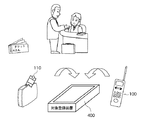
この荷物検索システムでは、図17に示すように、例えば空港のチェックインカウンターで、搭乗者(Aさん)のスーツケースなどの荷物に本発明による検索ラベル装置110を取り付ける。この後、該荷物を預ける際、対象登録装置400のID読み取り部410によって、該荷物に取り付けた検索ラベル装置110の検索ラベルIDと、搭乗者であるAさんが携帯する携帯電話のワイヤレスカードのID(端末ID)を読みとらせる。
In this baggage search system, as shown in FIG. 17, for example, a
対象登録装置400の対応付け登録部420は、ID読み取り部410により読みとられた、荷物に取り付けた検索ラベル装置110の検索ラベルIDと、Aさんが携帯する携帯電話のワイヤレスカードのID(端末ID)を対応付けた対応情報をスタティックDB210に登録する。
The
搭乗後、空港のターンテーブルを流れてくる荷物を受け取る際、利用者が荷物を視認可能な検索エリアにいる場合、図18に示すように、検索端末装置100のマーク表示部106(図18の例では、携帯電話の液晶画面)と、該搭乗者の荷物に取り付けた検索ラベル装置110のマーク表示部113(図18の例では、タグのLED)において、同じマーク(図18の例では、同じ色)が表示される。利用者は、携帯電話に表示されたマークと同一のマークを表示しているタグが付いた荷物を探すことで、自分の荷物を容易に見つけ出すことができる。
When the user is in the search area where he / she can visually recognize the package when he / she receives the package flowing on the turntable at the airport after boarding, as shown in FIG. 18, the
図19は、実施の形態2の検索支援システムを、上述の荷物検索システムに適用した場合の動作を示すフローチャートであり、この図に沿って詳細な動作を説明する。
先ず、搭乗者である利用者が、自身が携帯する携帯電話に検索端末用ソフトウエア(以下、検索端末用ソフトと略す)をインストールする(ステップST19a−1)。これにより、検索端末用ソフトを起動することで、該携帯電話を検索端末装置100として機能させることができる。
FIG. 19 is a flowchart showing an operation when the search support system according to the second embodiment is applied to the above-described package search system, and the detailed operation will be described with reference to FIG.
First, a user who is a passenger installs search terminal software (hereinafter abbreviated as search terminal software) on a mobile phone carried by the user (step ST19a-1). Thereby, the mobile phone can be made to function as the
次に、空港のチェックインカウンターで、利用者の荷物に検索ラベル装置110を取り付け、対象登録装置400のID読み取り部410により、該荷物に取り付けた検索ラベル装置110の検索ラベルIDを読みとらせ(ステップST19a−2)、搭乗者であるAさんが携帯する携帯電話のワイヤレスカードのID(端末ID)を読みとらせる(ステップST19a−3)。
Next, the
対象登録装置400の対応付け登録部420は、ID読み取り部410により読みとられた、利用者が携帯する携帯電話のワイヤレスカードのID(端末ID)と、該利用者の荷物に取り付けた検索ラベル装置110の検索ラベルIDとを入力すると、スタティックDB210にアクセスし、これらIDを、人(利用者)と物品(荷物)を対応付けた対応情報としてスタティックDB210に登録する(ステップST19a−4)。
The
搭乗後、携帯電話で検索端末用ソフトを起動して、該携帯電話を図16に示す検索端末装置100として機能可能な状態にする(ステップST19b−1)。これにより、自動問い合わせ部108が起動して位置管理装置120に荷物検索が依頼される(ステップST19b−2)。具体的には、自動問い合わせ部108が、ID記憶部105から端末IDを読み出し、送信部102を制御して位置管理装置120に端末IDを問い合わせ信号として送信する。
After boarding, the search terminal software is activated on the mobile phone, and the mobile phone is put into a state in which it can function as the
位置管理装置120では、検索端末装置100から問い合わせ信号として端末IDを受信すると、ダイナミックDB220の更新処理を実行する(ステップST19c−1)。ダイナミックDB220への登録処理は、図3中のステップST3b−1〜ステップST3b−3に相当する。
When the
本システムの場合にあてはめて詳細に説明する。先ず、位置管理装置120の場所特定部131は、検索端末装置100から受信部122が端末IDを受信した電波強度や電波到達時間などに基づいて、端末ID(人ID)を送信してきた検索端末装置100の位置を算出する。さらに、場所特定部131は、検索ラベル装置110から受信部122が検索ラベルIDを受信した電波強度や電波到達時間などに基づいて、検索ラベルID(物品ID)を送信してきた検索ラベル装置110の位置を算出する。
This will be described in detail in the case of this system. First, the
次に、場所特定部131は、上述のようにして求めた各装置100,110の位置に基づいて、スタティックDB210におけるエリアと座標の対応関係(図4(e)参照)を検索し、物品ID(検索ラベルID)で識別される荷物の位置及び端末IDに対応する検索端末装置100(携帯電話)が位置するエリアのエリアIDを求める。この後、場所特定部131は、上述のようにして求められたエリアIDや各装置100,110の位置に、ダイナミックDB220における人の位置情報(図6(a)参照)や物品の位置情報(図6(b)参照)の内容を更新する。
Next, the
図19の説明に戻ると、ダイナミックDB220の更新が完了すると、位置管理装置120の自動問い合わせ対応部125は、受信部122により受信された端末IDを用いて、スタティックDB210を探索し、該端末IDが登録されているか否かを判定する(ステップST19c−2)。
Returning to the description of FIG. 19, when the update of the
受信部122により受信された端末IDが登録されている場合、自動問い合わせ対応部125は、該端末IDを用いてダイナミックDB220を検索して、端末IDに対応する検索端末装置100のエリアID(人の位置)、及び、該検索端末装置100の端末IDに対応する検索ラベル装置110のエリアID(荷物の位置)を抽出し、これら比較して装置100,110が同一エリアに存在するか否かを判定する。ここで、装置100,110が同一エリアに存在する場合、自動問い合わせ対応部125は、装置100,110が位置するエリアでのマークの利用状況等に関する情報(図6(e)(d)参照)を取得する(ステップST19c−3)。
When the terminal ID received by the receiving
続いて、位置管理装置120の表示マーク決定部121が、自動問い合わせ対応部125によりダイナミックDB220から取得された情報を用い、端末IDで特定される検索端末装置100があるエリアにおいて利用可能なマークを選択し、物品IDに対応する検索ラベル装置110に設定すべきマークとして決定する(ステップST19c−4)。この荷物検索システムでは、利用者がターンテーブルから荷物を視認可能なエリアを検索エリアとし、上記実施の形態1で説明したものと同様の処理を施して利用可能なマークを選択する。以下に、本システムの場合にあてはめて詳細に説明する。
Subsequently, the display
例えば、表示マーク決定部121は、検索要求した利用者がターンテーブルの周囲に設定した検索エリアであるエリアPにいる場合、ダイナミックDB220のエリアPにおけるマーク利用状況に関する情報に基づいて、エリアPにある荷物に取り付けられた検索ラベル装置110に対して利用可能であるマークを選択する。この後、表示マーク決定部121は、ダイナミックDB220における選択した該マークの利用状況を利用不可に変更する。
For example, when the user who requested the search is in the area P that is the search area set around the turntable, the display
続いて、表示マーク決定部121は、スタティックDB210からエリアPと隣接するエリアを検索し、隣接するエリアにおいて選択されたマークが利用可能であった場合、隣接するエリアで同一マークが選択されないように該マークの利用状況を隣接エリアで使用中に設定する。このように、ダイナミックDB220において、互いに隣接するエリア間のマーク利用状況は、一方のエリアで利用されて利用不可となっているマークについては、他方のエリアでは隣接エリアで使用中となる。
Subsequently, the display
表示マーク決定部121は、エリアPに隣接するエリアでマークを選択しようとする場合、利用不可はもちろん、隣接エリアで使用中となっているマークも利用しない。これにより、隣接したエリアで同じマークが使われて目的の荷物と混同することがない。
When trying to select a mark in an area adjacent to the area P, the display
また、表示マーク決定部121は、ダイナミックDB220の内容を定期的に検査し、エリアPから利用者が移動したり、エリアPで該マークの利用が終了すると、該マークの利用状況を利用不可から利用可能に戻す。このとき、エリアPの隣接エリアで、隣接エリアで使用中に設定されたマークも利用可能に戻す。これにより、エリアPに新たに移動してきた利用者により検索要求された荷物の検索ラベル装置110に対してもマークを効率よく設定することができる。
In addition, the display
上述のようにしてマークを決定すると、表示マーク決定部121は、スタティックDB210から該マークに対応するコード情報を検索し、送信部102を介して検索端末装置100及び検索ラベル装置110に該コード情報を送信する。
When the mark is determined as described above, the display
検索端末装置100(携帯電話)では、位置管理装置120から利用者の荷物に付された検索ラベル装置110に割り当てられたマークのコード情報を受信部101が受信すると、マーク表示部106に該コード情報に対応するマーク(該当する色)を表示する(ステップST19b−3)。
In the search terminal device 100 (mobile phone), when the receiving
また、検索ラベル装置110では、受信部111によって位置管理装置120からのコード情報が受信されると、該コード情報を送信する電波により発生した電力でマーク表示部113を起動する。これにより、マーク表示部113は、受信部111からコード情報を入力すると、該コード情報に対応するマークを表示する(ステップST19c−5)。このようにして、検索端末装置100で表示されているものと同一のマーク色がマーク表示部113に表示される。利用者は、検索端末装置100である携帯電話に表示されたマークと同一のマークを表示しているタグが付いた荷物を探すことで、自分の荷物を容易に見つけ出すことができる。
Further, in the
以上のように、この実施の形態2によれば、検索対象である荷物とこれに対応して表示させるマークとの関係を動的に変更でき、空港のターンテーブルのように検索対象の荷物が大量にあったり、色や形状が類似したものが複数あったり、入れ替わりが多い場合であっても、荷物とマークの組み合わせの数が無用に増加することがなく、利用者が効率的に荷物を検索することができる。 As described above, according to the second embodiment, it is possible to dynamically change the relationship between the package to be searched and the mark to be displayed corresponding to the package to be searched. Even if there are many, similar colors or shapes, or frequent replacement, the number of combinations of luggage and marks will not increase unnecessarily, and users can efficiently load You can search.
これによって、類似した他の人の荷物と間違える可能性が減り、また、大量の荷物が流れるターンテーブルをずっと眺めていなくても、検索端末装置を見ていれば、対象の荷物が出たことがわかる。さらに、色だけでなく、検索対象の荷物が出てきた場合に、検索端末装置に音が鳴る、振動させる等の動作を追加することで、対象の荷物が出てきたことを知らせることができる。 As a result, the possibility of being mistaken for another similar person's baggage is reduced, and even if the turntable where a large amount of baggage flows is not viewed all the time, if the search terminal device is viewed, the target baggage has been delivered. I understand. Furthermore, not only the color but also the search terminal device can be informed that the target baggage has come out by adding an operation such as sounding or vibrating the search terminal device when the search target baggage comes out. .
上記実施の形態2では、空港の荷物検索システムとして本発明を適用した場合を説明したが、例えば工場での製品出荷時における搬送製品検索システムとして本発明を適用しても良い。図20は、搬送製品検索システムの概要を示す図であり、工場で生産された各種製品を分類して出荷する場合を示している。図20において、ベルトコンベア250上を流れるケース240a〜240cにそれぞれ入れられた製品230a〜230cが、搬送用トラック毎やその出荷先毎に分類される。
In the second embodiment, the case where the present invention is applied as a luggage search system at an airport has been described. However, the present invention may be applied as a transported product search system at the time of product shipment at a factory, for example. FIG. 20 is a diagram showing an outline of the transported product search system, and shows a case where various products produced in a factory are classified and shipped. In FIG. 20,
このシステムでは、製品を入れるケース240a〜240cに検索ラベル装置110を取り付け、搬送用トラックに製品を搭載する係員が携帯する携帯情報端末を検索端末装置100とする。このように、ベルトコンベア250上を大量の製品が流れている場合であっても、搬送用トラックとマークを対応付けて動的に振り分けることで、製品とマークの組み合わせの数が無用に増加することがなく、係員が効率的に搬送すべき製品を検索できる。
In this system, the
なお、上記実施の形態1及び上記実施の形態2では、マークとして色を表示する場合を説明したが、色以外に、音、絵、アイコン、点滅、振動等のような識別情報を検索者に提示してもよい。 In the first embodiment and the second embodiment, the case where a color is displayed as a mark has been described. However, in addition to the color, identification information such as a sound, a picture, an icon, blinking, vibration, etc. is provided to the searcher. May be presented.
実施の形態3.
図21は、この発明の実施の形態3による検索支援システムの構成を示すブロック図であり、図22は、図21中のシステムを大画面モニタを利用した情報収集システムに適用した場合の概要を示す図である。図21において、実施の形態3による検索支援システムは、検索端末装置100、検索ラベル装置110、位置管理装置120、スタティックDB210、ダイナミックDB220、検索ラベル装置110を構成部として備える検索ラベル表示装置300及び対象登録装置400を含んで構成される。
FIG. 21 is a block diagram showing the configuration of the search support system according to the third embodiment of the present invention. FIG. 22 shows an outline when the system in FIG. 21 is applied to an information collection system using a large screen monitor. FIG. 21, the search support system according to
実施の形態3による検索端末装置100は、上記実施の形態2と同様に、問い合わせ部104の代わりに自動問い合わせ部108を備える。図22に示す例では、利用者が携帯する携帯電話に検索端末用ソフトウエアを実行させて、検索端末装置100として機能させている。位置管理装置120は、問い合わせ部124の代わりに自動問い合わせ対応部125を備える。自動問い合わせ部108及び自動問い合わせ対応部125は、上記実施の形態2と同様に機能する。
The
検索ラベル表示装置300は、検索ラベル装置110、受信部111a、送信部112a、検索ラベル生成部150及び検索ラベル管理部155を備える。この実施の形態3では、検索ラベル装置110が、検索ラベル表示装置300の1つの構成部として設けられる。なお、図22に示す例では、マーク表示部113が大画面モニタ及びその画面表示処理を行うソフトウエアから構成される。
The search
実施の形態3による検索ラベル装置110のID記憶部114は、上記実施の形態と異なり、検索ラベル装置110に固有な検索ラベルIDの代わりに、検索ラベル表示装置300に固有な検索ラベル表示装置IDを記憶する。なお、検索ラベル表示装置IDは、スタティックDB210において、検索ラベル表示装置300が位置するエリアのエリアIDに対応付けて登録される。さらに、スタティックDB210には、検索端末装置100の端末IDと該検索端末装置100で選択された各種情報を識別するための情報IDとが対応情報として登録される。
The
受信部111a及び送信部112aは、外部の装置と通信するための構成部である。例えば、受信部111a及び送信部112aは、検索ラベル表示装置300として機能するコンピュータの通信装置により具現化される。
The
検索ラベル生成部150は、マーク表示部113でマークを表示する検索ラベルを生成する構成部であって、図22の例では、大画面モニタであるマーク表示部113の画面上に利用者毎に要求された情報を表示する表示枠を検索ラベルとして生成する。検索ラベル管理部155は、受信部111aを介して受信した情報IDに対応する情報を表示枠(検索ラベル)に表示する処理を制御する。
The search
なお、上述した、受信部111a、送信部112a、検索ラベル装置110、検索ラベル生成部150及び検索ラベル管理部155は、例えば大画面モニタに通信接続が可能なコンピュータ若しくは大画面モニタに内蔵されたコンピュータの演算処理装置に本発明の趣旨に従う処理プログラムを実行させてその動作を制御することにより、ハードウエアとソフトウエアが協働した具体的な手段として実現することができる。
The
対象登録装置400は、ID読み取り部410及び対応付け登録部420の他、情報検索・表示部430及び情報選択部440を備える。図22の例では、複数の場所(例えば、駅やデパートなど)に対象登録装置400を配置し、各場所に特有の情報を検索対象の情報として登録しておく。
The
実施の形態3によるID読み取り部410は、検索端末装置100の端末IDを読み取る構成部であり、例えば検索端末装置100が非接触でデータ通信が可能なワイヤレスカードで実現される場合、ワイヤレスカードリーダ等が考えられる。また、検索端末装置100に付した固有のコード(例えば、QRコード)を画像として取り込む撮像装置などを用いてもよい。対応付け登録部420は、ID読み取り部410により読み込まれた端末IDと、選択された情報の情報IDとを対応付けてスタティックDB210に登録する。
The
情報検索・表示部430は、自装置400に予め登録された各種情報をその識別情報である情報IDに対応付けて格納するメモリ、該メモリから読み出した情報を表示するための表示部、及び所定の検索又は選択処理により検索端末装置100の利用者に情報を選択させる構成部を備える。例えば、情報検索・表示部430としては、図22に示すようなモニタ及び該モニタに表示した情報を検索するための十字ボタン等のハードウエアに加え、利用者に情報の検索や選択を可能とするGUIを構築するソフトウエアも含まれる。
The information search /
情報選択部440は、検索端末装置100の利用者に選択された情報を選択情報として確定する構成部である。図22の例では、決定ボタン等のハードウエアに加え、利用者に選択された情報を確定し、該情報の情報IDを対応付け登録部420に出力するソフトウエアも含まれる。
The
次に動作について説明する。
図23は、実施の形態3による検索支援システムを、大画面モニタを利用した情報収集システムに適用した場合の動作を示すフローチャートであり、この図に沿って詳細な動作を説明する。
先ず、利用者が所持する携帯電話に検索端末用ソフトウエア(以下、検索端末用ソフトと略す)をインストールする(ステップST23a−1)。これにより、検索端末用ソフトを起動することで、該携帯電話を検索端末装置100として機能させることができる。
Next, the operation will be described.
FIG. 23 is a flowchart showing an operation when the search support system according to the third embodiment is applied to an information collecting system using a large screen monitor, and the detailed operation will be described with reference to this figure.
First, search terminal software (hereinafter abbreviated as search terminal software) is installed in a mobile phone possessed by a user (step ST23a-1). Thereby, the mobile phone can be made to function as the
なお、以降の説明において、検索端末装置100である携帯電話にも、タグとなるFelica(登録商標)等のワイヤレスカードが設けられており、該ワイヤレスカードのIDと検索端末装置100の端末IDが同一であるものとする。
In the following description, the mobile phone that is the
次に、A駅に配置された対象登録装置400の情報検索・表示部430を用いて、利用者が該対象登録装置400にデフォルトに設定された情報を表示する(ステップST23a−2)。具体的な動作を説明すると、情報検索・表示部430が、自装置400に予め登録された各種情報(例えば、A駅周辺のレストラン情報など)をメモリから読み出し、カテゴリやキーワードの入力を受け付け、該カテゴリやキーワード、十字ボタンで情報の検索が可能であり、決定ボタンで情報の確定が可能なGUIを介してモニタに表示する。図22では、情報検索・表示部430のモニタ上に、各種情報がそれぞれ記載された表示枠A〜Dが表示された場合を示している。
Next, using the information search /
利用者は、該GUIを介してカテゴリやキーワード、十字ボタンで情報を検索し、決定ボタンで所望の情報を選択する(ステップST23a−3)。これにより、情報検索・表示部430は、利用者が選択した情報の情報IDをメモリから読み出して対応付け登録部420に出力する。なお、選択する情報は、複数であってもよい。この場合、選択された複数の情報の情報IDがリストの形で対応付け登録部420に出力される。
The user searches for information using the category, keyword, or cross button via the GUI, and selects desired information using the enter button (step ST23a-3). Thereby, the information search /
続いて、検索端末装置100である携帯電話の端末IDを、対象登録装置400のID読み取り部410に読みとらせる(ステップST23a−4)。図22の例では、検索端末装置100である携帯電話のワイヤレスカードのIDを、ワイヤレスカードリーダであるID読み取り部410が読みとる。ID読み取り部410により読みとられた、利用者が携帯する携帯電話のワイヤレスカードのID(端末ID)は、対応付け登録部420に出力される。
Subsequently, the
対応付け登録部420は、利用者が携帯する携帯電話のワイヤレスカードのID(端末ID)と、該利用者に選択された情報の情報IDとを入力すると、スタティックDB210にアクセスし、端末IDと情報ID及び該情報IDにより識別される情報を、人(利用者)と物品(情報)を対応付けた対応情報としてスタティックDB210に登録する(ステップST23a−5)。
When the
この後、利用者が、例えばB駅に設置された検索ラベル表示装置300にA駅の対象登録装置400で選択した情報を表示させる場合を考える。この場合、先ず、携帯電話で検索端末用ソフトを起動して、該携帯電話を図21に示す検索端末装置100として機能可能な状態にする(ステップST23b−1)。
Next, consider a case where the user displays the information selected by the
この状態になることで、自動問い合わせ部108が起動し、位置管理装置120に情報検索が依頼される(ステップST23b−2)。具体的には、自動問い合わせ部108がID記憶部105から端末IDを読み出し、送信部102を制御して位置管理装置120に端末IDを問い合わせ信号として送信する。
In this state, the
位置管理装置120では、検索端末装置100から端末IDを受信すると、ダイナミックDB220の更新処理を実行する(ステップST23c−1)。ダイナミックDB220への登録処理は、図3中のステップST3b−1〜ステップST3b−3に相当する。
When receiving the terminal ID from the
ここで、本システムの場合にあてはめて詳細に説明する。
先ず、位置管理装置120の場所特定部131は、検索端末装置100から受信部122が端末IDを受信した電波強度や電波到達時間などに基づいて、端末ID(人ID)を送信してきた検索端末装置100の位置を算出する。
Here, a detailed description will be given by applying this system.
First, the
このようにして求めた検索端末装置100の位置を用いて、場所特定部131は、スタティックDB210におけるエリアと座標の対応関係(図4(e)参照)を検索し、端末IDに対応する検索端末装置100(携帯電話)の位置が属するエリアのエリアIDを求める。この後、場所特定部131は、上述のようにして求めたエリアIDや各装置100の位置でダイナミックDB220における人の位置情報(図6(a)参照)の内容を更新する。
Using the position of the
図23の説明に戻る。ダイナミックDB220の更新が完了すると、位置管理装置120の自動問い合わせ対応部125は、受信部122により受信された端末IDを用いてスタティックDB210を探索し、該端末IDが登録されているか否かを判定する(ステップST23c−2)。
Returning to the description of FIG. When the update of the
自動問い合わせ対応部125は、受信部122により受信された端末IDがスタティックDB210に登録されている場合、該端末IDを用いてスタティックDB210を検索し、該端末IDに対応付けられた情報ID及び該情報IDにより識別される情報を取得する。
When the terminal ID received by the receiving
この後、自動問い合わせ対応部125は、該端末IDを用いてダイナミックDB220を検索し、端末IDに対応する検索端末装置100のエリアID(人の位置)を取得すると共に、該検索端末装置100のエリアIDを用いてスタティックDB210を検索し、該検索端末装置100が位置するエリアにある検索ラベル表示装置300の検索ラベル表示装置IDを抽出する(ステップST23c−3)。
Thereafter, the automatic
次に、自動問い合わせ対応部125は、検索端末装置100のエリアIDを用いてダイナミックDB220を検索し、該検索端末装置100が位置するエリアでのマークの利用状況等に関する情報(図6(e)(d)参照)を取得する。
Next, the automatic
続いて、位置管理装置120の表示マーク決定部121は、自動問い合わせ対応部125によりダイナミックDB220から取得された情報を用い、上記実施の形態1と同様の処理を行って端末IDで特定される検索端末装置100があるエリアにおいて利用可能なマークを選択し、物品IDに対応する検索ラベル装置110のマーク表示部113に設定すべきマークとして決定する(ステップST23c−4)。以下に、本システムの場合にあてはめて詳細に説明する。
Subsequently, the display
例えば、表示マーク決定部121は、検索ラベル表示装置300が位置するエリアPにいる場合、ダイナミックDB220のエリアPにおけるマーク利用状況に関する情報に基づいて、エリアPで検索ラベル装置110に対して利用可能であるマークを選択する。この後、表示マーク決定部121は、ダイナミックDB220における選択した該マークの利用状況を利用不可に変更する。
For example, when the search
また、表示マーク決定部121は、ダイナミックDB220の内容を定期的に検査し、エリアPから利用者が移動したり、エリアPで該マークの利用が終了すると、該マークの利用状況を利用不可から利用可能に戻す。これにより、エリアPに新たに移動してきた利用者により検索要求された情報に関する検索ラベル装置110に対してもマークを効率よく設定することができる。
In addition, the display
上述のようにしてマークを決定すると、表示マーク決定部121は、スタティックDB210から該マークに対応するコード情報を検索し、送信部102を介して検索端末装置100及び検索ラベル表示装置300に該コード情報を送信する。このとき、該検索端末装置100の端末IDに対応付けられた情報IDの情報も検索ラベル表示装置300に送信する。
When the mark is determined as described above, the display
検索端末装置100(携帯電話)では、位置管理装置120からマークのコード情報を受信部101が受信すると、マーク表示部107に該コード情報に対応するマーク(該当する色)を表示する(ステップST23b−3)。図22では、携帯電話の表示画面を縁取るように該コード情報に対応する色が表示される場合を示している。なお、図22は、作図の便宜上、表示画面の縁取るように丸記号や四角記号を並べているが、これらは異なる色で縁取られることを表している。
In search terminal device 100 (mobile phone), when receiving
検索ラベル表示装置300では、位置管理装置120からのコード情報及び検索端末装置100の端末IDに対応付けられた情報IDの情報を受信部111aが受信すると、検索ラベル管理部155による制御の下、検索ラベル生成部150が該情報を表示する表示枠を生成する(ステップST23c−5)。例えば、検索ラベル生成部150が、利用者に選択された情報(端末IDに対応付けられた情報IDの情報)の情報量等に基づいて、マーク表示部113で該情報を適切に表示し得るサイズ等を決定して表示枠を生成する。このように生成された表示枠に関する情報は、検索ラベル装置110のマーク表示部113に出力される。
In the search
マーク表示部113では、検索端末装置100で選択された情報、位置管理装置120で決定されたマークのコード情報、及び、検索ラベル生成部150からの表示枠に関する情報に用いて、該コード情報に対応するマークを表示し、かつ利用者に選択された情報が記載された表示枠を表示する(ステップST23c−6)。これにより、利用者は、検索端末装置100(携帯電話)に表示されたマークと同一マークの表示枠を探すことで、大画面モニタであるマーク表示部113の表示画面から所望の情報を容易に見つけ出すことができる。
The
図22の例では、エリア1にある検索ラベル表示装置300に対して、複数の携帯電話、すなわち検索端末装置100,100a,100bが情報表示を試みているが、上述のように、位置管理装置120でマークの利用を動的に制御することにより、検索端末装置100,100a,100bで異なるマークが表示され、各マークに対応した表示枠a〜fが検索ラベル表示装置300の大画面モニタに表示される。
In the example of FIG. 22, a plurality of mobile phones, that is, the
具体的に説明すると、位置管理装置120の表示マーク決定部121は、検索端末装置100,100a,100bが同一エリアにいる場合、該エリアで利用可能なマークのうち、検索端末装置100,100a,100bの利用者により選択された情報の情報IDごとにマークを割り当てる。
More specifically, when the
そして、検索ラベル表示装置300の検索ラベル生成部150では、マークがそれぞれ割り当てられた情報IDごとに検索ラベルである表示枠を生成し、該表示枠に各情報を記載した表示情報を検索ラベル装置110のマーク表示部113に出力する。これにより、大画面モニタであるマーク表示部113には、図22に示すように、情報IDごとに割り当てられたマーク色を有し、各情報IDで識別される情報がそれぞれ記載された表示枠a〜fが表示される。
Then, the search
また、エリア2にある検索ラベル表示装置300に対して情報表示を試みる場合であっても、エリア2で利用可能なマークが位置管理装置120により決定され、表示枠に表示されたマークに基づいて、他の検索端末装置100が表示させている情報と区別することが可能である。なお、携帯電話の表示画面を他人に見せないようにすれば、利用者がどの情報を表示させているかを他人が知ることができず、プライバシーを保つこともできる。
Further, even when information display is attempted on the search
以上のように、この実施の形態3によれば、検索対象である情報とこれに対応して表示させるマークとの関係を動的に変更できることから、大画面モニタを利用した情報検索システムのように多数の検索端末装置100の情報が画面上に表示されたり、入れ替わり情報表示がなされる場合であっても、利用者が効率的に所望の情報を画面上から検索することができる。これにより、検索ミスの軽減も図られる。
As described above, according to the third embodiment, since the relationship between information to be searched and a mark to be displayed corresponding to the information can be dynamically changed, an information search system using a large-screen monitor can be used. Even when information on a large number of
なお、上記実施の形態3では、利用者により選択された情報が全て表示される場合を示したが、図24に示すように検索端末装置100に問い合わせ部104を設け、位置管理装置120に問い合わせ部124を設けることにより、利用者が検索ラベル表示装置300の大画面モニタに表示すべき情報を選択できるように構成してもよい。
In the third embodiment, the case where all the information selected by the user is displayed has been shown. However, as shown in FIG. 24, the
具体的に説明すると、I/O部103を用いて、利用者が表示させたい情報IDを入力することにより、問い合わせ部104が、入力された情報IDを位置管理装置120に問い合わせる。位置管理装置120の問い合わせ部124では、利用者により入力された情報ID及びこれに対応する情報をスタティックDB210から取得する。
Specifically, by using the I /
この後、位置管理装置120の表示マーク決定部121が、該検索端末装置100が位置するエリアで利用可能なマークを決定し、該マークのコード情報と該情報とを検索ラベル表示装置300に送信する。これにより、検索ラベル表示装置300において、利用者が表示を希望した情報のみが、該利用者の管理する検索端末装置100に対応するマークの表示枠に記載されて表示される。
Thereafter, the display
8 物品、10 売り場、10a〜10h 検索エリア、100,100a,100b 検索端末装置(端末装置)、101 受信部、102 送信部、103 I/O部、104 問い合わせ部、105 ID記憶部、106 マーク表示部(端末側表示部)、107 マーク利用終了部、108 自動問い合わせ部、110 検索ラベル装置(ラベル装置)、111 受信部、112 送信部、113 マーク表示部(ラベル側表示部)、114 ID記憶部、115 管理部、120 位置管理装置(管理装置)、121 表示マーク決定部、122 受信部、123 送信部、124 問い合わせ部、125 自動問い合わせ対応部、131 場所特定部、150 検索ラベル生成部、155 検索ラベル管理部、210 スタティックDB(静的情報記憶部)、220 ダイナミックDB(動的情報記憶部)、230a〜230c 製品、240a〜240c ケース、250 ベルトコンベア、300 検索ラベル表示装置、400 対象登録装置、410 ID読み取り部、420 対応付け登録部、430 情報検索・表示部、440 情報選択部。
8 goods, 10 sales floor, 10a to 10h search area, 100, 100a, 100b search terminal device (terminal device), 101 reception unit, 102 transmission unit, 103 I / O unit, 104 inquiry unit, 105 ID storage unit, 106 mark Display unit (terminal side display unit), 107 mark use end unit, 108 automatic inquiry unit, 110 search label device (label device), 111 reception unit, 112 transmission unit, 113 mark display unit (label side display unit), 114 ID Storage unit, 115 management unit, 120 position management device (management device), 121 display mark determination unit, 122 reception unit, 123 transmission unit, 124 inquiry unit, 125 automatic inquiry response unit, 131 location identification unit, 150 search
Claims (11)
検索要求した検索対象に割り当てられたマークを表示する端末側表示部と、自装置を識別する端末IDを記憶するID記憶部と、前記ID記憶部から読み出した端末ID及び検索要求する検索対象を識別する検索対象IDを問い合わせ信号として出力する問い合わせ部を有する端末装置と、
端末装置の端末ID及び該端末装置で検索要求された検索対象の検索対象IDを対応付けて記憶する静的情報記憶部と、
検索エリアごとのマーク使用状況を記憶する動的情報記憶部と、
前記端末装置からの問い合わせ信号における端末ID及び検索対象IDが前記静的情報記憶部に登録されているか否かを判定し、前記静的情報記憶部にIDが登録されている端末装置及び検索対象の位置する検索エリアのマーク使用状況を前記動的情報記憶部から取得する問い合わせ対応部と、前記問い合わせ対応部で取得された検索エリアのマーク使用状況に基づいて使用可能なマークを検索対象に割り当て、該検索対象に対応付けられたラベル装置及び該検索対象を検索要求した端末装置に前記マークを設定する表示マーク決定部を有する管理装置とを備えた検索支援システム。 A label device having a label-side display unit that is associated with a search target and displays a mark assigned to the search target;
A terminal-side display unit that displays a mark assigned to the search target requested to be searched, an ID storage unit that stores a terminal ID for identifying its own device, a terminal ID read from the ID storage unit, and a search target to be searched A terminal device having an inquiry unit that outputs a search target ID to be identified as an inquiry signal;
A static information storage unit that stores the terminal ID of the terminal device and the search target ID of the search target requested to be searched by the terminal device;
A dynamic information storage unit for storing the mark usage status for each search area;
It is determined whether a terminal ID and a search target ID in an inquiry signal from the terminal device are registered in the static information storage unit, and a terminal device and a search target whose ID is registered in the static information storage unit An inquiry handling unit that acquires the mark usage status of the search area where the location is located from the dynamic information storage unit, and assigns a usable mark to the search target based on the mark usage status of the search area acquired by the query handling unit A search support system comprising: a label device associated with the search target; and a management device having a display mark determination unit that sets the mark in a terminal device that has made a search request for the search target.
問い合わせ対応部は、前記自動問い合わせ部からの問い合わせ信号に応じて、該問い合わせ信号における端末ID及び検索対象IDが静的情報記憶部に登録されているか否かを判定し、前記静的情報記憶部にIDが登録されている端末装置及び検索対象の位置する検索エリアのマーク使用状況を動的情報記憶部から自動的に取得する自動問い合わせ対応部であることを特徴とする請求項1から請求項4のうちのいずれか1項記載の検索支援システム。 The inquiry unit is an automatic inquiry unit that automatically outputs a search target ID preset in the terminal device as an inquiry signal,
The inquiry handling unit determines whether the terminal ID and the search target ID in the inquiry signal are registered in the static information storage unit according to the inquiry signal from the automatic inquiry unit, and the static information storage unit The automatic inquiry responding unit that automatically acquires from the dynamic information storage unit the mark usage status of the search area where the ID is registered and the search area where the ID is registered. The search support system according to any one of 4.
検索対象に割り当てられたマークを表示する端末側表示部と、自装置を識別する端末IDを記憶するID記憶部と、前記ID記憶部から読み出した端末ID及び検索要求する検索対象を識別する検索対象IDを問い合わせ信号として出力する問い合わせ部を有する端末装置と、
端末装置の端末ID及び該端末装置で検索要求された検索対象の検索対象IDを対応付けて記憶する静的情報記憶部と、
検索エリアごとのマーク使用状況を記憶する動的情報記憶部とを備えた検索支援システムの管理装置において、
前記端末装置からの問い合わせ信号における端末ID及び検索対象IDが前記静的情報記憶部に登録されているか否かを判定し、前記静的情報記憶部にIDが登録されている端末装置及び検索対象の位置する検索エリアのマーク使用状況を前記動的情報記憶部から取得する問い合わせ対応部と、
前記問い合わせ対応部で取得された検索エリアのマーク使用状況に基づいて使用可能なマークを検索対象に割り当て、該検索対象に対応付けられたラベル装置及び該検索対象を検索要求した端末装置に前記マークを設定する表示マーク決定部とを備えた管理装置。 A label device having a label-side display unit that is associated with a search target and displays a mark assigned to the search target;
A terminal-side display unit that displays a mark assigned to a search target, an ID storage unit that stores a terminal ID that identifies the device itself, a terminal ID read from the ID storage unit, and a search that identifies a search target to be searched A terminal device having an inquiry unit that outputs a target ID as an inquiry signal;
A static information storage unit that stores the terminal ID of the terminal device and the search target ID of the search target requested to be searched by the terminal device;
In a management device of a search support system comprising a dynamic information storage unit for storing a mark usage status for each search area,
It is determined whether a terminal ID and a search target ID in an inquiry signal from the terminal device are registered in the static information storage unit, and a terminal device and a search target whose ID is registered in the static information storage unit An inquiry responding unit that obtains the mark usage status of the search area in which is located from the dynamic information storage unit;
A mark that can be used is assigned to a search target based on the mark usage status of the search area acquired by the inquiry handling unit, and the mark is associated with the label device associated with the search target and the terminal device that requested the search for the mark. And a display mark determination unit for setting the management device.
端末装置を識別する端末ID及び該端末装置で検索要求された検索対象を識別する検索対象IDを対応付けて記憶する静的情報記憶部と、
検索エリアごとのマーク使用状況を記憶する動的情報記憶部と、
前記端末装置からの問い合わせ信号における端末ID及び検索対象IDが前記静的情報記憶部に登録されているか否かを判定し、前記静的情報記憶部にIDが登録されている端末装置及び検索対象の位置する検索エリアのマーク使用状況を前記動的情報記憶部から取得する問い合わせ対応部と、前記問い合わせ対応部で取得された検索エリアのマーク使用状況に基づいて使用可能なマークを検索対象に割り当て、該検索対象に対応付けられたラベル装置及び該検索対象を検索要求した端末装置に前記マークを設定する表示マーク決定部を有する管理装置とを備えた検索支援システムの端末装置において、
検索要求した検索対象に対して前記管理装置により割り当てられたマークを表示する端末側表示部と、
自装置を識別する端末IDを記憶するID記憶部と、
前記ID記憶部から読み出した端末ID及び検索要求する検索対象の検索対象IDを前記問い合わせ信号として前記管理装置に出力する問い合わせ部とを備えた端末装置。 A label device having a label-side display unit that is associated with a search target and displays a mark assigned to the search target;
A static information storage unit that stores a terminal ID that identifies a terminal device and a search target ID that identifies a search target requested to be searched by the terminal device;
A dynamic information storage unit for storing the mark usage status for each search area;
It is determined whether a terminal ID and a search target ID in an inquiry signal from the terminal device are registered in the static information storage unit, and a terminal device and a search target whose ID is registered in the static information storage unit An inquiry handling unit that acquires the mark usage status of the search area where the location is located from the dynamic information storage unit, and assigns a usable mark to the search target based on the mark usage status of the search area acquired by the query handling unit A terminal device of a search support system comprising: a label device associated with the search target; and a management device having a display mark determination unit that sets the mark in the terminal device that has made a search request for the search target.
A terminal-side display unit that displays a mark assigned by the management device to a search target requested to be searched;
An ID storage unit for storing a terminal ID for identifying the device itself;
A terminal device comprising: an inquiry unit that outputs a terminal ID read from the ID storage unit and a search target ID of a search target to be searched to the management device as the inquiry signal.
端末装置の端末ID及び該端末装置で検索要求された検索対象の検索対象IDを対応付けて記憶する静的情報記憶部と、
検索エリアごとのマーク使用状況を記憶する動的情報記憶部と、
前記端末装置からの問い合わせ信号における端末ID及び検索対象IDが前記静的情報記憶部に登録されているか否かを判定し、前記静的情報記憶部にIDが登録されている端末装置及び検索対象の位置する検索エリアのマーク使用状況を前記動的情報記憶部から取得する問い合わせ対応部と、前記問い合わせ対応部で取得された検索エリアのマーク使用状況に基づいて使用可能なマークを検索対象に割り当て、該検索対象に対応付けられたラベル装置及び該検索対象を検索要求した端末装置に前記マークを設定する表示マーク決定部を有する管理装置とを備えた検索支援システムのラベル装置において、
自装置に対応付けられた検索対象に対して前記管理装置により割り当てられたマークを表示するラベル側表示部を備えたラベル装置。 A terminal-side display unit that displays a mark assigned to the search target requested to be searched, an ID storage unit that stores a terminal ID for identifying its own device, a terminal ID read from the ID storage unit, and a search target to be searched A terminal device having an inquiry unit that outputs a search target ID to be identified as an inquiry signal;
A static information storage unit that stores the terminal ID of the terminal device and the search target ID of the search target requested to be searched by the terminal device;
A dynamic information storage unit for storing the mark usage status for each search area;
It is determined whether a terminal ID and a search target ID in an inquiry signal from the terminal device are registered in the static information storage unit, and a terminal device and a search target whose ID is registered in the static information storage unit An inquiry handling unit that acquires the mark usage status of the search area where the location is located from the dynamic information storage unit, and assigns a usable mark to the search target based on the mark usage status of the search area acquired by the query handling unit A label device of a search support system comprising: a label device associated with the search target; and a management device having a display mark determination unit that sets the mark in a terminal device that has made a search request for the search target.
A label device comprising a label side display unit for displaying a mark assigned by the management device to a search target associated with the device itself.
Priority Applications (1)
| Application Number | Priority Date | Filing Date | Title |
|---|---|---|---|
| JP2006273181A JP2008087947A (en) | 2006-10-04 | 2006-10-04 | Search support system, management device, terminal device, label device, and program |
Applications Claiming Priority (1)
| Application Number | Priority Date | Filing Date | Title |
|---|---|---|---|
| JP2006273181A JP2008087947A (en) | 2006-10-04 | 2006-10-04 | Search support system, management device, terminal device, label device, and program |
Publications (1)
| Publication Number | Publication Date |
|---|---|
| JP2008087947A true JP2008087947A (en) | 2008-04-17 |
Family
ID=39372484
Family Applications (1)
| Application Number | Title | Priority Date | Filing Date |
|---|---|---|---|
| JP2006273181A Pending JP2008087947A (en) | 2006-10-04 | 2006-10-04 | Search support system, management device, terminal device, label device, and program |
Country Status (1)
| Country | Link |
|---|---|
| JP (1) | JP2008087947A (en) |
Cited By (8)
| Publication number | Priority date | Publication date | Assignee | Title |
|---|---|---|---|---|
| JP2013086912A (en) * | 2011-10-17 | 2013-05-13 | Fujitsu Advanced Engineering Ltd | Article management system, article management method, and article management program |
| JP2014179697A (en) * | 2013-03-13 | 2014-09-25 | Ricoh Co Ltd | Radio terminal and position management system |
| JP2016053923A (en) * | 2014-09-04 | 2016-04-14 | 東芝テック株式会社 | Article management system |
| JP2016146122A (en) * | 2015-02-09 | 2016-08-12 | 東芝テック株式会社 | Article management system |
| WO2020100346A1 (en) | 2018-11-16 | 2020-05-22 | 基正 厳 | Suitcase search system and tag |
| JP2021075364A (en) * | 2019-11-08 | 2021-05-20 | 帝人株式会社 | Article position notification system, and article position notification method |
| JP7397146B1 (en) | 2022-10-17 | 2023-12-12 | 和則 藤沢 | Product delivery support systems and programs |
| WO2025023222A1 (en) * | 2023-07-25 | 2025-01-30 | 日立チャネルソリューションズ株式会社 | Article search system and calculator system |
-
2006
- 2006-10-04 JP JP2006273181A patent/JP2008087947A/en active Pending
Cited By (10)
| Publication number | Priority date | Publication date | Assignee | Title |
|---|---|---|---|---|
| JP2013086912A (en) * | 2011-10-17 | 2013-05-13 | Fujitsu Advanced Engineering Ltd | Article management system, article management method, and article management program |
| JP2014179697A (en) * | 2013-03-13 | 2014-09-25 | Ricoh Co Ltd | Radio terminal and position management system |
| JP2016053923A (en) * | 2014-09-04 | 2016-04-14 | 東芝テック株式会社 | Article management system |
| JP2016146122A (en) * | 2015-02-09 | 2016-08-12 | 東芝テック株式会社 | Article management system |
| WO2020100346A1 (en) | 2018-11-16 | 2020-05-22 | 基正 厳 | Suitcase search system and tag |
| US11990021B2 (en) | 2018-11-16 | 2024-05-21 | Gi-Jeoung EUM | Travel suitcase search system and tag |
| JP2021075364A (en) * | 2019-11-08 | 2021-05-20 | 帝人株式会社 | Article position notification system, and article position notification method |
| JP7397146B1 (en) | 2022-10-17 | 2023-12-12 | 和則 藤沢 | Product delivery support systems and programs |
| JP2024058910A (en) * | 2022-10-17 | 2024-04-30 | 和則 藤沢 | Product delivery support system, program |
| WO2025023222A1 (en) * | 2023-07-25 | 2025-01-30 | 日立チャネルソリューションズ株式会社 | Article search system and calculator system |
Similar Documents
| Publication | Publication Date | Title |
|---|---|---|
| US20170213186A1 (en) | System and method for logistics management | |
| US9038905B2 (en) | System, method, and storage unit for managing multiple objects in an object zone | |
| US9082027B2 (en) | Near field communication tag reader, mobile terminal for interworking with the reader, and operating method thereof | |
| US10354316B2 (en) | Item list display | |
| US10264404B2 (en) | Information processing apparatus, system, and method | |
| JP2016162178A (en) | Article management device | |
| JP2021105857A (en) | Display unit, portable terminal, control method, program, and guide system | |
| JP7678490B2 (en) | CONTROL METHOD, COMMUNICATION TERMINAL, PROGRAM, RECORDING MEDIUM, AND INFORMATION PROVIDING METHOD | |
| CN107924504A (en) | management system | |
| JP2008087947A (en) | Search support system, management device, terminal device, label device, and program | |
| US20180260885A1 (en) | System for Shopping Assistance | |
| US10901756B2 (en) | Context-aware application | |
| JP2009087055A (en) | Shopping support device, computer program, and shopping support system | |
| KR101719337B1 (en) | System and method for processing information | |
| JP5994415B2 (en) | Position information management system, management server, and flow line management method | |
| JP2019032764A (en) | Reading system | |
| KR101835129B1 (en) | Method for comparing travel packages | |
| KR20140011157A (en) | How to order through qr-code in real time | |
| JP7737270B2 (en) | Item management system, method and information processing device | |
| JPWO2020054696A1 (en) | Information processing equipment, information processing methods, recording media and information processing systems | |
| WO2019180942A1 (en) | Matching system, information processing device, and matching method | |
| JP2018010432A (en) | Book management system, book management device, book management method and program | |
| KR20170091299A (en) | ESL integrated controller and operation method thereof | |
| WO2021234991A1 (en) | Information providing method | |
| JP7157695B2 (en) | User location detection and tracking system |
Legal Events
| Date | Code | Title | Description |
|---|---|---|---|
| RD04 | Notification of resignation of power of attorney |
Free format text: JAPANESE INTERMEDIATE CODE: A7424 Effective date: 20080703 |