JP2007285841A - Gas detection device and gas detection method - Google Patents
Gas detection device and gas detection method Download PDFInfo
- Publication number
- JP2007285841A JP2007285841A JP2006113015A JP2006113015A JP2007285841A JP 2007285841 A JP2007285841 A JP 2007285841A JP 2006113015 A JP2006113015 A JP 2006113015A JP 2006113015 A JP2006113015 A JP 2006113015A JP 2007285841 A JP2007285841 A JP 2007285841A
- Authority
- JP
- Japan
- Prior art keywords
- voltage
- trigger signal
- driving
- high temperature
- gas
- Prior art date
- Legal status (The legal status is an assumption and is not a legal conclusion. Google has not performed a legal analysis and makes no representation as to the accuracy of the status listed.)
- Granted
Links
- 238000001514 detection method Methods 0.000 title claims abstract description 76
- 238000001179 sorption measurement Methods 0.000 claims abstract description 54
- 238000002485 combustion reaction Methods 0.000 claims abstract description 50
- 238000007084 catalytic combustion reaction Methods 0.000 abstract description 7
- 230000007274 generation of a signal involved in cell-cell signaling Effects 0.000 abstract description 3
- 239000007789 gas Substances 0.000 description 138
- BASFCYQUMIYNBI-UHFFFAOYSA-N platinum Chemical compound [Pt] BASFCYQUMIYNBI-UHFFFAOYSA-N 0.000 description 19
- YXFVVABEGXRONW-UHFFFAOYSA-N Toluene Chemical compound CC1=CC=CC=C1 YXFVVABEGXRONW-UHFFFAOYSA-N 0.000 description 12
- 238000010586 diagram Methods 0.000 description 7
- 229910052697 platinum Inorganic materials 0.000 description 7
- 239000003054 catalyst Substances 0.000 description 6
- QTBSBXVTEAMEQO-UHFFFAOYSA-N Acetic acid Chemical compound CC(O)=O QTBSBXVTEAMEQO-UHFFFAOYSA-N 0.000 description 5
- 230000008859 change Effects 0.000 description 5
- KDLHZDBZIXYQEI-UHFFFAOYSA-N palladium Substances [Pd] KDLHZDBZIXYQEI-UHFFFAOYSA-N 0.000 description 5
- 229910018072 Al 2 O 3 Inorganic materials 0.000 description 4
- 230000007423 decrease Effects 0.000 description 4
- 238000005259 measurement Methods 0.000 description 4
- LFQSCWFLJHTTHZ-UHFFFAOYSA-N Ethanol Chemical compound CCO LFQSCWFLJHTTHZ-UHFFFAOYSA-N 0.000 description 3
- PNEYBMLMFCGWSK-UHFFFAOYSA-N aluminium oxide Inorganic materials [O-2].[O-2].[O-2].[Al+3].[Al+3] PNEYBMLMFCGWSK-UHFFFAOYSA-N 0.000 description 3
- 230000006866 deterioration Effects 0.000 description 3
- 239000010408 film Substances 0.000 description 3
- 238000000034 method Methods 0.000 description 3
- 230000008569 process Effects 0.000 description 3
- 229910052581 Si3N4 Inorganic materials 0.000 description 2
- 238000006243 chemical reaction Methods 0.000 description 2
- VNWKTOKETHGBQD-UHFFFAOYSA-N methane Chemical compound C VNWKTOKETHGBQD-UHFFFAOYSA-N 0.000 description 2
- 238000005070 sampling Methods 0.000 description 2
- HQVNEWCFYHHQES-UHFFFAOYSA-N silicon nitride Chemical compound N12[Si]34N5[Si]62N3[Si]51N64 HQVNEWCFYHHQES-UHFFFAOYSA-N 0.000 description 2
- 239000010409 thin film Substances 0.000 description 2
- UGFAIRIUMAVXCW-UHFFFAOYSA-N Carbon monoxide Chemical compound [O+]#[C-] UGFAIRIUMAVXCW-UHFFFAOYSA-N 0.000 description 1
- UFHFLCQGNIYNRP-UHFFFAOYSA-N Hydrogen Chemical compound [H][H] UFHFLCQGNIYNRP-UHFFFAOYSA-N 0.000 description 1
- 229910004298 SiO 2 Inorganic materials 0.000 description 1
- VYPSYNLAJGMNEJ-UHFFFAOYSA-N Silicium dioxide Chemical compound O=[Si]=O VYPSYNLAJGMNEJ-UHFFFAOYSA-N 0.000 description 1
- XUIMIQQOPSSXEZ-UHFFFAOYSA-N Silicon Chemical compound [Si] XUIMIQQOPSSXEZ-UHFFFAOYSA-N 0.000 description 1
- 229910002091 carbon monoxide Inorganic materials 0.000 description 1
- 230000015556 catabolic process Effects 0.000 description 1
- 230000003197 catalytic effect Effects 0.000 description 1
- 238000006731 degradation reaction Methods 0.000 description 1
- 238000005530 etching Methods 0.000 description 1
- CJNBYAVZURUTKZ-UHFFFAOYSA-N hafnium(iv) oxide Chemical compound O=[Hf]=O CJNBYAVZURUTKZ-UHFFFAOYSA-N 0.000 description 1
- 230000020169 heat generation Effects 0.000 description 1
- 229910052739 hydrogen Inorganic materials 0.000 description 1
- 239000001257 hydrogen Substances 0.000 description 1
- 238000012986 modification Methods 0.000 description 1
- 230000004048 modification Effects 0.000 description 1
- 229910052763 palladium Inorganic materials 0.000 description 1
- 229910052710 silicon Inorganic materials 0.000 description 1
- 239000010703 silicon Substances 0.000 description 1
- 229910052814 silicon oxide Inorganic materials 0.000 description 1
Images



Landscapes
- Investigating Or Analyzing Materials By The Use Of Electric Means (AREA)
Abstract
【課題】接触燃焼式ガスセンサを用い、従来に比して小型化および低コスト化を図ったガス検知装置およびガス検知方法を提供すること。
【解決手段】ガス検知装置は、吸着燃焼式ガスセンサ40の感応素子部Rsおよび補償素子部Rrに、低温駆動するためのLレベルおよび高温駆動するためのHレベルの駆動電圧を交互に印加する駆動手段52と、高温駆動時の感応素子部Rsからの検出電圧を基準電圧と比較し、その比較結果により第1のトリガ信号を生成する第1のトリガ信号生成手段55と、高温駆動時の補償素子部Rrからの検出電圧を基準電圧と比較し、その比較結果により第2のトリガ信号を生成する第2のトリガ信号生成手段56と、第1のトリガ信号と第2のトリガ信号の両トリガ信号の時間間隔を計数する計数手段50とを備え、計数手段の計数結果に基づいて、ガス濃度を検知する。
【選択図】図1To provide a gas detection device and a gas detection method that use a catalytic combustion type gas sensor and are reduced in size and cost as compared with the prior art.
A gas detection device is a drive that alternately applies L level driving voltage and H level driving voltage for high temperature driving to a sensitive element portion Rs and a compensation element portion Rr of an adsorption combustion type gas sensor 40. Means 52, first trigger signal generating means 55 for comparing the detected voltage from the sensitive element Rs during high temperature driving with a reference voltage and generating a first trigger signal based on the comparison result, and compensation during high temperature driving A detection voltage from the element unit Rr is compared with a reference voltage, and a second trigger signal generation unit 56 that generates a second trigger signal based on the comparison result, both triggers of the first trigger signal and the second trigger signal Counting means 50 for counting the time interval of the signal, and detecting the gas concentration based on the counting result of the counting means.
[Selection] Figure 1
Description
本発明は、ガス検知装置およびガス検知方法に関し、特に、吸着燃焼式ガスセンサを用いたガス検知装置およびガス検知方法に関する。 The present invention relates to a gas detection device and a gas detection method, and more particularly to a gas detection device and a gas detection method using an adsorption combustion type gas sensor.
従来知られている接触燃焼式ガスセンサは、感応素子部と補償素子部を有し、検知すべきガスを感応素子部の触媒作用により燃焼させ、この燃焼熱を白金コイルの抵抗値変化として捉えるように構成されている。検知すべきガスのうちトルエン、酢酸やエタノール等のように、極性が大きく吸着力の大きなガスは、低温駆動時に、ガス分子が感応素子部の触媒表面に吸着し、高温駆動時に、吸着したガスが瞬時に燃焼すると共に接触燃焼反応も同時に起こるので、センサ出力は、短時間でピークに達しその後徐々に減少するピーク波形を生じる。一方、メタン、水素や一酸化炭素等の無極性または極性の小さいガスは、吸着力も小さいので上記のような現象は起こらず、センサ出力は、定常値で安定するまで徐々に増加していく。 A conventionally known catalytic combustion type gas sensor has a sensitive element part and a compensating element part, and burns the gas to be detected by the catalytic action of the sensitive element part, and captures this combustion heat as a change in the resistance value of the platinum coil. It is configured. Among gases to be detected, gases with high polarity and large adsorption power, such as toluene, acetic acid, ethanol, etc., are adsorbed when the gas molecules are adsorbed on the catalyst surface of the sensitive element when driven at low temperatures and when driven at high temperatures. Burns instantaneously and the catalytic combustion reaction occurs simultaneously, so that the sensor output has a peak waveform that reaches a peak in a short time and then gradually decreases. On the other hand, a nonpolar or small polarity gas such as methane, hydrogen, or carbon monoxide has a small adsorption power, so the above phenomenon does not occur, and the sensor output gradually increases until it stabilizes at a steady value.
このように、トルエン等の特定種類のガスにおいて固有のピーク波形を呈することを利用して、接触燃焼式ガスセンサを用いてガス濃度の検知ばかりでなくガス種を分別することができる。このような特定種類のガスの吸着現象を利用する接触燃焼式ガスセンサは、吸着燃焼式ガスセンサとも呼ばれている。 As described above, by utilizing a specific peak waveform in a specific type of gas such as toluene, it is possible not only to detect the gas concentration but also to classify the gas type using a catalytic combustion type gas sensor. Such a catalytic combustion type gas sensor that utilizes an adsorption phenomenon of a specific type of gas is also called an adsorption combustion type gas sensor.
図7は、従来の吸着燃焼式ガスセンサを用いたガス検知装置の構成例を示すブロック図である。ガス検知装置1は、コントローラ10、駆動電源20、ガス検知出力手段30および検出用のブリッジ回路を含む吸着燃焼式ガスセンサ40を含んで構成される。コントローラ10には、駆動電源20、ガス検知出力手段30および吸着燃焼式ガスセンサ40が接続されている。
FIG. 7 is a block diagram showing a configuration example of a gas detection device using a conventional adsorption combustion type gas sensor. The
コントローラ10は、補正手段11、センサ駆動制御手段12、計時手段13、ピーク値取得手段14、格納手段15及び比較手段16を含んで構成される。このコントローラ10は、演算部、記憶部等を有するマイクロコンピュータにて具現化可能である。ピーク値取得手段14は、計時手段13から供給されるクロック信号を参照しつつ、通電直後の吸着燃焼式ガスセンサ40の出力値のピーク値を取得する。詳しくは、ピーク値取得手段14は、検知すべきガスのピーク値を検出するのに十分な通電直後の時間にわたって、補正手段11からのセンサ出力を所定のサンプリングレートでサンプリングすると共にこれらをそれぞれ保持しておき、この時間内におけるピーク値を取得する。
The
上記の構成を有するガス検知装置は、センサ駆動制御手段12により吸着燃焼式ガスセンサ40を所定時間だけ電源断とした後に通電し、通電直後の吸着燃焼式ガスセンサ40の出力値のピーク値をピーク値取得手段14で取得し、このピーク値と、格納手段15に予め格納されている、被検知ガスに対応するピーク値データを比較手段16で比較し、比較手段16による比較結果に基づき被検知ガスを検知してその結果を出力手段30から出力する(たとえば、特許文献1参照。)。
しかしながら、上述のガス検知回路では、次のような問題点がある。
(1)ガスセンサ40の出力が小さいため、ピーク値取得手段14において、補正手段11からのセンサ出力を増幅するための高精度な増幅器と、増幅器で増幅されたセンサ出力をサンプリングしてA/D変換するためのA/D変換器を備える必要がある。
(2)上記(1)の必要性により、部品点数が増え、小型化、低コスト化が困難である。
(3)A/D変換のサンプリングレートによる制約で、真のピーク値を取得することが困難である。
However, the above gas detection circuit has the following problems.
(1) Since the output of the
(2) Due to the necessity of the above (1), the number of parts increases, and it is difficult to reduce the size and cost.
(3) It is difficult to acquire a true peak value due to the restriction due to the sampling rate of A / D conversion.
そこで、本発明は、上記のような課題に着目し、接触燃焼式ガスセンサを用い、従来に比して小型化および低コスト化を図ったガス検知装置およびガス検知方法を提供することを目的とする。 In view of the above, the present invention aims to provide a gas detection device and a gas detection method that use a catalytic combustion type gas sensor and are reduced in size and cost as compared with the conventional one. To do.
上記課題を解決するためになされた請求項1記載の発明は、吸着燃焼式ガスセンサを用いたガス検知装置であって、前記吸着燃焼式ガスセンサの感応素子部および補償素子部に、低温駆動するためのLレベルおよび高温駆動するためのHレベルの駆動電圧を交互に印加する駆動手段と、前記高温駆動時の前記感応素子部からの検出電圧を基準電圧と比較し、その比較結果により第1のトリガ信号を生成する第1のトリガ信号生成手段と、前記高温駆動時の前記補償素子部からの検出電圧を前記基準電圧と比較し、その比較結果により第2のトリガ信号を生成する第2のトリガ信号生成手段と、前記第1のトリガ信号生成手段からの前記第1のトリガ信号と前記第2のトリガ信号生成手段からの前記第2のトリガ信号が入力され、両トリガ信号の時間間隔を計数する計数手段とを備え、前記計数手段の計数結果に基づいて、ガス濃度を検知することを特徴とするガス検知装置に存する。
In order to solve the above-mentioned problem, an invention according to
上記課題を解決するためになされた請求項2記載の発明は、請求項1記載のガス検知装置において、前記高温駆動時の前記感応素子部からの検出電圧が高くなった場合に、前記検出電圧を所定の制限値以内に制限する第1の制限手段と、前記高温駆動時の前記補償素子部からの検出電圧が高くなった場合に、前記検出電圧を所定の制限値以内に制限する第2の制限手段とをさらに備えたことを特徴とするガス検知装置に存する。
The invention according to
上記課題を解決するためになされた請求項3記載の発明は、吸着燃焼式ガスセンサを用いたガス検知方法であって、前記吸着燃焼式ガスセンサの感応素子部および補償素子部に、低温駆動するためのLレベルおよび高温駆動するためのHレベルの駆動電圧を交互に印加し、前記高温駆動時の前記感応素子部からの検出電圧が基準電圧を超えた時に発生する第1のトリガ信号と、前記高温駆動時の前記補償素子部からの検出電圧が前記基準電圧を超えた時に発生する第2のトリガ信号の時間間隔を計数し、その計数結果に基づいて、ガス濃度を検知することを特徴とするガス検知方法に存する。
The invention according to
請求項1記載の発明によれば、吸着燃焼式ガスセンサを用いたガス検知装置であって、吸着燃焼式ガスセンサの感応素子部および補償素子部に、低温駆動するためのLレベルおよび高温駆動するためのHレベルの駆動電圧を交互に印加する駆動手段と、高温駆動時の感応素子部からの検出電圧を基準電圧と比較し、その比較結果により第1のトリガ信号を生成する第1のトリガ信号生成手段と、高温駆動時の補償素子部からの検出電圧を基準電圧と比較し、その比較結果により第2のトリガ信号を生成する第2のトリガ信号生成手段と、第1のトリガ信号生成手段からの第1のトリガ信号と第2のトリガ信号生成手段からの第2のトリガ信号が入力され、両トリガ信号の時間間隔を計数する計数手段とを備え、計数手段の計数結果に基づいて、ガス濃度を検知するので、以下の利点が得られる。
(1)高価な高精度の増幅器やA/D変換器が不要であるため、コストを低減できる。
(2)部品点数が減り、小型化が可能になる。
(3)時間の計測は、アナログ電圧を扱うよりも安定性がよく、高精度な検出ができる。
According to the first aspect of the present invention, there is provided a gas detection device using an adsorption combustion type gas sensor for driving the sensitive element part and the compensation element part of the adsorption combustion type gas sensor at an L level and a high temperature for low temperature driving. The first trigger signal for comparing the detection voltage from the sensitive element section during high temperature driving with the reference voltage and generating the first trigger signal according to the comparison result Generating means, second trigger signal generating means for comparing the detected voltage from the compensation element section during high temperature driving with a reference voltage, and generating a second trigger signal based on the comparison result, and first trigger signal generating means The first trigger signal from the second trigger signal and the second trigger signal from the second trigger signal generating means are input, and counting means for counting the time interval between the two trigger signals is provided. Based on the counting result of the counting means Since detecting the gas concentration, the following advantages are obtained.
(1) Since an expensive high-precision amplifier and A / D converter are unnecessary, the cost can be reduced.
(2) The number of parts is reduced, and downsizing is possible.
(3) Time measurement is more stable than analog voltage and can be detected with high accuracy.
請求項2記載の発明によれば、高温駆動時の感応素子部からの検出電圧が高くなった場合に、検出電圧を所定の制限値以内に制限する第1の制限手段と、高温駆動時の補償素子部からの検出電圧が高くなった場合に、検出電圧を所定の制限値以内に制限する第2の制限手段とをさらに備えているので、第1のトリガ信号と第2のトリガ信号それぞれにおいて、トリガを検出後に各センサ電圧の制限を行うため、センサの過度な昇温を抑制することが可能で、消費電力とセンサ劣化を抑えることができる。 According to the second aspect of the present invention, when the detection voltage from the sensitive element portion during high temperature driving becomes high, the first limiting means for limiting the detection voltage within a predetermined limit value, and during high temperature driving, When the detection voltage from the compensation element section becomes high, the apparatus further includes second limiting means for limiting the detection voltage to within a predetermined limit value. Therefore, the first trigger signal and the second trigger signal respectively. In the above, since each sensor voltage is limited after detecting the trigger, it is possible to suppress an excessive temperature rise of the sensor and to suppress power consumption and sensor deterioration.
請求項3記載の発明によれば、吸着燃焼式ガスセンサを用いたガス検知方法であって、前記吸着燃焼式ガスセンサの感応素子部および補償素子部に、低温駆動するためのLレベルおよび高温駆動するためのHレベルの駆動電圧を交互に印加し、前記高温駆動時の前記感応素子部からの検出電圧が基準電圧を超えた時に発生する第1のトリガ信号と、前記高温駆動時の前記補償素子部からの検出電圧が前記基準電圧を超えた時に発生する第2のトリガ信号の時間間隔を計数し、その計数結果に基づいて、ガス濃度を検知するので、以下の利点が得られる。
(1)高価な高精度の増幅器やA/D変換器が不要であるため、コストを低減できる。
(2)部品点数が減り、小型化が可能になる。
(3)時間の計測は、アナログ電圧を扱うよりも安定性がよく、高精度な検出ができる。
According to a third aspect of the present invention, there is provided a gas detection method using an adsorption combustion type gas sensor, wherein the sensitive element part and the compensation element part of the adsorption combustion type gas sensor are driven at an L level and a high temperature for driving at a low temperature. A first trigger signal generated when a detection voltage from the sensitive element unit during high temperature driving exceeds a reference voltage, and the compensation element during high temperature driving Since the time interval of the second trigger signal generated when the detection voltage from the unit exceeds the reference voltage is counted and the gas concentration is detected based on the counting result, the following advantages are obtained.
(1) Since an expensive high-precision amplifier and A / D converter are unnecessary, the cost can be reduced.
(2) The number of parts is reduced, and downsizing is possible.
(3) Time measurement is more stable than analog voltage and can be detected with high accuracy.
以下、本発明の実施の形態について、図面に基づき説明する。 Hereinafter, embodiments of the present invention will be described with reference to the drawings.
図1は、本発明のガス検知装置で使用される吸着燃焼式ガスセンサの構造を示す図であり、(A)は平面図、(B)は底面図および(C)は平面図におけるA−A線断面図である。吸着燃焼式ガスセンサ40は、図1に示すように、感応素子部Rsおよび補償素子部Rrから構成されている。感応素子部Rsは、白金(Pt)からなるヒータ42および白金族、たとえばパラジウム(Pd)を担持したアルミナ(Al2 O3 )からなるPd/Al2 O3 触媒層43を含み、補償素子部Rrは、白金(Pt)からなるヒータ44およびアルミナ(Al2 O3 )層45を含む。詳しくは、この吸着燃焼式ガスセンサ40は、シリコン(Si)ウエハ41の上に、酸化シリコン(SiO2 )膜48c、窒化シリコン(SiN)膜48bおよび酸化ハフニウム(HfO2 )膜48aからなる絶縁薄膜が成膜され、その上に、感応素子部Rsとして白金(Pt)からなるヒータ42およびPd/Al2 O3 触媒層43、補償素子部Rrとして白金(Pt)ヒータ42およびアルミナ(Al2 O3 )層45が形成されている。また、吸着燃焼式ガスセンサ40は、異方性エッチングにより凹部46及び47を形成して、それぞれ、薄膜ダイアフラムDs及びDrを形成することにより熱容量を小さくしている。
FIG. 1 is a view showing the structure of an adsorption combustion type gas sensor used in the gas detection device of the present invention, wherein (A) is a plan view, (B) is a bottom view, and (C) is an AA in the plan view. It is line sectional drawing. As shown in FIG. 1, the adsorption combustion
接触燃焼式ガスセンサ40は、固定抵抗とヒータ42および44とのブリッジ接続によるセンサブリッジ回路に駆動電圧を印加することにより駆動される。まず、Lレベルの駆動電圧を所定の時間だけ印加して低温で駆動し、雰囲気中のガスを感応素子部Rsの触媒層43に吸着させる。次に、駆動電圧をLレベルからHレベルに切り替えて所定の時間だけ印加することにより高温で駆動し、吸着したガスを燃焼させる。低温駆動から高温駆動に切り替えた際、吸着燃焼式ガスセンサ40の温度上昇は、センサへ供給されるエネルギーに依存し、ガスのない雰囲気中で感応素子部Rsおよび補償素子部Rrを同じ駆動電圧で駆動すれば、所定の温度に達するまでの時間は等しくなる。また、ガスの存在する雰囲気中で同様の駆動を行えば、吸着されたガスが燃焼する感応素子部Rs側はその燃焼エネルギーにより補償素子部Rr側よりも早く所定温度に達する。
The catalytic combustion
以上のことにより、感応素子部Rsと補償素子部Rrでは、所定温度に達するまでの時間の差が発生する。そこで、発生する昇温時間の差を計数することで、ガス濃度の検出が可能である。また、検出対象が時間であるため、マイコン等に内蔵のカウンタ等を利用して簡単にガス検知回路を構成することができる。 Due to the above, a difference in time required to reach a predetermined temperature occurs in the sensitive element portion Rs and the compensation element portion Rr. Therefore, it is possible to detect the gas concentration by counting the difference in the temperature rise time generated. In addition, since the detection target is time, a gas detection circuit can be easily configured using a counter built in a microcomputer or the like.
図2は、上述の吸着燃焼式ガスセンサを用いた本発明の実施の形態に係るガス検知方法を実施するガス検知装置の構成を示すブロック図、図3は、図1のガス検知装置の具体的構成例を示す回路図、図4は、図1のガス検知装置で用いられる駆動電圧の波形例を示すタイミングチャート、図5は、図1のガス検知装置の動作を説明するフローチャートである。 FIG. 2 is a block diagram showing a configuration of a gas detection device that performs the gas detection method according to the embodiment of the present invention using the above-described adsorption combustion type gas sensor, and FIG. 3 is a specific example of the gas detection device of FIG. FIG. 4 is a timing chart showing an example of a waveform of a drive voltage used in the gas detection device of FIG. 1, and FIG. 5 is a flowchart for explaining the operation of the gas detection device of FIG.
本発明のガス検知装置1は、マイコン50、電源51、ブリッジ駆動回路52、分圧回路53、センサブリッジ回路54、比較回路55および56、Rs保護用リミット回路57およびRr保護用リミット回路58から構成されている。マイコン50は、請求項における計数手段に相当し、比較回路55は、請求項における第1のトリガ信号生成手段に相当し、比較回路56は、請求項における第2のトリガ信号生成手段に相当し、Rs保護用リミット回路57は、請求項における第1の制限手段に相当し、Rr保護用リミット回路58は、請求項における第2の制限手段に相当する。
The
マイコン(以下、MCUという)50は、ブリッジ駆動基準電圧Vref(D/A出力)と駆動パルスを出力し、ブリッジ駆動回路52は、電源51からの電源電圧を調整し、ブリッジ駆動基準電圧Vref信号に応じた電圧Vbがセンサブリッジ回路54に印加されるように制御を行う。また、駆動パルスのLレベル/Hレベルに同期して、電圧Vbを低温駆動用のLレベル、高温駆動用のHレベルに変化させている。ブリッジ駆動回路52から供給された電圧Vbは、センサブリッジ回路54と分圧回路53へ供給される。
A microcomputer (hereinafter referred to as MCU) 50 outputs a bridge drive reference voltage Vref (D / A output) and a drive pulse, and a
センサブリッジ回路54は、固定抵抗R1と吸着燃焼式ガスセンサ40における感応素子部Rsのヒータ42との直列接続と、固定抵抗R2と吸着燃焼式ガスセンサ40における補償素子部Rrのヒータ44との直列接続で構成されている。また、分圧回路53は、抵抗R3,R4およびR5からなり、電圧Vbを分圧し、制限値Vref1および基準電圧Vref2を出力する。
The
吸着燃焼式ガスセンサ40における感応素子部Rsと補償素子部Rrのヒータ42および44は、それぞれ、白金抵抗体で構成されているため、電流が流れることにより発熱し、自身の抵抗値が上昇する。つまり、感応素子部Rsと補償素子部Rrのヒータ42および44の抵抗値は、その温度を表している。感応素子部Rsのヒータ42の抵抗値変化は、固定抵抗R1との接続点電圧V+として出力され、比較回路55に入力される。補償素子部Rrのヒータ44の抵抗値変化は、固定抵抗R2との接続点電圧V−として出力され、比較回路56に入力される。
Since the
比較回路55は、電圧Vbを分圧した基準電圧Vref2とセンサブリッジ回路54の電圧V+を比較し、感応素子部Rsの抵抗値が所定値(所定温度)になったことを判定し、Hレベルのトリガ信号T1を出力する。比較回路56も、同様に、電圧Vbを分圧した基準電圧Vref2とセンサブリッジ回路54の電圧V−を比較し、補償素子部Rrの抵抗値が所定値(所定温度)になったことを判定し、Hレベルのトリガ信号T2を出力する。
The
以上より、比較回路のトリガ信号T1,T2は、感応素子部Rsと補償素子部Rrが、それぞれ、所定温度に達したときに出力されるように構成されている。 As described above, the trigger signals T1 and T2 of the comparison circuit are configured to be output when the sensitive element portion Rs and the compensating element portion Rr each reach a predetermined temperature.
低温駆動により、ガス吸着が行われた吸着燃焼式ガスセンサ40は、高温駆動に切り替わると、触媒層43が設けられている感応素子部Rsのみのガスが燃焼し、その温度上昇が補償素子部Rr側よりも早くなる。したがって、トリガ信号T2よりも早く、トリガ信号T1がHレベルになる。つまり、Hレベルのトリガ信号T1の発生時点からHレベルのトリガ信号T2の発生時点までの時間間隔は、ガス濃度に依存し、その濃度が高くなるほど上記時間間隔が広くなる。この時間間隔を、MCU50の内蔵カウンタで計数することにより、ガス濃度を取得する。すなわち、計数値を、MCU50の内部メモリに予め格納されている計数値対ガス濃度テーブルを参照して、対応するガス濃度値を取得する。
When the adsorption combustion
なお、図2では、トリガ信号T1およびT2を別々にMCU50に入力しているが、後述するようにロジック回路59(図3参照)でT1・/T2のロジックを構成することで、トリガ信号T1がHレベルになってからトリガ信号T2がHレベルになるまでの期間だけ、上記時間間隔を表すHレベルの論理出力をロジック回路59からMCU50に入力することも可能である。この場合、MCU50は、Hレベルの論理出力のH期間の長さを計数すればよい。
In FIG. 2, the trigger signals T1 and T2 are separately input to the
トリガ信号T1およびT2が発生した後、MCU50が駆動パルスをLレベルに切り替えるまでの期間は、吸着燃焼式ガスセンサ40は、電圧Vbによって自身に流れる電流と、その発熱による抵抗値の増加が平衡するまで温度が上昇する。この温度上昇は、センサ劣化の原因になる。そこで、過剰な温度上昇を抑えるために、Rs保護用リミット回路57は、分圧回路53でVref1>Vref2が成立するように設定された制限値Vref1と電圧V+を比較し、電圧V+が制限値Vref1を超えないように制御している。Rr保護用リミット回路58も、同様に、制限値Vref1と電圧V−を比較し、電圧V−が制限値Vref1を超えないように制御している。
During the period from when the trigger signals T1 and T2 are generated until the
次に、図3は、図2のガス検知装置の具体的構成を示す回路図である。 Next, FIG. 3 is a circuit diagram showing a specific configuration of the gas detection device of FIG.
ブリッジ駆動回路52は、オペアンプU5、pnp型トランジスタQ1、npn型トランジスタQ2および抵抗R6〜R12からなり、電源51としての+Vcc電圧が供給されている。ブリッジ駆動回路52は、MCU50から出力されるブリッジ駆動基準電圧Vref(D/A出力)と駆動パルスにより制御され、ブリッジ駆動基準電圧Vref信号に応じた電圧Vbをセンサブリッジ回路54に印加する。駆動パルスのLレベル/Hレベルに同期して、電圧Vbを低温駆動用のLレベル、高温駆動用のHレベルに変化させている。
The
オペアンプU5の反転入力端子には、ブリッジ駆動基準電圧Vref信号が入力され、非反転入力端子には、電圧Vbを抵抗R9,R11,R12で分圧し、抵抗R11およびR12に発生する電圧が入力される。上記両電圧が比較され、反転入力端子より非反転入力端子の電位が高い場合、オペアンプU5の出力電圧が高くなる。オペアンプU5の出力電圧は、トランジスタQ1のベースに供給され、その電圧が高くなるにしたがい、トランジスタQ1のエミッタ−コレクタ間の抵抗が増加し、電圧Vbが低下する。以上により、電圧Vbは、抵抗R9,R11,R12とブリッジ駆動基準電圧Vref信号により任意の電圧に定電圧制御される。
Vb=(R9+R11+R12)/(R11+R12)×Vref・・・(1)
The bridge drive reference voltage Vref signal is input to the inverting input terminal of the operational amplifier U5, and the voltage generated at the resistors R11 and R12 is input to the non-inverting input terminal by dividing the voltage Vb by the resistors R9, R11, and R12. The When the two voltages are compared and the potential of the non-inverting input terminal is higher than that of the inverting input terminal, the output voltage of the operational amplifier U5 becomes high. The output voltage of the operational amplifier U5 is supplied to the base of the transistor Q1, and as the voltage increases, the resistance between the emitter and collector of the transistor Q1 increases and the voltage Vb decreases. As described above, the voltage Vb is controlled to a constant voltage by the resistors R9, R11, R12 and the bridge drive reference voltage Vref signal.
Vb = (R9 + R11 + R12) / (R11 + R12) × Vref (1)
駆動パルスがHレベルの場合、トランジスタQ2がオン状態になるため、上記(1)式の抵抗R12は短絡され、ゼロオームとなる。この状態は、駆動パルスがLレベルの場合と比較して、電圧Vbが高い電圧に制御される。したがって、駆動パルスをL/Hレベルに切り替えることで、電圧VbをL/Hレベルに切り替えることができ、低温駆動状態と高温駆動状態を選択することができる。 When the drive pulse is at the H level, the transistor Q2 is turned on, so that the resistor R12 in the above equation (1) is short-circuited and becomes zero ohms. In this state, the voltage Vb is controlled to be higher than that when the drive pulse is at the L level. Therefore, by switching the drive pulse to the L / H level, the voltage Vb can be switched to the L / H level, and the low temperature drive state and the high temperature drive state can be selected.
ブリッジ駆動基準電圧Vrefを一意的に決めた場合、抵抗R9と(R11+R12)の抵抗比は、低温駆動時の電圧Vbを決定し、抵抗R11と抵抗R12の抵抗比は、高温駆動時の電圧Vbを決定する。ブリッジ駆動回路52からの電圧Vbは、センサブリッジ回路54と分圧回路53に供給される。
When the bridge drive reference voltage Vref is uniquely determined, the resistance ratio of the resistors R9 and (R11 + R12) determines the voltage Vb at the time of low temperature driving, and the resistance ratio of the resistors R11 and R12 is the voltage Vb at the time of high temperature driving. To decide. The voltage Vb from the
センサブリッジ回路54は、固定抵抗R1と感応素子部Rsのヒータ42の直列接続、固定抵抗R2と補償素子部Rrのヒータ44の直列接続で構成されている。また、分圧回路53は、電圧Vbを抵抗R3,R4,R5で分圧し、第1および基準電圧Vref1およびVref2を出力する。
The
吸着燃焼式ガスセンサ40における感応素子部Rsと補償素子部Rrのヒータ42および44は、それぞれ、白金抵抗体で構成されているため、電流が流れることにより発熱し、自身の抵抗値が上昇する。つまり、感応素子部Rsと補償素子部Rrのヒータ42および44の抵抗値は、その温度を表していることになる。感応素子部Rsのヒータ42の抵抗値変化は、固定抵抗R1との接続点電圧V+として出力され、比較回路55に入力される。補償素子部Rrのヒータ44の抵抗値変化は、固定抵抗R2との接続点電圧V−として出力され、比較回路56に入力される。
Since the
比較回路55は、オペアンプからなるコンパレータU1と抵抗R13,R14から構成され、比較回路56は、オペアンプからなるコンパレータU2と抵抗R15,R16から構成されている。
The
コンパレータU1は、電圧Vbを抵抗分圧した基準電圧Vref2とセンサブリッジ回路54の電圧V+を比較し、V+>Vref2の状態でHレベルのトリガ信号T1を出力する。たとえば、電圧Vbが低温駆動から高温駆動に切り替わると、感応素子部Rsに流れる電流が増加し、その温度上昇に伴って感応素子部Rsの抵抗値が大きくなり、V+電位が上昇する。V+とVref2の電圧が等しくなる感応素子部Rsの抵抗値の条件は、以下の(2)式で表される。
Rs=R1・R5/(R3+R4)・・・(2)
The comparator U1 compares the reference voltage Vref2 obtained by resistance-dividing the voltage Vb with the voltage V + of the
Rs = R1 · R5 / (R3 + R4) (2)
電圧V+と基準電圧Vref2の関係をコンパレータU1で比較することにより、感応素子部Rsが所定値(所定温度)になったことを判定することができる。さらに、この所定値は、抵抗R1,R3,R4およびR5の抵抗値のみに依存するため、容易に決めることが可能である。同様に、電圧V−と基準電圧Vref2が等しくなる補償素子部Rrの抵抗値の条件は以下の(3)式で表される。
Rr=R2・R5/(R3+R4)・・・(3)
By comparing the relationship between the voltage V + and the reference voltage Vref2 by the comparator U1, it can be determined that the sensitive element portion Rs has reached a predetermined value (predetermined temperature). Furthermore, since this predetermined value depends only on the resistance values of the resistors R1, R3, R4, and R5, it can be easily determined. Similarly, the condition of the resistance value of the compensation element portion Rr where the voltage V− and the reference voltage Vref2 are equal is expressed by the following equation (3).
Rr = R2 / R5 / (R3 + R4) (3)
以上により、コンパレータU1、U2の出力は、感応素子部Rsと補償素子部Rrが、それぞれ、所定温度に達した時にHレベルのトリガ信号T1,T2の出力を行うように構成されている。 As described above, the outputs of the comparators U1 and U2 are configured to output the trigger signals T1 and T2 at the H level when the sensitive element unit Rs and the compensating element unit Rr respectively reach a predetermined temperature.
高温駆動時には、感応素子部Rsおよび補償素子部Rrの抵抗値が、上記(2)および(3)式の右辺よりも大きくなるように、低温駆動時には、感応素子部Rsおよび補償素子部Rrの抵抗値が上記(2)および(3)式の右辺よりも小さくなるように、電圧Vbまたは抵抗R1〜R5を設定する必要がある。 When driving at a high temperature, the resistance values of the sensitive element portion Rs and the compensating element portion Rr are larger than the right sides of the above equations (2) and (3). It is necessary to set the voltage Vb or the resistors R1 to R5 so that the resistance value is smaller than the right side of the above equations (2) and (3).
Rs保護用リミット回路57は、オペアンプU3、npn型トランジスタQ3および抵抗R17〜R20から構成される。Rr保護用リミット回路58は、オペアンプU4、npn型トランジスタQ4および抵抗R21〜R24から構成される。
The Rs
トリガ信号T1およびT2が発生した後、MCU50が駆動パルスをLレベルに切り替えるまでの期間に、吸着燃焼式ガスセンサ40は、高温駆動された電圧Vbによって自身に流れる電流と、その発熱による抵抗値の増加が平衡するまで温度上昇する。この温度上昇は、センサ劣化の原因となるため、電圧Vbは必要以上に上げないか、または、MCU50がトリガ信号T2を検出後すぐに駆動パルスをLレベルに切り替える必要がある。しかし、電圧Vbをあまり低く設定すると、基準電圧Vref2付近でセンサ温度が平衡してしまい、コンパレータによる基準電圧Vref2との比較が困難である。また、ガス濃度が高い場合には、トリガ信号T1の出力後トリガ信号T2出力までの期間が長くなり、MCU50が駆動パルスをLレベルに切り替える前に、感応素子部Rs側の温度が上昇してしまう。
After the trigger signals T1 and T2 are generated, until the
そこで、分圧回路53によりVref1>Vref2が成立するように制限値Vref1を設定し、この制限値Vref1と電圧V+をRs保護用リミット回路57で監視している。Rs保護用リミット回路57は、制限値Vref1より電圧V+が高くなると、オペアンプU3の出力電圧が高くなり、トランジスタQ3のベース電圧を上昇させる。トランジスタQ3は、ベース電圧の上昇に伴い、コレクタ−エミッタ間の抵抗値が下がり、V+電位を接地電位GNDへバイパスさせるように作用する。つまり、感応素子部Rsの温度が、制限値Vref1で設定される温度を超えようとした場合に、電圧V+を制限値Vref1に固定する制御をしている。Rr保護用リミット回路58も、同様に、制限値Vref1と電圧V−を監視している。Rr保護用リミット回路58は、制限値Vref1より電圧V−が高くなると、オペアンプU4の出力電圧が高くなり、トランジスタQ4のベース電圧を上昇させる。トランジスタQ4は、ベース電圧の上昇に伴い、コレクタ−エミッタ間の抵抗値が下がり、V+電位を接地電位GNDへバイパスさせ、電圧V−を制限値Vref1に固定する制御をしている。
Therefore, the limit value Vref1 is set by the
以上により、感応素子部Rsの最大許容温度は、制限値Vref1により制御することができ、感応素子部Rsは、抵抗R1,R3,R4,R5の抵抗値のみに依存する下記(4)式で制限されることになる。同様に、補償素子部Rrは、抵抗R2,R3,R4,R5の抵抗値のみに依存する下記(5)式の値で制限されることになる。
Rs=(R4+R5)・R1/R3・・・(4)
Rr=(R4+R5)・R2/R3・・・(5)
As described above, the maximum allowable temperature of the sensitive element portion Rs can be controlled by the limit value Vref1, and the sensitive element portion Rs is expressed by the following equation (4) that depends only on the resistance values of the resistors R1, R3, R4, and R5. Will be limited. Similarly, the compensation element portion Rr is limited by the value of the following equation (5) that depends only on the resistance values of the resistors R2, R3, R4, and R5.
Rs = (R4 + R5) · R1 / R3 (4)
Rr = (R4 + R5) .R2 / R3 (5)
次に、上記の構成を有するガス検知装置の動作原理を説明する。まず、ガスが存在しない雰囲気に吸着燃焼式ガスセンサ40が置かれている場合の動作を考える。MCU50の指示により低温駆動を開始すると、吸着燃焼式ガスセンサ40は、吸着期間として動作する。しかし、雰囲気中にガスが存在しないため、吸着燃焼式ガスセンサ40へのガス吸着は発生しない。
Next, the operation principle of the gas detection apparatus having the above configuration will be described. First, consider the operation when the adsorption combustion
次に、ガスが存在する雰囲気中に吸着燃焼式ガスセンサ40が置かれている場合を考える。MCU50の指示により低温駆動を開始すると、吸着燃焼式ガスセンサ40は吸着期間として動作する。雰囲気中にガスが存在するため、吸着燃焼式ガスセンサ40へのガス吸着が発生する。次に、高温駆動に切り替えると、吸着燃焼式ガスセンサ40は燃焼期間として動作する。上記により吸着燃焼式ガスセンサ40へのガス吸着が行われているため、触媒層43が設けられている感応素子部Rs側のみガスが燃焼し、その温度上昇が補償素子部Rr側よりも早くなる。したがって、トリガ信号T2よりも早くトリガ信号T1がHレベルになる。雰囲気中のガス濃度が高くなるほど、燃焼熱が多く発生するため、トリガ信号T1が、より早くHレベルになる。
Next, consider a case where the adsorption combustion
つまり、トリガ信号T1の発生時点からトリガ信号T2の発生時点までの時間間隔は、ガス濃度に依存し、その濃度が高くなるほど時間間隔が広くなる。 That is, the time interval from the generation time of the trigger signal T1 to the generation time of the trigger signal T2 depends on the gas concentration, and the time interval becomes wider as the concentration increases.
MCU50は、このトリガ間隔をカウンタで計数することにより、ガス濃度を取得することができる。すなわち、計数値を、MCU50の内部メモリに予め格納されている計数値対ガス濃度テーブルを参照して、対応するガス濃度値を取得する。
The
図3の回路では、トリガ信号T1,T2に対してT1・/T2のロジックを構成するためのロジック回路59をさらに備えている。ロジック回路59は、NANDゲートN1〜N3からなる。NANDゲートN1は、両入力端子にトリガ信号T1が入力され、インバータとして動作する。NANDゲートN2は、一方の入力端子にトリガ信号、他方の入力端子にNANDゲートN1の出力が入力される。NANDゲートN3は、両入力端子にNANDゲートN2の出力が入力され、インバータとして動作する、NANDゲートN3の出力として、トリガ信号T1がHレベルになってからトリガ信号T2がHレベルになるまでの期間だけHレベルとなるT1・/T2のロジックがMCU50に入力される。この場合、MCU50は、T1・/T2のロジック出力のH期間の長さを計数すればよい。
The circuit shown in FIG. 3 further includes a
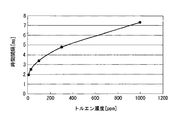
たとえば、本発明のガス検知装置で検知されるトルエンガスのガス濃度とトリガ信号T1およびT2の時間間隔の関係は、図6に示す特性図の通りである。 For example, the relationship between the gas concentration of toluene gas detected by the gas detector of the present invention and the time intervals of the trigger signals T1 and T2 is as shown in the characteristic diagram of FIG.
次に、ガス検知装置1のMCU50の動作処理について図5のフローチャートを参照しながら説明する。まず、ブリッジ駆動基準電圧Vrefを既定値に設定し、D/A変換してブリッジ駆動回路52へ出力する(ステップS1)。次に、停止(電源オフ)期間中吸着燃焼式ガスセンサ40に吸着されたガスを燃焼させるため、駆動パルス(図4)をHレベルにして所定の期間P1(たとえば、数10秒〜数分程度であるが、ここでは3分とする)だけ高温駆動する(ステップS2)。
Next, the operation process of the
次に、駆動パルスをLレベルにして、所定期間P2だけ低温駆動し、センサにガスを吸着させる(ステップS3)。なお、低温駆動する所定期間P2は、1秒〜30秒程度であるが、対象とするガスや濃度範囲により異なり、低濃度の検出ほど長く設定する。ここでは、所定期間P2は、30秒とする。 Next, the drive pulse is set to the L level, the temperature is driven for a predetermined period P2, and the gas is adsorbed by the sensor (step S3). The predetermined period P2 for low-temperature driving is about 1 to 30 seconds, but differs depending on the target gas and concentration range, and is set longer as the low concentration is detected. Here, the predetermined period P2 is 30 seconds.
次に、トリガ信号T1の発生時点からトリガ信号T2の発生時点までの期間(時間間隔)を計数するカウンタをリセットする(ステップS4)。次に、駆動パルスをHレベルにして高温駆動する(ステップS5)。この、ステップS5における高温駆動状態は、後述するようにステップS5〜S10の間維持される。次に、感応素子部Rsの温度が基準電圧Vref2で設定した値になり、T1が入力されるまで待機する(ステップS6)。 Next, the counter that counts the period (time interval) from the generation time of the trigger signal T1 to the generation time of the trigger signal T2 is reset (step S4). Next, the drive pulse is set to the H level to drive at a high temperature (step S5). The high temperature driving state in step S5 is maintained during steps S5 to S10 as will be described later. Next, it waits until the temperature of the sensitive element portion Rs reaches the value set by the reference voltage Vref2 and T1 is input (step S6).
次に、トリガ信号T1からトリガ信号T2までの期間を計数するカウンタをスタートさせる(ステップS7)。次に、補償素子部Rrの温度が基準電圧Vref2で設定した値になり、トリガ信号T2が入力されるまで待機する(ステップS8)。次に、トリガ信号T1からトリガ信号T2までの期間を計数するカウンタをストップする(ステップS9)。次に、カウンタで計数したカウント値を出力し(ステップS10)、次いでステップS3に戻り、再び、駆動パルスをLレベルにして、所定期間P2だけ低温駆動し、センサにガスを吸着させ、以後、ステップS4〜S10の動作を繰り返す。なお、ステップ5のHレベル高温駆動は、ステップS5〜S10を経てステップS3に戻りLレベル低温駆動を開始するまで維持され、図4で示す期間P3となるが、この期間P3は、ガス濃度に応じてトリガ信号T1からトリガ信号T2までの期間が変わるので、ガス濃度により変化する期間である。
Next, a counter that counts the period from the trigger signal T1 to the trigger signal T2 is started (step S7). Next, the process waits until the temperature of the compensation element portion Rr reaches the value set by the reference voltage Vref2 and the trigger signal T2 is input (step S8). Next, the counter that counts the period from the trigger signal T1 to the trigger signal T2 is stopped (step S9). Next, the count value counted by the counter is output (step S10), then the process returns to step S3, the drive pulse is again set to the L level, the temperature is driven at a low temperature for a predetermined period P2, and the gas is adsorbed by the sensor. The operations in steps S4 to S10 are repeated. Note that the H level high temperature driving in
以上説明したように、本発明によれば、以下の利点が得られる。
(1)高価な増幅器やA/D変換器が不要であるため、コストを低減できる。
(2)部品点数が減り、小型化が可能になる。
(3)時間の計測は、アナログ電圧を扱うよりも安定性がよく、高精度な検出ができる。
(4)センサの昇温中に検出が完了するため、高温駆動する時間を最低限に抑えることが可能で、消費電力とセンサ劣化を抑えることができる。
As described above, according to the present invention, the following advantages can be obtained.
(1) Since expensive amplifiers and A / D converters are unnecessary, the cost can be reduced.
(2) The number of parts is reduced, and downsizing is possible.
(3) Time measurement is more stable than analog voltage and can be detected with high accuracy.
(4) Since the detection is completed during the temperature rise of the sensor, it is possible to minimize the time for high temperature driving, and it is possible to suppress power consumption and sensor degradation.
以上の通り、本発明の実施の形態について説明したが、本発明はこれに限らず、種々の変形、応用が可能である。 As described above, the embodiment of the present invention has been described. However, the present invention is not limited to this, and various modifications and applications are possible.
1 ガス検知装置
40 吸着燃焼式ガスセンサ
Rs 感応素子部
Rr 補償素子部
50 MCU(マイコン)(計数手段)
52 ブリッジ駆動回路(駆動手段)
53 分圧回路
54 センサブリッジ回路
55 比較回路(第1のトリガ信号生成手段)
56 比較回路(第2のトリガ信号生成手段)
57 Rs保護用リミット回路(第1の制限手段)
58 Rr保護用リミット回路(第2の制限手段)
DESCRIPTION OF
52 Bridge drive circuit (drive means)
53
56 Comparison circuit (second trigger signal generating means)
57 Rs protection limit circuit (first limiting means)
58 Rr protection limit circuit (second limiting means)
Claims (3)
前記吸着燃焼式ガスセンサの感応素子部および補償素子部に、低温駆動するためのLレベルおよび高温駆動するためのHレベルの駆動電圧を交互に印加する駆動手段と、
前記高温駆動時の前記感応素子部からの検出電圧を基準電圧と比較し、その比較結果により第1のトリガ信号を生成する第1のトリガ信号生成手段と、
前記高温駆動時の前記補償素子部からの検出電圧を前記基準電圧と比較し、その比較結果により第2のトリガ信号を生成する第2のトリガ信号生成手段と、
前記第1のトリガ信号生成手段からの前記第1のトリガ信号と前記第2のトリガ信号生成手段からの前記第2のトリガ信号が入力され、両トリガ信号の時間間隔を計数する計数手段とを備え、
前記計数手段の計数結果に基づいて、ガス濃度を検知することを特徴とするガス検知装置。 A gas detection device using an adsorption combustion type gas sensor,
Driving means for alternately applying a driving voltage of L level for driving at low temperature and driving voltage of H level for driving at high temperature to the sensitive element section and the compensating element section of the adsorption combustion type gas sensor;
A first trigger signal generating means for comparing a detection voltage from the sensitive element unit during the high temperature driving with a reference voltage and generating a first trigger signal according to the comparison result;
A second trigger signal generating means for comparing a detection voltage from the compensation element unit during the high temperature driving with the reference voltage and generating a second trigger signal according to the comparison result;
Counting means for receiving the first trigger signal from the first trigger signal generating means and the second trigger signal from the second trigger signal generating means and counting a time interval between both trigger signals; Prepared,
A gas detection device that detects a gas concentration based on a counting result of the counting means.
前記高温駆動時の前記感応素子部からの検出電圧が高くなった場合に、前記検出電圧を所定の制限値以内に制限する第1の制限手段と、
前記高温駆動時の前記補償素子部からの検出電圧が高くなった場合に、前記検出電圧を所定の制限値以内に制限する第2の制限手段とをさらに備えたことを特徴とするガス検知装置。 The gas detection device according to claim 1,
First detection means for limiting the detection voltage within a predetermined limit value when the detection voltage from the sensitive element section during the high temperature driving becomes high;
And a second limiting means for limiting the detected voltage within a predetermined limit value when the detected voltage from the compensation element during the high temperature driving becomes high. .
前記吸着燃焼式ガスセンサの感応素子部および補償素子部に、低温駆動するためのLレベルおよび高温駆動するためのHレベルの駆動電圧を交互に印加し、
前記高温駆動時の前記感応素子部からの検出電圧が基準電圧を超えた時に発生する第1のトリガ信号と、前記高温駆動時の前記補償素子部からの検出電圧が前記基準電圧を超えた時に発生する第2のトリガ信号の時間間隔を計数し、
その計数結果に基づいて、ガス濃度を検知することを特徴とするガス検知方法。 A gas detection method using an adsorption combustion type gas sensor,
An L level drive voltage for driving at low temperature and an H level drive voltage for driving at high temperature are alternately applied to the sensitive element portion and the compensation element portion of the adsorption combustion type gas sensor,
A first trigger signal generated when a detection voltage from the sensitive element unit during the high temperature driving exceeds a reference voltage; and a detection voltage from the compensation element unit during the high temperature driving exceeds the reference voltage. Counting the time interval of the generated second trigger signal;
A gas detection method comprising detecting a gas concentration based on the counting result.
Priority Applications (1)
| Application Number | Priority Date | Filing Date | Title |
|---|---|---|---|
| JP2006113015A JP4787056B2 (en) | 2006-04-17 | 2006-04-17 | Gas detection device and gas detection method |
Applications Claiming Priority (1)
| Application Number | Priority Date | Filing Date | Title |
|---|---|---|---|
| JP2006113015A JP4787056B2 (en) | 2006-04-17 | 2006-04-17 | Gas detection device and gas detection method |
Publications (2)
| Publication Number | Publication Date |
|---|---|
| JP2007285841A true JP2007285841A (en) | 2007-11-01 |
| JP4787056B2 JP4787056B2 (en) | 2011-10-05 |
Family
ID=38757755
Family Applications (1)
| Application Number | Title | Priority Date | Filing Date |
|---|---|---|---|
| JP2006113015A Expired - Fee Related JP4787056B2 (en) | 2006-04-17 | 2006-04-17 | Gas detection device and gas detection method |
Country Status (1)
| Country | Link |
|---|---|
| JP (1) | JP4787056B2 (en) |
Cited By (4)
| Publication number | Priority date | Publication date | Assignee | Title |
|---|---|---|---|---|
| JP2009300088A (en) * | 2008-06-10 | 2009-12-24 | Yazaki Corp | Gas detector and secular change correcting method |
| JP2011058963A (en) * | 2009-09-10 | 2011-03-24 | Yazaki Corp | Gas detector |
| JP2011112442A (en) * | 2009-11-25 | 2011-06-09 | Yazaki Corp | Gas detector |
| CN108732212A (en) * | 2018-05-23 | 2018-11-02 | 重庆海士测控技术有限公司 | A kind of manufacturing method, sensor and its application of manifold effect detection integrated gas sensors manufacturing method |
Citations (6)
| Publication number | Priority date | Publication date | Assignee | Title |
|---|---|---|---|---|
| JPH02145956A (en) * | 1988-11-28 | 1990-06-05 | Yazaki Corp | gas detection device |
| JP2002168818A (en) * | 2000-12-01 | 2002-06-14 | Yazaki Corp | Gas detection device and gas detection method |
| JP2002168819A (en) * | 2000-12-01 | 2002-06-14 | Yazaki Corp | Gas detection device and gas detection method |
| JP2002168820A (en) * | 2000-12-05 | 2002-06-14 | Yazaki Corp | Smoke detector |
| JP2004069465A (en) * | 2002-08-06 | 2004-03-04 | Yazaki Corp | Gas detection method and device using adsorption combustion type gas sensor |
| JP2005221370A (en) * | 2004-02-05 | 2005-08-18 | Yazaki Corp | Gas detection method and apparatus using adsorption combustion type gas sensor |
-
2006
- 2006-04-17 JP JP2006113015A patent/JP4787056B2/en not_active Expired - Fee Related
Patent Citations (6)
| Publication number | Priority date | Publication date | Assignee | Title |
|---|---|---|---|---|
| JPH02145956A (en) * | 1988-11-28 | 1990-06-05 | Yazaki Corp | gas detection device |
| JP2002168818A (en) * | 2000-12-01 | 2002-06-14 | Yazaki Corp | Gas detection device and gas detection method |
| JP2002168819A (en) * | 2000-12-01 | 2002-06-14 | Yazaki Corp | Gas detection device and gas detection method |
| JP2002168820A (en) * | 2000-12-05 | 2002-06-14 | Yazaki Corp | Smoke detector |
| JP2004069465A (en) * | 2002-08-06 | 2004-03-04 | Yazaki Corp | Gas detection method and device using adsorption combustion type gas sensor |
| JP2005221370A (en) * | 2004-02-05 | 2005-08-18 | Yazaki Corp | Gas detection method and apparatus using adsorption combustion type gas sensor |
Cited By (5)
| Publication number | Priority date | Publication date | Assignee | Title |
|---|---|---|---|---|
| JP2009300088A (en) * | 2008-06-10 | 2009-12-24 | Yazaki Corp | Gas detector and secular change correcting method |
| JP2011058963A (en) * | 2009-09-10 | 2011-03-24 | Yazaki Corp | Gas detector |
| JP2011112442A (en) * | 2009-11-25 | 2011-06-09 | Yazaki Corp | Gas detector |
| CN108732212A (en) * | 2018-05-23 | 2018-11-02 | 重庆海士测控技术有限公司 | A kind of manufacturing method, sensor and its application of manifold effect detection integrated gas sensors manufacturing method |
| CN108732212B (en) * | 2018-05-23 | 2020-12-15 | 哈尔滨工程大学 | Manufacturing method, sensor and application of a method for manufacturing a multi-effect detection integrated gas sensor |
Also Published As
| Publication number | Publication date |
|---|---|
| JP4787056B2 (en) | 2011-10-05 |
Similar Documents
| Publication | Publication Date | Title |
|---|---|---|
| CN101865733B (en) | Circuits and methods and electronic system for temperature detection | |
| US6242928B1 (en) | Method and apparatus for detecting resistance of oxygen concentration sensor | |
| JP4787056B2 (en) | Gas detection device and gas detection method | |
| US20150155807A1 (en) | Auto calibration driver ic and its application motor driver system | |
| JPH0690062B2 (en) | Thermal flow velocity detector | |
| JP5991202B2 (en) | Control device for oxygen concentration sensor | |
| JP2009097925A (en) | Heat dissipation type flow sensor | |
| JP3779886B2 (en) | Humidity detector | |
| JP5330159B2 (en) | Gas detector | |
| JP3575573B2 (en) | Thermal air flow meter | |
| CN216144392U (en) | Sensor circuit, MCU level sensor and ink horn | |
| US10048240B2 (en) | Control apparatus | |
| JPH116751A (en) | Thermal flow meter | |
| JP4528638B2 (en) | Gas detector | |
| JP2001188056A (en) | Gas detector | |
| JP5385055B2 (en) | Gas detector | |
| JP3555013B2 (en) | Thermal flow meter | |
| JP3765534B2 (en) | Thermal flow meter | |
| JP2001188055A (en) | Gas detector | |
| JP5303196B2 (en) | Gas detector and aging correction method | |
| JP3992999B2 (en) | Charge current detection circuit | |
| JP3941805B2 (en) | Oxygen concentration sensor element impedance detector | |
| US20250297980A1 (en) | Gas sensor | |
| SU1645902A1 (en) | Method of determining velocity of gas or liquid flow | |
| JPH1096703A (en) | Heat conduction parameter sensing method with resistor, and sensor circuit |
Legal Events
| Date | Code | Title | Description |
|---|---|---|---|
| A621 | Written request for application examination |
Free format text: JAPANESE INTERMEDIATE CODE: A621 Effective date: 20090317 |
|
| A977 | Report on retrieval |
Free format text: JAPANESE INTERMEDIATE CODE: A971007 Effective date: 20110622 |
|
| TRDD | Decision of grant or rejection written | ||
| A01 | Written decision to grant a patent or to grant a registration (utility model) |
Free format text: JAPANESE INTERMEDIATE CODE: A01 Effective date: 20110712 |
|
| A01 | Written decision to grant a patent or to grant a registration (utility model) |
Free format text: JAPANESE INTERMEDIATE CODE: A01 |
|
| A61 | First payment of annual fees (during grant procedure) |
Free format text: JAPANESE INTERMEDIATE CODE: A61 Effective date: 20110714 |
|
| R150 | Certificate of patent or registration of utility model |
Free format text: JAPANESE INTERMEDIATE CODE: R150 |
|
| FPAY | Renewal fee payment (event date is renewal date of database) |
Free format text: PAYMENT UNTIL: 20140722 Year of fee payment: 3 |
|
| R250 | Receipt of annual fees |
Free format text: JAPANESE INTERMEDIATE CODE: R250 |
|
| LAPS | Cancellation because of no payment of annual fees |