JP2007197685A - Oxytitanium phthalocyanine composition and method for producing the same, electrophotographic photoreceptor, and image forming apparatus using the photoreceptor - Google Patents
Oxytitanium phthalocyanine composition and method for producing the same, electrophotographic photoreceptor, and image forming apparatus using the photoreceptor Download PDFInfo
- Publication number
- JP2007197685A JP2007197685A JP2006340646A JP2006340646A JP2007197685A JP 2007197685 A JP2007197685 A JP 2007197685A JP 2006340646 A JP2006340646 A JP 2006340646A JP 2006340646 A JP2006340646 A JP 2006340646A JP 2007197685 A JP2007197685 A JP 2007197685A
- Authority
- JP
- Japan
- Prior art keywords
- oxytitanium phthalocyanine
- solvent
- phthalocyanine composition
- ray diffraction
- diffraction spectrum
- Prior art date
- Legal status (The legal status is an assumption and is not a legal conclusion. Google has not performed a legal analysis and makes no representation as to the accuracy of the status listed.)
- Granted
Links
Images


Landscapes
- Photoreceptors In Electrophotography (AREA)
Abstract
【課題】電子ペーパー、有機電界発光素子、電子写真感光体などに用いる光電材料として適用した場合に好適な性能を有するオキシチタニウムフタロシアニン組成物とその製造方法、電気特性のうち特に感度に優れ、しかも残留電位の低い電子写真感光体、および該感光体を用いた画像形成装置を提供する。
【解決手段】CuKα特性X線による粉末X線回折スペクトルにおいて、ブラッグ角(2θ±0.2°)27.3°に最大回折ピークを示すオキシチタニウムフタロシアン組成物の製造方法であって、原料としてフタロニトリルと四塩化チタンを使用し、反応溶媒としてアリール基がアルキリデン基により連結された構造を有するジアリールアルカン溶媒を用いて、機械的磨砕処理により製造することを特徴とする、オキシチタニウムフタロシアニン組成物の製造方法。
【選択図】なしAn oxytitanium phthalocyanine composition having a suitable performance when applied as a photoelectric material for use in electronic paper, organic electroluminescent elements, electrophotographic photoreceptors, etc. An electrophotographic photoreceptor having a low residual potential and an image forming apparatus using the photoreceptor are provided.
A method for producing an oxytitanium phthalocyanine composition having a maximum diffraction peak at a Bragg angle (2θ ± 0.2 °) of 27.3 ° in a powder X-ray diffraction spectrum by CuKα characteristic X-rays, comprising: Oxytitanium phthalocyanine produced by mechanical grinding using phthalonitrile and titanium tetrachloride as a reaction solvent and a diarylalkane solvent having a structure in which an aryl group is linked by an alkylidene group as a reaction solvent A method for producing the composition.
[Selection figure] None
Description
本発明は、特に電子写真感光体に用いた際に、感度および残留電位に優れたオキシチタニウムフタロシアニン組成物とその製造方法、それを用いた電子写真感光体、および該感光体を用いた画像形成装置に関するものである。 The present invention relates to an oxytitanium phthalocyanine composition excellent in sensitivity and residual potential, a method for producing the same, an electrophotographic photoreceptor using the composition, and image formation using the photoreceptor, particularly when used for an electrophotographic photoreceptor. It relates to the device.
長波長の光に対して高感度な光導電特性を有するフタロシアニン類は、優れた光導電性材料として盛んに研究されてきた。特に電子写真用感光体、電子写真方式による製版材料、イメージセンサーなどの光電変換材料に好適に用いることができ、長波長の半導体レーザーや発光ダイオード用の電子写真感光体の電荷発生物質として利用されている。 Phthalocyanines having photoconductive properties with high sensitivity to long-wavelength light have been extensively studied as excellent photoconductive materials. In particular, it can be suitably used for electrophotographic photoreceptors, electrophotographic plate making materials, photoelectric conversion materials such as image sensors, and is used as a charge generation material for electrophotographic photoreceptors for long-wavelength semiconductor lasers and light-emitting diodes. ing.
フタロシアニン類は、中心金属の種類により吸収スペクトルや、光導電性などの物性が異なるだけでなく、結晶型によっても物性が大きく変化することが知られており、フタロシアニン類の中でも特にオキシチタニウムフタロシアニンは、高感度な光導電特性を有し、種々の結晶型のものが知られている。それらの中でも、CuKα特性X線に対する回折スペクトルにおいて、ブラッグ角(2θ±0.2°)27.3°に明瞭なピークを有する、いわゆるD型の結晶型のオキシチタニウムフタロシアニンが特に感度に優れることが知られている(例えば、特許文献1 参照)。 Phthalocyanines are known not only to have different physical properties such as absorption spectrum and photoconductivity depending on the type of central metal, but also to vary greatly depending on the crystal form. Among phthalocyanines, oxytitanium phthalocyanine is particularly Various crystal types having high photoconductive properties are known. Among them, so-called D-type crystalline oxytitanium phthalocyanine having a clear peak at a Bragg angle (2θ ± 0.2 °) of 27.3 ° in the diffraction spectrum for CuKα characteristic X-rays is particularly excellent in sensitivity. Is known (for example, see Patent Document 1).
オキシチタニウムフタロシアニンの製造法については様々なものが知られており、アリール基がアルキリデン基により連結された構造を有するジアリールアルカン溶媒中で反応を行なう例としては、ジフェニルメタンを反応溶媒として用いた例もあるが、原料として1,3−ジイミノイソインドリンとチタンテトラブトキシドを用いており、電気特性のうち特に感度の面で十分な性能のものではなかった(例えば、特許文献2 参照)。また、他に知られる製造方法では、原料としてフタロニトリルと四塩化チタンを用いているが、CuKα特性X線に対する粉末X線回折スペクトルにおいて、ブラッグ角(2θ±0.2°)27.3°に明瞭なピークを有する、いわゆるD型の結晶型のオキシチタニウムフタロシアニンの製造については記載がなく、記載されるオキシチタニウムフタロシアニンの感度は不十分なものであった(例えば、特許文献3 参照)。また、他にも、原料としてフタロニトリル、四塩化チタン、反応溶媒としてジフェニルメタンを用い、CuKα特性X線に対する粉末X線回折スペクトルにおいて、ブラッグ角(2θ±0.2°)27.3°に最大ピークを有する結晶型のオキシチタニウムフタロシアニンを製造した例もあるが、非晶質化の際に硫酸を用いたアシッドペースト法を用いており、本発明の非晶質化を機械的磨砕処理によって行う製造方法とは異なる(例えば、特許文献4 参照)。
種々の結晶構造が知られているオキシチタニウムフタロシアニンは、光電材料、特に電子写真感光体用の電荷発生物質として有用なものであり、特に、CuKα特性X線に対する粉末X線回折スペクトルにおけるブラッグ角(2θ±0.2°)27.3°に明瞭な回折ピークを有する結晶構造のオキシチタニウムフタロシアニンは、D型と呼ばれ、電子写真感光体の感光層に用いた場合特に感度に優れた感光体を与えることが知られているが、近年の画像形成速度の高速化等で感光体に要求される特性の向上要求に際して、その要求を十分に満足することができない場合があった。 Oxytitanium phthalocyanine, which has various crystal structures, is useful as a charge generation material for photoelectric materials, particularly electrophotographic photoreceptors. In particular, the Bragg angle in a powder X-ray diffraction spectrum for CuKα characteristic X-rays ( 2θ ± 0.2 °) Oxytitanium phthalocyanine having a crystal structure having a clear diffraction peak at 27.3 ° is called D-type, and is a photoconductor particularly excellent in sensitivity when used in a photosensitive layer of an electrophotographic photoconductor. However, there has been a case where it is not possible to sufficiently satisfy the demand for improvement in characteristics required of the photoreceptor due to the recent increase in image forming speed.
本発明の目的は、電子ペーパー、有機電界発光素子、電子写真感光体などに用いる光電材料として適用した場合に好適な性能を有するオキシチタニウムフタロシアニン組成物とその製造方法、電気特性のうち特に感度に優れ、しかも残留電位の低い電子写真感光体、および該感光体を用いた画像形成装置を提供することにある。 The object of the present invention is to provide an oxytitanium phthalocyanine composition having suitable performance when applied as a photoelectric material used in electronic paper, organic electroluminescent elements, electrophotographic photoreceptors, etc. An object of the present invention is to provide an electrophotographic photosensitive member that is excellent and has a low residual potential, and an image forming apparatus using the photosensitive member.
本発明者らは、CuKα特性X線による粉末X線回折スペクトルにおいて、ブラッグ角(2θ±0.2°)27.3°に最大回折ピークを示すオキシチタニウムフタロシアニン組成物を、原料としてフタロニトリル、および四塩化チタンを用い、反応溶媒としてアリール基がアルキリデン基により連結された構造を有するジアリールアルカン溶媒を用いて、機械的磨砕処理を行って製造することにより、光電特性に優れたオキシチタニウムフタロシアニンを再現よく製造できることを見いだし、更に、これを用いた電子写真感光体が、特に感度および残留電位に優れていることを見いだし、本発明を完成するに至った。 In the powder X-ray diffraction spectrum by CuKα characteristic X-rays, the present inventors have used an oxytitanium phthalocyanine composition showing a maximum diffraction peak at a Bragg angle (2θ ± 0.2 °) of 27.3 ° as a raw material, phthalonitrile, And titanium tetrachloride, and a diarylalkane solvent having a structure in which an aryl group is linked by an alkylidene group as a reaction solvent. Was found to be reproducible, and the electrophotographic photoreceptor using this was found to be particularly excellent in sensitivity and residual potential, and the present invention was completed.
すなわち、本発明の第一の要旨は、CuKα特性X線による粉末X線回折スペクトルにおいて、ブラッグ角(2θ±0.2°)27.3°に最大回折ピークを示すオキシチタニウムフタロシアン組成物の製造方法において、原料としてフタロニトリルと四塩化チタンを使用し、反応溶媒としてアリール基がアルキリデン基により連結された構造を有するジアリールアルカン溶媒を用いて、機械的磨砕処理により製造することを特徴とする、オキシチタニウムフタロシアニン組成物の製造方法に存し、本発明の第二の要旨は、CuKα特性X線による粉末X線回折スペクトルにおいて、ブラッグ角(2θ±0.2°)27.3°に最大回折ピークを示すオキシチタニウムフタロシアニンであって、原料としてフタロニトリルと四塩化チタンを使用し、反応溶媒としてアリール基がアルキリデン基により連結された構造を有するジアリールアルカン溶媒を用いて、機械的磨砕処理により製造されたことを特徴とする、オキシチタニウムフタロシアン組成物に存し、本発明の第三の要旨は、該オキシチタニウムフタロシアニン組成物を用いた電子写真感光体に存し、本発明の第四の要旨は、該電子写真感光体を用いた画像形成装置に存する。 That is, the first gist of the present invention is that an oxytitanium phthalocyanine composition showing a maximum diffraction peak at a Bragg angle (2θ ± 0.2 °) of 27.3 ° in a powder X-ray diffraction spectrum by CuKα characteristic X-rays. In the production method, phthalonitrile and titanium tetrachloride are used as raw materials, and a diarylalkane solvent having a structure in which an aryl group is linked by an alkylidene group is used as a reaction solvent. The second gist of the present invention is that the Bragg angle (2θ ± 0.2 °) is 27.3 ° in the powder X-ray diffraction spectrum by CuKα characteristic X-ray. Oxytitanium phthalocyanine showing the maximum diffraction peak, using phthalonitrile and titanium tetrachloride as raw materials, An oxytitanium phthalocyanine composition characterized by being produced by mechanical grinding using a diarylalkane solvent having a structure in which an aryl group is linked by an alkylidene group as a reaction solvent. A third gist lies in an electrophotographic photosensitive member using the oxytitanium phthalocyanine composition, and a fourth gist of the present invention lies in an image forming apparatus using the electrophotographic photoconductor.
本発明に係るオキシチタニウムフタロシアニンの製造法によれば、電子ペーパー、有機電界発光素子や電子写真感光体などに用いられる光電材料として好適なオキシチタニウムフタロシアニン組成物を、効率よく、再現よく、製造することができる。特に該オキシチタニウムフタロシアニン組成物を電子写真感光体に用いることにより、特に高感度で残留電位の低い電子写真感光体を提供することができ、好適な画像形成が可能な画像形成装置を提供することができる。 According to the method for producing oxytitanium phthalocyanine according to the present invention, an oxytitanium phthalocyanine composition suitable as a photoelectric material used for electronic paper, an organic electroluminescent element, an electrophotographic photoreceptor, and the like is efficiently and reproducibly produced. be able to. In particular, by using the oxytitanium phthalocyanine composition in an electrophotographic photoreceptor, an electrophotographic photoreceptor having particularly high sensitivity and a low residual potential can be provided, and an image forming apparatus capable of suitable image formation is provided. Can do.
以下、本発明の実施の形態につき詳細に説明するが、以下に記載する構成要件の説明は本発明の実施形態の代表例であって、本発明の趣旨を逸脱しない範囲において適宜変形して実施することができる。 Hereinafter, embodiments of the present invention will be described in detail. However, the description of the constituent elements described below is a representative example of the embodiments of the present invention, and is appropriately modified and implemented without departing from the spirit of the present invention. can do.
本発明に係るオキシチタニウムフタロシアニン組成物は、CuKα特性X線による粉末X線回折スペクトルにおいて、ブラッグ角(2θ±0.2°)27.3°に最大回折ピークを示すものである。該オキシチタニウムフタロシアニン組成物は、置換基を有するオキシチタニウムフタロシアニンなどの、各種オキシチタニウムフタロシアニン誘導体を含有していてもよい。置換基で置換されたオキシチタニウムフタロシアニンの有する置換基としては、塩素やフッ素などのハロゲン原子、ニトロ基、シアノ基、スルホン基が挙げられるが、好ましくはハロゲン原子を置換基として有するオキシチタニウムフタロシアニンを含有する組成物であり、特に好ましくは塩素原子を置換基として有するオキシチタニウムフタロシアニンを含有する組成物である。 The oxytitanium phthalocyanine composition according to the present invention exhibits a maximum diffraction peak at a Bragg angle (2θ ± 0.2 °) of 27.3 ° in a powder X-ray diffraction spectrum by CuKα characteristic X-ray. The oxytitanium phthalocyanine composition may contain various oxytitanium phthalocyanine derivatives such as oxytitanium phthalocyanine having a substituent. Examples of the substituent of oxytitanium phthalocyanine substituted with a substituent include halogen atoms such as chlorine and fluorine, nitro group, cyano group, and sulfone group. Preferably, oxytitanium phthalocyanine having a halogen atom as a substituent is used. A composition containing oxytitanium phthalocyanine having a chlorine atom as a substituent is particularly preferable.
<オキシチタニウムフタロシアニン組成物の製造>
本発明に係るオキシチタニウムフタロシアニン組成物は、原料としてフタロニトリルと四塩化チタンを用いるものであって、反応溶媒としてアリール基がアルキリデン基により連結された構造を有するジアリールアルカン溶媒を用いてジクロロチタニウムフタロシアニンを合成した後、該ジクロロチタニウムフタロシアニンを加水分解し、精製することにより、オキシチタニウムフタロシアニン中間体を製造し、得られたオキシチタニウムフタロシアニン中間体を非晶質化して得られた非晶質化オキシチタニウムフタロシアニンを溶媒中で結晶化することにより製造することができる。
<Production of oxytitanium phthalocyanine composition>
The oxytitanium phthalocyanine composition according to the present invention uses phthalonitrile and titanium tetrachloride as raw materials, and a dichlorotitanium phthalocyanine using a diarylalkane solvent having a structure in which an aryl group is connected by an alkylidene group as a reaction solvent. Then, the dichlorotitanium phthalocyanine is hydrolyzed and purified to produce an oxytitanium phthalocyanine intermediate, and the obtained oxytitanium phthalocyanine intermediate is made amorphous to obtain an amorphous oxy It can be produced by crystallizing titanium phthalocyanine in a solvent.
オキシチタニウムフタロシアニンは、通常、下記一般式[1]のような構造を有するが、原料としてフタロニトリルと四塩化チタンを用いた場合、オキシチタニウムフタロシアニンの一部が塩素化された、下記一般式[2]のような塩素化オキシチタニウムフタロシアニンとの組成物とすることもできる。 The oxytitanium phthalocyanine usually has a structure represented by the following general formula [1], but when phthalonitrile and titanium tetrachloride are used as raw materials, a part of the oxytitanium phthalocyanine is chlorinated and the following general formula [ 2] and a composition with chlorinated oxytitanium phthalocyanine.

この塩素化オキシチタニウムフタロシアニンの含有量は、マススペクトル強度比で測定することができる。この塩素化オキシチタニウムフタロシアニンの含有量は結晶型の制御性や光電特性にも関わりがあり、CuKα特性X線による粉末X線回折スペクトルにおいて、27.3°に最大回折ピークを示すオキシチタニウムフタロシアニン組成物の場合、この塩素化オキシチタニウムフタロシアニンの含有量は、0.007以上0.070以下が好適である。このマススペクトル強度比は0.015以上が好ましく、さらに好ましくは0.020以上である。また同様に0.060以下が好ましく、さらに好ましくは0.055以下である。マススペクトル強度比が小さすぎるとオキシチタニウムフタロシアニン組成物を製造する際に、本発明の目的とする結晶型とは異なる結晶型が混入する虞があり、そのような場合には当該オキシチタニウムフタロシアニン組成物を電子写真感光体に用いたときに感度低下を引き起こすことがある。またマススペクトル強度比が大きすぎるとオキシチタニウムフタロシアニン組成物中間体の結晶型成長が進み、非晶質化が困難となるために光電材料として好適な結晶型にすることができず、例えば電子写真感光体に用いた場合では高感度な電子写真感光体を得ることができない。 The content of the chlorinated oxytitanium phthalocyanine can be measured by a mass spectral intensity ratio. The content of this chlorinated oxytitanium phthalocyanine is related to crystal form controllability and photoelectric characteristics, and in the powder X-ray diffraction spectrum by CuKα characteristic X-ray, the composition of oxytitanium phthalocyanine shows a maximum diffraction peak at 27.3 °. In the case of a product, the content of the chlorinated oxytitanium phthalocyanine is preferably 0.007 or more and 0.070 or less. The mass spectral intensity ratio is preferably 0.015 or more, and more preferably 0.020 or more. Similarly, it is preferably 0.060 or less, more preferably 0.055 or less. If the mass spectral intensity ratio is too small, there is a possibility that a crystal form different from the target crystal form of the present invention may be mixed when producing the oxytitanium phthalocyanine composition. In such a case, the oxytitanium phthalocyanine composition When an object is used for an electrophotographic photoreceptor, sensitivity may be lowered. If the mass spectral intensity ratio is too large, the crystal type growth of the oxytitanium phthalocyanine composition intermediate proceeds and it becomes difficult to make it amorphous, so that it cannot be made into a suitable crystal type as a photoelectric material. When used as a photoreceptor, a highly sensitive electrophotographic photoreceptor cannot be obtained.
塩素化オキシチタニウムフタロシアニンの含有量が、0.007以上0.070以下であるオキシチタニウムフタロシアニン組成物を製造する方法をより具体的に説明する。原料としては、塩素化オキシチタニウムフタロシアニンの含有量を容易に制御可能であるという点で、フタロニトリルと四塩化チタンを用いる必要がある。まず、これらの原料を高沸点有機溶媒の存在下で加熱し反応させることにより、ジクロロチタニウムフタロシアニンを得る。このときの高沸点溶媒としては、オキシチタニウムフタロシアニン組成物に含まれる塩素化オキシチタニウムフタロシアニンの含有量を制御することができ、ハルツ状生成物の量が少なく、収率良くオキシチタニウムフタロシアニン組成物を得ることができる溶媒を選択することが重要であるが、フェニル基がアルキリデン基により連結された構造を有するジアリールアルカン溶媒である必要がある。アリール基がアルキリデン基により連結された構造を有するジアリールアルカン溶媒としては、反応温度において液体であるものであればどのようなものも使用することができるが、アリール基としては炭素数14以下のものが好ましく、より好ましくは炭素数10以下のアリール基であり、特にはフェニル基が好ましい。また、アルキリデン基としては、直鎖であっても枝分れ鎖を有していても構わないが、直鎖のものが好ましく、通常炭素数12以下であり、好ましくは炭素数6以下、より好ましくは炭素数3以下で、特にはメチレン基が好ましい。中でも、より安価に製造することが可能となる点で、ジフェニルメタンを用いることが特に好ましい。 A method for producing an oxytitanium phthalocyanine composition having a chlorinated oxytitanium phthalocyanine content of 0.007 or more and 0.070 or less will be described more specifically. As raw materials, it is necessary to use phthalonitrile and titanium tetrachloride in that the content of chlorinated oxytitanium phthalocyanine can be easily controlled. First, dichlorotitanium phthalocyanine is obtained by heating and reacting these raw materials in the presence of a high-boiling organic solvent. As the high boiling point solvent at this time, the content of the chlorinated oxytitanium phthalocyanine contained in the oxytitanium phthalocyanine composition can be controlled, the amount of the Harz-like product is small, and the oxytitanium phthalocyanine composition is obtained with good yield. Although it is important to select a solvent that can be obtained, it should be a diarylalkane solvent having a structure in which a phenyl group is linked by an alkylidene group. Any diarylalkane solvent having a structure in which an aryl group is linked by an alkylidene group can be used as long as it is liquid at the reaction temperature, but the aryl group has 14 or less carbon atoms. More preferably an aryl group having 10 or less carbon atoms, and particularly preferably a phenyl group. The alkylidene group may be linear or branched, but is preferably linear, usually having 12 or less carbon atoms, preferably 6 or less carbon atoms. The number of carbon atoms is preferably 3 or less, and a methylene group is particularly preferable. Among these, it is particularly preferable to use diphenylmethane because it can be manufactured at a lower cost.
フタロニトリルと四塩化チタンを原料として、フェニル基がアルキリデン基により連結された構造を有するジアリールアルカン溶媒を用いて合成した場合に、塩素化オキシチタニウムフタロシアニンの含有量を好適な0.007以上0.070以下に制御することができ、反応時のハルツ状生成物の量も少なく、収率良くオキシチタニウムフタロシアニン組成物を得ることができる。そして、当該オキシチタニウムフタロシアニン組成物を電子写真感光体として用いた場合、電気特性のうち、特に感度が向上する。特許第3463032号には、1,3−ジイミノイソインドリンとチタンテトラブトキシドをジフェニルメタン溶媒中で反応させるオキシチタニウムフタロシアニンの製造例が記載されているが、塩素源が存在しないため、塩素化オキシチタニウムフタロシアニンは存在しない。 When phthalonitrile and titanium tetrachloride are used as raw materials and synthesized using a diarylalkane solvent having a structure in which a phenyl group is linked by an alkylidene group, the content of chlorinated oxytitanium phthalocyanine is preferably 0.007 or more and 0.0. The oxytitanium phthalocyanine composition can be obtained in good yield with a low amount of Harz-like product during the reaction and a good yield. And when the said oxytitanium phthalocyanine composition is used as an electrophotographic photoreceptor, a sensitivity improves especially among electrical characteristics. Japanese Patent No. 3463032 describes a production example of oxytitanium phthalocyanine in which 1,3-diiminoisoindoline and titanium tetrabutoxide are reacted in a diphenylmethane solvent, but since there is no chlorine source, chlorinated oxytitanium There is no phthalocyanine.
原料の四塩化チタンは、通常、原料であるフタロニトリルと反応溶媒との混合体に添加される。この際の添加方法は、四塩化チタンの沸点以下であれば四塩化チタン等は直接添加しても、ジアリールアルカン溶媒と混合して添加しても良く、沸点以上の高温での添加であれば、ジアリールアルカン溶媒と混合して添加する。添加温度は、25℃から反応温度までが好ましいが、四塩化チタンを100℃以下の低温と180℃以上の高温で分割して添加すると、その添加量比によって、塩素化オキシチタニウムフタロシアニンの無置換オキシチタニウムフタロシアニンに対する割合を制御することができる。高温で添加すると塩素化オキシチタニウムフタロシアニンの含有量は少なくなる。 The raw material titanium tetrachloride is usually added to a mixture of the raw material phthalonitrile and the reaction solvent. In this case, the addition method may be such that titanium tetrachloride or the like may be added directly or mixed with a diarylalkane solvent as long as it is below the boiling point of titanium tetrachloride. Add in admixture with diarylalkane solvent. The addition temperature is preferably from 25 ° C. to the reaction temperature, but when titanium tetrachloride is added in portions at a low temperature of 100 ° C. or lower and a high temperature of 180 ° C. or higher, the chlorinated oxytitanium phthalocyanine is not substituted depending on the addition amount ratio. The ratio to oxytitanium phthalocyanine can be controlled. When added at a high temperature, the content of chlorinated oxytitanium phthalocyanine decreases.
反応温度は、通常150℃以上、好ましくは180℃以上、塩素化オキシチタニウムフタロシアニンの含有量を制御するために、より好ましくは190℃以上であって、通常300℃以下、好ましく250℃以下、より好ましくは230℃以下で行われる。 The reaction temperature is usually 150 ° C. or higher, preferably 180 ° C. or higher. In order to control the content of chlorinated oxytitanium phthalocyanine, more preferably 190 ° C. or higher, usually 300 ° C. or lower, preferably 250 ° C. or lower, more Preferably it is performed at 230 degrees C or less.
オキシチタニウムフタロシアニン組成物に含まれる、塩素化オキシチタニウムフタロシアニンの含有量を制御するため、反応温度に到達するための昇温時間は0.5〜4時間が好ましく、より好ましくは0.5〜3時間である。反応継続時間は1〜10時間が好ましく、より好ましくは2〜8時間であり、さらに好ましくは2〜6時間の範囲である。 In order to control the content of chlorinated oxytitanium phthalocyanine contained in the oxytitanium phthalocyanine composition, the temperature rising time for reaching the reaction temperature is preferably 0.5 to 4 hours, more preferably 0.5 to 3 It's time. The reaction duration is preferably 1 to 10 hours, more preferably 2 to 8 hours, and still more preferably 2 to 6 hours.
得られたジクロロチタニウムフタロシアニンは、加水分解処理を行い、オキシチタニウムフタロシアニン組成物中間体とするが、この際に用いられる溶媒としては、ブタノール、ペンタノール、ヘキサノール、オクタノール、シクロヘキサノール等のアルコール類、アセトフェノン、シクロヘキサノン、ヘキサンジオン等のケトン類、および水が挙げられ、これらの溶媒の混合物であっても構わない。使用する溶媒は、沸点が100℃以上であることが好ましく、混合溶媒を用いる場合には用いる溶媒のそれぞれが、沸点100℃以上であることが好ましいが、該混合溶媒が共沸混合物となる場合には共沸点温度が100℃以上であれば、沸点が100℃以下の溶媒との混合物でも好ましいものとなる。加水分解処理は、加熱して行なうことが好ましく、通常50℃以上、好ましくは70℃以上、より好ましくは80℃以上で行なうことが好ましい。 The obtained dichlorotitanium phthalocyanine is hydrolyzed to form an oxytitanium phthalocyanine composition intermediate, but the solvent used in this case is alcohols such as butanol, pentanol, hexanol, octanol, cyclohexanol, Examples thereof include ketones such as acetophenone, cyclohexanone, hexanedione, and water, and a mixture of these solvents may be used. The solvent to be used preferably has a boiling point of 100 ° C. or higher. When a mixed solvent is used, each of the solvents to be used preferably has a boiling point of 100 ° C. or higher, but the mixed solvent becomes an azeotrope. If the azeotropic temperature is 100 ° C. or higher, a mixture with a solvent having a boiling point of 100 ° C. or lower is also preferable. The hydrolysis treatment is preferably performed by heating, and is usually performed at 50 ° C. or higher, preferably 70 ° C. or higher, more preferably 80 ° C. or higher.
得られるオキシチタニウムフタロシアニン組成物中間体の結晶型は、種々のものが用いられるが、通常CuKα特性X線による粉末X線回折スペクトルにおいて、ブラッグ角(2θ±0.2°)7.6°,25.5°,28.6°に強い回折ピークを有する、通常B型と呼ばれるものである。しかしながら、該B型オキシチタニウムフタロシアニンには他の結晶型のフタロシアニン類が共存することが多いため、粉末X線回折スペクトルにおいて、他の結晶型のピークが実質上観察されなくなるまで繰り返し加水分解処理を行うことが好ましい。フタロシアニン類の他の結晶が残存すると、感度低下の要因となる。 Various crystal forms of the obtained oxytitanium phthalocyanine composition intermediate are used, but in a powder X-ray diffraction spectrum by CuKα characteristic X-ray, Bragg angle (2θ ± 0.2 °) 7.6 °, It has a strong diffraction peak at 25.5 ° and 28.6 ° and is usually called B-type. However, since the B-type oxytitanium phthalocyanine often coexists with other crystal types of phthalocyanines, it is repeatedly hydrolyzed until no other crystal type peaks are substantially observed in the powder X-ray diffraction spectrum. Preferably it is done. If other crystals of phthalocyanines remain, it becomes a factor of sensitivity reduction.
得られたオキシチタニウムフタロシアニン組成物中間体を、機械的磨砕方法により非晶質化する。非晶質化は化学的処理方法であるアシッドペースト法、アシッドスラリー法等で行うことも一般的であるが、これらを用いた場合、フタロシアニン化合物に対して化学的反応を起こしたり、フタロシアニン環の開裂による分子の破壊が起こる可能性があり、その影響で得られるオキシチタニウムフタロシアニン組成物の光導電特性に悪影響を及ぼすおそれがある。機械的磨砕は、例えばペイントシェーカー、自動乳鉢、遊星ミル、振動ボールミル、CFミル、ローラーミル、サンドグラインドミル、ニーダー等の装置を用いることができるが、これらに限定されるものではない。磨砕メディアとしては、ガラスビーズ、スチールビーズ、アルミナビーズ、ジルコニアビーズ等の公知の磨砕メディアを用いることができる。また、磨砕時に磨砕メディア以外に磨砕後容易に除去することのできる食塩、ぼう硝等の磨砕助剤を併用して実施することも可能である。また、上記処理法による磨砕は、乾式で磨砕を行っても、溶剤の共存下、湿式で磨砕を行っても良い。 The obtained oxytitanium phthalocyanine composition intermediate is made amorphous by a mechanical grinding method. Amorphization is generally performed by chemical treatment methods such as the acid paste method and the acid slurry method. However, when these are used, a chemical reaction is caused to the phthalocyanine compound or the phthalocyanine ring is formed. There is a possibility that the molecule is destroyed by the cleavage, which may adversely affect the photoconductive properties of the resulting oxytitanium phthalocyanine composition. For mechanical grinding, for example, an apparatus such as a paint shaker, an automatic mortar, a planetary mill, a vibrating ball mill, a CF mill, a roller mill, a sand grind mill, or a kneader can be used, but is not limited thereto. As the grinding media, known grinding media such as glass beads, steel beads, alumina beads, and zirconia beads can be used. In addition to grinding media, at the time of grinding, grinding aids such as sodium chloride and sodium hydroxide that can be easily removed after grinding can be used in combination. In addition, the grinding by the above treatment method may be performed by dry grinding or wet grinding in the presence of a solvent.
乾式磨砕を行った場合、乾式磨砕後、磨砕メディアから微結晶・アモルファス固体を分離した後、微結晶を溶媒を用い溶媒処理を行うことにより所望の結晶型に変換することができる。結晶型の変換に用いる溶媒には、公知の溶媒のいずれも用いることが可能である。公知の溶媒の例としては、例えば、ペンタン、ヘキサン、オクタン、ノナン等の飽和脂肪族系溶媒、トルエン、キシレン、メチルナフタレン、ジフェニルメタン、アニソール等の芳香族系溶媒、クロロベンゼン、ジクロロベンゼン、クロロナフタレン等のハロゲン化芳香族系溶媒、メタノール、エタノール、イソプロパノール、n−ブタノール、ベンジルアルコール等のアルコール系溶媒、グリセリン、ポリエチレングリコール等の脂肪族多価アルコール類、アセトン、シクロヘキサノン、メチルエチルケトン等の鎖状、及び環状ケトン系溶媒、ギ酸メチル、酢酸エチル、酢酸n−ブチル等のエステル系溶媒、塩化メチレン、クロロホルム、1,2−ジクロロエタン等のハロゲン化炭化水素系溶媒、ジエチルエーテル、ジメトキシエタン、テトラヒドロフラン、1,4−ジオキサン、メチルセルソルブ、エチルセルソルブ等の鎖状、及び環状エーテル系溶媒、ジメチルホルムアミド、N−メチル−2−ピロリドン、ジメチルスルホキシド、スルホラン、ヘキサメチルリン酸トリアミド等の非プロトン性極性溶媒、n−ブチルアミン、イソプロパノールアミン、ジエチルアミン、トリエタノールアミン、エチレンジアミン、トリエチレンジアミン、トリエチルアミン等の含窒素化合物、リグロイン等の鉱油、水などが挙げられ、結晶型の変換時の操作性、制御性を考慮すると、飽和脂肪族系溶媒、芳香族系溶媒、ハロゲン化芳香族系溶媒、アルコール系溶媒、鎖状、及び環状ケトン系溶媒、エステル系溶媒、鎖状、及び環状エーテル系溶媒、非プロトン性極性溶媒、水が好ましい。上記溶剤は、単独で用いても2種以上の混合溶剤として用いても良い。処理温度としては、用いる溶媒、混合溶媒の凝固点以上、沸点以下で行うことが可能であるが、安全性の面から、通常10℃以上200℃以下の範囲で行われる。使用溶媒の量としては、フタロシアニン組成物1部に対して、0.1重量部以上500重量部以下、生産性を考慮すると、1重量部以上250重量部以下の範囲で行うのが好ましい。 When dry grinding is performed, after dry grinding, fine crystals and amorphous solids are separated from the grinding media, and then the crystals are converted into a desired crystal form by solvent treatment using a solvent. Any known solvent can be used as the solvent used for the conversion of the crystal form. Examples of known solvents include, for example, saturated aliphatic solvents such as pentane, hexane, octane, and nonane, aromatic solvents such as toluene, xylene, methylnaphthalene, diphenylmethane, and anisole, chlorobenzene, dichlorobenzene, and chloronaphthalene. Halogenated aromatic solvents, alcohol solvents such as methanol, ethanol, isopropanol, n-butanol, and benzyl alcohol, aliphatic polyhydric alcohols such as glycerin and polyethylene glycol, chains such as acetone, cyclohexanone, and methyl ethyl ketone, and Cyclic ketone solvents, ester solvents such as methyl formate, ethyl acetate, n-butyl acetate, halogenated hydrocarbon solvents such as methylene chloride, chloroform, 1,2-dichloroethane, diethyl ether, dimethoxyethane, te Non-chains such as lahydrofuran, 1,4-dioxane, methyl cellosolve, ethyl cellosolve, and cyclic ether solvents, dimethylformamide, N-methyl-2-pyrrolidone, dimethyl sulfoxide, sulfolane, hexamethylphosphate triamide, etc. Protic polar solvents, n-butylamine, isopropanolamine, diethylamine, triethanolamine, nitrogen-containing compounds such as ethylenediamine, triethylenediamine, triethylamine, mineral oil such as ligroin, water, etc. Considering controllability, saturated aliphatic solvents, aromatic solvents, halogenated aromatic solvents, alcohol solvents, chain and cyclic ketone solvents, ester solvents, chain and cyclic ether solvents, An aprotic polar solvent, water is preferred. The said solvent may be used independently or may be used as 2 or more types of mixed solvents. The treatment temperature can be from the freezing point to the boiling point of the solvent to be used and the mixed solvent, but is usually in the range of 10 ° C. to 200 ° C. from the viewpoint of safety. The amount of the solvent used is preferably in the range of 0.1 to 500 parts by weight with respect to 1 part of the phthalocyanine composition, and in the range of 1 to 250 parts by weight in consideration of productivity.
湿式磨砕装置としては、ボールミル、アトライター、ロールミル、サンドミル、ホモミキサー等を用いることができるが、前記手段等に限定されるものではない。湿式磨砕に用いる溶剤としては、公知の溶媒のいずれも用いることが可能である。公知の溶媒の例としては、例えば、ペンタン、ヘキサン、オクタン、ノナン等の飽和脂肪族系溶媒、トルエン、キシレン、メチルナフタレン、ジフェニルメタン、アニソール等の芳香族系溶媒、クロロベンゼン、ジクロロベンゼン、クロロナフタレン等のハロゲン化芳香族系溶媒、メタノール、エタノール、イソプロパノール、n−ブタノール、ベンジルアルコール等のアルコール系溶媒、グリセリン、ポリエチレングリコール等の脂肪族多価アルコール類、アセトン、シクロヘキサノン、メチルエチルケトン等の鎖状、及び環状ケトン系溶媒、ギ酸メチル、酢酸エチル、酢酸n−ブチル等のエステル系溶媒、塩化メチレン、クロロホルム、1,2−ジクロロエタン等のハロゲン化炭化水素系溶媒、ジエチルエーテル、ジメトキシエタン、テトラヒドロフラン、1,4−ジオキサン、メチルセルソルブ、エチルセルソルブ等の鎖状、及び環状エーテル系溶媒、ジメチルホルムアミド、N−メチル−2−ピロリドン、ジメチルスルホキシド、スルホラン、ヘキサメチルリン酸トリアミド等の非プロトン性極性溶媒、n−ブチルアミン、イソプロパノールアミン、ジエチルアミン、トリエタノールアミン、エチレンジアミン、トリエチレンジアミン、トリエチルアミン等の含窒素化合物、リグロイン等の鉱油、水などが挙げられ、湿式磨砕時の操作性を考慮すると、飽和脂肪族系溶媒、芳香族系溶媒、ハロゲン化芳香族系溶媒、アルコール系溶媒、鎖状、及び環状ケトン系溶媒、エステル系溶媒、鎖状、及び環状エーテル系溶媒、非プロトン性極性溶媒、水が好ましい。上記溶剤は、単独で用いても2種以上の混合溶剤として用いても良い。使用溶剤の量としては、フタロシアニン組成物1部に対し、1重量部以上200重量部以下、生産性を考慮すると、3重量部以上100重量部以下が好ましい。処理温度としては、溶剤の凝固点以上、沸点以下で行うことができるが、安全性を考慮すると、10℃以上100℃以下が好ましい。湿式磨砕における溶剤処理は、必要に応じてガラスビーズ、アルミナビーズ、スチールビーズ、ジルコニアビーズ等の公知の磨砕メディアを用いてミリング処理を行ってもよい。 As the wet grinding apparatus, a ball mill, an attritor, a roll mill, a sand mill, a homomixer, or the like can be used, but it is not limited to the above means. Any known solvent can be used as the solvent for wet grinding. Examples of known solvents include, for example, saturated aliphatic solvents such as pentane, hexane, octane, and nonane, aromatic solvents such as toluene, xylene, methylnaphthalene, diphenylmethane, and anisole, chlorobenzene, dichlorobenzene, and chloronaphthalene. Halogenated aromatic solvents, alcohol solvents such as methanol, ethanol, isopropanol, n-butanol, and benzyl alcohol, aliphatic polyhydric alcohols such as glycerin and polyethylene glycol, chains such as acetone, cyclohexanone, and methyl ethyl ketone, and Cyclic ketone solvents, ester solvents such as methyl formate, ethyl acetate, n-butyl acetate, halogenated hydrocarbon solvents such as methylene chloride, chloroform, 1,2-dichloroethane, diethyl ether, dimethoxyethane, te Non-chains such as lahydrofuran, 1,4-dioxane, methyl cellosolve, ethyl cellosolve, and cyclic ether solvents, dimethylformamide, N-methyl-2-pyrrolidone, dimethyl sulfoxide, sulfolane, hexamethylphosphate triamide, etc. Examples include protic polar solvents, n-butylamine, isopropanolamine, diethylamine, triethanolamine, nitrogen-containing compounds such as ethylenediamine, triethylenediamine, and triethylamine, mineral oil such as ligroin, and water. Then, saturated aliphatic solvent, aromatic solvent, halogenated aromatic solvent, alcohol solvent, chain and cyclic ketone solvent, ester solvent, chain and cyclic ether solvent, aprotic polarity A solvent and water are preferable. The said solvent may be used independently or may be used as 2 or more types of mixed solvents. The amount of the solvent used is preferably 1 part by weight or more and 200 parts by weight or less with respect to 1 part of the phthalocyanine composition, and 3 parts by weight or more and 100 parts by weight or less in view of productivity. The treatment temperature can be not lower than the freezing point of the solvent and not higher than the boiling point, but is preferably 10 ° C. or higher and 100 ° C. or lower in view of safety. As the solvent treatment in wet grinding, milling may be performed using a known grinding media such as glass beads, alumina beads, steel beads, zirconia beads and the like, if necessary.
湿式磨砕後に行う溶剤処理に用いる溶剤としては、前記乾式磨砕後の結晶変換、結晶制御に用いることが可能である溶剤と同様の溶剤を用いることが可能である。 As the solvent used for the solvent treatment performed after the wet grinding, the same solvent as the solvent that can be used for crystal conversion and crystal control after the dry grinding can be used.
アモルファス化した後の溶剤処理の方法としては、得られたアモルファス組成物を溶媒中に分散撹拌することにより処理、またはアモルファス組成物を溶媒蒸気に曝すことにより処理を行っても良い。また、溶媒処理は、アモルファス組成物の他に、ガラスビーズ、スチールビーズ、アルミナビーズ等の磨砕メディアと共に溶剤処理をすることも可能である。 As a method of solvent treatment after amorphization, treatment may be performed by dispersing and stirring the obtained amorphous composition in a solvent, or by exposing the amorphous composition to solvent vapor. In addition to the amorphous composition, the solvent treatment can be performed together with grinding media such as glass beads, steel beads, and alumina beads.
<スペクトル強度比>
マススペクトルによる塩素化オキシチタニウムフタロシアニンの無置換オキシチタニウムフタロシアニンに対するスペクトル強度比は例えば以下の方法により測定することができる。
<Spectral intensity ratio>
The spectral intensity ratio of chlorinated oxytitanium phthalocyanine to unsubstituted oxytitanium phthalocyanine by mass spectrum can be measured, for example, by the following method.
・測定用試料の調製;
オキシチタニウムフタロシアニン組成物0.50gをガラスビーズ(粒径φ1.0mm〜φ1.4mm)30g、シクロヘキサノン10gと共に50mlガラス容器に入れ、ペイントシェーカーで3時間振とうし、オキシチタニウムフタロシアニン分散液を作製する。この分散液1μlを10mlサンプルびんに採取し、クロロホルム5mlを加えて1時間超音波発振装置にて分散し、測定用の10ppm分散液を調製する。
-Preparation of measurement samples;
Place 0.50 g of oxytitanium phthalocyanine composition in a 50 ml glass container together with 30 g of glass beads (particle size φ1.0 mm to φ1.4 mm) and 10 g of cyclohexanone, and shake with a paint shaker for 3 hours to prepare an oxytitanium phthalocyanine dispersion. . Collect 1 μl of this dispersion in a 10 ml sample bottle, add 5 ml of chloroform, and disperse with an ultrasonic oscillator for 1 hour to prepare a 10 ppm dispersion for measurement.
・測定装置および測定条件;
マススペクトルの測定装置には、JEOL製 JMS−700を使用し、イオン化モード:DCI(−),反応ガス:イソブタン(イオン化室圧力1×10⁻⁵Torr),昇温条件:0→0.95A(1A/min),加速電圧:8.0KV,質量分析能:2000,スキャン法:MF−Linear,スキャン質量範囲:500〜680,全質量範囲スキャン時間:0.8秒,くり返し時間:0.5秒(スキャン時間0.05秒、待ち時間0.45秒)の測定条件で測定する。
-Measuring equipment and measuring conditions;
JMS-700 manufactured by JEOL is used as a mass spectrum measuring apparatus, ionization mode: DCI (−), reaction gas: isobutane (
・塩素化オキシチタニウムフタロシアニンの強度比;
測定用分散液1μlをDCIプローブのフィラメントに塗布し、マススペクトル測定を上記条件で実施した。得られたマススペクトルにおいて塩素化オキシチタニウムフタロシアニンの分子イオンに相当するm/Z:610および無置換オキシチタニウムフタロシアニンの分子イオンに相当するm/Z:576のイオンクロマトから得られるピーク面積の比([610]ピーク面積/[576]ピーク面積)をスペクトル強度比として算出する。
・ Strength ratio of chlorinated oxytitanium phthalocyanine;
1 μl of the measurement dispersion was applied to a filament of a DCI probe, and mass spectrum measurement was performed under the above conditions. Ratio of peak areas obtained from ion chromatography of m / Z: 610 corresponding to the molecular ion of chlorinated oxytitanium phthalocyanine and m / Z: 576 corresponding to the molecular ion of unsubstituted oxytitanium phthalocyanine in the obtained mass spectrum ( [610] peak area / [576] peak area) is calculated as the spectral intensity ratio.
本発明のフタロニトリルと四塩化チタンを用い反応溶媒としてジアリールアルカン溶媒を用いた製造方法では、オキシチタニウムフタロシアニン組成物に含まれる塩素化オキシチタニウムフタロシアニンの含有量を好適な0.007以上0.070以下に制御することが容易にできる。 In the production method using phthalonitrile and titanium tetrachloride of the present invention and a diarylalkane solvent as a reaction solvent, the content of chlorinated oxytitanium phthalocyanine contained in the oxytitanium phthalocyanine composition is preferably 0.007 or more and 0.070. The following can be easily controlled.
<X線回折スペクトル>
オキシチタニウムフタロシアニン組成物のCuKα特性X線に対する粉末回折スペクトルは、通常固体の粉末X線回折測定に用いられる方法に従って測定することができる。得られた本発明のオキシチタニウムフタロシアニン組成物はCuKα特性X線による粉末X線回折スペクトルにおいてブラッグ角(2θ±0.2°)27.3°に最大回折スペクトルを示す。これらの中でもブラッグ角(2θ±0.2°)26.3°には強い回折ピークを有さないものが好ましい。
<X-ray diffraction spectrum>
The powder diffraction spectrum for CuKα characteristic X-rays of the oxytitanium phthalocyanine composition can be measured according to a method usually used for powder X-ray diffraction measurement of solids. The obtained oxytitanium phthalocyanine composition of the present invention shows a maximum diffraction spectrum at a Bragg angle (2θ ± 0.2 °) of 27.3 ° in a powder X-ray diffraction spectrum by CuKα characteristic X-ray. Among these, those having no strong diffraction peak at a Bragg angle (2θ ± 0.2 °) of 26.3 ° are preferable.
本発明のオキシチタニウムフタロシアニン組成物を用いた電子写真感光体の感光層のCuKα特性X線に対する薄膜X線回折スペクトルは、粉末状態の配向性を維持して、ブラッグ角(2θ±0.2°)9.0°〜9.8°に少なくとも1つの強い回折ピーク、および27.3°に強い回折ピークを示し、且つ27.3°のピーク強度が9.0°〜9.8°中の最大ピークのピーク強度より10%以上大きく、しかも27.3°のピーク強度が全回折ピーク中で最大の回折ピークである。そして感光層のCuKα特性X線に対する薄膜X線回折スペクトルにおけるブラッグ角(2θ±0.2°)27.3°のピーク強度が9.0°〜9.8°中の最大ピークのピーク強度の115%よりも大きい方が好ましく、より好ましくは、125%よりも大きく、さらに好ましくは、130%よりも大きい。これは高感度となるからである。しかし、大きすぎると、分散に問題が生じる可能性がある為、27.3°のピーク強度が9.0°〜9.8°中の最大ピークのピーク強度の300%よりも小さいものが好ましく、より好ましくは、250%よりも小さく、さらに好ましくは200%よりも小さい。 The thin film X-ray diffraction spectrum for the CuKα characteristic X-ray of the photosensitive layer of the electrophotographic photosensitive member using the oxytitanium phthalocyanine composition of the present invention maintains the orientation in the powder state, and the Bragg angle (2θ ± 0.2 ° ) At least one strong diffraction peak at 9.0 ° to 9.8 ° and a strong diffraction peak at 27.3 °, and a peak intensity of 27.3 ° is in the range of 9.0 ° to 9.8 ° The peak intensity is 10% or more larger than the peak intensity of the maximum peak, and the peak intensity of 27.3 ° is the maximum diffraction peak among all diffraction peaks. The peak intensity of the Bragg angle (2θ ± 0.2 °) 27.3 ° in the thin film X-ray diffraction spectrum with respect to the CuKα characteristic X-ray of the photosensitive layer is the peak intensity of the maximum peak in the range of 9.0 ° to 9.8 °. It is preferably greater than 115%, more preferably greater than 125%, and even more preferably greater than 130%. This is because of high sensitivity. However, if it is too large, there may be a problem in dispersion. Therefore, it is preferable that the peak intensity at 27.3 ° is smaller than 300% of the peak intensity of the maximum peak at 9.0 ° to 9.8 °. More preferably, it is smaller than 250%, More preferably, it is smaller than 200%.
本発明に係るオキシチタニウムフタロシアニン組成物を、電子写真感光体などの光電デバイスに使用する場合には、オキシチタニウムフタロシアニン組成物は、通常バインダー樹脂により層状に結着される。該層のCuKα特性X線による回折スペクトルは、該層自体のX線回折スペクトルを得ることができる方法であればどのような方法で測定しても構わないが、一例としては、感光層をガラス面上に形成し測定する方法が挙げられる。より具体的に、電子写真感光体の感光層のCuKα特性X線による回折スペクトルを測定する方法の一例を以下に示す。 When the oxytitanium phthalocyanine composition according to the present invention is used for a photoelectric device such as an electrophotographic photosensitive member, the oxytitanium phthalocyanine composition is usually bound in a layer form with a binder resin. The diffraction spectrum by CuKα characteristic X-ray of the layer may be measured by any method as long as it can obtain the X-ray diffraction spectrum of the layer itself. The method of forming on a surface and measuring is mentioned. More specifically, an example of a method for measuring a diffraction spectrum by CuKα characteristic X-ray of the photosensitive layer of the electrophotographic photosensitive member will be described below.
1.サンプル作成方法;
無反射カバーガラスに10μm以上の膜厚となるよう感光層形成用塗布液を塗布し乾燥する。
1. Sample preparation method;
A photosensitive layer forming coating solution is applied to the non-reflective cover glass so as to have a film thickness of 10 μm or more and dried.
2.測定装置および測定条件;
測定装置としては、人工多層膜ミラーにて単色平行化したCuKα線を線源とした薄膜試料用の回折計(株式会社リガク製 自動X線回折装置 RINT2000)、を用いた。測定条件は、X線出力50kV,250mA、固定入射角(θ)1.0°、走査範囲(2θ)3〜40°、スキャンステップ幅0.05°、入射ソーラースリット5.0°、入射スリット0.1mm、受光ソーラースリット0.1°で回折スペクトルを測定する。
2. Measuring equipment and measuring conditions;
As a measuring apparatus, a diffractometer for a thin film sample (automatic X-ray diffractometer RINT2000, manufactured by Rigaku Co., Ltd.) using CuKα rays monochromatically paralleled by an artificial multilayer mirror was used. Measurement conditions are:
3.ピーク強度について;
ピーク強度とは、得られたスペクトルのチャート上のピークの高さを表す。オキシチタニウムフタロシアニンの結晶構造解析によれば、ブラッグ角(2θ±0.2°)27.3°のピークはc軸方向に重なり合ったオキシチタニウムフタロシアニンのスタッキング距離を示し、この強度比が大きいほどc軸配向性が高いことが示唆されている。したがって、いわゆるD型オキシチタニウムフタロシアニンはc軸配向性を有する結晶と推定できる。しかしながら、従来知られたD型オキシチタニウムフタロシアニンは、層中に分散処理されると9.0゜〜9.8°中のピークが最大ピークとなり、感光層中では等方的な配列を示すものであった。これに対し、本発明のオキシチタニウムフタロシアニン組成物は、層中に分散された後も27.3゜のピークが最大であって、微細化処理してもc軸配向性が保たれる。そのため、従来のフタロシアニンより高感度を示すものと考えられる。
3. About peak intensity;
The peak intensity represents the height of a peak on the chart of the obtained spectrum. According to the crystal structure analysis of oxytitanium phthalocyanine, the peak at the Bragg angle (2θ ± 0.2 °) of 27.3 ° indicates the stacking distance of oxytitanium phthalocyanine overlapping in the c-axis direction. It is suggested that the axial orientation is high. Therefore, it can be estimated that so-called D-type oxytitanium phthalocyanine is a crystal having c-axis orientation. However, conventionally known D-type oxytitanium phthalocyanine has a maximum peak at 9.0 ° to 9.8 ° when dispersed in the layer, and shows an isotropic arrangement in the photosensitive layer. Met. On the other hand, the oxytitanium phthalocyanine composition of the present invention has a maximum peak of 27.3 ° even after being dispersed in the layer, and the c-axis orientation is maintained even when it is refined. Therefore, it is considered that the sensitivity is higher than that of conventional phthalocyanine.
<電子写真感光体>
本発明に係るオキシチタニウムフタロシアニン組成物の産業上の利用可能性として、電子写真感光体への適用がある。本発明の電子写真感光体は、導電性支持体上に、本発明に係るオキシチタニウムフタロシアニン組成物を含有する感光層を設けたものであれば、その詳細な構成は制限されない。以下、代表的な構成について説明する。
<Electrophotographic photoreceptor>
Industrial applicability of the oxytitanium phthalocyanine composition according to the present invention includes application to electrophotographic photoreceptors. The electrophotographic photoreceptor of the present invention is not limited in its detailed configuration as long as a photosensitive layer containing the oxytitanium phthalocyanine composition according to the present invention is provided on a conductive support. A typical configuration will be described below.
<導電性支持体>
本発明で用いる導電性支持体としては、周知の電子写真感光体に採用されているものがいずれも使用できる。具体的には例えば、アルミニウム、ステンレス鋼、銅、ニッケル等の金属材料からなるドラム、シートあるいはこれらの金属箔のラミネート物、蒸着物、あるいは表面にアルミニウム、銅、パラジウム、酸化すず、酸化インジウム等の導電性層を設けたポリエステルフィルム、紙等の絶縁性支持体が挙げられる。更に、金属粉末、カーボンブラック、ヨウ化銅、高分子電解質等の導電性物質を適当なバインダーとともに塗布して導電処理したプラスチックフィルム、プラスチックドラム、紙、紙管等が挙げられる。また、金属粉末、カーボンブラック、炭素繊維等の導電性物質を含有し、導電性となったプラスチックのシートやドラムが挙げられる。そして、酸化スズ、酸化インジウム等の導電性金属酸化物で導電処理したプラスチックフィルムやベルトが挙げられる。
<Conductive support>
As the conductive support used in the present invention, any of those used in known electrophotographic photoreceptors can be used. Specifically, for example, drums, sheets made of metal materials such as aluminum, stainless steel, copper, nickel, etc., laminates or vapor depositions of these metal foils, or aluminum, copper, palladium, tin oxide, indium oxide on the surface, etc. Insulating supports such as polyester film and paper provided with a conductive layer. Furthermore, a plastic film, a plastic drum, paper, a paper tube, and the like obtained by applying a conductive material such as metal powder, carbon black, copper iodide, and a polymer electrolyte together with an appropriate binder to conduct a conductive treatment may be used. Further, a plastic sheet or drum containing a conductive material such as metal powder, carbon black, or carbon fiber and becoming conductive can be used. Examples thereof include a plastic film and a belt subjected to conductive treatment with a conductive metal oxide such as tin oxide and indium oxide.
なかでもアルミニウム等の金属のエンドレスパイプが好ましい支持体である。アルミニウムまたはその合金のエンドレスパイプは、押し出し、引き抜き、しごき等の加工により成形される。成形したものをそのまま用いても良いし、更に切削、研削、研磨などの加工を加えたものでも良い。導電性支持体の表面には、画質に影響のない範囲で、例えば酸化処理や薬品処理等の各種の処理を施すことができる。 Among these, an endless pipe made of metal such as aluminum is a preferable support. An endless pipe made of aluminum or its alloy is formed by processing such as extrusion, drawing, and ironing. What was shape | molded may be used as it is, and what added processes, such as cutting, grinding, and grinding | polishing further, may be used. The surface of the conductive support can be subjected to various treatments such as oxidation treatment and chemical treatment within a range that does not affect the image quality.
<ブロッキング層>
導電性基体と感光層との間には、通常使用されるような公知のブロッキング層が設けられていてもよい。ブロッキング層としては、例えばアルミニウムの陽極酸化被膜、酸化アルミニウム、水酸化アルミニウム等の無機層、ポリビニルメチルエーテル、ポリ−N−ビニルイミダゾール、ポリエチレンオキシド、エチルセルロース、メチルセルロース、エチレン−アクリル酸共重合体、ポリエチレン、ポリエステル、フェノール樹脂、塩化ビニル−酢酸ビニル共重合体、エポキシ樹脂、ポリビニルピリジン、ポリウレタン、ポリグルタミン酸、ポリビニルアルコール、カゼイン、ポリビニルピロリドン、ポリアクリル酸、セルロース類、ゼラチン、デンプン、ポリウレタン、ポリイミド、ポリアミド等の有機層が使用される。有機層をブロッキング層として用いる場合には、単独あるいはチタニア、アルミナ、シリカ、酸化ジルコニウム等の金属酸化物あるいは銅、銀、アルミニウム等の金属微粉末を分散させてもよい。
<Blocking layer>
A known blocking layer that is usually used may be provided between the conductive substrate and the photosensitive layer. Examples of the blocking layer include an anodized aluminum film, an inorganic layer such as aluminum oxide and aluminum hydroxide, polyvinyl methyl ether, poly-N-vinylimidazole, polyethylene oxide, ethyl cellulose, methyl cellulose, an ethylene-acrylic acid copolymer, and polyethylene. , Polyester, phenolic resin, vinyl chloride-vinyl acetate copolymer, epoxy resin, polyvinylpyridine, polyurethane, polyglutamic acid, polyvinyl alcohol, casein, polyvinylpyrrolidone, polyacrylic acid, celluloses, gelatin, starch, polyurethane, polyimide, polyamide An organic layer such as is used. When the organic layer is used as a blocking layer, metal oxides such as titania, alumina, silica, and zirconium oxide, or metal fine powders such as copper, silver, and aluminum may be dispersed.
また、ブロッキング層には、特にレーザー露光における干渉縞を防ぐ目的で、アルミナ、チタニア、シリカ等の金属酸化物微粒子や、使用するレーザー光波長を吸収することのできる有機または無機の色素、顔料粒子等を含有させてもよい。 The blocking layer has metal oxide fine particles such as alumina, titania and silica, and organic or inorganic dyes or pigment particles capable of absorbing the wavelength of the laser light used, particularly for the purpose of preventing interference fringes in laser exposure. Etc. may be included.
これらのブロッキング層の膜厚は便宜設定できるが、通常0.05μm以上20μm以下、好ましくは0.1μm以上10μm以下の範囲である。 The thickness of these blocking layers can be set conveniently, but is usually in the range of 0.05 μm to 20 μm, preferably 0.1 μm to 10 μm.
バインダー樹脂に対する、金属酸化物粒子または、色素、顔料粒子の含有割合は特に制限はないが、バインダー100重量部に対して、40重量部以上400重量部以下の範囲で使用することが、ブロッキング層を塗布する際の分散安定性、保存安定性、塗布性等の面で好ましい。 The content ratio of the metal oxide particles, dyes, or pigment particles to the binder resin is not particularly limited, but the blocking layer can be used in the range of 40 to 400 parts by weight with respect to 100 parts by weight of the binder. It is preferable in terms of dispersion stability, storage stability, applicability, and the like when coating.
<感光層>
電子写真感光体の感光層は、電荷発生物質、電荷輸送物質およびバインダー樹脂を単一の層に含むような単層構造(以下、単層型感光体ということがある)でもよいし、電荷発生物質を含有する電荷発生層と電荷輸送物質を含有する電荷輸送層を積層した積層構造(以下、積層型感光体ということがある)でも構わない。該感光層は、本発明に係るオキシチタニウムフタロシアニン組成物を、他の電荷発生物質、電荷輸送物質、バインダー樹脂、溶媒等の他の原料とともに、サンドグラインドミル、ボールミル、アトライター、超音波発信装置等の分散機で分散させる等の公知の分散方法により得られた感光層形成用塗布液を、導電性支持体上に塗布し乾燥することによって形成することができる。特に、オキシチタニウムフタロシアニンとバインダー樹脂を含有する液を、サンドグラインドミル、および/または超音波発振装置により処理することにより得られる前記塗布液を導電性支持体上に塗布し乾燥することによって感光層を形成するのが好ましい。
<Photosensitive layer>
The photosensitive layer of the electrophotographic photosensitive member may have a single layer structure (hereinafter sometimes referred to as a single layer type photosensitive member) in which a charge generating substance, a charge transporting substance, and a binder resin are contained in a single layer, or a charge generating substance. A stacked structure in which a charge generation layer containing a substance and a charge transport layer containing a charge transport substance are stacked (hereinafter sometimes referred to as a stacked type photoreceptor) may be used. The photosensitive layer comprises the oxytitanium phthalocyanine composition according to the present invention together with other raw materials such as a charge generating material, a charge transporting material, a binder resin, and a solvent, as well as a sand grind mill, a ball mill, an attritor, and an ultrasonic transmission device. It can be formed by applying a coating solution for forming a photosensitive layer obtained by a known dispersion method such as dispersing with a dispersing machine such as a coating on a conductive support and drying. In particular, the photosensitive layer is obtained by applying the coating liquid obtained by treating a liquid containing oxytitanium phthalocyanine and a binder resin with a sand grind mill and / or an ultrasonic oscillator on a conductive support and drying it. Is preferably formed.
・電荷発生物質;
電荷発生物質としては、本発明に係るオキシチタニウムフタロシアニン組成物を用いるが、本発明に係るオキシチタニウムフタロシアニン組成物とは異なる、公知の他の電荷発生物質を併用しても構わない。併用する電荷発生物質としては、例えば、フタロシアニン顔料、アゾ顔料、キナクリドン顔料、インジゴ顔料、ペリレン顔料、多環キノン顔料、アントアントロン顔料、ベンズイミダゾール顔料、スクワリウム顔料などの各種光導電性材料が挙げられる。
-Charge generating materials;
As the charge generation material, the oxytitanium phthalocyanine composition according to the present invention is used, but other known charge generation materials different from the oxytitanium phthalocyanine composition according to the present invention may be used in combination. Examples of the charge generating material used in combination include various photoconductive materials such as phthalocyanine pigment, azo pigment, quinacridone pigment, indigo pigment, perylene pigment, polycyclic quinone pigment, anthanthrone pigment, benzimidazole pigment, and squalium pigment. .
・電荷輸送物質;
電荷輸送物質としては、ポリビニルカルバゾール、ポリビニルピレン、ポリグリシジルカルバゾール、ポリアセナフチレン等の高分子化合物、またはインドール誘導体、イミダゾール誘導体、ピラゾール誘導体、ピラゾリン誘導体、オキサジアゾール誘導体、オキサゾール誘導体、チアジアゾール誘導体等の複素環化合物、アニリン誘導体、ヒドラゾン誘導体、カルバゾール誘導体、スチルベン誘導体、ブタジエン誘導体、アリールアミン誘導体等の低分子化合物、もしくはこれらが複数結合されたものが使用でき、これらの中でも、ヒドラゾン誘導体、カルバゾール誘導体、スチルベン誘導体、ブタジエン誘導体、アリールアミン誘導体、もしくはこれらが複数結合されたものが好適に用いられる。これらの電荷輸送物質は、単独でも、いくつかを混合して用いてもよい。
-Charge transport materials;
Examples of the charge transport material include polymer compounds such as polyvinyl carbazole, polyvinyl pyrene, polyglycidyl carbazole, polyacenaphthylene, or indole derivatives, imidazole derivatives, pyrazole derivatives, pyrazoline derivatives, oxadiazole derivatives, oxazole derivatives, thiadiazole derivatives, etc. Heterocyclic compounds, aniline derivatives, hydrazone derivatives, carbazole derivatives, stilbene derivatives, butadiene derivatives, arylamine derivatives and other low molecular weight compounds, or those in which a plurality of these are bonded, among these hydrazone derivatives, carbazole derivatives , Stilbene derivatives, butadiene derivatives, arylamine derivatives, or those in which a plurality of these are bonded are preferably used. These charge transport materials may be used alone or in combination.
・積層型感光体;
積層型感光体の電荷発生層に用いられるバインダー樹脂に制限はなく、スチレン、酢酸ビニル、塩化ビニル、アクリル酸エステル、メタクリル酸エステル、ビニルアルコール、エチルビニルエーテル等のビニル化合物の重合体または共重合体、ポリビニルアセタール樹脂、ポリカーボネート樹脂、ポリアミド樹脂、セルロースエーテル樹脂、ポリウレタン樹脂、ポリエステル樹脂、ポリアリレート樹脂、フェノキシ樹脂、ケイ素樹脂、エポキシ樹脂等が挙げられる。バインダー樹脂は、これらの樹脂の中の1種だけを用いても良いし、2種類以上の混合物であっても構わない。これらの樹脂の中でも、ポリビニルアセタール樹脂、フェノキシ樹脂が好適に用いられる。
・ Laminated photoreceptors;
There is no limitation on the binder resin used in the charge generation layer of the multilayer photoreceptor, and a polymer or copolymer of vinyl compounds such as styrene, vinyl acetate, vinyl chloride, acrylic acid ester, methacrylic acid ester, vinyl alcohol, and ethyl vinyl ether. , Polyvinyl acetal resin, polycarbonate resin, polyamide resin, cellulose ether resin, polyurethane resin, polyester resin, polyarylate resin, phenoxy resin, silicon resin, epoxy resin and the like. As the binder resin, only one kind of these resins may be used, or a mixture of two or more kinds may be used. Among these resins, polyvinyl acetal resin and phenoxy resin are preferably used.
電荷発生層形成用塗布液に用いる溶剤としては、メタノール、エタノール、プロパノールのようなアルコール類、テトラヒドロフラン、1,4−ジオキサン、1,2−ジメトキシエタンのようなエーテル類、メチルエチルケトン、シクロヘキサノン、4−メトキシ−4−メチル−2−ペンタノンのようなケトン類、トルエン、キシレンのような炭化水素類、ジクロロメタン、クロロホルム、1,2−ジクロロエタン等の塩素化炭化水素類等が挙げられる。これらの溶媒の中から1種だけを用いても良いし、2種類以上の混合物であっても構わない。これらの溶媒の中でも、1,2−ジメトキシエタン、4−メトキシ−4−メチル−2−ペンタノンが好ましい。本発明のオキシチタニウムフタロシアニン組成物の結晶安定性を高めるからである。 Solvents used in the coating solution for forming the charge generation layer include alcohols such as methanol, ethanol and propanol, ethers such as tetrahydrofuran, 1,4-dioxane and 1,2-dimethoxyethane, methyl ethyl ketone, cyclohexanone, 4- Examples include ketones such as methoxy-4-methyl-2-pentanone, hydrocarbons such as toluene and xylene, and chlorinated hydrocarbons such as dichloromethane, chloroform, and 1,2-dichloroethane. Only one of these solvents may be used, or a mixture of two or more may be used. Among these solvents, 1,2-dimethoxyethane and 4-methoxy-4-methyl-2-pentanone are preferable. This is because the crystal stability of the oxytitanium phthalocyanine composition of the present invention is enhanced.
電荷発生物質とバインダー樹脂の割合は、特に制限はないが、一般には電荷発生物質100重量部に対し、5重量部以上500重量部以下、好ましくは20重量部以上300重量部以下である。 The ratio between the charge generating material and the binder resin is not particularly limited, but is generally 5 to 500 parts by weight, preferably 20 to 300 parts by weight, with respect to 100 parts by weight of the charge generating material.
電荷発生層の膜厚は、通常0.05μm以上5μm以下、好ましくは0.1μm以上2μm以下である。 The film thickness of the charge generation layer is usually from 0.05 μm to 5 μm, preferably from 0.1 μm to 2 μm.
積層型感光体の電荷輸送層は、前記電荷輸送物質とバインダーポリマーを溶媒に溶解して得られる塗布液を電荷発生層の上に塗布乾燥して得ることができる。 The charge transport layer of the multilayer photoreceptor can be obtained by coating and drying a coating solution obtained by dissolving the charge transport material and the binder polymer in a solvent.
バインダーポリマーとしては、前記電荷輸送物質と相溶性が良く、塗膜形成後に電荷輸送物質が結晶化したり、相分離することのないポリマーが好ましい。それらの例としては、スチレン、酢酸ビニル、塩化ビニル、アクリル酸エステル、メタクリル酸エステル、ビニルアルコール、エチルビニルエーテル等のビニル化合物の重合体および共重合体、ポリビニルアセタール、ポリカーボネート、ポリエステル、ポリアリレート、ポリスルホン、ポリフェニレンオキサイド、ポリウレタン、セルロースエステル、セルロースエーテル、フェノキシ樹脂、ケイ素樹脂、エポキシ樹脂および、上記記載の低分子化合物の電荷移動材料を主鎖または/および側鎖に導入した重合体等が挙げられる。これらの中でも、耐摩耗性などの機械的特性、溶液中での電荷輸送物質とバインダーポリマーの相溶性の点でポリカーボネート樹脂、ポリアリレート樹脂が好適に用いられる。 The binder polymer is preferably a polymer that has good compatibility with the charge transport material and does not crystallize or phase-separate after formation of the coating film. Examples thereof include polymers and copolymers of vinyl compounds such as styrene, vinyl acetate, vinyl chloride, acrylic acid ester, methacrylic acid ester, vinyl alcohol, ethyl vinyl ether, polyvinyl acetal, polycarbonate, polyester, polyarylate, polysulfone. , Polyphenylene oxide, polyurethane, cellulose ester, cellulose ether, phenoxy resin, silicon resin, epoxy resin, and polymers obtained by introducing the above-described low molecular weight charge transfer materials into the main chain and / or side chain. Among these, polycarbonate resins and polyarylate resins are preferably used in view of mechanical properties such as wear resistance and compatibility between the charge transport material in the solution and the binder polymer.
電荷輸送層形成用塗布液に用いる溶剤としては、メタノール、エタノール、プロパノールのようなアルコール類、テトラヒドロフラン、1,4−ジオキサン、1,2−ジメトキシエタンのようなエーテル類、メチルエチルケトン、シクロヘキサノン、4−メトキシ−4−メチル−2−ペンタノンのようなケトン類、トルエン、キシレンのような炭化水素類、ジクロロメタン、クロロホルム、1,2−ジクロロエタン等の塩素化炭化水素類等が挙げられる。これらの溶媒の中から1種だけを用いても良いし、2種類以上の混合物であっても構わない。これらの溶媒の中でも、トルエン、テトラヒドロフランが好ましい。 Solvents used for the coating solution for forming the charge transport layer include alcohols such as methanol, ethanol and propanol, ethers such as tetrahydrofuran, 1,4-dioxane and 1,2-dimethoxyethane, methyl ethyl ketone, cyclohexanone, 4- Examples include ketones such as methoxy-4-methyl-2-pentanone, hydrocarbons such as toluene and xylene, and chlorinated hydrocarbons such as dichloromethane, chloroform, and 1,2-dichloroethane. Only one of these solvents may be used, or a mixture of two or more may be used. Of these solvents, toluene and tetrahydrofuran are preferred.
バインダー樹脂と電荷輸送物質との割合は、バインダー樹脂に対して電荷輸送物質が少なすぎると電気特性が悪化するため、通常10重量部以上、好ましくは20重量部以上であり、特に好ましくは30重量部以上で用いられる。また、電荷輸送物質が多すぎると電荷輸送層の硬度が下がり、使用時の摩耗が大きくなったり、表面が傷つき画像欠陥が発生しやすくなることから、通常200重量部以下、好ましくは100重量部以下であり、特に好ましくは80重量部以下である。 The ratio of the binder resin to the charge transporting material is usually 10 parts by weight or more, preferably 20 parts by weight or more, particularly preferably 30 parts by weight because the electrical characteristics deteriorate if the amount of the charge transporting material is too small relative to the binder resin. Used in more than part. Further, if the amount of the charge transport material is too much, the hardness of the charge transport layer decreases, wear during use increases, and the surface is easily damaged and image defects are liable to occur. Therefore, it is usually 200 parts by weight or less, preferably 100 parts by weight. Or less, particularly preferably 80 parts by weight or less.
電荷輸送層の膜厚は、通常10μm以上50μm以下、好ましくは13μm以上35μm以下の範囲で使用される。 The thickness of the charge transport layer is usually 10 μm or more and 50 μm or less, preferably 13 μm or more and 35 μm or less.
電荷輸送層は必要に応じて電子吸引性化合物を添加しても良い。電子吸引性化合物としては、テトラシアノキノジメタン、ジシアノキノメタン、ジシアノキノビニル基を有する芳香族エステル類等のシアノ化合物、2,4,6−トリニトロフルオレノン等のニトロ化合物、ペリレン等の縮合多環芳香族化合物、ジフェノキノン誘導体、キノン類、アルデヒド類、ケトン類、エステル類、酸無水物、フタリド類、置換および無置換サリチル酸の金属錯体、置換および無置換サリチル酸の金属塩、芳香族カルボン酸の金属錯体、芳香族カルボン酸の金属塩が挙げられる。好ましくは、シアノ化合物、ニトロ化合物、縮合多環芳香族化合物、ジフェノキノン誘導体、置換および無置換サリチル酸の金属錯体、置換および無置換サリチル酸の金属塩、芳香族カルボン酸の金属錯体、芳香族カルボン酸の金属塩を用いるのがよい。 You may add an electron withdrawing compound to a charge transport layer as needed. Electron-withdrawing compounds include tetracyanoquinodimethane, dicyanoquinomethane, cyano compounds such as aromatic esters having a dicyanoquinovinyl group, nitro compounds such as 2,4,6-trinitrofluorenone, and condensation of perylene. Polycyclic aromatic compounds, diphenoquinone derivatives, quinones, aldehydes, ketones, esters, acid anhydrides, phthalides, substituted and unsubstituted salicylic acid metal complexes, substituted and unsubstituted salicylic acid metal salts, aromatic carboxylic acids And metal salts of aromatic carboxylic acids. Preferably, cyano compounds, nitro compounds, condensed polycyclic aromatic compounds, diphenoquinone derivatives, metal complexes of substituted and unsubstituted salicylic acids, metal salts of substituted and unsubstituted salicylic acids, metal complexes of aromatic carboxylic acids, aromatic carboxylic acids A metal salt is preferably used.
・単層型感光体;
単層型感光体の場合には、感光材料がバインダーに分散してなる公知のものが使用される。例えば、電荷発生物質を主成分として、バインダー樹脂に分散させたもの、電荷発生物質および電荷輸送物質を主成分として、バインダー樹脂に分散させたものが用いられる。これらの場合、電荷発生物質、電荷輸送物質およびバインダー樹脂には、積層型感光層で使用可能な公知のものが使用でき、中でもポリカーボネート樹脂、ポリエステル樹脂、ポリエステルポリカーボネート樹脂、ポリアリレート樹脂が好適に用いられる。
・ Single layer type photoreceptors;
In the case of a single layer type photoreceptor, a known one in which a photosensitive material is dispersed in a binder is used. For example, a material in which a charge generating material is dispersed as a main component in a binder resin, or a material in which a charge generating material and a charge transporting material are dispersed as main components in a binder resin is used. In these cases, as the charge generation material, the charge transport material, and the binder resin, known materials that can be used in the laminated photosensitive layer can be used, and among them, a polycarbonate resin, a polyester resin, a polyester polycarbonate resin, and a polyarylate resin are preferably used. It is done.
また、感光層形成用塗布液の溶媒には、積層型感光層の電荷輸送層形成用に用いることのできる溶媒類を同様に好適に用いることができる。 Moreover, the solvent which can be used for charge transport layer formation of a laminated type photosensitive layer can be used suitably for the solvent of the coating liquid for photosensitive layer formation similarly.
例えば、電荷発生物質および電荷輸送物質を主成分として、バインダー樹脂に分散させたものの場合には、積層型感光体の電荷輸送層のような配合比の電荷輸送媒体中に、電荷発生物質が分散される。この場合の電荷発生物質の粒子径は充分小さいことが必要であり、好ましくは1μm以下、より好ましくは0.5μm以下で使用される。感光層内に分散される電荷発生物質の量は、少な過ぎると充分な感度が得られない一方で、多過ぎると帯電性の低下・感度の低下などの弊害があることから、通常0.5重量%以上、好ましくは1重量%以上、また、通常50重量%以下、好ましくは20重量%以下の範囲で使用される。単層型感光層の膜厚は、通常5μm以上、好ましくは10μm以上、また、通常100μm以下、好ましくは50μm以下の範囲である。 For example, in the case where a charge generating material and a charge transporting material are the main components and dispersed in a binder resin, the charge generating material is dispersed in a charge transporting medium having a blending ratio such as a charge transporting layer of a multilayer photoreceptor. Is done. In this case, the particle size of the charge generating material needs to be sufficiently small, and is preferably 1 μm or less, more preferably 0.5 μm or less. When the amount of the charge generating material dispersed in the photosensitive layer is too small, sufficient sensitivity cannot be obtained. On the other hand, when the amount is too large, there are problems such as a decrease in chargeability and a decrease in sensitivity. It is used in the range of not less than wt%, preferably not less than 1 wt%, and usually not more than 50 wt%, preferably not more than 20 wt%. The film thickness of the single-layer type photosensitive layer is usually 5 μm or more, preferably 10 μm or more, and usually 100 μm or less, preferably 50 μm or less.
本発明の電子写真用感光体の感光層は成膜性、可とう性、塗布性、機械的強度、滑り性、オゾン,NOx等の耐ガス特性を向上させるために可塑剤、酸化防止剤、紫外線吸収剤、無機粒子、樹脂粒子、ワックス、シリコーンオイル、レベリング剤を含有していてもよい。 The photosensitive layer of the electrophotographic photoreceptor of the present invention has a film forming property, flexibility, coating property, mechanical strength, slipperiness, plasticizer, antioxidant, etc. in order to improve gas resistance properties such as ozone and NOx, An ultraviolet absorber, inorganic particles, resin particles, wax, silicone oil, and a leveling agent may be contained.
<その他の機能層>
感光層の上に、機械的特性の向上およびオゾン,NOx等の耐ガス特性向上のために、オーバーコート層を用いても良い。更に必要に応じて、接着層、中間層、透明絶縁層等を有していてもよい。更に、ブロッキング層と感光層の間に更に中間層を設けても良い。
<Other functional layers>
An overcoat layer may be used on the photosensitive layer in order to improve mechanical properties and gas resistant properties such as ozone and NOx. Furthermore, you may have an adhesive layer, an intermediate | middle layer, a transparent insulating layer, etc. as needed. Furthermore, an intermediate layer may be further provided between the blocking layer and the photosensitive layer.
<層形成法>
ブロッキング層および感光層は、塗布液をスプレー法、スパイラル法、リング法、浸漬法等により導電性支持体上に塗布して形成させる。
<Layer formation method>
The blocking layer and the photosensitive layer are formed by applying a coating solution on a conductive support by a spray method, a spiral method, a ring method, a dipping method or the like.
スプレー法に用いるスプレーとしては、エアスプレー、エアレススプレー、静電エアスプレー、静電エアレススプレー、回転霧化式静電スプレー、ホットスプレー、ホットエアレススプレー等が挙げられる。膜厚を均一とするには、再公表平1−805198号公報に記載されている回転霧化式静電スプレーを用いる方法が好ましい。 Examples of the spray used in the spray method include air spray, airless spray, electrostatic air spray, electrostatic airless spray, rotary atomizing electrostatic spray, hot spray, and hot airless spray. In order to make the film thickness uniform, a method using a rotary atomizing electrostatic spray described in Republished Hei 1-805198 is preferable.
スパイラル法としては、特開昭52−119651号公報に記載されている注液塗布機又はカーテン塗布機を用いた方法、特開平1−231966号公報に記載されている微小開口部から塗料を筋状に連続して飛翔させる方法、特開平3−193161号公報に開示されているマルチノズル体を用いた方法等が挙げられる。 Examples of the spiral method include a method using an injection coating machine or a curtain coating machine described in Japanese Patent Laid-Open No. 52-119651, and a method in which a paint is streaked from a minute opening described in Japanese Patent Laid-Open No. 1-2231966. And a method using a multi-nozzle body disclosed in JP-A-3-193161.
浸漬法を以下に説明する。有機導電性化合物、バインダー、溶媒等を用いて好適な全固形分濃度が1%以上であってより好ましくは40%以下の、かつ粘度が通常1mPa・s〜700mPa・s以下、好ましくは1mPa・s〜500mPa・s以下の感光層塗布液を調製する。ここで、実質的に塗布液の粘度はバインダーポリマーの種類及びその分子量により決まるが、あまり分子量が低い場合にはポリマー自身の機械的強度が低下するためこれを損わない程度の分子量を持つバインダーポリマーを使用することが好ましい。この様にして調製された塗布液を用いて浸漬塗布法により感光層が形成される。 その後塗膜を乾燥させ、必要且つ充分な乾燥が行われる様に乾燥温度時間を調整すると良い。乾燥温度は通常100〜250℃好ましくは、110〜170℃さらに好ましくは、115〜140℃の範囲である。乾燥方法としては、熱風乾燥機、蒸気乾燥機、赤外線乾燥機及び遠赤外線乾燥機等を用いることができる。 The immersion method will be described below. Using an organic conductive compound, a binder, a solvent and the like, a suitable total solid content concentration is 1% or more, more preferably 40% or less, and a viscosity is usually 1 mPa · s to 700 mPa · s, preferably 1 mPa · s. A photosensitive layer coating solution of s to 500 mPa · s or less is prepared. Here, the viscosity of the coating solution is substantially determined by the type and molecular weight of the binder polymer, but if the molecular weight is too low, the mechanical strength of the polymer itself is lowered, so that the binder has a molecular weight that does not impair this. It is preferred to use a polymer. A photosensitive layer is formed by a dip coating method using the coating solution thus prepared. Thereafter, the coating film is dried, and the drying temperature time may be adjusted so that necessary and sufficient drying is performed. The drying temperature is usually 100 to 250 ° C, preferably 110 to 170 ° C, more preferably 115 to 140 ° C. As a drying method, a hot air dryer, a steam dryer, an infrared dryer, a far infrared dryer, or the like can be used.
このようにして得られる電子写真用感光体は高感度で、残留電位が低く帯電性が高く、かつ、繰返しによる変動が小さく、特に、マシン内で発生するガスやメンテナンス時の外光による画質低下が少ない、高性能高耐久感光体として用いることができる。又、750〜850nmあるいは580〜700nmの領域の感度が高いことから、特に該領域の半導体レーザーダイオードによる露光手段を持った半導体レーザープリンター用感光体に適している。 The electrophotographic photoreceptor thus obtained has high sensitivity, low residual potential, high chargeability, and small fluctuation due to repetition. Especially, the image quality deteriorates due to gas generated in the machine and external light during maintenance. Can be used as a high-performance and highly durable photoconductor. Further, since the sensitivity in the region of 750 to 850 nm or 580 to 700 nm is high, it is particularly suitable for a photoconductor for a semiconductor laser printer having an exposure means using a semiconductor laser diode in the region.
<画像形成装置>
次に、本発明の電子写真感光体を用いた画像形成装置(本発明の画像形成装置)の実施の形態について、装置の要部構成を示す図1を用いて説明する。但し、実施の形態は以下の説明に限定されるものではなく、本発明の要旨を逸脱しない限り任意に変形して実施することができる。
<Image forming apparatus>
Next, an embodiment of an image forming apparatus using the electrophotographic photosensitive member of the present invention (an image forming apparatus of the present invention) will be described with reference to FIG. However, the embodiment is not limited to the following description, and can be arbitrarily modified without departing from the gist of the present invention.
図1に示すように、画像形成装置は、電子写真感光体1,帯電装置2,露光装置3及び現像装置4を備えて構成され、更に、必要に応じて転写装置5,クリーニング装置6及び定着装置7が設けられる。
As shown in FIG. 1, the image forming apparatus includes an electrophotographic
電子写真感光体1は、上述した本発明の電子写真感光体であれば特に制限はないが、図1ではその一例として、円筒状の導電性支持体の表面に上述した感光層を形成したドラム状の感光体を示している。この電子写真感光体1の外周面に沿って、帯電装置2,露光装置3,現像装置4,転写装置5及びクリーニング装置6がそれぞれ配置されている。
The
帯電装置2は、電子写真感光体1を帯電させるもので、電子写真感光体1の表面を所定電位に均一帯電させる。帯電装置としては、コロトロンやスコロトロン等のコロナ帯電装置、電圧印加された直接帯電部材を感光体表面に接触させて帯電させる直接帯電装置(接触型帯電装置)帯電ブラシ等の接触型帯電装置などがよく用いられる。直接帯電手段の例としては、帯電ローラ、帯電ブラシ等の接触帯電器などが挙げられる。なお、図1では、帯電装置2の一例としてローラ型の帯電装置(帯電ローラ)を示している。直接帯電手段として、気中放電を伴う帯電、あるいは気中放電を伴わない注入帯電いずれも可能である。また、帯電時に印可する電圧としては、直流電圧だけの場合、及び直流に交流を重畳させて用いることもできる。
The charging
露光装置3は、電子写真感光体1に露光を行なって電子写真感光体1の感光面に静電潜像を形成することができるものであれば、その種類に特に制限はない。具体例としては、ハロゲンランプ、蛍光灯、半導体レーザーやHe−Neレーザー等のレーザー、LEDなどが挙げられる。また、感光体内部露光方式によって露光を行なうようにしてもよい。露光を行なう際の光は任意であるが、例えば波長が780nmの単色光、波長600nm〜700nmのやや短波長寄りの単色光、波長380nm〜500nmの短波長の単色光などで露光を行なえばよい。
The type of the
現像装置4は、その種類に特に制限はなく、カスケード現像、一成分絶縁トナー現像、一成分導電トナー現像、二成分磁気ブラシ現像などの乾式現像方式や、湿式現像方式などの任意の装置を用いることができる。図1では、現像装置4は、現像槽41、アジテータ42、供給ローラ43、現像ローラ44、及び、規制部材45からなり、現像槽41の内部にトナーTを貯留している構成となっている。また、必要に応じ、トナーTを補給する補給装置(図示せず)を現像装置4に付帯させてもよい。この補給装置は、ボトル、カートリッジなどの容器からトナーTを補給することが可能に構成される。
The type of the developing device 4 is not particularly limited, and an arbitrary device such as a dry development method such as cascade development, one-component insulating toner development, one-component conductive toner development, or two-component magnetic brush development, or a wet development method is used. be able to. In FIG. 1, the developing device 4 includes a developing
供給ローラ43は、導電性スポンジ等から形成される。現像ローラ44は、鉄、ステンレス鋼、アルミニウム、ニッケルなどの金属ロール、又はこうした金属ロールにシリコン樹脂、ウレタン樹脂、フッ素樹脂などを被覆した樹脂ロールなどからなる。この現像ローラ44の表面には、必要に応じて、平滑加工や粗面加工を加えてもよい。
The
現像ローラ44は、電子写真感光体1と供給ローラ43との間に配置され、電子写真感光体1及び供給ローラ43に各々当接している。供給ローラ43及び現像ローラ44は、回転駆動機構(図示せず)によって回転される。供給ローラ43は、貯留されているトナーTを担持して、現像ローラ44に供給する。現像ローラ44は、供給ローラ43によって供給されるトナーTを担持して、電子写真感光体1の表面に接触させる。
The developing
規制部材45は、シリコーン樹脂やウレタン樹脂などの樹脂ブレード、ステンレス鋼、アルミニウム、銅、真鍮、リン青銅などの金属ブレード、又はこうした金属ブレードに樹脂を被覆したブレード等により形成されている。この規制部材45は、現像ローラ44に当接し、ばね等によって現像ローラ44側に所定の力で押圧(一般的なブレード線圧は5〜500g/cm)される。必要に応じて、この規制部材45に、トナーTとの摩擦帯電によりトナーTに帯電を付与する機能を具備させてもよい。
The regulating
アジテータ42は、回転駆動機構によってそれぞれ回転されており、トナーTを攪拌するとともに、トナーTを供給ローラ43側に搬送する。アジテータ42は、羽根形状、大きさ等を違えて複数設けてもよい。
The
転写装置5は、その種類に特に制限はなく、コロナ転写、ローラ転写、ベルト転写などの静電転写法、圧力転写法、粘着転写法など、任意の方式を用いた装置を使用することができる。ここでは、転写装置5が電子写真感光体1に対向して配置された転写チャージャー,転写ローラ,転写ベルト等から構成されるものとする。この転写装置5は、トナーTの帯電電位とは逆極性で所定電圧値(転写電圧)を印加し、電子写真感光体1に形成されたトナー像を記録紙(用紙,媒体)Pに転写するものである。
The type of the
クリーニング装置6について特に制限はなく、ブラシクリーナー、磁気ブラシクリーナー、静電ブラシクリーナー、磁気ローラクリーナー、ブレードクリーナーなど、任意のクリーニング装置を用いることができる。クリーニング装置6は、感光体1に付着している残留トナーをクリーニング部材で掻き落とし、残留トナーを回収するものである。但し、感光体表面に残留するトナーが少ないか、殆ど無い場合には、クリーニング装置6は無くても構わない。
There is no restriction | limiting in particular about the
定着装置7は、上部定着部材(定着ローラ)71及び下部定着部材(定着ローラ)72から構成され、定着部材71又は72の内部には加熱装置73が備えられている。なお、図1では、上部定着部材71の内部に加熱装置73が備えられた例を示す。上部及び下部の各定着部材71,72は、ステンレス,アルミニウムなどの金属素管にシリコンゴムを被覆した定着ロール、更にテフロン(登録商標)樹脂で被覆した定着ロール、定着シートなどが公知の熱定着部材を使用することができる。更に、各定着部材71,72は、離型性を向上させる為にシリコーンオイル等の離型剤を供給する構成としてもよく、バネ等により互いに強制的に圧力を加える構成としてもよい。
The fixing device 7 includes an upper fixing member (fixing roller) 71 and a lower fixing member (fixing roller) 72, and a
記録紙P上に転写されたトナーは、所定温度に加熱された上部定着部材71と下部定着部材72との間を通過する際、トナーが溶融状態まで熱加熱され、通過後冷却されて記録紙P上にトナーが定着される。
When the toner transferred onto the recording paper P passes between the upper fixing
なお、定着装置についてもその種類に特に限定はなく、ここで用いたものをはじめ、熱ローラ定着、フラッシュ定着、オーブン定着、圧力定着など、任意の方式による定着装置を設けることができる。 The type of the fixing device is not particularly limited, and a fixing device of any type such as heat roller fixing, flash fixing, oven fixing, pressure fixing, etc. can be provided including those used here.
以上のように構成された電子写真装置では、次のようにして画像の記録が行なわれる。即ち、まず感光体1の表面(感光面)が、帯電装置2によって所定の電位(例えば−600V)に帯電される。この際、直流電圧により帯電させても良く、直流電圧に交流電圧を重畳させて帯電させてもよい。
In the electrophotographic apparatus configured as described above, an image is recorded as follows. That is, first, the surface (photosensitive surface) of the
続いて、帯電された感光体1の感光面を、記録すべき画像に応じて露光装置3により露光し、感光面に静電潜像を形成する。そして、その感光体1の感光面に形成された静電潜像の現像を、現像装置4で行なう。
Subsequently, the photosensitive surface of the charged
現像装置4は、供給ローラ43により供給されるトナーTを、規制部材(現像ブレード)45により薄層化するとともに、所定の極性(ここでは感光体1の帯電電位と同極性であり、負極性)に摩擦帯電させ、現像ローラ44に担持しながら搬送して、感光体1の表面に接触させる。
The developing device 4 thins the toner T supplied by the
現像ローラ44に担持された帯電トナーTが感光体1の表面に接触すると、静電潜像に対応するトナー像が感光体1の感光面に形成される。そしてこのトナー像は、転写装置5によって記録紙Pに転写される。この後、転写されずに感光体1の感光面に残留しているトナーが、クリーニング装置6で除去される。
When the charged toner T carried on the developing
トナー像の記録紙P上への転写後、定着装置7を通過させてトナー像を記録紙P上へ熱定着することで、最終的な画像が得られる。 After the transfer of the toner image onto the recording paper P, the final image is obtained by passing the fixing device 7 and thermally fixing the toner image onto the recording paper P.
なお、画像形成装置は、上述した構成に加え、例えば除電工程を行なうことができる構成としても良い。除電工程は、電子写真感光体に露光を行なうことで電子写真感光体の除電を行なう工程であり、除電装置としては、蛍光灯、LED等が使用される。また除電工程で用いる光は、強度としては露光光の3倍以上の露光エネルギーを有する光である場合が多い。 In addition to the above-described configuration, the image forming apparatus may have a configuration capable of performing, for example, a static elimination process. The neutralization step is a step of neutralizing the electrophotographic photosensitive member by exposing the electrophotographic photosensitive member, and a fluorescent lamp, an LED, or the like is used as the neutralizing device. In addition, the light used in the static elimination process is often light having an exposure energy that is at least three times that of the exposure light.
また、画像形成装置は更に変形して構成してもよく、例えば、前露光工程、補助帯電工程などの工程を行なうことができる構成としたり、オフセット印刷を行なう構成としたり、更には複数種のトナーを用いたフルカラータンデム方式の構成としてもよい。 The image forming apparatus may be further modified. For example, the image forming apparatus may be configured to perform a pre-exposure process, an auxiliary charging process, or the like, or may be configured to perform offset printing. A full-color tandem system configuration using toner may be used.
なお、電子写真感光体1を、帯電装置2、露光装置3、現像装置4、転写装置5、クリーニング装置6、及び定着装置7のうち1つ又は2つ以上と組み合わせて、一体型のカートリッジ(以下適宜「電子写真感光体カートリッジ」という)として構成し、この電子写真感光体カートリッジを複写機やレーザービームプリンタ等の電子写真装置本体に対して着脱可能な構成にしてもよい。この場合、例えば電子写真感光体1やその他の部材が劣化した場合に、この電子写真感光体カートリッジを画像形成装置本体から取り外し、別の新しい電子写真感光体カートリッジを画像形成装置本体に装着することにより、画像形成装置の保守・管理が容易となる。
The electrophotographic
以下、実施例によって、本発明をさらに具体的に説明するが、本発明はその要旨を越えない限り、以下の実施例によって制限されるものではない。 EXAMPLES Hereinafter, the present invention will be described more specifically with reference to examples. However, the present invention is not limited to the following examples unless it exceeds the gist.
<製造例1>
窒素雰囲気下、フタロニトリル66.6gをジフェニルメタン353ml中に懸濁し、40℃で四塩化チタン15.0gとジフェニルメタン25mlの混合液を添加した。約1時間かけて205〜210℃まで昇温後、四塩化チタン10.0gとジフェニルメタン16mlの混合液を滴下し、205〜210℃で5時間反応させた。生成物を130〜140℃で熱濾過後、N−メチルピロリドン(以下、NMPということがある)、n−ブタノールで順次洗浄した。次いで、n−ブタノール600ml中にて加熱還流した後、NMP、水、メタノール懸洗を行い、乾燥してB型オキシチタニウムフタロシアニン47.0gを得た。このB型オキシチタニウムフタロシアニン20.0gを、ガラスビーズ(φ1.0mm〜φ1.4mm)120mlと共にペイントシェーカーにて25時間振とうし、メタノールでオキシチタニウムフタロシアニンを洗い出し、濾過して無定型のオキシチタニウムフタロシアニンを得た。このオキシチタニウムフタロシアニンを水210mlに懸濁させた後、更にトルエン40mlを添加して60℃にて1時間撹拌し、水をデカンテーションにて廃棄後、メタノール懸洗を行い、濾過、乾燥する結晶変換操作により、目的のオキシチタニウムフタロシアニン組成物19.0gを得た。
<Production Example 1>
Under a nitrogen atmosphere, 66.6 g of phthalonitrile was suspended in 353 ml of diphenylmethane, and a mixed solution of 15.0 g of titanium tetrachloride and 25 ml of diphenylmethane was added at 40 ° C. After raising the temperature to 205-210 ° C. over about 1 hour, a mixed solution of 10.0 g of titanium tetrachloride and 16 ml of diphenylmethane was added dropwise and reacted at 205-210 ° C. for 5 hours. The product was filtered hot at 130 to 140 ° C., and then washed successively with N-methylpyrrolidone (hereinafter sometimes referred to as NMP) and n-butanol. Subsequently, after heating and refluxing in 600 ml of n-butanol, NMP, water, and methanol were washed and dried to obtain 47.0 g of B-type oxytitanium phthalocyanine. The B-type oxytitanium phthalocyanine 20.0 g was shaken with 120 ml of glass beads (φ1.0 mm to φ1.4 mm) in a paint shaker for 25 hours, and the oxytitanium phthalocyanine was washed out with methanol and filtered to produce amorphous oxytitanium. Phthalocyanine was obtained. After suspending this oxytitanium phthalocyanine in 210 ml of water, further adding 40 ml of toluene, stirring at 60 ° C. for 1 hour, discarding the water by decantation, washing with methanol, filtering and drying crystals 19.0 g of the target oxytitanium phthalocyanine composition was obtained by the conversion operation.
得られたオキシチタニウムフタロシアニン組成物の粉末のX線回折スペクトルは、以下のような方法で測定した。測定装置は、CuKα線を線源とした集中光学系の粉末X線回折計であるPANalytical社製のPW1700を使用した。測定条件は、X線出力40kV,30mA、走査範囲(2θ)3〜40°、スキャンステップ幅0.05°、走査速度3.0°/min、発散スリット1.0°、散乱スリット1.0°、受光スリット0.2mmとした。
The X-ray diffraction spectrum of the obtained oxytitanium phthalocyanine composition powder was measured by the following method. As a measuring apparatus, PW1700 manufactured by PANalytical, which is a powder X-ray diffractometer of a concentrated optical system using CuKα rays as a radiation source, was used. Measurement conditions are:
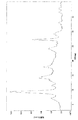
得られたオキシチタニウムフタロシアニン組成物の、CuKα特性X線による粉末X線回折スペクトルを図2に示す。このX線回折スペクトルでは、ブラッグ角(2θ±0.2°)27.3°に最大回折ピークが観察された。 The powder X-ray diffraction spectrum by CuKα characteristic X-ray of the obtained oxytitanium phthalocyanine composition is shown in FIG. In this X-ray diffraction spectrum, a maximum diffraction peak was observed at a Bragg angle (2θ ± 0.2 °) of 27.3 °.
得られたオキシチタニウムフタロシアニン組成物のマススペクトルを図3に示すが、マススペクトルではm/z:576に無置換オキシチタニウムフタロシアニンのピーク、m/z:610に塩素化オキシチタニウムフタロシアニンのピークが観察され、無置換オキシチタニウムフタロシアニンのピーク強度に対する塩素化オキシチタニウムフタロシアニンのピーク強度比を5回測定したところ、0.026〜0.029の範囲であった。 The mass spectrum of the obtained oxytitanium phthalocyanine composition is shown in FIG. 3. In the mass spectrum, a peak of unsubstituted oxytitanium phthalocyanine was observed at m / z: 576, and a peak of chlorinated oxytitanium phthalocyanine at m / z: 610. When the ratio of the peak intensity of chlorinated oxytitanium phthalocyanine to the peak intensity of unsubstituted oxytitanium phthalocyanine was measured 5 times, it was in the range of 0.026 to 0.029.
<製造例2>
40℃で四塩化チタン18.8gとジフェニルメタン31mlの混合液を添加し、205〜210℃での滴下量を四塩化チタン6.2gとジフェニルメタン10mlの混合液にした以外は製造例1と同様に行い、B型オキシチタニウムフタロシアニン46.8gを得た。このB型オキシチタニウムフタロシアニン20.0gを製造例1と同様の結晶変換操作によって、目的のオキシチタニウムフタロシアニン組成物17.6gを得た。製造例1と同様の方法により、該オキシチタニウムフタロシアニン組成物のCuKα特性X線による粉末X線回折スペクトルを得たところ、ブラッグ角(2θ±0.2°)27.3°に最大回折ピークが観察された。該オキシチタニウムフタロシアニン組成物のマススペクトルにおいて、m/Z:576の無置換オキシチタニウムフタロシアニンのピーク強度に対する、m/z:610の塩素化オキシチタニウムフタロシアニンのピーク強度比を5回測定したところ、0.039〜0.043の範囲であった。
<Production Example 2>
The same as in Production Example 1 except that a mixture of 18.8 g of titanium tetrachloride and 31 ml of diphenylmethane was added at 40 ° C., and the drop amount at 205 to 210 ° C. was changed to a mixture of 6.2 g of titanium tetrachloride and 10 ml of diphenylmethane. And 46.8 g of B-type oxytitanium phthalocyanine was obtained. By subjecting 20.0 g of this B-type oxytitanium phthalocyanine to the same crystal conversion operation as in Production Example 1, 17.6 g of the desired oxytitanium phthalocyanine composition was obtained. When a powder X-ray diffraction spectrum by CuKα characteristic X-ray of the oxytitanium phthalocyanine composition was obtained in the same manner as in Production Example 1, the maximum diffraction peak was found at a Bragg angle (2θ ± 0.2 °) of 27.3 °. Observed. In the mass spectrum of the oxytitanium phthalocyanine composition, the peak intensity ratio of chlorinated oxytitanium phthalocyanine at m / z: 610 to the peak intensity of unsubstituted oxytitanium phthalocyanine at m / Z: 576 was measured 5 times. The range was from .039 to 0.043.
<製造例3>
40℃で四塩化チタン12.5gとジフェニルメタン21mlの混合液を添加し、205〜210℃での滴下量を四塩化チタン12.5gとジフェニルメタン21mlの混合液にした以外は、製造例1と同様に行い、B型オキシチタニウムフタロシアニン44.6gを得た。このB型オキシチタニウムフタロシアニン20.0gを、製造例1と同様の結晶変換操作によって、目的のオキシチタニウムフタロシアニン組成物16.1gを得た。製造例1と同様の方法により、該オキシチタニウムフタロシアニン組成物のCuKα特性X線による粉末X線回折スペクトルを得たところ、ブラッグ角(2θ±0.2°)27.3°に最大回折ピークが観察された。該オキシチタニウムフタロシアニン組成物のマススペクトルにおいて、m/z:576の無置換オキシチタニウムフタロシアニンのピークの強度に対する、m/z:610の塩素化オキシチタニウムフタロシアニンのピークの強度比は、5回測定したところ、0.020〜0.022の範囲であった。
<Production Example 3>
Same as Production Example 1 except that a mixed liquid of 12.5 g of titanium tetrachloride and 21 ml of diphenylmethane was added at 40 ° C., and a dropping amount at 205 to 210 ° C. was a mixed liquid of 12.5 g of titanium tetrachloride and 21 ml of diphenylmethane. And 44.6 g of B-type oxytitanium phthalocyanine was obtained. By subjecting 20.0 g of this B-type oxytitanium phthalocyanine to the same crystal conversion operation as in Production Example 1, 16.1 g of the target oxytitanium phthalocyanine composition was obtained. When a powder X-ray diffraction spectrum by CuKα characteristic X-ray of the oxytitanium phthalocyanine composition was obtained in the same manner as in Production Example 1, the maximum diffraction peak was found at a Bragg angle (2θ ± 0.2 °) of 27.3 °. Observed. In the mass spectrum of the oxytitanium phthalocyanine composition, the intensity ratio of the peak of m / z: 610 chlorinated oxytitanium phthalocyanine with respect to the intensity of the unsubstituted oxytitanium phthalocyanine at m / z: 576 was measured five times. However, it was the range of 0.020-0.022.
<製造例4>
40℃で四塩化チタン22.5gとジフェニルメタン37mlの混合液を添加し、205〜210℃での滴下量を四塩化チタン2.5gとジフェニルメタン4mlの混合液にした以外は、製造例1と同様に行い、B型オキシチタニウムフタロシアニン48.2gを得た。このB型オキシチタニウムフタロシアニン20.0gを、製造例1と同様の結晶変換操作によって、目的のオキシチタニウムフタロシアニン組成物18.3gを得た。製造例1と同様の方法により、該オキシチタニウムフタロシアニン組成物のCuKα特性X線による粉末X線回折スペクトルを得たところ、ブラッグ角(2θ±0.2°)27.3°に最大回折ピークが観察された。該オキシチタニウムフタロシアニン組成物のマススペクトルにおいて、m/z:576の無置換オキシチタニウムフタロシアニンのピークの強度に対する、m/z:610の塩素化オキシチタニウムフタロシアニンのピークの強度比は、5回測定したところ、0.049〜0.053の範囲であった。
<Production Example 4>
Same as Production Example 1 except that a mixed liquid of 22.5 g of titanium tetrachloride and 37 ml of diphenylmethane was added at 40 ° C., and a dropping amount at 205 to 210 ° C. was a mixed liquid of 2.5 g of titanium tetrachloride and 4 ml of diphenylmethane. To 48.2 g of B-type oxytitanium phthalocyanine. By subjecting 20.0 g of this B-type oxytitanium phthalocyanine to the same crystal conversion operation as in Production Example 1, 18.3 g of the target oxytitanium phthalocyanine composition was obtained. When a powder X-ray diffraction spectrum by CuKα characteristic X-ray of the oxytitanium phthalocyanine composition was obtained in the same manner as in Production Example 1, the maximum diffraction peak was found at a Bragg angle (2θ ± 0.2 °) of 27.3 °. Observed. In the mass spectrum of the oxytitanium phthalocyanine composition, the intensity ratio of the peak of m / z: 610 chlorinated oxytitanium phthalocyanine with respect to the intensity of the unsubstituted oxytitanium phthalocyanine at m / z: 576 was measured five times. However, it was the range of 0.049-0.053.
<製造例5>
40℃で四塩化チタン7.5gとジフェニルメタン12mlの混合液を添加し、205〜210℃での滴下量を四塩化チタン17.5gとジフェニルメタン29mlの混合液にした以外は製造例1と同様に行い、B型オキシチタニウムフタロシアニン42.7gを得た。このB型オキシチタニウムフタロシアニン20.0gを、製造例1と同様の結晶変換操作により処理し、オキシチタニウムフタロシアニン組成物18.2gを得た。製造例1と同様の方法により、該オキシチタニウムフタロシアニン組成物のCuKα特性X線による粉末X線回折スペクトルを得たところ、ブラッグ角(2θ±0.2°)27.3°に最大回折ピークが観察されたが、26.2°のピークが27.3°のピークに対してピーク強度で11.4%存在した。また、得られたオキシチタニウムフタロシアニン組成物のマススペクトルにおいて、m/z:576の無置換オキシチタニウムフタロシアニンのピークの強度に対する、m/z:610の塩素化オキシチタニウムフタロシアニンのピークの強度比は、5回測定したところ、0.012〜0.014の範囲であった。
<Production Example 5>
As in Production Example 1, except that a mixture of 7.5 g of titanium tetrachloride and 12 ml of diphenylmethane was added at 40 ° C., and the dropwise addition amount at 205 to 210 ° C. was changed to a mixture of 17.5 g of titanium tetrachloride and 29 ml of diphenylmethane. This gave 42.7 g of B-type oxytitanium phthalocyanine. 20.0 g of this B-type oxytitanium phthalocyanine was treated by the same crystal conversion operation as in Production Example 1 to obtain 18.2 g of an oxytitanium phthalocyanine composition. When a powder X-ray diffraction spectrum by CuKα characteristic X-ray of the oxytitanium phthalocyanine composition was obtained in the same manner as in Production Example 1, the maximum diffraction peak was found at a Bragg angle (2θ ± 0.2 °) of 27.3 °. Although observed, the 26.2 ° peak was present at 11.4% in peak intensity relative to the 27.3 ° peak. In the mass spectrum of the obtained oxytitanium phthalocyanine composition, the intensity ratio of the peak of m / z: 610 chlorinated oxytitanium phthalocyanine to the intensity of the peak of unsubstituted oxytitanium phthalocyanine at m / z: 576 is: When measured five times, it was in the range of 0.012 to 0.014.
<製造例6>
40℃で四塩化チタン2.5gとジフェニルメタン4mlの混合液を添加し、205〜210℃での滴下量を四塩化チタン22.5gとジフェニルメタン37mlの混合液にした以外は製造例1と同様に行い、B型オキシチタニウムフタロシアニン33.5gを得た。このB型オキシチタニウムフタロシアニン15.0gを製造例1と同様の結晶変換操作により処理し、オキシチタニウムフタロシアニン組成物12.8gを得た。製造例1と同様の方法により得た、該オキシチタニウムフタロシアニン組成物のCuKα特性X線による粉末X線回折スペクトルを図4に示す。このX線スペクトルでは、ブラッグ角(2θ±0.2°)27.3°に最大回折ピークが観察されたが、26.2°のピークも同時に存在した。このオキシチタニウムフタロシアニン組成物の粉末X線回折スペクトルでは、26.2°のピークが27.3°のピークに対してピーク強度で14.2%存在した。また、得られたオキシチタニウムフタロシアニン組成物のマススペクトルを図5に示す。このマススペクトルでの、m/z:576の無置換オキシチタニウムフタロシアニンのピークの強度に対する、m/z:610の塩素化オキシチタニウムフタロシアニンのピークの強度比は、5回測定したところ、0.0071〜0.0085の範囲であった。
<Production Example 6>
As in Production Example 1, except that a mixed solution of 2.5 g of titanium tetrachloride and 4 ml of diphenylmethane was added at 40 ° C., and a dropping amount at 205 to 210 ° C. was changed to a mixed solution of 22.5 g of titanium tetrachloride and 37 ml of diphenylmethane. And 33.5 g of B-type oxytitanium phthalocyanine was obtained. 15.0 g of this B-type oxytitanium phthalocyanine was treated by the same crystal conversion operation as in Production Example 1 to obtain 12.8 g of an oxytitanium phthalocyanine composition. The powder X-ray diffraction spectrum by CuKα characteristic X-ray of the oxytitanium phthalocyanine composition obtained by the same method as in Production Example 1 is shown in FIG. In this X-ray spectrum, a maximum diffraction peak was observed at a Bragg angle (2θ ± 0.2 °) of 27.3 °, but a peak at 26.2 ° was also present. In the powder X-ray diffraction spectrum of this oxytitanium phthalocyanine composition, the peak at 26.2 ° was 14.2% in peak intensity with respect to the peak at 27.3 °. Moreover, the mass spectrum of the obtained oxytitanium phthalocyanine composition is shown in FIG. In this mass spectrum, the intensity ratio of the peak of m / z: 610 chlorinated oxytitanium phthalocyanine to the intensity of the peak of unsubstituted oxytitanium phthalocyanine at m / z: 576 was measured five times. The range was -0.0085.
<製造例7>
40℃で四塩化チタン25.0gとジフェニルメタン41mlの混合液を添加し、205〜210℃での滴下を行わない以外は製造例1と同様に行い、B型オキシチタニウムフタロシアニン43.7gを得た。このB型オキシチタニウムフタロシアニン20.0gを製造例1と同様の結晶変換操作によって、目的のオキシチタニウムフタロシアニン組成物18.9gを得た。製造例1と同様の方法により、該オキシチタニウムフタロシアニン組成物のCuKα特性X線による粉末X線回折スペクトルを図6に示す。このX線回折スペクトルではブラッグ角(2θ±0.2°)27.3°に最大回折ピークが観察された。得られたオキシチタニウムフタロシアニン組成物のマススペクトルを図7に示すが、m/Z:576の無置換オキシチタニウムフタロシアニンのピーク強度に対する、m/z:610の塩素化オキシチタニウムフタロシアニンのピーク強度比は、5回測定したところ、0.059〜0.061の範囲であった。
<Production Example 7>
A mixture of 25.0 g of titanium tetrachloride and 41 ml of diphenylmethane was added at 40 ° C., and the same procedure as in Production Example 1 was carried out except that dripping was not carried out at 205 to 210 ° C. to obtain 43.7 g of B-type oxytitanium phthalocyanine. . By subjecting 20.0 g of this B-type oxytitanium phthalocyanine to the same crystal conversion operation as in Production Example 1, 18.9 g of the desired oxytitanium phthalocyanine composition was obtained. FIG. 6 shows a powder X-ray diffraction spectrum by CuKα characteristic X-ray of the oxytitanium phthalocyanine composition by the same method as in Production Example 1. In this X-ray diffraction spectrum, a maximum diffraction peak was observed at a Bragg angle (2θ ± 0.2 °) of 27.3 °. The mass spectrum of the obtained oxytitanium phthalocyanine composition is shown in FIG. 7. The peak intensity ratio of m / z: 610 chlorinated oxytitanium phthalocyanine to the peak intensity of unsubstituted oxytitanium phthalocyanine at m / Z: 576 is When measured 5 times, it was in the range of 0.059 to 0.061.
<比較製造例1>
窒素雰囲気下、フタロニトリル66.6gを1−クロロナフタレン436ml中に溶解し、200℃で四塩化チタン25.0gと1−クロロナフタレン21mlの混合液を滴下した。205〜210℃で5時間反応させた後、生成物を130〜140℃で熱濾過した。次いで、n−ブタノール580ml中にて加熱還流した後、水、NMP、メタノール懸洗を行い、乾燥してB型オキシチタニウムフタロシアニン48.7gを得た。このB型オキシチタニウムフタロシアニン30.0gをガラスビーズ(φ1.0mm〜φ1.4mm)200mlと共にペイントシェーカーにて20時間振とうし、メタノールでオキシチタニウムフタロシアニンを洗い出し、濾過して無定型のオキシチタニウムフタロシアニンを得た。このオキシチタニウムフタロシアニンを水625mlに懸濁させた後、更にオルトジクロロベンゼン48mlを添加して室温にて1時間撹拌し、水をデカンテーションにて廃棄後、メタノール懸洗を行い、濾過、乾燥する結晶変換操作により、目的のオキシチタニウムフタロシアニン組成物29.0gを得た。製造例1と同様の方法により得た、該オキシチタニウムフタロシアニン組成物のCuKα特性X線による粉末X線回折スペクトルを図8に示す。このX線回折スペクトルでは、ブラッグ角(2θ±0.2°)27.3°に最大回折ピークが観察された。このオキシチタニウムフタロシアニン組成物のマススペクトルを図9に示すが、該オキシチタニウムフタロシアニン組成物のマススペクトルにおいて、m/z:576の無置換オキシチタニウムフタロシアニンのピークの強度に対する、m/z:610の塩素化オキシチタニウムフタロシアニンのピークの強度比は、5回測定したところ、0.055〜0.057の範囲であった。
<Comparative Production Example 1>
Under a nitrogen atmosphere, 66.6 g of phthalonitrile was dissolved in 436 ml of 1-chloronaphthalene, and a mixed solution of 25.0 g of titanium tetrachloride and 21 ml of 1-chloronaphthalene was added dropwise at 200 ° C. After reacting at 205-210 ° C for 5 hours, the product was hot filtered at 130-140 ° C. Subsequently, after heating and refluxing in 580 ml of n-butanol, water, NMP and methanol were washed with water and dried to obtain 48.7 g of B-type oxytitanium phthalocyanine. The B-type oxytitanium phthalocyanine (30.0 g) was shaken with 200 ml of glass beads (φ1.0 mm to φ1.4 mm) in a paint shaker for 20 hours. Got. This oxytitanium phthalocyanine is suspended in 625 ml of water, and further 48 ml of orthodichlorobenzene is added and stirred at room temperature for 1 hour. The water is discarded by decantation, washed with methanol, filtered and dried. The target oxytitanium phthalocyanine composition 29.0g was obtained by crystal conversion operation. A powder X-ray diffraction spectrum by CuKα characteristic X-ray of the oxytitanium phthalocyanine composition obtained by the same method as in Production Example 1 is shown in FIG. In this X-ray diffraction spectrum, a maximum diffraction peak was observed at a Bragg angle (2θ ± 0.2 °) of 27.3 °. The mass spectrum of the oxytitanium phthalocyanine composition is shown in FIG. 9, and in the mass spectrum of the oxytitanium phthalocyanine composition, m / z: 610 relative to the intensity of the unsubstituted oxytitanium phthalocyanine peak at m / z: 576. The intensity ratio of the peak of chlorinated oxytitanium phthalocyanine was measured 5 times and was in the range of 0.055 to 0.057.
<比較製造例2>
窒素雰囲気下、フタロジニトリル66.6gをメチルナフタレン353ml中に懸濁し、室温で四塩化チタン12.5gとメチルナフタレン20mlの混合液を滴下し、205〜210℃で四塩化チタン12.5gとメチルナフタレン20mlの混合液を滴下した以外は製造例1と同様に行い、B型オキシチタニウムフタロシアニン45.7gを得た。このB型オキシチタニウムフタロシアニン20.0gを製造例1と同様の結晶変換操作によって、目的のオキシチタニウムフタロシアニン19.2gを得た。製造例1と同様の方法により得た、該オキシチタニウムフタロシアニン組成物のCuKα特性X線による粉末X線回折スペクトルを図10に示す。このX線回折スペクトルでは、ブラッグ角(2θ±0.2°)27.3°に最大回折ピークが観察された。得られたオキシチタニウムフタロシアニン組成物のマススペクトルを図11に示すが、m/Z:576の無置換オキシチタニウムフタロシアニンのピーク強度に対する、m/z:610の塩素化オキシチタニウムフタロシアニンのピークの強度比は5回測定したところ、0.001〜0.004の範囲であり、塩素化オキシチタニウムフタロシアニン量は非常に少なかった。
<Comparative Production Example 2>
Under a nitrogen atmosphere, 66.6 g of phthalodinitrile was suspended in 353 ml of methylnaphthalene, and a mixture of 12.5 g of titanium tetrachloride and 20 ml of methylnaphthalene was added dropwise at room temperature, and 12.5 g of titanium tetrachloride was added at 205-210 ° C. The procedure was the same as in Production Example 1 except that 20 ml of methylnaphthalene mixed solution was added dropwise to obtain 45.7 g of B-type oxytitanium phthalocyanine. By subjecting 20.0 g of this B-type oxytitanium phthalocyanine to the same crystal conversion operation as in Production Example 1, 19.2 g of the target oxytitanium phthalocyanine was obtained. The powder X-ray diffraction spectrum by CuKα characteristic X-ray of the oxytitanium phthalocyanine composition obtained by the same method as in Production Example 1 is shown in FIG. In this X-ray diffraction spectrum, a maximum diffraction peak was observed at a Bragg angle (2θ ± 0.2 °) of 27.3 °. The mass spectrum of the obtained oxytitanium phthalocyanine composition is shown in FIG. 11, and the intensity ratio of the peak of m / z: 610 chlorinated oxytitanium phthalocyanine to the peak intensity of unsubstituted oxytitanium phthalocyanine of m / Z: 576. Was measured 5 times and was in the range of 0.001 to 0.004, and the amount of chlorinated oxytitanium phthalocyanine was very small.
<比較製造例3>
製造例1と同様にして合成したB型オキシチタニウムフタロシアニン25.0gを−5℃以下に冷却した95重量%硫酸625g中にゆっくり添加し、撹拌溶解した。添加終了後、−5℃以下で2時間撹拌し、グラスフィルターで濾過して不溶物を濾別した。この硫酸溶液を氷水6250g中に放出し、結晶を析出させた。1時間撹拌後、結晶を濾過し、次いで洗浄液が中性になるまで水洗を繰り返し、無定型のオキシチタニウムフタロシアニンのウエットケーキを得た。このウエットケーキを水260mlに懸濁させた後、更にトルエン50mlを添加して60℃にて1時間撹拌し、水をデカンテーションにて廃棄後、メタノール懸洗を行い、濾過、乾燥して目的のオキシチタニウムフタロシアニン組成物22.0gを得た。製造例1と同様の方法により得た、該オキシチタニウムフタロシアニン組成物のCuKα特性X線による粉末X線回折スペクトルを図17に示す。このX線回折スペクトルでは、ブラッグ角(2θ±0.2°)27.3°に最大回折ピークが観察された。
<Comparative Production Example 3>
25.0 g of B-type oxytitanium phthalocyanine synthesized in the same manner as in Production Example 1 was slowly added to 625 g of 95 wt% sulfuric acid cooled to −5 ° C. or lower, and dissolved by stirring. After completion of the addition, the mixture was stirred at −5 ° C. or lower for 2 hours and filtered through a glass filter to separate insoluble matters. This sulfuric acid solution was discharged into 6250 g of ice water to precipitate crystals. After stirring for 1 hour, the crystals were filtered, and then washed repeatedly with water until the washing solution became neutral to obtain an amorphous oxytitanium phthalocyanine wet cake. After suspending the wet cake in 260 ml of water, 50 ml of toluene was further added and stirred at 60 ° C. for 1 hour. After discarding the water by decantation, methanol washes, filtered and dried. 22.0 g of an oxytitanium phthalocyanine composition was obtained. FIG. 17 shows a powder X-ray diffraction spectrum by CuKα characteristic X-ray of the oxytitanium phthalocyanine composition obtained by the same method as in Production Example 1. In this X-ray diffraction spectrum, a maximum diffraction peak was observed at a Bragg angle (2θ ± 0.2 °) of 27.3 °.
<比較製造例4>
比較製造例3と同様にして合成した無定型のオキシチタニウムフタロシアニンのウエットケーキに、1,2−ジクロロエタン625mlを添加して室温にて2時間撹拌後、更にメタノール1000mlを添加し、室温にて1時間撹拌後、濾過した。これをメタノール懸洗し、濾過、乾燥して目的のオキシチタニウムフタロシアニン組成物22.4gを得た。製造例1と同様の方法により、該オキシチタニウムフタロシアニン組成物のCuKα特性X線による粉末X線回折スペクトルを得たところ、ブラッグ角(2θ±0.2°)27.3°に最大回折ピークが観察された。
<Comparative Production Example 4>
To an amorphous oxytitanium phthalocyanine wet cake synthesized in the same manner as in Comparative Production Example 3, 625 ml of 1,2-dichloroethane was added and stirred at room temperature for 2 hours, and further 1000 ml of methanol was added. After stirring for hours, it was filtered. This was washed with methanol, filtered and dried to obtain 22.4 g of the desired oxytitanium phthalocyanine composition. When a powder X-ray diffraction spectrum by CuKα characteristic X-ray of the oxytitanium phthalocyanine composition was obtained in the same manner as in Production Example 1, the maximum diffraction peak was found at a Bragg angle (2θ ± 0.2 °) of 27.3 °. Observed.
<比較製造例5>
窒素雰囲気下、フタロジニトリル66.6gをジフェニルエーテル353ml中に懸濁し、40℃で四塩化チタン25.0gを滴下し、205〜210℃で5時間反応させた。生成物を130〜140℃で熱濾過したところ、この粗ジクロロチタニウムフタロシアニンの時点で22.6g、ジフェニルメタン溶媒の半量以下しかなく低収率であった。
<Comparative Production Example 5>
Under a nitrogen atmosphere, 66.6 g of phthalodinitrile was suspended in 353 ml of diphenyl ether, 25.0 g of titanium tetrachloride was added dropwise at 40 ° C., and reacted at 205 to 210 ° C. for 5 hours. The product was filtered hot at 130-140 ° C., and as a result, the yield of the crude dichlorotitanium phthalocyanine was 22.6 g, less than half the amount of diphenylmethane solvent, and the yield was low.
<比較製造例6>
窒素雰囲気下、フタロジニトリル66.6gをスルホラン353ml中に懸濁し、40℃で四塩化チタン25.0gを滴下し、205〜210℃で5時間反応させた。生成物を130〜140℃で熱濾過したところ、この粗ジクロロチタニウムフタロシアニンの時点で22.0g、ジフェニルメタン溶媒の半量以下しかなく低収率であった。
<Comparative Production Example 6>
Under a nitrogen atmosphere, 66.6 g of phthalodinitrile was suspended in 353 ml of sulfolane, 25.0 g of titanium tetrachloride was added dropwise at 40 ° C., and reacted at 205 to 210 ° C. for 5 hours. The product was filtered hot at 130 to 140 ° C., and as a result, the yield of the crude dichlorotitanium phthalocyanine was 22.0 g, less than half the amount of diphenylmethane solvent, and the yield was low.
<実施例1>
二軸延伸ポリエチレンテレフタレート樹脂フィルム(厚み75μm)の表面にアルミニウム蒸着層(厚み70nm)を形成した導電性支持体を用い、その支持体のアルミニウム蒸着層上に、下記の下引き層用分散液をバーコーターにより、乾燥後の膜厚が1.25μmとなるように塗布し、乾燥させて下引き層を形成した。
<Example 1>
Using a conductive support in which an aluminum vapor deposition layer (
下引き層用分散液は、次のようにして製造した。即ち、平均一次粒子径40nmのルチル型酸化チタン(石原産業社製「TTO55N」)と、該酸化チタンに対して3重量%のメチルジメトキシシラン(東芝シリコーン社製「TSL8117」)とを、高速流動式混合混練機((株)カワタ社製「SMG300」)に投入し、回転周速34.5m/秒で高速混合して得られた表面処理酸化チタンを、メタノール/1−プロパノールの混合溶媒中でボールミルにより分散させることにより、疎水化処理酸化チタンの分散スラリーとした。該分散スラリーと、メタノール/1−プロパノール/トルエンの混合溶媒、及び、ε−カプロラクタム[下記式(A)で表わされる化合物]/ビス(4−アミノ−3−メチルシクロヘキシル)メタン[下記式(B)で表わされる化合物]/ヘキサメチレンジアミン[下記式(C)で表わされる化合物]/デカメチレンジカルボン酸[下記式(D)で表わされる化合物]/オクタデカメチレンジカルボン酸[下記式(E)で表わされる化合物]の組成モル比率が、75%/9.5%/3%/9.5%/3%からなる共重合ポリアミドのペレットとを加熱しながら撹拌、混合してポリアミドペレットを溶解させた後、超音波分散処理を行なうことにより、メタノール/1−プロパノール/トルエンの重量比が7/1/2で、疎水性処理酸化チタン/共重合ポリアミドを重量比3/1で含有する、固形分濃度18.0%の下引き層用分散液とした。 The undercoat layer dispersion was produced as follows. That is, a rutile type titanium oxide having an average primary particle size of 40 nm (“TTO55N” manufactured by Ishihara Sangyo Co., Ltd.) and 3% by weight of methyldimethoxysilane (“TSL8117” manufactured by Toshiba Silicone Co., Ltd.) with respect to the titanium oxide were flowed at high speed. In a mixed solvent of methanol / 1-propanol in a mixed solvent of methanol / 1-propanol, which was introduced into a mixing kneader (“SMG300” manufactured by Kawata Co., Ltd.) and mixed at a high rotational speed of 34.5 m / sec. Then, a dispersion slurry of hydrophobized titanium oxide was obtained by dispersing with a ball mill. The dispersion slurry, a mixed solvent of methanol / 1-propanol / toluene, and ε-caprolactam [compound represented by the following formula (A)] / bis (4-amino-3-methylcyclohexyl) methane [the following formula (B Compound represented by the following formula (C)] / decamethylene dicarboxylic acid [compound represented by the following formula (D)] / octadecamethylene dicarboxylic acid [in the following formula (E) The compositional molar ratio of the compound represented] is 75% / 9.5% / 3% / 9.5% / 3% of the copolymerized polyamide pellets with heating and stirring and mixing to dissolve the polyamide pellets. After that, by carrying out ultrasonic dispersion treatment, the weight ratio of methanol / 1-propanol / toluene is 7/1/2, and hydrophobically treated titanium oxide. The copolymerized polyamide in a weight ratio of 3/1, and a solid concentration of 18.0% of the undercoat layer dispersion.
電荷発生物質として、製造例1で製造した、図2に示すCuKα特性X線に対する粉末X線回折スペクトルパターンを有するオキシチタニウムフタロシアニン組成物20重量部と1,2−ジメトキシエタン280重量部を混合し、サンドグラインドミルで2時間分散して分散液を作製した。続いて、前記分散液、ポリビニルブチラール(電気化学工業(株)製、商品名「デンカブチラール」#6000C)の2.5重量%1,2−ジメトキシエタン溶液400重量部、および1,2−ジメトキシエタン170重量部を混合して電荷発生層用塗布液を調製した。
As a charge generation material, 20 parts by weight of an oxytitanium phthalocyanine composition having a powder X-ray diffraction spectrum pattern with respect to CuKα characteristic X-rays shown in FIG. 2 produced in Production Example 1 and 280 parts by weight of 1,2-dimethoxyethane are mixed. Then, a dispersion was prepared by dispersing for 2 hours in a sand grind mill. Subsequently, 400 parts by weight of a 2.5
この電荷発生層用塗布液を無反射カバーガラスに乾燥後の膜厚が10μm以上となるよう塗布し、室温にて乾燥させて、感光層のX線回折スペクトル測定用サンプルを作製した。 This charge generation layer coating solution was applied to a non-reflective cover glass so that the film thickness after drying was 10 μm or more, and dried at room temperature to prepare a sample for measuring the X-ray diffraction spectrum of the photosensitive layer.
測定装置として、人工多層膜ミラーにて単色平行化したCuKα線を線源とした薄膜試料用の回折計(株式会社リガク製 自動X線回折装置 RINT2000)、を用いた。測定条件は、X線出力50kV,250mA、固定入射角(θ)1.0°、走査範囲(2θ)3〜40°、スキャンステップ幅0.05°、入射ソーラースリット5.0°、入射スリット0.1mm、受光ソーラースリット0.1°で、この感光層のX線回折スペクトル測定用サンプルのCuKα特性X線によるX線回折スペクトルを測定した。このX線回折スペクトルを図12に示す。このX線回折スペクトルにおいて、ブラッグ角(2θ±0.2°)27.3°のピーク強度は9.5°のピーク強度に対して72%大きかった。
As a measuring device, a diffractometer for a thin film sample using CuKα rays made into a monochromatic parallel by an artificial multilayer mirror (radio-system automatic X-ray diffractometer RINT2000) was used. Measurement conditions are:
次に、前記下引き層上に、この電荷発生層用塗布液を、乾燥後の膜厚が0.4μmとなるようにバーコーターで塗布し、乾燥して電荷発生層を形成した。 Next, the charge generation layer coating solution was applied on the undercoat layer with a bar coater so that the film thickness after drying was 0.4 μm, and dried to form a charge generation layer.
この電荷発生層上に、電荷輸送物質として以下に示す構造を主体とする、特開2002−080432公報記載の組成物(A)を50重量部、下記構造のバインダー樹脂(A)(粘度平均分子量、40000)100重量部、およびレベリング剤としてシリコーンオイル0.05重量部をテトラヒドロフラン/トルエン(重量比8/2)混合溶媒640重量部に溶解させた液を乾燥後の膜厚が25μmとなるように塗布し、125℃で20分間乾燥して、電荷輸送層を設けて電子写真感光体を作製した。この感光体を感光体1Aとする。 On this charge generation layer, 50 parts by weight of the composition (A) described in JP-A-2002-080432, mainly composed of the following structure as a charge transport material, binder resin (A) having the following structure (viscosity average molecular weight) , 40,000) 100 parts by weight, and a solution obtained by dissolving 0.05 parts by weight of silicone oil as a leveling agent in 640 parts by weight of a tetrahydrofuran / toluene (weight ratio 8/2) mixed solvent so that the film thickness after drying is 25 μm And dried at 125 ° C. for 20 minutes to provide a charge transport layer to prepare an electrophotographic photosensitive member. This photoreceptor is referred to as a photoreceptor 1A.
<実施例2>
電荷発生物質として、製造例2で得られたオキシチタニウムフタロシアニン組成物20重量部を用いた他は実施例1と同様にして電荷発生層用塗布液を作製した。この電荷発生層用塗布液を無反射カバーガラスに乾燥後の膜厚が10μm以上となるよう塗布し、室温にて乾燥させて、感光層のX線回折スペクトル測定用サンプルを作製して、実施例1と同様にしてX線回折スペクトルを測定した。このX線回折スペクトルにおいて、ブラッグ角(2θ±0.2°)27.3°のピーク強度は9.6°のピーク強度に対して56%大きかった。 さらに該電荷発生層用塗布液を用いた他は、実施例1と同様の操作を行い、感光体2Aを作製した。
<Example 2>
A charge generation layer coating solution was prepared in the same manner as in Example 1 except that 20 parts by weight of the oxytitanium phthalocyanine composition obtained in Production Example 2 was used as the charge generation material. This charge generation layer coating solution was applied to a non-reflective cover glass so that the film thickness after drying was 10 μm or more, and dried at room temperature to prepare a sample for measuring the X-ray diffraction spectrum of the photosensitive layer. The X-ray diffraction spectrum was measured in the same manner as in Example 1. In this X-ray diffraction spectrum, the peak intensity at a Bragg angle (2θ ± 0.2 °) of 27.3 ° was 56% higher than the peak intensity at 9.6 °. Further, a photoconductor 2A was produced in the same manner as in Example 1 except that the charge generation layer coating solution was used.
<実施例3>
電荷発生物質として、製造例3で得られたオキシチタニウムフタロシアニン組成物20重量部と、1,2−ジメトキシエタン280重量部を混合し、超音波発振装置(BRANSON社製SH1216−40−18、動作周波数40kHz、超音波出力750W)を用いて1時間分散処理して分散液を作製した。該分散液と、10重量部のポリビニルブチラール(電気化学工業(株)製、商品名「デンカブチラール」#6000C)、253重量部の1,2−ジメトキシエタン、85重量部の4−メチル−4−メトキシ−2−ペンタノンを混合し、さらに1,2−ジメトキシエタン527重量部で希釈し、得られた液を超音波発振装置で1時間分散して電荷発生層用塗布液を調製した。この電荷発生層用塗布液を無反射カバーガラスに乾燥後の膜厚が10μm以上となるよう塗布し、室温にて乾燥させて、感光層のX線回折スペクトル測定用サンプルを作製して、実施例1と同様にしてX線回折スペクトルを測定した。このX線回折スペクトルにおいて、ブラッグ角(2θ±0.2°)27.3°のピーク強度は9.6°のピーク強度に対して100%大きかった。また、該電荷発生層用塗布液を用いて実施例1と同様の操作を行い、感光体3Aを作製した。
<Example 3>
As a charge generation material, 20 parts by weight of the oxytitanium phthalocyanine composition obtained in Production Example 3 and 280 parts by weight of 1,2-dimethoxyethane were mixed, and an ultrasonic oscillator (SH1216-40-18 manufactured by BRANSON, A dispersion was prepared by dispersing for 1 hour using a frequency of 40 kHz and an ultrasonic output of 750 W). The dispersion, 10 parts by weight of polyvinyl butyral (trade name “Denka Butyral” # 6000C, manufactured by Denki Kagaku Kogyo Co., Ltd.), 253 parts by weight of 1,2-dimethoxyethane, 85 parts by weight of 4-methyl-4 -Methoxy-2-pentanone was mixed and further diluted with 527 parts by weight of 1,2-dimethoxyethane, and the resulting liquid was dispersed with an ultrasonic oscillator for 1 hour to prepare a coating solution for a charge generation layer. This charge generation layer coating solution was applied to a non-reflective cover glass so that the film thickness after drying was 10 μm or more, and dried at room temperature to prepare a sample for measuring the X-ray diffraction spectrum of the photosensitive layer. The X-ray diffraction spectrum was measured in the same manner as in Example 1. In this X-ray diffraction spectrum, the peak intensity at a Bragg angle (2θ ± 0.2 °) of 27.3 ° was 100% larger than the peak intensity at 9.6 °. Further, the same operation as in Example 1 was performed using the coating solution for charge generation layer, to produce a photoreceptor 3A.
<実施例4>
電荷発生物質として、製造例4で得られたオキシチタニウムフタロシアニン組成物20重量部を用いた他は実施例1と同様にして感光層のX線回折スペクトルを測定し、感光体4Aを作製した。このX線回折スペクトルにおいて、ブラッグ角(2θ±0.2°)27.3°のピーク強度は9.6°のピーク強度に対して32%大きかった。
<Example 4>
Except that 20 parts by weight of the oxytitanium phthalocyanine composition obtained in Production Example 4 was used as the charge generation material, the X-ray diffraction spectrum of the photosensitive layer was measured in the same manner as in Example 1 to prepare Photoreceptor 4A. In this X-ray diffraction spectrum, the peak intensity at a Bragg angle (2θ ± 0.2 °) of 27.3 ° was 32% larger than the peak intensity at 9.6 °.
<実施例5>
電荷発生物質として、製造例5で得られたオキシチタニウムフタロシアニン組成物20重量部を用いた他は実施例1と同様にして感光層のX線回折スペクトルを測定し、感光体5Aを作製した。このX線回折スペクトルにおいて、ブラッグ角(2θ±0.2°)27.3°のピーク強度は9.6°のピーク強度に対して55%大きかった。26.2°のピーク強度は製造時の粉末X線回折スペクトルと比較すると大きくなった。
<Example 5>
Except that 20 parts by weight of the oxytitanium phthalocyanine composition obtained in Production Example 5 was used as the charge generation material, the X-ray diffraction spectrum of the photosensitive layer was measured in the same manner as in Example 1 to prepare Photoreceptor 5A. In this X-ray diffraction spectrum, the peak intensity at a Bragg angle (2θ ± 0.2 °) of 27.3 ° was 55% higher than the peak intensity at 9.6 °. The peak intensity at 26.2 ° was larger than the powder X-ray diffraction spectrum at the time of production.
<実施例6>
電荷発生物質として、製造例6で得られた図4に示すCuKα特性X線に対する粉末X線回折スペクトルパターンを有するオキシチタニウムフタロシアニン組成物20重量部を用いた他は実施例1と同様にして感光層のX線回折スペクトルを測定し、感光体6Aを作製した。このX線回折スペクトルを図13に示す。このX線回折スペクトルにおいて、ブラッグ角(2θ±0.2°)27.3°のピーク強度は9.6°のピーク強度に対して52%大きかった。26.2°のピーク強度は製造時の粉末X線回折スペクトル図4と比較すると大きくなった。
<Example 6>
Photosensitivity is the same as in Example 1 except that 20 parts by weight of an oxytitanium phthalocyanine composition having a powder X-ray diffraction spectrum pattern with respect to the CuKα characteristic X-ray shown in FIG. The X-ray diffraction spectrum of the layer was measured to produce a photoreceptor 6A. This X-ray diffraction spectrum is shown in FIG. In this X-ray diffraction spectrum, the peak intensity at a Bragg angle (2θ ± 0.2 °) of 27.3 ° was 52% larger than the peak intensity at 9.6 °. The peak intensity at 26.2 ° was larger than that in the powder X-ray diffraction spectrum shown in FIG.
<実施例7>
電荷発生物質として、製造例7で得られた図5に示すCuKα特性X線に対する粉末X線回折スペクトルパターンを有するオキシチタニウムフタロシアニン組成物20重量部を用いた他は実施例1と同様にして感光層のX線回折スペクトルを測定し、感光体7Aを作製した。このX線回折スペクトルを図14に示す。このX線回折スペクトルにおいて、ブラッグ角(2θ±0.2°)27.3°のピーク強度は9.6°のピーク強度に対して27%大きかった。
<Example 7>
Photosensitivity was the same as in Example 1 except that 20 parts by weight of an oxytitanium phthalocyanine composition having a powder X-ray diffraction spectrum pattern for the CuKα characteristic X-ray shown in FIG. The X-ray diffraction spectrum of the layer was measured to produce a photoreceptor 7A. This X-ray diffraction spectrum is shown in FIG. In this X-ray diffraction spectrum, the peak intensity at a Bragg angle (2θ ± 0.2 °) of 27.3 ° was 27% higher than the peak intensity of 9.6 °.
<比較実施例1>
電荷発生物質として、比較製造例1で得られた図8に示すCuKα特性X線に対する粉末X線回折スペクトルパターンを有するオキシチタニウムフタロシアニン組成物20重量部を用いた他は実施例1と同様の操作を行った。この感光層のX線回折スペクトルを図15に示す。このX線回折スペクトルにおいて、ブラッグ角(2θ±0.2°)27.3°のピーク強度は9.3°のピーク強度より小さくなり85%しかなかった。さらに実施例1と同様の操作を行い、感光体1Bを作製した。
<Comparative Example 1>
The same operation as in Example 1 except that 20 parts by weight of the oxytitanium phthalocyanine composition having a powder X-ray diffraction spectrum pattern with respect to the CuKα characteristic X-ray shown in FIG. Went. The X-ray diffraction spectrum of this photosensitive layer is shown in FIG. In this X-ray diffraction spectrum, the peak intensity at a Bragg angle (2θ ± 0.2 °) of 27.3 ° was smaller than the peak intensity at 9.3 °, and was only 85%. Further, the same operation as in Example 1 was performed to prepare a photoreceptor 1B.
<比較実施例2>
電荷発生物質として、比較製造例2で得られた図10に示すCuKα特性X線に対する粉末X線回折スペクトルパターンを有するオキシチタニウムフタロシアニン組成物20重量部を用いた他は実施例1と同様の操作を行った。この感光層のX線回折スペクトルを図16に示す。このX線回折スペクトルにおいて、ブラッグ角(2θ±0.2°)27.3°のピーク強度は9.3°のピーク強度より小さくなり66%しかなかった。さらに実施例1と同様の操作を行い、感光体2Bを作製した。
<Comparative Example 2>
The same operation as in Example 1 except that 20 parts by weight of an oxytitanium phthalocyanine composition having a powder X-ray diffraction spectrum pattern with respect to the CuKα characteristic X-ray shown in FIG. Went. The X-ray diffraction spectrum of this photosensitive layer is shown in FIG. In this X-ray diffraction spectrum, the peak intensity at a Bragg angle (2θ ± 0.2 °) of 27.3 ° was smaller than the peak intensity at 9.3 °, and only 66%. Further, the same operation as in Example 1 was performed to prepare a
<比較実施例3>
電荷発生物質として、比較製造例3で得られた図17に示すCuKα特性X線に対する粉末X線回折スペクトルパターンを有するオキシチタニウムフタロシアニン組成物20重量部を用いた他は実施例1と同様の操作を行った。この感光層のX線回折スペクトルを図18に示す。このX線回折スペクトルにおいて、ブラッグ角(2θ±0.2°)27.3°のピーク強度は9.3°のピーク強度より小さくなり63%しかなかった。さらに実施例1と同様の操作を行い、感光体3Bを作製した。
<Comparative Example 3>
The same operation as in Example 1 except that 20 parts by weight of an oxytitanium phthalocyanine composition having a powder X-ray diffraction spectrum pattern for the CuKα characteristic X-ray shown in FIG. Went. The X-ray diffraction spectrum of this photosensitive layer is shown in FIG. In this X-ray diffraction spectrum, the peak intensity at a Bragg angle (2θ ± 0.2 °) of 27.3 ° was smaller than the peak intensity at 9.3 °, and was only 63%. Further, the same operation as in Example 1 was performed to prepare a photoreceptor 3B.
<比較実施例4>
電荷発生物質として、比較製造例4で得られたオキシチタニウムフタロシアニン組成物20重量部を用いた他は実施例1と同様の操作を行った。この感光層のX線回折スペクトルにおいて、ブラッグ角(2θ±0.2°)27.3°のピーク強度は9.3°のピーク強度より小さくなり60%しかなかった。さらに実施例1と同様の操作を行い、感光体4Bを作製した。
<Comparative Example 4>
The same operation as in Example 1 was performed except that 20 parts by weight of the oxytitanium phthalocyanine composition obtained in Comparative Production Example 4 was used as the charge generation material. In the X-ray diffraction spectrum of this photosensitive layer, the peak intensity at a Bragg angle (2θ ± 0.2 °) of 27.3 ° was smaller than the peak intensity at 9.3 ° and was only 60%. Further, the same operation as in Example 1 was performed to prepare a photoreceptor 4B.
<感光体の電気特性評価>
得られた感光体1A〜7Aおよび感光体1B〜3Bを電子写真学会測定標準に従って作製された電子写真特性評価装置(続電子写真技術の基礎と応用、電子写真学会編、コロナ社、404〜405頁記載)に装着し、帯電、露光、電位測定、除電のサイクルによる電気特性の評価を行った。
<Evaluation of electrical characteristics of photoconductor>
An electrophotographic characteristic evaluation apparatus in which the obtained photoreceptors 1A to 7A and photoreceptors 1B to 3B were produced according to the electrophotographic society measurement standards (basic and applied electrophotographic technology, edited by the Electrophotographic Society, Corona, 404 to 405). The electrical characteristics were evaluated by charging, exposure, potential measurement, and static elimination cycles.
気温25℃、湿度50%の条件下で感光体の初期表面電位が−700Vとなるように帯電させ、ハロゲンランプの光を干渉フィルターで780nmの単色光とした光を照射して、表面電位が−350Vとなる時の照射エネルギー(μJ/cm2)を感度とした。また、除電光に660nmのLED光を約8μJ/cm2の強度で照射した時の表面電位を測定し、これを残留電位(−V)とした。その結果を表1に示す。 The photosensitive member is charged so that the initial surface potential is −700 V under the conditions of an air temperature of 25 ° C. and a humidity of 50%, and the surface potential is irradiated by irradiating light of a halogen lamp with monochromatic light of 780 nm with an interference filter. Irradiation energy (μJ / cm 2 ) at −350 V was defined as sensitivity. Further, the surface potential was measured when the 660 nm LED light was irradiated to the static elimination light at an intensity of about 8 μJ / cm 2 , and this was defined as a residual potential (−V). The results are shown in Table 1.
表1に示した結果のように、反応溶媒として、アリール基がアルキリデン基により連結された構造を有するジアリールアルカンであるジフェニルメタンを用いて、機械的磨砕処理により製造したオキシチタニウムフタロシアニン組成物を用いて作製した感光体1A〜7Aは、クロロナフタレンや、メチルナフタレンを反応溶媒として製造したオキシチタニウムフタロシアニン組成物を用いて作製した感光体1B、2B、ジフェニルメタンを反応溶媒として酸ペースト処理により製造したオキシチタニウムフタロシアニン組成物を用いて作製した感光体3B、4Bに比べ、感度、残留電位共に、良好な結果が得られた。 As shown in Table 1, an oxytitanium phthalocyanine composition produced by mechanical grinding using diphenylmethane, which is a diarylalkane having a structure in which an aryl group is linked by an alkylidene group, is used as a reaction solvent. The photoconductors 1A to 7A produced in the above are photoconductors 1B and 2B produced using oxytitanium phthalocyanine composition produced using chloronaphthalene or methylnaphthalene as a reaction solvent, and oxy produced by acid paste treatment using diphenylmethane as a reaction solvent. As compared with the photoreceptors 3B and 4B produced using the titanium phthalocyanine composition, good results were obtained in both sensitivity and residual potential.
CuKα特性X線による粉末X線回折スペクトルにおいてブラッグ角(2θ±0.2°)27.3°に最大回折ピークを示すオキシチタニウムフタロシアン組成物であって、原料としてフタロニトリルと四塩化チタンを使用し、反応溶媒としてアリール基がアルキリデン基により連結された構造を有するジアリールアルカン溶媒を用いて、機械的磨砕処理により製造したオキシチタニウムフタロシアン組成物を用いることにより、プリンター、ファクシミリ、複写機等の電子写真装置に適用可能で、高感度、低残留電位で高性能な電子写真感光体を提供することができる。 An oxytitanium phthalocyanine composition having a maximum diffraction peak at a Bragg angle (2θ ± 0.2 °) of 27.3 ° in a powder X-ray diffraction spectrum by CuKα characteristic X-ray, comprising phthalonitrile and titanium tetrachloride as raw materials By using a oxytitanium phthalocyanine composition produced by mechanical grinding using a diarylalkane solvent having a structure in which an aryl group is linked by an alkylidene group as a reaction solvent, a printer, a facsimile machine, and a copier Therefore, it is possible to provide a high-performance electrophotographic photosensitive member with high sensitivity and low residual potential.
1 感光体
2 帯電装置(帯電ローラ)
3 露光装置
4 現像装置
5 転写装置
6 クリーニング装置
7 定着装置
41 現像槽
42 アジテータ
43 供給ローラ
44 現像ローラ
45 規制部材
71 上部定着部材(定着ローラ)
72 下部定着部材(定着ローラ)
73 加熱装置
T トナー
P 記録紙
1
DESCRIPTION OF
72 Lower fixing member (fixing roller)
73 Heating device T Toner P Recording paper
Claims (4)
Priority Applications (1)
| Application Number | Priority Date | Filing Date | Title |
|---|---|---|---|
| JP2006340646A JP5459931B2 (en) | 2005-12-28 | 2006-12-19 | Oxytitanium phthalocyanine composition and method for producing the same, electrophotographic photoreceptor, image forming apparatus using the photoreceptor, and cartridge |
Applications Claiming Priority (3)
| Application Number | Priority Date | Filing Date | Title |
|---|---|---|---|
| JP2005377790 | 2005-12-28 | ||
| JP2005377790 | 2005-12-28 | ||
| JP2006340646A JP5459931B2 (en) | 2005-12-28 | 2006-12-19 | Oxytitanium phthalocyanine composition and method for producing the same, electrophotographic photoreceptor, image forming apparatus using the photoreceptor, and cartridge |
Publications (3)
| Publication Number | Publication Date |
|---|---|
| JP2007197685A true JP2007197685A (en) | 2007-08-09 |
| JP2007197685A5 JP2007197685A5 (en) | 2009-08-20 |
| JP5459931B2 JP5459931B2 (en) | 2014-04-02 |
Family
ID=38452583
Family Applications (1)
| Application Number | Title | Priority Date | Filing Date |
|---|---|---|---|
| JP2006340646A Expired - Fee Related JP5459931B2 (en) | 2005-12-28 | 2006-12-19 | Oxytitanium phthalocyanine composition and method for producing the same, electrophotographic photoreceptor, image forming apparatus using the photoreceptor, and cartridge |
Country Status (1)
| Country | Link |
|---|---|
| JP (1) | JP5459931B2 (en) |
Cited By (2)
| Publication number | Priority date | Publication date | Assignee | Title |
|---|---|---|---|---|
| JP2011007873A (en) * | 2009-06-23 | 2011-01-13 | Mitsubishi Chemicals Corp | Electrophotographic photoreceptor, cartridge, and image forming apparatus |
| JP2014021385A (en) * | 2012-07-20 | 2014-02-03 | Ricoh Co Ltd | Electrophotographic photoreceptor, method for electrophotography, electrophotographic apparatus, and process cartridge for electrophotographic apparatus |
Citations (7)
| Publication number | Priority date | Publication date | Assignee | Title |
|---|---|---|---|---|
| JPH05134437A (en) * | 1991-11-11 | 1993-05-28 | Mitsubishi Kasei Corp | Electrophotographic sensitive body |
| JPH05173345A (en) * | 1991-12-20 | 1993-07-13 | Mitsubishi Kasei Corp | Electrophotographic photoreceptor |
| JPH0797221B2 (en) | 1987-07-10 | 1995-10-18 | コニカ株式会社 | Image forming method |
| JPH08209023A (en) | 1994-11-24 | 1996-08-13 | Fuji Electric Co Ltd | Titanyloxyphthalocyanine crystal, its production method and electrophotographic photoreceptor |
| JPH115919A (en) * | 1988-04-15 | 1999-01-12 | Nec Corp | Phthalocyanine crystal and electrophotographic photoreceptor using it |
| JP2001115054A (en) * | 1999-10-14 | 2001-04-24 | Mitsubishi Chemicals Corp | Titanyl phthalocyanine compound and electrophotographic photoreceptor using the same |
| JP2001187794A (en) * | 1999-10-20 | 2001-07-10 | Ricoh Co Ltd | Electrophotographic photoreceptor, electrophotographic method, electrophotographic apparatus, and process cartridge for electrophotographic apparatus |
-
2006
- 2006-12-19 JP JP2006340646A patent/JP5459931B2/en not_active Expired - Fee Related
Patent Citations (7)
| Publication number | Priority date | Publication date | Assignee | Title |
|---|---|---|---|---|
| JPH0797221B2 (en) | 1987-07-10 | 1995-10-18 | コニカ株式会社 | Image forming method |
| JPH115919A (en) * | 1988-04-15 | 1999-01-12 | Nec Corp | Phthalocyanine crystal and electrophotographic photoreceptor using it |
| JPH05134437A (en) * | 1991-11-11 | 1993-05-28 | Mitsubishi Kasei Corp | Electrophotographic sensitive body |
| JPH05173345A (en) * | 1991-12-20 | 1993-07-13 | Mitsubishi Kasei Corp | Electrophotographic photoreceptor |
| JPH08209023A (en) | 1994-11-24 | 1996-08-13 | Fuji Electric Co Ltd | Titanyloxyphthalocyanine crystal, its production method and electrophotographic photoreceptor |
| JP2001115054A (en) * | 1999-10-14 | 2001-04-24 | Mitsubishi Chemicals Corp | Titanyl phthalocyanine compound and electrophotographic photoreceptor using the same |
| JP2001187794A (en) * | 1999-10-20 | 2001-07-10 | Ricoh Co Ltd | Electrophotographic photoreceptor, electrophotographic method, electrophotographic apparatus, and process cartridge for electrophotographic apparatus |
Cited By (2)
| Publication number | Priority date | Publication date | Assignee | Title |
|---|---|---|---|---|
| JP2011007873A (en) * | 2009-06-23 | 2011-01-13 | Mitsubishi Chemicals Corp | Electrophotographic photoreceptor, cartridge, and image forming apparatus |
| JP2014021385A (en) * | 2012-07-20 | 2014-02-03 | Ricoh Co Ltd | Electrophotographic photoreceptor, method for electrophotography, electrophotographic apparatus, and process cartridge for electrophotographic apparatus |
Also Published As
| Publication number | Publication date |
|---|---|
| JP5459931B2 (en) | 2014-04-02 |
Similar Documents
| Publication | Publication Date | Title |
|---|---|---|
| JP4604106B2 (en) | Crystals of porphyrinato zinc compounds | |
| JP5156409B2 (en) | Single layer type electrophotographic photosensitive member and image forming apparatus | |
| JP2004145284A (en) | Titanyl phthalocyanine compound, electrophotographic photoreceptor, and image forming apparatus | |
| JP2009169023A (en) | Electrophotographic photoreceptor and image forming apparatus | |
| JP2009093024A (en) | Electrophotographic photosensitive member, electrophotographic photosensitive member cartridge, and image forming apparatus including the photosensitive member | |
| JP5353078B2 (en) | Electrophotographic photosensitive member and image forming apparatus using compound having enamine skeleton | |
| JP2010237511A (en) | Single-layer electrophotographic photoreceptor and image forming apparatus | |
| JP2008286909A (en) | Single layer type electrophotographic photoreceptor and image forming apparatus | |
| JP2012141648A (en) | Electrophotographic photoreceptor, electrophotographic photoreceptor cartridge and image forming apparatus | |
| JP2007320925A (en) | Triarylamine compound, electrophotographic photosensitive member and image forming apparatus using the same | |
| JP5459931B2 (en) | Oxytitanium phthalocyanine composition and method for producing the same, electrophotographic photoreceptor, image forming apparatus using the photoreceptor, and cartridge | |
| JP4887716B2 (en) | Oxytitanium phthalocyanine composition, electrophotographic photoreceptor, and image forming apparatus using the photoreceptor | |
| WO2007049719A1 (en) | Electrophotographic photoreceptor, electrophotographic photoreceptor cartridge, and image forming apparatus | |
| JP2008107649A (en) | Electrophotographic photoreceptor and image forming apparatus using the photoreceptor | |
| JP2007199674A (en) | Image forming apparatus and image forming method | |
| JP4997755B2 (en) | Electrophotographic photosensitive member and image forming apparatus using bishydrazone compound having triarylamine skeleton | |
| JP2007298975A (en) | Electrophotographic photosensitive member, electrophotographic photosensitive member cartridge, and image forming apparatus including the photosensitive member | |
| JP4779850B2 (en) | Electrophotographic photoreceptor and image forming apparatus | |
| JP4983066B2 (en) | Amine compound, electrophotographic photoreceptor, image forming method and image forming apparatus | |
| JP5481960B2 (en) | Electrophotographic photosensitive member, cartridge, and image forming apparatus | |
| JP4967590B2 (en) | Phthalocyanine crystal and electrophotographic photosensitive member, electrophotographic photosensitive member cartridge and image forming apparatus using the same | |
| JP5265881B2 (en) | Image forming apparatus and image forming method | |
| JP4462123B2 (en) | Electrophotographic photoreceptor | |
| JP4379227B2 (en) | Method for producing phthalocyanine compound, electrophotographic photosensitive member, electrophotographic photosensitive member cartridge, and image forming apparatus | |
| JP5168822B2 (en) | Electrophotographic photosensitive member, electrophotographic photosensitive member cartridge, image forming apparatus, and phthalocyanine crystal |
Legal Events
| Date | Code | Title | Description |
|---|---|---|---|
| A521 | Request for written amendment filed |
Free format text: JAPANESE INTERMEDIATE CODE: A523 Effective date: 20090701 |
|
| A621 | Written request for application examination |
Free format text: JAPANESE INTERMEDIATE CODE: A621 Effective date: 20090701 |
|
| A977 | Report on retrieval |
Free format text: JAPANESE INTERMEDIATE CODE: A971007 Effective date: 20110524 |
|
| A131 | Notification of reasons for refusal |
Free format text: JAPANESE INTERMEDIATE CODE: A131 Effective date: 20110607 |
|
| A02 | Decision of refusal |
Free format text: JAPANESE INTERMEDIATE CODE: A02 Effective date: 20120306 |
|
| A521 | Request for written amendment filed |
Free format text: JAPANESE INTERMEDIATE CODE: A523 Effective date: 20120606 |
|
| A521 | Request for written amendment filed |
Free format text: JAPANESE INTERMEDIATE CODE: A523 Effective date: 20120618 |
|
| A911 | Transfer to examiner for re-examination before appeal (zenchi) |
Free format text: JAPANESE INTERMEDIATE CODE: A911 Effective date: 20120621 |
|
| A912 | Re-examination (zenchi) completed and case transferred to appeal board |
Free format text: JAPANESE INTERMEDIATE CODE: A912 Effective date: 20120824 |
|
| A521 | Request for written amendment filed |
Free format text: JAPANESE INTERMEDIATE CODE: A523 Effective date: 20131031 |
|
| A61 | First payment of annual fees (during grant procedure) |
Free format text: JAPANESE INTERMEDIATE CODE: A61 Effective date: 20140114 |
|
| R150 | Certificate of patent or registration of utility model |
Ref document number: 5459931 Country of ref document: JP Free format text: JAPANESE INTERMEDIATE CODE: R150 Free format text: JAPANESE INTERMEDIATE CODE: R150 |
|
| S111 | Request for change of ownership or part of ownership |
Free format text: JAPANESE INTERMEDIATE CODE: R313111 |
|
| R350 | Written notification of registration of transfer |
Free format text: JAPANESE INTERMEDIATE CODE: R350 |
|
| LAPS | Cancellation because of no payment of annual fees |