JP2007153971A - Propylene polymer composition - Google Patents
Propylene polymer composition Download PDFInfo
- Publication number
- JP2007153971A JP2007153971A JP2005348723A JP2005348723A JP2007153971A JP 2007153971 A JP2007153971 A JP 2007153971A JP 2005348723 A JP2005348723 A JP 2005348723A JP 2005348723 A JP2005348723 A JP 2005348723A JP 2007153971 A JP2007153971 A JP 2007153971A
- Authority
- JP
- Japan
- Prior art keywords
- propylene
- polymer composition
- weight
- rubber
- polymer
- Prior art date
- Legal status (The legal status is an assumption and is not a legal conclusion. Google has not performed a legal analysis and makes no representation as to the accuracy of the status listed.)
- Pending
Links
Landscapes
- Compositions Of Macromolecular Compounds (AREA)
Abstract
【課題】 柔軟性と耐磨耗性に優れているプロピレン系重合体組成物の提供。
【解決手段】ゴム状重合体(A)とプロピレン系重合体(B)とからなり、(B)がJIS K7215規定の硬度が50A〜100Aであり、軟化温度が100〜150℃であって、かつ(A)が分散相で(B)が連続相であるプロピレン系重合体組成物。該組成物は架橋されていることが好ましく、また、(A)がエチレンと炭素数3〜20のα−オレフィンを含有する、メタロセン触媒を用いて製造されたエチレン・α−オレフィン共重合体(A−1)であるか主鎖および側鎖に二重結合を有する単独重合体及び/または共重合体からなる不飽和ゴムの全オレフィン性二重結合の50%以上が水素添加された水素添加ゴム(A−2)から選ばれる一種以上の架橋性ゴム状重合体であることが好ましい。
【選択図】なしPROBLEM TO BE SOLVED: To provide a propylene polymer composition excellent in flexibility and abrasion resistance.
A rubber-like polymer (A) and a propylene-based polymer (B), wherein (B) has a JIS K7215 specified hardness of 50A to 100A, a softening temperature of 100 to 150 ° C, A propylene polymer composition in which (A) is a dispersed phase and (B) is a continuous phase. The composition is preferably crosslinked, and an ethylene / α-olefin copolymer produced using a metallocene catalyst (A) containing ethylene and an α-olefin having 3 to 20 carbon atoms ( Hydrogenation in which 50% or more of all olefinic double bonds of the unsaturated rubber consisting of a homopolymer and / or copolymer having a double bond in the main chain and side chain are hydrogenated One or more crosslinkable rubber-like polymers selected from rubber (A-2) are preferred.
[Selection figure] None
Description
本発明は、プロピレン系重合体組成物に関するものである。更に詳しくは、柔軟性に優れており、かつ卓越した耐磨耗性を有するプロピレン系重合体組成物に関するものである。 The present invention relates to a propylene-based polymer composition. More specifically, the present invention relates to a propylene-based polymer composition that has excellent flexibility and excellent wear resistance.
熱可塑性オレフィン系エラストマー等のゴム状重合体とポリプロピレン(PP)等の熱可塑性樹脂からなる熱可塑性エラストマー組成物は、既に公知の技術であり、自動車部品等の用途に広く使用されている。
このような熱可塑性エラストマー組成物として、エチレン−プロピレン−ジエンゴム(EPDM)により製造されたオレフィン系エラストマー(下記特許文献1、2を参照。)を用いる動的架橋技術が知られているが、耐磨耗性が充分でなく、必ずしも市場では満足されていない。
一方、柔軟性を改良するための従来技術として、重合型ポリプロピレン系熱可塑性エラストマーを用いたオレフィン系熱可塑性エラストマー組成物及びそれを用いたフィルム等の成形体(特許文献3〜5を参照。)が知られている。しかしながら、上記組成物は耐熱性に劣り、産業界では実用的使用に耐えるプロピレン系重合体組成物が求められている。
A thermoplastic elastomer composition comprising a rubber-like polymer such as a thermoplastic olefin elastomer and a thermoplastic resin such as polypropylene (PP) is already a known technique and is widely used in applications such as automobile parts.
As such a thermoplastic elastomer composition, a dynamic crosslinking technique using an olefin-based elastomer (see Patent Documents 1 and 2 below) produced from ethylene-propylene-diene rubber (EPDM) is known. Abrasion is not sufficient and not always satisfied in the market.
On the other hand, as a conventional technique for improving flexibility, an olefinic thermoplastic elastomer composition using a polymerizable polypropylene thermoplastic elastomer and a molded article such as a film using the same (see Patent Documents 3 to 5). It has been known. However, the above composition is inferior in heat resistance, and there is a need in the industry for a propylene-based polymer composition that can withstand practical use.
本発明は、このような現状に鑑み、上記のような問題点のない、即ち柔軟性に優れており、かつ卓越した耐磨耗性を有するプロピレン系重合体組成物を提供することを目的とするものである。 In view of such a current situation, the present invention aims to provide a propylene-based polymer composition that does not have the above-mentioned problems, that is, has excellent flexibility and has excellent wear resistance. To do.
本発明者は、柔軟性及び耐磨耗性に優れたプロピレン系重合体組成物を得るために鋭意検討した結果、特定のポリマーの組み合わせにより、驚くべきことに柔軟性と耐磨耗性とが飛躍的に向上することを見出し、本発明を完成した。
即ち本発明は、ゴム状重合体(A)とプロピレン系重合体(B)とからなり、(B)がJIS K7215規定の硬度が50A〜100Aであり、軟化温度が100〜150℃であり、かつ(A)が分散相で(B)が連続相であることを特徴とするプロピレン系重合体組成物、とりわけ(A)と(B)とからなる架橋された、プロピレン系重合体組成物を提供するものである。
本発明の態様を示すと以下の通りである。
As a result of intensive investigations to obtain a propylene-based polymer composition excellent in flexibility and wear resistance, the present inventors have surprisingly achieved flexibility and wear resistance by combining specific polymers. The present invention has been completed by finding a dramatic improvement.
That is, the present invention comprises a rubbery polymer (A) and a propylene-based polymer (B), wherein (B) has a JIS K7215 specified hardness of 50A to 100A, and a softening temperature of 100 to 150 ° C. And a propylene polymer composition characterized in that (A) is a dispersed phase and (B) is a continuous phase, in particular, a crosslinked propylene polymer composition comprising (A) and (B). It is to provide.
An embodiment of the present invention is as follows.
(1)ゴム状重合体(A)とプロピレン系重合体(B)とからなり、(B)がJIS K7215規定の硬度が50A〜100Aであり、軟化温度が100〜150℃であり、かつ(A)が分散相を構成し(B)が連続相を構成していることを特徴とするプロピレン系重合体組成物。
(2)架橋されていることを特徴とする請求項1に記載のプロピレン系重合体組成物。
(3)(A)がエチレンと炭素数3〜20のα−オレフィンを含有する、メタロセン触媒を用いて製造されたエチレン・α−オレフィン共重合体(A−1)、または主鎖および側鎖に二重結合を有する単独重合体及び/または共重合体からなる不飽和ゴムの全オレフィン性二重結合の50%以上が水素添加された水素添加ゴム(A−2)から選ばれる一種以上の架橋性ゴム状重合体である上記(1)または(2)に記載のプロピレン系重合体組成物。
(4)(B)がメタロセン触媒を用いて製造されたプロピレン系重合体であることを特徴とする上記(1)〜(3)のいずれかに記載のプロピレン系重合体組成物。
(5)ASTM D−1238に規定されるメルトフローレート(MFRと称する。条件:温度230℃、荷重2.16kg)の測定において、(B)のMFRと(A)のMFRの比[MFR(B)/MFR(A)]が1〜100であることを特徴とする上記(1)〜(4)のいずれかに記載のプロピレン系重合体組成物。
(6)(C)架橋剤により架橋してなる上記(2)〜(5)のいずれかに記載のプロピレン系重合体組成物。
(7)更に軟化剤(D)、ポリオルガノシロキサン及び結晶核剤から選ばれる剤を含有した上記(1)〜(6)のいずれかに記載のプロピレン系重合体組成物。
(1) It consists of a rubber-like polymer (A) and a propylene-based polymer (B), (B) has a hardness of 50A to 100A according to JIS K7215, a softening temperature of 100 to 150 ° C, and ( A propylene-based polymer composition, wherein A) constitutes a dispersed phase and (B) constitutes a continuous phase.
(2) The propylene-based polymer composition according to claim 1, which is crosslinked.
(3) An ethylene / α-olefin copolymer (A-1) produced using a metallocene catalyst, wherein (A) contains ethylene and an α-olefin having 3 to 20 carbon atoms, or a main chain and a side chain One or more kinds selected from hydrogenated rubber (A-2) in which 50% or more of all olefinic double bonds of the unsaturated rubber comprising a homopolymer and / or copolymer having a double bond are hydrogenated The propylene polymer composition according to the above (1) or (2), which is a crosslinkable rubbery polymer.
(4) The propylene polymer composition as described in any one of (1) to (3) above, wherein (B) is a propylene polymer produced using a metallocene catalyst.
(5) In the measurement of the melt flow rate (referred to as MFR) defined in ASTM D-1238, the ratio of the MFR in (B) and the MFR in (A) [MFR ( B) / MFR (A)] is 1 to 100, and the propylene-based polymer composition according to any one of the above (1) to (4).
(6) The propylene-based polymer composition according to any one of (2) to (5), which is crosslinked with a crosslinking agent (C).
(7) The propylene-based polymer composition according to any one of (1) to (6), further containing an agent selected from a softener (D), a polyorganosiloxane, and a crystal nucleating agent.
本発明のプロピレン系重合体組成物は、柔軟性と耐磨耗性に優れている。 The propylene-based polymer composition of the present invention is excellent in flexibility and wear resistance.
以下、本発明に関して具体的に説明する。
本発明の組成物は、ゴム状重合体(A)と特定のプロピレン系重合体(B)からなる。
ここで、(B)がJIS K7215規定の硬度が50A〜100Aであり、軟化温度が100〜150℃であることが重要である。柔軟性の指標である上記硬度の要件と耐熱性の指標である上記軟化温度の要件を満足する(B)が組成物中で連続相を形成する場合にのみ柔軟性を保持しつつ、耐磨耗性が向上する。
そして、(A)と(B)が、熱可塑性を維持しつつ、架橋される場合には、柔軟性と耐磨耗性のバランス特性が著しく向上する。
The present invention will be specifically described below.
The composition of the present invention comprises a rubbery polymer (A) and a specific propylene polymer (B).
Here, it is important that (B) has a JIS K7215 specified hardness of 50A to 100A and a softening temperature of 100 to 150 ° C. While satisfying the above-mentioned hardness requirement which is an index of flexibility and the above-mentioned softening temperature requirement which is an index of heat resistance, while maintaining the flexibility only when (B) forms a continuous phase in the composition, Abrasion is improved.
And when (A) and (B) are bridge | crosslinked, maintaining thermoplasticity, the balance characteristic of a softness | flexibility and abrasion resistance improves remarkably.
以下に本発明の各成分について詳細に説明する。
(A)成分
本発明において、ゴム状重合体(A)は、後述の(B)の硬度と軟化温度を同時に満足しないゴム状重合体であり、例えば、ポリブタジエン、ポリ(スチレン−ブタジエン)、ポリ(アクリロニトリル−ブタジエン)等のジエン系ゴム及び該ジエン系ゴムを水素添加した飽和重合体ゴム(水素添加共重合体ゴム)、イソプレンゴム、クロロプレンゴム、ポリアクリル酸ブチル等のアクリル系ゴム、エチレン−プロピレン共重合体、エチレン−オクテン共重合体、エチレン−プロピレン−ジエンモノマー三元共重合体(EPDM)等のエチレン・α−オレフィン共重合体等の架橋ゴムまたは非架橋ゴム、並びに上記ゴム成分を含有する熱可塑性エラストマー等を挙げることができる。
また(A)は、ガラス転移温度(Tg)が−10℃以下であることが好ましい。
そして、(A)の100℃で測定したムーニー粘度(ML)(ISO 289−1985(E)準拠)は、20〜150が好ましく、更に好ましくは50〜120である。
Hereinafter, each component of the present invention will be described in detail.
Component (A) In the present invention, the rubber-like polymer (A) is a rubber-like polymer that does not satisfy both the hardness and softening temperature of (B) described later. For example, polybutadiene, poly (styrene-butadiene), poly Diene rubber such as (acrylonitrile-butadiene), saturated polymer rubber (hydrogenated copolymer rubber) obtained by hydrogenation of the diene rubber, isoprene rubber, chloroprene rubber, acrylic rubber such as polybutyl acrylate, ethylene- Crosslinked rubber or non-crosslinked rubber such as ethylene / α-olefin copolymer such as propylene copolymer, ethylene-octene copolymer, ethylene-propylene-diene monomer terpolymer (EPDM), and the rubber component Examples thereof include a thermoplastic elastomer.
Further, (A) preferably has a glass transition temperature (Tg) of −10 ° C. or lower.
And (A) Mooney viscosity (ML) (ISO 289-1985 (E) conformity) measured at 100 degreeC has preferable 20-150, More preferably, it is 50-120.
本発明において(A)ゴム状重合体の中で好ましい重合体の一つはエチレン・α−オレフィン共重合体であり、エチレンと炭素数が3〜20のα−オレフィンとの共重合体が更に好ましい。α−オレフィンとして、例えばプロピレン、ブテン−1、ペンテン−1、ヘキセン−1、4−メチルペンテン−1、ヘプテン−1、オクテン−1、ノネン−1、デセン−1、ウンデセン−1、ドデセン−1等が挙げられる。中でもヘキセン−1、4−メチルペンテン−1、オクテン−1が好ましく、特に好ましくは炭素数3〜12のα−オレフィンであり、とりわけプロピレン、ブテン−1、オクテン−1が最も好ましい。 In the present invention, one of the preferred polymers (A) in the rubbery polymer is an ethylene / α-olefin copolymer, and a copolymer of ethylene and an α-olefin having 3 to 20 carbon atoms is further provided. preferable. Examples of the α-olefin include propylene, butene-1, pentene-1, hexene-1, 4-methylpentene-1, heptene-1, octene-1, nonene-1, decene-1, undecene-1, and dodecene-1. Etc. Among them, hexene-1, 4-methylpentene-1, and octene-1 are preferable, and an α-olefin having 3 to 12 carbon atoms is particularly preferable, and propylene, butene-1, and octene-1 are most preferable.
また、(A)は必要に応じて、不飽和結合を有する単量体を含有することができ、例えば、ブタジエン、イソプレン等の共役ジオレフィン、1,4−ヘキサジエン等の非共役ジオレフィン、ジシクロペンタジエン、ノルボルネン誘導体等の環状ジエン化合物、及びアセチレン類が挙げられる。とりわけエチリデンノルボルネン(ENB)、ジシクロペンタジエン(DCP)が最も好ましい。 Moreover, (A) can contain a monomer having an unsaturated bond, if necessary, for example, conjugated diolefins such as butadiene and isoprene, non-conjugated diolefins such as 1,4-hexadiene, di- Examples thereof include cyclic diene compounds such as cyclopentadiene and norbornene derivatives, and acetylenes. In particular, ethylidene norbornene (ENB) and dicyclopentadiene (DCP) are most preferable.
本発明において(A)の好ましい共重合体の一つであるエチレン・α−オレフィン共重合体(以下、(A)のエチレン・α−オレフィン共重合体という。)は、公知のメタロセン系触媒を用いて製造することが好ましい。
一般にはメタロセン系触媒は、チタン、ジルコニウム等のIV族金属のシクロペンタジエニル誘導体と助触媒からなり、重合触媒として高活性であるだけでなく、チーグラー系触媒と比較して、得られる重合体の分子量分布が狭く、共重合体中のコモノマーである炭素数3〜20のα−オレフィンの分布が均一である。
In the present invention, an ethylene / α-olefin copolymer (hereinafter referred to as “(A) ethylene / α-olefin copolymer)”, which is one of the preferred copolymers of (A), is a known metallocene catalyst. It is preferable to manufacture using.
In general, a metallocene catalyst comprises a cyclopentadienyl derivative of a group IV metal such as titanium or zirconium and a co-catalyst, and is not only highly active as a polymerization catalyst but also a polymer obtained in comparison with a Ziegler catalyst. The molecular weight distribution is narrow and the distribution of the α-olefin having 3 to 20 carbon atoms, which is a comonomer in the copolymer, is uniform.
本発明において用いられる(A)のエチレン・α−オレフィン共重合体は、α−オレフィンの共重合比率が1〜60重量%であることが好ましく、更に好ましくは10〜50重量%、最も好ましくは20〜45重量%である。α−オレフィンの共重合比率は組成物の硬度、引張強度等の観点から60重量%以下が好ましく、一方、柔軟性、機械的強度の観点から1重量%以上が好ましい。 The ethylene / α-olefin copolymer (A) used in the present invention preferably has a copolymerization ratio of α-olefin of 1 to 60% by weight, more preferably 10 to 50% by weight, most preferably. 20 to 45% by weight. The copolymerization ratio of the α-olefin is preferably 60% by weight or less from the viewpoints of the hardness and tensile strength of the composition, and is preferably 1% by weight or more from the viewpoints of flexibility and mechanical strength.
(A)のエチレン・α−オレフィン共重合体の密度は、0.8〜0.9g/cm3の範囲にあることが好ましい。この範囲の密度を有するエチレン・α−オレフィン共重合体を用いることにより、柔軟性に優れ、硬度の低い本発明の熱可塑性エラストマー組成物を得ることができる。 The density of the ethylene / α-olefin copolymer (A) is preferably in the range of 0.8 to 0.9 g / cm 3 . By using an ethylene / α-olefin copolymer having a density in this range, the thermoplastic elastomer composition of the present invention having excellent flexibility and low hardness can be obtained.
本発明にて用いられる(A)のエチレン・α−オレフィン共重合体は、長鎖分岐を有していることが望ましい。長鎖分岐が存在することで、機械的強度を落とさずに、共重合されているα−オレフィンの比率(重量%)に比して、密度をより小さくすることが可能となり、低密度、低硬度、高強度のエチレン・α−オレフィン共重合体を得ることができる。長鎖分岐を有するエチレン・α−オレフィン共重合体は、米国特許第5278272号明細書等に記載されている。
また、(A)のエチレン・α−オレフィン共重合体は、室温以上に熱天秤(DSC)の融点ピークを有することが望ましい。融点ピークを有するとき、融点以下の温度範囲では形態が安定しており、取扱い性に優れ、ベタツキも少ない。
The ethylene / α-olefin copolymer (A) used in the present invention preferably has long chain branching. Due to the presence of long chain branching, it is possible to make the density smaller compared to the proportion (% by weight) of the α-olefin copolymerized without reducing the mechanical strength. An ethylene / α-olefin copolymer having high hardness and high strength can be obtained. An ethylene / α-olefin copolymer having a long chain branch is described in US Pat. No. 5,278,272.
The ethylene / α-olefin copolymer of (A) desirably has a melting point peak of a thermobalance (DSC) above room temperature. When it has a melting point peak, the form is stable in the temperature range below the melting point, it is easy to handle and has little stickiness.
また、本発明にて用いられる(A)のエチレン・α−オレフィン共重合体のASTM D−1238に規定されるメルトフローレート(MFR)は、0.01〜100g/10分(230℃、2.16kg荷重(0.212Pa))の範囲のものが好ましく用いられ、更に好ましくは0.2〜10g/10分である。本発明の組成物は特に架橋される場合には100g/10分以下が好ましく、また、流動性、加工性の観点から0.01g/10分以上が好ましい。 Moreover, the melt flow rate (MFR) prescribed | regulated to ASTMD-1238 of the ethylene-alpha-olefin copolymer of (A) used by this invention is 0.01-100 g / 10min (230 degreeC, 2 minutes). .16 kg load (0.212 Pa)) is preferably used, more preferably 0.2 to 10 g / 10 min. The composition of the present invention is preferably 100 g / 10 min or less, particularly 0.01 g / 10 min or more from the viewpoint of fluidity and workability, when it is crosslinked.
本発明において、(A)のもう一つの好ましい共重合体である上記水素添加共重合体は、少なくとも一種の共役ジエン系単量体の単独重合体ゴム、または共役ジエン系単量体と芳香族ビニル単量体とからなる共重合体ゴムであって、ランダム共重合体の全二重結合の水素添加率が50%以上である水素添加共重合体ゴムが好ましく、とりわけ主鎖および側鎖に二重結合を有する重合体及び/または共重合体からなる不飽和重合体ゴムの全オレフィン性二重結合の50%以上が水素添加された水素添加共重合体ゴムであることが好ましい。
上記水素添加共重合体ゴムにおいて、必要に応じて、例えば、オレフィン系、メタクリル酸エステル系、アクリル酸エステル系、不飽和ニトリル系、塩化ビニル系単量体等の共役ジエンと共重合可能な単量体(以下、共重合可能な単量体という。)を共重合することができる。
In the present invention, the hydrogenated copolymer which is another preferred copolymer of (A) is a homopolymer rubber of at least one conjugated diene monomer, or a conjugated diene monomer and an aromatic A copolymer rubber comprising a vinyl monomer, preferably a hydrogenated copolymer rubber in which the hydrogenation rate of the full double bond of the random copolymer is 50% or more, particularly in the main chain and the side chain. A hydrogenated copolymer rubber in which 50% or more of the total olefinic double bonds of the unsaturated polymer rubber comprising a polymer and / or copolymer having a double bond is hydrogenated is preferable.
In the hydrogenated copolymer rubber, if necessary, for example, olefinic, methacrylic ester, acrylic ester, unsaturated nitrile, vinyl chloride monomer and other conjugated dienes can be copolymerized. A monomer (hereinafter referred to as a copolymerizable monomer) can be copolymerized.
上記共役ジエン系単量体としては、1,3−ブタジエン、イソプレン、2,3−ジメチル−1,3−ブタジエン、1,3−ペンタジエン、2−メチル−1、3−ペンタジエン、1,3−ヘキサジエン、4,5−ジエチル−1、3−オクタジエン、3−ブチル−1,3−オクタジエン、クロロプレン等を挙げることができ、1,3−ブタジエン、イソプレン、1,3−ペンタジエンが好ましく、1,3−ブタジエン、イソプレンが最も好ましい。 Examples of the conjugated diene monomer include 1,3-butadiene, isoprene, 2,3-dimethyl-1,3-butadiene, 1,3-pentadiene, 2-methyl-1,3-pentadiene, 1,3- Hexadiene, 4,5-diethyl-1,3-octadiene, 3-butyl-1,3-octadiene, chloroprene and the like can be mentioned, and 1,3-butadiene, isoprene and 1,3-pentadiene are preferable, Most preferred are 3-butadiene and isoprene.
また、前記芳香族ビニル単量体としては、スチレン、α−メチルスチレン、p−メチルスチレン、t−ブチルスチレン、ジビニルベンゼン、N,N−ジメチル−p−アミノエチルスチレン、ビニルピリジン等を挙げることができ、スチレン、α−メチルスチレンが好ましい。上記芳香族単量体は一種または二種以上併用することができる。芳香族ビニル単量体含有量は、0〜80重量%が好ましく、更に好ましくは0〜50重量%、最も好ましくは0〜30重量%である。 Examples of the aromatic vinyl monomer include styrene, α-methylstyrene, p-methylstyrene, t-butylstyrene, divinylbenzene, N, N-dimethyl-p-aminoethylstyrene, and vinylpyridine. Styrene and α-methylstyrene are preferable. The aromatic monomers can be used alone or in combination of two or more. The aromatic vinyl monomer content is preferably 0 to 80% by weight, more preferably 0 to 50% by weight, and most preferably 0 to 30% by weight.
(A)としての水素添加共重合体において、水素添加前の共役ジエン単量体部分のビニル結合は、分子内に均一に存在していても、分子鎖に沿って増減あるいは減少してもよいし、また、ビニル結合含有量の異なった、複数個のブロックを含んでいてもよい。そして、芳香族ビニル単量体および/または共重合可能な単量体を含む場合は、共役ジエン単量体と芳香族ビニル単量体および/または共重合可能な単量体とはランダムに結合することが好ましいが、ブロック状の芳香族ビニル単量体および/またはブロック状の共重合可能な単量体を含んでもよい。ブロック状の芳香族ビニル重合体の含有率は、全芳香族ビニル単量体中の20重量%以下が好ましく、更に好ましくは10重量%以下である。 In the hydrogenated copolymer as (A), the vinyl bond in the conjugated diene monomer portion before hydrogenation may be present uniformly in the molecule, or may increase or decrease or decrease along the molecular chain. In addition, a plurality of blocks having different vinyl bond contents may be included. When the aromatic vinyl monomer and / or copolymerizable monomer is included, the conjugated diene monomer and the aromatic vinyl monomer and / or copolymerizable monomer are randomly bonded. However, it may contain a block-like aromatic vinyl monomer and / or a block-like copolymerizable monomer. The content of the block-like aromatic vinyl polymer is preferably 20% by weight or less, more preferably 10% by weight or less, based on the total aromatic vinyl monomer.
上記水素添加共重合体ゴム中の全オレフィン性二重結合は、50%以上、好ましくは90%以上、更に好ましくは95%以上が水素添加され、そして主鎖の残存二重結合が5%以下、側鎖の残存二重結合が5%以下である。このような水素添加共重合体ゴムの具体例としては、ポリブタジエン、ポリ(スチレン−ブタジエン)、ポリ(アクリロニトリル−ブタジエン)、ポリイソプレン、ポリクロロプレン等のジエン系ゴムを部分的または完全に水素添加したゴム状重合体を挙げることができ、特に水素添加ブタジエン系または水素添加イソプレン系ゴムが好ましい。 The total olefinic double bonds in the hydrogenated copolymer rubber are 50% or more, preferably 90% or more, more preferably 95% or more, and the remaining double bonds in the main chain are 5% or less. The residual double bond in the side chain is 5% or less. Specific examples of such hydrogenated copolymer rubbers include partially or completely hydrogenated diene rubbers such as polybutadiene, poly (styrene-butadiene), poly (acrylonitrile-butadiene), polyisoprene, and polychloroprene. Examples thereof include rubber-like polymers, and hydrogenated butadiene-based or hydrogenated isoprene-based rubber is particularly preferable.
このような水素添加共重合体ゴムは、上述のジエン系ゴムを公知の水素添加方法で部分水素添加することにより得られる。例えば、F.L.Ramp,etal,J.Amer.Chem.Soc.,83,4672(1961)記載のトリイソブチルボラン触媒を用いて水素添加する方法、Hung Yu Chen,J.Polym.Sci.Polym.Letter Ed.,15,271(1977)記載のトルエンスルフォニルヒドラジドを用いて水素添加する方法、あるいは特公昭42−8704号公報に記載の有機コバルトー有機アルミニュウム系触媒あるいは有機ニッケル−有機アルミニュウム系触媒を用いて水素添加する方法等を挙げることができる。 Such a hydrogenated copolymer rubber can be obtained by partially hydrogenating the above-described diene rubber by a known hydrogenation method. For example, a method of hydrogenation using a triisobutylborane catalyst described in FLRamp, etal, J. Amer. Chem. Soc., 83, 4672 (1961), Hung Yu Chen, J. Polym. Sci. Polym. Letter Ed , 15,271 (1977), hydrogenation using toluenesulfonylhydrazide, or organic cobalt-organic aluminum catalyst or organic nickel-organic aluminum catalyst described in Japanese Patent Publication No. 42-8704 The method etc. can be mentioned.
ここで、特に好ましい水素添加の方法は、低温、低圧の温和な条件下で水素添加が可能な触媒を用いる特開昭59−133203号、特開昭60−220147号の各公報あるいは不活性有機溶媒中にて、ビス(シクロペンタジエニル)チタニウム化合物と、ナトリウム原子、カリウム原子、ルビジウム原子またはセシウム原子を有する炭化水素化合物とからなる触媒の存在下に水素と接触させる特開昭62−207303号公報に示される方法である。 Here, particularly preferred hydrogenation methods are disclosed in JP-A-59-133203 and JP-A-60-220147 using inert catalysts that can be hydrogenated under mild conditions of low temperature and low pressure, or inert organic compounds. Contacting with hydrogen in a solvent in the presence of a catalyst comprising a bis (cyclopentadienyl) titanium compound and a hydrocarbon compound having a sodium atom, a potassium atom, a rubidium atom or a cesium atom This is the method shown in the gazette.
また、水素添加共重合体ゴムの25℃における5重量%スチレン溶液粘度(5%SV)は、20〜300センチポイズ(cps)の範囲にあることが好ましい。特に好ましい範囲は25〜150cpsである。
そして、水素添加共重合体ゴムは結晶性を有することが好ましく、その結晶性の指標である吸熱ピーク熱量の制御は、テトラヒドロフラン等の極性化合物の添加または重合温度の制御により行う。吸熱ピーク熱量の低下は、ゴム状重合体製造時に極性化合物を増量するか、または重合温度を低下させて、1,2−ビニル結合を増大させることにより達成される。
本発明にて用いられる(A)のゴム状重合体は、複数の種類のものを混合して用いても良い。そのような場合には、加工性のさらなる向上を図ることが可能となる。
The hydrogenated copolymer rubber preferably has a 5 wt% styrene solution viscosity (5% SV) at 25 ° C. in the range of 20 to 300 centipoise (cps). A particularly preferred range is 25 to 150 cps.
The hydrogenated copolymer rubber preferably has crystallinity, and the endothermic peak calorific value, which is an index of crystallinity, is controlled by adding a polar compound such as tetrahydrofuran or controlling the polymerization temperature. The reduction of the endothermic peak heat amount is achieved by increasing the polar compound during the production of the rubbery polymer or increasing the 1,2-vinyl bond by decreasing the polymerization temperature.
The rubber-like polymer (A) used in the present invention may be used by mixing a plurality of types. In such a case, the workability can be further improved.
本発明において、(A)のゴム状重合体中に占めるポリスチレン換算分子量が15万以下の該重合体の割合が30重量%以下であることが好ましく、より好ましくは25重量%以下、更に好ましくは20重量%以下、最も好ましくは15重量%以下、極めて好ましくは10重量%以下である。上記割合が30重量%以下の場合には架橋性が著しく高まり、機械的強度、外観、感触、耐磨耗性及び耐油性が向上する。 In the present invention, the proportion of the polymer having a polystyrene equivalent molecular weight of 150,000 or less in the rubber-like polymer (A) is preferably 30% by weight or less, more preferably 25% by weight or less, and still more preferably. 20% by weight or less, most preferably 15% by weight or less, and most preferably 10% by weight or less. When the ratio is 30% by weight or less, the crosslinkability is remarkably increased, and the mechanical strength, appearance, feel, wear resistance and oil resistance are improved.
本発明において(A)ゴム状重合体中に占めるポリスチレン換算分子量が15万以下の該重合体の割合を制御する方法として、分子量が15万以下の部分が30重量%以下になるように全体の分子量を高める方法、または分子量15万以下の部分を抽出等の操作で除去する方法、あるいは重合触媒等により選択的に分子量15万以下が生成しない重合方法等が挙げられる。 In the present invention, as a method for controlling the proportion of the polymer having a polystyrene-equivalent molecular weight of 150,000 or less in the rubber-like polymer (A) in the present invention, the entire molecular weight of 150,000 or less is 30% by weight or less. Examples thereof include a method of increasing the molecular weight, a method of removing a portion having a molecular weight of 150,000 or less by an operation such as extraction, or a polymerization method in which a molecular weight of 150,000 or less is not selectively generated by a polymerization catalyst or the like.
(B)成分
本発明における(B)のプロピレン系重合体は、プロピレンを主体にエチレン系及び/またはブテン−1、ペンテン−1、ヘキセン−1等の炭素数4〜20であるα−オレフィンを含有する共重合体であり、上述の硬度と軟化温度を満足すれば特に制限されない。また(B)は、分子量分布不均一指数Mw/Mn(重量平均分子量/数平均分子量)が5以下であること好ましく、更に好ましくは3.5以下である。このような条件を満足させるためには通常、メタロセン触媒を用いて重合することが好ましい。
(B) Component The propylene polymer of (B) in the present invention comprises an α-olefin having 4 to 20 carbon atoms such as ethylene and / or butene-1, pentene-1, hexene-1, etc. mainly composed of propylene. The copolymer is not particularly limited as long as it satisfies the above-described hardness and softening temperature. In (B), the molecular weight distribution non-uniformity index Mw / Mn (weight average molecular weight / number average molecular weight) is preferably 5 or less, more preferably 3.5 or less. In order to satisfy such conditions, it is usually preferable to perform polymerization using a metallocene catalyst.
そして、本発明にて好適に用いられるプロピレン系重合体のASTM D−1238に規定されるメルトフローレート(MFR)は、0.1〜100g/10分(230℃、2.16kg荷重(0.212Pa))の範囲のものが好ましく用いられる。組成物の耐熱性、機械的強度の観点から100g/10分以下であることが好ましく、また、流動性、成形加工性の観点から0.1g/10分以上であることが好ましい。
このような(B)は、結晶性のプロピレン系ポリマーのナノオーダーのラメラネットワークに非晶性のプロピレン系ポリマーが絡み合った構造であり、三井化学(株)からNOTIOの商品名で販売されている。
And the melt flow rate (MFR) prescribed | regulated to ASTM D-1238 of the propylene-type polymer suitably used by this invention is 0.1-100 g / 10min (230 degreeC, 2.16kg load (0. Those within the range of 212 Pa)) are preferably used. From the viewpoint of heat resistance and mechanical strength of the composition, it is preferably 100 g / 10 min or less, and from the viewpoint of fluidity and moldability, it is preferably 0.1 g / 10 min or more.
(B) has a structure in which an amorphous propylene polymer is entangled with a nano-order lamella network of a crystalline propylene polymer, and is sold by Mitsui Chemicals under the trade name NOTIO. .
本発明の(A)と(B)からなる組成物において、(A)の比率は1〜99重量%であることが好ましく、更に好ましくは10〜80重量%、最も好ましくは20〜50重量%である。
本発明の組成物の要件である(A)が分散相で(B)が連続相であるモルフォロジーは、(B)が(A)より量的に多い場合、または(B)が少なくても(A)のMFRが(B)より小さい場合に達成される。例えば上述のMFRの条件において、(B)のMFRと(A)のMFRの比[MFR(B)/MFR(A)]が1〜100であることが好ましく、更に好ましくは1〜50である。
In the composition comprising (A) and (B) of the present invention, the ratio of (A) is preferably 1 to 99% by weight, more preferably 10 to 80% by weight, most preferably 20 to 50% by weight. It is.
The morphology in which (A) is a dispersed phase and (B) is a continuous phase, which is a requirement of the composition of the present invention, is when (B) is quantitatively more than (A) or (B) is less ( This is achieved when the MFR of A) is smaller than (B). For example, in the above-mentioned MFR conditions, the ratio [MFR (B) / MFR (A)] of MFR of (B) and MFR of (A) is preferably 1 to 100, more preferably 1 to 50. .
(C)成分
本発明の組成物は、(C)架橋剤で架橋されることが好ましい。
(C)架橋剤は、(C−1)架橋開始剤を必須成分とし、必要に応じて(C−2)多官能単量体、(C−3)単官能単量体を含有する。上記(C)架橋剤は、(A)と(B)の合計100重量部に対し0.001〜10重量部、好ましくは0.005〜3重量部の量で用いられる。上記範囲内では架橋のレベルが高まり、組成物の外観と機械的強度のバランスが向上する。
(C) Component It is preferable that the composition of this invention is bridge | crosslinked with (C) crosslinking agent.
(C) The crosslinking agent contains (C-1) a crosslinking initiator as an essential component, and contains (C-2) a polyfunctional monomer and (C-3) a monofunctional monomer as necessary. The (C) crosslinking agent is used in an amount of 0.001 to 10 parts by weight, preferably 0.005 to 3 parts by weight, based on 100 parts by weight of the total of (A) and (B). Within the above range, the level of crosslinking increases, and the balance between the appearance and mechanical strength of the composition is improved.
ここで、(C−1)架橋開始剤は、有機過酸化物、有機アゾ化合物等のラジカル開始剤等が挙げられ、その具体的な例として、1,1−ビス(t−ブチルパーオキシ)−3,3,5−トリメチルシクロヘキサン、1,1−ビス(t−ヘキシルパーオキシ)−3,3,5−トリメチルシクロヘキサン、1,1−ビス(t−ヘキシルパーオキシ)シクロヘキサン、1,1−ビス(t−ブチルパーオキシ)シクロドデカン、1,1−ビス(t−ブチルパーオキシ)シクロヘキサン、2,2−ビス(t−ブチルパーオキシ)オクタン、n−ブチル−4,4−ビス(t−ブチルパーオキシ)ブタン、n−ブチル−4,4−ビス(t−ブチルパーオキシ)バレレート等のパーオキシケタール類;ジ−t−ブチルパーオキサイド、ジクミルパーオキサイド、t−ブチルクミルパーオキサイド、α,α’−ビス(t−ブチルパーオキシ−m−イソプロピル)ベンゼン、α,α’−ビス(t−ブチルパーオキシ)ジイソプロピルベンゼン、2,5−ジメチル−2,5−ビス(t−ブチルパーオキシ)ヘキサンおよび2,5−ジメチル−2,5−ビス(t−ブチルパーオキシ)ヘキシン−3等のジアルキルパーオキサイド類;アセチルパーオキサイド、イソブチリルパーオキサイド、オクタノイルパーオキサイド、デカノイルパーオキサイド、ラウロイルパーオキサイド、3,5,5−トリメチルヘキサノイルパーオキサイド、ベンゾイルパーオキサイド、2,4−ジクロロベンゾイルパーオキサイドおよびm−トリオイルパーオキサイド等のジアシルパーオキサイド類;t−ブチルパーオキシアセテート、t−ブチルパーオキシイソブチレート、t−ブチルパーオキシ−2−エチルヘキサノエート、t−ブチルパーオキシラウリレート、t−ブチルパーオキシベンゾエート、ジ−t−ブチルパーオキシイソフタレート、2,5−ジメチル−2,5−ジ(ベンゾイルパーオキシ)ヘキサン、t−ブチルパーオキシマレイン酸、t−ブチルパーオキシイソプロピルカーボネート、およびクミルパーオキシオクテート等のパーオキシエステル類;ならびに、t−ブチルハイドロパーオキサイド、クメンハイドロパーオキサイド、ジイソプロピルベンゼンハイドロパーオキサイド、2,5−ジメチルヘキサン−2,5−ジハイドロパーオキサイドおよび1,1,3,3−テトラメチルブチルパーオキサイド等のハイドロパーオキサイド類を挙げることができる。 Here, examples of the (C-1) crosslinking initiator include radical initiators such as organic peroxides and organic azo compounds, and specific examples thereof include 1,1-bis (t-butylperoxy). −3,3,5-trimethylcyclohexane, 1,1-bis (t-hexylperoxy) -3,3,5-trimethylcyclohexane, 1,1-bis (t-hexylperoxy) cyclohexane, 1,1- Bis (t-butylperoxy) cyclododecane, 1,1-bis (t-butylperoxy) cyclohexane, 2,2-bis (t-butylperoxy) octane, n-butyl-4,4-bis (t Peroxyketals such as -butylperoxy) butane and n-butyl-4,4-bis (t-butylperoxy) valerate; di-t-butyl peroxide, dicumyl peroxide, -Butyl cumyl peroxide, α, α'-bis (t-butylperoxy-m-isopropyl) benzene, α, α'-bis (t-butylperoxy) diisopropylbenzene, 2,5-dimethyl-2,5 -Dialkyl peroxides such as bis (t-butylperoxy) hexane and 2,5-dimethyl-2,5-bis (t-butylperoxy) hexyne-3; acetyl peroxide, isobutyryl peroxide, octanoyl Diacyl peroxides such as peroxide, decanoyl peroxide, lauroyl peroxide, 3,5,5-trimethylhexanoyl peroxide, benzoyl peroxide, 2,4-dichlorobenzoyl peroxide and m-trioyl peroxide; t-butyl peroxyacetate, t-butyl peroxyisobutyrate, t-butyl peroxy-2-ethylhexanoate, t-butyl peroxylaurate, t-butyl peroxybenzoate, di-t-butyl peroxyisophthalate, 2,5 -Peroxyesters such as dimethyl-2,5-di (benzoylperoxy) hexane, t-butylperoxymaleic acid, t-butylperoxyisopropyl carbonate, and cumylperoxyoctate; and t-butylhydro Hydroperoxides such as peroxide, cumene hydroperoxide, diisopropylbenzene hydroperoxide, 2,5-dimethylhexane-2,5-dihydroperoxide and 1,1,3,3-tetramethylbutyl peroxide To mention That.
これらの化合物の中では、1,1−ビス(t−ブチルパーオキシ)−3,3,5−トリメチルシクロヘキサン、ジ−t−ブチルパーオキサイド、ジクミルパーオキサイド、2,5−ジメチル−2,5−ビス(t−ブチルパーオキシ)ヘキサンおよび2,5−ジメチル−2,5−ビス(t−ブチルパーオキシ)ヘキシン−3が好ましい。
上記(C−1)は、(C)成分中で好ましくは1〜80重量%、更に好ましくは10〜50重量%の量が用いられる。架橋性の観点から1重量%以上が好ましく、機械的強度の観点から80重量%以下が好ましい。
Among these compounds, 1,1-bis (t-butylperoxy) -3,3,5-trimethylcyclohexane, di-t-butyl peroxide, dicumyl peroxide, 2,5-dimethyl-2, 5-bis (t-butylperoxy) hexane and 2,5-dimethyl-2,5-bis (t-butylperoxy) hexyne-3 are preferred.
The (C-1) is preferably used in an amount of 1 to 80% by weight, more preferably 10 to 50% by weight in the component (C). 1% by weight or more is preferable from the viewpoint of crosslinkability, and 80% by weight or less is preferable from the viewpoint of mechanical strength.
本発明において、(C)架橋剤に必要に応じて含まれる(C−2)多官能単量体は、官能基としてラジカル重合性の官能基が好ましく、とりわけビニル基が好ましい。官能基の数は2以上であるが、(C−3)との組み合わせで特に3個以上の官能基を有する場合には有効である。具体例としては、ジビニルベンゼン、トリアリルイソシアヌレート、トリアリルシアヌレート、ダイアセトンジアクリルアミド、ポリエチレングリコールジアクリレート、ポリエチレングリコールジメタクリレート、トリメチロールプロパントリメタクリレート、トリメチロールプロパントリアクリレート、エチレングリコールジメタクリレート、トリエチレングリコールジメタクリレート、ジエチレングリコールジメタクリレート、ジイソプロペニルベンゼン、P−キノンジオキシム、P,P’−ジベンゾイルキジオキシム、フェニルマレイミド、アリルメタクリレート、N,N’−m−フェニレンビスマレイミド、ジアリルフタレート、テトラアリルオキシエタン、1,2−ポリブタジエン等が好ましく用いられる。特にトリアリルイソシアヌレートが好ましい。これらの多官能単量体は複数のものを併用して用いてもよい。
上記(C−2)は、(C)成分中で好ましくは1〜80重量%、更に好ましくは10〜50重量%の量が用いられる。架橋性の観点から1重量%以上が好ましく、機械的強度の観点から80重量%以下が好ましい。
In the present invention, the (C-2) polyfunctional monomer contained in the (C) crosslinking agent as necessary is preferably a radically polymerizable functional group as a functional group, and particularly preferably a vinyl group. Although the number of functional groups is 2 or more, it is effective particularly in the case of having 3 or more functional groups in combination with (C-3). Specific examples include divinylbenzene, triallyl isocyanurate, triallyl cyanurate, diacetone diacrylamide, polyethylene glycol diacrylate, polyethylene glycol dimethacrylate, trimethylolpropane trimethacrylate, trimethylolpropane triacrylate, ethylene glycol dimethacrylate, Triethylene glycol dimethacrylate, diethylene glycol dimethacrylate, diisopropenylbenzene, P-quinonedioxime, P, P'-dibenzoyldioxime, phenylmaleimide, allyl methacrylate, N, N'-m-phenylenebismaleimide, diallyl phthalate , Tetraallyloxyethane, 1,2-polybutadiene and the like are preferably used. Triaryl isocyanurate is particularly preferable. These polyfunctional monomers may be used in combination.
The (C-2) is preferably used in an amount of 1 to 80% by weight, more preferably 10 to 50% by weight in the component (C). 1% by weight or more is preferable from the viewpoint of crosslinkability, and 80% by weight or less is preferable from the viewpoint of mechanical strength.
本発明において用いられる前記(C−3)は、架橋反応速度を制御するために加えるビニル系単量体であり、ラジカル重合性のビニル系単量体が好ましく、芳香族ビニル単量体、アクリロニトリル、メタクリロニトリル等の不飽和ニトリル単量体、アクリル酸エステル単量体、メタクリル酸エステル単量体等のエステル系単量体、アクリル酸単量体、メタクリル酸単量体等の不飽和カルボン酸単量体、無水マレイン酸単量体等の不飽和カルボン酸無水物、N−置換マレイミド単量体等を挙げることができる。
上記(C−3)は、(C)成分中で好ましくは1〜80重量%、更に好ましくは10〜50重量%の量が用いられる。架橋性の観点から1重量%以上が好ましく、機械的強度の観点から80重量%が好ましい。
The (C-3) used in the present invention is a vinyl monomer added to control the crosslinking reaction rate, preferably a radical polymerizable vinyl monomer, and an aromatic vinyl monomer or acrylonitrile. , Unsaturated nitrile monomers such as methacrylonitrile, ester monomers such as acrylic acid ester monomers and methacrylic acid ester monomers, unsaturated carboxylic acids such as acrylic acid monomers and methacrylic acid monomers Examples thereof include unsaturated carboxylic acid anhydrides such as acid monomers and maleic anhydride monomers, and N-substituted maleimide monomers.
The (C-3) is preferably used in an amount of 1 to 80% by weight, more preferably 10 to 50% by weight in the component (C). 1% by weight or more is preferable from the viewpoint of crosslinkability, and 80% by weight is preferable from the viewpoint of mechanical strength.
本発明において、最も好ましい(C)架橋剤の組み合わせについては、架橋開始剤として、日本油脂社製、2,5−ジメチル−2,5−ビス(t−ブチルパーオキシ)ヘキサン( 商品名パーヘキサ25B)または日本油脂社製、2,5−ジメチル−2,5−ビス(t−ブチルパーオキシ)ヘキシン−3と、多官能単量体として、日本化成(株)製、トリアリルイソシアヌレート(TAIC)との組み合わせが、機械的強度、後述の(D)が存在するときの(D)の保持性が優れている。 In the present invention, the most preferable combination of (C) crosslinking agents is 2,5-dimethyl-2,5-bis (t-butylperoxy) hexane (trade name Perhexa 25B, manufactured by NOF Corporation as a crosslinking initiator. ) Or 2,5-dimethyl-2,5-bis (t-butylperoxy) hexyne-3 manufactured by Nippon Oil & Fats Co., Ltd. and triallyl isocyanurate (TAIC) manufactured by Nippon Kasei Co., Ltd. ) Is excellent in mechanical strength and (D) retention when (D) described below is present.
(D)成分
(D)成分は、パラフィン系、ナフテン系、芳香族系などの炭化水素からなるプロセスオイルが好ましい。とりわけ、パラフィン系炭化水素主体またはゴムとの相容性の観点からナフテン系炭化水素主体のプロセスオイルが好ましい。熱・光安定性の観点から、プロセスオイル中の芳香族系炭化水素の含有量については、ASTM D2140−97規定の炭素数比率で10%以下であることが好ましく、更に好ましくは5%以下、最も好ましくは1%以下である。
これらの(D)成分は組成物の硬度、柔軟性の調整用に、(A)と(B)の合計100重量部に対して、5〜500重量部、好ましくは10〜150重量部用いる。上記範囲内では柔軟性と耐ブリード性のバランスが優れる。
Component (D) The component (D) is preferably a process oil composed of hydrocarbons such as paraffinic, naphthenic, and aromatic. In particular, naphthenic hydrocarbon-based process oils are preferred from the viewpoint of compatibility with paraffinic hydrocarbons or rubber. From the viewpoint of heat and light stability, the aromatic hydrocarbon content in the process oil is preferably 10% or less, more preferably 5% or less, in terms of the carbon number ratio of ASTM D2140-97. Most preferably, it is 1% or less.
These components (D) are used for adjusting the hardness and flexibility of the composition in an amount of 5 to 500 parts by weight, preferably 10 to 150 parts by weight, based on a total of 100 parts by weight of (A) and (B). Within the above range, the balance between flexibility and bleed resistance is excellent.
(E)成分
本発明において(B)成分以外の熱可塑性樹脂(E)を配合することができる。(E)は、(A)と(B)と分散し得るものであればとくに制限はない。たとえば、ポリスチレン系、ポリフェニレンエーテル系、ポリ塩化ビニル系、ポリアミド系、ポリエステル系、ポリフェニレンスルフィド系、ポリカーボネート系、ポリメタクリレート系等の単独もしくは二種以上を混合したものを使用することができる。
本発明において、(A)と(B)からなる組成物100重量部に対して、(E)は、1〜99重量部が好ましく、更に好ましくは10〜90重量部、最も好ましくは20〜80重量部である。
(E) component In this invention, thermoplastic resins (E) other than (B) component can be mix | blended. (E) is not particularly limited as long as it can be dispersed with (A) and (B). For example, a polystyrene type, a polyphenylene ether type, a polyvinyl chloride type, a polyamide type, a polyester type, a polyphenylene sulfide type, a polycarbonate type, a polymethacrylate type, etc., or a mixture of two or more types can be used.
In the present invention, (E) is preferably 1 to 99 parts by weight, more preferably 10 to 90 parts by weight, most preferably 20 to 80 parts by weight based on 100 parts by weight of the composition comprising (A) and (B). Parts by weight.
本発明において、耐磨耗性が要求される場合は、必要に応じて、JIS−K2410規定の25℃における動粘度が5000センチストークス(5×10⁻³m2/sec)以上であるポリオルガノシロキサンを添加することができる。
上記ポリオルガノシロキサンは、粘稠な水飴状からガム状の様態であり、アルキル、ビニル及び/またはアリール基置換シロキサン単位を含むポリマーであれば特に制約されない。その中でもポリジメチルシロキサンが最も好ましい。
In the present invention, when abrasion resistance is required, a polyorgano having a kinematic viscosity at 25 ° C. of JIS-K2410 as specified in the present invention is 5000 centistokes (5 × 10 −3 m 2 / sec) or more. Siloxane can be added.
The polyorganosiloxane is in the form of a viscous syrup or gum and is not particularly limited as long as it is a polymer containing alkyl, vinyl and / or aryl group-substituted siloxane units. Of these, polydimethylsiloxane is most preferred.
本発明に用いられるポリオルガノシロキサンの動粘度(25℃)は、5000CS(5×10⁻³m2/sec)以上であり、更に好ましくは、1万CS(1×10−2m2/sec)以上1000万CS(10m2/sec)未満、最も好ましくは5万CS(0.05m2/sec)以上200万CS(2m2/sec)未満である。
本発明において、ポリオルガノシロキサンの添加量は、(A)と(B)との合計100重量部に対して、0.01〜20重量部であることが好ましく、更に好ましくは0.1〜10重量部、最も好ましくは0.5〜5重量部である。
The kinematic viscosity (25 ° C.) of the polyorganosiloxane used in the present invention is 5000 CS (5 × 10 −3 m 2 / sec) or more, more preferably 10,000 CS (1 × 10 −2 m 2 / sec). ) 10,000,000 CS (10m 2 / sec), less is less than most preferably 50,000 CS (0.05m 2 / sec) over 2 million CS (2m 2 / sec).
In this invention, it is preferable that the addition amount of polyorganosiloxane is 0.01-20 weight part with respect to a total of 100 weight part of (A) and (B), More preferably, it is 0.1-10. Parts by weight, most preferably 0.5 to 5 parts by weight.
本発明の組成物の中でも、高温の圧縮永久歪または機械的強度等の高温ゴム特性が要求される場合は、リン酸エステル塩系、ソルビトール系、カルボン酸塩系で分類される結晶核剤を添加することができる。 Among the compositions of the present invention, when high-temperature rubber properties such as high-temperature compression set or mechanical strength are required, a crystal nucleating agent classified into phosphate ester-based, sorbitol-based, or carboxylate-based is used. Can be added.
上記結晶核剤の具体例として、リン酸2、2’−メチレンビス(4,6−ジ−t−ブチルフェニル)ナトリウム、ビス(p−メチルベンジリデン)ソルビトール、ビス(p−エチルベンジリデン)ソルビトール等を挙げることができる。 また上記無機フィラーの具体例として、酸化アルミニウム、酸化鉄、酸化チタン、酸化マンガン、酸化マグネシウム、酸化ジルコニウム、酸化亜鉛、酸化モリブデン、酸化コバルト、酸化ビスマス、酸化クロム、酸化スズ、酸化アンチモン、酸化ニッケル、酸化銅、酸化タングステン等の単体または、それらの複合体(合金)、水酸化アルミニウム、水酸化マグネシウム、ドロマイト、ハイドロタルサイト、ゼオライト、水酸化カルシウム、水酸化バリウム、塩基性炭酸マグネシウム、水酸化ジルコニウム、酸化スズの水和物等の無機金属化合物の水和物、ホウ酸亜鉛、メタホウ酸亜鉛、メタホウ酸バリウム、炭酸亜鉛、炭酸マグネシウム、ムーカルシウム、炭酸カルシウム、炭酸バリウム、カオリン、モンモリロナイト、ベントナイト、クレー、マイカ、タルク等を挙げることができ、中でも板状フィラーが好ましく、タルク、マイカ、カオリンが特に好ましい。 Specific examples of the crystal nucleating agent include 2,2′-methylenebis (4,6-di-t-butylphenyl) phosphate, bis (p-methylbenzylidene) sorbitol, bis (p-ethylbenzylidene) sorbitol, etc. Can be mentioned. Specific examples of the inorganic filler include aluminum oxide, iron oxide, titanium oxide, manganese oxide, magnesium oxide, zirconium oxide, zinc oxide, molybdenum oxide, cobalt oxide, bismuth oxide, chromium oxide, tin oxide, antimony oxide, nickel oxide. , Copper oxide, tungsten oxide, etc. or complex (alloy), aluminum hydroxide, magnesium hydroxide, dolomite, hydrotalcite, zeolite, calcium hydroxide, barium hydroxide, basic magnesium carbonate, hydroxide Hydrates of inorganic metal compounds such as hydrates of zirconium and tin oxide, zinc borate, zinc metaborate, barium metaborate, zinc carbonate, magnesium carbonate, mu calcium, calcium carbonate, barium carbonate, kaolin, montmorillonite, bentonite , Ku Chromatography, mica, there may be mentioned talc, among them preferably a plate-like filler, talc, mica, kaolin is particularly preferred.
上記結晶核剤の量は、(A)と(B)の合計100重量部に対して、0.01〜200重量部が好ましく、更に好ましくは0.1〜150重量部、最も好ましくは0.1〜100重量部、極めて好ましくは0.1〜50重量部である。 The amount of the crystal nucleating agent is preferably from 0.01 to 200 parts by weight, more preferably from 0.1 to 150 parts by weight, most preferably from 0.1 to 200 parts by weight based on 100 parts by weight of the total of (A) and (B). 1 to 100 parts by weight, very preferably 0.1 to 50 parts by weight.
また、本発明の組成物には、その特徴を損ねない程度にその他の無機フィラー、可塑剤、有機・無機顔料、熱安定剤、酸化防止剤、紫外線吸収剤、光安定剤、難燃剤、シリコンオイル、アンチブロッキング剤、発泡剤、帯電防止剤、抗菌剤を含有することが可能である。
本発明の組成物の製造には、通常の樹脂組成物、ゴム組成物の製造に用いられるバンバリーミキサー、ニーダー、単軸押出機、2軸押出機、等の一般的な方法を採用することが可能である。とりわけ効率的に動的架橋を達成するためには2軸押出機が好ましく用いられる。2軸押出機は、(A)と(B)とを均一かつ微細に分散させ、さらに他の成分を添加させて、架橋反応を生じせしめ、本発明の組成物を連続的に製造するのに、より適している。
In addition, the composition of the present invention includes other inorganic fillers, plasticizers, organic / inorganic pigments, heat stabilizers, antioxidants, ultraviolet absorbers, light stabilizers, flame retardants, silicon to the extent that the characteristics are not impaired. Oils, antiblocking agents, foaming agents, antistatic agents and antibacterial agents can be contained.
For the production of the composition of the present invention, it is possible to employ a general method such as a Banbury mixer, a kneader, a single screw extruder, a twin screw extruder, etc. used for the production of ordinary resin compositions and rubber compositions. Is possible. In particular, a twin screw extruder is preferably used in order to achieve dynamic crosslinking efficiently. In the twin-screw extruder, (A) and (B) are uniformly and finely dispersed, and other components are added to cause a crosslinking reaction, thereby continuously producing the composition of the present invention. Is more suitable.
本発明の組成物は、好適な具体例として、次のような加工工程を経由して製造することができる。すなわち、(A)と(B)とをよく混合し、押出機のホッパーに投入する。(C)を、(A)と(B)とともに当初から添加してもよいし、押出機の途中から添加してもよい。またオイルを押出機の途中から添加してもよいし、当初と途中とに分けて添加してもよい。(A)と(B)の一部を押出機の途中から添加してもよい。押出機内で加熱溶融し混練される際に、前記(A)と(C)とが架橋反応し、さらに(D)軟化剤を添加して溶融混練することにより架橋反応と混練分散とを充分させたのち押出機から取り出すことにより、本発明の組成物のペレットを得ることができる。 As a preferred specific example, the composition of the present invention can be produced through the following processing steps. That is, (A) and (B) are mixed well and put into a hopper of an extruder. (C) may be added from the beginning together with (A) and (B), or may be added in the middle of the extruder. The oil may be added from the middle of the extruder, or may be added separately at the beginning and midway. You may add a part of (A) and (B) from the middle of an extruder. When heated and melted and kneaded in an extruder, the above (A) and (C) undergo a crosslinking reaction, and (D) a softener is added to melt and knead so that the crosslinking reaction and kneading dispersion are sufficient. The pellet of the composition of this invention can be obtained by taking out from an extruder after that.
また特に好ましい溶融押出法は、原料添加部を基点としてダイ方向に長さLを有し、かつL/Dが5から100(但しDはバレル直径)である二軸押出機を用いる方法である。二軸押出機は、その先端部からの距離を異にするメインフィ−ド部とサイドフィ−ド部の複数箇所の供給用部を有し、複数の上記供給用部の間及び上記先端部と上記先端部から近い距離の供給用部との間にニ−ディング部分を有し、上記ニ−ディング部分の長さが、それぞれ3D〜10Dであることが好ましい。 Further, a particularly preferred melt extrusion method is a method using a twin screw extruder having a length L in the die direction from the raw material addition portion and L / D of 5 to 100 (where D is a barrel diameter). . The twin-screw extruder has a plurality of supply portions of a main feed portion and a side feed portion that are different in distance from the tip portion, and is provided between the plurality of supply portions and between the tip portion and the above It is preferable that a needing portion is provided between the tip portion and the supply portion at a short distance, and the length of the needing portion is 3D to 10D.
また本発明において用いられる製造装置の一つの二軸押出機は、二軸同方向回転押出機でも、二軸異方向回転押出機でもよい。また、スクリューの噛み合わせについては、非噛み合わせ型、部分噛み合わせ型、完全噛み合わせ型があり、いずれの型でもよい。低いせん断力をかけて低温で均一な樹脂を得る場合には、異方向回転・部分噛み合わせ型スクリューが好ましい。やや大きい混練を要する場合には、同方向回転・完全噛み合わせ型スクリューが好ましい。さらに大きい混練を要する場合には、同方向回転・完全噛み合わせ型スクリューが好ましい。
本発明の組成物の最も好ましい製造法は、(A)と(B)とを溶融混合後、(C)により架橋する方法である。
In addition, one twin-screw extruder of the production apparatus used in the present invention may be a twin-screw co-rotating extruder or a bi-shaft counter-rotating extruder. As for the engagement of the screw, there are a non-engagement type, a partial engagement type, and a complete engagement type, and any type may be used. When applying a low shearing force to obtain a uniform resin at a low temperature, a different direction rotation / partial meshing screw is preferred. When slightly larger kneading is required, a co-rotating and complete meshing screw is preferable. When larger kneading is required, a co-rotating and fully meshing screw is preferred.
The most preferred production method of the composition of the present invention is a method in which (A) and (B) are melt-mixed and then crosslinked by (C).
こうして得られた熱可塑性エラストマー組成物は任意の成形方法で各種成型品の製造が可能である。射出成形、押出成形、圧縮成形、ブロー成形、カレンダー成形、発泡成形等が好ましく用いられる。 The thermoplastic elastomer composition thus obtained can be produced into various molded products by an arbitrary molding method. Injection molding, extrusion molding, compression molding, blow molding, calendar molding, foam molding and the like are preferably used.
以下、本発明を実施例、比較例により更に詳細に説明するが、本発明はこれらに限定されるものではない。なお、これら実施例および比較例において、各種物性の評価に用いた試験法は以下の通りである。 EXAMPLES Hereinafter, although an Example and a comparative example demonstrate this invention further in detail, this invention is not limited to these. In these examples and comparative examples, the test methods used for evaluating various physical properties are as follows.
(1)軟化温度
セイコー電子工業(株)製 TMA100、SSC5000を用い、荷重20g/mm2における直径1mmのプローブが100μm浸入する温度(℃)を軟化温度とした。
(2)柔軟性(回復角度)
2mm厚さのシートを23℃の室内で180度折り曲げ、その状態で水平面に置き、1kgの分銅を10秒間載せた後に取り除き、形状が十分に回復してから水平面と折り曲げシートとの角度を測定し、回復角度とする。回復角度が小さいほど回復性が高く、高い柔軟性を示す。
(1) Softening temperature Using TMA100 and SSC5000 manufactured by Seiko Denshi Kogyo Co., Ltd., the temperature (° C.) at which a probe with a diameter of 1 mm at a load of 20 g / mm 2 enters 100 μm was defined as the softening temperature.
(2) Flexibility (Recovery angle)
A 2mm thick sheet is bent 180 degrees in a 23 ° C room, placed on a horizontal surface in that state, and then a 1kg weight is removed after 10 seconds. After the shape has fully recovered, the angle between the horizontal surface and the bent sheet is measured. And the recovery angle. The smaller the recovery angle, the higher the recovery and the higher the flexibility.
(3)耐磨耗性
成形品を圧縮成形してシートを作製し、シートの上にフェルト布を下面に貼り付けた5cm×5cm×2mmのステンレス板を置き、以下の評価条件でシボが消滅するまでの磨耗往復回数を耐磨耗性の指標とする。
装置 :学振型磨耗試験機
温度条件 :23℃雰囲気下
ストローク:120mm
周波数 :1往復/2秒
荷重 :1kg
摩擦物 :綿布100% かなきん3号(JIS L 0803準拠)
三つ折りにして装着
接触面積 :1平方cm
(3) Abrasion resistance A molded product is compression-molded to produce a sheet, and a 5 cm x 5 cm x 2 mm stainless steel plate with a felt cloth attached to the lower surface is placed on the sheet, and wrinkles disappear under the following evaluation conditions. The number of reciprocations of wear until completion is used as an index of wear resistance.
Equipment: Gakushin Abrasion Tester Temperature Conditions: Under 23 ° C atmosphere Stroke: 120mm
Frequency: 1 reciprocation / 2 seconds Load: 1 kg
Friction material: 100% cotton, Kanakin No. 3 (conforms to JIS L 0803)
Folded in three contact area: 1 square cm
(4)モルフォロジー
成形体の超薄切片法により撮影した透過型電子顕微鏡写真に基づき、(A)、(B)のいずれが分散相でありいずれが連続相であるかの判定を行った。
(4) Morphology Based on the transmission electron micrographs taken by the ultrathin section method of the molded body, it was determined which of (A) and (B) was the dispersed phase and which was the continuous phase.
実施例、比較例で用いる各成分は以下のものを用いた。
(A)ゴム状重合体
(A−1)エチレン・α−オレフィン共重合体
a)エチレン・プロピレン・エチリデンノルボルネン(ENB)共重合体(TPE−1)
特開平3−163088号公報に記載のメタロセン触媒を用いた方法により製造した。共重合体のエチレン/プロピレン/ENBの組成比は、72/24/4(重量比)であり、ムーニー粘度は100である。(TPE−1と称する)
b)エチレン・プロピレン・エチリデンノルボルネン(ENB)共重合体(TPE−2)
通常のチーグラー触媒を用いた方法により製造した。共重合体のエチレン/プロピレン/ENBの組成比は、72/24/4(重量比)であり、ムーニー粘度は105である。(TPE−2と称する)
c)エチレンとオクテン−1との共重合体(TPE−3)
特開平3−163088号公報に記載のメタロセン触媒を用いた方法により製造した。共重合体のエチレン/オクテン−1の組成比は、72/28(重量比)であり、ムーニー粘度は100である。(TPE−3と称する)
The following were used for each component used in Examples and Comparative Examples.
(A) Rubbery polymer (A-1) Ethylene / α-olefin copolymer a) Ethylene / propylene / ethylidene norbornene (ENB) copolymer (TPE-1)
It was produced by a method using a metallocene catalyst described in JP-A-3-16388. The composition ratio of ethylene / propylene / ENB of the copolymer is 72/24/4 (weight ratio), and the Mooney viscosity is 100. (Referred to as TPE-1)
b) Ethylene / propylene / ethylidenenorbornene (ENB) copolymer (TPE-2)
It was produced by a method using an ordinary Ziegler catalyst. The composition ratio of ethylene / propylene / ENB of the copolymer is 72/24/4 (weight ratio), and the Mooney viscosity is 105. (Referred to as TPE-2)
c) Copolymer of ethylene and octene-1 (TPE-3)
It was produced by a method using a metallocene catalyst described in JP-A-3-16388. The composition ratio of ethylene / octene-1 in the copolymer is 72/28 (weight ratio), and the Mooney viscosity is 100. (Referred to as TPE-3)
(A−2)水素添加共役ジエン系ゴム
a)水素添加ブタジエン重合体
WO01/48079号公報に記載の方法に基づき、ブタジエン重合体を水素添加することにより製造した。ムーニー粘度は100である。(H−BRと称する)
b)水素添加スチレン・ブタジエン共重合体
WO01/48079号公報に記載の方法に基づき、スチレン・ブタジエン共重合体を水素添加することにより製造した。前駆体の共重合体のスチレン/ブタジエンの組成比は、70/30(重量比)であり、ムーニー粘度は100である。(H−SBRと称する)
(A-2) Hydrogenated conjugated diene rubber a) Hydrogenated butadiene polymer The hydrogenated butadiene polymer was produced by hydrogenating a butadiene polymer based on the method described in WO01 / 48079. The Mooney viscosity is 100. (Referred to as H-BR)
b) Hydrogenated Styrene / Butadiene Copolymer A styrene / butadiene copolymer was produced by hydrogenation based on the method described in WO01 / 48079. The styrene / butadiene composition ratio of the precursor copolymer is 70/30 (weight ratio), and the Mooney viscosity is 100. (Referred to as H-SBR)
(B)プロピレン系重合体
(B−1)硬度、軟化温度の異なる市販のプロピレン系エラストマー
a)三井化学(株)製 商品名 NOTIO(NTと称する)
b)日本ポリプロピレン製 重合型TPO(R−TPOと称する)
(B−2)結晶性ポリプロピレン(PP)
市販のアイソタクチックホモポリプロピレン(PPと称する)
(B) Propylene-based polymer (B-1) Commercially available propylene-based elastomers having different hardness and softening temperature a) Trade name NOTIO (referred to as NT) manufactured by Mitsui Chemicals, Inc.
b) Polymerized TPO (R-TPO) made by Nippon Polypropylene
(B-2) Crystalline polypropylene (PP)
Commercially available isotactic homopolypropylene (referred to as PP)
(C)架橋剤
(C−1)架橋開始剤
2,5−ジメチル−2,5−ビス(t−ブチルパーオキシ)ヘキサン(POXと称する)
(C−2)多官能単量体
トリアリルイソシアヌレート(TAICと称する)
(C) Crosslinking agent (C-1) Crosslinking initiator 2,5-dimethyl-2,5-bis (t-butylperoxy) hexane (referred to as POX)
(C-2) Polyfunctional monomer Triallyl isocyanurate (referred to as TAIC)
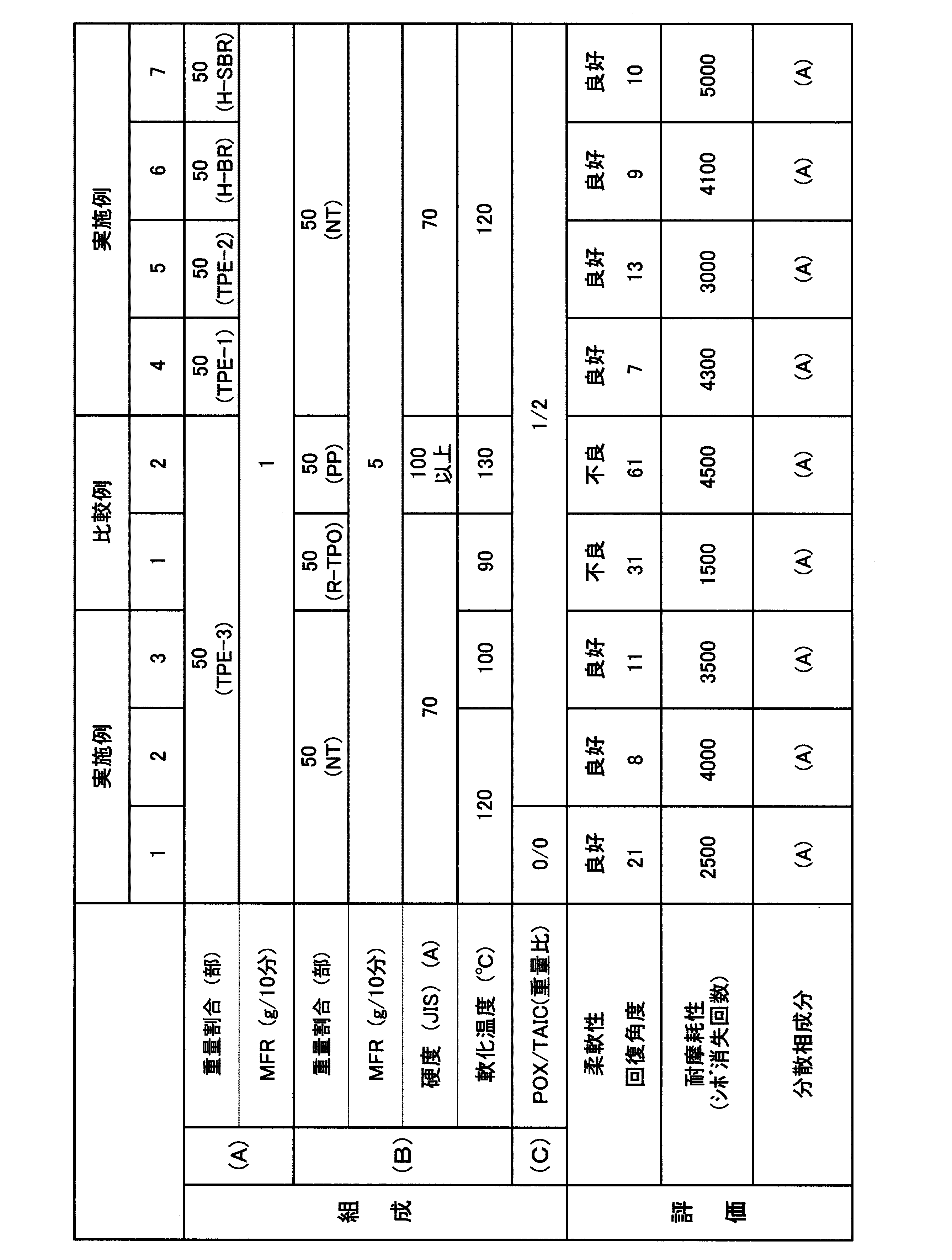
[実施例1〜7および比較例1〜2]
押出機として、バレル中央部に注入口を有した2軸押出機(40mmφ、L/D=47)を用いた。スクリューとしては注入口の前後に混練部を有した2条スクリューを用いた。
表1に記載の組成の混合物を2軸押出機に導入し、160℃で溶融押出を行なった。
このようにして得られた組成物から200℃にて圧縮成形により2mm厚のシートを作成し、各種特性を評価した。
その結果を表1に示した。
[Examples 1-7 and Comparative Examples 1-2]
As the extruder, a twin-screw extruder (40 mmφ, L / D = 47) having an injection port at the center of the barrel was used. As the screw, a two-thread screw having kneading parts before and after the injection port was used.
A mixture having the composition shown in Table 1 was introduced into a twin-screw extruder, and melt extrusion was performed at 160 ° C.
From the composition thus obtained, a sheet having a thickness of 2 mm was prepared by compression molding at 200 ° C., and various properties were evaluated.
The results are shown in Table 1.
本発明のプロピレン系重合体組成物は、自動車用部品、自動車用内装材、エアバッグカバー、機械部品、電気部品、ケーブル、ホース、ベルト、玩具、雑貨、日用品、建材、シート、フィルム等を始めとする用途に幅広く使用可能であり、産業界に果たす役割は大きい。 The propylene polymer composition of the present invention includes automotive parts, automotive interior materials, airbag covers, machine parts, electrical parts, cables, hoses, belts, toys, sundries, daily necessities, building materials, sheets, films, etc. It can be used in a wide range of applications and plays a major role in the industry.
Claims (7)
Furthermore, the propylene-type polymer composition in any one of Claims 1-6 containing the agent chosen from a softener (D), a polyorganosiloxane, and a crystal nucleating agent.
Priority Applications (1)
| Application Number | Priority Date | Filing Date | Title |
|---|---|---|---|
| JP2005348723A JP2007153971A (en) | 2005-12-02 | 2005-12-02 | Propylene polymer composition |
Applications Claiming Priority (1)
| Application Number | Priority Date | Filing Date | Title |
|---|---|---|---|
| JP2005348723A JP2007153971A (en) | 2005-12-02 | 2005-12-02 | Propylene polymer composition |
Publications (1)
| Publication Number | Publication Date |
|---|---|
| JP2007153971A true JP2007153971A (en) | 2007-06-21 |
Family
ID=38238747
Family Applications (1)
| Application Number | Title | Priority Date | Filing Date |
|---|---|---|---|
| JP2005348723A Pending JP2007153971A (en) | 2005-12-02 | 2005-12-02 | Propylene polymer composition |
Country Status (1)
| Country | Link |
|---|---|
| JP (1) | JP2007153971A (en) |
Cited By (2)
| Publication number | Priority date | Publication date | Assignee | Title |
|---|---|---|---|---|
| JP2009200003A (en) * | 2008-02-25 | 2009-09-03 | Swcc Showa Cable Systems Co Ltd | High voltage electronic equipment cable |
| WO2011159059A3 (en) * | 2010-06-17 | 2012-04-26 | Honam Petrochemical Corporation | Thermoplastic vulcanizates composition having improved foaming formability and molded article manufactured therefrom |
-
2005
- 2005-12-02 JP JP2005348723A patent/JP2007153971A/en active Pending
Cited By (3)
| Publication number | Priority date | Publication date | Assignee | Title |
|---|---|---|---|---|
| JP2009200003A (en) * | 2008-02-25 | 2009-09-03 | Swcc Showa Cable Systems Co Ltd | High voltage electronic equipment cable |
| WO2011159059A3 (en) * | 2010-06-17 | 2012-04-26 | Honam Petrochemical Corporation | Thermoplastic vulcanizates composition having improved foaming formability and molded article manufactured therefrom |
| KR101180874B1 (en) | 2010-06-17 | 2012-09-07 | 호남석유화학 주식회사 | Thermoplastic vulcanizates composition having improved foaming formability, and molded article manufactured therefrom |
Similar Documents
| Publication | Publication Date | Title |
|---|---|---|
| US20040116605A1 (en) | Olefin polymer composition | |
| EP1243615B1 (en) | Thermoplastic crosslinked rubber compositions | |
| JP5546096B2 (en) | Thermoplastic polymer rubber composition | |
| JP2008291100A (en) | Cross-linked thermoplastic elastomer composition | |
| US6403716B1 (en) | Thermoplastic rubber composition | |
| JP4318436B2 (en) | Aromatic vinyl-based hydrogenated rubber composition | |
| JP4700186B2 (en) | Composite elastomer composition | |
| JP2006328307A (en) | Injection molded body | |
| JP2007153971A (en) | Propylene polymer composition | |
| JP2007254514A (en) | Soft polymer composition | |
| JP2006206673A (en) | Injection molded body | |
| JP2006143783A (en) | Thermoplastic crosslinked rubber composition | |
| JP4489937B2 (en) | Rubber composition | |
| JP2004149709A (en) | Manufacturing method of good appearance thermoplastic elastomer composition | |
| JP4948696B2 (en) | Thermoplastic rubber composition | |
| JP2006056962A (en) | Thermoplastic elastomer composition | |
| JP2008120966A (en) | Sealing material | |
| JP2007191544A (en) | Foamable polymer composition | |
| JP2006328306A (en) | Olefin polymer composition | |
| JP2006089563A (en) | Thermoplastic crosslinked rubber composition powder | |
| JP4213995B2 (en) | Good appearance thermoplastic polymer composition | |
| JP2008001808A (en) | Low hardness thermoplastic rubber polymer composition | |
| JP2008019345A (en) | Thermoplastic rubber polymer composition | |
| JP2005231182A (en) | Cleaning agent for extruder and molding machine | |
| JP2006008742A (en) | Resin composition |