JP2005281170A - Method of purifying hydroperoxide and method of detecting hydroperoxide - Google Patents
Method of purifying hydroperoxide and method of detecting hydroperoxide Download PDFInfo
- Publication number
- JP2005281170A JP2005281170A JP2004095755A JP2004095755A JP2005281170A JP 2005281170 A JP2005281170 A JP 2005281170A JP 2004095755 A JP2004095755 A JP 2004095755A JP 2004095755 A JP2004095755 A JP 2004095755A JP 2005281170 A JP2005281170 A JP 2005281170A
- Authority
- JP
- Japan
- Prior art keywords
- hydroperoxide
- group
- vinyl ether
- substituent
- solution
- Prior art date
- Legal status (The legal status is an assumption and is not a legal conclusion. Google has not performed a legal analysis and makes no representation as to the accuracy of the status listed.)
- Pending
Links
- MHAJPDPJQMAIIY-UHFFFAOYSA-N Hydrogen peroxide Chemical compound OO MHAJPDPJQMAIIY-UHFFFAOYSA-N 0.000 title claims abstract description 163
- 238000000034 method Methods 0.000 title claims abstract description 42
- QYKIQEUNHZKYBP-UHFFFAOYSA-N Vinyl ether Chemical compound C=COC=C QYKIQEUNHZKYBP-UHFFFAOYSA-N 0.000 claims abstract description 78
- MHAJPDPJQMAIIY-UHFFFAOYSA-M hydroperoxide group Chemical group [O-]O MHAJPDPJQMAIIY-UHFFFAOYSA-M 0.000 claims abstract description 11
- 125000001424 substituent group Chemical group 0.000 claims description 27
- 125000003808 silyl group Chemical group [H][Si]([H])([H])[*] 0.000 claims description 16
- 239000000126 substance Substances 0.000 claims description 15
- 125000000217 alkyl group Chemical group 0.000 claims description 13
- 150000002430 hydrocarbons Chemical class 0.000 claims description 8
- 230000009257 reactivity Effects 0.000 claims description 8
- 239000003153 chemical reaction reagent Substances 0.000 claims description 7
- 229930195733 hydrocarbon Natural products 0.000 claims description 7
- 125000004429 atom Chemical group 0.000 claims description 5
- 229910052751 metal Inorganic materials 0.000 claims description 5
- 239000002184 metal Substances 0.000 claims description 5
- 239000004215 Carbon black (E152) Substances 0.000 claims description 4
- 125000005843 halogen group Chemical group 0.000 claims description 4
- 102000004190 Enzymes Human genes 0.000 claims description 3
- 108090000790 Enzymes Proteins 0.000 claims description 3
- 238000002835 absorbance Methods 0.000 claims description 3
- 238000000149 argon plasma sintering Methods 0.000 claims description 3
- 125000004435 hydrogen atom Chemical group [H]* 0.000 claims description 3
- 230000005855 radiation Effects 0.000 claims description 3
- 125000001183 hydrocarbyl group Chemical group 0.000 claims 2
- 239000012535 impurity Substances 0.000 abstract description 9
- OKKJLVBELUTLKV-UHFFFAOYSA-N Methanol Chemical compound OC OKKJLVBELUTLKV-UHFFFAOYSA-N 0.000 description 78
- -1 lipid hydroperoxide Chemical class 0.000 description 78
- 239000000243 solution Substances 0.000 description 50
- 238000001514 detection method Methods 0.000 description 31
- WTJKGGKOPKCXLL-RRHRGVEJSA-N phosphatidylcholine Chemical compound CCCCCCCCCCCCCCCC(=O)OC[C@H](COP([O-])(=O)OCC[N+](C)(C)C)OC(=O)CCCCCCCC=CCCCCCCCC WTJKGGKOPKCXLL-RRHRGVEJSA-N 0.000 description 31
- 239000001149 (9Z,12Z)-octadeca-9,12-dienoate Substances 0.000 description 24
- WTTJVINHCBCLGX-UHFFFAOYSA-N (9trans,12cis)-methyl linoleate Natural products CCCCCC=CCC=CCCCCCCCC(=O)OC WTTJVINHCBCLGX-UHFFFAOYSA-N 0.000 description 24
- LNJCGNRKWOHFFV-UHFFFAOYSA-N 3-(2-hydroxyethylsulfanyl)propanenitrile Chemical compound OCCSCCC#N LNJCGNRKWOHFFV-UHFFFAOYSA-N 0.000 description 24
- PKIXXJPMNDDDOS-UHFFFAOYSA-N Methyl linoleate Natural products CCCCC=CCCC=CCCCCCCCC(=O)OC PKIXXJPMNDDDOS-UHFFFAOYSA-N 0.000 description 24
- 238000004128 high performance liquid chromatography Methods 0.000 description 21
- 150000002500 ions Chemical class 0.000 description 21
- UFWIBTONFRDIAS-UHFFFAOYSA-N Naphthalene Chemical compound C1=CC=CC2=CC=CC=C21 UFWIBTONFRDIAS-UHFFFAOYSA-N 0.000 description 20
- VYPSYNLAJGMNEJ-UHFFFAOYSA-N Silicium dioxide Chemical compound O=[Si]=O VYPSYNLAJGMNEJ-UHFFFAOYSA-N 0.000 description 19
- WEVYAHXRMPXWCK-UHFFFAOYSA-N Acetonitrile Chemical compound CC#N WEVYAHXRMPXWCK-UHFFFAOYSA-N 0.000 description 18
- 238000004587 chromatography analysis Methods 0.000 description 18
- XLYOFNOQVPJJNP-UHFFFAOYSA-N water Substances O XLYOFNOQVPJJNP-UHFFFAOYSA-N 0.000 description 17
- HEDRZPFGACZZDS-UHFFFAOYSA-N Chloroform Chemical compound ClC(Cl)Cl HEDRZPFGACZZDS-UHFFFAOYSA-N 0.000 description 16
- 238000006243 chemical reaction Methods 0.000 description 16
- VLKZOEOYAKHREP-UHFFFAOYSA-N n-Hexane Chemical compound CCCCCC VLKZOEOYAKHREP-UHFFFAOYSA-N 0.000 description 15
- 239000000523 sample Substances 0.000 description 15
- KFZMGEQAYNKOFK-UHFFFAOYSA-N Isopropanol Chemical compound CC(C)O KFZMGEQAYNKOFK-UHFFFAOYSA-N 0.000 description 12
- 230000014759 maintenance of location Effects 0.000 description 12
- 239000003054 catalyst Substances 0.000 description 11
- 125000001624 naphthyl group Chemical group 0.000 description 11
- 239000002904 solvent Substances 0.000 description 11
- 150000002432 hydroperoxides Chemical class 0.000 description 10
- 238000000926 separation method Methods 0.000 description 10
- QTBSBXVTEAMEQO-UHFFFAOYSA-N Acetic acid Chemical compound CC(O)=O QTBSBXVTEAMEQO-UHFFFAOYSA-N 0.000 description 9
- USFZMSVCRYTOJT-UHFFFAOYSA-N Ammonium acetate Chemical compound N.CC(O)=O USFZMSVCRYTOJT-UHFFFAOYSA-N 0.000 description 9
- 239000005695 Ammonium acetate Substances 0.000 description 9
- OYHQOLUKZRVURQ-HZJYTTRNSA-N Linoleic acid Chemical compound CCCCC\C=C/C\C=C/CCCCCCCC(O)=O OYHQOLUKZRVURQ-HZJYTTRNSA-N 0.000 description 9
- 229940043376 ammonium acetate Drugs 0.000 description 9
- 235000019257 ammonium acetate Nutrition 0.000 description 9
- 239000000356 contaminant Substances 0.000 description 9
- 238000010828 elution Methods 0.000 description 9
- 238000004811 liquid chromatography Methods 0.000 description 9
- 239000000377 silicon dioxide Substances 0.000 description 9
- IJGRMHOSHXDMSA-UHFFFAOYSA-N Atomic nitrogen Chemical compound N#N IJGRMHOSHXDMSA-UHFFFAOYSA-N 0.000 description 8
- LFQSCWFLJHTTHZ-UHFFFAOYSA-N Ethanol Chemical compound CCO LFQSCWFLJHTTHZ-UHFFFAOYSA-N 0.000 description 8
- 238000010521 absorption reaction Methods 0.000 description 8
- RTZKZFJDLAIYFH-UHFFFAOYSA-N ether Substances CCOCC RTZKZFJDLAIYFH-UHFFFAOYSA-N 0.000 description 8
- 239000003960 organic solvent Substances 0.000 description 8
- 238000002953 preparative HPLC Methods 0.000 description 8
- 238000004366 reverse phase liquid chromatography Methods 0.000 description 8
- 150000001875 compounds Chemical class 0.000 description 7
- 235000020778 linoleic acid Nutrition 0.000 description 7
- OYHQOLUKZRVURQ-IXWMQOLASA-N linoleic acid Natural products CCCCC\C=C/C\C=C\CCCCCCCC(O)=O OYHQOLUKZRVURQ-IXWMQOLASA-N 0.000 description 7
- 125000002496 methyl group Chemical group [H]C([H])([H])* 0.000 description 7
- 238000000746 purification Methods 0.000 description 7
- ZDYVRSLAEXCVBX-UHFFFAOYSA-N pyridinium p-toluenesulfonate Chemical compound C1=CC=[NH+]C=C1.CC1=CC=C(S([O-])(=O)=O)C=C1 ZDYVRSLAEXCVBX-UHFFFAOYSA-N 0.000 description 7
- YOWQWFMSQCOSBA-UHFFFAOYSA-N 2-methoxypropene Chemical compound COC(C)=C YOWQWFMSQCOSBA-UHFFFAOYSA-N 0.000 description 6
- WYURNTSHIVDZCO-UHFFFAOYSA-N Tetrahydrofuran Chemical compound C1CCOC1 WYURNTSHIVDZCO-UHFFFAOYSA-N 0.000 description 6
- YXFVVABEGXRONW-UHFFFAOYSA-N Toluene Chemical compound CC1=CC=CC=C1 YXFVVABEGXRONW-UHFFFAOYSA-N 0.000 description 6
- 230000002378 acidificating effect Effects 0.000 description 6
- 235000013305 food Nutrition 0.000 description 6
- 150000002632 lipids Chemical class 0.000 description 6
- 238000001228 spectrum Methods 0.000 description 6
- 238000012360 testing method Methods 0.000 description 6
- 125000000113 cyclohexyl group Chemical group [H]C1([H])C([H])([H])C([H])([H])C([H])(*)C([H])([H])C1([H])[H] 0.000 description 5
- 125000001495 ethyl group Chemical group [H]C([H])([H])C([H])([H])* 0.000 description 5
- 230000005284 excitation Effects 0.000 description 5
- 238000001917 fluorescence detection Methods 0.000 description 5
- 125000000524 functional group Chemical group 0.000 description 5
- 125000004051 hexyl group Chemical group [H]C([H])([H])C([H])([H])C([H])([H])C([H])([H])C([H])([H])C([H])([H])* 0.000 description 5
- 125000000959 isobutyl group Chemical group [H]C([H])([H])C([H])(C([H])([H])[H])C([H])([H])* 0.000 description 5
- 125000001449 isopropyl group Chemical group [H]C([H])([H])C([H])(*)C([H])([H])[H] 0.000 description 5
- 125000004108 n-butyl group Chemical group [H]C([H])([H])C([H])([H])C([H])([H])C([H])([H])* 0.000 description 5
- 125000004123 n-propyl group Chemical group [H]C([H])([H])C([H])([H])C([H])([H])* 0.000 description 5
- 125000001400 nonyl group Chemical group [H]C([*])([H])C([H])([H])C([H])([H])C([H])([H])C([H])([H])C([H])([H])C([H])([H])C([H])([H])C([H])([H])[H] 0.000 description 5
- 125000002347 octyl group Chemical group [H]C([*])([H])C([H])([H])C([H])([H])C([H])([H])C([H])([H])C([H])([H])C([H])([H])C([H])([H])[H] 0.000 description 5
- 125000001181 organosilyl group Chemical group [SiH3]* 0.000 description 5
- 239000002245 particle Substances 0.000 description 5
- 125000001147 pentyl group Chemical group C(CCCC)* 0.000 description 5
- 239000012488 sample solution Substances 0.000 description 5
- 125000000999 tert-butyl group Chemical group [H]C([H])([H])C(*)(C([H])([H])[H])C([H])([H])[H] 0.000 description 5
- 210000000692 cap cell Anatomy 0.000 description 4
- 235000014113 dietary fatty acids Nutrition 0.000 description 4
- 239000000194 fatty acid Substances 0.000 description 4
- 229930195729 fatty acid Natural products 0.000 description 4
- MEUKEBNAABNAEX-UHFFFAOYSA-N hydroperoxymethane Chemical compound COO MEUKEBNAABNAEX-UHFFFAOYSA-N 0.000 description 4
- 239000012528 membrane Substances 0.000 description 4
- 239000011259 mixed solution Substances 0.000 description 4
- 239000000203 mixture Substances 0.000 description 4
- 229910052757 nitrogen Inorganic materials 0.000 description 4
- 125000000026 trimethylsilyl group Chemical group [H]C([H])([H])[Si]([*])(C([H])([H])[H])C([H])([H])[H] 0.000 description 4
- RVBUGGBMJDPOST-UHFFFAOYSA-N 2-thiobarbituric acid Chemical compound O=C1CC(=O)NC(=S)N1 RVBUGGBMJDPOST-UHFFFAOYSA-N 0.000 description 3
- YMWUJEATGCHHMB-UHFFFAOYSA-N Dichloromethane Chemical compound ClCCl YMWUJEATGCHHMB-UHFFFAOYSA-N 0.000 description 3
- 230000005526 G1 to G0 transition Effects 0.000 description 3
- DGAQECJNVWCQMB-PUAWFVPOSA-M Ilexoside XXIX Chemical compound C[C@@H]1CC[C@@]2(CC[C@@]3(C(=CC[C@H]4[C@]3(CC[C@@H]5[C@@]4(CC[C@@H](C5(C)C)OS(=O)(=O)[O-])C)C)[C@@H]2[C@]1(C)O)C)C(=O)O[C@H]6[C@@H]([C@H]([C@@H]([C@H](O6)CO)O)O)O.[Na+] DGAQECJNVWCQMB-PUAWFVPOSA-M 0.000 description 3
- HEMHJVSKTPXQMS-UHFFFAOYSA-M Sodium hydroxide Chemical compound [OH-].[Na+] HEMHJVSKTPXQMS-UHFFFAOYSA-M 0.000 description 3
- 239000002253 acid Substances 0.000 description 3
- 239000003463 adsorbent Substances 0.000 description 3
- 239000003513 alkali Substances 0.000 description 3
- 238000004458 analytical method Methods 0.000 description 3
- 238000002038 chemiluminescence detection Methods 0.000 description 3
- 125000004122 cyclic group Chemical group 0.000 description 3
- 239000007789 gas Substances 0.000 description 3
- 239000007788 liquid Substances 0.000 description 3
- 238000000691 measurement method Methods 0.000 description 3
- 230000000704 physical effect Effects 0.000 description 3
- AZJPTIGZZTZIDR-UHFFFAOYSA-L rose bengal Chemical compound [K+].[K+].[O-]C(=O)C1=C(Cl)C(Cl)=C(Cl)C(Cl)=C1C1=C2C=C(I)C(=O)C(I)=C2OC2=C(I)C([O-])=C(I)C=C21 AZJPTIGZZTZIDR-UHFFFAOYSA-L 0.000 description 3
- 150000003839 salts Chemical class 0.000 description 3
- 125000002914 sec-butyl group Chemical group [H]C([H])([H])C([H])([H])C([H])(*)C([H])([H])[H] 0.000 description 3
- 230000035945 sensitivity Effects 0.000 description 3
- 229910052708 sodium Inorganic materials 0.000 description 3
- 239000011734 sodium Substances 0.000 description 3
- 230000002194 synthesizing effect Effects 0.000 description 3
- 239000012085 test solution Substances 0.000 description 3
- YLQBMQCUIZJEEH-UHFFFAOYSA-N tetrahydrofuran Natural products C=1C=COC=1 YLQBMQCUIZJEEH-UHFFFAOYSA-N 0.000 description 3
- LDVVTQMJQSCDMK-UHFFFAOYSA-N 1,3-dihydroxypropan-2-yl formate Chemical compound OCC(CO)OC=O LDVVTQMJQSCDMK-UHFFFAOYSA-N 0.000 description 2
- ZCYVEMRRCGMTRW-UHFFFAOYSA-N 7553-56-2 Chemical compound [I] ZCYVEMRRCGMTRW-UHFFFAOYSA-N 0.000 description 2
- XKRFYHLGVUSROY-UHFFFAOYSA-N Argon Chemical compound [Ar] XKRFYHLGVUSROY-UHFFFAOYSA-N 0.000 description 2
- JUJWROOIHBZHMG-UHFFFAOYSA-N Pyridine Chemical compound C1=CC=NC=C1 JUJWROOIHBZHMG-UHFFFAOYSA-N 0.000 description 2
- 238000011481 absorbance measurement Methods 0.000 description 2
- 239000003377 acid catalyst Substances 0.000 description 2
- 150000001298 alcohols Chemical class 0.000 description 2
- 150000003863 ammonium salts Chemical class 0.000 description 2
- QVGXLLKOCUKJST-UHFFFAOYSA-N atomic oxygen Chemical compound [O] QVGXLLKOCUKJST-UHFFFAOYSA-N 0.000 description 2
- 238000000889 atomisation Methods 0.000 description 2
- XMQFTWRPUQYINF-UHFFFAOYSA-N bensulfuron-methyl Chemical compound COC(=O)C1=CC=CC=C1CS(=O)(=O)NC(=O)NC1=NC(OC)=CC(OC)=N1 XMQFTWRPUQYINF-UHFFFAOYSA-N 0.000 description 2
- 239000012472 biological sample Substances 0.000 description 2
- 125000000484 butyl group Chemical group [H]C([*])([H])C([H])([H])C([H])([H])C([H])([H])[H] 0.000 description 2
- 125000002915 carbonyl group Chemical group [*:2]C([*:1])=O 0.000 description 2
- 230000005779 cell damage Effects 0.000 description 2
- 208000037887 cell injury Diseases 0.000 description 2
- HVYWMOMLDIMFJA-DPAQBDIFSA-N cholesterol Chemical compound C1C=C2C[C@@H](O)CC[C@]2(C)[C@@H]2[C@@H]1[C@@H]1CC[C@H]([C@H](C)CCCC(C)C)[C@@]1(C)CC2 HVYWMOMLDIMFJA-DPAQBDIFSA-N 0.000 description 2
- 229910052802 copper Inorganic materials 0.000 description 2
- 230000003013 cytotoxicity Effects 0.000 description 2
- 231100000135 cytotoxicity Toxicity 0.000 description 2
- 125000002704 decyl group Chemical group [H]C([H])([H])C([H])([H])C([H])([H])C([H])([H])C([H])([H])C([H])([H])C([H])([H])C([H])([H])C([H])([H])C([H])([H])* 0.000 description 2
- 150000004665 fatty acids Chemical class 0.000 description 2
- XLYOFNOQVPJJNP-UHFFFAOYSA-M hydroxide Chemical compound [OH-] XLYOFNOQVPJJNP-UHFFFAOYSA-M 0.000 description 2
- 239000011630 iodine Substances 0.000 description 2
- 229910052740 iodine Inorganic materials 0.000 description 2
- 229910052742 iron Inorganic materials 0.000 description 2
- 229940049918 linoleate Drugs 0.000 description 2
- HMRROBKAACRWBP-UHFFFAOYSA-N methyl naphthalene-1-carboxylate Chemical compound C1=CC=C2C(C(=O)OC)=CC=CC2=C1 HMRROBKAACRWBP-UHFFFAOYSA-N 0.000 description 2
- 238000002156 mixing Methods 0.000 description 2
- 229920000620 organic polymer Polymers 0.000 description 2
- 239000001301 oxygen Substances 0.000 description 2
- 229910052760 oxygen Inorganic materials 0.000 description 2
- 125000004430 oxygen atom Chemical group O* 0.000 description 2
- 150000002978 peroxides Chemical class 0.000 description 2
- 239000002952 polymeric resin Substances 0.000 description 2
- 238000002360 preparation method Methods 0.000 description 2
- 238000004445 quantitative analysis Methods 0.000 description 2
- 238000011084 recovery Methods 0.000 description 2
- 230000001172 regenerating effect Effects 0.000 description 2
- 230000000717 retained effect Effects 0.000 description 2
- 229930187593 rose bengal Natural products 0.000 description 2
- 229940081623 rose bengal Drugs 0.000 description 2
- STRXNPAVPKGJQR-UHFFFAOYSA-N rose bengal A Natural products O1C(=O)C(C(=CC=C2Cl)Cl)=C2C21C1=CC(I)=C(O)C(I)=C1OC1=C(I)C(O)=C(I)C=C21 STRXNPAVPKGJQR-UHFFFAOYSA-N 0.000 description 2
- 239000007921 spray Substances 0.000 description 2
- UFTFJSFQGQCHQW-UHFFFAOYSA-N triformin Chemical compound O=COCC(OC=O)COC=O UFTFJSFQGQCHQW-UHFFFAOYSA-N 0.000 description 2
- 229920002554 vinyl polymer Polymers 0.000 description 2
- 239000003643 water by type Substances 0.000 description 2
- CUIXDAUTEMBARD-JLLCDCETSA-N (3s,5r,8s,9s,10r,13r,14s,17r)-5-hydroperoxy-10,13-dimethyl-17-[(2r)-6-methylheptan-2-yl]-1,2,3,4,8,9,11,12,14,15,16,17-dodecahydrocyclopenta[a]phenanthren-3-ol Chemical compound C([C@]1(C=C2)OO)[C@@H](O)CC[C@]1(C)[C@@H]1[C@@H]2[C@@H]2CC[C@H]([C@H](C)CCCC(C)C)[C@@]2(C)CC1 CUIXDAUTEMBARD-JLLCDCETSA-N 0.000 description 1
- PORPENFLTBBHSG-MGBGTMOVSA-N 1,2-dihexadecanoyl-sn-glycerol-3-phosphate Chemical compound CCCCCCCCCCCCCCCC(=O)OC[C@H](COP(O)(O)=O)OC(=O)CCCCCCCCCCCCCCC PORPENFLTBBHSG-MGBGTMOVSA-N 0.000 description 1
- TZCPCKNHXULUIY-RGULYWFUSA-N 1,2-distearoyl-sn-glycero-3-phosphoserine Chemical compound CCCCCCCCCCCCCCCCCC(=O)OC[C@H](COP(O)(=O)OC[C@H](N)C(O)=O)OC(=O)CCCCCCCCCCCCCCCCC TZCPCKNHXULUIY-RGULYWFUSA-N 0.000 description 1
- QHMVQKOXILNZQR-UHFFFAOYSA-N 1-methoxyprop-1-ene Chemical compound COC=CC QHMVQKOXILNZQR-UHFFFAOYSA-N 0.000 description 1
- QPUYECUOLPXSFR-UHFFFAOYSA-N 1-methylnaphthalene Chemical compound C1=CC=C2C(C)=CC=CC2=C1 QPUYECUOLPXSFR-UHFFFAOYSA-N 0.000 description 1
- GVNVAWHJIKLAGL-UHFFFAOYSA-N 2-(cyclohexen-1-yl)cyclohexan-1-one Chemical compound O=C1CCCCC1C1=CCCCC1 GVNVAWHJIKLAGL-UHFFFAOYSA-N 0.000 description 1
- QGZKDVFQNNGYKY-UHFFFAOYSA-O Ammonium Chemical compound [NH4+] QGZKDVFQNNGYKY-UHFFFAOYSA-O 0.000 description 1
- WKBOTKDWSSQWDR-UHFFFAOYSA-N Bromine atom Chemical compound [Br] WKBOTKDWSSQWDR-UHFFFAOYSA-N 0.000 description 1
- ZAMOUSCENKQFHK-UHFFFAOYSA-N Chlorine atom Chemical compound [Cl] ZAMOUSCENKQFHK-UHFFFAOYSA-N 0.000 description 1
- 101150065749 Churc1 gene Proteins 0.000 description 1
- PXGOKWXKJXAPGV-UHFFFAOYSA-N Fluorine Chemical compound FF PXGOKWXKJXAPGV-UHFFFAOYSA-N 0.000 description 1
- JZNWSCPGTDBMEW-UHFFFAOYSA-N Glycerophosphorylethanolamin Natural products NCCOP(O)(=O)OCC(O)CO JZNWSCPGTDBMEW-UHFFFAOYSA-N 0.000 description 1
- ZWZWYGMENQVNFU-UHFFFAOYSA-N Glycerophosphorylserin Natural products OC(=O)C(N)COP(O)(=O)OCC(O)CO ZWZWYGMENQVNFU-UHFFFAOYSA-N 0.000 description 1
- 101100491263 Oryza sativa subsp. japonica AP2-4 gene Proteins 0.000 description 1
- 102100038239 Protein Churchill Human genes 0.000 description 1
- 238000007259 addition reaction Methods 0.000 description 1
- 239000002671 adjuvant Substances 0.000 description 1
- 230000000274 adsorptive effect Effects 0.000 description 1
- 150000001299 aldehydes Chemical class 0.000 description 1
- 229910052782 aluminium Inorganic materials 0.000 description 1
- 238000005349 anion exchange Methods 0.000 description 1
- 125000002178 anthracenyl group Chemical group C1(=CC=CC2=CC3=CC=CC=C3C=C12)* 0.000 description 1
- 229910052786 argon Inorganic materials 0.000 description 1
- 125000001797 benzyl group Chemical group [H]C1=C([H])C([H])=C(C([H])=C1[H])C([H])([H])* 0.000 description 1
- GDTBXPJZTBHREO-UHFFFAOYSA-N bromine Substances BrBr GDTBXPJZTBHREO-UHFFFAOYSA-N 0.000 description 1
- 229910052794 bromium Inorganic materials 0.000 description 1
- RHFNIWLZSDICFZ-UHFFFAOYSA-M carbanide;cyclopenta-1,3-diene;dimethylalumanylium;titanium(3+);chloride Chemical compound [CH3-].[Cl-].[Ti+3].C[Al+]C.C=1C=C[CH-]C=1.C=1C=C[CH-]C=1 RHFNIWLZSDICFZ-UHFFFAOYSA-M 0.000 description 1
- JJNHBFYGCSOONU-UHFFFAOYSA-M carbanide;cyclopenta-1,3-diene;dimethylaluminum;titanium(4+);chloride Chemical compound [CH3-].[Ti+3]Cl.C[Al]C.C=1C=C[CH-]C=1.C=1C=C[CH-]C=1 JJNHBFYGCSOONU-UHFFFAOYSA-M 0.000 description 1
- 239000003795 chemical substances by application Substances 0.000 description 1
- 229910052801 chlorine Inorganic materials 0.000 description 1
- 239000000460 chlorine Substances 0.000 description 1
- 235000012000 cholesterol Nutrition 0.000 description 1
- 150000001840 cholesterol esters Chemical class 0.000 description 1
- 229910052804 chromium Inorganic materials 0.000 description 1
- 238000000354 decomposition reaction Methods 0.000 description 1
- 230000035418 detection of UV Effects 0.000 description 1
- 238000011161 development Methods 0.000 description 1
- 125000000118 dimethyl group Chemical group [H]C([H])([H])* 0.000 description 1
- 201000010099 disease Diseases 0.000 description 1
- 208000037265 diseases, disorders, signs and symptoms Diseases 0.000 description 1
- ZGSPNIOCEDOHGS-UHFFFAOYSA-L disodium [3-[2,3-di(octadeca-9,12-dienoyloxy)propoxy-oxidophosphoryl]oxy-2-hydroxypropyl] 2,3-di(octadeca-9,12-dienoyloxy)propyl phosphate Chemical compound [Na+].[Na+].CCCCCC=CCC=CCCCCCCCC(=O)OCC(OC(=O)CCCCCCCC=CCC=CCCCCC)COP([O-])(=O)OCC(O)COP([O-])(=O)OCC(OC(=O)CCCCCCCC=CCC=CCCCCC)COC(=O)CCCCCCCC=CCC=CCCCCC ZGSPNIOCEDOHGS-UHFFFAOYSA-L 0.000 description 1
- 230000008030 elimination Effects 0.000 description 1
- 238000003379 elimination reaction Methods 0.000 description 1
- 230000002255 enzymatic effect Effects 0.000 description 1
- 150000002148 esters Chemical class 0.000 description 1
- 238000002474 experimental method Methods 0.000 description 1
- 229910052731 fluorine Inorganic materials 0.000 description 1
- 239000011737 fluorine Substances 0.000 description 1
- 230000002070 germicidal effect Effects 0.000 description 1
- 229960004956 glycerylphosphorylcholine Drugs 0.000 description 1
- 229910052737 gold Inorganic materials 0.000 description 1
- 150000004679 hydroxides Chemical class 0.000 description 1
- FPCCSQOGAWCVBH-UHFFFAOYSA-N ketanserin Chemical compound C1=CC(F)=CC=C1C(=O)C1CCN(CCN2C(C3=CC=CC=C3NC2=O)=O)CC1 FPCCSQOGAWCVBH-UHFFFAOYSA-N 0.000 description 1
- 229910052748 manganese Inorganic materials 0.000 description 1
- 238000005259 measurement Methods 0.000 description 1
- 150000002739 metals Chemical class 0.000 description 1
- 229910052759 nickel Inorganic materials 0.000 description 1
- 230000003647 oxidation Effects 0.000 description 1
- 238000007254 oxidation reaction Methods 0.000 description 1
- 230000001590 oxidative effect Effects 0.000 description 1
- 230000036542 oxidative stress Effects 0.000 description 1
- 229910052763 palladium Inorganic materials 0.000 description 1
- 238000005502 peroxidation Methods 0.000 description 1
- 125000001997 phenyl group Chemical group [H]C1=C([H])C([H])=C(*)C([H])=C1[H] 0.000 description 1
- 150000008104 phosphatidylethanolamines Chemical class 0.000 description 1
- 150000003905 phosphatidylinositols Chemical class 0.000 description 1
- 238000007539 photo-oxidation reaction Methods 0.000 description 1
- 230000001766 physiological effect Effects 0.000 description 1
- 229910052697 platinum Inorganic materials 0.000 description 1
- 238000012545 processing Methods 0.000 description 1
- 150000003180 prostaglandins Chemical class 0.000 description 1
- 125000001725 pyrenyl group Chemical group 0.000 description 1
- UMJSCPRVCHMLSP-UHFFFAOYSA-N pyridine Natural products COC1=CC=CN=C1 UMJSCPRVCHMLSP-UHFFFAOYSA-N 0.000 description 1
- 239000000741 silica gel Substances 0.000 description 1
- 229910002027 silica gel Inorganic materials 0.000 description 1
- 239000005368 silicate glass Substances 0.000 description 1
- 229910052709 silver Inorganic materials 0.000 description 1
- 238000001179 sorption measurement Methods 0.000 description 1
- 238000003756 stirring Methods 0.000 description 1
- 238000004448 titration Methods 0.000 description 1
- 229910052723 transition metal Inorganic materials 0.000 description 1
- 150000003624 transition metals Chemical class 0.000 description 1
Images




Landscapes
- Organic Low-Molecular-Weight Compounds And Preparation Thereof (AREA)
Abstract
Description
本発明は、食品産業分野、有機化学分野、医学分野等において重要な意味を持つヒドロペルオキシドの精製方法および検出方法に関する。 The present invention relates to a method for purifying and detecting hydroperoxide having an important meaning in the food industry field, organic chemistry field, medical field and the like.
ヒドロペルオキシドとは、官能基−OOHを持つ化合物の総称である。ヒドロペルオキシドは炭化水素類、特に脂質の酸化により生じる。ヒドロペルオキシドは酸化力に富み、食品の酸敗の主因である。生体では、酸化ストレスを受けると脂質ヒドロペルオキシドが生じ、様々な疾病の原因となる。ヒドロペルオキシドによって細胞障害が発生すると考えられるが、ヒドロペルオキシドが起こす細胞障害の機構は十分に明らかでない。 Hydroperoxide is a general term for compounds having a functional group —OOH. Hydroperoxides are produced by oxidation of hydrocarbons, particularly lipids. Hydroperoxide is rich in oxidizing power and is a major cause of food rancidity. In the living body, when subjected to oxidative stress, lipid hydroperoxide is generated, which causes various diseases. Although it is thought that cytotoxicity is caused by hydroperoxide, the mechanism of cytotoxicity caused by hydroperoxide is not sufficiently clear.
ヒドロペルオキシドと、食品の腐敗や細胞障害などとの関係を調査する上では、食品や生体中に生成・蓄積するヒドロペルオキシドを正確に定量分析する必要がある。 In order to investigate the relationship between hydroperoxide and food spoilage or cell damage, it is necessary to accurately and quantitatively analyze the hydroperoxide produced and accumulated in food and living organisms.
ヒドロペルオキシドの定量分析の際には、あらかじめヒドロペルオキシド標品を用いて標準曲線を作成しておき、標準曲線を用いてヒドロペルオキシド量を決定する方法が考えられる。しかし、標品として利用可能な濃度既知で高純度のヒドロペルオキシド試料が手に入らないため、現在においては測定者自身が標品を準備する必要がある。 In quantitative analysis of hydroperoxide, a method of preparing a standard curve in advance using a hydroperoxide sample and determining the amount of hydroperoxide using the standard curve is conceivable. However, since a highly pure hydroperoxide sample having a known concentration that can be used as a standard is not available, it is now necessary for the measurer to prepare the standard.
標品として用いられるヒドロペルオキシドは、脂質などの化合物を光酸化または酵素的に過酸化して得られたヒドロペルオキシドを、液体クロマトグラフィーに供し、夾雑物である分解物(ヒドロキシド、アルデヒドなど)や未酸化物を除くことによって得られる。しかし、ヒドロキシドなど一部の夾雑物は、ヒドロペルオキシドと分子サイズや極性などが類似しているため、液体クロマトグラフィーなどで除去しきれずにヒドロペルオキシド標品に混入する。混入したヒドロペルオキシドは、ヒドロペルオキシドの定量分析において、測定誤差を招来してしまう。このため、夾雑物を含むヒドロペルオキシドを精製し、高純度のヒドロペルオキシドを得る技術の開発が所望されていた。 Hydroperoxides used as preparations are hydroperoxides obtained by photo-oxidation or enzymatic peroxidation of lipids and other compounds, and are subjected to liquid chromatography, and are decomposed products (hydroxides, aldehydes, etc.). Or by removing non-oxides. However, some impurities such as hydroxide are similar to hydroperoxide in terms of molecular size and polarity, and therefore cannot be completely removed by liquid chromatography or the like and are mixed into the hydroperoxide preparation. The mixed hydroperoxide causes measurement errors in the quantitative analysis of hydroperoxide. For this reason, development of the technique which refine | purifies the hydroperoxide containing a contaminant and obtains highly purified hydroperoxide was desired.
ところで、ヒドロペルオキシドを検出する方法としては、既に様々な方法が開発されている。代表的なものとして、POV測定法(ヨウ素を用いた滴定法;過酸化物価法)、カルボニル価測定法、TBA(チオバルビツール酸)法、吸光度測定法、化学発光HPLC法などがある(例えば、非特許文献1参照)。しかし、POV測定法は感度が低い。また、カルボニル価測定法、TBA法は、ヒドロペルオキシドの分解物を測定する方法であるため、ヒドロペルオキシド量を直接評価できない。吸光度測定法は、試料中に夾雑物が存在した場合に正確な値が得られない。化学発光HPLC法は、ヒドロペルオキシドに対し選択的かつ高感度であるが、測定者の高度な技術習得が必要とされる。以上のような状況から、ヒドロペルオキシドの検出方法の改良が求められていた。 By the way, as a method for detecting hydroperoxide, various methods have already been developed. Typical examples include a POV measurement method (a titration method using iodine; a peroxide value method), a carbonyl value measurement method, a TBA (thiobarbituric acid) method, an absorbance measurement method, and a chemiluminescence HPLC method (for example, Non-Patent Document 1). However, the POV measurement method has low sensitivity. Moreover, since the carbonyl number measuring method and the TBA method are methods for measuring a hydroperoxide decomposition product, the amount of hydroperoxide cannot be directly evaluated. The absorbance measurement method cannot obtain an accurate value when impurities are present in the sample. The chemiluminescent HPLC method is selective and sensitive to hydroperoxide, but requires high skill acquisition by the measurer. In view of the above situation, there has been a demand for an improved hydroperoxide detection method.
本発明の目的は、夾雑物を含むヒドロペルオキシドを精製し、高純度のヒドロペルオキシドを得る方法を提供することである。
また、本発明の他の目的は、優れたヒドロペルオキシドの検出方法を提供することである。
An object of the present invention is to provide a method for purifying hydroperoxide containing impurities to obtain high-purity hydroperoxide.
Another object of the present invention is to provide an excellent method for detecting hydroperoxide.
本発明は、ヒドロペルオキシドの有するヒドロペルオキシド基に、ビニルエーテルを付加させて、ヒドロペルオキシドのビニルエーテル付加物を合成する段階と、前記ヒドロペルオキシドのビニルエーテル付加物を回収する段階と、回収された前記ヒドロペルオキシドのビニルエーテル付加物から、ビニルエーテルを脱離させて、前記ヒドロペルオキシドを再生する段階とを含む、ヒドロペルオキシドの精製方法である。 The present invention includes a step of adding a vinyl ether to a hydroperoxide group of a hydroperoxide to synthesize a vinyl ether adduct of hydroperoxide, a step of recovering the vinyl ether adduct of the hydroperoxide, and a step of recovering the recovered hydroperoxide. And regenerating the hydroperoxide by removing the vinyl ether from the vinyl ether adduct.
また本発明は、ヒドロペルオキシドの有するヒドロペルオキシド基に、ビニルエーテルを付加させて、ヒドロペルオキシドのビニルエーテル付加物を合成する段階と、前記ヒドロペルオキシドのビニルエーテル付加物を検出する段階と含む、ヒドロペルオキシドの検出方法である。 The present invention also includes a step of adding a vinyl ether to a hydroperoxide group of the hydroperoxide to synthesize a vinyl ether adduct of hydroperoxide, and a step of detecting the vinyl ether adduct of the hydroperoxide. Is the method.
本発明の精製方法を用いることによって、夾雑物を含むヒドロペルオキシドを精製し、高純度のヒドロペルオキシドを得ることが可能である。高純度のヒドロペルオキシドを用いることによって、生体試料および食品試料由来などのヒドロペルオキシドの正確な定量が可能になる。また、高純度のヒドロペルオキシドを用いて、細胞障害に関するヒドロペルオキシドの生理活性を正確に評価することが可能である。 By using the purification method of the present invention, it is possible to purify hydroperoxide containing impurities and obtain high-purity hydroperoxide. By using high purity hydroperoxide, it is possible to accurately quantify hydroperoxides such as those derived from biological samples and food samples. Moreover, it is possible to accurately evaluate the physiological activity of hydroperoxide with respect to cell damage using high-purity hydroperoxide.
また、本発明の検出方法は、簡便であり、感度、信頼性、選択性などにも優れる。このため、試料中に含まれるヒドロペルオキシドを簡便に検出し、試料に含まれるヒドロペルオキシド量を正確に測定することが可能である。 Moreover, the detection method of the present invention is simple and excellent in sensitivity, reliability, selectivity and the like. For this reason, it is possible to easily detect the hydroperoxide contained in the sample and accurately measure the amount of hydroperoxide contained in the sample.
本発明の第1は、ヒドロペルオキシドの精製方法に関し、ヒドロペルオキシドにビニルエーテルを付加することで分子のサイズ・構造・極性・特定部位の電荷等を変化させ、生じたヒドロペルオキシドのビニルエーテル付加物を液体クロマトグラフィー等で精製し、付加したビニルエーテルを脱離させ、ヒドロペルオキシドを再生させる(下記スキーム参照)。具体的には、本発明の第1は、ヒドロペルオキシドの有するヒドロペルオキシド基に、ビニルエーテルを付加させて、ヒドロペルオキシドのビニルエーテル付加物を合成する段階と、前記ヒドロペルオキシドのビニルエーテル付加物を回収する段階と、回収された前記ヒドロペルオキシドのビニルエーテル付加物から、ビニルエーテルを脱離させて、前記ヒドロペルオキシドを再生する段階とを含む、ヒドロペルオキシドの精製方法である。 The first aspect of the present invention relates to a method for purifying hydroperoxide, which involves adding vinyl ether to hydroperoxide to change the molecular size, structure, polarity, charge at a specific site, etc. Purification is performed by chromatography or the like, and the added vinyl ether is eliminated to regenerate the hydroperoxide (see the following scheme). Specifically, according to the first aspect of the present invention, a step of synthesizing a vinyl ether adduct of hydroperoxide by adding a vinyl ether to a hydroperoxide group of the hydroperoxide, and a step of recovering the vinyl ether adduct of the hydroperoxide. And regenerating the hydroperoxide by desorbing vinyl ether from the recovered vinyl ether adduct of hydroperoxide.

ヒドロペルオキシドにビニルエーテルを加えることによって、ヒドロペルオキシドのビニルエーテル付加生成物(以下、「パーケタール類」とも記載する)が生成し、極性など分子の物性が大幅に変化する。なお、この反応を酸性触媒の存在下で進行させると、極めて短時間かつ高い収率でヒドロペルオキシドのビニルエーテル付加生成物が得られる。 By adding vinyl ether to hydroperoxide, a vinyl ether addition product of hydroperoxide (hereinafter also referred to as “perketals”) is generated, and the physical properties of the molecule such as polarity are greatly changed. When this reaction proceeds in the presence of an acidic catalyst, a hydroperoxide vinyl ether addition product can be obtained in a very short time and in a high yield.
そして、ヒドロペルオキシドのビニルエーテル付加生成物を、液体クロマトグラフィーを用いて分取、吸着性の粒子に吸着させて回収、または吸着性の粒子への夾雑物の吸着をすることによって、容易に、組成物中の夾雑物を除去することが可能である。 The hydroperoxide vinyl ether addition product can be easily separated by liquid chromatography, adsorbed on adsorbent particles, recovered, or adsorbed by adsorbent particles. It is possible to remove impurities in the object.
夾雑物から分離されたペルオキシドのビニルエーテルを、ビニルエーテルを脱離させることによって、元のヒドロペルオキシドに再生する。再生したヒドロペルオキシドは、液体クロマトグラフィーを用いて分取、吸着性の粒子に吸着させて回収、または吸着性の粒子への夾雑物の吸着をすることによって、高純度のヒドロペルオキシドを得ることが可能である。再生したヒドロペルオキシドを精製する際には、既にヒドロペルオキシドと分子サイズや極性などが類似する分子が除去されている。このため、液体クロマトグラフィーや吸着性の粒子を用いて、高純度のヒドロペルオキシドを得ることが可能である。 The peroxide vinyl ether separated from the contaminants is regenerated to the original hydroperoxide by elimination of the vinyl ether. The regenerated hydroperoxide can be collected using liquid chromatography, adsorbed on adsorbent particles, recovered, or adsorbed with adsorbed particles to obtain high-purity hydroperoxide. Is possible. When purifying the regenerated hydroperoxide, molecules similar in molecular size and polarity to the hydroperoxide have already been removed. For this reason, it is possible to obtain high-purity hydroperoxide using liquid chromatography or adsorptive particles.
以下、本発明の精製方法について、工程順に詳細に説明する。
まず、ヒドロペルオキシドの有するヒドロペルオキシド基に、ビニルエーテルを付加させて、ヒドロペルオキシドのビニルエーテル付加物を合成する。
Hereinafter, the purification method of the present invention will be described in detail in the order of steps.
First, vinyl ether is added to the hydroperoxide group of the hydroperoxide to synthesize a vinyl ether adduct of hydroperoxide.
ヒドロペルオキシドとは、官能基−OOHを持つ化合物の総称である。官能基−OOHを有していれば、ヒドロペルオキシドの構造については特に限定されない。ヒドロペルオキシドは、化学式1で表される構造を有する。 Hydroperoxide is a general term for compounds having a functional group —OOH. As long as it has a functional group —OOH, the structure of the hydroperoxide is not particularly limited. Hydroperoxide has a structure represented by Chemical Formula 1.
式中、R1は、置換基を有していてもよい炭化水素基、または置換基を有していてもよいシリル基である。置換基としては、メチル基、エチル基、n−プロピル基、イソプロピル基、n−ブチル基、iso−ブチル基、sec−ブチル基、tert−ブチル基、ペンチル基、ヘキシル基、シクロヘキシル基、オクチル基、ノニル基、デシル以上の長鎖アルキル基、などが挙げられる。R1の具体例としては、ホスファジルコリン、ホスファチジルエタノールアミン、ホスファチジルセリン、ホスファチジルイノシトール、ホスファチジン酸、脂肪酸、脂肪酸エステル、コレステロール、コレステロールエステル、モノグリセリド、ジグリセリド、トリグリセリド、カルジオリピン、プロスタグランジン、シリル、ジメチルシリル、トリメチルシリル、ジメチルフェニルシリル、メチルジフェニルシリル、トリフェニルシリル、ジメチルエチルシリル、メチルメトキシフェニルシリル、メチルエチルフェノキシシリル等が挙げられる。 In the formula, R 1 is a hydrocarbon group which may have a substituent, or a silyl group which may have a substituent. As the substituent, methyl group, ethyl group, n-propyl group, isopropyl group, n-butyl group, iso-butyl group, sec-butyl group, tert-butyl group, pentyl group, hexyl group, cyclohexyl group, octyl group , Nonyl group, long chain alkyl group of decyl or more, and the like. Specific examples of R 1 include phosphadylcholine, phosphatidylethanolamine, phosphatidylserine, phosphatidylinositol, phosphatidic acid, fatty acid, fatty acid ester, cholesterol, cholesterol ester, monoglyceride, diglyceride, triglyceride, cardiolipin, prostaglandin, silyl, dimethyl Examples thereof include silyl, trimethylsilyl, dimethylphenylsilyl, methyldiphenylsilyl, triphenylsilyl, dimethylethylsilyl, methylmethoxyphenylsilyl, methylethylphenoxysilyl and the like.
化学式1で表されるヒドロペルオキシドの具体例としては、脂肪酸ヒドロペルオキシド、脂肪酸エステルヒドロペルオキシド、コレステロールヒドロペルオキシド、コレステロールエステルヒドロペルオキシド、リン脂質ヒドロペルオキシド、モノグリセリドヒドロペルオキシド、ジグリセリドヒドロペルオキシド、トリグリセリドヒドロペルオキシドなどの、脂質由来のヒドロペルオキシドが挙げられる。 Specific examples of the hydroperoxide represented by Chemical Formula 1 include fatty acid hydroperoxide, fatty acid ester hydroperoxide, cholesterol hydroperoxide, cholesterol ester hydroperoxide, phospholipid hydroperoxide, monoglyceride hydroperoxide, diglyceride hydroperoxide, triglyceride hydroperoxide and the like. And lipid-derived hydroperoxides.
ビニルエーテルとは、エーテル結合を構成する酸素原子に、−C=C構造が結合している化合物である。本発明において用いられるビニルエーテルの具体例としては、化学式2で表される構造を有するビニルエーテルが挙げられる。 Vinyl ether is a compound in which a —C═C structure is bonded to an oxygen atom constituting an ether bond. Specific examples of the vinyl ether used in the present invention include vinyl ethers having a structure represented by Chemical Formula 2.
R2は、置換基を有していてもよい炭化水素の二価の基、または置換基を有していてもよいシリル基である。炭化水素の二価の基としては、一般式、=CR5R6で表される基が挙げられる。ここで、R5およびR6は、同一であっても異なっていてもよく、置換基を有していてもよいアルキル基である。R5およびR6を構成するアルキル基は、直鎖であっても、分岐であっても、環状であってもよく、メチル基、エチル基、n−プロピル基、イソプロピル基、n−ブチル基、iso−ブチル基、sec−ブチル基、tert−ブチル基、ペンチル基、ヘキシル基、シクロヘキシル基、オクチル基、ノニル基などが挙げられる。R2の具体例としては、=CH2、=CHCH3、=C(CH3)2、=CH(CH2CH3)、=CH(CH2CH2CH3)、=CH(CH3)(CH3)などが挙げられる。シリル基としては、シリル、ジメチルシリル、トリメチルシリル、ジメチルフェニルシリル、メチルジフェニルシリル、トリフェニルシリル、ジメチルエチルシリル、メチルメトキシフェニルシリル、メチルエチルフェノキシシリル等が挙げられる。 R 2 is a hydrocarbon divalent group which may have a substituent, or a silyl group which may have a substituent. Examples of the hydrocarbon divalent group include a group represented by the general formula: = CR 5 R 6 . Here, R 5 and R 6 may be the same or different, and are an alkyl group which may have a substituent. The alkyl group constituting R 5 and R 6 may be linear, branched or cyclic, and may be a methyl group, an ethyl group, an n-propyl group, an isopropyl group, or an n-butyl group. , Iso-butyl group, sec-butyl group, tert-butyl group, pentyl group, hexyl group, cyclohexyl group, octyl group, nonyl group and the like. Specific examples of R 2 include ═CH 2 , ═CHCH 3 , ═C (CH 3 ) 2 , ═CH (CH 2 CH 3 ), ═CH (CH 2 CH 2 CH 3 ), ═CH (CH 3 ). (CH 3), and the like. Examples of the silyl group include silyl, dimethylsilyl, trimethylsilyl, dimethylphenylsilyl, methyldiphenylsilyl, triphenylsilyl, dimethylethylsilyl, methylmethoxyphenylsilyl, methylethylphenoxysilyl, and the like.
R3は、置換基を有していてもよいアルキル基、または置換基を有していてもよいシリル基である。アルキル基は、直鎖であっても、分岐であっても、環状であってもよく、メチル基、エチル基、n−プロピル基、イソプロピル基、n−ブチル基、iso−ブチル基、sec−ブチル基、tert−ブチル基、ペンチル基、ヘキシル基、シクロヘキシル基、オクチル基、ノニル基、フェニル基、ナフチル基、アントラセニル基、ピレニル基などが挙げられる。シリル基としては、シリル、ジメチルシリル、トリメチルシリル、ジメチルフェニルシリル、メチルジフェニルシリル、トリフェニルシリル、ジメチルエチルシリル、メチルメトキシフェニルシリル、メチルエチルフェノキシシリル等が挙げられる。 R 3 is an alkyl group which may have a substituent, or a silyl group which may have a substituent. The alkyl group may be linear, branched or cyclic, and is a methyl group, ethyl group, n-propyl group, isopropyl group, n-butyl group, iso-butyl group, sec- Examples thereof include a butyl group, a tert-butyl group, a pentyl group, a hexyl group, a cyclohexyl group, an octyl group, a nonyl group, a phenyl group, a naphthyl group, an anthracenyl group, and a pyrenyl group. Examples of the silyl group include silyl, dimethylsilyl, trimethylsilyl, dimethylphenylsilyl, methyldiphenylsilyl, triphenylsilyl, dimethylethylsilyl, methylmethoxyphenylsilyl, methylethylphenoxysilyl, and the like.
R4は、水素原子、金属原子、ハロゲン原子、置換基を有していてもよいアルキル基、または置換基を有していてもよいシリル基である。金属原子としては、遷移金属、例えば、Fe、Ni、Co、Cu、Cr、Mn、Pd、Ag、Au、Pt、キレート形成する金属、例えば、Fe、Al、Cuなどが挙げられる。ハロゲン原子としては、フッ素、塩素、臭素、ヨウ素が挙げられる。アルキル基は、直鎖であっても、分岐であっても、環状であってもよく、メチル基、エチル基、n−プロピル基、イソプロピル基、n−ブチル基、iso−ブチル基、sec−ブチル基、tert−ブチル基、ペンチル基、ヘキシル基、シクロヘキシル基、オクチル基、ノニル基、フェニルメチル基、ナフタレンメチル基、アントラセンメチル基、ピレンメチル基などが挙げられる。シリル基としては、シリル、ジメチルシリル、トリメチルシリル、ジメチルフェニルシリル、メチルジフェニルシリル、トリフェニルシリル、ジメチルエチルシリル、メチルメトキシフェニルシリル、メチルエチルフェノキシシリル等が挙げられる。 R 4 is a hydrogen atom, a metal atom, a halogen atom, an alkyl group which may have a substituent, or a silyl group which may have a substituent. Examples of the metal atom include transition metals such as Fe, Ni, Co, Cu, Cr, Mn, Pd, Ag, Au, Pt, and chelate-forming metals such as Fe, Al, and Cu. Examples of the halogen atom include fluorine, chlorine, bromine and iodine. The alkyl group may be linear, branched or cyclic, and is a methyl group, ethyl group, n-propyl group, isopropyl group, n-butyl group, iso-butyl group, sec- Examples thereof include a butyl group, a tert-butyl group, a pentyl group, a hexyl group, a cyclohexyl group, an octyl group, a nonyl group, a phenylmethyl group, a naphthalenemethyl group, an anthracenemethyl group, and a pyrenemethyl group. Examples of the silyl group include silyl, dimethylsilyl, trimethylsilyl, dimethylphenylsilyl, methyldiphenylsilyl, triphenylsilyl, dimethylethylsilyl, methylmethoxyphenylsilyl, methylethylphenoxysilyl, and the like.
R2〜R4において、アルキル基およびシリル基を置換しうる置換基としては、メチル基、エチル基、n−プロピル基、イソプロピル基、n−ブチル基、iso−ブチル基、sec−ブチル基、tert−ブチル基、ペンチル基、ヘキシル基、シクロヘキシル基、オクチル基、ノニル基、デシル以上の長鎖アルキル基、などが挙げられる。 In R 2 to R 4 , examples of the substituent that can substitute the alkyl group and the silyl group include a methyl group, an ethyl group, an n-propyl group, an isopropyl group, an n-butyl group, an iso-butyl group, a sec-butyl group, Examples thereof include a tert-butyl group, a pentyl group, a hexyl group, a cyclohexyl group, an octyl group, a nonyl group, and a long-chain alkyl group having decyl or more.
ヒドロペルオキシドへの付加反応に用いるビニルエーテルの構造や分子量および量は、特に制限されない。本発明においては、反応性の観点から、分子量が50〜1000程度のもの、例えば2−メトキシプロペンを、ヒドロペルオキシドの物質量に対して過剰に用いることが好ましい。 The structure, molecular weight and amount of vinyl ether used for the addition reaction to hydroperoxide are not particularly limited. In the present invention, from the viewpoint of reactivity, it is preferable to use an excess of a molecular weight of about 50 to 1000, for example, 2-methoxypropene, relative to the amount of hydroperoxide.
反応においては、好ましくは触媒が用いられる。触媒は、酸性を示し有機溶媒に溶けるものであれば、特に制限されない。本発明においては、反応性の観点から、ピリジニウム―p―トルエンスルホン酸を用いることが好ましい。 In the reaction, a catalyst is preferably used. The catalyst is not particularly limited as long as it shows acidity and is soluble in an organic solvent. In the present invention, pyridinium-p-toluenesulfonic acid is preferably used from the viewpoint of reactivity.
上記反応で使用する溶媒は、特に制限されないが、弱い極性を持つ有機溶媒が好ましい。本発明においては、反応性の観点から、低級アルコール、クロロホルム、ジクロロメタン、アセトニトリルを溶媒として用いるのが好ましい。 The solvent used in the above reaction is not particularly limited, but an organic solvent having weak polarity is preferable. In the present invention, it is preferable to use lower alcohol, chloroform, dichloromethane, or acetonitrile as a solvent from the viewpoint of reactivity.
反応温度および時間は、用いるヒドロペルオキシド、ビニルエーテル、触媒、溶媒の種類および量により異なる。本発明においては、反応速度および生成物の安定性の観点から、通常−30℃から60℃程度で数秒から数十時間、好ましくは0℃から10℃程度で1分から1時間である。 The reaction temperature and time vary depending on the type and amount of hydroperoxide, vinyl ether, catalyst, and solvent used. In the present invention, from the viewpoint of reaction rate and product stability, it is usually about −30 ° C. to 60 ° C. for several seconds to several tens of hours, preferably about 0 ° C. to 10 ° C. for 1 minute to 1 hour.
ヒドロペルオキシドのビニルエーテル付加物(パーケタール類)を合成した後、パーケタール類を回収する。ここで、「パーケタール類を回収する」とは、ヒドロキシドなど、ヒドロペルオキシドと物性が類似しているためヒドロペルオキシドと分離しにくい化合物から、パーケタール類を分離することを意味する。パーケタール類を回収する手段は、パーケタール類を選択的に吸着して回収、またはパーケタール類以外の分子を吸着除去する方法などが用いられ、特に制限されない。本発明においては、利便性および回収率の観点から、液体クロマトグラフィーを使用することが好ましい。 After synthesizing the hydroperoxide vinyl ether adduct (perketals), the perketals are recovered. Here, “recovering perketals” means that perketals are separated from a compound such as hydroxide that is difficult to separate from hydroperoxide due to its similar physical properties to hydroperoxide. The means for recovering the perketals is not particularly limited, and a method of selectively adsorbing and recovering the perketals or a method of adsorbing and removing molecules other than the perketals is used. In the present invention, it is preferable to use liquid chromatography from the viewpoint of convenience and recovery.
上記クロマトグラフィーで使用する固定相は、生成したパーケタール類の分子のサイズ・構造・極性・特定部位の電荷等により溶出時間が変化するものであれば、特に制限されない。例えば、順相クロマトグラフィーで用いる無機系シリカ、逆相クロマトグラフィーで用いるオクタデシルシリル基が挙げられ、本発明においては、操作の簡便性及び分解能の観点から、オクタデシルシリル基を結合させた担体を固定相として用いるのが好ましい。 The stationary phase used in the chromatography is not particularly limited as long as the elution time varies depending on the size, structure, polarity, charge of a specific site, etc. of the molecule of the generated perketals. Examples include inorganic silica used in normal phase chromatography and octadecylsilyl group used in reverse phase chromatography. In the present invention, a carrier bonded with an octadecylsilyl group is fixed from the viewpoint of ease of operation and resolution. Preferably used as a phase.
担体としては、クロマトグラフィーにおいて通常用いられるものを使用でき、例えば、無機系シリカ、有機高分子系樹脂(例えば、親水性ビニルポリマー)等が挙げられる。本発明においては、担体の耐性の観点から、無機系シリカを使用するのが好ましい。 As the carrier, those commonly used in chromatography can be used, and examples thereof include inorganic silica, organic polymer resins (for example, hydrophilic vinyl polymers) and the like. In the present invention, it is preferable to use inorganic silica from the viewpoint of the resistance of the carrier.
具体的には、本発明のクロマトグラフィーにおける分離カラムとしては、例えば、オクタデシルシリル基を無機系シリカ担体に結合させたCAPCELL PAK C18 SG120(資生堂社製)、COSMOSIL 5C18−MS−II(ナカライテスク社製)等を使用することができ、特に、COSMOSIL 5C18−MS−II(ナカライテスク社製)を使用するのが好ましい。 Specifically, as the separation column in the chromatography of the present invention, for example, CAPCELL PAK C18 SG120 (manufactured by Shiseido Co., Ltd.) in which an octadecylsilyl group is bound to an inorganic silica carrier, COSMOSIL 5C 18 -MS-II (Nacalai Tesque) In particular, COSMOSIL 5C 18 -MS-II (manufactured by Nacalai Tesque) is preferably used.
本発明におけるクロマトグラフィーでは、移動相として、各種のヒドロペルオキシド由来のパーケタール類が溶解するような、水及び有機溶媒、又はその混合溶液を使用する。例えば、逆相クロマトグラフィーの場合、水と混和できる有機溶媒であれば特に制限されず、例えば、メタノール、エタノール、イソプロピルアルコールなどの低級アルコールや、アセトニトリル、テトラヒドロフラン等が挙げられる。また、順相クロマトグラフィーの場合は、ヘキサンなどの炭化水素や、イソプロピルアルコール、クロロホルム等が挙げられる。また、溶出ピークのテーリングを防止するため、酢酸等の酸や、アルカリ、酢酸アンモニウム等の塩を加える場合もある。本発明においては、例えば生体膜の主要構成分であるホスファチジルコリンのヒドロペルオキシドに2−メトキシプロペンを加えてパーケタール化し、逆相クロマトグラフィーで分取する場合は、移動相として、水とメタノールに揮発性のアンモニウム塩である酢酸アンモニウムを加えた混合溶液を使用するのが好ましく、このときのメタノールと水の混合比率は、通常、1000:10〜1000:200、好ましくは、1000:25〜1000:50であり、酢酸アンモニウムを1〜10mMになるように加えたものである。 In the chromatography in the present invention, water and an organic solvent or a mixed solution thereof in which various hydroperoxide-derived perketals are dissolved are used as the mobile phase. For example, in the case of reverse phase chromatography, any organic solvent that is miscible with water is not particularly limited, and examples thereof include lower alcohols such as methanol, ethanol, and isopropyl alcohol, acetonitrile, and tetrahydrofuran. In the case of normal phase chromatography, hydrocarbons such as hexane, isopropyl alcohol, chloroform and the like can be mentioned. In addition, in order to prevent tailing of the elution peak, an acid such as acetic acid or a salt such as alkali or ammonium acetate may be added. In the present invention, for example, when 2-methoxypropene is added to a hydroperoxide of phosphatidylcholine, which is a main component of a biological membrane, and then perketalized, and separated by reverse phase chromatography, the mobile phase is volatile to water and methanol. It is preferable to use a mixed solution to which ammonium acetate, which is an ammonium salt of the above, is added, and the mixing ratio of methanol and water is usually 1000: 10 to 1000: 200, preferably 1000: 25 to 1000: 50. It is what added ammonium acetate so that it might become 1-10 mM.
酢酸等の酸や、アルカリ、酢酸アンモニウム等の塩を、溶出ピークのテーリング防止のための補助剤として移動相に加えた場合には、クロマトグラフィーによる分取後、リサイクル分取系や各種の吸着剤等を用いて、これらの補助剤を除去することが好ましい。 When an acid such as acetic acid or a salt such as alkali or ammonium acetate is added to the mobile phase as an auxiliary to prevent tailing of the elution peak, after separation by chromatography, a recycle preparative system and various types of adsorption It is preferable to remove these adjuvants using an agent or the like.
クロマトグラフィーにおける移動相の流速は、カラムの用途に合わせて適宜選択することができ、通常、0.1〜100.0ml/分である。例えば、オクタデシルシリル基を持つセミ分取カラム(直径20mm程度)を用いる場合は、5〜20ml/分、好ましくは10〜20ml/分である。分離カラムの温度は、分取の対象となるパーケタール類の安定性および分離能に影響を及ぼさない範囲であれば特に制限されず、通常、20〜40℃、好ましくは30〜40℃である。 The flow rate of the mobile phase in chromatography can be appropriately selected according to the application of the column, and is usually 0.1 to 100.0 ml / min. For example, when a semi-preparative column having an octadecylsilyl group (diameter of about 20 mm) is used, it is 5 to 20 ml / min, preferably 10 to 20 ml / min. The temperature of the separation column is not particularly limited as long as it does not affect the stability and separation ability of the perketals to be separated, and is usually 20 to 40 ° C, preferably 30 to 40 ° C.
クロマトグラフィーにおける検出器は、生成したパーケタール類に合わせて適宜選択することができ、通常UV検出器を用いる。例えば生体膜の主要構成成分であるホスファチジルコリンのヒドロペルオキシドをパーケタール化し、逆相クロマトグラフィーで分取する場合は、検出波長を205〜270nm、好ましくは210nmあるいは234nm付近とし、得られた信号に応じて分取することが好ましい。 The detector in the chromatography can be appropriately selected according to the generated perketals, and usually a UV detector is used. For example, when hydroperoxide of phosphatidylcholine, which is a main component of biological membranes, is perketalized and fractionated by reverse phase chromatography, the detection wavelength is set to 205-270 nm, preferably around 210 nm or 234 nm, depending on the signal obtained. It is preferable to sort.
上記のような液体クロマトグラフィーにより、生成したパーケタール類を十分にカラムに保持させ、又はパーケタール類のみを溶出させ、試料中の他の夾雑物質から効果的に分離精製することが可能である。 By the liquid chromatography as described above, the generated perketals can be sufficiently retained in the column, or only the perketals can be eluted and effectively separated and purified from other contaminants in the sample.
続いて、回収されたヒドロペルオキシドのビニルエーテル付加物(パーケタール類)から、ビニルエーテルを脱離させて、ヒドロペルオキシドを再生する。 Subsequently, the hydroperoxide is regenerated by removing the vinyl ether from the recovered vinyl ether adduct (perketals) of hydroperoxide.
本発明において、パーケタール類からビニルエーテルを脱離させる反応の溶媒は、通常は水を含有する有機溶媒が用いられる。本発明においては、反応性の観点から、低級アルコール、アセトニトリルを用いるのが好ましい。 In the present invention, an organic solvent containing water is usually used as a solvent for the reaction for desorbing vinyl ether from perketals. In the present invention, it is preferable to use a lower alcohol or acetonitrile from the viewpoint of reactivity.
また、触媒として、酸性で有機溶媒に溶けるもの、例えばピリジニウム―p―トルエンスルホン酸を、パーケタール類の物質量に対して数%〜数千%用いることが好ましい。 In addition, it is preferable to use a catalyst that is acidic and soluble in an organic solvent, such as pyridinium-p-toluenesulfonic acid, for several percent to several thousand percent with respect to the amount of the perketals.
反応温度および時間は、用いるパーケタール類・触媒・溶媒の種類および量により異なる。本発明においては、反応速度および生成物の安定性の観点から、−30℃から60℃程度において数分〜半日程度放置することが好ましい。 The reaction temperature and time vary depending on the kind and amount of the perketal, catalyst and solvent used. In the present invention, from the viewpoint of the reaction rate and the stability of the product, it is preferably left at about -30 ° C to 60 ° C for several minutes to half a day.
パーケタール類からビニルエーテルを脱離させることによって、ヒドロペルオキシドを含む液体が得られる。その液中には、本発明における目的物であるヒドロペルオキシドに加えて、脱離したビニルエーテルなどが含まれるが、ヒドロペルオキシドとビニルエーテルとは物性が異なるため、ビニルエーテルなどを通常の精製手段によって容易に分離し、高純度のヒドロペルオキシドを精製することが可能である。 By removing vinyl ether from the perketals, a liquid containing hydroperoxide is obtained. In the liquid, in addition to the hydroperoxide which is the object of the present invention, vinyl ether which has been eliminated is contained. However, since the physical properties of hydroperoxide and vinyl ether are different, vinyl ether and the like can be easily purified by ordinary purification means. It is possible to separate and purify the high purity hydroperoxide.
本発明においては、再生したヒドロペルオキシドを精製する方法は、ヒドロペルオキシドを選択的に吸着して回収、あるいはヒドロペルオキシド以外の分子を吸着除去する方法であれば、特に制限されない。本発明においては、利便性および回収率の観点から、液体クロマトグラフィーを使用することが好ましい。 In the present invention, the method for purifying the regenerated hydroperoxide is not particularly limited as long as it is a method for selectively adsorbing and recovering hydroperoxide or removing and removing molecules other than hydroperoxide. In the present invention, it is preferable to use liquid chromatography from the viewpoint of convenience and recovery.
上記の精製に用いるクロマトグラフィーで使用する固定相は、分子のサイズ・構造・極性・特定部位の電荷等により溶出時間が変化するものであれば、特に制限されない。例えば、順層クロマトグラフィーで用いる無機系シリカ、逆相クロマトグラフィーで用いるオクタデシルシリル基が挙げられ、本発明においては、操作の簡便性、及び生成物の安定性・分離能の観点から、オクタデシルシリル基を結合させた担体を固定相として用いるのが好ましい。 The stationary phase used in the chromatography used for the purification is not particularly limited as long as the elution time varies depending on the size, structure, polarity, charge of a specific site, etc. of the molecule. Examples thereof include inorganic silica used in normal layer chromatography and octadecylsilyl group used in reverse phase chromatography. In the present invention, octadecylsilyl group is used from the viewpoint of ease of operation and stability / separability of the product. It is preferable to use a carrier to which a group is bonded as the stationary phase.
担体としては、クロマトグラフィーにおいて通常用いられるものを使用でき、例えば、無機系シリカ、有機高分子系樹脂(例えば、親水性ビニルポリマー)等が挙げられる。本発明においては、無機系シリカを使用するのが好ましい。 As the carrier, those commonly used in chromatography can be used, and examples thereof include inorganic silica, organic polymer resins (for example, hydrophilic vinyl polymers) and the like. In the present invention, it is preferable to use inorganic silica.
具体的には、本発明のクロマトグラフィーにおける分離カラムとしては、例えば、オクタデシルシリル基を無機系シリカ担体に結合させたCAPCELL PAK C18 SG120(資生堂社製)、COSMOSIL 5C18−MS−II(ナカライテスク社製)等を使用することができ、特に、COSMOSIL 5C18−MS−II(ナカライテスク社製)を使用するのが好ましい。 Specifically, as the separation column in the chromatography of the present invention, for example, CAPCELL PAK C18 SG120 (manufactured by Shiseido Co., Ltd.) in which an octadecylsilyl group is bound to an inorganic silica carrier, COSMOSIL 5C 18 -MS-II (Nacalai Tesque) In particular, COSMOSIL 5C 18 -MS-II (manufactured by Nacalai Tesque) is preferably used.
本発明におけるクロマトグラフィーでは、移動相として、各種のヒドロペルオキシドが溶解するような、水及び有機溶媒、又はその混合溶液を使用する。例えば、逆相クロマトグラフィーの場合、水と混和できる有機溶媒であれば特に制限されず、例えば、メタノール、エタノール、イソプロピルアルコールなどの低級アルコール、アセトニトリル、テトラヒドロフラン、等が挙げられる。また、順層クロマトグラフィーの場合は、ヘキサンなどの炭化水素、イソプロピルアルコール、クロロホルム、等が挙げられる。また、溶出ピークのテーリングを防止するため、酢酸等の酸や、アルカリ、酢酸アンモニウム等の塩を加える場合もある。本発明においては、例えば生体膜の主要構成成分であるホスファチジルコリンのヒドロペルオキシドの場合、逆相クロマトグラフィーで分取する場合は、移動相として、水とメタノールに揮発性のアンモニウム塩である酢酸アンモニウムを加えた混合溶液を使用するのが好ましく、このときのメタノールと水の混合比率は、通常、1000:10〜1000:250、好ましくは、1000:25〜1000:100であり、酢酸アンモニウムを1〜10mMになるように加えたものである。 In the chromatography in the present invention, water and an organic solvent or a mixed solution thereof in which various hydroperoxides are dissolved are used as the mobile phase. For example, in the case of reverse phase chromatography, any organic solvent that is miscible with water is not particularly limited, and examples thereof include lower alcohols such as methanol, ethanol, and isopropyl alcohol, acetonitrile, and tetrahydrofuran. In the case of normal layer chromatography, hydrocarbons such as hexane, isopropyl alcohol, chloroform and the like can be mentioned. In addition, in order to prevent tailing of the elution peak, an acid such as acetic acid or a salt such as alkali or ammonium acetate may be added. In the present invention, for example, in the case of phosphatidylcholine hydroperoxide which is a main component of a biological membrane, when fractionated by reverse phase chromatography, ammonium acetate which is a volatile ammonium salt in water and methanol is used as a mobile phase. It is preferable to use the added mixed solution, and the mixing ratio of methanol and water at this time is usually 1000: 10 to 1000: 250, preferably 1000: 25 to 1000: 100. It was added to 10 mM.
クロマトグラフィーにおける移動相の流速は、カラムの用途に合わせて適宜選択することができ、通常、0.1〜100.0ml/分である。例えば、ODSのセミ分取カラム(直径20mm程度)を用いる場合は、5〜20ml/分、好ましくは10〜20ml/分である。分離カラムの温度は、分取の対象となるヒドロペルオキシドの安定性および分離能に影響を及ぼさない範囲であれば特に制限されず、通常、20〜40℃、好ましくは30〜40℃である。 The flow rate of the mobile phase in chromatography can be appropriately selected according to the application of the column, and is usually 0.1 to 100.0 ml / min. For example, when an ODS semi-preparative column (diameter of about 20 mm) is used, it is 5 to 20 ml / min, preferably 10 to 20 ml / min. The temperature of the separation column is not particularly limited as long as it does not affect the stability and separation ability of the hydroperoxide to be separated, and is usually 20 to 40 ° C, preferably 30 to 40 ° C.
クロマトグラフィーにおける検出器は、ヒドロペルオキシドに合わせて適宜選択することができ、通常UV検出器を用いる。例えば生体膜の主要構成成分であるホスファチジルコリンのヒドロペルオキシドを、逆相クロマトグラフィーで分取する場合は、検出波長を205〜270nm、好ましくは210nmあるいは234nm付近とし、得られた信号に応じて分取することが好ましい。 The detector in the chromatography can be appropriately selected according to the hydroperoxide, and a UV detector is usually used. For example, when the hydroperoxide of phosphatidylcholine, which is a main component of the biological membrane, is separated by reverse phase chromatography, the detection wavelength is set to 205 to 270 nm, preferably around 210 nm or 234 nm, and the separation is performed according to the obtained signal. It is preferable to do.
上記のような液体クロマトグラフィーにより、最終的に精製したヒドロペルオキシドを十分にカラムに保持させ、又はヒドロペルオキシドのみを溶出させ、試料中の他の夾雑物質から効果的に分離精製することが可能である。 By liquid chromatography as described above, the final purified hydroperoxide can be sufficiently retained in the column, or only hydroperoxide can be eluted and effectively separated and purified from other contaminants in the sample. is there.
本発明の精製方法は、ヒドロペルオキシド基をもつ脂質を含み得る食品、生体試料等におけるヒドロペルオキシドから、少なくとも一種のヒドロペルオキシドを分離精製するためにも、好適に使用できる。 The purification method of the present invention can also be suitably used for separating and purifying at least one hydroperoxide from the hydroperoxide in foods, biological samples and the like that may contain lipids having a hydroperoxide group.
本発明の第2は、ヒドロペルオキシドの検出方法に関する。本発明の第2においては、検出されるヒドロペルオキシドにビニルエーテルを付加することによって、ヒドロペルオキシドのビニルエーテル付加物(パーケタール類)を合成し、パーケタール類を検出することによって、ヒドロペルオキシドの存在を検出する。好ましくは、ビニルエーテルは、検出に有用な特性を備えている。例えば、ビニルエーテルが有する、官能基、分子構造、原子、放射性同位元素などを利用して、パーケタール類が検出可能である。パーケタール類は、パーケタール類の蛍光、燐光、化学発光、酸化還元力、特定波長の吸光度、放射線量、および他の試薬との反応性、生成した分子の分子量、光散乱度、抗体との結合性、酵素等との結合性などによっても検出可能である。本発明の検出方法を用いれば、高感度、選択的かつ容易にヒドロペルオキシドを検出し、必要であれば、ヒドロペルオキシドの存在量を定量できる。 The second of the present invention relates to a method for detecting hydroperoxide. In the second of the present invention, vinyl ether is added to the detected hydroperoxide to synthesize vinyl ether adducts (perketals) of hydroperoxide, and the presence of hydroperoxide is detected by detecting the perketals. . Preferably, the vinyl ether has properties useful for detection. For example, perketals can be detected by using functional groups, molecular structures, atoms, radioisotopes, etc. possessed by vinyl ether. Perketals are fluorescent, phosphorescent, chemiluminescent, redox power, absorbance at specific wavelengths, radiation dose, and reactivity with other reagents, molecular weight of generated molecules, light scattering, binding to antibodies It can also be detected by binding to enzymes and the like. By using the detection method of the present invention, hydroperoxide can be detected with high sensitivity, selectivity and easily, and if necessary, the abundance of hydroperoxide can be quantified.
具体的には、本発明の第2は、ヒドロペルオキシドの有するヒドロペルオキシド基に、ビニルエーテルを付加させて、ヒドロペルオキシドのビニルエーテル付加物を合成する段階と、前記ヒドロペルオキシドのビニルエーテル付加物を検出する段階とを含む、ヒドロペルオキシドの検出方法である。 Specifically, the second of the present invention is a step of adding a vinyl ether to a hydroperoxide group of the hydroperoxide to synthesize a vinyl ether adduct of hydroperoxide, and a step of detecting the vinyl ether adduct of the hydroperoxide. And a method for detecting hydroperoxide.
本発明の第2においては、まず、ヒドロペルオキシドの有するヒドロペルオキシド基に、ビニルエーテルを付加させて、ヒドロペルオキシドのビニルエーテル付加物を合成する。この反応については、基本的に本発明の第1における反応と同様であるため、ここでは簡単に説明する。 In the second aspect of the present invention, first, vinyl ether is added to the hydroperoxide group of the hydroperoxide to synthesize a vinyl ether adduct of hydroperoxide. Since this reaction is basically the same as the reaction in the first aspect of the present invention, it will be briefly described here.
ヒドロペルオキシドは、官能基−OOHを有していれば、構造については特に限定されない。ヒドロペルオキシドは、化学式1で表される構造を有する。 As long as the hydroperoxide has a functional group —OOH, the structure is not particularly limited. Hydroperoxide has a structure represented by Chemical Formula 1.
R1は、前述の通りであるため、ここでは説明を省略する。また、化学式1で表されるヒドロペルオキシドの具体例についても、前述の通りである。 Since R 1 is as described above, description thereof is omitted here. In addition, specific examples of the hydroperoxide represented by Chemical Formula 1 are as described above.
ビニルエーテルは、エーテル結合を構成する酸素原子に、−C=C構造が結合している化合物である。本発明において用いられるビニルエーテルの具体例としては、化学式2で表される構造を有するビニルエーテルが挙げられる。 Vinyl ether is a compound in which a —C═C structure is bonded to an oxygen atom constituting an ether bond. Specific examples of the vinyl ether used in the present invention include vinyl ethers having a structure represented by Chemical Formula 2.
R2〜R4についても、前述の通りであるが、好ましくは、検出に有用なビニルエーテルが用いられる。例えば、蛍光、燐光、化学発光、酸化還元力、吸光度、放射線量、試薬との反応性、生成した分子の分子量、光散乱度、抗体との結合性、酵素等との結合性などを利用して検出できるように、ビニルエーテルが選択される。例えば、ビニルエーテルとして蛍光性のナフタレン環を有する1−(2−メトキシ−2−プロペニル)−ナフタレンが用いられる。放射性同位元素を有するビニルエーテルが用いられてもよい。 R 2 to R 4 are also as described above. Preferably, vinyl ether useful for detection is used. For example, use fluorescence, phosphorescence, chemiluminescence, redox power, absorbance, radiation dose, reactivity with reagents, molecular weight of generated molecules, light scattering, binding to antibodies, binding to enzymes, etc. Vinyl ether is selected so that it can be detected. For example, 1- (2-methoxy-2-propenyl) -naphthalene having a fluorescent naphthalene ring is used as vinyl ether. Vinyl ether having a radioisotope may be used.
本発明においては、反応性の観点から、分子量が50〜1000程度のビニルエーテルを、ヒドロペルオキシドの物質量に対して過剰に用いることが好ましい。 In the present invention, from the viewpoint of reactivity, it is preferable to use an excess amount of vinyl ether having a molecular weight of about 50 to 1000 relative to the amount of hydroperoxide.
反応に用いられる触媒、溶媒、反応温度、および時間は、本発明の第1と同様であるため、ここでは説明を省略する。 Since the catalyst, solvent, reaction temperature, and time used in the reaction are the same as those in the first aspect of the present invention, description thereof is omitted here.
ヒドロペルオキシドのビニルエーテル付加物(パーケタール類)を合成した後、ヒドロペルオキシドのビニルエーテル付加物を検出する。検出方法は、パーケタール類に応じて選択されればよい。例えば、ビニルエーテルとして蛍光性のナフタレン環を有する1−(2−メトキシ−2−プロペニル)−ナフタレンが用いられた場合には、蛍光検出器が用いられる。 After synthesizing the vinyl ether adduct (perketals) of hydroperoxide, the vinyl ether adduct of hydroperoxide is detected. The detection method may be selected according to the perketals. For example, when 1- (2-methoxy-2-propenyl) -naphthalene having a fluorescent naphthalene ring is used as vinyl ether, a fluorescence detector is used.
反応により生じたパーケタール類と、未反応のビニルエーテルまたはその他の夾雑物とが同一の検出シグナルを与える場合は、これらを分離してから検出すればよい。または、反応により生じたパーケタール類、未反応のビニルエーテル、およびその他の夾雑物のいずれかの検出シグナルを与える部位を改変させて、生じたパーケタール類と他の物質とのシグナルを区別できるようにした上で、検出してもよい。 When the perketals generated by the reaction and the unreacted vinyl ether or other impurities give the same detection signal, they may be detected after being separated. Alternatively, the site that gives detection signals for any of the perketals generated by the reaction, unreacted vinyl ether, and other contaminants can be modified to distinguish the signals from the generated perketals and other substances. It may be detected above.
以下、実施例に基づき本発明を詳細に説明するが、本発明はこれらに制限されるものではない。 EXAMPLES Hereinafter, although this invention is demonstrated in detail based on an Example, this invention is not restrict | limited to these.
〔実施例1〕
ホスファチジルコリン(1−パルミトイル−2−リノレイル−3−sn−グリセロホスホコリン、シグマ−アルドリッチ社製)を4mMになるようにメタノールに溶かし、同量のローズベンガル(食用赤色105号)のメタノール溶液(0.4mg/ml)を加え、ふた付き試験管に移し、酸素を10秒間吹き込み、密栓してよく振り混ぜた。ふた付き試験管を氷上に置き、100W白熱電球を10cmの距離になるように設置し、白熱電灯光に6時間曝露させた。この試料を、予めメタノールで洗浄しておいた陰イオン交換ミニカラム(SepPak(R) Plus QMA、ウォーターズ社製)に通してローズベンガルを除去し、ホスファチジルコリンヒドロペルオキシドの未純化試料溶液とした。
この試料を、HPLC―UV−MS−CL分析装置で分析した。
[Example 1]
Phosphatidylcholine (1-palmitoyl-2-linoleyl-3-sn-glycerophosphocholine, Sigma-Aldrich) was dissolved in methanol to 4 mM, and the same amount of rose bengal (edible red No. 105) in methanol (0 .4 mg / ml) was added, transferred to a test tube with a lid, blown with oxygen for 10 seconds, sealed, and shaken well. A test tube with a lid was placed on ice, a 100 W incandescent bulb was placed at a distance of 10 cm, and exposed to incandescent light for 6 hours. This sample was passed through an anion exchange minicolumn (SepPak® Plus QMA, manufactured by Waters) previously washed with methanol to remove rose bengal, and an unpurified sample solution of phosphatidylcholine hydroperoxide was obtained.
This sample was analyzed with an HPLC-UV-MS-CL analyzer.
HPLC(高速液体クロマトグラフ)は、ポンプ(PU−980、日本分光社製)、カラム恒温槽(CO−965、日本分光社製)、インジェクター(7125、レオダイン社製)、データ処理装置(Chromatocoder 21J、SIC社製)を使用した。分離カラムは、分析用逆相ODSカラム(CAPCELL PAK C18 SG120、4.6×50mm+4.6×250mm、資生堂社製)を使用した。また検出器は、UV VIS検出器(UV−970、日本分光社製)、ESI TOF型質量分析計(Mariner、Applied Biosystems社製)を使用した。また、ヒドロペルオキシドの検出に化学発光検出器(825−CL、日本分光社製)、化学発光試薬用のポンプ(PU−980)を用いた。カラム温度を40℃に設定し、移動相はメタノール/水=1000/50の溶液(5mM酢酸アンモニウム(和光純薬社製)を含む)を使用し、流速1ml/分で、アイソクラティック条件で溶出した。UV VIS検出器は、検出波長を210nmに設定した。移動相は質量分析計に導入する分が0.05ml/分、化学発光検出器に導入する分が0.95ml/分になるように分岐させた。質量分析(MS)計は、ポジティブモード、スプレー電圧3300V、ノズル電圧100V、ノズル温度140度、窒素噴霧ガス3ml/分に設定し、質量分析計データは、分子量600〜900の範囲で3秒ごとにスキャンし、データの取り込みを行った。また、化学発光試薬を0.5ml/分で移動相に混ぜ、化学発光(CL)検出を行った。 The HPLC (high performance liquid chromatograph) includes a pump (PU-980, manufactured by JASCO Corp.), a column thermostat (CO-965, manufactured by JASCO Corp.), an injector (7125, manufactured by Leodyne), and a data processing device (Chromatocoder 21J). , Manufactured by SIC). As the separation column, an analytical reverse phase ODS column (CAPCELL PAK C18 SG120, 4.6 × 50 mm + 4.6 × 250 mm, manufactured by Shiseido Co., Ltd.) was used. The detector used was a UV VIS detector (UV-970, manufactured by JASCO Corporation) and an ESI TOF mass spectrometer (Mariner, manufactured by Applied Biosystems). Further, a chemiluminescence detector (825-CL, manufactured by JASCO Corporation) and a chemiluminescence reagent pump (PU-980) were used for detection of hydroperoxide. The column temperature was set to 40 ° C., and the mobile phase was a solution of methanol / water = 1000/50 (including 5 mM ammonium acetate (manufactured by Wako Pure Chemical Industries, Ltd.)), at a flow rate of 1 ml / min, under isocratic conditions. Eluted. The UV VIS detector set the detection wavelength to 210 nm. The mobile phase was branched such that the amount introduced into the mass spectrometer was 0.05 ml / min and the amount introduced into the chemiluminescence detector was 0.95 ml / min. Mass spectrometer (MS) meter is set to positive mode, spray voltage 3300V, nozzle voltage 100V, nozzle temperature 140 ° C, nitrogen atomization gas 3ml / min. Mass spectrometer data is in the range of molecular weight 600-900 every 3 seconds The data was scanned. In addition, chemiluminescence reagent was mixed with the mobile phase at 0.5 ml / min, and chemiluminescence (CL) detection was performed.
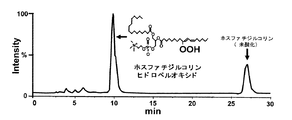
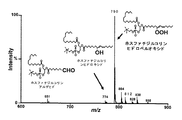
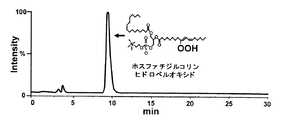
HPLC分析の結果、図1に示した通り、10分付近にピークが出現した。この10分付近のピークは、210nmの吸収を持ち、化学発光検出においてもヒドロペルオキシド類に特有のシグナルを与え、また図2のように主要な検出イオンの分子量(m/z 790)から、ホスファチジルコリンヒドロペルオキシドであることが示唆された。また、図2に示した通り、MSスペクトルより、このピークにはホスファチジルコリンヒドロペルオキシド以外の夾雑物が含まれることが示唆された。 As a result of HPLC analysis, a peak appeared at around 10 minutes as shown in FIG. This peak around 10 minutes has an absorption of 210 nm, gives a signal specific to hydroperoxides in chemiluminescence detection, and from the molecular weight (m / z 790) of the main detection ion as shown in FIG. 2, phosphatidylcholine Suggested to be hydroperoxide. In addition, as shown in FIG. 2, the MS spectrum suggested that this peak contains impurities other than phosphatidylcholine hydroperoxide.
次に、ホスファチジルコリンヒドロペルオキシドの未純化試料溶液をふた付き試験管にとり、溶媒を留去し、ホスファチジルコリン換算で4mMになるようにアセトニトリル:ジエチルエーテル(1:1)溶液とし、ビニルエーテル化合物である2−メトキシプロペン(和光純薬社製)を8.3M、および酸性触媒であるピリジニウム−p−トルエンスルホン酸(シグマ−アルドリッチ社製)を8.7mMとなるように付加し、常温で1時間放置し、ホスファチジルコリンヒドロペルオキシド−2−メトキシプロペン付加生成物を含むと推察される試料のアセトニトリル:ジエチルエーテル(1:1)溶液を得た。この溶液を上記と同様のHPLC分析条件で分析した。 Next, an unpurified sample solution of phosphatidylcholine hydroperoxide is placed in a test tube with a lid, the solvent is distilled off, and an acetonitrile: diethyl ether (1: 1) solution is obtained so as to be 4 mM in terms of phosphatidylcholine, which is a vinyl ether compound 2- Add methoxypropene (manufactured by Wako Pure Chemical Industries, Ltd.) to 8.3M and acidic catalyst pyridinium-p-toluenesulfonic acid (manufactured by Sigma-Aldrich) to 8.7 mM, and let stand at room temperature for 1 hour. A solution of an acetonitrile: diethyl ether (1: 1) of a sample presumed to contain a phosphatidylcholine hydroperoxide-2-methoxypropene addition product was obtained. This solution was analyzed under the same HPLC analysis conditions as described above.
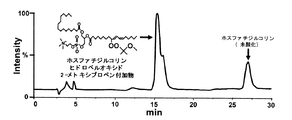
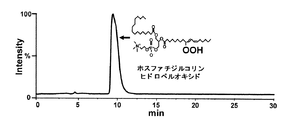
ホスファチジルコリンヒドロペルオキシドと2−メトキシプロペンは高い収率で反応して付加生成物を与え、図3の通り溶出時間が16分付近に延長された。
この溶液をリサイクル分取HPLCに供した。
Phosphatidylcholine hydroperoxide and 2-methoxypropene reacted in high yield to give the addition product, and the elution time was extended to around 16 minutes as shown in FIG.
This solution was subjected to recycle preparative HPLC.
カラムはセミ分取用逆相ODSカラム(COSMOSIL 5C18−MS−II、10×20mm+20×250mm、ナカライテスク社製)、インジェクターはセミ分取に対応したもの(7752i、レオダイン社製)を使用し、カラム温度を40℃に設定し、移動相はメタノール/水=1000/50の溶液(5mM酢酸アンモニウムを含む)を使用し、流速10ml/分で、アイソクラティック条件で溶出した。UV VIS検出器は、検出波長を234nmに設定した。なお、ホスファチジルコリンヒドロペルオキシド−2−メトキシプロペン付加生成物が検出されると同時に、リサイクル弁HPV−Rc(ジーエルサイエンス社製)をリサイクル側へ回転させ、検出が終了するとともにリサイクル弁を通常側へ回転させ、同時に移動相をメタノールに転換し、未反応のホスファチジルコリンおよび他の夾雑物を除去した。 The column is a semi-preparative reverse phase ODS column (COSMOSIL 5C18-MS-II, 10 × 20 mm + 20 × 250 mm, manufactured by Nacalai Tesque), and the injector is a semi-preparative column (7752i, manufactured by Leodyne). The column temperature was set to 40 ° C., and the mobile phase was a solution of methanol / water = 1000/50 (containing 5 mM ammonium acetate) and eluted under isocratic conditions at a flow rate of 10 ml / min. The UV VIS detector set the detection wavelength to 234 nm. At the same time as the addition product of phosphatidylcholine hydroperoxide-2-methoxypropene is detected, the recycle valve HPV-Rc (manufactured by GL Sciences) is rotated to the recycle side, and the detection is completed and the recycle valve is rotated to the normal side. At the same time, the mobile phase was converted to methanol to remove unreacted phosphatidylcholine and other contaminants.
ホスファチジルコリンヒドロペルオキシド−2−メトキシプロペン付加生成物をリサイクル分取し、ホスファチジルコリンヒドロペルオキシド−2−メトキシプロペン付加生成物のメタノール溶液を得た。この溶液を上記と同様のHPLC分析条件で分析した。 The phosphatidylcholine hydroperoxide-2-methoxypropene addition product was recycled and a methanol solution of the phosphatidylcholine hydroperoxide-2-methoxypropene addition product was obtained. This solution was analyzed under the same HPLC analysis conditions as described above.
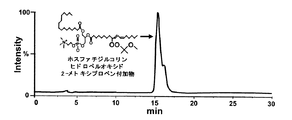
図4のとおり単一のピークのみが得られ、MS分析より、この溶液がホスファチジルコリンヒドロペルオキシド−2−メトキシプロペン付加生成物のみを含んでいることが確認された。 Only a single peak was obtained as shown in FIG. 4, and MS analysis confirmed that this solution contained only the phosphatidylcholine hydroperoxide-2-methoxypropene addition product.
ふた付き試験管にホスファチジルコリンヒドロペルオキシド−2−メトキシプロペン付加生成物のメタノール溶液をとり、窒素で乾固し、およそ1mMになるようにメタノールに再溶解させた。そこに2mM相当量のピリジニウム−p−トルエンスルホン酸を加え、常温で24時間放置した。この溶液を上記と同様のHPLC分析条件で分析した。 A methanol solution of the phosphatidylcholine hydroperoxide-2-methoxypropene addition product was taken into a test tube with a lid, dried to dryness with nitrogen, and redissolved in methanol to approximately 1 mM. 2 mM equivalent amount of pyridinium-p-toluenesulfonic acid was added thereto and left at room temperature for 24 hours. This solution was analyzed under the same HPLC analysis conditions as described above.
図5のとおり、ホスファチジルコリンヒドロペルオキシド−2−メトキシプロペン付加生成物のピークは見られず、ホスファチジルコリンヒドロペルオキシドのピークのみが得られた。従って、2−メトキシプロペンが完全に脱離し、ホスファチジルコリンヒドロペルオキシドが再生されたことが確認された。 As shown in FIG. 5, the peak of the phosphatidylcholine hydroperoxide-2-methoxypropene addition product was not observed, and only the peak of phosphatidylcholine hydroperoxide was obtained. Therefore, it was confirmed that 2-methoxypropene was completely eliminated and phosphatidylcholine hydroperoxide was regenerated.
この溶液を上記の条件のとおり分取HPLCに供し、ホスファチジルコリンヒドロペルオキシドをリサイクル分取し、ホスファチジルコリンヒドロペルオキシドのメタノール溶液を得た。
この溶液を、上記の分析HPLCで分析した。
This solution was subjected to preparative HPLC as described above to recycle and collect phosphatidylcholine hydroperoxide to obtain a methanol solution of phosphatidylcholine hydroperoxide.
This solution was analyzed by analytical HPLC as described above.
図6に示したTIC(トータルイオンクロマトグラム)のとおり、他の夾雑物のピークが見られず、同様にUV 210nm吸収の検出においても他のピークは見られなかった。また、図7に示した溶出時間10分付近のピークのMSスペクトルにおいても、他の夾雑物のピークが見られなかった。従って、本発明の精製方法により得られたホスファチジルコリンヒドロペルオキシド標品の純度が極めて高いことが確認された。 As shown in the TIC (total ion chromatogram) shown in FIG. 6, no other contaminant peak was observed, and no other peak was observed in the detection of UV 210 nm absorption. In addition, in the MS spectrum of the peak near the elution time of 10 minutes shown in FIG. 7, no other impurity peak was observed. Therefore, it was confirmed that the purity of the phosphatidylcholine hydroperoxide sample obtained by the purification method of the present invention was extremely high.
〔実施例2〕
乾燥し内部をアルゴン置換した三口フラスコに、1−ナフタレン酸メチル(東京化成社製)をおよそ400mgとり、無水トルエン3ml、無水テトラヒドロフラン1ml、無水ピリジン10μlを加えてよく混ぜた。これを−40℃に冷却し、Tebbe試薬(μ−クロロビス(η5−シクロペンタジエニル)(ジメチルアルミニウム)−μ−メチレンチタニウム)0.5Mトルエン溶液(東京化成社製)6mlを滴下し、穏やかに攪拌しながら−40℃を30分保った後、90分かけて室温まで上昇させた。さらに−10℃に冷却し、15%水酸化ナトリウム水溶液を0.9ml滴下し、ガス発生が終了するまで放置し、室温まで上昇させた。
[Example 2]
About 400 mg of methyl 1-naphthalenate (manufactured by Tokyo Chemical Industry Co., Ltd.) was taken into a three-necked flask that had been dried and purged with argon, 3 ml of anhydrous toluene, 1 ml of anhydrous tetrahydrofuran, and 10 μl of anhydrous pyridine were added and mixed well. This was cooled to −40 ° C., and 6 ml of a Tebbe reagent (μ-chlorobis (η5-cyclopentadienyl) (dimethylaluminum) -μ-methylenetitanium) 0.5 M toluene solution (manufactured by Tokyo Chemical Industry Co., Ltd.) was added dropwise. The mixture was kept at −40 ° C. for 30 minutes with stirring and then raised to room temperature over 90 minutes. The mixture was further cooled to −10 ° C., 0.9 ml of a 15% aqueous sodium hydroxide solution was added dropwise, and the mixture was allowed to stand until gas generation ceased and allowed to rise to room temperature.
この溶液にヘキサンおよび水を加え、ヘキサン相を予めヘキサンで洗浄しておいたシリカゲルミニカラム(SepPak(R) Plus SILICA、ウォーターズ社製)に通し、さらに水で数回洗浄し、ナフタレン環をもつビニルエーテル化合物である1−(2−メトキシ−2−プロペニル)−ナフタレンを含む溶液を得た。この溶液をリサイクル分取HPLCに供した。カラムはセミ分取用逆相ODSカラム(COSMOSIL 5C18−MS−II、10×20mm+20×250mm、ナカライテスク社製)、インジェクターはセミ分取に対応したもの(7752i、レオダイン社製)を使用し、カラム温度を40℃に設定し、移動相はメタノール/水=1000/100の溶液を使用し、流速10ml/分で、アイソクラティック条件で溶出した。UV VIS検出器は、検出波長を283nmに設定した。 Hexane and water are added to this solution, and the hexane phase is passed through a silica gel minicolumn (SepPak® Plus SILICA, manufactured by Waters), which has been washed with hexane in advance, and further washed several times with water to give a vinyl ether having a naphthalene ring. A solution containing the compound 1- (2-methoxy-2-propenyl) -naphthalene was obtained. This solution was subjected to recycle preparative HPLC. The column is a semi-preparative reverse phase ODS column (COSMOSIL 5C18-MS-II, 10 × 20 mm + 20 × 250 mm, manufactured by Nacalai Tesque), and the injector is a semi-preparative column (7752i, manufactured by Leodyne). The column temperature was set to 40 ° C., a solution of methanol / water = 1000/100 was used as the mobile phase, and elution was performed under isocratic conditions at a flow rate of 10 ml / min. The UV VIS detector set the detection wavelength to 283 nm.
なお、1−(2−メトキシ−2−プロペニル)−ナフタレンが検出されると同時に、リサイクル弁HPV−Rc(ジーエルサイエンス社製)をリサイクル側へ回転させ、検出が終了するとともにリサイクル弁を通常側へ回転させ、同時に移動相をメタノールに転換し、未反応の1−ナフタレン酸メチルおよび他の夾雑物を除去した。1−(2−メトキシ−2−プロペニル)−ナフタレンをリサイクル分取し、1−(2−メトキシ−2−プロペニル)−ナフタレンのメタノール溶液を得た。この溶液の溶媒を留去し、1−(2−メトキシ−2−プロペニル)−ナフタレンが200mMになるようにクロロホルムを加えて溶かし、ナフタレン環をもつビニルエーテル化合物の試験溶液とした。 At the same time as 1- (2-methoxy-2-propenyl) -naphthalene is detected, the recycle valve HPV-Rc (manufactured by GL Sciences) is rotated to the recycle side. At the same time, the mobile phase was converted to methanol to remove unreacted methyl 1-naphthalate and other contaminants. 1- (2-Methoxy-2-propenyl) -naphthalene was recycled and a methanol solution of 1- (2-methoxy-2-propenyl) -naphthalene was obtained. The solvent of this solution was distilled off, and chloroform was added and dissolved so that 1- (2-methoxy-2-propenyl) -naphthalene was 200 mM to obtain a test solution for a vinyl ether compound having a naphthalene ring.
ふた付き試験管にリノール酸メチル(シグマ−アルドリッチ社製)をおよそ300mg取り、酸素を10秒間吹き込み、密栓した。ふた付き試験管を紫外線殺菌灯(GL15、東芝社製)から20cmの距離になるように設置し、紫外線に6時間曝露させた。この試料を、リノール酸メチル換算で10mMになるようにクロロホルムに溶かし、リノール酸メチルヒドロペルオキシドの未純化試料溶液とした。この溶液に、ビニルエーテル化合物である2−メトキシプロペンを8.3M、および酸性触媒であるピリジニウム−p−トルエンスルホン酸を8.7mMとなるように付加し、常温で30分間放置し、リノール酸メチルヒドロペルオキシド−2−メトキシプロペン付加生成物を含む試料のクロロホルム溶液を得た。この溶液をリサイクル分取HPLCに供した。 Approximately 300 mg of methyl linoleate (manufactured by Sigma-Aldrich) was taken into a test tube with a lid, and oxygen was blown in for 10 seconds, and the tube was sealed. A test tube with a lid was placed at a distance of 20 cm from an ultraviolet germicidal lamp (GL15, manufactured by Toshiba Corporation) and exposed to ultraviolet rays for 6 hours. This sample was dissolved in chloroform so as to be 10 mM in terms of methyl linoleate to obtain an unpurified sample solution of methyl linoleate hydroperoxide. To this solution, 2-methoxypropene, a vinyl ether compound, was added to 8.3 M and pyridinium-p-toluenesulfonic acid, an acidic catalyst, to 8.7 mM, and allowed to stand at room temperature for 30 minutes, followed by methyl linoleate. A chloroform solution of the sample containing the hydroperoxide-2-methoxypropene addition product was obtained. This solution was subjected to recycle preparative HPLC.
カラムはセミ分取用逆相ODSカラム(COSMOSIL 5C18−MS−II、10×20mm+20×250mm、ナカライテスク社製)、インジェクターはセミ分取に対応したもの(7752i、レオダイン社製)を使用し、カラム温度を40℃に設定し、移動相はメタノール/水=1000/200の溶液を使用し、流速10ml/分で、アイソクラティック条件で溶出した。UV VIS検出器は、検出波長を210nmに設定した。 The column is a semi-preparative reverse phase ODS column (COSMOSIL 5C18-MS-II, 10 × 20 mm + 20 × 250 mm, manufactured by Nacalai Tesque), and the injector is a semi-preparative column (7752i, manufactured by Leodyne). The column temperature was set to 40 ° C., a solution of methanol / water = 1000/200 was used as the mobile phase, and elution was performed under isocratic conditions at a flow rate of 10 ml / min. The UV VIS detector set the detection wavelength to 210 nm.
なお、リノール酸メチルヒドロペルオキシド−2−メトキシプロペン付加生成物は4種の構造異性体であるが、そのうち1番目に溶出される13−EZ−OOH、および2番目に溶出される9−EZ−OOH(併せてリノール酸メチルヒドロペルオキシド−2−メトキシプロペン付加生成物のシス−トランス体と呼称する)が検出されると同時に、リサイクル弁HPV−Rc(ジーエルサイエンス社製)をリサイクル側へ回転させ、検出が終了するとともにリサイクル弁を通常側へ回転させ、同時に移動相をメタノールに転換し、未反応のリノール酸メチルおよび他の夾雑物を除去した。リノール酸メチルヒドロペルオキシド−2−メトキシプロペン付加生成物のシス−トランス体をリサイクル分取し、リノール酸メチルヒドロペルオキシド−2−メトキシプロペン付加生成物のシス−トランス体のメタノール溶液を得た。 The linoleic acid methyl hydroperoxide-2-methoxypropene addition product is four kinds of structural isomers, of which 13-EZ-OOH eluted first and 9-EZ- eluted second. At the same time that OOH (also referred to as the cis-trans isomer of methyl linoleate hydroperoxide-2-methoxypropene addition product) is detected, the recycle valve HPV-Rc (manufactured by GL Sciences) is rotated to the recycle side. When the detection was completed, the recycle valve was rotated to the normal side, and at the same time, the mobile phase was converted to methanol to remove unreacted methyl linoleate and other contaminants. The cis-trans form of the linoleic acid methyl hydroperoxide-2-methoxypropene addition product was recycled to obtain a methanol solution of the cis-trans form of the linoleic acid methyl hydroperoxide-2-methoxypropene addition product.
この溶液の溶媒を留去し、窒素で乾固し、およそ1mMになるようにメタノールに再溶解させた。そこに2mM相当量のピリジニウム−p−トルエンスルホン酸を加え、常温で24時間放置し、リノール酸メチルヒドロペルオキシドのシス−トランス体を再生させた。この溶液を上記の条件のとおり分取HPLCに供し、リノール酸メチルヒドロペルオキシドのシス−トランス体をリサイクル分取し、リノール酸メチルヒドロペルオキシドのシス−トランス体のメタノール溶液を得た。この溶液の溶媒を留去し、リノール酸メチルヒドロペルオキシドのシス−トランス体の総量で2mMになるようにメタノールを加えて溶かし、ヒドロペルオキシド類の試験溶液とした。 The solvent of this solution was distilled off, dried with nitrogen, and redissolved in methanol to approximately 1 mM. 2 mM equivalent amount of pyridinium-p-toluenesulfonic acid was added thereto and left at room temperature for 24 hours to regenerate the cis-trans form of methyl linoleate hydroperoxide. This solution was subjected to preparative HPLC as described above, and the cis-trans form of methyl linoleate hydroperoxide was recycled and a methanol solution of the cis-trans form of methyl linoleate hydroperoxide was obtained. The solvent of this solution was distilled off, and methanol was added and dissolved so that the total amount of cis-trans isomers of methyl linoleate hydroperoxide was 2 mM to prepare a test solution for hydroperoxides.
上記で作成したリノール酸メチルヒドロペルオキシドのシス−トランス体溶液(ヒドロペルオキシド類の試験溶液)をHPLC―UV−MS−CL分析装置で分析した。 The cis-trans isomer solution of methyl linoleate hydroperoxide prepared above (test solution for hydroperoxides) was analyzed with an HPLC-UV-MS-CL analyzer.
分離カラムは分析用逆相ODSカラム(CAPCELL PAK C18 SG120、4.6×50mm+4.6×250mm、資生堂社製)、インジェクター(7752i、レオダイン社製)を使用した。また検出器は、UV VIS検出器(UV−970、日本分光社製)、蛍光検出器(RF−10AXL、島津社製)、ESI TOF型質量分析計(Mariner、Applied Biosystems社製)を使用した。また、ヒドロペルオキシドの検出に化学発光検出器(825−CL、日本分光社製)、化学発光試薬用のポンプ(PU−980)を用いた。カラム温度を40℃に設定し、移動相はメタノール/水=1000/1000の溶液(5mM酢酸アンモニウム(和光純薬社製)を含む)を使用し、流速1ml/分で、アイソクラティック条件で溶出した。UV VIS検出器は、検出波長を234nmに設定した。蛍光検出器は、励起波長を283nm、検出波長を330nmとし、ナフタレン環の検出に最適化した。移動相は質量分析計に導入する分が0.05ml/分、化学発光検出器に導入する分が0.95ml/分になるように分岐させた。質量分析(MS)計は、ポジティブモード、スプレー電圧3300V、ノズル電圧100V、ノズル温度140度、窒素噴霧ガス3ml/分に設定し、質量分析計データは、分子量200〜600の範囲で3秒ごとにスキャンし、データの取り込みを行った。また、化学発光試薬を0.5ml/分で移動相に混ぜ、化学発光(CL)検出を行った。 As the separation column, a reverse phase ODS column for analysis (CAPCELL PAK C18 SG120, 4.6 × 50 mm + 4.6 × 250 mm, manufactured by Shiseido Co., Ltd.) and an injector (7752i, manufactured by Leodyne) were used. The detector used was a UV VIS detector (UV-970, manufactured by JASCO Corp.), a fluorescence detector (RF-10AXL, manufactured by Shimadzu Corp.), and an ESI TOF mass spectrometer (Mariner, manufactured by Applied Biosystems). . Further, a chemiluminescence detector (825-CL, manufactured by JASCO Corporation) and a chemiluminescence reagent pump (PU-980) were used for detection of hydroperoxide. The column temperature was set to 40 ° C., and the mobile phase was a solution of methanol / water = 1000/1000 (including 5 mM ammonium acetate (manufactured by Wako Pure Chemical Industries, Ltd.)), at a flow rate of 1 ml / min, under isocratic conditions. Eluted. The UV VIS detector set the detection wavelength to 234 nm. The fluorescence detector was optimized for the detection of naphthalene rings with an excitation wavelength of 283 nm and a detection wavelength of 330 nm. The mobile phase was branched such that the amount introduced into the mass spectrometer was 0.05 ml / min and the amount introduced into the chemiluminescence detector was 0.95 ml / min. Mass spectrometer (MS) meter is set to positive mode, spray voltage 3300V, nozzle voltage 100V, nozzle temperature 140 ° C, nitrogen atomization gas 3ml / min. Mass spectrometer data is in the range of molecular weight 200-600 every 3 seconds The data was scanned. In addition, chemiluminescence reagent was mixed with the mobile phase at 0.5 ml / min, and chemiluminescence (CL) detection was performed.
HPLC分析の結果、6分付近にピークが出現した。この6分付近のピークは、図8のように234nmの吸収を持ち、図9のように励起波長283nm/検出波長330nmにおいては蛍光性を持たず、化学発光検出においてもヒドロペルオキシド類に特有のシグナルを与え、図10のように主要な検出イオンの分子量(m/z 349.2)から、リノール酸メチルヒドロペルオキシドであることが確認された。 As a result of HPLC analysis, a peak appeared around 6 minutes. This peak around 6 minutes has an absorption of 234 nm as shown in FIG. 8, has no fluorescence at an excitation wavelength of 283 nm / detection wavelength of 330 nm as shown in FIG. 9, and is unique to hydroperoxides in chemiluminescence detection. A signal was given, and from the molecular weight (m / z 349.2) of the main detection ion as shown in FIG. 10, it was confirmed that it was methyl linoleate hydroperoxide.
次に、上記で作成したリノール酸メチルヒドロペルオキシドのシス−トランス体溶液10μl(リノール酸メチルヒドロペルオキシドで20nmol相当)を300μl容の珪酸ガラス製リアクションバイアルにとり、溶媒を留去し、上記で作成したナフタレン環をもつビニルエーテル化合物である1−(2−メトキシ−2−プロペニル)−ナフタレンの200mMクロロホルム溶液を100μl、および酸性触媒であるピリジニウム−p−トルエンスルホン酸(シグマ−アルドリッチ社製)を1mMとなるように加え、4℃で30分間放置し、リノール酸メチルヒドロペルオキシドのナフタレンラベル化物を含むと推察される試料のクロロホルム溶液を得た。この溶液を上記と同様のHPLC分析条件で分析した。 Next, 10 μl of the cis-trans isomer solution of methyl linoleate hydroperoxide prepared above (corresponding to 20 nmol of methyl linoleate hydroperoxide) was placed in a 300 μl silicate glass reaction vial, and the solvent was distilled off. 100 μl of a 200 mM chloroform solution of 1- (2-methoxy-2-propenyl) -naphthalene, which is a vinyl ether compound having a naphthalene ring, and 1 mM of an acidic catalyst, pyridinium-p-toluenesulfonic acid (manufactured by Sigma-Aldrich), In addition, the mixture was allowed to stand at 4 ° C. for 30 minutes to obtain a chloroform solution of a sample presumed to contain a naphthalene labeled product of methyl linoleate hydroperoxide. This solution was analyzed under the same HPLC analysis conditions as described above.
図13のようにMSのSIC(シングルイオンクロマトグラム)においてリノール酸メチルヒドロペルオキシドに相当する分子量(m/z 349.2±0.5)のピークは得られず、化学発光検出においてもヒドロペルオキシド類に特有のシグナルを得られなかった。一方、図12の通り29分付近に励起波長283nm/検出波長330nmにおける蛍光検出のピークが出現し、図14のようにリノール酸メチルヒドロペルオキシド−1−(2−メトキシ−2−プロペニル)−ナフタレン付加物(ナフタレンラベル化物)のナフタレン付加イオンに相当する分子量(m/z 547.3±0.5)におけるSIC(シングルイオンクロマトグラム)においても同位置に検出ピークを得たことから、このピークがリノール酸メチルヒドロペルオキシド−1−(2−メトキシ−2−プロペニル)−ナフタレン付加物(ナフタレンラベル化物)によるものであることが示唆された。図15の通り、このピークに相当するMSスペクトルにおいても、ナトリウム付加イオンと併せてアンモニウム付加イオン(m/z 542.4)が検出されたことから、リノール酸メチルヒドロペルオキシド−1−(2−メトキシ−2−プロペニル)−ナフタレン付加物(ナフタレンラベル化物)が高収率で得られたことが確認された。 As shown in FIG. 13, no peak of molecular weight (m / z 349.2 ± 0.5) corresponding to methyl linoleate hydroperoxide was obtained in MS SIC (single ion chromatogram), and hydroperoxide was also detected in chemiluminescence detection. The signal peculiar to the class was not obtained. On the other hand, as shown in FIG. 12, a fluorescence detection peak at an excitation wavelength of 283 nm / detection wavelength of 330 nm appears around 29 minutes, and methyl linoleate-1- (2-methoxy-2-propenyl) -naphthalene as shown in FIG. Since a detection peak was obtained at the same position in SIC (single ion chromatogram) at the molecular weight (m / z 547.3 ± 0.5) corresponding to the naphthalene adduct ion of the adduct (naphthalene labeled product), this peak was obtained. It was suggested that is due to linoleic acid methyl hydroperoxide-1- (2-methoxy-2-propenyl) -naphthalene adduct (naphthalene labeled product). As shown in FIG. 15, in the MS spectrum corresponding to this peak, an ammonium adduct ion (m / z 542.4) was detected together with a sodium adduct ion, and thus methyl linoleate hydroperoxide-1- (2- It was confirmed that methoxy-2-propenyl) -naphthalene adduct (naphthalene-labeled product) was obtained in high yield.
このピークは、反応収率100%とした場合、リノール酸メチルヒドロペルオキシド−1−(2−メトキシ−2−プロペニル)−ナフタレン付加物(ナフタレンラベル化物)のおよそ100pmolに相当するが、得られた蛍光検出ピークの面積は、予め測定しておいた1−ナフタレン酸メチル100pmolの蛍光検出ピークの面積とよく一致したため、この検出方法における定量性が確認された。 This peak corresponds to about 100 pmol of methyl linoleate-1- (2-methoxy-2-propenyl) -naphthalene adduct (naphthalene-labeled product) when the reaction yield was 100%, but was obtained. Since the area of the fluorescence detection peak was in good agreement with the area of the fluorescence detection peak of 100 pmol of methyl 1-naphthalene measured in advance, the quantitativeness in this detection method was confirmed.
Claims (7)
前記ヒドロペルオキシドのビニルエーテル付加物を回収する段階と、
回収された前記ヒドロペルオキシドのビニルエーテル付加物から、ビニルエーテルを脱離させて、前記ヒドロペルオキシドを再生する段階と、
を含む、ヒドロペルオキシドの精製方法。 Adding a vinyl ether to the hydroperoxide group of the hydroperoxide to synthesize a vinyl ether adduct of hydroperoxide;
Recovering the hydroperoxide vinyl ether adduct;
Desorbing vinyl ether from the recovered vinyl ether adduct of hydroperoxide to regenerate the hydroperoxide;
A method for purifying hydroperoxide, comprising:
前記ヒドロペルオキシドのビニルエーテル付加物を検出する段階と、
を含む、ヒドロペルオキシドの検出方法。 Adding a vinyl ether to the hydroperoxide group of the hydroperoxide to synthesize a vinyl ether adduct of hydroperoxide;
Detecting the vinyl ether adduct of the hydroperoxide;
A method for detecting hydroperoxide, comprising:
Priority Applications (1)
| Application Number | Priority Date | Filing Date | Title |
|---|---|---|---|
| JP2004095755A JP2005281170A (en) | 2004-03-29 | 2004-03-29 | Method of purifying hydroperoxide and method of detecting hydroperoxide |
Applications Claiming Priority (1)
| Application Number | Priority Date | Filing Date | Title |
|---|---|---|---|
| JP2004095755A JP2005281170A (en) | 2004-03-29 | 2004-03-29 | Method of purifying hydroperoxide and method of detecting hydroperoxide |
Publications (1)
| Publication Number | Publication Date |
|---|---|
| JP2005281170A true JP2005281170A (en) | 2005-10-13 |
Family
ID=35179948
Family Applications (1)
| Application Number | Title | Priority Date | Filing Date |
|---|---|---|---|
| JP2004095755A Pending JP2005281170A (en) | 2004-03-29 | 2004-03-29 | Method of purifying hydroperoxide and method of detecting hydroperoxide |
Country Status (1)
| Country | Link |
|---|---|
| JP (1) | JP2005281170A (en) |
Cited By (1)
| Publication number | Priority date | Publication date | Assignee | Title |
|---|---|---|---|---|
| JP2012122750A (en) * | 2010-12-06 | 2012-06-28 | South Product:Kk | Method for separating and refining chlorophyll c and/or xanthophyll |
Citations (3)
| Publication number | Priority date | Publication date | Assignee | Title |
|---|---|---|---|---|
| US3822317A (en) * | 1966-10-10 | 1974-07-02 | Pennwalt Corp | Certain ether peroxides derivable from alpha-substituted vinyl ethers |
| JPH01228957A (en) * | 1988-03-10 | 1989-09-12 | Nippon Oil & Fats Co Ltd | Cyclic monoperoxyketal |
| JP2002522524A (en) * | 1998-08-12 | 2002-07-23 | アクゾ ノーベル ナムローゼ フェンノートシャップ | Peroxides, their production and use |
-
2004
- 2004-03-29 JP JP2004095755A patent/JP2005281170A/en active Pending
Patent Citations (3)
| Publication number | Priority date | Publication date | Assignee | Title |
|---|---|---|---|---|
| US3822317A (en) * | 1966-10-10 | 1974-07-02 | Pennwalt Corp | Certain ether peroxides derivable from alpha-substituted vinyl ethers |
| JPH01228957A (en) * | 1988-03-10 | 1989-09-12 | Nippon Oil & Fats Co Ltd | Cyclic monoperoxyketal |
| JP2002522524A (en) * | 1998-08-12 | 2002-07-23 | アクゾ ノーベル ナムローゼ フェンノートシャップ | Peroxides, their production and use |
Cited By (1)
| Publication number | Priority date | Publication date | Assignee | Title |
|---|---|---|---|---|
| JP2012122750A (en) * | 2010-12-06 | 2012-06-28 | South Product:Kk | Method for separating and refining chlorophyll c and/or xanthophyll |
Similar Documents
| Publication | Publication Date | Title |
|---|---|---|
| Zaikin et al. | A handbook of derivatives for mass spectrometry | |
| Xu et al. | Benzophenone used as the photochemical reagent for pinpointing C= C locations in unsaturated lipids through shotgun and liquid chromatography-mass spectrometry approaches | |
| Bergh et al. | Simultaneous selective detection of organophosphate and phthalate esters using gas chromatography with positive ion chemical ionization tandem mass spectrometry and its application to indoor air and dust | |
| Uchiyama et al. | Simultaneous Determination of C1− C4 Carboxylic Acids and Aldehydes Using 2, 4-Dinitrophenylhydrazine-Impregnated Silica Gel and High-Performance Liquid Chromatography | |
| Toriba et al. | Simultaneous determination of polycyclic aromatic hydrocarbon quinones by gas chromatography-tandem mass spectrometry, following a one-pot reductive trimethylsilyl derivatization | |
| Narreddula et al. | Structural elucidation of hydroxy fatty acids by photodissociation mass spectrometry with photolabile derivatives | |
| Bianchi et al. | Cavitands as superior sorbents for benzene detection at trace level | |
| Ibusuki et al. | Preparation of pure lipid hydroperoxidess⃞ | |
| Yang et al. | Sample preparation for fatty acid analysis in biological samples with mass spectrometry-based strategies | |
| Harada et al. | High‐performance liquid chromatographic separation of microcystins derivatized with a highly fluorescent dienophile | |
| JP2005281170A (en) | Method of purifying hydroperoxide and method of detecting hydroperoxide | |
| Benton et al. | Liquid chromatography and mass spectrometry of haem biosynthetic intermediates: a review | |
| CN109912533B (en) | Fluorescent probe responding to palladium and preparation method thereof | |
| Fan et al. | Current separative strategies used for resveratrol determination from natural sources | |
| JP2014211433A (en) | Quantification method of thiol compound and sulfide compound | |
| McMahon et al. | Characterisation of the ester-substituted products of the reaction of pt-butyl calix [4] arene and ethyl bromoacetate using LC-UV-MS and LC-DAD | |
| CN116148336A (en) | A mass spectrometry method for the determination of unsaturated fatty acid isomers | |
| Burke et al. | Quaternary ammonium salts for butylation and mass spectral identification of volatile organic acids | |
| Yu et al. | Preparation of “click” binaphthyl stationary phase and its application for separation of anthraquinones from Rheum palmatum L. | |
| Dommisse et al. | Synthesis of (S)‐Nonacosan‐10‐ol, the Major Component of Tubular Plant Wax Crystals | |
| Wang et al. | Volatile methylsiloxanes in complex samples: recent updates on pretreatment and analysis methods | |
| Suzuki et al. | Reversed-phase high-performance thin-layer chromatography of hematoporphyrin and its nickel, copper and zinc complexes | |
| De Jong et al. | Analysis of polychlorinated dibenzofurans and dibenzo-p-dioxins in human milk by tandem hybrid mass spectrometry | |
| Mizugaki et al. | Microdetermination of 2, 3-dinor-6-ketoprostaglandin F1α in human urine using gas chromatography—high-resolution selected-ion monitoring | |
| Sudo et al. | Preparation and chiral recognition of (S)-binaphthol derivative-bonded phase for high-performance liquid chromatography |
Legal Events
| Date | Code | Title | Description |
|---|---|---|---|
| A621 | Written request for application examination |
Free format text: JAPANESE INTERMEDIATE CODE: A621 Effective date: 20070308 |
|
| A711 | Notification of change in applicant |
Free format text: JAPANESE INTERMEDIATE CODE: A711 Effective date: 20070308 |
|
| A521 | Written amendment |
Free format text: JAPANESE INTERMEDIATE CODE: A821 Effective date: 20070308 |
|
| A131 | Notification of reasons for refusal |
Free format text: JAPANESE INTERMEDIATE CODE: A131 Effective date: 20101012 |
|
| A02 | Decision of refusal |
Free format text: JAPANESE INTERMEDIATE CODE: A02 Effective date: 20110308 |