JP2005159439A - Recording and playback apparatus and method - Google Patents
Recording and playback apparatus and method Download PDFInfo
- Publication number
- JP2005159439A JP2005159439A JP2003391061A JP2003391061A JP2005159439A JP 2005159439 A JP2005159439 A JP 2005159439A JP 2003391061 A JP2003391061 A JP 2003391061A JP 2003391061 A JP2003391061 A JP 2003391061A JP 2005159439 A JP2005159439 A JP 2005159439A
- Authority
- JP
- Japan
- Prior art keywords
- content
- recording
- viewing
- playback device
- reproducing apparatus
- Prior art date
- Legal status (The legal status is an assumption and is not a legal conclusion. Google has not performed a legal analysis and makes no representation as to the accuracy of the status listed.)
- Pending
Links
Images




Landscapes
- Television Signal Processing For Recording (AREA)
- Signal Processing For Digital Recording And Reproducing (AREA)
- Indexing, Searching, Synchronizing, And The Amount Of Synchronization Travel Of Record Carriers (AREA)
Abstract
【課題】 煩雑な操作なしに所定の選択操作だけで携帯再生装置で視聴途中だったコンテンツを据置き録再装置で視聴継続できるようにすることを目的とする。
【解決手段】 録再装置と前記携帯再生装置とを備えており、前記携帯再生装置が前記据置き録再装置に接続された状態で、前記携帯再生装置であるコンテンツが視聴途中だった場合には、前記据置き録再装置においてそのコンテンツと同じコンテンツを選択し、視聴途中のフレーム位置までシークした状態としたのち、そのコンテンツを示す情報を表示してユーザに視聴を継続するかどうかの選択を促し、継続する選択がなされた場合には視聴途中の位置から再生を再開する。
【選択図】 図2PROBLEM TO BE SOLVED: To make it possible to continue viewing a content that was being viewed on a portable playback device with a deferred recording / playback device by only a predetermined selection operation without a complicated operation.
When a content that is a portable playback device is in the middle of viewing in a state in which the portable playback device is connected to the stationary recording / playback device, the recording / playback device and the portable playback device are provided. Selects the same content as the content in the deferred recording / reproducing apparatus, seeks to the frame position in the middle of viewing, and then selects whether to display the information indicating the content and continue viewing to the user When a selection to continue is made, playback is resumed from a position in the middle of viewing.
[Selection] Figure 2
Description
本発明は、TV番組予約録画・再生機能を備えた据置き録再装置と、前記据置き録再装置で録画したTV番組を転送、格納し、前記据置き録再装置から切り離した状態で、コンテンツを再生する機能を備えた携帯再生装置とを備えた録画再生装置及びその録画再生装置を用いた録画再生方法に関する。 The present invention is a deferred recording / reproducing apparatus having a TV program reserved recording / playback function, a TV program recorded by the deferred recording / reproducing apparatus, transferred and stored, and separated from the deferred recording / reproducing apparatus, The present invention relates to a recording / playback apparatus including a portable playback apparatus having a function of playing back content, and a recording / playback method using the recording / playback apparatus.
動画・音声などのストリームデータのデジタル圧縮技術の進歩に伴い、動画・音声などのデジタルデータをハードディスク(HD)、DVD、光磁気ディスク(MO)、SD/MMC/CF/PCカードなどに記録し、再生する装置が実現可能となってきた。例えば、従来TV番組を録画・再生するのに一般的に使われてきたビデオデッキに代わって、据置き型のHD録画・再生機、DVD録画・再生機(据置き録再装置)などが登場し、またパーソナルコンピュータ(PC)のHD上にTV番組を録画しそれを再生する機能を持つものも登場してきた。 With the progress of digital compression technology for stream data such as video and audio, digital data such as video and audio is recorded on a hard disk (HD), DVD, magneto-optical disk (MO), SD / MMC / CF / PC card, etc. It has become possible to implement a playback device. For example, in place of VCRs that have been commonly used to record and play back conventional TV programs, stationary HD recorders / players, DVD recorders / players (deferred recorder / player), etc. In addition, some have appeared to record TV programs on the HD of personal computers (PCs) and play them back.
また、一方ではPDAなどの携帯機器でも動画・音声の再生が可能となりつつあり、例えば、上記TV録画機能を持ったPCで録画したコンテンツを、CFカードなどのリムーバブルメディア、又はUSBなどの接続装置を介してPDAに転送し、それを外出先で視聴するといったことも可能となってきた。 On the other hand, it is becoming possible to play back video and audio on a portable device such as a PDA. For example, a content recorded by a PC having the above TV recording function can be connected to a removable medium such as a CF card or a connection device such as a USB. It is also possible to transfer to a PDA via the Internet and view it on the go.
しかし、上記PDAのような携帯再生装置はその大きさ軽さゆえ記憶容量が犠牲となり、上記PCのような据置き録再装置で録画したコンテンツをすべて格納しておくことができないため、コンテンツを選んで転送することとなる。この選んで転送するといった煩雑な作業を自動化する方式が提案されており、例えばユーザはTV番組の録画予約時にその番組ごとに転送ポリシを指定するだけとし、コンテンツの転送/入れ替えといった作業はすべて自動的に実施される。 However, a portable playback device such as the above PDA sacrifices storage capacity due to its small size and cannot store all the content recorded by a stationary recording / playback device such as the above PC. It will be selected and transferred. There has been proposed a method for automating such a complicated task of selecting and transferring, for example, the user only designates a transfer policy for each program at the time of recording reservation of a TV program, and all operations such as transfer / replacement of contents are automatically performed. Implemented.
しかしながら、例えば外出先で携帯再生装置を使ってあるコンテンツを視聴していたが、まだ最後まで見終わっていないうちに自宅に帰宅し、より視聴環境の良い据置き録再装置で続きを視聴したいと思った場合、据置き録再装置で視聴したいコンテンツを探し、視聴途中の位置までシークしてから再生しなければならない。 However, for example, when I was watching some content on the go using a portable playback device, but I haven't finished watching until the end, I want to go home and watch the rest with a better recording environment If you think that, you have to search for the content you want to view with the deferred recording / playback device, seek to the mid-viewing position, and play it.
そこで、本発明は、視聴途中のコンテンツのある携帯再生装置を据置き録再装置に接続すると、据置き録再装置において前記視聴途中コンテンツが自動的に選択され、かつ視聴途中の位置まで自動的にシークされ、ユーザはそのコンテンツを視聴途中の位置から視聴再開するかどうかの選択操作だけで視聴を再開できるようにすることを目的とする。 Therefore, according to the present invention, when a portable playback device having content that is being viewed is connected to the stationary recording / reproducing device, the content being viewed is automatically selected by the stationary recording / reproducing device, and automatically to a position that is being viewed. It is an object of the present invention to allow the user to resume viewing only by selecting whether or not to resume viewing the content from a position in the middle of viewing.
本発明の録画再生装置は、TV番組予約録画・再生機能を備えた据置き録再装置と、前記据置き録再装置で録画したコンテンツたるTV番組を転送、格納し、前記据置き録再装置から切り離した状態で、コンテンツを再生する機能を備えた携帯再生装置とを備え、前記据置き録再装置と前記携帯再生装置は、所定の通信手段で接続可能なように構成されており、前記据置き録再装置と前記携帯再生装置の両者において各コンテンツの視聴状況を管理し、視聴途中の場合には、どこまで視聴したかの情報も管理し、さらに前記携帯再生装置において最後に視聴していたコンテンツがどのコンテンツだったかを示す情報も管理するコンテンツ視聴状況管理手段と、前記携帯再生装置が前記据置き録再装置に接続されると、前記携帯再生装置におけるコンテンツ視聴状況を示す情報を前記据置き録再装置に転送し、前記据置き録再装置の各コンテンツ管理情報を最新の状態に更新するコンテンツ管理情報更新手段と、前記携帯再生装置であるコンテンツが視聴途中だった場合には、前記据置き録再装置においてそのコンテンツと同じコンテンツを選択し、視聴途中のフレーム位置までシークした状態としたのち、そのコンテンツを示す情報を表示してユーザに視聴を継続するかどうかの選択を促し、継続する選択がなされた場合には視聴途中の位置から再生を再開するコンテンツ継続再生手段とを備えた点に特徴を有する。 The recording / reproducing apparatus of the present invention includes a deferred recording / reproducing apparatus having a TV program reserved recording / reproducing function, and a TV program as a content recorded by the deferred recording / reproducing apparatus. A portable playback device having a function of playing back content in a disconnected state, and the stationary recording / playback device and the portable playback device are configured to be connectable by a predetermined communication means, The viewing status of each content is managed by both the stationary recording / reproducing device and the portable playback device. When viewing is in progress, information on how far the content has been viewed is also managed, and the last viewing is performed by the portable playback device. When the portable playback device is connected to the deferred recording / playback device, content viewing status management means for managing information indicating which content is the content, the portable playback device Content management information updating means for transferring information indicating the content viewing status to the deferred recording / reproducing apparatus, and updating each content management information of the deferred recording / reproducing apparatus to the latest state, and the content as the portable reproduction apparatus If it is in the middle of viewing, the same content as the content is selected in the deferred recording / reproducing apparatus, and after seeking to the frame position in the middle of viewing, information indicating the content is displayed and viewed by the user. It has a feature in that it is provided with a content continuous reproduction means that prompts the user to select whether or not to continue, and resumes reproduction from a position in the middle of viewing when the selection is continued.
本発明の録画再生方法は、TV番組予約録画・再生機能を備えた据置き録再装置と、前記据置き録再装置で録画したコンテンツたるTV番組を転送、格納し、前記据置き録再装置から切り離した状態で、コンテンツを再生する機能を備えた携帯再生装置とを備え、前記据置き録再装置と前記携帯再生装置は、所定の通信手段で接続可能なように構成された録画再生装置を用いた録画再生方法であって、前記据置き録再装置と前記携帯再生装置の両者において各コンテンツの視聴状況を管理し、視聴途中の場合には、どこまで視聴したかの情報も管理し、さらに前記携帯再生装置において最後に視聴していたコンテンツがどのコンテンツだったかを示す情報も管理するコンテンツ視聴状況管理工程と、前記携帯再生装置が前記据置き録再装置に接続されると、前記携帯再生装置におけるコンテンツ視聴状況を示す情報を前記据置き録再装置に転送し、前記据置き録再装置の各コンテンツ管理情報を最新の状態に更新するコンテンツ管理情報更新工程と、前記携帯再生装置であるコンテンツが視聴途中だった場合には、前記据置き録再装置においてそのコンテンツと同じコンテンツを選択し、視聴途中のフレーム位置までシークした状態としたのち、そのコンテンツを示す情報を表示してユーザに視聴を継続するかどうかの選択を促し、継続する選択がなされた場合には視聴途中の位置から再生を再開するコンテンツ継続再生工程とを有する点に特徴を有する。 The recording / reproducing method of the present invention includes a stationary recording / reproducing apparatus having a TV program reserved recording / reproducing function, a TV program as a content recorded by the stationary recording / reproducing apparatus, transferring and storing, and the stationary recording / reproducing apparatus. And a portable playback device having a function of playing back content in a disconnected state, and the stationary recording / playback device and the portable playback device are configured to be connectable by a predetermined communication means Is a recording / playback method that manages the viewing status of each content in both the stationary recording / playback device and the portable playback device, and manages the information of how far the content has been viewed in the middle of viewing, Further, a content viewing status management step for managing information indicating which content was last viewed on the portable playback device, and the portable playback device as a deferred recording / playback device. If it continues, the content management information update process which transfers the information which shows the content viewing-and-listening state in the said portable reproduction apparatus to the said stationary recording / reproducing apparatus, and updates each content management information of the said stationary recording / reproducing apparatus to the newest state When the content that is the portable playback device is in the middle of viewing, the same content as the content is selected in the deferred recording / playback device, and after seeking to the frame position during the viewing, the content is It is characterized in that it has a content continuous reproduction step of prompting the user to select whether or not to continue viewing by displaying information to be displayed, and restarting reproduction from a position in the middle of viewing when the selection is continued.
本発明によれば、携帯再生装置であるコンテンツが視聴途中だった場合には、携帯再生装置を据置き録再装置に接続すると、据置き録再装置でそのコンテンツと同じものが自動的に選択され、視聴途中のフレーム位置までシークされた状態となり、そのコンテンツを示す情報が表示されてユーザに視聴を継続するかどうかの選択が促される。したがって、ユーザは、煩雑な操作なしに「視聴を継続する」という選択操作だけで携帯再生装置で視聴途中だったコンテンツを据置き録再装置で視聴継続できるという効果を奏する。 According to the present invention, when a content that is a portable playback device is in the middle of viewing, when the portable playback device is connected to a stationary recording / reproducing device, the same content as the content is automatically selected by the stationary recording / reproducing device. As a result, seek is performed up to the frame position in the middle of viewing, information indicating the content is displayed, and the user is prompted to select whether or not to continue viewing. Therefore, the user can continue viewing the content that was being viewed on the portable playback device with the deferred recording / playback device by only the selection operation of “continue viewing” without a complicated operation.
以下、添付図面を参照して、本発明の好適な実施形態について説明する。図1は本実施形態の録画再生装置のハードウェア構成図である。1はTV番組予約録画・再生機能を備えた据置き録再装置、2は据置き録再装置1で録画したTV番組(コンテンツ)を再生する携帯再生装置、3は据置き録再装置1と携帯再生装置2を接続しデータ通信を可能とする通信ケーブルである。
Preferred embodiments of the present invention will be described below with reference to the accompanying drawings. FIG. 1 is a hardware configuration diagram of a recording / playback apparatus according to the present embodiment. 1 is a deferred recording / reproducing apparatus having a TV program reserved recording / reproducing function, 2 is a portable reproducing apparatus that reproduces a TV program (content) recorded by the deferred recording / reproducing
101は据置き録再装置1で本実施形態の処理を実現するソフトウェアを実行するCPU、102は据置き録再装置1で本実施形態の処理を実現するソフトウェアを格納するROM、103は据置き録再装置1で本実施形態の処理を実現するソフトウェアが利用するメモリであるRAM、104は据置き録再装置1でコンテンツを記録する大容量ハードディスク(HD)、105は据置き録再装置1内部のシステムバス、106は携帯再生装置2と通信ケーブル3を介してデータ交換を行なうためのUSBやIEEE1394といった通信装置、107は録画されたコンテンツの音声を再生するためのスピーカー、108はスピーカー107にアナログ音声を出力するためのサウンドコントローラ、109はコンテンツの動画映像を再生するためのCRTやLCDなどのディスプレイ、110はディスプレイ109に画像を出力するビデオRAM等を内蔵したビデオコントローラ、111はユーザからのコンテンツ指定、再生、停止、早送り、早戻しなどの操作、またTV番組予約設定操作を入力するための入力デバイス、112はTV放送を受信するTVチューナーユニット、113はチューナーユニット112で受信したデータをデジタルデータに変換するキャプチャユニットである。
101 is a CPU that executes software that implements the processing of the present embodiment in the stationary recording / reproducing
201は携帯再生装置2で本実施形態の処理を実現するソフトウェアを実行するCPU、202は携帯再生装置2で本実施形態の処理を実現するソフトウェアを格納するROM、203は携帯再生装置2で本実施形態の処理を実現するソフトウェアが利用するメモリであるRAM、204は携帯再生装置2で再生用コンテンツを保存しておく小容量ハードディスク(HD)、205は携帯再生装置2内部のシステムバス、206は据置き録再装置1と通信ケーブル3を介してデータ交換を行なうためのUSBやIEEE1394といった通信装置、207はコンテンツの音声を再生するためのヘッドホン、208はヘッドホン207にアナログ音声を出力するためのサウンドコントローラ、209はコンテンツの動画映像を再生するためのLCDなどの小型ディスプレイ、210はディスプレイ209に画像を出力するビデオRAM等を内蔵したビデオコントローラ、211はユーザからのコンテンツ指定、再生、停止、早送り、早戻しなどの操作を入力するための入力デバイスである。
201 is a CPU that executes software that implements the processing of the present embodiment on the
据置き録再装置1については、汎用PCを利用した形態で実現しても構わないし、従来のHD録画・再生器のような専用機の形態で実現しても構わない。例えば、専用機の形態で実現した場合などでは、従来のビデオデッキなどと同様にNTSCなどのビデオ信号で映像を出力し、TVやモニタ装置をディスプレイとして用いて再生するような構成であっても構わない。
The stationary recording / reproducing
また、ROM102、ROM202に本実施形態の処理を実現するソフトウェアを格納するのではなく、HD104やHD204などの二次記憶装置からRAM103、RAM203にロードして実行する形態であっても、またROM102、ROM202に格納してあるソフトウェアをRAM103、RAM203に展開してから実行する形態であっても構わない。
The
入力デバイス111は、装置本体に再生ボタン、停止ボタンのようなボタンデバイスを用意しても構わないし、リモコンやマウスのようなデバイスを用意し、メニューや操作パネルをディスプレイ109に表示したGUIで実現しても構わない。入力デバイス211についても同様に、装置本体に再生ボタン、停止ボタンのようなボタンデバイスを用意しても構わないし、デジタイザのようなデバイスを用意し、メニューや操作パネルをディスプレイ209に表示したGUIで実現しても構わない。
The
据置き録再装置1と携帯再生装置2との接続に関しては、RS232CやUSBやIEEE1394などの有線接続であってもIrDAやBluetoothや無線LANなどの無線接続であっても構わない。ただし、高速転送が可能で電源を投入した状態のままでも抜き差しできることが望ましい。また、据置き録再装置1と携帯再生装置2を直接接続するのではなく、クレードルを介して接続する形態で実現しても構わない。
The connection between the stationary recording / reproducing
また、HD204はフラッシュメモリなどのシリコンデバイスで構成されていても構わない。また、HD104やHD204は、PCで一般的に用いられているFATファイルシステムでフォーマットされていても構わないし、FATファイルシステム以外の、例えば独自のファイルシステムであっても構わない。複数のコンテンツ、そして、コンテンツ以外の管理用の情報等も格納でき、それらを指定して個々にリード/ライトアクセスできるのであればどのようなデータ構造であっても構わない。本実施形態では、もっとも一般的な方式であるファイル名(パス名)でファイルを指定してアクセスするFATファイルシステムのようなファイルシステムを例として説明する。
Further, the
また、据置き録再装置1と携帯再生装置2での再生用コンテンツの圧縮方式は、一般的に用いられているMPEG-2やMPEG-4などで良く、据置き録再装置1と携帯再生装置2で同じ圧縮方式であっても、据置き録再装置1と携帯再生装置2でそれぞれに適した異なる圧縮方式であっても構わない。本実施形態では、説明を簡略化するために、据置き録再装置1と携帯再生装置2で同じ圧縮方式を用いた場合を例として説明する。
In addition, the compression method of the content for reproduction in the stationary recording / reproducing
据置き録再装置1で行なわれる圧縮伸長処理に関しては、専用のハードウェアで行なっても、CPU101でソフトウェアで行なっても構わない。携帯再生装置2で行われる伸長処理に関しても専用のハードウェアで行なっても、CPU201でソフトウェアで行なっても構わない。
The compression / decompression process performed by the stationary recording / reproducing
また、本実施形態では、据置き録再装置1は自宅等のある部屋に設置して利用し、携帯再生装置2は外出先又は自宅内の前記設置部屋以外の場所で利用することを想定している。据置き録再装置1にディスプレイ109、スピーカー107を装備し、据置き録再装置1でもコンテンツを視聴可能としている。つまりユーザは据置き録再装置1の近くにいるときは、より視聴環境の良い据置き録再装置1でコンテンツを視聴し、据置き録再装置1の近くにいないときは、持ち出した携帯再生装置2でコンテンツを視聴する、ということを想定している。また、携帯再生装置2を利用しないときは据置き録再装置1と接続した状態とし、携帯再生装置2でコンテンツを視聴する場合には、据置き録再装置1と切り放した状態で視聴することを想定している。
Further, in the present embodiment, it is assumed that the stationary recording / reproducing
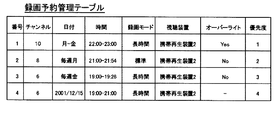
ユーザはTV番組の録画予約時に、その番組ごとに据置き録再装置1から携帯再生装置2へのコンテンツ転送ポリシを設定する。この転送ポリシについて以下で説明する。従来のビデオデッキやHD録画・再生機でTV番組の録画予約を行なう場合は、以下のようなパラメータを設定していた。
(p1) チャンネル: 1ch 〜
(p2) 日付: ?年?月?日/毎週?曜日/毎日/月〜土/月〜金
(p3) 時間: ??時??分 から ??時??分 まで
(p4) 録画モード: 高画質/標準/長時間 など
これらを4〜8件程度予約できるのが一般的である。本実施形態では予約件数を4件として説明する。なお、 (p4)録画モード とは、据置き録再装置1用コンテンツの品質を表わし、高画質:6Mbps、標準:4Mbps、長時間:3Mbpsなどとなる。
When recording a TV program, the user sets a content transfer policy from the stationary recording / reproducing
(p1) Channel: 1ch to
(p2) Date:? Year? Moon? Day / weekly? Day of the week / Daily / Mon-Sat / Mon-Fri
(p3) Time:? ? Time? ? From the minute? ? Time? ? Up to minutes
(p4) Recording mode: High quality / Standard / Long time, etc. Generally, 4 to 8 of these can be reserved. In the present embodiment, the number of reservations will be described as four. Note that (p4) recording mode represents the quality of content for the stationary recording / reproducing
本実施形態では、上記のような従来からのパラメータの他にコンテンツ転送ポリシに関する以下のようなパラメータを設定する。
(p5) 視聴装置:「据置き録再装置1」/「携帯再生装置2」
コンテンツをどちらの装置で視聴する予定かを指定する。「据置き録再装置1」、「携帯再生装置2」が選択可能となる。前述のように本実施形態では据置き録再装置1でも再生可能なので、「携帯再生装置2」とした場合でも据置き録再装置1で視聴できることを前提とする。このパラメータで「携帯再生装置2」とした場合にのみ、そのコンテンツの転送ポリシに基づいて転送処理を行なうことになる。したがって、以下に示すパラメータは、本パラメータで「携帯再生装置2」を指定したコンテンツに対してだけ意味を持つことになる。
In this embodiment, in addition to the conventional parameters as described above, the following parameters related to the content transfer policy are set.
(p5) Viewing device: “Deferred recording /
Specify which device will be used to view the content. “Deferred recording / reproducing
(p6) オーバーライト:「Yes」/「No」
このパラメータは、従来のパラメータ (p2)日付 で毎週/毎日/月〜土/月〜金といった連続指定を行なったコンテンツに対してのみ意味がある。「Yes」と「No」の指定があり、「No」とした場合には、携帯再生装置2内に前回分のコンテンツが存在し、かつまだ視聴終了していなければ、オーバーライトしてまで次回分を転送しようとはしない。この設定は例えば連続ドラマなどに適している。「Yes」とした場合には、たとえ前回分を視聴し終わっていなくてもどんどん最新分をオーバーライトして転送していく。この設定は例えばニュース番組などに適している。また、「Yes」とした場合、最新の何回分を残しておくかを指定可能としても構わない。例えば「2回」と指定した場合には、常に最新の2回分は携帯再生装置2に入った状態になるように転送処理が行なわれる。本実施形態では説明を簡単にするため、この回数を「1回」と固定した場合を例として説明する。
(p6) Overwrite: “Yes” / “No”
This parameter is meaningful only for content that has been specified continuously, such as weekly / daily / month to Saturday / Monday to Friday, on the date of the conventional parameter (p2). If “Yes” and “No” are specified and “No” is set, if the content for the previous time exists in the
(p7) 優先度:「1」/「2」/「3」/「4」
携帯再生装置2の容量が小さいため、転送指定した番組をすべて転送できない可能性がある。そのようなとき、どのコンテンツを優先して転送するかその度合いを本パラメータで指定する。本実施形態では予約件数を4件としているので優先度も1〜4の4段階とし、1をもっとも高い優先度として扱うことにする。例えば、スポーツ中継番組やニュース番組のように即時性が重要なコンテンツは高い優先度、週一のドラマのように一週間以内だったらいつ視聴しても良いようなものは中程度の優先度、不定期の映画番組のようないつ視聴しても構わないようなものは低い優先度、といった利用が考えられる。
(p7) Priority: "1" / "2" / "3" / "4"
Since the capacity of the
据置き録再装置1では、録画予約情報や録画済みコンテンツを管理するためのテーブル(録画予約管理テーブル、コンテンツ管理テーブル)を保持しておく必要がある。これらの情報は電源が落ちても消えてはいけない情報であるため、HD104の中のファイル、例えば schedule.tab、contents.tabを生成し、それぞれ格納しておくものとする。
The deferred recording / reproducing
ファイルschedule.tabには、図2のような前述のパラメータ情報を反映した内容が格納されることになる。 The file schedule.tab stores contents reflecting the above-described parameter information as shown in FIG.
ファイル contents.tabには、図3のような管理情報が格納されることになる。前述のパラメータ(p2)日付で「毎週?曜日」、「毎日」、「月〜土」、「月〜金」のように連続指定をしたコンテンツに関しては、複数回録画されていてもまとめて一つのエントリで管理している。各エントリには録画予約時に設定した各パラメータ情報などが格納されている。 Management information as shown in FIG. 3 is stored in the file contents.tab. For the contents specified continuously such as “every day of the week”, “everyday”, “Monday-Saturday”, “Monday-Friday” on the date of the above parameter (p2), even if they are recorded multiple times Managed by one entry. Each entry stores parameter information set at the time of recording reservation.
また、個々のコンテンツ情報に関しては、別のファイル(コンテンツ情報ファイル)でそれぞれ管理しており、そのファイル名が各エントリに格納されている。 Each piece of content information is managed in a separate file (content information file), and the file name is stored in each entry.
各エントリに格納される情報を以下に示す。
(e1) エントリ番号
個々のエントリを特定するためのユニークな番号
(e2) チャンネル: 1ch 〜
録画予約パラメータ(p1)と同じ。
(e3) 日付: ?年?月?日/毎週?曜日/毎日/月〜土/月〜金
録画予約パラメータ(p2)と同じ。
(e4) 時間: ??時??分 から ??時??分 まで
録画予約パラメータ(p3)と同じ。
(e5) 視聴装置:「据置き録再装置1」/「携帯再生装置2」
録画予約パラメータ(p5)と同じ。
(e6) オーバーライト:「Yes」/「No」
録画予約パラメータ(p6)と同じ。
(e7) 優先度:「1」/「2」/「3」/「4」
録画予約パラメータ(p7)と同じ。
(e8) コンテンツ情報ファイル名
コンテンツ情報ファイルをリンクするための情報。
Information stored in each entry is shown below.
(e1) Entry number Unique number for identifying each entry
(e2) Channel: 1ch ~
Same as the recording reservation parameter (p1).
(e3) Date:? Year? Moon? Day / weekly? Same as Day / Daily / Monday-Saturday / Monday-Friday recording reservation parameter (p2).
(e4) Time:? ? Time? ? From the minute? ? Time? ? Same as the recording reservation parameter (p3).
(e5) Viewing device: “Deferred recording /
Same as the recording reservation parameter (p5).
(e6) Overwrite: “Yes” / “No”
Same as the recording reservation parameter (p6).
(e7) Priority: “1” / “2” / “3” / “4”
Same as the recording reservation parameter (p7).
(e8) Content information file name Information for linking content information files.
コンテンツ情報ファイルのファイル名は、それぞれユニークなものにするため、録画開始日時などから自動生成する。例えば、2001年09月11日の13:00から録画開始したコンテンツであれば、200109111300.infといったファイル名にすれば良い。また、以下の説明中では、前述のファイル名の拡張子(.inf)を除いた名前(200109111300)をコンテンツ名と呼ぶことにする。 The file name of the content information file is automatically generated from the recording start date and time to make it unique. For example, if the content starts recording from 13:00 on September 11, 2001, the file name may be 200109111300.inf. In the following description, a name (200109111300) obtained by removing the extension (.inf) of the file name is referred to as a content name.
コンテンツ情報ファイルには以下のような情報が格納されている。
(c1) コンテンツ格納場所:「据置き録再装置1」/「据置き録再装置1と携帯再生装置2」
現在のコンテンツ格納場所を示す。
(c2) 視聴状況:「未視聴」/「視聴途中」/「視聴終了」
その時点での視聴状況を示す。
(c3) 視聴ポイント
視聴開始してからの時間又はフレーム番号などその時点での視聴ポイントを示す。
(c4) コンテンツ情報ファイル名
連続指定で録画されたコンテンツの場合、複数個のコンテンツをリンクして管理する。そのため、必要な場合は次の回のコンテンツ情報ファイル名がここに格納される。
The content information file stores the following information.
(c1) Content storage location: “deferred recording / reproducing
Indicates the current content storage location.
(c2) Viewing status: “not viewing” / “while watching” / “ending viewing”
The viewing status at that time is shown.
(c3) Viewing point Indicates the viewing point at that time, such as the time from the start of viewing or the frame number.
(c4) In the case of content recorded with continuous designation of content information file names, a plurality of contents are linked and managed. Therefore, the content information file name of the next round is stored here if necessary.
コンテンツの実体となるMPEG-2といったデータもファイル(コンテンツデータファイル)として管理する。 Data such as MPEG-2 that is the content entity is also managed as a file (content data file).
ファイル名はコンテンツ情報ファイルと同様に録画開始日時などから自動生成して、コンテンツ情報ファイルと一対一対応する。例えば、コンテンツ情報ファイル名が200109111300.infであればコンテンツデータファイル名は 200109111300.mpgとする。 The file name is automatically generated from the recording start date and time like the content information file, and has a one-to-one correspondence with the content information file. For example, if the content information file name is 200109111300.inf, the content data file name is 200109111300.mpg.
一方、携帯再生装置2でも、据置き録再装置1から転送され現在格納されているコンテンツを管理するために、据置き録再装置1と同様に、コンテンツ情報ファイルが必要となる。ただし、携帯再生装置2では、携帯再生装置2の中に格納されているコンテンツのみを管理すれば良いので、格納されているコンテンツデータファイルに対するコンテンツ情報ファイルだけで十分となり、コンテンツ管理テーブルは不要となる。携帯再生装置2で管理するコンテンツ情報ファイル名に関しては、コンテンツデータファイル名と同様に、据置き録再装置1と同じ名前で管理する。ただし、必要となる情報が据置き録再装置1のコンテンツ情報ファイルとは異なり以下のようになる。
(C1) エントリ番号
リンクもとのコンテンツ管理テーブルのエントリ番号を示す。
(C2) 優先度:「1」/「2」/「3」/「4」
コンテンツの優先度を示す。
(C3) 視聴状況:「未視聴」/「視聴途中」/「視聴終了」
その時点での視聴状況を示す。
(C4) 視聴ポイント
視聴開始してからの時間又はフレーム番号などその時点での視聴ポイントを示す。
On the other hand, the
(C1) Entry number Indicates the entry number of the link content management table.
(C2) Priority: "1" / "2" / "3" / "4"
Indicates the priority of the content.
(C3) Viewing status: “Unviewed” / “Now viewing” / “End viewing”
The viewing status at that time is shown.
(C4) Viewing point Indicates the viewing point at that time, such as the time from the start of viewing or the frame number.
携帯再生装置2で最後に視聴していたコンテンツを特定する情報を、据置き録再装置1と携帯再生装置2それぞれで管理する。これらの情報を管理するファイルである最終視聴コンテンツ情報ファイル lastcontents.infをHD104、HD204にそれぞれ格納する。最終視聴コンテンツ情報ファイル lastcontents.inf の中には以下のような情報が格納される。
(L1) 携帯再生装置2最終視聴コンテンツ名
携帯再生装置2で最後に視聴していたコンテンツのコンテンツ名を格納する。
Information for identifying the content that was last viewed on the
(L1)
次に、据置き録再装置1での録画予約時の処理、録画開始/終了時の処理について説明する。基本的な処理は従来のHD録画・再生機などでTV番組の録画予約を行なうときの処理と同様であり、ユーザからの操作を入力デバイス111で受取り、ユーザが入力した各種パラメータを前述の録画予約管理テーブルに設定し、もっとも近い時間に内部タイマを設定する、といった処理を行なう。特徴的なことは、ユーザが入力するパラメータに、従来はなかった (p5)視聴装置 、 (p6)オーバーライト 、 (p7)優先度 が増えているという点であり、これらの値も前述の録画予約管理テーブルに設定する処理を追加する必要がある。
Next, processing at the time of recording reservation and processing at the start / end of recording in the stationary recording / reproducing
次に、設定した内部タイマが満期になり録画を開始/終了するときの処理について説明する。これらの処理についても、基本的な処理は従来のHD録画・再生機などでの録画開始/終了処理と同様であり、録画開始時に、チューナーユニット112のチャネルを指定されたチャネルに変更し、チューナーユニット112で受信したデータをキャプチャユニット113でデジタルデータに変換/圧縮し、HD104上に生成したコンテンツデータファイルに書き込んでいく。録画終了時には、コンテンツデータファイルをクローズし、録画予約管理テーブルを更新してからもっとも近い時間に内部タイマを設定する、といった処理を行なう。こうした従来からの処理に加え、録画したコンテンツに対応するコンテンツ情報ファイルを生成し、コンテンツ管理テーブルへの登録などの処理を行なう。生成したコンテンツ情報ファイルには以下のように設定する。 (c1)コンテンツ格納場所 には「据置き録再装置1」、 (c2)視聴状況 には「未視聴」、 (c3)コンテンツ情報ファイル名 にはヌル文字列を設定する。
Next, processing when the set internal timer expires and recording is started / finished will be described. Regarding these processes, the basic process is the same as the recording start / end process in a conventional HD recording / playback device. At the start of recording, the channel of the
録画予約パラメータのうち (p2)日付 が、ある一日を特定していた場合には、コンテンツ管理テーブルにエントリを追加し、上記コンテンツ情報ファイルを (e8)コンテンツ情報ファイル名 でリンクする。その他の (e2)チャンネル 、 (e3)日付 、 (e4)時間 、 (e5)視聴装置 、 (e7)優先度 は録画予約パラメータからコピーする。 (e6)オーバーライト はこの場合意味がないので設定しない。 If (p2) date in the recording reservation parameters specifies a certain day, an entry is added to the content management table, and the content information file is linked with (e8) content information file name. Other (e2) channel, (e3) date, (e4) time, (e5) viewing device, and (e7) priority are copied from the recording reservation parameter. (e6) Overwrite has no meaning in this case and is not set.
一方、 (p2)日付 が、「毎週」や「毎日」のように連続指定されていた場合には、すでにコンテンツ管理テーブルに登録されている可能性があるので、各エントリの内容と録画予約パラメータとを比較し、同じ内容のものを探す。みつかった場合には、そのエントリのリンクの末尾に生成したコンテンツ情報ファイルをリンクする。みつからなかった場合には、エントリを追加し、生成したコンテンツ情報ファイルを (e8)コンテンツ情報ファイル名 でリンクする。その他の設定はすべて録画予約パラメータからコピーして設定する。 On the other hand, if the (p2) date is specified continuously, such as “Weekly” or “Everyday”, it may be already registered in the content management table, so the contents of each entry and the recording reservation parameter And search for the same content. If found, link the generated content information file to the end of the link of the entry. If not found, add an entry and link the generated content information file with (e8) content information file name. All other settings are set by copying from the recording reservation parameters.
次に、本実施形態の特徴となる処理の流れについて以下で説明する。まず、携帯再生装置2におけるコンテンツ再生処理について説明する。携帯再生装置2では、後述するコンテンツの自動転送処理により据置き録再装置1から転送された複数のコンテンツの中から任意のコンテンツがユーザからの指示により再生されることになる。HD204に格納されている複数のコンテンツは前述のようにそれぞれのコンテンツ情報ファイルにより管理されている。
Next, the flow of processing that is a feature of the present embodiment will be described below. First, content reproduction processing in the
そして、据置き録再装置1から転送されたばかりで一度も再生されていないコンテンツの場合は、対応するコンテンツ情報ファイルの (C3)視聴状況 を「未視聴」と設定し、ユーザの指示により再生が開始されると「視聴途中」と設定し、最後まで再生すると「視聴終了」と設定する。また、再生途中で停止したり、またその後他のコンテンツに切り替えたりした場合などは「視聴途中」と設定されたままとなる。また、コンテンツ再生を途中で停止した場合には、その途中の位置を示す情報(時間やフレーム番号など)を対応するコンテンツ情報ファイルの (C4)視聴ポイント に記録する。また、あるコンテンツの再生が開始されると、HD204内の最終視聴コンテンツ情報ファイルlastcontents.infの (L1)携帯再生装置2最終視聴コンテンツ名 を、再生を開始したコンテンツのコンテンツ名に設定する。
For content that has just been transferred from the stationary recording / reproducing
次に、ユーザが外出中に携帯再生装置2を利用してコンテンツを視聴し、帰宅後に携帯再生装置2を据置き録再装置1に接続したときの処理の流れについて説明する。なお、両者を接続すると自動的に両者の電源が入りそれぞれの装置に格納されているプログラムがそれぞれのCPU、ROM、RAMを使って動作を開始するように実装していても、またユーザが据置き録再装置1、携帯再生装置2のいずれかの電源を入れると両者の電源が入りプログラムが処理を開始する方式で実装していても構わない。本実施形態では、両者を接続すると自動的に両者の電源が入り、プログラムが処理を開始する方式で説明する。なお、このとき両者の内部的な電源が入り処理が自動開始されるものの、ユーザから見える見た目の電源はまだ入っていない状態、つまり一般的なビデオデッキのようにコンソール画面や入力デバイス111のガイドライトのようなものがあったとしたら、それらがまだ消灯した状態として以下の処理を開始する。
Next, a flow of processing when the user views content using the
大きな処理の流れとしては、まずは携帯再生装置2から据置き録再装置1にコンテンツの視聴状況を示す情報を転送することで据置き録再装置1のコンテンツの管理情報を最新の状態に更新する処理を行なう。それが終了したら次に据置き録再装置1において視聴途中コンテンツの継続再生処理を実行すると平行してコンテンツの自動転送処理を行なう。
As a large processing flow, first, information indicating the viewing status of the content is transferred from the
このように2種類の処理を平行処理するためには、一般的には、複数の処理を並行実行可能とするマルチタスク機構を備えたリアルタイムOSを利用し、継続再生処理と自動転送処理をそれぞれ独立したタスクで実行するようにする。しかも、継続再生処理が自動転送処理により阻害されてはいけないので、継続再生処理タスクの実行優先度を自動転送処理タスクよりも高くしておく必要がある。 In order to perform parallel processing of two types of processing in this way, generally, a continuous reproduction process and an automatic transfer process are performed using a real-time OS having a multitasking mechanism capable of executing a plurality of processes in parallel. Try to run as an independent task. Moreover, since the continuous reproduction process must not be hindered by the automatic transfer process, it is necessary to set the execution priority of the continuous reproduction process task higher than that of the automatic transfer process task.
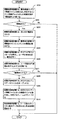
まずは据置き録再装置1のコンテンツの管理情報を最新の状態に更新する処理の流れについて、図4のフローチャートを用いて説明する。まず、携帯再生装置2が接続処理を開始すると、ステップS101でHD204に格納されている複数のコンテンツ情報ファイルを順番に読み出し、該当ファイルがある間はステップS102からステップS103に進み、なくなればステップS111に進む。
First, the flow of processing for updating the content management information of the stationary recording / reproducing
ステップS103に進むと、選ばれたコンテンツ情報ファイルのコンテンツ名、 (C3)視聴状況 、 (C4)視聴ポイント を据置き録再装置1に通知する。
In step S103, the deferred recording / reproducing
次に、通知を受け取った据置き録再装置1はステップS104で、HD104に格納されている、通知されたコンテンツ名に対応するコンテンツ情報ファイルの情報のうち (c2)視聴状況 、 (c3)視聴ポイント を更新する。
Next, in step S104, the deferred recording / reproducing
次に、据置き録再装置1はステップS105で、更新された (c2)視聴状況 が「視聴終了」かどうかを調べ、「視聴終了」であればステップS106からステップS107へ、「視聴終了」でなければステップS106からステップS108へ進む。ステップS107では、対応するコンテンツ情報ファイルの (c1)コンテンツ格納場所 を更新する処理を行なう。「視聴終了」であった場合は、携帯再生装置2で視聴が終了した、そして携帯再生装置2から削除されることを意味しているので、対応するコンテンツ情報ファイルの (c1)コンテンツ格納場所 も更新する必要がある。つまり、(c1)コンテンツ格納場所 が「据置き録再装置1と携帯再生装置2」となっていたら「据置き録再装置1」に更新する。
Next, the deferred recording / reproducing
次に携帯再生装置2は、ステップS108で、対象コンテンツの (C3)視聴状況 が「視聴終了」かどうを調べ、「視聴終了」であればステップS109からステップS110に進みステップS110の処理を行なってからステップS101に戻り、「視聴終了」でなければそのままステップS101に戻る。ステップS110では、対象コンテンツのコンテンツ情報ファイル、コンテンツデータファイルを削除する処理を行なう。
Next, in step S108, the
最後に携帯再生装置2はステップS111で、HD204に格納されている最終視聴コンテンツ情報ファイルlastcontents.infにある (L1)携帯再生装置2最終視聴コンテンツ名 を据置き録再装置1に通知する。通知を受け取った据置き録再装置1はステップS112で、HD104に格納されている最終視聴コンテンツ情報ファイルlastcontents.infの内容を更新する。
Finally, in step S111, the
以上でコンテンツ管理情報の更新処理が終了となる。コンテンツ管理情報の更新処理が終了すると、前述したように、携帯再生装置2で視聴途中だったコンテンツを据置き録再装置1で視聴再開するための継続再生処理と、コンテンツの自動転送処理を平行して実行する。
This is the end of the content management information update process. When the update process of the content management information is completed, as described above, the continuous playback process for resuming viewing of the content that was being viewed on the
まず、継続再生処理の流れについて図5のフローチャートを用いて説明する。据置き録再装置1は、ステップS201で更新された最終視聴コンテンツ情報ファイルlastcontents.infの内容(コンテンツ名)を読み出し、対応するコンテンツ情報ファイルの (c2)視聴状況を確認し、「視聴途中」かどうか判断する。「視聴途中」であればステップS203に進み、「視聴途中」でなければ継続再生処理は終了となり、ユーザからの次の操作待ち状態となる。
First, the flow of continuous reproduction processing will be described using the flowchart of FIG. The deferred recording / reproducing
据置き録再装置1は、ステップS203に進むと据置き録再装置1の見た目の電源を入れ、ステップS204で、携帯再生装置2において視聴途中だったコンテンツの情報をディスプレイ109に表示する。このとき表示する情報としては、録画したチャネルと日時などのテキスト情報、対象コンテンツをどのくらいまで視聴したかを示す時間・割合情報、最後に再生したフレーム(静止画)、最後に再生した数フレーム(2,3秒の動画)などのいずれか、又はいずれかの組み合わせであって構わない。
When the process proceeds to step S203, the stationary recording / reproducing
次にステップS205で、ダイアログ等でメッセージを表示してユーザの操作を促し、ユーザ操作を待つ。表示するメッセージとしては、「視聴途中のコンテンツを継続再生しますか?」といった内容で、通常の再生ボタンで「継続再生する」、通常の停止ボタンで「継続再生しない」といった操作を促しても構わないし、専用の「OK」、「キャンセル」のようなボタンを設け、その操作を促しても構わない。 In step S205, a message is displayed in a dialog or the like to prompt a user operation and wait for the user operation. The message to be displayed is “Do you want to continue playback of the content you are watching?”, Even if you prompt the user to “continue playback” with the normal play button or “do not continue playback” with the normal stop button Alternatively, dedicated buttons such as “OK” and “Cancel” may be provided to prompt the operation.
次にステップS206で、ユーザからの操作を解釈し、「継続再生する」であったならステップS207からステップS208に進み、「継続再生しない」であったなら継続再生処理は終了となり、ユーザからの次の操作待ち状態となる。 Next, in step S206, the operation from the user is interpreted, and if it is “continuous reproduction”, the process proceeds from step S207 to step S208, and if it is “not continuous reproduction”, the continuous reproduction process is terminated, Waits for the next operation.
ステップS208に進むと、対応するコンテンツデータファイルをオープンし、ステップS209で対応するコンテンツ情報ファイル中の (c3)視聴ポイント を読み出し、対応するフレームまでシークする。最後にステップS210で、シーク後のポイントから随時データを読み出して再生処理を開始して継続再生処理は終了となり、ユーザからの次の操作待ち状態となる。 In step S208, the corresponding content data file is opened, and in step S209, (c3) viewing point in the corresponding content information file is read and seek to the corresponding frame. Finally, in step S210, data is read as needed from the point after seek to start the reproduction process, the continuous reproduction process is terminated, and the next operation from the user is awaited.
次に上述したコンテンツの自動転送処理の流れについて、図6のフローチャートを用いて説明する。据置き録再装置1は、ステップS301で転送候補のコンテンツを選択する。まずは、コンテンツ管理テーブルの各エントリを調べ、 (e5)視聴装置 で「携帯再生装置2」となっているエントリを (e7)優先度 の高いものから順に調査していく。そして次に、対象エントリからリンクされているコンテンツ情報ファイルを調査する。このとき、エントリの (e6)オーバーライト が「Yes」だった場合には、リンクの末尾のものつまり最新のコンテンツだけを調査し、 (c1)コンテンツ格納場所 が「据置き録再装置1」となっていればそのコンテンツを転送候補として選択する。一方、エントリの (e6)オーバーライト が「No」だった場合には、リンクされているコンテンツ情報ファイルを、リンクされている順つまり古いものから順に調べ、(c1)コンテンツ格納場所 が「据置き録再装置1」となっているコンテンツを順番に転送候補として選択していく。ステップS301で転送候補のコンテンツがみつかれば、ステップS302からステップS303に進み、みつからなければ終了となる。
Next, the flow of the automatic content transfer process described above will be described with reference to the flowchart of FIG. The deferred recording / reproducing
次に据置き録再装置1は、ステップS303で、転送候補のコンテンツに関する情報、コンテンツデータファイルサイズ、エントリ番号、優先度、オーバーライト指定を携帯再生装置2に通知し、携帯再生装置2からの返答通知を待つ。
Next, in step S303, the deferred recording / reproducing
通知を受け取った携帯再生装置2は、ステップS304で、転送候補のコンテンツをHD204に格納可能かどうか判断する。オーバーライト指定が「Yes」だった場合には、コンテンツ情報ファイルを順に調べ、 (C1)エントリ番号 が通知されたエントリ番号と一致するコンテンツを探す。みつかった場合には、みつかったコンテンツのコンテンツ情報ファイル、コンテンツデータファイルをオーバーライト処理のために削除する。この場合、ファイルを削除したことにより空いた領域に、転送候補のコンテンツを格納することが可能となるので「格納可能」と据置き録再装置1に通知する。一方、オーバーライト指定が「No」だった場合には、まず現在のHD204の残り容量と通知されたコンテンツデータファイルサイズとを比較し、残り容量の方が大きければ「格納可能」と据置き録再装置1に通知する。残り容量の方が小さければ以下の領域確保処理を行ないその結果を据置き録再装置1に通知する。
Receiving the notification, the
HD204にあるコンテンツ情報ファイルを順に調べ、通知された優先度よりも低いコンテンツのコンテンツデータファイルサイズを優先度の低いものから順番に合計していき、通知されたコンテンツデータファイルサイズよりも大きくなった時点で、それらのコンテンツデータファイル及びコンテンツ情報ファイルを削除する。この場合、ファイルを削除したことにより空いた領域に、転送候補のコンテンツを格納することが可能となるので「格納可能」と据置き録再装置1に通知する。しかし、受け取った優先度よりも低いすべてのコンテンツのコンテンツデータファイルサイズを合計しても通知されたコンテンツデータファイルサイズよりも小さかった場合には、上記のファイル削除処理は行なわずに、「格納不可能」と据置き録再装置1に通知する。
The content information files in the
携帯再生装置2からの返答通知を受け取った据置き録再装置1は、ステップS305で通知が「格納可能」だった場合にはステップS306へ進み、「格納不可能」だった場合にはステップS301へ戻り、次の転送候補となるコンテンツを探す。
The deferred recording / reproducing
ステップS306に進むと、次に据置き録再装置1は、対象となるコンテンツデータファイルを携帯再生装置2に転送する。正確には、HD104上にもとのコンテンツデータファイルは残っているのでコピー転送となる。
If it progresses to step S306, the stationary recording / reproducing
コンテンツデータファイルを受け取った携帯再生装置2は、ステップS307で転送されてきたコンテンツデータファイルをHD204に格納する。そして、次にステップS308で、コンテンツ情報ファイルをHD204に作成し、ステップS303で通知された、エントリ番号、優先度をそれぞれ (C1)エントリ番号 、 (C2)優先度 に設定し、 (C3)視聴状況 を「未視聴」に設定する。
Receiving the content data file, the
次に据置き録再装置1は、ステップS309で、転送したコンテンツのコンテンツ情報ファイルの (c1)コンテンツ格納場所 を「据置き録再装置1」から「据置き録再装置1と携帯再生装置2」に更新し、ステップS301に戻る。
Next, in step S309, the deferred recording / reproducing
以上述べたように、本実施形態では、携帯再生装置2でコンテンツ再生が行なわれると、その再生状況にしたがって対応するコンテンツ情報ファイルの (C3)視聴状況 、 (C4)視聴ポイント、及び最終視聴コンテンツ情報ファイルを適切に更新する。そして、携帯再生装置2が据置き録再装置1に接続されると、まず携帯再生装置2から各コンテンツ情報ファイル及び最終視聴コンテンツ情報ファイルの内容を転送することで据置き録再装置1のコンテンツ管理情報を最新の状態に更新し、もし携帯再生装置2であるコンテンツが視聴途中だった場合には、据置き録再装置1でそのコンテンツと同じ物を選択し、視聴途中のフレーム位置までシークした状態とし、その静止画、コンテンツ情報などを表示してユーザに視聴を継続するかどうかの選択を促し、継続する選択がなされた場合には視聴途中の位置から再生を再開することが可能となる。
As described above, in this embodiment, when content playback is performed on the
なお、本発明の目的は、上述した実施形態の機能を実現するソフトウェアのプログラムコードを記録した記憶媒体を、システム或いは装置に供給し、そのシステム或いは装置のコンピュータ(又はCPUやMPU)が記憶媒体に格納されたプログラムコードを読み出し実行することによっても、達成されることは言うまでもない。 An object of the present invention is to supply a storage medium storing software program codes for realizing the functions of the above-described embodiments to a system or apparatus, and the computer (or CPU or MPU) of the system or apparatus stores the storage medium. Needless to say, this can also be achieved by reading and executing the program code stored in.
この場合、記憶媒体から読み出されたプログラムコード自体が上述した実施形態の機能を実現することになり、プログラムコード自体及びそのプログラムコードを記憶した記憶媒体は本発明を構成することになる。 In this case, the program code itself read from the storage medium realizes the functions of the above-described embodiments, and the program code itself and the storage medium storing the program code constitute the present invention.
プログラムコードを供給するための記憶媒体としては、例えば、フレキシブルディスク、ハードディスク、光ディスク、光磁気ディスク、CD−ROM、CD−R、磁気テープ、不揮発性のメモリカード、ROM等を用いることができる。 As a storage medium for supplying the program code, for example, a flexible disk, a hard disk, an optical disk, a magneto-optical disk, a CD-ROM, a CD-R, a magnetic tape, a nonvolatile memory card, a ROM, or the like can be used.
また、コンピュータが読み出したプログラムコードを実行することにより、上述した実施形態の機能が実現されるだけでなく、そのプログラムコードの指示に基づき、コンピュータ上で稼動しているOS(基本システム或いはオペレーティングシステム)などが実際の処理の一部又は全部を行い、その処理によって上述した実施形態の機能が実現される場合も含まれることは言うまでもない。 Further, by executing the program code read by the computer, not only the functions of the above-described embodiments are realized, but also an OS (basic system or operating system) running on the computer based on the instruction of the program code. Needless to say, a case where the function of the above-described embodiment is realized by performing part or all of the actual processing and the processing is included.
さらに、記憶媒体から読み出されたプログラムコードが、コンピュータに挿入された機能拡張ボードやコンピュータに接続された機能拡張ユニットに備わるメモリに書き込まれた後、そのプログラムコードの指示に基づき、その機能拡張ボードや機能拡張ユニットに備わるCPU等が実際の処理の一部又は全部を行い、その処理によって上述した実施形態の機能が実現される場合も含まれることは言うまでもない。 Further, after the program code read from the storage medium is written to a memory provided in a function expansion board inserted into the computer or a function expansion unit connected to the computer, the function expansion is performed based on the instruction of the program code. It goes without saying that the CPU or the like provided in the board or function expansion unit performs part or all of the actual processing, and the functions of the above-described embodiments are realized by the processing.
1 据置き録再装置
2 携帯再生装置
3 通信ケーブル
101 CPU
102 ROM
103 RAM
104 大容量HD
105 システムバス
106 通信装置
107 スピーカー
108 サウンドコントローラ
109 ディスプレイ
110 ビデオコントローラ
111 入力デバイス
112 チューナーユニット
113 キャプチャユニット
201 CPU
202 ROM
203 RAM
204 小容量HD
205 システムバス
206 通信装置
207 ヘッドホン
208 サウンドコントローラ
209 小型ディスプレイ
210 ビデオコントローラ
211 入力デバイス
DESCRIPTION OF
102 ROM
103 RAM
104 large capacity HD
105
202 ROM
203 RAM
204 Small capacity HD
205
Claims (2)
前記据置き録再装置と前記携帯再生装置の両者において各コンテンツの視聴状況を管理し、視聴途中の場合には、どこまで視聴したかの情報も管理し、さらに前記携帯再生装置において最後に視聴していたコンテンツがどのコンテンツだったかを示す情報も管理するコンテンツ視聴状況管理手段と、
前記携帯再生装置が前記据置き録再装置に接続されると、前記携帯再生装置におけるコンテンツ視聴状況を示す情報を前記据置き録再装置に転送し、前記据置き録再装置の各コンテンツ管理情報を最新の状態に更新するコンテンツ管理情報更新手段と、
前記携帯再生装置であるコンテンツが視聴途中だった場合には、前記据置き録再装置においてそのコンテンツと同じコンテンツを選択し、視聴途中のフレーム位置までシークした状態としたのち、そのコンテンツを示す情報を表示してユーザに視聴を継続するかどうかの選択を促し、継続する選択がなされた場合には視聴途中の位置から再生を再開するコンテンツ継続再生手段とを備えたことを特徴とする録画再生装置。 A deferred recording / reproducing apparatus having a TV program reserved recording / playback function, and a TV program as a content recorded by the deferred recording / reproducing apparatus are transferred and stored, and the contents are stored in a state separated from the deferred recording / reproducing apparatus. A portable playback device having a function to play, the stationary recording and playback device and the portable playback device are configured to be connectable by a predetermined communication means,
The viewing status of each content is managed by both the deferred recording / reproducing apparatus and the portable playback device, and when viewing is in progress, information on how far the content has been viewed is managed, and the last viewing is performed by the portable playback device. Content viewing status management means that also manages information indicating what content the content was,
When the portable playback device is connected to the stationary recording / reproducing device, information indicating a content viewing state in the portable playback device is transferred to the stationary recording / reproducing device, and each content management information of the stationary recording / reproducing device is transmitted. Content management information updating means for updating to the latest state;
When the content that is the portable playback device is in the middle of viewing, information that indicates the content is selected after selecting the same content as the content in the deferred recording / playback device, seeking to the frame position in the middle of viewing And a content continuation reproduction means for prompting the user to select whether or not to continue the viewing and to resume the reproduction from a position in the middle of the viewing when the selection is continued. apparatus.
前記据置き録再装置と前記携帯再生装置の両者において各コンテンツの視聴状況を管理し、視聴途中の場合には、どこまで視聴したかの情報も管理し、さらに前記携帯再生装置において最後に視聴していたコンテンツがどのコンテンツだったかを示す情報も管理するコンテンツ視聴状況管理工程と、
前記携帯再生装置が前記据置き録再装置に接続されると、前記携帯再生装置におけるコンテンツ視聴状況を示す情報を前記据置き録再装置に転送し、前記据置き録再装置の各コンテンツ管理情報を最新の状態に更新するコンテンツ管理情報更新工程と、
前記携帯再生装置であるコンテンツが視聴途中だった場合には、前記据置き録再装置においてそのコンテンツと同じコンテンツを選択し、視聴途中のフレーム位置までシークした状態としたのち、そのコンテンツを示す情報を表示してユーザに視聴を継続するかどうかの選択を促し、継続する選択がなされた場合には視聴途中の位置から再生を再開するコンテンツ継続再生工程とを有することを特徴とする録画再生方法。 A deferred recording / reproducing apparatus having a TV program reserved recording / playback function, and a TV program as a content recorded by the deferred recording / reproducing apparatus are transferred and stored, and the contents are stored in a state separated from the deferred recording / reproducing apparatus. A recording / reproducing method using a recording / reproducing apparatus configured to be connectable by a predetermined communication unit. The portable recording / reproducing apparatus includes a portable reproducing apparatus having a reproducing function. And
The viewing status of each content is managed by both the deferred recording / reproducing apparatus and the portable playback device, and when viewing is in progress, information on how far the content has been viewed is managed, and the last viewing is performed by the portable playback device. A content viewing status management process that also manages information indicating what content the content had been,
When the portable playback device is connected to the stationary recording / reproducing device, information indicating a content viewing state in the portable playback device is transferred to the stationary recording / reproducing device, and each content management information of the stationary recording / reproducing device is transmitted. Content management information update process to update the
When the content that is the portable playback device is in the middle of viewing, information that indicates the content is selected after selecting the same content as the content in the deferred recording / playback device, seeking to the frame position in the middle of viewing And a content continuation playback step of urging the user to select whether or not to continue viewing and, if the selection is continued, resumes playback from a position in the middle of viewing. .
Priority Applications (1)
| Application Number | Priority Date | Filing Date | Title |
|---|---|---|---|
| JP2003391061A JP2005159439A (en) | 2003-11-20 | 2003-11-20 | Recording and playback apparatus and method |
Applications Claiming Priority (1)
| Application Number | Priority Date | Filing Date | Title |
|---|---|---|---|
| JP2003391061A JP2005159439A (en) | 2003-11-20 | 2003-11-20 | Recording and playback apparatus and method |
Publications (1)
| Publication Number | Publication Date |
|---|---|
| JP2005159439A true JP2005159439A (en) | 2005-06-16 |
Family
ID=34718248
Family Applications (1)
| Application Number | Title | Priority Date | Filing Date |
|---|---|---|---|
| JP2003391061A Pending JP2005159439A (en) | 2003-11-20 | 2003-11-20 | Recording and playback apparatus and method |
Country Status (1)
| Country | Link |
|---|---|
| JP (1) | JP2005159439A (en) |
Cited By (17)
| Publication number | Priority date | Publication date | Assignee | Title |
|---|---|---|---|---|
| JP2007043562A (en) * | 2005-08-04 | 2007-02-15 | Hitachi Ltd | Content playback device |
| JP2007074529A (en) * | 2005-09-08 | 2007-03-22 | Mitsubishi Electric Corp | Content continuous viewing system |
| JP2007097121A (en) * | 2005-08-29 | 2007-04-12 | Casio Comput Co Ltd | Program recording apparatus, mobile receiving apparatus, and data management method |
| JP2007116526A (en) * | 2005-10-21 | 2007-05-10 | Sanyo Electric Co Ltd | Contents distribution system and portable telephone |
| JP2007142906A (en) * | 2005-11-21 | 2007-06-07 | Kenwood Corp | Reproduction system, portable reproduction device, and remote controller |
| JP2007149183A (en) * | 2005-11-25 | 2007-06-14 | Sharp Corp | Audio processing device and display device including the same |
| JP2007251803A (en) * | 2006-03-17 | 2007-09-27 | Sharp Corp | Recording / reproducing apparatus, portable terminal apparatus, recording / reproducing system, and recording / reproducing method |
| JP2008117469A (en) * | 2006-11-02 | 2008-05-22 | Alpine Electronics Inc | On-vehicle audio system, and reproducing method thereof |
| JP2008244921A (en) * | 2007-03-28 | 2008-10-09 | Sharp Corp | Display control system, display device, program, and display control method |
| JP2008293631A (en) * | 2007-04-20 | 2008-12-04 | Sony Corp | Data communication system, portable electronic device, server device, data communication method, and data communication program |
| JP2009055629A (en) * | 2008-10-22 | 2009-03-12 | Sharp Corp | Recording / reproducing apparatus, portable terminal apparatus, recording / reproducing system, and recording / reproducing method |
| US7593515B2 (en) | 2007-05-16 | 2009-09-22 | Unison Technologies, Inc. | Systems and methods for providing unified collaboration systems with combined communication log |
| US7596217B2 (en) | 2007-05-01 | 2009-09-29 | Unison Technologies, Inc. | Systems and methods for phone call management |
| US7783023B2 (en) | 2007-05-16 | 2010-08-24 | Unison Technologies, Inc. | Systems and methods for providing unified collaboration systems with conditional communication handling |
| JP2010536097A (en) * | 2007-08-07 | 2010-11-25 | 株式会社ソニー・コンピュータエンタテインメント | Method and apparatus for synchronization and management of content on multiple devices |
| US8351447B2 (en) | 2007-04-20 | 2013-01-08 | Sony Corporation | Data communication system, cradle apparatus, server apparatus, data communication method and data communication program |
| WO2014017452A1 (en) * | 2012-07-26 | 2014-01-30 | ヤマハ株式会社 | Electronic apparatus system |
-
2003
- 2003-11-20 JP JP2003391061A patent/JP2005159439A/en active Pending
Cited By (20)
| Publication number | Priority date | Publication date | Assignee | Title |
|---|---|---|---|---|
| JP2007043562A (en) * | 2005-08-04 | 2007-02-15 | Hitachi Ltd | Content playback device |
| JP2007097121A (en) * | 2005-08-29 | 2007-04-12 | Casio Comput Co Ltd | Program recording apparatus, mobile receiving apparatus, and data management method |
| JP2007074529A (en) * | 2005-09-08 | 2007-03-22 | Mitsubishi Electric Corp | Content continuous viewing system |
| JP2007116526A (en) * | 2005-10-21 | 2007-05-10 | Sanyo Electric Co Ltd | Contents distribution system and portable telephone |
| JP2007142906A (en) * | 2005-11-21 | 2007-06-07 | Kenwood Corp | Reproduction system, portable reproduction device, and remote controller |
| JP2007149183A (en) * | 2005-11-25 | 2007-06-14 | Sharp Corp | Audio processing device and display device including the same |
| JP2007251803A (en) * | 2006-03-17 | 2007-09-27 | Sharp Corp | Recording / reproducing apparatus, portable terminal apparatus, recording / reproducing system, and recording / reproducing method |
| JP2008117469A (en) * | 2006-11-02 | 2008-05-22 | Alpine Electronics Inc | On-vehicle audio system, and reproducing method thereof |
| JP2008244921A (en) * | 2007-03-28 | 2008-10-09 | Sharp Corp | Display control system, display device, program, and display control method |
| US8351447B2 (en) | 2007-04-20 | 2013-01-08 | Sony Corporation | Data communication system, cradle apparatus, server apparatus, data communication method and data communication program |
| JP2008293631A (en) * | 2007-04-20 | 2008-12-04 | Sony Corp | Data communication system, portable electronic device, server device, data communication method, and data communication program |
| US7596217B2 (en) | 2007-05-01 | 2009-09-29 | Unison Technologies, Inc. | Systems and methods for phone call management |
| US7593515B2 (en) | 2007-05-16 | 2009-09-22 | Unison Technologies, Inc. | Systems and methods for providing unified collaboration systems with combined communication log |
| US7783023B2 (en) | 2007-05-16 | 2010-08-24 | Unison Technologies, Inc. | Systems and methods for providing unified collaboration systems with conditional communication handling |
| JP2010536097A (en) * | 2007-08-07 | 2010-11-25 | 株式会社ソニー・コンピュータエンタテインメント | Method and apparatus for synchronization and management of content on multiple devices |
| US8375133B2 (en) | 2007-08-07 | 2013-02-12 | Sony Computer Entertainment Inc. | Methods and apparatuses for synchronizing and managing content over multiple devices |
| US8984057B2 (en) | 2007-08-07 | 2015-03-17 | Sony Computer Entertainment Inc. | Methods and apparatuses for synchronizing and managing content over multiple devices |
| JP2009055629A (en) * | 2008-10-22 | 2009-03-12 | Sharp Corp | Recording / reproducing apparatus, portable terminal apparatus, recording / reproducing system, and recording / reproducing method |
| WO2014017452A1 (en) * | 2012-07-26 | 2014-01-30 | ヤマハ株式会社 | Electronic apparatus system |
| JP2014027458A (en) * | 2012-07-26 | 2014-02-06 | Yamaha Corp | Electronic apparatus system |
Similar Documents
| Publication | Publication Date | Title |
|---|---|---|
| JP2005159439A (en) | Recording and playback apparatus and method | |
| US20080181584A1 (en) | System and method for recording broadcasting programs | |
| JP5566602B2 (en) | System and method for marking recording quality | |
| JP2005532749A (en) | Improved bookmark for digital video playback | |
| US20020109930A1 (en) | Apparatus for recording and reproducing information and information reproducing method | |
| JP2004086288A (en) | Recording / reproducing device, recording management method | |
| JP2008193585A (en) | Broadcast program recording/reproducing device and broadcast program recording/reproducing method | |
| CN100389609C (en) | recording device | |
| JPH07240881A (en) | Television device with built-in information search / playback device | |
| JP4233531B2 (en) | Information processing apparatus and method, and program | |
| JP2009182369A (en) | Television program recording / playback apparatus, television program recording / playback method, and program for operating television program recording / playback apparatus | |
| JP2005346827A (en) | Processing control device, data processing device, processing control method, program therefor, and recording medium with the program recorded thereon | |
| JP2006197512A (en) | Recording apparatus, control method, and program | |
| JP2002298551A (en) | Digital recording and reproducing device using randomly accessible recording medium and method for recording management information in digital recording and reproducing device | |
| JP2002305706A (en) | Video recording and reproducing device | |
| JP2004336464A (en) | TV program recording and playback device | |
| JP6965128B2 (en) | Playback device and playback method | |
| JP2010087556A (en) | Image recording and reproducing apparatus, image recording and reproducing program, image recording and reproducing method | |
| JP4699412B2 (en) | VIDEO / AUDIO INFORMATION RECORDING / REPRODUCING DEVICE, VIDEO / AUDIO INFORMATION RECORDING / REPRODUCING METHOD, PROGRAM, AND COMPUTER-READABLE RECORDING MEDIUM CONTAINING THE PROGRAM | |
| JP2002176618A (en) | Recording and reproducing device | |
| JP2010244595A (en) | Recording device and portable terminal device | |
| JPH1196049A (en) | Recording / reproducing apparatus, recording / reproducing method, and recording medium | |
| JP3088367U (en) | Video recording and playback device | |
| JP2008112495A (en) | Recording and reproducing device | |
| JP2005244551A (en) | Recording and reproducing device |