JP2004172087A - Display - Google Patents
Display Download PDFInfo
- Publication number
- JP2004172087A JP2004172087A JP2003300205A JP2003300205A JP2004172087A JP 2004172087 A JP2004172087 A JP 2004172087A JP 2003300205 A JP2003300205 A JP 2003300205A JP 2003300205 A JP2003300205 A JP 2003300205A JP 2004172087 A JP2004172087 A JP 2004172087A
- Authority
- JP
- Japan
- Prior art keywords
- electrode
- electron
- display
- substrate
- emitter section
- Prior art date
- Legal status (The legal status is an assumption and is not a legal conclusion. Google has not performed a legal analysis and makes no representation as to the accuracy of the status listed.)
- Pending
Links
- 239000000758 substrate Substances 0.000 claims description 126
- 239000000463 material Substances 0.000 claims description 43
- 230000010287 polarization Effects 0.000 claims description 43
- OAICVXFJPJFONN-UHFFFAOYSA-N Phosphorus Chemical compound [P] OAICVXFJPJFONN-UHFFFAOYSA-N 0.000 claims description 37
- 230000005684 electric field Effects 0.000 claims description 32
- 238000007789 sealing Methods 0.000 claims description 26
- 230000008859 change Effects 0.000 claims description 20
- 239000011159 matrix material Substances 0.000 abstract description 14
- 125000006850 spacer group Chemical group 0.000 abstract description 11
- 230000009467 reduction Effects 0.000 abstract description 6
- 238000000034 method Methods 0.000 description 36
- 238000010586 diagram Methods 0.000 description 28
- 239000000919 ceramic Substances 0.000 description 23
- 230000004048 modification Effects 0.000 description 18
- 238000012986 modification Methods 0.000 description 18
- BASFCYQUMIYNBI-UHFFFAOYSA-N platinum Chemical compound [Pt] BASFCYQUMIYNBI-UHFFFAOYSA-N 0.000 description 18
- 239000010408 film Substances 0.000 description 16
- RVTZCBVAJQQJTK-UHFFFAOYSA-N oxygen(2-);zirconium(4+) Chemical compound [O-2].[O-2].[Zr+4] RVTZCBVAJQQJTK-UHFFFAOYSA-N 0.000 description 12
- 229910001928 zirconium oxide Inorganic materials 0.000 description 12
- 239000011521 glass Substances 0.000 description 10
- 239000000203 mixture Substances 0.000 description 10
- 239000013078 crystal Substances 0.000 description 9
- 229910052751 metal Inorganic materials 0.000 description 9
- 239000002184 metal Substances 0.000 description 9
- 229910052697 platinum Inorganic materials 0.000 description 9
- 238000002360 preparation method Methods 0.000 description 9
- 229910010293 ceramic material Inorganic materials 0.000 description 8
- 239000004020 conductor Substances 0.000 description 7
- RKTYLMNFRDHKIL-UHFFFAOYSA-N copper;5,10,15,20-tetraphenylporphyrin-22,24-diide Chemical compound [Cu+2].C1=CC(C(=C2C=CC([N-]2)=C(C=2C=CC=CC=2)C=2C=CC(N=2)=C(C=2C=CC=CC=2)C2=CC=C3[N-]2)C=2C=CC=CC=2)=NC1=C3C1=CC=CC=C1 RKTYLMNFRDHKIL-UHFFFAOYSA-N 0.000 description 7
- 238000009826 distribution Methods 0.000 description 7
- 150000002500 ions Chemical class 0.000 description 7
- 230000008569 process Effects 0.000 description 7
- 238000007650 screen-printing Methods 0.000 description 7
- 239000010409 thin film Substances 0.000 description 7
- 150000001875 compounds Chemical class 0.000 description 6
- NKZSPGSOXYXWQA-UHFFFAOYSA-N dioxido(oxo)titanium;lead(2+) Chemical compound [Pb+2].[O-][Ti]([O-])=O NKZSPGSOXYXWQA-UHFFFAOYSA-N 0.000 description 6
- 230000000694 effects Effects 0.000 description 6
- 238000010304 firing Methods 0.000 description 6
- MLOKPANHZRKTMG-UHFFFAOYSA-N lead(2+);oxygen(2-);tin(4+) Chemical compound [O-2].[O-2].[O-2].[Sn+4].[Pb+2] MLOKPANHZRKTMG-UHFFFAOYSA-N 0.000 description 6
- 238000001962 electrophoresis Methods 0.000 description 5
- 239000010955 niobium Substances 0.000 description 5
- ZBSCCQXBYNSKPV-UHFFFAOYSA-N oxolead;oxomagnesium;2,4,5-trioxa-1$l^{5},3$l^{5}-diniobabicyclo[1.1.1]pentane 1,3-dioxide Chemical compound [Mg]=O.[Pb]=O.[Pb]=O.[Pb]=O.O1[Nb]2(=O)O[Nb]1(=O)O2 ZBSCCQXBYNSKPV-UHFFFAOYSA-N 0.000 description 5
- 239000007787 solid Substances 0.000 description 5
- OKTJSMMVPCPJKN-UHFFFAOYSA-N Carbon Chemical compound [C] OKTJSMMVPCPJKN-UHFFFAOYSA-N 0.000 description 4
- ZOKXTWBITQBERF-UHFFFAOYSA-N Molybdenum Chemical compound [Mo] ZOKXTWBITQBERF-UHFFFAOYSA-N 0.000 description 4
- PXHVJJICTQNCMI-UHFFFAOYSA-N Nickel Chemical compound [Ni] PXHVJJICTQNCMI-UHFFFAOYSA-N 0.000 description 4
- 239000000956 alloy Substances 0.000 description 4
- 229910045601 alloy Inorganic materials 0.000 description 4
- 238000009125 cardiac resynchronization therapy Methods 0.000 description 4
- 230000015556 catabolic process Effects 0.000 description 4
- 238000005229 chemical vapour deposition Methods 0.000 description 4
- 238000000576 coating method Methods 0.000 description 4
- 239000000470 constituent Substances 0.000 description 4
- 239000003989 dielectric material Substances 0.000 description 4
- 238000010292 electrical insulation Methods 0.000 description 4
- MRELNEQAGSRDBK-UHFFFAOYSA-N lanthanum(3+);oxygen(2-) Chemical compound [O-2].[O-2].[O-2].[La+3].[La+3] MRELNEQAGSRDBK-UHFFFAOYSA-N 0.000 description 4
- HEPLMSKRHVKCAQ-UHFFFAOYSA-N lead nickel Chemical compound [Ni].[Pb] HEPLMSKRHVKCAQ-UHFFFAOYSA-N 0.000 description 4
- 238000004519 manufacturing process Methods 0.000 description 4
- 230000008018 melting Effects 0.000 description 4
- 238000002844 melting Methods 0.000 description 4
- 229910052750 molybdenum Inorganic materials 0.000 description 4
- 239000011733 molybdenum Substances 0.000 description 4
- TWNQGVIAIRXVLR-UHFFFAOYSA-N oxo(oxoalumanyloxy)alumane Chemical compound O=[Al]O[Al]=O TWNQGVIAIRXVLR-UHFFFAOYSA-N 0.000 description 4
- 239000002245 particle Substances 0.000 description 4
- 238000004544 sputter deposition Methods 0.000 description 4
- 229910052712 strontium Inorganic materials 0.000 description 4
- CIOAGBVUUVVLOB-UHFFFAOYSA-N strontium atom Chemical compound [Sr] CIOAGBVUUVVLOB-UHFFFAOYSA-N 0.000 description 4
- KDLHZDBZIXYQEI-UHFFFAOYSA-N Palladium Chemical compound [Pd] KDLHZDBZIXYQEI-UHFFFAOYSA-N 0.000 description 3
- 229910052788 barium Inorganic materials 0.000 description 3
- DSAJWYNOEDNPEQ-UHFFFAOYSA-N barium atom Chemical compound [Ba] DSAJWYNOEDNPEQ-UHFFFAOYSA-N 0.000 description 3
- 239000011575 calcium Substances 0.000 description 3
- PMHQVHHXPFUNSP-UHFFFAOYSA-M copper(1+);methylsulfanylmethane;bromide Chemical compound Br[Cu].CSC PMHQVHHXPFUNSP-UHFFFAOYSA-M 0.000 description 3
- 230000006378 damage Effects 0.000 description 3
- 238000007598 dipping method Methods 0.000 description 3
- 238000006073 displacement reaction Methods 0.000 description 3
- 230000008020 evaporation Effects 0.000 description 3
- 238000001704 evaporation Methods 0.000 description 3
- 230000006872 improvement Effects 0.000 description 3
- 229910052746 lanthanum Inorganic materials 0.000 description 3
- FZLIPJUXYLNCLC-UHFFFAOYSA-N lanthanum atom Chemical compound [La] FZLIPJUXYLNCLC-UHFFFAOYSA-N 0.000 description 3
- 239000000395 magnesium oxide Substances 0.000 description 3
- CPLXHLVBOLITMK-UHFFFAOYSA-N magnesium oxide Inorganic materials [Mg]=O CPLXHLVBOLITMK-UHFFFAOYSA-N 0.000 description 3
- AXZKOIWUVFPNLO-UHFFFAOYSA-N magnesium;oxygen(2-) Chemical compound [O-2].[Mg+2] AXZKOIWUVFPNLO-UHFFFAOYSA-N 0.000 description 3
- 239000011572 manganese Substances 0.000 description 3
- SIWVEOZUMHYXCS-UHFFFAOYSA-N oxo(oxoyttriooxy)yttrium Chemical compound O=[Y]O[Y]=O SIWVEOZUMHYXCS-UHFFFAOYSA-N 0.000 description 3
- 230000004044 response Effects 0.000 description 3
- 239000000126 substance Substances 0.000 description 3
- 230000007704 transition Effects 0.000 description 3
- WFKWXMTUELFFGS-UHFFFAOYSA-N tungsten Chemical compound [W] WFKWXMTUELFFGS-UHFFFAOYSA-N 0.000 description 3
- 229910052721 tungsten Inorganic materials 0.000 description 3
- 239000010937 tungsten Substances 0.000 description 3
- OYPRJOBELJOOCE-UHFFFAOYSA-N Calcium Chemical compound [Ca] OYPRJOBELJOOCE-UHFFFAOYSA-N 0.000 description 2
- PWHULOQIROXLJO-UHFFFAOYSA-N Manganese Chemical compound [Mn] PWHULOQIROXLJO-UHFFFAOYSA-N 0.000 description 2
- 229910052581 Si3N4 Inorganic materials 0.000 description 2
- VYPSYNLAJGMNEJ-UHFFFAOYSA-N Silicium dioxide Chemical compound O=[Si]=O VYPSYNLAJGMNEJ-UHFFFAOYSA-N 0.000 description 2
- GWEVSGVZZGPLCZ-UHFFFAOYSA-N Titan oxide Chemical compound O=[Ti]=O GWEVSGVZZGPLCZ-UHFFFAOYSA-N 0.000 description 2
- HCHKCACWOHOZIP-UHFFFAOYSA-N Zinc Chemical compound [Zn] HCHKCACWOHOZIP-UHFFFAOYSA-N 0.000 description 2
- MCMNRKCIXSYSNV-UHFFFAOYSA-N Zirconium dioxide Chemical compound O=[Zr]=O MCMNRKCIXSYSNV-UHFFFAOYSA-N 0.000 description 2
- 239000000853 adhesive Substances 0.000 description 2
- 230000001070 adhesive effect Effects 0.000 description 2
- 238000005452 bending Methods 0.000 description 2
- 230000008901 benefit Effects 0.000 description 2
- 229910052791 calcium Inorganic materials 0.000 description 2
- 229910052799 carbon Inorganic materials 0.000 description 2
- 238000006243 chemical reaction Methods 0.000 description 2
- 239000011248 coating agent Substances 0.000 description 2
- 229910017052 cobalt Inorganic materials 0.000 description 2
- 239000010941 cobalt Substances 0.000 description 2
- GUTLYIVDDKVIGB-UHFFFAOYSA-N cobalt atom Chemical compound [Co] GUTLYIVDDKVIGB-UHFFFAOYSA-N 0.000 description 2
- CJXLIMFTIKVMQN-UHFFFAOYSA-N dimagnesium;oxygen(2-);tantalum(5+) Chemical compound [O-2].[O-2].[O-2].[O-2].[O-2].[O-2].[O-2].[Mg+2].[Mg+2].[Ta+5].[Ta+5] CJXLIMFTIKVMQN-UHFFFAOYSA-N 0.000 description 2
- KZHJGOXRZJKJNY-UHFFFAOYSA-N dioxosilane;oxo(oxoalumanyloxy)alumane Chemical compound O=[Si]=O.O=[Si]=O.O=[Al]O[Al]=O.O=[Al]O[Al]=O.O=[Al]O[Al]=O KZHJGOXRZJKJNY-UHFFFAOYSA-N 0.000 description 2
- 238000005516 engineering process Methods 0.000 description 2
- 230000005284 excitation Effects 0.000 description 2
- 238000010438 heat treatment Methods 0.000 description 2
- 238000007733 ion plating Methods 0.000 description 2
- 238000010884 ion-beam technique Methods 0.000 description 2
- JQJCSZOEVBFDKO-UHFFFAOYSA-N lead zinc Chemical compound [Zn].[Pb] JQJCSZOEVBFDKO-UHFFFAOYSA-N 0.000 description 2
- DJZHPOJZOWHJPP-UHFFFAOYSA-N magnesium;dioxido(dioxo)tungsten Chemical compound [Mg+2].[O-][W]([O-])(=O)=O DJZHPOJZOWHJPP-UHFFFAOYSA-N 0.000 description 2
- 229910052748 manganese Inorganic materials 0.000 description 2
- WPBNNNQJVZRUHP-UHFFFAOYSA-L manganese(2+);methyl n-[[2-(methoxycarbonylcarbamothioylamino)phenyl]carbamothioyl]carbamate;n-[2-(sulfidocarbothioylamino)ethyl]carbamodithioate Chemical compound [Mn+2].[S-]C(=S)NCCNC([S-])=S.COC(=O)NC(=S)NC1=CC=CC=C1NC(=S)NC(=O)OC WPBNNNQJVZRUHP-UHFFFAOYSA-L 0.000 description 2
- 238000002156 mixing Methods 0.000 description 2
- 229910052863 mullite Inorganic materials 0.000 description 2
- 229910052759 nickel Inorganic materials 0.000 description 2
- 229910052758 niobium Inorganic materials 0.000 description 2
- GUCVJGMIXFAOAE-UHFFFAOYSA-N niobium atom Chemical compound [Nb] GUCVJGMIXFAOAE-UHFFFAOYSA-N 0.000 description 2
- 229910052763 palladium Inorganic materials 0.000 description 2
- 230000002093 peripheral effect Effects 0.000 description 2
- 238000007747 plating Methods 0.000 description 2
- HQVNEWCFYHHQES-UHFFFAOYSA-N silicon nitride Chemical compound N12[Si]34N5[Si]62N3[Si]51N64 HQVNEWCFYHHQES-UHFFFAOYSA-N 0.000 description 2
- 229910052814 silicon oxide Inorganic materials 0.000 description 2
- 238000005245 sintering Methods 0.000 description 2
- 239000002002 slurry Substances 0.000 description 2
- 229910052596 spinel Inorganic materials 0.000 description 2
- 239000011029 spinel Substances 0.000 description 2
- 239000003381 stabilizer Substances 0.000 description 2
- 239000010936 titanium Substances 0.000 description 2
- OGIDPMRJRNCKJF-UHFFFAOYSA-N titanium oxide Inorganic materials [Ti]=O OGIDPMRJRNCKJF-UHFFFAOYSA-N 0.000 description 2
- 238000001771 vacuum deposition Methods 0.000 description 2
- 229910052725 zinc Inorganic materials 0.000 description 2
- 239000011701 zinc Substances 0.000 description 2
- 229910018921 CoO 3 Inorganic materials 0.000 description 1
- RTAQQCXQSZGOHL-UHFFFAOYSA-N Titanium Chemical compound [Ti] RTAQQCXQSZGOHL-UHFFFAOYSA-N 0.000 description 1
- 206010047571 Visual impairment Diseases 0.000 description 1
- IHWJXGQYRBHUIF-UHFFFAOYSA-N [Ag].[Pt] Chemical compound [Ag].[Pt] IHWJXGQYRBHUIF-UHFFFAOYSA-N 0.000 description 1
- VNSWULZVUKFJHK-UHFFFAOYSA-N [Sr].[Bi] Chemical compound [Sr].[Bi] VNSWULZVUKFJHK-UHFFFAOYSA-N 0.000 description 1
- 230000001133 acceleration Effects 0.000 description 1
- NIXOWILDQLNWCW-UHFFFAOYSA-N acrylic acid group Chemical group C(C=C)(=O)O NIXOWILDQLNWCW-UHFFFAOYSA-N 0.000 description 1
- 230000009471 action Effects 0.000 description 1
- PNEYBMLMFCGWSK-UHFFFAOYSA-N aluminium oxide Inorganic materials [O-2].[O-2].[O-2].[Al+3].[Al+3] PNEYBMLMFCGWSK-UHFFFAOYSA-N 0.000 description 1
- 229910052787 antimony Inorganic materials 0.000 description 1
- WATWJIUSRGPENY-UHFFFAOYSA-N antimony atom Chemical compound [Sb] WATWJIUSRGPENY-UHFFFAOYSA-N 0.000 description 1
- 229910002113 barium titanate Inorganic materials 0.000 description 1
- JRPBQTZRNDNNOP-UHFFFAOYSA-N barium titanate Chemical compound [Ba+2].[Ba+2].[O-][Ti]([O-])([O-])[O-] JRPBQTZRNDNNOP-UHFFFAOYSA-N 0.000 description 1
- 230000015572 biosynthetic process Effects 0.000 description 1
- 229910000416 bismuth oxide Inorganic materials 0.000 description 1
- 229910052810 boron oxide Inorganic materials 0.000 description 1
- 239000005388 borosilicate glass Substances 0.000 description 1
- BRPQOXSCLDDYGP-UHFFFAOYSA-N calcium oxide Chemical compound [O-2].[Ca+2] BRPQOXSCLDDYGP-UHFFFAOYSA-N 0.000 description 1
- 239000000292 calcium oxide Substances 0.000 description 1
- ODINCKMPIJJUCX-UHFFFAOYSA-N calcium oxide Inorganic materials [Ca]=O ODINCKMPIJJUCX-UHFFFAOYSA-N 0.000 description 1
- 229910021393 carbon nanotube Inorganic materials 0.000 description 1
- 239000002041 carbon nanotube Substances 0.000 description 1
- 229910000420 cerium oxide Inorganic materials 0.000 description 1
- 239000011195 cermet Substances 0.000 description 1
- 239000004927 clay Substances 0.000 description 1
- 230000007423 decrease Effects 0.000 description 1
- 230000007547 defect Effects 0.000 description 1
- 210000003298 dental enamel Anatomy 0.000 description 1
- 230000006866 deterioration Effects 0.000 description 1
- 229910003460 diamond Inorganic materials 0.000 description 1
- 239000010432 diamond Substances 0.000 description 1
- TYIXMATWDRGMPF-UHFFFAOYSA-N dibismuth;oxygen(2-) Chemical compound [O-2].[O-2].[O-2].[Bi+3].[Bi+3] TYIXMATWDRGMPF-UHFFFAOYSA-N 0.000 description 1
- JKWMSGQKBLHBQQ-UHFFFAOYSA-N diboron trioxide Chemical compound O=BOB=O JKWMSGQKBLHBQQ-UHFFFAOYSA-N 0.000 description 1
- HTXDPTMKBJXEOW-UHFFFAOYSA-N dioxoiridium Chemical compound O=[Ir]=O HTXDPTMKBJXEOW-UHFFFAOYSA-N 0.000 description 1
- -1 dipping Substances 0.000 description 1
- 239000012777 electrically insulating material Substances 0.000 description 1
- 239000007772 electrode material Substances 0.000 description 1
- 238000010894 electron beam technology Methods 0.000 description 1
- 239000000839 emulsion Substances 0.000 description 1
- 230000006355 external stress Effects 0.000 description 1
- 230000002349 favourable effect Effects 0.000 description 1
- 230000006870 function Effects 0.000 description 1
- 229910002804 graphite Inorganic materials 0.000 description 1
- 239000010439 graphite Substances 0.000 description 1
- 239000003779 heat-resistant material Substances 0.000 description 1
- 238000009413 insulation Methods 0.000 description 1
- 230000010354 integration Effects 0.000 description 1
- 229910052741 iridium Inorganic materials 0.000 description 1
- GKOZUEZYRPOHIO-UHFFFAOYSA-N iridium atom Chemical compound [Ir] GKOZUEZYRPOHIO-UHFFFAOYSA-N 0.000 description 1
- 229910000457 iridium oxide Inorganic materials 0.000 description 1
- HFGPZNIAWCZYJU-UHFFFAOYSA-N lead zirconate titanate Chemical compound [O-2].[O-2].[O-2].[O-2].[O-2].[Ti+4].[Zr+4].[Pb+2] HFGPZNIAWCZYJU-UHFFFAOYSA-N 0.000 description 1
- ACNRWWUEFJNUDD-UHFFFAOYSA-N lead(2+);distiborate Chemical compound [Pb+2].[Pb+2].[Pb+2].[O-][Sb]([O-])([O-])=O.[O-][Sb]([O-])([O-])=O ACNRWWUEFJNUDD-UHFFFAOYSA-N 0.000 description 1
- 239000004973 liquid crystal related substance Substances 0.000 description 1
- 230000007246 mechanism Effects 0.000 description 1
- MYWUZJCMWCOHBA-VIFPVBQESA-N methamphetamine Chemical compound CN[C@@H](C)CC1=CC=CC=C1 MYWUZJCMWCOHBA-VIFPVBQESA-N 0.000 description 1
- 229910000510 noble metal Inorganic materials 0.000 description 1
- 230000001590 oxidative effect Effects 0.000 description 1
- BMMGVYCKOGBVEV-UHFFFAOYSA-N oxo(oxoceriooxy)cerium Chemical compound [Ce]=O.O=[Ce]=O BMMGVYCKOGBVEV-UHFFFAOYSA-N 0.000 description 1
- UZLYXNNZYFBAQO-UHFFFAOYSA-N oxygen(2-);ytterbium(3+) Chemical compound [O-2].[O-2].[O-2].[Yb+3].[Yb+3] UZLYXNNZYFBAQO-UHFFFAOYSA-N 0.000 description 1
- SWELZOZIOHGSPA-UHFFFAOYSA-N palladium silver Chemical compound [Pd].[Ag] SWELZOZIOHGSPA-UHFFFAOYSA-N 0.000 description 1
- 239000006072 paste Substances 0.000 description 1
- 238000007639 printing Methods 0.000 description 1
- 238000010791 quenching Methods 0.000 description 1
- 230000000171 quenching effect Effects 0.000 description 1
- 229910052761 rare earth metal Inorganic materials 0.000 description 1
- 150000002910 rare earth metals Chemical class 0.000 description 1
- 239000011347 resin Substances 0.000 description 1
- 229920005989 resin Polymers 0.000 description 1
- 229910052703 rhodium Inorganic materials 0.000 description 1
- 239000010948 rhodium Substances 0.000 description 1
- MHOVAHRLVXNVSD-UHFFFAOYSA-N rhodium atom Chemical compound [Rh] MHOVAHRLVXNVSD-UHFFFAOYSA-N 0.000 description 1
- 229910001925 ruthenium oxide Inorganic materials 0.000 description 1
- WOCIAKWEIIZHES-UHFFFAOYSA-N ruthenium(iv) oxide Chemical compound O=[Ru]=O WOCIAKWEIIZHES-UHFFFAOYSA-N 0.000 description 1
- HYXGAEYDKFCVMU-UHFFFAOYSA-N scandium oxide Chemical compound O=[Sc]O[Sc]=O HYXGAEYDKFCVMU-UHFFFAOYSA-N 0.000 description 1
- 239000008279 sol Substances 0.000 description 1
- 238000005507 spraying Methods 0.000 description 1
- 229940071182 stannate Drugs 0.000 description 1
- 230000001629 suppression Effects 0.000 description 1
- 239000000725 suspension Substances 0.000 description 1
- 230000005068 transpiration Effects 0.000 description 1
- 229910052720 vanadium Inorganic materials 0.000 description 1
- 230000000007 visual effect Effects 0.000 description 1
- 229910003454 ytterbium oxide Inorganic materials 0.000 description 1
- 229940075624 ytterbium oxide Drugs 0.000 description 1
Images




Classifications
-
- H—ELECTRICITY
- H01—ELECTRIC ELEMENTS
- H01J—ELECTRIC DISCHARGE TUBES OR DISCHARGE LAMPS
- H01J1/00—Details of electrodes, of magnetic control means, of screens, or of the mounting or spacing thereof, common to two or more basic types of discharge tubes or lamps
- H01J1/02—Main electrodes
- H01J1/30—Cold cathodes, e.g. field-emissive cathode
- H01J1/316—Cold cathodes, e.g. field-emissive cathode having an electric field parallel to the surface, e.g. thin film cathodes
-
- H—ELECTRICITY
- H01—ELECTRIC ELEMENTS
- H01J—ELECTRIC DISCHARGE TUBES OR DISCHARGE LAMPS
- H01J1/00—Details of electrodes, of magnetic control means, of screens, or of the mounting or spacing thereof, common to two or more basic types of discharge tubes or lamps
- H01J1/02—Main electrodes
- H01J1/32—Secondary-electron-emitting electrodes
-
- H—ELECTRICITY
- H01—ELECTRIC ELEMENTS
- H01J—ELECTRIC DISCHARGE TUBES OR DISCHARGE LAMPS
- H01J31/00—Cathode ray tubes; Electron beam tubes
- H01J31/08—Cathode ray tubes; Electron beam tubes having a screen on or from which an image or pattern is formed, picked up, converted, or stored
- H01J31/10—Image or pattern display tubes, i.e. having electrical input and optical output; Flying-spot tubes for scanning purposes
- H01J31/12—Image or pattern display tubes, i.e. having electrical input and optical output; Flying-spot tubes for scanning purposes with luminescent screen
- H01J31/123—Flat display tubes
- H01J31/125—Flat display tubes provided with control means permitting the electron beam to reach selected parts of the screen, e.g. digital selection
- H01J31/127—Flat display tubes provided with control means permitting the electron beam to reach selected parts of the screen, e.g. digital selection using large area or array sources, i.e. essentially a source for each pixel group
Landscapes
- Cathode-Ray Tubes And Fluorescent Screens For Display (AREA)
- Electrodes For Cathode-Ray Tubes (AREA)
Abstract
Description
本発明は、多数の電子放出素子を備えてなるディスプレイに関する。 The present invention relates to a display including a large number of electron-emitting devices.
近年、フィールドエミッションディスプレイ(FED)やバックライトのような種々のアプリケーションにおいて、駆動用の電極及び接地用の電極を有する電子放出素子が用いられている(例えば、特許文献1〜5及び非特許文献1〜3参照)。そのような電子放出素子は、FEDに適用される場合、二次元的に配列され、これら電子放出素子に対する複数の蛍光体が、所定の間隔を以ってそれぞれ配置されている。 In recent years, in various applications such as a field emission display (FED) and a backlight, an electron-emitting device having a driving electrode and a grounding electrode has been used (for example, Patent Documents 1 to 5 and Non-Patent Documents). 1-3). When applied to an FED, such electron-emitting devices are two-dimensionally arranged, and a plurality of phosphors for these electron-emitting devices are arranged at predetermined intervals.
しかしながら、特許文献1〜5及び非特許文献1〜3に記載されているような従来の一般的な電子放出素子を利用したディスプレイの構造については未だ確立された技術はなく、特に、大画面化、低コスト化に適する技術がないのが現状であった。 However, there is no well-established technology for the structure of a display using conventional general electron-emitting devices as described in Patent Literatures 1 to 5 and Non-Patent Literatures 1 to 3. At present, there is no technology suitable for cost reduction.
本発明の目的は、大画面化や低コスト化に適する構造を有するディスプレイを提供することにある。 An object of the present invention is to provide a display having a structure suitable for a large screen and low cost.
本発明のディスプレイの第1の発明は、第1の基板を有する筐体と、複数の電子放出素子が第2の基板上に配列して形成されたモジュールとを具備し、前記複数のモジュールが前記第1の基板上に配列され、少なくとも前記モジュール同士が電気的に接続され、前記筐体内が真空封止されていることを特徴とする。 A first aspect of the display of the present invention includes a housing having a first substrate, and a module in which a plurality of electron-emitting devices are arranged on a second substrate. It is arranged on the first substrate, at least the modules are electrically connected to each other, and the inside of the housing is vacuum-sealed.
本発明の第1の発明の構造によれば、複数の電子放出素子を第2の基板上に配列してモジュールとして構成し、複数のモジュールを第1の基板上に配列することで、簡単に大画面のディスプレイを得ることができる。 According to the structure of the first aspect of the present invention, a plurality of electron-emitting devices are arranged on the second substrate to form a module, and the plurality of modules are arranged on the first substrate, so that the structure can be simplified. A large screen display can be obtained.
本発明のディスプレイの第2の発明は、第1の基板を有する筐体と、電子放出素子が形成されたチップとを具備し、前記複数のチップが前記第1の基板上に配列され、少なくとも前記チップ同士が電気的に接続され、前記筐体内が真空封止されていることを特徴とする。 A second invention of the display of the present invention includes a housing having a first substrate, and a chip on which an electron-emitting device is formed, wherein the plurality of chips are arranged on the first substrate, and at least The chips are electrically connected to each other, and the inside of the housing is vacuum-sealed.
本発明の第2の発明の構造によれば、電子放出素子を有するチップを作製し、複数のチップを第1の基板上に配列することで、簡単に大画面のディスプレイを得ることができる。 According to the structure of the second aspect of the present invention, a large-screen display can be easily obtained by manufacturing a chip having an electron-emitting device and arranging a plurality of chips on the first substrate.
本発明のディスプレイの第3の発明は、第1の基板を有する筐体と、前記第1の基板上に直接膜形成された複数の電子放出素子とを具備し、前記筐体内が真空封止されていることを特徴とする。 A third aspect of the display of the present invention includes a housing having a first substrate, and a plurality of electron-emitting devices formed directly on the first substrate with a film, and the inside of the housing is vacuum-sealed. It is characterized by having been done.
本発明の第3の発明の構造によれば、第1の基板上に直接膜形成することで、簡単に、かつ、低コストにディスプレイを得ることができる。 According to the structure of the third aspect of the present invention, a display can be obtained easily and at low cost by forming a film directly on the first substrate.
そして、上述した第1〜第3の発明において、前記筐体は、前記第1の基板と対向して配置された透明板を有し、前記透明板のうち、前記第1の基板と対向する面に、前記電子放出素子との間で電界を形成するための電極と、該電極に形成された蛍光体とを有し、前記電子放出素子から放出される電子を前記蛍光体に衝突させて前記蛍光体を励起し、発光させるようにしてもよい。 In the first to third inventions described above, the housing includes a transparent plate disposed to face the first substrate, and the housing faces the first substrate among the transparent plates. On the surface, there is an electrode for forming an electric field with the electron-emitting device, and a phosphor formed on the electrode, and electrons emitted from the electron-emitting device collide with the phosphor. The phosphor may be excited to emit light.
本発明のディスプレイの第4の発明は、第1の基板を有する筐体と、複数の電子放出素子が第2の基板上に配列され、かつ、真空封止された真空封止モジュールとを具備し、複数の真空封止モジュールが前記第1の基板上に配列され、少なくとも前記真空封止モジュール同士を電気的に接続されていることを特徴とする。 A fourth invention of the display of the present invention comprises a housing having a first substrate, and a vacuum sealed module in which a plurality of electron-emitting devices are arranged on a second substrate and vacuum-sealed. A plurality of vacuum sealing modules are arranged on the first substrate, and at least the vacuum sealing modules are electrically connected to each other.
この場合、前記真空封止モジュールは、前記第2の基板と対向して配置された透明板を有し、前記透明板のうち、前記第2の基板と対向する面に、前記電子放出素子との間で電界を形成するための電極と、該電極に形成された蛍光体とを有し、前記電子放出素子から放出される電子を前記蛍光体に衝突させて前記蛍光体を励起し、発光させるようにしてもよい。 In this case, the vacuum sealing module has a transparent plate disposed to face the second substrate, and the electron emission element is provided on a surface of the transparent plate facing the second substrate. An electrode for forming an electric field between the electrodes, and a phosphor formed on the electrode, wherein electrons emitted from the electron-emitting device collide with the phosphor to excite the phosphor, and emit light. You may make it do.
上述した本発明の第1〜第4の発明に係るディスプレイにおいて、電子放出素子の好ましい態様としては以下のとおりである。 In the displays according to the first to fourth aspects of the present invention described above, preferred embodiments of the electron-emitting device are as follows.
すなわち、前記電子放出素子は、誘電体にて構成されたエミッタ部と、前記エミッタ部に接して形成された第1の電極及び第2の電極とを有し、前記第1の電極と前記第2の電極間に駆動電圧が印加されることによって、少なくとも前記エミッタ部の一部が分極反転あるいは分極変化されることで電子放出を行うようにしてもよい。 That is, the electron-emitting device has an emitter portion made of a dielectric material, and a first electrode and a second electrode formed in contact with the emitter portion. When a drive voltage is applied between the two electrodes, at least a part of the emitter section may be polarized or inverted to emit electrons.
ここで、電子放出素子の作用について説明する。まず、第1の電極と第2の電極間に駆動電圧が印加されることによって、少なくともエミッタ部の一部が分極反転あるいは分極変化され、前記第2の電極よりも電位が低い前記第1の電極の近傍から電子が放出されることになる。すなわち、この分極反転あるいは分極変化によって、第1の電極とその近傍の双極子モーメントの正極側とで局所的な集中電界が発生することにより、前記第1の電極から1次電子が引き出され、前記第1の電極から引き出された1次電子が前記エミッタとなる物質に衝突して、該エミッタとなる物質から2次電子が放出される。 Here, the operation of the electron-emitting device will be described. First, when a driving voltage is applied between the first electrode and the second electrode, at least a part of the emitter section undergoes polarization inversion or polarization change, and the potential of the first electrode is lower than that of the second electrode. Electrons are emitted from the vicinity of the electrode. That is, due to this polarization inversion or polarization change, a local concentrated electric field is generated between the first electrode and the positive electrode side of the dipole moment in the vicinity thereof, so that primary electrons are extracted from the first electrode, The primary electrons extracted from the first electrode collide with the emitter material, and secondary electrons are emitted from the emitter material.
前記第1の電極、前記エミッタ部及び真空雰囲気の3重点を有する場合には、前記第1の電極のうち、3重点近傍の部分から1次電子が引き出され、前記引き出された1次電子が前記エミッタ部に衝突して、該エミッタ部から2次電子が放出される。なお、前記第1の電極の厚みが極薄(〜10nm)である場合には、該第1の電極とエミッタ部との界面から電子が放出されることになる。 In the case where the first electrode, the emitter, and the triple point of the vacuum atmosphere are provided, primary electrons are extracted from a portion of the first electrode near the triple point, and the extracted primary electrons are removed. Secondary electrons are emitted from the emitter colliding with the emitter. When the thickness of the first electrode is extremely thin (〜1010 nm), electrons are emitted from the interface between the first electrode and the emitter.
ここで述べる2次電子は、1次電子のクーロン衝突でエネルギーを得て、エミッタ部の外へ飛び出した固体内電子と、オージェ電子と、1次電子がエミッタ部の表面近くで散乱したもの(反射電子)の全てを含む。 The secondary electrons described here obtain energy by the Coulomb collision of the primary electrons, and the electrons in the solid that have jumped out of the emitter, the Auger electrons, and the primary electrons scattered near the surface of the emitter ( Reflected electrons).
このような原理によって電子が放出されることから、電子放出が安定して行われ、電子放出の回数も20億回以上を実現でき、実用性に富む。しかも、放出電子量は、第1の電極と第2の電極間に印加される駆動電圧のレベルにほぼ比例して増加することから、放出電子量を容易に制御できるという利点もある。 Since electrons are emitted according to such a principle, electron emission is performed stably, and the number of times of electron emission can be increased to 2 billion times or more, which is highly practical. Moreover, since the amount of emitted electrons increases almost in proportion to the level of the driving voltage applied between the first electrode and the second electrode, there is an advantage that the amount of emitted electrons can be easily controlled.
そして、電子放出素子の第1の構成例としては、前記第1の電極及び前記第2の電極が、前記エミッタ部の主面にそれぞれ接して形成され、前記第1の電極と前記第2の電極との間に前記エミッタ部が一部露出するスリットが形成される構成例がある。 As a first configuration example of the electron-emitting device, the first electrode and the second electrode are formed in contact with the main surface of the emitter section, respectively, and the first electrode and the second electrode are formed. There is a configuration example in which a slit that partially exposes the emitter is formed between the electrode and an electrode.
この場合、前記スリットの幅をd、前記第1の電極と前記第2の電極間の電圧をVakとしたとき、前記エミッタとなる物質に印加され、かつ、E=Vak/dで表される電界Eで分極反転あるいは分極変化が行われることとなる。 In this case, when the width of the slit is d and the voltage between the first electrode and the second electrode is Vak, the voltage is applied to the substance serving as the emitter, and is expressed by E = Vak / d. Polarization inversion or polarization change is performed in the electric field E.
また、第2の構成例としては、前記第1の電極は、前記エミッタ部の第1の面に形成され、前記第2の電極は、前記エミッタ部の第2の面に形成される構成例がある。 In a second configuration example, the first electrode is formed on a first surface of the emitter section, and the second electrode is formed on a second surface of the emitter section. There is.
この場合、前記第1の電極と前記第2の電極に挟まれた前記エミッタとなる物質の厚さをh、前記第1の電極と前記第2の電極間の電圧をVakとしたとき、前記エミッタとなる物質に印加され、かつ、E=Vak/hで表される電界Eで分極反転あるいは分極変化が行われることになる。 In this case, when the thickness of the substance serving as the emitter sandwiched between the first electrode and the second electrode is h, and the voltage between the first electrode and the second electrode is Vak, Polarization inversion or polarization change is performed in an electric field E that is applied to a material serving as an emitter and is expressed by E = Vak / h.
また、上述した電子放出素子において、前記エミッタ部は、圧電材料、電歪材料及び反強誘電材料のうちの少なくとも1種類で構成することができる。 In the above-described electron-emitting device, the emitter may be made of at least one of a piezoelectric material, an electrostrictive material, and an antiferroelectric material.
以上説明したように、本発明に係るディスプレイによれば、簡単に大画面化を実現でき、低コスト化を図ることができる。 As described above, according to the display of the present invention, it is possible to easily realize a large screen and reduce costs.
以下、本発明に係るディスプレイの実施の形態例について図1〜図49を参照しながら説明する。 Hereinafter, embodiments of the display according to the present invention will be described with reference to FIGS.
まず、本実施の形態に係るディスプレイに適用される電子放出素子の構成及び電子放出原理について図1〜図15Bを参照しながら説明する。 First, a configuration and an electron emission principle of the electron-emitting device applied to the display according to the present embodiment will be described with reference to FIGS. 1 to 15B.
第1の実施の形態に係る電子放出素子10Aは、図1に示すように、エミッタ部12と、該エミッタ部12の一方の面に形成された第1の電極(カソード電極)14と、同じくエミッタ部12の一方の面に形成され、カソード電極14と共にスリット16を形成する第2の電極(アノード電極)18とを有する。カソード電極14には、後述するように1つの信号線からの画素信号Sdが電流抑制用の抵抗R1を介して供給され、アノード電極18には、1つの行選択線からの選択信号Ssが電流抑制用の抵抗R2を介して供給され、カソード電極14とアノード電極18間には、これらデータ信号Sdと選択信号Ssによる駆動電圧Vaが印加されることになる。
As shown in FIG. 1, the electron-
そして、この電子放出素子10Aをディスプレイのドットや画素として利用する場合は、カソード電極14の上方に、例えばガラスやアクリル製の透明板20が配置され、該透明板20の裏面(カソード電極14と対向する面)に例えば透明電極にて構成されたコレクタ電極22が配置され、該コレクタ電極22には蛍光体24が塗布される。なお、コレクタ電極22にはバイアス電圧源26(バイアス電圧Vc)が抵抗R3を介して接続される。
When the electron-
また、第1の実施の形態に係る電子放出素子10Aは、当然のことながら、真空空間内に配置される。この電子放出素子10Aは、図1に示すように、電界集中ポイントA及びBが存在するが、ポイントAは、カソード電極14/エミッタ部12/真空が1つのポイントに存在する3重点を含むポイントとしても定義することができ、ポイントBは、アノード電極18/エミッタ部12/真空が1つのポイントに存在する3重点を含むポイントとしても定義することができる。
Further, the electron-
そして、雰囲気中の真空度は、102〜10-6Paが好ましく、より好ましくは10-3〜10-5Paである。 The degree of vacuum in the atmosphere is preferably 10 2 to 10 −6 Pa, and more preferably 10 −3 to 10 −5 Pa.
このような範囲を選んだ理由は、低真空では、(1)空間内に気体分子が多いため、プラズマを生成し易く、プラズマが多量に発生され過ぎると、その正イオンが多量にカソード電極14に衝突して損傷を進めるおそれや、(2)放出電子がコレクタ電極22に到達する前に気体分子に衝突してしまい、コレクタ電位(Vc)で十分に加速した電子による蛍光体24の励起が十分に行われなくなるおそれがあるからである。
The reason for selecting such a range is that, under low vacuum, (1) plasma is easily generated because there are many gas molecules in the space, and when too much plasma is generated, a large amount of positive ions are generated in the
一方、高真空では、電界集中ポイントA及びBから電子を放出し易いものの、構造体の支持、及び真空のシール部が大きくなり、小型化に不利になるという問題があるからである。 On the other hand, in a high vacuum, although electrons are likely to be emitted from the electric field concentration points A and B, there is a problem that the support of the structure and the vacuum seal portion become large, which is disadvantageous for miniaturization.
ここで、カソード電極14とアノード電極18間のスリット16の幅dの大きさについて説明すると、カソード電極14とアノード電極18間の電圧(駆動電圧Vaがカソード電極14とアノード電極18間に印加されることによって、該カソード電極14とアノード電極18間に現れる電圧)をVakとしたとき、E=Vak/dで表される電界Eで分極反転もしくは分極変化が行われるように、前記幅dを設定することが好ましい。つまり、スリット16の幅dが小さいほど、低電圧で分極反転もしくは分極変化が可能となり、低電圧駆動(例えば100V未満)で電子放出が可能となる。ここで、エミッタ部12の絶縁破壊電圧は、少なくとも10kV/mm以上有していることが好ましい。この例では、スリット16の幅dを例えば70μmとしたとき、カソード電極14とアノード電極18間に−100Vの駆動電圧を印加しても、エミッタ部12のうち、スリット16から露出する部分が絶縁破壊に至ることはない。
Here, the size of the width d of the
なお、カソード電極14の寸法については、図2に示すように、幅W1を2mmとし、長さL1を5mmとした。カソード電極14の厚さは、20μm以下がよく、好適には5μm以下であるとよい。
As for the dimensions of the
アノード電極18の厚さも、20μm以下がよく、好適には5μm以下であるとよい。また、アノード電極18の寸法については、図2に示すように、カソード電極14と同様に幅W2を2mmとし、長さL2を5mmとした。
The thickness of the
また、カソード電極14とアノード電極18間のスリット16の幅dは、この第1の実施の形態では、70μmとした。
The width d of the
次に、電子放出素子10Aの電子放出原理について図1、図3〜図6を参照しながら説明する。まず、カソード電極14とアノード電極18間に印加される駆動電圧Vaは、図3に示すように、第1の電圧Va1が出力される期間(準備期間T1)と第2の電圧Va2が出力される期間(電子放出期間T2)を1ステップとし、該1ステップが繰り返される。第1の電圧Va1は、カソード電極14の電位がアノード電極18の電位よりも高い電圧であり、第2の電圧Va2は、カソード電極14の電位がアノード電極18の電位よりも低い電圧である。駆動電圧Vaの振幅Vinは、第1の電圧Va1から第2の電圧Va2を差し引いた値(=Va1−Va2)で定義することができる。つまり、駆動電圧Vaの波形は、準備期間T1において第1の電圧Va1、電子放出期間T2において第2の電圧Va2の矩形パルスとなっている。
Next, the principle of electron emission of the electron-emitting
準備期間T1は、図4に示すように、カソード電極14とアノード電極18間に第1の電圧Va1を印加してエミッタ部12を分極する期間である。第1の電圧Va1としては、図3のように直流電圧でもよいが、1つのパルス電圧もしくはパルス電圧を複数回連続印加するようにしてもよい。ここで、準備期間T1は、分極処理を十分に行うために、電子放出期間T2よりも長くとることが好ましい。例えば、この準備期間T1としては100μsec以上が好ましい。これは、第1の電圧Va1の印加時の消費電力及びカソード電極14の損傷を防止する目的で、分極を行うための第1の電圧Va1の絶対値を、第2の電圧Va2の絶対値よりも小さく設定しているからである。
The preparation period T1 is a period in which the first voltage Va1 is applied between the
また、第1の電圧Va1及び第2の電圧Va2は、各々正負の極性に分極処理を確実に行う電圧レベルであることが好ましく、例えばエミッタ部12の誘電体が抗電圧を有する場合、第1の電圧Va1及び第2の電圧Va2の絶対値は、抗電圧以上であることが好ましい。
Further, the first voltage Va1 and the second voltage Va2 are preferably at voltage levels for surely performing polarization processing to positive and negative polarities. For example, when the dielectric of the
電子放出期間T2は、カソード電極14とアノード電極18間に第2の電圧Va2が印加される期間である。カソード電極14とアノード電極18間に第2の電圧Va2が印加されることによって、図5Aに示すように、少なくともエミッタ部12のうち、スリット16から露出する部分が分極反転もしくは分極変化される。このとき、前記スリットの幅をd(図1参照)、カソード電極14とアノード電極18間の電圧をVakとしたとき、エミッタ部12に印加され、かつ、E=Vak/dで表される電界Eで分極反転もしくは分極変化が行われる。
The electron emission period T2 is a period during which the second voltage Va2 is applied between the
この分極反転もしくは分極変化によって、カソード電極14とその近傍の双極子モーメントの正極側とで局所的な集中電界が発生することにより、カソード電極14から1次電子が引き出され、図5Bに示すように、前記カソード電極14から引き出された1次電子がエミッタ部12に衝突して、該エミッタ部12から2次電子が放出される。
Due to this polarization inversion or polarization change, a local concentrated electric field is generated between the
この第1の実施の形態のように、カソード電極14、エミッタ部12及び真空の3重点Aを有する場合には、カソード電極14のうち、3重点Aの近傍部分から1次電子が引き出され、この3重点Aから引き出された1次電子がエミッタ部12に衝突して、該エミッタ部12から2次電子が放出される。なお、カソード電極14の厚みが極薄(〜10nm)である場合には、該カソード電極14とエミッタ部12との界面から電子が放出されることになる。
When the
このような原理によって電子が放出されることから、電子放出が安定して行われ、電子放出の回数も20億回以上を実現でき、実用性に富む。しかも、放出電子量は、カソード電極14とアノード電極18間に印加される駆動電圧Vaの振幅Vinにほぼ比例して増加することから、放出電子量を容易に制御できるという利点もある。
Since electrons are emitted according to such a principle, electron emission is performed stably, and the number of times of electron emission can be increased to 2 billion times or more, which is highly practical. Moreover, since the amount of emitted electrons increases almost in proportion to the amplitude Vin of the driving voltage Va applied between the
そして、放出された2次電子のうち、一部の2次電子はコレクタ電極22に導かれて蛍光体24を励起し、外部に蛍光体発光として具現されることになる。他の一部の2次電子や1次電子は、アノード電極18に引かれる。
Some of the emitted secondary electrons are guided to the
ここで、2次電子の放出分布について説明する。図6に示すように、2次電子は、ほとんどエネルギーがゼロに近いものが大多数であり、エミッタ部12の表面から真空中に放出されると、周囲の電界分布のみに従って運動することになる。つまり、2次電子は、初速がほとんど0(m/sec)の状態から周囲の電界分布に従って加速される。このため、図5Bに示すように、エミッタ部12とコレクタ電極22間に電界Eaが発生しているとすると、2次電子は、この電界Eaに沿って、その放出軌道が決定される。つまり、直進性の高い電子源を実現させることができる。このような初速の小さい2次電子は、1次電子のクーロン衝突でエネルギーを得て、エミッタ部12の外へ飛び出した固体内電子である。
Here, the emission distribution of secondary electrons will be described. As shown in FIG. 6, most of the secondary electrons have almost zero energy, and when the secondary electrons are emitted from the surface of the
また、コレクタ電極22のパターン形状や電位を適宜変更したり、エミッタ部12とコレクタ電極22との間に図示しない制御電極等を配置することによって、エミッタ部12とコレクタ電極22間の電界分布を任意に設定することにより、2次電子の放出軌道を制御し易くなり、電子ビーム径の収束、拡大、変形も容易になる。
The electric field distribution between the
上述した直進性の高い電子源の実現、並びに2次電子の放出軌道の制御のし易さは、第1の実施の形態に係る電子放出素子10Aをディスプレイの画素として構成した場合の画素の狭ピッチ化に有利になる。
The above-described realization of the electron source having high rectilinearity and the easiness of controlling the emission trajectory of the secondary electrons are achieved by narrowing the pixel when the electron-emitting
ところで、図6からもわかるように、1次電子のエネルギーE0に相当するエネルギーをもった2次電子が放出されている。この2次電子は、カソード電極14から放出された1次電子がエミッタ部12の表面近くで散乱したもの(反射電子)である。
Incidentally, as can be seen from FIG. 6, secondary electrons having energy corresponding to the energy E 0 of the primary electrons are emitted. The secondary electrons are primary electrons emitted from the
カソード電極14の厚みが10nmよりも厚い場合には、前記反射電子のほとんどがアノード電極18に向かうことになる。そして、本明細書内で述べている2次電子は、前記反射電子やオージェ電子も含んで定義するものとする。
When the thickness of the
一方、カソード電極14の厚みが極薄(〜10nm)である場合、カソード電極14から放出された1次電子は、カソード電極14とエミッタ部12の界面で反射してコレクタ電極22に向かうことになる。
On the other hand, when the thickness of the
上述の例では、透明板20の裏面にコレクタ電極22を形成し、該コレクタ電極22の表面(カソード電極14と対向する面)に蛍光体24を形成するようにしたが、その他、図7の変形例に係る電子放出素子10Aaのように、透明板20の裏面に蛍光体24を形成し、該蛍光体24を覆うようにコレクタ電極22を形成するようにしてもよい。
In the above-described example, the
これは、CRT等で用いられる構成であって、コレクタ電極22がメタルバックとして機能する。エミッタ部12から放出された2次電子はコレクタ電極22を貫通して蛍光体24に進入し、該蛍光体24を励起する。従って、コレクタ電極22は2次電子が貫通できる程度の厚さであり、100nm以下が好ましい。2次電子の運動エネルギーが大きいほど、コレクタ電極22の厚みを厚くすることができる。
This is a configuration used in a CRT or the like, and the
このような構成とすることで以下の効果を奏することができる。 With such a configuration, the following effects can be obtained.
(1)蛍光体24が導電性でない場合、蛍光体24の帯電(負)を防ぎ、2次電子の加速電界を維持することができる。
(1) When the
(2)コレクタ電極22が蛍光体24の発光を反射して、蛍光体24の発光を効率よく透明板20側(発光面側)に放出することができる。
(2) The
(3)蛍光体24への過度な2次電子の衝突を防ぐことができ、蛍光体24の劣化や蛍光体24からのガス発生を防止することができる。
(3) Excessive collision of secondary electrons with the
次に、第2の実施の形態に係る電子放出素子10Bについて図8〜図15Bを参照しながら説明する。
Next, an electron-emitting
この第2の実施の形態に係る電子放出素子10Bは、図8に示すように、上述した第1の実施の形態に係る電子放出素子10Aとほぼ同様の構成を有するが、エミッタ部12の表面にカソード電極14が形成され、エミッタ部12の裏面にアノード電極18が形成されている点で異なる。
The electron-emitting
なお、カソード電極14とアノード電極18間への駆動電圧Vaの印加は、例えば図9に示すように、カソード電極14に延びるリード電極30とアノード電極18に延びるリード電極32を通じて行われる。
The application of the drive voltage Va between the
カソード電極14とアノード電極18間のエミッタ部12の厚さhは、両電極14及び18間の電圧をVakとしたとき、E=Vak/hで表される電界Eで分極反転もしくは分極変化が行われるように、前記厚さhを設定することが好ましい。つまり、前記厚さhが小さいほど、低電圧で分極反転もしくは分極変化が可能となり、低電圧駆動(例えば100V未満)で電子放出が可能となる。エミッタ部12の絶縁破壊電圧は、少なくとも10kV/mm以上有していることが好ましい。ここで、エミッタ部12の絶縁破壊電圧は、少なくとも10kV/mm以上有していることが好ましい。この例では、エミッタ部12の厚さhを例えば20μmとしたとき、カソード電極14とアノード電極18間に−100Vの駆動電圧を印加しても、エミッタ部12が絶縁破壊に至ることはない。
The thickness h of the
カソード電極14の平面形状は、図9に示すように、楕円形状としてもよいし、図10に示す第1の変形例に係る電子放出素子10Baのように、リング状にしてもよい。あるいは、図11に示す第2の変形例に係る電子放出素子10Bbのように、くし歯状にしてもよい。
The planar shape of the
カソード電極14の平面形状をリング状やくし歯状にすることによって、電界集中ポイントAでもあるカソード電極14/エミッタ部12/真空の3重点が増え、電子放出効率を向上させることができる。
By making the planar shape of the
カソード電極14の厚みtc(図8参照)は、20μm以下であるとよく、好適には5μm以下であるとよい。従って、カソード電極14の厚みtcを100nm以下にしてもよい。特に、カソード電極14の厚みtcを極薄(10nm以下)とした場合には、該カソード電極14とエミッタ部12との界面から電子が放出されることになり、電子放出効率をさらに向上させることができる。一方、アノード電極18の厚さも、20μm以下であるとよく、好適には5μm以下であるとよい。
The thickness tc (see FIG. 8) of the
次に、電子放出素子10Bの電子放出原理について図3、図8、図12〜図15Bを参照しながら説明する。この第2の実施の形態においても、図3に示すように、上述した第1の実施の形態と同様に、第1の電圧Va1が出力される期間(準備期間T1)と第2の電圧Va2が出力される期間(電子放出期間T2)を1ステップとし、該1ステップが繰り返される。
Next, the principle of electron emission of the electron-emitting
まず、準備期間T1において、図12に示すように、カソード電極14とアノード電極18間に第1の電圧Va1が印加されることによって、エミッタ部12が一方向に分極されることになる。この場合も、第1の電圧Va1としては、図3のように直流電圧でもよいが、1つのパルス電圧もしくはパルス電圧を複数回連続印加するようにしてもよい。また、準備期間T1は、分極処理を十分に行うために、電子放出期間T2よりも長くとることが好ましい。例えば、この準備期間T1としては100μsec以上が好ましい。
First, in the preparation period T1, as shown in FIG. 12, when the first voltage Va1 is applied between the
その後、電子放出期間T2において、カソード電極14とアノード電極18間に第2の電圧Va2が印加されることによって、図13に示すように、少なくともエミッタ部12の一部が分極反転もしくは分極変化される。ここで、分極反転もしくは分極変化される部位は、カソード電極14の真下部分はもちろんのこと、真上にカソード電極14を有しておらず、かつ、表面が露出した部分についても、カソード電極14の近傍では、同様に分極反転もしくは分極変化が行われる。つまり、カソード電極14の近傍で、エミッタ部12の表面が露出した部分は、分極のしみ出しが起きているからである。この分極反転もしくは分極変化によって、カソード電極14とその近傍の双極子モーメントの正極側とで局所的な集中電界が発生することにより、カソード電極14から1次電子が引き出され、カソード電極14から引き出された前記1次電子がエミッタ部12に衝突して、該エミッタ部12から2次電子が放出される。
Thereafter, during the electron emission period T2, by applying the second voltage Va2 between the
この第2の実施の形態のように、カソード電極14、エミッタ部12及び真空の3重点Aを有する場合には、カソード電極14のうち、3重点Aの近傍部分から1次電子が引き出され、この3重点Aから引き出された1次電子がエミッタ部12に衝突して、該エミッタ部12から2次電子が放出される。なお、カソード電極14の厚みが極薄(〜10nm)である場合には、該カソード電極14とエミッタ部12との界面から電子が放出されることになる。
When the
ここで、第2の電圧Va2が印加されることによる作用をさらに詳細に説明する。まず、カソード電極14とアノード電極18間に第2の電圧Va2が印加されることによって、上述したように、エミッタ部12から2次電子が放出されることになる。すなわち、分極反転もしくは分極変化されたエミッタ部12のうち、カソード電極14の近傍に帯電する双極子モーメントが放出電子を引き出すこととなる。
Here, the operation due to the application of the second voltage Va2 will be described in more detail. First, when the second voltage Va2 is applied between the
つまり、カソード電極14のうち、エミッタ部12との界面近傍において局所的なカソードが形成され、エミッタ部12のうち、カソード電極14の近傍の部分に帯電している双極子モーメントの+極が局所的なアノードとなってカソード電極14から電子が引き出され、その引き出された電子のうち、一部の電子がコレクタ電極22(図8参照)に導かれて蛍光体24を励起し、外部に蛍光体発光として具現されることになる。また、前記引き出された電子のうち、一部の電子がエミッタ部12に衝突して、エミッタ部12から2次電子が放出され、該2次電子がコレクタ電極22に導かれて蛍光体24を励起することになる。なお、この第2の実施の形態に係る電子放出素子10Bにおける2次電子の放出分布についても、図6と同様の特性を有することになる。従って、2次電子は、ほとんどエネルギーがゼロに近いものが大多数であり、エミッタ部12の表面から真空中に放出されると、周囲の電界分布のみに従って運動することになる。つまり、2次電子は、初速がほとんど0(m/sec)の状態から周囲の電界分布に従って加速される。このため、図8に示すように、エミッタ部12とコレクタ電極22間に電界Eaが発生しているとすると、2次電子は、この電界Eaに沿って、その放出軌道が決定される。つまり、直進性の高い電子源を実現させることができる。このような初速の小さい2次電子は、1次電子のクーロン衝突でエネルギーを得て、エミッタ部12の外へ飛び出した固体内電子である。
That is, a local cathode is formed near the interface with the
また、1次電子のエネルギーE0に相当するエネルギーをもった2次電子は、カソード電極14から放出された1次電子がエミッタ部12の表面近くで散乱したもの(反射電子)である。ここで、エミッタ部12から蛍光体へ放出される2次電子は、上記初速の小さい2次電子、つまり、1次電子のクーロン衝突でエネルギーを得てエミッタ部12の外に飛び出した固体内電子と、オージェ電子と、反射電子の全てを含む。カソード電極14の厚みが極薄(〜10nm)である場合、カソード電極14から放出された1次電子は、カソード電極14とエミッタ部12の界面で反射してコレクタ電極22に向かうことになる。
The secondary electrons having energy corresponding to the energy E 0 of the primary electrons are the primary electrons emitted from the
ここで、図13に示すように、電界集中ポイントAでの電界の強さEAは、局所的なアノードと局所的なカソード間の電位差をV(la,lk)、局所的なアノードと局所的なカソード間の距離をdAとしたとき、EA=V(la,lk)/dAの関係がある。この場合、局所的なアノードと局所的なカソード間の距離dAは非常に小さいことから、電子放出に必要な電界の強さEAを容易に得ることができる(電界の強さEAが大きくなっていることを図13上では実線矢印によって示す)。これは、電圧Vakの低電圧化につながる。 Here, as shown in FIG. 13, the electric field intensity E A of the electric field at the concentration point A, the potential difference between a local anode and a local cathode V (la, lk), local anode and a local specific distance between the cathode when the d a, E a = V ( la, lk) / d a relationship of. In this case, since the distance d A between the local anode and a local cathode very small, the intensity E A of the electric field required for electron emission can be easily obtained (field strength E A is The increase is indicated by a solid arrow in FIG. 13). This leads to lowering of the voltage Vak.
そして、カソード電極14からの電子放出がそのまま進行すれば、ジュール熱によって蒸散して浮遊するエミッタ部12の構成原子が前記放出された電子によって正イオンと電子に電離され、この電離によって発生した電子がさらにエミッタ部12の構成原子等を電離するため、指数関数的に電子が増え、これが進行して電子と正イオンが中性的に存在すると局所プラズマとなる。なお、2次電子も前記電離を促進させることが考えられる。前記電離によって発生した正イオンが、例えばカソード電極14に衝突することによって、カソード電極14が損傷することも考えられる。
If the emission of electrons from the
しかし、この第2の実施の形態に係る電子放出素子10Bでは、図14に示すように、カソード電極14から引き出された電子が、局所アノードとして存在するエミッタ部12の双極子モーメントの+極に引かれ、カソード電極14の近傍におけるエミッタ部12の表面の負極性への帯電が進行することになる。その結果、電子の加速因子(局所的な電位差)が緩和され、2次電子放出に至るポテンシャルが存在しなくなり、エミッタ部12の表面における負極性の帯電がさらに進行することになる。
However, in the electron-emitting
そのため、双極子モーメントにおける局所的なアノードの正極性が弱められ、局所的なアノードと局所的なカソード間の電界の強さEAが小さくなり(電界の強さEAが小さくなっていることを図14上では破線矢印によって示す)、電子放出は停止することになる。 Therefore, local positive polarity of the anode is weakened in the dipole moment, local electric field strength E A between the anode and the local cathode is reduced (the intensity E A of the electric field is small Is indicated by a broken line arrow in FIG. 14), and the electron emission stops.
すなわち、図15Aに示すように、カソード電極14とアノード電極18間に印加される駆動電圧Vaとして、第1の電圧Va1を例えば+50V、第2の電圧Va2を例えば−100Vとしたとき、電子放出が行われたピーク時点P1におけるカソード電極14とアノード電極18間の電圧変化ΔVakは、20V以内(図15Bの例では10V程度)であってほとんど変化がない。そのため、正イオンの発生はほとんどなく、正イオンによるカソード電極14の損傷を防止することができ、電子放出素子10Bの長寿命化において有利となる。
That is, as shown in FIG. 15A, when the first voltage Va1 is set to, for example, +50 V and the second voltage Va2 is set to, for example, -100 V, as the driving voltage Va applied between the
ところで、エミッタ部12から放出された電子が再びエミッタ部12に衝突したり、エミッタ部12の表面近傍での電離等によって、該エミッタ部12が損傷を受け、結晶欠陥が誘発し、構造的にも脆くなるおそれがある。
By the way, the electrons emitted from the
そこで、エミッタ部12を、真空中での蒸発温度が大きい誘電体で構成することが好ましく、例えばPbを含まないBaTiO3等にて構成するようにしてもよい。これにより、エミッタ部12の構成原子がジュール熱によって蒸散しにくくなり、電子による電離の促進を妨げることができる。これは、エミッタ部12の表面を保護する上で有効となる。
Therefore, it is preferable that the
次に、第1の実施の形態に係るディスプレイ100Aについて図16〜図32を参照しながら説明する。
Next, a
この第1の実施の形態に係るディスプレイ100Aは、図16に示すように、画像表示しようとする大きさのマザー基板102と、該マザー基板102上に多数配列されたモジュール104とを有する。多数のモジュール104は、マザー基板102上に例えばマトリックス状に配列するようにしてもよい。マザー基板102は、例えばガラス基板が使用される。
As shown in FIG. 16, a
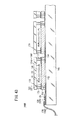
また、このディスプレイ100Aは、図17に示すように、マザー基板102に対向して透明板20が配置され、マザー基板102と透明板20の周囲には例えばセラミックス製の外枠106が介在され、かつ、シールされて、1つの筐体105が構成されている。マザー基板102と透明板20との間に形成される空間108内は真空とされている。すなわち、筐体105内は真空封止されている。もちろん、マザー基板102と透明板20の間には任意の位置に1以上のスペーサ110を介在させて、少なくともマザー基板102と透明板20との間のギャップを所定距離に保持するようにしてもよい。
Further, in this
透明板20の裏面(マザー基板102と対向する面)には、図示しないが、上述したように、コレクタ電極22と蛍光体24(図1参照)が形成される。
Although not shown, the
ここで、モジュール104の具体例について図18〜図32を参照しながら説明する。まず、第1の具体例に係るモジュール104Aは、図18に示すように、1つのモジュール基板112上に、1つのエミッタ部12が形成され、このエミッタ部12の上面に、多数の第1の実施の形態に係る電子放出素子10Aがマトリックス状に配列されて構成されている。つまり、1つのエミッタ部12の上面にカソード電極14、アノード電極18及びスリット16を有する電子放出素子10Aが多数マトリックス状に配列されている。モジュール基板112としては、例えばアルミナやジルコニア等のセラミック基板やガラス基板が用いられる。
Here, a specific example of the
エミッタ部12には、上述した多数のカソード電極14及びアノード電極18のほかに、横方向(行方向)に延びる多数の行選択線114と、縦方向(列方向)に延びる多数の信号線116が形成されている。
The
すなわち、水平方向に隣接する電子放出素子10A間に、それぞれ1本の信号線116が配線され、垂直方向に隣接する電子放出素子10A間に、それぞれ1本の行選択線114が配線されている。また、アノード電極18は、リード電極32を介して行選択線114に接続され、カソード電極14は、リード電極30を介して信号線116に接続されている。なお、行選択線114と信号線116とが交差する部分には、行選択線114と信号線116間の電気的絶縁を確保するための絶縁層118が介在されている。
That is, one
モジュール基板112の上面周囲のうち、横方向端部(図18において左端部及び右端部)には、1つのモジュール104Aの行選択線114の本数に対応した個数を有するパッド120が形成され、縦方向端部(図18において上端部及び下端部)には、1つのモジュール104Aの信号線116の本数に対応した個数を有するパッド121が形成されている。
次に、第2の具体例に係るモジュール104Bは、図19に示すように、上述した第1の具体例に係るモジュール104Aとほぼ同様の構成を有するが、モジュール基板112上に多数の第2の実施の形態に係る電子放出素子10Bが例えばマトリックス状に配列されている点で異なる。
Next, as shown in FIG. 19, the module 104B according to the second specific example has substantially the same configuration as the
すなわち、1つのモジュール基板112の上面にマトリックス状に多数のアノード電極18が形成され、これらアノード電極18を覆うように1つのエミッタ部12が形成され、該エミッタ部12の上面であって、下層に形成されたアノード電極18と対向する部分にそれぞれカソード電極14が形成されて構成されている。
That is, a large number of
モジュール基板112の上面(エミッタ部12の下層)には、上述した多数のアノード電極18のほかに、横方向(行方向)に延びる多数の行選択線114が形成されている。行選択線114は、図20に示すように、アノード電極18から離れた位置に形成し、リード電極32を介して接続するようにしてもよいし、図21に示すように、アノード電極18の例えば中央を通るように形成してもよい。
On the upper surface of the module substrate 112 (under the emitter section 12), in addition to the above-mentioned
エミッタ部12の上面には、上述した多数のカソード電極14のほかに、縦方向(列方向)に延びる多数の信号線116が形成されている。信号線116は、図20に示すように、カソード電極14から離れた位置に形成し、リード電極30を介して接続するようにしてもよいし、図21に示すように、カソード電極14の例えば中央を通るように形成してもよい。
On the upper surface of the
次に、第3の具体例に係るモジュール104Cは、図22に示すように、上述した第1の具体例に係るモジュール104Aとほぼ同様の構成を有するが、エミッタ部12が電子放出素子10Aの数分に応じて分離されている点と、行選択線114と信号線116が共にモジュール基板112の上面に形成されている点で異なる。つまり、この例では、モジュール基板112上に電子放出素子10Aの数分に応じたブロック122Aがマトリックス状に配列され、かつ、各ブロック122Aが、1つのエミッタ部12と、該エミッタ部12の上面に形成されたカソード電極14と、アノード電極18と、これらカソード電極14とアノード電極18によるスリット16とを有する。
Next, as shown in FIG. 22, the module 104C according to the third specific example has substantially the same configuration as the
従って、水平方向に隣接するブロック122A間には、それぞれ1本の信号線116が配線され、垂直方向に隣接するブロック122A間には、それぞれ1本の行選択線114が配線されている。また、アノード電極18は、リード電極32を介して行選択線114に接続され、カソード電極14は、リード電極30を介して信号線116に接続されている。なお、行選択線114と信号線116とが交差する部分には行選択線114と信号線116間の電気的絶縁を確保するための絶縁層118が介在されている。
Therefore, one
次に、第4の具体例に係るモジュール104Dは、図23に示すように、上述した第2の具体例に係るモジュール104Bとほぼ同様の構成を有するが、エミッタ部12が電子放出素子10Bの数分に応じて分離されている点と、行選択線114と信号線116が共にモジュール基板112の上面に形成されている点で異なる。つまり、この例では、モジュール基板112上に電子放出素子10Bの数分に応じたブロック122Bがマトリックス状に配列され、かつ、各ブロック122Bが、1つのエミッタ部12と、該エミッタ部12の下層に形成されたアノード電極18と、エミッタ部12の上面に形成されたカソード電極14とを有する。なお、アノード電極18は、リード電極32を介して行選択線114に接続され、カソード電極14は、リード電極30を介して信号線116に接続されている。
Next, as shown in FIG. 23, the module 104D according to the fourth specific example has substantially the same configuration as the module 104B according to the above-described second specific example, but the
第5の具体例に係るモジュール104Eは、図24に示すように、上述した第4の具体例に係るモジュール104Dとほぼ同様の構成を有するが、1つのブロック122Cに対して2つの電子放出素子10Bが割り当てられ、かつ、水平方向に配列されている点で異なる。すなわち、1つのブロック122Cは、1つのエミッタ部12と、該エミッタ部12の下層に形成された2つのアノード電極18と、エミッタ部12の上面に形成された2つのカソード電極14とを有する。
As shown in FIG. 24, the
この場合、水平方向に隣接するブロック122C間には、それぞれ2本の信号線116が配線され、垂直方向に隣接するブロック122C間には、それぞれ1本の行選択線114が配線されている。
In this case, two
ここで、m行n列のブロック122Cに注目したとき、該ブロック122Cの左側の電子放出素子10Bは、2n−1列目のドットに対応し、右側の電子放出素子10Bは、2n列目のドットに対応する。そして、m行n列のブロック122Cと、該ブロック122Cに隣接する例えばm行n−1列のブロック122Cとの間に配線された2本の信号線116は、左側の信号線116がm行n−1列のブロック122Cに対応し、右側の信号線116がm行n列のブロック122Cに対応している。
Here, when attention is paid to the block 122C of m rows and n columns, the electron-emitting
また、例えばm行n列目のブロック122Cにおいて、2つのアノード電極18は、それぞれリード電極32を介して行選択線114に接続され、m行2n−1列目のカソード電極14は、リード電極30を介して左側の信号線116(m行2n−1列目の信号線)に接続され、m行2n列目のカソード電極14は、リード電極30を介して右側の信号線116(m行2n列目の信号線)に接続されている。なお、行選択線114と信号線116とが交差する部分には行選択線114と信号線116間の電気的絶縁を確保するための絶縁層118が介在されている。
In addition, for example, in the block 122C of the m-th row and the n-th column, the two
次に、第6の具体例に係るモジュール104Fは、図25に示すように、上述した第4の具体例に係るモジュール104Dとほぼ同様の構成を有するが、1つのブロック122Dに対して、例えば赤色、緑色及び青色に対応させて3つの電子放出素子10Bが割り当てられ、かつ、水平方向に配列されている点で異なる。
Next, as shown in FIG. 25, the
この場合、モジュール基板112の上面には、後述するように、行選択線114と信号線116との絶縁を確保するための絶縁層124(誘電体層)が形成されている。そして、1つのブロック122Dは、図26に示すように、絶縁層124の上面に形成された3つのアノード電極18と、該3つのアノード電極18を覆うように形成されたエミッタ部12と、該エミッタ部12の上面に形成された3つのカソード電極14とを有する。
In this case, an insulating layer 124 (dielectric layer) for securing insulation between the
モジュール基板112の上面(絶縁層124の下層)には、縦方向(行方向)に延びる多数の信号線116が形成されている。信号線116は、図25に示すように、各ブロック122Dにおける3つのカソード電極14の中央部分に対応した位置にそれぞれ配線されている。
A large number of
絶縁層124の上面のうち、垂直方向に隣接するブロック122D間には、それぞれ1本の行選択線114が配線されている。そして、各ブロック122Dにおいて、3つのアノード電極18は、例えば共通のリード電極32を介して行選択線114に接続されている。3つのカソード電極14は、それぞれ対応する信号線に個別のリード電極30を介して接続されている。
One
そして、図16に示すように、上述した第1〜第6の具体例に係るモジュール104A〜104Fをマザー基板102上に多数配列することによって、第1の実施の形態に係るディスプレイ100Aが構成される。この場合、マザー基板102の上面周囲のうち、例えば横方向端部(図16において右端部)には、ディスプレイ100A全体の行選択線114の本数に対応した個数を有するパッド126が形成され、縦方向端部(図16において下端部)には、ディスプレイ100A全体の信号線116の本数に対応した個数を有するパッド128が形成されている。
Then, as shown in FIG. 16, a
そして、図27に示すように、モジュール104間で隣接するパッド120同士を例えばボンディングワイヤ130で接続し、モジュール104間で隣接するパッド121同士を例えばボンディングワイヤ132で接続する。また、横方向端部に位置するモジュール104のパッド120とマザー基板102のパッド126とをボンディングワイヤ134で接続し、縦方向端部に位置するモジュール104のパッド121とマザー基板102のパッド128とをボンディングワイヤ136で接続する。マザー基板102の各パッド126及び128は、例えばACF(Anisotropic Conductive Film)で構成することができる。この場合、パッド126を介して直接行選択線用のFPC(Flexible Printed Circuit)やTAB(Tape Automated Bonding)等のケーブル138が接続され、パッド128を介して直接信号線用のFPCやTAB等のケーブル140が接続される。
Then, as shown in FIG. 27, the
この第1の実施の形態に係るディスプレイ100Aの周辺回路142は、図28に示すように、行選択線114に選択的に選択信号Ssを供給して、1行単位に電子放出素子10A(10B)を順次選択する垂直シフト回路144と、信号線116にパラレルに画素信号Sdを出力して、垂直シフト回路144にて選択された行(選択行)にそれぞれ画素信号Sdを供給する水平シフト回路146と、入力される映像信号Sv及び同期信号Scに基づいて垂直シフト回路144及び水平シフト回路146を制御する信号制御回路148とを有する。
The
ここで、第1の実施の形態に係るディスプレイ100Aの動作について説明する。以下の説明では、電子放出素子10A及び10Bを一括して電子放出素子10と記す。
Here, an operation of the
まず、全ての電子放出素子10について選択を行っていない場合は、全電子放出素子10のアノード電極18に行選択線114を通じて例えば0Vが印加される。また、図29A及び図30Aに示すように、非選択期間Tnにある電子放出素子10のアノード電極18に対しても行選択線114を通じて0Vが印加される。
First, when selection is not performed for all the electron-emitting
その後、例えば1行目に関する複数の電子放出素子10が選択される場合は、該1行目の選択期間Tsの直前(リセット期間Tr)に、1行目の行選択線114を通じて、前記1行目に関する複数の電子放出素子10の各アノード電極18に−100Vが印加される。このとき、1行目のリセット期間Trにおいては、最終行に関する各電子放出素子10のカソード電極14に対し、信号線116を通じてON又はOFFについての電圧(例えば−50V又は−15V)が印加されていることから、この1行目の各電子放出素子10のカソード電極14にも信号線116を通じて例えば−50V又は−15Vが印加されている。
Thereafter, for example, when a plurality of electron-emitting
従って、1行目に関する各電子放出素子10のカソード電極14とアノード電極18間には、50V又は85Vが印加され、1行目に関する各電子放出素子10のエミッタ部12は、一方向に分極される。
Therefore, 50 V or 85 V is applied between the
その後、1行目に関する複数の電子放出素子10が選択される場合、すなわち、選択期間Tsにおいては、1行目の行選択線114を通じて、前記1行目に関する複数の電子放出素子10の各アノード電極18に50Vが印加される。そして、これら1行目に関する複数の電子放出素子10のうち、ONとされる電子放出素子10の各カソード電極14に、図29Bに示すように、対応する信号線116を通じて−50Vが印加され、OFFとされる電子放出素子の各カソード電極に、図30Bに示すように、対応する信号線116を通じて−15Vが印加される。
Thereafter, when a plurality of electron-emitting
その結果、1行目に関する複数の電子放出素子10のうち、ONとされる電子放出素子10については、図29Cに示すように、1行目の選択期間Tsにわたってカソード電極14とアノード電極18間に、電子放出される程度の電圧(例えば−100V)が印加される。これによって、ONとされる電子放出素子10から電子の放出が行われ、蛍光体発光が行われる。
As a result, among the plurality of electron-emitting
1行目に関する複数の電子放出素子10のうち、OFFとされる電子放出素子10については、図30Cに示すように、1行目の選択期間Tsにわたってカソード電極14とアノード電極18間に、電子放出されない程度の電圧(例えば−65V)が印加される。これによって、OFFとされる電子放出素子10からは電子の放出は行われず、消光状態となる。
As shown in FIG. 30C, among the plurality of electron-emitting
非選択行の各電子放出素子10のカソード電極14には、信号線116を通じて−15Vあるいは−50Vが印加されるが、図29A及び図30Aに示すように、非選択行の各電子放出素子10のアノード電極18には、行選択線114を通じて0Vが印加されている。つまり、これら非選択行に関する電子放出素子10には、それぞれ電子放出されない程度の電圧(−50V以上)が印加されることから、これら非選択行に関する電子放出素子10からは、電子の放出は行われない。
Although -15 V or -50 V is applied to the
そして、水平同期信号に同期させて順次に1行、2行、3行、・・・、n行というように選択していき、垂直同期信号に同期させて帰線させていくことで、ディスプレイ100Aの画面(透明板20の表面)から静止画像あるいは動画像が表示されることになる。 Then, one row, two rows, three rows,..., N rows are sequentially selected in synchronization with the horizontal synchronization signal, and the blanking is performed in synchronization with the vertical synchronization signal. A still image or a moving image is displayed from the screen of 100A (the surface of the transparent plate 20).
このように、第1の実施の形態に係るディスプレイ100Aにおいては、マザー基板102上に複数のモジュール104(多数の電子放出素子10が配列されたモジュール)を配列し、モジュール104同士を電気的に接続し、さらに全体を真空封止するようにしたので、容易にディスプレイ100Aの大画面化を実現させることができる。
As described above, in the
また、上述の例では、隣接するモジュール104間の電気的接続、最端部のモジュール104とマザー基板102のパッドとの電気的接続をボンディングワイヤで行った場合を示したが、その他、図31に示すように、スクリーン印刷、インクジェット法、薄膜形成プロセス等を用いて導電体や配線パターン150を形成することでこれらの電気的接続を行うようにしてもよい。この場合、大量の電気的接続部分を一括で形成することができ、ディスプレイ100Aの製造に当たってのスループットの向上、低コスト化に寄与することができる。
Further, in the above-described example, the case where the electrical connection between the
また、図32に示すように、各モジュール104において、パッド120及び121が形成される部分にスルーホール152を形成し、マザー基板102の上面のうち、モジュール104のスルーホール152と対応する部分にスクリーン印刷、インクジェット法、薄膜形成プロセス等を用いて導電体や配線パターン154を形成することで、隣接するモジュール104間の電気的接続、最端部のモジュール104とマザー基板102のパッドとの電気的接続を行うことができる。この場合においても、大量の電気的接続部分を一括で形成することができ、ディスプレイ100Aの製造に当たってのスループットの向上、低コスト化に寄与することができる。
Further, as shown in FIG. 32, in each
次に、第2の実施の形態に係るディスプレイ100Bについて図33及び図34を参照しながら説明する。 Next, a display 100B according to a second embodiment will be described with reference to FIGS.
この第2の実施の形態に係るディスプレイ100Bは、図33に示すように、マザー基板102と、該マザー基板102上に多数配列されたチップ160とを有する。各チップ160は例えば接着剤を介してマザー基板102に固着される。
As shown in FIG. 33, a display 100B according to the second embodiment includes a
そして、各チップ160は、例えば図22に示す第3の具体例に係るモジュール104Cにて形成されたブロック122Aをチップ化したものを使用することができる。もちろん、図示しないが、図23〜図25に示す第4〜第6の具体例に係るモジュール104D〜104Fにて形成されたブロック122B〜Dをチップ化したものを使用するようにしてもよい。
Then, as each
また、このディスプレイ100Bは、図34に示すように、マザー基板102に対向して透明板20が配置され、マザー基板102と透明板20の周囲には外枠106が介在され、かつ、シールされている。マザー基板102と透明板20との間に形成される空間108内は真空とされている。もちろん、マザー基板102と透明板20の間には任意の位置に1以上のスペーサ110を介在させて、少なくともマザー基板102と透明板20との間のギャップを所定距離に保持するようにしてもよい。
In this display 100B, as shown in FIG. 34, a
このように、第2の実施の形態に係るディスプレイ100Bにおいては、マザー基板102上に複数のチップ160(1つの電子放出素子10が形成されたチップ)を配列し、チップ160同士を電気的に接続し、さらに全体を真空封止するようにしたので、容易にディスプレイ100Bの大画面化を実現させることができる。
As described above, in the display 100B according to the second embodiment, a plurality of chips 160 (chips on which one electron-emitting
次に、第3の実施の形態に係るディスプレイ100Cについて図35〜図42を参照しながら説明する。 Next, a display 100C according to a third embodiment will be described with reference to FIGS.
この第3の実施の形態に係るディスプレイ100Cは、図35に示すように、マザー基板102の上面のほぼ全面に1つのエミッタ部12が形成され、このエミッタ部12の上面に、多数の第1の実施の形態に係る電子放出素子10Aがマトリックス状に配列されて構成されている。つまり、1つのエミッタ部12の上面にカソード電極14、アノード電極18及びスリット16を有する電子放出素子10Aが多数マトリックス状に配列されている。ほかの構成は、図18に示す第1の具体例に係るモジュール104Aを大型化させた構成と同じであるため、その詳細説明を省略する。
In the display 100C according to the third embodiment, as shown in FIG. 35, one
そして、このディスプレイ100Cは、図36に示すように、マザー基板102に対向して透明板20が配置され、マザー基板102と透明板20の周囲には外枠106が介在され、かつ、シールされている。マザー基板102と透明板20との間に形成される空間108内は真空とされている。もちろん、マザー基板102と透明板20の間には任意の位置に1以上のスペーサ110を介在させてもよい。
In this display 100C, as shown in FIG. 36, a
このように、第3の実施の形態に係るディスプレイ100Cにおいては、マザー基板102上に直接膜形成して多数の電子放出素子10Aと配線パターン(行選択線114及び信号線116等)を形成したので、多数の電子放出素子10A並びに大量の電気的接続部分を一括で形成することができ、ディスプレイ100Cの製造に当たってのスループットの向上、低コスト化に寄与することができる。
As described above, in the display 100C according to the third embodiment, a large number of electron-emitting
エミッタ部12等の膜形成においてペーストを使用する場合は、ペースト形成後に焼成する必要があるため、マザー基板102がガラス基板のときは融点が低いことから、ペーストとして低温焼成タイプのものを使用することが好ましい。
When a paste is used in forming the film of the
次に、上述した第3の実施の形態に係るディスプレイ100Cのいくつかの変形例について図37及び図38を参照しながら説明する。 Next, some modified examples of the display 100C according to the above-described third embodiment will be described with reference to FIGS.
第1の変形例に係るディスプレイ100Caは、図37及び図38に示すように、マザー基板102上に、ディスプレイ100Caの各行に対応して横方向に延びる行選択線114が形成され、ディスプレイ100Cの各列に対応して縦方向に延びる信号線116が形成される。行選択線114と信号線116とが交差する部分には行選択線114と信号線116間の電気的絶縁を確保するための絶縁層118が介在されている。
In the display 100Ca according to the first modification, as shown in FIGS. 37 and 38, a
行選択線114は、それぞれ所要位置において縦方向に張り出すカソード電極14が一体に形成されている。従って、信号線116は、各カソード電極14と横方向において対向する部分が存在することになる。そこで、以下の説明では、信号線116のうち、各カソード電極14と対向する部分を特にアノード電極18と記す。
Each of the
そして、各電子放出素子10Aは、カソード電極14とアノード電極18とこれらカソード電極14とアノード電極18の下部に形成されたエミッタ部12とを有して構成される。
Each of the electron-emitting
各電子放出素子10Aにおいて、カソード電極14とアノード電極18との間は、スリット16が形成され、下部のエミッタ部12が該スリット16を通して露出するようになっている。
In each of the electron-emitting
次に、第2の変形例に係るディスプレイ100Cbは、図39に示すように、上述した第3の実施の形態に係るディスプレイ100Cとほぼ同様の構成を有するが、マザー基板102上に多数の第2の実施の形態に係る電子放出素子10Bが例えばマトリックス状に配列されている点で異なる。
Next, as shown in FIG. 39, the display 100Cb according to the second modification has substantially the same configuration as the display 100C according to the above-described third embodiment, but has a large number of The difference is that the electron-emitting
すなわち、マザー基板102の上面にマトリックス状に多数のアノード電極18が形成され、これらアノード電極18を覆うように1つのエミッタ部12が形成され、該エミッタ部12の上面であって、下層に形成されたアノード電極18と対向する部分にそれぞれカソード電極14が形成されて構成されている。
That is, a large number of
マザー基板102の上面(エミッタ部12の下層)には、上述した多数のアノード電極18のほかに、横方向(行方向)に延びる多数の行選択線114が形成されている。エミッタ部12の上面には、上述した多数のカソード電極14のほかに、縦方向(列方向)に延びる多数の信号線116が形成されている。もちろん、行選択線114及び信号線116は、上述したように、図20又は図21に示す配線形態を採用することができる。
On the upper surface of the mother substrate 102 (under the emitter section 12), in addition to the above-described
次に、第3の変形例に係るディスプレイ100Ccは、図40に示すように、上述した第2の変形例に係るディスプレイ100Cbとほぼ同様の構成を有するが、第2の実施の形態に係る電子放出素子10Bがマトリックス状に配列された構成を有する点と、エミッタ部12が電子放出素子10Bの数分に応じて分離されている点と、行選択線114と信号線116が共にマザー基板102の上面に形成されている点で異なる。
Next, as shown in FIG. 40, the display 100Cc according to the third modified example has substantially the same configuration as the display 100Cb according to the above-described second modified example, but is different from the electronic device according to the second embodiment. The point that the
つまり、この例では、マザー基板102上に、例えば図23に示す第4の具体例に係るモジュール104Dにて形成されたブロック122Bが電子放出素子10Bの数分だけマトリックス状に配列された構成を有する。なお、アノード電極18は、リード電極32を介して行選択線114に接続され、カソード電極14は、リード電極30を介して信号線116に接続されている。
That is, in this example, a configuration in which the
次に、第4の変形例に係るディスプレイ100Cdは、図41に示すように、マザー基板102上に、例えば図24に示す第5の具体例に係るモジュール104Eにて形成されたブロック122Cがマトリックス状に配列された構成を有する。
Next, as shown in FIG. 41, a display 100Cd according to a fourth modified example includes, as shown in FIG. 41, a block 122C formed by a
この場合、水平方向に隣接するブロック122C間には、それぞれ2本の信号線116が配線され、垂直方向に隣接するブロック122C間には、それぞれ1本の行選択線114が配線されている。
In this case, two
次に、第5の変形例に係るディスプレイ100Ceは、図42に示すように、マザー基板102上に、例えば図25に示す第6の具体例に係るモジュール104Fにて形成されたブロック122Dがマトリックス状に配列された構成を有する。
Next, as shown in FIG. 42, a
マザー基板102の上面(絶縁層124の下層)には、縦方向(行方向)に延びる多数の信号線116が形成されている。信号線116は、各ブロック122Dにおける3つのカソード電極14の中央部分に対応した位置にそれぞれ配線されている。
A large number of
絶縁層124の上面のうち、垂直方向に隣接するブロック122D間には、それぞれ1本の行選択線114が配線されている。そして、各ブロック122Dにおいて、3つのアノード電極18は、例えば共通のリード電極32を介して行選択線114に接続されている。3つのカソード電極14は、それぞれ対応する信号線116に個別のリード電極30を介して接続されている。
One
次に、第4の実施の形態に係るディスプレイ100Dについて図43を参照しながら説明する。
Next, a
この第4の実施の形態に係るディスプレイ100Dは、図43に示すように、画像表示しようとする大きさのマザー基板102と、該マザー基板102上に多数配列された真空封止モジュール170とを有する。各真空封止モジュール170は、図18〜図26で示す第1〜第6の具体例に係るモジュール104A〜104Fを用いることができる。つまり、図43に示すように、第1〜第6の具体例に係るモジュール104A〜104Fにおいて、モジュール基板112に対向して透明板20を配置し、モジュール基板112と透明板20の周囲には外枠172を介在させ、かつ、シールを行い、さらに、モジュール基板112と透明板20との間に形成される空間108内を真空とすることで真空封止モジュール170を構成することができる。
As shown in FIG. 43, the
そして、各真空封止モジュール170において、パッド120及び121が形成される部分にスルーホール152を形成し、マザー基板102の上面のうち、真空封止モジュール170の前記スルーホール152と対応する部分にスクリーン印刷、インクジェット法、薄膜形成プロセス等を用いて導電体や配線パターン154を形成することで、隣接する真空封止モジュール170間の電気的接続、最端部の真空封止モジュール170とマザー基板102のパッド126及び128との電気的接続を行うことができる。
Then, in each
あるいは、図44に示すように、真空封止モジュール170のパッド120及び121から端面に延びる端面電極174を予め形成しておき、各真空封止モジュール170の端面電極174同士を直接または導電体や配線パターン150を介して接続することで隣接する真空封止モジュール170間の電気的接続を実現することができる。もちろん、最端部の真空封止モジュール170の端面電極174とマザー基板102のパッド126及び128とを導電体や配線パターン150を介して電気的に接続することもできる。
Alternatively, as shown in FIG. 44, an
また、真空封止モジュール170内の真空度を数百Paという低真空とすれば、シール構造を簡単にでき、封止スペースを省スペース化することができるため、図45に示すように、真空封止モジュール170を並べる場合に、画素ピッチPを真空封止モジュール170内と真空封止モジュール170間でほぼ等しいピッチにすることができ、その結果、真空封止モジュール170間の継ぎ目が目立ちにくくなる。
Further, if the degree of vacuum in the
次に、第1〜第4の実施の形態に係るディスプレイ100A〜100Dの構成要素の好ましい材質等について説明する。
Next, preferable materials and the like of components of the
まず、エミッタ部12は誘電体にて構成される。誘電体は、好適には、比誘電率が比較的高い、例えば1000以上の誘電体を採用することができる。このような誘電体としては、チタン酸バリウムの他に、ジルコン酸鉛、マグネシウムニオブ酸鉛、ニッケルニオブ酸鉛、亜鉛ニオブ酸鉛、マンガンニオブ酸鉛、マグネシウムタンタル酸鉛、ニッケルタンタル酸鉛、アンチモンスズ酸鉛、チタン酸鉛、マグネシウムタングステン酸鉛、コバルトニオブ酸鉛等、又はこれらの任意の組み合わせを含有するセラミックスや、主成分がこれらの化合物を50重量%以上含有するものや、前記セラミックスに対してさらにランタン、カルシウム、ストロンチウム、モリブデン、タングステン、バリウム、ニオブ、亜鉛、ニッケル、マンガン等の酸化物、もしくはこれらのいずれかの組み合わせ、又は他の化合物を適切に添加したもの等を挙げることができる。
First, the
例えば、マグネシウムニオブ酸鉛(PMN)とチタン酸鉛(PT)の2成分系nPMN−mPT(n,mをモル数比とする)においては、PMNのモル数比を大きくすると、キュリー点が下げられて、室温での比誘電率を大きくすることができる。 For example, in a binary nPMN-mPT of lead magnesium niobate (PMN) and lead titanate (PT) (where n and m are mole ratios), increasing the mole ratio of PMN lowers the Curie point. As a result, the relative dielectric constant at room temperature can be increased.
特に、n=0.85〜1.0、m=1.0−nでは比誘電率3000以上となり好ましい。例えば、n=0.91、m=0.09では室温の比誘電率15000が得られ、n=0.95、m=0.05では室温の比誘電率20000が得られる。 In particular, when n = 0.85 to 1.0 and m = 1.0-n, the relative dielectric constant is preferably 3000 or more, which is preferable. For example, when n = 0.91 and m = 0.09, a relative dielectric constant at room temperature of 15000 is obtained, and when n = 0.95 and m = 0.05, a relative dielectric constant at room temperature of 20,000 is obtained.
次に、マグネシウムニオブ酸鉛(PMN)、チタン酸鉛(PT)、ジルコン酸鉛(PZ)の3成分系では、PMNのモル数比を大きくする他に、正方晶と擬立方晶又は正方晶と菱面体晶のモルフォトロピック相境界(MPB:Morphotropic Phase Boundary)付近の組成とすることが比誘電率を大きくするのに好ましい。例えば、PMN:PT:PZ=0.375:0.375:0.25にて比誘電率5500、PMN:PT:PZ=0.5:0.375:0.125にて比誘電率4500となり、特に好ましい。さらに、絶縁性が確保できる範囲内でこれらの誘電体に白金のような金属を混入して、誘電率を向上させるのが好ましい。この場合、例えば、誘電体に白金を重量比で20%混入させるとよい。 Next, in the three-component system of lead magnesium niobate (PMN), lead titanate (PT), and lead zirconate (PZ), besides increasing the molar ratio of PMN, tetragonal and pseudocubic or tetragonal It is preferable to make the composition near the morphotropic phase boundary (MPB: Morphotropic Phase Boundary) of the rhombohedral crystal and the rhombohedral crystal in order to increase the relative dielectric constant. For example, the relative permittivity is 5500 when PMN: PT: PZ = 0.375: 0.375: 0.25, and the relative permittivity is 4500 when PMN: PT: PZ = 0.5: 0.375: 0.125. Are particularly preferred. Further, it is preferable to improve the dielectric constant by mixing a metal such as platinum into these dielectrics as long as the insulating property can be ensured. In this case, for example, platinum may be mixed in the dielectric at a weight ratio of 20%.
また、エミッタ部12は、上述したように、圧電/電歪層や反強誘電体層等を用いることができるが、エミッタ部12として圧電/電歪層を用いる場合、該圧電/電歪層としては、例えば、ジルコン酸鉛、マグネシウムニオブ酸鉛、ニッケルニオブ酸鉛、亜鉛ニオブ酸鉛、マンガンニオブ酸鉛、マグネシウムタンタル酸鉛、ニッケルタンタル酸鉛、アンチモンスズ酸鉛、チタン酸鉛、チタン酸バリウム、マグネシウムタングステン酸鉛、コバルトニオブ酸鉛等、又はこれらのいずれかの組み合わせを含有するセラミックスが挙げられる。
As described above, the
主成分がこれらの化合物を50重量%以上含有するものであってもよいことはいうまでもない。また、前記セラミックスのうち、ジルコン酸鉛を含有するセラミックスは、エミッタ部12を構成する圧電/電歪層の構成材料として最も使用頻度が高い。
It goes without saying that the main component may contain 50% by weight or more of these compounds. Among the above-mentioned ceramics, the ceramic containing lead zirconate is most frequently used as a constituent material of the piezoelectric / electrostrictive layer constituting the
また、圧電/電歪層をセラミックスにて構成する場合、前記セラミックスに、さらに、ランタン、カルシウム、ストロンチウム、モリブデン、タングステン、バリウム、ニオブ、亜鉛、ニッケル、マンガン等の酸化物、もしくはこれらのいずれかの組み合わせ、又は他の化合物を、適宜、添加したセラミックスを用いてもよい。 When the piezoelectric / electrostrictive layer is formed of ceramics, the ceramics may further include an oxide such as lanthanum, calcium, strontium, molybdenum, tungsten, barium, niobium, zinc, nickel, or manganese, or any of these. May be used, or ceramics to which other compounds are appropriately added.
例えば、マグネシウムニオブ酸鉛とジルコン酸鉛及びチタン酸鉛とからなる成分を主成分とし、さらにランタンやストロンチウムを含有するセラミックスを用いることが好ましい。 For example, it is preferable to use a ceramic mainly containing a component composed of lead magnesium niobate, lead zirconate and lead titanate, and further containing lanthanum and strontium.
圧電/電歪層は、緻密であっても、多孔質であってもよく、多孔質の場合、その気孔率は40%以下であることが好ましい。 The piezoelectric / electrostrictive layer may be dense or porous, and if porous, its porosity is preferably 40% or less.
エミッタ部12として反強誘電体層を用いる場合、該反強誘電体層としては、ジルコン酸鉛を主成分とするもの、ジルコン酸鉛とスズ酸鉛とからなる成分を主成分とするもの、さらにはジルコン酸鉛に酸化ランタンを添加したもの、ジルコン酸鉛とスズ酸鉛とからなる成分に対してジルコン酸鉛やニオブ酸鉛を添加したものが望ましい。
When an anti-ferroelectric layer is used as the
また、この反強誘電体層は、多孔質であってもよく、多孔質の場合、その気孔率は30%以下であることが望ましい。 The antiferroelectric layer may be porous, and if it is porous, its porosity is desirably 30% or less.
さらに、エミッタ部12にタンタル酸ビスマス酸ストロンチウムを用いた場合、分極反転疲労が小さく好ましい。このような分極反転疲労が小さい材料は、層状強誘電体化合物で、(BiO2)2+(Am-1BmO3m+1)2-という一般式で表される。ここで、金属Aのイオンは、Ca2+、Sr2+、Ba2+、Pb2+、Bi3+、La3+等であり、金属Bのイオンは、Ti4+、Ta5+、Nb5+等である。
Further, when strontium bismuth tantalate is used for the
また、圧電/電歪/反強誘電体セラミックスに、例えば鉛ホウケイ酸ガラス等のガラス成分や、他の低融点化合物(例えば酸化ビスマス等)を混ぜることによって、焼成温度を下げることができる。これにより、エミッタ部12をマザー基板102上に形成する際に有利となる。
Further, the firing temperature can be lowered by mixing a glass component such as lead borosilicate glass or another low melting point compound (such as bismuth oxide) with the piezoelectric / electrostrictive / anti-ferroelectric ceramics. This is advantageous when the
また、エミッタ部12に非鉛系の材料を使用する等により、エミッタ部12を融点もしくは蒸散温度の高い材料とすることで、電子もしくはイオンの衝突に対し損傷しにくくなる。
In addition, by using a lead-free material for the
そして、マザー基板102やモジュール基板112の上にエミッタ部12を形成する方法としては、スクリーン印刷法、ディッピング法、塗布法、電気泳動法等の各種厚膜形成法や、イオンビーム法、スパッタリング法、真空蒸着法、イオンプレーティング法、化学気相成長法(CVD)、めっき等の各種薄膜形成法を用いることができる。
As a method of forming the
この実施の形態においては、マザー基板102上やモジュール基板112上にエミッタ部12を形成するにあたっては、スクリーン印刷法やディッピング法、塗布法、電気泳動法等による厚膜形成法が好適に採用される。
In this embodiment, when forming the
これらの方法は、平均粒径0.01〜5μm、好ましくは0.05〜3μmの圧電セラミックスの粒子を主成分とするペーストやスラリー、又はサスペンション、エマルジョン、ゾル等を用いて形成することができ、良好な圧電作動特性が得られるからである。 These methods can be formed by using a paste, slurry, suspension, emulsion, sol, or the like mainly composed of piezoelectric ceramic particles having an average particle size of 0.01 to 5 μm, preferably 0.05 to 3 μm. This is because good piezoelectric operation characteristics can be obtained.
特に、電気泳動法は、膜を高い密度で、かつ、高い形状精度で形成することができることをはじめ、「電気化学および工業物理化学 Vol.53,No.1(1985),p.63〜68 安斎和夫著」あるいは「第1回電気泳動法によるセラミックスの高次成形法 研究討論会 予稿集(1998),p.5〜6,p.23〜24」等の技術文献に記載されるような特徴を有する。また、圧電/電歪/反強誘電体をシート状に成形したもの、もしくはその積層体、もしくはこれらを他の支持基板に積層又は接着したものを用いてもよい。このように、要求精度や信頼性等を考慮して、適宜、方法を選択して用いるとよい。 In particular, the electrophoresis method includes the fact that a film can be formed with a high density and a high shape accuracy, and it is described in “Electrochemical and Industrial Physical Chemistry, Vol. 53, No. 1 (1985), pp. 63-68. As described in technical literature such as "Writing by Kazuo Anzai" or "The 1st Higher Order Forming Method of Ceramics by Electrophoresis", Symposium on Proceedings (1998), p.5-6, p.23-24. Has features. Further, a piezoelectric / electrostrictive / anti-ferroelectric material formed into a sheet shape, a laminate thereof, or a laminate of these materials laminated or bonded to another support substrate may be used. As described above, a method may be appropriately selected and used in consideration of required accuracy, reliability, and the like.
カソード電極14は、以下に示す材料にて構成される。すなわち、スパッタ率が小さく、真空中での蒸発温度が大きい導体が好ましい。例えば、Ar+で600Vにおけるスパッタ率が2.0以下で、蒸気圧1.3×10⁻³Paとなる温度が1800K以上のものが好ましく、白金、モリブデン、タングステン等がこれに当たる。また、高温酸化雰囲気に対して耐性を有する導体、例えば金属単体、合金、絶縁性セラミックスと金属単体との混合物、絶縁性セラミックスと合金との混合物等によって構成され、好適には、白金、イリジウム、パラジウム、ロジウム、モリブデン等の高融点貴金属や、銀−パラジウム、銀−白金、白金−パラジウム等の合金を主成分とするものや、白金とセラミック材料とのサーメット材料によって構成される。さらに好適には、白金のみ又は白金系の合金を主成分とする材料によって構成される。また、電極として、カーボン、グラファイト系の材料、例えば、ダイヤモンド薄膜、ダイヤモンドライクカーボン、カーボンナノチューブも好適に使用される。なお、電極材料中に添加されるセラミック材料の割合は、5〜30体積%程度が好適である。
The
さらに、焼成後に薄い膜が得られる有機金属ペースト、例えば白金レジネートペースト等の材料を用いることが好ましい。また、分極反転疲労を抑制する酸化物電極、例えば酸化ルテニウム、酸化イリジウム、ルテニウム酸ストロンチウム、La1-xSrxCoO3(例えばx=0.3や0.5)、La1-xCaxMnO3、La1-xCaxMn1-yCoyO3(例えばx=0.2、y=0.05)、もしくはこれらを例えば白金レジネートペーストに混ぜたものが好ましい。 Further, it is preferable to use a material such as an organic metal paste that can obtain a thin film after firing, such as a platinum resinate paste. Also, an oxide electrode for suppressing polarization inversion fatigue, such as ruthenium oxide, iridium oxide, strontium ruthenate, La 1-x Sr x CoO 3 (for example, x = 0.3 or 0.5), La 1-x C ax MnO 3 , La 1-x C ax Mn 1-y Co y O 3 (for example, x = 0.2, y = 0.05), or a mixture thereof with, for example, a platinum resinate paste is preferable.
カソード電極14は、上記材料を用いて、スクリーン印刷、スプレー、コーティング、ディッピング、塗布、電気泳動法等の各種の厚膜形成法や、スパッタリング法、イオンビーム法、真空蒸着法、イオンプレーティング法、化学気相成長法(CVD)、めっき等の各種の薄膜形成法による通常の膜形成法に従って形成することができ、好適には、前者の厚膜形成法によって形成するとよい。
The
アノード電極18は、カソード電極14と同様の材料及び方法によって形成されるが、好適には上記厚膜形成法によって形成する。
The
一方、マザー基板102及びモジュール基板112は、カソード電極14に電気的に接続した配線と、アノード電極18に電気的に接続した配線とを電気的に分離するため、電気的な絶縁材料で構成するのが好ましい。
On the other hand, the
従って、マザー基板102及びモジュール基板112を、ガラス、又は高耐熱性の金属、あるいはその金属表面をガラス等のセラミック材料によって被覆したホーローのような材料により構成することができるが、セラミックスで構成するのが最適である。
Accordingly, the
マザー基板102及びモジュール基板112を構成するセラミックスとしては、例えば、安定化された酸化ジルコニウム、酸化アルミニウム、酸化マグネシウム、酸化チタン、スピネル、ムライト、窒化アルミニウム、窒化珪素、ガラス、これらの混合物等を使用することができる。その中でも、酸化アルミニウム及び安定化された酸化ジルコニウムが、強度及び剛性の観点から好ましい。安定化された酸化ジルコニウムは、機械的強度が比較的高いこと、靭性が比較的高いこと、カソード電極14及びアノード電極18との化学反応が比較的小さいこと等の観点から特に好適である。なお、安定化された酸化ジルコニウムとは、安定化酸化ジルコニウム及び部分安定化酸化ジルコニウムを包含する。安定化された酸化ジルコニウムでは、立方晶等の結晶構造をとるため、相転移が生じない。
As ceramics forming the
一方、酸化ジルコニウムは、1000℃前後で単斜晶と正方晶との間を相転移し、このような相転移の際にクラックが発生するおそれがある。安定化された酸化ジルコニウムは、酸化カルシウム、酸化マグネシウム、酸化イットリウム、酸化スカンジウム、酸化イッテルビウム、酸化セリウム、希土類金属の酸化物等の安定剤を、1〜30モル%含有する。なお、マザー基板102の機械的強度を向上させるために、安定化剤が酸化イットリウムを含有すると好適である。この場合、酸化イットリウムを、好適には1.5〜6モル%、さらに好適には2〜4モル%含有し、さらに0.1〜5モル%の酸化アルミニウムを含有することが好ましい。
On the other hand, zirconium oxide undergoes a phase transition between a monoclinic system and a tetragonal system at around 1000 ° C., and cracks may occur during such a phase transition. The stabilized zirconium oxide contains 1 to 30 mol% of a stabilizer such as calcium oxide, magnesium oxide, yttrium oxide, scandium oxide, ytterbium oxide, cerium oxide, or an oxide of a rare earth metal. In order to improve the mechanical strength of the
また、結晶相を、立方晶+単斜晶の混合相、正方晶+単斜晶の混合相、立方晶+正方晶+単斜晶の混合相等とすることができるが、その中でも、主たる結晶相を、正方晶又は正方晶+立方晶の混合相としたものが、強度、靭性及び耐久性の観点から最適である。 The crystal phase can be a mixed phase of cubic + monoclinic, a mixed phase of tetragonal + monoclinic, a mixed phase of cubic + tetragonal + monoclinic, and among them, the main crystal What made the phase a tetragonal or a mixed phase of tetragonal and cubic is optimal from the viewpoint of strength, toughness and durability.
マザー基板102及びモジュール基板112をセラミックスから構成した場合、比較的多数の結晶粒がマザー基板102及びモジュール基板112を構成するが、マザー基板102及びモジュール基板112の機械的強度を向上させるためには、結晶粒の平均粒径を、好適には0.05〜2μmとし、さらに好適には0.1〜1μmとするとよい。
When the
エミッタ部12、カソード電極14及びアノード電極18をそれぞれ形成するたびに熱処理(焼成処理)してマザー基板102やモジュール基板112と一体構造にすることができ、また、これらエミッタ部12、カソード電極14及びアノード電極18を形成した後、同時に焼成処理して、これらを同時にマザー基板102やモジュール基板112に一体に結合することもできる。なお、カソード電極14及びアノード電極18の形成方法によっては、一体化のための熱処理(焼成処理)を必要としない場合もある。
Each time the
マザー基板102やモジュール基板112と、エミッタ部12、カソード電極14及びアノード電極18とを一体化させるための焼成処理に係る温度としては、500〜1400℃の範囲、好適には、1000〜1400℃の範囲とするとよい。さらに、膜状のエミッタ部12を熱処理する場合、高温時にエミッタ部12の組成が不安定にならないように、エミッタ部12の蒸発源と共に雰囲気制御を行いながら焼成処理を行うことが好ましい。
The temperature for the sintering process for integrating the
また、エミッタ部12を適切な部材によって被覆し、エミッタ部12の表面が焼成雰囲気に直接露出しないようにして焼成する方法を採用してもよい。この場合、被覆部材としては、マザー基板102やモジュール基板112と同様の材料を用いることが好ましい。
Alternatively, a method may be employed in which the
なお、電子放出素子10Aの他の例としては、例えば図46及び図47に示す第1の変形例に係る電子放出素子10Aaのように、カソード電極14のうち、アノード電極18と対向する部分が鋭角状の角部180を有し、アノード電極18で該角部180を取り囲むようにしてもよい。この場合、電子の放出を良好に行うために、カソード電極14とアノード電極18との間のスリット16の幅dを500μm以下にするとよい。
Note that as another example of the electron-emitting
次に、第2の変形例に係る電子放出素子10Abは、図48及び図49に示すように、反強誘電材料によって構成されたエミッタ部12と、その一方の面にそれぞれ形成された櫛歯形状のカソード電極14及びアノード電極18とを有する。
Next, as shown in FIGS. 48 and 49, the electron-emitting device 10Ab according to the second modified example has an
この第2の変形例に係る電子放出素子10Abは、図49に示すように、マザー基板102やモジュール基板112上にスペーサ層182を介して形成されたシート層184上に配置される。これによって、エミッタ部12、カソード電極14、アノード電極18、シート層184及びスペーサ層182は、それぞれアクチュエータ186を構成することになる。
As shown in FIG. 49, the electron-emitting device 10Ab according to the second modification is disposed on a
エミッタ部12を構成する反強誘電材料としては、ジルコン酸鉛を主成分とするもの、ジルコン酸鉛とスズ酸鉛とからなる成分を主成分とするもの、ジルコン酸鉛に酸化ランタンを添加したもの、ジルコン酸鉛とスズ酸鉛とからなる成分に対してジルコン酸鉛やニオブ酸鉛を添加したものを用いるのが好適である。特に、低電圧で駆動させる場合には、ジルコン酸鉛とスズ酸鉛とからなる成分を含む反強誘電材料を用いるのが好適である。この組成は、以下のようになる。
Pb0.99Nb0.02[(ZrxSn1-x)1-yTiy]0.98O3
但し、0.5 <x< 0.6,0.05<y< 0.063,0.01<Nb< 0.03
The antiferroelectric material constituting the
Pb 0.99 Nb 0.02 [(Zr x Sn 1-x ) 1-y Ti y ] 0.98 O 3
However, 0.5 <x <0.6, 0.05 <y <0.063, 0.01 <Nb <0.03
また、反強誘電材料を多孔質にすることもでき、この場合、気孔率を30%以下にするのが好適である。 Further, the antiferroelectric material can be made porous, and in this case, the porosity is preferably set to 30% or less.
エミッタ部12を形成するに当たり、上記厚膜形成法を用いて形成するのが好適であり、微細な印刷を廉価に行うことができるという理由から、スクリーン印刷法が特に好適に用いられる。なお、エミッタ部12の厚さとしては、低い駆動電圧で大きな変位を得る等の理由から、好適には50μm以下であり、さらに好適には、3〜40μmである。
In forming the
このような厚膜形成法によって、平均粒子径が0.01〜7μm程度、好適には0.05〜5μm程度の反強誘電材料のセラミック粒子を主成分とするペーストやスラリーを用いて、シート層156の表面上に膜形成することができ、良好な素子特性が得られる。 By such a thick film forming method, a sheet or a sheet is formed by using a paste or a slurry mainly containing ceramic particles of an antiferroelectric material having an average particle diameter of about 0.01 to 7 μm, preferably about 0.05 to 5 μm. A film can be formed on the surface of the layer 156, and favorable element characteristics can be obtained.
シート層184は、薄肉に形成され、外部応力に対して振動を受け易い構造となっている。シート層184を、好適には高耐熱性材料で構成する。その理由は、端子をシート層184に直接接合するに当たり、有機接着剤等の耐熱性の低い材料を使用することなく、シート層184を直接支持する構造をとる場合、少なくともエミッタ部12の形成時にシート層184が変質するのを防止するためである。なお、シート層184をセラミックスで構成する場合、マザー基板102やモジュール基板112と同様の材料で構成することが好ましい。
The
スペーサ層182は、好適にはセラミックスにて構成される。この場合、シート層184を構成するセラミック材料と同一としてもよいし、異なるセラミック材料としてもよい。このようなセラミックスとしては、シート層184を構成するセラミック材料と同様に、例えば安定化された酸化ジルコニウム、酸化アルミニウム、酸化マグネシウム、酸化チタン、スピネル、ムライト、窒化アルミニウム、窒化珪素、ガラス、これらの混合物等を使用することができる。
The
マザー基板102やモジュール基板112、並びにスペーサ層182及びシート層184を構成するセラミック材料と異なるセラミック材料としては、酸化ジルコニウムを主成分とする材料、酸化アルミニウムを主成分とする材料、これらの混合物を主成分とする材料等が好適に採用される。その中でも、酸化ジルコニウムを主成分としたものが特に好ましい。
As a ceramic material different from the ceramic material forming the
なお、焼結助剤として粘土等を添加することもあるが、酸化珪素、酸化ホウ素等のガラス化し易いものが過剰に含まれないように、助剤成分を調整する必要がある。その理由は、これらガラス化し易い材料は、エミッタ部12との接合の観点からは有利であるが、エミッタ部12との反応を促進し、エミッタ部12が所定の組成を維持するのが困難となり、その結果、素子特性を低下させる原因となるからである。
In addition, clay or the like may be added as a sintering aid, but it is necessary to adjust the auxiliary component such that silicon oxide, boron oxide or the like that is easily vitrified is not excessively contained. The reason is that these easily vitrified materials are advantageous from the viewpoint of bonding with the
すなわち、マザー基板102やモジュール基板112、スペーサ層182及びシート層184に含まれる酸化珪素等を、重量比で3%以下、好適には1%以下となるように制限するのが好ましい。ここで、主成分とは、重量比で50%以上の割合で存在する成分をいう。
That is, it is preferable that silicon oxide and the like contained in the
マザー基板102やモジュール基板112、スペーサ層182及びシート層184を3層の積層体として構成するのが好適であり、この場合、例えば、一体同時焼成、ガラスや樹脂によって各層を接合一体化又は後付けを行う。なお、4層以上の積層体とすることもできる。
It is preferable that the
エミッタ部12を反強誘電材料によって構成した場合、電界が加えられない状態では、図49において右側のエミッタ部12のように平坦形状となる。それに対して、電界が加えられると、図49において左側のエミッタ部12のように凸状に屈曲変位する。このように凸状に屈曲変位することによって、電子放出素子10Abとそれに対向するコレクタ電極22との間の間隔が狭くなるため、矢印で示したように発生する電子の直進性がさらに良好になる。したがって、この屈曲変位量によってコレクタ電極22に到達する放出電子量を制御することが可能である。
When the
そして、上述した第1〜第4の実施の形態に係るディスプレイ100A〜100Dは、以下のような効果を奏することができる。
The
(1)CRTと比して超薄型(パネルの厚み=数mm)にすることができる。 (1) It can be made extremely thin (panel thickness = several mm) as compared with a CRT.
(2)蛍光体24による自然発光のため、LCD(液晶表示装置)やLED(発光ダイオード)と比してほぼ180°の広視野角を得ることができる。
(2) Due to natural light emission by the
(3)面電子源を利用しているため、CRTと比して画像歪みがない。 (3) Since a plane electron source is used, there is no image distortion as compared with a CRT.
(4)LCDと比して高速応答が可能であり、μsecオーダーの高速応答で残像のない動画表示が可能となる。 (4) High-speed response is possible as compared with LCD, and a high-speed response on the order of μsec enables moving image display with no afterimage.
(5)40インチ換算で100W程度であり、CRT、PDP(プラズマディスプレイ)、LCD及びLEDと比して低消費電力である。 (5) It is about 100 W in terms of 40 inches, and consumes lower power than CRTs, PDPs (plasma displays), LCDs and LEDs.
(6)PDPやLCDと比して動作温度範囲が広い(−40〜+85℃)。ちなみに、LCDは低温で応答速度が低下する。 (6) The operating temperature range is wider (-40 to + 85 ° C.) than PDP and LCD. Incidentally, the response speed of the LCD decreases at low temperatures.
(7)大電流出力による蛍光体の励起が可能であるため、従来のFED方式のディスプレイと比して高輝度化が可能である。 (7) Since the phosphor can be excited by a large current output, higher brightness can be achieved as compared with a conventional FED display.
(8)圧電体材料の分極反転特性及び膜厚により駆動電圧を制御可能であるため、従来のFED方式のディスプレイと比して低電圧駆動が可能である。 (8) Since the drive voltage can be controlled by the polarization reversal characteristic and the film thickness of the piezoelectric material, low-voltage drive is possible as compared with a conventional FED display.
このような種々の効果から、以下に示すように、様々なディスプレイ用途を実現させることができる。 From these various effects, various display applications can be realized as described below.
(1)高輝度化と低消費電力化が実現できるという面から、30〜60インチディスプレイのホームユース(テレビジョン、ホームシアター)やパブリックユース(待合室、カラオケ等)に最適である。 (1) It is most suitable for home use (television, home theater) and public use (waiting room, karaoke, etc.) of a 30 to 60 inch display from the viewpoint of realizing high luminance and low power consumption.
(2)高輝度化、大画面、フルカラー、高精細度が実現できるという面から、顧客吸引力(この場合、視覚的な注目)に効果が大であり、横長、縦長等の異形状ディスプレイや、展示会での使用、情報案内板用のメッセージボードに最適である。 (2) From the aspect of realizing high brightness, large screen, full color, and high definition, it has a great effect on customer attraction (in this case, visual attention), and displays irregularly shaped displays such as landscape and portrait, Ideal for use at exhibitions and message boards for information boards.
(3)高輝度化、蛍光体励起に伴う広視野角化、真空モジュール化に伴う広い動作温度範囲が実現できるという面から、車載用ディスプレイに最適である。車載用ディスプレイとしての仕様は、15:9等の横長8インチ(画素ピッチ0.14mm)、動作温度が−30〜+85℃、斜視方向で500〜600cd/m2が必要である。 (3) It is most suitable for an in-vehicle display because it can realize a high brightness, a wide viewing angle associated with phosphor excitation, and a wide operating temperature range associated with a vacuum module. The specifications for a vehicle-mounted display require a width of 8 inches (pixel pitch: 0.14 mm) such as 15: 9, an operating temperature of −30 to + 85 ° C., and 500 to 600 cd / m 2 in a perspective direction.
また、上述の種々の効果から、以下に示すように、様々な光源用途を実現させることができる。 In addition, from the various effects described above, various light source applications can be realized as described below.
(1)高輝度化、低消費電力化が実現できるという面から、輝度仕様として2000ルーメンが必要なプロジェクタ用の光源に最適である。 (1) From the aspect of realizing high luminance and low power consumption, it is most suitable for a light source for a projector that requires 2000 lumens as a luminance specification.
(2)高輝度二次元アレー光源を容易に実現できることと、動作温度範囲が広く、屋外環境でも発光効率に変化がないことから、LEDの代替用途として有望である。例えば信号機等の二次元アレーLEDモジュールの代替として最適である。なお、LEDは、25℃以上で許容電流が低下し、低輝度となる。 (2) Since it is easy to realize a high-luminance two-dimensional array light source, has a wide operating temperature range, and has no change in luminous efficiency even in an outdoor environment, it is promising as an alternative application to LEDs. For example, it is optimal as a substitute for a two-dimensional array LED module such as a traffic light. Note that the LED has a lower allowable current at 25 ° C. or higher and has low brightness.
なお、本発明に係るディスプレイは、上述の実施の形態に限らず、本発明の要旨を逸脱することなく、種々の構成を採り得ることはもちろんである。 In addition, the display according to the present invention is not limited to the above-described embodiment, and may adopt various configurations without departing from the gist of the present invention.
10、10A、10Aa、10Ab、10B、10Ba、10Bb…電子放出素子
12…エミッタ部 14…カソード電極
16…スリット 18…アノード電極
20…透明板 22…コレクタ電極
24…蛍光体 30、32…リード電極
104、104A〜104F…モジュール 105…筐体
106、172…外枠 110…スペーサ
112…モジュール基板 114…行選択線
116…信号線 118…絶縁層
120、121、126、128…パッド
122A〜122D…ブロック 138、140…ケーブル
150、154…導電体又は配線パターン 152…スルーホール
160…チップ 170…真空封止モジュール
10, 10A, 10Aa, 10Ab, 10B, 10Ba, 10Bb ... Emitting
Claims (10)
複数の電子放出素子が第2の基板上に配列して形成されたモジュールとを具備し、
前記複数のモジュールが前記第1の基板上に配列され、
少なくとも前記モジュール同士が電気的に接続され、
前記筐体内が真空封止されていることを特徴とするディスプレイ。 A housing having a first substrate;
A module formed by arranging a plurality of electron-emitting devices on a second substrate;
The plurality of modules are arranged on the first substrate;
At least the modules are electrically connected,
A display, wherein the inside of the housing is vacuum-sealed.
電子放出素子が形成されたチップとを具備し、
前記複数のチップが前記第1の基板上に配列され、
少なくとも前記チップ同士が電気的に接続され、
前記筐体内が真空封止されていることを特徴とするディスプレイ。 A housing having a first substrate;
A chip on which the electron-emitting device is formed,
The plurality of chips are arranged on the first substrate;
At least the chips are electrically connected to each other,
A display, wherein the inside of the housing is vacuum-sealed.
前記第1の基板上に直接膜形成された複数の電子放出素子とを具備し、
前記筐体内が真空封止されていることを特徴とするディスプレイ。 A housing having a first substrate;
A plurality of electron-emitting devices formed directly on the first substrate,
A display, wherein the inside of the housing is vacuum-sealed.
前記筐体は、前記第1の基板と対向して配置された透明板を有し、
前記透明板のうち、前記第1の基板と対向する面に、前記電子放出素子との間で電界を形成するための電極と、該電極に形成された蛍光体とを有し、
前記電子放出素子から放出される電子を前記蛍光体に衝突させて前記蛍光体を励起し、発光させることを特徴とするディスプレイ。 The display according to any one of claims 1 to 3,
The housing has a transparent plate disposed to face the first substrate,
On the surface of the transparent plate facing the first substrate, an electrode for forming an electric field with the electron-emitting device, and a phosphor formed on the electrode,
A display, wherein electrons emitted from the electron-emitting device collide with the phosphor to excite the phosphor to emit light.
複数の電子放出素子が第2の基板上に配列され、かつ、真空封止された真空封止モジュールとを具備し、
複数の真空封止モジュールが前記第1の基板上に配列され、
少なくとも前記真空封止モジュール同士を電気的に接続されていることを特徴とするディスプレイ。 A housing having a first substrate;
A plurality of electron-emitting devices arranged on a second substrate, and comprising a vacuum-sealed vacuum-sealed module;
A plurality of vacuum sealing modules are arranged on the first substrate,
A display, wherein at least the vacuum sealing modules are electrically connected to each other.
前記真空封止モジュールは、前記第2の基板と対向して配置された透明板を有し、
前記透明板のうち、前記第2の基板と対向する面に、前記電子放出素子との間で電界を形成するための電極と、該電極に形成された蛍光体とを有し、
前記電子放出素子から放出される電子を前記蛍光体に衝突させて前記蛍光体を励起し、発光させることを特徴とするディスプレイ。 The display according to claim 5,
The vacuum sealing module has a transparent plate disposed to face the second substrate,
On the surface of the transparent plate facing the second substrate, an electrode for forming an electric field with the electron-emitting device, and a phosphor formed on the electrode,
A display, wherein electrons emitted from the electron-emitting device collide with the phosphor to excite the phosphor to emit light.
前記電子放出素子は、
誘電体にて構成されたエミッタ部と、
前記エミッタ部に接して形成された第1の電極及び第2の電極とを有し、
前記第1の電極と前記第2の電極間に駆動電圧が印加されることによって、少なくとも前記エミッタ部の一部が分極反転あるいは分極変化されることで電子放出を行うことを特徴とするディスプレイ。 The display according to any one of claims 1 to 6,
The electron-emitting device,
An emitter section made of a dielectric,
A first electrode and a second electrode formed in contact with the emitter section;
A display, wherein a drive voltage is applied between the first electrode and the second electrode, so that at least a part of the emitter section undergoes polarization inversion or polarization change to emit electrons.
前記第1の電極及び前記第2の電極は、前記エミッタ部の主面にそれぞれ接して形成され、
前記第1の電極と前記第2の電極との間に前記エミッタ部が一部露出するスリットが形成されていることを特徴とするディスプレイ。 The display according to claim 7,
The first electrode and the second electrode are formed in contact with a main surface of the emitter section, respectively.
A display, wherein a slit that partially exposes the emitter is formed between the first electrode and the second electrode.
前記第1の電極は、前記エミッタ部の第1の面に形成され、
前記第2の電極は、前記エミッタ部の第2の面に形成されていることを特徴とするディスプレイ。 The display according to claim 7,
The first electrode is formed on a first surface of the emitter section,
The display according to claim 1, wherein the second electrode is formed on a second surface of the emitter section.
前記エミッタ部が、圧電材料、電歪材料及び反強誘電材料のうちの少なくとも1種類であることを特徴とするディスプレイ。
The display according to any one of claims 1 to 9,
The display, wherein the emitter is at least one of a piezoelectric material, an electrostrictive material, and an antiferroelectric material.
Priority Applications (3)
| Application Number | Priority Date | Filing Date | Title |
|---|---|---|---|
| JP2003300205A JP2004172087A (en) | 2002-11-05 | 2003-08-25 | Display |
| US10/699,186 US20040090398A1 (en) | 2002-11-05 | 2003-10-31 | Display |
| EP03256965A EP1418609A3 (en) | 2002-11-05 | 2003-11-04 | Display |
Applications Claiming Priority (2)
| Application Number | Priority Date | Filing Date | Title |
|---|---|---|---|
| JP2002321564 | 2002-11-05 | ||
| JP2003300205A JP2004172087A (en) | 2002-11-05 | 2003-08-25 | Display |
Publications (1)
| Publication Number | Publication Date |
|---|---|
| JP2004172087A true JP2004172087A (en) | 2004-06-17 |
Family
ID=32109516
Family Applications (1)
| Application Number | Title | Priority Date | Filing Date |
|---|---|---|---|
| JP2003300205A Pending JP2004172087A (en) | 2002-11-05 | 2003-08-25 | Display |
Country Status (3)
| Country | Link |
|---|---|
| US (1) | US20040090398A1 (en) |
| EP (1) | EP1418609A3 (en) |
| JP (1) | JP2004172087A (en) |
Cited By (13)
| Publication number | Priority date | Publication date | Assignee | Title |
|---|---|---|---|---|
| EP1617450A2 (en) | 2004-07-15 | 2006-01-18 | Ngk Insulators, Ltd. | Electron emitter |
| EP1617451A2 (en) | 2004-07-15 | 2006-01-18 | Ngk Insulators, Ltd. | Dielectric device |
| EP1630842A2 (en) | 2004-08-25 | 2006-03-01 | Ngk Insulators, Ltd. | Electron emitter |
| JP2006089366A (en) * | 2004-08-25 | 2006-04-06 | Ngk Insulators Ltd | Dielectric composition and dielectric film element |
| JP2006236965A (en) * | 2004-07-15 | 2006-09-07 | Ngk Insulators Ltd | Electron emitting element |
| EP1770742A2 (en) | 2005-09-28 | 2007-04-04 | Ngk Insulators, Ltd. | Electron emitter and method for manufacturing electron emitter |
| US7276462B2 (en) | 2004-08-25 | 2007-10-02 | Ngk Insulators, Ltd. | Dielectric composition and dielectric film element |
| US7482739B2 (en) | 2004-07-15 | 2009-01-27 | Ngk Insulators, Ltd. | Electron emitter comprised of dielectric material mixed with metal |
| US7495378B2 (en) | 2004-07-15 | 2009-02-24 | Ngk Insulators, Ltd. | Dielectric device |
| US7511409B2 (en) | 2004-08-25 | 2009-03-31 | Ngk Insulators, Ltd. | Dielectric film element and composition |
| US7723909B2 (en) | 2005-06-23 | 2010-05-25 | Ngk Insulators, Ltd. | Electron emitter formed of a dielectric material characterized by having high mechanical quality factor |
| US7816847B2 (en) | 2004-07-15 | 2010-10-19 | Ngk Insulators, Ltd. | Dielectric electron emitter comprising a polycrystalline substance |
| KR101071885B1 (en) | 2009-12-09 | 2011-10-10 | 금호전기주식회사 | Field emission device and producing method thereof |
Families Citing this family (15)
| Publication number | Priority date | Publication date | Assignee | Title |
|---|---|---|---|---|
| US6936972B2 (en) | 2000-12-22 | 2005-08-30 | Ngk Insulators, Ltd. | Electron-emitting element and field emission display using the same |
| US7379037B2 (en) | 2003-03-26 | 2008-05-27 | Ngk Insulators, Ltd. | Display apparatus, method of driving display apparatus, electron emitter, method of driving electron emitter, apparatus for driving electron emitter, electron emission apparatus, and method of driving electron emission apparatus |
| US7474060B2 (en) | 2003-08-22 | 2009-01-06 | Ngk Insulators, Ltd. | Light source |
| US7719201B2 (en) * | 2003-10-03 | 2010-05-18 | Ngk Insulators, Ltd. | Microdevice, microdevice array, amplifying circuit, memory device, analog switch, and current control unit |
| JP2005116232A (en) | 2003-10-03 | 2005-04-28 | Ngk Insulators Ltd | Electron emitting element and its manufacturing method |
| JP2005183361A (en) * | 2003-10-03 | 2005-07-07 | Ngk Insulators Ltd | Electron emitter, electron-emitting device, display, and light source |
| US7336026B2 (en) * | 2003-10-03 | 2008-02-26 | Ngk Insulators, Ltd. | High efficiency dielectric electron emitter |
| KR20050112757A (en) * | 2004-05-28 | 2005-12-01 | 삼성에스디아이 주식회사 | Electron emission device, display device using the same, and driving method thereof |
| US7528539B2 (en) | 2004-06-08 | 2009-05-05 | Ngk Insulators, Ltd. | Electron emitter and method of fabricating electron emitter |
| EP1768153A4 (en) * | 2004-06-08 | 2008-11-26 | Ngk Insulators Ltd | Electron emission element and electron emission element manufacturing method |
| CN1740113A (en) * | 2004-08-25 | 2006-03-01 | 日本碍子株式会社 | Electron emitter |
| US20070236418A1 (en) * | 2005-11-30 | 2007-10-11 | Nongqiang Fan | Field Emission Display |
| WO2013179537A1 (en) * | 2012-05-28 | 2013-12-05 | パナソニック液晶ディスプレイ株式会社 | Liquid crystal display device |
| US8947762B2 (en) * | 2013-01-08 | 2015-02-03 | Visitret Displays Ou | Fine pixel pitch electrophoretic display |
| SG11201709208PA (en) * | 2015-06-08 | 2017-12-28 | Nikko-Materials Co Ltd | Laminating apparatus |
Family Cites Families (31)
| Publication number | Priority date | Publication date | Assignee | Title |
|---|---|---|---|---|
| US4904895A (en) * | 1987-05-06 | 1990-02-27 | Canon Kabushiki Kaisha | Electron emission device |
| JP3126158B2 (en) * | 1991-04-10 | 2001-01-22 | 日本放送協会 | Thin film cold cathode |
| US6313815B1 (en) * | 1991-06-06 | 2001-11-06 | Canon Kabushiki Kaisha | Electron source and production thereof and image-forming apparatus and production thereof |
| CA2112180C (en) * | 1992-12-28 | 1999-06-01 | Canon Kabushiki Kaisha | Electron source and manufacture method of same, and image forming device and manufacture method of same |
| US5453661A (en) * | 1994-04-15 | 1995-09-26 | Mcnc | Thin film ferroelectric flat panel display devices, and methods for operating and fabricating same |
| US5508590A (en) * | 1994-10-28 | 1996-04-16 | The Regents Of The University Of California | Flat panel ferroelectric electron emission display system |
| GB2297937A (en) * | 1995-02-16 | 1996-08-21 | Hotpoint Ltd | Insulated structure for the casing of a refrigeration appliance |
| US5747926A (en) * | 1995-03-10 | 1998-05-05 | Kabushiki Kaisha Toshiba | Ferroelectric cold cathode |
| JP3174999B2 (en) * | 1995-08-03 | 2001-06-11 | キヤノン株式会社 | Electron emitting element, electron source, image forming apparatus using the same, and method of manufacturing the same |
| US5666019A (en) * | 1995-09-06 | 1997-09-09 | Advanced Vision Technologies, Inc. | High-frequency field-emission device |
| KR100369066B1 (en) * | 1995-12-29 | 2003-03-28 | 삼성에스디아이 주식회사 | cathode structure using feroelectric emitter, and electron gun and cathode ray tube adopting the structure |
| US5729094A (en) * | 1996-04-15 | 1998-03-17 | Massachusetts Institute Of Technology | Energetic-electron emitters |
| JP2907113B2 (en) * | 1996-05-08 | 1999-06-21 | 日本電気株式会社 | Electron beam equipment |
| US5726524A (en) * | 1996-05-31 | 1998-03-10 | Minnesota Mining And Manufacturing Company | Field emission device having nanostructured emitters |
| DE19651552A1 (en) * | 1996-12-11 | 1998-06-18 | Patent Treuhand Ges Fuer Elektrische Gluehlampen Mbh | Cold cathode for discharge lamps, discharge lamp with this cold cathode and mode of operation for this discharge lamp |
| WO1999010908A1 (en) * | 1997-08-27 | 1999-03-04 | Matsushita Electric Industrial Co., Ltd. | Electron emitting device, field emission display, and method of producing the same |
| JP2950274B2 (en) * | 1997-01-28 | 1999-09-20 | 日本電気株式会社 | Driving method of field emission type cold cathode device and field emission type cold cathode electron gun |
| US5990605A (en) * | 1997-03-25 | 1999-11-23 | Pioneer Electronic Corporation | Electron emission device and display device using the same |
| JP3570864B2 (en) * | 1997-08-08 | 2004-09-29 | パイオニア株式会社 | Electron emitting element and display device using the same |
| US6153969A (en) * | 1997-12-18 | 2000-11-28 | Texas Instruments Incorporated | Bistable field emission display device using secondary emission |
| JPH11213866A (en) * | 1998-01-22 | 1999-08-06 | Sony Corp | Electron emission device, method of manufacturing the same, and display device using the same |
| EP0986084A3 (en) * | 1998-09-11 | 2004-01-21 | Pioneer Corporation | Electron emission device and display apparatus using the same |
| JP3293571B2 (en) * | 1998-10-28 | 2002-06-17 | 日本電気株式会社 | Field emission type cold cathode device, driving method thereof, and image display device using the same |
| JP3382172B2 (en) * | 1999-02-04 | 2003-03-04 | 株式会社日立製作所 | Horizontal insulated gate bipolar transistor |
| JP3561176B2 (en) * | 1999-05-14 | 2004-09-02 | 株式会社東芝 | Electron emitting device and method of manufacturing the same |
| US6198225B1 (en) * | 1999-06-07 | 2001-03-06 | Symetrix Corporation | Ferroelectric flat panel displays |
| US6359383B1 (en) * | 1999-08-19 | 2002-03-19 | Industrial Technology Research Institute | Field emission display device equipped with nanotube emitters and method for fabricating |
| US6479924B1 (en) * | 2000-08-11 | 2002-11-12 | Samsung Electronics Co., Ltd. | Ferroelectric emitter |
| JP3639808B2 (en) * | 2000-09-01 | 2005-04-20 | キヤノン株式会社 | Electron emitting device, electron source, image forming apparatus, and method of manufacturing electron emitting device |
| JP2002169507A (en) * | 2000-11-30 | 2002-06-14 | Fujitsu Ltd | Plasma display panel and driving method thereof |
| US7088049B2 (en) * | 2000-12-22 | 2006-08-08 | Ngk Insulators, Ltd. | Electron-emitting device and field emission display using the same |
-
2003
- 2003-08-25 JP JP2003300205A patent/JP2004172087A/en active Pending
- 2003-10-31 US US10/699,186 patent/US20040090398A1/en not_active Abandoned
- 2003-11-04 EP EP03256965A patent/EP1418609A3/en not_active Withdrawn
Cited By (13)
| Publication number | Priority date | Publication date | Assignee | Title |
|---|---|---|---|---|
| EP1617450A2 (en) | 2004-07-15 | 2006-01-18 | Ngk Insulators, Ltd. | Electron emitter |
| EP1617451A2 (en) | 2004-07-15 | 2006-01-18 | Ngk Insulators, Ltd. | Dielectric device |
| US7816847B2 (en) | 2004-07-15 | 2010-10-19 | Ngk Insulators, Ltd. | Dielectric electron emitter comprising a polycrystalline substance |
| US7495378B2 (en) | 2004-07-15 | 2009-02-24 | Ngk Insulators, Ltd. | Dielectric device |
| JP2006236965A (en) * | 2004-07-15 | 2006-09-07 | Ngk Insulators Ltd | Electron emitting element |
| US7482739B2 (en) | 2004-07-15 | 2009-01-27 | Ngk Insulators, Ltd. | Electron emitter comprised of dielectric material mixed with metal |
| US7276462B2 (en) | 2004-08-25 | 2007-10-02 | Ngk Insulators, Ltd. | Dielectric composition and dielectric film element |
| JP2006089366A (en) * | 2004-08-25 | 2006-04-06 | Ngk Insulators Ltd | Dielectric composition and dielectric film element |
| US7511409B2 (en) | 2004-08-25 | 2009-03-31 | Ngk Insulators, Ltd. | Dielectric film element and composition |
| EP1630842A2 (en) | 2004-08-25 | 2006-03-01 | Ngk Insulators, Ltd. | Electron emitter |
| US7723909B2 (en) | 2005-06-23 | 2010-05-25 | Ngk Insulators, Ltd. | Electron emitter formed of a dielectric material characterized by having high mechanical quality factor |
| EP1770742A2 (en) | 2005-09-28 | 2007-04-04 | Ngk Insulators, Ltd. | Electron emitter and method for manufacturing electron emitter |
| KR101071885B1 (en) | 2009-12-09 | 2011-10-10 | 금호전기주식회사 | Field emission device and producing method thereof |
Also Published As
| Publication number | Publication date |
|---|---|
| EP1418609A2 (en) | 2004-05-12 |
| US20040090398A1 (en) | 2004-05-13 |
| EP1418609A3 (en) | 2006-09-20 |
Similar Documents
| Publication | Publication Date | Title |
|---|---|---|
| JP2004172087A (en) | Display | |
| JPWO2003073458A1 (en) | Electron emitting device, driving method of electron emitting device, display, and driving method of display | |
| JP2004146364A (en) | Light emitting element, and field emission display equipped with it | |
| JP4678832B2 (en) | light source | |
| JP3867065B2 (en) | Electron emitting device and light emitting device | |
| JP2005116232A (en) | Electron emitting element and its manufacturing method | |
| US7187114B2 (en) | Electron emitter comprising emitter section made of dielectric material | |
| US6975074B2 (en) | Electron emitter comprising emitter section made of dielectric material | |
| JP3822551B2 (en) | Light emitting device and field emission display including the same | |
| US7071628B2 (en) | Electronic pulse generation device | |
| US7129642B2 (en) | Electron emitting method of electron emitter | |
| JP2005183361A (en) | Electron emitter, electron-emitting device, display, and light source | |
| JP3869819B2 (en) | Electron emitter | |
| JP3867078B2 (en) | Electron emitter | |
| US6936972B2 (en) | Electron-emitting element and field emission display using the same | |
| JP3839792B2 (en) | Electron emission method of electron-emitting device | |
| JP3829127B2 (en) | Electron emitter | |
| JP2006278319A (en) | Light source | |
| JP3829128B2 (en) | Electron emitter | |
| EP1329928A2 (en) | Electron-emitting element and field emission display using the same | |
| US20040104669A1 (en) | Electron emitter | |
| JP2006278318A (en) | Light source | |
| US20060132024A1 (en) | Electron-emitting apparatus | |
| JP2005129486A (en) | Light source | |
| WO2006070446A1 (en) | Electron emitting element, electron emitting device, display and light source |
Legal Events
| Date | Code | Title | Description |
|---|---|---|---|
| A621 | Written request for application examination |
Free format text: JAPANESE INTERMEDIATE CODE: A621 Effective date: 20050225 |
|
| A977 | Report on retrieval |
Free format text: JAPANESE INTERMEDIATE CODE: A971007 Effective date: 20060414 |
|
| A131 | Notification of reasons for refusal |
Free format text: JAPANESE INTERMEDIATE CODE: A131 Effective date: 20060425 |
|
| A02 | Decision of refusal |
Free format text: JAPANESE INTERMEDIATE CODE: A02 Effective date: 20060815 |