ES2951767T3 - Use of ester compounds - Google Patents
Use of ester compounds Download PDFInfo
- Publication number
- ES2951767T3 ES2951767T3 ES18726045T ES18726045T ES2951767T3 ES 2951767 T3 ES2951767 T3 ES 2951767T3 ES 18726045 T ES18726045 T ES 18726045T ES 18726045 T ES18726045 T ES 18726045T ES 2951767 T3 ES2951767 T3 ES 2951767T3
- Authority
- ES
- Spain
- Prior art keywords
- acid
- radicals
- branched
- unbranched
- compounds
- Prior art date
- Legal status (The legal status is an assumption and is not a legal conclusion. Google has not performed a legal analysis and makes no representation as to the accuracy of the status listed.)
- Active
Links
- -1 ester compounds Chemical class 0.000 title claims abstract description 124
- 239000000203 mixture Substances 0.000 claims abstract description 79
- 150000001875 compounds Chemical class 0.000 claims abstract description 73
- 239000000314 lubricant Substances 0.000 claims description 55
- 238000012545 processing Methods 0.000 claims description 22
- 230000001050 lubricating effect Effects 0.000 claims description 14
- 229910052739 hydrogen Inorganic materials 0.000 claims description 13
- 235000013305 food Nutrition 0.000 claims description 10
- 238000005461 lubrication Methods 0.000 claims description 10
- 150000003254 radicals Chemical class 0.000 claims description 10
- 238000005516 engineering process Methods 0.000 claims description 9
- 239000004519 grease Substances 0.000 claims description 8
- 239000001257 hydrogen Substances 0.000 claims description 8
- 239000010687 lubricating oil Substances 0.000 claims description 7
- 229920006395 saturated elastomer Polymers 0.000 claims description 6
- 238000005096 rolling process Methods 0.000 claims description 5
- 239000000126 substance Substances 0.000 claims description 5
- 150000005840 aryl radicals Chemical class 0.000 claims description 3
- 238000011089 mechanical engineering Methods 0.000 claims description 3
- 235000008733 Citrus aurantifolia Nutrition 0.000 claims description 2
- 235000011941 Tilia x europaea Nutrition 0.000 claims description 2
- 239000004568 cement Substances 0.000 claims description 2
- 238000009749 continuous casting Methods 0.000 claims description 2
- 239000010440 gypsum Substances 0.000 claims description 2
- 229910052602 gypsum Inorganic materials 0.000 claims description 2
- 239000004571 lime Substances 0.000 claims description 2
- 238000005065 mining Methods 0.000 claims description 2
- 125000004435 hydrogen atom Chemical group [H]* 0.000 claims 2
- 125000001424 substituent group Chemical group 0.000 claims 2
- 238000000034 method Methods 0.000 abstract description 32
- 238000004519 manufacturing process Methods 0.000 abstract description 2
- 150000002148 esters Chemical group 0.000 description 71
- 238000002360 preparation method Methods 0.000 description 46
- 230000015572 biosynthetic process Effects 0.000 description 44
- 238000003786 synthesis reaction Methods 0.000 description 44
- 239000002253 acid Substances 0.000 description 43
- 239000000047 product Substances 0.000 description 38
- WRIDQFICGBMAFQ-UHFFFAOYSA-N (E)-8-Octadecenoic acid Natural products CCCCCCCCCC=CCCCCCCC(O)=O WRIDQFICGBMAFQ-UHFFFAOYSA-N 0.000 description 33
- LQJBNNIYVWPHFW-UHFFFAOYSA-N 20:1omega9c fatty acid Natural products CCCCCCCCCCC=CCCCCCCCC(O)=O LQJBNNIYVWPHFW-UHFFFAOYSA-N 0.000 description 33
- ZQPPMHVWECSIRJ-KTKRTIGZSA-N oleic acid Chemical compound CCCCCCCC\C=C/CCCCCCCC(O)=O ZQPPMHVWECSIRJ-KTKRTIGZSA-N 0.000 description 33
- QSBYPNXLFMSGKH-UHFFFAOYSA-N 9-Heptadecensaeure Natural products CCCCCCCC=CCCCCCCCC(O)=O QSBYPNXLFMSGKH-UHFFFAOYSA-N 0.000 description 31
- 239000005642 Oleic acid Substances 0.000 description 31
- ZQPPMHVWECSIRJ-UHFFFAOYSA-N Oleic acid Natural products CCCCCCCCC=CCCCCCCCC(O)=O ZQPPMHVWECSIRJ-UHFFFAOYSA-N 0.000 description 31
- QXJSBBXBKPUZAA-UHFFFAOYSA-N isooleic acid Natural products CCCCCCCC=CCCCCCCCCC(O)=O QXJSBBXBKPUZAA-UHFFFAOYSA-N 0.000 description 31
- XEKOWRVHYACXOJ-UHFFFAOYSA-N Ethyl acetate Chemical compound CCOC(C)=O XEKOWRVHYACXOJ-UHFFFAOYSA-N 0.000 description 30
- 238000005886 esterification reaction Methods 0.000 description 30
- 230000008569 process Effects 0.000 description 22
- 238000005160 1H NMR spectroscopy Methods 0.000 description 19
- 238000006243 chemical reaction Methods 0.000 description 19
- 239000003921 oil Substances 0.000 description 19
- 235000019198 oils Nutrition 0.000 description 19
- 235000014113 dietary fatty acids Nutrition 0.000 description 18
- 239000000194 fatty acid Substances 0.000 description 18
- 229930195729 fatty acid Natural products 0.000 description 18
- 150000004670 unsaturated fatty acids Chemical class 0.000 description 18
- 235000021122 unsaturated fatty acids Nutrition 0.000 description 18
- 230000032050 esterification Effects 0.000 description 17
- 238000005984 hydrogenation reaction Methods 0.000 description 16
- GVNVAWHJIKLAGL-UHFFFAOYSA-N 2-(cyclohexen-1-yl)cyclohexan-1-one Chemical compound O=C1CCCCC1C1=CCCCC1 GVNVAWHJIKLAGL-UHFFFAOYSA-N 0.000 description 15
- 101150065749 Churc1 gene Proteins 0.000 description 15
- 102100038239 Protein Churchill Human genes 0.000 description 15
- QIQXTHQIDYTFRH-UHFFFAOYSA-N octadecanoic acid Chemical compound CCCCCCCCCCCCCCCCCC(O)=O QIQXTHQIDYTFRH-UHFFFAOYSA-N 0.000 description 15
- 238000006596 Alder-ene reaction Methods 0.000 description 14
- 239000012230 colorless oil Substances 0.000 description 14
- 150000004665 fatty acids Chemical class 0.000 description 14
- 125000004029 hydroxymethyl group Chemical group [H]OC([H])([H])* 0.000 description 14
- XDTMQSROBMDMFD-UHFFFAOYSA-N Cyclohexane Chemical compound C1CCCCC1 XDTMQSROBMDMFD-UHFFFAOYSA-N 0.000 description 13
- 150000007513 acids Chemical class 0.000 description 13
- OKKJLVBELUTLKV-UHFFFAOYSA-N Methanol Chemical class OC OKKJLVBELUTLKV-UHFFFAOYSA-N 0.000 description 12
- 239000002808 molecular sieve Substances 0.000 description 12
- 150000002888 oleic acid derivatives Chemical class 0.000 description 12
- URGAHOPLAPQHLN-UHFFFAOYSA-N sodium aluminosilicate Chemical compound [Na+].[Al+3].[O-][Si]([O-])=O.[O-][Si]([O-])=O URGAHOPLAPQHLN-UHFFFAOYSA-N 0.000 description 12
- 108010084311 Novozyme 435 Proteins 0.000 description 11
- KDLHZDBZIXYQEI-UHFFFAOYSA-N Palladium Chemical compound [Pd] KDLHZDBZIXYQEI-UHFFFAOYSA-N 0.000 description 11
- 239000000654 additive Substances 0.000 description 11
- 125000002887 hydroxy group Chemical group [H]O* 0.000 description 11
- 125000002496 methyl group Chemical group [H]C([H])([H])* 0.000 description 11
- 239000011734 sodium Substances 0.000 description 11
- 238000005809 transesterification reaction Methods 0.000 description 11
- 238000001644 13C nuclear magnetic resonance spectroscopy Methods 0.000 description 10
- 229930040373 Paraformaldehyde Natural products 0.000 description 10
- 235000021355 Stearic acid Nutrition 0.000 description 10
- 238000004440 column chromatography Methods 0.000 description 10
- OQCDKBAXFALNLD-UHFFFAOYSA-N octadecanoic acid Natural products CCCCCCCC(C)CCCCCCCCC(O)=O OQCDKBAXFALNLD-UHFFFAOYSA-N 0.000 description 10
- 229920002866 paraformaldehyde Polymers 0.000 description 10
- YMWUJEATGCHHMB-UHFFFAOYSA-N Dichloromethane Chemical compound ClCCl YMWUJEATGCHHMB-UHFFFAOYSA-N 0.000 description 9
- YXFVVABEGXRONW-UHFFFAOYSA-N Toluene Chemical compound CC1=CC=CC=C1 YXFVVABEGXRONW-UHFFFAOYSA-N 0.000 description 9
- 238000007037 hydroformylation reaction Methods 0.000 description 9
- 239000007788 liquid Substances 0.000 description 9
- QBDRDTHHDRDAPQ-SDNWHVSQSA-N (E)-9-(hydroxymethyl)octadec-10-enoic acid Chemical compound CCCCCCC\C=C\C(CO)CCCCCCCC(O)=O QBDRDTHHDRDAPQ-SDNWHVSQSA-N 0.000 description 8
- WSFSSNUMVMOOMR-UHFFFAOYSA-N Formaldehyde Chemical compound O=C WSFSSNUMVMOOMR-UHFFFAOYSA-N 0.000 description 8
- CSNNHWWHGAXBCP-UHFFFAOYSA-L Magnesium sulfate Chemical compound [Mg+2].[O-][S+2]([O-])([O-])[O-] CSNNHWWHGAXBCP-UHFFFAOYSA-L 0.000 description 8
- JUJWROOIHBZHMG-UHFFFAOYSA-N Pyridine Chemical compound C1=CC=NC=C1 JUJWROOIHBZHMG-UHFFFAOYSA-N 0.000 description 8
- 239000000539 dimer Substances 0.000 description 8
- 239000007858 starting material Substances 0.000 description 8
- 108090000790 Enzymes Proteins 0.000 description 7
- 102000004190 Enzymes Human genes 0.000 description 7
- 239000011942 biocatalyst Substances 0.000 description 7
- 238000003756 stirring Methods 0.000 description 7
- XLYOFNOQVPJJNP-UHFFFAOYSA-N water Substances O XLYOFNOQVPJJNP-UHFFFAOYSA-N 0.000 description 7
- OKTJSMMVPCPJKN-UHFFFAOYSA-N Carbon Chemical compound [C] OKTJSMMVPCPJKN-UHFFFAOYSA-N 0.000 description 6
- LFQSCWFLJHTTHZ-UHFFFAOYSA-N Ethanol Chemical compound CCO LFQSCWFLJHTTHZ-UHFFFAOYSA-N 0.000 description 6
- UFHFLCQGNIYNRP-UHFFFAOYSA-N Hydrogen Chemical compound [H][H] UFHFLCQGNIYNRP-UHFFFAOYSA-N 0.000 description 6
- OFOBLEOULBTSOW-UHFFFAOYSA-N Malonic acid Chemical compound OC(=O)CC(O)=O OFOBLEOULBTSOW-UHFFFAOYSA-N 0.000 description 6
- 238000005481 NMR spectroscopy Methods 0.000 description 6
- 239000003925 fat Substances 0.000 description 6
- 235000019197 fats Nutrition 0.000 description 6
- 238000005755 formation reaction Methods 0.000 description 6
- 229920000642 polymer Polymers 0.000 description 6
- 239000007787 solid Substances 0.000 description 6
- 239000002904 solvent Substances 0.000 description 6
- ARCGXLSVLAOJQL-UHFFFAOYSA-N trimellitic acid Chemical compound OC(=O)C1=CC=C(C(O)=O)C(C(O)=O)=C1 ARCGXLSVLAOJQL-UHFFFAOYSA-N 0.000 description 6
- CYJGNPQPCPROMU-NTCAYCPXSA-N (E)-10-(hydroxymethyl)octadec-8-enoic acid Chemical compound CCCCCCCCC(CO)\C=C\CCCCCCC(O)=O CYJGNPQPCPROMU-NTCAYCPXSA-N 0.000 description 5
- YNUKPXXOKJBUCV-UHFFFAOYSA-N 10-(hydroxymethyl)octadecanoic acid Chemical compound CCCCCCCCC(CO)CCCCCCCCC(O)=O YNUKPXXOKJBUCV-UHFFFAOYSA-N 0.000 description 5
- YIWUKEYIRIRTPP-UHFFFAOYSA-N 2-ethylhexan-1-ol Chemical compound CCCCC(CC)CO YIWUKEYIRIRTPP-UHFFFAOYSA-N 0.000 description 5
- YJRAWNSXAMLYSF-UHFFFAOYSA-N 9-(hydroxymethyl)octadecanoic acid Chemical compound CCCCCCCCCC(CO)CCCCCCCC(O)=O YJRAWNSXAMLYSF-UHFFFAOYSA-N 0.000 description 5
- 108090001060 Lipase Proteins 0.000 description 5
- 239000004367 Lipase Substances 0.000 description 5
- 102000004882 Lipase Human genes 0.000 description 5
- 229910019142 PO4 Inorganic materials 0.000 description 5
- 150000001298 alcohols Chemical class 0.000 description 5
- 239000007866 anti-wear additive Substances 0.000 description 5
- 239000012298 atmosphere Substances 0.000 description 5
- 150000001735 carboxylic acids Chemical class 0.000 description 5
- 230000003197 catalytic effect Effects 0.000 description 5
- 150000001805 chlorine compounds Chemical class 0.000 description 5
- 238000012812 general test Methods 0.000 description 5
- XXMIOPMDWAUFGU-UHFFFAOYSA-N hexane-1,6-diol Chemical compound OCCCCCCO XXMIOPMDWAUFGU-UHFFFAOYSA-N 0.000 description 5
- WNLRTRBMVRJNCN-UHFFFAOYSA-N hexanedioic acid Natural products OC(=O)CCCCC(O)=O WNLRTRBMVRJNCN-UHFFFAOYSA-N 0.000 description 5
- 235000019421 lipase Nutrition 0.000 description 5
- VLKZOEOYAKHREP-UHFFFAOYSA-N n-Hexane Chemical compound CCCCCC VLKZOEOYAKHREP-UHFFFAOYSA-N 0.000 description 5
- RZKSECIXORKHQS-UHFFFAOYSA-N n-heptane-3-ol Natural products CCCCC(O)CC RZKSECIXORKHQS-UHFFFAOYSA-N 0.000 description 5
- 235000021317 phosphate Nutrition 0.000 description 5
- 239000004810 polytetrafluoroethylene Substances 0.000 description 5
- 229920001343 polytetrafluoroethylene Polymers 0.000 description 5
- 239000011541 reaction mixture Substances 0.000 description 5
- 239000008117 stearic acid Substances 0.000 description 5
- LAWHHRXCBUNWFI-UHFFFAOYSA-N 2-pentylpropanedioic acid Chemical compound CCCCCC(C(O)=O)C(O)=O LAWHHRXCBUNWFI-UHFFFAOYSA-N 0.000 description 4
- NBIIXXVUZAFLBC-UHFFFAOYSA-N Phosphoric acid Chemical compound OP(O)(O)=O NBIIXXVUZAFLBC-UHFFFAOYSA-N 0.000 description 4
- 239000001361 adipic acid Substances 0.000 description 4
- 235000011037 adipic acid Nutrition 0.000 description 4
- 150000001412 amines Chemical class 0.000 description 4
- 150000008064 anhydrides Chemical class 0.000 description 4
- 239000003963 antioxidant agent Substances 0.000 description 4
- 239000008346 aqueous phase Substances 0.000 description 4
- 239000002199 base oil Substances 0.000 description 4
- 230000002210 biocatalytic effect Effects 0.000 description 4
- 239000012634 fragment Substances 0.000 description 4
- 229910052943 magnesium sulfate Inorganic materials 0.000 description 4
- 235000019341 magnesium sulphate Nutrition 0.000 description 4
- UMJSCPRVCHMLSP-UHFFFAOYSA-N pyridine Natural products COC1=CC=CN=C1 UMJSCPRVCHMLSP-UHFFFAOYSA-N 0.000 description 4
- FSYKKLYZXJSNPZ-UHFFFAOYSA-N sarcosine Chemical compound C[NH2+]CC([O-])=O FSYKKLYZXJSNPZ-UHFFFAOYSA-N 0.000 description 4
- 239000000344 soap Substances 0.000 description 4
- 239000002562 thickening agent Substances 0.000 description 4
- FYSNRJHAOHDILO-UHFFFAOYSA-N thionyl chloride Chemical compound ClS(Cl)=O FYSNRJHAOHDILO-UHFFFAOYSA-N 0.000 description 4
- FOKDITTZHHDEHD-PFONDFGASA-N 2-ethylhexyl (z)-octadec-9-enoate Chemical compound CCCCCCCC\C=C/CCCCCCCC(=O)OCC(CC)CCCC FOKDITTZHHDEHD-PFONDFGASA-N 0.000 description 3
- QTBSBXVTEAMEQO-UHFFFAOYSA-N Acetic acid Chemical compound CC(O)=O QTBSBXVTEAMEQO-UHFFFAOYSA-N 0.000 description 3
- WEVYAHXRMPXWCK-UHFFFAOYSA-N Acetonitrile Chemical compound CC#N WEVYAHXRMPXWCK-UHFFFAOYSA-N 0.000 description 3
- 101100273064 Brassica oleracea var. botrytis CAL-B gene Proteins 0.000 description 3
- KYXHKHDZJSDWEF-LHLOQNFPSA-N CCCCCCC1=C(CCCCCC)C(\C=C\CCCCCCCC(O)=O)C(CCCCCCCC(O)=O)CC1 Chemical compound CCCCCCC1=C(CCCCCC)C(\C=C\CCCCCCCC(O)=O)C(CCCCCCCC(O)=O)CC1 KYXHKHDZJSDWEF-LHLOQNFPSA-N 0.000 description 3
- UGFAIRIUMAVXCW-UHFFFAOYSA-N Carbon monoxide Chemical compound [O+]#[C-] UGFAIRIUMAVXCW-UHFFFAOYSA-N 0.000 description 3
- RTZKZFJDLAIYFH-UHFFFAOYSA-N Diethyl ether Chemical compound CCOCC RTZKZFJDLAIYFH-UHFFFAOYSA-N 0.000 description 3
- 108091036429 KCNQ1OT1 Proteins 0.000 description 3
- 239000002841 Lewis acid Substances 0.000 description 3
- BZLVMXJERCGZMT-UHFFFAOYSA-N Methyl tert-butyl ether Chemical compound COC(C)(C)C BZLVMXJERCGZMT-UHFFFAOYSA-N 0.000 description 3
- MUBZPKHOEPUJKR-UHFFFAOYSA-N Oxalic acid Chemical compound OC(=O)C(O)=O MUBZPKHOEPUJKR-UHFFFAOYSA-N 0.000 description 3
- VYPSYNLAJGMNEJ-UHFFFAOYSA-N Silicium dioxide Chemical compound O=[Si]=O VYPSYNLAJGMNEJ-UHFFFAOYSA-N 0.000 description 3
- UCKMPCXJQFINFW-UHFFFAOYSA-N Sulphide Chemical compound [S-2] UCKMPCXJQFINFW-UHFFFAOYSA-N 0.000 description 3
- 239000012963 UV stabilizer Substances 0.000 description 3
- 125000002252 acyl group Chemical group 0.000 description 3
- 150000001336 alkenes Chemical group 0.000 description 3
- 229910002091 carbon monoxide Inorganic materials 0.000 description 3
- 150000001732 carboxylic acid derivatives Chemical group 0.000 description 3
- KRKNYBCHXYNGOX-UHFFFAOYSA-N citric acid Chemical compound OC(=O)CC(O)(C(O)=O)CC(O)=O KRKNYBCHXYNGOX-UHFFFAOYSA-N 0.000 description 3
- 239000003995 emulsifying agent Substances 0.000 description 3
- 230000007613 environmental effect Effects 0.000 description 3
- 239000000284 extract Substances 0.000 description 3
- 238000009472 formulation Methods 0.000 description 3
- 150000007517 lewis acids Chemical class 0.000 description 3
- 238000002844 melting Methods 0.000 description 3
- 230000008018 melting Effects 0.000 description 3
- 229910052757 nitrogen Inorganic materials 0.000 description 3
- IJGRMHOSHXDMSA-UHFFFAOYSA-N nitrogen Substances N#N IJGRMHOSHXDMSA-UHFFFAOYSA-N 0.000 description 3
- 239000010695 polyglycol Substances 0.000 description 3
- 229920000151 polyglycol Polymers 0.000 description 3
- 238000006116 polymerization reaction Methods 0.000 description 3
- 239000002994 raw material Substances 0.000 description 3
- 238000001228 spectrum Methods 0.000 description 3
- 239000000758 substrate Substances 0.000 description 3
- 239000013638 trimer Substances 0.000 description 3
- OYHQOLUKZRVURQ-NTGFUMLPSA-N (9Z,12Z)-9,10,12,13-tetratritiooctadeca-9,12-dienoic acid Chemical compound C(CCCCCCC\C(=C(/C\C(=C(/CCCCC)\[3H])\[3H])\[3H])\[3H])(=O)O OYHQOLUKZRVURQ-NTGFUMLPSA-N 0.000 description 2
- YPXOYAKIPMALSR-URGPHPNLSA-N (E)-9-(octadecanoyloxymethyl)octadec-10-enoic acid Chemical compound CCCCCCCCCCCCCCCCCC(=O)OCC(CCCCCCCC(O)=O)\C=C\CCCCCCC YPXOYAKIPMALSR-URGPHPNLSA-N 0.000 description 2
- MMUQBQGNHYUZER-UHFFFAOYSA-N 10-(octadecanoyloxymethyl)octadec-8-enoic acid Chemical compound C(CCCCCCCCCCCCCCCCC)(=O)OCC(C=CCCCCCCC(=O)O)CCCCCCCC MMUQBQGNHYUZER-UHFFFAOYSA-N 0.000 description 2
- ULQISTXYYBZJSJ-UHFFFAOYSA-N 12-hydroxyoctadecanoic acid Chemical compound CCCCCCC(O)CCCCCCCCCCC(O)=O ULQISTXYYBZJSJ-UHFFFAOYSA-N 0.000 description 2
- NGNBDVOYPDDBFK-UHFFFAOYSA-N 2-[2,4-di(pentan-2-yl)phenoxy]acetyl chloride Chemical compound CCCC(C)C1=CC=C(OCC(Cl)=O)C(C(C)CCC)=C1 NGNBDVOYPDDBFK-UHFFFAOYSA-N 0.000 description 2
- XMVBHZBLHNOQON-UHFFFAOYSA-N 2-butyl-1-octanol Chemical compound CCCCCCC(CO)CCCC XMVBHZBLHNOQON-UHFFFAOYSA-N 0.000 description 2
- NPSJHQMIVNJLNN-UHFFFAOYSA-N 2-ethylhexyl 4-nitrobenzoate Chemical compound CCCCC(CC)COC(=O)C1=CC=C([N+]([O-])=O)C=C1 NPSJHQMIVNJLNN-UHFFFAOYSA-N 0.000 description 2
- 239000004808 2-ethylhexylester Substances 0.000 description 2
- XULHFMYCBKQGEE-UHFFFAOYSA-N 2-hexyl-1-Decanol Chemical compound CCCCCCCCC(CO)CCCCCC XULHFMYCBKQGEE-UHFFFAOYSA-N 0.000 description 2
- CKGLIVPMTMQFHL-HNENSFHCSA-N 2-hexyldecyl (z)-octadec-9-enoate Chemical compound CCCCCCCC\C=C/CCCCCCCC(=O)OCC(CCCCCC)CCCCCCCC CKGLIVPMTMQFHL-HNENSFHCSA-N 0.000 description 2
- HBAQYPYDRFILMT-UHFFFAOYSA-N 8-[3-(1-cyclopropylpyrazol-4-yl)-1H-pyrazolo[4,3-d]pyrimidin-5-yl]-3-methyl-3,8-diazabicyclo[3.2.1]octan-2-one Chemical class C1(CC1)N1N=CC(=C1)C1=NNC2=C1N=C(N=C2)N1C2C(N(CC1CC2)C)=O HBAQYPYDRFILMT-UHFFFAOYSA-N 0.000 description 2
- QBDRDTHHDRDAPQ-UHFFFAOYSA-N 9-(hydroxymethyl)octadec-10-enoic acid Chemical compound OCC(CCCCCCCC(=O)O)C=CCCCCCCC QBDRDTHHDRDAPQ-UHFFFAOYSA-N 0.000 description 2
- XKRFYHLGVUSROY-UHFFFAOYSA-N Argon Chemical compound [Ar] XKRFYHLGVUSROY-UHFFFAOYSA-N 0.000 description 2
- DPUOLQHDNGRHBS-UHFFFAOYSA-N Brassidinsaeure Natural products CCCCCCCCC=CCCCCCCCCCCCC(O)=O DPUOLQHDNGRHBS-UHFFFAOYSA-N 0.000 description 2
- 208000031968 Cadaver Diseases 0.000 description 2
- BVKZGUZCCUSVTD-UHFFFAOYSA-L Carbonate Chemical compound [O-]C([O-])=O BVKZGUZCCUSVTD-UHFFFAOYSA-L 0.000 description 2
- QOSSAOTZNIDXMA-UHFFFAOYSA-N Dicylcohexylcarbodiimide Chemical compound C1CCCCC1N=C=NC1CCCCC1 QOSSAOTZNIDXMA-UHFFFAOYSA-N 0.000 description 2
- URXZXNYJPAJJOQ-UHFFFAOYSA-N Erucic acid Natural products CCCCCCC=CCCCCCCCCCCCC(O)=O URXZXNYJPAJJOQ-UHFFFAOYSA-N 0.000 description 2
- 108090000604 Hydrolases Proteins 0.000 description 2
- 102000004157 Hydrolases Human genes 0.000 description 2
- 229920002367 Polyisobutene Polymers 0.000 description 2
- 239000004743 Polypropylene Substances 0.000 description 2
- 235000019484 Rapeseed oil Nutrition 0.000 description 2
- 108010077895 Sarcosine Proteins 0.000 description 2
- 229910004298 SiO 2 Inorganic materials 0.000 description 2
- UIIMBOGNXHQVGW-UHFFFAOYSA-M Sodium bicarbonate Chemical compound [Na+].OC([O-])=O UIIMBOGNXHQVGW-UHFFFAOYSA-M 0.000 description 2
- FAPWRFPIFSIZLT-UHFFFAOYSA-M Sodium chloride Chemical compound [Na+].[Cl-] FAPWRFPIFSIZLT-UHFFFAOYSA-M 0.000 description 2
- PPBRXRYQALVLMV-UHFFFAOYSA-N Styrene Chemical compound C=CC1=CC=CC=C1 PPBRXRYQALVLMV-UHFFFAOYSA-N 0.000 description 2
- KKEYFWRCBNTPAC-UHFFFAOYSA-N Terephthalic acid Chemical compound OC(=O)C1=CC=C(C(O)=O)C=C1 KKEYFWRCBNTPAC-UHFFFAOYSA-N 0.000 description 2
- HEDRZPFGACZZDS-MICDWDOJSA-N Trichloro(2H)methane Chemical compound [2H]C(Cl)(Cl)Cl HEDRZPFGACZZDS-MICDWDOJSA-N 0.000 description 2
- 150000001252 acrylic acid derivatives Chemical class 0.000 description 2
- 230000010933 acylation Effects 0.000 description 2
- 238000005917 acylation reaction Methods 0.000 description 2
- 239000000853 adhesive Substances 0.000 description 2
- 230000001070 adhesive effect Effects 0.000 description 2
- 125000000217 alkyl group Chemical group 0.000 description 2
- DTOSIQBPPRVQHS-PDBXOOCHSA-N alpha-linolenic acid Chemical compound CC\C=C/C\C=C/C\C=C/CCCCCCCC(O)=O DTOSIQBPPRVQHS-PDBXOOCHSA-N 0.000 description 2
- 235000020661 alpha-linolenic acid Nutrition 0.000 description 2
- 229910000147 aluminium phosphate Inorganic materials 0.000 description 2
- 230000008901 benefit Effects 0.000 description 2
- UJMDYLWCYJJYMO-UHFFFAOYSA-N benzene-1,2,3-tricarboxylic acid Chemical compound OC(=O)C1=CC=CC(C(O)=O)=C1C(O)=O UJMDYLWCYJJYMO-UHFFFAOYSA-N 0.000 description 2
- 229940091857 butyloctyl oleate Drugs 0.000 description 2
- 229910052799 carbon Inorganic materials 0.000 description 2
- 230000008859 change Effects 0.000 description 2
- 238000010276 construction Methods 0.000 description 2
- 229920001577 copolymer Polymers 0.000 description 2
- 150000004985 diamines Chemical class 0.000 description 2
- 150000002009 diols Chemical class 0.000 description 2
- POULHZVOKOAJMA-UHFFFAOYSA-N dodecanoic acid Chemical compound CCCCCCCCCCCC(O)=O POULHZVOKOAJMA-UHFFFAOYSA-N 0.000 description 2
- 238000001035 drying Methods 0.000 description 2
- 230000002255 enzymatic effect Effects 0.000 description 2
- 238000006911 enzymatic reaction Methods 0.000 description 2
- DPUOLQHDNGRHBS-KTKRTIGZSA-N erucic acid Chemical compound CCCCCCCC\C=C/CCCCCCCCCCCC(O)=O DPUOLQHDNGRHBS-KTKRTIGZSA-N 0.000 description 2
- 150000002170 ethers Chemical class 0.000 description 2
- 238000001914 filtration Methods 0.000 description 2
- LQJBNNIYVWPHFW-QXMHVHEDSA-N gadoleic acid Chemical compound CCCCCCCCCC\C=C/CCCCCCCC(O)=O LQJBNNIYVWPHFW-QXMHVHEDSA-N 0.000 description 2
- 238000010438 heat treatment Methods 0.000 description 2
- 238000011065 in-situ storage Methods 0.000 description 2
- 238000009434 installation Methods 0.000 description 2
- QQVIHTHCMHWDBS-UHFFFAOYSA-N isophthalic acid Chemical compound OC(=O)C1=CC=CC(C(O)=O)=C1 QQVIHTHCMHWDBS-UHFFFAOYSA-N 0.000 description 2
- KQQKGWQCNNTQJW-UHFFFAOYSA-N linolenic acid Natural products CC=CCCC=CCC=CCCCCCCCC(O)=O KQQKGWQCNNTQJW-UHFFFAOYSA-N 0.000 description 2
- 229960004488 linolenic acid Drugs 0.000 description 2
- 239000000944 linseed oil Substances 0.000 description 2
- 235000021388 linseed oil Nutrition 0.000 description 2
- 150000002632 lipids Chemical class 0.000 description 2
- 239000011777 magnesium Substances 0.000 description 2
- 238000012423 maintenance Methods 0.000 description 2
- 229910052751 metal Inorganic materials 0.000 description 2
- 239000002184 metal Substances 0.000 description 2
- 125000000325 methylidene group Chemical group [H]C([H])=* 0.000 description 2
- 238000002156 mixing Methods 0.000 description 2
- RZJRJXONCZWCBN-UHFFFAOYSA-N octadecane Chemical compound CCCCCCCCCCCCCCCCCC RZJRJXONCZWCBN-UHFFFAOYSA-N 0.000 description 2
- WTBAHSZERDXKKZ-UHFFFAOYSA-N octadecanoyl chloride Chemical compound CCCCCCCCCCCCCCCCCC(Cl)=O WTBAHSZERDXKKZ-UHFFFAOYSA-N 0.000 description 2
- 235000021313 oleic acid Nutrition 0.000 description 2
- 230000003647 oxidation Effects 0.000 description 2
- 238000007254 oxidation reaction Methods 0.000 description 2
- 229910052763 palladium Inorganic materials 0.000 description 2
- 239000010702 perfluoropolyether Substances 0.000 description 2
- 230000000737 periodic effect Effects 0.000 description 2
- 239000012071 phase Substances 0.000 description 2
- 238000005191 phase separation Methods 0.000 description 2
- 150000003013 phosphoric acid derivatives Chemical class 0.000 description 2
- XNGIFLGASWRNHJ-UHFFFAOYSA-N phthalic acid Chemical compound OC(=O)C1=CC=CC=C1C(O)=O XNGIFLGASWRNHJ-UHFFFAOYSA-N 0.000 description 2
- 229920013639 polyalphaolefin Polymers 0.000 description 2
- 229920001155 polypropylene Polymers 0.000 description 2
- 150000003138 primary alcohols Chemical group 0.000 description 2
- 238000010992 reflux Methods 0.000 description 2
- 230000003252 repetitive effect Effects 0.000 description 2
- 150000003839 salts Chemical class 0.000 description 2
- 239000000741 silica gel Substances 0.000 description 2
- 229910002027 silica gel Inorganic materials 0.000 description 2
- 230000008719 thickening Effects 0.000 description 2
- DVKJHBMWWAPEIU-UHFFFAOYSA-N toluene 2,4-diisocyanate Chemical compound CC1=CC=C(N=C=O)C=C1N=C=O DVKJHBMWWAPEIU-UHFFFAOYSA-N 0.000 description 2
- JOXIMZWYDAKGHI-UHFFFAOYSA-N toluene-4-sulfonic acid Chemical compound CC1=CC=C(S(O)(=O)=O)C=C1 JOXIMZWYDAKGHI-UHFFFAOYSA-N 0.000 description 2
- 230000009466 transformation Effects 0.000 description 2
- GWHCXVQVJPWHRF-KTKRTIGZSA-N (15Z)-tetracosenoic acid Chemical compound CCCCCCCC\C=C/CCCCCCCCCCCCCC(O)=O GWHCXVQVJPWHRF-KTKRTIGZSA-N 0.000 description 1
- MMUQBQGNHYUZER-TVKQRKNISA-N (E)-10-(octadecanoyloxymethyl)octadec-8-enoic acid Chemical compound CCCCCCCCCCCCCCCCCC(=O)OCC(CCCCCCCC)\C=C\CCCCCCC(O)=O MMUQBQGNHYUZER-TVKQRKNISA-N 0.000 description 1
- LSXIBTCHDYOEPG-DONGUQLCSA-N (E)-10-[[(E)-9-(octadecanoyloxymethyl)octadec-10-enoyl]oxymethyl]octadec-10-enoic acid Chemical compound CCCCCCCCCCCCCCCCCC(=O)OCC(CCCCCCCC(=O)OC/C(=C/CCCCCCC)/CCCCCCCCC(=O)O)/C=C/CCCCCCC LSXIBTCHDYOEPG-DONGUQLCSA-N 0.000 description 1
- ITAHFMWGHJNPFI-GSLRFICVSA-N (E)-9-[[(E)-9-(octadecanoyloxymethyl)octadec-10-enoyl]oxymethyl]octadec-10-enoic acid Chemical compound CCCCCCCCCCCCCCCCCC(=O)OCC(CCCCCCCC(=O)OCC(CCCCCCCC(=O)O)/C=C/CCCCCCC)/C=C/CCCCCCC ITAHFMWGHJNPFI-GSLRFICVSA-N 0.000 description 1
- LVTHWVCODLXQDQ-BKPBVXLPSA-N (E)-9-[[(E)-9-(octadecanoyloxymethyl)octadec-10-enoyl]oxymethyl]octadec-8-enoic acid Chemical compound CCCCCCCCCCCCCCCCCC(=O)OCC(CCCCCCCC(=O)OC/C(=C/CCCCCCC(=O)O)/CCCCCCCCC)/C=C/CCCCCCC LVTHWVCODLXQDQ-BKPBVXLPSA-N 0.000 description 1
- 229940114072 12-hydroxystearic acid Drugs 0.000 description 1
- JAHNSTQSQJOJLO-UHFFFAOYSA-N 2-(3-fluorophenyl)-1h-imidazole Chemical compound FC1=CC=CC(C=2NC=CN=2)=C1 JAHNSTQSQJOJLO-UHFFFAOYSA-N 0.000 description 1
- QIHSGLDLVCCJMU-UHFFFAOYSA-N 2-(hydroxymethyl)octadec-8-enoic acid Chemical compound CCCCCCCCCC=CCCCCCC(CO)C(O)=O QIHSGLDLVCCJMU-UHFFFAOYSA-N 0.000 description 1
- XNCSCQSQSGDGES-UHFFFAOYSA-N 2-[2-[bis(carboxymethyl)amino]propyl-(carboxymethyl)amino]acetic acid Chemical compound OC(=O)CN(CC(O)=O)C(C)CN(CC(O)=O)CC(O)=O XNCSCQSQSGDGES-UHFFFAOYSA-N 0.000 description 1
- DHTAIMJOUCYGOL-UHFFFAOYSA-N 2-ethyl-n-(2-ethylhexyl)-n-[(4-methylbenzotriazol-1-yl)methyl]hexan-1-amine Chemical compound C1=CC=C2N(CN(CC(CC)CCCC)CC(CC)CCCC)N=NC2=C1C DHTAIMJOUCYGOL-UHFFFAOYSA-N 0.000 description 1
- GECRRQVLQHRVNH-MRCUWXFGSA-N 2-octyldodecyl (z)-octadec-9-enoate Chemical compound CCCCCCCCCCC(CCCCCCCC)COC(=O)CCCCCCC\C=C/CCCCCCCC GECRRQVLQHRVNH-MRCUWXFGSA-N 0.000 description 1
- LVFFZQQWIZURIO-UHFFFAOYSA-N 2-phenylbutanedioic acid Chemical compound OC(=O)CC(C(O)=O)C1=CC=CC=C1 LVFFZQQWIZURIO-UHFFFAOYSA-N 0.000 description 1
- ODJQKYXPKWQWNK-UHFFFAOYSA-N 3,3'-Thiobispropanoic acid Chemical compound OC(=O)CCSCCC(O)=O ODJQKYXPKWQWNK-UHFFFAOYSA-N 0.000 description 1
- TVZRAEYQIKYCPH-UHFFFAOYSA-N 3-(trimethylsilyl)propane-1-sulfonic acid Chemical compound C[Si](C)(C)CCCS(O)(=O)=O TVZRAEYQIKYCPH-UHFFFAOYSA-N 0.000 description 1
- XMIIGOLPHOKFCH-UHFFFAOYSA-N 3-phenylpropionic acid Chemical compound OC(=O)CCC1=CC=CC=C1 XMIIGOLPHOKFCH-UHFFFAOYSA-N 0.000 description 1
- UPMLOUAZCHDJJD-UHFFFAOYSA-N 4,4'-Diphenylmethane Diisocyanate Chemical compound C1=CC(N=C=O)=CC=C1CC1=CC=C(N=C=O)C=C1 UPMLOUAZCHDJJD-UHFFFAOYSA-N 0.000 description 1
- ZNRNSKNVPBUUNI-CLFAGFIQSA-N 6-[(z)-octadec-9-enoyl]oxyhexyl (z)-octadec-9-enoate Chemical compound CCCCCCCC\C=C/CCCCCCCC(=O)OCCCCCCOC(=O)CCCCCCC\C=C/CCCCCCCC ZNRNSKNVPBUUNI-CLFAGFIQSA-N 0.000 description 1
- QTBSBXVTEAMEQO-UHFFFAOYSA-M Acetate Chemical compound CC([O-])=O QTBSBXVTEAMEQO-UHFFFAOYSA-M 0.000 description 1
- 229910002012 Aerosil® Inorganic materials 0.000 description 1
- 229910000505 Al2TiO5 Inorganic materials 0.000 description 1
- 241000132092 Aster Species 0.000 description 1
- 239000004255 Butylated hydroxyanisole Substances 0.000 description 1
- 239000004322 Butylated hydroxytoluene Substances 0.000 description 1
- NLZUEZXRPGMBCV-UHFFFAOYSA-N Butylhydroxytoluene Chemical compound CC1=CC(C(C)(C)C)=C(O)C(C(C)(C)C)=C1 NLZUEZXRPGMBCV-UHFFFAOYSA-N 0.000 description 1
- GYDOZEJFGBABBO-UHFFFAOYSA-N CCCCCCCCC(CCCCCCCCC(=O)O)COC(=O)CCCCCCCCCCC(CCCCCC)O Chemical compound CCCCCCCCC(CCCCCCCCC(=O)O)COC(=O)CCCCCCCCCCC(CCCCCC)O GYDOZEJFGBABBO-UHFFFAOYSA-N 0.000 description 1
- CYJGNPQPCPROMU-UHFFFAOYSA-N CCCCCCCCC(CO)C=CCCCCCCC(=O)O Chemical compound CCCCCCCCC(CO)C=CCCCCCCC(=O)O CYJGNPQPCPROMU-UHFFFAOYSA-N 0.000 description 1
- ZAGMYQZWZZUSDP-UHFFFAOYSA-N CCCCCCCCCC(CCCCCCCC(=O)O)COC(=O)CCCCCCCC=CCCCCCCCC Chemical compound CCCCCCCCCC(CCCCCCCC(=O)O)COC(=O)CCCCCCCC=CCCCCCCCC ZAGMYQZWZZUSDP-UHFFFAOYSA-N 0.000 description 1
- OLNSSZBUCWTNNL-UHFFFAOYSA-N CCCCCCCCCC(CCCCCCCC(=O)O)COC(=O)CCCCCCCCCCC(CCCCCC)O Chemical compound CCCCCCCCCC(CCCCCCCC(=O)O)COC(=O)CCCCCCCCCCC(CCCCCC)O OLNSSZBUCWTNNL-UHFFFAOYSA-N 0.000 description 1
- QWWODXWUQKFIHB-UHFFFAOYSA-N CCCCCCCCCC(CCCCCCCC(=O)O)COC(=O)CCCCCCCCCCC(CCCCCC)OC(=O)CCCCC Chemical compound CCCCCCCCCC(CCCCCCCC(=O)O)COC(=O)CCCCCCCCCCC(CCCCCC)OC(=O)CCCCC QWWODXWUQKFIHB-UHFFFAOYSA-N 0.000 description 1
- YPXOYAKIPMALSR-UHFFFAOYSA-N CCCCCCCCCCCCCCCCCC(=O)OCC(CCCCCCCC(=O)O)C=CCCCCCCC Chemical compound CCCCCCCCCCCCCCCCCC(=O)OCC(CCCCCCCC(=O)O)C=CCCCCCCC YPXOYAKIPMALSR-UHFFFAOYSA-N 0.000 description 1
- 102100039496 Choline transporter-like protein 4 Human genes 0.000 description 1
- RYGMFSIKBFXOCR-UHFFFAOYSA-N Copper Chemical compound [Cu] RYGMFSIKBFXOCR-UHFFFAOYSA-N 0.000 description 1
- 239000004805 Cyclohexane-1,2-dicarboxylic acid Substances 0.000 description 1
- QEVGZEDELICMKH-UHFFFAOYSA-N Diglycolic acid Chemical compound OC(=O)COCC(O)=O QEVGZEDELICMKH-UHFFFAOYSA-N 0.000 description 1
- KCXVZYZYPLLWCC-UHFFFAOYSA-N EDTA Chemical compound OC(=O)CN(CC(O)=O)CCN(CC(O)=O)CC(O)=O KCXVZYZYPLLWCC-UHFFFAOYSA-N 0.000 description 1
- 241000196324 Embryophyta Species 0.000 description 1
- PXGOKWXKJXAPGV-UHFFFAOYSA-N Fluorine Chemical compound FF PXGOKWXKJXAPGV-UHFFFAOYSA-N 0.000 description 1
- 101000889282 Homo sapiens Choline transporter-like protein 4 Proteins 0.000 description 1
- CKLJMWTZIZZHCS-REOHCLBHSA-N L-aspartic acid Chemical compound OC(=O)[C@@H](N)CC(O)=O CKLJMWTZIZZHCS-REOHCLBHSA-N 0.000 description 1
- WHUUTDBJXJRKMK-VKHMYHEASA-N L-glutamic acid Chemical compound OC(=O)[C@@H](N)CCC(O)=O WHUUTDBJXJRKMK-VKHMYHEASA-N 0.000 description 1
- 241001465754 Metazoa Species 0.000 description 1
- 229910016006 MoSi Inorganic materials 0.000 description 1
- 241001661345 Moesziomyces antarcticus Species 0.000 description 1
- QPCDCPDFJACHGM-UHFFFAOYSA-N N,N-bis{2-[bis(carboxymethyl)amino]ethyl}glycine Chemical compound OC(=O)CN(CC(O)=O)CCN(CC(=O)O)CCN(CC(O)=O)CC(O)=O QPCDCPDFJACHGM-UHFFFAOYSA-N 0.000 description 1
- XJXROGWVRIJYMO-SJDLZYGOSA-N Nervonic acid Natural products O=C(O)[C@@H](/C=C/CCCCCCCC)CCCCCCCCCCCC XJXROGWVRIJYMO-SJDLZYGOSA-N 0.000 description 1
- DIOYAVUHUXAUPX-KHPPLWFESA-N Oleoyl sarcosine Chemical compound CCCCCCCC\C=C/CCCCCCCC(=O)N(C)CC(O)=O DIOYAVUHUXAUPX-KHPPLWFESA-N 0.000 description 1
- BPQQTUXANYXVAA-UHFFFAOYSA-N Orthosilicate Chemical compound [O-][Si]([O-])([O-])[O-] BPQQTUXANYXVAA-UHFFFAOYSA-N 0.000 description 1
- 235000019482 Palm oil Nutrition 0.000 description 1
- 235000019483 Peanut oil Nutrition 0.000 description 1
- 229920003171 Poly (ethylene oxide) Polymers 0.000 description 1
- 239000004698 Polyethylene Substances 0.000 description 1
- 239000004642 Polyimide Substances 0.000 description 1
- 239000004721 Polyphenylene oxide Substances 0.000 description 1
- 239000004793 Polystyrene Substances 0.000 description 1
- 229910052581 Si3N4 Inorganic materials 0.000 description 1
- 235000019486 Sunflower oil Nutrition 0.000 description 1
- RYYWUUFWQRZTIU-UHFFFAOYSA-N Thiophosphoric acid Chemical class OP(O)(S)=O RYYWUUFWQRZTIU-UHFFFAOYSA-N 0.000 description 1
- 229910010413 TiO 2 Inorganic materials 0.000 description 1
- ATJFFYVFTNAWJD-UHFFFAOYSA-N Tin Chemical compound [Sn] ATJFFYVFTNAWJD-UHFFFAOYSA-N 0.000 description 1
- ZJCCRDAZUWHFQH-UHFFFAOYSA-N Trimethylolpropane Chemical compound CCC(CO)(CO)CO ZJCCRDAZUWHFQH-UHFFFAOYSA-N 0.000 description 1
- 240000008042 Zea mays Species 0.000 description 1
- 235000005824 Zea mays ssp. parviglumis Nutrition 0.000 description 1
- 235000002017 Zea mays subsp mays Nutrition 0.000 description 1
- GEIAQOFPUVMAGM-UHFFFAOYSA-N ZrO Inorganic materials [Zr]=O GEIAQOFPUVMAGM-UHFFFAOYSA-N 0.000 description 1
- 125000000218 acetic acid group Chemical group C(C)(=O)* 0.000 description 1
- 125000003172 aldehyde group Chemical group 0.000 description 1
- 150000007933 aliphatic carboxylic acids Chemical class 0.000 description 1
- 125000001931 aliphatic group Chemical group 0.000 description 1
- 150000003973 alkyl amines Chemical class 0.000 description 1
- 125000005907 alkyl ester group Chemical group 0.000 description 1
- 150000005215 alkyl ethers Chemical class 0.000 description 1
- 125000002947 alkylene group Chemical group 0.000 description 1
- 150000001408 amides Chemical class 0.000 description 1
- 239000012736 aqueous medium Substances 0.000 description 1
- 229910052786 argon Inorganic materials 0.000 description 1
- 125000003118 aryl group Chemical group 0.000 description 1
- 235000003704 aspartic acid Nutrition 0.000 description 1
- 229960005261 aspartic acid Drugs 0.000 description 1
- 238000003556 assay Methods 0.000 description 1
- QVGXLLKOCUKJST-UHFFFAOYSA-N atomic oxygen Chemical compound [O] QVGXLLKOCUKJST-UHFFFAOYSA-N 0.000 description 1
- 239000002585 base Substances 0.000 description 1
- OGBUMNBNEWYMNJ-UHFFFAOYSA-N batilol Chemical class CCCCCCCCCCCCCCCCCCOCC(O)CO OGBUMNBNEWYMNJ-UHFFFAOYSA-N 0.000 description 1
- 239000000440 bentonite Substances 0.000 description 1
- 229910000278 bentonite Inorganic materials 0.000 description 1
- SVPXDRXYRYOSEX-UHFFFAOYSA-N bentoquatam Chemical compound O.O=[Si]=O.O=[Al]O[Al]=O SVPXDRXYRYOSEX-UHFFFAOYSA-N 0.000 description 1
- 150000001565 benzotriazoles Chemical class 0.000 description 1
- OQFSQFPPLPISGP-UHFFFAOYSA-N beta-carboxyaspartic acid Natural products OC(=O)C(N)C(C(O)=O)C(O)=O OQFSQFPPLPISGP-UHFFFAOYSA-N 0.000 description 1
- 230000033228 biological regulation Effects 0.000 description 1
- 238000009835 boiling Methods 0.000 description 1
- 244000309464 bull Species 0.000 description 1
- 235000019282 butylated hydroxyanisole Nutrition 0.000 description 1
- CZBZUDVBLSSABA-UHFFFAOYSA-N butylated hydroxyanisole Chemical compound COC1=CC=C(O)C(C(C)(C)C)=C1.COC1=CC=C(O)C=C1C(C)(C)C CZBZUDVBLSSABA-UHFFFAOYSA-N 0.000 description 1
- 229940043253 butylated hydroxyanisole Drugs 0.000 description 1
- 235000010354 butylated hydroxytoluene Nutrition 0.000 description 1
- 229940095259 butylated hydroxytoluene Drugs 0.000 description 1
- 235000013877 carbamide Nutrition 0.000 description 1
- 125000004432 carbon atom Chemical group C* 0.000 description 1
- 150000004649 carbonic acid derivatives Chemical class 0.000 description 1
- 125000002915 carbonyl group Chemical group [*:2]C([*:1])=O 0.000 description 1
- 150000001244 carboxylic acid anhydrides Chemical class 0.000 description 1
- 150000001733 carboxylic acid esters Chemical class 0.000 description 1
- 125000002843 carboxylic acid group Chemical group 0.000 description 1
- 235000013339 cereals Nutrition 0.000 description 1
- 239000007795 chemical reaction product Substances 0.000 description 1
- 238000006757 chemical reactions by type Methods 0.000 description 1
- 239000002894 chemical waste Substances 0.000 description 1
- 238000004587 chromatography analysis Methods 0.000 description 1
- GWHCXVQVJPWHRF-UHFFFAOYSA-N cis-tetracosenoic acid Natural products CCCCCCCCC=CCCCCCCCCCCCCCC(O)=O GWHCXVQVJPWHRF-UHFFFAOYSA-N 0.000 description 1
- 239000002734 clay mineral Substances 0.000 description 1
- 238000004140 cleaning Methods 0.000 description 1
- 239000003086 colorant Substances 0.000 description 1
- 230000000295 complement effect Effects 0.000 description 1
- 239000008139 complexing agent Substances 0.000 description 1
- 229940126214 compound 3 Drugs 0.000 description 1
- 238000011217 control strategy Methods 0.000 description 1
- 238000010411 cooking Methods 0.000 description 1
- 238000001816 cooling Methods 0.000 description 1
- 229910052802 copper Inorganic materials 0.000 description 1
- 239000010949 copper Substances 0.000 description 1
- 235000005822 corn Nutrition 0.000 description 1
- 235000005687 corn oil Nutrition 0.000 description 1
- 239000002285 corn oil Substances 0.000 description 1
- 238000005260 corrosion Methods 0.000 description 1
- 150000001924 cycloalkanes Chemical class 0.000 description 1
- ILUAAIDVFMVTAU-UHFFFAOYSA-N cyclohex-4-ene-1,2-dicarboxylic acid Chemical compound OC(=O)C1CC=CCC1C(O)=O ILUAAIDVFMVTAU-UHFFFAOYSA-N 0.000 description 1
- QSAWQNUELGIYBC-UHFFFAOYSA-N cyclohexane-1,2-dicarboxylic acid Chemical compound OC(=O)C1CCCCC1C(O)=O QSAWQNUELGIYBC-UHFFFAOYSA-N 0.000 description 1
- 230000006378 damage Effects 0.000 description 1
- 238000000354 decomposition reaction Methods 0.000 description 1
- 230000007423 decrease Effects 0.000 description 1
- 150000001991 dicarboxylic acids Chemical class 0.000 description 1
- 125000005442 diisocyanate group Chemical group 0.000 description 1
- USIUVYZYUHIAEV-UHFFFAOYSA-N diphenyl ether Chemical class C=1C=CC=CC=1OC1=CC=CC=C1 USIUVYZYUHIAEV-UHFFFAOYSA-N 0.000 description 1
- DMBHHRLKUKUOEG-UHFFFAOYSA-N diphenylamine Chemical class C=1C=CC=CC=1NC1=CC=CC=C1 DMBHHRLKUKUOEG-UHFFFAOYSA-N 0.000 description 1
- XPPKVPWEQAFLFU-UHFFFAOYSA-J diphosphate(4-) Chemical compound [O-]P([O-])(=O)OP([O-])([O-])=O XPPKVPWEQAFLFU-UHFFFAOYSA-J 0.000 description 1
- 235000011180 diphosphates Nutrition 0.000 description 1
- 229960001484 edetic acid Drugs 0.000 description 1
- 238000005265 energy consumption Methods 0.000 description 1
- 125000004185 ester group Chemical group 0.000 description 1
- 239000010696 ester oil Substances 0.000 description 1
- 125000004494 ethyl ester group Chemical group 0.000 description 1
- 238000001704 evaporation Methods 0.000 description 1
- 230000008020 evaporation Effects 0.000 description 1
- 235000013312 flour Nutrition 0.000 description 1
- 238000007306 functionalization reaction Methods 0.000 description 1
- CHTHALBTIRVDBM-UHFFFAOYSA-N furan-2,5-dicarboxylic acid Chemical compound OC(=O)C1=CC=C(C(O)=O)O1 CHTHALBTIRVDBM-UHFFFAOYSA-N 0.000 description 1
- 229960002989 glutamic acid Drugs 0.000 description 1
- 125000005456 glyceride group Chemical group 0.000 description 1
- 150000002334 glycols Chemical class 0.000 description 1
- 229910021389 graphene Inorganic materials 0.000 description 1
- 239000010439 graphite Substances 0.000 description 1
- 229910002804 graphite Inorganic materials 0.000 description 1
- 238000009904 heterogeneous catalytic hydrogenation reaction Methods 0.000 description 1
- YWGHUJQYGPDNKT-UHFFFAOYSA-N hexanoyl chloride Chemical compound CCCCCC(Cl)=O YWGHUJQYGPDNKT-UHFFFAOYSA-N 0.000 description 1
- 239000010720 hydraulic oil Substances 0.000 description 1
- 229930195733 hydrocarbon Natural products 0.000 description 1
- 150000002430 hydrocarbons Chemical class 0.000 description 1
- 150000002431 hydrogen Chemical class 0.000 description 1
- 229920006007 hydrogenated polyisobutylene Polymers 0.000 description 1
- 230000007062 hydrolysis Effects 0.000 description 1
- 238000006460 hydrolysis reaction Methods 0.000 description 1
- 150000002462 imidazolines Chemical class 0.000 description 1
- NBZBKCUXIYYUSX-UHFFFAOYSA-N iminodiacetic acid Chemical compound OC(=O)CNCC(O)=O NBZBKCUXIYYUSX-UHFFFAOYSA-N 0.000 description 1
- 238000009413 insulation Methods 0.000 description 1
- 239000002563 ionic surfactant Substances 0.000 description 1
- 150000002500 ions Chemical class 0.000 description 1
- 238000002955 isolation Methods 0.000 description 1
- 150000004668 long chain fatty acids Chemical class 0.000 description 1
- 239000006078 metal deactivator Substances 0.000 description 1
- 150000004702 methyl esters Chemical class 0.000 description 1
- LVHBHZANLOWSRM-UHFFFAOYSA-N methylenebutanedioic acid Natural products OC(=O)CC(=C)C(O)=O LVHBHZANLOWSRM-UHFFFAOYSA-N 0.000 description 1
- 239000002480 mineral oil Substances 0.000 description 1
- 230000004048 modification Effects 0.000 description 1
- 238000012986 modification Methods 0.000 description 1
- 239000003607 modifier Substances 0.000 description 1
- 125000000896 monocarboxylic acid group Chemical group 0.000 description 1
- PSHKMPUSSFXUIA-UHFFFAOYSA-N n,n-dimethylpyridin-2-amine Chemical compound CN(C)C1=CC=CC=N1 PSHKMPUSSFXUIA-UHFFFAOYSA-N 0.000 description 1
- 239000002105 nanoparticle Substances 0.000 description 1
- 239000002071 nanotube Substances 0.000 description 1
- 150000002790 naphthalenes Chemical class 0.000 description 1
- 125000005608 naphthenic acid group Chemical group 0.000 description 1
- MGFYIUFZLHCRTH-UHFFFAOYSA-N nitrilotriacetic acid Chemical compound OC(=O)CN(CC(O)=O)CC(O)=O MGFYIUFZLHCRTH-UHFFFAOYSA-N 0.000 description 1
- 229940038384 octadecane Drugs 0.000 description 1
- 238000006384 oligomerization reaction Methods 0.000 description 1
- 239000004006 olive oil Substances 0.000 description 1
- 235000008390 olive oil Nutrition 0.000 description 1
- 239000012074 organic phase Substances 0.000 description 1
- 235000006408 oxalic acid Nutrition 0.000 description 1
- 239000001301 oxygen Substances 0.000 description 1
- 229910052760 oxygen Inorganic materials 0.000 description 1
- 239000002540 palm oil Substances 0.000 description 1
- 239000000312 peanut oil Substances 0.000 description 1
- WXZMFSXDPGVJKK-UHFFFAOYSA-N pentaerythritol Chemical compound OCC(CO)(CO)CO WXZMFSXDPGVJKK-UHFFFAOYSA-N 0.000 description 1
- 229960003330 pentetic acid Drugs 0.000 description 1
- 229920001568 phenolic resin Polymers 0.000 description 1
- 239000005011 phenolic resin Substances 0.000 description 1
- AQSJGOWTSHOLKH-UHFFFAOYSA-N phosphite(3-) Chemical class [O-]P([O-])[O-] AQSJGOWTSHOLKH-UHFFFAOYSA-N 0.000 description 1
- 230000000704 physical effect Effects 0.000 description 1
- 229920001083 polybutene Polymers 0.000 description 1
- 229920000570 polyether Polymers 0.000 description 1
- 229920000573 polyethylene Polymers 0.000 description 1
- 229920001721 polyimide Polymers 0.000 description 1
- 229920005862 polyol Polymers 0.000 description 1
- 150000003077 polyols Chemical class 0.000 description 1
- 229920013636 polyphenyl ether polymer Polymers 0.000 description 1
- 229920002223 polystyrene Polymers 0.000 description 1
- 239000005077 polysulfide Substances 0.000 description 1
- 229920001021 polysulfide Polymers 0.000 description 1
- 150000008117 polysulfides Polymers 0.000 description 1
- 150000003141 primary amines Chemical class 0.000 description 1
- AABBHSMFGKYLKE-SNAWJCMRSA-N propan-2-yl (e)-but-2-enoate Chemical compound C\C=C\C(=O)OC(C)C AABBHSMFGKYLKE-SNAWJCMRSA-N 0.000 description 1
- 125000001325 propanoyl group Chemical group O=C([*])C([H])([H])C([H])([H])[H] 0.000 description 1
- CYIDZMCFTVVTJO-UHFFFAOYSA-N pyromellitic acid Chemical class OC(=O)C1=CC(C(O)=O)=C(C(O)=O)C=C1C(O)=O CYIDZMCFTVVTJO-UHFFFAOYSA-N 0.000 description 1
- 239000012429 reaction media Substances 0.000 description 1
- 230000009467 reduction Effects 0.000 description 1
- 230000001105 regulatory effect Effects 0.000 description 1
- 229920005989 resin Polymers 0.000 description 1
- 239000011347 resin Substances 0.000 description 1
- 238000012552 review Methods 0.000 description 1
- 239000011435 rock Substances 0.000 description 1
- 229940043230 sarcosine Drugs 0.000 description 1
- 229940016590 sarkosyl Drugs 0.000 description 1
- 108700004121 sarkosyl Proteins 0.000 description 1
- 150000008028 secondary esters Chemical group 0.000 description 1
- 238000000926 separation method Methods 0.000 description 1
- 150000004760 silicates Chemical class 0.000 description 1
- 229920002545 silicone oil Polymers 0.000 description 1
- 235000017557 sodium bicarbonate Nutrition 0.000 description 1
- 229910000030 sodium bicarbonate Inorganic materials 0.000 description 1
- 239000011780 sodium chloride Substances 0.000 description 1
- KSAVQLQVUXSOCR-UHFFFAOYSA-M sodium lauroyl sarcosinate Chemical compound [Na+].CCCCCCCCCCCC(=O)N(C)CC([O-])=O KSAVQLQVUXSOCR-UHFFFAOYSA-M 0.000 description 1
- 159000000000 sodium salts Chemical class 0.000 description 1
- 238000006561 solvent free reaction Methods 0.000 description 1
- 239000003549 soybean oil Substances 0.000 description 1
- 235000012424 soybean oil Nutrition 0.000 description 1
- 238000010025 steaming Methods 0.000 description 1
- 230000001954 sterilising effect Effects 0.000 description 1
- BDHFUVZGWQCTTF-UHFFFAOYSA-M sulfonate Chemical compound [O-]S(=O)=O BDHFUVZGWQCTTF-UHFFFAOYSA-M 0.000 description 1
- 229910052717 sulfur Inorganic materials 0.000 description 1
- 239000011593 sulfur Substances 0.000 description 1
- 150000003467 sulfuric acid derivatives Chemical class 0.000 description 1
- 239000002600 sunflower oil Substances 0.000 description 1
- PBCFLUZVCVVTBY-UHFFFAOYSA-N tantalum pentoxide Inorganic materials O=[Ta](=O)O[Ta](=O)=O PBCFLUZVCVVTBY-UHFFFAOYSA-N 0.000 description 1
- 238000012360 testing method Methods 0.000 description 1
- 238000005979 thermal decomposition reaction Methods 0.000 description 1
- 239000010409 thin film Substances 0.000 description 1
- UVZICZIVKIMRNE-UHFFFAOYSA-N thiodiacetic acid Chemical compound OC(=O)CSCC(O)=O UVZICZIVKIMRNE-UHFFFAOYSA-N 0.000 description 1
- 150000004764 thiosulfuric acid derivatives Chemical class 0.000 description 1
- 239000010496 thistle oil Substances 0.000 description 1
- 229960001295 tocopherol Drugs 0.000 description 1
- 239000011732 tocopherol Substances 0.000 description 1
- RUELTTOHQODFPA-UHFFFAOYSA-N toluene 2,6-diisocyanate Chemical compound CC1=C(N=C=O)C=CC=C1N=C=O RUELTTOHQODFPA-UHFFFAOYSA-N 0.000 description 1
- 230000001988 toxicity Effects 0.000 description 1
- 231100000419 toxicity Toxicity 0.000 description 1
- TXXHDPDFNKHHGW-ZPUQHVIOSA-N trans,trans-muconic acid Chemical compound OC(=O)\C=C\C=C\C(O)=O TXXHDPDFNKHHGW-ZPUQHVIOSA-N 0.000 description 1
- 150000003852 triazoles Chemical class 0.000 description 1
- IKXFIBBKEARMLL-UHFFFAOYSA-N triphenoxy(sulfanylidene)-$l^{5}-phosphane Chemical compound C=1C=CC=CC=1OP(OC=1C=CC=CC=1)(=S)OC1=CC=CC=C1 IKXFIBBKEARMLL-UHFFFAOYSA-N 0.000 description 1
- 150000003672 ureas Chemical class 0.000 description 1
- 238000005292 vacuum distillation Methods 0.000 description 1
- 235000015112 vegetable and seed oil Nutrition 0.000 description 1
- 239000008158 vegetable oil Substances 0.000 description 1
- 239000003981 vehicle Substances 0.000 description 1
- 239000003643 water by type Substances 0.000 description 1
- 239000004711 α-olefin Substances 0.000 description 1
Classifications
-
- C—CHEMISTRY; METALLURGY
- C07—ORGANIC CHEMISTRY
- C07C—ACYCLIC OR CARBOCYCLIC COMPOUNDS
- C07C51/00—Preparation of carboxylic acids or their salts, halides or anhydrides
- C07C51/347—Preparation of carboxylic acids or their salts, halides or anhydrides by reactions not involving formation of carboxyl groups
- C07C51/36—Preparation of carboxylic acids or their salts, halides or anhydrides by reactions not involving formation of carboxyl groups by hydrogenation of carbon-to-carbon unsaturated bonds
-
- C—CHEMISTRY; METALLURGY
- C07—ORGANIC CHEMISTRY
- C07C—ACYCLIC OR CARBOCYCLIC COMPOUNDS
- C07C69/00—Esters of carboxylic acids; Esters of carbonic or haloformic acids
- C07C69/66—Esters of carboxylic acids having esterified carboxylic groups bound to acyclic carbon atoms and having any of the groups OH, O—metal, —CHO, keto, ether, acyloxy, groups, groups, or in the acid moiety
- C07C69/67—Esters of carboxylic acids having esterified carboxylic groups bound to acyclic carbon atoms and having any of the groups OH, O—metal, —CHO, keto, ether, acyloxy, groups, groups, or in the acid moiety of saturated acids
-
- C—CHEMISTRY; METALLURGY
- C10—PETROLEUM, GAS OR COKE INDUSTRIES; TECHNICAL GASES CONTAINING CARBON MONOXIDE; FUELS; LUBRICANTS; PEAT
- C10M—LUBRICATING COMPOSITIONS; USE OF CHEMICAL SUBSTANCES EITHER ALONE OR AS LUBRICATING INGREDIENTS IN A LUBRICATING COMPOSITION
- C10M105/00—Lubricating compositions characterised by the base-material being a non-macromolecular organic compound
- C10M105/08—Lubricating compositions characterised by the base-material being a non-macromolecular organic compound containing oxygen
- C10M105/32—Esters
- C10M105/40—Esters containing free hydroxy or carboxyl groups
-
- C—CHEMISTRY; METALLURGY
- C07—ORGANIC CHEMISTRY
- C07C—ACYCLIC OR CARBOCYCLIC COMPOUNDS
- C07C51/00—Preparation of carboxylic acids or their salts, halides or anhydrides
- C07C51/347—Preparation of carboxylic acids or their salts, halides or anhydrides by reactions not involving formation of carboxyl groups
- C07C51/367—Preparation of carboxylic acids or their salts, halides or anhydrides by reactions not involving formation of carboxyl groups by introduction of functional groups containing oxygen only in singly bound form
-
- C—CHEMISTRY; METALLURGY
- C07—ORGANIC CHEMISTRY
- C07C—ACYCLIC OR CARBOCYCLIC COMPOUNDS
- C07C67/00—Preparation of carboxylic acid esters
- C07C67/02—Preparation of carboxylic acid esters by interreacting ester groups, i.e. transesterification
-
- C—CHEMISTRY; METALLURGY
- C07—ORGANIC CHEMISTRY
- C07C—ACYCLIC OR CARBOCYCLIC COMPOUNDS
- C07C67/00—Preparation of carboxylic acid esters
- C07C67/03—Preparation of carboxylic acid esters by reacting an ester group with a hydroxy group
-
- C—CHEMISTRY; METALLURGY
- C07—ORGANIC CHEMISTRY
- C07C—ACYCLIC OR CARBOCYCLIC COMPOUNDS
- C07C67/00—Preparation of carboxylic acid esters
- C07C67/08—Preparation of carboxylic acid esters by reacting carboxylic acids or symmetrical anhydrides with the hydroxy or O-metal group of organic compounds
-
- C—CHEMISTRY; METALLURGY
- C07—ORGANIC CHEMISTRY
- C07C—ACYCLIC OR CARBOCYCLIC COMPOUNDS
- C07C67/00—Preparation of carboxylic acid esters
- C07C67/14—Preparation of carboxylic acid esters from carboxylic acid halides
-
- C—CHEMISTRY; METALLURGY
- C07—ORGANIC CHEMISTRY
- C07C—ACYCLIC OR CARBOCYCLIC COMPOUNDS
- C07C67/00—Preparation of carboxylic acid esters
- C07C67/30—Preparation of carboxylic acid esters by modifying the acid moiety of the ester, such modification not being an introduction of an ester group
-
- C—CHEMISTRY; METALLURGY
- C07—ORGANIC CHEMISTRY
- C07C—ACYCLIC OR CARBOCYCLIC COMPOUNDS
- C07C67/00—Preparation of carboxylic acid esters
- C07C67/30—Preparation of carboxylic acid esters by modifying the acid moiety of the ester, such modification not being an introduction of an ester group
- C07C67/303—Preparation of carboxylic acid esters by modifying the acid moiety of the ester, such modification not being an introduction of an ester group by hydrogenation of unsaturated carbon-to-carbon bonds
-
- C—CHEMISTRY; METALLURGY
- C07—ORGANIC CHEMISTRY
- C07C—ACYCLIC OR CARBOCYCLIC COMPOUNDS
- C07C67/00—Preparation of carboxylic acid esters
- C07C67/30—Preparation of carboxylic acid esters by modifying the acid moiety of the ester, such modification not being an introduction of an ester group
- C07C67/31—Preparation of carboxylic acid esters by modifying the acid moiety of the ester, such modification not being an introduction of an ester group by introduction of functional groups containing oxygen only in singly bound form
-
- C—CHEMISTRY; METALLURGY
- C07—ORGANIC CHEMISTRY
- C07C—ACYCLIC OR CARBOCYCLIC COMPOUNDS
- C07C67/00—Preparation of carboxylic acid esters
- C07C67/30—Preparation of carboxylic acid esters by modifying the acid moiety of the ester, such modification not being an introduction of an ester group
- C07C67/317—Preparation of carboxylic acid esters by modifying the acid moiety of the ester, such modification not being an introduction of an ester group by splitting-off hydrogen or functional groups; by hydrogenolysis of functional groups
-
- C—CHEMISTRY; METALLURGY
- C07—ORGANIC CHEMISTRY
- C07C—ACYCLIC OR CARBOCYCLIC COMPOUNDS
- C07C69/00—Esters of carboxylic acids; Esters of carbonic or haloformic acids
- C07C69/52—Esters of acyclic unsaturated carboxylic acids having the esterified carboxyl group bound to an acyclic carbon atom
- C07C69/604—Polycarboxylic acid esters, the acid moiety containing more than two carboxyl groups
-
- C—CHEMISTRY; METALLURGY
- C07—ORGANIC CHEMISTRY
- C07C—ACYCLIC OR CARBOCYCLIC COMPOUNDS
- C07C69/00—Esters of carboxylic acids; Esters of carbonic or haloformic acids
- C07C69/66—Esters of carboxylic acids having esterified carboxylic groups bound to acyclic carbon atoms and having any of the groups OH, O—metal, —CHO, keto, ether, acyloxy, groups, groups, or in the acid moiety
- C07C69/67—Esters of carboxylic acids having esterified carboxylic groups bound to acyclic carbon atoms and having any of the groups OH, O—metal, —CHO, keto, ether, acyloxy, groups, groups, or in the acid moiety of saturated acids
- C07C69/675—Esters of carboxylic acids having esterified carboxylic groups bound to acyclic carbon atoms and having any of the groups OH, O—metal, —CHO, keto, ether, acyloxy, groups, groups, or in the acid moiety of saturated acids of saturated hydroxy-carboxylic acids
-
- C—CHEMISTRY; METALLURGY
- C07—ORGANIC CHEMISTRY
- C07C—ACYCLIC OR CARBOCYCLIC COMPOUNDS
- C07C69/00—Esters of carboxylic acids; Esters of carbonic or haloformic acids
- C07C69/66—Esters of carboxylic acids having esterified carboxylic groups bound to acyclic carbon atoms and having any of the groups OH, O—metal, —CHO, keto, ether, acyloxy, groups, groups, or in the acid moiety
- C07C69/67—Esters of carboxylic acids having esterified carboxylic groups bound to acyclic carbon atoms and having any of the groups OH, O—metal, —CHO, keto, ether, acyloxy, groups, groups, or in the acid moiety of saturated acids
- C07C69/716—Esters of keto-carboxylic acids or aldehydo-carboxylic acids
-
- C—CHEMISTRY; METALLURGY
- C07—ORGANIC CHEMISTRY
- C07C—ACYCLIC OR CARBOCYCLIC COMPOUNDS
- C07C69/00—Esters of carboxylic acids; Esters of carbonic or haloformic acids
- C07C69/66—Esters of carboxylic acids having esterified carboxylic groups bound to acyclic carbon atoms and having any of the groups OH, O—metal, —CHO, keto, ether, acyloxy, groups, groups, or in the acid moiety
- C07C69/73—Esters of carboxylic acids having esterified carboxylic groups bound to acyclic carbon atoms and having any of the groups OH, O—metal, —CHO, keto, ether, acyloxy, groups, groups, or in the acid moiety of unsaturated acids
-
- C—CHEMISTRY; METALLURGY
- C10—PETROLEUM, GAS OR COKE INDUSTRIES; TECHNICAL GASES CONTAINING CARBON MONOXIDE; FUELS; LUBRICANTS; PEAT
- C10M—LUBRICATING COMPOSITIONS; USE OF CHEMICAL SUBSTANCES EITHER ALONE OR AS LUBRICATING INGREDIENTS IN A LUBRICATING COMPOSITION
- C10M105/00—Lubricating compositions characterised by the base-material being a non-macromolecular organic compound
- C10M105/08—Lubricating compositions characterised by the base-material being a non-macromolecular organic compound containing oxygen
- C10M105/32—Esters
- C10M105/42—Complex esters, i.e. compounds containing at least three esterified carboxyl groups and derived from the combination of at least three different types of the following five types of compound: monohydroxy compounds, polyhydroxy compounds, monocarboxylic acids, polycarboxylic acids and hydroxy carboxylic acids
-
- C—CHEMISTRY; METALLURGY
- C12—BIOCHEMISTRY; BEER; SPIRITS; WINE; VINEGAR; MICROBIOLOGY; ENZYMOLOGY; MUTATION OR GENETIC ENGINEERING
- C12P—FERMENTATION OR ENZYME-USING PROCESSES TO SYNTHESISE A DESIRED CHEMICAL COMPOUND OR COMPOSITION OR TO SEPARATE OPTICAL ISOMERS FROM A RACEMIC MIXTURE
- C12P7/00—Preparation of oxygen-containing organic compounds
- C12P7/62—Carboxylic acid esters
-
- C—CHEMISTRY; METALLURGY
- C10—PETROLEUM, GAS OR COKE INDUSTRIES; TECHNICAL GASES CONTAINING CARBON MONOXIDE; FUELS; LUBRICANTS; PEAT
- C10M—LUBRICATING COMPOSITIONS; USE OF CHEMICAL SUBSTANCES EITHER ALONE OR AS LUBRICATING INGREDIENTS IN A LUBRICATING COMPOSITION
- C10M2207/00—Organic non-macromolecular hydrocarbon compounds containing hydrogen, carbon and oxygen as ingredients in lubricant compositions
- C10M2207/28—Esters
- C10M2207/287—Partial esters
- C10M2207/289—Partial esters containing free hydroxy groups
- C10M2207/2895—Partial esters containing free hydroxy groups used as base material
-
- C—CHEMISTRY; METALLURGY
- C10—PETROLEUM, GAS OR COKE INDUSTRIES; TECHNICAL GASES CONTAINING CARBON MONOXIDE; FUELS; LUBRICANTS; PEAT
- C10M—LUBRICATING COMPOSITIONS; USE OF CHEMICAL SUBSTANCES EITHER ALONE OR AS LUBRICATING INGREDIENTS IN A LUBRICATING COMPOSITION
- C10M2207/00—Organic non-macromolecular hydrocarbon compounds containing hydrogen, carbon and oxygen as ingredients in lubricant compositions
- C10M2207/28—Esters
- C10M2207/30—Complex esters, i.e. compounds containing at leasst three esterified carboxyl groups and derived from the combination of at least three different types of the following five types of compounds: monohydroxyl compounds, polyhydroxy xompounds, monocarboxylic acids, polycarboxylic acids or hydroxy carboxylic acids
- C10M2207/301—Complex esters, i.e. compounds containing at leasst three esterified carboxyl groups and derived from the combination of at least three different types of the following five types of compounds: monohydroxyl compounds, polyhydroxy xompounds, monocarboxylic acids, polycarboxylic acids or hydroxy carboxylic acids used as base material
-
- C—CHEMISTRY; METALLURGY
- C10—PETROLEUM, GAS OR COKE INDUSTRIES; TECHNICAL GASES CONTAINING CARBON MONOXIDE; FUELS; LUBRICANTS; PEAT
- C10N—INDEXING SCHEME ASSOCIATED WITH SUBCLASS C10M RELATING TO LUBRICATING COMPOSITIONS
- C10N2030/00—Specified physical or chemical properties which is improved by the additive characterising the lubricating composition, e.g. multifunctional additives
- C10N2030/62—Food grade properties
-
- C—CHEMISTRY; METALLURGY
- C10—PETROLEUM, GAS OR COKE INDUSTRIES; TECHNICAL GASES CONTAINING CARBON MONOXIDE; FUELS; LUBRICANTS; PEAT
- C10N—INDEXING SCHEME ASSOCIATED WITH SUBCLASS C10M RELATING TO LUBRICATING COMPOSITIONS
- C10N2030/00—Specified physical or chemical properties which is improved by the additive characterising the lubricating composition, e.g. multifunctional additives
- C10N2030/66—Hydrolytic stability
-
- C—CHEMISTRY; METALLURGY
- C10—PETROLEUM, GAS OR COKE INDUSTRIES; TECHNICAL GASES CONTAINING CARBON MONOXIDE; FUELS; LUBRICANTS; PEAT
- C10N—INDEXING SCHEME ASSOCIATED WITH SUBCLASS C10M RELATING TO LUBRICATING COMPOSITIONS
- C10N2040/00—Specified use or application for which the lubricating composition is intended
- C10N2040/02—Bearings
-
- C—CHEMISTRY; METALLURGY
- C10—PETROLEUM, GAS OR COKE INDUSTRIES; TECHNICAL GASES CONTAINING CARBON MONOXIDE; FUELS; LUBRICANTS; PEAT
- C10N—INDEXING SCHEME ASSOCIATED WITH SUBCLASS C10M RELATING TO LUBRICATING COMPOSITIONS
- C10N2040/00—Specified use or application for which the lubricating composition is intended
- C10N2040/04—Oil-bath; Gear-boxes; Automatic transmissions; Traction drives
-
- C—CHEMISTRY; METALLURGY
- C10—PETROLEUM, GAS OR COKE INDUSTRIES; TECHNICAL GASES CONTAINING CARBON MONOXIDE; FUELS; LUBRICANTS; PEAT
- C10N—INDEXING SCHEME ASSOCIATED WITH SUBCLASS C10M RELATING TO LUBRICATING COMPOSITIONS
- C10N2070/00—Specific manufacturing methods for lubricant compositions
Landscapes
- Chemical & Material Sciences (AREA)
- Organic Chemistry (AREA)
- Chemical Kinetics & Catalysis (AREA)
- General Chemical & Material Sciences (AREA)
- Health & Medical Sciences (AREA)
- Engineering & Computer Science (AREA)
- Oil, Petroleum & Natural Gas (AREA)
- Wood Science & Technology (AREA)
- Life Sciences & Earth Sciences (AREA)
- Zoology (AREA)
- Emergency Medicine (AREA)
- Microbiology (AREA)
- Biotechnology (AREA)
- Biochemistry (AREA)
- Bioinformatics & Cheminformatics (AREA)
- General Engineering & Computer Science (AREA)
- General Health & Medical Sciences (AREA)
- Genetics & Genomics (AREA)
- Organic Low-Molecular-Weight Compounds And Preparation Thereof (AREA)
- Low-Molecular Organic Synthesis Reactions Using Catalysts (AREA)
- Lubricants (AREA)
- Preparation Of Compounds By Using Micro-Organisms (AREA)
- Fats And Perfumes (AREA)
Abstract
La invención se refiere a nuevos compuestos éster de fórmula general (I), a métodos para su producción y a su uso. Estos compuestos éster pueden contener una mezcla de al menos dos compuestos de fórmula general (I). (Traducción automática con Google Translate, sin valor legal)The invention relates to new ester compounds of general formula (I), methods for their production and their use. These ester compounds may contain a mixture of at least two compounds of general formula (I). (Automatic translation with Google Translate, without legal value)
Description
DESCRIPCIÓNDESCRIPTION
Uso de compuestos de ésterUse of ester compounds
La invención se refiere al uso de un lubricante que contiene compuestos de éster de la fórmula general (la), (Ib), (Ic) como se define en las reivindicaciones en un aceite o grasa lubricante.The invention relates to the use of a lubricant containing ester compounds of the general formula (la), (Ib), (Ic) as defined in the claims in a lubricating oil or grease.
En los últimos años, los compuestos de éster se han utilizado cada vez más en preparaciones lubricantes. Dado que las unidades de éster en los compuestos de éster en aceites naturales, como también en aceites de éster sintéticos, son susceptibles a la hidrólisis, existe una gran necesidad de compuestos de éster que cumplan con los altos requisitos para su uso en lubricantes. En los compuestos de éster conocidos, cuando se aplica el lubricante en presencia de agua, el éster se divide en ácido graso y alcohol. Esta reacción se puede catalizar, por ejemplo, por ácidos, bases o por cobre. Esto tiene como consecuencia la destrucción de las moléculas, por lo que los lubricantes pierden su efecto lubricante.In recent years, ester compounds have been increasingly used in lubricant preparations. Since the ester units in ester compounds in natural oils, as well as in synthetic ester oils, are susceptible to hydrolysis, there is a great need for ester compounds that meet the high requirements for use in lubricants. In known ester compounds, when the lubricant is applied in the presence of water, the ester splits into fatty acid and alcohol. This reaction can be catalyzed, for example, by acids, bases or copper. This results in the destruction of the molecules, so the lubricants lose their lubricating effect.
Además, los lubricantes convencionales, por ejemplo, basados en ésteres nativos, no son adecuados para aplicaciones a alta temperatura, ya que a altas temperaturas se pueden destruir por procesos de oxidación y/o descomposición térmica, así como por polimerizaciones y, por lo tanto, sus propiedades y efectos de lubricación se limitan en gran medida. Durante las reacciones de descomposición, el lubricante se divide en componentes volátiles de bajo peso molecular. La evaporación de los componentes volátiles conduce a cambios indeseables de viscosidad, pérdida de aceite y formación excesiva de vapor. Esto da como resultado igualmente una pérdida del efecto lubricante. También debido a la polimerización, los lubricantes pierden su efecto lubricante debido a la formación de productos de polimerización insolubles. Se debe eliminar esta suciedad, por lo que aumenta los trabajos de mantenimiento. Además, se producen residuos químicos que deben eliminarse de forma costosa. Debido al mayor trabajo de limpieza y mantenimiento aumentan los tiempos de inactividad de los dispositivos a lubricar. En general, el uso de lubricantes inadecuados en aplicaciones a altas temperaturas conlleva mayores costes, ya que las herramientas se ensucian y hay una mayor demanda de lubricantes. Además, la calidad del producto disminuye.Furthermore, conventional lubricants, for example based on native esters, are not suitable for high temperature applications, since at high temperatures they can be destroyed by oxidation and/or thermal decomposition processes, as well as by polymerizations and therefore , its lubricating properties and effects are greatly limited. During decomposition reactions, the lubricant is broken down into low molecular weight volatile components. Evaporation of volatile components leads to undesirable viscosity changes, oil loss and excessive vapor formation. This also results in a loss of lubricating effect. Also due to polymerization, lubricants lose their lubricating effect due to the formation of insoluble polymerization products. This dirt must be removed, which increases maintenance work. In addition, chemical waste is produced that must be disposed of in an expensive manner. Due to the increased cleaning and maintenance work, the downtime of the devices to be lubricated increases. In general, the use of inappropriate lubricants in high temperature applications leads to higher costs, as tools become dirty and there is a greater demand for lubricants. Furthermore, the quality of the product decreases.
Para cumplir con los distintos requisitos, los lubricantes tienen que presentar, entre otras cosas, alta estabilidad, bajos coeficientes de fricción y alta resistencia al desgaste. Las altas temperaturas ocurren a menudo cuando se usan en cadenas, rodamientos y cojinetes deslizantes, en tecnología de vehículos, tecnología de transporte, ingeniería mecánica, tecnología de oficina y en sistemas y máquinas industriales, pero también en los campos de máquinas domésticas y electrónica de entretenimiento. Las altas temperaturas de procesamiento a menudo ocurren, por ejemplo, en el procesamiento de alimentos, como cocinar, hornear, hervir, asar, estofar, esterilizar, freír y cocinar al vapor. En estos procesos se utilizan diversos instrumentos de trabajo. Los lubricantes resistentes a altas temperaturas son necesarios para lubricar estos instrumentos de trabajo.To meet the various requirements, lubricants have to have, among other things, high stability, low coefficients of friction and high wear resistance. High temperatures often occur when used in chains, rolling and sliding bearings, in vehicle technology, transportation technology, mechanical engineering, office technology and in industrial systems and machines, but also in the fields of household machines and electronics. entertainment. High processing temperatures often occur, for example, in food processing such as cooking, baking, boiling, roasting, braising, sterilizing, frying and steaming. Various work instruments are used in these processes. High temperature resistant lubricants are necessary to lubricate these work instruments.
Los aceites de base para lubricar los instrumentos de trabajo para el procesamiento de alimentos están sujetos a requisitos específicos con respecto a su compatibilidad ambiental y toxicidad. En principio, un lubricante H1 de calidad alimentaria debe ser adecuado si el lubricante puede entrar en contacto directo o indirecto con los productos alimenticios. Los campos de aplicación preferidos en la industria alimentaria incluyen cadenas en hornos y otras aplicaciones a altas temperaturas, así como soportes de transporte, en particular carros y sus cojinetes.Base oils for lubricating work instruments for food processing are subject to specific requirements regarding their environmental compatibility and toxicity. In principle, a food grade H1 lubricant should be suitable if the lubricant can come into direct or indirect contact with food products. Preferred fields of application in the food industry include chains in ovens and other high temperature applications, as well as transport supports, in particular trolleys and their bearings.
Estos lubricantes están sujetos a regulaciones legales, como la certificación NSHH1 o NSHH2.These lubricants are subject to legal regulations, such as NSHH1 or NSHH 2 certification.
En las aplicaciones de lubricantes en el sector marino, que generalmente se encuentran por debajo de la línea de flotación, existe el riesgo de contaminar el medio ambiente marino o acuático a través de fugas de lubricantes. Aunque se intenta sellar el lado del agua de la mejor manera posible en estas aplicaciones, las pérdidas de lubricante son cotidianas. Según una fuente de la Agencia de Protección Ambiental de los Estados Unidos en 2011, las diferentes construcciones navales pierden desde menos de un litro de lubricante hasta 20 litros por día y barco. Una buena biodegradabilidad del lubricante es un requisito previo para una alta compatibilidad ambiental de los lubricantes. En general, tales aplicaciones se regulan mediante requisitos legales o normas, por ejemplo, VGP, Eco-Label u OSPAR. In lubricant applications in the marine sector, which are generally below the waterline, there is a risk of contaminating the marine or aquatic environment through lubricant leaks. Although we try to seal the water side as best as possible in these applications, lubricant losses are common. According to a source from the United States Environmental Protection Agency in 2011, different naval constructions lose from less than a liter of lubricant to 20 liters per day per ship. Good biodegradability of the lubricant is a prerequisite for high environmental compatibility of lubricants. In general, such applications are regulated by legal requirements or standards, for example VGP, Eco-Label or OSPAR.
Pero, los lubricantes conocidos hasta ahora no pueden cumplir con todos estos requisitos.However, the lubricants known so far cannot meet all of these requirements.
Ya se ha propuesto el uso de los denominados compuestos de estólidos en lubricantes. Estos compuestos ésteres, que generalmente se basan en aceites vegetales, se sintetizan según S. C. Cermak et al., Industrial Crops and Products 2013, 46, 386-392. Según esta literatura, así como el documento de patente EP 1051465 B1, a este respecto se obtienen compuestos de la estructura general Lit-1 representada en la figura 1, donde x e y son igual o mayor que 1, x+y igual a 10, n igual o mayor que 1, R igual a CHR1R2 , R1 y R2 están seleccionados independientemente entre sí de hidrógeno e hidrocarburos C1 a C36 saturados o insaturados, ramificados o no ramificados, sustituidos o no sustituidos, R3 un fragmento estructural resultante de ácido oleico, ácido estereárico u otros ácidos grasos y la posición preferida de la ramificación éster secundaria está en la posición 9 o 10 (correspondientemente x=5 o 6 e y=5 o 4). The use of so-called estolide compounds in lubricants has already been proposed. These ester compounds, which are generally based on vegetable oils, are synthesized according to SC Cermak et al., Industrial Crops and Products 2013 , 46, 386-392. According to this literature, as well as the patent document EP 1051465 B1, in this regard compounds of the general structure Lit-1 represented in Figure 1 are obtained, where x and y are equal to or greater than 1, x+y equal to 10, n equal to or greater than 1, R equal to CHR 1 R 2 , R 1 and R 2 are independently selected from each other from hydrogen and C1 to C 3 6 hydrocarbons saturated or unsaturated, branched or unbranched, substituted or unsubstituted, R3 a fragment resulting structural structure of oleic acid, stearic acid or other fatty acids and the preferred position of the secondary ester branch is at position 9 or 10 (correspondingly x=5 or 6 and y=5 or 4).

Figura 1. Estructura general de los compuestos de estólidos conocidos por la literatura Figure 1. General structure of the estolide compounds known from the literature.
La preparación de estos llamados compuestos de estólidos del tipo Lit-1 se realiza según la literatura mencionada anteriormente mediante la adición de un ácido graso al doble enlace C= C del siguiente ácido graso, de modo que se obtienen dímeros correspondientes (n = 0) así como también trímeros, tetrámeros, pentámeros y hexámeros (n = 1, 2, 3, 4). Sin embargo, la estructura representada no puede ser correcta desde la perspectiva de la representación científica de una unidad repetitiva, ya que la unión de la unidad repetitiva no surge de ella. Son desventajosos en este procedimiento la baja selectividad (que conduce correspondientemente en lugar de un compuesto de producto definido a una mezcla de dímero y mezclas de oligómeros), las condiciones de reacción duras, el bajo rendimiento, así como la costosa separación de mezclas de dímero/oligómero. Las dos etapas finales forman entonces la hidrogenación del doble enlace C=C restante, así como la esterificación del grupo ácido carboxílico restante, donde como componente de alcohol se utilizan preferentemente 2-etilhexan-1-ol.The preparation of these so-called estolide compounds of the Lit-1 type is carried out according to the literature mentioned above by adding a fatty acid to the C=C double bond of the following fatty acid, so that corresponding dimers (n = 0) are obtained. as well as trimers, tetramers, pentamers and hexamers (n = 1, 2, 3, 4). However, the represented structure cannot be correct from the perspective of the scientific representation of a repetitive unit, since the union of the repetitive unit does not arise from it. Disadvantages of this process are the low selectivity (which correspondingly leads instead of a defined product compound to a mixture of dimer and oligomer mixtures), the harsh reaction conditions, the low yield, as well as the costly separation of dimer mixtures. /oligomer. The final two steps then form the hydrogenation of the remaining C=C double bond, as well as the esterification of the remaining carboxylic acid group, where 2-ethylhexan-1-ol is preferably used as the alcohol component.
El documento US 2014/252281 A1 da a conocer una mezcla de dos compuestos de éster, que se obtienen mediante transformación de ácido oleico mediante hidroformulación e hidrogenación en compuestos regioisoméricos, por ejemplo, estearato de 2-etilhexil-10-metiloxidecanol y estearato de 2-etilhexil-9-metiloxidecanol. Estos compuestos de éster se utilizan como líquido de aislamiento dieléctrico para aparatos eléctricos.US 2014/252281 A1 discloses a mixture of two ester compounds, which are obtained by transformation of oleic acid by hydroformulation and hydrogenation into regioisomeric compounds, for example, 2-ethylhexyl-10-methyloxidecanol stearate and 2-methyloxidecanol stearate. -ethylhexyl-9-methyloxidecanol. These ester compounds are used as dielectric insulation liquid for electrical appliances.
Por lo tanto, la presente invención tenía el objetivo de proporcionar nuevos lubricantes que satisfagan los requisitos mencionados anteriormente y que se puedan preparar a partir de materias primas simples y fácilmente accesibles, preferentemente renovables, como materiales de partida de manera sostenible y respetuosa con el medio ambiente. Además, el procedimiento de síntesis debe presentar una alta selectividad, lograr un alto rendimiento y ser posible un procesamiento simple.Therefore, the present invention aimed to provide new lubricants that satisfy the above-mentioned requirements and that can be prepared from simple and easily accessible raw materials, preferably renewable, as starting materials in a sustainable and environmentally friendly manner. atmosphere. Furthermore, the synthesis procedure must exhibit high selectivity, achieve high yield, and simple processing be possible.
Este objetivo se logró mediante el uso de nuevos lubricantes según las reivindicaciones 1 a 5.This objective was achieved by using new lubricants according to claims 1 to 5.
Los lubricantes utilizados contienen un compuesto de éster o una mezcla de al menos dos compuestos de la fórmula general (la), (lb) o (lc).The lubricants used contain an ester compound or a mixture of at least two compounds of the general formula (la), (lb) or (lc).
A diferencia de los denominados compuestos de estólidos conocidos con la estructura Lit-1, que está representada en la figura 1, los compuestos utilizados según la invención con la estructura general (la), (lb) o (lc) poseen un "puente de metileno" adicional (unidad de metileno, -(CH2)-) entre el carbono de la cadena de ácidos grasos y el oxígeno del enlace simple de C-O del grupo éster adyacente. Este "puente de metileno" abre opciones adicionales con vistas a los cambios conformacionales de las moléculas respectivas y, por lo tanto, puede contribuir a una mayor flexibilidad estérica, junto con las propiedades del producto correspondientemente ventajosas. Esto también abre la posibilidad de nuevas propiedades del producto en comparación con otros lubricantes más rígidos, tal como, por ejemplo, los llamados compuestos de estólidos. A diferencia de los compuestos de estólidos, que según la descripción se preparan mediante la unión de varios ácidos grasos insaturados como resultado de la adición no controlada de la unidad de ácido carboxílico de un ácido graso insaturado con la unidad de alqueno de otros ácidos grasos insaturados y que conducen correspondientemente a mezclas de compuestos de diferente longitud de cadena, con la ayuda del procedimiento según la invención se consigue la preparación dirigida de compuestos de determinada longitud de cadena, donde estos están presentes como regiosiómeros. Esta síntesis selectiva de compuestos de diferente longitud de cadena y su presencia en forma aislada permite el posterior "blending" dirigido, es decir, la mezcla de compuestos de diferente longitud de cadena a medida para la aplicación individual pretendida para lograr las propiedades de lubricante deseadas. Por lo tanto, los representantes individuales de los compuestos según la invención forman un "sistema de mecano" modular, que luego se puede usar específicamente para aplicaciones específicas de lubricante. Unlike the so-called estolide compounds known with the structure Lit-1 , which is represented in Figure 1, the compounds used according to the invention with the general structure (la), (lb) or (lc) have a "bridge of additional methylene" (methylene unit, -(CH2)-) between the carbon of the fatty acid chain and the oxygen of the CO single bond of the adjacent ester group. This “methylene bridge” opens additional options with a view to conformational changes of the respective molecules and may therefore contribute to greater steric flexibility, together with correspondingly advantageous product properties. This also opens up the possibility of new product properties compared to other, more rigid lubricants, such as, for example, so-called estolide compounds. Unlike estolide compounds, which according to the description are prepared by the union of various unsaturated fatty acids as a result of the uncontrolled addition of the carboxylic acid unit of one unsaturated fatty acid with the alkene unit of other unsaturated fatty acids and which correspondingly lead to mixtures of compounds of different chain lengths, with the help of the process according to the invention the targeted preparation of compounds of a certain chain length is achieved, where these are present as regioisomers. This selective synthesis of compounds of different chain length and their presence in isolation allows for subsequent targeted blending, i.e. the mixing of compounds of different chain length tailored to the intended individual application to achieve the desired lubricant properties. . Thus, the individual representatives of the compounds according to the invention form a modular "mechano system", which can then be used specifically for specific lubricant applications.
Se consideran representantes especialmente preferidos de los compuestos de la fórmula general (la), (Ib), (Ic) aquellos compuestos que se pueden preparar partiendo de los ácidos grasos insaturados, ácido oleico, ácido linoleico, ácido linolénico, ácido erúcico, ácido nervónico, ácido gadoleico y otros ácidos grasos w-n. Particularly preferred representatives of the compounds of the general formula (la), (Ib), (Ic) are those compounds that can be prepared from the unsaturated fatty acids, oleic acid, linoleic acid, linolenic acid, erucic acid, nervonic acid. , gadoleic acid and other fatty acids wn.
Como un tipo de compuesto a modo de ejemplo de estos representantes de los compuestos utilizados según la invención se mencionan a este respecto los compuestos de la estructura general (la) representados a continuación en la figura 2 y derivados de ácido oleico, donde m' es igual a 1 a 5, n' y n“ son 1 y 2 o 2 y 1, y R1 y R2 poseen los significados descritos en la reivindicación 1.As an exemplary type of compound of these representatives of the compounds used according to the invention, mention is made in this regard of the compounds of the general structure (la) shown below in Figure 2 and derived from oleic acid, where m' is equal to 1 to 5, n' and n“ are 1 and 2 or 2 and 1, and R1 and R2 have the meanings described in claim 1.

Figura 2. Representantes especialmente preferidos de los compuestos usados según la invención en el ejemplo de los derivados de ácido oleico (la) Figure 2. Especially preferred representatives of the compounds used according to the invention in the example of oleic acid derivatives (la)
Otro tipo de compuesto de los representantes de los compuestos usados según la invención son los compuestos representados a continuación en la figura 3 y derivados de ácido oleico con "puentes de diol" de la estructura general (Ib), donde m' es igual a 0 a 5, n' y n“ son 1 y 2 o 2 y 1, n' es igual a 0 a 10, R2 y R6 poseen los significados descritos en la reivindicación 2.Another type of compound of the representatives of the compounds used according to the invention are the compounds represented below in Figure 3 and derivatives of oleic acid with " diol bridges " of the general structure ( Ib ), where m' is equal to 0 a 5, n' and n“ are 1 and 2 or 2 and 1, n' is equal to 0 to 10, R2 and R6 have the meanings described in claim 2.

Figura 3. Representantes especialmente preferidos de los compuestos usados según la invención en el ejemplo de los derivados de ácido oleico (Ib) Figure 3. Especially preferred representatives of the compounds used according to the invention in the example of oleic acid derivatives (Ib )
Otro tipo de compuesto alternativo, a modo de ejemplo de los compuestos utilizados según la invención son a este respecto los compuestos representados a continuación en la figura 4 y derivados de ácido oleico con "puentes de ácido dicarboxílico" de la estructura general (Ic), donde m' es igual a 0 a 5, n' y n“ son 1 y 2 o 2 y 1, n' es igual a 0 a 10, R1 y R6 poseen el significado descrito en la reivindicación 3.Another type of alternative compound, exemplary of the compounds used according to the invention are in this regard the compounds represented below in Figure 4 and derivatives of oleic acid with " dicarboxylic acid bridges " of the general structure (Ic), where m' is equal to 0 to 5, n' and n“ are 1 and 2 or 2 and 1, n' is equal to 0 to 10, R1 and R6 have the meaning described in claim 3.

Figura 4. Representantes especialmente preferidos de los compuestos usados según la invención en el ejemplo de los derivados de ácido oleico (Ic) Figure 4. Especially preferred representatives of the compounds used according to the invention in the example of oleic acid derivatives ( Ic )
La preparación de los nuevos compuestos utilizados según la invención se puede realizar de muchas maneras, donde a continuación se describen dos formas de realización preferidas. A este respecto, las síntesis se diferencian considerablemente de los procedimientos de preparación que conducen a otros compuestos lubricantes, por ejemplo, en comparación con los procedimientos para la preparación de los denominados compuestos de estólidos, por cuyas vías típicamente no son accesibles los compuestos.The preparation of the new compounds used according to the invention can be carried out in many ways, where two preferred embodiments are described below. In this respect, the syntheses differ considerably from the preparation processes leading to other lubricant compounds, for example in comparison to the processes for the preparation of so-called estolide compounds, by which routes the compounds are typically not accessible.
Ambas formas de realización preferidas de la síntesis de los compuestos parten de un ácido graso insaturado como compuesto de partida.Both preferred embodiments of the synthesis of the compounds start from an unsaturated fatty acid as the starting compound.
En particular se utilizan aquí ácido oleico, ácido linoleico, ácido linolénico, ácido erúcico y ácido nervioso, ácido gadoleico y otros ácidos grasos u>-n. El uso de materias primas renovables como compuestos de partida es ventajoso tanto desde la perspectiva de la economía como de la sostenibilidad.In particular, oleic acid, linoleic acid, linolenic acid, erucic acid and nervous acid, gadoleic acid and other u>-n fatty acids are used here. The use of renewable raw materials as starting compounds is advantageous from both economics and sustainability perspectives.
Para las dos estrategias de síntesis preferidas mencionadas anteriormente existen a este respecto en cada caso diferentes formas de realización. En particular, la secuencia de los pasos de reacción implicados a este respecto se puede variar en cualquier forma.For the two preferred synthesis strategies mentioned above, different embodiments exist in each case. In particular, the sequence of the reaction steps involved in this regard can be varied in any way.
Las dos estrategias de síntesis preferidas mencionadas anteriormente se describen a continuación en detalle partiendo de un ácido graso insaturado como compuesto de partida.The two preferred synthesis strategies mentioned above are described below in detail starting from an unsaturated fatty acid as the starting compound.
En la primera forma de realización preferida, el procedimiento parte de un ácido graso insaturado, que se esterifica en primer lugar o se utiliza directamente el éster correspondiente. Este producto esterificado se somete entonces a una reacción de hidroformilación en presencia de hidrógeno molecular (H2), así como de monóxido de carbono (CO) y después de la hidrogenación posterior, que se produce preferentemente in situ, se obtiene el derivado sustituido por metilol correspondiente. Estas etapas de la hidroformilación de ácidos grasos insaturados o su posterior hidrogenación en el derivado sustituido con metilol correspondiente se describen muchas veces en la literatura, por ejemplo, en R. Lai, M. Naudet, E. Ucciani, Rev, Fr. Corps Gras 1966, 13, 737-745, R. Lai, M. Naudet, E. Ucciani, Rev. Fr. Corps Gras 1968, 15, 5-21, R. Lai, E. Ucciani, M. Naudet, Bull. Soc. Chim. P. 1969, 793-797, E. N. Frankel, J. Am. Oil Chem. Soc.In the first preferred embodiment, the process starts from an unsaturated fatty acid, which is first esterified or the corresponding ester is used directly. This esterified product is then subjected to a hydroformylation reaction in the presence of molecular hydrogen (H 2 ) as well as carbon monoxide (CO) and after subsequent hydrogenation, which preferably occurs in situ, the derivative substituted by corresponding methylol. These steps of the hydroformylation of unsaturated fatty acids or their subsequent hydrogenation into the corresponding methylol-substituted derivative are described many times in the literature, for example, in R. Lai, M. Naudet, E. Ucciani, Rev, Fr. Corps Gras 1966 , 13, 737-745, R. Lai, M. Naudet, E. Ucciani, Rev. Fr. Corps Gras 1968 , 15, 5-21, R. Lai, E. Ucciani, M. Naudet, Bull. Soc. Chim. P. 1969 , 793-797, EN Frankel, J. Am. Oil Chem. Soc.
1971, 48, 248-253, E, N. Frankel, F. L. Thomas, J. Am. Oil Chem. Soc. 1972, 49, 10-14, J. P. Friedrich, G. R. List, V. E. Sohns, J. Am. Oil Chem. Soc. 1973, 50, 455-458, E. H. Pryde, J. Am. Oil Chem. Soc. 1984, 61, 419-425, E. H. Pryde, J. Am. Oil Chem. Soc. 1984, 61, 419-425 y E. Benetskiy, S. Lühr, M. Vilches-Herrera, D. Selent, H. Jiao, L. Domke, K. Dyballa, R. Franke, A. Borner, ACS Catal. 2014, 4, 2130-2136. 1971 , 48, 248-253, E, N. Frankel, FL Thomas, J. Am. Oil Chem. Soc. 1972 , 49, 10-14, JP Friedrich, GR List, VE Sohns, J. Am. Oil Chem. Soc. 1973 , 50, 455-458, EH Pryde, J. Am. Oil Chem. Soc. 1984 , 61, 419-425, EH Pryde, J. Am. Oil Chem. Soc. 1984 , 61, 419-425 and E. Benetskiy, S. Lühr, M. Vilches-Herrera, D. Selent, H. Jiao, L. Domke, K. Dyballa, R. Franke, A. Borner, ACS Catal. 2014 , 4, 2130-2136.
Como artículos de revisión sobre este tema también están disponibles para el experto en la materia, por ejemplo, las contribuciones de E. H. Pryde, E. N. Frankel, J. C. Cowan, J. Am. Oil Chem. Soc. 1972, 49,451-456, E. N. Frankel, Ann. N. Y. Acad. Sci. 1973, 214, 79-93, J. W. E. Coenen, Fette, Seifen, Anstrichmittel 1975, 77, 461-467, E. N. Frankel, E. H. Pryde, J. Am. Oil Chem. Soc. 1977, 54, 873A-881A, E. H. Pryde, J. Am. Oil Chem. Soc. 1979, 56, 719A-725A. As review articles on this topic are also available to the person skilled in the art, for example, the contributions of EH Pryde, EN Frankel, JC Cowan, J. Am. Oil Chem. Soc. 1972 , 49,451-456, EN Frankel, Ann. NY Acad. Sci. 1973 , 214, 79-93, JWE Coenen, Fette, Seifen, Anstrichmittel 1975 , 77, 461-467, EN Frankel, EH Pryde, J. Am. Oil Chem. Soc. 1977 , 54, 873A-881A, EH Pryde, J. Am. Oil Chem. Soc. 1979 , 56, 719A-725A.
El grupo hidroxi del derivado sustituido con metilol obtenido se esterifica de nuevo a continuación, donde esto se puede realizar, por ejemplo, directamente con un ácido graso no sustituido con hidroxi o con otro ácido alcancarboxílico de cadena larga que presenta al menos un grupo hidroxi (o sus ésteres en el sentido de una reacción de transesterificación). Este ácido alcancarboxílico de cadena larga, que presenta al menos un grupo hidroxi, representa a este respecto preferentemente un ácido graso de cadena larga, que porta al menos un grupo hidroximetilo y se puede preparar, por ejemplo, por la vía descrita anteriormente. Para la esterificación del grupo hidroxi para la preparación de los dímeros u oligómeros se pueden usar los respectivos ácidos directamente o derivados de ácidos activados, por ejemplo, cloruros de ácido y anhídridos, o ésteres de ácido (para una reacción de transesterificación). También se pueden utilizar ácidos dicarboxílicos, tricarboxílicos y superiores o sus derivados. En detalle, la primera forma de realización preferida del procedimiento para la preparación de compuestos de éster usados según la invención comprende las siguientes etapas:The hydroxy group of the obtained methylol-substituted derivative is then re-esterified, where this can be carried out, for example, directly with a non-hydroxy-substituted fatty acid or with another long-chain alkanecarboxylic acid having at least one hydroxy group ( or their esters in the sense of a transesterification reaction). This long-chain alkanecarboxylic acid, which has at least one hydroxy group, preferably represents a long-chain fatty acid, which carries at least one hydroxymethyl group and can be prepared, for example, by the route described above. For the esterification of the hydroxy group for the preparation of the dimers or oligomers, the respective acids can be used directly or derived from activated acids, for example, acid chlorides and anhydrides, or acid esters (for a transesterification reaction). Dicarboxylic, tricarboxylic and higher acids or their derivatives can also be used. In detail, the first preferred embodiment of the process for the preparation of ester compounds used according to the invention comprises the following steps:
(A) partiendo de un ácido graso insaturado o de un éster derivado de él con la fórmula general (IV) (A) starting from an unsaturated fatty acid or an ester derived from it with the general formula (IV)

donde R1, R3 y n se definen como se mencionó anteriormente, se realiza una hidroformilación con la formación de compuestos con la fórmula general (V) where R1, R3 and n are defined as mentioned above, a hydroformylation is carried out with the formation of compounds with the general formula (V)

donde R1, R3 y n se llevan a cabo como se definió anteriormente, y A se selecciona de CH2 , CH2CH2 , cis-CH =CH y/o trans CH=CH, ywhere R1, R3 and n are carried out as defined above, and A is selected from CH 2 , CH 2 CH 2 , cis-CH =CH and/or trans CH=CH, and
(B) los compuestos obtenidos con la fórmula general (V) se transforman posteriormente mediante hidrogenación en los compuestos con la fórmula general (VI) (B) the compounds obtained with the general formula (V) are subsequently transformed by hydrogenation into the compounds with the general formula (VI)

donde R1, R3, A y n se convierten como se definió como se mencionó anteriormente, ywhere R1, R3, A and n are converted as defined as mentioned above, and
(C) a continuación, se lleva a cabo una reacción de formación de éster utilizando un donante de acilo con la fórmula (VII) (C) An ester formation reaction is then carried out using an acyl donor with formula (VII)

donde R1, R2, R3, A y n, así como m se definen como se mencionó anteriormente, por lo que se obtienen los compuestos según la invención de la fórmula general (I) where R1, R2, R3, A and n, as well as m are defined as mentioned above, whereby the compounds according to the invention of the general formula (I) are obtained

donde R1, R2, R3, A y n y m se definen como se mencionó anteriormente. Opcionalmente, a continuación se puede realizar además un cambio del grupo R1 mediante una reacción de esterificación o transesterificación. Igualmente opcionalmente, en el caso de un grupo hidroxi libre en el radical R2 se puede realizar su esterificación adicional. Esta primera forma de realización preferida está representada o ilustrada a continuación además en el ejemplo de la preparación de compuestos correspondientes partiendo de ácido oleico como representante ejemplar de un ácido graso insaturado como compuesto de partida. Este itinerario de síntesis está representado además de manera resumida gráficamente en la siguiente figura 5.where R1, R2, R3, A and n and m are defined as mentioned above. Optionally, a change of the R1 group can then also be carried out by an esterification or transesterification reaction. Also optionally, in the case of a free hydroxy group in the radical R2, its additional esterification can be carried out. This first preferred embodiment is further shown or illustrated below in the example of the preparation of corresponding compounds starting from oleic acid as an exemplary representative of an unsaturated fatty acid as a starting compound. This synthesis itinerary is also represented in a graphically summarized manner in the following figure 5.
Partiendo del ácido oleico 1 como un compuesto de partida fácilmente accesible a partir de una materia prima renovable, se produce en primer lugar una reacción de esterificación, donde en el ejemplo ejemplar 2-etilhexan-1-ol como producto químico a granel bien disponible y obtenible en grandes cantidades (figura 5). Para la esterificación, el experto en la materia dispone en general de un amplio espectro de métodos, representando una opción de síntesis atractiva procedimientos catalíticos con el uso de ácidos o biocatalizadores, preferentemente una lipasa. Starting from oleic acid 1 as an easily accessible starting compound from a renewable raw material, an esterification reaction first takes place, where in the exemplary example 2-ethylhexan-1-ol as a well-available bulk chemical and obtainable in large quantities (figure 5). For esterification, the person skilled in the art generally has a wide spectrum of methods, with catalytic procedures with the use of acids or biocatalysts, preferably a lipase, representing an attractive synthesis option.

(así com o regioisóm ero con grupo C H 2O H en posición 10)(as well as regioisomer with C H 2O H group in position 10)

Figura 5. Estrategias de síntesis preferidas partiendo de ácido oleico y con la inclusión de una hidroformilación para la preparación de compuestos 5 Figure 5. Preferred synthesis strategies starting from oleic acid and with the inclusion of hydroformylation for the preparation of compounds 5
El éster 2 obtenido en la reacción de esterificación se somete a continuación a una reacción de hidroformilación, con lo que se origina el compuesto 3 sustituido en la posición 9 con un radical CH(=O) (en mezcla con el regioisómero sustituido en la posición 10 con un radical CH(=O)). La hidrogenación posterior del grupo carbonilo en 3 proporciona entonces el éster de ácido oleico 4 sustituido con metilol en la posición 9 (en mezcla con el regioisómero sustituido con metilol en la posición 10), que a continuación se transforma mediante acilación del grupo hidroxi en los compuestos objetivo 5 deseados.The ester 2 obtained in the esterification reaction is then subjected to a hydroformylation reaction, giving rise to the compound 3 substituted in the 9 position with a CH(=O) radical (in mixture with the regioisomer substituted in the position 10 with a radical CH(=O)). Subsequent hydrogenation of the carbonyl group at 3 then provides the oleic acid ester 4 substituted with methylol at the 9-position (in admixture with the regioisomer substituted with methylol at the 10-position), which is then transformed by acylation of the hydroxy group into the desired target compounds .
Los pasos de reacción hidroformilación e hidrogenación se pueden combinar a este respecto, de modo que después de la hidroformilación in situ se realiza directamente la hidrogenación posterior del grupo aldehído hasta el derivado 4 sustituido con metilol. El grupo hidroximetilo (grupo metilol) que se origina en la hidroformilación se puede encontrar a este respecto tanto en la posición 9 como en la posición 10 debido a la regioselectividad típicamente baja o no pronunciada de la reacción de hidroformilación y típicamente contendrá una mezcla de ambos isómeros. En la figura 5 se muestra gráficamente, por razones de claridad, solo el isómero sustituido en la posición 9. En los productos formados del tipo 5 se prefieren especialmente compuestos con m' igual a 0 o de 1 a 5.The reaction steps hydroformylation and hydrogenation can be combined in this respect, so that after the in situ hydroformylation the subsequent hydrogenation of the aldehyde group to the methylol-substituted derivative 4 takes place directly. The hydroxymethyl group (methylol group) originating from hydroformylation can be found in this regard both in the 9-position and in the 10-position due to the typically low or not pronounced regioselectivity of the hydroformylation reaction and will typically contain a mixture of both. isomers. In Figure 5, only the isomer substituted in position 9 is shown graphically, for reasons of clarity. In products formed of type 5, compounds with m' equal to 0 or 1 to 5 are especially preferred.
Alternativamente, la preparación de los compuestos objetivos también tiene éxito por la vía de una segunda forma de realización preferida por la vía descrita a continuación. En este caso, en primer lugar se produce la reacción de un ácido graso insaturado con formaldehído (o un derivado de formaldehído, por ejemplo, paraformaldehído) en el marco de una reacción eno, opcionalmente una reducción posterior del enlace C= C resultante (por ejemplo, a través de una hidrogenación catalítica heterogénea), así como seguida de una esterificación posterior. La secuencia también se puede variar aquí y, por ejemplo, se puede comenzar primero con la esterificación, seguida de la reacción eno y la esterificación aguas abajo. Para la esterificación del grupo hidroxi para la preparación de los dímeros u oligómeros se pueden emplear ácidos carboxílicos directamente o derivados de ácidos carboxílicos activados, por ejemplo, cloruros de ácidos carboxílicos y anhídridos, o ésteres de ácidos carboxílicos (para una reacción de transesterificación). También se pueden utilizar ácidos dicarboxílicos, tricarboxílicos y superiores o sus derivados.Alternatively, the preparation of the target compounds is also successful via a second preferred embodiment via the route described below. In this case, first the reaction of an unsaturated fatty acid with formaldehyde (or a formaldehyde derivative, for example paraformaldehyde) occurs within the framework of an ene reaction, optionally a subsequent reduction of the resulting C=C bond (e.g. example, through heterogeneous catalytic hydrogenation), as well as followed by subsequent esterification. The sequence can also be varied here and, for example, esterification can be started first, followed by the ene reaction and downstream esterification. For the esterification of the hydroxy group to prepare the dimers or oligomers, carboxylic acids can be used directly or derivatives of activated carboxylic acids, for example, carboxylic acid chlorides and anhydrides, or carboxylic acid esters (for a transesterification reaction). Dicarboxylic, tricarboxylic and higher acids or their derivatives can also be used.
El paso de la reacción eno partiendo partir de un ácido graso insaturado y formaldehído (o un derivado de formaldehído, por ejemplo, paraformaldehído) con la formación de los productos de derivado de ácido graso insaturado sustituidos con hidroximetilo con el doble enlace trans-C=C en la posición adyacente al sustituyente de hidroximetilo ya se ha descrito en la literatura, por ejemplo, en U. Biermann, J. Metzger, Fat. Sci. Technol. 1991, 93, 282-284 y J. Metzger, U. Biermann, Synthesis 1992, 5, 463-465, de modo que el experto en la materia se puede orientar en estos trabajos descritos al seleccionar las condiciones de reacción. Por ejemplo, en U. Biermann, J. Metzger, Fat. Sci. Technol. 1991, 93, 282-284 en la transformación de ácido oleico como ácido graso con paraformaldehído (2,3 equivalentes) todavía se utiliza Me2AICll como ácido de Lewis añadido en cantidades estequiométricas con igualmente 2,3 equivalentes. La reacción eno con otros sustratos ya se ha referido anteriormente, entre otras cosas en B. Snider, D. Rodini, T. Kirk, R, Córdoba, J. Am. Chem. Soc. 1982, 104, 555-563, de modo que el experto en la materia también puede recurrir a las condiciones de reacción descritas en estos trabajos en la elección de las condiciones de reacción. The eno reaction step starting from an unsaturated fatty acid and formaldehyde (or a formaldehyde derivative, for example, paraformaldehyde) with the formation of the hydroxymethyl-substituted unsaturated fatty acid derivative products with the trans-C= double bond C in the position adjacent to the hydroxymethyl substituent has already been described in the literature, for example in U. Biermann, J. Metzger, Fat. Sci. Technol. 1991 , 93, 282-284 and J. Metzger, U. Biermann, Synthesis 1992 , 5, 463-465, so that the person skilled in the art can be guided by these works described when selecting the reaction conditions. For example, in U. Biermann, J. Metzger, Fat. Sci. Technol. 1991 , 93, 282-284 in the transformation of oleic acid as a fatty acid with paraformaldehyde (2.3 equivalents) Me2AICll is still used as Lewis acid added in stoichiometric quantities with also 2.3 equivalents. The ene reaction with other substrates has already been referred to previously, among other things in B. Snider, D. Rodini, T. Kirk, R, Córdoba, J. Am. Chem. Soc. 1982 , 104, 555-563, so that the person skilled in the art can also resort to the reaction conditions described in these works in the choice of reaction conditions.
En detalle, esta segunda forma de realización preferida del procedimiento para la preparación de compuestos de éster usados según la invención de fórmula general (I) comprende los siguientes pasos:In detail, this second preferred embodiment of the process for the preparation of ester compounds used according to the invention of general formula (I) comprises the following steps:
(A) partiendo de un ácido graso insaturado o de un éster derivado de él con la fórmula general (IV) (A) starting from an unsaturated fatty acid or an ester derived from it with the general formula (IV)

donde R1, R3 y n se definen como se mencionó anteriormente,where R1, R3 and n are defined as mentioned above,
se lleva a cabo una reacción eno y, a continuación, una hidrogenación opcional del doble enlace C= C resultante, formando compuestos con la fórmula general (VI) An ene reaction is carried out and then an optional hydrogenation of the resulting C=C double bond is carried out, forming compounds with the general formula (VI)

donde R1, R3, A y n se llevan a cabo como se definió anteriormente, y where R1, R3, A and n are carried out as defined above, and
(B) los compuestos obtenidos con la fórmula general (VI) se someten a una reacción de formación de éster usando un donante de acilo con la fórmula (VII) (B) The compounds obtained with the general formula (VI) are subjected to an ester formation reaction using an acyl donor with the formula (VII)

donde R1, R2, R3, A y n, así como m se definen como se mencionó anteriormente, por lo que se obtienen los compuestos según la invención de la fórmula general (I) where R1, R2, R3, A and n, as well as m are defined as mentioned above, whereby the compounds according to the invention of the general formula (I) are obtained

donde R1, R2, R3, A y n y m se definen como se mencionó anteriormente. Opcionalmente, a continuación se puede realizar además un cambio del grupo R1 mediante una reacción de esterificación o transesterificación. Igualmente opcionalmente, en el caso de un grupo hidroxi libre en el radical R2 se puede realizar su esterificación adicional. where R1, R2, R3, A and n and m are defined as mentioned above. Optionally, a change of the R1 group can then also be carried out by an esterification or transesterification reaction. Also optionally, in the case of a free hydroxy group in the radical R2, its additional esterification can be carried out.
La segunda forma de realización se presenta y aclara a continuación en el ejemplo de la preparación de los respectivos compuestos partiendo de ácido oleico como representante ejemplar de un ácido graso insaturado como compuesto de partida. Este ejemplo se representa además gráficamente de forma resumida en la siguiente figura 6. En este caso, la secuencia de reacción de los pasos individuales involucrados se puede variar, de modo que, entre otras cosas, las formas de realización A y B descritas a continuación resultan de esto.The second embodiment is presented and clarified below in the example of the preparation of the respective compounds starting from oleic acid as an exemplary representative of an unsaturated fatty acid as a starting compound. This example is further graphically represented in summary form in the following figure 6. In this case, the reaction sequence of the individual steps involved can be varied, so that, among other things, embodiments A and B described below result from this.
Partiendo del ácido oleico 1, en la forma de realización A se produce en primer lugar una reacción de esterificación, donde en el ejemplo ejemplar se usa 2-etilhexan-1-ol como producto químico a granel bien disponible y obtenible en grandes cantidades. Como ya se ha mencionado anteriormente, el experto en la materia dispone en general de un amplio espectro de métodos, representando una opción de síntesis atractiva procedimientos catalíticos con el uso de ácidos o biocatalizadores, preferentemente una lipasa. El éster 2 obtenido en la reacción de esterificación se somete a continuación a una reacción eno con paraformaldehído en presencia de un ácido de Lewis, por lo que se origina el derivado de ácido graso insaturado 6 sustituido con hidroximetilo, que contiene un doble enlace trans-C=C en posición adyacente al sustituyente de hidroximetilo (por ejemplo, el doble enlace en la introducción de la función hidroximetilo en posición 9 se encuentra entonces en posición 10,11) (figura 6). La hidrogenación posterior de este doble enlace C=C adyacente al grupo metilol (unidad de alqueno) en 6 proporciona entonces el éster de ácido oleico 4 saturado sustituido con metilol, que a continuación se convierte por acilación del grupo hidroxi en los compuestos objetivo deseados del tipo 5. Starting from oleic acid 1, in embodiment A an esterification reaction first takes place, where in the exemplary example 2-ethylhexan-1-ol is used as a bulk chemical that is readily available and obtainable in large quantities. As already mentioned above, the person skilled in the art generally has a wide spectrum of methods available, with catalytic procedures with the use of acids or biocatalysts, preferably a lipase, representing an attractive synthesis option. The ester 2 obtained in the esterification reaction is then subjected to an ene reaction with paraformaldehyde in the presence of a Lewis acid, thereby giving rise to the hydroxymethyl-substituted unsaturated fatty acid derivative 6, which contains a trans-double bond. C=C in a position adjacent to the hydroxymethyl substituent (for example, the double bond in the introduction of the hydroxymethyl function in position 9 is then in position 10,11) (Figure 6). Subsequent hydrogenation of this C=C double bond adjacent to the methylol group (alkene unit) in 6 then provides the methylol substituted saturated oleic acid ester 4 , which is then converted by acylation of the hydroxy group to the desired target compounds of type 5 .
Form a de realización p referida A Form a de realización preferida BReferenced embodiment A Preferred embodiment B
(con respecto a la secuencia de reacción) (con respecto a la secuencia de reacción)(with respect to the reaction sequence) (with respect to the reaction sequence)

(así com o regioisóm ero con grupo CH 2O H en posición R eacción eno 10 y doble enlace C=C trans en posición 8, 9)(as well as regioisomer with CH 2 OH group in position Ene reaction 10 and C=C trans double bond in position 8, 9)
H idrogenaciónH ydrogenation

(así com o regioisóm ero con grupo CH 2O H en posición(as well as regioisomer with CH 2O H group in position
10 y doble enlace C=C trans en posición 8, 9) (así com o regioisóm ero con grupo CH 2O H en posición10 and C=C trans double bond in position 8, 9) (as well as regioisomer with CH 2O H group in position

(así com o regioisóm ero con grupo CH 2O H en posición(as well as regioisomer with CH 2O H group in position
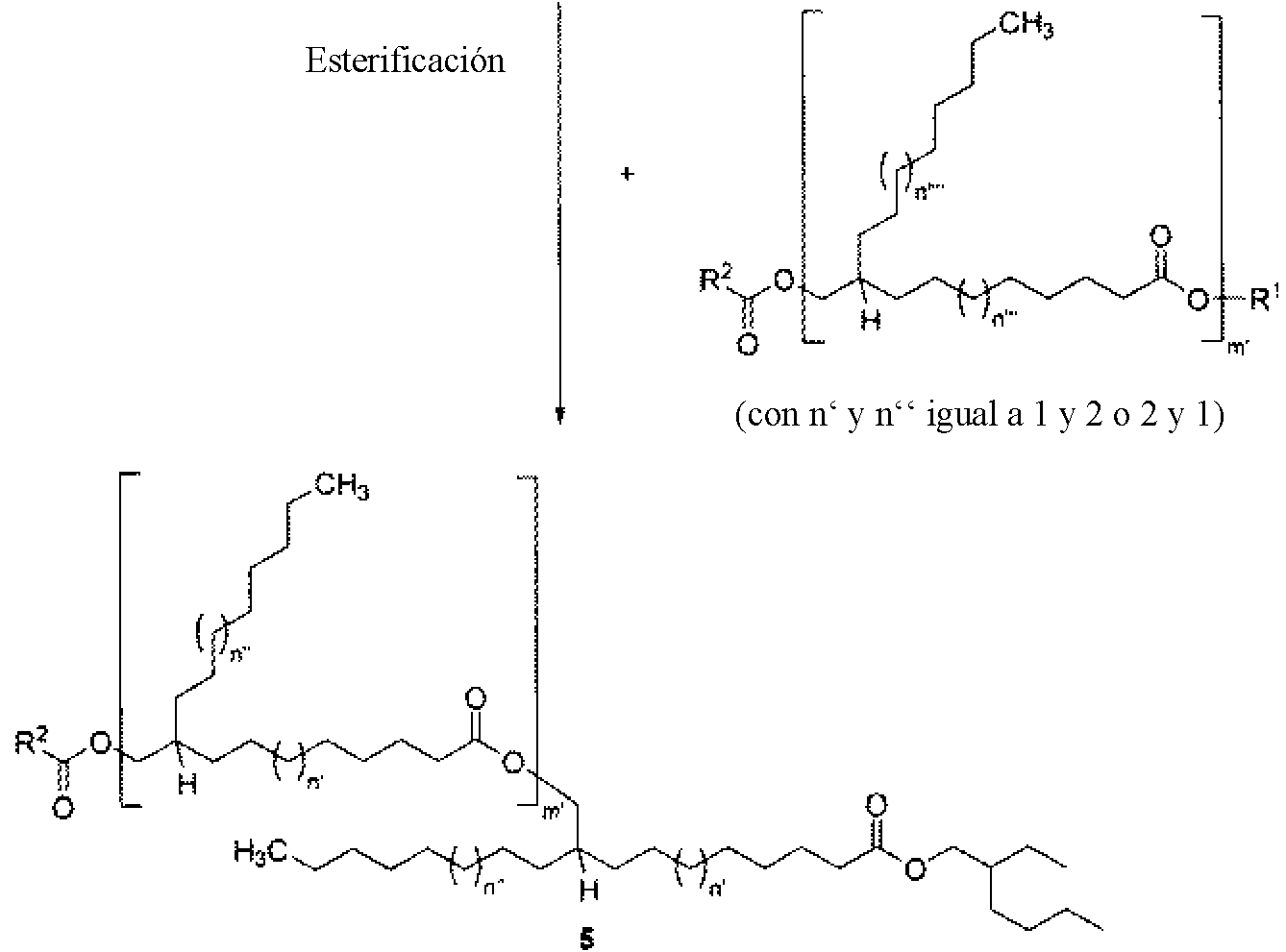
(con n ‘ y n ‘‘ igual a 1 y 2 o 2 y 1)(with n' and n'' equal to 1 and 2 or 2 and 1)
Figura 6. Estrategias de síntesis preferidas partiendo de ácido oleico y con la inclusión de una reacción eno para la preparación de compuestos 5 Figure 6. Preferred synthesis strategies starting from oleic acid and with the inclusion of an ene reaction for the preparation of compounds 5
A este respecto, el grupo hidroximetilo que se origina en la reacción eno se puede encontrar tanto en la posición 9 como en la posición 10 debido a la regioselectividad baja o no pronunciada de la reacción eno, con el posicionamiento correspondiente del doble enlace trans-C=C en la posición 10, 11 (en el caso de la posición 9 del grupo hidroximetilo) o en la posición 8 , 9 (en el caso de la posición 10 del grupo hidroximetilo). Típicamente, se obtiene una mezcla de ambos isómeros. En la figura 6 se muestra gráficamente, por razones de claridad, solo el isómero sustituido con hidroximetilo en la posición 9 con doble enlace trans-C=C en la posición 10, 11. En los productos formados del tipo 5 se prefieren especialmente compuestos con m' igual a 0 o de 1 a 5.In this regard, the hydroxymethyl group originating from the ene reaction can be found in both the 9-position and the 10- position due to the low or not pronounced regioselectivity of the ene reaction, with the corresponding positioning of the trans-C double bond. =C at position 10, 11 (in the case of position 9 of the hydroxymethyl group) or in position 8 , 9 (in the case of position 10 of the hydroxymethyl group). Typically, a mixture of both isomers is obtained. In Figure 6 , for reasons of clarity, only the isomer substituted with hydroxymethyl in position 9 with trans-C=C double bond in position 10, 11 is shown graphically. In products formed of type 5 , compounds with m' equal to 0 or 1 to 5.
Opcionalmente, una hidrogenación de los dobles enlaces C=C resultantes de la reacción eno también se puede llevar a cabo solo de forma final después de la oligomerización realizada inicialmente. Además, opcionalmente se puede prescindir también en general de uno o varios de los pasos de hidrogenación, donde los productos resultantes entonces presentan al menos un doble enlace.Optionally, a hydrogenation of the C=C double bonds resulting from the ene reaction can also be carried out only finally after the oligomerization carried out initially. Furthermore, optionally one or more of the hydrogenation steps can also be dispensed with in general, where the resulting products then have at least one double bond.
En la forma de realización B igualmente preferida, la secuencia de reacción se modifica en comparación con la forma de realización A (figura 6 ). Por lo tanto, en primer lugar, partiendo directamente del ácido oleico 1, se produce una reacción En con la obtención del compuesto 7 , que a continuación se convierte en la etapa intermedia 4 por medio de una hidrogenación del doble enlace trans-C =C y la posterior esterificación. Opcionalmente y alternativamente también puede tener lugar en primer lugar una esterificación del compuesto 7 (por lo que se formaría el compuesto 6) y finalmente la hidrogenación, por lo que también se obtiene el compuesto 4. En este caso, el grupo hidroximetilo que se origina en la reacción eno partiendo de 1 se puede encontrar en el compuesto 7 tanto en la posición 9 como en la posición 10 debido a la regioselectividad baja o no pronunciada de la reacción eno, con el posicionamiento correspondiente del doble enlace trans-C=C en la posición 10, 11 (en el caso de la posición 9 del grupo hidroximetilo) o en la posición 8 , 9 (en el caso de la posición 10 del grupo hidroximetilo). Típicamente se obtiene una mezcla de ambos isómeros. En la figura 6 se muestra gráficamente, por razones de claridad, solo el isómero sustituido con hidroximetilo en la posición 9 con doble enlace trans-C=C en la posición 10, 11. El compuesto 4 se convierte entonces, como ya se ha descrito anteriormente en la forma de realización A, en los compuestos objetivo deseadas del tipo 5 , siendo especialmente preferentes los compuestos con m' igual a 0 o 1 a 5.In the equally preferred embodiment B, the reaction sequence is modified compared to embodiment A (Figure 6 ). Therefore, first of all, starting directly from oleic acid 1 , an En reaction occurs with the obtaining of compound 7 , which is then converted in the intermediate stage 4 by means of a hydrogenation of the trans-C =C double bond and subsequent esterification. Optionally and alternatively, an esterification of compound 7 can also take place first (so that compound 6 would be formed) and finally hydrogenation, so that compound 4 is also obtained. In this case, the hydroxymethyl group originating in the ene reaction starting from 1 can be found in compound 7 both in position 9 and in position 10 due to the low or not pronounced regioselectivity of the ene reaction, with the positioning corresponding of the trans-C=C double bond in position 10, 11 (in the case of position 9 of the hydroxymethyl group) or in position 8 , 9 (in the case of position 10 of the hydroxymethyl group). Typically a mixture of both isomers is obtained. Figure 6 shows graphically, for clarity, only the isomer substituted with hydroxymethyl at position 9 with trans-C=C double bond at position 10, 11. Compound 4 is then converted, as already described above in embodiment A, in the desired target compounds of type 5 , compounds with m' equal to 0 or 1 to 5 being especially preferred.
Un representante a modo de ejemplo de la clase de compuesto preferida (Ib) es la mezcla descrita a continuación de los tres por transesterificación de la mezcla descrita en el ejemplo 9 siguiente de dos regioisómeros con 1,6-nhexanodiol como componente de (di)alcohol (figura 7). Dado que 1,6-n-hexanodiol representa un diol y por lo tanto puede esterificarse dos veces y en este caso puede reaccionar con 1 ,6 -n-hexanodiol tanto el regioisómero sustituido en la posición 9 como en la posición 10 de la mezcla de ésteres preparada en el ejemplo 9, en este caso se origina una mezcla de 3 regiosiómeros (mediante la participación de dos regioisómeros sustituidos en 9 o bien dos regioisómeros sustituidos en 10 o bien un regioisómero sustituido en 9 y un regioisómero sustituido en 10 en una reacción de transesterificación de este tipo), que se representa en la figura 7 siguiente. Para una mejor ilustración, el fragmento molecular resultante respectivamente de 1,6-n-hexanodiol se representa enmarcado. Alternativamente, la preparación de tales representantes de la clase de compuesto (Ib) también se puede realizar a través de la transesterificación partiendo de ésteres de alquilo simples (como ésteres de metilo y etilo) o directamente partiendo de los ácidos carboxílicos correspondientes a través de una reacción de esterificación.An exemplary representative of the preferred compound class (Ib) is the mixture described below of the three by transesterification of the mixture described in example 9 below of two regioisomers with 1,6-nhexanediol as component of (di) alcohol (figure 7). Since 1,6-n-hexanediol represents a diol and can therefore be esterified twice and in this case it can react with 1,6 - n-hexanediol both the regioisomer substituted in the 9 position and in the 10 position of the mixture of esters prepared in example 9, in this case a mixture of 3 regioisomers is created (through the participation of two 9-substituted regioisomers or two 10-substituted regioisomers or one 9-substituted regioisomer and one 10-substituted regioisomer in a transesterification reaction of this type), which is represented in Figure 7 below. For a better illustration, the resulting molecular fragment respectively of 1,6-n-hexanediol is represented in a frame. Alternatively, the preparation of such representatives of compound class (Ib) can also be carried out through transesterification starting from simple alkyl esters (such as methyl and ethyl esters) or directly starting from the corresponding carboxylic acids through a esterification reaction.

Figura 7. Representante especialmente preferido de los compuestos usados según la invención según la estructura general preferida (Ib), preparado partiendo de 1,6-hexanodiol como componente de diol Figure 7. Especially preferred representative of the compounds used according to the invention according to the preferred general structure (Ib), prepared starting from 1,6-hexanediol as diol component
Como un representante a modo de ejemplo de la clase de compuesto preferida (Ic) es la mezcla descrita a continuación de los tres mediante esterificación de la mezcla descrita en el ejemplo 8 siguiente de dos regioisómeros con ácido nhexanodicarboxílico se menciona como componente de ácido (di)carboxílico (figura 8 ). Dado que ácido nhexanodicarboxílico representa un ácido dicarboxílico y por lo tanto puede esterificarse dos veces y en este caso puede reaccionar con ácido n-hexanodicarboxílico tanto el regioisómero sustituido en la posición 9 como en la posición 10 de la mezcla de ásteres preparada en el ejemplo 8 , en este caso se origina entonces una mezcla de 3 regiosiómeros (mediante la participación de dos regioisómeros sustituidos en 9 o bien dos regioisómeros sustituidos en 10 o bien un regioisómero sustituido en 9 y un regioisómero sustituido en 10 en una reacción de transesterificación de este tipo), que se representa en la figura 8 siguiente. Para una mejor ilustración, el fragmento molecular resultante respectivamente del ácido n-hexanodicarboxílico está representado enmarcado. Alternativamente, la preparación de tales representantes de la clase de compuesto (Ic) tambián puede tener lugar a travás de la transesterificación partiendo de compuestos análogos O-acilados con componentes de acilo estructuralmente más simples (como, por ejemplo, acetilo, propanoilo) o directamente partiendo de los compuestos no O-acilados correspondientes con grupo hidroximetilo libre a través de una reacción de esterificación.As an exemplary representative of the preferred class of compound (Ic) is the mixture described below of the three by esterification of the mixture described in example 8 below of two regioisomers with nhexanedicarboxylic acid mentioned as acid component (di )carboxylic (figure 8 ). Since nhexanedicarboxylic acid represents a dicarboxylic acid and can therefore be esterified twice and in this case it can react with n-hexanedicarboxylic acid both the regioisomer substituted in the 9 position and in the 10 of the mixture of asters prepared in example 8 , in this case a mixture of 3 regioisomers is then created (through the participation of two 9-substituted regioisomers or two 10-substituted regioisomers or one 9-substituted regioisomer and one regioisomer substituted in 10 in such a transesterification reaction), which is represented in Figure 8 below. For a better illustration, the molecular fragment resulting respectively from n-hexanedicarboxylic acid is represented in a frame. Alternatively, the preparation of such representatives of the compound class (Ic) can also take place through transesterification starting from analogous O-acylated compounds with structurally simpler acyl components (such as, for example, acetyl, propanoyl) or directly starting from the corresponding non-O-acylated compounds with free hydroxymethyl group through an esterification reaction.

Figura 8. Representante especialmente preferido de los compuestos usados según la invención según la estructura general preferida (Ic), preparado partiendo de ácido n-hexanodicarboxílico como componente de ácido dicarboxílico Figure 8. Especially preferred representative of the compounds used according to the invention according to the preferred general structure (Ic), prepared starting from n-hexanedicarboxylic acid as dicarboxylic acid component
Además, un representante de esta clase de compuesto (Ic) es la mezcla descrita en el siguiente ejemplo 13 de los regioisómeros contenidos en ella, correspondientes a la estructura general (Ic) que se forma a partir de la reacción de esterificación de la mezcla según la invención descrita en el ejemplo 8 con el ácido dicarboxílico Pripol 1013 de la empresa Croda GmbH (figura 9). Para una mejor ilustración, el fragmento molecular resultante del ácido dicarboxílico comercial Pripol 1013 está representado enmarcado. Furthermore, a representative of this class of compound (Ic) is the mixture described in the following example 13 of the regioisomers contained therein, corresponding to the general structure (Ic) that is formed from the esterification reaction of the mixture according to the invention described in example 8 with the dicarboxylic acid Pripol 1013 from the company Croda GmbH (figure 9). For a better illustration, the resulting molecular fragment of the commercial dicarboxylic acid Pripol 1013 is represented in a frame.

Figura 9. Representante especialmente preferido de los compuestos usados según la invención según la estructura general preferida (Ic), preparado partiendo de ácido dicarboxílico Pripol 1013 como componente de ácido dicarboxílico Figure 9. Especially preferred representative of the compounds used according to the invention according to the preferred general structure (Ic), prepared starting from Pripol 1013 dicarboxylic acid as dicarboxylic acid component
Además de ácido n-hexanodicarboxílico y ácido dimérico (Pripol 1013) se utilizan otros ácidos carboxílicos polivalentes y anhídridos de ácido carboxílico, en particular ácido dimérico hidrogenado, ácido trimérico hidrogenado o no hidrogenado, ácido tereftálico, ácido isoftálico, ácido ftálico, ácido trimelítico, ácido hemimelítico, ácido trimelítico, ácido cítrico, ácido itacónico, ácido oxálico, ácido 2,2'-tiodiacético, ácido 3,3'-tiodipropiónico, ácido admergínico, ácido 2,5-furanodicarboxílico, ácido ciclohexano 1,4-dicarboxílico, ácido ciclohexano-1,2-dicarboxílico, ácido ciclohexeno-4,5-dicarboxílico, ácido fenilsuccínico, ácido glutamínico, ácido aspártico, ácido etilendiaminotetraacético, ácido dietilentriaminopentaacético, ácido propilendiaminotetraacético, ácido nitrilotriacético, ácido diglicólico y ácido iminodiacético y sus derivados.In addition to n-hexanedicarboxylic acid and dimeric acid (Pripol 1013), other polyvalent carboxylic acids and carboxylic acid anhydrides are used, in particular hydrogenated dimeric acid, hydrogenated or non-hydrogenated trimeric acid, terephthalic acid, isophthalic acid, phthalic acid, trimellitic acid, hemimellitic acid, trimellitic acid, citric acid, itaconic acid, oxalic acid, 2,2'-thiodiacetic acid, 3,3'-thiodipropionic acid, admerginic acid, 2,5-furanedicarboxylic acid, 1,4-dicarboxylic acid cyclohexane, acid cyclohexane-1,2-dicarboxylic acid, cyclohexene-4,5-dicarboxylic acid, phenylsuccinic acid, glutaminic acid, aspartic acid, ethylenediaminetetraacetic acid, diethylenetriaminepentaacetic acid, propylenediaminetetraacetic acid, nitrilotriacetic acid, diglycolic acid and iminodiacetic acid and their derivatives.
Otra característica del procedimiento es la inclusión del tipo de reacción de la esterificación en el marco de las formas de realización preferidas del procedimiento que parten de ácidos grasos insaturados y de las secuencias de síntesis aplicadas a este respecto. Para la esterificación de grupos hidroxi, el experto en la materia tiene a su disposición múltiples posibilidades. Por lo tanto, los ácidos necesarios se pueden usar directamente o derivados de ácidos activados, derivados de ellos, por ejemplo, cloruros de ácidos y anhídridos, o ésteres de ácidos (para una reacción de transesterificación). Una opción de síntesis especialmente atractiva está representada a este respecto por procedimientos catalíticos que permiten una esterificación directa partiendo de alcohol y componente ácido sin necesidad del uso de derivados de ácido carboxílico activados tales como cloruros de ácido carboxílico y anhídridos. Tales procedimientos catalíticos son conocidos tanto con la participación de quimiocatalizadores o biocatalizadores y se describen, por ejemplo, (en particular con enfoque en biocatalizadores) en G. Hills, Eur. J. Lipid Sci. Technol. 2003, 105, 601-607, O. Thum, K. M. Oxenboll, SOFW J. 2008, 134, 44-47, L. Hilterhaus, O. Thum, A. Liese, Org. Process Res. Dev. 2008, 12, 618-625 y M. B. Ansorge- Schumacher, O. Thum, Chem. Soc. 2013, 42, 6475-6490. A este respecto, el uso de biocatalizadores es especialmente atractivo, ya que en condiciones de reacción suaves se pueden llevar a cabo reacciones de esterificación de una manera altamente eficiente. Correspondientemente, la preparación de los compuestos según la invención de la fórmula general (I) en el marco de un procedimiento de síntesis, en el que para al menos una de las reacciones de esterificación implicadas a este respecto se utiliza un biocatalizador seleccionado de la clase enzimática de las hidrolasas, representa una forma de realización especialmente preferida. A este respecto, las lipasas son especialmente adecuadas como biocatalizadores de la clase enzimática de las hidrolasas para el procedimiento según la invención, donde a su vez la lipasa comercialmente disponible de Candida antárctica B representa un componente de lipasa especialmente adecuado. Another characteristic of the process is the inclusion of the type of esterification reaction within the framework of the preferred embodiments of the process that start from unsaturated fatty acids and the synthesis sequences applied in this regard. For the esterification of hydroxy groups, the person skilled in the art has multiple possibilities at his disposal. Therefore, the necessary acids can be used directly or derived from activated acids, derivatives of them, for example, chlorides of acids and anhydrides, or esters of acids (for a transesterification reaction). A particularly attractive synthesis option is represented in this regard by catalytic processes that allow direct esterification starting from alcohol and acid component without the need for the use of activated carboxylic acid derivatives such as carboxylic acid chlorides and anhydrides. Such catalytic processes are known both with the participation of chemocatalysts or biocatalysts and are described, for example, (in particular with focus on biocatalysts) in G. Hills, Eur. J. Lipid Sci. Technol. 2003 , 105, 601-607, O. Thum, KM Oxenboll, SOFW J. 2008 , 134, 44-47, L. Hilterhaus, O. Thum, A. Liese, Org. Process Res. Dev. 2008 , 12, 618-625 and MB Ansorge-Schumacher, O. Thum, Chem. Soc. 2013 , 42, 6475-6490. In this regard, the use of biocatalysts is especially attractive, since under mild reaction conditions esterification reactions can be carried out in a highly efficient manner. Correspondingly, the preparation of the compounds according to the invention of the general formula (I) within the framework of a synthesis process, in which a biocatalyst selected from the class is used for at least one of the esterification reactions involved in this regard. enzymatic hydrolases, represents a particularly preferred embodiment. In this regard, lipases are particularly suitable as biocatalysts of the enzymatic class of hydrolases for the process according to the invention, where in turn the commercially available lipase from Candida antarctica B represents a particularly suitable lipase component.
Para los procedimientos de síntesis que conducen a los compuestos, el experto en la materia dispone de múltiples posibilidades de elección en la elección de las condiciones de reacción, donde éstas se describen en detalle en la literatura para los tipos de reacción individuales implicados. Entre otras cosas, el experto en la materia es libre en la elección de los medios de reacción respectivos y puede recurrir, por ejemplo, a un amplio espectro de disolventes para la realización de las reacciones de síntesis del procedimiento según la invención. Sin embargo, a este respecto es especialmente ventajoso evitar disolventes con vistas a la sostenibilidad del procedimiento de preparación. En particular, para las reacciones de esterificación, las síntesis libres de disolventes ya se han descrito en la literatura como eficientes, por ejemplo, en las contribuciones ya mencionadas anteriormente G. Hills, Eur. J. Lipid Sci. Technol.For the synthesis procedures leading to the compounds, the person skilled in the art has multiple possibilities of choice in the choice of reaction conditions, where these are described in detail in the literature for the individual reaction types involved. Among other things, the person skilled in the art is free in the choice of the respective reaction media and can resort, for example, to a wide spectrum of solvents to carry out the synthesis reactions of the process according to the invention. However, in this regard it is particularly advantageous to avoid solvents with a view to the sustainability of the preparation process. In particular, for esterification reactions, solvent-free syntheses have already been described in the literature as efficient, for example in the contributions already mentioned above G. Hills, Eur. J. Lipid Sci. Technol.
2003, 105, 601-607, O. Thum, K. M. Oxenboll, SOFWJ. 2008, 134, 44- 47, L. Hilterhaus, O. Thum, A. Liese, Org. Process Res. Dev. 2008, 12, 618-625 y M. B. Ansorge-Schumacher, O. Thum, Chem. Soc. Rev. 2013, 42, 6475- 6490. Dado que el tipo de reacción de la esterificación también representa una característica del procedimiento según la invención, la preparación de los compuestos según la invención de la fórmula general (I) en el marco de un procedimiento de síntesis, en el que al menos una de las reacciones de esterificación que participan a este respecto tiene lugar bajo condiciones de reacción libres de disolvente, es una forma de realización especialmente preferida. 2003, 105, 601-607, O. Thum, K. M. Oxenboll, SOFWJ. 2008, 134, 44- 47, L. Hilterhaus, O. Thum, A. Liese, Org. Process Res. Dev. 2008, 12, 618-625 and M. B. Ansorge-Schumacher, O. Thum, Chem. Soc. Rev. 2013, 42, 6475- 6490. Since the type of esterification reaction also represents a characteristic of the process according to the invention, the preparation of the compounds according to the invention of the general formula (I) within the framework of a synthesis process, in which at least one of the esterification reactions involved in this regard takes place under conditions of solvent-free reaction, is a particularly preferred embodiment.
Una ventaja técnica especial del procedimiento desarrollado, así como de los productos obtenidos con ello con una función de metilol O-acilado es la presencia de una función de alcohol primaria en los ésteres de ácidos grasos sustituidos con hidroximetilol subyacentes como sustrato. Este grupo funcional de alcohol primario es altamente adecuado para reacciones enzimáticas catalíticas en condiciones de producción suaves y a bajas temperaturas y, de este modo, permite la preparación de los compuestos deseados en condiciones respetuosas con el medio ambiente con un bajo consumo de energía simultáneo.A special technical advantage of the developed process, as well as of the products obtained thereby with an O-acylated methylol function, is the presence of a primary alcohol function in the underlying hydroxymethylol-substituted fatty acid esters as substrate. This primary alcohol functional group is highly suitable for catalytic enzymatic reactions under mild and low-temperature production conditions and thus enables the preparation of desired compounds under environmentally friendly conditions with simultaneous low energy consumption.
Otra ventaja técnica general de los compuestos, así como del procedimiento de preparación radica en la selectividad enormemente alta. Los compuestos de estólidos dados a conocer en el documento DE 698 35 694 T2 no pueden prepararse en esta selectividad, ya que aquí, partiendo de un ácido graso insaturado como componente básico, mediante la adición de la unidad de ácido graso de este componente a la unidad de alqueno del siguiente componente, se produce el enlace de reacción y, por lo tanto, se construyen dímeros, trímeros, tetrámeros o en general oligómeros e incluso polímeros como mezcla. En el procedimiento aquí descrito se consigue mediante condiciones de reacción suaves y reacciones enzimáticas altamente selectivas, pero también mediante la estrategia del control de la reacción preferentemente en cada caso solo la mono-funcionalización del componente de metilol del compuesto de partida (que se compone, por ejemplo, como mezcla de un éster de ácido graso sustituido con 9- y 10-metilol). Además, también es concebible la preparación a medida de trímeros y tetrámeros sustituidos más altos de modo y manera selectivos mediante síntesis correspondientemente dirigidas. Por lo tanto, los compuestos objetivo con alta selectividad se obtienen en forma definida evitando estructuras oligoméricas o poliméricas más altas, como no es posible con los procedimientos conocidos con los que se obtienen mezclas de productos complejas.Another general technical advantage of the compounds as well as the preparation procedure lies in the enormously high selectivity. The estolide compounds disclosed in DE 698 35 694 T2 cannot be prepared in this selectivity, since here, starting from an unsaturated fatty acid as a basic component, by adding the fatty acid unit of this component to the alkene unit of the next component, the reaction bond occurs and therefore dimers, trimers, tetramers or in general oligomers and even polymers are constructed as a mixture. In the process described here, it is achieved by mild reaction conditions and highly selective enzymatic reactions, but also by the reaction control strategy preferably in each case only the mono-functionalization of the methylol component of the starting compound (which consists, for example, as a mixture of a fatty acid ester substituted with 9- and 10-methylol). Furthermore, the tailored preparation of higher substituted trimers and tetramers in a selective manner by correspondingly targeted syntheses is also conceivable. Therefore, target compounds with high selectivity are obtained in a defined way, avoiding oligomeric or higher polymeric structures, as is not possible with known procedures with which complex product mixtures are obtained.
Los compuestos de éster utilizados según la invención son muy adecuados para usarse en composiciones de lubricantes y son adecuados tanto para el uso en el rango de alta temperatura, en el sector marino, así como también como lubricante que se utiliza en el sector alimentario.The ester compounds used according to the invention are very suitable for use in lubricant compositions and are suitable both for use in the high temperature range, in the marine sector, as well as as a lubricant used in the food sector.
Además de los nuevos compuestos ésteres, las composiciones lubricantes según la invención pueden contener otros componentes de aceite base, en particular sobre la base de ésteres glicéridos naturales y ácidos grasos, preferentemente aceite de girasol, aceite de colza o aceite de nabina, aceite de linaza, aceite de maíz o aceite de germen de maíz, aceite de cardo, aceite de soja, aceite de semilla de linaza, aceite de cacahuete, aceite "Lesqueralle", aceite de palma, aceite de oliva, en las formas monoméricas, oligoméricas y/o polimerizadas o mezclas de los aceites mencionados.In addition to the new ester compounds, the lubricant compositions according to the invention may contain other base oil components, in particular based on natural glyceride esters and fatty acids, preferably sunflower oil, rapeseed oil or rapeseed oil, linseed oil , corn oil or corn germ oil, thistle oil, soybean oil, linseed oil, peanut oil, "Lesqueralle" oil, palm oil, olive oil, in monomeric, oligomeric and/or forms or polymerized or mixtures of the mentioned oils.
Además, junto a los nuevos compuestos de éster, las composiciones de lubricante según la invención pueden contener otros ésteres tales como ésteres de trimetilolpropano y pentaeritritol, así como ésteres complejos de TMP, total o parcialmente esterificados con ácidos carboxílicos saturados y/o insaturados una o varias veces de la longitud de cadena C6-C36, donde estos pueden ser lineales o ramificados, ésteres complejos de ácidos diméricos, ésteres de ácido dimérico tales como dimerato de etilhexilo, ésteres de ácido carboxílico y dicarboxílico alifáticos, así como ésteres de fosfatos, ésteres de ácido trimelítico y piromelítico, éteres, polioles de poliéter, así como perfluoropoliéteres, éteres de alquildifenilo y éteres de polifenilo, aceites de silicona, poliglicoles que consisten en unidades de polioxietileno y/o polioxipropileno distribuidas al azar y/u otros bloques de construcción de polioxialquileno, así como otros derivados de glicol, polialfaolefinas y polialfaolefinas preparadas catalizadas por metaloceno, así como copolímeros de alfaolefinas, sistemas poliméricos como, por ejemplo, poliisobutileno no hidrogenado, parcialmente hidrogenado o totalmente hidrogenado o una mezcla de estos, estireno y poliestireno, así como sus derivados y/o sistemas poliméricos a base de acrilatos, polímeros de acetato y amidas, polietilenos, polipropilenos, polipropilenos halogenados y/o cicloalcanos, aceites minerales como, por ejemplo, aceite blanco, éteres de difenilo alquilados, naftalenos alquilados y perfluoropoliéteres.Furthermore, in addition to the new ester compounds, the lubricant compositions according to the invention may contain other esters such as esters of trimethylolpropane and pentaerythritol, as well as complex esters of TMP, wholly or partially esterified with saturated and/or unsaturated carboxylic acids one or more. several times the C 6 -C 3 6 chain length, where these can be linear or branched, complex esters of dimeric acids, dimeric acid esters such as ethylhexyl dimerate, aliphatic carboxylic and dicarboxylic acid esters, as well as esters of phosphates, trimellitic and pyromellitic acid esters, ethers, polyether polyols, as well as perfluoropolyethers, alkyldiphenyl ethers and polyphenyl ethers, silicone oils, polyglycols consisting of randomly distributed polyoxyethylene and/or polyoxypropylene units and/or other blocks construction of polyoxyalkylene, as well as other glycol derivatives, polyalphaolefins and prepared polyalphaolefins catalyzed by metallocene, as well as copolymers of alphaolefins, polymer systems such as, for example, unhydrogenated, partially hydrogenated or fully hydrogenated polyisobutylene or a mixture of these, styrene and polystyrene, as well as its derivatives and/or polymer systems based on acrylates, acetate polymers and amides, polyethylenes, polypropylenes, halogenated polypropylenes and/or cycloalkanes, mineral oils such as, for example, white oil, alkylated diphenyl ethers, alkylated naphthalenes and perfluoropolyethers.
El lubricante que contiene el compuesto de éster de la fórmula general (Ia), (lb), (lc) se puede utilizar tanto en forma de aceite lubricante como en forma de grasa lubricante. The lubricant containing the ester compound of the general formula (Ia), (lb), (lc) can be used both in the form of lubricating oil and in the form of lubricating grease.
El lubricante comprende además aditivos que se utilizan individualmente o en combinación y que se seleccionan del grupo que consiste en aditivos anticorrosivos, antioxidantes, aditivos antidesgaste, estabilizadores UV, lubricantes sólidos inorgánicos u orgánicos, mejoradores de punto de fluencia e índice de viscosidad, polímeros, aditivos adhesivos, colorantes, emulsionantes, antiespumantes y lubricantes sólidos, que son típicos para la formulación de un aceite lubricante o grasa lubricante.The lubricant further comprises additives that are used individually or in combination and that are selected from the group consisting of anti-corrosion additives, antioxidants, anti-wear additives, UV stabilizers, inorganic or organic solid lubricants, pour point and viscosity index improvers, polymers, adhesive additives, colorants, emulsifiers, antifoams and solid lubricants, which are typical for the formulation of a lubricating oil or lubricating grease.
Las grasas lubricantes se pueden preparar con diferentes agentes espesantes. Las ureas son un posible grupo espesante que consiste en el producto de reacción a partir de un diisocianato, preferentemente 2,4-diisocianatotolueno 2,6-diisocianatotolueno, 4,4'-diisocianatodifenilmetano, 2,4-diisocianatofenilmetano, 4,4'-disocianatodifenilo, 4,4'-diisocianato-3,3'-dimetilfenilo, 4,4'-diisocianato-3,3'-dimetilfenilmetano, que se pueden utilizar individualmente o en combinación con una amina de fórmula general R'2-N-R, o bien una diamina de fórmula general R'2-N-R-NR'2, donde R es un radical arilo, alquilo o alquileno que tiene entre 2 y 22 átomos de carbono, donde R', de manera idéntica o distinta, es un hidrógeno, un radical alquilo, alquileno o arilo, o con mezclas de aminas y diaminas o como agente espesante se selecciona un representante seleccionado del grupo de los jabones de complejo de Al, jabones individuales metálicos de los elementos del primer y segundo grupo principal de la tabla periódica, jabones de complejos metálicos de los elementos del primer y segundo grupo principal de la tabla periódica, bentonita, sulfonato, silicato, Aerosil, poliimida o PTFE o una mezcla de los agentes espesantes antes mencionados.Lubricating greases can be prepared with different thickening agents. Ureas are a possible thickening group consisting of the reaction product from a diisocyanate, preferably 2,4-diisocyanatotoluene, 2,6-diisocyanatotoluene, 4,4'-diisocyanatodiphenylmethane, 2,4-diisocyanatophenylmethane, 4,4'- disocyanatodiphenyl, 4,4'-diisocyanato-3,3'-dimethylphenyl, 4,4'-diisocyanato-3,3'-dimethylphenylmethane, which can be used individually or in combination with an amine of general formula R'2-N-R, or a diamine of general formula R'2-N-R-NR'2, where R is an aryl, alkyl or alkylene radical having between 2 and 22 carbon atoms, where R', identically or differently, is a hydrogen , an alkyl, alkylene or aryl radical, or with mixtures of amines and diamines or as a thickening agent a representative selected from the group of Al complex soaps, individual metal soaps from the elements of the first and second main group of the table is selected periodic, soaps of metal complexes of the elements of the first and second main group of the periodic table, bentonite, sulfonate, silicate, Aerosil, polyimide or PTFE or a mixture of the aforementioned thickening agents.
Con el fin de cumplir con las disposiciones legales relativas al uso de lubricantes para herramientas de lubricación para el procesamiento de productos alimenticios, es conveniente que los aditivos utilizados presenten una clasificación H1.In order to comply with the legal provisions regarding the use of lubricants for lubrication tools for processing food products, it is advisable that the additives used have an H1 classification.
La adición de antioxidantes puede reducir o incluso prevenir la oxidación del aceite o grasa según la invención, en particular cuando se usa. Por consiguiente, la adición de antioxidantes representa otra forma de realización preferida del procedimiento según la invención. Los antioxidantes se seleccionan del grupo que consiste en aminas diaromáticas, resinas fenólicas, resinas tiofenólicas, fosfitos, hidroxitolueno butilado, hidroxianisol butilado, fenil-^-naftilaminas, fenil-^-naftilaminas, difenilaminas octiladas/butiladas, di-^-tocoferol, di-terc-butil-fenil, ácido bencenopropanoico y mezclas de estos componentes.The addition of antioxidants can reduce or even prevent oxidation of the oil or fat according to the invention, in particular when used. Consequently, the addition of antioxidants represents another preferred embodiment of the process according to the invention. The antioxidants are selected from the group consisting of diaromatic amines, phenolic resins, thiophenolic resins, phosphites, butylated hydroxytoluene, butylated hydroxyanisole, phenyl-^-naphthylamines, phenyl-^-naphthylamines, octylated/butylated diphenylamines, di-^-tocopherol, di -tert-butyl-phenyl, benzenepropanoic acid and mixtures of these components.
El lubricante usado según la invención puede contener aditivos anticorrosivos, desactivadores de metales o agentes complejantes de iones. Estos incluyen triazoles, imidazolinas, N-metilglicina (sarcosina), derivados del benzotriazol, N,N-bis(2-etilhexil)-ar-metil-1H-benzotriazol-1-metanamina; n-metil-N(1-oxo9-octadecenil)glicina, mezcla de ácido fosfórico y sus ésteres mono y diisooctílicos que reaccionan con alquilaminas (C11-14), mezcla de ácido fosfórico y ésteres mono y diisooctílicos que reaccionan con tert-alquilamina y aminas primarias (C12-14), ácido dodecanoico, fosforotionato de trifenilo y fosfatos de amina. Los aditivos disponibles comercialmente son, por ejemplo, los siguientes productos: IRGAMET® 39, IRGACOR® DSS G, Amin O; SARKOSYL® O (Ciba), COBRATEC® 122, CUVAN® 303, VANLUBE® 9123, CI-426, CI-426EP, Cl-429 y CI-498.The lubricant used according to the invention may contain anticorrosive additives, metal deactivators or ion complexing agents. These include triazoles, imidazolines, N-methylglycine (sarcosine), benzotriazole derivatives, N,N-bis(2-ethylhexyl)-ar-methyl-1H-benzotriazole-1-methanamine; n-methyl-N(1-oxo9-octadecenyl)glycine, mixture of phosphoric acid and its mono- and diisooctyl esters reacting with alkylamines (C11-14), mixture of phosphoric acid and mono- and diisooctyl esters reacting with tert-alkylamine and primary amines (C12-14), dodecanoic acid, triphenyl phosphorothionate and amine phosphates. Commercially available additives are, for example, the following products: IRGAMET® 39, IRGACOR® DSS G, Amin O; SARKOSYL® O (Ciba), COBRATEC® 122, CUVAN® 303, VANLUBE® 9123, CI-426, CI-426EP, Cl-429 and CI-498.
El lubricante utilizado según la invención puede contener además aditivos antidesgaste, aditivos anti-wear y modificadores de fricción.The lubricant used according to the invention may also contain anti-wear additives, anti-wear additives and friction modifiers.
Los aditivos antidesgaste son aminas, fosfatos de aminas, fosfatos, tiofosfatos, fosforotionatos, fosfatos de arilo, polisulfuros alquilados, compuestos de aminas sulfuradas, ésteres metílicos de ácidos grasos azufrados, ácidos nafténicos, nanopartículas de los grupos AI2O3 , SiO2 , TiO2 , ZrO2 , WO3 , Ta2O5, V2O5, CeO2 , titanato de aluminio, BN, MoSi2 , SiC, Si3N4, TiC, TiN, ZrB2 , minerales de arcilla y/o sus mezclas, así como carbonatos y/o sulfatos térmicamente estables, y mezclas de estos componentes. Los aditivos antidesgaste disponibles comercialmente incluyen IRGALUBE® TPPT, IRGALUBE® 232, IRGALUBE® 349, IRGALUBE® 211 y ADDITIN® RC3760 Liq 3960, FIRC-SHUN® FG 1505 y FG 1506, INA-LUBE® KR-015FG, LUBEBOND®, FLUORO® FG, SYNALOX® 40-D, ACHESON® FGA 1820 y ACHESON® FGA 1810.Antiwear additives are amines, amine phosphates, phosphates, thiophosphates, phosphorothionates, aryl phosphates, alkylated polysulfides, sulfide amine compounds, methyl esters of sulfur fatty acids, naphthenic acids, nanoparticles of the groups AI 2 O 3 , SiO 2 , TiO 2 , ZrO 2 , WO 3 , Ta2O5, V 2 O 5 , CeO 2 , aluminum titanate, BN, MoSi 2 , SiC, Si3N4, TiC, TiN, ZrB 2 , clay minerals and/or their mixtures, as well as thermally stable carbonates and/or sulfates, and mixtures of these components. Commercially available antiwear additives include IRGALUBE® TPPT, IRGALUBE® 232, IRGALUBE® 349, IRGALUBE® 211 and ADDITIN® RC 3 760 Liq 3960, FIRC-SHUN® FG 1505 and FG 1506, INA-LUBE® KR-015FG, LUBEBOND® , FLUORO® FG, SYNALOX® 40-D, ACHESON® FGA 1820 and ACHESON® FGA 1810.
El lubricante utilizado según la invención puede contener mejoradores de punto de fluencia y de viscosidad y aditivos adhesivos. Los mejoradores de punto de fluencia y de viscosidad se seleccionan de los grupos de los polímeros y copolímeros lineales y/o ramificados alquilados, acrilados y alifáticos, así como de los ésteres de ácidos grasos polimerizados, así como de los grupos PIB (poliisobutilenos) y PB (polibutenos) parcialmente hidrogenados o completamente hidrogenados.The lubricant used according to the invention may contain pour point and viscosity improvers and adhesive additives. Pour point and viscosity improvers are selected from the groups of linear and/or branched alkylated, acrylated and aliphatic polymers and copolymers, as well as from polymerized fatty acid esters, as well as from the groups PIB (polyisobutylenes) and PB (polybutenes) partially hydrogenated or completely hydrogenated.
El lubricante utilizado según la invención puede contener además estabilizadores UV. Los estabilizadores UV se seleccionan de los grupos de heterociclos de nitrógeno, heterociclos de nitrógeno sustituidos, heterociclos de nitrógeno alquilados, acilados, alifáticos lineales y ramificados, así como sus derivados.The lubricant used according to the invention may also contain UV stabilizers. UV stabilizers are selected from the groups of nitrogen heterocycles, substituted nitrogen heterocycles, alkylated, acylated, linear and branched aliphatic nitrogen heterocycles, as well as their derivatives.
El lubricante utilizado según la invención también puede contener lubricantes sólidos. Los lubricantes sólidos son, por ejemplo, PTFE, BN, pirofosfato, óxido de Zn, óxido de Mg, tiosulfatos, carbonato de Mg, carbonato de Ca, estearato de Ca, sulfuro de Zn, sulfuro de Mo, sulfuro de W, Sn-sulfuro, grafito, grafeno, nanotubos, modificaciones de SiO2 o una mezcla de los mismos. The lubricant used according to the invention may also contain solid lubricants. Solid lubricants are, for example, PTFE, BN, pyrophosphate, Zn oxide, Mg oxide, thiosulfates, Mg carbonate, Ca carbonate, Ca stearate, Zn sulfide, Mo sulfide, W sulfide, Sn- sulfide, graphite, graphene, nanotubes, SiO 2 modifications or a mixture thereof.
El lubricante utilizado según la invención puede contener emulsionantes. Los emulsionantes se seleccionan de los grupos de los alcoholes ramificados y/o lineales etoxilados y/o propoxilados y sus sales tales como, por ejemplo, alcoholes, C16-C18, etoxilados, propoxilados, poliglicoles, ésteres de ácidos grasos, silicatos, tensioactivos iónicos tales como, por ejemplo, sales de sodio de ácidos alquilsulfónicos, donde las cadenas contienen carbono C14-17. The lubricant used according to the invention may contain emulsifiers. The emulsifiers are selected from the groups of ethoxylated and/or propoxylated branched and/or linear alcohols and their salts such as, for example, alcohols, C16-C18, ethoxylated, propoxylated, polyglycols, fatty acid esters, silicates, ionic surfactants. such as, for example, sodium salts of alkylsulfonic acids, where the chains contain C14-17 carbon.
El lubricante utilizado según la invención puede contener antiespumantes. Los antiespumantes se seleccionan de los grupos de alcoholes etoxilados y/o propoxilados de las longitudes de cadena C10-C18, monoglicéridos y diglicéridos de grasas comestibles, acrilatos, éteres de alquilo propoxilados y/o etoxilados (poliglicoles), alcoholes, siloxanos. The lubricant used according to the invention may contain antifoams. Antifoams are selected from the groups of ethoxylated and/or propoxylated alcohols of chain lengths C10-C18, monoglycerides and diglycerides of edible fats, acrylates, propoxylated and/or ethoxylated alkyl ethers (polyglycols), alcohols, siloxanes.
A este respecto, una forma preferida del procedimiento de preparación para una formulación de aceite es la siguiente: El compuesto de éster se presenta en la caldera. Se añaden el componente emisor de viscosidad y/o uno o varios aceites base adicionales y se genera una solución clara agitando y, dado el caso, calentando a una temperatura definida. Los aditivos sólidos se añaden a continuación a una temperatura por encima de su punto de fusión y se agitan hasta que se disuelven. A continuación, el contenido de la caldera se enfría a un máximo de 60 °C y se añaden los aditivos líquidos. Después de otra hora de agitación, el aceite se puede envasar.In this regard, a preferred form of the preparation process for an oil formulation is as follows: The ester compound is presented in the boiler. The viscosity-emitting component and/or one or more additional base oils are added and a clear solution is generated by stirring and, if necessary, heating to a defined temperature. The solid additives are then added at a temperature above their melting point and stirred until dissolved. The contents of the boiler are then cooled to a maximum of 60°C and the liquid additives are added. After another hour of stirring, the oil can be bottled.
Además, en el caso de una forma preferida del procedimiento de preparación para una formulación de grasa, se procede de la siguiente manera: La mezcla de aceite de base se presenta en la caldera. Los componentes espesantes se añaden de modo y manera definidos agitando a una temperatura definida. La grasa resultante se agita durante un tiempo definido y se hierve sin agua especialmente cuando se utilizan espesantes a base de jabón. Los aditivos sólidos se añaden a continuación a una temperatura por encima de su punto de fusión y se agitan hasta que se disuelven. A continuación, el contenido de la caldera se enfría a un máximo de 60 °C y se añaden los aditivos líquidos. Después de otra hora de agitación, la grasa se puede envasar.Furthermore, in the case of a preferred form of the preparation process for a grease formulation, the procedure is as follows: The base oil mixture is introduced into the boiler. The thickening components are added in a defined manner and manner by stirring at a defined temperature. The resulting fat is stirred for a defined time and boiled without water especially when soap-based thickeners are used. The solid additives are then added at a temperature above their melting point and stirred until dissolved. The contents of the boiler are then cooled to a maximum of 60°C and the liquid additives are added. After another hour of stirring, the fat can be packaged.
Las composiciones lubricantes basadas en el compuesto de éster de las fórmulas generales (la) o (Ib) o (Ic) se utilizan en el sector marino, en el sector de las aguas interiores y en instalaciones offshore, es decir, para la lubricación de cadenas, cojinetes deslizantes, palas de hélices, árboles de hélices, componentes de máquinas e instalaciones que entran en contacto con agua salada en el sector marino o con agua y medios acuosos en aguas interiores. Además, encuentran aplicación en la lubricación de instrumentos de trabajo en la industria de procesamiento de alimentos, como aceite hidráulico en la industria de procesamiento de alimentos, para cadenas de transporte y control, para dispositivos para procesar cereales, harina y alimento para animales, y en hornos. Además, se utilizan para la lubricación de rodamientos y cojinetes deslizantes, cadenas de transporte y control en la tecnología automotriz, tecnología de transporte, ingeniería mecánica, tecnología de oficina, así como en instalaciones y máquinas industriales, en los sectores de la maquinaria doméstica y electrónica de consumo. Además, se utilizan para la lubricación de engranajes cónicos y rectos, cojinetes de rodillos de rodadura en máquinas de colada continua y cojinetes de rodillos de transporte en hornos continuos y para la lubricación abierta de la corona dentada en hornos de tubos rotativos, molinos de tubos, tambores y mezcladores, como los que se utilizan especialmente en las industrias de cemento, cal, yeso, minas y productos químicos.Lubricating compositions based on the ester compound of the general formulas ( la ) or ( Ib ) or ( Ic ) are used in the marine sector, in the inland water sector and in offshore installations, that is, for the lubrication of chains, sliding bearings, propeller blades, propeller shafts, components of machines and installations that come into contact with salt water in the marine sector or with water and aqueous media in inland waters. In addition, they find application in the lubrication of work instruments in the food processing industry, as hydraulic oil in the food processing industry, for transport and control chains, for devices for processing cereals, flour and animal feed, and in ovens. In addition, they are used for the lubrication of rolling and sliding bearings, transport and control chains in automotive technology, transport technology, mechanical engineering, office technology, as well as in industrial plants and machines, in the household machinery and machinery sectors. Consumer electronics. In addition, they are used for the lubrication of bevel and spur gears, rolling roller bearings in continuous casting machines and transport roller bearings in continuous furnaces and for open lubrication of the ring gear in rotary tube furnaces, tube mills , drums and mixers, such as those used especially in the cement, lime, gypsum, mining and chemical industries.
Como complemento se menciona que los compuestos según la invención, siempre que contengan estereocentros, pueden ser tanto compuestos racémicos como enriquecidos con enantiómeros o bien compuestos puros como enantiómeros.As a complement, it is mentioned that the compounds according to the invention, as long as they contain stereocenters, can be both racemic compounds and enriched with enantiomers or pure compounds such as enantiomers.
En la siguiente sección se explican los compuestos de éster y su preparación, así como su uso en una composición de lubricante, mediante ejemplos experimentales correspondientes.In the following section, ester compounds and their preparation, as well as their use in a lubricant composition, are explained using corresponding experimental examples.
Ejemplos:Examples:
Instrucción general de ensayo 1 (AW1): Síntesis biocatalítica de ésteres de ácido oleico partiendo de ácido oleico y alcoholes de GuerbetGeneral test instruction 1 (AW1): Biocatalytic synthesis of oleic acid esters starting from oleic acid and Guerbet alcohols

97-99% Unidad del producto 97-99% Product unit
Esquema 2 : Síntesis biocatalítica de ásteres de ácido oleico. Scheme 2 : Biocatalytic synthesis of oleic acid esters.
Se presentaron ácido oleico (1,0 eq.) y alcohol de Guerbet (1,0 eq.) y se mezclaron con CAL-B (Novozym 435, 30 mg/mmol de sustrato) y tamiz molecular 4Å (120 mg/mmol). La mezcla de reacción se agitó durante 24 horas a 50 °C y a continuación se filtró a través de un filtro de PTFE de 0,2 μM. El áster de ácido oleico correspondiente se obtuvo en 97-99% de pureza del producto.Oleic acid (1.0 eq.) and Guerbet alcohol (1.0 eq.) were presented and mixed with CAL-B (Novozym 435, 30 mg/mmol substrate) and 4Å molecular sieve (120 mg/mmol). . The reaction mixture was stirred for 24 h at 50 °C and then filtered through a 0.2 μM PTFE filter. The corresponding oleic acid ester was obtained at 97-99% product purity.
Ejemplo 1Example 1
Preparación de oleato de 2-etilhexilo partiendo de ácido oleico y 2-etilhexan-1-olPreparation of 2-ethylhexyl oleate starting from oleic acid and 2-ethylhexan-1-ol

La síntesis se realizó según AW 1. Se mezclaron ácido oleico (31,6 ml, 100 mmol) y 2-etilhexan-1-ol (15,6 ml, 100 mmol) con Novozym 435 (3,0 g) y tamiz molecular 4Å (12,0 g). El oleato de 2-etilhexilo (99% de pureza) se obtuvo como un líquido incoloro.The synthesis was carried out according to AW 1. Oleic acid (31.6 ml, 100 mmol) and 2-ethylhexan-1-ol (15.6 ml, 100 mmol) were mixed with Novozym 435 (3.0 g) and molecular sieve 4Å (12.0 g). 2-Ethylhexyl oleate (99% purity) was obtained as a colorless liquid.
Rendimiento: 37,3 g, 95%. Yield : 37.3 g, 95%.
1H-NMR (500 MHz, CDCls): ó [ppm] = 5,34 (m, 2H, CH=CH), 3,98 (dd, 2H, 2J = 5,8 Hz, 3J = 2,4 Hz, OCH2), 2,29 (t, 2H, 3J = 7,5 Hz, CH2CH2COOR), 2,01 (m, 4H, CH2CH= CHCH2 ), 1,61 (qi, 2H, 3J = 7,3 Hz, CH2CH2COOR), 1,56 (sept, 1H, 3J = 6,0 Hz, OCH2CH), 1,28 (m, 28H), 0,88 (m, 9H, CH3).1 H-NMR (500 MHz, CDCls): or [ppm] = 5.34 (m, 2H, CH=CH), 3.98 (dd, 2H, 2J = 5.8 Hz, 3J = 2.4 Hz , OCH 2 ), 2.29 (t, 2H, 3J = 7.5 Hz, CH 2 CH 2 COOR), 2.01 (m, 4H, CH 2 CH= CHCH 2 ), 1.61 (qi, 2H , 3J = 7.3 Hz, CH 2 CH 2 COOR), 1.56 (Sept, 1H, 3J = 6.0 Hz, OCH 2 CH), 1.28 (m, 28H), 0.88 (m, 9H, CH 3 ).
13RMN C (125 MHz, CDCla): ó [ppm] = 174,21, 130,11, 129,87, 66,76, 38,90, 34,58, 32,05, 30,57, 29,91, 29,84, 29,67, 29,47, 29,33, 29,29, 29,26, 29,07, 27,36, 27,31,25,19, 23,95, 23,12, 22,83, 14,25, 14,18.13 C NMR (125 MHz, CDCla): or [ppm] = 174.21, 130.11, 129.87, 66.76, 38.90, 34.58, 32.05, 30.57, 29.91 , 29.84, 29.67, 29.47, 29.33, 29.29, 29.26, 29.07, 27.36, 27.31,25.19, 23.95, 23.12, 22 .83, 14.25, 14.18.
GC (FID): Phenomenex ZB-5MSi, 0,5 ml/min (H2), Inj. Temp.: 300 °C, Det. Temp.: 350 °C; 300 °C -> 350 °C (5 °C/min), 350 °C durante 5 min, Rt = 3,51 min. GC (FID): Phenomenex ZB-5MSi, 0.5 ml/min (H 2 ), Inj. Temp.: 300 °C, Det. Temp.: 350 °C; 300 °C -> 350 °C (5 °C/min), 350 °C for 5 min, Rt = 3.51 min.
HRMS (ESI): calculado para C26Ha002Na [M+Na]+: 417,3703, encontrado: 417,3699. HRMS (ESI): calculated for C 26 Ha00 2 Na [M+Na]+: 417.3703, found: 417.3699.
IR (neat) [cm-1]: 2956, 2922, 2853, 1736, 1461, 1240, 1171, 724. IR (neat) [cm-1]: 2956, 2922, 2853, 1736, 1461, 1240, 1171, 724.
Ejemplo 2Example 2
Preparación de oleato de 2-butiloctilo partiendo de ácido oleico y 2-butiloctan-1-olPreparation of 2-butyloctyl oleate starting from oleic acid and 2-butyloctan-1-ol

La síntesis se realizó según AW 1. Se mezclaron ácido oleico (1,59 ml, 5,00 mmol) y 2-butiloctan-1-ol (1,12 ml, 5,00 mmol) con Novozym 435 (150 mg) y tamiz molecular 4Å (600 mg). Oleato de 2-butiloctilo (97% de pureza) se obtuvo como un líquido incoloro.The synthesis was carried out according to AW 1. Oleic acid (1.59 ml, 5.00 mmol) and 2-butyloctan-1-ol (1.12 ml, 5.00 mmol) were mixed with Novozym 435 (150 mg) and 4Å molecular sieve (600 mg). 2-Butyloctyl oleate (97% purity) was obtained as a colorless liquid.
Rendimiento: 1,30 g, 58%. Yield : 1.30 g, 58%.
1H-NMR (500 MHz, CDCls): ó [ppm] = 5,34 (m, 2H, CH=CH), 3,96 (d, 2H, 2J= 5,8Hz, OCH2), 2,29 (t, 2H, 3J = 7,5Hz, CH2CH2COOR), 2,01 (m, 4H, CH2CH= CHCH2), 1,61 (m, 2H, CH2CH2COOR), 1,60 (m, 1H, OCH2CH), 1,28 (m, 36H), 0,88 (m, 9H, CH3).1 H-NMR (500 MHz, CDCls): or [ppm] = 5.34 (m, 2H, CH=CH), 3.96 (d, 2H, 2J= 5.8Hz, OCH 2 ), 2.29 (t, 2H, 3J = 7.5Hz, CH 2 CH 2 COOR), 2.01 (m, 4H, CH 2 CH= CHCH 2 ), 1.61 (m, 2H, CH 2 CH 2 COOR), 1.60 (m, 1H, OCH 2 CH) , 1.28 (m, 36H), 0.88 (m, 9H, CH 3 ).
13RMN C (125 MHz, CDCI3): 6 [ppm] = 174,21, 130,11, 129,87, 67,16, 37,43, 34,60, 32,06, 31,97, 31,44, 31,11,29,92, 29,86, 29,78, 29,68, 29,47, 29,35, 29,31, 29,28, 29,07, 27,36, 27,32, 26,82, 25,21, 23,14, 22,83, 22,81, 14,25, 14,24, 14,19.13 C NMR (125 MHz, CDCI 3 ): 6 [ppm] = 174.21, 130.11, 129.87, 67.16, 37.43, 34.60, 32.06, 31.97, 31, 44, 31.11,29.92, 29.86, 29.78, 29.68, 29.47, 29.35, 29.31, 29.28, 29.07, 27.36, 27.32, 26.82, 25.21, 23.14, 22.83, 22.81, 14.25, 14.24, 14.19.
GC (FID): PhenomenexZB-5MSÍ, 0,5 ml/min (H2), Inj. Temp.: 300 °C, Det. Temp.: 350 °C; 300 °C -> 350 °C (5 °C/min), 350 °C durante 5 min; Rt = 4,27 min. GC (FID) : PhenomenexZB-5MSYES, 0.5 ml/min (H 2 ), Inj. Temp.: 300 °C, Det. Temp.: 350 °C; 300 °C -> 350 °C (5 °C/min), 350 °C for 5 min; Rt = 4.27 min.
HRMS (ESI): calculado para C30H5aO2Na [M+Na]+: 473,4329, encontrado: 473,4324. HRMS (ESI): calculated for C 3 0H5aO2Na [M+Na]+: 473.4329, found: 473.4324.
IR (neat) [cm-1]: 2954, 2922, 2853, 1737, 1457, 1241, 1169, 723. IR (neat) [cm-1]: 2954, 2922, 2853, 1737, 1457, 1241, 1169, 723.
Ejemplo 3Example 3
Preparación de oleato de 2-hexildecilo a base de ácido oleico y 2-hexildecan-1-olPreparation of 2-hexyldecyl oleate based on oleic acid and 2-hexyldecan-1-ol

La síntesis se realizó según AW 1. Se mezclaron ácido oleico (1,59 ml, 5,00 mmol) y 2-hexildecan-1-ol (1,44 ml, 5,00 mmol) con Novozym 435 (150 mg) y tamiz molecular 4Å (600 mg). Oleato de 2-hexildecilo (97% de pureza) se obtuvo como un líquido incoloro.The synthesis was carried out according to AW 1. Oleic acid (1.59 ml, 5.00 mmol) and 2-hexyldecan-1-ol (1.44 ml, 5.00 mmol) were mixed with Novozym 435 (150 mg) and 4Å molecular sieve (600 mg). 2-Hexyldecyl oleate (97% purity) was obtained as a colorless liquid.
Rendimiento: 1,51 g, 60%.Yield: 1.51 g, 60%.
1H-NMR (500 MHz, CDCla): 6 [ppm] = 5,34 (m, 2H, CH=CH), 3,97 (d, 2H, 2J= 5,8Hz, OCH2), 2,29 (t, 2H, 3J = 7,5Hz, CH2CH2COOR), 2,01 (m, 4H, CH2CH= CHCH2), 1,61 (m, 2H, CH2CH2COOR), 1,60 (m, 1H, OCH2CH), 1,28 (m, 44H), 0,88 (m, 9H, CH3).1 H-NMR (500 MHz, CDCla): 6 [ppm] = 5.34 (m, 2H, CH=CH), 3.97 (d, 2H, 2J= 5.8Hz, OCH 2 ), 2.29 (t, 2H, 3J = 7.5Hz, CH 2 CH 2 COOR), 2.01 (m, 4H, CH 2 CH= CHCH 2 ), 1.61 (m, 2H, CH 2 CH 2 COOR), 1 .60 (m, 1H, OCH 2 CH), 1.28 (m, 44H), 0.88 (m, 9H, CH 3 ).
13RMN C (125 MHz, CDCla): 6 [ppm] = 174,22, 130,12, 129,87, 67,18, 37,45, 34,61, 32,06, 31,97, 31,44, 30,12, 29,92, 29,86, 29,78, 29,72, 29,68, 29,48, 29,36, 29,32, 29,29, 27,37, 27,32, 26,86, 26,82, 25,21,22,84, 22,81, 14,26, 14,25.13 C NMR (125 MHz, CDCla): 6 [ppm] = 174.22, 130.12, 129.87, 67.18, 37.45, 34.61, 32.06, 31.97, 31.44 , 30.12, 29.92, 29.86, 29.78, 29.72, 29.68, 29.48, 29.36, 29.32, 29.29, 27.37, 27.32, 26 .86, 26.82, 25.21,22.84, 22.81, 14.26, 14.25.
GC (FID): Phenomenex ZB-5MSi, 0,5 ml/min (H2), Inj. Temp.: 300 °C, Det. Temp.: 350 °C; 300 °C -> 350 °C (5 °C/min), 350 °C durante 5 min; Rt = 5,65 min. GC (FID): Phenomenex ZB-5MSi, 0.5 ml/min (H 2 ), Inj. Temp.: 300 °C, Det. Temp.: 350 °C; 300 °C -> 350 °C (5 °C/min), 350 °C for 5 min; Rt = 5.65 min.
HRMS (ESI): calculado para C34H66O2Na [M+Na]+: 529,4955, encontrado: 529.4951. HRMS (ESI): calculated for C 3 4H66O2Na [M+Na]+: 529.4955, found: 529.4951.
IR (neat) [cm-1]: 2921, 2852, 1737, 1464, 1169, 722. IR (neat) [cm-1]: 2921, 2852, 1737, 1464, 1169, 722.
Ejemplo 4Example 4
Preparación de oleato de 2-octildodecilo partiendo de ácido oleico y 2-octildocecan-1-olPreparation of 2-octyldodecyl oleate starting from oleic acid and 2-octyldocecan-1-ol

La síntesis se realizó según AW 1. Se mezclaron ácido oleico (1,59 ml, 5,00 mmol) y 2-octildocecan-1-ol (1,78 ml, 5,00 mmol) con Novozym 435 (150 mg) y tamiz molecular 4Å (600 mg). Oletao de 2-octildodecilo (98% de pureza) se obtuvo como un líquido incoloro.The synthesis was carried out according to AW 1. Oleic acid (1.59 ml, 5.00 mmol) and 2-octyldocecan-1-ol (1.78 ml, 5.00 mmol) were mixed with Novozym 435 (150 mg) and 4Å molecular sieve (600 mg). 2-Octyldodecyl oletao (98% purity) was obtained like a colorless liquid.
Rendimiento: 1,67 g, 59%. Yield : 1.67 g, 59%.
1H-NMR (500 MHz, CDCI3): 6 [ppm] = 5,34 (m, 2H, CH=CH), 3,97 (d, 2H, 2J= 5,8Hz, OCH2), 2,29 (t, 2H, 3J = 7,5Hz, CH2CH2COOR), 2,01 (m, 4H, CH2CH= CHCH2), 1,61 (m, 2H, CH2CH2COOR), 1,60 (m, 1H, OCH2CH), 1,28 (m, 52H), 0,88 (m, 9H, CH3).1 H-NMR (500 MHz, CDCI 3 ): 6 [ppm] = 5.34 (m, 2H, CH=CH), 3.97 (d, 2H, 2J= 5.8Hz, OCH 2 ), 2, 29 (t, 2H, 3J = 7.5Hz, CH 2 CH 2 COOR), 2.01 (m, 4H, CH 2 CH= CHCH 2 ), 1.61 (m, 2H, CH 2 CH 2 COOR), 1.60 (m, 1H, OCH 2 CH), 1.28 (m, 52H), 0.88 (m, 9H, CH 3 ).
13RMN C (125 MHz, CDCla): 6 [ppm] = 174,22, 130,12, 129,87, 67,19, 37,43,13 C NMR (125 MHz, CDCla): 6 [ppm] = 174.22, 130.12, 129.87, 67.19, 37.43,
34,61, 32,08, 32,07, 31,42, 30,12, 29,92, 29,87, 29,82, 29,81, 29,77, 29,72, 29,69, 29,52, 29,48, 29,36, 29,32, 29,29, 27,37, 27,32, 26,85, 25,21, 22,84, 14,27.34.61, 32.08, 32.07, 31.42, 30.12, 29.92, 29.87, 29.82, 29.81, 29.77, 29.72, 29.69, 29, 52, 29.48, 29.36, 29.32, 29.29, 27.37, 27.32, 26.85, 25.21, 22.84, 14.27.
GC (FID): PhenomenexZB-5MSÍ, 0,5 ml/min (H2), Inj. Temp.: 300 °C, Det. Temp.: 350 °C; 300 °C -> 350 °C (5 °C/min), 350 °C durante 5 min; Rt = 7,70 min. GC (FID): PhenomenexZB-5MSYES, 0.5 ml/min (H 2 ), Inj. Temp.: 300 °C, Det. Temp.: 350 °C; 300 °C -> 350 °C (5 °C/min), 350 °C for 5 min; Rt = 7.70 min.
HRMS (ESI): calculado para C34H66O2Na [M+Na]+: 585,5581, encontrado: 585,5568. HRMS (ESI): calculated for C 3 4H66O2Na [M+Na]+: 585.5581, found: 585.5568.
IR (neat) [cm-1]: 2920, 2852, 1737, 1464, 1170, 722. IR (neat) [cm-1]: 2920, 2852, 1737, 1464, 1170, 722.
Instrucción general de ensayo 2 (AW2): Reacción eno de ácido oleico/éster con paraformaldehído y ácidos de LewisGeneral test instruction 2 (AW2): Ene reaction of oleic acid/ester with paraformaldehyde and Lewis acids

R = 2-etilhexilo; 69% Rendimiento(17.6 g)R = 2-ethylhexyl; 69% Yield(17.6g)
R = H ; 32% Rendimiento (1.5 g) Esquema 3. Reacción eno de ácido oleico/éster con paraformaldehído.R = H; 32% Yield (1.5 g) Scheme 3 . Ene reaction of oleic acid/ester with paraformaldehyde.
En cumplimiento de las instrucciones de ensayo de Metzger y Biermann (U. Biermann, J. Metzger, Fat. Sci. Technol.In compliance with the test instructions of Metzger and Biermann (U. Biermann, J. Metzger, Fat. Sci. Technol.
1991, 93, 282-284; J. Metzger, U. Biermann, Synthesis 1992, 5, 463-465) se presentó ácido oleico (1,0 eq.) o su éster de 2-etilhexilo (1,0 eq.) y paraformaldehído (2,3 eq.) bajo argón en diclorometano seco y se enfrió a 0 °C. A continuación, EtAICh o Me2AICI (2,3 - 3,3 eq., 1,0 M en n-hexano) se añadió por goteo y la mezcla de reacción se calentó lentamente a temperatura ambiente y se agitó durante dos horas. Se añadió agua (1:1 v/v) y se acidificó con 4 M HCl a pH=1. Las fases se separaron y la fase acuosa se extrajo tres veces más con éter dietílico (1:1 v/v). Los extractos combinados se secaron sobre sulfato de magnesio y se liberaron del disolvente a presión reducida. La cromatografía en columna subsecuente suministró los productos como aceites incoloros. Los productos se obtuvieron como una mezcla 1:1 de los aductos C9 y C10. 1991 , 93, 282-284; J. Metzger, U. Biermann, Synthesis 1992 , 5, 463-465) oleic acid (1.0 eq.) or its 2-ethylhexyl ester (1.0 eq.) and paraformaldehyde (2.3 eq.) were presented. ) under argon in dry dichloromethane and cooled to 0 °C. Next, EtAICh or Me 2 AICI (2.3 - 3.3 eq., 1.0 M in n-hexane) was added dropwise and the reaction mixture was slowly warmed to room temperature and stirred for two hours. Water (1:1 v/v) was added and acidified with 4 M HCl to pH=1. The phases were separated and the aqueous phase was extracted three more times with diethyl ether (1:1 v/v). The combined extracts were dried over magnesium sulfate and freed from the solvent under reduced pressure. Subsequent column chromatography provided the products as colorless oils. The products were obtained as a 1:1 mixture of the C9 and C10 adducts.
Ejemplo 5Example 5
Preparación de una mezcla de ácido E-9-(hidroximetil)octadec-10-enoico y ácido E-10-(hidroximetil)octadec-8-enoico Preparation of a mixture of E-9-(hydroxymethyl)octadec-10-enoic acid and E-10-(hydroxymethyl)octadec-8-enoic acid

La síntesis se realizó según AW 2. El ácido oleico (4,73 ml, 15 mmol) y el paraformaldehído (1,04 g, 34,5 mmol) se transformaron con la adición de Me2AICI (34,5 ml, 34,5 mmol). El procesamiento y la cromatografía en columna (ciclohexano/acetato de etilo 7:3, v/v) proporcionaron el producto como un líquido incoloro.The synthesis was carried out according to AW 2. Oleic acid (4.73 ml, 15 mmol) and paraformaldehyde (1.04 g, 34.5 mmol) were transformed with the addition of Me 2 AICI (34.5 ml, 34 .5 mmol). Processing and column chromatography (cyclohexane/ethyl acetate 7:3, v/v) provided the product as a colorless liquid.
Rendimiento: 1,50 g, 32%. Yield : 1.50 g, 32%.
1H-NMR (500 MHz, CDCla): ó [ppm] = 5,52 (m, 1H, CH=CHCH), 5,13 (m, 1H, CH=CHCH), 3,52 (m, 1H, CH2OH), 3,33 (m, 1H, CH2OH), 2,34 (2 t, 2H, 3J= 7,5 Hz, CH2COO), 2,15 (m, 1H, CH=CHCH), 2,04 (m, 2H, CH2CH=CH), 1,64 (m, 2H, CH2CH2COO), 1,27 (m, 22H), 0,88 (2 t, 3H, CH3).1 H-NMR (500 MHz, CDCla): or [ppm] = 5.52 (m, 1H, CH=CHCH), 5.13 (m, 1H, CH=CHCH), 3.52 (m, 1H, CH 2 OH), 3.33 (m, 1H, CH 2 OH), 2.34 (2 t, 2H, 3J= 7.5 Hz, CH 2 COO), 2.15 (m, 1H, CH=CHCH ), 2.04 (m, 2H, CH 2 CH=CH), 1.64 (m, 2H, CH 2 CH 2 COO), 1.27 (m, 22H), 0.88 (2 t, 3H, CH 3 ).
13C-NMR (125 MHz, CDCla): ó [ppm] = 179,15, 179,07, 134,33, 133,88, 131,64, 131,30, 66,15, 66,10, 46,06, 34,01, 34,01, 32,82, 32,68, 32,03, 32,01, 31,27, 31,21, 29,82, 29,69, 29,68, 29,57, 2945, 29,37, 29,29, 29,28, 29,26, 29,16, 28,99, 28,79, 27,24, 27,15, 27,07, 24,80, 24,75, 22,82, 22,81, 14,25.13 C-NMR (125 MHz, CDCla): or [ppm] = 179.15, 179.07, 134.33, 133.88, 131.64, 131.30, 66.15, 66.10, 46, 06, 34.01, 34.01, 32.82, 32.68, 32.03, 32.01, 31.27, 31.21, 29.82, 29.69, 29.68, 29.57, 2945, 29.37, 29.29, 29.28, 29.26, 29.16, 28.99, 28.79, 27.24, 27.15, 27.07, 24.80, 24.75, 22.82, 22.81, 14.25.
Los datos analíticos concuerdan con la literatura (J. Metzger, U. Biermann, Synthesis 1992, 5, 463-465).The analytical data agree with the literature (J. Metzger, U. Biermann, Synthesis 1992 , 5, 463-465).
Ejemplo 6Example 6
Preparación de una mezcla de éster 2'-etilhexilo de ácido E-9-(hidroximetil)octadec-10-enoico y de éster 2'-etilhexilo de ácido E-10-(hidroximetil)octadec-8-enoicoPreparation of a mixture of 2'-ethylhexyl ester of E-9-(hydroxymethyl)octadec-10-enoic acid and 2'-ethylhexyl ester of E-10-(hydroxymethyl)octadec-8-enoic acid

La síntesis se realizó según AW 2. Se transformaron oleato de 2-etilhexilo (23,7 g 60 mmol) y paraformaldehído (4,14 g, 138 mmol) con adición de EtAICL (198 ml, 198 mmol). El procesamiento y la destilación al vacío (a 10'3 mbar) proporcionaron el producto como líquido incoloro.The synthesis was carried out according to AW 2. 2-ethylhexyl oleate (23.7 g, 60 mmol) and paraformaldehyde (4.14 g, 138 mmol) were converted with the addition of EtAICL (198 ml, 198 mmol). Processing and vacuum distillation (at 10.3 mbar) provided the product as a colorless liquid.
Rendimiento: 17,6 g, 69%. Yield : 17.6 g, 69%.
1H-NMR (500 MHz, CDCls): ó [ppm] = 5,51 (m, 1H, CH=CHCH), 5,12 (m, 1H, CH=CHCH), 3,98 (m, 2H, COOCH2), 3,51 (m, 1H, CH2OH) 3,32 (m, 1H, CH2OH), 2,29 (2 t, 2H, 3J = 7,5Hz, CH2COO), 2,12 (m, 1H, CH=CHCH), 2,02 (m, 2H, CH2CH=CH), 1,61 (m, 2H, CH2CH2COO), 1,56 (m, 1H, OCH2CH), 1,27 (m, 28H), 0,88 (3 t, 9H, CH3).1 H-NMR (500 MHz, CDCls): or [ppm] = 5.51 (m, 1H, CH=CHCH), 5.12 (m, 1H, CH=CHCH), 3.98 (m, 2H, COOCH 2 ), 3.51 (m, 1H, CH 2 OH) 3.32 (m, 1H, CH 2 OH), 2.29 (2 t, 2H, 3J = 7.5Hz, CH 2 COO), 2 .12 (m, 1H, CH=CHCH), 2.02 (m, 2H, CH 2 CH=CH), 1.61 (m, 2H, CH 2 CH 2 COO), 1.56 (m, 1H, OCH 2 CH), 1.27 (m, 28H), 0.88 (3 t, 9H, CH 3 ).
13C-NMR (125 MHz, CDCb): ó [ppm] = 174,21, 174,18, 134,27, 133,90, 131,58, 131,33, 66,79, 66,77, 66,12, 66,09, 46,09, 38,88, 34,56, 34,54, 32,81, 32,72, 32,02, 31,99, 31,25, 31,23, 30,56, 29,81, 29,67, 29,67, 29,64, 29,46, 29,44, 29,34, 29,28, 29,24, 29,10, 29,06, 28,90, 27,23, 27,18, 25,16, 25,12, 23,93, 23,12, 22,81,22,80, 14,25, 14,24, 14,19, 11,13. 13 C-NMR (125 MHz, CDCb): or [ppm] = 174.21, 174.18, 134.27, 133.90, 131.58, 131.33, 66.79, 66.77, 66, 12, 66.09, 46.09, 38.88, 34.56, 34.54, 32.81, 32.72, 32.02, 31.99, 31.25, 31.23, 30.56, 29.81, 29.67, 29.67, 29.64, 29.46, 29.44, 29.34, 29.28, 29.24, 29.10, 29.06, 28.90, 27, 23, 27.18, 25.16, 25.12, 23.93, 23.12, 22.81,22.80, 14.25, 14.24, 14.19, 11.13.
GC (FID): Phenomenex ZB-5MSÍ, 0,5 ml/min (H2), Inj. Temp.: 300 °C, Det. Temp.: 350 °C; 300 °C -> 350 °C (5 °C/min), 350 °C durante 5 min; Rt = 4,29, 4,53 min. GC (FID): Phenomenex ZB-5MSYES, 0.5 ml/min (H 2 ), Inj. Temp.: 300 °C, Det. Temp.: 350 °C; 300 °C -> 350 °C (5 °C/min), 350 °C for 5 min; Rt = 4.29, 4.53 min.
HRMS (ESI): calculado para C27H52OaNa [M+Na]+: 447,3809, encontrado: 447.3813. HRMS (ESI): calculated for C 2 7H52OaNa [M+Na]+: 447.3809, found: 447.3813.
IR (neat) [cm-1]: 2923, 2854, 1733, 1462, 1379, 1171, 1032, 969. IR (neat) [cm-1]: 2923, 2854, 1733, 1462, 1379, 1171, 1032, 969.
Instrucción general de ensayo 3 (AW3): Hidrogenación C= C catalizada con paladio de los derivados insaturados del ácido oleicoGeneral Test Instruction 3 (AW3): Palladium-catalyzed C=C hydrogenation of unsaturated derivatives of oleic acid

- , .-, .
Esquema 4. Hidrogenación catalizada con paladio de los derivados del ácido oleico. Scheme 4 . Palladium-catalyzed hydrogenation of oleic acid derivatives.
El ácido libre insaturado (1,0 eq.) o el éster de 2-etilhexilo (1,0 eq.) se disolvió en ciclohexano bajo una atmósfera de hidrógeno y se mezcló con paladio sobre carbón activo (Pd/C, 10% Pd, 20% en peso). La mezcla de reacción se agitó durante dos horas a temperatura ambiente y luego se filtró a través de un filtro de PTFE de 0,2 μM. La cromatografía en columna proporcionó el producto deseado como aceite incoloro.The unsaturated free acid (1.0 eq.) or 2-ethylhexyl ester (1.0 eq.) was dissolved in cyclohexane under a hydrogen atmosphere and mixed with palladium on activated carbon (Pd/C, 10% Pd , 20% by weight). The reaction mixture was stirred for two hours at room temperature and then filtered through a 0.2 μM PTFE filter. Column chromatography gave the desired product as a colorless oil.
Ejemplo 7Example 7
Preparación de una mezcla de ácido 9-(hidroximetil)octadecanoico y ácido 10-(hidroximetil)octadecanoicoPreparation of a mixture of 9-(hydroxymethyl)octadecanoic acid and 10-(hydroxymethyl)octadecanoic acid

La síntesis se llevó a cabo según AW 3. Una mezcla de ácido E-9-(hidroximetil)octadec-10-enoico y ácido E-10-(hidroximetil)octadec-8-enoico (450 mg, 1,44 mmol) se disolvió bajo atmósfera de hidrógeno en 25 ml de ciclohexano y se mezcló con Pd/C (90 mg). El procesamiento y la cromatografía en columna (ciclohexano/acetato de etilo 1:2, v/v) proporcionaron el producto deseado como aceite incoloro.The synthesis was carried out according to AW 3. A mixture of E-9-(hydroxymethyl)octadec-10-enoic acid and E-10-(hydroxymethyl)octadec-8-enoic acid (450 mg, 1.44 mmol) was dissolved under a hydrogen atmosphere in 25 ml of cyclohexane and mixed with Pd/C (90 mg). Processing and column chromatography (cyclohexane/ethyl acetate 1:2, v/v) provided the desired product as a colorless oil.
Rendimiento: 130 mg, 25%. Yield : 130 mg, 25%.
1H-RMN (500 MHz, CDCI3): 5 [ppm] = 3,53 (d, 2H, 3J = 5,5 Hz CH2OH), 2,35 (t, 2H, 3J = 7,5 Hz, CH2COO), 1,63 (qi, 2H,3J = 7,3 Hz, CH2CH2COO), 1,45 (m, 1H, HOCH2CH), 1,27 (m, 36H), 0,88 (t, 3H, 3J = 6,9 Hz, CH3). 1H - NMR (500 MHz, CDCI 3 ): 5 [ppm] = 3.53 (d, 2H, 3J = 5.5 Hz CH 2 OH), 2.35 (t, 2H, 3J = 7.5 Hz, CH 2 COO), 1.63 (qi, 2H,3J = 7.3 Hz, CH 2 CH 2 COO), 1.45 (m, 1H, HOCH 2 CH), 1.27 (m, 36H), 0 .88 (t, 3H, 3J = 6.9 Hz, CH 3 ).
13C-RMN (125 MHz, CDCI3): 5 [ppm] = 179,62, 65,81,65,79, 40,59, 34,15, 34,14, 32,05, 31,07, 31,02, 30,99, 30,22, 30,05, 29,91, 29,80, 29,78, 29,76, 29,49, 29,30, 29,15, 29,13, 27,04, 26,92, 26,88, 24,80, 22,83, 14,27. 13C - NMR (125 MHz, CDCI 3 ): 5 [ppm] = 179.62, 65.81,65.79, 40.59, 34.15, 34.14, 32.05, 31.07, 31, 02, 30.99, 30.22, 30.05, 29.91, 29.80, 29.78, 29.76, 29.49, 29.30, 29.15, 29.13, 27.04, 26.92, 26.88, 24.80, 22.83, 14.27.
HRMS (ESI): calculado para CighbaC^Na [M+Na]+: 337,2713, encontrado: 337.2717. HRMS (ESI): calculated for CighbaC^Na [M+Na]+: 337.2713, found: 337.2717.
IR (neat) [cm-1]: 2913, 2848, 1699, 1469, 1185, 972, 719. IR (neat) [cm-1]: 2913, 2848, 1699, 1469, 1185, 972, 719.
Ejemplo 8Example 8
Preparación de una mezcla de éster 2'-etilhexilo de ácido 9-(hidroximetil)octadecanoico y éster 2'-etilhexilo de ácido 10-(hidroximetil)octadecanoicoPreparation of a mixture of 9-(hydroxymethyl)octadecanoic acid 2'-ethylhexyl ester and 10-(hydroxymethyl)octadecanoic acid 2'-ethylhexyl ester

La síntesis se llevó a cabo según AW 3. Se disolvió una mezcla de éster 2'-etilhexilo de ácido E-9-(hidroximetil) octadec-10-enoico y éster 2'-etilhexilo de ácido E-10-(hidroximetil)octadec-8-enoico (1,06 g, 2,50 mmol) en 50 ml de ciclohexano bajo atmósfera de hidrógeno y se mezcló con Pd/C (212 mg). El procesamiento y la cromatografía en columna (ciclohexano/acetato de etilo 7:1, v/v) proporcionaron el producto deseado como aceite incoloro.The synthesis was carried out according to AW 3. A mixture of 2'-ethylhexyl ester of E-9-(hydroxymethyl)octadec-10-enoic acid and 2'-ethylhexyl ester of E-10-(hydroxymethyl)octadec acid was dissolved -8-enoic acid (1.06 g, 2.50 mmol) in 50 mL of cyclohexane under a hydrogen atmosphere and mixed with Pd/C (212 mg). Processing and column chromatography (cyclohexane/ethyl acetate 7:1, v/v) provided the desired product as a colorless oil.
Rendimiento: 660 mg, 62%. Yield : 660 mg, 62%.
1H-NMR (500 MHz, CDCla): 6 [ppm] = 3,97 (m, 2H, COOCH2), 3,54 (d, 2H, 3J= 5,5Hz CH2OH), 2,29 (t, 2H, 3J = 7,5Hz, CH2COO), 1,61 (m, 2H, CH2CH2COO), 1,56 (m, 1H, OCH2CH), 1,27 (m, 36H), 0,89 (3 t, 9H, CH3). 1H-NMR (500 MHz, CDCla): 6 [ppm] = 3.97 (m, 2H, COOCH 2 ), 3.54 (d, 2H, 3J= 5.5Hz CH 2 OH), 2.29 (t , 2H, 3J = 7.5Hz, CH 2 COO), 1.61 (m, 2H, CH 2 CH 2 COO), 1.56 (m, 1H, OCH 2 CH), 1.27 (m, 36H) , 0.89 (3 t, 9H, CH 3 ).
13C-NMR (125 MHz, CDCla): 6 [ppm] = 174,27, 174,26, 66,79, 65,85, 65,83, 40,67, 38,90, 34,60, 34,58, 32,05, 31,08, 31,07, 31,05, 30,57, 30,22, 30,14, 30,02, 29,81, 29,78, 29,76, 29,59, 29,49, 29,41, 29,40, 29,30, 29,07, 27,05, 27,01,26,97, 25,19, 23,95, 23,13, 22,83, 14,27, 14,20, 11,15. 13C-NMR (125 MHz, CDCla): 6 [ppm] = 174.27, 174.26, 66.79, 65.85, 65.83, 40.67, 38.90, 34.60, 34.58 , 32.05, 31.08, 31.07, 31.05, 30.57, 30.22, 30.14, 30.02, 29.81, 29.78, 29.76, 29.59, 29 .49, 29.41, 29.40, 29.30, 29.07, 27.05, 27.01,26.97, 25.19, 23.95, 23.13, 22.83, 14.27 , 14.20, 11.15.
GC (FID): Phenomenex ZB-5MSi, 0,5 ml/min (H2), Inj. Temp.: 300 °C, Det. Temp.: 350 °C; 300 °C -> 350 °C (5 °C/min), 350 °C durante 5 min; Rt = 4,61 min. GC (FID): Phenomenex ZB-5MSi, 0.5 ml/min (H 2 ), Inj. Temp.: 300 °C, Det. Temp.: 350 °C; 300 °C -> 350 °C (5 °C/min), 350 °C for 5 min; Rt = 4.61 min.
HRMS (ESI): calculado para C27H54OsNa [M+Na]+: 449,3965, encontrado: 449,3975. HRMS (ESI): calculated for C27H54OsNa [M+Na]+: 449.3965, found: 449.3975.
IR (neat) [cm-1]: 2921, 2853, 1736, 1459, 1171, 1031. IR (neat) [cm-1]: 2921, 2853, 1736, 1459, 1171, 1031.
Ejemplo 9Example 9
Preparación de una mezcla de éster 2'-etilhexilo de ácido 9-(estearoiloxi)metil)octadecanoico y éster 2'-etilhexilo de ácido 10-(estearoiloxi)metil)octadecanoico Preparation of a mixture of 9-(stearoyloxy)methyl)octadecanoic acid 2'-ethylhexyl ester and 10-(stearoyloxy)methyl)octadecanoic acid 2'-ethylhexyl ester

La síntesis se llevó a cabo según AW 3. Se disolvió una mezcla de éster 2'-etilhexilo de ácido E-9-(hidroximetil)octadec-10-enoico y éster 2'-etilhexilo de ácido E-10-(hidroximetil)octadec-8-enoico (2,00 g, 2,90 mmol) en 50 ml de ciclohexano bajo atmósfera de hidrógeno y se mezcló con Pd/C (400 mg). El procesamiento y la cromatografía en columna (ciclohexano/acetato de etilo 15:1, v/v) proporcionaron el producto deseado como aceite incoloro.The synthesis was carried out according to AW 3. A mixture of 2'-ethylhexyl ester of E-9-(hydroxymethyl)octadec-10-enoic acid and 2'-ethylhexyl ester of E-10-(hydroxymethyl)octadec acid was dissolved -8-enoic acid (2.00 g, 2.90 mmol) in 50 mL of cyclohexane under a hydrogen atmosphere and mixed with Pd/C (400 mg). Processing and column chromatography (cyclohexane/ethyl acetate 15:1, v/v) provided the desired product as a colorless oil.
Rendimiento: 1,62 g, 81%. Yield : 1.62 g, 81%.
1H-NMR (500 MHz, CDCb): ó [ppm] = 3,97 (m, 4H, COOCH2), 2,28 (t, 4H, 3J= 7,5 Hz, CH2COO), 1,61 (m, 6H, CH2CH2COO), 1,25 (m, 62H), 0,89 (m, 12H, CH3).1 H-NMR (500 MHz, CDCb): or [ppm] = 3.97 (m, 4H, COOCH 2 ), 2.28 (t, 4H, 3J= 7.5 Hz, CH 2 COO), 1, 61 (m, 6H, CH 2 CH 2 COO), 1.25 (m, 62H), 0.89 (m, 12H, CH 3 ).
13RMN-C (125 MHz, CDCb): ó [ppm] = 174,22, 174,16, 67,13, 66,75, 38,91, 37,46, 34,60, 34,58, 32,07, 31,42, 30,58, 30,12, 30,06, 29,94, 29,85, 29,81, 29,76, 29,71, 29,65, 29,63, 29,58, 29,46, 29,43, 29,39, 29,34, 29,32, 29,07, 26,85, 25,21,23,95, 23,12, 22,84, 14,25, 14,18, 11,13.13 C-NMR (125 MHz, CDCb): or [ppm] = 174.22, 174.16, 67.13, 66.75, 38.91, 37.46, 34.60, 34.58, 32, 07, 31.42, 30.58, 30.12, 30.06, 29.94, 29.85, 29.81, 29.76, 29.71, 29.65, 29.63, 29.58, 29.46, 29.43, 29.39, 29.34, 29.32, 29.07, 26.85, 25.21,23.95, 23.12, 22.84, 14.25, 14, 18, 11,13.
GC (FID): Phenomenex ZB-5MSi, 0,5 ml/min (H2), Inj. Temp.: 300 °C, Det. Temp.: 350 °C; 300 °C -> 350 °C (5 °C/min), 350 °C durante 5 min; Rt = 14,4 min. GC (FID): Phenomenex ZB-5MSi, 0.5 ml/min (H 2 ), Inj. Temp.: 300 °C, Det. Temp.: 350 °C; 300 °C -> 350 °C (5 °C/min), 350 °C for 5 min; Rt = 14.4 min.
HRMS (ESI): C45H8sO4Na calculado [M+Na]+: 715,6575, encontrado: 715,6573. HRMS (ESI): C45H8sO4Na calculated [M+Na]+: 715.6575, found: 715.6573.
IR (neat) [cm-1]: 2921, 2852, 1736, 1463, 1169. IR (neat) [cm-1]: 2921, 2852, 1736, 1463, 1169.
Tabla 1Table 1
Propiedades químicas y físicas del producto preparado segúnChemical and physical properties of the product prepared according to
Ejemplo 9Example 9

Instrucción general de ensayo 4 (AW4): Esterificación biocatalítica de ácidos grasos con derivados hdroximetilados del ácido esteárico en «dímeros» General test instruction 4 (AW4): Biocatalytic esterification of fatty acids with hydroxymethylated derivatives of stearic acid in "dimers"

Esquema 5: Síntesis biocatalítica de “dímeros”. Scheme 5: Biocatalytic synthesis of “dimers”.
El éster 2'-etilhexilo de ácido esteárico hidroximetilado (1,0 eq.) se disolvió en MTBE y se mezcló con Novozym 435 (CAL-B, 30 mg/mmol) y tamiz molecular 4Å (120 mg/mmol) así como un ácido graso (1,0 eq.). La mezcla de reacción se agitó a 50 a 60 °C durante 24 horas y a continuación se filtró a través de un filtro de PTFE de 0,2 |jM. La eliminación del disolvente a presión reducida proporcionó el producto como aceite incoloro.Hydroxymethylated stearic acid 2'-ethylhexyl ester (1.0 eq.) was dissolved in MTBE and mixed with Novozym 435 (CAL-B, 30 mg/mmol) and 4Å molecular sieve (120 mg/mmol) as well as a fatty acid (1.0 eq.). The reaction mixture was stirred at 50 to 60 °C for 24 hours and then filtered through a 0.2 | j M. Removal of the solvent under reduced pressure gave the product as a colorless oil.
Ejemplo 10Example 10
Preparación de una mezcla de éster 2'-etilhexilo de ácido 9-(estearoiloxi)metil)octadecanoico y éster 2'-etilhexilo de ácido 10-(estearoiloxi)metil)octadecanoicoPreparation of a mixture of 9-(stearoyloxy)methyl)octadecanoic acid 2'-ethylhexyl ester and 10-(stearoyloxy)methyl)octadecanoic acid 2'-ethylhexyl ester

La síntesis se realizó según AW 4. Se disolvió una mezcla de éster 2'-etilhexilo de ácido 9-(hidroximetil)octadecanoico y éster 2'-etilhexilo de ácido 10-(hidroximetil)octadecanoico (51,7 mg, 100 pmol) y ácido esteárico (28,4 mg, 100 pmol) en 50 j L de MTBE y se mezcló con Novozym 435 (3 mg) y tamiz molecular 4Å (12 mg) y se agitó a 50 °C. El procesamiento proporcionó el producto deseado como aceite incoloro.The synthesis was carried out according to AW 4. A mixture of 2'-ethylhexyl ester of 9-(hydroxymethyl)octadecanoic acid and 2'-ethylhexyl ester of 10-(hydroxymethyl)octadecanoic acid (51.7 mg, 100 pmol) was dissolved and stearic acid (28.4 mg, 100 pmol) in 50 j L MTBE and mixed with Novozym 435 (3 mg) and 4Å molecular sieve (12 mg) and stirred at 50 °C. Processing provided the desired product as a colorless oil.
Rendimiento: 58 mg, 85%. Yield : 58 mg, 85%.
1H-NMR (500 MHz, CDCla): 5 [ppm] = 3,98 (m, 2H, COOCH2), 3,95 (m, 2H, COOCH2), 2,29 (2 t, 4H, 3J = 7,4 Hz, CH2COO), 1,61 (m, 4H, CH2CH2COO), 1,56 (m, 2H, OCH2CH), 1,27 (m, 62H), 0,89 (4 t, 12H, CH3). 1H-NMR (500 MHz, CDCla): 5 [ppm] = 3.98 (m, 2H, COOCH 2 ), 3.95 (m, 2H, COOCH 2 ), 2.29 (2t, 4H, 3J = 7.4 Hz, CH 2 COO), 1.61 (m, 4H, CH 2 CH 2 COO), 1.56 (m, 2H, OCH 2 CH), 1.27 (m, 62H), 0.89 (4 t, 12H, CH 3 ).
13C-NMR (125 MHz, CDCla): 5 [ppm] = 174,29, 174,27, 174,22, 67,16, 66,78, 38,91, 37,46, 34,63, 34,60, 34,59, 32,08, 32.07, 31,43, 30,58, 30,13, 29,86, 29,83, 29,82, 29,77, 29,72, 29,66, 29,64, 29,52, 29,51, 29,48, 29,44, 29,35, 29,33, 29.08, 26,86, 25,22, 25,21,23,96, 23,14, 22,85, 14,28, 14,21, 11,15. 13C-NMR ( 125 MHz, CDCla): 5 [ppm] = 174.29, 174.27, 174.22, 67.16, 66.78, 38.91, 37.46, 34.63, 34.60 , 34.59, 32.08, 32.07, 31.43, 30.58, 30.13, 29.86, 29.83, 29.82, 29.77, 29.72, 29.66, 29.64 , 29.52, 29.51, 29.48, 29.44, 29.35, 29.33, 29.08, 26.86, 25.22, 25.21,23.96, 23.14, 22.85 , 14.28, 14.21, 11.15.
Los datos analíticos concuerdan con los de la conexión del ejemplo 9.The analytical data agree with those of the connection in example 9.
Ejemplo 11Example 11
Preparación de una mezcla de éster 2'-etilhexilo de ácido 9-((estearoiloxi)metil)octadec-10-enoico y de éster 2'-etilhexilo de ácido 10-((estearoiloxi)metil)octadec-8-enoico Preparation of a mixture of 9-((stearoyloxy)methyl)octadec-10-enoic acid 2'-ethylhexyl ester and 10-((stearoyloxy)methyl)octadec-8-enoic acid 2'-ethylhexyl ester

Se mezcló una mezcla de éster 2'-et¡lhexilo de ácido E-9-(hidroximet¡l)octadec-10-eno¡co y éster 2'-etilhex¡lo de ácido E-10-(hidroximet¡l)octadec-8-eno¡co (10,0 g, 23,5 mmol) con ácido esteárico (6,70 g, 23,5 mmol) y se calentó a 70 °C, por lo que así se fundió el ácido esteárico. Se añadieron Novozym 435 (CAL-B, 706 mg, 30 mg/mmol) y tamiz molecular 4Å (3,3 g, 120 mg/mmol). La mezcla de reacción se agitó a 70 °C durante 24 horas. A continuación se filtró a través de un filtro de PTFE de 0,2 μM. La eliminación de la solución en vacío y la filtración a través de gel de sílice (ciclohexano/acetato de etilo 15:1, v/v) proporcionó el producto como un aceite incoloro.A mixture of 2'-ethylhexyl ester of E-9-(hydroxymethyl)octadec-10-enoic acid and 2'-ethylhexyl ester of E-10-(hydroxymethyl)octadec acid was mixed -8-enoic (10.0 g, 23.5 mmol) with stearic acid (6.70 g, 23.5 mmol) and heated to 70 °C, thus melting the stearic acid. Novozym 435 (CAL-B, 706 mg, 30 mg/mmol) and 4Å molecular sieve (3.3 g, 120 mg/mmol) were added. The reaction mixture was stirred at 70 °C for 24 hours. It was then filtered through a 0.2 μM PTFE filter. Removal of the solution in vacuo and filtration through silica gel (cyclohexane/ethyl acetate 15:1, v/v) provided the product as a colorless oil.
Rendimiento: 11,9 g, 73%. Yield : 11.9 g, 73%.
1H-NMR (500 MHz, CDCla): 5 [ppm] = 5,40 (m, 1H, CH=CH), 5,14 (m, 1H, CH=CH), 3,98 (m, 2H, COOCH 2), 2,29 (m, 4H, CW2COO), 1,97 (m, 2H, CHCH2) 1,61 (m, 5H, CH2CH2COO OCH2CH), 1,27 (m, 60H), 0,88 (4 t, 12H, CH3). GC (FID): Phenomenex ZB-5MS¡, 0,5 ml/min (H2), Inj. Temp.: 300 °C, Det. Temp.: 350 °C; 300 °C -> 350 °C (5 °C/min), 350 °C durante 5 min; Rt = 14,1 min. 1H-NMR (500 MHz, CDCla): 5 [ppm] = 5.40 (m, 1H, CH=CH), 5.14 (m, 1H, CH=CH), 3.98 (m, 2H, COOCH 2 ), 2.29 (m, 4H, CW 2 COO), 1.97 (m, 2H, CHCH 2 ) 1.61 (m, 5H, CH 2 CH 2 COO OCH 2 CH), 1.27 (m , 60H), 0.88 (4 t, 12H, CH 3 ). GC (FID) : Phenomenex ZB-5MS¡, 0.5 ml/min (H 2 ), Inj. Temp.: 300 °C, Det. Temp.: 350 °C; 300 °C -> 350 °C (5 °C/min), 350 °C for 5 min; Rt = 14.1 min.
HRMS (ESI): calculado para C45H86O4Na [M+Na]+: 713,6418, encontrado: 713,6419. HRMS (ESI): calculated for C45H86O4Na [M+Na]+: 713.6418, found: 713.6419.
IR (neat) [cmr1]: 2959, 2926, 2856, 1736, 1257, 1011, 865, 790, 700. IR (neat) [cmr1]: 2959, 2926, 2856, 1736, 1257, 1011, 865, 790, 700.
Ejemplo 12Example 12
Preparación de una mezcla de éster 2'-etilhexilo de ácido 9-((octadec-9-enoiloxi)met¡l)octadecano¡co y éster 2'-etilhexilo de ácido 10-((octadec-9-enoiloxi)met¡l)octadecano¡coPreparation of a mixture of 9-((octadec-9-enoyloxy)methyl)octadecanoic acid 2'-ethylhexyl ester and 10-((octadec-9-enoyloxy)methyl acid 2'-ethylhexyl ester octadecane

La síntesis se realizó según AW 4. Se mezcló una mezcla de éster 2'-etilhexilo de ácido 9-(hidroximet¡l)octadecano¡co y éster 2'-etilhexilo de ácido 10-(hidroximet¡l)octadecano¡co (51,7 mg, 100 pmol) y ácido oleico (28,2 mg, 100 pmol) con Novozym 435 (3 mg) y tamiz molecular 4Å (12 mg) y se agitó a 60 °C. El procesamiento proporcionó el producto deseado como aceite incoloro.The synthesis was carried out according to AW 4. A mixture of 2'-ethylhexyl ester of 9-(hydroxymethyl)octadecanoic acid and 2'-ethylhexyl ester of 10-(hydroxymethyl)octadecanoic acid was mixed (51 .7 mg, 100 pmol) and oleic acid (28.2 mg, 100 pmol) with Novozym 435 (3 mg) and 4Å molecular sieve (12 mg) and stirred at 60 °C. Processing provided the desired product as a colorless oil.
Rendimiento: 39 mg, 56%. Yield : 39 mg, 56%.
1H-NMR (500 MHz, CDCla): 5 [ppm] = 5,34 (m, 2H, CH=CH), 3,98 (m, 2H, COOCH2), 3,95 (m, 2H, COOCH2), 2,29 (2 t, 4H, 3J = 7,4 Hz, CH2COO), 1 , 61 (m, 4H, CH2CH2COO), 1,56 (m, 2H, OCH2CH), 1,27 (m, 58h), 0,89 (4 t, 12H, CH3).1 H-NMR (500 MHz, CDCla): 5 [ppm] = 5.34 (m, 2H, CH=CH), 3.98 (m, 2H, COOCH 2 ), 3.95 (m, 2H, COOCH 2 ), 2.29 (2 t, 4H, 3J = 7.4 Hz, CH 2 COO), 1 .61 (m, 4H, CH 2 CH 2 COO), 1.56 (m, 2H, OCH 2 CH), 1.27 (m, 58h), 0.89 (4 t, 12H, CH 3 ).
MS (ESI): m/z = 691,5 [M+H]+. MS (ESI): m/z = 691.5 [M+H]+.
IR (neat) [cm-1]: 2959, 2926, 2856, 1736, 1257, 1011, 865, 790, 700. IR (neat) [cm-1]: 2959, 2926, 2856, 1736, 1257, 1011, 865, 790, 700.
Ejemplo 13Example 13
Preparación de una mezcla de éster 2'-etilhexilo de ácido 9-(((12-hidroxioctadecanoil)oxi)metil)octadecanoico y éster 2'-etilhexilo de ácido 10-(((12-hidroxioctadecanoil)oxi)metil)octadecanoicoPreparation of a mixture of 9-(((12-hydroxyoctadecanoyl)oxy)methyl)octadecanoic acid 2'-ethylhexyl ester and 10-(((12-hydroxyoctadecanoyl)oxy)methyl)octadecanoic acid 2'-ethylhexyl ester

La síntesis se realizó según AW 4. Se agitó una mezcla de éster 2'-etilhexilo de ácido 9-(hidroximetil)octadecanoico y éster 2'-etilhexilo de ácido 10-(hidroximetil)octadecanoico (213,2 mg; 500 μmol) y ácido 12-hidroxiesteárico (142,8 mg; 480 μmol) con tamiz molecular 4Å (59,53 mg), Novozym 435 (14,5 mg) y MTBE (0,5 ml_) durante 24 h a 50 °C. El procesamiento proporcionó el producto deseado como aceite incoloro.The synthesis was carried out according to AW 4. A mixture of 9-(hydroxymethyl)octadecanoic acid 2'-ethylhexyl ester and 10-(hydroxymethyl)octadecanoic acid 2'-ethylhexyl ester (213.2 mg; 500 μmol) was stirred and 12-hydroxystearic acid (142.8 mg; 480 μmol) with 4Å molecular sieve (59.53 mg), Novozym 435 (14.5 mg) and MTBE (0.5 ml_) for 24 h at 50 °C. Processing provided the desired product as a colorless oil.
Rendimiento: 267 mg, 76%. Yield : 267 mg, 76%.
1H-NMR (500 MHz, CDCla): 6 [ppm] = 4,05 -3,86 (m, 4H, COOCH2); 3,58 (dt, 1H, 3J = 744,2 Hz, CH2OH); 2,29 (t, 4H, 3J = 7,5 Hz, CH2COO); 1,58 (dt, 6H, 3J = 24,3, 6,6 Hz); 1,41 (d, 6H, 3J = 6,5 Hz); 1,37-1,20 (m, 55H); 0,88 (td, 12H, 3J = 6,9, 6,3, 3,8 Hz, CH3).1 H-NMR (500 MHz, CDCla): 6 [ppm] = 4.05 -3.86 (m, 4H, COOCH 2 ); 3.58 (dt, 1H, 3J = 744.2 Hz, CH 2 OH); 2.29 (t, 4H, 3J = 7.5 Hz, CH 2 COO); 1.58 (dt, 6H, 3J = 24.3, 6.6 Hz); 1.41 (d, 6H, 3J = 6.5 Hz); 1.37-1.20 (m, 55H); 0.88 (td, 12H, 3J = 6.9, 6.3, 3.8 Hz, CH 3 ).
13C-NMR (125 MHz, CDCla): 6 [ppm] = 174,22, 150,97, 67,14, 66,78, 38,91, 37,63, 37,46, 34,59, 32,05, 31,99, 31,43, 30,58, 30,11, 29,85, 29,83, 29,75, 29,73, 29,69, 29,66, 29,61, 29,58, 29,52, 29,49, 29,46, 29,43, 29,40, 29,32, 29,30, 29,07, 26,84, 25,79, 25,76, 25,19, 23,95, 23,12, 22,82, 22,76, 14,24, 14,22, 14,18, 11,13. 13C-NMR (125 MHz, CDCla): 6 [ppm] = 174.22, 150.97, 67.14, 66.78, 38.91, 37.63, 37.46, 34.59, 32.05 , 31.99, 31.43, 30.58, 30.11, 29.85, 29.83, 29.75, 29.73, 29.69, 29.66, 29.61, 29.58, 29 .52, 29.49, 29.46, 29.43, 29.40, 29.32, 29.30, 29.07, 26.84, 25.79, 25.76, 25.19, 23.95 , 23.12, 22.82, 22.76, 14.24, 14.22, 14.18, 11.13.
HRMS (ESI): calculado para C45H8sO5Na+: 731,6524; encontrado: 731,6521. HRMS (ESI): calculated for C45H8sO5Na+: 731.6524; found: 731.6521.
Ejemplo 14Example 14
Preparación de una mezcla de éster de ácido adípico (E)-11-((2-etilhexil)oxi)-2-octil-11-oxoundec-3-en-1-il-((E)-2-(8-((2-etilhexil)oxi)-8-oxooctil)undec-3-en-1-ilo), éster de ácido adípico bis((E)-11-((2-etilhexil)oxi)-2-octil-11-oxoundec-3-en-1-ilo) y éster de ácido adípico bis((E)-2-(8-((2-etilhexil)oxi)-8-oxooctil)undec-3-en-1-ilo) Preparation of a mixture of adipic acid ester (E)-11-((2-ethylhexyl)oxy)-2-octyl-11-oxoundec-3-en-1-yl-((E)-2-(8- ((2-ethylhexyl)oxy)-8-oxooctyl)undec-3-en-1-yl), adipic acid ester bis((E)-11-((2-ethylhexyl)oxy)-2-octyl-11 -oxoundec-3-en-1-yl) and adipic acid ester bis((E)-2-(8-((2-ethylhexyl)oxy)-8-oxooctyl)undec-3-en-1-yl)

La síntesis se realizó en cumplimiento de AW 4. Una mezcla de éster 2'-etilhexilo de ácido E-9-(hidroximetil)octadec-10-enoico y éster 2'-etilhexilo de ácido E-10-(hidroximetil)octadec-8-enoico (999,6 mg, 2,4 mmol) y ácido adípico (172,6 mg, 1,2 mmol) se mezcló con Novozym 435 (70,6 mg) y tamiz molecular 4Å (288 mg) y se agitó a 60 °C. El procesamiento proporcionó el producto deseado como aceite amarillento.The synthesis was carried out in compliance with AW 4. A mixture of E-9-(hydroxymethyl)octadec-10-enoic acid 2'-ethylhexyl ester and E-10-(hydroxymethyl)octadec-8 2'-ethylhexyl ester -enoic acid (999.6 mg, 2.4 mmol) and adipic acid (172.6 mg, 1.2 mmol) were mixed with Novozym 435 (70.6 mg) and 4Å molecular sieve (288 mg) and stirred at 60°C. Processing provided the desired product as yellowish oil.
Rendimiento: 1,06 g, 94%. Yield : 1.06 g, 94%.
1H-NMR (500 MHz, CDCb): ó [ppm] = 5,43 (m, 2H, CH=CH), 5,19-5,09 (m, 2H, CH=CH), 4,07-3,86 (m, 8H, COOCH2), 2,29 (m, 8H, CH2COO), 1,98 (m, 4H, CHCH2) 1,61 (m, 10H, CH2CH2COO OCH2CH), 1,27 (m, 60H), 0,88 (4 t, 16H, CH3) 1H-NMR (500 MHz, CDCb): or [ppm] = 5.43 (m, 2H, CH=CH), 5.19-5.09 (m, 2H, CH=CH), 4.07-3 .86 (m, 8H, COOCH 2 ), 2.29 (m, 8H, CH 2 COO), 1.98 (m, 4H, CHCH 2 ) 1.61 (m, 10H, CH 2 CH 2 COO OCH 2 CH), 1.27 (m, 60H), 0.88 (4 t, 16H, CH 3 )
13C-NMR (125 MHz, CDCb): ó [ppm] = 174,13, 174,06, 174,02, 173,53, 173,51, 173,32, 132,68, 132,62, 132,38, 132,32, 130,56, 130,44, 130,38, 67,73, 67,59, 66,80, 66,64, 42,10, 42,05, 38,76, 38,74, 34,47, 34,43, 34,39, 34,01, 33,96,32,61,32,57, 32,55, 31,93, 31,89, 31,46, 30,43, 30,41,29,70, 29,65, 29,54, 29,50, 29,37, 29,32, 29,31,29,25, 29,18, 29,17, 29,06, 29,02, 28,93, 28,80, 28,76, 26,88, 25,07, 25,04, 25,01, 24,48, 24,45, 23,81,23,79, 22,99, 22,97, 22,70, 22,68, 14,12, 14,06, 11,00, 10,99. 13C-NMR (125 MHz, CDCb): or [ppm] = 174.13, 174.06, 174.02, 173.53, 173.51, 173.32, 132.68, 132.62, 132.38 , 132.32, 130.56, 130.44, 130.38, 67.73, 67.59, 66.80, 66.64, 42.10, 42.05, 38.76, 38.74, 34 .47, 34.43, 34.39, 34.01, 33.96,32.61,32.57, 32.55, 31.93, 31.89, 31.46, 30.43, 30.41 .29.70, 29.65, 29.54, 29.50, 29.37, 29.32, 29.31,29.25, 29.18, 29.17, 29.06, 29.02, 28 .93, 28.80, 28.76, 26.88, 25.07, 25.04, 25.01, 24.48, 24.45, 23.81,23.79, 22.99, 22.97 , 22.70, 22.68, 14.12, 14.06, 11.00, 10.99.
HRMS (ESI): calculado para C60H110OsNa+: 981,8093; encontrado: 981,8094. HRMS (ESI): calculated for C 60 H 110 OsNa+: 981.8093; found: 981.8094.
Ejemplo 15Example 15
Preparación de dioleato de (Z)-hexano-1,6-diiloPreparation of (Z)-hexane-1,6-diyl dioleate

La síntesis se realizó en cumplimiento con las instrucciones de ensayo de Raghunanan et al. (L. Raghunanan, S. Narine ACS Sust. Chem. & Eng. 20164 (3), 693-700) y Neises et al. (B. Neises, W. Steglich, Angew. Chem. Int. Ed. Engl. 1978, 17, 522-524). Ácido oleico (5,01 g, 17,7 mmol), 1,6-hexanodiol (804,6 mg, 6,8 mmol), N,N-dimetilaminopiridina (86,7 mg, 0,71 mmol) y N,N'-diciclohexilcarbodiimida (2,84 g, 13,8 mmol) se agitaron en diclorometano a temperatura ambiente. Después de 18 h, las fases se separaron y la fase acuosa se extrajo tres veces más con diclorometano (1:1 v/v). Los extractos combinados se secaron sobre sulfato de magnesio y se liberaron del disolvente a presión reducida. El producto se obtuvo como aceite amarillento.The synthesis was performed in compliance with the assay instructions of Raghunanan et al. (L. Raghunanan, S. Narine ACS Sust. Chem. & Eng. 2016 4 (3), 693-700) and Neises et al. (B. Neises, W. Steglich, Angew. Chem. Int. Ed. Engl. 1978 , 17, 522-524). Oleic acid (5.01 g, 17.7 mmol), 1,6-hexanediol (804.6 mg, 6.8 mmol), N,N-dimethylaminopyridine (86.7 mg, 0.71 mmol) and N, N'-dicyclohexylcarbodiimide (2.84 g, 13.8 mmol) was stirred in dichloromethane at room temperature. After 18 h, the phases were separated and the aqueous phase was extracted three more times with dichloromethane (1:1 v/v). The combined extracts were dried over magnesium sulfate and freed from the solvent under reduced pressure. The product was obtained as yellowish oil.
Rendimiento: 2,79 g, 63%. Yield : 2.79 g, 63%.
1H-NMR (500 MHz, CDCI3): 5 [ppm] = 5,34 (4H, m, CH=CH), 4,06 (4H, t, O-CH2), 2,28 (4H, t, CH2COO), 2,00 (8 H, m, CH=CH-CH2), 1,63 (8 H, m, O-CH 2-CH2 , CH2-CH2-COO), 1,21-1,35 (44H, m), 0,88 (6 H, t, CH3).1 H-NMR (500 MHz, CDCI 3 ): 5 [ppm] = 5.34 (4H, m, CH=CH), 4.06 (4H, t, O-CH 2 ), 2.28 (4H, t, CH 2 COO), 2.00 ( 8 H, m, CH=CH-CH 2 ), 1.63 ( 8 H, m, O-CH 2-CH 2 , CH 2 -CH 2 -COO), 1.21-1.35 (44H, m), 0.88 ( 6 H, t, CH 3 ).
MS (ESI): m/z = 669,6 [M+Na]+. MS (ESI): m/z = 669.6 [M+Na]+.
Los datos analíticos concuerdan con la literatura (L. Raghunanan, S. Narine ACS Sust. Chem. & Eng. 20164 (3), 693 700).The analytical data agree with the literature (L. Raghunanan, S. Narine ACS Sust. Chem. & Eng. 2016 4 (3), 693 700).
Ejemplo 16Example 16
Preparación de una mezcla de éster de ácido 6-(((E)-9-(hidroximetil)octadec-10-enoyl)oxi)hexil-(E)-10-(hidroximetil) octadec-8 -enoico, éster de ácido hexano-1,6-diil (10E,10'E)-bis(9-(hidroximetil)octadec-10-enoico) y éster de ácido hexano-1,6-diil (8E,8'E)-bis(10-(hidroximetil)octadec-8-enoico)Preparation of a mixture of 6-(((E)-9-(hydroxymethyl)octadec-10-enoyl)oxy)hexyl-(E)-10-(hydroxymethyl)octadec- 8- enoic acid ester, hexane acid ester -1,6-diyl (10E,10'E)-bis(9-(hydroxymethyl)octadec-10-enoic acid) and hexane-1,6-diyl (8E,8'E)-bis(10-e) ester (hydroxymethyl)octadec-8-enoic acid)

La síntesis se realizó según AW 2. Diilato de (Z)-hexano-1,6-diilo (1,73 g, 2,68 mmol) y paraformaldehído (373 mg, 12,4 mmol) se transformaron con la adición de EtAICh (19 ml, 19 mmol). El procesamiento y la cromatografía en columna (ciclohexano/acetato de etilo 15:1, v/v) proporcionaron el producto deseado como aceite incoloro.The synthesis was carried out according to AW 2. (Z)-hexane-1,6-diyl diylate (1.73 g, 2.68 mmol) and paraformaldehyde (373 mg, 12.4 mmol) were transformed with the addition of EtAICh (19 ml, 19 mmol). Processing and column chromatography (cyclohexane/ethyl acetate 15:1, v/v) provided the desired product as a colorless oil.
Rendimiento: 353 mg, 19%. Yield : 353 mg, 19%.
1H-NMR (500 MHz, CDCla): 5 [ppm] = 5,51 (m, 2H, CH=CHCH), 5,13 (m, 2H, CH=CHCH), 4,06 (m, 4H, COOCH2), 3,53 (m, 2H, CH2OH) 3,32 (m, 2H, CH2OH), 2,29 (t, 4H, CH2COO), 2,14 (m, 2H, CH=CHCH), 2,02 (m, 4H, CH2CH=CH), 1,63 (m, 8 H, CH2CH2COO, OCH2CH), 1,32 (m, 42H), 0,88 (t, 6 H, CH3). 1H-NMR (500 MHz, CDCla): 5 [ppm] = 5.51 (m, 2H, CH=CHCH), 5.13 (m, 2H, CH=CHCH), 4.06 (m, 4H, COOCH 2 ), 3.53 (m, 2H, CH 2 OH) 3.32 (m, 2H, CH 2 OH), 2.29 (t, 4H, CH 2 COO), 2.14 (m, 2H, CH =CHCH), 2.02 (m, 4H, CH 2 CH=CH), 1.63 (m, 8 H, CH 2 CH 2 COO, OCH 2 CH), 1.32 (m, 42H), 0, 88 (t, 6 H, CH 3 ).
13C-NMR (125 MHz, CDCla): 5 [ppm] = 134,29, 133,92, 131,62, 131,34, 66,13, 64,32, 46,10, 34,50, 34,48, 32,83, 32,73, 32,04, 32,01, 31,28, 31,24, 29,82, 29,69, 29,64, 29,46, 29,34, 29,29, 29,26, 29,11,28,91,28,71,27,25, 27,19, 25,78, 25,13, 25,09, 22,81, 14,26. 13C-NMR (125 MHz, CDCla): 5 [ppm] = 134.29, 133.92, 131.62, 131.34, 66.13, 64.32, 46.10, 34.50, 34.48 , 32.83, 32.73, 32.04, 32.01, 31.28, 31.24, 29.82, 29.69, 29.64, 29.46, 29.34, 29.29, 29 .26, 29.11,28.91,28.71,27.25, 27.19, 25.78, 25.13, 25.09, 22.81, 14.26.
HRMS (ESI): calculado para C44Hs2O6Na+: 729,6004; encontrado: 729,6014. HRMS (ESI): calculated for C44Hs2O6Na+: 729.6004; found: 729.6014.
Instrucción general de ensayo 5 (AW5): Preparación de ésteres de ácidos grasos de alto peso molecular utilizando los cloruros de ácidoGeneral Test Instruction 5 (AW5): Preparation of high molecular weight fatty acid esters using acid chlorides

Esquema 6: Síntesis de ésteres de homólogos superiores utilizando cloruros de ácido. Scheme 6: Synthesis of esters of higher homologues using acid chlorides.
Los cloruros de ácido se han adquirido comercialmente o se han presentado según la siguiente norma: El ácido carboxílico disuelto en tolueno (1,0 eq.) se añadió por goteo lentamente con agitación a 0 °C cloruro de tionilo (15 eq.). Después de 16 h de calentamiento a reflujo, el exceso de cloruro de tionilo, así como el disolvente se eliminaron por microdestilación para obtener el cloruro de ácido. Esto se ha utilizado directamente. The acid chlorides have been purchased commercially or presented according to the following standard: Carboxylic acid dissolved in toluene (1.0 eq.) was added dropwise slowly with stirring at 0 °C thionyl chloride (15 eq.). After 16 h of heating at reflux, the excess thionyl chloride as well as the solvent were removed by microdistillation to obtain the acid chloride. This has been used directly.
El componente de ácido graso con función de alcohol libre (1,0 eq.) se presentó en tolueno con piridina (1,1 eq.) y se mezcló lentamente con el cloruro de ácido (1,2 eq.) agitando durante el enfriamiento con hielo. La mezcla se llevó a temperatura ambiente en el plazo de 15 min. y a continuación se calentó a reflujo durante 6-16 h. Después de la separación de fases, la fase acuosa se acidificó con ácido acético y se extrajo dos veces más con acetato de etilo. Los extractos combinados se secaron sobre sulfato de magnesio y se concentraron a presión reducida para el secado. La cromatografía en columna proporcionó los productos deseados.The free alcohol functional fatty acid component (1.0 eq.) was presented in toluene with pyridine (1.1 eq.) and slowly mixed with the acid chloride (1.2 eq.) with stirring during cooling. on the rocks. The mixture was brought to room temperature within 15 min. and then heated to reflux for 6-16 h. After phase separation, the aqueous phase was acidified with acetic acid and extracted two more times with ethyl acetate. The combined extracts were dried over magnesium sulfate and concentrated under reduced pressure for drying. Column chromatography provided the desired products.
Ejemplo 17Example 17
Preparación de una mezcla de éster 2'-etilhexilo de ácido 9-(((12-(hexanoiloxi)-octadecanoil)oxi)metil)octadecanoico y éster 2 '-etilhexilo de ácido 10 -(((12 -(hexanoiloxi)octadecanoil) oxi)metil)octadecanoicoPreparation of a mixture of 9-(((12-(hexanoyloxy)-octadecanoyl)oxy)methyl)octadecanoic acid 2' -ethylhexyl ester and 10 -(((( 12- (hexanoyloxy)octadecanoyl) acid 2'-ethylhexyl ester) oxy)methyl)octadecanoic

La síntesis se realizó según AW 5. Una mezcla de éster 2'-etilhexilo de ácido 9-(((12-hidroxictadecanoil)oxi)metil)octadecanoico y éster 2 '-etilhexilo de ácido 1 0 -(((12 -hidroxicadecanoil)oxi)metilo)octadecanoico-(2'-etilhexil) (2,04 g, 2,87 mmol) se transformó con piridina (0,25 mL, 3,16 mmol) y cloruro de ácido hexanoico (0,5 mL, 3,58 mmol). El procesamiento y la cromatografía en columna a través de una columna C18-RP (acetonitrilo) proporcionaron el producto deseado como aceite incoloro.The synthesis was carried out according to AW 5. A mixture of 2'-ethylhexyl ester of 9-(((12-hydroxyctadecanoyl)oxy)methyl)octadecanoic acid and 2' -ethylhexyl ester of 1 0 -((( 12 -hydroxycadecanoyl) oxy)methyl)octadecanoic-(2'-ethylhexyl) (2.04 g, 2.87 mmol) was reacted with pyridine (0.25 mL, 3.16 mmol) and hexanoic acid chloride (0.5 mL, 3 .58 mmol). Processing and column chromatography through a C18-RP (acetonitrile) column provided the desired product as a colorless oil.
Rendimiento: 8 mg, 2%. 4,86 (s, 1H), 4,01 - 3,91 (m, 8 H), 2,27 (s, 5H), 1,76 - 1,15 (m, 64H), 0,89 (s, 9H).Yield: 8 mg, 2%. 4.86 (s, 1H), 4.01 - 3.91 (m, 8H ), 2.27 (s, 5H), 1.76 - 1.15 (m, 64H), 0.89 (s , 9H).
1H-NMR (500 MHz, CDCb): ó [ppm] = 4,86 (m, 1H, COOCH), 4,01-3,91 (m, 4H, COOCH2); 2,27 (m, 6 H, CH2COO); 1,76-1,15 (m, 72H); 0,88 (m, 15H, CH3). 1H-NMR (500 MHz, CDCb): or [ppm] = 4.86 (m, 1H, COOCH), 4.01-3.91 (m, 4H, COOCH 2 ); 2.27 (m, 6 H, CH 2 COO); 1.76-1.15 (m, 72H); 0.88 (m, 15H, CH 3 ).
HRMS (ESI): calculado para C51H9sO6Na+: 829,7256; encontrado: 829,7261. HRMS (ESI): calculated for C51H9sO6Na+: 829.7256; found: 829.7261.
Ejemplo 18Example 18
Preparación de una mezcla de éster del ácido 6-(((E)-9-((estearoiloxi)metil)octadec-10-enoil)oxi)hexil-(E)-10-((estearoiloxi)metil)octadec-8 -enoico, éster de ácido hexano-1,6-diil (10E, 10'E)-bis(9-((estearoiloxi)metil)octadec-10-enoico) y éster de ácido hexano-1,6-diil (8E,8'E)-bis(10-((estearoiloxi)metil)octadec-8-enoico) Preparation of a mixture of 6-(((E)-9-((stearoyloxy)methyl)octadec-10-enoyl)oxy)hexyl-(E)-10-((stearoyloxy)methyl)octadec- 8-acid ester enoic acid ester, hexane-1,6-diyl (10E, 10'E)-bis(9-((stearoyloxy)methyl)octadec-10-enoic acid ester) and hexane-1,6-diyl ester (8E, 8'E)-bis(10-((stearoyloxy)methyl)octadec-8-enoic acid)

La síntesis se realizó según AW 5. Se preparó una mezcla de éster de ácido 6-(((E)-9-(hidroximetil) octadec-10-enoyl)oxi)hexil-(E)-10-(hidroximetil)octadec-8-enoico, éster de ácido hexano-1,6-diil (10E,10'E)-bis(9-(hidroximetil) octadec-10-enoico) y éster de ácido hexano-1,6-diil (8E,8'E)-bis(10-(hidroximetil)octadec-8-enoico) (181 mg, 0,26 mmol) se hizo reaccionar con piridina (0,25 μL, 0,28 mmol) y cloruro de ácido esteárico (95,6 mg, 0,31 mmol). El procesamiento y la cromatografía preparativa de película delgada proporcionaron el producto deseado como aceite incoloro.The synthesis was carried out according to AW 5. A mixture of 6-(((E)-9-(hydroxymethyl)octadec-10-enoyl)oxy)hexyl-(E)-10-(hydroxymethyl)octadec-acid ester was prepared. 8-enoic acid, hexane-1,6-diyl ester (10E,10'E)-bis(9-(hydroxymethyl)octadec-10-enoic acid) and hexane-1,6-diyl ester (8E,8 'E)-bis(10-(hydroxymethyl)octadec-8-enoic acid) (181 mg, 0.26 mmol) was reacted with pyridine (0.25 μL, 0.28 mmol) and stearic acid chloride (95, 6 mg, 0.31 mmol). Processing and preparative thin film chromatography provided the desired product as a colorless oil.
Rendimiento: 20 mg, 3%. Yield : 20 mg, 3%.
1H-NMR (500 MHz, CDCla): ó [ppm] = 5,43 (m, 2H, CH=CH), 5,15 (m, 2H, CH=CH), 4,04 (m, 4H, COOCH2), 3,94 (t, 4H, COOCH2- (CH2)4-CH2OOC), 2,28 (m, 4H, CH2COO), 1,98 (m, 4H, CH2CH2), 1,61 (m, 10H, CH2CH2COO OCH2CH), 1,45-1,11 (m, 108H), 0,88 (t, 12H, Ch3). 1H-NMR (500 MHz, CDCla): or [ppm] = 5.43 (m, 2H, CH=CH), 5.15 (m, 2H, CH=CH), 4.04 (m, 4H, COOCH 2 ), 3.94 (t, 4H, COOCH 2 - (CH 2 )4-CH 2 OOC), 2.28 (m, 4H, CH 2 COO), 1.98 (m, 4H, CH 2 CH 2 ), 1.61 (m, 10H, CH 2 CH 2 COO OCH 2 CH), 1.45-1.11 (m, 108H), 0.88 (t, 12H, Ch3).
HRMS (ESI): calculado para C80H15OOsNa+: 1261,1223; encontrado: 1262,1246. HRMS (ESI): calculated for C 8 0H15OOsNa+: 1261.1223; found: 1262,1246.
Ejemplo 19Example 19
Preparación de una mezcla de ácido (E)-9-((estearoiloxi)metil)octadec-10-enoico y ácido (E)-10-((estearoiloxi)metil)octadec-8 -enoicoPreparation of a mixture of (E)-9-((stearoyloxy)methyl)octadec-10-enoic acid and (E)-10-((stearoyloxy)methyl)octadec- 8 -enoic acid

La síntesis se realizó según AVV 5. Se preparó una mezcla de ácido (hidroximetil)octadec-10-enoico y ácido E-10 (hidroximetil)octadec-8 -enoico (428 g, 1,3 mmol) se hizo reaccionar con piridina (0,13 mL, 1,65 mmol) y cloruro de ácido esteárico (de ácido esteárico: 467 mg, 1,64 mmol). El procesamiento y la filtración sobre gel de sílice (ciclohexano: acetato de etilo 15:1 v/v) proporcionaron el producto deseado como cera incolora.The synthesis was carried out according to AVV 5. A mixture of (hydroxymethyl)octadec-10-enoic acid and E-10 (hydroxymethyl)octadec -8- enoic acid (428 g, 1.3 mmol) was prepared and reacted with pyridine ( 0.13 mL, 1.65 mmol) and stearic acid chloride (stearic acid: 467 mg, 1.64 mmol). Processing and filtration over silica gel (cyclohexane:ethyl acetate 15:1 v/v) provided the desired product as colorless wax.
Rendimiento: 716 mg, 92%. Yield : 716 mg, 92%.
1H-NMR (500 MHz, CDCI3): 5 [ppm] = 5,42 (m, 1H, CH=CH-CH), 5,21 (m, 1H, CH=CH-CH), 3,94 (m, 2H, CH-CH2-O), 2,34 (m, 2H, CH2COOH), 2,28 (m, 2H, CH2-COOCH2), 2,04-1,93 (m, 2H, CH2-CH=CH), 1,61 (m, 5H, CH=CH-CH. CH2-CH2-COO), 1,25 (s, 47H), 0,88 (t, 3J = 6,9 Hz, 6 H, CH3). 1H-NMR (500 MHz, CDCI 3 ): 5 [ppm] = 5.42 (m, 1H, CH=CH-CH), 5.21 (m, 1H, CH=CH-CH), 3.94 ( m, 2H, CH-CH 2 -O), 2.34 (m, 2H, CH 2 COOH), 2.28 (m, 2H, CH 2 -COOCH 2 ), 2.04-1.93 (m, 2H, CH 2 -CH=CH), 1.61 (m, 5H, CH=CH-CH. CH 2 -CH 2 -COO), 1.25 (s, 47H), 0.88 (t, 3J = 6.9Hz, 6H , CH3).
13C-NMR (125 MHz, CDCl3): 5 [ppm] = 179,15, 179,07, 134,33, 133,88, 131,64, 131,30, 66,15, 66,10, 46,06, 34,01,34,01, 32,82, 32,68, 32,03, 32,01,31,27, 31,21,29,82, 29,69, 29,68, 29,57, 2945, 29,37, 29,29, 29,28, 29,26, 29,16, 28,99, 28,79, 27,24, 27,15, 27,07, 24,80, 24,75, 22,82, 22,81, 14,25. 13C-NMR (125 MHz, CDCl3): 5 [ppm] = 179.15, 179.07, 134.33, 133.88, 131.64, 131.30, 66.15, 66.10, 46.06 , 34.01,34.01, 32.82, 32.68, 32.03, 32.01,31.27, 31.21,29.82, 29.69, 29.68, 29.57, 2945 , 29.37, 29.29, 29.28, 29.26, 29.16, 28.99, 28.79, 27.24, 27.15, 27.07, 24.80, 24.75, 22 .82, 22.81, 14.25.
HRMS (ESI): calculado para C37H7OO4Na+: 601,5166; encontrado: 601,5158. HRMS (ESI): calculated for C 3 7H7OO4Na+: 601.5166; found: 601.5158.
EA: calculado para C37H70O4 C: 76,76%, H: 12,19%, EA : calculated for C 37 H 70 O 4 C: 76.76%, H: 12.19%,
encontrado: C: 76,71%, H: 12,42 %.found: C: 76.71%, H: 12.42%.
Ejemplo 20Example 20
Preparación partiendo de una mezcla de éster 2'-etilhexilo de ácido (E)-9-((((E)-9-((estearoiloxi)metil)octadec-10-enoil)oxi)metil)octadec-10-enoico, ester 2'-etilhexilo de ácido (E)-9-((((E)-9-((estearoiloxi)metil)octadec-10-enoil)oxi)metil)octadec-8 -enoico, ester 2'-etilhexilo de ácido (E)-10-((((E)-9-((estearoiloxi)metil)octadec-10-enoil)oxi)metil)octadec-10-enoico y ester 2'-etilhexilo de ácido (E)-10-((((E)-9-((estearoiloxi)metil)octadec-10-enoil)oxi)metil)octadec-8 -enoicoPreparation starting from a mixture of 2'-ethylhexyl ester of (E)-9-((((E)-9-((stearoyloxy)methyl)octadec-10-enoyl)oxy)methyl)octadec-10-enoic acid, (E)-9-((((E)-9-((stearoyloxy)methyl)octadec-10-enoyl)oxy)methyl)octadec- 8- enoic acid 2'-ethylhexyl ester, (E)-10-((((E)-9-((stearoyloxy)methyl)octadec-10-enoyl)oxy)methyl)octadec-10-enoic acid and (E)-10 acid 2'-ethylhexyl ester -((((E)-9-((stearoyloxy)methyl)octadec-10-enoyl)oxy)methyl)octadec- 8 -enoic acid

Se presentó una mezcla de ácido (E)-9-((estearoiloxi)metil)octadec-10-enoico y ácido (E)-10-(estearoiloxi)metil)octadec-8 -enoico (271 mg, 0,47 mmol) se presenta con una mezcla de éster 2'-etilhexilo de ácido E-9-(hidroximetil)octadec-10-enoico y éster 2'-etilhexilo de ácido E-10-(hidroximetil)octadec-8-enoico (188 mg, 0,44 mmol) en tolueno y se mezcló con ácido p-toluenosulfónico (84 mg, 0,44 mmol) y tamiz molecular 4Å (62 mg, 121,2 mg/mmol). Después de 2 h de agitación a 40 °C se añadió hielo. Después de la separación de fases, la fase acuosa se extrajo tres veces con acetato de etilo (1:1 v/v). Las fases orgánicas combinadas se lavaron con solución acuosa saturada de bicarbonato sódico y a continuación con solución acuosa saturada de cloruro de sodio, se secaron sobre sulfato de magnesio y se concentraron a presión reducida para el secado. Cromatografía en columna (ciclohexano: acetato de etilo 20:1 v/v) proporcionó el producto deseado como aceite incoloro.A mixture of (E)-9-((stearoyloxy)methyl)octadec-10-enoic acid and (E)-10-(stearoyloxy)methyl)octadec- 8- enoic acid (271 mg, 0.47 mmol) was presented. is presented as a mixture of E-9-(hydroxymethyl)octadec-10-enoic acid 2'-ethylhexyl ester and E-10-(hydroxymethyl)octadec-8-enoic acid 2'-ethylhexyl ester (188 mg, 0 .44 mmol) in toluene and mixed with p-toluenesulfonic acid (84 mg, 0.44 mmol) and 4Å molecular sieve (62 mg, 121.2 mg/mmol). After 2 h of stirring at 40 °C, ice was added. After phase separation, the aqueous phase was extracted three times with ethyl acetate (1:1 v/v). The combined organic phases were washed with saturated aqueous sodium bicarbonate solution and then with saturated aqueous sodium chloride solution, dried over magnesium sulfate and concentrated under reduced pressure for drying. Column chromatography (cyclohexane: ethyl acetate 20:1 v/v) gave the desired product as a colorless oil.
Rendimiento: 14 mg, 3%. Yield : 14 mg, 3%.
1H-NMR (500 MHz, CDCla): ó [ppm] = 5,42 (m, 2H, CH=CH-CH), 5,21 (m, 2H, CH=CH-CH), 3,98 (m, 2H, CH-CH2 -O-etilhexilo), 3,96-3,87 (m, 4H, CH-CH2-O), 2,28 (m, 6H, CH2 -COOCH2), 1,98 (m, 4H, CH2-CH=CH), 1,68-1,50 (m, 8H, CH=CH-CH. CH2-CH2-COO), 1,43-1,15 (s , 77H), 0,88 (t, 3J = 4,7 Hz, 15H, CH3).1 H-NMR (500 MHz, CDCla): or [ppm] = 5.42 (m, 2H, CH=CH-CH), 5.21 (m, 2H, CH=CH-CH), 3.98 ( m, 2H, CH-CH 2 -O-ethylhexyl), 3.96-3.87 (m, 4H, CH-CH 2 -O), 2.28 (m, 6H, CH 2 -COOCH 2 ), 1 .98 (m, 4H, CH 2 -CH=CH), 1.68-1.50 (m, 8H, CH=CH-CH. CH 2 -CH 2 -COO), 1.43-1.15 ( s , 77H), 0.88 (t, 3J = 4.7 Hz, 15H, CH 3 ).
13C-NMR (125 MHz, CDCla): ó [ppm] = 174,21, 174,17, 174,05, 174,00, 173,96, 132,77, 132,47, 130,76, 130,75, 130,59, 67,74, 67,72, 66,79, 42,25, 42,20, 38,90, 34,59, 34,58, 34,55, 32,77, 32,72, 32,70, 32,08, 32,04, 31,61, 30,58, 29,86, 29,83, 29,82, 29,80, 29,69, 29,66, 29,52, 29,47, 29,46, 29,42, 29,40, 29,35, 29,34, 29,22, 29,21, 29,19, 29,17, 29,08, 28,95, 28,91,27,05, 27,03, 25,20, 25,19, 25,16, 25,14, 23,95, 23,14, 22,85, 22,83, 14,27, 14,21, 11,15.13 C-NMR (125 MHz, CDCla): or [ppm] = 174.21, 174.17, 174.05, 174.00, 173.96, 132.77, 132.47, 130.76, 130, 75, 130.59, 67.74, 67.72, 66.79, 42.25, 42.20, 38.90, 34.59, 34.58, 34.55, 32.77, 32.72, 32.70, 32.08, 32.04, 31.61, 30.58, 29.86, 29.83, 29.82, 29.80, 29.69, 29.66, 29.52, 29, 47, 29.46, 29.42, 29.40, 29.35, 29.34, 29.22, 29.21, 29.19, 29.17, 29.08, 28.95, 28.91, 27.05, 27.03, 25.20, 25.19, 25.16, 25.14, 23.95, 23.14, 22.85, 22.83, 14.27, 14.21, 11, fifteen.
HRMS (ESI): calculado para C64H12OO6Na+: 1007,8984; encontrado: 1007,8977. HRMS (ESI): calculated for C 6 4H12OO6Na+: 1007.8984; found: 1007.8977.
EA: calculado para C37H70O4 C: 77,99%, H: 12,27%, EA : calculated for C 37 H 70 O 4 C: 77.99%, H: 12.27%,
encontrado: C: 78,17%, H: 12,30 %. found: C: 78.17%, H: 12.30%.
Claims (1)


Applications Claiming Priority (3)
| Application Number | Priority Date | Filing Date | Title |
|---|---|---|---|
| DE102017003647 | 2017-04-13 | ||
| DE102018002891.8A DE102018002891A1 (en) | 2017-04-13 | 2018-04-10 | New ester compounds, process for their preparation and their use |
| PCT/EP2018/000197 WO2018188803A1 (en) | 2017-04-13 | 2018-04-11 | Novel ester compounds, method for the production thereof and use thereof |
Publications (1)
| Publication Number | Publication Date |
|---|---|
| ES2951767T3 true ES2951767T3 (en) | 2023-10-24 |
Family
ID=63678889
Family Applications (1)
| Application Number | Title | Priority Date | Filing Date |
|---|---|---|---|
| ES18726045T Active ES2951767T3 (en) | 2017-04-13 | 2018-04-11 | Use of ester compounds |
Country Status (15)
| Country | Link |
|---|---|
| US (2) | US10829436B2 (en) |
| EP (2) | EP3609988B1 (en) |
| JP (1) | JP7065868B2 (en) |
| KR (1) | KR102357477B1 (en) |
| CN (1) | CN110431218B (en) |
| AU (1) | AU2018251648B2 (en) |
| BR (1) | BR112019021113A2 (en) |
| CA (1) | CA3056475C (en) |
| DE (1) | DE102018002891A1 (en) |
| ES (1) | ES2951767T3 (en) |
| FI (1) | FI3609988T3 (en) |
| PH (1) | PH12019502093A1 (en) |
| SG (1) | SG11201906688VA (en) |
| WO (1) | WO2018188803A1 (en) |
| ZA (1) | ZA201906079B (en) |
Families Citing this family (10)
| Publication number | Priority date | Publication date | Assignee | Title |
|---|---|---|---|---|
| DE102018002891A1 (en) * | 2017-04-13 | 2018-10-18 | Klüber Lubrication München Se & Co. Kg | New ester compounds, process for their preparation and their use |
| WO2020152286A2 (en) * | 2019-01-23 | 2020-07-30 | Peter Greven GmbH & Co. KG | Estolide esters and use thereof as a base oil in lubricants |
| WO2020181113A1 (en) * | 2019-03-06 | 2020-09-10 | Bp Corporation North America Inc. | Lubricating compositions and base oils for use in the same |
| EP3947339A1 (en) * | 2019-03-26 | 2022-02-09 | Ginkgo Bioworks, Inc. | Derivatives of 10-methylene lipids, process for preparing such derivatives and use thereof |
| FR3105255B1 (en) * | 2019-12-20 | 2023-03-03 | Total Marketing Services | METHOD FOR THE MANUFACTURE OF ESTOLIDES AND COMPOSITION OF ESTOLIDES |
| JP7610421B2 (en) * | 2021-02-03 | 2025-01-08 | Nokクリューバー株式会社 | Grease composition |
| US20240027903A1 (en) | 2022-07-12 | 2024-01-25 | Shin-Etsu Chemical Co., Ltd. | Resist Material And Patterning Process |
| JP7775175B2 (en) | 2022-10-12 | 2025-11-25 | 信越化学工業株式会社 | Resist composition and pattern forming method |
| CN116120173A (en) * | 2023-02-22 | 2023-05-16 | 金浦新材料股份有限公司 | Synthesis method of long-chain alkyl-beta-keto ester compound |
| CN118165777B (en) * | 2024-03-14 | 2024-11-15 | 沧州中克油脂有限公司 | High-quality pentaerythritol oleate and preparation method and application thereof |
Family Cites Families (12)
| Publication number | Priority date | Publication date | Assignee | Title |
|---|---|---|---|---|
| US4496487A (en) * | 1982-09-07 | 1985-01-29 | Henkel Corporation | Hydroxymethyl polyols |
| DE3630778A1 (en) * | 1986-09-10 | 1988-03-24 | Neynaber Chemie Gmbh | LUBRICANT SYSTEM FOR THE PROCESSING OF HARD PVC |
| WO1999025794A1 (en) | 1997-11-14 | 1999-05-27 | The United States Of America, As Represented By The Secretary Of Agriculture | Biodegradable oleic estolide ester base stocks and lubricants |
| JP2002212399A (en) * | 2001-01-12 | 2002-07-31 | Asahi Denka Kogyo Kk | Thermoplastic polyester resin composition |
| US7615658B2 (en) * | 2003-04-25 | 2009-11-10 | Dow Global Technologies, Inc. | Aldehyde and alcohol compositions derived from seed oils |
| WO2004096882A1 (en) * | 2003-04-25 | 2004-11-11 | Dow Global Technologies, Inc. | Vegetable oil based polyols and polyurethanes made therefrom |
| EP2134822A2 (en) * | 2007-04-09 | 2009-12-23 | Dow Global Technologies Inc. | Capped polyester polyol lubricant composition |
| PL2167563T3 (en) * | 2007-07-12 | 2013-10-31 | Dow Global Technologies Llc | Room temperature curable polymers and precursors thereof |
| WO2013043311A1 (en) * | 2011-09-23 | 2013-03-28 | E. I. Du Pont De Nemours And Company | Dielectric fluids comprising polyol esters, methods for preparing mixtures of polyol esters, and electrical apparatuses comprising polyol ester dielectric fluids |
| EP2751811B1 (en) * | 2011-09-30 | 2015-09-23 | Dow Global Technologies LLC | Synthetic ester-based dielectric fluid compositions for enhanced thermal management |
| US10023824B2 (en) * | 2013-04-11 | 2018-07-17 | Afton Chemical Corporation | Lubricant composition |
| DE102018002891A1 (en) * | 2017-04-13 | 2018-10-18 | Klüber Lubrication München Se & Co. Kg | New ester compounds, process for their preparation and their use |
-
2018
- 2018-04-10 DE DE102018002891.8A patent/DE102018002891A1/en not_active Withdrawn
- 2018-04-11 BR BR112019021113-6A patent/BR112019021113A2/en not_active Application Discontinuation
- 2018-04-11 SG SG11201906688VA patent/SG11201906688VA/en unknown
- 2018-04-11 WO PCT/EP2018/000197 patent/WO2018188803A1/en not_active Ceased
- 2018-04-11 EP EP18726045.0A patent/EP3609988B1/en active Active
- 2018-04-11 AU AU2018251648A patent/AU2018251648B2/en active Active
- 2018-04-11 KR KR1020197025090A patent/KR102357477B1/en active Active
- 2018-04-11 ES ES18726045T patent/ES2951767T3/en active Active
- 2018-04-11 EP EP21185857.6A patent/EP3913039B1/en active Active
- 2018-04-11 US US16/493,830 patent/US10829436B2/en active Active
- 2018-04-11 JP JP2019550862A patent/JP7065868B2/en active Active
- 2018-04-11 CA CA3056475A patent/CA3056475C/en active Active
- 2018-04-11 FI FIEP18726045.0T patent/FI3609988T3/en active
- 2018-04-11 CN CN201880017939.5A patent/CN110431218B/en active Active
-
2019
- 2019-09-13 ZA ZA2019/06079A patent/ZA201906079B/en unknown
- 2019-09-13 PH PH12019502093A patent/PH12019502093A1/en unknown
-
2020
- 2020-10-29 US US16/949,433 patent/US11795134B2/en active Active
Also Published As
| Publication number | Publication date |
|---|---|
| JP2020512449A (en) | 2020-04-23 |
| CN110431218A (en) | 2019-11-08 |
| AU2018251648B2 (en) | 2020-06-18 |
| EP3609988A1 (en) | 2020-02-19 |
| BR112019021113A2 (en) | 2020-05-12 |
| EP3913039A1 (en) | 2021-11-24 |
| KR102357477B1 (en) | 2022-02-04 |
| US11795134B2 (en) | 2023-10-24 |
| CN110431218B (en) | 2022-09-13 |
| JP7065868B2 (en) | 2022-05-12 |
| AU2018251648A1 (en) | 2019-10-10 |
| KR20190120760A (en) | 2019-10-24 |
| US10829436B2 (en) | 2020-11-10 |
| SG11201906688VA (en) | 2019-08-27 |
| CA3056475A1 (en) | 2018-10-18 |
| CA3056475C (en) | 2022-05-31 |
| ZA201906079B (en) | 2021-05-26 |
| PH12019502093A1 (en) | 2020-03-09 |
| DE102018002891A1 (en) | 2018-10-18 |
| FI3609988T3 (en) | 2023-09-01 |
| EP3609988B1 (en) | 2023-06-07 |
| US20210061750A1 (en) | 2021-03-04 |
| EP3913039B1 (en) | 2024-01-31 |
| US20200140370A1 (en) | 2020-05-07 |
| WO2018188803A1 (en) | 2018-10-18 |
Similar Documents
| Publication | Publication Date | Title |
|---|---|---|
| ES2951767T3 (en) | Use of ester compounds | |
| AU2018241897B2 (en) | Novel ester compounds, method for the production thereof and use thereof | |
| US10150931B2 (en) | Grease compositions comprising estolide base oils | |
| US8541351B2 (en) | Estolide compositions exhibiting high oxidative stability | |
| US8716206B2 (en) | Acetic acid-capped estolide base oils and methods of making the same | |
| US10125337B2 (en) | Branched diesters and methods of making and using the same | |
| HK40010234B (en) | Novel ester compounds, method for the production thereof and use thereof | |
| HK40010234A (en) | Novel ester compounds, method for the production thereof and use thereof | |
| HK40009514A (en) | Novel ester compounds, method for the production thereof and use thereof | |
| JP2024539951A (en) | Use of biodegradable lubricant base and method for preparing same - Patents.com |