ES2755032T3 - Sustained release formulation comprising octreotide and two or more polylactide-co-glycolide polymers - Google Patents
Sustained release formulation comprising octreotide and two or more polylactide-co-glycolide polymers Download PDFInfo
- Publication number
- ES2755032T3 ES2755032T3 ES10175382T ES10175382T ES2755032T3 ES 2755032 T3 ES2755032 T3 ES 2755032T3 ES 10175382 T ES10175382 T ES 10175382T ES 10175382 T ES10175382 T ES 10175382T ES 2755032 T3 ES2755032 T3 ES 2755032T3
- Authority
- ES
- Spain
- Prior art keywords
- microparticles
- pharmaceutical composition
- composition according
- plga
- sustained release
- Prior art date
- Legal status (The legal status is an assumption and is not a legal conclusion. Google has not performed a legal analysis and makes no representation as to the accuracy of the status listed.)
- Active
Links
- 239000000203 mixture Substances 0.000 title claims abstract description 32
- 229920000642 polymer Polymers 0.000 title claims abstract description 28
- 239000012730 sustained-release form Substances 0.000 title claims abstract description 25
- 238000013268 sustained release Methods 0.000 title claims abstract description 24
- DEQANNDTNATYII-OULOTJBUSA-N (4r,7s,10s,13r,16s,19r)-10-(4-aminobutyl)-19-[[(2r)-2-amino-3-phenylpropanoyl]amino]-16-benzyl-n-[(2r,3r)-1,3-dihydroxybutan-2-yl]-7-[(1r)-1-hydroxyethyl]-13-(1h-indol-3-ylmethyl)-6,9,12,15,18-pentaoxo-1,2-dithia-5,8,11,14,17-pentazacycloicosane-4-carboxa Chemical compound C([C@@H](N)C(=O)N[C@H]1CSSC[C@H](NC(=O)[C@H]([C@@H](C)O)NC(=O)[C@H](CCCCN)NC(=O)[C@@H](CC=2C3=CC=CC=C3NC=2)NC(=O)[C@H](CC=2C=CC=CC=2)NC1=O)C(=O)N[C@H](CO)[C@H](O)C)C1=CC=CC=C1 DEQANNDTNATYII-OULOTJBUSA-N 0.000 title claims abstract description 17
- 108010016076 Octreotide Proteins 0.000 title claims abstract description 17
- 229960002700 octreotide Drugs 0.000 title claims abstract description 17
- 238000009472 formulation Methods 0.000 title description 12
- 239000011859 microparticle Substances 0.000 claims abstract description 57
- 239000008194 pharmaceutical composition Substances 0.000 claims abstract description 25
- 229920001606 poly(lactic acid-co-glycolic acid) Polymers 0.000 claims abstract description 20
- HEDRZPFGACZZDS-UHFFFAOYSA-N Chloroform Chemical compound ClC(Cl)Cl HEDRZPFGACZZDS-UHFFFAOYSA-N 0.000 claims abstract description 16
- 150000003839 salts Chemical class 0.000 claims abstract description 12
- 239000004480 active ingredient Substances 0.000 claims abstract description 11
- RKDVKSZUMVYZHH-UHFFFAOYSA-N 1,4-dioxane-2,5-dione Chemical compound O=C1COC(=O)CO1 RKDVKSZUMVYZHH-UHFFFAOYSA-N 0.000 claims abstract description 5
- 239000000178 monomer Substances 0.000 claims abstract description 5
- JJTUDXZGHPGLLC-UHFFFAOYSA-N lactide Chemical compound CC1OC(=O)C(C)OC1=O JJTUDXZGHPGLLC-UHFFFAOYSA-N 0.000 claims abstract description 4
- XLYOFNOQVPJJNP-UHFFFAOYSA-N water Substances O XLYOFNOQVPJJNP-UHFFFAOYSA-N 0.000 claims description 16
- 239000003795 chemical substances by application Substances 0.000 claims description 15
- FBPFZTCFMRRESA-KVTDHHQDSA-N D-Mannitol Chemical group OC[C@@H](O)[C@@H](O)[C@H](O)[C@H](O)CO FBPFZTCFMRRESA-KVTDHHQDSA-N 0.000 claims description 7
- 229930195725 Mannitol Natural products 0.000 claims description 7
- 239000000594 mannitol Substances 0.000 claims description 7
- 235000010355 mannitol Nutrition 0.000 claims description 7
- 206010028980 Neoplasm Diseases 0.000 claims description 4
- 208000009311 VIPoma Diseases 0.000 claims description 4
- 206010012735 Diarrhoea Diseases 0.000 claims description 3
- 208000019493 atypical carcinoid tumor Diseases 0.000 claims description 3
- 238000011010 flushing procedure Methods 0.000 claims description 3
- 230000007774 longterm Effects 0.000 claims description 3
- 238000009115 maintenance therapy Methods 0.000 claims description 3
- 239000003708 ampul Substances 0.000 claims description 2
- 239000000725 suspension Substances 0.000 description 13
- YMWUJEATGCHHMB-UHFFFAOYSA-N Dichloromethane Chemical compound ClCCl YMWUJEATGCHHMB-UHFFFAOYSA-N 0.000 description 12
- 239000003981 vehicle Substances 0.000 description 11
- 238000000034 method Methods 0.000 description 10
- 239000000243 solution Substances 0.000 description 10
- 239000008186 active pharmaceutical agent Substances 0.000 description 9
- 229940088679 drug related substance Drugs 0.000 description 9
- 150000002148 esters Chemical group 0.000 description 8
- 229920000136 polysorbate Polymers 0.000 description 7
- WEVYAHXRMPXWCK-UHFFFAOYSA-N Acetonitrile Chemical compound CC#N WEVYAHXRMPXWCK-UHFFFAOYSA-N 0.000 description 6
- 239000004372 Polyvinyl alcohol Substances 0.000 description 6
- 239000002253 acid Substances 0.000 description 6
- 239000000839 emulsion Substances 0.000 description 6
- 239000002245 particle Substances 0.000 description 6
- 230000036470 plasma concentration Effects 0.000 description 6
- 229920002451 polyvinyl alcohol Polymers 0.000 description 6
- WQZGKKKJIJFFOK-GASJEMHNSA-N Glucose Natural products OC[C@H]1OC(O)[C@H](O)[C@@H](O)[C@@H]1O WQZGKKKJIJFFOK-GASJEMHNSA-N 0.000 description 5
- WQZGKKKJIJFFOK-VFUOTHLCSA-N beta-D-glucose Chemical compound OC[C@H]1O[C@@H](O)[C@H](O)[C@@H](O)[C@@H]1O WQZGKKKJIJFFOK-VFUOTHLCSA-N 0.000 description 5
- 229940079593 drug Drugs 0.000 description 5
- 239000003814 drug Substances 0.000 description 5
- -1 hydroxy, carboxyl Chemical group 0.000 description 5
- FAPWRFPIFSIZLT-UHFFFAOYSA-M Sodium chloride Chemical compound [Na+].[Cl-] FAPWRFPIFSIZLT-UHFFFAOYSA-M 0.000 description 4
- 239000007864 aqueous solution Substances 0.000 description 4
- 239000011521 glass Substances 0.000 description 4
- 230000000144 pharmacologic effect Effects 0.000 description 4
- 238000002360 preparation method Methods 0.000 description 4
- 239000000126 substance Substances 0.000 description 4
- JNYAEWCLZODPBN-JGWLITMVSA-N (2r,3r,4s)-2-[(1r)-1,2-dihydroxyethyl]oxolane-3,4-diol Chemical compound OC[C@@H](O)[C@H]1OC[C@H](O)[C@H]1O JNYAEWCLZODPBN-JGWLITMVSA-N 0.000 description 3
- QTBSBXVTEAMEQO-UHFFFAOYSA-N Acetic acid Chemical compound CC(O)=O QTBSBXVTEAMEQO-UHFFFAOYSA-N 0.000 description 3
- CSCPPACGZOOCGX-UHFFFAOYSA-N Acetone Chemical compound CC(C)=O CSCPPACGZOOCGX-UHFFFAOYSA-N 0.000 description 3
- XEKOWRVHYACXOJ-UHFFFAOYSA-N Ethyl acetate Chemical compound CCOC(C)=O XEKOWRVHYACXOJ-UHFFFAOYSA-N 0.000 description 3
- OFOBLEOULBTSOW-UHFFFAOYSA-N Malonic acid Chemical compound OC(=O)CC(O)=O OFOBLEOULBTSOW-UHFFFAOYSA-N 0.000 description 3
- OKKJLVBELUTLKV-UHFFFAOYSA-N Methanol Chemical compound OC OKKJLVBELUTLKV-UHFFFAOYSA-N 0.000 description 3
- 102000007327 Protamines Human genes 0.000 description 3
- 108010007568 Protamines Proteins 0.000 description 3
- KRKNYBCHXYNGOX-UHFFFAOYSA-N citric acid Chemical compound OC(=O)CC(O)(C(O)=O)CC(O)=O KRKNYBCHXYNGOX-UHFFFAOYSA-N 0.000 description 3
- 239000008367 deionised water Substances 0.000 description 3
- 229910021641 deionized water Inorganic materials 0.000 description 3
- 235000014113 dietary fatty acids Nutrition 0.000 description 3
- 239000000194 fatty acid Substances 0.000 description 3
- 229930195729 fatty acid Natural products 0.000 description 3
- 238000004108 freeze drying Methods 0.000 description 3
- 239000008103 glucose Substances 0.000 description 3
- 229920000747 poly(lactic acid) Polymers 0.000 description 3
- 229920000036 polyvinylpyrrolidone Polymers 0.000 description 3
- 239000001267 polyvinylpyrrolidone Substances 0.000 description 3
- 235000013855 polyvinylpyrrolidone Nutrition 0.000 description 3
- 229940048914 protamine Drugs 0.000 description 3
- 239000011734 sodium Substances 0.000 description 3
- 238000004659 sterilization and disinfection Methods 0.000 description 3
- KFWJVABDRRDUHY-XJQYZYIXSA-N (4r,7s,10s,13r,16s,19r)-10-(4-aminobutyl)-19-[[(2r)-2-amino-3-phenylpropanoyl]amino]-16-benzyl-n-[(2r,3r)-1,3-dihydroxybutan-2-yl]-7-[(1r)-1-hydroxyethyl]-13-(1h-indol-3-ylmethyl)-6,9,12,15,18-pentaoxo-1,2-dithia-5,8,11,14,17-pentazacycloicosane-4-carboxa Chemical compound C1=CC=C2C(CC=3C4=CC=CC=C4C=C(C=3O)C(=O)O)=C(O)C(C(O)=O)=CC2=C1.C([C@@H](N)C(=O)N[C@H]1CSSC[C@H](NC(=O)[C@H]([C@@H](C)O)NC(=O)[C@H](CCCCN)NC(=O)[C@@H](CC=2C3=CC=CC=C3NC=2)NC(=O)[C@H](CC=2C=CC=CC=2)NC1=O)C(=O)N[C@H](CO)[C@H](O)C)C1=CC=CC=C1 KFWJVABDRRDUHY-XJQYZYIXSA-N 0.000 description 2
- BYEAHWXPCBROCE-UHFFFAOYSA-N 1,1,1,3,3,3-hexafluoropropan-2-ol Chemical compound FC(F)(F)C(O)C(F)(F)F BYEAHWXPCBROCE-UHFFFAOYSA-N 0.000 description 2
- GHCZTIFQWKKGSB-UHFFFAOYSA-N 2-hydroxypropane-1,2,3-tricarboxylic acid;phosphoric acid Chemical compound OP(O)(O)=O.OC(=O)CC(O)(C(O)=O)CC(O)=O GHCZTIFQWKKGSB-UHFFFAOYSA-N 0.000 description 2
- VZCYOOQTPOCHFL-OWOJBTEDSA-N Fumaric acid Chemical compound OC(=O)\C=C\C(O)=O VZCYOOQTPOCHFL-OWOJBTEDSA-N 0.000 description 2
- 108010010803 Gelatin Proteins 0.000 description 2
- VEXZGXHMUGYJMC-UHFFFAOYSA-N Hydrochloric acid Chemical compound Cl VEXZGXHMUGYJMC-UHFFFAOYSA-N 0.000 description 2
- 239000004354 Hydroxyethyl cellulose Substances 0.000 description 2
- 229920000663 Hydroxyethyl cellulose Polymers 0.000 description 2
- 229920002153 Hydroxypropyl cellulose Polymers 0.000 description 2
- 241001465754 Metazoa Species 0.000 description 2
- 241000283973 Oryctolagus cuniculus Species 0.000 description 2
- CZMRCDWAGMRECN-UGDNZRGBSA-N Sucrose Chemical compound O[C@H]1[C@H](O)[C@@H](CO)O[C@@]1(CO)O[C@@H]1[C@H](O)[C@@H](O)[C@H](O)[C@@H](CO)O1 CZMRCDWAGMRECN-UGDNZRGBSA-N 0.000 description 2
- 229930006000 Sucrose Natural products 0.000 description 2
- WYURNTSHIVDZCO-UHFFFAOYSA-N Tetrahydrofuran Chemical compound C1CCOC1 WYURNTSHIVDZCO-UHFFFAOYSA-N 0.000 description 2
- DPXJVFZANSGRMM-UHFFFAOYSA-N acetic acid;2,3,4,5,6-pentahydroxyhexanal;sodium Chemical compound [Na].CC(O)=O.OCC(O)C(O)C(O)C(O)C=O DPXJVFZANSGRMM-UHFFFAOYSA-N 0.000 description 2
- 239000008346 aqueous phase Substances 0.000 description 2
- 239000008135 aqueous vehicle Substances 0.000 description 2
- WPYMKLBDIGXBTP-UHFFFAOYSA-N benzoic acid Chemical compound OC(=O)C1=CC=CC=C1 WPYMKLBDIGXBTP-UHFFFAOYSA-N 0.000 description 2
- 238000001816 cooling Methods 0.000 description 2
- 239000008121 dextrose Substances 0.000 description 2
- 238000009826 distribution Methods 0.000 description 2
- 238000001704 evaporation Methods 0.000 description 2
- 238000001914 filtration Methods 0.000 description 2
- 239000012458 free base Substances 0.000 description 2
- 229920000159 gelatin Polymers 0.000 description 2
- 239000008273 gelatin Substances 0.000 description 2
- 235000019322 gelatine Nutrition 0.000 description 2
- 235000011852 gelatine desserts Nutrition 0.000 description 2
- 235000019447 hydroxyethyl cellulose Nutrition 0.000 description 2
- 239000001863 hydroxypropyl cellulose Substances 0.000 description 2
- 235000010977 hydroxypropyl cellulose Nutrition 0.000 description 2
- 230000036512 infertility Effects 0.000 description 2
- 238000002347 injection Methods 0.000 description 2
- 239000007924 injection Substances 0.000 description 2
- JVTAAEKCZFNVCJ-UHFFFAOYSA-N lactic acid Chemical compound CC(O)C(O)=O JVTAAEKCZFNVCJ-UHFFFAOYSA-N 0.000 description 2
- 238000004519 manufacturing process Methods 0.000 description 2
- 239000012074 organic phase Substances 0.000 description 2
- 239000003791 organic solvent mixture Substances 0.000 description 2
- 239000000546 pharmaceutical excipient Substances 0.000 description 2
- 229940124531 pharmaceutical excipient Drugs 0.000 description 2
- 239000008363 phosphate buffer Substances 0.000 description 2
- 229920001983 poloxamer Polymers 0.000 description 2
- 229920001223 polyethylene glycol Polymers 0.000 description 2
- 229920005862 polyol Polymers 0.000 description 2
- 150000003077 polyols Chemical class 0.000 description 2
- 239000000843 powder Substances 0.000 description 2
- 108090000765 processed proteins & peptides Proteins 0.000 description 2
- 238000005086 pumping Methods 0.000 description 2
- 239000011780 sodium chloride Substances 0.000 description 2
- 239000002904 solvent Substances 0.000 description 2
- 239000003381 stabilizer Substances 0.000 description 2
- 230000001954 sterilising effect Effects 0.000 description 2
- 238000003756 stirring Methods 0.000 description 2
- 239000005720 sucrose Substances 0.000 description 2
- VZCYOOQTPOCHFL-UHFFFAOYSA-N trans-butenedioic acid Natural products OC(=O)C=CC(O)=O VZCYOOQTPOCHFL-UHFFFAOYSA-N 0.000 description 2
- 238000002604 ultrasonography Methods 0.000 description 2
- 238000005406 washing Methods 0.000 description 2
- 238000009736 wetting Methods 0.000 description 2
- 241000251468 Actinopterygii Species 0.000 description 1
- 241000972773 Aulopiformes Species 0.000 description 1
- 239000005711 Benzoic acid Substances 0.000 description 1
- 229920002134 Carboxymethyl cellulose Polymers 0.000 description 1
- FBPFZTCFMRRESA-FSIIMWSLSA-N D-Glucitol Natural products OC[C@H](O)[C@H](O)[C@@H](O)[C@H](O)CO FBPFZTCFMRRESA-FSIIMWSLSA-N 0.000 description 1
- 229920001353 Dextrin Polymers 0.000 description 1
- 239000004375 Dextrin Substances 0.000 description 1
- FEWJPZIEWOKRBE-JCYAYHJZSA-N Dextrotartaric acid Chemical compound OC(=O)[C@H](O)[C@@H](O)C(O)=O FEWJPZIEWOKRBE-JCYAYHJZSA-N 0.000 description 1
- 239000001692 EU approved anti-caking agent Substances 0.000 description 1
- 229920002449 FKM Polymers 0.000 description 1
- CKLJMWTZIZZHCS-REOHCLBHSA-N L-aspartic acid Chemical compound OC(=O)[C@@H](N)CC(O)=O CKLJMWTZIZZHCS-REOHCLBHSA-N 0.000 description 1
- JVTAAEKCZFNVCJ-REOHCLBHSA-N L-lactic acid Chemical compound C[C@H](O)C(O)=O JVTAAEKCZFNVCJ-REOHCLBHSA-N 0.000 description 1
- WHNWPMSKXPGLAX-UHFFFAOYSA-N N-Vinyl-2-pyrrolidone Chemical compound C=CN1CCCC1=O WHNWPMSKXPGLAX-UHFFFAOYSA-N 0.000 description 1
- 101000972349 Phytolacca americana Lectin-A Proteins 0.000 description 1
- 239000002202 Polyethylene glycol Substances 0.000 description 1
- 108010039918 Polylysine Proteins 0.000 description 1
- 229920001213 Polysorbate 20 Polymers 0.000 description 1
- 229920001214 Polysorbate 60 Polymers 0.000 description 1
- KDYFGRWQOYBRFD-UHFFFAOYSA-N Succinic acid Natural products OC(=O)CCC(O)=O KDYFGRWQOYBRFD-UHFFFAOYSA-N 0.000 description 1
- FEWJPZIEWOKRBE-UHFFFAOYSA-N Tartaric acid Natural products [H+].[H+].[O-]C(=O)C(O)C(O)C([O-])=O FEWJPZIEWOKRBE-UHFFFAOYSA-N 0.000 description 1
- 108010003205 Vasoactive Intestinal Peptide Proteins 0.000 description 1
- 102400000015 Vasoactive intestinal peptide Human genes 0.000 description 1
- FMRLDPWIRHBCCC-UHFFFAOYSA-L Zinc carbonate Chemical compound [Zn+2].[O-]C([O-])=O FMRLDPWIRHBCCC-UHFFFAOYSA-L 0.000 description 1
- 239000013543 active substance Substances 0.000 description 1
- 239000000654 additive Substances 0.000 description 1
- 150000001412 amines Chemical group 0.000 description 1
- 238000004458 analytical method Methods 0.000 description 1
- 235000003704 aspartic acid Nutrition 0.000 description 1
- 235000010233 benzoic acid Nutrition 0.000 description 1
- OQFSQFPPLPISGP-UHFFFAOYSA-N beta-carboxyaspartic acid Natural products OC(=O)C(N)C(C(O)=O)C(O)=O OQFSQFPPLPISGP-UHFFFAOYSA-N 0.000 description 1
- 229920002988 biodegradable polymer Polymers 0.000 description 1
- 239000004621 biodegradable polymer Substances 0.000 description 1
- 239000000337 buffer salt Substances 0.000 description 1
- KDYFGRWQOYBRFD-NUQCWPJISA-N butanedioic acid Chemical compound O[14C](=O)CC[14C](O)=O KDYFGRWQOYBRFD-NUQCWPJISA-N 0.000 description 1
- 201000011510 cancer Diseases 0.000 description 1
- 150000001720 carbohydrates Chemical class 0.000 description 1
- 239000001768 carboxy methyl cellulose Substances 0.000 description 1
- 235000010948 carboxy methyl cellulose Nutrition 0.000 description 1
- 229920003123 carboxymethyl cellulose sodium Polymers 0.000 description 1
- 229940063834 carboxymethylcellulose sodium Drugs 0.000 description 1
- 238000005119 centrifugation Methods 0.000 description 1
- 238000005354 coacervation Methods 0.000 description 1
- 235000019425 dextrin Nutrition 0.000 description 1
- UGMCXQCYOVCMTB-UHFFFAOYSA-K dihydroxy(stearato)aluminium Chemical compound CCCCCCCCCCCCCCCCCC(=O)O[Al](O)O UGMCXQCYOVCMTB-UHFFFAOYSA-K 0.000 description 1
- 238000010790 dilution Methods 0.000 description 1
- 239000012895 dilution Substances 0.000 description 1
- BNIILDVGGAEEIG-UHFFFAOYSA-L disodium hydrogen phosphate Chemical compound [Na+].[Na+].OP([O-])([O-])=O BNIILDVGGAEEIG-UHFFFAOYSA-L 0.000 description 1
- 229910000397 disodium phosphate Inorganic materials 0.000 description 1
- 235000019800 disodium phosphate Nutrition 0.000 description 1
- 230000009977 dual effect Effects 0.000 description 1
- 230000001804 emulsifying effect Effects 0.000 description 1
- 230000002708 enhancing effect Effects 0.000 description 1
- HQPMKSGTIOYHJT-UHFFFAOYSA-N ethane-1,2-diol;propane-1,2-diol Chemical compound OCCO.CC(O)CO HQPMKSGTIOYHJT-UHFFFAOYSA-N 0.000 description 1
- 239000000945 filler Substances 0.000 description 1
- 235000019688 fish Nutrition 0.000 description 1
- 239000001530 fumaric acid Substances 0.000 description 1
- 235000011187 glycerol Nutrition 0.000 description 1
- 150000002314 glycerols Chemical class 0.000 description 1
- 150000008282 halocarbons Chemical class 0.000 description 1
- 238000004128 high performance liquid chromatography Methods 0.000 description 1
- 125000002887 hydroxy group Chemical group [H]O* 0.000 description 1
- 238000001727 in vivo Methods 0.000 description 1
- 239000007972 injectable composition Substances 0.000 description 1
- 229940102213 injectable suspension Drugs 0.000 description 1
- 229910052500 inorganic mineral Inorganic materials 0.000 description 1
- 230000000968 intestinal effect Effects 0.000 description 1
- 239000004310 lactic acid Substances 0.000 description 1
- 235000014655 lactic acid Nutrition 0.000 description 1
- 239000000787 lecithin Substances 0.000 description 1
- 235000010445 lecithin Nutrition 0.000 description 1
- 239000007788 liquid Substances 0.000 description 1
- ZLNQQNXFFQJAID-UHFFFAOYSA-L magnesium carbonate Chemical compound [Mg+2].[O-]C([O-])=O ZLNQQNXFFQJAID-UHFFFAOYSA-L 0.000 description 1
- 239000001095 magnesium carbonate Substances 0.000 description 1
- 229910000021 magnesium carbonate Inorganic materials 0.000 description 1
- VTHJTEIRLNZDEV-UHFFFAOYSA-L magnesium dihydroxide Chemical compound [OH-].[OH-].[Mg+2] VTHJTEIRLNZDEV-UHFFFAOYSA-L 0.000 description 1
- 239000000347 magnesium hydroxide Substances 0.000 description 1
- 229910001862 magnesium hydroxide Inorganic materials 0.000 description 1
- VZCYOOQTPOCHFL-UPHRSURJSA-N maleic acid Chemical compound OC(=O)\C=C/C(O)=O VZCYOOQTPOCHFL-UPHRSURJSA-N 0.000 description 1
- 239000011976 maleic acid Substances 0.000 description 1
- 239000011159 matrix material Substances 0.000 description 1
- 238000000691 measurement method Methods 0.000 description 1
- 235000010755 mineral Nutrition 0.000 description 1
- 239000011707 mineral Substances 0.000 description 1
- 150000007522 mineralic acids Chemical class 0.000 description 1
- 238000002156 mixing Methods 0.000 description 1
- 239000012299 nitrogen atmosphere Substances 0.000 description 1
- 239000002736 nonionic surfactant Substances 0.000 description 1
- 150000007524 organic acids Chemical class 0.000 description 1
- 239000003960 organic solvent Substances 0.000 description 1
- 238000007911 parenteral administration Methods 0.000 description 1
- 239000013618 particulate matter Substances 0.000 description 1
- 230000002572 peristaltic effect Effects 0.000 description 1
- 238000005191 phase separation Methods 0.000 description 1
- 229920001993 poloxamer 188 Polymers 0.000 description 1
- 229920000656 polylysine Polymers 0.000 description 1
- 239000000256 polyoxyethylene sorbitan monolaurate Substances 0.000 description 1
- 235000010486 polyoxyethylene sorbitan monolaurate Nutrition 0.000 description 1
- 235000010482 polyoxyethylene sorbitan monooleate Nutrition 0.000 description 1
- 229920000053 polysorbate 80 Polymers 0.000 description 1
- 229940071643 prefilled syringe Drugs 0.000 description 1
- 235000019515 salmon Nutrition 0.000 description 1
- 238000004062 sedimentation Methods 0.000 description 1
- 239000007974 sodium acetate buffer Substances 0.000 description 1
- 235000019812 sodium carboxymethyl cellulose Nutrition 0.000 description 1
- 229920001027 sodium carboxymethylcellulose Polymers 0.000 description 1
- 239000007787 solid Substances 0.000 description 1
- 239000006104 solid solution Substances 0.000 description 1
- 238000000935 solvent evaporation Methods 0.000 description 1
- 238000000638 solvent extraction Methods 0.000 description 1
- NHXLMOGPVYXJNR-ATOGVRKGSA-N somatostatin Chemical class C([C@H]1C(=O)N[C@H](C(N[C@@H](CO)C(=O)N[C@@H](CSSC[C@@H](C(=O)N[C@@H](CCCCN)C(=O)N[C@@H](CC(N)=O)C(=O)N[C@@H](CC=2C=CC=CC=2)C(=O)N[C@@H](CC=2C=CC=CC=2)C(=O)N[C@@H](CC=2C3=CC=CC=C3NC=2)C(=O)N[C@@H](CCCCN)C(=O)N[C@H](C(=O)N1)[C@@H](C)O)NC(=O)CNC(=O)[C@H](C)N)C(O)=O)=O)[C@H](O)C)C1=CC=CC=C1 NHXLMOGPVYXJNR-ATOGVRKGSA-N 0.000 description 1
- 239000000600 sorbitol Substances 0.000 description 1
- 235000015096 spirit Nutrition 0.000 description 1
- 238000001694 spray drying Methods 0.000 description 1
- 230000003068 static effect Effects 0.000 description 1
- 239000004094 surface-active agent Substances 0.000 description 1
- 239000011975 tartaric acid Substances 0.000 description 1
- 235000002906 tartaric acid Nutrition 0.000 description 1
- 238000012360 testing method Methods 0.000 description 1
- 230000001225 therapeutic effect Effects 0.000 description 1
- 238000002560 therapeutic procedure Methods 0.000 description 1
- 238000009210 therapy by ultrasound Methods 0.000 description 1
- 238000012546 transfer Methods 0.000 description 1
- 238000001291 vacuum drying Methods 0.000 description 1
- 230000002227 vasoactive effect Effects 0.000 description 1
- 239000008215 water for injection Substances 0.000 description 1
- 229920003169 water-soluble polymer Polymers 0.000 description 1
- 239000011667 zinc carbonate Substances 0.000 description 1
- 235000004416 zinc carbonate Nutrition 0.000 description 1
- 229910000010 zinc carbonate Inorganic materials 0.000 description 1
Classifications
-
- A—HUMAN NECESSITIES
- A61—MEDICAL OR VETERINARY SCIENCE; HYGIENE
- A61K—PREPARATIONS FOR MEDICAL, DENTAL OR TOILETRY PURPOSES
- A61K47/00—Medicinal preparations characterised by the non-active ingredients used, e.g. carriers or inert additives; Targeting or modifying agents chemically bound to the active ingredient
- A61K47/50—Medicinal preparations characterised by the non-active ingredients used, e.g. carriers or inert additives; Targeting or modifying agents chemically bound to the active ingredient the non-active ingredient being chemically bound to the active ingredient, e.g. polymer-drug conjugates
-
- A—HUMAN NECESSITIES
- A61—MEDICAL OR VETERINARY SCIENCE; HYGIENE
- A61K—PREPARATIONS FOR MEDICAL, DENTAL OR TOILETRY PURPOSES
- A61K38/00—Medicinal preparations containing peptides
- A61K38/04—Peptides having up to 20 amino acids in a fully defined sequence; Derivatives thereof
- A61K38/12—Cyclic peptides, e.g. bacitracins; Polymyxins; Gramicidins S, C; Tyrocidins A, B or C
-
- A—HUMAN NECESSITIES
- A61—MEDICAL OR VETERINARY SCIENCE; HYGIENE
- A61K—PREPARATIONS FOR MEDICAL, DENTAL OR TOILETRY PURPOSES
- A61K38/00—Medicinal preparations containing peptides
- A61K38/04—Peptides having up to 20 amino acids in a fully defined sequence; Derivatives thereof
- A61K38/08—Peptides having 5 to 11 amino acids
-
- A—HUMAN NECESSITIES
- A61—MEDICAL OR VETERINARY SCIENCE; HYGIENE
- A61K—PREPARATIONS FOR MEDICAL, DENTAL OR TOILETRY PURPOSES
- A61K38/00—Medicinal preparations containing peptides
- A61K38/16—Peptides having more than 20 amino acids; Gastrins; Somatostatins; Melanotropins; Derivatives thereof
- A61K38/17—Peptides having more than 20 amino acids; Gastrins; Somatostatins; Melanotropins; Derivatives thereof from animals; from humans
- A61K38/22—Hormones
- A61K38/31—Somatostatins
-
- A—HUMAN NECESSITIES
- A61—MEDICAL OR VETERINARY SCIENCE; HYGIENE
- A61K—PREPARATIONS FOR MEDICAL, DENTAL OR TOILETRY PURPOSES
- A61K47/00—Medicinal preparations characterised by the non-active ingredients used, e.g. carriers or inert additives; Targeting or modifying agents chemically bound to the active ingredient
- A61K47/30—Macromolecular organic or inorganic compounds, e.g. inorganic polyphosphates
- A61K47/32—Macromolecular compounds obtained by reactions only involving carbon-to-carbon unsaturated bonds, e.g. carbomers, poly(meth)acrylates, or polyvinyl pyrrolidone
-
- A—HUMAN NECESSITIES
- A61—MEDICAL OR VETERINARY SCIENCE; HYGIENE
- A61K—PREPARATIONS FOR MEDICAL, DENTAL OR TOILETRY PURPOSES
- A61K47/00—Medicinal preparations characterised by the non-active ingredients used, e.g. carriers or inert additives; Targeting or modifying agents chemically bound to the active ingredient
- A61K47/30—Macromolecular organic or inorganic compounds, e.g. inorganic polyphosphates
- A61K47/34—Macromolecular compounds obtained otherwise than by reactions only involving carbon-to-carbon unsaturated bonds, e.g. polyesters, polyamino acids, polysiloxanes, polyphosphazines, copolymers of polyalkylene glycol or poloxamers
-
- A—HUMAN NECESSITIES
- A61—MEDICAL OR VETERINARY SCIENCE; HYGIENE
- A61K—PREPARATIONS FOR MEDICAL, DENTAL OR TOILETRY PURPOSES
- A61K9/00—Medicinal preparations characterised by special physical form
- A61K9/0012—Galenical forms characterised by the site of application
- A61K9/0019—Injectable compositions; Intramuscular, intravenous, arterial, subcutaneous administration; Compositions to be administered through the skin in an invasive manner
-
- A—HUMAN NECESSITIES
- A61—MEDICAL OR VETERINARY SCIENCE; HYGIENE
- A61K—PREPARATIONS FOR MEDICAL, DENTAL OR TOILETRY PURPOSES
- A61K9/00—Medicinal preparations characterised by special physical form
- A61K9/10—Dispersions; Emulsions
-
- A—HUMAN NECESSITIES
- A61—MEDICAL OR VETERINARY SCIENCE; HYGIENE
- A61K—PREPARATIONS FOR MEDICAL, DENTAL OR TOILETRY PURPOSES
- A61K9/00—Medicinal preparations characterised by special physical form
- A61K9/14—Particulate form, e.g. powders, Processes for size reducing of pure drugs or the resulting products, Pure drug nanoparticles
-
- A—HUMAN NECESSITIES
- A61—MEDICAL OR VETERINARY SCIENCE; HYGIENE
- A61K—PREPARATIONS FOR MEDICAL, DENTAL OR TOILETRY PURPOSES
- A61K9/00—Medicinal preparations characterised by special physical form
- A61K9/14—Particulate form, e.g. powders, Processes for size reducing of pure drugs or the resulting products, Pure drug nanoparticles
- A61K9/16—Agglomerates; Granulates; Microbeadlets ; Microspheres; Pellets; Solid products obtained by spray drying, spray freeze drying, spray congealing,(multiple) emulsion solvent evaporation or extraction
- A61K9/1605—Excipients; Inactive ingredients
- A61K9/1629—Organic macromolecular compounds
- A61K9/1641—Organic macromolecular compounds obtained otherwise than by reactions only involving carbon-to-carbon unsaturated bonds, e.g. polyethylene glycol, poloxamers
- A61K9/1647—Polyesters, e.g. poly(lactide-co-glycolide)
-
- A—HUMAN NECESSITIES
- A61—MEDICAL OR VETERINARY SCIENCE; HYGIENE
- A61K—PREPARATIONS FOR MEDICAL, DENTAL OR TOILETRY PURPOSES
- A61K9/00—Medicinal preparations characterised by special physical form
- A61K9/20—Pills, tablets, discs, rods
-
- A—HUMAN NECESSITIES
- A61—MEDICAL OR VETERINARY SCIENCE; HYGIENE
- A61K—PREPARATIONS FOR MEDICAL, DENTAL OR TOILETRY PURPOSES
- A61K9/00—Medicinal preparations characterised by special physical form
- A61K9/48—Preparations in capsules, e.g. of gelatin, of chocolate
- A61K9/50—Microcapsules having a gas, liquid or semi-solid filling; Solid microparticles or pellets surrounded by a distinct coating layer, e.g. coated microspheres, coated drug crystals
-
- A—HUMAN NECESSITIES
- A61—MEDICAL OR VETERINARY SCIENCE; HYGIENE
- A61K—PREPARATIONS FOR MEDICAL, DENTAL OR TOILETRY PURPOSES
- A61K9/00—Medicinal preparations characterised by special physical form
- A61K9/48—Preparations in capsules, e.g. of gelatin, of chocolate
- A61K9/50—Microcapsules having a gas, liquid or semi-solid filling; Solid microparticles or pellets surrounded by a distinct coating layer, e.g. coated microspheres, coated drug crystals
- A61K9/5005—Wall or coating material
- A61K9/5015—Organic compounds, e.g. fats, sugars
-
- A—HUMAN NECESSITIES
- A61—MEDICAL OR VETERINARY SCIENCE; HYGIENE
- A61K—PREPARATIONS FOR MEDICAL, DENTAL OR TOILETRY PURPOSES
- A61K9/00—Medicinal preparations characterised by special physical form
- A61K9/48—Preparations in capsules, e.g. of gelatin, of chocolate
- A61K9/50—Microcapsules having a gas, liquid or semi-solid filling; Solid microparticles or pellets surrounded by a distinct coating layer, e.g. coated microspheres, coated drug crystals
- A61K9/5089—Processes
-
- A—HUMAN NECESSITIES
- A61—MEDICAL OR VETERINARY SCIENCE; HYGIENE
- A61P—SPECIFIC THERAPEUTIC ACTIVITY OF CHEMICAL COMPOUNDS OR MEDICINAL PREPARATIONS
- A61P1/00—Drugs for disorders of the alimentary tract or the digestive system
-
- A—HUMAN NECESSITIES
- A61—MEDICAL OR VETERINARY SCIENCE; HYGIENE
- A61P—SPECIFIC THERAPEUTIC ACTIVITY OF CHEMICAL COMPOUNDS OR MEDICINAL PREPARATIONS
- A61P1/00—Drugs for disorders of the alimentary tract or the digestive system
- A61P1/12—Antidiarrhoeals
-
- A—HUMAN NECESSITIES
- A61—MEDICAL OR VETERINARY SCIENCE; HYGIENE
- A61P—SPECIFIC THERAPEUTIC ACTIVITY OF CHEMICAL COMPOUNDS OR MEDICINAL PREPARATIONS
- A61P17/00—Drugs for dermatological disorders
-
- A—HUMAN NECESSITIES
- A61—MEDICAL OR VETERINARY SCIENCE; HYGIENE
- A61P—SPECIFIC THERAPEUTIC ACTIVITY OF CHEMICAL COMPOUNDS OR MEDICINAL PREPARATIONS
- A61P35/00—Antineoplastic agents
-
- A—HUMAN NECESSITIES
- A61—MEDICAL OR VETERINARY SCIENCE; HYGIENE
- A61P—SPECIFIC THERAPEUTIC ACTIVITY OF CHEMICAL COMPOUNDS OR MEDICINAL PREPARATIONS
- A61P43/00—Drugs for specific purposes, not provided for in groups A61P1/00-A61P41/00
-
- A—HUMAN NECESSITIES
- A61—MEDICAL OR VETERINARY SCIENCE; HYGIENE
- A61P—SPECIFIC THERAPEUTIC ACTIVITY OF CHEMICAL COMPOUNDS OR MEDICINAL PREPARATIONS
- A61P5/00—Drugs for disorders of the endocrine system
-
- A—HUMAN NECESSITIES
- A61—MEDICAL OR VETERINARY SCIENCE; HYGIENE
- A61P—SPECIFIC THERAPEUTIC ACTIVITY OF CHEMICAL COMPOUNDS OR MEDICINAL PREPARATIONS
- A61P5/00—Drugs for disorders of the endocrine system
- A61P5/02—Drugs for disorders of the endocrine system of the hypothalamic hormones, e.g. TRH, GnRH, CRH, GRH, somatostatin
-
- A—HUMAN NECESSITIES
- A61—MEDICAL OR VETERINARY SCIENCE; HYGIENE
- A61P—SPECIFIC THERAPEUTIC ACTIVITY OF CHEMICAL COMPOUNDS OR MEDICINAL PREPARATIONS
- A61P5/00—Drugs for disorders of the endocrine system
- A61P5/06—Drugs for disorders of the endocrine system of the anterior pituitary hormones, e.g. TSH, ACTH, FSH, LH, PRL, GH
- A61P5/08—Drugs for disorders of the endocrine system of the anterior pituitary hormones, e.g. TSH, ACTH, FSH, LH, PRL, GH for decreasing, blocking or antagonising the activity of the anterior pituitary hormones
Landscapes
- Health & Medical Sciences (AREA)
- Life Sciences & Earth Sciences (AREA)
- Chemical & Material Sciences (AREA)
- Veterinary Medicine (AREA)
- Public Health (AREA)
- Medicinal Chemistry (AREA)
- General Health & Medical Sciences (AREA)
- Animal Behavior & Ethology (AREA)
- Pharmacology & Pharmacy (AREA)
- Engineering & Computer Science (AREA)
- Bioinformatics & Cheminformatics (AREA)
- Epidemiology (AREA)
- General Chemical & Material Sciences (AREA)
- Nuclear Medicine, Radiotherapy & Molecular Imaging (AREA)
- Chemical Kinetics & Catalysis (AREA)
- Organic Chemistry (AREA)
- Proteomics, Peptides & Aminoacids (AREA)
- Gastroenterology & Hepatology (AREA)
- Immunology (AREA)
- Endocrinology (AREA)
- Dermatology (AREA)
- Zoology (AREA)
- Diabetes (AREA)
- Inorganic Chemistry (AREA)
- Dispersion Chemistry (AREA)
- Medicinal Preparation (AREA)
- Medicines That Contain Protein Lipid Enzymes And Other Medicines (AREA)
- Pharmaceuticals Containing Other Organic And Inorganic Compounds (AREA)
- Polyesters Or Polycarbonates (AREA)
- Peptides Or Proteins (AREA)
- Medical Preparation Storing Or Oral Administration Devices (AREA)
Abstract
Una composición farmacéutica de liberación sostenida en forma de micropartículas que comprenden como principio activo octreótido o una sal farmacéuticamente aceptable de este y dos o más polímeros diferentes de poliláctido-co- glicólido (PLGA), donde los PLGA están presentes en una mezcla de componentes de liberación sostenida que es una mezcla de dos o más componentes de liberación sostenida como micropartículas de diferente composición con uno o más PLGA en cada componente de liberación sostenida, y donde los PLGA presentan una relación de monómeros láctido:glicólido de 100:0 a 40:60 y la viscosidad inherente de los PLGA es inferior a 0.9 dl/g en cloroformoA sustained-release pharmaceutical composition in the form of microparticles comprising the active ingredient octreotide or a pharmaceutically acceptable salt thereof and two or more different polylactide-glycololide (PLGA) polymers, where PLGA are present in a mixture of components of sustained release which is a mixture of two or more sustained release components as microparticles of different composition with one or more PLGA in each sustained release component, and where the PLGA have a ratio of lactide: glycolide monomers from 100: 0 to 40: 60 and the inherent viscosity of PLGAs is less than 0.9 dl / g in chloroform
Description
DESCRIPCIÓNDESCRIPTION
Formulación de liberación sostenida que comprende octreótido y dos o más polímeros de poliláctido-co-glicólido Campo de la invenciónSustained release formulation comprising octreotide and two or more polylactide-co-glycolide polymers Field of the invention
La presente invención se refiere a formulaciones de liberación sostenida que comprenden como principio activo octreótido o una sal farmacéuticamente aceptable de este y dos o más polímeros diferentes de poliláctido-co-glicólido (PLGA).The present invention relates to sustained release formulations comprising as the active ingredient octreotide or a pharmaceutically acceptable salt thereof and two or more different polylactide-co-glycolide (PLGA) polymers.
Estas composiciones farmacéuticas de acuerdo con la presente invención están indicadas, entre otros casos, para la terapia de mantenimiento a largo plazo en pacientes acromegálicos y el tratamiento de rubefacción y diarrea graves asociadas con tumores carcinoides malignos y tumores productores de péptidos intestinales vasoactivos (tumores de tipo vipoma).These pharmaceutical compositions according to the present invention are indicated, among other cases, for long-term maintenance therapy in acromegalic patients and the treatment of severe flushing and diarrhea associated with malignant carcinoid tumors and tumors producing vasoactive intestinal peptides (tumors of vipoma type).
Los fármacos peptídicos se administran normalmente por vía sistémica, por ejemplo, por vía parenteral. Sin embargo, la administración parenteral puede ser dolorosa y provocar molestias, especialmente para administraciones diarias repetidas. Con el fin de minimizar el número de inyecciones en un paciente, la sustancia farmacológica debe administrarse como una formulación de liberación sostenida (depot). Una desventaja habitual de las formulaciones inyectables de liberación sostenida es la fluctuación de los niveles en plasma tal como unos niveles máximos elevados junto con unos niveles en plasma cercanos a cero durante todo el periodo de liberación.Peptide drugs are normally administered systemically, for example, parenterally. However, parenteral administration can be painful and uncomfortable, especially for repeated daily administrations. In order to minimize the number of injections in a patient, the drug substance should be administered as a sustained release formulation ( depot). A common disadvantage of sustained release injectable formulations is fluctuation of plasma levels such as high peak levels along with near zero plasma levels throughout the period of release.
La presente invención describe una formulación de liberación sostenida que comprende como principio activo (sustancia farmacológica) octreótido o una sal farmacéuticamente aceptable de este. El octreótido (US 4395403) es un análogo de la somatostatina que tiene la si uiente fórmula:The present invention describes a sustained release formulation comprising octreotide or a pharmaceutically acceptable salt thereof as the active ingredient (pharmacological substance). Octreotide (US 4395403) is a somatostatin analog that has the following formula:

(D)Phe-Cvs-Phe- D Trp-Lvs-Thr- vs-Thr-ol(D) Phe-Cvs-Phe- D Trp-Lvs-Thr- vs-Thr-ol
El principio activo puede adoptar la forma de una sal farmacéuticamente aceptable del octreótido tal como una sal de adición de ácido con, por ejemplo, un ácido inorgánico, ácido polimérico o ácido orgánico, por ejemplo, con ácido clorhídrico, ácido acético, ácido láctico, ácido cítrico, ácido fumárico, ácido malónico, ácido maleico, ácido tartárico, ácido aspártico, ácido benzoico, ácido succínico o ácido pamoico (embónico). Las sales de adición de ácido pueden existir como sales mono- o divalentes, por ejemplo, dependiendo de si se añaden 1 o 2 equivalentes de ácido. Se prefiere la monosal de tipo pamoato del octreótido.The active ingredient may take the form of a pharmaceutically acceptable salt of the octreotide such as an acid addition salt with, for example, an inorganic acid, polymeric acid, or organic acid, for example, with hydrochloric acid, acetic acid, lactic acid, citric acid, fumaric acid, malonic acid, maleic acid, tartaric acid, aspartic acid, benzoic acid, succinic acid, or pamoic (embonic) acid. Acid addition salts can exist as mono- or divalent salts, for example, depending on whether 1 or 2 equivalents of acid are added. The monosal of the pamoate type of the octreotide is preferred.
La distribución de tamaños de partícula de la sustancia farmacológica ejerce una influencia sobre el perfil de liberación del fármaco a partir de la forma de liberación sostenida. La sustancia farmacológica que se utiliza para preparar la formulación de liberación sostenida es cristalina o adopta la forma de un polvo amorfo. Se prefiere un polvo amorfo que tenga una partícula de un tamaño de aproximadamente 0.1 micras a aproximadamente 15 micras (99% > 0.1 micras, 99% < 15 micras), preferentemente de 1 a menos de aproximadamente 10 micras (90% > 1 micra, 90% < 10 micras). La sustancia farmacológica se somete preferentemente a un proceso de micronización para que presente la distribución de tamaños de partícula requerida.The particle size distribution of the drug substance influences the drug release profile from the sustained release form. The pharmacological substance that is used to prepare the sustained release formulation is crystalline or takes the form of an amorphous powder. An amorphous powder having a particle size from about 0.1 micron to about 15 micron (99%> 0.1 micron, 99% <15 micron), preferably from 1 to less than about 10 micron (90%> 1 micron), is preferred. 90% <10 microns). The drug substance is preferably subjected to a micronization process so that it has the required particle size distribution.
La presente divulgación proporciona además una composición farmacéutica de liberación sostenida (depot) que comprende como principio activo octreótido, o una sal farmacéuticamente aceptable de este, incorporado en combinaciones o mezclas de poli(láctido-co-glicólido) (PLGA), por ejemplo, en forma de micropartículas.The present disclosure further provides a sustained release pharmaceutical composition ( depot) comprising octreotide, or a pharmaceutically acceptable salt thereof, incorporated in combinations or mixtures of poly (lactide-co-glycolide) (PLGA), for example, in the form of microparticles.
Como alternativa a las combinaciones de PLGA, en un aspecto de la presente invención la composición farmacéutica comprende una mezcla de polímeros de PLGA que contiene el principio activo, es decir, el principio activo se puede incorporar en uno o más PLGA en forma de micropartículas y a continuación se mezcla con otra formulación de micropartículas que también comprende el principio activo y uno o más PLGA.As an alternative to PLGA combinations, in one aspect of the present invention the pharmaceutical composition comprises a mixture of PLGA polymers containing the active ingredient, i.e. the active ingredient may be incorporated into one or more PLGAs in the form of microparticles already It is then mixed with another microparticle formulation that also comprises the active ingredient and one or more PLGA.
La composición farmacéutica de acuerdo con la presente invención hace posible una liberación sostenida del principio activo durante un periodo de más de tres meses, preferentemente entre tres y seis meses. Durante la liberación del principio activo, los niveles en plasma del octreótido se encuentran dentro del intervalo terapéutico. Se sobreentiende que la dosis exacta de octreótido dependerá de una serie de factores, que incluyen la afección que se ha de tratar, la gravedad de la afección que se ha de tratar, el peso del sujeto y la duración de la terapia.The pharmaceutical composition according to the present invention makes possible a sustained release of the active ingredient for a period of more than three months, preferably between three and six months. During the release of the active substance, the plasma levels of the octreotide are within the therapeutic range. It is understood that the exact dose of octreotide will depend on a number of factors, including the condition to be treated, the severity of the condition to be treated, the subject's weight, and the duration of therapy.
Sorprendentemente, las fluctuaciones de los niveles en plasma se pueden reducir significativamente utilizando una combinación adecuada de 2 o más PLGA diferentes en la composición farmacéutica de acuerdo con la presente invención. Surprisingly, fluctuations in plasma levels can be significantly reduced by using a suitable combination of 2 or more different PLGAs in the pharmaceutical composition according to the present invention.
La sustancia farmacológica se incorpora en una matriz polimérica biodegradable constituida por 2 o más polímeros diferentes de poliláctido-co-glicólido (PLGA). Los PLGA presentan una relación de monómeros láctido:glicólido de 100:0 a 40:60, preferentemente de 90:10 a 40:60, más preferentemente de 85:15 a 65:35. Un PLGA con una relación de monómeros láctido:glicólido de 100:0, es decir, que no contenga el monómero glicólido, es un poliláctido (PLA) que también se incluye en la definición de PLGA de acuerdo con la presente invención.The drug substance is incorporated into a biodegradable polymer matrix consisting of 2 or more different polylactide-co-glycolide (PLGA) polymers. PLGAs have a lactide: glycolide monomer ratio of 100: 0 to 40:60, preferably 90:10 to 40:60, more preferably 85:15 to 65:35. A PLGA with a lactide: glycolide monomer ratio of 100: 0, that is, not containing the glycolide monomer, is a polylactide (PLA) that is also included in the definition of PLGA according to the present invention.
Los PLGA de acuerdo con la presente invención tienen un peso molecular (PM) comprendido en el intervalo de 1000 a 500 000 Da, preferentemente de 5000 a 100000 Da. La estructura de los polímeros puede ser lineal, ramificada, hiperramificada, ramificada en forma de peine, ramificada en forma de dendrímero, en forma de T o un polímero en forma de estrella de los bloques estructurales anteriores. En una realización preferida de la presente invención, al menos dos PLGA en la composición farmacéutica son lineales.PLGAs according to the present invention have a molecular weight (MW) in the range of 1,000 to 500,000 Da, preferably 5,000 to 100,000 Da. The structure of the polymers can be linear, branched, hyperbranched, comb-branched, dendrimer-branched, T-shaped, or a star-shaped polymer of the above building blocks. In a preferred embodiment of the present invention, at least two PLGAs in the pharmaceutical composition are linear.
Un ejemplo de un polímero en forma de estrella es un éster de un poliol que contiene al menos 3 grupos hidroxi que se convierten en cadenas del poli(láctido-co-glicólido). El poliol es preferentemente un sacárido, de la forma más preferida glucosa.An example of a star-shaped polymer is an ester of a polyol containing at least 3 hydroxy groups that become chains of the poly (lactide-co-glycolide). The polyol is preferably a saccharide, most preferably glucose.
La viscosidad inherente (VI) de los PLGA de acuerdo con la presente invención es inferior a 0.9 dl/g en cloroformo, preferentemente inferior a 0.8 dl/g en cloroformo. Las viscosidades inherentes se pueden medir utilizando los métodos convencionales de medición del flujo en el tiempo, según se describe, por ejemplo, en "Pharmacopoée Européenne", 1997, páginas 17-18 (método de tubo capilar). A menos que se indique de otro modo, estas viscosidades se han medido en cloroformo con una concentración de un 0.5% a 25 °C o en hexaisofluoropropanol con una concentración de un 0.5% a 30 °C.The inherent viscosity (VI) of PLGAs according to the present invention is less than 0.9 dl / g in chloroform, preferably less than 0.8 dl / g in chloroform. Inherent viscosities can be measured using conventional time flow measurement methods, as described, for example, in "Pharmacopoée Européenne", 1997, pages 17-18 (capillary tube method). Unless otherwise indicated, these viscosities have been measured in chloroform at a concentration of 0.5% at 25 ° C or hexaisofluoropropanol at a concentration of 0.5% at 30 ° C.
Los grupos terminales de los PLGA de acuerdo con la presente invención pueden ser, sin carácter limitante, hidroxi, carboxilo, éster o similares.The terminal groups of the PLGAs according to the present invention can be, without limitation, hydroxy, carboxyl, ester or the like.
El contenido de sustancia farmacológica de la formulación de liberación sostenida (la carga) se encuentra en el intervalo de un 1% a un 30%, se prefiere de un 10% a un 25%, se prefiere más de un 15% a un 20%. La carga se define como la relación ponderal de sustancia farmacológica como base libre respecto a la masa total de la formulación de PLGA.The pharmacological substance content of the sustained release formulation (the filler) is in the range of 1% to 30%, 10% to 25% is preferred, more than 15% to 20 is preferred %. The load is defined as the weight ratio of pharmacological substance as free base with respect to the total mass of the PLGA formulation.
Los polímeros adecuados son conocidos habitualmente pero no se limitan a los comercializados como RESOMER® por Boehringer Ingelheim Pharma GmbH & Co. KG, Ingelheim, Alemania,Suitable polymers are commonly known but not limited to those sold as RESOMER® by Boehringer Ingelheim Pharma GmbH & Co. KG, Ingelheim, Germany,
LACTEL® por Absorbable Polymers International (API) Pelham, AL, USA / DURECT Corp.,LACTEL® by Absorbable Polymers International (API) Pelham, AL, USA / DURECT Corp.,
Cupertino, CA, EE. UU., MEDISORB® por Alkermes, Inc., Cambridge, MA, EE. UU., PURASORB® por PURAC biochem BV, Gorinchem, Países Bajos. En la Tabla 1 se enumeran ejemplos de polímeros adecuados.Cupertino, CA, USA USA, MEDISORB® by Alkermes, Inc., Cambridge, MA, USA. USA, PURASORB® by PURAC biochem BV, Gorinchem, The Netherlands. Examples of suitable polymers are listed in Table 1.


) La VI se ha determinado en cloroformo con una concentración de un 0.1% a 25 °C) VI has been determined in chloroform with a concentration of 0.1% at 25 ° C
) La VI se ha determinado en cloroformo con una concentración de 0.5 g / dL a 30 °C) LV has been determined in chloroform with a concentration of 0.5 g / dL at 30 ° C
) La VI se ha determinado en hexafluoroisopropanol con una concentración de 0.5 g / dL a 30 °C Se pueden conseguir unos niveles en plasma con variabilidad baja durante un periodo de tiempo de más de tres meses, preferentemente entre tres y seis meses, solo con las composiciones farmacéuticas de acuerdo con la presente invención y no con las formulaciones que contienen únicamente un solo polímero de la tabla anterior.) LV has been determined in hexafluoroisopropanol with a concentration of 0.5 g / dL at 30 ° C Low variability plasma levels can be achieved over a period of more than three months, preferably between three and six months, only with the pharmaceutical compositions according to the present invention and not with formulations containing only a single polymer from the table above.
Además, la composición farmacéutica de acuerdo con la presente invención se puede elaborar de forma aséptica o de forma no aséptica y esterilizándola de forma terminal mediante irradiación gamma.Furthermore, the pharmaceutical composition according to the present invention can be made aseptically or non-aseptically and terminally sterilized by gamma irradiation.
Se prefiere la esterilización terminal mediante irradiación gamma, que da como resultado un producto con la garantía de esterilidad más elevada posible.Terminal sterilization by gamma irradiation is preferred, resulting in a product with the highest possible sterility guarantee.
La composición farmacéutica de acuerdo con la presente invención también puede contener uno o más excipientes farmacéuticos que modulan el comportamiento de liberación en una cantidad de un 0.1% a un 50%. Algunos ejemplos de tales agentes son: poli(vinilpirrolidona), carboximetilcelulosa sódica (CMC-Na), dextrina, poli(etilenglicol), surfactantes adecuados tales como poloxámeros, también conocidos como poli(oxietileno-bloque-oxipropileno), ésteres de ácidos grasos y sorbitán polioxietilenados conocidos como y comercializados con la marca registrada TWEEN® (por ejemplo, Tween 20, Tween 40, Tween 60, Tween 80, Tween 65, Tween 85, Tween 21, Tween 61, Tween 81), ésteres de ácidos grasos y sorbitán, por ejemplo, del tipo conocido como y comercializado con la marca registrada SPAN, lecitinas, sales inorgánicas tales como carbonato de zinc, hidróxido de magnesio, carbonato de magnesio o protamina, por ejemplo, protamina humana o protamina de salmón, o polímeros naturales o sintéticos que contienen residuos amínicos tales como polilisina.The pharmaceutical composition according to the present invention may also contain one or more pharmaceutical excipients that modulate the release behavior in an amount of 0.1% to 50%. Some examples of such agents are: poly (vinylpyrrolidone), sodium carboxymethyl cellulose (CMC-Na), dextrin, poly (ethylene glycol), suitable surfactants such as poloxamers, also known as poly (oxyethylene-block-oxypropylene), fatty acid esters and polyoxyethylenated sorbitan known as and marketed under the trademark TWEEN® (eg, Tween 20, Tween 40, Tween 60, Tween 80, Tween 65, Tween 85, Tween 21, Tween 61, Tween 81), sorbitan and fatty acid esters , for example, of the type known as and marketed under the SPAN trademark, lecithins, inorganic salts such as zinc carbonate, magnesium hydroxide, magnesium carbonate or protamine, eg, human protamine or salmon protamine, or natural or synthetics containing amine residues such as polylysine.
La composición farmacéutica de acuerdo con la presente invención es una mezcla de liberación sostenida de diferentes polímeros en cuanto a composiciones, peso molecular y/o estructuras poliméricas. En la presente, se define una combinación de polímeros (referencia) como una solución o suspensión sólida de 2 o más polímeros diferentes en una micropartícula. Por el contrario, en la presente se define una mezcla de componentes de liberación sostenida (invención) como una mezcla de dos o más componentes de liberación sostenida tales como micropartículas de diferente composición con uno o más PLGA en cada componente de liberación sostenida.The pharmaceutical composition according to the present invention is a sustained release mixture of different polymers in terms of compositions, molecular weight and / or polymeric structures. Herein, a combination of polymers (reference) is defined as a solid solution or suspension of 2 or more different polymers in a microparticle. In contrast, a mixture of sustained release components (invention) is defined herein as a mixture of two or more sustained release components such as microparticles of different composition with one or more PLGA in each sustained release component.
La composición farmacéutica de acuerdo con la presente invención puede adoptar la forma de micropartículas. La preparación de micropartículas que comprenden octreótido o una sal farmacéuticamente aceptable de este es conocida y se describe, por ejemplo, en el documento US5445832 o US5538739.The pharmaceutical composition according to the present invention can take the form of microparticles. The preparation of microparticles comprising octreotide or a pharmaceutically acceptable salt thereof is known and is described, for example, in US5445832 or US5538739.
Las micropartículas de acuerdo con la presente invención pueden tener un diámetro de algunas submicras a algunos milímetros, por ejemplo, de aproximadamente 0.01 micras a aproximadamente 2 mm, por ejemplo, de aproximadamente 0.1 micras a aproximadamente 500 micras. Para micropartículas farmacéuticas, diámetros de como máximo aproximadamente 250 micras, por ejemplo, de 10 a 200 micras, preferentemente de 10 a 130 micras, más preferentemente de 10 a 90 micras.Microparticles according to the present invention can have a diameter of a few submicrons to a few millimeters, for example, from about 0.01 microns to about 2 mm, for example, from about 0.1 microns to about 500 microns. For pharmaceutical microparticles, diameters of at most about 250 microns, for example, 10 to 200 microns, preferably 10 to 130 microns, more preferably 10 to 90 microns.
Las micropartículas de acuerdo con la presente invención se pueden mezclar o recubrir con un agente antiaglomerante o se pueden recubrir con una capa de un agente antiaglomerante, por ejemplo, en un vial o una jeringa prerrellenada. Los agentes antiaglomerantes adecuados incluyen, por ejemplo, manitol, glucosa, dextrosa, sacarosa, cloruro de sodio o polímeros hidrosolubles tales como polivinilpirrolidona o polietilenglicol, por ejemplo, con las propiedades descritas anteriormente.The microparticles according to the present invention can be mixed or coated with an anti-caking agent or can be coated with a layer of an anti-caking agent, for example, in a vial or pre-filled syringe. Suitable anti-caking agents include, for example, mannitol, glucose, dextrose, sucrose, sodium chloride, or water-soluble polymers such as polyvinylpyrrolidone or polyethylene glycol, for example, with the properties described above.
Para las micropartículas de acuerdo con la presente invención en estado seco, preferentemente hay un agente antiaglomerante presente en una cantidad de aproximadamente un 0.1 a aproximadamente un 10%, preferentemente de aproximadamente un 3% a un 5%, por ejemplo, aproximadamente un 4% en peso de las micropartículas. Un agente antiaglomerante preferido a este respecto es el manitol.For the microparticles according to the present invention in the dry state, there is preferably an anti-caking agent present in an amount of from about 0.1 to about 10%, preferably from about 3% to 5%, for example, about 4% by weight of the microparticles. A preferred anti-caking agent in this regard is mannitol.
Como alternativa, se puede aplicar un agente antiaglomerante a las micropartículas durante su proceso de elaboración. Por ejemplo, en el paso de filtración / lavado, las partículas se pueden enjuagar adicionalmente con una solución acuosa de un agente antiaglomerante. De este modo, se forma una capa del agente antiaglomerante sobre la superficie de las micropartículas. Preferentemente, el agente antiaglomerante está presente en las micropartículas en una cantidad inferior a un 10%, más preferentemente inferior a un 2%, de la forma más preferida inferior a un 0.5% en peso de las micropartículas. Un agente antiaglomerante preferido a este respecto es el manitol.Alternatively, an anti-caking agent can be applied to the microparticles during their manufacturing process. For example, in the filtration / washing step, the particles can be further rinsed with an aqueous solution of an anti-caking agent. In this way, a layer of the anti-caking agent is formed on the surface of the microparticles. Preferably, the anti-caking agent is present in the microparticles in an amount of less than 10%, more preferably less than 2%, most preferably less than 0.5% by weight of the microparticles. A preferred anti-caking agent in this regard is mannitol.
El proceso de elaboración para la formulación de liberación sostenida de la presente invención se describe más detalladamente para micropartículas:The manufacturing process for the sustained release formulation of the present invention is described in more detail for microparticles:
Las micropartículas se pueden elaborar mediante varios procesos conocidos en la técnica, por ejemplo, coacervación o separación de fases, secado por pulverización, métodos de emulsión/suspensión de agua en aceite (Ag/Ac) o agua en aceite en agua (Ag/Ac/Ag) o sólidos en aceite en agua (S/Ac/Ag) seguidos de una extracción del disolvente o evaporación del disolvente. El método de emulsión/suspensión es el proceso preferido, el cual comprende los siguientes pasos:Microparticles can be made by various processes known in the art, for example, coacervation or phase separation, spray drying, emulsion / suspension methods of water in oil (Ag / Ac) or water in oil in water (Ag / Ac / Ag) or solids in oil in water (S / Ac / Ag) followed by solvent extraction or solvent evaporation. The emulsion / suspension method is the preferred process, which comprises the following steps:
(i) preparación de una fase orgánica interna que comprende (i) preparation of an internal organic phase comprising
(ia) disolver el polímero o polímeros en un disolvente o mezcla de disolventes orgánicos adecuados; opcionalmente disolver/dispersar aditivos adecuados;(ia) dissolving the polymer or polymers in a suitable organic solvent or solvent mixture; optionally dissolve / disperse suitable additives;
(ib) disolver/suspender/emulsionar la sustancia farmacológica o una solución acuosa de la sustancia farmacológica en la solución polimérica obtenida en el paso (ia);(ib) dissolving / suspending / emulsifying the drug substance or an aqueous solution of the drug substance in the polymer solution obtained in step (ia);
(ii) preparación de una fase acuosa externa que contiene estabilizantes y opcionalmente pero preferentemente sales tampón;(ii) preparation of an external aqueous phase containing stabilizers and optionally but preferably buffer salts;
(iii) mezclar la fase orgánica interna con la fase acuosa externa, por ejemplo, con un dispositivo que genere fuerzas elevadas de cizallamiento, por ejemplo, con una turbina o mezcladora estática, para formar una emulsión; y (iv) endurecer las micropartículas mediante una evaporación del disolvente o extracción del disolvente; lavar las micropartículas, por ejemplo, con agua; opcionalmente enjuagar las micropartículas con una solución acuosa de un agente antiaglomerante, por ejemplo, manitol; recolectar y secar las micropartículas, por ejemplo, mediante un secado por congelación o un secado al vacío, y tamizar las micropartículas a través de 140 gm.(iii) mixing the internal organic phase with the external aqueous phase, for example, with a device that generates high shear forces, for example, with a turbine or static mixer, to form an emulsion; and (iv) hardening the microparticles by evaporating the solvent or removing the solvent; washing the microparticles, for example, with water; optionally rinsing the microparticles with an aqueous solution of an anti-caking agent, eg mannitol; collect and dry the microparticles, for example, by freeze drying or vacuum drying, and sift the microparticles through 140 gm.
Los disolventes orgánicos adecuados para los polímeros incluyen, por ejemplo, acetato de etilo, acetona, THF, acetonitrilo o hidrocarburos halogenados, por ejemplo, cloruro de metileno, cloroformo o hexafluoroisopropanol. Suitable organic solvents for the polymers include, for example, ethyl acetate, acetone, THF, acetonitrile, or halogenated hydrocarbons, for example, methylene chloride, chloroform, or hexafluoroisopropanol.
Los ejemplos adecuados de un estabilizante para el paso (iib) incluyen alcohol polivinílico (PVA), en una cantidad de un 0.1 a un 5%, hidroxietilcelulosa (HEC) y/o hidroxipropilcelulosa (HPC), en una cantidad total de un 0.01 a un 5%, polivinilpirrolidona, gelatina, preferentemente gelatina porcina o de pescado.Suitable examples of a stabilizer for step (iib) include polyvinyl alcohol (PVA), in an amount of 0.1 to 5%, hydroxyethyl cellulose (HEC) and / or hydroxypropyl cellulose (HPC), in a total amount of 0.01 to 5%, polyvinylpyrrolidone, gelatin, preferably porcine or fish gelatin.
La composición de micropartículas secas se puede esterilizar de forma terminal mediante irradiación gamma (esterilización para conseguir una sobreesterilización, overkill), opcionalmente a gran escala o después de introducirla en el envase final, que da como resultado la garantía de esterilidad más elevada posible. Como alternativa, las micropartículas esterilizadas a gran escala se pueden suspender de nuevo en un vehículo adecuado e introducirlas como suspensión en un dispositivo adecuado tal como una jeringa de doble cámara con un secado por congelación posterior.The dried microparticle composition can be terminally sterilized by gamma irradiation (sterilization to achieve over-sterilization, overkill), optionally on a large scale, or after being placed in the final package, resulting in the highest possible sterility guarantee. Alternatively, the large-scale sterilized microparticles can be suspended again in a suitable vehicle and suspended in a suitable device such as a dual chamber syringe with subsequent freeze drying.
La composición farmacéutica de acuerdo con la presente invención que contiene las micropartículas también puede contener un vehículo para facilitar su reconstitución.The pharmaceutical composition according to the present invention containing the microparticles can also contain a vehicle to facilitate its reconstitution.
Antes de su administración, las micropartículas se suspenden en un vehículo adecuado para inyección. Preferentemente, dicho vehículo se basa en agua y contiene excipientes farmacéuticos tales como manitol, cloruro de sodio, glucosa, dextrosa, sacarosa o glicerinas, surfactantes no iónicos (por ejemplo, poloxámeros, ésteres de ácidos grasos y sorbitán polioxietilenados), carboximetilcelulosa sódica (CMC-Na), sorbitol, polivinilpirrolidona o monoestearato de aluminio con el fin de garantizar la isotonicidad y mejorar las propiedades de humectabilidad y sedimentación de las micropartículas. Los agentes potenciadores de la humectación y la viscosidad pueden estar presentes en una cantidad de un 0.01 a un 2%; los agentes de isotonicidad se añaden en una cantidad adecuada para garantizar una suspensión inyectable isotónica.Before administration, the microparticles are suspended in a suitable vehicle for injection. Preferably, said vehicle is water-based and contains pharmaceutical excipients such as mannitol, sodium chloride, glucose, dextrose, sucrose or glycerins, nonionic surfactants (for example, poloxamers, polyoxyethylenated fatty acid esters and sorbitan), carboxymethylcellulose sodium (CMC -Na), sorbitol, polyvinylpyrrolidone or aluminum monostearate in order to guarantee isotonicity and improve the wettability and sedimentation properties of the microparticles. Wetting and viscosity enhancing agents may be present in an amount of from 0.01 to 2%; isotonicity agents are added in an adequate amount to ensure an isotonic injectable suspension.
La cantidad de vehículo líquido para suspensión es preferentemente de aproximadamente 1 a 5 ml, por ejemplo, de 2 a 2.5 ml por dosis. Si se desea, las micropartículas en forma seca y el vehículo acuoso para la reconstitución se pueden alojar por separado en una jeringa de doble cámara.The amount of liquid carrier for suspension is preferably about 1 to 5 ml, for example, 2 to 2.5 ml per dose. If desired, the microparticles in dry form and the aqueous vehicle for reconstitution can be accommodated separately in a double chamber syringe.
La invención proporciona además el uso de una composición farmacéutica de acuerdo con la presente invención para, entre otros casos, la terapia de mantenimiento a largo plazo en pacientes acromegálicos y el tratamiento de rubefacción y diarrea graves asociadas con tumores carcinoides malignos y tumores productores de péptidos intestinales vasoactivos (tumores de tipo vipoma).The invention further provides the use of a pharmaceutical composition according to the present invention for, among other cases, long-term maintenance therapy in acromegalic patients and the treatment of severe flushing and diarrhea associated with malignant carcinoid tumors and peptide-producing tumors. vasoactive intestinal (vipoma-type tumors).
La utilidad de las composiciones farmacéuticas de acuerdo con la presente invención se puede demostrar en estudios clínicos o con animales estándar.The utility of pharmaceutical compositions according to the present invention can be demonstrated in standard animal or clinical studies.
La invención proporciona además un kit que comprende la formulación de liberación sostenida en un vial, opcionalmente dotado de un dispositivo de transferencia, junto con un vehículo basado en agua en una ampolla, vial o jeringa prerrellenada o como micropartículas y vehículo por separado en una jeringa de doble cámara.The invention further provides a kit comprising the sustained-release formulation in a vial, optionally provided with a transfer device, together with a water-based vehicle in a prefilled ampoule, vial or syringe or as separate microparticles and vehicle in a syringe double chamber.
EjemplosExamples
Los siguientes ejemplos son ilustrativos, pero no sirven para limitar el alcance de la invención que se describe en la presente. Se pretende que los ejemplos sugieran únicamente un método para llevar a la práctica la presente invención. The following examples are illustrative, but are not intended to limit the scope of the invention described herein. The examples are intended to suggest only one method of practicing the present invention.
Ejemplo 1: Preparación de las micropartículasExample 1: Preparation of the microparticles
Se disuelve una cantidad adecuada de los polímeros de PLGA en una cantidad adecuada de diclorometano para obtener una concentración adecuada de los polímeros según se indica en la columna «conc. de PLGA» en la Tabla 2. Se pesa una cantidad adecuada de la sustancia farmacológica en un vaso de precipitados de vidrio y se vierte la solución polimérica sobre la sustancia farmacológica de modo que las micropartículas resultantes tengan una carga farmacológica como la que se indica en la columna «carga farmacológica».A suitable amount of the PLGA polymers is dissolved in a suitable amount of dichloromethane to obtain a suitable concentration of the polymers as indicated in the column "conc. of PLGA »in Table 2. A suitable amount of the drug substance is weighed into a glass beaker and the polymer solution on the drug substance so that the resulting microparticles have a drug load as indicated in the column "drug load".
Por ejemplo, para micropartículas con una carga farmacológica de un 20% y una concentración de polímero de un 20%, los números son los siguientes: se disuelven 3.547 g de los polímeros de PLGA en 17.7 ml de diclorometano para obtener una solución polimérica al 20% (p/v). Se pesan 1.453 g de pamoato de octreótido (correspondientes a 1.00 g = 20% de octreótido en forma de base libre) en un vaso de precipitados de vidrio y se vierte la solución polimérica sobre la sustancia farmacológica.For example, for microparticles with a drug load of 20% and a polymer concentration of 20%, the numbers are as follows: 3,547 g of the PLGA polymers are dissolved in 17.7 ml of dichloromethane to obtain a 20% polymer solution. % (w / v). 1,453 g of octreotide pamoate (corresponding to 1.00 g = 20% octreotide in the free base form) are weighed into a glass beaker and the polymer solution is poured onto the drug substance.
La suspensión se homogeneiza con una mezcladora de rotor-estátor Ultra-Turrax con 20 000 rpm durante 1 min empleando refrigeración con una mezcla de agua/hielo. Se hace referencia a esta suspensión como una suspensión de S/Ac.The suspension is homogenized with an Ultra-Turrax rotor-stator mixer at 20,000 rpm for 1 min using cooling with a water / ice mixture. This suspension is referred to as an S / Ac suspension.
Se disuelven 10.00 g de alcohol polivinílico PVA 18-88, 3.62 g de KH2 PO4 y 15.14 g de Na2HPO4 en 2.00 l de agua desionizada para formar una solución al 0.5% de PVA 18-88 tamponada hasta un pH de 7.4.10.00 g of polyvinyl alcohol PVA 18-88, 3.62 g of KH 2 PO 4 and 15.14 g of Na2HPO4 are dissolved in 2.00 l of deionized water to form a 0.5% solution of PVA 18-88 buffered to a pH of 7.4.
La suspensión de S/Ac se mezcla con la solución al 0.5% de PVA18-88 bombeando la suspensión de S/Ac con la ayuda de una bomba tubular flexible (tubo Viton, Perpex) a una velocidad de 10 ml/min en una turbina y bombeando la solución acuosa con una bomba de engranaje (Ismatec MV-Z/B con cabezal de bombeo P140) a una velocidad de 200 ml/min en la misma turbina. Las dos soluciones se mezclan en la turbina a 4500 rpm. La emulsión de S/Ac/Ag homogeneizada se recoge en un vaso de precipitados de vidrio de 2 l, que se ha rellenado previamente con 200 ml de la solución de PVA tamponada.The S / Ac suspension is mixed with the 0.5% PVA18-88 solution by pumping the S / Ac suspension with the help of a flexible tubular pump (Viton tube, Perpex) at a speed of 10 ml / min in a turbine and pumping the aqueous solution with a gear pump (Ismatec MV-Z / B with P140 pump head) at a speed of 200 ml / min in the same turbine. The two solutions are mixed in the turbine at 4500 rpm. The homogenized S / Ac / Ag emulsion is collected in a 2L glass beaker, which has previously been filled with 200ml of the buffered PVA solution.
A continuación, la emulsión de S/Ac/Ag se calienta hasta 52 °C en 3.5 h - 5 h. La temperatura de 52 °C se mantiene durante 30 min - 120 min adicionales, antes de volver a enfriar el lote hasta temperatura ambiente. Durante este proceso, el diclorometano que se evapora se elimina al vacío y el lote se agita con un agitador propulsor de 4 palas a 250 rpm.The S / Ac / Ag emulsion is then heated to 52 ° C in 3.5h - 5h. The temperature of 52 ° C is maintained for an additional 30 min - 120 min, before re-cooling the batch to room temperature. During this process, the evaporating dichloromethane is removed in vacuo and the batch is stirred with a 4-blade propeller stirrer at 250 rpm.
Como resultado, se forman micropartículas a partir de la emulsión de S/Ac/Ag. Las micropartículas se recogen mediante filtración (5 pm). Se lavan 5 veces con 200 ml de agua y se secan durante 36 h a 20 °C y 0.030 mbar. Las micropartículas secas se tamizan a través de 140 pm y se introducen en viales de vidrio con atmósfera de nitrógeno. Preparadas de este modo, las micropartículas se esterilizan mediante irradiación gamma con una dosis de 30 kGy. As a result, microparticles are formed from the S / Ac / Ag emulsion. The microparticles are collected by filtration (5 pm). They are washed 5 times with 200 ml of water and dried for 36 h at 20 ° C and 0.030 mbar. The dried microparticles are sifted through 140 pm and placed in glass vials with a nitrogen atmosphere. Thus prepared, the microparticles are sterilized by gamma irradiation at a dose of 30 kGy.
El tamaño de partícula de las micropartículas se mide mediante difracción de luz láser. Las micropartículas se suspenden de nuevo en aguarrás mineral utilizando ultrasonidos. La Tabla 2 proporciona el diámetro X90 (el 90% de todas las partículas son más pequeñas que este valor) después de 120 segundos de tratamiento con ultrasonidos. The particle size of the microparticles is measured by laser light diffraction. The microparticles are suspended again in mineral spirits using ultrasound. Table 2 provides the diameter X 90 (90% of all particles are smaller than this value) after 120 seconds of ultrasound treatment.
El análisis de las micropartículas (cantidad de principio activo) se determina mediante HPLC después de disolver las micropartículas con ultrasonidos en una mezcla 3:2 de acetonitrilo y metanol y una dilución 1:1 adicional con un tampón de acetato de sodio (pH de 4). Se elimina la materia particulada residual de la disolución mediante centrifugación. Microparticle analysis (amount of active ingredient) is determined by HPLC after dissolving the microparticles with ultrasound in a 3: 2 mixture of acetonitrile and methanol and an additional 1: 1 dilution with sodium acetate buffer (pH 4 ). Residual particulate matter is removed from the solution by centrifugation.
Tabla 2: Ejemplos 1-1 a 1-82: micropartículas de pamoato de octreótido preparadas con un PLGA (ejemplos de referencia), combinaciones de dos PLGA (ejemplos de referencia) y mezclas de micropartículas preparadas utilizando l mi r rí l n ni m n n PL A m l l inv n i n .Table 2: Examples 1-1 to 1-82: Octreotide pamoate microparticles prepared with a PLGA (reference examples), combinations of two PLGA (reference examples), and microparticle mixtures prepared using l mi rí ln ni mnn PL A mll inv nin.


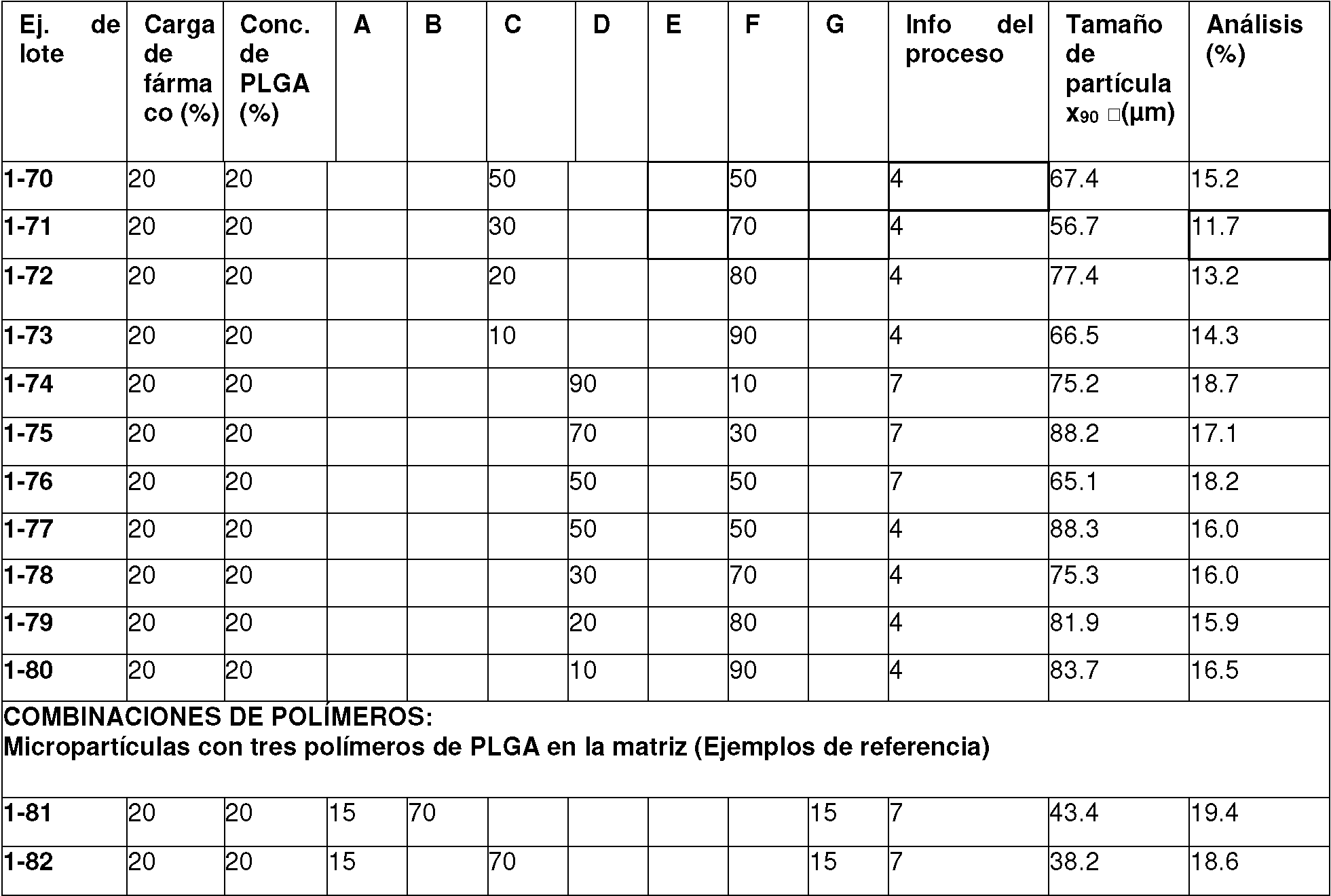
A: PLG-estrella-D-glucosa 50:50 éster 0.3 dL/g (%) A: PLG-star-D-glucose 50:50 ester 0.3 dL / g (%)
B: PLGA 65:35 éster 0.6 dL/g (%) B: PLGA 65:35 ester 0.6 dL / g (%)
C: PLGA 75:25 éster 0.4 dL/g (%) C: PLGA 75:25 ester 0.4 dL / g (%)
D: PLGA 75:25 éster 0.6 dL/g (%) D: PLGA 75:25 ester 0.6 dL / g (%)
E: PLGA 85:15 éster 0.4 dL/g (%) E: PLGA 85:15 ester 0.4 dL / g (%)
F: PLGA 85:15 éster 0.6 dL/g (%) F: PLGA 85:15 ester 0.6 dL / g (%)
G: PLA 100:0 ácido 0.2 dL/g (%) G: PLA 100: 0 acid 0.2 dL / g (%)
Info del proceso = Información adicional del proceso:Process info = Additional process information:
7: PBS 66 mM pH 7.4 7: 66 mM PBS pH 7.4
5: Tampón de citrato-fosfato 69 mM pH 5.0 5: 69 mM Citrate-Phosphate Buffer pH 5.0
4: Tampón de citrato-fosfato 69 mM pH 4.0 4: 69 mM Citrate-Phosphate Buffer pH 4.0
38: Velocidad de la turbina de 3800 rpm en lugar de 4500 rpm 38: Turbine speed of 3800 rpm instead of 4500 rpm
1:25: Relación de la tasa de flujo de S/Ac/Ag = 1:25 en lugar de 1:20 1:25: S / Ac / Ag flow rate ratio = 1:25 instead of 1:20
BE: Bomba de engranaje en lugar de bomba peristáltica BE: Gear pump instead of peristaltic pump
Ejemplo 2: Composiciones de vehículo A a GExample 2: Vehicle Compositions A to G
Se disuelven CMC-Na, manitol y Pluronic F68 en la cantidad que se indica en la Tabla 3 en aproximadamente 15 ml de agua desionizada caliente a una temperatura de aproximadamente 90 °C en condiciones de agitación vigorosa con un agitador magnético. La solución transparente resultante se enfría hasta 20 °C y se le añade agua desionizada hasta llegar a 20.0 ml.CMC-Na, mannitol and Pluronic F68 are dissolved in the amount indicated in Table 3 in about 15 ml of hot deionized water at a temperature of about 90 ° C under vigorous stirring conditions with a magnetic stirrer. The resulting clear solution is cooled to 20 ° C and deionized water is added to make it 20.0 ml.
Tabla 3: Vehículos adecuados ara las mcro artículas cantidades ro orcionadas enTable 3: Vehicles suitable for the micro items quantities ordered in

Ejemplo 3: Suspensión de micropartículasExample 3: Suspension of microparticles
Se suspenden 170 mg de micropartículas del ejemplo 1-33 en 1.0 ml de un vehículo de composición D (Table 3) en un vial 6 R. Las suspensiones se homogeneizan agitándolas durante aproximadamente 30 segundos manualmente. La suspensión reconstituida se puede inyectar sin ningún problema utilizando una aguja de calibre 20.170 mg of microparticles from Example 1-33 are suspended in 1.0 ml of a vehicle of composition D (Table 3) in a 6 R vial. The suspensions are homogenized by shaking for approximately 30 seconds manually. The reconstituted suspension can be injected without any problem using a 20 gauge needle.
Ejemplo 4: Liofilización de las micropartículasExample 4: Lyophilization of the microparticles
Se reconstituyen 170 mg de micropartículas del ejemplo 1-33 en 1 ml de la composición de vehículo F (Tabla 3), se homogeneizan mediante agitación durante de 1 a 12 horas y a continuación se secan por congelación en un liofilizador. La reconstitución de las micropartículas liofilizadas con 1 ml de agua pura (agua para inyección) dio como resultado una humectación rápida y satisfactoria de las micropartículas, las cuales se pueden inyectar sin ningún problema utilizando una aguja de calibre 20.170 mg of microparticles from Example 1-33 are reconstituted in 1 ml of vehicle composition F (Table 3), homogenized by stirring for 1 to 12 hours, and then freeze-dried in a lyophilizer. Reconstitution of the lyophilized microparticles with 1 ml of pure water (water for injection) resulted in rapid and satisfactory wetting of the microparticles, which can be injected without any problem using a 20 gauge needle.
Ejemplo 5: Perfil de liberación in vivo (conejos)Example 5: In Vivo Release Profile (Rabbits)
Se suspenden micropartículas que contienen octreótido en 1 ml de un vehículo acuoso adecuado, preferentemente en el vehículo D, y la suspensión resultante se inyecta por vía intramuscular (i.m.) en conejos bastardos blancos de Nueva Zelanda con una dosis de 4 mg/kg. Para cada forma farmacéutica (grupo de prueba) se utilizan 4 animales. Después de periodos de tiempo definidos (que se indican en la Tabla 4), se toman muestras de plasma y se analizan para determinar la concentración de octreótido.Octreotide-containing microparticles are suspended in 1 ml of a suitable aqueous vehicle, preferably in vehicle D, and the resulting suspension is injected intramuscularly (i.m.) into New Zealand white bastard rabbits at a dose of 4 mg / kg. For each pharmaceutical form (test group) 4 animals are used. After defined periods of time (indicated in Table 4), plasma samples are taken and analyzed to determine the octreotide concentration.
Tabla 4: Niveles en plasma valores corre idos se ún la dosis ; concentración en n /mlTable 4: Plasma levels corrected values according to the dose; concentration in n / ml


* Dosis = 12 mg/kg * Dose = 12 mg / kg
Claims (10)
Applications Claiming Priority (2)
| Application Number | Priority Date | Filing Date | Title |
|---|---|---|---|
| GB0526247A GB0526247D0 (en) | 2005-12-22 | 2005-12-22 | Organic compounds |
| EP06119086 | 2006-08-17 |
Publications (1)
| Publication Number | Publication Date |
|---|---|
| ES2755032T3 true ES2755032T3 (en) | 2020-04-21 |
Family
ID=37772904
Family Applications (2)
| Application Number | Title | Priority Date | Filing Date |
|---|---|---|---|
| ES10175382T Active ES2755032T3 (en) | 2005-12-22 | 2006-12-20 | Sustained release formulation comprising octreotide and two or more polylactide-co-glycolide polymers |
| ES06841059.6T Active ES2492641T3 (en) | 2005-12-22 | 2006-12-20 | Sustained release formulation comprising octreotide and two or more polylactide-co-glycolide polymers |
Family Applications After (1)
| Application Number | Title | Priority Date | Filing Date |
|---|---|---|---|
| ES06841059.6T Active ES2492641T3 (en) | 2005-12-22 | 2006-12-20 | Sustained release formulation comprising octreotide and two or more polylactide-co-glycolide polymers |
Country Status (22)
| Country | Link |
|---|---|
| US (7) | US20090004283A1 (en) |
| EP (3) | EP2359809B1 (en) |
| JP (4) | JP2009520727A (en) |
| KR (5) | KR101458728B1 (en) |
| CN (1) | CN103251929A (en) |
| AR (1) | AR058591A1 (en) |
| AU (1) | AU2006328950B2 (en) |
| BR (2) | BR122019027412B8 (en) |
| CA (1) | CA2631811C (en) |
| CL (1) | CL2018003398A1 (en) |
| EC (1) | ECSP088560A (en) |
| ES (2) | ES2755032T3 (en) |
| IL (1) | IL191842A0 (en) |
| IN (1) | IN2015DN03936A (en) |
| MA (1) | MA30064B1 (en) |
| NO (1) | NO20082988L (en) |
| PE (1) | PE20071139A1 (en) |
| PL (2) | PL2359809T3 (en) |
| PT (2) | PT2359809T (en) |
| RU (1) | RU2464972C2 (en) |
| TW (2) | TWI469788B (en) |
| WO (1) | WO2007071395A1 (en) |
Families Citing this family (26)
| Publication number | Priority date | Publication date | Assignee | Title |
|---|---|---|---|---|
| JP5419169B2 (en) | 2007-06-06 | 2014-02-19 | デビオファーム リサーチ アンド マニュファクチャリング ソシエテ アノニム | Sustained release pharmaceutical composition comprising fine particles |
| US8470360B2 (en) * | 2008-04-18 | 2013-06-25 | Warsaw Orthopedic, Inc. | Drug depots having different release profiles for reducing, preventing or treating pain and inflammation |
| ES2324009B1 (en) * | 2007-11-23 | 2010-05-21 | Gp Pharm S.A. | PHARMACEUTICAL COMPOSITION OF SUSTAINED RELEASE OF SOMATOSTATINE OR AN ANALOG OF HIS. |
| KR101921800B1 (en) * | 2008-01-30 | 2018-11-23 | 노파르티스 아게 | Sustained release formulation comprising octreotide and three linear polylactide-co-glycolide polymers |
| AU2013201877B2 (en) * | 2008-01-30 | 2015-01-29 | Novartis Ag | Sustained release formulation comprising octreotide and three linear polylactide-co-glycolide polymers |
| AU2015201581B2 (en) * | 2008-09-17 | 2017-03-09 | Amryt Endo, Inc. | Pharmaceutical Compositions and Related Methods of Delivery |
| KR101814186B1 (en) * | 2008-09-17 | 2018-03-14 | 키아스마 인코포레이티드 | Pharmaceutical compositions and related methods of delivery |
| US20100151033A1 (en) * | 2008-12-15 | 2010-06-17 | Novartis Ag | Octreotide depot formulation with constantly high exposure levels |
| CA2750003A1 (en) * | 2009-01-23 | 2010-07-29 | Surmodics Pharmaceuticals, Inc. | Controlled release systems from polymer blends |
| WO2012012546A2 (en) * | 2010-07-21 | 2012-01-26 | Allergan, Inc. | METHOD OF CONTROLLING INITIAL DRUG RELEASE OF siRNA FROM SUSTAINED-RELEASE IMPLANTS |
| GB201016436D0 (en) | 2010-09-30 | 2010-11-17 | Q Chip Ltd | Method of making solid beads |
| GB201016433D0 (en) | 2010-09-30 | 2010-11-17 | Q Chip Ltd | Apparatus and method for making solid beads |
| WO2012083026A1 (en) * | 2010-12-15 | 2012-06-21 | Evonik Degussa Corporation | Branched polyol polyesters, blends and pharmaceutical formulations comprising same |
| HUE046004T2 (en) | 2011-04-25 | 2020-01-28 | Shan Dong Luye Pharm Co Ltd | Risperidone sustained release microsphere composition |
| CN102488619B (en) * | 2011-12-05 | 2014-08-06 | 上海交通大学 | Device for continuously producing exenatide microspheres and method for controlling release rate of microspheres |
| WO2016084849A1 (en) * | 2014-11-25 | 2016-06-02 | Cbc株式会社 | Janus particles and method for producing same |
| WO2016126830A1 (en) | 2015-02-03 | 2016-08-11 | Chiasma Inc. | Method of treating diseases |
| JP6165356B2 (en) * | 2015-06-26 | 2017-07-19 | オリンパス株式会社 | Endoscope system |
| US12396951B2 (en) * | 2016-12-27 | 2025-08-26 | Upexmed Co. Ltd. | Prevention of local tumor recurrence following surgery using sustainedand/or delayed release of medicaments contained in micro-particles |
| KR102142026B1 (en) * | 2017-05-31 | 2020-08-06 | 주식회사 대웅제약 | Method of preparing sustained release drug microparticles with ease of release control |
| MX2022002980A (en) | 2019-09-16 | 2022-04-06 | Amgen Inc | METHOD FOR THE EXTERNAL STERILIZATION OF A DRUG SUPPLY DEVICE. |
| CN111214643A (en) * | 2020-03-11 | 2020-06-02 | 苏州善湾生物医药科技有限公司 | Octreotide composition based on subcutaneous gel sustained release, preparation method and application |
| JP6852943B1 (en) * | 2020-05-08 | 2021-03-31 | エム・テクニック株式会社 | Microspheres in which the main agent is uniformly dispersed and sustained-release preparations containing them |
| KR102947969B1 (en) * | 2020-05-08 | 2026-04-06 | 엠. 테크닉 가부시키가이샤 | Microspheres in which physiologically active substances are uniformly dispersed and sustained-release formulations containing the same |
| KR102947972B1 (en) * | 2020-05-08 | 2026-04-06 | 엠. 테크닉 가부시키가이샤 | Microspheres in which physiologically active substances are uniformly dispersed and sustained-release formulations containing the same |
| US11141457B1 (en) | 2020-12-28 | 2021-10-12 | Amryt Endo, Inc. | Oral octreotide therapy and contraceptive methods |
Family Cites Families (27)
| Publication number | Priority date | Publication date | Assignee | Title |
|---|---|---|---|---|
| US3773919A (en) * | 1969-10-23 | 1973-11-20 | Du Pont | Polylactide-drug mixtures |
| DE3062075D1 (en) | 1979-11-27 | 1983-03-24 | Sandoz Ag | Polypeptides, processes for their production, pharmaceutical compositions comprising said polypeptides and their use |
| US4675189A (en) * | 1980-11-18 | 1987-06-23 | Syntex (U.S.A.) Inc. | Microencapsulation of water soluble active polypeptides |
| US4897268A (en) * | 1987-08-03 | 1990-01-30 | Southern Research Institute | Drug delivery system and method of making the same |
| US5538739A (en) | 1989-07-07 | 1996-07-23 | Sandoz Ltd. | Sustained release formulations of water soluble peptides |
| PH30995A (en) * | 1989-07-07 | 1997-12-23 | Novartis Inc | Sustained release formulations of water soluble peptides. |
| HU221294B1 (en) * | 1989-07-07 | 2002-09-28 | Novartis Ag | Process for producing retarde compositions containing the active ingredient in a polymeric carrier |
| MY107937A (en) * | 1990-02-13 | 1996-06-29 | Takeda Chemical Industries Ltd | Prolonged release microcapsules. |
| CH683149A5 (en) * | 1991-07-22 | 1994-01-31 | Debio Rech Pharma Sa | Process for the preparation of microspheres of a biodegradable polymeric material. |
| US5470582A (en) * | 1992-02-07 | 1995-11-28 | Syntex (U.S.A.) Inc. | Controlled delivery of pharmaceuticals from preformed porous polymeric microparticles |
| KR100260632B1 (en) * | 1992-12-28 | 2000-07-01 | 성재갑 | Implantable somatotropin composition |
| US5603960A (en) * | 1993-05-25 | 1997-02-18 | O'hagan; Derek T. | Preparation of microparticles and method of immunization |
| US5417982A (en) * | 1994-02-17 | 1995-05-23 | Modi; Pankaj | Controlled release of drugs or hormones in biodegradable polymer microspheres |
| US6447796B1 (en) * | 1994-05-16 | 2002-09-10 | The United States Of America As Represented By The Secretary Of The Army | Sustained release hydrophobic bioactive PLGA microspheres |
| WO1998027980A2 (en) * | 1996-12-20 | 1998-07-02 | Takeda Chemical Industries, Ltd. | Method of producing a sustained-release preparation |
| MY118835A (en) * | 1997-04-18 | 2005-01-31 | Ipsen Pharma Biotech | Sustained release compositions and the process for their preparation |
| IL133105A (en) * | 1997-06-04 | 2004-09-27 | Debio Rech Pharma Sa | Implants for controlled release of pharmaceutically active principles and method for making same |
| ES2169980B1 (en) * | 1999-12-17 | 2003-11-01 | Lipotec Sa | MICROCAPSULES FOR THE PROLONGED RELEASE OF PHARMACOS. |
| KR100392501B1 (en) * | 2000-06-28 | 2003-07-22 | 동국제약 주식회사 | Preparation Method for Sustained Release Microparticles by Multiple Emulsion Method and Micropartic les Thereof |
| ES2292655T3 (en) * | 2002-03-15 | 2008-03-16 | Alrise Biosystems Gmbh | MICROPARTICLES AND PROCEDURE FOR PREPARATION. |
| RU2355385C2 (en) * | 2002-11-06 | 2009-05-20 | Алза Корпорейшн | Compositions of prolongedaction with controlled release |
| US20040097419A1 (en) * | 2002-11-19 | 2004-05-20 | Holger Petersen | Organic compounds |
| KR100466637B1 (en) * | 2003-06-26 | 2005-01-13 | 주식회사 펩트론 | Method for preparing a mixed formulation of sustained release microspheres by continuous one-step process |
| ES2600554T3 (en) * | 2003-07-18 | 2017-02-09 | Oakwood Laboratories L.L.C. | Prevention of polymer molecular weight reduction, impurity formation and gelation in polymeric compositions |
| JP5165240B2 (en) * | 2003-07-23 | 2013-03-21 | ピーアール ファーマシューティカルズ, インコーポレイテッド | Sustained release composition |
| MY158342A (en) * | 2003-11-14 | 2016-09-30 | Novartis Ag | Pharmaceutical composition |
| DE602005013244D1 (en) * | 2004-08-12 | 2009-04-23 | Quest Pharmaceutical Services | PHARMACEUTICAL COMPOSITIONS FOR CONTROL |
-
2006
- 2006-12-20 ES ES10175382T patent/ES2755032T3/en active Active
- 2006-12-20 PE PE2006001665A patent/PE20071139A1/en not_active Application Discontinuation
- 2006-12-20 US US12/158,345 patent/US20090004283A1/en not_active Abandoned
- 2006-12-20 KR KR1020137004517A patent/KR101458728B1/en active Active
- 2006-12-20 WO PCT/EP2006/012313 patent/WO2007071395A1/en not_active Ceased
- 2006-12-20 AU AU2006328950A patent/AU2006328950B2/en active Active
- 2006-12-20 KR KR1020147031146A patent/KR20140133968A/en not_active Ceased
- 2006-12-20 PT PT101753820T patent/PT2359809T/en unknown
- 2006-12-20 KR KR1020137004518A patent/KR20130024987A/en not_active Ceased
- 2006-12-20 EP EP10175382.0A patent/EP2359809B1/en active Active
- 2006-12-20 KR KR1020137004520A patent/KR20130024988A/en not_active Ceased
- 2006-12-20 PL PL10175382T patent/PL2359809T3/en unknown
- 2006-12-20 ES ES06841059.6T patent/ES2492641T3/en active Active
- 2006-12-20 BR BR122019027412A patent/BR122019027412B8/en active IP Right Grant
- 2006-12-20 CN CN2013101523825A patent/CN103251929A/en active Pending
- 2006-12-20 AR ARP060105668A patent/AR058591A1/en unknown
- 2006-12-20 RU RU2008129626/15A patent/RU2464972C2/en active
- 2006-12-20 KR KR1020087014985A patent/KR101245919B1/en active Active
- 2006-12-20 BR BRPI0620063A patent/BRPI0620063B8/en active IP Right Grant
- 2006-12-20 EP EP06841059.6A patent/EP1968549B1/en active Active
- 2006-12-20 CA CA2631811A patent/CA2631811C/en active Active
- 2006-12-20 JP JP2008546248A patent/JP2009520727A/en active Pending
- 2006-12-20 PT PT68410596T patent/PT1968549E/en unknown
- 2006-12-20 IN IN3936DEN2015 patent/IN2015DN03936A/en unknown
- 2006-12-20 PL PL06841059T patent/PL1968549T3/en unknown
- 2006-12-20 EP EP19188892.4A patent/EP3603623A1/en not_active Withdrawn
- 2006-12-21 TW TW95148218A patent/TWI469788B/en active
- 2006-12-21 TW TW103107772A patent/TWI468172B/en active
-
2008
- 2008-05-29 IL IL191842A patent/IL191842A0/en unknown
- 2008-06-18 MA MA31048A patent/MA30064B1/en unknown
- 2008-06-19 EC EC2008008560A patent/ECSP088560A/en unknown
- 2008-07-02 NO NO20082988A patent/NO20082988L/en not_active Application Discontinuation
-
2013
- 2013-04-25 JP JP2013092845A patent/JP6239851B2/en active Active
-
2014
- 2014-10-08 JP JP2014207464A patent/JP6178772B2/en active Active
- 2014-10-16 US US14/516,016 patent/US20150037420A1/en not_active Abandoned
-
2015
- 2015-12-22 US US14/977,801 patent/US20160120935A1/en not_active Abandoned
-
2016
- 2016-06-09 JP JP2016115579A patent/JP2016216467A/en not_active Withdrawn
-
2018
- 2018-01-17 US US15/873,473 patent/US20180140662A1/en not_active Abandoned
- 2018-11-29 CL CL2018003398A patent/CL2018003398A1/en unknown
-
2020
- 2020-03-10 US US16/813,864 patent/US20200206306A1/en not_active Abandoned
-
2022
- 2022-06-07 US US17/834,014 patent/US20220296675A1/en not_active Abandoned
-
2024
- 2024-11-22 US US18/956,119 patent/US20250082718A1/en active Pending
Also Published As
Similar Documents
| Publication | Publication Date | Title |
|---|---|---|
| ES2755032T3 (en) | Sustained release formulation comprising octreotide and two or more polylactide-co-glycolide polymers | |
| US20240082148A1 (en) | Octreotide Depot Formulation with Constantly High Exposure Levels | |
| US8999390B2 (en) | Sustained release formulation comprising octreotide and three linear polylactide-co-glycolide polymers |