EP4485573A1 - Precursor of lithium-containing oxide positive electrode material, lithium-containing oxide positive electrode material, preparation methods therefor and use thereof, and positive electrode plate and use thereof - Google Patents
Precursor of lithium-containing oxide positive electrode material, lithium-containing oxide positive electrode material, preparation methods therefor and use thereof, and positive electrode plate and use thereof Download PDFInfo
- Publication number
- EP4485573A1 EP4485573A1 EP22924653.3A EP22924653A EP4485573A1 EP 4485573 A1 EP4485573 A1 EP 4485573A1 EP 22924653 A EP22924653 A EP 22924653A EP 4485573 A1 EP4485573 A1 EP 4485573A1
- Authority
- EP
- European Patent Office
- Prior art keywords
- lithium
- cathode material
- sintering
- containing oxide
- precursor
- Prior art date
- Legal status (The legal status is an assumption and is not a legal conclusion. Google has not performed a legal analysis and makes no representation as to the accuracy of the status listed.)
- Pending
Links
Images


Classifications
-
- C—CHEMISTRY; METALLURGY
- C01—INORGANIC CHEMISTRY
- C01G—COMPOUNDS CONTAINING METALS NOT COVERED BY SUBCLASSES C01D OR C01F
- C01G45/00—Compounds of manganese
- C01G45/12—Complex oxides containing manganese and at least one other metal element
- C01G45/1221—Manganates or manganites with trivalent manganese, tetravalent manganese or mixtures thereof
- C01G45/1228—Manganates or manganites with trivalent manganese, tetravalent manganese or mixtures thereof of the type (MnO2)-, e.g. LiMnO2 or Li(MxMn1-x)O2
-
- H—ELECTRICITY
- H01—ELECTRIC ELEMENTS
- H01M—PROCESSES OR MEANS, e.g. BATTERIES, FOR THE DIRECT CONVERSION OF CHEMICAL ENERGY INTO ELECTRICAL ENERGY
- H01M4/00—Electrodes
- H01M4/02—Electrodes composed of, or comprising, active material
- H01M4/36—Selection of substances as active materials, active masses, active liquids
- H01M4/48—Selection of substances as active materials, active masses, active liquids of inorganic oxides or hydroxides
- H01M4/52—Selection of substances as active materials, active masses, active liquids of inorganic oxides or hydroxides of nickel, cobalt or iron
- H01M4/525—Selection of substances as active materials, active masses, active liquids of inorganic oxides or hydroxides of nickel, cobalt or iron of mixed oxides or hydroxides containing iron, cobalt or nickel for inserting or intercalating light metals, e.g. LiNiO2, LiCoO2 or LiCoOxFy
-
- C—CHEMISTRY; METALLURGY
- C01—INORGANIC CHEMISTRY
- C01G—COMPOUNDS CONTAINING METALS NOT COVERED BY SUBCLASSES C01D OR C01F
- C01G53/00—Compounds of nickel
- C01G53/40—Complex oxides containing nickel and at least one other metal element
- C01G53/42—Complex oxides containing nickel and at least one other metal element containing alkali metals, e.g. LiNiO2
-
- C—CHEMISTRY; METALLURGY
- C01—INORGANIC CHEMISTRY
- C01G—COMPOUNDS CONTAINING METALS NOT COVERED BY SUBCLASSES C01D OR C01F
- C01G53/00—Compounds of nickel
- C01G53/40—Complex oxides containing nickel and at least one other metal element
- C01G53/42—Complex oxides containing nickel and at least one other metal element containing alkali metals, e.g. LiNiO2
- C01G53/44—Complex oxides containing nickel and at least one other metal element containing alkali metals, e.g. LiNiO2 containing manganese
- C01G53/50—Complex oxides containing nickel and at least one other metal element containing alkali metals, e.g. LiNiO2 containing manganese of the type (MnO2)n-, e.g. Li(NixMn1-x)O2 or Li(MyNixMn1-x-y)O2
-
- H—ELECTRICITY
- H01—ELECTRIC ELEMENTS
- H01M—PROCESSES OR MEANS, e.g. BATTERIES, FOR THE DIRECT CONVERSION OF CHEMICAL ENERGY INTO ELECTRICAL ENERGY
- H01M10/00—Secondary cells; Manufacture thereof
- H01M10/05—Accumulators with non-aqueous electrolyte
- H01M10/052—Li-accumulators
- H01M10/0525—Rocking-chair batteries, i.e. batteries with lithium insertion or intercalation in both electrodes; Lithium-ion batteries
-
- H—ELECTRICITY
- H01—ELECTRIC ELEMENTS
- H01M—PROCESSES OR MEANS, e.g. BATTERIES, FOR THE DIRECT CONVERSION OF CHEMICAL ENERGY INTO ELECTRICAL ENERGY
- H01M4/00—Electrodes
- H01M4/02—Electrodes composed of, or comprising, active material
- H01M4/13—Electrodes for accumulators with non-aqueous electrolyte, e.g. for lithium-accumulators; Processes of manufacture thereof
- H01M4/131—Electrodes based on mixed oxides or hydroxides, or on mixtures of oxides or hydroxides, e.g. LiCoOx
-
- H—ELECTRICITY
- H01—ELECTRIC ELEMENTS
- H01M—PROCESSES OR MEANS, e.g. BATTERIES, FOR THE DIRECT CONVERSION OF CHEMICAL ENERGY INTO ELECTRICAL ENERGY
- H01M4/00—Electrodes
- H01M4/02—Electrodes composed of, or comprising, active material
- H01M4/36—Selection of substances as active materials, active masses, active liquids
- H01M4/48—Selection of substances as active materials, active masses, active liquids of inorganic oxides or hydroxides
- H01M4/50—Selection of substances as active materials, active masses, active liquids of inorganic oxides or hydroxides of manganese
- H01M4/505—Selection of substances as active materials, active masses, active liquids of inorganic oxides or hydroxides of manganese of mixed oxides or hydroxides containing manganese for inserting or intercalating light metals, e.g. LiMn2O4 or LiMn2OxFy
-
- C—CHEMISTRY; METALLURGY
- C01—INORGANIC CHEMISTRY
- C01P—INDEXING SCHEME RELATING TO STRUCTURAL AND PHYSICAL ASPECTS OF SOLID INORGANIC COMPOUNDS
- C01P2002/00—Crystal-structural characteristics
- C01P2002/70—Crystal-structural characteristics defined by measured X-ray, neutron or electron diffraction data
- C01P2002/74—Crystal-structural characteristics defined by measured X-ray, neutron or electron diffraction data by peak-intensities or a ratio thereof only
-
- C—CHEMISTRY; METALLURGY
- C01—INORGANIC CHEMISTRY
- C01P—INDEXING SCHEME RELATING TO STRUCTURAL AND PHYSICAL ASPECTS OF SOLID INORGANIC COMPOUNDS
- C01P2006/00—Physical properties of inorganic compounds
- C01P2006/11—Powder tap density
-
- C—CHEMISTRY; METALLURGY
- C01—INORGANIC CHEMISTRY
- C01P—INDEXING SCHEME RELATING TO STRUCTURAL AND PHYSICAL ASPECTS OF SOLID INORGANIC COMPOUNDS
- C01P2006/00—Physical properties of inorganic compounds
- C01P2006/40—Electric properties
-
- H—ELECTRICITY
- H01—ELECTRIC ELEMENTS
- H01M—PROCESSES OR MEANS, e.g. BATTERIES, FOR THE DIRECT CONVERSION OF CHEMICAL ENERGY INTO ELECTRICAL ENERGY
- H01M4/00—Electrodes
- H01M4/02—Electrodes composed of, or comprising, active material
- H01M2004/021—Physical characteristics, e.g. porosity, surface area
-
- H—ELECTRICITY
- H01—ELECTRIC ELEMENTS
- H01M—PROCESSES OR MEANS, e.g. BATTERIES, FOR THE DIRECT CONVERSION OF CHEMICAL ENERGY INTO ELECTRICAL ENERGY
- H01M4/00—Electrodes
- H01M4/02—Electrodes composed of, or comprising, active material
- H01M2004/026—Electrodes composed of, or comprising, active material characterised by the polarity
- H01M2004/028—Positive electrodes
-
- Y—GENERAL TAGGING OF NEW TECHNOLOGICAL DEVELOPMENTS; GENERAL TAGGING OF CROSS-SECTIONAL TECHNOLOGIES SPANNING OVER SEVERAL SECTIONS OF THE IPC; TECHNICAL SUBJECTS COVERED BY FORMER USPC CROSS-REFERENCE ART COLLECTIONS [XRACs] AND DIGESTS
- Y02—TECHNOLOGIES OR APPLICATIONS FOR MITIGATION OR ADAPTATION AGAINST CLIMATE CHANGE
- Y02E—REDUCTION OF GREENHOUSE GAS [GHG] EMISSIONS, RELATED TO ENERGY GENERATION, TRANSMISSION OR DISTRIBUTION
- Y02E60/00—Enabling technologies; Technologies with a potential or indirect contribution to GHG emissions mitigation
- Y02E60/10—Energy storage using batteries
Definitions
- the present disclosure relates to the technical field of lithium-ion batteries, and more particularly, to a precursor of a lithium-containing oxide cathode material, a lithium-containing oxide cathode material, a preparation method and use thereof, and a positive electrode plate and use thereof.
- Lithium-ion batteries as new energy carriers with excellent comprehensive performance, are widely used in markets such as electric vehicles, energy storage power stations, communications, digital electronic products, and the like.
- a positive electrode serves as a core material and directly determines technical performance level of the battery.
- cathode materials for lithium-ion batteries LiNi 1- x-y Co x Mn y O 2 (NCM) and LiNi 1- x - y Co x Al y O 2 (NCA) with layered structure and lithium-rich manganese-based materials (LMR) have attracted much attention and are adequately studied due to their high specific capacity and energy density.
- the cathode material has to be rolled with high pressure during a preparation process of an electrode plate to obtain a high electrode density.
- the cathode materials with low strength may be fractured or crushed in this process, which may increase contact area and side reactions with the electrolyte, thereby resulting in deterioration in cycle performance and rate performance.
- repeated Li + deintercalation may cause expansion or contraction of a volume of the layered structure, which may lead to pulverization of the low-strength cathode material, thereby resulting in insufficient contact between particles, continuous formation of new electrolyte layers and increased side reactions, and thereby deterioration and even failure of battery performance.
- An object of the present disclosure is to overcome the defects in the prior art that lithium-containing metal oxide materials may rupture during a preparation process of an electrode plate, or secondary particles may rupture during a charge and discharge cycle, resulting in poor rate performance, deterioration of cycle performance, and reduced safety performance.
- the lithium-containing oxide cathode material has high compressive strength and stability, only a small degree of fracture occurs under high pressure during a preparation process of the electrode plate, and it can be continuously subjected to lithium ion deintercalation/ deintercalation reactions without serious rupture.
- a first aspect of the present disclosure provides a lithium-containing oxide cathode material.
- the cathode material has a compressive index ⁇ (P 100 ) satisfying ⁇ (P 100 ) ⁇ 60%+( y / x ) ⁇ 5%, where y / x is a molar ratio of Mn/Ni in the cathode material.
- a second aspect of the present disclosure provides a precursor of a lithium-containing oxide cathode material.
- the precursor has a compressive index ⁇ '(P 50 ) satisfying ⁇ '(P 50 ) ⁇ 35%+( v / u ) ⁇ 8%, where v/u is a molar ratio of Mn/Ni in the precursor.
- a third aspect of the present disclosure provides a preparation method of a lithium-containing oxide cathode material.
- a fourth aspect of the present disclosure provides a lithium-containing oxide cathode material prepared by the above-mentioned preparation method of the lithium-containing oxide cathode material.
- a fifth aspect of the present disclosure provides a positive electrode plate.
- the positive electrode plate includes at least 90 wt% of a lithium-containing oxide cathode material based on a total weight of the positive electrode plate.
- the lithium-containing oxide cathode material is the above-mentioned lithium-containing oxide cathode material.
- a sixth aspect of the present disclosure provides use of the above-mentioned lithium-containing oxide cathode material, the above-mentioned precursor of the lithium-containing oxide cathode material, or the above-mentioned positive electrode plate in a lithium-ion battery.
- the present disclosure has the following advantages.
- endpoints and any value of the ranges shall not be limited to the exact range or value, and those ranges or values should be understood to include values close to those ranges or values.
- endpoints of respective ranges, an endpoint and individual point value of respective ranges, and individual point values can be combined with each other to obtain one or more new numerical ranges, which should be deemed to be specifically disclosed herein.
- the conventional lithium-ion batteries using lithium-containing metal oxide material have to withstand high pressure during the preparation process of electrode plates.
- the material may rupture due to its insufficient compressive strength or unstable structure, thereby increasing side reactions with the electrolyte.
- the consumption of the electrolyte and the dissolution of transition metal cations in the cathode material are accelerated, resulting in reduced cycle performance, safety performance, and capacity, and even battery failure.
- a first aspect of the present disclosure provides a lithium-containing oxide cathode material.
- the cathode material has a compressive index ⁇ (P 100 ) satisfying ⁇ (P 100 ) ⁇ 60%+( y / x ) ⁇ 5%, where y / x is a molar ratio of Mn/Ni in the cathode material.
- ⁇ P n 1 ⁇ D 5 0 ⁇ D 5 pn D 5 0 ⁇ 100 %
- D 5 refers to a particle size value when a cumulative volume distribution of the particles is 5%.
- the cathode material has a compressive index ⁇ (P 200 ) satisfying ⁇ (P 200 ) ⁇ 45%+( y / x ) ⁇ 5%.
- the cathode material has a compressive index ⁇ (P 300 ) satisfying ⁇ (P 300 ) ⁇ 35%+( y / x ) ⁇ 5%.
- the cathode material according to the present disclosure has excellent compressive strength and is not prone to rupture.
- the cathode material according to the present disclosure is used as a positive electrode, it has a stable structure, few side reactions, and excellent safety performance and capacity retention rate.
- M is selected from at least one element of Zr, Nb, Ti, Y, Sc, Cr, Co, W, Mg, La, Ta, and B; and M' is oxide, phosphide, sulfide, or fluoride containing at least one element of Zr, Nb, Ti, Y, Sc, Cr, Co, W, Mg, La, Ta, and B.
- the inventors found that: by adopting an appropriate modifier, the compressive strength and stability of material particles can be enhanced, a value of direct current internal resistance and gas production of the material during the cycle can be reduced, and the cycle life of the material can be prolonged.
- crystal structure of the material can be stabilized, micro-area structure of the material can be improved, and the compressive index, cycle life, and safety performance of the material can be improved.
- lithium-containing compounds such as LiNbO 3 , Li 2 ZrO 3 , Li 4 Ti 5 O 12 , Li 3 BO 3 , or LaNiO 3 , etc.
- LiNbO 3 Li 2 ZrO 3 , Li 4 Ti 5 O 12 , Li 3 BO 3 , or LaNiO 3 , etc.
- the cathode material according to the present disclosure also has other characteristics.
- the cathode material has a tap density of ⁇ 1.7 g/cm 3 , preferably ⁇ 2 g/cm 3 , and more preferably ⁇ 2.4 g/cm 3 .
- the cathode material has a pellet density of ⁇ 2.8 g/cm 3 , preferably ⁇ 3 g/cm 3 , and more preferably ⁇ 3.2 g/cm 3 .
- a content of surface soluble alkali of the cathode material satisfies the following conditions: Li 2 CO 3 ⁇ 1 wt%, LiOH ⁇ 0.5 wt%; preferably, Li 2 CO 3 ⁇ 0.5 wt%, LiOH ⁇ 0.4 wt%; further preferably, Li 2 CO 3 ⁇ 0.3 wt%, LiOH ⁇ 0.3 wt%; and more preferably, Li 2 CO 3 ⁇ 0.2 wt%, LiOH ⁇ 0.2 wt%.
- a full width at half maximum FWHM (003) of (003) crystal plane and a full width at half maximum FWHM (104) of (104) crystal plane of the cathode material obtained by X-Ray Diffraction (XRD) satisfy the following conditions: 0.10 ⁇ FWHM (003) ⁇ 0.25, and preferably, 0.13 ⁇ FWHM (003) ⁇ 0.22; and 0.20 ⁇ FWHM (104) ⁇ 0.50, and preferably, 0.22 ⁇ FWHM (104) ⁇ 0.42.
- a peak area S (003) of the (003) crystal plane and a peak area S (104) of the (104) crystal plane of the cathode material obtained by XRD satisfy the following conditions: 1.1 ⁇ S (003) /S (104) ⁇ 1.8, and preferably, 1.2 ⁇ S (003) /S (104) ⁇ 1.6.
- the present disclosure also achieves high crystallinity and compactness of the precursor by controlling the morphology and microstructure of the precursor, thereby increasing the compressive index of the cathode material.
- a second aspect of the present disclosure provides a precursor of a lithium-containing oxide cathode material.
- the precursor has a compressive index ⁇ '(P 50 ) satisfying ⁇ '(P 50 ) ⁇ 35%+( v / u ) ⁇ 8%, where v/u is a molar ratio of Mn/Ni in the precursor.
- the precursor has a compressive index ⁇ '(P 100 ) satisfying ⁇ '(P 100 ) ⁇ 25%+( v / u ) ⁇ 8%.
- the precursor has a chemical formula represented by Formula (1): Ni u Mn v M ⁇ (OH) 2 , Formula (1), where:
- micro-area interior or surface structure of the precursor can be stabilized.
- the precursor material according to the present disclosure is also characterized in the following aspects.
- the precursor has a tap density of ⁇ 1.2 g/cm 3 , preferably ⁇ 1.6 g/cm 3 , and further preferably ⁇ 2 g/cm 3 .
- the precursor has a specific surface area BET value satisfying BET ⁇ 30 m 2 /g, and preferably, BET ⁇ 25 m 2 /g.
- a full width at half maximum FWHM (001) of (001) crystal plane, a full width at half maximum FWHM (100) of (100) crystal plane, and a full width at half maximum FWHM (101) of (101) crystal plane of the precursor obtained by XRD satisfy the following conditions:
- a peak area S (101) of the (001) crystal plane and a peak area S (104) of the (101) crystal plane of the precursor obtained by XRD satisfy the following condition: S (001) /S (101) ⁇ 2.0.
- an integral area S (101) of the (001) crystal plane and an integral area S (104) of the (101) crystal plane of the precursor obtained by XRD satisfy the following condition: S (001) /S (101) ⁇ 2.0.
- the present disclosure further provides a preparation method of a precursor of a lithium-containing oxide cathode material.
- the preparation method includes: (1) mixing, by contacting, a solution or suspension of a nickel salt, a manganese salt, and a compound containing M, to obtain a mixed salt solution; and (2) feeding the parallel flows of the mixed salt solution, a precipitant solution, and a complexing agent solution l into a reactor for crystallization reaction, and performing solid-liquid separation, washing, heat treatment, and sieving treatment on the obtained slurry, to obtain the precursor of the lithium-containing oxide cathode material.
- the synthesis process of the precursor such as a concentration and type of the complexing agent, a concentration of the precipitant, stirring intensity, a reaction temperature, additives, a solid content, and a feed rate, a precursor with high crystallinity and compactness can be synthesized.
- the crystallinity, tap density, and compressive index of the precursor material can be improved.
- the compressive index of the precursor can be improved.
- the nickel salt, the manganese salt, or the additive containing M element are dissolved according to a molar ratio of u:v:y to form a mixed salt solution with a concentration ranging from 1 mol/L to 3 mol/L.
- the compound containing M is added into water to prepare an M solution or suspension with a certain concentration.
- the alkali solution with a concentration ranging from 2 mol/L to 10 mol/L is obtained by dissolving alkali.
- the complexing agent solution with a concentration ranging from 2 mol/L to 13 mol/L is obtained by dissolving a complexing agent.
- the slurry has a solid content ranging from 200 g/L to 1000 g/L, and preferably, from 300 g/L to 800 g/L.
- the mixed salt solution of Ni and Mn, the alkali solution, the complexing agent solution, and the M solution are respectively added to a reactor having an overflow pipe through respective liquid inlet pipes in parallel flows, the stirring speed is kept constant, and inlet flow rates of the mixed salt solution, the precipitant solution, the complexing agent solution, and the M solution are controlled.
- the reaction conditions include: a reaction temperature ranging from 40°C to 70°C, reaction pH ranging from 10.6 to 12.5, and a reaction duration ranging from 5 hours to 100 hours.
- the nickel salt is one or more of nickel sulfate, nickel chloride, nickel nitrate, and nickel acetate.
- the manganese salt is one or more of manganese sulfate, manganese chloride, manganese nitrate, and manganese acetate.
- the compound containing M is one or more of sulfate, chloride, nitrate, acetate, citrate, carbonate, phosphate, oxalate, and fluoride containing the element M.
- the precipitant is an alkaline substance
- the alkali is one or more of sodium hydroxide, potassium hydroxide, and lithium hydroxide.
- the complexing agent is one or more of salicylic acid, ammonium sulfate, ammonium chloride, ammonium hydroxide, sulfosalicylic acid, and ethylenediaminetetraacetic acid.
- the sintering system (including sintering temperature, heating rate, sintering atmosphere, etc.) during the preparation of the lithium-containing metal oxide is also very important and will affect the compressive index of the material.
- a third aspect of the present disclosure provides a preparation method of a lithium-containing oxide cathode material.
- the preparation method includes:
- the source of the element M in the cathode material includes the element M 1 in the precursor and the additive containing the element M 2 introduced during the first sintering process.
- the lithium source is at least one of lithium hydroxide, lithium carbonate, and lithium nitrate;
- the additive containing the element M 2 is selected from at least one of oxide, hydroxide, oxyhydroxide, phosphate, fluoride, boride, and carbonate containing the element M 2 .
- the element M 1 and the element M 2 are the same as or different from the element M, and are each selected from at least one element of Al, Zr, Nb, Ti, Y, Sc, Cr, Co, W, Mg, La, Os, Pr, Re, Ru, Sr, Sm, Ta, and B.
- the additive containing the element M' is selected from at least one of oxide, hydroxide, oxyhydroxide, phosphate, fluoride, boride, nitride, carbonate, and oxalate containing the element M'.
- a molar ratio Li/(Ni+Mn+M 1 +M 2 ) of the lithium source to a sum of the precursor and the additive containing the element M 2 ranges from 1 to 1.85, and preferably from 1 to 1.5.
- the additive containing the element M 2 is added according to M 2 /(Ni+Mn+M 1 +M 2 ) ranging from 0.0005 to 0.3, and preferably, from 0.001 to 0.2.
- a molar ratio M'/(Ni+Mn+M 1 +M 2 ) of the additive containing the element M' to the primary sintered material ranges from 0 to 0.1, and preferably, from 0.001 to 0.02.
- a molar ratio of Ni/Mn is greater than 1, that is, x / y >1
- a relationship between a sintering temperature T 1 of the first sintering and a content of Ni satisfies 550 ⁇ (2- x )°C ⁇ T 1 ⁇ 400 ⁇ (3- x )°C
- a sintering duration of the first sintering ranges from 6 hours to 20 hours, and preferably, from 8 hours to 15 hours.
- a relationship between a sintering temperature T 2 of the first sintering and a content of Mn satisfies 500 ⁇ (1+ y ) ⁇ T 2 ⁇ 650 ⁇ (1+ y )°C
- a sintering duration of the first sintering ranges from 6 hours to 20 hours, and preferably, from 8 hours to 15 hours.
- the first sintering and the second sintering are performed in an air atmosphere; when 0.5 ⁇ x ⁇ 0.6, the first sintering and the second sintering are performed in an air atmosphere or a mixture atmosphere of air and oxygen; and when x ⁇ 0.6, the first sintering and the second sintering are performed in an oxygen atmosphere or a mixture atmosphere of oxygen and air.
- a Li metal plate with a diameter of 17 mm and a thickness of 1 mm was used as a negative electrode; a polyethylene porous membrane with a thickness of 25 ⁇ m was used as a separator; and a mixture of equal amounts of 1 mol/L LiPF 6 , ethylene carbonate (EC), and diethyl carbonate (DEC) was used as an electrolyte.
- LiPF 6 ethylene carbonate
- DEC diethyl carbonate
- the positive electrode plate, the separator, the negative electrode plate, and the electrolyte were assembled into a 2025-type button battery in an Ar glove box with a water content and an oxygen content of less than 5 ppm, and the battery at this moment was regarded as an unactivated battery.
- the test conditions of the button battery were as follows.
- the button battery after being prepared, was placed for 2 hours. After the open circuit voltage was stabilized, the battery was charged to a cut-off voltage of 4.3V with a current density of 0.1C at the positive electrode, next charged at a constant voltage for 30 minutes, and then discharged to a cut-off voltage of 3.0V at a same current density. The same method was repeated once, and the battery at this moment was regarded as an activated battery.
- the activated battery Under a voltage ranging from 3.0V to 4.3V and within a charge and discharge range from 3.0V to 4.3V, the activated battery was subjected to charge and discharge tests at 25°C and at 0.1C to evaluate the charge and discharge capacity of the material.
- the activated battery was subjected to charge and discharge tests at 0.1C, 0.2C, 0.33C, 0.5C, and 1C, and a ratio of 1C capacity to 0.1C capacity was used to evaluate the rate performance of the material. In the range from 3.0V to 4.4V, the cycle performance of the material after 80 cycles at 1C was evaluated.
- the test conditions of the button battery were as follows.
- the button battery after being prepared, was placed for 2 hours. After the open circuit voltage was stabilized, the battery was charged to a cut-off voltage of 4.6V with a current density of 0.1C at the positive electrode, next charged at a constant voltage for 30 minutes, and then discharged to a cut-off voltage of 2.0V at a same current density. The same method was repeated once, and the battery at this moment was regarded as an activated battery.
- the activated battery Under a voltage ranging from 2.0V to 4.6V and within a charge and discharge range from 2.0V to 4.6V, the activated battery was subjected to charge and discharge tests at 25°C and at 0.1C to evaluate the charge and discharge capacity of the material.
- the activated battery was subjected to charge and discharge tests at 0.1C, 0.2C, 0.33C, 0.5C, and 1C, and a ratio of 1C capacity to 0.1C capacity was used to evaluate the rate performance of the material. In the range from 2.0V to 4.6V, the cycle performance of the material after 80 cycles at 0.5C was evaluated.
- Example 1 was intended to illustrate a lithium-containing oxide cathode material prepared according to the present disclosure.
- Nickel sulfate and manganese sulfate were dissolved according to a metal molar ratio of 5:3 to obtain a 2 mol/L mixed salt solution.
- Sodium hydroxide was dissolved to form an alkaline solution with a concentration of 6 mol/L, and ammonium hydroxide was dissolved to form a complexing agent solution with a concentration of 5 mol/L.
- the temperature was raised to 920°C, maintained for 10 hours, and naturally cooled, to obtain a primary sintered cathode material Li[Li 0 Ni 0.4975 Mn 0.2985 Co 0.1791 Al 0.0199 Ti 0.003 W 0.002 ]O 2 , which was recorded as S-1.
- Nb:(Ni+Mn+Co+Al+Ti+W) 0.002
- La:(Ni+Mn+Co+Al+Ti+W) 0.002.
- the temperature was raised to 650°C, maintained for 6 hours, and naturally cooled, to obtain a secondary sintered cathode material Li[Li 0 Ni 0.4975 Mn 0.2985 Co 0.1791 Al 0.0199 Ti 0.003 W 0.002 ]@Nb 0.002 La 0.002 , which was recorded as FS-1.
- Example 2 to Example 14 were intended to illustrate the lithium-containing oxide cathode material prepared according to the present disclosure.
- the lithium-containing oxide cathode material was prepared according to the same method as that of Example 1.
- Example 2 to Example 14 merely differed from Example 1 in the preparation processes of the precursor, primary sintered cathode material, and secondary sintered cathode material, as shown in Table 1.
- Example 1 Example 2
- Example 3 Example 4
- Example 5 Preparation process of precursor Nickel salt or manganese salt Nickel sulfate, manganese sulfate Nickel sulfate, manganese sulfate Nickel sulfate, manganese sulfate Nickel sulfate, manganese sulfate Nickel sulfate, manganese sulfate Ni/Mn ratio 5:3 6:2 7.5:2.4 8:1 9:0.5
- Comparative Example 1 adopted the same synthesis method and conditions as in Example 5. Comparative Example 1 merely differed from Example 5 in that, the first sintering temperature was adjusted to 600°C, and the cathode material obtained was recorded as D-1, as shown in Table 2.
- Comparative Example 2 adopted the same synthesis method and conditions as in Example 5. Comparative Example 2 merely differed from Example 5 in that, the first sintering temperature was adjusted to 900°C, and the cathode material obtained was recorded as D-2, as shown in Table 2.
- Comparative Example 3 adopted the same synthesis method and conditions as in Example 5. Comparative Example 3 merely differed from Example 5 in that, additives of rhenium oxide and samarium oxide were not added in the preparation process of the primary sintered cathode material, and the cathode material obtained was recorded as D-3, as shown in Table 2.
- Comparative Example 4 adopted the same synthesis method and conditions as in Example 5. Comparative Example 4 merely differed from Example 5 in that, additives of tungsten nitride and aluminum fluoride were not added in the preparation process of the secondary sintered cathode material, and the cathode material obtained was recorded as D-4, as shown in Table 2.
- Comparative Example 5 adopted the same synthesis method and conditions as in Example 9. Comparative Example 5 merely differed from Example 9 in that, the solid content was adjusted to 150 g/L in the preparation process of the precursor, and the cathode material obtained was recorded as D-5, as shown in Table 2.
- Comparative Example 6 adopted the same synthesis method and conditions as in Example 9. Comparative Example 6 merely differed from Example 9 in that, additives of tungsten oxide and aluminum hydroxide oxide were not added in the preparation process of the primary sintered cathode material, and the cathode material obtained was recorded as D-6, as shown in Table 2.
- Comparative Example 7 adopted the same synthesis method and conditions as in Example 9. Comparative Example 7 merely differed from Example 9 in that, the preparation process of the secondary sintered cathode material was omitted, and the cathode material obtained was recorded as D-7, as shown in Table 2.
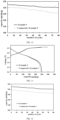
- FIG. 4 is a schematic comparison graph of cycle performance of Example 5 and Comparative Example 2. It can be seen from FIG. 4 by comparing the cycle performance of Example 5 and Comparative Example 2 that capacity retention rate according to Example 5 (94.6%) is significantly higher than that of the cathode material provided by D-2 (85.9%). The reason may be in that the sintering temperature is excessively high, the growth of primary crystal grains is excessive, which may lead to a low compressive index and unstable structure, thereby causing low capacity and cycle performance.
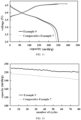
- FIG. 5 is a schematic comparison graph of charge-discharge curves of Example 5 and Comparative Example 3. It can be seen from FIG. 5 by comparing the charge-discharge curves of Example 5 and Comparative Example 3 that 0.1C discharge capacity according to Example 5 (225.2 mAh/g) is higher than that of the cathode material D-3 obtained when additives of rhenium oxide and samarium oxide are not added in the first sintering (221.7 mAh/g).
- the reason may be in that appropriate doping modification can improve micro-area structure of the material and form lithium-containing compounds on the surface of the particles or between the particles, which are all conducive to improving the compressive index of the material, thereby improving the electrochemical performance such as the capacity and cycle performance of the cathode material.
- FIG. 7 is a schematic comparison graph of charge-discharge curves of Example 5 and Comparative Example 4. It can be seen from FIG. 7 by comparing the charge-discharge curves of Example 5 and Comparative Example 4 that 0.1C discharge capacity according to Example 5 (225.2 mAh/g) is significantly higher than that of the cathode material D-4 obtained when additives of tungsten nitride and aluminum fluoride are not added in the second sintering (214.3 mAh/g).
- FIG. 8 is a schematic comparison graph of cycle performance of Example 5 and Comparative Example 4. It can be seen from FIG. 8 by comparing the cycle performance of Example 5 and Comparative Example 4 that the capacity retention rate according to Example 5 (94.6%) is significantly higher than that of the cathode material D-4 (86.6%). The above indicate that the addition of additives, i.e., tungsten nitride and aluminum fluoride, in the second sintering can improve the capacity and cycle performance of the material.
- additives i.e., tungsten nitride and aluminum fluoride
- the reason may be in that a stable coating layer may be formed on the surface of the material, which improves surface micro-area structure of the material, reduces surface side reactions of the material, and also helps to improve the compressive index of the material, thereby improving the electrochemical performance such as the capacity and cycle performance of the cathode material.
- FIG. 9 is a schematic comparison graph of charge-discharge curves of Example 9 and Comparative Example 5. It can be seen from FIG. 9 by comparing the charge-discharge curves of Example 9 and Comparative Example 5 that 0.1C discharge capacity according to Example 9 (250.7 mAh/g) is significantly higher than that of the cathode material D-5 obtained when the solid content is reduced to 150 g/L in the preparation process of the precursor (240.9 mAh/g).
- FIG. 10 is a schematic comparison graph of cycle performance of Example 9 and Comparative Example 5. It can be seen from FIG. 10 by comparing the cycle performance of Example 9 and Comparative Example 5 that the capacity retention rate according to Example 9 (93.9%) is significantly higher than that of the cathode material D-5 (88.0%). The reason may be in that low solid content may lead to poor crystallinity and compactness of the precursor, as well as changes in morphology and microstructure, thereby exhibiting a low compressive index and leading to deterioration of the electrochemical performance such as the capacity and cycle performance of the material.
- FIG. 11 is a schematic comparison graph of charge-discharge curves of Example 9 and Comparative Example 6. It can be seen from FIG. 11 by comparing the charge-discharge curves of Example 9 and Comparative Example 6 that 0.1C discharge capacity according to Example 9 (250.7 mAh/g) is significantly higher than that of the cathode material D-6 obtained when additives of tungsten oxide and aluminum hydroxide oxide are not added in the first sintering.
- FIG. 12 is a schematic comparison graph of cycle performance of Example 9 and Comparative Example 6. It can be seen from FIG. 12 by comparing the cycle performance of Example 9 and Comparative Example 6 that the capacity retention rate according to Example 9 (93.9%) is significantly higher than that of the cathode material D-6 (89.0%).
- the above shows that the addition of additives of tungsten oxide and aluminum hydroxide oxide in the first sintering can improve the capacity and cycle performance of the material.
- the reason may be in that appropriate doping modification can improve the micro-area structure of the material and form lithium-containing compounds on the surface of the particles or between the particles, which are all conducive to improving the compressive index of the material, thereby improving the electrochemical performance such as the capacity and cycle performance of the cathode material.
- FIG. 13 is a schematic comparison graph of charge-discharge curves of Example 9 and Comparative Example 7. It can be seen from FIG. 13 by comparing the charge-discharge curves of Example 9 and Comparative Example 7 that 0.1C discharge capacity according to Example 9 (250.7 mAh/g) is significantly higher than that of the cathode material D-7 obtained without the second sintering process.
- FIG. 14 is a schematic comparison graph of cycle performance of Example 9 and Comparative Example 7. It can be seen from FIG. 14 by comparing the cycle performance of Example 9 and Comparative Example 7 that the capacity retention rate according to Example 9 (93.9%) is significantly higher than that of the cathode material D-7 (89.9%).
- the above indicates that the second sintering can effectively improve the capacity and cycle performance of the material.
- the reason may be in that the second sintering process can form a stable coating layer on the surface of the material and rearrange atoms on the surface of the material, thereby improving the surface micro-area structure of the material, reducing the surface side reactions of the material, and improving the compressive index of the material. In this way, the electrochemical performance such as the capacity and cycle performance of the cathode material can be improved.
Landscapes
- Chemical & Material Sciences (AREA)
- Organic Chemistry (AREA)
- Chemical Kinetics & Catalysis (AREA)
- Electrochemistry (AREA)
- General Chemical & Material Sciences (AREA)
- Inorganic Chemistry (AREA)
- Engineering & Computer Science (AREA)
- Materials Engineering (AREA)
- Manufacturing & Machinery (AREA)
- Battery Electrode And Active Subsutance (AREA)
- Inorganic Compounds Of Heavy Metals (AREA)
- Secondary Cells (AREA)
Abstract
Description
- The present disclosure relates to the technical field of lithium-ion batteries, and more particularly, to a precursor of a lithium-containing oxide cathode material, a lithium-containing oxide cathode material, a preparation method and use thereof, and a positive electrode plate and use thereof.
- In recent years, new energy vehicles, as a strategic emerging industry to cope with environmental pollution and energy crisis, exhibit a tendency of booming development. Lithium-ion batteries, as new energy carriers with excellent comprehensive performance, are widely used in markets such as electric vehicles, energy storage power stations, communications, digital electronic products, and the like.
- In a lithium-ion battery, a positive electrode serves as a core material and directly determines technical performance level of the battery. Among the commonly used cathode materials for lithium-ion batteries, LiNi1-x-y Co x Mn y O2(NCM) and LiNi1-x-y Co x Al y O2(NCA) with layered structure and lithium-rich manganese-based materials (LMR) have attracted much attention and are adequately studied due to their high specific capacity and energy density. However, in order to obtain higher volume energy density and comprehensive electrochemical performance, the cathode material has to be rolled with high pressure during a preparation process of an electrode plate to obtain a high electrode density. The cathode materials with low strength may be fractured or crushed in this process, which may increase contact area and side reactions with the electrolyte, thereby resulting in deterioration in cycle performance and rate performance. In addition, during the use of battery, repeated Li+ deintercalation may cause expansion or contraction of a volume of the layered structure, which may lead to pulverization of the low-strength cathode material, thereby resulting in insufficient contact between particles, continuous formation of new electrolyte layers and increased side reactions, and thereby deterioration and even failure of battery performance.
- Therefore, it is of great significance to develop a new preparation method, to adjust microstructure of the cathode materials with the layered structure, and to enhance the compressive strength or particle strength of the cathode materials, for achieving long cycle life, high specific capacity, and high rate performance of batteries.
- An object of the present disclosure is to overcome the defects in the prior art that lithium-containing metal oxide materials may rupture during a preparation process of an electrode plate, or secondary particles may rupture during a charge and discharge cycle, resulting in poor rate performance, deterioration of cycle performance, and reduced safety performance. Provided are a precursor of a lithium-containing oxide cathode material, a lithium-containing oxide cathode material, a preparation method and use thereof, and a positive electrode plate and use thereof. The lithium-containing oxide cathode material has high compressive strength and stability, only a small degree of fracture occurs under high pressure during a preparation process of the electrode plate, and it can be continuously subjected to lithium ion deintercalation/ deintercalation reactions without serious rupture.
- In order to achieve the above-mentioned object, a first aspect of the present disclosure provides a lithium-containing oxide cathode material. The cathode material has a compressive index Δλ(P100) satisfying Δλ(P100)≥60%+(y/x)×5%, where y/x is a molar ratio of Mn/Ni in the cathode material.
- A second aspect of the present disclosure provides a precursor of a lithium-containing oxide cathode material. The precursor has a compressive index Δλ'(P50) satisfying Δλ'(P50)≥35%+(v/u)×8%, where v/u is a molar ratio of Mn/Ni in the precursor.
- A third aspect of the present disclosure provides a preparation method of a lithium-containing oxide cathode material. The preparation method includes: S1, uniformly mixing a precursor having a chemical formula represented by Formula (1), a lithium source, and an optional additive containing element M2, and performing a first sintering in an atmosphere furnace, to obtain a primary sintered material having a chemical formula represented by Formula (2); and S2: uniformly mixing the primary sintered material with an additive containing element M', and performing a second sintering on the mixed material in an atmosphere furnace, to obtain a lithium-containing metal oxide having a chemical formula represented by Formula (3),
Ni u Mn v M1γ(OH)2, Formula (1),
where: u+v+y=1, 0.2<u<1, 0<v≤0.75, 0≤γ≤0.35, and M1 is selected from at least one element of Al, Zr, Nb, Ti, Y, Sc, Cr, Co, W, Mg, Na, La, Os, Pr, Re, Ru, Sr, Sm, Ta, and B;
Li[Li a Ni x Mn y M j ]O2, Formula (2);
Li[Li a Ni x Mn y M j ]O2@M', Formula (3);
wherein in Formula (2) and Formula (3), a+x+y+j=1, 0≤a≤0.3, 0.2<x<1, 0<y≤0.75, 0<j≤0.35; and M includes element M1 in the precursor and element M2 introduced during the first sintering, M1 and M2 being the same or different and being each selected from at least one element of Al, Zr, Nb, Ti, Y, Sc, Cr, Co, W, Mg, La, Os, Pr, Re, Ru, Sr, Sm, Ta, and B; and wherein in Formula (3), M' is oxide, phosphide, sulfide, fluoride, or chloride containing at least one element of Al, Zr, Nb, Ti, Y, Sc, Cr, Co, W, Mg, La, Os, Pr, Re, Ru, Sr, Sm, Ta, and B, and a molar content of cations in M' is w, w satisfying 0<w/(a+x+y+j)≤0.1. - A fourth aspect of the present disclosure provides a lithium-containing oxide cathode material prepared by the above-mentioned preparation method of the lithium-containing oxide cathode material.
- A fifth aspect of the present disclosure provides a positive electrode plate. The positive electrode plate includes at least 90 wt% of a lithium-containing oxide cathode material based on a total weight of the positive electrode plate. The lithium-containing oxide cathode material is the above-mentioned lithium-containing oxide cathode material.
- A sixth aspect of the present disclosure provides use of the above-mentioned lithium-containing oxide cathode material, the above-mentioned precursor of the lithium-containing oxide cathode material, or the above-mentioned positive electrode plate in a lithium-ion battery.
- Based on the above-mentioned technical solutions, the present disclosure has the following advantages.
- (1) For the lithium-containing oxide cathode material and the precursor thereof according to the present disclosure, high crystallinity and compactness of the precursor can be achieved by controlling a specific microstructure, thereby improving the compressive index of the cathode material.
- (2) The present disclosure can improve the compressive index, cycle life, and safety performance of the material by means of appropriate modifiers and doping elements.
- (3) In the preparation process of the lithium-containing metal oxide according to the present disclosure, the sintering system affects the compressive index of the material. Therefore, when selecting the sintering system, cost and the compressive index, physical indicators, and electrochemical performance of the material can also be taken into consideration.
-
-
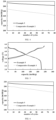
FIG. 1 is a schematic comparison graph of charge-discharge curves of Example 5 and Comparative Example 1; -
FIG. 2 is a schematic comparison graph of cycle performance of Example 5 and Comparative Example 1; -
FIG. 3 is a schematic comparison graph of charge-discharge curves of Example 5 and Comparative Example 2; -
FIG. 4 is a schematic comparison graph of cycle performance of Example 5 and Comparative Example 2; -
FIG. 5 is a schematic comparison graph of charge-discharge curves of Example 5 and Comparative Example 3; -
FIG. 6 is a schematic comparison graph of cycle performance of Example 5 and Comparative Example 3; -
FIG. 7 is a schematic comparison graph of charge-discharge curves of Example 5 and Comparative Example 4; -
FIG. 8 is a schematic comparison graph of cycle performance of Example 5 and Comparative Example 4; -
FIG. 9 is a schematic comparison graph of charge-discharge curves of Example 9 and Comparative Example 5; -
FIG. 10 is a schematic comparison graph of cycle performance of Example 9 and Comparative Example 5; -
FIG. 11 is a schematic comparison graph of charge-discharge curves of Example 9 and Comparative Example 6; -
FIG. 12 is a schematic comparison graph of cycle performance of Example 9 and Comparative Example 6; -
FIG. 13 is a schematic comparison graph of charge-discharge curves of Example 9 and Comparative Example 7; and -
FIG. 14 is a schematic comparison graph of cycle performance of Example 9 and Comparative Example 7. - In the present disclosure, endpoints and any value of the ranges shall not be limited to the exact range or value, and those ranges or values should be understood to include values close to those ranges or values. For numerical ranges, endpoints of respective ranges, an endpoint and individual point value of respective ranges, and individual point values can be combined with each other to obtain one or more new numerical ranges, which should be deemed to be specifically disclosed herein.
- The conventional lithium-ion batteries using lithium-containing metal oxide material have to withstand high pressure during the preparation process of electrode plates. In addition, during continuous charge and discharge cycles, the material may rupture due to its insufficient compressive strength or unstable structure, thereby increasing side reactions with the electrolyte. Thus, the consumption of the electrolyte and the dissolution of transition metal cations in the cathode material are accelerated, resulting in reduced cycle performance, safety performance, and capacity, and even battery failure.
- As mentioned above, a first aspect of the present disclosure provides a lithium-containing oxide cathode material. The cathode material has a compressive index Δλ(P100) satisfying Δλ(P100)≥60%+(y/x)×5%, where y/x is a molar ratio of Mn/Ni in the cathode material.
- In addition, in the present disclosure:


- For example, the compressive index Δλ(P100) is calculated based on the following equation:

- According to the present disclosure, preferably, the cathode material has a compressive index Δλ(P200) satisfying Δλ(P200)≥45%+(y/x)×5%.
- According to the present disclosure, more preferably, the cathode material has a compressive index Δλ(P300) satisfying Δλ(P300)≥35%+(y/x)×5%.
- According to the present disclosure, it should be noted that Δλ(P100) represents the compressive index of the material when pressure P=100Mpa; Δλ(P200) represents the compressive index of the material when pressure P=200Mpa; and so on.
- The cathode material according to the present disclosure has excellent compressive strength and is not prone to rupture. When the cathode material according to the present disclosure is used as a positive electrode, it has a stable structure, few side reactions, and excellent safety performance and capacity retention rate.
- According to the present disclosure, the lithium-containing oxide cathode material has a chemical formula represented by Formula (3):
Li[Li a Ni x Mn y M j ]O2@M', Formula (3),
where: a+x+y+j=1; 0≤a≤0.3; 0.2<x<1; 0<y≤0.75; 0<j≤0.35; M is selected from at least one element of Al, Zr, Nb, Ti, Y, Sc, Cr, Co, W, Mg, La, Os, Pr, Re, Ru, Sr, Sm, Ta, and B; M' is oxide, phosphide, sulfide, fluoride, or chloride containing at least one element of Al, Zr, Nb, Ti, Y, Sc, Cr, Co, W, Mg, La, Os, Pr, Re, Ru, Sr, Sm, Ta, and B; and a molar content of cations in M' is w, w satisfying 0<w/(a+x+y+j)≤0.1. - According to the present disclosure, preferably, 0.02≤a≤0.3; 0.3<x<0.9; 0.05<y≤0.68; 0<j≤0.3; and 0.001<w/(a+x+y+j)≤0.02.
- According to the present disclosure, M is selected from at least one element of Zr, Nb, Ti, Y, Sc, Cr, Co, W, Mg, La, Ta, and B; and M' is oxide, phosphide, sulfide, or fluoride containing at least one element of Zr, Nb, Ti, Y, Sc, Cr, Co, W, Mg, La, Ta, and B.
- In the present disclosure, the inventors found that: by adopting an appropriate modifier, the compressive strength and stability of material particles can be enhanced, a value of direct current internal resistance and gas production of the material during the cycle can be reduced, and the cycle life of the material can be prolonged.
- By doping with elements such as Ti, Sc, Zr, W, Mg, Y, Co, Cr, Ta, and the like, crystal structure of the material can be stabilized, micro-area structure of the material can be improved, and the compressive index, cycle life, and safety performance of the material can be improved. By doping with elements such as Ti, Zr, Nb, La, W, Co, B, and the like, lithium-containing compounds (such as LiNbO3, Li2ZrO3, Li4Ti5O12, Li3BO3, or LaNiO3, etc.) may be formed on the surface of the material particles or at the interface between the particles, thereby stabilizing the surface structure of the material particles or the interface strength between the particles or the grain boundary structure between the primary crystal grains, and the compressive index and cycle life of the material can be improved. Furthermore, transmission of lithium-ions between the particles and between the interfaces can be accelerated, and rate performance of the material can be improved. The cathode material according to the present disclosure also has other characteristics.
- According to the present disclosure, the cathode material has a tap density of ≥1.7 g/cm3, preferably ≥2 g/cm3, and more preferably ≥2.4 g/cm3.
- According to the present disclosure, the cathode material has a pellet density of ≥2.8 g/cm3, preferably ≥3 g/cm3, and more preferably ≥3.2 g/cm3.
- According to the present disclosure, a content of surface soluble alkali of the cathode material satisfies the following conditions: Li2CO3≤1 wt%, LiOH≤0.5 wt%; preferably, Li2CO3≤0.5 wt%, LiOH≤0.4 wt%; further preferably, Li2CO3≤0.3 wt%, LiOH≤0.3 wt%; and more preferably, Li2CO3≤0.2 wt%, LiOH≤0.2 wt%.
- According to the present disclosure, a full width at half maximum FWHM(003) of (003) crystal plane and a full width at half maximum FWHM(104) of (104) crystal plane of the cathode material obtained by X-Ray Diffraction (XRD) satisfy the following conditions: 0.10≤FWHM(003)≤0.25, and preferably, 0.13≤FWHM(003)≤0.22; and 0.20≤FWHM(104)≤0.50, and preferably, 0.22≤FWHM(104)≤0.42.
- According to the present disclosure, a peak area S(003) of the (003) crystal plane and a peak area S(104) of the (104) crystal plane of the cathode material obtained by XRD satisfy the following conditions: 1.1≤S(003)/S(104)≤1.8, and preferably, 1.2≤S(003)/S(104)≤1.6.
- In addition to using suitable additives, the present disclosure also achieves high crystallinity and compactness of the precursor by controlling the morphology and microstructure of the precursor, thereby increasing the compressive index of the cathode material.
- A second aspect of the present disclosure provides a precursor of a lithium-containing oxide cathode material. The precursor has a compressive index Δλ'(P50) satisfying Δλ'(P50)≥35%+(v/u)×8%, where v/u is a molar ratio of Mn/Ni in the precursor.
- According to the present disclosure, preferably, the precursor has a compressive index Δλ'(P100) satisfying Δλ'(P100)≥25%+(v/u)×8%.
- According to the present disclosure, it should be noted that Δλ'(P50) represents the compressive index of the precursor material when pressure P=50 MPa; Δλ'(P100) represents the compressive index of the precursor material when pressure P=100 MPa; and so on.
- In the present disclosure,



- For example, the compressive index Δλ'(P50) of the precursor is calculated as follows:

- According to the present disclosure, the precursor has a chemical formula represented by Formula (1):
Ni u Mn v Mγ(OH)2, Formula (1),
where: - u+v+γ=1, 0.2<u<1, 0<v≤0.75, 0≤γ≤0.35, and M is selected from at least one element of Al, Zr, Nb, Ti, Y, Sc, Cr, Co, W, Mg, Na, La, Os, Pr, Re, Ru, Sr, Sm, Ta, and B; and
- preferably, 0.3≤u≤0.9, 0.05≤v≤0.68, 0≤γ≤0.3, and M is selected from at least one element of Ti, Al, Zr, W, Co, Nb, La, Na, and Mg.
- In the present disclosure, by doping with elements such as Ti, Al, Zr, W, Co, Nb, La, Na, and Mg, micro-area interior or surface structure of the precursor can be stabilized.
- The precursor material according to the present disclosure is also characterized in the following aspects.
- According to the present disclosure, more preferably, the precursor has a tap density of ≥1.2 g/cm3, preferably ≥1.6 g/cm3, and further preferably ≥2 g/cm3.
- According to the present disclosure, the precursor has a specific surface area BET value satisfying BET≤30 m2/g, and preferably, BET≤25 m2/g.
- According to the present disclosure, the precursor has a particle size distribution coefficient K90 satisfying 0.5≤K90≤1.6, where K90=(D90-D10)/D50, and D10, D50, and D90 refer to the particle size values when the cumulative volume distribution of the particles is 10%, 50%, and 90%, respectively.
- According to the present disclosure, a full width at half maximum FWHM(001) of (001) crystal plane, a full width at half maximum FWHM(100) of (100) crystal plane, and a full width at half maximum FWHM(101) of (101) crystal plane of the precursor obtained by XRD satisfy the following conditions:
- 0.3≤FWHM(001)≤1, and preferably, 0.5≤FWHM(001)≤0.8, i.e., 2θ, measured by an X-ray diffractometer, of FWHM(001) of the precursor material according to the present disclosure is not less than 0.3 and not greater than 1, and preferably, not less than 0.5 and not greater than 0.8;
- 0.10≤FWHM(100)≤0.5, and preferably, 0.25≤FWHM(100)≤0.35; and
- 0.30≤FWIM(101)≤1.0, and preferably, 0.4≤FWHM(101)≤0.8.
- According to the present disclosure, a peak area S(101) of the (001) crystal plane and a peak area S(104) of the (101) crystal plane of the precursor obtained by XRD satisfy the following condition: S(001)/S(101)≥2.0.
- According to the present disclosure, an integral area S(101) of the (001) crystal plane and an integral area S(104) of the (101) crystal plane of the precursor obtained by XRD satisfy the following condition: S(001)/S(101)≥2.0.
- The present disclosure further provides a preparation method of a precursor of a lithium-containing oxide cathode material. The preparation method includes: (1) mixing, by contacting, a solution or suspension of a nickel salt, a manganese salt, and a compound containing M, to obtain a mixed salt solution; and (2) feeding the parallel flows of the mixed salt solution, a precipitant solution, and a complexing agent solution l into a reactor for crystallization reaction, and performing solid-liquid separation, washing, heat treatment, and sieving treatment on the obtained slurry, to obtain the precursor of the lithium-containing oxide cathode material.
- In the present disclosure, the inventors found that: for metal hydroxide precursors, during the mixing and sintering process, the precursor may rupture due to its insufficient compressive strength, resulting in reduced compressive strength, reduced tap density, and reduced electrochemical performance of the prepared cathode material. In the present disclosure, by controlling the synthesis process of the precursor, such as a concentration and type of the complexing agent, a concentration of the precipitant, stirring intensity, a reaction temperature, additives, a solid content, and a feed rate, a precursor with high crystallinity and compactness can be synthesized. By adjusting the particle size distribution and specific surface area of the precursor, the crystallinity, tap density, and compressive index of the precursor material can be improved. In addition, by adding suitable additives and adjusting the microstructure and morphology of the precursor, the compressive index of the precursor can be improved.
- According to the present disclosure, the nickel salt, the manganese salt, or the additive containing M element are dissolved according to a molar ratio of u:v:y to form a mixed salt solution with a concentration ranging from 1 mol/L to 3 mol/L. The compound containing M is added into water to prepare an M solution or suspension with a certain concentration. The alkali solution with a concentration ranging from 2 mol/L to 10 mol/L is obtained by dissolving alkali. The complexing agent solution with a concentration ranging from 2 mol/L to 13 mol/L is obtained by dissolving a complexing agent.
- According to the present disclosure, the slurry has a solid content ranging from 200 g/L to 1000 g/L, and preferably, from 300 g/L to 800 g/L.
- According to the present disclosure, the mixed salt solution of Ni and Mn, the alkali solution, the complexing agent solution, and the M solution are respectively added to a reactor having an overflow pipe through respective liquid inlet pipes in parallel flows, the stirring speed is kept constant, and inlet flow rates of the mixed salt solution, the precipitant solution, the complexing agent solution, and the M solution are controlled.
- According to the present disclosure, the reaction conditions include: a reaction temperature ranging from 40°C to 70°C, reaction pH ranging from 10.6 to 12.5, and a reaction duration ranging from 5 hours to 100 hours.
- According to the present disclosure, the nickel salt is one or more of nickel sulfate, nickel chloride, nickel nitrate, and nickel acetate.
- According to the present disclosure, the manganese salt is one or more of manganese sulfate, manganese chloride, manganese nitrate, and manganese acetate.
- According to the present disclosure, the compound containing M is one or more of sulfate, chloride, nitrate, acetate, citrate, carbonate, phosphate, oxalate, and fluoride containing the element M.
- According to the present disclosure, the precipitant is an alkaline substance, and the alkali is one or more of sodium hydroxide, potassium hydroxide, and lithium hydroxide.
- According to the present disclosure, the complexing agent is one or more of salicylic acid, ammonium sulfate, ammonium chloride, ammonium hydroxide, sulfosalicylic acid, and ethylenediaminetetraacetic acid.
- According to the present disclosure, the sintering system (including sintering temperature, heating rate, sintering atmosphere, etc.) during the preparation of the lithium-containing metal oxide is also very important and will affect the compressive index of the material.
- A third aspect of the present disclosure provides a preparation method of a lithium-containing oxide cathode material. The preparation method includes:
- S1, uniformly mixing a precursor having a chemical formula represented by Formula (1), a lithium source, and an optional additive containing element M2, and performing a first sintering on the mixed material in an atmosphere furnace, to obtain a primary sintered material having a chemical formula represented by Formula (2); and
- S2, uniformly mixing the primary sintered material with an additive containing element M', and performing a second sintering on the mixed material in an atmosphere furnace, to obtain a lithium-containing metal oxide having a chemical formula represented by Formula (3),
Ni u Mn v M1γ(OH)2, Formula (1),
where: u+v+γ=1, 0.2<u<1, 0<v≤0.75, 0≤γ≤0.35, and M1 is selected from at least one element of Al, Zr, Nb, Ti, Y, Sc, Cr, Co, W, Mg, Na, La, Os, Pr, Re, Ru, Sr, Sm, Ta, and B;
Li[Li a Ni x Mn y M j ]O2, Formula (2);
Li[Li a Ni x Mn y M j ]O2@M', Formula (3);
- wherein in Formula (2) and Formula (3), 0≤a≤0.3, 0.2<x<1, 0<y≤0.75, 0<j≤0.35; and M includes element M1 in the precursor and element M2 introduced during the first sintering, M1 and M2 being the same or different and being each selected from at least one element of Al, Zr, Nb, Ti, Y, Sc, Cr, Co, W, Mg, La, Os, Pr, Re, Ru, Sr, Sm, Ta, and B; and wherein in Formula (3), M' is oxide, phosphide, sulfide, fluoride, or chloride containing at least one element of Al, Zr, Nb, Ti, Y, Sc, Cr, Co, W, Mg, La, Os, Pr, Re, Ru, Sr, Sm, Ta, and B, and a molar content of cations in M' is w, w satisfying 0<w/(a+x+y+j)≤0.1.
- According to the present disclosure, the source of the element M in the cathode material includes the element M1 in the precursor and the additive containing the element M2 introduced during the first sintering process.
- According to the present disclosure, the lithium source is at least one of lithium hydroxide, lithium carbonate, and lithium nitrate;
- According to the present disclosure, the additive containing the element M2 is selected from at least one of oxide, hydroxide, oxyhydroxide, phosphate, fluoride, boride, and carbonate containing the element M2.
- According to the present disclosure, the element M1 and the element M2 are the same as or different from the element M, and are each selected from at least one element of Al, Zr, Nb, Ti, Y, Sc, Cr, Co, W, Mg, La, Os, Pr, Re, Ru, Sr, Sm, Ta, and B.
- According to the present disclosure, the additive containing the element M' is selected from at least one of oxide, hydroxide, oxyhydroxide, phosphate, fluoride, boride, nitride, carbonate, and oxalate containing the element M'.
- According to the present disclosure, a molar ratio Li/(Ni+Mn+M1+M2) of the lithium source to a sum of the precursor and the additive containing the element M2 ranges from 1 to 1.85, and preferably from 1 to 1.5.
- According to the present disclosure, the additive containing the element M2 is added according to M2/(Ni+Mn+M1+M2) ranging from 0.0005 to 0.3, and preferably, from 0.001 to 0.2.
- According to the present disclosure, a molar ratio M'/(Ni+Mn+M1+M2) of the additive containing the element M' to the primary sintered material ranges from 0 to 0.1, and preferably, from 0.001 to 0.02.
- According to the present disclosure, when a molar ratio of Ni/Mn is greater than 1, that is, x/y>1, a relationship between a sintering temperature T1 of the first sintering and a content of Ni satisfies 550×(2-x)°C<T1≤400×(3-x)°C, and a sintering duration of the first sintering ranges from 6 hours to 20 hours, and preferably, from 8 hours to 15 hours.
- According to the present disclosure, when the molar ratio of Ni/Mn is smaller than or equal to 1, that is, y/x≥1, a relationship between a sintering temperature T2 of the first sintering and a content of Mn satisfies 500×(1+y)≤T2<650×(1+y)°C, and a sintering duration of the first sintering ranges from 6 hours to 20 hours, and preferably, from 8 hours to 15 hours.
- According to the present disclosure, when x<0.5, the first sintering and the second sintering are performed in an air atmosphere; when 0.5≤x<0.6, the first sintering and the second sintering are performed in an air atmosphere or a mixture atmosphere of air and oxygen; and when x≥0.6, the first sintering and the second sintering are performed in an oxygen atmosphere or a mixture atmosphere of oxygen and air.
- A fourth aspect of the present disclosure provides a lithium-containing oxide cathode material prepared by the above-mentioned preparation method of the lithium-containing oxide cathode material.
- A fifth aspect of the present disclosure provides a positive electrode plate. The positive electrode plate includes at least 90 wt% of a lithium-containing oxide cathode material based on a total weight of the positive electrode plate. The lithium-containing oxide cathode material is the above-mentioned lithium-containing oxide cathode material.
- According to the present disclosure, preferably, a mass percentage of the cathode material is not less than 95%.
- According to the present disclosure, the positive electrode plate has an electrode density of ≥2.8 g/cm3, preferably ≥3.2 g/cm3, and more preferably ≥3.5 g/cm3.
- A sixth aspect of the present disclosure provides use of the above-mentioned lithium-containing oxide cathode material, the above-mentioned precursor of the lithium-containing oxide cathode material, or the above-mentioned positive electrode plate in a lithium-ion battery.
- The present disclosure will be described in detail below by way of examples.
- In the following examples and comparative examples, all raw materials are commercially available, unless otherwise specified.
- In the following examples, the involved performances were obtained by the following ways.
- (1) Phase test: test by means of a SmartLab 9kW X-ray diffractometer from Rigaku Corporation, Japan.
- (2) Morphology test: test by means of S-4800 scanning electron microscope from Hitachi, Ltd, Japan.
- (3) Particle size test: test by means of Hydro 2000mu laser particle size analyzer from Marvern, Inc.
- (4) Specific surface area: obtained by means of Tristar II 3020 specific surface area tester from Micromertics, USA.
- (5) Tap density: obtained by means of BT-30 tap density tester from Baxter Company.
- (6) Pellet density: obtained by means of MCP-PD51 powder impedance tester from Mitsubishi Chemical Corporation, Japan.
- (7) Compressive index test: the material was compressed under a specific pressure by means of 4350 manual tablet press from Carver Company, USA, and the particle size of the fractured material was measured and calculated based on the equation of compressive index.
- (8) Surface residual alkali test: measured by titration using Metrohmm888 professional Tirando intelligent potentiometric titrator.
- (9) Thermal stability test: by using TGA-DSC3 thermogravimetric analyzer from Mettler Toledo.
- (10) Electrochemical performance test:
- The electrochemical performance of the prepared lithium-containing oxide cathode material was obtained by testing 2025-type button batteries using Xinwei Battery Test System. Specifically:
- Preparation of electrode plate: a lithium-containing oxide cathode material, carbon black, and polyvinylidene fluoride according to a certain mass ratio were fully mixed with an appropriate amount of N-methylpyrrolidone to prepare a uniform slurry, and the slurry was coated on an aluminum foil, dried at 120°C, rolled, and punched to form a positive electrode plate with a diameter of 11 mm.
- Assembly of battery: a Li metal plate with a diameter of 17 mm and a thickness of 1 mm was used as a negative electrode; a polyethylene porous membrane with a thickness of 25 µm was used as a separator; and a mixture of equal amounts of 1 mol/L LiPF6, ethylene carbonate (EC), and diethyl carbonate (DEC) was used as an electrolyte.
- The positive electrode plate, the separator, the negative electrode plate, and the electrolyte were assembled into a 2025-type button battery in an Ar glove box with a water content and an oxygen content of less than 5 ppm, and the battery at this moment was regarded as an unactivated battery.
- When a molar ratio of Ni/Mn was greater than 1, i.e., x/y>1, the test conditions of the button battery were as follows. The button battery, after being prepared, was placed for 2 hours. After the open circuit voltage was stabilized, the battery was charged to a cut-off voltage of 4.3V with a current density of 0.1C at the positive electrode, next charged at a constant voltage for 30 minutes, and then discharged to a cut-off voltage of 3.0V at a same current density. The same method was repeated once, and the battery at this moment was regarded as an activated battery. Under a voltage ranging from 3.0V to 4.3V and within a charge and discharge range from 3.0V to 4.3V, the activated battery was subjected to charge and discharge tests at 25°C and at 0.1C to evaluate the charge and discharge capacity of the material. The activated battery was subjected to charge and discharge tests at 0.1C, 0.2C, 0.33C, 0.5C, and 1C, and a ratio of 1C capacity to 0.1C capacity was used to evaluate the rate performance of the material. In the range from 3.0V to 4.4V, the cycle performance of the material after 80 cycles at 1C was evaluated.
- When the molar ratio of Ni/Mn is not greater than 1, that is, x/y≤1, the test conditions of the button battery were as follows. The button battery, after being prepared, was placed for 2 hours. After the open circuit voltage was stabilized, the battery was charged to a cut-off voltage of 4.6V with a current density of 0.1C at the positive electrode, next charged at a constant voltage for 30 minutes, and then discharged to a cut-off voltage of 2.0V at a same current density. The same method was repeated once, and the battery at this moment was regarded as an activated battery. Under a voltage ranging from 2.0V to 4.6V and within a charge and discharge range from 2.0V to 4.6V, the activated battery was subjected to charge and discharge tests at 25°C and at 0.1C to evaluate the charge and discharge capacity of the material. The activated battery was subjected to charge and discharge tests at 0.1C, 0.2C, 0.33C, 0.5C, and 1C, and a ratio of 1C capacity to 0.1C capacity was used to evaluate the rate performance of the material. In the range from 2.0V to 4.6V, the cycle performance of the material after 80 cycles at 0.5C was evaluated.
- Example 1 was intended to illustrate a lithium-containing oxide cathode material prepared according to the present disclosure.
- Nickel sulfate and manganese sulfate were dissolved according to a metal molar ratio of 5:3 to obtain a 2 mol/L mixed salt solution. Cobalt sulfate and aluminum sulfate were dissolved according to metal molar ratios of Co/(Ni+Mn+Co+Al)=0.18 and Al/(Ni+Mn+Co+Al)=0.02 to obtain a 2 mol/L mixed salt solution. Sodium hydroxide was dissolved to form an alkaline solution with a concentration of 6 mol/L, and ammonium hydroxide was dissolved to form a complexing agent solution with a concentration of 5 mol/L.
- Then, 20L of mixed salt solution, alkaline solution, and complexing agent solution were added into a reactor in parallel for reaction. The stirring speed was kept constant at 600 rpm during the process. In the meantime, an inlet flow rate of the mixed salt solution was controlled to 300 mL/h, reaction pH was controlled to 11.6, reaction temperature was kept at 50°C, and a concentration of ammonia in the reaction system was controlled to be 9 g/L. The reaction was carried out in N2 gas, and the reaction was stayed for 60 hours. The solid content was 500 g/L. The slurry obtained through crystallization reaction of the precipitate was subjected to solid-liquid separation and washing, and then dried at 105°C for 10 hours. A spherical Ni0.5Mn0.3Co0.18Al0.02(OH)2 precursor material was obtained after sieving, which was recorded as P-1.
- The precursor P-1, lithium carbonate, and additives TiO2 and WO3 were mixed evenly in a high-speed mixer according to Li:(Ni+Mn+Co+Al+Ti+W)=1.03, Ti:(Ni+Mn+Co+Al+Ti+W)=0.003, W:(Ni+Mn+Co+Al+Ti+W)=0.002. In an air atmosphere, the temperature was raised to 920°C, maintained for 10 hours, and naturally cooled, to obtain a primary sintered cathode material Li[Li0Ni0.4975Mn0.2985Co0.1791Al0.0199Ti0.003W0.002]O2, which was recorded as S-1.
- The primary sintered material S-1, and additives Nb2O5 and La2O3 were mixed evenly according to Nb:(Ni+Mn+Co+Al+Ti+W)=0.002 and La:(Ni+Mn+Co+Al+Ti+W)=0.002. In an air atmosphere, the temperature was raised to 650°C, maintained for 6 hours, and naturally cooled, to obtain a secondary sintered cathode material Li[Li0Ni0.4975Mn0.2985Co0.1791Al0.0199Ti0.003W0.002]@Nb0.002La0.002, which was recorded as FS-1.
- Example 2 to Example 14 were intended to illustrate the lithium-containing oxide cathode material prepared according to the present disclosure.
- The lithium-containing oxide cathode material was prepared according to the same method as that of Example 1. Example 2 to Example 14 merely differed from Example 1 in the preparation processes of the precursor, primary sintered cathode material, and secondary sintered cathode material, as shown in Table 1.
[Table 1] Example 1 Example 2 Example 3 Example 4 Example 5 Preparation process of precursor Nickel salt or manganese salt Nickel sulfate, manganese sulfate Nickel sulfate, manganese sulfate Nickel sulfate, manganese sulfate Nickel sulfate, manganese sulfate Nickel sulfate, manganese sulfate Ni/Mn ratio 5:3 6:2 7.5:2.4 8:1 9:0.5 Additive M Cobalt sulfate, aluminum sulfate Cobalt sulfate Ammonium niobium oxalate Cobalt sulfate, ammonium tungstate Cobalt sulfate, aluminum sulfate Content of additive M Co/(Ni+Mn+Co+ Al)=0.18; Co/(Ni+Mn+Co)= Nb/(Ni+Mn+Nb) Co/(Ni+Mn+Co+ W)=0.09; Co/(Ni+Mn+Co+A 1)=0.03; Al/(Ni+Mn+Co+ Al)=0.02 0.2 =0.1 W/(Ni+Mn+Co+ W)=0.01 Al/(Ni+Mn+Co+Al )=0.02 Precipitant Sodium hydroxide Sodium hydroxide Sodium hydroxide Sodium hydroxide Sodium hydroxide Concentration of precipitant 6 mol/L 10 mol/L 2 mol/L 5 mol/L 5 mol/L Complexing agent Ammonium hydroxide Ammonium hydroxide Ammonium hydroxide Ammonium hydroxide Ammonium hydroxide Concentration of complexing agent 5 mol/L 8 mol/L 13 mol/L 5 mol/L 5 mol/L Reaction duration 60 h 80 h 100 h 80 h 50 h Reaction temperature 50°C 70°C 55°C 40°C 60°C pH 11.6 11.2 12 11.5 12 Stirring speed 600 rmp 800 rpm 500 rpm 700 rpm 600 rpm Solid content 500 g/L 1,000 g/L 200 g/L 800 g/L 500 g/L Preparation process of primary sintered cathode material Type of lithium salt Lithium carbonate Lithium carbonate Lithium hydroxide Lithium hydroxide Lithium hydroxide Type of additive M Titanium oxide, tungsten oxide Boric acid, praseodymium oxide Magnesium oxide, yttrium oxide, cobalt oxide Zirconium oxide, strontium hydroxide Rhenium oxide, samarium oxide Amount of lithium salt Li:(Ni+Mn+Co+ Al+Ti+W)=1.03 Li:(Ni+Mn+Co+B +Pr)=1.03 Li:(Ni+Mn+Nb+ Mg+Y+Co)=1.05 Li:(Ni+Mn+Co+ W+Zr+Sr)=1.05 Li:(Ni+Mn+Co+Al +Re+Sm)=1.02 Content of additive M Ti:(Ni+Mn+Co+A l+Ti+W)=0.003; Ti:(Ni+Mn+Co+B +Pr)=0.001; Mg:(Ni+Mn+Nb+ Mg+Y+Co)=0.00 5; Zr:(Ni+Mn+Co+ W+Zr+Sr)=0.005; Re:(Ni+Mn+Co+A 1+Re+Sm)=0.002; Y:(Ni+Mn+Nb+ Mg+Y+Co)=0.00 5; W:(Ni+Mn+Co+ Al+Ti+W)=0.002 Pr:(Ni+Mn+Co+B +Pr)=0.002 Sr: (Ni+Mn+Co+ W+Zr+Sr)=0.005 Sm: (Ni+Mn+Co+ Al+Re+Sm)=0.002 Co:(Ni+Mn+Nb+ Mg+Y+Co)=0.03 First sintering atmosphere Air Air Air Oxygen Oxygen First sintering temperature 920°C 900°C 850°C 820°C 790°C First sintering duration 10 h 15 h 10 h 12 h 20 h Preparation process of secondary sintered cathode material Type of additive M' Niobium pentoxide, lanthanum trioxide Aluminum fluoride, titanium dioxide Boric acid, tungsten oxide, tantalum oxide Aluminum phosphate, ruthenium oxide Tungsten nitride, aluminum fluoride Content of additive M' Nb:(Ni+Mn+Co+ Al+Ti+W)=0.002; Al:(Ni+Mn+Co+B +Pr)=0.003; B:(Ni+Mn+Nb+ Mg+Y+Co)=0.00 2; Al:(Ni+Mn+Co+ W+Zr+Sr)=0.05; W:(Ni+Mn+Co+Al +Re+Sm)=0.005; La: (Ni+Mn+Co+ Al+Ti+W)=0.002 Ti:(Ni+Mn+Co+B +Pr)=0.002 W:(Ni+Mn+Nb+ Ru:(Ni+Mn+Co+ W+Zr+Sr)=0.001 Al:(Ni+Mn+Co+Al +Re+Sm)=0.005 Mg+Y+Co)=0.00 5; Ta:(Ni+Mn+Nb+ Mg+Y+Co)=0.00 3 Second sintering atmosphere Air Air Air Oxygen Oxygen Second sintering temperature 650°C 450°C 500°C 700°C 700°C Second sintering duration 6 h 8 h 10 h 15 h 15 h [Table 1 (continued)] Example 6 Example 7 Example 8 Example 9 Example 10 Preparation process of precursor Nickel salt or manganese salt Nickel sulfate, manganese sulfate Nickel sulfate, manganese sulfate Nickel sulfate, manganese sulfate Nickel sulfate, manganese sulfate Nickel sulfate, manganese sulfate Ni/Mn ratio 9.5:0.2 9.7:0.2 3:6.5 3.3:6.7 2.5:7.5 Additive M Cobalt sulfate Aluminum sulfate Aluminum sulfate / / Content of additive M Co/(Ni+Mn+Co)= 0.03 Al/(Ni+Mn+Al) =0.01 Al/(Ni+Mn+Al)=0. 05 / / Precipitant Sodium hydroxide Potassium hydroxide Sodium hydroxide Sodium hydroxide Potassium hydroxide Concentration of precipitant 6 mol/L 4 mol/L 4 mol/L 5 mol/L 6 mol/L Complexing agent Ammonium hydroxide Ammonium hydroxide Ammonium hydroxide Ammonium hydroxide Ethylenediaminetet raacetic acid Concentration of complexing agent 5 mol/L 5 mol/L 4 mol/L 2 mol/L 1 mol/L Reaction duration 25 h 80 h 40 h 60 h 100 h Reaction temperature 40°C 50°C 30°C 40°C 50°C pH 12.5 12.0 11.0 11.2 11.5 Stirring speed 800 rpm 600 rpm 700 rpm 600 rpm 500 rpm Solid content 200 g/L 600 g/L 300 g/L 350 g/L 500 g/L Preparation process of primary sintered cathode material Type of lithium salt Lithium hydroxide Lithium hydroxide Lithium carbonate Lithium hydroxide Lithium hydroxide Type of additive M Yttrium oxide, zirconium oxide Cobalt oxyhydroxide, strontium hydroxide Titanium oxide, niobium oxide Tungsten oxide, aluminum oxyhydroxide Cobalt hydroxide, strontium hydroxide Amount of lithium salt Li:(Ni+Mn+Co+ Y+Zr)=1.03 Li:(Ni+Mn+Al+ Co+Sr)=1.03 Li: (Ni+Mn+Al+Ti+ Nb)=1.5 Li:(Ni+Mn+W+A 1)=1.4 Li:(Ni+Mn+Co+Sr )=1.3 Content of additive M Y:(Ni+Mn+Co+Y +Zr)=0.01; Co:(Ni+Mn+Al +Co+Sr)=0.01; Ti:(Li+Ni+Mn+Al+ Ti+Nb-1)=0.005; W:(Li+Ni+Mn+W +A1-1)=0.01; Co:(Li+Ni+Mn+C o+Sr-1)=0.01; Zr:(Ni+Mn+Co+ Y+Zr)=0.01 Sr:(Ni+Mn+Al+ Co+Sr)=0.002 Nb:(Li+Ni+Mn+Al +Ti+Nb-1)=0.005 Al:(Li+Ni+Mn+ W+Al-1)=0.005 Sr:(Li+Ni+Mn+Co +Sr-1)=0.005 First sintering atmosphere Oxygen Oxygen Air Air Air First sintering 775°C 750°C 800°C 810°C 850°C temperature First sintering duration 15 h 10 h 15 h 20 h 10 h Preparation process of secondary sintered cathode material Type of additive M' Aluminum oxide, titanium phosphate Scandium oxide, lanthanum oxide Aluminum fluoride, zirconium oxide Lanthanum fluoride, magnesium hydroxide Titanium phosphate, aluminum phosphate Content of additive M' Al:(Ni+Mn+Co+ Y+Zr)=0.005; Sc:(Ni+Mn+Al +Co+Sr)=0.002; Al:(Li+Ni+Mn+Al+ Ti+Nb-1)=0.002; La:(Li+Ni+Mn+ W+Al-1)=0.005; Ti:(Li+Ni+Mn+Co +Sr-1)=0.003; Ti: (Ni+Mn+Co+Y +Zr)=0.003 La:(Ni+Mn+Al +Co+Sr)=0.002 Zr:(Li+Ni+Mn+Al+ Ti+Nb-1)=0.003 Mg:(Li+Ni+Mn+ W+Al-1)=0.001 Al:(Li+Ni+Mn+Co +Sr-1)=0.002 Second sintering atmosphere Oxygen Oxygen Air Air Air Second sintering temperature 600°C 500°C 700°C 450°C 700°C Second sintering duration 10 h 10 h 8 h 10 h 10 h [Table 1 (continued)] Example 11 Example 12 Example 13 Example 14 Preparation process of precursor Nickel salt or manganese salt Nickel sulfate, manganese sulfate Nickel sulfate, manganese sulfate Manganese chloride, nickel nitrate Nickel chloride, manganese sulfate Ni/Mn ratio 2:3 1:4 5.5:4 2:8 Additive M / Cobalt sulfate Aluminum sulfate / Content of additive M / Co/(Ni+Mn+Co)=1:6 Al/(Ni+Mn+Al)=0.5 / Precipitant Sodium hydroxide Sodium hydroxide Sodium hydroxide Sodium hydroxide Concentration of precipitant 10 mol/L 10 mol/L 5 mol/L 5 mol/L Complexing agent Ammonium hydroxide Ammonium sulfate Ammonium hydroxide Ammonium hydroxide Concentration of complexing agent 5 mol/L 1 mol/L 2 mol/L 2 mol/L Reaction duration 75 h 80 h 60 h 80 h Reaction temperature 80°C 50°C 50°C 80°C pH 12.0 11.5 11.2 11.0 Stirring speed 800 rpm 600 rpm 800 rpm 500 rpm Solid content 600 g/L 500 g/L 500 g/L 400 g/L Preparation process of primary sintered cathode material Type of lithium salt Lithium hydroxide Lithium carbonate Lithium hydroxide Lithium hydroxide Type of additive M Chromium oxide, lanthanum oxide Yttrium oxide, zirconium oxide Magnesium hydroxide, titanium nitride Tantalum oxide, niobium oxyphosphate Amount of lithium salt Li: (Ni+Mn+Cr+La) =1.6 Li:(Ni+Mn+Co+Y+Zr )=1.35 Li: (Ni+Mn+Al+Mg+Ti) =1.45 Li: (Ni+Mn+Ta+Nb)=1.8 Content of additive M Cr:(Li+Ni+Mn+Cr+ La-1)=0.002; Y:(Li+Ni+Mn+Co+Y +Zr-1)=0.005; Mg:(Li+Ni+Mn+Al+M g+Ti-1)=0.01; Ta:(Li+Ni+Mn+Ta+Nb-1)=0.1; La:(Li+Ni+Mn+Cr+ La-1)=0.002 Zr:(Li+Ni+Mn+Co+Y +Zr-1)=0.005 Ti:(Li+Ni+Mn+Al+Mg +Ti-1)=0.005 Nb:(Li+Ni+Mn+Ta+Nb-1)=0.1 First sintering Oxygen Air Air Oxygen atmosphere First sintering temperature 780°C 800°C 740°C 900°C First sintering duration 15 h 10 h 15 h 20 h Preparation process of secondary sintered cathode material Type of additive M' Boric acid, rhenium oxide Aluminum oxide, tungsten oxide Cobalt oxide, titanium dioxide Molybdenum oxide, tungsten sulfide Content of additive M' B:(Li+Ni+Mn+Cr+ La-1)=0.002; Al:(Li+Ni+Mn+Co+Y +Zr-1)=0.005; Co:(Li+Ni+Mn+Al+Mg +Ti-1)=0.01; Mo: (Li+Ni+Mn+Ta+Nb-1)=0.002; Re:(Li+Ni+Mn+Cr +La-1)=0.002 W:(Li+Ni+Mn+Co+Y +Zr-1)=0.005 Ti:(Li+Ni+Mn+Al+Mg +Ti-1)=0.005 W: (Li+Ni+Mn+Ta+Nb-1)=0.005 Second sintering atmosphere Oxygen Air Air Oxygen Second sintering temperature 350°C 600°C 650°C 700°C Second sintering duration 20 h 6 h 6 h 10 h - In Table 1, unless otherwise specified, all ratios and amounts were molar ratios.
- Comparative Example 1 adopted the same synthesis method and conditions as in Example 5. Comparative Example 1 merely differed from Example 5 in that, the first sintering temperature was adjusted to 600°C, and the cathode material obtained was recorded as D-1, as shown in Table 2.
- Comparative Example 2 adopted the same synthesis method and conditions as in Example 5. Comparative Example 2 merely differed from Example 5 in that, the first sintering temperature was adjusted to 900°C, and the cathode material obtained was recorded as D-2, as shown in Table 2.
- Comparative Example 3 adopted the same synthesis method and conditions as in Example 5. Comparative Example 3 merely differed from Example 5 in that, additives of rhenium oxide and samarium oxide were not added in the preparation process of the primary sintered cathode material, and the cathode material obtained was recorded as D-3, as shown in Table 2.
- Comparative Example 4 adopted the same synthesis method and conditions as in Example 5. Comparative Example 4 merely differed from Example 5 in that, additives of tungsten nitride and aluminum fluoride were not added in the preparation process of the secondary sintered cathode material, and the cathode material obtained was recorded as D-4, as shown in Table 2.
- Comparative Example 5 adopted the same synthesis method and conditions as in Example 9. Comparative Example 5 merely differed from Example 9 in that, the solid content was adjusted to 150 g/L in the preparation process of the precursor, and the cathode material obtained was recorded as D-5, as shown in Table 2.
- Comparative Example 6 adopted the same synthesis method and conditions as in Example 9. Comparative Example 6 merely differed from Example 9 in that, additives of tungsten oxide and aluminum hydroxide oxide were not added in the preparation process of the primary sintered cathode material, and the cathode material obtained was recorded as D-6, as shown in Table 2.
- Comparative Example 7 adopted the same synthesis method and conditions as in Example 9. Comparative Example 7 merely differed from Example 9 in that, the preparation process of the secondary sintered cathode material was omitted, and the cathode material obtained was recorded as D-7, as shown in Table 2.
[Table 2] Comparative Example 1 Comparative Example 2 Comparative Example 3 Comparative Example 4 Preparation process of precursor Nickel salt or manganese salt Nickel sulfate, manganese sulfate Nickel sulfate, manganese sulfate Nickel sulfate, manganese sulfate Nickel sulfate, manganese sulfate Ni/Mn ratio 9:0.5 9:0.5 9:0.5 9:0.5 Additive M Cobalt sulfate, aluminum sulfate Cobalt sulfate, aluminum sulfate Cobalt sulfate, aluminum sulfate Cobalt sulfate, aluminum sulfate Content of additive M Co/(Ni+Mn+Co+Al)=0. 03; Co/(Ni+Mn+Co+Al)= 0.03; Co/(Ni+Mn+Co+Al)=0. 03; Co/(Ni+Mn+Co+Al)=0.03; Al/(Ni+Mn+Co+Al)=0. 02 Al/(Ni+Mn+Co+Al)= 0.02 Al/(Ni+Mn+Co+Al)=0. 02 Al/(Ni+Mn+Co+Al)=0.02 Precipitant Sodium hydroxide Sodium hydroxide Sodium hydroxide Sodium hydroxide Concentration of precipitant 5 mol/ L 5 mol/ L 5 mol/ L 5 mol/L Complexing agent Ammonium hydroxide Ammonium hydroxide Ammonium hydroxide Ammonium hydroxide Concentration 5 mol/ L 5 mol/ L 5 mol/ L 5 mol/L of complexing agent Reaction duration 50 h 50 h 50 h 50 h Reaction temperature 60° C 60° C 60° C 60°C pH 12.0 12.0 12.0 12.0 Stirring speed 600 rpm 600 rpm 600 rpm 600 rpm Solid content 500 g/L 500 g/L 500 g/L 500 g/L Preparation process of primary sintered cathode material Type of lithium salt Lithium hydroxide Lithium hydroxide Lithium hydroxide Lithium hydroxide Type of additive M Rhenium oxide, samarium oxide Rhenium oxide, samarium oxide / Rhenium oxide, samarium oxide Amount of lithium salt Li: (Ni+Mn+Co+Al+Re +Sm)=1.02 Li: (Ni+Mn+Co+Al+R e+Sm)=1.02 Li:(Ni+Mn+Co+Al)=1. 02 Li: (Ni+Mn+Co+Al+Re+S m)=1.02 Content of additive M Re: (Ni+Mn+Co+Al+Re +Sm)=0.002; Re:(Ni+Mn+Co+Al+ Re+Sm)=0.002; / Re: (Ni+Mn+Co+Al+Re+S m)=0.002; Sm: (Ni+Mn+Co+Al+R e+Sm)=0.002 Sm: (Ni+Mn+Co+Al+ Re+Sm)=0.002 Sm: (Ni+Mn+Co+Al+Re+ Sm)=0.002 First sintering atmosphere Oxygen Oxygen Oxygen Oxygen First sintering temperature 600°C 900°C 790°C 790°C First sintering duration 20 h 20 h 20 h 20 h Preparation process of secondary sintered cathode material Type of additive M' Tungsten nitride, aluminum fluoride Tungsten nitride, aluminum fluoride Tungsten nitride, aluminum fluoride / Content of additive M' W: (Ni+Mn+Co+Al+Re +Sm)=0.005; W:(Ni+Mn+Co+Al+R e+Sm)=0.005; W: (Ni+Mn+Co+Al+Re +Sm)=0.005; / Al: (Ni+Mn+Co+Al+Re +Sm)=0.005 Al:(Ni+Mn+Co+Al+ Re+Sm)=0.005 Al: (Ni+Mn+Co+Al+Re +Sm)=0.005 Second sintering atmosphere Oxygen Oxygen Oxygen Oxygen Second sintering temperature 700°C 700°C 700°C 700°C Second sintering duration 15h 15h 15 h 15h [Table 2 (continued)] Comparative Example 5 Comparative Example 6 Comparative Example 7 Preparation process of precursor Nickel salt or manganese salt Nickel sulfate, manganese sulfate Nickel sulfate, manganese sulfate Nickel sulfate, manganese sulfate Ni/Mn ratio 3.3:6.7 3.3:6.7 3.3:6.7 Additive M / / / Content of additive M / / / Precipitant Sodium hydroxide Sodium hydroxide Sodium hydroxide Concentration of precipitant 5 mol/L 5 mol/L 5 mol/L Complexing Ammonium hydroxide Ammonium hydroxide Ammonium hydroxide agent Concentration of complexing agent 2 mol/L 2 mol/L 2 mol/L Reaction duration 30 h 60 h 60 h Reaction temperature 40°C 40°C 40°C pH 11.2 11.2 11.2 Stirring speed 600 rpm 600 rpm 600 rpm Solid content 150 g/L 350 g/L 350 g/L Preparation process of primary sintered cathode material Type of lithium salt Lithium hydroxide Lithium hydroxide Lithium hydroxide Type of additive M Tungsten oxide, aluminum hydroxide oxide / Tungsten oxide, aluminum hydroxide oxide Amount of lithium salt Li:(Ni+Mn+W+Al)=1.4 Li:(Ni+Mn)=1.4 Li:(Ni+Mn+W+Al)=1.4 Content of additive M W: (Li+Ni+Mn+W+Al-1)=0.01; / W:(Li+Ni+Mn+W+Al-1)=0.01 Al:(Li+Ni+Mn+W+Al-1)=0.005 Al:(Li+Ni+Mn+W+Al-1)=0.005 First sintering atmosphere Air Air Air First sintering temperature 810°C 810°C 810°C First sintering duration 20 h 20 h 20 h Preparation process of secondary sintered cathode material Type of additive M' Lanthanum fluoride, magnesium hydroxide Lanthanum fluoride, magnesium hydroxide / Content of additive M' La:(Li+Ni+Mn+W+Al-1)=0.005; La:(Li+Ni+Mn+W+Al-1)=0.005; / Mg:(Li+Ni+Mn+W+Al-1)=0.001 Mg:(Li+Ni+Mn+W+Al-1)=0.001 Second sintering atmosphere Air Air / Second sintering temperature 450°C 450°C / Second sintering duration 10 h 10 h / - The performances of the precursors of the lithium-containing oxide cathode materials prepared in Example 1 to Example 14 and Comparative Example 1 to Comparative Example 7 were tested, and the results were shown in Table 3. The performances of the lithium-containing oxide cathode materials prepared in Example 1 to Example 14 and Comparative Example 1 to Comparative Example 7 were tested, and the results were shown in Table 4 and Table 5.
[Table 3] Precursor Chemical formula Δλ'(P50) Δλ'(P100) Example 1 Ni0.5Mn0.3Co0.18Al0.02(OH)2 49.8% 38.9% Example 2 Ni0.6Mn0.2Co0.2(OH)2 43.7% 37.6% Example 3 Ni0.75Mn0.24Nb0.01(OH)2 45.6% 37.5% Example 4 Ni0.8Mn0.1Co0.09W0.01(OH)2 44.2% 32.4% Example 5 Ni0.9Mn0.05Co0.03Al0.02(OH)2 45.4% 30.4% Example 6 Ni0.95Mn0.02Co0.03(OH)2 45.2% 33.3% Example 7 Ni0.97Mn0.02Al0.01(OH)2 45.6% 32.6% Example 8 Ni0.3Mn0.65Al0.05(OH)2 53.2% 42.4% Example 9 Ni0.33Mn0.67(OH)2 51.6% 42.6% Example 10 Ni0.25Mn0.75(OH)2 60.6% 50.0% Example 11 Ni0.4Mn0.6(OH)2 48.3% 38.3% Example 12 Ni0.167Co0.167Mn0.666(OH)2 67.8% 57.2% Example 13 Ni0.4Mn0.55Al0.05(OH)2 48.8% 38.6% Example 14 Ni0.2Mn0.8(OH)2 67.6% 57.5% Comparative Example 1 Ni0.9Mn0.05Co0.03Al0.02(OH)2 45.4% 30.4% Comparative Example 2 Ni0.9Mn0.05Co0.03Al0.02(OH)2 45.4% 30.4% Comparative Example 3 Ni0.9Mn0.05Co0.03Al0.02(OH)2 45.4% 30.4% Comparative Example 4 Ni0.9Mn0.05Co0.03Al0.02(OH)2 45.4% 30.4% Comparative Example 5 Ni0.33Mn0.67(OH)2 42.3% 33.6% Comparative Example 6 Ni0.33Mn0.67(OH)2 51.6% 42.6% Comparative Example 7 Ni0.33Mn0.67(OH)2 51.6% 42.6% [Table 4] Cathode material Example 1 Example 2 Example 3 Example 4 Example 5 Chemical formula Li[Ni0.4975Mn0.2985 Co0.1791Al0.0199Ti0.0 03W0.002]O2@0.001 Nb2O5·0.001La2O3 Li[Ni0.5982Mn0.1994 Co0.1994B0.001Pr0.002 ]O2@0.003AlF3·0. 002TiO2 Li[Ni0.72Mn0.2304Nb0. 0096Co0.03Mg0.005Y0.0 05]O2@0.001B2O3·0. 005WO3·0.0015Ta2 O5 Li[Ni0.792Mn0.099 Co0.0891W0.0099Zr 0.005Sr0.005]O2@0. 05AlPO4·0.001R uO2 Li[Ni0.8964Mn0.049 8Co0.0299Al0.0199R e0.002Sm0.002]O2@ 0.0025W2O3·0.0 05AlF3 Δλ(P100) 69.9% 67.8% 65.8% 65% 66.2% Δλ(P200) 52.5% 49.7% 48.6% 48.2% 48.5% Δλ(P300) 39.4% 38.1% 38% 37.7% 37.8% Tap density 2.4 2.7 2.1 2.4 2.5 Pellet density 3.2 3.3 3.5 3.3 3.7 Li2CO3 0.1% 0.2% 0.15% 0.18% 0.26% LiOH 0.1% 0.21% 0.25% 0.33% 0.28% FWHM(003) 0.17 0.18 0.19 0.18 0.18 FWHM(104) 0.24 0.25 0.28 0.26 0.27 S(003)/S(104) 1.3 1.26 1.22 1.3 1.35 [Table 4 (continued)] Cathode material Example 6 Example 7 Example 8 Example 9 Example 10 Chemical formula Li[Ni0.931Mn0.0196 Co0.0294Y0.01Zr0.01] O2@0.0025Al2O3· 0.001Ti3PO4 Li[Ni0.9405Mn0.0198 Al0.0297Co0.01Sr0.002 ]O2@0.001Sc2O3· 0.001La2O3 Li[Li0.2Ni0.237Mn0.513 5Al0.0395Ti0.005Nb0.005 ]O2@0.002AlF3·0.00 3ZrO2 Li[Li0.167Ni0.2699 Mn0.5481W0.01Al 0.005]O2@0.005 LaF3·0.001Mg O Li[Li0.131Ni0.2135 Mn0.6405Co0.01Sr 0.005]O2@0.001 Ti3PO4·0.002Al PO4 Δλ(P100) 64.2% 64.1% 75.8% 73.3% 78.6% Δλ(P200) 47.5% 47.2% 60.8% 58.9% 62.2% Δλ(P300) 37.1% 36.9% 47.2% 46.3% 52.8% Tap density 2.4 1.8 1.7 1.8 1.7 Pellet density 3.4 3.5 2.8 2.9 2.6 Li2CO3 0.45% 0.26% 0.16% 0.16% 0.15% LiOH 0.5% 0.17% 0.07% 0.14% 0.12% FWHM(003) 0.2 0.22 0.22 0.2 0.16 FWHM(104) 0.28 0.3 0.41 0.38 0.37 S(003)/S(104) 1.36 1.38 1.22 1.32 1.34 [Table 5] Cathode material Comparative Example 1 Comparative Example 2 Comparative Example 3 Comparative Example 4 Comparative Example 5 Comparative Example 6 Comparative Example 7 Chemical formula Li[Ni0.8964Mn 0.0498Co0.0299A l0.0199Re0.002S m0.002]O2@0. 0025W2O30. 005AlF3 Li[Ni0.8964Mn0 .0498Co0.0299Al0 .0199Re0.002Sm0 .002]O2@0.002 5W2O3·0.005 AlF3 Li[Ni0.9Mn0.05 Co0.03Al0.02]O 2@0.0025W2 O3·0.005AlF3 Li[Ni0.8964M n0.0498Co0.029 9Al0.0199Re0.0 02Sm0.002]O2 Li[Li0.167Ni0.2 699Mn0.5481W0 .01Al0.005]O2 @0.005LaF3· 0.001MgO Li[Li0.167Ni0. 2777Mn0.5553] O2@0.005La F3·0.001Mg O Li[Li0.167Ni0.26 99Mn0.5481W0.0 1Al0.005]O2 Δλ(P100) 53.2% 57.7% 55.5% 50.1% 55.6% 66.3% 63.8% Δλ(P200) 44.2% 45.0% 44.7% 41.5% 48.2% 51.6% 53.2% Δλ(P300) 30.3% 33.8% 32.6% 29.9% 38.6% 40.3% 42.1% Tap density 2.2 g/cm3 2.4 g/cm3 2.4 g/cm3 2.4 g/cm3 1.5 g/cm3 1.6 g/cm3 1.6 g/cm3 Pellet density 3.2 g/cm3 3.5 g/cm3 3.5 g/cm3 3.5 g/cm3 2.5 g/cm3 2.6 g/cm3 2.7 g/cm3 Li2CO3 0.59% 0.36% 0.42% 0.52% 0.32% 0.46% 0.42% LiOH 0.35% 0.22% 0.33% 0.35% 0.28% 0.30% 0.30% FWHM(003) 0.32 0.08 0.16 0.18 0.23 0.24 0.25 FWHM(104) 0.45 0.18 0.23 0.25 0.43 0.44 0.44 S(003)/S(104) 0.92 1.05 1.65 1.43 1.71 1.1 1.15 - The lithium-containing oxide cathode materials prepared in Example 1 to Example 14 and Comparative Example 1 to Comparative Example 7 were used as the positive electrode plate of the lithium-ion battery to prepare the lithium-ion battery. The performances of the lithium-ion batteries were tested, and the results were shown in Table 6.
[Table 6] Lithium-ion battery Example 1 Example 2 Example 3 Example 4 Example 5 Example 6 Example 7 Electrode density (g/cm3) 3.2 3.2 3.5 3.4 3.6 3.3 3.5 0.1C discharge capacity (mAh/g) 173.1 181.3 192.3 208.7 225.2 228.3 233.5 1C discharge capacity (mAh/g) 158.6 167.1 176.5 192.2 214.3 216.2 218.5 1C capacity/0.1C capacity (%) 91.6 92.2 91.8 92.1 95.1 94.7 93.6 Capacity retention rate (%) 99.1 95.2 94.8 99.0 94.6 96.3 93.3 [Table 6 (continued)] Lithium-ion battery Example 8 Example 9 Example 10 Example 11 Example 12 Example 13 Example 14 Electrode density (g/cm3) 3.0 3.0 2.8 3.0 3.0 3.2 3.2 0.1C discharge capacity (mAh/g) 244.2 250.7 262.1 245.5 278.9 275.3 239.7 1C discharge capacity (mAh/g) 211.3 214.5 225.0 216.2 240.3 236.7 202.2 1C capacity/0.1C capacity (%) 86.5 85.6 85.8 88.1 86.2 86.0 84.4 Capacity retention rate (%) 92.1 93.9 93.2 94.8 88.6 89.5 93.4 [Table 6 (continued)] Lithium-ion battery Comparative Example 1 Comparative Example 2 Comparative Example 3 Comparative Example 4 Comparative Example 5 Comparative Example 6 Comparative Example 7 Electrode density (g/cm3) 3.2 3.6 3.5 3.3 2.8 2.8 2.9 0.1C discharge capacity (mAh/g) 216.9 208.3 221.7 214.3 240.9 241.9 233.0 1C discharge capacity (mAh/g) 190.9 188.5 200.2 194.4 203.3 198.8 190.3 1C capacity/0.1C capacity (%) 88.0 90.5 90.3 90.7 84.4 82.2 81.7 Capacity retention rate (%) 86.7 85.9 87.5 86.6 88.0 89.0 89.9 - In addition, in the present disclosure,
FIG. 1 is a schematic comparison graph of charge-discharge curves of Example 5 and Comparative Example 1. As revealed inFIG. 1 , by comparing the charge-discharge curves of Example 5 and Comparative Example 1, 0.1C discharge capacity of the cathode material according to Example 5 (225.2 mAh/g) is higher than that of the cathode material D-1 obtained when the first sintering temperature is excessively low (600°C) (216.9 mAh/g). -
FIG. 2 is a schematic comparison graph of cycle performance of Example 5 and Comparative Example 1. As revealed inFIG. 2 , by comparing the cycle performance of Example 5 and Comparative Example 1, a capacity retention rate according to Example 5 (94.6%) is significantly higher than that of the cathode material D-1 (86.7%). The reason therefor may be in the excessively low sintering temperature, and thus the growth of primary crystal grains is incomplete, resulting in a low compressive index and unstable structure, and thus exhibiting low capacity and cycle performance. -
FIG. 3 is a schematic comparison graph of charge-discharge curves of Example 5 and Comparative Example 2. It can be seen fromFIG. 3 by comparing the charge-discharge curves of Example 5 and Comparative Example 2 that 0.1C discharge capacity of the cathode material according to Example 5 (225.2 mAh/g) is higher than that of the cathode material D-2 obtained when the first sintering temperature is excessively high (900°C) (208.3 mAh/g). -
FIG. 4 is a schematic comparison graph of cycle performance of Example 5 and Comparative Example 2. It can be seen fromFIG. 4 by comparing the cycle performance of Example 5 and Comparative Example 2 that capacity retention rate according to Example 5 (94.6%) is significantly higher than that of the cathode material provided by D-2 (85.9%). The reason may be in that the sintering temperature is excessively high, the growth of primary crystal grains is excessive, which may lead to a low compressive index and unstable structure, thereby causing low capacity and cycle performance. -
FIG. 5 is a schematic comparison graph of charge-discharge curves of Example 5 and Comparative Example 3. It can be seen fromFIG. 5 by comparing the charge-discharge curves of Example 5 and Comparative Example 3 that 0.1C discharge capacity according to Example 5 (225.2 mAh/g) is higher than that of the cathode material D-3 obtained when additives of rhenium oxide and samarium oxide are not added in the first sintering (221.7 mAh/g). -
FIG. 6 is a schematic comparison graph of cycle performance of Example 5 and Comparative Example 3. It can be seen fromFIG. 6 by comparing the cycle performance of Example 5 and Comparative Example 3 that the capacity retention rate according to Example 5 (94.6%) is significantly higher than that of the cathode material D-3 (87.5%). The above shows that the addition of additives, i.e., rhenium oxide and samarium oxide, in the first sintering can improve the capacity and cycle performance of the material. The reason may be in that appropriate doping modification can improve micro-area structure of the material and form lithium-containing compounds on the surface of the particles or between the particles, which are all conducive to improving the compressive index of the material, thereby improving the electrochemical performance such as the capacity and cycle performance of the cathode material. -
FIG. 7 is a schematic comparison graph of charge-discharge curves of Example 5 and Comparative Example 4. It can be seen fromFIG. 7 by comparing the charge-discharge curves of Example 5 and Comparative Example 4 that 0.1C discharge capacity according to Example 5 (225.2 mAh/g) is significantly higher than that of the cathode material D-4 obtained when additives of tungsten nitride and aluminum fluoride are not added in the second sintering (214.3 mAh/g). -
FIG. 8 is a schematic comparison graph of cycle performance of Example 5 and Comparative Example 4. It can be seen fromFIG. 8 by comparing the cycle performance of Example 5 and Comparative Example 4 that the capacity retention rate according to Example 5 (94.6%) is significantly higher than that of the cathode material D-4 (86.6%). The above indicate that the addition of additives, i.e., tungsten nitride and aluminum fluoride, in the second sintering can improve the capacity and cycle performance of the material. The reason may be in that a stable coating layer may be formed on the surface of the material, which improves surface micro-area structure of the material, reduces surface side reactions of the material, and also helps to improve the compressive index of the material, thereby improving the electrochemical performance such as the capacity and cycle performance of the cathode material. -
FIG. 9 is a schematic comparison graph of charge-discharge curves of Example 9 and Comparative Example 5. It can be seen fromFIG. 9 by comparing the charge-discharge curves of Example 9 and Comparative Example 5 that 0.1C discharge capacity according to Example 9 (250.7 mAh/g) is significantly higher than that of the cathode material D-5 obtained when the solid content is reduced to 150 g/L in the preparation process of the precursor (240.9 mAh/g). -
FIG. 10 is a schematic comparison graph of cycle performance of Example 9 and Comparative Example 5. It can be seen fromFIG. 10 by comparing the cycle performance of Example 9 and Comparative Example 5 that the capacity retention rate according to Example 9 (93.9%) is significantly higher than that of the cathode material D-5 (88.0%). The reason may be in that low solid content may lead to poor crystallinity and compactness of the precursor, as well as changes in morphology and microstructure, thereby exhibiting a low compressive index and leading to deterioration of the electrochemical performance such as the capacity and cycle performance of the material. -
FIG. 11 is a schematic comparison graph of charge-discharge curves of Example 9 and Comparative Example 6. It can be seen fromFIG. 11 by comparing the charge-discharge curves of Example 9 and Comparative Example 6 that 0.1C discharge capacity according to Example 9 (250.7 mAh/g) is significantly higher than that of the cathode material D-6 obtained when additives of tungsten oxide and aluminum hydroxide oxide are not added in the first sintering. -
FIG. 12 is a schematic comparison graph of cycle performance of Example 9 and Comparative Example 6. It can be seen fromFIG. 12 by comparing the cycle performance of Example 9 and Comparative Example 6 that the capacity retention rate according to Example 9 (93.9%) is significantly higher than that of the cathode material D-6 (89.0%). The above shows that the addition of additives of tungsten oxide and aluminum hydroxide oxide in the first sintering can improve the capacity and cycle performance of the material. The reason may be in that appropriate doping modification can improve the micro-area structure of the material and form lithium-containing compounds on the surface of the particles or between the particles, which are all conducive to improving the compressive index of the material, thereby improving the electrochemical performance such as the capacity and cycle performance of the cathode material. -
FIG. 13 is a schematic comparison graph of charge-discharge curves of Example 9 and Comparative Example 7. It can be seen fromFIG. 13 by comparing the charge-discharge curves of Example 9 and Comparative Example 7 that 0.1C discharge capacity according to Example 9 (250.7 mAh/g) is significantly higher than that of the cathode material D-7 obtained without the second sintering process. -
FIG. 14 is a schematic comparison graph of cycle performance of Example 9 and Comparative Example 7. It can be seen fromFIG. 14 by comparing the cycle performance of Example 9 and Comparative Example 7 that the capacity retention rate according to Example 9 (93.9%) is significantly higher than that of the cathode material D-7 (89.9%). The above indicates that the second sintering can effectively improve the capacity and cycle performance of the material. The reason may be in that the second sintering process can form a stable coating layer on the surface of the material and rearrange atoms on the surface of the material, thereby improving the surface micro-area structure of the material, reducing the surface side reactions of the material, and improving the compressive index of the material. In this way, the electrochemical performance such as the capacity and cycle performance of the cathode material can be improved. - The preferred embodiments of the present disclosure are described in detail above. However, the present disclosure is not limited thereto. Within the scope of technical conception of the present disclosure, a variety of simple variations may be made to the technical solutions of the present disclosure, including the combination of various technical features in any other suitable manner. These simple variations and combinations shall be regarded as the contents disclosed by the present disclosure, and all of them fall within the scope of protection of the present disclosure.
Claims (12)
- A lithium-containing oxide cathode material, wherein:
the cathode material has a compressive index Δλ(P100) satisfying Δk(P100)≥60%+(y/x)×5%, where y/x is a molar ratio of Mn/Ni in the cathode material. - The cathode material according to claim 1, wherein:the cathode material has a compressive index Δλ(P200) satisfying Δλ(P200)≥45%+(y/x)×5%; and/orthe cathode material has a compressive index Δλ(P300) satisfying Δλ(P300)≥35%+(y/x)×5%.
- The lithium-containing oxide cathode material according to claim 1 or 2, wherein the lithium-containing oxide cathode material has a chemical formula represented by Formula (3):
Li[Li a Ni x Mn y M j ]O2@M', Formula (3),
where:0≤a≤0.3; 0.2<x<1; 0<y≤0.75; 0<j≤0.35; M is selected from at least one element of Al, Zr, Nb, Ti, Y, Sc, Cr, Co, W, Mg, La, Os, Pr, Re, Ru, Sr, Sm, Ta, and B; M' is an oxide, phosphide, sulfide, fluoride, or chloride containing at least one element of Al, Zr, Nb, Ti, Y, Sc, Cr, Co, W, Mg, La, Os, Pr, Re, Ru, Sr, Sm, Ta, and B; and a molar content of cations in M' is w, w satisfying 0<w/(a+x+y+j)≤0.1; andpreferably, 0.02≤a≤0.2; 0.3<x<0.9; 0.05<y≤0.68; 0<j≤0.3; 0.001<w/(a+x+y+j)≤0.02; M is selected from at least one element of Zr, Nb, Ti, Y, Sc, Cr, Co, W, Mg, La, Ta, and B; and M' is oxide, phosphide, sulfide, or fluoride containing at least one element of Zr, Nb, Ti, Y, Sc, Cr, Co, W, Mg, La, Ta, and B. - The lithium-containing oxide cathode material according to any one of claims 1 to 3, wherein:the lithium-containing oxide cathode material has a pellet density of ≥2.8 g/cm3, preferably ≥3 g/cm3, and more preferably ≥3.2 g/cm3; and/orthe lithium-containing oxide cathode material has a tap density of ≥1.7 g/cm3, preferably ≥2 g/cm3, and more preferably ≥2.4 g/cm3; and/ora content of surface soluble alkali of the lithium-containing oxide cathode material satisfies the following conditions: Li2CO3≤1 wt%, LiOH≤0.5 wt%; preferably, Li2CO3≤0.5 wt%, LiOH≤0.4 wt%; further preferably, Li2CO3≤0.3 wt%, LiOH≤0.3 wt%; and more preferably, Li2CO3≤0.2 wt%, LiOH<0.2 wt%; and/ora full width at half maximum FWHM(003) of (003) crystal plane and a full width at half maximum FWHM(104) of (104) crystal plane of the lithium-containing oxide cathode material obtained by X-Ray Diffraction, XRD, satisfy the following conditions: 0.10≤FWHM(003)≤0.25, and preferably, 0.13≤FWHM(003)≤0.22; and 0.20≤FWHM(104)≤0.50, and preferably, 0.22≤FWHM(104)≤0.42; and/ora peak area S(003) of the (003) crystal plane and a peak area S(104) of the (104) crystal plane of the lithium-containing oxide cathode material obtained by XRD satisfy the following conditions: 1.1≤S(003)/S(104)≤1.8, and preferably, 1.2≤S(003)/S(104)≤1.6.
- A precursor of a lithium-containing oxide cathode material, wherein:
the precursor has a compressive index Δλ'(P50) satisfying Δλ'(P50)≥35%+(v/u)×8%, where v/u is a molar ratio of Mn/Ni in the precursor. - The precursor according to claim 5, wherein the precursor has a compressive index Δλ'(P100) satisfying Δλ'(P100)≥25%+(v/u)×8%.
- A preparation method of a lithium-containing oxide cathode material, the preparation method comprising:S1: uniformly mixing a precursor having a chemical formula represented by Formula (1), a lithium source, and an optional additive containing element M2, and performing a first sintering in an atmosphere furnace, to obtain a primary sintered material having a chemical formula represented by Formula (2); andS2: uniformly mixing the primary sintered material with an additive containing element M', and performing a second sintering on the mixed material in an atmosphere furnace, to obtain a lithium-containing metal oxide having a chemical formula represented by Formula (3),
Ni u Mn v M1γ(OH)2, Formula (1),
where: u+v+γ=1, 0.2<u<1, 0<v≤0.75, 0≤γ≤0.35, and M1 is selected from at least one element of Al, Zr, Nb, Ti, Y, Sc, Cr, Co, W, Mg, Na, La, Os, Pr, Re, Ru, Sr, Sm, Ta, and B;
Li[Li a Ni x Mn y M j ]O2, Formula (2);
Li[Li a Ni x Mn y M j ]O2@M', Formula (3);
wherein in Formula (2) and Formula (3), a+x+y+j=1, 0≤a≤0.3, 0.2<x<1, 0<y≤0.75, 0<j≤0.35; and M comprises element M1 in the precursor and element M2 introduced during the first sintering, M1 and M2 being the same or different and being each selected from at least one element of Al, Zr, Nb, Ti, Y, Sc, Cr, Co, W, Mg, La, Os, Pr, Re, Ru, Sr, Sm, Ta, and B; andwherein in Formula (3), M' is oxide, phosphide, sulfide, fluoride, or chloride containing at least one element of Al, Zr, Nb, Ti, Y, Sc, Cr, Co, W, Mg, La, Os, Pr, Re, Ru, Sr, Sm, Ta, and B, and a molar content of cations in M' is w, w satisfying 0<w/(a+x+y+j)≤0.1. - The preparation method according to claim 7, wherein:when a molar ratio of Ni/Mn is greater than 1, satisfying x/y>1, a relationship between a sintering temperature T1 of the first sintering and a content of Ni satisfies 550×(2-x)°C≤T1≤400×(3-x)°C, and a sintering duration of the first sintering ranges from 6 hours to 20 hours, and preferably, from 8 hours to 15 hours; and/orwhen the molar ratio of Ni/Mn is smaller than or equal to 1, satisfying y/x≥1, a relationship between a sintering temperature T2 of the first sintering and a content of Mn satisfies 500×(1+y)°C≤T2≤650×(1+y)°C, and a sintering duration of the first sintering ranges from 6 hours to 20 hours, and preferably, from 8 hours to 15 hours; and/orwhen x<0.5, the first sintering and the second sintering are performed in an air atmosphere; when 0.5≤x<0.6, the first sintering and the second sintering are performed in an air atmosphere or a mixture atmosphere of air and oxygen; and when x≥0.6, the first sintering and the second sintering are performed in an oxygen atmosphere or a mixture atmosphere of oxygen and air.
- A lithium-containing oxide cathode material, prepared by the preparation method of the lithium-containing oxide cathode material according to claim 7 or 8.
- A positive electrode plate, comprising at least 90 wt% of a lithium-containing oxide cathode material based on a total weight of the positive electrode plate, wherein the lithium-containing oxide cathode material is the lithium-containing oxide cathode material according to any one of claims 1 to 4 and claim 9.
- The positive electrode plate according to claim 10, wherein the positive electrode plate has an electrode density of ≥2.8 g/cm3, preferably ≥3.2 g/cm3, and more preferably ≥3.5 g/cm3.
- Use of the lithium-containing oxide cathode material according to any one of claims 1 to 4 and claim 9, the precursor of the lithium-containing oxide cathode material according to claim 5 or 6, or the positive electrode plate according to claim 10 or 11 in a lithium-ion battery.
Applications Claiming Priority (1)
| Application Number | Priority Date | Filing Date | Title |
|---|---|---|---|
| PCT/CN2022/120889 WO2023147726A1 (en) | 2022-09-23 | 2022-09-23 | Precursor of lithium-containing oxide positive electrode material, lithium-containing oxide positive electrode material, preparation methods therefor and use thereof, and positive electrode plate and use thereof |
Publications (2)
| Publication Number | Publication Date |
|---|---|
| EP4485573A1 true EP4485573A1 (en) | 2025-01-01 |
| EP4485573A4 EP4485573A4 (en) | 2026-01-14 |
Family
ID=87553154
Family Applications (1)
| Application Number | Title | Priority Date | Filing Date |
|---|---|---|---|
| EP22924653.3A Pending EP4485573A4 (en) | 2022-09-23 | 2022-09-23 | PREDECOURSE OF LITHIUM-CONTAINING OXIDE-POSITIVE ELECTRODE MATERIAL, LITHIUM-CONTAINING OXIDE-POSITIVE ELECTRODE MATERIAL, MANUFACTURING METHOD FOR IT AND USE OF IT, AS WELL AS POSITIVE ELECTRODE PLATE AND USE OF IT |
Country Status (5)
| Country | Link |
|---|---|
| US (1) | US20250019257A1 (en) |
| EP (1) | EP4485573A4 (en) |
| JP (1) | JP7733842B2 (en) |
| KR (1) | KR20240158926A (en) |
| WO (1) | WO2023147726A1 (en) |
Families Citing this family (2)
| Publication number | Priority date | Publication date | Assignee | Title |
|---|---|---|---|---|
| CN117401727A (en) * | 2023-09-27 | 2024-01-16 | 贝特瑞(江苏)新材料科技有限公司 | Cathode material precursor and preparation method thereof, cathode material |
| CN117936771B (en) * | 2023-12-25 | 2025-05-02 | 贝特瑞(江苏)新材料科技有限公司 | Positive electrode material, preparation method thereof and lithium ion battery |
Family Cites Families (23)
| Publication number | Priority date | Publication date | Assignee | Title |
|---|---|---|---|---|
| DE102006049098B4 (en) * | 2006-10-13 | 2023-11-09 | Toda Kogyo Corp. | Powdered compounds, process for their production and their use in lithium secondary batteries |
| JP5313392B2 (en) * | 2010-03-04 | 2013-10-09 | Jx日鉱日石金属株式会社 | Positive electrode active material for lithium ion battery, positive electrode for lithium ion battery, and lithium ion battery |
| JP2012253009A (en) * | 2011-05-10 | 2012-12-20 | Nippon Chem Ind Co Ltd | Positive electrode active material powder for lithium secondary battery, method for manufacturing the same, and lithium secondary battery |
| JP6017364B2 (en) * | 2013-03-29 | 2016-10-26 | Jx金属株式会社 | Positive electrode active material for lithium ion battery, positive electrode for lithium ion battery, and lithium ion battery |
| CN103794778A (en) * | 2014-02-18 | 2014-05-14 | 湖南桑顿新能源有限公司 | Preparation method of high density nickel cobalt lithium manganate positive electrode material |
| EP3155680B1 (en) * | 2014-06-10 | 2019-08-07 | Umicore | Positive electrode materials having a superior hardness strength |
| JP6475064B2 (en) * | 2015-04-08 | 2019-02-27 | 帝人株式会社 | Positive electrode active material, manufacturing method thereof, positive electrode mixture using positive electrode active material, positive electrode for non-aqueous electrolyte secondary battery, and non-aqueous electrolyte secondary battery |
| CN108550802B (en) * | 2018-03-05 | 2020-09-08 | 格林美(无锡)能源材料有限公司 | Y/La-doped Co/B Co-coated nickel-cobalt-manganese ternary positive electrode material and preparation method thereof |
| CN108807974B (en) * | 2018-06-29 | 2021-07-09 | 宁德时代新能源科技股份有限公司 | Lithium Ion Battery |
| KR20200029961A (en) * | 2018-09-11 | 2020-03-19 | 주식회사 에코프로비엠 | Positive electrode active material for lithium secondary battery and lithium secondary battery comprising the same |
| CN109473652B (en) * | 2018-11-15 | 2021-07-09 | 合肥国轩高科动力能源有限公司 | A kind of preparation method of lithium ion battery high nickel ternary material |
| KR102724456B1 (en) * | 2018-11-30 | 2024-11-01 | 주식회사 엘지에너지솔루션 | Positive electrode active material, positive electrode and lithium secondary battery including the same |
| KR102533811B1 (en) * | 2018-12-03 | 2023-05-19 | 주식회사 엘지에너지솔루션 | Positive electrode active material for secondary battery, method for manufacturing the same, positive electrode for secondary battery and lithium secondary battery comprising the same |
| CN111384371B (en) * | 2018-12-29 | 2021-05-07 | 宁德时代新能源科技股份有限公司 | Compression-resistant positive active material and electrochemical energy storage device |
| WO2020231147A1 (en) * | 2019-05-13 | 2020-11-19 | 주식회사 엘지화학 | Positive electrode active material for secondary battery, method for preparing same, and lithium secondary battery comprising same |
| CN111129448A (en) * | 2019-11-20 | 2020-05-08 | 浙江美都海创锂电科技有限公司 | Single crystal type nickel cobalt lithium manganate ternary cathode material and low-temperature sintering preparation method thereof |
| KR102839420B1 (en) * | 2019-11-26 | 2025-07-28 | (주)포스코퓨처엠 | Positive active materials for rechargable lithium ion battery, preparing method of the same, and and rechargeable lithium ion battery comprising the same |
| KR102887856B1 (en) * | 2020-08-24 | 2025-11-17 | 주식회사 엘지에너지솔루션 | Reuse method of active material of positive electrode scrap |
| CN112421014A (en) * | 2020-11-30 | 2021-02-26 | 蜂巢能源科技有限公司 | A kind of high nickel ternary positive electrode material, its preparation method and lithium ion battery |
| KR102809602B1 (en) * | 2020-12-23 | 2025-05-21 | 주식회사 엘지화학 | Positive electrode active material, method for maufacturing thereof, positive electrode material, positive electrod and lithium secondary battery comprising the same |
| CN112803023B (en) * | 2020-12-30 | 2022-06-14 | 华南理工大学 | Lanthanum-zirconium-codoped high-nickel ternary cathode material and preparation method and application thereof |
| CN113363497B (en) * | 2021-06-29 | 2023-06-30 | 惠州亿纬锂能股份有限公司 | Ternary material, preparation method and battery |
| US20230207799A1 (en) * | 2021-12-24 | 2023-06-29 | Lg Energy Solution, Ltd. | Positive Electrode Active Material, and Positive Electrode and Lithium Secondary Battery Including the Same |
-
2022
- 2022-09-23 EP EP22924653.3A patent/EP4485573A4/en active Pending
- 2022-09-23 JP JP2024558144A patent/JP7733842B2/en active Active
- 2022-09-23 KR KR1020247032348A patent/KR20240158926A/en active Pending
- 2022-09-23 WO PCT/CN2022/120889 patent/WO2023147726A1/en not_active Ceased
-
2024
- 2024-09-30 US US18/900,971 patent/US20250019257A1/en active Pending
Also Published As
| Publication number | Publication date |
|---|---|
| WO2023147726A1 (en) | 2023-08-10 |
| JP7733842B2 (en) | 2025-09-03 |
| EP4485573A4 (en) | 2026-01-14 |
| KR20240158926A (en) | 2024-11-05 |
| US20250019257A1 (en) | 2025-01-16 |
| JP2025511658A (en) | 2025-04-16 |
Similar Documents
| Publication | Publication Date | Title |
|---|---|---|
| US11984591B1 (en) | Sodium-containing oxide positive electrode material and preparation method therefor and use thereof, and positive electrode plate and use thereof | |
| KR102669854B1 (en) | Single-crystal multi-element cathode material and its manufacturing method and application | |
| CN112750999B (en) | Cathode material, preparation method thereof and lithium ion battery | |
| EP4456188A1 (en) | Cathode active material for lithium secondary battery, preparation method therefor, and lithium secondary battery comprising same | |
| US20250019257A1 (en) | Precursor of lithium-containing oxide cathode material, lithium-containing oxide cathode material, preparation methods therefor and use thereof, and positive electrode plate and use thereof | |
| EP4531135A1 (en) | Agglomeration-like multi-element positive electrode material, preparation method therefor, use thereof, and lithium-ion battery | |
| JP2024001041A (en) | Positive electrode active material for lithium ion secondary batteries, lithium ion secondary batteries | |
| CN117457890A (en) | Cathode material precursor, single crystal cathode material and preparation method, lithium-ion battery | |
| CN118099409B (en) | Monocrystal lithium-rich manganese-based positive electrode material, preparation method thereof and lithium ion battery | |
| CN115566162B (en) | Lithium-containing oxide positive electrode material precursor, lithium-containing oxide positive electrode material, preparation method and application of lithium-containing oxide positive electrode material precursor, positive electrode plate and application of positive electrode plate | |
| EP4647401A1 (en) | A multi-element doped positive electrode precursor and preparation method therefor, positive electrode material, battery and electrical device | |
| EP4475220A1 (en) | Positive electrode composite material and preparation method therefor, positive electrode sheet, and battery | |
| CN117154033A (en) | Lithium-rich manganese oxide positive electrode material, preparation method and application thereof, positive electrode plate and application thereof | |
| CN116230879A (en) | Positive electrode material, preparation method thereof and lithium ion battery | |
| EP4525086A1 (en) | Lithium-rich manganese oxide positive electrode material, preparation method therefor, and use thereof, and positive electrode sheet and use thereof | |
| KR102902977B1 (en) | Lithium composite oxide and positive electrode active material for secondary battery containing same | |
| KR102904515B1 (en) | Lithium composite oxide and positive electrode active material for secondary battery containing same | |
| EP4549396A1 (en) | Positive electrode active material and method of manufacturing positive electrode active material | |
| US20250083973A1 (en) | Positive electrode active material precursor and positive electrode active material for secondary batteries | |
| JPH10228905A (en) | Hydroxides for lithium secondary batteries | |
| KR20250032148A (en) | Positive active material precursor for lithium secondary battery, positive active material, and method of manufacturing positive active material | |
| EP4737399A1 (en) | Boron, sulphur coated positive electrode active material for secondary battery | |
| KR20250061307A (en) | Cathode active material for lithium secondary battery and method of manufacturing the same | |
| KR20250061308A (en) | Cathode material for lithium secondary battery and method of manufacturing the same | |
| KR20250045779A (en) | Cathode material for lithium secondary battery and method of manufacturing cathode material |
Legal Events
| Date | Code | Title | Description |
|---|---|---|---|
| STAA | Information on the status of an ep patent application or granted ep patent |
Free format text: STATUS: THE INTERNATIONAL PUBLICATION HAS BEEN MADE |
|
| PUAI | Public reference made under article 153(3) epc to a published international application that has entered the european phase |
Free format text: ORIGINAL CODE: 0009012 |
|
| STAA | Information on the status of an ep patent application or granted ep patent |
Free format text: STATUS: REQUEST FOR EXAMINATION WAS MADE |
|
| 17P | Request for examination filed |
Effective date: 20240925 |
|
| AK | Designated contracting states |
Kind code of ref document: A1 Designated state(s): AL AT BE BG CH CY CZ DE DK EE ES FI FR GB GR HR HU IE IS IT LI LT LU LV MC MK MT NL NO PL PT RO RS SE SI SK SM TR |
|
| DAV | Request for validation of the european patent (deleted) | ||
| DAX | Request for extension of the european patent (deleted) | ||
| STAA | Information on the status of an ep patent application or granted ep patent |
Free format text: STATUS: EXAMINATION IS IN PROGRESS |
|
| A4 | Supplementary search report drawn up and despatched |
Effective date: 20251215 |
|
| RIC1 | Information provided on ipc code assigned before grant |
Ipc: H01M 4/525 20100101AFI20251209BHEP |
|
| 17Q | First examination report despatched |
Effective date: 20260108 |