EP4415409A1 - Communication system and method - Google Patents
Communication system and method Download PDFInfo
- Publication number
- EP4415409A1 EP4415409A1 EP23156304.0A EP23156304A EP4415409A1 EP 4415409 A1 EP4415409 A1 EP 4415409A1 EP 23156304 A EP23156304 A EP 23156304A EP 4415409 A1 EP4415409 A1 EP 4415409A1
- Authority
- EP
- European Patent Office
- Prior art keywords
- wireless communication
- pairing
- communication device
- vehicle
- mobile device
- Prior art date
- Legal status (The legal status is an assumption and is not a legal conclusion. Google has not performed a legal analysis and makes no representation as to the accuracy of the status listed.)
- Pending
Links
Images


Classifications
-
- H—ELECTRICITY
- H04—ELECTRIC COMMUNICATION TECHNIQUE
- H04W—WIRELESS COMMUNICATION NETWORKS
- H04W12/00—Security arrangements; Authentication; Protecting privacy or anonymity
- H04W12/50—Secure pairing of devices
-
- H—ELECTRICITY
- H04—ELECTRIC COMMUNICATION TECHNIQUE
- H04W—WIRELESS COMMUNICATION NETWORKS
- H04W12/00—Security arrangements; Authentication; Protecting privacy or anonymity
- H04W12/60—Context-dependent security
- H04W12/63—Location-dependent; Proximity-dependent
-
- H—ELECTRICITY
- H04—ELECTRIC COMMUNICATION TECHNIQUE
- H04W—WIRELESS COMMUNICATION NETWORKS
- H04W4/00—Services specially adapted for wireless communication networks; Facilities therefor
- H04W4/30—Services specially adapted for particular environments, situations or purposes
- H04W4/40—Services specially adapted for particular environments, situations or purposes for vehicles, e.g. vehicle-to-pedestrians [V2P]
-
- H—ELECTRICITY
- H04—ELECTRIC COMMUNICATION TECHNIQUE
- H04W—WIRELESS COMMUNICATION NETWORKS
- H04W4/00—Services specially adapted for wireless communication networks; Facilities therefor
- H04W4/30—Services specially adapted for particular environments, situations or purposes
- H04W4/40—Services specially adapted for particular environments, situations or purposes for vehicles, e.g. vehicle-to-pedestrians [V2P]
- H04W4/48—Services specially adapted for particular environments, situations or purposes for vehicles, e.g. vehicle-to-pedestrians [V2P] for in-vehicle communication
-
- H—ELECTRICITY
- H04—ELECTRIC COMMUNICATION TECHNIQUE
- H04W—WIRELESS COMMUNICATION NETWORKS
- H04W4/00—Services specially adapted for wireless communication networks; Facilities therefor
- H04W4/80—Services using short range communication, e.g. near-field communication [NFC], radio-frequency identification [RFID] or low energy communication
-
- H—ELECTRICITY
- H04—ELECTRIC COMMUNICATION TECHNIQUE
- H04W—WIRELESS COMMUNICATION NETWORKS
- H04W76/00—Connection management
- H04W76/10—Connection setup
- H04W76/14—Direct-mode setup
-
- H—ELECTRICITY
- H04—ELECTRIC COMMUNICATION TECHNIQUE
- H04W—WIRELESS COMMUNICATION NETWORKS
- H04W8/00—Network data management
- H04W8/005—Discovery of network devices, e.g. terminals
Definitions
- the present disclosure relates to the field of pairing a wireless communication device with a plurality of other wireless communication devices.
- the present disclosure relates pairing a mobile wireless communication device, such as a smartphone, with a first and a second wireless communication device of a vehicle.
- the Car Connectivity Consortium (CCC) is an industry group that is dedicated to creating standards for smartphone-to-car connectivity with the goal of making it easier for drivers to use their smartphones in their cars.
- CCC works on technologies such as the Digital Key standard which allows for the use of smartphones as a key for cars, and the Car Data specification which enables communication between cars and other devices.
- the Digital Key standard uses near field communication (NFC), Bluetooth Low Energy (BLE), or Ultra-Wideband (UWB) to enable a secure, wireless connection between a mobile device (e.g., a smartphone) and the car, which allows the driver to unlock and start the car without using a traditional mechanical key.
- a mobile device e.g., a smartphone
- the digital key can also be shared with other people (friends) through a smartphone app, allowing them to also use the car. This allows for a more convenient and secure way of sharing access to a vehicle, as well as enabling new use cases such as car sharing and rental services.
- Digital Key Owner Pairing and head unit pairing are two different processes that are used to connect a smartphone to a car.
- Digital Key Owner Pairing refers to the process of connecting a smartphone to a car in order to use it as a digital key. This process typically involves the car owner using their smartphone to establish a secure and authenticated connection between the phone and the car's onboard system, usually through a specific app or software. Once the pairing is complete, the owner's smartphone becomes a recognized digital key for the car, allowing the owner to use it to unlock and start the car, as well as to share access to the car with other authorized users.
- Head unit pairing refers to the process of connecting a smartphone or other device to the head unit (also known as the infotainment system) of a car. This allows the driver to access the features and functions of their smartphone, such as music, navigation, and phone calls, through the car's display and speakers.
- the head unit pairing may be implemented as OOB (Out-of-Band) pairing between the vehicle and the mobile device as part of the digital key owner/friend pairing.
- Head Unit Pairing messages may be exchanged via one or more wireless communication links established for digital key owner pairing.
- Examples of such Head Unit Pairing messages defined in Digital Key Technical Specification Release 3, Version 1.0.11 (CCC-TS-101) are Head_Unit_Pairing_Preparation Message (HU-PP) sent by the vehicle to the mobile device, Head Unit Pairing Request Message (HUP-RQ) sent by the mobile device to the vehicle, and/or Head Unit Pairing Response Message (HUP-RS) sent by the vehicle to the mobile device.
- HU-PP Head_Unit_Pairing_Preparation Message
- HUP-RQ Head Unit Pairing Request Message
- HUP-RS Head Unit Pairing Response Message
- the present disclosure provides a communication system for a vehicle.
- the communication system comprises a first wireless communication device configured to perform wireless communication in accordance with a first wireless communication protocol.
- the first wireless communication device may be configured to perform wireless communication for a keyless access or keyless go functionality of the vehicle.
- the first wireless communication protocol may be one of a near field communication (NFC), Bluetooth low energy (BLE), or Ultra-Wideband (UWB) communication protocol.
- the first wireless communication device may comprise at least one of a NFC, a BLE, or a UWB transceiver of the vehicle to perform wireless communication for a keyless access or keyless go functionality of the vehicle.
- the first wireless communication device may be integrated into the vehicle.
- the communication system also comprises a second wireless communication device configured to perform wireless communication in accordance with a second wireless communication protocol.
- the second wireless communication device may be configured to perform wireless communication for a hands-free functionality, a media playback functionality or a video projection functionality of the vehicle.
- the second wireless communication protocol may be a Bluetooth communication protocol.
- Bluetooth is a wireless communication technology having a shorter communication range than BLE.
- the second wireless communication device may comprise a Bluetooth transceiver.
- the second wireless communication device may be coupled to or integrated into a head unit of the vehicle.
- the first and second wireless communication device may be separate devices installed at different positions/locations within the vehicle.
- the communication system further comprises control circuitry configured to perform a first pairing procedure between the first wireless communication device and a mobile device to establish a first communication channel in accordance with the first wireless communication protocol between the first wireless communication device and the mobile device.
- the first pairing procedure may be a digital key owner or friend pairing procedure between the vehicle and the owner's or friend's mobile device (e.g., a smartphone).
- the owner's or friend's mobile device e.g., a smartphone
- the control circuitry is further configured to initiate or attempt a second pairing procedure between the second wireless communication device and the mobile device to establish a second communication channel in accordance with the second wireless communication protocol between the second wireless communication device and the mobile device by sending a pairing preparation message for the second pairing procedure from the first wireless communication device to the mobile device via the first communication channel.
- the second pairing procedure may be a head unit pairing procedure between the vehicle's head unit and the owner's or friend's mobile device, wherein Head Unit Pairing messages are exchanged OOB via the first communication channel established by the digital key owner or friend pairing procedure.
- the pairing preparation message may be indicative of an identifier (address) and communication capabilities of the second wireless communication device.
- the pairing preparation message may be a Head Unit Pairing Preparation Message (HU-PP) as defined in the Digital Key Technical Specification Release 3, Version 1.0.11 (CCC-TS-101).
- the control circuitry is configured to instruct sending the pairing preparation message (only) if it is detected that the second communication channel can be successfully established.
- the control circuitry may be integrated into the vehicle and coupled to both the first wireless communication device and the second wireless communication device.
- the control circuitry may be implemented in an electronic control unit (ECU) of the vehicle.
- ECU electronice control unit
- the communication system may further comprise detection circuitry which is configured to detect whether the second wireless communication device is ready for wireless communication over the second communication channel.
- ready for wireless communication may be understood as being prepared or in a state of being able to wirelessly communicate over the second communication channel.
- the second wireless communication device may have to be powered on and initialized properly.
- the control circuitry may be configured to instruct sending the pairing preparation message (only) if the second wireless communication device is detected to be ready for wireless communication over the second communication channel. This may avoid initiating the second pairing procedure too early when the second wireless communication device is not in the correct state (not ready/awake yet).
- the detection circuitry may be configured to detect whether the mobile device is located within a distance from the vehicle which is close enough for successfully establishing the second communication channel.
- the detection circuitry may comprise signal strength detection circuitry, one or more cameras, seat occupation detection circuitry, or other passenger detection mechanisms.
- the control circuitry may be configured to instruct sending the pairing preparation message at least if the mobile device is detected to be within the distance.
- the distance may be less than 20 meters, less than 10 meters, less than 5 meters, or less than 2 meters from the vehicle. This may avoid a breakdown of the second communication channel due to a too large communication distance.
- control circuitry may be configured to instruct sending the pairing preparation message (only) if the second wireless communication device is detected to be ready for wireless communication over the second communication channel and the mobile device is detected to be within the distance.
- the detection circuitry may be configured to detect whether the mobile device is located inside the vehicle. In this case, a successful establishment of the second communication channel may be assumed.
- control circuitry may be configured to set a time limit in which the first wireless communication device accepts a pairing request message from the mobile device to the first wireless communication device via the first communication channel in response to the pairing preparation message.
- the time limit may specify a maximum time interval from sending the pairing preparation message to receiving the pairing request message.
- the maximum time interval may be 30 seconds or less.
- the pairing request message may be indicative of an identifier (address) and communication capabilities of the mobile device.
- the pairing request message may be a Head Unit Pairing Request Message (HUP-RQ) as defined in the Digital Key Technical Specification Release 3, Version 1.0.11 (CCC-TS-101).
- HUP-RQ Head Unit Pairing Request Message
- control circuitry may be configured to, if no pairing request message is received within the time limit, initiate or attempt a subsequent pairing procedure between the second wireless communication device and the mobile device to establish the second communication channel between the second wireless communication device and the mobile device by sending a subsequent pairing preparation message for the subsequent pairing procedure from the first wireless communication device to the mobile device via the first communication channel (only) if it is (subsequently) detected that the second communication channel can be successfully established.
- the vehicle may attempt another pairing procedure between the second wireless communication device and the mobile device when the preconditions for successful communication are met.
- control circuitry may be configured to monitor a duration of the second pairing procedure and abort the second pairing procedure if it exceeds a predetermined maximum pairing duration.
- the predetermined maximum pairing duration may be 15 seconds or less, for example.
- the vehicle and/or mobile device may monitor the duration of the second pairing procedure and abort the second pairing procedure if it exceeds the predetermined maximum pairing duration.
- control circuitry may be configured to ignore pairing request messages from other mobile devices to the first wireless communication device during the second pairing procedure. In this way, interference from other mobile devices to the second pairing procedure may be avoided.
- the present disclosure proposes a vehicle comprising the communication system of any one of the disclosed embodiments.
- the present disclosure proposes a communication method for a vehicle.
- the method includes:
- the present disclosure proposes a vehicle.
- the vehicle comprises a wireless communication device which is configured to perform wireless communication for a keyless access or keyless go functionality in accordance with a wireless communication protocol being one of a near field communication, NFC, Bluetooth low energy, BLE, or Ultra-Wideband, UWB, communication protocol.
- the vehicle comprises a head unit which is configured to perform Bluetooth communication for a hands-free, a media playback or a video projection functionality in accordance with a Bluetooth communication protocol.
- the vehicle further comprises control circuitry configured to perform a first (digital key) pairing procedure between the wireless communication device and a portable device to establish a wireless communication channel in accordance with the wireless communication protocol between the wireless communication device and the portable device.
- the control circuitry is also configured to initiate a Bluetooth pairing procedure between the head unit and the portable device to establish a Bluetooth communication channel in accordance with the Bluetooth communication protocol between the head unit and the portable device by sending a head unit pairing preparation message for the Bluetooth pairing procedure from the wireless communication device to the portable device via the established wireless communication channel.
- the control circuitry is configured to instruct sending the head unit pairing preparation message (only) if it is detected that the Bluetooth communication channel can be successfully established.
- the pairing preparation message is only sent when a user is in an appropriate situation or aware to handle eventually appearing user prompts on his/her mobile device or the vehicle's head unit.
- the second (Bluetooth) pairing procedure will only be initiated when the head unit is in the correct state (HU ready/awake) or when the Bluetooth connection will not break down (customer inside or close to the vehicle, approaches the vehicle). This may avoid several retries necessary until the user's mobile device gets paired successfully.
- Various embodiments of the present disclosure relate to a Head unit Bluetooth Out-of-band Pairing in a Vehicle.
- Fig. 1 shows a block diagram of an example of a communication system 100 in accordance with embodiments of the present disclosure.
- the communication system 100 may be installed in a vehicle 102 which is a machine used for transportation on land, water, air, or in space.
- vehicle 102 is a machine used for transportation on land, water, air, or in space. Examples of vehicles include cars, buses, trucks, boats, airplanes, and spacecraft.
- the vehicle 102 is a car.
- the communication system 100 comprises a first wireless communication device 110 which is configured to perform wireless communication in accordance with a first wireless communication protocol.
- First wireless communication device 110 may include first transceiver circuitry configured for wireless communication in accordance with the first wireless communication protocol or radio access technology (RAT).
- the first wireless communication device 110 may be part of a keyless access system 112 of the vehicle 102 and be configured to perform wireless communication for a keyless access or keyless go functionality of the vehicle in accordance with the Digital Key standard which allows for the use of smartphones as a key for cars, and the Car Data specification which enables communication between cars and other devices.
- the first wireless communication device 110 may be configured to perform wireless communication in accordance with one of a NFC, BLE, or UWB communication protocol (or a combination thereof).
- the communication system 100 comprises also a second wireless communication device 120 configured to perform wireless communication in accordance with a second wireless communication protocol.
- Second wireless communication device 120 may include second transceiver circuitry configured for wireless communication in accordance with the second wireless communication protocol or radio access technology (RAT).
- the second wireless communication device 120 may be installed in the vehicle 102 and be configured to perform wireless communication for a handsfree functionality, a media playback functionality or a video projection functionality of the vehicle.
- the second wireless communication device 120 may comprise a Bluetooth transceiver coupled to the vehicle's head unit 122 for Bluetooth communication between the head unit 122 and a mobile user device 130 (e.g., smartphone, smartwatch, tablet PC, etc.).
- the communication system 100 further comprises control circuitry 140 which is configured to perform a first (wireless) pairing procedure between the first wireless communication device 110 and the mobile user device 130 to establish a first wireless communication channel between the first wireless communication device 110 and the mobile user device 130.
- the first pairing procedure may be a digital key pairing procedure between the vehicle 102 and the mobile user device 130.
- Digital key pairing refers to the process of connecting two devices, such as a user's smartphone and a car, using a digital key. This allows the devices to communicate with each other securely and enables certain functions, such as unlocking the car's doors or starting the engine, to be controlled by the smartphone. This process may involve the use of NFC, BLE, or UWB communication technology and requires the devices 110, 130 to be in close proximity to each other.
- This first pairing procedure owner/friend pairing
- This first pairing procedure may involve a secure exchange of keys or codes, which establishes a unique, encrypted connection via the first wireless communication channel between the devices.
- the control circuitry 140 is further configured to perform a second (wireless) pairing procedure between the second wireless communication device 120 and the mobile user device 130 to establish a second wireless communication channel in accordance with the second wireless communication protocol between the second wireless communication device 120 and the mobile device 130 by sending a pairing preparation message for the second pairing procedure from the first wireless communication device 110 to the mobile device 130 via the first wireless communication channel.
- the second pairing procedure may take place during or after the first pairing procedure and exchange OOB pairing information via the established first wireless communication channel.
- the second pairing procedure may be a Bluetooth head unit pairing procedure.
- Head unit pairing refers to the process of connecting the mobile device 130 such as a smartphone to the head unit 122 in order to play music, make hands-free calls and access other features like navigation.
- the mobile device 130 and the head unit 122 are connected via the second wireless communication channel in accordance with the second wireless communication protocol, which may be a Bluetooth protocol.
- the second wireless communication protocol which may be a Bluetooth protocol.
- pairing information may be exchanged out-of-band (OOO) via the first wireless communication channel.
- OOO out-of-band
- Bluetooth and BLE are both wireless communication technologies that use the same 2.4 GHz radio frequency, but they are designed for different purposes and have some key differences.
- Bluetooth is a standard for wireless communication that was initially designed for short-range data exchange between fixed and mobile devices. It may be primarily used for audio applications such as wireless speakers, headphones, and hands-free calling, as well as data transfer between devices like smartphones and laptops.
- Bluetooth has moderate power consumption and a range of about 10 meters.
- BLE is a low-power version of Bluetooth that was introduced in 2010. It is designed for low-cost, low-power devices such as fitness trackers, heart rate monitors, and smart home devices. BLE devices are designed to operate for long periods of time on a small battery, and have a range of about 100 meters.
- BLE is also optimized for low-bandwidth applications and is often used in Internet of Things (IoT) applications.
- IoT Internet of Things
- Bluetooth is a standard for wireless communication that is mainly used for audio and data transfer while BLE is a low-power version of Bluetooth, mainly used for low-bandwidth applications and IoT devices.
- BLE has a considerably longer communication range than Bluetooth.
- the first wireless communication device 110 may initiate the second pairing procedure too early when the second wireless communication device 120 is not in the correct state (not ready/awake yet) or when the second wireless communication channel may probably break down (user outside the vehicle, walks away from the vehicle). This can lead to several retries necessary until the user's mobile device 130 gets paired successfully.
- the control circuitry 140 is configured to instruct sending the pairing preparation message only if it is detected that the second wireless communication channel between the second wireless communication device 120 and the mobile user device 130 can be successfully established.
- the pairing preparation message may only be from the sent from the first wireless communication device 110 to the mobile user device 130 in the case at least one of the following preconditions is met:
- communication system 100 may further comprise detection circuitry 150 which is configured to detect whether the second wireless communication device 120 is ready for wireless communication over the second wireless communication channel (awake and wireless communication function is available).
- the control circuitry 140 may be configured to instruct sending the pairing preparation message at least if the second wireless communication device 120 is detected to be ready for wireless communication over the second communication channel.
- “to be ready” may be understood that the second wireless communication device 120 is prepared or in a state of preparedness for wireless communication over the second communication channel. That is, the second wireless communication device 120 may have all the necessary elements, information or resources to wirelessly communicate over the second communication channel.
- a device that is ready means it is powered on (awake) and set up to perform its intended function.
- detection circuitry 150 or parts thereof may be implemented in an electronic control unit (ECU) of the vehicle.
- the ECU is a computerized device that manages and controls one or more electronic functions in a vehicle or other machinery, such a functions of the first and second wireless communication devices 110, 120. It may use input from various sensors to monitor and adjust various systems, such as engines, transmissions, braking systems, climate control, and the first and second wireless communication devices 110, 120.
- An ECU is essentially a small computer that uses a microprocessor, memory, and input/output interfaces to execute a program that controls the specific function it manages. It reads sensor data, performs calculations, and sends commands to actuators to control various systems. It can also store and retrieve data, such as error codes and performance data.
- the control circuitry 140 or parts thereof may be implemented in the ECU.
- the detection circuitry 150 may be configured to detect whether the mobile user device 130 is located within a distance from the vehicle 102 which is close enough for successfully establishing the second communication channel.
- detection circuitry 150 may use or comprise one or more sensors, such as cameras, seat occupation detection or other passenger detection sensors).
- RSSI Received Signal Strength Indicator
- a higher RSSI value generally indicates that the device is closer to the signal source and that the signal is stronger, while a lower RSSI value indicates that the device 130 is farther away and that the signal is weaker.
- UWB transmits data using very low energy levels over a very wide frequency band, typically spanning several gigahertz. This allows it to transmit large amounts of data at high speeds, while also providing high accuracy in location and time-of-flight measurements.
- the control circuitry 140 may be configured to instruct the first wireless communication device 110 to send the pairing preparation message for the second pairing procedure at least if the mobile device 130 is detected to be within the distance which is close enough for successfully establishing the second communication channel.
- the control circuitry 130 may be configured to instruct sending the pairing preparation message if the second wireless communication device 120 is detected to be ready for wireless communication over the second communication channel and the mobile user device 130 is detected to be within the distance (near or inside the vehicle 102).
- the vehicle's first wireless communication device 110 shall only send the pairing preparation message when the owner device 130 is detected inside the vehicle 102 and the head unit 122 infrastructure including Bluetooth is available and ready for head unit pairing.
- Fig. 2 shows a flowchart of an example of a corresponding method 200 for pairing a mobile user device 130 with a first and a second wireless communication device 110, 120 of a vehicle.
- Method 200 may be performed by the components of communication system 100.
- the method 200 includes establishing 210 a first wireless communication channel in accordance with a first wireless communication protocol between the first wireless communication device 110 of the vehicle and the mobile user device 130. Establishing 210 the first wireless communication channel may involve performing a first pairing procedure between the first wireless communication device 110 and the mobile user device to establish the first communication channel between the first wireless communication device 110 and the mobile user device 130.
- the method 200 also includes initiating a second pairing procedure 220 between the second wireless communication device 120 of the vehicle and the mobile user device 130 to establish a second wireless communication channel in accordance with a second wireless communication protocol between the second wireless communication device 120 and the mobile user device 130 by sending a pairing preparation message for the second pairing procedure from the first wireless communication device 110 to the mobile user device 130 via the first wireless communication channel.
- the pairing preparation message is sent only if it is detected that the second wireless communication channel can be successfully established.
- Various aspects of the present disclosure relate to a system, method and computer program for pairing two wireless communication devices of the communication system 100 or vehicle 102 to a mobile user device 130, in an efficient manner.
- a vehicle 102 with an access system 112 that comprises the first wireless communication device (e.g. a NFC, BLE, UWB communication device) 110, and which is used to perform the communication for providing a for a keyless access or keyless go functionality of the vehicle 102, and a head unit 122 that comprises the second wireless communication device (e.g. a Bluetooth communication device) 120, and that is used to perform the communication for a hands-free functionality, a media playback functionality, or a video projection functionality of the vehicle.
- the first wireless communication device e.g. a NFC, BLE, UWB communication device
- a head unit 122 that comprises the second wireless communication device (e.g. a Bluetooth communication device) 120, and that is used to perform the communication for a hands-free functionality, a media playback functionality, or a
- the first wireless communication device 110 may be configured to perform communication for a keyless access or keyless go functionality of the vehicle 102.
- the second wireless communication device 120 may be separate from the first wireless communication device 110. It may be configured to perform communication for a hands-free functionality, a media playback functionality, or a video projection functionality of the vehicle.
- the access system is provided by the main ECU of the vehicle (that coordinates the driving- and security-related features of the vehicle), and the head unit 122 is the system that provides the user-facing functionality, such as the hands-free functionality, the media playback functionality, or the video projection functionality, but also provides an interface for changing settings of the vehicle.
- the video projection functionality relates to a displaying of a user interface of the mobile device via a display of the vehicle (e.g. using Apple CarPlay or Android Auto).
- the first and second wireless communication devices 110, 120 are usually BLE and Bluetooth communication devices. Accordingly, the first and second pairing procedures may be BLE and Bluetooth pairing procedures. Alternatively or additionally, other wireless technologies may be employed.
- the first wireless communication device 110 may be a Ultra-Wideband communication device, or a combined BLE and UWB communication device.
- the second wireless communication device 120 may be a Bluetooth communication device and/or a communication device for communicating in a Wireless Local Area Network (e.g. a combined Bluetooth/WLAN communication device).
- the first pairing procedure may be a first UWB or BLE pairing procedure
- the second pairing procedure may be a Bluetooth pairing procedure or a procedure for joining a Wireless Local Area Network.
- An idea of the present disclosure is to use the (secure, encrypted) communication channel that is established by the first pairing procedure to exchange pairing messages for the second pairing procedure.
- the pairing preparation message for the second pairing procedure is only sent if it is detected that the second communication channel can be successfully established.
- the first pairing procedure may be performed, and completed, before the exchange of the pairing messages for the second pairing procedure is performed.
- the control circuitry 140 is configured to perform the first (wireless) pairing procedure between the first wireless communication device 110 and the mobile device 130 to establish the first communication channel between the first wireless communication device 110 and the mobile device 130.
- the first pairing procedure may be a first Bluetooth pairing procedure, or a first UWB pairing procedure.
- the first pairing procedure may establish the (secure, encrypted) first wireless communication channel.
- the first pairing procedure may comprise the exchange of cryptographic information, e.g. based on a Diffie-Hellman key exchange.
- the control circuitry 130 is configured to perform the second pairing procedure between the second wireless communication device 120 and the mobile user device 130 by exchanging the pairing messages for pairing the second wireless communication device 120 with the mobile user device 130 via the first wireless communication channel between the first wireless communication device 110 and the mobile user device 130.
- the pairing messages are exchanged between the second wireless communication device 120 and the mobile user device 130 via the first wireless communication device 110.
- the first and second wireless communication devices 110, 120 may be coupled, at least via the control circuitry 140.
- the pairing messages may be exchanged via an internal communication channel between the first wireless communication device 110 and the second wireless communication device 120 (and the first wireless communication channel between the first wireless communication device 110 and the mobile user device).
- the exchange of the pairing messages over the (established) first communication channel enables the automation of the second pairing procedure.
- the pairing messages may be initiated only if it is detected that the second communication channel can be successfully established.
- the user may be prompted whether the second pairing procedure is to be performed.
- the second pairing procedure may be initiated automatically if it is detected that the second communication channel can be successfully established, e.g. by providing a prompt to the user of the mobile device 130 or the vehicle, and/or without requiring the user to initiate the pairing procedure from the mobile device.
- the second pairing procedure may be initiated without requiring a confirmation of a code sequence by a user of the mobile device 130 or the vehicle.
- the second pairing procedure is a Bluetooth pairing procedure.
- the Bluetooth standard already comprises a section that relates to Out-of-Band pairing, that can be employed by the technologies presented in the present disclosure.
- the pairing messages may comprise out-of-band pairing messages according to the Bluetooth standard.
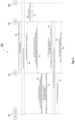
- An illustration of the second pairing procedure that is based on the Bluetooth OOB-Pairing procedure is shown in Fig. 3 .
- Fig. 3 shows a diagram of a message exchange 300 between a mobile user device 130, a first wireless communication device 110 for providing a digital car key functionality, and a second wireless communication device 120 of a head unit 122.
- Fig. 3 may show a combined pairing of a digital car key (i.e. the access system 112) and a head unit (122).
- Fig. 3 shows different entities: A user 302 of a (mobile) user device 130, the user device 130, the vehicle's digital key wireless communication device 110 (i.e. the first wireless communication device 110 of the access system 112) and the vehicle's head unit wireless communication device 120 (i.e. the second wireless communication device 120 of the head unit 122).
- the pairing of the DCK Digital Car Key
- a "Subevent Notification" that the operation is successful
- the pairing of the head unit 122 is initiated, starting with a Head_Unit_Pairing_Preparation Message (HU-PP) message 306 from the vehicle's digital key wireless communication device 110 to the user device 130.
- the Head _Unit_Pairing _Preparation Message (HU-PP) message 306 may be indicative of an identifier and communication capabilities of the vehicle's head unit wireless communication device 120.
- the vehicle head unit only supports OOB communication from vehicle head unit to device.
- Bit[0] : Value 1.
- the vehicle head unit supports OOB communication for both directions.
- the Head_Unit_Pairing_Preparation Message (HU-PP) is only sent from the vehicle's digital key wireless communication device 110 over the first wireless communication channel (e.g., BLE) if it is determined that the second wireless (e.g., Bluetooth) communication channel between the vehicle's head unit wireless communication device 120 and the user device 130 can be successfully established.
- the first wireless communication channel e.g., BLE
- the second wireless (e.g., Bluetooth) communication channel between the vehicle's head unit wireless communication device 120 and the user device 130 can be successfully established. This may be determined by employing detection circuitry 150 directly or indirectly interfacing with the vehicle's head unit wireless communication device 120 and/or the mobile user device 130 as explained previously.
- the Head_Unit_Pairing_Preparation Message (HU-PP) is transmitted in preparation of the pairing of the head unit 122, which includes the capabilities of the vehicle, in particular of the head unit of the vehicle.
- control circuitry 140 may be configured to instruct the vehicle's digital key wireless communication device 110 to transmit information on one or more capabilities of the vehicle's head unit wireless communication device 120 to the user device 130 via the first communication channel (as part of the exchange of pairing information) if it is detected that the second communication channel can be successfully established.
- the user device 130 notifies the user 302 that vehicle's digital key wireless communication device 110 is paired (i.e. that the first pairing procedure is completed), and prompts the user 302 whether to continue with the pairing of the head unit.
- the user 302 responds with a "yes, continue", and the user device 130 may provide a Head Unit Pairing Request Message (HUP-RQ) 312 to the vehicle's digital key wireless communication device 110 (via the established first communication channel).
- the Head Unit Pairing Request Message (HUP-RQ) may be indicative of an identifier (address) and communication capabilities of the user device 304.
- the Head Unit Pairing Request Message may contain User Intent, BD_ADDR_Device, and Device Capabilities as shown in the following tables: Table 3: HUP_RQ message and its parameters Message Message ID Parameter Head_Unit_Pairing_RQ (HUP-RQ) 0x17 User Intent, BD_ADDR_Device, Device Capabilities, PairingDataR192, PairingDataR256, PairingDataC 192, PairingDataC256 Table 4: Definition of the parameter for HUP_RQ. Parameter Length(bytes) Description User Intent 2 BitMask for user intent coming from device.
- the user device 130 provides a pairing request message for pairing with the head unit 122 to the vehicle's digital key wireless communication device 110, stating the capabilities of the user device 130, whether to use a vehicular display for displaying information provided by the mobile device (i.e. to use the video projection functionality), e.g. using CarPlay (CP) or Android Auto (AA), and the device identifier of the mobile device 130.
- the control circuitry 140 may be configured to obtain a pairing request message for pairing the user device 130 with the vehicle's head unit wireless communication device 120 from the user device 130 via the first communication channel.
- the pairing request message may comprise (information on) one or more capabilities of the user device 130.
- the pairing request message may further comprise information on whether the user device 130 requests to use a vehicular display for displaying information provided by the user device 130 (i.e. to use the video projection functionality).
- the control circuitry 140 may be configured to set a time limit in which the vehicle's digital key wireless communication device 110 accepts a Head Unit Pairing Request Message (HUP-RQ) from the user device 130 via the first communication channel in response to the Head_Unit_Pairing_Preparation Message (HU-PP).
- the time limit specifies a maximum time interval (e.g. 30 seconds) from sending the Head _Unit_Pairing _Preparation Message (HU-PP) to receiving the Head Unit Pairing Request Message (HUP-RQ).
- the control circuitry 140 may be configured to re-initiate a subsequent pairing procedure between the vehicle's head unit wireless communication device 120 and the user device 130 to establish the second communication channel between the vehicle's head unit wireless communication device 120 and the user device 130 by sending a subsequent Head_Unit_Pairing_Preparation Message (HU-PP) for the subsequent pairing procedure from the vehicle's digital key wireless communication device 110 to the user device 130 via the first (digital key) communication channel if it is subsequently detected that the second communication channel can be successfully established.
- HU-PP Head_Unit_Pairing_Preparation Message
- the control circuitry 140 and device 130 may monitor the duration of the second pairing process and abort the second pairing process if it exceeds a predetermined duration (e.g.,15 seconds). During the second pairing process, further Head Unit Pairing Request Messages (HUP-RQ) may be ignored by the control circuitry 140 to avoid other devices to interfere with the second pairing process. During this time, Head_Unit_Pairing_Preparation Messages (HU-PP) to other devices may be delayed therefore until the running pairing process with the current device 130 is finished. If the second (Bluetooth) pairing process gets aborted at this point by exceeding the timers limit, the device 130 may instantly retry pairing, by Head Unit Pairing Request Message (HUP-RQ) again using the stored user consent.
- a predetermined duration e.g. 15 seconds.
- HUP-RQ Head Unit Pairing Request Messages
- HU-PP Head_Unit_Pairing_Preparation Messages
- the vehicle's digital key wireless communication device 110 transforms the received Head Unit Pairing Request Message (HUP-RQ) into a "DK_HU_OOB_Pairing_Req(Device_Capabilities, User_Intent (CP, AAP or Bluetooth only), Device_BT_MAC_Address)" (DK to Head Unit Out of Band Pairing Request).
- the control circuitry 140 may be configured to provide the request to the vehicle's head unit wireless communication device 120 (as message 314), and to provide a response to the request from the vehicle's head unit wireless communication device 120 to the mobile device 130 via the first communication channel (via messages 316 and 318 as shown in the following).
- the vehicle's head unit wireless communication device 120 may accordingly provide the response to the request to the device 130, via the vehicle's digital key wireless communication device 110, using messages 316, 318 "DCK_HU_OOB_Pairing_Resp (Vehicle_BT_MAC_Address, PairingDataP192, PairingDataP256)" and "Headunit_Pairing_Resp (Vehicle_BT_MAC_Address, PairingDataP192, PairingDataP256), which includes the Media Access Control Address of the vehicle headunit 120, 122 and a cryptographic secret (PairingDataP 192, PairingDataP256, cryptographic information for establishing 192 bit and 256 bit Elliptic Curve Diffie Hellman encryption) for establishing a cryptographic channel (according to the Bluetooth OOB pairing specification).
- the response may comprise information on a cryptographic secret provided by the second Bluetooth communication device, e.g. a cryptographic secret for establishing the further secure, encrypted communication channel directly between the vehicle's head
- Bluetooth Out of Band pairing 320 may be performed (to perform the second pairing procedure).
- the vehicle's head unit wireless communication device 120 may transmit a confirmation message "DCK_HU_OOBPairing_Result(OK)" 322 to the device 130, via the vehicle's digital key wireless communication device 110, which may transform message 322 into "Headunit_Pairing_Result(OK)" 324 and transmit it to the device 130 via the first communication channel.
- the device 130 may provide feedback to the user 302 (if needed).
- the described owner pairing of the digital key can be used in the following cases.
- the user may sit in the vehicle with his/her smart device and two key fobs at hand, following the pairing process on the HU and on the smart device.
- the HU_PP command will be sent to the smart device for an BT Classic OOO pairing over Bluetooth Low energy(BLE) and the user prompt to also pair the smart device to the HU (via BT Classic/ HU's BT) will appear after the successful DK owner pairing.
- the described preconditions e.g., HU is ready/awake and mobile user device is located near or in the vehicle 102
- the device is detected inside the vehicle (via e.g. UWB, BT RSSI signal strength, vehicle passenger camera, seat occupation detection or other passenger detection mechanisms).
- the friend can be anywhere and probably not in the owner's vehicle when receiving a shared key from the owner.
- the friend is also being asked if to pair the smart device against the HU via Carplay or Bluetooth classic (via OutOfBand paring via BLE) the first time the vehicle is entered.
- the friend approaches the vehicle for the first time at any point in time, so it is crucial that HU_PP command is not sent too early e.g. if the friend's smart device has BLE connection only, as this is no sufficient indicator for the friend in the proper situation to pair the device to the HU.
- the friend may approach the vehicle but then decides to leave again without entering the vehicle.
- the conventional pairing process might be aborted due to BT classic/BLE connection break down. This may be improved with the pairing process proposed herein.
- the second wireless communication device is a wireless communication device for communication in a wireless local area network
- the exchange of the pairing information may comprise information on a service set identifier (SSID) of a wireless network, and cryptographic information on a shared key used for communication in the wireless network.
- SSID service set identifier
- the control circuitry may be a part of the first wireless communication device, or co-located with the first wireless communication device, e.g. within the access system / main ECU of the vehicle.
- the control circuitry may be a part of the second wireless communication device, or co-located with the second wireless communication device, e.g. within the head unit of the vehicle.
- the control circuitry may be separate from both the first wireless communication device (and the access system) and the second wireless communication device (and the head unit).
- control circuitry 10 may be implemented using one or more processing units, one or more processing devices, any means for processing, such as a processor, a computer or a programmable hardware component being operable with accordingly adapted software.
- a processor any means for processing
- the described function of the control circuitry 10 may as well be implemented in software, which is then executed on one or more programmable hardware components.
- Such hardware components may comprise a general-purpose processor, a Digital Signal Processor (DSP), a micro-controller, etc.
- DSP Digital Signal Processor
- Examples may further be or relate to a (computer) program including a program code to execute one or more of the above methods when the program is executed on a computer, processor or other programmable hardware component.
- steps, operations or processes of different ones of the methods described above may also be executed by programmed computers, processors or other programmable hardware components.
- Examples may also cover program storage devices, such as digital data storage media, which are machine-, processor- or computer-readable and encode and/or contain machine-executable, processor-executable or computer-executable programs and instructions.
- Program storage devices may include or be digital storage devices, magnetic storage media such as magnetic disks and magnetic tapes, hard disk drives, or optically readable digital data storage media, for example.
- Other examples may also include computers, processors, control units, (field) programmable logic arrays ((F)PLAs), (field) programmable gate arrays ((F)PGAs), graphics processor units (GPU), application-specific integrated circuits (ASICs), integrated circuits (ICs) or system-on-a-chip (SoCs) systems programmed to execute the steps of the methods described above.
- FPLAs field programmable logic arrays
- F field) programmable gate arrays
- GPU graphics processor units
- ASICs application-specific integrated circuits
- ICs integrated circuits
- SoCs system-on-a-chip
- aspects described in relation to a device or system should also be understood as a description of the corresponding method.
- a block, device or functional aspect of the device or system may correspond to a feature, such as a method step, of the corresponding method.
- aspects described in relation to a method shall also be understood as a description of a corresponding block, a corresponding element, a property or a functional feature of a corresponding device or a corresponding system.
Landscapes
- Engineering & Computer Science (AREA)
- Computer Networks & Wireless Communication (AREA)
- Signal Processing (AREA)
- Computer Security & Cryptography (AREA)
- Mobile Radio Communication Systems (AREA)
Abstract
Description
- The present disclosure relates to the field of pairing a wireless communication device with a plurality of other wireless communication devices. In particular, the present disclosure relates pairing a mobile wireless communication device, such as a smartphone, with a first and a second wireless communication device of a vehicle.
- The Car Connectivity Consortium (CCC) is an industry group that is dedicated to creating standards for smartphone-to-car connectivity with the goal of making it easier for drivers to use their smartphones in their cars. The CCC works on technologies such as the Digital Key standard which allows for the use of smartphones as a key for cars, and the Car Data specification which enables communication between cars and other devices.
- The Digital Key standard uses near field communication (NFC), Bluetooth Low Energy (BLE), or Ultra-Wideband (UWB) to enable a secure, wireless connection between a mobile device (e.g., a smartphone) and the car, which allows the driver to unlock and start the car without using a traditional mechanical key. The digital key can also be shared with other people (friends) through a smartphone app, allowing them to also use the car. This allows for a more convenient and secure way of sharing access to a vehicle, as well as enabling new use cases such as car sharing and rental services.
- Digital Key Owner Pairing and head unit pairing are two different processes that are used to connect a smartphone to a car.
- Digital Key Owner Pairing refers to the process of connecting a smartphone to a car in order to use it as a digital key. This process typically involves the car owner using their smartphone to establish a secure and authenticated connection between the phone and the car's onboard system, usually through a specific app or software. Once the pairing is complete, the owner's smartphone becomes a recognized digital key for the car, allowing the owner to use it to unlock and start the car, as well as to share access to the car with other authorized users.
- Head unit pairing, on the other hand, refers to the process of connecting a smartphone or other device to the head unit (also known as the infotainment system) of a car. This allows the driver to access the features and functions of their smartphone, such as music, navigation, and phone calls, through the car's display and speakers.
- The head unit pairing may be implemented as OOB (Out-of-Band) pairing between the vehicle and the mobile device as part of the digital key owner/friend pairing. For example, Head Unit Pairing messages may be exchanged via one or more wireless communication links established for digital key owner pairing. Examples of such Head Unit Pairing messages defined in Digital Key
Technical Specification Release 3, Version 1.0.11 (CCC-TS-101) are Head_Unit_Pairing_Preparation Message (HU-PP) sent by the vehicle to the mobile device, Head Unit Pairing Request Message (HUP-RQ) sent by the mobile device to the vehicle, and/or Head Unit Pairing Response Message (HUP-RS) sent by the vehicle to the mobile device. - However, no further preconditions are defined when exactly such head unit pairing messages shall be sent by the vehicle to the mobile device.
- There may be a demand for an improved concept for head unit pairing.
- This demand may be satisfied by the subject-matter of the appended independent and dependent claims.
- According to a first aspect, the present disclosure provides a communication system for a vehicle.
- The communication system comprises a first wireless communication device configured to perform wireless communication in accordance with a first wireless communication protocol.
- In some embodiments, the first wireless communication device may be configured to perform wireless communication for a keyless access or keyless go functionality of the vehicle.
- In some embodiments, the first wireless communication protocol may be one of a near field communication (NFC), Bluetooth low energy (BLE), or Ultra-Wideband (UWB) communication protocol. Thus, the first wireless communication device may comprise at least one of a NFC, a BLE, or a UWB transceiver of the vehicle to perform wireless communication for a keyless access or keyless go functionality of the vehicle. For example, the first wireless communication device may be integrated into the vehicle.
- The communication system also comprises a second wireless communication device configured to perform wireless communication in accordance with a second wireless communication protocol.
- In some embodiments, the second wireless communication device may be configured to perform wireless communication for a hands-free functionality, a media playback functionality or a video projection functionality of the vehicle.
- In some embodiments, the second wireless communication protocol may be a Bluetooth communication protocol. Bluetooth is a wireless communication technology having a shorter communication range than BLE. Thus, the second wireless communication device may comprise a Bluetooth transceiver. For example, the second wireless communication device may be coupled to or integrated into a head unit of the vehicle.
- The first and second wireless communication device may be separate devices installed at different positions/locations within the vehicle.
- The communication system further comprises control circuitry configured to perform a first pairing procedure between the first wireless communication device and a mobile device to establish a first communication channel in accordance with the first wireless communication protocol between the first wireless communication device and the mobile device.
- In some embodiments, the first pairing procedure may be a digital key owner or friend pairing procedure between the vehicle and the owner's or friend's mobile device (e.g., a smartphone).
- The control circuitry is further configured to initiate or attempt a second pairing procedure between the second wireless communication device and the mobile device to establish a second communication channel in accordance with the second wireless communication protocol between the second wireless communication device and the mobile device by sending a pairing preparation message for the second pairing procedure from the first wireless communication device to the mobile device via the first communication channel.
- In some embodiments, the second pairing procedure may be a head unit pairing procedure between the vehicle's head unit and the owner's or friend's mobile device, wherein Head Unit Pairing messages are exchanged OOB via the first communication channel established by the digital key owner or friend pairing procedure.
- In some embodiments, the pairing preparation message may be indicative of an identifier (address) and communication capabilities of the second wireless communication device. For example, the pairing preparation message may be a Head Unit Pairing Preparation Message (HU-PP) as defined in the Digital Key
Technical Specification Release 3, Version 1.0.11 (CCC-TS-101). - The control circuitry is configured to instruct sending the pairing preparation message (only) if it is detected that the second communication channel can be successfully established.
- The control circuitry may be integrated into the vehicle and coupled to both the first wireless communication device and the second wireless communication device. For example, the control circuitry may be implemented in an electronic control unit (ECU) of the vehicle.
- To detect that the second communication channel can be successfully established, the communication system may further comprise detection circuitry which is configured to detect whether the second wireless communication device is ready for wireless communication over the second communication channel. Here, "ready for wireless communication" may be understood as being prepared or in a state of being able to wirelessly communicate over the second communication channel. For example, the second wireless communication device may have to be powered on and initialized properly. For example, the control circuitry may be configured to instruct sending the pairing preparation message (only) if the second wireless communication device is detected to be ready for wireless communication over the second communication channel. This may avoid initiating the second pairing procedure too early when the second wireless communication device is not in the correct state (not ready/awake yet).
- In some embodiments, the detection circuitry may be configured to detect whether the mobile device is located within a distance from the vehicle which is close enough for successfully establishing the second communication channel. For example, the detection circuitry may comprise signal strength detection circuitry, one or more cameras, seat occupation detection circuitry, or other passenger detection mechanisms. The control circuitry may be configured to instruct sending the pairing preparation message at least if the mobile device is detected to be within the distance. For example, the distance may be less than 20 meters, less than 10 meters, less than 5 meters, or less than 2 meters from the vehicle. This may avoid a breakdown of the second communication channel due to a too large communication distance.
- In some embodiments, the control circuitry may be configured to instruct sending the pairing preparation message (only) if the second wireless communication device is detected to be ready for wireless communication over the second communication channel and the mobile device is detected to be within the distance.
- In some embodiments, the detection circuitry may be configured to detect whether the mobile device is located inside the vehicle. In this case, a successful establishment of the second communication channel may be assumed.
- In some embodiments, the control circuitry may be configured to set a time limit in which the first wireless communication device accepts a pairing request message from the mobile device to the first wireless communication device via the first communication channel in response to the pairing preparation message. The time limit may specify a maximum time interval from sending the pairing preparation message to receiving the pairing request message. For example, the maximum time interval may be 30 seconds or less.
- In some embodiments, the pairing request message may be indicative of an identifier (address) and communication capabilities of the mobile device. For example, the pairing request message may be a Head Unit Pairing Request Message (HUP-RQ) as defined in the Digital Key
Technical Specification Release 3, Version 1.0.11 (CCC-TS-101). - In some embodiments, the control circuitry may be configured to, if no pairing request message is received within the time limit, initiate or attempt a subsequent pairing procedure between the second wireless communication device and the mobile device to establish the second communication channel between the second wireless communication device and the mobile device by sending a subsequent pairing preparation message for the subsequent pairing procedure from the first wireless communication device to the mobile device via the first communication channel (only) if it is (subsequently) detected that the second communication channel can be successfully established. Thus, if no pairing request message is received upon the pairing preparation message, the vehicle may attempt another pairing procedure between the second wireless communication device and the mobile device when the preconditions for successful communication are met.
- In some embodiments, the control circuitry may be configured to monitor a duration of the second pairing procedure and abort the second pairing procedure if it exceeds a predetermined maximum pairing duration. The predetermined maximum pairing duration may be 15 seconds or less, for example. Thus, after sending pairing request message, the vehicle and/or mobile device may monitor the duration of the second pairing procedure and abort the second pairing procedure if it exceeds the predetermined maximum pairing duration.
- In some embodiments, the control circuitry may be configured to ignore pairing request messages from other mobile devices to the first wireless communication device during the second pairing procedure. In this way, interference from other mobile devices to the second pairing procedure may be avoided.
- According to a further aspect, the present disclosure proposes a vehicle comprising the communication system of any one of the disclosed embodiments.
- According to a yet further aspect, the present disclosure proposes a communication method for a vehicle. The method includes:
- establishing a first wireless communication channel in accordance with a first wireless communication protocol between a first wireless communication device of the vehicle and a mobile device,
- initiating or attempting a pairing procedure between a second wireless communication device of the vehicle and the mobile device to establish a second wireless communication channel in accordance with a second wireless communication protocol between the second wireless communication device and the mobile device by sending a pairing preparation message for the pairing procedure from the first wireless communication device to the mobile device via the first wireless communication channel,
- the pairing preparation message is sent only if it is detected that the second wireless communication channel can be successfully established.
- According to a yet further aspect, the present disclosure proposes a vehicle. The vehicle comprises a wireless communication device which is configured to perform wireless communication for a keyless access or keyless go functionality in accordance with a wireless communication protocol being one of a near field communication, NFC, Bluetooth low energy, BLE, or Ultra-Wideband, UWB, communication protocol. The vehicle comprises a head unit which is configured to perform Bluetooth communication for a hands-free, a media playback or a video projection functionality in accordance with a Bluetooth communication protocol. The vehicle further comprises control circuitry configured to perform a first (digital key) pairing procedure between the wireless communication device and a portable device to establish a wireless communication channel in accordance with the wireless communication protocol between the wireless communication device and the portable device. The control circuitry is also configured to initiate a Bluetooth pairing procedure between the head unit and the portable device to establish a Bluetooth communication channel in accordance with the Bluetooth communication protocol between the head unit and the portable device by sending a head unit pairing preparation message for the Bluetooth pairing procedure from the wireless communication device to the portable device via the established wireless communication channel. The control circuitry is configured to instruct sending the head unit pairing preparation message (only) if it is detected that the Bluetooth communication channel can be successfully established.
- According to the present disclosure, the pairing preparation message is only sent when a user is in an appropriate situation or aware to handle eventually appearing user prompts on his/her mobile device or the vehicle's head unit. The second (Bluetooth) pairing procedure will only be initiated when the head unit is in the correct state (HU ready/awake) or when the Bluetooth connection will not break down (customer inside or close to the vehicle, approaches the vehicle). This may avoid several retries necessary until the user's mobile device gets paired successfully.
- Some examples of apparatuses, methods and/or computer programs will be described in the following by way of example only, and with reference to the accompanying figures, in which
- Fig. 1
- shows a block diagram of an example of a device or vehicle comprising a first and a second wireless communication device;
- Fig. 2
- shows a flow chart of an example of a method for pairing a mobile device with a first and a second wireless communication device; and
- Fig. 3
- shows a diagram of a message exchange between a mobile device, a wireless communication device for providing a digital car key functionality, and a wireless communication device of a head unit.
- Some examples are now described in more detail with reference to the enclosed figures. However, other possible examples are not limited to the features of these embodiments described in detail. Other examples may include modifications of the features as well as equivalents and alternatives to the features. Furthermore, the terminology used herein to describe certain examples should not be restrictive of further possible examples.
- Throughout the description of the figures same or similar reference numerals refer to same or similar elements and/or features, which may be identical or implemented in a modified form while providing the same or a similar function. The thickness of lines, layers and/or areas in the figures may also be exaggerated for clarification.
- When two elements A and B are combined using an 'or', this is to be understood as disclosing all possible combinations, i.e. only A, only B as well as A and B, unless expressly defined otherwise in the individual case. As an alternative wording for the same combinations, "at least one of A and B" or "A and/or B" may be used. This applies equivalently to combinations of more than two elements.
- If a singular form, such as "a", "an" and "the" is used and the use of only a single element is not defined as mandatory either explicitly or implicitly, further examples may also use several elements to implement the same function. If a function is described below as implemented using multiple elements, further examples may implement the same function using a single element or a single processing entity. It is further understood that the terms "include", "including", "comprise" and/or "comprising", when used, describe the presence of the specified features, integers, steps, operations, processes, elements, components and/or a group thereof, but do not exclude the presence or addition of one or more other features, integers, steps, operations, processes, elements, components and/or a group thereof.
- Various embodiments of the present disclosure relate to a Head unit Bluetooth Out-of-band Pairing in a Vehicle.
-
Fig. 1 shows a block diagram of an example of a communication system 100 in accordance with embodiments of the present disclosure. - The communication system 100 (components thereof) may be installed in a
vehicle 102 which is a machine used for transportation on land, water, air, or in space. Examples of vehicles include cars, buses, trucks, boats, airplanes, and spacecraft. In the illustrated example, thevehicle 102 is a car. - The communication system 100 comprises a first
wireless communication device 110 which is configured to perform wireless communication in accordance with a first wireless communication protocol. Firstwireless communication device 110 may include first transceiver circuitry configured for wireless communication in accordance with the first wireless communication protocol or radio access technology (RAT). The firstwireless communication device 110 may be part of akeyless access system 112 of thevehicle 102 and be configured to perform wireless communication for a keyless access or keyless go functionality of the vehicle in accordance with the Digital Key standard which allows for the use of smartphones as a key for cars, and the Car Data specification which enables communication between cars and other devices. The firstwireless communication device 110 may be configured to perform wireless communication in accordance with one of a NFC, BLE, or UWB communication protocol (or a combination thereof). - The communication system 100 comprises also a second
wireless communication device 120 configured to perform wireless communication in accordance with a second wireless communication protocol. Secondwireless communication device 120 may include second transceiver circuitry configured for wireless communication in accordance with the second wireless communication protocol or radio access technology (RAT). The secondwireless communication device 120 may be installed in thevehicle 102 and be configured to perform wireless communication for a handsfree functionality, a media playback functionality or a video projection functionality of the vehicle. For example, the secondwireless communication device 120 may comprise a Bluetooth transceiver coupled to the vehicle'shead unit 122 for Bluetooth communication between thehead unit 122 and a mobile user device 130 (e.g., smartphone, smartwatch, tablet PC, etc.). - The communication system 100 further comprises
control circuitry 140 which is configured to perform a first (wireless) pairing procedure between the firstwireless communication device 110 and themobile user device 130 to establish a first wireless communication channel between the firstwireless communication device 110 and themobile user device 130. The first pairing procedure may be a digital key pairing procedure between thevehicle 102 and themobile user device 130. Digital key pairing refers to the process of connecting two devices, such as a user's smartphone and a car, using a digital key. This allows the devices to communicate with each other securely and enables certain functions, such as unlocking the car's doors or starting the engine, to be controlled by the smartphone. This process may involve the use of NFC, BLE, or UWB communication technology and requires thedevices - The
control circuitry 140 is further configured to perform a second (wireless) pairing procedure between the secondwireless communication device 120 and themobile user device 130 to establish a second wireless communication channel in accordance with the second wireless communication protocol between the secondwireless communication device 120 and themobile device 130 by sending a pairing preparation message for the second pairing procedure from the firstwireless communication device 110 to themobile device 130 via the first wireless communication channel. The second pairing procedure may take place during or after the first pairing procedure and exchange OOB pairing information via the established first wireless communication channel. For example, the second pairing procedure may be a Bluetooth head unit pairing procedure. Head unit pairing refers to the process of connecting themobile device 130 such as a smartphone to thehead unit 122 in order to play music, make hands-free calls and access other features like navigation. According to the present disclosure, themobile device 130 and thehead unit 122 are connected via the second wireless communication channel in accordance with the second wireless communication protocol, which may be a Bluetooth protocol. However, pairing information may be exchanged out-of-band (OOO) via the first wireless communication channel. Once paired, the user can control thehead unit 122 using themobile device 130, and stream music or access phone features through the car's speakers. - Bluetooth and BLE are both wireless communication technologies that use the same 2.4 GHz radio frequency, but they are designed for different purposes and have some key differences. Bluetooth is a standard for wireless communication that was initially designed for short-range data exchange between fixed and mobile devices. It may be primarily used for audio applications such as wireless speakers, headphones, and hands-free calling, as well as data transfer between devices like smartphones and laptops. Bluetooth has moderate power consumption and a range of about 10 meters. BLE, on the other hand, is a low-power version of Bluetooth that was introduced in 2010. It is designed for low-cost, low-power devices such as fitness trackers, heart rate monitors, and smart home devices. BLE devices are designed to operate for long periods of time on a small battery, and have a range of about 100 meters. BLE is also optimized for low-bandwidth applications and is often used in Internet of Things (IoT) applications. In summary, Bluetooth is a standard for wireless communication that is mainly used for audio and data transfer while BLE is a low-power version of Bluetooth, mainly used for low-bandwidth applications and IoT devices. BLE has a considerably longer communication range than Bluetooth.
- If no further preconditions are defined when exactly the pairing preparation message shall be sent by the first
wireless communication device 110 to themobile user device 130, this can lead to scenarios where the user might not be in the appropriate situation/not aware to handle eventually appearing user prompts on his/hermobile user device 130 or the vehicle's secondwireless communication device 120. Another problem may be that the firstwireless communication device 110 may initiate the second pairing procedure too early when the secondwireless communication device 120 is not in the correct state (not ready/awake yet) or when the second wireless communication channel may probably break down (user outside the vehicle, walks away from the vehicle). This can lead to several retries necessary until the user'smobile device 130 gets paired successfully. - Therefore, in accordance with embodiments of the present disclosure, the
control circuitry 140 is configured to instruct sending the pairing preparation message only if it is detected that the second wireless communication channel between the secondwireless communication device 120 and themobile user device 130 can be successfully established. For example, the pairing preparation message may only be from the sent from the firstwireless communication device 110 to themobile user device 130 in the case at least one of the following preconditions is met: - second
wireless communication device 120 is awake and its wireless communication function is available, - the
mobile user device 130 is being detected near or inside thevehicle 102. - For this purpose, communication system 100 may further comprise
detection circuitry 150 which is configured to detect whether the secondwireless communication device 120 is ready for wireless communication over the second wireless communication channel (awake and wireless communication function is available). Thecontrol circuitry 140 may be configured to instruct sending the pairing preparation message at least if the secondwireless communication device 120 is detected to be ready for wireless communication over the second communication channel. Here, "to be ready" may be understood that the secondwireless communication device 120 is prepared or in a state of preparedness for wireless communication over the second communication channel. That is, the secondwireless communication device 120 may have all the necessary elements, information or resources to wirelessly communicate over the second communication channel. For example, a device that is ready means it is powered on (awake) and set up to perform its intended function. For example,detection circuitry 150 or parts thereof may be implemented in an electronic control unit (ECU) of the vehicle. The ECU is a computerized device that manages and controls one or more electronic functions in a vehicle or other machinery, such a functions of the first and secondwireless communication devices wireless communication devices control circuitry 140 or parts thereof may be implemented in the ECU. - Alternatively or additionally, the
detection circuitry 150 may be configured to detect whether themobile user device 130 is located within a distance from thevehicle 102 which is close enough for successfully establishing the second communication channel. For this purpose,detection circuitry 150 may use or comprise one or more sensors, such as cameras, seat occupation detection or other passenger detection sensors). Further, options include signal strength measurements (RSSI = Received Signal Strength Indicator) with regards to the first and/or the second wireless communication channel or localization via UWB. A higher RSSI value generally indicates that the device is closer to the signal source and that the signal is stronger, while a lower RSSI value indicates that thedevice 130 is farther away and that the signal is weaker. UWB transmits data using very low energy levels over a very wide frequency band, typically spanning several gigahertz. This allows it to transmit large amounts of data at high speeds, while also providing high accuracy in location and time-of-flight measurements. - The
control circuitry 140 may be configured to instruct the firstwireless communication device 110 to send the pairing preparation message for the second pairing procedure at least if themobile device 130 is detected to be within the distance which is close enough for successfully establishing the second communication channel. Preferably, thecontrol circuitry 130 may be configured to instruct sending the pairing preparation message if the secondwireless communication device 120 is detected to be ready for wireless communication over the second communication channel and themobile user device 130 is detected to be within the distance (near or inside the vehicle 102). - Thus, some embodiments of present disclosure propose that the vehicle's first
wireless communication device 110 shall only send the pairing preparation message when theowner device 130 is detected inside thevehicle 102 and thehead unit 122 infrastructure including Bluetooth is available and ready for head unit pairing. -
Fig. 2 shows a flowchart of an example of acorresponding method 200 for pairing amobile user device 130 with a first and a secondwireless communication device Method 200 may be performed by the components of communication system 100. - The
method 200 includes establishing 210 a first wireless communication channel in accordance with a first wireless communication protocol between the firstwireless communication device 110 of the vehicle and themobile user device 130. Establishing 210 the first wireless communication channel may involve performing a first pairing procedure between the firstwireless communication device 110 and the mobile user device to establish the first communication channel between the firstwireless communication device 110 and themobile user device 130. - The
method 200 also includes initiating asecond pairing procedure 220 between the secondwireless communication device 120 of the vehicle and themobile user device 130 to establish a second wireless communication channel in accordance with a second wireless communication protocol between the secondwireless communication device 120 and themobile user device 130 by sending a pairing preparation message for the second pairing procedure from the firstwireless communication device 110 to themobile user device 130 via the first wireless communication channel. The pairing preparation message is sent only if it is detected that the second wireless communication channel can be successfully established. - Various aspects of the present disclosure relate to a system, method and computer program for pairing two wireless communication devices of the communication system 100 or
vehicle 102 to amobile user device 130, in an efficient manner. Such as scenario is present, for example, in avehicle 102 with anaccess system 112 that comprises the first wireless communication device (e.g. a NFC, BLE, UWB communication device) 110, and which is used to perform the communication for providing a for a keyless access or keyless go functionality of thevehicle 102, and ahead unit 122 that comprises the second wireless communication device (e.g. a Bluetooth communication device) 120, and that is used to perform the communication for a hands-free functionality, a media playback functionality, or a video projection functionality of the vehicle. In other words, the firstwireless communication device 110 may be configured to perform communication for a keyless access or keyless go functionality of thevehicle 102. The secondwireless communication device 120 may be separate from the firstwireless communication device 110. It may be configured to perform communication for a hands-free functionality, a media playback functionality, or a video projection functionality of the vehicle. In general, the access system is provided by the main ECU of the vehicle (that coordinates the driving- and security-related features of the vehicle), and thehead unit 122 is the system that provides the user-facing functionality, such as the hands-free functionality, the media playback functionality, or the video projection functionality, but also provides an interface for changing settings of the vehicle. In this context, the video projection functionality relates to a displaying of a user interface of the mobile device via a display of the vehicle (e.g. using Apple CarPlay or Android Auto). - In cars, the first and second
wireless communication devices wireless communication device 110 may be a Ultra-Wideband communication device, or a combined BLE and UWB communication device. The secondwireless communication device 120 may be a Bluetooth communication device and/or a communication device for communicating in a Wireless Local Area Network (e.g. a combined Bluetooth/WLAN communication device). Accordingly, the first pairing procedure may be a first UWB or BLE pairing procedure, and/or the second pairing procedure may be a Bluetooth pairing procedure or a procedure for joining a Wireless Local Area Network. - An idea of the present disclosure is to use the (secure, encrypted) communication channel that is established by the first pairing procedure to exchange pairing messages for the second pairing procedure. In particular, the pairing preparation message for the second pairing procedure is only sent if it is detected that the second communication channel can be successfully established. Accordingly, the first pairing procedure may be performed, and completed, before the exchange of the pairing messages for the second pairing procedure is performed. The
control circuitry 140 is configured to perform the first (wireless) pairing procedure between the firstwireless communication device 110 and themobile device 130 to establish the first communication channel between the firstwireless communication device 110 and themobile device 130. As has been mentioned above, the first pairing procedure may be a first Bluetooth pairing procedure, or a first UWB pairing procedure. The first pairing procedure may establish the (secure, encrypted) first wireless communication channel. Accordingly, the first pairing procedure may comprise the exchange of cryptographic information, e.g. based on a Diffie-Hellman key exchange. - Once the first wireless communication channel is established, it can be used to initiate or perform the second pairing procedure. The
control circuitry 130 is configured to perform the second pairing procedure between the secondwireless communication device 120 and themobile user device 130 by exchanging the pairing messages for pairing the secondwireless communication device 120 with themobile user device 130 via the first wireless communication channel between the firstwireless communication device 110 and themobile user device 130. In other words, the pairing messages are exchanged between the secondwireless communication device 120 and themobile user device 130 via the firstwireless communication device 110. Accordingly, the first and secondwireless communication devices control circuitry 140. For example, the pairing messages may be exchanged via an internal communication channel between the firstwireless communication device 110 and the second wireless communication device 120 (and the first wireless communication channel between the firstwireless communication device 110 and the mobile user device). - The exchange of the pairing messages over the (established) first communication channel enables the automation of the second pairing procedure. The pairing messages may be initiated only if it is detected that the second communication channel can be successfully established. The user may be prompted whether the second pairing procedure is to be performed. In other words, the second pairing procedure may be initiated automatically if it is detected that the second communication channel can be successfully established, e.g. by providing a prompt to the user of the
mobile device 130 or the vehicle, and/or without requiring the user to initiate the pairing procedure from the mobile device. In particular, the second pairing procedure may be initiated without requiring a confirmation of a code sequence by a user of themobile device 130 or the vehicle. - While the principle of the proposed concept is also applicable to other wireless technologies, such as WLAN, the following description assumes, in part, that the second pairing procedure is a Bluetooth pairing procedure. However, the same information can also be exchanged in a pairing procedure to be performed for a different wireless technology. The Bluetooth standard already comprises a section that relates to Out-of-Band pairing, that can be employed by the technologies presented in the present disclosure. Accordingly, the pairing messages may comprise out-of-band pairing messages according to the Bluetooth standard. An illustration of the second pairing procedure that is based on the Bluetooth OOB-Pairing procedure is shown in
Fig. 3 . -
Fig. 3 shows a diagram of amessage exchange 300 between amobile user device 130, a firstwireless communication device 110 for providing a digital car key functionality, and a secondwireless communication device 120 of ahead unit 122. For example,Fig. 3 may show a combined pairing of a digital car key (i.e. the access system 112) and a head unit (122).Fig. 3 shows different entities: Auser 302 of a (mobile)user device 130, theuser device 130, the vehicle's digital key wireless communication device 110 (i.e. the firstwireless communication device 110 of the access system 112) and the vehicle's head unit wireless communication device 120 (i.e. the secondwireless communication device 120 of the head unit 122). - First, the pairing of the DCK (Digital Car Key) is performed, resulting in a "Subevent Notification" (that the operation is successful) 304 from the vehicle's digital key
wireless communication device 110 to theuser device 304. During or after the pairing of the DCK, the pairing of thehead unit 122 is initiated, starting with a Head_Unit_Pairing_Preparation Message (HU-PP)message 306 from the vehicle's digital keywireless communication device 110 to theuser device 130. The Head _Unit_Pairing _Preparation Message (HU-PP)message 306 may be indicative of an identifier and communication capabilities of the vehicle's head unitwireless communication device 120. In particular, the Head_Unit_Pairing_Preparation Message (HU-PP) may contain BT_Pairing_Configuration, BD_ADDR_Head_Unit, and vehicle capabilities as shown in the following tables:Table 1: HU_PP message and its parameters Message Message ID Parameter Head_Unit_Pairing_Preparation (HU-PP) 0x16 BT_Pairing_Configuration, ED_ADDR_Head_Unit, Vehicle capabilities Table 2: Definition of the parameter for HU_PP Parameter Length (bytes) Description BT_Pairing_Configuration 1 BitMask for supported capabilities: OOB_Configuration: Bit[0] : Value = 0. The vehicle head unit only supports OOB communication from vehicle head unit to device. Bit[0] : Value = 1. The vehicle head unit supports OOB communication for both directions. Bit[1-7]: Reserved BD_ADDR_Head_Unit 6 Bluetooth Device Address of the head unit as defined in Volume 2 Part H of [30]Vehicle capabilities 2 BitMask for supported capabilities on vehicle Bit [1]: Value = 0: Head unit Bluetooth Classic (A2DP and HFP) pairing not supported Bit [1]: Value = 1: Head unit Bluetooth Classic (A2DP and HFP) pairing supported Bit [2]: Value = 0: Apple Carptay not supported Bit [2]: Value = 1: Apple Carplay Supported Bit [3]: Value = 0: Android Auto Not Supported Bit [3]: Value = 1: Android Auto Supported Bit[4:15]: Reserved - According to embodiments of the present disclosure, the Head_Unit_Pairing_Preparation Message (HU-PP) is only sent from the vehicle's digital key
wireless communication device 110 over the first wireless communication channel (e.g., BLE) if it is determined that the second wireless (e.g., Bluetooth) communication channel between the vehicle's head unitwireless communication device 120 and theuser device 130 can be successfully established. This may be determined by employingdetection circuitry 150 directly or indirectly interfacing with the vehicle's head unitwireless communication device 120 and/or themobile user device 130 as explained previously. - In case the second wireless (e.g., Bluetooth) communication channel between the vehicle's head unit
wireless communication device 120 and theuser device 130 can be successfully established (e.g.,device 120 is ready/awake andmobile user device 130 is located near or in the vehicle 102), the Head_Unit_Pairing_Preparation Message (HU-PP) is transmitted in preparation of the pairing of thehead unit 122, which includes the capabilities of the vehicle, in particular of the head unit of the vehicle. In other words, thecontrol circuitry 140 may be configured to instruct the vehicle's digital keywireless communication device 110 to transmit information on one or more capabilities of the vehicle's head unitwireless communication device 120 to theuser device 130 via the first communication channel (as part of the exchange of pairing information) if it is detected that the second communication channel can be successfully established. - At 308, the
user device 130 notifies theuser 302 that vehicle's digital keywireless communication device 110 is paired (i.e. that the first pairing procedure is completed), and prompts theuser 302 whether to continue with the pairing of the head unit. At 310, theuser 302 responds with a "yes, continue", and theuser device 130 may provide a Head Unit Pairing Request Message (HUP-RQ) 312 to the vehicle's digital key wireless communication device 110 (via the established first communication channel). The Head Unit Pairing Request Message (HUP-RQ) may be indicative of an identifier (address) and communication capabilities of theuser device 304. In particular, the Head Unit Pairing Request Message (HUP-RQ) may contain User Intent, BD_ADDR_Device, and Device Capabilities as shown in the following tables:Table 3: HUP_RQ message and its parameters Message Message ID Parameter Head_Unit_Pairing_RQ (HUP-RQ) 0x17 User Intent, BD_ADDR_Device, Device Capabilities, PairingDataR192, PairingDataR256, PairingDataC 192, PairingDataC256 Table 4: Definition of the parameter for HUP_RQ. Parameter Length(bytes) Description User Intent 2 BitMask for user intent coming from device. Bit [0]: Value =0: Intent from device Bit [0]: Value =1: No intent from device Bit [1]: Value = 0: Head unit Bluetooth Classic usage not intended from user. Bit [1]: Value = 1: Head unit Bluetooth Classic usage intended from user Bit [2]: Value = 0: Apple Carplay usage not intended from user Bit [2]: Value = 1: Apple Carplay usage intended from user Bit [3]: Value = 0: Android Auto usage not intended from user Bit [3]: Value = 1: Android Auto usage intended from user Bit [4-15]: Reserved BD_ADDR_Device 6 Bluetooth Device Address of the device as defined in Volume 2 Part H of [30].Device Capabilities 2 BitMask for supported capabilities on device Bit [1]: Value = 0: Head unit Bluetooth Classic (A2DP and HFP) not supported Bit [1]: Value = 1: Head unit Bluetooth Classic (A2DP and HFP) supported Bit [2]: Value = 0: Apple Carplay not supported Bit [2]: Value = 1: Apple Carplay supported Bit [3]: Value = 0: Android Auto not supported Bit [3]: Value = 1: Android Auto supported Bit[4-15]: Reserved PairingDataR192 16 Simple Pairing Randomizer R-192∗ PairingDataR256 16 Simple Pairing Randomizer R-256* PairingDataC192 16 Simple Pairing Hash C-192* PairingDataC256 16 Simple Pairing Hash C-256* - In other words, the
user device 130 provides a pairing request message for pairing with thehead unit 122 to the vehicle's digital keywireless communication device 110, stating the capabilities of theuser device 130, whether to use a vehicular display for displaying information provided by the mobile device (i.e. to use the video projection functionality), e.g. using CarPlay (CP) or Android Auto (AA), and the device identifier of themobile device 130. In other words, thecontrol circuitry 140 may be configured to obtain a pairing request message for pairing theuser device 130 with the vehicle's head unitwireless communication device 120 from theuser device 130 via the first communication channel. The pairing request message may comprise (information on) one or more capabilities of theuser device 130. The pairing request message may further comprise information on whether theuser device 130 requests to use a vehicular display for displaying information provided by the user device 130 (i.e. to use the video projection functionality). - The
control circuitry 140 may be configured to set a time limit in which the vehicle's digital keywireless communication device 110 accepts a Head Unit Pairing Request Message (HUP-RQ) from theuser device 130 via the first communication channel in response to the Head_Unit_Pairing_Preparation Message (HU-PP). The time limit specifies a maximum time interval (e.g. 30 seconds) from sending the Head _Unit_Pairing _Preparation Message (HU-PP) to receiving the Head Unit Pairing Request Message (HUP-RQ). - If no Head Unit Pairing Request Message (HUP-RQ) is received within the time limit, the
control circuitry 140 may be configured to re-initiate a subsequent pairing procedure between the vehicle's head unitwireless communication device 120 and theuser device 130 to establish the second communication channel between the vehicle's head unitwireless communication device 120 and theuser device 130 by sending a subsequent Head_Unit_Pairing_Preparation Message (HU-PP) for the subsequent pairing procedure from the vehicle's digital keywireless communication device 110 to theuser device 130 via the first (digital key) communication channel if it is subsequently detected that the second communication channel can be successfully established. - After sending Head Unit Pairing Request Message (HUP-RQ), the
control circuitry 140 anddevice 130 may monitor the duration of the second pairing process and abort the second pairing process if it exceeds a predetermined duration (e.g.,15 seconds). During the second pairing process, further Head Unit Pairing Request Messages (HUP-RQ) may be ignored by thecontrol circuitry 140 to avoid other devices to interfere with the second pairing process. During this time, Head_Unit_Pairing_Preparation Messages (HU-PP) to other devices may be delayed therefore until the running pairing process with thecurrent device 130 is finished. If the second (Bluetooth) pairing process gets aborted at this point by exceeding the timers limit, thedevice 130 may instantly retry pairing, by Head Unit Pairing Request Message (HUP-RQ) again using the stored user consent. - At 314, the vehicle's digital key
wireless communication device 110 transforms the received Head Unit Pairing Request Message (HUP-RQ) into a "DK_HU_OOB_Pairing_Req(Device_Capabilities, User_Intent (CP, AAP or Bluetooth only), Device_BT_MAC_Address)" (DK to Head Unit Out of Band Pairing Request). In other words, thecontrol circuitry 140 may be configured to provide the request to the vehicle's head unit wireless communication device 120 (as message 314), and to provide a response to the request from the vehicle's head unitwireless communication device 120 to themobile device 130 via the first communication channel (viamessages wireless communication device 120 may accordingly provide the response to the request to thedevice 130, via the vehicle's digital keywireless communication device 110, usingmessages vehicle headunit wireless communication device 120 device and themobile device 130. - Once this information is exchanged, Bluetooth Out of
Band pairing 320 may be performed (to perform the second pairing procedure). To confirm the successful pairing, the vehicle's head unitwireless communication device 120 may transmit a confirmation message "DCK_HU_OOBPairing_Result(OK)" 322 to thedevice 130, via the vehicle's digital keywireless communication device 110, which may transformmessage 322 into "Headunit_Pairing_Result(OK)" 324 and transmit it to thedevice 130 via the first communication channel. Thedevice 130 may provide feedback to the user 302 (if needed). - For example, the described owner pairing of the digital key can be used in the following cases.
- During the Owner pairing (and also during the combined HU pairing) of the Digital Key, the user may sit in the vehicle with his/her smart device and two key fobs at hand, following the pairing process on the HU and on the smart device. During this process the HU_PP command will be sent to the smart device for an BT Classic OOO pairing over Bluetooth Low energy(BLE) and the user prompt to also pair the smart device to the HU (via BT Classic/ HU's BT) will appear after the successful DK owner pairing. During this process the described preconditions (e.g., HU is ready/awake and mobile user device is located near or in the vehicle 102) are usually fulfilled as the HU is in an operable mode and the device is detected inside the vehicle (via e.g. UWB, BT RSSI signal strength, vehicle passenger camera, seat occupation detection or other passenger detection mechanisms).
- During a friend sharing, for example, the friend can be anywhere and probably not in the owner's vehicle when receiving a shared key from the owner. When the key sharing is accepted, the friend is also being asked if to pair the smart device against the HU via Carplay or Bluetooth classic (via OutOfBand paring via BLE) the first time the vehicle is entered. The friend approaches the vehicle for the first time at any point in time, so it is crucial that HU_PP command is not sent too early e.g. if the friend's smart device has BLE connection only, as this is no sufficient indicator for the friend in the proper situation to pair the device to the HU. For example, the friend may approach the vehicle but then decides to leave again without entering the vehicle. In this case, the conventional pairing process might be aborted due to BT classic/BLE connection break down. This may be improved with the pairing process proposed herein.
- As has been pointed out before, the same concept may also be used with other wireless technologies. For example, if the second wireless communication device is a wireless communication device for communication in a wireless local area network, the exchange of the pairing information may comprise information on a service set identifier (SSID) of a wireless network, and cryptographic information on a shared key used for communication in the wireless network.
- The control circuitry may be a part of the first wireless communication device, or co-located with the first wireless communication device, e.g. within the access system / main ECU of the vehicle. Alternatively, the control circuitry may be a part of the second wireless communication device, or co-located with the second wireless communication device, e.g. within the head unit of the vehicle. Alternatively, the control circuitry may be separate from both the first wireless communication device (and the access system) and the second wireless communication device (and the head unit).
- In various examples, the
control circuitry 10 may be implemented using one or more processing units, one or more processing devices, any means for processing, such as a processor, a computer or a programmable hardware component being operable with accordingly adapted software. In other words, the described function of thecontrol circuitry 10 may as well be implemented in software, which is then executed on one or more programmable hardware components. Such hardware components may comprise a general-purpose processor, a Digital Signal Processor (DSP), a micro-controller, etc. - The aspects and features described in relation to a particular one of the previous examples may also be combined with one or more of the further examples to replace an identical or similar feature of that further example or to additionally introduce the features into the further example.
- Examples may further be or relate to a (computer) program including a program code to execute one or more of the above methods when the program is executed on a computer, processor or other programmable hardware component. Thus, steps, operations or processes of different ones of the methods described above may also be executed by programmed computers, processors or other programmable hardware components. Examples may also cover program storage devices, such as digital data storage media, which are machine-, processor- or computer-readable and encode and/or contain machine-executable, processor-executable or computer-executable programs and instructions. Program storage devices may include or be digital storage devices, magnetic storage media such as magnetic disks and magnetic tapes, hard disk drives, or optically readable digital data storage media, for example. Other examples may also include computers, processors, control units, (field) programmable logic arrays ((F)PLAs), (field) programmable gate arrays ((F)PGAs), graphics processor units (GPU), application-specific integrated circuits (ASICs), integrated circuits (ICs) or system-on-a-chip (SoCs) systems programmed to execute the steps of the methods described above.
- It is further understood that the disclosure of several steps, processes, operations or functions disclosed in the description or claims shall not be construed to imply that these operations are necessarily dependent on the order described, unless explicitly stated in the individual case or necessary for technical reasons. Therefore, the previous description does not limit the execution of several steps or functions to a certain order. Furthermore, in further examples, a single step, function, process or operation may include and/or be broken up into several sub-steps, -functions, -processes or -operations.
- If some aspects have been described in relation to a device or system, these aspects should also be understood as a description of the corresponding method. For example, a block, device or functional aspect of the device or system may correspond to a feature, such as a method step, of the corresponding method. Accordingly, aspects described in relation to a method shall also be understood as a description of a corresponding block, a corresponding element, a property or a functional feature of a corresponding device or a corresponding system.
- The following claims are hereby incorporated in the detailed description, wherein each claim may stand on its own as a separate example. It should also be noted that although in the claims a dependent claim refers to a particular combination with one or more other claims, other examples may also include a combination of the dependent claim with the subject matter of any other dependent or independent claim. Such combinations are hereby explicitly proposed, unless it is stated in the individual case that a particular combination is not intended. Furthermore, features of a claim should also be included for any other independent claim, even if that claim is not directly defined as dependent on that other independent claim.
-
- 100
- communication system
- 102
- vehicle
- 110
- first wireless communication device
- 112
- keyless access system
- 120
- second wireless communication device
- 122
- head unit
- 130
- mobile device
- 140
- control circuitry
- 150
- detection circuitry
- 200
- communication method
- 210
- establishing a first wireless communication channel
- 220
- initiating a pairing procedure between a second wireless communication device and the mobile device
- 300
- message sequence chart between a mobile user device, a first wireless communication device for providing a digital car key functionality, and a second wireless communication device of a head unit
Claims (15)
- A communication system (100) for a vehicle (102), comprisinga first wireless communication device (110) configured to perform wireless communication in accordance with a first wireless communication protocol;a second wireless communication device (120) configured to perform wireless communication in accordance with a second wireless communication protocol; andcontrol circuitry (140) configured to:perform a first pairing procedure between the first wireless communication device (110) and a mobile device (130) to establish a first communication channel in accordance with the first wireless communication protocol between the first wireless communication device (110) and the mobile device (130),initiate a second pairing procedure between the second wireless communication device (120) and the mobile device (130) to establish a second communication channel in accordance with the second wireless communication protocol between the second wireless communication device (120) and the mobile device (120) by sending a pairing preparation message (306) for the second pairing procedure from the first wireless communication device (110) to the mobile device (130) via the first communication channel,wherein the control circuitry (140)) is configured to instruct sending the pairing preparation message (306) if it is detected that the second communication channel can be successfully established.
- The system (100) of claim 1, further comprising detection circuitry (150) configured to detect whether the second wireless communication device (120) is ready for wireless communication over the second communication channel, wherein the control circuitry (140) is configured to instruct sending the pairing preparation message (306) at least if the second wireless communication device (120) is detected to be ready for wireless communication over the second communication channel.
- The system (100) of claim 2, wherein the detection circuitry (150) configured to detect whether the mobile device (130) is located within a distance from the vehicle (102) which is close enough for successfully establishing the second communication channel, wherein the control circuitry (140) is configured to instruct sending the pairing preparation message (306) at least if the mobile device (130) is detected to be within the distance.
- The system (100) of claim 3, wherein the control circuitry (140) is configured to instruct sending the pairing preparation message (306) if the second wireless communication device (120) is detected to be ready for wireless communication over the second communication channel and the mobile device (130) is detected to be within the distance.
- The system (100) of claim 3 or 4, wherein the detection circuitry (150) configured to detect whether the mobile device (130) is located inside the vehicle (102).
- The system (100) of any one of the previous claims, wherein the control circuitry (140) is configured to set a time limit in which the first wireless communication device (110) accepts a pairing request message (312) from the mobile device (130) to the first wireless communication device (110) via the first communication channel in response to the pairing preparation message (306), wherein the time limit specifies a maximum time interval from sending the pairing preparation message (306) to receiving the pairing request message (312).
- The system (100) of claim 6, wherein the control circuitry (140) is configured to, if no pairing request message (312) is received within the time limit, initiate a subsequent pairing procedure between the second wireless communication device (120) and the mobile device (130) to establish the second communication channel between the second wireless communication device (120) and the mobile device (130) by sending a subsequent pairing preparation message for the subsequent pairing procedure from the first wireless communication device (110) to the mobile device (130) via the first communication channel if it is subsequently detected that the second communication channel can be successfully established.
- The system (100) of claim 6 or 7, wherein the pairing request message (312) is indicative of an identifier and communication capabilities of the mobile device (130).
- The system (100) of any one of the previous claims, wherein the control circuitry (140) is configured to monitor a duration of the second pairing procedure and to abort the second pairing procedure if it exceeds a predetermined maximum pairing duration.
- The system (100) of any one of the previous claims, wherein the control circuitry (140) is configured to ignore pairing request messages from other mobile devices to the first wireless communication device during the second pairing procedure.
- The system (100) of any one of the previous claims, wherein the pairing preparation message is indicative of an identifier and communication capabilities of the second wireless communication device (120).
- The system (100) of any one of the previous claims, wherein the first wireless communication device (110) is configured to perform wireless communication for a keyless access or keyless go functionality of the vehicle and wherein the second wireless communication device (120) is configured to perform wireless communication for a hands-free functionality, a media playback functionality or a video projection functionality of the vehicle.
- The system (100) of any one of the previous claims, wherein the first wireless communication protocol is one of a near field communication, NFC, Bluetooth low energy, BLE, or Ultra-Wideband, UWB, communication protocol.
- The system (100) of any one of the previous claims, wherein the second wireless communication protocol is a Bluetooth communication protocol.
- A communication method (200) for a vehicle, comprisingestablishing (210) a first wireless communication channel in accordance with a first wireless communication protocol between a first wireless communication device of the vehicle and a mobile device,initiating (220) a pairing procedure between a second wireless communication device of the vehicle and the mobile device to establish a second wireless communication channel in accordance with a second wireless communication protocol between the second wireless communication device and the mobile device by sending a pairing preparation message for the pairing procedure from the first wireless communication device to the mobile device via the first wireless communication channel,wherein the pairing preparation message is sent only if it is detected that the second wireless communication channel can be successfully established.
Priority Applications (5)
| Application Number | Priority Date | Filing Date | Title |
|---|---|---|---|
| EP23156304.0A EP4415409A1 (en) | 2023-02-13 | 2023-02-13 | Communication system and method |
| KR1020257025981A KR20250130668A (en) | 2023-02-13 | 2023-10-24 | Communication systems and methods |
| CN202380090929.5A CN120604532A (en) | 2023-02-13 | 2023-10-24 | Communication system and method |
| JP2025539421A JP2026506444A (en) | 2023-02-13 | 2023-10-24 | Communication system and communication method |
| PCT/EP2023/079606 WO2024170112A1 (en) | 2023-02-13 | 2023-10-24 | Communication system and method |
Applications Claiming Priority (1)
| Application Number | Priority Date | Filing Date | Title |
|---|---|---|---|
| EP23156304.0A EP4415409A1 (en) | 2023-02-13 | 2023-02-13 | Communication system and method |
Publications (1)
| Publication Number | Publication Date |
|---|---|
| EP4415409A1 true EP4415409A1 (en) | 2024-08-14 |
Family
ID=85238957
Family Applications (1)
| Application Number | Title | Priority Date | Filing Date |
|---|---|---|---|
| EP23156304.0A Pending EP4415409A1 (en) | 2023-02-13 | 2023-02-13 | Communication system and method |
Country Status (5)
| Country | Link |
|---|---|
| EP (1) | EP4415409A1 (en) |
| JP (1) | JP2026506444A (en) |
| KR (1) | KR20250130668A (en) |
| CN (1) | CN120604532A (en) |
| WO (1) | WO2024170112A1 (en) |
Citations (3)
| Publication number | Priority date | Publication date | Assignee | Title |
|---|---|---|---|---|
| US9521238B1 (en) * | 2015-07-14 | 2016-12-13 | GM Global Technology Operations LLC | Establishing multiple short range wireless links between a vehicle and a mobile device |
| US20190089693A1 (en) * | 2017-09-21 | 2019-03-21 | Jing Ding | Systems and methods for authenticating internet-of-things devices |
| EP3968669A1 (en) * | 2020-09-14 | 2022-03-16 | Bayerische Motoren Werke Aktiengesellschaft | A concept for a device with two communication devices |
-
2023
- 2023-02-13 EP EP23156304.0A patent/EP4415409A1/en active Pending
- 2023-10-24 CN CN202380090929.5A patent/CN120604532A/en active Pending
- 2023-10-24 KR KR1020257025981A patent/KR20250130668A/en active Pending
- 2023-10-24 JP JP2025539421A patent/JP2026506444A/en active Pending
- 2023-10-24 WO PCT/EP2023/079606 patent/WO2024170112A1/en not_active Ceased
Patent Citations (3)
| Publication number | Priority date | Publication date | Assignee | Title |
|---|---|---|---|---|
| US9521238B1 (en) * | 2015-07-14 | 2016-12-13 | GM Global Technology Operations LLC | Establishing multiple short range wireless links between a vehicle and a mobile device |
| US20190089693A1 (en) * | 2017-09-21 | 2019-03-21 | Jing Ding | Systems and methods for authenticating internet-of-things devices |
| EP3968669A1 (en) * | 2020-09-14 | 2022-03-16 | Bayerische Motoren Werke Aktiengesellschaft | A concept for a device with two communication devices |
Also Published As
| Publication number | Publication date |
|---|---|
| KR20250130668A (en) | 2025-09-02 |
| CN120604532A (en) | 2025-09-05 |
| JP2026506444A (en) | 2026-02-25 |
| WO2024170112A1 (en) | 2024-08-22 |
Similar Documents
| Publication | Publication Date | Title |
|---|---|---|
| US11985713B2 (en) | In-vehicle wireless communication | |
| US11856498B2 (en) | Bluetooth device connection method and device | |
| US10538220B1 (en) | User activated/deactivated short-range wireless communications (SRWC) auxiliary key fob | |
| US9521238B1 (en) | Establishing multiple short range wireless links between a vehicle and a mobile device | |
| CN105978927B (en) | Method of maintaining a mirroring session between a vehicle and a mobile device | |
| EP2914046B1 (en) | Communication connection establishment method and terminal | |
| US9867050B1 (en) | Ultrasonic audio transmission of wireless LAN information | |
| US9326308B2 (en) | Pairing method and terminal apparatus | |
| CN105830370A (en) | Fast service discovery and pairing using ultrasonic communication | |
| WO2017200567A1 (en) | Wireless user interface projection for vehicles | |
| US10206233B2 (en) | Method and apparatus for automatic switching between devices | |
| CN109005526A (en) | Passenger presence indication system and method | |
| CN112005537A (en) | Method, communication module, vehicle, system and computer program for authorizing vehicle location-specific functions for mobile radio equipment | |
| US20230379676A1 (en) | Transportation means control method and electronic device | |
| EP2538729A1 (en) | Method for controlling network connection of wireless network device and associated wireless network device | |
| EP4179839A1 (en) | Fast radio link failure recovery | |
| EP4415409A1 (en) | Communication system and method | |
| US11968416B2 (en) | Selection of a wireless device to be remotely controlled by a user interface device for media presentation | |
| EP3968681B1 (en) | A concept for a device with two communication devices | |
| EP3968669B1 (en) | A concept for a device with two communication devices | |
| CN106376042B (en) | A kind of switching method and device of WiFi access point | |
| US20250374040A1 (en) | Information processing method and apparatus, communication device and storage medium | |
| KR102004266B1 (en) | Device and method for performing inter-device communication | |
| US20240306220A1 (en) | Temporary Wireless Local Area Network Access | |
| KR101596755B1 (en) | Method, system and computer readable medium for automatic connecting wireless communication |
Legal Events
| Date | Code | Title | Description |
|---|---|---|---|
| PUAI | Public reference made under article 153(3) epc to a published international application that has entered the european phase |
Free format text: ORIGINAL CODE: 0009012 |
|
| STAA | Information on the status of an ep patent application or granted ep patent |
Free format text: STATUS: THE APPLICATION HAS BEEN PUBLISHED |
|
| AK | Designated contracting states |
Kind code of ref document: A1 Designated state(s): AL AT BE BG CH CY CZ DE DK EE ES FI FR GB GR HR HU IE IS IT LI LT LU LV MC ME MK MT NL NO PL PT RO RS SE SI SK SM TR |
|
| STAA | Information on the status of an ep patent application or granted ep patent |
Free format text: STATUS: REQUEST FOR EXAMINATION WAS MADE |
|
| 17P | Request for examination filed |
Effective date: 20241105 |
|
| RBV | Designated contracting states (corrected) |
Designated state(s): AL AT BE BG CH CY CZ DE DK EE ES FI FR GB GR HR HU IE IS IT LI LT LU LV MC ME MK MT NL NO PL PT RO RS SE SI SK SM TR |