EP4342998A1 - Labeled probes with differentially cleavable linkers and their use in de-coding dna and rna molecules - Google Patents
Labeled probes with differentially cleavable linkers and their use in de-coding dna and rna molecules Download PDFInfo
- Publication number
- EP4342998A1 EP4342998A1 EP22197285.4A EP22197285A EP4342998A1 EP 4342998 A1 EP4342998 A1 EP 4342998A1 EP 22197285 A EP22197285 A EP 22197285A EP 4342998 A1 EP4342998 A1 EP 4342998A1
- Authority
- EP
- European Patent Office
- Prior art keywords
- probes
- cleavable
- different
- dna
- fluorophores
- Prior art date
- Legal status (The legal status is an assumption and is not a legal conclusion. Google has not performed a legal analysis and makes no representation as to the accuracy of the status listed.)
- Pending
Links
- 239000000523 sample Substances 0.000 title claims abstract description 70
- 238000000034 method Methods 0.000 claims abstract description 54
- 108090000623 proteins and genes Proteins 0.000 claims abstract description 24
- 102000004169 proteins and genes Human genes 0.000 claims abstract description 20
- 125000003729 nucleotide group Chemical group 0.000 claims abstract description 16
- 239000002773 nucleotide Substances 0.000 claims abstract description 15
- 239000000126 substance Substances 0.000 claims abstract description 11
- 150000001413 amino acids Chemical class 0.000 claims abstract description 7
- 239000007850 fluorescent dye Substances 0.000 claims description 28
- 102000004190 Enzymes Human genes 0.000 claims description 14
- 108090000790 Enzymes Proteins 0.000 claims description 14
- 230000004913 activation Effects 0.000 claims description 8
- 239000013043 chemical agent Substances 0.000 claims description 8
- 150000007523 nucleic acids Chemical class 0.000 claims description 6
- 230000005855 radiation Effects 0.000 claims description 6
- 108020004707 nucleic acids Proteins 0.000 claims description 5
- 102000039446 nucleic acids Human genes 0.000 claims description 5
- VEVZDKMDCHTMIA-UHFFFAOYSA-N oxadithietane Chemical class O1CSS1 VEVZDKMDCHTMIA-UHFFFAOYSA-N 0.000 claims description 5
- 108090000765 processed proteins & peptides Proteins 0.000 claims description 5
- 229920000728 polyester Polymers 0.000 claims description 4
- 229920001282 polysaccharide Polymers 0.000 claims description 4
- 239000005017 polysaccharide Substances 0.000 claims description 4
- 150000004804 polysaccharides Chemical class 0.000 claims description 4
- 102000004196 processed proteins & peptides Human genes 0.000 claims description 4
- 108010002156 Depsipeptides Proteins 0.000 claims description 3
- 150000001412 amines Chemical class 0.000 claims description 3
- 125000002887 hydroxy group Chemical group [H]O* 0.000 claims description 3
- LUEWUZLMQUOBSB-FSKGGBMCSA-N (2s,3s,4s,5s,6r)-2-[(2r,3s,4r,5r,6s)-6-[(2r,3s,4r,5s,6s)-4,5-dihydroxy-2-(hydroxymethyl)-6-[(2r,4r,5s,6r)-4,5,6-trihydroxy-2-(hydroxymethyl)oxan-3-yl]oxyoxan-3-yl]oxy-4,5-dihydroxy-2-(hydroxymethyl)oxan-3-yl]oxy-6-(hydroxymethyl)oxane-3,4,5-triol Chemical compound O[C@H]1[C@@H](O)[C@H](O)[C@@H](CO)O[C@H]1O[C@@H]1[C@@H](CO)O[C@@H](O[C@@H]2[C@H](O[C@@H](OC3[C@H](O[C@@H](O)[C@@H](O)[C@H]3O)CO)[C@@H](O)[C@H]2O)CO)[C@H](O)[C@H]1O LUEWUZLMQUOBSB-FSKGGBMCSA-N 0.000 claims description 2
- 125000003903 2-propenyl group Chemical group [H]C([*])([H])C([H])=C([H])[H] 0.000 claims description 2
- 229920000856 Amylose Polymers 0.000 claims description 2
- FGUUSXIOTUKUDN-IBGZPJMESA-N C1(=CC=CC=C1)N1C2=C(NC([C@H](C1)NC=1OC(=NN=1)C1=CC=CC=C1)=O)C=CC=C2 Chemical compound C1(=CC=CC=C1)N1C2=C(NC([C@H](C1)NC=1OC(=NN=1)C1=CC=CC=C1)=O)C=CC=C2 FGUUSXIOTUKUDN-IBGZPJMESA-N 0.000 claims description 2
- 229920002101 Chitin Polymers 0.000 claims description 2
- 229920001661 Chitosan Polymers 0.000 claims description 2
- 229920002307 Dextran Polymers 0.000 claims description 2
- 229920002581 Glucomannan Polymers 0.000 claims description 2
- 229920002488 Hemicellulose Polymers 0.000 claims description 2
- 229920001202 Inulin Polymers 0.000 claims description 2
- 229920001218 Pullulan Polymers 0.000 claims description 2
- GNVMUORYQLCPJZ-UHFFFAOYSA-M Thiocarbamate Chemical compound NC([S-])=O GNVMUORYQLCPJZ-UHFFFAOYSA-M 0.000 claims description 2
- 150000001336 alkenes Chemical class 0.000 claims description 2
- 150000001345 alkine derivatives Chemical class 0.000 claims description 2
- 150000001408 amides Chemical class 0.000 claims description 2
- 150000007942 carboxylates Chemical class 0.000 claims description 2
- 229920002678 cellulose Polymers 0.000 claims description 2
- 239000001913 cellulose Substances 0.000 claims description 2
- 125000001495 ethyl group Chemical group [H]C([H])([H])C([H])([H])* 0.000 claims description 2
- 229940046240 glucomannan Drugs 0.000 claims description 2
- 229910052736 halogen Inorganic materials 0.000 claims description 2
- 150000002367 halogens Chemical class 0.000 claims description 2
- 125000002496 methyl group Chemical group [H]C([H])([H])* 0.000 claims description 2
- 125000006502 nitrobenzyl group Chemical group 0.000 claims description 2
- 229920001277 pectin Polymers 0.000 claims description 2
- 239000001814 pectin Substances 0.000 claims description 2
- 235000010987 pectin Nutrition 0.000 claims description 2
- 229920001223 polyethylene glycol Polymers 0.000 claims description 2
- 125000001436 propyl group Chemical group [H]C([*])([H])C([H])([H])C([H])([H])[H] 0.000 claims description 2
- 235000019423 pullulan Nutrition 0.000 claims description 2
- 125000000999 tert-butyl group Chemical group [H]C([H])([H])C(*)(C([H])([H])[H])C([H])([H])[H] 0.000 claims description 2
- 229920001221 xylan Polymers 0.000 claims description 2
- 150000004823 xylans Chemical class 0.000 claims description 2
- 125000002924 primary amino group Chemical group [H]N([H])* 0.000 abstract description 4
- 239000003298 DNA probe Substances 0.000 description 58
- 238000009396 hybridization Methods 0.000 description 43
- 239000000975 dye Substances 0.000 description 39
- 108020004414 DNA Proteins 0.000 description 26
- 108091032973 (ribonucleotides)n+m Proteins 0.000 description 25
- 238000003776 cleavage reaction Methods 0.000 description 17
- 239000003153 chemical reaction reagent Substances 0.000 description 16
- 230000015572 biosynthetic process Effects 0.000 description 15
- 230000007017 scission Effects 0.000 description 15
- 238000003786 synthesis reaction Methods 0.000 description 15
- 108091034117 Oligonucleotide Proteins 0.000 description 12
- 229940088598 enzyme Drugs 0.000 description 11
- 230000003993 interaction Effects 0.000 description 10
- PBVAJRFEEOIAGW-UHFFFAOYSA-N 3-[bis(2-carboxyethyl)phosphanyl]propanoic acid;hydrochloride Chemical compound Cl.OC(=O)CCP(CCC(O)=O)CCC(O)=O PBVAJRFEEOIAGW-UHFFFAOYSA-N 0.000 description 9
- WHVNXSBKJGAXKU-UHFFFAOYSA-N Alexa Fluor 532 Chemical compound [H+].[H+].CC1(C)C(C)NC(C(=C2OC3=C(C=4C(C(C(C)N=4)(C)C)=CC3=3)S([O-])(=O)=O)S([O-])(=O)=O)=C1C=C2C=3C(C=C1)=CC=C1C(=O)ON1C(=O)CCC1=O WHVNXSBKJGAXKU-UHFFFAOYSA-N 0.000 description 8
- -1 hapten Substances 0.000 description 8
- 238000012163 sequencing technique Methods 0.000 description 8
- 239000000047 product Substances 0.000 description 7
- 230000004044 response Effects 0.000 description 7
- XMUHNMQFDVIWGU-UHFFFAOYSA-M sodium;2,3-bis(sulfanyl)propane-1-sulfonate;hydrate Chemical compound O.[Na+].[O-]S(=O)(=O)CC(S)CS XMUHNMQFDVIWGU-UHFFFAOYSA-M 0.000 description 7
- JLCPHMBAVCMARE-UHFFFAOYSA-N [3-[[3-[[3-[[3-[[3-[[3-[[3-[[3-[[3-[[3-[[3-[[5-(2-amino-6-oxo-1H-purin-9-yl)-3-[[3-[[3-[[3-[[3-[[3-[[5-(2-amino-6-oxo-1H-purin-9-yl)-3-[[5-(2-amino-6-oxo-1H-purin-9-yl)-3-hydroxyoxolan-2-yl]methoxy-hydroxyphosphoryl]oxyoxolan-2-yl]methoxy-hydroxyphosphoryl]oxy-5-(5-methyl-2,4-dioxopyrimidin-1-yl)oxolan-2-yl]methoxy-hydroxyphosphoryl]oxy-5-(6-aminopurin-9-yl)oxolan-2-yl]methoxy-hydroxyphosphoryl]oxy-5-(6-aminopurin-9-yl)oxolan-2-yl]methoxy-hydroxyphosphoryl]oxy-5-(6-aminopurin-9-yl)oxolan-2-yl]methoxy-hydroxyphosphoryl]oxy-5-(6-aminopurin-9-yl)oxolan-2-yl]methoxy-hydroxyphosphoryl]oxyoxolan-2-yl]methoxy-hydroxyphosphoryl]oxy-5-(5-methyl-2,4-dioxopyrimidin-1-yl)oxolan-2-yl]methoxy-hydroxyphosphoryl]oxy-5-(4-amino-2-oxopyrimidin-1-yl)oxolan-2-yl]methoxy-hydroxyphosphoryl]oxy-5-(5-methyl-2,4-dioxopyrimidin-1-yl)oxolan-2-yl]methoxy-hydroxyphosphoryl]oxy-5-(5-methyl-2,4-dioxopyrimidin-1-yl)oxolan-2-yl]methoxy-hydroxyphosphoryl]oxy-5-(6-aminopurin-9-yl)oxolan-2-yl]methoxy-hydroxyphosphoryl]oxy-5-(6-aminopurin-9-yl)oxolan-2-yl]methoxy-hydroxyphosphoryl]oxy-5-(4-amino-2-oxopyrimidin-1-yl)oxolan-2-yl]methoxy-hydroxyphosphoryl]oxy-5-(4-amino-2-oxopyrimidin-1-yl)oxolan-2-yl]methoxy-hydroxyphosphoryl]oxy-5-(4-amino-2-oxopyrimidin-1-yl)oxolan-2-yl]methoxy-hydroxyphosphoryl]oxy-5-(6-aminopurin-9-yl)oxolan-2-yl]methoxy-hydroxyphosphoryl]oxy-5-(4-amino-2-oxopyrimidin-1-yl)oxolan-2-yl]methyl [5-(6-aminopurin-9-yl)-2-(hydroxymethyl)oxolan-3-yl] hydrogen phosphate Polymers Cc1cn(C2CC(OP(O)(=O)OCC3OC(CC3OP(O)(=O)OCC3OC(CC3O)n3cnc4c3nc(N)[nH]c4=O)n3cnc4c3nc(N)[nH]c4=O)C(COP(O)(=O)OC3CC(OC3COP(O)(=O)OC3CC(OC3COP(O)(=O)OC3CC(OC3COP(O)(=O)OC3CC(OC3COP(O)(=O)OC3CC(OC3COP(O)(=O)OC3CC(OC3COP(O)(=O)OC3CC(OC3COP(O)(=O)OC3CC(OC3COP(O)(=O)OC3CC(OC3COP(O)(=O)OC3CC(OC3COP(O)(=O)OC3CC(OC3COP(O)(=O)OC3CC(OC3COP(O)(=O)OC3CC(OC3COP(O)(=O)OC3CC(OC3COP(O)(=O)OC3CC(OC3COP(O)(=O)OC3CC(OC3COP(O)(=O)OC3CC(OC3CO)n3cnc4c(N)ncnc34)n3ccc(N)nc3=O)n3cnc4c(N)ncnc34)n3ccc(N)nc3=O)n3ccc(N)nc3=O)n3ccc(N)nc3=O)n3cnc4c(N)ncnc34)n3cnc4c(N)ncnc34)n3cc(C)c(=O)[nH]c3=O)n3cc(C)c(=O)[nH]c3=O)n3ccc(N)nc3=O)n3cc(C)c(=O)[nH]c3=O)n3cnc4c3nc(N)[nH]c4=O)n3cnc4c(N)ncnc34)n3cnc4c(N)ncnc34)n3cnc4c(N)ncnc34)n3cnc4c(N)ncnc34)O2)c(=O)[nH]c1=O JLCPHMBAVCMARE-UHFFFAOYSA-N 0.000 description 6
- 239000000427 antigen Substances 0.000 description 6
- 238000006243 chemical reaction Methods 0.000 description 6
- 238000005859 coupling reaction Methods 0.000 description 6
- 238000003384 imaging method Methods 0.000 description 6
- XLYOFNOQVPJJNP-UHFFFAOYSA-N water Chemical compound O XLYOFNOQVPJJNP-UHFFFAOYSA-N 0.000 description 6
- 108091005804 Peptidases Proteins 0.000 description 5
- 102000035195 Peptidases Human genes 0.000 description 5
- 102000036639 antigens Human genes 0.000 description 5
- 108091007433 antigens Proteins 0.000 description 5
- 239000001045 blue dye Substances 0.000 description 5
- 239000003086 colorant Substances 0.000 description 5
- 150000001875 compounds Chemical class 0.000 description 5
- 230000008878 coupling Effects 0.000 description 5
- 238000010168 coupling process Methods 0.000 description 5
- 238000002372 labelling Methods 0.000 description 5
- 239000000203 mixture Substances 0.000 description 5
- 235000019833 protease Nutrition 0.000 description 5
- YBJHBAHKTGYVGT-ZKWXMUAHSA-N (+)-Biotin Chemical compound N1C(=O)N[C@@H]2[C@H](CCCCC(=O)O)SC[C@@H]21 YBJHBAHKTGYVGT-ZKWXMUAHSA-N 0.000 description 4
- 239000012114 Alexa Fluor 647 Substances 0.000 description 4
- XEKOWRVHYACXOJ-UHFFFAOYSA-N Ethyl acetate Chemical compound CCOC(C)=O XEKOWRVHYACXOJ-UHFFFAOYSA-N 0.000 description 4
- JGFZNNIVVJXRND-UHFFFAOYSA-N N,N-Diisopropylethylamine (DIPEA) Chemical compound CCN(C(C)C)C(C)C JGFZNNIVVJXRND-UHFFFAOYSA-N 0.000 description 4
- XYFCBTPGUUZFHI-UHFFFAOYSA-N Phosphine Chemical compound P XYFCBTPGUUZFHI-UHFFFAOYSA-N 0.000 description 4
- VYPSYNLAJGMNEJ-UHFFFAOYSA-N Silicium dioxide Chemical compound O=[Si]=O VYPSYNLAJGMNEJ-UHFFFAOYSA-N 0.000 description 4
- 238000005516 engineering process Methods 0.000 description 4
- 125000000524 functional group Chemical group 0.000 description 4
- 238000011065 in-situ storage Methods 0.000 description 4
- 230000004048 modification Effects 0.000 description 4
- 238000012986 modification Methods 0.000 description 4
- 239000002105 nanoparticle Substances 0.000 description 4
- 238000010186 staining Methods 0.000 description 4
- 238000011282 treatment Methods 0.000 description 4
- 125000003088 (fluoren-9-ylmethoxy)carbonyl group Chemical group 0.000 description 3
- 108020003215 DNA Probes Proteins 0.000 description 3
- BWGNESOTFCXPMA-UHFFFAOYSA-N Dihydrogen disulfide Chemical compound SS BWGNESOTFCXPMA-UHFFFAOYSA-N 0.000 description 3
- 108090000371 Esterases Proteins 0.000 description 3
- OKKJLVBELUTLKV-UHFFFAOYSA-N Methanol Chemical compound OC OKKJLVBELUTLKV-UHFFFAOYSA-N 0.000 description 3
- 229960002685 biotin Drugs 0.000 description 3
- 239000011616 biotin Substances 0.000 description 3
- 150000001720 carbohydrates Chemical class 0.000 description 3
- 235000014633 carbohydrates Nutrition 0.000 description 3
- 238000001514 detection method Methods 0.000 description 3
- PCHJSUWPFVWCPO-UHFFFAOYSA-N gold Chemical compound [Au] PCHJSUWPFVWCPO-UHFFFAOYSA-N 0.000 description 3
- 239000010931 gold Substances 0.000 description 3
- 229910052737 gold Inorganic materials 0.000 description 3
- VLKZOEOYAKHREP-UHFFFAOYSA-N n-Hexane Chemical compound CCCCCC VLKZOEOYAKHREP-UHFFFAOYSA-N 0.000 description 3
- 150000003003 phosphines Chemical class 0.000 description 3
- 230000008569 process Effects 0.000 description 3
- 239000000243 solution Substances 0.000 description 3
- 150000003573 thiols Chemical class 0.000 description 3
- QGKMIGUHVLGJBR-UHFFFAOYSA-M (4z)-1-(3-methylbutyl)-4-[[1-(3-methylbutyl)quinolin-1-ium-4-yl]methylidene]quinoline;iodide Chemical compound [I-].C12=CC=CC=C2N(CCC(C)C)C=CC1=CC1=CC=[N+](CCC(C)C)C2=CC=CC=C12 QGKMIGUHVLGJBR-UHFFFAOYSA-M 0.000 description 2
- 102000040650 (ribonucleotides)n+m Human genes 0.000 description 2
- 108010001682 Dextranase Proteins 0.000 description 2
- ZHNUHDYFZUAESO-UHFFFAOYSA-N Formamide Chemical compound NC=O ZHNUHDYFZUAESO-UHFFFAOYSA-N 0.000 description 2
- 108010031186 Glycoside Hydrolases Proteins 0.000 description 2
- 102000005744 Glycoside Hydrolases Human genes 0.000 description 2
- 108700019535 Phosphoprotein Phosphatases Proteins 0.000 description 2
- 102000045595 Phosphoprotein Phosphatases Human genes 0.000 description 2
- 108010090804 Streptavidin Proteins 0.000 description 2
- 230000003321 amplification Effects 0.000 description 2
- 230000027455 binding Effects 0.000 description 2
- 235000020958 biotin Nutrition 0.000 description 2
- 230000000295 complement effect Effects 0.000 description 2
- 238000007796 conventional method Methods 0.000 description 2
- BNIILDVGGAEEIG-UHFFFAOYSA-L disodium hydrogen phosphate Chemical compound [Na+].[Na+].OP([O-])([O-])=O BNIILDVGGAEEIG-UHFFFAOYSA-L 0.000 description 2
- 235000019439 ethyl acetate Nutrition 0.000 description 2
- 238000003818 flash chromatography Methods 0.000 description 2
- GNBHRKFJIUUOQI-UHFFFAOYSA-N fluorescein Chemical compound O1C(=O)C2=CC=CC=C2C21C1=CC=C(O)C=C1OC1=CC(O)=CC=C21 GNBHRKFJIUUOQI-UHFFFAOYSA-N 0.000 description 2
- 238000000799 fluorescence microscopy Methods 0.000 description 2
- 238000007306 functionalization reaction Methods 0.000 description 2
- 239000001046 green dye Substances 0.000 description 2
- 238000007901 in situ hybridization Methods 0.000 description 2
- 108020004999 messenger RNA Proteins 0.000 description 2
- AJDUTMFFZHIJEM-UHFFFAOYSA-N n-(9,10-dioxoanthracen-1-yl)-4-[4-[[4-[4-[(9,10-dioxoanthracen-1-yl)carbamoyl]phenyl]phenyl]diazenyl]phenyl]benzamide Chemical group O=C1C2=CC=CC=C2C(=O)C2=C1C=CC=C2NC(=O)C(C=C1)=CC=C1C(C=C1)=CC=C1N=NC(C=C1)=CC=C1C(C=C1)=CC=C1C(=O)NC1=CC=CC2=C1C(=O)C1=CC=CC=C1C2=O AJDUTMFFZHIJEM-UHFFFAOYSA-N 0.000 description 2
- 238000003199 nucleic acid amplification method Methods 0.000 description 2
- 229910000073 phosphorus hydride Inorganic materials 0.000 description 2
- 229920000642 polymer Polymers 0.000 description 2
- 238000002953 preparative HPLC Methods 0.000 description 2
- BBEAQIROQSPTKN-UHFFFAOYSA-N pyrene Chemical compound C1=CC=C2C=CC3=CC=CC4=CC=C1C2=C43 BBEAQIROQSPTKN-UHFFFAOYSA-N 0.000 description 2
- 239000011541 reaction mixture Substances 0.000 description 2
- 239000001044 red dye Substances 0.000 description 2
- 230000002441 reversible effect Effects 0.000 description 2
- 238000005096 rolling process Methods 0.000 description 2
- 150000003839 salts Chemical class 0.000 description 2
- 239000000377 silicon dioxide Substances 0.000 description 2
- 239000011734 sodium Substances 0.000 description 2
- 239000001043 yellow dye Substances 0.000 description 2
- GKJQHSSYBJHANH-UHFFFAOYSA-N 1,1-bis(sulfanyl)propane-1-sulfonic acid Chemical class CCC(S)(S)S(O)(=O)=O GKJQHSSYBJHANH-UHFFFAOYSA-N 0.000 description 1
- OXBLVCZKDOZZOJ-UHFFFAOYSA-N 2,3-Dihydrothiophene Chemical compound C1CC=CS1 OXBLVCZKDOZZOJ-UHFFFAOYSA-N 0.000 description 1
- BNBQQYFXBLBYJK-UHFFFAOYSA-N 2-pyridin-2-yl-1,3-oxazole Chemical compound C1=COC(C=2N=CC=CC=2)=N1 BNBQQYFXBLBYJK-UHFFFAOYSA-N 0.000 description 1
- BCHZICNRHXRCHY-UHFFFAOYSA-N 2h-oxazine Chemical compound N1OC=CC=C1 BCHZICNRHXRCHY-UHFFFAOYSA-N 0.000 description 1
- 108010065511 Amylases Proteins 0.000 description 1
- 102000013142 Amylases Human genes 0.000 description 1
- 108010084185 Cellulases Proteins 0.000 description 1
- 102000005575 Cellulases Human genes 0.000 description 1
- 108010022172 Chitinases Proteins 0.000 description 1
- 102000012286 Chitinases Human genes 0.000 description 1
- 238000000018 DNA microarray Methods 0.000 description 1
- 238000001712 DNA sequencing Methods 0.000 description 1
- AHCYMLUZIRLXAA-SHYZEUOFSA-N Deoxyuridine 5'-triphosphate Chemical compound O1[C@H](COP(O)(=O)OP(O)(=O)OP(O)(O)=O)[C@@H](O)C[C@@H]1N1C(=O)NC(=O)C=C1 AHCYMLUZIRLXAA-SHYZEUOFSA-N 0.000 description 1
- COVOPPXLDJVUSC-UHFFFAOYSA-N Digitogenin Natural products CC1C(C2(CCC3C4(C)CC(O)C(O)CC4CCC3C2C2O)C)C2OC11CCC(C)CO1 COVOPPXLDJVUSC-UHFFFAOYSA-N 0.000 description 1
- 102000004157 Hydrolases Human genes 0.000 description 1
- 108090000604 Hydrolases Proteins 0.000 description 1
- 108091036060 Linker DNA Proteins 0.000 description 1
- 108090001060 Lipase Proteins 0.000 description 1
- 102000004882 Lipase Human genes 0.000 description 1
- 239000004367 Lipase Substances 0.000 description 1
- 102000004317 Lyases Human genes 0.000 description 1
- 108090000856 Lyases Proteins 0.000 description 1
- 229910004878 Na2S2O4 Inorganic materials 0.000 description 1
- 239000007832 Na2SO4 Substances 0.000 description 1
- 101710163270 Nuclease Proteins 0.000 description 1
- 108090000854 Oxidoreductases Proteins 0.000 description 1
- 102000004316 Oxidoreductases Human genes 0.000 description 1
- 108010059820 Polygalacturonase Proteins 0.000 description 1
- 108010009413 Pyrophosphatases Proteins 0.000 description 1
- 102000009609 Pyrophosphatases Human genes 0.000 description 1
- 238000003559 RNA-seq method Methods 0.000 description 1
- 108091007187 Reductases Proteins 0.000 description 1
- PMZURENOXWZQFD-UHFFFAOYSA-L Sodium Sulfate Chemical compound [Na+].[Na+].[O-]S([O-])(=O)=O PMZURENOXWZQFD-UHFFFAOYSA-L 0.000 description 1
- 239000000999 acridine dye Substances 0.000 description 1
- 108090000637 alpha-Amylases Proteins 0.000 description 1
- 235000019418 amylase Nutrition 0.000 description 1
- 229940025131 amylases Drugs 0.000 description 1
- 238000004458 analytical method Methods 0.000 description 1
- 239000007864 aqueous solution Substances 0.000 description 1
- 239000011324 bead Substances 0.000 description 1
- 230000008901 benefit Effects 0.000 description 1
- 210000004556 brain Anatomy 0.000 description 1
- 239000012267 brine Substances 0.000 description 1
- 239000000872 buffer Substances 0.000 description 1
- 125000003178 carboxy group Chemical group [H]OC(*)=O 0.000 description 1
- 230000015556 catabolic process Effects 0.000 description 1
- 230000001413 cellular effect Effects 0.000 description 1
- 230000008859 change Effects 0.000 description 1
- 239000003638 chemical reducing agent Substances 0.000 description 1
- 108010089807 chitosanase Proteins 0.000 description 1
- JPBGLQJDCUZXEF-UHFFFAOYSA-N chromenylium Chemical compound [O+]1=CC=CC2=CC=CC=C21 JPBGLQJDCUZXEF-UHFFFAOYSA-N 0.000 description 1
- 238000012650 click reaction Methods 0.000 description 1
- 239000011248 coating agent Substances 0.000 description 1
- 238000000576 coating method Methods 0.000 description 1
- 229940125782 compound 2 Drugs 0.000 description 1
- ZYGHJZDHTFUPRJ-UHFFFAOYSA-N coumarin Chemical compound C1=CC=C2OC(=O)C=CC2=C1 ZYGHJZDHTFUPRJ-UHFFFAOYSA-N 0.000 description 1
- 239000012043 crude product Substances 0.000 description 1
- 238000006731 degradation reaction Methods 0.000 description 1
- 230000001419 dependent effect Effects 0.000 description 1
- 238000010511 deprotection reaction Methods 0.000 description 1
- 238000013461 design Methods 0.000 description 1
- COVOPPXLDJVUSC-JPYPKGSXSA-N digitogenin Chemical compound O([C@@H]1[C@@H]([C@]2(CC[C@@H]3[C@@]4(C)C[C@@H](O)[C@H](O)C[C@@H]4CC[C@H]3[C@@H]2[C@@H]1O)C)[C@@H]1C)[C@]11CC[C@@H](C)CO1 COVOPPXLDJVUSC-JPYPKGSXSA-N 0.000 description 1
- 238000010790 dilution Methods 0.000 description 1
- 239000012895 dilution Substances 0.000 description 1
- 229910000397 disodium phosphate Inorganic materials 0.000 description 1
- VHJLVAABSRFDPM-QWWZWVQMSA-N dithiothreitol Chemical compound SC[C@@H](O)[C@H](O)CS VHJLVAABSRFDPM-QWWZWVQMSA-N 0.000 description 1
- 229940079593 drug Drugs 0.000 description 1
- 239000003814 drug Substances 0.000 description 1
- 230000002255 enzymatic effect Effects 0.000 description 1
- 238000011066 ex-situ storage Methods 0.000 description 1
- 108010093305 exopolygalacturonase Proteins 0.000 description 1
- 238000002474 experimental method Methods 0.000 description 1
- 239000012467 final product Substances 0.000 description 1
- 238000000684 flow cytometry Methods 0.000 description 1
- GVEPBJHOBDJJJI-UHFFFAOYSA-N fluoranthrene Natural products C1=CC(C2=CC=CC=C22)=C3C2=CC=CC3=C1 GVEPBJHOBDJJJI-UHFFFAOYSA-N 0.000 description 1
- 239000001019 fluorene dye Substances 0.000 description 1
- 238000002073 fluorescence micrograph Methods 0.000 description 1
- 238000001215 fluorescent labelling Methods 0.000 description 1
- 229920001109 fluorescent polymer Polymers 0.000 description 1
- 108010002430 hemicellulase Proteins 0.000 description 1
- 238000009434 installation Methods 0.000 description 1
- 108010090785 inulinase Proteins 0.000 description 1
- 239000010410 layer Substances 0.000 description 1
- 235000019421 lipase Nutrition 0.000 description 1
- 238000005259 measurement Methods 0.000 description 1
- 239000000178 monomer Substances 0.000 description 1
- 238000003541 multi-stage reaction Methods 0.000 description 1
- 239000011807 nanoball Substances 0.000 description 1
- 125000006501 nitrophenyl group Chemical group 0.000 description 1
- 239000012044 organic layer Substances 0.000 description 1
- WCPAKWJPBJAGKN-UHFFFAOYSA-N oxadiazole Chemical compound C1=CON=N1 WCPAKWJPBJAGKN-UHFFFAOYSA-N 0.000 description 1
- 108060006184 phycobiliprotein Proteins 0.000 description 1
- 229910052697 platinum Inorganic materials 0.000 description 1
- 229920002401 polyacrylamide Polymers 0.000 description 1
- 229920006149 polyester-amide block copolymer Polymers 0.000 description 1
- 229920002098 polyfluorene Polymers 0.000 description 1
- 238000006116 polymerization reaction Methods 0.000 description 1
- 238000000746 purification Methods 0.000 description 1
- 239000002096 quantum dot Substances 0.000 description 1
- 238000007348 radical reaction Methods 0.000 description 1
- 125000006853 reporter group Chemical group 0.000 description 1
- 239000001022 rhodamine dye Substances 0.000 description 1
- 229910052708 sodium Inorganic materials 0.000 description 1
- JVBXVOWTABLYPX-UHFFFAOYSA-L sodium dithionite Chemical compound [Na+].[Na+].[O-]S(=O)S([O-])=O JVBXVOWTABLYPX-UHFFFAOYSA-L 0.000 description 1
- 229910052938 sodium sulfate Inorganic materials 0.000 description 1
- 235000011152 sodium sulphate Nutrition 0.000 description 1
- HPALAKNZSZLMCH-UHFFFAOYSA-M sodium;chloride;hydrate Chemical compound O.[Na+].[Cl-] HPALAKNZSZLMCH-UHFFFAOYSA-M 0.000 description 1
- 239000007787 solid Substances 0.000 description 1
- 239000012265 solid product Substances 0.000 description 1
- 230000009870 specific binding Effects 0.000 description 1
- 239000011550 stock solution Substances 0.000 description 1
- 239000000758 substrate Substances 0.000 description 1
- 239000006188 syrup Substances 0.000 description 1
- 235000020357 syrup Nutrition 0.000 description 1
- 230000008685 targeting Effects 0.000 description 1
- 238000012546 transfer Methods 0.000 description 1
- 238000002211 ultraviolet spectrum Methods 0.000 description 1
- 239000001018 xanthene dye Substances 0.000 description 1
Images


Classifications
-
- C—CHEMISTRY; METALLURGY
- C12—BIOCHEMISTRY; BEER; SPIRITS; WINE; VINEGAR; MICROBIOLOGY; ENZYMOLOGY; MUTATION OR GENETIC ENGINEERING
- C12Q—MEASURING OR TESTING PROCESSES INVOLVING ENZYMES, NUCLEIC ACIDS OR MICROORGANISMS; COMPOSITIONS OR TEST PAPERS THEREFOR; PROCESSES OF PREPARING SUCH COMPOSITIONS; CONDITION-RESPONSIVE CONTROL IN MICROBIOLOGICAL OR ENZYMOLOGICAL PROCESSES
- C12Q1/00—Measuring or testing processes involving enzymes, nucleic acids or microorganisms; Compositions therefor; Processes of preparing such compositions
- C12Q1/68—Measuring or testing processes involving enzymes, nucleic acids or microorganisms; Compositions therefor; Processes of preparing such compositions involving nucleic acids
- C12Q1/6813—Hybridisation assays
- C12Q1/6816—Hybridisation assays characterised by the detection means
Definitions
- the present invention is directed to a new way of de-coding DNA and RNA molecules, by hybridizing labeled DNA probes, which are conjugated to fluorescent labels or tags via cleavable linkers (CL).
- CL cleavable linkers
- Labeled probes have many applications in modern biology and medicines.
- labeled DNA probes are used for detecting specific target sequence of DNA or RNA by hybridization. They are the basis of DNA microarray technologies, in-situ detection of specific sequence of DNA or RNA molecules (e.g. FISH), and in DNA sequencing by ligation, to name a few.
- labeled antibody are used to detect specific antigen targets.
- labeled DNA probes with fluorescent reporter units are attached to probes through stable linkers.
- they can be removed only under de-hybridizing conditions such as at higher temperature, low salt, use of formamide, high pH, etc.
- this method requires multiple rounds of hybridization and de-hybridization steps. Both steps are relatively slow: typically each step requires between half an hour to overnight reaction depending on the complexity and length of the probes.
- the relatively harsh conditions used to perform these steps can be damaging to nucleic acid targets and to the substrate on which the target DNA or RNA molecules are fixed, such as tissue, surface coating etc. Therefore, they can limit how many number of iterative cycles of hybridization - de-hydridization steps can be performed. In this case, the throughput depends on the number of dyes are used, and the number of rounds of hybridization and de-hybridization steps employed. Both can be limiting factors. The same issues persists in detecting other biomolecules such as of antibody, cellular carbohydrates and peptides.
- the objective of the current invention is to provide a fast and high throughput process for de-coding target DNA and RNA molecules with minimum repeating of hybridization and de-hybridization rounds.
- RNA sequencing by hybridization involves the use of labeled DNA probes with non-cleavable linker and/or use of indiscriminately cleavable disulfide linker. Therefore, current methods do not allow stepwise cleavage and pattern generation by sequential cleave step for increased throughput of de-coding. Those methods rely solely on the de-hybridization or single step cleavage for removing fluorescent reporters from the targets. Therefore, they naturally have limited throughput and applications. These methods may not be compatible with certain surface chemistries or matrixes such as when used in in-situ sequencing and spatial transcriptomics studies due to degradation of the tissue due to repeated treatment with de-hybridization steps.
- WO2015054050A1 discloses a method for probing multiple target wherein the probes are cleaved, but each cleaving step is performed in the same way. Accordingly, the cleaving step is not used to differentiate between different probes.
- Object of the invention is therefore a method for detecting RNA, DNA or protein target sequences by
- An important feature of the method of the present invention is the use of a library of labeled probes where the reporter molecules or tags are attached via sets or groups of cleavable linkers (CL) that allow fast cleavage at different conditions - by chemical, photochemical, electrochemical, and/or enzymatic means. Since cleavage chemistry is much faster that de-hybridizing DNA probes, this method is an intrinsically faster way of de-coding the RNA or DNA targets.
- CL cleavable linkers
- target sequences can be deciphered by comparing fluorescence signatures before and after the individual cleave steps.
- the main advantage of this method is its ability to de-code greater number of DNA and RNA targets in each round of hybridization. And by combining iterative cycles of hybridization and sequential cleavage steps, and by re-hybridization with a new set of probes, a large number of target genes can be decoded.
- DCL-DNA probes This new class of DNA probes is referred to as differentially cleavable linker - DNA probes: DCL-DNA probes.
- a library of DCL-DNA probes is hybridized for sequence specific binding to the targets. After initial fluorescence imaging, the samples are treated with different cleaving reagents in a sequence. After each round of cleaving treatment, further fluorescence images are taken. From the change of fluorescent signal, before and after the cleaving steps, which cause certain fluorescent signals to get extinguished, the target sequences are de-coded. In the conventional methods, the number of targets that can be detected is dependent on the number of fluorescent dyes.
- multiple targets can be detected from each individual dyes due to coupling to different cleavable linkers and to their differential response to cleave reagents.
- a greatly higher number of targets could be detected with limited number of dyes when this new method used compared to traditional hybridization method.
- DCL-DNA probes can carry single or multiple fluorescence reporters which can be removed under the same or different conditions. Further, it can be used in combination with tagged DNA probes, e.g. biotin, hapten, or antigen labels etc. which can be probed by secondary interaction. Given the number of combinations, the number of detectable targets can go up dramatically. Furthermore, this hybridization method, optionally with or without de-hydridization step needed, could speeds up the de-coding process.
- the detection and rehybridization steps cover a plurality of probes, which exponentially multiply the de-coding power of this method.
- the method can sequence exceedingly a large number of DNA and RNA targets, unlike other traditional methods.
- FISH Fluorescence In-Situ Hybridization
- the present invention provides a faster way of detecting nucleic acid sequences by using a minimum number of hybridization steps.
- the sample is imaged after hybridization and in sequence after each cleavage reaction to generate differential patterns for targets, which can be used to decode nucleic acid targets.
- a general scheme is shown in Figure 1 , wherein multiple RNA targets are hybridized with the same color probes (3 blue: RNA 1-3 , 3 red: RNA 4-6 , 3 yellow: RNA 7-9 ) but with different cleavable linkers.
- RNA 1 , RNA 2 and RNA 3 have the same blue dye but they response differently to different cleave reagents - RNA 1 stays the same, but RNA 2 and RNA 3 get extinguished at different stages of cleave treatments.
- RNA targets The same for other RNA targets.
- the response to the cleave reagents allows reading those RNA targets despite having the same dye. If there were no differently cleavable linkers, then only three RNA targets could be decoded for three dyes, not nine targets.
- Figure 2 shows a schematic representation of labeled DNA probes with differentially cleavable linker (DCL-DNA Probes). It also shows some representative structures of cleavable linkers ( Fig 2(b) ) and how cleavable linkers can be used to create a set of labeled DNA probes from a single fluorescent dye ( Fig 2 (c) ) with a set of variable linkers.
- DCL-DNA Probes differentially cleavable linker
- Figure 3 shows an example, but not limited to, how a large library set of DCL-DNA probes can be built using various combination of cleavable (CL), non-cleavable (NC), molecular tags (T) and labeling by multiple reporters on DNA backbones.
- CL cleavable
- NC non-cleavable
- T molecular tags
- Figure 4 shows how a single hybridization event can read over 20 targets using only 4 dyes.
- only 4 targets can be detected with single dye labeled probes from 4 dyes.
- each dye can detect multiple targets.
- target 5 to 8 though labeled by the same blue dye labels, are distinguished due to different response to different cleave reagents (in this case, dyes are extinguished at different cleave conditions). Therefore, the current invention helps to increase each fluorescent dye to multiple discernable dyes. For example, one single blue dye can be used to distinguish 7 different targets by using 7 differently cleavable linkers.
- the probes P are optionally de-hybridized from the RNA, DNA or protein target sequences.
- step a) to f) can be repeated until the sequence information of the RNA, DNA or protein target sequences is obtained.
- Obtaining the sequence information of the RNA, DNA or protein target sequences includes fully (complete, 100%) sequence information as well as partially information.
- the amount of information and in turn the speed of the method may be controlled though the selection of probes i.e. the selection of nucleotides or proteins of the probes.
- Obtaining information may be in the range of 10 - 100%, although a more or less full sequence analyses is preferred (like 90-100%).
- the hybridization based method of the invention with cleavable linker can further be combined with sequencing by synthesis chemistry (SBS chemistry).
- SBS chemistry can be started after reading with DCL-DNA probes and cleaving off the fluorescent dyes.
- the DNA probes can be used as sequencing primers without needing to remove from the targets.
- SBS chemistry relies on the use of reversibly terminating nucleotides with fluorescent dye labels via cleavable linker.
- FIG. 5 Two representative reversibly terminating nucleotides that can be used in combination with DCL-DNA probes are shown in figure 5 , where CL stands for a chemically cleavable linker that link fluorescent dyes to the nucleobases and the capping group on 3'-OH is preferable -CH 2 SSMe or -CH 2 N 3 .
- the cleavable linkers can be the same as DCL linker or different.
- the DCL-DNA probes can also be used along with DNA probes with non-cleavable reporter groups and attached molecular tags.
- the tags allow probing the target by secondary interaction. In that situation, the non-cleavable, labeled DNA probes can be used not only for reading specific target sequences but also as an internal control.
- the tags can be for example biotic, digitogenin, antigen, hapten etc.
- the DNA probes may contain a single or multiple fluorescent dye with the same cleavable linker or different cleavable linker.
- The may also contain combination of fluorescent dyes and tags.
- the tags can be probed by secondary interaction, such as DNA-biotin probe detected by interaction with labeled streptavidin, etc.
- cleavable linkers CL which are cleavable with different means refers to cleavable linkers CL which are cleavable with a first method, but not with a second.
- the different means or method for cleaving enables sequentially taking images of different group of probes staining the target.
- the library comprises probes having at least two different groups of cleavable linkers CL which are cleavable with two different means selected from the group consisting of two different photochemical activation radiations, two different enzymes, two different chemical agents, one photochemical activation radiation and one enzyme, one photochemical activation radiation and one chemical agent, one enzyme and one chemical agent.
- the cleavable linkers CL may be cleavable with three, four of five different means without deviating from the gist of the invention, For example it is possible to utilize two different enzymes and two different chemical agents or four different chemical agents to obtain 4 different de-staining images.
- the cleaving reaction/chemistry depends on the cleavable linker (CL) and may be chosen as appropriate from the following:
- Disulfide linkers can be cleaved off selectively by treating with thiols or phosphines leaving other linkers intact.
- Oxymethine-azide (-OCH(N 3 )-) can be selectively cleaved off in the presence of azo-arenes, photocleavable or other enzymatically cleavable linkers when treated with phosphines (e.g. TCEP).
- phosphines e.g. TCEP
- TCEP can be used to cleave off both disulfide and oxymethine azide linkers.
- azo-arene linker can be cleaved off selectively with very mild reagent - sodium dithinite (Na 2 S 2 SO 4 ) in aqueous solution buffer.
- Cleave reagents can be thiols (e.g. dithiothreitol -DTT, dimercapto-propane sulfonates - DMPS, etc), phosphines (e.g. TCEP, THPP, etc), mild reducing agents (e.g. Na 2 S 2 O 4 ), specific wavelength of light, electric potential, enzymes (e.g. peptidase, dextranase, esterase, phosphatase, proteinase etc).
- thiols e.g. dithiothreitol -DTT, dimercapto-propane sulfonates - DMPS, etc
- phosphines e.g. TCEP, THPP, etc
- mild reducing agents e.g. Na 2 S 2 O 4
- enzymes e.g. peptidase, dextranase, esterase, phosphatase, proteina
- Enzymatically cleavable linkers can be any molecule which can be cleaved off or digested by a specific enzyme like peptidase.
- Suitable as enzymatically degradable linkers are, for example, polysaccharides, proteins, peptides, depsipeptides, polyesters, nucleic acids, and derivatives thereof.
- Suitable polysaccharides are, for example, dextrans, pullulans, inulins, amylose, cellulose, hemicelluloses, such as xylan or glucomannan, pectin, chitosan, or chitin. They may be derivatized to provide functional groups for covalent or non-covalent binding of the linker.
- Proteins, peptides, and depsipeptides used as enzymatically degradable linker can be functionalized via side chain functional groups of amino acids.
- Polyesters, polyacrylamide and polyesteramides used as enzymatically degradable linker can either be synthesized with co-monomers, which provide side chain functionality or be subsequently functionalized. In the case of branched polyesters functionalization can be via the carboxyl, amine or hydroxyl end groups.
- Post polymerization functionalization of the polymer chain can be, for example, via addition to unsaturated bonds, i.e. thiolene reactions, or they can be done by azide-alkyne or tetrazine alkyne click reactions, or via introduction of functional groups by radical reactions.
- the enzymatically degradable linker is degraded by the addition of an appropriate enzyme.
- the choice of enzyme as cleave reagent is determined by the chemical nature of the enzymatically degradable linker and can be one or a mixture of different enzymes.
- Such enzymes can hydrolases, lyases, reductases, esterase, peptidase etc.
- Preferable enzymes may be is selected from the group consisting of glycosidases, dextranases, pullulanases, amylases, inulinases, cellulases, hemicellulases, pectinases, chitosanases, chitinases, proteinases, esterases, glycosidase, pyrophosphatase, lipases, phosphatase, and nucleases.
- the method of the invention can be used with multi-probe hybridization method, where more than one probe binds to a specific target.
- Figure 6 shows how three DNA targets can be de-coded by a single event of hybridization and sequential cleavage and imaging steps, in a four-color fashion using four fluorescent dyes labeled DNA probes.
- the calling of specific genes is obtained from the fluorescent response to cleave reagents, and by comparing the initial images with that of the a subsequent steps fluorescence due to exposure to cleave reagents.
- Target-1 retains fluorescent signals with three different cleave conditions, because all are non-cleavable linker (NC) linked DNA Probes.
- Target-2 and target -3 loses three dyes sequentially upon cleavage reactions but in different pattern.
- the DNA probes may contain more than one fluorescent dye or tag, or combination thereof ( Figure 7 ).
- This construct will allow selectively cleaving off of the dyes of interest and probing the target in later step by secondary interaction with tags. The use of such combination is shown in figure 7 .
- Its shows how three different targets can be distinguished by probing with a mixture comprising of DCL and non-cleavable (NC) - tags linked labeled DNA probes.
- the three targets are responding differently to cleave and molecular probing on the tags.
- Target-1 loses all fluorescent signals except one upon treatment of cleave reagent and does not response to molecular probing.
- target 2 and target 3 lose all fluorescent signatures and responded differently to later probing to attached tags.
- the free 3'-OH of the probe DNA can be used for single base extension and running additional sequencing by synthesis chemistry by using labeled reversibly terminating nucleotides.
- Reversible terminator nucleotides stop complementary strand synthesis by single base extension, but can be further extended after removing the 3'-OH capping group.
- the reversibly terminating nucleotides can be 3'-OH capped with methyl methylene disulfide (-CH2SSMe), or azidomethyl (-CH 2 N 3 ) with the generic structures shown in figure 4 .
- These nucleotides may contain DCL linkers as in DNA probe design. They may be used independently or in combination of with DCL-Probes.
- the hybridization involves the use of different probes with their own specific targets and involves multicolor fluorescence measurement. It can also involve more than one cycle of cleave and image steps in each hybridization event, and it can also involve one or more steps of hybridization - imaging - cleaving - imaging and re-hybridization cycle with optional de-hybridization step between each cycle. It can also involve one or more steps of probing by secondary interaction, two specific examples but not limited to, are biotin- streptavidin, DIG - anti-DIG interaction and imaging afterwards.
- the probes can be regular, natural or non-natural DNA or RNAs and their modified analogues, i.e. consist of natural or non-natural nucleotides. They can be proteins too, i.e. consist of natural or non-natural amino acids.
- the DNA probes can be locked nucleic acids which provides better duplex stability. They can have modification on 3' or 5' end, or modification can be on any of the bases on the main backbone, such as dUTP with amino modification.
- the label can be fluorescent molecules (rhodhamine dyes such (R 6 G, ROX), cyanine dyes (Cy3, Cy5), Alexa dyes, ATTO dyes, etc) or can be energy transfer dyes or quencher.
- the molecular tags can be biotin, happens, antigens, DIG, fluorescein, nitrophenyl etc, or any modification that be identified by secondary interaction (e.g. biotin- STV, antibody-antigen, DIG- anti-DIG interaction with fluorescent labeling).
- DCL linkers can be on probing proteins too.
- Target sequences can be DNA or RNA, including mRNA. It can be used in a Florescence In-Situ Hybridization (FISH) or sequential FISH (seqFISH) method.
- FISH Florescence In-Situ Hybridization
- SeqFISH sequential FISH
- the decoding can be on clonally amplified - DNA clones on beads, surface bound rolling cycle amplified (RCA) products or on tissues, or single molecule, or spatially resolved single cells. They can be used in-situ or ex-situ sequencing.
- the decoding method can involve multiple rounds of hybridization steps to increase the decoding capacity.
- the de-coding method can involve hybridization with mixture of labeled DNA probes followed by imaging, sequential cleavage steps and imaging, and probing the molecular tags by secondary interactions.
- Targets can be proteins, peptide, carbohydrate, antibody, and other biomolecules.
- fluorescent dyes are those known from the art of fluorescence technologies, e.g., flow cytometry or fluorescence microscopy.
- fluorescent dyes are xanthene dyes, like fluorescein, or rhodamine dyes, coumarine dyes, cyanine dyes, pyrene dyes, oxazine dyes, pyridyl oxazole dyes, cascade dyes, polymeric dyes, pyromethene dyes, acridine dyes, oxadiazole dyes, carbopyronine dyes, benzpyrylium dyes, fluorene dyes, or metallo-organic complexes, such as Ru, Eu, Pt complexes.
- fluorescent dyes might be protein-based, such as phycobiliproteins, nanoparticles, such as quantum dots, upconverting nanoparticles, gold nanoparticles, dyed polymer nanoparticles.
- the synthesis steps are shown in figure 8 .
- the activated linker 2 was obtained as described in US patents - Nucleotide analogues ( Mong Marma, et al US 10,301,346, 2016 ) and Methods for synthesis of nucleotide analogues with disulfide linker ( Mong Marma, et al, US 10,336,785, 2016 ).
- the synthesis involves following steps ( Figure 8 ):
- Amino modified DNA barcode(BC-NH 2 , 1 ) ( ⁇ 700 nmoles, source IDT DNA) was dissolved in 1.4 mL of DI water and transferred to 50 mL falcon tube. It was added with 0.3 mL of 0.5 M Na 2 HPO 4 to make base concentration ⁇ 0.1 mM. In another 2.0 mL centrifuge tube, ⁇ 6 mg of activated linker (NHS-ARA-Fmoc linker, compound 2 ) was dissolved in 0.5 mL DMF. It was then added to the BC-NH 2 solution and stirred for 45 mins at room temperature. Once again, the same amount was added in 0.5 mL DMF, and stirred an additional 45 mins.
- activated linker NHS-ARA-Fmoc linker
- the BC-ARA-NH 2 (compound 4 ) obtained from earlier step was treated with Na 2 HPO 4 salt (salt directly dissolved to avoid further dilution) to make 0.1 mM final concentration. It was then treated with ⁇ 10 eq of NHS-Dye in 200 uL DI water (for low polar dye such as AF532-NHS, +100 uL DMF). The mixture was stirred for 30 minutes, and then immediately purified by prep-HPLC (X-bridge, 19 ⁇ 250 mm column, method: 0-3min 100%A, followed by 40% B over 40 min, the flat gradient to 50 mins). Target product 5 was eluted ⁇ 40 min. The target fraction was then lyophilized and the final product was dissolved in 1.0 mL RNAs free water and the concentration was determined by UV spectrum (based on dye's property). The product's concentration was then adjusted to prepare stock solution at 0.1 mM.
- Probes targeting four transcripts were designed with six unique hybridization domains.
- Two of the probes contained sequences that hybridize oligonucleotides with an azido linker (-OCHN3-) conjugated to Alexa Fluor 647, or oligonucleotides with a disulfide linker (-OCH2-SS-) conjugated to Alexa Fluor 532 ( Figure 1A).
- oligonucleotides with an azido linker (-OCHN3-) conjugated to Alexa Fluor 647, or oligonucleotides with a disulfide linker (-OCH2-SS-) conjugated to Alexa Fluor 532 ( Figure 1A).
- Figure 1A To serve as a control, two of the probes contained two different binding regions that hybridized two oligonucleotides ( Figure 1A).
- One probe contained sequences that hybridized both an oligonucleotide with an disulfide linker with Alexa Fluor 647 and an
- the other probe had sequences that hybridized both an oligonucleotide with an azido linker with Alexa Fluor 532 and an oligonucleotide an uncleavable Alex Fluor 647.
- the probes used had the structure according to Figure 10 .
- the probes were then hybridized on FFPE mouse brain sections, and then subsequently underwent rolling circle amplification to generate rolonies, or DNA nanoballs, which provided amplification to detect the signal in situ ( Figure 11 ). All six complementary probes, or readout probes, were hybridized simultaneously after rolonies were generated.
- the first cleave step utilized Sodium 2,3-dimercaptopropanesulfonate monohydrate (DMPS), which selective cleaves the oligonucleotides containing the disulfide linker.
- Figure 12 shows the first of two serial cleavage rounds using DMPS to selective remove the fluorophores that were attached to the oligonucleotide via the azido linker. All images are pseudocolored to provide enough contrast to determine which puncta have signal removed between rounds.
- DMPS 2,3-dimercaptopropanesulfonate monohydrate
Landscapes
- Chemical & Material Sciences (AREA)
- Organic Chemistry (AREA)
- Life Sciences & Earth Sciences (AREA)
- Zoology (AREA)
- Wood Science & Technology (AREA)
- Proteomics, Peptides & Aminoacids (AREA)
- Health & Medical Sciences (AREA)
- Engineering & Computer Science (AREA)
- Microbiology (AREA)
- Immunology (AREA)
- Physics & Mathematics (AREA)
- Molecular Biology (AREA)
- Biotechnology (AREA)
- Biophysics (AREA)
- Analytical Chemistry (AREA)
- Biochemistry (AREA)
- Bioinformatics & Cheminformatics (AREA)
- General Engineering & Computer Science (AREA)
- General Health & Medical Sciences (AREA)
- Genetics & Genomics (AREA)
- Measuring Or Testing Involving Enzymes Or Micro-Organisms (AREA)
Abstract
Description
- The present invention is directed to a new way of de-coding DNA and RNA molecules, by hybridizing labeled DNA probes, which are conjugated to fluorescent labels or tags via cleavable linkers (CL). A library of DNA probes that are conjugated to labels by different linkers, which can be cleaved off selectively at different conditions and at predictable fashion.
- Labeled probes have many applications in modern biology and medicines. For example, labeled DNA probes are used for detecting specific target sequence of DNA or RNA by hybridization. They are the basis of DNA microarray technologies, in-situ detection of specific sequence of DNA or RNA molecules (e.g. FISH), and in DNA sequencing by ligation, to name a few. The same way, labeled antibody are used to detect specific antigen targets.
- Traditionally, labeled DNA probes with fluorescent reporter units are attached to probes through stable linkers. When such labeled probes are used, they can be removed only under de-hybridizing conditions such as at higher temperature, low salt, use of formamide, high pH, etc. For probing multiple targets, this method requires multiple rounds of hybridization and de-hybridization steps. Both steps are relatively slow: typically each step requires between half an hour to overnight reaction depending on the complexity and length of the probes.
- Further, the relatively harsh conditions used to perform these steps can be damaging to nucleic acid targets and to the substrate on which the target DNA or RNA molecules are fixed, such as tissue, surface coating etc. Therefore, they can limit how many number of iterative cycles of hybridization - de-hydridization steps can be performed. In this case, the throughput depends on the number of dyes are used, and the number of rounds of hybridization and de-hybridization steps employed. Both can be limiting factors. The same issues persists in detecting other biomolecules such as of antibody, cellular carbohydrates and peptides.
- Accordingly, the objective of the current invention is to provide a fast and high throughput process for de-coding target DNA and RNA molecules with minimum repeating of hybridization and de-hybridization rounds.
- Current state of the art in RNA sequencing by hybridization (SBS) technology involves the use of labeled DNA probes with non-cleavable linker and/or use of indiscriminately cleavable disulfide linker. Therefore, current methods do not allow stepwise cleavage and pattern generation by sequential cleave step for increased throughput of de-coding. Those methods rely solely on the de-hybridization or single step cleavage for removing fluorescent reporters from the targets. Therefore, they naturally have limited throughput and applications. These methods may not be compatible with certain surface chemistries or matrixes such as when used in in-situ sequencing and spatial transcriptomics studies due to degradation of the tissue due to repeated treatment with de-hybridization steps.
- For example,
WO2015054050A1 discloses a method for probing multiple target wherein the probes are cleaved, but each cleaving step is performed in the same way. Accordingly, the cleaving step is not used to differentiate between different probes. - It was found that when a library of labeled probes comprised of different cleavable linkers between the probe and the label, a sequential removal of the labeling molecules can be achieved in a predictable and controllable fashion.
- Object of the invention is therefore a method for detecting RNA, DNA or protein target sequences by
- a) Hybridizing a library of probes having the general formula (I)
P - (CL-D)x (I)
- With
- P: probes having at least 10 nucleotides or amino acids
- CL: cleavable linker
- D: fluorescent dye
- X: integer between 1 and 5
- to RNA, DNA or protein target sequences wherein the library comprises probes P having different sequences of nucleotides or amino acids and cleavable linkers CL of different groups which are cleavable with different means
- With
- b) Removing unhybridized probes and detecting the hybridized probes via the fluorophores D by a first image
- c) Cleaving sequentially by different means each group of chemical linkers CL from the hybridized probes; removing the thus cleaved fluorophores D and detecting the remaining hybridized probes via their fluorophores D by a second image
- d) Detecting the removed fluorophores D by comparing the first and second image.
- e) Obtaining a part of the sequence information of the target sequences via the sequence information of the probes P associated with the removed fluorophores D
- f) Repeating step c) until all groups of chemical linkers CL are cleaved.
- An important feature of the method of the present invention is the use of a library of labeled probes where the reporter molecules or tags are attached via sets or groups of cleavable linkers (CL) that allow fast cleavage at different conditions - by chemical, photochemical, electrochemical, and/or enzymatic means. Since cleavage chemistry is much faster that de-hybridizing DNA probes, this method is an intrinsically faster way of de-coding the RNA or DNA targets.
- By sequential removal of the labels, target sequences can be deciphered by comparing fluorescence signatures before and after the individual cleave steps. The main advantage of this method is its ability to de-code greater number of DNA and RNA targets in each round of hybridization. And by combining iterative cycles of hybridization and sequential cleavage steps, and by re-hybridization with a new set of probes, a large number of target genes can be decoded.
- This new class of DNA probes is referred to as differentially cleavable linker - DNA probes: DCL-DNA probes. In the method of the invention, a library of DCL-DNA probes is hybridized for sequence specific binding to the targets. After initial fluorescence imaging, the samples are treated with different cleaving reagents in a sequence. After each round of cleaving treatment, further fluorescence images are taken. From the change of fluorescent signal, before and after the cleaving steps, which cause certain fluorescent signals to get extinguished, the target sequences are de-coded. In the conventional methods, the number of targets that can be detected is dependent on the number of fluorescent dyes. In the method of the invention, multiple targets can be detected from each individual dyes due to coupling to different cleavable linkers and to their differential response to cleave reagents. A greatly higher number of targets could be detected with limited number of dyes when this new method used compared to traditional hybridization method.
-
-
Figure 1 shows a schematic presentation how 9 RNA targets can be detected by a single event of hybridization using DNA barcodes labeled with only three different dyes (blue, yellow and red) via differently cleavable linkers. In the methods of the prior art, only three targets can be distinguished with three dyes. In this new method, although RNA1, RNA2 and RNA3 fluoresce in the same blue channel, they are distinguished from each other due to their response to cleave reagents. RNA2 and RNA3 fluorescence get extinguished when treated withcleave reagent -
Figure 2(a) shows a generic structure of DCL-DNA probes, CL = cleavable linker, EnCL = enzymatically cleavable linker. D/T = fluorescent dyes or molecular tags.Figure 2(b) shows some of the cleavable functional groups, e.g. disulfide (-S-S-), oxymethylene disulfide (-OCH2-SS-), azidomethine (-OCH-N3-), azoarene (-ArN=NAr-), dial (-CH(OH)-CH(OH)-), photocleavable-nitrobenzyl and enzymatically cleavable linkers.Figure 2(c) shows some representative structures of DLC-DNA probes with cleavable linkers. It also shows how multiple DNA probes can be labeled by single fluorescent dyes via different cleavable linkers. -
Figure 3 (a) shows schematic representation of differentially cleavable linked labeled DNA probes library sets (DCL-DNA Probe sets) than can be created by combining various cleavable linkers and labeling by one or more labels.Figure 3(b) shows some representative schematic structures. -
Figure 4 shows how 24 targets can be detected by single step hybridization with DCL-DNA probes using only three fluorescent dyes. By conventional methods, only three targets can be probed by three dyes labeled DNA probes, not 24 targets. -
Figure 5 shows partial structures of two reversible nucleotide terminators which could be used after DNA probe hybridization method of de-coding further sequence the targets. Combination of hybridization and sequencing by synthesis (SBS) chemistry can dramatically increase the throughput of target sequence detection. In this figure, CL stands for a cleavable linker and the 3'-OH capping groups are -CH2SSMe and -CH2N3. -
Figure 6 shows how three DNA or RNA targets can be de-coded by a single event of hybridization, in four color fashion using four fluorescent dyes labeled DNA probes. Target-1 retains fluorescent signals with three different cleave conditions, because all bonded probes are non-cleavable linker (NC) linked DNA Probes. Target-2 and target -3 loses three dyes sequentially upon cleavage steps (three probes are CL linked and one is NC linked labeled DNA probes), but in different patterns after treating with cleave reagents. From the color patterns all three targets can be identified. In this figure, B = blue dye, G = green dye, Y = yellow dye, R = red dye. -
Figure 7 shows how a combination of labeled DCL-DNA probes and non-cleavable labeled DNA probes with tags can be used to de-code multiple targets by single event of hybridization. In target-1, all fluorescent dyes get removed except one upon cleavage steps, and probing it does not cause any re-appearance of the other fluorescent signatures. On the other hand, the target-2 and target-3 fluorescent dyes get removed after treating with cleave reagents (all probes are DCL- DNA Probes), but re-appear the fluorescent signatures after probing the tag, but in different fashion, target-2 re-appears green and red, while target-3 re-appears yellow and red colors. By using various combination and cleavable, non-cleavable and tags labeled DNA probes a large number of target genes could be decoded. In this figure B = blue dye, G = green dye, Y = yellow dye, R = red dye. -
Figure 8 shows the chemical reaction steps for the synthesis of DCL-DNA probes with oxymethylene disulfide (-OCH2SS-) linker, which can be cleaved off effectively by phosphine and thiol based cleave reagents (e.g. DMPS). -
Figure 9 shows the chemical reactions steps for the synthesis DCL-DNA probes with azidomethine (-OCH-N3-) cleavable linker. -
Figure 10 shows probes suitable for the method of the invention -
Figure 11 shows the general workflow of the invention -
Figure 12 and13 show staining results - In the methods of the prior art for de-coding DNA and RNA targets, such as seq-FISH, MERSISH method etc, by using fluorescently labeled DNA barcodes can sequence a maximum of FN targets, where F = number of fluorophores, N = number of hybridization steps. With 4 fluorophores and 5 rounds of hybridization only 45 =1,024 targets can be detected.
- On the other hand, with the method of the present invention, with the same number of fluorescent dyes and a library of DCL-DNA probes with 4 sequentially cleavable linkers (CL), potentially (F × CL)N = (4 × 4)5 = 1,048,576 targets can be detected, where F = number of fluorophores, N = number of hybridization steps, CL = number of differently cleavable linkers.
- Not only that, DCL-DNA probes can carry single or multiple fluorescence reporters which can be removed under the same or different conditions. Further, it can be used in combination with tagged DNA probes, e.g. biotin, hapten, or antigen labels etc. which can be probed by secondary interaction. Given the number of combinations, the number of detectable targets can go up dramatically. Furthermore, this hybridization method, optionally with or without de-hydridization step needed, could speeds up the de-coding process.
- Furthermore, due to the rounds in the method of the invention comprising hybridization and sequential cleave, the detection and rehybridization steps cover a plurality of probes, which exponentially multiply the de-coding power of this method. The method can sequence exceedingly a large number of DNA and RNA targets, unlike other traditional methods.
- One specific example, but not limited to, is the use for Fluorescence In-Situ Hybridization (FISH) methods for sequencing RNA transcripts and in spatial transcriptomics studies. Also, the same cleavable linkers can be used to detect other biomolecules such as proteins, antibody, antigens, carbohydrates, etc for multi-omics applications.
- The present invention provides a faster way of detecting nucleic acid sequences by using a minimum number of hybridization steps. The sample is imaged after hybridization and in sequence after each cleavage reaction to generate differential patterns for targets, which can be used to decode nucleic acid targets. A general scheme is shown in
Figure 1 , wherein multiple RNA targets are hybridized with the same color probes (3 blue: RNA1-3, 3 red: RNA4-6, 3 yellow: RNA7-9) but with different cleavable linkers. RNA1, RNA2 and RNA3 have the same blue dye but they response differently to different cleave reagents - RNA1 stays the same, but RNA2 and RNA3 get extinguished at different stages of cleave treatments. The same for other RNA targets. The response to the cleave reagents allows reading those RNA targets despite having the same dye. If there were no differently cleavable linkers, then only three RNA targets could be decoded for three dyes, not nine targets. - With current state of arts, when 4 color labeled DNA probes are used, a single event of hybridization can provide only 16 decoding possibilities even when multiple combination of dyes are used: 1 code with all 4 colors, 4 codes with 3 colors, 6 for 2 colors, 4 with 1 and finally 1 with no colors.
- On the other hand, with 4 color and 4 differently cleavable linkers, the present DCL-DNA probes system, a single event of hybridization with all possible probes together, and subsequent 4 selectively cleavage steps and molecular probing can lead to decoding capacity goes up from 16 (as discussed above) to more than 500 possibilities.
-
Figure 2 shows a schematic representation of labeled DNA probes with differentially cleavable linker (DCL-DNA Probes). It also shows some representative structures of cleavable linkers (Fig 2(b) ) and how cleavable linkers can be used to create a set of labeled DNA probes from a single fluorescent dye (Fig 2 (c) ) with a set of variable linkers. -
Figure 3 shows an example, but not limited to, how a large library set of DCL-DNA probes can be built using various combination of cleavable (CL), non-cleavable (NC), molecular tags (T) and labeling by multiple reporters on DNA backbones. -
Figure 4 shows how a single hybridization event can read over 20 targets using only 4 dyes. In methods of the prior arts only 4 targets can be detected with single dye labeled probes from 4 dyes. On the other hand, by using differently cleavable linkers, each dye can detect multiple targets. In this figure,target 5 to 8, though labeled by the same blue dye labels, are distinguished due to different response to different cleave reagents (in this case, dyes are extinguished at different cleave conditions). Therefore, the current invention helps to increase each fluorescent dye to multiple discernable dyes. For example, one single blue dye can be used to distinguish 7 different targets by using 7 differently cleavable linkers. - In the method according to the invention, after step f), the probes P are optionally de-hybridized from the RNA, DNA or protein target sequences.
- Further, step a) to f) can be repeated until the sequence information of the RNA, DNA or protein target sequences is obtained. Obtaining the sequence information of the RNA, DNA or protein target sequences includes fully (complete, 100%) sequence information as well as partially information. The amount of information and in turn the speed of the method may be controlled though the selection of probes i.e. the selection of nucleotides or proteins of the probes. Obtaining information may be in the range of 10 - 100%, although a more or less full sequence analyses is preferred (like 90-100%).
- The hybridization based method of the invention with cleavable linker can further be combined with sequencing by synthesis chemistry (SBS chemistry). SBS chemistry can be started after reading with DCL-DNA probes and cleaving off the fluorescent dyes. In this case, the DNA probes can be used as sequencing primers without needing to remove from the targets. SBS chemistry relies on the use of reversibly terminating nucleotides with fluorescent dye labels via cleavable linker. Two representative reversibly terminating nucleotides that can be used in combination with DCL-DNA probes are shown in
figure 5 , where CL stands for a chemically cleavable linker that link fluorescent dyes to the nucleobases and the capping group on 3'-OH is preferable -CH2SSMe or -CH2N3. The cleavable linkers can be the same as DCL linker or different. - The DCL-DNA probes can also be used along with DNA probes with non-cleavable reporter groups and attached molecular tags. The tags allow probing the target by secondary interaction. In that situation, the non-cleavable, labeled DNA probes can be used not only for reading specific target sequences but also as an internal control. The tags can be for example biotic, digitogenin, antigen, hapten etc.
- The DNA probes may contain a single or multiple fluorescent dye with the same cleavable linker or different cleavable linker. The may also contain combination of fluorescent dyes and tags. The tags can be probed by secondary interaction, such as DNA-biotin probe detected by interaction with labeled streptavidin, etc.
- The terms "differently cleavable linkers", "different groups of linkers", "multiplicity of linkers" are interchangeable and refer to sets of linkers which are cleavable under different conditions which allow removal of the label in sequence in a controllable and predictable fashion.
- The term "cleavable linkers CL which are cleavable with different means" refers to cleavable linkers CL which are cleavable with a first method, but not with a second. The different means or method for cleaving enables sequentially taking images of different group of probes staining the target.
- In the method of the invention, chemical, photochemical or enzymatical means for cleaving the cleavable linkers CL may be used. For example, the library comprises probes having at least two different groups of cleavable linkers CL which are cleavable with two different means selected from the group consisting of two different photochemical activation radiations, two different enzymes, two different chemical agents, one photochemical activation radiation and one enzyme, one photochemical activation radiation and one chemical agent, one enzyme and one chemical agent.
- Of course, the cleavable linkers CL may be cleavable with three, four of five different means without deviating from the gist of the invention, For example it is possible to utilize two different enzymes and two different chemical agents or four different chemical agents to obtain 4 different de-staining images.
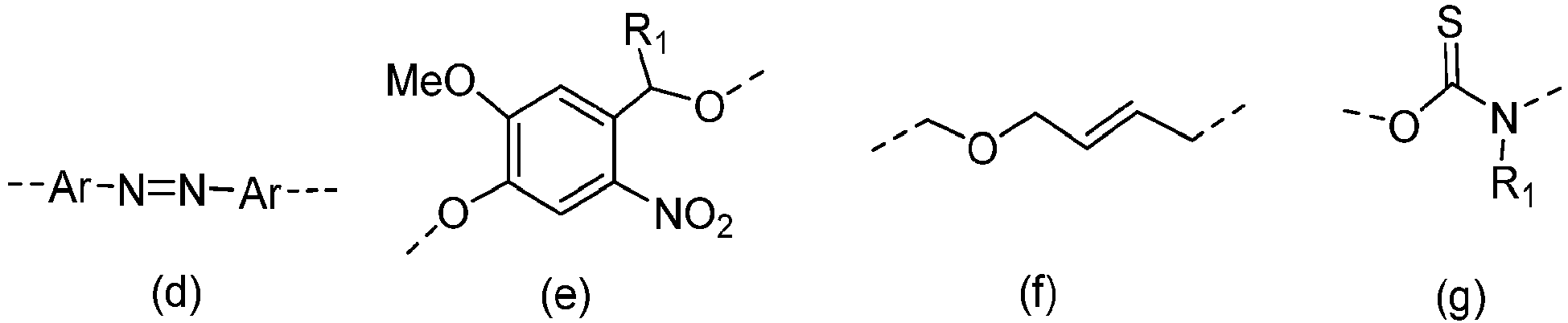
- The cleavable linker CL may be selected from the group consisting of disulfide linkers (-SS-, (a)), oxymethylene disulfides (-OCH2SSCR1R2-, (b)), oxymethine-azides (-CR1,R2OCH(N3)R3,R4)-, (c)), azo-arenes (-ArN=NAr-, (d)), nitrobenzyl derivatives - (e), allyl derivatives (f), thiocarbamate (g), where R1, R2, R3, R4 can be independently H, methyl, ethyl, propyl, t-butyl, C5-C10 alkyls, alkenes, alkynes, hydroxyl, halogens, amines, amides, carboxylates, polyethylene glycols, for example as shown in the following formulas a) to g).

- The cleaving reaction/chemistry depends on the cleavable linker (CL) and may be chosen as appropriate from the following:
- Disulfide linkers can be cleaved off selectively by treating with thiols or phosphines leaving other linkers intact.
- Oxymethine-azide (-OCH(N3)-) can be selectively cleaved off in the presence of azo-arenes, photocleavable or other enzymatically cleavable linkers when treated with phosphines (e.g. TCEP).
- Alternatively, TCEP can be used to cleave off both disulfide and oxymethine azide linkers. Further, azo-arene linker can be cleaved off selectively with very mild reagent - sodium dithinite (Na2S2SO4) in aqueous solution buffer.
- Cleave reagents can be thiols (e.g. dithiothreitol -DTT, dimercapto-propane sulfonates - DMPS, etc), phosphines (e.g. TCEP, THPP, etc), mild reducing agents (e.g. Na2S2O4), specific wavelength of light, electric potential, enzymes (e.g. peptidase, dextranase, esterase, phosphatase, proteinase etc).
- Enzymatically cleavable linkers can be any molecule which can be cleaved off or digested by a specific enzyme like peptidase. Suitable as enzymatically degradable linkers are, for example, polysaccharides, proteins, peptides, depsipeptides, polyesters, nucleic acids, and derivatives thereof. Suitable polysaccharides are, for example, dextrans, pullulans, inulins, amylose, cellulose, hemicelluloses, such as xylan or glucomannan, pectin, chitosan, or chitin. They may be derivatized to provide functional groups for covalent or non-covalent binding of the linker. Proteins, peptides, and depsipeptides used as enzymatically degradable linker can be functionalized via side chain functional groups of amino acids. Polyesters, polyacrylamide and polyesteramides used as enzymatically degradable linker can either be synthesized with co-monomers, which provide side chain functionality or be subsequently functionalized. In the case of branched polyesters functionalization can be via the carboxyl, amine or hydroxyl end groups. Post polymerization functionalization of the polymer chain can be, for example, via addition to unsaturated bonds, i.e. thiolene reactions, or they can be done by azide-alkyne or tetrazine alkyne click reactions, or via introduction of functional groups by radical reactions.
- The enzymatically degradable linker is degraded by the addition of an appropriate enzyme. The choice of enzyme as cleave reagent is determined by the chemical nature of the enzymatically degradable linker and can be one or a mixture of different enzymes. Such enzymes can hydrolases, lyases, reductases, esterase, peptidase etc. Preferable enzymes may be is selected from the group consisting of glycosidases, dextranases, pullulanases, amylases, inulinases, cellulases, hemicellulases, pectinases, chitosanases, chitinases, proteinases, esterases, glycosidase, pyrophosphatase, lipases, phosphatase, and nucleases.
- The method of the invention can be used with multi-probe hybridization method, where more than one probe binds to a specific target.
Figure 6 shows how three DNA targets can be de-coded by a single event of hybridization and sequential cleavage and imaging steps, in a four-color fashion using four fluorescent dyes labeled DNA probes. The calling of specific genes is obtained from the fluorescent response to cleave reagents, and by comparing the initial images with that of the a subsequent steps fluorescence due to exposure to cleave reagents. Target-1 retains fluorescent signals with three different cleave conditions, because all are non-cleavable linker (NC) linked DNA Probes. Target-2 and target -3 loses three dyes sequentially upon cleavage reactions but in different pattern. - In another aspect of the invention, the DNA probes may contain more than one fluorescent dye or tag, or combination thereof (
Figure 7 ). This construct will allow selectively cleaving off of the dyes of interest and probing the target in later step by secondary interaction with tags. The use of such combination is shown infigure 7 . Its shows how three different targets can be distinguished by probing with a mixture comprising of DCL and non-cleavable (NC) - tags linked labeled DNA probes. The three targets are responding differently to cleave and molecular probing on the tags. Target-1 loses all fluorescent signals except one upon treatment of cleave reagent and does not response to molecular probing. On the other hands,target 2 andtarget 3 lose all fluorescent signatures and responded differently to later probing to attached tags. By using various combination and cleavable, non-cleavable and Tags labeled DNA probes a large number of target genes could be decoded. - In another aspect of the invention, after removing the fluorescent dyes, the free 3'-OH of the probe DNA can be used for single base extension and running additional sequencing by synthesis chemistry by using labeled reversibly terminating nucleotides. Reversible terminator nucleotides stop complementary strand synthesis by single base extension, but can be further extended after removing the 3'-OH capping group. The reversibly terminating nucleotides can be 3'-OH capped with methyl methylene disulfide (-CH2SSMe), or azidomethyl (-CH2N3) with the generic structures shown in
figure 4 . These nucleotides may contain DCL linkers as in DNA probe design. They may be used independently or in combination of with DCL-Probes. - In another aspect of the invention, the hybridization involves the use of different probes with their own specific targets and involves multicolor fluorescence measurement. It can also involve more than one cycle of cleave and image steps in each hybridization event, and it can also involve one or more steps of hybridization - imaging - cleaving - imaging and re-hybridization cycle with optional de-hybridization step between each cycle. It can also involve one or more steps of probing by secondary interaction, two specific examples but not limited to, are biotin- streptavidin, DIG - anti-DIG interaction and imaging afterwards.
- The probes can be regular, natural or non-natural DNA or RNAs and their modified analogues, i.e. consist of natural or non-natural nucleotides. They can be proteins too, i.e. consist of natural or non-natural amino acids. The DNA probes can be locked nucleic acids which provides better duplex stability. They can have modification on 3' or 5' end, or modification can be on any of the bases on the main backbone, such as dUTP with amino modification. The label can be fluorescent molecules (rhodhamine dyes such (R6G, ROX), cyanine dyes (Cy3, Cy5), Alexa dyes, ATTO dyes, etc) or can be energy transfer dyes or quencher. The molecular tags can be biotin, happens, antigens, DIG, fluorescein, nitrophenyl etc, or any modification that be identified by secondary interaction (e.g. biotin- STV, antibody-antigen, DIG- anti-DIG interaction with fluorescent labeling). DCL linkers can be on probing proteins too.
- Target sequences can be DNA or RNA, including mRNA. It can be used in a Florescence In-Situ Hybridization (FISH) or sequential FISH (seqFISH) method. The decoding can be on clonally amplified - DNA clones on beads, surface bound rolling cycle amplified (RCA) products or on tissues, or single molecule, or spatially resolved single cells. They can be used in-situ or ex-situ sequencing. The decoding method can involve multiple rounds of hybridization steps to increase the decoding capacity. The de-coding method can involve hybridization with mixture of labeled DNA probes followed by imaging, sequential cleavage steps and imaging, and probing the molecular tags by secondary interactions. Targets can be proteins, peptide, carbohydrate, antibody, and other biomolecules.
- Suitable fluorescent dyes are those known from the art of fluorescence technologies, e.g., flow cytometry or fluorescence microscopy. For example, fluorescent dyes are xanthene dyes, like fluorescein, or rhodamine dyes, coumarine dyes, cyanine dyes, pyrene dyes, oxazine dyes, pyridyl oxazole dyes, cascade dyes, polymeric dyes, pyromethene dyes, acridine dyes, oxadiazole dyes, carbopyronine dyes, benzpyrylium dyes, fluorene dyes, or metallo-organic complexes, such as Ru, Eu, Pt complexes. Besides single molecule entities, clusters of small organic molecule dyes, fluorescent oligomers or fluorescent polymers, such as polyfluorene, can also be used as fluorescent moieties. Additionally, fluorescent dyes might be protein-based, such as phycobiliproteins, nanoparticles, such as quantum dots, upconverting nanoparticles, gold nanoparticles, dyed polymer nanoparticles.
- To establish a proof-of-concept on the use of DCL-DNA probes for mRNA sequencing, multiple sets of probes were synthesized. One is with thiol-cleavable oxymethylene disulfide linker and the other is phosphine cleavable azidomethyl linker. Their synthesis involve multistep reactions and purification. The cleavable linkers are prepared first and then they are conjugated with amino-modified DNA probes. At the final step they were labeled by fluorescent dyes using the amino terminal of the cleavable linker.
- The synthesis steps are shown in
figure 8 . The activatedlinker 2 was obtained as described in US patents - Nucleotide analogues (Mong Marma, et al US 10,301,346, 2016 Mong Marma, et al, US 10,336,785, 2016 Figure 8 ): - Amino modified DNA barcode(BC-NH2,1) (~700 nmoles, source IDT DNA) was dissolved in 1.4 mL of DI water and transferred to 50 mL falcon tube. It was added with 0.3 mL of 0.5 M Na2HPO4 to make base concentration ~ 0.1 mM. In another 2.0 mL centrifuge tube, ∼ 6 mg of activated linker (NHS-ARA-Fmoc linker, compound 2) was dissolved in 0.5 mL DMF. It was then added to the BC-NH2 solution and stirred for 45 mins at room temperature. Once again, the same amount was added in 0.5 mL DMF, and stirred an additional 45 mins.
- It was then quenched by adding 2.0 mL DI water. The mixture was then treated with 0.3 mL of pyperidin for 20 minutes. The product was immediately purified by prep-HPLC (X-bridge, 19X250 mm column, method: 0 - 3min 100%A, followed by 40% B over 40 min, then flat gradient to 50 mins). The target product usually eluted ∼ 43 mins. The target fraction was lyophilized and the solid product was suspended in 1.0 mL DI water, concentration was determined by UV at 260nm to yiled 160 nmole of compound 4 (1.0 mL × 0.160 mM).
- The BC-ARA-NH2 (compound 4) obtained from earlier step was treated with Na2HPO4 salt (salt directly dissolved to avoid further dilution) to make 0.1 mM final concentration. It was then treated with ∼ 10 eq of NHS-Dye in 200 uL DI water (for low polar dye such as AF532-NHS, +100 uL DMF). The mixture was stirred for 30 minutes, and then immediately purified by prep-HPLC (X-bridge, 19×250 mm column, method: 0-3min 100%A, followed by 40% B over 40 min, the flat gradient to 50 mins).
Target product 5 was eluted ~ 40 min. The target fraction was then lyophilized and the final product was dissolved in 1.0 mL RNAs free water and the concentration was determined by UV spectrum (based on dye's property). The product's concentration was then adjusted to prepare stock solution at 0.1 mM. - Synthesis of DCL-DNA probes with oxymethine-azide cleavable linker (11): The synthesis of DCL-DNA probes with -oxyazidomethine cleavable linker starts with a commercially
available compound 6 as shown infigure 9 . It involves following steps: - (a) Synthesis of Fmoc protected linker (7)
- (a) Activation of the linker (9)
- (b) Coupling to amino-modified DNA probes (10)
- (c) Coupling to fluorescent dye (11)
- The synthesis processes for Fmoc protected linker (7) and the activation of the linker for coupling to DNA probes (9) are described below. The coupling reaction of the linker to DNA probe (10) and the final labeling reaction to produce the labeled probe (11) were carried as for oxymethyle disulfide described above.
- To a solution of Fmoc-NHS (760 mg, 2.3 mmol, 1.2 eq) and compound 6 (734 mg, 1.9 mmol, 1 eq) in anhydrous DMF (12 mL), was added DIPEA (0.66 mL, 3.8 mmol, 2 eq). The resulting reaction mixture was stirred at room temperature for 2 hours. It was then diluted with EtOAc (20 mL) and quenched with 1M HCl (20 mL). The aqueous layer was separated and extracted with EtOAC (3x20 mL). The combined organic layers were washed with water (5x20 mL) and brine (sat., 20 mL), dried over Na2SO4 and concentrated under reduced pressure. The crude product was purified by flash chromatography (ISCO Silica 24 g Gold; Gradient: MeOH/DCM (0∼30%), 35 mL/min.) to give the desired
product 7 as a white solid (488 mg, 44%). Next, to a solution of compound 7 (488 mg, 0.83 mmol, 1 eq) in anhydrous DMF (8.3 mL), was added DIPEA (0.22 mL, 1.3 mmol, 1.5 eq) and DSC (318 mg, 1.25 mmol, 1.5 eq). The resulting reaction mixture was stirred at room temperature for 2 hours. It was then concentrated under reduced pressure and the residue was purified by flash chromatography (ISCO Silica 24 g Gold; Gradient: EtOAc/hexane (30∼100%), 35 mL/min.) to give the desiredproduct 8 as a syrup (408 mg, 72%). - Probes targeting four transcripts were designed with six unique hybridization domains. Two of the probes contained sequences that hybridize oligonucleotides with an azido linker (-OCHN3-) conjugated to
Alexa Fluor 647, or oligonucleotides with a disulfide linker (-OCH2-SS-) conjugated to Alexa Fluor 532 (Figure 1A). To serve as a control, two of the probes contained two different binding regions that hybridized two oligonucleotides (Figure 1A). One probe contained sequences that hybridized both an oligonucleotide with an disulfide linker withAlexa Fluor 647 and an oligonucleotide anuncleavable Alex Fluor 532. The other probe had sequences that hybridized both an oligonucleotide with an azido linker withAlexa Fluor 532 and an oligonucleotide anuncleavable Alex Fluor 647. By having two independent fluorophores across the hybridization domains, we were able to evaluate the technology in multiple fluorescent wavelengths. - The probes used had the structure according to
Figure 10 . - The probes were then hybridized on FFPE mouse brain sections, and then subsequently underwent rolling circle amplification to generate rolonies, or DNA nanoballs, which provided amplification to detect the signal in situ (
Figure 11 ). All six complementary probes, or readout probes, were hybridized simultaneously after rolonies were generated. - Next, a series of sequential chemical cleavage steps were performed. The first cleave step utilized
Sodium 2,3-dimercaptopropanesulfonate monohydrate (DMPS), which selective cleaves the oligonucleotides containing the disulfide linker.Figure 12 shows the first of two serial cleavage rounds using DMPS to selective remove the fluorophores that were attached to the oligonucleotide via the azido linker. All images are pseudocolored to provide enough contrast to determine which puncta have signal removed between rounds. In theAlexa Fluor 532 wavelength, puncta that were cleaved by DMPS appear yellow in the merged image (yellow arrows). In theAlexa Fluor 647 wavelength, puncta that were cleaved by DMPS appear purple in the merged image. Objects that were not impacted by the DMPS cleave appear white in the merged image in both wavelengths. - This was followed by a second cleavage using Tris(2-carboxyethyl)phosphine hydrochloride (TCEP) to cleave oligonucleotides containing the azido linker.
Figure 13 shows the second of two serial cleavage rounds using TCEP to selective remove the fluorophores that were attached to the oligonucleotide via the disulfide linker. All images are pseudo-colored to provide enough contrast to determine which puncta have signal removed between rounds. In theAlexa Fluor 532 wavelength, puncta that were cleaved by TCEP appear purple (yellow arrows) in the merged image. In theAlexa Fluor 647 wavelength, puncta that were cleaved by TCEP appear blue in the merged image. After the TCEP cleavage, only non-cleavable oligonucleotides remain detectable and appear white in the merged image in both wavelengths. - After both cleave rounds, only the uncleavable puncta remained.
Claims (8)
- Method for detecting RNA, DNA or protein target sequences bya) Hybridizing a library of probes having the general formula (I)
P - (CL-D)x (I)
WithP: probes having at least 10 nucleotides or amino acidsCL: cleavable linkerD: fluorescent dyeX: integer between 1 and 5to RNA, DNA or protein target sequences wherein the library comprises probes P having different sequences of nucleotides or amino acids and cleavable linkers CL of different groups which are cleavable with different meansb) Removing unhybridized probes and detecting the hybridized probes via the fluorophores D by a first imagec) Cleaving sequentially by different means each group of chemical linkers CL from the hybridized probes; removing the thus cleaved fluorophores D and detecting the remaining hybridized probes via their fluorophores D by a second imaged) Detecting the removed fluorophores D by comparing the first and second image.e) Obtaining a part of the sequence information of the target sequences via the sequence information of the probes P associated with the removed fluorophores Df) Repeating step c) until all groups of chemical linkers CL are cleaved. - Method according to claim 1 characterized in that after step f), the probes P are de-hybridized from the RNA, DNA or protein target sequences.
- Method according to claim 1 or 2 characterized that step a) to f) are repeated until the sequence information of the RNA, DNA or protein target sequences is obtained.
- Method according to any of the claims 1 to 3 characterized that the cleavable linker CL is cleavable by chemical, photochemical or enzymatical means.
- Method according to any of the claims 1 to 4 characterized that the cleavable linker CL is an enzymatically cleavable linker selected from the group consisting of polysaccharides, proteins, peptides, depsipeptides, polyesters, nucleic acids, and derivatives thereof.
- Method according to claim 5 characterized that the polysaccharides are selected from the group consisting of dextrans, pullulans, inulins, amylose, cellulose, hemicelluloses, xylan, glucomannan, pectin, chitosan, and chitin.
- Method according to any of the claims 1 to 4 characterized that the cleavable linker CL is selected from the group consisting of disulfide linkers (-SS-, (a)), oxymethylene disulfides (-OCH2SSCR1R2-, (b)), oxymethine-azides (-CR1,R2OCH(N3)R3,R4)-, (c)), azo-arenes (-ArN=NAr-, (d)), nitrobenzyl derivatives - (e), allyl derivatives (f), thiocarbamate (g), where R1, R2, R3, R4 can be independently H, methyl, ethyl, propyl, t-butyl, C5-C10 alkyls, alkenes, alkynes, hydroxyl, halogens, amines, amides, carboxylates, polyethylene glycols.
- Method according to any of the claims 1 to 7 characterized that the library comprises probes having at least two different groups of cleavable linkers CL which are cleavable with two different means selected from the group consisting of two different photochemical activation radiations, two different enzymes, two different chemical agents, one photochemical activation radiation and one enzyme, one photochemical activation radiation and one chemical agent, one enzyme and one chemical agent.
Priority Applications (1)
| Application Number | Priority Date | Filing Date | Title |
|---|---|---|---|
| EP22197285.4A EP4342998A1 (en) | 2022-09-23 | 2022-09-23 | Labeled probes with differentially cleavable linkers and their use in de-coding dna and rna molecules |
Applications Claiming Priority (1)
| Application Number | Priority Date | Filing Date | Title |
|---|---|---|---|
| EP22197285.4A EP4342998A1 (en) | 2022-09-23 | 2022-09-23 | Labeled probes with differentially cleavable linkers and their use in de-coding dna and rna molecules |
Publications (1)
| Publication Number | Publication Date |
|---|---|
| EP4342998A1 true EP4342998A1 (en) | 2024-03-27 |
Family
ID=83438882
Family Applications (1)
| Application Number | Title | Priority Date | Filing Date |
|---|---|---|---|
| EP22197285.4A Pending EP4342998A1 (en) | 2022-09-23 | 2022-09-23 | Labeled probes with differentially cleavable linkers and their use in de-coding dna and rna molecules |
Country Status (1)
| Country | Link |
|---|---|
| EP (1) | EP4342998A1 (en) |
Citations (4)
| Publication number | Priority date | Publication date | Assignee | Title |
|---|---|---|---|---|
| US20050209147A1 (en) * | 2004-01-16 | 2005-09-22 | The Board Of Trustees Of The Leland Stanford Junior University | Peptide inhibitors of RhoA signaling |
| WO2015054050A1 (en) | 2013-10-07 | 2015-04-16 | General Electric Company | Probing of biological samples |
| US10301346B2 (en) | 2015-11-06 | 2019-05-28 | Qiagen Sciences, Llc | Nucleotide analogues |
| US20220026433A1 (en) * | 2018-11-15 | 2022-01-27 | Arizona Board Of Regents On Behalf Of Arizona State University | Cleavable fluorescent tyramide for sensitive and multiplexed analysis of biological samples |
-
2022
- 2022-09-23 EP EP22197285.4A patent/EP4342998A1/en active Pending
Patent Citations (5)
| Publication number | Priority date | Publication date | Assignee | Title |
|---|---|---|---|---|
| US20050209147A1 (en) * | 2004-01-16 | 2005-09-22 | The Board Of Trustees Of The Leland Stanford Junior University | Peptide inhibitors of RhoA signaling |
| WO2015054050A1 (en) | 2013-10-07 | 2015-04-16 | General Electric Company | Probing of biological samples |
| US10301346B2 (en) | 2015-11-06 | 2019-05-28 | Qiagen Sciences, Llc | Nucleotide analogues |
| US10336785B2 (en) | 2015-11-06 | 2019-07-02 | Qiagen Sciences, Llc | Methods for synthesizing nucleotide analogues with disulfide linkers |
| US20220026433A1 (en) * | 2018-11-15 | 2022-01-27 | Arizona Board Of Regents On Behalf Of Arizona State University | Cleavable fluorescent tyramide for sensitive and multiplexed analysis of biological samples |
Similar Documents
| Publication | Publication Date | Title |
|---|---|---|
| US11713485B2 (en) | Hybridization chain reaction methods for in situ molecular detection | |
| US12188086B2 (en) | Nucleotide analogues and use thereof for nucleic acid sequencing and analysis preliminary class | |
| US20240400605A1 (en) | Compositions and methods for chemical cleavage and deprotection of surface-bound oligonucleotides | |
| JP2024161084A (en) | Method for detecting a target nucleic acid in a sample | |
| US6380377B1 (en) | Nucleic acid hairpin probes and uses thereof | |
| Morihiro et al. | Small molecule release and activation through DNA computing | |
| JP4814904B2 (en) | Method for sequence-selective purification of nucleic acids | |
| CN109562376A (en) | A single-molecule/cluster DNA sequencing-by-synthesis based on fluorescence energy transfer | |
| CN106467913B (en) | Probe inversion method for in situ synthesis of probe arrays | |
| EP4342998A1 (en) | Labeled probes with differentially cleavable linkers and their use in de-coding dna and rna molecules | |
| US20250059592A1 (en) | Suppression of non-specific signals by exonucleases in fish experiment | |
| US20230101711A1 (en) | Labeled probes with differentially cleavable linkers and their use in de-coding dna and rna molecules | |
| US7851159B2 (en) | Method for detecting target nucleic acid with specific base sequence and set of nucleic acids for detection | |
| JP4238381B2 (en) | Pyrene-modified RNA and RNA analysis method | |
| Misra et al. | Immobilization of self-quenched DNA hairpin probe with a heterobifunctional reagent on a glass surface for sensitive detection of oligonucleotides | |
| EP4186982B1 (en) | Sequencing of dna by sequential addition/incorporation of 3' unprotected labeled nucleotides | |
| Janett et al. | A simple reaction for dna sensing and chemical delivery | |
| CN115506036A (en) | DNA coding compound library initial fragment and preparation and application thereof | |
| Wang et al. | Synthesis and Evaluations of Cleavable Triazene‐Modified Nucleotide for DNA Sequencing | |
| Mi et al. | Multiplexed RNA imaging and in situ profiling in living cells | |
| US20230304086A1 (en) | Labeled avidin and methods for sequencing | |
| Goyvaerts et al. | Synthetic approaches towards sequence-specific DNA labelling | |
| CN103232511B (en) | Light-cleavable group protected deoxyuridine triphosphate derivatives and a synthesis method and applications thereof. | |
| JPH0959294A (en) | Fluorescently labeled oligonucleotide | |
| Mokhir | Chemical Reactions Controlled by Nucleic Acids and their Applications for Detection of Nucleic Acids in Live Cells |
Legal Events
| Date | Code | Title | Description |
|---|---|---|---|
| PUAI | Public reference made under article 153(3) epc to a published international application that has entered the european phase |
Free format text: ORIGINAL CODE: 0009012 |
|
| STAA | Information on the status of an ep patent application or granted ep patent |
Free format text: STATUS: THE APPLICATION HAS BEEN PUBLISHED |
|
| AK | Designated contracting states |
Kind code of ref document: A1 Designated state(s): AL AT BE BG CH CY CZ DE DK EE ES FI FR GB GR HR HU IE IS IT LI LT LU LV MC MK MT NL NO PL PT RO RS SE SI SK SM TR |
|
| STAA | Information on the status of an ep patent application or granted ep patent |
Free format text: STATUS: REQUEST FOR EXAMINATION WAS MADE |
|
| 17P | Request for examination filed |
Effective date: 20240910 |
|
| RBV | Designated contracting states (corrected) |
Designated state(s): AL AT BE BG CH CY CZ DE DK EE ES FI FR GB GR HR HU IE IS IT LI LT LU LV MC MK MT NL NO PL PT RO RS SE SI SK SM TR |