EP4282827A1 - Preparation method of high-safety high-capacity lithium manganese iron phosphate - Google Patents

Preparation method of high-safety high-capacity lithium manganese iron phosphate Download PDF

Info

Publication number
EP4282827A1
EP4282827A1 EP22204965.2A EP22204965A EP4282827A1 EP 4282827 A1 EP4282827 A1 EP 4282827A1 EP 22204965 A EP22204965 A EP 22204965A EP 4282827 A1 EP4282827 A1 EP 4282827A1
Authority
EP
European Patent Office
Prior art keywords
phosphate
manganese
slurry
sintering
phosphate precursor
Prior art date
Legal status (The legal status is an assumption and is not a legal conclusion. Google has not performed a legal analysis and makes no representation as to the accuracy of the status listed.)
Pending
Application number
EP22204965.2A
Other languages
German (de)
French (fr)
Inventor
Ji Yang
Yihua Wei
Jie Sun
Zhonglin HE
Jianhao HE
Shuo Lin
Cheng Xu
Pingjun Lin
Chao Liu
Menghua Yu
Hongfu Qi
Xiong WANG
Zhengchuang Cheng
Current Assignee (The listed assignees may be inaccurate. Google has not performed a legal analysis and makes no representation or warranty as to the accuracy of the list.)
Hubei RT Advanced Materials Co Ltd
Original Assignee
Hubei RT Advanced Materials Co Ltd
Priority date (The priority date is an assumption and is not a legal conclusion. Google has not performed a legal analysis and makes no representation as to the accuracy of the date listed.)
Filing date
Publication date
Priority claimed from CN202210579213.9A external-priority patent/CN114804056B/en
Priority claimed from CN202210935979.6A external-priority patent/CN115159491A/en
Application filed by Hubei RT Advanced Materials Co Ltd filed Critical Hubei RT Advanced Materials Co Ltd
Publication of EP4282827A1 publication Critical patent/EP4282827A1/en
Pending legal-status Critical Current

Links

Images

Classifications

    • CCHEMISTRY; METALLURGY
    • C01INORGANIC CHEMISTRY
    • C01BNON-METALLIC ELEMENTS; COMPOUNDS THEREOF; METALLOIDS OR COMPOUNDS THEREOF NOT COVERED BY SUBCLASS C01C
    • C01B25/00Phosphorus; Compounds thereof
    • C01B25/16Oxyacids of phosphorus; Salts thereof
    • C01B25/26Phosphates
    • C01B25/45Phosphates containing plural metal, or metal and ammonium
    • CCHEMISTRY; METALLURGY
    • C01INORGANIC CHEMISTRY
    • C01BNON-METALLIC ELEMENTS; COMPOUNDS THEREOF; METALLOIDS OR COMPOUNDS THEREOF NOT COVERED BY SUBCLASS C01C
    • C01B25/00Phosphorus; Compounds thereof
    • C01B25/16Oxyacids of phosphorus; Salts thereof
    • C01B25/26Phosphates
    • C01B25/37Phosphates of heavy metals
    • C01B25/375Phosphates of heavy metals of iron
    • CCHEMISTRY; METALLURGY
    • C01INORGANIC CHEMISTRY
    • C01BNON-METALLIC ELEMENTS; COMPOUNDS THEREOF; METALLOIDS OR COMPOUNDS THEREOF NOT COVERED BY SUBCLASS C01C
    • C01B25/00Phosphorus; Compounds thereof
    • C01B25/16Oxyacids of phosphorus; Salts thereof
    • C01B25/26Phosphates
    • C01B25/37Phosphates of heavy metals
    • C01B25/377Phosphates of heavy metals of manganese
    • CCHEMISTRY; METALLURGY
    • C01INORGANIC CHEMISTRY
    • C01GCOMPOUNDS CONTAINING METALS NOT COVERED BY SUBCLASSES C01D OR C01F
    • C01G49/00Compounds of iron
    • C01G49/009Compounds containing iron, with or without oxygen or hydrogen, and containing two or more other elements
    • HELECTRICITY
    • H01ELECTRIC ELEMENTS
    • H01MPROCESSES OR MEANS, e.g. BATTERIES, FOR THE DIRECT CONVERSION OF CHEMICAL ENERGY INTO ELECTRICAL ENERGY
    • H01M10/00Secondary cells; Manufacture thereof
    • H01M10/05Accumulators with non-aqueous electrolyte
    • H01M10/052Li-accumulators
    • H01M10/0525Rocking-chair batteries, i.e. batteries with lithium insertion or intercalation in both electrodes; Lithium-ion batteries
    • HELECTRICITY
    • H01ELECTRIC ELEMENTS
    • H01MPROCESSES OR MEANS, e.g. BATTERIES, FOR THE DIRECT CONVERSION OF CHEMICAL ENERGY INTO ELECTRICAL ENERGY
    • H01M4/00Electrodes
    • H01M4/02Electrodes composed of, or comprising, active material
    • H01M4/36Selection of substances as active materials, active masses, active liquids
    • H01M4/58Selection of substances as active materials, active masses, active liquids of inorganic compounds other than oxides or hydroxides, e.g. sulfides, selenides, tellurides, halogenides or LiCoFy; of polyanionic structures, e.g. phosphates, silicates or borates
    • H01M4/5825Oxygenated metallic salts or polyanionic structures, e.g. borates, phosphates, silicates, olivines
    • CCHEMISTRY; METALLURGY
    • C01INORGANIC CHEMISTRY
    • C01PINDEXING SCHEME RELATING TO STRUCTURAL AND PHYSICAL ASPECTS OF SOLID INORGANIC COMPOUNDS
    • C01P2004/00Particle morphology
    • C01P2004/60Particles characterised by their size
    • C01P2004/61Micrometer sized, i.e. from 1-100 micrometer
    • CCHEMISTRY; METALLURGY
    • C01INORGANIC CHEMISTRY
    • C01PINDEXING SCHEME RELATING TO STRUCTURAL AND PHYSICAL ASPECTS OF SOLID INORGANIC COMPOUNDS
    • C01P2006/00Physical properties of inorganic compounds
    • C01P2006/40Electric properties
    • HELECTRICITY
    • H01ELECTRIC ELEMENTS
    • H01MPROCESSES OR MEANS, e.g. BATTERIES, FOR THE DIRECT CONVERSION OF CHEMICAL ENERGY INTO ELECTRICAL ENERGY
    • H01M4/00Electrodes
    • H01M4/02Electrodes composed of, or comprising, active material
    • H01M2004/026Electrodes composed of, or comprising, active material characterised by the polarity
    • H01M2004/028Positive electrodes
    • YGENERAL TAGGING OF NEW TECHNOLOGICAL DEVELOPMENTS; GENERAL TAGGING OF CROSS-SECTIONAL TECHNOLOGIES SPANNING OVER SEVERAL SECTIONS OF THE IPC; TECHNICAL SUBJECTS COVERED BY FORMER USPC CROSS-REFERENCE ART COLLECTIONS [XRACs] AND DIGESTS
    • Y02TECHNOLOGIES OR APPLICATIONS FOR MITIGATION OR ADAPTATION AGAINST CLIMATE CHANGE
    • Y02EREDUCTION OF GREENHOUSE GAS [GHG] EMISSIONS, RELATED TO ENERGY GENERATION, TRANSMISSION OR DISTRIBUTION
    • Y02E60/00Enabling technologies; Technologies with a potential or indirect contribution to GHG emissions mitigation
    • Y02E60/10Energy storage using batteries

Definitions

  • the present disclosure belongs to the technical field of lithium battery cathode materials, and particularly discloses a preparation method of high-safety high-capacity lithium manganese iron phosphate.
  • lithium manganese iron phosphate the high voltage characteristic of manganese makes lithium manganese iron phosphate have a higher voltage platform, which also leads to a fact that it has higher energy density when the specific capacity is the same, and under the same conditions, the energy density is 10%-20% higher than that of lithium iron phosphate.
  • Lithium manganese iron phosphate itself also has performance deficiencies. At present, the lithium iron phosphate process is relatively mature and has better safety and stability; Currently, the lithium manganese iron phosphate process is poor in performance and complicated in reaction process, divalent manganese and divalent iron have the possibility of redox so that the finally produced lithium manganese iron phosphate finished product has poor phase homogeneity in the process of preparation; since there is a consecutive conformal octahedron network in the structure, motion of lithium ions in a one-dimensional pathway is limited, leading to poor material conductivity.
  • the objective of the present disclosure is to provide a high-safety high-capacity lithium manganese iron phosphate material.
  • the high-safety high-capacity Lithium manganese iron phosphate material has a more homogeneous phase and stronger slurry stability, and further improves the capacity and compaction of the material.
  • the present disclosure uses the following technical solution: Provided is a preparation method of high-safety high-capacity lithium manganese iron phosphate, comprising the following steps:
  • the iron source is ferrous sulfate
  • the phosphorus source is one or more of phosphoric acid, ammonium dihydrogen phosphate and diammonium hydrogen phosphate
  • the antioxidant agent is ascorbic acid
  • the chemical formula of the ferrous phosphate precursor is Fe 3 (PO4) 2 •8H 2 O
  • the sintering is carried out in a box furnace at the sintering temperature of 350-600°C for 1-5 h at the sintering atmosphere of nitrogen.
  • the manganese source is manganese sulfate;
  • the phosphorus source is one or more of phosphoric acid, ammonium dihydrogen phosphate and diammonium hydrogen phosphate;
  • the antioxidant agent is ascorbic acid;
  • the chemical formula of the manganese phosphate precursor is Mn 3 (PO 4 ) 2 •7H 2 O;
  • the sintering is carried out in the box furnace at the sintering temperature of 350-600°C for 1-5 h at the sintering atmosphere of nitrogen.
  • the organic carbon source is a mixture of glucose and polyethylene glycol
  • the addition amount of glucose is 5-10wt% of the weight of the anhydrous manganese phosphate precursor
  • the addition amount of polyethylene glycol is 1-5wt% of the weight of the anhydrous manganese phosphate precursor
  • the dopant is one or more of titanium dioxide, ammonium metavanadate and niobium pentoxide, and the addition amount of the dopant is 0-2.5wt% of the weight of the anhydrous manganese phosphate precursor
  • the dispersant is one or more of anionic polyacrylate dispersant TC108, non-ionic polymer TC311 and non-ionic polymer TC28, and the addition amount of the dispersant is 5-10wt% of the weight of glucose.
  • the present disclosure also provides a high-capacity high-safety lithium manganese iron phosphate material prepared by using the method.
  • the present disclosure also provides use of a high-capacity high-safety lithium manganese iron phosphate in a lithium battery cathode material.
  • a preparation method of high-safety high-capacity lithium iron manganese phosphate comprises the following steps:
  • a preparation method of high-safety high-capacity lithium iron manganese phosphate comprises the following steps:
  • a preparation method of high-safety high-capacity lithium iron manganese phosphate comprises the following steps:
  • a preparation method of high-safety high-capacity lithium iron manganese phosphate comprises the following steps:
  • a preparation method of lithium iron manganese phosphate comprises the following steps:
  • a preparation method of lithium iron manganese phosphate comprises the following steps:
  • a range of a test voltage is 2.5 V-4.5 V, charge is performed to 4.5 V in a constant-current constant-voltage charging manner, and the cut-off current is 0.02 C; discharge is performed to 2.5 V in a constant-current discharge manner.
  • Test results are as shown in Table 1: Table 1 Basic performance of lithium manganese iron phosphate material 0.1C discharge per gram capacity (mAh/g) 1C discharge per gram capacity (mAh/g) Initial coulombic efficiency (%) Example 1 163.1 155.89 95.58 Example 2 162.07 156.6 96.62 Example 3 161.85 156.23 96.53 Example 4 163.10 157.35 96.47 Comparative example 1 152.41 141.07 92.56 Comparative example 2 149.07 129.89 87.13
  • Examples 1-4 are high-safety high-capacity lithium manganese iron phosphate prepared in the present disclosure
  • comparative examples 1-2 are lithium manganese iron phosphate produced in conventional methods
  • the initial coulomb efficiency and discharge capacity of the high-safety high-capacity lithium manganese iron phosphate prepared in the present disclosure are higher than those of lithium manganese iron phosphate produced in the conventional method, and its conductivity and capacity are higher
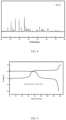
  • it can be seen from the XRD analysis diagrams that lithium manganese iron phosphate prepared by this process has high purity and no impurity phase
  • the product prepared in comparative example 1 has a Fe 2 P impurity phase, so as to lead to decreased product properties
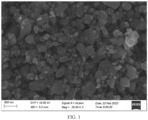
  • example products and comparative example products are subjected to scanning electron microscope analysis from which it can be seen that the high-safety high-capacity lithium iron manganese phosphate particle prepared in the present disclosure has a uniform size with better uniformity.

Landscapes

  • Chemical & Material Sciences (AREA)
  • Organic Chemistry (AREA)
  • Inorganic Chemistry (AREA)
  • Chemical Kinetics & Catalysis (AREA)
  • Electrochemistry (AREA)
  • General Chemical & Material Sciences (AREA)
  • Crystallography & Structural Chemistry (AREA)
  • Engineering & Computer Science (AREA)
  • Materials Engineering (AREA)
  • Manufacturing & Machinery (AREA)
  • Battery Electrode And Active Subsutance (AREA)

Abstract

The present disclosure belongs to the technical field of cathode materials of lithium batteries, and discloses a preparation method of high-safety high-capacity lithium manganese iron phosphate. The preparation method comprises the following steps: (1) synthesizing a ferrous phosphate precursor through a co-precipitation process, and sintering to obtain an anhydrous ferrous phosphate precursor; (2) synthesizing a manganese phosphate precursor through the co-precipitation process, and sintering to obtain an anhydrous manganese phosphate precursor; (3) adding lithium phosphate and deionized water into the anhydrous ferrous phosphate precursor, and performing ball milling and wet sanding to obtain slurry A; (4) adding lithium phosphate, an organic carbon source, a dispersant, a dopant and deionized water into the anhydrous manganese phosphate precursor, and performing ball milling and wet sanding to obtain slurry B; and (5) mixing the slurry A with the slurry B, and performing ball milling, spray drying, sintering and air jet pulverization to obtain high-safety high-capacity lithium manganese iron phosphate. Through the present disclosure, the stability of slurry is increased, the aggregation is relieved, and the prepared material has higher capacity and safety.

Description

    TECHNICAL FIELD
  • The present disclosure belongs to the technical field of lithium battery cathode materials, and particularly discloses a preparation method of high-safety high-capacity lithium manganese iron phosphate.
  • BACKGROUND
  • At present, novel lithium battery cathode materials are developed around high-voltage platforms and manganese-based materials, and the earliest commercialized lithium battery cathode material in its branch system is lithium manganese iron phosphate. Compared with lithium iron phosphate, the high voltage characteristic of manganese makes lithium manganese iron phosphate have a higher voltage platform, which also leads to a fact that it has higher energy density when the specific capacity is the same, and under the same conditions, the energy density is 10%-20% higher than that of lithium iron phosphate.
  • Lithium manganese iron phosphate itself also has performance deficiencies. At present, the lithium iron phosphate process is relatively mature and has better safety and stability; Currently, the lithium manganese iron phosphate process is poor in performance and complicated in reaction process, divalent manganese and divalent iron have the possibility of redox so that the finally produced lithium manganese iron phosphate finished product has poor phase homogeneity in the process of preparation; since there is a consecutive conformal octahedron network in the structure, motion of lithium ions in a one-dimensional pathway is limited, leading to poor material conductivity.
  • SUMMARY
  • In order to solve the defects in the prior art, the objective of the present disclosure is to provide a high-safety high-capacity lithium manganese iron phosphate material. The high-safety high-capacity Lithium manganese iron phosphate material has a more homogeneous phase and stronger slurry stability, and further improves the capacity and compaction of the material.
  • In order to realize the above objective, the present disclosure uses the following technical solution:
    Provided is a preparation method of high-safety high-capacity lithium manganese iron phosphate, comprising the following steps:
    1. (1) mixing an iron source, a phosphorous source and an antioxidant into a solution, introducing nitrogen into the solution to serve as a protective gas to prevent oxidization, and synthesizing a ferrous phosphate precursor through a co-precipitation process, sintering the obtained ferrous phosphate precursor, and then removing all crystallized water to obtain an anhydrous ferrous phosphate precursor;
    2. (2) mixing a manganese source, a phosphorous source and an antioxidant into a solution, introducing nitrogen into the solution to serve as a protective gas to prevent oxidization, and synthesizing a manganese phosphate precursor through the co-precipitation process, and sintering the obtained phosphorous source to obtain an anhydrous manganese phosphate precursor;
    3. (3) adding lithium phosphate and deionized water into the anhydrous ferrous phosphate precursor obtained in step (1), and performing ball milling and wet sanding to obtain slurry A;
    4. (4) adding lithium phosphate, an organic carbon source, a dispersant, a dopant and deionized water into the anhydrous manganese phosphate precursor obtained in step (2), and performing ball milling and wet sanding to obtain slurry B; and
    5. (5) mixing the slurry A obtained in step (3) with the slurry B obtained in step (4), and performing ball milling, spray drying, sintering and air jet pulverization to obtain high-safety high-capacity lithium manganese iron phosphate.
  • Preferably, in step (1), the iron source is ferrous sulfate, and the phosphorus source is one or more of phosphoric acid, ammonium dihydrogen phosphate and diammonium hydrogen phosphate; the antioxidant agent is ascorbic acid; the chemical formula of the ferrous phosphate precursor is Fe3(PO4)2•8H2O; the sintering is carried out in a box furnace at the sintering temperature of 350-600°C for 1-5 h at the sintering atmosphere of nitrogen.
  • Preferably, in step (2), the manganese source is manganese sulfate; the phosphorus source is one or more of phosphoric acid, ammonium dihydrogen phosphate and diammonium hydrogen phosphate; the antioxidant agent is ascorbic acid; the chemical formula of the manganese phosphate precursor is Mn3(PO4)2•7H2O; the sintering is carried out in the box furnace at the sintering temperature of 350-600°C for 1-5 h at the sintering atmosphere of nitrogen.
  • Preferably, in step (3), a molar ratio Fe/P in the slurry A is 0.958-0.998, a molar ratio Li/Fe in the slurry A is 1.025-1.055; in the wet sanding, the particle size of the slurry A is controlled to D50= 0.30-0.60 µm.
  • Preferably, in step (4), a molar ratio Mn/P in the slurry B is 0.958-0.998, a molar ratio Li/Mn in the slurry B is 1.025-1.055; in the wet sanding, the particle size of the slurry B is controlled to D50=0.20-0.50 µm.
  • Preferably, in step (4), the organic carbon source is a mixture of glucose and polyethylene glycol, the addition amount of glucose is 5-10wt% of the weight of the anhydrous manganese phosphate precursor; the addition amount of polyethylene glycol is 1-5wt% of the weight of the anhydrous manganese phosphate precursor; the dopant is one or more of titanium dioxide, ammonium metavanadate and niobium pentoxide, and the addition amount of the dopant is 0-2.5wt% of the weight of the anhydrous manganese phosphate precursor; the dispersant is one or more of anionic polyacrylate dispersant TC108, non-ionic polymer TC311 and non-ionic polymer TC28, and the addition amount of the dispersant is 5-10wt% of the weight of glucose.
  • Preferably, in step (5), the ball milling is carried out in a ball mill for 30-60 min; the spray drying is carried out under the atmosphere of nitrogen, an inlet air temperature is controlled to 180-240°C, and an outlet air temperature is controlled to 80-120°C; the sintering is carried out in the box furnace at the sintering temperature of 600-800°C for 8-20 h at the sintering atmosphere of nitrogen; in the air jet pulverization, the finally obtained high-safety high-capacity lithium manganese iron phosphate is controlled to have a particle size of D50 ≥ 0.30 µm, D50=0.8-1.8 µm and D90 ≤18µm.
  • The present disclosure also provides a high-capacity high-safety lithium manganese iron phosphate material prepared by using the method.
  • The present disclosure also provides use of a high-capacity high-safety lithium manganese iron phosphate in a lithium battery cathode material.
  • Compared with the prior art, the present disclosure has the following beneficial effects:
    1. 1. The ferrous phosphate precursor and the manganese phosphate precursor reduce the process of reducing trivalent iron and trivalent manganese into bivalent iron and bivalent manganese during the sintering, which avoids the generation of reaction impurities in the phase; sintering and spray drying are carried out under the atmosphere of nitrogen so as to further prevent oxidation of bivalent iron and manganese.
    2. 2. The dispersing agent is used in the production process, which ensures that iron and manganese are not oxidized and meanwhile the finished products have pure phases and are not agglomerated; in the process of high-temperature carbonization, organic small molecular substances can be produced by decomposition and have synergistic effect with the carbon source, which is conducive to pore formation of the cathode material and control of crystal morphology to inhibit the growth of crystal grains and relieve agglomerated.
    3. 3. On the basis of taking glucose and polyethylene glycol as the main carbon source, the surfaces of inorganic particles are wetted by addition of the dispersant, thereby reducing the viscosity of the slurry to obtain good dispersity and facilitating the solid content of the material and the stability of the slurry.
    4. 4. By controlling different sanding sizes of precursors, the ferrous phosphate precursor with a large particle size and the manganese phosphate precursor with a small particle size are evenly mixed, thereby not only reducing the sanding time and improving the grinding efficiency, but also ensuring the mix of the materials and then further improving the capacity and compaction.
    BRIEF DESCRIPTION OF THE DRAWINGS
    • Fig.1 is a scanning electron microscope (SEM) graph of a sample prepared in Example 1;
    • Fig.2 is an SEM graph of a sample prepared in Example 2;
    • Fig.3 is an SEM graph of a sample prepared in Example 3;
    • Fig.4 is an SEM graph of a sample prepared in Example 4;
    • Fig.5 is an SEM graph of a sample prepared in Comparative example 1;
    • Fig.6 is an SEM graph of a sample prepared in Comparative example 2;
    • Fig.7 is an X-ray diffraction (XRD) graph of a sample prepared in Example 1;
    • Fig.8 is an X-ray diffraction (XRD) graph of a sample prepared in Comparative example 1;
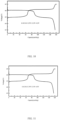
    • Fig.9 shows a button battery charge-discharge curve of a sample prepared in Example 1;
    • Fig.10 shows a button battery charge-discharge curve of a sample prepared in Example 2;
    • Fig.11 shows a button battery charge-discharge curve of a sample prepared in Example 3;
    • Fig.12 shows a button battery charge-discharge curve of a sample prepared in Example 4;
    • Fig.13 shows a button battery charge-discharge curve of a sample prepared in Comparative example 1;
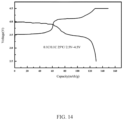
    • Fig.14 shows a button battery charge-discharge curve of a sample prepared in Comparative example 2.
    DETAILED DESCRIPTION OF THE EMBODIMENTS
  • For making the objective, technical solution and advantages of the present disclosure more clear, the present disclosure will be further described in detail in combination with examples below. Of course, examples described herein are only for explaining but not limiting the present disclosure.
  • Although the steps in the present disclosure are arranged with numbers, they are not used to limit the sequence of the steps, and the relative sequence of the steps can be adjusted unless the sequence of the steps is explicitly stated or the execution of a certain step requires other steps as the basis. It should be understood that the term "and/or" used herein involves and covers one or more any and all possible combinations of associated listed items.
  • Unless otherwise specified, chemical reagents and materials in the present disclosure are commercially available, or are synthesized by raw materials purchased on the market, and the dispersant anionic polyacrylate dispersant TC108, non-ionic polymer TC311 and non-ionic polymer TC28 are purchased from Klein factory.
  • Example 1
  • A preparation method of high-safety high-capacity lithium iron manganese phosphate comprises the following steps:
    1. (1) 778 g of ferrous sulfate, 190 g of ammonium dihydrogen phosphate, 10 g of phosphoric acid and 10 g of ascorbic acid were mixed into a solution, nitrogen was introduced into the solution to serve as a protective gas to prevent oxidization, and a ferrous phosphate precursor was synthesized through a co-precipitation method; the obtained ferrous phosphate precursor was sintered for 5 h at the sintering temperature of 400°C under the atmosphere of nitrogen in a box furnace, and 400 g of anhydrous ferrous phosphate precursor was obtained after all crystallized water was removed;
    2. (2) 1060 g of manganese sulfate, 270 g of phosphoric acid and 10 g of ascorbic acid were mixed into a solution, nitrogen was introduced into the solution to serve as a protective gas to prevent oxidization, and a manganese phosphate precursor was synthesized through a co-precipitation method; the obtained manganese phosphate precursor was sintered for 5 h at the sintering temperature of 400°C under the atmosphere of nitrogen in a box furnace, and 545 g of anhydrous manganese phosphate precursor was obtained after all crystallized water was removed;
    3. (3) 123.6 g of lithium phosphate and 1100 g of deionized water were added into 500 g of anhydrous ferrous phosphate precursor obtained in step (1), and ball milling and wet sanding were performed to obtain slurry A with a particle size D50=0.55 µm;
    4. (4) 185.4 g of lithium phosphate, 60 g of glucose, 50 g of polyethylene glycol, 8 g of anionic polyacrylate dispersant TC108, 7.71 g of ammonium metavanadate and 1100 g of deionized water were added into 545 g of anhydrous manganese phosphate precursor obtained in step (2), and ball milling and wet sanding were performed to obtain slurry B with a particle size D50=0.35 µm;
    5. (5) the slurry A obtained in step (3) was mixed with the slurry B obtained in step (4), and the obtained mixture was subjected to ball milling for 30 min using a ball mill; spray drying was performed under the atmosphere of nitrogen, an inlet air temperature was controlled to 220°C, and an outlet air temperature was controlled to 100°C; the above-mentioned mixture was sintered for 15 h in the box furnace under the atmosphere of nitrogen at 750°C under the in-furnace pressure of 50 Pa, nitrogen was introduced for more than 3 h before heating, a heating rate was controlled to 2°C/min, and subsequently the temperature was naturally reduced to 50°C with the furnace after completion of sintering; air jet pulverization was performed, and the particle sizes were controlled to D10=0.40 µm, D50=1.0 µm and D90=10 µm, so as to obtain high-safety high-capacity lithium iron manganese phosphate.
    Example 2
  • A preparation method of high-safety high-capacity lithium iron manganese phosphate comprises the following steps:
    1. (1) 972 g of ferrous sulfate, 240 g of ammonium dihydrogen phosphate, 20 g of phosphoric acid and 10 g of ascorbic acid were mixed into a solution, nitrogen was introduced into the solution to serve as a protective gas to prevent oxidization, and a ferrous phosphate precursor was synthesized through a co-precipitation method; the obtained ferrous phosphate precursor was sintered for 4 h at the sintering temperature of 450°C under the atmosphere of nitrogen in a box furnace, and 500 g of anhydrous ferrous phosphate precursor was obtained after all crystallized water was removed;
    2. (2) 888 g of manganese sulfate, 240 g of phosphoric acid and 10 g of ascorbic acid were mixed into a solution, nitrogen was introduced into the solution to serve as a protective gas to prevent oxidization, and a manganese phosphate precursor was synthesized through a co-precipitation method; the obtained manganese phosphate precursor was sintered for 4 h at the sintering temperature of 450°C under the atmosphere of nitrogen in a box furnace, and 455 g of anhydrous manganese phosphate precursor was obtained after all crystallized water was removed;
    3. (3) 154.5 g of lithium phosphate and 1100 g of deionized water were added into 500 g of anhydrous ferrous phosphate precursor obtained in step (1), and ball milling and wet sanding were performed to obtain slurry A with a particle size D50=0.35 µm;
    4. (4) 154.5 g of lithium phosphate, 60 g of glucose, 50 g of polyethylene glycol, 6 g of anionic polyacrylate dispersant TC311, 6 g of titanium dioxide and 1100 g of deionized water were added into 455 g of anhydrous manganese phosphate precursor obtained in step (2), and ball milling and wet sanding were performed to obtain slurry B with a particle size D50=0.25 µm;
    5. (5) the slurry A obtained in step (3) was mixed with the slurry B obtained in step (4), and ball milling was performed for 40 min using a ball mill; spray drying was performed under the atmosphere of nitrogen, an inlet air temperature was controlled to 220°C, and an outlet air temperature was controlled to 100°C; the above-mentioned mixture was sintered for 12 h in the box furnace under the atmosphere of nitrogen at 760°C under the in-furnace pressure of 60 Pa, nitrogen was introduced for more than 3 h before heating, a heating rate was controlled to 2°C/min, and subsequently the temperature was naturally reduced to 50°C with the furnace after completion of sintering; air jet pulverization was performed, and the particle sizes were controlled to D10=0.40 µm, D50=1.2 µm and D90=10 µm, so as to obtain high-safety high-capacity lithium iron manganese phosphate.
    Example 3
  • A preparation method of high-safety high-capacity lithium iron manganese phosphate comprises the following steps:
    1. (1) 972 g of ferrous sulfate, 220 g of ammonium dihydrogen phosphate, 40 g of phosphoric acid and 10 g of ascorbic acid were mixed into a solution, nitrogen was introduced into the solution to serve as a protective gas to prevent oxidization, and a ferrous phosphate precursor was synthesized through a co-precipitation method; the obtained ferrous phosphate precursor was sintered for 3 h at the sintering temperature of 500°C under the atmosphere of nitrogen in a box furnace, and 500 g of anhydrous ferrous phosphate precursor was obtained after all crystallized water was removed;
    2. (2) 585 g of manganese sulfate, 160 g of phosphoric acid and 10 g of ascorbic acid were mixed into a solution, nitrogen was introduced into the solution to serve as a protective gas to prevent oxidization, and a manganese phosphate precursor was synthesized through a co-precipitation method; the obtained manganese phosphate precursor was sintered for 3 h at the sintering temperature of 500°C under the atmosphere of nitrogen in the box furnace, and 300 g of anhydrous manganese phosphate precursor was obtained after all crystallized water was removed;
    3. (3) 154.2 g of lithium phosphate and 1100 g of deionized water were added into 500 g of anhydrous ferrous phosphate precursor obtained in step (1), and ball milling and wet sanding were performed to obtain slurry A with a particle size D50=0.55 µm;
    4. (4) 102.8 g of lithium phosphate, 60 g of glucose, 50 g of polyethylene glycol, 8 g of anionic polyacrylate dispersant TC28, 6.5 g of niobium pentoxide and 1100 g of deionized water were added into 300 g of anhydrous manganese phosphate precursor obtained in step (2), and ball milling and wet sanding were performed to obtain slurry B with a particle size D50=0.35 µm;
    5. (5) the slurry A obtained in step (3) was mixed with the slurry B obtained in step (4), and ball milling was performed for 50 min using a ball mill; spray drying was performed under the atmosphere of nitrogen, an inlet air temperature was controlled to 200°C, and an outlet air temperature was controlled to 100°C; the above-mentioned mixture was sintered for 10 h in the box furnace under the atmosphere of nitrogen at 780°C under the in-furnace pressure of 70 Pa, nitrogen was introduced for more than 3 h before heating, a heating rate was controlled to 2°C/min, and subsequently the temperature was naturally reduced to 50°C with the furnace after completion of sintering; air jet pulverization was performed, and the particle sizes were controlled to D10=0.40 µm, D50=0.9 µm and D90=10 µm, so as to obtain high-safety high-capacity lithium iron manganese phosphate.
    Example 4
  • A preparation method of high-safety high-capacity lithium iron manganese phosphate comprises the following steps:
    1. (1) 778 g of ferrous sulfate, 180 g of ammonium dihydrogen phosphate, 20 g of phosphoric acid and 10 g of ascorbic acid were mixed into a solution, nitrogen was introduced into the solution to serve as a protective gas to prevent oxidization, and a ferrous phosphate precursor was synthesized through a co-precipitation method; the obtained ferrous phosphate precursor was sintered for 2 h at the sintering temperature of 550°C under the atmosphere of nitrogen in a box furnace, and 400 g of anhydrous ferrous phosphate precursor was obtained after all crystallized water was removed;
    2. (2) 1060 g of manganese sulfate, 270 g of phosphoric acid and 10 g of ascorbic acid were mixed into a solution, nitrogen was introduced into the solution to serve as a protective gas to prevent oxidization, and a manganese phosphate precursor was synthesized through a co-precipitation method; the obtained manganese phosphate precursor was sintered for 2 h at the sintering temperature of 550°C under the atmosphere of nitrogen in the box furnace, and 545 g of anhydrous manganese phosphate precursor was obtained after all crystallized water was removed;
    3. (3) 123.6 g of lithium phosphate and 1100 g of deionized water were added into 400 g of anhydrous ferrous phosphate precursor obtained in step (1), and ball milling and wet sanding were performed to obtain slurry A with a particle size D50=0.60 µm;
    4. (4) 185.4 g of lithium phosphate, 60 g of glucose, 50 g of polyethylene glycol, 8 g of anionic polyacrylate dispersant TC28, 6 g of ammonium metavanadate and 1100 g of deionized water were added into 545 g of anhydrous manganese phosphate precursor obtained in step (2), and ball milling and wet sanding were performed to obtain slurry B with a particle size D50=0.50 µm;
    5. (5) the slurry A obtained in step (3) was mixed with the slurry B obtained in step (4), and ball milling was performed for 60 min using a ball mill; spray drying was performed under the atmosphere of nitrogen, an inlet air temperature was controlled to 200°C, and an outlet air temperature was controlled to 90°C; the above-mentioned mixture was sintered for 10 h in the box furnace under the atmosphere of nitrogen at 780°C under the in-furnace pressure of 70 Pa, nitrogen was introduced for more than 3 h before heating, a heating rate was controlled to 2°C/min, and subsequently the temperature was naturally reduced to 80°C with the furnace after completion of sintering; air jet pulverization was performed, and the particle sizes were controlled to D10=0.40 µm, D50=1.5 µm and D90=10 µm, so as to obtain high-safety high-capacity lithium iron manganese phosphate.
    Comparative example 1
  • A preparation method of lithium iron manganese phosphate comprises the following steps:
    1. (1) 310 g of iron phosphate, 75 g of iron oxide, 123.6 g of lithium phosphate and 1100 g of deionized water were mixed into a solution, and then ball milling and wet sanding were performed to obtain slurry A with a particle size D50=0.55 µm;
    2. (2) 395 g of manganese dioxide B, 300 g of phosphoric acid, 185.4 g of lithium phosphate, 60 g of glucose, 50 g of polyethylene glycol, 8 g of anionic polyacrylate dispersant TC108, 7.71 g of ammonium metavanadate and 1100 g of deionized water were mixed into a solution, and ball milling and wet sand milling to obtain slurry B with particle size D50=0.35 µm;
    3. (3) the slurry A obtained in step (1) was mixed with the slurry B obtained in step (2), and ball milling was performed for 30 min using a ball mill; spray drying was performed under the atmosphere of nitrogen, an inlet air temperature was controlled to 220°C, and an outlet air temperature was controlled to 100°C; the above-mentioned mixture was sintered for 15 h in the box furnace under the atmosphere of nitrogen at 750°C under the in-furnace pressure of 50 Pa, nitrogen was introduced for more than 3 h before heating, a heating rate was controlled to 2°C/min, and subsequently the temperature was naturally reduced to 50°C with the furnace after completion of sintering; air jet pulverization was performed, and the particle sizes were controlled to D10=0.40 µm, D50=1.0 µm and D90=10 µm, so as to obtain lithium iron manganese phosphate.
    Comparative example 2
  • A preparation method of lithium iron manganese phosphate comprises the following steps:
    1. (1) 778 g of ferrous sulfate, 190 g of ammonium dihydrogen phosphate, 10 g of phosphoric acid and 10 g of ascorbic acid were mixed into a solution, nitrogen was introduced into the solution to serve as a protective gas to prevent oxidization, and a ferrous phosphate precursor was synthesized through a co-precipitation method; the obtained ferrous phosphate precursor was sintered for 5 h at the sintering temperature of 400°C under the atmosphere of nitrogen in a box furnace, and 400 g of anhydrous ferrous phosphate precursor was obtained after all crystallized water was removed;
    2. (2) 1060 g of manganese sulfate, 270 g of phosphoric acid and 10 g of ascorbic acid were mixed into a solution, nitrogen was introduced into the solution to serve as a protective gas to prevent oxidization, and a manganese phosphate precursor was synthesized through a co-precipitation method; the obtained manganese phosphate precursor was sintered for 5 h at the sintering temperature of 400°C under the atmosphere of nitrogen in a box furnace, and 545g of anhydrous manganese phosphate precursor was obtained after all crystallized water was removed;
    3. (3) 123.6 g of lithium phosphate and 1100 g of deionized water were added into 500 g of anhydrous ferrous phosphate precursor obtained in step (1), and ball milling and wet sanding were performed to obtain slurry A with a particle size D50=0.55 µm;
    4. (4) 185.4 g of lithium phosphate, 60 g of glucose, 50 g of polyethylene glycol, 7.71 g of ammonium metavanadate and 1100 g of deionized water were added into 545 g of anhydrous manganese phosphate precursor obtained in step (2), and ball milling and wet sanding were performed to obtain slurry B with a particle size D50=0.35 µm;
    5. (5) the slurry A obtained in step (3) was mixed with the slurry B obtained in step (4), and the obtained mixture was subjected to ball milling for 30 min using a ball mill; spray drying was performed under the atmosphere of nitrogen, an inlet air temperature was controlled to 220°C, and an outlet air temperature was controlled to 100°C; the above-mentioned mixture was sintered for 15 h in the box furnace under the atmosphere of nitrogen at 750°C under the in-furnace pressure of 50 Pa, nitrogen was introduced for more than 3 h before heating, a heating rate was controlled to 2°C/min, and subsequently the temperature was naturally reduced to 50°C with the furnace after completion of sintering; air jet pulverization was performed, and the particle sizes were controlled to D10=0.40 µm, D50=1.0 µm and D90=10 µm, so as to obtain high-safety high-capacity lithium iron manganese phosphate.
  • The lithium manganese iron phosphate cathode materials prepared from examples 1-4 and comparative examples 1-2 together with Super-P and PVDF were dispersed into NMP in a mass ratio of 80:10:10, the obtained mixture solution was dispersed through ball milling, and then the obtained dispersed solution was coated onto aluminum foil and dried in vacuum to obtain a positive pole piece, wherein an electrolyte was 1 mol/L LiPF6, a solvent volume ratio was EC: DMC: EMC=1:1:1 (volume ratio), a diaphragm was a Celgard polypropylene film, and a lithium metal sheet was an anode, and then the above materials were assembled into a button battery. A range of a test voltage is 2.5 V-4.5 V, charge is performed to 4.5 V in a constant-current constant-voltage charging manner, and the cut-off current is 0.02 C; discharge is performed to 2.5 V in a constant-current discharge manner. Test results are as shown in Table 1: Table 1 Basic performance of lithium manganese iron phosphate material
    0.1C discharge per gram capacity (mAh/g) 1C discharge per gram capacity (mAh/g) Initial coulombic efficiency (%)
    Example 1 163.1 155.89 95.58
    Example 2 162.07 156.6 96.62
    Example 3 161.85 156.23 96.53
    Example 4 163.10 157.35 96.47
    Comparative example 1 152.41 141.07 92.56
    Comparative example 2 149.07 129.89 87.13
  • Examples 1-4 are high-safety high-capacity lithium manganese iron phosphate prepared in the present disclosure, and comparative examples 1-2 are lithium manganese iron phosphate produced in conventional methods; it can be seen from data that the initial coulomb efficiency and discharge capacity of the high-safety high-capacity lithium manganese iron phosphate prepared in the present disclosure are higher than those of lithium manganese iron phosphate produced in the conventional method, and its conductivity and capacity are higher; it can be seen from the XRD analysis diagrams that lithium manganese iron phosphate prepared by this process has high purity and no impurity phase, the product prepared in comparative example 1 has a Fe2P impurity phase, so as to lead to decreased product properties; example products and comparative example products are subjected to scanning electron microscope analysis from which it can be seen that the high-safety high-capacity lithium iron manganese phosphate particle prepared in the present disclosure has a uniform size with better uniformity.
  • Those skilled in the art should be understood that any improvements made to the present disclosure, equivalent replacements to various product raw materials in the present disclosure, addition of auxiliary components and selection of specific modes should fall within the protective scope and public scope of the present disclosure.
Claims (9)

  1. A preparation method of high-safety high-capacity lithium manganese iron phosphate, comprising the following steps:
    (1) mixing an iron source, a phosphorous source and an antioxidant into a solution, introducing nitrogen into the solution to serve as a protective gas to prevent oxidization, and synthesizing a ferrous phosphate precursor through a co-precipitation process, sintering the obtained ferrous phosphate precursor, and then removing all crystallized water to obtain an anhydrous ferrous phosphate precursor;
    (2) mixing a manganese source, a phosphorous source and an antioxidant into a solution, introducing nitrogen into the solution to serve as a protective gas to prevent oxidization, and synthesizing a manganese phosphate precursor through the co-precipitation process, and sintering the obtained phosphorous source to obtain an anhydrous manganese phosphate precursor;
    (3) adding lithium phosphate and deionized water into the anhydrous ferrous phosphate precursor obtained in step (1), and performing ball milling and wet sanding to obtain slurry A;
    (4) adding lithium phosphate, an organic carbon source, a dispersant, a dopant and deionized water into the anhydrous manganese phosphate precursor obtained in step (2), and performing ball milling and wet sanding to obtain slurry B; and
    (5) mixing the slurry A obtained in step (3) with the slurry B obtained in step (4), and performing ball milling, spray drying, sintering and air jet pulverization to obtain high-safety high-capacity lithium manganese iron phosphate.
  2. The preparation method of high-safety high-capacity lithium manganese iron phosphate according to claim 1, wherein in step (1), the iron source is ferrous sulfate, and the phosphorus source is one or more of phosphoric acid, ammonium dihydrogen phosphate and diammonium hydrogen phosphate; the antioxidant agent is ascorbic acid; the chemical formula of the ferrous phosphate precursor is Fe3(PO4)2·8H2O; the sintering is carried out in a box furnace at the sintering temperature of 350-600°C for 1-5 h at the sintering atmosphere of nitrogen.
  3. The preparation method according to claim 1, wherein in step (2), the manganese source is manganese sulfate; the phosphorus source is one or more of phosphoric acid, ammonium dihydrogen phosphate and diammonium hydrogen phosphate; the antioxidant agent is ascorbic acid; the chemical formula of the manganese phosphate precursor is Mn3(PO4)2·7H2O; the sintering is carried out in the box furnace at the sintering temperature of 350-600°C for 1-5 h at the sintering atmosphere of nitrogen.
  4. The preparation method according to claim 1, wherein in step (3), a molar ratio Fe/P in the slurry A is 0.958-0.998, and a molar ratio Li/Fe in the slurry A is 1.025-1.055; in the wet sanding, the particle size of the slurry A is controlled to D50=0.30-0.60 µm.
  5. The preparation method according to claim 1, wherein in step (4), a molar ratio Mn/P in the slurry B is 0.958-0.998, and a molar ratio Li/Mn in the slurry B is 1.025-1.055; in the wet sanding, the particle size of the slurry B is controlled to D50=0.20-0.50 µm.
  6. The preparation method according to claim 1, wherein in step (4), the organic carbon source is a mixture of glucose and polyethylene glycol, the addition amount of glucose is 5-10wt% of the weight of the anhydrous manganese phosphate precursor, and the addition amount of polyethylene glycol is 1-5wt% of the weight of the anhydrous manganese phosphate precursor; the dopant is one or more of titanium dioxide, ammonium metavanadate and niobium pentoxide, and the addition amount of the dopant is 0-2.5wt% of the weight of the anhydrous manganese phosphate precursor; the dispersant is one or more of anionic polyacrylate dispersant TC108, non-ionic polymer TC311 and non-ionic polymer TC28, and the addition amount of the dispersant is 5-10wt% of the weight of glucose.
  7. The preparation method according to claim 1, wherein in step (5), the ball milling is carried out in a ball mill for 30-60 min; the spray drying is carried out under the atmosphere of nitrogen, an inlet air temperature is controlled to 180-240°C, and an outlet air temperature is controlled to 80-120°C; the sintering is carried out in the box furnace at the sintering temperature of 600-800°C for 8-20 h at the sintering atmosphere of nitrogen; in the air jet pulverization, the high-safety high-capacity lithium manganese iron phosphate obtained by final pulverization is controlled to have of a particle size D10 ≥0.30 µm, D50 of 0.8-1.8 µm, and D90 of ≤18 µm.
  8. A high-safety high-capacity lithium manganese iron phosphate material prepared by using the method according to any one of claims 1-7.
  9. Use of a lithium manganese iron phosphate material in a cathode material of a lithium battery.
EP22204965.2A 2022-05-25 2022-11-02 Preparation method of high-safety high-capacity lithium manganese iron phosphate Pending EP4282827A1 (en)

Applications Claiming Priority (2)

Application Number Priority Date Filing Date Title
CN202210579213.9A CN114804056B (en) 2022-05-25 2022-05-25 Carbon-coated high-capacity lithium iron manganese phosphate material and preparation method and application thereof
CN202210935979.6A CN115159491A (en) 2022-08-05 2022-08-05 Preparation method of high-safety high-capacity lithium iron manganese phosphate

Publications (1)

Publication Number Publication Date
EP4282827A1 true EP4282827A1 (en) 2023-11-29

Family

ID=84329990

Family Applications (1)

Application Number Title Priority Date Filing Date
EP22204965.2A Pending EP4282827A1 (en) 2022-05-25 2022-11-02 Preparation method of high-safety high-capacity lithium manganese iron phosphate

Country Status (4)

Country Link
US (1) US12466734B2 (en)
EP (1) EP4282827A1 (en)
JP (1) JP7513679B2 (en)
KR (1) KR102746787B1 (en)

Cited By (1)

* Cited by examiner, † Cited by third party
Publication number Priority date Publication date Assignee Title
EP4707234A1 (en) * 2024-09-05 2026-03-11 Hunan Yuneng New Energy Battery Materials Co., LTD. Preparation method of manganese iron phosphate precursor, cathode sheet, and lithium battery

Families Citing this family (17)

* Cited by examiner, † Cited by third party
Publication number Priority date Publication date Assignee Title
CN116111119B (en) * 2023-02-13 2026-03-24 山东大学 Cellular carbon-anchored phosphorus-doped cobalt selenide lithium carbon dioxide battery cathode material and preparation method
CN116062726A (en) * 2023-03-09 2023-05-05 金驰能源材料有限公司 Lithium iron phosphate and continuous production method thereof
CN116374984B (en) * 2023-03-17 2024-12-31 湖北兴发化工集团股份有限公司 Preparation of lithium iron manganese phosphate precursor and method for preparing lithium iron manganese phosphate by using same
CN119160866A (en) * 2023-06-13 2024-12-20 万华化学(烟台)电池材料科技有限公司 Method for preparing high-density phosphate lithium battery positive electrode material by acid dissolution
CN116598466B (en) * 2023-06-20 2024-02-23 河北九丛科技有限公司 Preparation method of metal oxide uniformly doped battery-level lithium manganese iron phosphate
CN116750743B (en) * 2023-06-29 2026-04-17 南通金通储能动力新材料有限公司 High-performance lithium manganese iron phosphate precursor, preparation method of lithium manganese iron phosphate cathode material and battery using this cathode material
CN117430105A (en) * 2023-09-08 2024-01-23 湖北融通高科先进材料集团股份有限公司 A method and application of preparing lithium iron manganese phosphate from ferric hydroxyphosphate
CN117430107B (en) * 2023-09-08 2026-04-07 湖北融通高科先进材料集团股份有限公司 A method for preparing lithium manganese iron phosphate from ferric hydroxyphosphate and ferrous manganese phosphate and its application
WO2025050414A1 (en) * 2023-09-08 2025-03-13 广东邦普循环科技有限公司 Lithium manganese iron phosphate, and preparation method therefor and use thereof
CN117902556B (en) * 2023-09-27 2026-02-10 东莞东阳光科研发有限公司 Flaky manganese pyrophosphate, lithium manganese iron phosphate cathode material and its preparation method
CN117023548B (en) * 2023-10-09 2024-03-12 天津容百斯科兰德科技有限公司 A lithium iron manganese phosphate material and its preparation method
CN117497749A (en) * 2023-11-02 2024-02-02 湖北融通高科先进材料集团股份有限公司 Carbon-coated lithium iron manganese phosphate material, preparation method and application thereof
CN117361486B (en) * 2023-11-06 2025-10-28 湖北融通高科先进材料集团股份有限公司 A method for preparing lithium iron manganese phosphate from ferrous phosphate and ferromanganese phosphate and its application
CN118666262A (en) * 2024-07-11 2024-09-20 湖北三峡实验室 Method for preparing lithium iron manganese phosphate positive electrode material from ammonium iron manganese phosphate precursor
KR20260030332A (en) * 2024-08-27 2026-03-06 주식회사 에코프로비엠 Method for preparing positive electrode active material
CN119218955B (en) * 2024-11-29 2025-04-15 兰溪市镁材料研究院 Three-dimensional ferrous phosphate pigment with corrosion early warning capability and preparation method thereof
CN119786544B (en) * 2024-12-27 2026-02-24 江苏珩创纳米科技有限公司 Preparation method of high-compaction lithium iron manganese phosphate positive electrode material

Citations (2)

* Cited by examiner, † Cited by third party
Publication number Priority date Publication date Assignee Title
WO2011115211A1 (en) * 2010-03-19 2011-09-22 戸田工業株式会社 Method for producing lithium manganese iron phosphate particulate powder, lithium manganese iron phosphate particulate powder and non-aqueous electrolyte secondary battery using that particulate powder
CN110323434A (en) * 2019-07-11 2019-10-11 江苏力泰锂能科技有限公司 Prepare iron manganese phosphate for lithium-carbon composite method and iron manganese phosphate for lithium-carbon composite

Family Cites Families (6)

* Cited by examiner, † Cited by third party
Publication number Priority date Publication date Assignee Title
US6203946B1 (en) 1998-12-03 2001-03-20 Valence Technology, Inc. Lithium-containing phosphates, method of preparation, and uses thereof
TW201029918A (en) 2009-02-12 2010-08-16 Enerage Inc Method for synthesizing lithium phosphate compound having olivine crystal structure
JP2013001605A (en) 2011-06-17 2013-01-07 Jfe Chemical Corp Method for producing lithium iron phosphate
WO2014098937A1 (en) * 2012-12-21 2014-06-26 Dow Global Technologies Llc Lmfp cathode materials with improved electrochemical performance
US20160197347A1 (en) * 2013-09-30 2016-07-07 Dow Global Technologies Llc LMFP Cathode Materials with Improved Electrochemical Performance
JP7619008B2 (en) 2019-11-26 2025-01-22 東レ株式会社 Positive electrodes for lithium-ion secondary batteries

Patent Citations (2)

* Cited by examiner, † Cited by third party
Publication number Priority date Publication date Assignee Title
WO2011115211A1 (en) * 2010-03-19 2011-09-22 戸田工業株式会社 Method for producing lithium manganese iron phosphate particulate powder, lithium manganese iron phosphate particulate powder and non-aqueous electrolyte secondary battery using that particulate powder
CN110323434A (en) * 2019-07-11 2019-10-11 江苏力泰锂能科技有限公司 Prepare iron manganese phosphate for lithium-carbon composite method and iron manganese phosphate for lithium-carbon composite

Non-Patent Citations (1)

* Cited by examiner, † Cited by third party
Title
WI SUNGUN ET AL: "Synthesis of LiMn0.8Fe0.2PO4Mesocrystals for High-Performance Li-Ion Cathode Materials", ELECTROCHIMICA ACTA, ELSEVIER, AMSTERDAM, NL, vol. 216, 3 September 2016 (2016-09-03), pages 203 - 210, XP029766805, ISSN: 0013-4686, DOI: 10.1016/J.ELECTACTA.2016.09.005 *

Cited By (1)

* Cited by examiner, † Cited by third party
Publication number Priority date Publication date Assignee Title
EP4707234A1 (en) * 2024-09-05 2026-03-11 Hunan Yuneng New Energy Battery Materials Co., LTD. Preparation method of manganese iron phosphate precursor, cathode sheet, and lithium battery

Also Published As

Publication number Publication date
KR102746787B1 (en) 2024-12-26
JP2023174463A (en) 2023-12-07
JP7513679B2 (en) 2024-07-09
KR20230164546A (en) 2023-12-04
US12466734B2 (en) 2025-11-11
US20230060433A1 (en) 2023-03-02

Similar Documents

Publication Publication Date Title
EP4282827A1 (en) Preparation method of high-safety high-capacity lithium manganese iron phosphate
EP4282818A1 (en) Preparation method of multiple carbon-coated high-compaction lithium iron manganese phosphate
CN115231543A (en) Preparation method of multi-carbon-coated high-compaction lithium iron manganese phosphate
CN115159491A (en) Preparation method of high-safety high-capacity lithium iron manganese phosphate
CN113148969A (en) Doped lithium iron manganese phosphate-carbon composite material and preparation method thereof
CN102623705B (en) Lithium ion battery cathode material LiFePO4/C, and preparation method and application thereof
EP4488226B1 (en) Method for preparing lithium iron phosphate from ferric hydroxyphosphate, and use thereof
EP4250385A1 (en) Method for preparing carbon-coated lithium iron phosphate material from ferrous phosphate
CN115057426B (en) Preparation method of high-magnification and high-compaction lithium manganese iron phosphate
CN117558883A (en) Lithium iron manganese phosphate composite material and preparation method thereof
CN114249310A (en) Lithium ion battery composite positive electrode material LiMn1-xFexPO4Method for synthesizing/C
CN120376584A (en) Preparation method of modified lithium manganese iron phosphate positive electrode material modified by double coating of lanthanum oxide and carbon
CN117790795A (en) A doped multi-layer coated iron phosphate-based sodium ion battery cathode material and its preparation method
CN120964756B (en) A lithium iron phosphate cathode material and its preparation method
CN119764384B (en) A multifunctional site-co-doped high-rate multi-element iron-based phosphate cathode material and its preparation method in sodium-ion batteries
CN120440971B (en) Lithium iron manganese oxide precursor and lithium iron manganese phosphate positive electrode material and preparation method thereof
CN119118093B (en) Preparation method and application of lithium iron manganese phosphate anode material
CN117776136B (en) Na4-xFe3(PO4)2-x(SO4)xP2O7/C material and its preparation method and application
KR20240146360A (en) Cathode active metarials for lithium ion battery by two homogenizing step process
CN121317682A (en) Lithium manganese iron phosphate materials, their preparation methods, positive electrode sheets and lithium-ion batteries
CN120172381A (en) A method for preparing lithium manganese iron phosphate positive electrode material
CN119812313A (en) Phosphate positive electrode material and preparation method thereof, positive electrode sheet and secondary battery
CN120048875A (en) Lithium vanadium phosphate-lithium iron phosphate-lithium vanadate composite material, preparation method thereof, positive electrode plate and battery
CN120809815A (en) Phosphate positive electrode material, preparation method and application thereof
CN121085239A (en) Lithium iron phosphate material, preparation method thereof and lithium ion battery

Legal Events

Date Code Title Description
PUAI Public reference made under article 153(3) epc to a published international application that has entered the european phase

Free format text: ORIGINAL CODE: 0009012

STAA Information on the status of an ep patent application or granted ep patent

Free format text: STATUS: REQUEST FOR EXAMINATION WAS MADE

17P Request for examination filed

Effective date: 20221102

AK Designated contracting states

Kind code of ref document: A1

Designated state(s): AL AT BE BG CH CY CZ DE DK EE ES FI FR GB GR HR HU IE IS IT LI LT LU LV MC ME MK MT NL NO PL PT RO RS SE SI SK SM TR