EP3941472B1 - Crystalline and amorphous forms of-(5-((4-ethylpiperazin-1-yl)methyl)pyridine-2-yl)-5-fluoro-4-(3-isopropyl-2-methyl-2 <ns1:i>h</ns1:i>?-indazol-5-yl)pyrimidin-2-amine and its salts, and preparation methods and therapeutic uses thereof - Google Patents
Crystalline and amorphous forms of-(5-((4-ethylpiperazin-1-yl)methyl)pyridine-2-yl)-5-fluoro-4-(3-isopropyl-2-methyl-2 <ns1:i>h</ns1:i>?-indazol-5-yl)pyrimidin-2-amine and its salts, and preparation methods and therapeutic uses thereof Download PDFInfo
- Publication number
- EP3941472B1 EP3941472B1 EP20772535.9A EP20772535A EP3941472B1 EP 3941472 B1 EP3941472 B1 EP 3941472B1 EP 20772535 A EP20772535 A EP 20772535A EP 3941472 B1 EP3941472 B1 EP 3941472B1
- Authority
- EP
- European Patent Office
- Prior art keywords
- compound
- cancer
- crystalline
- methyl
- salt
- Prior art date
- Legal status (The legal status is an assumption and is not a legal conclusion. Google has not performed a legal analysis and makes no representation as to the accuracy of the status listed.)
- Active
Links
Images






Classifications
-
- C—CHEMISTRY; METALLURGY
- C07—ORGANIC CHEMISTRY
- C07D—HETEROCYCLIC COMPOUNDS
- C07D401/00—Heterocyclic compounds containing two or more hetero rings, having nitrogen atoms as the only ring hetero atoms, at least one ring being a six-membered ring with only one nitrogen atom
- C07D401/14—Heterocyclic compounds containing two or more hetero rings, having nitrogen atoms as the only ring hetero atoms, at least one ring being a six-membered ring with only one nitrogen atom containing three or more hetero rings
-
- A—HUMAN NECESSITIES
- A61—MEDICAL OR VETERINARY SCIENCE; HYGIENE
- A61P—SPECIFIC THERAPEUTIC ACTIVITY OF CHEMICAL COMPOUNDS OR MEDICINAL PREPARATIONS
- A61P35/00—Antineoplastic agents
-
- C—CHEMISTRY; METALLURGY
- C07—ORGANIC CHEMISTRY
- C07B—GENERAL METHODS OF ORGANIC CHEMISTRY; APPARATUS THEREFOR
- C07B2200/00—Indexing scheme relating to specific properties of organic compounds
- C07B2200/13—Crystalline forms, e.g. polymorphs
Definitions
- Compound 1 namely N -(5-((4-ethylpiperazin-1-yl)methyl)pyridin-2-yl-5-fluoro-4-(3-isopropyl-2-methyl-2H-indazol-5-yl)pyrimidin-2-amine, is a potent, selective inhibitor of CDK4/6 useful in the treatment or prevention of diseases, disorders, or medical conditions mediated through certain CDKs, in particular CDK4 and CDK6, such as various types of cancers and inflammation-related conditions. See WO 2016/014904 A1 and US Pat. No. 9,878,994 .
- the freebase of Compound 1 can exist in one or more crystalline forms, designated as crystal Form A, Form B, Form C, Form D, Form E, and Form F, respectively.
- compositions comprising Compound 1 and an acid, wherein the acid includes, but is not limited to, HCl, H 2 SO 4 , H 3 PO 4 , methanesulfonic acid, and p -toluenesulfonic acid. Any of the salts may exist in amorphous or various crystalline forms.
- the claimed invention provides an acid addition salt of N -(5-((4-Ethylpiperazin-1-yl)methyl)pyridin-2-yl-5-fluoro-4-(3-isopropyl-2-methyl-2 H -indazol-5-yl)pyrimidin-2-amine in crystalline form, comprising the compound N -(5-((4-ethylpiperazin-1-yl)methyl)pyridin-2-yl-5-fluoro-4-(3-isopropyl-2-methyl-2 H -indazol-5-yl)pyrimidin-2-amine and hydrochloride (HCl) in about 1: 1 molar ratio, in a crystalline form (Form A) characterized by an X-ray powder diffraction pattern comprising characteristic peaks at any three (3) of diffraction angles 20 of approximately 4.7°, 9.2°, 11.2°, 19.5° and 28.3°.
- HCl hydrochloride
- a crystalline polymorph of the Compound 1 freebase (Form D) characterized by the X-ray powder diffraction pattern substantially as shown in Figure 10 , having diffraction pattern comprising characteristic peaks at diffraction angles 20 of approximately 4.8°, 8.3°, 10.5°, 11.5°, 14.0°, 18.2°, 20.0°, 23.5°, and 28.5°, optionally wherein the Compound 1 freebase in crystalline Form D is characterized by a TGA profile substantially as shown in Figure 8 , is characterized by a DSC profile substantially as shown in Figure 8 , is characterized by a DSC profile having characteristic peaks at 55.9 °C, 118.8 °C and 168.4 °C, or is characterized by a dynamic vapor sorption isotherm as shown in Figure 9 .
- a method of preparing the crystalline polymorph of Compound 1 freebase in crystalline Form D comprising the steps of slurrying the Compound 1 freebase in crystalline Form A, as illustrated in Table 1, in methanol at about room temperature for about 24 hours, and isolating the resulting crystalline polymorph.
- the method of preparing the crystalline form B of the Compound 1 comprises the steps of: (a) slurrying the compound of Formula 1 freebase in ethanol, isopropanol, or a mixed solvent of ethanol: water (3:1 v/v) at an elevated temperature for a period of time; (b) cooling down the slurry of step (a) to room temperature; and (c) isolating the resulting crystalline form B by filtration; and (d) optionally drying the crystalline form B isolated in the step (c).
- the compound of Formula 1 freebased in step (a) is in crystalline Form A.
- the elevated temperature is about 50 °C; and optionally the time of slurring is about 24 hours.
- the method of preparing the crystalline phosphate salt of Compound 1 in Form A comprising the steps of: (a) stirring a mixture of the compound of Formula 1 freebase (Form A) and phosphoric acid (H 3 PO 4 ) in methanol at room temperature to obtain a slurry comprising the crystalline phosphate salt in Form A; (b) isolating the resulting crystalline H 3 PO 4 salt (Form A) of the compound of Formula 1; and (c) optionally drying the crystalline Form A of H 3 PO 4 salt isolated.
- the pharmaceutical comprises 1 wt%-99 wt% of the crystalline polymorph of claim 1, or more preferably 1 wt%-70 wt% of the crystalline polymorph, or more preferably 1 wt%-30 wt% of Crystalline Form A, Crystalline Form B, Crystalline Form C, Crystalline Form D, or Crystalline Form E of the compound of Formula 1,
- alcohol refers to C1-C6 alkyl alcohol, preferably C1-C4 alkyl alcohol, for example, in some embodiments preferably, methanol, ethanol, isopropanol, or the like.
- ketone refers to C3-C7 alkanone, having a formula RCOR', wherein R and R' are each independently C1-C4 alkyl, for example, in some embodiments preferably, acetone, butanone, 2-pentanone, 3-pentanone, methyl isobutyl ketone (MIBK), or the like.
- R and R' are each independently C1-C4 alkyl, for example, in some embodiments preferably, acetone, butanone, 2-pentanone, 3-pentanone, methyl isobutyl ketone (MIBK), or the like.
- halogenated hydrocarbon refers to C1-C6 alkane substituted by one to six, preferably one to four, F and/or Cl atoms, for example, in some embodiments preferably, dichloromethane, chloroform, 1,1,1-trifluoroethane, or the like.
- nitrile refers to C2-C4 alkyl nitrile, i.e., CH 3 CN, CH 3 CH 2 CN, CH 3 CH 2 CH 2 CN, or CH 3 CH(CN)CH 3 , preferably CH 3 CN.
- treatment refers to the management and care of a patient for the purpose of combating the disease, condition or disorder.
- the freebase of 1 was characterized by polarized light microscopy (PLM), X-ray powder diffraction (XRPD), differential scanning calorimetry (DSC) and thermogravimetric analysis (TGA); Figures 1-3 . It is crystalline with irregular small particles as shown by PLM and XRPD results ( Figures 1 and 2 ).
- the DSC profile ( Figure 3 ) shows that there are three endothermic peaks and the melting point is at the onset temperature of 162.3 °C (54.5 J/g).
- the TGA profile indicates that there is 0.64% weight loss from room temperature to 120 °C.
- Forms B, C and D Three new crystalline freebase forms (Forms B, C and D) resulted and are summarized in Table 1.
- the original Form A was converted to Form B in isopropanol, ethanol and a 3:1 ethanol:water mixture, while it was converted to Form C in acetone.
- Form D was obtained from methanol.
- Table 1 Freebase Polymorph Screening of Compound 1 (Form A) with the Slurry Method Solvents Amount 1 (Form A) (mg) Solvent Volume (mL) Procedure Visual Observation XRPD results Method Temp.
- the freebase of 1 (Form D) was obtained in methanol. There are three peaks in the DSC profile as shown in Figure 8 . The first peak is at the onset temperature of 55.9 °C (54.6 J/g) with 1.16% weight loss, and the second peak is at onset temperature 118.8 °C (13.2 J/g), which may be related to release of residual solvent. The third peak is at the temperature of 168.4 ° C (68.5 J/g).
- the dynamic vapor sorption (DVS) isotherm analysis ( Figure 9 ) shows that freebase of 1 (Form D) is hygroscopic (5.13% at 80%RH) and there is no change of crystalline form after DVS ( Figure 10 ).
- the resulting wet solids were analyzed by XRPD ( Figure 11 ) and then dried under vacuum at 40 °C for 4 hours.
- the dry samples were subsequently analyzed by XRPD ( Figures 12 and 13 ) and the results for both the wet and dry salts are shown in Table 2.
- the XRPD results indicate that on the 50 mg scale, the dry hydrochloride (1:1; Form A), phosphate (1:1; Form A), sulphate (1:1; Form A) and tosylate salts (1:1; Form A) are crystalline materials, whereas the sulphate (2:1) salt and methanesulfonate (1:1) salt are amorphous.
- Table 2:1) salt and methanesulfonate (1:1) salt are amorphous.
- the TGA and DSC profiles of crystalline Compound 1 ⁇ H 2 SO 4 (1:1; Form A) from the 50 mg scale are presented in Figure 20 .
- the TGA profile showed a 4.92% weight loss from 31.6 °C to 120 ° C and the DSC profile displays two endothermic peaks, with the first peak at onset temperature 34.3 °C (268.1 J/g) and the second peak at onset temperature 136.0 °C (13.2 J/g).
- the DVS isotherm analysis ( Figure 21 ) indicated that Compound 1 ⁇ H 2 SO 4 (1:1; Form A) was very hygroscopic (26.42% at 80% RH) with some change of crystalline form as shown by XRPD after DVS ( Figure 22 ).
- the TGA and DSC profiles of Compound 1 ⁇ p -toluenesulfonic acid (1:1; Form A) are presented in Figure 26 .
- the TGA profile showed a 0.53% weight loss from room temperature to 120 °C and its DSC profile displayed an endothermic peak with a melting point onset temperature of 229.5 °C (85.0 J/g).
- the DVS isotherm analysis ( Figure 27 ) indicated that Compound 1 • p -toluenesulfonic acid (1:1; Form A) was slightly hygroscopic (1.67% at 80% RH) and there was no change of crystalline form after DVS as shown by XRPD ( Figure 28 ).
- the TGA and DSC profiles of Compound 1 ⁇ methanesulfonic acid (1:2; Form A) are presented in Figure 30 and the XRPD pattern is shown in Figure 31 .
- the DSC profile displayed an endothermic peak with a melting point onset temperature of 223.4 °C (56.3 J/g) and the TGA profile showed a 2.48% weight loss from 31 °C to 120 °C.
- the 400 MHz 1 H NMR spectrum in DMSO-d6 showed 1:2 molar ratio of Compound 1 to methanesulfonic acid ( Figure 32 ).
Landscapes
- Chemical & Material Sciences (AREA)
- Organic Chemistry (AREA)
- Health & Medical Sciences (AREA)
- General Chemical & Material Sciences (AREA)
- Medicinal Chemistry (AREA)
- Nuclear Medicine, Radiotherapy & Molecular Imaging (AREA)
- Chemical Kinetics & Catalysis (AREA)
- Pharmacology & Pharmacy (AREA)
- Life Sciences & Earth Sciences (AREA)
- Animal Behavior & Ethology (AREA)
- General Health & Medical Sciences (AREA)
- Public Health (AREA)
- Veterinary Medicine (AREA)
- Pharmaceuticals Containing Other Organic And Inorganic Compounds (AREA)
- Plural Heterocyclic Compounds (AREA)
Description
- The present disclosure relates generally to crystalline forms of N-(5-((4-ethylpiperazin-1-yl)methyl)pyridine-2-yl)-5-fluoro-4-(3-isopropyl-2-methyl-2H-indazol-5-yl)pyrimidin-2-amine and pharmaceutically acceptable salts, and use thereof in the treatment or prevention of diseases or medical conditions mediated through certain cyclin-dependent kinases (CDKs), such as various cancers. The claimed invention is though set out in the appended claims.
- Cyclin-dependent kinases (CDKs) are a family of protein kinases that regulate cell division and proliferation. Cell cycle progression is controlled by cyclins and their associated cyclin-dependent kinases, such as CDK1-CDK4 and CDK6, while other CDKs such as CDK7-CDK9 are critical to transcription. CDK binding to cyclins forms heterodimeric complexes that phosphorylate their substrates on serine and threonine residues, which in turn initiates events required for cell-cycle transcription and progression (Malumbres et al. Trends Biochem. Sci. 2005, 30, 630-641). Since uncontrolled cell proliferation is a hallmark of cancer, and most cancer cells exhibit deregulation of CDKs, inhibition of CDKs has emerged as a potential treatment for various cancers. While inhibitors with varying degrees of selectivity for CDKs have been reported, selective CDK4/6 inhibitors are currently viewed as a promising class of potential cancer therapeutic agents due to the critical role of CDK4/6 in regulating cell proliferation and the toxic effects associated with inhibition of other CDKs.
Compound 1, namely N-(5-((4-ethylpiperazin-1-yl)methyl)pyridin-2-yl-5-fluoro-4-(3-isopropyl-2-methyl-2H-indazol-5-yl)pyrimidin-2-amine, is a potent, selective inhibitor of CDK4/6 useful in the treatment or prevention of diseases, disorders, or medical conditions mediated through certain CDKs, in particular CDK4 and CDK6, such as various types of cancers and inflammation-related conditions. SeeWO 2016/014904 A1 andUS Pat. No. 9,878,994 US2017/210726 discloses 2-H-Indazole derivatives as cyclin-dependent kinase (CDK) inhibitors, and therapeutic uses thereof, and thatEP3502103 discloses a crystal form of a substituted 2-hydro-pyrazole derivative and preparation thereof.
- However, to develop Compound 1 into a viable therapeutic agent, there remains a need to identify a suitable solid-state form that may exhibit desirable chemical and physical properties. It would also be essential to develop reliable and reproducible methods for the manufacture and purification of Compound 1 to the development of suitable formulations. Yet, finding a suitable salt and/or crystalline form for preparing formulation of a drug product that possesses suitable physical and biological properties, including but not limited to solubility, stability, melting point, bioavailability, etc., is often not entirely predictable. The present invention aims to meeting such needs.
- The present disclosure relates generally to various solid-state forms of the compound of formula 1 (Compound 1) in freebase or salt forms, including amorphous forms and crystalline polymorphs, and methods of preparing them. The present application discloses physical form data for the characterization of Compound 1 and its various pharmaceutical salt forms and polymorphs.
- In particular, described but not as such according to the present invention, is a solid-state form of Compound 1 as a freebase:

- The freebase of Compound 1 can exist in one or more crystalline forms, designated as crystal Form A, Form B, Form C, Form D, Form E, and Form F, respectively.
- Also described are pharmaceutically acceptable salts of
Compound 1, comprisingCompound 1 and an acid, wherein the acid includes, but is not limited to, HCl, H2SO4, H3PO4, methanesulfonic acid, and p-toluenesulfonic acid. Any of the salts may exist in amorphous or various crystalline forms. - However, the claimed invention provides an acid addition salt of N-(5-((4-Ethylpiperazin-1-yl)methyl)pyridin-2-yl-5-fluoro-4-(3-isopropyl-2-methyl-2H-indazol-5-yl)pyrimidin-2-amine in crystalline form, comprising the compound N-(5-((4-ethylpiperazin-1-yl)methyl)pyridin-2-yl-5-fluoro-4-(3-isopropyl-2-methyl-2H-indazol-5-yl)pyrimidin-2-amine and hydrochloride (HCl) in about 1: 1 molar ratio, in a crystalline form (Form A) characterized by an X-ray powder diffraction pattern comprising characteristic peaks at any three (3) of
diffraction angles 20 of approximately 4.7°, 9.2°, 11.2°, 19.5° and 28.3°. Other embodiments of the claimed invention are set out in the appended claims. - Also described, but not as such according to the claimed invention, are the following aspects of this disclosure:
- the hydrochloric acid salt of N-(5-((4-ethylpiperazin-yl)methyl)pyridin-2-yl-5-fluoro-4-(3-isopropyl-2-methyl-2H-indazol-5-yl)pyrimidin-2-amine, in which the
Compound 1 and hydrochloride are in about 1:1 molar ratio; - a sulfuric acid salt of N-(5-((4-ethylpiperazin-yl)methyl)pyridin-2-yl-5-fluoro-4-(3-isopropyl-2-methyl-2H-indazol-5-yl)pyrimidin-2-amine, optionally wherein the sulfuric acid salt comprises N-(5-((4-ethylpiperazin-yl)methyl)pyridin-2-yl-5-fluoro-4-(3-isopropyl-2-methyl-2H-indazol-5-yl)pyrimidin-2-amine and sulfuric acid in about 1:1 molar ratio or the sulfuric acid salt comprisesN-(5-((4-ethylpiperazin-yl)methyl)pyridin-2-yl-5-fluoro-4-(3-isopropyl-2-methyl-2H-indazol-5-yl)pyrimidin-2-amine and sulfuric acid in about 2:1 molar ratio, optionally wherein the sulfuric acid salt, in either about 1:1 or about 2:1 molar ratio, exists in solid amorphous forms or in various crystalline forms (polymorphs);
- a phosphoric acid salt of N-(5-((4-ethylpiperazin-yl)methyl)pyridin-2-yl-5-fluoro-4-(3-isopropyl-2-methyl-2H-indazol-5-yl)pyrimidin-2-amine, optionally wherein the phosphoric acid salt comprises N-(5-((4-ethylpiperazin-yl)methyl)pyridin-2-yl-5-fluoro-4-(3-isopropyl-2-methyl-2H-indazol-5-yl)pyrimidin-2-amine and phosphoric acid in about 1:1 molar ratio;
- a toluenesulfonic acid (tosylate) salt of N-(5-((4-ethylpiperazin-yl)methyl)pyridin-2-yl-5-fluoro-4-(3-isopropyl-2-methyl-2H-indazol-5-yl)pyrimidin-2-amine, optionally wherein the tosylate salt comprises toluenesulfonic acid and N-(5-((4-ethylpiperazin-yl)methyl)pyridin-2-yl-5-fluoro-4-(3-isopropyl-2-methyl-2H-indazol-5-yl)pyrimidin-2-amine in about 1:1 molar ratio;
- a methanesulfonic acid (mesylate) salt of N-(5-((4-ethylpiperazin-yl)methyl)pyridin-2-yl-5-fluoro-4-(3-isopropyl-2-methyl-2H-indazol-5-yl)pyrimidin-2-amine, optionally wherein the mesylate salt comprises N-(5-((4-ethylpiperazin-yl)methyl)pyridin-2-yl-5-fluoro-4-(3-isopropyl-2-methyl-2H-indazol-5-yl)pyrimidin-2-amine and methanesulfonic acid in about 1:2 molar ratio or wherein the mesylate salt comprises N-(5-((4-ethylpiperazin-yl)methyl)pyridin-2-yl-5-fluoro-4-(3-isopropyl-2-methyl-2H-indazol-5-yl)pyrimidin-2-amine and methanesulfonic acid in about 1:1 molar ratio, optionally wherein the mesylate salt, in either about 1:1 or about 2:1 molar ratio, exists in solid amorphous forms or in various crystalline forms (polymorphs).
- Also disclosed are methods of preparing solid amorphous forms or crystalline forms of
Compound 1 and salts thereof, in particular the HCl, H2SO4, H3PO4, methanesulfonic acid, and p-toluenesulfonic acid salts disclosed herein and pharmaceutical compositions comprising any of the amorphous or crystalline forms ofCompound 1 or a salt thereof and a pharmaceutically acceptable carrier. - Described, but not as such according to the claimed invention, is a method of inhibiting a cyclin-dependent kinase (CDK) in a biological sample or in a subject by using an amorphous or crystalline form of of
Compound 1 or a salt thereof, a method of treating or preventing a disease or disorder in a subject associated with a CDK activity, comprising administering to the subject a pharmaceutical composition comprising an amorphous or crystalline form ofCompound 1, and a pharmaceutical acceptable carrier, and a method of treating or preventing a disease or disorder in a subject associated with a CDK activity, comprising administering to the subject a pharmaceutical composition comprising an amorphous or crystalline form of a pharmaceutical salt of Compound 1, and a pharmaceutical acceptable carrier. - As described above, the pharmaceutical salt is preferably selected from the group consisting of HCl, H2SO4, H3PO4, methanesulfonic acid, and p-toluenesulfonic acid salts.
- As described above, the crystalline forms of pharmaceutically acceptable salts of
Compound 1 include, but are not limited to, Crystalline Form A, Crystalline Form B, Crystalline Form C, Crystalline Form D, or Crystalline Form E of the compound ofFormula 1 or salts thereof, where applicable. - The disease or disorder associated with CDKs includes, but is not limited to, brain cancer, metastatic brain cancer, squamous cell cancer, bladder cancer, gastric cancer, pancreatic cancer, hepatic cancer, glioblastoma multiforme breast cancer, head cancer, neck cancer, esophageal cancer, prostate cancer, colorectal cancer, lung cancer, renal cancer, kidney cancer, ovarian cancer, gynecological cancer, thyroid cancer, non-small cell lung cancer (NSCLC), refractory ovarian cancer, or head and neck cancer. In one embodiment, the cyclin-dependent kinase (CDK) is CDK4 or CDK6.
- Other aspects and benefits of the present invention will be better appreciated in view of the following detailed description, drawings, and claims.
- Note that only
Figures 15c ,16 ,17 ,18 ,19 and33 as such relate solely to the claimed invention. -
Figure 1 shows the PLM image of the freebase of Compound 1 (Form A) raw material. -
Figure 2 shows X-ray powder diffraction pattern (A) of the freebase of the Compound 1 (Form A); and (B) peak printout. -
Figure 3 shows the DSC and TGA profiles of the freebase of Compound 1 (Form A). -
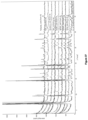
Figure 4 shows the X-ray powder diffraction pattern of the freebase polymorphs of Compound 1 (Forms A-D). -
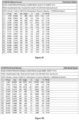
Figure 5 shows the peak lists corresponding to the X-ray powder diffraction patterns of the freebase polymorphs of the compound ofFormula 1 shown inFigure 4 . Panels A-B correspond to Form C ofCompound 1, and panels C-G correspond to Form B ofCompound 1. -
Figure 6 shows TGA and DSC profiles for the freebase of Compound 1 (Form B). -
Figure 7 shows the TGA and DSC profiles for the freebase of Compound 1 (Form C). -
Figure 8 shows the TGA and DSC profiles for the freebase of the compound of Compound 1 (Form D). -
Figure 9 shows Dynamic vapor sorption (DVS) isotherm analysis of the freebase of Compound 1 (Form D). -
Figure 10 shows the X-ray powder diffraction patterns of the freebase of Compound 1 (Form D) before and after DVS. -
Figure 11 shows the X-ray powder diffraction patterns (wet samples) of the 50 mg salt screen (freebase:acid) forCompound 1. -
Figure 12 shows the X-ray powder diffraction patterns (dry samples) of the 50 mg scale salt screen (freebase:acid) forCompound 1. -
Figure 13 (A) shows the X-ray powder diffraction patterns (dry samples) and (B) the peak printout for 50mg scale Compound 1·H2SO4 (1:1; Form A). -
Figure 14 shows the X-ray powder diffraction patterns (dry samples) of the 500 mg scale salt screen (freebase:acid) for Compound 1 (Form A). -
Figure 15 shows the peak printouts for of the 500 mg scale salt screen (freebase:acid) for Compound 1 (dry samples) shown inFigure 14 : (A) H2SO4 (2:1; Form A) salt, (B) H3PO4 (1:1; Form A) salt, (C) HCl (1:1; Form A) salt, (D) p-toluenesulfonic acid (1:1; Form A) salt. -
Figure 16 shows the TGA and DSC profiles (dry sample) ofCompound 1 · HCl (1:1; Form A). -
Figure 17 shows the DVS isotherm analysis ofCompound 1 · HCl (1:1; Form A). -
Figure 18 shows (A) X-ray powder diffraction patterns ofCompound 1 · HCl (1:1; Form A) before and after DVS. (B) Peak printout before DVS. (C) Peak printout after DVS. -
Figure 19 shows 400 MHz 1H NMR ofCompound 1 · HCl (1:1; Form A) in DMSO-d6. -
Figure 20 shows the TGA and DSC profiles ofCompound 1 · H2SO4 (1:1; Form A) from the 50 mg scale salt screen. -
Figure 21 shows the DVS isotherm analysis ofCompound 1 · H2SO4 (1:1; Form A) from the 50 mg scale. -
Figure 22 shows the X-ray powder diffraction patterns ofCompound 1 · H2SO4 (1:1; Form A) from the 50 mg scale before and after DVS isotherm analysis. -
Figure 23 shows the TGA and DSC profiles ofCompound 1 . H3PO4 (1:1; Form A). -
Figure 24 shows the DVS isotherm analysis ofCompound 1 . H3PO4 (1:1; Form A). -
Figure 25 shows the X-ray powder diffraction patterns ofCompound 1 · H3PO4 (1:1; Form A) before and after DVS. -
Figure 26 shows the TGA and DSC profiles ofCompound 1 . p-toluenesulfonic acid (1:1; Form A). -
Figure 27 shows DVS isotherm analysis ofCompound 1 . p-toluenesulfonic acid (1:1; Form A). -
Figure 28 shows the X-ray powder diffraction patterns ofCompound 1 · p-toluenesulfonic acid (1:1; Form A) before and after DVS. -
Figure 29 shows the 400 MHz 1H NMR characterization for 1· p-toluenesulfonic acid (1:1; Form A) in DMSO-d6. -
Figure 30 shows the TGA and DSC profiles ofCompound 1 · methanesulfonic acid (1:2; Form A). -
Figure 31 shows the X-ray powder diffraction pattern of the dry sample ofCompound 1 · methanesulfonic acid (1:2; Form A). -
Figure 32 shows the 400 MHz 1H NMR ofCompound 1 · methanesulfonic acid (1:2; Form A) in DMSO-d6. -
Figure 33 shows the X-ray powder diffraction patterns of wet samples of a polymorph screen derived from stirring a slurry ofCompound 1 · HCl (1:1; Form A) in 100 µL of various solvents for 1 day at 40 °C. -
Figure 34 shows the X-ray powder diffraction patterns of wet samples ofCompound 1· H2SO4 (1:1) polymorphs derived from stirring a slurry of Form A in 100 µL of various solvents for 1 day at 40 °C. -
Figure 35 shows the X-ray powder diffraction patterns of dry samples ofCompound 1 · H2SO4 (1:1) polymorphs Forms A, C and D derived from stirring a slurry of Form A in 100 µL of various solvents for 1 day at 40 °C. Form B converted to Form A after heating at 40 °C. -
Figure 36 shows the X-ray powder diffraction patterns of dry samples of new crystalline polymorphs Forms B, C, E and F ofCompound 1· H2SO4 (2:1) derived from stirring a slurry of Form A in 100 µL of various solvents for 1 day at 40 °C. Form D was amorphous and was isolated after evaporation of EtOH:H2O (3:1) over several hours -
Figure 37 shows the X-ray powder diffraction patterns of wet samples from the polymorph screening study forCompound 1 · p-toluenesulfonic acid derived from stirring a slurry of Form A in 100 µL of various solvents for 1 day at 40 °C. Form C was mostly amorphous and was isolated after evaporation of EtOH:H2O (3:1) over several hours. -
Figure 38 shows the X-ray powder diffraction patterns of dry samples from a polymorph screening study forCompound 1 · p-toluenesulfonic acid derived from stirring a slurry of Form A in 100 µL of various solvents for 1 day at 40 °C. Form C was mostly amorphous and was isolated after evaporation of EtOH:H2O (3:1) over several hours. -
Figure 39 shows the DSC profile ofCompound 1 · p-toluenesulfonic acid (1:1; Form B). - As described above, the present disclosure relates generally to Compound 1 freebase in various solid-state forms:

- The freebase of
Compound 1 can exist in one or more crystalline forms, designated as crystalline Form A, Form B, Form C, and Form D, respectively. - Described, but not as such according to the claimed invention, is a crystalline form of
Compound 1 freebase (Form A) that exhibits an X-ray powder diffraction pattern comprising characteristic peaks at diffraction angles 20 of approximately 5.9°, 11.9°, and 25.6°, each ±0.2°, optionally wherein the X-ray powder diffraction pattern of theCompound 1 freebase in crystalline Form A comprises characteristic peaks, expressed in terms of the interplanar distance, at 14.9A, 7.5A, and 3.5A, comprises characteristic peaks at diffraction angles 20 of approximately 5.6°, 5.9°, 11.9°, 16.5°, 25.6° and 26.2°, each ±0.2°, comprises characteristic peaks, expressed in terms of the interplanar distance, at 15.7A, 14.9A, 7.5A, 5.4A, 3.5A and 3.4A, or is substantially shown as inFigure 2A . - The X-ray diffraction pattern depicted in
Fig. 2A is summarized inFigure 2B . - Optionally, the
Compound 1 freebase in crystalline Form A has the TGA profile substantially as shown inFigure 3 , has the DSC profile substantially as shown inFigure 3 , has a DSC profile having characteristic peaks at 100.3 °C, 124.3 °C and 166.3 °C, or has a melting point with an onset temperature of approximately 162.3 °C. - Also described, but not as such according to the claimed invention, is a crystalline form of the
Compound 1 freebase (Form B) that exhibits an X-ray diffraction pattern comprising characteristic peaks at diffraction angles 20 of approximately 4.7°, 11.2°, 14.1°, 15.3° and 21.2°, each ±0.2°, optionally wherein the X-ray powder diffraction pattern of theCompound 1 freebase in crystalline Form B comprises characteristic peaks, expressed in terms of the interplanar distance, at 18.7A, 7.9A, 6.3A, 5.8A and 4.2A, has a TGA profile substantially as shown inFigure 6 , has a DSC profile substantially as shown inFigure 6 , has a DSC profile having characteristic peaks at 61.5 °C, 118.8 °C and 166.8 °C, or has a melting point having an onset temperature of approximately 165.4 °C. - Also described, but not as such according to the claimed invention, is a method of preparing the crystalline Form B of the
Compound 1 freebase, comprising the steps of slurrying theCompound 1 freebase in crystalline Form A, as illustrated in Table 1, in ethanol, isopropanol or a mixed solvent of ethanol:water (3:1) at about 50 °C for about 24 hours; and isolating the resulting crystalline polymorph B. - Also described, but not as such according to the claimed invention, is a crystalline polymorph of the
Compound 1 freebase (Form C) that exhibits an X-ray powder diffraction pattern comprising characteristic peaks at diffraction angles 20 of approximately 5.7°, 6.4°, 9.2°, 12.8°, 15.7° and 20.7°, each ±0.2°, optionally wherein the X-ray powder diffraction pattern of theCompound 1 freebase in crystalline Form C comprises characteristic peaks expressed in terms of the interplanar distance, at 15.5A, 13.8A, 9.6A, 6.9A, 5.6A and 4.3A, comprises characteristic peaks at diffraction angles 20 of approximately 6.4°, 12.8° and 20.7°, each ±0.2°, comprises characteristic peaks, expressed in terms of the interplanar distance, at 13.8A, 6.9A and 5.6A, is characterized by a TGA profile substantially as shown inFigure 7 , is characterized by a DSC profile substantially as shown inFigure 7 , is characterized by a DSC profile having a characteristic peak at 162.8 °C, or has a melting point having an onset temperature of approximately 160.9 °C. - Also described, but not as such according to the claimed invention, is a method of preparing the crystalline polymorph of the
Compound 1 freebase in crystalline Form C, comprising the steps of slurrying theCompound 1 freebase in crystalline Form A, as illustrated in Table 1, in acetone at about 50 °C for about 24 hours, and isolating the resulting crystalline polymorph. - Also described, but not as such according to the claimed invention, is a crystalline polymorph of the
Compound 1 freebase (Form D) characterized by the X-ray powder diffraction pattern substantially as shown inFigure 10 , having diffraction pattern comprising characteristic peaks at diffraction angles 20 of approximately 4.8°, 8.3°, 10.5°, 11.5°, 14.0°, 18.2°, 20.0°, 23.5°, and 28.5°, optionally wherein theCompound 1 freebase in crystalline Form D is characterized by a TGA profile substantially as shown inFigure 8 , is characterized by a DSC profile substantially as shown inFigure 8 , is characterized by a DSC profile having characteristic peaks at 55.9 °C, 118.8 °C and 168.4 °C, or is characterized by a dynamic vapor sorption isotherm as shown inFigure 9 . - Also described, but not as such according to the claimed invention, are processes for the preparation of crystalline forms of the
Compound 1 free base, comprising dissolving or slurrying theCompound 1 in one or two crystallization solvents selected from the group consisting of alcohols, ketones, esters, ethers, aromatic hydrocarbons, nitriles, halogenated hydrocarbons, and water, through a crystallization method selected from slurrying, evaporating solvent, adding anti-solvent, and/or cooling, with or without seeding, and combinations thereof. - Optionally, controlled or slow addition of anti-solvent such as water and/or gradual cooling may help control the formation of crystalline forms.
- Optionally, seeding may help formation or facilitate formation of certain desired crystalline forms. All these or other techniques as known to those skilled in the art may be combined to obtain desired results. For example, in some embodiments, such crystallization processes can start from dissolving the
compound 1 in an organic solvent, followed by adding an anti-solvent, cooling, with or without seeding. - Also described, but not as such according to the claimed invention, is a method of preparing the crystalline polymorph of
Compound 1 freebase in crystalline Form D, comprising the steps of slurrying theCompound 1 freebase in crystalline Form A, as illustrated in Table 1, in methanol at about room temperature for about 24 hours, and isolating the resulting crystalline polymorph. - Also described are crystalline polymorphic salts of
Compound 1, such as those comprising a compound ofFormula 1 and an acid, wherein the acid is selected from HCl, H2SO4, H3PO4, methanesulfonic acid and p-toluenesulfonic acid, and processes for the preparation of crystalline forms of pharmaceutically acceptable salts of theCompound 1, comprising mixing, and stirring a mixture of, theCompound 1 and an appropriate acid, for example, HCl, H2SO4, H3PO4, methanesulfonic acid and p-toluenesulfonic acid, in one or two crystallization solvents selected from the group consisting of alcohols, ketones, esters, ethers, aromatic hydrocarbons, nitriles, halogenated hydrocarbons, and water, through a crystallization method selected from slurrying, evaporating solvent, adding anti-solvent, and/or cooling, with or without seeding, and combinations thereof. - Optionally, seeding may help formation or facilitate formation of certain desired crystalline forms. For example, a crystallization process can start from dissolving the
compound 1 in an organic solvent at an elevated temperature, followed by adding an anti-solvent, cooling, with or without seeding. - Optionally, seeding may help formation or facilitate formation of certain desired crystalline form. For water soluble salts, some non-polar organic solvents may serve as anti-solvents, such as aliphatic hydrocarbons. All these or other techniques known to those skilled in the art may be combined to obtain desired results.
- However, the present invention provides an acid addition salt of N-(5-((4-ethylpiperazin-1-yl)methyl)pyridin-2-yl-5-fluoro-4-(3-isopropyl-2-methyl-2H-indazol-5-yl)pyrimidin-2-amine in crystalline form, comprising N-(5-((4-Ethylpiperazin-yl)methyl)pyridin-2-yl-5-fluoro-4-(3-isopropyl-2-methyl-2H-indazol-5-yl)pyrimidin-2-amine and hydrochloride in about 1:1 molar ratio, in a crystalline form (Form A) with an X-ray powder diffraction pattern comprising characteristic peaks at any three
diffraction angles 20 of approximately 4.7°, 9.2°, 11.2°, 19.5° and 28.3°, each ±0.2°. - Optionally, the X-ray powder diffraction pattern of said acid addition salt is substantially shown as in
Figure 18 , or said acid addition salt is characterized by a TGA profile substantially as shown inFigure 16 , is characterized by a DSC profile substantially as shown inFigure 16 , or is characterized by a DSC profile having characteristic peaks at 44.8 °C and 277.9 °C (with a melting point having an onset temperature of approximately 275.4° C.) - Optionally said acid addition salt has a dynamic vapor sorption isotherm substantially as shown in
Figure 17 . - Described, but not as such according to the claimed invention, is a method of preparing the crystalline hydrochloride (Form A) of
Compound 1, comprising: - (a) adding a solution of HCl/methanol to a mixture of the compound of Formula 1 (Form A used, though not so limited) in methanol;
- (b) stirring for about 24 hours at about room temperature; and
- (c) isolating the resulting crystalline HCl salt of the
Compound 1. - Optionally (not as such according to the claimed invention) the acid addition salt of
Compound 1 is a sulfuric acid salt with theCompound 1 and H2SO4 in about 1:1 molar ratio, in a crystalline form selected from the group consisting of Form B, Form C, or Form D substantially as shown inFigure 35 or36 , wherein: Form B is characterized by an X-ray powder diffraction pattern comprising any three (3) of characteristic peaks at diffraction angles 20 of approximately 4.2°, 4.8°, 7.0°, 9.1°, 10.8°, 11.3°, and 12.0°; wherein Form C is characterized by an X-ray powder diffraction pattern comprising any three (3) of characteristic peaks at diffraction angles 20 of approximately 5.0°, 8.6°, 10.2°, 18.3°, and 25.7°; and wherein Form D is characterized by an X-ray powder diffraction pattern comprising any three (3) of characteristic peaks at diffraction angles 20 of approximately 8.1°, 9.8°, 12.6°, 15.8°, 16.6°, 21.4°, and 23.2°. - Also described, but not as such according to the claimed invention, is a crystalline sulfate salt of N-(5-((4-ethylpiperazin-1-yl)methyl)pyridin-2-yl-5-fluoro-4-(3-isopropyl-2-methyl-2H-indazol-5-yl)pyrimidin-2-amine, optionally wherein the crystalline sulfate salt has a molar ratio of crystalline sulfate salt of N-(5-((4-ethylpiperazin-1-yl)methyl)pyridin-2-yl-5-fluoro-4-(3-isopropyl-2-methyl-2H-indazol-5-yl)pyrimidin-2-amine to sulfate of 1:1 or 2:1.
- Optionally (not as such according to the claimed invention) the acid addition salt of Compound 1 is a sulfuric acid salt with the Compound 1 and H2SO4 in about 2:1 molar ratio,, in a crystalline form selected from the group consisting of Form A, Form B, Form C, Form E, and Form F, or substantially as shown in
Figure 36 , wherein: Form A is characterized by an X-ray powder diffraction pattern comprising characteristic peaks at diffraction angles 20 of approximately 4.3°, 5.4° and 8.4°; Form B is characterized by an X-ray powder diffraction pattern comprising any three (3) of characteristic peaks at diffraction angles 20 of approximately 7.9°, 11.6°, 12.1°, 14.5°, 16.1°, 20.4°, 23.1°, 26.1°, and 27.4°; Form C is characterized by an X-ray powder diffraction pattern comprising any three (3) of characteristic peaks at diffraction angles 20 of approximately 4.6°, 7.5°, 9.3°, 12.3°, and 12.6°; and wherein Form E is characterized by an X-ray powder diffraction pattern comprising any three (3) of characteristic peaks at diffraction angles 20 of approximately 4.5°, 5.4°, 10.8°, 14.2°, 16.1°, 18.9°, 22.6°, 23.0°, 23.7°, and 27.5°; Form F is characterized by an X-ray powder diffraction pattern comprising any three (3) of characteristic peaks at diffraction angles 20 of approximately 4.5°, 7.2°, 10.7°, 15.7°, 16.0°, 17.2°, 18.2°, 19.5°, 22.8°, and 26.0°; wherein Form G is characterized by an X-ray powder diffraction pattern comprising any three (3) of characteristic peaks at diffraction angles 20 of approximately 7.3°, 8.3°, 9.7°, 10.4°, 12.8°, and 25.6°. - Optionally (not as such according to the claimed invention) the crystalline sulfate salt of
Compound 1 in crystalline Form A is characterized by the X-ray powder diffraction pattern comprising characteristic peaks at diffraction angles 20 of approximately 4.3°, 5.4° and 8.4°, each ±0.2°, and/or as substantially shown inFigure 22 (bottom line, before DVS). - Optionally said crystalline sulfate salt of
Compound 1 in crystalline Form A is characterized by a DSC and/or TGA profile substantially as shown inFigure 20 . - Also described, but not as such according to the claimed invention, is a method of preparing the crystalline sulfate (Form A) of Compound A, comprising:
- (a) adding a solution of H2SO4/methanol to a mixture of the compound of Formula 1 (Form A used, but not limiting) in methanol;
- (b) stirring for about 24 hours at about room temperature; and
- (c) isolating the resulting crystalline H2SO4 salt of the
Compound 1. - Also described, but not as such according to the claimed invention, is a crystalline phosphate salt of N-(5-((4-ethylpiperazin-1-yl)methyl)pyridin-2-yl-5-fluoro-4-(3-isopropyl-2-methyl-2H-indazol-5-yl)pyrimidin-2-amine, optionally wherein the crystalline phosphate salt has a molar ratio of crystalline phosphate salt of N-(5-((4-Ethylpiperazin-yl)methyl)pyridin-2-yl-5-fluoro-4-(3-isopropyl-2-methyl-2H-indazol-5-yl)pyrimidin-2-amine to phosphate of about 1:1.
- Optionally said crystalline phosphate salt of Compound 1 (crystalline Form A) has an X-ray powder diffraction pattern comprising characteristic peaks at diffraction angles 20 of approximately 4.7°, 9.4°, 14.2°, 23.0° and 26.7°, each ±0.2°.
- Optionally, the X-ray powder diffraction pattern of the phosphate salt of
Compound 1 in crystalline Form A is substantially as shown inFigure 25 . - Optionally said crystalline phosphate salt of Compound 1 (crystalline Form A) is characterized by a TGA profile substantially as shown in
Figure 23 , is characterized by a melting point having an onset temperature of 229.1 °C, is characterized by a DSC profile substantially as shown inFigure 23 , is characterized by a DSC profile having peaks at about 47.8 °C and 234.7 °C, or is characterized by a dynamic vapor sorption isotherm substantially as shown inFigure 24 . - Also described, but not as such according to the claimed invention, is a method of preparing the crystalline phosphate (Form A) salt of
Compound 1, comprising: - (a) adding a solution of H3PO4/methanol to a mixture of the compound of Formula 1 (Form A, not limiting) in methanol;
- (b) stirring for about 24 hours at about room temperature; and
- (c) isolating the resulting crystalline H3PO4 salt of the
Compound 1. - Also described, but not as such according to the claimed invention, is a crystalline tosylate salt of N-(5-((4-ethylpiperazin-yl)methyl)pyridin-2-yl-5-fluoro-4-(3-isopropyl-2-methyl-2H-indazol-5-yl)pyrimidin-2-amine, optionally wherein the crystalline tosylate salt comprises a molar ratio of N-(5-((4-ethylpiperazin-1-yl)methyl)pyridin-2-yl-5-fluoro-4-(3-isopropyl-2-methyl-2H-indazol-5-yl)pyrimidin-2-amine to tosylate of 1:1.
- Optionally said crystalline tosylate salt of Compound 1 (crystalline Form A) has an X-ray powder diffraction pattern comprising characteristic peaks at diffraction angles 20 of approximately 7.4°, 9.8°, 14.7°, 18.4°, 19.5°, and 28.0°, each ±0.2°, or the X-ray powder diffraction pattern of the tosylate salt of
Compound 1 in crystalline Form A is substantially as shown inFigure 28 . - Optionally said crystalline tosylate salt of Compound 1 (crystalline Form A) is characterized by a TGA profile substantially as shown in
Figure 26 , is characterized by a DSC profile substantially as shown inFigure 26 , is characterized by a DSC profile having a peak at about 230.9 °C, is characterized by a melting point having an onset temperature of about 229.5 °C, or is characterized by a dynamic vapor sorption isotherm substantially as shown inFigure 27 . - Also described, but not as such according to the claimed invention, is a crystalline tosyalte salt of Compound 1 (crystalline Form B) characterized by a DSC profile substantially as shown in
Figure 39 , optionally wherein the crystalline tosylate salt of Compound 1 (crystalline Form B) is characterized by (a) an X-ray powder diffraction pattern comprising any three (3) of characteristic peaks at diffraction angles 20 of approximately 7.8°, 10.0°, 15.7°, 16.9°, 19.7°, and 20.6°; and/or (b) a DSC profile having peaks at 82.2 °C and 229.0 °C. - Also described, but not as such according to the claimed invention, is a method of preparing the crystalline p-toluenesulfonic acid (Form A) salt of
Compound 1 comprising: - (a) adding a solution of p-toluenesulfonic acid/methanol to a mixture of the compound of Formula 1 (Form A, not limiting) in methanol;
- (b) stirring for about 24 hours at about room temperature; and
- (c) isolating the resulting crystalline p-toluenesulfonic acid salt of the
compound 1. - Also described, but not as such according to the claimed invention, is a crystalline methanesulfonic acid salt of N-(5-((4-Ethylpiperazin-yl)methyl)pyridin-2-yl-5-fluoro-4-(3-isopropyl-2-methyl-2H-indazol-5-yl)pyrimidin-2-amine,optionally wherein the crystalline methanesulfonic acid salt has a molar ratio of crystalline N-(5-((4-Ethylpiperazinyl)methyl)pyridin-2-yl-5-fluoro-4-(3-isopropyl-2-methyl-2H-indazol-5-yl)pyrimidin-2-amine to tosylate of 1:2, optionally wherein the X-ray powder diffraction pattern of the mesylate salt of
Compound 1 comprising theCompound 1 and mesylate in about 1:2 molar ratio in crystalline Form A is substantially as shown inFigure 31 . - Optionally said crystalline methanesulfonic acid salt of
Compound 1 comprising theCompound 1 and mesylate in about 1:2 molar ratio in crystalline Form A is characterized by a TGA profile substantially as shown inFigure 30 , is characterized by a DSC profile substantially as shown inFigure 30 , is characterized by a DSC profile having a peak at about 225.0 °C, or is characterized by a melting point having an onset temperature of about 223.4 °C. - Also described, but not as such according to the claimed invention, is a method of preparing the crystalline methanesulfonic acid of
Compound 1 comprising theCompound 1 and mesylate in about 1:2 molar ratio (Form A) salt ofCompound 1, comprising: - (a) adding a solution of methanesulfonic acid/methanol to a mixture of the compound of Formula 1 (Form A, not limiting) in methanol;
- (b) stirring for about 24 hours at about room temperature; and
- (c) isolating the resulting crystalline methanesulfonic acid salt of the
compound 1. - Also described, but not as such according to the claimed invention, are methods of preparing solid amorphous forms of
Compound 1 and salts thereof, in particular the HCl, H2SO4, H3PO4, methanesulfonic acid, and p-toluenesulfonic acid salts disclosed herein. - Also described, but not as such according to the claimed invention, is a solid amorphous form of N-(5-((4-Ethylpiperazin-yl)methyl)pyridin-2-yl-5-fluoro-4-(3-isopropyl-2-methyl-2H-indazol-5-yl)pyrimidin-2-amine sulfate.
- Optionally said solid amorphous form of N-(5-((4-Ethylpiperazin-yl)methyl)pyridin-2-yl-5-fluoro-4-(3-isopropyl-2-methyl-2H-indazol-5-yl)pyrimidin-2-amine sulfate has a molar ratio of N-(5-((4-Ethylpiperazin-yl)methyl)pyridin-2-yl-5-fluoro-4-(3-isopropyl-2-methyl-2H-indazol-5-yl)pyrimidin-2-amine to sulfate of 1:1 or 2:1.
- Also described, but not as such according to the claimed invention, is a method for preparing an amorphous sulfate salt of the
compound 1, comprising: - (a) adding a solution of H2SO4 acid/methanol to a mixture of the compound of Formula 1 (Form A, not limiting) in methanol;
- (b) stirring for about 24 hours at about room temperature; and
- (c) isolating the resulting amorphous H2SO4 acid salt of the
compound 1. - Also described, but not as such according to the claimed invention, is a solid amorphous form of N-(5-((4-ethylpiperazin-1-yl)methyl)pyridin-2-yl-5-fluoro-4-(3-isopropyl-2-methyl-2H-indazol-5-yl)pyrimidin-2-amine methanesulfonate.
- Optionally said solid amorphous form of N-(5-((4-ethylpiperazin-1-yl)methyl)pyridin-2-yl-5-fluoro-4-(3-isopropyl-2-methyl-2H-indazol-5-yl)pyrimidin-2-amine methanesulfonate has a molar ratio of N-(5-((4-ethylpiperazin-yl)methyl)pyridin-2-yl-5-fluoro-4-(3-isopropyl-2-methyl-2H-indazol-5-yl)pyrimidin-2-amine to methanesulfonate of 1:1.
- Also described, but not as such according to the claimed invention, is a method for preparing an amorphous methanesulfonic acid salt of the
compound 1, comprising: - (a) adding a solution of methane sulfonic acid/methanol to a mixture of the compound of Formula 1 (Form A) in methanol;
- (b) stirring for about 24 hours at about room temperature; and
- (c) isolating the resulting amorphous methane sulfonic acid salt of the
compound 1. - All the crystalline polymorphs are substantially pure.
- The term "substantially pure" as herein used refers to at least 85 wt%, preferably at least 95 wt%, more preferably at least 99 wt% of the compound of
Formula 1, or a salt thereof, exists in a crystal form of the present invention, particularly in the crystal forms of Form A, Form B, Form C, Form D, Form E, and Form F. - The main peaks described in X-ray powder diffraction (XRPD) pattern of the crystalline polymorphs above are reproducible and are within the error limit (the specified value ± 0.2° for a 20 or 2-theta value), for example, whether a term "about" or "approximately" is used as modification word, a 20 value of 11.5 would indicate that the peak has a value within the range of 11.3° to 11.7°, or the like.
- Herein, "the X-ray powder diffraction pattern shown as in
Figure 2A " refers to the X-ray powder diffraction pattern that show major peaks as inFigure 2A , wherein major peaks refer to those with the relative intensity greater than 10%, preferably greater than 30%, relative to the highest peak (with its relative intensity designated to be 100%) inFigure 1 . Likewise, the X-ray powder diffraction pattern shown as inFigure 10 ,11 ,12 ,13 ,14 ,18 ,22 ,25 ,28 ,31 ,33 ,34 ,35 ,36 ,37 or38 , refers to the X-ray powder diffraction pattern that show major peaks as inFigure 10 ,11 ,12 ,13 ,14 ,18 ,22 ,25 ,28 ,31 ,33 ,34 ,35 ,36 ,37 or38 , wherein major peaks refer to those with the relative intensity greater than 10%, preferably greater than 30%, relative to the highest peak (with its relative intensity designated to be 100%) inFigure 10 ,11 ,12 ,13 ,14 ,18 ,22 ,25 ,28 ,31 ,33 ,34 ,35 ,36 ,37 or38 , respectively. - Also described, but not as such according to the claimed invention, is a method of preparing Crystalline Form A, Crystalline Form B, Crystalline Form C, Crystalline Form D, Crystalline Form E, and Crystalline Form F. Crystallizing the compound from a suitable solvent system comprising at least one solvent, can be achieved by methods of spontaneous precipitation (evaporation), cooling, and/or adding anti-solvent (in which the compound of the present invention has relatively lower solubility), in order to achieve oversaturation in solvent system.
- Also described, but not as such according to the claimed invention, is a method of preparing salt forms of
Compound 1, wherein the salt can be the HCl, H2SO4, H3PO4, methanesulfonic acid or p-toluenesulfonic acid salt. - Crystallization also can be achieved by using or not using crystal seeds that are suitable for crystallizing the compound of the present invention.
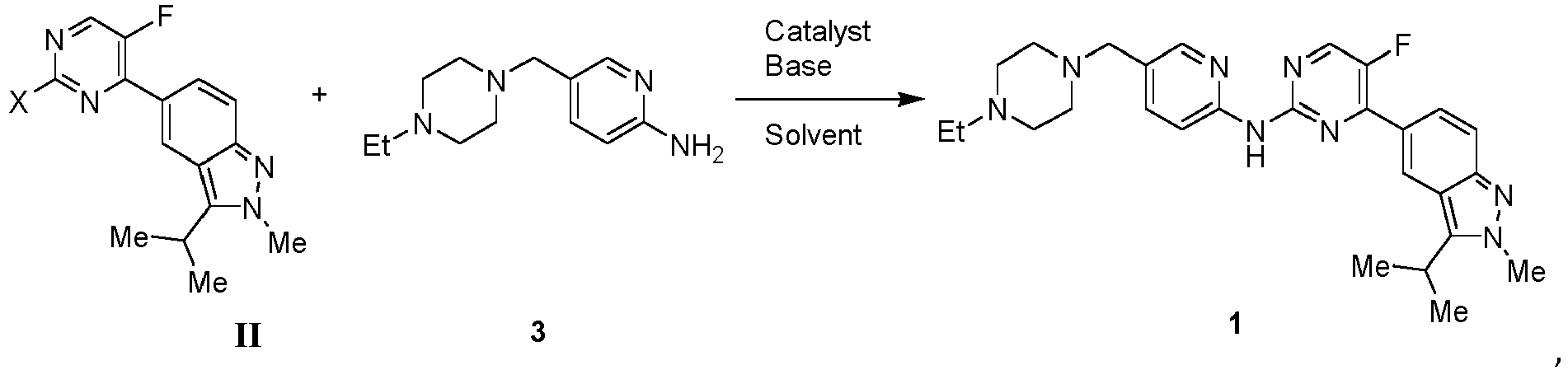
- Also described, but not as such according to the claimed invention, is a method of preparing the compound of Formula, as follows:
- Optionally, the method of preparing the crystalline form A of the
Compound 1 comprises the steps of: (a) reacting a compound of Formula II with the compound offormula 3 in the present of a catalyst to obtain a reactionmixture comprising Compound 1; (b) working up the reaction mixture and isolating a crude product ofCompound 1; (c) dissolving the crude product ofCompound 1 an aqueous HCl solution and washing the aqueous solution with an ester; and (d) basifying the aqueous solution with a base to above 7 to precipitate out the freebase ofCompound 1; and isolating a product ofCompound 1 freebase in Form A. - For a general method to prepare
Compound 1, seeWO 2016/014904 A1 . A particular method to prepareCompound 1 in crystalline form A is described in Example 1. - Optionally, the method of preparing the crystalline form B of the
Compound 1 comprises the steps of: (a) slurrying the compound ofFormula 1 freebase in ethanol, isopropanol, or a mixed solvent of ethanol: water (3:1 v/v) at an elevated temperature for a period of time; (b) cooling down the slurry of step (a) to room temperature; and (c) isolating the resulting crystalline form B by filtration; and (d) optionally drying the crystalline form B isolated in the step (c). Optionally, the compound ofFormula 1 freebased in step (a) is in crystalline Form A. Optionally, the elevated temperature is about 50 °C; and optionally the time of slurring is about 24 hours. - Optionally, the method of preparing the crystalline form C of the
Compound 1 comprises the steps of: (a) slurrying the compound ofFormula 1 freebase in acetone at an elevated temperature for a period of time; (b) cooling down the slurry of step (a) to room temperature; and (c) isolating the resulting crystalline form C by filtration; and (d) optionally drying the crystalline form C isolated in the step (c). Optionally, the compound ofFormula 1 freebased in step (a) is in crystalline Form A. Optionally, the elevated temperature is about 50 °C; and optionally the time of slurring is about 24 hours. - Optionally, the method of preparing the crystalline form D of the
Compound 1 comprises the steps of: (a) slurrying the compound ofFormula 1 freebase in acetone at room temperature for a period of time; (b) isolating the resulting crystalline form D by filtration; and (c) optionally drying the crystalline form D isolated in the step (c). Optionally, the compound ofFormula 1 freebased in step (a) is in crystalline Form A. Optionally the time of slurring is about 24 hours. - Optionally, the method of preparing the crystalline hydrochloride salt of
Compound 1 in Form A, comprising the steps of: (a) stirring a mixture of the compound ofFormula 1 freebase (Form A) and HCl in methanol at room temperature for a period of time to obtain a slurry comprising the crystalline hydrochloride salt in Form A; and (b) isolating the resulting crystalline HCl salt of the compound ofFormula 1 in Form A. - Optionally, the method of preparing the crystalline sulfate salt of
Compound 1 in Form A, comprising the steps of: (a) stirring a mixture of the compound ofFormula 1 freebase (Form A) and sulfuric acid (H2SO4) in methanol at room temperature to obtain a slurry comprising the crystalline sulfate salt in Form A; (b) isolating the resulting crystalline H2SO4 salt (Form A) of the compound ofFormula 1; and (c) optionally drying the crystalline Form A of H2SO4 salt isolated. - Optionally, the method of preparing the crystalline phosphate salt of
Compound 1 in Form A, comprising the steps of: (a) stirring a mixture of the compound ofFormula 1 freebase (Form A) and phosphoric acid (H3PO4) in methanol at room temperature to obtain a slurry comprising the crystalline phosphate salt in Form A; (b) isolating the resulting crystalline H3PO4 salt (Form A) of the compound ofFormula 1; and (c) optionally drying the crystalline Form A of H3PO4 salt isolated. - Optionally, the method of preparing the crystalline p-toluenesulfonic acid salt of
Compound 1 in Form A, comprising the steps: (a) stirring a mixture of the compound ofFormula 1 freebase (Form A) and p-toluenesulfonic acid in methanol at room temperature to obtain a slurry comprising the crystalline p-toluenesulfonic acid salt in Form A; (b) isolating the resulting crystalline p-toluenesulfonic acid salt (Form A) of the compound ofFormula 1; and (c) optionally drying the crystalline Form A of p-toluenesulfonic acid salt isolated. - Optionally, the method of preparing the crystalline methanesulfonic acid salt of
Compound 1 in Form A, comprising the steps of: (a) stirring a mixture of the compound ofFormula 1 freebase (Form A) and methanesulfonic acid in methanol at room temperature to obtain a slurry comprising the crystalline methanesulfonic acid salt in Form A; (b) isolating the resulting crystalline methanesulfonic acid salt (Form A) of the compound ofFormula 1; and (c) optionally drying the crystalline Form A of methanesulfonic acid salt isolated. - Optionally, the method of preparing an amorphous sulfate salt of the compound of
Formula 1, comprising the steps of: (a) stirring a mixture of the compound ofFormula 1 freebase (Form A) and H2SO4 acid in about 2:1 molar ratio in an organic solvent (e.g., methanol) at an elevated or room temperature; and (b) removing the solvent (e.g., methanol) by evaporation or centrifugation to dryness to obtain the resulting amorphous H2SO4 acid salt of the compound ofFormula 1 in about 2:1 molar ratio. - Optionally, the method of preparing an amorphous sulfate salt of the compound of
Formula 1, comprising the steps of: (a) stirring a mixture of the compound ofFormula 1 freebase (Form A) and H2SO4 acid in about 1:1 molar ratio in an organic solvent (e.g., methanol) at an elevated or room temperature; and (b) removing the solvent (e.g., methanol) by evaporation or centrifugation to obtain the resulting amorphous H2SO4 acid salt of the compound ofFormula 1 in about 1:1 molar ratio. - Optionally, the method of preparing an amorphous phosphate salt of the compound of
Formula 1, comprising the steps of: (a) stirring a mixture of the compound ofFormula 1 freebase (Form A) and H3PO4 acid in about 1:1 molar ratio in an organic solvent (e.g., methanol) at an elevated or room temperature; and (b) removing the solvent (e.g., methanol) by evaporation or centrifugation to obtain the resulting amorphous H3PO4 acid salt of the compound ofFormula 1 in about 1:1 molar ratio. - Optionally, the method of preparing an amorphous methanesulfonic acid salt of the compound of
Formula 1, comprising the steps of: (a) stirring a mixture of the compound ofFormula 1 freebase (Form A) and methanesulfonic acid in about 1:1 molar ratio in an organic solvent (e.g., methanol) at an elevated or room temperature to obtain a clear solution; and (b) removing the solvent (e.g., methanol) by evaporation or centrifugation to dryness to obtain the resulting amorphous methanesulfonic acid salt of the compound ofFormula 1 in about 1: 1 molar ratio. - Also described, but not as such according to the claimed invention, is a pharmaceutical composition comprising a therapeutically effective amount of one or more crystalline polymorphs of Crystalline Form A, Crystalline Form B, Crystalline Form C, Crystalline Form D, or Crystalline Form E of the compound of
Formula 1, and a pharmaceutically acceptable excipient, adjuvant or carrier or a pharmaceutical composition comprising a therapeutically effective amount of one or more salts of the compound ofFormula 1, and a pharmaceutically acceptable excipient, adjuvant or carrier. Optionally, the pharmaceutical composition is used in an oral administration. Optionally, the composition is used in tablets or capsules. Wherein, the pharmaceutical comprises 1 wt%-99 wt% of the crystalline polymorph ofclaim 1, or more preferably 1 wt%-70 wt% of the crystalline polymorph, or more preferably 1 wt%-30 wt% of Crystalline Form A, Crystalline Form B, Crystalline Form C, Crystalline Form D, or Crystalline Form E of the compound ofFormula 1, - Also described, but not as such according to the claimed invention, is a method of inhibiting a cyclin-dependent kinase in a subject by administering to the subject a crystalline polymorph of Crystalline Form A, Crystalline Form B, Crystalline Form C, Crystalline Form D, or Crystalline Form E of the compound of
Formula 1, or a salt thereof. Preferably, the cyclin-dependent kinase is CDK4 or CDK6. - Also described, but not as such according to the claimed invention, are methods of treating or preventing cancer or an inflammation-related condition in a subject by administering to the subject a crystalline polymorph of Crystalline Form A, Crystalline Form B, Crystalline Form C, Crystalline Form D, or Crystalline Form E of the compound of
Formula 1. - Also described, but not as such according to the claimed invention, is a method of inhibiting a cyclin-dependent kinase in a subject by administering to the subject a salt of the compound of
Formula 1, wherein the salt is selected from the HCl, H2SO4, H3PO4, methanesulfonic acid and p-toluenesulfonic acid salt. - Optionally, the method is a method of treating a CDK4 or CDk6-associated inflammation or cancer, wherein the cancer is selected from the group consisting of brain cancer, metastatic brain cancer, squamous cell cancer, bladder cancer, gastric cancer, pancreatic cancer, hepatic cancer, glioblastoma multiforme breast cancer, head cancer, neck cancer, esophageal cancer, prostate cancer, colorectal cancer, lung cancer, renal cancer, kidney cancer, ovarian cancer, gynecological cancer, thyroid cancer, non-small cell lung cancer (NSCLC), refractory ovarian cancer, or head and neck cancer. Optionally, the cancer is a glioblastoma or metastatic brain cancer.
- Also described, but not as such according to the claimed invention, is use of any of the crystalline or amorphous forms of the compound of Formula I or a pharmaceutically acceptable salt thereof in the manufacture of a medicament for the treatment of a CDK4 or CDk6-associated inflammation or cancer, wherein the cancer is selected from the group consisting of brain cancer, metastatic brain cancer, squamous cell cancer, bladder cancer, gastric cancer, pancreatic cancer, hepatic cancer, glioblastoma multiforme breast cancer, head cancer, neck cancer, esophageal cancer, prostate cancer, colorectal cancer, lung cancer, renal cancer, kidney cancer, ovarian cancer, gynecological cancer, thyroid cancer, non-small cell lung cancer (NSCLC), refractory ovarian cancer, or head and neck cancer. Optionally, the cancer is a glioblastoma or metastatic brain cancer.
- The terms in the present invention, if not specifically defined, take their ordinary meanings as would be understood by those skilled in the art.
- For example, the term "alcohol," "alcoholic solvent," or the like, refers to C1-C6 alkyl alcohol, preferably C1-C4 alkyl alcohol, for example, in some embodiments preferably, methanol, ethanol, isopropanol, or the like.
- The term "ketone," "alkylketone," or the like, refers to C3-C7 alkanone, having a formula RCOR', wherein R and R' are each independently C1-C4 alkyl, for example, in some embodiments preferably, acetone, butanone, 2-pentanone, 3-pentanone, methyl isobutyl ketone (MIBK), or the like.
- The term "ester," or the like, refers to a lower alkyl aliphatic acid ester having a formula RCOOR', wherein R and R' are each independently C1-C4 alkyls, for example, in some embodiments preferably, ethyl acetate, ethyl propionate, methyl acetate, propyl acetate, ispropyl acetate, or the like.
- The term "ether," or the like, refers to a lower alkyl ether or cyclic ether (each alkyl having 1 to 4 carbon atoms), including but not limited to diethyl ether, di-isopropyl ether, ethyl propyl ether, methyl t-butyl ether (MTBE), tetrahydrofuran (THF), 1,4-dioxane, or the like.
- The term "aromatic hydrocarbon," or the like, refers to benzene optionally substituted by 1 to 3 methyl or ethyl groups, for example, in some embodiments preferably, toluene, 1,2-xylene, 1,4-xylene, 1,3-xylene, cumene, ethylbenzene, or the like.
- The term "halogenated hydrocarbon," or the like, refers to C1-C6 alkane substituted by one to six, preferably one to four, F and/or Cl atoms, for example, in some embodiments preferably, dichloromethane, chloroform, 1,1,1-trifluoroethane, or the like. The term "nitrile," "nitrile solvent," or the like, refers to C2-C4 alkyl nitrile, i.e., CH3CN, CH3CH2CN, CH3CH2CH2CN, or CH3CH(CN)CH3, preferably CH3CN.
- The term "room temperature", as used herein, unless otherwise noted, means a temperature in the range of about 20 to about 25 °C, with an average of about 23 °C.
- Any of the crystalline or amorphous forms, especially the former, of the Compound free base or a salt thereof may exist in a solvate form, which can be readily determined by those skilled in the art through various conventional analytical methods. Such solid forms of solvates are contemplated.
- The term "solvate," as used herein, means a physical association of a compound of this invention with a stoichiometric or non-stoichiometric amount of solvent molecules. For example, one molecule of the compound associates with one or more, preferably one to three, solvent molecules. It is also possible that multiple (e.g., 1.5 or 2) molecules of the compound share one solvent molecule. This physical association may include hydrogen bonding. In certain instances the solvates will be capable of isolation as crystalline solid. The solvent molecules in the solvate may be present in a regular arrangement and/or a non-ordered arrangement. Exemplary solvates include, but are not limited to, hydrates, ethanolates, methanolates, and isopropanolates. Methods of solvation are generally known in the art.
- The term "treatment" or "treating" refers to the management and care of a patient for the purpose of combating the disease, condition or disorder.
- The term "therapeutically effective amount" refers to an amount of a drug or a therapeutic agent that will elicit the desired biological and/or medical response of a tissue, system or an animal (including man) that is being sought by a researcher or clinician.
- The term "subject" or "patient" refers to a mammalian animal.
- The term "mammal" or "mammalian animal" includes, but is not limited to, humans, dogs, cats, horses, pigs, cows, monkeys, rabbits and mice. The preferred mammals are humans.
- The term "administering" means applying a compound e.g. of the invention, or a pharmaceutically acceptable salt, pro-drug or composition thereof, to a subject in need of treatment. The administration of the disclosed composition in order to practice the present methods of therapy is carried out by administering a therapeutically effective amount of the compounds in the composition to a subject in need of such treatment or prophylaxis. The need for a prophylactic administration according to said methods is determined via the use of well-known risk factors. The effective amount of an individual compound is determined, in the final analysis, by the physician in charge of the case, but depends on factors such as the exact disease to be treated, the severity of the disease and other diseases or conditions from which the patient suffers, the chosen route of administration, other drugs and treatments which the patient may concomitantly require, and other factors in the physician's judgment.
- The term "pharmaceutically acceptable", as used herein, refers to those compounds, materials, compositions and/or dosage forms, which are, within the scope of sound medical judgment, suitable for contact with the tissues of mammals, especially humans, without excessive toxicity, irritation, allergic response and other problem complications commensurate with a reasonable benefit/risk ratio.
- The term "therapeutically effective amount" as herein used, refers to the amount of a compound that, when administered to a subject for treating a disease, or at least one of the clinical symptoms of a disease or disorder, is sufficient to affect such treatment for the disease, disorder, or symptom. The "therapeutically effective amount" can vary with the compound, the disease, disorder, and/or symptoms of the disease or disorder, severity of the disease, disorder, and/or symptoms of the disease or disorder, the age of the subject to be treated, and/or the weight of the subject to be treated. An appropriate amount in any given instance can be apparent to those skilled in the art or can be determined by routine experiments. In the case of combination therapy, the "therapeutically effective amount "refers to the total amount of the combination objects for the effective treatment of a disease, a disorder or a condition.
- The pharmaceutical composition comprising the compound of the present disclosure can be administrated via oral, inhalation, rectal, parenteral or topical administration to a subject who needs treatment. For oral administration, the pharmaceutical composition may be a regular solid formulation such as tablets, powder, granule, capsules and the like, a liquid formulation such as water or oil suspension or other liquid formulation such as syrup, solution, suspension or the like; for parenteral administration, the pharmaceutical composition may be solution, water solution, oil suspension concentrate, lyophilized powder or the like. In one embodiment, the formulation of the pharmaceutical composition is selected from tablet, coated tablet, capsule, suppository, nasal spray or injection, more preferably tablet or capsule. The pharmaceutical composition can be a single unit administration with an accurate dosage. In addition, the pharmaceutical composition may further comprise additional active ingredients.
- All formulations of the disclosed pharmaceutical composition can be produced by the conventional methods in the pharmaceutical field. For example, the active ingredient can be mixed with one or more excipients, then to make the desired formulation. The "pharmaceutically acceptable carrier" refers to conventional pharmaceutical carriers suitable for the desired pharmaceutical formulation, for example: a diluent, a vehicle such as water, various organic solvents, etc, a filler such as starch, sucrose, etc; a binder such as cellulose derivatives, alginates, gelatin and polyvinylpyrrolidone (PVP ); a wetting agent such as glycerol; a disintegrating agent such as agar, calcium carbonate and sodium bicarbonate; an absorption enhancer such as quaternary ammonium compound; a surfactant such as hexadecanol; an absorption carrier such as Kaolin and soap clay; a lubricant such, as talc, calcium, stearate, magnesium stearate, polyethylene glycol, etc. In addition, the pharmaceutical composition further comprises other pharmaceutically acceptable excipients such as a decentralized agent, a stabilizer, a thickener, a complexing agent, a buffering agent, a permeation enhancer, a polymer, aromatics, a sweetener, and a dye. In one embodiment, the excipient is suitable for desired formulation and administration type. The term "disease" or "disorder" or "condition" refers to any disease, discomfort, illness, symptoms or indications.
- It is noted here that, as used in this specification and the appended claims, the singular forms "a," "an," and "the" include plural reference unless the context clearly dictates otherwise. In general, when either a singular or a plural form of a noun is used, it denotes both singular and plural forms of the noun.
- The term "about" or "approximately", unless otherwise defined, generally includes up to plus or minus 10% of the indicated number. For example, "about 10%" may indicate a range of 9% to 11%, and "about 20" may mean from 18 to 22. Preferably "about" includes up to plus or minus 6% of the indicated value. Alternatively, "about" includes up to plus or minus 5% of the indicated value. Other meanings of "about" may be apparent from the context, such as rounding off, so, for example "about 1" may also mean from 0.5 to 1.4.
- However, in the case of a melting or onset temperature of a crystalline form as measured by in a DSC thermogram, the term "about" may indicate that the melting or onset temperature can usually vary within ±2°C, regardless of the absolute value of the melting or onset temperature, as a person skilled in the art would understand it. As would be understood by a person skilled in the art, when a parameter is not critical, a number is often given only for illustration purpose, instead of being limiting.
- The terms "including," "comprising," "containing," or "having" and variations thereof are meant to encompass the items listed thereafter as well as additional subject matter unless otherwise noted. The following non-limiting examples further illustrate certain aspects of the present invention.
- The present disclosure is further exemplified, but not limited, by the following examples. In the examples, the techniques or methods, unless expressly stated otherwise, are conventional techniques or methods in the art. Note that, herein, only the acid addition salt of N-(5-((4-Ethylpiperazin-1-yl)methyl)pyridin-2-yl-5-fluoro-4-(3-isopropyl-2-methyl-2H-indazol-5-yl)pyrimidin-2-amine in crystalline form, comprising the compound N-(5-((4-ethylpiperazin-1-yl)methyl)pyridin-2-yl-5-fluoro-4-(3-isopropyl-2-methyl-2H-indazol-5-yl)pyrimidin-2-amine and hydrochloride (HCl) in about 1:1 molar ratio, in a crystalline form (Form A) characterized by an X-ray powder diffraction pattern comprising characteristic peaks at any three (3) of diffraction angles 20 of approximately 4.7°, 9.2°, 11.2°, 19.5° and 28.3°, is according to the claimed invention.
-

- A mixture of 5-(2-chloro-5-fluoropyrimidin-4-yl)-2-methyl-3-(propan-2-yl)-2H-indazole (2), (20.7 mol, 1.0 equiv), 5-((4-ethylpiperazin-1-yl)methylpyridin-2-amine (3) (24.5 mol, 1.2 equiv), K3PO4·3H2O (69.5 mol, 3.4 equiv), Pd2(dba)3 (0.97 mol, 0.05 equiv) and Xantphos (1.02 mol, 0.05 equiv) in 184 L of 1,4-dioxane was de-gassed with N2 then heated with stirring at 90-100 °C for 24 h. The mixture was cooled to 40-50 °C, added to a mixture of L-cysteine (0.05 equiv) and water (6.8 L), and then stirred at 40-50 °C for 3-5 h. The mixture was cooled to 0-10°C and stirred for 1-3 h, centrifuged, and then washed with fresh water. The wet cake was dissolved in 1N aqueous HCl, washed twice with isopropyl acetate and decolorized with activated carbon. The solution was adjusted to pH 9-10 with 17% aqueous Na2CO3 and centrifuged. The wet cake was washed three times with water and dried to yield 4.9 kg (47%) of the freebase of 1 (Form A) as an off-white solid (purity: 99.4%); N-(5-((4-ethylpiperazin-yl) methyl) pyridin-2-yl-5-fluoro-4-(3-isopropyl-2-methyl-2H-indazol-5-yl) pyrimidin-2-amine (1). MS m/z MH+ 489; 1H NMR (300 MHz, CDCl3, ppm): δ 0.97 (t, 3H, J = 7.1 Hz), 1.51 (d, 2H, J = 7.0 Hz), 2.27-2.51 (overlapping m, 10 H), 3.33 (s, 3H), 3.54-3.68 (m, 1H), 4.15 (s, 3H), 7.64-8.71(overlapping m, 7H), 10.00 (s, 1H).
- The freebase of 1 (Form A) was characterized by polarized light microscopy (PLM), X-ray powder diffraction (XRPD), differential scanning calorimetry (DSC) and thermogravimetric analysis (TGA);
Figures 1-3 . It is crystalline with irregular small particles as shown by PLM and XRPD results (Figures 1 and2 ). The DSC profile (Figure 3 ) shows that there are three endothermic peaks and the melting point is at the onset temperature of 162.3 °C (54.5 J/g). The TGA profile indicates that there is 0.64% weight loss from room temperature to 120 °C. - XRPD conditions for all samples are listed below:
- SCAN: 4.0/39.9779/0.01972/18.6(sec), Cu(40kV,40mA);
- PEAK: Parabolic Filter, Peak-Top=Summit;
- NOTE: Intensity = Counts, 2T(0)=0.0(°), Wavelength to Compute d-Spacing = 1.54056A (Cu/K-alpha1).
- The freebase of Compound 1 (Form A) was placed into each of five glass vials followed by the addition of solvent to each vial as described in Table 1. If a clear solution was obtained, then 1 was added until a suspension was formed. Otherwise the suspension was stirred for 24 h at 50 °C. The resulting solids were investigated by XRPD and then dried under vacuum at 40 °C overnight. The dried samples were analyzed by XRPD as well. See
Figure 4 . - Three new crystalline freebase forms (Forms B, C and D) resulted and are summarized in Table 1. The original Form A was converted to Form B in isopropanol, ethanol and a 3:1 ethanol:water mixture, while it was converted to Form C in acetone. Form D was obtained from methanol.
Table 1. Freebase Polymorph Screening of Compound 1 (Form A) with the Slurry Method Solvents Amount 1 (Form A) (mg) Solvent Volume (mL) Procedure Visual Observation XRPD results Method Temp. (°C) Duration Time Wet Dry Ethanol 30.1 0.3 Slurry 50 1 day Many particles Form B Form B Isopropanol 307 0.3 Slurry 50 1 day Many particles Form B Form B Acetone 29.6 0.3 Slurry 50 1 day Many particles Form C Form C EtOH:H2O (3:1) 55.2 0.2 Slurry 50 1 day Many particles Form B Form B Methanol 50.8 2.25 Slurry RT 1 day Many particles Form D Form D - The freebase of Compound 1 (Form B) was obtained in IPA, or ethanol and ethanol/ water at the ratio of 3:1. Three endothermic peaks are found in the DSC profile and the melting point was at the temperature of 165.4 °C. The TGA profile shows there is 0.43% weight loss, which is likely due to the release of solvents (
Figure 6 ). - The freebase of 1 (Form C) was obtained in acetone. Based upon the TGA and DSC profiles (
Figure 7 ), the melting point is at the onset temperature of 160.9 °C (103.6 J/g) and it has 0.43% weight loss from room temperature to 120 °C. - The freebase of 1 (Form D) was obtained in methanol. There are three peaks in the DSC profile as shown in
Figure 8 . The first peak is at the onset temperature of 55.9 °C (54.6 J/g) with 1.16% weight loss, and the second peak is at onset temperature 118.8 °C (13.2 J/g), which may be related to release of residual solvent. The third peak is at the temperature of 168.4 ° C (68.5 J/g). The dynamic vapor sorption (DVS) isotherm analysis (Figure 9 ) shows that freebase of 1 (Form D) is hygroscopic (5.13% at 80%RH) and there is no change of crystalline form after DVS (Figure 10 ). - Selected XRPD data listed in
Figure 4 are listed below. -
2-Theta d(A) BG Height I% 1 4.631 19.0646 506 5664 100.0 2 7.965 11.0913 212 161 2.8 3 11.082 7.9775 168 1848 32.6 4 13.961 6.3379 145 1018 18.0 5 14.276 6.1990 168 251 4.4 6 15.184 5.8301 140 674 11.9 7 17.035 5.2007 191 193 3.4 8 17.415 5.0880 194 129 2.3 9 17.630 5.0265 175 387 6.8 10 18.869 4.6991 121 212 3.7 11 20.748 4.2775 175 220 3.9 12 21.100 4.2070 157 604 10.7 13 22.701 3.9138 166 320 5.6 14 23.957 3.7114 137 86 1.5 15 25.340 3.5119 126 111 2.0 16 26.288 3.3873 135 287 5.1 17 30.158 2.9609 109 94 1.7 -
# 2-Theta d(A) BG Height I% 1 5.676 15.5581 357 1840 17.1 2 6.348 13.9124 321 10743 100.0 3 7.803 11.3201 203 289 2.7 4 9.187 9.6182 164 1015 9.4 5 11.376 7.7717 145 267 2.5 6 12.091 7.3136 158 276 2.6 7 12.722 6.9526 197 2339 21.8 8 13.074 6.7662 210 1753 16.3 9 15.658 5.6549 157 2717 25.3 10 16.233 5.4558 159 299 2.8 11 17.258 5.1341 148 1057 9.8 12 18.750 4.7288 196 247 2.3 13 19.110 4.6404 154 991 9.2 14 20.651 4.2975 146 1323 12.3 15 22.881 3.8834 133 219 2.0 16 23.232 3.8255 153 149 1.4 17 23.864 3.7257 137 351 3.3 18 24.751 3.5941 138 331 3.1 19 25.323 3.5143 131 1089 10.1 20 25.603 3.4763 138 147 1.4 21 26.314 3.3840 108 222 2.1 22 28.224 3.1592 150 220 2.0 23 28.697 3.1082 137 242 2.3 24 30.122 2.9644 106 132 1.2 - Approximately 50 mg of freebase 1 (Form A) was placed into each of six glass vials and dissolved in 2.0 mL methanol. Appropriate amounts of hydrochloride acid, sulfuric acid, phosphoric acid, methanesulfonic acid or p-toluenesulfonic acid in methanol solutions were added to the vials in molar ratios summarized in Table 2. The mixtures were magnetically stirred for 24 h at room temperature. If a clear solution was obtained, then vacuum centrifugation was conducted at 60 °C to evaporate the solvent. Otherwise, the suspension was centrifuged at 10,000 rpm for 5 min to separate the remaining solid. The resulting wet solids were analyzed by XRPD (
Figure 11 ) and then dried under vacuum at 40 °C for 4 hours. The dry samples were subsequently analyzed by XRPD (Figures 12 and13 ) and the results for both the wet and dry salts are shown in Table 2. The XRPD results indicate that on the 50 mg scale, the dry hydrochloride (1:1; Form A), phosphate (1:1; Form A), sulphate (1:1; Form A) and tosylate salts (1:1; Form A) are crystalline materials, whereas the sulphate (2:1) salt and methanesulfonate (1:1) salt are amorphous.Table 2. 50 mg Scale Salt Screen for Compound 1 in MethanolSalt (Ratio of Freebase 1:Acid) Reagent Solutions Observation Before Centrifugation Isolated Yield (%) XRPD Results* Compound 1 (mg) in 2 mL of MeOH Acid (µL) in (MeOH, µL) Wet Dry 1 (Form A) (freebase) 50.8 N/A (250) Many particles Crystalline Crystalline HCl (1:1) 50.2 9.4 (77.0) Many particles 37 Crystalline Crystalline H2SO4 (1:1) 50.4 6.2 (50.4) Many particles 53 Amorphous Crystalline H2SO4 (2:1) 50.4 2.8 (25.2) Clear solution ND Amorphous H3PO4 (1:1) 50.8 6.7 (54.4) Many particles 63 Amorphous Crystalline Methanesulfonic acid (1:1) 50.2 7.3 (60.0) Clear solution ND Amorphous p-Toluenesulfonic acid (1:1) 50.4 19.7 mg (50.0) Many particles 42 Crystalline Crystalline *ND: not determined. - Approximately 500 mg of freebase 1 (Form A) was placed into each of six glass vials and dissolved in 20 mL of methanol. Methanol solutions of hydrochloric acid, sulfuric acid, phosphoric acid, methanesulfonic acid and p-toluenesulfonic acid containing the molar ratios shown in Table 3 were added to each vial and the mixtures were stirred for 24 h at room temperature. If a clear solution was obtained, then vacuum centrifugation at 50 °C for 1.5 h was used to isolate solid material. Subsequently, 20 mL of MTBE was added to the concentrated material and the mixture was stirred for 30 min, collected and dried. If a clear solution was not obtained, the suspension was centrifuged at 10,000 rpm for 5 min to separate remaining solid. The solids were dried under vacuum at 40 °C for 1 day and the dry samples were analyzed by XRPD and the results are shown in Table 3.
- Based upon the 500 mg scale XRPD diffractograms (
Figures 14 and15 ), the hydrochloride (1:1; Form A), phosphate (1:1; Form A), tosylate (1:1; Form A) and the sulphate (2:1; Form A) salts ofCompound 1 were crystalline whereas the (1:1) sulphate salt was amorphous . The 500 mg sulphate salt results contrast with the 50 mg scale results, because on the 50 mg scale the (1:1; Form A) sulphate salt was crystalline (Figure 13 ) and the (2:1) sulphate salt was amorphous (Figure 12 ). Similarly, the methanesulfonate as a (1:1) salt was amorphous on the 50 mg scale and crystalline after isolation as a (1:2; Form A) salt on the 500 mg scale. - The molar ratios (freebase 1:acid) of the isolated salts of
Compound 1 in Table 3 were confirmed by RP-HPLC analysis with evaporative light scattering detection (ELSD; Table 4) for the hydrochloride (1:1; Form A), phosphate (1:1; Form A), sulphate (1:1; Form A) and sulphate (2:1; Form A) salts and by 1H NMR spectroscopy for the methanesulfonate (1:2; Form A) and tosylate (1:1; Form A) salts.Table 3. 500 mg Scale Salt Screen for Compound 1 in MethanolSalt (Ratio of Freebase 1:Acid) Reagent Solutions Isolated Yield (%) Observation Before Centrifugation XRPD Results (Dried) Compound 1 (mg) in 20 mL of MeOH Acid (µL) in (µL of MeOH) HCl (1:1) 500.5 93.9 (768.3) 46 Many particles Crystalline H2SO4 (1:1) 508.3 62.2 (508.9) 81 Many particles Amorphous (Crystalline on 50 mg scale) H2SO4 (2:1) 504.4 28.3 (254.4) 74 Many particles Crystalline H3PO4 (1:1) 503.0 65.9 (538.8) 87 Many particles Crystalline Methanesulfonic acid (1:1) 505.3 73.7 (603.1) 54 Clear solution Crystalline; isolated as (1:2) p-Toluenesulfonic acid (1:1) 505.0 97.7 mg (500.0) 39 Many particles Crystalline Table 4. RP-HPLC with ELSD Detection Assay Conditions Instrument Agilent 1200 LC-SEDEX 85 Column TSKgel Amide-80, 4.6 mm x 150 mm, 3 µm A = 85% ACN + 15% 50 mM Ammonium Acetate B = 10% ACN + 90% 50 mM Mobile Phase Ammonium Acetate Flow Rate 1 mL/min Inject Volume 1 µL Gradient Time 10 min Column Temperature 25 °C - The TGA and DSC profiles of
Compound 1 · HCl (1:1; Form A) (dried) are shown inFigure 16 . The DSC profile shows two endothermic peaks and a melting point at the onset temperature of 275.4 °C (198.5 J/g). The TGA profile shows a 2.95% weight loss and the DVS isotherm analysis (Figure 17 ) indicates that 1 · HCl (1:1; Form A) is hygroscopic (3.64% at 80% RH) with no change of crystalline form as shown by the XRPD diffractograms before and after DVS (Figure 18 ). These results indicate that 1 · HCl (1:1; Form A)) is a monohydrate form (theoretical water content is 3.3%, w/w). The 1H NMR spectrum of 1 · HCl (1:1; Form A) is shown inFigure 19 . - The TGA and DSC profiles of
crystalline Compound 1 · H2SO4 (1:1; Form A) from the 50 mg scale are presented inFigure 20 . The TGA profile showed a 4.92% weight loss from 31.6 °C to 120 ° C and the DSC profile displays two endothermic peaks, with the first peak at onset temperature 34.3 °C (268.1 J/g) and the second peak at onset temperature 136.0 °C (13.2 J/g). The DVS isotherm analysis (Figure 21 ) indicated thatCompound 1 · H2SO4 (1:1; Form A) was very hygroscopic (26.42% at 80% RH) with some change of crystalline form as shown by XRPD after DVS (Figure 22 ). - The DSC and TGA profiles of
Compound 1 • H3PO4 (1:1; Form A)are presented inFigure 23 . The DSC profile showed a melting point onset at 229.1 °C (152.2 J/g) and the TGA profile displayed a 0.59% weight loss from 31.4 °C to 120 °C. The DVS isotherm analysis (Figure 24 ) indicated thatCompound 1 · H3PO4 (1:1) is hygroscopic (3.16% at 80% RH) with some change of crystalline form after DVS as shown by XRPD (Figure 25 , with the peaks listed below).# 2-Theta d(A) BG Height I% 1 4.473 19.7391 361 174 33.5 2 4.826 18.2937 327 376 72.3 3 7.697 11.4769 207 69 13.3 4 7.965 11.0903 208 63 12.1 5 8.558 10.3236 222 78 15.0 6 8.889 9.9402 234 213 41.0 7 9.542 9.2609 231 492 94.6 8 9.896 8.9305 215 190 36.5 9 10.904 8.1072 185 290 55.8 10 11.901 7.4300 169 39 7.5 11 12.638 6.9987 163 106 20.4 12 13.347 6.6281 184 187 36.0 13 13.666 6.4741 191 82 15.8 14 14.298 6.1895 209 120 23.1 15 14.888 5.9454 235 130 25.0 16 15.185 5.8300 228 257 49.4 17 15.697 5.6409 206 219 42.1 18 17.255 5.1347 273 61 11.7 19 17.766 4.9883 208 295 56.7 20 18.181 4.8753 238 167 32.1 21 19.053 4.6543 205 74 14.2 22 20.880 4.2508 210 213 41.0 23 21.377 4.1532 203 133 25.6 24 23.034 3.8581 241 520 100.0 25 24.041 3.6986 252 116 22.3 26 25.202 3.5308 212 48 9.2 27 26.743 3.3307 191 439 84.4 28 27.983 3.1859 190 44 8.5 29 28.771 3.1005 168 126 24.2 30 30.338 2.9437 143 77 14.8 31 30.949 2.8870 161 56 10.8 - The TGA and DSC profiles of
Compound 1 ·p-toluenesulfonic acid (1:1; Form A) are presented inFigure 26 . The TGA profile showed a 0.53% weight loss from room temperature to 120 °C and its DSC profile displayed an endothermic peak with a melting point onset temperature of 229.5 °C (85.0 J/g). The DVS isotherm analysis (Figure 27 ) indicated thatCompound 1 • p-toluenesulfonic acid (1:1; Form A) was slightly hygroscopic (1.67% at 80% RH) and there was no change of crystalline form after DVS as shown by XRPD (Figure 28 ). - The TGA and DSC profiles of
Compound 1 · methanesulfonic acid (1:2; Form A) are presented inFigure 30 and the XRPD pattern is shown inFigure 31 . The DSC profile displayed an endothermic peak with a melting point onset temperature of 223.4 °C (56.3 J/g) and the TGA profile showed a 2.48% weight loss from 31 °C to 120 °C. The 400 MHz 1H NMR spectrum in DMSO-d6 showed 1:2 molar ratio ofCompound 1 to methanesulfonic acid (Figure 32 ). - General Procedure: Approximately 20 mg of each initial salt form (Form A) of
Compound 1 was placed into each of nine glass vials and suspended in 100 µL of the various solvents listed in Tables 5-8 and the appearance noted. If clear solution was obtained, then evaporation was conducted for several hours. Otherwise, the slurry was stirred for 24 hours at 40 °C. A sample of the slurry was drawn out and analyzed by XRPD (wet sample). The remaining solids were heated at 40 °C at reduced pressure overnight and then analyzed by XRPD (dry sample). - No new crystalline polymorphs derived from
Compound 1·• HCl (1:1; Form A) were formed in any of the solvents listed (Table 5,Figure 33 ).Table 5. Polymorph Screening of Compound 1 • HCl (1:1; Form A)Solvents Conc. of Compound 1 · HCl (1:1; Form A) (mg/mL)Initial Appearance XRPD Results* (Wet) (Dry) ACN 205 Many particles Form A Form A EtOAc 201 Many particles Form A ND MTBE 183 Many particles Form A ND EtOH 208 Many particles Form A ND EtOH:H2O (3:1) 194 Many particles Form A ND IPA 203 Many particles Form A ND Acetone 210 Many particles Form A ND THF 191 Many particles Form A ND Toluene 190 Many particles Form A ND *Results after stirring a slurry of Compound 1 • HCl (1:1; Form A) 100 µL of various solvents at 40 °C for 1 day; ND: not determined. - Three new crystalline forms were derived from
Compound 1 • H2SO4 (1:1; Form A) by the slurry method: Forms B, C and D (Table 6,Figures 34 and35 ). Form B was converted to Form A after heating at 40 °C.Table 6. Polymorph Screening of Compound 1 · H2SO4 (1:1; Form A)Solvents Conc. of Compound 1 · H2SO4 (1:1; Form A) (mg/mL)Initial Appearance Method XRPD Results* (Wet) (Dry) ACN 205 Many particles Slurry Form B Form A EtOAc 201 Many particles Slurry Form A Form A MTBE 183 Many particles Slurry Form A Form A EtOH 208 Many particles Slurry Form B Form A EtOH:H2O (3:1) 194 Many particles Slurry Form A Form A IPA 203 Many particles Slurry Form B Form A Acetone 210 Many particles Slurry Form C Form C THF 191 Many particles Slurry Form D Form D Toluene 190 Many particles Slurry Form A Form A *Results after stirring a slurry of Compound 1 • H2SO4 (1:1; Form A) 100 µL. of various solvents at 40 °C for 1 day -
# 2-Theta d(A) BG Height I % Area 1 4.206 20.9910 303 462 100.0 5952 2 4.790 18.4322 400 460 99.6 2143 3 6.918 12.7662 183 67 14.5 1470 4 7.173 12.3127 174 69 14.9 1477 5 9.116 9.6925 163 77 16.7 896 6 10.784 8.1974 173 110 23.8 1721 7 11.317 7.8124 168 107 23.2 2572 8 11.973 7.3858 179 139 30.1 1403 9 14.410 6.1414 148 75 16.2 1146 -
# 2-Theta d(A) BG Height I% 1 4.987 17.7049 282 204 60.4 2 6.875 12.8469 183 82 24.3 3 8.595 10.2788 187 209 61.8 4 9.641 9.1664 205 75 22.2 5 10.170 8.6902 201 338 100.0 6 12.502 7.0744 197 51 15.1 7 13.801 6.4111 174 48 14.2 8 14.847 5.9617 177 72 21.3 9 16.765 5.2837 176 91 26.9 10 17.236 5.1405 183 60 17.8 11 18.300 4.8440 180 104 30.8 12 21.597 4.1114 204 63 18.6 13 21.989 4.0388 209 61 18.0 14 22.778 3.9007 210 78 23.1 15 23.273 3.8189 202 57 16.9 16 25.657 3.4692 183 221 65.4 17 28.408 3.1392 156 45 13.3 18 28.971 3.0794 143 71 21.0 19 29.934 2.9825 125 54 16.0 -
# 2-Theta d(A) BG Height I% 1 4.869 18.1326 373 426 100.0 2 7.059 12.5128 205 83 19.5 3 8.082 10.9307 202 230 54.0 4 9.205 9.5996 196 68 16.0 5 9.839 8.9818 200 98 23.0 6 11.393 7.7604 211 69 16.2 7 11.631 7.6023 218 60 14.1 8 12.184 7.2582 196 87 20.4 9 12.521 7.0634 212 113 26.5 10 13.537 6.5355 197 52 12.2 11 15.190 5.8278 188 49 11.5 12 15.713 5.6350 190 106 24.9 13 16.579 5.3426 205 94 22.1 14 17.263 5.1325 203 58 13.6 15 17.475 5.0706 197 55 12.9 16 21.360 4.1563 177 112 26.3 17 21.965 4.0433 179 47 11.0 18 22.761 3.9037 189 66 15.5 19 23.196 3.8315 196 146 34.3 20 23.976 3.7085 204 92 21.6 21 24.395 3.6458 200 105 24.6 22 29.309 3.0447 123 50 11.7 -
# 2-Theta d(A) BG Height I% 1 8.103 10.9023 204 164 78.1 2 8.699 10.1571 203 75 35.7 3 9.222 9.5817 186 60 28.6 4 9.879 8.9458 183 121 57.6 5 11.616 7.6119 178 74 35.2 6 12.561 7.0410 170 176 83.8 7 13.513 6.5473 160 81 38.6 8 14.058 6.2946 162 58 27.6 9 14.499 6.1040 160 55 26.2 10 15.202 5.8232 155 76 36.2 11 15.773 5.6138 158 174 82.9 12 16.585 5.3408 162 179 85.2 13 17.154 5.1648 155 110 52.4 14 17.468 5.0728 163 65 31.0 15 17.960 4.9348 151 86 41.0 16 18.224 4.8639 146 75 35.7 17 19.409 4.5697 142 60 28.6 18 20.156 4.4018 144 58 27.6 19 21.356 4.1572 149 150 71.4 20 22.892 3.8815 156 70 33.3 21 23.211 3.8289 160 210 100.0 22 23.980 3.7080 162 113 53.8 23 24.394 3.6459 153 75 35.7 24 24.785 3.5892 151 69 32.9 25 26.741 3.3310 126 71 33.8 26 29.363 3.0393 102 49 23.3 - Five new forms of 1·H2SO4 (2:1) were derived from
Compound 1 • H2SO4 (2:1; Form A) and are summarized in Table 7 andFigure 36 . Forms B, C, E and F were crystalline while Form D was amorphous.Table 7. Polymorph Screening of Compound 1 • H2SO4 (2:1; Form A)Solvents Conc. of Compound 1 · H2SO4 (2:1; Form A) (mg/mL)Initial Appearance Method XRPD Results* (Dry) ACN 203 Many particles Slurry Form B EtOAc 212 Many particles Slurry Form C MTBE 212 Many particles Slurry Form C EtOH 220 Many particles Slurry Form C EtOH:H2O (3:1)* 216 Clear solution Evaporation Form D IPA 207 Many particles Slurry Form D Acetone 188 Many particles Slurry Form E THF 200 Many particles Slurry Form F Toluene 203 Many particles Slurry Form C *Results after stirring a slurry of Compound 1 • H2SO4 (2:1; Form A) in 100 µL of various solvents at 40 °C for 1 day except for EtOH:H2O (3:1), which was evaporated for several hours. -
# 2-Theta d(A) BG Height I% 1 4.333 20.3746 489 181 53.4 2 5.439 16.2345 350 339 100.0 3 8.440 10.4682 208 227 67.0 4 9.658 9.1500 214 144 42.5 5 10.367 8.5258 227 68 20.1 6 13.039 6.7844 222 78 23.0 7 13.919 6.3573 221 52 15.3 8 14.153 6.2525 218 57 16.8 9 20.729 4.2815 208 85 25.1 10 21.318 4.1644 214 77 22.7 -
# 2-Theta d(A) BG Height I% 1 4.513 19.5623 492 122 24.4 2 6.546 13.4907 265 133 26.5 3 7.293 12.1110 233 74 14.8 4 7.906 11.1737 208 501 100.0 5 11.593 7.6269 179 282 56.3 6 12.065 7.3297 180 330 65.9 7 12.382 7.1427 193 184 36.7 8 14.510 6.0997 158 398 79.4 9 15.440 5.7343 171 162 32.3 10 16.129 5.4906 159 207 41.3 11 17.198 5.1519 175 175 34.9 12 17.806 4.9771 158 153 30.5 13 18.243 4.8590 163 78 15.6 14 19.221 4.6138 230 159 31.7 15 19.583 4.5294 240 122 24.4 16 20.431 4.3433 193 185 36.9 17 21.792 4.0749 191 91 18.2 18 22.322 3.9794 202 92 18.4 19 22.619 3.9279 197 113 22.6 20 23.108 3.8458 193 259 51.7 21 23.662 3.7570 191 105 21.0 22 24.571 3.6200 201 120 24.0 23 26.131 3.4074 199 303 60.5 24 27.392 3.2533 199 365 72.9 25 29.046 3.0717 164 126 25.1 -
# 2-Theta d(A) BG Height I% 1 4.632 19.0603 417 91 28.3 2 7.548 11.7022 212 67 20.8 3 9.325 9.4760 206 322 100.0 4 12.279 7.2020 176 60 18.6 5 12.620 7.0083 177 63 19.6 6 14.081 6.2843 187 49 15.2 7 16.288 5.4375 179 50 15.5 8 20.429 4.3436 168 62 19.3 9 20.773 4.2726 190 48 14.9 10 22.504 3.9476 186 48 14.9 11 23.899 3.7203 188 60 18.6 12 27.981 3.1862 149 51 15.8 -
# 2-Theta d(A) BG Height I% 1 4.512 19.5688 378 354 62.7 2 5.402 16.3455 250 356 63.0 3 8.795 10.0460 158 135 23.9 4 10.804 8.1823 142 565 100.0 5 11.278 7.8390 146 151 26.7 6 12.803 6.9085 147 53 9.4 7 13.526 6.5411 160 83 14.7 8 13.824 6.4005 143 104 18.4 9 14.157 6.2508 144 179 31.7 10 15.320 5.7787 170 92 16.3 11 15.758 5.6190 138 145 25.7 12 16.088 5.5045 144 302 53.5 13 16.899 5.2423 149 122 21.6 14 17.371 5.1008 153 186 32.9 15 18.446 4.8059 154 54 9.6 16 18.869 4.6992 148 217 38.4 17 19.619 4.5211 136 149 26.4 18 20.406 4.3485 126 80 14.2 19 20.828 4.2613 132 57 10.1 20 21.413 4.1463 144 95 16.8 21 21.653 4.1009 152 91 16.1 22 22.597 3.9316 181 224 39.6 23 22.935 3.8745 165 551 97.5 24 23.702 3.7508 177 240 42.5 25 24.179 3.6778 156 63 11.2 26 24.988 3.5606 147 51 9.0 27 25.794 3.4510 194 102 18.1 28 26.211 3.3971 167 166 29.4 29 26.665 3.3403 197 151 26.7 30 27.490 3.2418 186 462 81.8 31 29.418 3.0337 133 49 8.7 32 30.349 2.9427 126 77 13.6 33 32.302 2.7691 104 69 12.2 -
# 2-Theta d(A) BG Height I% 1 4.455 19.8189 444 675 100.0 2 5.283 16.7147 368 96 14.2 3 6.443 13.7062 293 103 15.3 4 7.211 12.2493 252 178 26.4 5 8.479 10.4202 196 95 14.1 6 9.008 9.8089 192 109 16.1 7 9.521 9.2813 162 70 10.4 8 10.146 8.7110 161 101 15.0 9 10.392 8.5059 161 82 12.1 10 10.684 8.2738 162 289 42.8 11 11.038 8.0092 175 94 13.9 12 12.001 7.3682 167 113 16.7 13 12.369 7.1502 158 63 9.3 14 13.007 6.8005 160 105 15.6 15 13.510 6.5488 152 113 16.7 16 13.647 6.4831 144 114 16.9 17 13.981 6.3291 149 123 18.2 18 15.678 5.6478 145 319 47.3 19 15.971 5.5445 148 231 34.2 20 17.192 5.1535 148 206 30.5 21 18.124 4.8906 150 221 32.7 22 18.752 4.7283 148 90 13.3 23 19.542 4.5388 138 239 35.4 24 20.406 4.3484 134 99 14.7 25 21.284 4.1710 142 85 12.6 26 21.497 4.1301 142 117 17.3 27 21.747 4.0833 143 103 15.3 28 22.360 3.9727 148 89 13.2 29 22.797 3.8975 147 430 63.7 30 23.558 3.7733 153 94 13.9 31 24.217 3.6721 137 100 14.8 32 25.991 3.4254 141 517 76.6 33 27.372 3.2557 138 162 24.0 34 29.620 3.0134 102 106 15.7 -
# 2-Theta d(A) BG Height I% 1 7.300 12.1002 296 203 100.0 2 7.751 11.3970 280 67 33.0 3 8.318 10.6205 250 114 56.2 4 9.798 9.0194 219 148 72.9 5 10.392 8.5054 221 161 79.3 6 12.244 7.2225 201 53 26.1 7 12.752 6.9364 208 128 63.1 8 13.053 6.7767 216 64 31.5 9 14.014 6.3142 208 52 25.6 10 16.077 5.5084 210 56 27.6 11 16.591 5.3389 205 52 25.6 12 16.759 5.2856 206 63 31.0 13 17.370 5.1011 198 109 53.7 14 25.634 3.4723 209 143 70.4 15 25.873 3.4407 203 77 37.9 - One new crystalline form (Form B) was derived from
Compound 1 • p-toluenesulfonic acid (1:1; Form A) whereas Form C was mostly amorphous (Table 8 andFigures 37 ,38 ). The DSC profile ofCompound 1 · p-toluenesulfonic acid (1:1; Form B) displayed two endothermic peaks (Figure 39 ). The first was at the onset temperature of 82.2 °C (9.9 J/g), which may be related to the solid form transition to Form A, and the second at the onset temperature of 229.0 °C (81.4 J/g) was likely the melt of Form A.Table 8. Polymorph Screening of Compound 1 · p-Toluenesulfonic Acid (1:1; Form A)Solvents Conc. of Compound 1 p-Toluenesulfonic Acid (1:1; Form A) (mg/mL) Initial Appearance Method XRPD Results* (Wet) (Dry) ACN 236 Many particles Slurry Form A Form A EtOAc 198 Many particles Slurry Form A Form A MTBE 238 Many particles Slurry Form A Form A EtOH 195 Many particles Slurry Form A Form A EtOH:H2O (3:1) 196 Clear solution Evaporation ND Form C IPA 203 Many particles Slurry Form A Form A Acetone 194 Many particles Slurry Form A Form A THF 203 Many particles Slurry Form B Form B Toluene 205 Many particles Slurry Form A Form A *Results after stirring a slurry of Compound 1 • p-toluenesulfonic acid (1:1; Form A) in 100 µL of various solvents at 40 °C for 1 day. Form C was mostly amorphous and was isolated after evaporation of EtOH:H2O (3:1) over several hours. ND: Not determined. -
# 2-Theta d(A) BG Height I% 1 7.412 11.9171 327 5931 100.0 2 9.800 9.0181 239 4499 75.9 3 10.806 8.1806 228 525 8.9 4 12.835 6.8913 204 176 3.0 5 13.410 6.5972 199 436 7.4 6 14.748 6.0014 210 1289 21.7 7 15.560 5.6904 290 770 13.0 8 16.031 5.5241 300 1077 18.2 9 17.136 5.1702 282 1159 19.5 10 17.651 5.0206 262 418 7.0 11 18.438 4.8081 237 893 15.1 12 18.735 4.7325 368 1232 20.8 13 18.970 4.6742 537 991 16.7 14 19.562 4.5341 405 2898 48.9 15 20.746 4.2780 288 340 5.7 16 21.278 4.1723 358 370 6.2 17 21.552 4.1198 301 875 14.8 18 21.899 4.0553 397 114 1.9 19 22.580 3.9345 353 703 11.9 20 23.033 3.8581 368 178 3.0 21 23.897 3.7206 338 133 2.2 22 24.237 3.6691 303 267 4.5 23 24.829 3.5829 329 241 4.1 24 25.124 3.5416 313 1713 28.9 25 25.933 3.4329 362 424 7.1 26 26.703 3.3356 386 238 4.0 27 26.957 3.3048 360 155 2.6 28 27.946 3.1901 357 2896 48.8 29 29.601 3.0153 237 293 4.9 30 30.428 2.9352 216 137 2.3 31 31.001 2.8823 203 233 3.9 32 31.537 2.8345 190 141 2.4 33 34.870 2.5709 198 126 2.1 34 35.399 2.5336 195 325 5.5 -
# 2-Theta d(A) BG Height I% 1 7.372 11.9811 208 391 7.8 2 7.824 11.2897 184 5036 100.0 3 10.032 8.8097 147 641 12.7 4 14.637 6.0467 125 85 1.7 5 15.678 5.6477 124 961 19.1 6 16.402 5.3999 116 98 1.9 7 16.901 5.2416 110 433 8.6 8 17.195 5.1528 132 67 1.3 9 18.337 4.8343 113 65 1.3 10 19.657 4.5124 135 491 9.7 11 20.154 4.4024 118 84 1.7 12 20.646 4.2984 119 357 7.1 13 23.109 3.8456 85 93 1.8 14 23.723 3.7475 89 92 1.8 15 26.644 3.3429 85 286 5.7 16 27.470 3.2442 90 87 1.7 17 28.163 3.1660 90 105 2.1 18 28.378 3.1424 87 193 3.8 19 29.564 3.0191 75 38 0.8 20 29.858 2.9900 72 82 1.6 21 31.257 2.8593 71 39 0.8 22 31.689 2.8213 65 80 1.6 23 35.098 2.5547 62 33 0.7 24 35.753 2.5093 60 54 1.1 25 36.187 2.4802 65 45 0.9 -
- Acetonitrile (ACN)
- Differential Scanning Calorimetry (DSC)
- Dynamic Vapor Sorption (DVS)
- Ethanol (EtOH)
- Ethyl Acetate (EtOAc)
- Evaporative Light Scattering Detection (ELSD)
- Isopropyl Alcohol (IPA)
- Methanol (MeOH)
- Methyl t-Butyl Ether (MTBE)
- Nuclear Magnetic Resonance Spectroscopy (NMR)
- Polarized Light Microscopy (PLM)
- Tetrahydrofuran (THF)
- Thermal Gravimetric Analysis (TGA)
- X-ray Powder Diffraction (XRPD)
| Name | Model | Manufacture |
| Differential Scanning Calorimeter (DSC) | Q2000 | TA |
| Dynamic Vapor Sorption Instrument (DVS) | Advantage-1 | SMS |
| High Performance Liquid Chromatograph (HPLC) | |
Agilent |
| Mass Spectrometer (MS) | QGA | Hiden |
| Nuclear Magnetic Resonance Spectrometer (NMR) | AVANCE III (400M Hz) | Bruker |
| Polarized Light Microscope (PLM) | LV100 PL | Nikon |
| Thermal Gravimetric Analyzer (TGA) | Q5000IR | TA |
| X-ray Powder Diffractometer (XRPD) | D8 advance | Bruker |
Claims (6)
- An acid addition salt of N-(5-((4-Ethylpiperazin-1-yl)methyl)pyridin-2-yl-5-fluoro-4-(3-isopropyl-2-methyl-2H-indazol-5-yl)pyrimidin-2-amine in crystalline form, comprising the compound N-(5-((4-ethylpiperazin-1-yl)methyl)pyridin-2-yl-5-fluoro-4-(3-isopropyl-2-methyl-2H-indazol-5-yl)pyrimidin-2-amine and hydrochloride (HCl) in about 1:1 molar ratio, in a crystalline form (Form A) characterized by an X-ray powder diffraction pattern comprising characteristic peaks at any three (3) of diffraction angles 20 of approximately 4.7°, 9.2°, 11.2°, 19.5° and 28.3°.
- The acid addition salt of claim 1, wherein the acid addition salt is in a crystalline form (Form A) characterized by any of the following: (a) an X-ray powder diffraction pattern substantially as shown in Figure 18; (b) a DSC profile comprising characteristic peaks at 44.8 °C and 277.9 °C, with a melting point having an onset temperature of approximately 275.4° C; and/or (c) a TGA profile substantially as shown in Figure 16.
- A method for preparing a crystalline form (Form A) of an acid addition salt of N-(5-((4-ethylpiperazin-1-yl)methyl)pyridin-2-yl-5-fluoro-4-(3-isopropyl-2-methyl-2H-indazol-5-yl)pyrimidin-2-amine (Compound 1), comprising the steps of: (a) mixing the Compound 1 and an acid in a solvent selected from the group consisting of alcohols, ketones, esters, ethers, aromatic hydrocarbons, nitriles, halogenated hydrocarbons, and water, or a combination thereof; (b) stirring the mixture formed in step (a) for a period of time to obtain a slurry comprising the desired crystalline form of the Compound 1 salt; (c) isolating the crystalline form of the Compound 1 salt by filtration; and (d) optionally drying the crystalline form at a reduced pressure, wherein the acid is HCl, wherein the acid addition salt is an acid addition salt according to any one of claims 1 to 2.
- A pharmaceutical composition comprising an acid addition salt according to any one of claims 1 to 2, and a pharmaceutically acceptable carrier, preferably wherein the composition is an oral dosage form comprising 1 wt%-70 wt% of the an acid addition salt according to any one of claims 1 to 2.
- An acid addition salt according to any one of claims 1 to 2, for use in a method for treating a disease or condition associated with CDK4 and/or CDK6 activity in a subject.
- The acid addition salt for use according to claim 5, wherein the disease or condition is inflammation or a cancer selected from the group consisting of brain cancer, metastatic brain cancer, squamous cell cancer, bladder cancer, gastric cancer, pancreatic cancer, hepatic cancer, glioblastoma multiforme breast cancer, head cancer, neck cancer, esophageal cancer, prostate cancer, colorectal cancer, lung cancer, renal cancer, kidney cancer, ovarian cancer, gynecological cancer, thyroid cancer, non-small cell lung cancer (NSCLC), refractory ovarian cancer, and head and neck cancer.
Applications Claiming Priority (2)
| Application Number | Priority Date | Filing Date | Title |
|---|---|---|---|
| US201962821141P | 2019-03-20 | 2019-03-20 | |
| PCT/US2020/023828 WO2020191283A1 (en) | 2019-03-20 | 2020-03-20 | Crystalline and amorphous forms of n-(5-((4-ethylpiperazin-1-yl)methyl)pyridine-2-yl)-5-fluoro-4-(3-isopropyl-2-methyl-2h-indazol-5-yl)pyrimidin-2-amine and its salts, and preparation methods and therapeutic uses thereof |
Publications (3)
| Publication Number | Publication Date |
|---|---|
| EP3941472A1 EP3941472A1 (en) | 2022-01-26 |
| EP3941472A4 EP3941472A4 (en) | 2023-03-15 |
| EP3941472B1 true EP3941472B1 (en) | 2024-07-10 |
Family
ID=72519375
Family Applications (1)
| Application Number | Title | Priority Date | Filing Date |
|---|---|---|---|
| EP20772535.9A Active EP3941472B1 (en) | 2019-03-20 | 2020-03-20 | Crystalline and amorphous forms of-(5-((4-ethylpiperazin-1-yl)methyl)pyridine-2-yl)-5-fluoro-4-(3-isopropyl-2-methyl-2 <ns1:i>h</ns1:i>?-indazol-5-yl)pyrimidin-2-amine and its salts, and preparation methods and therapeutic uses thereof |
Country Status (9)
| Country | Link |
|---|---|
| US (1) | US12595246B2 (en) |
| EP (1) | EP3941472B1 (en) |
| JP (1) | JP7618575B2 (en) |
| CN (1) | CN113840605B (en) |
| AU (1) | AU2020240301A1 (en) |
| IL (1) | IL286012A (en) |
| SG (1) | SG11202109463PA (en) |
| TW (1) | TW202102487A (en) |
| WO (1) | WO2020191283A1 (en) |
Families Citing this family (1)
| Publication number | Priority date | Publication date | Assignee | Title |
|---|---|---|---|---|
| US20220079944A1 (en) * | 2019-01-29 | 2022-03-17 | Beta Pharma, Inc. | 2h-indazole derivatives as therapeutic agents for brain cancers and brain metastases |
Family Cites Families (3)
| Publication number | Priority date | Publication date | Assignee | Title |
|---|---|---|---|---|
| CA2954298A1 (en) * | 2014-07-24 | 2016-01-28 | Beta Pharma, Inc. | 2-h-indazole derivatives as cyclin-dependent kinase (cdk) inhibitors and therapeutic uses thereof |
| CN111333627B (en) * | 2015-03-11 | 2024-09-13 | 正大天晴药业集团股份有限公司 | Substituted 2-hydrogen-pyrazole derivatives as anticancer drugs |
| US10626107B2 (en) * | 2016-09-09 | 2020-04-21 | Chia Tai Tianqing Pharmaceutical Group Co., Ltd. | Crystal form, salt type of substituted 2-hydro-pyrazole derivative and preparation method therefor |
-
2020
- 2020-03-20 TW TW109109507A patent/TW202102487A/en unknown
- 2020-03-20 WO PCT/US2020/023828 patent/WO2020191283A1/en not_active Ceased
- 2020-03-20 CN CN202080023184.7A patent/CN113840605B/en active Active
- 2020-03-20 SG SG11202109463P patent/SG11202109463PA/en unknown
- 2020-03-20 AU AU2020240301A patent/AU2020240301A1/en not_active Abandoned
- 2020-03-20 US US17/440,398 patent/US12595246B2/en active Active
- 2020-03-20 JP JP2021556424A patent/JP7618575B2/en active Active
- 2020-03-20 EP EP20772535.9A patent/EP3941472B1/en active Active
-
2021
- 2021-08-31 IL IL286012A patent/IL286012A/en unknown
Also Published As
| Publication number | Publication date |
|---|---|
| JP2022525780A (en) | 2022-05-19 |
| SG11202109463PA (en) | 2021-10-28 |
| CN113840605A (en) | 2021-12-24 |
| WO2020191283A1 (en) | 2020-09-24 |
| US20220162185A1 (en) | 2022-05-26 |
| IL286012A (en) | 2021-10-31 |
| AU2020240301A1 (en) | 2021-09-23 |
| JP7618575B2 (en) | 2025-01-21 |
| EP3941472A4 (en) | 2023-03-15 |
| TW202102487A (en) | 2021-01-16 |
| US12595246B2 (en) | 2026-04-07 |
| EP3941472A1 (en) | 2022-01-26 |
| CN113840605B (en) | 2024-05-28 |
Similar Documents
| Publication | Publication Date | Title |
|---|---|---|
| CN109963844B (en) | A class of compounds that inhibit and degrade tyrosine protein kinase ALK | |
| CN115315427B (en) | HPK1 inhibitors and preparation methods and uses thereof | |
| WO2023116895A1 (en) | Polymorph of kras inhibitor, preparation method therefor, and use thereof | |
| TWI904227B (en) | Salts of Rho-related protein kinase inhibitors, their solid forms, preparation methods, and uses | |
| US10654876B2 (en) | TH-302 solid forms and methods related thereto | |
| US9895377B2 (en) | Solid forms of tyrosine kinase inhibitors, process for the preparation and their pharmaceutical composition thereof | |
| KR20170032330A (en) | Crystalline free bases of c-met inhibitor or crystalline acid salts thereof, and preparation methods and uses thereof | |
| CN111777595A (en) | A new crystal form of cyclohexanecarboxamide compounds and preparation method thereof | |
| WO2016090257A1 (en) | Salts and crystalline forms of 6-acetyl-8-cyclopentyl-5-methyl-2((5-(piperazin-1-yl)pyridin-2-yl)amino)pyrido[2,3-d] pyrimidin-7(8h)-one (palbociclib) | |
| EP3941472B1 (en) | Crystalline and amorphous forms of-(5-((4-ethylpiperazin-1-yl)methyl)pyridine-2-yl)-5-fluoro-4-(3-isopropyl-2-methyl-2 <ns1:i>h</ns1:i>?-indazol-5-yl)pyrimidin-2-amine and its salts, and preparation methods and therapeutic uses thereof | |
| EP4703357A1 (en) | Triazolyl-containing compounds | |
| CN121443610A (en) | Salt form, crystal form, preparation method and application of a PLK1 kinase inhibitor | |
| CN116075504B (en) | Crystalline forms of a compound | |
| KR20160126697A (en) | Novel crystalline varenicline oxalate hydrate, preparation method thereof, and pharmaceutical composition comprising same | |
| EP3327007B1 (en) | Orbit azine-fumarate, hydrate, crystal form and preparation method therefor | |
| CN118027066A (en) | A thienopyrimidinone compound, and preparation method and use thereof | |
| TWI535724B (en) | New polymorphic forms of icotinib phosphate and uses thereof | |
| EP4631937A1 (en) | Crystalline form or amorphous form of oxoisoindole-5-formamide compound or salt and solvate thereof | |
| EP3747871A1 (en) | Crystal form of urate transporter 1 inhibitor and preparation method and use thereof | |
| CN110903291B (en) | Salt of heteroaryl [4,3-c ] pyrimidine-5-amine derivative, crystal form of salt and preparation method | |
| CN111349076B (en) | Crystal form of L-lysine salt of benzopiperidine derivative and preparation method thereof | |
| CN120383595A (en) | Hemi-L-tartrate monohydrate of a compound that inhibits CDK4/6 activity | |
| HK40088129A (en) | Crystalline form of compound | |
| WO2025242167A1 (en) | Polymorph of pkmyt1 inhibitor, preparation method therefor, and use thereof | |
| CN120607535A (en) | A pharmaceutically acceptable salt, crystal form, preparation method, and application of a KIF18A inhibitor |
Legal Events
| Date | Code | Title | Description |
|---|---|---|---|
| STAA | Information on the status of an ep patent application or granted ep patent |
Free format text: STATUS: THE INTERNATIONAL PUBLICATION HAS BEEN MADE |
|
| PUAI | Public reference made under article 153(3) epc to a published international application that has entered the european phase |
Free format text: ORIGINAL CODE: 0009012 |
|
| STAA | Information on the status of an ep patent application or granted ep patent |
Free format text: STATUS: REQUEST FOR EXAMINATION WAS MADE |
|
| 17P | Request for examination filed |
Effective date: 20210826 |
|
| AK | Designated contracting states |
Kind code of ref document: A1 Designated state(s): AL AT BE BG CH CY CZ DE DK EE ES FI FR GB GR HR HU IE IS IT LI LT LU LV MC MK MT NL NO PL PT RO RS SE SI SK SM TR |
|
| DAV | Request for validation of the european patent (deleted) | ||
| DAX | Request for extension of the european patent (deleted) | ||
| RIC1 | Information provided on ipc code assigned before grant |
Ipc: A61P 35/00 20060101ALI20221121BHEP Ipc: A61K 45/06 20060101ALI20221121BHEP Ipc: A61K 31/506 20060101ALI20221121BHEP Ipc: C07D 401/14 20060101AFI20221121BHEP |
|
| REG | Reference to a national code |
Ref country code: DE Free format text: PREVIOUS MAIN CLASS: A61K0031506000 Ref country code: DE Ref legal event code: R079 Ref document number: 602020033796 Country of ref document: DE Free format text: PREVIOUS MAIN CLASS: A61K0031506000 Ipc: C07D0401140000 |
|
| A4 | Supplementary search report drawn up and despatched |
Effective date: 20230210 |
|
| RIC1 | Information provided on ipc code assigned before grant |
Ipc: A61P 35/00 20060101ALI20230206BHEP Ipc: A61K 45/06 20060101ALI20230206BHEP Ipc: A61K 31/506 20060101ALI20230206BHEP Ipc: C07D 401/14 20060101AFI20230206BHEP |
|
| P01 | Opt-out of the competence of the unified patent court (upc) registered |
Effective date: 20230601 |
|
| STAA | Information on the status of an ep patent application or granted ep patent |
Free format text: STATUS: EXAMINATION IS IN PROGRESS |
|
| 17Q | First examination report despatched |
Effective date: 20231017 |
|
| GRAP | Despatch of communication of intention to grant a patent |
Free format text: ORIGINAL CODE: EPIDOSNIGR1 |
|
| STAA | Information on the status of an ep patent application or granted ep patent |
Free format text: STATUS: GRANT OF PATENT IS INTENDED |
|
| INTG | Intention to grant announced |
Effective date: 20240404 |
|
| GRAS | Grant fee paid |
Free format text: ORIGINAL CODE: EPIDOSNIGR3 |
|
| GRAA | (expected) grant |
Free format text: ORIGINAL CODE: 0009210 |
|
| STAA | Information on the status of an ep patent application or granted ep patent |
Free format text: STATUS: THE PATENT HAS BEEN GRANTED |
|
| AK | Designated contracting states |
Kind code of ref document: B1 Designated state(s): AL AT BE BG CH CY CZ DE DK EE ES FI FR GB GR HR HU IE IS IT LI LT LU LV MC MK MT NL NO PL PT RO RS SE SI SK SM TR |
|
| REG | Reference to a national code |
Ref country code: CH Ref legal event code: EP |
|
| REG | Reference to a national code |
Ref country code: DE Ref legal event code: R096 Ref document number: 602020033796 Country of ref document: DE |
|
| REG | Reference to a national code |
Ref country code: LT Ref legal event code: MG9D |
|
| REG | Reference to a national code |
Ref country code: NL Ref legal event code: MP Effective date: 20240710 |
|
| PG25 | Lapsed in a contracting state [announced via postgrant information from national office to epo] |
Ref country code: PT Free format text: LAPSE BECAUSE OF FAILURE TO SUBMIT A TRANSLATION OF THE DESCRIPTION OR TO PAY THE FEE WITHIN THE PRESCRIBED TIME-LIMIT Effective date: 20241111 |
|
| REG | Reference to a national code |
Ref country code: AT Ref legal event code: MK05 Ref document number: 1701977 Country of ref document: AT Kind code of ref document: T Effective date: 20240710 |
|
| PG25 | Lapsed in a contracting state [announced via postgrant information from national office to epo] |
Ref country code: NL Free format text: LAPSE BECAUSE OF FAILURE TO SUBMIT A TRANSLATION OF THE DESCRIPTION OR TO PAY THE FEE WITHIN THE PRESCRIBED TIME-LIMIT Effective date: 20240710 |
|
| PG25 | Lapsed in a contracting state [announced via postgrant information from national office to epo] |
Ref country code: PT Free format text: LAPSE BECAUSE OF FAILURE TO SUBMIT A TRANSLATION OF THE DESCRIPTION OR TO PAY THE FEE WITHIN THE PRESCRIBED TIME-LIMIT Effective date: 20241111 Ref country code: NL Free format text: LAPSE BECAUSE OF FAILURE TO SUBMIT A TRANSLATION OF THE DESCRIPTION OR TO PAY THE FEE WITHIN THE PRESCRIBED TIME-LIMIT Effective date: 20240710 |
|
| PG25 | Lapsed in a contracting state [announced via postgrant information from national office to epo] |
Ref country code: NO Free format text: LAPSE BECAUSE OF FAILURE TO SUBMIT A TRANSLATION OF THE DESCRIPTION OR TO PAY THE FEE WITHIN THE PRESCRIBED TIME-LIMIT Effective date: 20241010 |
|
| PG25 | Lapsed in a contracting state [announced via postgrant information from national office to epo] |
Ref country code: GR Free format text: LAPSE BECAUSE OF FAILURE TO SUBMIT A TRANSLATION OF THE DESCRIPTION OR TO PAY THE FEE WITHIN THE PRESCRIBED TIME-LIMIT Effective date: 20241011 Ref country code: FI Free format text: LAPSE BECAUSE OF FAILURE TO SUBMIT A TRANSLATION OF THE DESCRIPTION OR TO PAY THE FEE WITHIN THE PRESCRIBED TIME-LIMIT Effective date: 20240710 Ref country code: PL Free format text: LAPSE BECAUSE OF FAILURE TO SUBMIT A TRANSLATION OF THE DESCRIPTION OR TO PAY THE FEE WITHIN THE PRESCRIBED TIME-LIMIT Effective date: 20240710 |
|
| PG25 | Lapsed in a contracting state [announced via postgrant information from national office to epo] |
Ref country code: BG Free format text: LAPSE BECAUSE OF FAILURE TO SUBMIT A TRANSLATION OF THE DESCRIPTION OR TO PAY THE FEE WITHIN THE PRESCRIBED TIME-LIMIT Effective date: 20240710 |
|
| PG25 | Lapsed in a contracting state [announced via postgrant information from national office to epo] |
Ref country code: LV Free format text: LAPSE BECAUSE OF FAILURE TO SUBMIT A TRANSLATION OF THE DESCRIPTION OR TO PAY THE FEE WITHIN THE PRESCRIBED TIME-LIMIT Effective date: 20240710 |
|
| PG25 | Lapsed in a contracting state [announced via postgrant information from national office to epo] |
Ref country code: IS Free format text: LAPSE BECAUSE OF FAILURE TO SUBMIT A TRANSLATION OF THE DESCRIPTION OR TO PAY THE FEE WITHIN THE PRESCRIBED TIME-LIMIT Effective date: 20241110 Ref country code: AT Free format text: LAPSE BECAUSE OF FAILURE TO SUBMIT A TRANSLATION OF THE DESCRIPTION OR TO PAY THE FEE WITHIN THE PRESCRIBED TIME-LIMIT Effective date: 20240710 |
|
| PG25 | Lapsed in a contracting state [announced via postgrant information from national office to epo] |
Ref country code: HR Free format text: LAPSE BECAUSE OF FAILURE TO SUBMIT A TRANSLATION OF THE DESCRIPTION OR TO PAY THE FEE WITHIN THE PRESCRIBED TIME-LIMIT Effective date: 20240710 |
|
| PG25 | Lapsed in a contracting state [announced via postgrant information from national office to epo] |
Ref country code: ES Free format text: LAPSE BECAUSE OF FAILURE TO SUBMIT A TRANSLATION OF THE DESCRIPTION OR TO PAY THE FEE WITHIN THE PRESCRIBED TIME-LIMIT Effective date: 20240710 Ref country code: RS Free format text: LAPSE BECAUSE OF FAILURE TO SUBMIT A TRANSLATION OF THE DESCRIPTION OR TO PAY THE FEE WITHIN THE PRESCRIBED TIME-LIMIT Effective date: 20241010 |
|
| PG25 | Lapsed in a contracting state [announced via postgrant information from national office to epo] |
Ref country code: RS Free format text: LAPSE BECAUSE OF FAILURE TO SUBMIT A TRANSLATION OF THE DESCRIPTION OR TO PAY THE FEE WITHIN THE PRESCRIBED TIME-LIMIT Effective date: 20241010 Ref country code: PL Free format text: LAPSE BECAUSE OF FAILURE TO SUBMIT A TRANSLATION OF THE DESCRIPTION OR TO PAY THE FEE WITHIN THE PRESCRIBED TIME-LIMIT Effective date: 20240710 Ref country code: NO Free format text: LAPSE BECAUSE OF FAILURE TO SUBMIT A TRANSLATION OF THE DESCRIPTION OR TO PAY THE FEE WITHIN THE PRESCRIBED TIME-LIMIT Effective date: 20241010 Ref country code: LV Free format text: LAPSE BECAUSE OF FAILURE TO SUBMIT A TRANSLATION OF THE DESCRIPTION OR TO PAY THE FEE WITHIN THE PRESCRIBED TIME-LIMIT Effective date: 20240710 Ref country code: IS Free format text: LAPSE BECAUSE OF FAILURE TO SUBMIT A TRANSLATION OF THE DESCRIPTION OR TO PAY THE FEE WITHIN THE PRESCRIBED TIME-LIMIT Effective date: 20241110 Ref country code: HR Free format text: LAPSE BECAUSE OF FAILURE TO SUBMIT A TRANSLATION OF THE DESCRIPTION OR TO PAY THE FEE WITHIN THE PRESCRIBED TIME-LIMIT Effective date: 20240710 Ref country code: GR Free format text: LAPSE BECAUSE OF FAILURE TO SUBMIT A TRANSLATION OF THE DESCRIPTION OR TO PAY THE FEE WITHIN THE PRESCRIBED TIME-LIMIT Effective date: 20241011 Ref country code: FI Free format text: LAPSE BECAUSE OF FAILURE TO SUBMIT A TRANSLATION OF THE DESCRIPTION OR TO PAY THE FEE WITHIN THE PRESCRIBED TIME-LIMIT Effective date: 20240710 Ref country code: ES Free format text: LAPSE BECAUSE OF FAILURE TO SUBMIT A TRANSLATION OF THE DESCRIPTION OR TO PAY THE FEE WITHIN THE PRESCRIBED TIME-LIMIT Effective date: 20240710 Ref country code: BG Free format text: LAPSE BECAUSE OF FAILURE TO SUBMIT A TRANSLATION OF THE DESCRIPTION OR TO PAY THE FEE WITHIN THE PRESCRIBED TIME-LIMIT Effective date: 20240710 Ref country code: AT Free format text: LAPSE BECAUSE OF FAILURE TO SUBMIT A TRANSLATION OF THE DESCRIPTION OR TO PAY THE FEE WITHIN THE PRESCRIBED TIME-LIMIT Effective date: 20240710 |
|
| REG | Reference to a national code |
Ref country code: DE Ref legal event code: R097 Ref document number: 602020033796 Country of ref document: DE |
|
| PG25 | Lapsed in a contracting state [announced via postgrant information from national office to epo] |
Ref country code: DK Free format text: LAPSE BECAUSE OF FAILURE TO SUBMIT A TRANSLATION OF THE DESCRIPTION OR TO PAY THE FEE WITHIN THE PRESCRIBED TIME-LIMIT Effective date: 20240710 Ref country code: SM Free format text: LAPSE BECAUSE OF FAILURE TO SUBMIT A TRANSLATION OF THE DESCRIPTION OR TO PAY THE FEE WITHIN THE PRESCRIBED TIME-LIMIT Effective date: 20240710 Ref country code: RO Free format text: LAPSE BECAUSE OF FAILURE TO SUBMIT A TRANSLATION OF THE DESCRIPTION OR TO PAY THE FEE WITHIN THE PRESCRIBED TIME-LIMIT Effective date: 20240710 |
|
| PG25 | Lapsed in a contracting state [announced via postgrant information from national office to epo] |
Ref country code: EE Free format text: LAPSE BECAUSE OF FAILURE TO SUBMIT A TRANSLATION OF THE DESCRIPTION OR TO PAY THE FEE WITHIN THE PRESCRIBED TIME-LIMIT Effective date: 20240710 |
|
| PG25 | Lapsed in a contracting state [announced via postgrant information from national office to epo] |
Ref country code: CZ Free format text: LAPSE BECAUSE OF FAILURE TO SUBMIT A TRANSLATION OF THE DESCRIPTION OR TO PAY THE FEE WITHIN THE PRESCRIBED TIME-LIMIT Effective date: 20240710 |
|
| PG25 | Lapsed in a contracting state [announced via postgrant information from national office to epo] |
Ref country code: IT Free format text: LAPSE BECAUSE OF FAILURE TO SUBMIT A TRANSLATION OF THE DESCRIPTION OR TO PAY THE FEE WITHIN THE PRESCRIBED TIME-LIMIT Effective date: 20240710 Ref country code: SK Free format text: LAPSE BECAUSE OF FAILURE TO SUBMIT A TRANSLATION OF THE DESCRIPTION OR TO PAY THE FEE WITHIN THE PRESCRIBED TIME-LIMIT Effective date: 20240710 |
|
| PLBE | No opposition filed within time limit |
Free format text: ORIGINAL CODE: 0009261 |
|
| STAA | Information on the status of an ep patent application or granted ep patent |
Free format text: STATUS: NO OPPOSITION FILED WITHIN TIME LIMIT |
|
| 26N | No opposition filed |
Effective date: 20250411 |
|
| PG25 | Lapsed in a contracting state [announced via postgrant information from national office to epo] |
Ref country code: SE Free format text: LAPSE BECAUSE OF FAILURE TO SUBMIT A TRANSLATION OF THE DESCRIPTION OR TO PAY THE FEE WITHIN THE PRESCRIBED TIME-LIMIT Effective date: 20240710 |
|
| REG | Reference to a national code |
Ref country code: DE Ref legal event code: R119 Ref document number: 602020033796 Country of ref document: DE |
|
| PG25 | Lapsed in a contracting state [announced via postgrant information from national office to epo] |
Ref country code: MC Free format text: LAPSE BECAUSE OF FAILURE TO SUBMIT A TRANSLATION OF THE DESCRIPTION OR TO PAY THE FEE WITHIN THE PRESCRIBED TIME-LIMIT Effective date: 20240710 |
|
| REG | Reference to a national code |
Ref country code: CH Ref legal event code: H13 Free format text: ST27 STATUS EVENT CODE: U-0-0-H10-H13 (AS PROVIDED BY THE NATIONAL OFFICE) Effective date: 20251023 |
|
| PG25 | Lapsed in a contracting state [announced via postgrant information from national office to epo] |
Ref country code: LU Free format text: LAPSE BECAUSE OF NON-PAYMENT OF DUE FEES Effective date: 20250320 |
|
| REG | Reference to a national code |
Ref country code: BE Ref legal event code: MM Effective date: 20250331 |
|
| PG25 | Lapsed in a contracting state [announced via postgrant information from national office to epo] |
Ref country code: DE Free format text: LAPSE BECAUSE OF NON-PAYMENT OF DUE FEES Effective date: 20251001 |
|
| PG25 | Lapsed in a contracting state [announced via postgrant information from national office to epo] |
Ref country code: FR Free format text: LAPSE BECAUSE OF NON-PAYMENT OF DUE FEES Effective date: 20250331 |
|
| PG25 | Lapsed in a contracting state [announced via postgrant information from national office to epo] |
Ref country code: BE Free format text: LAPSE BECAUSE OF NON-PAYMENT OF DUE FEES Effective date: 20250331 |
|
| PG25 | Lapsed in a contracting state [announced via postgrant information from national office to epo] |
Ref country code: CH Free format text: LAPSE BECAUSE OF NON-PAYMENT OF DUE FEES Effective date: 20250331 |
|
| PG25 | Lapsed in a contracting state [announced via postgrant information from national office to epo] |
Ref country code: IE Free format text: LAPSE BECAUSE OF NON-PAYMENT OF DUE FEES Effective date: 20250320 |
|
| PGFP | Annual fee paid to national office [announced via postgrant information from national office to epo] |
Ref country code: GB Payment date: 20260202 Year of fee payment: 7 |