EP3906462B1 - Haptische texturen in der luft - Google Patents
Haptische texturen in der luft Download PDFInfo
- Publication number
- EP3906462B1 EP3906462B1 EP20700320.3A EP20700320A EP3906462B1 EP 3906462 B1 EP3906462 B1 EP 3906462B1 EP 20700320 A EP20700320 A EP 20700320A EP 3906462 B1 EP3906462 B1 EP 3906462B1
- Authority
- EP
- European Patent Office
- Prior art keywords
- haptic
- texture
- roughness
- mid
- image
- Prior art date
- Legal status (The legal status is an assumption and is not a legal conclusion. Google has not performed a legal analysis and makes no representation as to the accuracy of the status listed.)
- Active
Links
Images




Classifications
-
- G—PHYSICS
- G06—COMPUTING OR CALCULATING; COUNTING
- G06F—ELECTRIC DIGITAL DATA PROCESSING
- G06F3/00—Input arrangements for transferring data to be processed into a form capable of being handled by the computer; Output arrangements for transferring data from processing unit to output unit, e.g. interface arrangements
- G06F3/01—Input arrangements or combined input and output arrangements for interaction between user and computer
- G06F3/016—Input arrangements with force or tactile feedback as computer generated output to the user
-
- G—PHYSICS
- G06—COMPUTING OR CALCULATING; COUNTING
- G06F—ELECTRIC DIGITAL DATA PROCESSING
- G06F3/00—Input arrangements for transferring data to be processed into a form capable of being handled by the computer; Output arrangements for transferring data from processing unit to output unit, e.g. interface arrangements
- G06F3/01—Input arrangements or combined input and output arrangements for interaction between user and computer
- G06F3/011—Arrangements for interaction with the human body, e.g. for user immersion in virtual reality
-
- G—PHYSICS
- G06—COMPUTING OR CALCULATING; COUNTING
- G06F—ELECTRIC DIGITAL DATA PROCESSING
- G06F3/00—Input arrangements for transferring data to be processed into a form capable of being handled by the computer; Output arrangements for transferring data from processing unit to output unit, e.g. interface arrangements
- G06F3/01—Input arrangements or combined input and output arrangements for interaction between user and computer
- G06F3/017—Gesture based interaction, e.g. based on a set of recognized hand gestures
-
- G—PHYSICS
- G06—COMPUTING OR CALCULATING; COUNTING
- G06N—COMPUTING ARRANGEMENTS BASED ON SPECIFIC COMPUTATIONAL MODELS
- G06N20/00—Machine learning
-
- G—PHYSICS
- G06—COMPUTING OR CALCULATING; COUNTING
- G06T—IMAGE DATA PROCESSING OR GENERATION, IN GENERAL
- G06T19/00—Manipulating three-dimensional [3D] models or images for computer graphics
- G06T19/006—Mixed reality
-
- G—PHYSICS
- G06—COMPUTING OR CALCULATING; COUNTING
- G06T—IMAGE DATA PROCESSING OR GENERATION, IN GENERAL
- G06T7/00—Image analysis
- G06T7/20—Analysis of motion
-
- G—PHYSICS
- G06—COMPUTING OR CALCULATING; COUNTING
- G06T—IMAGE DATA PROCESSING OR GENERATION, IN GENERAL
- G06T7/00—Image analysis
- G06T7/40—Analysis of texture
-
- G—PHYSICS
- G06—COMPUTING OR CALCULATING; COUNTING
- G06T—IMAGE DATA PROCESSING OR GENERATION, IN GENERAL
- G06T7/00—Image analysis
- G06T7/40—Analysis of texture
- G06T7/41—Analysis of texture based on statistical description of texture
-
- G—PHYSICS
- G06—COMPUTING OR CALCULATING; COUNTING
- G06T—IMAGE DATA PROCESSING OR GENERATION, IN GENERAL
- G06T7/00—Image analysis
- G06T7/40—Analysis of texture
- G06T7/41—Analysis of texture based on statistical description of texture
- G06T7/42—Analysis of texture based on statistical description of texture using transform domain methods
Definitions
- the present disclosure relates generally to improved techniques for mid-air haptic-related interactions for textures.
- textured graphics has made huge strides and has enabled a wealth of applications. It is possible, for example, to search online databases via content-based image retrieval algorithms using graphics-only input features (rather than metadata and keywords). Graphics algorithms can then be fed with the search results and tasked with auto-generating massive photorealistic renders of virtual worlds. Physics engines that couple user interaction of these 3D worlds can then be used to synthesize textured audio creating an immersive multi-modal experience, minus the haptics.
- haptic information such as an object's compliance, the microgeometry of its surface and its friction properties is what allows us to quickly assess what's in there.
- Haptic technology has therefore been the focus of many research efforts in an attempt to render and communicate high fidelity textured tactile sensations.
- Wearable gloves, hand-held tools and vibrating electrostatic touchscreens are just a few examples of the currently available hardware contraptions capable of conducting texture information to the human haptic sensory system.
- mid-air haptics refers to the growing field of research that enables users to interactively touch and feel virtual objects and surfaces without having to wear or hold any specialized controllers.
- One prominent way of achieving this is to use ultrasonic phased arrays that electronically focus waves onto a user's hands and fingertips to create a vibro-tactile effect.
- mid-air haptics is a powerful tool to create immersive spatial interactions. For instance, one can feel a heart beating, hold the Earth, or remotely shake the hand of a distant collaborator. These interactions are intrinsically bi-modal, and while "seeing is believing, feeling is the truth”. Therefore, visuals and haptics are equally important in spatial interactions and must be holistically considered when designing multi-modal interfaces; if visual and haptic modalities were to convey discrepant information, user immersion would be under threat.
- TAKATUKI HOSHI ET AL "Noncontact Tactile Display Based on Radiation Pressure of Airborne Ultrasound", IEEE TRANSACTIONS ON HAPTICS, vol. 3, no. 3, 1 July 2010, pages 155-165 , discloses a tactile display which provides unrestricted tactile feedback in air without any mechanical contact. It controls ultrasound and produces a stress field in a 3D space. The principle is based on a nonlinear phenomenon of ultrasound: Acoustic radiation pressure.
- the fabricated prototype consists of 324 airborne ultrasound transducers, and the phase and intensity of each transducer are controlled individually to generate a focal point. The DC output force at the focal point is 16 mN and the diameter of the focal point is 20 mm. The prototype produces vibrations up to 1 kHz.
- An interaction system including the prototype is also introduced, which enables users to see and touch virtual objects.
- US 2009/251421 A1 discloses a method and apparatus enables a user to "feel" remote objects depicted in a visual scene. Examples detect image texture in a digital scene and generate tactile feedback control signals as a function of the detected image texture. Edge detection techniques are used to detect discontinuities in the digital scene, such as sharp changes in image luminous intensity. Tactile feedback is produced responsive to the tactile feedback control signals by a tactile feedback device. The tactile feedback may be in the form of a vibration and the tactile feedback device may be a vibrator. The strength of intensity of the vibration may be varied depending on the discontinuities in the digital scene.
- US 10 168 782 B1 relates to a system with a display, a haptic feedback system, a gesture recognition system, and a processor. The haptic feedback system may include ultrasonic transducers. The gesture recognition system may include a gesture recognition system processor and a sensor.
- US 2015/277610 A1 relates to a 3D air touch feedback apparatus and method.
- haptic technology to reproduce texture information has several enabling applications, including the touch of realistic virtual copies of valuable or historical items, robotic teleoperation for medical or industrial purposes, educational and training simulations in AR/VR, and forms a key part of human-fashion interaction (HFI); textural haptic information about products and fashion items can increase online purchase intention.
- HFI human-fashion interaction
- textural haptic information about products and fashion items can increase online purchase intention.
- the method of recording the haptic feel of a real object and later reproducing it for others to interact with is called haptography.
- Impedance-type haptic interfaces such as the SensAble Phantom Omni have long been the standard for rendering textures. Notable efforts include the Penn Haptic Texture Toolkit, a publicly available repository of hundreds of haptic texture and friction models, the recorded data from which the models were made, images of the textures, and even includes the code and methods necessary to render them on a Phantom Omni (or similar).
- haptic gloves that are actuated via servos, pneumatics, voice coils, piezoelectric or other vibrotactile actuators.
- haptic systems have only recently started to be designed with mobility in mind, thanks to hardware miniaturization and advancements in battery technologies. Notable recent commercialization efforts include TACTAI and GoTouchVR.
- Ultrasound Haptics Signals driving a collection of ultrasonic speakers (or transducers) are modulated such that ultrasound waves interfere constructively at one or more focus points in space such that a tactile sensation is felt when touched by the bare hand of a user.
- This technology was first demonstrated in Japan in 2010 and commercialized by Ultrahaptics Ltd. in 2014.
- the contact points between his or her hand and the object are recorded and one or more ultrasonic focus points can be made to 'jump' from point to point (in some order and speed) such that the object surface is felt.
- Varying the order, speed or waveform of the modulated ultrasound may simulate perceivable differences in textured effects, e.g., a faster hand traversal speed may be associated with a smoother surface, and a square modulated wave with a rougher one.
- This approach therefore creates a 1-to-1 mapping between a virtual object's shape and the projected haptic while allowing control of three haptic input parameters.
- Limitations of this technique include the unwanted side effect of audible noise, and blindness to graphical rendering of texture qualities.
- Described herein are i) the introduction of a haptic mapping function f , and ii) its use to translate texture information from an input image or graphic into a haptic texture sensation in mid-air, thus iii) allowing for surface-free, tool-free, and wearable-free textured haptic feedback to dynamic touch interactions with AR/VR content.
- This approach is not a 1-to-1 bijection mapping since different images may 'feel' the same (i.e., it's a surjection).
- the demonstrated approach is robust to any 2D or 3D image and can 'see' both macro- (e.g., the direction and width of gaps between kitchen tiles) and micro-features (e.g., differences in roughness between marble or ceramic tiles).
- FIG 1 shown is our demonstration setup 100 composed of a 24" LCD display, a laptop PC with mouse, and an Ultrahaptics Stratos Inspire (USI) device.
- the USI is ergonomically located below the display on a table.
- the USI uses a Leap Motion controller for hand-tracking, and 256 ultrasonic 40kHz transducers arranged in a Fibonacci spiral (sunflower) pattern such that unwanted acoustic grating lobes are minimized.
- the core demo features can be experienced in less than 1-minute.
- FIG. 2 shown is a schematic 200 of a method for generating mid-air haptic textures.
- collisions with a virtual object x i are detected 260.
- the method takes in the output from the offline component 210 and projects haptic H [ s i ] to X 280. The method then returns to hand tracking 250 and starts the process anew on an iterative basis.
- FIG 3 shown is a schematic 300 of the extraction of the displacement map 320 from a tile graphic 310 to produce a haptic effect 330.
- the tile graphic is taken from the CC0 Textures Online Library ( https://cc0textures.com/ ) (accessed October 2018).
- FIG 4 shown is a schematic 400 of a hand 410 with exemplary illustration of collision points x i . These are holographic touches shown as points 440 on the index and middle fingers. The center of mass of the collision points X is shown as a point 430 on which a circle haptic s i 420 is centered upon.
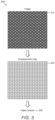
- a displacement map allocates a grayscale value for pixels in a 2D image corresponding to height detail. These values are used to calculate the image micro- and macro- scale roughness (see figure 5 , below).
- Micro-Scale Roughness is calculated using the 2D autocorrelation function for a high-resolution image.
- This function establishes whether an image contains (non-)periodic features.
- the autocorrelation function of a regular texture will contain peaks and valleys with spacings equal to the distance between the texture primitives.
- the autocorrelation function is most often obtained by taking the discrete Fourier transform (DFT) of the image and multiplying each coefficient with its complex conjugate before taking the inverse DFT. If the inverse DFT is not taken, the function obtained is the power spectral density (PSD) function that in this case measures the energy at each spatial scale.
- the PSD function can determine the coarseness of the texture, which we identify as micro-roughness.
- a cut-off frequency is determined first based on the hardware used and the scaling of the haptic texture. Fitting a slope to the higher frequency sections of the PSD function corresponding to frequencies above this cut-off gives us the roughness parameter we require. If the function rapidly decays then the image contains a smoother texture with texture information concentrated at lower spatial frequencies, whereas the image contains a rough texture if the function drops off slowly or flattens, indicating texture information at higher spatial frequencies.
- the micro roughness values (mRVs) learnt from the PSD function are then used to choose the circle haptic parameters from a look up table (LUT) that we have constructed a priori through user testing.
- the LUT maps an mRV to a 'circle draw speed' and haptic sample points which is projected onto the user's hands when 1) the hand is located within the bounds of the textured image, and 2) the hand has a velocity above a pre-defined threshold value (there is no texture sensation on a stationary hand).
- Macro-Scale Roughness is closely coupled with the dynamic exploration of the textured surfaced.
- We achieve this by setting the circle haptic intensity to be proportional to the displacement map value at DM(X).
- the haptic intensity perceived by the user varies dynamically in strength according to the location of X , i.e., the main touch point of the user's hands with the graphic.
- the acoustic radiation force is due to the focused ultrasound. Therefore the strength of the haptic sensation is modulated between a minimum value corresponding to the vibrotactile threshold and the maximum output power of the USI.
- FIG. 5 shown is a schematic 500 of extracted features of an image displacement map 510 associated with a haptic mapping function block 520.
- the haptic mapping function block 520 consists of an autocorrelation function 530 resulting in a micro-roughness draw frequency 550, and a gray-level function at X 540 resulting in macro-roughness intensity modulation 560.
- the autocorrelation of the displacement map is used to define micro-roughness parameters that control the draw frequency of a haptic pattern.
- the gray-level function at the dynamic touch position X is used to define macro- roughness parameters that control the ultrasound intensity level being outputted. Applying both micro- and macro-scale texture calculations simultaneously to mid-air haptic sensations (e.g., a circle tactile pattern) is what we call haptic mapping.
- FIG. 6 shown is a schematic 600 of a system for generating mid-air haptic textures using an ultrasonic transducer array.
- texture information is extracted 630 and provided to the haptic mapping function 680.
- a digital image 650 is taken from the texture 610 and digital hand-related information 640 is taken from features and movements of the hand 620.
- the digital image 650 and digital hand-related information 640 are processed via holographic interaction 660 and then provided to the haptic mapping function 680.
- the haptic mapping function 680 then generates the necessary signals for the ultrasound transducer array 690 to produce ultrasound generated texture 700 that is felt by the hand 620.
- the method avoids possible sensory conflicts due to inconsistency between a haptic texture and its visual representation.
- the method is robust against computer graphic rendering techniques (e.g., normal and bump maps) and can therefore be applied to a vast range of applications.
- Our demo provides insights towards the furthering of immersive AR/VR experiences with mid-air haptic textures, as well as the enabling opportunity for the substitution of real fabric textiles with ultrasonic replicas, what is effectively a step towards new HFIs paradigms where users of VR-dressing rooms and online shops can touch and feel digital haptic textures.
- This application proposes a new approach to generating mid-air haptic textures based on the visual representation of various materials.
- Our main contributions are the following: a) a model to predict perceived roughness from visual pictures; b) a method to translate perceived tactile roughness to mid-air haptic input parameters; and c) a user validated end-to-end algorithm capable of rendering mid-air haptic textures from visuals.
- texture is predominantly considered as a property that lies within the domain of touch, it is in fact multisensory. As such, texture can be separated into three distinct groups: visual texture, auditory texture, and tactile texture.
- Texture contains numerous potential dimensions that traverse these three sensory modalities. For example: Shine / matte, coarse / fine, rough / smooth, hard / soft, or sticky / slippery. Some of these descriptors are applicable primarily to one specific modality, e.g. 'shine' is for vision, but 'rough' and many others may apply to multiple modalities. Across these different texture groups, researchers have attempted to provide definitions with varying success. A good example is that by Tamura et al. who attempted to define visual texture by stating: "We may regard texture as what constitutes a macroscopic region. Its structure is simply attributed to the repetitive patterns in which elements of primitives are re-arranged according to a placement rule".
- Visual Texture Perception General usage of the term 'texture' is most often associated with how an object feels when touched. However, humans often utilize visual observation to infer different material properties that comprise the surface of an object, most commonly referred to as 'visual texture'. In fact, variations in visual texture heavily inform our interpretation of the world, and provide us with cues to understand the shape and orientation of a surface. Just as pattern variations in surface structure can lead to perceptually different tactile sensations, the human visual system also creates its own complimentary interpretation of these patterns.
- Tactile Texture Perception The term 'tactile texture' relates to surface and material properties that are perceived by our finger upon contact with an object's surface. These can be a static (pressing down) or dynamic (sliding) tactile interaction. During the tactile exploration of an object and its surfaces, tactile qualities such as surface friction, roughness, and temperature are revealed. Moreover, different tactile dimensions are revealed depending on the type of tactile interaction one uses. As the hand/finger skin surface makes contact with an object's surface, the central nervous system is informed about the qualities of the contact. This influences our perception towards exploring, grasping, and manipulating our environment.
- Roughness features are often classified in two levels (macro/micro) due to the different mechanoreceptors activated following either spatial or temporal stimulation during surface exploration.
- SA1 Mobal
- FA2 Pacinian
- Gray-level co-occurrence matrices are a commonly used statistical approach for image texture analysis due to their simplicity and easy interpretability. This method examines variations in pixel intensity values throughout an image across a given distance d and angle ⁇ , to form a matrix with dimensions relative to the number of possible gray-levels contain within an image.
- the formulation of an image's gray-level co-occurrence matrices (GLCM) compiles both spatial and statistical information, and enables the computation of second order statistics, known as Haralick features. This approach has been widely adopted across various fields, such as, medical image analysis, object recognition from satellite imagery, and image classification tasks.
- GLCM express the joint distribution probabilities that neighboring pixels occur within an image across relative polar co-ordinates ( d, ⁇ ).
- the ( i, j ) th value within the resulting GLCM will express the number of times the i th and j th pixel values occur in an image when evaluated across the offset ( d , ⁇ ).
- Haralick In association with GLCMs are various second-order texture measures known as Haralick features. Haralick first proposed 14 types of feature statistics based on GLCMs. These can be split into 3 groups: Contrast, orderliness, and descriptives, as previous work has shown these groups to be independent of each other. Within the Contrast group, measures of contrast (CON), dissimilarity (DIS), and homogeneity (HOM) / inverse difference moment (IDM), exist to explain the relative depth and smoothness of an image texture at a given offset. Angular second moment (ASM), or energy ( ⁇ ASM), and entropy (ENT), all contribute towards assessments of orderliness of pixel gray-level dispersion within an image texture.
- CON contrast
- DIS dissimilarity
- HOM homogeneity
- IDM inverse difference moment
- ASM Angular second moment
- ⁇ ASM energy
- ENT entropy
- Descriptive measures are calculated on the entire 2-D matrix, offering first-order descriptive measures on the second-order spatial information captured during computation of an image's GLCM. Mean, standard deviation, variance, and correlation of matrix values can be computed within this group. In addition, the measures cluster shade and cluster prominence can be calculated to evaluate symmetry within the matrix.
- Tactile Texture Rendering The Texture Rendering haptic virtual texture has focused many efforts in the haptic community and has been applied to many apparatus such as force-feedback devices, pin-arrays, vibrotactile actuators and an ultrasonic plate. Most of these approaches tune one or several output parameters to vary the perceived texture of the tactile stimuli. Among these parameters frequency and waveform have shown greater influence on the perceived tactile texture. It has been noted that exploration motion also plays an important role in texture perception. Therefore, researchers have been exploring the relationship between the feedback output and exploration motion speed, using pre-recorded data.
- Crowdsourcing Data Collection Accurate perceptual assessments for a given data set are impinged on the collection of data from a sufficient number of observers. Traditional recruitment techniques, such as the recruitment of university students can prove difficult particularly for longer trials (>1hr). In order to overcome this concern, we incorporated a crowd-sourced approach by utilizing Amazon's Mechanical Turk (AMT). The benefit of this approach was that a much larger user group could be obtained for a small monetary reward. 187 participants were recruited through AMT. Participants were first given a consent page to complete along with a description of what was required of them during the task. They were then presented with each of the 98 images consecutively in a randomized order.
- AMT Amazon's Mechanical Turk
- HIT Human Intelligence Task
- Participants were given a maximum time limit of 3 hours to complete the task, as it was expected that the process may have taken an extended period of time, therefore a substantial time period was allowed, with the expectation that participants may have required breaks between roughness assessments.
- the mean time taken by users was 50mins. Participants were required to be AMT Masters, have a HIT approval rating of >95%, and have over 1000 HITs approved. These caveats helped to minimize the risk of poor quality data being collected.
- a unique randomized ID was given at the beginning of the study that was to be entered upon completion of the study. This step acted as a validation method to ensure participants completed the HIT in its entirety. In return for their time, participants were rewarded with $7.40/hr, slightly over US minimum wage.
- Image Feature Data Texture images from the HaTT image data base were encoded as 24bpp 1024 ⁇ 1024 bitmaps. We resized each image to 256 ⁇ 256 pixels, using a constant scale factor. Images were then converted to gray-scale and down sampled to 8 bits per pixel with anti-aliasing applied, in order to produce 256 gray levels. This processing step reduced file size and enabled a GLCM to be computed with size (2 8 ) 2 . This information was passed into our CNN as a 2D matrix with the shape 256 ⁇ 256, with height and width being 256, and gray-level set as 1.
- Haralick features data. From the computation of each image's GLCM, a series of second-order statistical measures, known as Haralick features, could be calculated. To ensure our feature set contained independent variables, we computed features for the separate groups Contrast, Orderliness, and Descriptives. For the contrast group we selected the measure homogeneity (HOM) and energy ( ⁇ ASM) for the orderliness group. We also computed mean, standard deviation, and maximum correlation coefficient (COR) for the descriptives group, and included cluster shade and prominence to assess symmetry in the GLCMs. As such, a total of 6 features were used as inputs to our model as a separate MultiLayer Perceptron (MLP) network.
- MLP MultiLayer Perceptron
- the first convolutional layer applies a series of 16 7 ⁇ 7 filters to the image and GLCM, which is followed by a 4 ⁇ 4 max pooling layer to reduce the dimensionality of the image and GLCM data. Filter size is then reduced to a series of 16 3 ⁇ 3 in CNN layers 2 and 3. After CNN layer 2, another 4 ⁇ 4 max pooling layer is applied, with a final 2 ⁇ 2 max pooling layer after CNN layer 3.
- ReLU Rectified Linear Unit
- the subsequent output is then flattened and passed to a fully connected layer of 16-dimensions with ReLU activations, and L2 kernel regularization set to a value of 0.1 in order to minimize overfitting.
- This architecture was used for both GLCM and image feature data as separate input channels. Haralick feature data was processed using an MLP with 2 fully connected layers of 16-dimensions, and L2 kernel regularization applied to the second layer set to a value of 0.1, again to ensure overfitting was minimized.
- Each 16-dimension fully connected layer from the 3 models was then concatenated in order to return a single tensor passed to a fully connected layer with 3 dimensions and ReLU activations.
- the output layer generated used a sigmoid activation function in order to output a predicted value of subjective roughness in the range of 0 - 100.
- the model was trained using the mean absolute error (MAE) between the predicted values and observed median subjective roughness values obtained during our crowd-sourced data gathering exercise.
- the Adam optimizer with Nesterov momentum and a learning rate of 0.0005 was implemented, and a batch size of 1 applied.
- Our model was built using Tensorflow and the Keras API in Python and ran on a Nvidia GTX1070 GPU.
- FIG. 7 shown is a graph 700 displaying line plots 770 comparing model predicted roughness values (filled-in circles) and observed median subjective roughness values from crowd-sourced data (open circles).
- the x-axis shows various test image textures, including bubble envelope 740a, silk 1 740b, paper plate 2 740c, brick 2 740d, glitter paper 740e, denim 740f, cork 740g, metal mesh 740h, and plastic mesh 2 740j.
- the y-axis 730 is a roughness value normalized from 0 to 100.
- FIG 8 shown is a graph 800 of a linear regression plot 810 between observed median subjective roughness values and predicted values 820 from our model. This linear regression was conducted to examine our model's goodness of fit. An R 2 value of 0.92, or 92% accuracy was observed in the model's predictions on test set data.
- Table 1 One-sample Wilcoxon test results on comparisons between visual roughness ratings, and model predicted roughness. The roughness range is normalized to lie between 0 and 100.
- the setup included an Ultrahaptics Evaluation kit (UHEV1) from Ultrahaptics Ltd. embedded at the bottom of an acrylic laser-cut black box. A squared hole on the top of the box let the participants received the mid-air haptic pattern on their palm.
- UHEV1 Ultrahaptics Evaluation kit
- FIG 9 shown is a graph 900 presenting the results for the 20cm diameter circle.
- the x-axis 740 is the draw frequency and the y-axis 930 is the Likert scale.
- the plot incudes the mean haptic 910 and standard error 920 of the roughness rating across a draw frequency.
- FIG 10 shown is a graph 1000 with an x-axis 1020 of predicted values and a y-axis 1010 of observed values.
- the plot 1030 and predicted values 1040 display linear regression between determined median draw frequency values and predicted draw frequency values from our model.
- An R 2 value of 0.76 and a mean absolute error of 5.6 were observed.
- Table 3 One sample Wilcoxon signed rank test comparisons between median roughness (draw frequency ranging from 25 Hz to 75 Hz), and predicted roughness from our model. Median and IQR values are reported.
- the one-sample Wilcoxon signed rank test provides more details in our model accuracy (see Table 3). Indeed, according to the test results, 5 out of the 9 textures tested are significantly different. The fact that more than half of the predictions are significantly different than the participants ratings could be seen as a failure of our model.
- the mean absolute error is only of 5.65Hz and needs to be compared to the participants vibrotactile perceptual resolution. According to a review on psychophysical studies in haptic, the human just noticeable difference (JND) for vibrotactile frequency is around 3-30%. If we take the mean value and apply it to our range of frequency used in the study, we can deduce that in our case, human JND to haptic pattern is as big as 7.5Hz. Since the human JND for vibrotactile feedback is greater than the mean absolute error of our model, it is unlikely that participants would be able to perceive them.
- the method features an initial step which is the design and training of a visual texture dimension machine learning prediction and classification model.
- a linear regression process is conducted in order to match visual texture dimension prediction values to specific haptic sensation attributes that have been validated to produce a particular haptic texture dimension.
- This procedure forms our haptic prediction model.
- utilizing the classification data for the associated visual textures we develop an audio database and an associated rendering method to produce dynamic auditory feedback that is tied to the visual features within a texture image.
- this method first features a set of image textures (currently 98), of size 1024x1024 pixels (24 bits per pixel). These images are assessed by human users subjectively, and values of 0 - 100 are given for each of the following texture dimensions: roughness, bumpiness, hardness, stickiness, warmness.
- This stage also requires image data to be labelled, in order to assign each image to a specific texture group ('paper', 'wood', etc). This process can be done via crowdsourced means such as Amazon's Mechanical Turk (AMT). Following this procedure, data is assessed, cleaned, outliers are removed, then mean and standard deviation (or median and +- inter-quartile range) values are retained for each of the texture dimensions. This data is utilized for training and validation in subsequent steps.
- AMT Amazon's Mechanical Turk
- the image data set is subject to several pre-processing steps. Firstly, images are converted to gray-scale, and resized to 256x256 pixels (8 bit-per-pixel), using constant scaling. Next, gray-level co-occurrence matrices (size 256x256) are calculated for a series of displacement vectors: distances (1, 2, 3, 4, 5, 6, 7, 8, 9, 10), and angles (0, 45, 90, 135). Once each matrix is calculated, a Chi-Square test is conducted on each of the matrices, and the displacement vector that produces the highest value is selected. This step is conducted in order to determine which displacement vector correctly identifies the structure within the image texture, allowing both the spacing and direction of the texture structure to be obtained.
- matrices for all angles (0, 45, 90, 135) are constructed.
- transposed matrices are also constructed in order to represent the relationship between pixels across the horizontal, vertical, and both diagonal directions.
- Matrices for the correct distance values and a given angles, plus each transpose matrix are summed and averaged in order to produce a symmetric and semi-direction invariant matrix. Values are then normalized so that the resultant matrix contains the estimated probabilities for each pixel co-occurrence.
- This feature set contains 3 distinct groups: Contrast, Orderliness, and Descriptives. We select singular values for each group, in order to ensure each texture measure was independent. Homogeneity is selected for Contrast, which produces a value between 0 - 1. This feature measures how close the distribution of elements in the GLCM are to the diagonal of the GLCM. Entirely diagonal gray-level matrices give a homogeneity of 1, and this value becomes large if textures contain only minimal changes in pixel values. Energy is selected as the Orderliness descriptor, where Energy is the square root of the matrix Angular Second Moment.
- a network with 3 convolutional layers with ReLU activations, and He normal kernel initializers is constructed.
- the first convolutional layer applies a series of 16 7 ⁇ 7 filters to the image and GLCM, which is followed by a 4 ⁇ 4 max pooling layer to reduce the dimensionality of the image and GLCM data. Filter size is then reduced to a series of 16 3 ⁇ 3 in CNN layers 2 and 3. After CNN layer 2, another 4 ⁇ 4 max pooling layer is applied, with a final 2 ⁇ 2 max pooling layer after CNN layer 3.
- the subsequent output is then flattened and passed to a fully connected layer of 16-dimensions with ReLU activations, and L2 kernel regularization set to a value of 0.1 in order to minimize overfitting.
- This architecture is used for both GLCM and image feature data as separate input channels. Haralick feature data is processed using an MLP with 2 fully connected layers of 16-dimensions, and L2 kernel regularization applied to the second layer set to a value of 0.1, again to ensure overfitting is minimized.
- Each 16-dimension fully connected layer from the 3 models is then concatenated in order to return a single tensor passed to a fully connected layer with 3 dimensions and ReLU activations.
- the output layer generated uses a sigmoid activation function in order to output a predicted value of subjective roughness in the range of 0 - 100.
- the model is trained using the mean absolute error (MAE) between the predicted values and observed median subjective values obtained during the initial texture classification and dimension estimation exercise.
- MAE mean absolute error
- the Adam optimizer with Nesterov momentum and a learning rate of 0.0005 is implemented, and a batch size of 1 applied.
- the same general architecture is applied in order to classify textures into specific groups.
- group data is used as the dependent variable, as opposed to texture dimension mean/median values.
- fully connected layer after concatenation utilizes 'softmax' activations.
- output layer is no longer a sigmoid activation function, but rather categorical cross entropy is used.
- 0 - 100 values can be rendering using the Ultrahaptics mid-air haptic device.
- 0 - 100 values can be rendering using the Ultrahaptics mid-air haptic device.
- 'roughness' we convert a given prediction value to the draw frequency of a haptic sensation using a linear regression approach. The association of sensation draw frequency and haptic roughness has been validated using a perceptual user study.
Landscapes
- Engineering & Computer Science (AREA)
- Theoretical Computer Science (AREA)
- General Engineering & Computer Science (AREA)
- Physics & Mathematics (AREA)
- General Physics & Mathematics (AREA)
- Computer Vision & Pattern Recognition (AREA)
- Human Computer Interaction (AREA)
- Software Systems (AREA)
- Probability & Statistics with Applications (AREA)
- Computer Graphics (AREA)
- Computer Hardware Design (AREA)
- Medical Informatics (AREA)
- Computing Systems (AREA)
- Artificial Intelligence (AREA)
- Mathematical Physics (AREA)
- Evolutionary Computation (AREA)
- Multimedia (AREA)
- Data Mining & Analysis (AREA)
- User Interface Of Digital Computer (AREA)
- Processing Or Creating Images (AREA)
Claims (10)
- Verfahren zum Erzeugen haptischer Texturen (330) in der Luft, umfassend:Importieren eines Texturbilds (310), das Makrotexturmerkmale M i und Mikrotexturmerkmale m i aufweist, durch eine Offline-Komponente,Extrahieren von M i und m i durch die Offline-Komponente aus dem Texturbild (310),Erstellen einer Funktion des haptischen Mappings für eine haptische Empfindung s i , die geeignet ist, einem virtuellen Objekt x i eine haptische Textur in der Luft zu verleihen, wobei die Funktion des haptischen Mappings für eine bestimmte haptische Empfindung s i eine Funktion von s i , M i , und m i ist,Anwenden der Funktion des haptischen Mappings für die haptische Empfindung s i auf die haptische Empfindung s i ,Erzeugen einer Offline-Komponentenausgabe,iterativ für jeden Wert i:a) Erkennen von Kollisionspunkten zwischen einer sich bewegenden menschlichen Hand (410) und einem virtuellen Objekt x i durch ein Tracking-System in der Luft,b) Berechnung des Schwerpunkts der Kollisionspunkte X=µ(x) durch das Luftverfolgungssystem, welcher der Durchschnitt aller aufgezeichneten Kollisionspunkte x i auf der bewegten menschlichen Hand (410) ist,c) Erstellung einer durch die Funktion des haptischen Mappings definierten Lufthaptik mittels eines Ultraschallwandler-Arrays durch das Luftverfolgungssystem für eine bestimmte haptische Empfindung s i auf X, abhängig von der Ausgabe der Offline-Komponente.
- Verfahren nach Anspruch 1, wobei die Extraktion von M i und m i aus dem Texturbild (310) eine Displacement-Map (320) verwendet.
- Verfahren nach Anspruch 2, wobei die Extraktion von M i und m i aus dem Texturbild (310) mögliche sensorische Konflikte aufgrund von Inkonsistenzen zwischen der haptischen Lufttextur und ihrer visuellen Darstellung vermeidet.
- Verfahren nach Anspruch 2, wobei m i mithilfe einer 2D-Autokorrelationsfunktion für ein hochauflösendes Bild berechnet wird.
- Verfahren nach Anspruch 4, wobei die 2D-Autokorrelationsfunktion feststellt, ob ein Bild periodische Merkmale enthält.
- Verfahren nach Anspruch 4, wobei die 2D-Autokorrelationsfunktion durch eine diskrete Fourier-Transformation des Texturbildes (310) und Multiplikation jedes Koeffizienten mit seiner komplex konjugierten Funktion erhalten wird, bevor eine inverse diskrete Fourier-Transformation durchgeführt wird.
- Verfahren nach Anspruch 4, wobei die 2D-Autokorrelationsfunktion durch eine spektrale Leistungsdichtefunktion erhalten wird, welche die Energie auf jeder räumlichen Skala misst.
- Verfahren nach Anspruch 2, wobei M i berechnet wird, indem die haptische Intensität eines Kreises proportional zum Displacement-Map-Wert bei DM(X) gesetzt wird.
- Verfahren nach Anspruch 8, wobei die Stärke einer haptischen Empfindung zwischen einem Minimalwert, der einer vibrotaktilen Schwelle entspricht, und einer maximalen Ausgangsleistung eines haptischen Generators in der Luft moduliert wird.
- Verfahren nach einem der Ansprüche 1 bis 9, wobei der Schwerpunkt der Kollisionspunkte X der Hauptberührungspunkt der bewegten menschlichen Hand mit dem virtuellen Objekt ist, wobei das virtuelle Objekt eine Grafik ist.
Applications Claiming Priority (3)
| Application Number | Priority Date | Filing Date | Title |
|---|---|---|---|
| US201962788322P | 2019-01-04 | 2019-01-04 | |
| US201962945272P | 2019-12-09 | 2019-12-09 | |
| PCT/GB2020/050013 WO2020141330A2 (en) | 2019-01-04 | 2020-01-06 | Mid-air haptic textures |
Publications (3)
| Publication Number | Publication Date |
|---|---|
| EP3906462A2 EP3906462A2 (de) | 2021-11-10 |
| EP3906462C0 EP3906462C0 (de) | 2025-06-18 |
| EP3906462B1 true EP3906462B1 (de) | 2025-06-18 |
Family
ID=69147732
Family Applications (1)
| Application Number | Title | Priority Date | Filing Date |
|---|---|---|---|
| EP20700320.3A Active EP3906462B1 (de) | 2019-01-04 | 2020-01-06 | Haptische texturen in der luft |
Country Status (3)
| Country | Link |
|---|---|
| US (1) | US11550395B2 (de) |
| EP (1) | EP3906462B1 (de) |
| WO (1) | WO2020141330A2 (de) |
Families Citing this family (46)
| Publication number | Priority date | Publication date | Assignee | Title |
|---|---|---|---|---|
| GB2513884B (en) | 2013-05-08 | 2015-06-17 | Univ Bristol | Method and apparatus for producing an acoustic field |
| GB2530036A (en) | 2014-09-09 | 2016-03-16 | Ultrahaptics Ltd | Method and apparatus for modulating haptic feedback |
| SG11201706527QA (en) | 2015-02-20 | 2017-09-28 | Ultrahaptics Ip Ltd | Algorithm improvements in a haptic system |
| WO2016132144A1 (en) | 2015-02-20 | 2016-08-25 | Ultrahaptics Ip Limited | Perceptions in a haptic system |
| US10818162B2 (en) | 2015-07-16 | 2020-10-27 | Ultrahaptics Ip Ltd | Calibration techniques in haptic systems |
| US10268275B2 (en) | 2016-08-03 | 2019-04-23 | Ultrahaptics Ip Ltd | Three-dimensional perceptions in haptic systems |
| US10943578B2 (en) | 2016-12-13 | 2021-03-09 | Ultrahaptics Ip Ltd | Driving techniques for phased-array systems |
| US11531395B2 (en) | 2017-11-26 | 2022-12-20 | Ultrahaptics Ip Ltd | Haptic effects from focused acoustic fields |
| EP3729417B1 (de) | 2017-12-22 | 2025-09-10 | Ultrahaptics Ip Ltd | Verfolgung in haptischen systemen |
| EP3729418B1 (de) | 2017-12-22 | 2024-11-20 | Ultrahaptics Ip Ltd | Minimierung von unerwünschten antworten in haptischen systemen |
| SG11202010752VA (en) | 2018-05-02 | 2020-11-27 | Ultrahaptics Ip Ltd | Blocking plate structure for improved acoustic transmission efficiency |
| US11098951B2 (en) | 2018-09-09 | 2021-08-24 | Ultrahaptics Ip Ltd | Ultrasonic-assisted liquid manipulation |
| US12373033B2 (en) | 2019-01-04 | 2025-07-29 | Ultrahaptics Ip Ltd | Mid-air haptic textures |
| CN113348430B (zh) * | 2019-03-26 | 2023-08-29 | 瑞典爱立信有限公司 | 确定超声波触觉设备和视觉传感器设备中的坐标系之间的变换 |
| US11842517B2 (en) | 2019-04-12 | 2023-12-12 | Ultrahaptics Ip Ltd | Using iterative 3D-model fitting for domain adaptation of a hand-pose-estimation neural network |
| US11374586B2 (en) | 2019-10-13 | 2022-06-28 | Ultraleap Limited | Reducing harmonic distortion by dithering |
| CA3154040A1 (en) | 2019-10-13 | 2021-04-22 | Benjamin John Oliver LONG | Dynamic capping with virtual microphones |
| US11416065B1 (en) * | 2019-11-08 | 2022-08-16 | Meta Platforms Technologies, Llc | Synthesizing haptic and sonic feedback for textured materials in interactive virtual environments |
| US11715453B2 (en) | 2019-12-25 | 2023-08-01 | Ultraleap Limited | Acoustic transducer structures |
| US12254133B2 (en) * | 2020-06-12 | 2025-03-18 | Emerge Now Inc. | Method and system for the generation and management of tactile commands for tactile sensation |
| WO2021252998A1 (en) * | 2020-06-12 | 2021-12-16 | Emerge Now Inc. | Method and system for the generation and management of tactile commands for tactile sensation |
| US11816267B2 (en) | 2020-06-23 | 2023-11-14 | Ultraleap Limited | Features of airborne ultrasonic fields |
| KR102332318B1 (ko) * | 2020-07-22 | 2021-12-01 | 이화여자대학교 산학협력단 | 시공간 인코딩을 사용하여 가상 객체의 거칠기 촉각을 제공하기 위한 방법 및 시스템 |
| MX2023002844A (es) * | 2020-09-14 | 2023-06-08 | Interdigital Ce Patent Holdings Sas | Formato de representacion de escena haptica. |
| WO2022058738A1 (en) | 2020-09-17 | 2022-03-24 | Ultraleap Limited | Ultrahapticons |
| IT202000030749A1 (it) * | 2020-12-15 | 2022-06-15 | Thegg Domotica S R L | Metodo co-creativo e dispositivo haptico per la materioteca dinamica |
| JP7658128B2 (ja) * | 2021-03-23 | 2025-04-08 | カシオ計算機株式会社 | 検出装置及び空間投影装置 |
| CN113190114B (zh) * | 2021-04-14 | 2022-05-20 | 三峡大学 | 具有触觉模拟和情绪感知的虚拟场景体验系统和方法 |
| US11972052B2 (en) * | 2021-05-05 | 2024-04-30 | University Of Southern California | Interactive human preference driven virtual texture generation and search, and haptic feedback systems and methods |
| EP4343492A4 (de) * | 2021-05-19 | 2025-06-04 | Alps Alpine Co., Ltd. | Empfindungssteuerungsverfahren, empfindungssteuerungssystem, umwandlungsmodellerzeugungsverfahren, umwandlungsmodellerzeugungssystem, relationales expressionsumwandlungsverfahren und programm |
| US12517585B2 (en) | 2021-07-15 | 2026-01-06 | Ultraleap Limited | Control point manipulation techniques in haptic systems |
| JP2023050191A (ja) * | 2021-09-29 | 2023-04-10 | 国立大学法人 東京大学 | 情報処理装置及びプログラム |
| US11681373B1 (en) * | 2021-12-08 | 2023-06-20 | International Business Machines Corporation | Finger movement management with haptic feedback in touch-enabled devices |
| CN114587339B (zh) * | 2022-01-24 | 2025-07-22 | 中国标准化研究院 | 一种尺寸编码辨识度工效学测量器具及辨识方法 |
| US12366920B2 (en) | 2022-09-26 | 2025-07-22 | Pison Technology, Inc. | Systems and methods for gesture inference using transformations |
| US12340627B2 (en) | 2022-09-26 | 2025-06-24 | Pison Technology, Inc. | System and methods for gesture inference using computer vision |
| US12366923B2 (en) | 2022-09-26 | 2025-07-22 | Pison Technology, Inc. | Systems and methods for gesture inference using ML model selection |
| WO2024081786A2 (en) * | 2022-10-13 | 2024-04-18 | Aurasense Tech Corporation | Skin treatment interactive and tactile projections of sound and light |
| DE102022127472A1 (de) | 2022-10-19 | 2024-04-25 | Marquardt Gmbh | Anzeigevorrichtung |
| JP2024066546A (ja) * | 2022-11-02 | 2024-05-16 | 株式会社ユニオン | ドア開閉システム |
| CN115937633A (zh) * | 2022-12-13 | 2023-04-07 | 宁波慈溪生物医学工程研究所 | 一种基于触觉反馈的表面特征识别方法、装置及系统 |
| CN115670509B (zh) * | 2023-01-03 | 2023-03-17 | 吉林大学 | 基于柔性超声换能器的肢体三维成像装置及检测方法 |
| KR20250017385A (ko) | 2023-07-27 | 2025-02-04 | 현대자동차주식회사 | 비접촉식 인터페이스 장치 및 이의 제어 방법 |
| US20250068248A1 (en) * | 2023-08-24 | 2025-02-27 | Industrial Technology Research Institute | Tactile rendering system and tactile rendering method |
| KR20250051406A (ko) * | 2023-10-10 | 2025-04-17 | 현대자동차주식회사 | 객체 추적 장치 및 그 방법, 그리고 이를 이용한 차량 제어 장치 및 방법 |
| US12502110B2 (en) | 2023-10-24 | 2025-12-23 | Pison Technology, Inc. | Systems and methods for determining physiological state based on surface biopotentials |
Citations (2)
| Publication number | Priority date | Publication date | Assignee | Title |
|---|---|---|---|---|
| US20150277610A1 (en) * | 2014-03-27 | 2015-10-01 | Industry-Academic Cooperation Foundation, Yonsei University | Apparatus and method for providing three-dimensional air-touch feedback |
| US10168782B1 (en) * | 2017-06-05 | 2019-01-01 | Rockwell Collins, Inc. | Ultrasonic haptic feedback control system and method |
Family Cites Families (273)
| Publication number | Priority date | Publication date | Assignee | Title |
|---|---|---|---|---|
| US4218921A (en) | 1979-07-13 | 1980-08-26 | The United States Of America As Represented By The Administrator Of The National Aeronautics And Space Administration | Method and apparatus for shaping and enhancing acoustical levitation forces |
| CA1175359A (en) | 1981-01-30 | 1984-10-02 | John G. Martner | Arrayed ink jet apparatus |
| FR2551611B1 (fr) | 1983-08-31 | 1986-10-24 | Labo Electronique Physique | Nouvelle structure de transducteur ultrasonore et appareil d'examen de milieux par echographie ultrasonore comprenant une telle structure |
| EP0309003B1 (de) | 1984-02-15 | 1994-12-07 | Trw Inc. | Akustischer Oberflächenwellen-Spektrumanalysator |
| JPS62258597A (ja) | 1986-04-25 | 1987-11-11 | Yokogawa Medical Syst Ltd | 超音波トランスデユ−サ |
| US5226000A (en) | 1988-11-08 | 1993-07-06 | Wadia Digital Corporation | Method and system for time domain interpolation of digital audio signals |
| EP0528910A4 (en) | 1990-05-14 | 1993-12-22 | Commonwealth Scientific And Industrial Research Organization | A coupling device |
| EP0498015B1 (de) | 1991-02-07 | 1993-10-06 | Siemens Aktiengesellschaft | Verfahren zur Herstellung von Ultraschallwandlern |
| US5243344A (en) | 1991-05-30 | 1993-09-07 | Koulopoulos Michael A | Digital-to-analog converter--preamplifier apparatus |
| JP3243821B2 (ja) | 1992-02-27 | 2002-01-07 | ヤマハ株式会社 | 電子楽器 |
| US5426388A (en) | 1994-02-15 | 1995-06-20 | The Babcock & Wilcox Company | Remote tone burst electromagnetic acoustic transducer pulser |
| US5477736A (en) | 1994-03-14 | 1995-12-26 | General Electric Company | Ultrasonic transducer with lens having electrorheological fluid therein for dynamically focusing and steering ultrasound energy |
| US5511296A (en) | 1994-04-08 | 1996-04-30 | Hewlett Packard Company | Method for making integrated matching layer for ultrasonic transducers |
| US5583405A (en) | 1994-08-11 | 1996-12-10 | Nabco Limited | Automatic door opening and closing system |
| AU6162596A (en) | 1995-06-05 | 1996-12-24 | Christian Constantinov | Ultrasonic sound system and method for producing virtual sou nd |
| US7225404B1 (en) | 1996-04-04 | 2007-05-29 | Massachusetts Institute Of Technology | Method and apparatus for determining forces to be applied to a user through a haptic interface |
| US5859915A (en) | 1997-04-30 | 1999-01-12 | American Technology Corporation | Lighted enhanced bullhorn |
| US6193936B1 (en) | 1998-11-09 | 2001-02-27 | Nanogram Corporation | Reactant delivery apparatuses |
| US6029518A (en) | 1997-09-17 | 2000-02-29 | The United States Of America As Represented By The Administrator Of The National Aeronautics And Space Administration | Manipulation of liquids using phased array generation of acoustic radiation pressure |
| US6647359B1 (en) | 1999-07-16 | 2003-11-11 | Interval Research Corporation | System and method for synthesizing music by scanning real or simulated vibrating object |
| US6307302B1 (en) | 1999-07-23 | 2001-10-23 | Measurement Specialities, Inc. | Ultrasonic transducer having impedance matching layer |
| CN100358393C (zh) | 1999-09-29 | 2007-12-26 | 1...有限公司 | 定向声音的方法和设备 |
| US6771294B1 (en) | 1999-12-29 | 2004-08-03 | Petri Pulli | User interface |
| US6925187B2 (en) | 2000-03-28 | 2005-08-02 | American Technology Corporation | Horn array emitter |
| US6503204B1 (en) | 2000-03-31 | 2003-01-07 | Acuson Corporation | Two-dimensional ultrasonic transducer array having transducer elements in a non-rectangular or hexagonal grid for medical diagnostic ultrasonic imaging and ultrasound imaging system using same |
| US7284027B2 (en) | 2000-05-15 | 2007-10-16 | Qsigma, Inc. | Method and apparatus for high speed calculation of non-linear functions and networks using non-linear function calculations for digital signal processing |
| DE10026077B4 (de) | 2000-05-25 | 2007-03-22 | Siemens Ag | Strahlformungsverfahren |
| DE10051133A1 (de) | 2000-10-16 | 2002-05-02 | Siemens Ag | Strahlformungsverfahren |
| US6768921B2 (en) | 2000-12-28 | 2004-07-27 | Z-Tech (Canada) Inc. | Electrical impedance method and apparatus for detecting and diagnosing diseases |
| US7463249B2 (en) | 2001-01-18 | 2008-12-09 | Illinois Tool Works Inc. | Acoustic wave touch actuated switch with feedback |
| US7058147B2 (en) | 2001-02-28 | 2006-06-06 | At&T Corp. | Efficient reduced complexity windowed optimal time domain equalizer for discrete multitone-based DSL modems |
| AU2002320088A1 (en) | 2001-06-13 | 2002-12-23 | Marc G. Apple | Brachytherapy device and method |
| US6436051B1 (en) | 2001-07-20 | 2002-08-20 | Ge Medical Systems Global Technology Company, Llc | Electrical connection system for ultrasonic receiver array |
| US6758094B2 (en) | 2001-07-31 | 2004-07-06 | Koninklijke Philips Electronics, N.V. | Ultrasonic transducer wafer having variable acoustic impedance |
| WO2003019125A1 (en) | 2001-08-31 | 2003-03-06 | Nanyang Techonological University | Steering of directional sound beams |
| US7623114B2 (en) | 2001-10-09 | 2009-11-24 | Immersion Corporation | Haptic feedback sensations based on audio output from computer devices |
| WO2003050511A1 (en) | 2001-12-13 | 2003-06-19 | The University Of Wyoming Research Corporation Doing Business As Western Research Institute | Volatile organic compound sensor system |
| JP4301956B2 (ja) | 2002-01-18 | 2009-07-22 | アメリカン・テクノロジー・コーポレーション | 変調器及び増幅器 |
| US6800987B2 (en) | 2002-01-22 | 2004-10-05 | Measurement Specialties, Inc. | Protective housing for ultrasonic transducer apparatus |
| US20030182647A1 (en) | 2002-03-19 | 2003-09-25 | Radeskog Mattias Dan | Automatic interactive component placement for electronics-CAD software through the use of force simulations |
| US20040052387A1 (en) | 2002-07-02 | 2004-03-18 | American Technology Corporation. | Piezoelectric film emitter configuration |
| US7720229B2 (en) | 2002-11-08 | 2010-05-18 | University Of Maryland | Method for measurement of head related transfer functions |
| JP4192672B2 (ja) | 2003-05-16 | 2008-12-10 | 株式会社日本自動車部品総合研究所 | 超音波センサ |
| WO2005010623A2 (en) | 2003-07-24 | 2005-02-03 | Zebra Imaging, Inc. | Enhanced environment visualization using holographic stereograms |
| WO2005017965A2 (en) | 2003-08-06 | 2005-02-24 | Measurement Specialities, Inc. | Ultrasonic air transducer arrays using polymer piezoelectric films and impedance matching structures for ultrasonic polymer transducer arrays |
| DE10342263A1 (de) | 2003-09-11 | 2005-04-28 | Infineon Technologies Ag | Optoelektronisches Bauelement und optoelektronische Anordnung mit einem optoelektronischen Bauelement |
| JP4425925B2 (ja) | 2003-12-27 | 2010-03-03 | 韓國電子通信研究院 | 固有ビーム形成技術を使用するmimo−ofdmシステム |
| US20050212760A1 (en) | 2004-03-23 | 2005-09-29 | Marvit David L | Gesture based user interface supporting preexisting symbols |
| EP1735732A4 (de) | 2004-03-29 | 2007-12-19 | Peter T German | Systeme und verfahren zur bestimmung elastischer eigenschaften von materialien |
| JP5243025B2 (ja) | 2004-05-17 | 2013-07-24 | エポス ディベロップメント リミテッド | 音響測位システムのための頑健な音響同期シグナリング |
| US7689639B2 (en) | 2004-06-04 | 2010-03-30 | Telefonaktiebolaget Lm Ericsson (Publ) | Complex logarithmic ALU |
| US7865236B2 (en) | 2004-10-20 | 2011-01-04 | Nervonix, Inc. | Active electrode, bio-impedance based, tissue discrimination system and methods of use |
| US7138620B2 (en) | 2004-10-29 | 2006-11-21 | Silicon Light Machines Corporation | Two-dimensional motion sensor |
| US20060090955A1 (en) | 2004-11-04 | 2006-05-04 | George Cardas | Microphone diaphragms defined by logarithmic curves and microphones for use therewith |
| US7692661B2 (en) | 2005-01-26 | 2010-04-06 | Pixar | Method of creating and evaluating bandlimited noise for computer graphics |
| WO2006086743A2 (en) | 2005-02-09 | 2006-08-17 | American Technology Corporation | In-band parametric sound generation system |
| US7345600B1 (en) | 2005-03-09 | 2008-03-18 | Texas Instruments Incorporated | Asynchronous sampling rate converter |
| GB0508194D0 (en) | 2005-04-22 | 2005-06-01 | The Technology Partnership Plc | Pump |
| WO2015006467A1 (en) | 2013-07-09 | 2015-01-15 | Coactive Drive Corporation | Synchronized array of vibration actuators in an integrated module |
| US9459632B2 (en) | 2005-06-27 | 2016-10-04 | Coactive Drive Corporation | Synchronized array of vibration actuators in a network topology |
| US7233722B2 (en) | 2005-08-15 | 2007-06-19 | General Display, Ltd. | System and method for fiber optics based direct view giant screen flat panel display |
| CN101461254B (zh) | 2005-09-20 | 2017-11-07 | 皇家飞利浦电子股份有限公司 | 具有长端口的带通换能器系统 |
| US8000481B2 (en) | 2005-10-12 | 2011-08-16 | Yamaha Corporation | Speaker array and microphone array |
| US20070094317A1 (en) | 2005-10-25 | 2007-04-26 | Broadcom Corporation | Method and system for B-spline interpolation of a one-dimensional signal using a fractional interpolation ratio |
| JP2009535724A (ja) | 2006-05-01 | 2009-10-01 | イデント テクノロジー アーゲー | 入力装置 |
| CN101466432A (zh) | 2006-06-14 | 2009-06-24 | 皇家飞利浦电子股份有限公司 | 用于经皮给药的设备和操作这种设备的方法 |
| US7425874B2 (en) | 2006-06-30 | 2008-09-16 | Texas Instruments Incorporated | All-digital phase-locked loop for a digital pulse-width modulator |
| US20100030076A1 (en) | 2006-08-01 | 2010-02-04 | Kobi Vortman | Systems and Methods for Simultaneously Treating Multiple Target Sites |
| JP2008074075A (ja) | 2006-09-25 | 2008-04-03 | Canon Inc | 画像形成装置及びその制御方法 |
| EP1911530B1 (de) | 2006-10-09 | 2009-07-22 | Baumer Electric AG | Ultraschallwandler mit akustischer Impedanzanpassung |
| US8170228B2 (en) | 2006-11-20 | 2012-05-01 | Personics Holdings Inc. | Methods and devices for hearing damage notification and intervention II |
| KR100889726B1 (ko) | 2007-02-02 | 2009-03-24 | 한국전자통신연구원 | 촉각 자극 장치 및 이를 응용한 장치 |
| FR2912817B1 (fr) | 2007-02-21 | 2009-05-22 | Super Sonic Imagine Sa | Procede d'optimisation de la focalisation d'ondes au travers d'un element introducteur d'aberations. |
| DE102007018266A1 (de) | 2007-04-10 | 2008-10-16 | Seereal Technologies S.A. | Holographisches Projektionssystem mit einer optischen Wellennachführung und Mitteln zum Korrigieren der holographischen Rekonstruktion |
| US8269168B1 (en) | 2007-04-30 | 2012-09-18 | Physical Logic Ag | Meta materials integration, detection and spectral analysis |
| US9100748B2 (en) | 2007-05-04 | 2015-08-04 | Bose Corporation | System and method for directionally radiating sound |
| US9317110B2 (en) | 2007-05-29 | 2016-04-19 | Cfph, Llc | Game with hand motion control |
| CN101568728A (zh) | 2007-10-16 | 2009-10-28 | 株式会社村田制作所 | 压电微型鼓风器 |
| FR2923612B1 (fr) | 2007-11-12 | 2011-05-06 | Super Sonic Imagine | Dispositif d'insonification comprenant un reseau tridimensionnel d'emetteurs disposes en spirale apte a generer un faisceau d'ondes focalisees de grande intensite |
| FI20075879A0 (fi) | 2007-12-05 | 2007-12-05 | Valtion Teknillinen | Laite paineen, äänenpaineen vaihtelun, magneettikentän, kiihtyvyyden, tärinän ja kaasun koostumuksen mittaamiseksi |
| EP2219528A1 (de) | 2007-12-13 | 2010-08-25 | Koninklijke Philips Electronics N.V. | Robotisches ultraschallsystem mit mikroeinstellung und positionierungskontrolle mit auf erfasste bilddaten ansprechendem feedback |
| GB0804739D0 (en) | 2008-03-14 | 2008-04-16 | The Technology Partnership Plc | Pump |
| US20090251421A1 (en) * | 2008-04-08 | 2009-10-08 | Sony Ericsson Mobile Communications Ab | Method and apparatus for tactile perception of digital images |
| US8369973B2 (en) | 2008-06-19 | 2013-02-05 | Texas Instruments Incorporated | Efficient asynchronous sample rate conversion |
| US20100013613A1 (en) | 2008-07-08 | 2010-01-21 | Jonathan Samuel Weston | Haptic feedback projection system |
| JP5496192B2 (ja) | 2008-07-08 | 2014-05-21 | ブリュエル アンド ケアー サウンド アンド ヴァイブレーション メジャーメント エー/エス | 音響場を再構成するための方法 |
| US8162840B2 (en) | 2008-07-16 | 2012-04-24 | Syneron Medical Ltd | High power ultrasound transducer |
| GB2464117B (en) | 2008-10-03 | 2015-01-28 | Hiwave Technologies Uk Ltd | Touch sensitive device |
| JP2010109579A (ja) | 2008-10-29 | 2010-05-13 | Nippon Telegr & Teleph Corp <Ntt> | 音響出力素子アレイ及び音響出力方法 |
| US8199953B2 (en) | 2008-10-30 | 2012-06-12 | Avago Technologies Wireless Ip (Singapore) Pte. Ltd. | Multi-aperture acoustic horn |
| US9569001B2 (en) | 2009-02-03 | 2017-02-14 | Massachusetts Institute Of Technology | Wearable gestural interface |
| US10564721B2 (en) | 2009-03-12 | 2020-02-18 | Immersion Corporation | Systems and methods for using multiple actuators to realize textures |
| JP5388379B2 (ja) | 2009-04-28 | 2014-01-15 | パナソニック株式会社 | 補聴装置、及び補聴方法 |
| US8009022B2 (en) | 2009-05-29 | 2011-08-30 | Microsoft Corporation | Systems and methods for immersive interaction with virtual objects |
| RU2011154213A (ru) | 2009-06-03 | 2013-07-20 | ДЗЕ ТЕКНОЛОДЖИ ПАРТНЕРШИП ПиЭлСи | Гидравлический дисковый насос |
| US7920078B2 (en) | 2009-06-19 | 2011-04-05 | Conexant Systems, Inc. | Systems and methods for variable rate conversion |
| EP2271129A1 (de) | 2009-07-02 | 2011-01-05 | Nxp B.V. | Wandler mit resonantem Hohlraum |
| KR20110005587A (ko) | 2009-07-10 | 2011-01-18 | 삼성전자주식회사 | 휴대 단말의 진동 발생 방법 및 장치 |
| US20110010958A1 (en) | 2009-07-16 | 2011-01-20 | Wayne Clark | Quiet hair dryer |
| US9177543B2 (en) | 2009-08-26 | 2015-11-03 | Insightec Ltd. | Asymmetric ultrasound phased-array transducer for dynamic beam steering to ablate tissues in MRI |
| GB0916707D0 (en) | 2009-09-23 | 2009-11-04 | Elliptic Laboratories As | Acoustic motion determination |
| US8027224B2 (en) | 2009-11-11 | 2011-09-27 | Brown David A | Broadband underwater acoustic transducer |
| EP2510404B1 (de) | 2009-12-11 | 2019-05-22 | Sorama Holding B.V. | Akustische wandleranordnung |
| JP5681727B2 (ja) | 2009-12-28 | 2015-03-11 | コーニンクレッカ フィリップス エヌ ヴェ | 高密度焦点式超音波トランスデューサ最適化 |
| KR20110093379A (ko) | 2010-02-12 | 2011-08-18 | 주식회사 팬택 | 채널상태정보 피드백 장치와 그 방법, 기지국, 그 기지국의 전송방법 |
| US20110199342A1 (en) | 2010-02-16 | 2011-08-18 | Harry Vartanian | Apparatus and method for providing elevated, indented or texturized sensations to an object near a display device or input detection using ultrasound |
| JP5457874B2 (ja) | 2010-02-19 | 2014-04-02 | 日本電信電話株式会社 | 局所再生装置とその方法と、プログラム |
| US9357280B2 (en) | 2010-04-20 | 2016-05-31 | Nokia Technologies Oy | Apparatus having an acoustic display |
| WO2011138784A1 (en) | 2010-05-05 | 2011-11-10 | Technion Research & Development Foundation Ltd. | Method and system of operating a multi focused acoustic wave source |
| US8519982B2 (en) | 2010-06-21 | 2013-08-27 | Sony Corporation | Active acoustic touch location for electronic devices |
| NZ587483A (en) | 2010-08-20 | 2012-12-21 | Ind Res Ltd | Holophonic speaker system with filters that are pre-configured based on acoustic transfer functions |
| JP5343946B2 (ja) | 2010-08-25 | 2013-11-13 | 株式会社デンソー | 触覚提示装置 |
| US8782109B2 (en) | 2010-09-10 | 2014-07-15 | Texas Instruments Incorporated | Asynchronous sample rate conversion using a polynomial interpolator with minimax stopband attenuation |
| US8607922B1 (en) | 2010-09-10 | 2013-12-17 | Harman International Industries, Inc. | High frequency horn having a tuned resonant cavity |
| US8422721B2 (en) | 2010-09-14 | 2013-04-16 | Frank Rizzello | Sound reproduction systems and method for arranging transducers therein |
| KR101221513B1 (ko) | 2010-12-13 | 2013-01-21 | 가천대학교 산학협력단 | 시각 장애인에게 시각 정보를 촉각 정보로 전달하는 그래픽 햅틱전자보드 및 방법 |
| DE102011017250B4 (de) | 2011-01-07 | 2022-12-01 | Maxim Integrated Products, Inc. | Berührungs-Feedbacksystem, haptisches Feedbacksystem und Verfahren zum Bereitstellen eines haptischen Feedbacks |
| WO2012106327A1 (en) | 2011-01-31 | 2012-08-09 | Wayne State University | Acoustic metamaterials |
| GB201101870D0 (en) | 2011-02-03 | 2011-03-23 | The Technology Partnership Plc | Pump |
| US20130331705A1 (en) | 2011-03-22 | 2013-12-12 | Koninklijke Philips Electronics N.V. | Ultrasonic cmut with suppressed acoustic coupling to the substrate |
| JP5367001B2 (ja) | 2011-03-24 | 2013-12-11 | ツインバード工業株式会社 | ドライヤー |
| US10061387B2 (en) | 2011-03-31 | 2018-08-28 | Nokia Technologies Oy | Method and apparatus for providing user interfaces |
| US20120249461A1 (en) | 2011-04-01 | 2012-10-04 | Analog Devices, Inc. | Dedicated user interface controller for feedback responses |
| US10152116B2 (en) | 2011-04-26 | 2018-12-11 | The Regents Of The University Of California | Systems and devices for recording and reproducing senses |
| US8833510B2 (en) | 2011-05-05 | 2014-09-16 | Massachusetts Institute Of Technology | Phononic metamaterials for vibration isolation and focusing of elastic waves |
| US9421291B2 (en) | 2011-05-12 | 2016-08-23 | Fifth Third Bank | Hand dryer with sanitizing ionization assembly |
| US20120299853A1 (en) | 2011-05-26 | 2012-11-29 | Sumit Dagar | Haptic interface |
| KR101290763B1 (ko) | 2011-06-08 | 2013-07-29 | 가천대학교 산학협력단 | 햅틱전자보드 기반의 시각 장애인용 학습정보 제공 시스템 및 방법 |
| CN103703794B (zh) | 2011-08-03 | 2017-03-22 | 株式会社村田制作所 | 超声波换能器 |
| US9417754B2 (en) | 2011-08-05 | 2016-08-16 | P4tents1, LLC | User interface system, method, and computer program product |
| WO2013042021A1 (en) | 2011-09-22 | 2013-03-28 | Koninklijke Philips Electronics N.V. | Ultrasound measurement assembly for multidirectional measurement |
| US20130100008A1 (en) | 2011-10-19 | 2013-04-25 | Stefan J. Marti | Haptic Response Module |
| US9143879B2 (en) | 2011-10-19 | 2015-09-22 | James Keith McElveen | Directional audio array apparatus and system |
| WO2013063556A1 (en) | 2011-10-28 | 2013-05-02 | Regeneron Pharmaceuticals, Inc. | Humanized il-6 and il-6 receptor |
| KR101355532B1 (ko) | 2011-11-21 | 2014-01-24 | 알피니언메디칼시스템 주식회사 | 고강도 집속 초음파용 트랜스듀서 |
| CA2859045A1 (en) | 2011-12-29 | 2013-07-04 | Mighty Cast, Inc. | Interactive base and token capable of communicating with computing device |
| US20120223880A1 (en) | 2012-02-15 | 2012-09-06 | Immersion Corporation | Method and apparatus for producing a dynamic haptic effect |
| US8711118B2 (en) | 2012-02-15 | 2014-04-29 | Immersion Corporation | Interactivity model for shared feedback on mobile devices |
| KR102046102B1 (ko) | 2012-03-16 | 2019-12-02 | 삼성전자주식회사 | 메타물질의 코일 기반 인공원자, 이를 포함하는 메타물질 및 소자 |
| US8570296B2 (en) | 2012-05-16 | 2013-10-29 | Immersion Corporation | System and method for display of multiple data channels on a single haptic display |
| GB201208853D0 (en) | 2012-05-18 | 2012-07-04 | Hiwave Technologies Uk Ltd | Panel for use in vibratory panel device |
| WO2013179179A2 (en) | 2012-05-31 | 2013-12-05 | Koninklijke Philips N.V. | Ultrasound transducer assembly and method for driving an ultrasound transducer head |
| US9394507B2 (en) | 2012-06-08 | 2016-07-19 | Alm Holding Company | Biodiesel emulsion for cleaning bituminous coated equipment |
| EP2702935A1 (de) | 2012-08-29 | 2014-03-05 | Agfa HealthCare N.V. | System und Verfahren zur optischen Kohärenztomographie sowie Positionierelement |
| US9552673B2 (en) | 2012-10-17 | 2017-01-24 | Microsoft Technology Licensing, Llc | Grasping virtual objects in augmented reality |
| IL223086A (en) | 2012-11-18 | 2017-09-28 | Noveto Systems Ltd | System and method for creating sonic fields |
| US8947387B2 (en) | 2012-12-13 | 2015-02-03 | Immersion Corporation | System and method for identifying users and selecting a haptic response |
| US9459697B2 (en) | 2013-01-15 | 2016-10-04 | Leap Motion, Inc. | Dynamic, free-space user interactions for machine control |
| US9202313B2 (en) | 2013-01-21 | 2015-12-01 | Microsoft Technology Licensing, Llc | Virtual interaction with image projection |
| US9323397B2 (en) | 2013-03-11 | 2016-04-26 | The Regents Of The University Of California | In-air ultrasonic rangefinding and angle estimation |
| US9208664B1 (en) | 2013-03-11 | 2015-12-08 | Amazon Technologies, Inc. | Adjusting structural characteristics of a device |
| WO2014140538A1 (en) | 2013-03-13 | 2014-09-18 | Bae Systems Plc | A metamaterial |
| WO2014153007A1 (en) | 2013-03-14 | 2014-09-25 | Revive Electronics, LLC | Methods and apparatuses for drying electronic devices |
| US20140269207A1 (en) | 2013-03-15 | 2014-09-18 | Elwha Llc | Portable Electronic Device Directed Audio Targeted User System and Method |
| US9886941B2 (en) | 2013-03-15 | 2018-02-06 | Elwha Llc | Portable electronic device directed audio targeted user system and method |
| US9647464B2 (en) | 2013-03-15 | 2017-05-09 | Fujifilm Sonosite, Inc. | Low noise power sources for portable electronic systems |
| US20170238807A9 (en) | 2013-03-15 | 2017-08-24 | LX Medical, Inc. | Tissue imaging and image guidance in luminal anatomic structures and body cavities |
| GB2513884B (en) | 2013-05-08 | 2015-06-17 | Univ Bristol | Method and apparatus for producing an acoustic field |
| WO2014198680A1 (en) | 2013-06-12 | 2014-12-18 | Atlas Copco Industrial Technique Ab | A method of measuring elongation of a fastener with ultrasound, performed by a power tool, and a power tool |
| US9804675B2 (en) | 2013-06-27 | 2017-10-31 | Elwha Llc | Tactile feedback generated by non-linear interaction of surface acoustic waves |
| US8884927B1 (en) | 2013-06-27 | 2014-11-11 | Elwha Llc | Tactile feedback generated by phase conjugation of ultrasound surface acoustic waves |
| US20150006645A1 (en) | 2013-06-28 | 2015-01-01 | Jerry Oh | Social sharing of video clips |
| US20150005039A1 (en) | 2013-06-29 | 2015-01-01 | Min Liu | System and method for adaptive haptic effects |
| GB2516820A (en) | 2013-07-01 | 2015-02-11 | Nokia Corp | An apparatus |
| US10295338B2 (en) | 2013-07-12 | 2019-05-21 | Magic Leap, Inc. | Method and system for generating map data from an image |
| KR101484230B1 (ko) | 2013-07-24 | 2015-01-16 | 현대자동차 주식회사 | 차량용 터치 디스플레이 장치 및 그 구동 방법 |
| JP2015035657A (ja) | 2013-08-07 | 2015-02-19 | 株式会社豊田中央研究所 | 報知装置及び入力装置 |
| US9576084B2 (en) | 2013-08-27 | 2017-02-21 | Halliburton Energy Services, Inc. | Generating a smooth grid for simulating fluid flow in a well system environment |
| US9576445B2 (en) | 2013-09-06 | 2017-02-21 | Immersion Corp. | Systems and methods for generating haptic effects associated with an envelope in audio signals |
| US20150078136A1 (en) | 2013-09-13 | 2015-03-19 | Mitsubishi Heavy Industries, Ltd. | Conformable Transducer With Self Position Sensing |
| US9659557B2 (en) | 2013-09-19 | 2017-05-23 | The Hong Kong University Of Science And Technology | Active control of membrane-type acoustic metamaterial |
| KR101550601B1 (ko) | 2013-09-25 | 2015-09-07 | 현대자동차 주식회사 | 촉감 피드백을 제공하는 곡면 터치 디스플레이 장치 및 그 방법 |
| EP2863654B1 (de) | 2013-10-17 | 2018-08-01 | Oticon A/s | Verfahren zur Wiedergabe eines akustischen Schallfeldes |
| EP3175790B1 (de) | 2013-11-04 | 2021-09-08 | Ecential Robotics | Verfahren zur rekonstruktion eines 3d-bildes aus 2d-röntgenbildern |
| GB201322103D0 (en) | 2013-12-13 | 2014-01-29 | The Technology Partnership Plc | Fluid pump |
| US9366588B2 (en) | 2013-12-16 | 2016-06-14 | Lifescan, Inc. | Devices, systems and methods to determine area sensor |
| US9612658B2 (en) | 2014-01-07 | 2017-04-04 | Ultrahaptics Ip Ltd | Method and apparatus for providing tactile sensations |
| JP6311197B2 (ja) | 2014-02-13 | 2018-04-18 | 本田技研工業株式会社 | 音響処理装置、及び音響処理方法 |
| US9945818B2 (en) | 2014-02-23 | 2018-04-17 | Qualcomm Incorporated | Ultrasonic authenticating button |
| US10203762B2 (en) | 2014-03-11 | 2019-02-12 | Magic Leap, Inc. | Methods and systems for creating virtual and augmented reality |
| US9649558B2 (en) | 2014-03-14 | 2017-05-16 | Sony Interactive Entertainment Inc. | Gaming device with rotatably placed cameras |
| KR20150118813A (ko) * | 2014-04-15 | 2015-10-23 | 삼성전자주식회사 | 햅틱 정보 운용 방법 및 이를 지원하는 전자 장치 |
| WO2016022187A2 (en) | 2014-05-12 | 2016-02-11 | Chirp Microsystems | Time of flight range finding with an adaptive transmit pulse and adaptive receiver processing |
| US10579207B2 (en) | 2014-05-14 | 2020-03-03 | Purdue Research Foundation | Manipulating virtual environment using non-instrumented physical object |
| ES2826476T3 (es) | 2014-05-15 | 2021-05-18 | Federal Express Corp | Dispositivos portátiles para el procesamiento de mensajería y métodos de uso de los mismos |
| CN103984414B (zh) | 2014-05-16 | 2018-12-25 | 北京智谷睿拓技术服务有限公司 | 产生触感反馈的方法和设备 |
| CN106461327B (zh) | 2014-06-09 | 2019-12-13 | 泰尔茂比司特公司 | 冻干法 |
| US10569300B2 (en) | 2014-06-17 | 2020-02-25 | Pixie Dust Technologies, Inc. | Low-noise ultrasonic wave focusing apparatus |
| KR101687017B1 (ko) | 2014-06-25 | 2016-12-16 | 한국과학기술원 | 머리 착용형 컬러 깊이 카메라를 활용한 손 위치 추정 장치 및 방법, 이를 이용한 맨 손 상호작용 시스템 |
| FR3023036A1 (fr) | 2014-06-27 | 2016-01-01 | Orange | Re-echantillonnage par interpolation d'un signal audio pour un codage / decodage a bas retard |
| WO2016007920A1 (en) | 2014-07-11 | 2016-01-14 | New York University | Three dimensional tactile feedback system |
| KR101659050B1 (ko) | 2014-07-14 | 2016-09-23 | 한국기계연구원 | 메타물질을 이용한 공기접합 초음파 탐촉자 |
| US9600083B2 (en) | 2014-07-15 | 2017-03-21 | Immersion Corporation | Systems and methods to generate haptic feedback for skin-mediated interactions |
| JP2016035646A (ja) | 2014-08-01 | 2016-03-17 | 株式会社デンソー | 触覚装置、および、それを有する触覚ディスプレイ |
| US9525944B2 (en) | 2014-08-05 | 2016-12-20 | The Boeing Company | Apparatus and method for an active and programmable acoustic metamaterial |
| GB2530036A (en) | 2014-09-09 | 2016-03-16 | Ultrahaptics Ltd | Method and apparatus for modulating haptic feedback |
| WO2016073936A2 (en) | 2014-11-07 | 2016-05-12 | Chirp Microsystems | Package waveguide for acoustic sensor with electronic delay compensation |
| US10427034B2 (en) | 2014-12-17 | 2019-10-01 | Igt Canada Solutions Ulc | Contactless tactile feedback on gaming terminal with 3D display |
| CA2875033C (en) | 2014-12-17 | 2022-07-26 | Fayez Idris | Contactless tactile feedback on gaming terminal with 3d display |
| NL2014025B1 (en) | 2014-12-19 | 2016-10-12 | Umc Utrecht Holding Bv | High intensity focused ultrasound apparatus. |
| US9779713B2 (en) | 2014-12-24 | 2017-10-03 | United Technologies Corporation | Acoustic metamaterial gate |
| GB2539368A (en) | 2015-02-09 | 2016-12-21 | Univ Erasmus Med Ct Rotterdam | Intravascular photoacoustic imaging |
| WO2016132144A1 (en) | 2015-02-20 | 2016-08-25 | Ultrahaptics Ip Limited | Perceptions in a haptic system |
| SG11201706527QA (en) | 2015-02-20 | 2017-09-28 | Ultrahaptics Ip Ltd | Algorithm improvements in a haptic system |
| US9911232B2 (en) | 2015-02-27 | 2018-03-06 | Microsoft Technology Licensing, Llc | Molding and anchoring physically constrained virtual environments to real-world environments |
| CN107251579B (zh) | 2015-04-08 | 2019-11-26 | 华为技术有限公司 | 驱动扬声器阵列的装置和方法 |
| US10437335B2 (en) | 2015-04-14 | 2019-10-08 | John James Daniels | Wearable electronic, multi-sensory, human/machine, human/human interfaces |
| AU2016100399B4 (en) | 2015-04-17 | 2017-02-02 | Apple Inc. | Contracting and elongating materials for providing input and output for an electronic device |
| CN108136139B (zh) | 2015-05-24 | 2022-03-01 | 立安斯公司 | 用于消毒表面的系统和方法 |
| US10210858B2 (en) | 2015-06-30 | 2019-02-19 | Pixie Dust Technologies, Inc. | System and method for manipulating objects in a computational acoustic-potential field |
| US10818162B2 (en) | 2015-07-16 | 2020-10-27 | Ultrahaptics Ip Ltd | Calibration techniques in haptic systems |
| US9865072B2 (en) * | 2015-07-23 | 2018-01-09 | Disney Enterprises, Inc. | Real-time high-quality facial performance capture |
| US10313012B2 (en) | 2015-08-03 | 2019-06-04 | Phase Sensitive Innovations, Inc. | Distributed array for direction and frequency finding |
| US10416306B2 (en) | 2015-08-17 | 2019-09-17 | Texas Instruments Incorporated | Methods and apparatus to measure and analyze vibration signatures |
| US11106273B2 (en) | 2015-10-30 | 2021-08-31 | Ostendo Technologies, Inc. | System and methods for on-body gestural interfaces and projection displays |
| US10318008B2 (en) | 2015-12-15 | 2019-06-11 | Purdue Research Foundation | Method and system for hand pose detection |
| US20170181725A1 (en) | 2015-12-25 | 2017-06-29 | General Electric Company | Joint ultrasound imaging system and method |
| US11189140B2 (en) | 2016-01-05 | 2021-11-30 | Ultrahaptics Ip Ltd | Calibration and detection techniques in haptic systems |
| US9818294B2 (en) | 2016-01-06 | 2017-11-14 | Honda Motor Co., Ltd. | System for indicating vehicle presence and method thereof |
| EP3207817A1 (de) | 2016-02-17 | 2017-08-23 | Koninklijke Philips N.V. | Ultraschalltrocknen und -formen von haaren |
| US10091344B2 (en) | 2016-03-28 | 2018-10-02 | International Business Machines Corporation | Displaying virtual target window on mobile device based on user intent |
| US10877559B2 (en) | 2016-03-29 | 2020-12-29 | Intel Corporation | System to provide tactile feedback during non-contact interaction |
| US9936324B2 (en) | 2016-04-04 | 2018-04-03 | Pixie Dust Technologies, Inc. | System and method for generating spatial sound using ultrasound |
| US10228758B2 (en) | 2016-05-20 | 2019-03-12 | Disney Enterprises, Inc. | System for providing multi-directional and multi-person walking in virtual reality environments |
| US10140776B2 (en) | 2016-06-13 | 2018-11-27 | Microsoft Technology Licensing, Llc | Altering properties of rendered objects via control points |
| US10531212B2 (en) | 2016-06-17 | 2020-01-07 | Ultrahaptics Ip Ltd. | Acoustic transducers in haptic systems |
| US10268275B2 (en) | 2016-08-03 | 2019-04-23 | Ultrahaptics Ip Ltd | Three-dimensional perceptions in haptic systems |
| US10755538B2 (en) | 2016-08-09 | 2020-08-25 | Ultrahaptics ilP LTD | Metamaterials and acoustic lenses in haptic systems |
| CN109715065A (zh) | 2016-08-15 | 2019-05-03 | 乔治亚技术研究公司 | 电子设备及其控制方法 |
| US10394317B2 (en) | 2016-09-15 | 2019-08-27 | International Business Machines Corporation | Interaction with holographic image notification |
| US10945080B2 (en) | 2016-11-18 | 2021-03-09 | Stages Llc | Audio analysis and processing system |
| US10373452B2 (en) | 2016-11-29 | 2019-08-06 | Immersion Corporation | Targeted haptic projection |
| US10943578B2 (en) | 2016-12-13 | 2021-03-09 | Ultrahaptics Ip Ltd | Driving techniques for phased-array systems |
| US10497358B2 (en) | 2016-12-23 | 2019-12-03 | Ultrahaptics Ip Ltd | Transducer driver |
| WO2018129186A1 (en) | 2017-01-04 | 2018-07-12 | Nvidia Corporation | Stereoscopic rendering using raymarching and a virtual view broadcaster for such rendering |
| US10289909B2 (en) | 2017-03-06 | 2019-05-14 | Xerox Corporation | Conditional adaptation network for image classification |
| EP3616033B1 (de) | 2017-04-24 | 2024-05-29 | Ultrahaptics IP Ltd | Algorithmuserweiterungen für haptikbasierte phasengesteuerte phasenarraysysteme |
| US20190197840A1 (en) | 2017-04-24 | 2019-06-27 | Ultrahaptics Ip Ltd | Grouping and Optimization of Phased Ultrasonic Transducers for Multi-Field Solutions |
| US20180304310A1 (en) | 2017-04-24 | 2018-10-25 | Ultrahaptics Ip Ltd | Interference Reduction Techniques in Haptic Systems |
| US10469973B2 (en) | 2017-04-28 | 2019-11-05 | Bose Corporation | Speaker array systems |
| EP3409380A1 (de) | 2017-05-31 | 2018-12-05 | Nxp B.V. | Akustischer prozessor |
| CN107340871A (zh) | 2017-07-25 | 2017-11-10 | 深识全球创新科技(北京)有限公司 | 集成手势识别与超声波触觉反馈的装置及其方法和用途 |
| US11048329B1 (en) | 2017-07-27 | 2021-06-29 | Emerge Now Inc. | Mid-air ultrasonic haptic interface for immersive computing environments |
| US10327974B2 (en) | 2017-08-02 | 2019-06-25 | Immersion Corporation | Haptic implants |
| US10512839B2 (en) | 2017-09-28 | 2019-12-24 | Igt | Interacting with three-dimensional game elements using gaze detection |
| US11531395B2 (en) | 2017-11-26 | 2022-12-20 | Ultrahaptics Ip Ltd | Haptic effects from focused acoustic fields |
| WO2019113380A1 (en) | 2017-12-06 | 2019-06-13 | Invensense, Inc. | Three dimensional object-localization and tracking using ultrasonic pulses with synchronized inertial position determination |
| EP3729418B1 (de) | 2017-12-22 | 2024-11-20 | Ultrahaptics Ip Ltd | Minimierung von unerwünschten antworten in haptischen systemen |
| US20190196591A1 (en) | 2017-12-22 | 2019-06-27 | Ultrahaptics Ip Ltd | Human Interactions with Mid-Air Haptic Systems |
| EP3729417B1 (de) | 2017-12-22 | 2025-09-10 | Ultrahaptics Ip Ltd | Verfolgung in haptischen systemen |
| US11175739B2 (en) | 2018-01-26 | 2021-11-16 | Immersion Corporation | Method and device for performing actuator control based on an actuator model |
| US20190310710A1 (en) | 2018-04-04 | 2019-10-10 | Ultrahaptics Limited | Dynamic Haptic Feedback Systems |
| SG11202010752VA (en) | 2018-05-02 | 2020-11-27 | Ultrahaptics Ip Ltd | Blocking plate structure for improved acoustic transmission efficiency |
| JP2021523629A (ja) | 2018-05-11 | 2021-09-02 | ナノセミ, インク.Nanosemi, Inc. | 非線形システム用デジタル補償器 |
| CN109101111B (zh) * | 2018-08-24 | 2021-01-29 | 吉林大学 | 融合静电力、空气压膜和机械振动的触觉再现方法与装置 |
| JP7014100B2 (ja) | 2018-08-27 | 2022-02-01 | 日本電信電話株式会社 | 拡張装置、拡張方法及び拡張プログラム |
| EP3847529B1 (de) | 2018-09-09 | 2025-06-11 | Ultrahaptics IP Limited | Ereignisauslösung in phased-array-systemen |
| US11098951B2 (en) | 2018-09-09 | 2021-08-24 | Ultrahaptics Ip Ltd | Ultrasonic-assisted liquid manipulation |
| US11378997B2 (en) | 2018-10-12 | 2022-07-05 | Ultrahaptics Ip Ltd | Variable phase and frequency pulse-width modulation technique |
| KR102756358B1 (ko) | 2018-12-18 | 2025-01-17 | 삼성전자주식회사 | 검출기, 객체 검출 방법, 학습기 및 도메인 변환을 위한 학습 방법 |
| KR102230421B1 (ko) * | 2018-12-28 | 2021-03-22 | 한국과학기술원 | 가상 모델 제어 방법 및 장치 |
| US11455495B2 (en) | 2019-04-02 | 2022-09-27 | Synthesis Ai, Inc. | System and method for visual recognition using synthetic training data |
| US11842517B2 (en) | 2019-04-12 | 2023-12-12 | Ultrahaptics Ip Ltd | Using iterative 3D-model fitting for domain adaptation of a hand-pose-estimation neural network |
| CA3154040A1 (en) | 2019-10-13 | 2021-04-22 | Benjamin John Oliver LONG | Dynamic capping with virtual microphones |
| US11374586B2 (en) | 2019-10-13 | 2022-06-28 | Ultraleap Limited | Reducing harmonic distortion by dithering |
| US20210109712A1 (en) | 2019-10-13 | 2021-04-15 | Ultraleap Limited | Hardware Algorithm for Complex-Valued Exponentiation and Logarithm Using Simplified Sub-Steps |
| US11169610B2 (en) | 2019-11-08 | 2021-11-09 | Ultraleap Limited | Tracking techniques in haptic systems |
| US11715453B2 (en) | 2019-12-25 | 2023-08-01 | Ultraleap Limited | Acoustic transducer structures |
| US20210303758A1 (en) | 2020-03-31 | 2021-09-30 | Ultraleap Limited | Accelerated Hardware Using Dual Quaternions |
| US11816267B2 (en) | 2020-06-23 | 2023-11-14 | Ultraleap Limited | Features of airborne ultrasonic fields |
| WO2022058738A1 (en) | 2020-09-17 | 2022-03-24 | Ultraleap Limited | Ultrahapticons |
| US20220155949A1 (en) | 2020-11-16 | 2022-05-19 | Ultraleap Limited | Intent Driven Dynamic Gesture Recognition System |
| US20220252550A1 (en) | 2021-01-26 | 2022-08-11 | Ultraleap Limited | Ultrasound Acoustic Field Manipulation Techniques |
-
2020
- 2020-01-06 EP EP20700320.3A patent/EP3906462B1/de active Active
- 2020-01-06 US US16/734,479 patent/US11550395B2/en active Active
- 2020-01-06 WO PCT/GB2020/050013 patent/WO2020141330A2/en not_active Ceased
Patent Citations (2)
| Publication number | Priority date | Publication date | Assignee | Title |
|---|---|---|---|---|
| US20150277610A1 (en) * | 2014-03-27 | 2015-10-01 | Industry-Academic Cooperation Foundation, Yonsei University | Apparatus and method for providing three-dimensional air-touch feedback |
| US10168782B1 (en) * | 2017-06-05 | 2019-01-01 | Rockwell Collins, Inc. | Ultrasonic haptic feedback control system and method |
Also Published As
| Publication number | Publication date |
|---|---|
| EP3906462C0 (de) | 2025-06-18 |
| WO2020141330A3 (en) | 2020-08-13 |
| EP3906462A2 (de) | 2021-11-10 |
| US11550395B2 (en) | 2023-01-10 |
| WO2020141330A2 (en) | 2020-07-09 |
| US20200218354A1 (en) | 2020-07-09 |
Similar Documents
| Publication | Publication Date | Title |
|---|---|---|
| EP3906462B1 (de) | Haptische texturen in der luft | |
| US12373033B2 (en) | Mid-air haptic textures | |
| Kim et al. | Tactile rendering of 3D features on touch surfaces | |
| Beattie et al. | Incorporating the perception of visual roughness into the design of mid-air haptic textures | |
| Magnenat-Thalmann et al. | Haptics in virtual reality and multimedia | |
| Feick et al. | Designing visuo-haptic illusions with proxies in virtual reality: Exploration of grasp, movement trajectory and object mass | |
| Sadia et al. | Data-driven vibrotactile rendering of digital buttons on touchscreens | |
| WO2010134349A1 (ja) | 触感処理装置 | |
| Jiao et al. | Data-driven rendering of fabric textures on electrostatic tactile displays | |
| Tymms et al. | A quantitative perceptual model for tactile roughness | |
| Xu et al. | An elasticity-curvature illusion decouples cutaneous and proprioceptive cues in active exploration of soft objects | |
| CN110764619B (zh) | 基于特征相似度的触觉再现轮廓渲染真实感定量评估方法 | |
| Ding et al. | Motionless Movement: Towards Vibrotactile Kinesthetic Displays | |
| Hassan et al. | Establishing haptic texture attribute space and predicting haptic attributes from image features using 1D-CNN | |
| Montano-Murillo et al. | It sounds cool: Exploring sonification of mid-air haptic textures exploration on texture judgments, body perception, and motor behaviour | |
| Sawada et al. | Tactile pen for presenting texture sensation from touch screen | |
| Normand et al. | Augmenting the texture perception of tangible surfaces in augmented reality using vibrotactile haptics | |
| AliAbbasi et al. | Physical Compliance and the Compliance Illusion: The Importance of Action for Perception | |
| Zhang et al. | May the force be with you: dexterous finger force-aware VR interface | |
| Santís-Chaves et al. | Emulating textures using vibrotactile technology: HaptTech system and its adaptation to a commercial kinesthetic interface | |
| Fruchard et al. | How are Vibrotactile Experiences Visually Represented? A Taxonomy of Illustration Characteristics | |
| Herbst et al. | HUGO, a high-resolution tactile emulator for complex surfaces | |
| Messerschmidt et al. | PhantomFolds: Exploring Unobtrusive Spatial Tactile Feedback Produced by Two Fingernail Mounted LRAs for In-Air and On-Surface Mixed Reality Applications | |
| Pannattee et al. | MUXAS-VR: A Multi-Dimensional User Experience Assessment System for Virtual Reality | |
| Kyung et al. | Comparison of force, tactile and vibrotactile feedback for texture representation using a combined haptic feedback interface |
Legal Events
| Date | Code | Title | Description |
|---|---|---|---|
| STAA | Information on the status of an ep patent application or granted ep patent |
Free format text: STATUS: UNKNOWN |
|
| STAA | Information on the status of an ep patent application or granted ep patent |
Free format text: STATUS: THE INTERNATIONAL PUBLICATION HAS BEEN MADE |
|
| PUAI | Public reference made under article 153(3) epc to a published international application that has entered the european phase |
Free format text: ORIGINAL CODE: 0009012 |
|
| STAA | Information on the status of an ep patent application or granted ep patent |
Free format text: STATUS: REQUEST FOR EXAMINATION WAS MADE |
|
| 17P | Request for examination filed |
Effective date: 20210713 |
|
| AK | Designated contracting states |
Kind code of ref document: A2 Designated state(s): AL AT BE BG CH CY CZ DE DK EE ES FI FR GB GR HR HU IE IS IT LI LT LU LV MC MK MT NL NO PL PT RO RS SE SI SK SM TR |
|
| DAV | Request for validation of the european patent (deleted) | ||
| DAX | Request for extension of the european patent (deleted) | ||
| STAA | Information on the status of an ep patent application or granted ep patent |
Free format text: STATUS: EXAMINATION IS IN PROGRESS |
|
| 17Q | First examination report despatched |
Effective date: 20230302 |
|
| GRAP | Despatch of communication of intention to grant a patent |
Free format text: ORIGINAL CODE: EPIDOSNIGR1 |
|
| STAA | Information on the status of an ep patent application or granted ep patent |
Free format text: STATUS: GRANT OF PATENT IS INTENDED |
|
| INTG | Intention to grant announced |
Effective date: 20250120 |
|
| GRAS | Grant fee paid |
Free format text: ORIGINAL CODE: EPIDOSNIGR3 |
|
| GRAA | (expected) grant |
Free format text: ORIGINAL CODE: 0009210 |
|
| STAA | Information on the status of an ep patent application or granted ep patent |
Free format text: STATUS: THE PATENT HAS BEEN GRANTED |
|
| AK | Designated contracting states |
Kind code of ref document: B1 Designated state(s): AL AT BE BG CH CY CZ DE DK EE ES FI FR GB GR HR HU IE IS IT LI LT LU LV MC MK MT NL NO PL PT RO RS SE SI SK SM TR |
|
| REG | Reference to a national code |
Ref country code: GB Ref legal event code: FG4D |
|
| REG | Reference to a national code |
Ref country code: CH Ref legal event code: EP |
|
| REG | Reference to a national code |
Ref country code: DE Ref legal event code: R096 Ref document number: 602020052883 Country of ref document: DE |
|
| REG | Reference to a national code |
Ref country code: CH Ref legal event code: EP |
|
| REG | Reference to a national code |
Ref country code: IE Ref legal event code: FG4D |
|
| U01 | Request for unitary effect filed |
Effective date: 20250707 |
|
| U07 | Unitary effect registered |
Designated state(s): AT BE BG DE DK EE FI FR IT LT LU LV MT NL PT RO SE SI Effective date: 20250711 |
|
| PG25 | Lapsed in a contracting state [announced via postgrant information from national office to epo] |
Ref country code: GR Free format text: LAPSE BECAUSE OF FAILURE TO SUBMIT A TRANSLATION OF THE DESCRIPTION OR TO PAY THE FEE WITHIN THE PRESCRIBED TIME-LIMIT Effective date: 20250919 Ref country code: NO Free format text: LAPSE BECAUSE OF FAILURE TO SUBMIT A TRANSLATION OF THE DESCRIPTION OR TO PAY THE FEE WITHIN THE PRESCRIBED TIME-LIMIT Effective date: 20250918 |
|
| PG25 | Lapsed in a contracting state [announced via postgrant information from national office to epo] |
Ref country code: HR Free format text: LAPSE BECAUSE OF FAILURE TO SUBMIT A TRANSLATION OF THE DESCRIPTION OR TO PAY THE FEE WITHIN THE PRESCRIBED TIME-LIMIT Effective date: 20250618 |
|
| PG25 | Lapsed in a contracting state [announced via postgrant information from national office to epo] |
Ref country code: RS Free format text: LAPSE BECAUSE OF FAILURE TO SUBMIT A TRANSLATION OF THE DESCRIPTION OR TO PAY THE FEE WITHIN THE PRESCRIBED TIME-LIMIT Effective date: 20250918 |
|
| PG25 | Lapsed in a contracting state [announced via postgrant information from national office to epo] |
Ref country code: IS Free format text: LAPSE BECAUSE OF FAILURE TO SUBMIT A TRANSLATION OF THE DESCRIPTION OR TO PAY THE FEE WITHIN THE PRESCRIBED TIME-LIMIT Effective date: 20251018 |
|
| PG25 | Lapsed in a contracting state [announced via postgrant information from national office to epo] |
Ref country code: SM Free format text: LAPSE BECAUSE OF FAILURE TO SUBMIT A TRANSLATION OF THE DESCRIPTION OR TO PAY THE FEE WITHIN THE PRESCRIBED TIME-LIMIT Effective date: 20250618 |
|
| PG25 | Lapsed in a contracting state [announced via postgrant information from national office to epo] |
Ref country code: CZ Free format text: LAPSE BECAUSE OF FAILURE TO SUBMIT A TRANSLATION OF THE DESCRIPTION OR TO PAY THE FEE WITHIN THE PRESCRIBED TIME-LIMIT Effective date: 20250618 |
|
| PG25 | Lapsed in a contracting state [announced via postgrant information from national office to epo] |
Ref country code: PL Free format text: LAPSE BECAUSE OF FAILURE TO SUBMIT A TRANSLATION OF THE DESCRIPTION OR TO PAY THE FEE WITHIN THE PRESCRIBED TIME-LIMIT Effective date: 20250618 |
|
| PG25 | Lapsed in a contracting state [announced via postgrant information from national office to epo] |
Ref country code: SK Free format text: LAPSE BECAUSE OF FAILURE TO SUBMIT A TRANSLATION OF THE DESCRIPTION OR TO PAY THE FEE WITHIN THE PRESCRIBED TIME-LIMIT Effective date: 20250618 |
|
| PG25 | Lapsed in a contracting state [announced via postgrant information from national office to epo] |
Ref country code: ES Free format text: LAPSE BECAUSE OF FAILURE TO SUBMIT A TRANSLATION OF THE DESCRIPTION OR TO PAY THE FEE WITHIN THE PRESCRIBED TIME-LIMIT Effective date: 20250618 |
|
| U20 | Renewal fee for the european patent with unitary effect paid |
Year of fee payment: 7 Effective date: 20260127 |
|
| PGFP | Annual fee paid to national office [announced via postgrant information from national office to epo] |
Ref country code: GB Payment date: 20260114 Year of fee payment: 7 |
|
| PLBE | No opposition filed within time limit |
Free format text: ORIGINAL CODE: 0009261 |
|
| STAA | Information on the status of an ep patent application or granted ep patent |
Free format text: STATUS: NO OPPOSITION FILED WITHIN TIME LIMIT |