EP3590924B1 - Novel isoindoline derivative, and pharmaceutical composition and application thereof - Google Patents
Novel isoindoline derivative, and pharmaceutical composition and application thereof Download PDFInfo
- Publication number
- EP3590924B1 EP3590924B1 EP18761354.2A EP18761354A EP3590924B1 EP 3590924 B1 EP3590924 B1 EP 3590924B1 EP 18761354 A EP18761354 A EP 18761354A EP 3590924 B1 EP3590924 B1 EP 3590924B1
- Authority
- EP
- European Patent Office
- Prior art keywords
- compound
- mmol
- ethoxy
- methylsulfonyl
- mixture
- Prior art date
- Legal status (The legal status is an assumption and is not a legal conclusion. Google has not performed a legal analysis and makes no representation as to the accuracy of the status listed.)
- Active
Links
- 0 CC(Nc1cc(F)cc(C(N2C(CS(C)(=O)=O)c(nc3O*)ccc3O*)=O)c1C2=O)=O Chemical compound CC(Nc1cc(F)cc(C(N2C(CS(C)(=O)=O)c(nc3O*)ccc3O*)=O)c1C2=O)=O 0.000 description 14
- GLUUGHFHXGJENI-UHFFFAOYSA-N C1NCCNC1 Chemical compound C1NCCNC1 GLUUGHFHXGJENI-UHFFFAOYSA-N 0.000 description 1
- RJWYPRYRXMCEOK-UHFFFAOYSA-N CC(Nc1cc(F)cc(C(O2)=O)c1C2=O)=O Chemical compound CC(Nc1cc(F)cc(C(O2)=O)c1C2=O)=O RJWYPRYRXMCEOK-UHFFFAOYSA-N 0.000 description 1
- KOWWPSSAXLGXIZ-UHFFFAOYSA-N CC1OCCOC1C Chemical compound CC1OCCOC1C KOWWPSSAXLGXIZ-UHFFFAOYSA-N 0.000 description 1
- GGQOXKOHMFKMLR-UHFFFAOYSA-N CC1OCOC1C Chemical compound CC1OCOC1C GGQOXKOHMFKMLR-UHFFFAOYSA-N 0.000 description 1
- CICGSNBLOUWDNR-UHFFFAOYSA-N CCCC(C=CC=C(C(CS)NC(CC=C)c1c(CC=C)c(N(C)C(C)CN(C)C)ccc1I)C=C1)=C1OC Chemical compound CCCC(C=CC=C(C(CS)NC(CC=C)c1c(CC=C)c(N(C)C(C)CN(C)C)ccc1I)C=C1)=C1OC CICGSNBLOUWDNR-UHFFFAOYSA-N 0.000 description 1
- AABYZQLGOHAHNG-VXGYMMSKSA-N CCOC(N(C)C([C@@H](CS(C)(=O)=O)N(C(C1(C)C2=CC=CC1NC(CC(C)C)=O)=O)C2=O)C=C1)=C1OC Chemical compound CCOC(N(C)C([C@@H](CS(C)(=O)=O)N(C(C1(C)C2=CC=CC1NC(CC(C)C)=O)=O)C2=O)C=C1)=C1OC AABYZQLGOHAHNG-VXGYMMSKSA-N 0.000 description 1
- DPBOHZISNCMHSI-UHFFFAOYSA-N CCOc1cc(C(CS(C)(=O)=O)N(COCc2c3c(NC(C)=O)cc(F)c2)C3=O)ccc1OC Chemical compound CCOc1cc(C(CS(C)(=O)=O)N(COCc2c3c(NC(C)=O)cc(F)c2)C3=O)ccc1OC DPBOHZISNCMHSI-UHFFFAOYSA-N 0.000 description 1
- BXUJVINGXQGNFD-UHFFFAOYSA-N CCOc1cc(C(CS(C)(=O)=O)N)ccc1OC Chemical compound CCOc1cc(C(CS(C)(=O)=O)N)ccc1OC BXUJVINGXQGNFD-UHFFFAOYSA-N 0.000 description 1
- UKYCQDWUGRXLJY-UHFFFAOYSA-N CCOc1nc(C(CS(C)(=O)=O)N(C(C(C)(C(C=C2)NC(C3CC3)=O)C3=C2F)=O)C3=O)ccc1OC Chemical compound CCOc1nc(C(CS(C)(=O)=O)N(C(C(C)(C(C=C2)NC(C3CC3)=O)C3=C2F)=O)C3=O)ccc1OC UKYCQDWUGRXLJY-UHFFFAOYSA-N 0.000 description 1
- XQLGTVGEDPMEGX-UHFFFAOYSA-N CCOc1nc(C(CS(C)(=O)=O)N(C(c2c3c(F)ccc2N)=O)C3=O)ccc1OC Chemical compound CCOc1nc(C(CS(C)(=O)=O)N(C(c2c3c(F)ccc2N)=O)C3=O)ccc1OC XQLGTVGEDPMEGX-UHFFFAOYSA-N 0.000 description 1
- YEPWDTUWUHLWRK-UHFFFAOYSA-N CCOc1nc(C(CS(C)(=O)=O)N(C(c2c3c(NC(CC(C)C)=O)ccc2)=O)C3=O)ccc1OC Chemical compound CCOc1nc(C(CS(C)(=O)=O)N(C(c2c3c(NC(CC(C)C)=O)ccc2)=O)C3=O)ccc1OC YEPWDTUWUHLWRK-UHFFFAOYSA-N 0.000 description 1
- PPQGGBMXQFODCO-UHFFFAOYSA-N CCOc1nc(C(CS(C)(=O)=O)N(C(c2cc(F)cc(NC(C)=O)c22)=O)C2=O)ccc1OC Chemical compound CCOc1nc(C(CS(C)(=O)=O)N(C(c2cc(F)cc(NC(C)=O)c22)=O)C2=O)ccc1OC PPQGGBMXQFODCO-UHFFFAOYSA-N 0.000 description 1
- HIWJBWPSBWAGCJ-UHFFFAOYSA-N CCOc1nc(C(CS(C)(=O)=O)N(C2OC2c2c3cccc2NC(COCc2ccccc2)=O)C3=O)ccc1OC Chemical compound CCOc1nc(C(CS(C)(=O)=O)N(C2OC2c2c3cccc2NC(COCc2ccccc2)=O)C3=O)ccc1OC HIWJBWPSBWAGCJ-UHFFFAOYSA-N 0.000 description 1
- JWXUNLIXXYNEIY-OAHLLOKOSA-N CCOc1nc([C@@H](CS(C)(=O)=O)N(C(c2c3c(F)ccc2NC(C)=O)=O)C3=O)ccc1OC Chemical compound CCOc1nc([C@@H](CS(C)(=O)=O)N(C(c2c3c(F)ccc2NC(C)=O)=O)C3=O)ccc1OC JWXUNLIXXYNEIY-OAHLLOKOSA-N 0.000 description 1
- AZLQMFBTPGPZOX-OAHLLOKOSA-N CCOc1nc([C@@H](CS(C)(=O)=O)N(C(c2c3c(NC(CO)=O)ccc2)=O)C3=O)ccc1OC Chemical compound CCOc1nc([C@@H](CS(C)(=O)=O)N(C(c2c3c(NC(CO)=O)ccc2)=O)C3=O)ccc1OC AZLQMFBTPGPZOX-OAHLLOKOSA-N 0.000 description 1
- DEOUCMUQYUTJDN-JOCHJYFZSA-N CCOc1nc([C@@H](CS(C)(=O)=O)N(C(c2c3c(NC(COCc4ccccc4)=O)ccc2)=O)C3=O)ccc1OC Chemical compound CCOc1nc([C@@H](CS(C)(=O)=O)N(C(c2c3c(NC(COCc4ccccc4)=O)ccc2)=O)C3=O)ccc1OC DEOUCMUQYUTJDN-JOCHJYFZSA-N 0.000 description 1
- QPWVFONYHIXSNJ-OAHLLOKOSA-N CCOc1nc([C@@H](CS(C)(=O)=O)N(C(c2c3c(NS(C)(=O)=O)ccc2)=O)C3=O)ccc1OC Chemical compound CCOc1nc([C@@H](CS(C)(=O)=O)N(C(c2c3c(NS(C)(=O)=O)ccc2)=O)C3=O)ccc1OC QPWVFONYHIXSNJ-OAHLLOKOSA-N 0.000 description 1
- CFPMAYLXQZMYHD-MYJWUSKBSA-N CCOc1nc([C@H](CS(C)(=O)=O)N(C(c2c3c(NC(CO)O)ccc2)=O)C3=O)ccc1OC Chemical compound CCOc1nc([C@H](CS(C)(=O)=O)N(C(c2c3c(NC(CO)O)ccc2)=O)C3=O)ccc1OC CFPMAYLXQZMYHD-MYJWUSKBSA-N 0.000 description 1
- YDAGYXRCKOJOTK-FQEVSTJZSA-N CCOc1nc([C@H](CS(C)(=O)=O)N(Cc2c3cccc2NC(CC(C)C)=O)C3=O)ccc1OC Chemical compound CCOc1nc([C@H](CS(C)(=O)=O)N(Cc2c3cccc2NC(CC(C)C)=O)C3=O)ccc1OC YDAGYXRCKOJOTK-FQEVSTJZSA-N 0.000 description 1
- SJRJJKPEHAURKC-UHFFFAOYSA-N CN1CCOCC1 Chemical compound CN1CCOCC1 SJRJJKPEHAURKC-UHFFFAOYSA-N 0.000 description 1
- PVOAHINGSUIXLS-UHFFFAOYSA-O CN1CC[NH2+]CC1 Chemical compound CN1CC[NH2+]CC1 PVOAHINGSUIXLS-UHFFFAOYSA-O 0.000 description 1
- QNJNRGGZDYUPRK-UHFFFAOYSA-N Nc1c(C(O)=O)c(C(O)=O)cc(F)c1 Chemical compound Nc1c(C(O)=O)c(C(O)=O)cc(F)c1 QNJNRGGZDYUPRK-UHFFFAOYSA-N 0.000 description 1
- QISAUDWTBBNJIR-UHFFFAOYSA-N O=C(COCc1ccccc1)Cl Chemical compound O=C(COCc1ccccc1)Cl QISAUDWTBBNJIR-UHFFFAOYSA-N 0.000 description 1
Classifications
-
- A—HUMAN NECESSITIES
- A61—MEDICAL OR VETERINARY SCIENCE; HYGIENE
- A61K—PREPARATIONS FOR MEDICAL, DENTAL OR TOILETRY PURPOSES
- A61K31/00—Medicinal preparations containing organic active ingredients
- A61K31/33—Heterocyclic compounds
- A61K31/395—Heterocyclic compounds having nitrogen as a ring hetero atom, e.g. guanethidine or rifamycins
- A61K31/435—Heterocyclic compounds having nitrogen as a ring hetero atom, e.g. guanethidine or rifamycins having six-membered rings with one nitrogen as the only ring hetero atom
- A61K31/4353—Heterocyclic compounds having nitrogen as a ring hetero atom, e.g. guanethidine or rifamycins having six-membered rings with one nitrogen as the only ring hetero atom ortho- or peri-condensed with heterocyclic ring systems
- A61K31/437—Heterocyclic compounds having nitrogen as a ring hetero atom, e.g. guanethidine or rifamycins having six-membered rings with one nitrogen as the only ring hetero atom ortho- or peri-condensed with heterocyclic ring systems the heterocyclic ring system containing a five-membered ring having nitrogen as a ring hetero atom, e.g. indolizine, beta-carboline
-
- A—HUMAN NECESSITIES
- A61—MEDICAL OR VETERINARY SCIENCE; HYGIENE
- A61K—PREPARATIONS FOR MEDICAL, DENTAL OR TOILETRY PURPOSES
- A61K31/00—Medicinal preparations containing organic active ingredients
- A61K31/33—Heterocyclic compounds
- A61K31/395—Heterocyclic compounds having nitrogen as a ring hetero atom, e.g. guanethidine or rifamycins
- A61K31/40—Heterocyclic compounds having nitrogen as a ring hetero atom, e.g. guanethidine or rifamycins having five-membered rings with one nitrogen as the only ring hetero atom, e.g. sulpiride, succinimide, tolmetin, buflomedil
- A61K31/403—Heterocyclic compounds having nitrogen as a ring hetero atom, e.g. guanethidine or rifamycins having five-membered rings with one nitrogen as the only ring hetero atom, e.g. sulpiride, succinimide, tolmetin, buflomedil condensed with carbocyclic rings, e.g. carbazole
- A61K31/4035—Isoindoles, e.g. phthalimide
-
- A—HUMAN NECESSITIES
- A61—MEDICAL OR VETERINARY SCIENCE; HYGIENE
- A61P—SPECIFIC THERAPEUTIC ACTIVITY OF CHEMICAL COMPOUNDS OR MEDICINAL PREPARATIONS
- A61P37/00—Drugs for immunological or allergic disorders
- A61P37/02—Immunomodulators
-
- A—HUMAN NECESSITIES
- A61—MEDICAL OR VETERINARY SCIENCE; HYGIENE
- A61K—PREPARATIONS FOR MEDICAL, DENTAL OR TOILETRY PURPOSES
- A61K31/00—Medicinal preparations containing organic active ingredients
- A61K31/33—Heterocyclic compounds
- A61K31/395—Heterocyclic compounds having nitrogen as a ring hetero atom, e.g. guanethidine or rifamycins
- A61K31/435—Heterocyclic compounds having nitrogen as a ring hetero atom, e.g. guanethidine or rifamycins having six-membered rings with one nitrogen as the only ring hetero atom
- A61K31/44—Non condensed pyridines; Hydrogenated derivatives thereof
- A61K31/4427—Non condensed pyridines; Hydrogenated derivatives thereof containing further heterocyclic ring systems
- A61K31/4439—Non condensed pyridines; Hydrogenated derivatives thereof containing further heterocyclic ring systems containing a five-membered ring with nitrogen as a ring hetero atom, e.g. omeprazole
-
- A—HUMAN NECESSITIES
- A61—MEDICAL OR VETERINARY SCIENCE; HYGIENE
- A61K—PREPARATIONS FOR MEDICAL, DENTAL OR TOILETRY PURPOSES
- A61K45/00—Medicinal preparations containing active ingredients not provided for in groups A61K31/00 - A61K41/00
- A61K45/06—Mixtures of active ingredients without chemical characterisation, e.g. antiphlogistics and cardiaca
-
- C—CHEMISTRY; METALLURGY
- C07—ORGANIC CHEMISTRY
- C07D—HETEROCYCLIC COMPOUNDS
- C07D209/00—Heterocyclic compounds containing five-membered rings, condensed with other rings, with one nitrogen atom as the only ring hetero atom
- C07D209/02—Heterocyclic compounds containing five-membered rings, condensed with other rings, with one nitrogen atom as the only ring hetero atom condensed with one carbocyclic ring
- C07D209/44—Iso-indoles; Hydrogenated iso-indoles
- C07D209/48—Iso-indoles; Hydrogenated iso-indoles with oxygen atoms in positions 1 and 3, e.g. phthalimide
-
- C—CHEMISTRY; METALLURGY
- C07—ORGANIC CHEMISTRY
- C07D—HETEROCYCLIC COMPOUNDS
- C07D209/00—Heterocyclic compounds containing five-membered rings, condensed with other rings, with one nitrogen atom as the only ring hetero atom
- C07D209/02—Heterocyclic compounds containing five-membered rings, condensed with other rings, with one nitrogen atom as the only ring hetero atom condensed with one carbocyclic ring
- C07D209/44—Iso-indoles; Hydrogenated iso-indoles
- C07D209/48—Iso-indoles; Hydrogenated iso-indoles with oxygen atoms in positions 1 and 3, e.g. phthalimide
- C07D209/49—Iso-indoles; Hydrogenated iso-indoles with oxygen atoms in positions 1 and 3, e.g. phthalimide and having in the molecule an acyl radical containing a saturated three-membered ring, e.g. chrysanthemumic acid esters
-
- C—CHEMISTRY; METALLURGY
- C07—ORGANIC CHEMISTRY
- C07D—HETEROCYCLIC COMPOUNDS
- C07D209/00—Heterocyclic compounds containing five-membered rings, condensed with other rings, with one nitrogen atom as the only ring hetero atom
- C07D209/56—Ring systems containing three or more rings
-
- C—CHEMISTRY; METALLURGY
- C07—ORGANIC CHEMISTRY
- C07D—HETEROCYCLIC COMPOUNDS
- C07D401/00—Heterocyclic compounds containing two or more hetero rings, having nitrogen atoms as the only ring hetero atoms, at least one ring being a six-membered ring with only one nitrogen atom
- C07D401/02—Heterocyclic compounds containing two or more hetero rings, having nitrogen atoms as the only ring hetero atoms, at least one ring being a six-membered ring with only one nitrogen atom containing two hetero rings
- C07D401/06—Heterocyclic compounds containing two or more hetero rings, having nitrogen atoms as the only ring hetero atoms, at least one ring being a six-membered ring with only one nitrogen atom containing two hetero rings linked by a carbon chain containing only aliphatic carbon atoms
-
- C—CHEMISTRY; METALLURGY
- C07—ORGANIC CHEMISTRY
- C07D—HETEROCYCLIC COMPOUNDS
- C07D401/00—Heterocyclic compounds containing two or more hetero rings, having nitrogen atoms as the only ring hetero atoms, at least one ring being a six-membered ring with only one nitrogen atom
- C07D401/02—Heterocyclic compounds containing two or more hetero rings, having nitrogen atoms as the only ring hetero atoms, at least one ring being a six-membered ring with only one nitrogen atom containing two hetero rings
- C07D401/08—Heterocyclic compounds containing two or more hetero rings, having nitrogen atoms as the only ring hetero atoms, at least one ring being a six-membered ring with only one nitrogen atom containing two hetero rings linked by a carbon chain containing alicyclic rings
-
- C—CHEMISTRY; METALLURGY
- C07—ORGANIC CHEMISTRY
- C07D—HETEROCYCLIC COMPOUNDS
- C07D471/00—Heterocyclic compounds containing nitrogen atoms as the only ring hetero atoms in the condensed system, at least one ring being a six-membered ring with one nitrogen atom, not provided for by groups C07D451/00 - C07D463/00
- C07D471/02—Heterocyclic compounds containing nitrogen atoms as the only ring hetero atoms in the condensed system, at least one ring being a six-membered ring with one nitrogen atom, not provided for by groups C07D451/00 - C07D463/00 in which the condensed system contains two hetero rings
- C07D471/04—Ortho-condensed systems
Definitions
- Cyclic adenosine-3', 5'-monophosphate plays an important role as secondary messenger in cells.
- the intracellular hydrolysis of cAMP to adenosine-5'-monophosphate (AMP) is associated with many inflammatory diseases, including but not limited to psoriasis, allergic rhinitis, shock, hereditary allergic dermatitis, Crohn's disease, adult respiratory distress syndrome (ARDS), eosinophilic granuloma, allergic conjunctivitis, osteoarthritis and ulcerative colitis.
- Cyclic nucleotide phosphodiesterase PDE is an important factor controlling the level of cAMP. It is known that there are 11 members in PDE family.
- PDE1, PDE2, PDE3, PDE4 and PDE7 all use cAMP as a substrate, only PDE4 and PDE7 are highly selective for the hydrolysis of cAMP. Therefore, PDE inhibitors, especially PDE4 inhibitors, are considered as cAMP enhancers.
- Immune cells contain PDE3 and PDE4, of which PDE4 is ubiquitous in human monocytes. Therefore, inhibition of PDE4 is the goal of therapeutic interventions in various disease processes. Studies have shown that the administration of PDE4 inhibitors restores memory in animal models, including those of Alzheimer's disease. PDE4 has been shown to be the major regulator of circular AMP in airway smooth muscle and inflammatory cells. PDE4 inhibitors can be used in the treatment of various diseases, including allergic and inflammatory diseases, diabetes, central nervous system diseases, pain and so on.
- TNF- ⁇ Tumor necrosis factor-a
- TNF- ⁇ Tumor necrosis factor-a
- TNF- ⁇ Tumor necrosis factor-a
- Uncontrolled activity of TNF- ⁇ or overproduction of TNF- ⁇ is associated with the pathology of various diseases, including but not limited to cancers and inflammatory diseases.
- the dysregulation of TNF- ⁇ can also lead to autoimmune diseases, toxic shock syndrome, cachexia, arthritis, psoriasis, HIV infection and AIDS, nervous system diseases and central nervous system diseases, sepsis, congestive heart failure, transplant rejection and virus infections.
- autoimmune diseases toxic shock syndrome
- cachexia arthritis
- psoriasis HIV infection and AIDS
- nervous system diseases and central nervous system diseases Sepsis, congestive heart failure, transplant rejection and virus infections.
- reducing the level of TNF- ⁇ , or regulating the activity of TNF- ⁇ is a promising strategy in treating many immunological, inflammatory and malignant diseases (e.g., cancers and inflammation).
- ⁇ a small molecule PDE4 inhibitor and immunomodulator that inhibits PDE4 and TNF- ⁇
- psoriatic arthritis and plaque psoriasis a small molecule PDE4 inhibitor and immunomodulator that inhibits PDE4 and TNF- ⁇
- gastrointestinal side effects such as headache, nausea and vomiting and gastric secretion. Therefore, it is clinically urgent to continue looking for performance-optimized PDE4 inhibitors.
- WO 2004/060313A2 discloses fluoroalkoxy-substituted 1, 3-dihydro-isoindolyl compounds, which can be used for treatment or prevention of diseases associated with PDE4.
- WO 2010/147922A1 discloses substituted isoindoline-1,3-dione derivatives that are analogues of apremilast. Gaikwad et al. ("The Use of Bioisosterism in Drug Design and Molecular Modification", Am. J. PharmTech Res., vol. 2, no. 4, pages 1-23 ) introduces the therory and the application of bioisosteres.
- AU 2006200033A1 discloses substituted phenethylsulfones substituted ⁇ to the phenyl group with a 1-oxoisoindoline group, which can be used to reduce levels of tumour necrosis factor ⁇ (TNF ⁇ ).
- WO 00/25777A1 discloses phenethylsulfones substituted ⁇ to the phenyl group with a 1-oxoisoindoline group or 1,3-dioxoisoindoline, which can be used to reduce the levels of TNF ⁇ .
- CN 1802353A discloses fluoroalkoxy-substituted 1,3-dihydro-isoindolyl compounds, which can be used for treatment or prevention of diseases associated with PDE4.
- CN 103402980A discloses phenethylsulfone isoindoline derivatives as inhibitors of PDE 4 and/or cytokines.
- WO 2012/097116A2 discloses isotopologues of isoindole derivatives.
- the invention provides a compound of formula I, or the pharmaceutically acceptable salt, solvate, polymorph, co-crystal, stereoisomer or isotope compound thereof: wherein, the carbon atom labelled by * is an asymmetric center;
- the asymmetric center refers to (S)-configured carbon, (R)-configured carbon or a racemate, more preferably, (S)-configured carbon.
- the (C 1 -C 6 )alkyl in the substituted or unsubstituted (C 1 -C 6 )alkyl, the substituted or unsubstituted (C 1 -C 6 )alkyl-(C 3 -C 6 )cycloalkyl or the (C 1 -C 6 )alkyl amino is preferably a (C 1 -C 4 )alkyl.
- the (C 1 -C 4 )alkyl is preferably methyl, ethyl, isopropyl, n-propyl, n-butyl, isobutyl or tert-butyl.
- the substituted (C 1 -C 6 )alkyl in the substituted or unsubstituted (C 1 -C 6 )alkyl or substituted or unsubstituted (C 1 -C 6 )alkyl-(C 3 -C 6 )cycloalkyl is preferably substituted with one or more halogen or D.
- the substituted (C 1 -C 6 )alkyl is preferably CD 3 , CH 2 D, CHD 2 , C 2 D 5 , CH 2 CD 3 or CHF 2 .
- the (C 1 -C 6 )alkoxy is preferably a (C 1 -C 4 )alkoxy.
- the (C 1 -C 4 )alkoxy is preferably methoxy, ethoxy, isopropoxy, n-propoxy, n-butoxy, isobutoxy or tert-butoxy.
- the (C 3 -C 6 )cycloalkyl in the substituted or unsubstituted (C 3 -C 6 )cycloalkyl and the substituted or unsubstituted (C 1 -C 6 )alkyl-(C 3 -C 6 )cycloalkyl is preferably cyclopropyl, cyclobutyl, cyclopentyl or cyclohexyl.
- the halogen is preferably fluorine, chlorine, bromine or iodine, more preferably, fluorine, chlorine or bromine.
- (C 1 -C 6 )alkyl amino is wherein, one of R a and R b is H, the other is (C 1 -C 6 )alkyl; or R a and R b are independently (C 1 -C 6 )alkyl.
- the 5-7 membered heterocycle containing N is preferably selected from
- the 5-7 membered heterocycle containing O is preferably
- X 1 is N, X 2 , X 3 , X 4 , X 5 and X 6 are independently CH, CD or CR 7 ;
- X 2 is N, X 1 , X 3 , X 4 , X 5 and X 6 are independently CH, CD or CR 7 ;
- X 3 is N, X 1 , X 2 , X 4 , X 5 and X 6 are independently CH, CD or CR 7 ;
- X 4 is N, X 1 , X 2 , X 3 , X 5 and X 6 are independently CH, CD or CR 7 ;
- X 5 is N, X 1 , X 2 , X 3 , X 4 and X 6 are independently CH, CD or CR 7 ;
- X 6 is N, X 1 , X 2 , X 3 , X 4 and X 6 are independently CH, CD or CR 7 ;
- X 6 is N, X
- X 6 is N, X 1 , X 2 , X 3 are independently CH, CD or CR 7 , X 4 , X 5 are independently CH, CD; In a preferred embodiment, X 6 is N, X 1 is CR 7 , X 2 , X 3 , X 4 and X 5 are independently CH or CD. In a further embodiment, X 6 is N, X 1 is CR 7 , X 2 , X 3 , X 4 and X 5 are CH.
- X 6 is N
- X 2 is CR 7
- X 1 , X 3 , X 4 and X 5 are independently CH or CD.
- X 6 is N
- X 2 is CR 7
- X 1 , X 3 , X 4 and X 5 is CH.
- X 6 is N
- X 3 is CR 7
- X 1 , X 2 , X 4 and X 5 are independently CH or CD.
- X 6 is N
- X 3 is CR 7
- X 1 , X 2 , X 4 and X 5 is CH.
- one of R 1 and R 2 is H or D, the other is R 6 -S(O) 2 - or R 6 -C(O)-. In a further embodiment, one of R 1 and R 2 is H, the other is R 6 -C(O)-.
- R 6 is (C 3 -C 6 )cycloalkyl; or (C 1 -C 4 )alkyl, which is optionally substituted with one or more substituents selected from D, halogen, hydroxyl, amino, (C 1 -C 4 )alkyl amino, (C 1 -C 4 )alkoxy, benzyloxy.
- R 6 is (C 3 -C 6 )cycloalkyl; or (C 1 -C 4 )alkyl, which is optionally substituted with one or more substituents selected from (C 1 -C 4 )alkoxy, benzyloxy.
- R 6 is cyclopropyl, methyl, ethyl, hydroxymethyl, benzyloxymethyl, methoxymethyl, isobutyl, dimethylaminomethyl, isopropyl, CD 3 or C 2 D 5 .
- R 7 is fluorine, chlorine, bromine or cyano.
- R 3 and R 4 are independently hydrogen, substituted or unsubstituted (C 1 -C 6 )alkyl.
- the substituted (C 1 -C 6 )alkyl may be a (C 1 -C 6 )alkyl substituted with one or more halogen or D.
- R 3 and R 4 are independently H, methyl, ethyl, propyl, isopropyl, CD 3 , CH 2 D, CHD 2 , C 2 D 5 , CH 2 CD 3 or CHF 2 .
- R 5 is substituted or unsubstituted (C 1 -C 6 )alkyl. In a more preferably embodiment, R 5 is methyl, ethyl, propyl, isopropyl, CD 3 , CH 2 D, CHD 2 , C 2 D 5 , or CH 2 CD 3 .
- the compound of formula I is selected from the following compounds:
- the invention further provides a method of preparing the compound of formula I, which is selected from method A or method B: method A, including the following steps: the compound of formula I-A and the compound of formula I-B are reacted as follows to prepare the compound of formula I; wherein, X 1 , X 2 , X 3 , X 4 , X 5 , X 6 , R 1 , R 2 , R 3 , R 4 , R 5 , R 10 , R 11 and R 12 are as defined above.
- the compound of formula I-A and the compound of formula I-B are reacted in the presence of acid.
- the acid is a conventional acid for such reaction in the field of organic synthesis, and is preferably, acetic acid.
- the reaction conditions may be the conventional conditions for such reaction in the field of organic synthesis.
- the amount of acid may not be specifically limited, as long as it does not affect the reaction.
- the amount of compound of formula I-A and compound of formula I-B may be selected according to the conventional amount of such reaction in the field of organic synthesis.
- the reaction temperature may be the conventional temperature for such reaction in this field, preferably, 10°C-120°C.
- method B including the following steps: the compound of formula 1-3 and the compound of formula 1-4 are reacted as follows to prepare the compound of formula I; wherein, X 1 , X 2 , X 3 , X 4 , X 5 , X 6 , R 1 , R 2 , R 3 , R 4 , R 5 , R 10 , R 11 and R 12 are as defined above; Y is a leaving group, such as halogen.
- the compound of formula 1-4 may be replaced by the compound of formula 1-4' (R 6 -S(O) 2 -Y) to prepare the compound of formula I, wherein the groups are as defined above.
- the preparation methods of the compound of formula I may also be obtained by referring to the conventional methods of such kind of compounds in the field of organic synthesis.
- the conditions and steps involved in the chemical reactions may be carried out by referring to the conventional conditions and steps of such reactions in organic synthesis, and the compounds obtained by the above-mentioned methods may also be further modified in the peripheral positions to get other target compounds of the invention.
- the invention also provides an intermediate compound for the synthesis of the compound of formula I, such as compounds of formula 1-3, wherein, X 1 , X 2 , X 3 , X 4 , X 5 , X 6 , R 1 , R 2 , R 3 , R 4 , R 5 , R 10 , R 11 and R 12 are as defined above.
- the invention also provides a pharmaceutical composition, which comprises one or more of the compound of formula I, the pharmaceutically acceptable salt, solvate, polymorph, co-crystal, stereoisomer or isotope compound thereof, and one or more pharmaceutical excipients.
- the pharmaceutical composition may further comprise other therapeutic agent with pharmacological activity.
- the other therapeutic agent may include but not limited to anti-angiogenesis drugs, immunomodulators, immunotherapeutic drugs, chemotherapeutic drugs, hormone compounds, anti-tumor drugs or anti-inflammatory drugs.
- the pharmaceutically acceptable excipient can be those widely used in drug manufacture field.
- the excipient is mainly used to provide a safe, stable and functionalized pharmaceutical composition, and can also provide a method which makes the active ingredients dissolved at a desired rate after the subject receives administration or promotes the effective absorbtion of the active ingredients after the subject is administered with the composition.
- the excipient can be an inert filler, or provide a certain function, such as stabilizing the overall pH value of the composition or preventing the degradation of the active ingredients of the composition.
- the pharmaceutically acceptable excipient may comprise one or more of the following excipients: binder, suspending agent, emulsifier, diluent, filler, granulating agent, adhesive, disintegrating agent, lubricant, anti-adhesive agent, glidant, wetting agent, gelling agent, absorption retarder, dissolution inhibitor, reinforcing agent, adsorbent, buffer, chelating agent, preservative, colorant, flavoring agent and sweetening agent.
- excipients binder, suspending agent, emulsifier, diluent, filler, granulating agent, adhesive, disintegrating agent, lubricant, anti-adhesive agent, glidant, wetting agent, gelling agent, absorption retarder, dissolution inhibitor, reinforcing agent, adsorbent, buffer, chelating agent, preservative, colorant, flavoring agent and sweetening agent.
- the pharmaceutical composition of the invention can be prepared based on the contents disclosed herein according to any method known by one skilled in the art.
- the pharmaceutical composition can be prepared by mixing one or more of the compound of formula I, or the pharmaceutically acceptable salt, solvate, polymorph, co-crystal, stereoisomer and isotopic compound thereof, with one or more pharmaceutically acceptable excipients, based on common preparation technology for medicaments.
- the technologies include but not limited to conventional mixing, dissolving, granulating, emulsifying, levigating, wrapping, embedding or freeze-dry process.
- the pharmaceutical composition according to the invention may be formulated for administration in any route, including injection (intravenous), mucosal, oral administration (solid and liquid preparation), inhalation, ocular administration, rectal administration, topical or parenteral (infusion, injection, implantation, subcutaneous, vein, artery, intramuscular) administration.
- the pharmaceutical composition of the invention can also be controlled release or delayed release dosage forms.
- solid oral preparation include but not limited to powder, capsule, caplet, soft capsule or tablet.
- liquid preparation for oral or mucosal administration include but not limited to suspension, emulsion, elixir and solution.
- topical preparation include but not limited to emulsion, gel, ointment, cream, patch, paste, foam, lotion, drops or serum preparation.
- preparation for parenteral administration examples include but not limited to injection solution, dry preparation which can be dissolved or suspended in a pharmaceutically acceptable carrier, injectable suspension and injectable emulsion.
- suitable preparations of the pharmaceutical composition include but not limited to eye drops and other ophthalmic preparations; aerosol, such as nasal spray or inhalation; liquid dosage forms suitable for parenteral administration; suppository and pastille.
- the therapeutic or prophylactic amount of one or more of the compound of formula I, or the pharmaceutically acceptable salt, solvate, polymorph, co-crystal, stereoisomer and isotopic compound thereof, any pharmaceutical composition or preparation thereof may be administrated to a subject over a period (drug delivery cycle), followed by a period free of the compound (non-drug delivery cycle).
- the drug delivery cycle and non-drug delivery cycle can be repeated for required times.
- the required length and times of the drug delivery cycle and non-drug delivery cycle depend on the type and/or severity of the disease, disorder or condition being treated or prevented, and the gender, age, weight of the subject, and other parameters (e.g., the subject's biological, physical and physiological conditions).
- One skilled in the art can sufficiently determine a suitable length and times for the drug delivery cycle and non-drug delivery cycle based on the contents disclosed herein.
- the invention further provided a method for regulating the generation or activity of PDE4 or TNF- ⁇ , which comprises administering to a subject in need a therapeutically effective amount of one or more of the compound of formula I , or the pharmaceutically acceptable salt, solvate, polymorph, co-crystal, stereoisomer and isotopic compound thereof, or the pharmaceutical composition thereof.
- the invention further provides a use of the one or more of the compound of formula I, the pharmaceutically acceptable salt, solvate, polymorph, co-crystal, stereoisomer and isotopic compound thereof in the manufacture of a medicament for regulating the generation or activity of PDE4 and/or TNF- ⁇ .
- the invention relates to the compound of formula I, or the pharmaceutically acceptable salt, solvate, polymorph, co-crystal, stereoisomer and isotopic compound thereof for use in regulating the generation or activity of PDE4 and/or TNF- ⁇ .
- the term “regulate” when used to describe the activity or generation of a specific molecule, it refers to inhibiting the activity or generation of the molecule. In another embodiment, when the term “regulate” is used to describe the activity or generation of a specific molecule, it refers to increasing or enhancing the activity or generation of the molecule. However, in another embodiment, when the term “regulate” is used to describe the activity or generation of a specific molecule, it refers to decreasing or increasing the activity or generation of the molecule.
- the invention further relates to the compound of formula I, the pharmaceutically acceptable salt, solvate, polymorph, co-crystal, stereoisomer and isotopic compound thereof for use in treating or preventing a disease, disorder or condition related to abnormal generation or regulation of PDE4 and/or TNF- ⁇ .
- examples of the disease, disorder or condition related to abnormal generation or regulation of PDE4 and/or TNF- ⁇ include but not limited to cancers, inflammatory diseases, diseases and disorders associated with undesired angiogenesis, pains, macular degeneration (MD) syndrome, skin diseases, keratosis, respiratory system disease (such as asthma or COPD), immunodeficiency diseases, central nervous system (CNS) diseases, autoimmune diseases, atherosclerosis, heredity, allergy, viruses, sleep disorders and associated syndrome.
- Well-known examples of the disease, disorder or condition in the field include but not limited to those described in PCT patent publications WO2012015986 and WO2006018182 and US patent publication US20100204227 .
- examples of the disease, disorder or condition related to abnormal generation or regulation of PDE4 and/or TNF- ⁇ are psoriatic arthritis and plaque psoriasis.
- the the treatment or prevention of a disease, disorder or condition of the invention comprises administering one or more of the compound of formula I, the pharmaceutically acceptable salt, solvate, stereoisomer and isotopic compound thereof to a subject by any suitable means, such as injection, mucosal, oral, inhalation, ocular, rectal, long-acting implant, liposome, emulsion or sustained release method.
- the therapeutically effective or prophylactically effective amount of the compound of the invention may vary with factors for a specific subject, such as age, diet, health, the severity, complication and type of the disease, disorder or condition to be treated or prevented, and the preparation used. Based on the disclosures of the invention, one skilled in the art can easily determine therapeutically effective or prophylactically effective amount of the compound to be administered to the subject, so as to induce the desired biological or medical response in the subject.
- the terms "about” and “approximately” generally mean that the value of that variable and all values of that variable are within experimental error (for example, within a 95% confidence interval for the mean) or ⁇ 10% of the specified value or wider.
- substituted or “substitute” means that any one or more hydrogen atoms on a particular atom are replaced by a substituent as long as the valence state of the particular atom is normal and the substituted compound is stable.
- salt, composition, and excipient are referred to as “pharmaceutically acceptable” it means that the salt, composition, or excipient are generally non-toxic, safe, and suitable for administration to a subject, preferably mammalian, more preferably human.
- salt refers to a pharmaceutically acceptable organic or inorganic salt.
- the salt include but are not limited to, sulfate, citrate, acetate, oxalate, chloride, bromide, iodide, nitrate, hydrosulfate, phosphate, acid phosphate, isonicotinate, lactate, salicylate, acid citrate, tartrate, oleate, tannate, pantothenate, bitartrate, ascorbate, succinate, maleate, gentisinate, fumarate, gluconate, glucuronate, saccharate, formate, benzoate, glutamate, methanesulfonate, ethanesulfonate, benzosulfonate, p -toluenesulfonate, and embonate (i.e.
- Suitable alkali salt includes but is not limited to, aluminum salt, calcium salt, lithium salt, magnesium salt, potassium salt, sodium salt, zinc salt, bismuth salt and diethanolamine salt.
- the term "metabolite” refers to an active substance produced by a drug molecule which has gone through chemical structure changes in vivo , the active substance is generally a derivative of the aforementioned drug molecule, and also can be chemically modified.
- Compounds of Formula (I) may be provided as, or form, metabolites.
- polymorph refers to one or more kinds of crystal structure formed by different arrangements of molecules in the lattice space when crystallizing.
- co-crystal refers to a multi-component system comprising one or more API (active pharmaceutical ingredient) molecules and one or more object (or ligand) molecules.
- API molecules and object (or ligand) molecules exist as solids at room temperature when they are used in their pure form alone (in order to distinguish co-crystal from solvate or hydrate). From this particular definition, salts in which significant or complete proton exchange occurs between API molecules and guest molecules are excluded.
- API and ligands interact through hydrogen bonds and other possible non-covalent interactions. It is noted that the co-crystal itself may form solvates, including hydrates.
- solvate refers to a crystal form of the compound of formula I, or the pharmaceutically acceptable salt, polymorph, co-crystal, stereoisomer and isotopic compound thereof, which further has one or more solvent molecules incorporated into the crystal structure.
- the solvate may include a stoichiometric amount or a non-stoichiometric amount of solvent, and the solvent molecule in the solvent may exist in an ordered or non-ordered arrangement.
- the solvate containing a non-stoichiometric amount of solvent molecules may be formed by losing at least one solvent molecule (but not all) from the solvate.
- a solvate refers to a hydrate, which means the crystal of the compound further includes water molecule, and the water molecule is used as a solvent.
- the term “prodrug” refers to a derivative of the compound comprising a biologically reactive functional group
- the biological reactive functional group can be cleaved from the compound or react in other ways to give the compound under biological conditions ( in vivo or in vitro ) .
- the prodrug is inactive, or at least has lower activity than the compound, which makes the compound exhibit its activity after it is cleaved from the biologically reactive functional group.
- the biologically reactive functional group can be hydrolyzed or oxidized under biological conditions to give the compound.
- the prodrug may contain a biologically hydrolysable group.
- biologically hydrolysable group examples include but not limited to a biologically hydrolysable phosphate, a biologically hydrolysable ester, a biologically hydrolysable amide, a biologically hydrolysable carbonic ester, a biologically hydrolysable carbamate and a biologically hydrolysable ureide.
- Compounds of Formula (I) may be provided as prodrugs.
- stereoisomer refers to all stereoisomers including enantiomer, diastereoisomer, epimer, endo-exo isomer, atropisomer, regioisomer, cis- and trans-isomer.
- stereoisomer herein also includes "pure stereoisomer” and “enriched stereoisomer” or “racemic isomer” of the various aforementioned stereoisomers.
- stereoisomers can be prepared according to an asymmetric synthesis process, or separated, purified and enriched by a chiral separation process (including but not limited to thin layer chromatography, rotating chromatography, column chromatography, gas chromatography, high pressure liquid chromatography), as well as obtained by chiral separation by means of bonding (for example, chemical binding) or salifying (for example, physical binding) with other chiral compound(s).
- a chiral separation process including but not limited to thin layer chromatography, rotating chromatography, column chromatography, gas chromatography, high pressure liquid chromatography
- bonding for example, chemical binding
- salifying for example, physical binding
- enriched stereoisomer herein refers to that the mass content of a stereoisomer of the compound is no less than 50% relative to other stereoisomers of the compound.
- racemic isomer herein refers to that the mass content of a stereoisomer of the compound is equal to that of another stereoisomer of the compound.
- isotopic compound refers to that there is one or more atomic isotopes with natural or non-natural abundance contained in the compound of formula I, or the pharmaceutically acceptable salt, solvate, polymorph, co-crystalor stereoisomer thereof.
- Atomic isotopes with non-natural abundance include, but are not limited to, deuterium ( 2 H or D), tritium ( 3 H or T), iodine-125 ( 125 I), phosphorus-32 ( 32 P), carbon-13 ( 13 C) or carbon-14 ( 14 C).
- the aforementioned isotopic compound can also be used as a therapeutic or diagnostic agent (i.e., internal developing agent) or research tool. All the isotopic variants of the compound of the invention, whether or not radioactive, are included in the scope of the invention.
- isotope enriched refers to that there is one or more atomic isotopes with non-natural abundance contained in the compound of formula I, or the pharmaceutically acceptable salt, solvate, polymorph, co-crystal, stereoisomer or isotopic compound thereof.
- isotope enriched also refers to that the compound of formula I, or the pharmaceutically acceptable salt, solvate, polymorph, co-crystal, stereoisomer or isotopic compound thereof, contains at least one isotopic atom with non-natural abundance.
- the term "patient” or “subject” refers to any animal to be treated or have been treated with the compound or the composition according to an embodiment of the invention, mammalian is preferable, and human is the most preferable.
- mammalian used herein includes any mammals. Examples of mammal include but are not limited to cattle, horse, sheep, pig, cat, dog, mice, rat, rabbit, guinea pig, monkey, human, human is the most preferable.
- the terms "subject” and “patient” are used interchangeably herein.
- the terms “treat” and “treating” refers to an improvement, prevention or reversal of a disease or disorder or at least one of identifiable symptoms thereof, such as treating cancer by reducing or stabilizing the symptoms of cancer or a disease.
- “treat” or “treating” refers to an improvement, prevention or reversal of at least one measurable body parameter of a disease or disorder which is being treated, the disease or disorder may not be identified in mammal.
- the term “treat” or “treating” refers to slow the progress of a disease or disorder, in physical, such as stabilizing identifiable symptoms, or in physiological, such as stabilizing physical parameters, or in both.
- the term “treat” or “treating” refers to delaying the onset of a disease or disorder.
- the compound is administered for a prevention purpose.
- prevention or “preventing” refers to a reduction in a risk of given disease or symptom.
- the designated compound is administered to a subject for a prevention purpose, such as the subject with family history or tendency of cancer or autoimmune disease.
- therapeutically effective amount refers to an amount of the compound or the composition that can cause a biological or medical response (which is sought by researchers, veterinarians, physicians, or other clinicians) for a tissue system, an animal or a person, where may include relieving symptoms of the disease or symptom which is being treated.
- the therapeutically effective amount is an amount which is enough to effectively treat, improvably treat or prevent the disease, disorder or condition related to abnormal generation or regulation of PDE4 and/or TNF- ⁇ .
- prophylactically effective amount refers to an amount of an active compound or agent (sought by researchers, veterinarians, physicians or other clinicians), that can inhibit the onset of a disease in a subject.
- a prophylactically effective amount of a compound refers to an amount of a therapeutic agent used alone or in combination with other active compound, which can provide a therapeutic benefit for treating or preventing the disease, disorder or condition.
- Cm-Cn or “Cm-n” used herein refers to m-n carbon atoms in the part.
- C 1 -C 6 alkyl refers to an alkyl with 1-6 carbon atoms.
- the range of numbers herein covers the integers in a given range and the sub-ranges formed by these integers.
- “C 1-6 " or “C 1 -C 6 " means that the group may have 1, 2, 3, 4, 5 or 6 carbon atoms.
- C 1-6 alkyl covers for example, “C 2-5 “, “C 1-4 ", “C 2-4 " and C 1 , C 2 , C 3 , C 4 , C 5 , C 6 .
- hetero refers to a heteroatom or a heteroatom group (i.e., an atomic group containing heteroatoms), i.e., an atom other than carbon and hydrogen, or an atomic group containing these atoms.
- heteroatoms are independently selected from for example, oxygen, nitrogen, sulfur.
- the two or more heteroatoms may be the same to each other, or part or all of the two or more heteroatoms may be different from each other.
- alkyl when used alone or in combination with other terms, refers to saturated aliphatic hydrocarbon groups consisting of straight or branched chains of carbon and hydrogen atoms, which are linked to the rest of the molecule by a single bond.
- Alkyl includes, for example, C 1 -C 6 alkyl. Non-restrictive examples include, but are not limited to, methyl, ethyl, propyl, isopropyl, n-butyl, isobutyl, sec-butyl, tert-butyl, pentyl, hexyl.
- the alkyl groups described herein may be optionally substituted.
- alkoxy when used alone or in combination with other terms, refers to the "alkyl” described above, which is connected to the rest of the molecule by "-O-", wherein alkyl is defined as above. "Alkoxy” includes, for example, C 1 -C 6 alkoxy. The alkoxy described herein may be optionally substituted.
- C 3 -C 6 cycloalkyl when used alone or in combination with other terms, refers to a saturated monovalent hydrocarbon ring containing 3, 4, 5 or 6 carbon atoms ("C 3 -C 6 cycloalkyl”), examples of which include cyclopropyl, cyclobutyl, cyclopentyl or cyclohexyl.
- C 3 -C 6 cycloalkyl described herein may be optionally substituted.
- (C 1 -C 6 )alkyl amino refers to wherein one of R a and R b is H, the other is (C 1 -C 6 )alkyl; or R a and R b are independently (C 1 -C 6 )alkyl.
- heterocycle refers to a group of saturated or unsaturated monocyclic or polycyclic systems in which one or more ring atoms are heteroatoms selected from N, O, S and the rest are C.
- 5-7 membered heterocycle refers to heterocycles containing 5-7 ring atoms, wherein, one or more, preferably, 1 or 2 ring atoms are independently selected from O, N and S, and the rest ring atoms are C.
- the heterocycle or heterocyclyl described herein may be optionally substituted.
- 5-7 membered heterocycle containing N refers to the above-mentioned “5-7 membered heterocycle ", wherein at least one heteroatom is N.
- the example is
- 5-7 membered heterocycle containing O refers to the above-mentioned “5-7 membered heterocycle", wherein at least one heteroatom is O.
- the example is
- halo or halogen refers to fluorine, chlorine, bromine or iodine.
- hydroxyl refers to -OH.
- cyano refers to -CN.
- amino refers to - NH 2 .
- the amino described herein may be optionally substituted, for example, be substituted with one or more C 1-6 alkyl.
- substituted refers to the optional substitution of one or more hydrogen of a designated atom by a given group, provided that the normal valence of the designated atom in the current situation is not exceeded and that the substitution forms a stable compound. Combinations of substituents and/or variables are permitted only when such combinations form stable compounds.
- substituents include but are not limited to deuterium (D), benzyloxy, alkyl amine, C 1-6 alkyl, halogen, C 1-6 alkoxy, halogenated C 1-6 alkyl, halogenated C 1-6 alkoxy, heterocyclyl, nitro, cyano, hydroxyl, carboxyl, amino, sulfonyl, C 3 -C 6 cycloalkyl.
- Deuterium (D or 2 H) is a stable non-radioactive isotope of hydrogen, its atomic weight is 2.0144. Hydrogen exists in the form of an isotopic mixture of H (hydrogen or protium), D ( 2 H or deuterium) and T ( 3 H or tritium) in natural, where the deuterium abundance is 0.0156%. According to the common technical knowledge in the field, of all the compounds whose structures contain natural hydrogen atoms, the hydrogen atom actually represents a mixture of H, D and T.
- a compound contains a deuterium whose abundance greater than its natural abundance 0.0156% at any position, these compounds should be considered to be non-natural or deuterium enriched, and thus these compounds are novel compared with its non-enriched analogues.
- deuterium enriched refers to a compound of formula I, or the pharmaceutically acceptable salt, solvate, polymorph, co-crystal, stereoisomer or isotopic compound thereof, where the deuterium abundance is greater than its natural abundance at any relevant position. Therefore, in the "deuterium enriched” compound, the deuterium abundance at any of the relevant positions is likely between more than 0.0156% and 100%.
- the deuterium enriched position is represented by D
- the non-deuterium enriched position is represented by H. According to the common technical knowledge in the field, the symbol H may be elided at the non-deuterium enriched position.
- An example of a process for preparing a deuterium enriched compound is replacing the hydrogen with the deuterium, or employing deuterium-enriched starting material to synthesize the compound.
- the percentage of the deuterium in the enriched deuterium or the deuterium abundance refers to molar percentage.
- non-deuterium enriched refers to the hydrogen in natural, which is in the form of a mixture of isotopes H (hydrogen or protium), D ( 2 H or deuterium) and T ( 3 H or tritium).
- the positive effects of the invention are that the compound of formula I can regulate the generation and/or activity of PDE4 and/or TNF- ⁇ and therefore can be used effectively in the treatment of cancer and inflammatory diseases.
- the compound of the invention has lower toxicity and good safety.
- overnight means 10-16 hours, preferably 12 hours.
- Reflux refers to the reflux temperature of a solvent at atmospheric pressure.
- reaction mixture was evaporated and purified by prep-HPLC (NH 4 HCO 3 /CH 3 CN system) and then freeze-dried to get 101 ( N -(2-(1-(3-ethoxy-4-methoxyphenyl)-2-(methylsulfonyl)ethyl)-7-fluoro -1,3-dioxoisoindolin-4-yl)acetamide)) (412 mg, yield: 51%) as a yellow solid.
- reaction mixture was evaporated to dryness via rotary evaporation, purified by prep-HPLC and freeze-dried to get compound 102 (( S )- N -(2-(1-(3-ethoxy-4-methoxyphenyl) -2-(methylsulfonyl)ethyl)-7-fluoro-1,3-dioxoisoindolin-4-yl)acetamide)) (197 mg, yield: 61%) as a yellow solid.
- Reference Compounds 104, 105 and 106 were synthesized according to the synthesis method of Reference Compound 103 in Reference Example 3, with using corresponding substrates.
- Reference Compounds 108 and 109 can be prepared according to the synthesis method of Reference Compound 103 in Reference Example 3.
- the Reference compound 107 (( S )- N -(2-(1-(3- d 5 -ethoxy-4- d 3 -methoxyphenyl)-2-(methylsulfonyl) ethyl)-7-fluoro-1,3-dioxoisoindolin-4-yl)acetamide) was synthesized according to the method of Reference Compound 103 in Reference Example 3 , except the following intermediate compound 107-H was used instead of compound 103-B.
- the compound 201-A (5-fluoro-3-nitrophthalic acid) was synthesized according to the method of compound 301-E in Example 10 , except the corresponding starting material methyl 5-fluoro-2-methyl-3-nitrobenzoate was used instead of compound 301-A.
- Methyl 5-fluoro-2-methyl-3-nitrobenzoate was synthesized according to the method of the starting material 301-A, except compound 5-fluoro-2-methylbenzoic acid ( CAS number 33184-16-6 ) was used instead of 301-A1 (4-fluoro-2-methylbenzoic acid).
- reaction mixture was evaporated to dryness, then purified by prep-HPLC (NH 4 HCO 3 /Acetonitrile system), then freeze-dried to afford compound 201 ( N -(2-(1-(3-ethoxy-4-methoxyphenyl)-2-(methylsulfonyl) ethyl)-6-fluoro-1,3 -dioxoisoindolin-4-yl)acetamide , 42 mg, yield: 30%) as a white solid.
- Reference Compounds 204, 205, 206 and 207 were synthesized according to the synthesis method of Reference Compound 203 in Reference Example 8 , with corresponding substrates to replace compound 103-E.
- Reference Compounds 208, 209 and 210 can be synthesized according to the synthesis method of Reference Compound 203 in Reference Example 8 , with corresponding substrates to replace compound 103-E.
- TMSCH 2 N 2 29 mL, 57.9 mmol was added dropwise. The mixture was stirred at 25 °C for overnight. Then ice water was added to quench the reaction. The solvent was removed by evaporation and Sat. NaHCO 3 was added and the mixture was stirred for 30 minutes. The mixture was extracted with EtOAc (100 mL*3).
- reaction solution was concentrated to get the crude product which was purified by column chromatography on silica gel eluted with PE:EtOAc (1:1) to give the product 601-F (ethyl 3-(benzyloxy)-4-((2,4-dimethoxybenzyl)amino)picolinate, 8.4 g, 58%) as orange oil.
- Compound 701-F (6.6 g, 24 mmol) was chiral separated to give the product 701-F1 ((R)-1-(6-ethoxy-5-methoxypyridin-2-yl)-2-(methylsulfonyl)ethanamine, 2.5 g, ee: 98.42%) and 701-F2 ((S)-1-(6-ethoxy-5-methoxypyridin-2-yl)-2-(methylsulfonyl)ethanamine, 1.7 g, ee: 98.29%).
- Compound 702 was synthesized according to the method of compound 701 in Example 14, except the intermediate compound 701-F2 was used instead of compound 701-F.
- Compound 703 was synthesized according to the method of compound 701 in Example 14, except the intermediate compound 701-F1 was used instead of compound 701-F.
- Compound 705 and 706 were synthesized according to the method of compound 701 in Example 14, except the intermediate compound 701-F2 ((S)-1-(6-ethoxy-5-methoxypyridin -2-yl)-2-(methylsulfonyl)ethanamine) or 701-F1 ((R)-1-(6-ethoxy-5-methoxypyridin-2-yl)-2-(methylsulfonyl)ethanamine) was used respectively instead of compound 701-F and intermediate compound 101-E ( N -(7-fluoro-1,3-dioxo-1,3-dihydroisobenzofuran-4-yl) acetamide) was used instead of compound N -(1,3-dioxo-1,3-dihydroisobenzofuran-4-yl) acetamide.
- intermediate compound 701-F2 ((S)-1-(6-ethoxy-5-methoxypyridin -2-yl)-2
- Compound 704 can be synthesized according to the method of compound 701 in Example 14, except the intermediate compound 101-E was used instead of compound N -(1,3-dioxo-1,3-dihydroisobenzofuran-4-yl) acetamide.
- Compound 708 and 709 were synthesized according to the method of compound 701 in Example 14, except the intermediate compound 701-F2 ((S)-1-(6-ethoxy-5-methoxypyridin -2-yl)-2-(methylsulfonyl)ethanamine) or 701-F1 ((R)-1-(6-ethoxy-5-methoxypyridin-2-yl)-2-(methylsulfonyl)ethanamine) was used respectively instead of compound 701-F and intermediate compound 201-C (N-(6-fluoro-1,3-dioxo-1,3-dihydroisobenzofuran-4-yl) acetamide) was used instead of compound N -(1,3-dioxo-1,3-dihydroisobenzofuran-4-yl) acetamide.
- intermediate compound 701-F2 ((S)-1-(6-ethoxy-5-methoxypyridin -2-yl)-2
- Compound 707 can be synthesized according to the method of compound 701 in Example 14, except the intermediate compound 201-C (N-(6-fluoro-1,3-dioxo-1,3-dihydroisobenzofuran -4-yl)acetamide) was used instead of compound N -(1,3-dioxo-1,3-dihydroisobenzofuran-4-yl) acetamide.
- reaction solution was concentrated by Rotary evaporator to dryness and purified by Prep-HPLC and freeze-dried to obtain compound 712 (( R )-N-(2-(1-(6-ethoxy-5- d 3 -methoxypyridin-2-yl)-2-(methylsulfonyl)ethyl)-1,3-dioxoisoindoli n-4-yl)acetamide, 185mg).
- 712-A (1-(6-ethoxy-5- d 3 -methoxypyridin-2-yl)-2-(methylsulfonyl)ethanamine) was purified by chiral Prep-HPLC to afford 712-A1 ((R) -1-(6-ethoxy-5- d 3 -methoxypyridin-2-yl)-2-(methylsulfonyl)ethanamine) and 712-A2 (( S )-1-(6-ethoxy-5- d 3 -methoxypyridin-2-yl)-2-(methylsulfonyl)ethanamine).
- Compound 711 was synthesized according to the method of compound 712 in Example 20, except the corresponding substrate 712-A2 was used instead of compound 712-A1.
- Compound 710 can be synthesized according to the method of compound 712 in Example 20, except the corresponding substrate 712-A was used instead of compound 712-A1.
- Compound 719 was synthesized according to the method of compound 712 in Example 20, except the corresponding substrate 101-E ( N -(7-fluoro-1,3-dioxo-1,3-dihydroisobenzofuran-4 -yl)acetamide) was used instead of N -(1,3-dioxo-1,3-dihydroisobenzofuran-4-yl)acetamide.
- Compound 718 was synthesized according to the method of compound 712 in Example 20, except the corresponding substrate 101-E was used instead of N -(1,3-dioxo-1,3-dihydroisobenzofuran-4-yl)acetamide and the corresponding substrate 712-A2 (( S )-1-(6-ethoxy -5- d 3 -methoxypyridin-2-yl)-2-(methylsulfonyl)ethanamine) was used instead of 712-A1 (( R )-1-(6-ethoxy-5- d 3 -methoxypyridin-2-yl)-2-(methylsulfonyl) ethanamine)).
- Compound 716 can be synthesized according to the method of compound 712 in Example 20, except the corresponding substrate 101-E (N-(7-fluoro-1,3-dioxo-1,3-dihydroisobenzofuran -4-yl)acetamide) was used instead of N -(1,3-dioxo-1,3-dihydroisobenzofuran-4-yl)acetamide and the corresponding substrate 712-A (1-(6-ethoxy-5- d 3 -methoxypyridin-2-yl)-2-(methyl sulfonyl)ethanamine) was used instead of 712-A1 (( R )-1-(6-ethoxy-5- d 3 -methoxypyridin-2-yl) -2-(methylsulfonyl) ethanamine)).
- Compound 725 was synthesized according to the method of compound 712 in Example 20, except the corresponding subtrate 201-C (N-(6-fluoro-1,3-dioxo-1,3-dihydroisobenzofuran -4-yl)acetamide) was used instead of N -(1,3-dioxo-1,3-dihydroisobenzofuran-4-yl) acetamide.
- Compound 724 was synthesized according to the method of compound 712 in Example 20, except the corresponding subtrate 201-C (N-(6-fluoro-1,3-dioxo-1,3-dihydroisobenzofuran -4-yl)acetamide) was used instead of N -(1,3-dioxo-1,3-dihydroisobenzofuran-4-yl) acetamide and the corresponding subtrate 712-A2 (( S )-1-(6-ethoxy-5- d 3 -methoxypyridin-2-yl)-2-(methylsulfonyl)ethanamine) was used instead of 712-A1 (( R )-1-(6-ethoxy-5- d 3 -methoxy pyridin-2-yl)-2-(methylsulfonyl) ethanamine).
- Compound 722 can be synthesized according to the method of compound 712 in Example 20, except the corresponding subtrate 201-C (N-(6-fluoro-1,3-dioxo-1,3-dihydroisobenzofuran -4-yl)acetamide) was used instead of N -(1,3-dioxo-1,3-dihydroisobenzofuran-4-yl) acetamide and the corresponding subtrate 712-A (1-(6-ethoxy-5- d 3 -methoxypyridin-2-yl)-2-(methylsulfonyl)ethanamine) was used instead of 712-A1 (( R )-1-(6-ethoxy-5- d 3 -methoxy pyridin-2-yl)-2-(methylsulfonyl) ethanamine).
- Reference Compound 111 (( S )- N -(7-chloro-2-(1-(3-ethoxy-4-methoxyphenyl)-2-(methylsulfonyl)ethyl)-1,3-dioxoisoindolin-4-yl)acetamide, 155 mg, 75% yield).
- Reference Compound 112 can be prepared according to the method of Reference Compound 111 , except the corresponding substrate 1-(3-ethoxy-4-methoxyphenyl)-2-(methylsulfonyl)ethanamine was used instead of 102-B (( S )-1-(3-ethoxy-4-methoxyphenyl)-2-(methylsulfonyl)ethanamine).
- Reference Compound 113 can be prepared according to the method of Reference Compound 111 , except the corresponding substrate 103-E ((S)-1-(3-ethoxy-4- d 3 -methoxyphenyl)-2-(methylsulfonyl)ethanamine) was used instead of 102-B ((S)-1-(3-ethoxy-4-methoxyphenyl)-2-(methylsulfonyl)ethanamine).
- Reference Compound 114 can be prepared according to the method of Reference Compound 111 , except the corresponding substrate 103-D (1-(3-ethoxy-4- d 3 -methoxyphenyl)-2-(methylsulfonyl)ethanamine) was used instead of 102-B ((S)-1-(3-ethoxy-4-methoxyphenyl)-2-(methylsulfonyl)ethanamine).
- Compound 728 was synthesized according to the method of compound 111 in example 24, except the corresponding substrate 701-F (1-(6-ethoxy-5-methoxypyridin-2-yl)-2-(methylsulfonyl)ethanamine) was used instead of 102-B ((S)-1-(3-ethoxy-4-methoxyphenyl)-2-(methylsulfonyl) ethanamine).
- Compound 729 and 730 were synthesized according to the method of compound 111 in example 24, except the corresponding substrate 701-F2 ((S)-1-(6-ethoxy-5-methoxypyridin -2-yl)-2-(methylsulfonyl)ethanamine) or 701-F1 ((R)-1-(6-ethoxy-5-methoxypyridin-2-yl)-2-(methylsulfonyl)ethanamine) was used instead of 102-B ((S)-1-(3-ethoxy-4-methoxyphenyl) -2-(methylsulfonyl)ethanamine) respectively.
- Compound 729 was converted into compound 732 according to the method of compound 731 in Example 27.
- Compound 733 was converted from compound 730 according to the method of compound 731 in Example 27.
- Reference Compound 111 was converted into Reference Compound 115 according to the method of compound 731 in Example 27.
- Reference Compound 116 was converted from Reference Compound 112 according to the method of compound 731 in Example 27.
- Compounds 735 and 736 can be synthesized according to the method compound 734 , except the corresponding substrate 701-F1 ((R)-1-(6-ethoxy-5-methoxypyridin-2-yl)-2-(methyl sulfonyl)ethanamine) and 701-F (1-( 6-ethoxy-5-methoxypyridin-2-yl)-2-(methylsulfonyl) ethanamine) were used instead of 701-F2 respectively.
- 737- C (4.5g, 0.01mmol) in Ethyl Acetate (200ml) was added 20%Pd/C (800mg) and stirred at room temperature for 7 hours under H 2 (50 psi) atomosphere. The mixture was filtered and concentrated to give 737-D (4.09g, yield:97%) as yellow solid.
- Compound 737-D2 was synthesized according to the method of compound 737-D , except compound 701-F2 ((S)-1-( 6-ethoxy-5-methoxypyridin-2-yl)-2-(methylsulfonyl)ethanamine) was used instead of 701-F.
- Compound 737-D1 can be synthesized according to the method of compound 737-D , except compound 701-F1 (( R )-1-(6-ethoxy-5-methoxypyridin-2-yl)-2-(methylsulfonyl) ethanamine) was used instead of 701-F.
- Compound 738 can be synthesized according to the method of compound 737 , except compound 737-D2 was used instead of 737-D.
- Compounds 743 and 744 can be synthesized according to the method of compound 742 , except compounds 737-D2 and 737-D1 were used instead of 737-D respectively.
- Compounds 740 and 741 can be prepared from compounds 743 and 744 respectively according to the method of compound 739.
- Compounds 749 and 750 can be synthesized according to the method of compound 748 , except compounds 737-D2 and 737-D1 were used instead of compound 737-D respectively.
- Compound 745 ( N -(2-(1-(6-ethoxy-5-methoxypyridin-2-yl)-2-(methylsulfonyl)ethyl)-7-fluoro-1,3-dioxoisoindolin-4-yl)-2-methoxyacetamide) was synthesized according to the method of 748 in Example 34, except the appropriate compound 745-D was used instead of 737-D (4-amino-2-(1-(6-ethoxy-5-methoxypyridin-2-yl)-2-(methylsulfonyl)ethyl)isoindoline -1,3-dione).
- the compound 745-D (4-amino-2-(1-(6-ethoxy-5-methoxypyridin-2-yl)-2-(methyl sulfonyl)ethyl)-7-fluoroisoindoline-1,3-dione) was synthesized according to the method of compound 737-D in Example 31 , except the corresponding starting material 101-A (3-fluoro-6-nitrophthalic acid) was used instead of compound 737-B (3-nitro phthalic acid).
- Compounds 745-D2 and 745-D1 were synthesized according to the method of compound 737-D in example 31, except the corresponding starting material 101-A (3-fluoro-6-nitrophthalic acid) was used instead of compound 737-B (3-nitro phthalic acid), and compounds 701-F2 ((S)-1-(6-ethoxy-5-methoxypyridin-2-yl)-2-(methylsulfonyl)ethan amine) or 701-F1 ((R)-1-( 6-ethoxy-5-methoxypyridin-2-yl)-2-(methylsulfonyl)ethanamine) was used instead of 701-F (1-(6-ethoxy-5-methoxypyridin-2-yl)-2-(methylsulfonyl) ethanamine) respectively.
- Compounds 746 and 747 can be synthesized according to the method of compound 745 , except compound 745-D2 or 745-D1 was used instead of compound 745-D.
- Compound 754 was synthesized according to the method of compound 751 in example 36, except corresponding substrate 737-D (4-amino-2-(1-(6-ethoxy-5-methoxypyridin-2-yl) -2-(methylsulfonyl)ethyl)isoindoline-1,3-dione) was used instead of compound 745-D.
- Compounds 755 and 756 can be synthesized according to the method of compound 751 in example 36, except corresponding substrate 737-D2 (( S )-4-amino-2-(1-(6-ethoxy-5-methoxy pyridin-2-yl)-2-(methylsulfonyl)ethyl)isoindoline-1,3-dione) or 737-D1 (( R )-4-amino-2-(1-(6-ethoxy-5-methoxypyridin-2-yl)-2-(methylsulfonyl)ethyl)isoindoline-1,3-dione) was used respectively instead of compound 745-D.
- Compound 757 was synthesized according to the method of compound 751 in example 36, except isovaleryl chloride ( CAS number 108-12-3 ) was used instead of compound 751-B (2-(dimethylamino)acetyl chloride).
- Compounds 758 and 759 can be synthesized according to the method of compound 751 in example 36, except isovaleryl chloride was used instead of compound 751-B (2-(dimethylamino)acetyl chloride) and 745-D2 (( S )-4-amino-2-(1-(6-ethoxy-5-methoxy pyridin-2-yl)-2-(methylsulfonyl)ethyl)-7-fluoroisoindoline-1,3-dione)) or 745-D1 (( R )-4-amino -2-(1-(6-ethoxy-5-methoxypyridin-2-yl)-2-(methylsulfonyl)ethyl)-7-fluoroisoindoline-1,3-dion e) was used respectively instead of compound 745-D.
- Compound 760 was synthesized according to the method of compound 751 in example 36, except isovaleryl chloride was used instead of compound 751-B (2-(dimethylamino)acetyl chloride) and compound 737-D (4-amino-2-(1-(6-ethoxy-5-methoxypyridin-2-yl)-2-(methyl sulfonyl)ethyl)isoindoline-1,3-dione) was used instead of 745-D (4-amino-2-(1-(6-ethoxy-5-methoxypyridin-2-yl)-2-(methylsulfonyl)ethyl)-7-fluoroisoindoline-1,3-dione).
- Compounds 761 and 762 can be synthesized according to the method of compound 751 in example 36, except isovaleryl chloride was used instead of compound 751-B (2-(dimethylamino)acetyl chloride) and compound 737-D2 (( S )-4-amino-2-(1-(6-ethoxy-5-methoxypyridin-2-yl)-2-(methylsulfonyl)ethyl)isoindoline-1,3-dione) or 737-D1 (( R )-4-amino -2-(1-(6-ethoxy-5-methoxypyridin-2-yl)-2-(methylsulfonyl)ethyl)isoindoline-1,3-dione) was used respectively instead of 745-D.
- Compounds 767-D and 767-D1 can be synthesized according to the method of compound 737-D in example 31, except 101-A (3-fluoro-6-nitrophthalic acid) was used instead of 737-B (3-nitro phthalic acid) and 712-A (1-(6-ethoxy-5- d 3 -methoxypyridin-2-yl)-2-(methylsulfonyl) ethanamine) or 712-A1 (( R )-1-(6-ethoxy-5- d 3 -methoxypyridin-2-yl)-2-(methylsulfonyl)ethan amine) was used respectively instead of compound 701-F (1-(6-ethoxy-5-methoxypyridin-2-yl) -2-(methylsulfonyl)ethanamine).
- Compound 766 can be synthesized according to the method of compound 763 in example 40, except compound 767-D was used instead of 745-D.
- Compound 768 can be synthesized according to the method of compound 763 in example 40, except compound 767-D1 was used instead of 745-D.
- Compound 770 was synthesized according to the method of compound 763 in example 40, except compound 737-D2 (( S )-4-amino-2-(1-(6-ethoxy-5-methoxypyridin-2-yl)-2-(methyl sulfonyl)ethyl)isoindoline-1,3-dione) was used instead of 745-D.
- Compounds 769 and 771 can be synthesized according to the method of compound 763 in example 40, except compound 737-D (4-amino-2-(1-(6-ethoxy-5-methoxypyridin-2-yl)-2-(methylsulfonyl)ethyl)isoindoline-1,3-dione) or 737-D1 (( R )-4-amino-2-(1-(6-ethoxy-5-methoxypyridin-2-yl)-2-(methylsulfonyl) ethyl)isoindoline-1,3-dione) was used respectively instead of 745-D.
- Compound 773-D2 (( S )-4-amino-2-(1-(6-ethoxy-5-methoxypyridin-2-yl)-2-(methyl sulfonyl)ethyl)isoindoline-1,3-dione) was synthesized according to the method of compound 737-D in example 31, except compound 712-A2 (( S )-1-(6-ethoxy-5- d 3 -methoxypyridin-2-yl) -2-(methylsulfonyl) ethanamine) was used instead of 701-F (1-(6-ethoxy-5-methoxypyridin -2-yl)-2-(methylsulfonyl)ethanamine).
- Compounds 773-D and 773-D1 can be synthesized according to the method of compound 737-D in example 31, except compound 712-A (1-(6-ethoxy-5- d 3 -methoxypyridin-2-yl)-2-(methylsulfonyl)ethanamine) or 712-A1 (( R )-1-(6-ethoxy-5- d 3 -methoxypyridin-2-yl)-2-(methyl sulfonyl)ethanamine) was used respectively instead of 701-F.
- Compound 773 was synthesized according to the method of 763 in example 40, except compound 773-D2 was used instead of 745-D.
- Compounds 772 and 774 can be synthesized according to the method of 763 in example 40, except compound 773-D or 773-D1 was used respectively instead of 745-D.
- Compound 118-D2 (( S )-4-amino-2-(1-(3-ethoxy-4- d 3 -methoxyphenyl)-2-(methylsulfonyl) ethyl)-7-fluoroisoindoline-1,3-dione) was synthesized according to the method of 737-D in example 31, except compound 103-E ((S)-1-(3-ethoxy-4- d 3 -methoxyphenyl)-2-(methyl sulfonyl)ethanamine) was used instead of 701-F (1-(6-ethoxy-5-methoxypyridin-2-yl)-2-(methylsulfonyl)ethanamine) and 101-A (3-fluoro-6-nitrophthalic acid) was used instead of 737-B (3-nitro phthalic acid).
- the inhibition rate was calculated by Excel; IC 50 was calculated by GraphPad Prism.
- the inhibition rate statistics were calculated.
- the inhibition rate (%) [1-(Max-Min)/(Test cpd-Min)]*100%.
- IC50 was used to evaluate the concentration of the test compound (nM) at 50% inhibition..
- Test compounds were administered intravenously or intragastrically singly to SD rats. Blood samples were collected at different time points. LC-MS/MS was used to determine the concentration of the test compounds in rat plasma after administration of tested compounds and calculate the relevant PK parameters.
- test compounds are calculated based on free radicals and are converted only by purity.
- test compound was added 5% DMSO + 95% HP-beta-CD (20%) to prepare a solution of 0.6 mg/mL for intravenous administration.
- test compound was added 5% DMSO + 95% HP-beta-CD (20%) to prepare a solution of 1 mg/mL for intragastrical administration.
- mice Male Sprague-Dawley rats were purchased from Shanghai Xipuer-Bikai Laboratory Animal Co., Ltd. There were 3 rats in each group. One group was used as control to collect blank plasma. The other groups were given each test compound by intravenous injection (the dose was 3 mg/kg) or intragastrical administration (the dose was 10 mg/kg). Heparin sodium was used for anticoagulation. Analyze the concentration of the test compound in the blood sample.
- Intravenous injection group Before and after administration, no obvious abnormal conditions were observed at each time point of blood collection.
- Oral administration group soft stool was observed 4-8 hours after administration in every group and all were recovered the next day.
- the time points of blood sample collection were: intravenous injection: before administration and at 0.083 hour, 0.25 hour, 0.5 hour, 1 hour, 2 hour, 4 hour, 6 hour, 8 hour, 24 hour after administration; oral administration: before administration and at 0.25 hour, 0.5 hour, 1 hour, 2 hour, 4 hour, 6 hour, 8 hour, 24 hour after administration.
- Blood samples were collected through jugular vein puncture. About 0.25 mL blood was collected for each sample. Heparin sodium was used for anticoagulation and the samples were placed on ice after collection. Blood samples were placed on ice after collection, and plasma was separated by centrifugation (centrifugation condition: 8000 rpm, 6 min, 2-8 °C). The collected plasma was stored at -80 °C before analysis.
- Test Compounds Provided by Kangpu Biopharmaceuticals, Ltd.
- Methanol (Burdick & Jackson, HPLC), acetonitrile (Burdick & Jackson, HPLC), formic acid (J&K), water is ultrapure water.
- Ultra high performance liquid chromatography Waters, ACQUITY UPLC
- binary solvent manager ACQUITY UPLC Binary Solvent Manager
- Sample Manager ACQUITY UPLC Autosampler Mod.
- high throughput sample organizer ACQUTIY UPLC Sample Organizer
- high temperature column compartment ACQUITY UPLC Column Heater HT.
- Mass spectrometer API 4000, Bio System Inc, USA
- electrospray ion source ESI
- series quadrupole mass analyzer Data processing system is Analyst software (American Applied Biosystems Inc., version 1.5.1).
Landscapes
- Chemical & Material Sciences (AREA)
- Organic Chemistry (AREA)
- Health & Medical Sciences (AREA)
- Life Sciences & Earth Sciences (AREA)
- Pharmacology & Pharmacy (AREA)
- Animal Behavior & Ethology (AREA)
- General Health & Medical Sciences (AREA)
- Public Health (AREA)
- Veterinary Medicine (AREA)
- Medicinal Chemistry (AREA)
- Epidemiology (AREA)
- Immunology (AREA)
- Engineering & Computer Science (AREA)
- Bioinformatics & Cheminformatics (AREA)
- Chemical Kinetics & Catalysis (AREA)
- General Chemical & Material Sciences (AREA)
- Nuclear Medicine, Radiotherapy & Molecular Imaging (AREA)
- Pharmaceuticals Containing Other Organic And Inorganic Compounds (AREA)
- Plural Heterocyclic Compounds (AREA)
- Medicines That Contain Protein Lipid Enzymes And Other Medicines (AREA)
- Indole Compounds (AREA)
Description
- Provided are a novel isoindoline derivative, a pharmaceutical composition and a use thereof.
- Cyclic adenosine-3', 5'-monophosphate (cAMP) plays an important role as secondary messenger in cells. The intracellular hydrolysis of cAMP to adenosine-5'-monophosphate (AMP) is associated with many inflammatory diseases, including but not limited to psoriasis, allergic rhinitis, shock, hereditary allergic dermatitis, Crohn's disease, adult respiratory distress syndrome (ARDS), eosinophilic granuloma, allergic conjunctivitis, osteoarthritis and ulcerative colitis. Cyclic nucleotide phosphodiesterase (PDE) is an important factor controlling the level of cAMP. It is known that there are 11 members in PDE family. Although PDE1, PDE2, PDE3, PDE4 and PDE7 all use cAMP as a substrate, only PDE4 and PDE7 are highly selective for the hydrolysis of cAMP. Therefore, PDE inhibitors, especially PDE4 inhibitors, are considered as cAMP enhancers. Immune cells contain PDE3 and PDE4, of which PDE4 is ubiquitous in human monocytes. Therefore, inhibition of PDE4 is the goal of therapeutic interventions in various disease processes. Studies have shown that the administration of PDE4 inhibitors restores memory in animal models, including those of Alzheimer's disease. PDE4 has been shown to be the major regulator of circular AMP in airway smooth muscle and inflammatory cells. PDE4 inhibitors can be used in the treatment of various diseases, including allergic and inflammatory diseases, diabetes, central nervous system diseases, pain and so on.
- Tumor necrosis factor-a (TNF-α) is a kind of proinflammatory cytokine, which plays an important role in immune homeostasis, inflammation, and host defense. TNF-α has been proved to be one of the major mediators of inflammation. Uncontrolled activity of TNF-α or overproduction of TNF-α is associated with the pathology of various diseases, including but not limited to cancers and inflammatory diseases. The dysregulation of TNF-α can also lead to autoimmune diseases, toxic shock syndrome, cachexia, arthritis, psoriasis, HIV infection and AIDS, nervous system diseases and central nervous system diseases, sepsis, congestive heart failure, transplant rejection and virus infections. Thus, reducing the level of TNF-α, or regulating the activity of TNF-α is a promising strategy in treating many immunological, inflammatory and malignant diseases (e.g., cancers and inflammation).
- Thus, compounds capable of inhibiting PDE4 and/or TNF-α can be used in the treatment of a variety of diseases. For example, Apremilast is a small molecule PDE4 inhibitor and immunomodulator that inhibits PDE4 and TNF-α, and was approved by FDA for the treatment of psoriatic arthritis and plaque psoriasis. However, Apremilast has central nervous system side effects and gastrointestinal side effects such as headache, nausea and vomiting and gastric secretion. Therefore, it is clinically urgent to continue looking for performance-optimized PDE4 inhibitors.
-
WO 2004/060313A2 discloses fluoroalkoxy-substituted 1, 3-dihydro-isoindolyl compounds, which can be used for treatment or prevention of diseases associated with PDE4.WO 2010/147922A1 discloses substituted isoindoline-1,3-dione derivatives that are analogues of apremilast. Gaikwad et al. ("The Use of Bioisosterism in Drug Design and Molecular Modification", Am. J. PharmTech Res., vol. 2, no. 4, pages 1-23) introduces the therory and the application of bioisosteres.AU 2006200033A1 WO 00/25777A1 CN 1802353A discloses fluoroalkoxy-substituted 1,3-dihydro-isoindolyl compounds, which can be used for treatment or prevention of diseases associated with PDE4.CN 103402980A discloses phenethylsulfone isoindoline derivatives as inhibitors of PDE 4 and/or cytokines.WO 2012/097116A2 discloses isotopologues of isoindole derivatives. - The invention provides a compound of formula I, or the pharmaceutically acceptable salt, solvate, polymorph, co-crystal, stereoisomer or isotope compound thereof:

- R1 and R2 are independently H, D, substituted or unsubstituted (C1-C6)alkyl, substituted or unsubstituted (C3-C6)cycloalkyl, R6-S(O)2- or R6-C(O)-; or, R1 and R2 and the nitrogen atom to which they are attached together form a 5-7 membered heterocycle containing N;
- R6 is substituted or unsubstituted (C3-C6)cycloalkyl; or (C1-C6)alkyl, which is optionally substituted with one or more groups selected from D, halogen, hydroxyl, amino, (C1-C6)alkyl amino, (C1-C6)alkoxy and benzyloxy;
- X1, X2, X3, X4, X5 and X6 are independently CH, CD, CR7 or N;
- R7 is halogen or cyano;
- R3 and R4 are independently H, substituted or unsubstituted (C1-C6)alkyl, substituted or unsubstituted (C3-C6)cycloalkyl, or, substituted or unsubstituted (C1-C6)alkyl-(C3-C6)cycloalkyl; or, R3 and R4 and the oxygen atom to which they are attached together form a 5-7 membered heterocycle containing O;
- R5 is substituted or unsubstituted (C1-C6)alkyl;
- R10, R11 and R12 are independently H or D;
- the substituent in substituted (C1-C6)alkyl, substituted (C3-C6)cycloalkyl, or, substituted (C1-C6)alkyl-(C3-C6)cycloalkyl is one or more (e.g. 1-6, preferably, 1-5) selected from the group consisting of: D, halogen, hydroxyl, amino, (C1-C6)alkyl amino, (C1-C6)alkoxy and benzyloxy; when there are a plurality of substituents, the substituents are the same or different;
- provided that, one of X1, X2, X3, X4, X5 and X6 is N.
- Preferably, the asymmetric center refers to (S)-configured carbon, (R)-configured carbon or a racemate, more preferably, (S)-configured carbon.
- In a preferred embodiment, the (C1-C6)alkyl in the substituted or unsubstituted (C1-C6)alkyl, the substituted or unsubstituted (C1-C6)alkyl-(C3-C6)cycloalkyl or the (C1-C6)alkyl amino is preferably a (C1-C4)alkyl. The (C1-C4)alkyl is preferably methyl, ethyl, isopropyl, n-propyl, n-butyl, isobutyl or tert-butyl. The substituted (C1-C6)alkyl in the substituted or unsubstituted (C1-C6)alkyl or substituted or unsubstituted (C1-C6)alkyl-(C3-C6)cycloalkyl is preferably substituted with one or more halogen or D. In a preferred embodiment, the substituted (C1-C6)alkyl is preferably CD3, CH2D, CHD2, C2D5, CH2CD3 or CHF2.
- In a preferred embodiment, the (C1-C6)alkoxy is preferably a (C1-C4)alkoxy. The (C1-C4)alkoxy is preferably methoxy, ethoxy, isopropoxy, n-propoxy, n-butoxy, isobutoxy or tert-butoxy.
- In a preferred embodiment, the (C3-C6)cycloalkyl in the substituted or unsubstituted (C3-C6)cycloalkyl and the substituted or unsubstituted (C1-C6)alkyl-(C3-C6)cycloalkyl is preferably cyclopropyl, cyclobutyl, cyclopentyl or cyclohexyl.
- In a preferred embodiment, the halogen is preferably fluorine, chlorine, bromine or iodine, more preferably, fluorine, chlorine or bromine.
- In a preferred embodiment, (C1-C6)alkyl amino is

- In a preferred embodiment, when R1 and R2 and the nitrogen atom to which they are attached together form a 5-7 membered heterocycle containing N, the 5-7 membered heterocycle containing N is preferably selected from


- In a preferred embodiment, when R3 and R4 and the oxygen atom to which they are attached together form a 5-7 membered heterocycle containing O, the 5-7 membered heterocycle containing O is preferably

- In a preferred embodiment, X1 is N, X2, X3, X4, X5 and X6 are independently CH, CD or CR7;
In a preferred embodiment, X2 is N, X1, X3, X4, X5 and X6 are independently CH, CD or CR7;
In a preferred embodiment, X3 is N, X1, X2, X4, X5 and X6 are independently CH, CD or CR7;
In apreferred embodiment, X4 is N, X1, X2, X3, X5 and X6 are independently CH, CD or CR7;
In a preferred embodiment, X5 is N, X1, X2, X3, X4 and X6 are independently CH, CD or CR7;
In a preferred embodiment, X6 is N, X1, X2, X3, X4 and X5 are independently CH, CD or CR7. - In a preferred embodiment, X6 is N, X1, X2, X3 are independently CH, CD or CR7, X4, X5 are independently CH, CD;
In a preferred embodiment, X6 is N, X1 is CR7, X2, X3, X4 and X5 are independently CH or CD. In a further embodiment, X6 is N, X1 is CR7, X2, X3, X4 and X5 are CH. - In a preferred embodiment, X6 is N, X2 is CR7, X1, X3, X4 and X5 are independently CH or CD. In a further embodiment, X6 is N, X2 is CR7, X1, X3, X4 and X5 is CH.
- In a preferred embodiment, X6 is N, X3 is CR7, X1, X2, X4 and X5 are independently CH or CD. In a further embodiment, X6 is N, X3 is CR7, X1, X2, X4 and X5 is CH.
- In a preferred embodiment, one of R1 and R2 is H or D, the other is R6-S(O)2- or R6-C(O)-. In a further embodiment, one of R1 and R2 is H, the other is R6-C(O)-.
- In a preferred embodiment, R6 is (C3-C6)cycloalkyl; or (C1-C4)alkyl, which is optionally substituted with one or more substituents selected from D, halogen, hydroxyl, amino, (C1-C4)alkyl amino, (C1-C4)alkoxy, benzyloxy. Preferably, R6 is (C3-C6)cycloalkyl; or (C1-C4)alkyl, which is optionally substituted with one or more substituents selected from (C1-C4)alkoxy, benzyloxy. Further preferably, R6 is cyclopropyl, methyl, ethyl, hydroxymethyl, benzyloxymethyl, methoxymethyl, isobutyl, dimethylaminomethyl, isopropyl, CD3 or C2D5.
- In a preferred embodiment, R7 is fluorine, chlorine, bromine or cyano.
- In a preferred embodiment, R3 and R4 are independently hydrogen, substituted or unsubstituted (C1-C6)alkyl. The substituted (C1-C6)alkyl may be a (C1-C6)alkyl substituted with one or more halogen or D. Preferably, R3 and R4 are independently H, methyl, ethyl, propyl, isopropyl, CD3, CH2D, CHD2, C2D5, CH2CD3 or CHF2.
- In a preferred embodiment, R5 is substituted or unsubstituted (C1-C6)alkyl. In a more preferably embodiment, R5 is methyl, ethyl, propyl, isopropyl, CD3, CH2D, CHD2, C2D5, or CH2CD3.
- In a preferred embodiment, the compound of formula I is selected from the following compounds:





- The invention further provides a method of preparing the compound of formula I, which is selected from method A or method B: method A, including the following steps: the compound of formula I-A and the compound of formula I-B are reacted as follows to prepare the compound of formula I;

- Preferably, the compound of formula I-A and the compound of formula I-B are reacted in the presence of acid. The acid is a conventional acid for such reaction in the field of organic synthesis, and is preferably, acetic acid.
- In the preparation method of the compound of formula I, the reaction conditions may be the conventional conditions for such reaction in the field of organic synthesis. In the reaction, the amount of acid may not be specifically limited, as long as it does not affect the reaction. The amount of compound of formula I-A and compound of formula I-B may be selected according to the conventional amount of such reaction in the field of organic synthesis. The reaction temperature may be the conventional temperature for such reaction in this field, preferably, 10°C-120°C.
method B, including the following steps: the compound of formula 1-3 and the compound of formula 1-4 are reacted as follows to prepare the compound of formula I;
- In another embodiment of the method B, the compound of formula 1-4 may be replaced by the compound of formula 1-4' (R6-S(O)2-Y) to prepare the compound of formula I, wherein the groups are as defined above.
- The preparation methods of the compound of formula I may also be obtained by referring to the conventional methods of such kind of compounds in the field of organic synthesis. The conditions and steps involved in the chemical reactions may be carried out by referring to the conventional conditions and steps of such reactions in organic synthesis, and the compounds obtained by the above-mentioned methods may also be further modified in the peripheral positions to get other target compounds of the invention.
- The invention also provides an intermediate compound for the synthesis of the compound of formula I, such as compounds of formula 1-3,

- The invention also provides a pharmaceutical composition, which comprises one or more of the compound of formula I, the pharmaceutically acceptable salt, solvate, polymorph, co-crystal, stereoisomer or isotope compound thereof, and one or more pharmaceutical excipients. The pharmaceutical composition may further comprise other therapeutic agent with pharmacological activity. The other therapeutic agent may include but not limited to anti-angiogenesis drugs, immunomodulators, immunotherapeutic drugs, chemotherapeutic drugs, hormone compounds, anti-tumor drugs or anti-inflammatory drugs.
- The pharmaceutically acceptable excipient can be those widely used in drug manufacture field. The excipient is mainly used to provide a safe, stable and functionalized pharmaceutical composition, and can also provide a method which makes the active ingredients dissolved at a desired rate after the subject receives administration or promotes the effective absorbtion of the active ingredients after the subject is administered with the composition. The excipient can be an inert filler, or provide a certain function, such as stabilizing the overall pH value of the composition or preventing the degradation of the active ingredients of the composition. The pharmaceutically acceptable excipient may comprise one or more of the following excipients: binder, suspending agent, emulsifier, diluent, filler, granulating agent, adhesive, disintegrating agent, lubricant, anti-adhesive agent, glidant, wetting agent, gelling agent, absorption retarder, dissolution inhibitor, reinforcing agent, adsorbent, buffer, chelating agent, preservative, colorant, flavoring agent and sweetening agent.
- The pharmaceutical composition of the invention can be prepared based on the contents disclosed herein according to any method known by one skilled in the art. For example, the pharmaceutical composition can be prepared by mixing one or more of the compound of formula I, or the pharmaceutically acceptable salt, solvate, polymorph, co-crystal, stereoisomer and isotopic compound thereof, with one or more pharmaceutically acceptable excipients, based on common preparation technology for medicaments. The technologies include but not limited to conventional mixing, dissolving, granulating, emulsifying, levigating, wrapping, embedding or freeze-dry process.
- The pharmaceutical composition according to the invention may be formulated for administration in any route, including injection (intravenous), mucosal, oral administration (solid and liquid preparation), inhalation, ocular administration, rectal administration, topical or parenteral (infusion, injection, implantation, subcutaneous, vein, artery, intramuscular) administration. The pharmaceutical composition of the invention can also be controlled release or delayed release dosage forms. Examples of solid oral preparation include but not limited to powder, capsule, caplet, soft capsule or tablet. Examples of liquid preparation for oral or mucosal administration include but not limited to suspension, emulsion, elixir and solution. Examples of topical preparation include but not limited to emulsion, gel, ointment, cream, patch, paste, foam, lotion, drops or serum preparation. Examples of preparation for parenteral administration include but not limited to injection solution, dry preparation which can be dissolved or suspended in a pharmaceutically acceptable carrier, injectable suspension and injectable emulsion. Examples of other suitable preparations of the pharmaceutical composition include but not limited to eye drops and other ophthalmic preparations; aerosol, such as nasal spray or inhalation; liquid dosage forms suitable for parenteral administration; suppository and pastille.
- The therapeutic or prophylactic amount of one or more of the compound of formula I, or the pharmaceutically acceptable salt, solvate, polymorph, co-crystal, stereoisomer and isotopic compound thereof, any pharmaceutical composition or preparation thereof, may be administrated to a subject over a period (drug delivery cycle), followed by a period free of the compound (non-drug delivery cycle). The drug delivery cycle and non-drug delivery cycle can be repeated for required times. The required length and times of the drug delivery cycle and non-drug delivery cycle depend on the type and/or severity of the disease, disorder or condition being treated or prevented, and the gender, age, weight of the subject, and other parameters (e.g., the subject's biological, physical and physiological conditions). One skilled in the art can sufficiently determine a suitable length and times for the drug delivery cycle and non-drug delivery cycle based on the contents disclosed herein.
- The invention further provided a method for regulating the generation or activity of PDE4 or TNF-α, which comprises administering to a subject in need a therapeutically effective amount of one or more of the compound of formula I, or the pharmaceutically acceptable salt, solvate, polymorph, co-crystal, stereoisomer and isotopic compound thereof, or the pharmaceutical composition thereof.
- The invention further provides a use of the one or more of the compound of formula I, the pharmaceutically acceptable salt, solvate, polymorph, co-crystal, stereoisomer and isotopic compound thereof in the manufacture of a medicament for regulating the generation or activity of PDE4 and/or TNF-α.
- In a further aspect, the invention relates to the compound of formula I, or the pharmaceutically acceptable salt, solvate, polymorph, co-crystal, stereoisomer and isotopic compound thereof for use in regulating the generation or activity of PDE4 and/or TNF-α.
- In an embodiment, when the term "regulate" is used to describe the activity or generation of a specific molecule, it refers to inhibiting the activity or generation of the molecule. In another embodiment, when the term "regulate" is used to describe the activity or generation of a specific molecule, it refers to increasing or enhancing the activity or generation of the molecule. However, in another embodiment, when the term "regulate" is used to describe the activity or generation of a specific molecule, it refers to decreasing or increasing the activity or generation of the molecule.
- In another aspect, the invention further relates to the compound of formula I, the pharmaceutically acceptable salt, solvate, polymorph, co-crystal, stereoisomer and isotopic compound thereof for use in treating or preventing a disease, disorder or condition related to abnormal generation or regulation of PDE4 and/or TNF-α.
- According to the invention, examples of the disease, disorder or condition related to abnormal generation or regulation of PDE4 and/or TNF-α include but not limited to cancers, inflammatory diseases, diseases and disorders associated with undesired angiogenesis, pains, macular degeneration (MD) syndrome, skin diseases, keratosis, respiratory system disease (such as asthma or COPD), immunodeficiency diseases, central nervous system (CNS) diseases, autoimmune diseases, atherosclerosis, heredity, allergy, viruses, sleep disorders and associated syndrome. Well-known examples of the disease, disorder or condition in the field include but not limited to those described in
PCT patent publications WO2012015986 andWO2006018182 US20100204227 . - In an embodiment, examples of the disease, disorder or condition related to abnormal generation or regulation of PDE4 and/or TNF-α are psoriatic arthritis and plaque psoriasis.
- The the treatment or prevention of a disease, disorder or condition of the invention comprises administering one or more of the compound of formula I, the pharmaceutically acceptable salt, solvate, stereoisomer and isotopic compound thereof to a subject by any suitable means, such as injection, mucosal, oral, inhalation, ocular, rectal, long-acting implant, liposome, emulsion or sustained release method.
- One skilled in the art understands that the therapeutically effective or prophylactically effective amount of the compound of the invention may vary with factors for a specific subject, such as age, diet, health, the severity, complication and type of the disease, disorder or condition to be treated or prevented, and the preparation used. Based on the disclosures of the invention, one skilled in the art can easily determine therapeutically effective or prophylactically effective amount of the compound to be administered to the subject, so as to induce the desired biological or medical response in the subject.
- The present application cites or describes a variety of publications, articles and patents, the purpose of citing or describing these references or discussing these references is to illustrate the background of the invention rather than admission that the contents of these references contribute to a part of the prior art of the invention.
- Unless otherwise defined, the technical and scientific terms used herein have the same meanings as those commonly understood by one skilled in the art. Otherwise, certain terms used herein have the meanings specified in the present description. It should be noted that, unless otherwise indicated explicitly in the context, the singular form used herein and in the attached claims encompass the plural meaning.
- Unless otherwise specifically defined, the ratios (including percentages) or parts used herein are by weight.
- When used in conjunction with a numerical variable, the terms "about" and "approximately" generally mean that the value of that variable and all values of that variable are within experimental error (for example, within a 95% confidence interval for the mean) or ±10% of the specified value or wider.
- The expressions "comprising", "including", "having" are meant to be open, and do not exclude additional unenumerated elements, steps, or components. The expression "consisting of" excludes any element, step or ingredient that is not specified. The expression "consisting essentially of" means that the scope is limited to the specified elements, steps or components, and the optionally existed elements, steps or components that do not substantially affect the basic and novel characteristics of the claimed subject matter. It should be understood that the expression "comprising" encompasses the expression "consisting essentially of" and "consisting of."
- The term "substituted" or "substitute" means that any one or more hydrogen atoms on a particular atom are replaced by a substituent as long as the valence state of the particular atom is normal and the substituted compound is stable.
- As used herein, when the specific salt, composition, and excipient are referred to as "pharmaceutically acceptable", it means that the salt, composition, or excipient are generally non-toxic, safe, and suitable for administration to a subject, preferably mammalian, more preferably human.
- The term "pharmaceutically acceptable salt" used herein refers to a pharmaceutically acceptable organic or inorganic salt. Examples of the salt include but are not limited to, sulfate, citrate, acetate, oxalate, chloride, bromide, iodide, nitrate, hydrosulfate, phosphate, acid phosphate, isonicotinate, lactate, salicylate, acid citrate, tartrate, oleate, tannate, pantothenate, bitartrate, ascorbate, succinate, maleate, gentisinate, fumarate, gluconate, glucuronate, saccharate, formate, benzoate, glutamate, methanesulfonate, ethanesulfonate, benzosulfonate, p-toluenesulfonate, and embonate (i.e. 1-1-methylene-bis(2-hydroxyl-3-naphthoate)). The compounds of the invention may be used to form pharmaceutically acceptable salts with various amino acids. Suitable alkali salt includes but is not limited to, aluminum salt, calcium salt, lithium salt, magnesium salt, potassium salt, sodium salt, zinc salt, bismuth salt and diethanolamine salt.
- As used herein, the term "metabolite" refers to an active substance produced by a drug molecule which has gone through chemical structure changes in vivo, the active substance is generally a derivative of the aforementioned drug molecule, and also can be chemically modified. Compounds of Formula (I) may be provided as, or form, metabolites.
- As used herein and unless otherwise specified, the term "polymorph" refers to one or more kinds of crystal structure formed by different arrangements of molecules in the lattice space when crystallizing.
- As used herein, the term "co-crystal" refers to a multi-component system comprising one or more API (active pharmaceutical ingredient) molecules and one or more object (or ligand) molecules. In the co-crystal, API molecules and object (or ligand) molecules exist as solids at room temperature when they are used in their pure form alone (in order to distinguish co-crystal from solvate or hydrate). From this particular definition, salts in which significant or complete proton exchange occurs between API molecules and guest molecules are excluded. In the co-crystal, API and ligands interact through hydrogen bonds and other possible non-covalent interactions. It is noted that the co-crystal itself may form solvates, including hydrates.
- As used herein, the term "solvate" refers to a crystal form of the compound of formula I, or the pharmaceutically acceptable salt, polymorph, co-crystal, stereoisomer and isotopic compound thereof, which further has one or more solvent molecules incorporated into the crystal structure. The solvate may include a stoichiometric amount or a non-stoichiometric amount of solvent, and the solvent molecule in the solvent may exist in an ordered or non-ordered arrangement. The solvate containing a non-stoichiometric amount of solvent molecules may be formed by losing at least one solvent molecule (but not all) from the solvate. In a particular embodiment, a solvate refers to a hydrate, which means the crystal of the compound further includes water molecule, and the water molecule is used as a solvent.
- As used herein and unless otherwise specified, the term "prodrug" refers to a derivative of the compound comprising a biologically reactive functional group, the biological reactive functional group can be cleaved from the compound or react in other ways to give the compound under biological conditions (in vivo or in vitro). Usually, the prodrug is inactive, or at least has lower activity than the compound, which makes the compound exhibit its activity after it is cleaved from the biologically reactive functional group. The biologically reactive functional group can be hydrolyzed or oxidized under biological conditions to give the compound. For instance, the prodrug may contain a biologically hydrolysable group. Examples of the biologically hydrolysable group include but not limited to a biologically hydrolysable phosphate, a biologically hydrolysable ester, a biologically hydrolysable amide, a biologically hydrolysable carbonic ester, a biologically hydrolysable carbamate and a biologically hydrolysable ureide. Compounds of Formula (I) may be provided as prodrugs.
- The compound of formula I in the invention, the pharmaceutically acceptable salt, solvate, polymorph, co-crystal, stereoisomer and isotopic compound thereof, can contain one or more asymmetric centers ("stereoisomer"). As used herein, the term "stereoisomer" refers to all stereoisomers including enantiomer, diastereoisomer, epimer, endo-exo isomer, atropisomer, regioisomer, cis- and trans-isomer. The "stereoisomer" herein also includes "pure stereoisomer" and "enriched stereoisomer" or "racemic isomer" of the various aforementioned stereoisomers. These stereoisomers can be prepared according to an asymmetric synthesis process, or separated, purified and enriched by a chiral separation process (including but not limited to thin layer chromatography, rotating chromatography, column chromatography, gas chromatography, high pressure liquid chromatography), as well as obtained by chiral separation by means of bonding (for example, chemical binding) or salifying (for example, physical binding) with other chiral compound(s). The term "pure stereoisomer" herein refers to that the mass content of a stereoisomer of the compound is no less than 95% relative to other stereoisomers of the compound. The term "enriched stereoisomer" herein refers to that the mass content of a stereoisomer of the compound is no less than 50% relative to other stereoisomers of the compound. The term "racemic isomer" herein refers to that the mass content of a stereoisomer of the compound is equal to that of another stereoisomer of the compound.
- The term "isotopic compound" used herein refers to that there is one or more atomic isotopes with natural or non-natural abundance contained in the compound of formula I, or the pharmaceutically acceptable salt, solvate, polymorph, co-crystalor stereoisomer thereof. Atomic isotopes with non-natural abundance include, but are not limited to, deuterium (2H or D), tritium (3H or T), iodine-125 (125I), phosphorus-32 (32P), carbon-13 (13C) or carbon-14 (14C). The aforementioned isotopic compound can also be used as a therapeutic or diagnostic agent (i.e., internal developing agent) or research tool. All the isotopic variants of the compound of the invention, whether or not radioactive, are included in the scope of the invention.
- The term "isotope enriched" used herein refers to that there is one or more atomic isotopes with non-natural abundance contained in the compound of formula I, or the pharmaceutically acceptable salt, solvate, polymorph, co-crystal, stereoisomer or isotopic compound thereof. The term "isotope enriched" also refers to that the compound of formula I, or the pharmaceutically acceptable salt, solvate, polymorph, co-crystal, stereoisomer or isotopic compound thereof, contains at least one isotopic atom with non-natural abundance.
- As used herein, the term "patient" or "subject" refers to any animal to be treated or have been treated with the compound or the composition according to an embodiment of the invention, mammalian is preferable, and human is the most preferable. The term "mammalian" used herein includes any mammals. Examples of mammal include but are not limited to cattle, horse, sheep, pig, cat, dog, mice, rat, rabbit, guinea pig, monkey, human, human is the most preferable. The terms "subject" and "patient" are used interchangeably herein.
- In an embodiment, the terms "treat" and "treating" refers to an improvement, prevention or reversal of a disease or disorder or at least one of identifiable symptoms thereof, such as treating cancer by reducing or stabilizing the symptoms of cancer or a disease. In another embodiment, "treat" or "treating" refers to an improvement, prevention or reversal of at least one measurable body parameter of a disease or disorder which is being treated, the disease or disorder may not be identified in mammal. However, in another embodiment, the term "treat" or "treating" refers to slow the progress of a disease or disorder, in physical, such as stabilizing identifiable symptoms, or in physiological, such as stabilizing physical parameters, or in both. In another embodiment, the term "treat" or "treating" refers to delaying the onset of a disease or disorder.
- In some embodiments, the compound is administered for a prevention purpose. As used herein, "prevent" or "preventing" refers to a reduction in a risk of given disease or symptom. In a preferred mode of embodiment, the designated compound is administered to a subject for a prevention purpose, such as the subject with family history or tendency of cancer or autoimmune disease.
- As used herein, "therapeutically effective amount" refers to an amount of the compound or the composition that can cause a biological or medical response (which is sought by researchers, veterinarians, physicians, or other clinicians) for a tissue system, an animal or a person, where may include relieving symptoms of the disease or symptom which is being treated. In a preferred embodiment, the therapeutically effective amount is an amount which is enough to effectively treat, improvably treat or prevent the disease, disorder or condition related to abnormal generation or regulation of PDE4 and/or TNF-α.
- The term "prophylactically effective amount" refers to an amount of an active compound or agent (sought by researchers, veterinarians, physicians or other clinicians), that can inhibit the onset of a disease in a subject. A prophylactically effective amount of a compound refers to an amount of a therapeutic agent used alone or in combination with other active compound, which can provide a therapeutic benefit for treating or preventing the disease, disorder or condition.
- Unless otherwise specified, the singular form of the term used herein, "a" or "an", also includes a plural meaning.
- Unless otherwise specified, the term "or" or "and" used herein refers to "and/ or".
- Unless otherwise specified, the "" or "
 " in the specific group herein refers to a connection position.
- The term "optional" or "optionally" means the event or circumstance described subsequent thereto may or may not happen. This term encompasses the cases that the event or circumstance may or may not happen. For example, "optional substitution" or "optionally substituted" encompasses the cases that being unsubstituted or substituted.
- The term "Cm-Cn" or "Cm-n" used herein refers to m-n carbon atoms in the part. For example, "C1-C6 alkyl" refers to an alkyl with 1-6 carbon atoms. The range of numbers herein covers the integers in a given range and the sub-ranges formed by these integers. For example, "C1-6" or "C1-C6" means that the group may have 1, 2, 3, 4, 5 or 6 carbon atoms. Correspondingly, "C1-6 alkyl" covers for example, "C2-5", "C1-4", "C2-4" and C1, C2, C3, C4, C5, C6.
- The term "one or more" or "at least one" used herein refers to 1, 2, 3, 4, 5, 6, 7, 8, 9 or more.
- Unless otherwise specified, the term "hetero" refers to a heteroatom or a heteroatom group (i.e., an atomic group containing heteroatoms), i.e., an atom other than carbon and hydrogen, or an atomic group containing these atoms. Preferably, heteroatoms are independently selected from for example, oxygen, nitrogen, sulfur. In the embodiment in which there are two or more heteroatoms, the two or more heteroatoms may be the same to each other, or part or all of the two or more heteroatoms may be different from each other.
- The term "alkyl", when used alone or in combination with other terms, refers to saturated aliphatic hydrocarbon groups consisting of straight or branched chains of carbon and hydrogen atoms, which are linked to the rest of the molecule by a single bond. "Alkyl" includes, for example, C1-C6 alkyl. Non-restrictive examples include, but are not limited to, methyl, ethyl, propyl, isopropyl, n-butyl, isobutyl, sec-butyl, tert-butyl, pentyl, hexyl. The alkyl groups described herein may be optionally substituted.
- The term "alkoxy", when used alone or in combination with other terms, refers to the "alkyl" described above, which is connected to the rest of the molecule by "-O-", wherein alkyl is defined as above. "Alkoxy" includes, for example, C1-C6 alkoxy. The alkoxy described herein may be optionally substituted.
- The term "C3-C6 cycloalkyl", when used alone or in combination with other terms, refers to a saturated monovalent hydrocarbon ring containing 3, 4, 5 or 6 carbon atoms ("C3-C6 cycloalkyl"), examples of which include cyclopropyl, cyclobutyl, cyclopentyl or cyclohexyl. The C3-C6 cycloalkyl described herein may be optionally substituted.
- The term "(C1-C6)alkyl amino" refers to
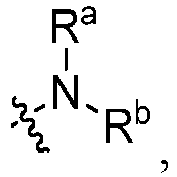
- The term "heterocycle" or "heterocyclyl" refers to a group of saturated or unsaturated monocyclic or polycyclic systems in which one or more ring atoms are heteroatoms selected from N, O, S and the rest are C. Herein, when there are more than one heteroatom, heteroatoms can be the same or different from each other. "5-7 membered heterocycle" refers to heterocycles containing 5-7 ring atoms, wherein, one or more, preferably, 1 or 2 ring atoms are independently selected from O, N and S, and the rest ring atoms are C. The heterocycle or heterocyclyl described herein may be optionally substituted.
- Accordingly, the term "5-7 membered heterocycle containing N" refers to the above-mentioned "5-7 membered heterocycle ", wherein at least one heteroatom is N. The example is

- Similarly, the term " 5-7 membered heterocycle containing O " refers to the above-mentioned "5-7 membered heterocycle", wherein at least one heteroatom is O. The example is

- The term "halo" or "halogen" refers to fluorine, chlorine, bromine or iodine.
- The term "hydroxyl" refers to -OH.
- The term "cyano" refers to -CN.
- The term "amino" refers to - NH2. The amino described herein may be optionally substituted, for example, be substituted with one or more C1-6 alkyl.
- The term "substituted" used herein refers to the optional substitution of one or more hydrogen of a designated atom by a given group, provided that the normal valence of the designated atom in the current situation is not exceeded and that the substitution forms a stable compound. Combinations of substituents and/or variables are permitted only when such combinations form stable compounds. Herein, examples of substituents include but are not limited to deuterium (D), benzyloxy, alkyl amine, C1-6 alkyl, halogen, C1-6 alkoxy, halogenated C1-6 alkyl, halogenated C1-6 alkoxy, heterocyclyl, nitro, cyano, hydroxyl, carboxyl, amino, sulfonyl, C3-C6 cycloalkyl.
- Deuterium (D or 2H) is a stable non-radioactive isotope of hydrogen, its atomic weight is 2.0144. Hydrogen exists in the form of an isotopic mixture of H (hydrogen or protium), D (2H or deuterium) and T (3H or tritium) in natural, where the deuterium abundance is 0.0156%. According to the common technical knowledge in the field, of all the compounds whose structures contain natural hydrogen atoms, the hydrogen atom actually represents a mixture of H, D and T. Therefore, if a compound contains a deuterium whose abundance greater than its natural abundance 0.0156% at any position, these compounds should be considered to be non-natural or deuterium enriched, and thus these compounds are novel compared with its non-enriched analogues.
- In the invention, "deuterium enriched" compound refers to a compound of formula I, or the pharmaceutically acceptable salt, solvate, polymorph, co-crystal, stereoisomer or isotopic compound thereof, where the deuterium abundance is greater than its natural abundance at any relevant position. Therefore, in the "deuterium enriched" compound, the deuterium abundance at any of the relevant positions is likely between more than 0.0156% and 100%. The deuterium enriched position is represented by D, whereas the non-deuterium enriched position is represented by H. According to the common technical knowledge in the field, the symbol H may be elided at the non-deuterium enriched position. An example of a process for preparing a deuterium enriched compound is replacing the hydrogen with the deuterium, or employing deuterium-enriched starting material to synthesize the compound.
- In the invention, the percentage of the deuterium in the enriched deuterium or the deuterium abundance refers to molar percentage.
- In the invention, non-deuterium enriched refers to the hydrogen in natural, which is in the form of a mixture of isotopes H (hydrogen or protium), D (2H or deuterium) and T (3H or tritium).
- Each preferred conditions aforementioned can be combined in any way without departing from the common knowledge in the art and thereby forming various preferred embodiments of the invention.
- The reagents and starting materials used herein are all commercially available.
- The positive effects of the invention are that the compound of formula I can regulate the generation and/or activity of PDE4 and/or TNF-α and therefore can be used effectively in the treatment of cancer and inflammatory diseases. In addition, the compound of the invention has lower toxicity and good safety.
- The invention will be further illustrated by the following examples, but it should not be constructed that the invention is limited to the scope of the examples. The experimental methods that are not specified in details in the following examples are those according to conventional methods and conditions, or according to the product manuals.
- In the following examples, overnight means 10-16 hours, preferably 12 hours. Reflux refers to the reflux temperature of a solvent at atmospheric pressure.
-
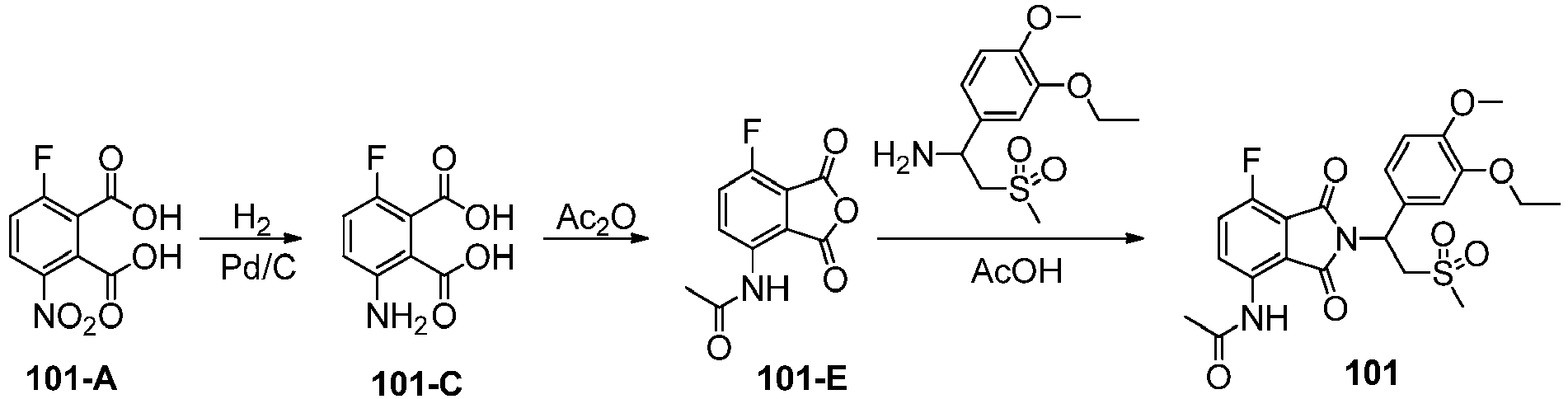
- To a solution of compound 101-A (3-fluoro-6-nitrophthalic acid) (1.9 g, 8.3 mmol) in MeOH (50 mL) was added Pd/C (200 mg, 10%, 50% water). The mixture was stirred at 25 °C overnight under H2 (50 psi). After the reaction is finished, the mixture was filtered through a Celite pad, and the filtrate was concentrated to afford compound 101-C (3-amino-6-fluorophthalic acid) (1.6 g, yield: 97%) as a yellow solid. 1H NMR (300 MHz, DMSO-d 6) δ 7.09 (t, J = 9.0 Hz, 1H), 6.74 (dd, J = 6.0, 5.1 Hz, 1H).
- A solution of 101-C (500 mg, 2.5 mmol) in AC2O (8 mL) was stirred at 25 °C overnight. Then the solvent was evaporated to give compound 101-E [N-(7-fluoro-1,3-dioxo-1,3-dihydro isobenzofuran-4-yl)acetamide] (320 mg, yield: 57%) as a yellow solid. 1H NMR (300 MHz, DMSO-d 6) δ 9.94 (s, 1H), 8.34 (dd, J = 9.3, 3.9 Hz, 1H), 7.79 (t, J = 9.0 Hz, 1H), 2.16 (s, 3H).
- A solution of 101-E (380 mg, 1.7 mmol), 1-(3-ethoxy-4-methoxyphenyl)-2-(methylsulfonyl)ethanamine(CAS No. 253168-94-4) (465 mg, 1.7 mmol) in AcOH (10 mL) was stirred at 100 °C overnight. The reaction mixture was evaporated and purified by prep-HPLC (NH4HCO3/CH3CN system) and then freeze-dried to get 101 (N-(2-(1-(3-ethoxy-4-methoxyphenyl)-2-(methylsulfonyl)ethyl)-7-fluoro -1,3-dioxoisoindolin-4-yl)acetamide)) (412 mg, yield: 51%) as a yellow solid.
1H NMR (300 MHz, DMSO-d 6) δ 9.74 (s, 1H), 8.37-8.42 (m, 1H), 7.64 (t, J = 9.0 Hz, 1H), 7.04 (s, 1H), 6.90-6.99 (m, 2H), 5.74 (dd, J = 10.2, 4.5 Hz, 1H), 4.11-4.33 (m, 2H), 4.04 - 3.97 (m, 2H), 3.72 (s, 3H), 2.99 (s, 3H), 2.15 (s, 3H), 1.30 (t, J = 6.6 Hz, 3H). MS: 477 ([M-1]+). -

- To a solution of compound 101-A1 (6-fluoro-2-methyl-3-nitrobenzoic acid) (13.6 g, 68 mmol) in 150 mL H2O was added NaOH (8.2 g, 205 mmol), the solution was stirred at 80 °C for 3 hours. KMnO4 (86 g, 547 mmol) was added portion wise during 3 hours. Then the mixture was stirred at 80 °C for another 30 minutes. The solution was filtered and washed with hot water (80 mL*3). Cooled with ice-water and acidified with 2N HCl to pH=1. Extracted with EtOAc(200 mL*5), the combined EtOAc phase was washed with water (300 mL*2), brine (300 mL), dried over Na2SO4, filtrated and concentrated to dryness to give product 101-A (3-fluoro-6-nitrophthalic acid) (4.5 g, yield: 29%) as white solid. 1H NMR (300 MHz, DMSO) δ 8.28-8.24 (m, 1H), 7.8 (t, J = 9.0 Hz, 1H).
-

- To a solution of 102-A ((S)-1-(3-ethoxy-4-methoxyphenyl)-2-(methylsulfonyl) ethanamine (S)-2-acetamido-4-methylpentanoate) (CAS No. 608141-43-1) (300 mg, 0.67 mmol) in AcOH (15 mL) was added 101-E (N-(7-fluoro-1,3-dioxo-1,3-dihydroisobenzofuran-4-yl)acetamide) (157 mg, 0.7 mmol) and reacted at 120 °C for overnight. The reaction mixture was evaporated to dryness via rotary evaporation, purified by prep-HPLC and freeze-dried to get compound 102 ((S)-N-(2-(1-(3-ethoxy-4-methoxyphenyl) -2-(methylsulfonyl)ethyl)-7-fluoro-1,3-dioxoisoindolin-4-yl)acetamide)) (197 mg, yield: 61%) as a yellow solid.
1H NMR (400 MHz, DMSO-d 6) δ 9.73 (s, 1H), 8.41-8.44 (m, 1H), 7.65 (t, J = 9.2 Hz, 1H), 7.06 (d, J = 2.0 Hz, 1H), 6.93-7.01 (m, 2H), 5.76 (dd, J = 10.4, 4.4 Hz, 1H), 4.31 (dd, J = 14.4, 10.4 Hz, 1H), 4.16 (dd, J = 14.4, 4.4 Hz, 1H), 4.02 (q, J = 7.2 Hz, 2H), 3.74 (s, 3H), 3.02 (s, 3H), 2.17 (s, 3H), 1.32 (t, J = 7.2 Hz, 3H). LC-MS: 496 ([M+18]+). -


- To a solution of compound 103-A (3-ethoxy-4-hydroxybenzaldehyde, CAS No. 121-32-4) (10.1 g, 60.77 mmol), CD3OD (2.4 g, 66.9 mmol) and Ph3P (19.12 g, 73 mmol) in THF (250 mL) was slowly added DIAD (14.75 g, 73 mmol) at 0 °C. Then the mixture was stirred at 30 °C for 2 hours. The solvent was removed by evaporation and the residue was purified by column chromatography on silica gel eluted with PE:EtOAc (4:1) to give the product 103-B (3-ethoxy-4-d 3-methoxybenzaldehyde) as colorless oil (11 g, 99%).
1H NMR (300 MHz, CDCl3) δ 9.85 (s, 1H), 7.41-7.46 (m, 2H), 6.98 (d, J = 8.1 Hz, 1H), 4.18 (q, J = 6.9 Hz, 2H), 1.50 (t, J = 6.9 Hz, 3H). - A solution of dimethyl sulfone (14.1 g, 150.3 mmol), KOH (5.05 g, 90.1 mmol) in DMF (150 mL) was stirred for 15 minutes at 30 °C. Compound 103-B (11 g, 60.1 mmol) was added to the mixture slowly. The mixture was stirred for 3 hours at 60 °C. The mixture was quenched with NH4Cl (300 mL), extracted with EtOAc (200 mL∗2). The combined organic phase was washed with brine (200 mL∗2), dried over Na2SO4, filtered and concentrated under vacuum to give the crude product, which was purified by column chromatography on silica gel eluted with PE:EtOAc (2:1) to give the product 103-C (2-ethoxy-1-d 3-methoxy-4-(2-(methylsulfonyl) vinyl)benzene) as yellow solid (6.5 g, 42%).
1H NMR (300 MHz, CDCl3) δ 7.55 (d, J = 15.3 Hz, 1H), 7.12 (d, J = 2.8 Hz, 1H), 7.10 (d, J = 1.8 Hz, 1H), 6.88-7.02 (m, 1H), 6.76 (d, J = 15.3 Hz, 1H), 4.13 (q, J = 6.9 Hz, 2H), 2.99 (s, 3H), 1.50 (t, J = 6.9 Hz, 3H). - A solution of H3BO3 (0.775 g, 12.5 mmol) in H2O (25 mL) was stirred at 60 °C for 30 minutes. Then 103-C (6.5 g, 25 mmol) and NH4OH (250 mL) was added. The mixture was stirred at 80 °C in a sealed tube for 3 days. The mixture was extracted with DCM (150 mL*3), the combined organic phase was washed with 2 N HCl (150 mL*2). The combined water phase was adjusted with NaOH to pH=10 then was extracted with DCM (150 mL*2). The combined organic solution was dried, filtered and concentrated under vacuum to get the product 103-D (1-(3-ethoxy-4-d 3-methoxyphenyl)-2-(methylsulfonyl)ethanamine) (3.5 g, 51%).
1H NMR (300 MHz, CDCl3) δ 6.83-6.93 (m, 3H), 4.60 (dd, J = 9.3, 3.3 Hz, 1H), 4.11 (q, J = 6.9 Hz, 2H), 3.20-3.37 (m, 2H), 2.91 (s, 3H), 1.83 (s, 2H), 1.47 (t, J = 6.9 Hz, 3H). - Compound 103-D (3.5 g, 12.68 mmol) was chiral separated to give the compound 103-E ((S)-1-(3-ethoxy-4-d 3-methoxyphenyl)-2-(methylsulfonyl)ethanamine) (0.9 g, ee:95.2%).
- Separation Method:
- Column: chiralpak IA, 5µm, 4.6*250 mm.
- Mobile phose: Hex:IPA:DEA= 70:30:0.2
- Folw Rate (F): 1.0 mL/min
- Wave Length (W): 230 nm
- Tempreature (T): ambient
- A mixture of compound 101-E (161 mg, 0.72 mmol) and 103-E (200 mg, 0.72 mmol) in HOAc (5 mL) reacted at 110 °C for overnight. The mixture was concentrated to dryness under reduced pressure, then the residue was purified by Prep-HPLC to afford compound 103 ((S)-N-(2-(1-(3-ethoxy-4-d 3-methoxyphenyl)-2-(methylsulfonyl)ethyl) -7-fluoro-1,3- dioxoiso indolin-4-yl)acetamide)) (160 mg, 46%).
1H NMR (400 MHz, DMSO-d 6) δ 9.74 (s, 1H), 8.42 (dd, J = 9.6, 4.0 Hz, 1H), 7.65 (t, J = 9.2 Hz, 1H), 7.06 (d, J = 1.6 Hz, 1H), 6.92-7.01 (m, 2H), 5.76 (dd, J = 10.4, 4.4 Hz, 1H), 4.31 (dd, J = 14.4, 10.8 Hz, 1H), 4.16 (dd, J = 14.4, 4.4 Hz, 1H), 4.02 (q, J = 7.2 Hz, 2H), 3.02 (s, 3H), 2.18 (s, 3H), 1.32 (t, J = 6.8 Hz, 3H). LCMS: [(M+18)]+ = 499.0. - Reference Compounds 104, 105 and 106 were synthesized according to the synthesis method of Reference Compound 103 in Reference Example 3, with using corresponding substrates.

- 1H NMR (400 MHz, DMSO-d 6) δ 9.76 (s, 1H), 8.42 (dd, J = 9.2, 4.0 Hz, 1H), 7.66 (t, J = 9.2 Hz, 1H), 7.06 (d, J = 2.0 Hz, 1H), 6.93-7.01 (m, 2H), 5.76 (dd, J = 10.8, 4.4 Hz, 1H), 4.15-4.34 (m, 2H), 4.02 (q, J = 6.8 Hz, 2H), 3.02 (s, 3H), 2.18 (s, 3H), 1.33 (t, J = 6.8 Hz, 3H).
LCMS: [(M+18)]+ = 499.0.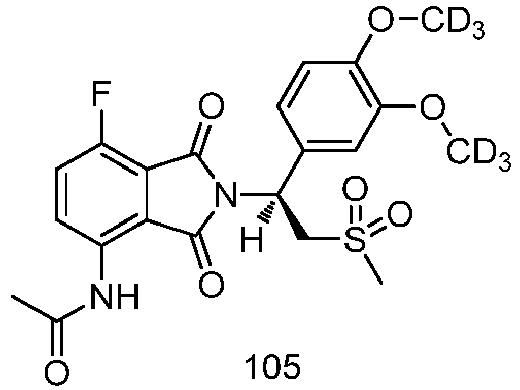
- 1H NMR (400 MHz, DMSO-d 6) δ 9.76 (s, 1H), 8.40-8.43 (m, 1H), 7.66 (t, J = 9.2 Hz, 1H), 7.06 (d, J = 2.0 Hz, 1H), 6.93-7.01 (m, 2H), 5.77 (dd, J = 10.8, 4.4 Hz, 1H), 4.28-4.35 (m, 1H), 4.15-4.19 (m, 1H), 3.03 (s, 3H), 2.18 (s, 3H). LCMS: [(M+18)]+ = 488.0.

- 1H NMR (400 MHz, DMSO-d 6) δ 9.77 (s, 1H), 8.42 (dd, J = 9.6, 4.0 Hz, 1H), 7.66 (t, J = 9.2 Hz, 1H), 7.06 (d, J = 1.6 Hz, 1H), 6.93-7.02 (m, 2H), 5.75-5.79 (m, 1H), 4.28-4.37 (m, 1H), 4.15-4.20 (m, 1H), 3.03 (s, 3H), 2.17 (s, 3H). LCMS: [(M+18)]+ = 488.0.
- Reference Compounds 108 and 109 can be prepared according to the synthesis method of Reference Compound 103 in Reference Example 3.

-
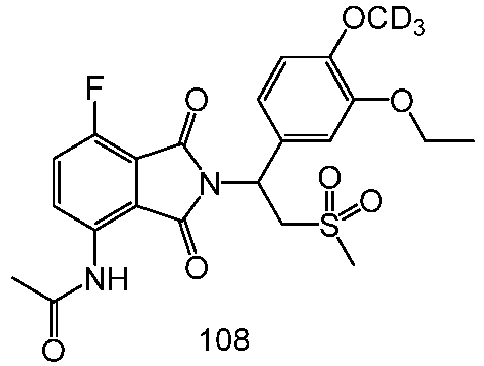
-

- The Reference compound 107 ((S)-N-(2-(1-(3-d 5-ethoxy-4-d 3-methoxyphenyl)-2-(methylsulfonyl) ethyl)-7-fluoro-1,3-dioxoisoindolin-4-yl)acetamide) was synthesized according to the method of Reference Compound 103 in Reference Example 3, except the following intermediate compound 107-H was used instead of compound 103-B.
1H NMR (400 MHz, DMSO) δ 9.76 (s, 1H), 8.42 (dd, J = 9.2, 3.8 Hz, 1H), 7.66 (t, J = 9.0 Hz, 1H), 7.06 (d, J = 2.1 Hz, 1H), 7.00-6.92 (m, 2H), 5.76 (dd, J = 10.3, 4.4 Hz, 1H), 4.34-4.14 (m, 2H), 3.02 (s, 3H), 2.18 (s, 3H). LCMS: [(M+18)]+ = 504.0. -

- To a solution of compound 107-A (CAS No.99-50-3) (50 g, 0.325 mol) in MeOH (300 mL) was added conc. H2SO4 (50 mL) slowly. Then, the mixture was heated to reflux for overnight. The solvent was removed. The residue was diluted with water (500 mL), extracted with EA (300 mL*2), washed with brine (300 mL*2), dried and concentrated to give the product 107-B as white solid (54.5 g, 100%).
1H NMR (300 MHz, DMSO) δ 9.77 (s, 1H), 9.34 (s, 1H), 7.35 - 7.29 (m, 2H), 6.80 (d, J = 8.2 Hz, 1H), 3.76 (s, 3H). - To a solution of compound 107-B (54.5 g, 0.32 mol) in MeCN (1.2 L) was added K2CO3 (63 g, 0.455 mol). Then, the mixture was stirred at 30 °C for 0.5 hour. BnBr (78 g, 0.455 mol) in MeCN (0.3 L) was added slowly. The mixture was stirred at 30 °C for overnight. The solid was removed. The solvent was removed. The residue was diluted with EA (Ethyl Acetate, 50 mL) and PE (Petroleum Ether, 100 mL), stirred at 30 °C for 15 minute, filtered. The cake was purified by triturate with EA (50 mL) and PE (100 mL) for overnight to give the product 107-C as white solid (28.8 g, 35 %).
1H NMR (300 MHz, CDCl3) δ 7.63 - 7.59 (m, 2H), 7.42-7.38 (m, 5H), 6.95 (d, J = 8.3 Hz, 1H), 5.76 (s, 1H), 5.18 (s, 2H), 3.89 (s, 3H). - To a solution of compound 107-C (18 g, 69.8 mmol), CD3CD2OD (4.4 g, 83.8 mmol) and Ph3P (23.8 g, 90.7 mmol) in THF (300 mL) at 0 °C was added DIAD (Diisopropyl azodicarboxylate, 18.34 g, 90.7 mmol) slowly. Then, the mixture was stirred at 30 °C for overnight. The solvent was removed. The residue was purified by silica gel chromatography eluted with PE: EA=50:1 to give the product 107-D as white solid (16.7 g, 82%).
1H NMR (300 MHz, CDCl3) δ 7.62-7.59 (m, 2H), 7.46-7.30 (m, 5H), 6.92 (d, J = 8.3 Hz, 1H), 5.22 (s, 2H), 3.89 (s, 3H). - To a solution of compound 107-D (16.7 g, 57.3 mmol) in MeOH (300 mL) was added Pd/C (1.67 g, 10%). Then, the mixture was stirred at 30 °C for overnight under H2 atmosphere (50 psi). The mixture was filtered. The solvent was removed to give the product 107-E as white solid (11.52 g, 100%).
1H NMR (400 MHz, CDCl3) δ 7.62 (dd, J = 8.3, 1.8 Hz, 1H), 7.53 (d, J = 1.8 Hz, 1H), 6.94 (d, J = 8 Hz, 1H), 6.11 (s, 1H), 3.88 (s, 3H). - To a solution of compound 107-E (11.52 g, 57.3 mmol), CD3OD (2.5 g, 69.6 mmol) and Ph3P (19.8 g, 75.4 mmol) in THF (300 mL) at 0 °C was added DIAD (15.3 g, 75.4 mmol) slowly. Then, the mixture was stirred at 30 °C for overnight. The solvent was removed. The residue was purified by silica gel chromatography eluted with PE: EA=10:1 to give the product 107-F as white solid (12.5 g, 100%).
1H NMR (300 MHz, CDCl3) δ 7.67 (dd, J = 8.4, 0.9 Hz, 1H), 7.54 (s, 1H), 6.88 (d, J = 8.4 Hz, 1H), 3.89 (s, 3H). - To a solution of compound 107-F (12.5 g, 57.3 mmol) in THF (200 mL) at 0 °C was added LAH (3.3 g, 86 mmol) slowly. Then, the mixture was stirred at 30 °C for 2 hour. Water (4 mL) was added slowly to quench the reaction. Then NaOH aqueous solution (8 mL, 20%) was added slowly, stirred for 0.5 hour. The mixture was filtered, concentrated to give the residue which was purified by silica gel chromatography eluted with PE: EA=2:1 to give the product as colorless oil 107-G (10.6 g, 97%).
1H NMR (300 MHz, CDCl3) δ 6.91 - 6.81 (m, 3H), 4.59 (s, 2H). - To a solution of compound 107-G (10.6 g, 55.7 mmol) in EA (200 mL) was added MnO2 (48.5 g, 557 mmol). Then, the mixture was stirred at 25 °C for overnight. The mixture was filtered, concentrated to dryness to give the residue which was purified by triturate with PE: EA=5:1(18 mL) at 0 °C for 0.25 hour to give the product 107-H (7.08 g, 67%) as white solid.
1H NMR (300 MHz, CDCl3) δ 9.83 (s, 1H), 7.45 - 7.39 (m, 2H), 6.96 (d, J = 8.2 Hz, 1H). Reference Compound 110 can be prepared according to the synthesis method of Reference Compound 107.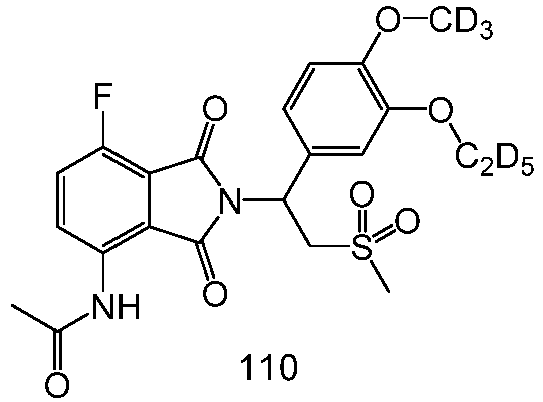
-
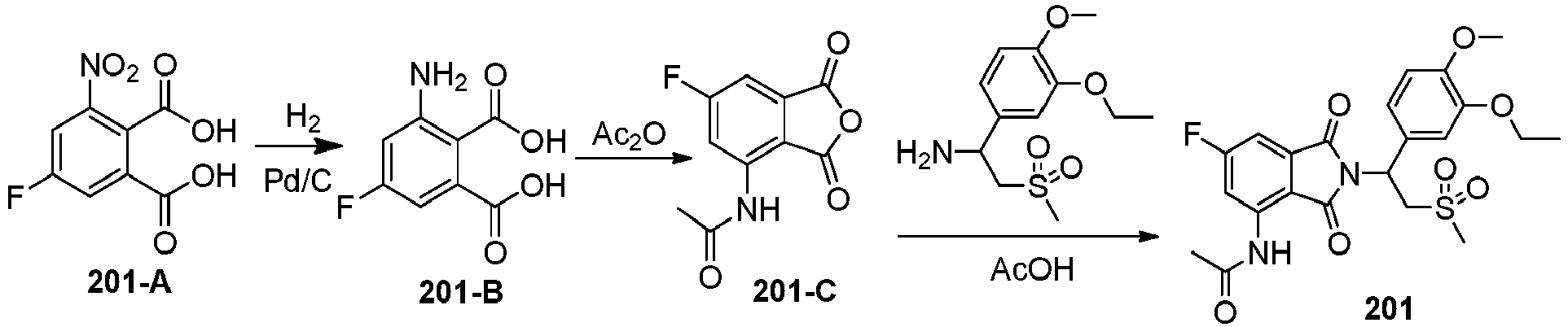
- The compound 201-A (5-fluoro-3-nitrophthalic acid) was synthesized according to the method of compound 301-E in Example 10, except the corresponding starting material methyl 5-fluoro-2-methyl-3-nitrobenzoate was used instead of compound 301-A. Methyl 5-fluoro-2-methyl-3-nitrobenzoate was synthesized according to the method of the starting material 301-A, except compound 5-fluoro-2-methylbenzoic acid (CAS number 33184-16-6) was used instead of 301-A1 (4-fluoro-2-methylbenzoic acid).
- To a solution of 201-A (900 mg) in MeOH (15 mL) was added 10% Pd/C (180 mg, 50% wet.) under nitrogen atmosphere. The mixture was stirred under H2 (50 psi) atmosphere for overnight. The mixture was filtered and concentrated under reduced pressure to afford 201-B (3-amino-5-fluorophthalic acid, 774 mg) as a yellow solid.
1H NMR (DMSO-d 6, 400 MHz): δ 6.58-6.62 (m, 1H), 6.41-6.44 (m, 1H). - A solution of 201-B (100 mg, 0.5 mmol) in AC2O (4 mL) was stirred at 25 °C overnight.
- The reaction mixture was evaporated to dryness under reduced pressure to give compound 201-C (N-(6-fluoro-1,3-dioxo-1,3-dihydroisobenzofuran-4-yl)acetamide, 70 mg, yield: 63%) as a yellow solid.
1H NMR (300 MHz, DMSO-d 6) δ 9.87-9.92 (m, 1H), 8.27-8.35 (m, 1H), 7.72-7.74 (m, 1H), 2.24 (s, 3H). - A solution of compound 201-C (70 mg, 0.3 mmol) and compound 1-(3-ethoxy-4-methoxyphenyl)-2-(methylsulfonyl)ethanamine (CAS number 253168-94-4, 86 mg, 0.3 mmol) in AcOH (6 mL) was stirred overnight at 70 °C. The reaction mixture was evaporated to dryness, then purified by prep-HPLC (NH4HCO3 /Acetonitrile system), then freeze-dried to afford compound 201 (N-(2-(1-(3-ethoxy-4-methoxyphenyl)-2-(methylsulfonyl) ethyl)-6-fluoro-1,3 -dioxoisoindolin-4-yl)acetamide , 42 mg, yield: 30%) as a white solid.
1H NMR (300 MHz, DMSO-d 6) δ 9.77 (s, 1H), 8.24 (dd, J = 12.0,1.8 Hz, 1H), 7.48 (dd, J = 6.9,1.8 Hz, 1H), 7.04 (d, J = 0.9 Hz, 1H), 6.90-6.98 (m, 2H), 5.73-5.77 (m, 1H), 4.29-4.34 (m, 1H), 4.10-4.17 (m, 1H), 3.96-4.03 (m, 2H), 3.72 (s, 3H), 3.00 (s, 3H), 2.20 (s, 3H), 1.30 (t, J = 7.2 Hz, 3H). MS: 477 ([M-1]+). -

- To a solution of 102-A ((S)-1-(3-ethoxy-4-methoxyphenyl)-2-(methylsulfonyl) ethanamine (S)-2-acetamido-4-methylpentanoate, 800 mg, 1.79 mmol) in H2O (10 mL) was added saturated aqueous solution of Na2CO3 to pH = 10, then the mixture was extracted with EtOAc (30 mL*2). The combined EtOAc solution was dried, filtered and concentrated to give compound 102-B ((S)-1-(3-ethoxy-4-methoxyphenyl)-2-(methylsulfonyl) ethanamine, 460 mg, yield: 94%) as yellow solid.
1H NMR (300 MHz, DMSO-d 6) δ 7.02 (s, 1H), 6.89 (s, 2H), 4.27 (dd, J = 9.3, 3.6 Hz, 1H), 3.99-4.06 (m, 2H), 3.73 (s, 3H), 3.20-3.45 (m, 2H), 2.95 (s, 3H), 2.16 (s, 2H), 1.27-1.35 (m, 3H). - To a solution of 102-B in DMF (15 mL) was added compound 201-A (3-nitro-5-fluorine phthalic acid, 386 mg, 1.68 mmol) and HATU (1-[Bis(dimethylamino)methylene] -1H-1,2,3-triazolo[4,5-b]pyridinium 3-oxid hexafluorophosphate, 1.4 g, 3.7 mmol) and DIEA (N,N-Diisopropylethylamine, 760 mg, 5.88 mmol), then the mixture was stirred at 25 °C for overnight. To the reaction mixture was added H2O (10 mL) and then stirred for 15 minutes, extracted with EtOAc (100 mL). The EtOAc solution was washed with brine (20 mL*2), then dried, filtered and concentrated under vacuum to give the crude product. The residue was purified by column chromatography on silica gel with PE:EtOAc(3:1~1:1) to give 202-C ((S)-2-(1-(3-ethoxy-4-methoxyphenyl)-2-(methylsulfonyl)ethyl)-6-fluoro-4-nitroisoindoline -1,3-dione, 330 mg, yield: 42%) as yellow solid.
1H NMR (400 MHz, DMSO-d 6) δ 8.36 (dd, J = 8.8, 2.4 Hz, 1H), 8.20 (dd, J = 10.8, 2.2 Hz, 1H), 7.09 (d, J = 1.6 Hz, 1H), 7.01 (dd, J = 8.4, 2.0 Hz, 1H), 6.94 (d, J = 8.8 Hz, 1H), 5.79 (dd, J = 9.6, 5.6 Hz, 1H), 4.18-4.31 (m, 2H), 3.99-4.06 (m, 2H), 3.74 (s, 3H), 2.98 (s, 3H), 1.32 (t, J = 6.8 Hz, 3H). - To a mixture of 202-C (330 mg, 0.704 mmol) in EtOAc (20 mL) was added Pd/C (10%, 50% H2O, 40 mg), and then stirred under H2 (50 psi) atmosphere for 4 hours at 25 °C. The mixture was filtered and concentrated to give 202-D ((S)-4-amino-2-(1-(3-ethoxy-4-methoxyphenyl)-2-(methylsulfonyl)ethyl)-6-fluoroisoindoline-1,3-dione, 289 mg, yield: 94%) as yellow solid.
1H NMR (400 MHz, DMSO-d 6) δ 7.06 (s, 1H), 6.93 (d, J = 0.4 Hz, 2H), 6.80 (dd, J = 7.2, 2.0 Hz, 1H), 6.70-6.73 (m, 3H), 5.71 (dd, J = 10.8, 4.4 Hz, 1H), 4.33 (dd, J = 14.4, 10.4 Hz, 1H), 3.99-4.10 (m, 3H), 3.73 (s, 3H), 3.00 (s, 3H), 1.32 (t, J = 7.2 Hz, 3H). - To a solution of 202-D (289 mg, 0.66 mmol) in pyridine (30 mL) was added AC2O (5 mL), the mixture was heated to 70 °C and stirred for overnight. The mixture was concentrated. Then CH3CN (10 mL*2) was added and the mixture was concentrated for two more times to give the residue, which was purified with column chromatography on silica gel eluted with (PE:EtOAc = 1:1) to give the crude product (200 mg), which was further purified by prep-HPLC to afford product 202 ((S)-N-(2-(1-(3-ethoxy-4-methoxyphenyl)-2-(methylsulfonyl)ethyl)-6-fluoro-1,3-dioxoisoindolin-4-yl)acetamide, 84 mg, yield: 26%) as yellow solid.
1H NMR (400 MHz, DMSO-d 6) δ 9.77 (s, 1H), 8.26 (dd, J = 12.4, 2.4 Hz, 1H), 7.48 (dd, J = 6.8, 2.0 Hz, 1H), 7.07 (d, J = 2.0 Hz, 1H), 6.93-7.00 (m, 2H), 5.77 (dd, J = 10.4, 4.0 Hz, 1H), 4.32 (dd, J = 14.4, 10.8 Hz, 1H), 4.15 (dd, J = 14.4, 4.4 Hz, 1H), 4.02 (q, J = 7.2 Hz, 2H), 3.74 (s, 3H), 3.01 (s, 3H), 2.22 (s, 3H), 1.32 (t, J = 7.2 Hz, 3H). LCMS: 496.0 ([M+18]+). -

- To a mixture of 103-E ((S)-1-(3-ethoxy-4-d 3-methoxyphenyl)-2-(methylsulfonyl) ethanamine) (680 mg, 2.46 mmol) in DMF (30 mL) was added 201-A (3-nitro-5-fluorine phthalic acid, 564 mg, 2.46 mmol), HATU (2.06 g, 5.41 mmol) and DIEA (1.1 g, 9.61 mmol) at 25 °C, then the mixture was stirred at 25 °C for overnight. The reaction mixture was added H2O (15 mL) and stirred for 15 minute, then extracted with EtOAc (150 mL). The organic phase was washed with brine (50 mL*3), dried, filtered and concentrated to give the crude product. The crude product was purified by column chromatography on silica gel with PE: EtOAc(3:1~1:1) to give 203-C ((S)-2-(1-(3-ethoxy-4-d 3-methoxyphenyl)-2-(methylsulfonyl) ethyl)-6-fluoro-4-nitroisoindoline-1,3-dione, 605 mg, yield: 52%) as yellow solid.
1H NMR(300 MHz, DMSO-d 6): δ 8.34-8.38 (m, 1H), 8.19-8.22 (m, 1H), 7.09 (s, 1H), 6.92-7.02 (m, 2H), 5.76-5.79 (m, 1H), 4.21-4.27 (m, 2H), 3.98-4.04 (m, 2H), 2.98 (s, 3H), 1.29-1.34 (m, 3H). - To a mixture of 203-C (605 mg, 1.29 mmol) in EtOAc (20 mL) was added Pd/C(10%, 50% H2O, 60 mg), reacted for 4 hours at 25 °C under H2 atmosphere (50 psi). The mixture was filtered and concentrated to give 203-D ((S)-4-amino-2-(1-(3-ethoxy-4-d 3-methoxyphenyl) -2-(methylsulfonyl)ethyl)-6-fluoroisoindoline-1,3-dione, 518 mg, yield: 91%) as yellow solid.
1H NMR (400 MHz, DMSO-d 6) δ 7.06 (s, 1H), 6.78-6.93 (m, 2H), 6.70-6.74 (m, 4H), 5.71 (dd, J = 10.48, 4.4 Hz, 1H), 4.30-4.33 (m 1H), 3.98-4.10 (m, 3H), 3.00 (s, 3H), 1.32 (t, J = 6.8 Hz, 3H). - To a solution of 203-D (247 mg, 0.56 mmol) in CH3COOH (6 mL) was added AC2O (3 mL). The mixture was heated to 85 °C and reacted for 5 hours, then concentrated and purified by prep-HPLC to afford a product. hexane (5 mL) was added to the product and the mixture was stirred for 2 hours, then filtered to afford compound 203 ((S)-N-(2-(1-(3-ethoxy-4-d 3-methoxyphenyl)-2-(methylsulfonyl)ethyl)-6-fluoro-1,3-dioxoisoindolin-4-yl)acetamide , 123 mg, yield:46%) as yellow solid.
1H NMR (400 MHz, DMSO-d 6) δ 9.77 (s, 1H), 8.26 (dd, J = 12.0, 2.0 Hz, 1H), 7.49 (dd, J = 6.8, 2.0 Hz, 1H), 7.07 (d, J = 1.6 Hz, 1H), 6.92-7.00 (m, 2H), 5.77 (dd, J = 10.4, 4.4 Hz, 1H), 4.32 (dd, J = 14.4, 10.4 Hz, 1H), 4.15 (dd, J = 14.4, 4.4 Hz, 1H), 4.02 (q, J = 6.8 Hz, 2H), 3.02 (s, 3H), 2.22 (s, 3H), 1.32 (t, J = 6.8 Hz, 3H). LCMS: 499.0 ([M+18]+). - Reference Compounds 204, 205, 206 and 207 were synthesized according to the synthesis method of Reference Compound 203 in Reference Example 8, with corresponding substrates to replace compound 103-E.

- 1H NMR (400 MHz, DMSO-d 6) δ 9.79 (s, 1H), 8.26 (dd, J = 12.0, 2.4 Hz, 1H), 7.50 (dd, J = 6.8, 2.4 Hz, 1H), 7.07 (d, J = 2.0 Hz, 1H), 6.92-7.00 (m, 2H), 5.77 (dd, J = 10.4, 4.4 Hz, 1H), 4.14-4.35 (m, 2H), 4.02 (q, J = 6.8 Hz, 2H), 3.02 (s, 3H), 2.22 (s, 3H), 1.32 (t, J = 6.8 Hz, 3H). LCMS: 499.0 ([M+18]+)
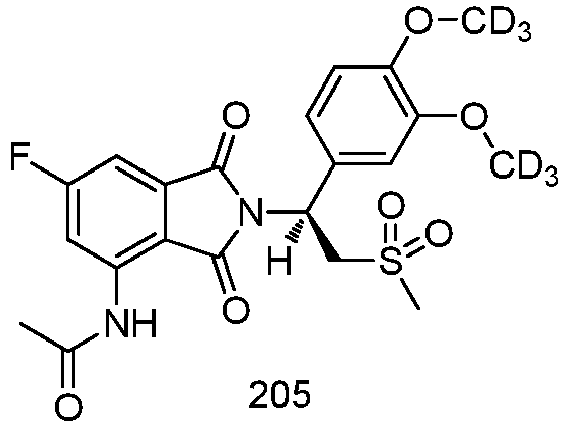
- 1H NMR (400 MHz, DMSO-d 6) δ 9.80 (s, 1H), 8.26 (dd, J = 12.0, 2.0 Hz, 1H), 7.51 (dd, J = 7.2, 2.4 Hz, 1H), 7.07 (d, J =2.0 Hz, 1H), 6.92-7.01 (m, 2H), 5.78 (dd, J = 10.8, 4.4 Hz, 1H), 4.33 (dd, J = 14.8, 10.8 Hz, 1H), 4.16 ((dd, J = 10.8, 4.4 Hz, 1H), 3.02 (s, 3H), 2.22 (s, 3H). LCMS: 488.0 ([M+18]+)
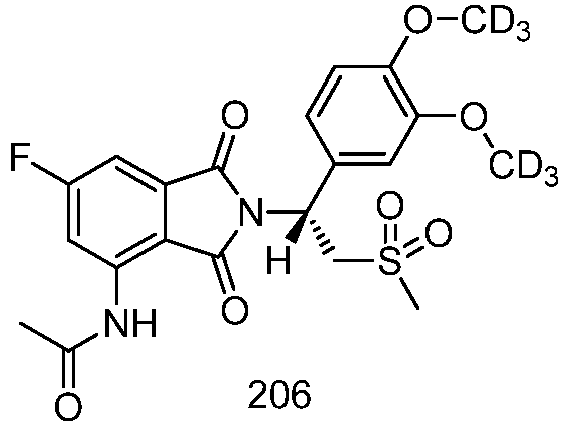
- 1H NMR (400 MHz, DMSO-d 6) δ 9.79 (s, 1H), 8.26 (dd, J = 12.0, 2.4 Hz, 1H), 7.50 (dd, J = 6.8, 2.0 Hz, 1H), 7.07 (d, J = 2.0, 1H), 6.92-7.00 (m, 2H), 5.78 (dd, J = 10.8, 4.4 Hz, 1H), 4.30-4.36 (m, 1H), 4.14-4.19 (m, 1H), 3.02 (s, 3H), 2.22 (s, 3H). LCMS: 488.0 ([M+18]+)

- 1H NMR (400 MHz, DMSO-d 6) δ 9.79 (s, 1H), 8.26 (dd, J = 12.0, 2.4 Hz, 1H), 7.50 (dd, J = 6.8, 2.4 Hz, 1H), 7.06 (d, J = 2.0 Hz, 1H), 6.92-6.99 (m, 2H), 5.77 (dd, J = 10.4, 4.4 Hz, 1H), 4.14-4.35 (m, 2H), 3.02 (s, 3H), 2.22 (s, 3H). LCMS: 504.0 ([M+18]+)
- Reference Compounds 208, 209 and 210 can be synthesized according to the synthesis method of Reference Compound 203 in Reference Example 8, with corresponding substrates to replace compound 103-E.

-

-

-

- A solution of compound 301-A (methyl 4-fluoro-2-methyl-3-nitrobenzoate, 3.0 g, 14.1 mmol), NaOH (1.6 g, 42.3 mmol) in H2O/MeOH (30 mL/30 mL) was stirred at 25 °C for overnight. Then the mixture was adjusted pH = 5, extracted by EtOAc (100 mL x 3), washed by brine (100 mL x 2), dried, filtered and concentrated to give compound 301-C (4-fluoro-2-methyl-3-nitrobenzoic acid, 2.8 g, yield: 100%) as a white solid.
1H NMR (300 MHz, DMSO-d 6) δ 8.06-8.11 (m, 1H), 8.18 (t, J = 9.0 Hz, 1H), 2.47 (s, 3H). - To a solution of 301-C (2.8 g, 14.1 mmol), NaOH (1.6 g, 42 mmol) in H2O (30 mL) was added KMnO4 (17.7 g, 112 mmol) portion-wise during 3 hours at 85 °C and then the mixture was stirred for 3 hours at 85 °C. Then the mixture was filtered and the cake was washed with H2O (50 mL x 3). The filtrate was adjusted pH = 1, extracted by EtOAc (100 mL x 3), washed by brine (100 mL x 2), dried, filtered and concentrated to give 301-E (4-fluoro-3-nitrophthalic acid, 900 mg, yield: 28%) as a white solid.
1H NMR (300 MHz, DMSO-d 6) δ 8.12-8.17 (m, 1H), 7.75-7.81 (m, 1H). - To a solution of 301-E (900 mg, 3.9 mmol) in MeOH (30 ml) was added Pd/C (180 mg, 10%, 50% water). The mixture was stirred at 25 °C for overnight under H2 (50 psi) atmosphere. After completed, the mixture was filtered through a Celite pad, and the filtrate was concentrated to afford 301-G (3-amino-4-fluorophthalic acid, 700 mg, crude) as a yellow solid.
1H NMR (300 MHz, DMSO-d 6) δ 7.13-7.20 (m, 1H), 6.76-6.80 (m, 1H). - A solution of 301-G (300 mg, 1.5 mmol), 1-(3-ethoxy-4-methoxyphenyl)-2-(methylsulfonyl)ethanamine (356 mg, 1.5 mmol), AcOH (660 mg, 15 mmol), Et3N (758 mg, 7.5 mmol) in CH3CN (20 mL) was stirred at 80 °C for overnight under N2 atmosphere. Then the solvent was removed, the residue was purified by chromatography column on silica gel ( PE/EtOAc=2/1) to afford compound 301-H (4-amino-2-(1-(3-ethoxy-4-methoxyphenyl)-2-(methylsulfonyl)ethyl)-5-fluoroisoindoline-1,3-dione, 150 mg, yield: 23 %) as a yellow solid.
1H NMR (300 MHz, DMSO-d 6) δ 7.37-7.44 (m, 1H), 7.07 (s, 1H), 6.99-7.03 (m, 1H), 6.94 (s, 2H), 6.55 (d, J = 5.7 Hz, 1H), 5.70-5.75 (m, 1H), 4.30-4.38 (m, 1H), 4.12-4.13 (m, 1H), 3.97-4.08 (m, 2H), 3.74 (s, 3H), 3.01 (s, 3H), 1.33 (t, J = 7.2 Hz, 3H). - A solution of 301-H (100 mg, 0.23 mmol) in AC2O (6 mL) was stirred at 70 °C for overnight. The reaction mixture was evaporated to dryness and purified by prep-HPLC (NH4HCO3/Acetonitrile system) then freeze-dried to give compound 301 (N-(2-(1-(3-ethoxy-4-methoxyphenyl)-2-(methylsulfonyl)ethyl)-5-fluoro-1,3-dioxoisoindolin-4-yl)acetamide, 37 mg, yield: 34%) as a white solid.
1H NMR (300 MHz, DMSO-d 6) δ 10.16 (s, 1H), 7.69-7.82 (m, 1H), 7.07 (s, 1H), 6.91-6.94 (m, 2H), 5.72-5.77 (m, 1H), 4.31-4.36 (m, 1H), 4.10-4.16 (m, 1H), 3.97-4.05 (m, 2H), 3.73 (s, 3H), 2.99 (s, 3H), 2.09 (s, 3H), 1.32 (t, J = 7.2 Hz, 3H). MS: 477 ([M-1]+). -
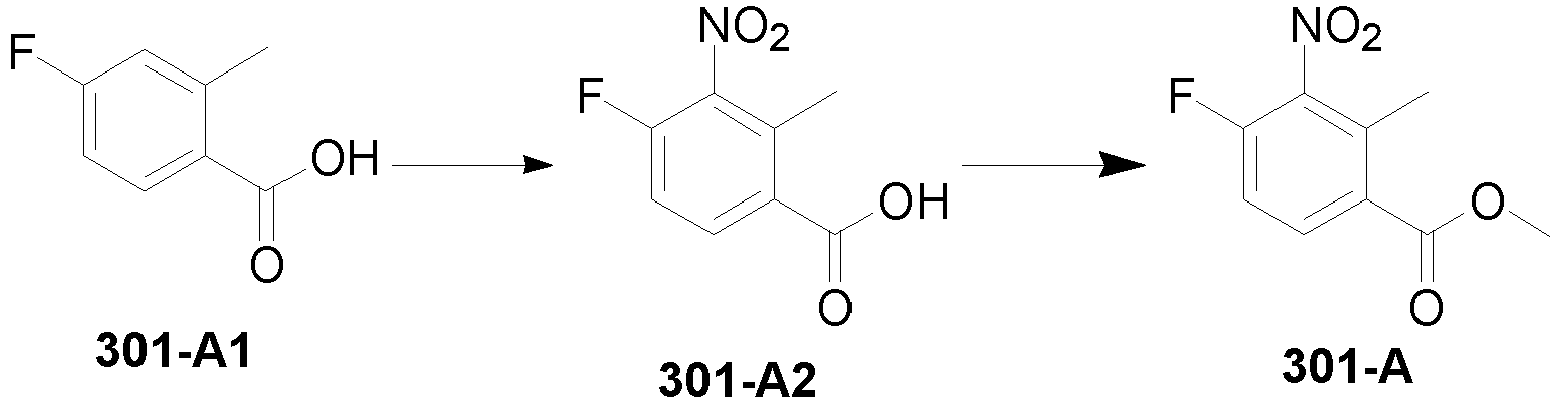
- Compound 301-A1 (4-fluoro-2-methylbenzoic acid, CAS number 321-21-1, 100 g, 649 mmol) was added to 660 mL of fuming HNO3, dropwise to keep the temperature below 10°C. The mixture was stirred for 1~2 hours. The mixture was poured into ice-water (2.4L) and stirred for 30 minutes. The result solid was filtered and washed with cold water and then dissolved in 1.5 L of EtOAc. The EtOAc phase was washed with water and brine, dried over Na2SO4, and then filtered. The Na2SO4 solid was washed with EtOAc (200mL*3). The combined EtOAc phase was concentrated to give crude product 301-A2 which was directly used in next step without purification.
- To a solution of 301-A2 (110 g, 502 mmol) in 1.5 L of methanol was added 20 mL of conc. H2SO4. The mixture was heated to reflux for overnight. The mixture was cooled to room temperature, then concentrated to about 100 mL and then diluted with 500 mL of cold water. The mixture was extracted with EtOAc (500 mL*3). The combined organic phase was washed with sat.NaHCO3, water and brine, dried over Na2SO4, filtered and washed with EtOAc, the EtOAc phase was concentrated to dry to give crude product. The crude was recrystallized from PE/EtOAc (10:1, 400 mL) to removed most major by-products, the residue was purified by column chromatography on slica gel (PE/ EtOAc: 100:1) to give product 301-A (methyl 4-fluoro-2-methyl-3-nitrobenzoate, 20 g, two steps yield: 19%).
1H NMR (DMSO-d 6, 300 MHz): 8.08 (dd, J = 5.7, 9.0 Hz, 1H), 7.58 (t, J = 9.0 Hz, 1H), , 3.85 (s, 3H), δ 2.45 (s, 3H) -

- To a mixture of 102-B ((S)-1-(3-ethoxy-4-methoxyphenyl)-2-(methylsulfonyl)ethanamine, 954 mg, 3.49 mmol) in DMF (60 mL) was added 301-E (3-nitro-4-fluorine phthalic acid, 800 mg, 3.49 mmol), HATU (CAS No. 148893-10-1, 2.08 g, 5.478 mmol) and DIEA (CAS No. 7087-68-5, 1.58 g, 12.2 mmol) at 5 °C. The reaction mixture was stirred at 25 °C for overnight. To the reaction mixture was added H2O (20 mL), stirred for 15 minutes, extracted with EtOAc (100 mL). The EtOAc solution was washed with brine (50 mL*3), dried, filtered and concentrated to give the crude product. The residue was purified by column chromatography on silica gel with PE:EtOAc (from 2:1 to 1:1) to give 302-C ((S)-2-(1-(3-ethoxy-4-methoxyphenyl)-2-(methylsulfonyl)ethyl)-5-fluoro-4-nitroisoindoline-1, 3-dione, 396 mg, yield: 25%) as yellow solid.
1H NMR (400 MHz, DMSO-d 6) δ 8.24 (dd, J = 8.4, 4.0 Hz, 1H), 8.09 (dd, J = 10.0, 8.4 Hz, 1H), 7.09 (d, J = 2.4 Hz, 1H), 7.01 (dd, J = 8.4, 2.0 Hz, 1H), 6.94 (d, J = 8.0 Hz, 1H), 5.78 (dd, J = 9.6, 5.6 Hz, 1H), 4.22-4.26 (m, 2H), 4.00-4.06 (m, 2H), 3.74 (s, 3H), 2.99 (s, 3H), 1.32 (t, J = 7.2 Hz, 3H). - To a mixture of 302-C (396 mg, 0.85 mmol) in EtOAc (15 mL) was added Pd/C (50 mg, 10%, 50% H2O), the reaction mixture was stirred under H2(50 Psi) atmosphere for 4 hours at 25°C. The mixture was filtered and concentrated to give 302-D ((S)-4-amino-2-(1-(3-ethoxy-4-methoxyphenyl)-2-(methylsulfonyl)ethyl)-5-fluoroisoindoline-1,3-dione, 327 mg, yield: 88%) as yellow solid.
1H NMR (300 MHz, DMSO-d 6): δ 7.37-7.43 (m, 1H), 6.93-7.06 (m, 4H), 6.52 (s, 2H), 5.70-5.73 (m, 1H), 4.29-4.37 (m, 1H), 3.99-4.04 (m, 3H), 3.73 (s, 3H), 3.00 (s, 3H), 1.29-1.34 (m, 3H). - To a solution of 302-D (132 mg, 0.302 mmol) in HOAc (4 mL) was added AC2O (2 mL), the mixture was heated to 85 °C and reacted at 85 °C for 5 hours. This mixture was concentrated and diluted with EtOAc (30ml). The EtOAc solution was washed with sat aqueous NaHCO3 (15 mL), dried over Na2SO4, then concentrated to give crude product which was purified by prep-HPLC to afford compound 302 ((S)-N-(2-(1-(3-ethoxy-4-methoxyphenyl) -2-(methylsulfonyl)ethyl)-5-fluoro-1,3-dioxoisoindolin-4-yl)acetamide, 31 mg, yield: 21%) as white solid.
1H NMR (400 MHz, DMSO-d 6) δ 10.13 (s, 1H), 7.79 (dd, J = 8.0, 4.4 Hz, 1H), 7.72 (dd, J = 10.4, 8.4 Hz, 1H), 7.07 (d, J = 2.0 Hz, 1H), 6.92-6.95 (m, 2H), 5.75 (dd, J = 10.4, 4.8 Hz, 1H), 4.11-4.32 (m, 2H), 4.01 (q, J = 7.2 Hz, 2H), 3.73 (s, 3H), 2.99 (s, 3H), 2.09 (s, 3H), 1.32 (t, J = 7.2 Hz, 3H). LCMS: 476.9 ([M-1]-). -

- To a solution of diisopropylamine (35 mL, 0.25 mol) in 100 mL of dry THF was added n-BuLi (2.5 N, 96 mL, 0.24 mol) dropwise at -30 °C under N2 atmosphere, the temperature was kept below -30 °C. The reaction solution was stirred at -30 °C for 15 minutes and then at 0 °C for 30 minutes.
- A solution of 2-fluoropyridine (CAS No. 372-48-5, 19.42 g, 0.2 mol) in 100 mL of dry THF was cooled to -70 °C under N2 atmosphere. The above LDA solution was added dropwise to the solution while the temperature was kept below -70 °C. Then the solution was stirred at -70 °C for 1hour. To the reaction mixture was added a solution of I2 (61 g, 0.24 mol) in 50 mL of dry THF dropwise and then the reaction was stirred at -75 °C for 1 hour. The reaction was quenched with sat. NH4Cl and stirred at 25 °C for 30 minutes. THF was removed by evaporation. The residue was extracted with EtOAc (500 mL*2). The combined EtOAc solution was washed with water and brine, dried over Na2SO4. Filtered and concentrated to dry to give crude product 401-A (2-fluoro-4-iodopyridine, 30 g, yield: 67%).
1H NMR (300MHz, DMSO-d6): δ 8.37-8.43 (m, 1H), 8.21-8.22 (m, 1H), 7.13-7.18 (m, 1H). - To a solution of diisopropylamine (17 mL, 96.9 mmoL) in 300 mL of dry THF was added n-BuLi (46.5 mL, 116 mmol) dropwise at -30 °C under N2 atmosphere, the temperature was kept below -30 °C. The solution was stirred at -30 °C for 15 minute and then at 0°C for 30 minute.
- A solution of 401-A (21.6 g, 96.9 mmol) in 100 mL of dry THF was cooled to -70 °C. The above LDA solution was added dropwise to the solution while the temperature was kept below -70 °C. Then the solution was stirred at -70 °C for 1 hour. Ethyl formate (10 mL, 121 mmol) was added dropwise to the solution and slowly warmed to -50 °C during 1 hour. The reaction mixture was quenched with sat. NH4Cl and stirred at 25 °C for 30 minute. THF was removed by evaporation and the reaction solution was extracted with EtOAc (300 mL*2). The combined organic phase was washed with water and brine, dried over Na2SO4. Na2SO4 was filtered and the organic phase was concentrated to dry and the residue was purified by column chromatography on silica gel (PE/EtOAc: 50:1 to 10:1) to give the product 401-B (2-fluoro-4-iodonicotinaldehyde, 13.0 g, yield: 53%).
1H NMR (300 MHz, DMSO-d 6): δ 10.15 (s, 1H), 7.97 (d, J = 5.1 Hz, 1H), 7.87 (d, J = 5.1 Hz, 1H). - To a solution of 401-B (13.3 g, 53 mmol) in 466 mL of t-BuOH and 133 mL of water cooled with ice-eater was added 2-Methyl-2-butene (13.3 g, 53 mmol), Na2HPO4 (70 g, 583 mmol), followed by NaClO2 (24g, 265 mmol) portionwise. The reaction mixture was stirred at 25 °C for 1.5 hours, then diluted with 800 mL of DCM and acidified with 6 N/HCl to pH = 2. The organic phase was separated and the water phase was extracted with DCM/MeOH (20:1, 1000 mL*2). The combined organic phase was washed with brine, dried over Na2SO4. Filtered and concentrated to dry. The residue was crystallized from DCM/PE(1:1) to give product 401-C (2-fluoro-4-iodonicotinic acid, 11.5g, yield: 81%).
1H NMR (300 MHz, DMSO-d 6): δ 14.26 (br s, 1H), 8.02 (d, J = 4.2 Hz, 1H), 7.94 (dd, J = 3.9, 0.6 Hz, 1H). - To a solution of 401-C (10.3 g, 38.6 mmol) in 40 mL of MeOH and Et2O (40 mL) cooled with ice-water, TMSCH2N2 (29 mL, 57.9 mmol) was added dropwise. The mixture was stirred at 25 °C for overnight. Then ice water was added to quench the reaction. The solvent was removed by evaporation and Sat. NaHCO3 was added and the mixture was stirred for 30 minutes. The mixture was extracted with EtOAc (100 mL*3). The combined organic phase was washed with brine, dried over Na2SO4, filtered and concentrated to dry to give product 401-D (methyl 2-fluoro-4-iodonicotinate, 9.6 g, yield: 88%).
1H NMR (300 MHz, DMSO-d 6): δ 8.06 (d, J = 5.4 Hz, 1H), 7.97 (d, J = 5.1 Hz, 1H), 3.93 (s, 3H). - To a solution of 401-D (9.6 g, 34.1 mmol) and 2,4-dimethoxybenzylamine (7.41 g, 44.3 mmol) in 50 mL of DMSO was added K2CO3 (11.8 g, 68.2 mmol). The mixture was stirred at 25 °C for 5 hours, then diluted with 500 mL of EtOAc. The mixture was washed with water and brine, dried over Na2SO4, filtered and concentrated to dry and the residue was purified by column chromatography on silica gel (PE/EtOAc: 50:1 to 10:1) to give the product 401-E (methyl 2-((2,4-dimethoxybenzyl)amino)-4-iodonicotinate, 10.66 g, yield: 73%).
1H NMR (400 MHz, DMSO-d 6): δ 7.69 (d, J = 5.2 Hz, 1H), 7.07 (d, J = 5.2 Hz, 1H), 7.00-7.03 (m, 2H), 6.55 (d, J = 2.4 Hz, 1H), 6.44 (dd, J = 8.4, 2.4Hz, 1H), 4.44 (d, J = 6.0 Hz, 2H), 3.87 (s, 3H), 3.81 (s, 3H), 3.72 (s, 3H). - To a solution of 401-E (10.66 g, 24.9 mmol) in 80 mL of DCM cooled with ice-water was added 30 mL of TFA. The mixture was stirred at 25 °C for 3 hours, concentrated to dry. The mixture was basified with sat. NaHCO3. The solid was filtered and washed with ice-water and dried to give the product 401-F (methyl 2-amino-4-iodonicotinate, 5.54 g, yield: 80%).
1H NMR (300 MHz, DMSO-d 6): δ 7.65 (d, J = 5.1 Hz, 1H), 7.07 (d, J = 5.4 Hz, 1H), 6.43 (s, 2H), 3.83 (s, 3H). - A solution of 401-F (5.54 g, 0.02 mmol) in 100 mL of HOAc and 50 mL of Ac2O was stirred at 80 °C for overnight. The mixture was concentrated to dry and purified by column chromatography on silica gel (PE/EtOAc: 1:1 to 1:2) to give product 401-G (methyl 2-acetamido-4-iodonicotinate, 2.7 g, 42%).
1H NMR (300 MHz, DMSO-d 6): δ 10.56 (s, 1H), 8.08 (d, J = 5.1 Hz, 1H), 7.82 (d, J = 5.4 Hz, 1H), 3.74 (s, 3H), 2.01 (s, 3H). - To a solution of 401-G (3.2 g, 10 mmol) in 50 mL of MeOH was added DIEA (3.3 mL, 20 mmol) and PdCl2(PPh3)2 (702 mg, 1 mmol). The mixture was stirred under 50Mpa CO atmosphere at 100 °C for overnight. Cooled to 25 °C and concentrated to dry and purified by column chromatography on silica gel (PE/EtOAc: 5:1∼2:1) to give product 401-H (dimethyl 2-aminopyridine-3,4-dicarboxylate, 1.8 g, yield:86%).
1H NMR (300 MHz, DMSO-d 6): δ 8.24 (d, J = 4.8 Hz, 1H), 6.97 (s, 2H), 6.67 (d, J = 4.8 Hz, 1H), 3.80 (s, 3H), 3.78 (s, 3H). - A solution of 401-H (400 mg, 1.9 mmol) in 20 mL of 20% KOH solution and 20 mL of THF was stirred at 25 °C for overnight. Extracted with TMBE (50 mL), the organic phase was separated and water phase was acidified with 2N HCl to pH = 2. The resulted solid was filtered and washed with ice-water and dried to give product 401-1 (2-aminopyridine-3,4-dicarboxylic acid, 285 mg, yield: 82%)
1H NMR (300 MHz, DMSO-d 6): δ 8.15 (d, J = 4.8 Hz, 1H), 6.59 (d, J = 4.8 Hz, 1H), - A solution of 401-1 (500 mg, 2.75 mmol) in 20 mL of Ac2O was heated to reflux for 3 hours. Then the mixture cooled to room temperature and concentrated to dry, the residue was dissolved in 20 mL of HOAc, followed by addition of 1-(3-ethoxy-4-methoxyphenyl)-2-(methylsulfonyl)ethanamine (750 mg, 2.75 mmol). The reaction mixture was refluxed for overnight and then cooled to 25 °C and added 20 mL of Ac2O and stirred at 85°C for another 5 hours. The mixture was cooled to 25 °C and concentrated to dry and purified by prep-HPLC to give product 401 (N-(2-(1-(3-ethoxy-4-methoxyphenyl)-2- (methylsulfonyl)ethyl)-1,3-dioxo -2,3-dihydro-1H-pyrrolo[3,4-c]pyridin-4-yl)acetamide , 735 mg, yield: 58%).
1H NMR (300 MHz, DMSO-d 6): δ 10.51 (s, 1H), 8.88 (d, J = 4.8 Hz, 1H), 7.67 (s, 1H), 7.09 (s, 1H), 6.92-7.00 (m, 2H), 5.73-5.78 (m, 1H), 4.25-4.33 (m, 1H), 4.10-4.17 (m, 1H), 3.98-4.06 (m, 2H), 3.73 (s, 3H), 2.97 (s, 3H), 2.17 (s, 3H), 1.32 (t, J = 7.2 Hz, 3H). LCMS: [(M+1)]+ = 461.9. -
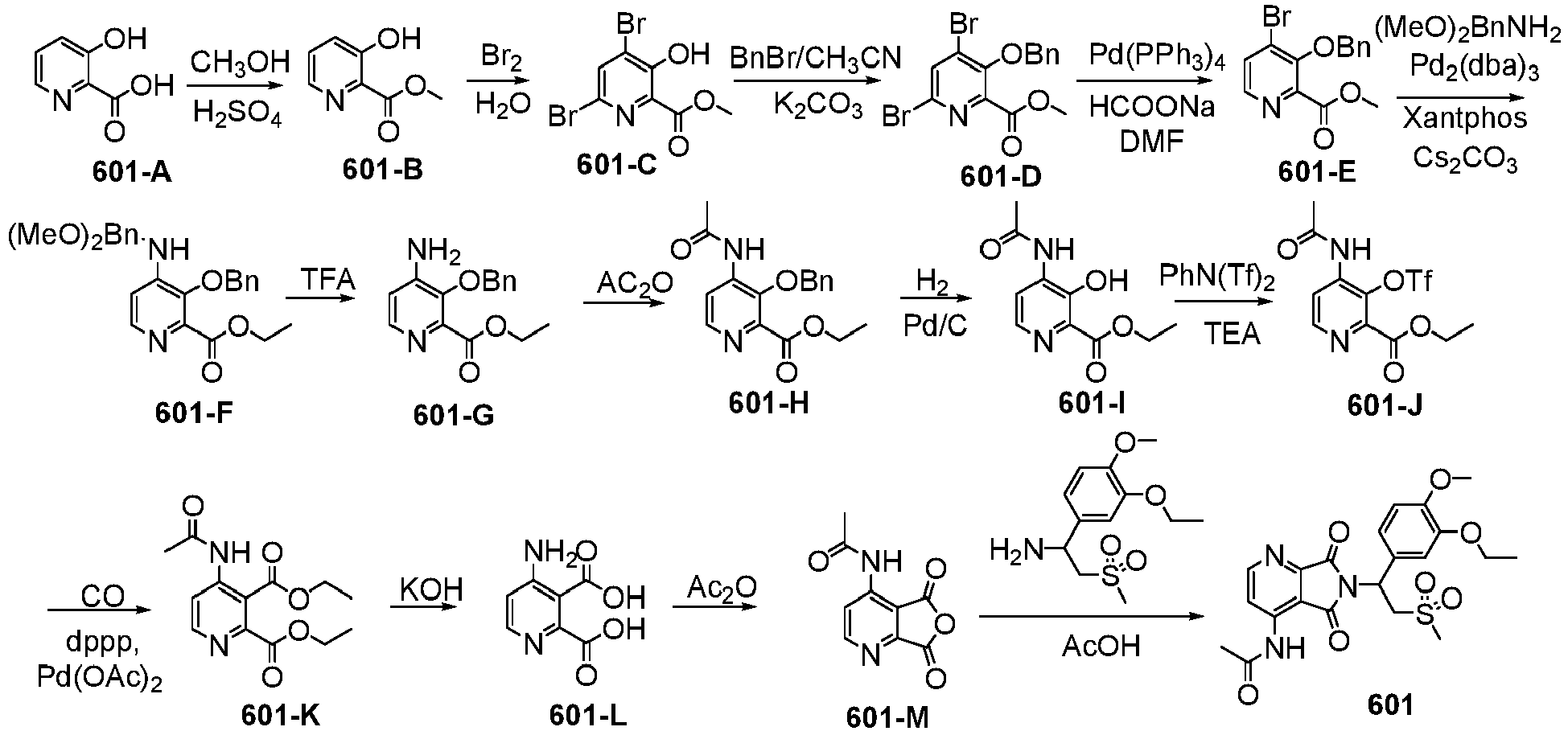
- To a solution of 601-A (3-hydroxypicolinic acid, CAS No. 874-24-8, 60 g, 430 mmol) in MeOH (600 mL) was added conc. H2SO4 (60 mL) slowly. Then, the mixture was heated to 80 °C for overnight. Adjusted the pH = 7 with solid Na2CO3, the mixture was filtered and the cake was washed with EtOAc (500 mL). The filtrate was concentrated to give 601-B (methyl 3-hydroxypicolinate, 40 g, yield: 61%) as a white solid.
1H NMR (300 MHz, CDCl3) δ 10.60 (s, 1H), 8.27 (d, J = 3.7 Hz, 1H), 7.35-7.44 (m, 2H), 4.05 (s, 3H). - To a solution of compound 601-B (30 g, 196 mmol) in H2O (1500 mL) was added Br2 (94 g, 590 mmol) slowly. The mixture was stirred at 30 °C for overnight. Then the mixture was extracted with DCM (500 mL*2), washed with brine (500 mL), dried, filtered and concentrated to afford 601-C (methyl 4,6-dibromo-3-hydroxypicolinate, 49 g, yield: 81%) as a white solid.
1H NMR (300 MHz, CDCl3) δ 11.35 (s, 1H), 7.87 (s, 1H), 4.07 (s, 3H). - A solution of compound 601-C (49 g, 157 mmol), BnBr (80.5 g, 472 mmol) and K2CO3 (98 g, 710 mmol) in CH3CN (1 L) was heated to reflux for overnight. The mixture was cooled to 25 °C. The solid was removed by filtration and the filtrate was evaporated to give the residue which was purified by triturated with PE: EtOAc = 10:1 (100 mL) at 30 °C for 1 hour to give 601-D (methyl 3-(benzyloxy)-4,6-dibromopicolinate, 43 g, yield: 68%) as yellow solid.
1H NMR (300 MHz, CDCl3): δ 7.89 (s, 1H), 7.39-7.54 (m, 5H), 5.15 (s, 2H), 3.94 (s, 3H). - To a solution of 601-D (43 g, 107 mmol), HCOONa (8.7 g, 128 mmol) in DMF (1 L) was added Pd (PPh3)4 (6.2 g, 5.35 mmol). The mixture was stirred at 80 °C for overnight. H2O (5 L) was added and the mixture was extracted with EtOAc (1L*2). The combined EtOAc solution was washed with brine(1L*2), dried and concentrated to give the crude product which was purified by column chromatography on silica gel eluted with PE: EtOAc =10:1 to give the product 601-E (methyl 3-(benzyloxy)-4-bromopicolinate, 14.8 g, 43%) as yellow solid.
1H NMR (300 MHz, CDCl3) δ 8.27 (dd, J = 4.8, 0.6 Hz, 1H), 7.71 (dd, J = 4.8, 0.6 Hz, 1H), 7.55 (d, J = 6.9 Hz, 2H), 7.37-7.45 (m, 3H), 5.17 (s, 2H), 3.95 (s, 3H). - To a solution of 601-E (14.7 g, 45.63 mmol), 2,4-Dimethoxy-benzylamine (9.92 g, 59.32 mmol), xantphos (1.58 g, 2.74 mmol), Cs2CO3 (22.3 g, 68.5 mmol) in toluene (350 mL) was added Pd2(dba)3 (0.84 g, 0.913 mmol) under N2 atomosphere. Then, the mixture was heated to 100 °C for 2 days. The reaction solution was concentrated to get the crude product which was purified by column chromatography on silica gel eluted with PE:EtOAc (1:1) to give the product 601-F (ethyl 3-(benzyloxy)-4-((2,4-dimethoxybenzyl)amino)picolinate, 8.4 g, 58%) as orange oil.
1H NMR (300 MHz, CDCl3) δ 8.12 (d, J = 5.7 Hz, 1H), 7.35-7.44 (m, 5H), 7.00 (d, J = 8.4 Hz, 1H), 6.64 (d, J = 5.1 Hz, 1H), 6.40-6.45 (m, 2H), 5.26-5.31 (m, 1H), 4.99 (s, 2H), 4.40-4.48 (m, 2H), 4.24 (d, J = 6.0 Hz, 2H), 3.80 (s, 3H), 3.75 (s, 3H), 1.41 (t, J = 7.2 Hz, 3H). - To a solution of 601-F (7.33 g, 17.4 mmol) in DCM (dichloromethane, 60 mL) and TFA (trifluoroacetic acid, 30 mL) was stirred at 30 °C for 4 hours. H2O (50 mL) was added, extracted with DCM (50 mL*2). The combined DCM solution was dried and concentrated to get the crude product which was purified by column chromatography on silica gel eluted with PE:EtOAc (1:1) to give the product 601-G (ethyl 4-amino-3-(benzyloxy)picolinate, 4.0 g, 85%) as brown oil.
NMR (300 MHz, CDCl3) δ 8.08 (d, J = 5.1 Hz, 1H), 7.36-7.48 (m, 5H), 6.71 (d, J = 5.1 Hz, 1H), 5.02 (s, 2H), 4.40-4.48 (m, 4H), 1.41 (t, J = 7.2 Hz, 3H). - A solution of 601-G (4.0 g, 15.5 mmol) in Ac2O (40 mL) was stirred at 100 °C for overnight. The mixture was concentrated to get the crude product, which was purified by column chromatography on silica gel eluted with PE:EtOAc (1:1) to give the product 601-H (ethyl 4-acetamido-3-(benzyloxy)picolinate, 3.17 g, 69%) as yellow oil.
1H NMR (300 MHz, CDCl3) δ .38-8.438 (m, 2H), 7.66 (s, 1H), 7.43 (s, 5H), 5.10 (s, 2H), 4.51 (q, J = 7.2 Hz, 2H), 1.86 (s, 3H), 1.47 (t, J = 7.2 Hz, 3H). - To a mixture of compound 601-H (3.17 g, 10.01 mmol) in MeOH (30 mL) and EtOAc (30 mL) was added Pd/C (10%, 50% H2O, 0.32 g). Then, the mixture was stirred at 30 °C under H2 (50 psi) atmosphere for overnight. The mixture was filtered, the filtrate was concentrated to afford the crude product 601-1 (ethyl 4-acetamido-3-hydroxypicolinate, 1.67 g, 74%) as a brown solid.
1H NMR (400 MHz, DMSO-d 6) δ 10.99 (br s, 1H), 9.78 (s, 1H), 8.27 (d, J = 5.6 Hz, 1H), 8.07 (s, 1H), 4.40 (q, J = 7.2 Hz, 2H), 2.19 (s, 3H), 1.35 (t, J = 7.2 Hz, 3H). - To a mixture of compound 601- I (1.53 g, 6.8 mmol) in DMF (30 mL) was added Et3N (1.44 g, 14.28 mmol) and N,N-Bis(trifluoromethylsulfonyl)aniline (3.83 g, 10.7 mmol), the mixture was stirred at 25 °C for 3 hours. Water (500 mL) was added and the mixture was extracted with EtOAc (200 mL*2). The combined EtOAc solution was washed with brine (200 mL*2), dried and concentrated to get the crude product which was purified by column chromatography on silica gel eluted with PE:EtOAc (2:1) to give the product 601-J (ethyl 4-acetamido-3-(((trifluoromethyl)sulfonyl)oxy)picolinate, 2.0 g, 83%) as colorless oil.
1H NMR (300 MHz, CDCl3) δ 8.56-8.61 (m, 2H), 7.87 (s, 1H), 4.49 (q, J = 7.2 Hz, 2H), 2.29 (s, 3H), 1.44 (t, J = 7.2 Hz, 3H). - A mixture of compound 601-J (1.85 g, 5.2 mmol), Pd(OAc)2 (233 mg, 1.04 mmol), DPPP (1,3-bis(diphenylphosphino) propane, 429 mg, 1.04 mmol) and Et3N (1.16 g, 11.5 mmol) in DMSO (1.84 mL) and EtOH (50 mL) was heated to 70 °C for overnight. The mixture was filtered, the filtrate was concentrated to get the crude product which was purified by column chromatography on silica gel eluted with PE:EtOAc (1:1) to give the product 601-K (diethyl 4-acetamidopyridine-2,3-dicarboxylate, 1.0 g, 69%) as colorless oil.
1H NMR (300 MHz, CDCl3): δ 10.50 (s, 1H), 8.56-8.66 (m, 2H), 4.35-4.46 (m, 4H), 2.26 (s, 3H), 1.35-1.44 (m, 6H). - A mixture of 601-K (1.0 g, 3.6 mmol) in KOH (20%, 50 mL, aq) and THF (50 mL) was stirred at 25 °C for 3 hours. The solvent was removed and the residue was diluted with MeOH (100 mL), stirred at 50 °C for 1 hour, filtered. The filtrate was concentrated to get the product 601-L (4-aminopyridine-2,3-dicarboxylic acid, 0.9 g, crude) as white soild.
1H NMR (400 MHz, DMSO-d 6) δ 8.52-9.26 (m, 2H), 8.11 (d, J = 6.8 Hz, 1H), 7.19 (d, J = 6.8 Hz, 1H). - A mixture of compound 601-L (0.9 g) in Ac2O (30 mL) was heated to 80 °C for overnight. Then the solvent was removed to get the product 601-M (N-(5,7-dioxo-5,7-dihydrofuro[3,4-b] pyridin-4-yl)acetamide, 0.6 g) as brown oil.
- A mixture of compound 601-M (0.6 g) and [1-(3-ethoxy-4-methoxyphenyl)-2-(methylsulfonyl)ethanamine] (0.8 g, 2.9 mmol) in AcOH (20 mL) was heated to 120 °C for 3 hours. The solvent was removed to get the crude product which was purified by prep-HPLC to give the target product 601 (N-(6-(1-(3-ethoxy-4-methoxyphenyl)-2-(methylsulfonyl)ethyl) -5,7-dioxo-6,7-dihydro-5H-pyrrolo[3,4-b]pyridin-4-yl)acetamide, 71 mg, yield for 3 steps 4%).
NMR (400 MHz, DMSO-d 6) δ 9.79 (s, 1H), 8.80 (d, J = 5.6 Hz, 1H), 8.36 (d, J = 6.0 Hz, 1H), 7.08 (d, J = 2.0 Hz, 1H), 7.02 (dd, J = 8.4, 2.0 Hz, 1H), 6.94 (d, J = 8.4 Hz, 1H), 5.82 (dd, J = 10.4, 4.8 Hz, 1H), 4.17-4.33 (m, 2H), 4.03 (q, J = 7.2 Hz, 2H), 3.74 (s, 3H), 3.02 (s, 3H), 2.26 (s, 3H), 1.32 (t, J = 7.2 Hz, 3H). LCMS [(M+1)]+ = 462.0. -

- To a solution of DMSO (3.79 g, 40.3 mmol) in 150 mL of dry THF cooled to 0 °C with ice-water was added dropwise n-BuLi (2.5 M, 16.1 mL, 40.3 mmol) slowly under N2 atmosphere. Then the reaction mixture was stirred in ice-water bath for 2 hours. A solution of 701-A (6-ethoxy-5-methoxypicolinonitrile, 2.87 g, 16.1 mmol) in 30 mL of dry THF was added dropwise to the solution. Then the mixture was stirred at 0 °C in ice-water bath for 2 hours. The mixture was quenched with ice-water and THF was removed by evaporation. The mixture was extracted with EtOAc (500 mL*3). The combined organic phase was washed with water and brine, dried over Na2SO4, concentrated to dry and crystallized from PE/EtOAc (2:1) to give product 701-B (1-(6-ethoxy-5-methoxypyridin-2-yl)-2-(methylsulfonyl)ethenamine, 3.5 g, yield: 80%).
NMR (300MHz, DMSO-d 6): δ 7.52 (d, J = 8.1 Hz, 1H), 7.35 (d, J = 8.4 Hz, 1H), 6.80 (s, 2H), 5.55 (s, 1H), 4.40 (q, J = 6.9 Hz, 2H), 3.83 (s, 3H), 3.00 (s, 3H), 1.34 (t, J = 6.9 Hz, 3H). - To a solution of 701-B (4.2 g, 15.4 mmol) in 100 mL THF cooled with ice-water was added 2N HCl (50 mL). The mixture was stirred at 25 °C for overnight. THF was evaporated and the mixture was basified with sat. NaHCO3, then extracted with EtOAc (200 mL*3). The combined organic phase was washed with brine, dried over Na2SO4 and concentrated to dry to give product 701-C (1-(6-ethoxy-5-methoxypyridin-2-yl)-2-(methylsulfonyl)ethenone, 4.0 g, yield: 95%)
1H NMR (300 MHz, DMSO-d 6): δ 7.73 (d, J = 8.1 Hz, 1H), 7.46 (d, J = 8.1Hz, 1H), 5.07 (s, 2H), 4.45 (q, J = 7.2 Hz, 2H), 3.89 (s, 3H), 3.15 (s, 3H), 1.38 (t, J = 7.2 Hz, 3H). - To a solution of 701-C (4.0 g, 14.6 mmol) in 100 mL of MeOH cooled with ice-water was added NaBH4 (1.11g, 29.3 mmol) portion wise and stirred at 25 °C for 2 hours. Then the mixture was quenched with 2 N HCl (20 mL) and stirred for 30 minutes, concentrated to dry and basified with sat. NaHCO3, then extracted with DCM/MeOH (20:1, 400 mL*2). The combined organic phase was washed with brine, dried over Na2SO4, concentrated to dry to give crude product 701-D (1-(6-ethoxy-5-methoxypyridin-2-yl)-2-(methylsulfonyl)ethanol, 4.0 g, yield: 100%) which was directely used in the next step.
- To a solution of 701-D (4.0 g, 14.53 mmol) in 100 mL of DCM cooled with ice-water was added Et3N (4.0 mL, 29.0 mmol), followed by MsCl (1.7 mL, 21.8 mmol) dropwise. The mixture was stirred at 25 °C for overnight and then quenched with ice-water and stirred for 30 minutes, then extracted with DCM. The combined organic phase was washed with water and brine, dried over Na2SO4 and concentrated to dry and crystallized from PE/EtOAc (1:1) to give product 701-E (2-ethoxy-3-methoxy-6-(2-(methylsulfonyl)vinyl)pyridine, 1.8 g, yield: 48%).
NMR (300 MHz, DMSO-d 6): δ 7.37 (d, J = 6.3 Hz, 2H), 7.31 (s, 2H), 4.40 (q, J = 6.9 Hz, 2H), 3.83 (s, 3H), 3.11 (s, 3H), 1.35 (t, J = 6.9 Hz, 3H). - A solution of B(OH)3 (70 mg, 0.81 mmol) in 5 mL of water was heated to 50 °C and stirred for 15 minutes. 701-E (140 mg, 0.54 mmol) was added and stirred for 30 minute and then 20 mL of NH3.H2O was added. The mixture was stirred at 80 °C in a sealed tube for 3 days. Then the mixture was cooled to 25 °C and concentrated to dry and basified with sat. NaHCO3, and stirred for 30 minutes, then extracted with DCM/MeOH (50 mL * 3), the combined organic phase was washed with brine, dried over Na2SO4, concentrated to dry to give crude product 701-F (1-(6-ethoxy-5-methoxypyridin-2-yl)-2-(methylsulfonyl)ethanamine, 110 mg).
1H NMR (400 MHz, DMSO-d 6): δ 7.24 (d, J = 8.0 Hz, 1H), 6.98 (d, J = 8.0 Hz, 1H), 4.31-4.39 (m, 2H), 4.21-4.25 (m, 1H), 3.76 (s, 3H), 3.36-3.43 (m, 2H), 3.02 (s, 3H), 2.32 (s, 2H), 1.32 (t, J = 7.2 Hz, 3H). - To a solution of 701-F (110 mg, 0.4 mmol) in 20 mL of HOAc was added (N-(1,3-dioxo-1,3-dihydroisobenzofuran-4-yl)acetamide, CAS number 6296-53-3, 82 mg, 0.4 mmol). The mixture was heated to reflux for overnight, then cooled to 25 °C and concentrated to dry and purified by prep-HPLC to give product 701 (N-(2-(1-(6-ethoxy-5-methoxypyridin -2-yl)-2-(methylsulfonyl)ethyl)-1,3-dioxoisoindolin-4-yl)acetamide, 123 mg, yield for 2 steps: 49%).
1H NMR (400 MHz, DMSO-d 6): δ 9.71 (s, 1H), 8.47 (d, J = 8.4 Hz, 1H), 7.80-7.84 (m, 1H), 7.60 (d, J = 7.2 Hz, 1H), 7.27 (d, J = 8.0 Hz, 1H), 7.02 (d, J = 8.0 Hz, 1H), 5.81 (dd, J = 10.8, 4.0 Hz, 1H), 4.30-4.34 (m, 1H), 4.15-4.22 (m, .3H), 3.76 (s, 3H), 3.09 (s, 3H), 2.18 (s, 3H), 1.17 (dd, J = 7.2 Hz, 3H). LCMS:[(M+1)]+ = 462.0. -
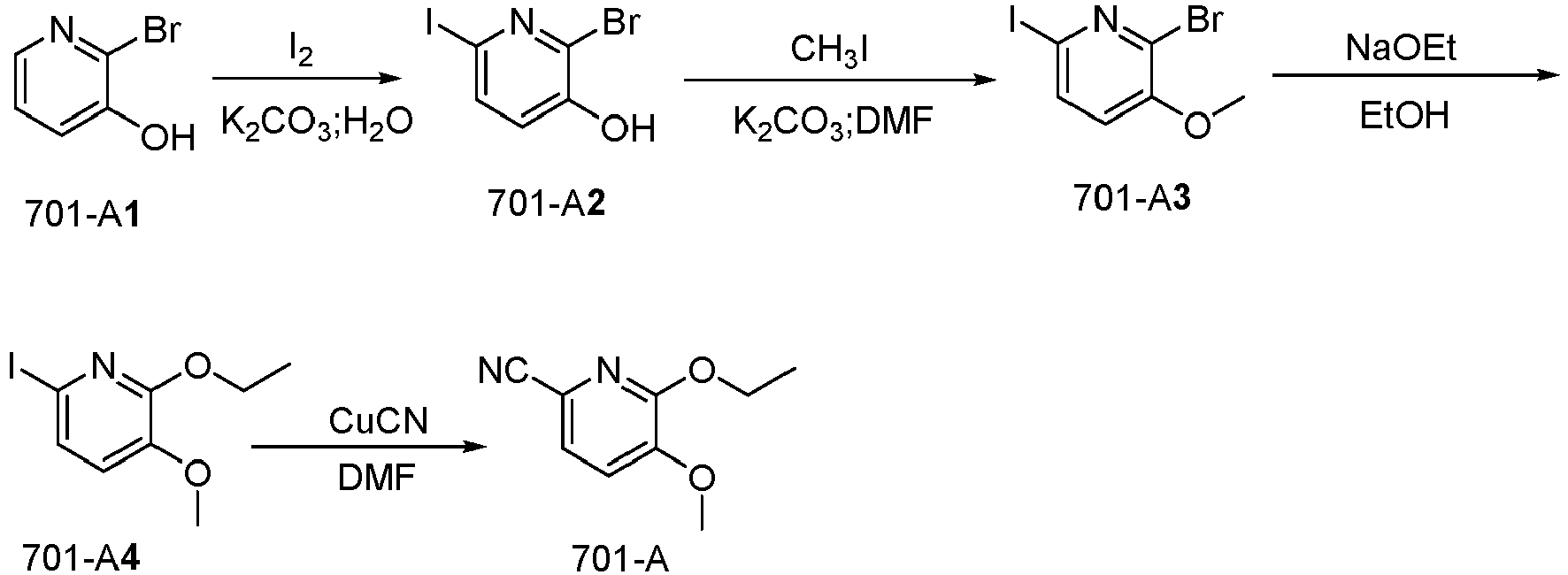
- To a solution of 701-A1 (2-bromo-pyridin-3-ol, CAS number 6602-32-0, 60 g, 0.35 mol) in H2O (600 mL) was added K2CO3 (96.7 g, 0.7 mol), I2 (90.7 g, 0.357 mol). The reaction mixture was stirred at 15 °C for overnight. The mixture was adjusted the pH to 5 with 3N HCl. The resulting solid was collected by filtration, washed with water (200 mL*3), dried to give 701-A2 (2-bromo-6-iodopyridin-3-ol, 101 g, yield: 97%) as a yellow solid.
1H NMR (300 MHz, DMSO-d 6) δ 11.11 (s, 1H), 7.62 (d, J = 8.4 Hz, 1H), 7.03 (d, J = 8.1 Hz, 1H). - A solution of 701-A2 (2-bromo-6-iodopyridin-3-ol, 101 g, 0.337 mol) in 200 mL of DMF was added K2CO3 (70 g, 0.506 mol) and the mixture was stirred for 30 minutes. CH3I (57.4 g, 0.404 mol) was added, then the mixture was stirred at 100 °C for 2 hours. The reaction mixture was poured into 2 L of H2O, stirred for 1hour, filtered, washed with water (500 mL*2), collected the solid which was slurried with PE:EtOAc = 2:1 (300 mL) at 15 °C for 1 hour to give product 701-A3 (2-bromo-6-iodo-3-methoxypyridine, 74 g, yileld: 70%) as brown solid.
1H NMR (300 MHz, DMSO-d 6) δ 7.79 (d, J = 8.4 Hz, 1H), 7.28 (d, J = 8.1 Hz, 1H), 3.87 (s, 3H). - A solution of EtOH (1.5 L) was added 27.6 g of Na then the mixture was stirred at 15 °C until the solid was disappeared. Compound 701-A3 (2-bromo-6-iodo-3-methoxypyridine, 37.7 g, 0.12 mol) was added and the mixture was heated to 100 °C for overnight. The solvent was removed. The residue was diluted with EtOAc (1L) and the solution was washed with water (1L*2), dried over Na2SO4, concentrated to dry to give product 701-A4 (2-ethoxy-6-iodo-3-methoxypyridine, 31.6 g, yileld: 94%) as brown solid.
1H NMR (400 MHz, DMSO-d 6) δ 7.32 (d, J = 8.0 Hz, 1H), 7.05 (d, J = 8.0 Hz, 1H), 4.26 (q, J = 7.2 Hz, 2H), 3.76 (s, 3H), 1.31 (t, J = 7.2 Hz, 3H). - To a solution of 701-A4 [2-ethoxy-6-iodo-3-methoxypyridine] (31.6 g, 0.113 mol) in 300 mL of DMF was added CuCN (12.2 g, 0.136 mol). The mixture was heated to 150 °C for 2 hours and then diluted with water (1 L) and extracted with EtOAc (500 mL*2). The organic phase was washed with brine (500 mL*3), dried over Na2SO4, concentrated to dryness to give 701-A (6-ethoxy-5-methoxypicolinonitrile, 20 g, yield: 99%) as yellow solid.
1H NMR (300 MHz, DMSO-d 6) δ 7.63 (d, J = 8.1 Hz, 1H), 7.39 (d, J = 7.8 Hz, 1H), 4.31 (q, J = 7.2 Hz, 2H), 3.86 (s, 3H), 1.32 (t, J = 7.2 Hz, 3H). -

- To a solution of compound 801-A (pyridine-2,3-diol, CAS number 16867-04-2, 24 g, 216 mmol) and NaOBu t (20.75 g, 216 mmol) in EtOH (200 mL) was added Iodo-ethane (37 g, 237.6 mmol). The mixture was stirred at 85 °C for overnight. The solvent was removed by evaperation. The residue was purified by column chromatography on silica gel eluted with DCM:MeOH (50:1) to give the product 801-B (3-ethoxypyridin-2-ol, 12.2 g, 40%) as brown solid.
1H NMR (400 MHz, DMSO-d 6) δ 11.52 (s, 1H), 6.90-6.92 (m, 1H), 6.77 (d, J = 7.2 Hz, 1H), 6.06 (dd, J = 14.0, 6.8 Hz, 1H), 3.91 (q, J = 6.8 Hz, 2H), 1.30 (t, J = 6.8 Hz, 3H). - A solution of compound 801-B (12.2 g, 87.7 mmol) in POCl3 (160 mL) was stirred at 80 °C for overnight. The solvent was removed by evaperation. The residue was diluted with water (200 mL) and the mixture was adjusted to pH = 8 with NaHCO3, then extracted with DCM (200 mL*2). The combined organic solution was dried over NaSO4, filtered and concentrated to give the crude which was purified by column chromatography on silica gel eluted with PE:EtOAc (4:1) to give the product 801-C (2-chloro-3-ethoxypyridine, 12.1 g, 87%) as yellow oil.
1H NMR (300 MHz, CDCl3) δ 7.93 (t, J = 3.0 Hz, 1H), 7.15-7.18 (m, 2H), 4.09 (q, J = 7.2 Hz, 2H), 1.46 (t, J = 7.2 Hz, 3H). - Na (13.1 g, 571 mmol) was carefully added to MeOH (250 mL) and stirred at 30 °C until Na was disappeared. Then, compound 801-C (9.0 g, 57.14 mmol) was added to the mixture and the mixture was heated to reflux for 2 days. The solvent was removed. The residue was diluted with DCM (300 mL), washed with water (200 mL*2), dried and concentrated to give product 801-D (3-ethoxy-2-methoxypyridine, 7.2 g, yield: 83%) as yellow oil.
1H NMR (300 MHz, CDCl3) δ 7.71 (dd, J = 5.1, 1.5 Hz, 1H), 7.02 (dd, J = 7.8, 1.2 Hz, 1H), 6.80 (dd, J = 7.8, 5.1 Hz, 1H), 4.03-4.12 (m, 5H), 1.46 (t, J = 6.9 Hz, 3H). - To a solution of compound 801-D (7.2 g, 47 mmol) and NaOAc (4.6 g, 56.4 mmol) in AcOH (120 mL) was added Br2 (9.0 g, 56.4 mmol) in AcOH (20 mL) slowly at 10 °C. The mixture was stirred at 30 °C for overnight. The reaction mixture was poured into ice (300 g), extracted with MTBE (methyl tert-butyl ether, 100 mL*2). The combined organic layer was dried over Na2SO4, filtered and concentrated to give the crude product which was purified by column chromatography on silica gel eluted with PE:EtOAc (20:1) to give the product 801-E (5-bromo-3-ethoxy-2-methoxypyridine, 8.4 g, 77%) as yellow oil.
1H NMR (300 MHz, CDCl3) δ 7.77 (d, J = 2.1 Hz, 1H), 7.13 (d, J = 1.8 Hz, 1H), 4.05-4.11 (m, 2H), 3.98 (s, 3H), 1.44-1.51 (m, 3H). - To a solution of 801-E (8.4 g, 36.2 mmol) in THF (150 mL) was added n-BuLi (17.4 mL, 2.5 M) slowly at -70 °C. The mixture was stirred at -70 °C for 1.5 hours. DMF (7 mL, 90.5 mmol) was added to the reaction mixture and stirred at -70 °C for 0.5 hour. The mixture was quenched with NH4Cl (100 mL), extracted with EtOAc (100 mL*2). The combined EtOAc solution was washed with brine (100 mL), dried over NaSO4, filtered and concentrated to get crude product 801-F (5-ethoxy-6-methoxynicotinaldehyde, 6.5 g) as red solid.
1H NMR (400 MHz, CDCl3) δ 9.85 (s, 1H), 8.11 (d, J = 2.0 Hz, 1H), 7.38 (d, J = 2.0 Hz, 1H), 4.07-4.13 (m, 2H), 4.04 (s, 3H), 1.41-1.47 (m, 3H). - To a solution of dimethyl sulfone (30.8 g, 328 mmol), KOH (1.84 g, 32.8 mmol) in DMF (400 mL) was added 801-F (5.94 g, 32.8 mmol) in DMF (100 mL) slowly. The mixture was stirred at 30 °C for 3 hours. The mixture was quenched with NH4Cl (500 mL), extracted with EtOAc (500 mL*2). The combined organic phase was washed with brine (500 mL*2), dried over Na2SO4 then filtered and concentrated to get the crude product which was purified by column chromatography on silica gel eluted with PE: EtOAc (2:1) to give the product 801-G (3-ethoxy-2-methoxy-5-(2-(methylsulfonyl)vinyl)pyridine, 0.71 g, 8.5%) as brown solid.
1H NMR (300 MHz, CDCl3) δ 7.87 (d, J = 1.8 Hz, 1H), 7.58 (d, J = 15.3 Hz, 1H), 7.13 (d, J = 1.8 Hz, 1H), 6.80 (d, J = 15.3 Hz, 1H), 4.09-4.16 (m, 2H), 4.06 (s, 3H), 3.05 (s, 3H), 1.52 (t, J = 6.9 Hz, 3H). - A solution of H3BO3 (0.368 g, 5.95 mmol) in H2O (6 mL) was stirred at 50 °C for 15 minutes. Compound 801-G (1.1 g, 4.3 mmol) was added and stirred at 50 °C for 15 minutes. Then, NH4OH (60 mL) was added, the reaction mixture was stirred at 80 °C in sealed tube for 3 days. The mixture was extracted with DCM (50 mL*3), the combined organic phase was extracted with 2 N HCl (50 mL*2). The water phase was adjusted the pH = 10 with NaOH, extracted with DCM (100 mL*2). The combined DCM solution was dried and concentrated to get the product 801-H (1-(5-ethoxy-6-methoxypyridin-3-yl)-2-(methylsulfonyl)ethanamine, 0.71 g, 66%).
1H NMR (300 MHz, CDCl3) δ 7.71 (s, 1H), 7.12 (s, 1H), 4.67 (d, J = 9.6 Hz, 1H), 4.11 (q, J = 6.9 Hz, 2H), 4.01 (s, 3H), 3.09-3.40 (m, 2H), 2.99 (s, 3H), 1.88 (s, 2H), 1.49 (t, J = 6.9 Hz, 3H). - A mixture of compound (N-(1,3-dioxo-1,3-dihydroisobenzofuran-4-yl)acetamide, 112 mg, 0.55 mmol) and 801-H (150 mg, 0.55 mmol) in HOAc (5 mL) was heated to 110 °C for overnight. Concentrated to dry under reduced pressure, the residue was purified by Prep-HPLC to afford 801 (N-(2-(1-(5-ethoxy-6-methoxypyridin-3-yl)-2-(methylsulfonyl)ethyl)-1,3-dioxoisoindolin-4-yl)acetamide , 66 mg, 26%) as a white solid.
1H NMR (400 MHz, DMSO-d 6) δ 9.70 (s, 1H), 8.44 (d, J = 8.4 Hz, 1H), 7.78-7.81 (m, 2H), 7.57 (d, J = 6.8 Hz, 1H), 7.39 (s, 1H), 5.83 (dd, J = 10.4, 4.4 Hz, 1H), 4.32-4.38 (m, 1H), 4.15-4.20 (m, 1H), 4.05-4.10 (m, 2H), 3.85 (s, 3H), 3.04 (s, 3H), 2.19 (s, 3H), 1.34 (t, J = 6.8 Hz, 3H). LCMS: [(M+1)]+ = 462.0. -
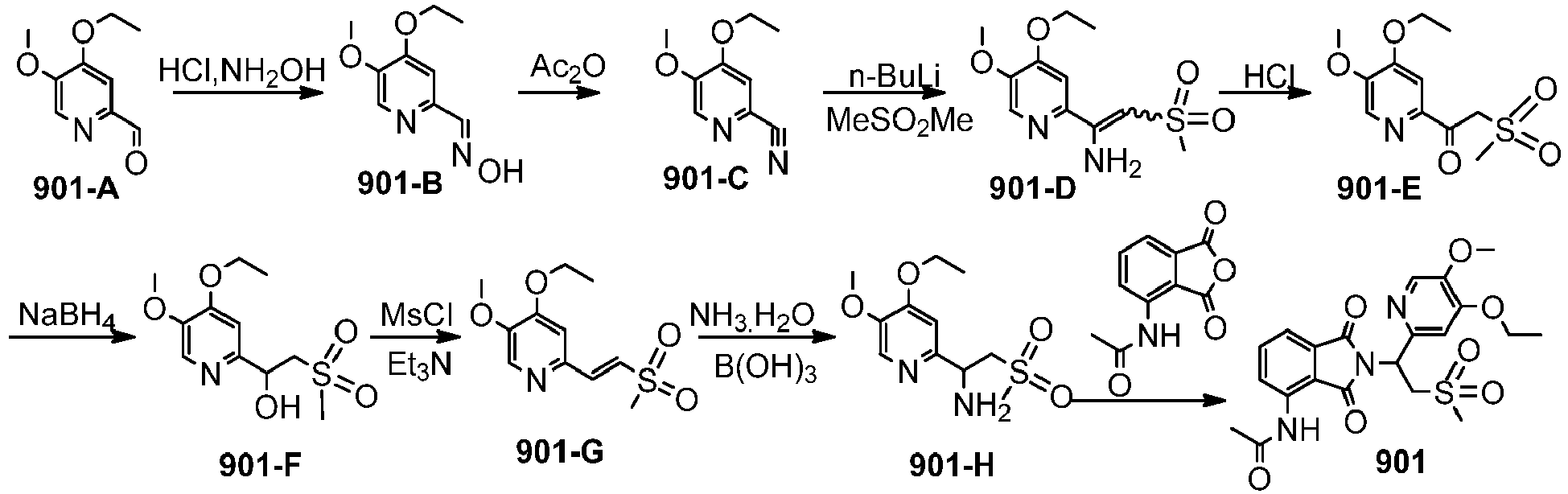
- To a solution of 901-A (4-ethoxy-5-methoxypicolinaldehyde, 8.4 g, 46.36 mmol) in 150 mL of MeOH was added hydroxylamine hydrochloride (3.87 g, 55.63 mmol) and NaOAc (4.56 g, 55.63 mmol). The reaction mixture was refluxed for 3 hours. Cooled to 25 °C and concentrated to dry, and then diluted with 30 mL of cold water and extracted with EtOAc. The combined EtOAc solution was washed with water and brine. Dried over Na2SO4, concentrated to dry to give product 901-B (4-ethoxy-5-methoxypicolinaldehyde oxime, 8.0 g, yield: 88%).
1H NMR (400 MHz, DMSO-d 6): δ 11.40 (s, 1H), 8.15 (s, 1H), 7.97 (s, 1H), 7.30 (s, 1H), 4.14 (q, J = 7.2 Hz, 2H), 3.88 (s, 1H), 1.36 (t, J = 7.2 Hz, 3H) - A solution of 901-B (8.0 g, 40.8 mmol) in 60 mL of Ac2O was stirred in a sealed tube in a microwave reactor at 170 °C for 30 minutes, then cooled to 25 °C and concentrated to dry and precipitated from PE/EtOAc (1:1) to give desired product 901-C (4-ethoxy-5-methoxypicolino nitrile, 3.6 g, yield: 40%).
1H NMR (300 MHz, DMSO-d 6): δ 8.33 (s, 1H), 7.70 (s, 1H), 4.18 (q, J = 6.9 Hz, 2H), 3.93 (s, 1H), 1.35 (t, J = 6.9 Hz, 3H). - A solution dimethyl sulfone (4.7 g, 50 mmol) in 200 mL dry THF was cooled to 0 °C under N2 atomosphere, to which n-BuLi (20 mL, 50 mmol) was added dropwise slowly. Then the mixture was stirred in ice-water bath for 2 hours. A solution of 901-C (3.56 g, 20 mmol) in 50 mL of dry THF was added dropwise to the solution in ice-water bath. The mixture was stirred in ice-water bath for 2 hours then quenched with ice cold water. THF was evaporated and then the mixture was extracted with EtOAc (500 mL*3), the combined EtOAc solution was washed with water and brine, dried over Na2SO4, concentrated to dry to give crude product 901-D (1-(4-ethoxy-5-methoxypyridin-2-yl)-2-(methylsulfonyl)ethenamine, 5.5 g) which was directly used in the next step without purification.
- To a solution of 901-D (5.0 g, 18.4 mmol) in 140 mL THF cooled with ice-water was added 2N HCl (60 mL). The mixture was stirred at 25 °C for overnight. THF was evaporated and the residue was basified with sat. NaHCO3. The mixture was extracted with EtOAc (200 mL*3). The combined EtOAc solution was washed with brine, dried over Na2SO4. Concentrated to dry to give the product 901-E (1-(4-ethoxy-5-methoxypyridin-2-yl)-2-(methylsulfonyl)ethenone, 6.5 g).
1H NMR (400 MHz, DMSO-d 6): δ 8.38 (s, 1H), 7.60 (s, 1H), 5.15 (s, 2H), 4.22 (q, J = 6.8 Hz, 2H), 3.99 (s, 3H), 3.17 (s, 3H), 1.37 (t, J = 6.8 Hz, 3H). - To a solution of 901-E (6.5 g crude, 23.8 mmol) in 100 mL of MeOH cooled with ice-water was added NaBH4 (1.8 g, 47.6 mmol) portion wise. The mixture was stirred at 25 °C for 2 hours then quenched with 2 N HCl (30 mL) and stirred for 30 minutes. The mixture was concentrated to dry and basified with sat. NaHCO3 and extracted with DCM/MeOH (20:1, 400 mL*2). The combined organic phase was washed with brine. Dried over Na2SO4, concentrated to dry to give crude product 901-F (1-(4-ethoxy-5-methoxypyridin-2-yl)-2-(methylsulfonyl) ethanol, 5.5 g).
- To a solution of 901-F (5.5 g, 20 mmol) in 100 mL of DCM cooled with ice-water was added Et3N (5.6 mL, 40 mmol), followed by added MsCl (2.3 mL, 30 mmol) dropwise. The mixture was stirred at 25 °C for overnight then quenched with ice-water and stirred for 30 minutes. Extracted with DCM (100 mL*2), the combined organic phase was washed with water and brine. Dried over Na2SO4. Concentrated to dry and crystallized from PE/EtOAc (1:1) to give product 901-G (4-ethoxy-5-methoxy-2-(2-(methylsulfonyl)vinyl)pyridine, 4.0 g, yield: 34% for 4 steps).
1H NMR (300 MHz, DMSO-d 6): δ 8.26 (s, 1H), 7.39-7.59 (m, 3H), 4.12-4.18 (m, 2H), 3.90 (s, 3H), 3.12 (s, 3H), 1.36 (t, J = 6.9 Hz, 3H). - A solution of B(OH)3 (93 mg, 1.5 mmol) in 5 mL of water was heated to 50 °C for 15 minutes. 901-G (515 mg, 2.0 mmol) was added and the mixture was stirred for 30 minutes. Then 30 mL of NH3.H2O was added. The mixture was stirred at 80 °C in a sealed tube for 3 days. Cooled to 25 °C and concentrated to dry and basified with sat. NaHCO3, and stirred at 25 °C for 30 minutes. The mixture was extracted with DCM/MeOH (50 mL *3), the combined organic phase was washed with brine, dried over Na2SO4, concentrated to dry to give crude product 901-H (1-(4-ethoxy-5-methoxypyridin-2-yl)-2-(methylsulfonyl)ethanamine, 470 mg, yield: 86%).
1H NMR (400 MHz, DMSO-d 6) : δ 8.07 (s, 1H), 7.17 (s, 1H), 4.29-4.32 (m, 1H), 4.13 (q, J = 7.2 Hz, 2H), 3.82 (s, 3H), 3.37-3.46 (m, 2H), 3.05 (s, 3H), 1.36 (t, J = 7.2 Hz, 3H). - To a solution of 901-H (220 mg, 0.8 mmol) in 20 mL of HOAc was added N-(1,3-dioxo-1,3-dihydroisobenzofuran-4-yl)acetamide (164 mg, 0.8 mmol) then the mixture was refluxed for overnight. Then the mixture was cooled to 25 °C and concentrated to dry and purified by prep-HPLC to give product 901 (N-(2-(1-(4-ethoxy-5-methoxypyridin-2-yl)-2-(methylsulfonyl)ethyl)-1,3-dioxoisoindolin-4-yl)acetamide, 100 mg, yield: 27%).
1H NMR(400 MHz, DMSO-d 6): δ 9.71 (s, 1H), 8.48 (d, J = 8.4 Hz, 1H), 8.08 (s, 1H), 7.79-7.83 (m, 1H), 7.59 (d, J = 6.8 Hz, 1H), 7.10 (s, 1H), 5.86 (dd, J = 10.8, 3.6 Hz, 1H), 5.86 (dd, J = 3.6, 7.2Hz, 1H), 4.40 (dd, J = 14.8, 3.6 Hz, 1H), 4.16-4.19 (m, 1H), 4.10 (q, J = 7.2 Hz, 2H), 3.82 (s, 3H), 3.09 (s, 3H), 2.19 (s, 3H), 1.32 (t, J = 7.2 Hz, 3H). LCMS: [(M+1)]+ = 461.9. -

- A solution of 901-A1 (5-hydroxy-2-(hydroxymethyl)-4H-pyran-4-one, CAS number 501-30-4, 60 g, 422 mmol) in 300 mL of H2O and KOH (30 g) was cooled to 10 °C. The Sulfuric acid dimethyl ester (53.2 g, 422 mmol) was added by dropwise at 10 °C. The mixture was stirred at 10 °C for 1 hour, then filtrated, collected the solid, washed with acetone (40 mL), dried to give the product 901-A2 (2-(hydroxymethyl)-5-methoxy-4H-pyran-4-one, 17.5 g, yield: 26.6 %) as yellow solid.
1H NMR (400 MHz, DMSO) δ 8.08 (s, 1H), 6.30 (s, 1H), 5.79 (br s, 1H), 4.30 (s, 2H), 3.65 (s, 3H). - To a sealable tube was added 901-A2 (2-(hydroxymethyl)-5-methoxy-4H-pyran-4-one, 32 g, 205 mmol) and NH4OH (160 mL). The tube was sealed and heated to 90 °C for 3 hour. The mixture was concentrated, then MeOH (200 mL) and activated carbon (15 g) were added. The mixture was heated to reflux for 0.5 hour. The mixture was filtrated through a Celite pad and concentrated to dryness to give the product 901-A3 (2-(hydroxymethyl)-5-methoxypyridin-4 (1H)-one, 27.8 g, yield: 87%) as yellow solid.
1H NMR (400 MHz, DMSO) δ 7.38 (s, 1H), 6.22 (s, 1H), 4.36 (s, 2H), 3.67 (s, 3H). - To a solution of 901-A3 [2-(hydroxymethyl)-5-methoxypyridin-4(1H)-one, 27.8 g, 179 mmol) in DMF (280 mL) was added Cs2CO3 (64.2 g, 197 mmol). The mixture was heated to 85 °C and then the Iodo-ethane (29.3 g, 188 mmol) was added. The mixture was stirred at 85 °C for 2 hours. The mixture was filtrated. The filtrate was diluted with water (300 mL), extracted with DCM:MeOH=10:1 (300 mL*4), the organic phase was dried and concentrated to give crude product which was purified by column chromatography on silica gel eluted with EtOAc to give the product 901-A4 ((4-ethoxy-5-methoxypyridin-2-yl)methanol, 17.5 g, yield: 53%) as yellow solid.
1H NMR (400 MHz, DMSO-d 6) δ 8.04 (s, 1H), 7.04 (s, 1H), 5.29 (t, J = 6.0 Hz, 1H), 4.44 (d, J = 5.6 Hz, 2H), 4.10 (q, J = 7.2 Hz, 2H), 3.81 (s, 3H), 1.36 (t, J = 7.2 Hz, 3H). - To a solution of 901-A4 ((4-ethoxy-5-methoxypyridin-2-yl)methanol, 10 g, 54.6 mmol) in CHCl3 (400 mL) was added MnO2 (47 g, 546 mmol). The mixture was heated to 65 °C and reacted for 2 hours. The mixture was filtrated, concentrated to give the product 901-A (4-ethoxy-5-methoxypicolinaldehyde, 9 g, yield: 91%) as gray solid.
1H NMR (300 MHz, DMSO-d 6) δ 9.82 (s, 1H), 8.40 (s, 1H), 7.45 (s, 1H), 4.23-4.16 (m, 2H), 3.97 (s, 3H), 1.36 (t, J = 6.9 Hz, 3H). -

- Compound 701-F (6.6 g, 24 mmol) was chiral separated to give the product 701-F1 ((R)-1-(6-ethoxy-5-methoxypyridin-2-yl)-2-(methylsulfonyl)ethanamine, 2.5 g, ee: 98.42%) and 701-F2 ((S)-1-(6-ethoxy-5-methoxypyridin-2-yl)-2-(methylsulfonyl)ethanamine, 1.7 g, ee: 98.29%).
- Separation Method:
- Column: chiralpak IA 5µm 4.6*250 mm
- Mobile phose: Hex: EtOH:DEA=70:30:0.2
- Folw Rate (F): 1.0 mL/min
- Wave Length (W): 230 nm
- Tempreature (T): 30 °C
- Synthesis of compound 702
- Compound 702 was synthesized according to the method of compound 701 in Example 14, except the intermediate compound 701-F2 was used instead of compound 701-F.

- NMR (400 MHz, DMSO-d 6) δ 9.73 (s, 1H), 8.47 (d, J = 8.4 Hz, 1H), 7.82 (t, J = 8.0 Hz, 1H), 7.60 (d, J = 7.2 Hz, 1H), 7.27 (d, J = 8.0 Hz, 1H), 7.02 (d, J = 8.0 Hz, 1H), 5.81 (dd, J = 10.8, 3.2 Hz, 1H), 4.15-4.35 (m, 4H), 3.76 (s, 3H), 3.10 (s, 3H), 2.18 (s, 3H), 1.17 (t, J = 7.2 Hz, 3H). LC-MS: 462.2 ([M+1]+).
- Compound 703 was synthesized according to the method of compound 701 in Example 14, except the intermediate compound 701-F1 was used instead of compound 701-F.
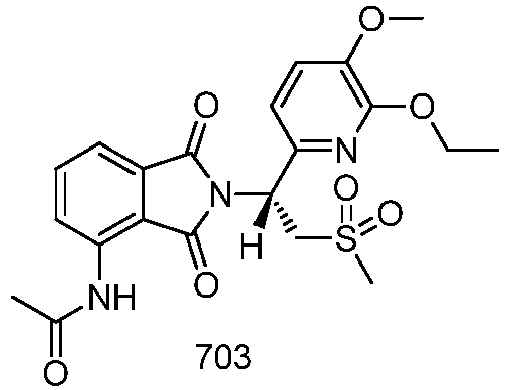
- 1H NMR (400 MHz, DMSO-d 6) δ 9.73 (s, 1H), 8.47 (d, J = 8.4 Hz, 1H), 7.82 (t, J = 8.0 Hz, 1H), 7.60 (d, J = 7.6 Hz, 1H), 7.27 (d, J = 8.4 Hz, 1H), 7.02 (d, J = 7.6 Hz, 1H), 5.81 (dd, J = 10.8, 3.6 Hz, 1H), 4.15-4.35 (m, 4H), 3.76 (s, 3H), 3.10 (s, 3H), 2.18 (s, 3H), 1.17 (t, J = 7.2 Hz, 3H). LC-MS: 462.1 ([M+1]+).
- Compound 705 and 706 were synthesized according to the method of compound 701 in Example 14, except the intermediate compound 701-F2 ((S)-1-(6-ethoxy-5-methoxypyridin -2-yl)-2-(methylsulfonyl)ethanamine) or 701-F1 ((R)-1-(6-ethoxy-5-methoxypyridin-2-yl)-2-(methylsulfonyl)ethanamine) was used respectively instead of compound 701-F and intermediate compound 101-E (N-(7-fluoro-1,3-dioxo-1,3-dihydroisobenzofuran-4-yl) acetamide) was used instead of compound N-(1,3-dioxo-1,3-dihydroisobenzofuran-4-yl) acetamide.
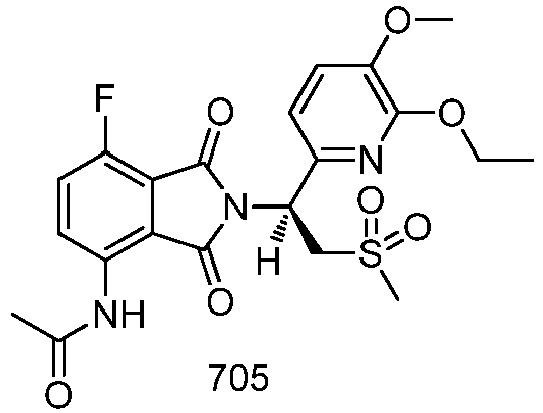
- NMR (400 MHz, DMSO-d 6) δ 9.77 (s, 1H), 8.45 (dd, J = 9.2, 3.6 Hz, 1H), 7.69 (t, J = 9.2 Hz, 1H), 7.28 (d, J = 8.4 Hz, 1H), 7.05 (d, J = 8.4 Hz, 1H), 5.78-5.81 (m, 1H), 4.12-4.36 (m, 4H), 3.77 (s, 3H), 3.10 (s, 3H), 2.16 (s, 3H), 1.20 (t, J = 6.8 Hz, 3H). LCMS: [(M+1)]+ = 480.2
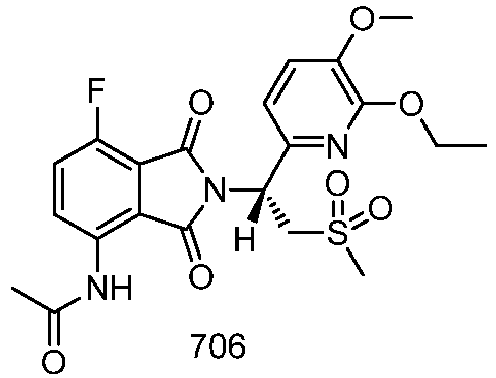
- 1H NMR (400 MHz, DMSO-d 6) δ 9.78 (s, 1H), 8.44-8.46 (m, 1H), 7.69 (t, J = 8.8 Hz, 1H), 7.28 (d, J = 8.0 Hz, 1H), 7.06 (d, J = 8.0 Hz, 1H), 5.80 (d, J = 8.0 Hz, 1H), 4.12-4.35 (m, 4H), 3.77 (s, 3H), 3.10 (s, 3H), 2.17 (s, 3H), 1.20 (t, J = 6.8 Hz, 3H). LCMS: [(M+1)]+ = 480.0
- Compound 704 can be synthesized according to the method of compound 701 in Example 14, except the intermediate compound 101-E was used instead of compound N-(1,3-dioxo-1,3-dihydroisobenzofuran-4-yl) acetamide.
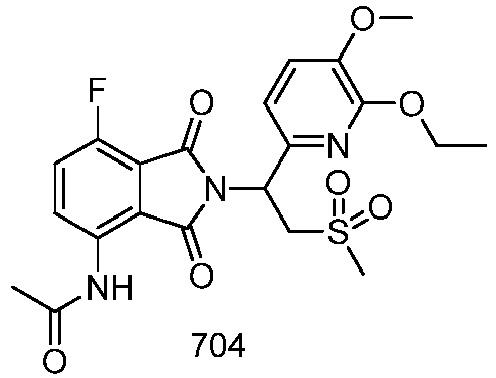
- Compound 708 and 709 were synthesized according to the method of compound 701 in Example 14, except the intermediate compound 701-F2 ((S)-1-(6-ethoxy-5-methoxypyridin -2-yl)-2-(methylsulfonyl)ethanamine) or 701-F1 ((R)-1-(6-ethoxy-5-methoxypyridin-2-yl)-2-(methylsulfonyl)ethanamine) was used respectively instead of compound 701-F and intermediate compound 201-C (N-(6-fluoro-1,3-dioxo-1,3-dihydroisobenzofuran-4-yl) acetamide) was used instead of compound N-(1,3-dioxo-1,3-dihydroisobenzofuran-4-yl) acetamide.
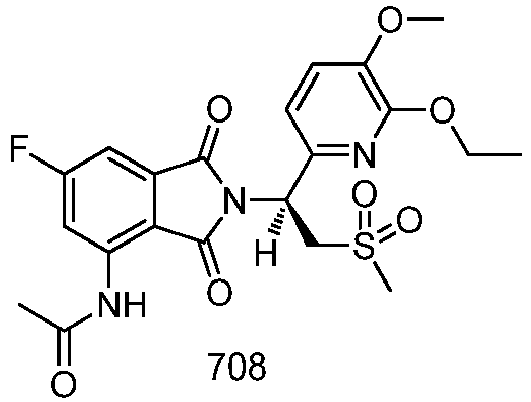
- 1H NMR (400 MHz, DMSO-d 6) δ 9.81 (s, 1H), 8.29 (dd, J = 12.0, 1.6 Hz, 1H), 7.54 (dd, J = 6.8, 1.6 Hz, 1H), 7.28 (d, J = 8.4 Hz, 1H), 7.04 (d, J = 8.0 Hz, 1H), 5.80 (dd, J = 10.8, 3.2 Hz, 1H), 4.13-4.36 (m, 4H), 3.76 (s, 3H), 3.10 (s, 3H), 2.21 (s, 3H), 1.18 (t, J = 7.2 Hz, 3H).
LC-MS: 479.9 ([M+1]+).
- 1H NMR (400 MHz, DMSO-d 6) δ 9.80 (s, 1H), 8.29 (dd, J = 12.0, 2.0 Hz, 1H), 7.54 (dd, J = 6.4, 2.0 Hz, 1H), 7.28 (d, J = 8.0 Hz, 1H), 7.04 (d, J = 8.0 Hz, 1H), 5.81 (dd, J = 10.4, 3.2 Hz, 1H), 4.16-4.32 (m, 4H), 3.76 (s, 3H), 3.10 (s, 3H), 2.21 (s, 3H), 1.19 (t, J = 7.2 Hz, 3H). LC-MS: 480.2 ([M+1]+).
- Compound 707 can be synthesized according to the method of compound 701 in Example 14, except the intermediate compound 201-C (N-(6-fluoro-1,3-dioxo-1,3-dihydroisobenzofuran -4-yl)acetamide) was used instead of compound N-(1,3-dioxo-1,3-dihydroisobenzofuran-4-yl) acetamide.

-

- To a solution of N-(1,3-dioxo-1,3-dihydroisobenzofuran-4-yl) acetamide (117 mg, 0.568 mmol) in AcOH (5mL) was added compound 712-A1 (150 mg, 0.54 mmol), the mixture was stirred at 80°C for overnight. The reaction solution was concentrated by Rotary evaporator to dryness and purified by Prep-HPLC and freeze-dried to obtain compound 712 ((R)-N-(2-(1-(6-ethoxy-5-d 3-methoxypyridin-2-yl)-2-(methylsulfonyl)ethyl)-1,3-dioxoisoindoli n-4-yl)acetamide, 185mg).
1H NMR (400 MHz, DMSO-d 6) δ 9.72 (s, 1H), 8.478 (d, J = 8.4 Hz, 1H), 7.82 (t, J = 8.0 Hz ,1H), 7.60 (d, J = 7.2 Hz, 1H), 7.27 (d, J = 8.0 Hz, 1H), 7.01 (d, J = 8.4 Hz, 1H), 5.81 (dd, J = 10.8, 3.2 Hz, 1H), 4.35-4.30 (m, 1H), 4.22-4.15 (m, 3H), 3.09 (s, 3H), 2.18 (s, 3H), 1.17 (t, J = 7.2 Hz, 3H). LCMS: ([M+H]+). 465.0. ee% = 100%. -

- To a solution of A (2-chloro-6-iodopyridin-3-ol, CAS number 185220-68-2, 5 g, 19.6 mmol) in 14 mL of DMF was added K2CO3 (4.06 g, 29.4 mmol). The mixture was stirred for 30 minutes. CD3I (3.41 g, 23.5 mmol) was added. The mixture was stirred at 100 °C for 2 hours. The mixture was cooled and poured into 100 mL of water, stirred for 0.5 hour, filtrated, washed with water (200 mL x 2), collected the solid, dried in vacuo to give compound B (2-chloro-6-iodo-3-d3 -methoxypyridine, 4.87 g, yield: 91%) as yellow solid.
1H NMR (300 MHz, DMSO-d 6) δ 7.81 (d, J = 8.4 Hz, 1H), 7.36 (d, J = 8.4 Hz, 1H). - NaOEt (8.53 g, 125.3 mmol) was added in portions slowly to anhydrous EtOH (100 mL) at 10 °C. The inner temperature was raised to 35 °C when the addition completed. Then B (2-chloro-6-iodo-3-d3-methoxypyridine, 4.87 g, 17.9 mmol) was added and the mixture was heated to 100 °C and stirred for 2 hours. Cooled and the solvent was removed. The residue was diluted with EtOAc (100 mL) and ice water (100 mL), then stirred and stratified. The organic phase was washed with water (100 mL) and brine(100 mL), then dried over Na2SO4, filtered and concentrated to dry to give compound C (2-ethoxy-6-iodo-3-d3-methoxypyridine, 4.86 g, yield: 96%) as brown solid.
1H NMR (300 MHz, DMSO-d 6) δ 7.30 (dd, J = 8.1, 1.2 Hz, 1H), 7.03 (dd, J = 8.1, 1.2 Hz, 1H), 4.28-4.21 (m, 2H), 1.32-1.27 (m, 3H). - To a solution of C (2-ethoxy-6-iodo-3-d3-methoxypyridine, 4.86 g, 17.2 mmol) in DMF (50 mL, N2 bubbled for 0.5 hour) were added DIEA (3.33 g, 25.8 mmol), Methanesulfonyl-ethene (2.19 g, 20.6 mmol), S-Phos (2-dicyclohexylphosphine-2', 6'-dimethoxy-biphenyl, 1.09 g, 2.58 mmol), and Pd2(dba)3 (1.06 g, 1.5 mmol). The mixture was purged with N2 for 4 times, and stirred at 110 °C for 4 hours under N2 protection. Then the mixture was cooled, filtered and the filtrate was concentrated through Rotary evaporator to give crude product, which was purified by column chromatography on silica gel (PE: EtOAc = 4:1 to 1:1). to give D (2-ethoxy-3-d3-methoxy-6-(2-(methylsulfonyl)vinyl)pyridine, 3.6 g, 80%) as off white solid.
1H NMR (300 MHz, DMSO-d 6): δ 7.43-7.31 (m, 4H), 4.43-4.36 (m, 2H), 3.11 (s, 3H), 1.34 (t, J = 7.2 Hz, 3H). - B(OH)3 (2.49 g, 40.3 mmol), dioxane (40 mL), D (2-ethoxy-3-d3-methoxy-6-(2-(methylsulfonyl)vinyl)pyridine, 7.0 g, 26.9 mmol) and NH3.H2O (200 mL) was added to sealed tube and the mixture was stirred at 100 °C for 60 hours. Then the sealed tube was cooled, deflated and opened. The reaction solution was concentrated to 50 mL, then the precipitated solid was filtered and washed with H2O. The filtration was concentrated to dryness through rotary evaporator to give a crude which was slurried with PE/EtOAc (3:1, 40 mL) to give 712-A (1-(6-ethoxy-5-d3-methoxypyridin-2-yl)-2-(methylsulfonyl)ethanamine, 5.3 g, yield: 71%) as white solid.
1H NMR (400 MHz, DMSO-d 6): δ 7.23 (d, J = 7.8 Hz, 1H), 6.97 (d, J = 8.1 Hz, 1H), 4.33 (q, J = 6.9 Hz, 2H), 4.23-4.19 (m, 1H), 3.76 (s, 3H), 3.38-3.36 (m, 2H), 3.02 (s, 3H), 2.21 (br s, 2H), 1.31 (t, J = 6.9 Hz, 3H). - 712-A (1-(6-ethoxy-5-d3 -methoxypyridin-2-yl)-2-(methylsulfonyl)ethanamine) was purified by chiral Prep-HPLC to afford 712-A1 ((R) -1-(6-ethoxy-5-d3 -methoxypyridin-2-yl)-2-(methylsulfonyl)ethanamine) and 712-A2 ((S)-1-(6-ethoxy-5-d3 -methoxypyridin-2-yl)-2-(methylsulfonyl)ethanamine).
- Chiral Separation conditions: Column: CHIRALPAK IA, Particle size: 5 µ m; Wave Length: 230 nm; Mobile Phase: Hexane/EtOH/(0.2%TEA)=70/30[V/V(0.2%TEA)]; Tempreature: 30 °C.
- Compound 711 was synthesized according to the method of compound 712 in Example 20, except the corresponding substrate 712-A2 was used instead of compound 712-A1.
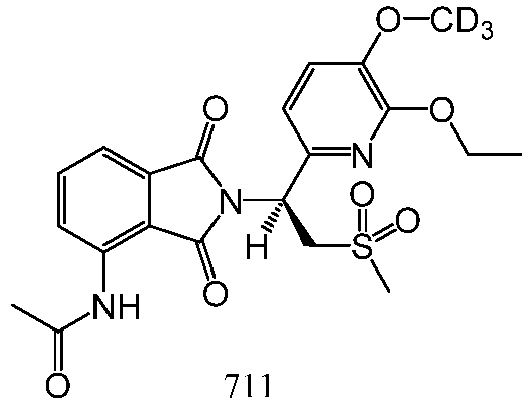
- 1H NMR (400 MHz, DMSO-d 6) δ 9.72 (s, 1H), 8.47 (d, J = 8.4 Hz, 1H), 7.82 (t, J = 8.4 Hz , 1H), 7.60 (d, J = 7.2 Hz, 1H), 7.27 (d, J = 8.0 Hz, 1H), 7.02 (d, J = 8.4 Hz, 1H), 5.81 (dd, J = 10.4, 3.6 Hz, 1H), 4.32 (dd, J = 14.4, 3.6 Hz, 1H), 4.22-4.15 (m, 3H), 3.09 (s, 3H), 2.18 (s, 3H), 1.17 (t, J = 7.2 Hz, 3H). LCMS: ([M+H]+). = 465.0. ee% = 98.3%
- Compound 710 can be synthesized according to the method of compound 712 in Example 20, except the corresponding substrate 712-A was used instead of compound 712-A1.
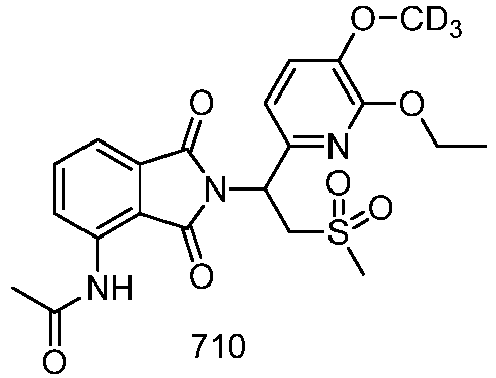
- Compound 719 was synthesized according to the method of compound 712 in Example 20, except the corresponding substrate 101-E (N-(7-fluoro-1,3-dioxo-1,3-dihydroisobenzofuran-4 -yl)acetamide) was used instead of N-(1,3-dioxo-1,3-dihydroisobenzofuran-4-yl)acetamide.
- Compound 718 was synthesized according to the method of compound 712 in Example 20, except the corresponding substrate 101-E was used instead of N-(1,3-dioxo-1,3-dihydroisobenzofuran-4-yl)acetamide and the corresponding substrate 712-A2 ((S)-1-(6-ethoxy -5-d3 -methoxypyridin-2-yl)-2-(methylsulfonyl)ethanamine) was used instead of 712-A1 ((R)-1-(6-ethoxy-5-d3 -methoxypyridin-2-yl)-2-(methylsulfonyl) ethanamine)).

- 1H NMR (400 MHz, DMSO-d 6) δ 9.76 (s, 1H), 8.45 (dd, J = 9.2, 3.6Hz, 1H), 7.69 (t, J = 9.2 Hz, 1H), 7.27 (d, J = 7.6 Hz, 1H), 7.05 (d, J = 8.0 Hz, 1H), 5.79 (dd, J = 10.8, 3.6 Hz, 1H), 4.35-4.31 (m, 1H), 4.23-4.12 (m, 3H), 3.10 (s, 3H), 2.16 (s, 3H), 1.20 (t, J = 7.2 Hz, 3H).
LCMS: ([M+H]+) = 483.0. ee% = 99.6%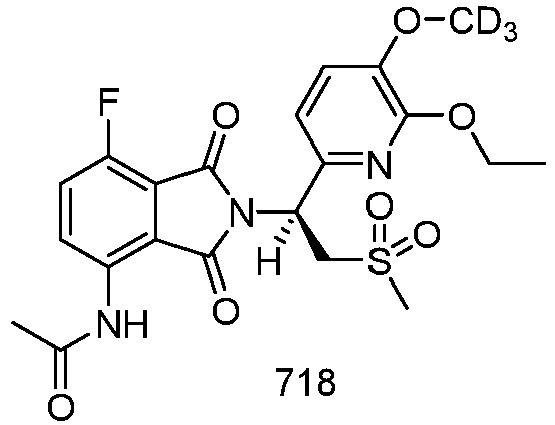
- 1H NMR (400 MHz, DMSO-d 6) δ 9.76 (s, 1H), 8.45 (dd, J = 9.2, 3.6 Hz, 1H), 7.69 (t, J = 9.2 Hz, 1H), 7.27 (d, J = 8.0 Hz, 1H), 7.05 (d, J = 8.0 Hz, 1H), 5.79 (dd, J = 10.8, 4.0 Hz, 1H), 4.33 (dd, J = 14.8, 4.0 Hz, 1H), 4.23-4.13 (m, 3H), 3.10 (s, 3H), 2.16 (s, 3H), 1.20 (t, J = 6.8 Hz, 3H). LCMS: ([M+H]+) = 482.9. ee% = 98.5%
- Compound 716 can be synthesized according to the method of compound 712 in Example 20, except the corresponding substrate 101-E (N-(7-fluoro-1,3-dioxo-1,3-dihydroisobenzofuran -4-yl)acetamide) was used instead of N-(1,3-dioxo-1,3-dihydroisobenzofuran-4-yl)acetamide and the corresponding substrate 712-A (1-(6-ethoxy-5-d3 -methoxypyridin-2-yl)-2-(methyl sulfonyl)ethanamine) was used instead of 712-A1 ((R)-1-(6-ethoxy-5-d3 -methoxypyridin-2-yl) -2-(methylsulfonyl) ethanamine)).
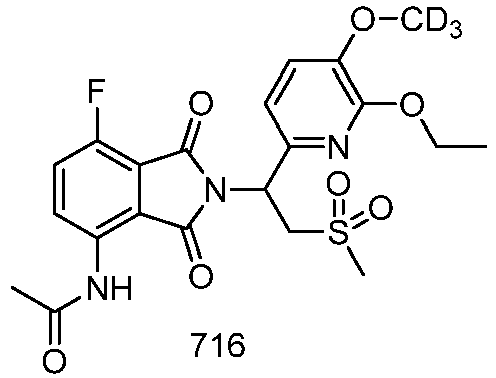
- Compound 725 was synthesized according to the method of compound 712 in Example 20, except the corresponding subtrate 201-C (N-(6-fluoro-1,3-dioxo-1,3-dihydroisobenzofuran -4-yl)acetamide) was used instead of N-(1,3-dioxo-1,3-dihydroisobenzofuran-4-yl) acetamide.
- Compound 724 was synthesized according to the method of compound 712 in Example 20, except the corresponding subtrate 201-C (N-(6-fluoro-1,3-dioxo-1,3-dihydroisobenzofuran -4-yl)acetamide) was used instead of N-(1,3-dioxo-1,3-dihydroisobenzofuran-4-yl) acetamide and the corresponding subtrate 712-A2 ((S)-1-(6-ethoxy-5-d3 -methoxypyridin-2-yl)-2-(methylsulfonyl)ethanamine) was used instead of 712-A1 ((R)-1-(6-ethoxy-5-d3 -methoxy pyridin-2-yl)-2-(methylsulfonyl) ethanamine).

- 1H NMR (400 MHz, DMSO-d 6) δ 9.79 (s, 1H), 8.29 (dd, J = 12.0, 2.0 Hz, 1H), 7.53 (dd, J = 6.8, 2.4 Hz, 1H), 7.27 (d, J = 8.0 Hz, 1H), 7.03 (d, J = 8.4 Hz, 1H), 5.80 (dd, J = 10.8, 3.6 Hz, 1H), 4.33 (dd, J = 14.8, 4.0 Hz, 1H), 4.21-4.14 (m, 3H), 3.09 (s, 3H), 2.21 (s, 3H), 1.19 (t, J = 7.2 Hz, 3H). LCMS: ([M+H]+) = 483.0. ee% = 100%
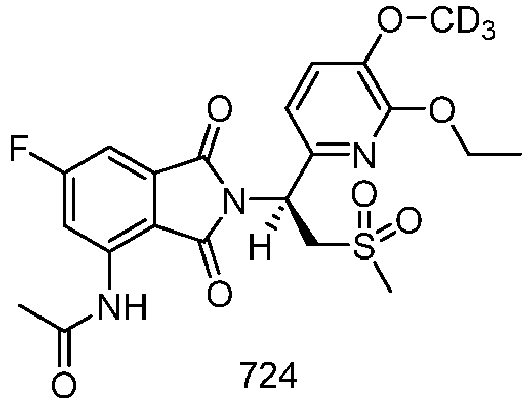
- 1H NMR (400 MHz, DMSO-d 6) δ 9.79 (s, 1H), 8.31-8.27 (m, 1H), 7.53 (dd, J = 6.8, 2.4 Hz, 1H), 7.27 (d, J = 8.4 Hz, 1H), 7.03 (d, J = 8.0 Hz, 1H), 5.80 (dd, J = 10.8, 3.6 Hz, 1H), 4.33 (dd, J = 14.4, 3.6 Hz, 1H), 4.21-4.14 (m, 3H), 3.10 (s, 3H), 2.21 (s, 3H), 1.19 (t, J = 7.2 Hz, 3H). LCMS: ([M+H]+) = 483.2. ee% = 98.4%
- Compound 722 can be synthesized according to the method of compound 712 in Example 20, except the corresponding subtrate 201-C (N-(6-fluoro-1,3-dioxo-1,3-dihydroisobenzofuran -4-yl)acetamide) was used instead of N-(1,3-dioxo-1,3-dihydroisobenzofuran-4-yl) acetamide and the corresponding subtrate 712-A (1-(6-ethoxy-5-d 3-methoxypyridin-2-yl)-2-(methylsulfonyl)ethanamine) was used instead of 712-A1 ((R)-1-(6-ethoxy-5-d 3-methoxy pyridin-2-yl)-2-(methylsulfonyl) ethanamine).

-

- To a mixture of HNO3 and H2SO4 (20 mL:50 mL) was added compound 111-A (3-chloro phthalic anhydride, CAS number 117-21-5, 25.0 g, 137 mmol) in small portions at 0 °C. The mixture was stirred at 25 °C for 12 hours, then cooled to 0 °C, followed by the addition of crushed ice. The solid was filtered and dried to afford compound 111-B (3-chloro-6-nitro phthalic acid, 21.0 g, 63% yield) as a white solid.
1H NMR (400 MHz, DMSO-d 6): δ 14.34 (br s, 2H), 8.17 (d, J = 8.8 Hz, 1H), 7.93 (d, J = 8.8 Hz, 1H). - To a solution of 111-B (3-chloro-6-nitrophthalic acid, 1.0 g, 4.08 mmol) in EtOH (130 mL) was added Raney Ni (1 g) under N2 protection. The mixture was purged with H2 and stirred under H2 balloon pressure for 5 hours at 25 °C. The reaction mixture was filtered through a celite pad under N2 protection and the cake was washed with EtOH and the filtrate was concentrated to afford compound 111-C (3-amino-6-chlorophthalic acid, 0.75 g, 85%) as a pale green solid.
1HNMR (400 MHz, DMSO-d 6): δ 7.35-7.14 (m, 1H), 6.86-6.67 (m, 1H). - A mixture of 111- C (3-amino-6-chlorophthalic acid, 0.75 g, 3.49 mmol) in Ac2O (10 mL) was stirred at 120 °C for overnight. The reaction solution was concentrated through rotary evaporator then the precipitated solid was filtered and washed with Petrol Ether to give the product 111-D (N-(7-chloro-1,3-dioxo-1,3-dihydroisobenzofuran-4-yl)acetamide) as pale yellow solid.
1H NMR (300 MHz, DMSO-d 6) δ 9.86 (s, 1H), 8.38 (d, J = 8.7 Hz, 1H), 7.93 (d, J = 9.0 Hz, 1H). - A mixture of 111- D (N-(7-chloro-1,3-dioxo-1,3-dihydroisobenzofuran-4-yl)acetamide, 100 mg, 0.418 mmol) and 102-B ((S)-1-(3-ethoxy-4-methoxyphenyl)-2-(methylsulfonyl) ethanamine, 115 mg, 0.418 mmol) in AcOH (2 mL) was stirred at 80 °C for 16 hours. The mixture was cooled then a solid precipitated. The solid was filtered and washed with EtOAc, n-hexane, dried in vacuo to give Reference Compound 111 ((S)-N-(7-chloro-2-(1-(3-ethoxy-4-methoxyphenyl)-2-(methylsulfonyl)ethyl)-1,3-dioxoisoindolin-4-yl)acetamide, 155 mg, 75% yield).
1H NMR (400 MHz, DMSO-d 6) δ 9.77 (s, 1H), 8.46 (d, J = 9.2 Hz, 1H), 7.80 (d, J = 9.2 Hz, 1H), 7.07 (d, J = 1.2 Hz, 1H), 7.01-6.93 (m, 2H), 5.78 (dd, J = 10.0, 4.4 Hz, 1H), 4.35-4.29 (m, 1H), 4.20-4.16 (m, 1H), 4.03 (q, J = 6.8 Hz, 2H), 3.74 (s, 3H), 3.03 (s, 3H), 2.20 (s, 3H), 1.33 (t, J = 6.8 Hz, 3H). LCMS: [(M-H)]- = 493.1. ee% = 100%. - Reference Compound 112 can be prepared according to the method of Reference Compound 111, except the corresponding substrate 1-(3-ethoxy-4-methoxyphenyl)-2-(methylsulfonyl)ethanamine was used instead of 102-B ((S)-1-(3-ethoxy-4-methoxyphenyl)-2-(methylsulfonyl)ethanamine).

- Reference Compound 113 can be prepared according to the method of Reference Compound 111, except the corresponding substrate 103-E ((S)-1-(3-ethoxy-4-d3 -methoxyphenyl)-2-(methylsulfonyl)ethanamine) was used instead of 102-B ((S)-1-(3-ethoxy-4-methoxyphenyl)-2-(methylsulfonyl)ethanamine).
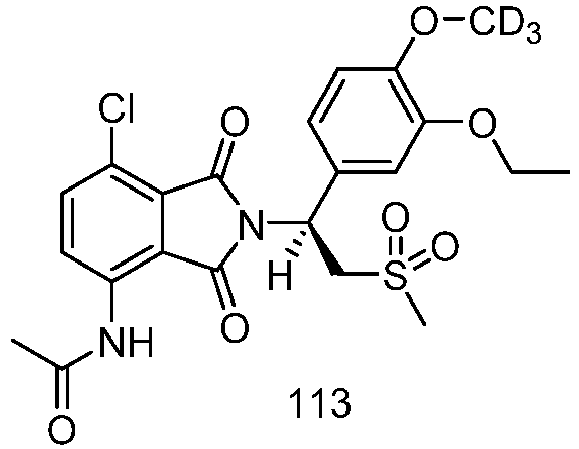
- 1H NMR (400 MHz, DMSO-d 6) δ 9.77 (s, 1H), 8.46 (d, J = 9.2 Hz, 1H), 7.80 (d, J = 9.2 Hz, 1H), 7.06 (s, 1H), 7.01-6.93 (m, 2H), 5.78 (dd, J = 10.0 Hz, 4.4 Hz, 1H), 4.32-4.28 (m, 1H), 4.20-4.15 (m, 1H), 4.02 (q, J = 6.8 Hz, 2H), 3.02 (s, 3H), 2.20 (s, 3H), 1.32 (t, J = 6.8 Hz, 3H). LCMS: [(M-H)]- = 496.1. ee% = 99.5%.
- Reference Compound 114 can be prepared according to the method of Reference Compound 111, except the corresponding substrate 103-D (1-(3-ethoxy-4-d 3-methoxyphenyl)-2-(methylsulfonyl)ethanamine) was used instead of 102-B ((S)-1-(3-ethoxy-4-methoxyphenyl)-2-(methylsulfonyl)ethanamine).
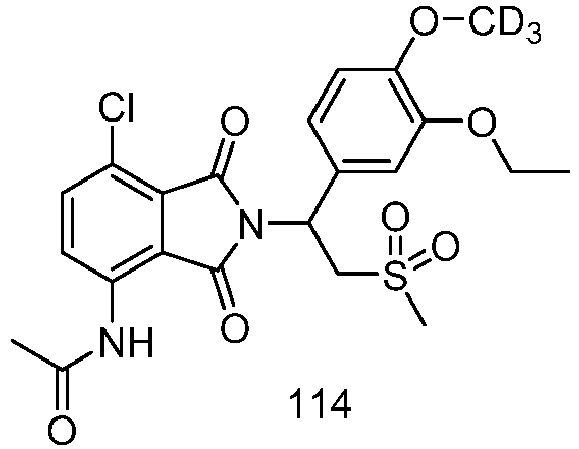
- Compound 728 was synthesized according to the method of compound 111 in example 24, except the corresponding substrate 701-F (1-(6-ethoxy-5-methoxypyridin-2-yl)-2-(methylsulfonyl)ethanamine) was used instead of 102-B ((S)-1-(3-ethoxy-4-methoxyphenyl)-2-(methylsulfonyl) ethanamine).

- 1H NMR (400 MHz, DMSO-d 6) δ 9.79 (s, 1H), 8.49 (d, J = 9.2 Hz, 1H), 7.84 (d, J = 8.8 Hz, 1H), 7.28 (d, J = 8.0 Hz, 1H), 7.06 (d, J = 8.0 Hz, 1H), 5.81 (dd, J = 10.4, 3.2 Hz, 1H), 4.36-4.32 (m, 1H), 4.23-4.17 (m, 3H), 3.77 (s, 3H), 3.10 (s, 3H), 2.19 (s, 3H), 1.19 (t, J = 6.8 Hz, 3H). LCMS: [(M-H)]- = 496.2.
- Compound 729 and 730 were synthesized according to the method of compound 111 in example 24, except the corresponding substrate 701-F2 ((S)-1-(6-ethoxy-5-methoxypyridin -2-yl)-2-(methylsulfonyl)ethanamine) or 701-F1 ((R)-1-(6-ethoxy-5-methoxypyridin-2-yl)-2-(methylsulfonyl)ethanamine) was used instead of 102-B ((S)-1-(3-ethoxy-4-methoxyphenyl) -2-(methylsulfonyl)ethanamine) respectively.

-
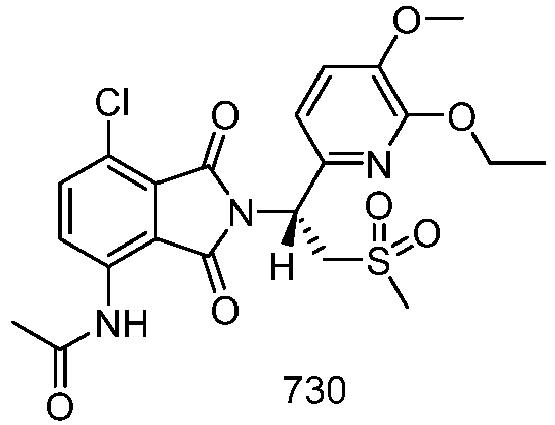
-

- To a mixture of 728 (N-(7-chloro-2-(1-(6-ethoxy-5-methoxypyridin-2-yl)-2-(methyl sulfonyl)ethyl)-1,3-dioxoisoindolin-4-yl)acetamide, 150 mg, 0.303 mmol), Zn(CN)2(222 mg, 1.90 mmol), Zn powder (100 mg, 1.54 mmol), and dppf (76 mg, 0.137 mmol) in DMA (3 mL) was added Pd2(dba)3 (105 mg, 0.115 mmol). The mixture was purged with N2 and stirred at 140 oC for 2 hours under microwave irradiation then cooled and filtered. The filtrate was concentrated to gave crude product, which was purified by column chromatography on silica gel (EtOAc : petroleum ether = 2/1) to afford the crude compound which was further purified by prep-HPLC to give compound 731 (N-(7-cyano-2-(1-(6-ethoxy-5-methoxypyridin-2-yl)-2-(methylsulfonyl)ethyl)-1,3-dioxoisoindolin-4-yl)acetamide, 62.0 mg, 42% yield).
1H NMR (400 MHz, DMSO-d 6) δ 9.93 (s, 1H), 8.64 (d, J = 8.8 Hz, 1H), 8.23 (d, J = 8.8 Hz, 1H), 7.28 (d, J = 8.0 Hz, 1H), 7.09 (d, J = 8.0 Hz, 1H), 5.83 (dd, J = 10.4, 3.6 Hz, 1H), 4.38-4.34 (m, 1H), 4.25-4.16 (m, 3H), 3.77 (s, 3H), 3.11 (s, 3H), 2.24 (s, 3H), 1.21 (t, J = 7.2 Hz, 3H). LCMS: [(M+H)]+ = 487.2 - Compound 729 was converted into compound 732 according to the method of compound 731 in Example 27.

- 1H NMR (400 MHz, DMSO-d 6) δ 9.93 (s, 1H), 8.65 (d, J = 8.8 Hz, 1H), 8.23 (d, J = 8.8 Hz, 1H), 7.28 (d, J = 8.0 Hz, 1H), 7.09 (d, J = 8.0 Hz, 1H), 5.83 (dd, J = 10.8 Hz, 4.0 Hz, 1H), 4.35-4.34 (m, 1H), 4.25-4.17 (m, 3H), 3.77 (s, 3H), 3.11 (s, 3H), 2.24 (s, 3H), 1.21 (t, J = 6.8 Hz, 3H) . LCMS: [(M+H)]+ = 487.2. ee%: 100%.
- Compound 733 was converted from compound 730 according to the method of compound 731 in Example 27.

- Reference Compound 111 was converted into Reference Compound 115 according to the method of compound 731 in Example 27.

- 1H NMR (400 MHz, DMSO-d 6) δ 9.91 (s, 1H), 8.62 (dd, J = 8.8, 3.2 Hz, 1H), 8.19 (d, J = 8.4 Hz, 1H), 7.08 (d, J = 1.6 Hz, 1H), 7.03 (dd, J = 8.4, 1.6 Hz, 1H), 6.95 (d, J = 8.8 Hz, 1H), 5.79 (dd, J = 10.0, 4.8 Hz, 1H), 4.33-4.18 (m, 2H), 4.03 (q, J = 6.8 Hz, 2H), 3.74 (s, 3H), 3.02 (s, 3H), 2.25 (s, 3H), 1.33 (t, J = 7.2 Hz, 3H). LCMS: [M+NH4 +] = 503.0. ee%: 100%.
- Reference Compound 116 was converted from Reference Compound 112 according to the method of compound 731 in Example 27.

-

- To a mixture of compound 734-A (5-bromo-2-methyl-3-nitrobenzoic acid, CAS number 107650-20-4, 16.0 g, 0.062 mol) in H2O (240 mL) was added NaOH (4.92 g, 0.122 mol). The mixture was heated to 80 °C then KMnO4 (39 g, 0.123 mol) was added in portions during 3 hours. Then the mixture was stirred for 30 minutes. The reaction solution was filtered and the cake was washed with hot water (200 mL).The filtrate was adjusted with 2N HCl to pH = 1, extracted with EtOAc (300 mL x 3), the combined organic layers was dried over Na2SO4 and concentrated in vacuum to give compound 734-B (5-bromo-3-nitrophthalic acid, 9.0 g, yield:51%) as yellow solid.
1H NMR (300 MHz, DMSO) δ 14.0 (br s, 1H), 8.52 (s, 1H), 8.33 (s, 1H). - To a solution of 734-B (5-bromo-3-nitrophthalic acid, 5.0 g, 17.24 mmol) in EtOH (150 mL) was added Raney Ni (5 g) under N2 atmosphere. The mixture was purged with H2 and stirred under H2 balloon pressure for 7 hours at 25 °C. The reaction mixture was filtered through a celite pad and the cake was washed with EtOH. The filtrate was concentrated to dryness to afford compound 734-C (3-amino-5-bromophthalic acid, 5.0 g, crude) as a pale green solid.
1HNMR (300 MHz, DMSO-d 6): δ 7.02-7.01 (m, 1H), 6.79-6.77 (m, 1H), 1.03 (br s, 2H). - A mixture of 734-C (3-amino-5-bromophthalic acid, 5.0 g) in Ac2O (50 mL) was stirred at 120 °C for overnight. The reaction solution was concentrated through rotary evaporator and the solid precipitated then filtered and washed the solid with EtOAc to give the product 734-D (N-(6-bromo-1,3-dioxo-1,3-dihydroisobenzofuran-4-yl)acetamide, 2.1 g, yield:38%) as pale yellow solid.
1H NMR (300 MHz, DMSO-d 6) δ 9.90 (s, 1H), 8.63 (s, 1H), 8.00 (s, 1H), 2.98 (s, 3H), 2.22 (s, 3H). - A mixture of compound 734-D (N-(6-fluoro-1,3-dioxo-1,3-dihydroisobenzofuran-4-yl) acetamide, 500 mg, 1.767 mmol) and 701-F2 ((S)-1-(6-ethoxy-5-methoxypyridin-2-yl)-2-(methylsulfonyl)ethanamine, 484 mg, 1.767 mmol) in AcOH (5 mL) was stirred at 80 °C for 2 hours. Then H2O (30 mL) was added and the mixture was extracted with EtOAc (30 mL x 2). The organic layers was washed with brine, dried over Na2SO4 and concentrated to give a crude product, which was purified by column chromatography on silica gel (PE: EtOAc = 1:1) to afford 734-F ((S)-N-(6-bromo-2-(1-(6-ethoxy-5-methoxypyridin-2-yl)-2-(methylsulfonyl)ethyl) -1,3-dioxoisoindolin-4-yl)acetamide, 0.9 g, yield: 95%) as a white solid.
1H NMR (400 MHz, DMSO-d 6) δ 9.77 (s, 1H), 8.69 (d, J = 1.2 Hz, 1H), 7.81 (d, J = 1.2 Hz, 1H), 7.27 (d, J = 8.4 Hz, 1H), 7.03 (d, J = 8.0 Hz, 1H), 5.79 (m, 1H), 4.31-4.30 (m, 1H), 4.20-4.16 (m, 3H), 3.76 (s, 3H), 3.09 (s, 3H), 2.20 (s, 3H), 1.19 (t, J = 7.2 Hz, 3H). - To a degassed mixture of 734-F ((S)-N-(6-bromo-2-(1-(6-ethoxy-5-methoxypyridin -2-yl)-2-(methylsulfonyl)ethyl)-1,3-dioxoisoindolin-4-yl)acetamide, 450 mg, 0.833 mmol), Zn(CN)2 (292 mg, 2.50 mmol), and dppf (185 mg, 0.333 mmol) in DMA (8 mL) was added Pd2(dba)3 (305 mg, 0.333 mmol). The mixture was purged with N2 and stirred at 110 °C for 1 hour under microwave irradiation. The reaction mixture was cooled, filtered and the filtrate was concentrated to give crude product, which was purified by column chromatography on silica gel (EtOAc:petroleum ether = 1:1) to afford the crude compound which was further purified by Prep-HPLC to give 734 ((S)-N-(6-cyano-2-(1-(6-ethoxy-5-methoxypyridin-2-yl) -2-(methylsulfonyl)ethyl)-1,3-dioxoisoindolin-4-yl)acetamide, 220.0 mg, 54% yield) as yellow solid.
1H NMR (400 MHz, DMSO-d 6) δ 9.94 (d, J = 0.8 Hz, 1H), 8.14 (d, J = 1.2 Hz, 1H), 7.27 (d, J = 8.0 Hz, 1H), 7.06 (d, J = 8.0 Hz, 1H), 5.83 (dd, J = 10.8, 3.6 Hz, 1H), 4.35 (dd, J = 14.4, 3.6 Hz, 1H), 4.22-4.16 (m, 3H), 3.77 (s, 3H), 3.10 (s, 3H), 2.22 (s, 3H), 1.20 (t, J = 7.2 Hz, 3H). LCMS (ESI) [M+H]+ = 486.9. - Compounds 735 and 736 can be synthesized according to the method compound 734, except the corresponding substrate 701-F1 ((R)-1-(6-ethoxy-5-methoxypyridin-2-yl)-2-(methyl sulfonyl)ethanamine) and 701-F (1-( 6-ethoxy-5-methoxypyridin-2-yl)-2-(methylsulfonyl) ethanamine) were used instead of 701-F2 respectively.

-

-

- To the mixture of 701-F (5g, 18.2mmol) in DMF(300mL) was added 737-B (3-nitro phthalic acid, CAS number 603-11-2, 3.85g, 18.2mmol), HATU (15.2g, 40mmol) and DIEA (8.23g, 63.7mmol) and the mixture was stirred at room temperature for overnight. The reaction was added H2O(150ml) and stirred for 15 minutes, then extracted with EtOAc (400 mL) and the organic phase was washed with brine (300 mL*2), dried over Na2SO4, filtered and concentrated to give the crude product which was purified by column chromatography with PE:EA (2:1∼1:1) to give 737-C (4.5g, yield:55%) as yellow solid.
1H NMR (300 MHz, DMSO) δ 8.35 (d, J = 8.4 Hz, 1H), 8.24 (d, J = 7.8 Hz, 1H), 8.11 (t, J = 8.1 Hz, 1H), 7.27 (d, J = 7.5 Hz, 1H), 7.08 (d, J = 7.5 Hz, 1H), 5.89-5.80 (m, 1H), 4.39-4.31 (m, 1H), 4.22-4.12 (m, 3H), 3.76 (s, 3H), 3.09 (s, 3H), 1.18 (t, J = 7.2 Hz, 3H). - A mixture of 737- C (4.5g, 0.01mmol) in Ethyl Acetate (200ml) was added 20%Pd/C (800mg) and stirred at room temperature for 7 hours under H2(50 psi) atomosphere. The mixture was filtered and concentrated to give 737-D (4.09g, yield:97%) as yellow solid.
1H NMR (300 MHz, DMSO) δ 7.45 (t, J = 7.5 Hz, 1H), 7.26 (d, J = 8.1 Hz, 1H), 7.04 - 6.90 (m, 3H), 6.49 (s, 2H), 5.79-5.71 (m, 1H), 4.25-4.16 (m, 4H), 3.76 (s, 3H), 3.08 (s, 3H), 1.20 (t, J = 6.9 Hz, 3H). - To a solution of 737-D (4-amino-2-(1-(6-ethoxy-5-methoxypyridin-2-yl)-2-(methyl sulfonyl)ethyl)isoindoline-1,3-dione, 500mg, 1.19 mmol) in THF (15 mL) was added Et3N (606 mg, 6 mmol), MsCl (187mg, 1.79mmol) and DMAP (290 mg, 2.38 mmol). The mixture was stirred at 75 °C for 16 hours. The mixture was concentrated and extracted with EtOAc (30 mL), washed with 1N HCl, brine, dried over Na2SO4, concentrated to give crude, then purified by column chromatography on silica gel (PE: EtOAc 1:1) and Pre-HPLC to afford 350 mg of a mixture of 737-E (N-(2-(1-( 6-ethoxy-5-methoxypyridin-2-yl)-2-(methylsulfonyl)ethyl)-1,3-dioxoisoindolin-4-yl)-N-(methylsulfonyl)methanesulfonamide) and (N-(2-(1-(6-ethoxy-5-methoxypyridin-2-yl)-2-(methylsulfonyl)ethyl)-1,3-dioxoisoindolin-4-yl)methanesulfonamide) as yellow solid.
- A solution of 737-E (300 mg) in CH3CN was added NaOH solution(2N, 0.6 mL), the mixture was stirred at 25 °C for 1 hour. Then the mixture was adjusted to pH = 8 with HCl (IN), extracted with EtOAc, dried over Na2SO4, and the filtration was concentrated to give crude which was purified by Prep-HPLC to afford compound 737 (N-(2-(1-(6-ethoxy-5-methoxypyridin-2-yl)-2-(methylsulfonyl)ethyl)-1,3-dioxoisoindolin-4-yl)methanesulfonamide, 103 mg, 20% for 2 steps).
1H NMR (400 MHz, DMSO-d 6) δ 9.33 (s, 1H), 7.86-7.78 (m, 2H), 7.63 (d, J = 6.8 Hz, 1H), 7.27 (d, J = 8.0 Hz, 1H), 7.02 (d, J = 8.4 Hz, 1H), 5.80 (dd, J = 10.0, 3.6 Hz, 1H), 4.34-4.29 (m, 1H), 4.22-4.16 (m, 3H), 3.76 (s, 3H), 3.28 (s, 3H), 3.09 (s, 3H), 1.18 (t, J = 7.2 Hz, 3H), LCMS (ESI) [M+H]+ = 498.1. - Compound 737-D2 was synthesized according to the method of compound 737-D, except compound 701-F2 ((S)-1-( 6-ethoxy-5-methoxypyridin-2-yl)-2-(methylsulfonyl)ethanamine) was used instead of 701-F.
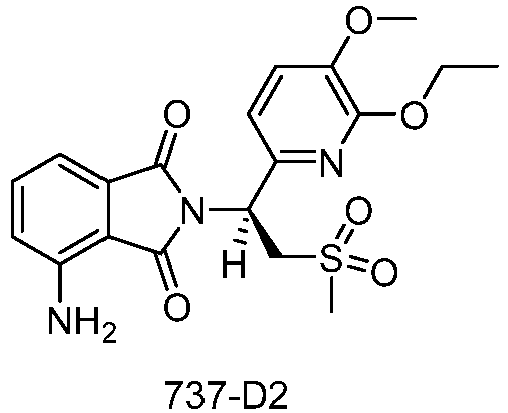
- 1H NMR (300 MHz, DMSO-d6) δ 7.48-7.43 (m, 1H), 7.27-7.24 (m, 1H), 7.02-6.92 (m, 3H), 6.49 (s, 2H), 5.77-5.73 (m, 1H), 4.24-4.19 (m, 4H), 3.76 (s, 3H), 3.07 (s, 3H), 1.23-1.17 (m, 3H).
- Compound 737-D1 can be synthesized according to the method of compound 737-D, except compound 701-F1 ((R)-1-(6-ethoxy-5-methoxypyridin-2-yl)-2-(methylsulfonyl) ethanamine) was used instead of 701-F.

- Compound 738 can be synthesized according to the method of compound 737, except compound 737-D2 was used instead of 737-D.

-

- A solution of 737-D (4-amino-2-(1-(6-ethoxy-5-methoxypyridin-2-yl)-2-(methylsulfonyl) ethyl)isoindoline-1,3-dione, 479 mg, 1.143 mmol) in DCM (20 mL) cooled to 0°C was added 742-A (2-(benzyloxy)acetyl chloride, CAS number 19810-31-2, 1.26 g, 6.86 mmol) and DIEA(1.28 g, 9.94 mmol), then the mixture was stirred at 0°C for 1 hour. Then the mixture was concentrated and purified with column chromatography on silica gel (PE:EtOAc =3:1-2:1) to give the product (625 mg, yield:96%) as yellow solid. 125 mg of the product was purified by prep-HPLC to afford 742 (2-(benzyloxy)-N-(2-(1-(6-ethoxy-5-methoxypyridin-2-yl)-2-(methyl sulfonyl)ethyl)-1,3-dioxoisoindolin-4-yl)acetamide, 53 mg).
1H NMR (400 MHz, DMSO-d 6) δ 10.42 (s, 1H), 8.71 (d, J = 8.4 Hz, 1H), 7.86 (t, J = 8.0 Hz, 1H), 7.62 (d, J = 7.2 Hz, 1H), 7.46 (d, J = 6.4 Hz, 2H), 7.35-7.27 (m, 3H), 7.05 (d, J = 8.0 Hz, 1H), 5.83 (dd, J = 10.8, 3.6 Hz, 1H), 4.69 (s, 2H), 4.36-4.32 (m, 1H), 4.20-4.16 (m, 5H), 3.76 (s, 3H), 3.10 (s, 3H), 1.17 (t, J = 7.2 Hz, 3H). LCMS: [M+H]+ = 568.0. - Compounds 743 and 744 can be synthesized according to the method of compound 742, except compounds 737-D2 and 737-D1 were used instead of 737-D respectively.

-
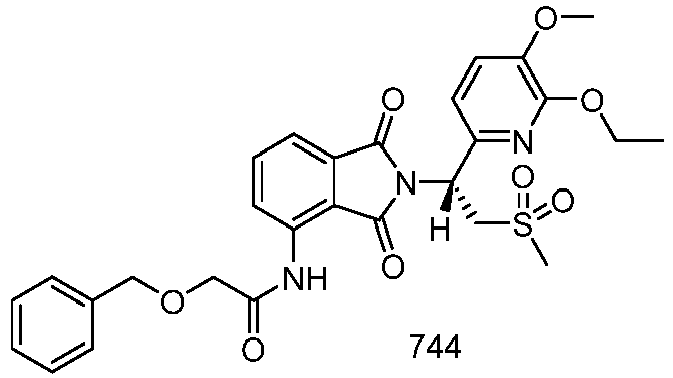
-

- A mixture of 742 (2-(benzyloxy)-N-(2-(1-(6-ethoxy-5-methoxypyridin-2-yl)-2-(methyl sulfonyl)ethyl)-1,3-dioxoisoindolin-4-yl)acetamide, 500 mg, 0.88 mmol) in DMF(50 mL) was added Pd/C (20%, 50% wet, 50 mg) and stirred at 25 °C for 12 hours under H2 (50 psi). The mixture was filtered and concentrated and purified by Prep-HPLC to give 739 (N-(2-(1-(6-ethoxy-5-methoxypyridin-2-yl)-2-(methylsulfonyl)ethyl)-1,3-dioxoisoindolin-4-yl) -2-hydroxyacetamide,160mg, yield: 32%).
1H NMR (400 MHz, DMSO-d 6) δ 10.63 (s, 1H), 8.78 (d, J = 8.4 Hz, 1H), 7.86 (t, J = 8.4 Hz, 1H), 7.61 (d, J = 7.2 Hz, 1H), 7.27 (d, J = 8.4 Hz, 1H), 7.04 (d, J = 8.0 Hz, 1H), 6.34 (t, J = 5.6 Hz, 1H), 5.82 (dd, J = 10.8, 3.6 Hz, 1H), 4.35-4.31 (m, 1H), 4.22-4.16 (m, 3H), 4.07 (d, J = 5.6 Hz, 2H), 3.76 (s, 3H), 3.10 (s, 3H), 1.17 (t, J = 7.2 Hz, 3H). LCMS: [M+H]+ = 478.2. - Compounds 740 and 741 can be prepared from compounds 743 and 744 respectively according to the method of compound 739.

-

-

- A solution of 737-D (4-amino-2-(1-(6-ethoxy-5-methoxypyridin-2-yl)-2-(methylsulfonyl) ethyl)isoindoline-1,3-dione, 100 mg, 0.238 mmol) in DMF (10 mL) cooled to 0 °C was added 2-methoxyacetyl chloride (CAS number 38870-89-2, 148 mg, 1.367 mmol) and DMAP (45.8 mg, 0.357 mmol), and the mixture was stirred at 0°C for 2 hours. Then the reaction mixture was quenched with HCl (1M, 20 mL) and extracted with EtOAc (20 mL). The organic phase was concentrated and purified by Prep-HPLC to afford 748 (N-(2-(1-(6-ethoxy-5-methoxy pyridin-2-yl)-2-(methylsulfonyl)ethyl)-1,3-dioxoisoindolin-4-yl)-2-methoxyacetamide, 30mg, yield:26 %).
1HNMR (400 MHz, DMSO-d 6) δ 10.29 (s, 1H), 8.72 (d, J = 8.4 Hz, 1H), 7.86 (t, J = 8.4 Hz, 1H), 7.62 (d, J = 6.8 Hz, 1H), 7.27 (d, J = 8.0 Hz, 1H), 7.04 (d, J = 8.0 Hz, 1H), 5.81 (dd, J = 10.8, 3.6 Hz, 1H), 4.34-4.30 (m, 1H), 4.23-4.15 (m, 3H), 4.10 (s, 2H), 3.76 (s, 3H), 3.45 (s, 3H), 3.10 (s, 3H), 1.17 (t, J = 7.2 Hz, 3H). LCMS: [M+H]+ = 492.2. - Compounds 749 and 750 can be synthesized according to the method of compound 748, except compounds 737-D2 and 737-D1 were used instead of compound 737-D respectively.

-

-

- Compound 745 (N-(2-(1-(6-ethoxy-5-methoxypyridin-2-yl)-2-(methylsulfonyl)ethyl)-7-fluoro-1,3-dioxoisoindolin-4-yl)-2-methoxyacetamide) was synthesized according to the method of 748 in Example 34, except the appropriate compound 745-D was used instead of 737-D (4-amino-2-(1-(6-ethoxy-5-methoxypyridin-2-yl)-2-(methylsulfonyl)ethyl)isoindoline -1,3-dione).
1H NMR (400 MHz, DMSO-d 6) δ 10.28 (s, 1H), 8.74 (dd, J = 9.6, 4.0 Hz, 1H), 7.73 (t, J = 9.2 Hz, 1H), 7.27 (d, J = 8.0 Hz, 1H), 7.07 (d, J = 8.4 Hz, 1H), 5.80 (dd, J = 10.8, = 3.6 Hz, 1H), 4.35-4.14 (m, 4H), 4.10 (s, 2H), 3.77 (s, 3H), 3.45 (s, 3H), 3.10 (s, 3H), 1.21 (t, J = 7.2 Hz, 3H). LCMS: [M+H]+ = 510.2. - The compound 745-D (4-amino-2-(1-(6-ethoxy-5-methoxypyridin-2-yl)-2-(methyl sulfonyl)ethyl)-7-fluoroisoindoline-1,3-dione) was synthesized according to the method of compound 737-D in Example 31, except the corresponding starting material 101-A (3-fluoro-6-nitrophthalic acid) was used instead of compound 737-B (3-nitro phthalic acid).
1H NMR (300 MHz, DMSO-d 6) δ 7.35 (t, J =9.0 Hz, 1H), 7.26 (d, J = 8.1 Hz, 1H), 7.07-6.95 (m, 2H), 6.46 (br s, 2H), 5.75-5.70 (m, 1H), 4.28-4.16 (m, 4H), 3.75 (s, 3H), 3.08 (s, 3H), 2.68 (s, 3H), 1.35-1.17 (m, 3H). - Compounds 745-D2 and 745-D1 were synthesized according to the method of compound 737-D in example 31, except the corresponding starting material 101-A (3-fluoro-6-nitrophthalic acid) was used instead of compound 737-B (3-nitro phthalic acid), and compounds 701-F2 ((S)-1-(6-ethoxy-5-methoxypyridin-2-yl)-2-(methylsulfonyl)ethan amine) or 701-F1 ((R)-1-( 6-ethoxy-5-methoxypyridin-2-yl)-2-(methylsulfonyl)ethanamine) was used instead of 701-F (1-(6-ethoxy-5-methoxypyridin-2-yl)-2-(methylsulfonyl) ethanamine) respectively.
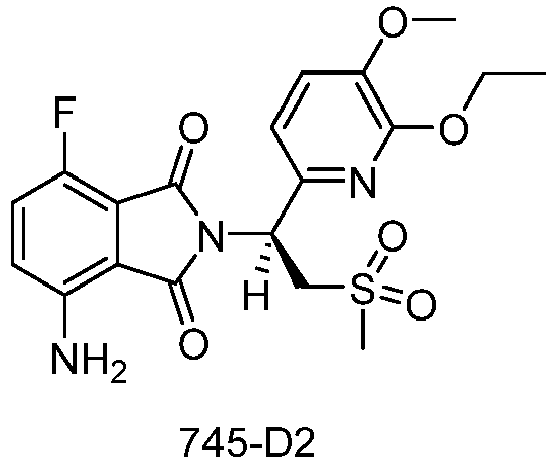
- 1H NMR (300 MHz, DMSO-d 6) δ 7.35-7.25 (m, 2H), 7.07-7.04 (m, 2H), 6.46-6.44 (m, 2H), 5.77-5.72 (m, 1H), 4.25-4.17 (m, 4H), 4.04-4.02 (m, 1H), 3.76 (s, 3H), 3.08 (s, 3H), 1.23-1.15 (m, 3H).

- Compounds 746 and 747 can be synthesized according to the method of compound 745, except compound 745-D2 or 745-D1 was used instead of compound 745-D.

-

-

- 2-(dimethylamino)acetic acid (CAS number 1118-68-9, 1.50 g, 14.56 mol) in SOCl2 (15 mL) was stirred at 75 °C for 2 hours. The reaction mixture was concentrated to give compound 751-B (2-(dimethylamino)acetyl chloride, 1.90 g, crude), which was used to the next step without further purification.
- A solution of 745-D (4-amino-2-(1-(6-ethoxy-5-methoxypyridin-2-yl)-2-(methylsulfonyl) ethyl)-7-fluoroisoindoline-1,3-dione, 300 mg, 0.68 mmol) in THF (10 mL) was added 751-B (2-(dimethylamino)acetyl chloride, 432 mg, 2.74 mmol). The mixture was stirred at 75 °C for 1 hour then cooled to 25 °C. NaHCO3 aqueous solution (30 mL) was added and the mixture was extracted with EtOAc (50 mL x 2). The organic layers was washed with brine, dried over Na2SO4, filtrered and the filtration was concentrated to give a crude product, which was purified by Prep-HPLC to afford 751 (2-(dimethylamino)-N-(2-(1-(6-ethoxy-5-methoxypyridin -2-yl)-2-(methylsulfonyl)ethyl)-7-fluoro-1,3-dioxoisoindolin-4-yl)acetamide, 120 mg, yield: 34%).
1H NMR (300 MHz, DMSO-d 6) δ 10.84 (s, 1H), 8.80-8.77 (m, 1H), 7.71 (t, J = 8.7 Hz, 1H), 7.28 (d, J = 6.9 Hz, 1H), 7.08 (d, J = 6.9 Hz, 1H), 5.83-5.79 (m, 1H), 4.31-4.20 (m, 4H), 3.77 (s, 3H), 3.18-3.11 (m, 5H), 2.32 (s, 6H), 1.20 (t, J = 6.3 Hz, 3H). LCMS: [M+H]+ = 523.2. - Compounds 752 and 753 can be synthesized according to the method of compound 751, except compound 745-D2 or 745-D1 was used respectively instead of compound 745-D.

-

- Compound 754 was synthesized according to the method of compound 751 in example 36, except corresponding substrate 737-D (4-amino-2-(1-(6-ethoxy-5-methoxypyridin-2-yl) -2-(methylsulfonyl)ethyl)isoindoline-1,3-dione) was used instead of compound 745-D.
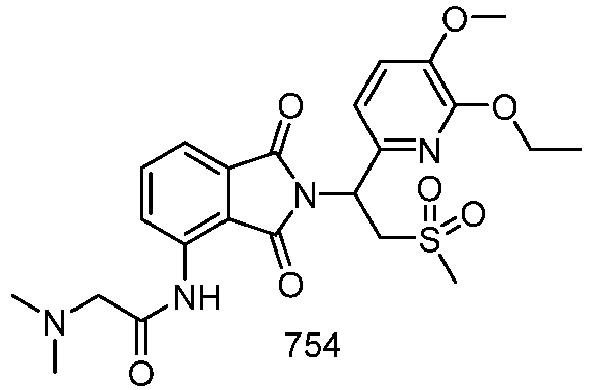
- 1H NMR (300 MHz, DMSO-d 6) δ 10.84 (s, 1H), 8.75 (d, J = 8.4 Hz, 1H), 7.86-7.82 (m, 1H), 7.59 (d, J = 6.4 Hz, 1H), 7.28 (d, J = 8.4 Hz, 1H), 7.04 (d, J = 8.4 Hz, 1H), 5.81-5.70 (m, 1H), 4.31-4.16 (m, 4H), 3.76 (s, 3H), 3.16 (s, 2H), 3.10 (s, 3H), 2.32 (s, 6H), 1.16 (t, J = 7.2 Hz, 3H). LCMS: [M+H]+ = 505.2.
- Compounds 755 and 756 can be synthesized according to the method of compound 751 in example 36, except corresponding substrate 737-D2 ((S)-4-amino-2-(1-(6-ethoxy-5-methoxy pyridin-2-yl)-2-(methylsulfonyl)ethyl)isoindoline-1,3-dione) or 737-D1 ((R)-4-amino-2-(1-(6-ethoxy-5-methoxypyridin-2-yl)-2-(methylsulfonyl)ethyl)isoindoline-1,3-dione) was used respectively instead of compound 745-D.

-

- Compound 757 was synthesized according to the method of compound 751 in example 36, except isovaleryl chloride (CAS number 108-12-3) was used instead of compound 751-B (2-(dimethylamino)acetyl chloride).

- 1H NMR (400 MHz, DMSO-d 6) δ 9.71 (s, 1H), 8.47 (dd, J = 9.2, 3.2 Hz, 1H), 7.69 (t, J = 9.2 Hz, 1H), 7.27 (d, J = 8.0 Hz, 1H), 7.05 (d, J = 8.0 Hz, 1H), 5.79 (dd, J = 10.8, 3.6 Hz, 1H), 4.33 (dd, = 14.4, 2.8 Hz, 1H), 4.22-4.13 (m, 3H), 3.77 (s, 3H), 3.10 (s, 3H), 2.33 (d, J = 6.8 Hz, 2H), 2.09-2.06 (m, 1H), 1.19 (t, J = 7.2 Hz, 3H), 0.94 (d, J = 6.8 Hz, 6H). LCMS: [M+H]+ = 522.2
- Compounds 758 and 759 can be synthesized according to the method of compound 751 in example 36, except isovaleryl chloride was used instead of compound 751-B (2-(dimethylamino)acetyl chloride) and 745-D2 ((S)-4-amino-2-(1-(6-ethoxy-5-methoxy pyridin-2-yl)-2-(methylsulfonyl)ethyl)-7-fluoroisoindoline-1,3-dione)) or 745-D1 ((R)-4-amino -2-(1-(6-ethoxy-5-methoxypyridin-2-yl)-2-(methylsulfonyl)ethyl)-7-fluoroisoindoline-1,3-dion e) was used respectively instead of compound 745-D.

-

- Compound 760 was synthesized according to the method of compound 751 in example 36, except isovaleryl chloride was used instead of compound 751-B (2-(dimethylamino)acetyl chloride) and compound 737-D (4-amino-2-(1-(6-ethoxy-5-methoxypyridin-2-yl)-2-(methyl sulfonyl)ethyl)isoindoline-1,3-dione) was used instead of 745-D (4-amino-2-(1-(6-ethoxy-5-methoxypyridin-2-yl)-2-(methylsulfonyl)ethyl)-7-fluoroisoindoline-1,3-dione).

- 1H NMR (400 MHz, DMSO-d 6) δ 9.68 (s, 1H), 8.49 (d, J = 8.4 Hz, 1H), 7.82 (t, J = 8.0 Hz, 1H), 7.60 (d, J = 7.2 Hz, 1H), 7.28 (d, J = 8.0 Hz, 1H), 7.03 (d, J = 8.4 Hz, 1H), 5.81 (dd, J = 10.8, 3.6 Hz, 1H), 4.32 (dd, J = 14.4, 3.6 Hz, 1H), 4.23-4.15 (m, 3H), 3.76 (s, 3H), 3.10 (s, 3H), 2.34 (d, J = 6.8 Hz, 2H), 2.10-2.07 (m, 1H), 1.16 (t, J = 7.2 Hz, 3H), 0.95 (d, J = 6.8 Hz, 6H). LCMS: [M+H]+ = 504.0.
- Compounds 761 and 762 can be synthesized according to the method of compound 751 in example 36, except isovaleryl chloride was used instead of compound 751-B (2-(dimethylamino)acetyl chloride) and compound 737-D2 ((S)-4-amino-2-(1-(6-ethoxy-5-methoxypyridin-2-yl)-2-(methylsulfonyl)ethyl)isoindoline-1,3-dione) or 737-D1 ((R)-4-amino -2-(1-(6-ethoxy-5-methoxypyridin-2-yl)-2-(methylsulfonyl)ethyl)isoindoline-1,3-dione) was used respectively instead of 745-D.

-

-
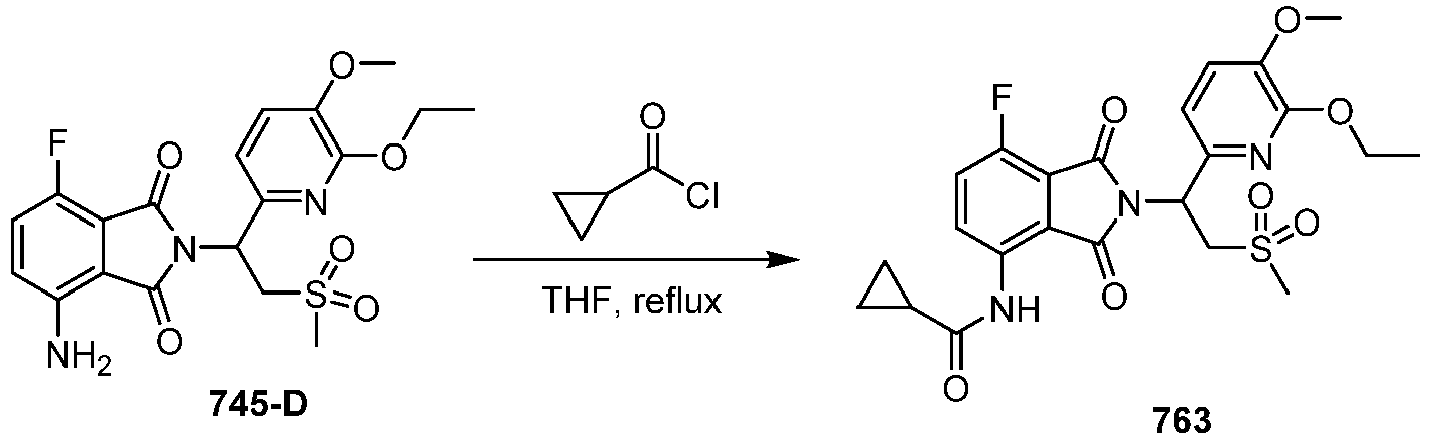
- A solution of 745-D (4-amino-2-(1-(6-ethoxy-5-methoxypyridin-2-yl)-2-(methyl sulfonyl)ethyl)-7-fluoroisoindoline-1,3-dione, 260 mg, 0.59 mmol) in THF (3mL) was added cyclopropanecarbonyl chloride (CAS number 4023-34-1, 124 mg, 1.19 mmol) and stirred at 75 °C for 1.5 hours. The mixture was concentrated and purified by Prep-HPLC to afford product 763 (119 mg, yield: 40%).
1H NMR (400 MHz, DMSO-d 6) δ 10.03 (s, 1H), 8.43-8.40 (m, 1H), 7.68 (t, J = 9.2 Hz, 1H), 7.27 (d, J = 8.4 Hz, 1H), 7.06 (d, J = 8.4 Hz, 1H), 5.80 (dd, J = 10.4, 3.6 Hz, 1H), 4.36-4.31 (m, 1H), 4.24-4.13 (m, 3H), 3.77 (s, 3H), 3.10 (s, 3H), 2.00-1.97 (m, 1H), 1.20 (t, J = 7.2 Hz, 3H), 0.87 (d, J = 5.2 Hz, 4H). LCMS: [M+H]+ = 506.2. - Compounds 764 was synthesized according to the method of compound 763 in example 40, except 745-D2 ((S)-4-amino-2-(1-( 6-ethoxy-5-methoxypyridin-2-yl)-2-(methylsulfonyl) ethyl)-7-fluoroisoindoline-1,3-dione) was used instead of 745-D.

- 1H NMR (400 MHz, DMSO-d 6) δ 10.02 (s, 1H), 8.42 (dd, J = 9.2, 4.0 Hz, 1H), 7.67 (t, J = 9.2 Hz, 1H), 7.27 (d, J = 8.0 Hz, 1H), 7.07 (d, J = 7.6 Hz, 1H), 5.82-5.80 (m, 1H), 4.32-4.31 (m, 1H), 4.24-4.18 (m, 3H), 3.77 (s, 3H), 3.10 (s, 3H), 2.07-1.96 (m, 1H), 1.20 (t, J = 7.2 Hz, 3H), 0.88-0.86 (m, 4H). LCMS: [M+H]+ = 506.2.
- Compounds 765 was synthesized according to the method of compound 763 in example 40, except 745-D1 ((R)-4-amino-2-(1-(6-ethoxy-5-methoxypyridin-2-yl)-2-(methylsulfonyl) ethyl)isoindoline-1,3-dione) was used instead of 745-D.
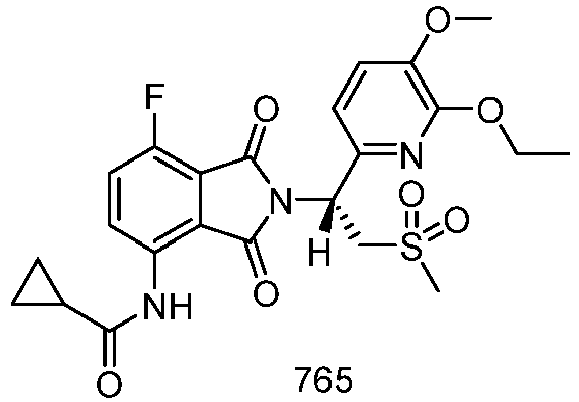
-
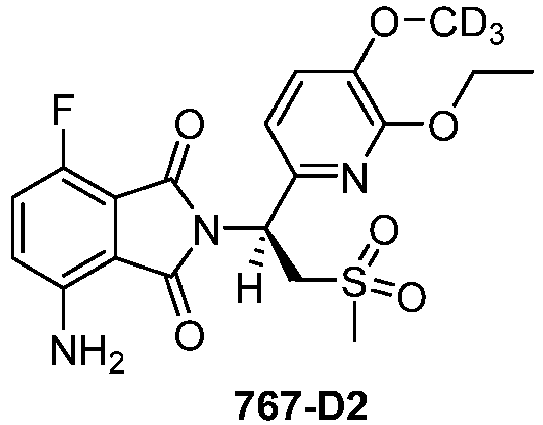
- Compound 767-D2 ((S)-4-amino-2-(1-(6-ethoxy-5-d3 -methoxypyridin-2-yl) -2-(methylsulfonyl)ethyl)-7-fluoroisoindoline-1,3-dione)) was synthesized according to the method of compound 737-D in example 31, except 712-A2 ((S)-1-(6-ethoxy-5-d3 -methoxypyridin-2-yl)-2-(methylsulfonyl)ethanamine) was used instead of compound 701-F (1-(6-ethoxy-5-methoxypyridin-2-yl)-2-(methylsulfonyl)ethanamine) and 101-A (3-fluoro-6-nitrophthalic acid) was used instead of 737-B (3-nitro phthalic acid).
1HNMR (300 MHz, DMSO-d 6) δ 7.38-7.33 (m, 1H), 7.26 (d, J = 10.5 Hz, 1H), 7.09-7.03 (m, 1H), 6.98-6.95 (m, 1H), 6.46 (s, 2H), 5.77-5.71 (m, 1H), 4.31-4.16 (m, 4H), 3.08 (s, 3H), 1.23-1.15 (m, 3H). - Compounds 767-D and 767-D1 can be synthesized according to the method of compound 737-D in example 31, except 101-A (3-fluoro-6-nitrophthalic acid) was used instead of 737-B (3-nitro phthalic acid) and 712-A (1-(6-ethoxy-5-d3 -methoxypyridin-2-yl)-2-(methylsulfonyl) ethanamine) or 712-A1 ((R)-1-(6-ethoxy-5-d3 -methoxypyridin-2-yl)-2-(methylsulfonyl)ethan amine) was used respectively instead of compound 701-F (1-(6-ethoxy-5-methoxypyridin-2-yl) -2-(methylsulfonyl)ethanamine).

-
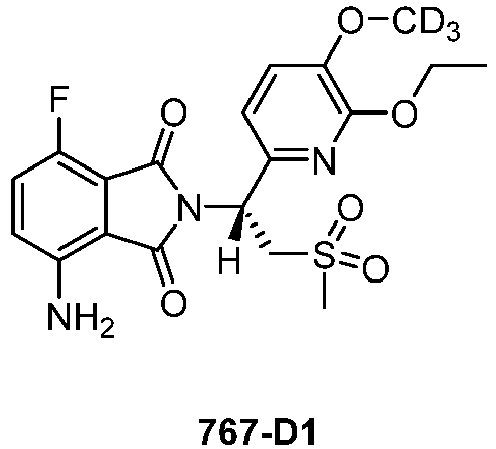
-
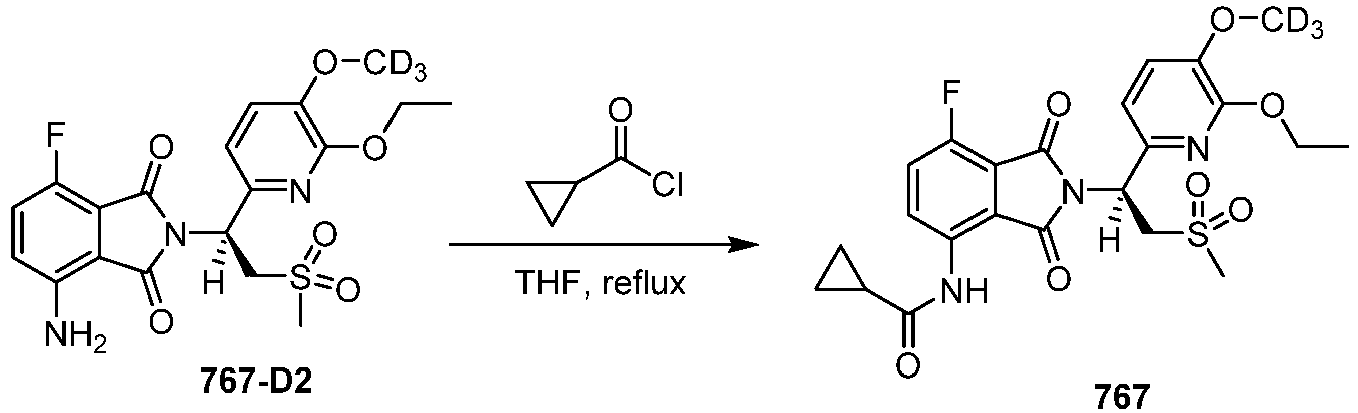
- Compound 767 ((S)-N-(2-(1-(6-ethoxy-5-d3 -methoxypyridin-2-yl)-2-(methylsulfonyl) ethyl)-7-fluoro-1,3-dioxoisoindolin-4-yl)cyclopropanecarboxamide) was synthesized according to the method of compound 763 in example 40, except compound 767-D2 was used instead of 745-D.
1H NMR (400 MHz, DMSO-d 6) δ 10.02 (s, 1H), 8.43-8.40 (m, 1H), 7.67 (t, J = 9.2 Hz, 1H), 7.27 (d, J = 8.0 Hz, 1H), 7.06 (d, J = 8.0 Hz, 1H), 5.82-5.78 (m, 1H), 4.33 (dd, J = 14.4, 3.6 Hz, 1H), 4.22-4.13 (m, 3H), 3.10 (s, 3H), 2.01-1.95 (m, 1H), 1.20 (t, J = 7.2 Hz, 3H), 0.90-0.86 (m, 4H). LCMS: 509.2 ([M+H]+). ee% = 98.9% - Compound 766 can be synthesized according to the method of compound 763 in example 40, except compound 767-D was used instead of 745-D.

- Compound 768 can be synthesized according to the method of compound 763 in example 40, except compound 767-D1 was used instead of 745-D.

- Compound 770 was synthesized according to the method of compound 763 in example 40, except compound 737-D2 ((S)-4-amino-2-(1-(6-ethoxy-5-methoxypyridin-2-yl)-2-(methyl sulfonyl)ethyl)isoindoline-1,3-dione) was used instead of 745-D.

- 1H NMR (400 MHz, DMSO-d 6) δ 9.98 (s, 1H), 8.43 (d, J = 8.4 Hz, 1H), 7.80 (t, J = 8.0 Hz, 1H), 7.59 (d, J = 7.6 Hz, 1H), 7.27 (d, J = 8.4 Hz, 1H), 7.03 (d, J = 8.0 Hz, 1H), 5.82 (dd, J = 10.8 Hz, 3.6 Hz, 1H), 4.31-4.30 (m, 1H), 4.23-4.16 (m, 3H), 3.76 (s, 3H), 3.10 (s, 3H), 2.00-1.97 (m, 1H), 1.17 (t, J = 7.2 Hz, 3H), 0.88-0.87 (m, 4H). LCMS: 487.9 ([M+H]+).
- Compounds 769 and 771 can be synthesized according to the method of compound 763 in example 40, except compound 737-D (4-amino-2-(1-(6-ethoxy-5-methoxypyridin-2-yl)-2-(methylsulfonyl)ethyl)isoindoline-1,3-dione) or 737-D1 ((R)-4-amino-2-(1-(6-ethoxy-5-methoxypyridin-2-yl)-2-(methylsulfonyl) ethyl)isoindoline-1,3-dione) was used respectively instead of 745-D.

-

-

- Compound 773-D2 ((S)-4-amino-2-(1-(6-ethoxy-5-methoxypyridin-2-yl)-2-(methyl sulfonyl)ethyl)isoindoline-1,3-dione) was synthesized according to the method of compound 737-D in example 31, except compound 712-A2 ((S)-1-(6-ethoxy-5-d3 -methoxypyridin-2-yl) -2-(methylsulfonyl) ethanamine) was used instead of 701-F (1-(6-ethoxy-5-methoxypyridin -2-yl)-2-(methylsulfonyl)ethanamine).
1H NMR (300 MHz, DMSO-d 6) δ 7.48-7.43 (m, 1H), 7.25 (d, J = 8.4 Hz, 1H), 7.01-6.91 (m, 3H), 6.49(s, 2H), 5.78-5.72 (m, 1H), 4.30-4.19 (m, 4H), 3.07 (s, 3H), 1.22-1.15 (m, 3H). - Compounds 773-D and 773-D1 can be synthesized according to the method of compound 737-D in example 31, except compound 712-A (1-(6-ethoxy-5-d3 -methoxypyridin-2-yl)-2-(methylsulfonyl)ethanamine) or 712-A1 ((R)-1-(6-ethoxy-5-d3 -methoxypyridin-2-yl)-2-(methyl sulfonyl)ethanamine) was used respectively instead of 701-F.

-

- Compound 773 was synthesized according to the method of 763 in example 40, except compound 773-D2 was used instead of 745-D.
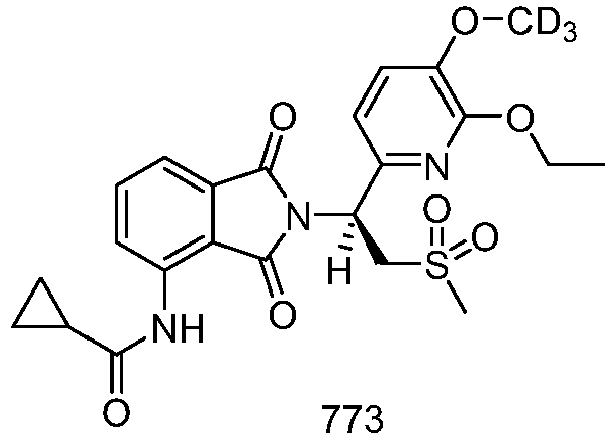
- 1H NMR (400 MHz, DMSO-d 6) δ 9.99 (s, 1H), 8.43 (d, J = 8.4 Hz, 1H), 7.80 (t, J = 8.0 Hz, 1H), 7.59 (d, J = 6.8 Hz, 1H), 7.27 (d, J = 7.6 Hz, 1H), 7.04-7.02 (m, 1H), 5.83-5.80 (m, 1H), 4.36-4.29 (m, 1H), 4.23-4.16 (m, 3H), 3.10 (s, 3H), 2.02-1.96 (m, 1H), 1.17 (t, J = 7.2 Hz, 3H), 0.88 (d, J = 6.0 Hz, 4H). LCMS: ([M+H]+) = 491.2 ee% = 99.0%
- Compounds 772 and 774 can be synthesized according to the method of 763 in example 40, except compound 773-D or 773-D1 was used respectively instead of 745-D.

-

-
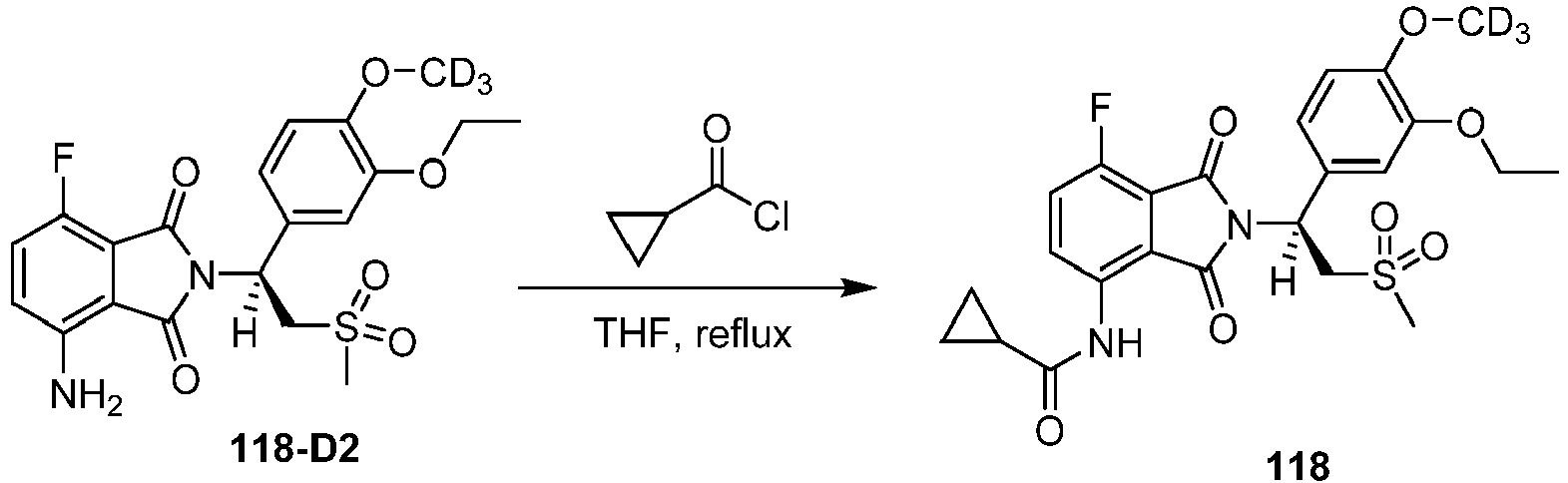
- ((S)-N-(2-(1-(3-ethoxy-4-d3 -methoxyphenyl)-2-(methylsulfonyl)ethyl) -7-fluoro-1,3-dioxoisoindolin-4-yl)cyclopropanecarboxamide) was synthesized according to the method of 763 in example 40, except compound 118-D2 was used instead of 745-D.
1H NMR (400 MHz, DMSO-d 6) δ 10.01 (s, 1H), 8.38 (dd, J = 9.2, 3.6 Hz, 1H), 7.64 (t, J = 9.2 Hz, 1H), 7.07 (s, 1H), 7.01-6.93 (m, 2H), 5.77 (dd, J 1 = 10.4, 4.4 Hz, 1H), 4.31 (dd, J 1 = 14.4, 10.8 Hz, 1H), 4.18-4.14 (m, 1H), 4.03 (q, J = 6.8 Hz, 2H), 3.02 (s, 3H), 2.00-1.97 (m, 1H), 1.33 (t, J = 6.8 Hz, 3H), 0.89-0.87 (m, 4H). LCMS: ([M+H]+) = 507.9. - Compound 118-D2 ((S)-4-amino-2-(1-(3-ethoxy-4-d3 -methoxyphenyl)-2-(methylsulfonyl) ethyl)-7-fluoroisoindoline-1,3-dione) was synthesized according to the method of 737-D in example 31, except compound 103-E ((S)-1-(3-ethoxy-4-d3 -methoxyphenyl)-2-(methyl sulfonyl)ethanamine) was used instead of 701-F (1-(6-ethoxy-5-methoxypyridin-2-yl)-2-(methylsulfonyl)ethanamine) and 101-A (3-fluoro-6-nitrophthalic acid) was used instead of 737-B (3-nitro phthalic acid).
1H NMR (300 MHz, DMSO-d 6) δ 7.33 (t, J = 9.0 Hz, 1H), 7.06-7.01 (m, 2H), 6.95-6.93 (m, 2H), 6.46 (s, 2H), 5.73-5.69 (m, 1H), 4.37-4.29 (m, 1H), 4.12-3.98 (m, 3H), 3.01 (s, 3H), 1.36-1.30 (m, 3H). -

- ((S)-N-(2-(1-(3-ethoxy-4-d3 -methoxyphenyl)-2-(methylsulfonyl)ethyl) -1,3-dioxoisoindolin-4-yl)cyclopropanecarboxamide) was synthesized according to the method of compound 763 in example 40, except compound 120-D2 was used instead of 745-D.
1H NMR (400 MHz, DMSO-d 6) δ 9.98 (s, 1H), 8.40 (d, J = 8.4 Hz, 1H), 7.78 (t, J = 8.0 Hz, 1H), 7.56 (d, J = 7.2 Hz, 1H), 7.08 (d, J = 2.0 Hz, 1H), 7.01-6.92 (m, 2H), 5.79 (dd, J = 10.4, 4.4 Hz, 1H), 4.35 (dd, J = 14.4, 10.8 Hz, 1H), 4.15 (dd, J = 14.4, 4.4 Hz, 1H), 4.02 (q, J = 7.2 Hz, 2H), 3.02 (s, 3H), 2.00-1.94 (m, 1H), 1.32 (t, J = 7.2 Hz, 3H), 0.90-0.88 (m, 4H).
LCMS: ([M+H]+) = 490.0. - ((S)-4-amino-2-(1-(3-ethoxy-4-d3 -methoxyphenyl)-2-(methylsulfonyl)ethyl)isoindoline-1,3-dio ne) was synthesized according to the method of compound 737-D in example 31, except compound 103-E ((S)-1-(3-ethoxy-4-d3 -methoxyphenyl)-2-(methylsulfonyl)ethanamine) was used instead of 701-F (1-(6-ethoxy-5-methoxypyridin-2-yl)-2-(methylsulfonyl)ethanamine).
1H NMR (300 MHz, DMSO-d 6) δ 7.46-7.41 (m, 1H), 7.06 (s, 1H), 6.99-6.93 (m, 4H), 6.52-6.50 (m, 2H), 6.46 (s, 2H), 5.74-5.69 (m, 1H), 4.35-4.31 (m, 1H), 4.11-3.97 (m, 3H), 3.00 (s, 3H), 1.32 (t, J = 6.9 Hz, 3H). -

- A mixture of compound 502-A (5-aminopyridine-3,4-dicarboxylic acid, 0.3 g, 1.32 mmol) in Ac2O (8 mL) was stirred at 120 °C for overnight. The solvent was removed to give the crude product 502-B (N-(1,3-dioxo-1,3-dihydrofuro[3,4-c]pyridin-7-yl)acetamide, 0.35 g).
1H NMR (300 MHz, DMSO-d 6) δ 10.47 (s, 1H), 9.45 (s, 1H), 9.03 (s, 1H), 2.22 (s, 3H). - A mixture of compound 502-B (N-(1,3-dioxo-1,3-dihydrofuro[3,4-c]pyridin-7-yl) acetamide, 0.3 g crude) and 102-B ((S)-1-(3-ethoxy-4-methoxyphenyl)-2-(methylsulfonyl) ethanamine, 0.30 g, 1.10 mmol) in AcOH (6 mL) was stirred at 70 °C for 3 hours. The solvent was removed to get the crude product which was purified by prep-HPLC to give compound 502 ((S)-N-(2-(1-(3-ethoxy-4-methoxyphenyl)-2-(methylsulfonyl)ethyl)-1,3-dioxo-2,3-dihydro -1H-pyrrolo[3,4-c]pyridin-7-yl)acetamide, 144 mg, yield: 28%).
1H NMR (400 MHz, DMSO-d 6) δ 9.98 (s, 1H), 9.52 (s, 1H), 8.83 (s, 1H), 7.08 (d, J = 2.0 Hz, 1H), 7.01 (dd, J = 8.4, 2.0 Hz, 1H), 6.94 (d, J = 8.4 Hz, 1H), 5.79 (dd, J = 10.4, 4.8 Hz, 1H), 4.30-4.17 (m, 2H), 4.02 (q, J = 6.8 Hz, 2H), 3.74 (s, 3H), 3.01 (s, 3H), 2.21 (s, 3H), 1.32 (t, J = 6.8 Hz, 3H). LCMS: [M+H]+ = 461.9. -
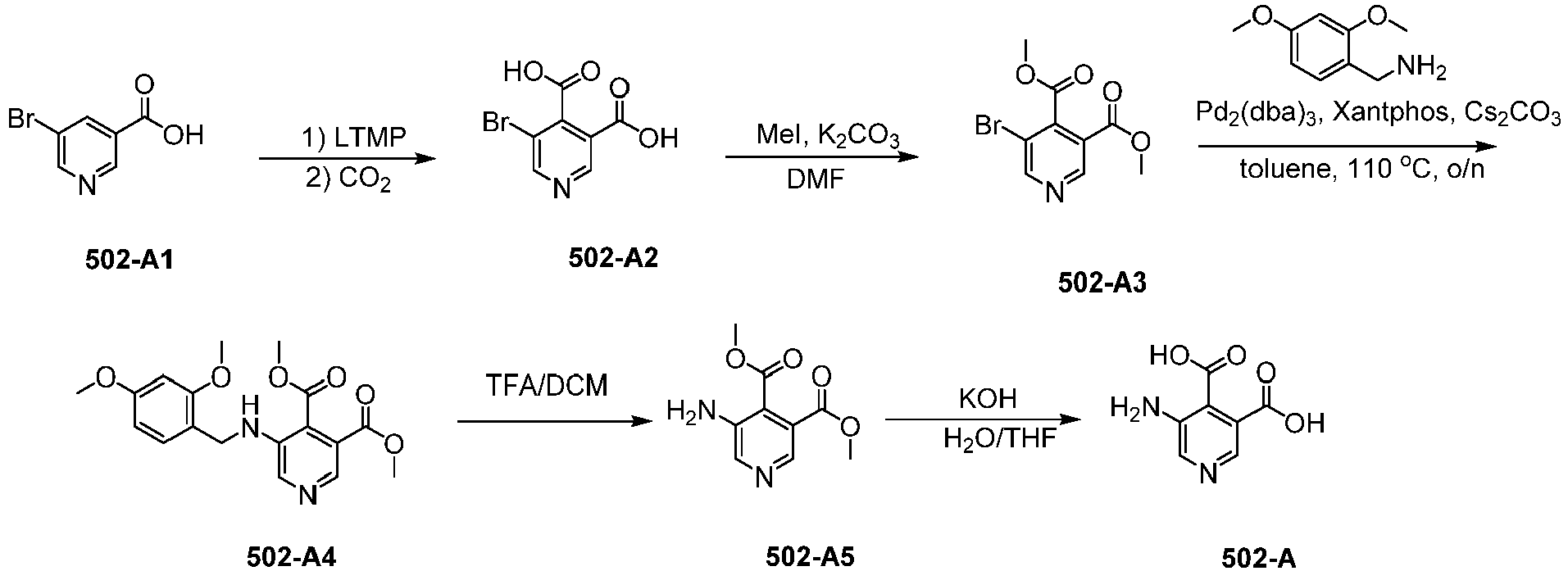
- At -60 °C, a solution of 2,2,6,6-Tetramethyl-piperidine (16.8 g, 118.8 mmol) in 200 mL of THF was added n-BuLi (2.5 M, 44 mL, 108.9 mmol) by dropwise slowly and stirred for 15 minutes. Then 502-A1 (5-bromonicotinic acid, 10 g, 49.5 mmol) was added and stirred at -60 °C for 0.5 hour. Then, dry CO2 was bubbled into the reaction mixture at 25 °C for 3 hours. Water (150 mL) was added to quench the reaction. The THF was removed. The water phase was adjusted to pH=3 with 1N HCl, concentrated and the resulting precipitate solid was collected by filtration and dried to give compound 502-A2 (5-bromopyridine-3,4-dicarboxylic acid, 12.5 g) as brown solid.
1H NMR (300 MHz, DMSO-d 6) δ 9.02-9.03 (m, 2H), 8.73 (br s, 2H). - A solution of 502-A2 (9.3 g, 37.8 mmol) in 100 mL of DMF was added K2CO3 (26.1 g, 189 mmol) and stirred at 25 °C for 0.5 hour. Then CH3I (5.9 mL, 94.5 mmol) was added to the mixture at 0 °C. The mixture was stirred at 25 °C for 3 hours. The mixture was poured into water (600 mL), extracted with EtOAc (200 mL*2), washed with brine (200 mL*2), dried and concentrated to give the crude product which was purified by column chromatography on silica gel eluted with PE: EtOAc = 6:1 to give product 502-A3 (dimethyl 5-bromopyridine-3,4-dicarboxylate, 1.59 g, 15%) as yellow solid.
1H NMR (300 MHz, DMSO-d 6) δ 9.13 (s, 1H), 9.12 (s, 1H), 3.93 (s, 3H), 3.90 (s, 3H). - A solution of 502-A3 (1.59 g, 5.8 mmol) in 70 mL of toluene was added 2,4-Dimethoxy-benzylamine (1.46 g, 8.75 mmol), Pd2(dba)3 (0.532 g, 0.58 mmol), Xantphos (1.0 g, 1.74 mmol), Cs2CO3 (3.8 g, 11.6 mmol). Then, the mixture was stirred at 105 °C for overnight. The mixture was cooled to 25 °C, filtrated and concentrated to give the crude product which was purified by column chromatography on silica gel eluted with PE:EtOAc = 10:1 to 3:1 to give the 502-A4 (dimethyl 5-((2,4-dimethoxybenzyl)amino)pyridine-3,4-dicarboxylate, 1.92 g, 92%) as brown oil.
1H NMR (300 MHz, CDCl3) δ 8.33 (s, 1H), 8.13 (s, 1H), 7.16 (d, J = 8.1 Hz, 1H), 6.56-6.60 (m, 1H), 6.43-6.49 (m, 2H), 4.42 (d, J = 6.0 Hz, 2H), 3.90-3.81 (m, 12H). - A solution of compound 502-A4 (1.92 g, 5.33 mmol) in 30 mL of DCM was added TFA (9 mL) slowly by drop wise at 0 °C. Then, the mixture was stirred at 25 °C for 2 hours. The solvent was removed. The residue was diluted with water (100 mL), adjusted to pH=8 with Na2CO3, extracted with DCM (100 mL*2), dried and concentrated to give product 502-A5 (dimethyl 5-aminopyridine-3,4-dicarboxylate, 1.15 g) as brown oil.
1H NMR (300 MHz, DMSO-d 6) δ 8.32 (s, 1H), 7.99 (s, 1H), 6.18 (s, 2H), 3.81 (s, 6H). - A mixture of 502-A5 (0.8 g, 3.8 mmol) in 60 mL of THF was added KOH (20%, 60 mL). Then, the mixture was stirred at 25 °C for 3 hours. The solvent was removed. The residue was diluted with water (20 mL), extracted with EtOAc (20 mL*2). The water phase was adjusted the pH to 3 with 2 N HCl. The solvent was removed. The residue was diluted with EtOH (50 mL), stirred at 25 °C for 1 hour, filtrated, concentrated to give 502-A (5-aminopyridine-3,4-dicarboxylic acid, 1.2 g) as yellow solid.
-

- A solution of 103-A (3-ethoxy-4-hydroxybenzaldehyde, 10 g, 60.2 mmol) and Cs2CO3 (29.43 g, 90.3 mmol) in DMF (70 mL) and H2O (70 mL) was added sodium 2-chloro -2,2-difluoroacetate (23 g, 150.5 mmol). The mixture was stirred at 100 °C for overnight. Water (500 mL) was added and the mixture was extracted with EtOAc (100 mL x 2). The organic phase was washed with brine (100 mL x 2), dried and concentrated and purified by column chromatography on silica gel (PE: EtOAc = 10:1) to give 121-B (4-(difluoromethoxy)-3-ethoxybenzaldehyde, 2.5 g, 19 %) as yellow oil.
1H NMR (300 MHz, CDCl3) δ 9.92 (s, 1H), 7.48-7.43 (m, 2H), 7.30 (d, J = 6.8Hz, 1H), 6.70 (td, J = 99.6, 0.9 Hz, 1H), 4.20-4.14 (m, 2H), 1.50-1.45 (m, 3H). - A solution of DMSO (2.72 g, 29 mmol), KOH (0.97 g, 17.3 mmol) in DMF (50 mL) was stirred at 30 °C for 30 minutes. Compound 121-B (4-(difluoromethoxy)-3-ethoxy benzaldehyde, 2.5 g, 11.65 mmol) was added to the mixture slowly and stirred at 30 °C for 3 hours. The mixture was quenched with sat. NH4Cl (50 mL), extracted with EtOAc (100 mL x 3), washed with brine (100 mL x 3), the combined organic phase was dried, filtered and concentrated to get the crude product which was purified by column chromatography on silica gel eluted with PE: EtOAc = 5:1 to 1:1 to give 121-C (1-(difluoromethoxy)-2-ethoxy-4-(2-(methylsulfonyl)vinyl)benzene, 0.45 g, 13%) as yellow oil.
1H NMR (300 MHz, CDCl3) δ 7.57 (d, J = 15.3 Hz, 1H), 7.27-6.39 (m, 5H), 44.14(q, J = 6.9 Hz, 2H), 3.05 (s, 3H), 1.49 (t, J = 6.9 Hz, 3H). - A solution of H3BO3 (0.19 g, 3.08 mmol) and compound 121-C (1-(difluoromethoxy)-2-ethoxy-4-(2-(methylsulfonyl)vinyl)benzene, 0.45 g, 1.54 mmol) in NH4OH (60 mL) and dioxane (10 mL) was stirred in a sealed tube for 3 days at 100 °C. The mixture was extracted with EtOAc (50 mL x 3), the organic layer was washed with 1 N HCl (50 mL x 2), adjusted the pH to 12 with NaOH, extracted with EtOAc (50 mL x 3), dried and concentrated to get product 121-D (1-(4-(difluoromethoxy)-3-ethoxyphenyl)-2-(methylsulfonyl)ethanamine, 0.29 g, 61%) as colorless oil.
1H NMR (400 MHz, DMSO-d 6) δ 7.22-6.96 (m, 3H), 4.34-4.31 (m, 1H), 4.11 (q, J = 7.2 Hz, 2H), 3.48-3.42 (m, 1H), 3.30-3.25 (m, 1H), 3.02 (s, 3H), 2.33 (br s, 2H), 1.35 (t, J = 7.2 Hz, 3H). - (1-(4-(difluoromethoxy)-3-ethoxyphenyl)-2-(methylsulfonyl)ethanamine, 280 mg, 0.906 mmol) and 101-E (N-(7-fluoro-1,3-dioxo-1,3-dihydroisobenzofuran-4-yl)acetamide, 202 mg, 0.906 mmol) in HOAc (10 mL) was stirred at 80 °C for overnight. Then the mixture was concentrated to dryness under reduced pressure. The residue was purified by Prep-HPLC to afford 121 (N-(2-(1-(4-(difluoromethoxy)-3-ethoxyphenyl)-2-(methylsulfonyl) ethyl)-7-fluoro-1,3-dioxoisoindolin-4-yl)acetamide, 235 mg, 50%) as a white solid.
1H NMR (400 MHz, DMSO-d 6) δ 9.76 (s, 1H), 8.44-8.41 (m, 1H), 7.67 (t, J = 9.2 Hz, 1H), 7.25-6.88 (m, 4H), 5.83 (dd, J = 10.4, 4.4 Hz, 1H), 4.34-4.19 (m, 2H), 4.12 (q, J = 7.2 Hz, 2H), 3.06 (s, 3H), 2.17 (s, 3H), 1.35 (t, J = 7.2 Hz, 3H). LCMS: [M+H]+ = 514.9. - The IC50 value of the inhibitory effect of the compound on PDE4A1A, PDE4B1 and PDE4D3 was tested.
- Experiment materials:
- Enzyme: PDE4A1A (BPS, Cat No. 60040); PDE4B1 (BPS, Cat No. 60041); PDE4D3 (BPS, Cat No. 60046).
- Positive compound: Trequinsin (Sigma, Cat. No. T2057).
- Reaction plate: a 384-well plate (Perkin Elmer, Cat. No. 6007279).
- Equipment: Wallac Victor Multi-lable counter (Perkin Elmer).
- Experiment steps:
- I. Preparing 1×reaction liquid and termination liquid;
- II. PDE enzymatic reaction;
- 1) The PDE was dissolved in 1×reaction solution to form 2×enzyme solution.
- 2) FAM-cAMP was dissolved in 1×reaction solution to form 2×substrate solution.
- 3) Echo 550 was used to transfer the corresponding volume of the compound in DMSO solution to the reaction plate.
- 4) 2×enzyme solution was added into the corresponding well of the reaction plate and incubated with the compound solution at room temperature for 15 minutes.
- 5) 2×substrate solution was added into the corresponding well of the reaction plate to initiate the reaction.
- 6) Reaction plate was incubated at room temperature for 30 minutes and terminated by adding termination liquid, then incubated at room temperature for 60 minutes.
- III. Read on Victor;
- IV. Curve fitting;
- The inhibition rate was calculated by Excel; IC50 was calculated by GraphPad Prism.
- The corresponding structures of the compound codes of the present invention are as described above, and the structures of the reference compounds are as follows:
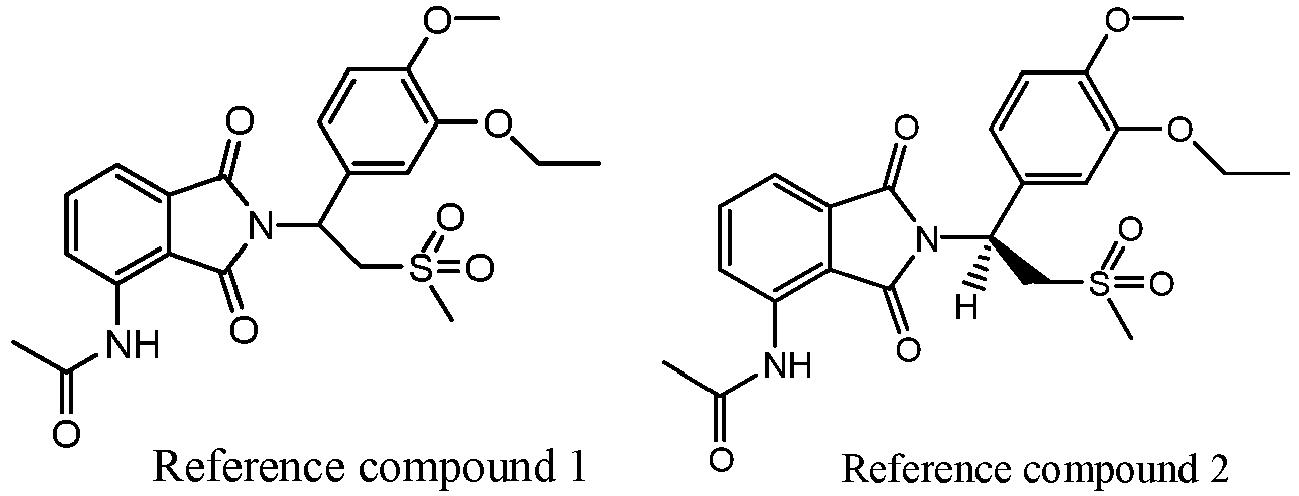
-
Compound IC50 (nM) PDE4A1A PDE4B 1 PDE4D3 Reference compound 1 22 29 13 Reference compound 2 9.85 14.5 6.4 Reference compound 101 17 27 12 Reference compound 201 39 41 25 Reference compound 301 102 116 65 401 182 211 110 601 273 390 201 701 2.5 3.5 2.1 801 295 364 202 901 411 484 248 Reference compound 102 11 14 7.4 Reference compound 202 11 11 5.4 Reference compound 302 33 41 22 Reference compound 103 7.25 12.75 3.7 Reference compound 203 22 31 18 Reference compound 105 61 97 41 Reference compound 106 340 493 300 Reference compound 107 8.3 12 4.6 Reference compound 205 123 165 79 Reference compound 206 1455 1347 997 Reference compound 207 20 20 12 Reference compound 104 53 70 31 Reference compound 204 133 157 83 703 30 55 20 702 2.2 4.7 4.0 706 6.5 18 4.0 705 0.58 1.6 0.53 709 17 32 11 708 3.1 5.1 1.6 712 32.6 82.8 29.0 711 1.1 5.1 2.0 719 15.3 57.8 15.4 718 0.9 3.0 0.7 725 32.1 93.0 33.5 724 2.3 5.7 3.1 Reference compound 113 2.1 5.1 1.3 Reference compound 111 1.3 4.3 1.9 728 0.6 1.6 0.4 Reference compound 115 6.0 17.3 5.7 732 0.8 2.4 1.1 734 5.6 17.8 13.0 737 51.8 136.0 35.9 739 14.5 36.3 10.9 742 2.4 6.2 2.6 745 1.1 2.6 1.2 748 2.8 7.9 3.3 757 2.5 4.5 1.8 760 3.1 4.7 1.3 Reference compound 121 3.4 7.0 0.9 751 5.0 9.9 3.1 754 10.6 21.9 8.0 502 205.6 512.7 107.2 764 1.6 1.9 1.0 767 1.3 2.2 1.0 770 1.6 1.8 1.5 773 1.7 1.7 1.2 Reference compound 118 5.1 8.7 2.5 Reference compound 120 7.6 11.0 4.9 -
- I. PBMC Recovery and Cell Plating Steps:
- (1) Cell Recovery:
- 1) Agitation was performed continuously in a 37 °C water bath to rapidly thaw cells.
- 2) The cells were gently added to a 15 ml centrifuge tube, to which was then added 10 ml of fresh, prewarmed recovery medium gently and then centrifugation was performed at 1000 rpm for 10 min.
- 3) The supernatant medium was discarded and resuspension was performed with 10 ml of fresh, prewarmed RPMI 1640 complete medium.
- (2) 96-well plate plating:
- 1) The total number of cells needed for the experiment was calculated and adjusted to the appropriate cell concentration per ml. 100 ul and 105 cells per well.
- 2) The cell suspension was diluted with appropriate volume of cell culture medium.
- 3) The cell suspension was added to a disposable sterile sample well.
- 4) 100 ul of cell suspension was added to each well of a 96-well plate.
- 5) The plate was incubated in a 37 °C, 5% CO2 incubator for 2 hours.
- (3) Compound preparation steps:
- 1) LPS: The 1 mg/mL stock solution was diluted with water, aliquoted, and stored at -80°C. Prior to each test, the working solution of LPS was diluted from the stock solution with serum-free RPMI 1640 medium.
- 2) Test compound
- (4) 8X compound gradient preparation:
A series of compound concentration gradient was diluted with DMSO: 10 mM, 2 mM, 0.4 mM, 80 uM, 16 uM, 3.2 uM, 0.64 uM, 0.128 uM were obtained and then the compounds were diluted 125-fold with serum-free RPMI 1640 medium to the final 8X. The final concentration of DMSO in cell culture was 0.1% . - (5) Compound Processing Experimental Procedures and Collection of Supernatants:
- 1) Cell Plating: Fresh cells were plated in 96-well cell culture plates according to the procedure above, 100 ul and 105 cells per well, and then incubated in a 37 °C, 5% CO2 incubator for 2 hours.
- 2) Compound Preparation: Before test, compounds were added to the plates according to the above description. A dose of compound in 8X concentration was prepared with serum-free RPMI 1640 medium and all gradients of solution were added to the compound plate.
- 3) Compound addition: 16.7 ul of compound solution in working concentration was added to each well of the cell culture plate. The plate was incubated in a 37 °C, 5% CO2 incubator for 1 hour.
- 4) 16.7 ul of 8X LPS per well (final concentration of LPS is EC80, the amount of each PBMC needed to be determined) was added. The plate was incubated for 18 hours in 37 °C, 5% CO2 incubator.
- 5) 80 ul of supernatant per well was collected and then subjected to TNF-α ELISA assay.
- (6) TNF-α ELISA steps:
The TNF-α ELISA test procedure were referred to the BD human TNF-α ELISA kit experimental procedure.
- (1) Cell Recovery:
- Four compounds per plate. 5-fold dilution was performed, starting from 10 uM, by 8 gradients, and parallel wells were made. The TNF-α standard was added to each plate. (1st well, starting from 500 pg/ml, 2-fold dilution, 7 gradients)
- ZPE (0% inhibition) used 15 pg/ml LPS + 0.1% DMSO, while HPE (100% inhibition) used only 0.1% DMSO.
- The inhibition rate statistics were calculated. The inhibition rate (%) = [1-(Max-Min)/(Test cpd-Min)]*100%. IC50 was used to evaluate the concentration of the test compound (nM) at 50% inhibition..
- Test compounds were administered intravenously or intragastrically singly to SD rats. Blood samples were collected at different time points. LC-MS/MS was used to determine the concentration of the test compounds in rat plasma after administration of tested compounds and calculate the relevant PK parameters.
- The test compounds are calculated based on free radicals and are converted only by purity.
- A suitable amount of the test compound was added 5% DMSO + 95% HP-beta-CD (20%) to prepare a solution of 0.6 mg/mL for intravenous administration.
- A suitable amount of the test compound was added 5% DMSO + 95% HP-beta-CD (20%) to prepare a solution of 1 mg/mL for intragastrical administration.
- Male Sprague-Dawley rats were purchased from Shanghai Xipuer-Bikai Laboratory Animal Co., Ltd. There were 3 rats in each group. One group was used as control to collect blank plasma. The other groups were given each test compound by intravenous injection (the dose was 3 mg/kg) or intragastrical administration (the dose was 10 mg/kg). Heparin sodium was used for anticoagulation. Analyze the concentration of the test compound in the blood sample.
- Abrosia for 10-14 hours before oral administration of the test compounds and resume feeding 4 hours after oral administration of the test compounds.
- Intravenous injection group: Before and after administration, no obvious abnormal conditions were observed at each time point of blood collection.
- Oral administration group: soft stool was observed 4-8 hours after administration in every group and all were recovered the next day.
- The time points of blood sample collection were: intravenous injection: before administration and at 0.083 hour, 0.25 hour, 0.5 hour, 1 hour, 2 hour, 4 hour, 6 hour, 8 hour, 24 hour after administration; oral administration: before administration and at 0.25 hour, 0.5 hour, 1 hour, 2 hour, 4 hour, 6 hour, 8 hour, 24 hour after administration. Blood samples were collected through jugular vein puncture. About 0.25 mL blood was collected for each sample. Heparin sodium was used for anticoagulation and the samples were placed on ice after collection. Blood samples were placed on ice after collection, and plasma was separated by centrifugation (centrifugation condition: 8000 rpm, 6 min, 2-8 °C). The collected plasma was stored at -80 °C before analysis.
- Test Compounds: Provided by Kangpu Biopharmaceuticals, Ltd.
- Internal Standard Toluene Sulfonylurea: Provided by Test Institution.
- Methanol (Burdick & Jackson, HPLC), acetonitrile (Burdick & Jackson, HPLC), formic acid (J&K), water is ultrapure water.
- Ultra high performance liquid chromatography (Waters, ACQUITY UPLC), including binary solvent manager (ACQUITY UPLC Binary Solvent Manager), Sample Manager (ACQUITY UPLC Autosampler Mod.), high throughput sample organizer (ACQUTIY UPLC Sample Organizer), high temperature column compartment (ACQUITY UPLC Column Heater HT). Mass spectrometer (API 4000, Bio System Inc, USA), electrospray ion source (ESI), series quadrupole mass analyzer. Data processing system is Analyst software (American Applied Biosystems Inc., version 1.5.1).
- 50 µL plasma sample was added into a 1.5 mL centrifugal tube, and 250 µL internal standard solution (the same volume of methanol was added to blank sample instead of internal standard) was added to the sample. The sample was mixed in a whirlpool and centrifuged for 5 minutes at 14000 rpm. The supernatant of 200 µL was added to 96-well plate for LC-MS/MS analysis.
- The pharmacokinetic parameters of the test compounds were calculated using the non-compartment model of WinNonlin v5.2, a software for pharmacokinetic calculation, based on the data of plasma concentration. The experimental results are shown in the table below.
Compound Tmax(po) T1/2 (IV) T1/2(po) AUC(iv) AUC(po) F Reference compound 2 1 0.47 0.94 1048 785 22.5 Reference compound 103 2 1.05 3.83 1260 4125 98.2 Reference compound 203 0.5 0.95 0.87 1012 250 7.4 702 0.67 0.38 6.53 1328 1047 15.5 705 0.5 0.92 9.25 1343 3588 80.2 708 0.67 0.54 4.21 945 51 1.62
Claims (15)
- A compound of formula I, or a pharmaceutically acceptable salt, solvate, polymorph, co-crystal, stereoisomer or isotope compound thereof,
 wherein, the carbon atom labelled by * is an asymmetric center;R1 and R2 are independently H, D, substituted or unsubstituted (C1-C6)alkyl, substituted or unsubstituted (C3-C6)cycloalkyl, R6-S(O)2- or R6-C(O)-; or, R1 and R2 and the nitrogen atom to which they are attached together form a 5-7 membered heterocycle containing N;R6 is substituted or unsubstituted (C3-C6)cycloalkyl; or (C1-C6)alkyl, which is optionally substituted with one or more groups selected from D, halogen, hydroxyl, amino, (C1-C6)alkyl amino, (C1-C6)alkoxy and benzyloxy;X1, X2, X3, X4, X5 and X6 are independently CH, CD, CR7 or N;R7 is halogen or cyano;R3 and R4 are independently H, substituted or unsubstituted (C1-C6)alkyl, substituted or unsubstituted (C3-C6)cycloalkyl, or, substituted or unsubstituted (C1-C6)alkyl-(C3-C6)cycloalkyl; or, R3 and R4 and the oxygen atom to which they are attached together form a 5-7 membered heterocycle containing O;R5 is substituted or unsubstituted (C1-C6)alkyl;R10, R11 and R12 are independently H or D;the substituent in substituted (C1-C6)alkyl, substituted (C3-C6)cycloalkyl, or, substituted (C1-C6)alkyl-(C3-C6)cycloalkyl is one or more selected from the group consisting of: D, halogen, hydroxyl, amino, (C1-C6)alkyl amino, (C1-C6)alkoxy and benzyloxy; when there are a plurality of substituents, the substituents are the same or different;provided that: one of X1, X2, X3, X4, X5 and X6 is N.
 - The compound of formula I according to claim 1, or the pharmaceutically acceptable salt, solvate, polymorph, co-crystal, stereoisomer or isotope compound thereof, wherein,X1 is N, X2, X3, X4, X5 and X6 are independently CH, CD or CR7; orX2 is N, X1, X3, X4, X5 and X6 are independently CH, CD or CR7; orX3 is N, X1, X2, X4, X5 and X6 are independently CH, CD or CR7; orX4 is N, X1, X2, X3, X5 and X6 are independently CH, CD or CR7; orX5 is N, X1, X2, X3, X4 and X6 are independently CH, CD or CR7; orX6 is N, X1, X2, X3, X4 and X5 are independently CH, CD or CR7.
- The compound of formula I according to any one of claims 1-2, or the pharmaceutically acceptable salt, solvate, polymorph, co-crystal, stereoisomer or isotope compound thereof, wherein,
X6 is N, X1, X2, X3 are independently CH, CD or CR7, X4, X5 are independently CH or CD. - The compound of formula I according to any one of claims 1-3, or the pharmaceutically acceptable salt, solvate, polymorph, co-crystal, stereoisomer or isotope compound thereof, wherein,X6 is N, X1 is CR7, X2, X3, X4 and X5 are independently CH or CD; orX6 is N, X2 is CR7, X1, X3, X4 and X5 are independently CH or CD; orX6 is N, X3 is CR7, X1, X2, X4 and X5 are independently CH or CD.
- The compound of formula I according to any one of claims 1-4, or the pharmaceutically acceptable salt, solvate, polymorph, co-crystal, stereoisomer or isotope compound thereof, wherein,
one of R1 and R2 is H or D, the other is R6-S(O)2- or R6-C(O)-. - The compound of formula I according to any one of claims 1-5, or the pharmaceutically acceptable salt, solvate, polymorph, co-crystal, stereoisomer or isotope compound thereof, wherein,R6 is (C3-C6)cycloalkyl; or (C1-C4)alkyl, which is optionally substituted with one or more substituents selected from the group consisting of D, halogen, hydroxyl, amino, (C1-C4)alkyl amino, (C1-C4)alkoxy and benzyloxy,preferably, R6 is cyclopropyl, methyl, ethyl, hydroxymethyl, benzyloxymethyl, methoxymethyl, isobutyl, dimethylaminomethyl, isopropyl, CD3 or C2D5.
- The compound of formula I according to any one of claims 1-6, or the pharmaceutically acceptable salt, solvate, polymorph, co-crystal, stereoisomer or isotope compound thereof, wherein,R3 and R4 are independently H, substituted or unsubstituted (C1-C6)alkyl;preferably, R3 and R4 are independently H, methyl, ethyl, propyl, isopropyl, CD3, CH2D, CHD2, C2D5, CH2CD3 or CHF2.
- The compound of formula I according to any one of claims 1-7, or the pharmaceutically acceptable salt, solvate, polymorph, co-crystal, stereoisomer or isotope compound thereof, wherein,R5 is methyl, ethyl, propyl, isopropyl, CD3, CH2D, CHD2, C2D5 or CH2CD3; orR7 is fluorine, chlorine, bromine or cyano.
- The compound of formula I according to claim 1, or the pharmaceutically acceptable salt, solvate, polymorph, co-crystal, stereoisomer or isotope compound thereof, wherein,X6 is N, X1, X2, X3, X4 and X5 are independently CH or CR7; R7 is halogen or cyano; orR10 and R11 are H; orR12 is H; orthe asymmetric center refers to (S)-configured carbon.
- The compound of formula I according to claim 1, or the pharmaceutically acceptable salt, solvate, polymorph, co-crystal, stereoisomer or isotope compound thereof, wherein, the compound of formula I is any one of the following compounds:
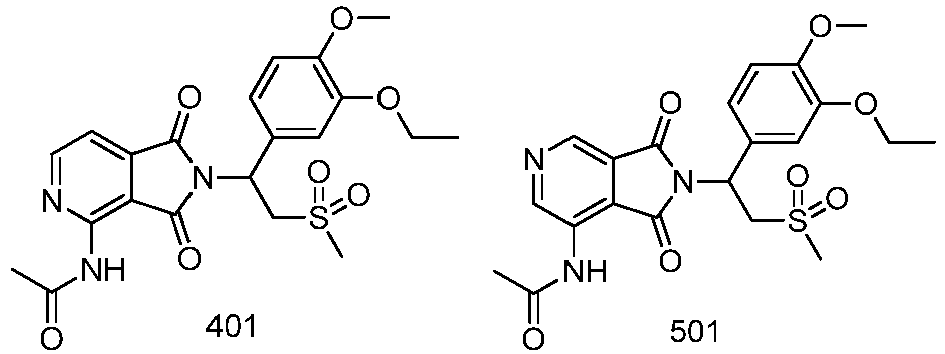

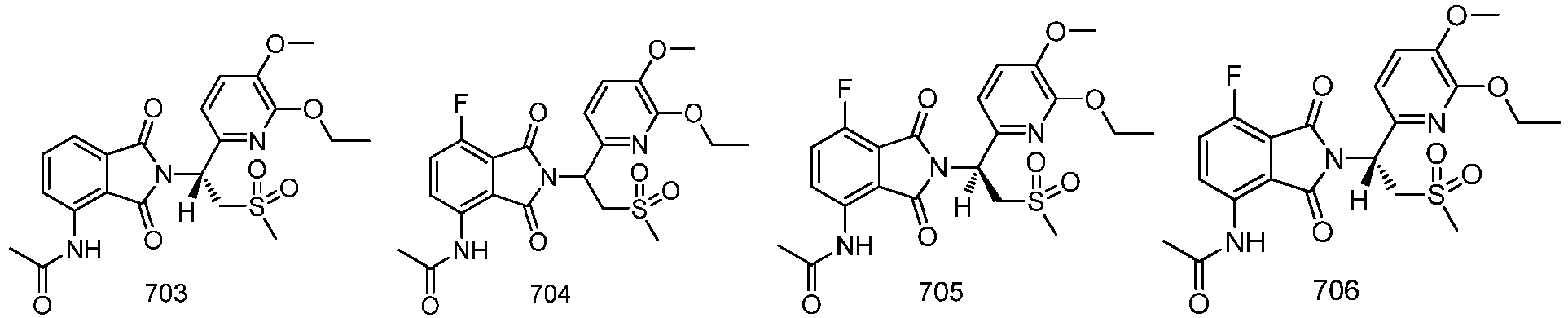

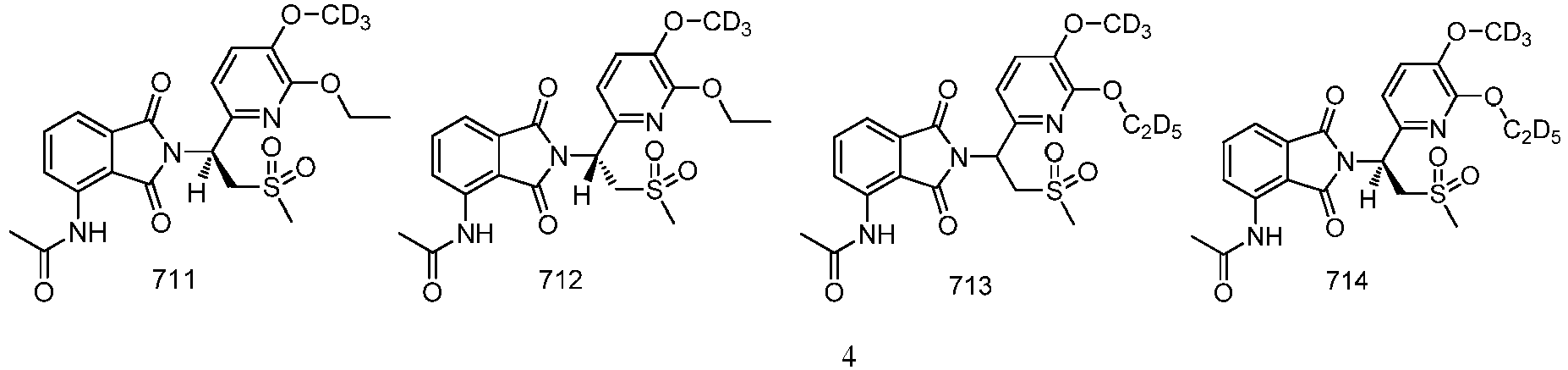






- A method of preparing a compound of formula I according to any one of claims 1-10, which is selected from method A and method B:method A, including the following steps:
a compound of formula I-A and a compound of formula I-B are reacted as follows to prepare the compound of formula I; method B, including the following steps:wherein, X1, X2, X3, X4, X5, X6, R1, R2, R3, R4, R5, R10, R11 and R12 are as defined in any one of claims 1-10; Y is a leaving group.
a compound of formula 1-3 and a compound of formula 1-4 are reacted as follows to prepare the compound of formula I;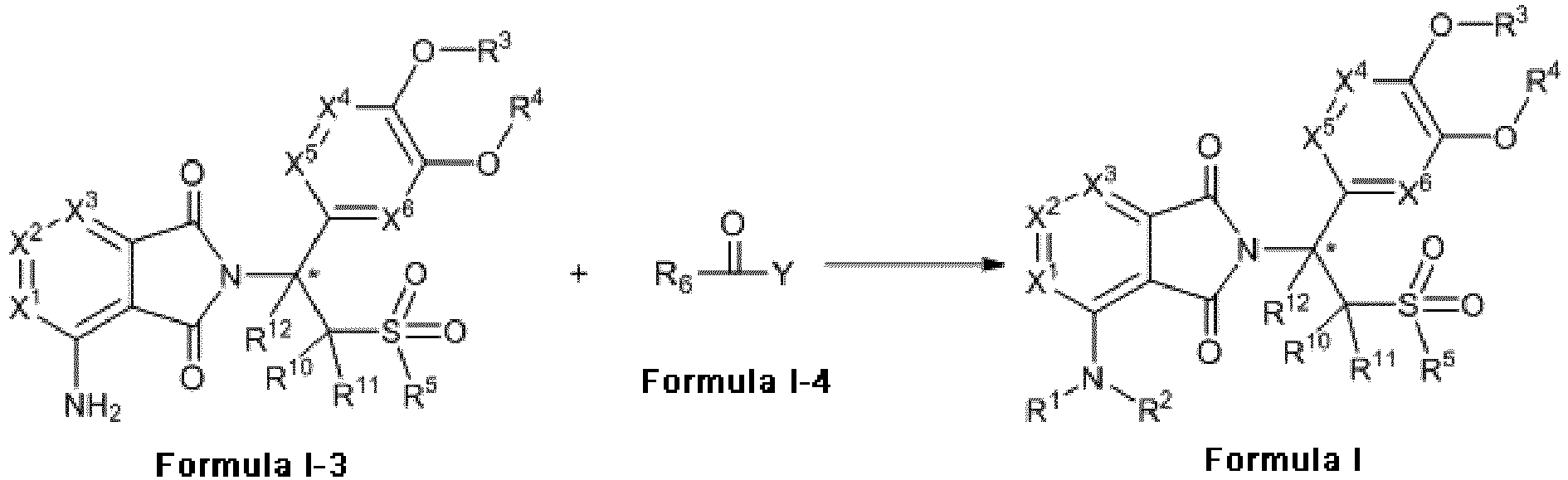
- A compound of formula 1-3:

- A pharmaceutical composition comprising one or more compounds of formula I according to any one of claims 1-10, the pharmaceutically acceptable salt, solvate, polymorph, co-crystal, stereoisomer or isotope compound thereof, and one or more pharmaceutical excipients.
- A pharmaceutical composition according to claim 13, wherein, the composition further comprises other therapeutic agent with pharmacological activity, the other therapeutic agent are anti-angiogenesis drugs, immunomodulators, immunotherapeutic drugs, chemotherapeutic drugs, hormone compounds, anti-tumor drugs or anti-inflammatory drugs.
- One or more compounds of formula I according to any one of claims 1-10, the pharmaceutically acceptable salt, solvate, polymorph, co-crystal, stereoisomer or isotope compound thereof, for use in the treatment or prevention of a disease, disorder or condition, wherein the disease, disorder or condition is psoriatic arthritis or plaque psoriasis.
Priority Applications (1)
| Application Number | Priority Date | Filing Date | Title |
|---|---|---|---|
| PL18761354T PL3590924T3 (en) | 2017-02-28 | 2018-02-27 | Novel isoindoline derivative, and pharmaceutical composition and application thereof |
Applications Claiming Priority (3)
| Application Number | Priority Date | Filing Date | Title |
|---|---|---|---|
| CN201710112364 | 2017-02-28 | ||
| CN201710725987 | 2017-08-22 | ||
| PCT/CN2018/077324 WO2018157779A1 (en) | 2017-02-28 | 2018-02-27 | Novel isoindoline derivative, and pharmaceutical composition and application thereof |
Publications (3)
| Publication Number | Publication Date |
|---|---|
| EP3590924A1 EP3590924A1 (en) | 2020-01-08 |
| EP3590924A4 EP3590924A4 (en) | 2020-02-19 |
| EP3590924B1 true EP3590924B1 (en) | 2021-10-27 |
Family
ID=63369785
Family Applications (1)
| Application Number | Title | Priority Date | Filing Date |
|---|---|---|---|
| EP18761354.2A Active EP3590924B1 (en) | 2017-02-28 | 2018-02-27 | Novel isoindoline derivative, and pharmaceutical composition and application thereof |
Country Status (14)
| Country | Link |
|---|---|
| US (2) | US11337964B2 (en) |
| EP (1) | EP3590924B1 (en) |
| JP (1) | JP6942380B2 (en) |
| KR (1) | KR102318401B1 (en) |
| CN (1) | CN110291065B (en) |
| AU (1) | AU2018228541B2 (en) |
| CA (1) | CA3052516C (en) |
| DK (1) | DK3590924T3 (en) |
| ES (1) | ES2902052T3 (en) |
| NZ (1) | NZ756231A (en) |
| PL (1) | PL3590924T3 (en) |
| RU (1) | RU2728829C1 (en) |
| WO (1) | WO2018157779A1 (en) |
| ZA (1) | ZA201905098B (en) |
Families Citing this family (17)
| Publication number | Priority date | Publication date | Assignee | Title |
|---|---|---|---|---|
| CN109280027A (en) * | 2018-12-13 | 2019-01-29 | 康化(上海)新药研发有限公司 | A kind of synthetic method of 5,6- dimethoxy -2- pyridine carboxylic acid |
| CN111777518A (en) * | 2019-04-03 | 2020-10-16 | 上海安谱实验科技股份有限公司 | Synthetic preparation method of phenylethanolamine A labeled by stable isotope |
| WO2020210630A1 (en) | 2019-04-12 | 2020-10-15 | C4 Therapeutics, Inc. | Tricyclic degraders of ikaros and aiolos |
| WO2020246329A1 (en) * | 2019-06-05 | 2020-12-10 | 住友化学株式会社 | METHOD FOR PRODUCING β-KETOSULFONE COMPOUND |
| CA3146679A1 (en) | 2019-07-27 | 2021-02-04 | Brii Biosciences, Inc. | Adenosine derivative and pharmaceutical composition comprising the same |
| CN110423213B (en) * | 2019-08-22 | 2021-06-04 | 上海英诺富成生物科技有限公司 | Apremilast derivative and preparation method and application thereof |
| CN110627694B (en) * | 2019-10-18 | 2021-06-15 | 山东邹平大展新材料有限公司 | Method for recovering 3-ethoxy-4-methoxy-alpha- [ (methylsulfonyl) methyl ] -benzylamine |
| CN112979442A (en) * | 2019-12-12 | 2021-06-18 | 上海安谱实验科技股份有限公司 | Stable isotope labeled methyl vanillin and synthesis method thereof |
| CN113121404B (en) * | 2019-12-30 | 2024-07-09 | 江苏先声药业有限公司 | Synthesis method of apremilast |
| JP2023531113A (en) * | 2020-02-24 | 2023-07-21 | スーヂョウ ロングボタイ ファーマシューティカルズ カンパニー リミテッド | PDE4 INHIBITOR COMPOUNDS AND MEDICINE USES THEREOF |
| CN113527179B (en) * | 2020-04-13 | 2023-07-07 | 苏州璞正医药有限公司 | Chain hydrocarbon substituted isoindoline-1, 3-diketone PDE4 inhibitor and pharmaceutical application thereof |
| CN112898132B (en) * | 2020-10-23 | 2023-03-14 | 上海安谱实验科技股份有限公司 | Synthetic method of stable isotope deuterium-labeled methyl triclosan |
| EP4281081A4 (en) | 2021-01-25 | 2025-05-14 | Brii Biosciences, Inc. | ADENOSINE DERIVATIVE AND PHARMACEUTICAL COMPOSITION COMPRISING IT |
| EP4281083A4 (en) | 2021-01-25 | 2025-01-01 | Brii Biosciences, Inc. | Combination therapy for hiv with adenosine derivative and capsid inhibitors |
| CN114790164B (en) * | 2021-08-13 | 2022-12-27 | 苏州璞正医药有限公司 | Substituted isoindoline-1,3-diketone PDE4 inhibitor and pharmaceutical application thereof |
| US20260055061A1 (en) | 2022-08-11 | 2026-02-26 | The United States Of America, As Represented By The Secretary, Department Of Health & Human Services | Halophthalimide compounds and methods of use against tbi, inflammatory disorder, autoimmune disorder, neurodegenerative disease or viral infection |
| CN119798183B (en) * | 2024-12-19 | 2026-03-24 | 上海药坦药物研究开发有限公司 | A method for preparing an oxazole compound |
Family Cites Families (16)
| Publication number | Priority date | Publication date | Assignee | Title |
|---|---|---|---|---|
| AU2006200033B8 (en) * | 1998-10-30 | 2008-09-11 | Celgene Corporation | Substituted phenethylsulfones and methods of reducing TNF-alpha levels |
| US6020358A (en) * | 1998-10-30 | 2000-02-01 | Celgene Corporation | Substituted phenethylsulfones and method of reducing TNFα levels |
| BR0317885A (en) * | 2002-12-30 | 2005-12-06 | Celgene Corp | Compound, isomers to be enantiomerically pure thereof, pharmaceutical composition and methods of inhibiting pde4 and mmp, modulating tnf-alpha production, treating or preventing mds, treating myeloproliferative disease, unwanted angiogenesis, cancer, a disease, lung inflammation , depression, chronic obstructive pulmonary disorder, inflammatory bowel disease, atopic dermatitis, psoriasis, crohn's disease, rheumatoid arthritis, asthma, multiple sclerosis and heart disease in a mammal and to treat, prevent or control complex regional pain syndrome |
| JP4713465B2 (en) | 2003-03-12 | 2011-06-29 | セルジーン コーポレイション | 7-Amido-isoindolyl compounds and pharmaceutical use thereof |
| US20060058311A1 (en) | 2004-08-14 | 2006-03-16 | Boehringer Ingelheim International Gmbh | Combinations for the treatment of diseases involving cell proliferation |
| KR20070092276A (en) * | 2004-12-13 | 2007-09-12 | 셀진 코포레이션 | Compositions containing PD4 modulators and their use for the treatment or prevention of airway inflammation |
| EP2276483B1 (en) * | 2008-03-27 | 2014-05-07 | Celgene Corporation | Solid forms comprising (+)-2-[1-(3-ethoxy-4-methoxyphenyl)-2-methylsulfonylethyl]-4-acetylaminoisoindoline-1,3-dione, compositions thereof, and uses thereof |
| PT2358697E (en) | 2008-10-29 | 2016-02-03 | Celgene Corp | Isoindoline compounds for use in the treatment of cancer. |
| US9045453B2 (en) | 2008-11-14 | 2015-06-02 | Concert Pharmaceuticals, Inc. | Substituted dioxopiperidinyl phthalimide derivatives |
| ES2469849T3 (en) * | 2009-06-18 | 2014-06-20 | Concert Pharmaceuticals Inc. | Deuterated isoindolin-1,3-dione derivatives as PDE4 and TNF-alpha inhibitors |
| WO2012083153A1 (en) * | 2010-12-16 | 2012-06-21 | Nektar Therapeutics | Oligomer-containing apremilast moiety compounds |
| EP2663549B1 (en) * | 2011-01-10 | 2018-03-14 | Celgene Corporation | Phenethylsulfone isoindoline derivatives as inhibitors of pde 4 and/or cytokines |
| WO2012097116A2 (en) * | 2011-01-14 | 2012-07-19 | Celgene Corporation | Isotopologues of isoindole derivatives |
| EP2730278A1 (en) * | 2012-11-08 | 2014-05-14 | Ratiopharm GmbH | Composition melt |
| ES2751773T3 (en) * | 2014-05-15 | 2020-04-01 | Amgen Europe Gmbh | Use of pde4 inhibitors and combinations thereof for the treatment of cystic fibrosis |
| WO2015175956A1 (en) * | 2014-05-16 | 2015-11-19 | Celgene Corporation | Compositions and methods for the treatment of atherosclerotic cardiovascular diseases with pde4 modulators |
-
2018
- 2018-02-27 DK DK18761354.2T patent/DK3590924T3/en active
- 2018-02-27 WO PCT/CN2018/077324 patent/WO2018157779A1/en not_active Ceased
- 2018-02-27 RU RU2019130390A patent/RU2728829C1/en active
- 2018-02-27 KR KR1020197024513A patent/KR102318401B1/en active Active
- 2018-02-27 US US16/488,794 patent/US11337964B2/en active Active
- 2018-02-27 JP JP2019547071A patent/JP6942380B2/en active Active
- 2018-02-27 ES ES18761354T patent/ES2902052T3/en active Active
- 2018-02-27 CA CA3052516A patent/CA3052516C/en active Active
- 2018-02-27 PL PL18761354T patent/PL3590924T3/en unknown
- 2018-02-27 NZ NZ756231A patent/NZ756231A/en unknown
- 2018-02-27 EP EP18761354.2A patent/EP3590924B1/en active Active
- 2018-02-27 AU AU2018228541A patent/AU2018228541B2/en active Active
- 2018-02-27 CN CN201880011566.0A patent/CN110291065B/en active Active
-
2019
- 2019-07-31 ZA ZA2019/05098A patent/ZA201905098B/en unknown
-
2022
- 2022-02-04 US US17/665,456 patent/US11628161B2/en active Active
Also Published As
| Publication number | Publication date |
|---|---|
| WO2018157779A1 (en) | 2018-09-07 |
| CN110291065A (en) | 2019-09-27 |
| US20220152002A1 (en) | 2022-05-19 |
| AU2018228541A1 (en) | 2019-09-05 |
| ES2902052T3 (en) | 2022-03-24 |
| ZA201905098B (en) | 2020-12-23 |
| US20200061033A1 (en) | 2020-02-27 |
| JP6942380B2 (en) | 2021-09-29 |
| EP3590924A1 (en) | 2020-01-08 |
| AU2018228541B2 (en) | 2020-07-16 |
| US11628161B2 (en) | 2023-04-18 |
| CA3052516A1 (en) | 2018-09-07 |
| PL3590924T3 (en) | 2022-01-24 |
| KR20190122678A (en) | 2019-10-30 |
| CN110291065B (en) | 2022-08-19 |
| US11337964B2 (en) | 2022-05-24 |
| NZ756231A (en) | 2021-12-24 |
| KR102318401B1 (en) | 2021-10-29 |
| DK3590924T3 (en) | 2022-01-03 |
| CA3052516C (en) | 2022-08-16 |
| JP2020509017A (en) | 2020-03-26 |
| RU2728829C1 (en) | 2020-07-31 |
| EP3590924A4 (en) | 2020-02-19 |
Similar Documents
| Publication | Publication Date | Title |
|---|---|---|
| EP3590924B1 (en) | Novel isoindoline derivative, and pharmaceutical composition and application thereof | |
| EP4025568B1 (en) | Rip1 inhibitory compounds and methods for making and using the same | |
| JP7450024B2 (en) | FXIa inhibitor and its preparation method and pharmaceutical use | |
| WO2021175199A1 (en) | Aromatic heterocyclic compound and application thereof in drug | |
| US11702399B2 (en) | Quinazolinone derivative, preparation method therefor, pharmaceutical composition, and applications | |
| EP4292594A2 (en) | Inhibitors of ret | |
| TWI316937B (en) | Spirocyclic thrombin receptor antagonists | |
| KR20240004634A (en) | Tricyclic ubiquitin-specific protease 1 inhibitors and uses thereof | |
| MX2015002310A (en) | Novel phenyl-pyridine/pyrazine amides for the treatment of cancer. | |
| WO2022063333A1 (en) | Pyrimidine carboxamide compound and application thereof | |
| CN117263944B (en) | Ubiquitin-specific protease 1 inhibitors and uses thereof | |
| CN118146197A (en) | Alkyne compound and preparation method, pharmaceutical composition and application thereof | |
| HK40008858B (en) | A novel isoindoline derivative, a pharmaceutical composition and use thereof | |
| HK40008858A (en) | A novel isoindoline derivative, a pharmaceutical composition and use thereof | |
| RU2772212C2 (en) | Two-substituted pyrazole compounds for disease treatment | |
| HK40105122A (en) | Inhibitors of ret | |
| TW202225167A (en) | Pyrimidine carboxamide compound and use thereof | |
| HK40063845B (en) | Fxia inhibitors and preparation method therefor and pharmaceutical use thereof |
Legal Events
| Date | Code | Title | Description |
|---|---|---|---|
| STAA | Information on the status of an ep patent application or granted ep patent |
Free format text: STATUS: THE INTERNATIONAL PUBLICATION HAS BEEN MADE |
|
| PUAI | Public reference made under article 153(3) epc to a published international application that has entered the european phase |
Free format text: ORIGINAL CODE: 0009012 |
|
| STAA | Information on the status of an ep patent application or granted ep patent |
Free format text: STATUS: REQUEST FOR EXAMINATION WAS MADE |
|
| 17P | Request for examination filed |
Effective date: 20190821 |
|
| AK | Designated contracting states |
Kind code of ref document: A1 Designated state(s): AL AT BE BG CH CY CZ DE DK EE ES FI FR GB GR HR HU IE IS IT LI LT LU LV MC MK MT NL NO PL PT RO RS SE SI SK SM TR |
|
| AX | Request for extension of the european patent |
Extension state: BA ME |
|
| A4 | Supplementary search report drawn up and despatched |
Effective date: 20200117 |
|
| RIC1 | Information provided on ipc code assigned before grant |
Ipc: A61K 31/4035 20060101ALI20200113BHEP Ipc: C07D 209/48 20060101AFI20200113BHEP Ipc: C07D 209/56 20060101ALI20200113BHEP Ipc: A61K 31/4439 20060101ALI20200113BHEP Ipc: A61P 37/02 20060101ALI20200113BHEP Ipc: C07D 209/49 20060101ALI20200113BHEP Ipc: C07D 401/08 20060101ALI20200113BHEP |
|
| DAV | Request for validation of the european patent (deleted) | ||
| DAX | Request for extension of the european patent (deleted) | ||
| GRAP | Despatch of communication of intention to grant a patent |
Free format text: ORIGINAL CODE: EPIDOSNIGR1 |
|
| STAA | Information on the status of an ep patent application or granted ep patent |
Free format text: STATUS: GRANT OF PATENT IS INTENDED |
|
| INTG | Intention to grant announced |
Effective date: 20210625 |
|
| GRAS | Grant fee paid |
Free format text: ORIGINAL CODE: EPIDOSNIGR3 |
|
| GRAA | (expected) grant |
Free format text: ORIGINAL CODE: 0009210 |
|
| STAA | Information on the status of an ep patent application or granted ep patent |
Free format text: STATUS: THE PATENT HAS BEEN GRANTED |
|
| AK | Designated contracting states |
Kind code of ref document: B1 Designated state(s): AL AT BE BG CH CY CZ DE DK EE ES FI FR GB GR HR HU IE IS IT LI LT LU LV MC MK MT NL NO PL PT RO RS SE SI SK SM TR |
|
| REG | Reference to a national code |
Ref country code: GB Ref legal event code: FG4D |
|
| REG | Reference to a national code |
Ref country code: CH Ref legal event code: EP |
|
| REG | Reference to a national code |
Ref country code: AT Ref legal event code: REF Ref document number: 1441685 Country of ref document: AT Kind code of ref document: T Effective date: 20211115 |
|
| REG | Reference to a national code |
Ref country code: DE Ref legal event code: R096 Ref document number: 602018025745 Country of ref document: DE |
|
| REG | Reference to a national code |
Ref country code: IE Ref legal event code: FG4D |
|
| REG | Reference to a national code |
Ref country code: DK Ref legal event code: T3 Effective date: 20211223 |
|
| REG | Reference to a national code |
Ref country code: NO Ref legal event code: T2 Effective date: 20211027 |
|
| REG | Reference to a national code |
Ref country code: SE Ref legal event code: TRGR |
|
| REG | Reference to a national code |
Ref country code: NL Ref legal event code: FP |
|
| REG | Reference to a national code |
Ref country code: LT Ref legal event code: MG9D |
|
| REG | Reference to a national code |
Ref country code: ES Ref legal event code: FG2A Ref document number: 2902052 Country of ref document: ES Kind code of ref document: T3 Effective date: 20220324 |
|
| PG25 | Lapsed in a contracting state [announced via postgrant information from national office to epo] |
Ref country code: RS Free format text: LAPSE BECAUSE OF FAILURE TO SUBMIT A TRANSLATION OF THE DESCRIPTION OR TO PAY THE FEE WITHIN THE PRESCRIBED TIME-LIMIT Effective date: 20211027 Ref country code: LT Free format text: LAPSE BECAUSE OF FAILURE TO SUBMIT A TRANSLATION OF THE DESCRIPTION OR TO PAY THE FEE WITHIN THE PRESCRIBED TIME-LIMIT Effective date: 20211027 Ref country code: FI Free format text: LAPSE BECAUSE OF FAILURE TO SUBMIT A TRANSLATION OF THE DESCRIPTION OR TO PAY THE FEE WITHIN THE PRESCRIBED TIME-LIMIT Effective date: 20211027 Ref country code: BG Free format text: LAPSE BECAUSE OF FAILURE TO SUBMIT A TRANSLATION OF THE DESCRIPTION OR TO PAY THE FEE WITHIN THE PRESCRIBED TIME-LIMIT Effective date: 20220127 |
|
| PG25 | Lapsed in a contracting state [announced via postgrant information from national office to epo] |
Ref country code: IS Free format text: LAPSE BECAUSE OF FAILURE TO SUBMIT A TRANSLATION OF THE DESCRIPTION OR TO PAY THE FEE WITHIN THE PRESCRIBED TIME-LIMIT Effective date: 20220227 Ref country code: PT Free format text: LAPSE BECAUSE OF FAILURE TO SUBMIT A TRANSLATION OF THE DESCRIPTION OR TO PAY THE FEE WITHIN THE PRESCRIBED TIME-LIMIT Effective date: 20220228 Ref country code: LV Free format text: LAPSE BECAUSE OF FAILURE TO SUBMIT A TRANSLATION OF THE DESCRIPTION OR TO PAY THE FEE WITHIN THE PRESCRIBED TIME-LIMIT Effective date: 20211027 Ref country code: HR Free format text: LAPSE BECAUSE OF FAILURE TO SUBMIT A TRANSLATION OF THE DESCRIPTION OR TO PAY THE FEE WITHIN THE PRESCRIBED TIME-LIMIT Effective date: 20211027 Ref country code: GR Free format text: LAPSE BECAUSE OF FAILURE TO SUBMIT A TRANSLATION OF THE DESCRIPTION OR TO PAY THE FEE WITHIN THE PRESCRIBED TIME-LIMIT Effective date: 20220128 |
|
| REG | Reference to a national code |
Ref country code: DE Ref legal event code: R097 Ref document number: 602018025745 Country of ref document: DE |
|
| PG25 | Lapsed in a contracting state [announced via postgrant information from national office to epo] |
Ref country code: SM Free format text: LAPSE BECAUSE OF FAILURE TO SUBMIT A TRANSLATION OF THE DESCRIPTION OR TO PAY THE FEE WITHIN THE PRESCRIBED TIME-LIMIT Effective date: 20211027 Ref country code: SK Free format text: LAPSE BECAUSE OF FAILURE TO SUBMIT A TRANSLATION OF THE DESCRIPTION OR TO PAY THE FEE WITHIN THE PRESCRIBED TIME-LIMIT Effective date: 20211027 Ref country code: RO Free format text: LAPSE BECAUSE OF FAILURE TO SUBMIT A TRANSLATION OF THE DESCRIPTION OR TO PAY THE FEE WITHIN THE PRESCRIBED TIME-LIMIT Effective date: 20211027 Ref country code: EE Free format text: LAPSE BECAUSE OF FAILURE TO SUBMIT A TRANSLATION OF THE DESCRIPTION OR TO PAY THE FEE WITHIN THE PRESCRIBED TIME-LIMIT Effective date: 20211027 Ref country code: CZ Free format text: LAPSE BECAUSE OF FAILURE TO SUBMIT A TRANSLATION OF THE DESCRIPTION OR TO PAY THE FEE WITHIN THE PRESCRIBED TIME-LIMIT Effective date: 20211027 |
|
| PLBE | No opposition filed within time limit |
Free format text: ORIGINAL CODE: 0009261 |
|
| STAA | Information on the status of an ep patent application or granted ep patent |
Free format text: STATUS: NO OPPOSITION FILED WITHIN TIME LIMIT |
|
| PG25 | Lapsed in a contracting state [announced via postgrant information from national office to epo] |
Ref country code: MC Free format text: LAPSE BECAUSE OF FAILURE TO SUBMIT A TRANSLATION OF THE DESCRIPTION OR TO PAY THE FEE WITHIN THE PRESCRIBED TIME-LIMIT Effective date: 20211027 |
|
| 26N | No opposition filed |
Effective date: 20220728 |
|
| PG25 | Lapsed in a contracting state [announced via postgrant information from national office to epo] |
Ref country code: AL Free format text: LAPSE BECAUSE OF FAILURE TO SUBMIT A TRANSLATION OF THE DESCRIPTION OR TO PAY THE FEE WITHIN THE PRESCRIBED TIME-LIMIT Effective date: 20211027 |
|
| PG25 | Lapsed in a contracting state [announced via postgrant information from national office to epo] |
Ref country code: SI Free format text: LAPSE BECAUSE OF FAILURE TO SUBMIT A TRANSLATION OF THE DESCRIPTION OR TO PAY THE FEE WITHIN THE PRESCRIBED TIME-LIMIT Effective date: 20211027 |
|
| REG | Reference to a national code |
Ref country code: AT Ref legal event code: UEP Ref document number: 1441685 Country of ref document: AT Kind code of ref document: T Effective date: 20211027 |
|
| P01 | Opt-out of the competence of the unified patent court (upc) registered |
Effective date: 20230321 |
|
| PG25 | Lapsed in a contracting state [announced via postgrant information from national office to epo] |
Ref country code: MK Free format text: LAPSE BECAUSE OF FAILURE TO SUBMIT A TRANSLATION OF THE DESCRIPTION OR TO PAY THE FEE WITHIN THE PRESCRIBED TIME-LIMIT Effective date: 20211027 Ref country code: CY Free format text: LAPSE BECAUSE OF FAILURE TO SUBMIT A TRANSLATION OF THE DESCRIPTION OR TO PAY THE FEE WITHIN THE PRESCRIBED TIME-LIMIT Effective date: 20211027 |
|
| PG25 | Lapsed in a contracting state [announced via postgrant information from national office to epo] |
Ref country code: HU Free format text: LAPSE BECAUSE OF FAILURE TO SUBMIT A TRANSLATION OF THE DESCRIPTION OR TO PAY THE FEE WITHIN THE PRESCRIBED TIME-LIMIT; INVALID AB INITIO Effective date: 20180227 |
|
| PG25 | Lapsed in a contracting state [announced via postgrant information from national office to epo] |
Ref country code: TR Free format text: LAPSE BECAUSE OF FAILURE TO SUBMIT A TRANSLATION OF THE DESCRIPTION OR TO PAY THE FEE WITHIN THE PRESCRIBED TIME-LIMIT Effective date: 20211027 |
|
| PG25 | Lapsed in a contracting state [announced via postgrant information from national office to epo] |
Ref country code: MT Free format text: LAPSE BECAUSE OF FAILURE TO SUBMIT A TRANSLATION OF THE DESCRIPTION OR TO PAY THE FEE WITHIN THE PRESCRIBED TIME-LIMIT Effective date: 20211027 |
|
| PGFP | Annual fee paid to national office [announced via postgrant information from national office to epo] |
Ref country code: LU Payment date: 20260127 Year of fee payment: 9 Ref country code: NL Payment date: 20260127 Year of fee payment: 9 |
|
| REG | Reference to a national code |
Ref country code: CH Ref legal event code: U11 Free format text: ST27 STATUS EVENT CODE: U-0-0-U10-U11 (AS PROVIDED BY THE NATIONAL OFFICE) Effective date: 20260301 |
|
| PGFP | Annual fee paid to national office [announced via postgrant information from national office to epo] |
Ref country code: SE Payment date: 20260219 Year of fee payment: 9 |
|
| PGFP | Annual fee paid to national office [announced via postgrant information from national office to epo] |
Ref country code: GB Payment date: 20260219 Year of fee payment: 9 |
|
| PGFP | Annual fee paid to national office [announced via postgrant information from national office to epo] |
Ref country code: ES Payment date: 20260309 Year of fee payment: 9 |
|
| PGFP | Annual fee paid to national office [announced via postgrant information from national office to epo] |
Ref country code: NO Payment date: 20260127 Year of fee payment: 9 Ref country code: DK Payment date: 20260129 Year of fee payment: 9 Ref country code: DE Payment date: 20260206 Year of fee payment: 9 Ref country code: IE Payment date: 20260121 Year of fee payment: 9 |
|
| PGFP | Annual fee paid to national office [announced via postgrant information from national office to epo] |
Ref country code: AT Payment date: 20260120 Year of fee payment: 9 |
|
| PGFP | Annual fee paid to national office [announced via postgrant information from national office to epo] |
Ref country code: BE Payment date: 20260223 Year of fee payment: 9 Ref country code: IT Payment date: 20260209 Year of fee payment: 9 |
|
| PGFP | Annual fee paid to national office [announced via postgrant information from national office to epo] |
Ref country code: FR Payment date: 20260227 Year of fee payment: 9 |
|
| PGFP | Annual fee paid to national office [announced via postgrant information from national office to epo] |
Ref country code: CH Payment date: 20260301 Year of fee payment: 9 |
|
| PGFP | Annual fee paid to national office [announced via postgrant information from national office to epo] |
Ref country code: PL Payment date: 20260120 Year of fee payment: 9 |