EP3584239B1 - O-aminoheteroaryl alkynyl-containing compound, preparation method therefor, and use thereof - Google Patents
O-aminoheteroaryl alkynyl-containing compound, preparation method therefor, and use thereof Download PDFInfo
- Publication number
- EP3584239B1 EP3584239B1 EP18753647.9A EP18753647A EP3584239B1 EP 3584239 B1 EP3584239 B1 EP 3584239B1 EP 18753647 A EP18753647 A EP 18753647A EP 3584239 B1 EP3584239 B1 EP 3584239B1
- Authority
- EP
- European Patent Office
- Prior art keywords
- compound
- cancer
- alkyl
- pharmaceutically acceptable
- amino
- Prior art date
- Legal status (The legal status is an assumption and is not a legal conclusion. Google has not performed a legal analysis and makes no representation as to the accuracy of the status listed.)
- Active
Links
Images


Classifications
-
- C—CHEMISTRY; METALLURGY
- C07—ORGANIC CHEMISTRY
- C07D—HETEROCYCLIC COMPOUNDS
- C07D401/00—Heterocyclic compounds containing two or more hetero rings, having nitrogen atoms as the only ring hetero atoms, at least one ring being a six-membered ring with only one nitrogen atom
- C07D401/02—Heterocyclic compounds containing two or more hetero rings, having nitrogen atoms as the only ring hetero atoms, at least one ring being a six-membered ring with only one nitrogen atom containing two hetero rings
- C07D401/12—Heterocyclic compounds containing two or more hetero rings, having nitrogen atoms as the only ring hetero atoms, at least one ring being a six-membered ring with only one nitrogen atom containing two hetero rings linked by a chain containing hetero atoms as chain links
-
- A—HUMAN NECESSITIES
- A61—MEDICAL OR VETERINARY SCIENCE; HYGIENE
- A61K—PREPARATIONS FOR MEDICAL, DENTAL OR TOILETRY PURPOSES
- A61K31/00—Medicinal preparations containing organic active ingredients
- A61K31/33—Heterocyclic compounds
- A61K31/395—Heterocyclic compounds having nitrogen as a ring hetero atom, e.g. guanethidine or rifamycins
- A61K31/435—Heterocyclic compounds having nitrogen as a ring hetero atom, e.g. guanethidine or rifamycins having six-membered rings with one nitrogen as the only ring hetero atom
- A61K31/44—Non condensed pyridines; Hydrogenated derivatives thereof
-
- A—HUMAN NECESSITIES
- A61—MEDICAL OR VETERINARY SCIENCE; HYGIENE
- A61K—PREPARATIONS FOR MEDICAL, DENTAL OR TOILETRY PURPOSES
- A61K31/00—Medicinal preparations containing organic active ingredients
- A61K31/33—Heterocyclic compounds
- A61K31/395—Heterocyclic compounds having nitrogen as a ring hetero atom, e.g. guanethidine or rifamycins
- A61K31/495—Heterocyclic compounds having nitrogen as a ring hetero atom, e.g. guanethidine or rifamycins having six-membered rings with two or more nitrogen atoms as the only ring heteroatoms, e.g. piperazine or tetrazines
- A61K31/496—Non-condensed piperazines containing further heterocyclic rings, e.g. rifampin, thiothixene or sparfloxacin
-
- A—HUMAN NECESSITIES
- A61—MEDICAL OR VETERINARY SCIENCE; HYGIENE
- A61K—PREPARATIONS FOR MEDICAL, DENTAL OR TOILETRY PURPOSES
- A61K31/00—Medicinal preparations containing organic active ingredients
- A61K31/33—Heterocyclic compounds
- A61K31/395—Heterocyclic compounds having nitrogen as a ring hetero atom, e.g. guanethidine or rifamycins
- A61K31/495—Heterocyclic compounds having nitrogen as a ring hetero atom, e.g. guanethidine or rifamycins having six-membered rings with two or more nitrogen atoms as the only ring heteroatoms, e.g. piperazine or tetrazines
- A61K31/4965—Non-condensed pyrazines
-
- A—HUMAN NECESSITIES
- A61—MEDICAL OR VETERINARY SCIENCE; HYGIENE
- A61K—PREPARATIONS FOR MEDICAL, DENTAL OR TOILETRY PURPOSES
- A61K31/00—Medicinal preparations containing organic active ingredients
- A61K31/33—Heterocyclic compounds
- A61K31/395—Heterocyclic compounds having nitrogen as a ring hetero atom, e.g. guanethidine or rifamycins
- A61K31/495—Heterocyclic compounds having nitrogen as a ring hetero atom, e.g. guanethidine or rifamycins having six-membered rings with two or more nitrogen atoms as the only ring heteroatoms, e.g. piperazine or tetrazines
- A61K31/4965—Non-condensed pyrazines
- A61K31/497—Non-condensed pyrazines containing further heterocyclic rings
-
- A—HUMAN NECESSITIES
- A61—MEDICAL OR VETERINARY SCIENCE; HYGIENE
- A61P—SPECIFIC THERAPEUTIC ACTIVITY OF CHEMICAL COMPOUNDS OR MEDICINAL PREPARATIONS
- A61P35/00—Antineoplastic agents
-
- B—PERFORMING OPERATIONS; TRANSPORTING
- B01—PHYSICAL OR CHEMICAL PROCESSES OR APPARATUS IN GENERAL
- B01J—CHEMICAL OR PHYSICAL PROCESSES, e.g. CATALYSIS OR COLLOID CHEMISTRY; THEIR RELEVANT APPARATUS
- B01J27/00—Catalysts comprising the elements or compounds of halogens, sulfur, selenium, tellurium, phosphorus or nitrogen; Catalysts comprising carbon compounds
- B01J27/06—Halogens; Compounds thereof
- B01J27/08—Halides
- B01J27/122—Halides of copper
-
- B—PERFORMING OPERATIONS; TRANSPORTING
- B01—PHYSICAL OR CHEMICAL PROCESSES OR APPARATUS IN GENERAL
- B01J—CHEMICAL OR PHYSICAL PROCESSES, e.g. CATALYSIS OR COLLOID CHEMISTRY; THEIR RELEVANT APPARATUS
- B01J31/00—Catalysts comprising hydrides, coordination complexes or organic compounds
- B01J31/16—Catalysts comprising hydrides, coordination complexes or organic compounds containing coordination complexes
- B01J31/24—Phosphines, i.e. phosphorus bonded to only carbon atoms, or to both carbon and hydrogen atoms, including e.g. sp2-hybridised phosphorus compounds such as phosphabenzene, phosphole or anionic phospholide ligands
- B01J31/2404—Cyclic ligands, including e.g. non-condensed polycyclic ligands, the phosphine-P atom being a ring member or a substituent on the ring
- B01J31/2409—Cyclic ligands, including e.g. non-condensed polycyclic ligands, the phosphine-P atom being a ring member or a substituent on the ring with more than one complexing phosphine-P atom
-
- B—PERFORMING OPERATIONS; TRANSPORTING
- B01—PHYSICAL OR CHEMICAL PROCESSES OR APPARATUS IN GENERAL
- B01J—CHEMICAL OR PHYSICAL PROCESSES, e.g. CATALYSIS OR COLLOID CHEMISTRY; THEIR RELEVANT APPARATUS
- B01J31/00—Catalysts comprising hydrides, coordination complexes or organic compounds
- B01J31/26—Catalysts comprising hydrides, coordination complexes or organic compounds containing in addition, inorganic metal compounds not provided for in groups B01J31/02 - B01J31/24
- B01J31/28—Catalysts comprising hydrides, coordination complexes or organic compounds containing in addition, inorganic metal compounds not provided for in groups B01J31/02 - B01J31/24 of the platinum group metals, iron group metals or copper
- B01J31/30—Halides
-
- C—CHEMISTRY; METALLURGY
- C07—ORGANIC CHEMISTRY
- C07D—HETEROCYCLIC COMPOUNDS
- C07D213/00—Heterocyclic compounds containing six-membered rings, not condensed with other rings, with one nitrogen atom as the only ring hetero atom and three or more double bonds between ring members or between ring members and non-ring members
- C07D213/02—Heterocyclic compounds containing six-membered rings, not condensed with other rings, with one nitrogen atom as the only ring hetero atom and three or more double bonds between ring members or between ring members and non-ring members having three double bonds between ring members or between ring members and non-ring members
- C07D213/04—Heterocyclic compounds containing six-membered rings, not condensed with other rings, with one nitrogen atom as the only ring hetero atom and three or more double bonds between ring members or between ring members and non-ring members having three double bonds between ring members or between ring members and non-ring members having no bond between the ring nitrogen atom and a non-ring member or having only hydrogen or carbon atoms directly attached to the ring nitrogen atom
- C07D213/60—Heterocyclic compounds containing six-membered rings, not condensed with other rings, with one nitrogen atom as the only ring hetero atom and three or more double bonds between ring members or between ring members and non-ring members having three double bonds between ring members or between ring members and non-ring members having no bond between the ring nitrogen atom and a non-ring member or having only hydrogen or carbon atoms directly attached to the ring nitrogen atom with hetero atoms or with carbon atoms having three bonds to hetero atoms with at the most one bond to halogen, e.g. ester or nitrile radicals, directly attached to ring carbon atoms
- C07D213/72—Nitrogen atoms
- C07D213/73—Unsubstituted amino or imino radicals
-
- C—CHEMISTRY; METALLURGY
- C07—ORGANIC CHEMISTRY
- C07D—HETEROCYCLIC COMPOUNDS
- C07D213/00—Heterocyclic compounds containing six-membered rings, not condensed with other rings, with one nitrogen atom as the only ring hetero atom and three or more double bonds between ring members or between ring members and non-ring members
- C07D213/02—Heterocyclic compounds containing six-membered rings, not condensed with other rings, with one nitrogen atom as the only ring hetero atom and three or more double bonds between ring members or between ring members and non-ring members having three double bonds between ring members or between ring members and non-ring members
- C07D213/04—Heterocyclic compounds containing six-membered rings, not condensed with other rings, with one nitrogen atom as the only ring hetero atom and three or more double bonds between ring members or between ring members and non-ring members having three double bonds between ring members or between ring members and non-ring members having no bond between the ring nitrogen atom and a non-ring member or having only hydrogen or carbon atoms directly attached to the ring nitrogen atom
- C07D213/60—Heterocyclic compounds containing six-membered rings, not condensed with other rings, with one nitrogen atom as the only ring hetero atom and three or more double bonds between ring members or between ring members and non-ring members having three double bonds between ring members or between ring members and non-ring members having no bond between the ring nitrogen atom and a non-ring member or having only hydrogen or carbon atoms directly attached to the ring nitrogen atom with hetero atoms or with carbon atoms having three bonds to hetero atoms with at the most one bond to halogen, e.g. ester or nitrile radicals, directly attached to ring carbon atoms
- C07D213/72—Nitrogen atoms
- C07D213/74—Amino or imino radicals substituted by hydrocarbon or substituted hydrocarbon radicals
-
- C—CHEMISTRY; METALLURGY
- C07—ORGANIC CHEMISTRY
- C07D—HETEROCYCLIC COMPOUNDS
- C07D213/00—Heterocyclic compounds containing six-membered rings, not condensed with other rings, with one nitrogen atom as the only ring hetero atom and three or more double bonds between ring members or between ring members and non-ring members
- C07D213/02—Heterocyclic compounds containing six-membered rings, not condensed with other rings, with one nitrogen atom as the only ring hetero atom and three or more double bonds between ring members or between ring members and non-ring members having three double bonds between ring members or between ring members and non-ring members
- C07D213/04—Heterocyclic compounds containing six-membered rings, not condensed with other rings, with one nitrogen atom as the only ring hetero atom and three or more double bonds between ring members or between ring members and non-ring members having three double bonds between ring members or between ring members and non-ring members having no bond between the ring nitrogen atom and a non-ring member or having only hydrogen or carbon atoms directly attached to the ring nitrogen atom
- C07D213/60—Heterocyclic compounds containing six-membered rings, not condensed with other rings, with one nitrogen atom as the only ring hetero atom and three or more double bonds between ring members or between ring members and non-ring members having three double bonds between ring members or between ring members and non-ring members having no bond between the ring nitrogen atom and a non-ring member or having only hydrogen or carbon atoms directly attached to the ring nitrogen atom with hetero atoms or with carbon atoms having three bonds to hetero atoms with at the most one bond to halogen, e.g. ester or nitrile radicals, directly attached to ring carbon atoms
- C07D213/72—Nitrogen atoms
- C07D213/75—Amino or imino radicals, acylated by carboxylic or carbonic acids, or by sulfur or nitrogen analogues thereof, e.g. carbamates
-
- C—CHEMISTRY; METALLURGY
- C07—ORGANIC CHEMISTRY
- C07D—HETEROCYCLIC COMPOUNDS
- C07D213/00—Heterocyclic compounds containing six-membered rings, not condensed with other rings, with one nitrogen atom as the only ring hetero atom and three or more double bonds between ring members or between ring members and non-ring members
- C07D213/02—Heterocyclic compounds containing six-membered rings, not condensed with other rings, with one nitrogen atom as the only ring hetero atom and three or more double bonds between ring members or between ring members and non-ring members having three double bonds between ring members or between ring members and non-ring members
- C07D213/04—Heterocyclic compounds containing six-membered rings, not condensed with other rings, with one nitrogen atom as the only ring hetero atom and three or more double bonds between ring members or between ring members and non-ring members having three double bonds between ring members or between ring members and non-ring members having no bond between the ring nitrogen atom and a non-ring member or having only hydrogen or carbon atoms directly attached to the ring nitrogen atom
- C07D213/60—Heterocyclic compounds containing six-membered rings, not condensed with other rings, with one nitrogen atom as the only ring hetero atom and three or more double bonds between ring members or between ring members and non-ring members having three double bonds between ring members or between ring members and non-ring members having no bond between the ring nitrogen atom and a non-ring member or having only hydrogen or carbon atoms directly attached to the ring nitrogen atom with hetero atoms or with carbon atoms having three bonds to hetero atoms with at the most one bond to halogen, e.g. ester or nitrile radicals, directly attached to ring carbon atoms
- C07D213/78—Carbon atoms having three bonds to hetero atoms, with at the most one bond to halogen, e.g. ester or nitrile radicals
- C07D213/84—Nitriles
-
- C—CHEMISTRY; METALLURGY
- C07—ORGANIC CHEMISTRY
- C07D—HETEROCYCLIC COMPOUNDS
- C07D241/00—Heterocyclic compounds containing 1,4-diazine or hydrogenated 1,4-diazine rings
- C07D241/02—Heterocyclic compounds containing 1,4-diazine or hydrogenated 1,4-diazine rings not condensed with other rings
- C07D241/10—Heterocyclic compounds containing 1,4-diazine or hydrogenated 1,4-diazine rings not condensed with other rings having three double bonds between ring members or between ring members and non-ring members
- C07D241/14—Heterocyclic compounds containing 1,4-diazine or hydrogenated 1,4-diazine rings not condensed with other rings having three double bonds between ring members or between ring members and non-ring members with hetero atoms or with carbon atoms having three bonds to hetero atoms with at the most one bond to halogen, e.g. ester or nitrile radicals, directly attached to ring carbon atoms
- C07D241/20—Nitrogen atoms
-
- C—CHEMISTRY; METALLURGY
- C07—ORGANIC CHEMISTRY
- C07D—HETEROCYCLIC COMPOUNDS
- C07D403/00—Heterocyclic compounds containing two or more hetero rings, having nitrogen atoms as the only ring hetero atoms, not provided for by group C07D401/00
- C07D403/02—Heterocyclic compounds containing two or more hetero rings, having nitrogen atoms as the only ring hetero atoms, not provided for by group C07D401/00 containing two hetero rings
- C07D403/12—Heterocyclic compounds containing two or more hetero rings, having nitrogen atoms as the only ring hetero atoms, not provided for by group C07D401/00 containing two hetero rings linked by a chain containing hetero atoms as chain links
-
- C—CHEMISTRY; METALLURGY
- C07—ORGANIC CHEMISTRY
- C07D—HETEROCYCLIC COMPOUNDS
- C07D405/00—Heterocyclic compounds containing both one or more hetero rings having oxygen atoms as the only ring hetero atoms, and one or more rings having nitrogen as the only ring hetero atom
- C07D405/02—Heterocyclic compounds containing both one or more hetero rings having oxygen atoms as the only ring hetero atoms, and one or more rings having nitrogen as the only ring hetero atom containing two hetero rings
- C07D405/12—Heterocyclic compounds containing both one or more hetero rings having oxygen atoms as the only ring hetero atoms, and one or more rings having nitrogen as the only ring hetero atom containing two hetero rings linked by a chain containing hetero atoms as chain links
-
- C—CHEMISTRY; METALLURGY
- C07—ORGANIC CHEMISTRY
- C07D—HETEROCYCLIC COMPOUNDS
- C07D405/00—Heterocyclic compounds containing both one or more hetero rings having oxygen atoms as the only ring hetero atoms, and one or more rings having nitrogen as the only ring hetero atom
- C07D405/14—Heterocyclic compounds containing both one or more hetero rings having oxygen atoms as the only ring hetero atoms, and one or more rings having nitrogen as the only ring hetero atom containing three or more hetero rings
-
- B—PERFORMING OPERATIONS; TRANSPORTING
- B01—PHYSICAL OR CHEMICAL PROCESSES OR APPARATUS IN GENERAL
- B01J—CHEMICAL OR PHYSICAL PROCESSES, e.g. CATALYSIS OR COLLOID CHEMISTRY; THEIR RELEVANT APPARATUS
- B01J2231/00—Catalytic reactions performed with catalysts classified in B01J31/00
- B01J2231/40—Substitution reactions at carbon centres, e.g. C-C or C-X, i.e. carbon-hetero atom, cross-coupling, C-H activation or ring-opening reactions
- B01J2231/44—Allylic alkylation, amination, alkoxylation or analogues
-
- B—PERFORMING OPERATIONS; TRANSPORTING
- B01—PHYSICAL OR CHEMICAL PROCESSES OR APPARATUS IN GENERAL
- B01J—CHEMICAL OR PHYSICAL PROCESSES, e.g. CATALYSIS OR COLLOID CHEMISTRY; THEIR RELEVANT APPARATUS
- B01J2531/00—Additional information regarding catalytic systems classified in B01J31/00
- B01J2531/001—General concepts, e.g. reviews, relating to catalyst systems and methods of making them, the concept being defined by a common material or method/theory
- B01J2531/002—Materials
- B01J2531/007—Promoter-type Additives
-
- B—PERFORMING OPERATIONS; TRANSPORTING
- B01—PHYSICAL OR CHEMICAL PROCESSES OR APPARATUS IN GENERAL
- B01J—CHEMICAL OR PHYSICAL PROCESSES, e.g. CATALYSIS OR COLLOID CHEMISTRY; THEIR RELEVANT APPARATUS
- B01J2531/00—Additional information regarding catalytic systems classified in B01J31/00
- B01J2531/80—Complexes comprising metals of Group VIII as the central metal
- B01J2531/82—Metals of the platinum group
- B01J2531/824—Palladium
Definitions
- the present invention relates to o-aminoheteroarylalkynyl-containing compound, preparation method therefor and use thereof.
- Receptor Tyrosine Kinase is a class of transmembrane enzyme-linked receptor whose overexpression or overactivation is closely associated with the occurrence and development of tumors.
- Fibroblast Growth Factor Receptors FGFRs
- RET protein encoded by oncogene RET Rearranged during Transfection
- FGFRs mainly include four subtypes, FGFR1, FGFR2, FGFR3 and FGFR4 ( Turner N., Grose R., Fibroblast growth factor signalling: From development to cancer, Nature Reviews Cancer. (2010) 10:116-129 ; Dieci M.V., Arnedos M., Andre F., Soria J.C., Fibroblast Growth Factor Receptor Inhibitors as a Cancer Treatment: From a Biologic Rationale to Medical Perspectives, Cancer Discovery. (2013) 3:264-279 .)
- Overexpression or overactivation of FGFRs by means of gene amplification, mutation, fusion or ligand induction plays an important role in promoting tumor cell proliferation, invasion, migration and tumor angiogenesis.
- FGFRs are overexpressed or overactivated in various tumors such as non-small cell lung cancer, breast cancer, stomach cancer, bladder cancer, endometrial cancer, prostate cancer, cervical cancer, colon cancer, esophageal cancer, keratinoma, myeloma, rhabdomyosarcoma, etc.
- FGFR2 signaling pathway in gastric cancer accounts for 5-10% ( Matsumoto K, Arao T, Hamaguchi T, Shimada Y, Kato K, Oda I, Taniguchi H, Koizumi F, Yanagihara K, Sasaki H, Nishio K, Yamada Y: FGFR2 gene amplification and clinicopathological features in gastric cancer. Br. J. Cancer, 2012, 106, 727-32 .).
- FGFR3 mutation in bladder cancer accounts for 50%-60% (non-invasive) and 10% - 15% (invasive).
- FGFR2 FGFR3, FGFR4, etc.
- RET is also a member of RTK family and its normal physiological functions include renal development, development of the nervous system, maintenance and renewal of sperm stem cells, differentiation of myelomonocytic cells, formation of lymphoid tissues, etc..
- RET is expressed in human intestinal ganglion cells, neuroblastoma, pheochromocytoma, medullary thyroid carcinoma, thyroid C cells, and melanocytes, etc.
- RET point mutation is up to 95% in patients with medullary thyroid carcinoma; RET gene rearrangement accounts for 20% to 40% in patients with papillary thyroid cancer ; and RET is also overexpressed in adenocarcinoma, colon cancer, pancreatic cancer, breast cancer, acute leukemia.
- vascular endothelial growth factor receptor 2 also known as KDR
- KDR vascular endothelial growth factor receptor 2
- studies have shown that the strong inhibition of KDR causes cancer patients to have strong cardiovascular side effects, such as thrombotic microangiopathy, hypertension, congestive heart failure, coagulopathy, pancreatitis and so on.
- RET inhibitors with strong selectivity.
- the inevitable drug resistance problem in other kinase inhibitors also exists in RET inhibitors.
- the classic gatekeeper site mutations - RET V804M and V804L have been discovered.
- preclinical studies have shown that few inhibitors have the potential to overcome resistance.
- the compounds disclosed in the Boral Sougato's patent must have sulfone imine ( US2012196902A1 , WO2013062843A1 , WO2015089210A1 , WO2015089220A1 ) or tetrazolium ( US2016102081A1 ) as advantageous structure at meta-position of the pyridine ring, and focus on VEGFR.
- the compounds have low druggability, low exposure in vivo, and fail to achieve anti-tumor effect in vivo.
- Kassoum Nacro's patent discloses a series of amino-substituted nitrogen-containing heteroaromatic ring ( WO2015108490A2 ) whose target is tyrosine kinase MNK. However, as for A ring, it doesn't specifically disclose o-amino substituted heterocycle.
- CN201310224333.8 disclosed a class of alkynyl heterocyclic compounds and uses thereof. However, o -amino substituted heteroaryl ring is not disclosed either.
- the present invention provides a novel o-aminoheteroaryl alkynyl-containing compound, preparation method therefor and use thereof.
- the references to methods of treatment in the subsequent paragraphs of this description are to be interpreted as references to the compounds, pharmaceutical compositions and medicaments of the present invention for use in a method for treatment of the human (or animal) body by therapy (or for diagnosis)
- Preferred embodiments are defined in the dependent claims.
- the preferred compound, or the deuterated compound, or pharmaceutically acceptable salt thereof is selected from the following compounds:
- the present invention also provides a method for preparing the compound of formula (I), or the deuterated compound, or pharmaceutically acceptable salt thereof, which comprises a step of reacting a compound of formula (1) with a compound of formula (2) wherein, each of R and R 1 -R 4 is independently defined as above.
- the palladium catalyst comprises Pd(PPh 3 ) 2 Cl 2 , Pd(OAc) 2 , and/or Pd(PPh 3 ) 4
- the copper catalyst comprises CuI and/or CuCl.
- the base used for the alkaline condition comprises one or more bases selected from CsF, Cs 2 CO 3 , K 2 CO 3 , triethylamine, diisopropylethylamine, and DMAP.
- the solvent for coupling reaction comprises one or more solvents selected from acetonitrile, 1,4-dioxane, and DMF.
- the method comprises a step of reacting the compound of formula (1) with the compound of formula (2) in the presence of cesium fluoride, Pd(PPh 3 ) 2 Cl 2 , CuI and triethylamine and in acetonitrile as a solvent.
- the method comprises any of the following Schemes I or II:
- Scheme I includes the following steps:
- Scheme II comprises the following steps:
- the present invention also provides a pharmaceutical composition
- a pharmaceutical composition comprising one or more of the above compounds of formula (I) or the deuterated compound, or the pharmaceutically acceptable salt thereof, and a pharmaceutically acceptable excipient.
- the present invention also provides the use of the above formula (I) compound or the deuterated compound, or the pharmaceutically acceptable salt thereof, or the above pharmaceutical composition in preparation of FGFR kinase inhibitor, RET kinase inhibitor and/or inhibitor for mutant of FGFR or RET kinases.
- the present invention also provides the use of the above compound of the formula (I) or the deuterated compound, or pharmaceutically acceptable salt thereof, or the above pharmaceutical composition in preparing a medicament for treating tumor;
- the tumor comprises non-small cell lung cancer, breast cancer, thyroid cancer (medullary thyroid carcinoma, papillary thyroid cancer), gastric cancer, bladder cancer, endometrial cancer, prostate cancer, cervical cancer, colon cancer, esophageal cancer, keratinoma, myeloma, rhabdomyosarcoma, acute leukemia, liver cancer, adenocarcinoma, and pancreatic cancer.
- the present invention also provides the use of the above compound of formula (I) or the deuterated compound thereof, or pharmaceutically acceptable salt thereof, or the above pharmaceutical composition in treating tumor.
- the tumor comprises non-small cell lung cancer, breast cancer, thyroid cancer (medullary thyroid carcinoma, papillary thyroid cancer), gastric cancer, bladder cancer, endometrial cancer, prostate cancer, cervical cancer, colon cancer, esophageal cancer, keratinoma, myeloma, rhabdomyosarcoma, acute leukemia, liver cancer, adenocarcinoma, and pancreatic cancer.
- the o-aminoheteroarylalkynyl-containing compound has an advantage of high dual-targeting inhibitory activity on FGFR and RET.
- the o-aminoheteroarylalkynyl-containing compound has an advantage of low KDR activity.
- the o-aminoheteroarylalkynyl-containing compound exhibits strong inhibition of cell proliferation activity in human lung cancer NCI-H1581, gastric cancer cell line SNU16 and RET-dependent sensitive cell line BaF3-CCDC6-Ret and mutants thereof.
- the pharmacokinetic data indicate that the o-aminoheteroarylalkynyl-containing compound has good druggability and exhibits significant inhibitory activity on tumor growth in a long-term animal pharmacodynamic model.
- the animal is in good condition (including no significant decrease in body weight) at the effective dose, and no significant toxicity of other RTK multi-target inhibitors is observed (no animal death and molting).
- the synthesis method was carried out as Example 1, except that 3-iodo-4-fluorobenzoic acid was used instead of 3-iodo-4-chlorobenzoic acid.
- the synthesis method was carried out as Example 1, except that 3-iodo-4-methylbenzoic acid was used instead of 3-iodo-4-chlorobenzoic acid.
- the synthesis method was carried out as Example 1, except that 3-iodo-4-cyanobenzoic acid was used instead of 3-iodo-4-chlorobenzoic acid.
- the synthesis method was carried out as Example 1, except that 3-iodobenzoic acid was used instead of 3-iodo-4-chlorobenzoic acid.
- the synthesis method was carried out as Example 1, except that 3-iodo-5-fluorobenzoic acid was used instead of 3-iodo-4-chlorobenzoic acid.
- the synthesis method was carried out as Example 1, except that 2-fluoro-5-iodobenzoic acid was used instead of 3-iodo-4-chlorobenzoic acid.
- the synthesis method was carried out as Example 1, except that 3-iodo-5-chlorobenzoic acid was used instead of 3-iodo-4-chlorobenzoic acid.
- the synthesis method was carried out as Example 1, except that 3-iodo-5-trifluoromethylbenzoic acid was used instead of 3-iodo-4-chlorobenzoic acid.
- the synthesis method was carried out as Example 1, except that 3-iodo-5-cyanobenzoic acid was used instead of 3-iodo-4-chlorobenzoic acid.
- the synthesis method was carried out as Example 1, except that 3-iodo-5-methylbenzoic acid was used instead of 3-iodo-4-chlorobenzoic acid.
- the synthesis method was carried out as Example 1, except that 2-methyl-5-iodobenzoic acid was used instead of 3-iodo-4-chlorobenzoic acid.
- the synthesis method was carried out as Example 1, except that 2-methoxy-5-iodobenzoic acid was used instead of 3-iodo-4-chlorobenzoic acid.
- the synthesis method was carried out as Example 1, except that 2-amino-3-iodo-5-fluoropyridine was used instead of 2-amino-3-iodopyridine.
- the synthesis method was carried out as Example 1, except that 2-amino-3-iodo-5-chloropyridine was used instead of 2-amino-3-iodopyridine.
- the synthesis method was carried out as Example 1, except that 2-amino-3-iodo-5-methylpyridine was used instead of 2-amino-3-iodopyridine.
- the synthesis method was carried out as Example 1, except that 2-amino-3-iodo-5-cyclopropylpyridine was used instead of 2-amino-3-iodopyridine.
- the synthesis method was carried out as Example 1, except that 2-amino-3-iodo-5-trifluoromethylpyridine was used instead of 2-amino-3-iodopyridine.
- the synthesis method was carried out as Example 1, except that 2-amino-3-iodo-5-cyanopyridine was used instead of 2-amino-3-iodopyridine.
- the synthesis method was carried out as Example 1, except that 2-amino-3-iodo-5-trifluoromethoxypyridine was used in place of 2-amino-3-iodopyridine.
- the synthesis method was carried out as Example 1, except that 2-amino-3-iodo-5-(2-hydroxyethyl)oxypyridine was used instead of 2-amino-3-iodopyridine.
- the synthesis method was carried out as Example 1, except that 2-amino-3-iodo-5-(2-methylaminoethyl)oxypyridine was used instead of 2-amino-3-iodopyridine.
- the synthesis method was carried out as Example 1, except that 2-amino-3-iodo-5-hydroxymethylpyridine was used instead of 2-amino-3-iodopyridine.
- the synthesis method was carried out as Example 1, except that 2-amino-3-iodo-5-methoxymethylpyridine was used instead of 2-amino-3-iodopyridine.
- the synthesis method was carried out as Example 1, except that 2-amino-3-iodo-5-trifluoromethoxymethylpyridine was used instead of 2-amino-3-iodopyridine.
- the synthesis method was carried out as Example 1, except that 2-amino-3-iodo-5-methylaminomethylpyridine was used instead of 2-amino-3-iodopyridine.
- the synthesis method was carried out as Example 1, except that 2-amino-3-iodo-5-methylaminopyridine was used instead of 2-amino-3-iodopyridine.
- the synthesis method was carried out as Example 1, except that 2-amino-3-iodo-5-dimethylaminopyridine was used instead of 2-amino-3-iodopyridine.
- the synthesis method was carried out as Example 1, except that 2-amino-3-iodo-5-acetylaminopyridine was used instead of 2-amino-3-iodopyridine.
- the synthesis method was carried out as Example 1, except that 2-amino-3-iodo-5-(2-cyclopropylacetyl)aminopyridine was used instead of 2-amino-3-iodopyridine.
- the synthesis method was carried out as Example 1, except that 2-amino-3-iodo-5-acrylamidopyridine was used instead of 2-amino-3-iodopyridine.
- the synthesis method was carried out as Example 1, except that 2-amino-3-iodo-5-(4-dimethylamino-2-alkenylbutanoyl)aminopyridine was used instead of 2-amino-3-iodopyridine.
- the synthesis method was carried out as Example 1, except that 2-amino-3-iodopyrazine was used instead of 2-amino-3-iodopyridine.
- the synthesis method was carried out as Example 1, except that 2-amino-3-iodo-5-fluoropyrazine was used instead of 2-amino-3-iodopyridine and 3-iodobenzoic acid was used instead of 3-iodo-4-chlorobenzoic acid.
- the synthesis method was carried out as Example 1, except that 2-amino-3-iodo-5-hydroxymethylpyrazine was used instead of 2-amino-3-iodopyridine and 3-iodobenzoic acid was used instead of 3-iodo-4-chlorobenzoic acid.
- the synthesis method was carried out as Example 1, except that 2-amino-3-iodo-4-fluoropyrazine was used instead of 2-amino-3-iodopyridine.
- HuFGFR459 (1.0g, 1.75 mmol) was dissolved in anhydrous dichloromethane (20 mL), and trifluoroacetic acid (10 mL) was added dropwise into the solution under ice bath condition. The reaction was carried out in ice bath for 30 min. After purification, the product HuFGFR472 was obtained (0.78 g, yield: 93%).
- HuFGFR267 (1.0g , 1.89 mmol) was dissolved in anhydrous methanol, and 1 M hydrogen chloride in methanol (1.89 mL) was added dropwise into the solution under ice bath condition. The reaction was carried out for 10 min at room temperature, and the solvent was evaporated to obtain HuFGFR459 (1.07 g, yield: 100%).
- HuFGFR472 (1.0g , 1.95 mmol) was dissolved in anhydrous DMF, potassium carbonate (0.54 g, 3.9 mmol) was successively added, and then deuterated iodomethane (0.28 g, 1.95 mmol) was added under ice bath condition. The reaction was carried out for 1 h in ice bath to obtain HuFGFR474 (0.8. g, Yield: 79%).
- Test Example 1 inhibition of receptor tyrosine kinase activity at molecular level
- Enzyme reaction substrate Poly(Glu, Tyr) 4:1 was diluted with potassium-free PBS (10 mM sodium phosphate buffer, 150 mM NaCl, pH 7.2-7.4) to 20 ⁇ g/mL.
- the enzyme label plate was coated with 125 ⁇ L/well. The reaction was conducted under 37°C for 12-16 hours. After the liquid was removed from the wells, the plate was washed three times with 200 ⁇ L / well of T-PBS (PBS containing 0.1% Tween-20), each for 5 minutes. The enzyme plate was dried in 37°C dryer for 1-2 hours.
- the plate was washed three times with T-PBS. A dilution of the primary antibody PY99 was added (100 ⁇ L/well), and the reaction was conducted in a shaker at 37 °C for 0.5 hr. The plate was washed three times with T-PBS. A dilution of the horseradish peroxidase-labeled goat anti-mouse IgG secondary antibody was added (100 ⁇ L/well), and the reaction was conducted in a shaker at 37°C for 0.5 hour. Plate was washed with T-PBS for three times.
- the IC 50 values were obtained via four-parameter regression analysis using the software supplied with the microplate reader.
- Example 10 10 nM inhibition ratio FGFR1 RET KDR Example 1 77.7 87.6 45.1 Example 2 73.0 69.2 44.3 Example 3 52.4 69.1 34.7 Example 4 51.1 52.0 4.6 Example 5 45.1 40.1 15.2 Example 6 74.7 57.7 35.2 Example 7 80.7 92.4 38.9 Example 8 46.0 53.4 30.4 Example 9 60.7 83.4 28.9 Example 10 36 63.4 34.5 Example 11 54.0 68.2 34.3 Example 12 75.1 73.2 24.0 Example 13 70.2 64.3 15.1 Example 14 46.1 57.6 20.3 Example 15 59.9 61.2 15.4 Example 16 70.5 71.8 25.2 Example 17 68.0 73.3 25.0 Example 18 65.5 58.2 20.3 Example 19 59.3 69.4 13.2 Example 20 71.1 70.8 23.4 Example 21 44.3 58.1 32.0 Example 22 75.1 59.3 24.9 Example 23 74.1 60.0 33.1 Example 24 64.1 66.1 23.5 Example 25 54.5 49.9 33.2 Example 26 77.2 79.4 24.3
- the o-aminoheteroaryl alkynyl-containing compounds of the present invention have a high activity of inhibiting FGFR1 and RET kinase at a concentration of 10 ⁇ M, while the compounds prepared in the examples of the present invention have low KDR activity.
- the activity of these compounds on KDR is significantly weaker than that on FGFR1 or RET, thus indicating these compounds have clear selectivity which is beneficial to solve the technical problems of hepatic toxicity and cardiotoxicity of Panatinib.
- compound HuFGFR151 has a different amino position, which results in the significant decrease of its inhibitory activity on FGFR1 and RET kinases.
- IC 50 value for compounds against tyrosine kinase activity (nM) Kinase IC 50 (nM) HuFGFR267 HuFGFR293 Ret 1.4 ⁇ 0.6 6.0 ⁇ 0.4 Ret (V804M) 8.4 ⁇ 1.7 17.9 ⁇ 5.4
- the inhibitory IC 50 value of compounds on phosphorylation of kinase substrate was independently measured twice and presented as Mean ⁇ SD.
- the cells were seeded into a 12-well plate (250,000/well). After incubation for 18-24 hours, the compounds were added to react for 2 hours, and then the cells were collected and firstly washed once with cold PBS (containing 1 mmol sodium vanadate); then 1 ⁇ SDS gel loading buffer (50 mmol Tris-HCl (pH 6.8), 100 mmol DTT, 2% SDS, 10% glycerol, 1 mmol sodium vanadate , 0.1% bromophenol blue) was added to lyse cells. The cell lysate was heated in a boiling water bath for 10 minutes, and then centrifuged at 12,000 rpm for 10 minultes at 4 °C.
- 1 ⁇ SDS gel loading buffer 50 mmol Tris-HCl (pH 6.8), 100 mmol DTT, 2% SDS, 10% glycerol, 1 mmol sodium vanadate , 0.1% bromophenol blue
- the supernatant was taken for SDS-PAGE electrophoresis (Mini-PROTEAN 3 Cell, Bio-Rad, Hercules, CA, US A). After electrophoresis, the proteins were transferred to a nitrocellulose membrane using a semi-dry electrotransfer system (Amersham Life Sciences, Arlington Heights, IL, USA). The nitrocellulose membrane was placed in a blocking solution (5% skim milk powder diluted in TBS containing 1 mmol sodium vanadate) for 2 hours at room temperature, and then the membrane was placed and reacted with a primary antibody at 4 ° C overnight. The membrane was washed three times with TBS containing 1 mmol sodium vanadate for 15 min each time.
- a blocking solution 5% skim milk powder diluted in TBS containing 1 mmol sodium vanadate
- the membrane was placed in a secondary antibody solution and reacted for 1-2 hours at room temperature. After the membrane was washed three times as above, the membrane was stained using ECL (Picece, Rockford, IL) reagent was used for staining and then developed.
- ECL Hece, Rockford, IL
- Fig. 1 The results that Compound HuFGFR267 (267), HuFGFR293 (293) and positive control Ponatinib inhibited RET phosphorylation and the downstream signaling pathway in tumor cells and tool cell lines were shown in Fig. 1 .
- the o-aminoheteroaryl alkynyl-containing compound of the present invention targeted to and significantly inhibited the activation of the RET signaling pathway at the cellular level.
- the AZD4547 structure is as follows:
- the tumor tissue in the vigorous growth period was cut into about 1.5 mm 3 , and inoculated subcutaneously in the right axilla of nude mice under aseptic conditions.
- the diameter of the subcutaneously implanted tumor in nude mice was measured by a vernier caliper.
- the animals were randomly divided into groups when the average volume was about 120 mm 3 .
- the compound was formulated with 0.5% methylcellulose (MC) to the required concentration before use.
- the formulation of compound was prepared once a week, and orally administered once a day for 14 days.
- the positive control drug AZD4547 was diluted to the required concentration with water for injection containing 1% Tween 80 before use.
- the formulation of AZD4547 was prepared once a week, and orally administered once a day for 14 days.
- an equal amount of water for injection was administrated.
- the diameter of the transplanted tumor was measured twice a week during the entire experiment, and the body weight of the mice was weighed.
- T/C (%) (T RTV / C RTV ) ⁇ 100%, wherein T RTV was TRV in treatment group; and C RTV was RTV in negative control group.
- o-aminoheteroaryl alkynyl-containing compound of the present invention had a significant inhibitory effect on the growth of subcutaneous xenografts of human lung cancer NCI-H1581 in nude mice, and advantage of low toxicity. Table 3.
- HuFGFR-267 Effect of HuFGFR-267 on body weight of mice bearing human lung cancer NCI-H1581 tumor Group Weight (g, mean ⁇ SD) d0 d3 d7 d10 d14 Solvent control 18.2 ⁇ 1.5 9.0 ⁇ 1.8 20.9 ⁇ 2.0 22.2 ⁇ 2.8 24.2 ⁇ 3.2 AZD4547 12.5mg/kg 18.2 ⁇ 1.6 19.3 ⁇ 1.6 20.1 ⁇ 1.9 20.6 ⁇ 2.2 21.3 ⁇ 2.3 HuFGFR-267 50mg/kg 18.1 ⁇ 1.2 19.2 ⁇ 1.0 19.7 ⁇ 1.0 20.2 ⁇ 1.2 20.0 ⁇ 1.3
- Fig. 4 The results of the inhibitory effect of compound HuFGFR267 on growth of human gastric cancer SNU-16 xenografts in nude mice are shown in Fig. 4 , wherein the data of Table 5 correspond to numerical points in the curve of Fig. 4 .
- HuFGFR267 50 mg/kg and 25 mg/kg groups compounds were administered orally once a day for 21 days, and the growth of human gastric cancer SNU-16 xenografts in nude mice was which significantly inhibited.
- the T/C values obtained on day 21 were 11.66% and 18.55%, respectively.
- AZD4547 In the positive control AZD4547 12.5 mg/kg group, AZD4547 was administrated in the same way as above and the growth of subcutaneous xenografts of human gastric cancer SNU-16 in nude mice was significantly inhibited. T/C obtained on day 21 was 18.46%. During the experiment, no mice died, and the mice in each group were in good condition. As seen from Fig. 5 (the data in Table 6 correspond to each numerical points in the curve of Fig. 5 ), body weight of mice bearing human gastric cancer SNU-16 tumor in the compound HuFGFR267 group had no significant change.
- the o-aminoheteroaryl alkynyl-containing compound of the present invention had a significant inhibitory effect on the growth of subcutaneous xenografts of human gastric cancer SNU-16 in nude mice, and advantage of low toxicity.
- Table 5 Effect of HuFGFR-267 on tumor volume of xenografts of human gastric cancer SNU-16 in nude mice.
- the tumor tissue in the vigorous growth period was cut into 1.5 mm 3 , and inoculated subcutaneously in the right axilla of nude mice under aseptic conditions.
- the diameter of the xenograft in nude mice was measured with a vernier caliper.
- the animals were randomly divided into groups when the average tumor volume was grown to about 190 mm 3 .
- HuFGFR1-113 and HuFGFR1-117 groups 100 mg/kg and 20 mg/kg
- the compounds were orally administered once a day for 21 consecutive days.
- Ponatinib 30 mg/kg group Ponatinib was orally administered once a day for 21 days.
- mice were gave an equal amount of solvent.
- the diameter of the xenograft was measured twice a week during the entire experiment, and the body weight of the mice was weighed.
- HuFGFR1-113 100 mg/kg group showed significant toxicity, and administration was stopped due to the mice were found to have a poor state with low temperature on the second day. One mouse died on the third day. Two mice died on the fifth day. The compound was administrated again because the mouse was recovered on day 20.
- HuFGFR1-113 20mg/kg group the compound was administered orally once a day for 21 days, and the growth of human gastric cancer SNU-16 in nude mice was significantly inhibited. The T/C obtained on day 21 was 23.30%, but one mouse died on day 20.
- the T/C obtained on day 21 was 47.88%, and the tumor inhibition rate was low.
- the Ponatinib 30 mg/kg group it was orally administered once a day for 21 days, and the growth of subcutaneous xenografts of human gastric cancer SNU-16 in nude mice was significantly inhibited.
- the T/C obtained on day 21 was 36.20%. Table 7.
- the HuFGFR267 of the present invention significantly inhibited the growth of subcutaneous xenografts of human gastric cancer SNU-16 in nude mice, and the T/C obtained on day 21 was 11.66% and 18.55%, respectively.
- the weight of the tumor-bearing mice did not change significantly and the mice were in good condition.
- Compound HuFGFR1-113 (morpholine substituted in meta-position of pyridine) which was structurally similar to compound HuFGFR267 of the present invention, had a weaker inhibition on growth of subcutaneous xenografts of human gastric cancer SNU-16 in nude mice at the dosage of 20 mg/kg than that of HuFGFR267, and the T/C obtained on day 21 was 23.30%, while the weight of the tumor-bearing mice decreased significantly. One mouse died on day 20. The dosage of 100mg/kg showed great toxicity. The mice were found to have poor state with low temperature on the second day. One mouse died on the third day. Two mice died on the fifth day.
- HuFGFR1-117 (without amino substitution in the o-position of pyridine) which was structurally similar to HuFGFR267 of the present invention, has a weaker inhibitory effect on the growth of subcutaneous xenografts of human gastric cancer SNU-16 in nude mice than that of HuFGFR267, and T/C obtained on day 21 were 14.38% and 47.88%, while the weight of the tumor-bearing mice was significantly decreased.
- One mouse died on the 9th and 10th day respectively, and other mice appeared dry skin, molting and poor state. It indicates that the introduction of the o-amino of the pyridine in the present invention can effectively increase the tumor inhibitory activity of compounds and exhibit a significant advantage of low toxicity.
- Ponatinib (AP24534) was administered intravenously (IV) and orally (PO) to SD rats. Blood samples were taken at different time points. LC-MS/MS was used to determine the concentration of compound in the plasma of rats after administration of the test compound, and the relevant pharmacokinetic parameters were calculated to examine oral bioavailability and pharmacokinetic properties of the compound in rats. The results are shown in Table 3.
- the o-aminoheteroaryl alkynyl-containing compounds in the examples of the present invention have advantages of a high FGFR and RET dual-targeting inhibitory activity and a relatively low KDR activity.
- the compound of formula (I) exhibits a strong inhibitory activity on human lung cancer cell line NCI-H1581 and gastric cancer cell line SNU16 as well as an RET-dependent sensitive cell line BaF3-CCDC6-Ret and mutants thereof.
- o -aminoheteroaryl alkynyl-containing compound has good druggability, and exhibits significant inhibition on the growth of related tumors in a long-term animal model while in the efficacy dosage, the animal has a good condition (including no significant decrease in body weight), and no significant toxicity is observed (no animal death or molting).
Landscapes
- Chemical & Material Sciences (AREA)
- Organic Chemistry (AREA)
- Health & Medical Sciences (AREA)
- Veterinary Medicine (AREA)
- Animal Behavior & Ethology (AREA)
- Public Health (AREA)
- General Health & Medical Sciences (AREA)
- Life Sciences & Earth Sciences (AREA)
- Medicinal Chemistry (AREA)
- Pharmacology & Pharmacy (AREA)
- Chemical Kinetics & Catalysis (AREA)
- Epidemiology (AREA)
- Materials Engineering (AREA)
- Engineering & Computer Science (AREA)
- Nuclear Medicine, Radiotherapy & Molecular Imaging (AREA)
- General Chemical & Material Sciences (AREA)
- Inorganic Chemistry (AREA)
- Pharmaceuticals Containing Other Organic And Inorganic Compounds (AREA)
- Plural Heterocyclic Compounds (AREA)
- Pyridine Compounds (AREA)
- Low-Molecular Organic Synthesis Reactions Using Catalysts (AREA)
Description
- The present invention relates to o-aminoheteroarylalkynyl-containing compound, preparation method therefor and use thereof.
- Receptor Tyrosine Kinase (RTK) is a class of transmembrane enzyme-linked receptor whose overexpression or overactivation is closely associated with the occurrence and development of tumors. Fibroblast Growth Factor Receptors (FGFRs) and the RET protein encoded by oncogene RET (Rearranged during Transfection) are important members of the RTK superfamily and important targets for tumor therapy.
- FGFRs mainly include four subtypes, FGFR1, FGFR2, FGFR3 and FGFR4 (Turner N., Grose R., Fibroblast growth factor signalling: From development to cancer, Nature Reviews Cancer. (2010) 10:116-129; Dieci M.V., Arnedos M., Andre F., Soria J.C., Fibroblast Growth Factor Receptor Inhibitors as a Cancer Treatment: From a Biologic Rationale to Medical Perspectives, Cancer Discovery. (2013) 3:264-279.) Overexpression or overactivation of FGFRs by means of gene amplification, mutation, fusion or ligand induction, plays an important role in promoting tumor cell proliferation, invasion, migration and tumor angiogenesis. It is found in the study that FGFRs are overexpressed or overactivated in various tumors such as non-small cell lung cancer, breast cancer, stomach cancer, bladder cancer, endometrial cancer, prostate cancer, cervical cancer, colon cancer, esophageal cancer, keratinoma, myeloma, rhabdomyosarcoma, etc. (Dieci MV, Arnedos M, Andre F, Soria JC: Fibroblast growth factor receptor inhibitors as a cancer treatment: From a biologic rationale to medical perspectives. Cancer discovery, 2013, 3, 264-79; Turner N, Grose R: Fibroblast growth factor signalling: From development to cancer. Nat. Rev. Cancer, 2010, 10, 116-29.) For example, overactivation of FGFR1 signaling pathway in squamous cell carcinoma of non-small cell lung cancer is up to 20%; (Frequent and Focal FGFR1 Amplification Associates with Therapeutically Tractable FGFR1 Dependency in Squamous Cell Lung Cancer (vol 3, 66er5, 2011), Sci Transl Med. (2010); Inhibitor-Sensitive FGFR1 Amplification in Human Non-Small Cell Lung Cancer, PLoS ONE. (2011) 6:e20351.) The overactivation of FGFR2 signaling pathway in gastric cancer accounts for 5-10% (Matsumoto K, Arao T, Hamaguchi T, Shimada Y, Kato K, Oda I, Taniguchi H, Koizumi F, Yanagihara K, Sasaki H, Nishio K, Yamada Y: FGFR2 gene amplification and clinicopathological features in gastric cancer. Br. J. Cancer, 2012, 106, 727-32.). FGFR3 mutation in bladder cancer accounts for 50%-60% (non-invasive) and 10% - 15% (invasive). Various subtypes of FGFR are overexpressed and overactivated in liver cancer, such as FGFR2, FGFR3, FGFR4, etc. (Cheng AL, Shen YC, Zhu AX: Targeting Fibroblast Growth Factor Receptor Signaling in Hepatocellular Carcinoma. Oncology-Basel, 2011, 81, 372-80.).
- RET is also a member of RTK family and its normal physiological functions include renal development, development of the nervous system, maintenance and renewal of sperm stem cells, differentiation of myelomonocytic cells, formation of lymphoid tissues, etc.. RET is expressed in human intestinal ganglion cells, neuroblastoma, pheochromocytoma, medullary thyroid carcinoma, thyroid C cells, and melanocytes, etc. In recent years, based on intensive study on RET, it has been found that overactivation of RET in tumors significantly promotes proliferation, survival, invasion, metastasis, and tumor inflammation of various tumors (Maria Grazia Borrello, Induction of a proinflammolatory program in normal human thyrocytes by the RET/PTC1 oncogene, PNAS, October 11, 2005).For example, RET point mutation is up to 95% in patients with medullary thyroid carcinoma; RET gene rearrangement accounts for 20% to 40% in patients with papillary thyroid cancer ; and RET is also overexpressed in adenocarcinoma, colon cancer, pancreatic cancer, breast cancer, acute leukemia. (Lois M. Mulligan: RET revisited: Expanding the oncogenic portfolio, Nature Reviews Cancer 14, 173-186 (2014)).

- Currently, the marketed drugs as a multi-targeted inhibitor having FGFR and RET inhibitory activity mainly target vascular endothelial growth factor receptor 2 (VEGFR2, also known as KDR), such as Regorafenib. Studies have shown that the strong inhibition of KDR causes cancer patients to have strong cardiovascular side effects, such as thrombotic microangiopathy, hypertension, congestive heart failure, coagulopathy, pancreatitis and so on. Based on current studies, there is few report on RET inhibitors with strong selectivity. Meanwhile, the inevitable drug resistance problem in other kinase inhibitors also exists in RET inhibitors. For example, the classic gatekeeper site mutations - RET V804M and V804L have been discovered. Currently, preclinical studies have shown that few inhibitors have the potential to overcome resistance.
- The compounds disclosed in the Boral Sougato's patent must have sulfone imine (
US2012196902A1 ,WO2013062843A1 ,WO2015089210A1 ,WO2015089220A1 ) or tetrazolium (US2016102081A1 ) as advantageous structure at meta-position of the pyridine ring, and focus on VEGFR. The compounds have low druggability, low exposure in vivo, and fail to achieve anti-tumor effect in vivo. - Kassoum Nacro's patent discloses a series of amino-substituted nitrogen-containing heteroaromatic ring (
WO2015108490A2 ) whose target is tyrosine kinase MNK. However, as for A ring, it doesn't specifically disclose o-amino substituted heterocycle. -
CN201310224333.8 - The present invention provides a novel o-aminoheteroaryl alkynyl-containing compound, preparation method therefor and use thereof. The references to methods of treatment in the subsequent paragraphs of this description are to be interpreted as references to the compounds, pharmaceutical compositions and medicaments of the present invention for use in a method for treatment of the human (or animal) body by therapy (or for diagnosis)
- The present invention is implemented by the following technical solutions:
A compound of formula (I), or a deuterated compound, or a pharmaceutically acceptable salt thereof:
claim 1. Preferred embodiments are defined in the dependent claims. - Preferably, in the above compound of formula (I) or the deuterated compound, or pharmaceutically acceptable salt thereof, the preferred compound, or the deuterated compound, or pharmaceutically acceptable salt thereof is selected from the following compounds:


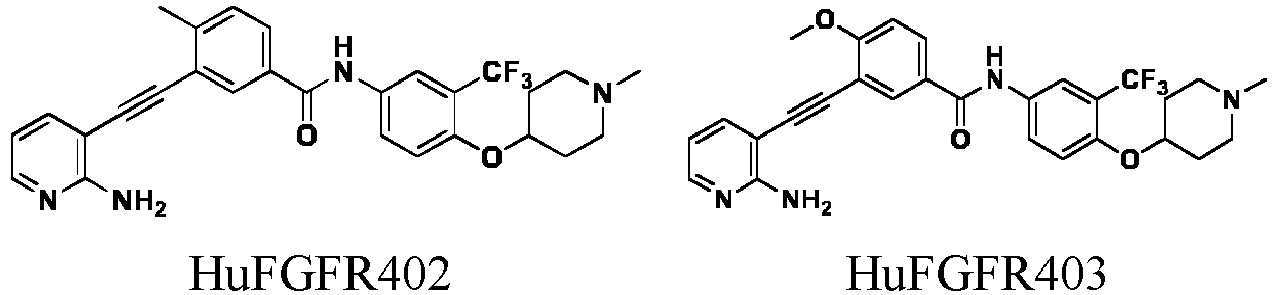


- The present invention also provides a method for preparing the compound of formula (I), or the deuterated compound, or pharmaceutically acceptable salt thereof, which comprises a step of reacting a compound of formula (1) with a compound of formula (2)

- Preferably, it comprises: in the presence of a transition metal palladium and copper catalyst and in alkaline condition, coupling the compound of formula (1) with the compound of formula (2). Preferably, the palladium catalyst comprises Pd(PPh3)2Cl2, Pd(OAc)2, and/or Pd(PPh3)4 Preferably, the copper catalyst comprises CuI and/or CuCl. Preferably, the base used for the alkaline condition comprises one or more bases selected from CsF, Cs2CO3, K2CO3, triethylamine, diisopropylethylamine, and DMAP. Preferably, the solvent for coupling reaction comprises one or more solvents selected from acetonitrile, 1,4-dioxane, and DMF.
- More preferably, the method comprises a step of reacting the compound of formula (1) with the compound of formula (2) in the presence of cesium fluoride, Pd(PPh3)2Cl2, CuI and triethylamine and in acetonitrile as a solvent.
- More preferably, the method comprises any of the following Schemes I or II:

-
- Step 1: compound I-1, NBS, AIBN and CCl4 are added into a round-bottom flask, and the reaction is carried out by heating in an oil bath under a reaction temperature of 100 °C for 24 hours until completion, and the compound I-2 is obtained by purification; wherein the equivalent ratio of compound I-1: NBS: AIBN is 1:1.1:0.2.
- Step 2: compound I-2, I-3, CH2Cl2 and Et3N are added into a round-bottom flask, and the reaction is carried out at room temperature for 12 hours until completion, and the compound I-4 is obtained by purification; wherein the equivalent ratio of the compound I-2: the compound I-3: Et3N is 1:1.1:1.2.
- Step 3: compound I-4, reducing agent (Fe powder), EtOH and NH4Cl are added into a round-bottom flask, and the reaction is carried out by heating in an oil bath under a reaction temperature of 100 °C for 10 hours until completion, and the compound I-5 is obtained by purification; wherein the equivalent ratio of compound I-4: reducing Fe powder : NH4Cl is 1:4:2.
- Step 4: compound I-6, HATU, Et3N, DMF are added into a round-bottom flask, and mixture is stirred at room temperature for 30 min, then compound I-5 is added, and stirring is continued at room temperature for 12 hours; after the reaction is completed, compound I-7 is obtained by purification; wherein the equivalent ratio of compound I-6: HATU: Et3N: compound I- is 1:2:2:0.9.
- Step 5: compound I-7, trimethylsilylacetylene, Pd(PPh3)2Cl2, CuI and Et3N are added into a round-bottom flask and MeCN is used as a solvent, and the mixture is heated to 80 °C in oil bath for 12 hours until reaction is completed, and the compound I-8 is obtained by purification; wherein the equivalent ratio of compound I-7: trimethylsilylacetylene: Pd(PPh3)2Cl2:CuI:Et3N is 1:1.5:0.05:0.1:3;
- Step 6: compound I-8, compound I-9, cesium fluoride, Pd(PPh3)2Cl2, CuI and Et3N are added into a round-bottom flask and MeCN is used as a solvent, and the mixture is heated to 80 °C in oil bath for 12 hours until reaction is completed, and the compound TM is obtained by purification; wherein the equivalent ratio of compound I-8:compound I-9: cesium fluoride:Pd(PPh3)2Cl2:CuI:MeCN: Et3N is 1:1.5:4:0.05:0.1:3.

-
- Step 1: compound II-2 and NaH are added into a round-bottom flask and DMF is used as a solvent; the mixture is stirred at ice water bath for 30 min, then compound II-1 is added, and the reaction is carried out under room temperature for 12 hours, compound II-3 is obtained by purification; wherein the equivalent ratio of compound II-1:compound II-2 : NaH is 1:1.2:1.5.
- Step 2: compound II-3, Fe powder, AcOH and ethanol are added into a round-bottom flask, the mixture is reacted at 80°C for 12 hours until completion, and the compound II-4 is obtained by purification; wherein the equivalent ratio of compound II-3: Fe powder: AcOH is 1:1.1:1.2.
- Step 3: compound II-5, HATU, Et3N and DMF are added into a round-bottom flask. After stirring under room temperature for 30 min, compound II-4 is added, and the mixture is stirred at room temperature for 12 hours until reaction is completed, compound II-6 is obtained by purification; wherein the equivalent ratio of compound II-6: HATU: Et3N: compound II-5 is 1:2:2:0.9.
- Step 5: compound II-6, trimethylsilylacetylene, Pd(PPh3)2Cl2, CuI and Et3N are added into a round-bottom flask and MeCN is used as a solvent, and the mixture is heated to 80 °C in oil bath for 12 hours until reaction is completed; the compound II-7 is obtained by purification; wherein the equivalent ratio of compound II-6: trimethylsilylacetylene: Pd(PPh3)2Cl2: CuI:Et3N is 1:1.5:0.05:0.1:3.
- Step 6: compound II-7, compound II-8, cesium fluoride, Pd(PPh3)2Cl2, CuI and Et3N are added into a round-bottom flask and MeCN is used as a solvent, and the mixture is heated to 80 °C in oil bath for 12 hours until reaction is completed, and the compound TM is obtained by purification; wherein the equivalent ratio of compound II-7: compound II-8: cesium fluoride: Pd (PPh3) 2Cl2: CuI: MeCN: Et3N is 1:1.5:4:0.05:0.1:3.
- The present invention also provides a pharmaceutical composition comprising one or more of the above compounds of formula (I) or the deuterated compound, or the pharmaceutically acceptable salt thereof, and a pharmaceutically acceptable excipient.
- The present invention also provides the use of the above formula (I) compound or the deuterated compound, or the pharmaceutically acceptable salt thereof, or the above pharmaceutical composition in preparation of FGFR kinase inhibitor, RET kinase inhibitor and/or inhibitor for mutant of FGFR or RET kinases.
- The present invention also provides the use of the above compound of the formula (I) or the deuterated compound, or pharmaceutically acceptable salt thereof, or the above pharmaceutical composition in preparing a medicament for treating tumor; optionally, the tumor comprises non-small cell lung cancer, breast cancer, thyroid cancer (medullary thyroid carcinoma, papillary thyroid cancer), gastric cancer, bladder cancer, endometrial cancer, prostate cancer, cervical cancer, colon cancer, esophageal cancer, keratinoma, myeloma, rhabdomyosarcoma, acute leukemia, liver cancer, adenocarcinoma, and pancreatic cancer.
- The present invention also provides the use of the above compound of formula (I) or the deuterated compound thereof, or pharmaceutically acceptable salt thereof, or the above pharmaceutical composition in treating tumor. Optionally, the tumor comprises non-small cell lung cancer, breast cancer, thyroid cancer (medullary thyroid carcinoma, papillary thyroid cancer), gastric cancer, bladder cancer, endometrial cancer, prostate cancer, cervical cancer, colon cancer, esophageal cancer, keratinoma, myeloma, rhabdomyosarcoma, acute leukemia, liver cancer, adenocarcinoma, and pancreatic cancer.
- According to an embodiment of the present invention, the o-aminoheteroarylalkynyl-containing compound has an advantage of high dual-targeting inhibitory activity on FGFR and RET.
- According to another embodiment of the present invention, the o-aminoheteroarylalkynyl-containing compound has an advantage of low KDR activity.
- According to another embodiment of the present invention, the o-aminoheteroarylalkynyl-containing compound exhibits strong inhibition of cell proliferation activity in human lung cancer NCI-H1581, gastric cancer cell line SNU16 and RET-dependent sensitive cell line BaF3-CCDC6-Ret and mutants thereof.
- According to another embodiment of the present invention, the pharmacokinetic data indicate that the o-aminoheteroarylalkynyl-containing compound has good druggability and exhibits significant inhibitory activity on tumor growth in a long-term animal pharmacodynamic model.
- According to another embodiment of the present invention, the animal is in good condition (including no significant decrease in body weight) at the effective dose, and no significant toxicity of other RTK multi-target inhibitors is observed (no animal death and molting).
-
-
Fig. 1 is a Western blot diagram of the pharmacological experiment example 2 which shows that the compounds HuFGFR267, HuFGFR293 and the positive control Ponatinib inhibit RET kinase phosphorylation and the downstream signaling pathways in tumor cells, wherein P-RET is phosphorylated RET kinase, P-AKT is phosphorylated AKT kinase, P-ErK is phosphorylated ErK kinase, GAPDH is glyceraldehyde-3-phosphate dehydrogenase, and ACTIN is actin. -
Fig. 2 is a line diagram of the pharmacological experiment Example 3 which shows the inhibitory effect of the compounds HuFGFR267 and AZD4547 on growth of human lung cancer NCI-H1581 xenografts in nude mice, wherein in t student's test ***p < 0.001 when compared with solvent control group. -
Fig. 3 is a line diagram of the pharmacological experiment example 3 which shows that the effects of the compounds HuFGFR267 and AZD4547 on the body weight of mice bearing human lung cancer NCI-H1581 tumor. -
Fig. 4 is a line diagram of the pharmacological experiment example 3 which shows that the inhibitory effect of the compounds HuFGFR267 and AZD4547 on growth of subcutaneous human gastric cancer SNU-16 xenografts in nude mice, wherein in t student's test, ***p < 0.001 when compared with solvent control group.. -
Fig. 5 is a line diagram of the pharmacological experiment example 3which shows that the effects of the compounds HuFGFR267 and AZD4547 on the body weight of mice bearing human gastric cancer SNU-16 tumor. -
Fig. 6 is a line diagram of the pharmacological experiment example 3 which shows the inhibitory effect of the comparative compounds HuFGFR1-117 and HuFGFR1-113 on growth of subcutaneous human gastric cancer SNU-16 xenografts in nude mice. -
Fig. 7 is a line diagram of the pharmacological experiment example 3 which shows that the effect of the comparative compounds HuFGFR1-117 and HuFGFR1-113 on the body weight of mice bearing human gastric cancer SNU-16 tumor. - Specific embodiments of the present invention will be described in detail below. It should be understood that the specific embodiments described herein are illustrative of the invention and are not intended to limit the invention.
- 2-methyl-5-nitrobenzotrifluoride (1 g, 5 mmol), NBS(980 mg ,5.5 mmol) , AIBN(164 mg, 1 mmol ) and CCl4 (20 ml) were added into a round-bottom flask and the reaction was carried out by heating in an oil bath under 100 °C for 36 hours until completion. The mixture was cooled to room temperature, the solvent was removed under reduced pressure. After column chromatography, the product 2-trifluoromethyl-4-nitrobenzyl bromide was obtained (1.04 g, yield: 70%).
- 2-trifluoromethyl-4-nitrobenzyl bromide (849 mg , 3 mmol), N-methylpiperazine (330 mg , 3.3 mmol ), Et3N (364 mg, 3.6 mmol ) and CH2Cl2 (10 ml) were added into a round-bottom flask, and the reaction was carried out at room temperature for 12 hours until completion. The solvent was removed under vacuo. After column chromatography, the product 1-methyl-4-(4-nitro-2-(trifluoromethyl)benzyl)piperazine is obtained (901 mg, yield: 97%).
- 1-methyl-4-(4-nitro-2-(trifluoromethyl)benzyl)piperazine (901 mg , about 3 mmol), reducing Fe powder (672 mg, 12 mmol), NH4Cl (318 mg, 6 mmol), EtOH(15 ml) were added into a round bottom flask; and the reaction was carried out at 80 °C in an oil bath for 10 hours until completion. After filtration via a pad of celite, the filtrate was concentrated under reduced pressure. The product 4-((4-methyl piperazin-1-yl)methylene)-3-(trifluoromethyl)aniline (754 mg , yield: 91%) was obtained by column chromatography.
- 3-iodo-4-chlorobenzoic acid (1 g, 3.55 mmol ), Et3N (574 mg, 7.1 mmol), HATU (2.7 g , 7.1 mmol), DMF (50 ml ) were added into a round-bottom flask. After stirring at room temperature for 0.5 hour, 4-((4-methylpiperazin-1-yl)methylene)-3-(trifluoromethyl)aniline (776 mg, 2.84) was added. The reaction was carried out at room temperature for 6 hours until completion, and the solvent was removed under reduced pressure. 3-iodo-4-chloro-N-(4-((4-methylpiperazin-1-yl)methylene)-3-(trifluoromethyl)phenyl)benzami de (1.5 g, yield: 98%) was obtained by column chromatography.
- 3-iodo-4-chloro-N-(4-((4-methylpiperazin-1-yl)methylene)-3-(trifluoromethyl)phenyl)ben zamide (537 mg, 1 mmol), trimethylsilylacetylene (147 mg, 1.5 mmol), Pd (PPh3)2Cl2 (60 mg, 0.05 mmol), CuI (20 mg, 0.1 mmol), Et3N (404 mg, 4 mmol)) and MeCN (40 mL) were added into a round-bottom flask, and the mixture was heated to 70 °C in oil bath and reacted overnight until the reaction was completed. After column chromatography, the product 4-chloro-N-(4-((4-methylpiperazin-1-yl)methylene)-3-(trifluoromethyl)phenyl)-3-((trimethylsil yl)ethynyl)benzamide was obtained (466 mg, yield: 92%).
- 4-chloro-N-(4-((4-methylpiperazin-1-yl)methylene)-3-(trifluoromethyl)phenyl)-3-((Trimet hylsilyl)ethynyl)benzamide (320 mg, 0.63 mmol), 2-amino-3-iodopyridine (165 mg, 0.75 mmol), Pd (PPh3)2Cl2 (22 mg, 0.032 mmol), CuI (13 mg, 0.063 mmol), CsF (383 mg, 2.52 mmol), Et3N (254.5 mg, 2.52 mmol) and MeCN (40 mL) were added into a round-bottom flask, and mixture was heated to 70 °C in oil bath and reacted overnight until the reaction was completed. After column chromatography, the product 3-(2-aminopyridine-3-ethynyl)-4-chloro-N-(4-((4-methylpiperazin-1-yl)methylene)-3-(trifluoro methyl)phenyl)benzamide (huFGFR267) was obtained (305 mg, yield: 92%).
- 1H NMR (400 MHz, CD3OD) δ 8.24 (d, J=2.2 Hz, 1H), 8.13 (d, J=2.2 Hz, 1H), 8.00 (s, 1H), 7.93 (d, J=2.2 Hz, 1H), 7.91 (d, J=2.2 Hz, 1H), 7.76 (d, J=8.5 Hz, 1H), 7.70 (dd, J=7.5, 1.6 Hz, 1H ), 7.65 (d, J=8.5 Hz, 1H), 6.70 (dd, J=7.4, 5.1 Hz, 1H), 3.64 (d, J=18.7 Hz, 2H), 2.55 (s, 8H), 2.33 (s, 3H). LR-MS (ESI) m/z 528 (M+1).
- The synthesis method was carried out as Example 1, except that 3-iodo-4-fluorobenzoic acid was used instead of 3-iodo-4-chlorobenzoic acid.
- 1H NMR (400 MHz, CD3OD) δ 8.26 (dd, J=6.7, 2.3 Hz, 1H), 8.14 (d, J=2.2 Hz, 1H), 8.08 - 7.92 (m, 3H), 7.79 (d, J=8.5 Hz, 1H), 7.71 (dd, J=7.5, 1.8 Hz, 1H), 7.38 (t, J=8.9 Hz, 1H), 6.71 (dd, J=7.5, 5.1 Hz, 1H), 3.69 (s, 2H), 2.59 (s, 8H), 2.40 (s, 3H). LR-MS (ESI) m/z 512 (M+1).
- The synthesis method was carried out as Example 1, except that 3-iodo-4-methylbenzoic acid was used instead of 3-iodo-4-chlorobenzoic acid.
- 1H NMR (400 MHz, CD3OD) δ 8.20 - 8.11 (m, 2H), 8.00 - 7.92 (m, 2H), 7.86 (dd, J=7.9, 2.0 Hz, 1H), 7.75 (d, J=8.5 Hz, 1H), 7.68 (dd, J=7.5, 1.8 Hz, 1H), 7.42 (d, J=8.1 Hz, 1H), 6.68 (dd, J=7.5, 5.1 Hz, 1H), 3.70 (s, 2H), 2.94 (s, 4H), 2.64 (d, J=13.5 Hz, 7H), 2.57 (s, 3H). LR-MS (ESI) m/z 508 (M +1).
- The synthesis method was carried out as Example 1, except that 3-iodo-4-methoxybenzoic acid was used instead of 3-iodo-4-chlorobenzoic acid.
- 1H NMR (400 MHz, CDCl3) δ 9.07 (s, 1H), 8.39 (d, J=3.0 Hz, 1H), 8.06 (d, J=3.0 Hz, 1H), 7.94 m, 2H), 7.70 (dd, J=15.0, 3.0 Hz, 1H), 7.56 (dd, J=15.0, 3.0 Hz, 1H), 7.37 (d, J=15.0 Hz, 1H), 7.08 (d, J=15.0 Hz, 1H), 6.54 (t, J=15.0 Hz, 1H), 3.92 (s, 3H), 3.54 (s, 2H), 2.54 - 2.42 (m, 4H), 2.34 (td , J=10.1, 1.7 Hz, 6H), 2.18 (d, J=30.2 Hz, 3H). LR-MS (ESI) m/z 524 (M+1).
- The synthesis method was carried out as Example 1, except that 3-iodo-4-cyanobenzoic acid was used instead of 3-iodo-4-chlorobenzoic acid.
- 1H NMR (400 MHz, CDCl3) δ 9.07 (s, 1H), 8.57 (d, J=3.0 Hz, 1H), 8.07 (dt, J=5.9, 3.0 Hz, 2H), 7.97 (dd, J=15.0, 3.0 Hz, 1H), 7.80 (d, J=15.0 Hz, 1H), 7.70 (dd, J=15.0, 3.0 Hz, 1H), 7.56 (dd, J=15.0, 3.0 Hz, 1H), 7.37 (d, J=15.0 Hz, 1H), 6.54 (t, J=15.0 Hz, 1H), 3.54 (s, 2H), 2.56 - 2.44 (m, 4H), 2.42 (s, 2H), 2.40 - 2.30 (m, 4H), 2.18 (d, J=30.2 Hz, 3H). LR-MS (ESI) m/z 519 (M+1).
- The synthesis method was carried out as Example 1, except that 3-iodobenzoic acid was used instead of 3-iodo-4-chlorobenzoic acid.
- 1H NMR (400 MHz, CD3OD) δ 8.17 (t, J=1.5 Hz, 1H), 8.15 (d, J=2.2 Hz, 1H), 7.99 - 7.92 (m, 3H), 7.79 - 7.73 (m, 2H), 7.66 (dd, J=7.5, 1.8 Hz, 1H), 7.53 (t, J=7.8 Hz, 1H), 6.66 (dd, J=7.5, 5.1 Hz, 1H), 3.67 (s, 2H), 2.64 (d, J=45.5 Hz, 8H), 2.43 (s, 3H). LR-MS (ESI) m/z 494 (M+1).
- The synthesis method was carried out as Example 1, except that 3-iodo-5-fluorobenzoic acid was used instead of 3-iodo-4-chlorobenzoic acid.
- 1H NMR (400 MHz, CD3OD) δ 8.14 (d, J=2.1 Hz, 1H), 8.00 (t, J=1.4 Hz, 1H), 8.00 - 7.92 (m, 2H), 7.75 (d, J=8.5 Hz, 1H), 7.73 - 7.65 (m, 2H), 7.55 (ddd, J=8.9, 2.5, 1.3 Hz, 1H), 6.66 (dd, J=7.5, 5.1 Hz, 1H), 3.68 (s, 2H), 2.67 (d, J=60.6 Hz, 8H), 2.48 (s, 3H). LR-MS (ESI) m/z 512 (M+1).
- The synthesis method was carried out as Example 1, except that 2-fluoro-5-iodobenzoic acid was used instead of 3-iodo-4-chlorobenzoic acid.
- 1H NMR (400 MHz, DMSO) δ 10.83 (s, 1H), 8.17 (d, J=1.9 Hz, 1H), 8.05 (dd, J=6.8, 2.2 Hz, 1H), 8.02 - 7.92 (m, 2H), 7.86 (ddd, J=8.6, 4.9, 2.2 Hz, 1H), 7.73 (d, J=8.5 Hz, 1H), 7.61 (dd, J=7.5, 1.9 Hz, 1H), 7.45 (dd, J=9.8 , 8.7 Hz, 1H), 6.58 (dd, J=7.5, 4.9 Hz, 1H), 6.44 (s, 2H), 3.61 (s, 2H), 2.60 (s, 4H), 2.51 - 2.39 (m, 4H) , 2.35 (s, 3H). LR-MS (ESI) m/z 512 (M+1).
- The synthesis method was carried out as Example 1, except that 3-iodo-5-chlorobenzoic acid was used instead of 3-iodo-4-chlorobenzoic acid.
- 1H NMR (400 MHz, CDCl3) δ 9.11 (s, 1H), 8.27 (t, J=3.0 Hz, 1H), 8.06 (d, J=3.0 Hz, 1H), 7.97 (dd, "J =15.0, 3.0 Hz, 1H), 7.84 (dt, J=8.0, 3.0 Hz, 2H), 7.70 (dd, J=15.0, 3.0 Hz, 1H), 7.56 (dd, J=15.0, 3.0 Hz, 1H), 7.37 (d, J=15.0 Hz, 1H), 6.54 (t, J=15.0 Hz, 1H), 3.54 (s, 2H), 2.52 - 2.44 (m, 4H) ), 2.42 - 2.26 (m, 4H), 2.21 (s, 2H), 2.18 (s, 3H). LR-MS (ESI) m/z 528 (M+1).
- The synthesis method was carried out as Example 1, except that 3-iodo-5-trifluoromethylbenzoic acid was used instead of 3-iodo-4-chlorobenzoic acid.
- 1H NMR (400 MHz, CDCl3) δ 9.09 (s, 1H), 8.39 (t, J=3.0 Hz, 1H), 8.10 (ddd, J=17.4, 10.2, 3.0 Hz, 3H), 7.97 ( Dd, J=14.9, 3.0 Hz, 1H), 7.70 (dd, J=15.0, 3.0 Hz, 1H), 7.56 (dd, J=15.0, 2.9 Hz, 1H), 7.37 (d, J=15.0 Hz, 1H), 6.54 (t, J=15.0 Hz, 1H), 3.54 (s, 2H), 2.57 - 2.43 (m, 4H), 2.39 - 2.29 (m, 4H), 2.10 (s, 5H). LR-MS (ESI) m/z 562 (M+1).
- The synthesis method was carried out as Example 1, except that 3-iodo-5-cyanobenzoic acid was used instead of 3-iodo-4-chlorobenzoic acid.
- 1H NMR (400 MHz, CDCl3) δ 9.06 (s, 1H), 8.67 (t, J=3.0 Hz, 1H), 8.55 (t, J=3.0 Hz, 1H), 8.21 - 8.01 (m, 2H), 7.97 (dd, J=14.9, 3.1 Hz, 1H), 7.70 (dd, J=15.0, 3.0 Hz, 1H), 7.56 (dd, J=14.9, 2.9 Hz, 1H) , 7.37 (d, J=15.0 Hz, 1H), 6.54 (t, J=15.0 Hz, 1H), 3.54 (s, 2H), 2.54 - 2.43 (m, 4H), 2.38 - 2.28 (m , 4H), 2.15 (s, 2H), 2.13 (s, 3H). LR-MS (ESI) m/z 519 (M+1).
- The synthesis method was carried out as Example 1, except that 3-iodo-5-methylbenzoic acid was used instead of 3-iodo-4-chlorobenzoic acid.
- 1H NMR (400 MHz, CDCl3) δ 9.09 (s, 1H), 8.29 (t, J=3.0 Hz, 1H), 8.06 (d, J=3.0 Hz, 1H), 7.97 (dd, "J =14.9, 3.1 Hz, 1H), 7.81 (dt, J=16.3, 3.0 Hz, 2H), 7.70 (dd, J=15.0, 3.0 Hz, 1H), 7.56 (dd, J=14.9, 2.9 Hz, 1H), 7.37 (d, J=15.0 Hz, 1H), 6.54 (t, J=15.0 Hz, 1H), 3.54 (s, 2H), 2.54 - 2.44 (m, 4H), 2.39 - 2.29 (m, 7H), 2.14 (s, 3H). LR-MS (ESI) m/z 508 (M+1).
- The synthesis method was carried out as Example 1, except that 3-iodo-5-methoxybenzoic acid was used instead of 3-iodo-4-chlorobenzoic acid.
- 1H NMR (400 MHz, CDCl3) δ 9.14 (s, 1H), 8.07 (d, J=4.0 Hz, 2H), 7.97 (s, 1H), 7.88 (s, 1H), 7.70 (s, 1H) , 7.56 (s, 1H), 7.37 (s, 1H), 6.75 (s, 1H), 6.54 (s, 1H), 3.79 (s, 3H), 3.54 (s, 2H), 2.48 (s, 4H), 2.34 (s, 4H), 2.18 (s, 2H), 2.10 (s, 3H). LR-MS (ESI) m/z 524 (M+1).
- The synthesis method was carried out as Example 1, except that 2-methyl-5-iodobenzoic acid was used instead of 3-iodo-4-chlorobenzoic acid.
- 1H NMR (400 MHz, CDCl3) δ 8.77 (s, 1H), 8.34 (s, 1H), 8.06 (s, 1H), 7.97 (s, 1H), 7.80 - 7.51 (m, 3H), 7.37 (s, 2H), 6.54 (s, 1H), 3.54 (s, 2H), 2.48 (s, 4H), 2.34 (s, 4H), 2.22 (s, 3H), 2.14 (s, 3H), 2.00 (s, 2H) ). LR-MS (ESI) m/z 508 (M+1).
- The synthesis method was carried out as Example 1, except that 2-methoxy-5-iodobenzoic acid was used instead of 3-iodo-4-chlorobenzoic acid.
- 1H NMR (400 MHz, CDCl3) δ 9.49 (s, 1H), 8.39 (s, 1H), 8.06 (s, 1H), 7.97 (s, 1H), 7.69 (d, J=4.0 Hz, 2H) , 7.56 (s, 1H), 7.37 (s, 1H), 7.08 (s, 1H), 6.54 (s, 1H), 3.93 (s, 3H), 3.54 (s, 2H), 2.48 (s, 4H), 2.34 (s, 4H), 2.21 (s, 2H), 2.14 (s, 3H). LR-MS (ESI) m/z 524 (M+1).
- The synthesis method was carried out as Example 1, except that 2-amino-3-iodo-5-fluoropyridine was used instead of 2-amino-3-iodopyridine.
- 1H NMR (400 MHz, CD3OD) δ 8.26 (d, J=2.2 Hz, 1H), 8.15 (d, J=2.1 Hz, 1H), 7.95 (ddt, J=18.6, 12.3, 6.0 Hz, 3H), 7.76 (d, J=8.5 Hz, 1H), 7.64 (d, J=8.5 Hz, 1H), 7.52 (dd, J=8.3, 2.8 Hz, 1H), 3.72 (s, 2H), 2.83 (m, 11H). LR-MS (ESI) m/z 546 (M+1).
- The synthesis method was carried out as Example 1, except that 2-amino-3-iodo-5-chloropyridine was used instead of 2-amino-3-iodopyridine.
- 1H NMR (400 MHz, CDCl3) δ 9.07 (s, 1H), 8.33 (s, 1H), 8.04 (d, J=12.5 Hz, 2H), 7.89 (d, J=12.0 Hz, 2H) , 7.55 (d, J=8.0 Hz, 2H), 7.37 (s, 1H), 3.54 (s, 2H), 2.64 (s, 2H), 2.48 (s, 4H), 2.34 (s, 4H), 2.13 (s, 3H). LR-MS (ESI) m/z 562 (M+1).
- The synthesis method was carried out as Example 1, except that 2-amino-3-iodo-5-methylpyridine was used instead of 2-amino-3-iodopyridine.
- 1H NMR (400 MHz, DMSO) δ 8.33 (s, 1H), 8.06 (s, 1H), 7.86 (d, J=20.0 Hz, 2H), 7.57 (d, J=4.0 Hz, 2H) , 7.30 (d, J=8.0 Hz, 2H), 6.89 (s, 2H), 3.54 (s, 2H), 2.48 (s, 4H), 2.34 (s, 4H), 2.23 (s, 3H), 2.19 (s, 3H). LR-MS (ESI) m/z 542 (M+1).
- The synthesis method was carried out as Example 1, except that 2-amino-3-iodo-5-cyclopropylpyridine was used instead of 2-amino-3-iodopyridine.
- 1H NMR (400 MHz, DMSO) δ 8.33 (d, J=2.9 Hz, 1H), 8.06 (d, J=3.1 Hz, 1H), 7.88 (dd, J=14.9, 2.9 Hz, 1H), 7.78 (d, J=2.9 Hz, 1H), 7.65 - 7.52 (m, 2H), 7.30 (dd, J=8.9, 7.4 Hz, 2H), 6.89 (s, 2H), 3.54 (s, 2H), 2.50 (ddd, J=24.7, 19.4, 10.9 Hz, 4H), 2.41 - 2.28 (m, 4H), 2.18 (d, J=30.1 Hz, 3H), 1.86 - 1.52 (m, 1H), 1.39 - 0.82 (m, 4H). LR-MS (ESI) m/z 568 (M+1).
- The synthesis method was carried out as Example 1, except that 2-amino-3-iodo-5-trifluoromethylpyridine was used instead of 2-amino-3-iodopyridine.
- 1H NMR (400 MHz, CD3OD) δ 8.26 (d, J=2.1 Hz, 2H), 8.13 (d, J=2.0 Hz, 1H), 7.92 (dd, J=13.3, 4.8 Hz, 2H), 7.85 (d, J=2.2 Hz, 1H), 7.73 (d, J=8.5 Hz, 1H), 7.60 (d, J=8.4 Hz, 1H), 3.68 (s, 2H), 2.85 (s, 4H), 2.59 (d, J=28.5 Hz, 7H). LR-MS (ESI) m/z 596 (M+1).
- The synthesis method was carried out as Example 1, except that 2-amino-3-iodo-5-cyanopyridine was used instead of 2-amino-3-iodopyridine.
- NMR 8.400 (d, J=2.9 Hz, 1H), , 7.95 - 7.83 (m, 2H), 7.64 - 7.49 (m, 2H), 7.31 (d, J=15.0 Hz, 1H), 6.89 (s, 2H), 3.54 (s, 2H), 2.57 - 2.44 (m, 4H), 2.41 - 2.31 (m, 4H), 2.11 (s, 3H). LR-MS (ESI) m/z 553 (M+1).
- The synthesis was carried out as Example 1, except that 2-amino-3-iodo-5-methoxypyridine was used instead of 2-amino-3-iodopyridine.
- NMR 8.50 (s, 1H), 8.04 (s, 1H) (d, J=16.0 Hz, 2H), 3.91 (s, 3H), 3.53 (s, 2H), 2.47 (s, 3H), 2.33 (s, 3H), 2.13 (s, 3H). LR-MS (ESI) m/z 558 (M+1).
- The synthesis method was carried out as Example 1, except that 2-amino-3-iodo-5-trifluoromethoxypyridine was used in place of 2-amino-3-iodopyridine.
- 1H NMR (400 MHz, DMSO) δ 8.33 (d, J=2.9 Hz, 1H), 8.06 (d, J=3.1 Hz, 1H), 7.88 (dd, J=14.9, 2.9 Hz, 1H), 7.64 (d, J=2.9 Hz, 1H), 7.61 - 7.53 (m, 2H), 7.46 (d, J=3.1 Hz, 1H), 7.31 (d, J=15.0 Hz , 1H), 6.89 (s, 2H), 3.54 (s, 2H), 2.54 - 2.43 (m, 4H), 2.42 - 2.29 (m, 4H), 2.18 (d, J=30.1 Hz, 3H). LR-MS (ESI) m/z 612 (M+1).
- The synthesis was carried out as Example 1, except that 2-amino-3-iodo-5-cyclopropyloxypyridine was used instead of 2-amino-3-iodopyridine.
- 1H NMR (400 MHz, DMSO) δ 8.30 (d, J=2.9 Hz, 1H), 8.04 (d, J=2.9 Hz, 1H), 7.86 (dd, J=14.9, 2.9 Hz, 1H), 7.62 (d, J=3.1 Hz, 1H), 7.59 - 7.49 (m, 2H), 7.34 (d, J=2.9 Hz, 1H), 7.29 (d, J=15.0 Hz , 1H), 6.87 (s, 2H), 3.53 (s, 2H), 3.44 - 3.21 (m, 1H), 2.49 (ddd, J=24.6, 18.7, 12.1 Hz, 4H), 2.39 - 2.26 (m , 4H), 2.13 (s, 3H), 0.71 - 0.28 (m, 2H), 0.28 - -0.20 (m, 2H). LR-MS (ESI) m/z 584 (M+1).
- The synthesis was carried out as Example 1, except that 2-amino-3-iodo-5-(3-oxetanyl)oxypyridine was used instead of 2-amino-3-iodopyridine.
- 1H NMR (400 MHz, DMSO) δ 8.33 (d, J=2.9 Hz, 1H), 8.06 (d, J=3.1 Hz, 1H), 7.88 (dd, J=14.9, 2.9 Hz, 1H), 7.58 (ddd, J=14.9, 13.4, 3.0 Hz, 3H), 7.31 (d, J=15.0 Hz, 1H), 6.89 (s, 2H), 4.04 (d, J=2.9 Hz, 1H), 3.54 (s, 2H), 2.50 (ddd, J=24.7, 19.4, 10.9 Hz, 4H), 2.38 - 2.27 (m, 4H), 2.11 (s, 3H). LR-MS (ESI) m/z 600 (M+1).
- The synthesis method was carried out as Example 1, except that 2-amino-3-iodo-5-(2-hydroxyethyl)oxypyridine was used instead of 2-amino-3-iodopyridine.
- 1H NMR (400 MHz, DMSO) δ 8.33 (d, J=2.9 Hz, 1H), 8.06 (d, J=3.1 Hz, 1H), 7.88 (dd, J=14.9, 2.9 Hz, 1H), 7.58 (ddd, J=14.9, 13.4, 2.9 Hz, 3H), 7.33 (dd, J=18.3, 9.0 Hz, 2H), 6.89 (s, 2H), 4.90 (s, 1H) , 4.33 (td, J=14.5, 0.5 Hz, 2H), 3.68 (dd, J=21.5, 7.4 Hz, 2H), 3.54 (s, 2H), 2.59 - 2.40 (m, 4H), 2.40 - 2.28 (m, 4H), 2.10 (s, 3H). LR-MS (ESI) m/z 588 (M+1).
- The synthesis was carried out as Example 1, except that 2-amino-3-iodo-5-(2-methoxyethyl)oxypyridine was used instead of 2-amino-3-iodopyridine.
- NMR 8.400 (d, J=2.9 Hz, 1H), 1H), 7.57 (ddd, J=14.9, 13.4, 3.0 Hz, 3H), 7.32 (dd, J=17.7, 8.9 Hz, 2H), 6.88 (s, 2H), 4.30 (td, J=14.5, 0.7 Hz, 2H), 3.76 (td, J=14.6, 0.8 Hz, 2H), 3.53 (s, 2H), 3.40 (s, 3H), 2.59 - 2.43 (m, 4H), 2.43 - 2.25 (m, 4H), 2.19 (s, 3H). LR-MS (ESI) m/z 602 (M+1).
- The synthesis method was carried out as Example 1, except that 2-amino-3-iodo-5-(2-methylaminoethyl)oxypyridine was used instead of 2-amino-3-iodopyridine.
- 1H NMR (400 MHz, DMSO) δ 8.33 (d, J=2.9 Hz, 1H), 8.06 (d, J=3.1 Hz, 1H), 7.88 (dd, J=14.9, 2.9 Hz, 1H), 7.58 (ddd, J=14.9, 13.4, 2.9 Hz, 3H), 7.33 (dd, J=14.4, 9.0 Hz, 2H), 6.89 (s, 2H), 4.13 (t, J=14.6 Hz, 2H), 3.54 (s, 2H), 3.26 (s, 3H), 3.01 (t, J=14.6 Hz, 2H), 2.60 - 2.43 (m, 4H), 2.42 - 2.26 (m , 4H), 2.14 (s, 3H), 1.84 (s, 1H). LR-MS (ESI) m/z 601 (M+1).
- The synthesis was carried out as Example 1, except that 2-amino-3-iodo-5-(2-dimethylaminoethyl)oxypyridine was used instead of 2-amino-3-iodopyridine.
- 1H NMR (400 MHz, DMSO) δ 8.33 (d, J=2.9 Hz, 1H), 8.06 (d, J=3.1 Hz, 1H), 7.88 (dd, J=14.9, 2.9 Hz, 1H), 7.64 (d, J=2.9 Hz, 1H), 7.62 - 7.57 (m, 1H), 7.57 - 7.53 (m, 1H), 7.36 (d, J=2.9 Hz, 1H), 7.31 (d, J=15.0 Hz, 1H), 6.89 (s, 2H), 4.07 (t, J=14.4 Hz, 2H), 3.54 (s, 2H), 2.72 (t, J=14.4 Hz, 2H), 2.52 - 2.44 (m, 4H), 2.38 - 2.30 (m, 4H), 2.27 (s, 6H), 2.14 (s, 3H). LR-MS (ESI) m/z 615 (M+ 1).
- The synthesis method was carried out as Example 1, except that 2-amino-3-iodo-5-hydroxymethylpyridine was used instead of 2-amino-3-iodopyridine.
- 1H NMR (500 MHz, CD3OD) δ 8.33 (s, 1H), 8.06 (s, 1H), 7.89 (d, J=15.0 Hz, 2H), 7.58 - 7.46 (m, 3H), 7.37 (s, 1H) , 4.61 (s, 2H), 3.54 (s, 2H), 2.48 (s, 3H), 2.34 (s, 3H), 2.17 (s, 3H). LR-MS (ESI) m/z 558 (M+1 ).
- The synthesis method was carried out as Example 1, except that 2-amino-3-iodo-5-methoxymethylpyridine was used instead of 2-amino-3-iodopyridine.
- 1H NMR (400 MHz, DMSO) δ 8.33 (d, J=2.9 Hz, 1H), 8.06 (d, J=3.1 Hz, 1H), 7.91 (d, J=2.9 Hz, 1H) , 7.90 - 7.85 (m, 1H), 7.62 - 7.53 (m, 2H), 7.50 (d, J=2.9 Hz, 1H), 7.31 (d, J=15.0 Hz, 1H), 6.89 (s , 2H), 4.80 (s, 2H), 3.54 (s, 2H), 3.28 (s, 3H), 2.52 - 2.45 (m, 4H), 2.39 - 2.30 (m, 4H), 2.14 (s, 3H). LR-MS (ESI) m/z 572 (M+1).
- The synthesis method was carried out as Example 1, except that 2-amino-3-iodo-5-trifluoromethoxymethylpyridine was used instead of 2-amino-3-iodopyridine.
- 1H NMR (400 MHz, DMSO) δ 8.30 (d, J=2.9 Hz, 1H), 8.03 (d, J=2.9 Hz, 1H), 7.91 - 7.82 (m, 2H), 7.59 - 7.45 (m, 3H), 7.28 (d, J=14.9 Hz, 1H), 6.87 (s, 2H), 4.78 (s, 2H), 3.53 (s, 2H), 2.53 - 2.41 (m, 4H), 2.40 - 2.25 (m, 4H), 2.17 (d, J=30.1 Hz, 3H). LR-MS (ESI) m/z 626 (M+1).
- The synthesis method was carried out as Example 1, except that 2-amino-3-iodo-5-methylaminomethylpyridine was used instead of 2-amino-3-iodopyridine.
- 1H NMR (400 MHz, DMSO) δ 8.33 (d, J=2.9 Hz, 1H), 8.06 (d, J=3.1 Hz, 1H), 7.96 (d, J=3.1 Hz, 1H) , 7.88 (dd, J=14.9, 2.9 Hz, 1H), 7.61 - 7.45 (m, 3H), 7.31 (d, J=15.0 Hz, 1H), 6.89 (s, 2H), 3.76 (s , 2H), 3.54 (s, 2H), 3.26 (s, 3H), 2.58 - 2.44 (m, 4H), 2.44 - 2.26 (m, 4H), 2.14 (s, 3H), 1.98 (s, 1H). LR-MS (ESI) m/z 571 (M+1).
- The synthesis was carried out as Example 1, except that 2-amino-3-iodo-5-dimethylaminomethylpyridine was used instead of 2-amino-3-iodopyridine.
- 1H NMR (400 MHz, DMSO) δ 8.33 (d, J=2.9 Hz, 1H), 8.06 (d, J=3.1 Hz, 1H), 7.96 (d, J=3.1 Hz, 1H) , 7.88 (dd, J=14.9, 2.9 Hz, 1H), 7.62 - 7.53 (m, 2H), 7.48 (d, J=3.1 Hz, 1H), 7.31 (d, J=15.0 Hz, 1H), 6.89 (s, 2H), 3.66 (s, 2H), 3.54 (s, 2H), 2.54 - 2.44 (m, 4H), 2.38 - 2.29 (m, 4H), 2.15 (d, J=8.1 Hz, 9H). LR-MS (ESI) m/z 585 (M+1).
- The synthesis method was carried out as Example 1, except that 2-amino-3-iodo-5-methylaminopyridine was used instead of 2-amino-3-iodopyridine.
- 1H NMR (400 MHz, DMSO) δ 8.33 (d, J=2.9 Hz, 1H), 8.06 (d, J=3.1 Hz, 1H), 7.88 (dd, J=14.9, 2.9 Hz, 1H), 7.68 - 7.43 (m, 2H), 7.31 (d, J=15.0 Hz, 1H), 7.11 (dd, J=8.9, 3.0 Hz, 2H), 6.89 (s, 2H), 5.88 (s, 1H), 3.54 (s, 2H), 2.68 (s, 3H), 2.58 - 2.41 (m, 4H), 2.40 - 2.28 (m, 4H), 2.14 (s, 3H). LR-MS (ESI) ) m/z 557 (M+1).
- The synthesis method was carried out as Example 1, except that 2-amino-3-iodo-5-dimethylaminopyridine was used instead of 2-amino-3-iodopyridine.
- 1H NMR (400 MHz, DMSO) δ 8.33 (s, 1H), 8.06 (s, 1H), 7.88 (s, 1H), 7.57 (d, J=4.0 Hz, 2H), 7.31 (s, 1H) , 7.11 (d, J=11.3 Hz, 2H), 6.89 (s, 2H), 3.54 (s, 2H), 2.92 (s, 6H), 2.48 (s, 4H), 2.34 (s, 4H), 2.24 (s, 3H). LR-MS (ESI) m/z 571 (M+1).
- The synthesis method was carried out as Example 1, except that 2-amino-3-iodo-5-acetylaminopyridine was used instead of 2-amino-3-iodopyridine.
- 1H NMR (400 MHz, CDCl3) δ 9.10 (s, 1H), 8.38 (t, J=2.9 Hz, 1H), 8.05 (d, J=2.9 Hz, 1H), 7.98 (s, 1H) , 7.92 (dt, J=14.6, 3.2 Hz, 1H), 7.81 - 7.69 (m, 2H), 7.63 (d, J=14.7 Hz, 1H), 7.59 - 7.47 (m, 2H), 7.36 (d, J=14.9 Hz, 1H), 3.53 (s, 2H), 2.52 - 2.43 (m, 4H), 2.40 - 2.31 (m, 4H), 2.23 (s, 2H), 2.14 (s, 3H)), 2.06 (s, 3H). LR-MS (ESI) m/z 551 (M+1).
- The synthesis method was carried out as Example 1, except that 2-amino-3-iodo-5-(2-cyclopropylacetyl)aminopyridine was used instead of 2-amino-3-iodopyridine.
- 1H NMR (400 MHz, CDCl3) δ 9.10 (s, 1H), 8.39 (t, J=2.9 Hz, 1H), 8.30 (s, 1H), 8.06 (d, J=3.0 Hz, 1H) , 7.93 (dt, J=14.6, 3.2 Hz, 1H), 7.80 - 7.69 (m, 2H), 7.68 - 7.50 (m, 3H), 7.37 (d, J=15.0 Hz, 1H), 3.54 (s, 2H), 2.55 - 2.42 (m, 4H), 2.41 - 2.30 (m, 4H), 2.23 (s, 1H), 2.22 - 2.00 (m, 4H), 1.02 - 0.40 (m, 4H). LR -MS (ESI) m/z 577 (M+1).
- The synthesis method was carried out as Example 1, except that 2-amino-3-iodo-5-acrylamidopyridine was used instead of 2-amino-3-iodopyridine.
- 1H NMR (400 MHz, CDCl3 ) δ 9.08 (s, 1H), 9.05 (s, 1H), 8.31 (d, J=3.0 Hz, 1H), 8.04 (d, J=3.0 Hz, 1H) , 7.86 (dd, J=15.0, 3.0 Hz, 1H), 7.77 (d, J=3.0 Hz, 1H), 7.60 - 7.45 (m, 3H), 7.35 (d, J=15.0 Hz, 1H), 6.11 (m, 2H), 5.67 (dd, J=32.6, 5.2 Hz, 1H), 3.53 (s, 2H), 2.52 - 2.43 (m, 4H), 2.41 - 2.26 (m, 6H) ), 2.13 (s, 3H). LR-MS (ESI) m/z 597 (M+1).
- The synthesis method was carried out as Example 1, except that 2-amino-3-iodo-5-(4-dimethylamino-2-alkenylbutanoyl)aminopyridine was used instead of 2-amino-3-iodopyridine.
- 1H NMR (400 MHz, CDCl3) δ 9.06 (d, J=9.5 Hz, 2H), 8.33 (d, J=3.0 Hz, 1H), 8.06 (d, J=3.0 Hz, 1H) , 7.88 (dd, J=15.0, 3.0 Hz, 1H), 7.79 (d, J=3.0 Hz, 1H), 7.60 - 7.49 (m, 3H), 7.37 (d, J=15.0 Hz, 1H), 6.79 (dt, J=30.2, 12.4 Hz, 1H), 5.57 (dt, J=30.2, 1.9 Hz, 1H), 3.54 (s, 2H), 3.02 (dd, J=12.4, 1.9 Hz, 2H), 2.75 (s, 6H), 2.55 - 2.44 (m, 4H), 2.43 - 2.26 (m, 6H), 2.14 (s, 3H). LR-MS (ESI) m/z 654 (M+1).
- Compound 1-methyl-4-piperidinol (1.26 g, 11 mmol) and NaH (240 mg, 12 mmol), were added into a round-bottom flask using DMF as a solvent. The mixture was stirred in ice water bath for 30 min, and 2-fluoro-5-nitrotrifluorotoluene (2.09 g, 10 mmol) was added, and the reaction was carried out at room temperature for 12 hours. The product 1-methyl-4-(4-nitro-2-(trifluoromethyl)phenylhydroxy)piperidine (2.9 g, yield: 95%) was obtained by purification.
- Compound 1-methyl-4-(4-nitro-2-(trifluoromethyl)phenylhydroxy)piperidine (304 mg , 1 mmol), Fe powder (280 mg, 5 mmol), AcOH (1.2 g, 20 mmol), and ethanol (solvent) were added into a round-bottom flask, the reaction was carried out at 80°C for 12 hours until completion, and the product 4-((1-methylpiperidinyl-4-yl)hydroxy)-3-(trifluoromethyl)aniline (261 mg., Yield: 95%) was obtained by purification.
- 3-iodo-4-fluorobenzoic acid (1 g, 3.55 mmol), Et3N (574 mg, 7.1 mmol), and HATU (2.7 g, 7.1 mmol) were added into a round bottom flask, and DMF ( 50 ml) was added successively. After stirring at room temperature for 0.5 hr, 4-((1-methylpiperidinyl-4-yl)hydroxy)-3-(trifluoromethyl)aniline (778 mg, 2.84) was added, and the reaction was carried out at room temperature for 6 hours until completion. The solvent was evaporated to dryness under reduced pressure. After column chromatography, 4-chloro-3-iodo-N-(4-((1-methylpiperidinyl-4-yl)hydroxy)-3-(trifluoromethyl)phenyl)benzamid e (1.77 g, yield: 93%) was obtained.
- 4-chloro-3-iodo-N-(4-((1-methylpiperidin-4-yl)hydroxy)-3-(trifluoromethyl)phenyl)benza mide (538 mg, 1 mmol)), trimethylsilylacetylene (147 mg, 1.5 mmol), Pd (PPh3) 2 Cl2(60 mg, 0.05 mmol), CuI(20 mg, 0.1 mmol), Et3N (404 mg, 4 mmol)) and MeCN (40 mL) were added into a round-bottom flask, and the reaction was carried out overnight at 70 °C in oil bath until completion. After column chromatography, the product 4-chloro-N-(4-((1-methylpiperidin-4-yl)hydroxy)-3-(trifluoromethyl)phenyl-3-((trimethylsilyl)e thynyl)benzamide was obtained (477 mg, yield: 94%).
- 4-chloro-N-(4-((4-methylpiperazin-1-yl)methylene)-3-(trifluoromethyl)phenyl)-3-((trimeth ylsilyl)ethynyl)benzamide (320 mg, 0.63 mmol), 2-amino-3-iodopyridine (165 mg, 0.75 mmol), Pd (PPh3)2Cl2 (22 mg, 0.032 mmol), CuI (13 mg, 0.063 mmol), CsF (383 mg, 2.52 mmol), Et3N (254.5 mg, 2.52 mmol) and MeCN (40 mL)were added into a round-bottom flask, and the reaction was carried out overnight at 70 °C in oil bath until completion. After column chromatography, the product 3-(2-aminopyridine-3-ethynyl)-4-chloro-N-(4-((4-methylpiperazin-1-yl)methylene)-3-(trifluoro methyl)phenyl)-3-((trimethylsilyl)ethynyl)benzamide was obtained (301 mg, yield: 90%).
- 1H NMR (400 MHz, CD3OD) δ 8.24 (d, J=2.2 Hz, 1H), 8.04 (d, J=2.6 Hz, 1H), 8.00 (dd, J=5.1, 1.7 Hz, 1H), 7.91 (dt, J=9.0, 2.0 Hz, 2H), 7.71 (dd, J=7.5, 1.8 Hz, 1H), 7.65 (d, J=8.5 Hz, 1H), 7.26 (d, J=9.1 Hz, 1H), 6.70 (dd, J=7.5, 5.1 Hz, 1H), 4.81 (s, 1H), 3.04 (dd, J=15.6, 6.3 Hz, 4H), 2.69 - 2.64 (m, 3H), 2.14 (ddd, J=51.1, 16.4, 11.2 Hz, 4H). LR-MS (ESI) m/z 529 (M+1).
- The synthesis method was carried out as Example 41, except that 3-iodo-4-fluorobenzoic acid was used instead of 3-iodo-4-chlorobenzoic acid.
- 1H NMR (400 MHz, CD3OD) δ 8.24 (dd, J=6.7, 2.4 Hz, 1H), 8.05 (d, J=2.6 Hz, 1H), 8.04 - 7.95 (m, 2H), 7.91 ( Dd, J=9.0, 2.7 Hz, 1H), 7.68 (dd, J=7.5, 1.8 Hz, 1H), 7.33 (t, J=8.9 Hz, 1H), 7.28 (d, "J =9.1 Hz, 1H), 6.69 (dd, J=7.5, 5.1 Hz, 1H), 4.89 - 4.84 (m, 1H), 3.30 - 3.16 (m, 4H), 2.81 (s, 3H), 2.31 - 2.06 (m, 4H). LR-MS (ESI) m/z 513 (M+1).
- The synthesis method was carried out as Example 41, except that 3-iodo-4-methylbenzoic acid was used instead of 3-iodo-4-chlorobenzoic acid.
- 1H NMR (400 MHz, CDCl3) δ 9.03 (s, 1H), 8.34 (d, J=3.0 Hz, 1H), 8.03 (d, J=3.0 Hz, 1H), 7.97 (dd, "J =15.0, 3.0 Hz, 1H), 7.82 (dd, J=15.0, 3.0 Hz, 1H), 7.70 (dd, J=15.0, 3.0 Hz, 1H), 7.55 (dd, J=15.0, 3.0 Hz, 1H), 7.37 (d, J=15.0 Hz, 1H), 6.81 (d, J=15.0 Hz, 1H), 6.54 (t, J=15.0 Hz, 1H), 3.83 (p, J=14.7 Hz, 1H), 2.62 - 2.32 (m, 7H), 2.29 - 2.03 (m, 7H), 2.00 - 1.81 (m, 2H). LR-MS (ESI) m/z 509 (M+1).
- The synthesis was carried out as Example 41, except that 3-iodo-4-methoxybenzoic acid was used instead of 3-iodo-4-chlorobenzoic acid.
- 1H NMR (400 MHz, CDCl3) δ 9.00 (s, 1H), 8.39 (d, J=3.0 Hz, 1H), 8.03 (d, J=3.0 Hz, 1H), 7.94 (m, 2H), 7.70 (dd, J=15.0, 3.0 Hz, 1H), 7.55 (dd, J=15.0, 3.0 Hz, 1H), 7.08 (d, J=15.0 Hz, 1H), 6.81 (d, J=15.0 Hz, 1H), 6.54 (t, J=15.0 Hz, 1H), 3.97 - 3.70 (m, 4H), 2.63 - 2.33 (m, 4H), 2.30 (s, 2H), 2.23 - 2.03 (m, 5H), 2.02 - 1.85 (m, 2H). LR-MS (ESI) m/z 525 (M+1).
- The synthesis method was carried out as Example 41, except that 3-iodobenzoic acid was used instead of 3-iodo-4-chlorobenzoic acid.
- 1H NMR (400 MHz, CD3OD) δ 8.18 (t, J=1.5 Hz, 1H), 8.09 (d, J=2.6 Hz, 1H), 8.01 - 7.90 (m, 3H), 7.82 - 7.75 (m, 1H), 7.68 (dd, J=7.5, 1.8 Hz, 1H), 7.55 (t, J=7.8 Hz, 1H), 7.29 (d, J=9.1 Hz, 1H), 6.68 (dd, J=7.5, 5.1 Hz, 1H), 4.91 - 4.89 (m, 1H), 3.37 - 3.23 (m, 4H), 2.89 (s, 3H), 2.39 - 2.08 (m, 4H). LR -MS (ESI) m/z 495 (M+1).
- The synthesis method was carried out as Example 1, except that 2-amino-3-iodopyrazine was used instead of 2-amino-3-iodopyridine.
- 1H NMR (400 MHz, CD3OD) δ 8.36 (d, J=2.2 Hz, 1H), 8.17 (d, J=2.1 Hz, 1H), 8.05 (d, J=2.4 Hz, 1H) , 8.03 - 7.98 (m, 2H), 7.87 (s, 1H), 7.79 (d, J=8.5 Hz, 1H), 7.73 (d, J=8.5 Hz, 1H), 3.75 (s, 2H), 3.08 (s, 4H), 2.73 (s, 7H). LR-MS (ESI) m/z 529 (M+1).
- The synthesis method was carried out as Example 1, except that 2-amino-3-iodo-5-fluoropyrazine was used instead of 2-amino-3-iodopyridine and 3-iodobenzoic acid was used instead of 3-iodo-4-chlorobenzoic acid.
- 1H NMR (400 MHz, CDCl3) δ 9.09 (s, 1H), 8.39 (t, J=2.9 Hz, 1H), 8.25 (d, J=16.0 Hz, 1H), 8.06 (d, J =3.0 Hz, 1H), 7.93 (dt, J=14.6, 3.2 Hz, 1H), 7.74 (dt, J=15.0, 3.2 Hz, 1H), 7.64 (d, J=14.7 Hz, 1H), 7.61 - 7.53 (m, 1H), 7.37 (d, J=15.0 Hz, 1H), 3.54 (s, 2H), 2.69 - 2.43 (m, 4H), 2.41 - 2.30 (m, 4H)), 2.18 (d, J"=30.2 Hz, 3H), 1.62 (s, 2H). LR-MS (ESI) m/z 513 (M+1).
- The synthesis method was carried out as Example 1, except that 2-amino-3-iodo-5-hydroxymethylpyrazine was used instead of 2-amino-3-iodopyridine and 3-iodobenzoic acid was used instead of 3-iodo-4-chlorobenzoic acid.
- NMR 8.40 (s, 1H), 8.26 (s, 1H) (s, 1H), 4.71 (s, 2H), 3.51 (s, 2H), 2.81 (s, 1H), 2.46 (s, 3H), 2.32 (s, 3H), 2.12 (s, 3H). LR- MS (ESI) m/z 525 (M+1).
- The synthesis method was carried out as Example 1, except that 2-amino-3-iodo-4-fluoropyrazine was used instead of 2-amino-3-iodopyridine.
- 1H NMR (400 MHz, CDCl3) δ 9.08 (s, 1H), 8.33 (d, J=3.0 Hz, 1H), 8.06 (d, J=3.0 Hz, 1H), 7.92 (ddd, J =17.9, 15.0, 6.4 Hz, 2H), 7.60 - 7.48 (m, 2H), 7.37 (d, J=15.0 Hz, 1H), 6.51 (dd, J=15.9, 15.1 Hz, 1H) , δ-MS (ESI) m/z 546 (M+1).
- The synthesis was carried out as Example 1, except that 1-tert-butoxycarbonylpiperazine was used instead of N-methylpiperazine.
- 1H NMR (400 MHz, CDCl3) δ 8.33 (d, J=3.0 Hz, 1H), 8.07 - 7.81 (m, 3H), 7.70 (dd, J=15.0, 3.0 Hz, 1H), 7.60 - 7.48 (m, 2H), 7.31 (d, J=15.0 Hz, 1H), 6.89 (s, 2H), 6.53 (t, J=15.0 Hz, 1H), 3.54 (s, 2H), 3.19 (t, J=10.4 Hz, 4H), 2.48 (t, J=10.4 Hz, 4H), 1.42 (s, 9H). (ESI) m/z 614 (M+1).
- HuFGFR459 (1.0g, 1.75 mmol) was dissolved in anhydrous dichloromethane (20 mL), and trifluoroacetic acid (10 mL) was added dropwise into the solution under ice bath condition. The reaction was carried out in ice bath for 30 min. After purification, the product HuFGFR472 was obtained (0.78 g, yield: 93%).
- 1H NMR (400 MHz, DMSO) δ 8.33 (d, J=3.0 Hz, 1H), 8.11 - 7.78 (m, 3H), 7.70 (dd, J=15.0, 3.0 Hz, 1H), 7.62 - 7.43 (m, 2H), 7.31 (d, J=15.0 Hz, 1H), 6.89 (s, 2H), 6.53 (t, J=15.0 Hz, 1H), 3.54 (s, 2H), 2.68 (dd, J=15.4, 5.2 Hz, 4H), 2.33 (dd, J=15.4, 5.4 Hz, 4H), 1.75 (s, 1H). (ESI) m/z 514 (M+1).
- HuFGFR267 (1.0g , 1.89 mmol) was dissolved in anhydrous methanol, and 1 M hydrogen chloride in methanol (1.89 mL) was added dropwise into the solution under ice bath condition. The reaction was carried out for 10 min at room temperature, and the solvent was evaporated to obtain HuFGFR459 (1.07 g, yield: 100%).
- 1H NMR (400 MHz, DMSO) δ 8.33 (d, J=3.0 Hz, 1H), 8.06 (d, J=3.0 Hz, 1H), 7.97 (dd, J=15.0, 3.0 Hz, 1H), 7.88 (dd, J=15.0, 3.0 Hz, 1H), 7.70 (dd, J=15.0, 3.0 Hz, 1H), 7.61 - 7.51 (m, 2H), 7.31 (d, J=15.0 Hz, 1H), 6.89 (s, 2H), 6.53 (t, J=15.0 Hz, 1H), 3.54 (s, 2H), 3.14 - 3.03 (m, 4H), 2.89 - 2.82 (m , 7H). LR-MS (ESI) m/z 528 (M+1).
- HuFGFR472 (1.0g , 1.95 mmol) was dissolved in anhydrous DMF, potassium carbonate (0.54 g, 3.9 mmol) was successively added, and then deuterated iodomethane (0.28 g, 1.95 mmol) was added under ice bath condition. The reaction was carried out for 1 h in ice bath to obtain HuFGFR474 (0.8. g, Yield: 79%).
- 1H NMR (400 MHz, DMSO) δ 8.33 (d, J=3.0 Hz, 1H), 8.06 (d, J=3.0 Hz, 1H), 7.97 (dd, J=15.0, 3.0 Hz, 1H), 7.88 (dd, J=15.0, 3.0 Hz, 1H), 7.79 - 7.46 (m, 3H), 7.31 (d, J=15.0 Hz, 1H), 6.89 (s, 2H), 6.53 (t, J=15.0 Hz, 1H), 3.54 (s, 2H), 2.61 - 2.42 (m, 4H), 2.40 - 2.20 (m, 4H). LR-MS (ESI) m/z 531 (M +1).
- The structures of compound A34, HuFGFR143, HuFGFR148, HuFGFR150, HuFGFR151, Ponatinib (or AP24534) and LY2874455 are as follows:

- Enzyme reaction substrate Poly(Glu, Tyr)4:1 was diluted with potassium-free PBS (10 mM sodium phosphate buffer, 150 mM NaCl, pH 7.2-7.4) to 20 µg/mL. The enzyme label plate was coated with 125 µL/well. The reaction was conducted under 37°C for 12-16 hours. After the liquid was removed from the wells, the plate was washed three times with 200 µL / well of T-PBS (PBS containing 0.1% Tween-20), each for 5 minutes. The enzyme plate was dried in 37°C dryer for 1-2 hours.
- 50µL ATP solution diluted with buffer (50 mM HEPES pH 7.4, 50 mM MgCl2, 0.5 mM MnCl2, 0.2 mM Na3VO4, 1 mM DTT) to a final concentration of 5 µM was added into each well. The compound was diluted with DMSO to a suitable concentration (1 µL/well) or the well contained the corresponding concentration of DMSO (negative control well) Then various kinase recombinant proteins diluted with 49 µL of reaction buffer was added to initiate the reaction. Each experiment required duplicate enzyme-free control well. The reaction was carried out for 1 hour on a 37 °C Shaker (100 rpm). The plate was washed three times with T-PBS. A dilution of the primary antibody PY99 was added (100 µL/well), and the reaction was conducted in a shaker at 37 °C for 0.5 hr. The plate was washed three times with T-PBS. A dilution of the horseradish peroxidase-labeled goat anti-mouse IgG secondary antibody was added (100 µL/well), and the reaction was conducted in a shaker at 37°C for 0.5 hour. Plate was washed with T-PBS for three times. 2 mg/mL OPD coloration solution (diluted with 0.1 M citric acid-sodium citrate buffer containing 0.03% H2O2 (pH=5.4)) was added (100 µL / well), reacted for 1-10 minutes at 25°C in dark. The reaction was quenched with 2M H2SO4 (50 µL/well), and read at 490 nm using a tunable microplate reader SPECTRA MAX 190.
- The inhibition ratio of the sample was determined by the following formula:

- The IC50 values were obtained via four-parameter regression analysis using the software supplied with the microplate reader.
- The enzyme activity data of the compounds prepared in the present invention, compound HuFGFR151, compound HuFGFR117, the positive control Ponatinib and the positive control LY2874455 against the three enzymes of FGFR1, RET and KDR are listed in Table 1:
Table 1. Effect of compounds on tyrosine kinase activity No. 10 nM inhibition ratio FGFR1 RET KDR Example 1 77.7 87.6 45.1 Example 2 73.0 69.2 44.3 Example 3 52.4 69.1 34.7 Example 4 51.1 52.0 4.6 Example 5 45.1 40.1 15.2 Example 6 74.7 57.7 35.2 Example 7 80.7 92.4 38.9 Example 8 46.0 53.4 30.4 Example 9 60.7 83.4 28.9 Example 10 36 63.4 34.5 Example 11 54.0 68.2 34.3 Example 12 75.1 73.2 24.0 Example 13 70.2 64.3 15.1 Example 14 46.1 57.6 20.3 Example 15 59.9 61.2 15.4 Example 16 70.5 71.8 25.2 Example 17 68.0 73.3 25.0 Example 18 65.5 58.2 20.3 Example 19 59.3 69.4 13.2 Example 20 71.1 70.8 23.4 Example 21 44.3 58.1 32.0 Example 22 75.1 59.3 24.9 Example 23 74.1 60.0 33.1 Example 24 64.1 66.1 23.5 Example 25 54.5 49.9 33.2 Example 26 77.2 79.4 24.3 Example 27 78.2 69.5 34.1 Example 28 68.5 79.3 28.7 Example 29 44.9 55.2 14.3 Example 30 55.2 77.8 5.8 Example 31 59.3 67.8 35.1 Example 32 66.3 70.8 37.2 Example 33 49.8 77.8 35.1 Example 34 44.3 57.8 18.0 Example 35 57.9 44.3 32.1 Example 36 49.9 56.3 12.1 Example 37 48.1 66.3 33.2 Example 38 51.8 65.3 44.1 Example 39 53.4 88.0 36.4 Example 40 58.2 77.3 36.6 Example 41 53.4 77.3 35.4 Example 42 52.2 46.5 18.2 Example 43 44.1 55.4 31.2 Example 44 49.9 64.3 21.0 Example 45 48.6 69.5 23.8 Example 46 48.5 95.1 43.1 Example 47 55.1 89.1 40.8 Example 48 48.7 78.0 34.3 Example 49 77.1 69.5 33.2 Example 50 56.3 55.1 27.8 Example 51 67.9 79.4 38.2 Example 52 75.2 89.3 40.2 Example 53 78.3 87.0 42.1 A34 33.2 16.4 39.5 HuFGFR143 19.9 (100 nM) 35.2 26.4 HuFGFR148 22.4 (100 nM) 21.7 18.2 HuFGFR150 35.1 30.3 32.3 HuFGFR151 21.1 (100nM) 29.7 (100nM) 23.9 (100nM) Ponatinib 79.5 87.5 85.3 LY2874455 97.5 / 91.6 Note: Data is presented as average of inhibitory ratio of compound in two independent experiments for inhibiting kinase substrate phosphorylation. - Experimental results: As seen from Table 1, in the evaluation of biological activity, the o-aminoheteroaryl alkynyl-containing compounds of the present invention have a high activity of inhibiting FGFR1 and RET kinase at a concentration of 10 µM, while the compounds prepared in the examples of the present invention have low KDR activity. The activity of these compounds on KDR is significantly weaker than that on FGFR1 or RET, thus indicating these compounds have clear selectivity which is beneficial to solve the technical problems of hepatic toxicity and cardiotoxicity of Panatinib. Compared with the compounds of the present invention, compound HuFGFR151 has a different amino position, which results in the significant decrease of its inhibitory activity on FGFR1 and RET kinases. Compared with compound A34, HuFGFR143, HuFGFR148, and HuFGFR150, the introduction of o-amino in the compounds of the present invention results a significant increase in the activity against FGFR1 and RET kinases and selectivity. However, the KDR activity of the positive control drugs (Ponatinib and LY2874455) is high.
- The inhibitory activity data of the compounds HuFGFR267 and HuFGFR293 against the RET-related mutant enzyme are shown in Table 2, wherein, Ret (V804M) is a commercially available recombinant protein. The results showed that HuFGFR267 and HuFGFR293 had significant inhibitory activities against Ret and Ret (V804M), especially for Ret and its V804M mutant kinase.
Table 2. IC50 value for compounds against tyrosine kinase activity (nM) Kinase IC50 (nM) HuFGFR267 HuFGFR293 Ret 1.4±0.6 6.0±0.4 Ret (V804M) 8.4±1.7 17.9±5.4 Note: The inhibitory IC50 value of compounds on phosphorylation of kinase substrate was independently measured twice and presented as Mean ± SD. - The cells were seeded into a 12-well plate (250,000/well). After incubation for 18-24 hours, the compounds were added to react for 2 hours, and then the cells were collected and firstly washed once with cold PBS (containing 1 mmol sodium vanadate); then 1×SDS gel loading buffer (50 mmol Tris-HCl (pH 6.8), 100 mmol DTT, 2% SDS, 10% glycerol, 1 mmol sodium vanadate , 0.1% bromophenol blue) was added to lyse cells. The cell lysate was heated in a boiling water bath for 10 minutes, and then centrifuged at 12,000 rpm for 10 minultes at 4 °C.
- The supernatant was taken for SDS-PAGE electrophoresis (Mini-PROTEAN 3 Cell, Bio-Rad, Hercules, CA, US A). After electrophoresis, the proteins were transferred to a nitrocellulose membrane using a semi-dry electrotransfer system (Amersham Life Sciences, Arlington Heights, IL, USA). The nitrocellulose membrane was placed in a blocking solution (5% skim milk powder diluted in TBS containing 1 mmol sodium vanadate) for 2 hours at room temperature, and then the membrane was placed and reacted with a primary antibody at 4 ° C overnight. The membrane was washed three times with TBS containing 1 mmol sodium vanadate for 15 min each time. The membrane was placed in a secondary antibody solution and reacted for 1-2 hours at room temperature. After the membrane was washed three times as above, the membrane was stained using ECL (Picece, Rockford, IL) reagent was used for staining and then developed.
- The results that Compound HuFGFR267 (267), HuFGFR293 (293) and positive control Ponatinib inhibited RET phosphorylation and the downstream signaling pathway in tumor cells and tool cell lines were shown in
Fig. 1 . As seen fromFig. 1 , the o-aminoheteroaryl alkynyl-containing compound of the present invention targeted to and significantly inhibited the activation of the RET signaling pathway at the cellular level. - The AZD4547 structure is as follows:
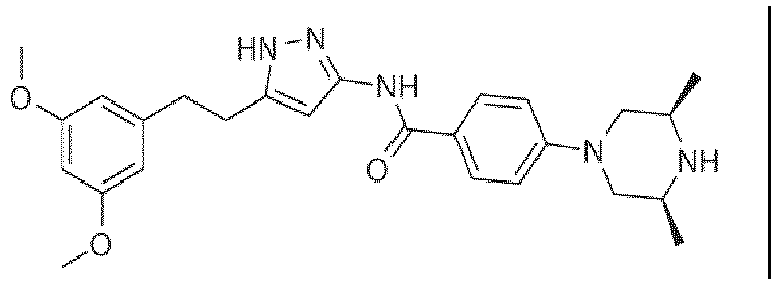
- The tumor tissue in the vigorous growth period was cut into about 1.5 mm3, and inoculated subcutaneously in the right axilla of nude mice under aseptic conditions. The diameter of the subcutaneously implanted tumor in nude mice was measured by a vernier caliper. The animals were randomly divided into groups when the average volume was about 120 mm3. In the
compound HuFGFR267 50 mg/kg group, the compound was formulated with 0.5% methylcellulose (MC) to the required concentration before use. The formulation of compound was prepared once a week, and orally administered once a day for 14 days. The positive control drug AZD4547 was diluted to the required concentration with water for injection containing 1% Tween 80 before use. The formulation of AZD4547 was prepared once a week, and orally administered once a day for 14 days. In the solvent control group, an equal amount of water for injection was administrated. The diameter of the transplanted tumor was measured twice a week during the entire experiment, and the body weight of the mice was weighed. The tumor volume (TV) was calculated as: TV=1/2 × a × b2, where a and b represented length and width, respectively. The relative tumor volume (RTV) was calculated based on the measured results, and the formula was: RTV=V t / V0, wherein V0 represented the tumor volume obtained when the mice was divided and administered (i.e., d0), and Vt represented the tumor volume at each measurement. The evaluation index of antitumor activity was: relative tumor proliferation rate T/C (%), and the formula was as follows: T/C (%)=(T RTV / C RTV) × 100%, wherein T RTV was TRV in treatment group; and C RTV was RTV in negative control group. - The results of the inhibitory effect of the compound HuFGFR267 on growth of xenografts of human lung cancer NCI-H1581 in nude mice are shown in Table 3 and
Fig. 2 , wherein the data in Table 3 correspond to numerical points in the curve ofFig. 2 . As seen fromFig. 2 , inHuFGFR267 50 mg/kg group, after orally administered once a day for 14 days, the growth of subcutaneously xenografts of human lung cancer NCI-H1581 in nude mice was significantly inhibited, and T/C obtained on the 14th day was 3.77%. In the positive control AZD4547 12.5 mg/kg group, it was administrated in the same way as above, and the growth of subcutaneously xenografts of human lung cancer NCI-H1581 in nude mice was significantly inhibited and the T/C obtained on the 14th day was 24.03%. During the experiment, no mice died, and the mice in each group were in good condition. It can be seen fromFig. 3 and Table 4 (wherein the data in Table 4 correspond to numerical points in the curve ofFig. 3 ), the body weight of mice bearing human lung cancer NCI-H1581 tumor in the compound HuFGFR267 group had no significant change. Thus, it indicated that the o-aminoheteroaryl alkynyl-containing compound of the present invention had a significant inhibitory effect on the growth of subcutaneous xenografts of human lung cancer NCI-H1581 in nude mice, and advantage of low toxicity.Table 3. Effect of HuFGFR-267 on tumor volume of xenografts of human lung cancer NCI-H1581 in nude mice Group Relative tumor volume RTV (mean±SD) d0 d3 d7 d10 d14 Solvent control 1.00±0.00 3.38±1.59 15.26±4.04 28.78±7.04 57.48±35.29 AZD4547 12.5mg/kg 1.00±0.00 1.27±0.44 3.43±1.14 5.57±3.62 13.81±4.56 P value 0.0061 0.0000 0.0000 0.0090 HuFGFR-267 50mg/kg 1.00±0.00 1.28±0.40 1.33±0.74 2.02±1.10 2.16±1.41 P value 0.0062 0.0000 0.0000 0.0016 Note: P value is vs solvent control Table 4. Effect of HuFGFR-267 on body weight of mice bearing human lung cancer NCI-H1581 tumor Group Weight (g, mean±SD) d0 d3 d7 d10 d14 Solvent control 18.2±1.5 9.0±1.8 20.9±2.0 22.2±2.8 24.2±3.2 AZD4547 12.5mg/kg 18.2±1.6 19.3±1.6 20.1±1.9 20.6±2.2 21.3±2.3 HuFGFR-267 50mg/kg 18.1±1.2 19.2±1.0 19.7±1.0 20.2±1.2 20.0±1.3 - The results of the inhibitory effect of compound HuFGFR267 on growth of human gastric cancer SNU-16 xenografts in nude mice are shown in
Fig. 4 , wherein the data of Table 5 correspond to numerical points in the curve ofFig. 4 . InHuFGFR267 50 mg/kg and 25 mg/kg groups, compounds were administered orally once a day for 21 days, and the growth of human gastric cancer SNU-16 xenografts in nude mice was which significantly inhibited. The T/C values obtained on day 21 were 11.66% and 18.55%, respectively. In the positive control AZD4547 12.5 mg/kg group, AZD4547 was administrated in the same way as above and the growth of subcutaneous xenografts of human gastric cancer SNU-16 in nude mice was significantly inhibited. T/C obtained on day 21 was 18.46%. During the experiment, no mice died, and the mice in each group were in good condition. As seen fromFig. 5 (the data in Table 6 correspond to each numerical points in the curve ofFig. 5 ), body weight of mice bearing human gastric cancer SNU-16 tumor in the compound HuFGFR267 group had no significant change. Thus, it indicated that the o-aminoheteroaryl alkynyl-containing compound of the present invention had a significant inhibitory effect on the growth of subcutaneous xenografts of human gastric cancer SNU-16 in nude mice, and advantage of low toxicity.Table 5. Effect of HuFGFR-267 on tumor volume of xenografts of human gastric cancer SNU-16 in nude mice. Group Relative tumor volume RTV (mean±SD) 2016/12/20 2016/12/23 2016/12/27 2016/12/30 2017/1/3 2017/1/6 2017/1/10 d0 d3 d7 d10 d14 d17 d21 Solvent control 1.00±0.00 2.86±2.01 7.2±2.86 10.03±4.29 14.79±7.10 18.72±8.50 23.44±9.95 AZD4547 12.5mg/kg 1.00±0.00 0.92±0.29 2.34±1.23 2.96±2.19 3.36±3.14 3.77±2.56 4.33±3.29 P value 0.0338 0.0012 0.0017 0.0018 0.0007 0.0003 HuFGFR-267 50mg/kg 1.00±0.00 1.11±0.42 0.83±0.49 1.26±0.71 1.89±1.57 2.02±1.63 2.73±2.82 P value 0.0537 0.0001 0.0002 0.0005 0.0002 0.0002 HuFGFR-267 25mg/kg 1.00±0.00 1.74±0.58 2.51±0.93 3.13±1.51 3.79±1.93 3.97±1.58 4.35±2.03 P value 0.2038 0.0014 0.0016 0.0020 0.0008 0.0003 Table 6. Effect of HuFGFR-267 on body weight of mice bearing human gastric cancer SNU-16 tumor Group Weight (g, mean±SD) 2016/12/20 2016/12/23 2016/12/27 2016/12/30 2017/1/3 2017/1/6 2017/1/10 d0 d3 d7 d10 d14 d17 d21 Solvent control 18.5±1.3 19.5±1.4 20.0±1.9 21.1±2.2 21.1±2.4 20.8±2.5 20.4±2.5 AZD4547 12.5mg/kg 18.8±1.2 19.5±1.3 20.0±1.5 20.7±1.5 21.1±1.6 20.9±1.7 21.0±1.7 HuFGFR-267 50mg/kg 18.9±1.9 19.4±2.2 19.9±2.4 20.6±2.3 20.5±2.2 20.8±2.3 20.7±2.2 HuFGFR-267 25mg/ks 18.6±1.6 19.4±1.7 20.0±1.8 20.9±1.8 21.3±1.7 21.2±1.6 21.4±1.8 -

- The tumor tissue in the vigorous growth period was cut into 1.5 mm3, and inoculated subcutaneously in the right axilla of nude mice under aseptic conditions. The diameter of the xenograft in nude mice was measured with a vernier caliper. The animals were randomly divided into groups when the average tumor volume was grown to about 190 mm 3. In HuFGFR1-113 and HuFGFR1-117 groups ( 100 mg/kg and 20 mg/kg) the compounds were orally administered once a day for 21 consecutive days. In the positive
control drug Ponatinib 30 mg/kg group, Ponatinib was orally administered once a day for 21 days. In the solvent control group, mice were gave an equal amount of solvent. The diameter of the xenograft was measured twice a week during the entire experiment, and the body weight of the mice was weighed. The tumor volume (TV) was calculated as: TV=1/2 × a × b2, where a and b represented length and width, respectively. The relative tumor volume (RTV) was calculated based on the measured results, and the formula was: RTV=Vt / V0, wherein V0 represented the tumor volume obtained when the mice was divided and administered (i.e., d0), and Vt represented the tumor volume at each measurement. The anti-tumor activity evaluation index was the relative tumor proliferation rate T/C (%), and the calculation formula was as follows: T/C (%)=(T RTV / C RTV) × 100%, wherein T RTV was TRV in treatment group; and C RTV was RTV in negative control group. - The experimental results are shown in
Figs. 6 and 7 (where the data in Tables 7 and 8 correspond to the numerical values in the curves ofFigs 6 and 7 , respectively). HuFGFR1-113 100 mg/kg group showed significant toxicity, and administration was stopped due to the mice were found to have a poor state with low temperature on the second day. One mouse died on the third day. Two mice died on the fifth day. The compound was administrated again because the mouse was recovered onday 20. In HuFGFR1-113 20mg/kg group, the compound was administered orally once a day for 21 days, and the growth of human gastric cancer SNU-16 in nude mice was significantly inhibited. The T/C obtained on day 21 was 23.30%, but one mouse died onday 20. In the compound HuFGFR1-117 100mg/kg group, the growth of subcutaneous xenograft of human gastric cancer SNU-16 in nude mice was significantly inhibited. The T/C obtained on day 21 was 14.38%, but one mouse died on the 9th and 10th day respectively, and other mice showed dry skin, molting, and poor condition, so the administration was stopped. The administration was started again because the mice was recovered and the molting disappeared and the skin returned to normal on day 17. In HuFGFR1-117 20mg/kg group, it was orally administered once a day, and the growth of subcutaneous xenografts of human gastric cancer SNU-16 in nude mice was weakly inhibited. The T/C obtained on day 21 was 47.88%, and the tumor inhibition rate was low. In thePonatinib 30 mg/kg group, it was orally administered once a day for 21 days, and the growth of subcutaneous xenografts of human gastric cancer SNU-16 in nude mice was significantly inhibited. The T/C obtained on day 21 was 36.20%.Table 7. Effect of various compounds on tumor volume of xenografts of human gastric cancer SNU-16 in nude mice Group Relative tumor volume RTV (mean±SD) d0 d3 d7 d10 d14 d17 d21 Solvent control 1.00±0.00 1.61±0.40 2.20±0.70 2.69±0.81 3.96±1.03 4.82±1.34 5.80±1.66 Ponatinib 1.00±0.00 1.46±0.30 1.56±0.52 1.56±0.22 2.00±0.38 1.94±0.47 2.10±0.34 30mg/kg P value 0.4763 0.0942 0.0099 0.0013 0.0005 0.0003 HuFGFR1-113 1.00±0.00 1.32±0.40 0.58±0.02 0.60±0.02 0.58±0.35 1.16±0.86 1.52±/ 100mg/kg P value 0.2142 0.0106 0.0055 0.0012 0.0045 / HuFGFR1-113 1.00±0.00 1.12±0.03 0.64±0.23 0.54±0.22 0.92±0.17 1.18±0.42 1.35±0.15 20mg/kg P value 0.0200 0.0004 0.0001 0.0000 0.0001 0.0002 HuFGFR1-117 1.00±0.00 1.53±0.39 0.80±0.18 0.49±0.08 0.51±0.19 0.75±0.22 0.83±0.31 100mg/kg P value 0.7229 0.0008 0.0008 0.0002 0.0004 0.0004 HuFGFR1-117 1.00±0.00 1.51±0.37 1.75±0.47 1.49±0.14 2.06±0.38 2.55±0.55 2.78±0.58 20mg/kg P value 0.6558 0.2154 0.0065 0.0017 0.0033 0.0019 Note: P value is vs solvent control Table 8. Effect of various compounds on body weight of mice bearing human gastric cancer SNU-16 tumor Group Weight (g, mean±SD) 2014-4-28 2014-5-1 2014-5-5 2014-5-8 2014-5-12 2014-5-15 2014-5-19 d0 d3 d7 dl0 dl4 dl7 d21 Solvent control 23.4±1.5 23.8±1.4 22.4±1.7 22.7±1.9 24.1±2.1 22.8±2.4 22.9±2.8 Ponatinib 30mg/kg 23.6±2.5 24.2±2.9 23.5±2.8 23.7±2.9 24.5±2.8 24.1±2.6 24.6±3.1 HuFGFR1-113 100mg/kg 23.4±2.7 23.1±2.0 20.7±0.1 22.1±0.4 25.4±1.6 25.5±3.0 21.2±/ HuFGFR1-113 20mg/kg 23.2±1.8 24.0±1.5 22.4±1.8 20.2±1.9 19.7±2.9 20.1±3.7 20.3±1.6 HuFGFR1-117 100mg/kg 23.6±0.7 24.4±1.8 21.1±1.9 17.6±1.8 19.7±2.0 22.6±1.5 23.0±2.4 HuFGFR1-117 20mg/kg 22.5±1.9 23.6±2.1 22.7±2.0 22.7±2.3 23.6±2.4 24.2±2.5 24.7±2.3 - Experimental conclusion: The HuFGFR267 of the present invention significantly inhibited the growth of subcutaneous xenografts of human gastric cancer SNU-16 in nude mice, and the T/C obtained on day 21 was 11.66% and 18.55%, respectively. The weight of the tumor-bearing mice did not change significantly and the mice were in good condition. Compound HuFGFR1-113 (morpholine substituted in meta-position of pyridine) which was structurally similar to compound HuFGFR267 of the present invention, had a weaker inhibition on growth of subcutaneous xenografts of human gastric cancer SNU-16 in nude mice at the dosage of 20 mg/kg than that of HuFGFR267, and the T/C obtained on day 21 was 23.30%, while the weight of the tumor-bearing mice decreased significantly. One mouse died on
day 20. The dosage of 100mg/kg showed great toxicity. The mice were found to have poor state with low temperature on the second day. One mouse died on the third day. Two mice died on the fifth day. Another compound HuFGFR1-117 (without amino substitution in the o-position of pyridine) which was structurally similar to HuFGFR267 of the present invention, has a weaker inhibitory effect on the growth of subcutaneous xenografts of human gastric cancer SNU-16 in nude mice than that of HuFGFR267, and T/C obtained on day 21 were 14.38% and 47.88%, while the weight of the tumor-bearing mice was significantly decreased. One mouse died on the 9th and 10th day respectively, and other mice appeared dry skin, molting and poor state. It indicates that the introduction of the o-amino of the pyridine in the present invention can effectively increase the tumor inhibitory activity of compounds and exhibit a significant advantage of low toxicity. - Ponatinib (AP24534) was administered intravenously (IV) and orally (PO) to SD rats. Blood samples were taken at different time points. LC-MS/MS was used to determine the concentration of compound in the plasma of rats after administration of the test compound, and the relevant pharmacokinetic parameters were calculated to examine oral bioavailability and pharmacokinetic properties of the compound in rats. The results are shown in Table 3.
Table 3 Administration route CL plasma (mL/kg/min) Vd ss (L/kg) T max (h) T1/2(h) C max (ng/mL) AUC0-t (ng*h/mL) F IV (2mg/kg) 22.2 7.78 -- 4.24 -- 1413 -- PO (10mg/kg) -- -- 2.33 8.29 241 1603 24.4% - Compound HuFGFR267 was administered intravenously and orally to SD rats. Blood samples were taken at different time points. LC-MS/MS was used to determine the concentration of compound in the plasma of rats after administration of the test compound, and the relevant pharmacokinetic parameters were calculated to examine oral bioavailability and pharmacokinetic properties of the compound in rats. The results are shown in Table 4.
Table 4 Administration route CL plasma (mL/kg/min) Vd ss (L/kg) T max (h) T1/2(h) C max (ng/mL) AUC0-t (ng*h/mL) F IV (2mg/kg) 11.9 4.88 -- 6.00 -- 2720 -- PO (10mg/kg) -- -- 5.33 10.5 346 4961 36.5% - It can be seen from Table 3 and Table 4 that compound HuFGFR267 is superior to the marketed drug AP24534 in the aspect of exposure, thus having a better potential for developing into a medicine.
- In summary, the o-aminoheteroaryl alkynyl-containing compounds in the examples of the present invention have advantages of a high FGFR and RET dual-targeting inhibitory activity and a relatively low KDR activity. The compound of formula (I) exhibits a strong inhibitory activity on human lung cancer cell line NCI-H1581 and gastric cancer cell line SNU16 as well as an RET-dependent sensitive cell line BaF3-CCDC6-Ret and mutants thereof. Pharmacokinetic data has shown that the o-aminoheteroaryl alkynyl-containing compound has good druggability, and exhibits significant inhibition on the growth of related tumors in a long-term animal model while in the efficacy dosage, the animal has a good condition (including no significant decrease in body weight), and no significant toxicity is observed (no animal death or molting).
- The preferred embodiments of the present invention have been described above in detail in combination with the attached drawings. However, the present invention is not limited to the specific details of the embodiments described above.
Claims (12)
- A compound of formula (I), or a deuterated compound, or a pharmaceutically acceptable salt thereof:
 R is amino;M is C or N, and when M is N, R2 is none;R1 is selected from the group consisting of -H, halogen, hydroxyl, cyano, C1-4 alkyl (optionally substituted by halogen, hydroxyl, C1-4 alkoxy, trifluoromethoxyl, mono or di C1-4 alkylamino), C1-4 alkoxy (optionally substituted by halogen, hydroxyl, C1-4 alkoxyl, amino, mono or di C1-4 alkylamino), amino, mono or di C1-4 alkylamino, C1-4 alkylamido, C3-6 cycloalkylamido, and C2-4alkenylamido optionally substituted by mono or di C1-4 alkylamino;R2 is selected from -H, or halogen;R3 is selected from -H, halogen, cyano, an optionally halogenated C1-4 alkyl, or C1-4 alkoxy;R4 is a C1-4 alkyl or oxyl substituted by a 5- or 6-membered aliphatic heterocyclyl having 1-2 N atoms on the ring, wherein the 5- or 6-membered aliphatic heterocyclyl is optionally substituted by C1-4 alkyl;each of theheteroaryl, heteroaryl ring is independently and optionally substituted by one or more substituents selected from the group consisting of halogen, oxo, and alkyl;the alkyl is a saturated aliphatic straight or branched alkyl group having 1-6 carbon atoms;the halogen is each independently selected from the group consisting of F, Cl, Br, and I;the heteroaryl or heteroaryl ring is a 5-10 membered aromatic monocyclic or fused bicyclic ring having one or more heteroatoms selected from N, O, and S;the cycloalkyl is a saturated or unsaturated 3-10 membered monocyclic or polycyclic alicyclic ring;the cycloalkylene is a saturated or unsaturated 3-10 membered monocyclic or polycyclic aliphatic cycloalkylene;the heterocyclyl is a saturated or unsaturated 3-10 membered monocyclic or polycyclic aliphatic heterocycle containing one or more heteroatoms selected from N, O, and S;the heterocyclylene is a saturated or unsaturated 3-10 membered monocyclic or polycyclic aliphatic heterocyclylene containing one or more heteroatoms selected from N, O, and S;preferably, the pharmaceutically acceptable salt comprises hydrochloride, methanesulfonate, maleate or the like.
 - The compound, or the deuterated compound, or the pharmaceutically acceptable salt thereof of claim 1, wherein:the alkyl is a saturated aliphatic straight or branched alkyl having 1 to 6 carbon atoms, preferably having 1 to 4 carbon atoms, more preferably 1 to 3 carbon atoms, and still more preferably is methyl, ethyl, propyl, isopropyl or tert-butyl;the heteroaryl or heteroaryl ring is a 6-10 membered and preferably 6-8 membered monocyclic or fused bicyclic ring containing 1-3 heteroatoms selected from N, O and S;the cycloalkyl is a saturated or unsaturated 3-6 membered monocyclic or polycyclic ring;the cycloalkylene is a saturated or unsaturated 3-6 membered monocyclic or polycyclic ring;the heterocyclyl is a 4-7 membered and preferably 4-6 membered monocyclic or polycyclic heterocycle containing 1-3 heteroatoms selected from N, O, and S;the heterocyclylene is a 4-7 membered and preferably 4-6 membered monocyclic or polycyclic heterocyclene containing 1-3 heteroatoms selected from N, O, and S.
- The compound, or the deuterated compound, or the pharmaceutically acceptable salt thereof of claims 1 or 2, wherein:
R3 is selected from -H, halogen, cyano, or an optionally halogenated C1 alkyl. - The compound, or the deuterated compound, or the pharmaceutically acceptable salt thereof of any one of claims 1 to 3, wherein:
M is CR2 is selected from -H, halogen, C1-C4 alkyl (optionally substituted with 1-3 halogens), amino C1-C4 alkyl, methylamino C1-C4 alkyl, dimethylamino C1-C4 alkyl, C1-C4 alkoxy, hydroxy C1-C4 alkyl, C3-C6 cycloalkyl. - The compound, or the deuterated compound, or the pharmaceutically acceptable salt thereof of any one of claims 1-4, wherein:R3 is hydrogen, chloro, fluoro, methyl, methoxyl, cyano, or trifluoromethyl;R4 is a C1-4 alkyl or oxyl substituted by a 6-membered aliphatic heterocyclyl having 1-2 N atoms on the ring, wherein the 6-membered aliphatic heterocyclyl is optionally substituted by C1-4 alkyl, and preferably R4 is 4-methylpiperazin-1-ylmethyl or 1-methylpiperidin-4-yloxyl.
- The compound, or the deuterated compound, or the pharmaceutically acceptable salt thereof of any one of claims 1 to 5, wherein the compound, or the deuterated compound, or the pharmaceutically acceptable salt thereof is selected from the following compounds:


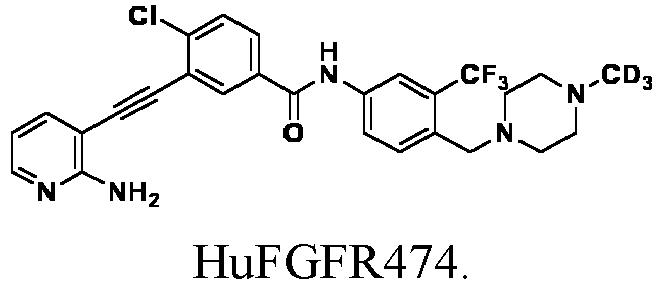
- A method for preparing the compound of formula (I) , or the deuterated compound, or the pharmaceutically acceptable salt thereof of any one of claims 1 to 6, which comprises a step of reacting a compound of formula (1) with a compound of formula (2)
 wherein, each of R and R1-R4 is independently defined as in any of claims 1-6;X is I or Br;preferably, it comprises: in the presence of a transition metal palladium and copper catalyst and in alkaline condition, coupling the compound of formula (1) with the compound of formula (2); preferably, the palladium catalyst comprises Pd(PPh3)2Cl2, Pd(OAc)2, and/or Pd(PPh3)4; preferably, the copper catalyst comprises CuI and/or CuCl; preferably, the base used for the alkaline condition comprises one or more bases selected from CsF, Cs2CO3, K2CO3, triethylamine, diisopropylethylamine, and DMAP; preferably, the solvent for coupling reaction comprises one or more solvents selected from acetonitrile, 1,4-dioxane, and DMF.
 - The method of claim 7, wherein the method comprises a step of reacting the compound of formula (1) with the compound of formula (2) in the presence of cesium fluoride, Pd(PPh3)2Cl2, CuI and triethylamine and in acetonitrile as a solvent.
- A pharmaceutical composition, which comprises the compound of formula (I), the deuterated compound, or the pharmaceutically acceptable salt thereof of any one of claims 1 to 6, and a pharmaceutically acceptable excipient.
- A use of the compound of formula (I), or the deuterated compound, or the pharmaceutically acceptable salt thereof of any one of claims 1 to 6, or the pharmaceutical composition of claim 9, in preparing a medicament for treating tumor.
- The use of claim 10, wherein the tumor is selected from the group consisting of non-small cell lung cancer, breast cancer, thyroid cancer, gastric cancer, bladder cancer, endometrial cancer, prostate cancer, cervical cancer, colon cancer, esophageal cancer, keratinoma, myeloma, rhabdomyosarcoma, acute leukemia, liver cancer, adenocarcinoma, and pancreatic cancer.
- The use of Claim 11, wherein the thyroid cancer is selected from the group consisting of medullary thyroid carcinoma, and papillary thyroid cancer.
Applications Claiming Priority (2)
| Application Number | Priority Date | Filing Date | Title |
|---|---|---|---|
| CN201710090242.8A CN108456163A (en) | 2017-02-20 | 2017-02-20 | Compound and its preparation method and application containing adjacent amino heteroaryl cycloalkynyl radical |
| PCT/CN2018/076423 WO2018149382A1 (en) | 2017-02-20 | 2018-02-12 | O-aminoheteroaryl alkynyl-containing compound, preparation method therefor, and use thereof |
Publications (3)
| Publication Number | Publication Date |
|---|---|
| EP3584239A1 EP3584239A1 (en) | 2019-12-25 |
| EP3584239A4 EP3584239A4 (en) | 2020-08-26 |
| EP3584239B1 true EP3584239B1 (en) | 2024-09-11 |
Family
ID=63170089
Family Applications (1)
| Application Number | Title | Priority Date | Filing Date |
|---|---|---|---|
| EP18753647.9A Active EP3584239B1 (en) | 2017-02-20 | 2018-02-12 | O-aminoheteroaryl alkynyl-containing compound, preparation method therefor, and use thereof |
Country Status (8)
| Country | Link |
|---|---|
| US (1) | US10988456B2 (en) |
| EP (1) | EP3584239B1 (en) |
| JP (1) | JP6965360B2 (en) |
| KR (2) | KR20190120766A (en) |
| CN (2) | CN108456163A (en) |
| AU (1) | AU2018222073B2 (en) |
| CA (1) | CA3053983C (en) |
| WO (1) | WO2018149382A1 (en) |
Families Citing this family (17)
| Publication number | Priority date | Publication date | Assignee | Title |
|---|---|---|---|---|
| NZ604708A (en) | 2010-05-20 | 2015-05-29 | Array Biopharma Inc | Macrocyclic compounds as trk kinase inhibitors |
| US11168090B2 (en) | 2017-01-18 | 2021-11-09 | Array Biopharma Inc. | Substituted pyrazolo[1,5-a]pyrazines as RET kinase inhibitors |
| CN108456163A (en) * | 2017-02-20 | 2018-08-28 | 中国科学院上海药物研究所 | Compound and its preparation method and application containing adjacent amino heteroaryl cycloalkynyl radical |
| JOP20190213A1 (en) | 2017-03-16 | 2019-09-16 | Array Biopharma Inc | Macrocyclic compounds as ros1 kinase inhibitors |
| TWI812649B (en) | 2017-10-10 | 2023-08-21 | 美商絡速藥業公司 | Formulations of 6-(2-hydroxy-2-methylpropoxy)-4-(6-(6-((6-methoxypyridin-3-yl)methyl)-3,6-diazabicyclo[3.1.1]heptan-3-yl)pyridin-3-yl)pyrazolo[1,5-a]pyridine-3-carbonitrile |
| TWI791053B (en) | 2017-10-10 | 2023-02-01 | 美商亞雷生物製藥股份有限公司 | Crystalline forms of 6-(2-hydroxy-2-methylpropoxy)-4-(6-(6-((6-methoxypyridin-3-yl)methyl)-3,6-diazabicyclo[3.1.1]heptan-3-yl)pyridin-3-yl)pyrazolo[1,5-a]pyridine-3-carbonitrile and pharmaceutical composition thereof |
| EP3740491A1 (en) | 2018-01-18 | 2020-11-25 | Array Biopharma, Inc. | Substituted pyrrolo[2,3-d]pyrimidines compounds as ret kinase inhibitors |
| WO2019143991A1 (en) | 2018-01-18 | 2019-07-25 | Array Biopharma Inc. | SUBSTITUTED PYRAZOLO[3,4-d]PYRIMIDINE COMPOUNDS AS RET KINASE INHIBITORS |
| CN111615514B (en) | 2018-01-18 | 2022-10-11 | 奥瑞生物药品公司 | Substituted pyrazolo [4,3-C ] pyridine compounds as RET kinase inhibitors |
| EP3849986B1 (en) | 2018-09-10 | 2022-06-08 | Array Biopharma, Inc. | Fused heterocyclic compounds as ret kinase inhibitors |
| EP3898615A1 (en) | 2018-12-19 | 2021-10-27 | Array Biopharma, Inc. | 7-((3,5-dimethoxyphenyl)amino)quinoxaline derivatives as fgfr inhibitors for treating cancer |
| CN111662227B (en) * | 2019-03-06 | 2022-07-05 | 中国科学院上海药物研究所 | O-aminopyridine alkyne compound and preparation method and application thereof |
| JP7336024B2 (en) * | 2020-03-26 | 2023-08-30 | 富士フイルム株式会社 | Method for producing radiation-sensitive resin composition, pattern forming method |
| CN114075135B (en) * | 2020-08-10 | 2024-06-11 | 上海润石医药科技有限公司 | Salts of compounds containing o-aminopyridine alkynyl, and preparation method and application thereof |
| CN112341437A (en) * | 2020-12-21 | 2021-02-09 | 李寒 | Substituted pyrazine derivative and application thereof |
| CN114853739B (en) * | 2021-02-03 | 2023-09-22 | 药雅科技(上海)有限公司 | Acetylenic pyrazine FGFR inhibitor and preparation method and application thereof |
| CN116730978B (en) * | 2022-03-11 | 2025-11-18 | 中国科学院上海药物研究所 | A class of heterocyclic alkyne compounds, their preparation methods and uses |
Family Cites Families (17)
| Publication number | Priority date | Publication date | Assignee | Title |
|---|---|---|---|---|
| US7776869B2 (en) * | 2004-10-18 | 2010-08-17 | Amgen Inc. | Heteroaryl-substituted alkyne compounds and method of use |
| WO2006077901A1 (en) * | 2005-01-20 | 2006-07-27 | Shionogi & Co., Ltd. | Ctgf expression inhibitor |
| GB0502418D0 (en) * | 2005-02-05 | 2005-03-16 | Astrazeneca Ab | Compounds |
| CN101389338B (en) * | 2005-12-23 | 2013-06-26 | 阿里亚德医药股份有限公司 | bicyclic heteroaryl compound |
| CN101490053B (en) * | 2006-05-08 | 2013-09-11 | 阿里亚德医药股份有限公司 | Monocyclic Heteroaryl Compounds |
| US8558002B2 (en) * | 2006-11-16 | 2013-10-15 | Allergan, Inc. | Sulfoximines as kinase inhibitors |
| US8859553B2 (en) * | 2012-07-30 | 2014-10-14 | Astar Biotech Llc | Protein kinase inhibitors |
| US9604980B2 (en) * | 2012-11-07 | 2017-03-28 | Nerviano Medical Sciences S.R.L. | Substituted pyrimidinyl and pyridinyl-pyrrolopyridinones, process for their preparation and their use as kinase inhibitors |
| CN104211639A (en) | 2013-06-05 | 2014-12-17 | 中国科学院上海药物研究所 | Alkynyl heterocyclic compounds and application thereof |
| BR112016013544A8 (en) | 2013-12-12 | 2020-05-19 | Allergan Inc | compound of formula i, its use and pharmaceutical compound |
| US20150166518A1 (en) | 2013-12-12 | 2015-06-18 | Allergan, Inc. | Substituted nicotinamide derivatives as kinase inhibitors |
| GB2522226A (en) * | 2014-01-17 | 2015-07-22 | Agency Science Tech & Res | Heteroaryl alkyne derivatives and uses thereof |
| CN106795152B (en) * | 2014-08-26 | 2020-01-31 | 安斯达尔生物技术有限责任公司 | protein kinase inhibitor |
| US9359336B2 (en) | 2014-10-09 | 2016-06-07 | Allergan, Inc. | Heterocycle-substituted pyridyl benzothiophenes as kinase inhibitors |
| CN106146391A (en) * | 2015-04-15 | 2016-11-23 | 中国科学院上海药物研究所 | Substituted benzamide compound of 5-fragrance alkynyl and preparation method thereof, pharmaceutical composition and purposes |
| CA3158951A1 (en) * | 2016-08-15 | 2018-02-22 | Purdue Research Foundation | 4-substituted aminoisoquinoline derivatives |
| CN108456163A (en) * | 2017-02-20 | 2018-08-28 | 中国科学院上海药物研究所 | Compound and its preparation method and application containing adjacent amino heteroaryl cycloalkynyl radical |
-
2017
- 2017-02-20 CN CN201710090242.8A patent/CN108456163A/en active Pending
-
2018
- 2018-02-12 KR KR1020197025924A patent/KR20190120766A/en not_active Ceased
- 2018-02-12 KR KR1020207032375A patent/KR102366670B1/en active Active
- 2018-02-12 EP EP18753647.9A patent/EP3584239B1/en active Active
- 2018-02-12 CA CA3053983A patent/CA3053983C/en active Active
- 2018-02-12 JP JP2019544871A patent/JP6965360B2/en active Active
- 2018-02-12 WO PCT/CN2018/076423 patent/WO2018149382A1/en not_active Ceased
- 2018-02-12 CN CN201880012699.XA patent/CN110582483B/en active Active
- 2018-02-12 AU AU2018222073A patent/AU2018222073B2/en active Active
- 2018-02-12 US US16/487,385 patent/US10988456B2/en active Active
Also Published As
| Publication number | Publication date |
|---|---|
| CN110582483B (en) | 2022-05-13 |
| EP3584239A4 (en) | 2020-08-26 |
| RU2019129336A3 (en) | 2021-03-22 |
| WO2018149382A1 (en) | 2018-08-23 |
| EP3584239A1 (en) | 2019-12-25 |
| KR102366670B1 (en) | 2022-02-23 |
| AU2018222073A1 (en) | 2019-10-10 |
| CN108456163A (en) | 2018-08-28 |
| KR20190120766A (en) | 2019-10-24 |
| CA3053983C (en) | 2024-01-09 |
| US20200055838A1 (en) | 2020-02-20 |
| AU2018222073B2 (en) | 2021-02-04 |
| CA3053983A1 (en) | 2018-08-23 |
| JP2020510642A (en) | 2020-04-09 |
| US10988456B2 (en) | 2021-04-27 |
| RU2019129336A (en) | 2021-03-22 |
| CN110582483A (en) | 2019-12-17 |
| KR20200130868A (en) | 2020-11-20 |
| JP6965360B2 (en) | 2021-11-10 |
Similar Documents
| Publication | Publication Date | Title |
|---|---|---|
| EP3584239B1 (en) | O-aminoheteroaryl alkynyl-containing compound, preparation method therefor, and use thereof | |
| CN115322158B (en) | As KRASG12CSubstituted quinazoline compounds of protein inhibitor | |
| EP3184521B1 (en) | Indazole compounds as fgfr kinase inhibitors, preparation and use thereof | |
| EP2493313B1 (en) | Kinase inhibitors | |
| EP3489223A1 (en) | Heterocyclic compound used as fgfr inhibitor | |
| WO2021216440A1 (en) | Novel protein kinase inhibitors | |
| EP4725554A2 (en) | Compounds and compositions for modulating egfr mutant kinase activities | |
| CN106883213A (en) | A novel dual inhibitor of EGFR and ALK kinases | |
| EP3590941B1 (en) | Urea-substituted aromatic ring-linked dioxane-quinazoline and -linked dioxane-quinoline compounds, preparation method therefor and use thereof | |
| EP3418277B1 (en) | Substituted amino six-membered nitric heterocyclic ring compound and preparation and use thereof | |
| EP3778586A1 (en) | Quinazoline compound serving as egfr triple mutation inhibitor and applications thereof | |
| WO2020172906A1 (en) | New-type pan-raf kinase inhibitor and use thereof | |
| KR20230167092A (en) | Heterocyclic derivatives, pharmaceutical compositions, and their use in the treatment or amelioration of cancer | |
| CN107428762A (en) | Phthalazinone derivatives, preparation method and the usage | |
| EP4491626A1 (en) | Phenylsulfonamide derivatives, preparation method therefor, and pharmaceutical composition for prevention or treatment of cancer containing same as active ingredient | |
| CN117229264A (en) | Aryl Schiff base compound containing 2-aminopyrimidine structure and application thereof | |
| RU2797694C2 (en) | O-aminoheteroarylalkynyl containing compound, method for its production and its use | |
| JP7110335B2 (en) | Pyridoquinazoline derivatives useful as protein kinase inhibitors | |
| EP4596553A1 (en) | Salt of dioxane quinoline compound, crystal form thereof, preparation methods therefor and uses thereof | |
| KR102919291B1 (en) | Novel Selenophene Derivatives | |
| JP2022500423A (en) | Combination therapy for the treatment of estrogen receptor-positive breast cancer | |
| HK40011224A (en) | O-aminoheteroaryl alkynyl-containing compound, preparation method therefor, and use thereof | |
| CN116655600A (en) | Substituted 2-arylamino pyrimidine compound, pharmaceutical composition and application thereof | |
| CN118772111A (en) | A substituted aminopyrimidine compound, a pharmaceutical composition and its use | |
| WO2025008526A1 (en) | Compounds containing a dialkylaryl moiety and their use |
Legal Events
| Date | Code | Title | Description |
|---|---|---|---|
| STAA | Information on the status of an ep patent application or granted ep patent |
Free format text: STATUS: THE INTERNATIONAL PUBLICATION HAS BEEN MADE |
|
| PUAI | Public reference made under article 153(3) epc to a published international application that has entered the european phase |
Free format text: ORIGINAL CODE: 0009012 |
|
| STAA | Information on the status of an ep patent application or granted ep patent |
Free format text: STATUS: REQUEST FOR EXAMINATION WAS MADE |
|
| 17P | Request for examination filed |
Effective date: 20190920 |
|
| AK | Designated contracting states |
Kind code of ref document: A1 Designated state(s): AL AT BE BG CH CY CZ DE DK EE ES FI FR GB GR HR HU IE IS IT LI LT LU LV MC MK MT NL NO PL PT RO RS SE SI SK SM TR |
|
| AX | Request for extension of the european patent |
Extension state: BA ME |
|
| DAV | Request for validation of the european patent (deleted) | ||
| DAX | Request for extension of the european patent (deleted) | ||
| A4 | Supplementary search report drawn up and despatched |
Effective date: 20200728 |
|
| RIC1 | Information provided on ipc code assigned before grant |
Ipc: A61K 31/44 20060101ALI20200722BHEP Ipc: C07D 241/20 20060101ALI20200722BHEP Ipc: A61K 31/4965 20060101ALI20200722BHEP Ipc: A61P 35/00 20060101ALI20200722BHEP Ipc: C07D 213/73 20060101AFI20200722BHEP Ipc: C07D 213/75 20060101ALI20200722BHEP |
|
| STAA | Information on the status of an ep patent application or granted ep patent |
Free format text: STATUS: EXAMINATION IS IN PROGRESS |
|
| 17Q | First examination report despatched |
Effective date: 20221031 |
|
| GRAP | Despatch of communication of intention to grant a patent |
Free format text: ORIGINAL CODE: EPIDOSNIGR1 |
|
| STAA | Information on the status of an ep patent application or granted ep patent |
Free format text: STATUS: GRANT OF PATENT IS INTENDED |
|
| INTG | Intention to grant announced |
Effective date: 20240408 |
|
| GRAS | Grant fee paid |
Free format text: ORIGINAL CODE: EPIDOSNIGR3 |
|
| GRAA | (expected) grant |
Free format text: ORIGINAL CODE: 0009210 |
|
| STAA | Information on the status of an ep patent application or granted ep patent |
Free format text: STATUS: THE PATENT HAS BEEN GRANTED |
|
| AK | Designated contracting states |
Kind code of ref document: B1 Designated state(s): AL AT BE BG CH CY CZ DE DK EE ES FI FR GB GR HR HU IE IS IT LI LT LU LV MC MK MT NL NO PL PT RO RS SE SI SK SM TR |
|
| REG | Reference to a national code |
Ref country code: GB Ref legal event code: FG4D |
|
| REG | Reference to a national code |
Ref country code: CH Ref legal event code: EP |
|
| REG | Reference to a national code |
Ref country code: DE Ref legal event code: R096 Ref document number: 602018074254 Country of ref document: DE |
|
| REG | Reference to a national code |
Ref country code: IE Ref legal event code: FG4D |
|
| REG | Reference to a national code |
Ref country code: LT Ref legal event code: MG9D |
|
| PG25 | Lapsed in a contracting state [announced via postgrant information from national office to epo] |
Ref country code: NO Free format text: LAPSE BECAUSE OF FAILURE TO SUBMIT A TRANSLATION OF THE DESCRIPTION OR TO PAY THE FEE WITHIN THE PRESCRIBED TIME-LIMIT Effective date: 20241211 |
|
| REG | Reference to a national code |
Ref country code: NL Ref legal event code: MP Effective date: 20240911 |
|
| PG25 | Lapsed in a contracting state [announced via postgrant information from national office to epo] |
Ref country code: GR Free format text: LAPSE BECAUSE OF FAILURE TO SUBMIT A TRANSLATION OF THE DESCRIPTION OR TO PAY THE FEE WITHIN THE PRESCRIBED TIME-LIMIT Effective date: 20241212 Ref country code: FI Free format text: LAPSE BECAUSE OF FAILURE TO SUBMIT A TRANSLATION OF THE DESCRIPTION OR TO PAY THE FEE WITHIN THE PRESCRIBED TIME-LIMIT Effective date: 20240911 |
|
| PG25 | Lapsed in a contracting state [announced via postgrant information from national office to epo] |
Ref country code: BG Free format text: LAPSE BECAUSE OF FAILURE TO SUBMIT A TRANSLATION OF THE DESCRIPTION OR TO PAY THE FEE WITHIN THE PRESCRIBED TIME-LIMIT Effective date: 20240911 |
|
| PG25 | Lapsed in a contracting state [announced via postgrant information from national office to epo] |
Ref country code: LV Free format text: LAPSE BECAUSE OF FAILURE TO SUBMIT A TRANSLATION OF THE DESCRIPTION OR TO PAY THE FEE WITHIN THE PRESCRIBED TIME-LIMIT Effective date: 20240911 |
|
| PG25 | Lapsed in a contracting state [announced via postgrant information from national office to epo] |
Ref country code: HR Free format text: LAPSE BECAUSE OF FAILURE TO SUBMIT A TRANSLATION OF THE DESCRIPTION OR TO PAY THE FEE WITHIN THE PRESCRIBED TIME-LIMIT Effective date: 20240911 |
|
| PG25 | Lapsed in a contracting state [announced via postgrant information from national office to epo] |
Ref country code: RS Free format text: LAPSE BECAUSE OF FAILURE TO SUBMIT A TRANSLATION OF THE DESCRIPTION OR TO PAY THE FEE WITHIN THE PRESCRIBED TIME-LIMIT Effective date: 20241211 Ref country code: ES Free format text: LAPSE BECAUSE OF FAILURE TO SUBMIT A TRANSLATION OF THE DESCRIPTION OR TO PAY THE FEE WITHIN THE PRESCRIBED TIME-LIMIT Effective date: 20240911 |
|
| PG25 | Lapsed in a contracting state [announced via postgrant information from national office to epo] |
Ref country code: RS Free format text: LAPSE BECAUSE OF FAILURE TO SUBMIT A TRANSLATION OF THE DESCRIPTION OR TO PAY THE FEE WITHIN THE PRESCRIBED TIME-LIMIT Effective date: 20241211 Ref country code: NO Free format text: LAPSE BECAUSE OF FAILURE TO SUBMIT A TRANSLATION OF THE DESCRIPTION OR TO PAY THE FEE WITHIN THE PRESCRIBED TIME-LIMIT Effective date: 20241211 Ref country code: LV Free format text: LAPSE BECAUSE OF FAILURE TO SUBMIT A TRANSLATION OF THE DESCRIPTION OR TO PAY THE FEE WITHIN THE PRESCRIBED TIME-LIMIT Effective date: 20240911 Ref country code: HR Free format text: LAPSE BECAUSE OF FAILURE TO SUBMIT A TRANSLATION OF THE DESCRIPTION OR TO PAY THE FEE WITHIN THE PRESCRIBED TIME-LIMIT Effective date: 20240911 Ref country code: GR Free format text: LAPSE BECAUSE OF FAILURE TO SUBMIT A TRANSLATION OF THE DESCRIPTION OR TO PAY THE FEE WITHIN THE PRESCRIBED TIME-LIMIT Effective date: 20241212 Ref country code: FI Free format text: LAPSE BECAUSE OF FAILURE TO SUBMIT A TRANSLATION OF THE DESCRIPTION OR TO PAY THE FEE WITHIN THE PRESCRIBED TIME-LIMIT Effective date: 20240911 Ref country code: ES Free format text: LAPSE BECAUSE OF FAILURE TO SUBMIT A TRANSLATION OF THE DESCRIPTION OR TO PAY THE FEE WITHIN THE PRESCRIBED TIME-LIMIT Effective date: 20240911 Ref country code: BG Free format text: LAPSE BECAUSE OF FAILURE TO SUBMIT A TRANSLATION OF THE DESCRIPTION OR TO PAY THE FEE WITHIN THE PRESCRIBED TIME-LIMIT Effective date: 20240911 |
|
| REG | Reference to a national code |
Ref country code: AT Ref legal event code: MK05 Ref document number: 1722587 Country of ref document: AT Kind code of ref document: T Effective date: 20240911 |
|
| PG25 | Lapsed in a contracting state [announced via postgrant information from national office to epo] |
Ref country code: NL Free format text: LAPSE BECAUSE OF FAILURE TO SUBMIT A TRANSLATION OF THE DESCRIPTION OR TO PAY THE FEE WITHIN THE PRESCRIBED TIME-LIMIT Effective date: 20240911 |
|
| PG25 | Lapsed in a contracting state [announced via postgrant information from national office to epo] |
Ref country code: IS Free format text: LAPSE BECAUSE OF FAILURE TO SUBMIT A TRANSLATION OF THE DESCRIPTION OR TO PAY THE FEE WITHIN THE PRESCRIBED TIME-LIMIT Effective date: 20250111 Ref country code: PT Free format text: LAPSE BECAUSE OF FAILURE TO SUBMIT A TRANSLATION OF THE DESCRIPTION OR TO PAY THE FEE WITHIN THE PRESCRIBED TIME-LIMIT Effective date: 20250113 |
|
| PG25 | Lapsed in a contracting state [announced via postgrant information from national office to epo] |
Ref country code: RO Free format text: LAPSE BECAUSE OF FAILURE TO SUBMIT A TRANSLATION OF THE DESCRIPTION OR TO PAY THE FEE WITHIN THE PRESCRIBED TIME-LIMIT Effective date: 20240911 Ref country code: SM Free format text: LAPSE BECAUSE OF FAILURE TO SUBMIT A TRANSLATION OF THE DESCRIPTION OR TO PAY THE FEE WITHIN THE PRESCRIBED TIME-LIMIT Effective date: 20240911 |
|
| PG25 | Lapsed in a contracting state [announced via postgrant information from national office to epo] |
Ref country code: EE Free format text: LAPSE BECAUSE OF FAILURE TO SUBMIT A TRANSLATION OF THE DESCRIPTION OR TO PAY THE FEE WITHIN THE PRESCRIBED TIME-LIMIT Effective date: 20240911 Ref country code: AT Free format text: LAPSE BECAUSE OF FAILURE TO SUBMIT A TRANSLATION OF THE DESCRIPTION OR TO PAY THE FEE WITHIN THE PRESCRIBED TIME-LIMIT Effective date: 20240911 |
|
| PG25 | Lapsed in a contracting state [announced via postgrant information from national office to epo] |
Ref country code: CZ Free format text: LAPSE BECAUSE OF FAILURE TO SUBMIT A TRANSLATION OF THE DESCRIPTION OR TO PAY THE FEE WITHIN THE PRESCRIBED TIME-LIMIT Effective date: 20240911 Ref country code: PL Free format text: LAPSE BECAUSE OF FAILURE TO SUBMIT A TRANSLATION OF THE DESCRIPTION OR TO PAY THE FEE WITHIN THE PRESCRIBED TIME-LIMIT Effective date: 20240911 |
|
| PG25 | Lapsed in a contracting state [announced via postgrant information from national office to epo] |
Ref country code: IT Free format text: LAPSE BECAUSE OF FAILURE TO SUBMIT A TRANSLATION OF THE DESCRIPTION OR TO PAY THE FEE WITHIN THE PRESCRIBED TIME-LIMIT Effective date: 20240911 Ref country code: SK Free format text: LAPSE BECAUSE OF FAILURE TO SUBMIT A TRANSLATION OF THE DESCRIPTION OR TO PAY THE FEE WITHIN THE PRESCRIBED TIME-LIMIT Effective date: 20240911 |
|
| REG | Reference to a national code |
Ref country code: DE Ref legal event code: R097 Ref document number: 602018074254 Country of ref document: DE |
|
| PG25 | Lapsed in a contracting state [announced via postgrant information from national office to epo] |
Ref country code: DK Free format text: LAPSE BECAUSE OF FAILURE TO SUBMIT A TRANSLATION OF THE DESCRIPTION OR TO PAY THE FEE WITHIN THE PRESCRIBED TIME-LIMIT Effective date: 20240911 |
|
| PLBE | No opposition filed within time limit |
Free format text: ORIGINAL CODE: 0009261 |
|
| STAA | Information on the status of an ep patent application or granted ep patent |
Free format text: STATUS: NO OPPOSITION FILED WITHIN TIME LIMIT |
|
| 26N | No opposition filed |
Effective date: 20250612 |
|
| PG25 | Lapsed in a contracting state [announced via postgrant information from national office to epo] |
Ref country code: SE Free format text: LAPSE BECAUSE OF FAILURE TO SUBMIT A TRANSLATION OF THE DESCRIPTION OR TO PAY THE FEE WITHIN THE PRESCRIBED TIME-LIMIT Effective date: 20240911 |
|
| PG25 | Lapsed in a contracting state [announced via postgrant information from national office to epo] |
Ref country code: MC Free format text: LAPSE BECAUSE OF FAILURE TO SUBMIT A TRANSLATION OF THE DESCRIPTION OR TO PAY THE FEE WITHIN THE PRESCRIBED TIME-LIMIT Effective date: 20240911 |
|
| REG | Reference to a national code |
Ref country code: CH Ref legal event code: PL |
|
| PG25 | Lapsed in a contracting state [announced via postgrant information from national office to epo] |
Ref country code: LU Free format text: LAPSE BECAUSE OF NON-PAYMENT OF DUE FEES Effective date: 20250212 |
|
| PG25 | Lapsed in a contracting state [announced via postgrant information from national office to epo] |
Ref country code: CH Free format text: LAPSE BECAUSE OF NON-PAYMENT OF DUE FEES Effective date: 20250228 |
|
| REG | Reference to a national code |
Ref country code: BE Ref legal event code: MM Effective date: 20250228 |
|
| PGFP | Annual fee paid to national office [announced via postgrant information from national office to epo] |
Ref country code: GB Payment date: 20251215 Year of fee payment: 9 |
|
| PGFP | Annual fee paid to national office [announced via postgrant information from national office to epo] |
Ref country code: FR Payment date: 20251215 Year of fee payment: 9 |
|
| PG25 | Lapsed in a contracting state [announced via postgrant information from national office to epo] |
Ref country code: BE Free format text: LAPSE BECAUSE OF NON-PAYMENT OF DUE FEES Effective date: 20250228 |
|
| PG25 | Lapsed in a contracting state [announced via postgrant information from national office to epo] |
Ref country code: IE Free format text: LAPSE BECAUSE OF NON-PAYMENT OF DUE FEES Effective date: 20250212 |
|
| PGFP | Annual fee paid to national office [announced via postgrant information from national office to epo] |
Ref country code: DE Payment date: 20260217 Year of fee payment: 9 |