EP3571205B1 - Thienopyrimidine derivative and use thereof in medicine - Google Patents
Thienopyrimidine derivative and use thereof in medicine Download PDFInfo
- Publication number
- EP3571205B1 EP3571205B1 EP18741820.7A EP18741820A EP3571205B1 EP 3571205 B1 EP3571205 B1 EP 3571205B1 EP 18741820 A EP18741820 A EP 18741820A EP 3571205 B1 EP3571205 B1 EP 3571205B1
- Authority
- EP
- European Patent Office
- Prior art keywords
- mixture
- methyl
- mmol
- methoxyphenyl
- oxy
- Prior art date
- Legal status (The legal status is an assumption and is not a legal conclusion. Google has not performed a legal analysis and makes no representation as to the accuracy of the status listed.)
- Active
Links
Classifications
-
- A—HUMAN NECESSITIES
- A61—MEDICAL OR VETERINARY SCIENCE; HYGIENE
- A61P—SPECIFIC THERAPEUTIC ACTIVITY OF CHEMICAL COMPOUNDS OR MEDICINAL PREPARATIONS
- A61P1/00—Drugs for disorders of the alimentary tract or the digestive system
- A61P1/16—Drugs for disorders of the alimentary tract or the digestive system for liver or gallbladder disorders, e.g. hepatoprotective agents, cholagogues, litholytics
-
- C—CHEMISTRY; METALLURGY
- C07—ORGANIC CHEMISTRY
- C07D—HETEROCYCLIC COMPOUNDS
- C07D495/00—Heterocyclic compounds containing in the condensed system at least one hetero ring having sulfur atoms as the only ring hetero atoms
- C07D495/02—Heterocyclic compounds containing in the condensed system at least one hetero ring having sulfur atoms as the only ring hetero atoms in which the condensed system contains two hetero rings
- C07D495/04—Ortho-condensed systems
-
- A—HUMAN NECESSITIES
- A61—MEDICAL OR VETERINARY SCIENCE; HYGIENE
- A61K—PREPARATIONS FOR MEDICAL, DENTAL OR TOILETRY PURPOSES
- A61K31/00—Medicinal preparations containing organic active ingredients
- A61K31/33—Heterocyclic compounds
- A61K31/395—Heterocyclic compounds having nitrogen as a ring hetero atom, e.g. guanethidine or rifamycins
- A61K31/495—Heterocyclic compounds having nitrogen as a ring hetero atom, e.g. guanethidine or rifamycins having six-membered rings with two or more nitrogen atoms as the only ring heteroatoms, e.g. piperazine or tetrazines
- A61K31/505—Pyrimidines; Hydrogenated pyrimidines, e.g. trimethoprim
- A61K31/519—Pyrimidines; Hydrogenated pyrimidines, e.g. trimethoprim ortho- or peri-condensed with heterocyclic rings
-
- A—HUMAN NECESSITIES
- A61—MEDICAL OR VETERINARY SCIENCE; HYGIENE
- A61P—SPECIFIC THERAPEUTIC ACTIVITY OF CHEMICAL COMPOUNDS OR MEDICINAL PREPARATIONS
- A61P3/00—Drugs for disorders of the metabolism
-
- A—HUMAN NECESSITIES
- A61—MEDICAL OR VETERINARY SCIENCE; HYGIENE
- A61P—SPECIFIC THERAPEUTIC ACTIVITY OF CHEMICAL COMPOUNDS OR MEDICINAL PREPARATIONS
- A61P3/00—Drugs for disorders of the metabolism
- A61P3/04—Anorexiants; Antiobesity agents
-
- A—HUMAN NECESSITIES
- A61—MEDICAL OR VETERINARY SCIENCE; HYGIENE
- A61P—SPECIFIC THERAPEUTIC ACTIVITY OF CHEMICAL COMPOUNDS OR MEDICINAL PREPARATIONS
- A61P3/00—Drugs for disorders of the metabolism
- A61P3/06—Antihyperlipidemics
-
- A—HUMAN NECESSITIES
- A61—MEDICAL OR VETERINARY SCIENCE; HYGIENE
- A61P—SPECIFIC THERAPEUTIC ACTIVITY OF CHEMICAL COMPOUNDS OR MEDICINAL PREPARATIONS
- A61P3/00—Drugs for disorders of the metabolism
- A61P3/08—Drugs for disorders of the metabolism for glucose homeostasis
- A61P3/10—Drugs for disorders of the metabolism for glucose homeostasis for hyperglycaemia, e.g. antidiabetics
-
- A—HUMAN NECESSITIES
- A61—MEDICAL OR VETERINARY SCIENCE; HYGIENE
- A61P—SPECIFIC THERAPEUTIC ACTIVITY OF CHEMICAL COMPOUNDS OR MEDICINAL PREPARATIONS
- A61P35/00—Antineoplastic agents
-
- A—HUMAN NECESSITIES
- A61—MEDICAL OR VETERINARY SCIENCE; HYGIENE
- A61P—SPECIFIC THERAPEUTIC ACTIVITY OF CHEMICAL COMPOUNDS OR MEDICINAL PREPARATIONS
- A61P5/00—Drugs for disorders of the endocrine system
- A61P5/48—Drugs for disorders of the endocrine system of the pancreatic hormones
- A61P5/50—Drugs for disorders of the endocrine system of the pancreatic hormones for increasing or potentiating the activity of insulin
-
- C—CHEMISTRY; METALLURGY
- C07—ORGANIC CHEMISTRY
- C07D—HETEROCYCLIC COMPOUNDS
- C07D519/00—Heterocyclic compounds containing more than one system of two or more relevant hetero rings condensed among themselves or condensed with a common carbocyclic ring system not provided for in groups C07D453/00 or C07D455/00
Definitions
- the present invention relates to a thienopyrimidine derivative having enzyme inhibition activity and a pharmaceutical composition thereof, the compound and composition can be used in the manufacture of a medicament for treating a disorder or disease regulated by acetyl-CoA carboxylase.
- Acetyl-CoA carboxylase is the limited enzyme in the first step of the synthesis process of fatty acid, carboxylation of acetyl-CoA with HCO 3 - carboxy donor in the present of ATP and Mg 2+ is carried out to form malonyl coenzyme A, which is a biotin dependent enzyme.
- This enzyme pertains to specific tissue enzyme in human and other mammal, which has two subtype, ACC1 and ACC2, there are some differences in tissue distribution and function between the two subtype; ACC1 ordinarily expresses in all tissues, the expression is most in lipogenic tissue (e.g . liver and adipose tissue), ACC2 has the highest expression in skeletal muscle and heart, and less expression in liver.
- ACC1 Biosynthesis of long chain fatty acid is catalyzed by ACC1, acetyl-CoA is metabolized via Krebs cycle if it is not carboxylated to form malonyl coenzyme A; production of malonyl coenzyme A on cytoplasmic surface of the mitochondria is catalyzed by ACC2, the amount of fatty acid used for ⁇ -oxidation is regulated by inhibiting carnitine palmityl transferase (CPT-1).
- CPT-1 carnitine palmityl transferase
- ACC inhibitor can inhibit ACC1 to reduce synthesis of fatty acid, and can inhibit ACC2 to promote oxidation of fatty acid in liver, and then reduce accumulation of lipid in vivo, which can effectively treat diseases or disorders associated with obesity, hypertension, diabetes, tumor, dyslipidemia and hyperlipidemia, and type II diabetes induced by liver insulin resistance caused by accumulation of lipid in liver, non-alcoholic fatty liver disease (NAFLD) and non-alcoholic steatohepatitis (NASH).
- NAFLD non-alcoholic fatty liver disease
- NASH non-alcoholic steatohepatitis
- Non-alcoholic steatohepatitis is a chronic progressive disease induced by accumulation of lipid in liver, which can cause liver cirrhosis, liver failure and hepatocellular carcinoma.
- induction factors of NASH e.g. age, obesity, body mass index (BMI), insulin sensitivity, dyslipidemia, hypertension and abnormally active related enzymes of liver function(e.g. alanine aminotransferase (ALT) and aspartate aminotransferase (AST)), and so on.
- ALT alanine aminotransferase
- AST aspartate aminotransferase
- results of liver biopsy shows that NASH accompanied by severe fibrosis in 66% diabetic or obese patients over age 50. About 12 % people were deeply affected by this disease in US, the proportion increased to 22% in diabetes, more significantly, about 15-25% NASH patients will suffer from cirrhosis, this is another reason for liver cancer second only to viral hepatitis and alcoholic hepatitis. Cirrhosis is primary reason for death caused by hepatic diseases, which directly cause hepatic decompensation and about 4% death rate every year.
- WO 2015/007451 A1 discloses heterobicyclic derivatives which have microbiocidal activity, in particular fungicidal activity and therefore can be used in agriculture or horticulture for controlling or preventing infestation of plants, harvested food crops, seeds or non-living materials by phytopathogenic microorganisms, preferably fungi.
- WO 2013/071169 A1 provides compounds, specifically thienopyrimidine derivatives, useful as inhibitors of Acetyl CoA Carboxylase (ACC), pharmaceutical compositions thereof, and methods of using the same for treating ACC-mediated disorders such as obesity, dyslipidemia, hyperiipidemia, fungal, parasitic or bacterial infections in a subject.
- ACC Acetyl CoA Carboxylase
- the present invention relates to a compound as an acetyl-CoA carboxylas (ACC) inhibitor and a pharmaceutical composition containing this compound.
- the present invention further relates to use of the compound or the composition thereof in the manufacture of a medicament for inhibiting ACC activity to treat a disorder or disease.
- the present invention further describes the synthetic method of the compound.
- the compounds of the invention show good bioactivity and pharmacokinetic properties.
- inhibition of ACC refers to only inhibition of ACC 1, only inhibition of ACC2 or simultaneous inhibition of ACC1 and ACC2. Any one inhibition of ACC sub-type should advantageously affect disorders associated with the metabolic syndrome. Optimized ACC inhibitors should inhibit both isoenzyme of this enzyme.
- Het is pyrrolidyl, tetrahydrofuryl, imidazolidinyl, pyrazolidyl, tetrahydropyranyl, piperidyl, piperazinyl, morpholinyl, thiomorpholinyl, pyrrolyl, furyl, thienyl, pyrazolyl, imidazolyl, oxazolyl, thiazolyl, triazolyl, tetrazolyl, pyridyl, pyrimidinyl, pyridazinyl or pyrazinyl, wherein each of pyrrolidyl, tetrahydrofuryl, imidazolidinyl, pyrazolidyl, tetrahydropyranyl, piperidyl, piperazinyl, morpholinyl, thiomorpholinyl, pyrrolyl, furyl, thienyl, pyrazolyl, imidazolyl,
- R 1 is H, D, F, Cl, Br, I, hydroxy, amino, nitro, cyano, C 1-3 alkyl, C 1-3 alkoxy or C 1-3 haloalkyl;
- R 1 is H, D, F, Cl, Br, I, hydroxy, amino, nitro, cyano, methyl, ethyl, methoxy, ethoxy, isopropoxy, trifluoromethyl, difluoromethyl or trifluoroethyl;
- R 5 is phenyl, naphthyl, 1,2,3,4-tetrahydronaphthyl or 5-6 membered heteroaryl, wherein each of phenyl, naphthyl, 1,2,3,4-tetrahydronaphthyl and 5-6 membered heteroaryl is independently and optionally substituted with 1, 2 or 3 R 6 ; wherein R 6 is H, D, F, Cl, Br, I, hydroxy, amino, nitro, cyano, C 1-3 alkyl, C 1-3 alkoxy, C 1-3 haloalkyl, C 1-3 haloalkoxy, C 1-3 cyanoalkyl or C 1-3 hydroxyalkyl.
- R 5 is phenyl, naphthyl, 1,2,3,4-tetrahydronaphthyl, imidazolyl, pyrazolyl, furyl, thienyl, oxazolyl, oxadiazolyl, thiazolyl, thiadiazolyl, triazolyl, tetrazolyl, pyridyl, pyrimidinyl, pyranyl or pyridazinyl, wherein each of phenyl, naphthyl, 1,2,3,4-tetrahydronaphthyl, imidazolyl, pyrazolyl, furyl, thienyl, oxazolyl, oxadiazolyl, thiazolyl, thiadiazolyl, triazolyl, tetrazolyl, pyridyl, pyrimidinyl, pyranyl and pyridazinyl is independently and optionally substituted with
- a pharmaceutical composition comprising a compound of formula (I) or a stereoisomer, a geometric isomer, a tautomer, a hydrate, a solvate or a pharmaceutically acceptable salt thereof, or a pharmaceutically acceptable carrier, excipient, diluent, adjuvant, vehicle or a combination thereof.
- provided herein is use of the compound of formula (I) or the pharmaceutical composition thereof in the manufacture of a medicament for preventing, managing, treating or lessening a disorder or disease regulated by acetyl-CoA carboxylase.
- the disorder or disease regulated by acetyl-CoA carboxylase disclosed herein is a metabolism disorder or neoplastic disorder.
- the disorder or disease regulated by acetyl-CoA carboxylase disclosed herein comprises insulin resistance, obesity, dyslipidaemia, metabolic syndrome, type II diabetes, non-alcoholic fatty liver disease and non-alcoholic steatohepatitis.
- the neoplastic disorder disclosed herein comprises breast cancer, pancreatic cancer, renal cell cancer, hepatocellular carcinoma, malignant melanoma and other skin tumor, non-small cell bronchial carcinoma, endometrial carcinoma, colorectal cancer and prostate cancer.
- a compound of formula (I) or a pharmaceutical composition thereof for use in preventing, managing, treating or lessening a disorder or disease regulated by acetyl-CoA carboxylase.
- the disorder or disease regulated by acetyl-CoA carboxylase disclosed herein is a metabolism disorder or neoplastic disorder.
- the disorder or disease regulated by acetyl-CoA carboxylase disclosed herein comprises insulin resistance, obesity, dyslipidaemia, metabolic syndrome, type II diabetes, non-alcoholic fatty liver disease and non-alcoholic steatohepatitis.
- the neoplastic disorder disclosed herein comprises breast cancer, pancreatic cancer, renal cell cancer, hepatocellular carcinoma, malignant melanoma and other skin tumor, non-small cell bronchial carcinoma, endometrial carcinoma, colorectal cancer and prostate cancer.
- provided herein is a method of preventing, managing, treating or lessening a disorder or disease regulated by acetyl-CoA carboxylase in a patient comprising administering to the patient a therapeutically effective amount of a compound of formula (I) or a pharmaceutical composition thereof.
- the disorder or disease regulated by acetyl-CoA carboxylase disclosed herein is a metabolism disorder or neoplastic disorder.
- the disorder or disease regulated by acetyl-CoA carboxylase disclosed herein comprises insulin resistance, obesity, dyslipidaemia, metabolic syndrome, type II diabetes, non-alcoholic fatty liver disease and non-alcoholic steatohepatitis.
- the neoplastic disorder disclosed herein comprises breast cancer, pancreatic cancer, renal cell cancer, hepatocellular carcinoma, malignant melanoma and other skin tumor, non-small cell bronchial carcinoma, endometrial carcinoma, colorectal cancer and prostate cancer.
- provided herein is a method of preparing, separating or purifying the compound of Formula (I).
- compounds disclosed herein may optionally be substituted with one or more substituents, e.g . are illustrated generally below, or as exemplified by particular classes, subclasses, and species of the invention. It will be appreciated that the phrase “optionally substituted” is used interchangeably with the phrase “substituted or unsubstituted”. In general, the term “substituted” refers to the replacement of one or more hydrogen radicals in a given structure with the radical of a specified substituent. Unless otherwise indicated, an optionally substituted group may have a substituent at each substitutable position of the group.
- alkyl or “alkyl group” refers to a saturated linear or branched-chain monovalent hydrocarbon radical of 1 to 20 carbon atoms, or 1-10 carbon atoms, or 1-6 carbon atoms, or 1-4 carbon atoms, or 1-3 carbon atoms, or 1-2 carbon atoms, wherein the alkyl radical may be optionally and independently substituted with one or more substituents described herein.
- alkyl group further include, methyl (Me, -CH 3 ), ethyl (Et, -CH 2 CH 3 ), n -propyl ( n -Pr, -CH 2 CH 2 CH 3 ), isopropyl ( i -Pr, -CH(CH 3 ) 2 ), n -butyl ( n -Bu, -CH 2 CH 2 CH 2 CH 3 ), isobutyl ( i -Bu, -CH 2 CH(CH 3 ) 2 ), sec-butyl ( s -Bu, -CH(CH 3 )CH 2 CH 3 ), tert- butyl ( t -Bu, -C(CH 3 ) 3 ), n -pentyl (-CH 2 CH 2 CH 2 CH 3 ), 2-pentyl (-CH(CH 3 )CH 2 CH 2 CH 3 ), 3-pentyl (-CH(CH 2 CH 3 ) 2 ),
- alkyl or the prefix “alk-” is inclusive of both straight chain and branched saturated carbon chain.
- alkylidene or “alkylene” used herein refers to a saturated divalent hydrocarbon group derived from a straight or branched chain saturated hydrocarbon by the removal of two hydrogen atoms. Examples of alkylene groups include, but are not limited to, methylene, ethylene, isopropylene, and the like.
- alkenyl refers to a linear or branched chain monovalent hydrocarbon radical of 2 to 12 carbon atoms, or 2 to 8 carbon atoms, or 2 to 6 carbon atoms, or 2 to 4 carbon atoms, with at least one site of unsaturation, i.e., a carbon-carbon, sp 2 double bond, wherein the alkenyl radical may be independently unsubstituted or substituted with one or more substituents described herein, and includes radicals having "cis” and “trans” orientations, or alternatively, " E “ and “ Z " orientations.
- alkynyl refers to a linear or branched chain monovalent hydrocarbon radical of 2 to 12 carbon atoms, or 2 to 8 carbon atoms, or 2 to 6 carbon atoms, or 2 to 4 carbon atoms, with at least one carbon-carbon, sp triple bond, wherein the alkynyl radical may be optionally and independently substituted with one or more substituents described herein.
- halogen refers to F (fluorine), Cl (chlorine), Br (bromine), or I (iodine).
- unsaturated refers to a moiety having one or more units of unsaturation.
- alkoxy refers to an alkyl group, as defined herein, attached to the other moiety of the compound molecular through an oxygen atom.
- the alkoxy group is C 1-4 alkoxy.
- Some non-limiting examples of the alkoxy group include methoxy, ethoxy, propoxy and butoxy, and the like.
- the alkoxy group may be optionally and independently substituted with one or more substituents disclosed herein.
- alkoxyalkyl refers to an alkyl group substitued with one or more alkoxy groups, wherein the alkoxy and alkyl are as defined herein.
- the alkoxyalkyl is C 1-6 alkoxy-C 1-6 -alkyl.
- the alkoxyalkyl is C 1-3 alkoxy-C 1-3 -alkyl.
- the "alkoxyalkyl” group may be optionally substituted with one or more substituents disclosed herein.
- haloalkyl refers to alkyl, alkenyl or alkoxy, as the case may be, substituted with one or more halogen atoms.
- haloalkyl is halo C 1-6 alkyl.
- haloalkyl is halo C 1-3 alkyl.
- haloalkyl-oxy or haloalkoxy is halo C 1-6 alkyl-oxy or halo C 1-6 alkoxy.
- haloalkyl-oxy or haloalkoxy is halo C 1-3 alkyl-oxy or halo C 1-3 alkoxy.
- haloalkyl, haloalkenyl or haloalkoxy may be optionally and independently substituted with one or more substituents described herein.
- hydroxyalkyl refers to an alkyl group substituted with one or more hydroxy groups. In some embodiments, hydroxyalkyl is hydroxy C 1-6 alkyl. In other embodiments, hydroxyalkyl is hydroxy C 1-3 alkyl. Some non-limiting examples include hydroxymethyl, 2-hydroxyethyl, 3-hydroxypropyl, and the like.
- the "hydroxyalkyl” group may be optionally substituted with one or more substituents disclosed herein.
- cyanoalkyl refers to an alkyl group substituted with one or more cyano groups. In some embodiments, cyanoalkyl is cyanoC 1-6 alkyl. In other embodiments, cyanoalkyl is cyanoC 1-3 alkyl. Some non-limiting examples include cyanomethyl, 2-cyanoethyl, 3-cyanopropyl, and the like.
- the "cyanoalkyl” group may be optionally substituted with one or more substituents disclosed herein.
- alkylamino refers to " N -alkylamino" and " N , N -dialkylamino” wherein amino groups are independently substituted with one alkyl radical or two alkyl radicals, respectively.
- the alkylamino is a C 1-6 alkylamino group.
- the alkylamino is a C 1-3 alkylamino group.
- Some non-limiting examples of such group include N -methylamino, N -ethylamino, N , N -dimethylamino, N , N -diethylamino, and the like.
- the alkylamino radical is optionally substituted with one or more substituents described herein.
- cycloalkyl or “cycloalkane” refers to a monovalent or multivalent saturated ring having 3 to 12 carbon atoms as a monocyclic, bicyclic, or tricyclic ring system, but not containing an aromatic ring.
- the cycloalkyl group contains 3 to 10 carbon atoms.
- the cycloalkyl group contains 3 to 8 carbon atoms.
- the cycloalkyl group contains 3 to 6 carbon atoms.
- Some non-limiting examples of such group include cyclopropyl, cyclobutyl, cyclopentyl and cyclohexyl, etc.
- the cycloalkyl group may be optionally substituted with one or more substituents disclosed herein.
- cycloalkyloxy refers to a cycloalkyl group, attached to the rest part of the molecule through an oxygen atom. Wherein the cycloalkyl group is as defined herein.
- cycloalkylalkyl refers to a cycloalkyl group attached to the rest of the molecule through an alkyl group, wherein the cycloalkyl and alkyl are as defined herein.
- carbobicyclyl refers to a monovalent or multivalent, nonaromatic, saturated or partially unsaturated ring having 3 to 12 carbon atoms as a monocyclic, bicyclic or tricyclic hydrocarbon.
- a carbobicyclyl group includes a spiro carbobicyclyl group or a fused carbobicyclyl group. Suitable carbocyclyl groups include, but are not limited to, cycloalkyl, cycloalkenyl and cycloalkynyl. In one embodiment, the cycloalkyl group contains 4 to 8 carbon atoms. In other embodiment, the cycloalkyl group contains 4 to 6 carbon atoms.
- carbocyclyl groups include cyclopropyl, cyclobutyl, cyclopentyl, 1-cyclopent-l-enyl, 1-cyclopent-2-enyl, 1-cyclopent-3-enyl, cyclohexyl, 1-cyclohex-l-enyl, 1-cyclohex-2-enyl, 1-cyclohex-3-enyl, cyclohexadienyl, cycloheptyl, cyclooctyl, cyclononyl, cyclodecyl, cycloundecyl, cyclododecyl, and the like,
- the cycloalkyl group may be optionally substituted with one or more substituents disclosed herein.
- heterocycle refers to a saturated or partially unsaturated monocyclic, bicyclic or tricyclic ring containing 3-12 ring atoms of which at least one ring atom is heteroatom, but not containing an aromatic ring.
- heterocyclyl or “heterocycle” contains 3-10 ring atoms; in some embodiments, “heterocyclyl” or “heterocycle” contains 3-8 ring atoms; in other embodiments, “heterocyclyl” or “heterocycle” contains 5-8 ring atoms; in yet other embodiments, “heterocyclyl” or “heterocycle” contains 3-6 ring atoms; in still yet other embodiments, “heterocyclyl” or “heterocycle” contains 5-6 ring atoms; in still yet other embodiments, “heterocyclyl” or “heterocycle” contains 4-6 ring atoms; unless otherwise indicated, heterocyclyl may be a carbon radical or heteroatom radical, heteroatom is as defined herein.
- heterocyclyl group examples include oxiranyl, azetidinyl, oxetanyl, thietanyl, pyrrolidinyl, 2-pyrrolinyl, 3-pyrrolinyl, pyrazolinyl, pyrazolidinyl, imidazolinyl, imidazolidinyl, tetrahydrofuranyl, dihydrofuranyl, tetrahydrothienyl, dihydrothienyl, 1,3-dioxolanyl, dithiolanyl, tetrahydropyranyl, dihydropyranyl, 2 H -pyranyl, 4 H -pyranyl, tetrahydrothiopyranyl, piperidinyl, morpholinyl, thiomorpholinyl, piperazinyl, dioxanyl, dithianyl, thioxanyl, homopiperazinyl, homopiperidinyl,
- heterocyclyl wherein the ring sulfur atom is oxidized is sulfolanyl and 1,1-dioxo-thiomorpholinyl.
- the heterocyclyl group may be optionally substituted with one or more substituents disclosed herein.
- heterocyclylalkyl refers to a heterocyclyl group attached to the rest of the molecule through an alkyl group, wherein the heterocyclyl and alkyl are as defined herein.
- aryl refers to monocyclic, bicyclic and tricyclic carbocyclic ring systems having a total of six to fourteen ring members, or six to twelve ring members, or six to ten ring members, wherein at least one ring in the system is aromatic, wherein each ring in the system contains 3 to 7 ring members and that has a single point or multipoint of attachment to the rest of the molecule.
- aryl may be used interchangeably with the term “aryl ring” or "aromatic”. Examples of aryl ring may include phenyl, naphthyl and anthracene.
- the aryl group may be optionally and independently substituted with one or more substituents disclosed herein.
- heteroaryl refers to monocyclic, bicyclic and tricyclic carbocyclic ring systems having a total of five to twelve ring members, or five to ten ring members, or five to six ring members, wherein at least one ring in the system is aromatic, and in which at least one ring member is selected from heteroatom, and wherein each ring in the system contains 5 to 7 ring members and that has a single point or multipoint of attachment to the rest of the molecule.
- heteroaryl and “heteroaromatic ring” or “heteroaromatic compound” can be used interchangeably herein.
- the heteroaryl group is optionally substituted with one or more substituents disclosed herein.
- 5-10 membered heteroaryl comprises 1, 2, 3 or 4 heteroatoms independently selected from O, S and N, wherein N may be oxidated.
- heteroaryl rings include furanyl, imidazolyl (e.g . N -imidazolyl, 2-imidazolyl, 4-imidazolyl, 5-imidazolyl), isoxazolyl, oxazolyl ( e.g . 2-oxazolyl, 4-oxazolyl, 5-oxazolyl), pyrrolyl ( e.g. N -pyrrolyl, 2-pyrrolyl, 3-pyrrolyl), pyridyl, pyrimidinyl ( e.g. 2-pyrimidinyl, 4-pyrimidinyl, 5-pyrimidinyl), pyridazinyl, thiazolyl ( e.g.
- 2-indolyl 2-indolyl
- purinyl e.g . 2-quinolinyl, 3-quinolinyl, 4-quinolinyl
- 1,2,3,4-tetrahydroisoquinolinyl 1,3-benzodioxolyl
- indolinyl isoquinolinyl (e.g.
- fused cycle or “fused cyclyl” as refers to a monovalent or multivalent saturated or partially unsaturated fused ring system, which refers to a nonaromatic bicyclic ring system.
- the fused ring system may be fused carbocycle, also may be fused heterocycle. Such a system may contain isolated or conjugated unsaturation, but not aromatic rings in its core structure.
- fused cyclyl examples include octahydrocyclopentadienyl, hexhydro-1 H -pyrrolizinyl, hexhydropyrrolo[2,1- b ]oxazolyl, hexhydropyrrolo[2,1- c ]oxazolyl, octahydrocyclopenteno[ c ]pyrrolyl, hexhydro-1 H -cyclopenteno[ c ]furyl, hexhydro- 1 H -furo[3, 4-c]pyrrolyl, hexhydrofuro[3,2- b ]furyl, tetrahydro-3 aH -cyclopenteno[ d ][1,3]dioxolyl, octahydro-1 H -indenyl, hexhydro-2 H -oxazolo[3,2- a ]pyridyl, decahydronap
- spiro cyclyl or “spiro cycle” refers to a monovalent or multivalent saturated or partially unsaturated ring system, wherein a ring originating from a particular annular carbon of another ring.
- the spiro ring system may be spiro carbocycle, also may be spiro heterocycle.
- spiro cyclyl examples include spiro[3.3]heptyl, 2-azaspiro[3.3]heptyl, 2,6-diazaspiro[3.3]heptyl, 2-oxaspiro[3.3]heptyl, 2-oxa-6-azaspiro[3.3]heptyl, spiro[4.4]nonyl, 2-oxaspiro[4.4]nonyl, 1,4-dioxaspiro[4.4]nonyl, spiro[4.5]decyl, 2-oxa-7-azaspiro[4.5]decyl, 2,7-dioxaspiro[4.4]nonyl, and the like. And wherein the spiro cyclyl group is optionally substituted with one or more substituents described herein.
- bridged cyclyl or “bridged cycle” refers to a saturated or unsaturated bridged ring system, which refers to a cyclic ring system that is not aromatic. Such a system may contain isolated or conjugated unsaturation, but not aromatic rings in its core structure.
- the "bridged cyclyl” or “bridged cycle” may be bridged carbocycle or bridged heterocycle, the heteroatom is selected from N, O, P and S, wherein the S or P is optionally substituted with one or more oxo to provide the group SO or SO 2 , PO or PO 2 .
- bridged cyclyl examples include bicyclo[2.2.1]heptyl, bicyclo[2.2.2]octyl, (lr,4r)-bicyclo[2.1.1]hexyl, (1R,5S)-bicyclo[3.2.1]octyl, (l R ,5 S )-8-azabicyclo[3.2.1]octyl, adamantyl, and the like.
- the "bridged cyclyl” or “bridged cycle” can be substituted by a substituent disclosed herein.
- a bond drawn from a substituent to the center of one ring within a ring system represents substitution of the substituent at any substitutable or reasonable position on the ring.
- Formula (a) represents mono- or poly-substitutions of a substituent R at any substitutable or reasonable position on pyridine ring.
- a bond connected to the center of one ring within a ring system represents that a bond in any reasonable and connectable position of the ring can connect to the rest of the molecule.
- Formula (b) represents that any reasonable and connectable position of octahydrocyclopenteno[c]pyrrole ring can connect to the rest of the molecule.
- structures depicted herein are also meant to include all isomeric (e.g., enantiomeric, diastereomeric, geometric or conformational isomerism) forms of the structure; for example, the R and S configurations for each asymmetric center, (Z) and (E) double bond isomers, and (Z) and (E) conformational isomers. Therefore, single stereochemical isomers as well as enantiomeric, diastereomeric, or geometric mixtures of the present compounds are within the scope disclosed herein.
- isomeric e.g., enantiomeric, diastereomeric, geometric or conformational isomerism
- structures and the compound depicted herein are also meant to include all isomeric (e.g ., enantiomeric, diastereomeric, and geometric (conformational isomerism)) forms of the structure, a hydrate, a solvate or a pharmaceutically acceptable salt thereof. Therefore, single stereochemical isomers, enantiomeric isomerrs, diastereomeric isomerrs, geometric isomerrs, conformational isomerrs, a hydrate, a solvate or a pharmaceutically acceptable salt thereof of the present compounds are within the scope disclosed herein. Additionally, unless otherwise stated, structures depicted herein are also meant to include compounds that differ only in the presence of one or more isotopically enriched atoms.
- optically active compounds i.e., they have the ability to rotate the plane of plane-polarized light.
- the prefixes D and L, or R and S are used to denote the absolute configuration of the molecule about its chiral center(s).
- the prefixes d and 1 or (+) and (-) are employed to designate the sign of rotation of plane-polarized light by the compound, with (-) or 1 meaning that the compound is levorotatory.
- a compound prefixed with (+) or d is dextrorotatory. For a given chemical structure, these stereoisomers are identical except that they are mirror images of one another.
- a specific stereoisomer may also be referred to as an enantiomer, and a mixture of such isomers is often called an enantiomeric mixture.
- a 50:50 mixture of enantiomers is referred to as a racemic mixture or a racemate, which may occur where there has been no stereoselection or stereospecificity in a chemical reaction or process.
- the term "racemic mixture” or “racemate” refers to an equimolar mixture of two enantiomeric species, devoid of optical activity.
- tautomer or “tautomeric form” refers to structural isomers of different energies which are interconvertible via a low energy barrier.
- proton tautomers also known as prototropic tautomers
- Valence tautomers include interconversions by reorganization of some of the bonding electrons.
- a "pharmaceutically acceptable salts” refers to organic or inorganic salts of a compound disclosed herein.
- Pharmaceutically acceptable salts are well known in the art. For example, Berge et al., describe pharmaceutically acceptable salts in detail in J. Pharmacol Sci. 1977, 66:1-19 .
- Some non-limiting examples of pharmaceutically acceptable and nontoxic salts include salts of an amino group formed with inorganic acids e.g. hydrochloric acid, hydrobromic acid, phosphoric acid, sulfuric acid and perchloric acid or with organic acids e.g. acetic acid, oxalic acid, maleic acid, tartaric acid, citric acid, succinic acid and malonic acid or by using other methods used in the art e.g.
- salts include adipate, malate, 2-hydroxypropionate, alginate, ascorbate, aspartate, benzenesulfonate, benzoate, bisulfate, borate, butyrate, camphorate, camphorsulfonate, cyclopentanepropionate, digluconate, dodecylsulfate, ethanesulfonate, formate, fumarate, glucoheptonate, glycerophosphate, gluconate, hemisulfate, heptanoate, hexanoate, hydroiodide, 2-hydroxy-ethanesulfonate, lactobionate, lactate, laurate, laurylsulfate, malate, malonate, methanesulfonate, 2-naphthalenesulfonate, nicotinate, nitrate, oleate, palmitate, pamoate, pectinate
- Salts derived from appropriate bases include alkali metal, alkaline earth metal, ammonium and N + (C 1-4 alkyl) 4 salts.
- This invention also envisions the quaternization of any basic nitrogen-containing groups of the compounds disclosed herein. Water or oil soluble or dispersable products may be obtained by such quaternization.
- Representative alkali or alkaline earth metal used for forming salts include sodium, lithium, potassium, calcium, magnesium, and the like.
- Further pharmaceutically acceptable salts include, when appropriate, nontoxic ammonium, quaternary ammonium, and amine cations formed using counterions e.g . halide, hydroxide, carboxylate, sulfate, phosphate, nitrate, C 1-8 sulfonate or aryl sulfonate.
- hydrate refers to the complex where the solvent molecule is water.
- solvate refers to an association or complex of one or more solvent molecules and a compound disclosed herein.
- solvent molecules include water, isopropanol, ethanol, methanol, dimethylsulfoxide (DMSO), ethyl acetate, acetic acid and ethanolamine.
- DMSO dimethylsulfoxide
- esters refers to an in vivo hydrolysable ester of a compound of the Formula (I) containing hydroxy group, for example, a pharmaceutically acceptable ester which is hydrolysed in the human or animal body to produce the parent alcohol.
- in vivo hydrolysable ester forming groups for hydroxy include phosphate, acetoxymethoxy, 2, 2-dimethylpropionyloxymethoxy, alkanoyl, benzoyl, phenylacetyl, alkoxycarbonyl, dialkylcarbamoyl, N-(dialkylaminoethyl)-N-alkylcarbamoyl, and the like.
- protecting group refers to a substituent that is commonly employed to block or protect a particular functionality while reacting with other functional groups on the compound.
- an “amino-protecting group” is a substituent attached to an amino group that blocks or protects the amino functionality in the compound. Suitable amino-protecting groups include acetyl, trifluoroacetyl, t -butoxy-carbonyl (BOC, Boc), benzyloxycarbonyl (CBZ, Cbz) and 9-fluorenylmethylenoxy-carbonyl (Fmoc).
- a "hydroxy-protecting group” refers to a substituent of a hydroxy group that blocks or protects the hydroxy functionality.
- Suitable protecting groups include methyl, methoxymethyl, acetyl and silyl, and so on.
- a "carboxy-protecting group” refers to a substituent of the carboxy group that blocks or protects the carboxy functionality. Common carboxy-protecting groups include -CH 2 CH 2 SO 2 Ph, cyanoethyl, 2-(trimethylsilyl)ethyl, 2-(trimethylsilyl) ethoxy-methy-1, 2-( p -toluenesulfonyl) ethyl, 2-( p -nitrophenylsulfonyl)-ethyl, 2-(diphenylphosphino)-ethyl, nitroethyl and the like.
- a therapeutically effective amount refers to an amount of the compound of formula (I) which is sufficient to achieve the stated effect. Accordingly, a therapeutical effective amount of a compound of formula (I) used for the treatment of a condition regulated by ACC will be an amount sufficient for the treatment of the condition regulated by ACC.
- nonalcoholic fatty liver refers to a metabolic disease associated with insulin resistance, comprises simple fatty liver (SFL), nonalcoholic steatohepatitis (NASH), fatty hepatic fibrosis and cirrhotic.
- ACC inhibitors used herein refers to substances which can bind to ACC and inhibit its activity.
- the present invention provides a compound or a pharmaceutical composition thereof, which may be an ACC inhibitor.
- the present invention further relates to use of the compound or the composition thereof in the manufacture of a medicament for inhibiting ACC activity to treat a disorder or disease.
- the present invention further describes the synthetic method of the compound.
- the compounds of the invention show good bioactivity and pharmacokinetic properties.
- R 1 is H, D, F, Cl, Br, I, hydroxy, amino, nitro, cyano, C 1-6 alkyl, C 1-6 alkoxy or C 1-6 haloalkyl.
- R 2 is -OR or -NR a R b ; R, R a and R b are as defined herein.
- R is H, D, C 1-6 alkyl, C 1-6 haloalkyl or C 3-8 cycloalkyl.
- R a is H, D, C 1-6 alkyl, C 1-6 haloalkyl or C 3-8 cycloalkyl.
- R b is H, D, C 1-6 alkyl, C 1-6 haloalkyl or C 3-8 cycloalkyl.
- R 3 is H, D, C 1-6 alkyl, C 1-6 hydroxyalkyl or C 1-6 haloalkyl.
- R 4 is H, D, C 1-6 alkyl, C 1-6 hydroxyalkyl or C 1-6 haloalkyl.
- L is -O-, -O-methylene-, -O-ethylene-, -S- or -NH-.
- R 5 is C 6-10 aryl or 5-10 membered heteroaryl, each of C 6-10 aryl and 5-10 membered heteroaryl is independently and optionally substituted with 1, 2 or 3 R 6 ; wherein R 6 is H, D, F, Cl, Br, I, hydroxy, amino, nitro, cyano, C 1-6 alkyl, C 1-6 alkoxy, C 1-6 haloalkyl, C 1-6 haloalkoxy, C 1-6 cyanoalkyl or C 1-6 hydroxyalkyl.
- Het is pyrrolidyl, tetrahydrofuryl, imidazolidinyl, pyrazolidyl, tetrahydropyranyl, piperidyl, piperazinyl, morpholinyl, thiomorpholinyl, pyrrolyl, furyl, thienyl, pyrazolyl, imidazolyl, oxazolyl, thiazolyl, triazolyl, tetrazolyl, pyridyl, pyrimidinyl, pyridazinyl or pyrazinyl, wherein each of pyrrolidyl, tetrahydrofuryl, imidazolidinyl, pyrazolidyl, tetrahydropyranyl, piperidyl, piperazinyl, morpholinyl, thiomorpholinyl, pyrrolyl, furyl, thienyl, pyrazolyl, imidazolyl,
- R 1 is H, D, F, Cl, Br, I, hydroxy, amino, nitro, cyano, C 1-3 alkyl, C 1-3 alkoxy or C 1-3 haloalkyl;
- R 1 is H, D, F, Cl, Br, I, hydroxy, amino, nitro, cyano, methyl, ethyl, methoxy, ethoxy, isopropoxy, trifluoromethyl, difluoromethyl or trifluoroethyl;
- R is H, D, C 1-3 alkyl, C 1-3 haloalkyl or C 3-6 cycloalkyl.
- R is H, D, methyl, ethyl, n -propyl, isopropyl, trifluoromethyl, difluoromethyl, trifluoroethyl, cyclopropyl, cyclohexyl, cyclopentyl or cyclohexyl.
- R a is H, D, C 1-3 alkyl, C 1-3 haloalkyl or C 3-6 cycloalkyl.
- R a is H, D, methyl, ethyl, n -propyl, isopropyl, trifluoromethyl, difluoromethyl, trifluoroethyl, cyclopropyl, cyclohexyl, cyclopentyl or cyclohexyl.
- R b is H, D, C 1-3 alkyl, C 1-3 haloalkyl or C 3-6 cycloalkyl.
- R b is H, D, methyl, ethyl, n -propyl, isopropyl, trifluoromethyl, difluoromethyl, trifluoroethyl, cyclopropyl, cyclohexyl, cyclopentyl or cyclohexyl.
- R 3 is H, D, C 1-3 alkyl, C 1-3 hydroxyalkyl or C 1-3 haloalkyl.
- R 3 is H, D, methyl, ethyl, n-propyl, hydroxymethyl, hydroxyethyl, trifluoromethyl or 2-fluoroethyl.
- R 4 is H, D, C 1-3 alkyl, C 1-3 hydroxyalkyl or C 1-3 haloalkyl.
- R 4 is H, D, methyl, ethyl, n -propyl, hydroxymethyl, hydroxyethyl, trifluoromethyl or 2-fluoroethyl.
- R 5 is phenyl, naphthyl, 1,2,3,4-tetrahydronaphthyl or 5-6 membered heteroaryl, wherein each of phenyl, naphthyl, 1,2,3,4-tetrahydronaphthyl and 5-6 membered heteroaryl is independently and optionally substituted with 1, 2 or 3 R 6 ; wherein R 6 is H, D, F, Cl, Br, I, hydroxy, amino, nitro, cyano, C 1-3 alkyl, C 1-3 alkoxy, C 1-3 haloalkyl, C 1-3 haloalkoxy, C 1-3 cyanoalkyl or C 1-3 hydroxyalkyl.
- R 5 is phenyl, naphthyl, 1,2,3,4-tetrahydronaphthyl, imidazolyl, pyrazolyl, furyl, thienyl, oxazolyl, oxadiazolyl, thiazolyl, thiadiazolyl, triazolyl, tetrazolyl, pyridyl, pyrimidinyl, pyranyl or pyridazinyl, wherein each of phenyl, naphthyl, 1,2,3,4-tetrahydronaphthyl, imidazolyl, pyrazolyl, furyl, thienyl, oxazolyl, oxadiazolyl, thiazolyl, thiadiazolyl, triazolyl, tetrazolyl, pyridyl, pyrimidinyl, pyranyl or pyridazinyl is independently and optionally substitued
- W has one of the following structures:
- a pharmaceutical composition comprising a compound of formula (I) or a stereoisomer, a geometric isomer, a tautomer, a hydrate, a solvate, or a pharmaceutically acceptable salt thereof, or a pharmaceutically acceptable carrier, excipient, diluent, adjuvant, vehicle or a combination thereof.
- provided herein is use of the compound of formula (I) or the pharmaceutical composition thereof in the manufacture of a medicament for preventing, treating or lessening a disorder or disease regulated by ACC.
- the disorder or disease regulated by acetyl-CoA carboxylase disclosed herein is a metabolism disorder or neoplastic disorder.
- the disorder or disease regulated by acetyl-CoA carboxylase disclosed herein comprises insulin resistance insulin resistance, obesity, dyslipidaemia, metabolic syndrome, type II diabetes, non-alcoholic fatty liver disease and non-alcoholic steatohepatitis.
- the neoplastic disorder disclosed herein comprises breast cancer, pancreatic cancer, renal cell cancer, hepatocellular carcinoma, malignant melanoma and other skin tumor, non-small cell bronchial carcinoma, endometrial carcinoma, colorectal cancer and prostate cancer.
- the present invention relates to a method of preventing, managing, treating or lessening a disease regulated by ACC in a patient, comprising administering a therapeutically effective amount of a pharmaceutically acceptable effective amount of the compound to a patient.
- provided herein is a method of preparing, separating or purifying the compound of Formula (I).
- the characteristics of the pharmaceutical composition of the invention include the compound represented by formula (I) and the compound listed herein and pharmaceutically acceptable carrier, adjuvant, or excipient.
- the amount of the compound in the composition of the invention can effectively and detectably treat or lessen a disease regulated by ACC.
- certain of the compounds disclosed herein can exist in free form for treatment, or where appropriate, as a pharmaceutically acceptable derivative thereof.
- pharmaceutically acceptable derivative include pharmaceutically acceptable salts, esters, salts of such esters, or any other adducts or derivatives which upon administration to a patient in need is capable of providing, directly or indirectly, a compound as otherwise described herein, or residue thereof.
- compositions disclosed herein further comprise a pharmaceutically acceptable carrier, an adjuvant, or a vehicle, which, as used herein, includes any and all solvents, diluents, or other liquid vehicle, dispersion or suspension aids, surface active agents, isotonic agents, thickening or emulsifying agents, preservatives, solid binders, lubricants and the like, as suited to the particular dosage form desired.
- a pharmaceutically acceptable carrier includes any and all solvents, diluents, or other liquid vehicle, dispersion or suspension aids, surface active agents, isotonic agents, thickening or emulsifying agents, preservatives, solid binders, lubricants and the like, as suited to the particular dosage form desired.
- the compounds of the present invention can be combined as the active ingredient in intimate admixture with a pharmaceutical carrier according to conventional pharmaceutical compounding techniques.
- the carrier may take a wide variety of forms depending on the form of preparation desired for administration, e.g., oral or parenteral (including intravenous).
- any of the usual pharmaceutical media may be employed, e.g., for example, water, glycols, oils, alcohols, flavoring agents, preservatives, coloring agents and the like in the case of oral liquid preparations, e.g., for example, suspensions, elixirs and solutions; or carriers e.g .
- oral solid preparations e.g., for example, powders, hard and soft capsules and tablets, with the solid oral preparations being preferred over the liquid preparations.
- tablets and capsules represent the most advantageous oral dosage unit form in which case solid pharmaceutical carriers are obviously employed. If desired, tablets may be coated by standard aqueous or non-aqueous techniques. Such compositions and preparations should contain at least 0.1 percent of active compound. The percentage of active compound in these compositions may, of course, be varied and may conveniently be between about 2 percent to about 60 percent of the weight of the unit. The amount of active compound in such therapeutically useful compositions is such that an effective dosage will be obtained.
- the active compounds can also be administered intranasally as, for example, liquid drops or spray.
- the tablets, pills, capsules, and the like may also contain a binder e.g. gum tragacanth, acacia, corn starch or gelatin; excipients e.g. dicalcium phosphate; a disintegrating agent e.g. corn starch, potato starch, alginic acid; a lubricant e.g. magnesium stearate; and a sweetening agent e.g. sucrose, lactose or saccharin.
- a dosage unit form is a capsule, it may contain, in addition to materials of the above type, a liquid carrier e.g. a fatty oil.
- tablets may be coated with shellac, sugar or both.
- a syrup or elixir may contain, in addition to the active ingredient, sucrose as a sweetening agent, methyl and propylparabens as preservatives, a dye and a flavoring e.g . cherry or orange flavor.
- Ophthalmic formulations are also contemplated as being within the scope of this invention.
- the compounds of the present invention may also be administered parenterally. Solutions or suspensions of these active compounds can be prepared in water suitably mixed with a surfactant e.g . hydroxy-propylcellulose. Dispersions can also be prepared in glycerol, liquid polyethylene glycols and mixtures thereof in oils. Under ordinary conditions of storage and use, these preparations contain a preservative to prevent the growth of microorganisms.
- a surfactant e.g . hydroxy-propylcellulose.
- Dispersions can also be prepared in glycerol, liquid polyethylene glycols and mixtures thereof in oils. Under ordinary conditions of storage and use, these preparations contain a preservative to prevent the growth of microorganisms.
- the pharmaceutical forms suitable for injectable use include sterile aqueous solutions or dispersions and sterile powders for the extemporaneous preparation of sterile injectable solutions or dispersions.
- the form must be sterile and must be fluid to the extent that easy syringability exists. It must be stable under the conditions of manufacture and storage and must be preserved against the contaminating action of microorganisms e.g . bacteria and fungi.
- the carrier can be a solvent or dispersion medium containing, for example, water, ethanol, polyol ( e.g., glycerol, propylene glycol and liquid polyethylene glycol), suitable mixtures thereof, and vegetable oils.
- Any suitable route of administration may be employed for providing a mammal, especially a human, with an effective dose of a compound of the present invention.
- oral, rectal, topical, parenteral, ocular, pulmonary, nasal, and the like may be employed.
- Dosage forms include tablets, troches, dispersions, suspensions, solutions, capsules, creams, ointments, aerosols, and the like.
- compounds of the present invention are administered orally.
- the therapeutically effective dosage of a compound, the pharmaceutical composition, or the combinations thereof is dependent on the species of the subject, the body weight, age and individual condition, the disorder or disease or the severity thereof being treated.
- a physician, clinician or veterinarian of ordinary skill can readily determine the effective amount of each of the active ingredients necessary to prevent, treat or inhibit the progress of the disorder or disease.
- the compounds of the present invention are administered at a daily dosage of from about 0.1 milligram to about 100 milligram per kilogram of animal body weight, preferably given as a single daily dose or in divided doses two to six times a day, or in sustained release form.
- the total daily dosage is from about 1.0 milligrams to about 1000 milligrams, preferably from about 1 milligram to about 50 milligrams.
- the total daily dose will generally be from about 7 milligrams to about 350 milligrams. This dosage regimen may be adjusted to provide the optimal therapeutic response.
- the compound, composition or pharmaceutically acceptable salt or a hydrate can effectively preventing, managing, treating or lessening a disease regulated by acetyl-CoA carboxylase, in particularly, insulin resistance, obesity, dyslipidaemia, metabolic syndrome, type II diabetes, non-alcoholic fatty liver disease and non-alcoholic steatohepatitis
- the compounds disclosed herein may be prepared by methods described herein, wherein the substituents are as defined for Formula (I) above, except where further noted.
- the following non-limiting schemes and examples are presented to further exemplify the invention.
- Anhydrous THF, dioxane, toluene, and ether were obtained by refluxing the solvent with sodium.
- Anhydrous CH 2 Cl 2 and CHCl 3 were obtained by refluxing the solvent with CaH 2 .
- EtOAc, PE, hexane, DMAC and DMF were treated with anhydrous Na 2 SO 4 prior use.
- reaction flasks were typically fitted with rubber septa for the introduction of substrates and reagents via syringe. Glassware was oven dried and/or heat dried.
- MS data were determined by an Agilent 6320 Series LC-MS spectrometer equipped with a G1312A binary pump and a G1316A TCC (column was operated at 30 °C).G1329A autosampler and G1315B DAD detector were applied in the analysis, and an ESI source was used in the LC-MS spectrometer.
- MS data were determined by an Agilent 6120 Series LC-MS spectrometer equipped with a G1311A quaternary pump and a G1316A TCC (column was operated at 30 °C). G1329A autosampler and G1315D DAD detector were applied in the analysis, and an ESI source was used on the LC-MS spectrometer.
- X is a leaving group, including but not limited to halo atom, methylsulfonyloxy, p-methylphenylsulfonyloxy and so on;
- compound Q can be obtained by Mitsunobu reaction of compound M and compound P.
- Compound (I) can be obtained by coupling reaction of compound Q.
- Compound M3 can be obtained by cyclization reaction of compound M1, compound M2 and sublimed sulfur in the present of a base in a suitable solvent.
- the base includes but not limited to morpholine; the solvent includes but not limited to ethanol.
- Compound M5 can be obtained by reaction of compound M3, compound M4 and N,N '-carbonyldiimidazole in the present of a base in a suitable solvent.
- the base includes but not limited to triethylamine; the solvent includes but not limited to DCM.
- Compound M6 can be obtained by condensation reaction of compound M5 in the present of a base in a suitable solvent.
- the base includes but not limited to sodium ethoxide; the solvent includes but not limited to ethanol.
- Compound M7 can be obtained by hydrolyzation of compound M6 in the present of a base in a suitable solvent.
- the base includes but not limited to sodium hydroxide; the solvent includes but not limited to a mixture solvent of methanol and water.
- Compound M8 can be obtained by decarboxylation reaction of compound M7 and silver acetate in the present of a base in a suitable solvent.
- the base includes but not limited to potassium carbonate; the solvent includes but not limited to N -methylmorpholine.
- Compound M can be obtained by halogenation reaction of compound M8 in a suitable solvent.
- the solvent includes but not limited to methanol, glacial acetic acid and so on.
- Compound P2 can be obtained by free radical reaction of compound P1 and N -bromosuccinimide under a catalyst in a suitable solvent.
- the catalyst includes but not limited to azodiisobutyronitrile; the solvent includes but not limited to tetrachloromethane.
- Compound P4 can be obtained by substitution reaction of compound P2 and compound P3 in the present of a base in a suitable solvent.
- the base includes but not limited to sodium hydride
- the solvent includes but not limited to tetrahydrofuran.
- Compound P can be obtained by reduction reaction of compound P4 in the present of a reductant in a suitable solvent.
- the reductant includes but not limited to lithium aluminium hydride, the solvent includes but not limited to tetrahydrofuran.
- Example 1 2-[1-[2-[[(3a S ,6a R )-5-hydroxy-1,2,3,3a,4,5,6,6a-octahydropentalen-2-yl]oxy]-2-(2-methoxyp henyl)ethyl]-5-methyl-6-oxazol-2-yl-2,4-dioxo-thieno[2,3- d ]pyrimid-3-yl]-2-methyl-propanoi c acid
- Step 2 diethyl 5-[(2- t -butoxy-1,1-dimethyl-2-oxa-ethyl)aminoformamido]-3-methylthiophene-2,4-dicarboxylate
- Step 7) (3'a R ,6'a S )-5,5-dimethylspiro[1,3-dioxane-2,5'-2,3,3a,4,6,6a-hexahydro-1 H- pentalen]-2'-ol
- Step 8) 2-[(3'a R ,6'a S )-5,5-dimethylspiro[1,3-dioxane-2,5'-2,3,3a,4,6,6a-hexahydro-1 H- pentalenyl]-2'-yl]oxy-2-(2-methoxyphenyl)acetic acid
- Step 9) 2-[(3'a R ,6'a S )-5,5-dimethylspiro[1,3-dioxane-2,5'-2,3,3a,4,6,6a-hexahydro-1 H- pentalenyl]-2'-yl]oxy-2-(2-methoxyphenyl)ethanol
- Step 10) t -butyl 2-[1-[2-[(3'a R ,6'a S )-5,5-dimethylspiro[1,3-dioxane-2,5'-2,3,3a,4,6,6a-hexahydro-1 H -pentalenyl]-2'-yl]oxy-2-(2-methoxyphenyl)ethyl]-6-bromo-5-methyl-2,4-diox o-thieno[2,3 -d ]pyrimid-3-yl]-2-methyl-propionate
- Step 12 2-[1-[2-[[(3a R ,6a S )-5-oxa-2,3,3a,4,6,6a-hexahydro-1 H -pentalenyl-2-yl]oxy]-2-(2-methoxyphenyl)ethyl]-5-methyl-6-oxazol-2-yl-2,4-dioxo-thieno[2,3- d ]pyrimid-3-yl]-2-met hyl-propanoic acid
- Step 13) 2-[1-[2-[[(3a S ,6a R )-5-hydroxy-1,2,3,3a,4,5,6,6a-octahydropentalen-2-yl]oxy]-2-(2-methoxyphenyl)ethyl]-5-methyl-6-oxazol-2-yl-2,4-dioxo-thieno[2,3- d ]pyrimid-3-yl]-2-met hyl-propanoic acid
- Example 2 2-[1-[2-[[(3a S ,6a R )-5-hydroxy-1,2,3,3a,4,5,6,6a-octahydropentalen-2-yl]oxy]-2-phenyl-ethyl] -5-methyl-6-oxazol-2-yl-2,4-dioxo-thieno[2,3- d ]pyrimid-3-yl]-2-methyl-propanoic acid
- the mixture was quenched with water (30 mL) by dropwise addition on an ice bath, the resulting mixture was extracted with ethyl acetate (30 mL ⁇ 2).
- the combined water layers were adjusted to pH about 3 with dilute hydrochloric acid (1N), and then extracted with isopropyl ether (30 mL ⁇ 2).
- the combined organic layers were washed with saturated brine (30 mL), dried over anhydrous sodium sulfate, filtered by suction filtration.
- the filtrate was concentrated in vacuo to give the title compound as a light yellow oil (1.91 g, 100%).
- the product was used in the next step without any further purification.
- Step 4) t -butyl 2-[1-[2-(2-methoxyphenyl)-2-(6-oxaspiro[3.3]heptane-2-oxy)ethyl]-5-methyl-6-oxazol-2-yl-2,4-dioxo-thieno[2,3- d ]pyrimid-3-yl]-2-methyl-propionate
- Example 4 2-[1-[2-[[(3 S ,6 S )-3-hydroxy-2,3,3a,5,6,6a-hexahydrofuro[3,2- b ]fur-6-yl]oxy]-2-phenyl-ethyl]-5-methyl-6-oxazol-2-yl-2,4-dioxo-thieno[2,3-d]pyrimid-3-yl]-2-methyl-propanoic acid
- Step 1) (3 S ,6 S )-6-[ t -butyl(dimethyl)silyl]oxy-2,3,3a,5,6,6a-hexahydrofuro[3,2- b ]furan-3-ol
- Step 2 2-[[(3 S ,6 S )-6-[ t -butyl(dimethyl)silyl]oxy-2,3,3a,5,6,6a-hexahydrofuro[3,2- b ] fur-3-yl]oxy]-2-phenyl-acetic acid
- Step 3 2-[[(3 S ,6 S )-6-[ t -butyl(dimethyl)silyl]oxy-2,3,3a,5,6,6a-hexahydrofuro[3,2- b ] fur-3-yl]oxy]-2-phenyl-ethanol
- Step 4) t -butyl 2-[6-bromo-1-[2-[[(3 S ,6 S )-6-[ t -butyl(dimethyl)silyl]oxy-2,3,3a,5,6,6a-hexahydrofuro[3,2- b ]fur-3-yl]oxy]-2-phenyl-ethyl]-5-methyl-2,4-dioxo-thieno[2,3- d ]pyrimid -3-yl] -2-methyl-propionate
- Step 6 2-[1-[2-[[(3 S ,6 S )-3-hydroxy-2,3,3a,5,6,6a-hexahydrofuro[3,2- b ]furan-6-yl]oxy] -2-phenyl-ethyl]-5-methyl-6-oxazol-2-yl-2,4-dioxo-thieno[2,3- d ]pyrimid-3-yl]-2-methyl-prop anoic acid
- Example 5 2-[1-[2-[[(3 S ,6 S )-3-hydroxy-2,3,3a,5,6,6a-hexahydrofuro[3,2- b ]furan-6-yl]oxy]-2-(2-methoxy phenyl)ethyl]-5-methyl-6-oxazol-2-yl-2,4-dioxo-thieno[2,3- d ]pyrimid-3-yl]-2-methyl-propan oic acid
- Example 6 2-[1-[2-[[(3a R ,6a S )-5-oxy-2,3,3 a ,4,6,6 a -hexahydro-1 H -pentalenyl-2-yl]oxy]-2-(2-methoxyphe nyl)ethyl]-5-methyl-6-oxazol-2-yl-2,4-dioxo-thieno[2,3- d ]pyrimid-3-yl]-2-methyl-propanoic acid
- Step 1) (3a R ,6a S )-5',5'-dimethylspiro[1,3,3a,4,6,6a-hexahydropentalenyl-5,2'-1,3-dioxane] -2-one
- 1,3,3a,4,6,6a-Hexahydropentalenyl-2,5-dione (20.00 g, 144.8 mmol) and 2,2-dimethtylpropane-1,3-diol (16.00 g, 153.6 mmol) were dissolved in toluene (100.00 mL), and then p-toluene sulfonic acid (2.50 g, 14.4 mmol) was added. The mixture was heated to 115 °C and stirred overnight.
- Step 2) (3'a R ,6'a S )-5,5-dimethylspiro[1,3-dioxane-2,5'-2,3,3a,4,6,6a-hexahydro-1 H- pentalenyl]-2'-ol
- Step 3 2-[(3'a R ,6'a S )-5,5-dimethylspiro[1,3-dioxane-2,5'-2,3,3a,4,6,6a-hexahydro-1 H- pentalenyl]-2'-yl]oxy-2-(2-methoxyphenyl)acetic acid
- Step 4) 2-[(3'a R ,6'a S )-5,5-dimethylspiro[1,3-dioxane-2,5'-2,3,3a,4,6,6a-hexahydro-1 H- pentalenyl]-2'-yl]oxy-2-(2-methoxyphenyl)ethanol
- Step 5 t -butyl 2-[1-[2-[(3'a R ,6'a S )-5,5-dimethylspiro[1,3-dioxane-2,5'-2,3,3a,4,6,6a-hexahydro-1 H -pentalenyl]-2'-yl]oxy-2-(2-methoxyphenyl)ethyl]-6-bromo-5-methyl-2,4-diox o-thieno[2,3- d ]pyrimid-3-yl]-2-methyl-propionate
- Step 6) t -butyl 2-[1-[2-[(3'a R ,6'a S )-5,5-dimethylspiro[1,3-dioxane-2,5'-2,3,3a,4,6,6a-hexahydro-1 H -pentalenyl]-2'-yl]oxy-2-(2-methoxyphenyl)ethyl]-5-methyl-6-oxazol-2-yl-2,4-dioxo-thieno[2,3- d ]pyrimid-3-yl]-2-methyl-propionate
- Step 7) 2-[1-[2-[[(3a R ,6a S )-5-oxy-2,3,3a,4,6,6a-hexahydro-1 H -pentalenyl-2-yl]oxy]-2-(2-methoxyphenyl)ethyl]-5-methyl-6-oxazol-2-yl-2,4-dioxo-thieno[2,3- d ]pyrimid-3-yl]-2-met hyl-propanoic acid
- Example 7 2-[1-[2-[[(3a R ,6a S )-5-hydroxy-3a,6a-dimethyl-1,2,3,4,5,6-hexahydropentalenyl-2-yl]oxy]-2-( 2-methoxyphenyl)ethyl]-5-methyl-6-oxazol-2-yl-2,4-dioxo-thieno[2,3- d ]pyrimid-3-yl-2-meth yl-propanoic acid
- Step 1) (3a R ,6a S )-3a,5',5',6a-tetramethylspiro[1,3,4,6-tetrahydropentalenyl-5,2'-1,3- dioxa ne]-2-one
- Step 2) (3'a R ,6'a S )-3'a,5,5,6'a-tetramethylspiro[1,3-dioxane-2,5'-2,3,4,6-tetrahydro-1 H -pentalen]-2'-ol
- Step 3 2-[(3'a S ,6'a R )-3'a,5,5,6'a-tetramethylspiro[1,3-dioxane-2,5'-2,3,4,6-tetrahydro-1 H -pentalenyl]-2'-yl]oxy-2-(2-methoxyphenyl)acetic acid
- Step 4) 2-[(3'a S ,6'a R )-3'a,5,5,6'a-tetramethylspiro[1,3-dioxane-2,5'-2,3,4,6-tetrahydro-1 H -pentalenyl]-2'-yl]oxy-2-(2-methoxyphenyl)ethanol
- Step 5 t -butyl 2-[1-[2-[(3'a S ,6'a R )-3'a,5,5,6'a-tetramethylspiro[1,3-dioxane-2,5'-2,3,4,6-tetrahydro-1 H -pentalenyl]-2'-yl]oxy-2-(2-methoxyphenyl)ethyl]-6-bromo-5-methyl-2,4-diox o-thieno[2,3- d ]pyrimid-3-yl]-2-methyl-propionate
- Step 6) t -butyl 2-[1-[2-[(3'a S ,6'a R )-3'a,5,5,6'a-tetramethylspiro[1,3-dioxane-2,5'-2,3,4,6-tetrahydro-1 H -pentalenyl]-2'-yl]oxy-2-(2-methoxyphenyl)ethyl]-5-methyl-6-oxaz ol-2-yl-2,4-dioxo-thieno[2,3- d ]pyrimid-3-yl]-2-methyl-propionate
- Step 7) 2-[1-[2-[[(3a S ,6a R )-3a,6a-dimethyl-5-oxa-2,3,4,6-tetrahydro-1 H -pentalen-2-yl] oxy]-2-(2-methoxyphenyl)ethyl]-5-methyl-6-oxazol-2-yl-2,4-dioxo-thieno[2,3- d ]pyrimid-3-yl] -2-methyl-propanoic acid
- Step 8) 2-[1-[2-[[(3aR,6aS)-5-hydroxy-3a,6a-dimethyl-1,2,3,4,5,6-hexahydropentalen-2-yl]oxy]-2-(2-methoxyphenyl)ethyl]-5-methyl-6-oxazol-2-yl-2,4-dioxo-thieno[2,3-d]pyrimid -3-yl]-2-methyl-propanoic acid
- Example 8 2-[1-[2-[[(3aR,6aS)-5-amino-1,2,3,3a,4,5,6,6a-octahydropentalen-2-yl)oxy]-2-(2-methoxyphe nyl)ethyl]-5-methyl-6-oxazol-2-yl2,4-dioxo-thieno[2,3-d]pyrimid-3-yl]-2-methyl-propanoic acid hydrochloride
- Step 1) t-butyl 2-[1-[2-[[(3a R ,6a S )-5-oxa-2,3,3a,4,6,6a-hexahydro-1 H -pentalenyl-2-yl)oxy] ethyl]-5-methyl-6-oxazol-2-yl-2,4-dioxo-thieno[2,3-d]pyrimid-3-yl]-2-methyl-propionate
- Step 2) t-butyl 2-[1-[2-[[(3a R ,6a S )-5-hydroxy-1,2,3,3a,4,5,6,6a-octahydropentalen-2-yl) oxy]-2-(2-methoxyphenyl)ethyl]-5-methyl-6-oxazol-2-yl-2,4-dioxo-thieno[2,3-d]pyrimid-3-yl ]-2-methyl-propionate
- Step 3) t-butyl 2-[1-[2-[[(3a R ,6a S )-5-methylsulfonyloxy-1,2,3,3a,4,5,6,6a-octahydropentalen -2-yl]oxy]-2-(2-methoxyphenyl)ethyl]-5-methyl-6-oxazol-2-yl-2,4-dioxo-thieno[2,3- d ]pyrimid -3-yl] -2-methyl-propionate
- Step 4) t -butyl 2-[1-[2-[[(3a R ,6a S )-5-azido-1,2,3,3a,4,5,6,6a-octahydropentalen-2-yl]oxy]-2-(2-methoxyphenyl)ethyl]-5-methyl-6-oxazol-2-yl-2,4-dioxo-thieno[2,3- d ]pyrimid-3-yl]-2-m ethyl-propionate
- Step 5 t -butyl 2-[1-[2-[[(3a R ,6a S )-5-amino-1,2,3,3a,4,5,6,6a-octahydropentalen-2-yl)oxy]-2-(2-methoxyphenyl)ethyl]-5-methyl-6-oxazol-2-yl-2,4-dioxo-thieno[2,3- d ]pyrimid-3-yl]-2-m ethyl-propionate
- Step 6 2-[1-[2-[[(3a R ,6a S )-5-amino-1,2,3,3a,4,5,6,6a-octahydropentalen-2-yl]oxy]-2-(2-methoxyphenyl)ethyl]-5-methyl-6-oxazol-2-yl-2,4-dioxo-thieno[2,3- d ]pyrimid-3-yl]-2-met hyl-propanoic acid hydrochloride
- Example 9 2-[1-[2-(1,2,3,3a,4,5,6,6a-octahydrocyclopenteno[ c ]pyrrole-5-oxy)-2-(2-methoxyphenyl) ethyl]-5-methyl-6-oxazol-2-yl-2,4-dioxo-thieno[2,3- d ]pyrimid-3-yl]-2-methyl-propanoic acid hydrochloride
- Step 2 2-[(2- t -butyloxycarboryl-3,3a,4,5,6,6a-hexahydro-1 H -cyclopenteno[c]pyrrole-5-yl)oxy]-2-(2-methoxyphenyl)acetic acid
- Step 5 t -butyl 5-[2-[3-(2- t -butoxy-1,1-dimethyl-2-oxo-ethyl)-6-oxazol-2-yl-2,4-dioxo-thieno[2,3- d ]pyrimid-1-yl]-1-(2-methoxyphenyl)ethoxy]-3,3a,4,5,6,6a-hexahydro-1 H -cyclope nteno[c]pyrrole-2-carboxylate
- Example 10 2-[1-[2-(2-methoxyphenyl)-2-[(2-methylsulfonyl-3,3a,4,5,6,6a-hexahydro-1 H -cyclopenteno[c ]pyrrole-5-yl)oxy]ethyl]-5-methyl-6-oxazol-2-yl-2,4-dioxo-thieno[2,3- d ]pyrimid-3-yl]-2-meth yl-propanoic acid
- Step 1) t -butyl 5-benzyloxy-3,3a,4,5,6,6a-hexahydro-1 H -cyclopenteno[c]pyrrole-2-carboxylate
- Step 7) t -butyl(diphenyl)silyl 2-[1-[2-(2-methoxyphenyl)-2-[(2-methylsulfonyl-3,3a,4,5,6,6a-hexahydro-1 H -cyclopenteno[c]pyrrole-5-yl)oxy]-5-methyl-6-oxazol-2-yl-2,4-dioxo-thieno[2,3 -d]pyrimid-3-yl]-2-methyl-propionate
- Step 8) 2-[1-[2-(2-methoxyphenyl)-2-[(2-methylsulfonyl-3,3a,4,5,6,6a-hexahydro-1 H -cyclopenteno[c]pyrrole-5-yl)oxy]ethyl]-5-methyl-6-oxazol-2-yl-2,4-dioxo-thieno[2,3- d ]py rimid-3-yl]-2-methyl-propanoic acid
- Example 11 2-[1-[2-(6-azaspiro[3.3]heptane-2-oxy-2-(2-methoxyphenyl)ethyl)-5-methyl-6-oxazol-2-yl-2,4 -dioxo-thieno[2,3-d]pyrimid-3-yl]-2-methyl-propanoic acid hydrochloride
- Step 2) 2-[(6-t-butoxycarbonyl-6-azaspiro[3.3]heptane-2-yl)oxy]-2-(2-methoxyphenyl)acetic acid
- Step 2) t -butyl(diphenyl)silyl 2-[1-[2-(2-methoxyphenyl)-2-[(6-methyl-6-azaspiro[3.3] heptane-2-yl)oxy]ethyl]-5-methyl-6-oxazol-2-yl-2,4-dioxo-thieno[2,3- d ]pyrimid-3-yl]-2-meth yl-propionate
- Example 13 2-[1-[2-(3,3a,4,5,6,6a-hexahydro-1 H -cyclopenteno[ c ]furan5-oxy)-2-(2-methoxyphenyl)ethyl) -5-methyl-6-oxazol-2-yl-2,4-dioxo-thieno[2,3- d ]pyrimid-3-yl]-2-methyl-propanoic acid
- Example 14 2-[1-[2-[[(3a R ,6a S )-5-hydroxy-5-methyl-2,3,3a,4,6,6a-hexahydro-1 H -pentalen-2-yl]oxy]-2-(2 -methoxyphenyl)ethyl]-5-methyl-6-oxazol-2-yl-2,4-dioxo-thieno[2,3- d ]pyrimid-3-yl]-2-methy I-propanoic acid
- Step 1) (3a R ,6a S )-5-[2-hydroxy-1-(2-methoxyphenyl)ethoxy]-2-methyl-3,3a,4,5,6,6a-hexahydro-1 H -pentalen-2-ol
- Step 2) t-butyl(diphenyl)silyl 2-[1-[2-[[(3a R ,6a S )-5-hydroxy-5-methyl-2,3,3a,4,6,6a-hexahydro-1 H -pentalen-2-yl)oxy)-2-(2-methoxyphenyl)ethyl]-5-methyl-6-oxazol-2-yl-2,4-dio xo-thieno[2,3- d ]pyrimid-3-yl]-2-methyl-propionate
- Step 3) 2-[1-[2-[[(3a R ,6a S )-5-hydroxy-5-methyl-2,3,3a,4,6,6a-hexahydro-1 H -pentalen-2-yl]oxy]-2-(2-methoxyphenyl)ethyl]-5-methyl-6-oxazol-2-yl-2,4-dioxo-thieno[2,3- d ]pyrimid-3-yl]-2-methyl-propanoic acid
- Example 15 2-[1-[2-[(5-cyano-1,2,3,3a,4,5,6,6a-octahydropentalen-2-yl)oxy]-2-(2-methoxyphenyl)ethyl]-5 -methyl-6-oxazol-2-yl-2,4-dioxo-thieno[2,3- d ]pyrimid-3-yl]-2-methyl-propanoic acid
- Step 1) t -butyl 2-[1-[2-[[(3a R ,6a S )-5-cyano-1,2,3,3a,4,5,6,6a-octahydropentalen-2-yl) oxy]-2-(2-methoxyphenyl)ethyl]-5-methyl-6-oxazol-2-yl-2,4-dioxo-thieno[2,3- d ]pyrimid-3-yl] -2-methyl-propionate
- Step 2) 2-[1-[2-[[(3a R ,6a S )-5-cyano-1,2,3,3a,4,5,6,6a-octahydropentalen-2-yl)oxy]-2-(2-methoxyphenyl)ethyl]-5-methyl-6-oxazol-2-yl-2,4-dioxo-thieno[2,3- d ]pyrimid-3-yl]-2-methyl -propanoic acid
- Example 16 2-[1-[2-[[(3a R ,6a S )-5-methoxy-1,2,3,3a,4,5,6,6a-octahydropentalen-2-yl]oxy]-2-(2-methoxyp henyl)ethyl]-5-methyl-6-oxazol-2-yl-2,4-dioxo-thieno[2,3- d ]pyrimid-3-yl]-2-methylpropanoic acid
- Step 1) [2-[[(3a R ,6a S )-5-benzyloxy-1,2,3,3a,4,5,6,6a-octahydropentalen-2-yl]oxy]-2-(2-methoxyphenyl)ethoxy]- t -butyldimethylsilane
- Step 2) (3a R ,6a S )-5-[2-[t-butyl(dimethyl)silyl]oxy-1-(2-methoxyphenyl)ethoxy]-1,2,3,3a,4,5,6,6a-octahydropentalen-2-ol
- Step 3 2-[[(3a R ,6a S )-5-methoxy-1,2,3,3a,4,5,6,6a-octahydropentalen-2-yl]oxy]-2-(2-methoxyphenyl)ethoxy]- t -butyldimethylsilane
- Step 4) 2-[[(3a R ,6a S )-5-methoxy-1,2,3,3a,4,5,6,6a-octahydropentalen-2-yl]oxy]-2-(2-methoxyphenyl)ethanol
- Step 5 t -butyl(diphenyl)silyl 2-[1-[2-[[(3a R ,6a S )-5-methoxy-1,2,3,3a,4,5,6,6a-octahydropentalen-2-yl]oxy]-2-(2-methoxyphenyl)ethyl)-5-methyl-6-oxazol-2-yl-2,4-dioxo-th ieno[2,3- d ]pyrimid-3-yl]-2-methyl-propionate
- Step 6 2-[1-[2-[[(3a R ,6a S )-5-methoxy-1,2,3,3a,4,5,6,6a-octahydropentalen-2-yl]oxy]-2-(2-methoxyphenyl)ethyl]-5-methyl-6-oxazol-2-yl-2,4-dioxo-thieno[2,3- d ]pyrimid-3-yl]-2-met hylpropanoic acid
- Example 17 2-[1-[2-[[(3a R ,6a S )-5-fluoro-1,2,3,3a,4,5,6,6a-octahydropentalen-2-yl]oxy]-2-(2-methoxyphe nyl)ethyl)-5-methyl-6-oxazol-2-yl-2,4-dioxo-thieno[2,3- d ]pyrimid-3-yl]-2-methyl-propanoic acid
- Step 1) (3'a S ,6'a R )-2'-fluoro-5,5-dimethyl-spiro[1,3-dioxane-2,5'-2,3,3a,4,6,6a-hexahydro-1 H -pentalene]
- Step 2) (3a S ,6a R )-5-fluoro-3,3a,4,5,6,6a-hexahydro-1 H -pentalen-2-one
- Step 4) 2-[[(3a R ,6a S )-5-fluoro-1,2,3,3a,4,5,6,6a-octahydropentalen-2-yl)oxy)-2-(2-methoxyphenyl)acetic acid
- Step 5 2-[[(3a R ,6a S )-5-fluoro-1,2,3,3a,4,5,6,6a-octahydropentalen-2-yl]oxy]-2-(2-methoxyphenyl)ethanol
- Step 6 t -butyl(diphenyl)silyl 2-[1-[2-[[(3a R ,6a S )-5-fluoro-1,2,3,3a,4,5,6,6a-octahydropentalen-2-yl]oxy]-2-(2-methoxyphenyl)ethyl)-5-methyl-6-oxazol-2-yl-2,4-dioxo-th ieno[2,3- d ]pyrimid-3-yl]-2-methyl-propionate
- Step 7) 2-[1-[2-[[(3a R ,6a S )-5-fluoro-1,2,3,3a,4,5,6,6a-octahydropentalen-2-yl]oxy]-2-(2-methoxyphenyl)ethyl)-5-methyl-6-oxazol-2-yl-2,4-dioxo-thieno[2,3- d ]pyrimid-3-yl]-2-methyl -propanoic acid
- Example 18 2-[1-[2-[[(3a R ,6a S )-5-hydroxy-5-(trifluoromethyl)-2,3,3a,4,6,6a-hexahydro-1 H -pentalen-2-yl ]oxy]-2-(2-methoxyphenyl)ethyl]-5-methyl-6-oxazol-2-yl-2,4-dioxo-thieno[2,3- d ]pyrimid-3-yl ]-2-methyl-propanoic acid
- Step 1) (3a R ,6a S )-5-[2-hydroxy-1-(2-methoxyphenyl)ethoxy]-2-(trifluoromethyl)-3,3a,4,5,6,6a-hexahydro-1 H -pentalen-2-ol
- Step 2) t -butyl(diphenyl)silyl 2-[1-[2-[[(3a R ,6a S )-5-hydroxy-5-(trifluoromethyl)-2,3,3a,4,6,6a-hexahydro-1 H -pentalen-2-yl]oxy]-2-(2-methoxyphenyl)ethyl]-5-methyl-6-oxaz ol-2-yl-2,4-dioxo-thieno[2,3- d ]pyrimid-3-yl]-2-methyl-propionate
- Step 3) 2-[1-[2-[[(3a R ,6a S )-5-hydroxy-5-(trifluoromethyl)-2,3,3a,4,6,6a-hexahydro-1 H- pentalen-2-yl]oxy]-2-(2-methoxyphenyl)ethyl]-5-methyl-6-oxazol-2-yl-2,4-dioxo-thieno[2,3-d ]pyrimid-3-yl]-2-methyl-propanoic acid
- Example 19 2-[1-[2-[[(3a R ,6a S )-5-ethyl-5-hydroxy-2,3,3a,4,6,6a-hexahydro-1 H -pentalen-2-yl]oxy]-2-(2-methoxyphenyl)ethyl)-5-methyl-6-oxazol-2-yl-2,4-dioxo-thieno[2,3- d ]pyrimid-3-yl]-2-methyl -propanoic acid
- Step 1) (3aR,6aS)-5-[2-[t-butyl(dimethyl)silyl]oxy-1-(2-methoxyphenyl)ethoxy]-2-ethyl-3,3a,4,5,6,6a-hexahydro-1 H -pentalen-2-ol
- Step 2) (3a R ,6a S )-2-ethyl-5-[2-hydroxy-1-(2-methoxyphenyl)ethoxy]-3,3a,4,5,6,6a-hexahydro-1 H -pentalen-2-ol
- Step 3) t -butyl(diphenyl)silyl 2-[1-[2-[[(3a R ,6a S )-5-ethyl-5-hydroxy-2,3,3a,4,6,6a-hexahydro-1 H -pentalen-2-yl]oxy]-2-(2-methoxyphenyl)ethyl]-5-methyl-6-oxazol-2-yl-2,4-dio xo-thieno[2,3- d ]pyrimid-3-yl]-2-methyl-propionate
- Step 4) 2-[1-[2-[[(3a R ,6a S )-5-ethyl-5-hydroxy-2,3,3a,4,6,6a-hexahydro-1 H -pentalen-2-yl]oxy]-2-(2-methoxyphenyl)ethyl)-5-methyl-6-oxazol-2-yl-2,4-dioxo-thieno[2,3- d ]pyrimid-3-yl]-2-methyl-propanoic acid
- Example 20 2-[1-[2-[[(3a R ,6a S )-5-hydroxy-1,2,3,3a,4,5,6,6a-octahydropentalen-2-yl]oxy]-2-(2-fluorophenyl)ethyl]-5-methyl-6-oxazol-2-yl-2,4-dioxo-thieno[2,3- d ]pyrimid-3-yl]-2-methyl-p ropanoic acid
- the title compound was prepared from 2-bromo-2-(2-fluorophenyl)acetic acid (165 mg, 0.84 mmol) according to the method described in example 1. The title compound was obtained as an off-white solid (30 mg, 23.2%).
- Example 21 2-[1-[2-[[(3a R ,6a S )-5,5-difluoro-2,3,3a,4,6,6a-hexahydro-1 H -pentalen-2-yl]oxy]-2-(2-methoxyphenyl)ethyl)-5-methyl-6-oxazol-2-yl-2,4-dioxo-thieno[2,3- d ]pyrimid-3-yl]-2-methyl-propanoic acid
- Step 1) (3a R ,6aS ) -5,5-difluoro-5',5'-dimethyl-spiro[1,3,3a,4,6,6a-hexahydropentalenyl-2,2'-1,3-dioxane]
- Step 2) (3a R ,6a S )-5,5-difluoro-1,3,3a,4,6,6a-hexahydropentalen-2-one
- Step 4) 2-[[(3a R ,6a S )-5,5-difluoro-2,3,3a,4,6,6a-hexahydro-1H-pentalen-2-yl]oxy]-2-(2-methoxyphenyl)acetic acid
- Step 5 2-[[(3a R ,6a S )-5,5-difluoro-2,3,3a,4,6,6a-hexahydro-1 H -pentalen-2-yl]oxy]-2-(2-methoxyphenyl)ethanol
- Step 6 t -butyl(diphenyl)silyl 2-[1-[2-[[3a R ,6a S )-5,5-difluoro-2,3,3a,4,6,6a-hexahydro-1 H- pentalen-2-yl]oxy]-2-(2-methoxyphenyl)ethyl]-5-methyl-6-oxazol-2-yl-2,4-dioxo-thieno[2,3- d ]pyrimid-3-yl]-2-methyl-propionate
- Step 7) 2-[1-[2-[[(3a R ,6a S )-5,5-difluoro-2,3,3a,4,6,6a-hexahydro-1 H -pentalen-2-yl]oxy]-2-(2-methoxyphenyl)ethyl)-5-methyl-6-oxazol-2-yl-2,4-dioxo-thieno[2,3- d ]pyrimid-3-yl]-2-methyl-propanoic acid
- Example 22 2-[1-[2-[[(2 S ,3a S ,6a R )-4,5-dihydroxy-1,2,3,3a,4,5,6,6a-octahydropentalen-2-yl]oxy]-2-(2-met hoxyphenyl)ethyl]-5-methyl-6-oxazol-2-yl-2,4-dioxo-thieno[2,3- d ]pyrimid-3-yl]-2-methyl-propanoic acid
- Step 1) [2-[[(3a R ,6a S )-5-benzyloxy-1,2,3,3a,4,5,6,6a-octahydropentalen-2-yl]oxy]-2-(2-methoxyphenyl)ethoxy]- t -butyl-dimethylsilane
- Step 2) (3a R ,6a S )-5-[2-[ t -butyl(dimethyl)silyl]oxy-1-(2-methoxyphenyl)ethoxy]-1,2,3,3a,4,5,6,6a-octahydropentalen-2-ol
- Step 3 [(3a R ,6a S )-5-[2-[ t -butyl(dimethyl)silyl]oxy-1-(2-methoxyphenyl)ethoxy]-1,2,3,3a,4,5,6,6a-octahydropentalen-2-yl] mesylate
- Step 5 2-[[(2 S ,3a R ,6a S )-1,2,3,3a,4,6a-hexahydropentalen-2-yl]oxy]-2-(2-methoxyphenyl) ethanol
- Step 6) t -butyl(diphenyl)silyl 2-[1-[2-[[(2 S ,3a R ,6a S )-1,2,3,3a,4,6a-hexahydropentalen-2-yl]oxy]-2-(2-methoxyphenyl)ethyl]-5-methyl-6-oxazol-2-yl-2,4-dioxo-thieno[2,3-d]pyrimid-3-yl]-2-methyl-propionate
- Step 7) t-butyl(diphenyl)silyl 2-(1-(2-(2-methoxyphenyl)-2-(((1b S ,3 S ,4a S )-octahydropentalen[1,2- b ]epoxyvin-3-yl)oxy)ethyl)-5-methyl-6-(oxazol-2-yl)-2,4-dioxo-1,2-di hydrothieno[2,3- d ]pyrimid-3(4 H )-yl)-2-methylpropionate
- Step 8) 2-[1-[2-[[(2 S ,3a S ,6a R )-4,5-dihydroxy-1,2,3,3a,4,5,6,6a-octahydropentalen-2-yl]oxy]-2-(2-methoxyphenyl)ethyl]-5-methyl-6-oxazol-2-yl-2,4-dioxo-thieno[2,3- d ]pyrimid-3-yl]-2-methyl-propanoic acid
- Example 23 2-[1-[2-[[(3a R ,6a S )-5-cyclopropyl-5-hydroxy-2,3,3a,4,6,6a-hexahydro-1 H -pentalen-2-yl]oxy] -2-(2-methoxyphenyl)ethyl]-5-methyl-6-oxazol-2-yl-2,4-dioxo-thieno[2,3- d ]pyrimid-3-yl]-2-methyl-propanoic acid
- Step 1) (3aR,6aS)-5-[2-[t-butyl(dimethyl)silyl]oxy-1-(2-methoxyphenyl)ethoxy]-2-cyclopropyl-3,3a,4,5,6,6a-hexahydro-1H-pentalen-2-ol
- Step 2) (3a R ,6a S )-2-cyclopropyl-5-[2-hydroxy-1-(2-methoxyphenyl)ethoxy]-3,3a,4,5,6,6a-hexahydro-1 H -pentalen-2-ol
- Step 3) t -butyl(diphenyl)silyl 2-[1-[2-[[(3a R ,6a S )-5-cyclopropyl-5-hydroxy-2,3,3a,4,6,6a-hexahydro-1 H -pentalen-2-yl]oxy]-2-(2-methoxyphenyl)ethyl]-5-methyl-6-oxazol-2-yl-2,4-dio xo-thieno[2,3- d ]pyrimid-3-yl]-2-methyl-propionate
- Step 4) 2-[1-[2-[[(3aR,6a S )-5-cyclopropyl-5-hydroxy-2,3,3a,4,6,6a-hexahydro-1 H- pentalen-2-yl]oxy]-2-(2-methoxyphenyl)ethyl]-5-methyl-6-oxazol-2-yl-2,4-dioxo-thieno[2,3-d ]pyrimid-3-yl]-2-methyl-propanoic acid
- Example 24 2-[1-[2-[[(3a R ,6a S )-5-hydroxy-1,2,3,3a,4,5,6,6a-octahydropentalen-2-yl]oxy]-2-[2-(difluorom ethoxy)phenyl]ethyl]-5-methyl-6-oxazol-2-yl-2,4-dioxo-thieno[2,3- d ]pyrimid-3-yl]-2-methyl-propanoic acid
- the title compound was prepared from 2-[2-(difluoromethoxy)phenyl]acetic acid (3.00 g, 14.8 mmol) according to the method described in example 1. The title compound was obtained as a gray solid (0.80 g, 8.4%).
- Example 25 2-[1-[2-[[(3a S ,6a R )-5-(cyanomethyl)-1,2,3,3a,4,5,6,6a-octahydropentalen-2-yl]oxy]-2-(2-met hoxyphenyl)ethyl)-5-methyl-6-oxazol-2-yl-2,4-dioxo-thieno[2,3- d ]pyrimid-3-yl]-2-methyl-pr opanoic acid
- Step 2) 2-[(3a S ,6a R )-5-[2-[t-butyl(dimethyl)silyl]oxy-1-(2-methoxyphenyl)ethoxy] -1,2,3,3a,4,5,6,6a-octahydropentalen-2-yl]acetonitrile
- Step 3 2-[(3a S ,6a R )-5-[2-hydroxy-1-(2-methoxyphenyl)ethoxy]-1,2,3,3a,4,5,6,6a-octahydropentalen-2-yl]acetonitrile
- Step 4) t -butyl(diphenyl)silyl 2-[1-[2-[[(3a S ,6a R )-5-(cyanomethyl)-1,2,3,3a,4,5,6,6a -octahydropentalen-2-yl]oxy]-2-(2-methoxyphenyl)ethyl]-5-methyl-6-oxazol-2-yl-2,4-dioxo-t hieno[2,3- d ]pyrimid-3-yl]-2-methyl-propionate
- Step 5 2-[1-[2-[[(3a S ,6a R )-5-(cyanomethyl)-1,2,3,3a,4,5,6,6a-octahydropentalen -2-yl]oxy]-2-(2-methoxyphenyl)ethyl)-5-methyl-6-oxazol-2-yl-2,4-dioxo-thieno[2,3- d ]pyrimid -3-yl]-2-methyl-propanoic acid
- Example 26 2-[1-[2-[[(3a R ,6a S )-5-cyano-5-hydroxy-2,3,3a,4,6,6a-hexahydro-1 H -pentalen-2-yl]oxy]-2-(2-methoxyphenyl)ethyl]-5-methyl-6-oxazol-2-yl-2,4-dioxo-thieno[2,3- d ]pyrimid-3-yl]-2-methyl-propanoic acid
- Step 2) (3a R ,6a S )-2-hydroxy-5-[2-hydroxy-1-(2-methoxyphenyl)ethoxy]-3,3a,4,5,6,6a-hexahydro-1 H -pentalen-2-carbonitrile
- Step 3) t -butyl(diphenyl)silyl 2-[1-[2-[[(3a R ,6a S )-5-cyano-5-hydroxy-2,3,3a,4,6,6a-hexahydro-1 H -pentalen-2-yl]oxy]-2-(2-methoxyphenyl)ethyl]-5-methyl-6-oxazol-2-yl-2,4-dioxo-thieno[2,3- d ]pyrimid-3-yl]-2-methyl-propionate
- Step 4) 2-[1-[2-[[(3a R ,6a S )-5-cyano-5-hydroxy-2,3,3a,4,6,6a-hexahydro-1 H -pentalen-2-yl] oxy]-2-(2-methoxyphenyl)ethyl]-5-methyl-6-oxazol-2-yl-2,4-dioxo-thieno[2,3- d ]pyrimid-3-yl] -2-methyl-propanoic acid
- Example 27 2-[1-[2-[[(3a S ,6a R )-5-(cyanomethyl)-5-hydroxy-2,3,3a,4,6,6a-hexahydro-1H-pentalen-2-yl]o xy]-2-(2-methoxyphenyl)ethyl]-5-methyl-6-oxazol-2-yl-2,4-dioxo-thieno[2,3-d]pyrimid-3-yl]-2-methyl-propanoic acid
- Step 1) 2-[(3a S ,6a R )-5-[2-[ t -butyl(dimethyl)silyl]oxy-1-(2-methoxyphenyl)ethoxy]-2-hydroxy-3,3a,4,5,6,6a-hexahydro-1H-pentalen-2-yl]acetonitrile
- Acetonitrile (5.0 mL) was cooled to -78 °C under N 2 .
- n-butyl lithium in n-hexane 0.3 mL, 0.8 mmol, 2.5 mol/L
- the mixture was stirred for 10 min and further stirred at rt for 30 min.
- Step 2) 2-[(3a S ,6a R )-2-hydroxy-5-[2-hydroxy-1-(2-methoxyphenyl)ethoxy]-3,3a,4,5,6,6a-hexahydro-1 H -pentalen-2-yl]acetonitrile
- Step 3) t -butyl(diphenyl)silyl 2-[1-[2-[[(3a S ,6a R )-5-(cyanomethyl)-5-hydroxy-2,3,3a,4,6,6a-hexahydro-1 H -pentalen-2-yl]oxy]-2-(2-methoxyphenyl)ethyl]-5-methyl-6-oxazol-2-yl-2,4-dio xo-thieno[2,3-d]pyrimid-3-yl]-2-methyl-propionate
- Step 4) 2-[1-[2-[[(3a S ,6a R )-5-(cyanomethyl)-5-hydroxy-2,3,3a,4,6,6a-hexahydro-1H-pentalen-2-yl]oxy]-2-(2-methoxyphenyl)ethyl]-5-methyl-6-oxazol-2-yl-2,4-dioxo-thieno [2,3- d ]pyrimid-3-yl]-2-methyl-propanoic acid
- Example 28 2-[1-[2-[[(3a R ,6a S )-5-butyl-5-hydroxy-2,3,3a,4,6,6a-hexahydro-1 H -pentalen-2-yl]oxy]-2-(2-methoxyphenyl)ethyl]-5-methyl-6-oxazol-2-yl-2,4-dioxo-thieno[2,3- d ]pyrimid-3-yl]-2-methyl -propanoic acid
- Step 1) (3a R ,6a S )-5-[2-[ t -butyl(dimethyl)silyl]oxy-1-(2-methoxyphenyl)ethoxy]-2-ethyl-3,3a,4,5,6,6a-hexahydro-1 H -pentalen-2-ol
- Step 2) (3a R ,6a S )-2-butyl-5-[2-hydroxy-1-(2-methoxyphenyl)ethoxy]-3,3a,4,5,6,6a-hexahydro-1 H -pentalen-2-ol
- Step 3) t -butyl(diphenyl)silyl 2-[1-[2-[[(3a R ,6a S )-5-butyl-5-hydroxy-2,3,3a,4,6,6a-hexahydro-1 H -pentalen-2-yl]oxy]-2-(2-methoxyphenyl)ethyl]-5-methyl-6-oxazol-2-yl-2,4-dio xo-thieno[2,3-d]pyrimid-3-yl]-2-methyl-propionate
- Example 29 2-[1-[2-[[(3a R ,6a S )-5-methylsulfonyl-1,2,3,3a,4,5,6,6a-octahydropentalen-2-yl]oxy]-2-(2-met hoxyphenyl)ethyl]-5-methyl-6-oxazol-2-yl-2,4-dioxo-thieno[2,3-d]pyrimid-3-yl]-2-methyl-pr opanoic acid
- Step 1) [(3a R ,6a S )-5-benzyloxy-1,2,3,3a,4,5,6,6a-octahydropentalen-2-yl] mesylate
- Step 2) (3a R ,6a S )-2-benzyloxy-5-methylthio-1,2,3,3a,4,5,6,6a-octahydropentalen
- Step 4) (3a R ,6a S )-5-methylsulfonyl-1,2,3,3a,4,5,6,6a-octahydropentalen-2-ol
- Step 5 2-[[(3a R ,6a S )-5-methylsulfonyl-1,2,3,3a,4,5,6,6a-octahydropentalen-2-yl]oxy]-2-(2-methoxyphenyl)acetic acid
- Step 6 2-[[(3a R ,6a S )-5-methylsulfonyl-1,2,3,3a,4,5,6,6a-octahydropentalen-2-yl]oxy]-2-(2-methoxyphenyl)ethanol
- Step 7) t -butyl(diphenyl)silyl 2-[1-[2-[[(3a R ,6a S )-5-methylsulfonyl-1,2,3,3a,4,5,6,6a-octahydropentalen-2-yl]oxy]-2-(2-methoxyphenyl)ethyl]-5-methyl-6-oxazol-2-yl-2,4-dioxo-th ieno[2,3- d ]pyrimid-3-yl]-2-methyl-propionate
- Step 8) 2-[1-[2-[[(3a R ,6a S )-5-methylsulfonyl-1,2,3,3a,4,5,6,Ga-octahydropentalen-2-yl]oxy] -2-(2-methoxyphenyl)ethyl]-5-methyl-6-oxazol-2-yl-2,4-dioxo-thieno[2,3- d ]pyrimid-3-yl]-2-methyl-propanoic acid
- Example 30 2-[1-[2-(2-methoxyphenyl)-2[(1 S ,2 S ,4 S )-1,7,7-trimethylnorborn-2-yl]oxy-ethyl]-5-methyl-6-oxazol-2-yl-2,4-dioxo-thieno[2,3- d ]pyrimid-3-yl]-2-methyl-propanoic acid
- Step 1) 2-(2-methoxyphenyl)-2-[(1 S ,2 R ,4 S )-1,7,7-trimethylnorborn-2-yl]oxy-acetic acid
- Step 2) 2-(2-methoxyphenyl)-2-[(1 S ,2 R ,4 S )-1,7,7-trimethylnorborn-2-yl]oxy-ethanol
- Step 3) t -butyl(diphenyl)silyl 2-[1-[2-(2-methoxyphenyl)-2[(1 S ,2 S ,4 S )-1,7,7-trimethylnorborn-2-yl]oxy-ethyl]-5-methyl-6-oxazol-2-yl-2,4-dioxo-thieno[2,3- d ]pyrimid-3-y 1]-2-methyl-propionate
- Step 4) 2-[1-[2-(2-methoxyphenyl)-2[(1 S ,2 S ,4 S )-1,7,7-trimethylnorborn-2-yl]oxy-ethyl]-5-methyl-6-oxazol-2-yl-2,4-dioxo-thieno[2,3 -d ]pyrimid-3-yl]-2-methyl-propanoic acid
- Example 32 2-[1-[2-[[(1 S ,3 S ,5 R )-6,8-dioxabicyclo[3.2.1]oct-3-yl]oxy]-2-(2-methoxyphenyl)-5-methyl-6-ox azol-2-yl-2,4-dioxo-thieno[2,3- d ]pyrimid-3-yl]-2-methyl-propanoic acid
- Step 1) [(1 R ,2 S ,3 S ,4 R ,5 R )-3-hydroxy-4-( p -tolylsulfonyl)-6,8-dioxabicyclo[3.2.1]oct-2-yl]-4-methylbenzenesulfonic acid
- Step 2) (1 S ,3 S ,5 R )-6,8-dioxabicyclo[3.2.1]octane-3-ol
- Step 3 2-[[(1 S ,3 S ,5 R )-6,8-dioxabicyclo[3.2.1]oct-3-yl]oxy]-2-(2-methoxyphenyl)acetic acid
- Step 4) 2-[[(1 S ,3 S ,5 R )-6,8-dioxabicyclo[3.2.1]oct-3-yl]oxy]-2-(2-methoxyphenyl)ethanol
- Step 5 t -butyl(diphenyl)silyl 2-[1-[2-[[(1 S ,3 S ,5 R )-6,8-dioxabicyclo[3.2.1]oct-3-yl]oxy]-2-(2-methoxyphenyl)-5-methyl-6-oxazol-2-yl-2,4-dioxo-thieno[2,3- d ]pyrimid-3-yl]-2-methyl-propionate
- Step 6 2-[1-[2-[[(1 S ,3 S ,5 R )-6,8-dioxabicyclo[3.2.1]oct-3-yl]oxy]-2-(2-methoxyphenyl)-5-methyl-6-oxazol-2-yl-2,4-dioxo-thieno[2,3- d ]pyrimid-3-yl]-2-methyl-propanoic acid
- Example 33 2-[1-[2-[[(2 S ,3a R ,6a S )-1,2,3,3a,4,6a-hexahydropentalen-2-yl]oxy]-2-(2-methoxyphenyl)ethyl) -5-methyl-6-oxazol-2-yl-2,4-dioxo-thieno[2,3-d]pyrimid-3-yl]-2-methyl-propanoic acid
- the inhibitory action of the compounds against ACC1 or ACC2 was determined by using ADP-Clo TM kinase assay kit from Promega.
- the ADP-Glo TM Kinase Assay is a luminescent ADP detection assay to measure enzymatic activity by quantifying the amount of ADP produced during an enzyme reaction. The assay is performed in two steps; first, after the enzyme reaction, an equal volume of ADP-Glo TM Reagent is added to terminate the reaction and deplete the remaining ATP. Second, the Kinase Detection Reagent is added to simultaneously convert ADP to ATP and allow the newly synthesized ATP to be measured using a luciferase/luciferin reaction. Luminescence can be correlated to ADP concentrations by using an ATP-to-ADP conversion curve.
- the ACC1/ACC2 working solution, substrate mixture, ADP-Glo solution and kinase detection reagent used in the assay are all prepared by using 1 ⁇ kinase reaction buffer [hydroxyethylpiperazineethanesulfonic acid(HEPES, 50 mM), MgCl 2 (2 mM), lauryl polyglycol ether(BRIJ-35, 0.01%), potassium citrate (2 mM), bovine serum albumin (BSA, 50 ⁇ g/mL), dithiothreitol (DTT, 2 mM)].
- 1 ⁇ kinase reaction buffer [hydroxyethylpiperazineethanesulfonic acid(HEPES, 50 mM), MgCl 2 (2 mM), lauryl polyglycol ether(BRIJ-35, 0.01%), potassium citrate (2 mM), bovine serum albumin (BSA, 50 ⁇ g/mL), dithiothreitol (DTT, 2
- results of the assay indicate that the compounds of the invention have better inhibition activity effects on ACC1 and/or ACC2.
- mice 6 healthy male adult SD rats (purchased from Hunan SJA Laboratory Animal Co.; Ltd) were randomized into 2 groups, 3 in each group, the groups were administered by intravenous injection or gavage respectively.
- Preparation of drugs an amount of the compound was scaled, and the target concentrate of the compound was prepared by addition of 5% DMSO, 10% Kolliphor HS15 and 85% saline(0.9%).
- mice were fasted 12 hours before administration and provided again 3 hours post-administration, SD rats were administrated by intravenous injection from hindlimb peduncular veins (1 mg/kg) and by gavage (PO, 5 mg/kg). 200-400 ⁇ L of blood was collected at different time points 0, 0.083, 0.25, 0.5, 1, 2, 4, 6, 8, 24 h from rats tail vein. The blood collected at each time point was placed in K 2 EDTA anticoagulant tube, and stored at a couveuse with ice bags.
- the plasma concentrations and exposure levels of the compounds of the present invention of the rats were high after oral administration of the compounds of the present invention, clear rate was low, and good bioavailability. So the compounds of the present invention had good pharmacokinetic characteristics.
Landscapes
- Health & Medical Sciences (AREA)
- Chemical & Material Sciences (AREA)
- Organic Chemistry (AREA)
- Medicinal Chemistry (AREA)
- General Health & Medical Sciences (AREA)
- Animal Behavior & Ethology (AREA)
- Life Sciences & Earth Sciences (AREA)
- Veterinary Medicine (AREA)
- Public Health (AREA)
- Pharmacology & Pharmacy (AREA)
- Chemical Kinetics & Catalysis (AREA)
- Nuclear Medicine, Radiotherapy & Molecular Imaging (AREA)
- General Chemical & Material Sciences (AREA)
- Diabetes (AREA)
- Bioinformatics & Cheminformatics (AREA)
- Engineering & Computer Science (AREA)
- Hematology (AREA)
- Obesity (AREA)
- Endocrinology (AREA)
- Epidemiology (AREA)
- Child & Adolescent Psychology (AREA)
- Gastroenterology & Hepatology (AREA)
- Emergency Medicine (AREA)
- Pharmaceuticals Containing Other Organic And Inorganic Compounds (AREA)
- Heterocyclic Carbon Compounds Containing A Hetero Ring Having Oxygen Or Sulfur (AREA)
- Nitrogen And Oxygen Or Sulfur-Condensed Heterocyclic Ring Systems (AREA)
Description
- This application claims the priority and benefits of
Chinese Patent Application No.201710052275.3, filed with the State Intellectual Property Office of China on January 22, 2017 - The present invention relates to a thienopyrimidine derivative having enzyme inhibition activity and a pharmaceutical composition thereof, the compound and composition can be used in the manufacture of a medicament for treating a disorder or disease regulated by acetyl-CoA carboxylase.
- Acetyl-CoA carboxylase (ACC) is the limited enzyme in the first step of the synthesis process of fatty acid, carboxylation of acetyl-CoA with HCO3 - carboxy donor in the present of ATP and Mg2+ is carried out to form malonyl coenzyme A, which is a biotin dependent enzyme.
- This enzyme pertains to specific tissue enzyme in human and other mammal, which has two subtype, ACC1 and ACC2, there are some differences in tissue distribution and function between the two subtype; ACC1 ordinarily expresses in all tissues, the expression is most in lipogenic tissue (e.g. liver and adipose tissue), ACC2 has the highest expression in skeletal muscle and heart, and less expression in liver. Biosynthesis of long chain fatty acid is catalyzed by ACC1, acetyl-CoA is metabolized via Krebs cycle if it is not carboxylated to form malonyl coenzyme A; production of malonyl coenzyme A on cytoplasmic surface of the mitochondria is catalyzed by ACC2, the amount of fatty acid used for β-oxidation is regulated by inhibiting carnitine palmityl transferase (CPT-1).
- The research shows that ACC inhibitor can inhibit ACC1 to reduce synthesis of fatty acid, and can inhibit ACC2 to promote oxidation of fatty acid in liver, and then reduce accumulation of lipid in vivo, which can effectively treat diseases or disorders associated with obesity, hypertension, diabetes, tumor, dyslipidemia and hyperlipidemia, and type II diabetes induced by liver insulin resistance caused by accumulation of lipid in liver, non-alcoholic fatty liver disease (NAFLD) and non-alcoholic steatohepatitis (NASH).
- Non-alcoholic steatohepatitis (NASH) is a chronic progressive disease induced by accumulation of lipid in liver, which can cause liver cirrhosis, liver failure and hepatocellular carcinoma. There are a lot of induction factors of NASH, e.g. age, obesity, body mass index (BMI), insulin sensitivity, dyslipidemia, hypertension and abnormally active related enzymes of liver function(e.g. alanine aminotransferase (ALT) and aspartate aminotransferase (AST)), and so on. It is reported that having metabolism syndrome symptoms (mainly centripetal obesity, hypertension, insulin resistance, high triglyceride, and low density lipoprotein) of patients is positively related to the risk of NASH. Results of liver biopsy shows that NASH accompanied by severe fibrosis in 66% diabetic or obese patients over age 50. About 12 % people were deeply affected by this disease in US, the proportion increased to 22% in diabetes, more significantly, about 15-25% NASH patients will suffer from cirrhosis, this is another reason for liver cancer second only to viral hepatitis and alcoholic hepatitis. Cirrhosis is primary reason for death caused by hepatic diseases, which directly cause hepatic decompensation and about 4% death rate every year.
-
WO 2015/007451 A1 discloses heterobicyclic derivatives which have microbiocidal activity, in particular fungicidal activity and therefore can be used in agriculture or horticulture for controlling or preventing infestation of plants, harvested food crops, seeds or non-living materials by phytopathogenic microorganisms, preferably fungi. -
WO 2013/071169 A1 provides compounds, specifically thienopyrimidine derivatives, useful as inhibitors of Acetyl CoA Carboxylase (ACC), pharmaceutical compositions thereof, and methods of using the same for treating ACC-mediated disorders such as obesity, dyslipidemia, hyperiipidemia, fungal, parasitic or bacterial infections in a subject. - Other alternative therapies for obesity, hypertension, diabetes, dyslipidemia are still needed, but for NASH, the present therapies are limited.
- Any references to methods of treatment in the following description are to be understood as compounds for use in such a method.
- The present invention relates to a compound as an acetyl-CoA carboxylas (ACC) inhibitor and a pharmaceutical composition containing this compound. The present invention further relates to use of the compound or the composition thereof in the manufacture of a medicament for inhibiting ACC activity to treat a disorder or disease. The present invention further describes the synthetic method of the compound. The compounds of the invention show good bioactivity and pharmacokinetic properties.
- As used herein, inhibition of ACC refers to only inhibition of ACC 1, only inhibition of ACC2 or simultaneous inhibition of ACC1 and ACC2. Any one inhibition of ACC sub-type should advantageously affect disorders associated with the metabolic syndrome. Optimized ACC inhibitors should inhibit both isoenzyme of this enzyme.
- In one aspect, provided herein is a compound having Formula (I) or a stereoisomer, a geometric isomer, a tautomer, a hydrate, a solvate or a pharmaceutically acceptable salt thereof,

- Het is -C(=O)NRaRb, -C(=NR)NRaRb, -NH-C(=NR)NRaRb, 3-10 membered heterocyclyl or 5-10 membered heteroaryl; wherein each of 3-10 membered heterocyclyl and 5-10 membered heteroaryl is independently and optionally substituted with H, D, oxo(=O), F, Cl, Br, I, hydroxy, amino, nitro, cyano, C1-6 alkyl, C1-6 alkoxy, C1-6 haloalkyl, carboxy and -C(=O)NH2;
- R1 is H, D, F, Cl, Br, I, hydroxy, amino, nitro, cyano, C1-6 alkyl, C1-6 alkoxy or C1-6 haloalkyl;
- R2 is -OR or -NRaRb;
- each of R3 and R4 is independently H, D, C1-6 alkyl, C1-6 hydroxyalkyl or C1-6 haloalkyl;
- L is -O-, -O-methylene-, -O-ethylene-, -S- or -NH-;
- R5 is C6-10 aryl or 5-10 membered heteroaryl, wherein each of C6-10 aryl and 5-10 membered heteroaryl is independently and optionally substituted with 1, 2 or 3 R6; wherein R6 is H, D, F, Cl, Br, I, hydroxy, amino, nitro, cyano, C1-6 alkyl, C1-6 alkoxy, C1-6 haloalkyl, C1-6 haloalkoxy, C1-6cyanoalkyl or C1-6 hydroxyalkyl.
- W has one of the following structures:


- each W is optionally substituted with 1, 2, 3, 4 or 5 substituents independently selected from D, oxo(=O), F, Cl, Br, I, hydroxy, amino, nitro, cyano, -C(=O)OH, -C(=O)NH2, -C(=NH)NH2, -NH-C(=NH)NH2, -SO2CH3, -SO2C2H5, methyl, ethyl, isopropyl, n-butyl, cyclopropyl, cyclobutyl, cyclopentyl, cyclohexyl, trifluoromethyl, difluoromethyl, methoxy, ethoxy, isopropoxy, trifluoromethoxy, difluoromethoxy, methylamino, cyanomethyl and hydroxymethyl;
- wherein each R, Ra and Rb is independently H, D, C1-6 alkyl, C1-6 haloalkyl or C3-8 cycloalkyl; or Ra and Rb, together with the N atom to which they are attached, form 3-10 membered heterocyclyl; wherein 3-10 membered heterocyclyl is optionally substituted with oxo(=O), F, Cl, Br, I, hydroxy, amino, nitro, cyano, C1-6 alkyl, C1-6 alkoxy and C1-6 haloalkyl.
- In some embodiments, Het is 5-6 membered heterocyclyl or 5-6 membered heteroaryl; wherein each of 5-6 membered heterocyclyl and 5-6 membered heteroaryl is independently and optionally substituted with H, D, oxo (=O), F, Cl, Br, I, hydroxy, amino, nitro, cyano, C1-3 alkyl, C1-3 alkoxy, C1-3 haloalkyl, carboxy and -C(=O)NH2.
- In some embodiments, Het is pyrrolidyl, tetrahydrofuryl, imidazolidinyl, pyrazolidyl, tetrahydropyranyl, piperidyl, piperazinyl, morpholinyl, thiomorpholinyl, pyrrolyl, furyl, thienyl, pyrazolyl, imidazolyl, oxazolyl, thiazolyl, triazolyl, tetrazolyl, pyridyl, pyrimidinyl, pyridazinyl or pyrazinyl, wherein each of pyrrolidyl, tetrahydrofuryl, imidazolidinyl, pyrazolidyl, tetrahydropyranyl, piperidyl, piperazinyl, morpholinyl, thiomorpholinyl, pyrrolyl, furyl, thienyl, pyrazolyl, imidazolyl, oxazolyl, thiazolyl, triazolyl, tetrazolyl, pyridyl, pyrimidinyl, pyridazinyl and pyrazinyl is independently and optionally substituted with H, D, oxo (=O), F, Cl, Br, I, hydroxy, amino, nitro, cyano, methyl, ethyl, isopropyl, methoxy, ethoxy, isopropoxy, trifluoromethyl, difluoromethyl, carboxy and -C(=O)NH2.
- In some embodiments, R1 is H, D, F, Cl, Br, I, hydroxy, amino, nitro, cyano, C1-3 alkyl, C1-3 alkoxy or C1-3 haloalkyl;
- R2 is -OR or -NRaRb;
- wherein each R, Ra and Rb is independently H, D, C1-3 alkyl, C1-3 haloalkyl or C3-6 cycloalkyl; or Ra and Rb, together with the N atom to which they are attached, form 4-6 membered heterocyclyl; and wherein 4-6 membered heterocyclyl is optionally substituted with oxo(=O), F, Cl, Br, I, hydroxy, amino, nitro, cyano, C1-3 alkyl, C1-3 alkoxy and C1-3 haloalkyl;
- each of R3 and R4 is independently H, D, C1-3 alkyl, C1-3 hydroxyalkyl or C1-3 haloalkyl.
- In some embodiments, R1 is H, D, F, Cl, Br, I, hydroxy, amino, nitro, cyano, methyl, ethyl, methoxy, ethoxy, isopropoxy, trifluoromethyl, difluoromethyl or trifluoroethyl;
- R2 is -OR or -NRaRb;
- wherein each R, Ra and Rb is independently H, D, methyl, ethyl, n-propyl, isopropyl, trifluoromethyl, difluoromethyl, trifluoroethyl, cyclopropyl, cyclobutyl , cyclopentyl or cyclohexyl; or Ra and Rb, together with the N atom to which they are attached, form heterocyclyl selected from heterocyclyl groups represented by formulae (I-a) to (I-k):


- wherein heterocyclyl groups represented by formulae (I-a) to (I-k) are optionally substituted with oxo (=O), D, F, Cl, Br, I, hydroxy, amino, nitro, cyano, methyl, ethyl, isopropyl, methoxy, ethoxy, trifluoromethyl, difluoromethyl or trifluoroethyl;
- each of R3 and R4 is independently H, D, methyl, ethyl, n-propyl, hydroxymethyl, hydroxyethyl, trifluoromethyl or 2-fluoroethyl.
- In some embodiments, R5 is phenyl, naphthyl, 1,2,3,4-tetrahydronaphthyl or 5-6 membered heteroaryl, wherein each of phenyl, naphthyl, 1,2,3,4-tetrahydronaphthyl and 5-6 membered heteroaryl is independently and optionally substituted with 1, 2 or 3 R6; wherein R6 is H, D, F, Cl, Br, I, hydroxy, amino, nitro, cyano, C1-3 alkyl, C1-3 alkoxy, C1-3 haloalkyl, C1-3 haloalkoxy, C1-3cyanoalkyl or C1-3 hydroxyalkyl.
- In other embodiments, R5 is phenyl, naphthyl, 1,2,3,4-tetrahydronaphthyl, imidazolyl, pyrazolyl, furyl, thienyl, oxazolyl, oxadiazolyl, thiazolyl, thiadiazolyl, triazolyl, tetrazolyl, pyridyl, pyrimidinyl, pyranyl or pyridazinyl, wherein each of phenyl, naphthyl, 1,2,3,4-tetrahydronaphthyl, imidazolyl, pyrazolyl, furyl, thienyl, oxazolyl, oxadiazolyl, thiazolyl, thiadiazolyl, triazolyl, tetrazolyl, pyridyl, pyrimidinyl, pyranyl and pyridazinyl is independently and optionally substituted with 1, 2 or 3 R6; and wherein R6 is H, D, F, Cl, Br, I, hydroxy, amino, nitro, cyano, methyl, ethyl, n-propyl, isopropyl, methoxy, ethoxy, isopropoxy, trifluoromethyl, difluoromethyl, trifluoromethoxy, difluoromethoxy, hydroxymethyl, hydroxyethyl, cyanomethyl or cyanoethyl.
- In one aspect, provided herein is a pharmaceutical composition comprising a compound of formula (I) or a stereoisomer, a geometric isomer, a tautomer, a hydrate, a solvate or a pharmaceutically acceptable salt thereof, or a pharmaceutically acceptable carrier, excipient, diluent, adjuvant, vehicle or a combination thereof.
- In one aspect, provided herein is use of the compound of formula (I) or the pharmaceutical composition thereof in the manufacture of a medicament for preventing, managing, treating or lessening a disorder or disease regulated by acetyl-CoA carboxylase.
- In some embodiments, the disorder or disease regulated by acetyl-CoA carboxylase disclosed herein is a metabolism disorder or neoplastic disorder.
- In other embodiments, the disorder or disease regulated by acetyl-CoA carboxylase disclosed herein comprises insulin resistance, obesity, dyslipidaemia, metabolic syndrome, type II diabetes, non-alcoholic fatty liver disease and non-alcoholic steatohepatitis.
- In other embodiments, the neoplastic disorder disclosed herein comprises breast cancer, pancreatic cancer, renal cell cancer, hepatocellular carcinoma, malignant melanoma and other skin tumor, non-small cell bronchial carcinoma, endometrial carcinoma, colorectal cancer and prostate cancer.
- In one aspect, provided herein is a compound of formula (I) or a pharmaceutical composition thereof for use in preventing, managing, treating or lessening a disorder or disease regulated by acetyl-CoA carboxylase.
- In some embodiments, the disorder or disease regulated by acetyl-CoA carboxylase disclosed herein is a metabolism disorder or neoplastic disorder.
- In other embodiments, the disorder or disease regulated by acetyl-CoA carboxylase disclosed herein comprises insulin resistance, obesity, dyslipidaemia, metabolic syndrome, type II diabetes, non-alcoholic fatty liver disease and non-alcoholic steatohepatitis.
- In other embodiments, the neoplastic disorder disclosed herein comprises breast cancer, pancreatic cancer, renal cell cancer, hepatocellular carcinoma, malignant melanoma and other skin tumor, non-small cell bronchial carcinoma, endometrial carcinoma, colorectal cancer and prostate cancer.
- In one aspect, provided herein is a method of preventing, managing, treating or lessening a disorder or disease regulated by acetyl-CoA carboxylase in a patient comprising administering to the patient a therapeutically effective amount of a compound of formula (I) or a pharmaceutical composition thereof.
- In some embodiments, the disorder or disease regulated by acetyl-CoA carboxylase disclosed herein is a metabolism disorder or neoplastic disorder.
- In other embodiments, the disorder or disease regulated by acetyl-CoA carboxylase disclosed herein comprises insulin resistance, obesity, dyslipidaemia, metabolic syndrome, type II diabetes, non-alcoholic fatty liver disease and non-alcoholic steatohepatitis.
- In other embodiments, the neoplastic disorder disclosed herein comprises breast cancer, pancreatic cancer, renal cell cancer, hepatocellular carcinoma, malignant melanoma and other skin tumor, non-small cell bronchial carcinoma, endometrial carcinoma, colorectal cancer and prostate cancer.
- In other aspect, provided herein is a method of preparing, separating or purifying the compound of Formula (I).
- The foregoing merely summarizes certain aspects disclosed herein and is not intended to be limiting in nature. These aspects and other aspects and embodiments are described more fully below.
- Reference will now be made in detail to certain embodiments of the invention, examples of which are illustrated in the accompanying structures and formulas. The invention is intended to cover all alternatives, modifications, and equivalents which may be included within the scope of the present invention as defined by the claims. One skilled in the art will recognize many methods and materials similar or equivalent to those described herein, which could be used in the practice of the present invention. The present invention is in no way limited to the methods and materials described herein. In the event that one or more of the cited literature, patents, and similar materials differs from or contradicts this application, including but not limited to defined terms, term usage, described techniques, or the like, this application controls.
- As used herein, the following definitions shall be applied unless otherwise indicated. For purposes disclosed herein, the chemical elements are identified in accordance with the Periodic Table of the Elements, CAS version, and the Handbook of Chemistry and Physics, 75 th Ed. 1994. Additionally, general principles of organic chemistry are described in Sorrell et al., "Organic Chemistry", University Science Books, Sausalito: 1999 , and "March's Advanced Organic Chemistry", by Michael B. Smith and Jerry March, John Wiley & Sons, New York: 2007 .
- The term "comprise" is an open expression, it means comprising the contents disclosed herein, but don't exclude other contents.
- As described herein, compounds disclosed herein may optionally be substituted with one or more substituents, e.g. are illustrated generally below, or as exemplified by particular classes, subclasses, and species of the invention. It will be appreciated that the phrase "optionally substituted" is used interchangeably with the phrase "substituted or unsubstituted". In general, the term "substituted" refers to the replacement of one or more hydrogen radicals in a given structure with the radical of a specified substituent. Unless otherwise indicated, an optionally substituted group may have a substituent at each substitutable position of the group. When more than one position in a given structure can be substituted with more than one substituent selected from a specified group, the substituent may be either the same or different at each position. Wherein the substituents may be, but not limited to, H, F, Cl, Br, I, nitro, cyano, oxo (=O), hydroxy, alkyl, hydroxyalkyl, alkylamino, aminoalkyl, haloalkoxy, cycloalkyl, amino, aryl, heterocyclyl, heteroaryl, alkenyl, alkynyl, cycloalkyl-oxy, alkoxy, alkoxyalkyl, haloalkyl, -COOH, -alkylene-C(=O)O-alkyl, -alkylene-S(=O)2-alkyl, -alkylene-S(=O)2-amino, -S(=O)2-alkyl, -S(=O)2-amino, -S(=O)2OH, -O-alkylene-C(=O)O-alkyl, -O-alkylene-S(=O)2-alkyl, -O-alkylene-S(=O)2-amino, -O-alkylene-S(=O)2OH, -C(=O)NH2, -C(=O)NH-alkyl, -C(=O)N(alkyl)-alkyl, -C(=O)NHS(=O)2-alkyl, -C(=O)NHS(=O)2-amino, -C(=O)NHS(=O)2OH, -N(haloalkyl)-alkyl, -N(alkyl)-S(=O)2-alkyl, -NHS(=O)2-alkyl, -NHS(=O)2-haloalkyl, -N(alkyl)S(=O)2-haloalkyl, -N(alkyl)S(=O)2-alkylamino, -NHC(=O)-alkyl, -NHC(=O)-haloalkyl, -N(alkyl)C(=O)-haloalkyl, -N(alkyl)C(=O)-alkylamino, -N(alkyl)C(=O)O-alkyl, -NHC(=O)O-alkyl, -NHC(=O)O-haloalkyl, -N(alkyl)C(=O)O-haloalkyl, -N(alkyl)C(=O)O-aminoalkyl, -NHC(=O)-NH2, -NHC(=O)NH-(alkyl), -NHC(=O)NH(haloalkyl), -NHC(=O)N(alkyl)-alkyl, -OC(=O)-alkyl, -OC(=O)-amino, -OC(=O)-alkylamino, -OC(=O)-aminoalkyl, -OC(=O)-alkoxy, -C(=O)N(alkyl)S(=O)2-alkyl, -C(=O)N(alkyl)S(=O)2-amino, -C(=O)NH-S(=O)2OH, -C(=NH)NH2, -C(=NH)NH-alkyl, -C(=NH)N(alkyl)-alkyl, -C(=N-alkyl)-NH2, -C(=O)NH-alkylene-S(=O)2OH, -C(=O)NHC(=O)OH, -C(=O)NHC(=O)O-alkyl, -C(=O)N(alkyl)C(=O)O-alkyl, -C(=O)NH-alkylene-C(=O)OH and -C(=O)NH-alkylene-C(=O)O-alkyl, and so on.
- The term "alkyl" or "alkyl group" refers to a saturated linear or branched-chain monovalent hydrocarbon radical of 1 to 20 carbon atoms, or 1-10 carbon atoms, or 1-6 carbon atoms, or 1-4 carbon atoms, or 1-3 carbon atoms, or 1-2 carbon atoms, wherein the alkyl radical may be optionally and independently substituted with one or more substituents described herein. Some non-limiting examples of the alkyl group further include, methyl (Me, -CH3), ethyl (Et, -CH2CH3), n-propyl (n-Pr, -CH2CH2CH3), isopropyl (i-Pr, -CH(CH3)2), n-butyl (n-Bu, -CH2CH2CH2CH3), isobutyl (i-Bu, -CH2CH(CH3)2), sec-butyl (s-Bu, -CH(CH3)CH2CH3), tert-butyl (t-Bu, -C(CH3)3), n-pentyl (-CH2CH2CH2CH2CH3), 2-pentyl (-CH(CH3)CH2CH2CH3), 3-pentyl (-CH(CH2CH3)2), 2-methyl-2-butyl (-C(CH3)2CH2CH3), 3-methyl-2-butyl (-CH(CH3)CH(CH3)2), 3-methyl-1-butyl (-CH2CH2CH(CH3)2), 2-methyl-1-butyl (-CH2CH(CH3)CH2CH3), n-hexyl (-CH2CH2CH2CH2CH2CH3), 2-hexyl (-CH(CH3)CH2CH2CH2CH3), 3-hexyl (-CH(CH2CH3)(CH2CH2CH3)), 2-methyl-2-pentyl (-C(CH3)2CH2CH2CH3), 3-methyl-2-pentyl (-CH(CH3)CH(CH3)CH2CH3), 4-methyl-2-pentyl (-CH(CH3)CH2CH(CH3)2), 3-methyl-3-pentyl (-C(CH3)(CH2CH3)2), 2-methyl-3-pentyl (-CH(CH2CH3)CH(CH3)2), 2,3-dimethyl-2-butyl (-C(CH3)2CH(CH3)2), 3,3-dimethyl-2-butyl (-CH(CH3)C(CH3)3, n-heptyl and n-octyl, etc. The term "alkyl" or the prefix "alk-" is inclusive of both straight chain and branched saturated carbon chain. The term "alkylidene" or "alkylene" used herein refers to a saturated divalent hydrocarbon group derived from a straight or branched chain saturated hydrocarbon by the removal of two hydrogen atoms. Examples of alkylene groups include, but are not limited to, methylene, ethylene, isopropylene, and the like.
- The term "alkenyl" refers to a linear or branched chain monovalent hydrocarbon radical of 2 to 12 carbon atoms, or 2 to 8 carbon atoms, or 2 to 6 carbon atoms, or 2 to 4 carbon atoms, with at least one site of unsaturation, i.e., a carbon-carbon, sp2 double bond, wherein the alkenyl radical may be independently unsubstituted or substituted with one or more substituents described herein, and includes radicals having "cis" and "trans" orientations, or alternatively, "E" and "Z" orientations. Examples of the alkenyl group include, but are not limited to, vinyl (-CH=CH2), allyl (-CH2CH=CH2), butenyl (-CH2CH2CH=CH2) and the like.
- The term "alkynyl" refers to a linear or branched chain monovalent hydrocarbon radical of 2 to 12 carbon atoms, or 2 to 8 carbon atoms, or 2 to 6 carbon atoms, or 2 to 4 carbon atoms, with at least one carbon-carbon, sp triple bond, wherein the alkynyl radical may be optionally and independently substituted with one or more substituents described herein. Specific examples of the alkynyl group include, but are not limited to, ethynyl (-C=CH), propargyl (-CH2C≡CH).
- The term "heteroatom" refers to one or more of oxygen (O), sulfur(S), nitrogen (N), phosphorus (P) and silicon (Si), including any oxidized form of nitrogen (N), sulfur (S), or phosphorus (P); primary, secondary, tertiary or quaternary ammonium salts; or a substitutable nitrogen of a heterocyclic ring, for example, N (as in 3,4-dihydro-2H-pyrrolyl), NH (as in pyrrolidinyl) or NR (as in N-substituted pyrrolidinyl); or -C(=O)- of heterocycle oxidated from -CH2-.
- The term "halogen" refers to F (fluorine), Cl (chlorine), Br (bromine), or I (iodine).
- The term "unsaturated" refers to a moiety having one or more units of unsaturation.
- The term "alkoxy" or "alkyl-oxy" refers to an alkyl group, as defined herein, attached to the other moiety of the compound molecular through an oxygen atom. In some embodiments, the alkoxy group is C1-4 alkoxy. Some non-limiting examples of the alkoxy group include methoxy, ethoxy, propoxy and butoxy, and the like. The alkoxy group may be optionally and independently substituted with one or more substituents disclosed herein.
- The term "alkoxyalkyl" refers to an alkyl group substitued with one or more alkoxy groups, wherein the alkoxy and alkyl are as defined herein. In some embodiments, the alkoxyalkyl is C1-6 alkoxy-C1-6-alkyl. In other embodiments, the alkoxyalkyl is C1-3 alkoxy-C1-3-alkyl. The "alkoxyalkyl" group may be optionally substituted with one or more substituents disclosed herein.
- The terms "haloalkyl", "haloalkenyl" or "haloalkoxy" refer to alkyl, alkenyl or alkoxy, as the case may be, substituted with one or more halogen atoms. In some embodiments, haloalkyl is halo C1-6 alkyl. In other embodiments, haloalkyl is halo C1-3 alkyl. In some embodiments, haloalkyl-oxy or haloalkoxy is halo C1-6 alkyl-oxy or halo C1-6 alkoxy. In other embodiments, haloalkyl-oxy or haloalkoxy is halo C1-3alkyl-oxy or halo C1-3 alkoxy. Some non-limiting examples of such groups include trifluoromethyl, difluoromethyl, 2-chloro-vinyl, 2,2-difluoroethyl, difluoromethoxy,trifluoromethoxy, and the like. And wherein optionally each of the haloalkyl, haloalkenyl or haloalkoxy may be optionally and independently substituted with one or more substituents described herein.
- The term "hydroxyalkyl" refers to an alkyl group substituted with one or more hydroxy groups. In some embodiments, hydroxyalkyl is hydroxy C1-6 alkyl. In other embodiments, hydroxyalkyl is hydroxy C1-3 alkyl. Some non-limiting examples include hydroxymethyl, 2-hydroxyethyl, 3-hydroxypropyl, and the like. The "hydroxyalkyl" group may be optionally substituted with one or more substituents disclosed herein.
- The term "cyanoalkyl" refers to an alkyl group substituted with one or more cyano groups. In some embodiments, cyanoalkyl is cyanoC1-6alkyl. In other embodiments, cyanoalkyl is cyanoC1-3 alkyl. Some non-limiting examples include cyanomethyl, 2-cyanoethyl, 3-cyanopropyl, and the like. The "cyanoalkyl" group may be optionally substituted with one or more substituents disclosed herein.
- The term "alkylamino" refers to "N-alkylamino" and "N,N-dialkylamino" wherein amino groups are independently substituted with one alkyl radical or two alkyl radicals, respectively. In some embodiments, the alkylamino is a C1-6 alkylamino group. In other embodiments, the alkylamino is a C1-3 alkylamino group. Some non-limiting examples of such group include N-methylamino, N-ethylamino, N,N-dimethylamino, N,N-diethylamino, and the like. And wherein the alkylamino radical is optionally substituted with one or more substituents described herein.
- The term "cycloalkyl" or "cycloalkane" refers to a monovalent or multivalent saturated ring having 3 to 12 carbon atoms as a monocyclic, bicyclic, or tricyclic ring system, but not containing an aromatic ring. In some embodiments, the cycloalkyl group contains 3 to 10 carbon atoms. In other embodiments, the cycloalkyl group contains 3 to 8 carbon atoms. In still other embodiments, the cycloalkyl group contains 3 to 6 carbon atoms. Some non-limiting examples of such group include cyclopropyl, cyclobutyl, cyclopentyl and cyclohexyl, etc. The cycloalkyl group may be optionally substituted with one or more substituents disclosed herein.
- The term "cycloalkyloxy" refers to a cycloalkyl group, attached to the rest part of the molecule through an oxygen atom. Wherein the cycloalkyl group is as defined herein.
- The term "cycloalkylalkyl" refers to a cycloalkyl group attached to the rest of the molecule through an alkyl group, wherein the cycloalkyl and alkyl are as defined herein.
- The term "carbocyclyl", "carbocycle" or "carbocyclic ring" refers to a monovalent or multivalent, nonaromatic, saturated or partially unsaturated ring having 3 to 12 carbon atoms as a monocyclic, bicyclic or tricyclic hydrocarbon. A carbobicyclyl group includes a spiro carbobicyclyl group or a fused carbobicyclyl group. Suitable carbocyclyl groups include, but are not limited to, cycloalkyl, cycloalkenyl and cycloalkynyl. In one embodiment, the cycloalkyl group contains 4 to 8 carbon atoms. In other embodiment, the cycloalkyl group contains 4 to 6 carbon atoms. Further examples of carbocyclyl groups include cyclopropyl, cyclobutyl, cyclopentyl, 1-cyclopent-l-enyl, 1-cyclopent-2-enyl, 1-cyclopent-3-enyl, cyclohexyl, 1-cyclohex-l-enyl, 1-cyclohex-2-enyl, 1-cyclohex-3-enyl, cyclohexadienyl, cycloheptyl, cyclooctyl, cyclononyl, cyclodecyl, cycloundecyl, cyclododecyl, and the like, The cycloalkyl group may be optionally substituted with one or more substituents disclosed herein.
- The term "heterocycle", "heterocyclyl", or "heterocyclic ring" as used interchangeably herein refers to a saturated or partially unsaturated monocyclic, bicyclic or tricyclic ring containing 3-12 ring atoms of which at least one ring atom is heteroatom, but not containing an aromatic ring. In some embodiments, "heterocyclyl" or "heterocycle" contains 3-10 ring atoms; in some embodiments, "heterocyclyl" or "heterocycle" contains 3-8 ring atoms; in other embodiments, "heterocyclyl" or "heterocycle" contains 5-8 ring atoms; in yet other embodiments, "heterocyclyl" or "heterocycle" contains 3-6 ring atoms; in still yet other embodiments, "heterocyclyl" or "heterocycle" contains 5-6 ring atoms; in still yet other embodiments, "heterocyclyl" or "heterocycle" contains 4-6 ring atoms; unless otherwise indicated, heterocyclyl may be a carbon radical or heteroatom radical, heteroatom is as defined herein. Some non-limiting examples of the heterocyclyl group include oxiranyl, azetidinyl, oxetanyl, thietanyl, pyrrolidinyl, 2-pyrrolinyl, 3-pyrrolinyl, pyrazolinyl, pyrazolidinyl, imidazolinyl, imidazolidinyl, tetrahydrofuranyl, dihydrofuranyl, tetrahydrothienyl, dihydrothienyl, 1,3-dioxolanyl, dithiolanyl, tetrahydropyranyl, dihydropyranyl, 2H-pyranyl, 4H-pyranyl, tetrahydrothiopyranyl, piperidinyl, morpholinyl, thiomorpholinyl, piperazinyl, dioxanyl, dithianyl, thioxanyl, homopiperazinyl, homopiperidinyl, oxepanyl, thiepanyl, oxazepinyl, diazepinyl, thiazepinyl, 2-oxa-5-azabicyclo[2.2.1]hept-5-yl. Some non-limiting examples of heterocyclyl wherein -CH2-group is replaced by -C(=O)- moiety include 2-oxopyrrolidinyl, oxo-1,3-thiazolidinyl, 2-piperidinonyl, 3,5-dioxopiperidinyl, pyrimidinedione-yl, and the like. Some non-limiting examples of heterocyclyl wherein the ring sulfur atom is oxidized is sulfolanyl and 1,1-dioxo-thiomorpholinyl. The heterocyclyl group may be optionally substituted with one or more substituents disclosed herein.
- The term "heterocyclylalkyl" refers to a heterocyclyl group attached to the rest of the molecule through an alkyl group, wherein the heterocyclyl and alkyl are as defined herein.
- The term "aryl" refers to monocyclic, bicyclic and tricyclic carbocyclic ring systems having a total of six to fourteen ring members, or six to twelve ring members, or six to ten ring members, wherein at least one ring in the system is aromatic, wherein each ring in the system contains 3 to 7 ring members and that has a single point or multipoint of attachment to the rest of the molecule. The term "aryl" may be used interchangeably with the term "aryl ring" or "aromatic". Examples of aryl ring may include phenyl, naphthyl and anthracene. The aryl group may be optionally and independently substituted with one or more substituents disclosed herein.
- The term "heteroaryl" refers to monocyclic, bicyclic and tricyclic carbocyclic ring systems having a total of five to twelve ring members, or five to ten ring members, or five to six ring members, wherein at least one ring in the system is aromatic, and in which at least one ring member is selected from heteroatom, and wherein each ring in the system contains 5 to 7 ring members and that has a single point or multipoint of attachment to the rest of the molecule. The term "heteroaryl" and "heteroaromatic ring" or "heteroaromatic compound" can be used interchangeably herein. The heteroaryl group is optionally substituted with one or more substituents disclosed herein. In one embodiment, 5-10 membered heteroaryl comprises 1, 2, 3 or 4 heteroatoms independently selected from O, S and N, wherein N may be oxidated.
- Some non-limiting examples of heteroaryl rings include furanyl, imidazolyl (e.g. N-imidazolyl, 2-imidazolyl, 4-imidazolyl, 5-imidazolyl), isoxazolyl, oxazolyl (e.g. 2-oxazolyl, 4-oxazolyl, 5-oxazolyl), pyrrolyl (e.g. N-pyrrolyl, 2-pyrrolyl, 3-pyrrolyl), pyridyl, pyrimidinyl (e.g. 2-pyrimidinyl, 4-pyrimidinyl, 5-pyrimidinyl), pyridazinyl, thiazolyl (e.g. 2-thiazolyl, 4-thiazolyl, 5-thiazolyl), tetrazolyl (e.g. 5-tetrazolyl), triazolyl, thienyl (e.g. 2-thienyl, 3-thienyl), pyrazolyl, isothiazolyl, 1,2,3-oxadiazolyl, 1,2,5-oxadiazolyl, 1,2,4-oxadiazolyl, 1,2,3-triazolyl, 1,2,3-thiadiazolyl, 1,3,4-thiadiazolyl, 1,2,5-thiadiazolyl, pyrazinyl, 1,3,5-triazinyl, and the following bicycles: benzimidazolyl, benzofuryl, benzothienyl, indolyl (e.g. 2-indolyl), purinyl, quinolinyl (e.g. 2-quinolinyl, 3-quinolinyl, 4-quinolinyl), 1,2,3,4-tetrahydroisoquinolinyl, 1,3-benzodioxolyl, indolinyl, isoquinolinyl (e.g. 1-isoquinolinyl, 3-isoquinolinyl or 4-isoquinolinyl), imidazo[1,2-a]pyridyl, pyrazolo[1,5-a]pyridyl, pyrazolo[1,5-a]pyrimidyl, imidazo[1,2-b]pyridazinyl, [1,2,4]triazolo[4,3-b]pyridazinyl, [1,2,4]triazolo[1,5-a]pyrimidinyl, or [1,2,4]triazolo[1,5-a]pyridyl, and the like.
- The term "fused cycle" or "fused cyclyl" as refers to a monovalent or multivalent saturated or partially unsaturated fused ring system, which refers to a nonaromatic bicyclic ring system. The fused ring system may be fused carbocycle, also may be fused heterocycle. Such a system may contain isolated or conjugated unsaturation, but not aromatic rings in its core structure. Some non-limiting examples of the fused cyclyl include octahydrocyclopentadienyl, hexhydro-1H-pyrrolizinyl, hexhydropyrrolo[2,1-b]oxazolyl, hexhydropyrrolo[2,1-c]oxazolyl, octahydrocyclopenteno[c]pyrrolyl, hexhydro-1H-cyclopenteno[c]furyl, hexhydro- 1H-furo[3, 4-c]pyrrolyl, hexhydrofuro[3,2-b]furyl, tetrahydro-3aH-cyclopenteno[d][1,3]dioxolyl, octahydro-1H-indenyl, hexhydro-2H-oxazolo[3,2-a]pyridyl, decahydronaphthyl, decahydroisoquinolyl, decahydroquinolyl, octahydro-2H-benzo[b][1,4]oxazinyl, and so on. And wherein the fused cyclyl group is optionally substituted with one or more substituents described herein.
- The term "spiro cyclyl" or "spiro cycle" refers to a monovalent or multivalent saturated or partially unsaturated ring system, wherein a ring originating from a particular annular carbon of another ring. The spiro ring system may be spiro carbocycle, also may be spiro heterocycle. Some non-limiting examples of the spiro cyclyl include spiro[3.3]heptyl, 2-azaspiro[3.3]heptyl, 2,6-diazaspiro[3.3]heptyl, 2-oxaspiro[3.3]heptyl, 2-oxa-6-azaspiro[3.3]heptyl, spiro[4.4]nonyl, 2-oxaspiro[4.4]nonyl, 1,4-dioxaspiro[4.4]nonyl, spiro[4.5]decyl, 2-oxa-7-azaspiro[4.5]decyl, 2,7-dioxaspiro[4.4]nonyl, and the like. And wherein the spiro cyclyl group is optionally substituted with one or more substituents described herein.
- The term "bridged cyclyl" or "bridged cycle" refers to a saturated or unsaturated bridged ring system, which refers to a cyclic ring system that is not aromatic. Such a system may contain isolated or conjugated unsaturation, but not aromatic rings in its core structure. The "bridged cyclyl" or "bridged cycle" may be bridged carbocycle or bridged heterocycle, the heteroatom is selected from N, O, P and S, wherein the S or P is optionally substituted with one or more oxo to provide the group SO or SO2, PO or PO2. Some non-limiting examples of the bridged cyclyl include bicyclo[2.2.1]heptyl, bicyclo[2.2.2]octyl, (lr,4r)-bicyclo[2.1.1]hexyl, (1R,5S)-bicyclo[3.2.1]octyl, (lR,5S)-8-azabicyclo[3.2.1]octyl, adamantyl, and the like. The "bridged cyclyl" or "bridged cycle" can be substituted by a substituent disclosed herein.
- As described herein, a bond drawn from a substituent to the center of one ring within a ring system represents substitution of the substituent at any substitutable or reasonable position on the ring. For example, Formula (a) represents mono- or poly-substitutions of a substituent R at any substitutable or reasonable position on pyridine ring.

- As described herein, a bond connected to the center of one ring within a ring system (as shown in Formula (b)) represents that a bond in any reasonable and connectable position of the ring can connect to the rest of the molecule. Formula (b) represents that any reasonable and connectable position of octahydrocyclopenteno[c]pyrrole ring can connect to the rest of the molecule.

- Furthermore, unless otherwise stated, the phrase "each...is independently" is used interchangeably with the phrase "each (of)... and... is independently". It should be understood broadly that the specific options expressed by the same symbol are independently of each other in different radicals; or the specific options expressed by the same symbol are independently of each other in same radicals.
- Unless otherwise stated, structures depicted herein are also meant to include all isomeric (e.g., enantiomeric, diastereomeric, geometric or conformational isomerism) forms of the structure; for example, the R and S configurations for each asymmetric center, (Z) and (E) double bond isomers, and (Z) and (E) conformational isomers. Therefore, single stereochemical isomers as well as enantiomeric, diastereomeric, or geometric mixtures of the present compounds are within the scope disclosed herein.
- Unless otherwise stated, structures and the compound depicted herein are also meant to include all isomeric (e.g., enantiomeric, diastereomeric, and geometric (conformational isomerism)) forms of the structure, a hydrate, a solvate or a pharmaceutically acceptable salt thereof. Therefore, single stereochemical isomers, enantiomeric isomerrs, diastereomeric isomerrs, geometric isomerrs, conformational isomerrs, a hydrate, a solvate or a pharmaceutically acceptable salt thereof of the present compounds are within the scope disclosed herein. Additionally, unless otherwise stated, structures depicted herein are also meant to include compounds that differ only in the presence of one or more isotopically enriched atoms.
- Stereochemical definitions and conventions used herein generally follow S. P. Parker, Ed., McGraw-Hill Dictionary of Chemical Terms (1984) McGraw-Hill Book Company, New York; and Eliel, E. and Wilen, S., "Stereochemistry of Organic Compounds", John Wiley&Sons, Inc., New York, 1994. The compounds disclosed herein may contain asymmetric or chiral centers, and therefore exist in different stereoisomeric forms. It is intended that all stereoisomeric forms of the compounds disclosed herein, including, but not limited to, diastereomers, enantiomers and atropisomers, as well as mixtures thereof e.g. racemic mixtures, form part of the present invention. Many organic compounds exist in optically active forms, i.e., they have the ability to rotate the plane of plane-polarized light. In describing an optically active compound, the prefixes D and L, or R and S, are used to denote the absolute configuration of the molecule about its chiral center(s). The prefixes d and 1 or (+) and (-) are employed to designate the sign of rotation of plane-polarized light by the compound, with (-) or 1 meaning that the compound is levorotatory. A compound prefixed with (+) or d is dextrorotatory. For a given chemical structure, these stereoisomers are identical except that they are mirror images of one another. A specific stereoisomer may also be referred to as an enantiomer, and a mixture of such isomers is often called an enantiomeric mixture. A 50:50 mixture of enantiomers is referred to as a racemic mixture or a racemate, which may occur where there has been no stereoselection or stereospecificity in a chemical reaction or process. The term "racemic mixture" or "racemate" refers to an equimolar mixture of two enantiomeric species, devoid of optical activity.
- The term "tautomer" or "tautomeric form" refers to structural isomers of different energies which are interconvertible via a low energy barrier. Some non-limiting examples of proton tautomers (also known as prototropic tautomers) include interconversions via migration of a proton, e.g. keto-enol and imine-enamine isomerizations. Valence tautomers include interconversions by reorganization of some of the bonding electrons.
- A "pharmaceutically acceptable salts" refers to organic or inorganic salts of a compound disclosed herein. Pharmaceutically acceptable salts are well known in the art. For example, Berge et al., describe pharmaceutically acceptable salts in detail in J. Pharmacol Sci. 1977, 66:1-19 . Some non-limiting examples of pharmaceutically acceptable and nontoxic salts include salts of an amino group formed with inorganic acids e.g. hydrochloric acid, hydrobromic acid, phosphoric acid, sulfuric acid and perchloric acid or with organic acids e.g. acetic acid, oxalic acid, maleic acid, tartaric acid, citric acid, succinic acid and malonic acid or by using other methods used in the art e.g. ion exchange. Other pharmaceutically acceptable salts include adipate, malate, 2-hydroxypropionate, alginate, ascorbate, aspartate, benzenesulfonate, benzoate, bisulfate, borate, butyrate, camphorate, camphorsulfonate, cyclopentanepropionate, digluconate, dodecylsulfate, ethanesulfonate, formate, fumarate, glucoheptonate, glycerophosphate, gluconate, hemisulfate, heptanoate, hexanoate, hydroiodide, 2-hydroxy-ethanesulfonate, lactobionate, lactate, laurate, laurylsulfate, malate, malonate, methanesulfonate, 2-naphthalenesulfonate, nicotinate, nitrate, oleate, palmitate, pamoate, pectinate, persulfate, 3-phenylpropionate, picrate, pivalate, propionate, stearate, thiocyanate, p-toluenesulfonate, undecanoate, valerate, and the like. Salts derived from appropriate bases include alkali metal, alkaline earth metal, ammonium and N+(C1-4 alkyl)4 salts. This invention also envisions the quaternization of any basic nitrogen-containing groups of the compounds disclosed herein. Water or oil soluble or dispersable products may be obtained by such quaternization. Representative alkali or alkaline earth metal used for forming salts include sodium, lithium, potassium, calcium, magnesium, and the like. Further pharmaceutically acceptable salts include, when appropriate, nontoxic ammonium, quaternary ammonium, and amine cations formed using counterions e.g. halide, hydroxide, carboxylate, sulfate, phosphate, nitrate, C1-8 sulfonate or aryl sulfonate.
- The term "hydrate" refers to the complex where the solvent molecule is water.
- The term "solvate" refers to an association or complex of one or more solvent molecules and a compound disclosed herein. Some non-limiting examples of the solvent that form solvates include water, isopropanol, ethanol, methanol, dimethylsulfoxide (DMSO), ethyl acetate, acetic acid and ethanolamine.
- An "ester" refers to an in vivo hydrolysable ester of a compound of the Formula (I) containing hydroxy group, for example, a pharmaceutically acceptable ester which is hydrolysed in the human or animal body to produce the parent alcohol. Some non-limiting examples of in vivo hydrolysable ester forming groups for hydroxy include phosphate, acetoxymethoxy, 2, 2-dimethylpropionyloxymethoxy, alkanoyl, benzoyl, phenylacetyl, alkoxycarbonyl, dialkylcarbamoyl, N-(dialkylaminoethyl)-N-alkylcarbamoyl, and the like.
- The term "protecting group" or "PG" refers to a substituent that is commonly employed to block or protect a particular functionality while reacting with other functional groups on the compound. For example, an "amino-protecting group" is a substituent attached to an amino group that blocks or protects the amino functionality in the compound. Suitable amino-protecting groups include acetyl, trifluoroacetyl, t-butoxy-carbonyl (BOC, Boc), benzyloxycarbonyl (CBZ, Cbz) and 9-fluorenylmethylenoxy-carbonyl (Fmoc). Similarly, a "hydroxy-protecting group" refers to a substituent of a hydroxy group that blocks or protects the hydroxy functionality. Suitable protecting groups include methyl, methoxymethyl, acetyl and silyl, and so on. A "carboxy-protecting group" refers to a substituent of the carboxy group that blocks or protects the carboxy functionality. Common carboxy-protecting groups include -CH2CH2SO2Ph, cyanoethyl, 2-(trimethylsilyl)ethyl, 2-(trimethylsilyl) ethoxy-methy-1, 2-(p-toluenesulfonyl) ethyl, 2-(p-nitrophenylsulfonyl)-ethyl, 2-(diphenylphosphino)-ethyl, nitroethyl and the like. For a general description of protecting groups and their use, see T. W. Greene, Protective Groups in Organic Synthesis, John Wiley & Sons, New York, 1991; and P. J. Kocienski, Protecting Groups, Thieme, Stuttgart, 2005 .
- The term "therapeutically effective amount" refers to an amount of the compound of formula (I) which is sufficient to achieve the stated effect. Accordingly, a therapeutical effective amount of a compound of formula (I) used for the treatment of a condition regulated by ACC will be an amount sufficient for the treatment of the condition regulated by ACC.
- The term "nonalcoholic fatty liver (NAFLD)" used herein refers to a metabolic disease associated with insulin resistance, comprises simple fatty liver (SFL), nonalcoholic steatohepatitis (NASH), fatty hepatic fibrosis and cirrhotic.
- The term "ACC inhibitors" used herein refers to substances which can bind to ACC and inhibit its activity.
- The terms "a," "an," "the" and similar terms used in the context of the present invention (especially in the context of the claims) are to be construed to cover both the singular and plural unless otherwise indicated herein or clearly contradicted by the context.
- The present invention provides a compound or a pharmaceutical composition thereof, which may be an ACC inhibitor. The present invention further relates to use of the compound or the composition thereof in the manufacture of a medicament for inhibiting ACC activity to treat a disorder or disease. The present invention further describes the synthetic method of the compound. The compounds of the invention show good bioactivity and pharmacokinetic properties.
- In one aspect, provided herein is a compound having Formula (I) or a stereoisomer, a geometric isomer, a tautomer, a hydrate, a solvate or a pharmaceutically acceptable salt thereof,

- In some embodiments, Het is -C(=O)NRaRb, -C(=NR)NRaRb, -NH-C(=NR)NRaRb, 3-10 membered heterocyclyl or 5-10 membered heteroaryl; wherein each of 3-10 membered heterocyclyl and 5-10 membered heteroaryl is independently and optionally substituted with H, D, oxo (=O), F, Cl, Br, I, hydroxy, amino, nitro, cyano, C1-6 alkyl, C1-6 alkoxy, C1-6 haloalkyl, carboxy and -C(=O)NH2; Ra and Rb are as defined herein.
- In some embodiments, R1 is H, D, F, Cl, Br, I, hydroxy, amino, nitro, cyano, C1-6 alkyl, C1-6 alkoxy or C1-6 haloalkyl.
- In some embodiments, R2 is -OR or -NRaRb; R, Ra and Rb are as defined herein.
- In some embodiments, R is H, D, C1-6 alkyl, C1-6 haloalkyl or C3-8 cycloalkyl.
- In some embodiments, Ra is H, D, C1-6 alkyl, C1-6 haloalkyl or C3-8 cycloalkyl.
- In some embodiments, Rb is H, D, C1-6 alkyl, C1-6 haloalkyl or C3-8 cycloalkyl.
- In some embodiments, Ra and Rb, together with the N atom to which they are attached, form 3-10 membered heterocyclyl; wherein 3-10 membered heterocyclyl is optionally substituted with oxo (=O), D, F, Cl, Br, I, hydroxy, amino, nitro, cyano, C1-6 alkyl, C1-6 alkoxy and C1-6 haloalkyl.
- In some embodiments, R3 is H, D, C1-6 alkyl, C1-6 hydroxyalkyl or C1-6 haloalkyl.
- In some embodiments, R4 is H, D, C1-6 alkyl, C1-6 hydroxyalkyl or C1-6 haloalkyl.
- In some embodiments, L is -O-, -O-methylene-, -O-ethylene-, -S- or -NH-.
- In some embodiments, R5 is C6-10 aryl or 5-10 membered heteroaryl, each of C6-10 aryl and 5-10 membered heteroaryl is independently and optionally substituted with 1, 2 or 3 R6; wherein R6 is H, D, F, Cl, Br, I, hydroxy, amino, nitro, cyano, C1-6 alkyl, C1-6 alkoxy, C1-6 haloalkyl, C1-6 haloalkoxy, C1-6cyanoalkyl or C1-6 hydroxyalkyl.
- In some embodiments, W is fused cyclyl, bridged cyclyl or spiro cyclyl, wherein fused cyclyl, bridged cyclyl or spiro cyclyl is saturated or partially unsaturated 6-12 membered cyclyl containing 0, 1, 2, 3 or 4 heteroatoms independently selected from N, O or S, wherein W is optionally substituted with 1, 2, 3, 4 or 5 substituents independently selected from D, oxo(=O), F, Cl, Br, I, hydroxy, amino, nitro, cyano, -C(=O)OR, -C(=O)NRaRb, -C(=NR)NRaRb, -NH-C(=NR)NRaRb, -SO2R, -SO2NRaRb, C1-6 alkyl, C3-6 cycloalkyl, C1-6 alkoxy, C1-6 haloalkoxy, C1-6 alkylamino, C1-6 haloalkyl, C1-6 cyanoalkyl and C1-6 hydroxyalkyl; R, Ra and Rb are as defined herein.
- In other embodiments, Het is 5-6 membered heterocyclyl or 5-6 membered heteroaryl; wherein each of 5-6 membered heterocyclyl and 5-6 membered heteroaryl is independently and optionally substituted with H, D, oxo(=O), F, Cl, Br, I, hydroxy, amino, nitro, cyano, C1-3 alkyl, C1-3 alkoxy, C1-3 haloalkyl, carboxy and -C(=O)NH2.
- In other embodiments, Het is pyrrolidyl, tetrahydrofuryl, imidazolidinyl, pyrazolidyl, tetrahydropyranyl, piperidyl, piperazinyl, morpholinyl, thiomorpholinyl, pyrrolyl, furyl, thienyl, pyrazolyl, imidazolyl, oxazolyl, thiazolyl, triazolyl, tetrazolyl, pyridyl, pyrimidinyl, pyridazinyl or pyrazinyl, wherein each of pyrrolidyl, tetrahydrofuryl, imidazolidinyl, pyrazolidyl, tetrahydropyranyl, piperidyl, piperazinyl, morpholinyl, thiomorpholinyl, pyrrolyl, furyl, thienyl, pyrazolyl, imidazolyl, oxazolyl, thiazolyl, triazolyl, tetrazolyl, pyridyl, pyrimidinyl, pyridazinyl and pyrazinyl is independently and optionally substitued with H, D, oxo(=O), F, Cl, Br, I, hydroxy, amino, nitro, cyano, methyl, ethyl, isopropyl, methoxy, ethoxy, isopropoxy, trifluoromethyl, difluoromethyl, carboxy and -C(=O)NH2.
- In other embodiments, R1 is H, D, F, Cl, Br, I, hydroxy, amino, nitro, cyano, C1-3 alkyl, C1-3 alkoxy or C1-3 haloalkyl;
- In other embodiments, R1 is H, D, F, Cl, Br, I, hydroxy, amino, nitro, cyano, methyl, ethyl, methoxy, ethoxy, isopropoxy, trifluoromethyl, difluoromethyl or trifluoroethyl;
- In other embodiments, R is H, D, C1-3 alkyl, C1-3 haloalkyl or C3-6 cycloalkyl.
- In other embodiments, R is H, D, methyl, ethyl, n-propyl, isopropyl, trifluoromethyl, difluoromethyl, trifluoroethyl, cyclopropyl, cyclohexyl, cyclopentyl or cyclohexyl.
- In other embodiments, Ra is H, D, C1-3 alkyl, C1-3 haloalkyl or C3-6 cycloalkyl.
- In other embodiments, Ra is H, D, methyl, ethyl, n-propyl, isopropyl, trifluoromethyl, difluoromethyl, trifluoroethyl, cyclopropyl, cyclohexyl, cyclopentyl or cyclohexyl.
- In other embodiments, Rb is H, D, C1-3 alkyl, C1-3 haloalkyl or C3-6 cycloalkyl.
- In other embodiments, Rb is H, D, methyl, ethyl, n-propyl, isopropyl, trifluoromethyl, difluoromethyl, trifluoroethyl, cyclopropyl, cyclohexyl, cyclopentyl or cyclohexyl.
- In other embodiments, Ra and Rb, together with the N atom to which they are attached, form 3-6 membered heterocyclyl; wherein 3-6 membered heterocyclyl is optionally substituted with oxo(=O), D, F, Cl, Br, I, hydroxy, amino, nitro, cyano, C1-3 alkyl, C1-3 alkoxy and C1-3 haloalkyl.
- In other embodiments, Ra and Rb, together with the N atom to which they are attached, form heterocyclyl selected from heterocyclyl groups represented by formulae (I-a) to (I-k):


- In other embodiments, R3 is H, D, C1-3 alkyl, C1-3 hydroxyalkyl or C1-3 haloalkyl.
- In other embodiments, R3 is H, D, methyl, ethyl, n-propyl, hydroxymethyl, hydroxyethyl, trifluoromethyl or 2-fluoroethyl.
- In some embodiments, R4 is H, D, C1-3 alkyl, C1-3 hydroxyalkyl or C1-3 haloalkyl.
- In other embodiments, R4 is H, D, methyl, ethyl, n-propyl, hydroxymethyl, hydroxyethyl, trifluoromethyl or 2-fluoroethyl.
- In other embodiments, R5 is phenyl, naphthyl, 1,2,3,4-tetrahydronaphthyl or 5-6 membered heteroaryl, wherein each of phenyl, naphthyl, 1,2,3,4-tetrahydronaphthyl and 5-6 membered heteroaryl is independently and optionally substituted with 1, 2 or 3 R6; wherein R6 is H, D, F, Cl, Br, I, hydroxy, amino, nitro, cyano, C1-3 alkyl, C1-3 alkoxy, C1-3 haloalkyl, C1-3 haloalkoxy, C1-3cyanoalkyl or C1-3 hydroxyalkyl.
- In other embodiments, R5 is phenyl, naphthyl, 1,2,3,4-tetrahydronaphthyl, imidazolyl, pyrazolyl, furyl, thienyl, oxazolyl, oxadiazolyl, thiazolyl, thiadiazolyl, triazolyl, tetrazolyl, pyridyl, pyrimidinyl, pyranyl or pyridazinyl, wherein each of phenyl, naphthyl, 1,2,3,4-tetrahydronaphthyl, imidazolyl, pyrazolyl, furyl, thienyl, oxazolyl, oxadiazolyl, thiazolyl, thiadiazolyl, triazolyl, tetrazolyl, pyridyl, pyrimidinyl, pyranyl or pyridazinyl is independently and optionally substitued with 1, 2 or 3 R6; wherein R6 is H, D, F, Cl, Br, I, hydroxy, amino, nitro, cyano, methyl, ethyl, n-propyl, isopropyl, methoxy, ethoxy, isopropoxy, trifluoromethyl, difluoromethyl, trifluoromethoxy, difluoromethoxy, hydroxymethyl, hydroxyethyl, cyanomethyl or cyanoethyl.
- In another embodiments, W has one of the following structures:


- each of X1, X2 and X3is independently a bond, -CH2-, -O-, -S-or -NH-;
- Y is CH or N;
- each r, s, t and n is independently 0, 1, 2, or 3;
- each W is optionally substituted with 1, 2, 3, 4 or 5 substituents independently selected from D, oxo(=O), F, Cl, Br, I, hydroxy, amino, nitro, cyano, -C(=O)OH, -C(=O)NH2, -C(=NH)NH2, -NH-C(=NH)NH2, -SO2CH3, -SO2C2H5, C1-3 alkyl, C3-6 cycloalkyl, C1-3 alkoxy, C1-3 haloalkoxy, C1-3 alkylamino, C1-3 haloalkyl, C1-3 cyanoalkyl and C1-3 hydroxyalkyl.
- In some embodiments, W has one of the following structures:


- In still some embodiments, provided herein is a compound having one of the following structures, or a stereoisomer, a geometric isomer, a tautomer, a solvate, a hydrate, or a pharmaceutically acceptable salt thereof, but not limited to these compounds:


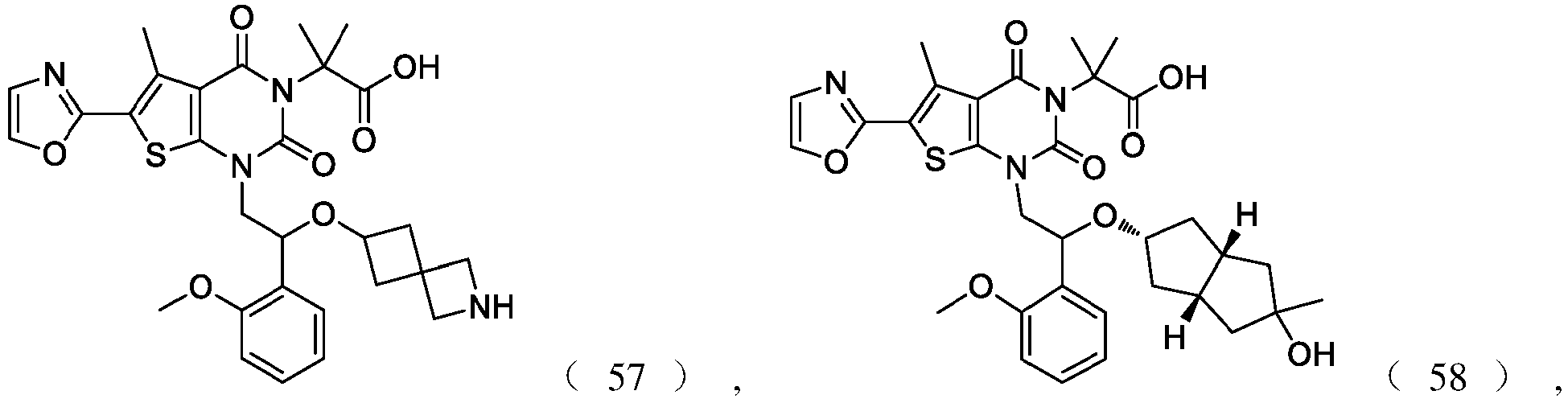


- In one aspect, provided herein is a pharmaceutical composition comprising a compound of formula (I) or a stereoisomer, a geometric isomer, a tautomer, a hydrate, a solvate, or a pharmaceutically acceptable salt thereof, or a pharmaceutically acceptable carrier, excipient, diluent, adjuvant, vehicle or a combination thereof.
- In one aspect, provided herein is use of the compound of formula (I) or the pharmaceutical composition thereof in the manufacture of a medicament for preventing, treating or lessening a disorder or disease regulated by ACC.
- In some embodiments, the disorder or disease regulated by acetyl-CoA carboxylase disclosed herein is a metabolism disorder or neoplastic disorder.
- In other embodiments, the disorder or disease regulated by acetyl-CoA carboxylase disclosed herein comprises insulin resistance insulin resistance, obesity, dyslipidaemia, metabolic syndrome, type II diabetes, non-alcoholic fatty liver disease and non-alcoholic steatohepatitis.
- In other embodiments, the neoplastic disorder disclosed herein comprises breast cancer, pancreatic cancer, renal cell cancer, hepatocellular carcinoma, malignant melanoma and other skin tumor, non-small cell bronchial carcinoma, endometrial carcinoma, colorectal cancer and prostate cancer.
- In other aspect, the present invention relates to a method of preventing, managing, treating or lessening a disease regulated by ACC in a patient, comprising administering a therapeutically effective amount of a pharmaceutically acceptable effective amount of the compound to a patient.
- In other aspect, provided herein is a method of preparing, separating or purifying the compound of Formula (I).
- The characteristics of the pharmaceutical composition of the invention include the compound represented by formula (I) and the compound listed herein and pharmaceutically acceptable carrier, adjuvant, or excipient. The amount of the compound in the composition of the invention can effectively and detectably treat or lessen a disease regulated by ACC.
- It will also be appreciated that certain of the compounds disclosed herein can exist in free form for treatment, or where appropriate, as a pharmaceutically acceptable derivative thereof. Provied herein, some non-limiting examples of the pharmaceutically acceptable derivative include pharmaceutically acceptable salts, esters, salts of such esters, or any other adducts or derivatives which upon administration to a patient in need is capable of providing, directly or indirectly, a compound as otherwise described herein, or residue thereof.
- As described above, the pharmaceutically acceptable compositions disclosed herein further comprise a pharmaceutically acceptable carrier, an adjuvant, or a vehicle, which, as used herein, includes any and all solvents, diluents, or other liquid vehicle, dispersion or suspension aids, surface active agents, isotonic agents, thickening or emulsifying agents, preservatives, solid binders, lubricants and the like, as suited to the particular dosage form desired. As the following described: Troy et al., Remington: The Science and Practice of Pharmacy, 21st ed., 2005, Lippincott Williams & Wilkins, Philadelphia, and Swarbrick et al., Encyclopedia of Pharmaceutical Technology, eds. 1988-1999, Marcel Dekker, New York, discloses various carriers used in formulating pharmaceutically acceptable compositions and known techniques for the preparation thereof. Except insofar as any conventional carrier medium incompatible with the compounds disclosed herein, e.g. by producing any undesirable biological effect or otherwise interacting in a deleterious manner with any other components of the pharmaceutically acceptable composition, its use is contemplated to be within the scope of this invention.
- The compounds of the present invention can be combined as the active ingredient in intimate admixture with a pharmaceutical carrier according to conventional pharmaceutical compounding techniques. The carrier may take a wide variety of forms depending on the form of preparation desired for administration, e.g., oral or parenteral (including intravenous). In preparing the compositions for oral dosage form, any of the usual pharmaceutical media may be employed, e.g., for example, water, glycols, oils, alcohols, flavoring agents, preservatives, coloring agents and the like in the case of oral liquid preparations, e.g., for example, suspensions, elixirs and solutions; or carriers e.g. starches, sugars, microcrystalline cellulose, diluents, granulating agents, lubricants, binders, disintegrating agents and the like in the case of oral solid preparations e.g., for example, powders, hard and soft capsules and tablets, with the solid oral preparations being preferred over the liquid preparations.
- Because of their ease of administration, tablets and capsules represent the most advantageous oral dosage unit form in which case solid pharmaceutical carriers are obviously employed. If desired, tablets may be coated by standard aqueous or non-aqueous techniques. Such compositions and preparations should contain at least 0.1 percent of active compound. The percentage of active compound in these compositions may, of course, be varied and may conveniently be between about 2 percent to about 60 percent of the weight of the unit. The amount of active compound in such therapeutically useful compositions is such that an effective dosage will be obtained. The active compounds can also be administered intranasally as, for example, liquid drops or spray.
- The tablets, pills, capsules, and the like may also contain a binder e.g. gum tragacanth, acacia, corn starch or gelatin; excipients e.g. dicalcium phosphate; a disintegrating agent e.g. corn starch, potato starch, alginic acid; a lubricant e.g. magnesium stearate; and a sweetening agent e.g. sucrose, lactose or saccharin. When a dosage unit form is a capsule, it may contain, in addition to materials of the above type, a liquid carrier e.g. a fatty oil.
- Various other materials may be present as coatings or to modify the physical form of the dosage unit. For instance, tablets may be coated with shellac, sugar or both. A syrup or elixir may contain, in addition to the active ingredient, sucrose as a sweetening agent, methyl and propylparabens as preservatives, a dye and a flavoring e.g. cherry or orange flavor.
- Ophthalmic formulations, eye ointments, powders, solutions and the like, are also contemplated as being within the scope of this invention.
- The compounds of the present invention may also be administered parenterally. Solutions or suspensions of these active compounds can be prepared in water suitably mixed with a surfactant e.g. hydroxy-propylcellulose. Dispersions can also be prepared in glycerol, liquid polyethylene glycols and mixtures thereof in oils. Under ordinary conditions of storage and use, these preparations contain a preservative to prevent the growth of microorganisms.
- The pharmaceutical forms suitable for injectable use include sterile aqueous solutions or dispersions and sterile powders for the extemporaneous preparation of sterile injectable solutions or dispersions. In all cases, the form must be sterile and must be fluid to the extent that easy syringability exists. It must be stable under the conditions of manufacture and storage and must be preserved against the contaminating action of microorganisms e.g. bacteria and fungi. The carrier can be a solvent or dispersion medium containing, for example, water, ethanol, polyol (e.g., glycerol, propylene glycol and liquid polyethylene glycol), suitable mixtures thereof, and vegetable oils.
- Any suitable route of administration may be employed for providing a mammal, especially a human, with an effective dose of a compound of the present invention. For example, oral, rectal, topical, parenteral, ocular, pulmonary, nasal, and the like may be employed. Dosage forms include tablets, troches, dispersions, suspensions, solutions, capsules, creams, ointments, aerosols, and the like. Preferably compounds of the present invention are administered orally.
- The therapeutically effective dosage of a compound, the pharmaceutical composition, or the combinations thereof, is dependent on the species of the subject, the body weight, age and individual condition, the disorder or disease or the severity thereof being treated. A physician, clinician or veterinarian of ordinary skill can readily determine the effective amount of each of the active ingredients necessary to prevent, treat or inhibit the progress of the disorder or disease.
- When treating or preventing ACC regulated conditions for which compounds of the present invention are indicated, generally satisfactory results are obtained when the compounds of the present invention are administered at a daily dosage of from about 0.1 milligram to about 100 milligram per kilogram of animal body weight, preferably given as a single daily dose or in divided doses two to six times a day, or in sustained release form. For most large mammals, the total daily dosage is from about 1.0 milligrams to about 1000 milligrams, preferably from about 1 milligram to about 50 milligrams. In the case of a 70 kg adult human, the total daily dose will generally be from about 7 milligrams to about 350 milligrams. This dosage regimen may be adjusted to provide the optimal therapeutic response.
- The compound, composition or pharmaceutically acceptable salt or a hydrate can effectively preventing, managing, treating or lessening a disease regulated by acetyl-CoA carboxylase, in particularly, insulin resistance, obesity, dyslipidaemia, metabolic syndrome, type II diabetes, non-alcoholic fatty liver disease and non-alcoholic steatohepatitis
- Generally, the compounds disclosed herein may be prepared by methods described herein, wherein the substituents are as defined for Formula (I) above, except where further noted. The following non-limiting schemes and examples are presented to further exemplify the invention.
- Persons skilled in the art will recognize that the chemical reactions described may be readily adapted to prepare a number of other compounds disclosed herein, and alternative methods for preparing the compounds disclosed herein are deemed to be within the scope disclosed herein. For example, the synthesis of non-exemplified compounds according to the invention may be successfully performed by modifications apparent to those skilled in the art, e.g., by appropriately protecting interfering groups, by utilizing other suitable reagents known in the art other than those described, and/or by making routine modifications of reaction conditions. Alternatively, other reactions disclosed herein or known in the art will be recognized as having applicability for preparing other compounds disclosed herein.
- In the examples described below, unless otherwise indicated all temperatures are set forth in degrees Celsius. Reagents were purchased from commercial suppliers e.g. Aldrich Chemical Company, Arco Chemical Company and Alfa Chemical Company, and were used without further purification unless otherwise indicated. Common solvents were purchased from commercial suppliers e.g. Shantou XiLong Chemical Factory, Guangdong Guanghua Reagent Chemical Factory Co. Ltd., Guangzhou Reagent Chemical Factory, Tianjin YuYu Fine Chemical Ltd., Qingdao Tenglong Reagent Chemical Ltd., and Qingdao Ocean Chemical Factory.
- Anhydrous THF, dioxane, toluene, and ether were obtained by refluxing the solvent with sodium. Anhydrous CH2Cl2 and CHCl3 were obtained by refluxing the solvent with CaH2. EtOAc, PE, hexane, DMAC and DMF were treated with anhydrous Na2SO4 prior use.
- The reactions set forth below were done generally under a positive pressure of nitrogen or argon or with a drying tube (unless otherwise stated) in anhydrous solvents, and the reaction flasks were typically fitted with rubber septa for the introduction of substrates and reagents via syringe. Glassware was oven dried and/or heat dried.
- Column chromatography was conducted using a silica gel column. Silica gel (300-400 mesh) was purchased from Qingdao Ocean Chemical Factory. 1H NMR spectra were recorded with a Bruker 400 MHz or 600 MHz spectrometer using CDCl3, d6 -DMSO, CD3OD or d6 -acetone as solutions (reported in ppm), and using TMS (0 ppm) or chloroform (7.25 ppm) as the reference standard. When peak multiplicities are reported, the following abbreviations are used: s (singlet), d (doublet), t (triplet), m (multiplet), br (broadened), dd (doublet of doublets), q (quartet), dt (doublet of triplets), tt (triplet of triplets), dddd (doublet of doublet of doublet of doublets), qd (quartet of doublets), ddd (doublet of doublet of doublets), td (triplet of doublets), dq (doublet of quartets), ddt (doublet of doublet of triplets), tdd (triplet of doublet of doublets), dtd (doublet of triplet of doublets). Coupling constants, when given, were reported in Hertz (Hz).
- Low-resolution mass spectral (MS) data were determined by an Agilent 6320 Series LC-MS spectrometer equipped with a G1312A binary pump and a G1316A TCC (column was operated at 30 °C).G1329A autosampler and G1315B DAD detector were applied in the analysis, and an ESI source was used in the LC-MS spectrometer.
- Low-resolution mass spectral (MS) data were determined by an Agilent 6120 Series LC-MS spectrometer equipped with a G1311A quaternary pump and a G1316A TCC (column was operated at 30 °C). G1329A autosampler and G1315D DAD detector were applied in the analysis, and an ESI source was used on the LC-MS spectrometer.
- Both LC-MS spectrometers were equipped with an Agilent Zorbax SB-C18, 2.1 × 30 mm, 5 µm column. Injection volume was decided by the sample concentration. The flow rate was 0.6 mL/min. The HPLC peaks were recorded by UV-Vis wavelength at 210 nm and 254 nm. The mobile phase was 0.1% formic acid in acetonitrile (phase A) and 0.1% formic acid in ultrapure water (phase B). The gradient condition of the mobile phase in Low-resolution mass spectrum analysis were showed in Table 1..
Table 1 Time (min) A (CH3CN, 0.1% HCOOH) B (H2O, 0.1% HCOOH) 0 - 3 5 - 100 95 - 0 3 - 6 100 0 6 - 6.1 100 - 5 0 - 95 6.1 - 8 5 95 - Purities of compounds were assessed by Agilent 1100 Series high performance liquid chromatography (HPLC) with UV detection at 210 nm and 254 nm (Zorbax SB-C18, 2.1 × 30 mm, 4 micorn, 10 min, 0.6 mL/min flow rate, 5 to 95 % (0.1 % formic acid in CH3CN) in (0.1 % formic acid in H2O). Column was operated at 40 °C.
- The following abbreviations are used throughout the specification:
- CDC13 chloroform-d
- CD3OD methyl alcohol-d4
- DMF N,N-dimethylformamide
- DMSO dimethylsulfoxide
- DMSO-d6 dimethyl sulfoxide-d6
- DCM dichloromethane
- EA, EtOAc ethyl acetate
- g gram
- H2O water
- HCl hydrogen chloride/hydrochloric acid
- PE petroleum ether
- Pd/C, Pd-C Palladium on activated carbon
- mg milligram
- M moles per liter
- MeOH methanol
- mol mole
- mmol millimole
- MPa mega pascal
- mL milliliter
- NaOH sodium hydroxide
- THF tetrahydrofuran
- TBDPS tert-butyldiphenylsilyl
- TBS tert-Butyldimethylsilyl
- µL microlitre
- Typical synthetic procedures for preparing the compounds of the present invention disclosed are shown in the following synthetic scheme. Unless otherwise indicated, Het, R1, R2, R3, R4, R5, L and W are as defined herein.


- X is a leaving group, including but not limited to halo atom, methylsulfonyloxy, p-methylphenylsulfonyloxy and so on; compound Q can be obtained by Mitsunobu reaction of compound M and compound P. Compound (I) can be obtained by coupling reaction of compound Q.
-

- Compound M3 can be obtained by cyclization reaction of compound M1, compound M2 and sublimed sulfur in the present of a base in a suitable solvent. The base includes but not limited to morpholine; the solvent includes but not limited to ethanol.
- Compound M5 can be obtained by reaction of compound M3, compound M4 and N,N'-carbonyldiimidazole in the present of a base in a suitable solvent. The base includes but not limited to triethylamine; the solvent includes but not limited to DCM.
- Compound M6 can be obtained by condensation reaction of compound M5 in the present of a base in a suitable solvent. The base includes but not limited to sodium ethoxide; the solvent includes but not limited to ethanol.
- Compound M7 can be obtained by hydrolyzation of compound M6 in the present of a base in a suitable solvent. The base includes but not limited to sodium hydroxide; the solvent includes but not limited to a mixture solvent of methanol and water.
- Compound M8 can be obtained by decarboxylation reaction of compound M7 and silver acetate in the present of a base in a suitable solvent. The base includes but not limited to potassium carbonate; the solvent includes but not limited to N-methylmorpholine.
- Compound M can be obtained by halogenation reaction of compound M8 in a suitable solvent. The solvent includes but not limited to methanol, glacial acetic acid and so on.
-

- Compound P2 can be obtained by free radical reaction of compound P1 and N-bromosuccinimide under a catalyst in a suitable solvent. The catalyst includes but not limited to azodiisobutyronitrile; the solvent includes but not limited to tetrachloromethane.
- Compound P4 can be obtained by substitution reaction of compound P2 and compound P3 in the present of a base in a suitable solvent. The base includes but not limited to sodium hydride, the solvent includes but not limited to tetrahydrofuran.
- Compound P can be obtained by reduction reaction of compound P4 in the present of a reductant in a suitable solvent. The reductant includes but not limited to lithium aluminium hydride, the solvent includes but not limited to tetrahydrofuran.
-

- Ethyl cyanoacetate (30.00 g, 260.0 mmol), ethyl acetoacetate (33.83 g, 260.0 mmol) and sublimed sulfur (8.36 g, 260.0 mmol) were dissolved in anhydrous ethanol (60 mL) at rt. The solution was heated to 45 °C, and then morpholine (34.0 mL, 390 mmol) was added dropwise slowly. After the addition, the resulting mixture was heated to 60 °C and stirred for 4 hours. The reaction was quenched with water (360 mL), and the mixture was cooled to rt with stirring. After a lot of solid precipitated out, the mixture was filtered by suction filtration. The filter cake was washed with 30% ethanol aqueous solution (100 mL) and dried in vacuo to get title compound as a yellow solid (54.10 g, 80.9%).
MS (ESI, pos. ion) m/z: 258.2[M+H]+. - Diethyl 5-amino-3-methyl-thiophene-2,4-dicarboxylate (20.00 g, 77.73 mmol) was dissolved in DCM (160 mL) at rt, and then triethylamine (43.2 mL, 311 mmol) and N,N'-carbonyldiimidazole (25.72 g, 155.4 mmol) were added. The mixture was stirred for 3 hours, and then t-butyl 2-amino-2-methyl-propionate hydrochloride (16.30 g, 81.63 mmol) was added in portions. The resulting mixture was stirred for another 5 hours. The reaction was quenched with water (300 mL). The resulting mixture was partitioned. The organic layer was washed with water (300 mL × 2) and dried over anhydrous sodium sulfate, and filtered by suction filtration. The filtrate was concentrated in vacuo. The residue was triturated with PE and ethyl acetate (V/V=15/1) to give the title compound as a light yellow solid (29.10 g, 84.6%).
- Diethyl 5-[(2-t-butoxy-1,1-dimethyl-2-oxa-ethyl)aminoformamido]-3-methyl-thiophene -2,4-dicarboxylate (58.00 g, 131.1 mmol) was dissolved in anhydrous ethanol (550 mL), and then sodium ethoxide (36.41 g, 524.3 mmol) was added. The mixture was stirred at 80 °C overnight. The mixture was concentrated in vacuo. To the residue was added water (600 mL). The resulting mixture was adjusted to pH about 5 with dilute hydrochloric acid (2 N). A lot of solid precipitated out. The mixture was stirred for 30 min and filtered by suction filtration. The filter cake was washed with water (100 mL) and dried in vacuo to get the title compound as a light yellow solid (51.97 g, 100%). The product was used in the next step without any further purification.
MS (ESI, neg. ion) m/z: 395.1[M-H]-. - Ethyl 3-(2-t-butoxy-1,1-dimethyl-2-oxa-ethyl)-5-methyl-2,4-dioxo-1H-thieno[2,3-d] pyrimidine-6-formate (51.97 g, 131.1 mmol) was dissolved in methanol (250 mL) and tetrahydrofuran (100 mL) at rt, and then a solution of sodium hydroxide (21.40 g, 524.3 mmol) in water (120 mL) and tetrabutylammonium bromide (4.23 g, 13.1 mmol) were added. The mixture was heated to 65 °C and stirred for 2.5 hours. The mixture was concentrated in vacuo. To the residue was added water (600 mL). The resulting mixture was adjusted to about pH 3 with dilute hydrochloric acid (2 N). A lot of solid precipitated out. The mixture was filtered by suction filtration. The filter cake was washed with water (100 mL) and dried in vacuo to get the title compound as a gray solid (46.74 g, 96.8%).
MS (ESI, neg. ion) m/z:367.1[M-H]-; - 3-(2-t-Butoxy-1,1-dimethyl-2-oxa-ethyl)-5-methyl-2,4-dioxo-1H-thieno[2,3-d]pyrimidin e-6-formic acid (48.80 g, 132.5 mmol) was dissolved in N-methylpyrrolidone (900 mL) at rt, and then potassium carbonate (22.00 g, 159.2 mmol) and silver acetate (27.07 g, 158.9 mmol) were added. The mixture was heated to 110 °C and stirred for 2 hours. The resulting mixture was cooled to rt and filtered by suction filtration. The filtrate was diluted with water (2 L). The resulting mixture was extracted with ethyl acetate (500 mL × 2). The combined organic layers were washed with saturated ammonium chloride solution (500 mL) and saturated aqueous NaCl (200 mL) in turn, and then dried over anhydrous sodium sulfate and concentrated in vacuo. The residue was triturated with PE and ethyl acetate (V/V=10/1) to give the title compound as a gray solid (20.54 g, 47.8%).
MS (ESI, neg. ion) m/z:323.1[M-H]-. - t-Butyl 2-methyl-2-(5-methyl-2,4-dioxo-1H-thieno[2,3-d]pyrimid-3-yl)propionate (20.54 g, 63.32 mmol) and sodium acetate trihydrate (18.96 g, 139.3 mmol) were dissolved in glacial acetic acid (300 mL), and then bromine (3.57 mL, 69.7 mmol) was added dropwise slowly. After the addition, the mixture was stirred at rt for 1 hour. The reaction was quenched with water (100 mL). A lot of solid precipitated out. The mixture was filtered by suction filtration. The filter cake was dissolved in ethyl acetate (500 mL). The solution was washed with saturated sodium thiosulfate solution (100 mL) and saturated aqueous NaCl (200 mL) in turn, and then dried over anhydrous sodium sulfate and filtered by suction filtration. The filtrate was concentrated in vacuo. The residue was triturated with PE and ethyl acetate (V/V=10/1) to get the title compound as a white solid (25.00 g, 92.2%).
- MS (ESI, pos. ion) m/z:426.0[M+Na]+;
- 1H NMR (400 MHz, CDCl3) δ 10.66 (s, 1H), 2.39 (s, 3H), 1.81 (s, 6H), 1.48 (s, 9H).
- To a solution of (3aR,6aS)-5',5'-dimethylspiro[1,3,3a,4,6,6a-hexahydropentalenyl-5,2'-1,3-dioxane]-2-one (24.50 g, 109.2 mmol) in anhydrous methanol (40 mL) was added sodium borohydride (5.78 g, 150.0 mmol) in portions on an ice bath under N2. The mixture was stirred in the ice bath for 2 hours. The mixture was quenched with water (50 mL) by dropwise addition. The resulting mixture was extracted with ethyl acetate (120 mL × 2). The combined organic phases were washed with saturated brine (50 mL), dried over anhydrous sodium sulfate, filtered by suction filtration. The filtrate was concentrated in vacuo. The residue was purified by silica gel chromatograph (PE/EtOAc (V/V) = 4/1) to give the title compound as a colorless oil (18.00 g, 72.8%).
- To a solution of (3'aR,6'aS)-5,5-dimethylspiro[1,3-dioxane-2,5'-2,3,3a,4,6,6a-hexahydro-1H-pentalen]-2'-ol (3.09 g, 13.7 mmol) in anhydrous tetrahydrofuran (20 mL) was added sodium hydride (1.95 g, 48.8 mmol) in portions on an ice bath under N2. After stirring for 15 min on the ice bath, a solution of 2-bromo-2-(methoxyphenyl)acetic acid (3.00 g, 12.2 mmol) in anhydrous tetrahydrofuran (10 mL) was added dropwise slowly to the mixture. After the addition, the mixture was moved to rt and stirred for another 4 hours. The mixture was quenched with water (30 mL) by dropwise addition on an ice bath, the resulting mixture was extracted with ethyl acetate (30 mL × 2). The combined water layers were adjusted to pH about 3 with dilute hydrochloric acid (2 N), and then extracted with ethyl acetate (30 mL × 2). The combined organic layers were washed with saturated brine (30 mL), dried over anhydrous sodium sulfate, filtered by suction filtration. The filtrate was concentrated in vacuo to give the title compound as a light yellow oil (2.20 g, 46.0%). The product was used in the next step without any further purification.
- To a solution of 2-[(3'aR,6'aS)-5,5-dimethylspiro[1,3-dioxane-2,5'-2,3,3a,4,6,6a-hexahydro-1H-pentalenyl]-2'-yl]oxy-2-(2-methoxyphenyl)acetic acid (2.20 g, 5.63 mmol) in anhydrous tetrahydrofuran (20 mL) was added lithium aluminum hydride (0.44 g, 11.0 mmol) in portions on an ice bath. After the mixture was stable, the mixture was moved to rt and stirred for 2 hours. The mixture was quenched with water (0.44 mL) by dropwise addition on an ice bath. And then to the mixture were added sodium hydroxide solution (0.44 mL, 15%) and water (1.32 mL) in turn. The resulting mixture was stirred at rt for another 15 min, and anhydrous sodium sulfate was added, the mixture was further stirred for 15 min. The mixture was filtered by suction filtration. The filtrate was concentrated in vacuo. The residue was purified by silica gel chromatograph (PE/EtOAc (V/V) = 4/1) to give the title compound as a colorless oil (1.30 g, 61.3%).
MS (ESI, pos. ion) m/z: 399.3[M+Na]+. - t-Butyl 2-(6-bromo-5-methyl-2,4-dioxo-1H-thieno[2,3-d]pyrimid-3-yl)-2-methyl-propionate (1.45 g, 3.60 mmol), 2-[(3'aR,6'aS)-5,5-dimethylspiro[1,3-dioxane-2,5'-2,3,3a,4,6,6a-hexahydro-1H-pentalenyl]-2'-yl]oxy-2-(2-methoxyphenyl)ethanol (1.30 g, 3.45 mmol), triphenylphosphine (1.80 g, 6.79 mmol) were dissolved in anhydrous tetrahydrofuran (15 mL) at rt. Diisopropylazodicarboxylate (1.40 g, 6.79 mmol) was added to the mixture under N2, the resulting mixture was stirred at rt for 12 hours and concentrated in vacuo. The residue was purified by silica gel chromatograph (PE/EtOAc (V/V) = 6/1) to give the title compound as a white solid (1.70 g, 64.6%).
- t-Butyl 2-[1-[2-[(3'aR,6'aS)-5,5-dimethylspiro[1,3-dioxane-2,5'-2,3,3a,4,6,6a-hexahydro -1H-pentalenyl]-2'-yl]oxy-2-(2-methoxyphenyl)ethyl]-6-bromo-5-methyl-2,4-dioxo-thieno[2,3-d] pyrimid-3-yl]-2-methyl-propionate (1.70 g, 2.23 mmol) and 2-tributylstannyloxazole (4.00 g, 11.2 mmol) were dissolved in toluene (20 mL) at rt under N2, and then palladium tetrakis-(triphenylphosphine) (1.30 g, 1.12 mmol) was added. The mixture was stirred at 110 °C for 8 hours. The reaction mixture was concentrated in vacuo to remove the solvent, and the residue was purified by silica gel column chromatography (PE/EtOAc (V/V) = 8/1) to give the title compound as a white solid (0.75 g, 45.0%).
- t-Butyl 2-[1-[2-[(3'aR,6'aS)-5,5-dimethylspiro[1,3-dioxane-2,5'-2,3,3a,4,6,6a-hexahydro -1H-pentalenyl]-2'-yl]oxy-2-(2-methoxyphenyl)ethyl]-5-methyl-6-oxazol-2-yl-2,4-dioxo-thieno[2 ,3-d]pyrimid-3-yl]-2-methyl-propionate (0.75 g, 1.0 mmol) was dissolved in DCM (10 mL) at rt, and then 2,2,2-trifluoracetic acid (2 mL) was added. The mixture was stirred for 4 hours. The reaction mixture was concentrated in vacuo to remove the solvent, and the residue was purified by silica gel column chromatography (PE/EtOAc (V/V) = 1/1) to give the title compound as a light yellow solid (0.500 g, 82.0%).
MS (ESI, pos. ion) m/z: 608.3[M+H]+. - To a solution of 2-[1-[2-[[(3aR,6aS)-5-oxa-2,3,3a,4,6,6a-hexahydro-1H-pentalenyl-2-yl] oxy]-2-(2-methoxyphenyl)ethyl]-5-methyl-6-oxazol-2-yl-2,4-dioxo-thieno[2,3-d]pyrimid-3-yl]-2-methyl-propanoic acid (0.500 g, 0.82 mmol) in anhydrous methanol (10 mL) was added sodium borohydride (0.10 g, 2.6 mmol) in portions on an ice bath under N2. The mixture was stirred at rt for 6 hours. The mixture was quenched with water (10 mL) by dropwise addition. The resulting mixture was extracted with ethyl acetate (20 mL × 2). The combined organic phases were washed with saturated brine (20 mL), dried over anhydrous sodium sulfate, filtered by suction filtration. The filtrate was concentrated in vacuo. The residue was purified by silica gel chromatograph (PE/EtOAc (V/V) = 1/1) to give the title compound as a white solid (0.43 g, 86.0%).
- MS (ESI, pos. ion) m/z: 632.2[M+Na]+;
- 1H NMR (400 MHz, CDCl3) δ 7.72 (s, 1H), 7.54 (d, J = 6.4 Hz, 1H), 7.32 (t, J = 6.8 Hz, 1H), 7.25 (s, 1H), 7.04 (t, J = 7.4 Hz, 1H), 6.90 (d, J = 8.2 Hz, 1H), 5.34-5.29 (m, 1H), 4.34-4.26 (m, 1H), 4.25-4.20 (m, 1H), 4.01-3.95 (m, 1H), 3.93 (s, 3H), 3.84-3.80 (m, 1H), 2.86 (s, 3H), 2.33-2.25 (m, 2H), 2.06-1.92 (m, 4H), 1.89 (s, 3H), 1.84 (s, 3H), 1.75-1.68 (m, 1H), 1.60-1.56 (m, 1H), 1.55-1.50 (m, 2H).
-

- 2-[1-[2-[[(3aS,6aR)-5-Hydroxy-1,2,3,3a,4,5,6,6a-octahydropentalen-2-yl]oxy]-2-phenylethyl]-5-methyl-6-oxazol-2-yl-2,4-dioxo-thieno[2,3-d]pyrimid-3-yl]-2-methyl-propanoic acid was prepared from 2-bromo-2-phenylacetic acid (0.800 g, 3.72 mmol) according to the method described in Example1. The title compound is obtained as a white solid (0.22 g, 95.0%).
- MS (ESI, pos. ion) m/z: 580.3[M+H]+;
- 1H NMR (400 MHz, CDCl3) δ 7.70 (d, J = 0.5 Hz, 1H), 7.47-7.44 (m, 2H), 7.43-7.37 (m, 2H), 7.36-7.31 (m, 1H), 7.22 (d, J = 0.6 Hz, 1H), 4.98-4.92 (m, 1H), 4.15-4.05 (m, 2H), 3.96-3.89 (m, 1H), 3.84-3.76 (m, 1H), 2.84 (s, 3H), 2.30-2.18 (m, 2H), 2.03-1.91 (m, 2H), 1.89 (s, 3H), 1.85 (s, 3H), 1.83-1.76 (m, 2H), 1.66-1.59 (m, 1H), 1.58-1.51 (m, 1H), 1.39-1.31 (m, 2H).
-

- To a solution of 6-oxaspiro[3.3]heptane-2-ol (0.86 g, 7.5 mmol) in anhydrous tetrahydrofuran (22 mL) was added sodium hydride (1.10 g, 27.5 mmol) in portions on an ice bath under N2. After stirring for 30 min on the ice bath, a solution of 2-bromo-2-(methoxyphenyl)acetic acid (1.68 g, 6.86 mmol) in anhydrous tetrahydrofuran (5 mL) was added dropwise to the mixture. After the addition, the mixture was moved to rt and stirred for another 4 hours. The mixture was quenched with water (30 mL) by dropwise addition on an ice bath, the resulting mixture was extracted with ethyl acetate (30 mL × 2). The combined water layers were adjusted to pH about 3 with dilute hydrochloric acid (1N), and then extracted with isopropyl ether (30 mL × 2). The combined organic layers were washed with saturated brine (30 mL), dried over anhydrous sodium sulfate, filtered by suction filtration. The filtrate was concentrated in vacuo to give the title compound as a light yellow oil (1.91 g, 100%). The product was used in the next step without any further purification.
- To a solution of 2-(2-methoxyphenyl)-2-(6-oxaspiro[3.3]heptane-2-oxy)acetic acid (1.91 g, 6.86 mmol) in anhydrous tetrahydrofuran (30 mL) was added lithium aluminum hydride (0.39 g, 10 mmol) in portions on an ice bath. After the mixture was stable, the mixture was moved to rt and stirred for 40 min. The mixture was quenched with water (10 mL) by dropwise addition on an ice bacth. The resulting mixture was extracted with ethyl acetate (50 mL × 2). The combined organic phases were washed with saturated brine (50 mL), dried over anhydrous sodium sulfate, filtered by suction filtration. The filtrate was concentrated in vacuo. The residue was purified by silica gel chromatograph (PE/EtOAc (V/V) = 1/1) to give the title compound as a colorless oil (0.700 g, 38.6%).
- t-Butyl 2-[6-bromo-5-methyl-2,4-dioxo-1H-thieno[2,3-d]pyrimid-3-yl]-2-methyl-propionate (1.12 g, 2.78 mmol), 2-(2-methoxyphenyl)-2-(6-oxaspiro[3.3]heptane-2-oxy)ethanol (0.610 g, 2.31 mmol) and triphenylphosphine (1.24 g, 4.63 mmol) were dissolved in anhydrous tetrahydrofuran (15 mL), the air in the system was replaced with N2. Diisopropylazodicarboxylate (0.95 mL, 4.7 mmol) was added dropwise to the mixture. The resulting mixture was stirred at rt for 22.5 hours. The reaction mixture was concentrated in vacuo to remove the solvent, and the residue was purified by silica gel column chromatography (PE/EtOAc (V/V) = 8/1) to give the title compound as a white solid (1.05 g, 70.0%).
- t-Butyl 2-[6-bromo-1-[2-(2-methoxyphenyl)-2-(6-oxaspiro[3.3]heptane-2-oxy)ethyl]-5-methyl-2,4-dioxo-thieno[2,3-d]pyrimid-3-yl]-2-methyl-propionate (1.05 g, 1.62 mmol) and 2-tributylstannyloxazole (1.16 g, 3.24 mmol) were dissolved in toluene (10 mL) at rt under N2, and then palladium tetrakis-(triphenylphosphine) (0.56 g, 0.48 mmol) was added. The mixture was stirred at 110 °C for 23.5 hours. The reaction mixture was concentrated in vacuo to remove the solvent, and the residue was purified by silica gel column chromatography (PE/EtOAc (V/V) = 5/1) to give the title compound as a white solid (0.470 g, 46.0%).
MS (ESI, pos. ion) m/z: 660.2[M+Na]+. - t-Butyl 2-[1-[2-(2-methoxyphenyl)-2-(6-oxaspiro[3.3]heptane-2-oxy)ethyl]-5-methyl-6-oxazol-2-yl-2,4-dioxo-thieno[2,3-d]pyrimid-3-yl]-2-methyl-propionate (0.270 g, 0.423 mmol) was dissolved in DCM (12 mL) at rt, and then 2,2,2-trifluoracetic acid (2 mL) was added. The mixture was stirred for 3 hours. The reaction mixture was concentrated in vacuo to remove the solvent, and the residue was purified by silica gel column chromatography (PE/EtOAc (V/V) = 3/1) to give the title compound as a white solid (0.050 g, 20.0%).
- MS (ESI, pos. ion) m/z: 582.3[M+H]+;
- 1H NMR (400 MHz, CDCl3) δ 7.72 (s, 1H), 7.50-7.46 (m, 1H), 7.33-7.28 (m, 1H), 7.25 (s, 1H), 7.02 (t, J = 7.4 Hz, 1H), 6.86 (d, J = 8.2 Hz, 1H), 5.18-5.12 (m, 1H), 4.61-4.51 (m, 4H), 4.21-4.12 (m, 1H), 4.12-4.03 (m, 1H), 3.86 (s, 3H), 3.77-3.68 (m, 1H), 2.87 (s, 3H), 2.48-2.37 (m, 2H), 2.12-2.06 (m, 1H), 1.95-1.89 (m, 1H), 1.87 (s, 3H), 1.84 (s, 3H).
-

- To a solution of (3S,6S)-2,3,3a,5,6,6a-hexahydrofuro[3,2-b]furan-3,6-diol (4.00 g, 27.4 mmol) in DCM (20 mL) was added t-butyldimethylsilylchloride (4.60 g, 30.5 mmol) slowly under N2, and then imidazole (2.90 g, 42.2 mmol) was added. The mixture was stirred at rt for 22 hours. The mixture was quenched with water (100 mL) by dropwise addition. The resulting mixture was extracted with ethyl acetate (120 mL × 2). The combined organic phases were washed with saturated brine (50 mL), dried over anhydrous sodium sulfate, filtered by suction filtration. The filtrate was concentrated in vacuo. The residue was purified by silica gel chromatograph (PE/EtOAc (V/V) = 5/1) to give the title compound as a colorless oil (3.20 g, 47.8%).
- To a solution of (3S,6S)-6-[t-butyl(dimethyl)silyl]oxy-2,3,3a,5,6,6a-hexahydrofuro [3,2-b]furan-3-ol (2.00 g, 7.68 mmol) in anhydrous tetrahydrofuran (25 mL) was added sodium hydride (1.30 g, 30.7 mmol) in portions on an ice bath under N2. After stirring for 15 min, a solution of 2-bromo-2-phenylacetic acid (1.85 g, 8.45 mmol) in anhydrous tetrahydrofuran (10 mL) was added dropwise to the mixture. After the addition, the mixture was moved to rt and stirred for another 12 hours. The mixture was quenched with water (20 mL) by dropwise addition on an ice bath, the resulting mixture was washed with ethyl acetate (30 mL × 2). The combined water layers were adjusted to pH about 5 with dilute hydrochloric acid (2N), and then extracted with ethyl acetate (50 mL × 2). The combined organic layers were washed with saturated brine (30 mL), dried over anhydrous sodium sulfate, filtered by suction filtration. The filtrate was concentrated in vacuo to give the title compound as a light yellow oil (1.80 g, 59.4%). The product was used in the next step without any further purification.
MS (ESI, pos. ion) m/z: 417.2[M+Na]+. - To a solution of 2-[[(3S,6S)-6-[t-butyl(dimethyl)silyl]oxy-2,3,3a,5,6,6a-hexahydrofuro [3,2-b]fur-3-yl]oxy]-2-phenyl-acetic acid (2.48 g, 6.29 mmol) in anhydrous tetrahydrofuran (20 mL) was added lithium aluminum hydride (0.50 g, 13.0 mmol) in portions on an ice bath. After the mixture was stable, the mixture was moved to rt and stirred for 2 hours. The mixture was quenched with water (0.50 mL) by dropwise addition on an ice bath. And then to the mixture were added sodium hydroxide aqueous solution (0.50 mL, 15%) and water (1.50 mL) in turn. The resulting mixture was stirred at rt for another 15 min, and anhydrous sodium sulfate was added, the mixture was further stirred for 15 min. The mixture was filtered by suction filtration. The filtrate was concentrated in vacuo. The residue was purified by silica gel chromatograph (PE/EtOAc (V/V) = 10/1) to give the title compound as a colorless oil (0.60 g, 25.0%).
MS (ESI, pos. ion) m/z: 403.1 [M+Na]+. - t-Butyl 2-(6-bromo-5-methyl-2,4-dioxo-1H-thieno[2,3-d]pyrimid-3-yl)-2-methyl-propionate (0.58 g, 1.4 mmol), 2-[[(3S,6S)-6-[t-butyl(dimethyl)silyl]oxy-2,3,3a,5,6,6a-hexahydrofuro[3,2-b]fur-3-yl]oxy]-2-phenyl-ethanol (0.53 g, 1.4 mmol) and triphenylphosphine (0.75 g, 2.8 mmol) were dissolved in anhydrous tetrahydrofuran (15 mL) at rt. Diisopropylazodicarboxylate (0.56 g, 2.7 mmol) was added to the mixture under N2, the resulting mixture was stirred at rt for 12 hours and concentrated in vacuo. The residue was purified by silica gel chromatograph (PE/EtOAc (V/V) = 6/1) to give the title compound as a white solid (0.71 g, 67.0%).
- t-Butyl 2-[6-bromo-1-[2-[[(3S,6S)-6-[t-butyl(dimethyl)silyl]oxy-2,3,3a,5,6,6a-hexahydrofuro[3,2-b]fur-3-yl]oxy]-2-phenyl-ethyl]-5-methyl-2,4-dioxo-thieno[2,3-d]pyrimid-3-y 1]-2-methyl-propionate (0.17 g, 0.22 mmol) and 2-tributylstannyloxazole (0.29 g, 0.67 mmol) were dissolved in toluene (10 mL) at rt under N2, and then palladium tetrakis-(triphenylphosphine) (0.12 g, 0.11 mmol) was added. The mixture was stirred at 110 °C for 12 hours. The reaction mixture was concentrated in vacuo to remove the solvent, and the residue was purified by silica gel column chromatography (PE/EtOAc (V/V) = 6/1) to give the title compound as a white solid (0.10 g, 60.0%).
MS (ESI, pos. ion) m/z: 777.2[M+Na]+. - t-Butyl 2-[1-[2-[[(3S,6S)-6-[t-butyl(dimethyl)silyl]oxy-2,3,3a,5,6,6a-hexahydrofuro [3,2-b]fur-3-yl]oxy]-2-phenyl-ethyl]-5-methyl-6-oxazol-2-yl-2,4-dioxo-thieno[2,3-d] pyrimid-3-yl]-2-methyl-propionate (0.42 g, 0.56 mmol) was dissolved in DCM (8 mL) at rt, and then 2,2,2-trifluoracetic acid (4 mL) was added. The mixture was stirred for 4 hours. The reaction mixture was concentrated in vacuo to remove the solvent, and the residue was purified by silica gel column chromatography (PE/EtOAc (V/V) = 3/1) to give the title compound as a light yellow solid (0.22 g, 68.0%).
- MS (ESI, pos. ion) m/z: 584.2[M+H]+;
- 1H NMR (400 MHz, CDCl3) δ 7.73 (s, 1H), 7.50-7.35 (m, 5H), 7.25 (s, 1H), 5.15-5.10 (m, 1H), 4.45 (t, J = 4.8 Hz, 1H), 4.35 (t, J = 5.1 Hz, 1H), 4.25 (d, J = 14.4 Hz, 1H), 4.18-4.11 (m, 1H), 4.04-3.96 (m, 1H), 3.95-3.87 (m, 1H), 3.86-3.82 (m, 1H), 3.82-3.77 (m, 1H), 3.47 (t, J = 8.2 Hz, 1H), 3.04 (t, J = 8.4 Hz, 1H), 2.87 (s, 3H), 1.90 (s, 3H), 1.87 (s, 3H).
-

- 2-[1-[2-[[(3S,6S)-3-Hydroxy-2,3,3a,5,6,6a-hexahydrofuro[3,2-b]furan6-yl]oxy]-2-(2-met hoxyphenyl)ethyl]-5-methyl-6-oxazol-2-yl-2,4-dioxo-thieno[2,3-d]pyrimid-3-yl]-2-methyl-propa noic acid was prepared from 2-bromo-2-(methoxyphenyl)acetic acid ( 1.35 g, 5.51 mmol) according to the method described in Example 4. The title compound was obtained as a light yellow solid (0.45 g, 74.0%).
- MS (ESI, pos. ion) m/z: 636.1[M+Na]+;
- 1H NMR (400 MHz, CDCl3) δ 7.72 (s, 1H), 7.52-7.45 (m, 1H), 7.37-7.31 (m, 1H), 7.25 (s, 1H), 7.04 (t, J = 7.5 Hz, 1H), 6.93 (d, J = 8.2 Hz, 1H), 5.55-5.46 (m, 1H), 4.45 (t, J = 4.7 Hz, 1H), 4.36 (t, J = 5.1 Hz, 1H), 4.22-4.06 (m, 3H), 4.01-3.93 (m, 2H), 3.92 (s, 3H), 3.84-3.78 (m, 1H), 3.55 (t, J = 8.0 Hz, 1H), 3.24 (t, J = 8.1 Hz, 1H), 2.87 (s, 3H), 1.88 (s, 3H), 1.87 (s, 3H).
-

- 1,3,3a,4,6,6a-Hexahydropentalenyl-2,5-dione (20.00 g, 144.8 mmol) and 2,2-dimethtylpropane-1,3-diol (16.00 g, 153.6 mmol) were dissolved in toluene (100.00 mL), and then p-toluene sulfonic acid (2.50 g, 14.4 mmol) was added. The mixture was heated to 115 °C and stirred overnight. The reaction was stopped and the mixture was concentrated in vacuo to remove the solvent, and the residue was purified by silica gel column chromatography (PE/EtOAc (V/V) = 6/1) to give the title compound as a white solid (13.60 g, 41.89%).
- To a solution of (3aR,6aS)-5',5'-dimethylspiro[1,3,3a,4,6,6a-hexahydropentalenyl-5,2'-1,3-dioxane]-2-one (24.50 g, 109.2 mmol) in anhydrous methanol (40 mL) was added sodium borohydride (5.78 g, 150.0 mmol) in portions on an ice bath under N2. The mixture was stirred for 2 hours. The mixture was quenched with water (50 mL) by dropwise addition. The resulting mixture was extracted with ethyl acetate (120 mL × 2). The combined organic phases were washed with saturated brine (50 mL), dried over anhydrous sodium sulfate, filtered by suction filtration. The filtrate was concentrated in vacuo. The residue was purified by silica gel chromatograph (PE/EtOAc (V/V) = 4/1) to give the title compound as a colorless oil (18.00 g, 72.8%).
- To a solution of (3'aR,6'aS)-5,5-dimethylspiro[1,3-dioxane-2,5'-2,3,3a,4,6,6a-hexahydro-1H-pentalenyl]-2'-ol (3.09 g, 13.7 mmol) in anhydrous tetrahydrofuran (20 mL) was added sodium hydride (1.95 g, 48.8 mmol) in portions on an ice bath under N2. After stirring for 15 min, a solution of 2-bromo-2-(methoxyphenyl)acetic acid (3.00 g, 12.2 mmol) in anhydrous tetrahydrofuran (10 mL) was added to the mixture. After the addition, the mixture was moved to rt and stirred for another 4 hours. The mixture was quenched with water (30 mL) by dropwise addition on an ice bath, the resulting mixture was extracted with ethyl acetate (30 mL × 2). The combined water layers were adjusted to pH about 3 with dilute hydrochloric acid (2 N), and then extracted with ethyl acetate (30 mL × 2). The combined organic layers were washed with saturated brine (30 mL), dried over anhydrous sodium sulfate, filtered by suction filtration. The filtrate was concentrated in vacuo to give the title compound as a light yellow oil (2.20 g, 46.0%).
- To a solution of 2-[(3'aR,6'aS)-5,5-dimethylspiro[1,3-dioxane-2,5'-2,3,3a,4,6,6a-hexahydro-1H-pentalenyl]-2'-yl]oxy-2-(2-methoxyphenyl)acetic acid (2.20 g, 5.63 mmol) in anhydrous tetrahydrofuran (20 mL) was added lithium aluminum hydride (0.44 g, 11.0 mmol) in portions on an ice bath. After the mixture was stable, the mixture was moved to rt and stirred for 2 hours. To the mixture were added slowly water (0.44 mL), sodium hydroxide aqueous solution (0.44 mL, 10%) and water (1.32 mL) in turn by dropwise addition on an ice bath. The resulting mixture was stirred at rt for another 15 min, and anhydrous sodium sulfate was added, the mixture was further stirred for 15 min. The mixture was filtered by suction filtration. The filtrate was concentrated in vacuo. The residue was purified by silica gel chromatograph (PE/EtOAc (V/V) = 4/1) to give the title compound as a colorless oil (1.30 g, 61.3%).
MS (ESI, pos. ion) m/z: 399.3[M+Na]+. - t-Butyl 2-(6-bromo-5-methyl-2,4-dioxo-1H-thieno[2,3-d]pyrimid-3-yl)-2-methyl-propionate (1.45 g, 3.60 mmol) (prepared according to the method described in step 6 of example 1), 2-[(3'aR,6'aS)-5,5-dimethylspiro[1,3-dioxane-2,5'-2,3,3a,4,6,6a-hexahydro-1H-pentalenyl]-2'-yl]oxy-2-(2-methoxyphenyl)ethanol (1.30 g, 3.45 mmol), triphenylphosphine (1.80 g, 6.79 mmol) were dissolved in anhydrous tetrahydrofuran (15 mL) at rt. Diisopropylazodicarboxylate (1.40 g, 6.79 mmol) was added to the mixture under N2, the resulting mixture was stirred at rt for 12 hours and concentrated in vacuo. The residue was purified by silica gel chromatograph (PE/EtOAc (V/V) = 6/1) to give the title compound as a white solid (1.70 g, 64.6%).
- t-Butyl 2-[1-[2-[(3'aR,6'aS)-5,5-dimethylspiro[1,3-dioxane-2,5'-2,3,3a,4,6,6a-hexahydro -1H-pentalenyl]-2'-yl]oxy-2-(2-methoxyphenyl)ethyl]-6-bromo-5-methyl-2,4-dioxo-thieno[2,3-d] pyrimid-3-yl]-2-methyl-propionate (1.70 g, 2.23 mmol) and 2-tributylstannyloxazole (4.00 g, 11.2 mmol) were dissolved in toluene (20 mL) at rt under N2, and then palladium tetrakis-(triphenylphosphine) (1.30 g, 1.12 mmol) was added. The mixture was stirred at 110 °C for 8 hours. The reaction mixture was concentrated in vacuo to remove the solvent, and the residue was purified by silica gel column chromatography (PE/EtOAc (V/V) = 8/1) to give the title compound as a white solid (0.75 g, 45.0%).
- t-Butyl 2-[1-[2-[(3'aR,6'aS)-5,5-dimethylspiro[1,3-dioxane-2,5'-2,3,3a,4,6,6a-hexahydro -1H-pentalenyl]-2'-yl]oxy-2-(2-methoxyphenyl)ethyl]-5-methyl-6-oxazol-2-yl-2,4-dioxo-thieno[2 ,3-d]pyrimid-3-yl]-2-methyl-propionate (0.75 g, 1.0 mmol) was dissolved in DCM (10 mL) at rt, and then 2,2,2-trifluoracetic acid (2 mL) was added. The mixture was stirred for 4 hours. The reaction mixture was concentrated in vacuo to remove the solvent, and the residue was purified by silica gel column chromatography (PE/EtOAc (V/V) = 1/1) to give the title compound as a light yellow solid (0.500 g, 82.0%).
- MS (ESI, pos. ion) m/z: 608.3[M+H]+;
- 1H NMR (400 MHz, CDCl3) δ 7.71 (s, 1H), 7.49 (d, J = 6.9 Hz, 1H), 7.34-7.28 (m, 1H), 7.23 (s, 1H), 7.05 (d, J = 7.1 Hz, 1H), 6.85 (d, J = 7.7 Hz, 1H), 5.31 (t, J = 5.5 Hz, 1H), 4.18-4.03 (m, 2H), 3.96-3.90 (m, 1H), 3.82 (s, 3H), 2.86 (s, 3H), 2.70-2.58 (m, 2H), 2.50-2.33 (m, 2H), 2.27-2.09 (m, 2H), 2.06-1.98 (m, 2H), 1.89 (s, 3H), 1.84 (s, 3H), 1.64-1.52 (m, 2H).
-

- 3a,6a-Dimethyl-1,3,4,6-tetrahydropentalenyl-2,5-dione (3.00 g, 18.0 mmol), 2,2-dimethtylpropane-1,3-diol (1.90 g, 18.2 mmol) and p-toluene sulfonic acid (0.40 g, 2.3 mmol) were dissolved in toluene (20 mL) under N2. The mixture was heated to 115 °C and stirred for 12 hours. The reaction mixture was concentrated in vacuo to remove the solvent, and the residue was purified by silica gel column chromatography (PE/EtOAc (V/V) = 6/1) to give the title compound as a colorless oil (3.00 g, 65.9%).
- To a solution of (3aR,6aS)-3a,5',5',6a-tetramethylspiro[1,3,4,6-tetrahydropentalenyl-5,2'-1,3-dioxane]-2-one (3.00 g, 11.9 mmol) in anhydrous methanol (15 mL) was added sodium borohydride (0.60 g, 16.0 mmol) in portions on an ice bath under N2. The mixture was stirred for 2 hours. The mixture was quenched with water (50 mL) by dropwise addition. The resulting mixture was extracted with ethyl acetate (120 mL × 2). The combined organic phases were washed with saturated brine (50 mL), dried over anhydrous sodium sulfate, filtered by suction filtration. The filtrate was concentrated in vacuo. The residue was purified by silica gel chromatograph (PE/EtOAc (V/V) = 2/1) to give the title compound as a colorless oil (2.26 g, 74.7%).
- To a solution of (3'aR,6'aS)-3'a,5,5,6'a-tetramethylspiro[1,3-dioxane-2,5'-2,3,4,6-tetrahydro-1H-pentalen]-2'-ol (2.30 g, 9.04 mmol) in anhydrous tetrahydrofuran (20 mL) was added sodium hydride (1.20 g, 30.0 mmol, 60%) in portions on an ice bath under N2. After stirring for 15 min on the ice bath, a solution of 2-bromo-2-(methoxyphenyl)acetic acid (1.80 g, 7.34 mmol) in anhydrous tetrahydrofuran (10 mL) was added to the mixture. After the addition, the mixture was moved to rt and stirred for another 4 hours. The mixture was quenched with water (30 mL) by dropwise addition on an ice bath, the resulting mixture was extracted with ethyl acetate (30 mL × 2). The combined water layers were adjusted to pH about 3 with dilute hydrochloric acid (2 N), and then extracted with ethyl acetate (30 mL × 2). The combined organic layers were washed with saturated brine (30 mL), dried over anhydrous sodium sulfate, filtered by suction filtration. The filtrate was concentrated in vacuo to give the title compound as a light yellow oil (1.60 g, 52.1%).
MS (ESI, pos. ion) m/z:419.3[M+H]+. - To a solution of 2-[(3'aS,6'aR)-3'a,5,5,6'a-tetramethylspiro[1,3-dioxane-2,5'-2,3,4,6-tetrahydro-1H-pentalenyl]-2'-yl]oxy-2-(2-methoxyphenyl)acetic acid (1.90 g, 4.54 mmol) in anhydrous tetrahydrofuran (20 mL) was added lithium aluminum hydride (0.45 g, 12.0 mmol) in portions on an ice bath. After the mixture was stable, the mixture was moved to rt and stirred for 2 hours. The mixture was quenched with water (0.45 mL) by dropwise addition on an ice bath. And then to the mixture were added sodium hydroxide aqueous solution (0.45 mL, 15%) and water (1.35 mL) in turn. The resulting mixture was stirred at rt for another 15 min, and anhydrous sodium sulfate was added, the mixture was further stirred for 15 min. The mixture was filtered by suction filtration. The filtrate was concentrated in vacuo. The residue was purified by silica gel chromatograph (PE/EtOAc (V/V) = 6/1) to give the title compound as a colorless oil (0.55 g, 30.1%).
MS (ESI, pos. ion) m/z: 427.3[M+Na]+. - t-Butyl 2-(6-bromo-5-methyl-2,4-dioxo-1H-thieno[2,3-d]pyrimid-3-yl)-2-methyl-propionate (0.60 g, 1.5 mmol), 2-[(3'aS,6'aR)-3'a,5,5,6'a-tetramethylspiro[1,3-dioxane-2,5'-2,3,4,6-tetrahydro-1H-pentalenyl]-2'-yl]oxy-2-(2-methoxyphenyl)ethanol (0.54 g, 1.3 mmol), triphenylphosphine (0.75 g, 2.8 mmol) were dissolved in anhydrous tetrahydrofuran (15 mL) at rt under N2. Diisopropylazodicarboxylate (0.56 g, 2.7 mmol) was added to the mixture under N2, the resulting mixture was stirred at rt for 12 hours. The reaction mixture was concentrated in vacuo to remove the solvent, and the residue was purified by silica gel column chromatography (PE/EtOAc (V/V) = 6/1) to give the title compound as a white solid (1.10 g, 99.0%).
- t-Butyl 2-[1-[2-[(3'aS,6'aR)-3'a,5,5,6'a-tetramethylspiro[1,3-dioxane-2,5'-2,3,4,6-tetrahydro-1H-pentalenyl]-2'-yl]oxy-2-(2-methoxyphenyl)ethyl]-6-bromo-5-methyl-2,4-dioxo-thi eno[2,3-d]pyrimid-3-yl]-2-methyl-propionate (1.10 g, 1.39 mmol) and 2-tributylstannyloxazole (1.50 g, 4.19mmol) were dissolved in toluene (20 mL) at rt under N2, and then palladium tetrakis-(triphenylphosphine) (0.80 g, 0.69 mmol) was added. The mixture was stirred at 110 °C for 12 hours. The reaction mixture was concentrated in vacuo to remove the solvent, and the residue was purified by silica gel column chromatography (PE/EtOAc (V/V) = 8/1) to give the title compound as a white solid (0.61 g, 56.0%).
- t-Butyl 2-[1-[2-[(3'aS,6'aR)-3'a,5,5,6'a-tetramethylspiro[1,3-dioxane-2,5'-2,3,4,6-tetrahydro-1H-pentalenyl]-2'-yl] oxy-2-(2-methoxyphenyl)ethyl]-5-methyl-6-oxazol-2-yl-2,4-dioxo-thieno[2,3-d]pyrimid-3-yl]-2-methyl-propionate (0.61 g, 0.78 mmol) was dissolved in DCM (15 mL) at rt, and then 2,2,2-trifluoracetic acid (5 mL) was added. The mixture was stirred for 4 hours. The reaction mixture was concentrated in vacuo to remove the solvent, and the residue was purified by silica gel column chromatography (PE/EtOAc (V/V) = 1/1) to give the title compound as a light yellow solid (0.36 g, 72.0%).
MS (ESI, pos. ion) m/z: 636.2[M+H]+. - To a solution of 2-[1-[2-[[(3aS,6aR)-3a,6a-dimethyl-5-oxa-2,3,4,6-tetrahydro-1H-pentalen-2-yl]oxy]-2-(2-methoxyphenyl)ethyl]-5-methyl-6-oxazol-2-yl-2,4-dioxo-thieno[2,3-d]py rimid-3-yl]-2-methyl-propanoic acid (0.36 g, 0.57 mmol) in anhydrous methanol (10 mL) was added sodium borohydride (0.08 g, 2.0 mmol) in portions on an ice bath under N2. The mixture was stirred at rt for 5 hours. The mixture was quenched with water (10 mL) by dropwise addition. The resulting mixture was extracted with ethyl acetate (20 mL × 2). The combined organic phases were washed with saturated brine (20 mL), dried over anhydrous sodium sulfate, filtered by suction filtration. The filtrate was concentrated in vacuo. The residue was purified by silica gel chromatograph (PE/EtOAc (V/V) = 1/1) to give the title compound as a white solid (0.32 g, 89.0%).
- MS (ESI, pos. ion) m/z: 638.3[M+H]+;
- 1H NMR (400 MHz, CDCl3) δ 7.72 (s, 1H), 7.52 (d, J = 6.7 Hz, 1H), 7.33-7.29 (m, 1H), 7.25 (s, 1H), 7.03 (t, J = 7.4 Hz, 1H), 6.87 (d, J = 8.2 Hz, 1H), 5.29-5.22 (m, 1H), 4.22-4.01 (s, 3H), 3.87 (s, 3H), 3.75-3.69 (m, 1H), 2.85 (s, 3H), 1.90 (s, 3H), 1.85 (s, 3H), 1.83-1.76 (m, 2H), 1.76-1.68 (m, 2H), 1.53-1.51 (m, 1H), 1.43-1.35 (m, 3H), 0.98 (s, 3H), 0.96 (s, 3H).
-

- t-Butyl 2-[1-[2-[(3'aR,6'aS)-5,5-dimethylspiro[1,3-dioxane-2,5'-2,3,3a,4,6,6a-hexahydro-1H-pentalenyl]-2'-yl]oxy-2-(2-methoxyphenyl)ethyl]-5-methyl-6-oxazol-2-yl-2,4-dioxo-thieno[2,3-d]pyrimid-3-yl]-2-methyl-propionate (300 mg, 0.40 mmol) (prepared according to example 6) was dissolved in tetrahydrofuran (10 mL), and then hydrochloric acid aqueous solution (6.0 mL, 2 N) was added at rt. The mixture was stirred for 24 hours. To the mixture was added ethyl acetate (30 mL), and the mixture was stirred for 10 min. After the mixture was partitioned, the water phase was extracted with ethyl acetate (20 mL × 2). The combined organic phases were washed with saturated aqueous NaCl and dried over anhydrous sodium sulfate, and filtered. The filtrate was concentrated in vacuo to get the title compound as a light yellow oil (260 mg, 97.9%).
MS (ESI, pos. ion) m/z: 664.2[M+H]+. - t-Butyl 2-[1-[2-[[(3aR,6aS)-5-oxa-2,3,3a,4,6,6a-hexahydro-1H-pentalenyl-2-yl)oxy] ethyl]-5-methyl-6-oxazol-2-yl-2,4-dioxo-thieno[2,3-d]pyrimid-3-yl]-2-methyl-propionate (260 mg, 0.39 mmol) was dissolved in ethyl acetate (10.0 mL), the solution was cooled to 0 °C. And then sodium borohydride (30 mg, 0.78 mmol) was added in portions. The mixture was stirred at 0 °C for 10 min, and then at rt for 30 min. The mixture was cooled to 0 °C, and quenched with saturated aqueous ammonium chloride (0.5 mL). To the mixture was added water (10 mL) and ethyl acetate (20 mL), and the mixture was stirred for 10 min. After the mixture was partitioned, the water phase was extracted with ethyl acetate (20 mL × 2). The combined organic phases were washed with saturated aqueous NaCl and dried over anhydrous sodium sulfate, and filtered. The filtrate was concentrated in vacuo to get the title compound as an off-white solid (246 mg, 94.3%).
- t-Butyl 2-[1-[2-[[(3aR,6aS)-5-hydroxy-1,2,3,3a,4,5,6,6a-octahydropentalen-2-yl)oxy]-2-(2-methoxyphenyl)ethyl]-5-methyl-6-oxazol-2-yl-2,4-dioxo-thieno[2,3-d]pyrimid-3-yl]-2-methyl-propionate (240 mg, 0.36 mmol) was dissolved in DCM (5.0 mL), and then triethylamine (0.1 mL, 0.70 mmol) was added. The solution was cooled to 0 °C. And then methylsufonyl chloride (62 mg, 0.54 mmol) was added dropwise. The mixture was stirred at 0 °C for 1 hour. The mixture was quenched with water (5.0 mL), the mixture was stirred for 10 min. After the mixture was partitioned. The water phase was extracted with DCM (10.0 mL). The combined organic phases were washed with saturated brine, dried over anhydrous sodium sulfate, and filtered. The filtrate was concentrated in vacuo. The residue was purified by silica gel chromatograph (PE/EtOAc (V/V) = 7/3) to give the title compound as an off-white solid (220 mg, 82.0%).
MS (ESI, pos. ion) m/z: 774.2[M+H]+. - t-Butyl 2-[1-[2-[[(3aR,6aS)-5-methylsulfonyloxy-1,2,3,3a,4,5,6,6a-octahydropentalen-2-yl]oxy]-2-(2-methoxyphenyl)ethyl]-5-methyl-6-oxazol-2-yl-2,4-dioxo-thieno[2,3-d]pyrimid-3-yl]-2-methyl-propionate (220 mg, 0.30 mmol) was dissolved in N,N-dimethylformamide (3.0 mL), and then sodium azide (23 mg, 0.35 mmol) was added. The mixture was stirred at 60 °C for 23 hours. The mixture was quenched with water (10 mL), the mixture was stirred for 10 min. After the mixture was partitioned. The water phase was extracted with DCM (20 mL). The combined organic phases were washed with saturated brine (20 mL), dried over anhydrous sodium sulfate, and filtered. The filtrate was concentrated in vacuo. The residue was purified by silica gel chromatograph (PE/EtOAc (V/V) = 7/3) to give the title compound as an off-white solid (200 mg, 97.9%).
- t-Butyl 2-[1-[2-[[(3aR,6aS)-5-azido-1,2,3,3a,4,5,6,6a-octahydropentalen-2-yl]oxy]-2-(2-methoxyphenyl)ethyl]-5-methyl-6-oxazol-2-yl-2,4-dioxo-thieno[2,3-d]pyrimid-3-yl]-2-meth yl-propionate (200 mg, 0.29 mmol) was dissolved in methanol (5.0 mL), and then palladium on carbon (20 mg, 0.19 mmol, 10%) was added. The mixture was stirred at rt under H2 for 1.5 hours. The mixture was filtered, the filter cake was washed with methanol (20 mL). The filtrate was concentrated in vacuo to get the title compound as an off-white solid (165 mg, 85.7%).
MS (ESI, pos. ion) m/z: 665.3[M+H]+. - t-Butyl 2-[1-[2-[[(3aR,6aS)-5-amino-1,2,3,3a,4,5,6,6a-octahydropentalen-2-yl)oxy]-2-(2-methoxyphenyl)ethyl]-5-methyl-6-oxazol-2-yl-2,4-dioxo-thieno[2,3-d]pyrimid-3-yl]-2-methyl -propionate (165 mg, 0.25 mmol) was dissolved in a solution of hydrogen chloride in ethyl acetate (5.0 mL). The mixture was stirred at rt for 10 hours. The mixture was filtered. The filtrate was concentrated in vacuo. The residue was purified by pre-HPLC to get the title compound as an off-white solid (7.0 mg, 4.4%).
- MS (ESI, pos. ion) m/z: 609.2[M+H]+;
- 1H NMR (400 MHz, CD3OD) δ 7.98 (s, 1H), 7.46 (d, J = 7.3 Hz, 1H), 7.29 (d, J = 11.9 Hz, 2H), 7.08-6.89 (m, 2H), 5.36-5.29 (m, 1H), 4.25-3.85 (m, 2H), 3.82 (s, 3H), 3.80-3.72 (m, 1H), 3.56-3.43 (m, 1H), 2.79 (s, 3H), 2.65-2.50 (m, 2H), 1.95 (m, 2H), 1.81 (s, 3H), 1.77 (s, 3H), 1.77-1.54 (m, 5H).
-

- To a solution of t-butyl 5-oxo-1,3,3a,4,6,6a-hexahydrocyclopenteno[c]pyrrole-2-carboxylate (2.50 g, 11.1 mmol) in anhydrous methanol (15 mL) was added sodium borohydride (0.56 g, 15.0 mmol) in portions on an ice bath under N2. The mixture was stirred for 2 hours. The mixture was quenched with water (50 mL) by dropwise addition. The resulting mixture was extracted with ethyl acetate (120 mL × 2). The combined organic phases were washed with saturated brine (50 mL), dried over anhydrous sodium sulfate, filtered by suction filtration. The filtrate was concentrated in vacuo. The residue was purified by silica gel chromatograph (PE/EtOAc (V/V) = 2/1) to give the title compound as a colorless oil (2.50 g, 99.1%).
- To a solution of t-butyl 5-hydroxy-3,3a,4,5,6,6a-hexahydro-1H-cyclopenteno[c]pyrrole-2-carboxylate (2.50 g, 11.0mmol) in anhydrous tetrahydrofuran (20 mL) was added sodium hydride (1.00 g, 25.0 mmol, 60%) in portions on an ice bath under N2. After stirring for 15 min, a solution of 2-bromo-2-(methoxyphenyl)acetic acid (2.00 g, 8.16 mmol) in anhydrous tetrahydrofuran (10 mL) was added to the mixture. After the addition, the mixture was moved to rt and stirred for another 4 hours. The mixture was quenched with water (30 mL) by dropwise addition on an ice bath, the resulting mixture was extracted with ethyl acetate (30 mL × 2). The combined water layers were adjusted to pH about 5 with dilute hydrochloric acid (2 N), and then extracted with ethyl acetate (30 mL × 2). The combined organic layers were washed with saturated brine (30 mL), dried over anhydrous sodium sulfate, filtered by suction filtration. The filtrate was concentrated in vacuo to give the title compound as a light yellow oil (2.80 g, 87.6%).
- To a solution of 2-[(2-t-butyloxycarboryl-3,3a,4,5,6,6a-hexahydro-1H-cyclopenteno [c]pyrrole-5-yl)oxy]-2-(2-methoxyphenyl)acetic acid (1.00 g, 2.55 mmol) in anhydrous tetrahydrofuran (20 mL) was added lithium aluminum hydride (0.17 g, 4.3 mmol) in portions on an ice bath. After the mixture was stable, the mixture was moved to rt and stirred for 2 hours. The mixture was quenched with water (0.17 mL) by dropwise addition on an ice bath. And then to the mixture were added sodium hydroxide solution (0.17 mL, 15%) and water (0.51 mL) in turn. The resulting mixture was stirred at rt for another 15 min, and anhydrous sodium sulfate was added, the mixture was further stirred for 15 min. The mixture was filtered by suction filtration. The filtrate was concentrated in vacuo. The residue was purified by silica gel chromatograph (PE/EtOAc (V/V) = 6/1) to give the title compound as a colorless oil (0.32 g, 33.1%).
MS (ESI, pos. ion) m/z:400.3[M+Na]+. - t-Butyl 2-(6-bromo-5-methyl-2,4-dioxo-1H-thieno[2,3-d]pyrimid-3-yl)-2-methyl-propionate (0.95 g, 2.4 mmol), t-butyl 5-[2-hydroxy-1-(2-methoxyphenyl)ethoxy]-3,3a,4,5,6,6a-hexahydro-1H-cyclopenteno[c]pyrrole-2-carboxylate (0.80 g, 2.1 mmol), triphenylphosphine (1.10 g, 4.15 mmol) were dissolved in anhydrous tetrahydrofuran (25 mL) at rt under N2. Diisopropylazodicarboxylate (0.90 g, 4.4 mmol) was added to the mixture under N2, the resulting mixture was stirred at rt for 12 hours and concentrated in vacuo. The residue was purified by silica gel chromatograph (PE/EtOAc (V/V) = 6/1) to give the title compound as a white solid (0.78 g, 48.0%).
MS (ESI, pos. ion) m/z: 785.2[M+Na]+. - t-Butyl 5-[2-[3-(2-t-butoxy-1,1-dimethyl-2-oxo-ethyl)-5-methyl-6-oxazol-2-yl-2,4-dioxo-thieno[2,3-d]pyrimid-1-yl]-1-(2-methoxyphenyl)ethoxy]-3,3a,4,5,6,6a-hexahydro-1H-cycl openteno[c]pyrrole-2-carboxylate (0.78 g, 1.0 mmol) and 2-tributylstannyloxazole (1.10 g, 3.07 mmol) were dissolved in toluene (20 mL) at rt under N2, and then palladium tetrakis-(triphenylphosphine) (0.60 g, 0.52 mmol) was added. The mixture was stirred at 110 °C for 12 hours. The reaction mixture was concentrated in vacuo to remove the solvent, and the residue was purified by silica gel column chromatography (PE/EtOAc (V/V) = 6/1) to give the title compound as a white solid (0.31 g, 40.0%).
MS (ESI, pos. ion) m/z: 773.3[M+Na]+. - t-Butyl 5-[2-[3-(2-t-butoxy-1,1-dimethyl-2-oxo-ethyl)-6-oxazol-2-yl-2,4-dioxo-thieno [2,3-d]pyrimid-1-yl]-1-(2-methoxyphenyl)ethoxy]-3,3a,4,5,6,6a-hexahydro-1H-cyclopenteno[c]p yrrole-2-carboxylate (0.27 g, 0.36 mmol) was dissolved in ethyl acetate (5 mL) at rt, and then a solution of HCl in EtOAc (5 mL) was added. The mixture was stirred at rt for 4 hours. The reaction mixture was concentrated in vacuo to remove the solvent, and the residue was purified by silica gel column chromatography (PE/EtOAc (V/V) = 1/1) to give the title compound as a white solid (0.21 g, 98.0%).
- MS (ESI, pos. ion) m/z: 595.8[M-HCl+H]+;
- 1H NMR (400 MHz, CDCl3) δ 10.34 (s, 1H), 7.72 (s, 1H), 7.39-7.33 (m, 2H), 7.22 (s, 1H), 7.06-6.94 (m, 2H), 5.25 (m, 1H), 4.80 (m, 1H), 3.98 (s, 3H), 3.85 (m, 1H), 3.78 (m, 1H), 3.59 (m, 1H), 3.45 (s, 1H), 2.94 (m, 2H), 2.85 (s, 3H), 1.96 (s, 3H), 1.85 (s, 3H), 1.77 (m, 2H), 1.60 (m, 1H), 1.28 -1.22(m, 3H).
-

- t-Butyl 5-hydroxy-3,3a,4,5,6,6a-hexahydro-1H-cyclopenteno[c]pyrrole-2-carboxylate (2.60 g, 11.4 mmol) was dissolved in tetrahydrofuran (50 mL). The solution was cooled to 0 °C, and sodium hydride (0.686 g, 17.15 mmol, 60%) was added in portions. After the addition, the mixture was moved to rt and stirred for 30 min, and then benzyl bromide (2.54 g, 14.9 mmol) was added slowly. The mixture was stirred at rt overnight. The mixture was poured into ice water. The resulting mixture was extracted with ethyl acetate (300 mL × 2). The combined organic phases were washed with saturated brine, dried over anhydrous sodium sulfate, filtered by suction filtration. The filtrate was concentrated in vacuo. The residue was purified by silica gel chromatograph (PE/EtOAc (V/V) = 6/1) to give the title compound as a yellow oil (2.63 g, 72.4%).
MS (ESI, pos. ion) m/z: 340.5[M+Na]+. - t-Butyl 5-benzyloxy-3,3a,4,5,6,6a-hexahydro-1H-cyclopenteno[c]pyrrole-2-carboxylate was dissolved in a solution of HCl in EtOAc (15 mL). The mixture was stirred for 1 hour. The mixture was filter. The filter cake was washed with EtOAc (3 mL × 3) and dried in vacuo to get the title compound as a yellow solid (1.20 g, 100%). This crude product was used in next step without further purification.
MS (ESI, pos. ion) m/z:218.4[M+H]+. - 5-Benzyloxy-1,2,3,3a,4,5,6,6a-octahydrocyclopenteno[c]pyrrole hydrochloride (1.52 g, 6.99 mmol) was dissolved in DCM (30 mL), and then triethylamine (2.95 mL, 21.1 mmol) was added. The solution was cooled to 0 °C. And then methylsufonyl chloride (1.20 g, 10.49 mmol) was added dropwise. The mixture was stirred at rt for 2.5 hour. The mixture was quenched with water (10 mL), the mixture was stirred for 10 min. After the mixture was partitioned. The water phase was extracted with DCM (20 mL × 2). The combined organic phases were washed with saturated brine, dried over anhydrous sodium sulfate, and filtered. The filtrate was concentrated in vacuo. The residue was purified by silica gel chromatograph (PE/EtOAc (V/V) = 3/1) to give the title compound as an off-white solid (1.76 g, 85.2%).
MS (ESI, pos. ion) m/z: 296.3[M+H]+. - 5-Benzyloxy-2-methylsulfonyl-3,3a,4,5,6,6a-hexahydro-1H-cyclopenteno[c]pyrrole (1.76 g, 5.96 mmol) was dissolved in methanol (50 mL), and then palladium hydroxide (176 mg, 1.25 mmol) and glacial acetic acid (2.0 mL) were added. The system was replaced with hydrogen gas 3 times, and the mixture was stirred at rt under the hydrogen pressure of 4.0 MPa for 24 hours. The mixture was filtered. The filtrate was concentrated in vacuo to get the title compound as a light yellow oil (1.16 g, 94.8%).
MS (ESI, pos. ion) m/z: 206.1[M+H]+. - 2-Methylsulfonyl-3,3a,4,5,6,6a-hexahydro-1H-cyclopenteno[c]pyrrole-5-ol (1.16 g, 5.65 mmol) was dissolved in tetrahydrofuran (50 mL). The mixture was cooled to 0 °C under N2, and sodium hydride (678 mg, 16.95 mmol, 60%) was added. The mixture was stirred for 10 min and further stirred at rt for 30 min, and then 2-bromo-2-(2-fluorophenyl)acetic acid (1.52 g, 6.22 mmol) was added. The resulting mixture was stirred at rt for 18 hours. The mixture was poured into ice water (50 g) to quenched the reaction, and then ethyl acetate (50 mL) was added. The mixture was stirred for 10 min. After the mixture was partitioned, the water phase was adjusted to pH about 2 with dilute hydrochloric acid (1 N) and extracted with ethyl acetate (100 mL × 2). The combined organic phases were washed with saturated aqueous NaCl and dried over anhydrous sodium sulfate, and filtered. The filtrate was concentrated in vacuo to get the title compound as a light yellow oil (1.96 g, 93.9%).
MS (ESI, pos. ion) m/z:370.2[M+H]+. - 2-(2-Methoxyphenyl)-2-[(2-methylsulfonyl-3,3a,4,5,6,6a-hexahydro-1H-cyclopenteno [c]pyrrole-5-yl)oxy]acetic acid (1.96 g, 5.31 mmol) was dissolved in tetrahydrofuran (50 mL). The mixture was cooled to -5 °C under N2, and lithium aluminum hydride (0.519 g, 13.26 mmol) was added in portions. The mixture was stirred for 2 hours. To the mixture were added water (0.3 mL), sodium hydroxide aqueous solution (0.3 mL, 10%) and water (1.0 mL) dropwise slowly in turn. And then anhydrous sodium sulfate was added, the resulting mixture was stirred at rt for 30 min. The mixture was filtered. The filter cake was washed with EtOAc (10 mL × 4). The filtrate was concentrated in vacuo. The residue was purified by silica gel chromatograph (PE/EtOAc (V/V) = 4/1) to give the title compound as a light yellow oil (0.340 g, 18.0%).
MS (ESI, pos. ion) m/z: 378.2[M+Na]+. - 2-(2-Methoxyphenyl)-2-[(2-methylsulfonyl-3,3a,4,5,6,6a-hexahydro-1H-cyclopenteno [c]pyrrole-5-yl)oxy]ethanol (130 mg, 0.36 mmol),diisopropyl azodicarboxylate (143 mg, 0.69 mmol) and t-butyl(diphenyl)silyl 2-methyl-2-(5-methyl-6-oxazol-2-yl-2,4-dioxo-1H-thieno[2,3-d] pyrimid-3-yl)-propionate (200 mg, 0.34 mmol) were dissolved in tetrahydrofuran (10.0 mL). To the mixture was added triphenylphosphine (184 mg, 0.69 mmol) in portions under N2. The mixture was stirred at rt for 13 hours. The reaction mixture was concentrated in vacuo to remove the solvent, and the residue was purified by silica gel column chromatography (PE/EtOAc (V/V) = 15/1) to give the title compound as an off-white solid (300 mg, 94.4%).
- t-Butyl(diphenyl)silyl 2-[1-[2-(2-methoxyphenyl)-2-[(2-methylsulfonyl-3,3a,4,5,6,6a-hexahydro-1H-cyclopenteno[c]pyrrole-5-yl)oxy]-5-methyl-6-oxazol-2-yl-2,4-dioxo-thieno [2,3-d]pyrimid-3-yl]-2-methyl-propionate (300 mg, 0.33 mmol) was dissolved in tetrahydrofuran (2.0 mL). To the mixture was added a solution of tetrabutylammonium fluoride in tetrahydrofuran (1.0 mol/L, 0.45 mL, 0.45 mmol). The mixture was stirred at rt for 20 min. The mixture was quenched with water (10 mL). The resulting mixture was extracted with ethyl acetate (20 mL × 2). The combined organic phases were washed with saturated brine, dried over anhydrous sodium sulfate, and filtered. The filtrate was concentrated in vacuo. The residue was purified by pre-HPLC to give the title compound as an off-white solid (51 mg, 23.0%).
- MS (ESI, pos. ion) m/z: 673.1 [M+H]+;
- 1H NMR (400 MHz, CDCl3) δ 7.71 (d, J = 16.2 Hz, 1H), 7.47-7.28 (m, 2H), 7.04-6.94 (m, 1H), 6.90-6.85 (m, 1H), 4.58-4.55 (m, 1H), 3.92-3.86 (m, 3H), 3.85 (s, 3H), 3.38-3.29 (m, 2H), 3.25-3.18 (m, 2H), 2.95-2.91 (m, 3H), 2.90-2.61 (m, 3H), 2.59-2.55 (m, 2H), 2.24-1.98 (m, 2H), 1.91 (s, 3H), 1.81 (s, 3H), 1.69-1.52 (m, 2H).
-

- t-Butyl 2-oxo-6-azaspiro[3.3]heptane-6-carboxylate (2.00 g, 9.47 mmol) was dissolved in EtOAc (40 mL). The mixture was cooled to 0 °C, and sodium borohydride (548 mg, 14.19 mmol) was added in portions, the mixture was stirred for 10 min at 0 °C, and then further stirred at rt for 30 min. The mixture was cooled to 0 °C, and quenched with saturated aqueous ammonium chloride (2.0 mL). The mixture was stirred for 30 min, water (20 mL) and ethyl acetate (50 mL) were added, and the mixture was stirred for 10 min. After the mixture was partitioned, the water phase was extracted with ethyl acetate (100 mL × 2). The combined organic phases were washed with saturated aqueous NaCl and dried over anhydrous sodium sulfate, and filtered. The filtrate was concentrated in vacuo to get the title compound as an off-white solid (1.80 g, 89.2%).
MS (ESI, pos. ion) m/z:236.1[M+H]+. - t-Butyl 2-hydroxy-6-azaspiro[3.3]heptane-6-carboxylate (1.80 g, 8.44 mmol) was dissolved in tetrahydrofuran (40 mL). The mixture was cooled to 0 °C under N2, and sodium hydride (1.01 g, 25.3 mmol, 60%) was added. The mixture was stirred for 10 min and further stirred at rt for 30 min, and then 2-bromo-2-(2-methoxyphenyl)acetic acid (1.86 g, 7.59 mmol) was added. The resulting mixture was stirred at rt for 18 hours. The mixture was cooled to 0 °C, and quenched with saturated aqueous ammonium chloride (0.5 mL). The mixture was stirred for 30 min, water (10 mL) and ethyl acetate (20 mL) were added, and the mixture was stirred for 10 min. After the mixture was partitioned, the water phase was adjusted to pH about 3 with dilute hydrochloric acid (1 N) and extracted with ethyl acetate (20 mL × 2). The combined organic phases were washed with saturated aqueous NaCl and dried over anhydrous sodium sulfate, and filtered. The filtrate was concentrated in vacuo to get the title compound as a red oil (2.9 g, 90.9%).
MS (ESI, pos. ion) m/z:400.1[M+Na]+. - 2-[(6-t-Butoxycarbonyl-6-azaspiro[3.3]heptane-2-yl)oxy]-2-(2-methoxyphenyl)acetic acid (1.00 g, 2.65 mmol) was dissolved in tetrahydrofuran (30 mL). The mixture was cooled to 0 °C under N2, and lithium aluminum hydride (207 mg, 5.29 mmol) was added in portions. The mixture was stirred for 2 hours. To the mixture were added water (0.3 mL), sodium hydroxide aqueous solution (0.3 mL, 10%) and water (1.0 mL) dropwise slowly in turn to quench the reaction. And then the mixture was stirred at rt for 15 min, anhydrous sodium sulfate was added, the resulting mixture was further stirred at rt for 30 min. The mixture was filtered. The filter cake was washed with EtOAc (10 mL×4). The filtrate was concentrated in vacuo. The residue was purified by silica gel chromatograph (PE/EtOAc (V/V) = 7/3) to give the title compound as an off-white solid (416 mg, 43.1%).
MS (ESI, pos. ion) m/z: 386.5[M+Na]+. - t-Butyl 2-[2-hydroxy-1-(2-methoxyphenyl)ethoxy]-6-azaspiro[3.3]heptane-6-carboxylate (209 mg, 0.57 mmol), triphenylphosphine (278 mg, 1.05 mmol) and t-butyl(diphenyl)silyl 2-methyl-2-(5-methyl-6-oxazol-2-yl-2,4-dioxo-1H-thieno[2,3-d]pyrimid-3-yl)propionate (300 mg, 0.52 mmol) (prepared according to the method of compound 95.4 described in
WO2013071169A1 ) were added to tetrahydrofuran (6 mL), diisopropyl azodicarboxylate (216 mg, 1.05 mmol) was added dropwise under N2. The mixture was stirred at rt for 15 hours and concentrated in vacuo. The residue was purified by silica gel chromatograph (PE/EtOAc (V/V) = 79/1) to give the title compound as an off-white solid (244 mg, 50.7%). - t-Butyl 2-[2-[3-[2-t-butyl(diphenyl)silyl]oxy-1,1-dimethyl-2-oxa-ethyl]-5-methyl-6-oxazol-2-yl-2,4-dioxo-thieno[2,3-d]pyrimid-1-yl]-1-(2-methoxyphenyl)ethoxy]-6-azaspiro[3.3]he ptane-6-carboxylate (244 mg, 1.0 mmol) was dissolved in a solution of HCl in EtOAc (5.0 mL). The mixture was stirred at rt for 1 hour. The mixture was filtered. The filtrate was concentrated in vacuo. The residue was purified by pre-HPLC to get the title compound as an off-white solid (54 mg, 32.9%).
- MS (ESI, pos. ion) m/z:581.1 [M+H]+;
- 1H NMR (400 MHz, CD3OD) δ 7.98 (s, 1H), 7.46-7.41 (m, 1H), 7.32-7.25 (m, 2H), 7.01 (t, J = 7.4 Hz, 1H), 6.94 (d, J = 8.2 Hz, 1H), 5.21-5.15 (m, 1H), 4.11-4.06 (m, 1H), 4.05-4.02 (m, 1H), 3.95 (s, 2H), 3.92 (d, J = 2.5 Hz, 2H), 3.86-3.80 (m, 4H), 2.79 (s, 3H), 2.53-2.41 (m, 2H), 2.18-2.11 (m, 1H), 2.07-2.00 (m, 1H), 1.80 (s, 3H), 1.77 (s, 3H).
-

- 2-[(6-t-Butoxycarbonyl-6-azaspiro[3.3]heptane-2-yl)oxy]-2-(2-methoxyphenyl)acetic acid (800 mg, 2.12 mmol) (prepared according to step 2 of example 11) was dissolved in tetrahydrofuran (10.0 mL). The mixture was cooled to 0 °C under N2, and lithium aluminum hydride (248 mg, 6.34 mmol) was added in portions. The mixture was stirred at 40 °C for 30 min. To the mixture were added water (0.3 mL), sodium hydroxide aqueous solution (0.3 mL, 10%) and water (1.0 mL) dropwise slowly in turn. And then the mixture was stirred at rt, anhydrous sodium sulfate was added, the resulting mixture was further stirred at rt for 30 min. The mixture was filtered. The filter cake was washed with EtOAc (10 mL×4). The filtrate was concentrated in vacuo. The residue was purified by silica gel chromatograph (MeOH/DCM (V/V) = 1/9) to give the title compound as a light yellow oil (330 mg, 56.1%).
MS (ESI, pos. ion) m/z: 278.1[M+H]+. - 2-(2-Methoxyphenyl)-2-[(6-methyl-6-azaspiro[3.3]heptane-2-yl)oxy]ethanol (265 mg, 0.95 mmol),diisopropyl azodicarboxylate (260 mg, 1.74 mmol) and t-butyl(diphenyl)silyl 2-methyl-2-(5-methyl-6-oxazol-2-yl-2,4-dioxo-1H-thieno[2,3-d]pyrimid-3-yl)-propionate (500 mg, 0.87 mmol) (prepared according to the preparation method of compound 95.4 described in
WO2013071169A1 ) were dissolved in tetrahydrofuran (20.0 mL). To the mixture was added a solution of triphenylphosphine (462 mg, 1.74 mmol) in tetrahydrofuran (3.0 mL) dropwise under N2. The mixture was stirred at rt for 4 hours. The mixture was concentrated in vacuo. The residue was purified by column chromatography on silica gel eluted with (methanol/dichloromethane(V/V) = 1/9) to give the title compound as an off-white solid (500 mg, 68.8%).
MS (ESI, pos. ion) m/z:595.1[M-TBDPS+H]+. - t-Butyl(diphenyl)silyl 2-[1-[2-(2-methoxyphenyl)-2-[(6-methyl-6-azaspiro[3.3]heptane-2-yl)oxy]ethyl]-5-methyl-6-oxazol-2-yl-2,4-dioxo-thieno[2,3-d]pyrimid-3-yl]-2-methyl-propionat e (500 mg, 0.60 mmol) was dissolved in tetrahydrofuran (10.0 mL). To the mixture was added a solution of tetrabutylammonium fluoride in tetrahydrofuran (1.0 mmol/L, 3.6 mL, 3.60 mmol). The mixture was stirred at rt for 3 hours. The mixture was concentrated in vacuo. The residue was purified by pre-HPLC to get the title compound as an off-white solid (120 mg, 33.6%).
- MS (ESI, pos. ion) m/z: 595.1 [M+H]+;
- 1H NMR (400 MHz, DMSO-d6 ) δ 8.22 (s, 1H), 7.44-7.34(m, 2H), 7.32-7.25(m, 1H), 7.30-6.96(m, 2H), 5.08-4.96(m, 1H), 4.12-4.03(m, 1H), 4.02-3.92(m, 1H), 3.77(s, 3H), 3.75-3.70(m, 1H), 3.69-3.66(m, 2H), 3.65-3.60(m, 2H), 2.74(s, 3H), 2.51(s, 3H), 2.35-2.29(m, 2H), 1.95-1.91(m, 1H), 1.83-1.78(m, 1H), 1.67(s, 3H), 1.64(s, 3H).
-

- To a solution of 4-oxocyclopentane-1,2-dicarboxylic acid (20.00 g, 58.09 mmol) in methanol (150 mL)was added thionyl chloride (25.3 mL, 349 mmol) dropwise at rt. The mixture was stirred at 66 °C for 2 hours. The mixture was cooled to rt and quenched with water (200 mL). The resulting mixture was extracted with EtOAc (300 mL). The organic layer was washed with saturated sodium bicarbonate solution (100 mL) and sodium chloride solution (100 mL) in turn, and dried over anhydrous sodium sulfate, and concentrated in vacuo to get the title compound as a white solid (23.26 g, 100%).
- To a solution of dimethyl 4-oxocyclopentane-1,2-dicarboxylate (10.00 g, 49.95 mmol) in methanol (50 mL) was added sodium borohydride (2.32 g, 60.1 mmol) at -5 °C. After the addition, the mixture was stirred for 2 hours. The mixture was quenched with saturated ammonium chloride solution (10 mL). And then anhydrous sodium sulfate (10 g) was added, the resulting mixture was stirred for 10 min. The mixture was filtered by suction filtration. The filter cake was washed with EtOAc (10 mL×2). The filtrate was concentrated in vacuo. The residue was purified by silica gel chromatograph (PE/EtOAc (V/V) = 1/1) to give the title compound as a colorless oil (6.14 g, 60.77%).
- To a solution of dimethyl 4-hydroxycyclopentane-1,2-dicarboxylate (6.13 g, 30.3 mmol) in anhydrous N,N-dimethylformamide (60 mL) was added sodium hydride (1.82 g, 45.5 mmol, 60%) in portions on an ice bath. The mixture was stirred at rt for 30 min, and then benzyl bromide (7.2 mL, 61 mmol) was added dropwise slowly. After the addition, the mixture was stirred at rt for 2 hours. The mixture was quenched with water (40 mL) by dropwise addition. The resulting mixture was extracted with ethyl acetate (50 mL × 2). The combined organic phases were washed with saturated brine (50 mL), dried over anhydrous sodium sulfate, filtered by suction filtration. The filtrate was concentrated in vacuo. The residue was purified by silica gel chromatograph (PE/EtOAc (V/V) = 6/1) to give the title compound as a light yellow oil (3.84 g, 43.3%).
MS (ESI, pos. ion) m/z: 293.2[M+H]+. - To a solution of dimethyl 4-benzyloxycyclopentane-1,2-dicarboxylate (3.84 g, 13.1 mmol) in anhydrous tetrahydrofuran (40 mL) was added lithium aluminum hydride (2.00 g, 51 mmol) in portions on an ice bath. The mixture was moved to rt and stirred overnight. The mixture was quenched with water (100 mL) by dropwise addition. The resulting mixture was adjusted to pH about 3 with hydrochloric acid (4 N) and extracted with ethyl acetate (100 mL × 2). The combined organic phases were washed with saturated brine (100 mL), dried over anhydrous sodium sulfate, filtered by suction filtration. The filtrate was concentrated in vacuo. The residue was purified by silica gel chromatograph (PE/EtOAc (V/V) = 1/2) to give the title compound as a light yellow oil (1.60 g, 52%).
1H NMR (400 MHz, CDCl3) δ 7.38-7.27 (m, 5H), 4.47 (s, 2H), 4.03-3.97 (m, 1H), 3.74-3.66 (m, 2H), 3.47 (t, J = 9.7 Hz, 1H), 3.34 (t, J = 9.9 Hz, 1H), 2.23-2.05 (m, 2H), 2.05-1.96 (m, 1H), 1.96-1.84 (m, 1H), 1.53-1.38 (m, 2H). - To a solution of [4-benzyloxy-2-(hydroxymethyl)cyclopentyl]methanol (1.54 g, 6.52 mmol) in anhydrous tetrahydrofuran (40 mL) was added n-butyllithium (2.9 mL, 7.3 mmol, 2.5 mol/L) dropwise slowly at -20°C under N2.The mixture was stirred for 30 min, and a solution of p-toluenesulfochloride (1.38 g, 7.17 mmol) in anhydrous tetrahydrofuran (10 mL) was added. The mixture was moved to rt and stirred for 1 hour. The mixture was cooled to -20°C, and n-butyllithium (2.9 mL, 7.3 mmol, 2.5 mol/L) was added dropwise slowly.The resulting mixture was stirred for 10 min, and heated to 70°C and stirred overnight. The mixture was quenched with water (50 mL) by dropwise addition. The resulting mixture was extracted with ethyl acetate (100 mL × 2). The combined organic phases were washed with saturated brine (50 mL), dried over anhydrous sodium sulfate, filtered by suction filtration. The filtrate was concentrated in vacuo. The residue was purified by silica gel chromatograph (PE/EtOAc (V/V) = 5/1) to give the title compound as a colorless oil (1.22 g, 85.8%).
- MS (ESI, pos. ion) m/z: 219.1[M+H]+;
- 1H NMR (400 MHz, CDCl3) δ 7.41-7.28 (m, 5H), 4.55 (dd, J = 13.2, 6.6 Hz, 1H), 4.50 (s, 2H), 3.90 (dt, J = 11.3, 6.9 Hz, 2H), 3.38 (dd, J = 10.9, 7.1 Hz, 1H), 3.30 (dd, J = 10.9, 7.1 Hz, 1H), 2.50-2.36 (m, 1H), 2.29 (dt, J = 12.6, 6.5 Hz, 1H), 2.04-1.88 (m, 2H), 1.55 (td, J = 12.7, 7.7 Hz, 1H), 1.44 (td, J = 12.3, 5.5 Hz, 1H).
- 5-Benzyloxy-3,3a,4,5,6,6a-hexahydro-1H-cyclopenteno[c]furan (1.22 g, 5.59 mmol) was dissolved in anhydrous methanol (10 mL), and glacial acetic acid (6 mL) and Pd/C (0.15 g, 10%) were added. The mixture was stirred under the hydrogen pressure of 5 MPa at rt for 3 hours. The reaction was stopped and filtered by suction filtration. The filtrate was concentrated in vacuo. The residue was dissolved in ethyl acetate (50 mL). The mixture was washed with saturated brine (30 mL × 2), dried over anhydrous sodium sulfate, filtered by suction filtration. The filtrate was concentrated in vacuo. The residue was purified by silica gel chromatograph (EtOAc) to give the title compound as a colorless oil (0.60 g, 83.8%).
- 3,3a,4,5,6,6a-Hexahydro-1H-cyclopenteno[c]furan-5-ol (0.60 g, 4.68 mmol) was dissolved in tetrahydrofuran (25 mL). The mixture was cooled to 0 °C under N2, and sodium hydride (0.75 g, 19 mmol, 60%) was added. The mixture was stirred for 10 min and further stirred at rt for 30 min, and then 2-bromo-2-(2-fluorophenyl)acetic acid (1.15 g, 4.69 mmol) was added. The resulting mixture was stirred at rt for 4.5 hours. The mixture was poured into ice water (50 g) to quench the reaction, and then ethyl acetate (40 mL) was added. The mixture was stirred for 10 min. After the mixture was partitioned, the water phase was adjusted to pH about 2 with dilute hydrochloric acid (4N) and extracted with ethyl acetate (50 mL × 2). The combined organic phases were washed with saturated aqueous NaCl and dried over anhydrous sodium sulfate, and filtered. The filtrate was concentrated in vacuo to get the title compound as a light yellow oil (1.29 g, 94.3%).
MS (ESI, neg. ion) m/z:291.3[M-H]-. - 2-(3,3a,4,5,6,6a-Hexahydro-1H-cyclopenteno[c]furan-5-oxy)-2-(2-methoxyphenyl)aceti c acid (1.29 g, 4.41 mmol) was dissolved in tetrahydrofuran (30 mL). The mixture was cooled to -5 °C under N2, and lithium aluminum hydride (0.34 g, 9.0 mmol) was added in portions. The mixture was stirred overnight. The mixture was quenched with water (30 mL) by dropwise addition. The resulting mixture was adjusted to pH about 2 with hydrochloric acid (4 N) and extracted with ethyl acetate (100 mL × 2). The combined organic phases were washed with saturated brine (50 mL), dried over anhydrous sodium sulfate, filtered by suction filtration. The filtrate was concentrated in vacuo. The residue was purified by silica gel chromatograph (PE/EtOAc (V/V) = 1/1) to give the title compound as a light yellow oil (0.566 g, 46.1%).
1H NMR (400 MHz, CDCl3) δ 7.38 (t, J = 6.2 Hz, 1H), 7.31-7.26 (m, 1H), 7.00 (t, J = 7.5 Hz, 1H), 6.88 (d, J = 8.2 Hz, 1H), 4.94 (dd, J = 8.2, 3.2 Hz, 1H), 4.43 (dd, J = 32.3, 6.7 Hz, 1H), 3.95-3.85 (m, 2H), 3.84 (s, 3H), 3.71-3.64 (m, 1H), 3.54 (dt, J = 11.4, 7.7 Hz, 1H), 3.42-3.33 (m, 1H), 3.28-3.22 (m, 1H), 2.50-2.26 (m, 1H), 2.25-2.10 (m, 1H), 1.94-1.89 (m, 1H), 1.87-1.79 (m, 1H), 1.51-1.41 (m, 2H). - 2-(3,3a,4,5,6,6a-Hexahydro-1H-cyclopenteno[c]furan-5-oxy)-2-(2-methoxyphenyl)ethan ol (0.212 g, 0.762 mmol), diisopropyl azodicarboxylate (0.2 mL, 1.0 mmol) and t-butyl(diphenyl)silyl 2-methyl-2-(5-methyl-6-oxazol-2-yl-2,4-dioxo-1H-thieno[2,3-d]pyrimid-3-yl)-propionate (0.350 g, 0.61 mmol) were dissolved in tetrahydrofuran (10.0 mL). To the mixture was added triphenylphosphine (0.245 mg, 0.915 mmol) in portions under N2. The mixture was stirred at rt for 18 hours. The reaction mixture was concentrated in vacuo to remove the solvent, and the residue was purified by silica gel column chromatography (PE/EtOAc (V/V) = 2/1) to give the title compound as an off-white solid (0.390 g, 76.6%).
- t-Butyl(diphenyl)silyl 2-[1-[2-(3,3a,4,5,6,6a-hexahydro-1H-cyclopenteno[c]furan-5-oxy)-2-(2-methoxyphenyl)ethyl]-5-methyl-6-oxazol-2-yl-2,4-dioxo-thieno[2,3-d]pyrimid-3-yl]-2-methyl-propionate (0.190 g, 0.228 mmol) was dissolved in tetrahydrofuran (2.0 mL). To the mixture was added a solution of tetrabutylammonium fluoride in tetrahydrofuran (1.0 mol/L, 0.35 mL, 0.35 mmol). The mixture was stirred at rt for 2 hours. The reaction mixture was concentrated in vacuo to remove the solvent, and the residue was purified by silica gel column chromatography (EtOAc) to give the title compound as a white solid (0.071 g, 52%).
- MS (ESI, pos. ion) m/z: 596.3 [M+H]+;
- 1H NMR (400 MHz, CDCl3) δ 7.72 (s, 1H), 7.53 (t, J = 7.4 Hz, 1H), 7.34-7.29 (m, 1H), 7.24 (s, 1H), 7.05 (t, J = 7.4 Hz, 1H), 6.88 (d, J = 8.2 Hz, 1H), 5.26 (dd, J = 13.1, 6.0 Hz, 1H), 4.34-4.26 (m, 1H), 4.24-4.04 (m, 2H), 3.88 (s, 3H), 3.85-3.78 (m, 2H), 3.31-3.24 (m, 1H), 3.20 (dd, J = 10.9, 7.1 Hz, 1H), 2.86 (s, 3H), 2.28-2.19 (m, 2H), 1.88 (s, 3H), 1.84 (s, 3H), 1.81-1.75 (m, 1H), 1.61 (dd, J = 13.1, 6.2 Hz, 1H), 1.43-1.34 (m, 1H), 1.19-1.06 (m, 1H).
-

- (3aR,6aS)-5-[2-Hydroxy-1-(2-methoxyphenyl)ethoxy]-3,3a,4,5,6,6a-hexahydro-1H-pent alen-2-one (300 mg, 1.0 mmol) was dissolved in anhydrous tetrahydrofuran (50 mL) under N2. The mixture was cooled to -10 °C, and a solution of methyl magnesium bromide in ethyl ether (3 mL, 9 mmol, 3 mol/L) was added dropwise. After the addition, the mixture was stirred at 0 °C for 1 hour. The reaction was quenched with saturated aqueous ammonium chloride (5 mL). The mixture was concentrated to remove most of solvent. To the residue was added water (30 mL) and EtOAc (40 mL), the mixture was partitioned. The organic layer was dried over anhydrous sodium sulfate, and filtered by suction filtration. The filtrate was concentrated in vacuo. The residue was purified by silica gel column chromatography PE/EtOAc (V/V=1/1) to give the title compound as a white solid (180 mg, 57%).
- To a solution of (3aR,6aS)-5-[2-hydroxy-1-(2-methoxyphenyl)ethoxy]-2-methyl-3,3a,4,5,6,6a-hexahydro-1H-pentalen-2-ol (180 mg, 0.59 mmol), t-butyl(diphenyl)silyl 2-methyl-2-(5-methyl-6-oxazol-2-yl-2,4-dioxo-1H-thieno[2,3-d]pyrimid-3-yl)-propionate (280 mg, 0.49 mmol) and triphenylphosphine (310 mg, 1.18 mmol) in anhydrous tetrahydrofuran (10 mL) was added diisopropyl azodicarboxylate (0.24 mL, 1.2 mmol) dropwise slowly at 0 °C under N2. After the addition, the mixture was stirred for 14 hours. The reaction mixture was concentrated in vacuo to remove the solvent, and the residue was purified by silica gel column chromatography (PE/EtOAc (V/V) = 10/1) to give the title compound as a light yellow solid (148 mg, 29%).
- To a solution of t-butyl(diphenyl)silyl 2-[1-[2-[[(3aR,6aS)-5-hydroxy-5-methyl-2,3,3a,4,6,6a-hexahydro-1H-pentalen-2-yl)oxy)-2-(2-methoxyphenyl)ethyl]-5-methyl-6-oxazol-2 -yl-2,4-dioxo-thieno[2,3-d]pyrimid-3-yl]-2-methyl-propionate (145 mg, 0.17 mmol) in tetrahydrofuran (10 mL) was added a solution of tetrabutylammonium fluoride in tetrahydrofuran (0.5 mL, 1 mol/L). The mixture was stirred for 3 hours. The mixture was concentrated. To the residue was added water (30 mL) and ethyl acetate (30 mL). The resulting mixture was partitioned. The organic layer was dried over anhydrous sodium sulfate, and filtered by suction filtration. The filtrate was concentrated in vacuo to give the title compound (30 mg, 27.5%).
- MS (ESI, pos. ion) mlz: 646.2[M+Na]+;
- 1H NMR (400 MHz, CDCl3) δ 7.71 (s, 1H), 7.51 (dd, J = 7.5, 1.3 Hz, 1H), 7.31-7.27 (m, 1H), 7.24 (s, 1H), 7.01 (t, J = 7.4 Hz, 1H), 6.87 (d, J = 8.2 Hz, 1H), 5.29 (dd, J = 8.8, 4.0 Hz, 1H), 4.32-4.24 (m, 1H), 4.01-3.96 (m, 1H), 3.89 (s, 3H), 3.81-3.71 (m, 1H), 2.83 (s, 3H), 2.28-2.37 (m, 2H), 1.99-1.89 (m, 2H), 1.86 (s, 3H), 1.83 (s, 3H), 1.80-1.75 (m, 2H), 1.73-1.68 (m, 1H), 1.66-1.63 (m, 2H), 1.58-1.50 (m, 1H), 1.24 (s, 3H).
-

- t-Butyl 2-[1-[2-[[(3aR,6aS)-5-oxa-2,3,3a,4,6,6a-hexahydro-1H-pentalenyl-2-yl)oxy] ethyl]-5-methyl-6-oxazol-2-yl-2,4-dioxo-thieno[2,3-d]pyrimid-3-yl]-2-methyl-propionate (prepared according to step 1 of example 8) (0.47 g, 0.71 mmol), p-toluenesulfonylmethyl isocyanide (0.32 g, 1.8 mmol) and ethanol (0.20 mL, 3.4 mmol) were dissolved in ethylene glycol dimethyl ether (10 mL). And then potassium t-butoxide (0.25 g, 2.2 mmol) was added in portions. The mixture was stirred at rt for 4 hours The reaction mixture was concentrated in vacuo to remove the solvent, and the residue was purified by silica gel column chromatography (PE/EtOAc (V/V) = 3/1) to give the title compound as a colorless oil (0.15 g, 31.2%).
- t-Butyl 2-[1-[2-[[(3aR,6aS)-5-cyano-1,2,3,3a,4,5,6,6a-octahydropentalen-2-yl)oxy]-2-(2-methoxyphenyl)ethyl]-5-methyl-6-oxazol-2-yl-2,4-dioxo-thieno[2,3-d]pyrimid-3-yl]-2-methyl-propionate (0.25 g, 0.37 mmol) was dissolved in EtOAc (5 mL) at rt, and a solution of hydrogen chloride in ethyl acetate (10 mL) was added. The mixture was stirred for 6 hours. The reaction mixture was concentrated in vacuo to remove the solvent, and the residue was purified by silica gel column chromatography (PE/EtOAc (V/V) = 1/1) to give the title compound as a white solid (0.21 g, 92.0%).
- MS (ESI, pos. ion) m/z: 619.1[M+H]+;
- 1H NMR (400 MHz, CDCl3) δ 7.73 (s, 1H), 7.49 (d, J = 6.6 Hz, 1H), 7.34-7.29 (m, 1H), 7.24 (s, 1H), 7.04 (t, J = 7.7 Hz, 1H), 6.87 (d, J = 8.0 Hz, 1H), 5.33-5.26 (m, 1H), 4.13-4.02 (m, 2H), 3.85 (s, 3H), 3.75-3.70 (m, 1H), 2.87 (s, 3H), 2.85-2.76 (m, 1H), 2.52-2.50 (m, 2H), 2.00-1.92(m, 5H), 1.88 (s, 3H), 1.86 (s, 3H), 1.77-1.70(m, 3H).
-

- [2-[[(3aR,6aS)-5-Benzyloxy-1,2,3,3a,4,5,6,6a-octahydropentalen-2-yl)oxy]-2-(2-methox yphenyl)ethanol (1.00 g, 2.61 mmol) was dissolved in DCM (20 mL), and then imidazole (360 mg, 5.23 mmol) was added. The solution was cooled to 0 °C. And then t-butyldimethylsilylchloride (591 mg, 3.92 mmol) was added dropwise. The mixture was stirred at 0 °C for 35 min. To the mixture was added water (10 mL), the mixture was stirred for 10 min. After the mixture was partitioned. The water phase was extracted with DCM (20 mL × 2). The combined organic phases were washed with saturated brine, dried over anhydrous sodium sulfate, and filtered. The filtrate was concentrated in vacuo. The residue was purified by silica gel chromatograph (EtOAc/PE (V/V) = 1/12) to give the title compound as a light yellow solid (1.23 g, 94.7%).
MS (ESI, pos. ion) m/z:519.2[M+Na]+. - [2-[[(3aR,6aS)-5-benzyloxy-1,2,3,3a,4,5,6,6a-octahydropentalen-2-yl]oxy]-2-(2-methoxy phenyl)ethoxy]-t-butyldimethylsilane (1.23 g, 2.48 mmol) was dissolved in methanol (20.0 mL), and then palladium on carbon (123 mg, 0.12 mmol) was added. The mixture was stirred at rt under H2 for 3 hours. The mixture was filtered, the filter cake was washed with methanol (20.0 mL). The filtrate was concentrated in vacuo to remove the solvent, and the residue was purified by silica gel column chromatography (EtOAc/PE (V/V) = 1/12) to give the title compound as a light yellow oil (0.88 g, 87.4%).
MS (ESI, pos. ion) m/z: 429.3[M+Na]+. - (3aR,6aS)-5-[2-[t-Butyl(dimethyl)silyl]oxy-1-(2-methoxyphenyl)ethoxy]-1,2,3,3a,4,5,6, 6a-octahydropentalen-2-ol (200 mg, 0.49 mmol) was dissolved in tetrahydrofuran (5.0 mL). The mixture was cooled to 0 °C under N2, and sodium hydride (24 mg, 0.60 mmol, 60%) was added in portions. The mixture was stirred for 0.5 hour. To the mixture was added iodomethane (77.2 mg, 0.54 mmol) dropwise slowly, and the mixture was stirred at rt for 24 hours. And then to the mixture was added water (10 mL), the mixture was stirred for 10 min. After the mixture was partitioned. The water phase was extracted with DCM (20 mL × 2). The combined organic phases were washed with saturated brine, dried over anhydrous sodium sulfate, and filtered. The filtrate was concentrated in vacuo. The residue was purified by silica gel chromatograph (PE/EtOAc (V/V) = 15/1) to give the title compound as a light yellow oil (178 mg, 86.0%).
MS (ESI, pos. ion) m/z:443.4 [M+Na]+. - 2-[[(3aR,6aS)-5-Methoxy-1,2,3,3a,4,5,6,6a-octahydropentalen-2-yl]oxy]-2-(2-methoxyp henyl)ethoxy]-t-butyldimethylsilane (178 mg, 0.42 mmol) was dissolved in tetrahydrofuran (2.0 mL), and then tetrabutylammonium fluoride (1.3 mL, 1.30 mmol) was added. The mixture was stirred at rt for 2 hours. The mixture was quenched with water (50 mL), and extracted with EtOAc (30 mL × 2). The combined organic phases were washed with saturated brine, dried over anhydrous sodium sulfate, and filtered. The filtrate was concentrated in vacuo. The residue was purified by silica gel chromatograph (PE/EtOAc (V/V) = 4/1) to give the title compound as an off-white solid (125 mg, 96.4%).
MS (ESI, pos. ion) m/z:329.2 [M+Na]+. - 2-[[(3aR,6aS)-5-Methoxy-1,2,3,3a,4,5,6,6a-octahydropentalen-2-yl]oxy]-2-(2-methoxyphenyl)ethanol (337 mg, 1.10 mmol), triphenylphosphine (555 mg, 2.09 mmol) and t-butyl(diphenyl)silyl 2-methyl-2-(5-methyl-6-oxazol-2-yl-2,4-dioxo-1H-thieno[2,3-d]pyrimid-3-yl)propionate (600 mg, 1.05 mmol) were added to tetrahydrofuran (20.0 mL). The mixture was stirred under N2 for 5 min, diisopropyl azodicarboxylate (432 mg, 2.09 mmol) was added dropwise. The mixture was stirred at rt for 3.5 hours and concentrated in vacuo. The residue was purified by silica gel chromatograph (PE/EtOAc (V/V) = 8/1) to give the title compound as a light yellow oil (450 mg, 49.9%).
- t-Butyl(diphenyl)silyl 2-[1-[2-[[(3aR,6aS)-5-methoxy-1,2,3,3a,4,5,6,6a-octahydropentalen-2-yl]oxy]-2-(2-methoxyphenyl)ethyl)-5-methyl-6-oxazol-2-yl-2,4-dioxo-thien o[2,3-d]pyrimid-3-yl]-2-methyl-propionate (450 mg, 0.52 mmol) was dissolved in tetrahydrofuran (5.0 mL). To the mixture was added a solution of tetrabutylammonium fluoride in tetrahydrofuran (1.0 mol/L, 3.2 mL, 3.20 mmol). The mixture was stirred at rt for 2 hours. The reaction mixture was concentrated in vacuo to remove the solvent, and the residue was purified by silica gel column chromatography (EtOAc) to give the title compound as an off white solid (30 mg, 9.2%).
- MS (ESI, pos. ion) m/z: 624.1 [M+H]+;
- 1H NMR (400 MHz, CDCl3) δ 7.66 (s, 1H), 7.59-7.52 (m, 1H), 7.29-7.25 (m, 1H), 7.21 (s, 1H), 7.00 (t, J = 7.4 Hz, 1H), 6.86 (d, J = 8.2 Hz, 1H), 5.17-5.15 (m, 1H), 4.63-4.59 (m, 1H), 4.50-4.47 (m, 1H), 3.85 (s, 3H), 3.83-3.76 (m, 2H), 3.31 (s, 3H), 2.84 (s, 3H), 2.38-2.26 (m, 2H), 2.11-2.07 (m, 1H), 2.01-1.95 (m, 2H), 1.90-1.86 (m, 5H), 1.76 (s, 3H), 1.73-1.68 (m, 2H).
-

- To a solution of (3a'R,6a'S)-5,5-dimethylspiro[1,3-dioxane-2,5'-2,3,3a,4,6,6a-hexahydro-1H-pentalen]-5'-ol (2.0 g, 8.8 mmol) in DCM (10 mL) was added diethylaminosulfur trifluoride (2.3 mL, 18 mmol) dropwise slowly at 0 °C. The mixture was moved to rt and stirred for 17 hours. The mixture was poured into ice water (100 mL) to quenched the reaction, and then extracted with DCM (50 mL), and then concentrated in vacuo to get the title compound as a black oil (2.0 g, 99%).
- To a solution of (3'aS,6'aR)-2'-fluoro-5,5-dimethyl-spiro[1,3-dioxane-2,5'-2,3,3a,4,6,6a-hexahydro-1H-pentalene] (2.0 g, 8.8 mmol) in tetrahydrofuran (20 mL) was added concentrated hydrochloric acid (2 mL, 36 %) at rt. The mixture was stirred for 2 hours. The mixture was concentrated. To the residue was added water (100 mL) and ethyl acetate (100 mL). The resulting mixture was partitioned. The organic layer was adjusted to pH about neutral and dried over anhydrous sodium sulfate, and filtered by suction filtration. The filtrate was concentrated in vacuo to give the title compound as a brown oil (0.77 g, 62%).
- To a solution of (3aS,6aR)-5-fluoro-3,3a,4,5,6,6a-hexahydro-1H-pentalen-2-one (0.77 g, 5.4 mmol) in methanol (5 mL) was added sodium borohydride (0.31 g, 8.2 mmol) at 0°C. The mixture was stirred for 30 min. The reaction was quenched with water (2 mL). The mixture was concentrated. To the residue was added water (40 mL) and EtOAc (40 mL), the mixture was partitioned. The organic layer was dried over anhydrous sodium sulfate, and filtered by suction filtration. The filtrate was concentrated in vacuo. The residue was purified by silica gel column chromatography PE/EtOAc (V/V=10/1) to give the title compound as a colorless oil (530 mg, 68%).
1H NMR (400 MHz, CDCl3) δ 5.28-5.15 (m, 1H), 4.37-4.32 (m, 1H), 2.76-2.62 (m, 2H), 2.30-2.16 (m, 2H), 2.12 -2.03 (m, 2H), 1.79-1.73 (m, 1H), 1.69-1.62 (m, 1H). - To a solution of (3aR,6aS)-5-fluoro-1,2,3,3a,4,5,6,6a-octahydropentalen-2-ol (300 mg, 2.1 mmol) in anhydrous tetrahydrofuran (10 mL) was added sodium hydride (340 mg, 60 %) at 0°C. The mixture was stirred for 1 hour and a solution of 2-bromo-2-(2-methoxyphenyl)acetic acid (510 mg, 2.1 mmol) in anhydrous tetrahydrofuran (5 mL) was added dropwise slowly. After the addition, the mixture was moved to rt and stirred for 16 hours. The mixture was cooled to 0 °C and quenched with water (5 mL). The mixture was concentrated, and to the residue was added water (100 mL) and ethyl acetate (100 mL), the resulting mixture was partitioned. The combined water layers were adjusted to pH about 2 with hydrochloric acid (4 N), and then extracted with ethyl acetate (100 mL). The organic layer was washed with saturated brine (100 mL × 2), dried over anhydrous sodium sulfate, filtered by suction filtration. The filtrate was concentrated in vacuo to give the title compound as a light yellow oil (350 mg, 54.56%).
LC-MS(ES/API,pos.ion)m/z:331.0 [M+Na]+. - To a solution of 2-[[(3aR,6aS)-5-fluoro-1,2,3,3a,4,5,6,6a-octahydropentalen-2-yl) oxy)-2-(2-methoxyphenyl)acetic acid (350 mg, 1.14 mmol) in anhydrous tetrahydrofuran (10 mL) was added lithium aluminum hydride (26 mg, 0.68 mmol) at 0°C. After the addition, the mixture was moved to rt and stirred for 2 hours. The mixture was cooled to 0 °C and quenched with water (1 mL). The mixture was concentrated to remove most of solvent. To the residue was added hydrochloric acid (100 mL, 4 N), and the mixture was stirred for 5 min, and extracted with EtOAc (100 mL). The organic layer was dried over anhydrous sodium sulfate, and filtered by suction filtration. The filtrate was concentrated in vacuo. The residue was purified by silica gel column chromatography PE/EtOAc (V/V=6/1) to give the title compound as a colorless oil (210 mg, 62.83%).
- MS(ES/API,pos.ion)m/z: 317.1 [M+Na]+;
- 1H NMR (400 MHz, CDCl3) δ 7.35 (dd, J = 7.5, 1.4 Hz, 1H), 7.26 (dd, J = 15.7, 1.7 Hz, 1H), 6.97 (t, J = 7.4 Hz, 1H), 6.87 (d, J = 8.2 Hz, 1H), 5.20 (d, J = 53.0 Hz, 1H), 4.94 (dd, J = 7.9, 3.3 Hz, 1H), 3.95-3.85 (m, 1H), 3.82 (s, 3H), 3.66-3.53 (m, 1H), 3.52-3.47 (m, 1H), 2.68-2.47 (m, 2H), 2.25-2.15 (m, 2H), 2.15-2.06 (m, 2H), 2.04-1.95 (m, 1H), 1.77-1.69 (m, 1H), 1.52-1.40 (m, 2H).
- To a solution of 2-[[(3aR,6aS)-5-fluoro-1,2,3,3a,4,5,6,6a-octahydropentalen-2-yl]oxy]-2-(2-methoxyphenyl)ethanol (130 mg, 0.44 mmol), t-butyl(diphenyl)silyl 2-methyl-2-(5-methyl-6-oxazol-2-yl-2,4-dioxo-1H-thieno[2,3-d]pyrimid-3-yl)-propionate (250 mg, 0.43 mmol) and triphenylphosphine (230 mg, 0.88 mmol) in anhydrous tetrahydrofuran (10 mL) was added diisopropyl azodicarboxylate (0.18 mL, 0.91 mmol) dropwise slowly at 0 °C under N2. After the addition, the mixture was stirred at rt for 12 hours. The reaction mixture was concentrated in vacuo to remove the solvent, and the residue was purified by silica gel column chromatography (PE/EtOAc (V/V) = 5/1) to give the title compound as a light yellow solid (235 mg, 62.6%).
- To a solution of t-butyl(diphenyl)silyl 2-[1-[2-[[(3aR,6aS)-5-fluoro-1,2,3,3a,4,5,6,6a-octahydropentalen-2-yl]oxy]-2-(2-methoxyphenyl)ethyl)-5-methyl-6-oxazol-2-y 1-2,4-dioxo-thieno[2,3-d]pyrimid-3-yl]-2-methyl-propionate (235 mg, 0.28 mmol) in tetrahydrofuran (10 mL) was added a solution of tetrabutylammonium fluoride in tetrahydrofuran (1.3 mL, 1 mol/L) at rt. The mixture was stirred for 1.5 hours. The mixture was concentrated. To the residue was added water (30 mL) and ethyl acetate (30 mL). The resulting mixture was partitioned. The organic layer was dried over anhydrous sodium sulfate, and filtered by suction filtration. The filtrate was concentrated in vacuo. The residue was purifided by pre-HPLC to give the title compound as a white solid (109 mg, 33.0%).
- MS(ES/API,pos.ion)m/z: 612.2 [M+H]+;
- 1H NMR (400 MHz, CDCl3) δ 7.70 (s, 1H), 7.48 (dd, J = 7.5, 1.3 Hz, 1H), 7.30-7.27 (m, 1H), 7.22 (s, 1H), 7.02 (t, J = 7.4 Hz, 1H), 6.85 (d, J = 8.2 Hz, 1H), 5.35-5.29 (m, 1H), 4.90 (d, J = 53.1 Hz, 1H), 4.19-4.10 (m, 1H), 3.99-3.90 (m, 1H), 3.84 (s, 3H), 3.82-3.79 (m, 1H), 2.84 (s, 3H), 2.61-2.46 (m, 2H), 2.16-1.95 (m, 2H), 1.86 (s, 3H), 1.83 (s, 3H), 1.83-1.76 (m, 2H), 1.51-1.37 (m, 4H).
-

- To a solution of (3aR,6aS)-5-[2-Hydroxy-1-(2-methoxyphenyl)ethoxy]-3,3a,4,5,6,6a-hexahydro-1H-pentalen-2-one (100 mg, 0.34 mmol) in tetrahydrofuran (50 mL) was added trifluoromethyltriethylsilane (0.15 mL, 1.0 mmol) at rt under N2. The mixture was cooled to 0 °C, and a solution of tetrabutylammonium fluoride in THF (1.0 mL, 1 mol/L) was added. After the addition, the mixture was stirred at rt for 12 hour. The mixture was concentrated. To the residue was added water (30 mL) and EtOAc (30 mL), the mixture was partitioned. The organic layer was dried over anhydrous sodium sulfate, and filtered by suction filtration. The filtrate was concentrated in vacuo. The residue was purified by silica gel column chromatography PE/EtOAc (V/V=3/1) to give the title compound as a white solid (88 mg, 71%).
MS(ES/API, neg.ion)m/z: 405.1[M+HCOO]- - To a solution of (3aR,6aS)-5-[2-hydroxy-1-(2-methoxyphenyl)ethoxy]-2-(trifluoromethyl)-3,3a,4,5,6,6a-hexahydro-1H-pentalen-2-ol (85 mg, 0.24 mmol),t-butyl(diphenyl)silyl 2-methyl-2-(5-methyl-6-oxazol-2-yl-2,4-dioxo-1H-thieno[2,3-d] pyrimid-3-yl)-propionate (150 mg, 0.26mmol) and triphenylphosphine (125 mg, 0.47 mmol) in anhydrous tetrahydrofuran (5 mL) was added diisopropyl azodicarboxylate (0.1 mL, 0.5 mmol) dropwise slowly at 0 °C under N2. After the addition, the mixture was stirred at rt for 5 hours. The reaction mixture was concentrated in vacuo to remove the solvent, and the residue was purified by silica gel column chromatography (PE/EtOAc (V/V) = 4/1) to give the title compound as a light yellow solid (140 mg, 65%).
- To a solution of t-butyl(diphenyl)silyl 2-[1-[2-[[(3aR,6aS)-5-hydroxy-5-trifluoromethyl-2,3,3a,4,6,6a-hexahydro-1H-pentalen-2-yl)oxy)-2-(2-methoxyphenyl)ethyl]-5-methyl-6-oxazol-2 -yl-2,4-dioxo-thieno[2,3-d]pyrimid-3-yl]-2-methyl-propionate (140 mg, 0.15 mmol) in tetrahydrofuran (10 mL) was added a solution of tetrabutylammonium fluoride in tetrahydrofuran (0.5 mL, 1 mol/L) at rt. The mixture was stirred for 2 hours. The mixture was concentrated. To the residue was added water (30 mL) and ethyl acetate (30 mL). The resulting mixture was partitioned. The organic layer was dried over anhydrous sodium sulfate, and filtered by suction filtration. The filtrate was concentrated in vacuo. The residue was purifided by pre-HPLC to give the title compound as a white solid (21 mg, 20%).
- MS(ES/API,neg.ion)m/z:676.0[M-H ]-;
- 1H NMR (400 MHz, CDCl3) δ 7.70 (s, 1H), 7.52 (d, J = 6.8 Hz, 1H), 7.29-7.31 (m, 1H), 7.21 (s, 1H), 7.01 (t, J = 7.4 Hz, 1H), 6.89 (d, J = 8.2 Hz, 1H), 5.28-5.32 (m, 1H), 4.30-4.36 (m, 1H), 3.98-4.01 (m , 1H), 3.93 (s, 3H), 3.75-3.80 (m, 1H), 2.81 (s, 3H), 2.46-2.38 (m, 2H), 2.17-1.90 (m, 6H), 1.81 (s, 3H), 1.79 (s, 3H), 1.63-1.69 (m, 2H).
-

- To a solution of (3aR,6aS)-5-[2-hydroxy-1-(2-methoxyphenyl)ethoxy]-3,3a,4,5,6,6a-hexahydro-1H-pentalen-2-one (230 mg, 0.57 mmol) in anhydrous tetrahydrofuran (10 mL) was added a solution of ethyl magnesium bromide in ethyl ether (3.4 mL, 3.4 mmol, 1 mol/L) dropwise under N2 on an ice bath. After the addition, the mixture was stirred at rt for 1 hour. The reaction was quenched with water (2 mL) on an ice bath. The mixture was concentrated to remove most of solvent. To the residue was added water (30 mL) and EtOAc (30 mL), the mixture was partitioned. The organic layer was dried over anhydrous sodium sulfate, and filtered by suction filtration. The filtrate was concentrated in vacuo to give the title compound as a light yellow syrup (240 mg, 97.12%).
MS(ES/API, pos.ion)m/z:457.1 [M+Na]+. - To a solution of (3aR,6aS)-5-[2-[t-butyl(dimethyl)silyl]oxy-1-(2-methoxyphenyl) ethoxy]-2-ethyl-3,3a,4,5,6,6a-hexahydro-1H-pentalen-2-ol (240 mg, 0.55 mmol) in anhydrous tetrahydrofuran (20 mL) was added a solution of tetrabutylammonium fluoride (1 mol/L) in tetrahydrofuran (1.2 mL, 3 mol/L) at rt. After the addition, the mixture was stirred for 1 hour. The mixture was concentrated to remove most of solvent. To the residue was added water (50 mL) and EtOAc (50 mL), the mixture was partitioned. The organic layer was dried over anhydrous sodium sulfate, and filtered by suction filtration. The filtrate was concentrated in vacuo. The residue was purified by silica gel column chromatography PE/EtOAc (V/V=2/1) to give the title compound as a white solid (110 mg, 62%).
MS(ES/API, pos.ion)m/z: 343.3 [M+Na]+. - To a solution of (3aR,6aS)-2-ethyl-5-[2-hydroxy-1-(2-methoxyphenyl) ethoxy]-3,3a,4,5,6,6a-hexahydro-1H-pentalen-2-ol (110 mg, 0.34 mmol), t-butyl(diphenyl)silyl 2-methyl-2-(5-methyl-6-oxazol-2-yl-2,4-dioxo-1H-thieno[2,3-d]pyrimid-3-yl)-propionate (200 mg, 0.35 mmol) and triphenylphosphine (180 mg, 0.69mmol) in anhydrous tetrahydrofuran (10 mL) was added diisopropyl azodicarboxylate (0.15 mL, 0.76 mmol) dropwise slowly under N2. After the addition, the mixture was stirred for 3 hours. The reaction mixture was concentrated in vacuo to remove the solvent, and the residue was purified by silica gel column chromatography (PE/EtOAc (V/V) = 8/1) to give the title compound as a light yellow solid (240 mg, 80%).
- To a solution of t-butyl(diphenyl)silyl 2-[1-[2-[[(3aR,6aS)-5-ethyl-5-hydroxy-2,3,3a,4,6,6a-hexahydro-1H-pentalen-2-yl)oxy)-2-(2-methoxyphenyl)ethyl]-5-methyl-6-oxazol-2 -yl-2,4-dioxo-thieno[2,3-d]pyrimid-3-yl]-2-methyl-propionate (240 mg, 0.27 mmol) in tetrahydrofuran (20 mL) was added a solution of tetrabutylammonium fluoride in tetrahydrofuran (2.0 mL, 1 mol/L) at rt. The mixture was stirred for 1 hour. The mixture was concentrated in vacuo. To the mixture was added water (50 mL) and ethyl acetate (50 mL). The resulting mixture was partitioned. The organic layer was washed with saturated brine (40 mL × 2), dried over anhydrous sodium sulfate, and filtered by suction filtration. The filtrate was concentrated in vacuo. The residue was purified by pre-HPLC to give the title compound as a white solid (59 mg, 27%).
- MS(ES/API, neg.ion)m/z: 636.2[M-H]-;
- 1H NMR (400 MHz, CDCl3) δ 7.70 (s, 1H), 7.53 (d, J = 6.5 Hz, 1H), 7.30 (d, J = 7.1 Hz, 1H), 7.22 (s, 1H), 7.02 (t, J = 7.5 Hz, 1H), 6.88 (d, J = 8.2 Hz, 1H), 5.27-5.30 (m, 1H), 4.30-4.34 (m, 1H), 3.91 (s, 3H), 3.90-3.83 (m, 1H), 3.78-3.68 (m, 1H), 2.85 (s, 3H), 2.32-2.28 (m, 2H), 2.00-1.95 (m, 2H), 1.88 (s, 3H), 1.83 (s, 3H), 1.82-1.71 (m, 4H), 1.58-1.61 (m, 2H), 1.47-1.53 (m, 2H), 0.89(t, 3H).
-

- The title compound was prepared from 2-bromo-2-(2-fluorophenyl)acetic acid (165 mg, 0.84 mmol) according to the method described in example 1. The title compound was obtained as an off-white solid (30 mg, 23.2%).
- MS (ESI, pos. ion) m/z: 598.3 [M+H]+;
- 1H NMR (400 MHz, CDCl3) δ 7.70 (s, 1H), 7.55 (t, J = 6.8 Hz, 1H), 7.34-7.29 (m, 6.8 Hz, 1H), 7.24 -7.18 (m, 2H), 7.07 (t, J = 9.2 Hz, 1H), 5.28 (t, J = 6.4 Hz, 1H), 4.16-4.11 (m, 3H), 3.83-3.74 (m, 1H), 2.84 (s, 3H), 2.28-2.23 (m, 2H), 2.07-1.91 (m, 4H), 1.87 (s, 3H), 1.83 (s, 3H), 1.68-1.61 (m, 2H), 1.60-1.53 (m, 2H).
-

- To a solution of (3aR,6aS)-5',5'-dimethylspiro[1,3,3a,4,6,6a-hexahydropentalenyl-5,2'-1,3-dioxane]-2-one (2.0 g, 8.9 mmol) in DCM (10 mL) was added diethylaminosulfur trifluoride (4.0 mL, 31 mmol) dropwise slowly at 0°C. The mixture was moved to rt and stirred for 16 hours. The mixture was poured into ice water (100 mL) to quench the reaction, and then extracted with DCM (50 mL), and then concentrated in vacuo to get the title compound as a black oil (2.1 g, 96%).
- To a solution of (3aR,6aS)-5,5-difluoro-5',5'-dimethyl-spiro[1,3,3a,4,6,6a-hexahydropentalenyl-2,2'-1,3-dioxane] (2.1 g, 8.5 mmol) in tetrahydrofuran (20 mL) was added concentrated hydrochloric acid (2 mL, 36%) at rt. The mixture was stirred at rt for 1 hours. The mixture was concentrated. To the residue was added water (100 mL) and ethyl acetate (100 mL). The resulting mixture was partitioned. The organic layer was adjusted to pH about neutral and dried over anhydrous sodium sulfate, and filtered by suction filtration. The filtrate was concentrated in vacuo to give the title compound as a brown oil (0.96 g, 70%).
- To a solution of (3aR,6aS)-5,5-difluoro-1,3,3a,4,6,6a-hexahydropentalen-2-one (0.96 g, 6.0 mmol) in methanol (10 mL) was added sodium borohydride (0.35 g, 9.3 mmol) at 0°C. The mixture was stirred for 15 min. The reaction was quenched with water (2 mL). The mixture was concentrated to remove most of solvent. To the residue was added water (40 mL) and EtOAc (40 mL), the mixture was partitioned. The organic layer was dried over anhydrous sodium sulfate, and filtered by suction filtration. The filtrate was concentrated in vacuo. The residue was purified by silica gel column chromatography PE/EtOAc (V/V=6/1) to give the title compound as a colorless oil (360 mg, 37%).
1H NMR (400 MHz, CDCl3) δ 4.34-4.26 (m, 1H), 2.68-2.55 (m, 2H), 2.22-2.34 (m, 2H), 2.15-1.99 (m, 4H), 1.59-1.51 (m, 2H). - To a solution of (3aR,6aS)-5,5-difluoro-2,3,3a,4,6,6a-hexahydro-1H-pentalen-2-ol (350 mg, 2.16 mmol) in anhydrous tetrahydrofuran (10 mL) was added sodium hydride (340 mg, 8.5 mmol, 60 %) at 0 °C. The mixture was stirred for 1 hour and a solution of 2-bromo-2-(2-methoxyphenyl)acetic acid (530 mg, 2.16 mmol) in anhydrous tetrahydrofuran (5 mL) was added dropwise slowly. After the addition, the mixture was moved to rt and stirred for 17 hours. The mixture was cooled to 0 °C and quenched with water (5 mL). The mixture was concentrated to remove most of solvent, and to the residue was added water (30 mL) and ethyl acetate (30 mL), the resulting mixture was partitioned. The combined water layers were adjusted to pH about 2 with hydrochloric acid (4 N), and then extracted with ethyl acetate (40 mL). The organic layer was washed with saturated brine (30 mL × 2), dried over anhydrous sodium sulfate, filtered by suction filtration. The filtrate was concentrated in vacuo to give the title compound as a light yellow oil (610 mg, 86.6%).
- To a solution of 2-[[(3aR,6aS)-5,5-difluoro-2,3,3a,4,6,6a-hexahydro-1H-pentalen-2-yl]oxy]-2-(2-methoxyphenyl)acetic acid (610 mg, 1.87 mmol) in anhydrous tetrahydrofuran (20 mL) was added lithium aluminum hydride (280 mg, 7.38 mmol) at 0 °C. After the addition, the mixture was moved to rt and stirred for 2 hours. The mixture was quenched with water (5 mL). The mixture was concentrated in vacuo to remove most of solvent. To the residue was added hydrochloric acid (50 mL, 4 N), and the mixture was stirred for 5 min, and extracted with EtOAc (50 mL). The organic layer was dried over anhydrous sodium sulfate, and filtered by suction filtration. The filtrate was concentrated in vacuo. The residue was purified by silica gel column chromatography PE/EtOAc (V/V=6/1) to give the title compound as a colorless oil (320 mg, 55 %).
1H NMR (400 MHz, CDCl3) δ 7.36 (d, J = 7.5 Hz, 1H), 7.24-2.29 (m, 1H), 6.98 (t, J = 7.3 Hz, 1H), 6.87 (d, J = 8.2 Hz, 1H), 4.94 - 4.97 (m, 1H), 3.83-3.88 (m, 1H), 3.82 (s, 3H), 3.70-3.62 (m, 1H), 3.51-3.57 (m, 1H), 2.59-2.44 (m, 2H), 2.32-2.19 (m, 2H), 2.16-2.09 (m, 2H), 2.04-1.93 (m, 2H), 1.69-1.60 (m, 2H). - To a solution of 2-[[(3aR,6aS)-5,5-difluoro-2,3,3a,4,6,6a-hexahydro-1H-pentalen-2-yl]oxy]-2-(2-methoxyphenyl)ethanol (320 mg, 1.0 mmol), t-butyl(diphenyl)silyl 2-methyl-2-(5-methyl-6-oxazol-2-yl-2,4-dioxo-1H-thieno[2,3-d]pyrimid-3-yl)-propionate (580 mg, 1.0 mmol) and triphenylphosphine (540 mg, 2.06 mmol) in anhydrous tetrahydrofuran (10 mL) was added diisopropyl azodicarboxylate (0.40 mL, 2.0 mmol) dropwise slowly at 0°C under N2. After the addition, the mixture was stirred at rt for 15 hours. The reaction mixture was concentrated in vacuo to remove the solvent, and the residue was purified by silica gel column chromatography (PE/EtOAc (V/V) = 5/1) to give the title compound as a light yellow syrup (736 mg, 83%).
- To a solution of t-butyl(diphenyl)silyl 2-[1-[2-[[3aR,6aS)-5,5-difluoro-2,3,3a,4,6,6a-hexahydro-1H-pentalen-2-yl]oxy]-2-(2-methoxyphenyl)ethyl]-5-methyl-6-oxazol-2-yl-2,4-dioxo-thieno[2,3-d]pyrimid-3-yl]-2-methyl-propionate (736 mg, 0.85 mmol) in tetrahydrofuran (10 mL) was added a solution of tetrabutylammonium fluoride in tetrahydrofuran (2.5 mL, 1 mol/L) at rt. The mixture was stirred at rt for 1 hours. The mixture was concentrated. To the residue was added water (100 mL) and EtOAc (100 mL), the mixture was partitioned. The organic layer was dried over anhydrous sodium sulfate, and filtered by suction filtration. The filtrate was concentrated in vacuo. The residue was purified by silica gel column chromatography EtOAc to give the title compound as a white solid (118 mg, 22%).
- MS(ES/API, pos.ion) m/z: 630.1 [M+H]+;
- 1H NMR (400 MHz, CDCl3) δ 7.69 (s, 1H), 7.50 (d, J = 6.4 Hz, 1H), 7.30-7.23 (m, 1H), 7.21 (s, 1H), 7.02 (t, J = 7.4 Hz, 1H), 6.84 (d, J = 8.2 Hz, 1H), 5.33-5.28 (m, 1H), 4.16-4.11 (m, 1H), 4.04-4.00 (m, 1H), 3.82 (s, 3H), 3.83-3.78(m, 1H), 2.83 (s, 3H), 2.49-2.41 (m, 2H), 2.23-2.03 (m, 6H), 1.87 (s, 3H), 1.83 (s, 3H), 1.55-1.46 (m, 2H).
-

- To a solution of 2-[[(3aR,6aS)-5-benzyloxy-1,2,3,3a,4,5,6,6a-octahydropentalen-2-yl]oxy]-2-(2-methoxyphenyl)ethanol (2.60 g, 6.80 mmol) in DCM (30 mL) were added imidazole (1.17 g, 17.0 mmol) and t-butyldimethylsilylchloride (2.09 g, 13.6 mmol) in turn on an ice bath. After the system was stable, the mixture was moved to rt and stirred for 2 hours. The reaction mixture was stopped and filtered by suction filtration, the filter cake was washed with DCM (10 mL). The filtrate was concentrated in vacuo to remove the solvent, and the residue was purified by silica gel column chromatography (PE/EtOAc (V/V) = 10/1) to give the title compound as a colorless oil (3.20 g, 94.8%).
- [2-[[(3aR,6aS)-5-Benzyloxy-1,2,3,3a,4,5,6,6a-octahydropentalen-2-yl]oxy]-2-(2-methox yphenyl)ethoxy]-t-butyldimethylsilane (3.20 g, 6.44 mmol) was dissolved in methanol (20 mL) and tetrahydrofuran (10 mL), and then palladium on carbon (0.32 g, 10%) was added. The mixture was stirred at rt under H2 for 2 hours. The mixture was filtered by suction filtration. The filtrate was concentrated in vacuo to get the title compound as a colorless oil (2.62 g, 100%).
- To a solution of (3aR,6aS)-5-[2-[t-butyl(dimethyl)silyl]oxy-1-(2-methoxyphenyl)ethoxy]-1,2,3,3a,4,5,6,6a-octahydropentalen-2-ol (2.62 g, 6.44 mmol) and triethylamine (3 mL, 21.4 mmol) in acetone (30 mL) was added methylsulfonyl chloride (1 mL, 12.9 mmol) dropwise slowly on an ice bath. The mixture was stirred at rt overnight. The mixture was filtered by suction filtration and the filtrate was concentrated in vacuo to remove the solvent, and the residue was purified by silica gel column chromatography (PE/EtOAc (V/V) = 4/1) to give the title compound as a colorless oil (1.884 g, 60.3%).
MS (ESI, pos. ion) m/z: 507.3[M+Na]+. - To a solution of [(3aR,6aS)-5-[2-[t-butyl(dimethyl)silyl]oxy-1-(2-methoxyphenyl)ethoxy]-1,2,3,3a,4,5,6,6a-octahydropentalen-2-yl] mesylate (1.88 g, 3.88 mmol) in toluene (20 mL) was added 1,8-diazabicyclo[5.4.0]-7-undecene (1.2 mL, 12.9 mmol) dropwise slowly at rt. The mixture was stirred at 120 °C overnight. The mixture was cooled to rt and adjusted to pH about 5 with dilute hydrochloric acid (2 N) and extracted with ethyl acetate (100 mL). The organic phase was washed with water (100 mL) and saturated brine (100 mL) in turn, dried over anhydrous sodium sulfate, filtered by suction filtration. The filtrate was concentrated in vacuo. The residue was purified by silica gel chromatograph (PE/EtOAc (V/V) = 10/1) to give the title compound as a colorless oil (0.693 g, 46.0%).
MS (ESI, pos. ion) m/z:411.1[M+Na]+. - [2-[[(2S,3aR,6aS)-1,2,3,3a,4,6a-hexahydropentalen-2-yl]oxy]-2-(2-methoxyphenyl)ethox y]-t-butyl-dimethylsilane (0.693 g, 1.78 mmol) was dissolved in tetrahydrofuran (10 mL), and then a solution of tetrabutylammonium fluoride (1 mmol/L) in tetrahydrofuran (2.7 mL, 2.7 mmol) was added. The mixture was stirred at rt for 3 hours. The reaction mixture was concentrated in vacuo to remove the solvent, and the residue was purified by silica gel column chromatography (PE/EtOAc (V/V) = 10/1) to give the title compound as a colorless oil (0.334 g, 68.3%).
- MS (ESI, pos. ion) m/z: 297.1[M+Na]+;
- 1H NMR (400 MHz, CDCl3) δ 7.40 (dd, J = 7.5, 1.4 Hz, 1H), 7.30-7.24 (m, 1H), 6.99 (t, J = 7.4 Hz, 1H), 6.87 (d, J = 8.2 Hz, 1H), 5.79-5.74 (m, 1H), 5.68-5.64 (m, 1H), 4.92 (dd, J = 9.0, 3.1 Hz, 1H), 3.90-3.85 (m, 1H), 3.84 (s, 3H), 3.66-3.59 (m, 1H), 3.43-3.34 (m, 1H), 3.22-3.15 (m, 1H), 2.78-2.64 (m, 2H), 2.64-2.55 (m, 1H), 2.41-2.33 (m, 1H), 2.00-1.90 (m, 1H), 1.89-1.82 (m, 1H), 1.79-1.71 (m, 1H), 1.69-1.65 (m, 1H).
- To a solution of 2-[[(2S,3aR,6aS)-1,2,3,3a,4,6a-hexahydropentalen-2-yl]oxy]-2-(2-methoxyphenyl)ethanol (0.147 g, 0.536 mmol), t-butyl(diphenyl)silyl 2-methyl-2-(5-methyl-6-oxazol-2-yl-2,4-dioxo-1H-thieno[2,3-d]pyrimid-3-yl)-propionate (0.338 g, 0.589 mmol) and triphenylphosphine (0.287 g, 1.07 mmol) in anhydrous tetrahydrofuran (6 mL) was added diisopropyl azodicarboxylate (0.22 mL, 1.10 mmol) dropwise slowly under N2. After the addition, the mixture was stirred at rt overnight. The reaction mixture was concentrated in vacuo to remove the solvent, and the residue was purified by silica gel column chromatography (PE/EtOAc (V/V) = 9/1) to give the title compound as a white solid (0.346 g, 77.8%).
- To a solution of t-butyl(diphenyl)silyl 2-[1-[2-[[(2S,3aR,6aS)-1,2,3,3a,4,6a-hexahydropentalen-2-yl]oxy]-2-(2-methoxyphenyl)ethyl)-5-methyl-6-oxazol-2-yl-2,4-dioxo-thieno[2,3-d]pyrimid-3-yl]-2-methyl-propionate (0.346 g, 0.417 mmol) in DCM (6 mL) was added 3-chloroperoxybenzoic acid (0.089 g, 0.44 mmol) at rt. The mixture was stirred for 6 hours. The reaction was quenched with saturated sodium thiosulfate solution (20 mL). The organic layer was washed with saturated aqueous sodium bicarbonate solution (20 mL) and saturated aqueous sodium chloride (20 mL) in turn, dried over anhydrous sodium sulfate, filtered by suction filtration. The filtrate was concentrated in vacuo. The residue was purified by silica gel chromatograph (PE/EtOAc (V/V) = 5/1) to give the title compound as a white solid (0.276 g, 78.3%).
- To a solution of t-butyl(diphenyl)silyl 2-(1-(2-(2-methoxyphenyl)-2-(((1bS,3S,4aS)-octahydropentalen[1,2-b]epoxyvin-3-yl)oxy)ethyl)-5-methyl-6-(oxazol-2-yl)-2,4-dioxo-1,2-dihydrothieno[2,3-d]pyrimid-3(4H)-yl)-2-methylpropionate (0.276 g, 0.326 mmol) in tetrahydrofuran (4 mL) was added dilute sulfuric acid (1.2 mL, 3 mol/L) at rt. The mixture was stirred at 40 °C overnight. The mixture was concentrated, and to the residue was added water. A solid precipitated out. The mixture was filtered by suction filtration, the filter cake was washed with water (10 mL) and purifided by pre-HPLC to get title compound as a white solid (0.035 g, 17%).
- MS (ESI, pos. ion) m/z: 626.3[M+H]+;
- 1H NMR (400 MHz, DMSO-d6 ) δ 12.38 (s, 1H), 8.21 (s, 1H), 7.41 (d, J = 7.5 Hz, 1H), 7.38 (s, 1H), 7.34-7.27 (m, 1H), 7.07-6.96 (m, 2H), 5.20-5.13 (m, 1H), 4.54-4.44 (m, 2H), 3.83 (s, 3H), 3.80-3.75 (m, 1H), 3.69-3.63 (m, 1H), 3.62-3.58 (m, 1H), 2.76 (s, 3H), 2.25-2.15 (m, 1H), 2.04-1.95 (m, 2H), 1.93-1.86 (m, 1H), 1.85-1.76 (m, 1H), 1.74-1.70 (m, 1H), 1.68 (s, 3H), 1.64 (s, 3H), 1.49-1.37 (m, 2H), 1.37-1.26 (m, 2H).
-

- To a solution of (3aR,6aS)-5-[2-[t-butyl(dimethyl)silyl]oxy-1-(2-methoxyphenyl)ethoxy]-3,3a,4,5,6,6a-hexahydro-1H-pentalen-2-one (400 mg, 0.99 mmol) in anhydrous tetrahydrofuran (20 mL) was added a solution of cyclopropyl magnesium bromide in tetrahydrofuran (3.0 mL, 3.0 mmol, 1 mol/L) dropwise under N2 on an ice bath. After the addition, the mixture was stirred at rt for 21 hour. The mixture was quenched with water (2 mL) on an ice bath. The resulting mixture was extracted with ethyl acetate (30 mL × 2). The combined organic phases were dried over anhydrous sodium sulfate, filtered by suction filtration. The filtrate was concentrated in vacuo. The residue was purified by silica gel chromatograph (PE/EtOAc (V/V) = 4/1) to give the title compound as a light yellow oil (198 mg, 44.8%).
MS(ES/API, pos.ion)m/z:469.4 [M+Na]+. - To a solution of (3aR,6aS)-5-[2-[t-butyl(dimethyl)silyl]oxy-1-(2-methoxyphenyl) ethoxy]-2-cyclopropyl-3,3a,4,5,6,6a-hexahydro-1H-pentalen-2-ol (198 mg, 0.44 mmol) in anhydrous tetrahydrofuran (10 mL) was added a solution of tetrabutylammonium fluoride (1 mol/L) in tetrahydrofuran (0.9 mL, 0.9 mmol) at rt. After the addition, the mixture was stirred for 1 hour. The mixture was concentrated to remove most of solvent. To the residue was added water (50 mL) to quench the reaction, and the mixture was extracted with EtOAc (30 mL × 2), the mixture was partitioned. The organic layer was dried over anhydrous sodium sulfate, and filtered by suction filtration. The filtrate was concentrated in vacuo. The residue was purified by silica gel column chromatography PE/EtOAc (V/V=3/1) to give the title compound as a white solid (125 mg, 84.8%).
- MS(ES/API, pos.ion)m/z:355.3 [M+Na]+.
- To a solution of (3aR,6aS)-2-cyclopropyl-5-[2-hydroxy-1-(2-methoxyphenyl) ethoxy]-3,3a,4,5,6,6a-hexahydro-1H-pentalen-2-ol (121 mg, 0.36 mmol),t-butyl(diphenyl)silyl 2-methyl-2-(5-methyl-6-oxazol-2-yl-2,4-dioxo-1H-thieno[2,3-d]pyrimid-3-yl)-propionate (200 mg, 0.35 mmol) and triphenylphosphine (184 mg, 0.69 mmol) in anhydrous tetrahydrofuran (10 mL) was added diisopropyl azodicarboxylate (143 mg, 0.69 mmol) dropwise slowly under N2. After the addition, the mixture was stirred for 21 hours. The reaction mixture was concentrated in vacuo to remove the solvent, and the residue was purified by silica gel column chromatography (PE/EtOAc (V/V) = 4/1) to give the title compound as an off-white solid (245 mg, 97.1%).
- To a solution of t-butyl(diphenyl)silyl 2-[1-[2-[[(3aR,6aS)-5-cyclopropyl-5-hydroxy-2,3,3a,4,6,6a-hexahydro-1H-pentalen-2-yl)oxy)-2-(2-methoxyphenyl)ethyl]-5-methyl-6-oxazol-2 -yl-2,4-dioxo-thieno[2,3-d]pyrimid-3-yl]-2-methyl-propionate (245 mg, 0.27 mmol) in tetrahydrofuran (2.0 mL) was added a solution of tetrabutylammonium fluoride in tetrahydrofuran (0.8 mL, 0.8mmol, 1 mol/L) at rt. The mixture was stirred for 2 hours. The mixture was quenched with water (10 mL) and extracted with ethyl acetate (20 mL × 2). The resulting mixture was partitioned. The organic layer was washed with saturated brine, dried over anhydrous sodium sulfate, and filtered by suction filtration. The filtrate was concentrated in vacuo. The residue was purified by pre-HPLC to give the title compound as a white solid (52 mg, 29.0%).
- MS(ES/API,neg.ion)m/z: 648.3[M-H]-;
- 1H NMR (400 MHz, CDCl3) δ 7.69 (s, 1H), 7.54-7.52 (m, 1H), 7.31-7.26 (m, 1H), 7.21 (s, 1H), 7.01 (t, J = 7.4 Hz, 1H), 6.87 (d, J = 8.2 Hz, 1H), 5.29-5.26 (m, 1H), 4.32-4.26 (m, 1H), 3.99-3.93 (m, 1H), 3.89 (s, 3H), 3.76-3.68 (m, 1H), 2.84 (s, 3H), 2.31-2.27 (m, 2H), 2.02-1.91 (m, 2H), 1.86 (s, 3H), 1.83 (s, 3H), 1.77-1.66 (m, 3H), 1.57-1.51 (m, 3H), 1.00-0.93 (m, 1H), 0.37-0.31 (m, 2H), 0.28-0.25 (m, 2H).
-

- The title compound was prepared from 2-[2-(difluoromethoxy)phenyl]acetic acid (3.00 g, 14.8 mmol) according to the method described in example 1. The title compound was obtained as a gray solid (0.80 g, 8.4%).
- MS (ESI, neg. ion) m/z: 644.3[M-H]-;
- 1H NMR (400 MHz, CDCl3) δ 7.72 (d, J = 5.9 Hz, 1H), 7.62 (d, J = 6.1 Hz, 1H), 7.35 (t, J = 9.5 Hz, 1H), 7.31 (t, J = 8.1 Hz, 1H), 7.24 (s, 1H), 7.19 (d, J = 7.7 Hz, 1H), 6.71 (d, J = 2.2 Hz, 1H), 5.32-5.28 (m, 1H), 4.25-4.16 (m, 2H), 4.07 (d, J = 12.9 Hz, 1H), 3.81-3.77 (m, 1H), 2.86 (s, 3H), 2.30-2.20 (m, 2H), 1.94-1.90 (m, 2H), 1.85 (s, 3H), 1.81 (s, 3H), 1.71-1.64 (m, 2H), 1.64-1.56 (m, 2H), 1.52-1.50 (m, 1H), 1.49-1.47 (m, 1H).
-

- A solution of diethyl cyanomethylphosphate (197 mg, 1.11 mmol) in tetrahydrofuran (20.0 mL) was cooled to -20 °C under N2. To the solution was added a solution of n-butyl lithium in n-hexane (0.9 mL, 2.0 mmol, 2.5 mol/L) dropwise. After the addition, the mixture was stirred at rt for 30 min. To the solution was added a solution of (3aS,6aR)-5-[2-[t-butyl(dimethyl)silyl]oxy-1-(2-methoxyphenyl)ethoxy]-3,3a,4,5,6,6a-hexahydro-1H-pentalen-2-one (300 mg, 0.74 mmol) in tetrahydrofuran (1.0 mL) dropwise at 0°C. After the addition, the mixture was stirred at rt for 21 hours. The mixture was quenched with water (10.0 mL) at 0°C. The resulting mixture was extracted with ethyl acetate (30 mL × 2). The combined organic phases were dried over anhydrous sodium sulfate, filtered by suction filtration. The filtrate was concentrated in vacuo to give the title compound as a light yellow oil (310 mg, 97.8%).
MS(ES/API,pos.ion)m/z:314.3[M-TBS+H]+. - 2-[(3aR,6aS)-5-[2-[t-Butyl(dimethyl)silyl]oxy-1-(2-methoxyphenyl)ethoxy]-3,3a,4,5,6,6a-hexahydro-1H-pentalen-2-ylidene]acetonitrile (310 mg, 0.72 mmol) was dissolved in methanol (10.0 mL), and then palladium on carbon (31 mg, 0.29 mmol, 10%) was added. The system gas was replaced with H2 3 times, the mixture was stirred at rt under H2 for 30 min. The mixture was filtered. The filter cake was washed with methanol (10 mL). The filtrate was concentrated in vacuo to get the title compound as a light yellow oil (310 mg, 99.5%). MS(ES/API, pos.ion)m/z: 452.4 [M+Na]+.
- To a solution of 2-[(3aS,6aR)-5-[2-[t-butyl(dimethyl)silyl]oxy-1-(2-methoxyphenyl)ethoxy]-1,2,3,3a,4,5,6,6a-octahydropentalen-2-yl]acetonitrile (310 mg, 0.72 mmol) in anhydrous tetrahydrofuran (10 mL) was added a solution of tetrabutylammonium fluoride in tetrahydrofuran (2.1 mL, 2.0 mmol, 1.0 mol/L) at rt. After the addition, the mixture was stirred for 30 min. The mixture was quenched with water (10 mL). The resulting mixture was extracted with ethyl acetate (20 mL × 2). The combined organic phases were dried over anhydrous sodium sulfate, filtered by suction filtration. The filtrate was concentrated in vacuo. The residue was purified by silica gel chromatograph (PE/EtOAc (V/V) = 4/1) to give the title compound as a white solid (120 mg, 80.7%).
MS(ES/API,pos.ion)m/z:316.3 [M+H]+. - To a solution of 2-[(3aS,6aR)-5-[2-hydroxy-1-(2-methoxyphenyl)ethoxy]-1,2,3,3a,4,5,6,6a-octahydropentalen-2-yl]acetonitrile (115 mg, 0.36 mmol), t-butyl(diphenyl)silyl 2-methyl-2-(5-methyl-6-oxazol-2-yl-2,4-dioxo-1H-thieno[2,3-d]pyrimid-3-yl)-propionate (200 mg, 0.35 mmol) and triphenylphosphine (184 mg, 0.69 mmol) in anhydrous tetrahydrofuran (10 mL) was added diisopropyl azodicarboxylate (144 mg, 0.69 mmol) dropwise slowly under N2. After the addition, the mixture was stirred for 2.5 hours. The reaction mixture was concentrated in vacuo to remove the solvent, and the residue was purified by silica gel column chromatography (PE/EtOAc (V/V) = 6/1) to give the title compound as an off-white solid (200 mg, 65.8%).
- t-Butyl(diphenyl)silyl 2-[1-[2-[[(3aS,6aR)-5-(cyanomethyl)-1,2,3,3a,4,5,6,6a-octahydropentalen-2-yl]oxy]-2-(2-methoxyphenyl)ethyl]-5-methyl-6-oxazol-2-yl-2,4-dioxo-thien o[2,3-d]pyrimid-3-yl]-2-methyl-propionate (200 mg, 0.23 mmol) was dissolved in tetrahydrofuran (20 mL). To the mixture was added a solution of tetrabutylammonium fluoride in tetrahydrofuran (1.0 mol/L, 0.7 mL, 0.7 mmol) at rt. The mixture was stirred at rt for 1.5 hours. The mixture was quenched with water (10 mL). The resulting mixture was extracted with ethyl acetate (20 mL × 2). The combined organic phases were washed with saturated brine, dried over anhydrous sodium sulfate, filtered by suction filtration. The filtrate was concentrated in vacuo. The residue was purified by silica gel chromatograph (PE/EtOAc (V/V) = 1/1) to give the title compound as an off white solid (12 mg, 8.3%).
- MS(ES/API, pos.ion)m/z: 633.1[M+H]+;
- 1H NMR (400 MHz, CDCl3) δ 7.69 (s, 1H), 7.50 (d, J = 7.3 Hz, 1H), 7.28-7.22 (m, 2H), 7.01 (t, J = 7.4 Hz, 1H), 6.82 (d, J = 8.2 Hz, 1H), 5.30-5.27 (m, 1H), 4.09-4.04 (m, 2H), 3.86-3.82 (m, 1H), 3.80 (s, 3H), 2.84 (s, 3H), 2.37-2.29 (m, 2H), 2.25-2.20 (m, 1H), 2.09-1.98 (m, 3H), 1.93-1.86 (m, 2H), 1.84 (s, 3H), 1.81 (s, 3H), 1.41-1.33 (m, 2H), 1.17-1.04 (m, 3H).
-

- To a solution of (3aS,6aR)-5-[2-[t-butyl(dimethyl)silyl]oxy-1-(2-methoxyphenyl)ethoxy]-3,3a,4,5,6,6a-hexahydro-1H-pentalen-2-one (1.00 g, 2.50 mmol) in anhydrous tetrahydrofuran (10 mL) was added a solution of tetrabutylammonium fluoride (1 mol/L) in tetrahydrofuran (3.7 mL, 3.70 mmol) at rt. After the addition, the mixture was stirred for 40 min. The mixture was concentrated to remove most of solvent. To the residue was added water (100 mL) and EtOAc (100 mL), the mixture was partitioned. The organic layer was dried over anhydrous sodium sulfate, and filtered by suction filtration. The filtrate was concentrated in vacuo. The residue was purified by silica gel column chromatography DCM/EtOAc (V/V=10/1) to give the title compound as a white solid (0.52 g, 70%).
MS(ES/API, pos.ion)m/z: 313.1 [M+Na]+. - To a solution of (3aR,6aS)-5-[2-hydroxy-1-(2-methoxyphenyl)ethoxy]-3,3a,4,5,6,6a-hexahydro-1H-pentalen-2-one (900 mg, 3.10 mmol) in anhydrous tetrahydrofuran (10 mL) were added trimethylsilyl cyanide (0.85 mL, 6.2 mmol) and a solution of tetrabutylammonium fluoride in tetrahydrofuran (6.0 mL, 6.0 mmol, 1 mol/L) in turn under N2 at rt. After the addition, the mixture was stirred at rt for 15 hours. The reaction was quenched with dilute hydrochloric acid (1 mL, 2 N). The mixture was concentrated to remove most of solvent. To the residue was added water (20 mL) and EtOAc (20 mL), the mixture was partitioned. The organic layer was dried over anhydrous sodium sulfate, and filtered by suction filtration. The filtrate was concentrated in vacuo. The residue was purified by silica gel column chromatography PE/EtOAc (V/V=3/1) to give the title compound as a white solid (190 mg, 19.32%).
- MS(ES/API, pos.ion) m/z: 318.3 [M+H]+;
- 1H NMR (400 MHz, CD3OD) δ 7.31-7.35 (m, 1H), 7.28-7.21 (m, 1H), 6.91-6.98 (m, 2H), 3.96-3.89 (m, 1H), 3.84 (m, 3H), 3.56-3.43 (m, 2H), 2.87-2.71 (m, 2H), 2.63-2.46 (m, 2H), 2.41-2.32 (m, 1H), 2.23-2.27 (m, 1H), 2.10-1.95 (m, 2H), 1.80-1.84 (m, 1H), 1.67-1.58 (m, 1H).
- To a solution of (3aR,6aS)-2-hydroxy-5-[2-hydroxy-1-(2-methoxyphenyl) ethoxy]-3,3a,4,5,6,6a-hexahydro-1H-pentalen-2-carbonitrile (91 mg, 0.29 mmol), t-butyl(diphenyl)silyl 2-methyl-2-(5-methyl-6-oxazol-2-yl-2,4-dioxo-1H-thieno[2,3-d]pyrimid-3-yl)-propionate (150 mg, 0.26 mmol) and triphenylphosphine (105 mg, 0.39 mmol) in anhydrous tetrahydrofuran (10 mL) was added diisopropyl azodicarboxylate (0.08 mL, 0.40 mmol) dropwise slowly under N2. After the addition, the mixture was stirred at rt overnight. The reaction mixture was concentrated in vacuo to remove the solvent, and the residue was purified by silica gel column chromatography (PE/EtOAc(V/V) = 2/1) to give the title compound as a white solid (228 mg, 99.9%).
- To a solution of t-butyl(diphenyl)silyl 2-[1-[2-[[(3aR,6aS)-5-cyano-5-hydroxy-2,3,3a,4,6,6a-hexahydro-1H-pentalen-2-yl)oxy)-2-(2-methoxyphenyl)ethyl]-5-methyl-6-oxazol-2 -yl-2,4-dioxo-thieno[2,3-d]pyrimid-3-yl]-2-methyl-propionate (228 mg, 0.26 mmol) in tetrahydrofuran (6 mL) was added a solution of tetrabutylammonium fluoride in tetrahydrofuran (0.4 mL, 0.4 mmol, 1 mol/L) at rt. The mixture was stirred for 30 min. The mixture was concentrated in vacuo. The residue was purified by column chromatography on silica gel eluted with (DCM/MeOH(V/V) = 8/1) to give the title compound as a white solid (40 mg, 24%).
- MS(ES/API, pos.ion)m/z: 635.0[M+H]+;
- 1H NMR (400 MHz, CDCl3) δ 7.71 (s, 1H), 7.49 (d, J = 7.4 Hz, 1H), 7.32-7.25 (m, 1H), 7.23 (s, 1H), 7.04 (t, J = 7.4 Hz, 1H), 6.84 (d, J = 8.1 Hz, 1H), 5.31 (dd, J = 8.8, 4.6 Hz, 1H), 4.12-4.06 (m, 2H), 4.00-3.88 (m, 1H), 3.82 (s, 3H), 2.86 (s, 3H), 2.68-2.59 (m, 2H), 2.50-2.42 (m, 1H), 2.41-2.33 (m, 1H), 2.20-2.11 (m, 1H), 2.09-1.97 (m, 3H), 1.88 (s, 3H), 1.84 (s, 3H), 1.64-1.59 (m, 1H), 1.58-1.52 (m, 1H).
-

- Acetonitrile (5.0 mL) was cooled to -78 °C under N2. To the system was added a solution of n-butyl lithium in n-hexane (0.3 mL, 0.8 mmol, 2.5 mol/L) dropwise. After the addition, the mixture was stirred for 10 min and further stirred at rt for 30 min. To the solution was added a solution of (3aS,6aR)-5-[2-[t-butyl(dimethyl)silyl]oxy-1-(2-methoxyphenyl) ethoxy]-3,3a,4,5,6,6a-hexahydro-1H-pentalen-2-one (100 mg, 0.25 mmol) in acetonitrile (1.0 mL) dropwise at -78°C. After the addition, the mixture was stirred at rt for 19 hours. The mixture was quenched with water (10.0 mL) at -10 °C. The resulting mixture was extracted with ethyl acetate (20 mL × 2). The combined organic phases were dried over anhydrous sodium sulfate, filtered by suction filtration. The filtrate was concentrated in vacuo. The residue was purified by silica gel chromatograph (PE/EtOAc (V/V) = 4/1) to give the title compound as a light yellow oil (35 mg, 31.8%).
MS(ES/API, pos.ion)m/z:468.4 [M+Na]+. - To a solution of 2-[(3aS,6aR)-5-[2-[t-butyl(dimethyl)silyl]oxy-1-(2-methoxyphenyl)ethoxy]-2-hydroxy-3,3a,4,5,6,6a-hexahydro-1H-pentalen-2-yl]acetonitrile (200 mg, 0.45 mmol) in anhydrous tetrahydrofuran (10 mL) was added a solution of tetrabutylammonium fluoride (1 mol/L) in tetrahydrofuran (1.4 mL, 1.4 mol/L) at rt. After the addition, the mixture was stirred for 17 hours. The mixture was quenched with water (10 mL). The resulting mixture was extracted with ethyl acetate (20 mL × 2). The combined organic phases were dried over anhydrous sodium sulfate, filtered by suction filtration. The filtrate was concentrated in vacuo. The residue was purified by silica gel chromatograph (PE/EtOAc (V/V) = 1/1) to give the title compound as a white solid (120 mg, 80.7%).
MS(ES/API, pos.ion)m/z:332.3 [M+Na]+. - To a solution of 2-[(3aS,6aR)-2-hydroxy-5-[2-hydroxy-1-(2-methoxyphenyl) ethoxy]-3,3a,4,5,6,6a-hexahydro-1H-pentalen-2-yl]acetonitrile (120 mg, 0.36 mmol), t-butyl(diphenyl)silyl 2-methyl-2-(5-methyl-6-oxazol-2-yl-2,4-dioxo-1H-thieno[2,3-d] pyrimid-3-yl)-propionate (200 mg, 0.35 mmol) and triphenylphosphine (184 mg, 0.69mmol) in anhydrous tetrahydrofuran (10 mL) was added diisopropyl azodicarboxylate (143 mg, 0.69 mmol) dropwise slowly under N2. After the addition, the mixture was stirred for 18 hours. The reaction mixture was concentrated in vacuo to remove the solvent, and the residue was purified by silica gel column chromatography (PE/EtOAc (V/V) = 4/1) to give the title compound as an off-white solid (240 mg, 77.6%).
- To a solution of t-butyl(diphenyl)silyl 2-[1-[2-[[(3aS,6aR)-5-(cyanomethyl)-5-hydroxy-2,3,3a,4,6,6a-hexahydro-1H-pentalen-2-yl]oxy]-2-(2-methoxyphenyl)ethyl]-5-methyl-6-oxazol-2 -yl-2,4-dioxo-thieno[2,3-d]pyrimid-3-yl]-2-methyl-propionate (240 mg, 0.27 mmol) in tetrahydrofuran (20 mL) was added a solution of tetrabutylammonium fluoride in tetrahydrofuran (0.8 mL, 0.8 mmol, 1 mol/L) at rt. The mixture was stirred for 4.5 hours. The mixture was quenched with water (10 mL), and extracted with EtOAc (20 mL × 2). The combined organic phases were washed with saturated brine, dried over anhydrous sodium sulfate, and filtered by suction filtration. The filtrate was concentrated in vacuo. The residue was purified by silica gel chromatograph (EtOAc) to give the title compound as a white solid (59 mg, 27%).
- MS(ES/API, pos.ion)m/z: 649.3[M+H]+;
- 1H NMR (400 MHz, CDCl3) δ 7.71 (s, 1H), 7.46 (d, J = 6.5 Hz, 1H), 7.31-7.26 (m, 2H), 7.00 (t, J = 7.4 Hz, 1H), 6.87 (d, J = 8.2 Hz, 1H), 5.31-5.28 (m, 1H), 4.37-4.23 (m, 1H), 4.07-4.01 (m, 1H), 3.89 (s, 3H), 3.83-3.76 (m, 1H), 2.82 (s, 3H), 2.54 (s, 2H), 2.46-2.34 (m, 2H), 2.02-1.97 (m, 1H), 1.94-1.89 (m, 2H), 1.87-1.83 (m, 2H), 1.81 (s, 3H), 1.80 (s, 3H), 1.78-1.57 (m, 3H).
-

- To a solution of (3aS,6aR)-5-[2-[t-butyl(dimethyl)silyl]oxy-1-(2-methoxyphenyl) ethoxy]-3,3a,4,5,6,6a-hexahydro-1H-pentalen-2-one (650 mg, 1.607 mmol) in anhydrous tetrahydrofuran (5 mL) was added a solution of n-butyllithium in n-hexane (1.2 mL, 3.0 mmol, 2.5 mol/L) dropwise under N2 on an ice bath. After the addition, the mixture was stirred for 4 hours. The reaction was quenched with saturated aqueous ammonium chloride (3 mL). The mixture was concentrated to remove most of solvent. To the residue was added water (50 mL) and EtOAc (50 mL), the mixture was partitioned. The organic layer was dried over anhydrous sodium sulfate, and filtered by suction filtration. The filtrate was concentrated in vacuo to give the title compound as a colorless oil (410 mg, 55.16%).
- To a solution of (3aR,6aS)-5-[2-[t-butyl(dimethyl)silyl]oxy-1-(2-methoxyphenyl)ethoxy]-2-ethyl-3,3a,4,5,6,6a-hexahydro-1H-pentalen-2-ol (410 mg, 0.886 mmol) in anhydrous tetrahydrofuran (10 mL) was added a solution of tetrabutylammonium fluoride (1 mol/L) in tetrahydrofuran (1.0 mL, 1.0 mmol) at rt. After the addition, the mixture was stirred for 1 hour. The mixture was concentrated to remove most of solvent. To the residue was added water (50 mL) and EtOAc (50 mL), the mixture was partitioned. The organic layer was dried over anhydrous sodium sulfate, and filtered by suction filtration. The filtrate was concentrated in vacuo. The residue was purified by silica gel column chromatography DCM/EtOAc (V/V=10/1) to give the title compound as a colorless oil (230 mg, 74.48%).
MS(ES/API, pos.ion)m/z:371.3 [M+Na]+. - To a solution of (3aR,6aS)-2-butyl-5-[2-hydroxy-1-(2-methoxyphenyl)ethoxy]-3,3a,4,5,6,6a-hexahydro-1H-pentalen-2-ol (107 mg, 0.307 mmol), t-butyl(diphenyl)silyl 2-methyl-2-(5-methyl-6-oxazol-2-yl-2,4-dioxo-1H-thieno[2,3-d]pyrimid-3-yl)-propionate (160 mg, 0.279 mmol) and triphenylphosphine (150 mg, 0.56 mmol) in anhydrous tetrahydrofuran (6 mL) was added diisopropyl azodicarboxylate (0.12 mL, 0.56 mmol) dropwise slowly under N2. After the addition, the mixture was stirred for 19 hours. The reaction mixture was concentrated in vacuo to remove the solvent, and the residue was purified by silica gel column chromatography (PE/EtOAc (V/V) = 3/1) to give the title compound as a light yellow oil (252 mg, 100%).
- To a solution of t-butyl(diphenyl)silyl 2-[1-[2-[[(3aR,6aS)-5-butyl-5-hydroxy-2,3,3a,4,6,6a-hexahydro-1H-pentalen-2-yl)oxy)-2-(2-methoxyphenyl)ethyl]-5-methyl-6-oxazol-2 -yl-2,4-dioxo-thieno[2,3-d]pyrimid-3-yl]-2-methyl-propionate (252 mg, 0.279 mmol) in tetrahydrofuran (5 mL) was added a solution of tetrabutylammonium fluoride in tetrahydrofuran (0.42 mL, 0.42 mmol, 1 mol/L) at rt. The mixture was stirred for 2 hours. The reaction mixture was concentrated in vacuo to remove the solvent, and the residue was purified by silica gel column chromatography (EtOAc) to give the title compound as a white solid (35 mg, 19%).
- MS (ESI, pos. ion) m/z: 688.1[M+H]+;
- 1H NMR (400 MHz, CDCl3) δ 7.72 (s, 1H), 7.56 (d, J = 6.6 Hz, 1H), 7.33-7.29 (m, 1H), 7.23 (s, 1H), 7.04 (t, J = 7.4 Hz, 1H), 6.90 (d, J = 8.2 Hz, 1H), 5.30 (dd, J = 9.1, 3.5 Hz, 1H), 4.36-4.29 (m, 1H), 3.94 (s, 3H), 3.86-3.80 (m, 1H), 3.78-3.70 (m, 1H), 2.87 (s, 3H), 2.34-2.30 (m, 2H), 2.05-1.95 (m, 4H), 1.91 (s, 3H), 1.85 (s, 3H), 1.82-1.73 (m, 3H), 1.68-1.55 (m, 4H), 1.53-1.41 (m, 3H), 0.91 (t, J = 6.5 Hz, 3H).
-

- To a solution of (3aR,6aS)-5-benzyloxy-1,2,3,3a,4,5,6,6a-octahydropentalen-2-ol (4.00 g, 17.2 mmol) and triethylamine (4.9 mL, 35 mmol) in acetone (60 mL) was added methylsulfonyl chloride (1.73 mL, 22.4 mmol) dropwise slowly on an ice bath. The mixture was stirred at rt for 3 hours. The reaction was filtered by suction filtration. The filtrate was concentrated in vacuo. The residue was dissolved in ethyl acetate (80 mL). The mixture was washed with water (50 mL) and saturated brine (50 mL) in turn, dried over anhydrous sodium sulfate, filtered by suction filtration. The filtrate was concentrated in vacuo to give the title compound as a yellow brown oil (5.34 g, 100%). This crude product was used in next step without further purification.
- To a solution of [(3aR,6aS)-5-benzyloxy-1,2,3,3a,4,5,6,6a-octahydropentalen-2-yl] mesylate (5.34 g, 17.2 mmol) in anhydrous N,N-dimethylformamide (50 mL) was added anhydrous sodium methylmercaptide (1.52 g, 20.6 mmol). The mixture was stirred at 80 °C overnight, and then cooled to rt, and quenched with water (200 mmol) and extracted with ethyl acetate (100 mL). The organic phase was washed with water (100 mL) and saturated brine (100 mL)in turn, dried over anhydrous sodium sulfate, filtered by suction filtration. The filtrate was concentrated in vacuo. The residue was purified by silica gel chromatograph (PE/EtOAc (V/V) = 4/1) to give the title compound as a colorless oil (2.00 g, 44.3%).
1H NMR (400 MHz, CDCl3) δ 7.37-7.28 (m, 5H), 4.51 (s, 2H), 3.90-3.81 (m, 1H), 3.27-3.20 (m, 1H), 2.59-2.52 (m, 2H), 2.21-2.13 (m, 2H), 2.11 (s, 3H), 1.90-1.85 (m, 2H), 1.75-1.68 (m, 3H), 1.42-1.33 (m, 2H). - To a solution of (3aR,6aS)-2-benzyloxy-5-methylthio-1,2,3,3a,4,5,6,6a-octahydropentalen (1.70 g, 6.48 mmol) in DCM (20 mL) was added 3-chloroperoxybenzoic acid (4.50 g, 25.8 mmol) in portions on an ice bath under N2. The mixture was stirred at rt for 8 hours. The mixture was quenched with sodium bisulfite solution (20 mL) by dropwise addition, and then saturated sodium bicarbonate solution (20 mL) was further added. The resulting mixture was extracted with ethyl acetate (120 mL × 2). The combined organic phases were washed with saturated brine (50 mL), and then concentrated in vacuo. The residue was purified by silica gel chromatograph (PE/EtOAc (V/V) = 4/1) to give the title compound as a colorless oil (1.80 g, 94.4%).
- To a solution of (3aR,6aS)-2-benzyloxy-5-methylsulfonyl-1,2,3,3a,4,5,6,6a-octahydropentalen (0.80 g, 2.7 mmol) in anhydrous methanol (15 mL) was added palladium on carbon (0.10 g, 10%) at rt. The mixture was stirred under H2 for 8 hours. The reaction mixture filtered by suction filtration and the filtrate was concentrated in vacuo to remove the solvent, and the residue was purified by silica gel column chromatography (PE/EtOAc (V/V) = 1/1) to give the title compound as a white solid (0.40 g, 72.0%).
- To a solution of (3aR,6aS)-5-methylsulfonyl-1,2,3,3a,4,5,6,6a-octahydropentalen-2-ol (0.40 g, 2.0 mmol) in anhydrous tetrahydrofuran (10 mL) was added sodium hydride (0.30 g, 7.5 mmol, 60%) in portions on an ice bath under N2. After stirring for 15 min, a solution of 2-bromo-2-(methoxyphenyl)acetic acid (0.50 g, 2.0 mmol) in anhydrous tetrahydrofuran (10 mL) was added to the mixture. After the addition, the mixture was moved to rt and stirred for another 8 hours. The mixture was quenched with water (30 mL) by dropwise addition on an ice bath, the resulting mixture was washed with ethyl acetate (30 mL × 2). The combined water layers were adjusted to pH about 3 with dilute hydrochloric acid (2N), and then extracted with ethyl acetate (30 mL × 2). The combined organic layers were washed with saturated brine (30 mL), dried over anhydrous sodium sulfate, filtered by suction filtration. The filtrate was concentrated in vacuo to give the title compound as a light yellow oil (0.70 g, 97.0%). This crude product was used in next step without further purification.
MS (ESI, neg. ion) m/z: 345.1[M-H]-. - To a solution of 2-[[(3aR,6aS)-5-methylsulfonyl-1,2,3,3a,4,5,6,6a-octahydropentalen-2-yl]oxy]-2-(2-methoxyphenyl)acetic acid (2.20 g, 5.63 mmol) in anhydrous tetrahydrofuran (10 mL) was added lithium aluminum hydride (0.15 g, 4.0 mmol) in portions on an ice bath. After the mixture was stable, the mixture was moved to rt and stirred for 4 hours. The mixture was quenched with water (0.15 mL) by dropwise addition on an ice bath. And then to the mixture were added sodium hydroxide solution (0.15 mL, 15%) and water (0.45 mL) in turn. The resulting mixture was stirred at rt for another 15 min, and anhydrous sodium sulfate was added, the mixture was further stirred for 15 min. The mixture was filtered by suction filtration. The filtrate was concentrated in vacuo. The residue was purified by silica gel chromatograph (PE/EtOAc (V/V) = 2/1) to give the title compound as a colorless oil (0.30 g, 45.0%).
MS (ESI, pos. ion) m/z: 355.0[M+H]+. - t-Butyl(diphenyl)silyl 2-methyl-2-(5-methyl-6-oxazolyl-2,4-dioxo-1H-thieno[2,3-d] pyrimid-3-yl)propionate (0.25 g, 0.44 mmol), 2-[[(3aR,6aS)-5-methylsulfonyl-1,2,3,3a,4,5,6,6a-octahydropentalen-2-yl]oxy]-2-(2-methoxyphenyl)ethanol (0.16 g, 0.45 mmol), triphenylphosphine (0.25 g, 0.95 mmol) were dissolved in anhydrous tetrahydrofuran (10 mL) at rt. Diisopropylazodicarboxylate (0.21 g, 0.20 mmol) was added to the mixture under N2, the resulting mixture was stirred at rt for 12 hours and concentrated in vacuo. The residue was purified by silica gel chromatograph (PE/EtOAc (V/V) = 2/1) to give the title compound as a yellow oil (0.15 g, 37.0%).
- To a solution of t-butyl(diphenyl)silyl 2-[1-[2-[[(3aR,6aS)-5-methylsulfonyl-1,2,3,3a,4,5,6,6a-octahydropentalen-2-yl]oxy]-2-(2-methoxyphenyl)ethyl]-5-methyl-6-oxazol-2-y 1-2,4-dioxo-thieno[2,3-d]pyrimid-3-yl]-2-methyl-propionate (0.11 g, 0.12 mmol) in tetrahydrofuran (4 mL) was added a solution of tetrabutylammonium fluoride in tetrahydrofuran (4 mL, 1 mol/L) at rt. The mixture was stirred for 1 hour. The reaction mixture was concentrated in vacuo to remove the solvent, and the residue was purified by silica gel column chromatography (PE/EtOAc (V/V) = 1/1) to give the title compound as a light red solid (0.060 g, 74.0%).
- MS (ESI, pos. ion) m/z: 672.2[M+H]+;
- 1H NMR (400 MHz, CDCl3) δ 7.72 (s, 1H), 7.56-7.49 (m, 1H), 7.35(t, J = 7.0 Hz 1H), 7.24 (d, J =6.2 Hz 1H), 7.05 (t, J = 7.5 Hz, 1H), 6.89 (d, J = 8.0 Hz, 1H), 5.32-5.24 (m, 1H), 4.20-4.12 (m, 1H), 4.08-4.06 (m, 1H), 3.89 (s, 3H), 3.77-3.71 (m, 1H), 3.59-3.52 (m, 1H), 2.87 (s, 3H), 2.86 (s, 3H), 2.54-2.48 (m, 2H), 2.14-2.01 (m, 4H), 1.88 (s, 3H), 1.88 (s, 3H), 1.85-1.65 (m, 4H).
-

- To a solution of 2-norneol (3.90 g, 12.2 mmol) in anhydrous tetrahydrofuran (40 mL) was added sodium hydride (1.96 g, 49.0 mmol) in portions on an ice bath under N2. After stirring for 1 hour at rt, a solution of 2-bromo-2-(methoxyphenyl)acetic acid (3.00 g, 12.2 mmol) in anhydrous tetrahydrofuran (50 mL) was added dropwise to the mixture. After the addition, the mixture was moved to rt and stirred for another 8 hours. The mixture was quenched with water (40 mL) by dropwise addition on an ice bath, the resulting mixture was concentrated to remove most of solvent, and the water phase was washed with ethyl acetate (50 mL × 2). The combined water layers were adjusted to pH about 3 with dilute hydrochloric acid (4N), and then extracted with ethyl acetate (50 mL × 2). The combined organic layers were washed with saturated brine (30 mL), dried over anhydrous sodium sulfate, filtered by suction filtration. The filtrate was concentrated in vacuo to give the title compound as a light yellow oil (3.90 g, 100%). This crude product was used in next step without further purification.
MS (ESI, neg. ion) m/z: 317.3[M-H]-. - 2-(2-Methoxyphenyl)-2-[(1S,2R,4S)-1,7,7-trimethylnorborn-2-yl]oxy-acetic acid (3.90 g, 12.2 mmol) was dissolved in tetrahydrofuran (40 mL). The mixture was cooled to 0 °C under N2, and lithium aluminum hydride (0.93 g, 25.0 mmol) was added in portions. The mixture was stirred at rt overnight. The mixture was quenched with water (30 mL) by dropwise addition on an ice bath. The resulting mixture was adjusted to pH about 2 with hydrochloric acid (4 N) and extracted with ethyl acetate (100 mL × 2). The combined organic phases were washed with saturated brine (50 mL), dried over anhydrous sodium sulfate, and filtered. The filtrate was concentrated in vacuo. The residue was purified by silica gel chromatograph (PE/EtOAc (V/V) = 6/1) to give the title compound as a colorless oil (0.100 g, 2.68%).
- MS (ESI, pos. ion) m/z: 327.1[M+Na]+;
- 1H NMR (400 MHz, CDCl3) δ 7.47-7.39 (m, 1H), 7.30-7.24 (m, 1H), 7.02-6.96 (m, 1H), 6.90-6.85 (m, 1H), 4.97-4.89 (m, 1H), 3.84 (d, J = 1.1 Hz, 3H), 3.77-3.69 (m, 1H), 3.68-3.61 (m, 1H), 3.60-3.48 (m, 1H), 2.33-2.29 (m, 1H), 2.20-2.10 (m, 1H), 1.81-1.67 (m, 2H), 1.37-1.23 (m, 3H), 1.00 (s, 1H), 0.94-0.90 (m, 1H), 0.89-0.87 (m, 2H), 0.86 (d, J = 2.6 Hz, 3H), 0.77 (d, J = 19.0 Hz, 3H).
- 2-(2-methoxyphenyl)-2-[(1S,2R,4S)-1,7,7-trimethylnorborn-2-yl]oxy-ethanol (0.14 g, 0.46 mmol), triphenylphosphine (0.25 mg, 0.92 mmol) and t-butyl(diphenyl)silyl 2-methyl-2-(5-methyl-6-oxazol-2-yl-2,4-dioxo-1H-thieno[2,3-d]pyrimid-3-yl)propionate (0.29 g, 0.51 mmol) were added to tetrahydrofuran (5 mL). Diisopropyl azodicarboxylate (0.19 mL, 0.95 mmol) was added to the mixture dropwise under N2. The mixture was stirred at rt overnight and concentrated in vacuo. The residue was purified by silica gel chromatograph (PE/EtOAc (V/V) = 8/1) to give the title compound as a colorless oil (0.38 g, 96.3%).
- t-Butyl(diphenyl)silyl 2-[1-[2-(2-methoxyphenyl)-2[(1S,2S,4S)-1,7,7-trimethylnorborn-2-yl]oxy-ethyl]-5-methyl-6-oxazol-2-yl-2,4-dioxo-thieno[2,3-d]pyrimid-3-yl]-2-methyl-propionate (0.38 g, 0.44 mmol) was dissolved in tetrahydrofuran (6 mL). To the mixture was added a solution of tetrabutylammonium fluoride in tetrahydrofuran (1.0 mol/L, 0.70 mL, 0.67 mmol). The mixture was stirred at rt for 2 hours. The reaction mixture was concentrated in vacuo to remove the solvent, and the residue was purified by silica gel column chromatography (EtOAc) to give the title compound as an off white solid (0.90 mg, 31.5%).
- MS (ESI, pos. ion) m/z: 622.4 [M+H]+;
- 1H NMR (400 MHz, CDCl3) δ 7.72 (s, 1H), 7.59-7.54 (m, 1H), 7.34-7.29 (m, 1H), 7.24 (s, 1H), 7.04 (t, J = 7.5 Hz, 1H), 6.90 (d, J = 8.2 Hz, 1H), 5.31-5.26 (m, 1H), 4.23-3.90 (m, 2H), 3.91 (s, 3H), 3.50 (d, J = 8.3 Hz, 1H), 2.87 (s, 3H), 2.04 -1.95 (m, 1H), 1.92 (s, 3H), 1.87 (s, 3H), 1.83-1.74 (m, 1H), 1.66-1.57 (m, 1H), 1.13-1.03 (m, 1H), 0.92-0.84 (m, 2H), 0.81 (s, 3H), 0.75 (s, 3H), 0.65 (s, 3H), 0.64-0.58 (m, 1H).
-

- 1-Adamantane methanol (1.00 g, 6.01 mmol) was dissolved in tetrahydrofuran (20 mL). The mixture was cooled to 0 °C under N2, and sodium hydride (722 mg, 18.05 mmol) was added. The mixture was stirred for 10 min and further stirred at rt for 30 min, and then 2-bromo-2-(2-methoxyphenyl)acetic acid (1.40 g, 5.70 mmol) was added. The resulting mixture was stirred at rt for 2 hours. The mixture was cooled to 0 °C, and quenched with water (50 mL). The mixture was stirred for 10 min. After the mixture was partitioned, the water phase was adjusted to pH about 3 with dilute hydrochloric acid (1 N) and extracted with ethyl acetate (100 mL × 3). The combined organic phases were washed with saturated aqueous NaCl and dried over anhydrous sodium sulfate, and filtered. The filtrate was concentrated in vacuo to get the title compound as a red oil (1.30 g, 65.3%).
MS (ESI, neg. ion) m/z:329.1[M-H]-. - 2-(1-Adamantylmethoxy)-2-(2-methoxyphenyl)acetic acid (500 mg, 1.51 mmol) was dissolved in tetrahydrofuran (20 mL). The mixture was cooled to 0 °C under N2, and lithium aluminum hydride (118 mg, 3.02 mmol) was added in portions. The mixture was stirred at rt for 9 hours. To the mixture were added water (0.1 mL), sodium hydroxide aqueous solution (0.1 mL, 10%) and water (0.3 mL) dropwise slowly in turn to quench the reaction. And then the mixture was stirred at rt for 15 min, anhydrous sodium sulfate was added, the resulting mixture was further stirred at rt for 30 min. The mixture was filtered. The filter cake was washed with EtOAc (10 mL×4). The filtrate was concentrated in vacuo. The residue was purified by silica gel chromatograph (PE/EtOAc (V/V) = 7/3) to give the title compound as a light yellow oil (60 mg, 12.5%).
MS (ESI, pos. ion) m/z: 339.1[M+Na]+. - 2-(1-Adamantylmethoxy)-2-(2-methoxyphenyl)ethanol (169 mg, 0.53 mmol), diisopropyl azodicarboxylate (202 mg, 0.98 mmol) and t-butyl(diphenyl)silyl 2-methyl-2-(5-methyl-6-oxazol-2-yl-2,4-dioxo-1H-thieno[2,3-d]pyrimid-3-yl)propionate (280mg, 0.49 mmol) were added to tetrahydrofuran (10.0 mL). A solution of triphenylphosphine (295 mg, 0.98 mmol) in tetrahydrofuran (1.0 mL) was added to the mixture dropwise under N2 . The mixture was stirred at rt for 22 hours and concentrated in vacuo. The residue was purified by silica gel chromatograph (PE/EtOAc (V/V) = 15/1) to give the title compound as an off-white solid (292 mg, 68.6%).
- t-Butyl(diphenyl)silyl 2-[1-[2-(1-adamantylmethoxy)-2-(2-methoxyphenyl)ethyl]-5-methyl-6-oxazol-2-yl-2,4-dioxo-thieno[2,3-d]pyrimid-3-yl]-2-methyl-propionate (280 mg, 0.32 mmol) was dissolved in tetrahydrofuran (10.0 mL). To the mixture was added a solution of tetrabutylammonium fluoride in tetrahydrofuran (1.0 mmol/L, 2.0 mL, 2.00 mmol). The mixture was stirred at rt for 5 hours. The reaction mixture was concentrated in vacuo to remove the solvent, and the residue was purified by silica gel column chromatography (EtOAc) to give the title compound as an off white solid (78 mg, 38.3%).
- MS (ESI, pos. ion) m/z: 634.2 [M+H]+;
- 1H NMR (400 MHz, CDCl3) δ 7.68 (d, J = 8.1 Hz, 1H),7.46-7.44 (m, 1H), 7.31-7.27 (m, 1H), 7.22 (s, 1H), 7.03-6.99(m, 1H), 6.90-6.85 (m, 1H), 5.19-5.15 (m, 1H), 4.20-1.16 (m, 1H), 4.07-3.95 (m, 1H), 3.85 (s, 3H), 3.06-3.00 (m, 1H), 2.83 (s, 3H), 2.66 (d, J = 9.0 Hz, 1H), 1.90-1.87(m, 3H), 1.86-1.80 (m, 6H), 1.63-1.56 (m, 4H), 1.52-1.47 (m, 2H), 1.43-1.38 (m, 3H), 1.36-1.30 (m, 3H).
-

- To a solution of (1R,2S,3S,4R,5R)-6,8-dioxabicyclo[3.2.1]octane-2,3,4-triol (3.00 g, 18.5 mmol) in pyridine (18 mL) was added p-toluensulfonyl chloride (7.84 g, 40.7 mmol) at -10°C under N2. The mixture was stirred at -10 °C overnight. The mixture was quenched with water (300 mL) and stirred for 20 min, and concentrated to remove water. The residue was dissloved in EtOAc (150 mL). The mixture was washed with saturated ammonium chloride solution (100 mL) and saturated brine (100 mL), and dried over anhydrous sodium sulfate, and filtered. The filtrate was concentrated in vacuo. The residue was purified by silica gel chromatograph (PE/EtOAc (V/V) = 2/1) to give the title compound as an off-white solid (7.31 g, 84.0%).
- MS (ESI, pos. ion) m/z: 471.2[M+H]+;
- 1H NMR (400 MHz, DMSO) δ 7.79 (dd, J = 8.2, 4.8 Hz, 4H), 7.49 (dd, J = 8.2, 3.0 Hz, 5H), 6.05 (d, J = 4.2 Hz, 1H), 5.27 (s, 1H), 4.54 (d, J = 5.3 Hz, 1H), 4.32 (s, 1H), 4.04 (s, 1H), 4.02 (d, J = 4.9 Hz, 1H), 3.59-3.52 (m, 2H), 2.46 (d, J = 4.7 Hz, 1H), 2.43 (s, 6H).
- To a solution of [(1R,2S,3S,4R,5R)-3-hydroxy-4-(p-tolylsulfonyl)-6,8-dioxabicyclo[3.2.1]oct-2-yl]-4-methylbenzenesulfonic acid (6.74 g, 14.32 mmol) in anhydrous tetrahydrofuran (50 mL) was added lithium aluminum hydride (5.60 g, 143 mmol) in portions. After the system was stable, the mixture was stirred at 70°C overnight. The mixture was quenched with water (2 mL) at -10°C, and EtOAc (50 mL) and anhydrous sodium sulfate (10 g) were added, the mixture was stirred for 10 min and filtered by suction filtration. The filtrate was concentrated in vacuo. The residue was purified by silica gel column chromatography EtOAc to give the title compound as a white solid (0.364 g, 19.5%).
- GC-MS:130.00;
- 1H NMR (400 MHz, DMSO-d 6) δ 5.42 (s, 1H), 4.44 (s, 1H), 4.22 (d, J = 6.2 Hz, 1H), 3.89 (t, J = 5.1 Hz, 1H), 3.54 -3.48 (m, 1H), 3.40 (s, 1H), 2.04-1.98 (m, 1H), 1.81-1.75 (m, 1H), 1.73-1.64 (m, 2H).
- (1S,3S,5R)-6,8-Dioxabicyclo[3.2.1]octane-3-ol (0.364 g, 2.80 mmol) was dissolved in anhydrous tetrahydrofuran (10 mL). The mixture was cooled to 0 °C under N2, and sodium hydride (0.29 g, 7.3 mmol, 60%) was added. The mixture was stirred for 10 min and further stirred at rt for 1 hour, and then a solution of 2-bromo-2-(2-fluorophenyl)acetic acid (0.600 g, 2.45 mmol) in anhydrous tetrahydrofuran (4 mL) was added. The resulting mixture was stirred at rt overnight. The mixture was poured into ice water (50 g) to quench the reaction, and then ethyl acetate (10 mL) was added. The mixture was stirred for 10 min. After the mixture was partitioned, the water phase was adjusted to pH about 2 with dilute hydrochloric acid (1 N) and extracted with ethyl acetate (30 mL × 2). The combined organic phases were washed with saturated aqueous NaCl (30 mL) and dried over anhydrous sodium sulfate, and filtered. The filtrate was concentrated in vacuo to get the title compound as a light yellow brown oil (0.721 g, 100%).
- 2-[[(1S,3S,5R)-6,8-Dioxabicyclo[3.2.1]oct-3-yl]oxy]-2-(2-methoxyphenyl)acetic acid (0.721 g, 2.45 mmol) was dissolved in anhydrous tetrahydrofuran (15 mL). The mixture was cooled to 0 °C under N2, and lithium aluminum hydride (0.19 g, 5.0 mmol) was added in portions. The mixture was stirred for 4.5 hours. The mixture was quenched with water (2 mL) at 0°C. And then EtOAc (50 mL) and anhydrous sodium sulfate (5 g) was added, the resulting mixture was stirred for 10 min. The mixture was filtered by suction filtration. The filtrate was concentrated in vacuo. The residue was purified by silica gel chromatograph (PE/EtOAc (V/V) = 1/1) to give the title compound (0.435 g, 63.3%).
- MS (ESI, pos. ion) m/z: 303.2[M+Na]+;
- 1H NMR (400 MHz, CDCl3) δ 7.42 (dd, J = 7.5, 1.1 Hz, 1H), 7.30-7.24 (m, 1H), 6.98 (t, J = 7.4 Hz, 1H), 6.86 (d, J = 8.2 Hz, 1H), 5.66 (s, 1H), 4.93 (dd, J = 9.4, 2.5 Hz, 1H), 4.59 (s, 1H), 4.53 (d, J = 6.5 Hz, 1H), 3.90-3.85 (m, 1H), 3.83 (s, 3H), 3.79 (t, J = 5.3 Hz, 1H), 3.73 (d, J = 10.2 Hz, 1H), 3.67 (s, 1H), 3.43 (dd, J = 10.9, 9.6 Hz, 1H), 2.38 (d, J = 15.0 Hz, 1H), 2.27-2.21 (m, 1H), 2.01 (d, J = 14.6 Hz, 1H), 1.76-1.69 (m, 1H).
- 2-[[(1S,3S,5R)-6,8-Dioxabicyclo[3.2.1]oct-3-yl]oxy]-2-(2-methoxyphenyl)ethanol(81 mg, 0.29 mmol),diisopropyl azodicarboxylate (0.08 mL, 0.40 mmol) and t-butyl(diphenyl)silyl 2-methyl-2-(5-methyl-6-oxazol-2-yl-2,4-dioxo-1H-thieno[2,3-d]pyrimid-3-yl)-propionate (150 mg, 0.261 mmol) were dissolved in tetrahydrofuran (10 mL). To the mixture was added triphenylphosphine (105 mg, 0.392 mmol) in portions under N2. The mixture was stirred at rt for 10 hours. The reaction mixture was concentrated in vacuo to remove the solvent, and the residue was purified by silica gel column chromatography (PE/EtOAc (V/V) = 3/1) to give the title compound as an off-white solid (219 mg, 100%).
- t-Butyl(diphenyl)silyl 2-[1-[2-[[(1S,3S,SR)-6,8-dioxabicyclo[3.2.1]oct-3-yl]oxy]-2-(2-methoxyphenyl)-5-methyl-6-oxazol-2-yl-2,4-dioxo-thieno[2,3-d]pyrimid-3-yl]-2-methyl-propion ate (219 mg, 0.262 mmol) was dissolved in tetrahydrofuran (4 mL). To the mixture was added a solution of tetrabutylammonium fluoride in tetrahydrofuran (1.0 mol/L, 0.52 mL, 0.52 mmol). The mixture was stirred at rt for 2 hours. The mixture was concentrated in vacuo. The residue was purified by column chromatography on silica gel eluted with (DCM/MeOH(V/V) = 8/1) to give the title compound as a white solid (81 mg, 52%).
- MS (ESI, pos. ion) m/z: 598.3 [M+H]+;
- 1H NMR (400 MHz, CDCl3) δ 7.73 (s, 1H), 7.50 (dd, J = 7.5, 1.1 Hz, 1H), 7.35-7.30 (m, 1H), 7.24 (s, 1H), 7.04 (t, J = 7.4 Hz, 1H), 6.91 (d, J = 8.2 Hz, 1H), 5.48 (dd, J = 9.7, 4.3 Hz, 1H), 5.40 (s, 1H), 4.38-4.30 (m, 1H), 4.29-4.23 (m, 1H), 3.91 (s, 3H), 3.75-3.65 (m, 1H), 3.51-3.45 (m,), 3.44-3.38 (m, 1H), 2.89 (s, 3H), 2.12-2.05 (m, 1H), 2.05-1.94 (m, 1H), 1.92 (s, 3H), 1.91 (s, 3H), 1.88-1.76 (m, 2H), 1.62-1.57 (m, 1H).
-

- t-Butyl(diphenyl)silyl 2-[1-[2-[[(2S,3aR,6aS)-1,2,3,3a,4,6a-hexahydropentalen-2-yl]oxy] -2-(2-methoxyphenyl)ethyl)-5-methyl-6-oxazol-2-yl-2,4-dioxo-thieno[2,3-d]pyrimid-3-yl]-2-met hyl-propionate (230 mg, 0.27 mmol) was dissolved in tetrahydrofuran (10.0 mL). To the mixture was added a solution of tetrabutylammonium fluoride in tetrahydrofuran (1.0 mol/L, 2.3 mL, 2.3 mmol). The mixture was stirred at rt for 2 hours. To the mixture was added water (10 mL) and ethyl acetate (20 mL × 2). The resulting mixture was partitioned. The organic layer was washed with saturated brine, dried over anhydrous sodium sulfate, and filtered by suction filtration. The filtrate was concentrated in vacuo. The residue was purified by pre-HPLC to give the title compound as a white solid (49 mg, 29.0%).
- MS(ES/API, pos.ion)m/z: 592.2[M+H]+;
- 1H NMR (400 MHz, CDCl3) δ 7.69 (s, 1H), 7.52 (d, J = 7.5 Hz, 1H), 7.28-7.24 (m, 2H), 7.22 (s, 1H), 7.03-6.99 (m, 1H), 6.83 (d, J = 8.2 Hz, 1H), 5.58-5.33 (m, 2H), 5.32 -5.25 (m, 1H), 4.13-3.96 (m, 2H), 3.83 (s, 3H), 3.73-3.66 (m, 1H), 2.95-2.86 (m, 1H), 2.84 (s, 3H), 2.50-2.36 (m, 2H), 2.06-1.90 (m, 3H), 1.86 (s, 3H), 1.83 (s, 3H), 1.35-1.26 (m, 2H).
- The inhibitory action of the compounds against ACC1 or ACC2 was determined by using ADP-Clo™ kinase assay kit from Promega. The ADP-Glo™ Kinase Assay is a luminescent ADP detection assay to measure enzymatic activity by quantifying the amount of ADP produced during an enzyme reaction. The assay is performed in two steps; first, after the enzyme reaction, an equal volume of ADP-Glo™ Reagent is added to terminate the reaction and deplete the remaining ATP. Second, the Kinase Detection Reagent is added to simultaneously convert ADP to ATP and allow the newly synthesized ATP to be measured using a luciferase/luciferin reaction. Luminescence can be correlated to ADP concentrations by using an ATP-to-ADP conversion curve.
- The detailed procedure is as follows.
- a. 4.5 µL/well of ACC1/ACC2 working solution (2.22 nM) was added to a 384-well reaction plate (PerkinElmer, 6007290);
- b. The compound (10 mM) was diluted with 100% DMSO 500 times to a concentration of 20 µM, the dilute compound solution was diluted 1 :3 in succession in a 384-well dilution plate (3657, corning) to gradient concentrations of 20, 6.67, 2.22, 0.74, 0.25, 0.082, 0.027, 0.009, 0.003, 0.001, 0 µM;
- c. 0.5 µL/well of the compound solution (prepared in step b) was added to the 384-well reaction plate (prepared in step a), the plate was centrifuged at 1000 rpm and incubated at 25 °C for 15 minutes;
- d. 0.5 µL/well of substrate mixture (ATP (10 mM), Acetyl-CoA (2 mM), NaHCO3 (1000 mM)) was transfered into the 384-well reaction plate, the plate was centrifuged at 1000 rpm and incubated at 25 °C for 30 minutes. The compound final gradient concentrations in the reaction system were 1000, 333.3, 111.1, 37.04, 12.35, 4.12, 1.37, 0.46, 0.15, 0.05, 0 nM. The final concentration of DMSO was 5%; the final concentration of ACC1/ACC2 is 1 nM;
- e. 10 µL/well of ADP-Glo solution was transfered into the 384-well reaction plate, the plate was centrifuged at 1000 rpm and incubated at 25 °C for 40 minutes;
- f. 20 µL/well of kinase detection reagent was transfered into the 384-well reaction plate, the plate was centrifuged at 1000 rpm and incubated at 25 °C for 40 minutes;
- g. Relative Light Units (RLU) was read on an Envision multifunction plate reader. The signal intensity represents the level of ACC 1/ACC2 kinase activity.
- The ACC1/ACC2 working solution, substrate mixture, ADP-Glo solution and kinase detection reagent used in the assay are all prepared by using 1× kinase reaction buffer [hydroxyethylpiperazineethanesulfonic acid(HEPES, 50 mM), MgCl2 (2 mM), lauryl polyglycol ether(BRIJ-35, 0.01%), potassium citrate (2 mM), bovine serum albumin (BSA, 50 µg/mL), dithiothreitol (DTT, 2 mM)].
- Data for each concentration, as well as the positive and negative controls were averaged, and the standard deviation was calculated. Percent inhibition was calculated by the formula: 100 × (average negative control - compound) / (average negative control - average positive control). The IC50 for each compound was calculated by fitting the data with a nonlinear regression equation: Y=Bottom + (Top-Bottom)/(1+10^((LogIC50-X)xHillSlope)), where X is the log of compound concentration and Y is percent inhibition. 0.1 µM ND-630 was as positive control in the assay.
- Results of in vitro ACC1 and ACC2 inhibition assays of the compounds of the present invention are shown in table 2.
Table 2: Inhibition activity of the compounds against ACC1 and ACC2 in vitro. Compound ACC1 ACC2 IC50 ( nM ) IC50 (nM) Example 1 0.93 ND Example 10 0.81 1.76 Example 13 1.76 4.24 Example 14 1.43 ND Example 15 1.64 6.53 Example 17 2.24 ND Example 18 0.89 ND Example 19 0.88 5.45 Example 21 1.43 4.07 Example 22 1.55 8.44 Example 23 0.67 1.13 Example 26 1.43 5.40 Example 27 1.56 4.80 Example 29 0.47 2.19 Example 32 1.21 2.74 "ND" stands for "not assayed"; - The results of the assay indicate that the compounds of the invention have better inhibition activity effects on ACC1 and/or ACC2.
- Experimental animals: 6 healthy male adult SD rats (purchased from Hunan SJA Laboratory Animal Co.; Ltd) were randomized into 2 groups, 3 in each group, the groups were administered by intravenous injection or gavage respectively.
- Preparation of drugs: an amount of the compound was scaled, and the target concentrate of the compound was prepared by addition of 5% DMSO, 10% Kolliphor HS15 and 85% saline(0.9%).
- Administration and samples collection: the animals were fasted 12 hours before administration and provided again 3 hours post-administration, SD rats were administrated by intravenous injection from hindlimb peduncular veins (1 mg/kg) and by gavage (PO, 5 mg/kg). 200-400 µL of blood was collected at different time points 0, 0.083, 0.25, 0.5, 1, 2, 4, 6, 8, 24 h from rats tail vein. The blood collected at each time point was placed in K2EDTA anticoagulant tube, and stored at a couveuse with ice bags. All the samples in 15 min were centrifuged at 4600 r/min at 4°C for 5 min, plasma samples were obtained, the concentrates of compound in the plasma samples were determined by LC/MS/MS, the pharmacokinetic parameters were calculated based on the drug concentration-time curve.
- Pharmacokinetic properties of the compounds of the present invention were tested by the example above.
- The plasma concentrations and exposure levels of the compounds of the present invention of the rats were high after oral administration of the compounds of the present invention, clear rate was low, and good bioavailability. So the compounds of the present invention had good pharmacokinetic characteristics.
Claims (11)
- A compound having Formula (I) or a stereoisomer, a geometric isomer, a tautomer, a hydrate, a solvate or a pharmaceutically acceptable salt thereof,
 Het is -C(=O)NRaRb, -C(=NR)NRaRb, -NH-C(=NR)NRaRb, 3-10 membered heterocyclyl or 5-10 membered heteroaryl; wherein each of 3-10 membered heterocyclyl and 5-10 membered heteroaryl is independently and optionally substituted with H, D, oxo (=O), F, Cl, Br, I, hydroxy, amino, nitro, cyano, C1-6 alkyl, C1-6 alkoxy, C1-6 haloalkyl, carboxy and -C(=O)NH2;R1 is H, D, F, Cl, Br, I, hydroxy, amino, nitro, cyano, C1-6 alkyl, C1-6 alkoxy or C1-6 haloalkyl;R2 is -OR or -NRaRb;each of R3 and R4 is independently H, D, C1-6 alkyl, C1-6 hydroxyalkyl or C1-6 haloalkyl;L is -O-, -O-methylene-, -O-ethylene-, -S- or -NH-;R5 is C6-10 aryl or 5-10 membered heteroaryl, wherein each of C6-10 aryl and 5-10 membered heteroaryl is independently and optionally substituted with 1, 2 or 3 R6; wherein R6 is H, D, F, Cl, Br, I, hydroxy, amino, nitro, cyano, C1-6 alkyl, C1-6 alkoxy, C1-6 haloalkyl, C1-6 haloalkoxy, C1-6 cyanoalkyl or C1-6 hydroxyalkyl;
W has one of the following structures:


 each W is optionally substituted with 1, 2, 3, 4 or 5 substituents independently selected from D, oxo(=O), F, Cl, Br, I, hydroxy, amino, nitro, cyano, -C(=O)OH, -C(=O)NH2, -C(=NH)NH2, -NH-C(=NH)NH2, -SO2CH3, -SO2C2H5, methyl, ethyl, isopropyl, n-butyl, cyclopropyl, cyclobutyl, cyclopentyl, cyclohexyl, trifluoromethyl, difluoromethyl, methoxy, ethoxy, isopropoxy, trifluoromethoxy, difluoromethoxy, methylamino, cyanomethyl and hydroxymethyl.wherein each R, Ra and Rb is independently H, D, C1-6 alkyl, C1-6 haloalkyl or C3-8 cycloalkyl; or Ra and Rb, together with the N atom to which they are attached, form 3-10 membered heterocyclyl; wherein 3-10 membered heterocyclyl is optionally substituted with oxo(=O), D, F, Cl, Br, I, hydroxy, amino, nitro, cyano, C1-6 alkyl, C1-6 alkoxy and C1-6 haloalkyl.
 - The compound of claim 1, Het is 5-6 membered heterocyclyl or 5-6 membered heteroaryl; wherein each of 5-6 membered heterocyclyl and 5-6 membered heteroaryl is independently and optionally substituted with H, D, oxo (=O), F, Cl, Br, I, hydroxy, amino, nitro, cyano, C1-3 alkyl, C1-3 alkoxy, C1-3 haloalkyl, carboxy and -C(=O)NH2.
- The compound of any one of claims 1-2, Het is pyrrolidyl, tetrahydrofuryl, imidazolidinyl, pyrazolidyl, tetrahydropyranyl, piperidyl, piperazinyl, morpholinyl, thiomorpholinyl, pyrrolyl, furyl, thienyl, pyrazolyl, imidazolyl, oxazolyl, thiazolyl, triazolyl, tetrazolyl, pyridyl, pyrimidinyl, pyridazinyl or pyrazinyl, wherein each of pyrrolidyl, tetrahydrofuryl, imidazolidinyl, pyrazolidyl, tetrahydropyranyl, piperidyl, piperazinyl, morpholinyl, thiomorpholinyl, pyrrolyl, furyl, thienyl, pyrazolyl, imidazolyl, oxazolyl, thiazolyl, triazolyl, tetrazolyl, pyridyl, pyrimidinyl, pyridazinyl and pyrazinyl is independently and optionally substituted with H, D, oxo (=O), F, Cl, Br, I, hydroxy, amino, nitro, cyano, methyl, ethyl, isopropyl, methoxy, ethoxy, isopropoxy, trifluoromethyl, difluoromethyl, carboxy and -C(=O)NH2.
- The compound of any one of claims 1-3, R1 is H, D, F, Cl, Br, I, hydroxy, amino, nitro, cyano, C1-3 alkyl, C1-3 alkoxy or C1-3 haloalkyl;R2 is -OR or -NRaRb;wherein each R, Ra and Rb is independently H, D, C1-3 alkyl, C1-3 haloalkyl or C3-6 cycloalkyl; or Ra and Rb, together with the N atom to which they are attached, form 4-6 membered heterocyclyl; and wherein 4-6 membered heterocyclyl is optionally substituted with oxo (=O), D, F, Cl, Br, I, hydroxy, amino, nitro, cyano, C1-3 alkyl, C1-3 alkoxy and C1-3 haloalkyl;each of R3 and R4 is independently H, D, C1-3 alkyl, C1-3 hydroxyalkyl or C1-3 haloalkyl.
- The compound of any one of claims 1-4, R1 is H, D, F, Cl, Br, I, hydroxy, amino, nitro, cyano, methyl, ethyl, methoxy, ethoxy, isopropoxy, trifluoromethyl, difluoromethyl or trifluoroethyl;R2 is -OR or -NRaRb;wherein each R, Ra and Rb is independently H, D, methyl, ethyl, n-propyl, isopropyl, trifluoromethyl, difluoromethyl, trifluoroethyl, cyclopropyl, cyclobutyl, cyclopentyl or cyclohexyl; or Ra and Rb, together with the N atom to which they are attached, form heterocyclyl selected from heterocyclyl groups represented by formulae (I-a) to (I-k):

 wherein heterocyclyl groups represented by formulae (I-a) to (I-k) are optionally substituted with oxo (=O), D, F, Cl, Br, I, hydroxy, amino, nitro, cyano, methyl, ethyl, isopropyl, methoxy, ethoxy, trifluoromethyl, difluoromethyl or trifluoroethyl;each of R3 and R4 is independently H, D, methyl, ethyl, n-propyl, hydroxymethyl, hydroxyethyl, trifluoromethyl or 2-fluoroethyl.
 - The compound of any one of claims 1-5, R5 is phenyl, naphthyl, 1,2,3,4-tetrahydronaphthyl or 5-6 membered heteroaryl, wherein each of phenyl, naphthyl, 1,2,3,4-tetrahydronaphthyl and 5-6 membered heteroaryl is independently and optionally substituted with 1, 2 or 3 R6; wherein R6 is H, D, F, Cl, Br, I, hydroxy, amino, nitro, cyano, C1-3 alkyl, C1-3 alkoxy, C1-3 haloalkyl, C1-3 haloalkoxy, C1-3 cyanoalkyl or C1-3 hydroxyalkyl.
- The compound of any one of claims 1-6, R5 is phenyl, naphthyl, 1,2,3,4-tetrahydronaphthyl, imidazolyl, pyrazolyl, furyl, thienyl, oxazolyl, oxadiazolyl, thiazolyl, thiadiazolyl, triazolyl, tetrazolyl, pyridyl, pyrimidinyl, pyranyl or pyridazinyl, wherein each of phenyl, naphthyl, 1,2,3,4-tetrahydronaphthyl, imidazolyl, pyrazolyl, furyl, thienyl, oxazolyl, oxadiazolyl, thiazolyl, thiadiazolyl, triazolyl, tetrazolyl, pyridyl, pyrimidinyl, pyranyl and pyridazinyl is independently and optionally substituted with 1, 2 or 3 R6; and wherein R6 is H, D, F, Cl, Br, I, hydroxy, amino, nitro, cyano, methyl, ethyl, n-propyl, isopropyl, methoxy, ethoxy, isopropoxy, trifluoromethyl, difluoromethyl, trifluoromethoxy, difluoromethoxy, hydroxymethyl, hydroxyethyl, cyanomethyl or cyanoethyl.
- The compound of any one of claims 1-7, having one of the following structures:


- A pharmaceutical composition comprising the compound of any one of claims 1 to 8.
- The pharmaceutical composition of claim 9 further comprising a pharmaceutically acceptable carrier, excipient, diluent, adjuvant, vehicle or a combination thereof.
- The compound of any one of claims 1 to 8 or the pharmaceutical composition of any one of claims 9 to 10 for use in preventing, managing, treating or lessening a disorder or disease regulated by acetyl-CoA carboxylase;wherein the disorder or disease regulated by acetyl-CoA carboxylase is a metabolism disorder or neoplastic disorder; and wherein the neoplastic disorder comprises breast cancer, pancreatic cancer, renal cell cancer, hepatocellular carcinoma, malignant melanoma and other skin tumor, non-small cell bronchial carcinoma, endometrial carcinoma, colorectal cancer and prostate cancer; orwherein the disorder or disease regulated by acetyl-CoA carboxylase comprises insulin resistance, obesity, dyslipidaemia, metabolic syndrome, type II diabetes, non-alcoholic fatty liver disease and non-alcoholic steatohepatitis.
Applications Claiming Priority (2)
| Application Number | Priority Date | Filing Date | Title |
|---|---|---|---|
| CN201710052275 | 2017-01-22 | ||
| PCT/CN2018/073581 WO2018133858A1 (en) | 2017-01-22 | 2018-01-22 | Thienopyrimidine derivative and use thereof in medicine |
Publications (3)
| Publication Number | Publication Date |
|---|---|
| EP3571205A1 EP3571205A1 (en) | 2019-11-27 |
| EP3571205A4 EP3571205A4 (en) | 2020-06-03 |
| EP3571205B1 true EP3571205B1 (en) | 2023-08-30 |
Family
ID=62908330
Family Applications (1)
| Application Number | Title | Priority Date | Filing Date |
|---|---|---|---|
| EP18741820.7A Active EP3571205B1 (en) | 2017-01-22 | 2018-01-22 | Thienopyrimidine derivative and use thereof in medicine |
Country Status (8)
| Country | Link |
|---|---|
| US (1) | US10759812B2 (en) |
| EP (1) | EP3571205B1 (en) |
| JP (1) | JP7046959B2 (en) |
| KR (1) | KR102577824B1 (en) |
| CN (1) | CN108341830B (en) |
| AU (1) | AU2018209006B2 (en) |
| CA (1) | CA3049816A1 (en) |
| WO (1) | WO2018133858A1 (en) |
Families Citing this family (14)
| Publication number | Priority date | Publication date | Assignee | Title |
|---|---|---|---|---|
| SG11201807077RA (en) | 2016-03-02 | 2018-09-27 | Gilead Apollo Llc | Solid forms of a thienopyrimidinedione acc inhibitor and methods for production thereof |
| CN110382503B (en) | 2017-03-03 | 2022-07-19 | 吉利德科学公司 | Process for preparing ACC inhibitors and solid forms thereof |
| SI4122464T1 (en) | 2017-03-28 | 2024-07-31 | Gilead Sciences, Inc. | Therapeutic combinations for treating liver diseases |
| TW201910338A (en) * | 2017-07-26 | 2019-03-16 | 大陸商南京聖和藥業股份有限公司 | Compounds as ACC inhibitors and their applications |
| US12220415B2 (en) | 2018-02-28 | 2025-02-11 | The Regents Of The University Of Colorado, A Body Corporate | WEE1 kinase inhibitors and methods of treating cancer using the same |
| CN109810085B (en) * | 2019-04-19 | 2019-07-19 | 上海皓元生物医药科技有限公司 | The preparation method of ACC inhibitor and its intermediate |
| CN111848678A (en) * | 2019-04-30 | 2020-10-30 | 正大天晴药业集团股份有限公司 | Phosphorus-containing Thienopyrimidine Derivatives |
| EP3995498A4 (en) * | 2019-07-02 | 2023-03-01 | Sunshine Lake Pharma Co., Ltd. | THIENOPYRIMIDINE DERIVATIVES HAVING STEREO CONFIGURATION AND THEIR USE IN MEDICINE |
| AR119594A1 (en) * | 2019-08-09 | 2021-12-29 | Gilead Sciences Inc | THIENOPYRIMIDINE DERIVATIVES AS ACC INHIBITORS AND USES THEREOF |
| US20240002394A1 (en) * | 2020-11-24 | 2024-01-04 | Chia Tai Tianqing Pharmaceutical Group Co., Ltd. | Deuterium-modified thienopyridone compound |
| WO2022166761A1 (en) * | 2021-02-07 | 2022-08-11 | 正大天晴药业集团股份有限公司 | Thienopyrimidine derivative |
| TW202400151A (en) * | 2022-05-26 | 2024-01-01 | 大陸商廣東東陽光藥業股份有限公司 | Crystal form of thienopyrimidine compound and uses thereof |
| CN117126175B (en) * | 2022-05-26 | 2025-12-05 | 广东东阳光药业股份有限公司 | Eutectic of Thiophene-Pyrimidine Compounds and Their Uses |
| CN117126174B (en) * | 2022-05-26 | 2025-12-05 | 广东东阳光药业股份有限公司 | Eutectic of Thiophene-Pyrimidine Compounds and Their Uses |
Family Cites Families (20)
| Publication number | Priority date | Publication date | Assignee | Title |
|---|---|---|---|---|
| DE19644228A1 (en) | 1996-10-24 | 1998-04-30 | Merck Patent Gmbh | Thienopyrimidines |
| CA2644996A1 (en) | 2006-03-02 | 2007-09-13 | Cv Therapeutics, Inc. | A2a adenosine receptor antagonists |
| RS57157B1 (en) * | 2011-11-11 | 2018-07-31 | Gilead Apollo Llc | Acc inhibitors and uses thereof |
| JP6417402B2 (en) | 2013-05-10 | 2018-11-07 | ギリアド アポロ, エルエルシー | ACC inhibitors and uses thereof |
| JP6417401B2 (en) | 2013-05-10 | 2018-11-07 | ギリアド アポロ, エルエルシー | ACC inhibitors and uses thereof |
| AU2014262547A1 (en) | 2013-05-10 | 2015-11-26 | Gilead Apollo, Llc | ACC inhibitors and uses thereof |
| WO2015003881A1 (en) | 2013-07-08 | 2015-01-15 | Syngenta Participations Ag | Microbiocidal heterobicyclic derivatives |
| WO2015007451A1 (en) * | 2013-07-15 | 2015-01-22 | Syngenta Participations Ag | Microbiocidal heterobicyclic derivatives |
| EP3034501A1 (en) * | 2014-12-17 | 2016-06-22 | Gilead Sciences, Inc. | Hydroxy containing FXR (NR1H4) modulating compounds |
| EA201791258A1 (en) * | 2015-01-09 | 2017-12-29 | Джилид Аполло, Ллс | COMBINED THERAPY WITH THE APPLICATION OF ACETYL-COA-CARBOXYLASE INHIBITOR (ACC) FOR THE TREATMENT OF NON-ALCOHOLIC LIVER DISEASE |
| AR106472A1 (en) | 2015-10-26 | 2018-01-17 | Gilead Apollo Llc | ACC INHIBITORS AND USES OF THE SAME |
| EA201890949A1 (en) | 2015-11-25 | 2018-12-28 | Джилид Аполло, Ллс | ESSENTIAL ETHERIC ACETYL-COA-CARBOXYLASE INHIBITORS AND THEIR OPTIONS |
| BR112018009212B1 (en) | 2015-11-25 | 2022-06-14 | Gilead Apollo, Llc | METHOD TO CONTROL AGRICULTURAL FUNGAL PATHOGENS |
| PL3380479T3 (en) | 2015-11-25 | 2023-05-08 | Gilead Apollo, Llc | Triazole acc inhibitors and uses thereof |
| AU2016361412A1 (en) | 2015-11-25 | 2018-05-24 | Gilead Apollo, Llc | Pyrazole ACC inhibitors and uses thereof |
| WO2017147161A1 (en) | 2016-02-23 | 2017-08-31 | Raju Mohan | Treatment of dermatological disorders or conditions |
| CN107698603B (en) | 2016-08-09 | 2022-04-08 | 南京红云生物科技有限公司 | Thienopyrimidine compound, its preparation method, pharmaceutical composition and its application |
| US11142531B2 (en) | 2017-03-24 | 2021-10-12 | Zhejiang Hisun Pharmaceutical Co., Ltd. | Cyano substituted heteroarylpyrimidinone derivative, preparation method and use thereof |
| CN110431143B (en) | 2017-03-24 | 2022-08-12 | 浙江海正药业股份有限公司 | Heteroaryl pyrimidinone derivatives and preparation method and use thereof |
| CN110709402B (en) | 2017-06-15 | 2022-05-10 | 浙江海正药业股份有限公司 | Heteroaryllopyrimidone derivatives, their preparation method and their medical use |
-
2018
- 2018-01-22 EP EP18741820.7A patent/EP3571205B1/en active Active
- 2018-01-22 JP JP2019538620A patent/JP7046959B2/en active Active
- 2018-01-22 CN CN201810057305.4A patent/CN108341830B/en active Active
- 2018-01-22 WO PCT/CN2018/073581 patent/WO2018133858A1/en not_active Ceased
- 2018-01-22 AU AU2018209006A patent/AU2018209006B2/en active Active
- 2018-01-22 US US16/476,290 patent/US10759812B2/en active Active
- 2018-01-22 CA CA3049816A patent/CA3049816A1/en active Pending
- 2018-01-22 KR KR1020197024406A patent/KR102577824B1/en active Active
Also Published As
| Publication number | Publication date |
|---|---|
| JP7046959B2 (en) | 2022-04-04 |
| WO2018133858A1 (en) | 2018-07-26 |
| US20190352311A1 (en) | 2019-11-21 |
| KR102577824B1 (en) | 2023-09-13 |
| CN108341830B (en) | 2021-03-02 |
| KR20190110575A (en) | 2019-09-30 |
| EP3571205A4 (en) | 2020-06-03 |
| JP2020505356A (en) | 2020-02-20 |
| CN108341830A (en) | 2018-07-31 |
| CA3049816A1 (en) | 2018-07-26 |
| AU2018209006A1 (en) | 2019-07-25 |
| EP3571205A1 (en) | 2019-11-27 |
| US10759812B2 (en) | 2020-09-01 |
| AU2018209006B2 (en) | 2021-04-22 |
Similar Documents
| Publication | Publication Date | Title |
|---|---|---|
| EP3571205B1 (en) | Thienopyrimidine derivative and use thereof in medicine | |
| EP3746448B1 (en) | Nitrogenous tricyclic compounds and uses thereof in medicine | |
| RU2678990C1 (en) | Dihydropyrimidine compounds and their application in pharmaceuticals | |
| EP2780342B1 (en) | Aminoquinazoline derivatives and their salts and methods of use | |
| EP3083599B1 (en) | Pyrazole derivatives and uses thereof as inhibitors of dlk | |
| JP2019524784A (en) | Nitrogen-containing tricyclic compounds and their use in medicine | |
| AU2015311826A1 (en) | Cyclohexyl-ethyl substituted diaza- and triaza-tricyclic compounds as indole-amine-2,3-dioxygenase (IDO) antagonists for the treatment of cancer | |
| CA2800079A1 (en) | Macrocyclic compounds as trk kinase inhibitors | |
| MX2013008419A (en) | Hepatitis c virus inhibitors. | |
| EP4089080A1 (en) | RORyT INHIBITOR, PREPARATION METHOD THEREFOR AND USE THEREOF | |
| EP3897630A1 (en) | Thienopyridine inhibitors of ripk2 | |
| EP4269404A1 (en) | Ketohexokinase inhibitor and use thereof | |
| US20250353855A1 (en) | Heterocyclic and heteroaryl compounds for treating huntington's disease | |
| US12428432B2 (en) | Thienopyrimidine derivatives having stereo configurations and use thereof in medicine | |
| HK40011745B (en) | Thienopyrimidine derivative and use thereof in medicine | |
| HK40011745A (en) | Thienopyrimidine derivative and use thereof in medicine | |
| EP1864984A1 (en) | Tricyclic spiro compound comprising acyl group bound to nitrogen atom in the ring | |
| TW202425972A (en) | Tricyclic compounds, preparation methods and applications thereof | |
| TW202425971A (en) | Tricyclic compounds, preparation methods and applications thereof | |
| HK40069535A (en) | Thienopyrimidine derivatives having stereo configurations and use thereof in medicine | |
| CN120987890A (en) | Mycophenolic acid derivatives and their applications | |
| CN120988022A (en) | Mycophenolic acid derivatives and their applications | |
| CN119403801A (en) | LRRK2 inhibitors | |
| HK1196609B (en) | Aminoquinazoline derivatives and their salts and methods of use |
Legal Events
| Date | Code | Title | Description |
|---|---|---|---|
| STAA | Information on the status of an ep patent application or granted ep patent |
Free format text: STATUS: THE INTERNATIONAL PUBLICATION HAS BEEN MADE |
|
| PUAI | Public reference made under article 153(3) epc to a published international application that has entered the european phase |
Free format text: ORIGINAL CODE: 0009012 |
|
| STAA | Information on the status of an ep patent application or granted ep patent |
Free format text: STATUS: REQUEST FOR EXAMINATION WAS MADE |
|
| 17P | Request for examination filed |
Effective date: 20190704 |
|
| AK | Designated contracting states |
Kind code of ref document: A1 Designated state(s): AL AT BE BG CH CY CZ DE DK EE ES FI FR GB GR HR HU IE IS IT LI LT LU LV MC MK MT NL NO PL PT RO RS SE SI SK SM TR |
|
| AX | Request for extension of the european patent |
Extension state: BA ME |
|
| DAV | Request for validation of the european patent (deleted) | ||
| DAX | Request for extension of the european patent (deleted) | ||
| A4 | Supplementary search report drawn up and despatched |
Effective date: 20200504 |
|
| RIC1 | Information provided on ipc code assigned before grant |
Ipc: A61P 3/04 20060101ALI20200424BHEP Ipc: A61K 31/519 20060101ALI20200424BHEP Ipc: C07D 487/04 20060101ALI20200424BHEP Ipc: A61P 1/16 20060101ALI20200424BHEP Ipc: A61P 3/10 20060101ALI20200424BHEP Ipc: C07D 495/04 20060101AFI20200424BHEP Ipc: A61P 35/00 20060101ALI20200424BHEP Ipc: A61K 31/38 20060101ALI20200424BHEP |
|
| REG | Reference to a national code |
Ref country code: HK Ref legal event code: DE Ref document number: 40011745 Country of ref document: HK |
|
| RAP1 | Party data changed (applicant data changed or rights of an application transferred) |
Owner name: SUNSHINE LAKE PHARMA CO., LTD. |
|
| STAA | Information on the status of an ep patent application or granted ep patent |
Free format text: STATUS: EXAMINATION IS IN PROGRESS |
|
| 17Q | First examination report despatched |
Effective date: 20210127 |
|
| GRAP | Despatch of communication of intention to grant a patent |
Free format text: ORIGINAL CODE: EPIDOSNIGR1 |
|
| STAA | Information on the status of an ep patent application or granted ep patent |
Free format text: STATUS: GRANT OF PATENT IS INTENDED |
|
| INTG | Intention to grant announced |
Effective date: 20230515 |
|
| GRAS | Grant fee paid |
Free format text: ORIGINAL CODE: EPIDOSNIGR3 |
|
| GRAA | (expected) grant |
Free format text: ORIGINAL CODE: 0009210 |
|
| STAA | Information on the status of an ep patent application or granted ep patent |
Free format text: STATUS: THE PATENT HAS BEEN GRANTED |
|
| AK | Designated contracting states |
Kind code of ref document: B1 Designated state(s): AL AT BE BG CH CY CZ DE DK EE ES FI FR GB GR HR HU IE IS IT LI LT LU LV MC MK MT NL NO PL PT RO RS SE SI SK SM TR |
|
| REG | Reference to a national code |
Ref country code: GB Ref legal event code: FG4D |
|
| REG | Reference to a national code |
Ref country code: CH Ref legal event code: EP |
|
| REG | Reference to a national code |
Ref country code: DE Ref legal event code: R096 Ref document number: 602018056420 Country of ref document: DE |
|
| REG | Reference to a national code |
Ref country code: IE Ref legal event code: FG4D |
|
| REG | Reference to a national code |
Ref country code: LT Ref legal event code: MG9D |
|
| REG | Reference to a national code |
Ref country code: NL Ref legal event code: MP Effective date: 20230830 |
|
| REG | Reference to a national code |
Ref country code: AT Ref legal event code: MK05 Ref document number: 1605333 Country of ref document: AT Kind code of ref document: T Effective date: 20230830 |
|
| PG25 | Lapsed in a contracting state [announced via postgrant information from national office to epo] |
Ref country code: GR Free format text: LAPSE BECAUSE OF FAILURE TO SUBMIT A TRANSLATION OF THE DESCRIPTION OR TO PAY THE FEE WITHIN THE PRESCRIBED TIME-LIMIT Effective date: 20231201 |
|
| PG25 | Lapsed in a contracting state [announced via postgrant information from national office to epo] |
Ref country code: IS Free format text: LAPSE BECAUSE OF FAILURE TO SUBMIT A TRANSLATION OF THE DESCRIPTION OR TO PAY THE FEE WITHIN THE PRESCRIBED TIME-LIMIT Effective date: 20231230 |
|
| PG25 | Lapsed in a contracting state [announced via postgrant information from national office to epo] |
Ref country code: SE Free format text: LAPSE BECAUSE OF FAILURE TO SUBMIT A TRANSLATION OF THE DESCRIPTION OR TO PAY THE FEE WITHIN THE PRESCRIBED TIME-LIMIT Effective date: 20230830 Ref country code: RS Free format text: LAPSE BECAUSE OF FAILURE TO SUBMIT A TRANSLATION OF THE DESCRIPTION OR TO PAY THE FEE WITHIN THE PRESCRIBED TIME-LIMIT Effective date: 20230830 Ref country code: NO Free format text: LAPSE BECAUSE OF FAILURE TO SUBMIT A TRANSLATION OF THE DESCRIPTION OR TO PAY THE FEE WITHIN THE PRESCRIBED TIME-LIMIT Effective date: 20231130 Ref country code: LV Free format text: LAPSE BECAUSE OF FAILURE TO SUBMIT A TRANSLATION OF THE DESCRIPTION OR TO PAY THE FEE WITHIN THE PRESCRIBED TIME-LIMIT Effective date: 20230830 Ref country code: LT Free format text: LAPSE BECAUSE OF FAILURE TO SUBMIT A TRANSLATION OF THE DESCRIPTION OR TO PAY THE FEE WITHIN THE PRESCRIBED TIME-LIMIT Effective date: 20230830 Ref country code: IS Free format text: LAPSE BECAUSE OF FAILURE TO SUBMIT A TRANSLATION OF THE DESCRIPTION OR TO PAY THE FEE WITHIN THE PRESCRIBED TIME-LIMIT Effective date: 20231230 Ref country code: HR Free format text: LAPSE BECAUSE OF FAILURE TO SUBMIT A TRANSLATION OF THE DESCRIPTION OR TO PAY THE FEE WITHIN THE PRESCRIBED TIME-LIMIT Effective date: 20230830 Ref country code: GR Free format text: LAPSE BECAUSE OF FAILURE TO SUBMIT A TRANSLATION OF THE DESCRIPTION OR TO PAY THE FEE WITHIN THE PRESCRIBED TIME-LIMIT Effective date: 20231201 Ref country code: FI Free format text: LAPSE BECAUSE OF FAILURE TO SUBMIT A TRANSLATION OF THE DESCRIPTION OR TO PAY THE FEE WITHIN THE PRESCRIBED TIME-LIMIT Effective date: 20230830 Ref country code: AT Free format text: LAPSE BECAUSE OF FAILURE TO SUBMIT A TRANSLATION OF THE DESCRIPTION OR TO PAY THE FEE WITHIN THE PRESCRIBED TIME-LIMIT Effective date: 20230830 |
|
| P01 | Opt-out of the competence of the unified patent court (upc) registered |
Effective date: 20231228 |
|
| PG25 | Lapsed in a contracting state [announced via postgrant information from national office to epo] |
Ref country code: PL Free format text: LAPSE BECAUSE OF FAILURE TO SUBMIT A TRANSLATION OF THE DESCRIPTION OR TO PAY THE FEE WITHIN THE PRESCRIBED TIME-LIMIT Effective date: 20230830 Ref country code: NL Free format text: LAPSE BECAUSE OF FAILURE TO SUBMIT A TRANSLATION OF THE DESCRIPTION OR TO PAY THE FEE WITHIN THE PRESCRIBED TIME-LIMIT Effective date: 20230830 |
|
| PG25 | Lapsed in a contracting state [announced via postgrant information from national office to epo] |
Ref country code: ES Free format text: LAPSE BECAUSE OF FAILURE TO SUBMIT A TRANSLATION OF THE DESCRIPTION OR TO PAY THE FEE WITHIN THE PRESCRIBED TIME-LIMIT Effective date: 20230830 |
|
| PG25 | Lapsed in a contracting state [announced via postgrant information from national office to epo] |
Ref country code: SM Free format text: LAPSE BECAUSE OF FAILURE TO SUBMIT A TRANSLATION OF THE DESCRIPTION OR TO PAY THE FEE WITHIN THE PRESCRIBED TIME-LIMIT Effective date: 20230830 Ref country code: RO Free format text: LAPSE BECAUSE OF FAILURE TO SUBMIT A TRANSLATION OF THE DESCRIPTION OR TO PAY THE FEE WITHIN THE PRESCRIBED TIME-LIMIT Effective date: 20230830 Ref country code: ES Free format text: LAPSE BECAUSE OF FAILURE TO SUBMIT A TRANSLATION OF THE DESCRIPTION OR TO PAY THE FEE WITHIN THE PRESCRIBED TIME-LIMIT Effective date: 20230830 Ref country code: EE Free format text: LAPSE BECAUSE OF FAILURE TO SUBMIT A TRANSLATION OF THE DESCRIPTION OR TO PAY THE FEE WITHIN THE PRESCRIBED TIME-LIMIT Effective date: 20230830 Ref country code: DK Free format text: LAPSE BECAUSE OF FAILURE TO SUBMIT A TRANSLATION OF THE DESCRIPTION OR TO PAY THE FEE WITHIN THE PRESCRIBED TIME-LIMIT Effective date: 20230830 Ref country code: CZ Free format text: LAPSE BECAUSE OF FAILURE TO SUBMIT A TRANSLATION OF THE DESCRIPTION OR TO PAY THE FEE WITHIN THE PRESCRIBED TIME-LIMIT Effective date: 20230830 Ref country code: PT Free format text: LAPSE BECAUSE OF FAILURE TO SUBMIT A TRANSLATION OF THE DESCRIPTION OR TO PAY THE FEE WITHIN THE PRESCRIBED TIME-LIMIT Effective date: 20240102 Ref country code: SK Free format text: LAPSE BECAUSE OF FAILURE TO SUBMIT A TRANSLATION OF THE DESCRIPTION OR TO PAY THE FEE WITHIN THE PRESCRIBED TIME-LIMIT Effective date: 20230830 |
|
| PG25 | Lapsed in a contracting state [announced via postgrant information from national office to epo] |
Ref country code: IT Free format text: LAPSE BECAUSE OF FAILURE TO SUBMIT A TRANSLATION OF THE DESCRIPTION OR TO PAY THE FEE WITHIN THE PRESCRIBED TIME-LIMIT Effective date: 20230830 |
|
| REG | Reference to a national code |
Ref country code: DE Ref legal event code: R097 Ref document number: 602018056420 Country of ref document: DE |
|
| PLBE | No opposition filed within time limit |
Free format text: ORIGINAL CODE: 0009261 |
|
| STAA | Information on the status of an ep patent application or granted ep patent |
Free format text: STATUS: NO OPPOSITION FILED WITHIN TIME LIMIT |
|
| PG25 | Lapsed in a contracting state [announced via postgrant information from national office to epo] |
Ref country code: SI Free format text: LAPSE BECAUSE OF FAILURE TO SUBMIT A TRANSLATION OF THE DESCRIPTION OR TO PAY THE FEE WITHIN THE PRESCRIBED TIME-LIMIT Effective date: 20230830 |
|
| REG | Reference to a national code |
Ref country code: DE Ref legal event code: R119 Ref document number: 602018056420 Country of ref document: DE |
|
| 26N | No opposition filed |
Effective date: 20240603 |
|
| PG25 | Lapsed in a contracting state [announced via postgrant information from national office to epo] |
Ref country code: MC Free format text: LAPSE BECAUSE OF FAILURE TO SUBMIT A TRANSLATION OF THE DESCRIPTION OR TO PAY THE FEE WITHIN THE PRESCRIBED TIME-LIMIT Effective date: 20230830 |
|
| PG25 | Lapsed in a contracting state [announced via postgrant information from national office to epo] |
Ref country code: MC Free format text: LAPSE BECAUSE OF FAILURE TO SUBMIT A TRANSLATION OF THE DESCRIPTION OR TO PAY THE FEE WITHIN THE PRESCRIBED TIME-LIMIT Effective date: 20230830 |
|
| REG | Reference to a national code |
Ref country code: CH Ref legal event code: PL |
|
| PG25 | Lapsed in a contracting state [announced via postgrant information from national office to epo] |
Ref country code: LU Free format text: LAPSE BECAUSE OF NON-PAYMENT OF DUE FEES Effective date: 20240122 |
|
| PG25 | Lapsed in a contracting state [announced via postgrant information from national office to epo] |
Ref country code: LU Free format text: LAPSE BECAUSE OF NON-PAYMENT OF DUE FEES Effective date: 20240122 |
|
| PG25 | Lapsed in a contracting state [announced via postgrant information from national office to epo] |
Ref country code: DE Free format text: LAPSE BECAUSE OF NON-PAYMENT OF DUE FEES Effective date: 20240801 |
|
| PG25 | Lapsed in a contracting state [announced via postgrant information from national office to epo] |
Ref country code: BE Free format text: LAPSE BECAUSE OF NON-PAYMENT OF DUE FEES Effective date: 20240131 |
|
| PG25 | Lapsed in a contracting state [announced via postgrant information from national office to epo] |
Ref country code: FR Free format text: LAPSE BECAUSE OF NON-PAYMENT OF DUE FEES Effective date: 20240131 |
|
| PG25 | Lapsed in a contracting state [announced via postgrant information from national office to epo] |
Ref country code: CH Free format text: LAPSE BECAUSE OF NON-PAYMENT OF DUE FEES Effective date: 20240131 |
|
| PG25 | Lapsed in a contracting state [announced via postgrant information from national office to epo] |
Ref country code: FR Free format text: LAPSE BECAUSE OF NON-PAYMENT OF DUE FEES Effective date: 20240131 Ref country code: DE Free format text: LAPSE BECAUSE OF NON-PAYMENT OF DUE FEES Effective date: 20240801 Ref country code: CH Free format text: LAPSE BECAUSE OF NON-PAYMENT OF DUE FEES Effective date: 20240131 Ref country code: BE Free format text: LAPSE BECAUSE OF NON-PAYMENT OF DUE FEES Effective date: 20240131 |
|
| REG | Reference to a national code |
Ref country code: BE Ref legal event code: MM Effective date: 20240131 |
|
| PG25 | Lapsed in a contracting state [announced via postgrant information from national office to epo] |
Ref country code: BG Free format text: LAPSE BECAUSE OF FAILURE TO SUBMIT A TRANSLATION OF THE DESCRIPTION OR TO PAY THE FEE WITHIN THE PRESCRIBED TIME-LIMIT Effective date: 20230830 |
|
| PG25 | Lapsed in a contracting state [announced via postgrant information from national office to epo] |
Ref country code: BG Free format text: LAPSE BECAUSE OF FAILURE TO SUBMIT A TRANSLATION OF THE DESCRIPTION OR TO PAY THE FEE WITHIN THE PRESCRIBED TIME-LIMIT Effective date: 20230830 |
|
| PG25 | Lapsed in a contracting state [announced via postgrant information from national office to epo] |
Ref country code: IE Free format text: LAPSE BECAUSE OF NON-PAYMENT OF DUE FEES Effective date: 20240122 |
|
| PG25 | Lapsed in a contracting state [announced via postgrant information from national office to epo] |
Ref country code: IE Free format text: LAPSE BECAUSE OF NON-PAYMENT OF DUE FEES Effective date: 20240122 |
|
| PG25 | Lapsed in a contracting state [announced via postgrant information from national office to epo] |
Ref country code: CY Free format text: LAPSE BECAUSE OF FAILURE TO SUBMIT A TRANSLATION OF THE DESCRIPTION OR TO PAY THE FEE WITHIN THE PRESCRIBED TIME-LIMIT; INVALID AB INITIO Effective date: 20180122 |
|
| PG25 | Lapsed in a contracting state [announced via postgrant information from national office to epo] |
Ref country code: HU Free format text: LAPSE BECAUSE OF FAILURE TO SUBMIT A TRANSLATION OF THE DESCRIPTION OR TO PAY THE FEE WITHIN THE PRESCRIBED TIME-LIMIT; INVALID AB INITIO Effective date: 20180122 |
|
| PG25 | Lapsed in a contracting state [announced via postgrant information from national office to epo] |
Ref country code: TR Free format text: LAPSE BECAUSE OF FAILURE TO SUBMIT A TRANSLATION OF THE DESCRIPTION OR TO PAY THE FEE WITHIN THE PRESCRIBED TIME-LIMIT Effective date: 20230830 |
|
| PGFP | Annual fee paid to national office [announced via postgrant information from national office to epo] |
Ref country code: GB Payment date: 20260121 Year of fee payment: 9 |