EP3544967B1 - Salts of indazole derivative and crystals thereof - Google Patents
Salts of indazole derivative and crystals thereof Download PDFInfo
- Publication number
- EP3544967B1 EP3544967B1 EP17873875.3A EP17873875A EP3544967B1 EP 3544967 B1 EP3544967 B1 EP 3544967B1 EP 17873875 A EP17873875 A EP 17873875A EP 3544967 B1 EP3544967 B1 EP 3544967B1
- Authority
- EP
- European Patent Office
- Prior art keywords
- ppm
- crystal
- compound
- salt
- ethyl
- Prior art date
- Legal status (The legal status is an assumption and is not a legal conclusion. Google has not performed a legal analysis and makes no representation as to the accuracy of the status listed.)
- Active
Links
Images


Classifications
-
- C—CHEMISTRY; METALLURGY
- C07—ORGANIC CHEMISTRY
- C07D—HETEROCYCLIC COMPOUNDS
- C07D401/00—Heterocyclic compounds containing two or more hetero rings, having nitrogen atoms as the only ring hetero atoms, at least one ring being a six-membered ring with only one nitrogen atom
- C07D401/02—Heterocyclic compounds containing two or more hetero rings, having nitrogen atoms as the only ring hetero atoms, at least one ring being a six-membered ring with only one nitrogen atom containing two hetero rings
- C07D401/06—Heterocyclic compounds containing two or more hetero rings, having nitrogen atoms as the only ring hetero atoms, at least one ring being a six-membered ring with only one nitrogen atom containing two hetero rings linked by a carbon chain containing only aliphatic carbon atoms
-
- A—HUMAN NECESSITIES
- A61—MEDICAL OR VETERINARY SCIENCE; HYGIENE
- A61K—PREPARATIONS FOR MEDICAL, DENTAL OR TOILETRY PURPOSES
- A61K31/00—Medicinal preparations containing organic active ingredients
- A61K31/33—Heterocyclic compounds
- A61K31/395—Heterocyclic compounds having nitrogen as a ring hetero atom, e.g. guanethidine or rifamycins
- A61K31/435—Heterocyclic compounds having nitrogen as a ring hetero atom, e.g. guanethidine or rifamycins having six-membered rings with one nitrogen as the only ring hetero atom
- A61K31/44—Non condensed pyridines; Hydrogenated derivatives thereof
- A61K31/4427—Non condensed pyridines; Hydrogenated derivatives thereof containing further heterocyclic ring systems
-
- A—HUMAN NECESSITIES
- A61—MEDICAL OR VETERINARY SCIENCE; HYGIENE
- A61K—PREPARATIONS FOR MEDICAL, DENTAL OR TOILETRY PURPOSES
- A61K31/00—Medicinal preparations containing organic active ingredients
- A61K31/33—Heterocyclic compounds
- A61K31/395—Heterocyclic compounds having nitrogen as a ring hetero atom, e.g. guanethidine or rifamycins
- A61K31/435—Heterocyclic compounds having nitrogen as a ring hetero atom, e.g. guanethidine or rifamycins having six-membered rings with one nitrogen as the only ring hetero atom
- A61K31/44—Non condensed pyridines; Hydrogenated derivatives thereof
- A61K31/4427—Non condensed pyridines; Hydrogenated derivatives thereof containing further heterocyclic ring systems
- A61K31/4439—Non condensed pyridines; Hydrogenated derivatives thereof containing further heterocyclic ring systems containing a five-membered ring with nitrogen as a ring hetero atom, e.g. omeprazole
-
- A—HUMAN NECESSITIES
- A61—MEDICAL OR VETERINARY SCIENCE; HYGIENE
- A61P—SPECIFIC THERAPEUTIC ACTIVITY OF CHEMICAL COMPOUNDS OR MEDICINAL PREPARATIONS
- A61P35/00—Antineoplastic agents
-
- C—CHEMISTRY; METALLURGY
- C07—ORGANIC CHEMISTRY
- C07D—HETEROCYCLIC COMPOUNDS
- C07D401/00—Heterocyclic compounds containing two or more hetero rings, having nitrogen atoms as the only ring hetero atoms, at least one ring being a six-membered ring with only one nitrogen atom
- C07D401/02—Heterocyclic compounds containing two or more hetero rings, having nitrogen atoms as the only ring hetero atoms, at least one ring being a six-membered ring with only one nitrogen atom containing two hetero rings
- C07D401/10—Heterocyclic compounds containing two or more hetero rings, having nitrogen atoms as the only ring hetero atoms, at least one ring being a six-membered ring with only one nitrogen atom containing two hetero rings linked by a carbon chain containing aromatic rings
-
- C—CHEMISTRY; METALLURGY
- C07—ORGANIC CHEMISTRY
- C07B—GENERAL METHODS OF ORGANIC CHEMISTRY; APPARATUS THEREFOR
- C07B2200/00—Indexing scheme relating to specific properties of organic compounds
- C07B2200/13—Crystalline forms, e.g. polymorphs
Definitions
- the present invention relates to salts of an indazole derivative and crystals thereof.
- tamoxifen has been shown to activate signaling activity in the endometrium leading to an increase in risk of endometrial cancers in the clinic ( Fisher et al., (1994) J. Natl. Cancer Inst. Apr 6; 86 (7): 527-37 ; van Leeuwen et al., (1994) Lancet Feb 19; 343 (8895): 448-52 ).
- fulvestrant since fulvestrant is a pure antagonist, it can lead to loss of bone density in post-menopausal women as ER ⁇ activity is critical for bone building.
- clinical resistance is also beginning to emerge to these classes of ER ⁇ antagonists highlighting the need to develop next-generation compounds.
- ESR1 gene which encodes ER ⁇ protein
- ER+ breast cancer patients on average are treated with seven independent therapies including chemotherapies and various anti-estrogen therapies such as tamoxifen, fulvestrant and aromatase inhibitors.
- chemotherapies such as tamoxifen, fulvestrant and aromatase inhibitors.
- tamoxifen tamoxifen
- fulvestrant fulvestrant
- aromatase inhibitors aromatase inhibitors.
- Recent genomic profiling has revealed that the ER ⁇ pathway remains a critical driver of tumor growth in the resistant setting as activating mutations in ER ⁇ have emerged. Thus, it is critical that more potent ER-directed therapies be developed that can overcome resistance in the clinical setting.
- WT wild-type
- EP2735562 describes compounds that diminish the effects of estrogens with estrogen receptors and/or lower the concentrations of estrogen receptors.
- WO2016/196346 (Publication Date 08.12.2016) describes compounds useful for treating breast cancer, which may be an ER-positive breast cancer, including (E)-N,N-dimethyl-4-((2-((5-((Z)-4,4,4-trifluoro-1-(3-fluoro-1H-indazol-5-yl)-2-phenylbut-1-en-1-yl)pyridin-2-yl)oxy)ethyl )amino)but-2-enamide (Compound 60).
- a compound represented by the formula I namely, (E)-N, N-dimethyl-4-((2-((5-((Z)-4,4,4-trifluoro-1-(3-fluoro-1H-indazol-5-yl)-2-phenylbut-1-en-1-yl)pyridin-2-yl)oxy)ethyl)amino)but-2-enamide (hereafter referred to as compound (I)), suppresses the growth of both wild-type (WT) and ER ⁇ -mutant positive tumors.
- An object of the present invention is therefore to provide salts of compound (I) or crystals thereof with a potential to be used as drug substance in pharmaceuticals.
- the present inventor has found salts of compound (I) or crystals thereof with a potential to be used as drug substance in pharmaceuticals, thereby completing the invention.
- the present invention provides the following ⁇ 1> to ⁇ 32>.
- the salts of compound (I) and the crystals thereof provided by the present invention possess properties such as hygroscopicity as shown in the examples described in later and a potential to be used as drug substance in pharmaceuticals.
- a “salt” refers to a chemical entity made up of the compound (I) as the basic component and a specific number of equivalents of an acid to the compound (I).
- salts examples include salts with organic carboxylic acids, with organic sulfonic acids and with inorganic acids, and in particular, pharmaceutically acceptable salts are preferred.
- organic carboxylic acids examples include acetic acid, oxalic acid, maleic acid, mandelic acid, tartaric acid, fumaric acid, citric acid, malonic acid, succinic acid and malic acid.
- Preferred examples of organic carboxylic acids include maleic acid, mandelic acid (preferably L-mandelic acid), tartaric acid and malonic acid.
- organic sulfonic acids examples include methanesulfonic acid, trifluoromethanesulfonic acid, ethanesulfonic acid, benzenesulfonic acid, p-toluenesulfonic acid and camphorsulfonic acid.
- Preferred examples of organic sulfonic acids include methanesulfonic acid, benzenesulfonic acid and p-toluenesulfonic acid.
- inorganic acids examples include hydrofluoric acid, hydrochloric acid, hydrobromic acid, hydroiodic acid, sulfuric acid, nitric acid, perchloric acid, phosphoric acid, carbonic acid and bicarbonic acid.
- Preferred examples of inorganic acids include hydrochloric acid, hydrobromic acid, sulfuric acid, nitric acid and phosphoric acid.
- a salt of the compound (I) may also be a solvate.
- a solvate of the salt of compound (I) means a solid formed from the salt of the compound (I) together with solvent molecules.
- the solvent in the solvate include: a ketone solvent such as acetone, methyl ethyl ketone or cyclohexanone; an ester solvent such as ethyl acetate or methyl acetate; an ether solvent such as 1, 2-dimethoxyethane or methyl-tert-butyl ether; an alcohol solvent such as methanol, ethanol, 1-propanol or isopropanol; a polar solvent such as N-methyl-2-pyrrolidone, N,N-dimethylformamide or dimethyl sulfoxide; and water.
- a crystal refers to a crystal of the salt of compound (I). Accordingly, a crystal of hydrochloride salt of compound (I), for example, means a crystal of the salt formed between compound (I) and hydrochloric acid.
- crystals preferred herein and according to the present invention are:
- peaks in a powder X-ray diffractometry are characteristic for each of the crystal of hydrochloride salt of compound (I), the crystal of hydrobromide salt of compound (I), the crystal form A of maleate salt of compound (I), the crystal form B of maleate salt of compound (I), the crystal of L-mandelate salt of compound (I), and the crystal of benzenesulfonate salt of compound (I).
- having a diffraction peak at a diffraction angle (2 ⁇ ⁇ 0.2°) of 18.1 ° means “having a diffraction peak at a diffraction angle (2 ⁇ ) of 17.9° to 18.3°". The same is also applied to other diffraction angles.
- peak intensities and half-value widths of diffraction angles (2 ⁇ ) in powder X-ray diffraction are different for each measurement because of differences in measurement conditions and dispersions of size and shape of each particle of powder crystal and not always stable even though forms of crystals are same. Therefore, in case of comparing a powder X-ray diffraction pattern, when diffraction angles (2 ⁇ ) are the same but peak intensities, relative peak intensities and half-value widths are different, those differences does not imply that the measured forms of crystals differ from each other.
- a crystal of salt having a powder X-ray diffraction pattern which has aforementioned differences with respect to characteristic diffraction peaks of a certain crystal of salt according to the present invention, means that the crystal has the same crystal form of the crystal of salt according to the present invention.
- having a powder X-ray diffraction pattern substantially the same as the powder X-ray diffraction pattern shown in Figure 1 means it includes not only the case of having exactly the same powder X-ray diffraction pattern as shown in Figure 1 , but also the case that peak intensities, relative peak intensities and half-value widths are different, or the case of having the characteristic peaks within an error range of approximately ⁇ 0.2° of the diffraction angles.
- every crystal having such the powder X-ray diffraction pattern means that the crystal is identical to the crystal according to the present invention.
- having peaks at chemical shifts of 164.3 ppm, 162.2 ppm and 111.9 ppm means “having peaks each substantially equivalent to the peaks at chemical shifts of 164.3 ppm, 162.2 ppm and 111.9 ppm, when solid state 13 C NMR spectrometry is performed under a conventional measurement condition or substantially the same condition as in the present specification".
- having a solid state 13 C NMR spectrum substantially the same as the solid state 13 C NMR spectrum shown in Figure 7 means it includes not only the case of having exactly the same solid state 13 C NMR spectrum as shown in Figure 7 , but also the case that peak intensities are different, or the case of having the characteristic peaks within an error range of approximately ⁇ 0.5 ppm. Thus every crystal having such the solid state 13 C NMR spectrum means that the crystal is identical to the crystal according to the present invention.
- Compound (I) can be synthesized as described specifically in Production Example 1 below.
- a salt of the compound (I) can be obtained by a conventional method for producing a salt. Specifically, it can be produced, for example, by suspending or dissolving compound (I) in a solvent, with heating if necessary, then by adding an acid to the obtained suspension or solution and by stirring or leaving the resultant suspension or solution for several minutes to several days at room temperature or with ice-bath cooling.
- a salt of the compound (I) may be obtained as crystals or amorphous substances according to the production methods.
- solvents to be used in these methods include alcohol solvents such as ethanol, 1-propanol and isopropanol; acetonitrile; ketone solvents such as acetone and 2-butanone; ester solvents such as ethyl acetate; saturated hydrocarbon solvents such as hexane and heptane; ether solvents such as t-butyl methyl ether or water.
- alcohol solvents such as ethanol, 1-propanol and isopropanol
- ketone solvents such as acetone and 2-butanone
- ester solvents such as ethyl acetate
- saturated hydrocarbon solvents such as hexane and heptane
- ether solvents such as t-butyl methyl ether or water.
- Each of these solvents may be used alone, or two or more may be mixed and used.
- a crystal of the salt of compound (I) may be produced by the above-mentioned methods for producing a salt of the compound (I), or by heat-dissolving a salt of the compound (I) in a solvent and crystallizing it through cooling with stirring.
- a salt of the compound (I) to be used in the crystallization may be in any form: it may be a solvate, a hydrate, an anhydrate, an amorphous substance, a crystalline substance (including those consisting of a plurality of crystalline polymorphs) or a combination thereof.
- solvents to be used in the crystallization examples include alcohol solvents such as methanol, ethanol, isopropanol and 1-propanol; acetonitrile; amide solvents such as N,N-dimethylformamide; ester solvents such as ethyl acetate; saturated hydrocarbon solvents such as hexane and heptane; ketone solvents such as acetone and 2-butanone; ether solvents such as t-butyl methyl ether or water. Furthermore, each of these solvents may be used alone, or two or more may be mixed and used.
- the amount of the solvent to be used may be suitably selected, provided that the lower limit is the amount with which the free form of compound (I) or the salt thereof is dissolved by heating or the suspension can be stirred, and that the upper limit is the amount with which the yield of the crystal is not significantly reduced.
- a seed crystal (e.g., the crystal of the desired salt of compound (I)) may be added or may not be added during the crystallization.
- the temperature at which the seed crystal is added is not particularly limited, but is preferably 0 to 80°C.
- the temperature to be employed when the salt of compound (I) is dissolved by heating that at which compound (I) dissolves may be suitably selected depending on the solvent, but it is preferably within the range between the temperature at which the recrystallization solvent starts to reflux and 50°C, and more preferably 65 to 55°C.
- Cooling during the crystallization could give substances containing different forms of crystals (polymorphism) in the case of rapid cooling. It is therefore desirable to perform the cooling while controlling the cooling rate as appropriate based on the consideration of its effect on the quality, grain size and the like of the crystal. Preferred is, for example, cooling at a cooling rate of 40 to 5°C/hour. More preferred is cooling at a cooling rate of, for example, 25 to 5°C/hour.
- the final crystallization temperature may be selected suitably for the yield, quality and the like of the crystal, but is preferably 30 to -25°C.
- the target crystal can be obtained by isolating the formed crystal through a conventional filtration procedure, washing the filtered-off crystal with a solvent if necessary, and further drying it.
- the solvent to be used for washing the crystal the same solvent as in the crystallization can be used.
- each of these solvents may be used alone, or two or more may be mixed and used.
- it is, for example, acetone, 2-butanone, ethyl acetate, t-butyl methyl ether, hexane or a mixed solvent of hexane/2-butanone.
- the crystal isolated through the filtration procedure may be dried appropriately by leaving it in air or under nitrogen flow, or by heating.
- the time until the amount of residual solvent becomes less than the predefined amount may be selected as appropriate depending on the amount of production, the drying apparatus, the drying temperature and the like. Furthermore, drying may be performed under airflow or under reduced pressure. The degree of pressure reduction may be selected as appropriate depending on the amount of production, the drying apparatus, the drying temperature and the like. The obtained crystal may be left in air as required after drying.
- a pharmaceutical composition of the present invention could be prepared by mixing pharmaceutically acceptable additives with the salt of compound (I) or the crystal thereof.
- a pharmaceutical composition of the present invention could be prepared according to the known method such as a method described in the general rules for preparations of the Japanese Pharmacopoeia 17th edition.
- a pharmaceutical composition of the present invention could be administered to patients appropriately depending on the dosage form.
- a pharmaceutical composition of the present invention has usability as a therapeutic agent for treating cancers since the salt of compound (I) or the crystal thereof can potently suppress the growth of both wild-type (WT) and ER ⁇ -mutant positive tumors.
- cancers include breast cancer, uterine endometrial, ovarian carcinoma, sarcoma, thyroid carcinoma, prostate, lung adenocarcinoma, and hepato-cellular carcinoma.
- Preferred example of cancers includes breast cancer. More preferred example of cancers includes ER-positive breast cancer.
- the dosage of the salt of compound (I) or the crystal thereof varies depending on the extent of the symptom, age, gender, body weight, dosage form, the type of the salt, the specific type of the disease and the like.
- about 30 ⁇ g to 10 g, preferably 100 ⁇ g to 5 g, and more preferably 100 ⁇ g to 1 g per day is orally administered, or about 30 ⁇ g to 1 g, preferably 100 ⁇ g to 500 mg, and more preferably 100 ⁇ g to 300 mg per day is administered by injection, in each case, in a single dose or in divided doses.
- the coupling constant is recorded in hertz (Hz).
- the abbreviations of splitting patterns are as follows: s: singlet, d: doublet, t: triplet, q: quartet, m: multiplex, bs: broad singlet, br s: broad singlet, dd: doublet of doublets, dt: doublet of triplets, br d: broad doublet, br t: broad triplet
- the crystal obtained by the method described in the following Examples was weighed into a sampling cup and then the sampling cup was placed inside an isothermal chamber at 25°C.
- the relative humidity (RH) was controlled from 0% to 95% using a gravimetric vapor sorption system and the weight change of the sample at each stage was measured under the condition described below.
- R 1 is selected from the group consisting of methyl, ethyl, cyclobutyl, cyclopropyl, propyl, isopropyl, -CH 2 CF 3 , -CH 2 CH 2 F, and -CH 2 CH 2 Cl;
- p is 0-1;
- R 6 and R 7 are the same or different and are independently selected from the group consisting of methyl, ethyl, propyl, -CH 2 CH 2 OH and wherein r is 1 or 2; or, wherein R 6 and R 7
- the reaction was carried out according to Reference Production Example 1a.
- the crude material was purified by column chromatography over 230-400 mesh silica using 4-5% ethyl acetate in hexane to afford the title compound of Production Example 1a (12.6 g, 86%) as a pale yellow oil.
- reaction mixture was stirred at room temperature for 16 h. After completion of reaction, to the above reaction mixture 4M KOH (2.78 mL, 11.13 mmol) and iodobenzene (0.33 g, 1.61 mmol) were added. Reaction mixture was stirred at 85°C for 7 h. After completion of reaction, reaction mixture was cooled to room temperature, diluted with water and extracted with EtOAc. The organic layer was dried over anhydrous sodium sulphate and concentrated under reduced pressure.
- reaction mixture was basified with saturated NaHCO 3 extracted with ethyl acetate. Organic layer was concentrated under reduced pressure to afford crude compound, which was purified by preparative HPLC to afford desired compound (E)-N,N-dimethyl-4-((2-((5-((Z)-4,4,4-trifluoro-1-(3-fluoro-1H-indazol-5-yl)-2-phenyl but-1-en-1-yl)pyridin-2-yl)oxy)ethyl)amino)but-2-enamide (0.03 g, 11%).
- Powder X-ray diffraction angle (20 ⁇ 0.2°): 6.1°, 11.8°, 14.9°, 16.8°, 18.1°, 19.1°, 19.5°, 21.7°, 25.9°, 27.4°
- Powder X-ray diffraction angle (20 ⁇ 0.2°): 4.9°, 9.8°, 16.1°, 16.7°, 17.9°, 19.4°, 21.2°, 22.9°, 24.9°, 30.4°.
- Powder X-ray diffraction angle (20 ⁇ 0.2°): 5.2°, 9.5°, 10.5°, 12.1°, 15.4°, 17.4°, 20.3°, 21.4°, 23.1°, 24.4°.
- Example 6 The excess amount of the crystal obtained in Example 6 was added into 0.1 mol/L HCl solution in a test tube, and was dissolved at 37 °C with shaking for an hour. The concentration of the filtrate was measured to determine the solubility by using high performance liquid chromatography (HPLC). The solubility of the crystal obtained in Example 6 was 2 mg/mL.
- MCF7 BUS cells ( Coser, et al., (2003) PNAS 100 (24): 13994-13999 ) were maintained in Dulbecco's Modified Eagle Medium supplemented with 10% FBS, 4 mM L-glutamine and 1x non-essential amino acids.
- Lenti-X 293T cells (Clontech, Cat # 632180) were routinely cultured in Dulbecco's Modified Eagle Medium supplemented with 10% FBS.
- the QuikChange II XL Site-Directed Mutagenesis Kit (Agilent Technologies, Cat #200523) was used to generate Y537S, Y537C, Y537N and D538G mutations within the ER ⁇ exon 8.
- Wild-type ESR1 cDNA (GeneCopoeia Inc., Cat# GC-A0322, accession no.
- NM 000125 was used as a template with the following mutagenesis primers (where the underlined nucleotides represent site mutations); Y537S: F-AAG AAC GTG GTG CCC CTC T C T GAC CTG CTG CTG GAG ATG (SEQ ID NO: 1), R-CAT CTC CAG CAG GTC A G A GAG GGG CAC CAC GTT CTT (SEQ ID NO: 2); Y537N: F-AAG AAC GTG GTG CCC CTC A AT GAC CTG CTG CTG GAG ATG (SEQ ID NO: 3), R-CAT CTC CAG CAG GTC AT T GAG GGG CAC CAC GTT CTT (SEQ ID NO: 4); Y537C: F-AAG AAC GTG GTG CCC CTC T G T GAC CTG CTG CTG GAG ATG (SEQ ID NO: 5), R-CAT CTC CAG CAG CAG GTC A C A GAG GGG
- WT and mutant ESR1 cDNAs were cloned into the designation lentiviral vector pLenti6.3/V5-Dest (Invitrogen, Cat #V533-06).
- DNAs WT and mutant ESR1 were co-transfected with packaging plasmids into Lenti-X 293T cells using TransIT (Mirus, Cat #MIR 2700).
- TransIT TransIT
- virus containing media was filtered and added to MCF7 cells in the presence of 8 ⁇ g/ml polybrene overnight. Two days following infection, cells were placed under selection with 10 ⁇ g/ml blasticidin for 2 weeks for stable expression.
- MCF7-WT and -Y537S cells were seeded at 1500 cells/well in black-walled 96-well plates (assay plates, Costar, Cat #3904). In parallel, cells were also seeded in a separate 96-well plate (8 wells/cell line, control plate) for which a CTG (CellTiter-Glo (registered trademark) Luminescent Viability Assay, Promega, Cat #G7572) was measured the following day (day 0 reading). The day 0 reading was used for the GI 50 calculation at the termination of the experiment. The day following seeding, compounds were added to assay plates.
- CTG CellTiter-Glo (registered trademark) Luminescent Viability Assay, Promega, Cat #G7572
- a 1:4 serial dilution was prepared in DMSO at 200x final concentration for a total of 10 concentrations (9 dilutions containing compound and one is DMSO only).
- Serially diluted compounds were pipetted into medium to prepare a compound-medium mix at 10x final concentration.
- 10 ⁇ l of compound-medium mix was added to MCF7-WT and -Y537S cells at 3 wells/concentration (triplicate for each concentration).
- media/compound was removed and replaced with fresh media/compound as described above.
- CTG was measured and compared to day 0 readings from control plate to assess GI 50 .
- FIG 19 shows that ectopic expression of ER ⁇ Y537S/N/C, D538G in MCF7 cells conferred phenotypic resistance to currently marketed therapies tamoxifen (SERM), raloxifene (SERM) and fulvestrant (SERD). Similar observations were also recently published by several independent labs ( Jeselsohn et al., (2014) Clin Cancer Res. Apr 1; 20 (7): 1757-67 ; Toy et al., (2013) Nat. Genet. 2013 Dec; 45(12):1439-45 ; Robinson et al., (2013) Nat. Genet. Dec; 45 (12): 1446-51 ; Merenbakh-Lamin et al., (2013) Cancer Res.
- SERM tamoxifen
- SERM raloxifene
- references to compound (I) refers to a hydrochloride salt of the compound (I) obtained in Production Example 1q.
- the ESR1 wild-type human ER+ breast cancer cell line MCF7 was cultured in DMEM media supplemented with 10% FBS at 37°C in a 5% CO2 atmosphere and kept in the exponential growth phase.
- the cells were collected in trypsin and resuspended in a 1:1 mixture of matrigel and HBSS at a final concentration of 5 ⁇ 10 7 cells/ mL.
- a 0.2mL aliquot of cells was injected subcutaneously into the 3 rd mammary fat pad of 6-8 week old female Balb/c nude mice, giving 1 ⁇ 10 7 cells/ mouse. When the average tumor volume reached approximately 155 mm 3 , 92 animals were randomized prior to treatment.
- Anti-tumor activity in the MCF7 xenograft model was examined using compound (I).
- the compound (I) was dosed orally every day at doses ranging from 1 to 30 mg/kg. Each treatment was started on Day 0 and the administration schedule was continued for 17 days.
- the tumors were excised within 60 days of implantation and processed to mixed tumor fragments.
- Solid tumor tissues were depleted of necrotic components, cut into 70mg fragments, mixed with matrigel and subcutaneously implanted into the right flank of 6-12 week old female athymic Nude (Crl:NU(NCr)-Foxn1nu) mice.
- the precise number of fragments and volume of matrigel was determined on a case by case basis. When the average tumor volume reached approximately 200 mm 3 , animals were randomized prior to treatment. All of the primary human tumors utilized in this study had undergone approximately 7 passages in vivo.
- Anti-tumor activity in the PDX-Y537S model was examined using the compound (I). Estrogen was not supplemented in the studies.
- the compound (I) was dosed orally every day at doses ranging from 3 to 200 mg/kg. Each treatment was started on Day 0 and the administration schedule was continued for up to 35 days.
- the administration volume was calculated from the individual mouse body weights prior to dose administration. The body weights were measured daily while the tumor volumes were measured twice a week. Tumor volumes were calculated based on the previously described formula.
- the Patient-Derived Xenograft (PDX) tumor model, WHIM20, representing an ESR1-Y537S mutated human ER+ breast cancer was propagated in mice.
- the tumors were excised and processed to mixed tumor fragments and the fragments were re-implanted subcutaneously into new recipient mice.
- solid tumor tissues were depleted of necrotic components, cut into fragments, mixed with matrigel and subcutaneously implanted into the right flank of 6-8 week old female SCID-bg mice.
- the precise number of fragments and volume of matrigel was determined on a case by case basis. When the average tumor volume reached approximately 370 mm 3 , animals were randomized prior to treatment. All of the primary human tumors utilized in this study had undergone approximately 4 passages in vivo.
- Anti-tumor activity in the WHIM20 patient derived xenograft model was examined using the compound (I). Estrogen was not supplemented in WHIM20 studies. The compound (I) was dosed orally every day at the indicated doses. Each treatment was started on Day 0 and the administration schedule was continued for the indicated days. The administration volume was calculated from the individual mouse body weights prior to dose administration. The body weights were measured daily while the tumor volumes were measured twice a week. Tumor volumes were calculated based on the previously described formula.
- Data are expressed as the mean ⁇ SEM for tumor volume and the mean ⁇ SEM for body weight.
- the differences in tumor volume during the study period between the vehicle treated and compound treated groups were analyzed by two-way analysis of variance (ANOVA) followed by the Dunnett multiple comparison post hoc test.
- Statistical analyses were performed using the GraphPad Prism (registered trademark) version 5.04 (GraphPad Software, La Jolla, CA).
- Figure 20 shows the antitumor and body weight effects of the compound (I) in the MCF7 subcutaneous xenograft model carrying wild-type ER grown in immunocompromised mice.
- the compound (I) inhibited xenograft growth in a dose dependent manner with 3 mg/kg QD, 10 mg/kg QD and 30 mg/kg QD treatments inhibiting growth on day 17 (TGI of 75%, 80% and 85% and p ⁇ 0.0001 for all doses, respectively).
- TGI 3 mg/kg QD
- TGI 3 mg/kg QD
- 10 mg/kg QD 10 mg/kg QD
- 30 mg/kg QD treatments inhibiting growth on day 17
- TGI 75%, 80% and 85% and p ⁇ 0.0001 for all doses, respectively.
- the compound (I) treatment of 1 mg/kg QDx18 did not show a statistically meaningful difference from the control treated group (TGI of 36%
- the compound (I) was given orally once daily for the duration of the study.
- Figure 21 shows the antitumor and body weight effects of the compound (I) in a repeat study in the ER+ PDX-Y537S model bearing a heterozygous Y537S mutation.
- the compound (I) inhibited xenograft growth in a dose dependent manner with 3 mg/ kg QD, 10 mg/kg QD, 30 mg/kg QD and 100 mg/kg QD treatments significantly inhibiting growth on day 28 (TGI of 61%, 85%, 81% and 84% and p ⁇ 0.001, p ⁇ 0.0001, p ⁇ 0.0001 and p ⁇ 0.0001, respectively). All doses were well tolerated with no significant body weight loss or clinical signs.
- Figure 22 shows the anti-tumor and body weight effects of the compound (I) in the ER+ WHIM20 PDX model bearing a homozygous Y537S mutation.
- the compound (I) inhibited xenograft growth in a dose dependent manner with 10 mg/kg QD, 30 mg/kg QD and 100 mg/kg QD treatments significantly inhibiting growth on day 22 (TGI of 26%, 36%, and 48% and p ⁇ 0.05, p ⁇ 0.01 and p ⁇ 0.0001, respectively). This dose of the compound (I) was tolerated in accordance with internal animal care and use committee guidelines.
Landscapes
- Chemical & Material Sciences (AREA)
- Organic Chemistry (AREA)
- Health & Medical Sciences (AREA)
- Medicinal Chemistry (AREA)
- Pharmacology & Pharmacy (AREA)
- Life Sciences & Earth Sciences (AREA)
- Animal Behavior & Ethology (AREA)
- General Health & Medical Sciences (AREA)
- Public Health (AREA)
- Veterinary Medicine (AREA)
- General Chemical & Material Sciences (AREA)
- Chemical Kinetics & Catalysis (AREA)
- Nuclear Medicine, Radiotherapy & Molecular Imaging (AREA)
- Epidemiology (AREA)
- Pharmaceuticals Containing Other Organic And Inorganic Compounds (AREA)
- Plural Heterocyclic Compounds (AREA)
- Nitrogen Condensed Heterocyclic Rings (AREA)
Description
- The present invention relates to salts of an indazole derivative and crystals thereof.
- Breast cancer is the most commonly diagnosed malignancy among women today with nearly 200,000/1 .7 million new cases diagnosed in the US/worldwide each year respectively. Since about 70% of breast tumors are positive for the estrogen receptor alpha (ERα)- a key oncogenic driver in this subset of tumors- several classes of therapies have been developed to antagonize ERα function, including 1) selective estrogen receptor downregulators (SERDs) of which fulvestrant is an example, 2) selective estrogen receptor modulators (SERMs) of which tamoxifen is an example and 3) aromatase inhibitors that reduce systemic levels of estrogen. These therapies have been largely effective in the clinic reducing occurrence and progression of ERα+ breast tumors. However there are on-target liabilities associated with these different classes of compounds. For example, tamoxifen has been shown to activate signaling activity in the endometrium leading to an increase in risk of endometrial cancers in the clinic (Fisher et al., (1994) J. Natl. Cancer Inst. Apr 6; 86 (7): 527-37; van Leeuwen et al., (1994) Lancet Feb 19; 343 (8895): 448-52). In contrast, since fulvestrant is a pure antagonist, it can lead to loss of bone density in post-menopausal women as ERα activity is critical for bone building. In addition to on-target side effects, clinical resistance is also beginning to emerge to these classes of ERα antagonists highlighting the need to develop next-generation compounds.
- Several mechanisms of resistance have been identified using in vitro and in vivo models of resistance to various endocrine therapies. These include increased ERα / HER2 "crosstalk" (Shou et al., (2004) J. Natl. Cancer Inst. Jun 16; 96 (12): 926-35), aberrant expression of ERα coactivators/corepressors (Osborne et al., (2003) J. Natl. Cancer Inst. Mar 5; 95(5): 353-61) or loss of ERα altogether to allow ER-independent growth (Osborne CK, SchiffR (2011) Annu .Rev. Med. 62: 233-47).
- In the hopes of identifying clinically relevant mechanisms of resistance, great effort has also recently gone into deeply characterizing the genetics of endocrine-therapy resistant metastases isolated from patients. Several independent labs have recently published the multitude of genetic lesions observed in the resistant vs the primary tumors (Li et al., (2013) Cell Rep. Sep 26; 4(6): 11 16-30; Robinson et al., (2013) Nat. Genet. Dec; 45 (12): 1446-51; Toy et al., (2013) Nat. Genet. 2013 Dec; 45(12): 1439-45). Among these are the highly recurrent mutations in the ligand-binding domain of ESR1 (gene which encodes ERα protein) found to be significantly enriched in about 20% of resistant tumors relative to endocrine therapy naive tumors (Jeselsohn et al., (2014) Clin. Cancer Res. Apr 1; 20 (7): 1757-67; Toy et al., (2013) Nat. Genet. 2013 Dec; 45 (12): 1439-45; Robinson et al., (2013) Nat. Genet. Dec; 45 (12): 1446-51; Merenbakh-Lamin et al., (2013) Cancer Res. Dec 1; 73 (23): 6856-64; Yu et al., (2014) Science Jul 11; 345 (6193): 216-20; Segal and Dowsett (2014), Clin. Cancer Res. Apr 1; 20 (7): 1724-6), suggesting the potential for these mutations to functionally drive clinical resistance. In contrast to the enrichment in ESR1 mutations observed in therapy-resistant tumors, mutations in other cancer-related genes failed to show such a robust enrichment strongly implying the importance of ERα mutations in promoting resistance (Jeselsohn et al., (2014) Clin. Cancer Res. Apr 1; 20 (7): 1757-67).
- ER+ breast cancer patients on average are treated with seven independent therapies including chemotherapies and various anti-estrogen therapies such as tamoxifen, fulvestrant and aromatase inhibitors. Recent genomic profiling has revealed that the ERα pathway remains a critical driver of tumor growth in the resistant setting as activating mutations in ERα have emerged. Thus, it is critical that more potent ER-directed therapies be developed that can overcome resistance in the clinical setting. Hence, there is a need for novel compounds that can potently suppress the growth of both wild-type (WT) and ER α-mutant positive tumors.
EP2735562 describes compounds that diminish the effects of estrogens with estrogen receptors and/or lower the concentrations of estrogen receptors.WO2016/196346 (Publication Date 08.12.2016) describes compounds useful for treating breast cancer, which may be an ER-positive breast cancer, including (E)-N,N-dimethyl-4-((2-((5-((Z)-4,4,4-trifluoro-1-(3-fluoro-1H-indazol-5-yl)-2-phenylbut-1-en-1-yl)pyridin-2-yl)oxy)ethyl )amino)but-2-enamide (Compound 60). - A compound represented by the formula I, namely, (E)-N, N-dimethyl-4-((2-((5-((Z)-4,4,4-trifluoro-1-(3-fluoro-1H-indazol-5-yl)-2-phenylbut-1-en-1-yl)pyridin-2-yl)oxy)ethyl)amino)but-2-enamide (hereafter referred to as compound (I)), suppresses the growth of both wild-type (WT) and ER α-mutant positive tumors.


- Generally, the physical properties of a compound, salts thereof, and their crystals used as a pharmaceutical product largely influence on the bioavailability of a drug, the purity of an active pharmaceutical ingredient, prescription of a preparation and the like. An object of the present invention is therefore to provide salts of compound (I) or crystals thereof with a potential to be used as drug substance in pharmaceuticals.
- The present inventor has found salts of compound (I) or crystals thereof with a potential to be used as drug substance in pharmaceuticals, thereby completing the invention.
- Specifically, the present invention provides the following <1> to <32>.
- <1> A salt of (E)-N,N-dimethyl-4-((2-((5-((Z)-4,4,4-trifluoro-1-(3-fluoro-1H-indazol-5-yl)-2-phenyl but-1-en-1-yl)pyridin-2-yl)oxy)ethyl)amino)but-2-enamide represented by the formula I, and an acid selected from the group consisting of hydrobromic acid, maleic acid and mandelic acid.

- <2> A crystal of hydrochloride salt of (E)-N,N-dimethyl-4-((2-((5-((Z)-4,4,4-trifluoro-1-(3-fluoro-1H-indazol-5-yl)-2-phenyl but-1-en-1-yl)pyridin-2-yl)oxy)ethyl)amino)but-2-enamide represented by the formula I, characterized by having one or more diffraction peaks at diffraction angles (2θ ± 0.2°) selected from the group consisting of 6.1°, 11.8°, 16.8°, 18.1° and 19.5° in a powder X-ray diffractometry.

- <3> The crystal according to <2> above, characterized by having a diffraction peak at a diffraction angle (2θ ± 0.2°) of 18.1° in a powder X-ray diffractometry.
- <4> The crystal according to <2> above, characterized by having diffraction peaks at diffraction angles (2θ ± 0.2°) of 6.1°, 11.8° and 18.1° in a powder X-ray diffractometry.
- <5> A crystal of hydrochloride salt of (E)-N,N-dimethyl-4-((2-((5-((Z)-4,4,4-trifluoro-1-(3-fluoro-1H-indazol-5-yl)-2-phenyl but-1-en-1-yl)pyridin-2-yl)oxy)ethyl)amino)but-2-enamide represented by the formula I, characterized by having peaks at chemical shifts (± 0.5 ppm) of 164.3 ppm, 162.2 ppm and 111.9 ppm in a solid state 13C NMR spectrum.

- <6> A crystal of hydrochloride salt of (E)-N,N-dimethyl-4-((2-((5-((Z)-4,4,4-trifluoro-1-(3-fluoro-1H-indazol-5-yl)-2-phenyl but-1-en-1-yl)pyridin-2-yl)oxy)ethyl)amino)but-2-enamide represented by the formula I, characterized by having a powder X-ray diffraction pattern substantially the same as the powder X-ray diffraction pattern shown in
Figure 1 .
- <7> A crystal of hydrochloride salt of (E)-N,N-dimethyl-4-((2-((5-((Z)-4,4,4-trifluoro-1-(3-fluoro-1H-indazol-5-yl)-2-phenyl but-1-en-1-yl)pyridin-2-yl)oxy)ethyl)amino)but-2-enamide represented by the formula I, characterized by having a solid state 13C NMR spectrum substantially the same as the solid state 13C NMR spectrum shown in
Figure 7 .
- <8> A crystal of hydrobromide salt of (E)-N,N-dimethyl-4-((2-((5-((Z)-4,4,4-trifluoro-1-(3-fluoro-1H-indazol-5-yl)-2-phenyl but-1-en-1-yl)pyridin-2-yl)oxy)ethyl)amino)but-2-enamide represented by the formula I, characterized by having one or more diffraction peaks at diffraction angles (2θ ± 0.2°) selected from the group consisting of 6.2°, 11.7°, 18.7°, 20.4° and 22.5° in a powder X-ray diffractometry.

- <9> The crystal according to <8> above, characterized by having a diffraction peak at a diffraction angle (2θ ± 0.2°) of 18.7° in a powder X-ray diffractometry.
- <10> The crystal according to <8> above, characterized by having diffraction peaks at diffraction angles (2θ ± 0.2°) of 6.2°, 18.7° and 22.5° in a powder X-ray diffractometry.
- <11> A crystal of hydrobromide salt of (E)-N,N-dimethyl-4-((2-((5-((Z)-4,4,4-trifluoro-1-(3-fluoro-1H-indazol-5-yl)-2-phenyl but-1-en-1-yl)pyridin-2-yl)oxy)ethyl)amino)but-2-enamide represented by the formula I, characterized by having peaks at chemical shifts (± 0.5 ppm) of 164.5 ppm, 162.2 ppm and 111.7 ppm in a solid state 13C NMR spectrum.

- <12> A crystal of hydrobromide salt of (E)-N,N-dimethyl-4-((2-((5-((Z)-4,4,4-trifluoro-1-(3-fluoro-1H-indazol-5-yl)-2-phenyl but-1-en-1-yl)pyridin-2-yl)oxy)ethyl)amino)but-2-enamide represented by the formula I, characterized by having a powder X-ray diffraction pattern substantially the same as the powder X-ray diffraction pattern shown in
Figure 2 .
- <13> A crystal of hydrobromide salt of (E)-N,N-dimethyl-4-((2-((5-((Z)-4,4,4-trifluoro-1-(3-fluoro-1H-indazol-5-yl)-2-phenyl but-1-en-1-yl)pyridin-2-yl)oxy)ethyl)amino)but-2-enamide represented by the formula I, characterized by having a solid state 13C NMR spectrum substantially the same as the solid state 13C NMR spectrum shown in
Figure 8 .
- <14> A crystal form A of maleate salt of (E)-N,N-dimethyl-4-((2-((5-((Z)-4,4,4-trifluoro-1-(3-fluoro-1H-indazol-5-yl)-2-phenyl but-1-en-1-yl)pyridin-2-yl)oxy)ethyl)amino)but-2-enamide represented by the formula I, characterized by having one or more diffraction peaks at diffraction angles (2θ ± 0.2°) selected from the group consisting of 16.7°, 17.9°, 21.2°, 22.9° and 24.9° in a powder X-ray diffractometry.

- <15> The crystal according to <14> above, characterized by having a diffraction peak at a diffraction angle (2θ ± 0.2°) of 24.9° in a powder X-ray diffractometry.
- <16> The crystal according to <14> above, characterized by having diffraction peaks at diffraction angles (2θ ± 0.2°) of 17.9°, 22.9° and 24.9° in a powder X-ray diffractometry.
- <17> A crystal form A of maleate salt of (E)-N,N-dimethyl-4-((2-((5-((Z)-4,4,4-trifluoro-1-(3-fluoro-1H-indazol-5-yl)-2-phenyl but-1-en-1-yl)pyridin-2-yl)oxy)ethyl)amino)but-2-enamide represented by the formula I, characterized by having peaks at chemical shifts (± 0.5 ppm) of 169.6 ppm, 107.3 ppm and 50.3 ppm in a solid state 13C NMR spectrum.

- <18> A crystal form A of maleate salt of (E)-N,N-dimethyl-4-((2-((5-((Z)-4,4,4-trifluoro-1-(3-fluoro-1H-indazol-5-yl)-2-phenyl but-1-en-1-yl)pyridin-2-yl)oxy)ethyl)amino)but-2-enamide represented by the formula I, characterized by having a powder X-ray diffraction pattern substantially the same as the powder X-ray diffraction pattern shown in
Figure 3 .
- <19> A crystal form A of maleate salt of (E)-N,N-dimethyl-4-((2-((5-((Z)-4,4,4-trifluoro-1-(3-fluoro-1H-indazol-5-yl)-2-phenyl but-1-en-1-yl)pyridin-2-yl)oxy)ethyl)amino)but-2-enamide represented by the formula I, characterized by having a solid state 13C NMR spectrum substantially the same as the solid state 13C NMR spectrum shown in
Figure 9 .
- <20> A crystal form B of maleate salt of (E)-N,N-dimethyl-4-((2-((5-((Z)-4,4,4-trifluoro-1-(3-fluoro-1H-indazol-5-yl)-2-phenyl but-1-en-1-yl)pyridin-2-yl)oxy)ethyl)amino)but-2-enamide represented by the formula I, characterized by having one or more diffraction peaks at diffraction angles (2θ ± 0.2°) selected from the group consisting of 14.8°, 20.2°, 22.3° and 26.5° in a powder X-ray diffractometry.

- <21> The crystal according to <20> above, characterized by having a diffraction peak at a diffraction angle (2θ ± 0.2°) of 22.3° in a powder X-ray diffractometry.
- <22> The crystal according to <20> above, characterized by having diffraction peaks at diffraction angles (2θ ± 0.2°) of 14.8°, 20.2° and 22.3° in a powder X-ray diffractometry.
- <23> A crystal form B of maleate salt of (E)-N,N-dimethyl-4-((2-((5-((Z)-4,4,4-trifluoro-1-(3-fluoro-1H-indazol-5-yl)-2-phenyl but-1-en-1-yl)pyridin-2-yl)oxy)ethyl)amino)but-2-enamide represented by the formula I, characterized by having peaks at chemical shifts (± 0.5 ppm) of 171.4 ppm, 108.6 ppm and 48.8 ppm in a solid state 13C NMR spectrum.

- <24> A crystal form B of maleate salt of (E)-N,N-dimethyl-4-((2-((5-((Z)-4,4,4-trifluoro-1-(3-fluoro-1H-indazol-5-yl)-2-phenyl but-1-en-1-yl)pyridin-2-yl)oxy)ethyl)amino)but-2-enamide represented by the formula I, characterized by having a powder X-ray diffraction pattern substantially the same as the powder X-ray diffraction pattern shown in
Figure 4 .
- <25> A crystal form B of maleate salt of (E)-N,N-dimethyl-4-((2-((5-((Z)-4,4,4-trifluoro-1-(3-fluoro-1H-indazol-5-yl)-2-phenyl but-1-en-1-yl)pyridin-2-yl)oxy)ethyl)amino)but-2-enamide represented by the formula I, characterized by having a solid state 13C NMR spectrum substantially the same as the solid state 13C NMR spectrum shown in
Figure 10 .
- <26> A crystal of L-mandelate salt of (E)-N,N-dimethyl-4-((2-((5-((Z)-4,4,4-trifluoro-1-(3-fluoro-1H-indazol-5-yl)-2-phenyl but-1-en-1-yl)pyridin-2-yl)oxy)ethyl)amino)but-2-enamide represented by the formula I, characterized by having one or more diffraction peaks at diffraction angles (2θ ± 0.2°) selected from the group consisting of 5.1°, 8.8°, 10.3°, 16.9° and 18.3° in a powder X-ray diffractometry.

- <27> The crystal according to <26> above, characterized by having a diffraction peak at a diffraction angle (2θ ± 0.2°) of 18.3° in a powder X-ray diffractometry.
- <28> The crystal according to <26> above, characterized by having diffraction peaks at diffraction angles (20 ± 0.2°) of 5.1°, 10.3° and 18.3° in a powder X-ray diffractometry.
- <29> A crystal of L-mandelate salt of (E)-N,N-dimethyl-4-((2-((5-((Z)-4,4,4-trifluoro-1-(3-fluoro-1H-indazol-5-yl)-2-phenyl but-1-en-1-yl)pyridin-2-yl)oxy)ethyl)amino)but-2-enamide represented by the formula I, characterized by having peaks at chemical shifts (± 0.5 ppm) of 165.9 ppm, 160.7 ppm and 110.5 ppm in a solid state 13C NMR spectrum.

- <30> A crystal of L-mandelate salt of (E)-N,N-dimethyl-4-((2-((5-((Z)-4,4,4-trifluoro-1-(3-fluoro-1H-indazol-5-yl)-2-phenyl but-1-en-1-yl)pyridin-2-yl)oxy)ethyl)amino)but-2-enamide represented by the formula I, characterized by having a powder X-ray diffraction pattern substantially the same as the powder X-ray diffraction pattern shown in
Figure 5 .
- <31> A crystal of L-mandelate salt of (E)-N,N-dimethyl-4-((2-((5-((Z)-4,4,4-trifluoro-1-(3-fluoro-1H-indazol-5-yl)-2-phenyl but-1-en-1-yl)pyridin-2-yl)oxy)ethyl)amino)but-2-enamide represented by the formula I, characterized by having a solid state 13C NMR spectrum substantially the same as the solid state 13C NMR spectrum shown in
Figure 11 .
- <32> A pharmaceutical composition comprising the salt or the crystal thereof according to any one of <1> to <31> above.
- The salts of compound (I) and the crystals thereof provided by the present invention possess properties such as hygroscopicity as shown in the examples described in later and a potential to be used as drug substance in pharmaceuticals.
-
- [
fig. 1] Figure 1 shows a powder X-ray diffraction pattern of the crystal of the compound (I) hydrochloride salt obtained in Example 1. The abscissa shows the diffraction angle (2θ) and the ordinate shows the peak intensity. - [
fig. 2] Figure 2 shows a powder X-ray diffraction pattern of the crystal of the compound (I) hydrobromide salt obtained in Example 2. The abscissa shows the diffraction angle (2θ) and the ordinate shows the peak intensity. - [
fig. 3] Figure 3 shows a powder X-ray diffraction pattern of the crystal form A of the compound (I) maleate salt obtained in Example 3. The abscissa shows the diffraction angle (2θ) and the ordinate shows the peak intensity. - [
fig. 4] Figure 4 shows a powder X-ray diffraction pattern of the crystal form B of the compound (I) maleate salt obtained in Example 4. The abscissa shows the diffraction angle (2θ) and the ordinate shows the peak intensity. - [
fig. 5] Figure 5 shows a powder X-ray diffraction pattern of the crystal of the compound (I) L-mandelate salt obtained in Example 5. The abscissa shows the diffraction angle (2θ) and the ordinate shows the peak intensity. - [
fig. 6] Figure 6 shows a powder X-ray diffraction pattern of the crystal of the compound (I) benzenesulfonate salt obtained in Reference Example 6. The abscissa shows the diffraction angle (2θ) and the ordinate shows the peak intensity. - [
fig. 7] Figure 7 shows a solid state 13C NMR spectrum of the crystal of the compound (I) hydrochloride salt obtained in Example 1. The abscissa shows the chemical shift (ppm) and the ordinate shows the peak intensity. - [
fig. 8] Figure 8 shows a solid state 13C NMR spectrum of the crystal of the compound (I) hydrobromide salt obtained in Example 2. The abscissa shows the chemical shift (ppm) and the ordinate shows the peak intensity. - [
fig. 9] Figure 9 shows a solid state 13C NMR spectrum of the crystal form A of the compound (I) maleate salt obtained in Example 3. The abscissa shows the chemical shift (ppm) and the ordinate shows the peak intensity. - [
fig. 10] Figure 10 shows a solid state 13C NMR spectrum of the crystal form B of the compound (I) maleate salt obtained in Example 4. The abscissa shows the chemical shift (ppm) and the ordinate shows the peak intensity. - [
fig. 11] Figure 11 shows a solid state 13C NMR spectrum of the crystal of the compound (I) L-mandelate salt obtained in Example 5. The abscissa shows the chemical shift (ppm) and the ordinate shows the peak intensity. - [
fig. 12] Figure 12 shows a solid state 13C NMR spectrum of the crystal of the compound (I) benzenesulfonate salt obtained in Reference Example 6. The abscissa shows the chemical shift (ppm) and the ordinate shows the peak intensity. - [
fig. 13] Figure 13 is a graph showing hygroscopicity of the crystal of the compound (I) hydrochloride salt obtained in Example 1. The abscissa shows the relative humidity and the ordinate shows the weight change. - [
fig. 14] Figure 14 is a graph showing hygroscopicity of the crystal of the compound (I) hydrobromide salt obtained in Example 2. The abscissa shows the relative humidity and the ordinate shows the weight change. - [
fig. 15] Figure 15 is a graph showing hygroscopicity of the crystal form A of the compound (I) maleate salt obtained in Example 3. The abscissa shows the relative humidity and the ordinate shows the weight change. - [
fig. 16] Figure 16 is a graph showing hygroscopicity of the crystal form B of the compound (I) maleate salt obtained in Example 4. The abscissa shows the relative humidity and the ordinate shows the weight change. - [
fig. 17] Figure 17 is a graph showing hygroscopicity of the crystal of the compound (I) L-mandelate salt obtained in Example 5. The abscissa shows the relative humidity and the ordinate shows the weight change. - [
fig. 18] Figure 18 is a graph showing hygroscopicity of the crystal of the compound (I) benzenesulfonate salt obtained in Reference Example 6. The abscissa shows the relative humidity and the ordinate shows the weight change. - [
fig. 19] Figure 19 shows in vitro proliferation effects of wild-type and mutant ER-bearing MCF7 lines to clinical therapies 4-hydroxytamoxifen (4-OHT), raloxifene and fulvestrant, where phenotypic resistance observed in mutant-bearing lines relative to control lines to existing clinical compounds, whereby MCF7 cells engineered to overexpress various ERαMUT showed partial resistance to various endocrine therapies. - [
fig. 20] Figure 20 is a graph showing antitumor and body weight effects of oral compound (I) in MCF7 xenograft bearing female Balb/c nude mice. - [
fig. 21] Figure 21 is a graph showing antitumor and body weight effects of oral compound (I) in PDX-Y537S xenograft bearing athymic nude (Crl:NU(NCr)-Foxnlnu) female mice. - [
fig. 22] Figure 22 is a graph showing the anti-tumor and body weight effects of the compound (I) in the ER+ WHIM20 PDX model bearing a homozygous Y537S mutation. - A salt of the compound (I) of the present description, a crystal thereof, and production methods thereof will be described in detail.
- As used herein, a "salt" refers to a chemical entity made up of the compound (I) as the basic component and a specific number of equivalents of an acid to the compound (I). Here, the term " a salt of (E)-N,N-dimethyl-4-((2-((5-((Z)-4,4,4-trifluoro-1-(3-fluoro-1H-indazol-5-yl)-2-phenyl but-1-en-1-yl)pyridin-2-yl)oxy)ethyl)amino)but-2-enamide represented by the formula I, and an acid selected from the group consisting of hydrobromic acid, maleic acid ,mandelic acid and benzenesulfonic acid" is used for the same meaning as " a salt of (E)-N,N-dimethyl-4-((2-((5-((Z)-4,4,4-trifluoro-1-(3-fluoro-1H-indazol-5-yl)-2-phenyl but-1-en-1-yl)pyridin-2-yl)oxy)ethyl)amino)but-2-enamide represented by the formula I formed with an acid selected from the group consisting of hydrobromic acid, maleic acid and mandelic acid ".
- Examples of a "salt" described herein include salts with organic carboxylic acids, with organic sulfonic acids and with inorganic acids, and in particular, pharmaceutically acceptable salts are preferred.
- Examples of organic carboxylic acids include acetic acid, oxalic acid, maleic acid, mandelic acid, tartaric acid, fumaric acid, citric acid, malonic acid, succinic acid and malic acid. Preferred examples of organic carboxylic acids include maleic acid, mandelic acid (preferably L-mandelic acid), tartaric acid and malonic acid.
- Examples of organic sulfonic acids include methanesulfonic acid, trifluoromethanesulfonic acid, ethanesulfonic acid, benzenesulfonic acid, p-toluenesulfonic acid and camphorsulfonic acid. Preferred examples of organic sulfonic acids include methanesulfonic acid, benzenesulfonic acid and p-toluenesulfonic acid.
- Examples of inorganic acids include hydrofluoric acid, hydrochloric acid, hydrobromic acid, hydroiodic acid, sulfuric acid, nitric acid, perchloric acid, phosphoric acid, carbonic acid and bicarbonic acid. Preferred examples of inorganic acids include hydrochloric acid, hydrobromic acid, sulfuric acid, nitric acid and phosphoric acid.
- A salt of the compound (I) may also be a solvate. As used herein, a solvate of the salt of compound (I) means a solid formed from the salt of the compound (I) together with solvent molecules. Examples of the solvent in the solvate include: a ketone solvent such as acetone, methyl ethyl ketone or cyclohexanone; an ester solvent such as ethyl acetate or methyl acetate; an ether solvent such as 1, 2-dimethoxyethane or methyl-tert-butyl ether; an alcohol solvent such as methanol, ethanol, 1-propanol or isopropanol; a polar solvent such as N-methyl-2-pyrrolidone, N,N-dimethylformamide or dimethyl sulfoxide; and water.
- As used herein, a "crystal" refers to a crystal of the salt of compound (I). Accordingly, a crystal of hydrochloride salt of compound (I), for example, means a crystal of the salt formed between compound (I) and hydrochloric acid.
- Examples of crystals preferred herein and according to the present invention are:
- (a) a crystal of hydrochloride salt of compound (I), having a diffraction peak at a diffraction angle (2θ ± 0.2°) of 18.1° in a powder X-ray diffractometry;
- (b) a crystal of hydrochloride salt of compound (I), having diffraction peaks at diffraction angles (2θ ± 0.2°) of 6. 1°, 11.8° and 18.1° in a powder X-ray diffractometry;
- (c) a crystal of hydrochloride salt of compound (I), having diffraction peaks at diffraction angles (2θ ± 0.2°) of 6.1°, 11.8°, 16.8°, 18.1° and 19.5° in a powder X-ray diffractometry;
- (d) a crystal of hydrochloride salt of compound (I), having one or more diffraction peaks at diffraction angles (2θ ± 0.2°) of 6.1°, 11.8°, 14.9°, 16.8°, 18.1°, 19.1°, 19.5°, 21.7°, 25.9° and 27.4° in a powder X-ray diffractometry;
- (e) a crystal of hydrobromide salt of compound (I), having a diffraction peak at a diffraction angle (2θ ± 0.2°) of 18.7° in a powder X-ray diffractometry;
- (f) a crystal of hydrobromide salt of compound (I), having diffraction peaks at diffraction angles (2θ ± 0.2°) of 6.2°, 18.7° and 22.5° in a powder X-ray diffractometry;
- (g) a crystal of hydrobromide salt of compound (I), having diffraction peaks at diffraction angles (2θ ± 0.2°) of 6.2°, 11.7°, 18.7°, 20.4° and 22.5° in a powder X-ray diffractometry;
- (h) a crystal of hydrobromide salt of compound (I), having one or more diffraction peaks at diffraction angles (2θ ± 0.2°) of 6.2°, 11.7°, 12.5°, 16.5°, 17.6°, 18.7°, 20.4°, 21.4°, 22.5° and 27.1° in a powder X-ray diffractometry;
- (i) a crystal form A of maleate salt of compound (I), having a diffraction peak at a diffraction angle (2θ ± 0.2°) of 24.9° in a powder X-ray diffractometry;
- (j) a crystal form A of maleate salt of compound (I), having diffraction peaks at diffraction angles (2θ ± 0.2°) of 17.9°, 22.9° and 24.9° in a powder X-ray diffractometry;
- (k) a crystal form A of maleate salt of compound (I), having diffraction peaks at diffraction angles (2θ ± 0.2°) of 16.7°, 17.9°, 21.2°, 22.9° and 24.9° in a powder X-ray diffractometry;
- (l) a crystal form A of maleate salt of compound (I), having one or more diffraction peaks at diffraction angles (20 ± 0.2°) of 4.9°, 9.8°, 16.1°, 16.7°, 17.9°, 19.4°, 21.2°, 22.9°, 24.9° and 30.4° in a powder X-ray diffractometry;
- (m) a crystal form B of maleate salt of compound (I), having a diffraction peak at a diffraction angle (2θ ± 0.2°) of 22.3° in a powder X-ray diffractometry;
- (n) a crystal form B of maleate salt of compound (I), having diffraction peaks at diffraction angles (2θ ± 0.2°) of 14.8°, 20.2° and 22.3° in a powder X-ray diffractometry;
- (o) a crystal form B of maleate salt of compound (I), having diffraction peaks at diffraction angles (2θ ± 0.2°) of 14.8°, 20.2°, 22.3° and 26.5° in a powder X-ray diffractometry;
- (p) a crystal form B of maleate salt of compound (I), having one or more diffraction peaks at diffraction angles (20 ± 0.2°) of 14.8°, 15.8°, 17.1°, 17.5°, 20.2°, 20.9°, 22.3°, 24.6°, 26.5° and 28.5° in a powder X-ray diffractometry;
- (q) a crystal of L-mandelate salt of compound (I), having a diffraction peak at a diffraction angle (2θ ± 0.2°) of 18.3° in a powder X-ray diffractometry;
- (r) a crystal of L-mandelate salt of compound (I), having diffraction peaks at diffraction angles (2θ ± 0.2°) of 5.1°, 10.3° and 18.3° in a powder X-ray diffractometry;
- (s) a crystal of L-mandelate salt of compound (I), having diffraction peaks at diffraction angles (2θ ± 0.2°) of 5.1°, 8.8°, 10.3°, 16.9° and 18.3° in a powder X-ray diffractometry;
- (t) a crystal of L-mandelate salt of compound (I), having one or more diffraction peaks at diffraction angles (2θ ± 0.2°) of 5.1°, 8.8°, 10.3°, 13.8°, 16.9°, 18.3°, 19.2°, 21.2°, 22.8° and 24.6° in a powder X-ray diffractometry;
- (aa) a crystal of hydrochloride salt of compound (I), having peaks at chemical shifts (± 0.5 ppm) of 164.3 ppm, 162.2 ppm and 111.9 ppm in a solid state 13C NMR spectrum;
- (bb) a crystal of hydrochloride salt of compound (I), having peaks at chemical shifts (± 0.5 ppm) of 164.3 ppm, 162.2 ppm, 148.6 ppm, 138.9 ppm and 111.9 ppm in a solid state 13C NMR spectrum;
- (cc) a crystal of hydrochloride salt of compound (I), having peaks at chemical shifts (± 0.5 ppm) of 164.3 ppm, 162.2 ppm, 148.6 ppm, 138.9 ppm, 136.8 ppm, 134.0 ppm, 111.9 ppm, 61.5 ppm, 38.4 ppm and 34.4 ppm in a solid state 13C NMR spectrum;
- (dd) a crystal of hydrobromide salt of compound (I), having peaks at chemical shifts (± 0.5 ppm) of 164.5 ppm, 162.2 ppm and 111.7 ppm in a solid state 13C NMR spectrum; (ee) a crystal of hydrobromide salt of compound (I), having peaks at chemical shifts (± 0.5 ppm) of 164.5 ppm, 162.2 ppm, 148.6 ppm, 139.3 ppm and 111.7 ppm in a solid state 13C NMR spectrum;
- (ff) a crystal of hydrobromide salt of compound (I), having peaks at chemical shifts (± 0.5 ppm) of 164.5 ppm, 162.2 ppm, 148.6 ppm, 139.3 ppm, 135.8 ppm, 134.0 ppm, 111.7 ppm, 60.9 ppm, 39.0 ppm and 34.5 ppm in a solid state 13C NMR spectrum;
- (gg) a crystal form A of maleate salt of compound (I), having peaks at chemical shifts (± 0.5 ppm) of 169.6 ppm, 107.3 ppm and 50.3 ppm in a solid state 13C NMR spectrum; (hh) a crystal form A of maleate salt of compound (I), having peaks at chemical shifts (± 0.5 ppm) of 169.6 ppm, 168.0 ppm, 107.3 ppm, 50.3 ppm and 46.9 ppm in a solid state 13C NMR spectrum;
- (ii) a crystal form A of maleate salt of compound (I), having peaks at chemical shifts (± 0.5 ppm) of 169.6 ppm, 168.0 ppm, 134.2 ppm, 117.1 ppm, 112.0 ppm, 107.3 ppm, 63.6 ppm, 50.3 ppm, 46.9 ppm and 36.1 ppm in a solid state 13C NMR spectrum;
- (jj) a crystal form B of maleate salt of compound (I), having peaks at chemical shifts (± 0.5 ppm) of 171.4 ppm, 108.6 ppm and 48.8 ppm in a solid state 13C NMR spectrum;
- (kk) a crystal form B of maleate salt of compound (I), having peaks at chemical shifts (± 0.5 ppm) of 171.4 ppm, 167.1 ppm, 108.6 ppm, 48.8 ppm and 44.5 ppm in a solid state 13C NMR spectrum;
- (11) a crystal form B of maleate salt of compound (I), having peaks at chemical shifts (± 0.5 ppm) of 171.4 ppm, 167.1 ppm, 133.3 ppm, 117.8 ppm, 112.8 ppm, 108.6 ppm, 63.1 ppm, 48.8 ppm, 44.5 ppm and 38.3 ppm in a solid state 13C NMR spectrum;
- (mm) a crystal of L-mandelate salt of compound (I), having peaks at chemical shifts (± 0.5 ppm) of 165.9 ppm, 160.7 ppm and 110.5 ppm in a solid state 13C NMR spectrum;
- (nn) a crystal of L-mandelate salt of compound (I), having peaks at chemical shifts (± 0.5 ppm) of 176.8 ppm, 165.9 ppm, 160.7 ppm, 147.7 ppm and 110.5 ppm in a solid state 13C NMR spectrum;
- (oo) a crystal of L-mandelate salt of compound (I), having peaks at chemical shifts (± 0.5 ppm) of 176.8 ppm, 165.9 ppm, 160.7 ppm, 147.7 ppm, 141.2 ppm, 110.5 ppm, 76.3 ppm, 48.6 ppm, 37.2 ppm and 34.1 ppm in a solid state 13C NMR spectrum;
- The peaks in a powder X-ray diffractometry, described above, are characteristic for each of the crystal of hydrochloride salt of compound (I), the crystal of hydrobromide salt of compound (I), the crystal form A of maleate salt of compound (I), the crystal form B of maleate salt of compound (I), the crystal of L-mandelate salt of compound (I), and the crystal of benzenesulfonate salt of compound (I).
- Generally, errors in diffraction angles (2θ) within the range of ± 0.2° may arise in powder X-ray diffractometry, and thus the above-described values of diffraction angles need to be considered to include values within the range of approximately ± 0.2°. Included in the present invention are, therefore, not only crystals with peaks at exactly the same diffraction angles in powder X-ray diffractometry, but also crystals with peaks within an error range of approximately ± 0.2° of the diffraction angles. Hence, "having a diffraction peak at a diffraction angle (2θ ± 0.2°) of 18.1 °" as used herein, for example, means "having a diffraction peak at a diffraction angle (2θ) of 17.9° to 18.3°". The same is also applied to other diffraction angles.
- Generally, peak intensities and half-value widths of diffraction angles (2θ) in powder X-ray diffraction are different for each measurement because of differences in measurement conditions and dispersions of size and shape of each particle of powder crystal and not always stable even though forms of crystals are same. Therefore, in case of comparing a powder X-ray diffraction pattern, when diffraction angles (2θ) are the same but peak intensities, relative peak intensities and half-value widths are different, those differences does not imply that the measured forms of crystals differ from each other. Thus, a crystal of salt having a powder X-ray diffraction pattern, which has aforementioned differences with respect to characteristic diffraction peaks of a certain crystal of salt according to the present invention, means that the crystal has the same crystal form of the crystal of salt according to the present invention.
- As used herein, "having a powder X-ray diffraction pattern substantially the same as the powder X-ray diffraction pattern shown in
Figure 1 " means it includes not only the case of having exactly the same powder X-ray diffraction pattern as shown inFigure 1 , but also the case that peak intensities, relative peak intensities and half-value widths are different, or the case of having the characteristic peaks within an error range of approximately ± 0.2° of the diffraction angles. Thus every crystal having such the powder X-ray diffraction pattern means that the crystal is identical to the crystal according to the present invention. - The peaks in solid state 13C NMR spectrum, described above, are characteristic for each of the crystal of hydrochloride salt of compound (I), the crystal of hydrobromide salt of compound (I), the crystal form A of maleate salt of compound (I), the crystal form B of maleate salt of compound (I), the crystal of L-mandelate salt of compound (I), and the crystal of benzenesulfonate salt of compound (I).
- As used herein, "having peaks at chemical shifts of 164.3 ppm, 162.2 ppm and 111.9 ppm" means "having peaks each substantially equivalent to the peaks at chemical shifts of 164.3 ppm, 162.2 ppm and 111.9 ppm, when solid state 13C NMR spectrometry is performed under a conventional measurement condition or substantially the same condition as in the present specification".
- When determining whether "having peaks substantially equivalent to" or not, the above-described values of the chemical shifts need to be considered to include values within the range of approximately ±0.5 ppm since generally errors in chemical shifts (ppm) within the range of ±0.5 ppm may arise in a solid state 13C NMR spectrum. Included in the present invention are, therefore, not only crystals with exactly the same chemical shifts in a solid state 13C NMR spectrum, but also crystals with chemical shifts within an error range of approximately ±0.5 ppm. Hence, "having a peak at chemical shift of 164.3 ppm" as used herein, for examples, means "having a peak at a chemical shift of 163.8 ppm to 164.8 ppm". The same is also applied to other chemical shifts in solid state 13C NMR spectra.
- As used herein, " having a solid state 13C NMR spectrum substantially the same as the solid state 13C NMR spectrum shown in
Figure 7 " means it includes not only the case of having exactly the same solid state 13C NMR spectrum as shown inFigure 7 , but also the case that peak intensities are different, or the case of having the characteristic peaks within an error range of approximately ± 0.5 ppm. Thus every crystal having such the solid state 13C NMR spectrum means that the crystal is identical to the crystal according to the present invention. - Methods for producing a salt of the compound (I) and a crystal thereof will be described in detail.
- Compound (I) can be synthesized as described specifically in Production Example 1 below.
- A salt of the compound (I) can be obtained by a conventional method for producing a salt. Specifically, it can be produced, for example, by suspending or dissolving compound (I) in a solvent, with heating if necessary, then by adding an acid to the obtained suspension or solution and by stirring or leaving the resultant suspension or solution for several minutes to several days at room temperature or with ice-bath cooling. A salt of the compound (I) may be obtained as crystals or amorphous substances according to the production methods. Examples of the solvents to be used in these methods include alcohol solvents such as ethanol, 1-propanol and isopropanol; acetonitrile; ketone solvents such as acetone and 2-butanone; ester solvents such as ethyl acetate; saturated hydrocarbon solvents such as hexane and heptane; ether solvents such as t-butyl methyl ether or water. Each of these solvents may be used alone, or two or more may be mixed and used.
- A crystal of the salt of compound (I) may be produced by the above-mentioned methods for producing a salt of the compound (I), or by heat-dissolving a salt of the compound (I) in a solvent and crystallizing it through cooling with stirring.
- A salt of the compound (I) to be used in the crystallization may be in any form: it may be a solvate, a hydrate, an anhydrate, an amorphous substance, a crystalline substance (including those consisting of a plurality of crystalline polymorphs) or a combination thereof.
- Examples of the solvents to be used in the crystallization include alcohol solvents such as methanol, ethanol, isopropanol and 1-propanol; acetonitrile; amide solvents such as N,N-dimethylformamide; ester solvents such as ethyl acetate; saturated hydrocarbon solvents such as hexane and heptane; ketone solvents such as acetone and 2-butanone; ether solvents such as t-butyl methyl ether or water. Furthermore, each of these solvents may be used alone, or two or more may be mixed and used.
- The amount of the solvent to be used may be suitably selected, provided that the lower limit is the amount with which the free form of compound (I) or the salt thereof is dissolved by heating or the suspension can be stirred, and that the upper limit is the amount with which the yield of the crystal is not significantly reduced.
- A seed crystal (e.g., the crystal of the desired salt of compound (I)) may be added or may not be added during the crystallization. The temperature at which the seed crystal is added is not particularly limited, but is preferably 0 to 80°C.
- As the temperature to be employed when the salt of compound (I) is dissolved by heating, that at which compound (I) dissolves may be suitably selected depending on the solvent, but it is preferably within the range between the temperature at which the recrystallization solvent starts to reflux and 50°C, and more preferably 65 to 55°C.
- Cooling during the crystallization could give substances containing different forms of crystals (polymorphism) in the case of rapid cooling. It is therefore desirable to perform the cooling while controlling the cooling rate as appropriate based on the consideration of its effect on the quality, grain size and the like of the crystal. Preferred is, for example, cooling at a cooling rate of 40 to 5°C/hour. More preferred is cooling at a cooling rate of, for example, 25 to 5°C/hour.
- Furthermore, the final crystallization temperature may be selected suitably for the yield, quality and the like of the crystal, but is preferably 30 to -25°C.
- The target crystal can be obtained by isolating the formed crystal through a conventional filtration procedure, washing the filtered-off crystal with a solvent if necessary, and further drying it. As the solvent to be used for washing the crystal, the same solvent as in the crystallization can be used. Furthermore, each of these solvents may be used alone, or two or more may be mixed and used. Preferably, it is, for example, acetone, 2-butanone, ethyl acetate, t-butyl methyl ether, hexane or a mixed solvent of hexane/2-butanone.
- The crystal isolated through the filtration procedure may be dried appropriately by leaving it in air or under nitrogen flow, or by heating.
- As the drying time, the time until the amount of residual solvent becomes less than the predefined amount may be selected as appropriate depending on the amount of production, the drying apparatus, the drying temperature and the like. Furthermore, drying may be performed under airflow or under reduced pressure. The degree of pressure reduction may be selected as appropriate depending on the amount of production, the drying apparatus, the drying temperature and the like. The obtained crystal may be left in air as required after drying.
- A pharmaceutical composition of the present invention could be prepared by mixing pharmaceutically acceptable additives with the salt of compound (I) or the crystal thereof. A pharmaceutical composition of the present invention could be prepared according to the known method such as a method described in the general rules for preparations of the Japanese Pharmacopoeia 17th edition.
- A pharmaceutical composition of the present invention could be administered to patients appropriately depending on the dosage form.
- A pharmaceutical composition of the present invention has usability as a therapeutic agent for treating cancers since the salt of compound (I) or the crystal thereof can potently suppress the growth of both wild-type (WT) and ER α-mutant positive tumors. Examples of cancers include breast cancer, uterine endometrial, ovarian carcinoma, sarcoma, thyroid carcinoma, prostate, lung adenocarcinoma, and hepato-cellular carcinoma. Preferred example of cancers includes breast cancer. More preferred example of cancers includes ER-positive breast cancer.
- The dosage of the salt of compound (I) or the crystal thereof varies depending on the extent of the symptom, age, gender, body weight, dosage form, the type of the salt, the specific type of the disease and the like. In the case of adults, typically, about 30 µg to 10 g, preferably 100 µg to 5 g, and more preferably 100 µg to 1 g per day is orally administered, or about 30 µg to 1 g, preferably 100 µg to 500 mg, and more preferably 100 µg to 300 mg per day is administered by injection, in each case, in a single dose or in divided doses.
- Hereinafter, the present invention will be described in detail with the production examples and examples. However, the present invention is not intended to be limited by these examples.
- The following abbreviations may be used herein:
- ACN: Acetonitrile
- BOC: tert-Butyloxycarbonyl
- CAN: Ceric ammonium nitrate
- Conc.: concentrated
- Cs2CO3: Cesium carbonate
- DABCO: 1, 4-Diazabicyclo[2.2.2]octane
- DCM: Dichloromethane
- DHP: Dihydropyran
- DIPEA: N, N-diisopropylethylamine, Hunig's base
- DMA: Dimethylacetamide
- DMF: Dimethylformamide
- DMSO: Dimethylsulfoxide
- DPEphos: (Oxydi-2, 1-phenylene)bis(diphenylphosphine)
- EDCI.HCl: N-(3-Dimethylaminopropyl)-N-ethylcarbodiimide hydrochloride
- EtOH: Ethanol
- EtOAc: Ethyl acetate
- Et3N: Triethylamine
- Ex.: Example
- h: Hours
- HATU: 1-[Bis(dimethylamino)methylene]-1H-1,2,3-triazolo[4,5-b]pyridinium 3-oxid hexafluorophosphate
- HCl: Hydrochloric acid
- HMPA: Hexamethylphosphoramide
- HPLC: High-performance liquid chromatography
- H2SO4: Sulfuric acid
- IPA: Isopropyl alcohol
- K2CO3: Potassium carbonate
- KOH: Potassium hydroxide
- LCMS: Liquid chromatography - mass spectrometry
- MeOH: Methanol
- Na2CO3: Sodium carbonate
- NBS: n-Bromosuccinimide
- nBuLi: n-Butyllithium
- NH4Cl: Ammonium chloride
- NH4OH: Ammonium hydroxide
- NMR: nuclear magnetic resonance
- on or o.n.: overnight
- Pd/C: Palladium (0) on carbon
- Pd2(dba)3: Tris(dibenzylideneacetone)dipalladium(0)
- PPTS: Pyridinium p-toluenesulfonate
- PTSA: p-Toluenesulfonic acid
- RT or r.t.: room temperature
- TBAF: Tetrabutylammonium fluoride
- TEA: Triethylamine
- TFA: Trifluoroacetic acid
- THF: Tetrahydrofuran
- TLC: Thin-layer chromatography
- Pt/C: Platinum (0) on carbon
- 1H NMR: proton nuclear magnetic resonance
- The coupling constant is recorded in hertz (Hz). The abbreviations of splitting patterns are as follows:
s: singlet, d: doublet, t: triplet, q: quartet, m: multiplex, bs: broad singlet, br s: broad singlet, dd: doublet of doublets, dt: doublet of triplets, br d: broad doublet, br t: broad triplet - The powder X-ray diffractometry of the crystal obtained by the method described in the following Examples was analyzed under the following measurement conditions.
-
- Apparatus: RINT TTR-III (Rigaku)
- Sample pan: aluminum
- X-ray: Cu K alpha
- Detection: scintillation counter
- Tube voltage: 50 kV
- Tube current: 300 mA
- Slit: divergence slit 0.5 mm (Height limiting slit 2 mm), scattering slit open, receiving slit open
- Scan speed: 5°/minute
- Step size: 20 = 0.02°
- Scan range: 20 = 3° to 35°
- The solid state 13C NMR spectrum of the crystal obtained by the method described in the following Examples was measured under the following measurement conditions
-
- Apparatus: AVANCE400MHz (Bruker)
- Measurement temperature: room temperature (22°C)
- Reference material: glycine (external standard: 176.03 ppm)
- Measured nucleus: 13C (100.6131 MHz)
- Number of transients: 2048 (for the crystal of hydrochloride salt, the crystal of hydrobromide salt, the crystal form B of maleate salt, the crystal of L-mandelate salt and the crystal of benzenesulfonate salt), 12288 (for the crystal form A of maleate salt) Pulse repetition time: 4 seconds
- Contact time: 1 m second
- Rotational speed: 5000 Hz
- Pulse mode: TOSS measurement
- The crystal obtained by the method described in the following Examples was weighed into a sampling cup and then the sampling cup was placed inside an isothermal chamber at 25°C. The relative humidity (RH) was controlled from 0% to 95% using a gravimetric vapor sorption system and the weight change of the sample at each stage was measured under the condition described below.
-
- Sample temperature: 25°C
- First stage RH: 0%
- Stop stage RH: 95%
- Step number: 39 (0, 5, 10, 15, 20, 25, 30, 35, 40, 45, 50, 55, 60, 65, 70, 75, 80, 85, 90, 95, 90, 85, 80, 75, 70, 65, 60, 55, 50, 45, 40, 35, 30, 25, 20, 15, 10, 5, 0)
- Equilibrium criterion: 0.002 wt% in 1 minute
- Max equilibrium time: 360 minutes
- To a stirred solution of 5-bromo-1H-indazole (23.5 mmol) in dry dichloromethane (50 mL) at 23°C was added dihydro pyran (9.9 g, 118 mmol) followed by addition of pyridinium p-toluene sulfonate (0.6 g, 2.4 mmol). The resulting mixture was stirred at room 23°C temperature for 16 h. Upon completion by TLC, the reaction mixture was quenched with water (50 mL) and extracted with dichloromethane (2 x 100 mL). The combined organic extracts were washed with water, brine, dried over sodium sulphate and concentrated. The crude material was purified by column chromatography over 230-400 mesh silica using 4-5% ethyl acetate in hexane to afford 5-bromo-1-(tetrahydro-2H-pyran-2-yl)-1H-indazole (20 mmol, 86%) as a pale yellow oil.
-

R1 is selected from the group consisting of methyl, ethyl, cyclobutyl, cyclopropyl, propyl, isopropyl, -CH2CF3, -CH2CH2F, and -CH2CH2Cl; R2 is selected from the group consisting of H and F; n is 0-1; R3 is F when n=1; m is 0-2; R4 are the same or different and are independently selected from the group consisting of F, CF3, Cl, isopropyl, - OCH3, -OCHF2, -OCF3, ethyl and methyl; p is 0-1; R5 is F when p=1; R6 and R7 are the same or different and are independently selected from the group consisting of methyl, ethyl, propyl, -CH2CH2OH and
- To a stirred solution of 1 (1.24 mmol) in DMF (5 mL) was added at 0°C, (E)-4-bromo-N,N-dimethylbut-2-enamide (2, 1.24 mmol) and DIPEA (0.321 g, 2.49 mmol). The reaction mixture was stirred for12- 48 h at 23°C, was diluted with cold water (50 mL) and extracted with dichloromethane. The organic layer was washed with water followed by brine, dried over anhydrous sodium sulphate and concentrated under reduced pressure to give a crude mixture of 3.
- To a stirred solution of 4-iodophenol (227 mmol) in DMF (750 mL) was added potassium carbonate (188 g, 1.363 mol) and stirred for 30 min at 23°C, to the above mixture tert-butyl (2-bromoethyl)carbamate (71.27 g, 318 mmol) was added. The contents were stirred at 70°C for 12 h. After completion of reaction, reaction mixture was poured onto ice cold water, solid separated was filtered and dried under reduced pressure to obtain desired compound tert-butyl (2-(4-iodophenoxy)-ethyl)carbamate as an off-white solid (220 mmol, 97%).
-

- The reaction was carried out according to Reference Production Example 1a. The crude material was purified by column chromatography over 230-400 mesh silica using 4-5% ethyl acetate in hexane to afford the title compound of Production Example 1a (12.6 g, 86%) as a pale yellow oil.
-

- To a stirred solution of 5-bromo-1-(tetrahydro-2H-pyran-2-yl)-1H-indazole (10 g, 35.7 mmol, as prepared in Production Example 1a) in 100 mL of acetonitrile, were added acetic acid (4 mL) and selectfluor (25.2 g, 71.4 mmol) at room temperature. Reaction mixture was refluxed for 1 h. Upon completion by TLC, the reaction mixture was diluted with water (100 mL) and extracted with ethyl acetate (200 mL). The combined organic extracts were washed with water, brine, dried over anhydrous sodium sulphate and concentrated under reduced pressure. The crude product was purified over 230-400 mesh silica column chromatography using 1% ethyl acetate in n-hexane to afford 5-bromo-3-fluoro-1H-indazole (6 g, 78%) as a brown oil.
-

- The reaction was carried out according to Reference Production Example 1a to give a crude product, which was purified over 230-400 mesh silica column chromatography using 1% ethyl acetate in n-hexane to afford the title compound of Production Example 1c (5 g, 60%) as a brown oil.
-

- To a stirred solution of 5-bromo-3-fluoro-1-(tetrahydro-2H-pyran-2-yl)-1H-indazole (4.5 g, 15 mmol, as prepared in Production Example 1c) in 35 mL of THF:Et3N (5:1) in a sealed tube, were added copper iodide (0.288 g, 1.5 mmol) at room temperature. This mixture was degassed with three vacuum/N2 cycles, and were added ethynyltrimethylsilane (2.22 g, 22 mmol) followed by Pd(PPh3)2Cl2 (0.5 g, 0.7 mmol). The pressure tube was sealed and heated at 80°C for 48 h. Upon completion by TLC, the reaction mixture was diluted with water (250 mL) and extracted with EtOAc (2 x 100 mL). The combined organic extracts were washed with water, brine, dried over anhydrous sodium sulphate and concentrated under reduced pressure. The crude product was purified by combi-flash using 5% EtOAc in n-hexane to afford 3-fluoro-1-(tetrahydro-2H-pyran-2-yl)-5-((trimethylsilyl)ethynyl)-1H-indazole (3.2 g, 72%).
-

- To a stirred solution of 3-fluoro-1-(tetrahydro-2H-pyran-2-yl)-5-((trimethylsilyl)ethynyl)-1H-indazole (3.2 g, 10 mmol) in methanol 32 mL was added potassium carbonate (0.151 g, mmol), reaction mixture was stirred for 16 h at room temperature. After completion of reaction, reaction mixture was diluted with ethyl acetate and the organic layer was washed with water followed by brine. The organic layer was dried over anhydrous Na2 SO4 and concentrated under reduced pressure to obtain the title compound of Production Example 1e (2.8 g, crude).
-

- To a stirred solution of 5-ethynyl-3-fluoro-1-(tetrahydro-2H-pyran-2-yl)-1H-indazole (2.6 g, 10.6 mmol) in 20 mL of toluene, were added 1,1,1-trifluoro-2-iodoethane (4.47 g, 21.3 mmol) at room temperature. This mixture was degassed with three vacuum/N2 cycles, and were added Pd2(dba)3 (0.487 g, 0.5 mmol) followed by DPEphos (1.14 g, 2.1 mmol) and DABCO (2.39 g, 21.3 mmol). Reaction mixture was heated at 80°C for 24 h. Upon completion by TLC, the reaction mixture was diluted with water (250 mL) and extracted with EtOAc (2 x 100 mL). The combined organic extracts were washed with water, brine, dried over anhydrous sodium sulphate and concentrated under reduced pressure. The crude product was purified by column chromatography using 5% EtOAc in n-hexane to afford 3-fluoro-1-(tetrahydro-2H-pyran-2-yl)-5-(4,4,4-trifluorobut-1-yn-1-yl)-1H-indazole (1.6 g, 46%).
-

- To a stirred solution of (E)-but-2-enoic acid (10.0 g, 116.0 mmol) in benzene (150 mL) was added N-Bromosuccinamide (31.4 g, 120.0 mmol) followed by Benzoyl peroxide (0.200 g, 1.4 mmol) at 23°C. The reaction mixture was heated to reflux for 4 h, which resulted in precipitation of succinamide crystals. The crystals were filtered off and the filtrate was concentrated. The crude was recrystallized with minimum amount of hexane and washed with hexane to afford (E)-4-bromobut-2-enoic acid (6.97 g, 37%) as a white solid.
-
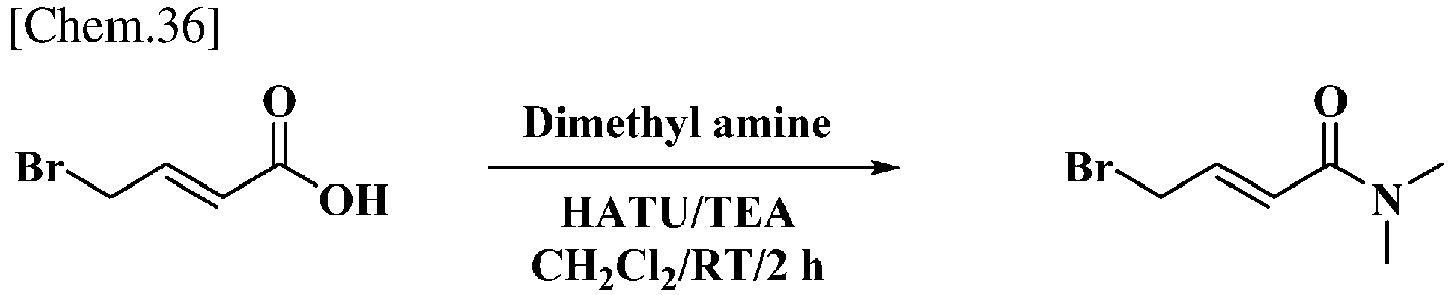
- (E)-4-bromobut-2-enoic acid (2 g, 12.2 mmol) was taken in dichloromethane (20 mL) and at 0 °C were added HATU (5.5 g, 14 mmol), triethyl amine (2.56 mL,18.4 mmol) and stirred for 10 min at RT. To this mixture N,N-dimethyl amine (9.2 mL, 18 mmol) was added slowly and the contents were stirred at room temperature for 2 h. The volatiles were removed under reduced pressure and the residue was partitioned between water and ethyl acetate. The organic layer was washed with water, brine, dried over sodium sulphate and concentrated. The crude material was purified by column chromatography over 100-200 silica gel using 20% ethyl acetate in n-hexane to afford (E)-4-bromo-N,N-dimethylbut-2-enamide (0.4 g, 17%) as a pale green colour liquid.
-

- The reaction was carried out according to Reference Production Example 1c to obtain the title compound of Production Example 1i as an off-white solid (80 g, 97%).
-

- To a stirred solution of tert-butyl (2-(4-iodophenoxy)ethyl)carbamate (25 g, 68.6 mmol, Production Example 1i) in ethanol (50 mL) was added at 0°C, 2M HCl in ether (250 mL). The reaction mixture was stirred for 12 h at room temperature. After completion of reaction, reaction mixture was basified with saturated NaHCO3, extracted with 10% MeOH in DCM. Organic layer was concentrated under reduced pressure and the crude material was used in next step without further purification (16 g, 88%).
-

- The reaction was carried out according to Reference Production Example 1b, using (E)-4-bromo-N,N-dimethylbut-2-enamide (Production Example 1h) for
compound 2 to give a crude product which was used in next step without further purification (18.8 g, crude). -

- To a stirred solution of (E)-4-((2-(4-iodophenoxy)ethyl)amino)-N,N-dimethylbut-2-enamide (18.8 g, 50.26 mmol) in dry dichloromethane (150 mL) was added DIPEA (6.4g, 50.2 mmol) at 0°C, stirred for 15 min at 0°C. To the above reaction mixture, was added boc anhydride (13.1 g, 60.3 mmol), resulting mixture was stirred at room temperature for 12 h. Upon completion by TLC, the reaction mixture was cooled to 0°C, quenched with ice cold water (500 mL) and extracted with dichloromethane (500 mL). The combined organic extracts were washed with water, followed by brine, dried over anhydrous sodium sulphate and concentrated under reduced pressure. The crude material was purified by column chromatography over 230-400 mesh silica using 3% MeOH in dichloromethane as an eluent to afford tert-butyl (E)-(4-(dimethylamino)-4-oxobut-2-en-1-yl)(2-(4-iodophenoxy)ethyl)carbamate (9 g, 37.8%).
-

- To a stirred solution of 2-fluoro-5-iodopyridine (5 g, 22.4 mmol) in DMF (25 mL) was added sodium hydride (0.7 g, 33.5 mmol) and stirred for 10 min at 0°C, to the above mixture tert-butyl (2-hydroxyethyl)carbamate (1.8 g, 11.2 mmol) was added. The contents were stirred at 0°C for 30 min. After completion of reaction, reaction mixture was poured onto ice cold water, and extracted with ethyl acetate. The combined organic layers were washed with water followed by saturated NaCl solution, dried over anhydrous Na2SO4 and concentrated under reduced pressure. The crude material was purified by column chromatography over 230-400 mesh silica using 15% EtOAc in n-hexane as an eluent to obtain the desired compound tert-butyl (2-((5-iodopyridin-2-yl)oxy)ethyl)carbamate as an off-white solid (3.5 g, 43%).
-

- The reaction was carried out following the approach as described in Production Examples 1j to 11, by substituting tert-butyl (2-((5-iodopyridin-2-yl)oxy)ethyl)carbamate for tert-butyl (2-(4-iodophenoxy)ethyl)carbamate to deliver the title compound (3.6 g, 47%).
-

- To a stirred solution of 3-fluoro-1-(tetrahydro-2H-pyran-2-yl)-5-(4,4,4-trifluorobut-1-yn-1-yl)-1H-indazole (0.66 g, 2.02 mmol, prepared as outlined in Production Example 1d through 1f) in 2-methyl THF (10 mL), was added bis(pinacolato)diboron (0.566 g, 2.22 mmol), tetrakis(triphenylphosphine)platinum (0) (0.025 g, 0.02 mmol) under nitrogen atmosphere, reaction mixture was stirred at 85°C for 5 h. The solution was allowed to cool to room temperature and tert-butyl (E)-(4-(dimethylamino)-4-oxobut-2-en-1-yl)(2-((5-iodopyridin-2-yl)oxy)ethyl)carbama te (0.72 g, 1.51 mmol, prepared as outlined in Production Example 1n), bis(triphenylphosphine)palladium (II) dichloride (0.071 g, 0.1 mmol), cesium carbonate (1.3 g, 4.04 mmol) and 2-methyl THF (10 mL) were added. This mixture was degassed with nitrogen and water (0.12 mL) was added. This mixture was stirred at room temperature for 16 h. After completion of reaction, to the above reaction mixture 4M KOH (2.78 mL, 11.13 mmol) and iodobenzene (0.33 g, 1.61 mmol) were added. Reaction mixture was stirred at 85°C for 7 h. After completion of reaction, reaction mixture was cooled to room temperature, diluted with water and extracted with EtOAc. The organic layer was dried over anhydrous sodium sulphate and concentrated under reduced pressure. The crude material was purified by combi-flash using 100% ethyl acetate as an eluent to afford tert-butyl ((E)-4-(dimethylamino)-4-oxobut-2-en-1-yl)(2-((5-((Z)-4,4,4-trifluoro-1-(3-fluoro-1-(t etrahydro-2H-pyran-2-yl)-1H-indazol-5-yl)-2-phenylbut-1-en-1-yl)pyridin-2-yl)oxy)et hyl)carbamate (0.35 g, 23%).
-

- To a stirred solution of tert-butyl ((E)-4-(dimethylamino)-4-oxobut-2-en-1-yl)(2-((5-((Z)-4,4,4-trifluoro-1-(3-fluoro-1-(t etrahydro-2H-pyran-2-yl)-1H-indazol-5-yl)-2-phenylbut-1-en-1-yl)pyridin-2-yl)oxy)et hyl)carbamate (0.35 g, 0.46 mmol) in dichloromethane (10 mL) was added TFA (1 mL) at 0°C. The reaction mixture was stirred for 16 h at room temperature. After completion of reaction, reaction mixture was basified with saturated NaHCO3 extracted with ethyl acetate. Organic layer was concentrated under reduced pressure to afford crude compound, which was purified by preparative HPLC to afford desired compound (E)-N,N-dimethyl-4-((2-((5-((Z)-4,4,4-trifluoro-1-(3-fluoro-1H-indazol-5-yl)-2-phenyl but-1-en-1-yl)pyridin-2-yl)oxy)ethyl)amino)but-2-enamide (0.03 g, 11%).
- Compound (I): 1H NMR (400 MHz, Varian Mercury Plus, DMSO-d6): δ 12.71 (s, 1H), 7.63 (s, 2H), 7.54 (m, 1H), 7.26-7.18 (m, 7H), 6.62-6.46 (m, 3H), 4.13 (t, J = 5.8 Hz, 2H), 3.51-3.43 (m, 2H), 3.34-3.28 (m, 2H), 2.98 (s, 3H), 2.83 (s, 3H), 2.75 (t, J = 5.8 Hz, 2H).
- LCMS: 568.2 [M+H]+.
-

- 1H NMR (400 MHz, Varian Mercury Plus, DMSO-d6): δ 12.74 (s, 1H), 9.26 (bs, 2H), 7.69-7.34 (m, 3H), 7.28-7.17 (m, 7H), 6.81 (d, J = 15.2 Hz, 1H), 6.62-6.53 (m, 2H), 4.37 (t, J = 4.4 Hz, 2H), 3.77-3.76 (m, 2H), 3.51-3.43 (m, 2H), 3.23 (bs, 2H), 3.03 (s, 3H), 2.86 (s, 3H).
- LCMS: 568.3 [M+H]+.
- To a solution of (E)-N,N-dimethyl-4-((2-((5-((Z)-4,4,4-trifluoro-1-(3-fluoro-1H-indazol-5-yl)-2-phenyl but-1-en-1-yl)pyridin-2-yl)oxy)ethyl)amino)but-2-enamide (500.31 mg) in 2-butanone (5 mL) was added a solution of hydrochloric acid (75.6 µL, 1eq) in 2-butanone (5 mL). The mixture was stirred at room temperature for 4 days. The obtained solid was filtered off, washed with 2-butanone and dried overnight to give the titled crystal (514 mg, 97%). A powder X-ray diffraction pattern, a solid state 13C NMR spectrum and a graph showing hygroscopicity for the crystal obtained in Example 1 are shown in
Figures 1 ,7 and13 , respectively. - 1H NMR (600MHz, Bruker AVANCE, DMSO-d6): δ 12.71 (s, 1H), 9.02 (br s, 2H), 7.67 (d, J=1.9 Hz, 1H), 7.63 (s, 1H), 7.54 (dd, J=8.7, 1.5 Hz, 1H), 7.29 (dd, J=8.6, 2.4 Hz, 1H), 7.22-7.27 (m, 5H), 7.16-7.21 (m, 1H), 6.78 (d, J=15.2 Hz, 1H), 6.61 (d, J=9.0 Hz, 1H), 6.54 (dt, J=15.1, 6.5 Hz, 1H), 4.34 (t, J=5.0 Hz, 2H), 3.76 (br d, J=6.4 Hz, 2H), 3.45 (q, J=10.8 Hz, 2H), 3.23 (br t, J=4.3 Hz, 2H), 3.01 (s, 3H), 2.86 (s, 3H). Typical peaks in a solid state 13C NMR spectrum and typical diffraction peaks in a powder X-ray diffractometry for the crystal obtained in Example 1 are shown below. 13C NMR (100MHz, solid state): δ 164.3, 162.2, 148.6, 138.9, 136.8, 134.0, 111.9, 61.5, 38.4, 34.4.
- Powder X-ray diffraction angle (20 ± 0.2°): 6.1°, 11.8°, 14.9°, 16.8°, 18.1°, 19.1°, 19.5°, 21.7°, 25.9°, 27.4°
- To a solution of (E)-N,N-dimethyl-4-((2-((5-((Z)-4,4,4-trifluoro-1-(3-fluoro-1H-indazol-5-yl)-2-phenyl but-1-en-1-yl)pyridin-2-yl)oxy)ethyl)amino)but-2-enamide (500.44 mg) in 2-butanone (5 mL) was added a solution of hydrobromic acid (100.3 µL, 1eq) in 2-butanone (5 mL). The mixture was stirred at room temperature for 4 days. The obtained solid was filtered off, washed with 2-butanone and dried overnight to give the titled crystal (545 mg, 95%). A powder X-ray diffraction pattern, a solid state 13C NMR spectrum and a graph showing hygroscopicity for the crystal obtained in Example 2 are shown in
Figures 2 ,8 and14 , respectively. - 1H NMR (600MHz, Bruker AVANCE, DMSO-d6): δ 12.69 (s, 1H), 8.83 (br s, 2H), 7.68 (d, J=2.5 Hz, 1H), 7.63 (s, 1H), 7.55 (dd, J=8.7, 1.6 Hz, 1H), 7.29 (dd, J=8.7, 2.5 Hz, 1H), 7.22-7.27 (m, 5H), 7.17-7.20 (m, 1H), 6.77 (d, J=15.1 Hz, 1H), 6.61 (d, J=8.5 Hz, 1H), 6.53 (dt, J=15.2, 6.6 Hz, 1H), 4.33 (br t, J=5.0 Hz, 2H), 3.77 (br d, J=6.4 Hz, 2H), 3.45 (q, J=10.8 Hz, 2H), 3.25 (br t, J=4.6 Hz, 2H), 3.01 (s, 3H), 2.86 (s, 3H).
- Typical peaks in a solid state 13C NMR spectrum and typical diffraction peaks in a powder X-ray diffractometry for the crystal obtained in Example 2 are shown below.
- 13C NMR (100MHz, solid state): δ 164.5, 162.2, 148.6, 139.3, 135.8, 134.0, 111.7, 60.9, 39.0, 34.5.
- Powder X-ray diffraction angle (2θ ± 0.2°): 6.2°, 11.7°, 12.5°, 16.5°, 17.6°, 18.7°, 20.4°, 21.4°, 22.5°, 27.1°.
- To a solution of (E)-N,N-dimethyl-4-((2-((5-((Z)-4,4,4-trifluoro-1-(3-fluoro-1H-indazol-5-yl)-2-phenyl but-1-en-1-yl)pyridin-2-yl)oxy)ethyl)amino)but-2-enamide (100.25 mg) in 2-butanone (1 mL) was added a solution of maleic acid (10 mg/mL) in 2-butanone (2.05 mL). Then hexane (2 mL) was added to the solution, and the mixture was stirred at room temperature for 4 days. The obtained solid was filtered off, washed with 2-butanone to give the titled crystal (107 mg, 89%). A powder X-ray diffraction pattern, a solid state 13C NMR spectrum and a graph showing hygroscopicity for the crystal obtained in Example 3 are shown in
Figures 3 ,9 and15 , respectively. - 1H NMR (600MHz, Bruker AVANCE, DMSO-d6): δ 12.69 (s, 1H), 8.72 (br s, 1H), 7.68 (d, J=2.2 Hz, 1H), 7.63 (s, 1H), 7.55 (dd, J=8.6, 1.2 Hz, 1H), 7.29 (dd, J=8.6, 2.4 Hz, 1H), 7.22-7.27 (m, 5H), 7.16-7.21 (m, 1H), 6.76 (d, J=15.2 Hz, 1H), 6.60 (d, J=8.6 Hz, 1H), 6.53 (dt, J=15.1, 6.6 Hz, 1H), 6.01 (s, 2H), 4.30-4.36 (m, 2H), 3.76 (br d, J=6.4 Hz, 2H), 3.46 (q, J=10.7 Hz, 2H), 3.22-3.27 (m, 2H), 3.01 (s, 3H), 2.86 (s, 3H). Typical peaks in a solid state 13C NMR spectrum and typical diffraction peaks in a powder X-ray diffractometry for the crystal obtained in Example 3 are shown below. 13C NMR (100MHz, solid state): δ 169.6, 168.0, 134.2, 117.1, 112.0, 107.3, 63.6, 50.3, 46.9, 36.1.
- Powder X-ray diffraction angle (20 ± 0.2°): 4.9°, 9.8°, 16.1°, 16.7°, 17.9°, 19.4°, 21.2°, 22.9°, 24.9°, 30.4°.
- To a solution of (E)-N,N-dimethyl-4-((2-((5-((Z)-4,4,4-trifluoro-1-(3-fluoro-1H-indazol-5-yl)-2-phenyl but-1-en-1-yl)pyridin-2-yl)oxy)ethyl)amino)but-2-enamide (499.69 mg) in 2-butanone (6 mL) was added to a solution of maleic acid (102.06 mg, 1eq) in 2-butanone (5 mL). The mixture was stirred at room temperature for 1 day. Hexane (6 mL) was added to the mixture and stirred at room temperature for 3 days. The obtained solid was filtered off, washed with 2-butanone and dried overnight to give the titled crystal (507 mg, 84%). A powder X-ray diffraction pattern, a solid state 13C NMR spectrum and a graph showing hygroscopicity for the crystal obtained in Example 4 are shown in
Figures 4 ,10 and16 , respectively. - 1H NMR (600MHz, Bruker AVANCE, DMSO-d6): δ 12.69 (s, 1H), 8.73 (br s, 2H), 7.68 (d, J=1.8 Hz, 1H), 7.63 (s, 1H), 7.54 (dd, J=8.7, 1.3 Hz, 1H), 7.29 (dd, J=8.7, 2.4 Hz, 1H), 7.22-7.27 (m, 5H), 7.16-7.20 (m, 1H), 6.76 (d, J=15.2 Hz, 1H), 6.60 (d, J=8.6 Hz, 1H), 6.53 (dt, J=15.2, 6.5 Hz, 1H), 6.01 (s, 2H), 4.30-4.35 (m, 2H), 3.76 (br d, J=6.3 Hz, 2H), 3.46 (q, J=10.8 Hz, 3H), 3.22-3.26 (m, 3H), 3.01 (s, 3H), 2.86 (s, 3H).
- Typical peaks in a solid state 13C NMR spectrum and typical diffraction peaks in a powder X-ray diffractometry for the crystal obtained in Example 4 are shown below. 13C NMR (100MHz, solid state): δ 171.4, 167.1, 133.3, 117.8, 112.8, 108.6, 63.1, 48.8, 44.5, 38.3.
- Powder X-ray diffraction angle (2θ ± 0.2°): 14.8°, 15.8°, 17.1°, 17.5°, 20.2°, 20.9°, 22.3°, 24.6°, 26.5°, 28.5°.
- To a solution of (E)-N,N-dimethyl-4-((2-((5-((Z)-4,4,4-trifluoro-1-(3-fluoro-1H-indazol-5-yl)-2-phenyl but-1-en-1-yl)pyridin-2-yl)oxy)ethyl)amino)but-2-enamide (375.57 mg) in 2-butanone (5 mL) was added a solution of L-mandelic acid (100.28 mg, 1eq) in 2-butanone (5 mL). The mixture was stirred at room temperature for 1 day. 2-Butanone (4 mL) was added to the mixture and stirred at room temperature for 3 days. The obtained solid was filtered off, washed with 2-butanone and dried overnight to give the titled crystal (412 mg, 86%). A powder X-ray diffraction pattern, a solid state 13C NMR spectrum and a graph showing hygroscopicity for the crystal obtained in Example 5 are shown in
Figures 5 ,11 and17 , respectively. - 1H NMR (600MHz, Bruker AVANCE, DMSO-d6): δ 12.69 (br s, 1H), 7.64 (d, J=1.8 Hz, 1H), 7.62 (s, 1H), 7.53 (dd, J=8.7, 1.3 Hz, 1H), 7.38 (d, J=7.2 Hz, 2H), 7.29 (t, J=7.5 Hz, 2H), 7.21-7.27 (m, 7H), 7.15-7.20 (m, 1H), 6.56 (t, J=4.8 Hz, 1H), 6.54-6.55 (m, 1H), 6.52-6.54 (m, 1H), 4.85 (s, 1H), 4.17 (t, J=5.6 Hz, 2H), 3.46 (m, 2H), 3.40 (m, 2H), 2.97 (s, 3H), 2.86 (br t, J=5.6 Hz, 2H), 2.83 (s, 3H).
- Typical peaks in a solid state 13C NMR spectrum and typical diffraction peaks in a powder X-ray diffractometry for the crystal obtained in Example 5 are shown below.
- 13C NMR (100MHz, solid state): δ 176.8, 165.9, 160.7, 147.7, 141.2, 110.5, 76.3, 48.6, 37.2, 34.1.
- Powder X-ray diffraction angle (2θ ± 0.2°): 5.1°, 8.8°, 10.3°, 13.8°, 16.9°, 18.3°, 19.2°, 21.2°, 22.8°, 24.6°.
- To a solution of (E)-N,N-dimethyl-4-((2-((5-((Z)-4,4,4-trifluoro-1-(3-fluoro-1H-indazol-5-yl)-2-phenyl but-1-en-1-yl)pyridin-2-yl)oxy)ethyl)amino)but-2-enamide (501.14 mg) in ethyl acetate (3 mL) was added a solution of benzenesulfonic acid monohydrate (100 mg/ mL) in ethyl acetate (1.6 mL). Then ethyl acetate (5 mL) was added to the solution, and the mixture was stirred at 45 °C for 3 days. The obtained solid was filtered off and dried for 3 days to give the titled crystal (572 mg, 87%). A powder X-ray diffraction pattern, a solid state 13C NMR spectrum and a graph showing hygroscopicity for the crystal obtained in Example 6 are shown in
Figures 6 ,12 and18 , respectively. - 1H NMR (600MHz, Bruker AVANCE, DMSO-d6): δ 12.69 (s, 1H), 8.72 (br s, 1H), 7.68 (d, J=2.1 Hz, 1H), 7.63 (s, 1H), 7.59 (dd, J=7.8, 1.8 Hz, 2H), 7.55 (dd, J=8.7, 1.4 Hz, 1H), 7.23-7.31 (m, 9H), 7.17-7.20 (m, 1H), 6.77 (d, J=15.2 Hz, 1H), 6.61 (d, J=8.6 Hz, 1H), 6.54 (dt, J=15.2, 6.6 Hz, 1H), 4.33 (t, J=5.1 Hz, 2H), 3.77 (d, J=6.3 Hz, 2H), 3.46 (q, J=10.8 Hz, 2H), 3.24 (t, J=5.0 Hz, 2H), 3.01 (s, 3H), 2.86 (s, 3H)
- Typical peaks in a solid state 13C NMR spectrum and typical diffraction peaks in a powder X-ray diffractometry for the crystal obtained in Example 6 are shown below. 13C NMR (100MHz, solid state): δ 163.0, 160.9, 147.2, 145.0, 140.2, 133.4, 109.3, 47.1, 37.3, 34.8.
- Powder X-ray diffraction angle (20 ± 0.2°): 5.2°, 9.5°, 10.5°, 12.1°, 15.4°, 17.4°, 20.3°, 21.4°, 23.1°, 24.4°.
- The excess amount of the crystal obtained in Example 6 was added into 0.1 mol/L HCl solution in a test tube, and was dissolved at 37 °C with shaking for an hour. The concentration of the filtrate was measured to determine the solubility by using high performance liquid chromatography (HPLC). The solubility of the crystal obtained in Example 6 was 2 mg/mL.
- The following test examples were carried out to examine the pharmacological effects of the compound (I).
- MCF7 BUS cells (Coser, et al., (2003) PNAS 100 (24): 13994-13999) were maintained in Dulbecco's Modified Eagle Medium supplemented with 10% FBS, 4 mM L-glutamine and 1x non-essential amino acids. Lenti-X 293T cells (Clontech, Cat # 632180) were routinely cultured in Dulbecco's Modified Eagle Medium supplemented with 10% FBS.
- The QuikChange II XL Site-Directed Mutagenesis Kit (Agilent Technologies, Cat #200523) was used to generate Y537S, Y537C, Y537N and D538G mutations within the
ERα exon 8. Wild-type ESR1 cDNA (GeneCopoeia Inc., Cat# GC-A0322, accession no. NM 000125) was used as a template with the following mutagenesis primers (where the underlined nucleotides represent site mutations); Y537S: F-AAG AAC GTG GTG CCC CTC TCT GAC CTG CTG CTG GAG ATG (SEQ ID NO: 1), R-CAT CTC CAG CAG CAG GTC AGA GAG GGG CAC CAC GTT CTT (SEQ ID NO: 2); Y537N: F-AAG AAC GTG GTG CCC CTC AAT GAC CTG CTG CTG GAG ATG (SEQ ID NO: 3), R-CAT CTC CAG CAG CAG GTC ATT GAG GGG CAC CAC GTT CTT (SEQ ID NO: 4); Y537C: F-AAG AAC GTG GTG CCC CTC T GT GAC CTG CTG CTG GAG ATG (SEQ ID NO: 5), R-CAT CTC CAG CAG CAG GTC ACA GAG GGG CAC CAC GTT CTT (SEQ ID NO: 6); D538G: F-AAC GTG GTG CCC CTC TAT GGC CTG CTG CTG GAG ATG CTG (SEQ ID NO: 7), R-CAG CAT CTC CAG CAG CAG GCC ATA GAG GGG CAC CAC GTT (SEQ ID NO: 8). WT and mutant ESR1 cDNAs were cloned into the designation lentiviral vector pLenti6.3/V5-Dest (Invitrogen, Cat #V533-06). To make lentivirus, DNAs (WT and mutant ESR1) were co-transfected with packaging plasmids into Lenti-X 293T cells using TransIT (Mirus, Cat #MIR 2700). 48h post-transfection, virus containing media was filtered and added to MCF7 cells in the presence of 8µg/ml polybrene overnight. Two days following infection, cells were placed under selection with 10 µg/ml blasticidin for 2 weeks for stable expression. - MCF7-WT and -Y537S cells were seeded at 1500 cells/well in black-walled 96-well plates (assay plates, Costar, Cat #3904). In parallel, cells were also seeded in a separate 96-well plate (8 wells/cell line, control plate) for which a CTG (CellTiter-Glo (registered trademark) Luminescent Viability Assay, Promega, Cat #G7572) was measured the following day (
day 0 reading). Theday 0 reading was used for the GI50 calculation at the termination of the experiment. The day following seeding, compounds were added to assay plates. Briefly, a 1:4 serial dilution was prepared in DMSO at 200x final concentration for a total of 10 concentrations (9 dilutions containing compound and one is DMSO only). Serially diluted compounds were pipetted into medium to prepare a compound-medium mix at 10x final concentration. 10 µl of compound-medium mix was added to MCF7-WT and -Y537S cells at 3 wells/concentration (triplicate for each concentration). On day 3, media/compound was removed and replaced with fresh media/compound as described above. Onday 6, CTG was measured and compared today 0 readings from control plate to assess GI50. -
Figure 19 shows that ectopic expression of ERαY537S/N/C, D538G in MCF7 cells conferred phenotypic resistance to currently marketed therapies tamoxifen (SERM), raloxifene (SERM) and fulvestrant (SERD). Similar observations were also recently published by several independent labs (Jeselsohn et al., (2014) Clin Cancer Res. ; Toy et al., (2013) Nat. Genet. 2013 Dec; 45(12):1439-45; Robinson et al., (2013) Nat. Genet. Dec; 45 (12): 1446-51; Merenbakh-Lamin et al., (2013) Cancer Res. ; Yu et al., (2014) ). Having confirmed that ERαMUT drive resistance to current endocrine therapies, identification of novel compounds that would reduce proliferation of the ERαMUT-bearing MCF7 cells more efficaciously than the corresponding clinical compound 4-hydroxytamoxifen was sought. Using the WT and mutant viability assay as a screening tool, compounds were identified that were more potent towards the Y537S-bearing MCF7 line relative to 4-hydroxytamoxifen. The results of the viability assay screen for the compound (I) are as follows: GI50 (WT): 0.34 nM; GI50 (Y537S): 4.26 nM. - In the Test Example 2, references to compound (I) refers to a hydrochloride salt of the compound (I) obtained in Production Example 1q.
- The ESR1 wild-type human ER+ breast cancer cell line MCF7 (ATCC) was cultured in DMEM media supplemented with 10% FBS at 37°C in a 5% CO2 atmosphere and kept in the exponential growth phase. The cells were collected in trypsin and resuspended in a 1:1 mixture of matrigel and HBSS at a final concentration of 5 ×10⁷ cells/ mL. A 0.2mL aliquot of cells was injected subcutaneously into the 3rd mammary fat pad of 6-8 week old female Balb/c nude mice, giving 1× 10⁷ cells/ mouse. When the average tumor volume reached approximately 155 mm3, 92 animals were randomized prior to treatment.
- Anti-tumor activity in the MCF7 xenograft model was examined using compound (I). The compound (I) was dosed orally every day at doses ranging from 1 to 30 mg/kg. Each treatment was started on
Day 0 and the administration schedule was continued for 17 days. The administration volume was calculated from the individual mouse body weights prior to dose administration. The body weights were measured daily while the tumor volumes were measured twice a week. Tumor volumes (TV) were calculated based on the formula:
- length: largest diameter of tumor (mm)
- width: diameter perpendicular to length (mm)
- The Tumor Growth Inhibition % (TGI) was calculated according to the following formula:

- Where Day X is the endpoint measurement.
- A Patient-Derived Xenograft (PDX) tumor model representing an ESR1-Y537S mutated human ER+ breast cancer, designated as PDX-Y537S, was propagated subcutaneously in immunocompromised mice. The tumors were excised within 60 days of implantation and processed to mixed tumor fragments. Solid tumor tissues were depleted of necrotic components, cut into 70mg fragments, mixed with matrigel and subcutaneously implanted into the right flank of 6-12 week old female athymic Nude (Crl:NU(NCr)-Foxn1nu) mice. The precise number of fragments and volume of matrigel was determined on a case by case basis. When the average tumor volume reached approximately 200 mm3, animals were randomized prior to treatment. All of the primary human tumors utilized in this study had undergone approximately 7 passages in vivo.
- Anti-tumor activity in the PDX-Y537S model was examined using the compound (I). Estrogen was not supplemented in the studies. The compound (I) was dosed orally every day at doses ranging from 3 to 200 mg/kg. Each treatment was started on
Day 0 and the administration schedule was continued for up to 35 days. The administration volume was calculated from the individual mouse body weights prior to dose administration. The body weights were measured daily while the tumor volumes were measured twice a week. Tumor volumes were calculated based on the previously described formula. - The Patient-Derived Xenograft (PDX) tumor model, WHIM20, representing an ESR1-Y537S mutated human ER+ breast cancer was propagated in mice. The tumors were excised and processed to mixed tumor fragments and the fragments were re-implanted subcutaneously into new recipient mice. For the current work, solid tumor tissues were depleted of necrotic components, cut into fragments, mixed with matrigel and subcutaneously implanted into the right flank of 6-8 week old female SCID-bg mice. The precise number of fragments and volume of matrigel was determined on a case by case basis. When the average tumor volume reached approximately 370 mm3, animals were randomized prior to treatment. All of the primary human tumors utilized in this study had undergone approximately 4 passages in vivo.
- Anti-tumor activity in the WHIM20 patient derived xenograft model was examined using the compound (I). Estrogen was not supplemented in WHIM20 studies. The compound (I) was dosed orally every day at the indicated doses. Each treatment was started on
Day 0 and the administration schedule was continued for the indicated days. The administration volume was calculated from the individual mouse body weights prior to dose administration. The body weights were measured daily while the tumor volumes were measured twice a week. Tumor volumes were calculated based on the previously described formula. - Data are expressed as the mean ± SEM for tumor volume and the mean ± SEM for body weight. The differences in tumor volume during the study period between the vehicle treated and compound treated groups were analyzed by two-way analysis of variance (ANOVA) followed by the Dunnett multiple comparison post hoc test. Statistical analyses were performed using the GraphPad Prism (registered trademark) version 5.04 (GraphPad Software, La Jolla, CA).
-
Figure 20 shows the antitumor and body weight effects of the compound (I) in the MCF7 subcutaneous xenograft model carrying wild-type ER grown in immunocompromised mice. The compound (I) inhibited xenograft growth in a dose dependent manner with 3 mg/kg QD, 10 mg/kg QD and 30 mg/kg QD treatments inhibiting growth on day 17 (TGI of 75%, 80% and 85% and p<0.0001 for all doses, respectively). The compound (I) treatment of 1 mg/kg QDx18 did not show a statistically meaningful difference from the control treated group (TGI of 36%, p>0.05). All doses and regimens were well tolerated with no significant body weight loss or clinical signs. - The compound (I) was given orally once daily for the duration of the study. Data represent the mean ± SEM (Tumor Volume) or mean ± SEM (Body Weight) (N=6 for treatment groups, N=8 for Vehicle control). * p<0.0001 versus vehicle control on Day 17 (Two-Way ANOVA followed by the Dunnett multiple comparison test).
-
Figure 21 shows the antitumor and body weight effects of the compound (I) in a repeat study in the ER+ PDX-Y537S model bearing a heterozygous Y537S mutation. The compound (I) inhibited xenograft growth in a dose dependent manner with 3 mg/ kg QD, 10 mg/kg QD, 30 mg/kg QD and 100 mg/kg QD treatments significantly inhibiting growth on day 28 (TGI of 61%, 85%, 81% and 84% and p<0.001, p<0.0001, p<0.0001 and p<0.0001, respectively). All doses were well tolerated with no significant body weight loss or clinical signs. - The compound (I) was given orally once daily for the duration of the study. Data represent the mean ± SEM (Tumor Volume) or mean ± SEM (Body Weight) (N=6 for the compound (I) and N=8 for vehicle). * p<0.001, ** p<0.0001 versus vehicle control on Day 28 (Two-Way ANOVA followed by the Dunnett multiple comparison test).
-
Figure 22 shows the anti-tumor and body weight effects of the compound (I) in the ER+ WHIM20 PDX model bearing a homozygous Y537S mutation. The compound (I) inhibited xenograft growth in a dose dependent manner with 10 mg/kg QD, 30 mg/kg QD and 100 mg/kg QD treatments significantly inhibiting growth on day 22 (TGI of 26%, 36%, and 48% and p<0.05, p<0.01 and p<0.0001, respectively). This dose of the compound (I) was tolerated in accordance with internal animal care and use committee guidelines. - The compound (I) was given orally once daily for the duration of the study. Data represent the mean ± SEM (Tumor Volume) or mean ± SEM (Body Weight) (N=8 for all groups). *p<0.05, **p<0.01 and ***p<0.0001 respectively versus vehicle control on Day 22 (Two-Way ANOVA followed by the Dunnett multiple comparison test).
Claims (16)
- A salt of (E)-N,N-dimethyl-4-((2-((5-((Z)-4,4,4-trifluoro-1-(3-fluoro-1H-indazol-5-yl)-2-phenylbut-1-e n-1-yl)pyridin-2-yl)oxy)ethyl)amino)but-2-enamide represented by the formula I, and an acid selected from the group consisting of hydrobromic acid, maleic acid and mandelic acid.

- A crystal of hydrochloride salt of (E)-N,N-dimethyl-4-((2-((5-((Z)-4,4,4-trifluoro-1-(3-fluoro-1H-indazol-5-yl)-2-phenylbut-1-e n-1-yl)pyridin-2-yl)oxy)ethyl)amino)but-2-enamide represented by the formula I, characterized by having one or more diffraction peaks at diffraction angles (2θ ± 0.2°) selected from the group consisting of 6.1°, 11.8°, 16.8°, 18.1° and 19.5° in a powder X-ray diffractometry.

- The crystal according to claim 2, characterized by having a diffraction peak at a diffraction angle (2θ ± 0.2°) of 18.1° in a powder X-ray diffractometry.
- The crystal according to claim 2, characterized by having diffraction peaks at diffraction angles (2θ ± 0.2°) of 6.1°, 11.8° and 18.1° in a powder X-ray diffractometry.
- A crystal of hydrochloride salt of (E)-N,N-dimethyl-4-((2-((5-((Z)-4,4,4-trifluoro-1-(3-fluoro-1H-indazol-5-yl)-2-phenylbut-1-e n-1-yl)pyridin-2-yl)oxy)ethyl)amino)but-2-enamide according to claim 2, characterized by having peaks at chemical shifts (± 0.5 ppm) of 164.3 ppm, 162.2 ppm and 111.9 ppm in a solid state 13C NMR spectrum.
- A crystal of hydrochloride salt of (E)-N,N-dimethyl-4-((2-((5-((Z)-4,4,4-trifluoro-1-(3-fluoro-1H-indazol-5-yl)-2-phenylbut-1-e n-1-yl)pyridin-2-yl)oxy)ethyl)amino)but-2-enamide according to claim 2, characterized by having a powder X-ray diffraction pattern substantially the same as the powder X-ray diffraction pattern shown in Figure 1.
- A crystal of hydrochloride salt of (E)-N,N-dimethyl-4-((2-((5-((Z)-4,4,4-trifluoro-1-(3-fluoro-1H-indazol-5-yl)-2-phenylbut-1-e n-1-yl)pyridin-2-yl)oxy)ethyl)amino)but-2-enamide according to claim 2, characterized by having a solid state 13C NMR spectrum substantially the same as the solid state 13C NMR spectrum shown in Figure 7.
- A crystal of hydrobromide salt of (E)-N,N-dimethyl-4-((2-((5-((Z)-4,4,4-trifluoro-1-(3-fluoro-1H-indazol-5-yl)-2-phenylbut-1-e n-1-yl)pyridin-2-yl)oxy)ethyl)amino)but-2-enamide represented by the formula I, characterized by having one or more diffraction peaks at diffraction angles (2θ ± 0.2°) selected from the group consisting of 6.2°, 11.7°, 18.7°, 20.4° and 22.5° in a powder X-ray diffractometry.

- A crystal of hydrobromide salt of (E)-N,N-dimethyl-4-((2-((5-((Z)-4,4,4-trifluoro-1-(3-fluoro-1H-indazol-5-yl)-2-phenylbut-1-e n-1-yl)pyridin-2-yl)oxy)ethyl)amino)but-2-enamide according to claim 8, which is characterized by having peaks at chemical shifts (± 0.5 ppm) of 164.5 ppm, 162.2 ppm and 111.7 ppm in a solid state 13C NMR spectrum.
- A crystal form A of maleate salt of (E)-N,N-dimethyl-4-((2-((5-((Z)-4,4,4-trifluoro-1-(3-fluoro-1H-indazol-5-yl)-2-phenylbut-1-e n-1-yl)pyridin-2-yl)oxy)ethyl)amino)but-2-enamide represented by the formula I, characterized by having one or more diffraction peaks at diffraction angles (2θ ± 0.2°) selected from the group consisting of 16.7°, 17.9°, 21.2°, 22.9° and 24.9° in a powder X-ray diffractometry.

- A crystal form A of maleate salt of (E)-N,N-dimethyl-4-((2-((5-((Z)-4,4,4-trifluoro-1-(3-fluoro-1H-indazol-5-yl)-2-phenylbut-1-e n-1-yl)pyridin-2-yl)oxy)ethyl)amino)but-2-enamide according to claim 10, characterized by having peaks at chemical shifts (± 0.5 ppm) of 169.6 ppm, 107.3 ppm and 50.3 ppm in a solid state 13C NMR spectrum.
- A crystal form B of maleate salt of (E)-N,N-dimethyl-4-((2-((5-((Z)-4,4,4-trifluoro-1-(3-fluoro-1H-indazol-5-yl)-2-phenylbut-1-e n-1-yl)pyridin-2-yl)oxy)ethyl)amino)but-2-enamide represented by the formula I, characterized by having one or more diffraction peaks at diffraction angles (2θ ± 0.2°) selected from the group consisting of 14.8°, 20.2°, 22.3° and 26.5° in a powder X-ray diffractometry.

- A crystal form B of maleate salt of (E)-N,N-dimethyl-4-((2-((5-((Z)-4,4,4-trifluoro-1-(3-fluoro-1H-indazol-5-yl)-2-phenylbut-1-e n-1-yl)pyridin-2-yl)oxy)ethyl)amino)but-2-enamide according to claim 12, characterized by having peaks at chemical shifts (± 0.5 ppm) of 171.4 ppm, 108.6 ppm and 48.8 ppm in a solid state 13C NMR spectrum.
- A crystal of L-mandelate salt of (E)-N,N-dimethyl-4-((2-((5-((Z)-4,4,4-trifluoro-1-(3-fluoro-1H-indazol-5-yl)-2-phenylbut-1-e n-1-yl)pyridin-2-yl)oxy)ethyl)amino)but-2-enamide represented by the formula I, characterized by having one or more diffraction peaks at diffraction angles (2θ ± 0.2°) selected from the group consisting of 5.1°, 8.8°, 10.3°, 16.9° and 18.3° in a powder X-ray diffractometry.

- A crystal of L-mandelate salt of (E)-N,N-dimethyl-4-((2-((5-((Z)-4,4,4-trifluoro-1-(3-fluoro-1H-indazol-5-yl)-2-phenylbut-1-e n-1-yl)pyridin-2-yl)oxy)ethyl)amino)but-2-enamide according to claim 14, characterized by having peaks at chemical shifts (± 0.5 ppm) of 165.9 ppm, 160.7 ppm and 110.5 ppm in solid state 13C NMR spectrum.
- A pharmaceutical composition comprising the salt or the crystal thereof according to any one of claims 1 to 15.
Applications Claiming Priority (2)
| Application Number | Priority Date | Filing Date | Title |
|---|---|---|---|
| JP2016229635 | 2016-11-28 | ||
| PCT/JP2017/042335 WO2018097273A1 (en) | 2016-11-28 | 2017-11-27 | Salts of indazole derivative and crystals thereof |
Publications (3)
| Publication Number | Publication Date |
|---|---|
| EP3544967A1 EP3544967A1 (en) | 2019-10-02 |
| EP3544967A4 EP3544967A4 (en) | 2020-05-20 |
| EP3544967B1 true EP3544967B1 (en) | 2023-06-28 |
Family
ID=62195940
Family Applications (1)
| Application Number | Title | Priority Date | Filing Date |
|---|---|---|---|
| EP17873875.3A Active EP3544967B1 (en) | 2016-11-28 | 2017-11-27 | Salts of indazole derivative and crystals thereof |
Country Status (13)
| Country | Link |
|---|---|
| US (1) | US10640483B2 (en) |
| EP (1) | EP3544967B1 (en) |
| JP (1) | JP6346368B1 (en) |
| KR (1) | KR102425785B1 (en) |
| CN (1) | CN109790141B (en) |
| AU (1) | AU2017363699B2 (en) |
| CA (1) | CA3041986A1 (en) |
| ES (1) | ES2954879T3 (en) |
| IL (1) | IL266003B (en) |
| MX (1) | MX385930B (en) |
| RU (1) | RU2747399C2 (en) |
| SG (1) | SG11201903795WA (en) |
| WO (1) | WO2018097273A1 (en) |
Families Citing this family (6)
| Publication number | Priority date | Publication date | Assignee | Title |
|---|---|---|---|---|
| RU2747399C2 (en) | 2016-11-28 | 2021-05-04 | Эйсай Ар Энд Ди Менеджмент Ко., Лтд. | Indazole derivative salts and their crystals |
| WO2019225552A1 (en) * | 2018-05-22 | 2019-11-28 | Eisai R&D Management Co., Ltd. | Salts of indazole derivative and crystals thereof |
| WO2019235564A1 (en) | 2018-06-06 | 2019-12-12 | 日本電信電話株式会社 | Optical line terminal and band allocation method |
| KR20210134065A (en) * | 2019-03-28 | 2021-11-08 | 주식회사 퍼스트바이오테라퓨틱스 | Pharmaceutical salts, polymorphs and methods for their preparation of benzothiazole compounds |
| AU2020285620A1 (en) * | 2019-05-24 | 2022-01-20 | Eisai R&D Management Co., Ltd. | A method for treating cancer with an oral dosage form of an estrogen receptor-alpha inhibitor |
| JP2023548340A (en) | 2020-11-06 | 2023-11-16 | エーザイ・アール・アンド・ディー・マネジメント株式会社 | How to treat breast cancer |
Family Cites Families (27)
| Publication number | Priority date | Publication date | Assignee | Title |
|---|---|---|---|---|
| DE3907290A1 (en) | 1989-03-07 | 1990-09-13 | Gerhard Prof Dr Eisenbrand | STEROID HORMONE RECEPTOR AFFINES ANTITUARY ACTIVE SUBSTANCES |
| US5552412A (en) | 1995-01-09 | 1996-09-03 | Pfizer Inc | 5-substitued-6-cyclic-5,6,7,8-tetrahydronaphthalen2-ol compounds which are useful for treating osteoporosis |
| TW397821B (en) | 1996-04-19 | 2000-07-11 | American Home Produits Corp | 3-[4-(2-phenyl-indole-1-ylmethyl)-phenyl]-acrylamides and 2-phenyl-1-[4-(amino-1-yl-alk-1-ynyl)-benzyl]-1H-indol-5-ol as well as pharmaceutical compositions of estrogenic agents thereof |
| US6897231B2 (en) | 2000-07-31 | 2005-05-24 | Signal Pharmaceuticals, Inc. | Indazole derivatives as JNK inhibitors and compositions and methods related thereto |
| WO2007058626A1 (en) | 2005-11-16 | 2007-05-24 | S*Bio Pte Ltd | Indazole compounds |
| WO2009120999A2 (en) | 2008-03-28 | 2009-10-01 | Olema Pharmaceuticals, Inc. | Use of an endoxifen prodrug for treatment of breast cancer |
| US8063249B1 (en) | 2008-04-25 | 2011-11-22 | Olema Pharmaceuticals, Inc. | Substituted triphenyl butenes |
| WO2011046596A2 (en) | 2009-10-13 | 2011-04-21 | Duquesne University Of The Holy Spirit, A Nonprofit Corporation Organized Under The Laws Of The Commonwealth Of Pennsylvania | Anti-cancer tamoxifen-melatonin hybrid ligand |
| AU2010327597B2 (en) | 2009-12-04 | 2014-06-19 | Nissan Chemical Industries, Ltd. | 2-Pyridone compounds |
| US8222416B2 (en) | 2009-12-14 | 2012-07-17 | Hoffmann-La Roche Inc. | Azaindole glucokinase activators |
| WO2011129837A1 (en) | 2010-04-16 | 2011-10-20 | Olema Pharmaceuticals, Inc. | Use of a 4-hydroxytoremifene prodrug for treatment of breast cancer |
| GB2483736B (en) | 2010-09-16 | 2012-08-29 | Aragon Pharmaceuticals Inc | Estrogen receptor modulators and uses thereof |
| UA112425C2 (en) * | 2010-12-13 | 2016-09-12 | Еррей Біофарма Інк. | SUBSTITUTED N- (1H-INDASOL-4-IL) IMIDASO [1,2-a] PYRIDINE-3-CARBOXAMIDE COMPOUNDS AS INHIBITORS OF RECIPE TYROSININAS III TYPININASE |
| WO2013056178A2 (en) | 2011-10-14 | 2013-04-18 | Foundation Medicine, Inc. | Novel estrogen receptor mutations and uses thereof |
| US9499538B2 (en) | 2012-03-20 | 2016-11-22 | Seragon Pharmaceuticals, Inc. | Estrogen receptor modulators and uses thereof |
| US9365510B2 (en) | 2012-04-16 | 2016-06-14 | British Columbia Cancer Agency Branch | Aziridine bisphenol ethers and related compounds and methods for their use |
| PL2945628T3 (en) | 2013-01-15 | 2020-09-21 | Aragon Pharmaceuticals, Inc. | Androgen receptor modulator in combination with abiraterone acetate and prednisone for treating prostate cancer |
| CA2915534A1 (en) | 2013-06-19 | 2014-12-24 | Seragon Pharmaceuticals, Inc. | Azetidine estrogen receptor modulators and uses thereof |
| EA031077B1 (en) | 2013-06-19 | 2018-11-30 | Серагон Фармасьютикалз, Инк. | Estrogen receptor modulator and uses thereof |
| GB201311891D0 (en) | 2013-07-03 | 2013-08-14 | Glaxosmithkline Ip Dev Ltd | Novel compound |
| WO2015136016A2 (en) | 2014-03-13 | 2015-09-17 | F. Hoffmann-La Roche Ag | Therapeutic combinations with estrogen receptor modulators |
| WO2016055982A1 (en) * | 2014-10-10 | 2016-04-14 | Acerta Pharma B.V. | Quinoline and quinazoline compounds |
| WO2016097071A1 (en) | 2014-12-18 | 2016-06-23 | F. Hoffmann-La Roche Ag | Estrogen receptor modulators and uses thereof |
| MD3302471T2 (en) * | 2015-05-29 | 2021-12-31 | Eisai R&D Man Co Ltd | Tetrasubstituted alkene compounds and their use |
| US20180141913A1 (en) | 2016-11-24 | 2018-05-24 | Eisai R & D Management Co., Ltd. | Tetrasubstituted alkene compounds and their use |
| RU2747399C2 (en) | 2016-11-28 | 2021-05-04 | Эйсай Ар Энд Ди Менеджмент Ко., Лтд. | Indazole derivative salts and their crystals |
| MX2019010981A (en) * | 2017-03-16 | 2020-09-07 | Eisai R&D Man Co Ltd | COMBINATION THERAPIES FOR THE TREATMENT OF BREAST CANCER. |
-
2017
- 2017-11-27 RU RU2019112080A patent/RU2747399C2/en active
- 2017-11-27 US US16/096,136 patent/US10640483B2/en active Active
- 2017-11-27 EP EP17873875.3A patent/EP3544967B1/en active Active
- 2017-11-27 JP JP2017226501A patent/JP6346368B1/en active Active
- 2017-11-27 CN CN201780057482.6A patent/CN109790141B/en active Active
- 2017-11-27 CA CA3041986A patent/CA3041986A1/en active Pending
- 2017-11-27 IL IL266003A patent/IL266003B/en unknown
- 2017-11-27 ES ES17873875T patent/ES2954879T3/en active Active
- 2017-11-27 AU AU2017363699A patent/AU2017363699B2/en active Active
- 2017-11-27 KR KR1020197009419A patent/KR102425785B1/en active Active
- 2017-11-27 WO PCT/JP2017/042335 patent/WO2018097273A1/en not_active Ceased
- 2017-11-27 MX MX2019004967A patent/MX385930B/en unknown
- 2017-11-27 SG SG11201903795WA patent/SG11201903795WA/en unknown
Also Published As
| Publication number | Publication date |
|---|---|
| AU2017363699A1 (en) | 2019-04-18 |
| IL266003B (en) | 2022-08-01 |
| EP3544967A1 (en) | 2019-10-02 |
| MX385930B (en) | 2025-03-18 |
| JP2018108981A (en) | 2018-07-12 |
| AU2017363699B2 (en) | 2021-02-18 |
| RU2019112080A (en) | 2020-12-28 |
| KR102425785B1 (en) | 2022-07-28 |
| KR20190084941A (en) | 2019-07-17 |
| WO2018097273A1 (en) | 2018-05-31 |
| IL266003A (en) | 2019-06-30 |
| ES2954879T3 (en) | 2023-11-27 |
| SG11201903795WA (en) | 2019-05-30 |
| BR112019008489A2 (en) | 2019-09-10 |
| US10640483B2 (en) | 2020-05-05 |
| JP6346368B1 (en) | 2018-06-20 |
| EP3544967A4 (en) | 2020-05-20 |
| CA3041986A1 (en) | 2018-05-31 |
| MX2019004967A (en) | 2019-08-22 |
| US20190144419A1 (en) | 2019-05-16 |
| RU2747399C2 (en) | 2021-05-04 |
| CN109790141A (en) | 2019-05-21 |
| CN109790141B (en) | 2021-06-11 |
| RU2019112080A3 (en) | 2020-12-28 |
Similar Documents
| Publication | Publication Date | Title |
|---|---|---|
| EP3544967B1 (en) | Salts of indazole derivative and crystals thereof | |
| JP6993477B2 (en) | 6,7,8,9-Tetrahydro-3H-pyrazolo [4,3-f] isoquinoline derivative useful in the treatment of cancer | |
| EP3315499B1 (en) | Crystal of (6S,9aS)-N-benzyl-8-({6-[3-(4-ethylpiperazin-1-yl)azetidin-1-yl]pyridin-2-yl}methyl)-6-(2-fluoro-4-hydroxybenzyl)-4,7-dioxo-2-(prop-2-en-1-yl)hexahydro-2H-pyrazino[2,1-c][1,2,4]triazine-1(6H)-carboxamide | |
| BR112016022060B1 (en) | COMPOUND, PROCESS FOR PREPARING A COMPOUND, PHARMACEUTICAL COMPOSITION, AND USE OF A COMPOUND | |
| WO2022212538A1 (en) | Diazepanone-fused pyrimidine compounds, compositions and medicinal applications thereof | |
| TW202400608A (en) | Solid forms, pharmaceutical compositions and preparation of heteroaromatic macrocyclic ether compounds | |
| EP3544956A1 (en) | Tetrasubstituted alkene compounds and their use | |
| CN112119074A (en) | EGFR inhibitors | |
| WO2016187028A1 (en) | Heteroaryl compounds, synthesis thereof, and intermediates thereto | |
| ES2926059T3 (en) | Physical form of an SGR modulator | |
| WO2019225552A1 (en) | Salts of indazole derivative and crystals thereof | |
| BR112019008489B1 (en) | SALTS OF INDAZOLE DERIVATIVE AND CRYSTALS THEREOF | |
| EP4467536A1 (en) | Crystalline form of sulfur-containing isoindoline derivative | |
| RS62937B1 (en) | 6,7,8,9-tetrahydro-3h-pyrazolo[4,3-f]isoquinoline derivatives useful in the treatment of cancer | |
| EA037533B1 (en) | 6,7,8,9-TETRAHYDRO-3H-PYRAZOLO[4,3-f]ISOQUINOLINE DERIVATIVES USEFUL IN THE TREATMENT OF CANCER | |
| BR112019005969B1 (en) | SELECTIVE JAK1 INHIBITORS AND THEIR USES | |
| BR112019007393B1 (en) | 6,7,8,9-TETRAHYDRO-3H-PYRAZOLO[4,3-]ISOQUINOLINE COMPOUNDS USEFUL IN THE TREATMENT OF CANCER, THEIR USE, COMBINATION, USE OF THE COMBINATION AND PHARMACEUTICAL COMPOSITION |
Legal Events
| Date | Code | Title | Description |
|---|---|---|---|
| STAA | Information on the status of an ep patent application or granted ep patent |
Free format text: STATUS: THE INTERNATIONAL PUBLICATION HAS BEEN MADE |
|
| PUAI | Public reference made under article 153(3) epc to a published international application that has entered the european phase |
Free format text: ORIGINAL CODE: 0009012 |
|
| STAA | Information on the status of an ep patent application or granted ep patent |
Free format text: STATUS: REQUEST FOR EXAMINATION WAS MADE |
|
| 17P | Request for examination filed |
Effective date: 20190425 |
|
| AK | Designated contracting states |
Kind code of ref document: A1 Designated state(s): AL AT BE BG CH CY CZ DE DK EE ES FI FR GB GR HR HU IE IS IT LI LT LU LV MC MK MT NL NO PL PT RO RS SE SI SK SM TR |
|
| AX | Request for extension of the european patent |
Extension state: BA ME |
|
| DAV | Request for validation of the european patent (deleted) | ||
| DAX | Request for extension of the european patent (deleted) | ||
| REG | Reference to a national code |
Ref country code: DE Ref legal event code: R079 Free format text: PREVIOUS MAIN CLASS: C07D0401100000 Ipc: C07D0401060000 Ref country code: DE Ref legal event code: R079 Ref document number: 602017070799 Country of ref document: DE Free format text: PREVIOUS MAIN CLASS: C07D0401100000 Ipc: C07D0401060000 |
|
| A4 | Supplementary search report drawn up and despatched |
Effective date: 20200420 |
|
| RIC1 | Information provided on ipc code assigned before grant |
Ipc: C07D 401/06 20060101AFI20200414BHEP Ipc: A61P 35/00 20060101ALI20200414BHEP Ipc: A61K 31/4427 20060101ALI20200414BHEP |
|
| STAA | Information on the status of an ep patent application or granted ep patent |
Free format text: STATUS: EXAMINATION IS IN PROGRESS |
|
| 17Q | First examination report despatched |
Effective date: 20210324 |
|
| GRAP | Despatch of communication of intention to grant a patent |
Free format text: ORIGINAL CODE: EPIDOSNIGR1 |
|
| STAA | Information on the status of an ep patent application or granted ep patent |
Free format text: STATUS: GRANT OF PATENT IS INTENDED |
|
| INTG | Intention to grant announced |
Effective date: 20220311 |
|
| GRAJ | Information related to disapproval of communication of intention to grant by the applicant or resumption of examination proceedings by the epo deleted |
Free format text: ORIGINAL CODE: EPIDOSDIGR1 |
|
| STAA | Information on the status of an ep patent application or granted ep patent |
Free format text: STATUS: EXAMINATION IS IN PROGRESS |
|
| INTC | Intention to grant announced (deleted) | ||
| GRAP | Despatch of communication of intention to grant a patent |
Free format text: ORIGINAL CODE: EPIDOSNIGR1 |
|
| STAA | Information on the status of an ep patent application or granted ep patent |
Free format text: STATUS: GRANT OF PATENT IS INTENDED |
|
| INTG | Intention to grant announced |
Effective date: 20220914 |
|
| GRAJ | Information related to disapproval of communication of intention to grant by the applicant or resumption of examination proceedings by the epo deleted |
Free format text: ORIGINAL CODE: EPIDOSDIGR1 |
|
| STAA | Information on the status of an ep patent application or granted ep patent |
Free format text: STATUS: EXAMINATION IS IN PROGRESS |
|
| GRAP | Despatch of communication of intention to grant a patent |
Free format text: ORIGINAL CODE: EPIDOSNIGR1 |
|
| STAA | Information on the status of an ep patent application or granted ep patent |
Free format text: STATUS: GRANT OF PATENT IS INTENDED |
|
| INTC | Intention to grant announced (deleted) | ||
| INTG | Intention to grant announced |
Effective date: 20230208 |
|
| GRAS | Grant fee paid |
Free format text: ORIGINAL CODE: EPIDOSNIGR3 |
|
| GRAA | (expected) grant |
Free format text: ORIGINAL CODE: 0009210 |
|
| STAA | Information on the status of an ep patent application or granted ep patent |
Free format text: STATUS: THE PATENT HAS BEEN GRANTED |
|
| P01 | Opt-out of the competence of the unified patent court (upc) registered |
Effective date: 20230510 |
|
| AK | Designated contracting states |
Kind code of ref document: B1 Designated state(s): AL AT BE BG CH CY CZ DE DK EE ES FI FR GB GR HR HU IE IS IT LI LT LU LV MC MK MT NL NO PL PT RO RS SE SI SK SM TR |
|
| REG | Reference to a national code |
Ref country code: CH Ref legal event code: EP |
|
| REG | Reference to a national code |
Ref country code: AT Ref legal event code: REF Ref document number: 1582603 Country of ref document: AT Kind code of ref document: T Effective date: 20230715 |
|
| REG | Reference to a national code |
Ref country code: IE Ref legal event code: FG4D |
|
| REG | Reference to a national code |
Ref country code: DE Ref legal event code: R096 Ref document number: 602017070799 Country of ref document: DE |
|
| REG | Reference to a national code |
Ref country code: NL Ref legal event code: FP |
|
| REG | Reference to a national code |
Ref country code: SE Ref legal event code: TRGR |
|
| REG | Reference to a national code |
Ref country code: LT Ref legal event code: MG9D |
|
| PG25 | Lapsed in a contracting state [announced via postgrant information from national office to epo] |
Ref country code: NO Free format text: LAPSE BECAUSE OF FAILURE TO SUBMIT A TRANSLATION OF THE DESCRIPTION OR TO PAY THE FEE WITHIN THE PRESCRIBED TIME-LIMIT Effective date: 20230928 |
|
| REG | Reference to a national code |
Ref country code: AT Ref legal event code: MK05 Ref document number: 1582603 Country of ref document: AT Kind code of ref document: T Effective date: 20230628 |
|
| REG | Reference to a national code |
Ref country code: ES Ref legal event code: FG2A Ref document number: 2954879 Country of ref document: ES Kind code of ref document: T3 Effective date: 20231127 |
|
| PG25 | Lapsed in a contracting state [announced via postgrant information from national office to epo] |
Ref country code: RS Free format text: LAPSE BECAUSE OF FAILURE TO SUBMIT A TRANSLATION OF THE DESCRIPTION OR TO PAY THE FEE WITHIN THE PRESCRIBED TIME-LIMIT Effective date: 20230628 Ref country code: LV Free format text: LAPSE BECAUSE OF FAILURE TO SUBMIT A TRANSLATION OF THE DESCRIPTION OR TO PAY THE FEE WITHIN THE PRESCRIBED TIME-LIMIT Effective date: 20230628 Ref country code: LT Free format text: LAPSE BECAUSE OF FAILURE TO SUBMIT A TRANSLATION OF THE DESCRIPTION OR TO PAY THE FEE WITHIN THE PRESCRIBED TIME-LIMIT Effective date: 20230628 Ref country code: HR Free format text: LAPSE BECAUSE OF FAILURE TO SUBMIT A TRANSLATION OF THE DESCRIPTION OR TO PAY THE FEE WITHIN THE PRESCRIBED TIME-LIMIT Effective date: 20230628 Ref country code: GR Free format text: LAPSE BECAUSE OF FAILURE TO SUBMIT A TRANSLATION OF THE DESCRIPTION OR TO PAY THE FEE WITHIN THE PRESCRIBED TIME-LIMIT Effective date: 20230929 |
|
| PG25 | Lapsed in a contracting state [announced via postgrant information from national office to epo] |
Ref country code: FI Free format text: LAPSE BECAUSE OF FAILURE TO SUBMIT A TRANSLATION OF THE DESCRIPTION OR TO PAY THE FEE WITHIN THE PRESCRIBED TIME-LIMIT Effective date: 20230628 |
|
| PG25 | Lapsed in a contracting state [announced via postgrant information from national office to epo] |
Ref country code: SK Free format text: LAPSE BECAUSE OF FAILURE TO SUBMIT A TRANSLATION OF THE DESCRIPTION OR TO PAY THE FEE WITHIN THE PRESCRIBED TIME-LIMIT Effective date: 20230628 |
|
| PG25 | Lapsed in a contracting state [announced via postgrant information from national office to epo] |
Ref country code: IS Free format text: LAPSE BECAUSE OF FAILURE TO SUBMIT A TRANSLATION OF THE DESCRIPTION OR TO PAY THE FEE WITHIN THE PRESCRIBED TIME-LIMIT Effective date: 20231028 |
|
| PG25 | Lapsed in a contracting state [announced via postgrant information from national office to epo] |
Ref country code: SM Free format text: LAPSE BECAUSE OF FAILURE TO SUBMIT A TRANSLATION OF THE DESCRIPTION OR TO PAY THE FEE WITHIN THE PRESCRIBED TIME-LIMIT Effective date: 20230628 Ref country code: SK Free format text: LAPSE BECAUSE OF FAILURE TO SUBMIT A TRANSLATION OF THE DESCRIPTION OR TO PAY THE FEE WITHIN THE PRESCRIBED TIME-LIMIT Effective date: 20230628 Ref country code: RO Free format text: LAPSE BECAUSE OF FAILURE TO SUBMIT A TRANSLATION OF THE DESCRIPTION OR TO PAY THE FEE WITHIN THE PRESCRIBED TIME-LIMIT Effective date: 20230628 Ref country code: PT Free format text: LAPSE BECAUSE OF FAILURE TO SUBMIT A TRANSLATION OF THE DESCRIPTION OR TO PAY THE FEE WITHIN THE PRESCRIBED TIME-LIMIT Effective date: 20231030 Ref country code: IS Free format text: LAPSE BECAUSE OF FAILURE TO SUBMIT A TRANSLATION OF THE DESCRIPTION OR TO PAY THE FEE WITHIN THE PRESCRIBED TIME-LIMIT Effective date: 20231028 Ref country code: EE Free format text: LAPSE BECAUSE OF FAILURE TO SUBMIT A TRANSLATION OF THE DESCRIPTION OR TO PAY THE FEE WITHIN THE PRESCRIBED TIME-LIMIT Effective date: 20230628 Ref country code: CZ Free format text: LAPSE BECAUSE OF FAILURE TO SUBMIT A TRANSLATION OF THE DESCRIPTION OR TO PAY THE FEE WITHIN THE PRESCRIBED TIME-LIMIT Effective date: 20230628 Ref country code: AT Free format text: LAPSE BECAUSE OF FAILURE TO SUBMIT A TRANSLATION OF THE DESCRIPTION OR TO PAY THE FEE WITHIN THE PRESCRIBED TIME-LIMIT Effective date: 20230628 |
|
| PG25 | Lapsed in a contracting state [announced via postgrant information from national office to epo] |
Ref country code: PL Free format text: LAPSE BECAUSE OF FAILURE TO SUBMIT A TRANSLATION OF THE DESCRIPTION OR TO PAY THE FEE WITHIN THE PRESCRIBED TIME-LIMIT Effective date: 20230628 |
|
| REG | Reference to a national code |
Ref country code: DE Ref legal event code: R097 Ref document number: 602017070799 Country of ref document: DE |
|
| PG25 | Lapsed in a contracting state [announced via postgrant information from national office to epo] |
Ref country code: DK Free format text: LAPSE BECAUSE OF FAILURE TO SUBMIT A TRANSLATION OF THE DESCRIPTION OR TO PAY THE FEE WITHIN THE PRESCRIBED TIME-LIMIT Effective date: 20230628 |
|
| PLBE | No opposition filed within time limit |
Free format text: ORIGINAL CODE: 0009261 |
|
| STAA | Information on the status of an ep patent application or granted ep patent |
Free format text: STATUS: NO OPPOSITION FILED WITHIN TIME LIMIT |
|
| 26N | No opposition filed |
Effective date: 20240402 |
|
| PG25 | Lapsed in a contracting state [announced via postgrant information from national office to epo] |
Ref country code: MC Free format text: LAPSE BECAUSE OF FAILURE TO SUBMIT A TRANSLATION OF THE DESCRIPTION OR TO PAY THE FEE WITHIN THE PRESCRIBED TIME-LIMIT Effective date: 20230628 |
|
| PG25 | Lapsed in a contracting state [announced via postgrant information from national office to epo] |
Ref country code: LU Free format text: LAPSE BECAUSE OF NON-PAYMENT OF DUE FEES Effective date: 20231127 |
|
| PG25 | Lapsed in a contracting state [announced via postgrant information from national office to epo] |
Ref country code: MC Free format text: LAPSE BECAUSE OF FAILURE TO SUBMIT A TRANSLATION OF THE DESCRIPTION OR TO PAY THE FEE WITHIN THE PRESCRIBED TIME-LIMIT Effective date: 20230628 Ref country code: LU Free format text: LAPSE BECAUSE OF NON-PAYMENT OF DUE FEES Effective date: 20231127 Ref country code: SI Free format text: LAPSE BECAUSE OF FAILURE TO SUBMIT A TRANSLATION OF THE DESCRIPTION OR TO PAY THE FEE WITHIN THE PRESCRIBED TIME-LIMIT Effective date: 20230628 |
|
| REG | Reference to a national code |
Ref country code: BE Ref legal event code: MM Effective date: 20231130 |
|
| REG | Reference to a national code |
Ref country code: IE Ref legal event code: MM4A |
|
| PG25 | Lapsed in a contracting state [announced via postgrant information from national office to epo] |
Ref country code: IE Free format text: LAPSE BECAUSE OF NON-PAYMENT OF DUE FEES Effective date: 20231127 |
|
| PG25 | Lapsed in a contracting state [announced via postgrant information from national office to epo] |
Ref country code: BE Free format text: LAPSE BECAUSE OF NON-PAYMENT OF DUE FEES Effective date: 20231130 |
|
| PG25 | Lapsed in a contracting state [announced via postgrant information from national office to epo] |
Ref country code: IE Free format text: LAPSE BECAUSE OF NON-PAYMENT OF DUE FEES Effective date: 20231127 Ref country code: BE Free format text: LAPSE BECAUSE OF NON-PAYMENT OF DUE FEES Effective date: 20231130 |
|
| PG25 | Lapsed in a contracting state [announced via postgrant information from national office to epo] |
Ref country code: BG Free format text: LAPSE BECAUSE OF FAILURE TO SUBMIT A TRANSLATION OF THE DESCRIPTION OR TO PAY THE FEE WITHIN THE PRESCRIBED TIME-LIMIT Effective date: 20230628 |
|
| PG25 | Lapsed in a contracting state [announced via postgrant information from national office to epo] |
Ref country code: BG Free format text: LAPSE BECAUSE OF FAILURE TO SUBMIT A TRANSLATION OF THE DESCRIPTION OR TO PAY THE FEE WITHIN THE PRESCRIBED TIME-LIMIT Effective date: 20230628 |
|
| PG25 | Lapsed in a contracting state [announced via postgrant information from national office to epo] |
Ref country code: CY Free format text: LAPSE BECAUSE OF FAILURE TO SUBMIT A TRANSLATION OF THE DESCRIPTION OR TO PAY THE FEE WITHIN THE PRESCRIBED TIME-LIMIT; INVALID AB INITIO Effective date: 20171127 |
|
| PG25 | Lapsed in a contracting state [announced via postgrant information from national office to epo] |
Ref country code: HU Free format text: LAPSE BECAUSE OF FAILURE TO SUBMIT A TRANSLATION OF THE DESCRIPTION OR TO PAY THE FEE WITHIN THE PRESCRIBED TIME-LIMIT; INVALID AB INITIO Effective date: 20171127 |
|
| REG | Reference to a national code |
Ref country code: CH Ref legal event code: U11 Free format text: ST27 STATUS EVENT CODE: U-0-0-U10-U11 (AS PROVIDED BY THE NATIONAL OFFICE) Effective date: 20251201 |
|
| PG25 | Lapsed in a contracting state [announced via postgrant information from national office to epo] |
Ref country code: TR Free format text: LAPSE BECAUSE OF FAILURE TO SUBMIT A TRANSLATION OF THE DESCRIPTION OR TO PAY THE FEE WITHIN THE PRESCRIBED TIME-LIMIT Effective date: 20230628 |
|
| PGFP | Annual fee paid to national office [announced via postgrant information from national office to epo] |
Ref country code: NL Payment date: 20251119 Year of fee payment: 9 |
|
| PGFP | Annual fee paid to national office [announced via postgrant information from national office to epo] |
Ref country code: DE Payment date: 20251119 Year of fee payment: 9 |
|
| PGFP | Annual fee paid to national office [announced via postgrant information from national office to epo] |
Ref country code: GB Payment date: 20251121 Year of fee payment: 9 |
|
| PGFP | Annual fee paid to national office [announced via postgrant information from national office to epo] |
Ref country code: IT Payment date: 20251125 Year of fee payment: 9 |
|
| PGFP | Annual fee paid to national office [announced via postgrant information from national office to epo] |
Ref country code: FR Payment date: 20251126 Year of fee payment: 9 |
|
| PGFP | Annual fee paid to national office [announced via postgrant information from national office to epo] |
Ref country code: SE Payment date: 20251119 Year of fee payment: 9 Ref country code: CH Payment date: 20251201 Year of fee payment: 9 |
|
| PGFP | Annual fee paid to national office [announced via postgrant information from national office to epo] |
Ref country code: ES Payment date: 20251229 Year of fee payment: 9 |