EP3487856B1 - Substituted diazahetero-bicyclic compounds and their use - Google Patents
Substituted diazahetero-bicyclic compounds and their use Download PDFInfo
- Publication number
- EP3487856B1 EP3487856B1 EP17742202.9A EP17742202A EP3487856B1 EP 3487856 B1 EP3487856 B1 EP 3487856B1 EP 17742202 A EP17742202 A EP 17742202A EP 3487856 B1 EP3487856 B1 EP 3487856B1
- Authority
- EP
- European Patent Office
- Prior art keywords
- methyl
- formula
- imidazo
- group
- diazabicyclo
- Prior art date
- Legal status (The legal status is an assumption and is not a legal conclusion. Google has not performed a legal analysis and makes no representation as to the accuracy of the status listed.)
- Active
Links
Classifications
-
- A—HUMAN NECESSITIES
- A61—MEDICAL OR VETERINARY SCIENCE; HYGIENE
- A61K—PREPARATIONS FOR MEDICAL, DENTAL OR TOILETRY PURPOSES
- A61K31/00—Medicinal preparations containing organic active ingredients
- A61K31/33—Heterocyclic compounds
- A61K31/395—Heterocyclic compounds having nitrogen as a ring hetero atom, e.g. guanethidine or rifamycins
- A61K31/435—Heterocyclic compounds having nitrogen as a ring hetero atom, e.g. guanethidine or rifamycins having six-membered rings with one nitrogen as the only ring hetero atom
- A61K31/439—Heterocyclic compounds having nitrogen as a ring hetero atom, e.g. guanethidine or rifamycins having six-membered rings with one nitrogen as the only ring hetero atom the ring forming part of a bridged ring system, e.g. quinuclidine
-
- A—HUMAN NECESSITIES
- A61—MEDICAL OR VETERINARY SCIENCE; HYGIENE
- A61K—PREPARATIONS FOR MEDICAL, DENTAL OR TOILETRY PURPOSES
- A61K31/00—Medicinal preparations containing organic active ingredients
- A61K31/33—Heterocyclic compounds
- A61K31/395—Heterocyclic compounds having nitrogen as a ring hetero atom, e.g. guanethidine or rifamycins
- A61K31/435—Heterocyclic compounds having nitrogen as a ring hetero atom, e.g. guanethidine or rifamycins having six-membered rings with one nitrogen as the only ring hetero atom
- A61K31/44—Non condensed pyridines; Hydrogenated derivatives thereof
- A61K31/4427—Non condensed pyridines; Hydrogenated derivatives thereof containing further heterocyclic ring systems
- A61K31/444—Non condensed pyridines; Hydrogenated derivatives thereof containing further heterocyclic ring systems containing a six-membered ring with nitrogen as a ring heteroatom, e.g. amrinone
-
- A—HUMAN NECESSITIES
- A61—MEDICAL OR VETERINARY SCIENCE; HYGIENE
- A61K—PREPARATIONS FOR MEDICAL, DENTAL OR TOILETRY PURPOSES
- A61K31/00—Medicinal preparations containing organic active ingredients
- A61K31/33—Heterocyclic compounds
- A61K31/395—Heterocyclic compounds having nitrogen as a ring hetero atom, e.g. guanethidine or rifamycins
- A61K31/495—Heterocyclic compounds having nitrogen as a ring hetero atom, e.g. guanethidine or rifamycins having six-membered rings with two or more nitrogen atoms as the only ring heteroatoms, e.g. piperazine or tetrazines
- A61K31/4995—Pyrazines or piperazines forming part of bridged ring systems
-
- A—HUMAN NECESSITIES
- A61—MEDICAL OR VETERINARY SCIENCE; HYGIENE
- A61K—PREPARATIONS FOR MEDICAL, DENTAL OR TOILETRY PURPOSES
- A61K31/00—Medicinal preparations containing organic active ingredients
- A61K31/33—Heterocyclic compounds
- A61K31/395—Heterocyclic compounds having nitrogen as a ring hetero atom, e.g. guanethidine or rifamycins
- A61K31/535—Heterocyclic compounds having nitrogen as a ring hetero atom, e.g. guanethidine or rifamycins having six-membered rings with at least one nitrogen and one oxygen as the ring hetero atoms, e.g. 1,2-oxazines
- A61K31/5375—1,4-Oxazines, e.g. morpholine
- A61K31/5377—1,4-Oxazines, e.g. morpholine not condensed and containing further heterocyclic rings, e.g. timolol
-
- A—HUMAN NECESSITIES
- A61—MEDICAL OR VETERINARY SCIENCE; HYGIENE
- A61K—PREPARATIONS FOR MEDICAL, DENTAL OR TOILETRY PURPOSES
- A61K31/00—Medicinal preparations containing organic active ingredients
- A61K31/33—Heterocyclic compounds
- A61K31/395—Heterocyclic compounds having nitrogen as a ring hetero atom, e.g. guanethidine or rifamycins
- A61K31/535—Heterocyclic compounds having nitrogen as a ring hetero atom, e.g. guanethidine or rifamycins having six-membered rings with at least one nitrogen and one oxygen as the ring hetero atoms, e.g. 1,2-oxazines
- A61K31/5375—1,4-Oxazines, e.g. morpholine
- A61K31/5386—1,4-Oxazines, e.g. morpholine spiro-condensed or forming part of bridged ring systems
-
- A—HUMAN NECESSITIES
- A61—MEDICAL OR VETERINARY SCIENCE; HYGIENE
- A61K—PREPARATIONS FOR MEDICAL, DENTAL OR TOILETRY PURPOSES
- A61K31/00—Medicinal preparations containing organic active ingredients
- A61K31/33—Heterocyclic compounds
- A61K31/395—Heterocyclic compounds having nitrogen as a ring hetero atom, e.g. guanethidine or rifamycins
- A61K31/55—Heterocyclic compounds having nitrogen as a ring hetero atom, e.g. guanethidine or rifamycins having seven-membered rings, e.g. azelastine, pentylenetetrazole
-
- A—HUMAN NECESSITIES
- A61—MEDICAL OR VETERINARY SCIENCE; HYGIENE
- A61K—PREPARATIONS FOR MEDICAL, DENTAL OR TOILETRY PURPOSES
- A61K45/00—Medicinal preparations containing active ingredients not provided for in groups A61K31/00 - A61K41/00
- A61K45/06—Mixtures of active ingredients without chemical characterisation, e.g. antiphlogistics and cardiaca
-
- A—HUMAN NECESSITIES
- A61—MEDICAL OR VETERINARY SCIENCE; HYGIENE
- A61K—PREPARATIONS FOR MEDICAL, DENTAL OR TOILETRY PURPOSES
- A61K9/00—Medicinal preparations characterised by special physical form
- A61K9/0012—Galenical forms characterised by the site of application
- A61K9/0043—Nose
-
- A—HUMAN NECESSITIES
- A61—MEDICAL OR VETERINARY SCIENCE; HYGIENE
- A61K—PREPARATIONS FOR MEDICAL, DENTAL OR TOILETRY PURPOSES
- A61K9/00—Medicinal preparations characterised by special physical form
- A61K9/0012—Galenical forms characterised by the site of application
- A61K9/0053—Mouth and digestive tract, i.e. intraoral and peroral administration
-
- A—HUMAN NECESSITIES
- A61—MEDICAL OR VETERINARY SCIENCE; HYGIENE
- A61K—PREPARATIONS FOR MEDICAL, DENTAL OR TOILETRY PURPOSES
- A61K9/00—Medicinal preparations characterised by special physical form
- A61K9/08—Solutions
-
- A—HUMAN NECESSITIES
- A61—MEDICAL OR VETERINARY SCIENCE; HYGIENE
- A61P—SPECIFIC THERAPEUTIC ACTIVITY OF CHEMICAL COMPOUNDS OR MEDICINAL PREPARATIONS
- A61P1/00—Drugs for disorders of the alimentary tract or the digestive system
-
- A—HUMAN NECESSITIES
- A61—MEDICAL OR VETERINARY SCIENCE; HYGIENE
- A61P—SPECIFIC THERAPEUTIC ACTIVITY OF CHEMICAL COMPOUNDS OR MEDICINAL PREPARATIONS
- A61P1/00—Drugs for disorders of the alimentary tract or the digestive system
- A61P1/16—Drugs for disorders of the alimentary tract or the digestive system for liver or gallbladder disorders, e.g. hepatoprotective agents, cholagogues, litholytics
-
- A—HUMAN NECESSITIES
- A61—MEDICAL OR VETERINARY SCIENCE; HYGIENE
- A61P—SPECIFIC THERAPEUTIC ACTIVITY OF CHEMICAL COMPOUNDS OR MEDICINAL PREPARATIONS
- A61P11/00—Drugs for disorders of the respiratory system
-
- A—HUMAN NECESSITIES
- A61—MEDICAL OR VETERINARY SCIENCE; HYGIENE
- A61P—SPECIFIC THERAPEUTIC ACTIVITY OF CHEMICAL COMPOUNDS OR MEDICINAL PREPARATIONS
- A61P11/00—Drugs for disorders of the respiratory system
- A61P11/06—Antiasthmatics
-
- A—HUMAN NECESSITIES
- A61—MEDICAL OR VETERINARY SCIENCE; HYGIENE
- A61P—SPECIFIC THERAPEUTIC ACTIVITY OF CHEMICAL COMPOUNDS OR MEDICINAL PREPARATIONS
- A61P13/00—Drugs for disorders of the urinary system
- A61P13/08—Drugs for disorders of the urinary system of the prostate
-
- A—HUMAN NECESSITIES
- A61—MEDICAL OR VETERINARY SCIENCE; HYGIENE
- A61P—SPECIFIC THERAPEUTIC ACTIVITY OF CHEMICAL COMPOUNDS OR MEDICINAL PREPARATIONS
- A61P13/00—Drugs for disorders of the urinary system
- A61P13/12—Drugs for disorders of the urinary system of the kidneys
-
- A—HUMAN NECESSITIES
- A61—MEDICAL OR VETERINARY SCIENCE; HYGIENE
- A61P—SPECIFIC THERAPEUTIC ACTIVITY OF CHEMICAL COMPOUNDS OR MEDICINAL PREPARATIONS
- A61P15/00—Drugs for genital or sexual disorders; Contraceptives
-
- A—HUMAN NECESSITIES
- A61—MEDICAL OR VETERINARY SCIENCE; HYGIENE
- A61P—SPECIFIC THERAPEUTIC ACTIVITY OF CHEMICAL COMPOUNDS OR MEDICINAL PREPARATIONS
- A61P15/00—Drugs for genital or sexual disorders; Contraceptives
- A61P15/08—Drugs for genital or sexual disorders; Contraceptives for gonadal disorders or for enhancing fertility, e.g. inducers of ovulation or of spermatogenesis
-
- A—HUMAN NECESSITIES
- A61—MEDICAL OR VETERINARY SCIENCE; HYGIENE
- A61P—SPECIFIC THERAPEUTIC ACTIVITY OF CHEMICAL COMPOUNDS OR MEDICINAL PREPARATIONS
- A61P17/00—Drugs for dermatological disorders
-
- A—HUMAN NECESSITIES
- A61—MEDICAL OR VETERINARY SCIENCE; HYGIENE
- A61P—SPECIFIC THERAPEUTIC ACTIVITY OF CHEMICAL COMPOUNDS OR MEDICINAL PREPARATIONS
- A61P17/00—Drugs for dermatological disorders
- A61P17/02—Drugs for dermatological disorders for treating wounds, ulcers, burns, scars, keloids, or the like
-
- A—HUMAN NECESSITIES
- A61—MEDICAL OR VETERINARY SCIENCE; HYGIENE
- A61P—SPECIFIC THERAPEUTIC ACTIVITY OF CHEMICAL COMPOUNDS OR MEDICINAL PREPARATIONS
- A61P17/00—Drugs for dermatological disorders
- A61P17/06—Antipsoriatics
-
- A—HUMAN NECESSITIES
- A61—MEDICAL OR VETERINARY SCIENCE; HYGIENE
- A61P—SPECIFIC THERAPEUTIC ACTIVITY OF CHEMICAL COMPOUNDS OR MEDICINAL PREPARATIONS
- A61P19/00—Drugs for skeletal disorders
-
- A—HUMAN NECESSITIES
- A61—MEDICAL OR VETERINARY SCIENCE; HYGIENE
- A61P—SPECIFIC THERAPEUTIC ACTIVITY OF CHEMICAL COMPOUNDS OR MEDICINAL PREPARATIONS
- A61P19/00—Drugs for skeletal disorders
- A61P19/06—Antigout agents, e.g. antihyperuricemic or uricosuric agents
-
- A—HUMAN NECESSITIES
- A61—MEDICAL OR VETERINARY SCIENCE; HYGIENE
- A61P—SPECIFIC THERAPEUTIC ACTIVITY OF CHEMICAL COMPOUNDS OR MEDICINAL PREPARATIONS
- A61P19/00—Drugs for skeletal disorders
- A61P19/08—Drugs for skeletal disorders for bone diseases, e.g. rachitism, Paget's disease
- A61P19/10—Drugs for skeletal disorders for bone diseases, e.g. rachitism, Paget's disease for osteoporosis
-
- A—HUMAN NECESSITIES
- A61—MEDICAL OR VETERINARY SCIENCE; HYGIENE
- A61P—SPECIFIC THERAPEUTIC ACTIVITY OF CHEMICAL COMPOUNDS OR MEDICINAL PREPARATIONS
- A61P25/00—Drugs for disorders of the nervous system
-
- A—HUMAN NECESSITIES
- A61—MEDICAL OR VETERINARY SCIENCE; HYGIENE
- A61P—SPECIFIC THERAPEUTIC ACTIVITY OF CHEMICAL COMPOUNDS OR MEDICINAL PREPARATIONS
- A61P25/00—Drugs for disorders of the nervous system
- A61P25/08—Antiepileptics; Anticonvulsants
-
- A—HUMAN NECESSITIES
- A61—MEDICAL OR VETERINARY SCIENCE; HYGIENE
- A61P—SPECIFIC THERAPEUTIC ACTIVITY OF CHEMICAL COMPOUNDS OR MEDICINAL PREPARATIONS
- A61P25/00—Drugs for disorders of the nervous system
- A61P25/20—Hypnotics; Sedatives
-
- A—HUMAN NECESSITIES
- A61—MEDICAL OR VETERINARY SCIENCE; HYGIENE
- A61P—SPECIFIC THERAPEUTIC ACTIVITY OF CHEMICAL COMPOUNDS OR MEDICINAL PREPARATIONS
- A61P25/00—Drugs for disorders of the nervous system
- A61P25/24—Antidepressants
-
- A—HUMAN NECESSITIES
- A61—MEDICAL OR VETERINARY SCIENCE; HYGIENE
- A61P—SPECIFIC THERAPEUTIC ACTIVITY OF CHEMICAL COMPOUNDS OR MEDICINAL PREPARATIONS
- A61P25/00—Drugs for disorders of the nervous system
- A61P25/28—Drugs for disorders of the nervous system for treating neurodegenerative disorders of the central nervous system, e.g. nootropic agents, cognition enhancers, drugs for treating Alzheimer's disease or other forms of dementia
-
- A—HUMAN NECESSITIES
- A61—MEDICAL OR VETERINARY SCIENCE; HYGIENE
- A61P—SPECIFIC THERAPEUTIC ACTIVITY OF CHEMICAL COMPOUNDS OR MEDICINAL PREPARATIONS
- A61P27/00—Drugs for disorders of the senses
- A61P27/02—Ophthalmic agents
-
- A—HUMAN NECESSITIES
- A61—MEDICAL OR VETERINARY SCIENCE; HYGIENE
- A61P—SPECIFIC THERAPEUTIC ACTIVITY OF CHEMICAL COMPOUNDS OR MEDICINAL PREPARATIONS
- A61P27/00—Drugs for disorders of the senses
- A61P27/02—Ophthalmic agents
- A61P27/12—Ophthalmic agents for cataracts
-
- A—HUMAN NECESSITIES
- A61—MEDICAL OR VETERINARY SCIENCE; HYGIENE
- A61P—SPECIFIC THERAPEUTIC ACTIVITY OF CHEMICAL COMPOUNDS OR MEDICINAL PREPARATIONS
- A61P29/00—Non-central analgesic, antipyretic or antiinflammatory agents, e.g. antirheumatic agents; Non-steroidal antiinflammatory drugs [NSAID]
-
- A—HUMAN NECESSITIES
- A61—MEDICAL OR VETERINARY SCIENCE; HYGIENE
- A61P—SPECIFIC THERAPEUTIC ACTIVITY OF CHEMICAL COMPOUNDS OR MEDICINAL PREPARATIONS
- A61P3/00—Drugs for disorders of the metabolism
- A61P3/06—Antihyperlipidemics
-
- A—HUMAN NECESSITIES
- A61—MEDICAL OR VETERINARY SCIENCE; HYGIENE
- A61P—SPECIFIC THERAPEUTIC ACTIVITY OF CHEMICAL COMPOUNDS OR MEDICINAL PREPARATIONS
- A61P3/00—Drugs for disorders of the metabolism
- A61P3/08—Drugs for disorders of the metabolism for glucose homeostasis
- A61P3/10—Drugs for disorders of the metabolism for glucose homeostasis for hyperglycaemia, e.g. antidiabetics
-
- A—HUMAN NECESSITIES
- A61—MEDICAL OR VETERINARY SCIENCE; HYGIENE
- A61P—SPECIFIC THERAPEUTIC ACTIVITY OF CHEMICAL COMPOUNDS OR MEDICINAL PREPARATIONS
- A61P35/00—Antineoplastic agents
-
- A—HUMAN NECESSITIES
- A61—MEDICAL OR VETERINARY SCIENCE; HYGIENE
- A61P—SPECIFIC THERAPEUTIC ACTIVITY OF CHEMICAL COMPOUNDS OR MEDICINAL PREPARATIONS
- A61P37/00—Drugs for immunological or allergic disorders
- A61P37/02—Immunomodulators
-
- A—HUMAN NECESSITIES
- A61—MEDICAL OR VETERINARY SCIENCE; HYGIENE
- A61P—SPECIFIC THERAPEUTIC ACTIVITY OF CHEMICAL COMPOUNDS OR MEDICINAL PREPARATIONS
- A61P37/00—Drugs for immunological or allergic disorders
- A61P37/02—Immunomodulators
- A61P37/06—Immunosuppressants, e.g. drugs for graft rejection
-
- A—HUMAN NECESSITIES
- A61—MEDICAL OR VETERINARY SCIENCE; HYGIENE
- A61P—SPECIFIC THERAPEUTIC ACTIVITY OF CHEMICAL COMPOUNDS OR MEDICINAL PREPARATIONS
- A61P43/00—Drugs for specific purposes, not provided for in groups A61P1/00-A61P41/00
-
- A—HUMAN NECESSITIES
- A61—MEDICAL OR VETERINARY SCIENCE; HYGIENE
- A61P—SPECIFIC THERAPEUTIC ACTIVITY OF CHEMICAL COMPOUNDS OR MEDICINAL PREPARATIONS
- A61P7/00—Drugs for disorders of the blood or the extracellular fluid
- A61P7/02—Antithrombotic agents; Anticoagulants; Platelet aggregation inhibitors
-
- A—HUMAN NECESSITIES
- A61—MEDICAL OR VETERINARY SCIENCE; HYGIENE
- A61P—SPECIFIC THERAPEUTIC ACTIVITY OF CHEMICAL COMPOUNDS OR MEDICINAL PREPARATIONS
- A61P7/00—Drugs for disorders of the blood or the extracellular fluid
- A61P7/10—Antioedematous agents; Diuretics
-
- A—HUMAN NECESSITIES
- A61—MEDICAL OR VETERINARY SCIENCE; HYGIENE
- A61P—SPECIFIC THERAPEUTIC ACTIVITY OF CHEMICAL COMPOUNDS OR MEDICINAL PREPARATIONS
- A61P9/00—Drugs for disorders of the cardiovascular system
-
- A—HUMAN NECESSITIES
- A61—MEDICAL OR VETERINARY SCIENCE; HYGIENE
- A61P—SPECIFIC THERAPEUTIC ACTIVITY OF CHEMICAL COMPOUNDS OR MEDICINAL PREPARATIONS
- A61P9/00—Drugs for disorders of the cardiovascular system
- A61P9/04—Inotropic agents, i.e. stimulants of cardiac contraction; Drugs for heart failure
-
- A—HUMAN NECESSITIES
- A61—MEDICAL OR VETERINARY SCIENCE; HYGIENE
- A61P—SPECIFIC THERAPEUTIC ACTIVITY OF CHEMICAL COMPOUNDS OR MEDICINAL PREPARATIONS
- A61P9/00—Drugs for disorders of the cardiovascular system
- A61P9/06—Antiarrhythmics
-
- A—HUMAN NECESSITIES
- A61—MEDICAL OR VETERINARY SCIENCE; HYGIENE
- A61P—SPECIFIC THERAPEUTIC ACTIVITY OF CHEMICAL COMPOUNDS OR MEDICINAL PREPARATIONS
- A61P9/00—Drugs for disorders of the cardiovascular system
- A61P9/10—Drugs for disorders of the cardiovascular system for treating ischaemic or atherosclerotic diseases, e.g. antianginal drugs, coronary vasodilators, drugs for myocardial infarction, retinopathy, cerebrovascula insufficiency, renal arteriosclerosis
-
- A—HUMAN NECESSITIES
- A61—MEDICAL OR VETERINARY SCIENCE; HYGIENE
- A61P—SPECIFIC THERAPEUTIC ACTIVITY OF CHEMICAL COMPOUNDS OR MEDICINAL PREPARATIONS
- A61P9/00—Drugs for disorders of the cardiovascular system
- A61P9/12—Antihypertensives
-
- C—CHEMISTRY; METALLURGY
- C07—ORGANIC CHEMISTRY
- C07D—HETEROCYCLIC COMPOUNDS
- C07D471/00—Heterocyclic compounds containing nitrogen atoms as the only ring hetero atoms in the condensed system, at least one ring being a six-membered ring with one nitrogen atom, not provided for by groups C07D451/00 - C07D463/00
- C07D471/02—Heterocyclic compounds containing nitrogen atoms as the only ring hetero atoms in the condensed system, at least one ring being a six-membered ring with one nitrogen atom, not provided for by groups C07D451/00 - C07D463/00 in which the condensed system contains two hetero rings
- C07D471/08—Bridged systems
-
- C—CHEMISTRY; METALLURGY
- C07—ORGANIC CHEMISTRY
- C07D—HETEROCYCLIC COMPOUNDS
- C07D498/00—Heterocyclic compounds containing in the condensed system at least one hetero ring having nitrogen and oxygen atoms as the only ring hetero atoms
- C07D498/02—Heterocyclic compounds containing in the condensed system at least one hetero ring having nitrogen and oxygen atoms as the only ring hetero atoms in which the condensed system contains two hetero rings
- C07D498/08—Bridged systems
-
- C—CHEMISTRY; METALLURGY
- C07—ORGANIC CHEMISTRY
- C07D—HETEROCYCLIC COMPOUNDS
- C07D519/00—Heterocyclic compounds containing more than one system of two or more relevant hetero rings condensed among themselves or condensed with a common carbocyclic ring system not provided for in groups C07D453/00 or C07D455/00
-
- G—PHYSICS
- G01—MEASURING; TESTING
- G01N—INVESTIGATING OR ANALYSING MATERIALS BY DETERMINING THEIR CHEMICAL OR PHYSICAL PROPERTIES
- G01N33/00—Investigating or analysing materials by specific methods not covered by groups G01N1/00 - G01N31/00
- G01N33/15—Medicinal preparations ; Physical properties thereof, e.g. dissolubility
-
- G—PHYSICS
- G16—INFORMATION AND COMMUNICATION TECHNOLOGY [ICT] SPECIALLY ADAPTED FOR SPECIFIC APPLICATION FIELDS
- G16C—COMPUTATIONAL CHEMISTRY; CHEMOINFORMATICS; COMPUTATIONAL MATERIALS SCIENCE
- G16C20/00—Chemoinformatics, i.e. ICT specially adapted for the handling of physicochemical or structural data of chemical particles, elements, compounds or mixtures
- G16C20/60—In silico combinatorial chemistry
- G16C20/64—Screening of libraries
-
- C—CHEMISTRY; METALLURGY
- C07—ORGANIC CHEMISTRY
- C07B—GENERAL METHODS OF ORGANIC CHEMISTRY; APPARATUS THEREFOR
- C07B2200/00—Indexing scheme relating to specific properties of organic compounds
- C07B2200/07—Optical isomers
Definitions
- the present application relates to (imidazo[1,2-a]pyridin-3-yl)methyl-substituted diazaheterobicyclic compounds, processes for their preparation, their use alone or in combinations for the treatment and/or prevention of diseases and their use for the preparation of medicaments for the treatment and/or prevention of diseases, in particular for the treatment and/or prevention of respiratory disorders, including sleep-related respiratory disorders such as obstructive and central sleep apnea and snoring. Furthermore, the present application relates to a method for finding a compound with TASK-1 and/or TASK-3 blocking properties.
- Potassium channels are almost ubiquitous membrane proteins that are involved in a variety of different physiological processes. This includes the regulation of the membrane potential and the electrical excitability of neurons and muscle cells. Potassium channels are divided into three larger groups, which differ in the number of transmembrane domains (2, 4 or 6). The group of potassium channels in which two pore-forming domains are flanked by four transmembrane domains is called K2P channels. Functionally, K2P channels mediate background K + currents largely independent of time and voltage and play a crucial role in maintaining the resting membrane potential.
- the K2P channel family comprises 15 members, which are divided into six subfamilies based on similarities in sequence, structure and function: TWIK, TREK, TASK, TALK, THIK and TRESK.
- TASK-1 KCNK3 or K2P3.1
- TASK-3 KCNK9 or K2P9.1
- TASK channels are functionally characterized by the fact that so-called “leakage” or “background” currents flow through them while maintaining voltage-independent kinetics, whereby they respond to a variety of physiological and pathological influences with an increase or decrease in activity.
- a characteristic of TASK channels is the sensitive reaction to a change in the extracellular pH value: the channels are inhibited at acidic pH values and activated at alkaline pH values.
- TASK-1 is predominantly expressed in the central nervous system and the cardiovascular system. Relevant expression of TASK-1 was found in the brain, spinal ganglia, motor neurons of the hypoglossal and trigeminal nerves, heart, carotid body, pulmonary artery, aorta, lung, pancreas, placenta, uterus, kidney, adrenal gland, small intestine and stomach as well as on T lymphocytes.
- TASK-3 is predominantly expressed in the central nervous system. Relevant expression of TASK-3 was found in the brain, motor neurons of the hypoglossal and trigeminal nerves and neuroepithelial cells of the carotid body and lung. and on T lymphocytes. Lower expression is found in the heart, stomach, testicular tissue and adrenal gland.
- TASK-1 and TASK-3 channels play a role in the regulation of breathing. Both channels are expressed in the respiratory neurons of the respiratory center in the brain stem, including neurons that generate the respiratory rhythm (ventral respiratory group with the pre-Bötzinger complex), and in the noradrenergic locus caeruleus and serotonergic neurons of the raphe nuclei. Due to their pH dependence, the TASK channels take on the function of a sensor that translates extracellular pH changes into corresponding cellular signals [ Bayliss et al., Pflügers Arch. 467, 917-929 (2015 )].
- TASK-1 and TASK-3 are also expressed in the carotid body, a peripheral chemoreceptor that measures pH, O 2 and CO 2 levels in the blood and transmits signals to the respiratory center in the brain stem to regulate breathing.
- TASK-1 knock-out mice have been shown to have a reduced ventilatory response (increase in respiratory rate and tidal volume) to hypoxia and normoxic hypercapnia [ Trapp et al., J. Neurosci. 28, 8844-8850 (2008 )].
- TASK-1 and TASK-3 channels have been detected in motor neurons of the hypoglossal nerve, the XIIth cranial nerve, which has an important function in keeping the upper airways open [ Berg et al., J. Neurosci. 24, 6693-6702 (2004 )].
- the intranasal administration of a potassium channel blocker that blocks the TASK-1 channel in the nanomolar range led to an inhibition of the collapsibility of the pharyngeal airway muscles and to a sensitization of the negative pressure reflex of the upper airways. It is assumed that the intranasal administration of the potassium channel blocker depolarizes mechanoreceptors in the upper airways and, via activation of the negative pressure reflex, leads to increased activity of the muscles of the upper airways, thereby stabilizing the upper airways and preventing collapse.
- the TASK channel blockade can be of great importance for obstructive sleep apnea and also snoring [ Wirth et al., Sleep 36, 699-708 (2013 ); Kiper et al., Pflügers Arch. 467, 1081-1090 (2015 )].
- Obstructive sleep apnea is a sleep-related breathing disorder characterized by repeated episodes of upper airway obstruction. During inhalation, the patency of the upper airway is ensured by the interaction of two opposing forces. The dilating effects of the muscles of the upper airway counteract the negative intraluminal pressure that narrows the lumen. The active contraction of the diaphragm and the other respiratory muscles creates a negative pressure in the airways and thus represents the driving force for breathing. The stability of the upper airway is largely determined by the Coordination and contractile properties of the dilating muscles of the upper airway.
- the genioglossus muscle plays a crucial role in the pathogenesis of obstructive sleep apnea.
- the activity of the genioglossus muscle increases with decreasing pressure in the pharynx in the sense of a dilating compensatory mechanism. Innervated by the hypoglossal nerve, it pulls the tongue forward and downward, thereby widening the pharyngeal airway [ Verse et al., Somnology 3, 14-20 (1999 )].
- the tension of the dilating muscles of the upper airways is modulated, among other things, by mechanoreceptors/stretch receptors in the nasopharynx [ Bouillette et al., J. Appl.
- central sleep apnea episodic inhibition of the respiratory drive occurs as a result of impaired brain function or impaired respiratory regulation.
- Centrally caused respiratory disorders lead to mechanical respiratory arrest, i.e. no respiratory activity takes place during these episodes, all respiratory muscles including the diaphragm temporarily stop.
- central sleep apnea there is no obstruction of the upper airways.
- Obstructive snoring ( upper airway resistance syndrome, heavy snoring, hypopnea syndrome) is caused by a recurring partial obstruction of the upper airways during sleep. This leads to an increase in airway resistance and thus to an increase in the work of breathing with considerable fluctuations in the intrathoracic pressure.
- the negative intrathoracic pressure development during inspiration can reach values that occur as a result of a complete airway obstruction in obstructive sleep apnea.
- the pathophysiological effects on the heart, circulation and sleep quality correspond to those in obstructive sleep apnea.
- the pathogenesis is a disturbed reflex mechanism of the pharyngeal dilating muscles during sleep during inspiration.
- Obstructive snoring is often the precursor to obstructive sleep apnea [ Hollandt et al., ENT 48, 628-634 (2000 )].
- TASK channels also appear to play a role in the cell death of neurons.
- MOG myelin oligodendrocyte glycoprotein
- TASK-1 knock-out mice showed reduced neuronal degeneration.
- the inhibition of TASK channels appears to have a neuroprotective effect by preventing neuronal apoptosis and may therefore be of interest for the treatment of neurodegenerative diseases [ Bittner et al., Brain 132, 2501-2516 (2009 )].
- T lymphocytes express TASK-1 and TASK-3 channels and that inhibition of these channels leads to reduced cytokine production and proliferation after stimulation of T lymphocytes.
- Selective inhibition of TASK channels on T lymphocytes improved the course of the disease in an animal model of multiple sclerosis. Blocking TASK channels may therefore also be important for the treatment of autoimmune diseases [ Meuth et al., J. Biol. Chem. 283, 14559-14579 (2008 )].
- TASK-1 and TASK-3 are also expressed in the heart [ Rinné et al., J. Mol. Cell. Cardiol. 81, 71-80 (2015 )]. Since TASK-1 is particularly strongly expressed in the conduction system and in the atrium, this channel could play a role in the initiation of conduction disturbances or supraventricular arrhythmias. In the heart, TASK-1 appears to contribute to a background current that in turn contributes to the maintenance of the resting potential, the action potential duration and repolarization [ Kim et al., Am. J. Physiol. 277, H1669-1678 (1999 )].
- TASK channels also appear to play a role in the regulation of vascular tone in certain vessels.
- Relevant expression of TASK-1 was found in the smooth muscle of pulmonary and mesenteric arteries. Studies on smooth muscle cells from human pulmonary arteries have shown that TASK-1 plays a role in the regulation of pulmonary vascular tone.
- TASK-1 may be involved in hypoxic and acidosis-induced pulmonary vasoconstriction [ Tang et al., Am. J. Respir. Cell. Mol. Biol. 41, 476-483 (2009 )].
- TASK-1 plays a role in potassium conductance [ Czirjak et al., Mol. Endocrinol. 14, 863-874 (2000 )].
- TASK channels may also play an important role in apoptosis and tumorigenesis.
- TASK-3 has been found to be highly overexpressed in breast cancer, colon cancer, and lung cancer biopsies as well as in metastatic prostate cancer and melanoma cells [ Mu et al., Cancer Cell 3, 297-302 (2003 ); Kim et al., APMIS 112, 588-594 (2004 ); Pocsai et al., Cell. Mol. Life Sci. 63, 2364-2376 (2006 )].
- a point mutation in the TASK-3 channel which switches off the channel function, simultaneously abolishes the tumor-forming effect (proliferation, tumor growth, apoptosis resistance) [ Mu et al., Cancer Cell 3, 297-302 (2003 )].
- Overexpression of TASK-3 and TASK-1 in a murine fibroblast cell line (C8 cells) inhibits intracellular apoptosis pathways [ Liu et al., Brain Res. 1031, 164-173 (2005 )]. Blocking TASK channels may therefore also be important for the treatment of various cancers.
- the object of the present invention is therefore to provide new substances which act as potent and selective blockers of TASK-1 and TASK-3 channels and as such are particularly suitable for the treatment and/or prevention of respiratory disorders, including sleep-related respiratory disorders such as obstructive and central sleep apnea and snoring, as well as other diseases.
- WO 2012/130322-A1 2,6-diaryl-3-(piperazinomethyl)imidazo[1,2-a]pyridine derivatives are described, which are particularly suitable for the treatment of inflammatory and hyperproliferative diseases due to their HIF-1 inhibiting activity.
- WO 2014/187922-A1 Various 2-phenyl-3-(piperazinomethyl)imidazo[1,2-a]pyridine derivatives are disclosed as inhibitors of glucose transporters (GLUT), which can be used for the treatment of inflammatory, proliferative, metabolic, neurological and/or autoimmune diseases.
- GLUT glucose transporters
- WO 2015/144605-A1 Acylated bicyclic amine compounds are described which are suitable as inhibitors of autotaxin and lysophosphatidic acid production for the treatment of various diseases.
- WO 2016/084866-A1 and WO 2016/088813-A1 Acylated diazabicyclic compounds are disclosed which, due to their antagonistic effect on orexin receptors, can be used to treat neurodegenerative diseases, mental disorders and eating and sleeping disorders, in particular insomnia.
- Compounds according to the invention are the compounds of formula (I) and their salts, solvates and solvates of the salts, the compounds of the formulas (I-A), (I-B) and (I-C) mentioned below and their salts, solvates and solvates of the salts included in formula (I), as well as the compounds included in formula (I) mentioned below as embodiments and their salts, solvates and solvates of the salts, insofar as the compounds included in formula (I) mentioned below are not already salts, solvates and solvates of the salts.
- Preferred salts for the purposes of the present invention are physiologically acceptable salts of the compounds according to the invention. Also included are salts which are not suitable for pharmaceutical applications themselves, but which can be used, for example, for isolating, purifying or storing the compounds according to the invention.
- Physiologically acceptable salts of the compounds according to the invention include acid addition salts of mineral acids, carboxylic acids and sulfonic acids, e.g. salts of hydrochloric acid, hydrobromic acid, sulfuric acid, phosphoric acid, methanesulfonic acid, ethanesulfonic acid, benzenesulfonic acid, toluenesulfonic acid, naphthalenedisulfonic acid, formic acid, acetic acid, trifluoroacetic acid, propionic acid, succinic acid, fumaric acid, maleic acid, lactic acid, tartaric acid, malic acid, citric acid, gluconic acid, benzoic acid and embonic acid.
- mineral acids e.g. salts of mineral acids, carboxylic acids and sulfonic acids
- Solvates are those forms of the compounds according to the invention which, in the solid or liquid state, by coordination with solvent molecules form a complex. Hydrates are a special form of solvates in which coordination occurs with water. Hydrates are preferred as solvates in the context of the present invention.
- the compounds according to the invention can exist in different stereoisomeric forms, i.e. in the form of configurational isomers or optionally also as conformational isomers (enantiomers and/or diastereomers, including those in the case of atropisomers).
- the present invention therefore encompasses the enantiomers and diastereomers and their respective mixtures.
- the stereoisomerically uniform components can be isolated from such mixtures of enantiomers and/or diastereomers in a known manner; chromatographic methods are preferably used for this purpose, in particular HPLC chromatography on chiral or achiral separation phases.
- separation via diastereomeric salts can alternatively be carried out using enantiomerically pure carboxylic acids.
- the present invention encompasses all tautomeric forms.
- the present invention also includes all suitable isotopic variants of the compounds according to the invention.
- An isotopic variant of a compound according to the invention is understood here to mean a compound in which at least one atom within the compound according to the invention is exchanged for another atom of the same atomic number but with a different atomic mass than the atomic mass usually or predominantly occurring in nature.
- isotopes that can be incorporated into a compound according to the invention are those of hydrogen, carbon, nitrogen, oxygen, phosphorus, sulfur, fluorine, chlorine, bromine and iodine, such as 2 H (deuterium), 3 H (tritium), 13 C, 14 C, 15 N, 17 O, 18 O, 32 P, 33 P, 33 S, 34 S, 35 S, 36 S, 18 F, 36 Cl, 82 Br, 123 I, 124 I, 129 I and 131 I.
- isotopic variants of a compound according to the invention in particular those in which one or more radioactive isotopes are incorporated, can be useful, for example , for studying the mechanism of action or the distribution of the active ingredient in the body; due to the comparatively easy manufacture and detection, compounds labeled with 3 H or 14 C isotopes are particularly suitable for this purpose.
- isotopes such as deuterium
- Isotopic variants of the compounds according to the invention can be prepared by generally customary methods known to those skilled in the art, such as
- radicals in the compounds according to the invention are substituted, the radicals can be mono- or polysubstituted, unless otherwise specified. Substitution with one or two identical or different substituents is preferred. Substitution with one substituent is particularly preferred.
- Suitable reducing agents for the process steps [A] (II) + (III) -> (I) and [B] (II) + (IV) -> (V) [reductive aminations] are conventional alkali borohydrides such as sodium borohydride, sodium cyanoborohydride or sodium triacetoxyborohydride; sodium triacetoxyborohydride is preferably used.
- an acid such as in particular acetic acid, and/or a dehydrating agent, such as, for example, molecular sieve or trimethyl or triethyl orthoformate, can be advantageous in these reactions.
- Particularly suitable solvents for these reactions are alcohols such as methanol, ethanol, n -propanol or isopropanol, ethers such as diisopropyl ether, methyl tert -butyl ether, tetrahydrofuran, 1,4-dioxane or 1,2-dimethoxyethane, polar aprotic solvents such as acetonitrile or N , N -dimethylformamide (DMF) or mixtures of such solvents; tetrahydrofuran is preferably used.
- the reactions generally take place in a temperature range from 0°C to +50°C.
- a conventional amino protective group such as tert. -butoxycarbonyl (Boc), benzyloxycarbonyl (Z) or (9 H -fluoren-9-ylmethoxy)carbonyl (Fmoc) can be used as the protective group PG in compound (IV); tert. -butoxycarbonyl (Boc) is preferably used.
- the cleavage of the protective group in process step [B] (V) ⁇ (VI) is carried out by known methods. The tert.
- -butoxycarbonyl group is usually removed by treatment with a strong acid such as hydrogen chloride, hydrogen bromide or trifluoroacetic acid in an inert solvent such as diethyl ether, 1,4-dioxane, dichloromethane or acetic acid.
- a strong acid such as hydrogen chloride, hydrogen bromide or trifluoroacetic acid
- an inert solvent such as diethyl ether, 1,4-dioxane, dichloromethane or acetic acid.
- benzyloxycarbonyl as a protecting group, this is preferably removed by hydrogenolysis in the presence of a suitable palladium catalyst, such as palladium on activated carbon.
- the (9 H -fluoren-9-ylmethoxy)carbonyl group is generally cleaved using a secondary amine base such as diethylamine or piperidine [see e.g. TW Greene and PGM Wuts, Protective Groups in Organic Synthesis,
- Suitable agents include, for example, carbodiimides such as N,N'- diethyl-, N,N'- dipropyl-, N,N'- diisopropyl-, N , N'- dicyclohexylcarbodiimide (DCC) or N- (3-dimethylaminopropyl) -N' -ethylcarbodiimide hydrochloride (EDC), phosgene derivatives such as N , N' -carbonyldiimidazole (CDI) or isobutyl chloroformate, 1,2-oxazolium compounds such as 2-ethyl-5-phenyl-1,2-oxazolium-3-sulfate or 2- tert.
- DEC dicyclohexylcarbodiimide
- EDC N- (3-dimethylaminopropyl) -N' -ethylcarbodiimide hydrochloride
- phosgene derivatives such as
- acylamino compounds such as 2-ethoxy-1-ethoxycarbonyl-1,2-dihydroquinoline, ⁇ -chlorenamines such as 1-chloro- N , N ,2-trimethylprop-1-en-1-amine, 1,3,5-triazine derivatives such as 4-(4,6-dimethoxy-1,3,5-triazin-2-yl)-4-methylmorpholinium chloride, phosphorus compounds such as n- propanephosphonic anhydride (PPA), diethyl cyanophosphonate, diphenylphosphoryl azide (DPPA), bis-(2-oxo-3-oxazolidinyl)-phosphoryl chloride, benzotriazol-1-yloxy-tris-(dimethylamino)phosphonium hexafluorophosphate or benzotriazol-1-yloxy-tris(pyrrolidino)-phosphonium hexafluoro
- a tertiary amine base such as triethylamine, N , N -diisopropylethylamine, N -methylmorpholine (NMM), N -methylpiperidine (NMP), pyridine or 4-N,N- dimethylaminopyridine (DMAP).
- the preferred condensation or activating agent is O- (7-azabenzotriazol-1-yl) -N , N , N' , N'- tetramethyluronium hexafluorophosphate (HATU) in combination with N , N -diisopropylethylamine as base.
- the alternative process via the carboxylic acid chloride (VIII) [(VI) + (VIII) -> (IA)] is generally carried out in the presence of a base such as sodium carbonate, potassium carbonate, triethylamine, N , N -diisopropylethylamine, N -methylmorpholine (NMM), N -methylpiperidine (NMP), pyridine, 2,6-dimethylpyridine, 4- N , N -dimethylaminopyridine (DMAP), 1,5-diazabicyclo[4.3.0]non-5-ene (DBN) or 1,8-diazabicyclo[5.4.0]undec-7-ene (DBU); triethylamine or N , N -diisopropylethylamine is preferably used.
- a base such as sodium carbonate, potassium carbonate, triethylamine, N , N -diisopropylethylamine, N -methylmorpho
- Suitable inert solvents for these amide formation reactions are, for example, ethers such as diethyl ether, diisopropyl ether, methyl tert -butyl ether, tetrahydrofuran, 1,4-dioxane, 1,2-dimethoxyethane or bis(2-methoxyethyl) ether, hydrocarbons such as benzene, toluene, xylene, pentane, hexane or cyclohexane, halogenated hydrocarbons such as dichloromethane, trichloromethane, tetrachloromethane, 1,2-dichloroethane, trichloroethylene or chlorobenzene, or polar aprotic solvents such as acetone, methyl ethyl ketone, ethyl acetate, acetonitrile, butyronitrile, pyridine, dimethyl sulfoxide (DMSO),
- Dichloromethane, 1,2-dichloroethane, tetrahydrofuran, N,N -dimethylformamide or mixtures thereof are preferably used.
- the reactions are generally carried out in a temperature range from -20°C to +60°C, preferably at 0°C to +40°C.
- reaction [B-3] (VI) + (X) ⁇ (I-C) is also carried out in one of the previously listed inert solvents or solvent mixtures at a temperature in the range from 0°C to +60°C; the addition of a base can be omitted in this reaction if necessary.
- the amine compound (VI) can also be used in the form of a salt, for example as hydrochloride or trifluoroacetate, in the process steps [B-1] (VI) + (VII) or (VIII) ⁇ (I-A), [B-2] (VI) + (IX) ⁇ (I-B) and [B-3] (VI) + (X) ⁇ (I-C).
- the reaction takes place in the presence of a correspondingly increased amount of the auxiliary base used in each case.
- Separation of the compounds according to the invention into the corresponding enantiomers and/or diastereomers can optionally, depending on expediency, also take place at the stage of the compounds (III), (IV), (V) or (VI), which are then further reacted in separated form according to the process steps described above.
- Such separation of the stereoisomers can be carried out by conventional methods known to the person skilled in the art.
- chromatographic processes on chiral or achiral separation phases are preferably used; in the case of chiral amines as intermediates or end products, separation via diastereomeric salts can alternatively be carried out using enantiomerically pure carboxylic acids.
- the condensation reaction (XI) + (XII) ⁇ (XIII) is usually carried out in an alcoholic solvent such as methanol, ethanol, n -propanol, isopropanol or n-butanol, in an ether such as diethyl ether, diisopropyl ether, methyl tert -butyl ether, tetrahydrofuran, 1,4-dioxane, 1,2-dimethoxyethane or bis(2-methoxyethyl) ether, in a dipolar aprotic solvent such as N , N -dimethylformamide (DMF), N , N'- dimethylpropyleneurea (DMPU) or N -methylpyrrolidinone (NMP), or in water at a temperature in the range from +50°C to +150°C; ethanol or water is preferably used as the solvent.
- an alcoholic solvent such as methanol, ethanol, n -propanol,
- Bases suitable for this reaction are in particular alkali metal hydrogen carbonates or carbonates such as sodium or potassium hydrogen carbonate or lithium, sodium, potassium or cesium carbonate, alkali metal hydroxides such as sodium or potassium hydroxide, or also aluminum oxide; sodium hydrogen carbonate or sodium hydroxide is preferably used. If necessary, the reaction can also be carried out without the addition of a base - if the reaction temperature is increased accordingly.
- the regioselective formylation (XIII) ⁇ (II) is carried out under the usual conditions of a Vilsmaier-Haack reaction by treating (XIII) with a pre-formed mixture of N,N- dimethylformamide and phosphorus oxychloride, which is used in large excess and simultaneously serves as solvent.
- the reaction is generally carried out in a temperature range from 0°C to +100°C.
- the compounds according to the invention have valuable pharmacological properties and can be used for the prevention and treatment of diseases in humans and animals.
- the compounds according to the invention are potent and selective blockers of TASK-1 and TASK-3 channels and are therefore suitable for the treatment and/or prevention of diseases and pathological processes, in particular those caused by activation of TASK-1 and/or TASK-3 or by activated TASK-1 and/or TASK-3, as well as diseases that are induced secondarily by TASK-1 and/or TASK-3-related damage.
- these include in particular diseases from the group of respiratory disorders and sleep-related respiratory disorders, such as obstructive sleep apnea (in adults and children), primary snoring, obstructive snoring ( upper airway resistance syndrome, heavy snoring, hypopnea syndrome), central sleep apnea, mixed sleep apneas, Cheyne-Stoke's respiration, primary sleep apnea in childhood, apnea in premature babies, central sleep apnea as a result of taking medication or using other substances, obesity hypoventilation syndrome, impaired central respiratory drive, sudden infant death syndrome, primary alveolar hypoventilation syndrome, postoperative hypoxia and apnea, muscular-related respiratory disorders, respiratory disorders after long-term ventilation, respiratory disorders during adaptation in high mountains, acute and chronic lung diseases with hypoxia and hypercapnia, sleep-related non-obstructive alveolar hypoventilation and congenital central al
- the compounds according to the invention can further be used for the treatment and/or prevention of neurodegenerative diseases, such as, for example, dementia, dementia with Lewy bodies, Alzheimer's disease, Parkinson's disease, Huntington's disease, Pick's disease, Wilson's disease, progressive supranuclear palsy, corticobasal degeneration, Silberkorn disease, frontotemporal dementia and parkinsonism of chromosome 17, multiple system atrophy, spinocerebellar ataxias, spinobulbar muscular atrophy of Kennedy type, Friedreich's ataxia, dentatorubropallidoluysian atrophy, amyotrophic lateral sclerosis, primary lateral sclerosis, spinal muscular atrophy, Creutzfeldt-Jakob disease and variants of Creutzfeldt-Jakob disease, infantile neuroaxonal dystrophy, neurodegeneration with iron deposition in the brain, frontotemporal lobe degeneration with ubiquitin-proteasome system and familial encephalopathy with neuroserpin
- the compounds according to the invention can furthermore be used for the treatment and/or prevention of neuroinflammatory and neuroimmunological diseases of the central nervous system (CNS), such as, for example, multiple sclerosis (disseminated encephalomyelitis), transverse myelitis, neuromyelitis optica, acute disseminated encephalomyelitis, optic neuritis, meningitis, encephalitis, demyelinating diseases and inflammatory vascular changes of the central nervous system.
- CNS central nervous system
- the compounds according to the invention are also suitable for the treatment and/or prevention of cancers, such as skin cancer, breast cancer, lung cancer, colon cancer and prostate cancer.
- the compounds according to the invention are also suitable for the treatment and/or prevention of cardiac arrhythmias and arrhythmias, such as, for example, arrhythmias of the atria and ventricles, conduction disorders such as atrioventricular blocks of grades I-III, supraventricular tachyarrhythmia, atrial fibrillation, atrial flutter, ventricular fibrillation, ventricular flutter, ventricular tachyarrhythmia, torsade de pointes tachycardia, extrasystoles of the atrium and ventricle, AV junctional extrasystoles, sick sinus syndrome, syncope and AV node reentry tachycardia.
- cardiac arrhythmias and arrhythmias such as, for example, arrhythmias of the atria and ventricles, conduction disorders such as atrioventricular blocks of grades I-III, supraventricular tachyarrhythmia, atrial fibrillation, atrial flutter
- cardiovascular diseases for the treatment and/or prevention of which the compounds according to the invention can be used are, for example, heart failure, coronary heart disease, stable and unstable angina pectoris, high blood pressure (hypertension), pulmonary arterial hypertension (PAH) and other forms of pulmonary hypertension (PH), renal hypertension, peripheral and cardiac vascular diseases, Wolff-Parkinson-White syndrome, acute coronary syndrome (ACS), autoimmune heart diseases (pericarditis, endocarditis, valvolitis, aortitis, cardiomyopathies), boxer cardiomyopathy, aneurysms, shock such as cardiogenic shock, septic shock and anaphylactic shock, as well as thromboembolic diseases and ischemias such as myocardial ischemia, myocardial infarction, stroke, cardiac hypertrophy, transient and ischemic attacks, preeclampsia, inflammatory cardiovascular diseases, spasms of the coronary arteries and peripheral arteries, edema formation such as pulmonary edema, cerebral e
- heart failure includes both acute and chronic manifestations of heart failure as well as specific or related forms of disease thereof, such as acute decompensated heart failure, right heart failure, left heart failure, global insufficiency, ischemic cardiomyopathy, dilated cardiomyopathy, hypertrophic cardiomyopathy, idiopathic cardiomyopathy, congenital heart defects, heart valve defects, heart failure in the case of heart valve defects, mitral valve stenosis, mitral valve insufficiency, aortic valve stenosis, aortic valve insufficiency, tricuspid stenosis, tricuspid insufficiency, pulmonary valve stenosis, pulmonary valve insufficiency, combined heart valve defects, inflammation of the heart muscle (myocarditis), chronic myocarditis, acute myocarditis, viral myocarditis, diabetic heart failure, alcohol toxic Cardiomyopathy, cardiac storage diseases and diastolic and systolic heart failure.
- myocarditis chronic my
- the compounds according to the invention can also be used for the treatment and/or prevention of asthmatic diseases of varying degrees of severity with an intermittent or persistent course (refractory asthma, bronchial asthma, allergic asthma, intrinsic asthma, extrinsic asthma, medication- or dust-induced asthma), of various forms of bronchitis (chronic bronchitis, infectious bronchitis, eosinophilic bronchitis), of bronchiectasis, pneumonia, farmer's lung and related diseases, coughs and colds (chronic inflammatory cough, iatrogenic cough), inflammations of the nasal mucosa (including medication-induced rhinitis, vasomotor rhinitis and seasonal allergic rhinitis, e.g. hay fever) and of polyps.
- bronchitis chronic bronchitis, infectious bronchitis, eosinophilic bronchitis
- bronchiectasis bronchiectasis
- pneumonia farmer'
- kidney diseases in particular renal insufficiency and renal failure.
- renal insufficiency and renal failure include both acute and chronic manifestations thereof as well as underlying or related kidney diseases, such as renal hypoperfusion, intradialytic hypotension, obstructive Uropathy, glomerulopathies, glomerulonephritis, acute glomerulonephritis, glomerulosclerosis, tubulointerstitial diseases, nephropathic diseases such as primary and congenital kidney disease, nephritis, immunological kidney diseases such as kidney transplant rejection and immune complex-induced kidney diseases, nephropathy induced by toxic substances, contrast medium-induced nephropathy, diabetic and non-diabetic nephropathy, pyelonephritis, renal cysts, nephrosclerosis, hypertensive nephrosclerosis and nephrotic syndrome, which can be diagnosed
- the present invention also includes the use of the compounds according to the invention for the treatment and/or prevention of sequelae of renal insufficiency, such as hypertension, pulmonary edema, heart failure, uremia, anemia, electrolyte disturbances (eg hyperkalemia, hyponatremia) and disturbances in bone and carbohydrate metabolism.
- sequelae of renal insufficiency such as hypertension, pulmonary edema, heart failure, uremia, anemia, electrolyte disturbances (eg hyperkalemia, hyponatremia) and disturbances in bone and carbohydrate metabolism.
- the compounds according to the invention are suitable for the treatment and/or prevention of diseases of the urogenital system, such as benign prostatic syndrome (BPS), benign prostatic hyperplasia (BPH), benign prostatic enlargement (BPE), bladder emptying disorders (BOO), lower urinary tract syndromes (LUTS), neurogenic overactive bladder (OAB), incontinence such as mixed, urge, stress or overflow incontinence (MUI, UUI, SUI, OUI), pelvic pain as well as erectile dysfunction and female sexual dysfunction.
- BPS benign prostatic syndrome
- BPH benign prostatic hyperplasia
- BPE benign prostatic enlargement
- BOO bladder emptying disorders
- LUTS lower urinary tract syndromes
- OAB neurogenic overactive bladder
- incontinence such as mixed, urge, stress or overflow incontinence (MUI, UUI, SUI, OUI), pelvic pain as well as erectile dysfunction and female sexual dysfunction.
- the compounds according to the invention are also suitable for the treatment and/or prevention of inflammatory diseases and autoimmune diseases, such as rheumatoid diseases, inflammatory eye diseases, chronic obstructive pulmonary disease (COPD), acute respiratory syndrome (ARDS), acute lung injury (ALI), alpha-1-antitrypsin deficiency (AATD), pulmonary emphysema (e.g.
- inflammatory diseases and autoimmune diseases such as rheumatoid diseases, inflammatory eye diseases, chronic obstructive pulmonary disease (COPD), acute respiratory syndrome (ARDS), acute lung injury (ALI), alpha-1-antitrypsin deficiency (AATD), pulmonary emphysema (e.g.
- cigarette smoke-induced pulmonary emphysema cystic fibrosis (CF), sepsis (SIRS), multiple organ failure (MODS, MOF), inflammatory diseases of the kidney, chronic intestinal inflammation (IBD, Crohn's disease, ulcerative colitis), pancreatitis, peritonitis, cystitis, urethritis, prostatitis, epidimytitis, oophoritis, salpingitis and vulvovaginitis, as well as for the treatment and/or prevention of fibrotic diseases of the internal organs, such as the lungs, heart, kidneys, bone marrow and particularly of the liver, dermatological fibrosis and fibrotic diseases of the eye.
- fibrotic diseases includes in particular such diseases as liver fibrosis, liver cirrhosis, pulmonary fibrosis, endomyocardial fibrosis, Nephropathy, glomerulonephritis, interstitial renal fibrosis, fibrotic damage as a result of diabetes, bone marrow fibrosis, peritoneal fibrosis and similar fibrotic diseases, scleroderma, morphea, keloids, hypertrophic scarring, nevi, diabetic retinopathy, proliferative vitroretinopathy and diseases of the connective tissue (eg sarcoidosis).
- the compounds according to the invention can also be used to promote wound healing, to combat postoperative scarring, eg after glaucoma operations, and for cosmetic purposes in aging or keratinizing skin.
- the compounds according to the invention can be used for the treatment and/or prevention of arteriosclerosis, lipid metabolism disorders and dyslipidemias (hypolipoproteinemia, hypertriglyceridemia, hyperlipidemia, combined hyperlipidemias, hypercholesterolemia, abetalipoproteinemia, sitosterolemia), xanthomatosis, Tangier disease, obesity, metabolic diseases (metabolic syndrome, hyperglycemia, insulin-dependent diabetes, non-insulin-dependent diabetes, gestational diabetes, hyperinsulinemia, insulin resistance, glucose intolerance and late diabetic effects such as retinopathy, nephropathy and neuropathy), anemias such as hemolytic anemias, in particular hemoglobinopathies such as sickle cell anemia and thalassemias, megaloblastic anemias, iron deficiency anemias, anemias due to acute blood loss, displacement anemias and aplastic anemias, diseases of the gastrointestinal tract and abdomen (glossitis, gingivitis, periodontitis,
- the compounds according to the invention are preferably suitable for the treatment and/or prevention of respiratory disorders, in particular sleep-related respiratory disorders such as obstructive and central sleep apnea and primary and obstructive snoring, for the treatment and/or prevention of cardiac arrhythmias and arrhythmias and for the treatment and/or prevention of neurodegenerative, neuroinflammatory and neuroimmunological diseases.
- respiratory disorders in particular sleep-related respiratory disorders such as obstructive and central sleep apnea and primary and obstructive snoring
- cardiac arrhythmias and arrhythmias for the treatment and/or prevention of neurodegenerative, neuroinflammatory and neuroimmunological diseases.
- the aforementioned well-characterized human diseases can also occur in other mammals with comparable etiology and can also be treated there with the compounds of the present invention.
- treatment includes inhibiting, delaying, stopping, alleviating, weakening, limiting, reducing, suppressing, repressing or curing an illness, ailment, disease, injury or health disorder, the development, course or progression of such conditions and/or the symptoms of such conditions.
- therapy is understood here as synonymous with the term “treatment”.
- prevention means prevention or prevention of the risk of getting, experiencing, suffering or having a disease, ailment, illness, injury or health disorder, the development or progression of such conditions and/or the symptoms of such conditions.
- the treatment or prevention of a disease, condition, illness, injury or health disorder may be partial or complete.
- the present invention thus further relates to the use of the compounds according to the invention for the treatment and/or prevention of diseases, in particular the diseases mentioned above.
- the present invention further relates to the use of the compounds according to the invention for producing a medicament for the treatment and/or prevention of diseases, in particular the diseases mentioned above.
- the present invention further relates to a medicament containing at least one of the compounds according to the invention for the treatment and/or prevention of diseases, in particular the diseases mentioned above.
- the present invention further relates to the use of the compounds according to the invention in a method for the treatment and/or prevention of diseases, in particular the diseases mentioned above.
- the present invention further relates to a method for the treatment and/or prevention of diseases, in particular the aforementioned diseases, using an effective amount of at least one of the compounds according to the invention.
- the compounds according to the invention are administered in combination with a beta-adrenergic receptor agonist, such as, by way of example and by way of preference, albuterol, isoproterenol, metaproterenol, terbutaline, fenoterol, formoterol, reproterol, salbutamol or salmeterol.
- a beta-adrenergic receptor agonist such as, by way of example and by way of preference, albuterol, isoproterenol, metaproterenol, terbutaline, fenoterol, formoterol, reproterol, salbutamol or salmeterol.
- the compounds according to the invention are administered in combination with an anti-muscarinic substance, such as, by way of example and by way of preference, ipratropium bromide, tiotropium bromide or oxitropium bromide.
- an anti-muscarinic substance such as, by way of example and by way of preference, ipratropium bromide, tiotropium bromide or oxitropium bromide.
- the compounds according to the invention are administered in combination with a corticosteroid, such as, by way of example and by way of preference, prednisone, prednisolone, methylprednisolone, triamcinolone, dexamethasone, betamethasone, beclometasone, flunisolide, budesonide or fluticasone.
- a corticosteroid such as, by way of example and by way of preference, prednisone, prednisolone, methylprednisolone, triamcinolone, dexamethasone, betamethasone, beclometasone, flunisolide, budesonide or fluticasone.
- Antithrombotic agents are preferably understood to mean compounds from the group of platelet aggregation inhibitors, anticoagulants and profibrinolytic substances.
- the compounds according to the invention are administered in combination with a platelet aggregation inhibitor, such as, by way of example and by way of preference, aspirin, clopidogrel, ticlopidine or dipyridamole.
- a platelet aggregation inhibitor such as, by way of example and by way of preference, aspirin, clopidogrel, ticlopidine or dipyridamole.
- the compounds according to the invention are administered in combination with a thrombin inhibitor, such as, by way of example and by way of preference, ximelagatran, melagatran, dabigatran, bivalirudin or clexane.
- a thrombin inhibitor such as, by way of example and by way of preference, ximelagatran, melagatran, dabigatran, bivalirudin or clexane.
- the compounds according to the invention are administered in combination with a GPIIb/IIIa antagonist, such as, by way of example and by way of preference, tirofiban or abciximab.
- a GPIIb/IIIa antagonist such as, by way of example and by way of preference, tirofiban or abciximab.
- the compounds according to the invention are administered in combination with a factor Xa inhibitor, such as, by way of example and by way of preference, rivaroxaban, apixaban, fidexaban, razaxaban, fondaparinux, idraparinux, DU-176b, PMD-3112, YM-150, KFA-1982, EMD-503982, MCM-17, MLN-1021, DX 9065a, DPC 906, JTV 803, SSR-126512 or SSR-128428.
- a factor Xa inhibitor such as, by way of example and by way of preference, rivaroxaban, apixaban, fidexaban, razaxaban, fondaparinux, idraparinux, DU-176b, PMD-3112, YM-150, KFA-1982, EMD-503982, MCM-17, MLN-1021, DX 9065a, DPC 906, JTV 803, SSR-126
- the compounds of the invention are administered in combination with heparin or a low molecular weight (LMW) heparin derivative.
- LMW low molecular weight
- the compounds according to the invention are administered in combination with a vitamin K antagonist, such as, by way of example and preferably, coumarin.
- Antihypertensive agents preferably include compounds from the group of calcium antagonists, angiotensin AII antagonists, ACE inhibitors, endothelin antagonists, renin inhibitors, alpha-receptor blockers, beta-receptor blockers, mineralocorticoid receptor antagonists and diuretics.
- the compounds according to the invention are administered in combination with a calcium antagonist, such as, by way of example and by way of preference, nifedipine, amlodipine, verapamil or diltiazem.
- a calcium antagonist such as, by way of example and by way of preference, nifedipine, amlodipine, verapamil or diltiazem.
- the compounds according to the invention are administered in combination with an alpha-1 receptor blocker, such as, by way of example and preferably, prazosin.
- the compounds according to the invention are administered in combination with a beta-receptor blocker, such as, by way of example and with preference, propranolol, atenolol, timolol, pindolol, alprenolol, oxprenolol, penbutolol, bupranolol, metipranolol, nadolol, mepindolol, carazalol, sotalol, metoprolol, betaxolol, celiprolol, bisoprolol, carteolol, esmolol, labetalol, carvedilol, adaprolol, landiolol, nebivolol, epanolol or bucindolol.
- a beta-receptor blocker such as, by way of example and with preference, propranolol, atenolol, t
- the compounds according to the invention are administered in combination with an angiotensin AII antagonist, such as, by way of example and by way of preference, losartan, candesartan, valsartan, telmisartan or embusartan.
- angiotensin AII antagonist such as, by way of example and by way of preference, losartan, candesartan, valsartan, telmisartan or embusartan.
- the compounds according to the invention are administered in combination with an ACE inhibitor, such as, by way of example and by way of preference, enalapril, captopril, lisinopril, ramipril, delapril, fosinopril, quinopril, perindopril or trandopril.
- an ACE inhibitor such as, by way of example and by way of preference, enalapril, captopril, lisinopril, ramipril, delapril, fosinopril, quinopril, perindopril or trandopril.
- the compounds according to the invention are administered in combination with an endothelin antagonist, such as, by way of example and by way of preference, bosentan, darusentan, ambrisentan or sitaxsentan.
- an endothelin antagonist such as, by way of example and by way of preference, bosentan, darusentan, ambrisentan or sitaxsentan.
- the compounds according to the invention are administered in combination with a renin inhibitor, such as, by way of example and by way of preference, aliskiren, SPP-600 or SPP-800.
- a renin inhibitor such as, by way of example and by way of preference, aliskiren, SPP-600 or SPP-800.
- the compounds according to the invention are administered in combination with a mineralocorticoid receptor antagonist, such as, by way of example and by way of preference, spironolactone, eplerenone or finerenone.
- a mineralocorticoid receptor antagonist such as, by way of example and by way of preference, spironolactone, eplerenone or finerenone.
- the compounds according to the invention are administered in combination with a diuretic, such as, by way of example and with preference, furosemide, bumetanide, torsemide, bendroflumethiazide, chlorothiazide, hydrochlorothiazide, hydroflumethiazide, methyclothiazide, polythiazide, trichlormethiazide, chlorthalidone, indapamide, metolazone, quinethazone, acetazolamide, dichlorphenamide, methazolamide, glycerin, isosorbide, mannitol, amiloride or triamterene.
- a diuretic such as, by way of example and with preference, furosemide, bumetanide, torsemide, bendroflumethiazide, chlorothiazide, hydrochlorothiazide, hydroflumethiazide, methyclothiazide, polythiazide, trich
- the agents that alter lipid metabolism are preferably understood to be compounds from the group of CETP inhibitors, thyroid receptor agonists, cholesterol synthesis inhibitors such as HMG-CoA reductase or squalene synthesis inhibitors, ACAT inhibitors, MTP inhibitors, PPAR-alpha, PPAR-gamma and/or PPAR-delta agonists, cholesterol absorption inhibitors, polymeric bile acid adsorbers, bile acid reabsorption inhibitors, lipase inhibitors and lipoprotein(a) antagonists.
- cholesterol synthesis inhibitors such as HMG-CoA reductase or squalene synthesis inhibitors
- ACAT inhibitors MTP inhibitors
- MTP inhibitors PPAR-alpha, PPAR-gamma and/or PPAR-delta agonists
- cholesterol absorption inhibitors polymeric bile acid adsorbers
- bile acid reabsorption inhibitors lipase inhibitors and lipoprotein(a) antagonists.
- the compounds according to the invention are administered in combination with a CETP inhibitor, such as, by way of example and by way of preference, torcetrapib (CP-529 414), JJT-705 or CETP vaccine (Avant).
- a CETP inhibitor such as, by way of example and by way of preference, torcetrapib (CP-529 414), JJT-705 or CETP vaccine (Avant).
- the compounds according to the invention are administered in combination with a thyroid receptor agonist, such as, by way of example and by way of preference, D-thyroxine, 3,5,3'-triiodothyronine (T3), CGS 23425 or axitirome (CGS 26214).
- a thyroid receptor agonist such as, by way of example and by way of preference, D-thyroxine, 3,5,3'-triiodothyronine (T3), CGS 23425 or axitirome (CGS 26214).
- the compounds according to the invention are administered in combination with an HMG-CoA reductase inhibitor from the class of statins, such as, by way of example and by way of preference, lovastatin, simvastatin, pravastatin, fluvastatin, atorvastatin, rosuvastatin or pitavastatin.
- statins such as, by way of example and by way of preference, lovastatin, simvastatin, pravastatin, fluvastatin, atorvastatin, rosuvastatin or pitavastatin.
- the compounds according to the invention are administered in combination with a squalene synthesis inhibitor, such as by way of example and by way of preference BMS-188494 or TAK-475.
- a squalene synthesis inhibitor such as by way of example and by way of preference BMS-188494 or TAK-475.
- the compounds according to the invention are administered in combination with an ACAT inhibitor, such as, by way of example and by way of preference, avasimibe, melinamide, pactimibe, eflucimibe or SMP-797.
- an ACAT inhibitor such as, by way of example and by way of preference, avasimibe, melinamide, pactimibe, eflucimibe or SMP-797.
- the compounds according to the invention are administered in combination with an MTP inhibitor, such as, by way of example and by way of preference, implitapid, BMS-201038, R-103757 or JTT-130.
- an MTP inhibitor such as, by way of example and by way of preference, implitapid, BMS-201038, R-103757 or JTT-130.
- the compounds according to the invention are administered in combination with a PPAR-gamma agonist, such as, by way of example and by way of preference, pioglitazone or rosiglitazone.
- a PPAR-gamma agonist such as, by way of example and by way of preference, pioglitazone or rosiglitazone.
- the compounds according to the invention are administered in combination with a PPAR-delta agonist, such as, by way of example and preferably, GW 501516 or BAY 68-5042.
- a PPAR-delta agonist such as, by way of example and preferably, GW 501516 or BAY 68-5042.
- the compounds according to the invention are administered in combination with a cholesterol absorption inhibitor, such as, by way of example and by way of preference, ezetimibe, tiqueside or pamaqueside.
- a cholesterol absorption inhibitor such as, by way of example and by way of preference, ezetimibe, tiqueside or pamaqueside.
- the compounds according to the invention are administered in combination with a lipase inhibitor, such as, by way of example and by way of preference, orlistat.
- the compounds according to the invention are administered in combination with a polymeric bile acid adsorber, such as, by way of example and by way of preference, cholestyramine, colestipol, colesolvam, CholestaGel or colestimide.
- a polymeric bile acid adsorber such as, by way of example and by way of preference, cholestyramine, colestipol, colesolvam, CholestaGel or colestimide.
- the compounds according to the invention are administered in combination with a lipoprotein(a) antagonist, such as, by way of example and by way of preference, gemcabene calcium (CI-1027) or nicotinic acid.
- a lipoprotein(a) antagonist such as, by way of example and by way of preference, gemcabene calcium (CI-1027) or nicotinic acid.
- compositions according to the invention with one or more further active ingredients selected from the group consisting of respiratory stimulants, psychostimulating compounds, serotonin reuptake inhibitors, noradrenergic, serotonergic and tricyclic antidepressants, sGC stimulators, mineralocorticoid receptor antagonists, anti-inflammatory agents, immunomodulatory agents, immunosuppressive agents and cytotoxic agents.
- the present invention further relates to medicaments which contain at least one compound according to the invention, usually together with one or more inert, non-toxic, pharmaceutically suitable excipients, and to their use for the aforementioned purposes.
- the compounds according to the invention can act systemically and/or locally.
- they can be administered in a suitable manner, such as orally, parenterally, pulmonarily, intrapulmonarily (inhalationally), nasally, intranasally, pharyngeally, lingually, sublingually, buccally, rectally, dermally, transdermally, conjunctivally, otically or as an implant or stent.
- the compounds according to the invention can be administered in suitable application forms.
- application forms which function according to the state of the art and release the compounds according to the invention rapidly and/or in a modified form and which contain the compounds according to the invention in crystalline and/or amorphized and/or dissolved form are suitable, such as, for example, tablets (uncoated or coated tablets, for example with enteric coatings or slow-dissolving or insoluble coatings which control the release of the compound according to the invention), tablets or films/wafers which disintegrate rapidly in the oral cavity, films/lyophilisates, capsules (for example hard or soft gelatin capsules), dragees, granules, pellets, powders, emulsions, suspensions, aerosols or solutions.
- tablets uncoated or coated tablets, for example with enteric coatings or slow-dissolving or insoluble coatings which control the release of the compound according to the invention
- tablets or films/wafers which disintegrate rapidly in the oral cavity, films/lyophilisates, capsules (for example hard or soft gelatin capsules), drage
- Parenteral administration can be done by avoiding an absorption step (e.g. intravenous, intraarterial, intracardiac, intraspinal or intralumbar) or by including an absorption step (e.g. inhalation, intramuscular, subcutaneous, intracutaneous, percutaneous or intraperitoneal).
- an absorption step e.g. intravenous, intraarterial, intracardiac, intraspinal or intralumbar
- an absorption step e.g. inhalation, intramuscular, subcutaneous, intracutaneous, percutaneous or intraperitoneal.
- parenteral administration include injection and infusion preparations in the form of solutions, suspensions, emulsions, lyophilisates or sterile powders.
- administration routes include, for example, inhalation dosage forms (including powder inhalers, nebulizers, metered dose aerosols), nasal drops, solutions or sprays, throat sprays, lingual, sublingual or buccally administered tablets, films/wafers or capsules, suppositories, ear or eye preparations, vaginal capsules, aqueous suspensions (lotions, shake mixtures), lipophilic suspensions, ointments, creams, transdermal therapeutic systems (e.g. plasters), milk, pastes, foams, powders, implants or stents.
- inhalation dosage forms including powder inhalers, nebulizers, metered dose aerosols
- nasal drops including powder inhalers, nebulizers, metered dose aerosols
- solutions or sprays including nasal drops, solutions or sprays, throat sprays, lingual, sublingual or buccally administered tablets, films/wafers or capsules, suppositories, ear or eye preparations, vaginal
- the application is intranasal.
- the intranasal application is carried out with the aid of nasal drops or a nasal spray.
- the intranasal application is carried out with the aid of a nasal spray.
- the compounds according to the invention can be converted into the application forms mentioned. This can be done in a manner known per se by mixing with inert, non-toxic, pharmaceutically suitable excipients.
- excipients include, among others, carriers (for example microcrystalline cellulose, lactose, mannitol), solvents (for example liquid polyethylene glycols), emulsifiers and dispersing or wetting agents (for example sodium dodecyl sulfate, polyoxysorbitan oleate), binders (for example polyvinylpyrrolidone), synthetic and natural polymers (for example albumin), stabilizers (for example antioxidants such as ascorbic acid), dyes (for example inorganic pigments such as iron oxides) and flavor and/or odor correctors.
- carriers for example microcrystalline cellulose, lactose, mannitol
- solvents for example liquid polyethylene glycols
- emulsifiers and dispersing or wetting agents for example sodium dodecyl s
- the dosage is about 0.01 to 100 mg/kg, preferably about 0.01 to 20 mg/kg and most preferably 0.1 to 10 mg/kg body weight.
- the dosage for intranasal administration is about 0.1 ⁇ g to 500 ⁇ g per day.
- the dosage for intranasal administration is about 1 ⁇ g to 250 ⁇ g per day.
- the dosage for intranasal administration is about 1 ⁇ g to 120 ⁇ g per day.
- the dose of about 0.1 ⁇ g to 500 ⁇ g per day, or about 1 ⁇ g to 250 ⁇ g per day, or about 1 ⁇ g to 120 ⁇ g per day is administered intranasally once daily before going to sleep.
- the dose of about 0.1 ⁇ g to 500 ⁇ g per day, or about 1 ⁇ g to 250 ⁇ g per day, or about 1 ⁇ g to 120 ⁇ g per day is administered half into each nostril once daily before sleep.
- the determination of cLogP and cLogD is carried out using a standard method, as described, for example, in Corner and Tam, "Lipophilicity Profiles: Theory and Measurement," in: Testa, van de Waterbed, Folkers & Guy, Pharmacokinetic Optimization in Drug Research: Biological, Physicochemical and Computational Strategies, Weinheim, Wiley-VCH, pp. 275-304 , is described.
- the method used in the invention to calculate the tPSA value is described in detail in Ertl et al., J. Med. Chem. 43, 3714-3717 (2000 ). The method is based on a summation of the tabulated literature values of the surface contributions of the polar parts of the molecule.
- the determination of the apparent permeability is carried out, for example, according to Artursson and Karlsson, Biochem. Biophys. Res. Commun. 175 (3), 880-885 (1991 ).
- the apparent permeabilities are determined both from the apical to the basolateral side and from the basolateral to the apical side. The values are added and divided by two.
- the quantities used to calculate oral bioavailability, AUC norm (oral administration) and AUC norm (intravenous administration), are determined using common methods.
- the determination of blood clearance (CL blood ) in % of the species-specific liver blood flow is determined according to the invention by generally customary in vivo tests with intravenous substance administration, such as those described in Rowland & Tozer, Clinical Pharmacokinetics and Pharmacodynamics, 4th editi on, described standard PK methods.
- the compound is suitable for the prevention or treatment of obstructive sleep apnea (OSA) or one or more symptoms associated therewith.
- OSA obstructive sleep apnea
- the compound is suitable for nasal administration.
- the compound inhibits upper airway collapsibility in a pig model of OSA.
- the duration of inhibition of upper airway collapsibility in the OSA pig model following intranasal administration of between 0.3 ⁇ g and 300 ⁇ g of the compound is more than 240 min, measured at a negative pressure of 100 cm water column.
- the invention further provides a compound having TASK-1 and/or TASK-3 blocking properties, which is obtainable by the screening method described above.
- connection has at least one of the further features mentioned above, in particular selected from the features d) - k) .
- the compound is an (imidazo[1,2-a]pyridin-3-yl)methyl-substituted diazaheterobicyclic compound.
- EP patent application 15199270.8 and in EP patent application 15199268.2 disclosed compounds are not included.
- the washout rate of the compound is preferably ⁇ 40% h -1 , more preferably ⁇ 30% h -1 and most preferably ⁇ 20% h -1 .
- MS instrument Thermo Scientific FT-MS; UHPLC device: Thermo Scientific UltiMate 3000; column: Waters HSS T3 C18 1.8 ⁇ m, 75 mm ⁇ 2.1 mm; eluent A: 1 l water + 0.01% formic acid, eluent B: 1 l acetonitrile + 0.01% formic acid; gradient: 0.0 min 10% B ⁇ 2.5 min 95% B ⁇ 3.5 min 95% B; temperature: 50°C; flow: 0.90 ml/min; UV detection: 210 nm / optimum integration path 210-300 nm.
- Instrument MS Waters Micromass Quattro Micro
- Instrument HPLC Waters UPLC Acquity
- Column Waters BEH C18 1.7 ⁇ m, 50 mm ⁇ 2.1 mm
- Eluent A 1 l water + 0.01 mol ammonium formate
- eluent B 1 l acetonitrile
- Gradient 0.0 min 95% A ⁇ 0.1 min 95% A ⁇ 2.0 min 15% A ⁇ 2.5 min 15% A ⁇ 2.51 min 10% A ⁇ 3.0 min 10% A
- Temperature 40°C
- Flow 0.5ml/min
- UV detection 210 nm.
- the coupling patterns of 1 H NMR signals are based on the optical appearance of the signals in question and do not necessarily correspond to a strict, physically correct interpretation.
- the chemical shift information refers to the center of the signal in question; in the case of wide multiplets, an interval is usually given.
- Example Name / Structure / Educt Analytical data 9A 2-(4-Bromophenyl)imidazo[1,2-a]pyridine-3-carbaldehyde 1 H-NMR (400 MHz, DMSO- d 6 , ⁇ /ppm): 7.35 (t, 1H), 7.72-7.80 (m, 3H), 7.85-7.95 (m, 3H), 9.58 (d, 1H), 10.02 (s, 1H).
- Example 15 and Example 16 tert. -Butyl 5- ⁇ [2-(4-chlorophenyl)imidazo[1,2-a]pyridin-3-yl]methyl ⁇ -2,5-diazabicyclo[2.2.2]octane-2-carboxylate ( enantiomers 1 and 2 )
- Example 17 and Example 18 tert. -Butyl 5- ⁇ [2-(4-isopropylphenyl)imidazo[1,2-a]pyridin-3-yl]methyl ⁇ -2,5-diazabicyclo[2.2.2]-octane-2-carboxylate ( enantiomers 1 and 2 )
- Example 19 and Example 20 tert. -Butyl 5- ⁇ [2-(5-chloropyridin-2-yl)imidazo[1,2-a]pyridin-3-yl]methyl ⁇ -2,5-diazabicyclo[2.2.2]-octane-2-carboxylate ( enantiomers 1 and 2 )
- 6-methoxypyridine-2-carboxylic acid 59 mg (0.39 mmol) of 6-methoxypyridine-2-carboxylic acid were dissolved in 2 ml of DMF, 201 mg (0.53 mmol) of 2-(7-aza- 1H- benzotriazol-1-yl)-1,1,3,3-tetramethyluronium hexafluorophosphate (HATU) were added and the mixture was stirred at room temperature for 30 min.
- HATU 2-(7-aza- 1H- benzotriazol-1-yl)-1,1,3,3-tetramethyluronium hexafluorophosphate
- the absolute configuration of the compound was determined by VCD spectroscopy [cf. Kuppens, T., Bultinck, P., Langenaeker, W., "Determination of absolute configuration via vibrational circular dichroism", Drug Discovery Today: Technologies 1 (3), 269-275 (2004 ); Stephens, PJ, "Vibrational circular dichroism spectroscopy: A new tool for the stereochemical characterization of chiral molecules", Computational Medicinal Chemistry for Drug Discovery, 699-725 (2004 )].
- reaction mixture was then separated into its components directly by preparative HPLC [instrument: Waters Prep LC/MS system; column: XBridge C18 5 ⁇ m, 100 mm x 30 mm; eluent A: water, eluent B: acetonitrile; gradient profile: 0-2 min 10% B, 2-2.2 min to 30% B, 2.2-7 min to 70% B, 7-7.5 min to 92% B, 7.5-9 min 92% B; flow: 65 ml/min; also constant 5 ml/min 2% ammonia in water; room temperature; UV detection: 200-400 nm].
- reaction mixture was then separated into its components directly by preparative HPLC [instrument: Waters Prep LC/MS system; column: XBridge C18 5 ⁇ m, 100 mm x 30 mm; eluent A: water, eluent B: acetonitrile; gradient profile: 0-2 min 10% B, 2-2.2 min to 30% B, 2.2-7 min to 70% B, 7-7.5 min to 92% B, 7.5-9 min 92% B; flow: 65 ml/min; also constant 5 ml/min 2% ammonia in water; room temperature; UV detection: 200-400 nm].
- This gave 79 mg (0.14 mmol, 69% of theory) of the title compound.
- Example 124 and Example 125 (5- ⁇ [2-(6-Isopropylpyridin-3-yl)imidazo[1,2-a]pyridin-3-yl]methyl ⁇ -2,5-diazabicyclo[2.2.2]oct-2-yl)(6-methoxypyridin-2-yl)methanone (enantiomers 1 and 2)
- Example 126 and Example 127 (3-Fluoro-6-methoxypyridin-2-yl)(5- ⁇ [2-(6-isopropylpyridin-3-yl)imidazo[1,2-a]pyridin-3-yl]-methyl ⁇ -2,5-diazabicyclo[2.2.2]oct-2-yl)methanone (enantiomers 1 and 2)
- Example 128 and Example 129 (2-Fluorophenyl)(5- ⁇ [2-(6-isopropylpyridin-3-yl)imidazo[1,2-a]pyridin-3-yl]methyl ⁇ -2,5-diaza-bicyclo[2.2.2]oct-2-yl)methanone (enantiomers 1 and 2)
- Example 133 and Example 134 tert . -Butyl 5- ⁇ [2-(6-isopropylpyridin-3-yl)imidazo[1,2-a]pyridin-3-yl]methyl ⁇ -2,5-diazabicyclo-[2.2.2]octane-2-carboxylate (enantiomer 1 and 2)
- Example Name / Structure / Educts Analytical data 135 (7- ⁇ [2-(5-Chloropyridin-2-yl)imidazo[1,2-a]pyridin-3-yl]methyl ⁇ -3-oxa-7,9-diazabicyclo[3.3.1]non-9-yl)[6-(trifluoromethoxy)pyridin-2-yl]methanone
- Example 154 In a parallel synthetic manner analogous to Example 154, the following compounds were prepared starting from 3- ⁇ [2-(4-chlorophenyl)imidazo[1,2-a]pyridin-3-yl]methyl ⁇ -3,8-diazabicyclo[3.2.1]octane dihydrochloride (in Examples 155-167 and 170-187) or 7- ⁇ [2-(4-chlorophenyl)imidazo[1,2-a]pyridin-3-yl]methyl ⁇ -3-oxa-7,9-diazabicyclo[3.3.1]nonane dihydrochloride (in Examples 168, 169 and 188-198) and the corresponding isocyanate, carbamoyl chloride or chloroformate: Example Name / Structure (Yield; Purity) LC-MS (Method 7) 155 3- ⁇ [2-(4-chlorophenyl)imidazo[1,2-a]pyridin-3-yl]methyl ⁇ - N -(2-fluor
- Example Name / Structure / Educts Analytical data 199 (5- ⁇ [2-(4-Bromophenyl)imidazo[1,2-a]pyridin-3-yl]-methyl ⁇ -2,5-diazabicyclo[2.2.2]oct-2-yl)(3-chloro-6-methoxypyridin-2-yl)methanone (racemate)
- Xenopus laevis oocytes were selected as described elsewhere [ Decher et al., FEBS Lett. 492, 84-89 (2001 )]. The oocytes were subsequently injected with 0.5-5 ng of cRNA solution encoding TASK-1 or TASK-3. For electrophysiological analysis of the oocytes expressed channel proteins, the two-electrode voltage clamp technique was used [ Stühmer, Methods Enzymol. 207, 319-339 (1992 )]. The measurements were performed as described [ Decher et al., FEBS Lett.
- Table 1 lists the half-maximal inhibition of the human TASK-1 and TASK-3 channels (IC 50 value) determined in this test by representative embodiments of the invention: ⁇ u>Table 1 ⁇ /u>
- the investigations into the inhibition of the recombinant TASK-1 and TASK-3 channels were carried out on stably transfected CHO cells.
- the compounds according to the invention were tested by applying 40 mM potassium chloride in the presence of a voltage-sensitive dye according to the method described in detail in the following references [ Whiteaker et al., Validation of FLIPR membrane potential dye for high-throughput screening of potassium channel modulators, J. Biomol. screen.
- Table 2 lists the IC 50 values determined for individual embodiments of the invention from this assay (partly as average values from several independent individual determinations): ⁇ u>Table 2 ⁇ /u>
- German Landpigs are used for the model.
- the pigs are anesthetized and tracheotomized.
- a cannula is inserted into the rostral and caudal part of the trachea.
- the rostral cannula is connected to a device that generates negative pressures and to the caudal cannula using a T-piece.
- the caudal cannula is connected to the rostral cannula and to a tube that allows spontaneous breathing while bypassing the upper airways. By closing and opening the tubes accordingly, it is possible for the pig to switch from normal nasal breathing to breathing via the caudal cannula, while the upper airways are isolated and connected to the device that generates the negative pressures.
- the muscle activity of the genioglossus muscle is recorded using an electromyogram (EMG).
- EMG electromyogram
- the collapsibility of the upper airways is tested at specific times by having the pig breathe through the caudal cannula and applying negative pressures of -50, -100 and -150 cm water column (cmH 2 O) to the upper airways.
- This test is carried out before the test substance is administered and at specific intervals after the test substance is administered.
- a suitably effective test substance can prevent this collapse of the airways in the inspiratory phase.
- test substance can be administered intranasally, intravenously, subcutaneously, intraperitoneally or intragastrically.
- Xenopus laevis oocytes were obtained from animals anesthetized with tricaine. Ovaries were treated with collagenase (1 mg/ml, Worthington, type II), stored in OR2 solution (82.5 mM NaCl, 2 mM KCl, 1 mM MgCl 2 , 5 mM HEPES; pH 7.4) for 120 min and then stored in the measuring solution ND96 (96 mM NaCl, 2 mM KCl, 1.8 mM CaCl 2 , 1 mM MgCl 2 , 5 mM HEPES; pH 7.5) supplemented with sodium pyruvate (275 mg/l), theophylline (90 mg/l) and gentamicin (50 mg/l) at 18°C.
- OR2 solution 82.5 mM NaCl, 2 mM KCl, 1 mM MgCl 2 , 5 mM HEPES; pH 7.4
- ND96 mM NaCl
- hTASK-1 and hTASK-3 were subcloned into the pSGEM vector, and cRNA was prepared after linearization with NHEI and in vitro transcription with T7 polymerase.
- Oocytes were individually injected with 5-20 ng cRNA solution encoding hTASK-1.
- Standard two-electrode voltage clamp recordings [ Stühmer, Methods Enzymol. 207, 319-339 (1992 )] were performed at room temperature (21-22°C) using a Turbo-TEC-10CD amplifier (NPI) as previously described [ Decher et al., FEBS Lett. 492, 84-89 (2001 )].
- the measurement interval was 2 kHz and the data were filtered at 0.4 kHz.
- Xenopus laevis oocytes were selected as described above, injected with TASK-1 cRNA and subjected to electrophysiological analysis via two-electrode voltage clamp technique.
- the TASK-1 channels were previously inhibited by a value of about 40% by administering one of the compounds according to the invention.
- the concentrations shown in Table 3 below were set, which had previously been determined by determining the relevant IC 50 values.
- the restoration of the TASK-1-related membrane current was then recorded in the voltage clamp for at least one hour. This restoration is due to the washing out of the relevant compound from the TASK-1 channel.
- the compounds according to the invention can be converted into pharmaceutical preparations as follows:
- the mixture of the compound according to the invention, lactose and starch is granulated with a 5% solution (m/m) of PVP in water. After drying, the granules are mixed with the magnesium stearate for 5 minutes. This mixture is pressed using a standard tablet press (tablet format see above). A pressing force of 15 kN is used as a guideline for the pressing.
- a single dose of 100 mg of the compound according to the invention corresponds to 10 ml of oral suspension.
- Rhodigel is suspended in ethanol and the compound according to the invention is added to the suspension.
- the water is added while stirring. Stir for about 6 hours until the Rhodigel has finished swelling.
- a single dose of 100 mg of the compound according to the invention corresponds to 20 g oral solution.
- the compound according to the invention is suspended in the mixture of polyethylene glycol and polysorbate while stirring. The stirring process is continued until the compound according to the invention has completely dissolved.
- the compound according to the invention is dissolved in a physiologically acceptable solvent (e.g. isotonic saline solution, glucose solution 5% and/or PEG 400 solution 30%) at a concentration below the saturation solubility.
- a physiologically acceptable solvent e.g. isotonic saline solution, glucose solution 5% and/or PEG 400 solution 30%
- the solution is sterile filtered and filled into sterile and pyrogen-free injection containers.
- the compound according to the invention is dissolved in a physiologically acceptable solvent (e.g. purified water, phosphate buffer, citrate buffer) at a concentration below the saturation solubility.
- a physiologically acceptable solvent e.g. purified water, phosphate buffer, citrate buffer
- the solution can contain further additives for isotonication, preservation, pH adjustment, improvement of solubility and/or stabilization.
Landscapes
- Health & Medical Sciences (AREA)
- Chemical & Material Sciences (AREA)
- Organic Chemistry (AREA)
- Life Sciences & Earth Sciences (AREA)
- General Health & Medical Sciences (AREA)
- Medicinal Chemistry (AREA)
- Pharmacology & Pharmacy (AREA)
- Veterinary Medicine (AREA)
- Public Health (AREA)
- Animal Behavior & Ethology (AREA)
- Engineering & Computer Science (AREA)
- Bioinformatics & Cheminformatics (AREA)
- Nuclear Medicine, Radiotherapy & Molecular Imaging (AREA)
- Chemical Kinetics & Catalysis (AREA)
- General Chemical & Material Sciences (AREA)
- Epidemiology (AREA)
- Biomedical Technology (AREA)
- Neurology (AREA)
- Neurosurgery (AREA)
- Immunology (AREA)
- Cardiology (AREA)
- Heart & Thoracic Surgery (AREA)
- Pulmonology (AREA)
- Diabetes (AREA)
- Rheumatology (AREA)
- Pain & Pain Management (AREA)
- Physical Education & Sports Medicine (AREA)
- Hematology (AREA)
- Endocrinology (AREA)
- Reproductive Health (AREA)
- Dermatology (AREA)
- Ophthalmology & Optometry (AREA)
- Urology & Nephrology (AREA)
- Psychiatry (AREA)
- Hospice & Palliative Care (AREA)
- Nutrition Science (AREA)
- Physiology (AREA)
- Otolaryngology (AREA)
- Theoretical Computer Science (AREA)
- Crystallography & Structural Chemistry (AREA)
Description
Die vorliegende Anmeldung betrifft (Imidazo[1,2-a]pyridin-3-yl)methyl-substituierte diazaheterobicyclische Verbindungen, Verfahren zu ihrer Herstellung, ihre Verwendung allein oder in Kombinationen zur Behandlung und/oder Prävention von Krankheiten sowie ihre Verwendung zur Herstellung von Arzneimitteln zur Behandlung und/oder Prävention von Krankheiten, insbesondere zur Behandlung und/oder Prävention von Atemstörungen, einschließlich schlafbedingter Atemstörungen wie obstruktiven und zentralen Schlafapnoen und Schnarchen. Weiterhin betrifft die vorliegende Anmeldung ein Verfahren zum Auffinden einer Verbindung mit TASK-1- und/ oder TASK-3 -blockierenden Eigenschaften.The present application relates to (imidazo[1,2-a]pyridin-3-yl)methyl-substituted diazaheterobicyclic compounds, processes for their preparation, their use alone or in combinations for the treatment and/or prevention of diseases and their use for the preparation of medicaments for the treatment and/or prevention of diseases, in particular for the treatment and/or prevention of respiratory disorders, including sleep-related respiratory disorders such as obstructive and central sleep apnea and snoring. Furthermore, the present application relates to a method for finding a compound with TASK-1 and/or TASK-3 blocking properties.
Kaliumkanäle sind nahezu ubiquitär vorkommende Membranproteine, die an einer Vielzahl von unterschiedlichen physiologischen Prozessen beteiligt sind. Dazu gehört auch die Regulation des Membranpotentials und der elektrischen Erregbarkeit von Neuronen und Muskelzellen. Kaliumkanäle werden in drei größere Gruppen unterteilt, welche sich in der Zahl der Transmembrandomänen (2, 4 oder 6) unterscheiden. Die Gruppe von Kaliumkanälen, bei der zwei porenbildende Domänen von vier Transmembrandomänen flankiert werden, wird K2P-Kanäle genannt. Funktionell vermitteln die K2P-Kanäle weitgehend zeit- und spannungsunabhängig K+-Hintergrundströme und tragen entscheidend zur Aufrechterhaltung des Ruhemembranpotentials bei. Die Familie der K2P-Kanäle umfasst 15 Mitglieder, die in sechs Subfamilien untergliedert sind, basierend auf Ähnlichkeiten in Sequenz, Struktur und Funktion: TWIK, TREK, TASK, TALK, THIK und TRESK.Potassium channels are almost ubiquitous membrane proteins that are involved in a variety of different physiological processes. This includes the regulation of the membrane potential and the electrical excitability of neurons and muscle cells. Potassium channels are divided into three larger groups, which differ in the number of transmembrane domains (2, 4 or 6). The group of potassium channels in which two pore-forming domains are flanked by four transmembrane domains is called K2P channels. Functionally, K2P channels mediate background K + currents largely independent of time and voltage and play a crucial role in maintaining the resting membrane potential. The K2P channel family comprises 15 members, which are divided into six subfamilies based on similarities in sequence, structure and function: TWIK, TREK, TASK, TALK, THIK and TRESK.
Von besonderem Interesse sind TASK-1 (KCNK3 oder K2P3.1) und TASK-3 (KCNK9 oder K2P9.1) der TASK (TWIK-related acid-sensitive K+ channel)-Subfamilie. Diese Kanäle sind funktionell dadurch gekennzeichnet, dass durch sie bei Erhaltung der spannungsunabhängigen Kinetik sogenannte "Leck"- oder "Hintergrund"-Ströme fließen, wobei sie auf eine Vielzahl von physiologischen und pathologischen Einflüssen mit einer Zu- oder Abnahme der Aktivität reagieren. Charakteristisch für TASK-Kanäle ist die sensitive Reaktion auf eine Änderung des extrazellulären pH-Wertes: Die Kanäle werden bei saurem pH-Wert inhibiert und bei alkalischem pH-Wert aktiviert.Of particular interest are TASK-1 (KCNK3 or K2P3.1) and TASK-3 (KCNK9 or K2P9.1) of the TASK (TWIK-related acid-sensitive K + channel) subfamily. These channels are functionally characterized by the fact that so-called "leakage" or "background" currents flow through them while maintaining voltage-independent kinetics, whereby they respond to a variety of physiological and pathological influences with an increase or decrease in activity. A characteristic of TASK channels is the sensitive reaction to a change in the extracellular pH value: the channels are inhibited at acidic pH values and activated at alkaline pH values.
TASK-1 wird überwiegend im Zentralnervensystem und im kardiovaskulären System exprimiert. Eine relevante Expression von TASK-1 konnte im Gehirn, in Spinalganglien, in Motoneuronen des Nervus hypoglossus und Nervus trigeminus, in Herz, Glomus caroticum, Pulmonalarterie, Aorta, Lunge, Pankreas, Placenta, Uterus, Niere, Nebenniere, Dünndarm und Magen sowie auf T-Lymphozyten nachgewiesen werden. TASK-3 wird hauptsächlich im Zentralnervensystem exprimiert. Eine relevante Expression von TASK-3 konnte im Gehirn, in Motoneuronen des Nervus hypoglossus und Nervus trigeminus und in neuroepithelialen Zellen des Glomus caroticum und der Lunge sowie auf T-Lymphozyten nachgewiesen werden. Eine geringere Expression ist in Herz, Magen, Hodengewebe und Nebenniere zu finden.TASK-1 is predominantly expressed in the central nervous system and the cardiovascular system. Relevant expression of TASK-1 was found in the brain, spinal ganglia, motor neurons of the hypoglossal and trigeminal nerves, heart, carotid body, pulmonary artery, aorta, lung, pancreas, placenta, uterus, kidney, adrenal gland, small intestine and stomach as well as on T lymphocytes. TASK-3 is predominantly expressed in the central nervous system. Relevant expression of TASK-3 was found in the brain, motor neurons of the hypoglossal and trigeminal nerves and neuroepithelial cells of the carotid body and lung. and on T lymphocytes. Lower expression is found in the heart, stomach, testicular tissue and adrenal gland.
TASK-1- und TASK-3-Kanäle spielen eine Rolle bei der Regulation der Atmung. Beide Kanäle werden in den respiratorischen Neuronen des Atemzentrums im Hirnstamm exprimiert, unter anderem in Neuronen, die den Atemrhythmus generieren (ventrale respiratorische Gruppe mit dem prä-Bötzinger-Komplex), und im noradrenergen Locus caeruleus sowie in serotonergen Neuronen der Raphe-Kerne. Aufgrund der pH-Abhängigkeit übernehmen die TASK-Kanäle hier die Funktion eines Sensors, der extrazelluläre pH-Wert-Änderungen in entsprechende zelluläre Signale übersetzt [
In einem Schlafapnoe-Modell am anästhesierten Schwein führte die intranasale Gabe eines Kaliumkanal-Blockers, der im nanomolaren Bereich den TASK-1-Kanal blockiert, zu einer Hemmung der Kollapsibilität der pharyngealen Atemwegsmuskulatur und zu einer Sensibilisierung des negativen Druckreflexes der oberen Atemwege. Man vermutet, dass die intranasale Gabe des Kaliumkanal-Blockers Mechanorezeptoren in den oberen Atemwegen depolarisiert und über Aktivierung des negativen Druckreflexes zu einer verstärkten Aktivität der Muskulatur der oberen Atemwege führt, wodurch eine Stabilisierung der oberen Atemwege erfolgt und ein Kollaps verhindert wird. Über eine solche Stabilisierung der oberen Atemwege kann die TASK-Kanal-Blockade für obstruktive Schlafapnoe und auch Schnarchen von großer Bedeutung sein [
Die obstruktive Schlafapnoe (OSA) ist eine schlafbezogene Atemstörung, die gekennzeichnet ist durch wiederholte Episoden der Obstruktion der oberen Atemwege. Bei der Einatmung wird die Durchgängigkeit der oberen Atemwege durch das Zusammenspiel zweier Gegenkräfte gewährleistet. Die dilatierenden Effekte der Muskulatur der oberen Atemwege wirken dem das Lumen verengenden negativen intraluminaren Druck entgegen. Die aktive Kontraktion des Zwerchfells und der anderen Atemhilfsmuskeln erzeugt einen Unterdruck in den Atemwegen und stellt so die treibende Kraft für die Atmung dar. Die Stabilität der oberen Atemwege wird maßgeblich von der Koordination und Kontraktionseigenschaft der dilatierenden Muskeln der oberen Atemwege bestimmt.Obstructive sleep apnea (OSA) is a sleep-related breathing disorder characterized by repeated episodes of upper airway obstruction. During inhalation, the patency of the upper airway is ensured by the interaction of two opposing forces. The dilating effects of the muscles of the upper airway counteract the negative intraluminal pressure that narrows the lumen. The active contraction of the diaphragm and the other respiratory muscles creates a negative pressure in the airways and thus represents the driving force for breathing. The stability of the upper airway is largely determined by the Coordination and contractile properties of the dilating muscles of the upper airway.
Der Musculus genioglossus spielt bei der Pathogenese der obstruktiven Schlafapnoe eine entscheidende Rolle. Die Aktivität des Musculus genioglossus nimmt mit abnehmendem Druck im Pharynx im Sinne eines dilatierenden Kompensationsmechanismus zu. Innerviert vom Nervus hypoglossus zieht er die Zunge nach vorne und unten und erweitert auf diese Weise den pharyngealen Luftweg [
Bei der zentralen Schlafapnoe kommt es infolge einer gestörten Hirnfunktion bzw. einer gestörten Atemregulation zu episodischen Hemmungen des Atemantriebs. Zentral bedingte Atemstörungen führen zu mechanischen Atemstillständen, d.h. es findet während dieser Episoden keine Atmungsaktivität statt, sämtliche Atemmuskeln einschließlich Zwerchfell stehen vorübergehend still. Bei der zentralen Schlafapnoe liegt keine Obstruktion der oberen Atemwege vor.In central sleep apnea, episodic inhibition of the respiratory drive occurs as a result of impaired brain function or impaired respiratory regulation. Centrally caused respiratory disorders lead to mechanical respiratory arrest, i.e. no respiratory activity takes place during these episodes, all respiratory muscles including the diaphragm temporarily stop. In central sleep apnea, there is no obstruction of the upper airways.
Beim primären Schnarchen kommt es ebenfalls nicht zu einer Obstruktion der oberen Atemwege. Durch die Verengung der oberen Atemwege erhöht sich allerdings die Strömungsgeschwindigkeit der ein- und ausgeatmeten Luft. Dies bewirkt im Verbund mit der erschlafften Muskulatur, dass die weichen Gewebe des Mund- und Rachenraumes im Luftstrom flattern. Dieses leichte Vibrieren erzeugt dann die typischen Schnarchgeräusche.Primary snoring also does not result in an obstruction of the upper airways. However, the narrowing of the upper airways increases the flow rate of the inhaled and exhaled air. In conjunction with the relaxed muscles, this causes the soft tissues of the mouth and throat to flutter in the airflow. This slight vibration then creates the typical snoring noise.
Das obstruktive Schnarchen (upper airway resistance syndrome, heavy snoring, Hypopnoe-Syndrom) wird durch eine wiederkehrende partielle Obstruktion der oberen Atemwege im Schlaf verursacht. Hierdurch kommt es zu einer Erhöhung des Atemwegswiderstands und somit zu einem Anstieg der Atemarbeit mit erheblichen intrathorakalen Druckschwankungen. Die negative intrathorakale Druckentwicklung während der Inspiration kann dabei Werte erreichen, wie sie infolge einer kompletten Atemwegsobstruktion bei der obstruktiven Schlafapnoe auftreten. Die pathophysiologischen Auswirkungen auf Herz, Kreislauf und Schlafqualität entsprechen denen bei der obstruktiven Schlafapnoe. Die Pathogenese ist wie bei der obstruktiven Schlafapnoe in einem gestörten Reflexmechanismus der Pharynx-dilatierenden Muskeln im Schlaf während der Inspiration anzunehmen. Das obstruktive Schnarchen stellt häufig die Vorstufe für die obstruktive Schlafapnoe dar [
TASK-Kanäle scheinen darüber hinaus auch beim Zelltod von Neuronen eine Rolle zu spielen. Im Tiermodell der Myelin-Oligodendrozyten-Glykoprotein (MOG)-induzierten autoimmunen Enzephalomyelitis, einem Tiermodell für Multiple Sklerose, zeigten TASK-1 Knock-out-Mäuse eine verminderte neuronale Degeneration. Die Hemmung von TASK-Kanälen scheint über eine Verhinderung der neuronalen Apoptose neuroprotektiv zu wirken und kann daher für die Behandlung von neurodegenerativen Erkrankungen von Interesse sein [
Weiterhin wurde beschrieben, dass T-Lymphozyten TASK-1- und TASK-3-Kanäle exprimieren und die Hemmung dieser Kanäle zu einer verminderten Zytokinproduktion und Proliferation nach Stimulation der T-Lymphozyten führt. Die selektive Hemmung von TASK-Kanälen auf T-Lymphozyten verbesserte den Krankheitsverlauf in einem Tiermodell der Multiplen Sklerose. Die Blockade von TASK-Kanälen kann daher auch für die Behandlung von Autoimmunerkrankungen von Bedeutung sein [
TASK-1 und TASK-3 werden auch im Herzen exprimiert [
TASK-Kanäle scheinen auch bei bestimmten Gefäßen bei der Regulation des Gefäßtonus eine Rolle zu spielen. Eine relevante Expression von TASK-1 konnte in der glatten Muskulatur von Pulmonal- und Mesenterialarterien festgestellt werden. In Untersuchungen an glatten Muskelzellen aus humanen Pulmonalarterien wurde gezeigt, dass TASK-1 eine Rolle bei der Regulation des pulmonalen Gefäßtonus spielt. TASK-1 könnte an der hypoxischen und Azidose-induzierten pulmonalen Vasokonstriktion beteiligt sein [
In Glomerulosazellen der Nebennierenrinde spielt TASK-1 eine Rolle für die Kaliumleitfähigkeit [
TASK-Kanäle haben möglicherweise auch bei Apoptose und Tumorgenese eine wichtige Bedeutung. In Brustkrebs-, Kolonkrebs- und Lungenkrebs-Biopsien sowie beim metastasierenden Prostatakrebs und in Melanomzellen wurde gefunden, dass TASK-3 stark überexprimiert ist [
Die Aufgabe der vorliegenden Erfindung liegt somit in der Bereitstellung neuer Substanzen, die als potente und selektive Blocker von TASK-1- und TASK-3-Kanälen agieren und sich als solche insbesondere zur Behandlung und/oder Prävention von Atemstörungen, einschließlich schlafbedingter Atemstörungen wie obstruktiven und zentralen Schlafapnoen und Schnarchen, sowie anderer Erkrankungen eignen.The object of the present invention is therefore to provide new substances which act as potent and selective blockers of TASK-1 and TASK-3 channels and as such are particularly suitable for the treatment and/or prevention of respiratory disorders, including sleep-related respiratory disorders such as obstructive and central sleep apnea and snoring, as well as other diseases.
In
Gegenstand der vorliegenden Erfindung sind Verbindungen der allgemeinen Formel (I)

- der Ring Q für einen Diaza-Heterobicyclus der Formel


worin * die Verknüpfung zur angrenzenden Methylen-Gruppe und ** die Verknüpfung zur Carbonyl-Gruppe kennzeichnet, - A und D jeweils für CH stehen oder eines dieser Ringglieder für CH und das andere für N steht,
- R1
- für Halogen, Cyano, (C1-C4)-Alkyl, Cyclopropyl oder Cyclobutyl steht, wobei (C1-C4)-Alkyl bis zu dreifach mit Fluor substituiert sein kann und Cyclopropyl und Cyclobutyl bis zu zweifach mit Fluor substituiert sein können, und
- R2
- für (C4-C6)-Cycloalkyl, worin eine Ring-CH2-Gruppe gegen -O- ausgetauscht sein kann, steht oder
- R2
- für eine Phenyl-Gruppe der Formel (a), eine Pyridyl-Gruppe der Formel (b) oder (c) oder eine Azol-Gruppe der Formel (d)

- R3
- Wasserstoff, Fluor, Chlor, Brom oder Methyl bedeutet,
- R4
- Wasserstoff, Fluor, Chlor, Brom, Cyano, (C1-C3)-Alkyl oder (C1-C3)-Alkoxy bedeutet, wobei (C1-C3)-Alkyl und (C1-C3)-Alkoxy bis zu dreifach mit Fluor substituiert sein können,
- R5
- Wasserstoff, Fluor, Chlor, Brom oder Methyl bedeutet,
- R6
- Wasserstoff, (C1-C3)-Alkoxy, Cyclobutyloxy, Oxetan-3-yloxy, Tetrahydrofuran-3-yloxy oder Tetrahydro-2H-pyran-4-yloxy bedeutet, wobei (C1-C3)-Alkoxy bis zu dreifach mit Fluor substituiert sein kann,
- R7
- Wasserstoff, Fluor, Chlor, Brom, (C1-C3)-Alkyl oder (C1-C3)-Alkoxy bedeutet,
- R8A und R8B
- gleich oder verschieden sind und unabhängig voneinander Wasserstoff oder (C1-C3)-Alkyl bedeuten und
- Y
- N(R9), O oder S bedeutet, worin
- R9
- Wasserstoff oder (C1-C3)-Alkyl darstellt, oder
- R2
- für eine Gruppe -OR10 oder -NR11R12 steht, worin
- R10
- (C1-C4)-Alkyl oder (C4-C6)-Cycloalkyl bedeutet,
- R11
- Wasserstoff oder (C1-C3)-Alkyl bedeutet und
- R12
- (C1-C6)-Alkyl, (C3-C6)-Cycloalkyl, Phenyl oder Benzyl bedeutet,
- wobei (C1-C6)-Alkyl bis zu dreifach mit Fluor substituiert sein kann
und - wobei Phenyl sowie die Phenyl-Gruppe in Benzyl bis zu zweifach, gleich oder verschieden, mit einem Rest ausgewählt aus der Reihe Fluor, Chlor, Methyl, Ethyl und Trifluormethyl substituiert sein können,
oder
- wobei (C1-C6)-Alkyl bis zu dreifach mit Fluor substituiert sein kann
- R11
- und R12 miteinander verknüpft sind und gemeinsam mit dem Stickstoffatom, an das sie gebunden sind, einen Pyrrolidin-, Piperidin-, Morpholin- oder Thiomorpholin-Ring bilden,
- the ring Q represents a diaza-heterobicycle of the formula
where * indicates the linkage to the adjacent methylene group and ** indicates the linkage to the carbonyl group, - A and D each stand for CH or one of these ring members stands for CH and the other for N,
- R1
- represents halogen, cyano, (C 1 -C 4 )-alkyl, cyclopropyl or cyclobutyl, where (C 1 -C 4 )-alkyl may be substituted up to three times by fluorine and cyclopropyl and cyclobutyl may be substituted up to two times by fluorine, and
- R2
- is (C 4 -C 6 )-cycloalkyl, in which one ring-CH 2 group can be replaced by -O-, or
- R2
- for a phenyl group of formula (a), a pyridyl group of formula (b) or (c) or an azole group of formula (d)
- R3
- hydrogen, fluorine, chlorine, bromine or methyl,
- R4
- hydrogen, fluorine, chlorine, bromine, cyano, (C 1 -C 3 )-alkyl or (C 1 -C 3 )-alkoxy, where (C 1 -C 3 )-alkyl and (C 1 -C 3 )-alkoxy may be substituted up to three times by fluorine,
- R5
- hydrogen, fluorine, chlorine, bromine or methyl,
- R6
- hydrogen, (C 1 -C 3 )-alkoxy, cyclobutyloxy, oxetan-3-yloxy, tetrahydrofuran-3-yloxy or tetrahydro-2 H -pyran-4-yloxy, where (C 1 -C 3 )-alkoxy can be substituted up to three times by fluorine,
- R7
- hydrogen, fluorine, chlorine, bromine, (C 1 -C 3 )-alkyl or (C 1 -C 3 )-alkoxy,
- R8A and R8B
- are the same or different and independently of one another represent hydrogen or (C 1 -C 3 )-alkyl and
- Y
- N(R 9 ), O or S, wherein
- R9
- hydrogen or (C 1 -C 3 )-alkyl, or
- R2
- represents a group -OR 10 or -NR 11 R 12 , in which
- R10
- (C 1 -C 4 )-alkyl or (C 4 -C 6 )-cycloalkyl,
- R11
- Hydrogen or (C 1 -C 3 )-alkyl means and
- R12
- (C 1 -C 6 )-alkyl, (C 3 -C 6 )-cycloalkyl, phenyl or benzyl means,
- where (C 1 -C 6 )-alkyl can be substituted up to three times with fluorine
and - where phenyl and the phenyl group in benzyl may be substituted up to two times, identically or differently, by a radical selected from the series fluorine, chlorine, methyl, ethyl and trifluoromethyl,
or
- where (C 1 -C 6 )-alkyl can be substituted up to three times with fluorine
- R11
- and R 12 are linked together and together with the nitrogen atom to which they are attached form a pyrrolidine, piperidine, morpholine or thiomorpholine ring,
Erfindungsgemäße Verbindungen sind die Verbindungen der Formel (I) und deren Salze, Solvate und Solvate der Salze, die von Formel (I) umfassten Verbindungen der nachfolgend genannten Formeln (I-A), (I-B) und (I-C) und deren Salze, Solvate und Solvate der Salze sowie die von Formel (I) umfassten, nachfolgend als Ausführungsbeispiele genannten Verbindungen und deren Salze, Solvate und Solvate der Salze, soweit es sich bei den von Formel (I) umfassten, nachfolgend genannten Verbindungen nicht bereits um Salze, Solvate und Solvate der Salze handelt.Compounds according to the invention are the compounds of formula (I) and their salts, solvates and solvates of the salts, the compounds of the formulas (I-A), (I-B) and (I-C) mentioned below and their salts, solvates and solvates of the salts included in formula (I), as well as the compounds included in formula (I) mentioned below as embodiments and their salts, solvates and solvates of the salts, insofar as the compounds included in formula (I) mentioned below are not already salts, solvates and solvates of the salts.
Als Salze sind im Rahmen der vorliegenden Erfindung physiologisch unbedenkliche Salze der erfindungsgemäßen Verbindungen bevorzugt. Umfasst sind auch Salze, die für pharmazeutische Anwendungen selbst nicht geeignet sind, jedoch beispielsweise für die Isolierung, Reinigung oder Lagerung der erfindungsgemäßen Verbindungen verwendet werden können.Preferred salts for the purposes of the present invention are physiologically acceptable salts of the compounds according to the invention. Also included are salts which are not suitable for pharmaceutical applications themselves, but which can be used, for example, for isolating, purifying or storing the compounds according to the invention.
Physiologisch unbedenkliche Salze der erfindungsgemäßen Verbindungen umfassen Säureadditionssalze von Mineralsäuren, Carbonsäuren und Sulfonsäuren, z.B. Salze der Chlorwasserstoffsäure, Bromwasserstoffsäure, Schwefelsäure, Phosphorsäure, Methansulfonsäure, Ethansulfonsäure, Benzolsulfonsäure, Toluolsulfonsäure, Naphthalindisulfonsäure, Ameisensäure, Essigsäure, Trifluoressigsäure, Propionsäure, Bernsteinsäure, Fumarsäure, Maleinsäure, Milchsäure, Weinsäure, Äpfelsäure, Zitronensäure, Gluconsäure, Benzoesäure und Embonsäure.Physiologically acceptable salts of the compounds according to the invention include acid addition salts of mineral acids, carboxylic acids and sulfonic acids, e.g. salts of hydrochloric acid, hydrobromic acid, sulfuric acid, phosphoric acid, methanesulfonic acid, ethanesulfonic acid, benzenesulfonic acid, toluenesulfonic acid, naphthalenedisulfonic acid, formic acid, acetic acid, trifluoroacetic acid, propionic acid, succinic acid, fumaric acid, maleic acid, lactic acid, tartaric acid, malic acid, citric acid, gluconic acid, benzoic acid and embonic acid.
Als Solvate werden im Rahmen der Erfindung solche Formen der erfindungsgemäßen Verbindungen bezeichnet, welche in festem oder flüssigem Zustand durch Koordination mit Lösungsmittelmolekülen einen Komplex bilden. Hydrate sind eine spezielle Form der Solvate, bei denen die Koordination mit Wasser erfolgt. Als Solvate sind im Rahmen der vorliegenden Erfindung Hydrate bevorzugt. Solvates are those forms of the compounds according to the invention which, in the solid or liquid state, by coordination with solvent molecules form a complex. Hydrates are a special form of solvates in which coordination occurs with water. Hydrates are preferred as solvates in the context of the present invention.
Die erfindungsgemäßen Verbindungen können in Abhängigkeit von ihrer Struktur in unterschiedlichen stereoisomeren Formen existieren, d.h. in Gestalt von Konfigurationsisomeren oder gegebenenfalls auch als Konformationsisomere (Enantiomere und/oder Diastereomere, einschließlich solcher bei Atropisomeren). Die vorliegende Erfindung umfasst deshalb die Enantiomere und Diastereomere und ihre jeweiligen Mischungen. Aus solchen Mischungen von Enantiomeren und/ oder Diastereomeren lassen sich die stereoisomer einheitlichen Bestandteile in bekannter Weise isolieren; vorzugsweise werden hierfür chromatographische Verfahren angewandt, insbesondere die HPLC-Chromatographie an chiralen bzw. achiralen Trennphasen. Im Falle von chiralen Aminen als Zwischen- oder Endprodukten kann alternativ auch eine Trennung über diastereomere Salze mit Hilfe enantiomerenreiner Carbonsäuren erfolgen.Depending on their structure, the compounds according to the invention can exist in different stereoisomeric forms, i.e. in the form of configurational isomers or optionally also as conformational isomers (enantiomers and/or diastereomers, including those in the case of atropisomers). The present invention therefore encompasses the enantiomers and diastereomers and their respective mixtures. The stereoisomerically uniform components can be isolated from such mixtures of enantiomers and/or diastereomers in a known manner; chromatographic methods are preferably used for this purpose, in particular HPLC chromatography on chiral or achiral separation phases. In the case of chiral amines as intermediates or end products, separation via diastereomeric salts can alternatively be carried out using enantiomerically pure carboxylic acids.
Sofern die erfindungsgemäßen Verbindungen in tautomeren Formen vorkommen können, umfasst die vorliegende Erfindung sämtliche tautomere Formen.If the compounds according to the invention can occur in tautomeric forms, the present invention encompasses all tautomeric forms.
Die vorliegende Erfindung umfasst auch alle geeigneten isotopischen Varianten der erfindungsgemäßen Verbindungen. Unter einer isotopischen Variante einer erfindungsgemäßen Verbindung wird hierbei eine Verbindung verstanden, in welcher mindestens ein Atom innerhalb der erfindungsgemäßen Verbindung gegen ein anderes Atom der gleichen Ordnungszahl, jedoch mit einer anderen Atommasse als der gewöhnlich oder überwiegend in der Natur vorkommenden Atommasse ausgetauscht ist. Beispiele für Isotope, die in eine erfindungsgemäße Verbindung inkorporiert werden können, sind solche von Wasserstoff, Kohlenstoff, Stickstoff, Sauerstoff, Phosphor, Schwefel, Fluor, Chlor, Brom und Iod, wie 2H (Deuterium), 3H (Tritium), 13C, 14C, 15N, 17O, 18O, 32P, 33P, 33S, 34S, 35S, 36S, 18F, 36Cl, 82Br, 123I, 124I, 129I und 131I. Bestimmte isotopische Varianten einer erfindungsgemäßen Verbindung, wie insbesondere solche, bei denen ein oder mehrere radioaktive Isotope inkorporiert sind, können von Nutzen sein beispielsweise für die Untersuchung des Wirkmechanismus oder der Wirkstoff-Verteilung im Körper; aufgrund der vergleichsweise leichten Herstell- und Detektierbarkeit sind hierfür insbesondere mit 3H- oder 14C-Isotopen markierte Verbindungen geeignet. Darüber hinaus kann der Einbau von Isotopen, wie beispielsweise von Deuterium, zu bestimmten therapeutischen Vorteilen als Folge einer größeren metabolischen Stabilität der Verbindung führen, wie beispielsweise zu einer Verlängerung der Halbwertszeit im Körper oder zu einer Reduktion der erforderlichen Wirkdosis; solche Modifikationen der erfindungsgemäßen Verbindungen können daher gegebenenfalls auch eine bevorzugte Ausführungsform der vorliegenden Erfindung darstellen. Isotopische Varianten der erfindungsgemäßen Verbindungen können nach allgemein gebräuchlichen, dem Fachmann bekannten Verfahren hergestellt werden, soThe present invention also includes all suitable isotopic variants of the compounds according to the invention. An isotopic variant of a compound according to the invention is understood here to mean a compound in which at least one atom within the compound according to the invention is exchanged for another atom of the same atomic number but with a different atomic mass than the atomic mass usually or predominantly occurring in nature. Examples of isotopes that can be incorporated into a compound according to the invention are those of hydrogen, carbon, nitrogen, oxygen, phosphorus, sulfur, fluorine, chlorine, bromine and iodine, such as 2 H (deuterium), 3 H (tritium), 13 C, 14 C, 15 N, 17 O, 18 O, 32 P, 33 P, 33 S, 34 S, 35 S, 36 S, 18 F, 36 Cl, 82 Br, 123 I, 124 I, 129 I and 131 I. Certain isotopic variants of a compound according to the invention, in particular those in which one or more radioactive isotopes are incorporated, can be useful, for example , for studying the mechanism of action or the distribution of the active ingredient in the body; due to the comparatively easy manufacture and detection, compounds labeled with 3 H or 14 C isotopes are particularly suitable for this purpose. In addition, the incorporation of isotopes, such as deuterium, can lead to certain therapeutic advantages as a result of greater metabolic stability of the compound, such as an extension of the half-life in the body or a reduction in the required effective dose; such modifications of the compounds according to the invention can therefore also represent a preferred embodiment of the present invention. Isotopic variants of the compounds according to the invention can be prepared by generally customary methods known to those skilled in the art, such as
beispielsweise nach den weiter unten beschriebenen Methoden und den bei den Ausführungsbeispielen wiedergegebenen Vorschriften, indem hierbei entsprechende isotopische Modifikationen der jeweiligen Reagentien und/oder Ausgangsverbindungen eingesetzt werden.for example according to the methods described below and the instructions given in the examples, using appropriate isotopic modifications of the respective reagents and/or starting compounds.
Im Rahmen der vorliegenden Erfindung haben die Substituenten und Reste, soweit nicht anders spezifiziert, die folgende Bedeutung:
- (C1 -C6 )-Alkyl steht im Rahmen der Erfindung für einen geradkettigen oder verzweigten Alkylrest mit 1 bis 6 Kohlenstoffatomen. Beispielhaft seien genannt: Methyl, Ethyl, n-Propyl, Isopropyl, n-Butyl, Isobutyl, sec.-Butyl, tert.-Butyl, n-Pentyl, 2-Pentyl, 3-Pentyl, Neopentyl, n-Hexyl, 2-Hexyl und 3-Hexyl.
- (C1 -C4 )-Alkyl steht im Rahmen der Erfindung für einen geradkettigen oder verzweigten Alkylrest mit 1 bis 4 Kohlenstoffatomen. Beispielhaft seien genannt: Methyl, Ethyl, n-Propyl, Isopropyl, n-Butyl, Isobutyl, sec.-Butyl und tert.-Butyl.
- (C1 -C3 )-Alkyl steht im Rahmen der Erfindung für einen geradkettigen oder verzweigten Alkylrest mit 1 bis 3 Kohlenstoffatomen. Beispielhaft seien genannt: Methyl, Ethyl, n-Propyl und Isopropyl.
- (C1 -C3 )-Alkoxy steht im Rahmen der Erfindung für einen geradkettigen oder verzweigten Alkoxyrest mit 1 bis 3 Kohlenstoffatomen. Beispielhaft seien genannt: Methoxy, Ethoxy, n-Propoxy und Isopropoxy.
- (C3 -C6 )-Cycloalkyl steht im Rahmen der Erfindung für eine monocyclische, gesättigte Cycloalkylgruppe mit 3 bis 6 Ring-Kohlenstoffatomen. Beispielhaft seien genannt: Cyclopropyl, Cyclobutyl, Cyclopentyl und Cyclohexyl.
- (C4 -C6 )-Cycloalkyl steht im Rahmen der Erfindung für eine monocyclische, gesättigte Cycloalkylgruppe mit 4 bis 6 Kohlenstoffatomen. Beispielhaft seien genannt: Cyclobutyl, Cyclopentyl und Cyclohexyl.
- Halogen schließt im Rahmen der Erfindung Fluor, Chlor, Brom und Iod ein. Bevorzugt sind Fluor, Chlor oder Brom.
- In the context of the invention, (C 1 -C 6 )-alkyl is a straight-chain or branched alkyl radical having 1 to 6 carbon atoms. Examples include: methyl, ethyl, n -propyl, isopropyl, n- butyl, isobutyl, sec. -butyl, tert. -butyl, n- pentyl, 2-pentyl, 3-pentyl, neopentyl, n -hexyl, 2-hexyl and 3-hexyl.
- In the context of the invention, (C 1 -C 4 )-alkyl represents a straight-chain or branched alkyl radical having 1 to 4 carbon atoms. Examples include: methyl, ethyl, n -propyl, isopropyl, n -butyl, isobutyl, sec -butyl and tert -butyl .
- In the context of the invention, (C 1 -C 3 )-alkyl represents a straight-chain or branched alkyl radical having 1 to 3 carbon atoms. Examples include: methyl, ethyl, n -propyl and isopropyl.
- In the context of the invention, (C 1 -C 3 )-alkoxy represents a straight-chain or branched alkoxy radical having 1 to 3 carbon atoms. Examples include: methoxy, ethoxy, n -propoxy and isopropoxy.
- In the context of the invention, (C 3 -C 6 )-cycloalkyl represents a monocyclic, saturated cycloalkyl group having 3 to 6 ring carbon atoms. Examples include: cyclopropyl, cyclobutyl, cyclopentyl and cyclohexyl.
- In the context of the invention, (C 4 -C 6 )-cycloalkyl represents a monocyclic, saturated cycloalkyl group having 4 to 6 carbon atoms. Examples include: cyclobutyl, cyclopentyl and cyclohexyl.
- In the context of the invention, halogen includes fluorine, chlorine, bromine and iodine. Fluorine, chlorine or bromine are preferred.
Im Rahmen der vorliegenden Erfindung gilt, dass für alle Reste, die mehrfach auftreten, deren Bedeutung unabhängig voneinander ist. Wenn Reste in den erfindungsgemäßen Verbindungen substituiert sind, können die Reste, soweit nicht anders spezifiziert, ein- oder mehrfach substituiert sein. Eine Substitution mit einem oder mit zwei gleichen oder verschiedenen Substituenten ist bevorzugt. Besonders bevorzugt ist die Substitution mit einem Substituenten.In the context of the present invention, the meaning of all radicals that occur multiple times is independent of one another. If radicals in the compounds according to the invention are substituted, the radicals can be mono- or polysubstituted, unless otherwise specified. Substitution with one or two identical or different substituents is preferred. Substitution with one substituent is particularly preferred.
Bevorzugt im Rahmen der vorliegenden Erfindung sind Verbindungen der Formel (I), in welcher der Ring Q für einen Diaza-Heterobicyclus der Formel

A und D jeweils für CH stehen oder eines dieser Ringglieder für CH und das andere für N steht,
- R1
- für Fluor, Chlor, Brom, Methyl, Isopropyl, tert.-Butyl, Cyclopropyl oder Cyclobutyl steht, und
- R2
- für Cyclobutyl, Cyclopentyl oder Cyclohexyl steht oder
- R2
- für eine Phenyl-Gruppe der Formel (a), eine Pyridyl-Gruppe der Formel (b) oder eine Azol-Gruppe der Formel (d)

- R3
- Wasserstoff, Fluor oder Chlor bedeutet,
- R4
- Fluor, Chlor, Cyano, (C1-C3)-Alkyl, (C1-C3)-Alkoxy oder Trifluormethoxy bedeutet,
- R5
- Wasserstoff, Fluor, Chlor, Brom oder Methyl bedeutet,
- R6
- (C1-C3)-Alkoxy, das bis zu dreifach mit Fluor substituiert sein kann, oder Cyclobutyloxy bedeutet,
- R8A und R8B
- unabhängig voneinander Wasserstoff oder Methyl bedeuten und
- Y
- N(CH3), O oder S bedeutet, oder
- R2
- für eine Gruppe -NR11R12 steht, worin
- R11
- Wasserstoff oder (C1-C3)-Alkyl bedeutet und
- R12
- (C1-C6)-Alkyl oder Phenyl bedeutet, wobei Phenyl bis zu zweifach, gleich oder verschieden, mit einem Rest ausgewählt aus der Reihe Fluor, Chlor, Methyl, Ethyl und Trifluormethyl substituiert sein kann, oder
- R11 und R12
- miteinander verknüpft sind und gemeinsam mit dem Stickstoffatom, an das sie gebunden sind, einen Pyrrolidin-, Piperidin- oder Thiomorpholin-Ring bilden,
A and D each stand for CH or one of these ring members stands for CH and the other for N,
- R1
- represents fluorine, chlorine, bromine, methyl, isopropyl, tert-butyl, cyclopropyl or cyclobutyl, and
- R2
- represents cyclobutyl, cyclopentyl or cyclohexyl or
- R2
- for a phenyl group of formula (a), a pyridyl group of formula (b) or an azole group of formula (d)
- R3
- Hydrogen, fluorine or chlorine means
- R4
- fluorine, chlorine, cyano, (C 1 -C 3 )-alkyl, (C 1 -C 3 )-alkoxy or trifluoromethoxy,
- R5
- hydrogen, fluorine, chlorine, bromine or methyl,
- R6
- (C 1 -C 3 )-alkoxy, which may be substituted up to three times by fluorine, or cyclobutyloxy,
- R8A and R8B
- independently represent hydrogen or methyl and
- Y
- N(CH 3 ), O or S, or
- R2
- represents a group -NR 11 R 12 , in which
- R11
- hydrogen or (C 1 -C 3 )-alkyl and
- R12
- (C 1 -C 6 )-alkyl or phenyl, where phenyl may be substituted up to two times, identically or differently, by a radical selected from the series fluorine, chlorine, methyl, ethyl and trifluoromethyl, or
- R11 and R12
- are linked together and together with the nitrogen atom to which they are attached form a pyrrolidine, piperidine or thiomorpholine ring,
Eine weitere bevorzugte Ausführungsform der vorliegenden Erfindung umfasst Verbindungen der Formel (I), in welcher
der Ring Q für einen Diaza-Heterobicyclus der Formel

- A
- für CH oder N steht,
- D
- für CH steht,
- R1
- für Fluor, Chlor, Brom, Methyl, Isopropyl, tert.-Butyl, Cyclopropyl oder Cyclobutyl steht, und
- R2
- für Cyclobutyl, Cyclopentyl oder Cyclohexyl steht oder
- R2
- für eine Phenyl-Gruppe der Formel (a), eine Pyridyl-Gruppe der Formel (b) oder eine Azol-Gruppe der Formel (d)

- R3
- Wasserstoff, Fluor oder Chlor bedeutet,
- R4
- Fluor, Chlor, Cyano, (C1-C3)-Alkyl, (C1-C3)-Alkoxy oder Trifluormethoxy bedeutet,
- R5
- Wasserstoff, Fluor, Chlor, Brom oder Methyl bedeutet,
- R6
- (C1-C3)-Alkoxy, das bis zu dreifach mit Fluor substituiert sein kann, oder Cyclobutyloxy bedeutet,
- R8A und R8B
- unabhängig voneinander Wasserstoff oder Methyl bedeuten und
- Y
- N(CH3), O oder S bedeutet, oder
- R2
- für eine Gruppe -NR11R12 steht, worin
- R11
- Wasserstoff oder (C1-C3)-Alkyl bedeutet und
- R12
- (C1-C6)-Alkyl oder Phenyl bedeutet, wobei Phenyl bis zu zweifach, gleich oder verschieden, mit einem Rest ausgewählt aus der Reihe Fluor, Chlor, Methyl, Ethyl und Trifluormethyl substituiert sein kann, oder
- R11 und R12
- miteinander verknüpft sind und gemeinsam mit dem Stickstoffatom, an das sie gebunden sind, einen Pyrrolidin-, Piperidin- oder Thiomorpholin-Ring bilden,
the ring Q represents a diaza-heterobicycle of the formula
- A
- stands for CH or N,
- D
- stands for CH,
- R1
- represents fluorine, chlorine, bromine, methyl, isopropyl, tert-butyl, cyclopropyl or cyclobutyl, and
- R2
- represents cyclobutyl, cyclopentyl or cyclohexyl or
- R2
- for a phenyl group of formula (a), a pyridyl group of formula (b) or an azole group of formula (d)
- R3
- Hydrogen, fluorine or chlorine means
- R4
- fluorine, chlorine, cyano, (C 1 -C 3 )-alkyl, (C 1 -C 3 )-alkoxy or trifluoromethoxy,
- R5
- hydrogen, fluorine, chlorine, bromine or methyl,
- R6
- (C 1 -C 3 )-alkoxy, which may be substituted up to three times by fluorine, or cyclobutyloxy,
- R8A and R8B
- independently represent hydrogen or methyl and
- Y
- N(CH 3 ), O or S, or
- R2
- represents a group -NR 11 R 12 , in which
- R11
- hydrogen or (C 1 -C 3 )-alkyl and
- R12
- (C 1 -C 6 )-alkyl or phenyl, where phenyl can be substituted up to two times, identically or differently, by a radical selected from the series fluorine, chlorine, methyl, ethyl and trifluoromethyl, or
- R11 and R12
- are linked together and together with the nitrogen atom to which they are attached form a pyrrolidine, piperidine or thiomorpholine ring,
Eine besondere Ausführungsform der vorliegenden Erfindung betrifft Verbindungen der Formel (I), in welcher
- der Ring Q für einen Diaza-Heterobicyclus der Formel

- sowie ihre Salze, Solvate und Solvate der Salze.
- the ring Q represents a diaza-heterobicycle of the formula
- as well as their salts, solvates and solvates of salts.
Eine weitere besondere Ausführungsform der vorliegenden Erfindung betrifft Verbindungen der Formel (I), in welcher
- der Ring Q für einen Diaza-Heterobicyclus der Formel

- sowie ihre Salze, Solvate und Solvate der Salze.
- the ring Q represents a diaza-heterobicycle of the formula
- as well as their salts, solvates and solvates of salts.
Eine weitere besondere Ausführungsform der vorliegenden Erfindung betrifft Verbindungen der Formel (I), in welcher
- der Ring Q für einen Diaza-Heterobicyclus der Formel

- sowie ihre Salze, Solvate und Solvate der Salze.
- the ring Q represents a diaza-heterobicycle of the formula
- as well as their salts, solvates and solvates of salts.
Eine weitere besondere Ausführungsform der vorliegenden Erfindung betrifft Verbindungen der Formel (I), in welcher
- A und D jeweils für CH stehen,
- sowie ihre Salze, Solvate und Solvate der Salze.
- A and D each stand for CH,
- as well as their salts, solvates and solvates of salts.
Eine weitere besondere Ausführungsform der vorliegenden Erfindung betrifft Verbindungen der Formel (I), in welcher
- A für N und D für CH steht,
- sowie ihre Salze, Solvate und Solvate der Salze.
- A stands for N and D for CH,
- as well as their salts, solvates and solvates of salts.
Eine weitere besondere Ausführungsform der vorliegenden Erfindung betrifft Verbindungen der Formel (I), in welcher
- R1
- für Chlor, Brom oder Isopropyl steht,
- R1
- represents chlorine, bromine or isopropyl,
Eine weitere besondere Ausführungsform der vorliegenden Erfindung betrifft Verbindungen der Formel (I), in welcher
- R2
- für Cyclobutyl, Cyclopentyl oder Cyclohexyl steht,
- R2
- represents cyclobutyl, cyclopentyl or cyclohexyl,
Eine weitere besondere Ausführungsform der vorliegenden Erfindung betrifft Verbindungen der Formel (I), in welcher
- R2
- für eine Phenyl-Gruppe der Formel (a)

- R3
- Wasserstoff, Fluor oder Chlor bedeutet und
- R4
- Fluor, Chlor, (C1-C3)-Alkyl oder (C1-C3)-Alkoxy bedeutet,
- R2
- for a phenyl group of formula (a)
- R3
- hydrogen, fluorine or chlorine and
- R4
- fluorine, chlorine, (C 1 -C 3 )-alkyl or (C 1 -C 3 )-alkoxy,
Eine weitere besondere Ausführungsform der vorliegenden Erfindung betrifft Verbindungen der Formel (I), in welcher
R2 für eine Pyridyl-Gruppe der Formel (b)

- R5
- Wasserstoff, Fluor, Chlor, Brom oder Methyl bedeutet und
- R6
- (C1-C3)-Alkoxy, das bis zu dreifach mit Fluor substituiert sein kann, oder Cyclobutyloxy bedeutet,
R 2 represents a pyridyl group of formula (b)
- R5
- hydrogen, fluorine, chlorine, bromine or methyl and
- R6
- (C 1 -C 3 )-alkoxy, which may be substituted up to three times by fluorine, or cyclobutyloxy,
Besonders bevorzugt im Rahmen der vorliegenden Erfindung sind Verbindungen der Formel (I), in welcher
- der Ring Q für einen Diaza-Heterobicyclus der Formel

- A und D jeweils für CH stehen oder eines dieser Ringglieder für CH und das andere für N steht,
- R1
- für Chlor, Brom, Isopropyl oder Cyclopropyl steht,
und - R2
- für Cyclobutyl, Cyclopentyl oder Cyclohexyl steht
oder - R2
- für eine Phenyl-Gruppe der Formel (a), eine Pyridyl-Gruppe der Formel (b) oder eine Azol-Gruppe der Formel (d)

- R3
- Wasserstoff, Fluor oder Chlor bedeutet,
- R4
- Fluor, Chlor, Methyl, Isopropyl, Methoxy oder Ethoxy bedeutet,
- R5
- Wasserstoff, Fluor, Chlor, Brom oder Methyl bedeutet,
- R6
- Methoxy, Difluormethoxy, Trifluormethoxy, Isopropoxy oder Cyclobutyloxy bedeutet,
- R8A und R8B
- jeweils Wasserstoff bedeuten
und - Y
- N(CH3) bedeutet,
- the ring Q represents a diaza-heterobicycle of the formula
- A and D each stand for CH or one of these ring members stands for CH and the other for N,
- R1
- represents chlorine, bromine, isopropyl or cyclopropyl,
and - R2
- represents cyclobutyl, cyclopentyl or cyclohexyl
or - R2
- for a phenyl group of formula (a), a pyridyl group of formula (b) or an azole group of formula (d)
- R3
- Hydrogen, fluorine or chlorine means
- R4
- fluorine, chlorine, methyl, isopropyl, methoxy or ethoxy,
- R5
- hydrogen, fluorine, chlorine, bromine or methyl,
- R6
- Methoxy, difluoromethoxy, trifluoromethoxy, isopropoxy or cyclobutyloxy means,
- R8A and R8B
- each mean hydrogen
and - Y
- N(CH 3 ) means
Eine weitere besonders bevorzugte Ausführungsform der vorliegenden Erfindung umfasst Verbindungen der Formel (I), in welcher
- der Ring Q für einen Diaza-Heterobicyclus der Formel

- worin * die Verknüpfung zur angrenzenden Methylen-Gruppe und ** die Verknüpfung zur Carbonyl-Gruppe kennzeichnet,
- A
- für CH oder N steht,
- D
- für CH steht,
- R1
- für Chlor, Brom, Isopropyl oder Cyclopropyl steht,
und - R2
- für Cyclobutyl, Cyclopentyl oder Cyclohexyl steht
oder - R2
- für eine Phenyl-Gruppe der Formel (a), eine Pyridyl-Gruppe der Formel (b) oder eine Azol-Gruppe der Formel (d)

- R3
- Wasserstoff, Fluor oder Chlor bedeutet,
- R4
- Fluor, Chlor, Methyl, Isopropyl, Methoxy oder Ethoxy bedeutet,
- R5
- Wasserstoff, Fluor, Chlor, Brom oder Methyl bedeutet,
- R6
- Methoxy, Difluormethoxy, Trifluormethoxy, Isopropoxy oder Cyclobutyloxy bedeutet,
- R8A und R8B
- jeweils Wasserstoff bedeuten
und - Y
- N(CH3) bedeutet,
- sowie ihre Salze, Solvate und Solvate der Salze.
- the ring Q represents a diaza-heterobicycle of the formula
- where * indicates the linkage to the adjacent methylene group and ** indicates the linkage to the carbonyl group,
- A
- stands for CH or N,
- D
- stands for CH,
- R1
- represents chlorine, bromine, isopropyl or cyclopropyl,
and - R2
- represents cyclobutyl, cyclopentyl or cyclohexyl
or - R2
- for a phenyl group of formula (a), a pyridyl group of formula (b) or an azole group of formula (d)
- R3
- Hydrogen, fluorine or chlorine means
- R4
- fluorine, chlorine, methyl, isopropyl, methoxy or ethoxy,
- R5
- hydrogen, fluorine, chlorine, bromine or methyl,
- R6
- Methoxy, difluoromethoxy, trifluoromethoxy, isopropoxy or cyclobutyloxy means,
- R8A and R8B
- each mean hydrogen
and - Y
- N(CH 3 ) means
- as well as their salts, solvates and solvates of salts.
Die in den jeweiligen Kombinationen bzw. bevorzugten Kombinationen von Resten im einzelnen angegebenen Reste-Definitionen werden unabhängig von den jeweiligen angegebenen Kombinationen der Reste beliebig auch durch Reste-Definitionen anderer Kombinationen ersetzt. Besonders bevorzugt sind Kombinationen von zwei oder mehreren der oben genannten Vorzugsbereiche.The residue definitions given in detail in the respective combinations or preferred combinations of residues can be replaced at will by residue definitions of other combinations, regardless of the respective specified combinations of residues. Combinations of two or more of the above-mentioned preferred ranges are particularly preferred.
Weiterer Gegenstand der Erfindung ist ein Verfahren zur Herstellung der erfindungsgemäßen Verbindungen der Formel (I), dadurch gekennzeichnet, dass man eine Verbindung der Formel (II)

- in welcher A, D und R1 die oben angegebenen Bedeutungen haben,
- in Gegenwart eines geeigneten Reduktionsmittels entweder
- [A] mit einer Verbindung der Formel (III)

- in welcher R2 und der Ring Q die oben angegebenen Bedeutungen haben,
- zu einer Verbindung der Formel (I) umsetzt
- [B] mit einem geschützten Diaza-Heterobicyclus der Formel (IV)

- PG
- für eine geeignete Amino-Schutzgruppe wie beispielsweise tert.-Butoxycarbonyl, Benzyloxycarbonyl oder (9H-Fluoren-9-ylmethoxy)carbonyl steht,

- in welcher A, D, PG, R1 und der Ring Q die oben angegebenen Bedeutungen haben,
- umsetzt, anschließend die Schutzgruppe PG abspaltet und die resultierende Verbindung der Formel (VI)

- in welcher A, D, R1 und der Ring Q die oben angegebenen Bedeutungen haben,
- dann in Abhängigkeit von der spezifischen Bedeutung des Restes R2
- [B-1] mit einer Carbonsäure der Formel (VII)

- R2A
- für (C4-C6)-Cycloalkyl, worin eine Ring-CH2-Gruppe gegen -O- ausgetauscht sein kann, oder für eine Phenyl-Gruppe der Formel (a), eine Pyridyl-Gruppe der Formel (b) oder (c) oder eine Azol-Gruppe der Formel (d), wie oben beschrieben, steht,

- in welcher R2A die oben angegebene Bedeutung hat,
- zu einer Verbindung der Formel (I-A)

- in welcher A, D, R1, R2A und der Ring Q die oben angegebenen Bedeutungen haben, umsetzt
- [B-2] mit einem Chlorformiat beziehungsweise Carbamoylchlorid der Formel (IX)

- R2B für die Gruppe -OR10 oder -NR11AR12 steht, worin
- R10 und R12 die oben angegebenen Bedeutungen haben
und - R11A die oben angegebene Bedeutung von R11 hat, jedoch ungleich Wasserstoff ist,
- R10 und R12 die oben angegebenen Bedeutungen haben
- zu einer Verbindung der Formel (I-B)

- R2B für die Gruppe -OR10 oder -NR11AR12 steht, worin
- [B-3] mit einem Isocyanat der Formel (X)
R12-N=C=O (X),
- in welcher R12 die oben angegebene Bedeutung hat,
- zu einer Verbindung der Formel (I-C)

- in welcher A, D, R1, R12 und der Ring Q die oben angegebenen Bedeutungen haben, umsetzt
- [B-1] mit einer Carbonsäure der Formel (VII)
- [A] mit einer Verbindung der Formel (III)
- in which A, D and R 1 have the meanings given above,
- in the presence of a suitable reducing agent either
- [A] with a compound of formula (III)
- in which R 2 and the ring Q have the meanings given above,
- to a compound of formula (I)
- [B] with a protected diaza-heterobicycle of formula (IV)
- PG
- represents a suitable amino protecting group such as tert-butoxycarbonyl, benzyloxycarbonyl or (9H-fluoren-9-ylmethoxy)carbonyl,
- in which A, D, PG, R 1 and the ring Q have the meanings given above,
- then the protecting group PG is split off and the resulting compound of formula (VI)
- in which A, D, R 1 and the ring Q have the meanings given above,
- then depending on the specific meaning of the residue R 2
- [B-1] with a carboxylic acid of formula (VII)
- R2A
- represents (C 4 -C 6 )-cycloalkyl, in which a ring CH 2 group may be replaced by -O-, or represents a phenyl group of the formula (a), a pyridyl group of the formula (b) or (c) or an azole group of the formula (d), as described above,
- in which R 2A has the meaning given above,
- to a compound of formula (IA)
- in which A, D, R 1 , R 2A and the ring Q have the meanings given above,
- [B-2] with a chloroformate or carbamoyl chloride of the formula (IX)
- R 2B represents the group -OR 10 or -NR 11A R 12 , wherein
- R 10 and R 12 have the meanings given above
and - R 11A has the meaning of R 11 given above, but is not hydrogen,
- R 10 and R 12 have the meanings given above
- to a compound of formula (IB)
- R 2B represents the group -OR 10 or -NR 11A R 12 , wherein
- [B-3] with an isocyanate of the formula (X)
R 12 -N=C=O (X),
- in which R 12 has the meaning given above,
- to a compound of formula (IC)
- in which A, D, R 1 , R 12 and the ring Q have the meanings given above,
- [B-1] with a carboxylic acid of formula (VII)
- [A] with a compound of formula (III)
Als Reduktionsmittel für die Verfahrensschritte [A] (II) + (III) -> (I) und [B] (II) + (IV) -> (V) [reduktive Aminierungen] eignen sich für solche Zwecke übliche Alkaliborhydride wie Natriumborhydrid, Natriumcyanoborhydrid oder Natriumtriacetoxyborhydrid; vorzugsweise wird Natriumtriacetoxyborhydrid eingesetzt. Der Zusatz einer Säure, wie insbesondere Essigsäure, und/oder eines wasserentziehenden Mittels, wie beispielsweise Molekularsieb oder Trimethyl- oder Triethylorthoformiat, kann bei diesen Reaktionen von Vorteil sein.Suitable reducing agents for the process steps [A] (II) + (III) -> (I) and [B] (II) + (IV) -> (V) [reductive aminations] are conventional alkali borohydrides such as sodium borohydride, sodium cyanoborohydride or sodium triacetoxyborohydride; sodium triacetoxyborohydride is preferably used. The addition of an acid, such as in particular acetic acid, and/or a dehydrating agent, such as, for example, molecular sieve or trimethyl or triethyl orthoformate, can be advantageous in these reactions.
Als Lösungsmittel für diese Umsetzungen sind insbesondere Alkohole wie Methanol, Ethanol, n-Propanol oder Isopropanol, Ether wie Diisopropylether, Methyl-tert.-butylether, Tetrahydrofuran, 1,4-Dioxan oder 1,2-Dimethoxyethan, polar-aprotische Lösungsmittel wie Acetonitril oder N,N-Dimethylformamid (DMF) oder Gemische solcher Lösungsmittel geeignet; bevorzugt wird Tetrahydrofuran verwendet. Die Reaktionen erfolgen im Allgemeinen in einem Temperaturbereich von 0°C bis +50°C.Particularly suitable solvents for these reactions are alcohols such as methanol, ethanol, n -propanol or isopropanol, ethers such as diisopropyl ether, methyl tert -butyl ether, tetrahydrofuran, 1,4-dioxane or 1,2-dimethoxyethane, polar aprotic solvents such as acetonitrile or N , N -dimethylformamide (DMF) or mixtures of such solvents; tetrahydrofuran is preferably used. The reactions generally take place in a temperature range from 0°C to +50°C.
Als Schutzgruppe PG in Verbindung (IV) kann eine übliche Amino-Schutzgruppe wie beispielsweise tert.-Butoxycarbonyl (Boc), Benzyloxycarbonyl (Z) oder (9H-Fluoren-9-ylmethoxy)carbonyl (Fmoc) eingesetzt werden; bevorzugt wird tert.-Butoxycarbonyl (Boc) verwendet. Die Abspaltung der Schutzgruppe im Verfahrensschritt [B] (V) → (VI) erfolgt nach bekannten Methoden. So wird die tert.-Butoxycarbonyl-Gruppe üblicherweise durch Behandlung mit einer starken Säure, wie Chlorwasserstoff, Bromwasserstoff oder Trifluoressigsäure, in einem inerten Lösungsmittel wie Diethylether, 1,4-Dioxan, Dichlormethan oder Essigsäure abgespalten. Im Falle von Benzyloxycarbonyl als Schutzgruppe wird diese bevorzugt durch Hydrogenolyse in Gegenwart eines geeigneten Palladium-Katalysators, wie beispielsweise Palladium auf Aktivkohle, entfernt. Die (9H-Fluoren-9-ylmethoxy)carbonyl-Gruppe wird im Allgemeinen mit Hilfe einer sekundären Aminbase wie Diethylamin oder Piperidin abgespalten [siehe z.B.
Bestimmte Verbindungen der Formel (V), insbesondere solche, in denen PG für tert.-Butoxycarbonyl steht, weisen ebenfalls eine signifikante inhibitorische Aktivität gegenüber TASK-1 und/ oder TASK-3 auf und sind insoweit auch vom Bedeutungsumfang der vorliegenden Erfindung, d.h. den Verbindungen der Formel (I) umfasst.Certain compounds of formula (V), in particular those in which PG is tert -butoxycarbonyl, also exhibit significant inhibitory activity towards TASK-1 and/or TASK-3 and are therefore also included within the scope of the present invention, ie the compounds of formula (I).
Der Verfahrensschritt [B-1] (VI) + (VII) → (I-A) [Amid-Bildung] wird nach bekannter Methodik mit Hilfe eines Kondensations- oder Aktivierungsmittels durchgeführt. Als solches Mittel eignen sich beispielsweise Carbodiimide wie N,N'-Diethyl-, N,N'-Dipropyl-, N,N'-Diisopropyl-, N,N'-Dicyclohexylcarbodiimid (DCC) oder N-(3-Dimethylaminopropyl)-N'-ethylcarbodiimid-Hydrochlorid (EDC), Phosgen-Derivate wie N,N'-Carbonyldiimidazol (CDI) oder Isobutylchlorformiat, 1,2-Oxazolium-Verbindungen wie 2-Ethyl-5-phenyl-1,2-oxazolium-3-sulfat oder 2-tert.-Butyl-5-methylisoxazolium-perchlorat, Acylamino-Verbindungen wie 2-Ethoxy-1-ethoxycarbonyl-1,2-di-hydrochinolin, α-Chlorenamine wie 1-Chlor-N,N,2-trimethylprop-1-en-1-amin, 1,3,5-Triazin-Derivate wie 4-(4,6-Dimethoxy-1,3,5-triazin-2-yl)-4-methylmorpholiniumchlorid, Phosphor-Verbindungen wie n-Propanphosphonsäureanhydrid (PPA), Cyanophosphonsäurediethylester, Diphenylphosphorylazid (DPPA), Bis-(2-oxo-3-oxazolidinyl)-phosphorylchlorid, Benzotriazol-1-yloxy-tris-(dimethylamino)phosphonium-hexafluorophosphat oder Benzotriazol-1-yloxy-tris(pyrrolidino)-phosphonium-hexafluorophosphat (PyBOP), oder Uronium-Verbindungen wie O-(Benzotriazol-1-yl)-N,N,N',N'-tetramethyluronium-tetrafluoroborat (TBTU), O-(1H-6-Chlorbenzotriazol-1-yl)-1,1,3,3-tetramethyluronium-tetrafluoroborat (TCTU), O-(Benzotriazol-1-yl)-N,N,N',N'-tetramethyl-uronium-hexafluorophosphat (HBTU), O-(7-Azabenzotriazol-1-yl)-N,N,N',N'-tetramethyluronium-hexafluorophosphat (HATU) oder 2-(2-Oxo-1-(2H)-pyridyl)-1,1,3,3-tetramethyluronium-tetrafluoroborat (TPTU), gegebenenfalls in Kombination mit weiteren Hilfsstoffen wie 1-Hydroxybenzotriazol (HOBt) oder N-Hydroxysuccinimid (HOSu), sowie als Base einem Alkalicarbonat, z.B. Natrium- oder Kaliumcarbonat, oder einer tertiären Aminbase, wie Triethylamin, N,N-Diisopropylethylamin, N-Methylmorpholin (NMM), N-Methylpiperidin (NMP), Pyridin oder 4-N,N-Dimethylaminopyridin (DMAP). Als Kondensations- oder Aktivierungsmittel bevorzugt eingesetzt wird O-(7-Azabenzotriazol-1-yl)-N,N,N',N'-tetramethyluronium-hexafluorophosphat (HATU) in Kombination mit N,N-Diisopropylethylamin als Base.The process step [B-1] (VI) + (VII) → (IA) [amide formation] is carried out according to known methodology with the aid of a condensing or activating agent. Suitable agents include, for example, carbodiimides such as N,N'- diethyl-, N,N'- dipropyl-, N,N'- diisopropyl-, N , N'- dicyclohexylcarbodiimide (DCC) or N- (3-dimethylaminopropyl) -N' -ethylcarbodiimide hydrochloride (EDC), phosgene derivatives such as N , N' -carbonyldiimidazole (CDI) or isobutyl chloroformate, 1,2-oxazolium compounds such as 2-ethyl-5-phenyl-1,2-oxazolium-3-sulfate or 2- tert. -butyl-5-methylisoxazolium perchlorate, acylamino compounds such as 2-ethoxy-1-ethoxycarbonyl-1,2-dihydroquinoline, α-chlorenamines such as 1-chloro- N , N ,2-trimethylprop-1-en-1-amine, 1,3,5-triazine derivatives such as 4-(4,6-dimethoxy-1,3,5-triazin-2-yl)-4-methylmorpholinium chloride, phosphorus compounds such as n- propanephosphonic anhydride (PPA), diethyl cyanophosphonate, diphenylphosphoryl azide (DPPA), bis-(2-oxo-3-oxazolidinyl)-phosphoryl chloride, benzotriazol-1-yloxy-tris-(dimethylamino)phosphonium hexafluorophosphate or benzotriazol-1-yloxy-tris(pyrrolidino)-phosphonium hexafluorophosphate (PyBOP), or uronium compounds such as O- (benzotriazol-1-yl) -N , N , N' , N' -tetramethyluronium tetrafluoroborate (TBTU), O- ( 1H -6-chlorobenzotriazol-1-yl)-1,1,3,3-tetramethyluronium tetrafluoroborate (TCTU), O -(benzotriazol-1-yl)- N , N , N' , N' -tetramethyluronium hexafluorophosphate (HBTU), O -(7-azabenzotriazol-1-yl)- N , N , N' , N' -tetramethyluronium hexafluorophosphate (HATU) or 2-(2-oxo-1-(2 H )-pyridyl)-1,1,3,3-tetramethyluronium tetrafluoroborate (TPTU), optionally in combination with other excipients such as 1-hydroxybenzotriazole (HOBt) or N -hydroxysuccinimide (HOSu), and as a base an alkali carbonate, e.g. sodium or potassium carbonate, or a tertiary amine base, such as triethylamine, N , N -diisopropylethylamine, N -methylmorpholine (NMM), N -methylpiperidine (NMP), pyridine or 4-N,N- dimethylaminopyridine (DMAP). The preferred condensation or activating agent is O- (7-azabenzotriazol-1-yl) -N , N , N' , N'- tetramethyluronium hexafluorophosphate (HATU) in combination with N , N -diisopropylethylamine as base.
Das alternative Verfahren über das Carbonsäurechlorid (VIII) [(VI) + (VIII) -> (I-A)] erfolgt im Allgemeinen in Gegenwart einer Base wie beispielsweise Natriumcarbonat, Kaliumcarbonat, Triethylamin, N,N-Diisopropylethylamin, N-Methylmorpholin (NMM), N-Methylpiperidin (NMP), Pyridin, 2,6-Dimethylpyridin, 4-N,N-Dimethylaminopyridin (DMAP), 1,5-Diazabicyclo[4.3.0]non-5-en (DBN) oder 1,8-Diazabicyclo[5.4.0]undec-7-en (DBU); bevorzugt wird Triethylamin oder N,N-Diisopropylethylamin verwendet.The alternative process via the carboxylic acid chloride (VIII) [(VI) + (VIII) -> (IA)] is generally carried out in the presence of a base such as sodium carbonate, potassium carbonate, triethylamine, N , N -diisopropylethylamine, N -methylmorpholine (NMM), N -methylpiperidine (NMP), pyridine, 2,6-dimethylpyridine, 4- N , N -dimethylaminopyridine (DMAP), 1,5-diazabicyclo[4.3.0]non-5-ene (DBN) or 1,8-diazabicyclo[5.4.0]undec-7-ene (DBU); triethylamine or N , N -diisopropylethylamine is preferably used.
Geeignete inerte Lösungsmittel für diese Amidbildungsreaktionen sind beispielsweise Ether wie Diethylether, Diisopropylether, Methyl-tert.-butylether, Tetrahydrofuran, 1,4-Dioxan, 1,2-Dimethoxyethan oder Bis(2-methoxyethyl)ether, Kohlenwasserstoffe wie Benzol, Toluol, Xylol, Pentan, Hexan oder Cyclohexan, Halogenkohlenwasserstoffe wie Dichlormethan, Trichlormethan, Tetrachlormethan, 1,2-Dichlorethan, Trichlorethylen oder Chlorbenzol, oder polar-aprotische Lösungsmittel wie Aceton, Methylethylketon, Ethylacetat, Acetonitril, Butyronitril, Pyridin, Dimethylsulfoxid (DMSO), N,N-Dimethylformamid (DMF), N,N'-Dimethylpropylenharnstoff (DMPU) oder N-Methylpyrrolidinon (NMP); auch können Gemische solcher Lösungsmittel eingesetzt werden. Bevorzugt werden Dichlormethan, 1,2-Dichlorethan, Tetrahydrofuran, N,N-Dimethylformamid oder Gemische hiervon verwendet. Die Umsetzungen werden in der Regel in einem Temperaturbereich von -20°C bis +60°C, bevorzugt bei 0°C bis +40°C durchgeführt.Suitable inert solvents for these amide formation reactions are, for example, ethers such as diethyl ether, diisopropyl ether, methyl tert -butyl ether, tetrahydrofuran, 1,4-dioxane, 1,2-dimethoxyethane or bis(2-methoxyethyl) ether, hydrocarbons such as benzene, toluene, xylene, pentane, hexane or cyclohexane, halogenated hydrocarbons such as dichloromethane, trichloromethane, tetrachloromethane, 1,2-dichloroethane, trichloroethylene or chlorobenzene, or polar aprotic solvents such as acetone, methyl ethyl ketone, ethyl acetate, acetonitrile, butyronitrile, pyridine, dimethyl sulfoxide (DMSO), N , N -dimethylformamide (DMF), N , N'- dimethylpropyleneurea (DMPU) or N -methylpyrrolidinone (NMP); mixtures of such solvents can also be used. Dichloromethane, 1,2-dichloroethane, tetrahydrofuran, N,N -dimethylformamide or mixtures thereof are preferably used. The reactions are generally carried out in a temperature range from -20°C to +60°C, preferably at 0°C to +40°C.
Das Verfahren [B-2] (VI) + (IX) -> (I-B) [Bildung von Urethanen bzw. substituierten Harnstoffen] wird unter ähnlichen Reaktionsbedingungen bezüglich Lösungsmittel, Basenzusatz und Temperatur durchgeführt, wie zuvor für die Amid-Bildung [B-1] (VI) + (VIII) -> (I-A) beschrieben.The process [B-2] (VI) + (IX) -> (I-B) [formation of urethanes or substituted ureas] is carried out under similar reaction conditions with respect to solvent, base addition and temperature as previously described for the amide formation [B-1] (VI) + (VIII) -> (I-A).
Die Umsetzung [B-3] (VI) + (X) → (I-C) erfolgt gleichfalls in einem der zuvor aufgeführten inerten Lösungsmittel oder Lösungsmittelgemische bei einer Temperatur im Bereich von 0°C bis +60°C; auf den Zusatz einer Base kann bei dieser Reaktion gegebenenfalls verzichtet werden.The reaction [B-3] (VI) + (X) → (I-C) is also carried out in one of the previously listed inert solvents or solvent mixtures at a temperature in the range from 0°C to +60°C; the addition of a base can be omitted in this reaction if necessary.
Die Amin-Verbindung (VI) kann bei den Verfahrensschritten [B-1] (VI) + (VII) bzw. (VIII) → (I-A), [B-2] (VI) + (IX) → (I-B) und [B-3] (VI) + (X) → (I-C) auch in Form eines Salzes, beispielsweise als Hydrochlorid oder Trifluoracetat, eingesetzt werden. In einem solchen Fall erfolgt die Umsetzung in Gegenwart einer entsprechend erhöhten Menge der jeweils verwendeten Hilfsbase.The amine compound (VI) can also be used in the form of a salt, for example as hydrochloride or trifluoroacetate, in the process steps [B-1] (VI) + (VII) or (VIII) → (I-A), [B-2] (VI) + (IX) → (I-B) and [B-3] (VI) + (X) → (I-C). In such a case, the reaction takes place in the presence of a correspondingly increased amount of the auxiliary base used in each case.
Die zuvor beschriebenen Verfahren können bei normalem, bei erhöhtem oder bei erniedrigtem Druck durchgeführt werden (z.B. im Bereich von 0.5 bis 5 bar); im Allgemeinen arbeitet man jeweils bei Normaldruck.The processes described above can be carried out at normal, elevated or reduced pressure (e.g. in the range of 0.5 to 5 bar); in general, normal pressure is used in each case.
Eine Trennung der erfindungsgemäßen Verbindungen in die entsprechenden Enantiomere und/ oder Diastereomere kann gegebenenfalls, je nach Zweckmäßigkeit, auch bereits auf der Stufe der Verbindungen (III), (IV), (V) oder (VI) erfolgen, welche dann in separierter Form gemäß den zuvor beschriebenen Verfahrensschritten weiter umgesetzt werden. Eine solche Auftrennung der Stereoisomeren läßt sich nach üblichen, dem Fachmann bekannten Methoden durchführen. Im Rahmen der vorliegenden Erfindung werden vorzugsweise chromatographische Verfahren an chiralen bzw. achiralen Trennphasen angewandt; im Falle von chiralen Aminen als Zwischen- oder Endprodukten kann alternativ auch eine Trennung über diastereomere Salze mit Hilfe enantiomerenreiner Carbonsäuren erfolgen.Separation of the compounds according to the invention into the corresponding enantiomers and/or diastereomers can optionally, depending on expediency, also take place at the stage of the compounds (III), (IV), (V) or (VI), which are then further reacted in separated form according to the process steps described above. Such separation of the stereoisomers can be carried out by conventional methods known to the person skilled in the art. In the context of the present invention, chromatographic processes on chiral or achiral separation phases are preferably used; in the case of chiral amines as intermediates or end products, separation via diastereomeric salts can alternatively be carried out using enantiomerically pure carboxylic acids.
Die Verbindungen der Formel (II) ihrerseits können nach literaturbekanntem Verfahren dadurch hergestellt werden, dass man 2-Aminopyridin (XI)

- unter dem Einfluss einer Base mit einer Verbindung der Formel (XII)

- in welcher A, D und R1 die oben angegebenen Bedeutungen haben und
- X
- für eine geeignete Fluchtgruppe wie beispielsweise Chlor, Brom oder Iod steht,
- zu einem Imidazo[1,2-a]pyridin-Derivat der Formel (XIII)

- in welcher A, D und R1 die oben angegebenen Bedeutungen haben,
- kondensiert und dieses dann mit einer Mischung aus N,N-Dimethylformamid und Phosphoroxychlorid zu (II) formyliert.
- under the influence of a base with a compound of formula (XII)
- in which A, D and R 1 have the meanings given above and
- X
- represents a suitable leaving group such as chlorine, bromine or iodine,
- to an imidazo[1,2-a]pyridine derivative of the formula (XIII)
- in which A, D and R 1 have the meanings given above,
- condensed and then formylated with a mixture of N , N -dimethylformamide and phosphorus oxychloride to (II).
Die Kondensationsreaktion (XI) + (XII) → (XIII) wird üblicherweise in einem alkoholischen Lösungsmittel wie Methanol, Ethanol, n-Propanol, Isopropanol oder n-Butanol, in einem Ether wie Diethylether, Diisopropylether, Methyl-tert.-butylether, Tetrahydrofuran, 1,4-Dioxan, 1,2-Dimethoxyethan oder Bis(2-methoxyethyl)ether, in einem dipolar-aprotischen Lösungsmittel wie N,N-Dimethylformamid (DMF), N,N'-Dimethylpropylenharnstoff (DMPU) oder N-Methylpyrrolidinon (NMP), oder auch in Wasser bei einer Temperatur im Bereich von +50°C bis +150°C durchgeführt; bevorzugt wird Ethanol oder Wasser als Lösungsmittel verwendet.The condensation reaction (XI) + (XII) → (XIII) is usually carried out in an alcoholic solvent such as methanol, ethanol, n -propanol, isopropanol or n-butanol, in an ether such as diethyl ether, diisopropyl ether, methyl tert -butyl ether, tetrahydrofuran, 1,4-dioxane, 1,2-dimethoxyethane or bis(2-methoxyethyl) ether, in a dipolar aprotic solvent such as N , N -dimethylformamide (DMF), N , N'- dimethylpropyleneurea (DMPU) or N -methylpyrrolidinone (NMP), or in water at a temperature in the range from +50°C to +150°C; ethanol or water is preferably used as the solvent.
Für diese Reaktion geeignete Basen sind insbesondere Alkalihydrogencarbonate oder -carbonate wie Natrium- oder Kaliumhydrogencarbonat oder Lithium-, Natrium-, Kalium- oder Cäsiumcarbonat, Alkalihydroxide wie Natrium- oder Kaliumhydroxid, oder auch Aluminiumoxid; bevorzugt wird Natriumhydrogencarbonat oder Natriumhydroxid eingesetzt. Gegebenenfalls kann die Umsetzung - bei entsprechender Erhöhung der Reaktionstemperatur - auch ohne Zusatz einer Base erfolgen.Bases suitable for this reaction are in particular alkali metal hydrogen carbonates or carbonates such as sodium or potassium hydrogen carbonate or lithium, sodium, potassium or cesium carbonate, alkali metal hydroxides such as sodium or potassium hydroxide, or also aluminum oxide; sodium hydrogen carbonate or sodium hydroxide is preferably used. If necessary, the reaction can also be carried out without the addition of a base - if the reaction temperature is increased accordingly.
Die regioselektive Formylierung (XIII) → (II) erfolgt unter den üblichen Bedingungen einer Vilsmaier-Haack-Reaktion durch Behandlung von (XIII) mit einer vorgebildeten Mischung aus N,N-Dimethylformamid und Phosphoroxychlorid, welche im großen Überschuss eingesetzt wird und gleichzeitig auch als Lösungsmittel dient. Die Umsetzung wird im Allgemeinen in einem Temperaturbereich von 0°C bis +100°C durchgeführt.The regioselective formylation (XIII) → (II) is carried out under the usual conditions of a Vilsmaier-Haack reaction by treating (XIII) with a pre-formed mixture of N,N- dimethylformamide and phosphorus oxychloride, which is used in large excess and simultaneously serves as solvent. The reaction is generally carried out in a temperature range from 0°C to +100°C.
Die Verbindungen der Formeln (III), (IV), (VII), (VIII), (IX), (X), (XI) und (XII) sind entweder kommerziell erhältlich oder als solche in der Literatur beschrieben, oder sie können, ausgehend von anderen kommerziell erhältlichen Verbindungen, auf einfache Weise nach dem Fachmann geläufigen, literaturbekannten Methoden hergestellt werden. Zahlreiche detaillierte Vorschriften und weitere Literaturangaben befinden sich auch im Experimentellen Teil im Abschnitt zur Herstellung der Ausgangsverbindungen und Intermediate.The compounds of the formulas (III), (IV), (VII), (VIII), (IX), (X), (XI) and (XII) are either commercially available or described as such in the literature, or they can be prepared in a simple manner starting from other commercially available compounds using methods known from the literature that are familiar to the person skilled in the art. Numerous detailed procedures and further references to the literature can also be found in the Experimental Part in the section on the preparation of the starting compounds and intermediates.
Die Herstellung der erfindungsgemäßen Verbindungen kann durch die folgenden Reaktionsschemata beispielhaft veranschaulicht werden:
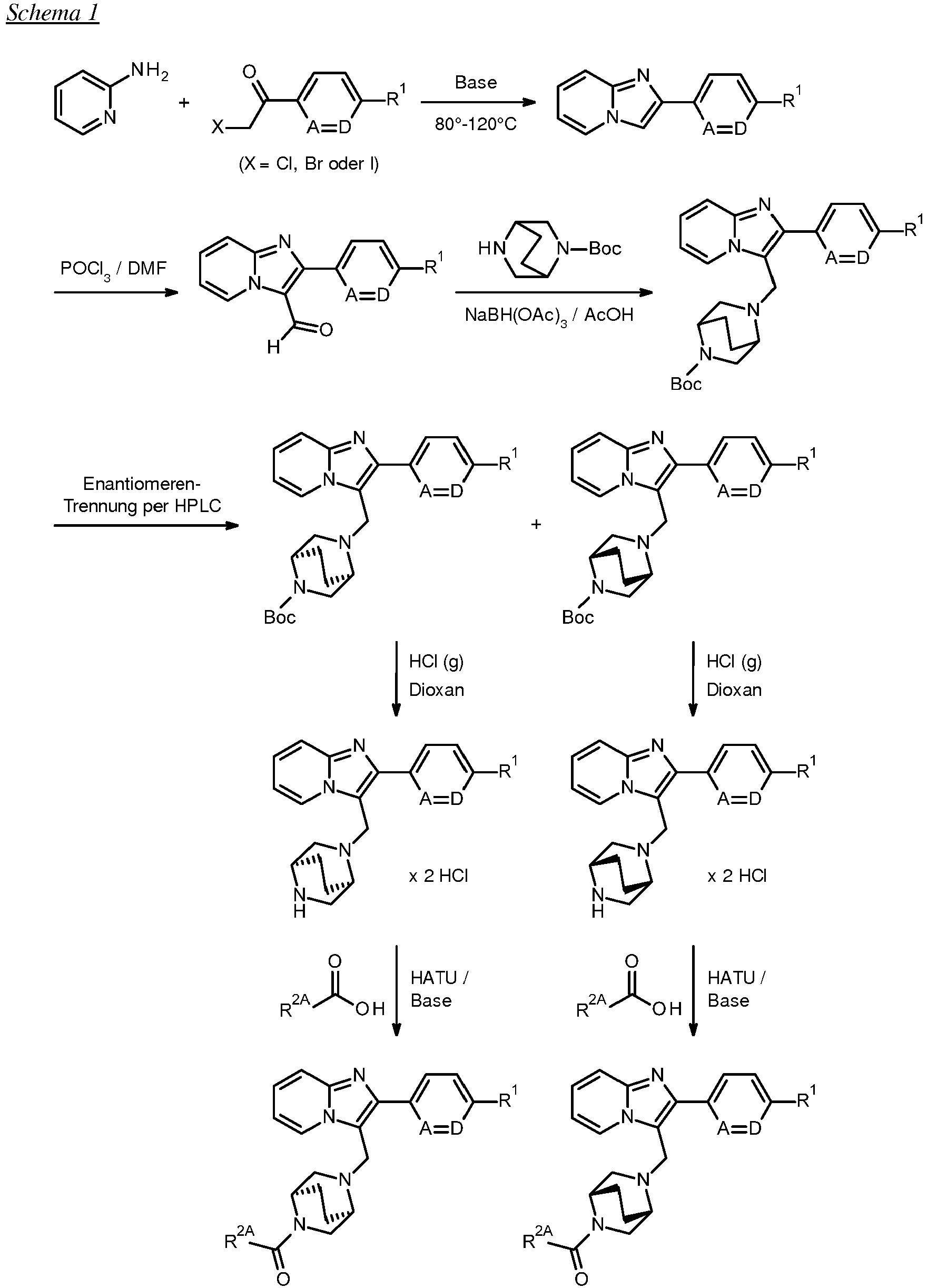

Die erfindungsgemäßen Verbindungen besitzen wertvolle pharmakologische Eigenschaften und können zur Vorbeugung und Behandlung von Erkrankungen bei Menschen und Tieren verwendet werden.The compounds according to the invention have valuable pharmacological properties and can be used for the prevention and treatment of diseases in humans and animals.
Die erfindungsgemäßen Verbindungen stellen potente und selektive Blocker von TASK-1- und TASK-3-Kanälen dar und eignen sich daher zur Behandlung und/oder Prävention von Erkrankungen und pathologischen Prozessen, insbesondere solcher, die durch eine Aktivierung von TASK-1 und/oder TASK-3 oder durch aktiviertes TASK-1 und/oder TASK-3 hervorgerufen werden, sowie von Erkrankungen, die auf sekundärem Wege durch TASK-1- und/oder TASK-3-bedingte Schädigungen induziert werden.The compounds according to the invention are potent and selective blockers of TASK-1 and TASK-3 channels and are therefore suitable for the treatment and/or prevention of diseases and pathological processes, in particular those caused by activation of TASK-1 and/or TASK-3 or by activated TASK-1 and/or TASK-3, as well as diseases that are induced secondarily by TASK-1 and/or TASK-3-related damage.
Dazu zählen im Sinne der vorliegenden Erfindung insbesondere Erkrankungen aus der Gruppe der Atemstörungen und schlafbedingten Atemstörungen, wie die obstruktive Schlafapnoe (bei Erwachsenen und Kindern), primäres Schnarchen, obstruktives Schnarchen (upper airway resistance syndrome, heavy snoring, Hypopnoe-Syndrom), zentrale Schlafapnoe, gemischte Schlafapnoen, Cheyne-Stoke'sche Atmung, primäre Schlafapnoe in der Kindheit, Frühgeborenenapnoe, zentrale Schlafapnoe infolge Medikamenteneinnahme oder Gebrauch anderer Substanzen, Obesitas-Hypoventilationssyndrom, gestörter zentraler Atemantrieb, plötzlicher Kindstod, primäres alveoläres Hypoventilationssyndrom, postoperative Hypoxie und Apnoe, muskulär bedingte Atemstörungen, Atemstörungen nach Langzeitbeatmung, Atemstörungen bei Adaptation im Hochgebirge, akute und chronische Lungenkrankheiten mit Hypoxie und Hyperkapnie, schlafbezogene nicht-obstruktive alveoläre Hypoventilation und das kongenitale zentrale alveoläre Hypoventilationssyndrom.In the context of the present invention, these include in particular diseases from the group of respiratory disorders and sleep-related respiratory disorders, such as obstructive sleep apnea (in adults and children), primary snoring, obstructive snoring ( upper airway resistance syndrome, heavy snoring, hypopnea syndrome), central sleep apnea, mixed sleep apneas, Cheyne-Stoke's respiration, primary sleep apnea in childhood, apnea in premature babies, central sleep apnea as a result of taking medication or using other substances, obesity hypoventilation syndrome, impaired central respiratory drive, sudden infant death syndrome, primary alveolar hypoventilation syndrome, postoperative hypoxia and apnea, muscular-related respiratory disorders, respiratory disorders after long-term ventilation, respiratory disorders during adaptation in high mountains, acute and chronic lung diseases with hypoxia and hypercapnia, sleep-related non-obstructive alveolar hypoventilation and congenital central alveolar hypoventilation syndrome.
Die erfindungsgemäßen Verbindungen können weiterhin verwendet werden zur Behandlung und/ oder Prävention von neurodegenerativen Erkrankungen, wie beispielsweise Demenz, Demenz mit Lewy-Körpern, Morbus Alzheimer, Morbus Parkinson, Morbus Huntington, Morbus Pick, Morbus Wilson, progressive supranukleäre Parese, kortikobasale Degeneration, Silberkornkrankheit, frontotemporale Demenz und Parkinsonismus des Chromosoms 17, Multisystematrophie, spinozerebelläre Ataxien, spinobulbäre Muskelatrophie Typ Kennedy, Friedreich-Ataxie, dentatorubropallidoluysische Atrophie, amyotrophe Lateralsklerose, primäre Lateralsklerose, spinale Muskelatrophie, Creutzfeldt-Jakob-Krankheit und Varianten der Creutzfeldt-Jakob-Krankheit, infantile neuroaxonale Dystrophie, Neurodegeneration mit Eisenablagerung im Gehirn, Frontotemporallappen-Degeneration mit Ubiquitin-Proteasom-System und die familiäre Enzephalopathie mit Neuroserpin-Einschlüssen.The compounds according to the invention can further be used for the treatment and/or prevention of neurodegenerative diseases, such as, for example, dementia, dementia with Lewy bodies, Alzheimer's disease, Parkinson's disease, Huntington's disease, Pick's disease, Wilson's disease, progressive supranuclear palsy, corticobasal degeneration, Silberkorn disease, frontotemporal dementia and parkinsonism of chromosome 17, multiple system atrophy, spinocerebellar ataxias, spinobulbar muscular atrophy of Kennedy type, Friedreich's ataxia, dentatorubropallidoluysian atrophy, amyotrophic lateral sclerosis, primary lateral sclerosis, spinal muscular atrophy, Creutzfeldt-Jakob disease and variants of Creutzfeldt-Jakob disease, infantile neuroaxonal dystrophy, neurodegeneration with iron deposition in the brain, frontotemporal lobe degeneration with ubiquitin-proteasome system and familial encephalopathy with neuroserpin inclusions.
Die erfindungsgemäßen Verbindungen können darüber hinaus zur Behandlung und/oder Prävention von neuroinflammatorischen und neuroimmunologischen Erkrankungen des zentralen Nervensystems (ZNS) eingesetzt werden, wie beispielsweise multiple Sklerose (Encephalomyelitis disseminata), transverse Myelitis, Neuromyelitis optica, akute disseminierte Enzephalomyelitis, Optikusneuritis, Meningitis, Enzephalitis, demyelinisierende Erkrankungen sowie entzündliche Gefäßveränderungen des zentralen Nervensystems.The compounds according to the invention can furthermore be used for the treatment and/or prevention of neuroinflammatory and neuroimmunological diseases of the central nervous system (CNS), such as, for example, multiple sclerosis (disseminated encephalomyelitis), transverse myelitis, neuromyelitis optica, acute disseminated encephalomyelitis, optic neuritis, meningitis, encephalitis, demyelinating diseases and inflammatory vascular changes of the central nervous system.
Die erfindungsgemäßen Verbindungen sind zudem zur Behandlung und/oder Prävention von Krebserkrankungen geeignet, wie beispielsweise von Hautkrebs, Brustkrebs, Lungenkrebs, Kolonkrebs und Prostatakrebs.The compounds according to the invention are also suitable for the treatment and/or prevention of cancers, such as skin cancer, breast cancer, lung cancer, colon cancer and prostate cancer.
Die erfindungsgemäßen Verbindungen eignen sich außerdem zur Behandlung und/oder Prävention von Herzrhythmusstörungen und Arrhythmien, wie beispielsweise Rhythmusstörungen der Vorhöfe und der Kammern, Überleitungsstörungen wie atrio-ventrikuläre Blockaden des Grades I-III, supraventrikuläre Tachyarrhythmie, Vorhofflimmern, Vorhofflattern, Kammerflimmern, Kammerflattern, ventrikuläre Tachyarrhythmie, Torsade de pointes-Tachykardie, Extrasystolen des Vorhofs und des Ventrikels, AV-junktionale Extrasystolen, Sick-Sinus-Syndrom, Synkopen und AV-Knoten-Reentry-Tachykardie.The compounds according to the invention are also suitable for the treatment and/or prevention of cardiac arrhythmias and arrhythmias, such as, for example, arrhythmias of the atria and ventricles, conduction disorders such as atrioventricular blocks of grades I-III, supraventricular tachyarrhythmia, atrial fibrillation, atrial flutter, ventricular fibrillation, ventricular flutter, ventricular tachyarrhythmia, torsade de pointes tachycardia, extrasystoles of the atrium and ventricle, AV junctional extrasystoles, sick sinus syndrome, syncope and AV node reentry tachycardia.
Weitere kardiovaskuläre Erkrankungen, zu deren Behandlung und/oder Prävention die erfindungsgemäßen Verbindungen eingesetzt werden können, sind beispielsweise Herzinsuffizienz, koronare Herzerkrankung, stabile und instabile Angina pectoris, Bluthochdruck (Hypertonie), pulmonalarterielle Hypertonie (PAH) und andere Formen der pulmonalen Hypertonie (PH), renale Hypertonie, periphere und kardiale Gefäßerkrankungen, Wolff-Parkinson-White-Syndrom, akutes Koronarsyndrom (ACS), autoimmune Herzerkrankungen (Perikarditis, Endokarditis, Valvolitis, Aortitis, Kardiomyopathien), Boxerkardiomyopathie, Aneurysmen, Schock wie kardiogener Schock, septischer Schock und anaphylaktischer Schock, ferner thromboembolische Erkrankungen und Ischämien, wie myokardiale Ischämie, Myokardinfarkt, Hirnschlag, Herzhypertrophie, transistorische und ischämische Attacken, Präeklampsie, entzündliche kardiovaskuläre Erkrankungen, Spasmen der Koronararterien und peripherer Arterien, Ödembildung wie beispielsweise pulmonales Ödem, Hirnödem, renales Ödem oder Herzinsuffizienz-bedingtes Ödem, periphere Durchblutungsstörungen, Reperfusionsschäden, arterielle und venöse Thrombosen, Mikroalbuminurie, Herzmuskelschwäche, endotheliale Dysfunktion, mikro- und makrovaskuläre Schädigungen (Vaskulitis), sowie zur Verhinderung von Restenosen beispielsweise nach Thrombolyse-Therapien, percutan-transluminalen Angioplastien (PTA), percutan-transluminalen Koronarangioplastien (PTCA), Herztransplantationen und Bypass-Operationen.Other cardiovascular diseases for the treatment and/or prevention of which the compounds according to the invention can be used are, for example, heart failure, coronary heart disease, stable and unstable angina pectoris, high blood pressure (hypertension), pulmonary arterial hypertension (PAH) and other forms of pulmonary hypertension (PH), renal hypertension, peripheral and cardiac vascular diseases, Wolff-Parkinson-White syndrome, acute coronary syndrome (ACS), autoimmune heart diseases (pericarditis, endocarditis, valvolitis, aortitis, cardiomyopathies), boxer cardiomyopathy, aneurysms, shock such as cardiogenic shock, septic shock and anaphylactic shock, as well as thromboembolic diseases and ischemias such as myocardial ischemia, myocardial infarction, stroke, cardiac hypertrophy, transient and ischemic attacks, preeclampsia, inflammatory cardiovascular diseases, spasms of the coronary arteries and peripheral arteries, edema formation such as pulmonary edema, cerebral edema, renal edema or edema caused by heart failure, peripheral circulatory disorders, reperfusion damage, arterial and venous thrombosis, microalbuminuria, heart muscle weakness, endothelial dysfunction, micro- and macrovascular damage (vasculitis), as well as for the prevention of restenosis, for example after thrombolysis therapies, percutaneous transluminal angioplasties (PTA), percutaneous transluminal coronary angioplasties (PTCA), heart transplants and bypass operations.
Im Sinne der vorliegenden Erfindung umfasst der Begriff Herzinsuffizienz sowohl akute als auch chronische Erscheinungsformen der Herzinsuffizienz wie auch spezifische oder verwandte Krankheitsformen hiervon, wie akute dekompensierte Herzinsuffizienz, Rechtsherzinsuffizienz, Linksherzinsuffizienz, Globalinsuffizienz, ischämische Kardiomyopathie, dilatative Kardiomyopathie, hypertrophe Kardiomyopathie, idiopathische Kardiomyopathie, angeborene Herzfehler, Herzklappenfehler, Herzinsuffizienz bei Herzklappenfehlern, Mitralklappenstenose, Mitralklappeninsuffizienz, Aortenklappenstenose, Aortenklappeninsuffizienz, Trikuspidalstenose, Trikuspidalinsuffizienz, Pulmonalklappenstenose, Pulmonalklappeninsuffizienz, kombinierte Herzklappenfehler, Herzmuskelentzündung (Myokarditis), chronische Myokarditis, akute Myokarditis, virale Myokarditis, diabetische Herzinsuffizienz, alkoholtoxische Kardiomyopathie, kardiale Speichererkrankungen sowie diastolische und systolische Herzinsuffizienz.In the sense of the present invention, the term heart failure includes both acute and chronic manifestations of heart failure as well as specific or related forms of disease thereof, such as acute decompensated heart failure, right heart failure, left heart failure, global insufficiency, ischemic cardiomyopathy, dilated cardiomyopathy, hypertrophic cardiomyopathy, idiopathic cardiomyopathy, congenital heart defects, heart valve defects, heart failure in the case of heart valve defects, mitral valve stenosis, mitral valve insufficiency, aortic valve stenosis, aortic valve insufficiency, tricuspid stenosis, tricuspid insufficiency, pulmonary valve stenosis, pulmonary valve insufficiency, combined heart valve defects, inflammation of the heart muscle (myocarditis), chronic myocarditis, acute myocarditis, viral myocarditis, diabetic heart failure, alcohol toxic Cardiomyopathy, cardiac storage diseases and diastolic and systolic heart failure.
Die erfindungsgemäßen Verbindungen können weiterhin verwendet werden zur Behandlung und/ oder Prävention von asthmatischen Erkrankungen unterschiedlicher Schweregrade mit intermittierendem oder persistierendem Verlauf (refraktäres Asthma, bronchiales Asthma, allergisches Asthma, intrinsisches Asthma, extrinsisches Asthma, durch Medikamente oder durch Staub induziertes Asthma), von verschiedenen Formen der Bronchitis (chronische Bronchitis, infektiöse Bronchitis, eosinophile Bronchitis), von Bronchiektasien, Pneumonie, Farmerlunge und verwandten Krankheiten, Husten- und Erkältungskrankheiten (chronischer entzündlicher Husten, iatrogener Husten), Nasenschleimhautentzündungen (einschließlich medikamentöse Rhinitis, vasomotorische Rhinitis und jahreszeitabhängige, allergische Rhinitis, z.B. Heuschnupfen) und von Polypen.The compounds according to the invention can also be used for the treatment and/or prevention of asthmatic diseases of varying degrees of severity with an intermittent or persistent course (refractory asthma, bronchial asthma, allergic asthma, intrinsic asthma, extrinsic asthma, medication- or dust-induced asthma), of various forms of bronchitis (chronic bronchitis, infectious bronchitis, eosinophilic bronchitis), of bronchiectasis, pneumonia, farmer's lung and related diseases, coughs and colds (chronic inflammatory cough, iatrogenic cough), inflammations of the nasal mucosa (including medication-induced rhinitis, vasomotor rhinitis and seasonal allergic rhinitis, e.g. hay fever) and of polyps.
Zudem eignen sich die erfindungsgemäßen Verbindungen zur Behandlung und/oder Prävention von Nierenerkrankungen, insbesondere von Niereninsuffizienz und Nierenversagen. Im Sinne der vorliegenden Erfindung umfassen die Begriffe Niereninsuffizienz und Nierenversagen sowohl akute als auch chronische Erscheinungsformen hiervon wie auch diesen zugrundeliegende oder verwandte Nierenerkrankungen, wie renale Hypoperfusion, intradialytische Hypotonie, obstruktive Uropathie, Glomerulopathien, Glomerulonephritis, akute Glomerulonephritis, Glomerulosklerose, tubulointerstitielle Erkrankungen, nephropathische Erkrankungen wie primäre und angeborene Nierenerkrankung, Nierenentzündung, immunologische Nierenerkrankungen wie Nierentransplantat-Abstoßung und Immunkomplex-induzierte Nierenerkrankungen, durch toxische Substanzen induzierte Nephropathie, Kontrastmittel-induzierte Nephropathie, diabetische und nicht-diabetische Nephropathie, Pyelonephritis, Nierenzysten, Nephrosklerose, hypertensive Nephrosklerose und nephrotisches Syndrom, welche diagnostisch beispielsweise durch abnorm verminderte Kreatinin- und/oder Wasser-Ausscheidung, abnorm erhöhte Blutkonzentrationen von Harnstoff, Stickstoff, Kalium und/oder Kreatinin, veränderte Aktivität von Nierenenzymen wie z.B. Glutamylsynthetase, veränderte Urinosmolarität oder Urinmenge, erhöhte Mikroalbuminurie, Makroalbuminurie, Läsionen an Glomerula und Arteriolen, tubuläre Dilatation, Hyperphosphatämie und/oder die Notwendigkeit zur Dialyse charakterisiert werden können. Die vorliegende Erfindung umfasst auch die Verwendung der erfindungsgemäßen Verbindungen zur Behandlung und/oder Prävention von Folgeerscheinungen einer Niereninsuffizienz, wie beispielsweise Hypertonie, Lungenödem, Herzinsuffizienz, Urämie, Anämie, Elektrolytstörungen (z.B. Hyperkalämie, Hyponaträmie) und Störungen im Knochen- und Kohlenhydrat-Metabolismus.In addition, the compounds according to the invention are suitable for the treatment and/or prevention of kidney diseases, in particular renal insufficiency and renal failure. In the context of the present invention, the terms renal insufficiency and renal failure include both acute and chronic manifestations thereof as well as underlying or related kidney diseases, such as renal hypoperfusion, intradialytic hypotension, obstructive Uropathy, glomerulopathies, glomerulonephritis, acute glomerulonephritis, glomerulosclerosis, tubulointerstitial diseases, nephropathic diseases such as primary and congenital kidney disease, nephritis, immunological kidney diseases such as kidney transplant rejection and immune complex-induced kidney diseases, nephropathy induced by toxic substances, contrast medium-induced nephropathy, diabetic and non-diabetic nephropathy, pyelonephritis, renal cysts, nephrosclerosis, hypertensive nephrosclerosis and nephrotic syndrome, which can be diagnosed, for example, by abnormally reduced creatinine and/or water excretion, abnormally increased blood concentrations of urea, nitrogen, potassium and/or creatinine, altered activity of kidney enzymes such as glutamyl synthetase, altered urine osmolarity or urine volume, increased microalbuminuria, Macroalbuminuria, lesions of glomeruli and arterioles, tubular dilatation, hyperphosphatemia and/or the need for dialysis. The present invention also includes the use of the compounds according to the invention for the treatment and/or prevention of sequelae of renal insufficiency, such as hypertension, pulmonary edema, heart failure, uremia, anemia, electrolyte disturbances (eg hyperkalemia, hyponatremia) and disturbances in bone and carbohydrate metabolism.
Darüber hinaus sind die erfindungsgemäßen Verbindungen zur Behandlung und/oder Prävention von Erkrankungen des Urogenitalsystems geeignet, wie beispielsweise benignes Prostata-Syndrom (BPS), benigne Prostatahyperplasie (BPH), benigne Prostatavergrößerung (BPE), Blasenentleerungsstörungen (BOO), untere Harnwegssyndrome (LUTS), neurogene überaktive Blase (OAB), Inkontinenz wie beispielsweise Misch-, Drang-, Stress- oder Überlauf-Inkontinenz (MUI, UUI, SUI, OUI), Beckenschmerzen sowie erektile Dysfunktion und weibliche sexuelle Dysfunktion.In addition, the compounds according to the invention are suitable for the treatment and/or prevention of diseases of the urogenital system, such as benign prostatic syndrome (BPS), benign prostatic hyperplasia (BPH), benign prostatic enlargement (BPE), bladder emptying disorders (BOO), lower urinary tract syndromes (LUTS), neurogenic overactive bladder (OAB), incontinence such as mixed, urge, stress or overflow incontinence (MUI, UUI, SUI, OUI), pelvic pain as well as erectile dysfunction and female sexual dysfunction.
Die erfindungsgemäßen Verbindungen sind ferner zur Behandlung und/oder Prävention von entzündlichen Erkrankungen und Autoimmunerkrankungen, wie zum Beispiel rheumatoiden Erkrankungen, entzündlichen Augenerkrankungen, chronisch-obstruktiver Lungenerkrankung (COPD), akutem Atemwegssyndrom (ARDS), akuter Lungenschädigung (ALI), alpha-1-Antitrypsin-Defi-zienz (AATD), Lungenemphysem (z.B. durch Zigarettenrauch induziertes Lungenemphysem), zystischer Fibrose (CF), Sepsis (SIRS), multiplem Organversagen (MODS, MOF), entzündlichen Erkrankungen der Niere, chronischen Darmentzündungen (IBD, Morbus Crohn, Colitis ulcerosa), Pankreatitis, Peritonitis, Cystitis, Urethritis, Prostatitis, Epidimytitis, Oophoritis, Salpingitis und Vulvovaginitis, sowie zur Behandlung und/oder Prävention von fibrotischen Erkrankungen der inneren Organe, wie beispielsweise der Lunge, des Herzens, der Niere, des Knochenmarks und insbesondere der Leber, von dermatologischen Fibrosen und von fibrotischen Erkrankungen des Auges geeignet. Im Sinne der vorliegenden Erfindung umfasst der Begriff fibrotische Erkrankungen insbesondere solche Erkrankungen wie Leberfibrose, Leberzirrhose, Lungenfibrose, Endomyokardfibrose, Nephropathie, Glomerulonephritis, interstitielle Nierenfibrose, fibrotische Schäden in Folge von Diabetes, Knochenmarksfibrose, Peritonealfibrose und ähnliche fibrotische Erkrankungen, Sklerodermie, Morphaea, Keloide, hypertrophe Narbenbildung, Naevi, diabetische Retinopathie, proliferative Vitroretinopathie und Erkrankungen des Bindegewebes (z.B. Sarkoidose). Die erfindungsgemäßen Verbindungen können ebenso verwendet werden zur Förderung der Wundheilung, zur Bekämpfung postoperativer Narbenbildung, z.B. nach Glaukom-Operationen, und zu kosmetischen Zwecken bei alternder oder verhornender Haut.The compounds according to the invention are also suitable for the treatment and/or prevention of inflammatory diseases and autoimmune diseases, such as rheumatoid diseases, inflammatory eye diseases, chronic obstructive pulmonary disease (COPD), acute respiratory syndrome (ARDS), acute lung injury (ALI), alpha-1-antitrypsin deficiency (AATD), pulmonary emphysema (e.g. cigarette smoke-induced pulmonary emphysema), cystic fibrosis (CF), sepsis (SIRS), multiple organ failure (MODS, MOF), inflammatory diseases of the kidney, chronic intestinal inflammation (IBD, Crohn's disease, ulcerative colitis), pancreatitis, peritonitis, cystitis, urethritis, prostatitis, epidimytitis, oophoritis, salpingitis and vulvovaginitis, as well as for the treatment and/or prevention of fibrotic diseases of the internal organs, such as the lungs, heart, kidneys, bone marrow and particularly of the liver, dermatological fibrosis and fibrotic diseases of the eye. In the sense of the present invention, the term fibrotic diseases includes in particular such diseases as liver fibrosis, liver cirrhosis, pulmonary fibrosis, endomyocardial fibrosis, Nephropathy, glomerulonephritis, interstitial renal fibrosis, fibrotic damage as a result of diabetes, bone marrow fibrosis, peritoneal fibrosis and similar fibrotic diseases, scleroderma, morphea, keloids, hypertrophic scarring, nevi, diabetic retinopathy, proliferative vitroretinopathy and diseases of the connective tissue (eg sarcoidosis). The compounds according to the invention can also be used to promote wound healing, to combat postoperative scarring, eg after glaucoma operations, and for cosmetic purposes in aging or keratinizing skin.
Darüber hinaus können die erfindungsgemäßen Verbindungen eingesetzt werden zur Behandlung und/oder Prävention von Arteriosklerose, Lipidstoffwechselstörungen und Dyslipidämien (Hypolipoproteinämie, Hypertriglyceridämie, Hyperlipidämie, kombinierte Hyperlipidämien, Hypercholesterolämie, Abetalipoproteinämie, Sitosterolämie), Xanthomatose, Tangier-Krankheit, Fettsucht (Adipositas), Fettleibigkeit (Obesitas), metabolischen Erkrankungen (Metabolisches Syndrom, Hyperglykämie, Insulin-abhängiger Diabetes, nicht-Insulin-abhängiger Diabetes, Gestationsdiabetes, Hyperinsulinämie, Insulinresistenz, Glukose-Intoleranz und diabetische Spätfolgen wie Retinopathie, Nephropathie und Neuropathie), Anämien wie hämolytischen Anämien, insbesondere Hämoglobinopathien wie Sichelzellanämie und Thalassämien, megaloblastären Anämien, Eisenmangel-Anämien, Anämien durch akuten Blutverlust, Verdrängungsanämien und aplastischen Anämien, von Erkrankungen des Gastrointestinaltrakts und des Abdomen (Glossitis, Gingivitis, Periodontitis, Oesophagitis, eosinophile Gastroenteritis, Mastocytose, Morbus Crohn, Colitis, Proctitis, Pruritis ani, Diarrhöe, Zöliakie, Hepatitis, Leberfibrose, Leberzirrhose, Pankreatitis und Cholecystitis), Erkrankungen des zentralen Nervensystems (Schlaganfall, Epilepsie, Depressionen), Immunerkrankungen, Schilddrüsenerkrankungen (Hyperthyreose), Hauterkrankungen (Psoriasis, Akne, Ekzeme, Neurodermitis, vielfältige Formen der Dermatitis, Keratitis, Bullosis, Vasculitis, Cellulitis, Panniculitis, Lupus erythematodes, Erythema, Lymphome, Hautkrebs, Sweet-Syndrom, Weber-Christian-Syndrom, Narbenbildung, Warzenbildung, Frostbeulen), entzündlichen Augenerkrankungen (Saccoidosis, Blepharitis, Conjunctivitis, Iritis, Uveitis, Chorioiditis, Ophthalmitis), viralen Erkrankungen (durch Influenza-, Adeno- und Coronaviren, wie z.B. HPV, HCMV, HIV, SARS), von Erkrankungen des Skelettknochens, der Gelenke und der Skelettmuskel, von entzündlichen Arterienveränderungen (vielfältige Formen der Arteritis wie z.B. Endarteritis, Mesarteritis, Periarteritis, Panarteritis, Arteritis rheumatica, Arteritis deformans, Arteritis temporalis, Arteritis cranialis, Arteritis gigantocellularis und Arteritis granulomatosa, sowie das Horton-Syndrom, Churg-Strauss-Syndrom und die Takayasu-Arteritis), des Muckle-Well-Syndroms, der Kikuchi-Krankheit, von Polychondritis, Sklerodermia sowie von weiteren Erkrankungen mit einer entzündlichen oder immunologischen Komponente, wie beispielsweise Katarakt, Kachexie, Osteoporose, Gicht, Inkontinenz, Lepra, Sezary-Syndrom und paraneoplastisches Syndrom, bei Abstossungsreaktionen nach Organtransplantationen und zur Wundheilung und Angiogenese insbesondere bei chronischen Wunden.In addition, the compounds according to the invention can be used for the treatment and/or prevention of arteriosclerosis, lipid metabolism disorders and dyslipidemias (hypolipoproteinemia, hypertriglyceridemia, hyperlipidemia, combined hyperlipidemias, hypercholesterolemia, abetalipoproteinemia, sitosterolemia), xanthomatosis, Tangier disease, obesity, metabolic diseases (metabolic syndrome, hyperglycemia, insulin-dependent diabetes, non-insulin-dependent diabetes, gestational diabetes, hyperinsulinemia, insulin resistance, glucose intolerance and late diabetic effects such as retinopathy, nephropathy and neuropathy), anemias such as hemolytic anemias, in particular hemoglobinopathies such as sickle cell anemia and thalassemias, megaloblastic anemias, iron deficiency anemias, anemias due to acute blood loss, displacement anemias and aplastic anemias, diseases of the gastrointestinal tract and abdomen (glossitis, gingivitis, periodontitis, esophagitis, eosinophilic gastroenteritis, mastocytosis, Crohn's disease, colitis, proctitis, pruritis ani, diarrhea, celiac disease, hepatitis, liver fibrosis, liver cirrhosis, pancreatitis and cholecystitis), diseases of the central nervous system (stroke, epilepsy, depression), immune diseases, thyroid diseases (hyperthyroidism), skin diseases (psoriasis, acne, eczema, neurodermatitis, various forms of dermatitis, keratitis, bullosis, vasculitis, cellulitis, panniculitis, lupus erythematosus, erythema, lymphomas, skin cancer, Sweet's syndrome, Weber-Christian syndrome, scarring, wart formation, chilblains), inflammatory eye diseases (saccoidosis, Blepharitis, conjunctivitis, iritis, uveitis, choroiditis, ophthalmitis), viral diseases (caused by influenza, adenoviruses and coronaviruses such as HPV, HCMV, HIV, SARS), diseases of the skeletal bones, joints and skeletal muscles, inflammatory arterial changes (various forms of arteritis such as endarteritis, mesarteritis, periarteritis, polyarteritis, rheumatic arteritis, deforming arteritis, temporal arteritis, cranial arteritis, gigantocellular arteritis and granulomatous arteritis, as well as Horton syndrome, Churg-Strauss syndrome and Takayasu arteritis), Muckle-Well syndrome, Kikuchi disease, polychondritis, scleroderma and other diseases with an inflammatory or immunological component such as cataracts, cachexia, osteoporosis, gout, incontinence, leprosy, Sezary syndrome and paraneoplastic syndrome, rejection reactions after organ transplantation and for wound healing and angiogenesis, especially in chronic wounds.
Aufgrund ihres Eigenschaftsprofils eignen sich die erfindungsgemäßen Verbindungen bevorzugt zur Behandlung und/oder Prävention von Atemstörungen, insbesondere von schlafbedingten Atemstörungen wie obstruktiven und zentralen Schlafapnoen sowie primärem und obstruktivem Schnarchen, zur Behandlung und/oder Prävention von Herzrhythmusstörungen und Arrhythmien sowie zur Behandlung und/oder Prävention von neurodegenerativen, neuroinflammatorischen und neuroimmunologischen Erkrankungen.Due to their property profile, the compounds according to the invention are preferably suitable for the treatment and/or prevention of respiratory disorders, in particular sleep-related respiratory disorders such as obstructive and central sleep apnea and primary and obstructive snoring, for the treatment and/or prevention of cardiac arrhythmias and arrhythmias and for the treatment and/or prevention of neurodegenerative, neuroinflammatory and neuroimmunological diseases.
Die zuvor genannten, gut charakterisierten Krankheiten des Menschen können mit vergleichbarer Ätiologie auch in anderen Säugetieren vorkommen und dort ebenfalls mit den Verbindungen der vorliegenden Erfindung behandelt werden.The aforementioned well-characterized human diseases can also occur in other mammals with comparable etiology and can also be treated there with the compounds of the present invention.
Im Sinne der vorliegenden Erfindung umfasst der Begriff "Behandlung" oder "behandeln" ein Hemmen, Verzögern, Aufhalten, Lindern, Abschwächen, Einschränken, Verringern, Unterdrücken, Zurückdrängen oder Heilen einer Krankheit, eines Leidens, einer Erkrankung, einer Verletzung oder einer gesundheitlichen Störung, der Entfaltung, des Verlaufs oder des Fortschreitens solcher Zustände und/oder der Symptome solcher Zustände. Der Begriff "Therapie" wird hierbei als synonym mit dem Begriff "Behandlung" verstanden.For the purposes of the present invention, the term "treatment" or "treat" includes inhibiting, delaying, stopping, alleviating, weakening, limiting, reducing, suppressing, repressing or curing an illness, ailment, disease, injury or health disorder, the development, course or progression of such conditions and/or the symptoms of such conditions. The term "therapy" is understood here as synonymous with the term "treatment".
Die Begriffe "Prävention", "Prophylaxe" oder "Vorbeugung" werden im Rahmen der vorliegenden Erfindung synonym verwendet und bezeichnen das Vermeiden oder Vermindern des Risikos, eine Krankheit, ein Leiden, eine Erkrankung, eine Verletzung oder eine gesundheitliche Störung, eine Entfaltung oder ein Fortschreiten solcher Zustände und/oder die Symptome solcher Zustände zu bekommen, zu erfahren, zu erleiden oder zu haben.The terms "prevention", "prophylaxis" or "prevention" are used synonymously in the context of the present invention and refer to the avoidance or reduction of the risk of getting, experiencing, suffering or having a disease, ailment, illness, injury or health disorder, the development or progression of such conditions and/or the symptoms of such conditions.
Die Behandlung oder die Prävention einer Krankheit, eines Leidens, einer Erkrankung, einer Verletzung oder einer gesundheitlichen Störung können teilweise oder vollständig erfolgen.The treatment or prevention of a disease, condition, illness, injury or health disorder may be partial or complete.
Weiterer Gegenstand der vorliegenden Erfindung ist somit die Verwendung der erfindungsgemäßen Verbindungen zur Behandlung und/oder Prävention von Erkrankungen, insbesondere der zuvor genannten Erkrankungen.The present invention thus further relates to the use of the compounds according to the invention for the treatment and/or prevention of diseases, in particular the diseases mentioned above.
Weiterer Gegenstand der vorliegenden Erfindung ist die Verwendung der erfindungsgemäßen Verbindungen zur Herstellung eines Arzneimittels zur Behandlung und/oder Prävention von Erkrankungen, insbesondere der zuvor genannten Erkrankungen.The present invention further relates to the use of the compounds according to the invention for producing a medicament for the treatment and/or prevention of diseases, in particular the diseases mentioned above.
Weiterer Gegenstand der vorliegenden Erfindung ist ein Arzneimittel, enthaltend mindestens eine der erfindungsgemäßen Verbindungen, zur Behandlung und/oder Prävention von Erkrankungen, insbesondere der zuvor genannten Erkrankungen.The present invention further relates to a medicament containing at least one of the compounds according to the invention for the treatment and/or prevention of diseases, in particular the diseases mentioned above.
Weiterer Gegenstand der vorliegenden Erfindung ist die Verwendung der erfindungsgemäßen Verbindungen in einem Verfahren zur Behandlung und/oder Prävention von Erkrankungen, insbesondere der zuvor genannten Erkrankungen.The present invention further relates to the use of the compounds according to the invention in a method for the treatment and/or prevention of diseases, in particular the diseases mentioned above.
Weiterer Gegenstand der vorliegenden Erfindung ist ein Verfahren zur Behandlung und/oder Prävention von Erkrankungen, insbesondere der zuvor genannten Erkrankungen, unter Verwendung einer wirksamen Menge von mindestens einer der erfindungsgemäßen Verbindungen.The present invention further relates to a method for the treatment and/or prevention of diseases, in particular the aforementioned diseases, using an effective amount of at least one of the compounds according to the invention.
Die erfindungsgemäßen Verbindungen können allein oder bei Bedarf in Kombination mit einer oder mehreren anderen pharmakologisch wirksamen Substanzen eingesetzt werden, solange diese Kombination nicht zu unerwünschten und inakzeptablen Nebenwirkungen führt. Weiterer Gegenstand der vorliegenden Erfindung sind daher Arzneimittel, enthaltend mindestens eine der erfindungsgemäßen Verbindungen und einen oder mehrere weitere Wirkstoffe, insbesondere zur Behandlung und/oder Prävention der zuvor genannten Erkrankungen. Als hierfür geeignete Kombinationswirkstoffe seien beispielhaft und vorzugsweise genannt:
- Atemstimulantien, wie beispielhaft und vorzugsweise Theophyllin, Doxapram, Nicethamid oder Coffein;
- psychostimulierende Verbindungen, wie beispielhaft und vorzugsweise Modafinil oder Armodafinil;
- Amphetamine und Amphetamin-Derivate, wie beispielhaft und vorzugsweise Amphetamin, Metamphetamin oder Methylphenidat;
- Serotonin-Wiederaufnahmehemmer, wie beispielhaft und vorzugsweise Fluoxetin, Paroxetin, Citalopram, Escitalopram, Sertralin, Fluvoxamin oder Trazodon;
- Serotonin-Präkursoren, wie beispielhaft und vorzugsweise L-Tryptophan;
- selektive Serotonin-Noradrenalin-Wiederaufnahmehemmer, wie beispielhaft und vorzugsweise Venlafaxin oder Duloxetin;
- noradrenerge und spezifisch serotonerge Antidepressiva, wie beispielhaft und vorzugsweise Mirtazapin;
- selektive Noradrenalin-Wiederaufnahmehemmer, wie beispielhaft und vorzugsweise Reboxetin;
- tricyclische Antidepressiva, wie beispielhaft und vorzugsweise Amitriptylin, Protriptylin, Doxepin, Trimipramin, Imipramin, Clomipramin oder Desipramin;
- alpha2-adrenerge Agonisten, wie beispielhaft und vorzugsweise Clonidin;
- GABA-Agonisten, wie beispielhaft und vorzugsweise Baclofen;
- alpha-Sympathomimetika, wie beispielhaft und vorzugsweise Xylometazolin, Oxymetazolin, Phenylephrin, Naphazolin, Tetryzolin oder Tramazolin;
- Glucocorticoide, wie beispielhaft und vorzugsweise Fluticason, Budesonid, Beclometason, Mometason, Tixocortol oder Triamcinolon;
- Cannabinoid-Rezeptor-Agonisten;
- Carboanhydrase-Hemmer, wie beispielhaft und vorzugsweise Acetazolamid, Methazolamid oder Diclofenamid;
- Opioid- und Benzodiazepin-Rezeptor-Antagonisten, wie beispielhaft und vorzugsweise Flumazenil, Naloxon oder Naltrexon;
- Cholinesterase-Hemmer, wie beispielhaft und vorzugsweise Neostigmin, Pyridostigmin, Physostigmin, Donepezil, Galantamin oder Rivastigmin;
- N-Methyl-D-Aspartat- und Glutamat-Antagonisten, wie beispielhaft und vorzugsweise Amantadin, Memantin oder Sabeluzol;
- Nikotin-Rezeptor-Agonisten;
- Leukotrien-Rezeptor-Antagonisten, wie beispielhaft und vorzugsweise Montelukast oder Tripelukast;
- Dopamin-Rezeptor-Antagonisten, wie beispielhaft und vorzugsweise Dromperidon, Metoclopramid oder Benzamid-, Butyrophenon- oder Phenothiazin-Derivate;
- Appetitzügler, wie beispielhaft und vorzugsweise Sibutramin, Topiramat, Phentermin, Lipase-Inhibitoren oder Cannabinoid-Rezeptor-Antagonisten;
- Protonenpumpen-Inhibitoren, wie beispielhaft und vorzugsweise Pantoprazol, Omeprazol, Esomeprazol, Lansoprazol oder Rabeprazol;
- organische Nitrate und NO-Donatoren, wie beispielsweise Natriumnitroprussid, Nitroglycerin, Isosorbidmononitrat, Isosorbiddinitrat, Molsidomin oder SIN-1, sowie inhalatives NO;
- Verbindungen, die den Abbau von cyclischem Guanosinmonophosphat (cGMP) und/oder cyclischem Adenosinmonophosphat (cAMP) inhibieren, wie beispielsweise Inhibitoren der Phosphodiesterasen (PDE) 1, 2, 3, 4 und/oder 5, insbesondere PDE 5-Inhibitoren wie Sildenafil, Vardenafil, Tadalafil, Udenafil, Dasantafil, Avanafil, Mirodenafil oder Lodenafil;
- NO- und Häm-unabhängige Aktivatoren der löslichen Guanylatcyclase (sGC), wie insbesondere die in
WO 01/19355 WO 01/19776 WO 01/19778 WO 01/19780 WO 02/070462 WO 02/070510 - NO-unabhängige, jedoch Häm-abhängige Stimulatoren der löslichen Guanylatcyclase (sGC), wie insbesondere Riociguat, Vericiguat sowie die in
WO 00/06568 WO 00/06569 WO 02/ 42301 WO 03/095451 WO 2011/147809 WO 2012/004258 WO 2012/028647 WO 2012/ 059549 - Prostacyclin-Analoga und IP-Rezeptor-Agonisten, wie beispielhaft und vorzugsweise Iloprost, Beraprost, Treprostinil, Epoprostenol oder Selexipag;
- Endothelin-Rezeptor-Antagonisten, wie beispielhaft und vorzugsweise Bosentan, Darusentan, Ambrisentan oder Sitaxsentan;
- Verbindungen, die die humane neutrophile Elastase (HNE) inhibieren, wie beispielhaft und vorzugsweise Sivelestat oder DX-890 (Reltran);
- Verbindungen, die den Ab- und Umbau der Extrazellulärmatrix inhibieren, beispielhaft und vorzugsweise Inhibitoren der Matrix-Metalloproteasen (MMPs), insbesondere Inhibitoren von Stromelysin, Kollagenasen, Gelatinasen und Aggrecanasen (hierbei vor allem von MMP-1, MMP-3, MMP-8, MMP-9, MMP-10, MMP-11 und MMP-13) sowie der Metallo-Elastase (MMP-12);
- Verbindungen, die die Bindung von Serotonin an dessen Rezeptor blockieren, beispielhaft und vorzugsweise Antagonisten des 5-HT2B-Rezeptors wie PRX-08066;
- Antagonisten von Wachstumsfaktoren, Zytokinen und Chemokinen, beispielhaft und vorzugsweise Antagonisten von TGF-β, CTGF, IL-1, IL-4, IL-5, IL-6, IL-8, IL-13 und Integrinen;
- die Rho-Kinase inhibierende Verbindungen, wie beispielhaft und vorzugsweise Fasudil, Y-27632, SLx-2119, BF-66851, BF-66852, BF-66853, KI-23095 oder BA-1049;
- den Energiestoffwechsel des Herzens beeinflussende Verbindungen, wie beispielhaft und vorzugsweise Etomoxir, Dichloracetat, Ranolazin oder Trimetazidin;
- die Signaltransduktionskaskade inhibierende Verbindungen, beispielhaft und vorzugsweise aus der Gruppe der Kinase-Inhibitoren, insbesondere aus der Gruppe der Tyrosinkinase- und/oder Serin/Threoninkinase-Inhibitoren, wie beispielhaft und vorzugsweise Nintedanib, Dasatinib, Nilotinib, Bosutinib, Regorafenib, Sorafenib, Sunitinib, Cediranib, Axitinib, Telatinib, Imatinib, Brivanib, Pazopanib, Vatalanib, Gefitinib, Erlotinib, Lapatinib, Canertinib, Lestaurtinib, Pelitinib, Semaxanib oder Tandutinib;
- anti-obstruktiv wirkende Mittel, wie sie z.B. zur Therapie der chronisch-obstruktiven Lungenerkrankung (COPD) oder eines Asthma bronchiale eingesetzt werden, beispielhaft und vorzugsweise aus der Gruppe der inhalativ oder systemisch angewendeten beta-adrenergen Rezeptor-Agonisten (beta-Mimetika) und der inhalativ angewendeten anti-muscarinergen Substanzen;
- entzündungshemmende, immunmodulierende, immunsuppressive und/oder zytotoxische Mittel, beispielhaft und vorzugsweise aus der Gruppe der systemisch oder inhalativ angewendeten Corticosteroide sowie Dimethylfumarat, Fingolimod, Glatirameracetat, β-Interferone, Natalizumab, Teriflunomid, Mitoxantron, Immunglobuline, Acetylcystein, Montelukast, Tripelukast, Azathioprin, Cyclophosphamid, Hydroxycarbamid, Azithromycin, Interferon-γ, Pirfenidon oder Etanercept;
- antifibrotisch wirkende Mittel, wie beispielhaft und vorzugsweise Lysophosphatidsäure-Rezeptor 1 (LPA-1)-Antagonisten, CTGF-Inhibitoren, IL-4-Antagonisten, IL-13-Antagonisten, TGF-β-Antagonisten oder Pirfenidon;
- antithrombotisch wirkende Mittel, beispielhaft und vorzugsweise aus der Gruppe der Thrombozytenaggregationshemmer, der Antikoagulantien und der profibrinolytischen Substanzen;
- den Blutdruck senkende Wirkstoffe, beispielhaft und vorzugsweise aus der Gruppe der Calcium-Antagonisten, Angiotensin AII-Antagonisten, ACE-Hemmer, Vasopeptidase-Inhibitoren, Endothelin-Antagonisten, Renin-Inhibitoren, alpha-Rezeptoren-Blocker, beta-Rezeptoren-Blocker, Mineralocorticoid-Rezeptor-Antagonisten sowie der Diuretika; und/oder
- den Fettstoffwechsel verändernde Wirkstoffe, beispielhaft und vorzugsweise aus der Gruppe der Thyroidrezeptor-Agonisten, Cholesterinsynthese-Inhibitoren wie beispielhaft und vorzugsweise HMG-CoA-Reduktase- oder Squalensynthese-Inhibitoren, der ACAT-Inhibitoren, CETP-Inhibitoren, MTP-Inhibitoren, PPAR-alpha-, PPAR-gamma- und/oder PPAR-delta-Agonisten, Cholesterin-Absorptionshemmer, Lipase-Inhibitoren, polymeren Gallensäureadsorber, Gallensäure-Reabsorptionshemmer und Lipoprotein(a)-Antagonisten.
- Respiratory stimulants such as, for example and preferably, theophylline, doxapram, nicethamide or caffeine;
- psychostimulant compounds such as, by way of example and preferably, modafinil or armodafinil;
- Amphetamines and amphetamine derivatives, such as, by way of example and by way of preference, amphetamine, methamphetamine or methylphenidate;
- Serotonin reuptake inhibitors such as, by way of example and preferably, fluoxetine, paroxetine, citalopram, escitalopram, sertraline, fluvoxamine or trazodone;
- Serotonin precursors, such as, for example and preferably, L-tryptophan;
- selective serotonin-norepinephrine reuptake inhibitors, such as, for example and preferably, venlafaxine or duloxetine;
- noradrenergic and specific serotonergic antidepressants, such as, for example and preferably, mirtazapine;
- selective noradrenaline reuptake inhibitors, such as, for example and preferably, reboxetine;
- tricyclic antidepressants such as, by way of example and preferably, amitriptyline, protriptyline, doxepin, trimipramine, imipramine, clomipramine or desipramine;
- alpha2-adrenergic agonists, such as, for example and preferably, clonidine;
- GABA agonists, such as, for example and preferably, baclofen;
- alpha-sympathomimetics, such as, for example and preferably, xylometazoline, oxymetazoline, phenylephrine, naphazoline, tetryzoline or tramazoline;
- Glucocorticoids, such as, by way of example and preferably, fluticasone, budesonide, beclometasone, mometasone, tixocortol or triamcinolone;
- cannabinoid receptor agonists;
- Carbonic anhydrase inhibitors, such as, by way of example and preferably, acetazolamide, methazolamide or diclofenamide;
- Opioid and benzodiazepine receptor antagonists, such as, for example and preferably, flumazenil, naloxone or naltrexone;
- Cholinesterase inhibitors such as, by way of example and preferably, neostigmine, pyridostigmine, physostigmine, donepezil, galantamine or rivastigmine;
- N -methyl-D-aspartate and glutamate antagonists, such as, for example and preferably, amantadine, memantine or sabeluzole;
- nicotinic receptor agonists;
- Leukotriene receptor antagonists, such as, for example and preferably, montelukast or tripelukast;
- Dopamine receptor antagonists, such as, by way of example and preferably, dromperidone, metoclopramide or benzamide, butyrophenone or phenothiazine derivatives;
- Appetite suppressants, such as, for example and preferably, sibutramine, topiramate, phentermine, lipase inhibitors or cannabinoid receptor antagonists;
- Proton pump inhibitors such as, by way of example and preferably, pantoprazole, omeprazole, esomeprazole, lansoprazole or rabeprazole;
- organic nitrates and NO donors, such as sodium nitroprusside, nitroglycerin, isosorbide mononitrate, isosorbide dinitrate, molsidomine or SIN-1, as well as inhaled NO;
- Compounds that inhibit the degradation of cyclic guanosine monophosphate (cGMP) and/or cyclic adenosine monophosphate (cAMP), such as inhibitors of Phosphodiesterases (PDE) 1, 2, 3, 4 and/or 5, in particular PDE 5 inhibitors such as sildenafil, vardenafil, tadalafil, udenafil, dasantafil, avanafil, mirodenafil or lodenafil;
- NO- and heme-independent activators of soluble guanylate cyclase (sGC), such as in particular
WO 01/19355 WO 01/19776 WO 01/19778 WO 01/19780 WO 02/070462 WO 02/070510 - NO-independent but heme-dependent stimulators of soluble guanylate cyclase (sGC), such as riociguat, vericiguat and the
WO 00/06568 WO 00/06569 WO 02/ 42301 WO 03/095451 WO 2011/147809 WO 2012/004258 WO 2012/028647 WO 2012/ 059549 - Prostacyclin analogues and IP receptor agonists, such as, by way of example and preferably, iloprost, beraprost, treprostinil, epoprostenol or selexipag;
- Endothelin receptor antagonists, such as, for example and preferably, bosentan, darusentan, ambrisentan or sitaxsentan;
- Compounds that inhibit human neutrophil elastase (HNE), such as, by way of example and preference, sivelestat or DX-890 (Reltran);
- Compounds which inhibit the degradation and remodeling of the extracellular matrix, for example and preferably inhibitors of matrix metalloproteases (MMPs), in particular inhibitors of stromelysin, collagenases, gelatinases and aggrecanases (in particular MMP-1, MMP-3, MMP-8, MMP-9, MMP-10, MMP-11 and MMP-13) as well as metalloelastase (MMP-12);
- Compounds that block the binding of serotonin to its receptor, for example and preferably antagonists of the 5-HT 2B receptor such as PRX-08066;
- Antagonists of growth factors, cytokines and chemokines, by way of example and preferably antagonists of TGF-β, CTGF, IL-1, IL-4, IL-5, IL-6, IL-8, IL-13 and integrins;
- Rho kinase inhibiting compounds such as, by way of example and by way of preference, fasudil, Y-27632, SLx-2119, BF-66851, BF-66852, BF-66853, KI-23095 or BA-1049;
- compounds that influence the energy metabolism of the heart, such as, for example and preferably, etomoxir, dichloroacetate, ranolazine or trimetazidine;
- compounds which inhibit the signal transduction cascade, for example and preferably from the group of kinase inhibitors, in particular from the group of tyrosine kinase and/or serine/threonine kinase inhibitors, such as for example and preferably nintedanib, dasatinib, nilotinib, bosutinib, regorafenib, sorafenib, sunitinib, cediranib, axitinib, telatinib, imatinib, brivanib, pazopanib, vatalanib, gefitinib, erlotinib, lapatinib, canertinib, lestaurtinib, pelitinib, semaxanib, or tandutinib;
- anti-obstructive agents, such as those used for the treatment of chronic obstructive pulmonary disease (COPD) or bronchial asthma, for example and preferably from the group of inhaled or systemically administered beta-adrenergic receptor agonists (beta-mimetics) and inhaled anti-muscarinic substances;
- anti-inflammatory, immunomodulatory, immunosuppressive and/or cytotoxic agents, for example and preferably from the group of systemically or inhalatively administered corticosteroids as well as dimethyl fumarate, fingolimod, glatiramer acetate, β-interferons, natalizumab, teriflunomide, mitoxantrone, immunoglobulins, acetylcysteine, montelukast, tripelukast, azathioprine, cyclophosphamide, hydroxycarbamide, azithromycin, interferon-γ, pirfenidone or etanercept;
- antifibrotic agents such as, by way of example and by way of preference, lysophosphatidic acid receptor 1 (LPA-1) antagonists, CTGF inhibitors, IL-4 antagonists, IL-13 antagonists, TGF-β antagonists or pirfenidone;
- antithrombotic agents, for example and preferably from the group of platelet aggregation inhibitors, anticoagulants and profibrinolytic substances;
- blood pressure lowering agents, for example and preferably from the group of calcium antagonists, angiotensin AII antagonists, ACE inhibitors, vasopeptidase inhibitors, endothelin antagonists, renin inhibitors, alpha-receptor blockers, beta-receptor blockers, mineralocorticoid receptor antagonists and diuretics; and/or
- active substances that alter lipid metabolism, for example and preferably from the group of thyroid receptor agonists, cholesterol synthesis inhibitors such as for example and preferably HMG-CoA reductase or squalene synthesis inhibitors, ACAT inhibitors, CETP inhibitors, MTP inhibitors, PPAR-alpha, PPAR-gamma and/or PPAR-delta agonists, cholesterol absorption inhibitors, lipase inhibitors, polymeric bile acid adsorbers, bile acid reabsorption inhibitors and lipoprotein(a) antagonists.
Bei einer bevorzugten Ausführungsform der Erfindung werden die erfindungsgemäßen Verbindungen in Kombination mit einem beta-adrenergen Rezeptor-Agonisten, wie beispielhaft und vorzugsweise Albuterol, Isoproterenol, Metaproterenol, Terbutalin, Fenoterol, Formoterol, Reproterol, Salbutamol oder Salmeterol, verabreicht.In a preferred embodiment of the invention, the compounds according to the invention are administered in combination with a beta-adrenergic receptor agonist, such as, by way of example and by way of preference, albuterol, isoproterenol, metaproterenol, terbutaline, fenoterol, formoterol, reproterol, salbutamol or salmeterol.
Bei einer bevorzugten Ausführungsform der Erfindung werden die erfindungsgemäßen Verbindungen in Kombination mit einer anti-muscarinergen Substanz, wie beispielhaft und vorzugsweise Ipratropiumbromid, Tiotropiumbromid oder Oxitropiumbromid, verabreicht.In a preferred embodiment of the invention, the compounds according to the invention are administered in combination with an anti-muscarinic substance, such as, by way of example and by way of preference, ipratropium bromide, tiotropium bromide or oxitropium bromide.
Bei einer bevorzugten Ausführungsform der Erfindung werden die erfindungsgemäßen Verbindungen in Kombination mit einem Corticosteroid, wie beispielhaft und vorzugsweise Prednison, Prednisolon, Methylprednisolon, Triamcinolon, Dexamethason, Betamethason, Beclometason, Flunisolid, Budesonid oder Fluticason, verabreicht.In a preferred embodiment of the invention, the compounds according to the invention are administered in combination with a corticosteroid, such as, by way of example and by way of preference, prednisone, prednisolone, methylprednisolone, triamcinolone, dexamethasone, betamethasone, beclometasone, flunisolide, budesonide or fluticasone.
Unter antithrombotisch wirkenden Mittel werden vorzugsweise Verbindungen aus der Gruppe der Thrombozytenaggregationshemmer, der Antikoagulantien und der profibrinolytischen Substanzen verstanden.Antithrombotic agents are preferably understood to mean compounds from the group of platelet aggregation inhibitors, anticoagulants and profibrinolytic substances.
Bei einer bevorzugten Ausführungsform der Erfindung werden die erfindungsgemäßen Verbindungen in Kombination mit einem Thrombozytenaggregationshemmer, wie beispielhaft und vorzugsweise Aspirin, Clopidogrel, Ticlopidin oder Dipyridamol, verabreicht.In a preferred embodiment of the invention, the compounds according to the invention are administered in combination with a platelet aggregation inhibitor, such as, by way of example and by way of preference, aspirin, clopidogrel, ticlopidine or dipyridamole.
Bei einer bevorzugten Ausführungsform der Erfindung werden die erfindungsgemäßen Verbindungen in Kombination mit einem Thrombin-Inhibitor, wie beispielhaft und vorzugsweise Ximelagatran, Melagatran, Dabigatran, Bivalirudin oder Clexane, verabreicht.In a preferred embodiment of the invention, the compounds according to the invention are administered in combination with a thrombin inhibitor, such as, by way of example and by way of preference, ximelagatran, melagatran, dabigatran, bivalirudin or clexane.
Bei einer bevorzugten Ausführungsform der Erfindung werden die erfindungsgemäßen Verbindungen in Kombination mit einem GPIIb/IIIa-Antagonisten, wie beispielhaft und vorzugsweise Tirofiban oder Abciximab, verabreicht.In a preferred embodiment of the invention, the compounds according to the invention are administered in combination with a GPIIb/IIIa antagonist, such as, by way of example and by way of preference, tirofiban or abciximab.
Bei einer bevorzugten Ausführungsform der Erfindung werden die erfindungsgemäßen Verbindungen in Kombination mit einem Faktor Xa-Inhibitor, wie beispielhaft und vorzugsweise Rivaroxaban, Apixaban, Fidexaban, Razaxaban, Fondaparinux, Idraparinux, DU-176b, PMD-3112, YM-150, KFA-1982, EMD-503982, MCM-17, MLN-1021, DX 9065a, DPC 906, JTV 803, SSR-126512 oder SSR-128428, verabreicht.In a preferred embodiment of the invention, the compounds according to the invention are administered in combination with a factor Xa inhibitor, such as, by way of example and by way of preference, rivaroxaban, apixaban, fidexaban, razaxaban, fondaparinux, idraparinux, DU-176b, PMD-3112, YM-150, KFA-1982, EMD-503982, MCM-17, MLN-1021, DX 9065a, DPC 906, JTV 803, SSR-126512 or SSR-128428.
Bei einer bevorzugten Ausführungsform der Erfindung werden die erfindungsgemäßen Verbindungen in Kombination mit Heparin oder einem low molecular weight (LMW)-Heparin-Derivat verabreicht.In a preferred embodiment of the invention, the compounds of the invention are administered in combination with heparin or a low molecular weight (LMW) heparin derivative.
Bei einer bevorzugten Ausführungsform der Erfindung werden die erfindungsgemäßen Verbindungen in Kombination mit einem Vitamin K-Antagonisten, wie beispielhaft und vorzugsweise Coumarin, verabreicht.In a preferred embodiment of the invention, the compounds according to the invention are administered in combination with a vitamin K antagonist, such as, by way of example and preferably, coumarin.
Unter den Blutdruck senkenden Mitteln werden vorzugsweise Verbindungen aus der Gruppe der Calcium-Antagonisten, Angiotensin AII-Antagonisten, ACE-Hemmer, Endothelin-Antagonisten, Renin-Inhibitoren, alpha-Rezeptoren-Blocker, beta-Rezeptoren-Blocker, Mineralocorticoid-Rezeptor-Antagonisten sowie der Diuretika verstanden.Antihypertensive agents preferably include compounds from the group of calcium antagonists, angiotensin AII antagonists, ACE inhibitors, endothelin antagonists, renin inhibitors, alpha-receptor blockers, beta-receptor blockers, mineralocorticoid receptor antagonists and diuretics.
Bei einer bevorzugten Ausführungsform der Erfindung werden die erfindungsgemäßen Verbindungen in Kombination mit einem Calcium-Antagonisten, wie beispielhaft und vorzugsweise Nifedipin, Amlodipin, Verapamil oder Diltiazem, verabreicht.In a preferred embodiment of the invention, the compounds according to the invention are administered in combination with a calcium antagonist, such as, by way of example and by way of preference, nifedipine, amlodipine, verapamil or diltiazem.
Bei einer bevorzugten Ausführungsform der Erfindung werden die erfindungsgemäßen Verbindungen in Kombination mit einem alpha-1-Rezeptoren-Blocker, wie beispielhaft und vorzugsweise Prazosin, verabreicht.In a preferred embodiment of the invention, the compounds according to the invention are administered in combination with an alpha-1 receptor blocker, such as, by way of example and preferably, prazosin.
Bei einer bevorzugten Ausführungsform der Erfindung werden die erfindungsgemäßen Verbindungen in Kombination mit einem beta-Rezeptoren-Blocker, wie beispielhaft und vorzugsweise Propranolol, Atenolol, Timolol, Pindolol, Alprenolol, Oxprenolol, Penbutolol, Bupranolol, Metipranolol, Nadolol, Mepindolol, Carazalol, Sotalol, Metoprolol, Betaxolol, Celiprolol, Bisoprolol, Carteolol, Esmolol, Labetalol, Carvedilol, Adaprolol, Landiolol, Nebivolol, Epanolol oder Bucindolol, verabreicht.In a preferred embodiment of the invention, the compounds according to the invention are administered in combination with a beta-receptor blocker, such as, by way of example and with preference, propranolol, atenolol, timolol, pindolol, alprenolol, oxprenolol, penbutolol, bupranolol, metipranolol, nadolol, mepindolol, carazalol, sotalol, metoprolol, betaxolol, celiprolol, bisoprolol, carteolol, esmolol, labetalol, carvedilol, adaprolol, landiolol, nebivolol, epanolol or bucindolol.
Bei einer bevorzugten Ausführungsform der Erfindung werden die erfindungsgemäßen Verbindungen in Kombination mit einem Angiotensin AII-Antagonisten, wie beispielhaft und vorzugsweise Losartan, Candesartan, Valsartan, Telmisartan oder Embusartan, verabreicht.In a preferred embodiment of the invention, the compounds according to the invention are administered in combination with an angiotensin AII antagonist, such as, by way of example and by way of preference, losartan, candesartan, valsartan, telmisartan or embusartan.
Bei einer bevorzugten Ausführungsform der Erfindung werden die erfindungsgemäßen Verbindungen in Kombination mit einem ACE-Hemmer, wie beispielhaft und vorzugsweise Enalapril, Captopril, Lisinopril, Ramipril, Delapril, Fosinopril, Quinopril, Perindopril oder Trandopril, verabreicht.In a preferred embodiment of the invention, the compounds according to the invention are administered in combination with an ACE inhibitor, such as, by way of example and by way of preference, enalapril, captopril, lisinopril, ramipril, delapril, fosinopril, quinopril, perindopril or trandopril.
Bei einer bevorzugten Ausführungsform der Erfindung werden die erfindungsgemäßen Verbindungen in Kombination mit einem Endothelin-Antagonisten, wie beispielhaft und vorzugsweise Bosentan, Darusentan, Ambrisentan oder Sitaxsentan, verabreicht.In a preferred embodiment of the invention, the compounds according to the invention are administered in combination with an endothelin antagonist, such as, by way of example and by way of preference, bosentan, darusentan, ambrisentan or sitaxsentan.
Bei einer bevorzugten Ausführungsform der Erfindung werden die erfindungsgemäßen Verbindungen in Kombination mit einem Renin-Inhibitor, wie beispielhaft und vorzugsweise Aliskiren, SPP-600 oder SPP-800, verabreicht.In a preferred embodiment of the invention, the compounds according to the invention are administered in combination with a renin inhibitor, such as, by way of example and by way of preference, aliskiren, SPP-600 or SPP-800.
Bei einer bevorzugten Ausführungsform der Erfindung werden die erfindungsgemäßen Verbindungen in Kombination mit einem Mineralocorticoid-Rezeptor-Antagonisten, wie beispielhaft und vorzugsweise Spironolacton, Eplerenon oder Finerenon, verabreicht.In a preferred embodiment of the invention, the compounds according to the invention are administered in combination with a mineralocorticoid receptor antagonist, such as, by way of example and by way of preference, spironolactone, eplerenone or finerenone.
Bei einer bevorzugten Ausführungsform der Erfindung werden die erfindungsgemäßen Verbindungen in Kombination mit einem Diuretikum, wie beispielhaft und vorzugsweise Furosemid, Bumetanid, Torsemid, Bendroflumethiazid, Chlorthiazid, Hydrochlorthiazid, Hydroflumethiazid, Methyclothiazid, Polythiazid, Trichlormethiazid, Chlorthalidon, Indapamid, Metolazon, Quinethazon, Acetazolamid, Dichlorphenamid, Methazolamid, Glycerin, Isosorbid, Mannitol, Amilorid oder Triamteren, verabreicht.In a preferred embodiment of the invention, the compounds according to the invention are administered in combination with a diuretic, such as, by way of example and with preference, furosemide, bumetanide, torsemide, bendroflumethiazide, chlorothiazide, hydrochlorothiazide, hydroflumethiazide, methyclothiazide, polythiazide, trichlormethiazide, chlorthalidone, indapamide, metolazone, quinethazone, acetazolamide, dichlorphenamide, methazolamide, glycerin, isosorbide, mannitol, amiloride or triamterene.
Unter den Fettstoffwechsel verändernden Mitteln werden vorzugsweise Verbindungen aus der Gruppe der CETP-Inhibitoren, Thyroidrezeptor-Agonisten, Cholesterinsynthese-Inhibitoren wie HMG-CoA-Reduktase- oder Squalensynthese-Inhibitoren, der ACAT-Inhibitoren, MTP-Inhibitoren, PPAR-alpha-, PPAR-gamma- und/oder PPAR-delta-Agonisten, Cholesterin-Absorptionshemmer, polymeren Gallensäureadsorber, Gallensäure-Reabsorptionshemmer, Lipase-Inhibitoren sowie der Lipoprotein(a)-Antagonisten verstanden.The agents that alter lipid metabolism are preferably understood to be compounds from the group of CETP inhibitors, thyroid receptor agonists, cholesterol synthesis inhibitors such as HMG-CoA reductase or squalene synthesis inhibitors, ACAT inhibitors, MTP inhibitors, PPAR-alpha, PPAR-gamma and/or PPAR-delta agonists, cholesterol absorption inhibitors, polymeric bile acid adsorbers, bile acid reabsorption inhibitors, lipase inhibitors and lipoprotein(a) antagonists.
Bei einer bevorzugten Ausführungsform der Erfindung werden die erfindungsgemäßen Verbindungen in Kombination mit einem CETP-Inhibitor, wie beispielhaft und vorzugsweise Torcetrapib (CP-529 414), JJT-705 oder CETP-vaccine (Avant), verabreicht.In a preferred embodiment of the invention, the compounds according to the invention are administered in combination with a CETP inhibitor, such as, by way of example and by way of preference, torcetrapib (CP-529 414), JJT-705 or CETP vaccine (Avant).
Bei einer bevorzugten Ausführungsform der Erfindung werden die erfindungsgemäßen Verbindungen in Kombination mit einem Thyroidrezeptor-Agonisten, wie beispielhaft und vorzugsweise D-Thyroxin, 3,5,3'-Triiodothyronin (T3), CGS 23425 oder Axitirome (CGS 26214), verabreicht.In a preferred embodiment of the invention, the compounds according to the invention are administered in combination with a thyroid receptor agonist, such as, by way of example and by way of preference, D-thyroxine, 3,5,3'-triiodothyronine (T3), CGS 23425 or axitirome (CGS 26214).
Bei einer bevorzugten Ausführungsform der Erfindung werden die erfindungsgemäßen Verbindungen in Kombination mit einem HMG-CoA-Reduktase-Inhibitor aus der Klasse der Statine, wie beispielhaft und vorzugsweise Lovastatin, Simvastatin, Pravastatin, Fluvastatin, Atorvastatin, Rosuvastatin oder Pitavastatin, verabreicht.In a preferred embodiment of the invention, the compounds according to the invention are administered in combination with an HMG-CoA reductase inhibitor from the class of statins, such as, by way of example and by way of preference, lovastatin, simvastatin, pravastatin, fluvastatin, atorvastatin, rosuvastatin or pitavastatin.
Bei einer bevorzugten Ausführungsform der Erfindung werden die erfindungsgemäßen Verbindungen in Kombination mit einem Squalensynthese-Inhibitor, wie beispielhaft und vorzugsweise BMS-188494 oder TAK-475, verabreicht.In a preferred embodiment of the invention, the compounds according to the invention are administered in combination with a squalene synthesis inhibitor, such as by way of example and by way of preference BMS-188494 or TAK-475.
Bei einer bevorzugten Ausführungsform der Erfindung werden die erfindungsgemäßen Verbindungen in Kombination mit einem ACAT-Inhibitor, wie beispielhaft und vorzugsweise Avasimibe, Melinamide, Pactimibe, Eflucimibe oder SMP-797, verabreicht.In a preferred embodiment of the invention, the compounds according to the invention are administered in combination with an ACAT inhibitor, such as, by way of example and by way of preference, avasimibe, melinamide, pactimibe, eflucimibe or SMP-797.
Bei einer bevorzugten Ausführungsform der Erfindung werden die erfindungsgemäßen Verbindungen in Kombination mit einem MTP-Inhibitor, wie beispielhaft und vorzugsweise Implitapid, BMS-201038, R-103757 oder JTT-130, verabreicht.In a preferred embodiment of the invention, the compounds according to the invention are administered in combination with an MTP inhibitor, such as, by way of example and by way of preference, implitapid, BMS-201038, R-103757 or JTT-130.
Bei einer bevorzugten Ausführungsform der Erfindung werden die erfindungsgemäßen Verbindungen in Kombination mit einem PPAR-gamma-Agonisten, wie beispielhaft und vorzugsweise Pioglitazon oder Rosiglitazon, verabreicht.In a preferred embodiment of the invention, the compounds according to the invention are administered in combination with a PPAR-gamma agonist, such as, by way of example and by way of preference, pioglitazone or rosiglitazone.
Bei einer bevorzugten Ausführungsform der Erfindung werden die erfindungsgemäßen Verbindungen in Kombination mit einem PPAR-delta-Agonisten, wie beispielhaft und vorzugsweise GW 501516 oder BAY 68-5042, verabreicht.In a preferred embodiment of the invention, the compounds according to the invention are administered in combination with a PPAR-delta agonist, such as, by way of example and preferably, GW 501516 or BAY 68-5042.
Bei einer bevorzugten Ausführungsform der Erfindung werden die erfindungsgemäßen Verbindungen in Kombination mit einem Cholesterin-Absorptionshemmer, wie beispielhaft und vorzugsweise Ezetimibe, Tiqueside oder Pamaqueside, verabreicht.In a preferred embodiment of the invention, the compounds according to the invention are administered in combination with a cholesterol absorption inhibitor, such as, by way of example and by way of preference, ezetimibe, tiqueside or pamaqueside.
Bei einer bevorzugten Ausführungsform der Erfindung werden die erfindungsgemäßen Verbindungen in Kombination mit einem Lipase-Inhibitor, wie beispielhaft und vorzugsweise Orlistat, verabreicht.In a preferred embodiment of the invention, the compounds according to the invention are administered in combination with a lipase inhibitor, such as, by way of example and by way of preference, orlistat.
Bei einer bevorzugten Ausführungsform der Erfindung werden die erfindungsgemäßen Verbindungen in Kombination mit einem polymeren Gallensäureadsorber, wie beispielhaft und vorzugsweise Cholestyramin, Colestipol, Colesolvam, CholestaGel oder Colestimid, verabreicht.In a preferred embodiment of the invention, the compounds according to the invention are administered in combination with a polymeric bile acid adsorber, such as, by way of example and by way of preference, cholestyramine, colestipol, colesolvam, CholestaGel or colestimide.
Bei einer bevorzugten Ausführungsform der Erfindung werden die erfindungsgemäßen Verbindungen in Kombination mit einem Gallensäure-Reabsorptionshemmer, wie beispielhaft und vorzugsweise ASBT (= IBAT)-Inhibitoren wie z.B. AZD-7806, S-8921, AK-105, BARI-1741, SC-435 oder SC-635, verabreicht.In a preferred embodiment of the invention, the compounds according to the invention are administered in combination with a bile acid reabsorption inhibitor, such as, by way of example and preferably, ASBT (= IBAT) inhibitors such as, for example, AZD-7806, S-8921, AK-105, BARI-1741, SC-435 or SC-635.
Bei einer bevorzugten Ausführungsform der Erfindung werden die erfindungsgemäßen Verbindungen in Kombination mit einem Lipoprotein(a)-Antagonisten, wie beispielhaft und vorzugsweise Gemcabene calcium (CI-1027) oder Nicotinsäure, verabreicht.In a preferred embodiment of the invention, the compounds according to the invention are administered in combination with a lipoprotein(a) antagonist, such as, by way of example and by way of preference, gemcabene calcium (CI-1027) or nicotinic acid.
Besonders bevorzugt sind Kombinationen der erfindungsgemäßen Verbindungen mit einem oder mehreren weiteren Wirkstoffen ausgewählt aus der Gruppe bestehend aus Atemstimulantien, psychostimulierenden Verbindungen, Serotonin-Wiederaufnahmehemmern, noradrenergen, serotonergen und tricyclischen Antidepressiva, sGC-Stimulatoren, Mineralocorticoid-Rezeptor-Antagonisten, entzündungshemmend wirkenden Mitteln, immunmodulierend wirkenden Mitteln, immunsuppressiv wirkenden Mitteln und zytotoxisch wirkenden Mitteln.Particularly preferred are combinations of the compounds according to the invention with one or more further active ingredients selected from the group consisting of respiratory stimulants, psychostimulating compounds, serotonin reuptake inhibitors, noradrenergic, serotonergic and tricyclic antidepressants, sGC stimulators, mineralocorticoid receptor antagonists, anti-inflammatory agents, immunomodulatory agents, immunosuppressive agents and cytotoxic agents.
Die erfindungsgemäßen Substanzen können bei Bedarf auch in Zusammenhang mit dem Einsatz eines oder mehrerer medizinisch-technischer Geräte oder Hilfsmittel verwendet werden, solange dies nicht zu unerwünschten und inakzeptablen Nebeneffekten führt. Für eine solche Kombinationsanwendung in Betracht kommende medizinische Geräte und Hilfsmittel sind beispielhaft und vorzugsweise:
- Geräte zur Atemwegs-Überdruckbeatmung, wie beispielhaft und vorzugsweise CPAP (continuous positive airway pressure)-Geräte, BiPAP (bilevel positive airway pressure)-Geräte und IPPV (intermittent positive pressure ventilation)-Geräte;
- Neurostimulatoren des Nervus hypoglossus;
- intraorale Hilfsmittel, wie beispielhaft und vorzugsweise Protrusionsspangen;
- nasale Einwegventile;
- Nasenstents.
- Devices for positive airway pressure ventilation, such as, for example and preferably, CPAP ( continuous positive airway pressure ) devices, BiPAP ( bilevel positive airway pressure ) devices and IPPV ( intermittent positive pressure ventilation ) devices;
- hypoglossal nerve neurostimulators;
- intraoral aids, such as, for example and preferably, protrusion braces;
- nasal one-way valves;
- nasal stents.
Weiterer Gegenstand der vorliegenden Erfindung sind Arzneimittel, die mindestens eine erfindungsgemäße Verbindung, üblicherweise zusammen mit einem oder mehreren inerten, nichttoxischen, pharmazeutisch geeigneten Hilfsstoffen enthalten, sowie deren Verwendung zu den zuvor genannten Zwecken.The present invention further relates to medicaments which contain at least one compound according to the invention, usually together with one or more inert, non-toxic, pharmaceutically suitable excipients, and to their use for the aforementioned purposes.
Die erfindungsgemäßen Verbindungen können systemisch und/oder lokal wirken. Zu diesem Zweck können sie auf geeignete Weise appliziert werden, wie z.B. oral, parenteral, pulmonal, intrapulmonal (inhalativ), nasal, intranasal, pharyngeal, lingual, sublingual, buccal, rectal, dermal, transdermal, conjunctival, otisch oder als Implantat bzw. Stent.The compounds according to the invention can act systemically and/or locally. For this purpose, they can be administered in a suitable manner, such as orally, parenterally, pulmonarily, intrapulmonarily (inhalationally), nasally, intranasally, pharyngeally, lingually, sublingually, buccally, rectally, dermally, transdermally, conjunctivally, otically or as an implant or stent.
Für diese Applikationswege können die erfindungsgemäßen Verbindungen in geeigneten Applikationsformen verabreicht werden.For these routes of administration, the compounds according to the invention can be administered in suitable application forms.
Für die orale Applikation eignen sich nach dem Stand der Technik funktionierende, die erfindungsgemäßen Verbindungen schnell und/oder modifiziert abgebende Applikationsformen, die die erfindungsgemäßen Verbindungen in kristalliner und/oder amorphisierter und/oder gelöster Form enthalten, wie z.B. Tabletten (nicht-überzogene oder überzogene Tabletten, beispielsweise mit magensaftresistenten oder sich verzögert auflösenden oder unlöslichen Überzügen, die die Freisetzung der erfindungsgemäßen Verbindung kontrollieren), in der Mundhöhle schnell zerfallende Tabletten oder Filme/Oblaten, Filme/Lyophilisate, Kapseln (beispielsweise Hart- oder Weichgelatinekapseln), Dragees, Granulate, Pellets, Pulver, Emulsionen, Suspensionen, Aerosole oder Lösungen.For oral administration, application forms which function according to the state of the art and release the compounds according to the invention rapidly and/or in a modified form and which contain the compounds according to the invention in crystalline and/or amorphized and/or dissolved form are suitable, such as, for example, tablets (uncoated or coated tablets, for example with enteric coatings or slow-dissolving or insoluble coatings which control the release of the compound according to the invention), tablets or films/wafers which disintegrate rapidly in the oral cavity, films/lyophilisates, capsules (for example hard or soft gelatin capsules), dragees, granules, pellets, powders, emulsions, suspensions, aerosols or solutions.
Die parenterale Applikation kann unter Umgehung eines Resorptionsschrittes geschehen (z.B. intravenös, intraarteriell, intrakardial, intraspinal oder intralumbal) oder unter Einschaltung einer Resorption (z.B. inhalativ, intramuskulär, subcutan, intracutan, percutan oder intraperitoneal). Für die parenterale Applikation eignen sich als Applikationsformen u.a. Injektions- und Infusionszubereitungen in Form von Lösungen, Suspensionen, Emulsionen, Lyophilisaten oder sterilen Pulvern.Parenteral administration can be done by avoiding an absorption step (e.g. intravenous, intraarterial, intracardiac, intraspinal or intralumbar) or by including an absorption step (e.g. inhalation, intramuscular, subcutaneous, intracutaneous, percutaneous or intraperitoneal). For Suitable forms of administration for parenteral administration include injection and infusion preparations in the form of solutions, suspensions, emulsions, lyophilisates or sterile powders.
Für die sonstigen Applikationswege eignen sich z.B. Inhalationsarzneiformen (u.a. Pulverinhalatoren, Nebulizer, Dosieraerosole), Nasentropfen, -lösungen oder -sprays, Rachensprays, lingual, sublingual oder buccal zu applizierende Tabletten, Filme/Oblaten oder Kapseln, Suppositorien, Ohren- oder Augenpräparationen, Vaginalkapseln, wässrige Suspensionen (Lotionen, Schüttelmixturen), lipophile Suspensionen, Salben, Cremes, transdermale therapeutische Systeme (z.B. Pflaster), Milch, Pasten, Schäume, Streupuder, Implantate oder Stents.Other administration routes include, for example, inhalation dosage forms (including powder inhalers, nebulizers, metered dose aerosols), nasal drops, solutions or sprays, throat sprays, lingual, sublingual or buccally administered tablets, films/wafers or capsules, suppositories, ear or eye preparations, vaginal capsules, aqueous suspensions (lotions, shake mixtures), lipophilic suspensions, ointments, creams, transdermal therapeutic systems (e.g. plasters), milk, pastes, foams, powders, implants or stents.
Bevorzugt sind die orale, die intravenöse, die intranasale und die pharyngeale Applikation.Oral, intravenous, intranasal and pharyngeal administration are preferred.
Gemäß einer Ausführungsform erfolgt die Applikation intranasal. Gemäß einer Ausführungsform erfolgt die intranasale Applikation mit Hilfe von Nasentropfen oder eines Nasensprays. Gemäß einer Ausführungsform erfolgt die intranasale Applikation mit Hilfe eines Nasensprays.According to one embodiment, the application is intranasal. According to one embodiment, the intranasal application is carried out with the aid of nasal drops or a nasal spray. According to one embodiment, the intranasal application is carried out with the aid of a nasal spray.
Die erfindungsgemäßen Verbindungen können in die angeführten Applikationsformen überführt werden. Dies kann in an sich bekannter Weise durch Mischen mit inerten, nichttoxischen, pharmazeutisch geeigneten Hilfsstoffen geschehen. Zu diesen Hilfsstoffen zählen u.a. Trägerstoffe (beispielsweise mikrokristalline Cellulose, Lactose, Mannitol), Lösungsmittel (z.B. flüssige Polyethylenglycole), Emulgatoren und Dispergier- oder Netzmittel (beispielsweise Natriumdodecylsulfat, Polyoxysorbitanoleat), Bindemittel (beispielsweise Polyvinylpyrrolidon), synthetische und natürliche Polymere (beispielsweise Albumin), Stabilisatoren (z.B. Antioxidantien wie beispielsweise Ascorbinsäure), Farbstoffe (z.B. anorganische Pigmente wie beispielsweise Eisenoxide) und Geschmacks- und/oder Geruchskorrigentien.The compounds according to the invention can be converted into the application forms mentioned. This can be done in a manner known per se by mixing with inert, non-toxic, pharmaceutically suitable excipients. These excipients include, among others, carriers (for example microcrystalline cellulose, lactose, mannitol), solvents (for example liquid polyethylene glycols), emulsifiers and dispersing or wetting agents (for example sodium dodecyl sulfate, polyoxysorbitan oleate), binders (for example polyvinylpyrrolidone), synthetic and natural polymers (for example albumin), stabilizers (for example antioxidants such as ascorbic acid), dyes (for example inorganic pigments such as iron oxides) and flavor and/or odor correctors.
Im Allgemeinen hat es sich als vorteilhaft erwiesen, bei parenteraler Applikation Mengen von etwa 0.001 bis 1 mg/kg, vorzugsweise etwa 0.01 bis 0.5 mg/kg Körpergewicht zur Erzielung wirksamer Ergebnisse zu verabreichen. Bei oraler Applikation beträgt die Dosierung etwa 0.01 bis 100 mg/kg, vorzugsweise etwa 0.01 bis 20 mg/kg und ganz besonders bevorzugt 0.1 bis 10 mg/kg Körpergewicht.In general, it has been found advantageous to administer amounts of about 0.001 to 1 mg/kg, preferably about 0.01 to 0.5 mg/kg body weight to achieve effective results when administered parenterally. When administered orally, the dosage is about 0.01 to 100 mg/kg, preferably about 0.01 to 20 mg/kg and most preferably 0.1 to 10 mg/kg body weight.
Gemäß einer Ausführungsform beträgt die Dosierung bei intranasaler Applikation etwa 0.1 µg bis 500 µg pro Tag. Gemäß einer weiteren Ausführungsform beträgt die Dosierung bei intranasaler Applikation etwa 1 µg bis 250 µg pro Tag. Gemäß einer weiteren Ausführungsform beträgt die Dosierung bei intranasaler Applikation etwa 1 µg bis 120 µg pro Tag. Gemäß einer weiteren Ausführungsform wird die Dosis von etwa 0.1 µg bis 500 µg pro Tag, oder von etwa 1 µg bis 250 µg pro Tag, oder von etwa 1 µg bis 120 µg pro Tag, einmal täglich vor dem Schlafen intranasal appliziert. Gemäß einer Ausführungsform wird die Dosis von etwa 0.1 µg bis 500 µg pro Tag, oder von etwa 1 µg bis 250 µg pro Tag, oder von etwa 1 µg bis 120 µg pro Tag, einmal täglich vor dem Schlafen je zur Hälfte in jede Nasenöffnung appliziert.According to one embodiment, the dosage for intranasal administration is about 0.1 µg to 500 µg per day. According to another embodiment, the dosage for intranasal administration is about 1 µg to 250 µg per day. According to another embodiment, the dosage for intranasal administration is about 1 µg to 120 µg per day. According to another embodiment, the dose of about 0.1 µg to 500 µg per day, or about 1 µg to 250 µg per day, or about 1 µg to 120 µg per day, is administered intranasally once daily before going to sleep. According to one embodiment, the dose of about 0.1 µg to 500 µg per day, or about 1 µg to 250 µg per day, or about 1 µg to 120 µg per day, is administered half into each nostril once daily before sleep.
Trotzdem kann es gegebenenfalls erforderlich sein, von den genannten Mengen abzuweichen, und zwar in Abhängigkeit von Körpergewicht, Applikationsweg, individuellem Verhalten gegenüber dem Wirkstoff, Art der Zubereitung und Zeitpunkt bzw. Intervall, zu welchem die Applikation erfolgt. So kann es in einigen Fällen ausreichend sein, mit weniger als der vorgenannten Mindestmenge auszukommen, während in anderen Fällen die genannte obere Grenze überschritten werden muss. Im Falle der Applikation größerer Mengen kann es empfehlenswert sein, diese in mehreren Einzelgaben über den Tag zu verteilen.Nevertheless, it may be necessary to deviate from the amounts mentioned, depending on body weight, route of administration, individual behavior towards the active ingredient, type of preparation and time or interval at which administration takes place. In some cases it may be sufficient to manage with less than the aforementioned minimum amount, while in other cases the upper limit mentioned must be exceeded. If larger amounts are administered, it may be advisable to distribute these in several individual doses throughout the day.
Verfahren betreffend Zwei-Elektroden-Voltage-Clamp-Technik (TEVC)-Messungen in Xenopus laevis-Oozyten sind in Experiment B-4. beschrieben. Dabei wird auf Methoden von
Die Bestimmung von cLogP und cLogD erfolgt erfindungsgemäß mit einer Standardmethode, wie sie beispielsweise in
Die Bestimmung der apparenten Permeabilität (PAPP) erfolgt beispielsweise gemäß
Die für die Berechnung der oralen Bioverfügbarkeit verwendeten Größen AUCnorm (perorale Applikation) und AUCnorm (intravenöse Applikation) werden mittels gängiger Methoden bestimmt. Die Bestimmung der Blut-Clearance (CLblood) in % der artspezifischen Leberdurchblutung wird erfindungsgemäß durch allgemein übliche in vivo-Versuche unter intravenöser Substanzapplikation bestimmt, wie beispielsweise nach den in
In einer weiteren Ausführungsform ist vorgesehen, dass die Verbindung für die Prävention oder Behandlung von obstruktiver Schlafapnoe (OSA) oder eines oder mehrerer damit assoziierter Symptome geeignet ist.In a further embodiment, the compound is suitable for the prevention or treatment of obstructive sleep apnea (OSA) or one or more symptoms associated therewith.
In einer weiteren Ausführungsform ist vorgesehen, dass die Verbindung für die nasale Verabreichung geeignet ist.In a further embodiment, the compound is suitable for nasal administration.
In einer weiteren Ausführungsform ist vorgesehen, dass die Verbindung eine Hemmung der Kollapsibilität der oberen Atemwege ("upper airway collapsibility") in einem Schweinemodell der OSA bewirkt.In a further embodiment, the compound inhibits upper airway collapsibility in a pig model of OSA.
In einer weiteren Ausführungsform ist vorgesehen, dass die Dauer der Hemmung der Kollapsibilität der oberen Atemwege im OSA-Schweinemodell nach intranasaler Verabreichung von zwischen 0.3 µg und 300 µg der Verbindung mehr als 240 min beträgt, gemessen bei einem Unterdruck von 100 cm Wassersäule.In a further embodiment, the duration of inhibition of upper airway collapsibility in the OSA pig model following intranasal administration of between 0.3 µg and 300 µg of the compound is more than 240 min, measured at a negative pressure of 100 cm water column.
Erfindungsgemäß ist ferner eine Verbindung mit TASK-1- und/oder TASK-3-blockierenden Eigenschaften vorgesehen, die erhältlich ist durch das oben beschriebene Screening-Verfahren.The invention further provides a compound having TASK-1 and/or TASK-3 blocking properties, which is obtainable by the screening method described above.
In einer Ausführungsform ist vorgesehen, dass die Verbindung mindestens ein funktionelles Merkmal aufweist, das ausgewählt ist aus der folgenden Gruppe:
- a) die inhibitorische Konzentration (IC50-Wert) betreffend die K+-Leitfähigkeit des TASK-1- oder TASK-3-Kanals beträgt ≤ 200 nM;
- b) die Auswasch-Rate beträgt ≤ 50% h-1;
- c) die maximal mögliche Bioverfügbarkeit ("Fmax well-stirred") beträgt ≤ 40%.
- (a) the inhibitory concentration (IC 50 value) concerning the K + conductance of the TASK-1 or TASK-3 channel is ≤ 200 nM;
- b) the washout rate is ≤ 50% h -1 ;
- c) the maximum possible bioavailability ("F max well-stirred") is ≤ 40%.
In einer weiteren Ausführungsform ist vorgesehen, dass die Verbindung mindestens eines der weiteren oben genannten Merkmale, insbesondere ausgewählt aus den Merkmalen d) - k) aufweist.In a further embodiment, it is provided that the connection has at least one of the further features mentioned above, in particular selected from the features d) - k) .
In einer weiteren Ausführungsform ist vorgesehen, dass die Verbindung eine (Imidazo[1,2-a]pyridin-3-yl)methyl-substituierte diazaheterobicyclische Verbindung ist.In a further embodiment, the compound is an (imidazo[1,2-a]pyridin-3-yl)methyl-substituted diazaheterobicyclic compound.
In einer Ausführungsform sind die in
In einer Ausführungsform des Verfahrens oder der Verbindung beträgt die Auswasch-Rate der Verbindung vorzugsweise ≤ 40% h-1, besonders bevorzugt ≤ 30% h-1 und ganz besonders bevorzugt < 20% h-1.In one embodiment of the process or the compound, the washout rate of the compound is preferably ≤ 40% h -1 , more preferably ≤ 30% h -1 and most preferably < 20% h -1 .
Ferner ist erfindungsgemäß eine Verbindung vorgesehen, die mit einer Verbindung gemäß der obigen Beschreibung um eine Interaktion mit TASK-1 und/oder TASK-3 konkurriert. Dabei betrifft der Begriff "Interaktion" wenigstens ein Merkmal aus der Gruppe bestehend aus:
- Reduktion der K+-Leitfähigkeit des TASK-1- oder TASK-3-Kanals,
- Bindung an eines oder mehrere Epitope und/oder Domänen von TASK-1 und/oder TASK-3.
- Reduction of the K + conductivity of the TASK-1 or TASK-3 channel,
- Binding to one or more epitopes and/or domains of TASK-1 and/or TASK-3.
Die nachfolgenden Ausführungsbeispiele erläutern die Erfindung.The following embodiments explain the invention.
- abs.abs.
- absolutabsolutely
- AcAc
- Acetylacetyl
- aq.aq.
- wässrig, wässrige Lösungaqueous, aqueous solution
- BocBoc
- tert.-Butoxycarbonyl tert -butoxycarbonyl
- br.br.
- breit (bei NMR-Signal)wide (for NMR signal)
- Bsp.example
- BeispielExample
- BuBu
- ButylButyl
- cc
- Konzentrationconcentration
- ca.approx.
- circa, ungefähr circa, approximately
- cat.cat.
- katalytischcatalytic
- CICI
- chemische Ionisation (bei MS)chemical ionization (in MS)
- dd
- Dublett (bei NMR)doublet (in NMR)
- dd
- Tag(e)day(s)
- DCIDCI
- direkte chemische Ionisation (bei MS)direct chemical ionization (in MS)
- dddd
- Dublett von Dublett (bei NMR)doublet of doublet (in NMR)
- DMFDMF
- N,N-Dimethylformamid N , N -dimethylformamide
- DMSODMSO
- Dimethylsulfoxiddimethyl sulfoxide
- dqdq
- Dublett von Quartett (bei NMR)Doublet of quartet (at NMR)
- dtdt
- Dublett von Triplett (bei NMR)doublet of triplet (in NMR)
- d. Th.d. Th.
- der Theorie (bei chemischer Ausbeute)theory (at chemical yield)
- EIEGG
- Elektronenstoß-Ionisation (bei MS)electron impact ionization (in MS)
- eq.eq.
- Äquivalent(e)equivalent(s)
- ESIIT I
- Elektrospray-Ionisation (bei MS)electrospray ionization (in MS)
- EtEt
- EthylEthyl
- hh
- Stunde(n)Hours)
- HATUHATU
- O-(7-Azabenzotriazol-1-yl)-N,N,N',N'-tetramethyluronium-hexafluorophosphat O -(7-Azabenzotriazol-1-yl)- N , N , N' , N' -tetramethyluronium hexafluorophosphate
- HOBtHOBt
- 1 -Hydroxy-1H-benzotriazol-Hydrat1-Hydroxy-1H-benzotriazole hydrate
- HPLCHPLC
- Hochdruck-, Hochleistungsflüssigchromatographiehigh-pressure, high-performance liquid chromatography
- iPriPr
- Isopropylisopropyl
- konz.conc.
- konzentriert (bei Lösung)concentrated (in solution)
- LCLC
- Flüssigchromatographieliquid chromatography
- LC-MSLC-MS
- Flüssigchromatographie-gekoppelte Massenspektrometrieliquid chromatography-coupled mass spectrometry
- Lit.Lit.
- Literatur(stelle)literature reference
- mm
- Multiplett (bei NMR)multiplet (in NMR)
- MeMe
- Methylmethyl
- minmin
- Minute(n)minute(s)
- MSMS
- Massenspektrometriemass spectrometry
- NMRNMR
- Kernresonanzspektrometrienuclear magnetic resonance spectrometry
- PhPh
- Phenylphenyl
- PrPr
- Propylpropyl
- Quartett (bei NMR)quartet (at NMR)
- quant.quant.
- quantitativ (bei chemischer Ausbeute)quantitatively (in chemical yield)
- RPRP
- reverse phase (Umkehrphase, bei HPLC)reverse phase (in HPLC)
- RTRT
- Raumtemperaturroom temperature
- RtRt
- Retentionszeit (bei HPLC, LC-MS)retention time (for HPLC, LC-MS)
- ss
- Singulett (bei NMR)singlet (in NMR)
- tt
- Triplett (bei NMR)triplet (in NMR)
- tButBu
- tert.-Butyltert-butyl
- TFATFA
- Trifluoressigsäuretrifluoroacetic acid
- THFTHF
- Tetrahydrofurantetrahydrofuran
- UVUV
- Ultraviolett-Spektrometrieultraviolet spectrometry
- v/vv/v
- Volumen zu Volumen-Verhältnis (einer Lösung)volume to volume ratio (of a solution)
- zus.together
- zusammentogether
Instrument: Waters Acquity SQD UPLC System; Säule: Waters Acquity UPLC HSS T3 1.8 µm, 50 mm × 1 mm; Eluent A: 1 l Wasser + 0.25 ml 99%-ige Ameisensäure, Eluent B: 1 l Acetonitril + 0.25 ml 99%-ige Ameisensäure; Gradient: 0.0 min 90% A → 1.2 min 5% A → 2.0 min 5% A; Temperatur: 50°C; Fluss: 0.40 ml/min; UV-Detektion: 208-400 nm.Instrument: Waters Acquity SQD UPLC System; Column: Waters Acquity UPLC HSS T3 1.8 µm, 50 mm × 1 mm; Eluent A: 1 l water + 0.25 ml 99% formic acid, Eluent B: 1 l acetonitrile + 0.25 ml 99% formic acid; Gradient: 0.0 min 90% A → 1.2 min 5% A → 2.0 min 5% A; Temperature: 50°C; Flow: 0.40 ml/min; UV detection: 208-400 nm.
Instrument MS: Thermo Scientific FT-MS; Gerät UHPLC: Thermo Scientific UltiMate 3000; Säule: Waters HSS T3 C18 1.8 µm, 75 mm × 2.1 mm; Eluent A: 1 l Wasser + 0.01% Ameisensäure, Eluent B: 1 l Acetonitril + 0.01% Ameisensäure; Gradient: 0.0 min 10% B → 2.5 min 95% B → 3.5 min 95% B; Temperatur: 50°C; Fluss: 0.90 ml/min; UV-Detektion: 210 nm / optimum integration path 210-300 nm.MS instrument: Thermo Scientific FT-MS; UHPLC device: Thermo Scientific UltiMate 3000; column: Waters HSS T3 C18 1.8 µm, 75 mm × 2.1 mm; eluent A: 1 l water + 0.01% formic acid, eluent B: 1 l acetonitrile + 0.01% formic acid; gradient: 0.0 min 10% B → 2.5 min 95% B → 3.5 min 95% B; temperature: 50°C; flow: 0.90 ml/min; UV detection: 210 nm / optimum integration path 210-300 nm.
Instrument MS: Waters Micromass QM; Instrument HPLC: Agilent 1100 Serie; Säule: Agilent ZORBAX Extend-C18 3.5 µm, 50 mm × 3.0 mm; Eluent A: 1 l Wasser + 0.01 mol Ammoniumcarbonat, Eluent B: 1 l Acetonitril; Gradient: 0.0 min 98% A → 0.2 min 98% A → 3.0 min 5% A → 4.5 min 5% A; Temperatur: 40°C; Fluss: 1.75 ml/min; UV-Detektion: 210 nm.Instrument MS: Waters Micromass QM; Instrument HPLC: Agilent 1100 series; Column: Agilent ZORBAX Extend-C18 3.5 µm, 50 mm × 3.0 mm; Eluent A: 1 l water + 0.01 mol ammonium carbonate, eluent B: 1 l acetonitrile; Gradient: 0.0 min 98% A → 0.2 min 98% A → 3.0 min 5% A → 4.5 min 5% A; Temperature: 40°C; Flow: 1.75 ml/min; UV detection: 210 nm.
Instrument MS: Waters Micromass Quattro Micro; Instrument HPLC: Waters UPLC Acquity; Säule: Waters BEH C18 1.7 µm, 50 mm × 2.1 mm; Eluent A: 1 l Wasser + 0.01 mol Ammoniumformiat, Eluent B: 1 l Acetonitril; Gradient: 0.0 min 95% A → 0.1 min 95% A → 2.0 min 15% A → 2.5 min 15% A → 2.51 min 10% A → 3.0 min 10% A; Temperatur: 40°C; Fluss: 0.5 ml/min; UV-Detektion: 210 nm.Instrument MS: Waters Micromass Quattro Micro; Instrument HPLC: Waters UPLC Acquity; Column: Waters BEH C18 1.7 µm, 50 mm × 2.1 mm; Eluent A: 1 l water + 0.01 mol ammonium formate, eluent B: 1 l acetonitrile; Gradient: 0.0 min 95% A → 0.1 min 95% A → 2.0 min 15% A → 2.5 min 15% A → 2.51 min 10% A → 3.0 min 10% A; Temperature: 40°C; Flow: 0.5ml/min; UV detection: 210 nm.
Instrument: Agilent MS Quad 6150 mit HPLC Agilent 1290; Säule: Waters Acquity UPLC HSS T3 1.8 µm, 50 mm × 2.1 mm; Eluent A: 1 l Wasser + 0.25 ml 99%-ige Ameisensäure, Eluent B: 1 l Acetonitril + 0.25 ml 99%-ige Ameisensäure; Gradient: 0.0 min 90% A → 0.3 min 90% A → 1.7 min 5% A → 3.0 min 5% A; Fluss: 1.20 ml/min; Temperatur: 50°C; UV-Detektion: 205-305 nm.Instrument: Agilent MS Quad 6150 with HPLC Agilent 1290; Column: Waters Acquity UPLC HSS T3 1.8 µm, 50 mm × 2.1 mm; Eluent A: 1 l water + 0.25 ml 99% formic acid, Eluent B: 1 l acetonitrile + 0.25 ml 99% formic acid; Gradient: 0.0 min 90% A → 0.3 min 90% A → 1.7 min 5% A → 3.0 min 5% A; Flow: 1.20 ml/min; Temperature: 50°C; UV detection: 205-305 nm.
Instrument: Abimed Gilson 305; Säule: Reprosil C18 10 µm, 250 mm × 30 mm; Eluent A: Wasser, Eluent B: Acetonitril; Gradient: 0-3 min 10% B, 3-27 min 10% B → 95% B, 27-34.5 min 95% B, 34.5-35.5 min 95% B → 10% B, 35.5-36.5 min 10% B; Fluss: 50 ml/min; Raumtemperatur; UV-Detektion: 210 nm.Instrument: Abimed Gilson 305; Column: Reprosil C18 10 µm, 250 mm × 30 mm; Eluent A: water, Eluent B: acetonitrile; Gradient: 0-3 min 10% B, 3-27 min 10% B → 95% B, 27-34.5 min 95% B, 34.5-35.5 min 95% B → 10% B, 35.5-36.5 min 10% B; Flow: 50 ml/min; Room temperature; UV detection: 210 nm.
Instrument MS: Waters SQD; Instrument HPLC: Waters UPLC; Säule: Zorbax SB-Aq (Agilent), 50 mm × 2.1 mm, 1.8 µm; Eluent A: Wasser + 0.025% Ameisensäure, Eluent B: Acetonitril + 0.025% Ameisensäure; Gradient: 0.0 min 98% A → 0.9 min 25% A → 1.0 min 5% A → 1.4 min 5% A → 1.41 min 98% A → 1.5 min 98% A; Ofen: 40°C; Fluss: 0.60 ml/min; UV-Detektion: DAD, 210 nm.Instrument MS: Waters SQD; Instrument HPLC: Waters UPLC; Column: Zorbax SB-Aq (Agilent), 50 mm × 2.1 mm, 1.8 µm; Eluent A: water + 0.025% formic acid, Eluent B: acetonitrile + 0.025% formic acid; Gradient: 0.0 min 98% A → 0.9 min 25% A → 1.0 min 5% A → 1.4 min 5% A → 1.41 min 98% A → 1.5 min 98% A; Oven: 40°C; Flow: 0.60 ml/min; UV detection: DAD, 210 nm.
Die nachfolgenden Beschreibungen der Kopplungsmuster von 1H-NMR-Signalen orientieren sich an dem optischen Erscheinungsbild der betreffenden Signale und entsprechen nicht notwendigerweise einer strengen, physikalisch korrekten Interpretation. In der Regel bezieht sich die Angabe zur chemischen Verschiebung auf das Zentrum des betreffenden Signals; bei breiten Multipletts erfolgt in der Regel die Angabe eines Intervalls.The following descriptions of the coupling patterns of 1 H NMR signals are based on the optical appearance of the signals in question and do not necessarily correspond to a strict, physically correct interpretation. As a rule, the chemical shift information refers to the center of the signal in question; in the case of wide multiplets, an interval is usually given.
Schmelzpunkte und Schmelzbereiche, soweit angegeben, sind nicht korrigiert.Melting points and melting ranges, where indicated, are uncorrected.
In den Fällen, in denen Reaktionsprodukte durch Ausrühren, Verrühren oder Umkristallisieren gewonnen wurden, war es oft möglich, weitere Produktmengen aus der jeweiligen Mutterlauge durch Chromatographie zu isolieren. Auf die Beschreibung dieser Chromatographie wird im Folgenden jedoch verzichtet, es denn, ein großer Teil der Gesamtausbeute konnte erst in diesem Schritt isoliert werden.In cases where reaction products were obtained by stirring, agitation or recrystallization, it was often possible to isolate further quantities of product from the respective mother liquor by chromatography. However, this chromatography will not be described below unless a large part of the total yield could only be isolated in this step.
Für alle Reaktanden oder Reagenzien, deren Herstellung im Folgenden nicht explizit beschrieben ist, gilt, dass sie von allgemein zugänglichen Quellen kommerziell bezogen wurden. Für alle übrigen Reaktanden oder Reagenzien, deren Herstellung im Folgenden ebenfalls nicht beschrieben ist, und die nicht kommerziell erhältlich waren, oder von Quellen bezogen wurden, die nicht allgemein zugänglich sind, ist ein Verweis auf die veröffentlichte Literatur angegeben, in der ihre Herstellung beschrieben ist.For all reactants or reagents whose preparation is not explicitly described below, it is assumed that they were obtained commercially from generally accessible sources. For all other reactants or reagents whose preparation is also not described below and which were not commercially available or were obtained from sources that are not generally are available, a reference is given to the published literature describing their preparation.

Eine Lösung von 20 g (85.65 mmol) 2-Brom-1-(4-chlorphenyl)ethanon und 8.87 g (94.22 mmol) Pyridin-2-amin in 200 ml Ethanol wurde mit 10.95 g (130 mmol) Natriumhydrogencarbonat versetzt und 5 Stunden bei 80°C gerührt. Anschließend wurde der Ansatz zunächst auf Raumtemperatur und dann auf 0°C abgekühlt (Eisbad). Der erhaltene Niederschlag wurde abfiltriert und mit einem Ethanol/Wasser-Gemisch (2:1) mehrfach gewaschen. Der Feststoff wurde dann im Vakuum über Nacht bei 40°C getrocknet. Es wurden 19.8 g des Zielprodukts erhalten, welche ohne weitere Aufreinigung in Folgereaktionen eingesetzt wurden.A solution of 20 g (85.65 mmol) 2-bromo-1-(4-chlorophenyl)ethanone and 8.87 g (94.22 mmol) pyridin-2-amine in 200 ml ethanol was mixed with 10.95 g (130 mmol) sodium hydrogen carbonate and stirred for 5 hours at 80°C. The mixture was then cooled to room temperature and then to 0°C (ice bath). The resulting precipitate was filtered off and washed several times with an ethanol/water mixture (2:1). The solid was then dried in vacuo overnight at 40°C. 19.8 g of the target product were obtained, which were used in subsequent reactions without further purification.
1H-NMR (400 MHz, DMSO-d 6, δ/ppm): 6.87-6.94 (m, 1H), 7.23-7.29 (m, 1H), 7.50 (d, 2H), 7.58 (d, 1H), 7.99 (d, 2H), 8.43 (s, 1H), 8.53 (d, 1H). 1 H-NMR (400 MHz, DMSO- d 6 , δ/ppm): 6.87-6.94 (m, 1H), 7.23-7.29 (m, 1H), 7.50 (d, 2H), 7.58 (d, 1H), 7.99 (d, 2H), 8.43 (s, 1H), 8.53 (d, 1H).
LC-MS (Methode 1): Rt = 0.58 min; m/z = 229/231 (M+H)+.LC-MS (Method 1): R t = 0.58 min; m/z = 229/231 (M+H) + .

5 g (32.14 mmol) 1-(5-Chlorpyridin-2-yl)ethanon, 6.96 g (73.92 mmol) Pyridin-2-amin und 9.79 g (38.56 mmol) Iod wurden 2 h bei 120°C gerührt. Nach Abkühlen auf Raumtemperatur wurden 15 ml Wasser sowie 1.93 g (48 mmol) Natriumhydroxid zugegeben und das Reaktionsgemisch anschließend nochmals 1 h bei 100°C gerührt. Danach wurde der Ansatz auf Raumtemperatur abgekühlt und der erhaltene Niederschlag abfiltriert und mehrfach mit Wasser gewaschen. Der Feststoff wurde in Cyclohexan/Essigsäureethylester (1:1) gelöst, mit Kieselgel versetzt, das Gemisch wieder bis zur Trockene eingeengt und der Rückstand durch Säulenchromatographie an Kieselgel gereinigt (Eluent: Cyclohexan/Essigsäureethylester 1:1). Es wurden 4.32 g (18.81 mmol, 59% d. Th.) der Zielverbindung erhalten.5 g (32.14 mmol) 1-(5-chloropyridin-2-yl)ethanone, 6.96 g (73.92 mmol) pyridin-2-amine and 9.79 g (38.56 mmol) iodine were stirred for 2 h at 120°C. After cooling to room temperature, 15 ml water and 1.93 g (48 mmol) sodium hydroxide were added and the reaction mixture was then stirred for another 1 h at 100°C. The mixture was then cooled to room temperature and the resulting precipitate was filtered off and washed several times with water. The solid was dissolved in cyclohexane/ethyl acetate (1:1), silica gel was added, the mixture was again concentrated to dryness and the residue was purified by column chromatography on silica gel (eluent: cyclohexane/ethyl acetate 1:1). 4.32 g (18.81 mmol, 59% of theory) of the target compound were obtained.
1H-NMR (400 MHz, DMSO-d 6, δ/ppm): 6.95 (t, 1H), 7.30 (t, 1H), 7.61 (d, 1H), 8.00 (dd, 1H), 8.12 (d, 1H), 8.50 (s, 1H), 8.59 (d, 1H), 8.65 (d, 1H). 1 H-NMR (400 MHz, DMSO- d 6 , δ/ppm): 6.95 (t, 1H), 7.30 (t, 1H), 7.61 (d, 1H), 8.00 (dd, 1H), 8.12 (d, 1H), 8.50 (s, 1H), 8.59 (d, 1H), 8.65 (d, 1H).
LC-MS (Methode 1): Rt = 0.50 min; m/z = 230/232 (M+H)+.LC-MS (Method 1): R t = 0.50 min; m/z = 230/232 (M+H) + .

5 g (30.63 mmol) 1-(6-Isopropylpyridin-3-yl)ethanon [
1H-NMR (400 MHz, DMSO-d 6, δ/ppm): 1.27 (d, 6H), 2.98-3.12 (m, 1H), 6.91 (t, 1H), 7.27 (t, 1H), 7.35 (d, 1H), 7.60 (d, 1H), 8.22 (dd, 1H), 8.45 (s, 1H), 8.54 (dd, 1H), 9.06 (d, 1H). 1 H-NMR (400 MHz, DMSO- d 6 , δ/ppm): 1.27 (d, 6H), 2.98-3.12 (m, 1H), 6.91 (t, 1H), 7.27 (t, 1H), 7.35 ( d, 1H), 7.60 (d, 1H), 8.22 (dd, 1H), 8.45 (s, 1H), 8.54 (dd, 1H), 9.06 (d, 1H).
LC-MS (Methode 2): Rt = 0.86 min; m/z = 238 (M+H)+.LC-MS (Method 2): R t = 0.86 min; m/z = 238 (M+H) + .
Analog zu Beispiel 1A wurden die folgenden Verbindungen aus den jeweils angegebenen Edukten hergestellt:


300 ml DMF wurden auf 0°C gekühlt. Anschließend wurden langsam 44 ml (470.08 mmol) Phosphoroxychlorid zugetropft. Die Reaktionslösung wurde danach langsam auf Raumtemperatur erwärmt und eine Stunde bei dieser Temperatur nachgerührt. Dann wurden portionsweise 43 g (188.03 mmol) 2-(4-Chlorphenyl)imidazo[1,2-a]pyridin zugegeben. Dabei erwärmte sich die Reaktionslösung auf 35°C. Nach Beendigung der Zugabe wurde das Reaktionsgemisch auf 80°C erhitzt und 2 Stunden bei dieser Temperatur gerührt. Nach Abkühlen auf Raumtemperatur wurde die Lösung langsam auf 3 Liter Eiswasser gegeben. Der erhaltene Feststoff wurde abgesaugt, mehrmals mit Wasser gewaschen und über Nacht im Hochvakuum-Trockenschrank bei 40°C getrocknet. Es wurden 39.6 g (154.27 mmol, 82% d. Th.) des Zielprodukts erhalten.300 ml of DMF were cooled to 0°C. Then 44 ml (470.08 mmol) of phosphorus oxychloride were slowly added dropwise. The reaction solution was then slowly warmed to room temperature and stirred at this temperature for one hour. Then 43 g (188.03 mmol) of 2-(4-chlorophenyl)imidazo[1,2-a]pyridine were added in portions. The reaction solution warmed to 35°C. After the addition was complete, the reaction mixture was heated to 80°C and stirred at this temperature for 2 hours. After cooling to room temperature, the solution was slowly poured into 3 liters of ice water. The resulting solid was filtered off with suction, washed several times with water and dried overnight in a high vacuum drying cabinet at 40°C. 39.6 g (154.27 mmol, 82% of theory) of the target product were obtained.
1H-NMR (400 MHz, DMSO-d 6, δ/ppm): 7.37 (t, 1H), 7.63 (d, 2H), 7.78 (t, 1H), 7.90-7.99 (m, 3H), 9.58 (d, 1H), 10.02 (s, 1H). 1 H-NMR (400 MHz, DMSO- d 6 , δ/ppm): 7.37 (t, 1H), 7.63 (d, 2H), 7.78 (t, 1H), 7.90-7.99 (m, 3H), 9.58 ( d, 1H), 10.02 (s, 1H).
LC-MS (Methode 1): Rt = 0.97 min; m/z = 257/259 (M+H)+.LC-MS (Method 1): R t = 0.97 min; m/z = 257/259 (M+H) + .

80 ml DMF wurden auf 0°C gekühlt. Anschließend wurden langsam 4.4 ml (47.02 mmol) Phosphoroxychlorid zugetropft. Die Reaktionslösung wurde danach langsam auf Raumtemperatur erwärmt und eine Stunde bei dieser Temperatur nachgerührt. Dann wurden portionsweise 4.32 g (18.81 mmol) 2-(5-Chlorpyridin-2-yl)imidazo[1,2-a]pyridin zugegeben. Nach Beendigung der Zugabe wurde das Reaktionsgemisch auf 80°C erhitzt und 1 h bei dieser Temperatur gerührt. Nach Abkühlen auf Raumtemperatur wurde die Lösung langsam auf Eiswasser gegeben. Es wurde Essigsäureethylester zugesetzt, und nach sorgfältigem Ausschütteln wurde die organische Phase abgetrennt. Letztere wurde mit gesättigter Natriumchlorid-Lösung gewaschen, über Magnesiumsulfat getrocknet und bis zur Trockene eingeengt. Der erhaltene Rückstand wurde durch Säulenchromatographie an Kieselgel gereinigt (Eluent: Cyclohexan/Essigsäureethylester 2:1). Es wurden 4.46 g (17.31 mmol, 92% d. Th.) der Zielverbindung erhalten.80 ml of DMF were cooled to 0°C. Then 4.4 ml (47.02 mmol) of phosphorus oxychloride were slowly added dropwise. The reaction solution was then slowly warmed to room temperature and stirred at this temperature for one hour. Then 4.32 g (18.81 mmol) of 2-(5-chloropyridin-2-yl)imidazo[1,2-a]pyridine were added in portions. After the addition was complete, the reaction mixture was heated to 80°C and stirred at this temperature for 1 h. After cooling to room temperature, the solution was slowly poured into ice water. Ethyl acetate was added and, after careful shaking, the organic phase was separated. The latter was washed with saturated sodium chloride solution, dried over magnesium sulfate and evaporated to dryness. The residue obtained was purified by column chromatography on silica gel (eluent: cyclohexane/ethyl acetate 2:1). 4.46 g (17.31 mmol, 92% of theory) of the target compound were obtained.
1H-NMR (400 MHz, DMSO-d 6, δ/ppm): 7.36 (td, 1H), 7.76 (ddd, 1H), 7.94 (d, 1H), 8.15 (dd, 1H), 8.35 (d, 1H), 8.81 (d, 1H), 9.60 (d, 1H), 10.87 (s, 1H). 1 H-NMR (400 MHz, DMSO- d 6 , δ/ppm): 7.36 (td, 1H), 7.76 (ddd, 1H), 7.94 (d, 1H), 8.15 (dd, 1H), 8.35 (d, 1H), 8.81 (d, 1H), 9.60 (d, 1H), 10.87 (s, 1H).
LC-MS (Methode 1): Rt = 0.92 min; m/z = 258/260 (M+H)+.LC-MS (Method 1): R t = 0.92 min; m/z = 258/260 (M+H) + .

20 ml DMF wurden auf 0°C gekühlt. Anschließend wurden langsam 1.6 ml (17.07 mmol) Phosphoroxychlorid zugetropft. Die Reaktionslösung wurde danach langsam auf Raumtemperatur erwärmt und eine Stunde bei dieser Temperatur nachgerührt. Dann wurden 1.62 g (6.83 mmol) 2-(6-Isopropylpyridin-3-yl)imidazo[1,2-a]pyridin zugegeben. Nach Beendigung der Zugabe wurde das Reaktionsgemisch auf 80°C erhitzt und 1 h bei dieser Temperatur gerührt. Nach Abkühlen auf Raumtemperatur wurde die Lösung langsam auf Eiswasser gegeben. Der pH-Wert der Lösung wurde langsam unter Rühren durch Zugabe von 1 M Natronlauge von pH 1 auf pH 4 eingestellt. Die Lösung wurde anschließend mehrfach mit Essigsäureethylester extrahiert, und die vereinigten organischen Phasen wurden über Magnesiumsulfat getrocknet und bis zur Trockene eingeengt. Der erhaltene Rückstand wurde durch Säulenchromatographie an Kieselgel gereinigt (Biotage SNAP-Cartridge KP-NH-Säule; Eluent: Cyclohexan/Essigsäureethylester 1:1). Es wurden so zwei Fraktionen der Zielverbindung isoliert: Fraktion 1: 850 mg (rein), Fraktion 2: 640 mg (noch verunreinigt). Letztere Fraktion wurde unter gleichen chromatographischen Bedingungen nochmals nachgereinigt, wodurch weitere 350 mg der reinen Zielverbindung gewonnen wurden. Es wurden insgesamt 1.20 g (4.52 mmol, 66% d. Th.) der Zielverbindung erhalten.20 ml of DMF were cooled to 0°C. Then 1.6 ml (17.07 mmol) of phosphorus oxychloride were slowly added dropwise. The reaction solution was then slowly warmed to room temperature and stirred at this temperature for one hour. Then 1.62 g (6.83 mmol) of 2-(6-isopropylpyridin-3-yl)imidazo[1,2-a]pyridine were added. After the addition was complete, the reaction mixture was heated to 80°C and stirred at this temperature for 1 h. After cooling to room temperature, the solution was slowly poured into ice water. The pH of the solution was slowly adjusted from pH 1 to pH 4 with stirring by adding 1 M sodium hydroxide solution. The solution was then extracted several times with ethyl acetate, and the combined organic phases were dried over magnesium sulfate and evaporated to dryness. The residue obtained was purified by column chromatography on silica gel (Biotage SNAP cartridge KP-NH column; eluent: cyclohexane/ethyl acetate 1:1). Two fractions of the target compound were isolated in this way: fraction 1: 850 mg (pure), fraction 2: 640 mg (still contaminated). The latter fraction was purified again under the same chromatographic conditions, whereby a further 350 mg of the pure target compound were obtained. A total of 1.20 g (4.52 mmol, 66% of theory) of the target compound was obtained.
LC-MS (Methode 2): Rt = 1.37 min; m/z = 266 (M+H)+.LC-MS (Method 2): R t = 1.37 min; m/z = 266 (M+H) + .
Analog zu Beispiel 6A wurden die folgenden Verbindungen aus dem jeweils angegebenen Edukt hergestellt:


2.64 g (5.83 mmol) tert.-Butyl-5-{[2-(4-chlorphenyl)imidazo[1,2-a]pyridin-3-yl]methyl}-2,5-di-azabicyclo[2.2.2]octan-2-carboxylat (Enantiomer 1) wurden unter Rühren mit 14.6 ml einer 4 M Lösung von Chlorwasserstoff in Dioxan versetzt. Das Gemisch wurde über Nacht bei Raumtemperatur gerührt. Anschließend wurde der erhaltene Feststoff abgesaugt, mehrfach mit Diethylether gewaschen und im Hochvakuum bei 40°C getrocknet. Es wurden 3.55 g eines Feststoffs erhalten, welcher ohne weitere Aufreinigung in Folgereaktionen eingesetzt wurde.2.64 g (5.83 mmol) of tert -butyl 5-{[2-(4-chlorophenyl)imidazo[1,2-a]pyridin-3-yl]methyl}-2,5-di-azabicyclo[2.2.2]octane-2-carboxylate (enantiomer 1) were mixed with 14.6 ml of a 4 M solution of hydrogen chloride in dioxane while stirring. The mixture was stirred overnight at room temperature. The resulting solid was then filtered off with suction, washed several times with diethyl ether and dried under high vacuum at 40°C. 3.55 g of a solid were obtained, which was used in subsequent reactions without further purification.
LC-MS (Methode 5): Rt = 0.44 min; m/z = 353/355 (M+H)+.LC-MS (Method 5): R t = 0.44 min; m/z = 353/355 (M+H) + .

450 mg (0.99 mmol) tert.-Butyl-5-{[2-(5-chlorpyridin-2-yl)imidazo[1,2-a]pyridin-3-yl]methyl}-2,5-diazabicyclo[2.2.2]octan-2-carboxylat (Enantiomer 1) wurden unter Rühren mit 1.49 ml einer 4 M Lösung von Chlorwasserstoff in Dioxan sowie weiteren 5 ml Dioxan versetzt. Das Gemisch wurde über Nacht bei Raumtemperatur gerührt. Anschließend wurde der erhaltene Feststoff abgesaugt, mehrfach mit Diethylether gewaschen und im Hochvakuum bei 40°C getrocknet. Es wurden 464 mg eines Feststoffs erhalten, welcher ohne weitere Aufreinigung in Folgereaktionen eingesetzt wurde.450 mg (0.99 mmol) of tert. -butyl 5-{[2-(5-chloropyridin-2-yl)imidazo[1,2-a]pyridin-3-yl]methyl}-2,5-diazabicyclo[2.2.2]octane-2-carboxylate (enantiomer 1) were mixed with 1.49 ml of a 4 M solution of hydrogen chloride in dioxane and a further 5 ml of dioxane while stirring. The mixture was stirred overnight at room temperature. The resulting solid was then filtered off with suction, washed several times with diethyl ether and dried under high vacuum at 40°C. 464 mg of a solid were obtained, which was used in subsequent reactions without further purification.
LC-MS (Methode 2): Rt = 0.70 min; m/z = 354 (M+H)+.LC-MS (Method 2): R t = 0.70 min; m/z = 354 (M+H) + .

820 mg (1.78 mmol) tert.-Butyl-5-{[2-(6-isopropylpyridin-3-yl)imidazo[1,2-a]pyridin-3-yl]-methyl}-2,5-diazabicyclo[2.2.2]octan-2-carboxylat (Racemat) wurden unter Rühren mit 4.44 ml einer 4 M Lösung von Chlorwasserstoff in Dioxan sowie weiteren 10 ml Dioxan versetzt. Das Gemisch wurde über Nacht bei Raumtemperatur gerührt. Anschließend wurde der erhaltene Feststoff abgesaugt, mehrfach mit Diethylether gewaschen und im Hochvakuum bei 40°C getrocknet. Es wurden 883 mg eines Feststoffs erhalten, welcher ohne weitere Aufreinigung in Folgereaktionen eingesetzt wurde.820 mg (1.78 mmol) of tert -butyl 5-{[2-(6-isopropylpyridin-3-yl)imidazo[1,2-a]pyridin-3-yl]-methyl}-2,5-diazabicyclo[2.2.2]octane-2-carboxylate (racemate) were mixed with 4.44 ml of a 4 M solution of hydrogen chloride in dioxane and a further 10 ml of dioxane while stirring. The mixture was stirred overnight at room temperature. The resulting solid was then filtered off with suction, washed several times with diethyl ether and dried under high vacuum at 40°C. 883 mg of a solid were obtained, which was used in subsequent reactions without further purification.
LC-MS (Methode 1): Rt = 0.40 min; m/z = 362 (M+H)+.LC-MS (Method 1): R t = 0.40 min; m/z = 362 (M+H) + .

1.87 g (3.99 mmol) tert.-Butyl-7-{[2-(4-chlorphenyl)imidazo[1,2-a]pyridin-3-yl]methyl}-3-oxa-7,9-diazabicyclo[3.3.1]nonan-9-carboxylat wurden unter Rühren mit 10 ml einer 4 M Lösung von Chlorwasserstoff in Dioxan versetzt. Das Gemisch wurde über Nacht bei Raumtemperatur gerührt. Anschließend wurde der erhaltene Feststoff abgesaugt, mehrfach mit Diethylether gewaschen und im Hochvakuum bei 40°C getrocknet. Es wurden 1.99 g eines Feststoffs erhalten, welcher ohne weitere Aufreinigung in Folgereaktionen eingesetzt wurde.1.87 g (3.99 mmol) of tert -butyl 7-{[2-(4-chlorophenyl)imidazo[1,2-a]pyridin-3-yl]methyl}-3-oxa-7,9-diazabicyclo[3.3.1]nonane-9-carboxylate were added with stirring to 10 ml of a 4 M solution of hydrogen chloride in dioxane. The mixture was stirred overnight at room temperature. The resulting solid was then filtered off with suction, washed several times with diethyl ether and dried under high vacuum at 40°C. 1.99 g of a solid were obtained, which was used in subsequent reactions without further purification.
LC-MS (Methode 4): Rt = 1.30 min; m/z = 369/371 (M+H)+.LC-MS (Method 4): R t = 1.30 min; m/z = 369/371 (M+H) + .
Analog zu den Beispielen 11A-14A wurden die folgenden Verbindungen aus dem jeweils angegebenen Edukt hergestellt:


1090 mg (2.36 mmol) tert.-Butyl-5-{[2-(6-isopropylpyridin-3-yl)imidazo[1,2-a]pyridin-3-yl]-methyl}-2,5-diazabicyclo[2.2.2]octan-2-carboxylat (Enantiomer 1) wurden unter Rühren mit 8.86 ml einer 4 M Lösung von Chlorwasserstoff in Dioxan sowie weiteren 10 ml Dioxan versetzt. Das Gemisch wurde über Nacht bei Raumtemperatur gerührt. Anschließend wurde der erhaltene Feststoff abgesaugt, mehrfach mit Diethylether gewaschen und im Hochvakuum bei 40°C getrocknet. Es wurden 1195 mg eines Feststoffs erhalten, welcher ohne weitere Aufreinigung in Folgereaktionen eingesetzt wurde.1090 mg (2.36 mmol) of tert -butyl 5-{[2-(6-isopropylpyridin-3-yl)imidazo[1,2-a]pyridin-3-yl]-methyl}-2,5-diazabicyclo[2.2.2]octane-2-carboxylate (enantiomer 1) were mixed with 8.86 ml of a 4 M solution of hydrogen chloride in dioxane and a further 10 ml of dioxane while stirring. The mixture was stirred overnight at room temperature. The resulting solid was then filtered off with suction, washed several times with diethyl ether and dried under high vacuum at 40°C. 1195 mg of a solid were obtained, which was used in subsequent reactions without further purification.
LC-MS (Methode 2): Rt = 0.61 min; m/z = 362 (M+H)+.LC-MS (Method 2): R t = 0.61 min; m/z = 362 (M+H) + .

1010 mg (2.19 mmol) tert.-Butyl-5-{[2-(6-isopropylpyridin-3-yl)imidazo[1,2-a]pyridin-3-yl]-methyl}-2,5-diazabicyclo[2.2.2]octan-2-carboxylat (Enantiomer 2) wurden unter Rühren mit 8.86 ml einer 4 M Lösung von Chlorwasserstoff in Dioxan versetzt. Das Gemisch wurde über Nacht bei Raumtemperatur gerührt. Anschließend wurde der erhaltene Feststoff abgesaugt, mehrfach mit Diethylether gewaschen und im Hochvakuum bei 40°C getrocknet. Es wurden 1050 mg eines Feststoffs erhalten, welcher ohne weitere Aufreinigung in Folgereaktionen eingesetzt wurde.1010 mg (2.19 mmol) of tert -butyl 5-{[2-(6-isopropylpyridin-3-yl)imidazo[1,2-a]pyridin-3-yl]-methyl}-2,5-diazabicyclo[2.2.2]octane-2-carboxylate (enantiomer 2) were mixed with 8.86 ml of a 4 M solution of hydrogen chloride in dioxane while stirring. The mixture was stirred overnight at room temperature. The resulting solid was then filtered off with suction, washed several times with diethyl ether and dried under high vacuum at 40°C. 1050 mg of a solid were obtained, which was used in subsequent reactions without further purification.
LC-MS (Methode 2): Rt = 0.63 min; m/z = 362 (M+H)+.LC-MS (Method 2): R t = 0.63 min; m/z = 362 (M+H) + .

Unter Argon wurden bei Raumtemperatur 5 g (19.48 mmol) 2-(4-Chlorphenyl)imidazo[1,2-a]pyridin-3-carbaldehyd in 100 ml THF gelöst und mit 8.27 g (38.96 mmol) tert.-Butyl-2,5-diazabicyclo-[2.2.2]octan-2-carboxylat (Racemat) und 2.23 ml (38.96 mmol) Essigsäure versetzt. Anschließend wurden portionsweise 6.19 g (29.22 mmol) Natriumtriacetoxyborhydrid hinzugegeben und die Reaktionslösung über Nacht bei Raumtemperatur gerührt. Dann wurde langsam und vorsichtig Wasser zugetropft (Vorsicht: Gasentwicklung) und anschließend mit Essigsäureethylester versetzt. Die resultierende organische Phase wurde abgetrennt und die wässrige Phase zweimal mit Essigsäureethylester extrahiert. Die vereinigten organischen Phasen wurden über Magnesiumsulfat getrocknet, filtriert und im Vakuum am Rotationsverdampfer bis zur Trockene eingeengt. Der erhaltene Rückstand wurde auf Kieselgel aufgezogen und durch Säulenchromatographie an Kieselgel gereinigt (Laufmittel: Cyclohexan/Essigsäureethylester 1:1). Es wurden 6.58 g (13.70 mmol, 70% d. Th.) der Zielverbindung erhalten.Under argon at room temperature, 5 g (19.48 mmol) of 2-(4-chlorophenyl)imidazo[1,2-a]pyridine-3-carbaldehyde were dissolved in 100 ml of THF and 8.27 g (38.96 mmol) of tert -butyl 2,5-diazabicyclo[2.2.2]octane-2-carboxylate (racemate) and 2.23 ml (38.96 mmol) of acetic acid were added. 6.19 g (29.22 mmol) of sodium triacetoxyborohydride were then added in portions and the reaction solution was stirred overnight at room temperature. Water was then slowly and carefully added dropwise (caution: evolution of gas) and then ethyl acetate was added. The resulting organic phase was separated and the aqueous phase was extracted twice with ethyl acetate. The combined organic phases were dried over magnesium sulfate, filtered and evaporated to dryness in a rotary evaporator under reduced pressure. The residue obtained was applied to silica gel and purified by column chromatography on silica gel (mobile phase: cyclohexane/ethyl acetate 1:1). 6.58 g (13.70 mmol, 70% of theory) of the target compound were obtained.
1H-NMR (400 MHz, DMSO-d 6, δ/ppm): 1.36 (2 s, 9H), 1.43-1.54 (m, 1H), 1.57-1.73 (m, 2H), 1.79-1.89 (m, 1H), 2.61-2.78 (m, 3H), 3.13 (br. t, 1H), 3.50 (br. t, 1H), 3.81 (br. d, 1H), 4.16-4.27 (m, 2H), 6.97 (t, 1H), 7.31 (t, 1H), 7.52 (d, 2H), 7.59 (d, 1H), 7.82-7.90 (m, 2H), 8.57 (d, 1H). 1 H-NMR (400 MHz, DMSO- d 6 , δ/ppm): 1.36 (2 s, 9H), 1.43-1.54 (m, 1H), 1.57-1.73 (m, 2H), 1.79-1.89 (m, 1H), 2.61-2.78 (m, 3H), 3.13 (br. t, 1H), 3.50 (br. t, 1H), 3.81 (br. d, 1H), 4.16-4.27 (m, 2H), 6.97 (t, 1H), 7.31 (t, 1H), 7.52 (d, 2H), 7.59 (d, 1H), 7.82-7.90 (m, 2H), 8.57 (d, 1H).
LC-MS (Methode 2): Rt = 1.50 min; m/z = 453/455 (M+H)+.LC-MS (Method 2): R t = 1.50 min; m/z = 453/455 (M+H) + .

Unter Argon wurden bei Raumtemperatur 1.1 g (4.27 mmol) 2-(5-Chlorpyridin-2-yl)imidazo-[1,2-a]pyridin-3-carbaldehyd in 35 ml THF gelöst und mit 1.36 g (6.40 mmol) tert.-Butyl-2,5-diazabicyclo[2.2.2]octan-2-carboxylat (Racemat) und 0.49 ml (8.54 mmol) Essigsäure versetzt. Anschließend wurden portionsweise 1.36 g (6.40 mmol) Natriumtriacetoxyborhydrid hinzugegeben und die Reaktionslösung über Nacht bei Raumtemperatur gerührt. Dann wurde langsam und vorsichtig Wasser zugetropft (Vorsicht: Gasentwicklung) und anschließend mit Essigsäureethylester versetzt. Die resultierende organische Phase wurde abgetrennt und die wässrige Phase zweimal mit Essigsäureethylester extrahiert. Die vereinigten organischen Phasen wurden mit gesättigter Natriumchlorid-Lösung gewaschen, über Magnesiumsulfat getrocknet, filtriert und im Vakuum am Rotationsverdampfer bis zur Trockene eingeengt. Der erhaltene Rückstand wurde durch Säulenchromatographie an Kieselgel gereinigt (Biotage SNAP-Cartridge KP-NH-Säule; Laufmittel: Cyclohexan/Essigsäureethylester 1:1). Es wurden 1.57 g (3.46 mmol, 81% d. Th.) der Zielverbindung erhalten.Under argon at room temperature, 1.1 g (4.27 mmol) of 2-(5-chloropyridin-2-yl)imidazo-[1,2-a]pyridine-3-carbaldehyde were dissolved in 35 ml of THF and 1.36 g (6.40 mmol) of tert -butyl 2,5-diazabicyclo[2.2.2]octane-2-carboxylate (racemate) and 0.49 ml (8.54 mmol) of acetic acid were added. 1.36 g (6.40 mmol) of sodium triacetoxyborohydride were then added in portions and the reaction solution was stirred overnight at room temperature. Water was then slowly and carefully added dropwise (caution: evolution of gas) and then ethyl acetate was added. The resulting organic phase was separated and the aqueous phase was extracted twice with ethyl acetate. The combined organic phases were washed with saturated sodium chloride solution, dried over magnesium sulfate, filtered and concentrated to dryness in a rotary evaporator under reduced pressure. The residue obtained was purified by column chromatography on silica gel (Biotage SNAP cartridge KP-NH column; mobile phase: cyclohexane/ethyl acetate 1:1). 1.57 g (3.46 mmol, 81% of theory) of the target compound were obtained.
1H-NMR (400 MHz, DMSO-d 6, δ/ppm): 1.39 (2 s, 9H), 1.44-1.58 (m, 1H), 1.70 (br. t, 2H), 1.85-2.01 (m, 1H), 2.70 (br. s, 0.5H), 2.78 (br. s, 0.5H), 2.82-2.96 (m, 2H), 3.14 (br. d, 1H), 3.63 (br. dd, 1H), 3.81 (br. s, 0.5H), 3.87 (br. s, 0.5H), 4.55-4.71 (m, 2H), 6.99 (t, 1H), 7.35 (t, 1H), 7.62 (d, 1H), 8.01 (br. d, 1H), 8.21 (d, 1H), 8.48 (d, 1H), 8.63 (dd, 1H). 1 H-NMR (400 MHz, DMSO- d 6 , δ/ppm): 1.39 (2 s, 9H), 1.44-1.58 (m, 1H), 1.70 (br. t, 2H), 1.85-2.01 (m, 1H), 2.70 (br. s, 0.5H), 2.78 (br. s, 0.5H), 2.82-2.96 (m, 2H), 3.14 (br. d, 1H), 3.63 (br. dd, 1H), 3.81 (br. s, 0.5H), 3.87 (br. s, 0.5 H), 4.55-4.71 (m, 2H), 6.99 (t, 1H), 7.35 (t, 1H), 7.62 (d, 1H), 8.01 (br. d, 1H), 8.21 (d, 1H), 8.48 (d, 1H), 8.63 (dd, 1H).
LC-MS (Methode 2): Rt = 1.27 min; m/z = 454/456 (M+H)+.LC-MS (Method 2): R t = 1.27 min; m/z = 454/456 (M+H) + .

Unter Argon wurden bei Raumtemperatur 670 mg (2.53 mmol) 2-(6-Isopropylpyridin-3-yl)-imidazo[1,2-a]pyridin-3-carbaldehyd in 15 ml THF gelöst und mit 643 mg (3.03 mmol) tert.-Butyl-2,5-diazabicyclo[2.2.2]octan-2-carboxylat (Racemat) und 0.29 ml (5.05 mmol) Essigsäure versetzt. Anschließend wurden portionsweise 803 mg (3.79 mmol) Natriumtriacetoxyborhydrid hinzugegeben und die Reaktionslösung über Nacht bei Raumtemperatur gerührt. Dann wurde langsam und vorsichtig Wasser zugetropft (Vorsicht: Gasentwicklung) und anschließend mit Essigsäureethylester versetzt. Die resultierende organische Phase wurde abgetrennt und die wässrige Phase zweimal mit Essigsäureethylester extrahiert. Die vereinigten organischen Phasen wurden über Magnesiumsulfat getrocknet, filtriert und im Vakuum am Rotationsverdampfer bis zur Trockene eingeengt. Der Rückstand wurde in Dichlormethan aufgenommen und filtriert. Das resultierende Filtrat wurde erneut bis zur Trockene eingeengt. Der so erhaltene Rückstand wurde durch Säulenchromatographie an Kieselgel gereinigt (Biotage SNAP-Cartridge KP-NH-Säule; Laufmittel: Cyclohexan! Essigsäureethylester 1:1). Es wurden 720 mg (1.56 mmol, 62% d. Th.) der Zielverbindung erhalten.Under argon at room temperature, 670 mg (2.53 mmol) of 2-(6-isopropylpyridin-3-yl)-imidazo[1,2-a]pyridine-3-carbaldehyde were dissolved in 15 ml of THF and 643 mg (3.03 mmol) of tert -butyl-2,5-diazabicyclo[2.2.2]octane-2-carboxylate (racemate) and 0.29 ml (5.05 mmol) of acetic acid were added. 803 mg (3.79 mmol) of sodium triacetoxyborohydride were then added in portions and the reaction solution was stirred overnight at room temperature. Water was then slowly and carefully added dropwise (caution: gas evolution) and then ethyl acetate was added. The resulting organic phase was separated and the aqueous phase was extracted twice with ethyl acetate. The combined organic phases were dried over magnesium sulfate. dried, filtered and evaporated to dryness in a rotary evaporator under reduced pressure. The residue was taken up in dichloromethane and filtered. The resulting filtrate was again evaporated to dryness. The residue thus obtained was purified by column chromatography on silica gel (Biotage SNAP cartridge KP-NH column; mobile phase: cyclohexane! ethyl acetate 1:1). 720 mg (1.56 mmol, 62% of theory) of the target compound were obtained.
1H-NMR (400 MHz, DMSO-d 6, δ/ppm): 1.28 (d, 6H), 1.36 (2 s, 9H), 1.43-1.55 (m, 1H), 1.57-1.75 (m, 2H), 1.78-1.91 (m, 1H), 2.65-2.82 (m, 3H), 3.01-3.19 (m, 2H), 3.53 (dd, 1H), 3.81 (br. d, 1H), 4.17-4.28 (m, 2H), 6.98 (t, 1H), 7.31 (t, 1H), 7.38 (d, 1H), 7.61 (d, 1H), 8.13 (dt, 1H), 8.58 (d, 1H), 8.92 (dd, 1H). 1 H-NMR (400 MHz, DMSO- d 6 , δ/ppm): 1.28 (d, 6H), 1.36 (2 s, 9H), 1.43-1.55 (m, 1H), 1.57-1.75 (m, 2H) , 1.78-1.91 (m, 1H), 2.65-2.82 (m, 3H), 3.01-3.19 (m, 2H), 3.53 (dd, 1H), 3.81 (br. d, 1H), 4.17-4.28 (m, 2H), 6.98 (t, 1H), 7.31 (t , 1H), 7.38 (d, 1H), 7.61 (d, 1H), 8.13 (German, 1H), 8.58 (d, 1H), 8.92 (dd, 1H).
LC-MS (Methode 2): Rt = 1.41 min; m/z = 462 (M+H)+.LC-MS (Method 2): R t = 1.41 min; m/z = 462 (M+H) + .

Unter Argon wurden bei Raumtemperatur 1.406 g (5.48 mmol) 2-(4-Chlorphenyl)imidazo[1,2-a]-pyridin-3-carbaldehyd in 25 ml ml THF gelöst und mit 1.5 g (6.57 mmol) tert.-Butyl-3-oxa-7,9-diazabicyclo[3.3.1]nonan-9-carboxylat und 0.63 ml (10.95 mmol) Essigsäure versetzt. Anschließend wurden portionsweise 1.74 g (8.21 mmol) Natriumtriacetoxyborhydrid hinzugegeben und die Reaktionslösung über Nacht bei Raumtemperatur gerührt. Dann wurde langsam und vorsichtig Wasser zugetropft (Vorsicht: Gasentwicklung) und anschließend mit Essigsäureethylester versetzt. Die resultierende organische Phase wurde abgetrennt und die wässrige Phase zweimal mit Essigsäureethylester extrahiert. Die vereinigten organischen Phasen wurden über Magnesiumsulfat getrocknet, filtriert und im Vakuum am Rotationsverdampfer bis zur Trockene eingeengt. Der erhaltene Rückstand wurde durch Säulenchromatographie an Kieselgel gereinigt (Biotage SNAP-Cartridge KP-NH-Säule; Laufmittel: Cyclohexan/Essigsäureethylester 1:1). Es wurden 1.87 g (3.99 mmol, 73% d. Th.) der Zielverbindung erhalten.Under argon at room temperature, 1.406 g (5.48 mmol) of 2-(4-chlorophenyl)imidazo[1,2-a]pyridine-3-carbaldehyde were dissolved in 25 ml of THF and 1.5 g (6.57 mmol) of tert -butyl-3-oxa-7,9-diazabicyclo[3.3.1]nonane-9-carboxylate and 0.63 ml (10.95 mmol) of acetic acid were added. 1.74 g (8.21 mmol) of sodium triacetoxyborohydride were then added in portions and the reaction solution was stirred overnight at room temperature. Water was then slowly and carefully added dropwise (caution: evolution of gas) and then ethyl acetate was added. The resulting organic phase was separated and the aqueous phase was extracted twice with ethyl acetate. The combined organic phases were dried over magnesium sulfate, filtered and concentrated to dryness in a rotary evaporator under reduced pressure. The residue obtained was purified by column chromatography on silica gel (Biotage SNAP cartridge KP-NH column; mobile phase: cyclohexane/ethyl acetate 1:1). 1.87 g (3.99 mmol, 73% of theory) of the target compound were obtained.
1H-NMR (400 MHz, DMSO-d6 , δ/ppm): 1.35-1.46 (m, 9H), 2.43 (br. d, 2H), 2.85 (br. d, 2H), 3.57 (br. d, 2H), 3.71 (d, 2H), 3.81-3.92 (m, 4H), 6.93 (td, 1H), 7.30 (ddd, 1H), 7.51 (d, 2H), 7.60 (d, 1H), 7.97 (d, 2H), 8.81 (d, 1H). 1 H-NMR (400 MHz, DMSO- d 6 , δ/ppm): 1.35-1.46 (m, 9H), 2.43 (br. d, 2H), 2.85 (br. d, 2H), 3.57 (br. d , 2H), 3.71 (d, 2H), 3.81-3.92 (m, 4H), 6.93 (dd, 1H), 7.30 (ddd, 1H), 7.51 (d, 2H), 7.60 (d, 1H), 7.97 (d, 2H), 8.81 (d, 1H).
LC-MS (Methode 2): Rt = 1.52 min; m/z = 469/471 (M+H)+.LC-MS (Method 2): R t = 1.52 min; m/z = 469/471 (M+H) + .
Analog zu den Beispielen 1-4 wurden die folgenden Verbindungen aus den jeweils angegebenen Edukten hergestellt:


5.86 g (12.94 mmol) des racemischen tert.-Butyl-5-{[2-(4-chlorphenyl)imidazo[1,2-a]pyridin-3-yl]methyl}-2,5-diazabicyclo[2.2.2]octan-2-carboxylats (Beispiel 1) wurden durch präparative HPLC an chiraler Phase in die Enantiomere aufgetrennt [Säule: Daicel Chiralpak IC, 5 µm, 250 mm x 20 mm; Elutionsmittel: Isohexan/Ethanol 80:20; Fluss: 15 ml/min; UV-Detektion: 220 nm; Temperatur: 30°C]:5.86 g (12.94 mmol) of the racemic tert -butyl 5-{[2-(4-chlorophenyl)imidazo[1,2-a]pyridin-3-yl]methyl}-2,5-diazabicyclo[2.2.2]octane-2-carboxylate (Example 1) were separated into the enantiomers by preparative HPLC on a chiral phase [column: Daicel Chiralpak IC, 5 µm, 250 mm x 20 mm; eluent: isohexane/ethanol 80:20; flow: 15 ml/min; UV detection: 220 nm; temperature: 30°C]:
- Ausbeute: 2640 mgYield: 2640 mg
- Rt = 9.85 min; chemische Reinheit >99%; >99% eeR t = 9.85 min; chemical purity >99%;>99% ee
- [Säule: Daicel Chiralpak IC, 5 µm, 250 mm x 4.6 mm; Elutionsmittel: Isohexan/Ethanol 80:20;[Column: Daicel Chiralpak IC, 5 µm, 250 mm x 4.6 mm; eluent: isohexane/ethanol 80:20;
- Fluss: 1 ml/min; Temperatur: 30°C; UV-Detektion: 220 mn].Flow: 1 ml/min; temperature: 30°C; UV detection: 220 mN].
- LC-MS (Methode 2): Rt = 1.52 min; m/z = 453/455 (M+H)+.LC-MS (Method 2): R t = 1.52 min; m/z = 453/455 (M+H) + .
- 1H-NMR (400 MHz, DMSO-d6 , δ/ppm): 1.36 (2 s, 9H), 1.43-1.54 (m, 1H), 1.57-1.72 (m, 2H), 1.78-1.91 (m, 1H), 2.61-2.79 (m, 3H), 3.13 (br. t, 1H), 3.50 (br. t, 1H), 3.80 (br. d, 1H), 4.16-4.27 (m, 2H), 6.97 (t, 1H), 7.31 (t, 1H), 7.52 (d, 2H), 7.59 (d, 1H), 7.82-7.90 (m, 2H), 8.57 (d, 1H). 1 H-NMR (400 MHz, DMSO- d 6 , δ/ppm): 1.36 (2 s, 9H), 1.43-1.54 (m, 1H), 1.57-1.72 (m, 2H), 1.78-1.91 (m, 1H), 2.61-2.79 (m, 3H), 3.13 (br. t, 1H), 3.50 (br. t, 1H), 3.80 (br. d, 1H), 4.16-4.27 (m, 2H), 6.97 (t, 1H), 7.31 (t, 1H), 7.52 (d, 2H), 7.59 (d, 1H), 7.82-7.90 (m, 2H), 8.57 (d, 1H).
- Ausbeute: 2430 mgYield: 2430 mg
- Rt = 10.62 min; chemische Reinheit >99%; >99% eeR t = 10.62 min; chemical purity >99%;>99% ee
- [Säule: Daicel Chiralpak IC, 5 µm, 250 mm x 4.6 mm; Elutionsmittel: Isohexan/Ethanol 80:20;[Column: Daicel Chiralpak IC, 5 µm, 250 mm x 4.6 mm; eluent: isohexane/ethanol 80:20;
- Fluss: 1 ml/min; Temperatur: 30°C; UV-Detektion: 220 nm].Flow: 1 ml/min; temperature: 30°C; UV detection: 220 nm].
- LC-MS (Methode 1): Rt = 0.81 min; m/z = 453/455 (M+H)+.LC-MS (Method 1): R t = 0.81 min; m/z = 453/455 (M+H) + .
- 1H-NMR (400 MHz, DMSO-d6 , δ/ppm): 1.36 (2 s, 9H), 1.42-1.55 (m, 1H), 1.59-1.72 (m, 2H), 1.78-1.90 (m, 1H), 2.61-2.79 (m, 3H), 3.13 (br. t, 1H), 3.50 (br. t, 1H), 3.81 (br. d, 1H), 4.16-4.26 (m, 2H), 6.97 (t, 1H), 7.31 (t, 1H), 7.52 (d, 2H), 7.59 (d, 1H), 7.82-7.91 (m, 2H), 8.57 (d, 1H). 1 H-NMR (400 MHz, DMSO- d 6 , δ/ppm): 1.36 (2 s, 9H), 1.42-1.55 (m, 1H), 1.59-1.72 (m, 2H), 1.78-1.90 (m, 1H), 2.61-2.79 (m, 3H), 3.13 (br. t, 1H), 3.50 (br. t, 1H), 3.81 (br. d, 1H), 4.16-4.26 (m, 2H), 6.97 (t, 1H), 7.31 (t, 1H), 7.52 (d, 2H), 7.59 (d, 1H), 7.82-7.91 (m, 2H), 8.57 (d, 1H).

3.91 g (14.79 mmol) des racemischen tert.-Butyl-5-{[2-(4-isopropylphenyl)imidazo[1,2-a]pyridin-3-yl]methyl}-2,5-diazabicyclo[2.2.2]octan-2-carboxylats (Beispiel 13) wurden durch präparative superkritische Flüssigchromatographie (SFC) an chiraler Phase in die Enantiomere aufgetrennt [Säule: Daicel Chiralpak ID-H, 5 µm, 250 mm x 20 mm; Elutionsmittel: Kohlendioxid/Ethanol 67:33 (v/v); Fluss: 175 ml/min; Druck: 135 bar; UV-Detektion: 210 nm; Temperatur: 38°C]:3.91 g (14.79 mmol) of the racemic tert -butyl 5-{[2-(4-isopropylphenyl)imidazo[1,2-a]pyridin-3-yl]methyl}-2,5-diazabicyclo[2.2.2]octane-2-carboxylate (Example 13) were separated into the enantiomers by preparative supercritical liquid chromatography (SFC) on a chiral phase [column: Daicel Chiralpak ID-H, 5 µm, 250 mm x 20 mm; eluent: carbon dioxide/ethanol 67:33 (v/v); flow: 175 ml/min; pressure: 135 bar; UV detection: 210 nm; temperature: 38°C]:
- Ausbeute: 1889 mgYield: 1889 mg
- Rt = 3.39 min; chemische Reinheit >99%; >99% eeR t = 3.39 min; chemical purity >99%;>99% ee
- [Säule: Daicel Chiralpak AD-H, 3 µm, 50 mm x 4.6 mm; Elutionsmittel: Kohlendioxid/Methanol 5:95 → 50:50 (v/v); Fluss: 3 ml/min; Druck: 130 bar; Temperatur: 40°C; UV-Detektion: 220 nm].[Column: Daicel Chiralpak AD-H, 3 µm, 50 mm x 4.6 mm; eluent: carbon dioxide/methanol 5:95 → 50:50 (v/v); flow: 3 ml/min; pressure: 130 bar; temperature: 40°C; UV detection: 220 nm].
- LC-MS (Methode 1): Rt = 0.88 min; m/z = 461 (M+H)+.LC-MS (Method 1): R t = 0.88 min; m/z = 461 (M+H) + .
- 1H-NMR (400 MHz, DMSO-d6 , δ/ppm): 1.25 (d, 6H), 1.36 (2 s, 9H), 1.43-1.56 (m, 1H), 1.58-1.76 (m, 2H), 1.77-1.93 (m, 1H), 2.64-2.82 (m, 3H), 2.87-3.01 (m, 1H), 3.13 (br. t, 1H), 3.52 (br. d, 1H), 3.82 (br. d, 1H), 4.21 (s, 2H), 6.95 (t, 1H), 7.28 (t, 1H), 7.34 (d, 2H), 7.58 (d, 1H), 7.70-7.79 (m, 2H), 8.55 (d, 1H). 1 H-NMR (400 MHz, DMSO- d 6 , δ/ppm): 1.25 (d, 6H), 1.36 (2 s, 9H), 1.43-1.56 (m, 1H), 1.58-1.76 (m, 2H) , 1.77-1.93 (m, 1H), 2.64-2.82 (m, 3H), 2.87-3.01 (m, 1H), 3.13 (br. t, 1H), 3.52 (br. d, 1H), 3.82 (br. d, 1H), 4.21 (s, 2H), 6.95 (t, 1H), 7.28 (t, 1H), 7.34 (d, 2H), 7.58 (d, 1H), 7.70-7.79 (m, 2H), 8.55 (d, 1H).
- Ausbeute: 1860 mgYield: 1860 mg
- Rt = 3.72 min; chemische Reinheit >99%; >99% eeR t = 3.72 min; chemical purity >99%;>99% ee
- [Säule: Daicel Chiralpak AD-H, 3 µm, 50 mm x 4.6 mm; Elutionsmittel: Kohlendioxid/Methanol 5:95 ----> 50:50 (v/v); Fluss: 3 ml/min; Druck: 130 bar; Temperatur: 40°C; UV-Detektion: 220 nm].[Column: Daicel Chiralpak AD-H, 3 µm, 50 mm x 4.6 mm; eluent: carbon dioxide/methanol 5:95 ----> 50:50 (v/v); flow: 3 ml/min; pressure: 130 bar; temperature: 40°C; UV detection: 220 nm].
- LC-MS (Methode 1): Rt = 0.87 min; m/z = 461 (M+H)+.LC-MS (Method 1): R t = 0.87 min; m/z = 461 (M+H) + .
- 1H-NMR (400 MHz, DMSO-d6 , δ/ppm): 1.25 (d, 6H), 1.36 (2 s, 9H), 1.44-1.56 (m, 1H), 1.58-1.75 (m, 2H), 1.79-1.92 (m, 1H), 2.64-2.83 (m, 3H), 2.87-3.00 (m, 1H), 3.13 (br. t, 1H), 3.52 (br. d, 1H), 3.82 (br. d, 1H), 4.21 (s, 2H), 6.95 (t, 1H), 7.28 (t, 1H), 7.34 (d, 2H), 7.58 (d, 1H), 7.71-7.78 (m, 2H), 8.55 (d, 1H). 1 H-NMR (400 MHz, DMSO- d 6 , δ/ppm): 1.25 (d, 6H), 1.36 (2 s, 9H), 1.44-1.56 (m, 1H), 1.58-1.75 (m, 2H) , 1.79-1.92 (m, 1H), 2.64-2.83 (m, 3H), 2.87-3.00 (m, 1H), 3.13 (br. t, 1H), 3.52 (br. d, 1H), 3.82 (br. d, 1H), 4.21 (s, 2H), 6.95 (t, 1H), 7.28 (t, 1H), 7.34 (d, 2H), 7.58 (d, 1H), 7.71-7.78 (m, 2H), 8.55 (d, 1H).

950 mg (2.09 mmol) des racemischen tert.-Butyl-5-{[2-(5-chlorpyridin-2-yl)imidazo[1,2-a]pyridin-3-yl]methyl}-2,5-diazabicyclo[2.2.2]octan-2-carboxylats (Beispiel 2) wurden durch präparative HPLC an chiraler Phase in die Enantiomere aufgetrennt [Säule: YMC Cellulose SC, 5 µm, 250 mm x 20 mm; Elutionsmittel: Isohexan/Isopropanol 50:50 + 0.2% Diethylamin; Fluss: 15 ml/ min; UV-Detektion: 220 nm; Temperatur: 40°C]:950 mg (2.09 mmol) of the racemic tert. -butyl 5-{[2-(5-chloropyridin-2-yl)imidazo[1,2-a]pyridin-3-yl]methyl}-2,5-diazabicyclo[2.2.2]octane-2-carboxylate (Example 2) were separated into the enantiomers by preparative HPLC on a chiral phase [column: YMC Cellulose SC, 5 µm, 250 mm x 20 mm; eluent: isohexane/isopropanol 50:50 + 0.2% diethylamine; flow: 15 ml/min; UV detection: 220 nm; temperature: 40°C]:
- Ausbeute: 450 mgYield: 450 mg
- Rt = 6.48 min; chemische Reinheit >99%; >99% eeR t = 6.48 min; chemical purity >99%;>99% ee
- [Säule: YMC Cellulose SC, 5 µm, 250 mm x 4.6 mm; Elutionsmittel: n-Heptan/Isopropanol 70:30 + 0.2% Diethylamin; Fluss: 1 ml/min; Temperatur: 40°C; UV-Detektion: 235 nm].[Column: YMC Cellulose SC, 5 µm, 250 mm x 4.6 mm; eluent: n-heptane/isopropanol 70:30 + 0.2% diethylamine; flow: 1 ml/min; temperature: 40°C; UV detection: 235 nm].
- 1H-NMR (400 MHz, DMSO-d6 , δ/ppm): 1.39 (2 s, 9H), 1.44-1.58 (m, 1H), 1.70 (br. t, 2H), 1.86-2.00 (m, 1H), 2.70 (br. s, 0.5H), 2.78 (br. s, 0.5H), 2.82-2.95 (m, 2H), 3.14 (br. d, 1H), 3.63 (br. dd, 1H), 3.81 (br. s, 0.5H), 3.87 (br. s, 0.5H), 4.55-4.72 (m, 2H), 6.99 (t, 1H), 7.35 (t, 1H), 7.62 (d, 1H), 8.01 (dt, 1H), 8.22 (d, 1H), 8.48 (d, 1H), 8.63 (dd, 1H). 1 H-NMR (400 MHz, DMSO- d 6 , δ/ppm): 1.39 (2 s, 9H), 1.44-1.58 (m, 1H), 1.70 (br. t, 2H), 1.86-2.00 (m, 1H), 2.70 (br. s, 0.5H), 2.78 (br. s, 0.5H), 2.82-2.95 (m, 2H), 3.14 (br. d, 1H), 3.63 (br. dd, 1H), 3.81 (br. s, 0.5H), 3.87 (br. s, 0.5 H), 4.55-4.72 (m, 2H), 6.99 (t, 1H), 7.35 (t, 1H), 7.62 (d, 1H), 8.01 (dt, 1H), 8.22 (d, 1H), 8.48 (d, 1H), 8.63 (dd, 1H).
- LC-MS (Methode 1): Rt = 0.71 min; m/z = 454/456 (M+H)+.LC-MS (Method 1): R t = 0.71 min; m/z = 454/456 (M+H) + .
- Ausbeute: 448 mgYield: 448 mg
- Rt = 7.70 min; chemische Reinheit >99%; >99% eeR t = 7.70 min; chemical purity >99%;>99% ee
- [Säule: YMC Cellulose SC, 5 µm, 250 mm x 4.6 mm; Elutionsmittel: n-Heptan/Isopropanol 70:30 + 0.2% Diethylamin; Fluss: 1 ml/min; Temperatur: 40°C; UV-Detektion: 235 nm].[Column: YMC Cellulose SC, 5 µm, 250 mm x 4.6 mm; eluent: n-heptane/isopropanol 70:30 + 0.2% diethylamine; flow: 1 ml/min; temperature: 40°C; UV detection: 235 nm].
- 1H-NMR (400 MHz, DMSO-d6 , δ/ppm): 1.39 (2 s, 9H), 1.44-1.58 (m, 1H), 1.70 (br. t, 2H), 1.85-2.01 (m, 1H), 2.70 (br. s, 0.5H), 2.78 (br. s, 0.5H), 2.82-2.96 (m, 2H), 3.14 (br. d, 1H), 3.63 (br. dd, 1H), 3.81 (br. s, 0.5H), 3.87 (br. s, 0.5H), 4.55-4.71 (m, 2H), 6.99 (t, 1H), 7.35 (t, 1H), 7.62 (d, 1H), 8.01 (dd, 1H), 8.21 (d, 1H), 8.48 (d, 1H), 8.63 (dd, 1H). 1 H-NMR (400 MHz, DMSO- d 6 , δ/ppm): 1.39 (2 s, 9H), 1.44-1.58 (m, 1H), 1.70 (br. t, 2H), 1.85-2.01 (m, 1H), 2.70 (br. s, 0.5H), 2.78 (br. s, 0.5H), 2.82-2.96 (m, 2H), 3.14 (br. d, 1H), 3.63 (br. dd, 1H), 3.81 (br. s, 0.5H), 3.87 (br. s, 0.5 H), 4.55-4.71 (m, 2H), 6.99 (t, 1H), 7.35 (t, 1H), 7.62 (d, 1H), 8.01 (dd, 1H), 8.21 (d, 1H), 8.48 (d, 1H), 8.63 (dd, 1H).
- LC-MS (Methode 1): Rt = 0.71 min; m/z = 454/456 (M+H)+.LC-MS (Method 1): R t = 0.71 min; m/z = 454/456 (M+H) + .

59 mg (0.39 mmol) 6-Methoxypyridin-2-carbonsäure wurden in 2 ml DMF gelöst, mit 201 mg (0.53 mmol) 2-(7-Aza-1H-bcnzotriazol-1-yl)-1,1,3,3-tetramethyluronium-Hexafluorophosphat (HATU) versetzt und 30 min bei Raumtemperatur gerührt. Anschließend wurden 150 mg (0.35 mmol) 2-{[2-(4-Chlorphenyl)imidazo[1,2-a]pyridin-3-yl]methyl}-2,5-diazabicyclo[2.2.2]octan-Dihydrochlorid (Enantiomer 1) sowie 307 µl (1.76 mmol) N,N-Diisopropylethylamin hinzugegeben und das Gemisch über Nacht bei Raumtemperatur gerührt. Danach wurde das Reaktionsgemisch direkt über präparative HPLC (Methode 6) in seine Komponenten aufgetrennt. Es wurden 100 mg (0.2 mmol, 58% d. Th.) der Titelverbindung erhalten.59 mg (0.39 mmol) of 6-methoxypyridine-2-carboxylic acid were dissolved in 2 ml of DMF, 201 mg (0.53 mmol) of 2-(7-aza- 1H- benzotriazol-1-yl)-1,1,3,3-tetramethyluronium hexafluorophosphate (HATU) were added and the mixture was stirred at room temperature for 30 min. Then 150 mg (0.35 mmol) of 2-{[2-(4-chlorophenyl)imidazo[1,2-a]pyridin-3-yl]methyl}-2,5-diazabicyclo[2.2.2]octane dihydrochloride (enantiomer 1) and 307 µl (1.76 mmol) of N,N- diisopropylethylamine were added and the mixture was stirred overnight at room temperature. The reaction mixture was then separated into its components directly by preparative HPLC (Method 6). 100 mg (0.2 mmol, 58% of theory) of the title compound were obtained.
LC-MS (Methode 1): Rt = 0.73 min; m/z = 488/490 (M+H)+.LC-MS (Method 1): R t = 0.73 min; m/z = 488/490 (M+H) + .
[α]D 20 = -40.83° (c = 0.320, Methanol).[α] D 20 = -40.83° (c = 0.320, methanol).
1H-NMR (400 MHz, DMSO-d6 ): δ [ppm] = 1.47-1.99 (m, 4H), 2.64 (br. s, 0.25H), 2.71 (dd, 0.75H), 2.82-2.92 (m, 2H), 3.38 (dd, 0.75H), 3.47 (dd, 0.25H), 3.70-3.78 (m, 3H), 3.80 (s, 0.75H), 3.92 (br. d, 0.25H), 3.98 (br. s, 0.75H), 4.21-4.33 (m, 2H), 4.38 (br. s, 0.25H), 6.84-7.02 (m, 2H), 7.17 (d, 0.75H), 7.25-7.36 (m, 1.25H), 7.44-7.55 (m, 2H), 7.60 (d, 1H), 7.75-7.91 (m, 3H), 8.54-8.64 (m, 1H). 1 H-NMR (400 MHz, DMSO- d 6 ): δ [ppm] = 1.47-1.99 (m, 4H), 2.64 (br. s, 0.25H), 2.71 (dd, 0.75H), 2.82-2.92 ( m, 2H), 3.38 (dd, 0.75H), 3.47 (dd, 0.25H), 3.70-3.78 (m, 3H), 3.80 (s, 0.75H), 3.92 (br. d, 0.25H), 3.98 (br. s, 0.75H), 4.21-4.33 (m , 2H), 4.38 (br. s, 0.25H), 6.84-7.02 (m, 2H), 7.17 (d, 0.75H), 7.25-7.36 (m, 1.25H), 7.44-7.55 (m, 2H), 7.60 (d, 1H), 7.75-7.91 (m, 3H), 8.54-8.64 ( m, 1H).
Die Absolutkonfiguration der Verbindung wurde mittels VCD-Spektroskopie bestimmt [vgl.

363 mg (1.94 mmol) 3-Chlor-6-methoxypyridin-2-carbonsäure wurden in 10 ml DMF gelöst, mit 1005 mg (2.64 mmol) 2-(7-Aza-1H-benzotriazol-1-yl)-1,1,3,3-tetramethyluronium-Hexafluorophosphat (HATU) versetzt und 30 min bei Raumtemperatur gerührt. Anschließend wurden 750 mg (1.76 mmol) 2-{[2-(4-Chlorphenyl)imidazo[1,2-a]pyridin-3-yl]methyl}-2,5-diazabicyclo[2.2.2]-octan-Dihydrochlorid (Enantiomer 1) sowie 1.53 ml (8.8 mmol) N,N-Diisopropylethylamin hinzugegeben und das Gemisch über Nacht bei Raumtemperatur gerührt. Danach wurde die Reaktionslösung langsam auf Eiswasser gegeben, und der ausgefallene Feststoff wurde abgesaugt, mehrfach mit Wasser nachgewaschen und abschließend bei 40°C im Hochvakuum getrocknet. Die wässrige Phase wurde mehrfach mit Dichlormethan extrahiert. Die vereinigten organischen Phasen wurden über Magnesiumsulfat getrocknet, filtriert und bis zur Trockene eingeengt. Der Rückstand wurde mit dem zuvor erhaltenen Feststoff vereinigt und durch Säulenchromatographie an Kieselgel gereinigt (Biotage SNAP-Cartridge KP-NH-Säule; Eluent: Cyclohexan/Essigsäureethylester 1:1). Es wurden so 685 mg (1.24 mmol, 70% d. Th.) der Titelverbindung erhalten. Eine Teilmenge hiervon (100 mg) wurde nochmals durch präparative HPLC (Methode 6) nachgereinigt und von dieser Probe der spezifische optische Drehwert (s.u.) ermittelt.363 mg (1.94 mmol) of 3-chloro-6-methoxypyridine-2-carboxylic acid were dissolved in 10 ml of DMF, 1005 mg (2.64 mmol) of 2-(7-aza-1 H -benzotriazol-1-yl)-1,1,3,3-tetramethyluronium hexafluorophosphate (HATU) were added and the mixture was stirred at room temperature for 30 min. Then 750 mg (1.76 mmol) of 2-{[2-(4-chlorophenyl)imidazo[1,2-a]pyridin-3-yl]methyl}-2,5-diazabicyclo[2.2.2]octane dihydrochloride (enantiomer 1) and 1.53 ml (8.8 mmol) of N,N- diisopropylethylamine were added and the mixture was stirred at room temperature overnight. The reaction solution was then slowly poured into ice water and the precipitated solid was filtered off with suction, washed several times with water and finally dried at 40°C under high vacuum. The aqueous phase was extracted several times with dichloromethane. The combined organic phases were dried over magnesium sulfate, filtered and evaporated to dryness. The residue was combined with the previously obtained solid and purified by column chromatography on silica gel (Biotage SNAP cartridge KP-NH column; eluent: cyclohexane/ethyl acetate 1:1). This gave 685 mg (1.24 mmol, 70% of theory) of the title compound. A portion of this (100 mg) was purified again by preparative HPLC (method 6) and the specific optical rotation of this sample was determined (see below).
LC-MS (Methode 2): Rt = 1.38 min; m/z = 522/523/524 (M+H)+.LC-MS (Method 2): R t = 1.38 min; m/z = 522/523/524 (M+H) + .
[α]D 20 = -62.64° (c = 0.455, Methanol).[α] D 20 = -62.64° (c = 0.455, methanol).
1H-NMR (400 MHz, DMSO-d6 ): δ [ppm] = 1.51-1.99 (m, 4H), 2.61 (br. d, 0.7H), 2.65-2.77 (m, 1H), 2.81 (br. s, 0.6H), 2.93-3.00 (m, 1H), 3.20 (br. s, 0.7H), 3.37 (br. d, 0.3H), 3.42 (br. d, 0.7H), 3.71-3.85 (m, 3.7H), 4.16-4.42 (m, 2.3H), 6.85-7.02 (m, 2H), 7.31 (br. t, 1H), 7.46-7.64 (m, 3H), 7.77-7.99 (m, 3H), 8.53-8.65 (m, 1H). 1 H-NMR (400 MHz, DMSO- d 6 ): δ [ppm] = 1.51-1.99 (m, 4H), 2.61 (br. d, 0.7H), 2.65-2.77 (m, 1H), 2.81 (br .s, 0.6H), 2.93-3.00 (m, 1H), 3.20 (br. s, 0.7H), 3.37 (br. d, 0.3H), 3.42 (br. d, 0.7H), 3.71-3.85 (m, 3.7H), 4.16-4.42 (m, 2.3H), 6.85-7.02 (m, 2H), 7.31 (br. t, 1H), 7.46-7.64 (m, 3H), 7.77-7.99 (m, 3H), 8.53-8.65 (m, 1H).

332 mg (1.94 mmol) 3-Fluor-6-methoxypyridin-2-carbonsäure wurden in 10 ml DMF gelöst, mit 1005 mg (2.64 mmol) 2-(7-Aza-1H-benzotriazol-1-yl)-1,1,3,3-tetramethyluronium-Hexafluorophosphat (HATU) versetzt und 30 min bei Raumtemperatur gerührt. Anschließend wurden 750 mg (1.76 mmol) 2-{[2-(4-Chlorphenyl)imidazo[1,2-a]pyridin-3-yl]methyl}-2,5-diazabicyclo[2.2.2]-octan-Dihydrochlorid (Enantiomer 1) sowie 1.53 ml (8.8 mmol) N,N-Diisopropylethylamin hinzugegeben und das Gemisch über Nacht bei Raumtemperatur gerührt. Danach wurde die Reaktionslösung langsam auf Eiswasser gegeben, und der ausgefallene Feststoff wurde abgesaugt, mehrfach mit Wasser nachgewaschen und abschließend bei 40°C im Hochvakuum getrocknet. Die wässrige Phase wurde mehrfach mit Dichlormethan extrahiert. Die vereinigten organischen Phasen wurden über Magnesiumsulfat getrocknet, filtriert und bis zur Trockene eingeengt. Der Rückstand wurde mit dem zuvor erhaltenen Feststoff vereinigt und durch Säulenchromatographie an Kieselgel gereinigt (Biotage SNAP-Cartridge KP-NH-Säule; Eluent: Cyclohexan/Essigsäureethylester 1:1). Es wurden so 581 mg (1.15 mmol, 65% d. Th.) der Titelverbindung erhalten. Eine Teilmenge hiervon (100 mg) wurde nochmals durch präparative HPLC (Methode 6) nachgereinigt und von dieser Probe der spezifische optische Drehwert (s.u.) ermittelt.332 mg (1.94 mmol) of 3-fluoro-6-methoxypyridine-2-carboxylic acid were dissolved in 10 ml of DMF, 1005 mg (2.64 mmol) of 2-(7-aza-1 H -benzotriazol-1-yl)-1,1,3,3-tetramethyluronium hexafluorophosphate (HATU) were added and the mixture was stirred at room temperature for 30 min. Then 750 mg (1.76 mmol) of 2-{[2-(4-chlorophenyl)imidazo[1,2-a]pyridin-3-yl]methyl}-2,5-diazabicyclo[2.2.2]octane dihydrochloride (enantiomer 1) and 1.53 ml (8.8 mmol) of N,N- diisopropylethylamine were added and the mixture was stirred at room temperature overnight. The reaction solution was then slowly poured into ice water and the precipitated solid was filtered off with suction, washed several times with water and finally dried at 40°C under high vacuum. The aqueous phase was extracted several times with dichloromethane. The combined organic phases were dried over magnesium sulfate, filtered and evaporated to dryness. The residue was combined with the previously obtained solid and purified by column chromatography on silica gel (Biotage SNAP cartridge KP-NH column; eluent: cyclohexane/ethyl acetate 1:1). This gave 581 mg (1.15 mmol, 65% of theory) of the title compound. A portion of this (100 mg) was purified again by preparative HPLC (method 6) and the specific optical rotation of this sample was determined (see below).
LC-MS (Methode 1): Rt = 0.74 min; m/z = 505/506 (M+H)+.LC-MS (Method 1): R t = 0.74 min; m/z = 505/506 (M+H) + .
[α]D 20 = -47.17° (c = 0.460, Methanol).[α] D 20 = -47.17° (c = 0.460, methanol).
1H-NMR (400 MHz, DMSO-d6 ): δ [ppm] = 1.51-2.10 (m, 4H), 2.63-2.72 (m, 2H), 2.77-2.86 (m, 1H), 2.87-2.92 (m, 1H), 3.42 (br. d, 1H), 3.48 (br. s, 1H), 3.73 (s, 3H), 4.22-4.41 (m, 2H), 6.89-7.04 (m, 2H), 7.26-7.35 (m, 1H), 7.47-7.56 (m, 2H), 7.60 (d, 1H), 7.74 (t, 1H), 7.82-7.91 (m, 2H), 8.54-8.63 (m, 1H). 1 H-NMR (400 MHz, DMSO- d 6 ): δ [ppm] = 1.51-2.10 (m, 4H), 2.63-2.72 (m, 2H), 2.77-2.86 (m, 1H), 2.87-2.92 ( m, 1H), 3.42 (br. d, 1H), 3.48 (br. s, 1H), 3.73 (s, 3H), 4.22-4.41 (m, 2H), 6.89-7.04 (m, 2H), 7.26-7.35 (m, 1H), 7.47-7.56 (m, 2H), 7.60 (d, 1H), 7.74 (t, 1H), 7.82-7.91 (m, 2H), 8.54-8.63 (m, 1H).

41 mg (0.24 mmol) 3-Fluor-6-methoxypyridin-2-carbonsäure wurden in 1.5 ml DMF gelöst, mit 123 mg (0.32 mmol) 2-(7-Aza-1H-benzotriazol-1-yl)-1,1,3,3-tetramethyluronium-Hexafluorophosphat (HATU) versetzt und 30 min bei Raumtemperatur gerührt. Anschließend wurden 100 mg (0.22 mmol) 2-{[2-(5-Chlorpyridin-2-yl)imidazo[1,2-a]pyridin-3-yl]methyl}-2,5-diazabicyclo-[2.2.2]octan-Dihydrochlorid (Enantiomer 1) sowie 188 µl (1.08 mmol) N,N-Diisopropylethylamin hinzugegeben und das Gemisch über Nacht bei Raumtemperatur gerührt. Danach wurde das Reaktionsgemisch direkt über präparative HPLC (Methode 6) in seine Komponenten aufgetrennt. Es wurden 79 mg (0.16 mmol, 72% d. Th.) der Titelverbindung erhalten.41 mg (0.24 mmol) of 3-fluoro-6-methoxypyridine-2-carboxylic acid were dissolved in 1.5 ml of DMF, 123 mg (0.32 mmol) of 2-(7-aza- 1H- benzotriazol-1-yl)-1,1,3,3-tetramethyluronium hexafluorophosphate (HATU) were added and the mixture was stirred at room temperature for 30 min. Then 100 mg (0.22 mmol) of 2-{[2-(5-chloropyridin-2-yl)imidazo[1,2-a]pyridin-3-yl]methyl}-2,5-diazabicyclo-[2.2.2]octane dihydrochloride (enantiomer 1) and 188 µl (1.08 mmol) of N,N- diisopropylethylamine were added and the mixture was stirred at room temperature overnight. The reaction mixture was then separated into its components directly by preparative HPLC (Method 6). 79 mg (0.16 mmol, 72% of theory) of the title compound were obtained.
LC-MS (Methode 2): Rt = 1.13 min; m/z = 507/509 (M+H)+.LC-MS (Method 2): R t = 1.13 min; m/z = 507/509 (M+H) + .
[α]D 20 = -77.15° (c = 0.270, Methanol).[α] D 20 = -77.15° (c = 0.270, methanol).
1H-NMR (400 MHz, DMSO-d6 ): δ [ppm] = 1.52-2.09 (m, 4H), 2.76 (br. s, 0.3H), 2.83-3.08 (m, 2.7H), 3.15 (br. d, 0.3H), 3.42 (br. d, 0.7H), 3.50 (br. s, 0.7H), 3.73-3.89 (m, 4H), 4.42 (br. s, 0.3H), 4.58-4.75 (m, 2H), 6.93 (dd, 0.7H), 6.96-7.05 (m, 1.3H), 7.30-7.39 (m, 1H), 7.58-7.66 (m, 1H), 7.76 (t, 0.7H), 7.84 (t, 0.3H), 7.96-8.04 (m, 1H), 8.17-8.26 (m, 1H), 8.44-8.53 (m, 1.3H), 8.66 (d, 0.7H). 1 H-NMR (400 MHz, DMSO- d 6 ): δ [ppm] = 1.52-2.09 (m, 4H), 2.76 (br. s, 0.3H), 2.83-3.08 (m, 2.7H), 3.15 ( br.d, 0.3H), 3.42 (br.d, 0.7H), 3.50 (br. s, 0.7H), 3.73-3.89 (m, 4H), 4.42 (br. s, 0.3H), 4.58-4.75 (m, 2H), 6.93 (dd, 0.7H), 6.96-7.05 ( m, 1.3H), 7.30-7.39 (m, 1H), 7.58-7.66 (m, 1H), 7.76 (t, 0.7H), 7.84 (t, 0.3H), 7.96-8.04 (m, 1H), 8.17-8.26 (m, 1H), 8.44-8.53 (m, 1.3 H), 8.66 (d, 0.7H).

45 mg (0.24 mmol) 3-Chlor-6-methoxypyridin-2-carbonsäure wurden in 1.5 ml DMF gelöst, mit 123 mg (0.32 mmol) 2-(7-Aza-1H-benzotriazol-1-yl)-1,1,3,3-tetramethyluronium-Hexafluorophosphat (HATU) versetzt und 30 min bei Raumtemperatur gerührt. Anschließend wurden 100 mg (0.22 mmol) 2-{[2-(5-Chlorpyridin-2-yl)imidazo[1,2-a]pyridin-3-yl]methyl}-2,5-diazabicyclo-[2.2.2]octan-Dihydrochlorid (Enantiomer 1) sowie 188 µl (1.08 mmol) N,N-Diisopropylethylamin hinzugegeben und das Gemisch über Nacht bei Raumtemperatur gerührt. Danach wurde das Reaktionsgemisch direkt über präparative HPLC (Methode 6) in seine Komponenten aufgetrennt. Es wurden 84 mg (0.16 mmol, 74% d. Th.) der Titelverbindung erhalten.45 mg (0.24 mmol) of 3-chloro-6-methoxypyridine-2-carboxylic acid were dissolved in 1.5 ml of DMF, 123 mg (0.32 mmol) of 2-(7-aza- 1H- benzotriazol-1-yl)-1,1,3,3-tetramethyluronium hexafluorophosphate (HATU) were added and the mixture was stirred at room temperature for 30 min. Then 100 mg (0.22 mmol) of 2-{[2-(5-chloropyridin-2-yl)imidazo[1,2-a]pyridin-3-yl]methyl}-2,5-diazabicyclo-[2.2.2]octane dihydrochloride (enantiomer 1) and 188 µl (1.08 mmol) of N,N- diisopropylethylamine were added and the mixture was stirred at room temperature overnight. The reaction mixture was then separated into its components directly by preparative HPLC (Method 6). 84 mg (0.16 mmol, 74% of theory) of the title compound were obtained.
LC-MS (Methode 2): Rt = 1.21 min; m/z = 523/524/525 (M+H)+.LC-MS (Method 2): R t = 1.21 min; m/z = 523/524/525 (M+H) + .
1H-NMR (400 MHz, DMSO-d6 ): δ [ppm] = 1.51-2.08 (m, 4H), 2.74 (br. s, 0.3H), 2.83 (br. d, 0.7H), 2.90-3.08 (m, 2.3H), 3.24 (br. s, 0.7H), 3.44 (br. d, 0.7H) 3.66 (br. d, 0.3H), 3.76 (s, 2.3H), 3.82-3.90 (m, 1.4H), 4.43 (br. s, 0.3H), 4.62-4.74 (m, 2H), 6.90 (d, 0.7H), 6.94-7.06 (m, 1.3H), 7.30-7.39 (m, 1H), 7.58-7.67 (m, 1H), 7.85 (d, 0.7H), 7.95 (d, 0.3H), 7.97-8.05 (m, 1H), 8.16-8.27 (m, 1H), 8.44 (d, 0.3H), 8.46-8.53 (m, 1H), 8.65 (d, 0.7H). 1 H-NMR (400 MHz, DMSO- d 6 ): δ [ppm] = 1.51-2.08 (m, 4H), 2.74 (br. s, 0.3H), 2.83 (br. d, 0.7H), 2.90- 3.08 (m, 2.3H), 3.24 (br. s, 0.7H), 3.44 (br. d, 0.7H) 3.66 (br. d, 0.3H), 3.76 (s, 2.3H), 3.82-3.90 (m, 1.4H), 4.43 (br. s, 0.3H), 4.62-4.74 (m, 2H), 6.90 (d, 0.7H), 6.94-7.06 (m, 1.3H), 7.30-7.39 (m, 1H), 7.58-7.67 (m, 1H), 7.85 (d, 0.7H), 7.95 (d, 0.3H), 7.97-8.05 (m, 1H), 8.16-8.27 (m, 1H), 8.44 (d, 0.3H), 8.46-8.53 (m, 1H), 8.65 (d, 0.7H).

Ansatz 1: 40 mg (0.26 mmol) 6-Methoxypyridin-2-carbonsäure wurden in 1.7 ml DMF gelöst, mit 137 mg (0.36 mmol) 2-(7-Aza-1H-benzotriazol-1-yl)-1,1,3,3-tetramethyluronium-Hexafluorophosphat (HATU) versetzt und 30 min bei Raumtemperatur gerührt. Anschließend wurden 111 mg (0.24 mmol) 2-{[2-(5-Chlorpyridin-2-yl)imidazo[1,2-a]pyridin-3-yl]methyl}-2,5-diazabicyclo-[2.2.2]octan-Dihydrochlorid (Enantiomer 1) sowie 210 µl (1.20 mmol) N,N-Diisopropylethylamin hinzugegeben und das Gemisch über Nacht bei Raumtemperatur gerührt. Danach wurde das Reaktionsgemisch direkt über präparative HPLC (Methode 6) in seine Komponenten aufgetrennt. Bedingt durch einen Säulenschaden während der Aufreinigung wurden allein 16 mg (0.03 mmol, 14% d. Th.) der Titelverbindung erhalten. Approach 1: 40 mg (0.26 mmol) of 6-methoxypyridine-2-carboxylic acid were dissolved in 1.7 ml of DMF, 137 mg (0.36 mmol) of 2-(7-aza- 1H- benzotriazol-1-yl)-1,1,3,3-tetramethyluronium hexafluorophosphate (HATU) were added and the mixture was stirred at room temperature for 30 min. Then 111 mg (0.24 mmol) of 2-{[2-(5-chloropyridin-2-yl)imidazo[1,2-a]pyridin-3-yl]methyl}-2,5-diazabicyclo-[2.2.2]octane dihydrochloride (enantiomer 1) and 210 µl (1.20 mmol) of N,N- diisopropylethylamine were added and the mixture was stirred at room temperature overnight. The reaction mixture was then separated into its components directly by preparative HPLC (Method 6). Due to column damage during purification, only 16 mg (0.03 mmol, 14% of theory) of the title compound were obtained.
LC-MS (Methode 2): Rt = 1.12 min; m/z = 489/491 (M+H)+.LC-MS (Method 2): R t = 1.12 min; m/z = 489/491 (M+H) + .
[α]D 20 = -74.46° (c = 0.295, Methanol).[α] D 20 = -74.46° (c = 0.295, methanol).
Ansatz 2: 36 mg (0.24 mmol) 6-Methoxypyridin-2-carbonsäure wurden in 1.5 ml DMF gelöst, mit 123 mg (0.32 mmol) 2-(7-Aza-1H-benzotriazol-1-yl)-1,1,3,3-tetramethyluronium-Hexafluorophosphat (HATU) versetzt und 30 min bei Raumtemperatur gerührt. Anschließend wurden 100 mg (0.22 mmol) 2-{[2-(5-Chlorpyridin-2-yl)imidazo[1,2-a]pyridin-3-yl]methyl}-2,5-diazabicyclo-[2.2.2]octan-Dihydrochlorid (Enantiomer 1) sowie 188 µl (1.08 mmol) N,N-Diisopropylethylamin hinzugegeben und das Gemisch über Nacht bei Raumtemperatur gerührt. Danach wurde das Reaktionsgemisch direkt über präparative HPLC (Methode 6) in seine Komponenten aufgetrennt. Es wurden 87 mg (0.18 mmol, 82% d. Th.) der Titelverbindung erhalten. Approach 2: 36 mg (0.24 mmol) of 6-methoxypyridine-2-carboxylic acid were dissolved in 1.5 ml of DMF, 123 mg (0.32 mmol) of 2-(7-aza- 1H- benzotriazol-1-yl)-1,1,3,3-tetramethyluronium hexafluorophosphate (HATU) were added and the mixture was stirred at room temperature for 30 min. Then 100 mg (0.22 mmol) of 2-{[2-(5-chloropyridin-2-yl)imidazo[1,2-a]pyridin-3-yl]methyl}-2,5-diazabicyclo-[2.2.2]octane dihydrochloride (enantiomer 1) and 188 µl (1.08 mmol) of N,N- diisopropylethylamine were added and the mixture was stirred at room temperature overnight. The reaction mixture was then separated into its components directly by preparative HPLC (Method 6). 87 mg (0.18 mmol, 82% of theory) of the title compound were obtained.
LC-MS (Methode 2): Rt = 1.14 min; m/z = 489/491 (M+H)+.LC-MS (Method 2): R t = 1.14 min; m/z = 489/491 (M+H) + .
1H-NMR (400 MHz, DMSO-d6 ): δ [ppm] = 1.50-2.07 (m, 4H), 2.68-2.73 (m, 0.3H), 2.85-2.94 (m, 1.4H), 2.99-3.09 (m, 1.3H), 3.37 (dd, 0.7H), 3.49 (dd, 0.3H), 3.77 (s, 2.3H), 3.81-3.89 (m, 1.4H), 4.01 (br. s, 0.7H), 4.08 (br. d, 0.3H), 4.42 (br. s, 0.3H), 4.57-4.76 (m, 2H), 6.89 (d, 0.7H), 6.94 (d, 0.3H), 6.96-7.04 (m, 1H), 7.21 (d, 0.7H), 7.30-7.39 (m, 1.3H), 7.58-7.65 (m, 1H), 7.77-7.89 (m, 1H), 7.97-8.04 (m, 1H), 8.17-8.25 (m, 1H), 8.43 (d, 0.3H), 8.47-8.53 (m, 1H), 8.63 (d, 0.7H). 1 H-NMR (400 MHz, DMSO- d 6 ): δ [ppm] = 1.50-2.07 (m, 4H), 2.68-2.73 (m, 0.3H), 2.85-2.94 (m, 1.4H), 2.99- 3.09 (m, 1.3H), 3.37 (dd, 0.7H), 3.49 (dd, 0.3H), 3.77 (s, 2.3H), 3.81-3.89 (m, 1.4H), 4.01 (br. s, 0.7H), 4.08 (br. d, 0.3H), 4.42 (br. s, 0.3H), 4.57-4.76 (m, 2H), 6.89 (d, 0.7H), 6.94 (d, 0.3H), 6.96-7.04 (m, 1H), 7.21 (d, 0.7H), 7.30-7.39 (m, 1.3H), 7.58-7.65 (m, 1H), 7.77- 7.89 (m, 1H), 7.97-8.04 (m, 1H), 8.17-8.25 (m, 1H), 8.43 (d, 0.3H), 8.47-8.53 (m, 1H), 8.63 (d, 0.7H).

79 mg (0.51 mmol) 6-Methoxypyridin-2-carbonsäure wurden in 2.5 ml DMF gelöst, mit 266 mg (0.70 mmol) 2-(7-Aza-1H-benzotriazol-1-yl)-1,1,3,3-tetramethyluronium-Hexafluorophosphat (HATU) versetzt und 30 min bei Raumtemperatur gerührt. Anschließend wurden 220 mg (0.47 mmol) 2-{[2-(6-Isopropylpyridin-3-yl)imidazo[1,2-a]pyridin-3-yl]methyl}-2,5-diazabicyclo[2.2.2]-octan-Dihydrochlorid (Racemat) sowie 410 µl (2.34 mmol) N,N-Diisopropylethylamin hinzugegeben und das Gemisch über Nacht bei Raumtemperatur gerührt. Danach wurde das Reaktionsgemisch direkt über präparative HPLC (Methode 6) in seine Komponenten aufgetrennt. Es wurden 150 mg (0.30 mmol, 65% d. Th.) der Titelverbindung erhalten.79 mg (0.51 mmol) of 6-methoxypyridine-2-carboxylic acid were dissolved in 2.5 ml of DMF, 266 mg (0.70 mmol) of 2-(7-aza-1 H -benzotriazol-1-yl)-1,1,3,3-tetramethyluronium hexafluorophosphate (HATU) were added and the mixture was stirred at room temperature for 30 min. Then 220 mg (0.47 mmol) of 2-{[2-(6-isopropylpyridin-3-yl)imidazo[1,2-a]pyridin-3-yl]methyl}-2,5-diazabicyclo[2.2.2]octane dihydrochloride (racemate) and 410 µl (2.34 mmol) of N,N- diisopropylethylamine were added and the mixture was stirred overnight at room temperature. The reaction mixture was then separated into its components directly by preparative HPLC (Method 6). 150 mg (0.30 mmol, 65% of theory) of the title compound were obtained.
LC-MS (Methode 2): Rt = 1.18 min; m/z = 497 (M+H)+.LC-MS (Method 2): R t = 1.18 min; m/z = 497 (M+H) + .

88 mg (0.51 mmol) 3-Fluor-6-methoxypyridin-2-carbonsäure wurden in 2.5 ml DMF gelöst, mit 266 mg (0.70 mmol) 2-(7-Aza-1H-benzotriazol-1-yl)-1,1,3,3-tetramethyluronium-Hexafluorophosphat (HATU) versetzt und 30 min bei Raumtemperatur gerührt. Anschließend wurden 220 mg (0.47 mmol) 2-{[2-(6-Isopropylpyridin-3-yl)imidazo[1,2-a]pyridin-3-yl]methyl}-2,5-diazabicyclo-[2.2.2]octan-Dihydrochlorid (Racemat) sowie 410 µl (2.34 mmol) N,N-Diisopropylethylamin hinzugegeben und das Gemisch über Nacht bei Raumtemperatur gerührt. Danach wurde das Reaktionsgemisch direkt über präparative HPLC (Methode 6) in seine Komponenten aufgetrennt. Es wurden 147 mg (0.29 mmol, 61% d. Th.) der Titelverbindung erhalten.88 mg (0.51 mmol) of 3-fluoro-6-methoxypyridine-2-carboxylic acid were dissolved in 2.5 ml of DMF, 266 mg (0.70 mmol) of 2-(7-aza-1H-benzotriazol-1-yl)-1,1,3,3-tetramethyluronium hexafluorophosphate (HATU) were added and the mixture was stirred at room temperature for 30 min. Then 220 mg (0.47 mmol) of 2-{[2-(6-isopropylpyridin-3-yl)imidazo[1,2-a]pyridin-3-yl]methyl}-2,5-diazabicyclo-[2.2.2]octane dihydrochloride (racemate) and 410 µl (2.34 mmol) of N,N- diisopropylethylamine were added and the mixture was stirred overnight at room temperature. The reaction mixture was then separated into its components directly by preparative HPLC (Method 6). 147 mg (0.29 mmol, 61% of theory) of the title compound were obtained.
LC-MS (Methode 2): Rt = 1.19 min; m/z = 515 (M+H)+.LC-MS (Method 2): R t = 1.19 min; m/z = 515 (M+H) + .

35 mg (0.23 mmol) 6-Methoxypyridin-2-carbonsäure wurden in 1.5 ml DMF gelöst, mit 119 mg (0.31 mmol) 2-(7-Aza-1H-benzotriazol-1-yl)-1,1,3,3-tetramethyluronium-Hexafluorophosphat (HATU) versetzt und 30 min bei Raumtemperatur gerührt. Anschließend wurden 100 mg (0.21 mmol) 7-{[2-(4-Chlorphenyl)imidazo[1,2-a]pyridin-3-yl]methyl}-3-oxa-7,9-diazabicyclo[3.3.1]-nonan-Dihydrochlorid sowie 150 µl (0.84 mmol) N,N-Diisopropylethylamin hinzugegeben und das Gemisch über Nacht bei Raumtemperatur gerührt. Danach wurde das Reaktionsgemisch direkt über präparative HPLC (Methode 6) in seine Komponenten aufgetrennt. Es wurden 71 mg (0.14 mmol, 67% d. Th.) der Titelverbindung erhalten.35 mg (0.23 mmol) of 6-methoxypyridine-2-carboxylic acid were dissolved in 1.5 ml of DMF, 119 mg (0.31 mmol) of 2-(7-aza-1 H -benzotriazol-1-yl)-1,1,3,3-tetramethyluronium hexafluorophosphate (HATU) were added and the mixture was stirred at room temperature for 30 min. Then 100 mg (0.21 mmol) of 7-{[2-(4-chlorophenyl)imidazo[1,2-a]pyridin-3-yl]methyl}-3-oxa-7,9-diazabicyclo[3.3.1]nonane dihydrochloride and 150 µl (0.84 mmol) of N,N- diisopropylethylamine were added and the mixture was stirred overnight at room temperature. The reaction mixture was then separated into its components directly by preparative HPLC (Method 6). 71 mg (0.14 mmol, 67% of theory) of the title compound were obtained.
LC-MS (Methode 1): Rt = 0.72 min; m/z = 504/506 (M+H)+.LC-MS (Method 1): R t = 0.72 min; m/z = 504/506 (M+H) + .
1H-NMR (400 MHz, DMSO-d6 ): δ [ppm] = 2.56-2.69 (m, 2H), 2.90 (br. d, 1H), 3.04 (br. d, 1H), 3.66-3.78 (m, 3H), 3.80 (s, 3H), 3.89 (d, 1H), 3.94 (s, 2H), 4.21 (br. s, 1H), 4.46 (br. s, 1H), 6.89-6.97 (m, 2H), 7.26-7.33 (m, 2H), 7.51 (d, 2H), 7.60 (d, 1H), 7.83 (dd, 1H), 7.98 (d, 2H), 8.83 (d, 1H). 1 H-NMR (400 MHz, DMSO- d 6 ): δ [ppm] = 2.56-2.69 (m, 2H), 2.90 (br. d, 1H), 3.04 (br. d, 1H), 3.66-3.78 ( m, 3H), 3.80 (s, 3H), 3.89 (d, 1H), 3.94 (s, 2H), 4.21 (br. s, 1H), 4.46 (br. s, 1H), 6.89-6.97 (m, 2H), 7.26-7.33 (m, 2H), 7.51 (d, 2H), 7.60 (d, 1H), 7.83 (dd, 1H), 7.98 (d, 2H), 8.83 (d, 1H).

39 mg (0.23 mmol) 3-Fluor-6-methoxypyridin-2-carbonsäure wurden in 1.5 ml DMF gelöst, mit 119 mg (0.31 mmol) 2-(7-Aza-1H-benzotriazol-1-yl)-1,1,3,3-tetramethyluronium-Hexafluorophosphat (HATU) versetzt und 30 min bei Raumtemperatur gerührt. Anschließend wurden 100 mg (0.21 mmol) 7-{[2-(4-Chlorphenyl)imidazo[1,2-a]pyridin-3-yl]methyl}-3-oxa-7,9-diazabicyclo-[3.3.1]nonan-Dihydrochlorid sowie 146 µl (0.84 mmol) N,N-Diisopropylethylamin hinzugegeben und das Gemisch über Nacht bei Raumtemperatur gerührt. Danach wurde das Reaktionsgemisch direkt über präparative HPLC in seine Komponenten aufgetrennt [Instrument: Waters Prep LC/MS System; Säule: XBridge C18 5 µm, 100 mm x 30 mm; Eluent A: Wasser, Eluent B: Acetonitril; Gradientenprofil: 0-2 min 10% B, 2-2.2 min auf 30% B, 2.2-7 min auf 70% B, 7-7.5 min auf 92% B, 7.5-9 min 92% B; Fluss: 65 ml/min; außerdem konstant 5 ml/min 2% Ammoniak in Wasser; Raumtemperatur; UV-Detektion: 200-400 nm]. Es wurden so 77 mg (0.15 mmol, 71% d. Th.) der Titelverbindung erhalten.39 mg (0.23 mmol) of 3-fluoro-6-methoxypyridine-2-carboxylic acid were dissolved in 1.5 ml of DMF, 119 mg (0.31 mmol) of 2-(7-aza- 1H- benzotriazol-1-yl)-1,1,3,3-tetramethyluronium hexafluorophosphate (HATU) were added and the mixture was stirred at room temperature for 30 min. Then 100 mg (0.21 mmol) of 7-{[2-(4-chlorophenyl)imidazo[1,2-a]pyridin-3-yl]methyl}-3-oxa-7,9-diazabicyclo-[3.3.1]nonane dihydrochloride and 146 µl (0.84 mmol) of N,N- diisopropylethylamine were added and the mixture was stirred at room temperature overnight. The reaction mixture was then separated into its components directly by preparative HPLC [instrument: Waters Prep LC/MS system; column: XBridge C18 5 µm, 100 mm x 30 mm; eluent A: water, eluent B: acetonitrile; gradient profile: 0-2 min 10% B, 2-2.2 min to 30% B, 2.2-7 min to 70% B, 7-7.5 min to 92% B, 7.5-9 min 92% B; flow: 65 ml/min; also constant 5 ml/min 2% ammonia in water; room temperature; UV detection: 200-400 nm]. This gave 77 mg (0.15 mmol, 71% of theory) of the title compound.
LC-MS (Methode 2): Rt = 1.33 min; m/z = 522/524 (M+H)+.LC-MS (Method 2): R t = 1.33 min; m/z = 522/524 (M+H) + .
1H-NMR (400 MHz, DMSO-d6 ): δ [ppm] = 2.47-2.62 (m, 2H, teilweise verdeckt durch DMSO-Signal), 2.88 (br. d, 1H), 3.04 (br. d, 1H), 3.59-3.76 (m, 4H), 3.80 (s, 3H), 3.88 (d, 1H), 3.94 (s, 2H), 4.47 (br. s, 1H), 6.90-7.01 (m, 2H), 7.30 (ddd, 1H), 7.52 (d, 2H), 7.60 (d, 1H), 7.80 (t, 1H), 7.97 (d, 2H), 8.82 (d, 1H). 1 H-NMR (400 MHz, DMSO- d 6 ): δ [ppm] = 2.47-2.62 (m, 2H, partially obscured by DMSO signal), 2.88 (br. d, 1H), 3.04 (br. d, 1H), 3.59-3.76 (m, 4H), 3.80 (s, 3H), 3.88 (d, 1H), 3.94 (s, 2H), 4.47 (br. s, 1H), 6.90-7.01 (m, 2H), 7.30 (ddd, 1H), 7.52 (d, 2H), 7.60 (d, 1H ), 7.80 (t, 1H), 7.97 (d, 2H), 8.82 (d, 1H).

44 mg (0.23 mmol) 6-(Cyclobutyloxy)pyridin-2-carbonsäure wurden in 1.5 ml DMF gelöst, mit 119 mg (0.31 mmol) 2-(7-Aza-1H-benzotriazol-1-yl)-1,1,3,3-tetramethyluronium-Hexafluorophosphat (HATU) versetzt und 30 min bei Raumtemperatur gerührt. Anschließend wurden 100 mg (0.21 mmol) 7-{[2-(4-Chlorphenyl)imidazo[1,2-a]pyridin-3-yl]methyl}-3-oxa-7,9-diazabicyclo-[3.3.1]nonan-Dihydrochlorid sowie 146 µl (0.84 mmol) N,N-Diisopropylethylamin hinzugegeben und das Gemisch über Nacht bei Raumtemperatur gerührt. Danach wurde das Reaktionsgemisch direkt über präparative HPLC in seine Komponenten aufgetrennt [Instrument: Waters Prep LC/MS System; Säule: XBridge C18 5 µm, 100 mm x 30 mm; Eluent A: Wasser, Eluent B: Acetonitril; Gradientenprofil: 0-2 min 10% B, 2-2.2 min auf 30% B, 2.2-7 min auf 70% B, 7-7.5 min auf 92% B, 7.5-9 min 92% B; Fluss: 65 ml/min; außerdem konstant 5 ml/min 2% Ammoniak in Wasser; Raumtemperatur; UV-Detektion: 200-400 nm]. Es wurden so 79 mg (0.14 mmol, 69% d. Th.) der Titelverbindung erhalten.44 mg (0.23 mmol) of 6-(cyclobutyloxy)pyridine-2-carboxylic acid were dissolved in 1.5 ml of DMF, 119 mg (0.31 mmol) of 2-(7-aza-1H - benzotriazol-1-yl)-1,1,3,3-tetramethyluronium hexafluorophosphate (HATU) were added and the mixture was stirred at room temperature for 30 min. Then 100 mg (0.21 mmol) of 7-{[2-(4-chlorophenyl)imidazo[1,2-a]pyridin-3-yl]methyl}-3-oxa-7,9-diazabicyclo-[3.3.1]nonane dihydrochloride and 146 µl (0.84 mmol) of N,N- diisopropylethylamine were added and the mixture was stirred at room temperature overnight. The reaction mixture was then separated into its components directly by preparative HPLC [instrument: Waters Prep LC/MS system; column: XBridge C18 5 µm, 100 mm x 30 mm; eluent A: water, eluent B: acetonitrile; gradient profile: 0-2 min 10% B, 2-2.2 min to 30% B, 2.2-7 min to 70% B, 7-7.5 min to 92% B, 7.5-9 min 92% B; flow: 65 ml/min; also constant 5 ml/min 2% ammonia in water; room temperature; UV detection: 200-400 nm]. This gave 79 mg (0.14 mmol, 69% of theory) of the title compound.
LC-MS (Methode 2): Rt = 1.60 min; m/z = 544/546 (M+H)+.LC-MS (Method 2): R t = 1.60 min; m/z = 544/546 (M+H) + .
1H-NMR (400 MHz, DMSO-d6 ): δ [ppm] = 1.45-1.61 (m, 1H), 1.68-1.80 (m, 1H), 1.93-2.10 (m, 2H), 2.23-2.38 (m, 2H), 2.57-2.65 (m, 2H), 2.87 (br. d, 1H), 3.07 (br. d, 1H), 3.63-3.77 (m, 3H), 3.87-4.01 (m, 3H), 4.14 (br. s, 1H), 4.46 (br. s, 1H), 4.98-5.09 (m, 1H), 6.87 (dd, 1H), 6.93 (td, 1H), 7.26 (dd, 1H), 7.31 (td, 1H), 7.51 (d, 2H), 7.60 (d, 1H), 7.82 (dd, 1H), 7.99 (d, 2H), 8.84 (d, 1H). 1 H-NMR (400 MHz, DMSO- d 6 ): δ [ppm] = 1.45-1.61 (m, 1H), 1.68-1.80 (m, 1H), 1.93-2.10 (m, 2H), 2.23-2.38 ( m, 2H), 2.57-2.65 (m, 2H), 2.87 (br. d, 1H), 3.07 (br. d, 1H), 3.63-3.77 (m, 3H), 3.87-4.01 (br. s, 3H), 4.14 (br. s, 1H), 4.46 (br. s , 1H), 4.98-5.09 (m, 1H), 6.87 (dd, 1H), 6.93 (dd, 1H), 7.26 (dd, 1H), 7.31 (dd, 1H), 7.51 (d, 2H), 7.60 (d, 1H), 7.82 (dd, 1H), 7.99 (d, 2H), 8.84 ( d, 1H).

43 mg (0.23 mmol) 3-Chlor-6-methoxypyridin-2-carbonsäure wurden in 1.4 ml DMF gelöst, mit 119 mg (0.31 mmol) 2-(7-Aza-1H-benzotriazol-1-yl)-1,1,3,3-tetramethyluronium-Hexafluorophosphat (HATU) versetzt und 30 min bei Raumtemperatur gerührt. Anschließend wurden 100 mg (0.21 mmol) 7-{[2-(4-Chlorphenyl)imidazo[1,2-a]pyridin-3-yl]methyl}-3-oxa-7,9-diazabicyclo-[3.3.1]nonan-Dihydrochlorid sowie 182 µl (1.05 mmol) N,N-Diisopropylethylamin hinzugegeben und das Gemisch über Nacht bei Raumtemperatur gerührt. Danach wurde das Reaktionsgemisch direkt über präparative HPLC (Methode 6) in seine Komponenten aufgetrennt. Es wurden 86 mg (0.16 mmol, 76% d. Th.) der Titelverbindung erhalten.43 mg (0.23 mmol) of 3-chloro-6-methoxypyridine-2-carboxylic acid were dissolved in 1.4 ml of DMF, 119 mg (0.31 mmol) of 2-(7-aza- 1H- benzotriazol-1-yl)-1,1,3,3-tetramethyluronium hexafluorophosphate (HATU) were added and the mixture was stirred at room temperature for 30 min. Then 100 mg (0.21 mmol) of 7-{[2-(4-chlorophenyl)imidazo[1,2-a]pyridin-3-yl]methyl}-3-oxa-7,9-diazabicyclo-[3.3.1]nonane dihydrochloride and 182 µl (1.05 mmol) of N,N- diisopropylethylamine were added and the mixture was stirred at room temperature overnight. The reaction mixture was then separated into its components directly by preparative HPLC (Method 6). 86 mg (0.16 mmol, 76% of theory) of the title compound were obtained.
LC-MS (Methode 2): Rt = 1.39 min; m/z = 538/539/540 (M+H)+.LC-MS (Method 2): R t = 1.39 min; m/z = 538/539/540 (M+H) + .
1H-NMR (400 MHz, DMSO-d6 ): δ [ppm] = 2.46-2.60 (m, 2H, teilweise verdeckt durch DMSO-Signal), 2.86 (br. d, 1H), 3.04 (br. d, 1H), 3.34 (br. s, 1H), 3.59-3.76 (m, 3H), 3.82 (s, 3H), 3.88 (d, 1H), 3.94 (s, 2H), 4.46 (br. s, 1H), 6.89-6.98 (m, 2H), 7.30 (t, 1H), 7.52 (d, 2H), 7.60 (d, 1H), 7.90 (d, 1H), 7.97 (d, 2H), 8.81 (d, 1H). 1 H-NMR (400 MHz, DMSO- d 6 ): δ [ppm] = 2.46-2.60 (m, 2H, partially obscured by DMSO signal), 2.86 (br. d, 1H), 3.04 (br. d, 1H), 3.34 (br. s, 1H), 3.59-3.76 (m, 3H), 3.82 (s, 3H), 3.88 (d, 1H), 3.94 (s, 2H), 4.46 (br. s, 1H), 6.89-6.98 (m, 2H), 7.30 (t, 1H), 7.52 (d, 2H), 7.60 (d, 1H), 7.90 (d, 1H), 7.97 (d, 2H), 8.81 (d, 1H).
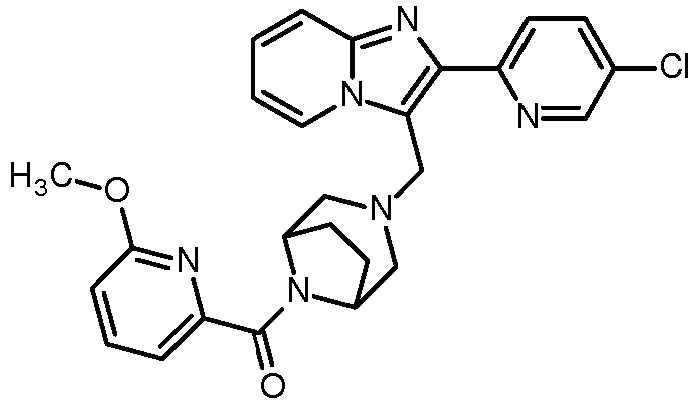
39 mg (0.26 mmol) 6-Methoxypyridin-2-carbonsäure wurden in 1.5 ml DMF gelöst, mit 134 mg (0.35 mmol) 2-(7-Aza-1H-benzotriazol-1-yl)-1,1,3,3-tetramethyluronium-Hexafluorophosphat (HATU) versetzt und 30 min bei Raumtemperatur gerührt. Anschließend wurden 100 mg (0.23 mmol) 3-{[2-(5-Chlorpyridin-2-yl)imidazo[1,2-a]pyridin-3-yl]methyl}-3,8-diazabicyclo[3.2.1]-octan-Dihydrochlorid sowie 200 µl (1.17 mmol) N,N-Diisopropylethylamin hinzugegeben und das Gemisch über Nacht bei Raumtemperatur gerührt. Danach wurde das Reaktionsgemisch direkt über präparative HPLC (Methode 6) in seine Komponenten aufgetrennt. Es wurden 93 mg (0.19 mmol, 81% d. Th.) der Titelverbindung erhalten.39 mg (0.26 mmol) of 6-methoxypyridine-2-carboxylic acid were dissolved in 1.5 ml of DMF, 134 mg (0.35 mmol) of 2-(7-aza- 1H- benzotriazol-1-yl)-1,1,3,3-tetramethyluronium hexafluorophosphate (HATU) were added and the mixture was stirred at room temperature for 30 min. Then 100 mg (0.23 mmol) of 3-{[2-(5-chloropyridin-2-yl)imidazo[1,2-a]pyridin-3-yl]methyl}-3,8-diazabicyclo[3.2.1]octane dihydrochloride and 200 µl (1.17 mmol) of N,N- diisopropylethylamine were added and the mixture was stirred overnight at room temperature. The reaction mixture was then separated into its components directly by preparative HPLC (Method 6). 93 mg (0.19 mmol, 81% of theory) of the title compound were obtained.
LC-MS (Methode 2): Rt = 1.31 min; m/z = 489/491 (M+H)+.LC-MS (Method 2): R t = 1.31 min; m/z = 489/491 (M+H) + .
1H-NMR (400 MHz, DMSO-d6 ): δ [ppm] = 1.62-1.80 (m, 4H), 2.40 (br. d, 1H), 2.46-2.69 (m, 2H, teilweise verdeckt durch DMSO-Signal), 2.76 (br. d, 1H), 3.72 (s, 3H), 4.44-4.64 (m, 4H), 6.91 (d, 1H), 7.02 (td, 1H), 7.30-7.39 (m, 2H), 7.62 (d, 1H), 7.80 (dd, 1H), 8.00 (dd, 1H), 8.19 (d, 1H), 8.57 (d, 1H), 8.66 (d, 1H). 1 H-NMR (400 MHz, DMSO- d 6 ): δ [ppm] = 1.62-1.80 (m, 4H), 2.40 (br. d, 1H), 2.46-2.69 (m, 2H, partially obscured by DMSO signal), 2.76 (br. d, 1H), 3.72 (s, 3H), 4.44-4.64 (m, 4H), 6.91 (d, 1H), 7.02 (dd, 1H), 7.30-7.39 (m, 2H), 7.62 (d, 1H), 7.80 (dd, 1H), 8.00 (dd, 1H), 8.19 (d, 1H), 8.57 (d, 1H), 8.66 (d, 1H).
Analog zu Beispiel 21 und 33 wurden die folgenden Verbindungen aus den jeweils angegebenen Edukten hergestellt:


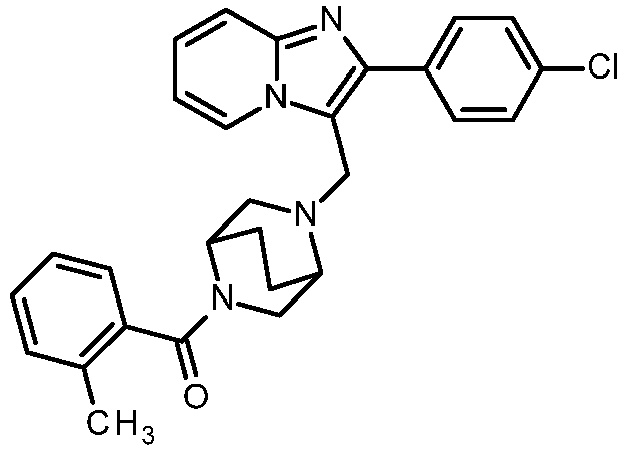


139 mg (0.28 mmol) des racemischen (5-{[2-(6-Isopropylpyridin-3-yl)imidazo[1,2-a]pyridin-3-yl]-methyl}-2,5-diazabicyclo[2.2.2]oct-2-yl)(6-methoxypyridin-2-yl)methanon (Beispiel 27) wurden durch präparative HPLC an chiraler Phase in die Enantiomere aufgetrennt [Säule: YMC Cellulose SC, 5 µm, 250 mm x 20 mm; Elutionsmittel: n-Heptan/Isopropanol 25:75 + 0.2% Diethylamin; Fluss: 15 ml/min; UV-Detektion: 220 nm; Temperatur: 55°C]:139 mg (0.28 mmol) of the racemic (5-{[2-(6-isopropylpyridin-3-yl)imidazo[1,2-a]pyridin-3-yl]-methyl}-2,5-diazabicyclo[2.2.2]oct-2-yl)(6-methoxypyridin-2-yl)methanone (Example 27) were separated into the enantiomers by preparative HPLC on a chiral phase [column: YMC Cellulose SC, 5 µm, 250 mm x 20 mm; eluent: n-heptane/isopropanol 25:75 + 0.2% diethylamine; flow: 15 ml/min; UV detection: 220 nm; temperature: 55°C]:
- Ausbeute: 65 mgYield: 65 mg
- Rt = 14.77 min; chemische Reinheit >99%; >99% eeR t = 14.77 min; chemical purity >99%;>99% ee
- [Säule: Daicel Chiralpak IC, 5 µm, 250 mm x 4.6 mm; Elutionsmittel: Isohexan/Isopropanol 25:75 + 0.2% Diethylamin; Fluss: 1 ml/min; Temperatur: 55°C; UV-Detektion: 235 nm].[Column: Daicel Chiralpak IC, 5 µm, 250 mm x 4.6 mm; eluent: isohexane/isopropanol 25:75 + 0.2% diethylamine; flow: 1 ml/min; temperature: 55°C; UV detection: 235 nm].
- 1H-NMR (400 MHz, DMSO-d6 , δ/ppm): 1.28 (d, 6H), 1.47-2.00 (m, 4H), 2.74 (br. d, 1H), 2.82-2.95 (m, 2H), 3.07 (dt, 1H), 3.39 (br. d, 0.7H), 3.50 (br. d, 0.3H), 3.71-3.81 (m, 3H), 3.84 (s, 0.7H), 3.99 (br. s, 1H), 4.22-4.34 (m, 2H), 4.39 (br. s, 0.3H), 6.84-7.03 (m, 2H), 7.17 (d, 0.7H), 7.27-7.41 (m, 2.3H), 7.62 (d, 1H), 7.73-7.85 (m, 1H), 8.09-8.18 (m, 1H), 8.55-8.65 (m, 1H), 8.88-8.98 (m, 1H). 1 H-NMR (400 MHz, DMSO- d 6 , δ/ppm): 1.28 (d, 6H), 1.47-2.00 (m, 4H), 2.74 (br. d, 1H), 2.82-2.95 (m, 2H ), 3.07 (dt, 1H), 3.39 (br. d, 0.7H), 3.50 (br. d, 0.3H), 3.71-3.81 (m, 3H), 3.84 (s, 0.7H), 3.99 (br. s, 1H), 4.22-4.34 (m, 2H), 4.39 (br. s , 0.3H), 6.84-7.03 (m, 2H), 7.17 (d, 0.7H), 7.27-7.41 (m, 2.3H), 7.62 (d, 1H), 7.73-7.85 (m, 1H), 8.09-8.18 (m, 1H), 8.55-8.65 (m, 1H), 8.88- 8.98 (m, 1H).
- LC-MS (Methode 2): Rt = 1.19 min; m/z = 497 (M+H)+.LC-MS (Method 2): R t = 1.19 min; m/z = 497 (M+H) + .
- Ausbeute: 66 mgYield: 66 mg
- Rt = 19.54 min; chemische Reinheit >99%; >99% eeR t = 19.54 min; chemical purity >99%;>99% ee
- [Säule: Daicel Chiralpak IC, 5 µm, 250 mm x 4.6 mm; Elutionsmittel: Isohexan/Isopropanol 25:75 + 0.2% Diethylamin; Fluss: 1 ml/min; Temperatur: 55°C; UV-Detektion: 235 nm].[Column: Daicel Chiralpak IC, 5 µm, 250 mm x 4.6 mm; eluent: isohexane/isopropanol 25:75 + 0.2% diethylamine; flow: 1 ml/min; temperature: 55°C; UV detection: 235 nm].
- 1H-NMR (400 MHz, DMSO-d6 , δ/ppm): 1.28 (d, 6H), 1.48-2.00 (m, 4H), 2.74 (br. d, 1H), 2.82-2.96 (m, 2H), 3.08 (dt, 1H), 3.39 (br. d, 0.7H), 3.50 (br. d, 0.3H), 3.71-3.81 (m, 3H), 3.84 (s, 0.7H), 4.00 (br. s, 1H), 4.22-4.34 (m, 2H), 4.39 (br. s, 0.3H), 6.85-7.03 (m, 2H), 7.17 (d, 0.7H), 7.27-7.42 (m, 2.3H), 7.62 (d, 1H), 7.74-7.85 (m, 1H), 8.08-8.18 (m, 1H), 8.56-8.65 (m, 1H), 8.88-8.98 (m, 1H). 1 H-NMR (400 MHz, DMSO- d 6 , δ/ppm): 1.28 (d, 6H), 1.48-2.00 (m, 4H), 2.74 (br. d, 1H), 2.82-2.96 (m, 2H ), 3.08 (dt, 1H), 3.39 (br. d, 0.7H), 3.50 (br. d, 0.3H), 3.71-3.81 (m, 3H), 3.84 (s, 0.7H), 4.00 (br. s, 1H), 4.22-4.34 (m, 2H), 4.39 (br. s , 0.3H), 6.85-7.03 (m, 2H), 7.17 (d, 0.7H), 7.27-7.42 (m, 2.3H), 7.62 (d, 1H), 7.74-7.85 (m, 1H), 8.08-8.18 (m, 1H), 8.56-8.65 (m, 1H), 8.88- 8.98 (m, 1H).
- LC-MS (Methode 2): Rt = 1.19 min; m/z = 497 (M+H)+.LC-MS (Method 2): R t = 1.19 min; m/z = 497 (M+H) + .

134 mg (0.26 mmol) des racemischen (3-Fluor-6-methoxypyridin-2-yl)(5-{[2-(6-isopropylpyridin-3-yl)imidazo[1,2-a]pyridin-3-yl]methyl}-2,5-diazabicyclo[2.2.2]oct-2-yl)methanon (Beispiel 28) wurden durch präparative HPLC an chiraler Phase in die Enantiomere aufgetrennt [Säule: YMC Cellulose SC, 5 µm, 250 mm x 20 mm; Elutionsmittel: n-Heptan/Isopropanol 25:75 + 0.2% Diethylamin; Fluss: 15 ml/min; UV-Detektion: 220 nm; Temperatur: 55°C]:134 mg (0.26 mmol) of the racemic (3-fluoro-6-methoxypyridin-2-yl)(5-{[2-(6-isopropylpyridin-3-yl)imidazo[1,2-a]pyridin-3-yl]methyl}-2,5-diazabicyclo[2.2.2]oct-2-yl)methanone (Example 28) were separated into the enantiomers by preparative HPLC on a chiral phase [column: YMC Cellulose SC, 5 µm, 250 mm x 20 mm; eluent: n-heptane/isopropanol 25:75 + 0.2% diethylamine; flow: 15 ml/min; UV detection: 220 nm; temperature: 55°C]:
- Ausbeute: 60 mgYield: 60 mg
- Rt = 15.10 min; chemische Reinheit >99%; >99% eeR t = 15.10 min; chemical purity >99%;>99% ee
- [Säule: Daicel Chiralpak IC, 5 µm, 250 mm x 4.6 mm; Elutionsmittel: Isohexan/Isopropanol 25:75 + 0.2% Diethylamin; Fluss: 1 ml/min; Temperatur: 55°C; UV-Detektion: 235 nm].[Column: Daicel Chiralpak IC, 5 µm, 250 mm x 4.6 mm; eluent: isohexane/isopropanol 25:75 + 0.2% diethylamine; flow: 1 ml/min; temperature: 55°C; UV detection: 235 nm].
- 1H-NMR (400 MHz, DMSO-d6 , δ/ppm): 1.22-1.31 (m, 6H), 1.50-1.99 (m, 4H), 2.65-2.77 (m, 1H), 2.77-2.87 (m, 1.3H), 2.94 (br. s, 0.7H), 3.01-3.18 (m, 1.3H), 3.39-3.51 (m, 1.4H), 3.60 (br. d, 0.3H), 3.68-3.85 (m, 3.7H), 4.20-4.35 (m, 2H), 4.40 (br. s, 0.3H), 6.87-7.03 (m, 2H), 7.27-7.42 (m, 2H), 7.62 (d, 1H), 7.70-7.83 (m, 1H), 8.07-8.18 (m, 1H), 8.55-8.64 (m, 1H), 8.86-8.98 (m, 1H). 1 H-NMR (400 MHz, DMSO- d 6 , δ/ppm): 1.22-1.31 (m, 6H), 1.50-1.99 (m, 4H), 2.65-2.77 (m, 1H), 2.77-2.87 (m , 1.3H), 2.94 (br. s, 0.7H), 3.01-3.18 (m, 1.3H), 3.39-3.51 (m, 1.4H), 3.60 (br. d, 0.3H), 3.68-3.85 (m, 3.7H), 4.20-4.35 (m, 2H), 4.40 (br. s, 0.3H), 6.87-7.03 (m, 2H), 7.27-7.42 (m, 2H), 7.62 (d, 1H), 7.70-7.83 (m, 1H), 8.07-8.18 (m, 1H), 8.55-8.64 (m, 1H), 8.86-8.98 (m, 1H). ).
- LC-MS (Methode 2): Rt = 1.22 min; m/z = 515 (M+H)+.LC-MS (Method 2): R t = 1.22 min; m/z = 515 (M+H) + .
- Ausbeute: 57 mgYield: 57 mg
- Rt = 20.80 min; chemische Reinheit >99%; >99% eeR t = 20.80 min; chemical purity >99%;>99% ee
- [Säule: Daicel Chiralpak IC, 5 µm, 250 mm x 4.6 mm; Elutionsmittel: Isohexan/Isopropanol 25:75 + 0.2% Diethylamin; Fluss: 1 ml/min; Temperatur: 55°C; UV-Detektion: 235 nm].[Column: Daicel Chiralpak IC, 5 µm, 250 mm x 4.6 mm; eluent: isohexane/isopropanol 25:75 + 0.2% diethylamine; flow: 1 ml/min; temperature: 55°C; UV detection: 235 nm].
- 1H-NMR (400 MHz, DMSO-d6 , δ/ppm): 1.21-1.33 (m, 6H), 1.50-1.99 (m, 4H), 2.65-2.77 (m, 1H), 2.77-2.88 (m, 1.3H), 2.94 (br. s, 0.7H), 3.01-3.18 (m, 1.3H), 3.39-3.51 (m, 1.4H), 3.60 (br. d, 0.3H), 3.69-3.86 (m, 3.7H), 4.19-4.34 (m, 2H), 4.39 (br. s, 0.3H), 6.88-7.04 (m, 2H), 7.27-7.41 (m, 2H), 7.62 (d, 1H), 7.70-7.83 (m, 1H), 8.07-8.18 (m, 1H), 8.56-8.64 (m, 1H), 8.87-8.98 (m, 1H). 1 H-NMR (400 MHz, DMSO- d 6 , δ/ppm): 1.21-1.33 (m, 6H), 1.50-1.99 (m, 4H), 2.65-2.77 (m, 1H), 2.77-2.88 (m , 1.3H), 2.94 (br. s, 0.7H), 3.01-3.18 (m, 1.3H), 3.39-3.51 (m, 1.4H), 3.60 (br. d, 0.3H), 3.69-3.86 (m, 3.7H), 4.19-4.34 (m, 2H), 4.39 (br. s, 0.3H), 6.88-7.04 (m, 2H), 7.27-7.41 (m, 2H), 7.62 (d, 1H), 7.70-7.83 (m, 1H), 8.07-8.18 (m, 1H), 8.56-8.64 (m, 1H), 8.87-8.98 (m, 1H). ).
- LC-MS (Methode 2): Rt = 1.22 min; m/z = 515 (M+H)+.LC-MS (Method 2): R t = 1.22 min; m/z = 515 (M+H) + .
Die enantiomerenreine Verbindung aus Beispiel 126 (Enantiomer 1) konnte nach einer alternativen Methode auch folgendermaßen erhalten werden:
- 80 mg (0.47 mmol) 3-Fluor-6-methoxypyridin-2-carbonsäure wurden in 2 ml DMF gelöst, mit 242 mg (0.64 mmol) 2-(7-Aza-1H-benzotriazol-1-yl)-1,1,3,3-tetramethyluronium-Hexafluorophosphat (HATU) versetzt und 30 min bei Raumtemperatur gerührt. Anschließend wurden 200 mg (0.43 mmol) 2-{[2-(6-Isopropylpyridin-3-yl)imidazo[1,2-a]pyridin-3-yl]methyl}-2,5-diazabicyclo-[2.2.2]octan-Dihydrochlorid (Enantiomer 1; Beispiel 32A) sowie 370 µl (2.12 mmol) N,N-Diisopropylethylamin hinzugegeben und das Gemisch über Nacht bei Raumtemperatur gerührt. Danach wurde das Reaktionsgemisch direkt über präparative HPLC (Methode 6) in seine Komponenten aufgetrennt. Es wurden 126 mg (0.24 mmol, 57% d. Th.) der Titelverbindung erhalten.
- [α]D 20 = -92.16° (c = 0.285, Methanol).
- LC-MS (Methode 2): Rt = 1.27 min; m/z = 515 (M+H)+.
- 80 mg (0.47 mmol) of 3-fluoro-6-methoxypyridine-2-carboxylic acid were dissolved in 2 ml of DMF, 242 mg (0.64 mmol) of 2-(7-aza-1H-benzotriazol-1-yl)-1,1,3,3-tetramethyluronium hexafluorophosphate (HATU) were added and the mixture was stirred at room temperature for 30 min. Then 200 mg (0.43 mmol) of 2-{[2-(6-isopropylpyridin-3-yl)imidazo[1,2-a]pyridin-3-yl]methyl}-2,5-diazabicyclo-[2.2.2]octane dihydrochloride (enantiomer 1; Example 32A) and 370 µl (2.12 mmol) of N,N -diisopropylethylamine were added and the mixture was stirred overnight at room temperature. The reaction mixture was separated into its components directly by preparative HPLC (Method 6). 126 mg (0.24 mmol, 57% of theory) of the title compound were obtained.
- [α] D 20 = -92.16° (c = 0.285, methanol).
- LC-MS (Method 2): R t = 1.27 min; m/z = 515 (M+H) + .

121 mg (0.25 mmol) des racemischen (2-Fluorphenyl)(5-{[2-(6-isopropylpyridin-3-yl)imidazo-[1,2-a]pyridin-3-yl]methyl}-2,5-diazabicyclo[2.2.2]oct-2-yl)methanon (Beispiel 68) wurden durch präparative HPLC an chiraler Phase in die Enantiomere aufgetrennt [Säule: YMC Cellulose SC, 5 µm, 250 mm x 20 mm; Elutionsmittel: n-Heptan/Isopropanol 25:75 + 0.2% Diethylamin; Fluss: 15 ml/min; UV-Detektion: 220 nm; Temperatur: 55°C]:121 mg (0.25 mmol) of the racemic (2-fluorophenyl)(5-{[2-(6-isopropylpyridin-3-yl)imidazo-[1,2-a]pyridin-3-yl]methyl}-2,5-diazabicyclo[2.2.2]oct-2-yl)methanone (Example 68) were separated into the enantiomers by preparative HPLC on a chiral phase [column: YMC Cellulose SC, 5 µm, 250 mm x 20 mm; eluent: n-heptane/isopropanol 25:75 + 0.2% diethylamine; flow: 15 ml/min; UV detection: 220 nm; temperature: 55°C]:
- Ausbeute: 57 mgYield: 57 mg
- Rt = 14.26 min; chemische Reinheit >99%; >99% eeR t = 14.26 min; chemical purity >99%;>99% ee
- [Säule: Daicel Chiralpak IC, 5 µm, 250 mm x 4.6 mm; Elutionsmittel: Isohexan/Isopropanol 25:75 + 0.2% Diethylamin; Fluss: 1 ml/min; Temperatur: 55°C; UV-Detektion: 235 nm].[Column: Daicel Chiralpak IC, 5 µm, 250 mm x 4.6 mm; eluent: isohexane/isopropanol 25:75 + 0.2% diethylamine; flow: 1 ml/min; temperature: 55°C; UV detection: 235 nm].
- 1H-NMR (400 MHz, DMSO-d6 , δ/ppm): 1.24-1.32 (m, 6H), 1.48-1.98 (m, 4H), 2.65-2.89 (m, 2.3H), 2.94 (br. s, 0.7H), 3.00-3.16 (m, 1.3H), 3.28-3.36 (m, 0.7H, teilweise verdeckt durch Wasser-Signal), 3.39-3.50 (m, 1H), 3.78 (br. d, 0.7H), 4.20-4.33 (m, 2H), 4.39 (br. s, 0.3H), 6.94-7.03 (m, 1H), 7.19-7.53 (m, 6H), 7.58-7.65 (m, 1H), 8.08-8.18 (m, 1H), 8.55-8.64 (m, 1H), 8.90 (d, 0.3H), 8.94 (d, 0.7H). 1 H-NMR (400 MHz, DMSO- d 6 , δ/ppm): 1.24-1.32 (m, 6H), 1.48-1.98 (m, 4H), 2.65-2.89 (m, 2.3H), 2.94 (br. s, 0.7H), 3.00-3.16 (m, 1.3H), 3.28-3.36 (m, 0.7H, partially obscured by water signal), 3.39-3.50 (m, 1H), 3.78 (br. d, 0.7H), 4.20-4.33 (m, 2H), 4.39 (br. s , 0.3H), 6.94-7.03 (m, 1H), 7.19-7.53 (m, 6H), 7.58-7.65 (m, 1H), 8.08-8.18 (m, 1H), 8.55-8.64 (m, 1H), 8.90 (d, 0.3H), 8.94 (d, 0.7H).
- LC-MS (Methode 1): Rt = 0.68 min; m/z = 484 (M+H)+.LC-MS (Method 1): R t = 0.68 min; m/z = 484 (M+H) + .
- Ausbeute: 60 mgYield: 60 mg
- Rt = 23.23 min; chemische Reinheit >99%; >99% eeR t = 23.23 min; chemical purity >99%;>99% ee
- [Säule: Daicel Chiralpak IC, 5 µm, 250 mm x 4.6 mm; Elutionsmittel: Isohexan/Isopropanol 25:75 + 0.2% Diethylamin; Fluss: 1 ml/min; Temperatur: 55°C; UV-Detektion: 235 nm].[Column: Daicel Chiralpak IC, 5 µm, 250 mm x 4.6 mm; eluent: isohexane/isopropanol 25:75 + 0.2% diethylamine; flow: 1 ml/min; temperature: 55°C; UV detection: 235 nm].
- 1H-NMR (400 MHz, DMSO-d6 , δ/ppm): 1.22-1.32 (m, 6H), 1.52-1.97 (m, 4H), 2.65-2.89 (m, 2.3H), 2.94 (br. s, 0.7H), 3.01-3.14 (m, 1.3H), 3.27-3.36 (m, 0.7H, teilweise verdeckt durch Wasser-Signal), 3.39-3.49 (m, 1H), 3.78 (br. d, 0.7H), 4.21-4.33 (m, 2H), 4.39 (br. s, 0.3H), 6.93-7.04 (m, 1H), 7.18-7.53 (m, 6H), 7.58-7.65 (m, 1H), 8.08-8.18 (m, 1H), 8.55-8.64 (m, 1H), 8.90 (d, 0.3H), 8.94 (d, 0.7H). 1 H-NMR (400 MHz, DMSO- d 6 , δ/ppm): 1.22-1.32 (m, 6H), 1.52-1.97 (m, 4H), 2.65-2.89 (m, 2.3H), 2.94 (br. s, 0.7H), 3.01-3.14 (m, 1.3H), 3.27-3.36 (m, 0.7H, partially obscured by water signal), 3.39-3.49 (m, 1H), 3.78 (br. d, 0.7H), 4.21-4.33 (m, 2H), 4.39 (br. s , 0.3H), 6.93-7.04 (m, 1H), 7.18-7.53 (m, 6H), 7.58-7.65 (m, 1H), 8.08-8.18 (m, 1H), 8.55-8.64 (m, 1H), 8.90 (d, 0.3H), 8.94 (d, 0.7H).
- LC-MS (Methode 1): Rt = 0.67 min; m/z = 484 (M+H)+.LC-MS (Method 1): R t = 0.67 min; m/z = 484 (M+H) + .
Analog zu den Beispielen 1-4 wurden auch die folgenden Verbindungen aus den jeweils angegebenen Edukten hergestellt:


4700 mg (10.38 mmol) des racemischen tert.-Butyl-5-{[2-(6-isopropylpyridin-3-yl)imidazo[1,2-a]-pyridin-3-yl]methyl}-2,5-diazabicyclo[2.2.2]octan-2-carboxylats (Beispiel 3) wurden durch präparative HPLC an chiraler Phase in die Enantiomere aufgetrennt [Säule: Daicel Chiralpak IG, 5 µm, 250 mm x 20 mm; Elutionsmittel: Isohexan/Isopropanol 50:50 + 0.2% Diethylamin; Fluss: 15 ml/ min; UV-Detektion: 220 nm; Temperatur: 50°C]:4700 mg (10.38 mmol) of the racemic tert. -butyl 5-{[2-(6-isopropylpyridin-3-yl)imidazo[1,2-a]-pyridin-3-yl]methyl}-2,5-diazabicyclo[2.2.2]octane-2-carboxylate (Example 3) were separated into the enantiomers by preparative HPLC on a chiral phase [column: Daicel Chiralpak IG, 5 µm, 250 mm x 20 mm; eluent: isohexane/isopropanol 50:50 + 0.2% diethylamine; flow: 15 ml/min; UV detection: 220 nm; temperature: 50°C]:
- Ausbeute: 2310 mgYield: 2310 mg
- Rt = 8.97 min; chemische Reinheit >99%; >99% eeR t = 8.97 min; chemical purity >99%;>99% ee
- [Säule: Daicel Chiralpak IF, 5 µm, 250 mm x 4.6 mm; Elutionsmittel: Isohexan/Isopropanol 60:40 + 0.2% Diethylamin; Fluss: 1 ml/min; Temperatur: 40°C; UV-Detektion: 235 nm].[Column: Daicel Chiralpak IF, 5 µm, 250 mm x 4.6 mm; eluent: isohexane/isopropanol 60:40 + 0.2% diethylamine; flow: 1 ml/min; temperature: 40°C; UV detection: 235 nm].
- 1H-NMR (400 MHz, DMSO-d6 , δ/ppm): 1.28 (d, 6H), 1.36 (2s, 9H), 1.43-1.56 (m, 1H), 1.57-1.74 (m, 2H), 1.79-1.92 (m, 1H), 2.65-2.82 (m, 3H), 3.01-3.19 (m, 2H), 3.53 (dd, 1H), 3.81 (br. d, 1H), 4.17-4.28 (m, 2H), 6.98 (t, 1H), 7.31 (t, 1H), 7.38 (d, 1H), 7.61 (d, 1H), 8.09-8.16 (m, 1H), 8.58 (d, 1H), 8.92 (dd, 1H). 1 H-NMR (400 MHz, DMSO- d 6 , δ/ppm): 1.28 (d, 6H), 1.36 (2s, 9H), 1.43-1.56 (m, 1H), 1.57-1.74 (m, 2H), 1.79-1.92 (m, 1H), 2.65-2.82 (m, 3H), 3.01-3.19 (m, 2H), 3.53 (dd, 1H), 3.81 (br. d, 1H), 4.17-4.28 (m, 2H), 6.98 (t, 1H), 7.31 (t, 1H) , 7.38 (d, 1H), 7.61 (d, 1H), 8.09-8.16 (m, 1H), 8.58 (d, 1H), 8.92 (dd, 1H).
- LC-MS (Methode 2): Rt = 1.44 min; m/z = 462 (M+H)+.LC-MS (Method 2): R t = 1.44 min; m/z = 462 (M+H) + .
- [α]D 20 = +8.89° (c = 0.270, Methanol).[α] D 20 = +8.89° (c = 0.270, methanol).
- Ausbeute: 2110 mgYield: 2110 mg
- Rt = 7.28 min; chemische Reinheit >99%; >99% eeR t = 7.28 min; chemical purity >99%;>99% ee
- [Säule: Daicel Chiralpak IF, 5 µm, 250 mm x 4.6 mm; Elutionsmittel: Isohexan/Isopropanol 60:40 + 0.2% Diethylamin; Fluss: 1 ml/min; Temperatur: 40°C; UV-Detektion: 235 nm].[Column: Daicel Chiralpak IF, 5 µm, 250 mm x 4.6 mm; eluent: isohexane/isopropanol 60:40 + 0.2% diethylamine; flow: 1 ml/min; temperature: 40°C; UV detection: 235 nm].
- 1H-NMR (400 MHz, DMSO-d6 , δ/ppm): 1.28 (d, 6H), 1.36 (2s, 9H), 1.43-1.56 (m, 1H), 1.57-1.74 (m, 2H), 1.79-1.92 (m, 1H), 2.65-2.82 (m, 3H), 3.01-3.19 (m, 2H), 3.53 (dd, 1H), 3.81 (br. d, 1H), 4.17-4.28 (m, 2H), 6.98 (t, 1H), 7.31 (t, 1H), 7.38 (d, 1H), 7.61 (d, 1H), 8.09-8.16 (m, 1H), 8.58 (d, 1H), 8.92 (dd, 1H). 1 H-NMR (400 MHz, DMSO- d 6 , δ/ppm): 1.28 (d, 6H), 1.36 (2s, 9H), 1.43-1.56 (m, 1H), 1.57-1.74 (m, 2H), 1.79-1.92 (m, 1H), 2.65-2.82 (m, 3H), 3.01-3.19 (m, 2H), 3.53 (dd, 1H), 3.81 (br. d, 1H), 4.17-4.28 (m, 2H), 6.98 (t, 1H), 7.31 (t, 1H) , 7.38 (d, 1H), 7.61 (d, 1H), 8.09-8.16 (m, 1H), 8.58 (d, 1H), 8.92 (dd, 1H).
- LC-MS (Methode 2): Rt = 1.44 min; m/z = 462 (M+H)+.LC-MS (Method 2): R t = 1.44 min; m/z = 462 (M+H) + .
- [α]D 20 = -10.53° (c = 0.285, Methanol).[α] D 20 = -10.53° (c = 0.285, methanol).
Analog zu Beispiel 21 und 33 wurden auch die folgenden Verbindungen aus den jeweils angegebenen Edukten hergestellt:


8.5 mg (0.10 mmol) Isopropylisocyanat wurden in einer Vertiefung einer 96er-Multititerplatte vorgelegt und auf 0°C gekühlt. Separat wurden 42.6 mg (0.10 mmol) 3-{[2-(4-Chlorphenyl)imidazo-[1,2-a]pyridin-3-yl]methyl}-3,8-diazabicyclo[3.2.1]octan-Dihydrochlorid in 0.8 ml 1,2-Dichlorethan gelöst, mit 0.052 ml (0.3 mmol) N,N-Diisopropylethylamin versetzt und auf 8°C gekühlt. Die beiden Lösungen wurden auf der Multititerplatte vereint und zunächst 1 h bei 0°C geschüttelt. Anschließend wurde auf RT erwärmen gelassen und weiter bei RT über Nacht geschüttelt. Danach wurde das Lösungsmittel mittels Zentrifugaltrockner vollständig entfernt. Der Rückstand wurde in 0.6 ml DMF gelöst, filtriert und das Filtrat per präparativer LC-MS nach einer der folgenden Methoden in seine Komponenten aufgetrennt:
- Instrument MS: Waters, Instrument HPLC: Waters; Säule: Waters X-Bridge C18, 19 mm x 50 mm, 5 µm; Eluent A: Wasser + 0.375% Ammoniak, Eluent B: Acetonitril + 0.375% Ammoniak, mit Eluentengradient; Fluss: 40 ml/min; UV-Detektion: DAD, 210-400 nm
bzw. - Instrument MS: Waters, Instrument HPLC: Waters; Säule: Phenomenex Luna 5µ C18(2) 100A, AXIA Tech., 50 mm x 21.2 mm; Eluent A: Wasser + 0.0375% Ameisensäure, Eluent B: Acetonitril + 0.0375% Ameisensäure, mit Eluentengradient; Fluss: 40 ml/min; UV-Detektion: DAD, 210-400 nm.
- Es wurden so 2.8 mg (6% d. Th., Reinheit 100%) der Titelverbindung erhalten.
- LC-MS (Methode 7, ESIpos): Rt = 0.85 min; m/z = 438 (M+H)+.
- Instrument MS: Waters, Instrument HPLC: Waters; Column: Waters X-Bridge C18, 19 mm x 50 mm, 5 µm; Eluent A: water + 0.375% ammonia, Eluent B: acetonitrile + 0.375% ammonia, with eluent gradient; Flow: 40 ml/min; UV detection: DAD, 210-400 nm
or - Instrument MS: Waters, Instrument HPLC: Waters; Column: Phenomenex Luna 5µ C18(2) 100A, AXIA Tech., 50 mm x 21.2 mm; Eluent A: water + 0.0375% formic acid, Eluent B: acetonitrile + 0.0375% formic acid, with eluent gradient; Flow: 40 ml/min; UV detection: DAD, 210-400 nm.
- Thus, 2.8 mg (6% of theory, purity 100%) of the title compound were obtained.
- LC-MS (Method 7, ESIpos): R t = 0.85 min; m/z = 438 (M+H) + .
Auf zu Beispiel 154 analoge, parallel-synthetische Weise wurden die folgenden Verbindungen ausgehend von 3-{[2-(4-Chlorphenyl)imidazo[1,2-a]pyridin-3-yl]methyl}-3,8-diazabicyclo[3.2.1]-octan-Dihydrochlorid (bei Beispielen 155-167 und 170-187) oder 7-{[2-(4-Chlorphenyl)imidazo-[1,2-a]pyridin-3-yl]methyl}-3-oxa-7,9-diazabicyclo[3.3.1]nonan-Dihydrochlorid (bei Beispielen 168, 169 und 188-198) und dem entsprechenden Isocyanat, Carbamoylchlorid bzw. Chlorformiat hergestellt:


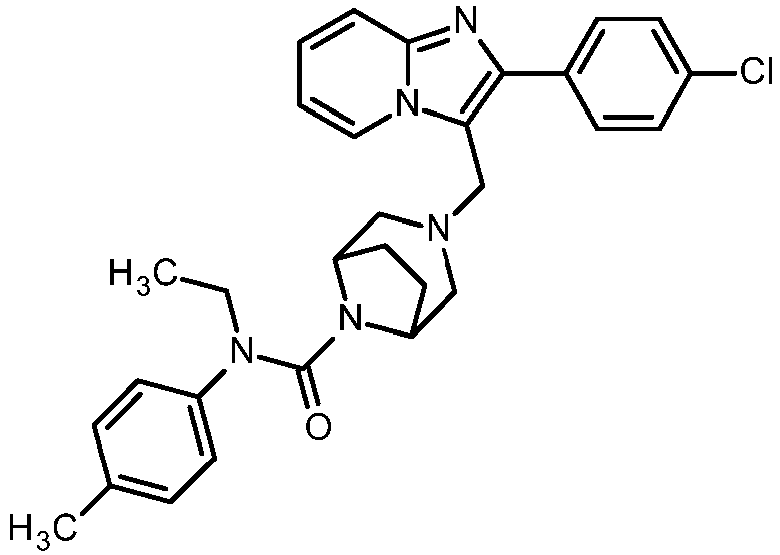
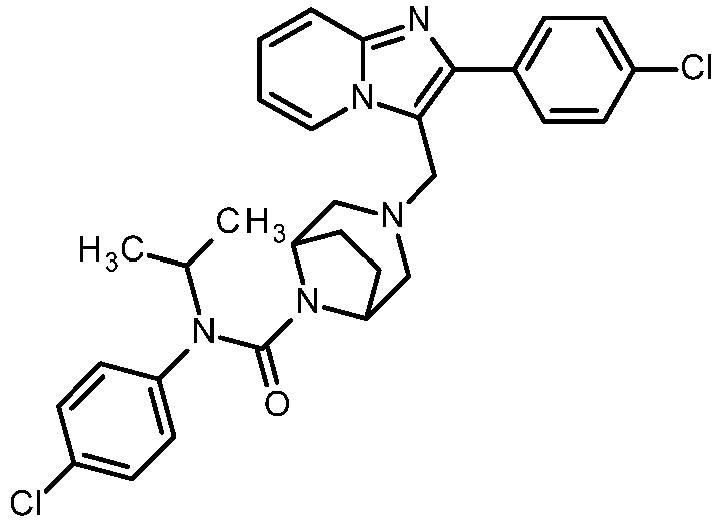


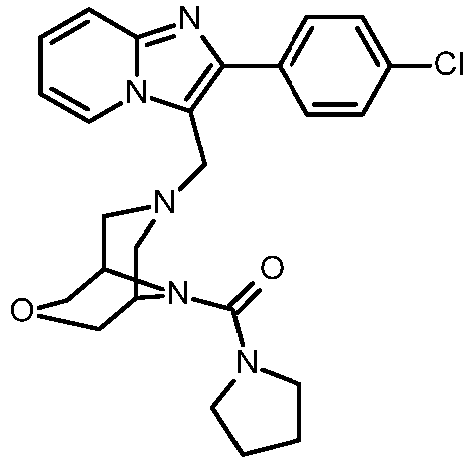


Analog zu Beispiel 21 und 33 wurde die folgende Verbindung aus den angegebenen Edukten hergestellt:


45 mg (0.24 mmol) 6-(Difluormethoxy)pyridin-2-carbonsäure wurden in 1.5 ml DMF gelöst, mit 123 mg (0.32 mmol) 2-(7-Aza-1H-benzotriazol-1-yl)-1,1,3,3-tetramethyluronium-Hexafluorophosphat (HATU) versetzt und 30 min bei Raumtemperatur gerührt. Anschließend wurden 100 mg 2-{[2-(5-Chlorpyridin-2-yl)imidazo[1,2-a]pyridin-3-yl]methyl}-2,5-diazabicyclo[2.2.2]octan-Dihydrochlorid (Enantiomer 1) sowie 190 µl (1.08 mmol) N,N-Diisopropylethylamin hinzugefügt und das Gemisch über Nacht bei Raumtemperatur gerührt. Danach wurde das Reaktionsgemisch direkt über präparative HPLC (Methode 6) in seine Komponenten aufgetrennt. Es wurden 79 mg (0.15 mmol, 70% d. Th.) der Titelverbindung erhalten.45 mg (0.24 mmol) of 6-(difluoromethoxy)pyridine-2-carboxylic acid were dissolved in 1.5 ml of DMF, 123 mg (0.32 mmol) of 2-(7-aza-1H-benzotriazol-1-yl)-1,1,3,3-tetramethyluronium hexafluorophosphate (HATU) were added and the mixture was stirred at room temperature for 30 min. Then 100 mg of 2-{[2-(5-chloropyridin-2-yl)imidazo[1,2-a]pyridin-3-yl]methyl}-2,5-diazabicyclo[2.2.2]octane dihydrochloride (enantiomer 1) and 190 µl (1.08 mmol) of N,N -diisopropylethylamine were added and the mixture was stirred at room temperature overnight. The reaction mixture was then separated into its components directly by preparative HPLC (Method 6). 79 mg (0.15 mmol, 70% of theory) of the title compound were obtained.
LC-MS (Methode 2): Rt = 1.29 min; m/z = 525/527 [M+H]+.LC-MS (Method 2): R t = 1.29 min; m/z = 525/527 [M+H] + .
1H-NMR (400 MHz, DMSO-d6): δ [ppm] = 1.51-2.08 (m, 4H), 2.73 (br. s, 0.25H), 2.85-2.94 (m, 1.5H), 2.98-3.10 (m, 1.25H), 3.38 (dd, 0.75H), 3.49 (d, 0.25H), 3.78-4.05 (m, 1.75H), 4.41 (br. s, 0.25H), 4.56-4.79 (m, 2H), 6.94-7.05 (m, 1H), 7.15-7.25 (m, 1H), 7.30-7.39 (m, 1.25H), 7.45-7.87 (m, 2.75H), 7.95-8.12 (m, 2H), 8.17-8.26 (m, 1H), 8.45 (d, 0.25H), 8.47-8.53 (m, 1H), 8.65 (d, 0.75H). 1 H-NMR (400 MHz, DMSO-d 6 ): δ [ppm] = 1.51-2.08 (m, 4H), 2.73 (br. s, 0.25H), 2.85-2.94 (m, 1.5H), 2.98- 3.10 (m, 1.25H), 3.38 (dd, 0.75H), 3.49 (d, 0.25H), 3.78-4.05 (m, 1.75H), 4.41 (br. s, 0.25H), 4.56-4.79 (m, 2H), 6.94-7.05 (m, 1H), 7.15-7.25 (m, 1H), 7.30-7.39 (m, 1.25H), 7.45-7.87 (m, 2.75H), 7.95-8.12 (m, 2H), 8.17-8.26 (m, 1H), 8.45 (d, 0.25H), 8.47-8.53 (m, 1H), 8.65 (d, 0.75 H).
Die pharmakologische Aktivität der erfindungsgemäßen Verbindungen kann durch in vitro- und in vivo-Untersuchungen, wie sie dem Fachmann bekannt sind, nachgewiesen werden. Die nachfolgenden Anwendungsbeispiele beschreiben die biologische Wirkung der erfindungsgemäßen Verbindungen, .The pharmacological activity of the compounds according to the invention can be demonstrated by in vitro and in vivo tests as are known to the person skilled in the art. The following application examples describe the biological action of the compounds according to the invention.
Xenopus laevis-Oozyten wurden selektioniert wie andernorts beispielhaft beschrieben [
In der folgenden Tabelle 1 ist die in diesem Test bestimmte halbmaximale Inhibition der humanen TASK-1- und TASK-3-Kanäle (IC50-Wert) durch repräsentative Ausführungsbeispiele der Erfindung aufgeführt:
Aus den Daten in Tabelle 1 ist ersichtlich, dass eine Blockade sowohl an TASK-1 als auch an TASK-3 erreicht wird. Die Ergebnisse in Tabelle 1 belegen somit den Wirkmechanismus der erfindungsgemäßen Verbindungen als duale TASK-1/3-Inhibitoren.From the data in Table 1 it is evident that blockade is achieved at both TASK-1 and TASK-3. The results in Table 1 thus demonstrate the mechanism of action of the compounds of the invention as dual TASK-1/3 inhibitors.
Die Untersuchungen zur Inhibition der rekombinanten TASK-1- und TASK-3-Kanäle wurden an stabil transfizierten CHO-Zellen durchgeführt. Die erfindungsgemäßen Verbindungen wurden hierbei unter Applikation von 40 mM Kaliumchlorid in Anwesenheit eines spannungssensitiven Farbstoffes nach der in folgenden Referenzen im Detail beschriebenen Methode getestet [
In der folgenden Tabelle 2 sind die zu individuellen Ausführungsbeispielen der Erfindung ermittelten IC50-Werte aus diesem Assay aufgeführt (zum Teil als Mittelwerte aus mehreren unabhängigen Einzelbestimmungen):
Aus den Daten in Tabelle 2 ist ersichtlich, dass eine Blockade sowohl an TASK-1 als auch an TASK-3 erreicht wird. Die Ergebnisse in Tabelle 2 belegen somit den Wirkmechanismus der erfindungsgemäßen Verbindungen als duale TASK-1/3-Inhibitoren.From the data in Table 2 it is evident that blockade is achieved at both TASK-1 and TASK-3. The results in Table 2 thus demonstrate the mechanism of action of the compounds of the invention as dual TASK-1/3 inhibitors.
Durch den Einsatz von negativem Druck kann bei anästhesierten, spontan-atmenden Schweinen ein Kollaps und damit ein Verschluss der oberen Atemwege ausgelöst werden [
Für das Modell werden Deutsche Landschweine verwendet. Die Schweine werden anästhesiert und tracheotomiert. In den rostralen und kaudalen Teil der Trachea wird jeweils eine Kanüle eingebunden. Die rostrale Kanüle wird mittels eines T-Stückes einerseits mit einem Gerät verbunden, welches negative Drücke generiert, und andererseits mit der kaudalen Kanüle. Die kaudale Kanüle ist mittels eines T-Stückes mit der rostralen Kanüle verbunden sowie mit einem Schlauch, der unter Umgehung der oberen Atemwege eine spontane Atmung erlaubt. Durch entsprechendes Verschließen und Öffnen der Schläuche ist es so möglich, dass das Schwein von einer normalen Nasenatmung zu einer Atmung über die kaudale Kanüle wechseln kann, während die oberen Atemwege isoliert und mit dem Gerät zur Erzeugung der negativen Drücke verbunden sind. Die Muskelaktivität des Musculus genioglossus wird mittels Elektromyogramm (EMG) registriert.German Landpigs are used for the model. The pigs are anesthetized and tracheotomized. A cannula is inserted into the rostral and caudal part of the trachea. The rostral cannula is connected to a device that generates negative pressures and to the caudal cannula using a T-piece. The caudal cannula is connected to the rostral cannula and to a tube that allows spontaneous breathing while bypassing the upper airways. By closing and opening the tubes accordingly, it is possible for the pig to switch from normal nasal breathing to breathing via the caudal cannula, while the upper airways are isolated and connected to the device that generates the negative pressures. The muscle activity of the genioglossus muscle is recorded using an electromyogram (EMG).
Zu bestimmten Zeitpunkten wird die Kollapsibilität der oberen Atemwege getestet, indem das Schwein über die kaudale Kanüle atmet und an die oberen Atemwege Unterdrücke von -50, -100 und -150 cm Wassersäule (cmH2O) angelegt werden. Hierdurch kollabieren die oberen Atemwege, was durch Unterbrechung des Luftstroms und einen Druckabfall im Schlauchsystem angezeigt wird. Dieser Test wird durchgeführt vor Gabe der Testsubstanz und in bestimmten Abständen nach Gabe die Testsubstanz. Eine entsprechend wirksame Testsubstanz kann diesen Kollaps der Atemwege in der inspiratorischen Phase verhindern.The collapsibility of the upper airways is tested at specific times by having the pig breathe through the caudal cannula and applying negative pressures of -50, -100 and -150 cm water column (cmH 2 O) to the upper airways. This causes the upper airways to collapse, which is indicated by an interruption of the air flow and a drop in pressure in the tube system. This test is carried out before the test substance is administered and at specific intervals after the test substance is administered. A suitably effective test substance can prevent this collapse of the airways in the inspiratory phase.
Nach dem Wechsel von nasaler Atmung zur Atmung durch die kaudale Kanüle ist keine EMG-Aktivität des Musculus genioglossus beim anästhesierten Schwein messbar. Als ein weiterer Test wird dann der Unterdruck ermittelt, bei dem die EMG-Aktivität wieder einsetzt. Dieser Schwellenwert wird bei Wirksamkeit einer Testsubstanz zu positiveren Werten verschoben. Die Untersuchung wird ebenfalls vor Gabe der Testsubstanz und zu bestimmten Zeitpunkten nach Gabe der Testsubstanz durchgeführt. Die Gabe der Testsubstanz kann intranasal, intravenös, subkutan, intraperitoneal oder intragastral erfolgen.After switching from nasal breathing to breathing through the caudal cannula, no EMG activity of the genioglossus muscle can be measured in the anesthetized pig. A further test is then used to determine the negative pressure at which EMG activity starts again. This threshold value is shifted to more positive values if a test substance is effective. The test is also carried out before the test substance is administered and at certain times after the test substance is administered. The test substance can be administered intranasally, intravenously, subcutaneously, intraperitoneally or intragastrically.
Xenopus laevis-Oozyten wurden aus Tieren gewonnen, die mit Tricain anästhetisiert waren. Ovarien wurden mit Kollagenase behandelt (1 mg/ml, Worthington, Typ II), in OR2-Lösung (82.5 mM NaCl, 2 mM KCl, 1 mM MgCl2, 5 mM HEPES; pH 7.4) für 120 min gelagert und anschließend in der Messlösung ND96 (96 mM NaCl, 2 mM KCl, 1.8 mM CaCl2, 1 mM MgCl2, 5 mM HEPES; pH 7.5) mit zusätzlichem Natriumpyruvat (275 mg/l), Theophyllin (90 mg/l) and Gentamicin (50 mg/l) bei 18°C aufbewahrt. hTASK-1 und hTASK-3 wurden in den pSGEM-Vektor subkloniert, und cRNA wurde nach Linearisierung mit NHEI und in vitro-Transkription mit T7-Polymerase hergestellt. Oozyten wurden einzeln mit 5-20 ng cRNA-Lösung, die hTASK-1 codiert, injiziert. Standard-Zwei-Elektroden-Voltage-Clamp-Aufnahmen [
Zuvor wurden die TASK-1-Kanäle durch Gabe einer der erfindungsgemäßen Verbindungen um einen Wert von etwa 40% inhibiert. Dabei wurden die in der unten stehenden Tabelle 3 gezeigten Konzentrationen eingestellt, die zuvor durch Bestimmung der betreffenden IC50-Werte ermittelt worden waren. Anschließend wurde im Voltage Clamp über mindestens eine Stunde die Wiederherstellung des TASK-1-bedingten Membranstroms aufgezeichnet. Diese Wiederherstellung ist durch das Auswaschen der betreffenden Verbindung vom TASK-1-Kanal bedingt.The TASK-1 channels were previously inhibited by a value of about 40% by administering one of the compounds according to the invention. The concentrations shown in Table 3 below were set, which had previously been determined by determining the relevant IC 50 values. The restoration of the TASK-1-related membrane current was then recorded in the voltage clamp for at least one hour. This restoration is due to the washing out of the relevant compound from the TASK-1 channel.
Pro Verbindung wurden mindestens 6 Oozyten untersucht. Die Voltage-Clamp-Messungen dauerten insgesamt mindestens 1.5 Stunden (Gabe des Inhibitors plus anschließende mindestens einstündige Auswasch-Messung). Oozyten, die während der Messung Leckagen zeigten, wurden verworfen; in den in Tabelle 3 dargestellten Ergebnissen wurden lediglich solche Oozyten berücksichtigt, die über die gesamte Messung stabil waren.
Die erfindungsgemäßen Verbindungen können folgendermaßen in pharmazeutische Zubereitungen überführt werden:The compounds according to the invention can be converted into pharmaceutical preparations as follows:
100 mg der erfindungsgemäßen Verbindung, 50 mg Lactose (Monohydrat), 50 mg Maisstärke (nativ), 10 mg Polyvinylpyrrolidon (PVP 25) (Fa. BASF, Ludwigshafen, Deutschland) und 2 mg Magnesiumstearat.100 mg of the compound according to the invention, 50 mg lactose (monohydrate), 50 mg corn starch (native), 10 mg polyvinylpyrrolidone (PVP 25) (BASF, Ludwigshafen, Germany) and 2 mg magnesium stearate.
Tablettengewicht 212 mg. Durchmesser 8 mm, Wölbungsradius 12 mm.Tablet weight 212 mg. Diameter 8 mm, curvature radius 12 mm.
Die Mischung aus erfindungsgemäßer Verbindung, Lactose und Stärke wird mit einer 5%-igen Lösung (m/m) des PVPs in Wasser granuliert. Das Granulat wird nach dem Trocknen mit dem Magnesiumstearat 5 Minuten gemischt. Diese Mischung wird mit einer üblichen Tablettenpresse verpresst (Format der Tablette siehe oben). Als Richtwert für die Verpressung wird eine Presskraft von 15 kN verwendet.The mixture of the compound according to the invention, lactose and starch is granulated with a 5% solution (m/m) of PVP in water. After drying, the granules are mixed with the magnesium stearate for 5 minutes. This mixture is pressed using a standard tablet press (tablet format see above). A pressing force of 15 kN is used as a guideline for the pressing.
1000 mg der erfindungsgemäßen Verbindung, 1000 mg Ethanol (96%), 400 mg Rhodigel® (Xanthan gum der Firma FMC, Pennsylvania, USA) und 99 g Wasser.1000 mg of the compound according to the invention, 1000 mg ethanol (96%), 400 mg Rhodigel ® (xanthan gum from FMC, Pennsylvania, USA) and 99 g water.
Einer Einzeldosis von 100 mg der erfindungsgemäßen Verbindung entsprechen 10 ml orale Suspension.A single dose of 100 mg of the compound according to the invention corresponds to 10 ml of oral suspension.
Das Rhodigel wird in Ethanol suspendiert, die erfindungsgemäße Verbindung wird der Suspension zugefügt. Unter Rühren erfolgt die Zugabe des Wassers. Bis zum Abschluß der Quellung des Rhodigels wird ca. 6 h gerührt.The Rhodigel is suspended in ethanol and the compound according to the invention is added to the suspension. The water is added while stirring. Stir for about 6 hours until the Rhodigel has finished swelling.
500 mg der erfindungsgemäßen Verbindung, 2.5 g Polysorbat und 97 g Polyethylenglycol 400. Einer Einzeldosis von 100 mg der erfindungsgemäßen Verbindung entsprechen 20 g orale Lösung.500 mg of the compound according to the invention, 2.5 g polysorbate and 97 g polyethylene glycol 400. A single dose of 100 mg of the compound according to the invention corresponds to 20 g oral solution.
Die erfindungsgemäße Verbindung wird in der Mischung aus Polyethylenglycol und Polysorbat unter Rühren suspendiert. Der Rührvorgang wird bis zur vollständigen Auflösung der erfindungsgemäßen Verbindung fortgesetzt.The compound according to the invention is suspended in the mixture of polyethylene glycol and polysorbate while stirring. The stirring process is continued until the compound according to the invention has completely dissolved.
Die erfindungsgemäße Verbindung wird in einer Konzentration unterhalb der Sättigungslöslichkeit in einem physiologisch verträglichen Lösungsmittel (z.B. isotonische Kochsalzlösung, Glucoselösung 5% und/oder PEG 400-Lösung 30%) gelöst. Die Lösung wird steril filtriert und in sterile und pyrogenfreie Injektionsbehältnisse abgefüllt.The compound according to the invention is dissolved in a physiologically acceptable solvent (e.g. isotonic saline solution, glucose solution 5% and/or PEG 400 solution 30%) at a concentration below the saturation solubility. The solution is sterile filtered and filled into sterile and pyrogen-free injection containers.
Die erfindungsgemäße Verbindung wird in einer Konzentration unterhalb der Sättigungslöslichkeit in einem physiologisch verträglichen Lösungsmittel (z.B. gereinigtes Wasser, Phosphatpuffer, Citratpuffer) gelöst. Die Lösung kann weitere Zusätze zur Isotonisierung, zur Konservierung, zur Einstellung des pH-Wertes, zur Verbesserung der Löslichkeit und/oder zur Stabilisierung enthalten.The compound according to the invention is dissolved in a physiologically acceptable solvent (e.g. purified water, phosphate buffer, citrate buffer) at a concentration below the saturation solubility. The solution can contain further additives for isotonication, preservation, pH adjustment, improvement of solubility and/or stabilization.
Claims (12)
- Compound of the formula (I)
 the ring Q is a diazaheterobicyclic system of the formula
 in which * denotes the bond to the adjacent methylene group and ** the bond to the carbonyl group,A and D are each CH or one of these ring members is CH and the other is N,R1 is halogen, cyano, (C1-C4)-alkyl, cyclopropyl or cyclobutyl,where (C1-C4)-alkyl may be up to trisubstituted by fluorine and cyclopropyl and cyclobutyl may be up to disubstituted by fluorine, andR2 is (C4-C6) -cycloalkyl in which a ring CH2 group may be replaced by -O-,
orR2 is a phenyl group of the formula (a), a pyridyl group of the formula (b) or (c) or an azole group of the formula (d) in which *** marks the bond to the adjacent carbonyl group andR3 is hydrogen, fluorine, chlorine, bromine or methyl,R4 is hydrogen, fluorine, chlorine, bromine, cyano, (C1-C3)-alkyl or (C1-C3)-alkoxy,where (C1-C3)-alkyl and (C1-C3)-alkoxy may be up to trisubstituted by fluorine,R5 is hydrogen, fluorine, chlorine, bromine or methyl,R6 is hydrogen, (C1-C3)-alkoxy, cyclobutyloxy, oxetan-3-yloxy, tetrahydrofuran-3-yloxy or tetrahydro-2H-pyran-4-yloxy,where (C1-C3)-alkoxy may be up to trisubstituted by fluorine,R7 is hydrogen, fluorine, chlorine, bromine, (C1-C3)-alkyl or (C1-C3)-alkoxy,R8A and R8B are the same or different and are independently hydrogen or (C1-C3)-alkyl
andY is N(R9), O or S, in whichR9 is hydrogen or (C1-C3)-alkyl,
orR2 is an -OR10 or -NR11R12 group, in whichR10 is (C1-C4)-alkyl or (C4-C6)-cycloalkyl,R11 is hydrogen or (C1-C3)-alkyl
andR12 is (C1-C6)-alkyl, (C3-C6)-cycloalkyl, phenyl or benzyl,where (C1-C6)-alkyl may be up to trisubstituted by fluorine,
andwhere phenyl and the phenyl group in benzyl may be up to disubstituted, identically or differently, by a radical selected from the group of fluorine, chlorine, methyl, ethyl and trifluoromethyl,
orR11 and R12 are joined to one another and, together with the nitrogen atom to which they are bonded, form a pyrrolidine, piperidine, morpholine or thiomorpholine ring,and the salts, solvates and solvates of the salts thereof. - Compound of the formula (I) according to Claim 1, in whichthe ring Q is a diazaheterobicyclic system of the formula
 in which * denotes the bond to the adjacent methylene group and ** the bond to the carbonyl group,A and D are each CH or one of these ring members is CH and the other is N,R1 is fluorine, chlorine, bromine, methyl, isopropyl, tert-butyl, cyclopropyl or cyclobutyl,
andR2 is cyclobutyl, cyclopentyl or cyclohexyl,
orR2 is a phenyl group of the formula (a), a pyridyl group of the formula (b) or an azole group of the formula (d), in which *** marks the bond to the adjacent carbonyl group andR3 is hydrogen, fluorine or chlorine,R4 is fluorine, chlorine, cyano, (C1-C3)-alkyl, (C1-C3)-alkoxy or trifluoromethoxy,R5 is hydrogen, fluorine, chlorine, bromine or methyl,R6 is (C1-C3)-alkoxy which may be up to trisubstituted by fluorine, or cyclobutyloxy,R8A and R8B are independently hydrogen or methyl
andY is N(CH3), O or S,
orR2 is an -NR11R12 group in whichR11 is hydrogen or (C1-C3)-alkyl
andR12 is (C1-C6)-alkyl or phenyl,where phenyl may be up to disubstituted, identically or differently, by a radical selected from the group of fluorine, chlorine, methyl, ethyl and trifluoromethyl, orR11 and R12 are joined to one another and, together with the nitrogen atom to which they are bonded, form a pyrrolidine, piperidine or thiomorpholine ring,and the salts, solvates and solvates of the salts thereof. - Compound of the formula (I) according to Claim 1 or 2, in whichthe ring Q is a diazaheterobicyclic system of the formula
 in which * denotes the bond to the adjacent methylene group and ** the bond to the carbonyl group,A is CH or N,D is CH,R1 is fluorine, chlorine, bromine, methyl, isopropyl, tert-butyl, cyclopropyl or cyclobutyl,
andR2 is cyclobutyl, cyclopentyl or cyclohexyl,
orR2 is a phenyl group of the formula (a), a pyridyl group of the formula (b) or an azole group of the formula (d), in which *** marks the bond to the adjacent carbonyl group andR3 is hydrogen, fluorine or chlorine,R4 is fluorine, chlorine, cyano, (C1-C3)-alkyl, (C1-C3)-alkoxy or trifluoromethoxy,R5 is hydrogen, fluorine, chlorine, bromine or methyl,R6 is (C1-C3)-alkoxy which may be up to trisubstituted by fluorine, or cyclobutyloxy,R8A and R8B are independently hydrogen or methyl
andY is N(CH3), O or S,
orR2 is an -NR11R12 group in whichR11 is hydrogen or (C1-C3)-alkyl
andR12 is (C1-C6)-alkyl or phenyl,where phenyl may be up to disubstituted, identically or differently, by a radical selected from the group of fluorine, chlorine, methyl, ethyl and trifluoromethyl, orR11 and R12 are joined to one another and, together with the nitrogen atom to which they are bonded, form a pyrrolidine, piperidine or thiomorpholine ring,and the salts, solvates and solvates of the salts thereof. - Compound of the formula (I) according to Claim 1 or 2, in whichthe ring Q is a diazaheterobicyclic system of the formula
 in which * denotes the bond to the adjacent methylene group and ** the bond to the carbonyl group,A and D are each CH or one of these ring members is CH and the other is N,R1 is chlorine, bromine, isopropyl or cyclopropyl,
andR2 is cyclobutyl, cyclopentyl or cyclohexyl,
orR2 is a phenyl group of the formula (a), a pyridyl group of the formula (b) or an azole group of the formula (d), in which *** marks the bond to the adjacent carbonyl group andR3 is hydrogen, fluorine or chlorine,R4 is fluorine, chlorine, methyl, isopropyl, methoxy or ethoxy,R5 is hydrogen, fluorine, chlorine, bromine or methyl,R6 is methoxy, difluoromethoxy, trifluoromethoxy, isopropoxy or cyclobutyloxy,R8A and R8B are each hydrogen
andY is N(CH3),and the salts, solvates and solvates of the salts thereof. - Compound of the formula (I) according to Claim 1, 2, 3 or 4, in whichthe ring Q is a diazaheterobicyclic system of the formula
 in which * denotes the bond to the adjacent methylene group and ** the bond to the carbonyl group,A is CH or N,D is CH,R1 is chlorine, bromine, isopropyl or cyclopropyl,
andR2 is cyclobutyl, cyclopentyl or cyclohexyl,
orR2 is a phenyl group of the formula (a), a pyridyl group of the formula (b) or an azole group of the formula (d), in which *** marks the bond to the adjacent carbonyl group andR3 is hydrogen, fluorine or chlorine,R4 is fluorine, chlorine, methyl, isopropyl, methoxy or ethoxy,R5 is hydrogen, fluorine, chlorine, bromine or methyl,R6 is methoxy, difluoromethoxy, trifluoromethoxy, isopropoxy or cyclobutyloxy,R8A and R8B are each hydrogen
andY is N(CH3),and the salts, solvates and solvates of the salts thereof. - Compound of the formula (I) according to Claim 1, with the systematic name ((3-{ [2-(5-chloropyridin-2-yl)imidazo[1,2-a]pyridin-3-yl]methyl}-3,8-diazabicyclo[3.2.1]oct-8-yl)-(6-methoxypyridin-2-yl)methanone and the structural formula

- Process for preparing a compound of the formula (I) as defined in Claims 1 to 5, characterized in that a compound of the formula (II)
 in which A, D and R1 have the definitions given in Claims 1 to 5is reacted in the presence of a suitable reducing agent either[A] with a compound of the formula (III)
 in which R2 and the ring Q have the definitions given in Claims 1 to 5to give a compound of the formula (I)
or[B] with a protected diazaheterobicyclic system of the formula (IV) in which the ring Q has the definition given in Claims 1 to 5
andPG is a suitable amino protecting group, for example tert-butoxycarbonyl, benzyloxycarbonyl or (9H-fluoren-9-ylmethoxy)carbonyl,at first to give a compound of the formula (V) in which A, D, PG, R1 and the ring Q have the definitions given above,then the protecting group PG is removed and the resulting compound of the formula (VI)
 in which A, D, R1 and the ring Q have the definitions given above,is then reacted, depending on the specific definition of the R2 radical,[B-1] with a carboxylic acid of the formula (VII)
 R2A is (C4-C6) -cycloalkyl in which a ring CH2 group may be replaced by -O-, or is a phenyl group of the formula (a), a pyridyl group of the formula (b) or (c) or an azole group of the formula (d), as described in Claims 1 to 5, with activation of the carboxylic acid function in (VII), or is reacted with the corresponding acid chloride of the formula (VIII)
 in which R2A has the definition given above to give a compound of the formula (I-A)
 in which A, D, R1, R2A and the ring Q have the definitions given above,or[B-2] with a chloroformate or carbamoyl chloride of the formula (IX)
 R2B is the -OR10 or -NR11AR12 group, in whichR10 and R12 have the definitions given in Claims 1 to 5 andR11A has the definition of R11 given in Claims 1 to 5, but is not hydrogen,to give a compound of the formula (I-B)
 in which A, D, R1, R2B and the ring Q have the definitions given above,or[B-3] with an isocyanate of the formula (X)
R12-N=C=O (X)
in which R12 has the definition given in Claims 1 to 5 to give a compound of the formula (I-C) and the compounds of the formulae (I), (I-A), (I-B) or (I-C) thus obtained are optionally separated into their enantiomers and/or diastereomers and/or optionally converted with the appropriate (i) solvents and/or (ii) acids to the solvates, salts and/or solvates of the salts thereof.
 - Compound as defined in any of Claims 1 to 6 for treatment and/or prevention of diseases.
- Compound as defined in any of Claims 1 to 6 for use in a method for treatment and/or prevention of respiratory disorders, sleep-related respiratory disorders, obstructive sleep apnoeas, central sleep apnoeas, snoring, cardiac arrhythmias, neurodegenerative disorders, neuroinflammatory disorders and neuroimmunological disorders.
- Medicament comprising a compound as defined in any of Claims 1 to 6 in combination with one or more inert, nontoxic, pharmaceutically suitable excipients.
- Medicament comprising a compound as defined in any of Claims 1 to 6 in combination with one or more further active compounds selected from the group consisting of respiratory stimulants, psychostimulating compounds, serotonin reuptake inhibitors, noradrenergic, serotonergic and tricyclic antidepressants, sGC stimulators, mineralocorticoid receptor antagonists, antiinflammatory drugs, immunomodulators, immunosuppressives and cytotoxic drugs.
- Medicament according to Claim 10 or 11 for use in treatment and/or prevention of respiratory disorders, sleep-related respiratory disorders, obstructive sleep apnoeas, central sleep apnoeas, snoring, cardiac arrhythmias, neurodegenerative disorders, neuroinflammatory disorders and neuroimmunological disorders.
Applications Claiming Priority (3)
| Application Number | Priority Date | Filing Date | Title |
|---|---|---|---|
| EP16180315 | 2016-07-20 | ||
| EP16203964 | 2016-12-14 | ||
| PCT/EP2017/067273 WO2018015196A1 (en) | 2016-07-20 | 2017-07-10 | Substituted diazahetero-bicyclic compounds and their use |
Publications (2)
| Publication Number | Publication Date |
|---|---|
| EP3487856A1 EP3487856A1 (en) | 2019-05-29 |
| EP3487856B1 true EP3487856B1 (en) | 2025-01-22 |
Family
ID=59381270
Family Applications (1)
| Application Number | Title | Priority Date | Filing Date |
|---|---|---|---|
| EP17742202.9A Active EP3487856B1 (en) | 2016-07-20 | 2017-07-10 | Substituted diazahetero-bicyclic compounds and their use |
Country Status (22)
| Country | Link |
|---|---|
| US (2) | US20210024545A1 (en) |
| EP (1) | EP3487856B1 (en) |
| JP (3) | JP6999639B2 (en) |
| KR (1) | KR102444687B1 (en) |
| CN (2) | CN109476665B (en) |
| AU (2) | AU2017298421B2 (en) |
| BR (1) | BR112019001141A2 (en) |
| CA (1) | CA3031136A1 (en) |
| CL (1) | CL2019000129A1 (en) |
| IL (1) | IL264258B (en) |
| JO (1) | JOP20190005A1 (en) |
| MA (1) | MA45709A (en) |
| MX (1) | MX2019000785A (en) |
| MY (1) | MY199476A (en) |
| PH (1) | PH12019500131A1 (en) |
| SG (1) | SG11201900460RA (en) |
| SV (1) | SV2019005812A (en) |
| TN (1) | TN2020000021A1 (en) |
| TW (1) | TW201808293A (en) |
| UA (1) | UA125516C2 (en) |
| UY (1) | UY37328A (en) |
| WO (1) | WO2018015196A1 (en) |
Families Citing this family (15)
| Publication number | Priority date | Publication date | Assignee | Title |
|---|---|---|---|---|
| JP2018536693A (en) | 2015-12-10 | 2018-12-13 | バイエル・ファルマ・アクティエンゲゼルシャフト | 2-Phenyl-3- (piperazinomethyl) imidazo [1,2-a] pyridine derivatives as blockers of TASK-1 and TASK-2 channels for treating sleep-related breathing disorders |
| WO2017097671A1 (en) | 2015-12-10 | 2017-06-15 | Bayer Pharma Aktiengesellschaft | Substituted perhydropyrrolo[3,4-c]pyrrole derivatives and the use of same |
| WO2018227427A1 (en) * | 2017-06-14 | 2018-12-20 | Bayer Aktiengesellschaft | Substituted bridged diazepane derivatives and use thereof |
| JOP20190284A1 (en) | 2017-06-14 | 2019-12-11 | Bayer Pharma AG | Diazabicyclic substituted imidazopyrimidines and their use for the treatment of breathing disorders |
| PE20211285A1 (en) * | 2018-11-27 | 2021-07-19 | Bayer Ag | PROCESS FOR THE PRODUCTION OF PHARMACEUTICAL FORMS CONTAINING INHIBITORS OF THE TASK-1 AND TASK-3 CHANNELS AND THEIR USE FOR THE THERAPY OF RESPIRATORY DISORDERS |
| CA3139298A1 (en) | 2019-05-09 | 2020-11-12 | Bayer Aktiengesellschaft | Combination of an a2-adrenoceptor subtype c (alpha-2c) antagonists with a task1/3 channel blocker for the treatment of sleep apnea |
| PE20221025A1 (en) | 2019-11-06 | 2022-06-16 | Bayer Ag | A2C ADRENERGIC RECEPTOR INHIBITORS |
| US12569481B2 (en) | 2020-06-12 | 2026-03-10 | Vanderbilt University | Methods of treatment for gastrointestinal motility disorders |
| WO2022008426A1 (en) * | 2020-07-06 | 2022-01-13 | Bayer Aktiengesellschaft | Combination of an alpha2-adrenoceptor subtype c (alpha-2c) antagonist with a task1/3 channel blocker for the treatment of sleep apnea |
| CN118434415A (en) | 2021-12-22 | 2024-08-02 | 拜耳公司 | Conjugates of TASK1/3 channel blockers and muscarinic receptor antagonists for the treatment of sleep apnea |
| US20250057845A1 (en) | 2021-12-22 | 2025-02-20 | Bayer Aktiengesellschaft | Combination of a task1/3 channel blocker with a p2x3 receptor antagonist for the treatment of sleep apnea |
| JP2024545289A (en) | 2021-12-22 | 2024-12-05 | バイエル・アクチエンゲゼルシヤフト | Combination of a TASK1/3 channel blocker and a norepinephrine reuptake inhibitor for the treatment of sleep apnea - Patent Application 20070123333 |
| EP4460307A1 (en) | 2022-01-07 | 2024-11-13 | Bayer Aktiengesellschaft | 2,3-dihydrobenzo [b][1, 4]dioxin-2-ylmethyl)piperazin-1-yl derivates for the treatment of sleep apnea |
| EP4460298A1 (en) | 2022-01-07 | 2024-11-13 | Bayer Aktiengesellschaft | Alpha2-ADRENOCEPTOR SUBTYPE C ANTAGONISTS FOR THE TREATMENT OF SLEEP APNEA |
| WO2025068514A1 (en) | 2023-09-28 | 2025-04-03 | Bayer Aktiengesellschaft | Substituted heterocyclic carboxamindes and use thereof |
Family Cites Families (33)
| Publication number | Priority date | Publication date | Assignee | Title |
|---|---|---|---|---|
| DE19834044A1 (en) | 1998-07-29 | 2000-02-03 | Bayer Ag | New substituted pyrazole derivatives |
| DE19834047A1 (en) | 1998-07-29 | 2000-02-03 | Bayer Ag | Substituted pyrazole derivatives |
| DE19943636A1 (en) | 1999-09-13 | 2001-03-15 | Bayer Ag | Novel dicarboxylic acid derivatives with pharmaceutical properties |
| DE19943634A1 (en) | 1999-09-13 | 2001-04-12 | Bayer Ag | Novel dicarboxylic acid derivatives with pharmaceutical properties |
| DE19943639A1 (en) | 1999-09-13 | 2001-03-15 | Bayer Ag | Dicarboxylic acid derivatives with novel pharmaceutical properties |
| DE19943635A1 (en) | 1999-09-13 | 2001-03-15 | Bayer Ag | Novel aminodicarboxylic acid derivatives with pharmaceutical properties |
| WO2002002557A2 (en) | 2000-06-30 | 2002-01-10 | Neurogen Corporation | 2-phenylimidazo[1,2-a]pyridine derivatives: a new class of gaba brain receptor ligands |
| GB0017256D0 (en) | 2000-07-13 | 2000-08-30 | Merck Sharp & Dohme | Therapeutic agents |
| AR031176A1 (en) | 2000-11-22 | 2003-09-10 | Bayer Ag | NEW DERIVATIVES OF PIRAZOLPIRIDINA SUBSTITUTED WITH PIRIDINE |
| SE0100568D0 (en) | 2001-02-20 | 2001-02-20 | Astrazeneca Ab | Compounds |
| DE10110749A1 (en) | 2001-03-07 | 2002-09-12 | Bayer Ag | Substituted aminodicarboxylic acid derivatives |
| DE10110750A1 (en) | 2001-03-07 | 2002-09-12 | Bayer Ag | Novel aminodicarboxylic acid derivatives with pharmaceutical properties |
| DE10220570A1 (en) * | 2002-05-08 | 2003-11-20 | Bayer Ag | Carbamate-substituted pyrazolopyridines |
| DE10247269A1 (en) | 2002-10-10 | 2004-04-22 | Grünenthal GmbH | New C-(imidazo-(1,2-a)-pyridin-3-yl)-methylamines, are nitrogen monoxide synthase inhibitors useful e.g. for treating migraine, septic shock, neurodegenerative diseases, inflammatory pain or cancer |
| US8143254B2 (en) * | 2005-02-18 | 2012-03-27 | Cornell Research Foundation, Inc. | Methods for modulating ion channels |
| BRPI0710946A2 (en) | 2006-04-27 | 2012-03-06 | Sanofi-Aventis Deutschland Gmbh | Ion channel inhibitors task-1 and task-3 |
| CA2724842A1 (en) | 2008-05-19 | 2009-11-26 | Sunovion Pharmaceuticals Inc. | Imidazo[1,2-a]pyridine compounds |
| CA2793086C (en) | 2010-03-18 | 2018-08-21 | Institut Pasteur Korea | Substituted imidazo[1,2-a]pyridine compounds and their use in the treatment of bacterial infections |
| DE102010021637A1 (en) | 2010-05-26 | 2011-12-01 | Bayer Schering Pharma Aktiengesellschaft | Substituted 5-fluoro-1H-pyrazolopyridines and their use |
| EA201390060A1 (en) | 2010-07-09 | 2013-07-30 | Байер Интеллектуэль Проперти Гмбх | ANNELED PYRIMIDINES AND TRIAZINES AND THEIR APPLICATION FOR THE TREATMENT AND / OR PREVENTION OF CARDIOVASCULAR DISEASES |
| DE102010040233A1 (en) | 2010-09-03 | 2012-03-08 | Bayer Schering Pharma Aktiengesellschaft | Bicyclic aza heterocycles and their use |
| DE102010043379A1 (en) | 2010-11-04 | 2012-05-10 | Bayer Schering Pharma Aktiengesellschaft | Substituted 6-fluoro-1H-pyrazolo [4,3-b] pyridines and their use |
| TW201242965A (en) | 2011-02-01 | 2012-11-01 | Kyowa Hakko Kirin Co Ltd | Ring-fused heterocyclic derivative |
| EP2691392A1 (en) * | 2011-03-31 | 2014-02-05 | EMBLEM Technology Transfer GmbH | Imidazo [1,2-a]pyridine compounds for use in therapy |
| KR102104125B1 (en) | 2011-04-21 | 2020-05-29 | 재단법인 한국파스퇴르연구소 | Anti-inflammation compounds |
| US9193704B2 (en) * | 2011-06-07 | 2015-11-24 | Autifony Therapeutics Limited | Hydantoin derivatives as KV3 inhibitors |
| AU2011376721B2 (en) * | 2011-09-16 | 2017-06-08 | Sanofi | Substituted 4,5,6,7-tetrahydro-1H-pyrazolo[4,3-c]pyridines, their use as medicament, and pharmaceutical preparations comprising them |
| JP6126135B2 (en) * | 2012-02-03 | 2017-05-10 | サノフイ | Condensed pyrrole carboxamide and its use as a medicament |
| JP2016519662A (en) * | 2013-03-14 | 2016-07-07 | ザ・リージエンツ・オブ・ザ・ユニバーシテイー・オブ・カリフオルニア | Regulation of K2P channel |
| SG11201509650YA (en) | 2013-05-24 | 2015-12-30 | Iomet Pharma Ltd | Slc2a transporter inhibitors |
| CA2937616A1 (en) | 2014-03-26 | 2015-10-01 | F. Hoffmann-La Roche Ag | Bicyclic compounds as autotaxin (atx) and lysophosphatidic acid (lpa) production inhibitors |
| JP2018012645A (en) | 2014-11-26 | 2018-01-25 | 持田製薬株式会社 | New diazabicyclo derivatives |
| JP2018016544A (en) | 2014-12-03 | 2018-02-01 | 持田製薬株式会社 | Novel diazabicyclo [2.2.2] octane derivatives |
-
2017
- 2017-06-16 JO JOP/2019/0005A patent/JOP20190005A1/en unknown
- 2017-07-10 MX MX2019000785A patent/MX2019000785A/en unknown
- 2017-07-10 MY MYPI2019000095A patent/MY199476A/en unknown
- 2017-07-10 WO PCT/EP2017/067273 patent/WO2018015196A1/en not_active Ceased
- 2017-07-10 TN TNP/2020/000021A patent/TN2020000021A1/en unknown
- 2017-07-10 US US16/319,106 patent/US20210024545A1/en not_active Abandoned
- 2017-07-10 CN CN201780044804.3A patent/CN109476665B/en active Active
- 2017-07-10 BR BR112019001141-2A patent/BR112019001141A2/en not_active Application Discontinuation
- 2017-07-10 JP JP2019502702A patent/JP6999639B2/en active Active
- 2017-07-10 CA CA3031136A patent/CA3031136A1/en active Pending
- 2017-07-10 CN CN202111121468.2A patent/CN113851196A/en active Pending
- 2017-07-10 KR KR1020197004834A patent/KR102444687B1/en active Active
- 2017-07-10 MA MA045709A patent/MA45709A/en unknown
- 2017-07-10 UA UAA201901714A patent/UA125516C2/en unknown
- 2017-07-10 SG SG11201900460RA patent/SG11201900460RA/en unknown
- 2017-07-10 EP EP17742202.9A patent/EP3487856B1/en active Active
- 2017-07-10 AU AU2017298421A patent/AU2017298421B2/en not_active Ceased
- 2017-07-18 TW TW106123918A patent/TW201808293A/en unknown
- 2017-07-19 UY UY0001037328A patent/UY37328A/en not_active Application Discontinuation
-
2019
- 2019-01-15 IL IL264258A patent/IL264258B/en unknown
- 2019-01-16 SV SV2019005812A patent/SV2019005812A/en unknown
- 2019-01-17 PH PH12019500131A patent/PH12019500131A1/en unknown
- 2019-01-17 CL CL2019000129A patent/CL2019000129A1/en unknown
-
2021
- 2021-06-01 AU AU2021203572A patent/AU2021203572A1/en not_active Abandoned
- 2021-09-15 US US17/447,795 patent/US20220259228A1/en not_active Abandoned
- 2021-12-21 JP JP2021207222A patent/JP2022031367A/en active Pending
-
2023
- 2023-11-20 JP JP2023196841A patent/JP2024019398A/en active Pending
Also Published As
Similar Documents
| Publication | Publication Date | Title |
|---|---|---|
| EP3487856B1 (en) | Substituted diazahetero-bicyclic compounds and their use | |
| EP3638675B1 (en) | Diazabicyclic substituted imidazopyrimidines and their use for the treatment of breathing disorders | |
| EP3386979B1 (en) | 2-phenyl-3-(piperazinomethyl)imidazo[1,2-a]pyridine derivatives as blockers of the task-1 and task-2 channels for treating sleep-related breathing disorders | |
| US10414765B2 (en) | Substituted perhydropyrrolo[3,4-c]pyrrole derivatives and the use of same | |
| EP3638676B1 (en) | Substituted bridged diazepane derivatives and use thereof as task-1 and task-3 inhibitors | |
| HK40085266A (en) | Diazabicyclic substituted imidazopyrimidines and their use for the treatment of breathing disorders | |
| HK40085267A (en) | Diazabicyclic substituted imidazopyrimidines and their use for the treatment of breathing disorders | |
| EA040559B1 (en) | DIAZABICYCLIC SUBSTITUTED IMIDAZOPYRIMIDINES AND THEIR USE | |
| HK1262849B (en) | Substituted diazahetero-bicyclic compounds and their use | |
| HK1262849A1 (en) | Substituted diazahetero-bicyclic compounds and their use | |
| EA039175B1 (en) | Substituted diazahetero-bicyclic compounds, method for preparing same and use thereof |
Legal Events
| Date | Code | Title | Description |
|---|---|---|---|
| STAA | Information on the status of an ep patent application or granted ep patent |
Free format text: STATUS: UNKNOWN |
|
| STAA | Information on the status of an ep patent application or granted ep patent |
Free format text: STATUS: THE INTERNATIONAL PUBLICATION HAS BEEN MADE |
|
| PUAI | Public reference made under article 153(3) epc to a published international application that has entered the european phase |
Free format text: ORIGINAL CODE: 0009012 |
|
| STAA | Information on the status of an ep patent application or granted ep patent |
Free format text: STATUS: REQUEST FOR EXAMINATION WAS MADE |
|
| 17P | Request for examination filed |
Effective date: 20190220 |
|
| AK | Designated contracting states |
Kind code of ref document: A1 Designated state(s): AL AT BE BG CH CY CZ DE DK EE ES FI FR GB GR HR HU IE IS IT LI LT LU LV MC MK MT NL NO PL PT RO RS SE SI SK SM TR |
|
| AX | Request for extension of the european patent |
Extension state: BA ME |
|
| RAV | Requested validation state of the european patent: fee paid |
Extension state: MA Effective date: 20190220 |
|
| STAA | Information on the status of an ep patent application or granted ep patent |
Free format text: STATUS: EXAMINATION IS IN PROGRESS |
|
| 17Q | First examination report despatched |
Effective date: 20201118 |
|
| GRAP | Despatch of communication of intention to grant a patent |
Free format text: ORIGINAL CODE: EPIDOSNIGR1 |
|
| STAA | Information on the status of an ep patent application or granted ep patent |
Free format text: STATUS: GRANT OF PATENT IS INTENDED |
|
| INTG | Intention to grant announced |
Effective date: 20231006 |
|
| GRAJ | Information related to disapproval of communication of intention to grant by the applicant or resumption of examination proceedings by the epo deleted |
Free format text: ORIGINAL CODE: EPIDOSDIGR1 |
|
| STAA | Information on the status of an ep patent application or granted ep patent |
Free format text: STATUS: EXAMINATION IS IN PROGRESS |
|
| INTC | Intention to grant announced (deleted) | ||
| GRAP | Despatch of communication of intention to grant a patent |
Free format text: ORIGINAL CODE: EPIDOSNIGR1 |
|
| STAA | Information on the status of an ep patent application or granted ep patent |
Free format text: STATUS: GRANT OF PATENT IS INTENDED |
|
| INTG | Intention to grant announced |
Effective date: 20240823 |
|
| GRAS | Grant fee paid |
Free format text: ORIGINAL CODE: EPIDOSNIGR3 |
|
| GRAA | (expected) grant |
Free format text: ORIGINAL CODE: 0009210 |
|
| STAA | Information on the status of an ep patent application or granted ep patent |
Free format text: STATUS: THE PATENT HAS BEEN GRANTED |
|
| AK | Designated contracting states |
Kind code of ref document: B1 Designated state(s): AL AT BE BG CH CY CZ DE DK EE ES FI FR GB GR HR HU IE IS IT LI LT LU LV MC MK MT NL NO PL PT RO RS SE SI SK SM TR |
|
| REG | Reference to a national code |
Ref country code: GB Ref legal event code: FG4D Free format text: NOT ENGLISH |
|
| REG | Reference to a national code |
Ref country code: CH Ref legal event code: EP |
|
| REG | Reference to a national code |
Ref country code: IE Ref legal event code: FG4D Free format text: LANGUAGE OF EP DOCUMENT: GERMAN |
|
| REG | Reference to a national code |
Ref country code: DE Ref legal event code: R096 Ref document number: 502017016664 Country of ref document: DE |
|
| REG | Reference to a national code |
Ref country code: NL Ref legal event code: MP Effective date: 20250122 |
|
| PG25 | Lapsed in a contracting state [announced via postgrant information from national office to epo] |
Ref country code: NL Free format text: LAPSE BECAUSE OF FAILURE TO SUBMIT A TRANSLATION OF THE DESCRIPTION OR TO PAY THE FEE WITHIN THE PRESCRIBED TIME-LIMIT Effective date: 20250122 |
|
| PG25 | Lapsed in a contracting state [announced via postgrant information from national office to epo] |
Ref country code: RS Free format text: LAPSE BECAUSE OF FAILURE TO SUBMIT A TRANSLATION OF THE DESCRIPTION OR TO PAY THE FEE WITHIN THE PRESCRIBED TIME-LIMIT Effective date: 20250422 |
|
| PG25 | Lapsed in a contracting state [announced via postgrant information from national office to epo] |
Ref country code: FI Free format text: LAPSE BECAUSE OF FAILURE TO SUBMIT A TRANSLATION OF THE DESCRIPTION OR TO PAY THE FEE WITHIN THE PRESCRIBED TIME-LIMIT Effective date: 20250122 |
|
| PG25 | Lapsed in a contracting state [announced via postgrant information from national office to epo] |
Ref country code: PL Free format text: LAPSE BECAUSE OF FAILURE TO SUBMIT A TRANSLATION OF THE DESCRIPTION OR TO PAY THE FEE WITHIN THE PRESCRIBED TIME-LIMIT Effective date: 20250122 |
|
| PG25 | Lapsed in a contracting state [announced via postgrant information from national office to epo] |
Ref country code: ES Free format text: LAPSE BECAUSE OF FAILURE TO SUBMIT A TRANSLATION OF THE DESCRIPTION OR TO PAY THE FEE WITHIN THE PRESCRIBED TIME-LIMIT Effective date: 20250122 |
|
| REG | Reference to a national code |
Ref country code: LT Ref legal event code: MG9D |
|
| PG25 | Lapsed in a contracting state [announced via postgrant information from national office to epo] |
Ref country code: IS Free format text: LAPSE BECAUSE OF FAILURE TO SUBMIT A TRANSLATION OF THE DESCRIPTION OR TO PAY THE FEE WITHIN THE PRESCRIBED TIME-LIMIT Effective date: 20250522 Ref country code: NO Free format text: LAPSE BECAUSE OF FAILURE TO SUBMIT A TRANSLATION OF THE DESCRIPTION OR TO PAY THE FEE WITHIN THE PRESCRIBED TIME-LIMIT Effective date: 20250422 |
|
| PG25 | Lapsed in a contracting state [announced via postgrant information from national office to epo] |
Ref country code: HR Free format text: LAPSE BECAUSE OF FAILURE TO SUBMIT A TRANSLATION OF THE DESCRIPTION OR TO PAY THE FEE WITHIN THE PRESCRIBED TIME-LIMIT Effective date: 20250122 |
|
| PG25 | Lapsed in a contracting state [announced via postgrant information from national office to epo] |
Ref country code: LV Free format text: LAPSE BECAUSE OF FAILURE TO SUBMIT A TRANSLATION OF THE DESCRIPTION OR TO PAY THE FEE WITHIN THE PRESCRIBED TIME-LIMIT Effective date: 20250122 Ref country code: PT Free format text: LAPSE BECAUSE OF FAILURE TO SUBMIT A TRANSLATION OF THE DESCRIPTION OR TO PAY THE FEE WITHIN THE PRESCRIBED TIME-LIMIT Effective date: 20250522 |
|
| PG25 | Lapsed in a contracting state [announced via postgrant information from national office to epo] |
Ref country code: GR Free format text: LAPSE BECAUSE OF FAILURE TO SUBMIT A TRANSLATION OF THE DESCRIPTION OR TO PAY THE FEE WITHIN THE PRESCRIBED TIME-LIMIT Effective date: 20250423 Ref country code: BG Free format text: LAPSE BECAUSE OF FAILURE TO SUBMIT A TRANSLATION OF THE DESCRIPTION OR TO PAY THE FEE WITHIN THE PRESCRIBED TIME-LIMIT Effective date: 20250122 |
|
| PG25 | Lapsed in a contracting state [announced via postgrant information from national office to epo] |
Ref country code: SE Free format text: LAPSE BECAUSE OF FAILURE TO SUBMIT A TRANSLATION OF THE DESCRIPTION OR TO PAY THE FEE WITHIN THE PRESCRIBED TIME-LIMIT Effective date: 20250122 |
|
| PG25 | Lapsed in a contracting state [announced via postgrant information from national office to epo] |
Ref country code: SM Free format text: LAPSE BECAUSE OF FAILURE TO SUBMIT A TRANSLATION OF THE DESCRIPTION OR TO PAY THE FEE WITHIN THE PRESCRIBED TIME-LIMIT Effective date: 20250122 |
|
| PG25 | Lapsed in a contracting state [announced via postgrant information from national office to epo] |
Ref country code: DK Free format text: LAPSE BECAUSE OF FAILURE TO SUBMIT A TRANSLATION OF THE DESCRIPTION OR TO PAY THE FEE WITHIN THE PRESCRIBED TIME-LIMIT Effective date: 20250122 |
|
| PG25 | Lapsed in a contracting state [announced via postgrant information from national office to epo] |
Ref country code: IT Free format text: LAPSE BECAUSE OF FAILURE TO SUBMIT A TRANSLATION OF THE DESCRIPTION OR TO PAY THE FEE WITHIN THE PRESCRIBED TIME-LIMIT Effective date: 20250122 |
|
| PG25 | Lapsed in a contracting state [announced via postgrant information from national office to epo] |
Ref country code: EE Free format text: LAPSE BECAUSE OF FAILURE TO SUBMIT A TRANSLATION OF THE DESCRIPTION OR TO PAY THE FEE WITHIN THE PRESCRIBED TIME-LIMIT Effective date: 20250122 Ref country code: CZ Free format text: LAPSE BECAUSE OF FAILURE TO SUBMIT A TRANSLATION OF THE DESCRIPTION OR TO PAY THE FEE WITHIN THE PRESCRIBED TIME-LIMIT Effective date: 20250122 |
|
| REG | Reference to a national code |
Ref country code: DE Ref legal event code: R097 Ref document number: 502017016664 Country of ref document: DE |
|
| PG25 | Lapsed in a contracting state [announced via postgrant information from national office to epo] |
Ref country code: RO Free format text: LAPSE BECAUSE OF FAILURE TO SUBMIT A TRANSLATION OF THE DESCRIPTION OR TO PAY THE FEE WITHIN THE PRESCRIBED TIME-LIMIT Effective date: 20250122 |
|
| PG25 | Lapsed in a contracting state [announced via postgrant information from national office to epo] |
Ref country code: SK Free format text: LAPSE BECAUSE OF FAILURE TO SUBMIT A TRANSLATION OF THE DESCRIPTION OR TO PAY THE FEE WITHIN THE PRESCRIBED TIME-LIMIT Effective date: 20250122 |
|
| PLBE | No opposition filed within time limit |
Free format text: ORIGINAL CODE: 0009261 |
|
| STAA | Information on the status of an ep patent application or granted ep patent |
Free format text: STATUS: NO OPPOSITION FILED WITHIN TIME LIMIT |
|
| REG | Reference to a national code |
Ref country code: CH Ref legal event code: L10 Free format text: ST27 STATUS EVENT CODE: U-0-0-L10-L00 (AS PROVIDED BY THE NATIONAL OFFICE) Effective date: 20251203 |
|
| 26N | No opposition filed |
Effective date: 20251023 |
|
| REG | Reference to a national code |
Ref country code: DE Ref legal event code: R119 Ref document number: 502017016664 Country of ref document: DE |
|
| REG | Reference to a national code |
Ref country code: CH Ref legal event code: H13 Free format text: ST27 STATUS EVENT CODE: U-0-0-H10-H13 (AS PROVIDED BY THE NATIONAL OFFICE) Effective date: 20260224 |
|
| PG25 | Lapsed in a contracting state [announced via postgrant information from national office to epo] |
Ref country code: LU Free format text: LAPSE BECAUSE OF NON-PAYMENT OF DUE FEES Effective date: 20250710 |
|
| GBPC | Gb: european patent ceased through non-payment of renewal fee |
Effective date: 20250710 |
|
| REG | Reference to a national code |
Ref country code: BE Ref legal event code: MM Effective date: 20250731 |
|
| PG25 | Lapsed in a contracting state [announced via postgrant information from national office to epo] |
Ref country code: GB Free format text: LAPSE BECAUSE OF NON-PAYMENT OF DUE FEES Effective date: 20250710 |
|
| PG25 | Lapsed in a contracting state [announced via postgrant information from national office to epo] |
Ref country code: DE Free format text: LAPSE BECAUSE OF NON-PAYMENT OF DUE FEES Effective date: 20260203 |
|
| PG25 | Lapsed in a contracting state [announced via postgrant information from national office to epo] |
Ref country code: BE Free format text: LAPSE BECAUSE OF NON-PAYMENT OF DUE FEES Effective date: 20250731 |
|
| VS25 | Lapsed in a validation state [announced via postgrant information from nat. office to epo] |
Ref country code: MA Free format text: LAPSE BECAUSE OF FAILURE TO SUBMIT A TRANSLATION OF THE DESCRIPTION OR TO PAY THE FEE WITHIN THE PRESCRIBED TIME-LIMIT; INVALID AB INITIO Effective date: 20170710 |
|
| PG25 | Lapsed in a contracting state [announced via postgrant information from national office to epo] |
Ref country code: FR Free format text: LAPSE BECAUSE OF NON-PAYMENT OF DUE FEES Effective date: 20250731 |
|
| PG25 | Lapsed in a contracting state [announced via postgrant information from national office to epo] |
Ref country code: CH Free format text: LAPSE BECAUSE OF NON-PAYMENT OF DUE FEES Effective date: 20250731 |