EP3426652B1 - Novel inhibitors of phosphatidylinositol 3-kinase gamma - Google Patents
Novel inhibitors of phosphatidylinositol 3-kinase gamma Download PDFInfo
- Publication number
- EP3426652B1 EP3426652B1 EP17709681.5A EP17709681A EP3426652B1 EP 3426652 B1 EP3426652 B1 EP 3426652B1 EP 17709681 A EP17709681 A EP 17709681A EP 3426652 B1 EP3426652 B1 EP 3426652B1
- Authority
- EP
- European Patent Office
- Prior art keywords
- dihydro
- oxo
- isoindol
- thiazol
- acetamide
- Prior art date
- Legal status (The legal status is an assumption and is not a legal conclusion. Google has not performed a legal analysis and makes no representation as to the accuracy of the status listed.)
- Active
Links
- 0 *c(cc1CN2*)cc(*)c1C2=O Chemical compound *c(cc1CN2*)cc(*)c1C2=O 0.000 description 1
- JHZRRYFBECTVIG-UHFFFAOYSA-N CC(C)N(Cc1c2c(S(C)(=O)=O)cc(-c3c(C)nc(NC(C)=O)[s]3)c1)C2=O Chemical compound CC(C)N(Cc1c2c(S(C)(=O)=O)cc(-c3c(C)nc(NC(C)=O)[s]3)c1)C2=O JHZRRYFBECTVIG-UHFFFAOYSA-N 0.000 description 1
- PTWRPTUORJUSMU-UHFFFAOYSA-N CC(Nc1nc(Cl)c(C)[s]1)=O Chemical compound CC(Nc1nc(Cl)c(C)[s]1)=O PTWRPTUORJUSMU-UHFFFAOYSA-N 0.000 description 1
- PAJXLZSHCWIXQF-UHFFFAOYSA-N CS(NCC1(CF)CC1)(=O)=O Chemical compound CS(NCC1(CF)CC1)(=O)=O PAJXLZSHCWIXQF-UHFFFAOYSA-N 0.000 description 1
- VZHDOZGPDYJUMG-OSSATUEASA-N C[C@@H](C1CC1)N(CC(C12)=CC(c3c(C)nc(NC(C)=O)[s]3)=CC1S(C)(=O)=O)C2=O Chemical compound C[C@@H](C1CC1)N(CC(C12)=CC(c3c(C)nc(NC(C)=O)[s]3)=CC1S(C)(=O)=O)C2=O VZHDOZGPDYJUMG-OSSATUEASA-N 0.000 description 1
Images


Classifications
-
- C—CHEMISTRY; METALLURGY
- C07—ORGANIC CHEMISTRY
- C07D—HETEROCYCLIC COMPOUNDS
- C07D417/00—Heterocyclic compounds containing two or more hetero rings, at least one ring having nitrogen and sulfur atoms as the only ring hetero atoms, not provided for by group C07D415/00
- C07D417/02—Heterocyclic compounds containing two or more hetero rings, at least one ring having nitrogen and sulfur atoms as the only ring hetero atoms, not provided for by group C07D415/00 containing two hetero rings
- C07D417/04—Heterocyclic compounds containing two or more hetero rings, at least one ring having nitrogen and sulfur atoms as the only ring hetero atoms, not provided for by group C07D415/00 containing two hetero rings directly linked by a ring-member-to-ring-member bond
-
- A—HUMAN NECESSITIES
- A61—MEDICAL OR VETERINARY SCIENCE; HYGIENE
- A61K—PREPARATIONS FOR MEDICAL, DENTAL OR TOILETRY PURPOSES
- A61K31/00—Medicinal preparations containing organic active ingredients
- A61K31/33—Heterocyclic compounds
- A61K31/395—Heterocyclic compounds having nitrogen as a ring hetero atom, e.g. guanethidine or rifamycins
- A61K31/41—Heterocyclic compounds having nitrogen as a ring hetero atom, e.g. guanethidine or rifamycins having five-membered rings with two or more ring hetero atoms, at least one of which being nitrogen, e.g. tetrazole
- A61K31/425—Thiazoles
- A61K31/427—Thiazoles not condensed and containing further heterocyclic rings
-
- A—HUMAN NECESSITIES
- A61—MEDICAL OR VETERINARY SCIENCE; HYGIENE
- A61K—PREPARATIONS FOR MEDICAL, DENTAL OR TOILETRY PURPOSES
- A61K31/00—Medicinal preparations containing organic active ingredients
- A61K31/33—Heterocyclic compounds
- A61K31/395—Heterocyclic compounds having nitrogen as a ring hetero atom, e.g. guanethidine or rifamycins
- A61K31/495—Heterocyclic compounds having nitrogen as a ring hetero atom, e.g. guanethidine or rifamycins having six-membered rings with two or more nitrogen atoms as the only ring heteroatoms, e.g. piperazine or tetrazines
- A61K31/4985—Pyrazines or piperazines ortho- or peri-condensed with heterocyclic ring systems
-
- A—HUMAN NECESSITIES
- A61—MEDICAL OR VETERINARY SCIENCE; HYGIENE
- A61P—SPECIFIC THERAPEUTIC ACTIVITY OF CHEMICAL COMPOUNDS OR MEDICINAL PREPARATIONS
- A61P11/00—Drugs for disorders of the respiratory system
-
- A—HUMAN NECESSITIES
- A61—MEDICAL OR VETERINARY SCIENCE; HYGIENE
- A61P—SPECIFIC THERAPEUTIC ACTIVITY OF CHEMICAL COMPOUNDS OR MEDICINAL PREPARATIONS
- A61P11/00—Drugs for disorders of the respiratory system
- A61P11/06—Antiasthmatics
-
- A—HUMAN NECESSITIES
- A61—MEDICAL OR VETERINARY SCIENCE; HYGIENE
- A61P—SPECIFIC THERAPEUTIC ACTIVITY OF CHEMICAL COMPOUNDS OR MEDICINAL PREPARATIONS
- A61P11/00—Drugs for disorders of the respiratory system
- A61P11/08—Bronchodilators
-
- A—HUMAN NECESSITIES
- A61—MEDICAL OR VETERINARY SCIENCE; HYGIENE
- A61P—SPECIFIC THERAPEUTIC ACTIVITY OF CHEMICAL COMPOUNDS OR MEDICINAL PREPARATIONS
- A61P37/00—Drugs for immunological or allergic disorders
- A61P37/08—Antiallergic agents
-
- C—CHEMISTRY; METALLURGY
- C07—ORGANIC CHEMISTRY
- C07D—HETEROCYCLIC COMPOUNDS
- C07D487/00—Heterocyclic compounds containing nitrogen atoms as the only ring hetero atoms in the condensed system, not provided for by groups C07D451/00 - C07D477/00
- C07D487/02—Heterocyclic compounds containing nitrogen atoms as the only ring hetero atoms in the condensed system, not provided for by groups C07D451/00 - C07D477/00 in which the condensed system contains two hetero rings
- C07D487/04—Ortho-condensed systems
Definitions
- the technical field relates to certain novel chemical compounds (including pharmaceutically acceptable salts thereof) that inhibit phosphatidylinositol 3-kinase gamma (PI3K ⁇ ) activity, to their utility in treating and/or preventing clinical conditions including respiratory diseases, such as asthma and chronic obstructive pulmonary disease (COPD), to their use in therapy, to pharmaceutical compositions containing them and to processes for preparing such compounds.
- PI3K ⁇ phosphatidylinositol 3-kinase gamma
- PI3K phosphoinositide 3-kinase family
- PI3Ks function by phosphorylating the 3-hydroxyl position on the inositol ring of phosphoinositide lipids, and can be divided into three classes based upon domain structure, the type of lipid substrate they act upon, and mode of regulation [ Biochim Biophys Acta, 1436 (1998), 127-150 ].
- Class I PI3K catalytic subunits can be further subdivided into class 1A (isoforms ⁇ , ⁇ , ⁇ ) and class IB ( ⁇ isoform), all of which are known to convert phosphatidylinositol 4,5-bisphosphate (PtdIns(4,5)P2) to form PtdIns(3,4,5)P3 in vivo [ Biochim Biophys Acta, 1179 (1993), 27-75 and Science, 296 (2002), 1655-1657 ].
- class 1A isoforms ⁇ , ⁇ , ⁇
- class IB ⁇ isoform
- PI3K ⁇ is activated by G-protein-coupled receptors (GPCRs) via association with either p101 or p84/p87 adaptors, which potentiate activation by ⁇ -subunits of hetero-trimeric GTP-binding proteins [ Curr Biol, 15 (2005), 566-570 ].
- GPCRs G-protein-coupled receptors
- the PtdIns(3,4,5)P3 generated at the plasma membrane serves as a docking site for pleckstrin-homology (PH)-domain containing proteins such as protein kinase B (PKB/Akt), which can then influence a broad array of proteins and thereby effect many different cellular responses [ Cell, 129 (2007), 1261 ⁇ 1274 ].
- PI3K ⁇ expression is restricted to neutrophils, eosinophils, macrophages, dendritic cells, T cells and mast cells, as well as low levels detectable in endothelium, airway smooth muscle cells and the heart [ Curr Opin Cell Biol, 17 (2005), 141 ⁇ 149 ].
- Knockout mice are viable and fertile [ Science, 287 (2000), 1049-1052 ] and have been studied in a wide variety of preclinical models as part of the validation process of PI3K ⁇ in multiple diseases.
- neutrophil elastase can also cause problems for its host. It is one of the most destructive enzymes in the body, with the capability of degrading extracellular matrix proteins (including collagens, proteoglycan, fibronectin, platelet receptors, complement receptor, thrombomodulin, lung surfactant and cadherins) and key plasma proteins (including coagulation and complement factors, immunoglobulin, several proteases and protease inhibitors). Under physiological conditions, endogenous protease inhibitors, such as ⁇ 1-antitrypsin, tightly regulate the activity of neutrophil elastase.
- extracellular matrix proteins including collagens, proteoglycan, fibronectin, platelet receptors, complement receptor, thrombomodulin, lung surfactant and cadherins
- key plasma proteins including coagulation and complement factors, immunoglobulin, several proteases and protease inhibitors.
- endogenous protease inhibitors such as ⁇ 1-antitrypsin, tightly regulate the activity of
- neutrophil elastase is able to evade regulation, and once unregulated it can induce the release of pro-inflammatory cytokines, such as interleukin-6 and interleukin-8, leading to acute lung injury. It can even impair host defence against infection by degrading phagocyte surface receptors and opsonins. Its negative role is illustrated by its involvement in the tissue destruction and inflammation that characterise numerous diseases, including hereditary emphysema, chronic obstructive pulmonary disease, cystic fibrosis, adult respiratory distress syndrome, ischemic-reperfusion injury and rheumatoid arthritis.
- Eosinophils also derive from the bone marrow and circulate at low levels in the blood in healthy individuals. These granulated cells preferentially leave the circulation and migrate to tissues, where they are implicated in the regulation of innate and adaptive immunity. In diseases such as allergic inflammation, eosinophil numbers escalate markedly in the blood and tissues where inflammatory foci are located. Eosinophils possess a range of immunomodulatory factors that are released upon cell activation, including over 35 cytokines, growth factors, and chemokines which can be rapidly released upon stimulation [ Front Immunol. 2014 Nov 10, 5, 570 ].
- Macrophages are found in tissues throughout the body and form one of the first lines of defense to injury and pathogens. Early experiments in PI3K ⁇ knockout mice demonstrated macrophages derived from mutant animals failed to produce PtdIns(3,4,5)P3 in response to stimulation with various chemotactic substances and that subsequent movement was inhibited [ Science. 2000, 287(5455), 1040-6 ]. Macrophages can be further divided into proinflammatory (M1) and the "alternatively activated" anti-inflammatory (M2) macrophages, which often play sequential roles in inflammation and repair/remodeling respectively. Chemokines are the major mediators of chemotaxis in both subsets, yet the pattern of GPCR expression which controls cell movement differ.
- Chemokines CCL19 or CCL21 induced activation of both MEK1-ERK1/2 and PI3K-AKT cascades in M1 but not in M2 macrophages, although pan PI3K inhibition via wortmannin was able to block migration, presumably through lack of PI3K ⁇ activity [ J Leukoc Biol. 2015, 97(1), 61-9 ].
- the adaptive immune system relies on the presentation of antigen by professional presenting cells (particularly dendritic cells (DCs)) to T lymphocytes in lymph nodes which drain the site of antigen entry/discovery.
- DCs dendritic cells
- PI3K ⁇ has been shown to be involved in effective DC trafficking to lymph nodes in knockout studies [ EMBO J. 2004, 23(17), 3505-15 ].
- CD4 T cell subsets can be broadly dived into Th1, Th2 and Th17 which help B lymphocyte responses and recruit granulocytes, or T reg cells which dampen the immune response.
- CD8 T cell subsets are dominated by a cytotoxic/Tc1 phenotype which is responsible for killing cells which present antigen from within a cell (e.g. virus infected cells).
- PI3K ⁇ plays a role in the T cell differentiation process, yet is known to govern the movement of both CD4 and CD8 T cell subsets to sites of inflammation [ Biochim Biophys Acta. 2015, 1851(6), 882-97 ].
- Dysregulation of the adaptive immune system can result in autoimmunity, in which T cell subsets react to self antigen.
- PI3K ⁇ driving the priming and survival of such populations, particularly in central nervous system (CNS) related inflammatory disorders, such as Multiple Sclerosis (MS) [ PLoS One. 2012, 7(9), e45095 ].
- Mast cells are found in many tissues but are present in greater numbers along the epithelial linings of the body, such as the skin, respiratory tract and gastrointestinal tract. In humans, two types of mast cells have been identified. The T-type, which expresses only tryptase, and the TC-type, which expresses both tryptase and chymase. In humans, the T-type mast cells are located primarily in alveolar tissue and intestinal mucosa while the TC-type cells predominate in skin and conjunctiva. Tryptase and chymase appear to be important mediators of allergic diseases, being involved in processes of inflammation, bronchoconstriction and mucus secretion.
- PI3K ⁇ has been shown to play a key role in both the localization/retention of mast cells to sites of inflammation and their degranulation (in partnership with the class 1A PI3K ⁇ isoform) [ J Allergy Clin Immunol. 2013, 132(4):959-68 ].
- Airway smooth muscle cell expression of PI3K ⁇ has been linked with the desensitization of ⁇ 2 adrenergic receptors following agonism - a common treatment for bronchoconstriction in asthma.
- the mechanism appears to be via the sequestration of internalized receptor in the endoplasmic reticulum, thus inhibition of PI3K ⁇ may return some efficacy of ⁇ 2 agonists which has been lost through long term use [ PLoS One. 2015, 10(5), e0125803 ].
- PI3K ⁇ is identified as a potentially important signalling mediator in cancer.
- PI3K ⁇ upregulation has been shown to be oncogenic in cancers such as pancreatic intraepithelial neoplasia and ductal carcinoma [ Clin Cancer Res. 2010, 16(20), 4928-37 ], and roles in both tumor growth and metastasis have been shown in rodent oncology models [ Oncogene. 2012, 31(18), 2350-61 ].
- An indirect role for PI3K ⁇ has been demonstrated in promoting an immunosuppressive tumor microenvironment which contributes to the evasion of cancer cells from the immune system - a process which underlies relapse to current checkpoint and anti-angiogenic inhibitor therapies.
- Myeloid derived suppressor cells are central to said immune evasion, through signaling mechanisms which feature PI3K ⁇ not only downstream of GPCRs but also cytokine and growth factor receptors [ Cancer Cell. 2011, 19(6), 715-27 and Cell Rep. 2015, 11(4), 577-91 ].
- Results indicate that upregulated PI3K ⁇ conveys the metastatic signal initiated by GPCRs in breast cancer cells, and suggest that PI3K ⁇ may be a novel therapeutic target for development of chemotherapeutic agents to prevent breast cancer metastasis. [ Biochem. Pharm. 2013, 85, 1454-1462 ]
- these data reveal the important role PI3K ⁇ signaling has in a wide array of immune responses and the therapeutic potential a potent and selective inhibitor may offer to many diseases.
- WO2015048318 disclose ( R )-6-(1-(2,2-difluoroethyl)-1 H -pyrazol-4-yl)-4,7,7-trimethyl-2-(5-(2,2,2-trifluoro-1-hydroxyethyl)pyridin-3-yl)-6,7-dihydro-5 H -pyrrolo[3,4- b ]pyridin-5-one, useful as a selective inhibitor of PI3K ⁇ .
- WO2011087776 disclose isoindolinone inhibitors of PI3K, particularly of PI3K ⁇ .
- WO2015162461 and WO2015162459 disclose pyrazine inhibitors of PI3K ⁇ .
- WO2015162456 disclose amino pyridine inhibitors of PI3K ⁇ .
- An object is to provide novel PI3K ⁇ inhibitors useful in therapy.
- a further object is to provide PI3K ⁇ inhibitors displaying selectivity over the PI3K class 1A isoforms ⁇ , ⁇ and ⁇ .
- PI3K ⁇ phosphatidylinositol 3-kinase gamma
- the compounds of formula (I) are inhibitors of PI3K ⁇ .
- the compounds of of formula (I) can be used as a medicament, in particular for disorders, disease or conditions responsive to inhibition of PI3Ky, and more specifically respiratory diseases (such as COPD and asthma), CNS related disorders (such as MS) or cancer (such as pancreatic intraepithelial neoplasia, ductal carcinoma and breast cancer).
- a compound of formula (I) or a pharmaceutically acceptable salt of a compound of formula (I) , displaying selectivity over the PI3K class 1A isoforms ⁇ , ⁇ and ⁇ .
- a pharmaceutical formulation comprising a therapeutically effective amount of a compound of formula (I), or a pharmaceutically acceptable salt of a compound of formula (I), and a pharmaceutically acceptable diluent, excipient and/or inert carrier.
- a pharmaceutical formulation comprising a compound of formula (I), or a pharmaceutically acceptable salt of a compound of formula (I), for use in the treatment of a condition where inhibition of PI3K ⁇ would be beneficial.
- administration of a compound of formula (I), or a pharmaceutically acceptable salt of a compound of formula (I) results in a reduction in levels of PI3K ⁇ in a mammal, particularly a human.
- the compounds of formula (I) herein exemplified have an IC 50 of less than 100 nmol/L for PI3K ⁇ in enzyme activity assays, for example Test A described below.
- the compounds of formula (I) also display promising pharmacological profiles by separating desired and undesired effects in vivo.
- C 1-4 means a carbon group having 1, 2, 3 or 4 carbon atoms.
- alkyl includes both straight and branched chain alkyl groups and may be, but is not limited to, methyl, ethyl, n-propyl, i-propyl, n-butyl, sec-butyl or tert-butyl.
- a pharmaceutically acceptable moiety e.g. a salt, dosage form, or excipient
- a pharmaceutically acceptable moiety has one or more benefits that outweigh any deleterious effect that the moiety may have. Deleterious effects may include, for example, excessive toxicity, irritation, allergic response, and other problems and complications.
- R 1 is C 1-4 alkyl.
- R 1 is iso -propyl or 1-cyclopropylethyl.
- R 1 is 1-cyclopropylethyl.
- R 1 is (1 S )-1-cyclopropylethyl.
- R 5 is CH 3 or NHCH 3 .
- R 6 is selected from cyclopropyl, (1,3-dimethyl-1 H -pyrazol-4-yl)methyl or C 1-4 alkyl, wherein said C 1-4 alkyl is optionally substituted by 0-1 substituents independently selected from OCH 3 or cyclopropyl.
- R 6 is CH 3 .
- the compound of formula (I) is selected from:
- Another embodiment is a product obtainable by any of the processes or examples disclosed herein.
- the compounds of formula (I) and their pharmaceutically acceptable salts have activity as pharmaceuticals, in particular as inhibitors of phosphatidylinositol 3-kinase gamma activity, and thus may be used in the treatment of obstructive diseases of the airways including: asthma, including bronchial, allergic, intrinsic, extrinsic, exercise-induced, drug-induced (including aspirin and NSAID-induced) and dust-induced asthma, both intermittent and persistent and of all severities, and other causes of airway hyper-responsiveness; chronic obstructive pulmonary disease (COPD); bronchitis, including infectious and eosinophilic bronchitis; emphysema; bronchiectasis; cystic fibrosis; sarcoidosis; alpha-1 antitrypsin deficiency; farmer's lung and related diseases; hypersensitivity pneumonitis; lung fibrosis, including cryptogenic fibrosing alveolitis, idiopathic inter
- the compounds of formula (I) may be used in the treatment of CNS related inflammatory disorders, such as MS.
- the compounds of formula (I) may be used in the treatment of cancer, such as pancreatic intraepithelial neoplasia, ductal carcinoma and breast cancer.
- the term “therapy” also includes “prophylaxis” unless there are specific indications to the contrary.
- the terms “therapeutic” and “therapeutically” should be construed accordingly.
- Prophylaxis is expected to be particularly relevant to the treatment of persons who have suffered a previous episode of, or are otherwise considered to be at increased risk of, the disease or condition in question.
- Persons at risk of developing a particular disease or condition generally include those having a family history of the disease or condition, or those who have been identified by genetic testing or screening to be particularly susceptible to developing the disease or condition.
- the compounds of formula (I), or a pharmaceutically acceptable salt thereof, (including pharmaceutically acceptable salts) may be used in the treatment of asthma ⁇ such as bronchial, allergic, intrinsic, extrinsic or dust asthma, particularly chronic or inveterate asthma (for example late asthma or airways hyper-responsiveness) ⁇ , chronic obstructive pulmonary disease (COPD) or allergic rhinitis.
- asthma such as bronchial, allergic, intrinsic, extrinsic or dust asthma, particularly chronic or inveterate asthma (for example late asthma or airways hyper-responsiveness) ⁇ , chronic obstructive pulmonary disease (COPD) or allergic rhinitis.
- COPD chronic obstructive pulmonary disease
- a compound of formula (I) for use in a method of treating, or reducing the risk of, an obstructive airways disease or condition (e.g. asthma or COPD) which comprises administering to a patient in need thereof a therapeutically effective amount of a compound of formula (I), or a pharmaceutically acceptable salt thereof, as hereinbefore defined.
- an obstructive airways disease or condition e.g. asthma or COPD
- a compound of formula (I) for use in a method of treating, or reducing the risk of, CNS related disorders (e.g. MS) which comprises administering to a patient in need thereof a therapeutically effective amount of a compound of formula (I), or a pharmaceutically acceptable salt thereof, as hereinbefore defined.
- CNS related disorders e.g. MS
- a compound of formula (I) for use in a method of treating, or reducing the risk of, cancer (e.g. pancreatic intraepithelial neoplasia, ductal carcinoma and breast cancer) which comprises administering to a patient in need thereof a therapeutically effective amount of a compound of formula (I), or a pharmaceutically acceptable salt thereof, as hereinbefore defined.
- cancer e.g. pancreatic intraepithelial neoplasia, ductal carcinoma and breast cancer
- the compounds of formula (I), or a pharmaceutically acceptable salt thereof, may also be administered in conjunction with other compounds used for the treatment of the above conditions.
- a combination therapy wherein a compound of formula (I), or a pharmaceutically acceptable salt thereof, and a second active ingredient are administered concurrently, sequentially or in admixture, for the treatment of one or more of the conditions listed above.
- a combination may be used in combination with one or more further active ingredients.
- Another embodiment relates to the combination of a compound of formula (I), or a pharmaceutically acceptable salt thereof, together with an anti-inflammatory and/or bronchodilatory compound.
- Another embodiment relates to the combination of a compound of formula (I), or a pharmaceutically acceptable salt thereof, together with a glucocorticoid receptor agonist (steroidal or non-steroidal).
- Another embodiment still further relates to the combination of a compound of formula (I), or a pharmaceutically acceptable salt thereof, together with a selective ⁇ 2 adrenoceptor agonist.
- Another embodiment still further relates to the combination of a compound of formula (I), or a pharmaceutically acceptable salt thereof, together with a selective inhibitor of PI3K ⁇ .
- Another embodiment still further relates to the combination of a compound of formula (I), or a pharmaceutically acceptable salt thereof, together with an antimuscarinic agent.
- Another embodiment still further relates to the combination of a compound of formula (I), or a pharmaceutically acceptable salt thereof, together with a dual ⁇ 2 adrenoceptor agonist/antimuscarinic agent.
- Another embodiment still further relates to the combination of a compound of formula (I), or a pharmaceutically acceptable salt thereof, together with a p38 antagonist.
- Another embodiment still further relates to the combination of a compound of formula (I), or a pharmaceutically acceptable salt thereof, together with a phosphodiesterase (PDE) inhibitor (including a PDE4 inhibitor or an inhibitor of the isoform PDE4D).
- PDE phosphodiesterase
- composition for example, for use as a medicament for the treatment of one of the diseases or conditions listed herein, such as COPD or asthma
- a pharmaceutical composition comprising a compound of formula (I), or a pharmaceutically acceptable salt thereof, and at least one active ingredient selected from:
- the compound of formula (I), or a pharmaceutically acceptable salt thereof is administered concurrently or sequentially with one or more further active ingredients selected from those defined above.
- the compound of formula (I), or a pharmaceutically acceptable salt thereof may be administered concurrently or sequentially with a further pharmaceutical composition for use as a medicament for the treatment of one of the diseases or conditions listed herein, such as a respiratory tract condition (e.g. COPD or asthma).
- Said further pharmaceutical composition may be a medicament which the patient may already be prescribed (e.g. an existing standard or care medication), and may itself be a composition comprising one or more active ingredients selected from those defined above.
- the dosage administered will vary with the compound employed, the mode of administration, the treatment desired and the disorder indicated.
- the daily dosage of the compound of formula (I), if inhaled may be in the range from 0.05 micrograms per kilogram body weight ( ⁇ g/kg) to 100 micrograms per kilogram body weight ( ⁇ g/kg).
- the daily dosage of the compound of formula (I) may be in the range from 0.01 micrograms per kilogram body weight ( ⁇ g/kg) to 100 milligrams per kilogram body weight (mg/kg).
- the compounds of formula (I), or pharmaceutically acceptable salts thereof may be used on their own but will generally be administered in the form of a pharmaceutical composition in which the formula (I) compound/salt (active ingredient) is in association with a pharmaceutically acceptable adjuvant(s), diluents(s) or carrier(s).
- a pharmaceutically acceptable adjuvant(s), diluents(s) or carrier(s) Conventional procedures for the selection and preparation of suitable pharmaceutical formulations are described in, for example, " Pharmaceuticals - The Science of Dosage Form Designs", M. E. Aulton, Churchill Livingstone, 2nd Ed. 2002 .
- the pharmaceutical composition will preferably comprise from 0.05 to 99%w (per cent by weight), more preferably from 0.05 to 80%w, still more preferably from 0.10 to 70%w, and even more preferably from 0.10 to 50%w, of active ingredient, all percentages by weight being based on total composition.
- compositions comprising a compound of formula (I), or a pharmaceutically acceptable salt thereof, as hereinbefore defined in association with pharmaceutically acceptable adjuvant(s), diluent(s) or carrier(s).
- compositions may be administered topically (e.g. to the skin or to the lung and/or airways) in the form, e.g., of creams, solutions, suspensions, heptafluoroalkane (HFA) aerosols and dry powder formulations, for example, formulations in the inhaler device known as the Turbuhaler ® ; or systemically, e.g. by oral administration in the form of tablets, capsules, syrups, powders or granules; or by parenteral administration in the form of a sterile solution, suspension or emulsion for injection (including intravenous, subcutaneous, intramuscular, intravascular or infusion); or by rectal administration in the form of suppositories.
- HFA heptafluoroalkane
- the compound of formula (I) may be admixed with adjuvant(s), diluent(s) or carrier(s), for example, lactose, saccharose, sorbitol, mannitol; starch, for example, potato starch, corn starch or amylopectin; cellulose derivative; binder, for example, gelatin or polyvinylpyrrolidone; disintegrant, for example cellulose derivative, and/or lubricant, for example, magnesium stearate, calcium stearate, polyethylene glycol, wax, paraffin, and the like, and then compressed into tablets.
- adjuvant(s) for example, lactose, saccharose, sorbitol, mannitol
- starch for example, potato starch, corn starch or amylopectin
- cellulose derivative for example, gelatin or polyvinylpyrrolidone
- disintegrant for example cellulose derivative
- lubricant for example, magnesium stearate, calcium
- the cores may be coated with a suitable polymer dissolved or dispersed in water or readily volatile organic solvent(s).
- the tablet may be coated with a concentrated sugar solution which may contain, for example, gum arabic, gelatin, talcum and titanium dioxide.
- the compound of formula (I) may be admixed with, for example, a vegetable oil or polyethylene glycol.
- Hard gelatin capsules may contain granules of the compound using pharmaceutical excipients like the above-mentioned excipients for tablets.
- liquid or semisolid formulations of the compound of formula (I) may be filled into hard gelatin capsules.
- Liquid preparations for oral application may be in the form of syrups, solutions or suspensions. Solutions, for example may contain the compound of formula (I), the balance being sugar and a mixture of ethanol, water, glycerol and propylene glycol. Optionally such liquid preparations may contain coloring agents, flavoring agents, saccharine and/or carboxymethylcellulose as a thickening agent. Furthermore, other excipients known to those skilled in art may be used when making formulations for oral use.
- mixtures of isomers e.g. racemates
- a single stereoisomer may be obtained by isolating it from a mixture of isomers (e.g., a racemate) using, for example, chiral chromatographic separation.
- a further embodiment encompasses pharmaceutically acceptable salts of the compounds of formula (I).
- a salt of a compound of formula (I) may be advantageous due to one or more of its chemical or physical properties, such as stability in differing temperatures and humidities, or a desirable solubility in H 2 O, oil, or other solvent.
- a salt may be used to aid in the isolation or purification of the compound.
- the salt is pharmaceutically acceptable.
- pharmaceutically acceptable salts include, but are not limited to, an alkali metal salt, e.g. Na or K, an alkali earth metal salt, e.g. Ca or Mg, or an organic amine salt.
- pharmaceutically acceptable salts include, but are not limited to, inorganic or organic acid addition salts.
- an acid or base co-former is a solid at ambient temperature and there is no or only partial proton transfer between the compound of formula (I) and such an acid or base co-former, a co-crystal of the co-former and compound of formula (I) may result rather than a salt. All such co-crystal forms of the compound of formula (I) are encompassed.
- the compounds of formula (I) may form mixtures of its salt and co-crystal forms. It is also to be understood that salt/co-crystal mixtures of the compound of formula (I) are encompassed
- Salts and co-crystals may be characterized using well known techniques, for example X-ray powder diffraction, single crystal X-ray diffraction (for example to evaluate proton position, bond lengths or bond angles), solid state NMR, (to evaluate for example, C, N or P chemical shifts) or spectroscopic techniques (to measure for example, O-H, N-H or COOH signals and IR peak shifts resulting from hydrogen bonding).
- X-ray powder diffraction for example to evaluate proton position, bond lengths or bond angles
- solid state NMR to evaluate for example, C, N or P chemical shifts
- spectroscopic techniques to measure for example, O-H, N-H or COOH signals and IR peak shifts resulting from hydrogen bonding.
- certain compounds of formula (I) may exist as racemates and racemic mixtures, single enantiomers, individual diastereomers and diastereomeric mixtures. It is to be understood that all such isomeric forms are encompassed.
- Certain compounds of formula (I) may also contain linkages (e.g. carbon-carbon bonds, carbon-nitrogen bonds such as amide bonds) wherein bond rotation is restricted about that particular linkage, e.g. restriction resulting from the presence of a ring bond or double bond. Accordingly, it is to be understood that all such isomers are encompassed.
- Certain compound of formula (I) may also contain multiple tautomeric forms. It is to be understood that all such tautomeric forms are encompassed. Stereoisomers may be separated using conventional techniques, e.g. chromatography or fractional crystallization, or the stereoisomers may be made by stereoselective synthesis.
- the compounds of formula (I) encompass any isotopically-labeled (or "radio-labelled") derivatives of a compound of formula (I).
- a derivative is a derivative of a compound of formula (I) wherein one or more atoms are replaced by an atom having an atomic mass or mass number different from the atomic mass or mass number typically found in nature.
- radionuclides examples include 2 H (also written as "D" for deuterium).
- the compounds of formula (I) may be administered in the form of a prodrug which is broken down in the human or animal body to give a compound of the formula (I).
- prodrugs include in vivo hydrolysable esters of a compound of the formula (I).
- An in vivo hydrolysable (or cleavable) ester of a compound of the formula (I) that contains a carboxy or a hydroxy group is, for example, a pharmaceutically acceptable ester which is hydrolyzed in the human or animal body to produce the parent acid or alcohol.
- ester prodrugs derivatives see: Curr. Drug. Metab. 2003, 4, 461 .
- prodrug derivatives see: Nature Reviews Drug Discovery 2008, 7, 255 and references cited therein.
- an X-ray powder diffraction pattern may be obtained which has one or more measurement errors depending on measurement conditions (such as equipment, sample preparation or machine used).
- intensities in an X-ray powder diffraction pattern may fluctuate depending on measurement conditions and sample preparation.
- persons skilled in the art of X-ray powder diffraction will realise that the relative intensities of peaks may vary according to the orientation of the sample under test and on the type and setting of the instrument used.
- the position of reflections can be affected by the precise height at which the sample sits in the diffractometer and the zero calibration of the diffractometer.
- the surface planarity of the sample may also have a small effect.
- a measurement error of a diffraction angle in an X-ray powder diffractogram may be approximately plus or minus 0.2° 2-theta, and such a degree of a measurement error should be taken into account when considering the X-ray powder diffraction data.
- intensities might fluctuate depending on experimental conditions and sample preparation (e.g. preferred orientation).
- the following definitions have been used for the relative intensity (%): 81 - 100%, vs (very strong); 41 - 80%, str (strong); 21 - 40%, med (medium); 10 - 20%, w (weak); 1 - 9%, vw (very weak).
- N -(5- ⁇ 7-chloro-2-[(1 S )-1-cyclopropylethyl]-1-oxo-2,3-dihydro-1H-isoindol-5-yl ⁇ -4-methyl-1,3-thiazol-2-yl)acetamide ( Intermediate 2, 20 g, 51.3 mmol), phenylmethanethiol (12.74 g, 102.59 mmol), and sodium 2-methylbutan-2-olate (11.30 g, 102.59 mmol) in DMF (500 mL) to give a orange suspension.
- the reaction mixture was stirred for a 2 h at 110 °C .
- reaction mixture was diluted with DCM (500 mL) and washed sequentially with saturated NaHCO 3 (100 mL) and saturated brine (200 mL). The organic layer was dried over Na 2 SO 4 , filtered and evaporated. The residue was suspended in diethyl ether and the solid was collected by filtration. the solid was dried in vacuum to afford the title compound (8 g, 84%).
- Propan-2-amine (3.28 g, 55.49 mmol) was added dropwise to methyl 4-bromo-2-(bromomethyl)-6-chlorobenzoate (19 g, 55.49 mmol) in dioxane (200 mL) at 25 °C over a period of 30 min under nitrogen.
- the resulting solution was stirred at 100 °C for 12 h.
- the solvent was removed under reduced pressure.
- the crude product was purified by flash silica chromatography, elution gradient 30 to 50% EtOAc in petroleum ether. Pure fractions were evaporated to dryness to afford the title compound (7 g, 44%) as a solid.
- 6-bromo- N -methyl-3-oxo-2-(propan-2-yl)-2,3-dihydro-1 H -isoindole-4-sulfonamide ( Intermediate 33, 500 mg, 1.44 mmol), 4,4,5,5-tetramethyl-2-(tetramethyl-1,3,2-dioxaborolan-2-yl)-1,3,2-dioxaborolane (730 mg, 2.87 mmol), KOAc (422 mg, 4.30 mmol), dioxane (5 mL), Pd(PPh 3 ) 4 (165 mg, 0.14 mmol).
- the resulting mixture was stirred at 80 °C for 12 h.
- the reaction mixture was diluted with EtOAc (300 mL), and washed twice with water (350 mL), and saturated brine (300 mL).
- the organic layer was dried over Na 2 SO 4 , filtered and evaporated to afford crude product.
- the crude product was purified by flash silica chromatography (elution gradient 0 to 30% EtOAc in petroleum ether). The pure fractions were evaporated to dryness to afford the title compound (7.0 g, 84%) as a solid.
- 6-bromo-2-[(1 S )-1-cyclopropylethyl]- N,N- dimethyl-3-oxo-2,3-dihydro-1 H -isoindole-4-sulfonamide ( Intermediate 38, 400 mg, 1.03 mmol), 4,4,5,5-tetramethyl-2-(tetramethyl-1,3,2-dioxaborolan-2-yl)-1,3,2-dioxaborolane (340 mg), KOAc (330 mg, 3.36 mmol), Pd(PPh 3 ) 4 (50 mg, 0.04 mmol), 1,4-dioxane (5 mL).
- Diphenylphosphoryl azide (0.5 mL, 2.3 mmol) was added to a suspension of 6-bromo-2-[(1 S )-1-cyclopropylethyl]-3-oxo-2,3-dihydro-1 H -isoindole-4-carboxylic acid (Intermediate 44, 0.5 g, 1.5 mmol) and triethylamine (0.32 mL, 2.3 mmol) in tert -butanol (8 mL). The mixture was heated at reflux for 20 h. The reaction was concentrated in vacuo and the residue purified by flash chromatography eluting with 0 - 3% EtOAc in heptane.
- the resulting solution was stirred for 2 h at 110 °C in an oil bath under nitrogen atmosphere.
- the reaction mixture was cooled and water was added.
- the resulting solution was extracted with dichloromethane and the combined organic layers were dried over anhydrous sodium sulfate, filtrated and concentrated under vacuum.
- the crude product was purified by Preperative HPLC with the following conditions : Column: X Bridge C18, 19 ⁇ 150 mm, 5 um; Mobile Phase A:Water/0.05% FA, Mobile Phase B: MeCN; Flow rate: 20 mL/min; Gradient: 30% B to 70% B in 10 min; 254 nm. This afforded the title compound (40 mg, 1%) as a white solid.
- N -(Thiazol-2-yl)acetamide 64 mg, 0.45 mmol
- 6-bromo-2-[(1 S )-1-cyclopropylethyl]- N- methyl-3-oxo-2,3-dihydro-1 H -isoindole-4-sulfonamide (Intermediate 37, 130 mg, 0.35 mmol)
- Cs 2 CO 3 (227 mg, 0.70 mmol)
- tri- tert -butylphosphonium tetrafluoroborate 20 mg, 0.07 mmol
- PdOAc 2 8 mg, 0.03 mmol
- N-(5- ⁇ 7-Chloro-2-[(1 S )-1-cyclopropylethyl]-1-oxo-2,3-dihydro-1H-isoindol-5-yl ⁇ -4-methyl-1,3-thiazol-2-yl)acetamide (Intermediate 2, 2 g, 5,13 mmol), methanesulfonamide (1,464 g, 15,39 mmol), sodium- t -butoxide (1340 mL, 15,39 mmol), PdOAc 2 (0,115 g, 0,51 mmol) and di-tert-butyl(2',4',6'-triisopropyl-[1,1'-biphenyl]-2-yl)phosphine (0,479 g, 1,13 mmol) were mixed in DMF (60 mL) .
- the reaction was heated at 140 °C for 7 h. After being cooled down to rt, the mixture was filtered through a Celite pad. The solvent was removed under reduced pressure.
- the crude product was purified by flash silica chromatography, elution gradient 0 to 25% EtOAc in DCM. Pure fractions were evaporated to dryness.
- the crude product was purified by preparative HPLC with the following conditions: Column: RP X Bridge C18, 19 ⁇ 150 mm, 5 um; Mobile Phase A:Water/0.05% TFA, Mobile Phase B: MeCN; Flow rate: 25 mL/min; Gradient: 5%B to 70% B in 8 min; 254 nm.
- Test A Enzymatic activity assay for rec human PI3K ⁇
- the activity of recombinant human PI3K ⁇ (aa144-1102)-6His was determined by measuring the ADP level after phosphorylation of DiC 8 -PIP 2 using a commercially available ADP-Glo TM kit from Promega.
- the assay was carried out in white low volume 384 well plates in a final volume of 14 ⁇ l at rt.
- the assay conditions contained the following: 50 mM Tris buffer pH 7.4, 2.1 mM DTT, 3 mM MgCl 2 ,0.05% CHAPS, 20 ⁇ M ATP, 80 ⁇ M DiC 8 -PIP 2 and 1.2 nM PI3K ⁇ .
- inhibitors were made up in DMSO and then diluted in the assay to give a final concentration of not exceeding 1% (v/v) DMSO.
- a 10-point half-log dilution series of the inhibitors (highest concentration typically 0.1 ⁇ M) was tested and the pIC 50 determined using a 4-paramater logistic equation in a non-linear curve fitting routine. Routinely, inhibitors were pre-incubated with 3 ⁇ l of PI3K ⁇ for 15 min prior to the addition of 2 ⁇ l substrate mixture for a further 60 min enzyme reaction. The phosphorylation was stopped with the addition of 3 ⁇ l ADP-Glo TM reagent (stop solution) followed by a 40 min incubation. Prior to detection 6 ⁇ l of ADP-Glo TM Kinase Detection Reagent was added and the plates were read in a micro plate reader using a Luminescence filter.
- Table 7 Example PI3K ⁇ activity, pIC 50 1 9.1 2 9.0 3 8.8 4 9.2 5 9.0 6 9.1 7 9.1 8 9.0 9 9.2 10 8.9 11 8.8 12 8.9 13 9.0 14 9.0 15 9.4 16 9.2 17 8.9 18 9.0 19 9.4 20 9.2 21 8.9 22 9.1 23 9.2 24 9.0 25 9.1 26 9.0 27 9.0 28 9.1 29 8.9 30 8.9 31 8.7 32 9.0 33 8.8 34 8.8 35 9.0 36 9.3 37 9.0
Landscapes
- Chemical & Material Sciences (AREA)
- Organic Chemistry (AREA)
- Health & Medical Sciences (AREA)
- Life Sciences & Earth Sciences (AREA)
- Veterinary Medicine (AREA)
- Public Health (AREA)
- General Health & Medical Sciences (AREA)
- Pharmacology & Pharmacy (AREA)
- Medicinal Chemistry (AREA)
- Animal Behavior & Ethology (AREA)
- Pulmonology (AREA)
- General Chemical & Material Sciences (AREA)
- Engineering & Computer Science (AREA)
- Nuclear Medicine, Radiotherapy & Molecular Imaging (AREA)
- Chemical Kinetics & Catalysis (AREA)
- Bioinformatics & Cheminformatics (AREA)
- Epidemiology (AREA)
- Immunology (AREA)
- Pharmaceuticals Containing Other Organic And Inorganic Compounds (AREA)
- Medicines That Contain Protein Lipid Enzymes And Other Medicines (AREA)
- Plural Heterocyclic Compounds (AREA)
- Nitrogen Condensed Heterocyclic Rings (AREA)
- Acyclic And Carbocyclic Compounds In Medicinal Compositions (AREA)
Description
- The technical field relates to certain novel chemical compounds (including pharmaceutically acceptable salts thereof) that inhibit phosphatidylinositol 3-kinase gamma (PI3Kγ) activity, to their utility in treating and/or preventing clinical conditions including respiratory diseases, such as asthma and chronic obstructive pulmonary disease (COPD), to their use in therapy, to pharmaceutical compositions containing them and to processes for preparing such compounds.
- The phosphoinositide 3-kinase (PI3K) family are central signalling elements in a diverse array of cellular functions, including growth, proliferation, migration and survival. PI3Ks function by phosphorylating the 3-hydroxyl position on the inositol ring of phosphoinositide lipids, and can be divided into three classes based upon domain structure, the type of lipid substrate they act upon, and mode of regulation [Biochim Biophys Acta, 1436 (1998), 127-150]. Class I PI3K catalytic subunits can be further subdivided into class 1A (isoforms α, β, δ) and class IB (γ isoform), all of which are known to convert
phosphatidylinositol 4,5-bisphosphate (PtdIns(4,5)P2) to form PtdIns(3,4,5)P3 in vivo [Biochim Biophys Acta, 1179 (1993), 27-75 and Science, 296 (2002), 1655-1657]. PI3Kγ is activated by G-protein-coupled receptors (GPCRs) via association with either p101 or p84/p87 adaptors, which potentiate activation by βγ-subunits of hetero-trimeric GTP-binding proteins [Curr Biol, 15 (2005), 566-570]. The PtdIns(3,4,5)P3 generated at the plasma membrane serves as a docking site for pleckstrin-homology (PH)-domain containing proteins such as protein kinase B (PKB/Akt), which can then influence a broad array of proteins and thereby effect many different cellular responses [Cell, 129 (2007), 1261―1274].
PI3Kγ expression is restricted to neutrophils, eosinophils, macrophages, dendritic cells, T cells and mast cells, as well as low levels detectable in endothelium, airway smooth muscle cells and the heart [Curr Opin Cell Biol, 17 (2005), 141―149]. Knockout mice are viable and fertile [Science, 287 (2000), 1049-1052] and have been studied in a wide variety of preclinical models as part of the validation process of PI3Kγ in multiple diseases. The majority of research has focused on the function of this isoform as a biochemical compass for migrating cells, where PI3K knockout neutrophil experiments concluded that although chemokinesis was unaffected, cells lacked direction to GPCR-mediated stimuli [Science, 287 (2000), 1049-1052, Nat Cell Biol, 4 (2002), 513―518 and J Cell Biol, 167 (2004), 505―518], and thus provided a basic rationale for PI3Kγ inhibition in the context of a variety of conditions in which influx of inflammatory effector cells play a key role in pathology. - Neutrophils play a critical role in host defence against invading pathogens. Neutrophils are produced in the bone marrow and are fully mature when released into the circulation to take up their role as the first line of cellular defence. Pro-inflammatory mediators and chemotactic attractants activate neutrophils and draw them to the site of infection, where they act to engulf bacteria by phagocytosis, then use a powerful serine protease - neutrophil elastase - to kill the pathogen.
- Yet neutrophil elastase can also cause problems for its host. It is one of the most destructive enzymes in the body, with the capability of degrading extracellular matrix proteins (including collagens, proteoglycan, fibronectin, platelet receptors, complement receptor, thrombomodulin, lung surfactant and cadherins) and key plasma proteins (including coagulation and complement factors, immunoglobulin, several proteases and protease inhibitors). Under physiological conditions, endogenous protease inhibitors, such as α1-antitrypsin, tightly regulate the activity of neutrophil elastase. However, at inflammatory sites, neutrophil elastase is able to evade regulation, and once unregulated it can induce the release of pro-inflammatory cytokines, such as interleukin-6 and interleukin-8, leading to acute lung injury. It can even impair host defence against infection by degrading phagocyte surface receptors and opsonins. Its negative role is illustrated by its involvement in the tissue destruction and inflammation that characterise numerous diseases, including hereditary emphysema, chronic obstructive pulmonary disease, cystic fibrosis, adult respiratory distress syndrome, ischemic-reperfusion injury and rheumatoid arthritis. Both in vitro and in vivo studies have shown PI3Kγ to be central in the homing of neutrophils to sites of inflammation and their degranulation and elastase release once their [Curr Top Microbiol Immunol. 2010, 346, 183-202].
- Eosinophils also derive from the bone marrow and circulate at low levels in the blood in healthy individuals. These granulated cells preferentially leave the circulation and migrate to tissues, where they are implicated in the regulation of innate and adaptive immunity. In diseases such as allergic inflammation, eosinophil numbers escalate markedly in the blood and tissues where inflammatory foci are located. Eosinophils possess a range of immunomodulatory factors that are released upon cell activation, including over 35 cytokines, growth factors, and chemokines which can be rapidly released upon stimulation [Front Immunol. 2014 Nov 10, 5, 570]. Emerging evidence from animal model-based research has suggested deficiency of PI3Kγ impaired the migration of eosinophils both in vitro and in vivo [Immunology 2009, 126(3), 413-22], with further supporting data demonstrating a protective phenotype of knockout mice within an OVA/alum model of asthma [J Leukoc Biol, 77 (2005), 800―810].
- Macrophages are found in tissues throughout the body and form one of the first lines of defense to injury and pathogens. Early experiments in PI3Kγ knockout mice demonstrated macrophages derived from mutant animals failed to produce PtdIns(3,4,5)P3 in response to stimulation with various chemotactic substances and that subsequent movement was inhibited [Science. 2000, 287(5455), 1040-6]. Macrophages can be further divided into proinflammatory (M1) and the "alternatively activated" anti-inflammatory (M2) macrophages, which often play sequential roles in inflammation and repair/remodeling respectively. Chemokines are the major mediators of chemotaxis in both subsets, yet the pattern of GPCR expression which controls cell movement differ. Chemokines CCL19 or CCL21 induced activation of both MEK1-ERK1/2 and PI3K-AKT cascades in M1 but not in M2 macrophages, although pan PI3K inhibition via wortmannin was able to block migration, presumably through lack of PI3Kγ activity [J Leukoc Biol. 2015, 97(1), 61-9].
- The adaptive immune system relies on the presentation of antigen by professional presenting cells (particularly dendritic cells (DCs)) to T lymphocytes in lymph nodes which drain the site of antigen entry/discovery. PI3Kγ has been shown to be involved in effective DC trafficking to lymph nodes in knockout studies [EMBO J. 2004, 23(17), 3505-15]. Once presented to a T cell with the appropriate affinity, a process of clonal expansion and differentiation into different subtypes occurs. CD4 T cell subsets can be broadly dived into Th1, Th2 and Th17 which help B lymphocyte responses and recruit granulocytes, or T reg cells which dampen the immune response. CD8 T cell subsets are dominated by a cytotoxic/Tc1 phenotype which is responsible for killing cells which present antigen from within a cell (e.g. virus infected cells). There is little evidence that PI3Kγ plays a role in the T cell differentiation process, yet is known to govern the movement of both CD4 and CD8 T cell subsets to sites of inflammation [Biochim Biophys Acta. 2015, 1851(6), 882-97]. Dysregulation of the adaptive immune system can result in autoimmunity, in which T cell subsets react to self antigen. There is evidence for PI3Kγ driving the priming and survival of such populations, particularly in central nervous system (CNS) related inflammatory disorders, such as Multiple Sclerosis (MS) [PLoS One. 2012, 7(9), e45095].
- Mast cells are found in many tissues but are present in greater numbers along the epithelial linings of the body, such as the skin, respiratory tract and gastrointestinal tract. In humans, two types of mast cells have been identified. The T-type, which expresses only tryptase, and the TC-type, which expresses both tryptase and chymase. In humans, the T-type mast cells are located primarily in alveolar tissue and intestinal mucosa while the TC-type cells predominate in skin and conjunctiva. Tryptase and chymase appear to be important mediators of allergic diseases, being involved in processes of inflammation, bronchoconstriction and mucus secretion. PI3Kγ has been shown to play a key role in both the localization/retention of mast cells to sites of inflammation and their degranulation (in partnership with the class 1A PI3Kδ isoform) [J Allergy Clin Immunol. 2013, 132(4):959-68].
- Airway smooth muscle cell expression of PI3Kγ has been linked with the desensitization of β2 adrenergic receptors following agonism - a common treatment for bronchoconstriction in asthma. The mechanism appears to be via the sequestration of internalized receptor in the endoplasmic reticulum, thus inhibition of PI3Kγ may return some efficacy of β2 agonists which has been lost through long term use [PLoS One. 2015, 10(5), e0125803].
- PI3Kγ is identified as a potentially important signalling mediator in cancer. PI3Kγ upregulation has been shown to be oncogenic in cancers such as pancreatic intraepithelial neoplasia and ductal carcinoma [Clin Cancer Res. 2010, 16(20), 4928-37], and roles in both tumor growth and metastasis have been shown in rodent oncology models [Oncogene. 2012, 31(18), 2350-61]. An indirect role for PI3Kγ has been demonstrated in promoting an immunosuppressive tumor microenvironment which contributes to the evasion of cancer cells from the immune system - a process which underlies relapse to current checkpoint and anti-angiogenic inhibitor therapies. Myeloid derived suppressor cells (MDSCs) are central to said immune evasion, through signaling mechanisms which feature PI3Kγ not only downstream of GPCRs but also cytokine and growth factor receptors [Cancer Cell. 2011, 19(6), 715-27 and Cell Rep. 2015, 11(4), 577-91]. Results indicate that upregulated PI3Kγ conveys the metastatic signal initiated by GPCRs in breast cancer cells, and suggest that PI3Kγ may be a novel therapeutic target for development of chemotherapeutic agents to prevent breast cancer metastasis. [Biochem. Pharm. 2013, 85, 1454-1462]
Taken together, these data reveal the important role PI3Kγ signaling has in a wide array of immune responses and the therapeutic potential a potent and selective inhibitor may offer to many diseases. -
WO2015048318 disclose (R)-6-(1-(2,2-difluoroethyl)-1H-pyrazol-4-yl)-4,7,7-trimethyl-2-(5-(2,2,2-trifluoro-1-hydroxyethyl)pyridin-3-yl)-6,7-dihydro-5H-pyrrolo[3,4-b]pyridin-5-one, useful as a selective inhibitor of PI3Kγ. -
WO2011087776 disclose isoindolinone inhibitors of PI3K, particularly of PI3Kγ. -
WO2015162461 andWO2015162459 disclose pyrazine inhibitors of PI3Kγ. -
WO2015162456 disclose amino pyridine inhibitors of PI3Kγ. - An object is to provide novel PI3Kγ inhibitors useful in therapy. A further object is to provide PI3Kγ inhibitors displaying selectivity over the PI3K class 1A isoforms α, β and δ.
- There is provided compounds that are inhibitors of phosphatidylinositol 3-kinase gamma (PI3Kγ), their use as medicaments, pharmaceutical compositions containing them and synthetic routes to their production.
- According to a first aspect, there is provided a compound of formula (I)

- X is C(O);
- Y -CH2- ;
- R1 is (3,3-dimethylbutan-2-yl) or C1-4alkyl, wherein said C1-4alkyl is optionally substituted by cyclopropyl and 0, 1, 2 or 3 F;
- R2 is selected from NHR4 or SO2 R5 ;
- R3 is

- R4 is C(O)CH3 or SO2 R6 ;
- R5 is selected from (3-cyanophenyl)sulfamoyl, CH3, NHCH3, NH2, NHCH2CF3, NH(oxetan-3-yl), NHC1-3alkyl, wherein said C1-3alkyl is optionally substituted by 0-3 F and 0-1 substituents independently selected from OCH3, cyclopropyl or NHC3-4cycloalkyl, wherein said cycloalkyl may be substituted by 0-2 F;
- R6 is selected from cyclopropyl, (1,3-dimethyl-1H-pyrazol-4-yl)methyl or C1-4alkyl, wherein said C1-4alkyl is optionally substituted by 0-1 substituents independently selected from OCH3 or cyclopropyl;
- R7 is selected from H, Cl or CH3;
- R8 is -NH(C=O)CH3;
- The compounds of formula (I) are inhibitors of PI3Kγ. Thus, the compounds of of formula (I) can be used as a medicament, in particular for disorders, disease or conditions responsive to inhibition of PI3Ky, and more specifically respiratory diseases (such as COPD and asthma), CNS related disorders (such as MS) or cancer (such as pancreatic intraepithelial neoplasia, ductal carcinoma and breast cancer).
- In another embodiment there is provided a compound of formula (I), or a pharmaceutically acceptable salt of a compound of formula (I), displaying selectivity over the PI3K class 1A isoforms α, β and δ.
- In another embodiment there is provided a compound of formula (I), or a pharmaceutically acceptable salt of a compound of formula (I), displaying at least 50-fold selectivity over the PI3K class 1A isoforms α, β and δ when the activity is measured in relevant enzyme activitya assays.
- In another embodiment there is provided a compound of formula (I), or a pharmaceutically acceptable salt of a compound of formula (I), displaying at least 100-fold selectivity over the PI3K class 1A isoforms α, β and δ when the activity is measured in relevant enzyme activity assays.
- In another embodiment there is provided a compound of formula (I), or a pharmaceutically acceptable salt of a compound of formula (I), displaying at least 1000-fold selectivity over the PI3K class 1A isoforms α, β and δ when the activity is measured in relevant enzyme activity assays.
- In another embodiment there is provided a compound of formula (I), or a pharmaceutically acceptable salt of a compound of formula (I), wherein the stereochemistry is undefined, e.g. a racemate or a mixture of diastereomers.
- In another embodiment there is provided a pharmaceutical formulation comprising a therapeutically effective amount of a compound of formula (I), or a pharmaceutically acceptable salt of a compound of formula (I), and a pharmaceutically acceptable diluent, excipient and/or inert carrier.
- In a further embodiment there is provided a pharmaceutical formulation comprising a compound of formula (I), or a pharmaceutically acceptable salt of a compound of formula (I), for use in the treatment of a condition where inhibition of PI3Kγ would be beneficial.
- In a further embodiment there is provided a compound of formula (I), or a pharmaceutically acceptable salt of a compound of formula (I), for use in therapy, especially in the prevention or treatment of respiratory disease in a mammal, particularly a human.
- In a further embodiment there is provided a compound of formula (I), or a pharmaceutically acceptable salt of a compound of formula (I), for use in therapy, especially in the prevention or treatment of asthma in a mammal, particularly a human.
- In a further embodiment there is provided a compound of formula (I), or a pharmaceutically acceptable salt of a compound of formula (I), for use in therapy, especially in the prevention or treatment of COPD in a mammal, particularly a human.
- In a further embodiment there is provided a compound of formula (I), or a pharmaceutically acceptable salt of a compound of formula (I), for use in therapy, especially in the prevention or treatment of CNS related disorders in a mammal, particularly a human.
- In a further embodiment there is provided a compound of formula (I), or a pharmaceutically acceptable salt of a compound of formula (I), for use in therapy, especially in the prevention or treatment of cancer in a mammal, particularly a human.
- In still a further embodiment, administration of a compound of formula (I), or a pharmaceutically acceptable salt of a compound of formula (I) results in a reduction in levels of PI3Kγ in a mammal, particularly a human.
- According to another aspect there is provided a process for the preparation of compounds of formula (I), or pharmaceutically acceptable salts of compounds of formula (I), and the intermediates used in the preparation thereof.
- The compounds of formula (I) herein exemplified have an IC50 of less than 100 nmol/L for PI3Kγ in enzyme activity assays, for example Test A described below. The compounds of formula (I) also display promising pharmacological profiles by separating desired and undesired effects in vivo.
-
-
Figure 1 shows the X-ray powder diffraction pattern for Example 1: N-(5-{2-[(1S)-1-cyclopropylethyl]-7-(methylsulfonyl)-1-oxo-2,3-dihydro-1H-isoindol-5-yl}-4-methyl-1,3-thiazol-2-yl)acetamide. -
Figure 2 shows the X-ray powder diffraction pattern for Example 6: N-(5-{2-[(1S)-1-cyclopropylethyl]-7-(methylsulfamoyl)-1-oxo-2,3-dihydro-1H-isoindol-5-yl}-4-methyl-1,3-thiazol-2-yl)acetamide. -
Figure 3 shows the X-ray powder diffraction pattern for Example 9: N-(5-{2-[(1S)-1-cyclopropylethyl]-7-[(methylsulfonyl)amino]-1-oxo-2,3-dihydro-1H-isoindol-5-yl}-4-methyl-1,3-thiazol-2-yl)acetamide. - This detailed description and its specific examples, while indicating embodiments, are intended for purposes of illustration only. Therefore, there is no limitation to the illustrative embodiments described in this specification. In addition, it is to be appreciated that various features that are, for clarity reasons, described in the context of separate embodiments, also may be combined to form a single embodiment. Conversely, various features that are, for brevity reasons, described in the context of a single embodiment, also may be combined to form subcombinations thereof.
- Listed below are definitions of various terms used in the specification and claims.
- For the avoidance of doubt it is to be understood that where in this specification a group is qualified by "defined above" the said group encompasses the first occurring and broadest definition as well as each and all of the other definitions for that group.
- For the avoidance of doubt it is to be understood that in this specification "C1-4" means a carbon group having 1, 2, 3 or 4 carbon atoms.
- In this specification, unless stated otherwise, the term "alkyl" includes both straight and branched chain alkyl groups and may be, but is not limited to, methyl, ethyl, n-propyl, i-propyl, n-butyl, sec-butyl or tert-butyl.
- In this specification, unless stated otherwise, the term "pharmaceutically acceptable" is used to characterize a moiety (e.g. a salt, dosage form, or excipient) as being appropriate for use in accordance with sound medical judgment. In general, a pharmaceutically acceptable moiety has one or more benefits that outweigh any deleterious effect that the moiety may have. Deleterious effects may include, for example, excessive toxicity, irritation, allergic response, and other problems and complications.
- There is provided compounds of formula (I) wherein X, Y and R1-R8 are as defined in formula (I).
- In one embodiment X is C(O;
- In one embodiment Y is -CH2-;
- In one embodiment R1 is (3,3-dimethylbutan-2-yl) or C1-4alkyl, wherein said C1-4alkyl is optionally substituted by cyclopropyl and 0, 1, 2 or 3 F.
- In a further embodiment R1 is C1-4alkyl.
- In still a further embodiment R1 is iso-propyl or 1-cyclopropylethyl.
- In still a further embodiment R1 is 1-cyclopropylethyl.
- In still a further embodiment R1 is (1S)-1-cyclopropylethyl.
- In one embodiment R2 is NHR4 or SO2 R5 ;
- R4 is C(O)CH3 or SO2 R6 ;
- R5 is selected from (3-cyanophenyl)sulfamoyl, CH3, NHCH3, NH2, NHCH2CF3, NH(oxetan-3-yl), NHC1-3alkyl, wherein said C1-3alkyl is optionally substituted by 0-3 F and 0-1 substituents independently selected from OCH3, cyclopropyl or NHC3-4cycloalkyl, wherein said cycloalkyl may be substituted by 0-2 F;
- R6 is selected from cyclopropyl, (1,3-dimethyl-1H-pyrazol-4-yl)methyl or C1-4alkyl, wherein said C1-4alkyl is optionally substituted by 0-1 substituents independently selected from OCH3 or cyclopropyl.
- In a further embodiment R2 is NHR4 ;
- R4 is C(O)CH3 or SO2 R6 ;
- R6 is selected from cyclopropyl, (1,3-dimethyl-1H-pyrazol-4-yl)methyl or C1-4alkyl, wherein said C1-4alkyl is optionally substituted by 0-1 substituents independently selected from OCH3 or cyclopropyl.
- In still a further embodiment R2 is SO2 R5 ;
R5 is selected from (3-cyanophenyl)sulfamoyl, CH3, N(CH3)2, NH2, NHCH2CF3, NH(oxetan-3-yl), NHC1-3alkyl, wherein said C1-3alkyl is optionally substituted by 0-3 F and 0-1 substituents independently selected from OCH3, cyclopropyl or NHC3-4cycloalkyl, wherein said cycloalkyl may be substituted by 0-2 F. - In one embodiment R3 is

- R7 is selected from H, Cl or CH3;
- R8 is -NH(C=O)CH3.
- In one embodiment R4 is C(O)CH3 or SO2 R6 ;
R6 is selected from cyclopropyl, (1,3-dimethyl-1H-pyrazol-4-yl)methyl or C1-4alkyl, wherein said C1-4alkyl is optionally substituted by 0-1 substituents independently selected from OCH3 or cyclopropyl. - In a further embodiment R5 is CH3 or NHCH3.
In one embodiment R6 is selected from cyclopropyl, (1,3-dimethyl-1H-pyrazol-4-yl)methyl or C1-4alkyl, wherein said C1-4alkyl is optionally substituted by 0-1 substituents independently selected from OCH3 or cyclopropyl. - In a further embodiment R6 is CH3.
- In one embodiment R7 is selected from H, Cl or CH3;
- In one embodiment R8 is -NH(C=O)CH3
- One or more above embodiments may be combined to provide further specific embodiments.
- In one embodiment the compound of formula (I) is selected from:
- N-(5-{2-[(1S)-1-Cyclopropylethyl]-7-(methylsulfonyl)-1-oxo-2,3-dihydro-1H-isoindol-5-yl}-4-methyl-1,3-thiazol-2-yl)acetamide,
- N-(5-{2-[(1S)-1-Cyclopropylethyl]-7-(methylsulfonyl)-1-oxo-2,3-dihydro-1H-isoindol-5-yl}-1,3-thiazol-2-yl)acetamide,
- N-{4-Methyl-5-[7-(methylsulfonyl)-1-oxo-2-(propan-2-yl)-2,3-dihydro-1H-isoindol-5-yl]-1,3-thiazol-2-yl}acetamide,
- N-(5-{2-[(1S)-1-Cyclopropylethyl]-1-oxo-7-sulfamoyl-2,3-dihydro-1H-isoindol-5-yl}-4-methyl-1,3-thiazol-2-yl)acetamide,
- N-(5-{7-(Acetylamino)-2-[(1S)-1-cyclopropylethyl]-1-oxo-2,3-dihydro-1H-isoindol-5-yl}-4-methyl-1,3-thiazol-2-yl)acetamide,
- N-(5-{2-[(1S)-1-Cyclopropylethyl]-7-(methylsulfamoyl)-1-oxo-2,3-dihydro-1H-isoindol-5-yl}-4-methyl-1,3-thiazol-2-yl)acetamide,
- N-(5-{2-[(1S)-1-Cyclopropylethyl]-7-(dimethylsulfamoyl)-1-oxo-2,3-dihydro-1H-isoindol-5-yl}-4-methyl-1,3-thiazol-2-yl)acetamide,
- N-(5-{2-[(1S)-1-Cyclopropylethyl]-7-(methylsulfamoyl)-1-oxo-2,3-dihydro-1H-isoindol-5-yl}-1,3-thiazol-2-yl)acetamide,
- N-(5-{2-[(1S)-1-Cyclopropylethyl]-7-[(methylsulfonyl)amino]-1-oxo-2,3-dihydro-1H-isoindol-5-yl}-4-methyl-1,3-thiazol-2-yl)acetamide,
- N-(5-{7-(Cyclobutylsulfamoyl)-2-[(1S)-1-cyclopropylethyl]-1-oxo-2,3-dihydro-1H-isoindol-5-yl}-4-methyl-1,3-thiazol-2-yl)acetamide,
- N-{4-Methyl-5-[7-(methylsulfamoyl)-1-oxo-2-(propan-2-yl)-2,3-dihydro-1H-isoindol-5-yl]-1,3-thiazol-2-yl}acetamide,
- N-(5-{2-[(1S)-1-Cyclopropylethyl]-1-oxo-7-sulfamoyl-2,3-dihydro-1H-isoindol-5-yl}-1,3-thiazol-2-yl)acetamide,
- N-(5-{2-[(1S)-1-Cyclopropylethyl]-7-[(cyclopropylmethyl)sulfamoyl]-1-oxo-2,3-dihydro-1H-isoindol-5-yl}-4-methyl-1,3-thiazol-2-yl)acetamide,
- N-(5-{2-[(1S)-1-Cyclopropylethyl]-7-(cyclopropylsulfamoyl)-1-oxo-2,3-dihydro-1H-isoindol-5-yl}-4-methyl-1,3-thiazol-2-yl)acetamide,
- N-(5-{2-[(1S)-1-Cyclopropylethyl]-7-(ethylsulfamoyl)-1-oxo-2,3-dihydro-1H-isoindol-5-yl}-4-methyl-1,3-thiazol-2-yl)acetamide,
- N-(5-{2-[(1S)-1-Cyclopropylethyl]-7-(oxetan-3-ylsulfamoyl)-1-oxo-2,3-dihydro-1H-isoindol-5-yl}-4-methyl-1,3-thiazol-2-yl)acetamide,
- N-(5-{2-[(1S)-1-Cyclopropylethyl]-7-[(3,3-difluorocyclobutyl)sulfamoyl]-1-oxo-2,3-dihydro-1H-isoindol-5-yl}-4-methyl-1,3-thiazol-2-yl)acetamide,
- N-(5-{2-[(1S)-1-Cyclopropylethyl]-7-[(2-methoxyethyl)sulfamoyl]-1-oxo-2,3-dihydro-1H-isoindol-5-yl}-4-methyl-1,3-thiazol-2-yl)acetamide,
- N-(5-{2-[(1S)-1-Cyclopropylethyl]-7-({[1-(fluoromethyl)cyclopropyl]methyl}sulfamoyl)-1-oxo-2,3-dihydro-1H-isoindol-5-yl}-4-methyl-1,3-thiazol-2-yl)acetamide,
- N-(5-{2-[(1S)-1-Cyclopropylethyl]-1-oxo-7-[(2,2,2-trifluoroethyl)sulfamoyl]-2,3-dihydro-1H-isoindol-5-yl}-4-methyl-1,3-thiazol-2-yl)acetamide,
- N-{4-Methyl-5-[1-oxo-2-(propan-2-yl)-7-sulfamoyl-2,3-dihydro-1H-isoindol-5-yl]-1,3-thiazol-2-yl}acetamide,
- N-(5-{2-[(1S)-1-Cyclopropylethyl]-7-[(methylsulfonyl)amino]-1-oxo-2,3-dihydro-1H-isoindol-5-yl}-1,3-thiazol-2-yl)acetamide,
- N-(5-{2-[(1S)-1-Cyclopropylethyl]-7-[(cyclopropylsulfonyl)amino]-1-oxo-2,3-dihydro-1H-isoindol-5-yl}-4-methyl-1,3-thiazol-2-yl)acetamide,
- N-(5-{2-[(1S)-1-Cyclopropylethyl]-1-oxo-7-[(propylsulfonyl)amino]-2,3-dihydro-1H-isoindol-5-yl}-4-methyl-1,3-thiazol-2-yl)acetamide,
- N-(S-{2-[(1S)-1-Cyclopropylethyl]-7-[(ethylsulfonyl)amino]-1-oxo-2,3-dihydro-1H-isoindol-5-yl}-4-methyl-1,3-thiazol-2-yl)acetamide,
- N-(5-{7-[(tert-Butylsulfonyl)amino]-2-[(1S)-1-cyclopropylethyl]-1-oxo-2,3-dihydro-1H-isoindol-5-yl}-4-methyl-1,3-thiazol-2-yl)acetamide,
- N-[5-(2-[(1S)-1-Cyclopropylethyl]-7-{[(2-methoxyethyl)sulfonyl]amino}-1-oxo-2,3-dihydro-1H-isoindol-5-yl)-4-methyl-1,3-thiazol-2-yl]acetamide,
- N-[5-(2-[(1S)-1-Cyclopropylethyl]-7-{[(cyclopropylmethyl)sulfonyl]amino}-1-oxo-2,3-dihydro-1H-isoindol-5-yl)-4-methyl-1,3-thiazol-2-yl]acetamide,
- N-[5-(2-[(1S)-1-Cyclopropylethyl]-7-{[(1,3-dimethyl-1H-pyrazol-4-yl)sulfonyl]amino}-1-oxo-2,3-dihydro-1H-isoindol-5-yl)-4-methyl-1,3-thiazol-2-yl]acetamide,
- N-(4-Chloro-5-{2-[(1S)-1-cyclopropylethyl]-7-(methylsulfamoyl)-1-oxo-2,3-dihydro-1H-isoindol-5-yl}-1,3-thiazol-2-yl)acetamide,
- 6-(8-Aminoimidazo[1,2-α]pyrazin-3-yl)-2-[(1S)-1-cyclopropylethyl]-N-methyl-3-oxo-2,3-dihydro-1H-isoindole-4-sulfonamide,
- N-{5-[2-(2-Cyclopropylpropan-2-yl)-7-(methylsulfamoyl)-1-oxo-2,3-dihydro-1H-isoindol-5-yl]-4-methyl-1,3-thiazol-2-yl}acetamide,
- N-(5-{2-[(2S)-3,3-Dimethylbutan-2-yl]-7-(methylsulfamoyl)-1-oxo-2,3-dihydro-1H-isoindol-5-yl}-4-methyl-1,3-thiazol-2-yl)acetamide,
- N-{5-[2-tert-Butyl-7-(methylsulfamoyl)-1-oxo-2,3-dihydro-1H-isoindol-5-yl]-4-methyl-1,3-thiazol-2-yl}acetamide,
- N-(4-Methyl-5-{7-(methylsulfamoyl)-1-oxo-2-[(2S)-1,1,1-trifluoropropan-2-yldro-1H-isoindol-5-yl}-1,3-thiazol-2-yl)acetamide,
- N-(5-{7-[(3-Cyanophenyl)sulfamoyl]-2-[(1S)-1-cyclopropylethyl]-1-oxo-2,3-dihydro-1H-isoindol-5-yl}-4-methyl-1,3-thiazol-2-yl)acetamide,
- N-(5-{7-[(3-Cyanophenyl)sulfamoyl]-1-oxo-2-(propan-2-yl)-2,3-dihydro-1H-isoindol-5-yl}-4-methyl-1,3-thiazol-2-yl)acetamide,
- It shall be noted that any one of these specific compounds may be disclaimed from any of the herein mentioned embodiments.
- Another embodiment is a product obtainable by any of the processes or examples disclosed herein.
- The compounds of formula (I) and their pharmaceutically acceptable salts have activity as pharmaceuticals, in particular as inhibitors of phosphatidylinositol 3-kinase gamma activity, and thus may be used in the treatment of obstructive diseases of the airways including: asthma, including bronchial, allergic, intrinsic, extrinsic, exercise-induced, drug-induced (including aspirin and NSAID-induced) and dust-induced asthma, both intermittent and persistent and of all severities, and other causes of airway hyper-responsiveness; chronic obstructive pulmonary disease (COPD); bronchitis, including infectious and eosinophilic bronchitis; emphysema; bronchiectasis; cystic fibrosis; sarcoidosis; alpha-1 antitrypsin deficiency; farmer's lung and related diseases; hypersensitivity pneumonitis; lung fibrosis, including cryptogenic fibrosing alveolitis, idiopathic interstitial pneumonias, fibrosis complicating antineoplastic therapy and chronic infection, including tuberculosis and aspergillosis and other fungal infections; complications of lung transplantation; vasculitic and thrombotic disorders of the lung vasculature, and pulmonary hypertension; antitussive activity including treatment of chronic cough associated with inflammatory and secretory conditions of the airways, and iatrogenic cough; acute and chronic rhinitis including rhinitis medicamentosa, and vasomotor rhinitis; perennial and seasonal allergic rhinitis including rhinitis nervosa (hay fever); nasal polyposis; acute viral infection including the common cold, and infection due to respiratory syncytial virus, influenza, coronavirus (including SARS) and adenovirus, acute lung injury, adult respiratory distress syndrome (ARDS), as well as exacerbations of each of the foregoing respiratory tract disease states, in particular exacerbations of all types of asthma or COPD.
- Further, the compounds of formula (I) may be used in the treatment of CNS related inflammatory disorders, such as MS.
- Further, the compounds of formula (I) may be used in the treatment of cancer, such as pancreatic intraepithelial neoplasia, ductal carcinoma and breast cancer.
- Thus, there is provided a compound of formula (I), or a pharmaceutically acceptable salt thereof, as hereinbefore defined for use in therapy.
- In a further aspect, there is provided the use of a compound of formula (I), or a pharmaceutically acceptable salt thereof, as hereinbefore defined in the manufacture of a medicament for use in therapy.
- In the context of the present specification, the term "therapy" also includes "prophylaxis" unless there are specific indications to the contrary. The terms "therapeutic" and "therapeutically" should be construed accordingly.
- Prophylaxis is expected to be particularly relevant to the treatment of persons who have suffered a previous episode of, or are otherwise considered to be at increased risk of, the disease or condition in question. Persons at risk of developing a particular disease or condition generally include those having a family history of the disease or condition, or those who have been identified by genetic testing or screening to be particularly susceptible to developing the disease or condition.
- In particular, the compounds of formula (I), or a pharmaceutically acceptable salt thereof, (including pharmaceutically acceptable salts) may be used in the treatment of asthma {such as bronchial, allergic, intrinsic, extrinsic or dust asthma, particularly chronic or inveterate asthma (for example late asthma or airways hyper-responsiveness)}, chronic obstructive pulmonary disease (COPD) or allergic rhinitis.
- There is also provided a compound of formula (I) for use in a method of treating, or reducing the risk of, an obstructive airways disease or condition (e.g. asthma or COPD) which comprises administering to a patient in need thereof a therapeutically effective amount of a compound of formula (I), or a pharmaceutically acceptable salt thereof, as hereinbefore defined.
- In a further aspect, there is provided the use of a compound of formula (I), or a pharmaceutically acceptable salt thereof, as hereinbefore defined in the manufacture of a medicament for use in treating COPD.
- In a further aspect, there is provided the use of a compound of formula (I), or a pharmaceutically acceptable salt thereof, as hereinbefore defined in the manufacture of a medicament for use in treating asthma.
- In a further aspect, there is provided a compound of formula (I), or a pharmaceutically acceptable salt thereof, as hereinbefore defined for use in treating COPD.
- In a further aspect, there is provided a compound of formula (I), or a pharmaceutically acceptable salt thereof, as hereinbefore defined for use in treating asthma.
- There is also provided a compound of formula (I) for use in a method of treating, or reducing the risk of, CNS related disorders (e.g. MS) which comprises administering to a patient in need thereof a therapeutically effective amount of a compound of formula (I), or a pharmaceutically acceptable salt thereof, as hereinbefore defined.
- There is also provided a compound of formula (I) for use in a method of treating, or reducing the risk of, cancer (e.g. pancreatic intraepithelial neoplasia, ductal carcinoma and breast cancer) which comprises administering to a patient in need thereof a therapeutically effective amount of a compound of formula (I), or a pharmaceutically acceptable salt thereof, as hereinbefore defined.
- The compounds of formula (I), or a pharmaceutically acceptable salt thereof, may also be administered in conjunction with other compounds used for the treatment of the above conditions.
- In another embodiment, there is a combination therapy wherein a compound of formula (I), or a pharmaceutically acceptable salt thereof, and a second active ingredient are administered concurrently, sequentially or in admixture, for the treatment of one or more of the conditions listed above. Such a combination may be used in combination with one or more further active ingredients.
- Another embodiment relates to the combination of a compound of formula (I), or a pharmaceutically acceptable salt thereof, together with an anti-inflammatory and/or bronchodilatory compound.
- Another embodiment relates to the combination of a compound of formula (I), or a pharmaceutically acceptable salt thereof, together with a glucocorticoid receptor agonist (steroidal or non-steroidal).
- Another embodiment still further relates to the combination of a compound of formula (I), or a pharmaceutically acceptable salt thereof, together with a selective β2 adrenoceptor agonist.
- Another embodiment still further relates to the combination of a compound of formula (I), or a pharmaceutically acceptable salt thereof, together with a selective inhibitor of PI3Kδ.
- Another embodiment still further relates to the combination of a compound of formula (I), or a pharmaceutically acceptable salt thereof, together with an antimuscarinic agent.
- Another embodiment still further relates to the combination of a compound of formula (I), or a pharmaceutically acceptable salt thereof, together with a dual β2 adrenoceptor agonist/antimuscarinic agent.
- Another embodiment still further relates to the combination of a compound of formula (I), or a pharmaceutically acceptable salt thereof, together with a p38 antagonist.
- Another embodiment still further relates to the combination of a compound of formula (I), or a pharmaceutically acceptable salt thereof, together with a phosphodiesterase (PDE) inhibitor (including a PDE4 inhibitor or an inhibitor of the isoform PDE4D).
- In a further aspect there is provided a pharmaceutical composition (for example, for use as a medicament for the treatment of one of the diseases or conditions listed herein, such as COPD or asthma) comprising a compound of formula (I), or a pharmaceutically acceptable salt thereof, and at least one active ingredient selected from:
- a) a glucocorticoid receptor agonist (steroidal or non-steroidal);
- b) a selective β2 adrenoceptor agonist;
- c) a selective inhibitor of PI3Kδ;
- d) an antimuscarinic agent;
- e) a p38 antagonist; or
- f) a PDE4 antagonist;
- In one embodiment the compound of formula (I), or a pharmaceutically acceptable salt thereof, is administered concurrently or sequentially with one or more further active ingredients selected from those defined above. For example, the compound of formula (I), or a pharmaceutically acceptable salt thereof, may be administered concurrently or sequentially with a further pharmaceutical composition for use as a medicament for the treatment of one of the diseases or conditions listed herein, such as a respiratory tract condition (e.g. COPD or asthma). Said further pharmaceutical composition may be a medicament which the patient may already be prescribed (e.g. an existing standard or care medication), and may itself be a composition comprising one or more active ingredients selected from those defined above.
- For the above-mentioned therapeutic uses the dosage administered will vary with the compound employed, the mode of administration, the treatment desired and the disorder indicated. For example, the daily dosage of the compound of formula (I), if inhaled, may be in the range from 0.05 micrograms per kilogram body weight (µg/kg) to 100 micrograms per kilogram body weight (µg/kg). Alternatively, if the compound is administered orally, then the daily dosage of the compound of formula (I) may be in the range from 0.01 micrograms per kilogram body weight (µg/kg) to 100 milligrams per kilogram body weight (mg/kg).
- The compounds of formula (I), or pharmaceutically acceptable salts thereof, may be used on their own but will generally be administered in the form of a pharmaceutical composition in which the formula (I) compound/salt (active ingredient) is in association with a pharmaceutically acceptable adjuvant(s), diluents(s) or carrier(s). Conventional procedures for the selection and preparation of suitable pharmaceutical formulations are described in, for example, "Pharmaceuticals - The Science of Dosage Form Designs", M. E. Aulton, Churchill Livingstone, 2nd Ed. 2002.
- Depending on the mode of administration, the pharmaceutical composition will preferably comprise from 0.05 to 99%w (per cent by weight), more preferably from 0.05 to 80%w, still more preferably from 0.10 to 70%w, and even more preferably from 0.10 to 50%w, of active ingredient, all percentages by weight being based on total composition.
- There is also provided a pharmaceutical composition(s) comprising a compound of formula (I), or a pharmaceutically acceptable salt thereof, as hereinbefore defined in association with pharmaceutically acceptable adjuvant(s), diluent(s) or carrier(s).
- There is also provided a process for the preparation of a pharmaceutical composition which comprises mixing a compound of formula (I), or a pharmaceutically acceptable salt thereof, as hereinbefore defined with pharmaceutically acceptable adjuvant(s), diluents(s) or carrier(s).
- The pharmaceutical compositions may be administered topically (e.g. to the skin or to the lung and/or airways) in the form, e.g., of creams, solutions, suspensions, heptafluoroalkane (HFA) aerosols and dry powder formulations, for example, formulations in the inhaler device known as the Turbuhaler®; or systemically, e.g. by oral administration in the form of tablets, capsules, syrups, powders or granules; or by parenteral administration in the form of a sterile solution, suspension or emulsion for injection (including intravenous, subcutaneous, intramuscular, intravascular or infusion); or by rectal administration in the form of suppositories.
- For oral administration the compound of formula (I) may be admixed with adjuvant(s), diluent(s) or carrier(s), for example, lactose, saccharose, sorbitol, mannitol; starch, for example, potato starch, corn starch or amylopectin; cellulose derivative; binder, for example, gelatin or polyvinylpyrrolidone; disintegrant, for example cellulose derivative, and/or lubricant, for example, magnesium stearate, calcium stearate, polyethylene glycol, wax, paraffin, and the like, and then compressed into tablets. If coated tablets are required, the cores, prepared as described above, may be coated with a suitable polymer dissolved or dispersed in water or readily volatile organic solvent(s). Alternatively, the tablet may be coated with a concentrated sugar solution which may contain, for example, gum arabic, gelatin, talcum and titanium dioxide.
- For the preparation of soft gelatin capsules, the compound of formula (I) may be admixed with, for example, a vegetable oil or polyethylene glycol. Hard gelatin capsules may contain granules of the compound using pharmaceutical excipients like the above-mentioned excipients for tablets. Also liquid or semisolid formulations of the compound of formula (I) may be filled into hard gelatin capsules.
- Liquid preparations for oral application may be in the form of syrups, solutions or suspensions. Solutions, for example may contain the compound of formula (I), the balance being sugar and a mixture of ethanol, water, glycerol and propylene glycol. Optionally such liquid preparations may contain coloring agents, flavoring agents, saccharine and/or carboxymethylcellulose as a thickening agent. Furthermore, other excipients known to those skilled in art may be used when making formulations for oral use.
- It will be appreciated by those skilled in the art that in the processes certain functional groups such as hydroxyl or amino groups in the reagents may need to be protected by protecting groups. Thus, the preparation of the compounds of formula (I) may involve, at an appropriate stage, the removal of one or more protecting groups.
- The protection and deprotection of functional groups is described in 'Protective Groups in Organic Synthesis', 4th Ed, T.W. Greene and P.G.M. Wuts, Wiley (2006) and 'Protecting Groups', 3rd Ed, P.J. Kocienski, Georg Thieme Verlag (2005).
- The skilled person will recognize that at any stage of the preparation of the compounds of formula (I), mixtures of isomers (e.g. racemates) of compounds may be utilized. At any stage of the preparation, a single stereoisomer may be obtained by isolating it from a mixture of isomers (e.g., a racemate) using, for example, chiral chromatographic separation.
- A further embodiment encompasses pharmaceutically acceptable salts of the compounds of formula (I).
- A salt of a compound of formula (I) may be advantageous due to one or more of its chemical or physical properties, such as stability in differing temperatures and humidities, or a desirable solubility in H2O, oil, or other solvent. In some instances, a salt may be used to aid in the isolation or purification of the compound. In some embodiments (particularly where the salt is intended for administration to an animal, e.g. a human, or is a reagent for use in making a compound or salt intended for administration to an animal), the salt is pharmaceutically acceptable.
- Where the compound is sufficiently acidic, pharmaceutically acceptable salts include, but are not limited to, an alkali metal salt, e.g. Na or K, an alkali earth metal salt, e.g. Ca or Mg, or an organic amine salt. Where the compound is sufficiently basic, pharmaceutically acceptable salts include, but are not limited to, inorganic or organic acid addition salts.
- There may be more than one cation or anion depending on the number of charged functions and the valency of the cations or anions.
- For reviews on suitable salts, see Berge et al., J. Pharm. Sci., 1977, 66, 1-19 or "Handbook of Pharmaceutical Salts: Properties, selection and use", P.H. Stahl, P.G. Vermuth, IUPAC, Wiley-VCH, 2002 .
- In a salt proton transfer occurs between the compound of formula (I) and the counter ion of the salt. However, in some cases proton transfer may not be complete and the solid is not therefore a true salt. In such cases the compound of formula (I) and the "co-former" molecules in the solid primarily interact through non-ionic forces such as hydrogen bonding. It is accepted that the proton transfer is in fact a continuum, and can change with temperature, and therefore the point at which a salt is better described as a co-crystal can be somewhat subjective.
- Where an acid or base co-former is a solid at ambient temperature and there is no or only partial proton transfer between the compound of formula (I) and such an acid or base co-former, a co-crystal of the co-former and compound of formula (I) may result rather than a salt. All such co-crystal forms of the compound of formula (I) are encompassed.
- The compounds of formula (I) may form mixtures of its salt and co-crystal forms. It is also to be understood that salt/co-crystal mixtures of the compound of formula (I) are encompassed
- Salts and co-crystals may be characterized using well known techniques, for example X-ray powder diffraction, single crystal X-ray diffraction (for example to evaluate proton position, bond lengths or bond angles), solid state NMR, (to evaluate for example, C, N or P chemical shifts) or spectroscopic techniques (to measure for example, O-H, N-H or COOH signals and IR peak shifts resulting from hydrogen bonding).
- It is also to be understood that certain compounds of formula (I) may exist in solvated form, e.g. hydrates, including solvates of a pharmaceutically acceptable salt of a compound of formula (I).
- In a further embodiment, certain compounds of formula (I) may exist as racemates and racemic mixtures, single enantiomers, individual diastereomers and diastereomeric mixtures. It is to be understood that all such isomeric forms are encompassed. Certain compounds of formula (I) may also contain linkages (e.g. carbon-carbon bonds, carbon-nitrogen bonds such as amide bonds) wherein bond rotation is restricted about that particular linkage, e.g. restriction resulting from the presence of a ring bond or double bond. Accordingly, it is to be understood that all such isomers are encompassed. Certain compound of formula (I) may also contain multiple tautomeric forms. It is to be understood that all such tautomeric forms are encompassed. Stereoisomers may be separated using conventional techniques, e.g. chromatography or fractional crystallization, or the stereoisomers may be made by stereoselective synthesis.
- In a further embodiment, the compounds of formula (I) encompass any isotopically-labeled (or "radio-labelled") derivatives of a compound of formula (I). Such a derivative is a derivative of a compound of formula (I) wherein one or more atoms are replaced by an atom having an atomic mass or mass number different from the atomic mass or mass number typically found in nature. Examples of radionuclides that may be incorporated include 2H (also written as "D" for deuterium).
- In a further embodiment, the compounds of formula (I) may be administered in the form of a prodrug which is broken down in the human or animal body to give a compound of the formula (I). Examples of prodrugs include in vivo hydrolysable esters of a compound of the formula (I).
- An in vivo hydrolysable (or cleavable) ester of a compound of the formula (I) that contains a carboxy or a hydroxy group is, for example, a pharmaceutically acceptable ester which is hydrolyzed in the human or animal body to produce the parent acid or alcohol. For examples of ester prodrugs derivatives, see: Curr. Drug. Metab. 2003, 4, 461.
- Various other forms of prodrugs are known in the art. For examples of prodrug derivatives, see: Nature Reviews Drug Discovery 2008, 7, 255 and references cited therein.
- The disclosure will now be further explained by reference to the following non limiting examples.
- (i) Unless stated otherwise, 1H NMR spectra were recorded on Bruker Avance, Avance II or Avance III spectrometers operating at a field strength of 300, 400, 500 or 600 MHz. Either the central peaks of chloroform-d (CDCl3; δH 7.27 ppm), dimethylsulfoxide-d 6 (DMSO-d 6; δH 2.50 ppm) or methanol-d 4 (CD3OD; δH 3.31 ppm) were used as internal references.
- (ii) LCMS was run in two set ups: 1) (basic) BEH C18 column (1.7 µm 2.1x50 mm) in combination with a gradient (2-95% B in 5 minutes) of aqueous 46 mM ammonium carbonate/ammonia buffer at pH 10 (A) and MeCN (B) at a flow rate of 1.0 mL/min or 2) (acid) in combination with a gradient (5-95% B in 2 minutes) of water and TFA (0.05%) (A) and MeCN and TFA (0.05%) at a flow rate of 1.0 mL/min (B).
- (iii) Preparative HPLC was performed with a Waters FractionLynx system with integrated MS detection and equipped with Prep C18 OBD 5µm 19 x 150 mm columns from X-Bridge or Sunfire. Alternatively Gilson GX-281 with intregrated UV detection was used, equipped with either Kromasil C8 10µm, 20x250 ID or 50x250 ID mm. As eluent (acidic) gradients of water/MeCN/acetic acid (95/5/0.1) or water/0.05% TFA (A) and MeCN/0.05% TFA (B) or (basic) MeCN or MeOH (A) and 0.03% ammonia in water or 0.03% NH4HCO3 (B) were applied.
- (iv) Preparative SFC was performed with a
Waters Prep 100 SFC system with integrated MS detection, equipped with Waters Viridis 2-EP or Phenomenex Luna Hilic, 30 x 250 mm, 5 µm. As eluent gradients of CO2 (100 g/min, 120 bar, 40 °C) (A) and MeOH/NH3 (20mM) or MeOH (5% formic acid) or MeOH (B) were applied. - (v) The title and sub-title compounds of the examples and preparations were named using the IUPAC name program ACD/Name 2014 from Acdlabs.
- (vi) Unless stated otherwise, starting materials were commercially available, and all solvents and commercial reagents were of laboratory grade and used as received. Unless stated otherwise, operations were carried out at ambient temperature, i.e. in the range between 17 - 28 °C and, where appropriate, under an atmosphere of an inert gas such as nitrogen.
- (vii) The X-ray diffraction analysis was performed according to standard methods, which can be found in e.g. Kitaigorodsky, A.I. (1973), Molecular Crystals and Molecules, Academic Press, New York; Bunn, C.W. (1948), Chemical Crystallography, Clarendon Press, London; or Klug, H.P. & Alexander, L.E. (1974), X-ray Diffraction Procedures, John Wiley & Sons, New York. Samples were mounted on single silicon crystal (SSC) wafer mounts and powder X-ray diffraction was recorded with a PANalytical X'Pert PRO (reflection geometry, wavelength of X-rays 1.5418 Å nickel-filtered Cu radiation, Voltage 45 kV,
filament emission 40 mA). Automatic variable divergence and anti scatter slits were used and the samples were rotated during measurement. Samples were scanned from 2―50 °2Theta or 2 - 40 °2Theta using a 0.013° step width and between 44 and 233 seconds count time using a PIXCEL detector (active length 3.35 °2Theta). - It is known in the art that an X-ray powder diffraction pattern may be obtained which has one or more measurement errors depending on measurement conditions (such as equipment, sample preparation or machine used). In particular, it is generally known that intensities in an X-ray powder diffraction pattern may fluctuate depending on measurement conditions and sample preparation. For example, persons skilled in the art of X-ray powder diffraction will realise that the relative intensities of peaks may vary according to the orientation of the sample under test and on the type and setting of the instrument used. The skilled person will also realise that the position of reflections can be affected by the precise height at which the sample sits in the diffractometer and the zero calibration of the diffractometer. The surface planarity of the sample may also have a small effect. Hence a person skilled in the art will appreciate that the diffraction pattern data presented herein is not to be construed as absolute and any crystalline form that provides a power diffraction pattern substantially identical to those disclosed herein fall within the scope of the present disclosure (for further information see Jenkins, R & Snyder, R.L. 'Introduction to X-Ray Powder Diffractometry' John Wiley & Sons, 1996). Generally, a measurement error of a diffraction angle in an X-ray powder diffractogram may be approximately plus or minus 0.2° 2-theta, and such a degree of a measurement error should be taken into account when considering the X-ray powder diffraction data. Furthermore, it should be understood that intensities might fluctuate depending on experimental conditions and sample preparation (e.g. preferred orientation). The following definitions have been used for the relative intensity (%): 81 - 100%, vs (very strong); 41 - 80%, str (strong); 21 - 40%, med (medium); 10 - 20%, w (weak); 1 - 9%, vw (very weak).
The following abbreviations are used: AcOH Acetic acid Aq Aqueous CDCl3 Chloroform-d CV Column volumes DCM Dichloromethane DMF N,N-Dimethylformamide DMSO Dimethyl sulfoxide dppf 1,1 '-Bis(diphenylphosphino)ferrocene EtOAc Ethyl acetate eq Equivalents FA Formic acid g Gram(s) h Hour(s) HPLC High performance liquid chromatography L Litre(s) LC Liquid chromatography m-CPBA 3-Chloroperoxybenzoic acid MeCN Acetonitrile MeOH Methanol min Minute(s) mL Millilitre(s) nm Nano meter rt Room temperature sat Saturated TFA Trifluoroacetic acid tR Retention time - (S)-1-Cyclopropylethanamine (2.43 mL, 22.8 mmol) was added to methyl 4-bromo-2-(bromomethyl)-6-chlorobenzoate (7.8 g, 22.8 mmol) in MeCN (80 mL). Boric acid (1.41 g, 22.8 mmol) was added in one portion as a dry solid, followed by potassium carbonate (6.3 g, 45.6 mmol) which was added portionwise over 2 min. The mixture was allowed to stir at rt overnight. The inorganics were filtered off, washed with MeCN. The combined MeCN filtrates was concentrated to yield 8.3 g of a brown oil. The residue was purified by automated flash chromatography on a Biotage® KP-SIL 340g column. A gradient from 5 to 30% of EtOAc in heptane over 12 CV. The product was collected using the wavelength 254 nm. Pure fractions were evaporated to give the title compound as a pink solid (2.4 g, 34%).
- 1H-NMR (500 MHz, CDCl3) δ 0.33 - 0.51 (m, 3H), 0.57 - 0.69 (m, 1H), 0.94 - 1.05 (m, 1H), 1.34 (d, 3H), 3.67 - 3.81 (m, 1H), 4.37 (d, 1H), 4.48 (d, 1H), 7.5 - 7.55 (m, 1H), 7.58 (s, 1H).
- Cs2CO3 (37.3 g, 114.4 mmol) was added to 5-bromo-7-chloro-2-[(1S)-1-cyclopropylethyl]-2,3-dihydro-1H-isoindol-1-one (Intermediate 1, 18 g, 57.2 mmol), N-(4-methyl-1,3-thiazol-2-yl)acetamide (10.72 g, 68.66 mmol), tri-tert-butylphosphonium tetrafluoroborate (3.32 g, 11.44 mmol) and PdOAc2 (1.28 g, 5.7 mmol) in DMF (300 mL). The resulting mixture was stirred at 100 °C for 2 h and then cooled to rt. The mixture was filtered through a Celite pad. The solvent was removed under reduced pressure. The crude product was purified by flash silica chromatography, elution gradient 0 to 25% MeOH in DCM. Pure fractions were evaporated to dryness to afford the title compound (14 g, 63%) as a yellow solid. 1H-NMR (500 MHz, DMSO-d6) δ 0.2 - 0.27 (m, 1H), 0.40 (ddd, 2H), 0.52 - 0.61 (m, 1H), 1.12 (qt, 1H), 1.28 (d, 3H), 2.16 (s, 3H), 2.40 (s, 3H), 3.32 (s, 2H), 3.5 - 3.63 (m, 1H), 7.50 (d, 1H), 7.64 (s, 1H), 12.23 (s, 1H). m/z (ES+), [M+H]+ = 390; acid, HPLC tR = 2.031 min.
- In a 50 mL round-bottomed flask was added N-(5-{7-chloro-2-[(1S)-1-cyclopropylethyl]-1-oxo-2,3-dihydro-1H-isoindol-5-yl}-4-methyl-1,3-thiazol-2-yl)acetamide (Intermediate 2, 20 g, 51.3 mmol), phenylmethanethiol (12.74 g, 102.59 mmol), and sodium 2-methylbutan-2-olate (11.30 g, 102.59 mmol) in DMF (500 mL) to give a orange suspension. The reaction mixture was stirred for a 2 h at 110 °C . The reaction mixture was filtered through celite. The solvent was removed under reduced pressure. The crude product was purified by flash silica chromatography, elution gradient 0 to 25% EtOAc in DCM. Pure fractions were evaporated to dryness to afford the title compound (18 g, 73%) as a yellow solid. m/z (ES+), [M+H]+ = 478; acid, HPLC tR = 1.177 min.
- 1H NMR (500 MHz, DMSO-d6) δ 0.12 - 0.27 (m, 1H), 0.38 (dtt, 2H), 0.5 - 0.64 (m, 1H), 1.01 - 1.14 (m, 1H), 1.26 (d, 3H), 2.15 (s, 3H), 2.24 (s, 3H), 3.43 - 3.59 (m, 1H), 4.35 (s, 2H), 4.52 (s, 2H), 7.27 (d, 2H), 7.34 (qd, 3H), 7.48 (d, 2H), 12.16 (s, 1H). m/z (ES+), [M+H]+ = 478; acid, HPLC tR = 1.177 min.
- Sulfuryl chloride 8.48 g, 62.81 mmol) was added portionwise to N-(5-{7-(benzylsulfanyl)-2-[(1S)-1-cyclopropylethyl]-1-oxo-2,3-dihydro-1H-isoindol-5-yl}-4-methyl-1,3-thiazol-2-yl)acetamide (Intermediate 3, 10 g, 20.9 mmol) in acetic acid (60 mL), MeCN (400 mL), and water (4 mL) at 0 °C. The resulting mixture was stirred at 5 °C for 1 h. The solvent was removed under reduced pressure. The reaction mixture was diluted with DCM (500 mL) and washed sequentially with saturated NaHCO3 (100 mL) and saturated brine (200 mL). The organic layer was dried over Na2SO4, filtered and evaporated. The residue was suspended in diethyl ether and the solid was collected by filtration. the solid was dried in vacuum to afford the title compound (8 g, 84%). m/z (ES+), [M+H]+ = 454; acid, HPLC tR = 1.541 min 1H NMR (500 MHz, DMSO-d6) δ 0.28 (dt, 1H), 0.43 (ddp, 2H), 0.52 - 0.64 (m, 1H), 1.16 (ddq, 1H), 1.31 (d, 3H), 2.17 (s, 3H), 2.41 (s, 3H), 3.60 (dt, 1H), 4.70 (s, 2H), 7.76 (s, 1H), 7.90 (d, 1H), 12.26 (s, 1H). m/z (ES+), [M+H]+ = 454; acid, HPLC tR = 1.541 min
- The following compounds were prepared using the aforementioned methods and intermediates
Intermediate 5 5-Bromo-7-chloro-2-(propan-2-yl)-2,3-dihydro-1H-isoindol-1-one Prepared using Method A Amine: Commercial Intermediate: Commercial 1H NMR (300 MHz, CDCl3) δ 1.28 (d, 6H), 4.27 (s, 2H), 4.63 (ddd, 1H), 7.49 (s, 1H), 7.55 (s, 1H). m/z (ES+), [M+H]+ = 288; acid, HPLC tR = 1.484 min Intermediate 6 5-Bromo-7-chloro-2-(2-cyclopropylpropan-2-yl)-2,3-dihydro-1H-isoindol-1-one Prepared using Method A Amine: Commercial Intermediate: Commercial 1H NMR (300 MHz, CDCl3) δ 0.47 - 0.53 (2H, m), 0.58 (2H, ddd), 1.39 - 1.48 (1H, m), 1.48 (6H, s), 4.51 - 4.58 (2H, m), 7.46 - 7.53 (1H, m), 7.57 (1H, d). m/z (ES+), [M+H]+= 330.2, acid, HPLC tR = 1.06 Intermediate 7 5-Bromo-7-chloro-2-[(2S)-3,3-dimethylbutan-2-yl]-2,3-dihydro-1H-isoindol-1-one Prepared using Method A Amine: Commercial Intermediate: Commercial 1H-NMR (500 MHz, CDCl3) δ 1.00 (s, 9H), 1.24 (d, 3H), 4.36 (q, 1H), 4.36 - 4.42 (ABq, 2H), 7.44 - 7.52 (m, 1H), 7.52 - 7.61 (m, 1H). Intermediate 8 5-Bromo-2-tert-butyl-7-chloro-2,3-dihydro-1H-isoindol-1-one Prepared using Method A Amine: Commercial Intermediate: Commercial 1H-NMR (300 MHz, DMSO-d6) δ 1.46 (s, 9H), 4.54 (s, 2H), 7.72 (s, 1H), 7.79 (s, 1H). m/z (ES+), [M+H]+= 303.9, acid, HPLC tR = 1.63 Intermediate 9 5-Bromo-7-chloro-2-[(2S)-1,1,1-trifluoropropan-2-yl]-2,3-dihydro-1H-isoindol-1-one Prepared using Method A Amine: Commercial Intermediate: Commercial 1H NMR (500 MHz, DMSO-d6) δ 1.47 (d, 3H), 4.42 (d, 1H), 4.62 (d, 1H), 5.02 (hept, 1H), 7.82 - 7.84 (m, 1H), 7.86 - 7.88 (m, 1H). m/z (ES+), [M+H]+ = 344; acid, HPLC tR = 1.150 min Intermediate 10 N-(5-(7-Chloro-2-isopropyl-1-oxoisoindolin-5-yl)-4-methylthiazol-2-yl)acetamide Prepared using Method B Intermediate: 5 1H-NMR (500 MHz, DMSO-d6) δ 1.23 (d, 6H), 2.16 (s, 3H), 2.39 (s, 3H), 4.39 (hept, 1H), 4.45 (s, 2H), 7.49 (d, 1H), 7.62 (d, 1H), 12.22 (s, 1H). m/z (ES+), [M+H]+ = 364.2; acid, HPLC tR = 1.379 min Intermediate 11 N-{5-[7-Chloro-2-(2-cyclopropylpropan-2-yl)-1-oxo-2,3-dihydro-1H-isoindol-5-yl]-4-methyl-1,3-thiazol-2-yl}acetamide Prepared using Method B Intermediate: 6 1H-NMR (400 MHz, DMSO-d6) δ 0.40 - 0.53 (m, 4H), 1.38 (s, 6H), 1.48-1.52 (m, 1H), 2.16 (s, 3H), 2.39 (s, 3H), 4.68 (s, 2H), 7.47 (d, 1H), 7.60 (d, 1H), 12.26 (s, 1H). m/z (ES+), [M+H]+ = 404.3; acid, HPLC tR = 0.917 min Intermediate 12 N-(5-{7-Chloro-2-[(2S)-3,3-dimethylbutan-2-yl]-1-oxo-2,3-dihydro-1H-isoindol-5-yl}-4-methyl-1,3-thiazol-2-yl)acetamide Prepared using Method B Intermediate: 7 1H-NMR (500 MHz, DMSO-d6) δ 0.95 (s, 9H), 1.21 (d, 3H), 2.16 (s, 3H), 2.40 (s, 3H), 4.17 (q, 1H), 4.54 (s, 2H), 7.50 (s, 1H), 7.61 (s, 1H), 12.23 (s, 1H). m/z (ES+), [M+H]+ = 406.2; acid , HPLC tR = 1.27 min. Intermediate 13 N-[5-(2-tert-Butyl-7-chloro-1-oxo-2,3-dihydro-1H-soindol-5-yl)-4-methyl-1,3-thiazol-2-yl]acetamide Prepared using Method B Intermediate: 8 1H-NMR (300 MHz, DMSO-d6) δ 1.24 (d, 1H), 1.49 (s, 9H), 2.15 (s, 3H), 2.38 (s, 3H), 4.60 (s, 2H), 7.47 (d, 1H), 7.59 (d, 1H), 12.23 (s, 1H). m/z (ES+), [M+H]+ = 378; acid, HPLC tR = 1.447 min Intermediate 14 N-(5-{7-Chloro-1-oxo-2-[(2S)-1,1,1-trifluoropropan-2-yl]-2,3-dihydro-1H-isoindol-5-yl}-4-methyl-1,3-thiazol-2-yl)acetamide Prepared using Method B Intermediate: 9 1H-NMR (500 MHz, DMSO-d6) δ 1.48 (d, 3H), 2.16 (s, 3H), 2.41 (s, 3H), 4.47 (d, 1H), 4.67 (d, 1H), 5.01 - 5.07 (m, 1H), 7.57 (s, 1H), 7.68 (s, 1H), 12.24 (s, 1H). m/z (ES+), [M+H]+ = 418; acid, HPLC tR = 1.18 min Intermediate 15 N -(5-(7-(Benzylthio)-2-isopropyl-1-oxoisoindolin-5-yl)-4-methylthiazol-2-yl)acetamide Prepared using Method C Intermediate: 10 1H-NMR (500 MHz, DMSO-d6) δ 1.21 (d, 6H), 2.15 (s, 3H), 2.23 (s, 3H), 4.33-4.38 (m, 3H), 4.40 (s, 2H), 7.23 - 7.29 (m, 2H), 7.31 - 7.39 (m, 3H), 7.46 - 7.52 (m, 2H), 12.16 (s, 1H). m/z (ES+), [M+H]+ = 452.3, acid, HPLC tR = 1.097 min Intermediate 16 N-{5-[7-(Benzylsulfanyl)-2-(2-cyclopropylpropan-2-yl)-1-oxo-2,3-dihydro-1H- isoindol-5-yl]-4-methyl-1,3-thiazol-2-yl}acetamide Prepared using Method C Intermediate: 11 m/z (ES+), [M+H]+ = 492.4; acid, HPLC tR = 1.243 min Intermediate 17 N-[5-[7-Benzylsulfanyl-1-oxo-2-[(1S)-1,2,2-trimethylpropyl]isoindolin-5-yl]-4-methyl-thiazol-2-yl]acetamide Prepared using Method C Intermediate: 12 1H-NMR (500 MHz, CDCl3) δ 1.01 (s, 9H), 1.25 (d, 3H), 2.22 (s, 3H), 2.27 (s, 3H), 4.26 (s, 2H), 4.36 (q, 1H), 4.38-4.49 (ABq, 2H), 7.16 (s, 1H), 7.20 (s, 1H), 7.24 (dd, 1H), 7.31 (t, 2H), 7.44 - 7.49 (m, 2H). m/z (ES+), [M+H]+ = 494.4; acid, HPLC tR = 2.47 min Intermediate 18 N-[5-(7-Benzylsulfanyl-2-tert-butyl-1-oxo-isoindolin-5-yl)-4-methyl-thiazol-2-yl]acetamide Prepared using Method C Intermediate: 13 1H-NMR (300 MHz, DMSO-d6) δ 0.73 - 0.94 (m, 4H), 0.97 - 1.20 (m, 3H), 1.26 (t, 2H), 1.34 - 1.57 (m, 20H), 2.15 (s, 6H), 2.23 (s, 5H), 2.38 (d, 1H), 4.32 (s, 4H), 4.55 (s, 4H), 7.17 - 7.41 (m, 9H), 7.43 - 7.53 (m, 4H), 12.18 (d, 2H). m/z (ES+), [M+H]+ = 466; acid, HPLC tR = 1.582 min. Intermediate 19 N-(5-{7-(Benzylsulfanyl)-1-oxo-2-[(2S)-1,1,1-trifluoro-2-propanyl]-2,3-dihydro-1H-isoindol-5-yl}-4-methyl-1,3-thiazol-2-yl)acetamide Prepared using Method C Intermediate: 14 1H-NMR (500 MHz, DMSO-d6) δ 1.46 (d, 3H), 2.16 (s, 3H), 2.25 (s, 3H), 4.27 - 4.5 (m, 3H), 4.63 (d, 1H), 4.95 - 5.01 (m, 1H), 7.21 - 7.42 (m, 5H), 7.49 (d, 2H), 12.18 (s, 1H). m/z (ES+), [M+H]+ = 506.1; acid, HPLC tR = 1.35 min Intermediate 20 6-(2-Acetamido-4-methylthiazol-5-yl)-2-isopropyl-3-oxoisoindoline-4-sulfonyl chloride Prepared using Method D Intermediate: 15 1H-NMR (500 MHz, DMSO-d6) δ 1.26 (d, 6H), 2.16 (s, 3H), 2.41 (s, 3H), 4.43 (hept, 1H), 4.56 (s, 2H), 7.73 (d, 1H), 7.90 (d, 1H), 12.24 (s, 1H). m/z (ES+), [M+H]+ = 428.2, acid, HPLC tR = 1.71 min Intermediate 21 6-(2-Acetamido-4-methyl-thiazol-5-yl)-2-(1-cyclopropyl-1-methyl-ethyl)-3-oxo-isoindoline-4-sulfonyl chloride Prepared using Method D Intermediate: 16 m/z (ES+), [M+H]+ = 468.3, acid, HPLC tR = 0.915 min Intermediate 22 6-(2-Acetamido-4-methyl-thiazol-5-yl)-3-oxo-2-[(1S)-1,2,2-trimethylpropyl]isoindoline-4-sulfonyl chloride Prepared using Method D Intermediate: 17 m/z (ES+), [M+H]+ = 470.2; acid, HPLC tR = 1.31 min Intermediate 23 6-(2-Acetamido-4-methyl-thiazol-5-yl)-2-tert-butyl-3-oxo-isoindoline-4-sulfonyl chloride Prepared using Method D Amine: Commercial Intermediate: 18 m/z (ES+), [M+H]+ = 442.0 acid, HPLC tR = 1.478 min Intermediate 24 6-[2-(Acetylamino)-4-methyl-1,3-thiazol-5-yl]-3-oxo-2-[(2S)-1,1,1-trifluoropropan-2-yl]-2,3-dihydro-1H-isoindole-4-sulfonyl chloride Prepared using Method D Intermediate: 19 1H-NMR (500 MHz, CD2Cl2) δ 1.60 (d, 3H), 2.42 (s, 3H), 2.57 (s, 3H), 4.67 (s, 2H), 5.20 (hept, 1H), 7.88 - 7.98 (m, 1H), 8.25 (d, 1H). m/z (ES+), [M+H]+ = 482.0; acid, HPLC tR = 1.20 min - Sodium methanethiolate (90 mg, 1.28 mmol) was added to a slurry of N-(5-{7-chloro-2-[(1S)-1-cyclopropylethyl]-1-oxo-2,3-dihydro-1H-isoindol-5-yl}-4-methyl-1,3-thiazol-2-yl)acetamide (Intermediate 2, 250 mg, 0.64 mmol) in dry DMF (5 mL). The vial was capped and inserted into a aluminium block at 100 °C. The reaction was stirred over night. After 16 h, starting material was still present in the reaction, and more sodium methanethiolate (200 mg, 2.85 mmol) was added. The reaction was heated to 100 °C for another 6 h. The reaction was cooled down and diluted with water. The formed solids were filtered off, washed with water and dried to give the title compound (142 mg, 55%) as a solid. 1H-NMR (600 MHz, DMSO-d6) δ 0.19 - 0.25 (m, 1H), 0.33 - 0.43 (m, 2H), 0.53 - 0.6 (m, 1H), 1.06 - 1.14 (m, 1H), 1.26 (d, 3H), 2.15 (s, 3H), 2.40 (s, 3H), 2.48 (s, 3H), 3.47 - 3.57 (m, 1H), 4.54 (s, 2H), 7.18 (s, 1H), 7.36 (s, 1H), 12.19 (s, 1H). ES (M+H)+ = 402.1, base, HPLC tR = 1.64 min
- 5-Bromo-7-chloro-2-[(1S)-1-cyclopropylethyl]-2,3-dihydro-1H-isoindol-1-one (Intermediate 1, 5.08 g, 16.15 mmol), sodium methanethiolate (3.38 g, 48.22 mmol) and 1,4-dioxane (60 mL) were placed in a one necked 100 mL flask flushed with inert atmosphere and heated at 120 °C for 5.5 h. Subsequently was the reaction mixture was filtered through celite which was washed with ethylacetate. The organic solvent was washed twice with water, brine, dried over sodiumsulfate filtered and concentrated in vacuum to give a yellow solid. To the solid was added diethyl ether and the mixture was stirred. The solid was collected by suction filtration. The solid was washed three times with diethyl ether and air dried to give the title product (4.95 g, 94%) as a white solid. 1H-NMR (500 MHz, DMSO-d6) δ 0.20 (tt, 1H), 0.31 - 0.43 (m, 2H), 0.51 - 0.59 (m, 1H), 1.04 - 1.12 (m, 1H), 1.24 (d, 3H), 2.46 (s, 3H), 3.45 - 3.54 (m, 1H), 4.49 (s, 2H), 7.32 (s, 1H), 7.51 - 7.55 (m, 1H).
- m-CPBA (4.62 g, 26.79 mmol) was added to 5-bromo-2-[(1S)-1-cyclopropylethyl]-7-(methylsulfanyl)-2,3-dihydro-1H-isoindol-1-one (Intermediate 26, 3.8 g, 11.65 mmol) in DCM (50 mL) under nitrogen and the resulting mixture was stirred at rt for 2 h. The reaction mixture was diluted with DCM (200 mL), and washed sequentially with saturated NaHCO3 (2x150 mL), and saturated brine (150 mL). The organic layer was dried over Na2SO4, filtered and evaporated to afford the crude product. The crude product was purified by flash silica chromatography, elution gradient 0 to 5% MeOH in DCM. Pure fractions were evaporated to dryness to afford the title compound (3.1 g, 74%) as a yellow solid. 1H-NMR (500 MHz, DMSO-d6) δ 0.21 - 0.3 (m, 1H), 0.36 - 0.48 (m, 2H), 0.55 - 0.63 (m, 1H), 1.10 - 1.18 (m, 1H), 1.29 (d, 3H), 3.55 - 3.61 (m, 1H), 3.62 (s, 3H), 4.66 (s, 2H), 8.05 (d, 1H), 8.24 - 8.29 (m, 1H). ES (M+H)+ = 360.1, acid, HPLC tR = 0.81 min
- Propan-2-amine (3.28 g, 55.49 mmol) was added dropwise to methyl 4-bromo-2-(bromomethyl)-6-chlorobenzoate (19 g, 55.49 mmol) in dioxane (200 mL) at 25 °C over a period of 30 min under nitrogen. The resulting solution was stirred at 100 °C for 12 h. The solvent was removed under reduced pressure. The crude product was purified by flash silica chromatography,
elution gradient 30 to 50% EtOAc in petroleum ether. Pure fractions were evaporated to dryness to afford the title compound (7 g, 44%) as a solid. 1H-NMR (500 MHz, DMSO-d6) δ 1.21 (d, 6H), 4.37 (hept, 1H), 4.40 (s, 2H), 7.72 - 7.74 (m, 1H), 7.8 - 7.82 (m, 1H). m/z (ES+), [M+H]+ = 288; acid, HPLC tR = 1.484 min - Into a 100-mL round-bottom flask, was placed 5-bromo-7-chloro-2-(propan-2-yl)-2,3-dihydro-1H-isoindol-1-one (Intermediate 28, 1 g, 3.47 mmol, 1.00 equiv), MeSNa (610 mg, 8.7 mmol, 4 equiv) and anhydrous 1,4-dioxane (10 mL). The resulting solution was stirred for 6 h at 110 °C in an oil bath. The reaction mixture was cooled. Water was added to this solution. The resulting solution was extracted with DCM and the organic layers combined and dried over anhydrous sodium sulfate and concentrated under vacuum. This gave the title compound (800 mg, 77%) as a solid. 1H-NMR (500 MHz, DMSO-d6) δ 1.19 (d, 6H), 2.46 (s, 3H), 4.32 (hept, 1H), 4.38 (s, 2H), 7.30 (s, 1H), 7.49 - 7.53 (m, 1H). m/z (ES+) [M+H]+= 300 and 302, acid, HPLC tR = 1.77 min.
- Into a 100-mL round-bottom flask, was placed 5-bromo-7-(methylsulfanyl)-2-(propan-2-yl)-2,3-dihydro-1H-isoindol-1-one (Intermediate 29, 1 g, 3.33 mmol, 1.00 eq) and chloroform (10 mL). To this solution was added slowly m-CPBA (1.4 g, 8.11 mmol, 2.5 eq). The resulting solution was stirred overnight at 25 °C. The resulting solution was quenched by the addition of saturated NaHSO3 and stirred for 30 min. To this solution was added aqueous sodium bicarbonate. The resulting solution was extracted with DCM and the organic layers combined and dried over anhydrous sodium sulfate and concentrated under vacuum. This yielded the title compound (800 mg, 72%) as a yellow solid. 1H-NMR (500 MHz, DMSO-d6) δ 1.25 (d, 6H), 3.62 (s, 3H), 4.41 (hept, 1H), 4.54 (s, 2H), 8.05 (d, 1H), 8.22 - 8.25 (m, 1H). m/z (ES+) [M+H]+= 332 and 334, acid, HPLC tR = 1.32 min.
- Into a 100-mL round-bottom flask, was placed 5-bromo-7-chloro-2-(propan-2-yl)-2,3-dihydro-1H-isoindol-1-one (Intermediate 28, 1 g, 3.47 mmol, 1.00 eq), phenylmethanethiol (860 mg, 6.92 mmol, 2.00 equiv), [(2-methylbutan-2-yl)oxy]sodium (760 mg, 6.90 mmol, 2.00 eq), dioxane (10 mL). The resulting solution was stirred for 2 h at 110 °C. The reaction mixture was cooled to rt. Water was added and the solution was extracted with DCM. The organic layers were combined and dried over anhydrous sodium sulfate. The residue was applied onto a silica gel column with ethyl acetate/petroleum ether (1/6). The product was concentrated under vacuum to deliver the title compound (1 g, 77%) as a white solid. 1H-NMR (500 MHz, CDCl3) δ 1.29 (d, 6H), 4.29 (s, 2H), 4.65 (hept, 1H), 7.51 (s, 1H), 7.57 (s, 1H). m/z (ES+) [M+H]+ = 378, base, HPLC tR = 2.37 min.
- Into a 100-mL round-bottom flask, was placed 7-(benzylsulfanyl)-5-bromo-2-(propan-2-yl)-2,3-dihydro-1H-isoindol-1-one (Intermediate 31, 200 mg, 0.53 mmol, 1.00 eq) in MeCN (4.1 mL, AcOH (0.6 mL) and water (0.4 mL). The solution was cooled to 5 °C and 1,3-dichloro-5,5-dimethylimidazolidine-2,4-dione (210 mg, 1.07 mmol, 2.00 equiv) was added at 5 °C. The resulting solution was stirred for 2 h, cooled on a water/ice bath and then for 1 h at room temperature. The solids were filtered off andt he product filtrate was concentrated under vacuum to give the crude title compound (200 mg) as a solid. m/z (ES+) [M+H]+ = 354, acid, HPLC tR=1.04 min.
- (Intermediate 32, 200 mg, 0.57 mmol) in DCM (5 mL. The resulting solution was stirred for 1 h at rt. Water was added to the mixture. The resulting solution was extracted with DCM and the organic layers combined. The resulting solution was concentrated under vacuum to deliver the title compound (170 mg, 85%) as a white solid.m/z (ES+) [M+H]+ = 349, acid, HPLC tR = 1.47 min.
- Into a 100-mL round-bottom flask, was placed 6-bromo-N-methyl-3-oxo-2-(propan-2-yl)-2,3-dihydro-1H-isoindole-4-sulfonamide (Intermediate 33, 500 mg, 1.44 mmol), 4,4,5,5-tetramethyl-2-(tetramethyl-1,3,2-dioxaborolan-2-yl)-1,3,2-dioxaborolane (730 mg, 2.87 mmol), KOAc (422 mg, 4.30 mmol), dioxane (5 mL), Pd(PPh3)4 (165 mg, 0.14 mmol). The resulting solution was stirred for 1 h at 110 °C under nitrogen atmosphere. The resulting mixture was concentrated under vacuum. The residue was applied onto a silica gel column with ethyl acetate/petroleum ether (1:4). This delivered the crude title compound (400 mg) as a yellow solid. m/z (ES+) [M+H]+ = 313, acid, HPLC tR = 0.81 min.
- In a 500 mL round-bottomed flask was (S)-5-bromo-7-chloro-2-(1-cyclopropylethyl)isoindolin-1-one (Intermediate 1, 2.5 g, 7.95 mmol), phenylmethanethiol (1.97 g, 15.9 mmol), and sodium 2-methylbutan-2-olate (1.75 g, 15.9 mmol) in 1,4-dioxane (5 mL) to give a orange suspension.The reaction mixture was stirred for 2 h at 110 °C. The reaction mixture was filtered through celite. The solvent was removed under reduced pressure. The crude product was added to a silica gel column and was eluted with DCM/EtOAc (5/1). Pure fractions were evaporated to dryness to afford the title compound (1.2 g, 37%) as a yellow solid. 1H-NMR (500 MHz, CDCl3) δ 0.29 - 0.49 (m, 3H), 0.54 - 0.67 (m, 1H), 0.89 - 1.04 (m, 1H), 1.31 (d, 3H), 3.69 (dq, 1H), 4.22 (s, 2H), 4.34 (d, 1H), 4.45 (d, 1H), 7.23 - 7.27 (m, 1H), 7.32 (dd, 3H), 7.35 (s, 1H), 7.39 - 7.49 (m, 2H). m/z (ES+), [M+H]+ = 404; acid, HPLC tR = 1.271 min.
- Sulfuryl dichloride (3.44 mL, 42.25 mmol) was added to water (0.76 mL, 42.2 mmol), 7-(benzylsulfanyl)-5-bromo-2-[(1S)-1-cyclopropylethyl]-2,3-dihydro-1H-isoindol-1-one (Intermediate 35, 4.25 g, 10.56 mmol) and acetic acid (2.6 mL, 52.8 mmol) in DCM (30 mL) at 0 °C . The resulting mixture was stirred at 0 °C for 1 h.The reaction mixture was quenched with saturated NaHCO3 (100 mL), extracted with EtOAc (3 x 100 mL), the organic layer was dried over Na2SO4, filtered and evaporated to afford the title compound (3.76 g, 94%) as a solid. 1H-NMR (500 MHz, CDCl3) δ 0.28 - 0.53 (m, 3H), 0.61 - 0.74 (m, 1H), 0.98 - 1.05 (m, 1H), 1.37 (d, 3H), 3.78 - 3.84 (m, 1H), 4.50 (d, 1H), 4.62 (d, 1H), 7.91 - 7.99 (m, 1H), 8.27 (d, 1H). m/z (ES+), [M+H]+ = 380; acid, HPLC tR = 1.612 min
- 7-(Benzylsulfanyl)-5-bromo-2-[(1S)-1-cyclopropylethyl]-2,3-dihydro-1H-isoindol-1-one (Intermediate 35, 2.54 g, 6.31 mmol) was dissolved in acetonitrile (50 mL). Water (5 mL) and acetic acid (8 mL) were added, and the reaction was cooled in an ice bath under stirrring to ca 5 °C, after which 1,3-dichloro-5,5-dimethylhydantoin (2.114 g, 10.73 mmol) was added portionwise over ca 2 min. The reaction was stirred at rt for 1 h and then evaporated. The residue was partitoned between DCM and 50 mL of water. The ageous phase was re-extracted twice with DCM and the combined organic phases were washed with 10% Na2S2O3, dried over MgSO4 and evaporated to give a pale yellow solid. The crude product was dissolved in dry THF (50 mL) and added dropwise to the stirred mixture of 35% MeNH2 in ethanol (5 mL) and THF (20 mL). The white precipitate begun to form immediately. The mixture was stirred for 1h at rt and subsequently evaporated. The residue was stirred with water (55 ml) for 1 h. The solid was filtered, washed twice with small portions of water and recrystallised from ethanol. 1H-NMR (500 MHz, CDCl3) δ 0.39 (m, 2H), 0.49 (tt, 1H), 0.68 (tt, 1H), 1.01 (dtd, 1H), 1.36 (d, 3H), 2.65 (d, 3H), 3.71 - 3.81 (m, 1H), 4.47 (d, 1H), 4.59 (d, 1H), 7.82 (s, 1H), 8.21 (d, 1H). m/z (ES+), [M+H]+ = 374.8; base, HPLC tR = 1.514 min.
- Into a 100-mL round-bottom flask was placed 6-bromo-2-[(1S)-1-cyclopropylethyl]-3-oxo-2,3-dihydro-1H-isoindole-4-sulfonyl chloride (
Intermediate - 6-Bromo-2-[(1S)-1-cyclopropylethyl]-3-oxo-2,3-dihydro-1H-isoindole-4-sulfonylchloride (
Intermediate 36, 1.204 g, 3.18 mmol) assumed quantitative from previous step was dissolved in dioxane (25 mL) and cooled to 0 °C in an ice bath. A slurry formed and to this 30% aq ammonium hydroxide (32 mL, 246.5 mmol) was added. The reaction was allowed to warm to rt overnight. Water was added and the product extracted with DCM. The organic was dried using a phase separator and concentrated in vacuo to give the crude product (0.4 g). m/z (ES+) [M+H]+ = 361, base, HPLC tR = 1.52 min. - PdCl2 (dppf) (1.451 g, 1.98 mmol) was added to 6-bromo-2-[(1S)-1-cyclopropylethyl]-N-methyl-3-oxo-2,3-dihydro-1H-isoindole-4-sulfonamide (Intermediate 37, 7.4 g, 19.83 mmol), 4,4,4',4',5,5,5',5'-octamethyl-2,2'-bi(1,3,2-dioxaborolane) (10.07 g, 39.65 mmol) and potassium acetate (5.84 g, 59.48 mmol) in 1,4-dioxane (200 mL) at 25 °C under nitrogen. The resulting mixture was stirred at 80 °C for 12 h. The reaction mixture was diluted with EtOAc (300 mL), and washed twice with water (350 mL), and saturated brine (300 mL). The organic layer was dried over Na2SO4, filtered and evaporated to afford crude product. The crude product was purified by flash silica chromatography (elution gradient 0 to 30% EtOAc in petroleum ether). The pure fractions were evaporated to dryness to afford the title compound (7.0 g, 84%) as a solid. 1H-NMR (500 MHz, CDCl3) δ 0.34 - 0.55 (m, 3H), 0.63 - 0.75 (m, 1H), 1.05 (tt, 1H), 1.25 - 1.30 (m, 3H), 1.38 (s, 12H), 2.53 - 2.73 (m, 3H), 3.79 (dq, 1H), 4.44 - 4.70 (m, 2H), 7.45 (s, 1H), 8.09 (s, 1H), 8.51 (s, 1H). m/z (ES+), [M+H]+ = 421; acid, HPLC tR = 1.665 min
- Into a 100-mL round-bottom flask, was placed 6-bromo-2-[(1S)-1-cyclopropylethyl]-N,N-dimethyl-3-oxo-2,3-dihydro-1H-isoindole-4-sulfonamide (
Intermediate 38, 400 mg, 1.03 mmol), 4,4,5,5-tetramethyl-2-(tetramethyl-1,3,2-dioxaborolan-2-yl)-1,3,2-dioxaborolane (340 mg), KOAc (330 mg, 3.36 mmol), Pd(PPh3)4 (50 mg, 0.04 mmol), 1,4-dioxane (5 mL). The resulting solution was stirred for 1 h at 110 °C under nitrogen. The resulting mixture was concentrated under vacuum. The residue was applied onto a silica gel column with ethyl acetate/petroleum ether (1:3). This afforded the title compound (300 mg, 82%) as a solid. m/z (ES+) [M+H]+ = 353, acid, HPLC tR = 0.88 min. - Cs2CO3 (4.14 g, 12.71 mmol) was added to 5-bromo-7-chloro-2-[(1S)-1-cyclopropylethyl]-2,3-dihydro-1H-isoindol-1-one (Intermediate 1, 2 g, 6.36 mmol), N-(thiazol-2-yl)acetamide (1.085 g, 7.63 mmol) , tri-tert-butylphosphonium tetrafluoroborate (0.369 g, 1.27 mmol) and PdOAc2 (0.143 g, 0.64 mmol) in DMF (30 mL). The resulting mixture was stirred at 100 °C for 4 h and cooled to rt. The reaction mixture was poured into water (100 mL), extracted with EtOAc (3 x 100 mL), the organic layer was dried over Na2SO4, filtered and evaporated to afford a yellow oil. The crude product was purified by flash silica chromatography, elution gradient 0 to 60% EtOAc in petroleum ether. Pure fractions were evaporated to dryness to afford the title compound (1.8 g, 75%) as a yellow solid.
- 1H-NMR (400 MHz, DMSO-d6) δ 0.24 (dt, 1H), 0.40 (dt, 2H), 0.58 (dt, 1H), 1.03 - 1.19 (m, 1H), 1.28 (d, 3H), 2.19 (s, 3H), 3.47 - 3.73 (m, 1H), 4.54 (s, 2H), 7.77 - 7.78 (m, 2H), 8.11 (s, 1H), 12.33 (s, 1H). m/z (ES+), [M+H]+ = 376.2; acid, HPLC tR = 1.464 min
- (S)-N-((4-Bromofuran-2-yl)methyl)-1-cyclopropylethanamine (20.37 g, 83.44 mmol) and furan-2,5-dione (9.00 g, 91.78 mmol) were mixed in toluene (170 mL) at room temperature. The reaction was stirred at room temperature overnight. The precipitate that formed was collected by filtration and washed with diethyl ether. The title compound was obtained as a white solid (24.4 g, 85%). The material was used in the next step without purification. 1H-NMR (500 MHz, CDCl3) δ 0.23 - 0.39 (m, 2H), 0.43 - 0.53 (m, 1H), 0.57 - 0.68 (m, 1H), 0.83 - 0.93 (m, 1H), 1.22, (d, 1.5H), 1.26 (d, 1.5H), 2.98 - 3.11 (m, 2H), 3.46 - 3.59 (m, 2H), 3.86 (d, 0.5H), 3.93 (d, 0.5H), 3.96 (d, 0.5H), 4.03 (d, 0.5H), 5.18 (s, 0.5H), 5.20 (s, 0.5H), 6.53 (s, 0.5H), 6.55 (s, 0.5H).
- (3aS,6R)-5-Bromo-2-((S)-1-cyclopropylethyl)-1-oxo-1,2,3,6,7,7a-hexahydro-3a,6-epoxyisoindole-7-carboxylic acid (Intermediate 43, 10 g, 29.22 mmol) was dissolved in dioxane (200 mL) and to this BF3xOEt2 (14.81 mL, 116.9 mmol) was added under a nitrogen atomosphere. The reaction was then heated under reflux for 2 h. The reaction was allowed to cool to room temperature, diluted with DCM and washed with brine. The organic layer was separated using a phase separator cartridge and concentrated in vacuo. The residue was triturated with methanol. The solid obtained was collected by filtration and washed with methanol to give the title compound (6.65 g, 70%) as an off-white solid.
- 1H-NMR (500 MHz, CDCl3) δ 0.37 - 0.43 (m, 1H), 0.43 - 0.5 (m, 1H), 0.49 - 0.59 (m, 1H), 0.68 - 0.78 (m, 1H), 0.99 - 1.13 (m, 1H), 1.43 (d, 3H), 3.73 - 3.82 (m, 1H), 4.58 (d, 1H), 4.69 (d, 1H), 7.84 - 7.87 (m, 1H), 8.57 (d, 1H), 1H obscured.
- Diphenylphosphoryl azide (0.5 mL, 2.3 mmol) was added to a suspension of 6-bromo-2-[(1S)-1-cyclopropylethyl]-3-oxo-2,3-dihydro-1H-isoindole-4-carboxylic acid (Intermediate 44, 0.5 g, 1.5 mmol) and triethylamine (0.32 mL, 2.3 mmol) in tert-butanol (8 mL). The mixture was heated at reflux for 20 h. The reaction was concentrated in vacuo and the residue purified by flash chromatography eluting with 0 - 3% EtOAc in heptane. Product containing fractions were combined and concentrated in vacuo. The residue was dissolved DCM (2 mL) and TFA (2 mL, 12.95 mmol) was added. The reaction stirred for 2 h at room temperature. The reaction was concentrated in vacuo and the residue partitioned between DCM and sat aq NaHCO3. The layers were separated and the DCM removed in vacuo. The residue was triturated with MeCN and a solid obtained. This was collected by filtration and washed with MeCN. The title compound (0.37 g, 83%) was obtained as a white solid. 1H-NMR (500 MHz, CDCl3) δ 0.3 - 0.42 (m, 2H), 0.43 - 0.49 (m, 1H), 0.59 - 0.67 (m, 1H), 0.91 - 1.04 (m, 1H), 1.32 (d, 3H), 3.61 - 3.7 (m, 1H), 4.32 (d, 1H), 4.42 (d, 1H), 6.75 - 6.77 (m, 1H), 6.88 (d, 1H).
- To a solution of 7-amino-5-bromo-2-[(1S)-1-cyclopropylethyl]-2,3-dihydro-1H-isoindol-1-one (Intermediate 45, 200 mg, 0.68 mmol) and triethylamine (0.189 mL, 1.36 mmol) in DCM (5 mL) was added acetyl chloride (0.058 mL, 0.81 mmol). This was stirred at room temperature overnight. The reaction was diluted with DCM and washed with water. The phases were separated using a phase separator cartridge and the DCM was removed in vacuo. The residue obtained was purified by flash chromatography eluting with 20% EtOAc in heptane. The title compound (118 mg, 52%) was obtained as a solid. 1H-NMR (400 MHz, CDCl3) δ 0.3 - 0.55 (m, 3H), 0.61 - 0.74 (m, 1H), 0.94 - 1.09 (m, 1H), 1.36 (d, 3H), 2.23 (s, 3H), 3.56 - 3.74 (m, 1H), 4.39 (d, 1H), 4.50 (d, 1H), 7.28 (s, 1H), 8.71 (s, 1H), 10.39 (s, 1H).
-

- m-CPBA (3.33 g, 19.3 mmol) was added to N-(5-{2-[(1S)-1-cyclopropylethyl]-7-(methylsulfanyl)-1-oxo-2,3-dihydro-1H-isoindol-5-yl}-4-methyl-1,3-thiazol-2-yl)acetamide (
Intermediate 25, 3.1 g, 7.72 mmol) in DCM (120 mL). The resulting mixture was stirred at 0 °C for 1 h, then warmed to rt and stirred for 1 h. The reaction mixture was quenched with saturated NaHCO3 (200 mL) and extracted with DCM (3 × 200 mL). The organic layer was dried over Na2SO4, filtered and evaporated to afford a yellow solid. The crude product was purified by preparative HPLC with the following condition: Column: X Bridge RP 18, 19∗150 mm, 5 um; Mobile Phase A:Water 0.03% NH4HCO3, Mobile Phase B: MeCN; Flow rate: 30 mL/min; Gradient: 25% B to 75% B in 8 min; 254 nm. Pure fractions were evaporated to dryness to afford the title compound (1.2 g, 36%) as a white solid. 1H-NMR (500 MHz, DMSO-d6) δ 0.24 - 0.29 (m, 1H), 0.38 - 0.46 (m, 2H), 0.57 - 0.62 (m, 1H), 1.11 - 1.19 (m, 1H), 1.31 (d, 3H), 2.17 (s, 3H), 2.44 (s, 3H), 3.59 - 3.65 (m, 4H), 4.70 (s, 2H), 8.00 (d, 1H), 8.05 (d, 1H), 12.30 (s, 1H). m/z (ES+), [M+H]+ = 433.9; base, HPLC tR = 2.553 min - The solid residue was found to be crystalline by XRPD and a typical diffractogram is displayed in
Figure 1 . Characteristic peak positions are listed below in Tables 1 and 2.Table 1. Five peaks characteristic for Example 1, form A °2-theta Relative intensity 13.7 vs 18.1 vs 18.3 str 22.2 vs 25.1 str Table 2. Ten peaks characteristic for Example 1, form A °2-theta Relative intensity 9.0 med 10.1 w 12.4 w 13.7 vs 17.1 med 18.1 vs 18.3 str 20.2 str 22.2 vs 25.1 str -

- 5-Bromo-2-[(1S)-1-cyclopropylethyl]-7-(methylsulfonyl)-2,3-dihydro-1H-isoindol-1-one (Intermediate 27, 1.03 g, 2.88 mmol), N-(thiazol-2-yl)acetamide (0.573 g, 4.03 mmol) and DMF (14 mL) were all added together in a 100 ml 3-neck flask and degassed and filled with nitrogen 3 times. Palladium acetate (24.2 mg, 0.11 mmol) and tri-tert-butylphosphonium tetrafluoroborate (75.1 mg, 0.26 mmol) was added to the reaction mixture and heated at 100 °C overnight with stirring . The reaction mixture was allowed to reach room temperature and then added dropwise to an water solution (200 mL) with stirring, followed by extraction with EtOAc. The organic layer was washed with water, brine, dried over sodium sulfate filtered and concentrated under vacuum. The residue was suspended in EtOAc stirred for a while and then the solid was collected by suction filtration. The solid was washed with EtOAc/diethyl ether and air dried to deliver 0.59 g of the product as a yellow powder. The residue was dissolved in dichloromethane, loaded on a silica column and chromatographated by eluting with 100 mL DCM, followed by 2-propanol (0-20%) in DCM 500 mL and then 2-propanol (20-100%) in DCM 150 mL. The compound was collected at 320 nm. Fractions containing pure product were evaporated to give the title compound (0.87 g, 72%) as a yellow solid. 1H-NMR (500 MHz, DMSO-d6) δ 0.24 - 0.3 (m, 1H), 0.41 (dddd, 2H), 0.56 - 0.63 (m, 1H), 1.12 - 1.18 (m, 1H), 1.31 (d, 3H), 2.20 (s, 3H), 3.57 - 3.62 (m, 1H), 3.63 (s, 3H), 4.68 (s, 2H), 8.09 (d, 1H), 8.12 (s, 1H), 8.21 (d, 1H), 12.37 (s, 1H). m/z (ES+), [M+H]+ = 420.2; acid, HPLC tR = 1.51
-

- Into a 100-mL round-bottom flask, was placed 5-bromo-7-methanesulfonyl-2-(propan-2-yl)-2,3-dihydro-1H-isoindol-1-one (
Intermediate 30, 250 mg, 0.75 mmol), N-(4-methyl-1,3-thiazol-2-yl)acetamide (130 mg, 0.83 mmol), Cs2CO3 (492 mg, 1.51 mmol), Pd(OAc)2 (17 mg, 0.08 mmol), DMF (5 mL), tri-tert-butylphosphonium tetrafluoroborate (44 mg, 0.15 mmol). The resulting solution was stirred for 2 h at 110 °C in an oil bath under nitrogen atmosphere. The reaction mixture was cooled and water was added. The resulting solution was extracted with dichloromethane and the combined organic layers were dried over anhydrous sodium sulfate, filtrated and concentrated under vacuum. The crude product was purified by Preperative HPLC with the following conditions : Column: X Bridge C18, 19×150 mm, 5 um; Mobile Phase A:Water/0.05% FA, Mobile Phase B: MeCN; Flow rate: 20 mL/min; Gradient: 30% B to 70% B in 10 min; 254 nm. This afforded the title compound (40 mg, 1%) as a white solid. 1H-NMR (300 MHz, CD3OD) δ 1.35 (d, 6H), 2.24 (s, 3H), 2.47 (s, 3H), 3.60 (s, 3H), 4.51 - 4.68 (m, 3H), 8.00 (s, 1H), 8.17 (s, 1H). m/z (ES+) [M+H]+ = 408, HPLC tR = 2.24 min. -

- In a 100 mL round-bottomed flask was 6-[2-(acetylamino)-4-methyl-1,3-thiazol-5-yl]-2-[(1S)-1-cyclopropylethyl]-3-oxo-2,3-dihydro-1H-isoindole-4-sulfonyl chloride (
Intermediate 4, 2.0 g, 4.41 mmol) and ammonia hydrate (5.15 g, 44.06 mmol) dissolved in DCM (40 mL) to give a yellow suspension. the reaction mixture was stirred at rt for 2 h. The crude product was purified by preparative HPLC with the following conditions:Column: X Bridge C18, 19∗150 mm, 5 um; Mobile Phase A:Water/0.03% NH3. Mobile Phase B: ACN; Flow rate: 20 mL/min; Gradient: 30% B to 70% B in 10 min; 254nm. Fractions containing the desired compound were evaporated to dryness to afford the title compound (0.89 g, 46%) as a yellow solid. 1H-NMR (400 MHz, DMSO-d6) δ 0.21 - 0.31 (m, 1H), 0.37 - 0.49 (m, 2H), 0.60 - 0.63 (m, 1H), 1.14 - 1.23 (m, 1H), 1.33 (d, 3H), 2.17 (s, 3H), 2.43 (s, 3H), 3.33 - 3.67 (m, 1H), 4.75 (s, 2H), 7.73 (br s, 2H), 7.87 (s, 1H), 7.98 (s, 1H), 12.29 (br s, 1H). m/z (ES+), [M+H]+ = 435; acid, HPLC tR = 1.356 min -

- A mixture of N-{6-bromo-2-[(1S)-1-cyclopropylethyl]-3-oxo-2,3-dihydro-1H-isoindol-4-yl}acetamide (Intermediate 46, 110 mg, 0.33 mmol), N-(4-methylthiazol-2-yl)acetamide (56.1 mg, 0.36 mmol), Cs2CO3 (213 mg, 0.65 mmol), tri-t-butylphosphonium tetrafluoroborate (18.93 mg, 0.07 mmol) and palladium(II) acetate (7.32 mg, 0.03 mmol) in DMF (2 mL) was degassed and heated at 100 °C for 2 h. The reaction was cooled to room temperature and sat. NaHCO3 and EtOAc were added, after which the organic phase was separated. The aqueous phase extracted with EtOAc. The combined organic phases were filtered through a phase separator cartridge and concentrated in vacuo. The residue was purified by SFC, chromatographic conditions: MeOH/
NH 3 20 mM. Column: Phenomenex Luna Hilic 5µ 30x250 mm to give the title compound (40 mg, 30%). 1H-NMR (600 MHz, DMSO-d6) δ 0.18 - 0.27 (m, 1H), 0.33 - 0.46 (m, 2H), 0.53 - 0.62 (m, 1H), 1.07 - 1.18 (m, 1H), 1.30 (d, 3H), 2.15 (s, 3H), 2.16 (s, 3H), 2.39 (s, 3H), 3.48 - 3.58 (m, 1H), 4.59 (s, 2H), 7.34 (s, 1H), 8.43 (s, 1H), 10.31 (s, 1H), 12.18 (s, 1H). m/z (ES+), [M+H]+ = 413. -

- Methanamine in THF (2M, 22 mL, 44 mmol) was added dropwise to 6-[2-(acetylamino)-4-methyl-1,3-thiazol-5-yl]-2-[(1S)-1-cyclopropylethyl]-3-oxo-2,3-dihydro-1H-isoindole-4-sulfonyl chloride (
Intermediate 4, 2 g, 4.41 mmol), in DCM (40 mL) at 25 °C over a period of 30 min under nitrogen. The resulting mixture was stirred at 25 °C for 12 h. The solvent was removed under reduced pressure. The crude product was purified by flash silica chromatography,elution gradient 30 to 50% EtOAc in petroleum ether. Pure fractions were evaporated to dryness to afford the title compound (1.8 g, 91%) as a yellow solid. 1H-NMR (400 MHz, DMSO-d6) δ 0.22 - 0.34 (1H, m), 0.44 (2H, m), 0.61 (1H, m), 1.17 (1H, m), 1.33 (3H, d), 2.18 (3H, s), 2.45 (3H, s), 2.53 (2H, s), 3.66 (1H,dq), 4.75 (2H, s), 5.67 (1H, s), 7.59 (1H, q), 7.88 (1H, d), 8.02 (1H, d), 12.31 (1H, s). m/z (ES+), [M+H]+ = 449; acid, HPLC tR = 0.867 min. - The solid residue was found to be crystalline by XRPD and a typical diffractogram is displayed in
Figure 2 . Characteristic peak positions are listed below in Tables 3 and 4.Table 3. Five peaks characteristic for Example 6, form A °2-theta Relative intensity 9.5 vs 11.9 vs 16.1 med 19.0 str 20.6 str Table 4. Ten peaks characteristic for Example 6, form A °2-theta Relative intensity 9.5 vs 11.9 vs 14.8 w 15.4 vw 16.1 med 19.0 str 20.6 str 20.9 med 21.8 vw 23.8 w -

- Into a 100-mL round-bottom flask, was placed {2-[(1S)-1-cyclopropylethyl]-7-(dimethylsulfamoyl)-1-oxo-2,3-dihydro-1H-isoindol-5-yl}boronic acid (Intermediate 41, 300 mg, 0.85 mmol), N-(5-bromo-4-methyl-1,3-thiazol-2-yl)acetamide (134 mg, 0.57 mmol), K3PO4 (360 mg, 1.70 mmol), Pd(dppf)Cl2 (50 mg, 0.07 mmol), 1,4-dioxane (5 mL), water (1 mL). The resulting solution was stirred overnight at 110 °C under nitrogen. The crude product was purified by HPLC with the following conditions: Column: X Bridge C18, 19x150 mm, 5 um; Mobile Phase A:Water/0.05% FA, Mobile Phase B: MeCN; Flow rate: 20 mL/min; Gradient: 30% B to 70% B in 10 min; 254 nm. This afforded the title compound (13 mg, 5%) as a white solid. 1H-NMR (300 MHz, CD3OD) δ 0.30 - 0.80 (m, 4H), 1.15 - 1.30 (m, 1H), 1.41 (d, 3H), 2.20 (s, 3H), 2.50 (s,3H), 2.90 (s, 6H), 3.60 - 3.81 (m, 1H), 4.68 - 4.90 (m, 2H), 7.96 (s, 1H), 8.05 (s, 1H). m/z (ES+) [M+H]+ = 463, acid, HPLC tR = 1.38 min.
-

- N-(Thiazol-2-yl)acetamide (64 mg, 0.45 mmol), 6-bromo-2-[(1S)-1-cyclopropylethyl]-N-methyl-3-oxo-2,3-dihydro-1H-isoindole-4-sulfonamide (Intermediate 37, 130 mg, 0.35 mmol), Cs2CO3 (227 mg, 0.70 mmol) and tri-tert-butylphosphonium tetrafluoroborate (20 mg, 0.07 mmol) and PdOAc2 (8 mg, 0.03 mmol) were added to a flask which was sealed with a septum and put under vaccum and then flushed with nitrogen. DMF was added and heated to 110 °C and stirred for 18 h. The reaction mixture was filtered through celite, the celite was washed with DCM and the filtrate was collected and washed with water and NH4Cl (aq). The organic phase was separated and the aqueous phases were extracted with DCM. The combined organic phases were dried, filtered and concentrated. The residue was dissolved in DCM and 100 mg MP-TMT (agilent) Pd scavenger (loading 0.6 mmol/g) was added and the mixture was stirred over night. The suspension was filtered through a phase separator and concentrated. The crude product was purified by HPLC with the following conditions: Gradient 5-95% MeCN in 0.2% NH3,
pH 10. Column: Waters Xbridge C18 5µ ODB 30x150mm. 1H-NMR (600 MHz, DMSO-d6) δ 0.23 - 0.31 (m, 1H), 0.37 - 0.49 (m, 2H), 0.57 - 0.62 (m, 1H), 1.13 - 1.20 (m, 1H), 1.32 (d, 3H), 2.20 (s, 3H), 3.63 (dq, 1H), 4.72 (s, 2H), 7.60 (q, 1H), 7.99 (d, 1H), 8.15-8.16 (m, 2H), 12.37 (s, 1H), 1 methyl resonance obscured under solvent. m/z (ES+) [M+H]+ = 435, acid, HPLC tR = 1.50 min -

- N-(5-{7-Chloro-2-[(1S)-1-cyclopropylethyl]-1-oxo-2,3-dihydro-1H-isoindol-5-yl}-4-methyl-1,3-thiazol-2-yl)acetamide (Intermediate 2, 2 g, 5,13 mmol), methanesulfonamide (1,464 g, 15,39 mmol), sodium-t-butoxide (1340 mL, 15,39 mmol), PdOAc2 (0,115 g, 0,51 mmol) and di-tert-butyl(2',4',6'-triisopropyl-[1,1'-biphenyl]-2-yl)phosphine (0,479 g, 1,13 mmol) were mixed in DMF (60 mL) . The reaction was heated at 140 °C for 7 h. After being cooled down to rt, the mixture was filtered through a Celite pad. The solvent was removed under reduced pressure. The crude product was purified by flash silica chromatography, elution gradient 0 to 25% EtOAc in DCM. Pure fractions were evaporated to dryness. The crude product was purified by preparative HPLC with the following conditions: Column: RP X Bridge C18, 19∗150 mm, 5 um; Mobile Phase A:Water/0.05% TFA, Mobile Phase B: MeCN; Flow rate: 25 mL/min; Gradient: 5%B to 70% B in 8 min; 254 nm. Fractions containing the desired compound were evaporated to dryness to afford the title compound (1.2 g, 52%) as a yellow solid. 1H-NMR (600 MHz, DMSO-d6) δ 0.21 - 0.27 (m, 1H), 0.36 - 0.45 (m, 2H), 0.55 - 0.61 (m, 1H), 1.1 - 1.18 (m, 1H), 1.30 (d, 3H), 2.15 (s, 3H), 2.40 (s, 3H), 3.25 (s, 3H), 3.5 - 3.56 (m, 1H), 4.61 (s, 2H), 7.37 (s, 1H), 7.44 (s, 1H), 9.56 (s, 1H), 12.20 (s, 1H). m/z (ES+), [M+H]+ = 449; acid, HPLC tR = 2.037 min.
- The solid residue was found to be crystalline by XRPD and a typical diffractogram is displayed in
Figure 3 . Characteristic peak positions are listed below in Tables 5 and 6.Table 5. Five peaks characteristic for Example 9, form A °2-theta Relative intensity 9.6 str 19.3 vs 20.4 med 20.7 w 25.8 w Table 6. Ten peaks characteristic for Example 9, form A °2-theta Relative intensity 8.7 vw 9.6 str 14.8 vw 17.9 vw 18.3 w 19.3 vs 20.4 med 20.7 w 21.0 vw 25.8 w - The following compounds were prepared using the aforementioned methods and intermediates

Example 10 N-(5-{7-(Cyclobutylsulfamoyl)-2-[(1S)-1-cyclopropylethyl]-1-oxo-2,3-dihydro-1H-isoindol-5-yl}-4-methyl-1,3-thiazol-2-yl)acetamide 
Prepared using Method E 
Amine: Commercial Intermediate: 4 
1H-NMR (400 MHz, DMSO-d6) δ 0.21 - 0.32 (m, 1H), 0.35 - 0.48 (m, 2H), 0.53 - 0.65 (m, 1H), 1.02 - 1.27 (m, 1H), 1.34 (d, 3H), 1.35 - 1.93 (m, 6H), 2.17 (s, 3H), 2.44 (s, 3H), 3.65-3.72 (m, 2H), 4.75 (s, 2H), 7.86 (s, 1H), 8.00 (s, 1H), 8.05 (d, 1H), 12.31 (s, 1H). m/z (ES+) [M+H]+ = 489, HPLC tR = 1.698 min. Example 11 N-{4-Methyl-5-[7-(methylsulfamoyl)-1-oxo-2-(propan-2-yl)-2,3-dihydro-1H-isoindol-5-yt]-1,3-thiazot-2-yt}acetamide 
Prepared using Method F 
Amine: Commercial Intermediate: 34 
1H-NMR (300 MHz, CD3OD) δ 1.35 (d, 6H), 2.24 (s, 3H), 2.46 (s, 3H), 2.60 (s, 3H), 4.59-4.62 (m, 3H), 7.93 (s, 1H), 8.01 (s, 1H). m/z (ES+) [M+H]+ = 423.3, HPLC tR = 1.55 min. Example 12 N-(S-{2-[(1S)-1-Cyclopropylethyl]-1-oxo-7-sulfamoyl-2,3-dihydro-1H-isoindol-5-yl}-1,3-thiazol-2-yl)acetamide 
Prepared using Method G 
Amine: Commercial Intermediate: 39 
m/z (ES+) [M+H]+= 421.1, acid, HPLC tR = 1.48 min Example 13 N-(5-{2-[(1S)-1-Cyclopropylethyl]-7-[(cyclopropylmethyl)sulfamoyl]-1-oxo-2,3-dihydro-1H-isoindol-5-yl}-4-methyl-1,3-thiazol-2-yl)acetamide 
Prepared using Method E 
Amine: Commercial Intermediate: 4 
1H-NMR (400 MHz, DMSO-d6, 25 °C) δ 0.19 - 0.79 (m, 8H), 1.16 - 1.86 (m, 2H), 1.33 (d, 3H), 2.17 (s, 3H), 2.33 (s, 3H), 2.65 - 2.78 (m, 2H), 3.61 - 3.65 (m, 1H), 4.75 (s, 2H), 7.86 (s, 1H), 7.94 (br, 1H), 7.99 (s, 1H). m/z (ES+), [M+H]+ = 489; acid, HPLC tR = 1.664 min. Example 14 N-(5-{2-[(1S)-1-Cyclopropylethyl]-7-(cyclopropylsulfamoyl)-1-oxo-2,3-dihydro-1H-isoindol-5-yl}-4-methyl-1,3-thiazol-2-yl)acetamide 
Prepared using Method E 
Amine: Commercial Intermediate: 4 
1H-NMR (400 MHz, DMSO-d6, 25 °C) δ 0.20 - 0.30 (m, 1H), 0.36 - 0.61 (m, 7H), 1.12 - 1.83 (m, 1H), 1.02 - 1.32 (d, 3H), 2.16 (s, 3H), 2.17 - 2.25 (m, 1H), 2.39 (s, 3H), 3.63 - 3.65 (m, 1H), 4.75 (s, 2H), 7.89 (s, 1H), 8.02 (s, 2H). m/z (ES+), [M+H]+ = 475; acid, HPLC tR = 1.60 min Example 15 N-(5-{2-[(1S)-1-Cyclopropylethyl]-7-(ethylsulfamoyl)-1-oxo-2,3-dihydro-1H-isoindol-5-yl}-4-methyl-1,3-thiazol-2-yl)acetamide 
Prepared using Method E 
Amine: Commercial Intermediate: 4 
1H-NMR (400 MHz, DMSO-d6, 25 °C) δ 0.23 - 0.30 (m, 1H), 0.37 - 0.48 (m, 2H), 0.55 - 0.65 (m, 1H), 0.94 - 0.98 (m, 3H), 1.12 - 1.18 (m, 1H),1.34 (d, 3H), 2.17 (s, 3H), 2.44 (s, 3H), 2.87 - 2.91 (m, 2H), 3.33 (s, 1H), 3.63 - 3.68 (m, 1H), 4.75 (s, 2H), 7.75 (br, 1H), 7.87 (s, 1H), 8.01 (s, 1H), 12.11 (br s, 1H). m/z (ES+), [M+H]+ = 463; acid, HPLC tR = 1.572 min Example 16 N-(5-{2-[(1S)-1-Cyclopropylethyl]-7-(oxetan-3-ylsulfamoyl)-1-oxo-2,3-dihydro-1H-isoindol-5-yl}-4-methyl-1,3-thiazol-2-yl)acetamide 
Prepared using Method E 
Amine: Commercial Intermediate: 4 
1H-NMR (300 MHz, DMSO-d6, 25 °C) δ 0.15 - 0.65 (m, 4H), 1.10 - 1.19 (m, 1H), 1.33 (d, 3H), 2.18 (s, 3H), 2.27 (s, 3H), 3.64 - 3.70 (m, 1H), 4.33 - 4.56 (m, 5H), 4.75 (s, 2H), 7.84 (s, 1H), 8.01 (s, 1H), 8.56-8.59 (m, 1H), 12.29 (s, 1H). m/z (ES+), [M+H]+ = 491; acid, HPLC tR = 1.422 min Example 17 N-(5-{2-[(1S)-1-Cyclopropylethyl]-7-[(3,3-difluorocyclobutyl)sulfamoyl]-1-oxo-2,3-dihydro-1H-isoindol-5-yl}-4-methyl-1,3-thiazol-2-yl)acetamide 
Prepared using Method E 
Amine: Commercial Intermediate: 4 
1H-NMR (300 MHz, DMSO-d6, 25 °C) δ 0.21 - 0.32 (m, 1H), 0.35 - 0.48 (m, 2H), 0.53 - 0.65 (m, 1H), 1.15 - 1.24 (m, 1H), 1.35 (d, 3H), 2.17 (s, 3H), 2.39 (s, 5H), 2.73 - 2.81 (m, 2H), 3.59 - 3.67 (m, 2H), 4.75 (s, 2H), 7.88 (s, 1H), 8.02 (s, 1H), 8.30 (d, 1H), 12.30 (s, 1H). m/z (ES+), [M+H]+ = 525; acid, HPLC tR = 3.052 min Example 18 N-(5-{2-[(1S)-1-Cyclopropylethyl]-7-[(2-methoxyethyl)sulfamoyl]-1-oxo-2,3-dihydro-1H-isoindol-5-yl}-4-methyl-1,3-thiazol-2-yl)acetamide 
Prepared using Method E 
Amine: Commercial Intermediate: 4 
1H-NMR (300 MHz, DMSO-d6) δ 0.21 - 0.32 (m, 1H), 0.35 - 0.48 (m, 2H), 0.53 - 0.65 (m, 1H), 1.14 - 1.20 (m, 1H), 1.34 (d, 3H), 2.17 (s, 3H), 2.44 (s, 3H), 2.89 (s, 3H), 3.06 - 3.21 (m, 2H), 3.21 - 3.31 (m, 2H), 3.63 - 3.66 (m, 1H), 4.74 (s, 2H), 7.84 - 7.89 (m, 2H), 7.99 (s, 1H), 12.27 (s, 1H). m/z (ES+), [M+H]+ = 493; acid, HPLC tR = 1.496 min Example 19 N-(S-{2-[(1S)-1-Cyclopropylethyl]-7-({[1-(fluoromethyl)cyclopropyl]methyl} sulfamoyl)-1-oxo-2,3-dihydro-1H-isoindol-5-yl}-4-methyl-1,3-thiazol-2-yl)acetamide 
Prepared using Method E 
Amine: Commercial Intermediate: 4 
1H-NMR (400 MHz, DMSO-d6) δ 0.23 - 0.30 (m, 1H), 0.40 - 0.53 (m, 6H), 0.56 - 0.65 (m, 1H), 1.11 - 1.22 (m, 1H), 1.36 (d, 3H), 2.16 (s, 3H), 2.43 (s, 3H), 2.76 - 2.80 (m, 2H), 3.56 - 3.69 (m, 1H), 4.14 - 4.20 (m, 1H), 4.25 - 4.35 (m, 1H) 4.76 (s, 2H), 7.85 (s, 1H), 7.98 - 7.99 (m, 2H), 12.31 (br s, 1H). m/z (ES+), [M+H]+ = 521.4; acid, HPLC tR = 1.658 min Example 20 N-(5-{2-[(1S)-1-Cyclopropylethyl]-1-oxo-7-[(2,2,2-trifluoroethyl)sulfamoyl]-2,3-dihydro-1H-isoindol-5-yl}-4-methyl-1,3-thiazol-2-yl)acetamide 
Prepared using Method E 
Amine: Commercial Intermediate: 4 
1H-NMR (300 MHz, DMSO-d6) δ 0.35 (m, 1H), 0.45 (m, 2H), 0.65 (m, 1H), 1.18 (m, 1H), 1.35 (d, 3H), 2.15 (s, 3H), 2.45 (s, 3H), 3.60 (m, 1H), 3.90 (dd, 2H), 4.75 (s, 2H), 7.85 (s, 1H), 8.00 (s, 1H), 10.15 (br, 1H), 12.30 (br s, 1H). m/z (ES+), [M+H]+ = 517.15; acid, HPLC tR = 3.671 min Example 21 N-{4-Methyl-5-[1-oxo-2-(propan-2-yl)-7-sulfamoyl-2,3-dihydro-1H-isoindol-5-yl]-1,3-thiazol-2-yl}acetamide 
Prepared using Method E 
Amine: Commercial Intermediate: 20 
1H-NMR (400 MHz, DMSO-d6) δ 12.30 (s, 1H), 7.96 (d, 1H), 7.87 (d, 1H), 7.74 (s, 2H), 4.64 (s, 2H), 4.46 (m, 1H), 2.43 (s, 3H), 2.18 (s, 3H), 1.28 (d, 6H). m/z (ES+), [M+H]+ = 408.9; base, HPLC tR = 1.380 min Example 22 N-(5-{2-[(1S)-1-Cyclopropylethyl]-7-[(methylsulfonyl)amino]-1-oxo-2,3-dihydro-1H-isoindol-5-yl}-1,3-thiazol-2-yl)acetamide 
Prepared using Method H 
Amine: Commercial Intermediate: 42 
1H-NMR (600 MHz, DMSO-d6) δ 0.21 - 0.27 (m, 1H), 0.35 - 0.46 (m, 2H), 0.54 - 0.61 (m, 1H), 1.14 (dt, 1H), 1.30 (d, 3H), 2.18 (s, 3H), 3.29 (s, 3H), 3.48 - 3.56 (m, 1H), 4.60 (s, 2H), 7.52 (s, 1H), 7.56 (s, 1H), 7.98 (s, 1H), 9.57 (s, 1H), 12.31 (s, 1H). m/z (ES+), [M+H]+ = 435 Example 23 N-(5-{2-[(1S)-1-Cyclopropylethyl]-7-[(cyclopropylsulfonyl)amino]-1-oxo-2,3-dihydro-1H-isoindol-5-yl}-4-methyl-1,3-thiazol-2-yl)acetamide 
Prepared using Method H 
Amine: Commercial Intermediate: 2 
m/z (ES+), [M+H]+ = 475.15 Example 24 N-(5-{2-[(1S)-1-Cyclopropylethyl]-1-oxo-7-[(propylsulfonyl)amino]-2,3-dihydro-1H-isoindol-5-yl}-4-methyl-1,3-thiazol-2-yl)acetamide 
Prepared using Method H 
Amine: Commercial Intermediate: 2 
1H-NMR (600 MHz, DMSO-d6) δ 0.17 - 0.29 (m, 1H), 0.40 (dtt, 2H), 0.51 - 0.63 (m, 1H), 0.94 (t, 3H), 1.13 (ddt, 1H), 1.30 (d, 3H), 1.72 (h, 2H), 2.15 (s, 3H), 2.39 (s, 3H), 3.51 - 3.59 (m, 1H), 4.61 (s, 2H), 7.36 (s, 1H), 7.46 (s, 1H), 9.57 (s, 1H), 12.20 (s, 1H). m/z (ES+), [M+H]+ = 477.8 Example 25 N-(5-{2-[(1S)-1-Cyclopropylethyl]-7-[(ethylsulfonyl)amino]-1-oxo-2,3-dihydro-1H-isoindol-5-yl}-4-methyl-1,3-thiazol-2-yl)acetamide 
Prepared using Method H 
Amine: Commercial Intermediate: 2 
1H-NMR (600 MHz, DMSO-d6) δ 0.08 - 0.27 (m, 1H), 0.40 (m, 2H), 0.49 - 0.66 (m, 1H), 1.13 (m, 1H), 1.23 (t, 3H), 1.30 (d, 3H), 2.15 (s, 3H), 2.39 (s, 3H), 3.49 - 3.59 (m, 1H), 4.62 (s, 2H), 7.37 (s, 1H), 7.47 (s, 1H), 9.58 (s, 1H), 12.20 (s, 1H). m/z (ES+), [M+H]+ = 463.15 Example 26 N-(5-{7-[(tert-Butylsulfonyl)amino]-2-[(1S)-1-cyclopropylethyl]-1-oxo-2,3-dihydro-1H-isoindol-5-yl}-4-methyl-1,3-thiazol-2-yl)acetamide 
Prepared using Method H 
Amine: Commercial Intermediate: 2 
1H-NMR (600 MHz, DMSO-d6) δ 0.26 (dq, 1H), 0.40 (m, 2H), 0.58 (m, 1H), 1.12 - 1.16 (m, 1H), 1.30 (d, 3H), 1.36 (s, 9H), 2.15 (s, 3H), 2.38 (s, 3H), 3.51 - 3.61 (m, 1H), 4.62 (s, 2H), 7.34 (s, 1H), 7.59 (s, 1H), 9.60 (s, 1H), 12.20 (s, 1H). m/z (ES+), [M+H]+ = 491.18 Example 27 N-[5-(2-[(1S)-1-Cyclopropylethyl]-7-{[(2-methoxyethyl)sulfonyl]amino}-1-oxo-2,3-dihydro-1H-isoindol-5-yl)-4-methyl-1,3-thiazol-2-yl]acetamide 
Prepared using Method H 
Amine: Commercial Intermediate: 2 
1H-NMR (600 MHz, DMSO-d6) δ 0.24 (m, 1H), 0.40 (m, 2H), 0.5 - 0.67 (m, 1H), 1.14 (m, 1H), 1.30 (d, 3H), 2.15 (s, 3H), 2.39 (s, 3H), 3.12 (s, 3H), 3.46 - 3.57 (m, 1H), 3.59 (t, 2H), 3.67 (t, 2H), 4.61 (s, 2H), 7.36 (s, 1H), 7.51 (s, 1H), 9.59 (s, 1H), 12.20 (s, 1H). m/z (ES+), [M+H]+ = 493.16 Example 28 N-[5-(2-[(1S)-1-Cyclopropylethyl]-7-{[(cyclopropylmethyl)sulfonyl]amino}-1-oxo-2,3-dihydro-1H-isoindol-5-yl)-4-methyl-1,3-thiazol-2-yl]acetamide 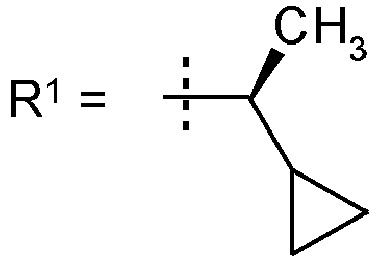
Prepared using Method H 
Amine: Commercial Intermediate: 2 
1H-NMR (600 MHz, DMSO-d6) δ 0.2 - 0.28 (m, 3H), 0.40 (m, 2H), 0.45 - 0.53 (m, 2H), 0.57 (m, 1H), 1.01 (m, 1H), 1.13 (m, 1H), 1.30 (d, 3H), 2.15 (s, 3H), 2.38 (s, 3H), 3.53 - 3.58 (m, 1H), 4.60 (s, 2H), 7.34 (d, 1H), 7.49 (d, 1H), 9.67 (s, 1H), 12.21 (s, 1H). m/z (ES+), [M+H]+ = 489.16 Example 29 N-[5-(2-[(1S)-1-Cyclopropylethyl]-7-{[(1,3-dimethyl-1H-pyrazol-4-yl)sulfonyl]amino}-1-oxo-2,3-dihydro-1H-isoindol-5-yl)-4-methyl-1,3-thiazol-2-yl]acetamide 
Prepared using Method H 
Amine: Commercial Intermediate: 2 
1H-NMR (600 MHz, DMSO-d6) δ 0.14 - 0.3 (m, 1H), 0.39 (m, 2H), 0.5 - 0.6 (m, 1H), 1.11 (m, 1H), 1.28 (d, 3H), 2.16 (s, 3H), 2.22 (s, 3H), 2.32 (s, 3H), 3.45 - 3.58 (m, 1H), 3.74 (s, 3H), 4.57 (s, 2H), 7.31 (d, 2H), 8.39 (s, 1H), 9.95 (s, 1H), 12.22 (s, 1H). m/z (ES+), [M+H]+ = 529.17 Example 30 N-(4-Chloro-5-{2-[(1S)-1-cyclopropylethyl]-7-(methylsulfamoyl)-1-oxo-2,3-dihydro-1H-isoindol-5-yl}-1,3-thiazol-2-yl)acetamide 
Prepared using Method G 
Amine: Commercial Intermediate: 37 
1H-NMR (400 MHz, DMSO-d6) δ 0.30 (m, 1H), 0.44 (m, 2H), 0.61 (m, 1H), 1.17 (m, 1H), 1.33 (d, 3H), 2.22 (s, 3H), 2.52 (s, 3H), 3.73 - 3.57 (m, 1H), 4.77 (s, 2H), 7.57 (q, 1H), 8.27 - 8.07 (m, 2H), 12.70 (s, 1H). m/z (ES+), [M+H]+ = 469.20; acid, HPLC tR = 1.627 min Example 31 6-(8-Aminoimidazo[1,2-a]pyrazin-3-yl)-2-[(1S)-1-cyclopropylethyl]-N-methyl-3-oxo-2,3-dihydro-1H-isoindole-4-sulfonamide 
Prepared using Method F 
Amine: Commercial Intermediate: 40 
1H-NMR (300 MHz, DMSO-d6) δ 0.31 (d, 1H), 0.47 (d, 2H), 0.62 (d, 1H), 1.23 (d, 1H), 1.36 (d, 3H), 2.55 (d, 3H), 8.24 (s, 1H), 3.82 - 3.60 (m, 1H), 4.81 (s, 2H), 7.08 (s, 2H), 7.39 (d, 1H), 7.62 (d, 1H), 7.92 (d, 1H), 8.00 (s, 1H), 8.08 (s, 1H). m/z (ES+), [M+H]+ = 426.9; base , HPLC tR = 2.048 min Example 32 N-15-[2-(2-Cyclopropylpropan-2-yl)-7-(methylsulfamoyl)-1-oxo-2,3-dihydro-1H-isoindol-5-yl]-4-methyl-1,3-thiazol-2-yl}acetamide 
Prepared using Method E 
Amine: Commercial Intermediate 21 
1H-NMR (400 MHz, DMSO-d6) δ 0.48 - 0.50 (m, 4H), 1.42 (s, 6H), 1.52 - 1.56 (m, 1H), 2.18 (s, 3H), 2.44 (s, 3H), 4.86 (s, 2H), 7.61 (q, 1H), 7.85 (d, 1H), 7.99 (d, 1H), 12.32 (s, 1H). m/z (ES+), [M+H]+ = 463.0; base, HPLC tR = 3.691 min Example 33 N-(5-{2-[(2S)-3,3-Dimethylbutan-2-yl]-7-(methylsulfamoyl)-1-oxo-2,3-dihydro-1H-isoindol-5-yl}-4-methyl-1,3-thiazol-2-yl)acetamide 
Prepared using Method E 
Amine: Commercial Intermediate 22 
1H NMR (600 MHz, DMSO-d6) δ 0.96 (s, 9H), 1.26 (d, 3H), 2.17 (s, 3H), 2.44 (s, 3H), 4.22 (q, 1H), 4.71 (s, 2H), 7.60 (q, 1H), 7.86 (d, 1H), 7.97 (d, 1H), 12.30 (s, 1H) 3H s under solvent peak. m/z (ES+), [M+H]+ = 465.3; acid , HPLC tR = 1.24 min Example 34 N-{5-[2-tert-Butyl-7-(methylsulfamoyl)-1-oxo-2,3-dihydro-1H-isoindol-5-yl]-4-methyl-1,3-thiazol-2-yl}acetamide 
Prepared using Method E 
Amine: Commercial Intermediate 23 
1H-NMR (300 MHz, DMSO-d6) δ 1.54 (s, 9H), 2.19 (s, 3H), 2.44 (s, 3H), 2.66 (s, 2H), 4.79 (s, 2H), 7.61 (d, 1H), 7.86 (d, 1H), 7.99 (s, 1H), 12.30 (s, 1H). m/z (ES+), [M+H]+ = 437; acid, HPLC tR = 0.855 min Example 35 N-(4-Methyl-5-{7-(methylsulfamoyl)-1-oxo-2-[(2S)-1,1,1-trifluoropropan-2-yl]-2,3-dihydro-1H-isoindol-5-yl}-1,3-thiazol-2-yl)acetamide 
Prepared using Method E 
Amine: Commercial Intermediate 24 
1H-NMR (600 MHz, DMSO-d6) δ 1.52 (d, 3H), 2.17 (s, 3H), 2.45 (s, 3H), 2.53 (d, 3H), 4.62 (d, 1H), 4.82 (d, 1H), 5.10 (p, 1H), 7.17 (q, 1H), 7.90 (d, 1H), 8.03 (d, 1H), 12.33 (s, 1H). 19F NMR (282 MHz, DMSO-d6) δ -73.46. m/z (ES+), [M+H]+ = 477; acid, HPLC tR = 1.11 min. Example 36 N-(5-{7-[(3-Cyanophenyl)sulfamoyl]-2-[(1S)-1-cyclopropylethyl]-1-oxo-2,3-dihydro-1H-isoindol-5-yl}-4-methyl-1,3-thiazol-2-yl)acetamide 
Prepared using Method E 
Amine: Commercial Intermediate 4 
1H-NMR (300 MHz, CD3OD) δ 0.42 - 0.61 (m, 3H), 0.69 - 0.77 (m, 1H), 1.17 - 1.26 (m, 1H), 1.46 (d, 3H), 2.23 (s, 3H), 2.39 (s, 3H), 3.77 - 4.82 (m, 1H), 4.67 - 4.81 (m, 2H), 7.39 - 7.50 (m, 4H), 7.90 (s, 1H), 7.97 (s, 1H). m/z (ES+), [M+H]+ = 536; acid, HPLC tR = 1.755 min. Example 37 N-(5-{7-[(3-Cyanophenyl)sulfamoyl]-1-oxo-2-(propan-2-yl)-2,3-dihydro-1H-isoindol-5-yl}-4-methyl-1,3-thiazol-2-yl)acetamide 
Prepared using Method E 
Amine: Commercial Intermediate 20 
1H-NMR (300 MHz, DMSO-d6) δ 12.30 (s, 1H), 10.51 (s, 1H), 7.97 (s, 1H), 7.90 (s, 1H), 7.58 - 7.38 (m, 4H), 4.61 (s, 2H), 4.58 - 4.42 (m, 1H), 2.37 (s, 3H), 2.16 (s, 3H), 1.29 (d, 6H). m/z (ES+), [M+H]+ = 510.1; acid, HPLC tR = 2.13 min. - The activity of recombinant human PI3Kγ(aa144-1102)-6His was determined by measuring the ADP level after phosphorylation of DiC8-PIP2 using a commercially available ADP-Glo™ kit from Promega. The assay was carried out in white low volume 384 well plates in a final volume of 14 µl at rt. The assay conditions contained the following: 50 mM Tris buffer pH 7.4, 2.1 mM DTT, 3 mM MgCl2,0.05% CHAPS, 20 µM ATP, 80 µM DiC8-PIP2 and 1.2 nM PI3Kγ. Potential inhibitors were made up in DMSO and then diluted in the assay to give a final concentration of not exceeding 1% (v/v) DMSO. A 10-point half-log dilution series of the inhibitors (highest concentration typically 0.1 µM) was tested and the pIC50 determined using a 4-paramater logistic equation in a non-linear curve fitting routine. Routinely, inhibitors were pre-incubated with 3 µl of PI3Kγ for 15 min prior to the addition of 2 µl substrate mixture for a further 60 min enzyme reaction. The phosphorylation was stopped with the addition of 3 µl ADP-Glo™ reagent (stop solution) followed by a 40 min incubation. Prior to detection 6 µl of ADP-Glo™ Kinase Detection Reagent was added and the plates were read in a micro plate reader using a Luminescence filter.
- The results obtained are shown in Table 7 below.
Table 7 Example PI3Kγ activity, pIC50 1 9.1 2 9.0 3 8.8 4 9.2 5 9.0 6 9.1 7 9.1 8 9.0 9 9.2 10 8.9 11 8.8 12 8.9 13 9.0 14 9.0 15 9.4 16 9.2 17 8.9 18 9.0 19 9.4 20 9.2 21 8.9 22 9.1 23 9.2 24 9.0 25 9.1 26 9.0 27 9.0 28 9.1 29 8.9 30 8.9 31 8.7 32 9.0 33 8.8 34 8.8 35 9.0 36 9.3 37 9.0
Claims (13)
- A compound of formula (I)
 X is C(O);Y is -CH2-;R1 is (3,3-dimethylbutan-2-yl) or C1-4alkyl, wherein said C1-4alkyl is optionally substituted by cyclopropyl and 0, 1, 2 or 3 F;R2 is selected from NHR4 or SO2 R5;R3 is
 R4 is C(O)CH3 or SO2 R6 ;R5 is selected from (3-cyanophenyl)sulfamoyl, CH3, N(CH3)2, NH2, NHCH2CF3, NH(oxetan-3-yl), NHC1-3alkyl, wherein said C1-3alkyl is optionally substituted by 0-3 F and 0-1 substituents independently selected from OCH3, cyclopropyl or NHC3-4cycloalkyl, wherein said cycloalkyl may be substituted by 0-2 F;R6 is selected from cyclopropyl, (1,3-dimethyl-1H-pyrazol-4-yl)methyl or C1-4alkyl, wherein said C1-4alkyl is optionally substituted by 0-1 substituents independently selected from OCH3 or cyclopropyl;R7 is selected from H, Cl or CH3;R8 is -NH(C=O)CH3;or a pharmaceutically acceptable salt thereof.
 - A compound according claim 1 whereinR1 is iso-propyl or 1-cyclopropylethyl;or a pharmaceutically acceptable salt thereof.
- A compound according to any one of claims 1 to 2 whereinR2 is NHR4 ;R4 is SO2 R6 ;R6 is CH3;or a pharmaceutically acceptable salt thereof.
- A compound according to any one of claims 1 to 3 whereinR2 is SO2 R5 ;R5 is CH3 or NHCH3;or a pharmaceutically acceptable salt thereof.
- A compound of the formula (I) according to claim 1 selected from:N-(5-{2-[(1S)-1-Cyclopropylethyl]-7-(methylsulfonyl)-1-oxo-2,3-dihydro-1H-isoindol-5-yl}-1,3-thiazol-2-yl)acetamide,N-{4-Methyl-5-[7-(methylsulfonyl)-1-oxo-2-(propan-2-yl)-2,3-dihydro-1H-isoindol-5-yl]-1,3-thiazol-2-yl}acetamide,N-(5-{2-[(1S)-1-Cyclopropylethyl]-1-oxo-7-sulfamoyl-2,3-dihydro-1H-isoindol-5-yl}-4-methyl-1,3-thiazol-2-yl)acetamide,N-(5-{7-(Acetylamino)-2-[(1S)-1-cyclopropylethyl]-1-oxo-2,3-dihydro-1H-isoindol-5-yl}-4-methyl-1,3-thiazol-2-yl)acetamide,N-(5-{2-[(1S)-1-Cyclopropylethyl]-7-(methylsulfamoyl)-1-oxo-2,3-dihydro-1H-isoindol-5-yl}-4-methyl-1,3-thiazol-2-yl)acetamide,N-(5-{2-[(1S)-1-Cyclopropylethyl]-7-(dimethylsulfamoyl)-1-oxo-2,3-dihydro-1H-isoindol-5-yl}-4-methyl-1,3-thiazol-2-yl)acetamide,N-(5-{2-[(1S)-1-Cyclopropylethyl]-7-(methylsulfamoyl)-1-oxo-2,3-dihydro-1H-isoindol-5-yl}-1,3-thiazol-2-yl)acetamide,N-(5-{2-[(1S)-1-Cyclopropylethyl]-7-[(methylsulfonyl)amino]-1-oxo-2,3-dihydro-1H-isoindol-5-yl}-4-methyl-1,3-thiazol-2-yl)acetamide,N-(5-{7-(Cyclobutylsulfamoyl)-2-[(1S)-1-cyclopropylethyl]-1-oxo-2,3-dihydro-1H-isoindol-5-yl}-4-methyl-1,3-thiazol-2-yl)acetamide,N-{4-Methyl-5-[7-(methylsulfamoyl)-1-oxo-2-(propan-2-yl)-2,3-dihydro-1H-isoindol-5-yl]-1,3-thiazol-2-yl}acetamide,N-(5-{2-[(1S)-1-Cyclopropylethyl]-1-oxo-7-sulfamoyl-2,3-dihydro-1H-isoindol-5-yl}-1,3-thiazol-2-yl)acetamide,N-(5-{2-[(1S)-1-Cyclopropylethyl]-7-[(cyclopropylmethyl)sulfamoyl]-1-oxo-2,3-dihydro-1H-isoindol-5-yl}-4-methyl-1,3-thiazol-2-yl)acetamide,N-(5-{2-[(1S)-1-Cyclopropylethyl]-7-(cyclopropylsulfamoyl)-1-oxo-2,3-dihydro-1H-isoindol-5-yl}-4-methyl-1,3-thiazol-2-yl)acetamide,N-(5-{2-[(1S)-1-Cyclopropylethyl]-7-(ethylsulfamoyl)-1-oxo-2,3-dihydro-1H-isoindol-5-yl}-4-methyl-1,3-thiazol-2-yl)acetamide,N-(5-{2-[(1S)-1-Cyclopropylethyl]-7-(oxetan-3-ylsulfamoyl)-1-oxo-2,3-dihydro-1H-isoindol-5-yl}-4-methyl-1,3-thiazol-2-yl)acetamide,N-(5-{2-[(1S)-1-Cyclopropylethyl]-7-[(3,3-difluorocyclobutyl)sulfamoyl]-1-oxo-2,3-dihydro-1H-isoindol-5-yl}-4-methyl-1,3-thiazol-2-yl)acetamide,N-(5-{2-[(1S)-1-Cyclopropylethyl]-7-[(2-methoxyethyl)sulfamoyl]-1-oxo-2,3-dihydro-1H-isoindol-5-yl}-4-methyl-1,3-thiazol-2-yl)acetamide,N-(5-{2-[(1S)-1-Cyclopropylethyl]-7-({[1-(fluoromethyl)cyclopropyl]methyl}sulfamoyl)-1-oxo-2,3-dihydro-1H-isoindol-5-yl}-4-methyl-1,3-thiazol-2-yl)acetamide,N-(5-{2-[(1S)-1-Cyclopropylethyl]-1-oxo-7-[(2,2,2-trifluoroethyl)sulfamoyl]-2,3-dihydro-1H-isoindol-5-yl}-4-methyl-1,3-thiazol-2-yl)acetamide,N-{4-Methyl-5-[1-oxo-2-(propan-2-yl)-7-sulfamoyl-2,3-dihydro-1H-isoindol-5-yl]-1,3-thiazol-2-yl} acetamide,N-(5-{2-[(1S)-1-Cyclopropylethyl]-7-[(methylsulfonyl)amino]-1-oxo-2,3-dihydro-1H-isoindol-5-yl}-1,3-thiazol-2-yl)acetamide,N-(5-{2-[(1S)-1-Cyclopropylethyl]-7-[(cyclopropylsulfonyl)amino]-1-oxo-2,3-dihydro-1H-isoindol-5-yl}-4-methyl-1,3-thiazol-2-yl)acetamide,N-(5-{2-[(1S)-1-Cyclopropylethyl]-1-oxo-7-[(propylsulfonyl)amino]-2,3-dihydro-1H-isoindol-5-yl}-4-methyl-1,3-thiazol-2-yl)acetamide,N-(5-{2-[(1S)-1-Cyclopropylethyl]-7-[(ethylsulfonyl)amino]-1-oxo-2,3-dihydro-1H-isoindol-5-yl}-4-methyl-1,3-thiazol-2-yl)acetamide,N-(5-{7-[(tert-Butylsulfonyl)amino]-2-[(1S)-1-cyclopropylethyl]-1-oxo-2,3-dihydro-1H-isoindol-5-yl}-4-methyl-1,3-thiazol-2-yl)acetamide,N-[5-(2-[(1S)-1-Cyclopropylethyl]-7-{[(2-methoxyethyl)sulfonyl]amino}-1-oxo-2,3-dihydro-1H-isoindol-5-yl)-4-methyl-1,3-thiazol-2-yl]acetamide,N-[5-(2-[(1S)-1-Cyclopropylethyl]-7-{[(cyclopropylmethyl)sulfonyl]amino}-1-oxo-2,3-dihydro-1H-isoindol-5-yl)-4-methyl-1,3-thiazol-2-yl]acetamide,N-[5-(2-[(1S)-1-Cyclopropylethyl]-7-{[(1,3-dimethyl-1H-pyrazol-4-yl)sulfonyl]amino}-1-oxo-2,3-dihydro-1H-isoindol-5-yl)-4-methyl-1,3-thiazol-2-yl]acetamide,N-(4-Chloro-5-{2-[(1S)-1-cyclopropylethyl]-7-(methylsulfamoyl)-1-oxo-2,3-dihydro-1H-isoindol-5-yl}-1,3-thiazol-2-yl)acetamide,6-(8-Aminoimidazo[1,2-a]pyrazin-3-yl)-2-[(1S)-1-cyclopropylethyl]-N-methyl-3-oxo-2,3-dihydro-1H-isoindole-4-sulfonamide,N-{5-[2-(2-Cyclopropylpropan-2-yl)-7-(methylsulfamoyl)-1-oxo-2,3-dihydro-1H-isoindol-5-yl]-4-methyl-1,3-thiazol-2-yl}acetamide,N-(5-{2-[(2S)-3,3-Dimethylbutan-2-yl]-7-(methylsulfamoyl)-1-oxo-2,3-dihydro-1H-isoindol-5-yl}-4-methyl-1,3-thiazol-2-yl)acetamide,N-{5-[2-tert-Butyl-7-(methylsulfamoyl)-1-oxo-2,3-dihydro-1H-isoindol-5-yl]-4-methyl-1,3-thiazol-2-yl}acetamide,N-(4-Methyl-5-{7-(methylsulfamoyl)-1-oxo-2-[(2S)-1,1,1-trifluoropropan-2-yl]-2,3-dihydro-1H-isoindol-5-yl}-1,3-thiazol-2-yl)acetamide,N-(5-{7-[(3-Cyanophenyl)sulfamoyl]-2-[(1S)-1-cyclopropylethyl]-1-oxo-2,3-dihydro-1H-isoindol-5-yl}-4-methyl-1,3-thiazol-2-yl)acetamide,N-(5-{7-[(3-Cyanophenyl)sulfamoyl]-1-oxo-2-(propan-2-yl)-2,3-dihydro-1H-isoindol-5-yl}-4-methyl-1,3-thiazol-2-yl)acetamide,and pharmaceutically acceptable salts thereof.
- A compound according to any one of claims 1-4 which is N-(5-{2-[(1S)-1-cyclopropylethyl]-7-(methylsulfonyl)-1-oxo-2,3-dihydro-1H-isoindol-5-yl}-4-methyl-1,3-thiazol-2-yl)acetamide,

- A compound according to any one of claims 1-4 which is N-(5-{2-[(1S)-1-cyclopropylethyl]-7-(methylsulfonyl)-1-oxo-2,3-dihydro-1H-isoindol-5-yl}-4-methyl-1,3-thiazol-2-yl)acetamide,

- A pharmaceutical composition comprising a compound of formula (I) as claimed in any one of claims 1 to 7 and a pharmaceutically acceptable adjuvant, diluent or carrier.
- A compound of formula (I) as claimed in any one of claims 1 to 7 for use in therapy.
- A compound of formula (I) as claimed in any one of claims 1 to 7 for use in treating asthma or chronic obstructive pulmonary disease.
- A compound of formula (I) as claimed in any one of claims 1 to 7 for use in treating cancer or CNS related inflammatory disorders.
- A combination of a compound of formula (I) as claimed in any one of claims 1 to 7 and one or more agents independently selected from:• a glucocorticoid receptor agonist (steroidal or non-steroidal);• a selective β2 adrenoceptor agonist;• a selective inhibitor of PI3Kδ;• an antimuscarinic agent;• a p38 antagonist; anda PDE4 antagonist.
- A process for the preparation of a compound of formula (I) as claimed in any one of claims 1 to 7, wherein said process comprises the step of removing one or more protecting groups.
Applications Claiming Priority (2)
| Application Number | Priority Date | Filing Date | Title |
|---|---|---|---|
| US201662306328P | 2016-03-10 | 2016-03-10 | |
| PCT/EP2017/055552 WO2017153527A1 (en) | 2016-03-10 | 2017-03-09 | Novel inhibitors of phosphatidylinositol 3-kinase gamma |
Publications (2)
| Publication Number | Publication Date |
|---|---|
| EP3426652A1 EP3426652A1 (en) | 2019-01-16 |
| EP3426652B1 true EP3426652B1 (en) | 2021-12-01 |
Family
ID=58264542
Family Applications (1)
| Application Number | Title | Priority Date | Filing Date |
|---|---|---|---|
| EP17709681.5A Active EP3426652B1 (en) | 2016-03-10 | 2017-03-09 | Novel inhibitors of phosphatidylinositol 3-kinase gamma |
Country Status (13)
| Country | Link |
|---|---|
| US (2) | US10858355B2 (en) |
| EP (1) | EP3426652B1 (en) |
| JP (1) | JP6893520B2 (en) |
| KR (1) | KR20180117693A (en) |
| CN (1) | CN108779110B (en) |
| AR (1) | AR107840A1 (en) |
| AU (1) | AU2017229445B2 (en) |
| BR (1) | BR112018068075A2 (en) |
| CA (1) | CA3015893C (en) |
| EA (1) | EA036388B1 (en) |
| MX (1) | MX387125B (en) |
| TW (1) | TWI746525B (en) |
| WO (1) | WO2017153527A1 (en) |
Families Citing this family (11)
| Publication number | Priority date | Publication date | Assignee | Title |
|---|---|---|---|---|
| WO2020102198A1 (en) | 2018-11-13 | 2020-05-22 | Incyte Corporation | Heterocyclic derivatives as pi3k inhibitors |
| WO2020102150A1 (en) | 2018-11-13 | 2020-05-22 | Incyte Corporation | Heterocyclic derivatives as pi3k inhibitors |
| WO2020102216A1 (en) | 2018-11-13 | 2020-05-22 | Incyte Corporation | Substituted heterocyclic derivatives as pi3k inhibitors |
| CN115677692A (en) * | 2019-04-10 | 2023-02-03 | 南京征祥医药有限公司 | Phosphatidylinositol 3-kinase inhibitors |
| CN114206332B (en) * | 2019-06-04 | 2024-08-23 | 艾库斯生物科学有限公司 | 2,3,5-Trisubstituted pyrazolo[1,5-A]pyrimidine compounds |
| WO2022017371A1 (en) * | 2020-07-21 | 2022-01-27 | 中国医药研究开发中心有限公司 | Heterocyclic compound having dual inhibitor activity of phosphatidylinositol 3-kinase δ and γ and medical use thereof |
| CN115611883B (en) * | 2021-07-13 | 2025-03-28 | 生物岛实验室 | A PI3Kα inhibitor with a double ring structure and its preparation method and use |
| CN119768404A (en) * | 2022-09-01 | 2025-04-04 | 上海海雁医药科技有限公司 | Heteroaryl-substituted pyridopyrrolone derivatives, pharmaceutical compositions and applications thereof |
| JP2025531798A (en) * | 2022-09-09 | 2025-09-25 | 上海▲瑛▼黎薬業有限公司 | Nitrogen-containing heterocyclic compounds, pharmaceutical compositions thereof and uses thereof |
| CN116813608B (en) * | 2023-06-08 | 2024-03-22 | 英矽智能科技(上海)有限公司 | Thiazole compound and application thereof |
| CN121816181A (en) | 2023-06-30 | 2026-04-07 | 柏林合作研究学会 | Thiazolotetrahydroquinoline compounds as class II phosphoinositide 3-kinase inhibitors |
Family Cites Families (13)
| Publication number | Priority date | Publication date | Assignee | Title |
|---|---|---|---|---|
| TW200613272A (en) * | 2004-08-13 | 2006-05-01 | Astrazeneca Ab | Isoindolone compounds and their use as metabotropic glutamate receptor potentiators |
| WO2006089106A2 (en) * | 2005-02-17 | 2006-08-24 | Icos Corporation | Phosphoinositide 3-kinase inhibitors for inhibiting leukocyte accumulation |
| WO2007084391A2 (en) * | 2006-01-18 | 2007-07-26 | Amgen Inc. | Thiazole compounds as protein kinase b ( pkb) inhibitors |
| JP2009535386A (en) * | 2006-05-03 | 2009-10-01 | アストラゼネカ アクチボラグ | Thiazole derivatives and their use as antitumor agents |
| EP1894931A1 (en) * | 2006-08-30 | 2008-03-05 | Cellzome Ag | Triazole derivatives as kinase inhibitors |
| US20110230472A1 (en) * | 2008-08-29 | 2011-09-22 | Shionogi & Co., Ltd. | Ring-fused azole derivative having pi3k-inhibiting activity |
| MX2011008645A (en) * | 2009-02-17 | 2011-09-30 | Vertex Pharma | Tetrahydrothiazolopyridine inhibitors of phosphatidylinositol 3-kinase. |
| KR101758046B1 (en) * | 2009-12-22 | 2017-07-14 | 버텍스 파마슈티칼스 인코포레이티드 | Isoindolinone inhibitors of phosphatidylinositol 3-kinase |
| CN104379573A (en) * | 2012-04-20 | 2015-02-25 | 艾伯维公司 | Isoindolone derivatives |
| SG11201602265PA (en) * | 2013-09-25 | 2016-04-28 | Vertex Pharma | A selective inhibitor of phosphatidylinositol 3-kinase-gamma |
| US9862711B2 (en) | 2014-04-24 | 2018-01-09 | Novartis Ag | Pyrazine derivatives as phosphatidylinositol 3-kinase inhibitors |
| BR112016024484A2 (en) | 2014-04-24 | 2017-08-15 | Novartis Ag | aminopyridine derivatives as phosphatidylinositol 3-kinase inhibitors |
| CA2945212A1 (en) | 2014-04-24 | 2015-10-29 | Novartis Ag | Amino pyrazine derivatives as phosphatidylinositol 3-kinase inhibitors |
-
2017
- 2017-03-09 EP EP17709681.5A patent/EP3426652B1/en active Active
- 2017-03-09 JP JP2018547461A patent/JP6893520B2/en not_active Expired - Fee Related
- 2017-03-09 KR KR1020187028625A patent/KR20180117693A/en not_active Abandoned
- 2017-03-09 AU AU2017229445A patent/AU2017229445B2/en not_active Ceased
- 2017-03-09 WO PCT/EP2017/055552 patent/WO2017153527A1/en not_active Ceased
- 2017-03-09 BR BR112018068075A patent/BR112018068075A2/en not_active IP Right Cessation
- 2017-03-09 TW TW106107711A patent/TWI746525B/en not_active IP Right Cessation
- 2017-03-09 US US16/082,880 patent/US10858355B2/en not_active Expired - Fee Related
- 2017-03-09 EA EA201891931A patent/EA036388B1/en not_active IP Right Cessation
- 2017-03-09 CN CN201780014898.XA patent/CN108779110B/en not_active Expired - Fee Related
- 2017-03-09 CA CA3015893A patent/CA3015893C/en active Active
- 2017-03-09 AR ARP170100589A patent/AR107840A1/en unknown
- 2017-03-09 MX MX2018010894A patent/MX387125B/en unknown
-
2020
- 2020-11-04 US US17/088,689 patent/US20210047312A1/en not_active Abandoned
Non-Patent Citations (1)
| Title |
|---|
| None * |
Also Published As
| Publication number | Publication date |
|---|---|
| EP3426652A1 (en) | 2019-01-16 |
| TW201808945A (en) | 2018-03-16 |
| MX387125B (en) | 2025-03-18 |
| CN108779110B (en) | 2021-10-29 |
| AU2017229445B2 (en) | 2019-07-11 |
| TWI746525B (en) | 2021-11-21 |
| CA3015893C (en) | 2021-11-09 |
| AR107840A1 (en) | 2018-06-13 |
| EA036388B1 (en) | 2020-11-03 |
| JP6893520B2 (en) | 2021-06-23 |
| MX2018010894A (en) | 2018-11-09 |
| CA3015893A1 (en) | 2017-09-14 |
| BR112018068075A2 (en) | 2019-01-08 |
| JP2019507788A (en) | 2019-03-22 |
| KR20180117693A (en) | 2018-10-29 |
| WO2017153527A1 (en) | 2017-09-14 |
| US20210047312A1 (en) | 2021-02-18 |
| US10858355B2 (en) | 2020-12-08 |
| EA201891931A1 (en) | 2019-04-30 |
| CN108779110A (en) | 2018-11-09 |
| US20200299289A1 (en) | 2020-09-24 |
| AU2017229445A1 (en) | 2018-10-25 |
Similar Documents
| Publication | Publication Date | Title |
|---|---|---|
| EP3426652B1 (en) | Novel inhibitors of phosphatidylinositol 3-kinase gamma | |
| EP2970218B1 (en) | Dna-pk inhibitors | |
| CA2870087C (en) | Substituted isoquinolin-1(2h)-one compounds and their use as phosphoinositide 3-kinase (pi3k) inhibitors | |
| US20210246130A1 (en) | Dual inhibitors of phosphatidylinositol 3-kinase delta & gamma | |
| JP2021523225A (en) | RIP1 inhibitor compound and methods for producing and using it | |
| CN116670133A (en) | Alpha protein kinase 1 inhibitors and methods of use | |
| WO2016197078A1 (en) | Compounds for the modulation of myc activity | |
| KR102858857B1 (en) | Substituted 2-azabicyclo[3.1.1]heptane and 2-azabicyclo[3.2.1]octane derivatives as orexin receptor antagonists | |
| US20070249599A1 (en) | Novel Chemical Compounds | |
| CN111153906A (en) | Pyrazolopyrimidine derivatives as BTK inhibitors, process for their preparation and pharmaceutical compositions containing them | |
| HK1257837A1 (en) | Novel inhibitors of phosphatidylinositol 3-kinase gamma | |
| HK40011664B (en) | 5-[2-(pyridin-2-ylamino)-1,3-thiazol-5-yl]-2,3-dihydro- 1 h-isoindol-1 -one derivatives and their use as dual inhibitors of phosphatidylinositol 3-kinase delta&gamma | |
| HK40011664A (en) | 5-[2-(pyridin-2-ylamino)-1,3-thiazol-5-yl]-2,3-dihydro- 1 h-isoindol-1 -one derivatives and their use as dual inhibitors of phosphatidylinositol 3-kinase delta&gamma |
Legal Events
| Date | Code | Title | Description |
|---|---|---|---|
| STAA | Information on the status of an ep patent application or granted ep patent |
Free format text: STATUS: UNKNOWN |
|
| STAA | Information on the status of an ep patent application or granted ep patent |
Free format text: STATUS: THE INTERNATIONAL PUBLICATION HAS BEEN MADE |
|
| PUAI | Public reference made under article 153(3) epc to a published international application that has entered the european phase |
Free format text: ORIGINAL CODE: 0009012 |
|
| STAA | Information on the status of an ep patent application or granted ep patent |
Free format text: STATUS: REQUEST FOR EXAMINATION WAS MADE |
|
| 17P | Request for examination filed |
Effective date: 20181010 |
|
| AK | Designated contracting states |
Kind code of ref document: A1 Designated state(s): AL AT BE BG CH CY CZ DE DK EE ES FI FR GB GR HR HU IE IS IT LI LT LU LV MC MK MT NL NO PL PT RO RS SE SI SK SM TR |
|
| AX | Request for extension of the european patent |
Extension state: BA ME |
|
| DAV | Request for validation of the european patent (deleted) | ||
| STAA | Information on the status of an ep patent application or granted ep patent |
Free format text: STATUS: EXAMINATION IS IN PROGRESS |
|
| 17Q | First examination report despatched |
Effective date: 20191016 |
|
| REG | Reference to a national code |
Ref country code: HK Ref legal event code: DE Ref document number: 1260636 Country of ref document: HK |
|
| GRAP | Despatch of communication of intention to grant a patent |
Free format text: ORIGINAL CODE: EPIDOSNIGR1 |
|
| STAA | Information on the status of an ep patent application or granted ep patent |
Free format text: STATUS: GRANT OF PATENT IS INTENDED |
|
| INTG | Intention to grant announced |
Effective date: 20210707 |
|
| GRAS | Grant fee paid |
Free format text: ORIGINAL CODE: EPIDOSNIGR3 |
|
| GRAA | (expected) grant |
Free format text: ORIGINAL CODE: 0009210 |
|
| STAA | Information on the status of an ep patent application or granted ep patent |
Free format text: STATUS: THE PATENT HAS BEEN GRANTED |
|
| AK | Designated contracting states |
Kind code of ref document: B1 Designated state(s): AL AT BE BG CH CY CZ DE DK EE ES FI FR GB GR HR HU IE IS IT LI LT LU LV MC MK MT NL NO PL PT RO RS SE SI SK SM TR |
|
| REG | Reference to a national code |
Ref country code: GB Ref legal event code: FG4D |
|
| REG | Reference to a national code |
Ref country code: AT Ref legal event code: REF Ref document number: 1451662 Country of ref document: AT Kind code of ref document: T Effective date: 20211215 Ref country code: CH Ref legal event code: EP |
|
| REG | Reference to a national code |
Ref country code: IE Ref legal event code: FG4D |
|
| REG | Reference to a national code |
Ref country code: DE Ref legal event code: R096 Ref document number: 602017050143 Country of ref document: DE |
|
| REG | Reference to a national code |
Ref country code: LT Ref legal event code: MG9D |
|
| REG | Reference to a national code |
Ref country code: NL Ref legal event code: MP Effective date: 20211201 |
|
| REG | Reference to a national code |
Ref country code: AT Ref legal event code: MK05 Ref document number: 1451662 Country of ref document: AT Kind code of ref document: T Effective date: 20211201 |
|
| PG25 | Lapsed in a contracting state [announced via postgrant information from national office to epo] |
Ref country code: RS Free format text: LAPSE BECAUSE OF FAILURE TO SUBMIT A TRANSLATION OF THE DESCRIPTION OR TO PAY THE FEE WITHIN THE PRESCRIBED TIME-LIMIT Effective date: 20211201 Ref country code: LT Free format text: LAPSE BECAUSE OF FAILURE TO SUBMIT A TRANSLATION OF THE DESCRIPTION OR TO PAY THE FEE WITHIN THE PRESCRIBED TIME-LIMIT Effective date: 20211201 Ref country code: FI Free format text: LAPSE BECAUSE OF FAILURE TO SUBMIT A TRANSLATION OF THE DESCRIPTION OR TO PAY THE FEE WITHIN THE PRESCRIBED TIME-LIMIT Effective date: 20211201 Ref country code: BG Free format text: LAPSE BECAUSE OF FAILURE TO SUBMIT A TRANSLATION OF THE DESCRIPTION OR TO PAY THE FEE WITHIN THE PRESCRIBED TIME-LIMIT Effective date: 20220301 Ref country code: AT Free format text: LAPSE BECAUSE OF FAILURE TO SUBMIT A TRANSLATION OF THE DESCRIPTION OR TO PAY THE FEE WITHIN THE PRESCRIBED TIME-LIMIT Effective date: 20211201 |
|
| PG25 | Lapsed in a contracting state [announced via postgrant information from national office to epo] |
Ref country code: SE Free format text: LAPSE BECAUSE OF FAILURE TO SUBMIT A TRANSLATION OF THE DESCRIPTION OR TO PAY THE FEE WITHIN THE PRESCRIBED TIME-LIMIT Effective date: 20211201 Ref country code: PL Free format text: LAPSE BECAUSE OF FAILURE TO SUBMIT A TRANSLATION OF THE DESCRIPTION OR TO PAY THE FEE WITHIN THE PRESCRIBED TIME-LIMIT Effective date: 20211201 Ref country code: NO Free format text: LAPSE BECAUSE OF FAILURE TO SUBMIT A TRANSLATION OF THE DESCRIPTION OR TO PAY THE FEE WITHIN THE PRESCRIBED TIME-LIMIT Effective date: 20220301 Ref country code: LV Free format text: LAPSE BECAUSE OF FAILURE TO SUBMIT A TRANSLATION OF THE DESCRIPTION OR TO PAY THE FEE WITHIN THE PRESCRIBED TIME-LIMIT Effective date: 20211201 Ref country code: HR Free format text: LAPSE BECAUSE OF FAILURE TO SUBMIT A TRANSLATION OF THE DESCRIPTION OR TO PAY THE FEE WITHIN THE PRESCRIBED TIME-LIMIT Effective date: 20211201 Ref country code: GR Free format text: LAPSE BECAUSE OF FAILURE TO SUBMIT A TRANSLATION OF THE DESCRIPTION OR TO PAY THE FEE WITHIN THE PRESCRIBED TIME-LIMIT Effective date: 20220302 Ref country code: ES Free format text: LAPSE BECAUSE OF FAILURE TO SUBMIT A TRANSLATION OF THE DESCRIPTION OR TO PAY THE FEE WITHIN THE PRESCRIBED TIME-LIMIT Effective date: 20211201 |
|
| PG25 | Lapsed in a contracting state [announced via postgrant information from national office to epo] |
Ref country code: NL Free format text: LAPSE BECAUSE OF FAILURE TO SUBMIT A TRANSLATION OF THE DESCRIPTION OR TO PAY THE FEE WITHIN THE PRESCRIBED TIME-LIMIT Effective date: 20211201 |
|
| PG25 | Lapsed in a contracting state [announced via postgrant information from national office to epo] |
Ref country code: SM Free format text: LAPSE BECAUSE OF FAILURE TO SUBMIT A TRANSLATION OF THE DESCRIPTION OR TO PAY THE FEE WITHIN THE PRESCRIBED TIME-LIMIT Effective date: 20211201 Ref country code: SK Free format text: LAPSE BECAUSE OF FAILURE TO SUBMIT A TRANSLATION OF THE DESCRIPTION OR TO PAY THE FEE WITHIN THE PRESCRIBED TIME-LIMIT Effective date: 20211201 Ref country code: RO Free format text: LAPSE BECAUSE OF FAILURE TO SUBMIT A TRANSLATION OF THE DESCRIPTION OR TO PAY THE FEE WITHIN THE PRESCRIBED TIME-LIMIT Effective date: 20211201 Ref country code: PT Free format text: LAPSE BECAUSE OF FAILURE TO SUBMIT A TRANSLATION OF THE DESCRIPTION OR TO PAY THE FEE WITHIN THE PRESCRIBED TIME-LIMIT Effective date: 20220401 Ref country code: EE Free format text: LAPSE BECAUSE OF FAILURE TO SUBMIT A TRANSLATION OF THE DESCRIPTION OR TO PAY THE FEE WITHIN THE PRESCRIBED TIME-LIMIT Effective date: 20211201 Ref country code: CZ Free format text: LAPSE BECAUSE OF FAILURE TO SUBMIT A TRANSLATION OF THE DESCRIPTION OR TO PAY THE FEE WITHIN THE PRESCRIBED TIME-LIMIT Effective date: 20211201 |
|
| REG | Reference to a national code |
Ref country code: DE Ref legal event code: R097 Ref document number: 602017050143 Country of ref document: DE |
|
| PG25 | Lapsed in a contracting state [announced via postgrant information from national office to epo] |
Ref country code: IS Free format text: LAPSE BECAUSE OF FAILURE TO SUBMIT A TRANSLATION OF THE DESCRIPTION OR TO PAY THE FEE WITHIN THE PRESCRIBED TIME-LIMIT Effective date: 20220401 |
|
| REG | Reference to a national code |
Ref country code: DE Ref legal event code: R119 Ref document number: 602017050143 Country of ref document: DE |
|
| PLBE | No opposition filed within time limit |
Free format text: ORIGINAL CODE: 0009261 |
|
| STAA | Information on the status of an ep patent application or granted ep patent |
Free format text: STATUS: NO OPPOSITION FILED WITHIN TIME LIMIT |
|
| PG25 | Lapsed in a contracting state [announced via postgrant information from national office to epo] |
Ref country code: MC Free format text: LAPSE BECAUSE OF FAILURE TO SUBMIT A TRANSLATION OF THE DESCRIPTION OR TO PAY THE FEE WITHIN THE PRESCRIBED TIME-LIMIT Effective date: 20211201 Ref country code: DK Free format text: LAPSE BECAUSE OF FAILURE TO SUBMIT A TRANSLATION OF THE DESCRIPTION OR TO PAY THE FEE WITHIN THE PRESCRIBED TIME-LIMIT Effective date: 20211201 Ref country code: AL Free format text: LAPSE BECAUSE OF FAILURE TO SUBMIT A TRANSLATION OF THE DESCRIPTION OR TO PAY THE FEE WITHIN THE PRESCRIBED TIME-LIMIT Effective date: 20211201 |
|
| REG | Reference to a national code |
Ref country code: CH Ref legal event code: PL |
|
| 26N | No opposition filed |
Effective date: 20220902 |
|
| GBPC | Gb: european patent ceased through non-payment of renewal fee |
Effective date: 20220309 |
|
| PG25 | Lapsed in a contracting state [announced via postgrant information from national office to epo] |
Ref country code: SI Free format text: LAPSE BECAUSE OF FAILURE TO SUBMIT A TRANSLATION OF THE DESCRIPTION OR TO PAY THE FEE WITHIN THE PRESCRIBED TIME-LIMIT Effective date: 20211201 |
|
| REG | Reference to a national code |
Ref country code: BE Ref legal event code: MM Effective date: 20220331 |
|
| PG25 | Lapsed in a contracting state [announced via postgrant information from national office to epo] |
Ref country code: LU Free format text: LAPSE BECAUSE OF NON-PAYMENT OF DUE FEES Effective date: 20220309 Ref country code: LI Free format text: LAPSE BECAUSE OF NON-PAYMENT OF DUE FEES Effective date: 20220331 Ref country code: IE Free format text: LAPSE BECAUSE OF NON-PAYMENT OF DUE FEES Effective date: 20220309 Ref country code: GB Free format text: LAPSE BECAUSE OF NON-PAYMENT OF DUE FEES Effective date: 20220309 Ref country code: FR Free format text: LAPSE BECAUSE OF NON-PAYMENT OF DUE FEES Effective date: 20220331 Ref country code: DE Free format text: LAPSE BECAUSE OF NON-PAYMENT OF DUE FEES Effective date: 20221001 Ref country code: CH Free format text: LAPSE BECAUSE OF NON-PAYMENT OF DUE FEES Effective date: 20220331 |
|
| PG25 | Lapsed in a contracting state [announced via postgrant information from national office to epo] |
Ref country code: BE Free format text: LAPSE BECAUSE OF NON-PAYMENT OF DUE FEES Effective date: 20220331 |
|
| PG25 | Lapsed in a contracting state [announced via postgrant information from national office to epo] |
Ref country code: IT Free format text: LAPSE BECAUSE OF FAILURE TO SUBMIT A TRANSLATION OF THE DESCRIPTION OR TO PAY THE FEE WITHIN THE PRESCRIBED TIME-LIMIT Effective date: 20211201 |
|
| PG25 | Lapsed in a contracting state [announced via postgrant information from national office to epo] |
Ref country code: HU Free format text: LAPSE BECAUSE OF FAILURE TO SUBMIT A TRANSLATION OF THE DESCRIPTION OR TO PAY THE FEE WITHIN THE PRESCRIBED TIME-LIMIT; INVALID AB INITIO Effective date: 20170309 |
|
| PG25 | Lapsed in a contracting state [announced via postgrant information from national office to epo] |
Ref country code: MK Free format text: LAPSE BECAUSE OF FAILURE TO SUBMIT A TRANSLATION OF THE DESCRIPTION OR TO PAY THE FEE WITHIN THE PRESCRIBED TIME-LIMIT Effective date: 20211201 Ref country code: CY Free format text: LAPSE BECAUSE OF FAILURE TO SUBMIT A TRANSLATION OF THE DESCRIPTION OR TO PAY THE FEE WITHIN THE PRESCRIBED TIME-LIMIT Effective date: 20211201 |
|
| PG25 | Lapsed in a contracting state [announced via postgrant information from national office to epo] |
Ref country code: TR Free format text: LAPSE BECAUSE OF FAILURE TO SUBMIT A TRANSLATION OF THE DESCRIPTION OR TO PAY THE FEE WITHIN THE PRESCRIBED TIME-LIMIT Effective date: 20211201 |
|
| PG25 | Lapsed in a contracting state [announced via postgrant information from national office to epo] |
Ref country code: MT Free format text: LAPSE BECAUSE OF FAILURE TO SUBMIT A TRANSLATION OF THE DESCRIPTION OR TO PAY THE FEE WITHIN THE PRESCRIBED TIME-LIMIT Effective date: 20211201 |
|
| REG | Reference to a national code |
Ref country code: HK Ref legal event code: WD Ref document number: 1260636 Country of ref document: HK |