EP3358158A1 - Exhaust gas purification device - Google Patents
Exhaust gas purification device Download PDFInfo
- Publication number
- EP3358158A1 EP3358158A1 EP18152163.4A EP18152163A EP3358158A1 EP 3358158 A1 EP3358158 A1 EP 3358158A1 EP 18152163 A EP18152163 A EP 18152163A EP 3358158 A1 EP3358158 A1 EP 3358158A1
- Authority
- EP
- European Patent Office
- Prior art keywords
- exhaust gas
- reductant
- engine
- temperature increasing
- gas purification
- Prior art date
- Legal status (The legal status is an assumption and is not a legal conclusion. Google has not performed a legal analysis and makes no representation as to the accuracy of the status listed.)
- Granted
Links
Images

Classifications
-
- F—MECHANICAL ENGINEERING; LIGHTING; HEATING; WEAPONS; BLASTING
- F01—MACHINES OR ENGINES IN GENERAL; ENGINE PLANTS IN GENERAL; STEAM ENGINES
- F01N—GAS-FLOW SILENCERS OR EXHAUST APPARATUS FOR MACHINES OR ENGINES IN GENERAL; GAS-FLOW SILENCERS OR EXHAUST APPARATUS FOR INTERNAL-COMBUSTION ENGINES
- F01N3/00—Exhaust or silencing apparatus having means for purifying, rendering innocuous, or otherwise treating exhaust
- F01N3/08—Exhaust or silencing apparatus having means for purifying, rendering innocuous, or otherwise treating exhaust for rendering innocuous
- F01N3/10—Exhaust or silencing apparatus having means for purifying, rendering innocuous, or otherwise treating exhaust for rendering innocuous by thermal or catalytic conversion of noxious components of exhaust
- F01N3/18—Exhaust or silencing apparatus having means for purifying, rendering innocuous, or otherwise treating exhaust for rendering innocuous by thermal or catalytic conversion of noxious components of exhaust characterised by methods of operation; Control
- F01N3/20—Exhaust or silencing apparatus having means for purifying, rendering innocuous, or otherwise treating exhaust for rendering innocuous by thermal or catalytic conversion of noxious components of exhaust characterised by methods of operation; Control specially adapted for catalytic conversion
- F01N3/206—Adding periodically or continuously substances to exhaust gases for promoting purification, e.g. catalytic material in liquid form, NOx reducing agents
- F01N3/2066—Selective catalytic reduction [SCR]
-
- F—MECHANICAL ENGINEERING; LIGHTING; HEATING; WEAPONS; BLASTING
- F01—MACHINES OR ENGINES IN GENERAL; ENGINE PLANTS IN GENERAL; STEAM ENGINES
- F01N—GAS-FLOW SILENCERS OR EXHAUST APPARATUS FOR MACHINES OR ENGINES IN GENERAL; GAS-FLOW SILENCERS OR EXHAUST APPARATUS FOR INTERNAL-COMBUSTION ENGINES
- F01N2240/00—Combination or association of two or more different exhaust treating devices, or of at least one such device with an auxiliary device, not covered by indexing codes F01N2230/00 or F01N2250/00, one of the devices being
- F01N2240/16—Combination or association of two or more different exhaust treating devices, or of at least one such device with an auxiliary device, not covered by indexing codes F01N2230/00 or F01N2250/00, one of the devices being an electric heater, i.e. a resistance heater
-
- F—MECHANICAL ENGINEERING; LIGHTING; HEATING; WEAPONS; BLASTING
- F01—MACHINES OR ENGINES IN GENERAL; ENGINE PLANTS IN GENERAL; STEAM ENGINES
- F01N—GAS-FLOW SILENCERS OR EXHAUST APPARATUS FOR MACHINES OR ENGINES IN GENERAL; GAS-FLOW SILENCERS OR EXHAUST APPARATUS FOR INTERNAL-COMBUSTION ENGINES
- F01N2610/00—Adding substances to exhaust gases
- F01N2610/02—Adding substances to exhaust gases the substance being ammonia or urea
-
- F—MECHANICAL ENGINEERING; LIGHTING; HEATING; WEAPONS; BLASTING
- F01—MACHINES OR ENGINES IN GENERAL; ENGINE PLANTS IN GENERAL; STEAM ENGINES
- F01N—GAS-FLOW SILENCERS OR EXHAUST APPARATUS FOR MACHINES OR ENGINES IN GENERAL; GAS-FLOW SILENCERS OR EXHAUST APPARATUS FOR INTERNAL-COMBUSTION ENGINES
- F01N2610/00—Adding substances to exhaust gases
- F01N2610/10—Adding substances to exhaust gases the substance being heated, e.g. by heating tank or supply line of the added substance
-
- Y—GENERAL TAGGING OF NEW TECHNOLOGICAL DEVELOPMENTS; GENERAL TAGGING OF CROSS-SECTIONAL TECHNOLOGIES SPANNING OVER SEVERAL SECTIONS OF THE IPC; TECHNICAL SUBJECTS COVERED BY FORMER USPC CROSS-REFERENCE ART COLLECTIONS [XRACs] AND DIGESTS
- Y02—TECHNOLOGIES OR APPLICATIONS FOR MITIGATION OR ADAPTATION AGAINST CLIMATE CHANGE
- Y02T—CLIMATE CHANGE MITIGATION TECHNOLOGIES RELATED TO TRANSPORTATION
- Y02T10/00—Road transport of goods or passengers
- Y02T10/10—Internal combustion engine [ICE] based vehicles
- Y02T10/12—Improving ICE efficiencies
Definitions
- the present disclosure relates to an exhaust gas purification device of an engine, which purifies exhaust gas discharged from the engine.
- a diesel oxidation catalyst and a diesel particulate matter filter are used, for instance, in order to purify diesel exhaust particulate matters (PM) and nitrogen oxide (NOx) contained in exhaust gas.
- PM diesel exhaust particulate matters
- NOx nitrogen oxide
- NOx trap catalyst or a urea selective catalytic reduction device, for instance, in order to purify nitrogen oxide (NOx) contained in lean exhaust gas.
- a urea selective catalytic reduction device injects urea solution, which serves as a reductant, into exhaust gas through a reductant injector disposed upstream a reduction catalyst body, thereby utilizing thermal decomposition of the urea into ammonia (NH 3 ) by heat of exhaust gas.
- the produced ammonia reacts with nitrogen oxide in exhaust gas in the vicinity of the reduction catalyst body, and turns into nitrogen gas (N 2 ) and water (H 2 O). Accordingly, nitrogen oxide in the exhaust gas is purified.
- Patent Document 1 JP2012-122469A
- a diesel oxidation catalyst device and a diesel particulate matter filter are disposed in series along the gas flow direction of an exhaust passage, and a reductant injector and a reduction catalyst body of a urea selection catalytic reduction device are disposed in series on the downstream side of the diesel particulate matter filter.
- a urea selection catalytic reduction device has an excellent purification property of purifying nitrogen oxide in a high temperature region compared to a nitrogen oxide trap catalyst device, but its purification performance tends to deteriorate in a low temperature region.
- a urea selective catalytic reduction device is often located at a position more proximate to the engine to ensure a high reaction temperature.
- urea selective catalytic reduction device When a urea selective catalytic reduction device is positioned proximate to the engine, the distance between the combustion chamber of the engine and the reduction catalyst body of the urea selective catalytic reduction device becomes shorter. Thus, it is difficult to distribute injected urea solution uniformly over the entire exhaust gas before the exhaust gas enters the reduction catalyst body.
- a mixer is often provided downstream the reductant injector, for spreading urea solution throughout exhaust gas.
- a mixer is effective to some extent, in spreading urea solution over exhaust gas.
- an object of at least one embodiment of the present invention is to improve homogeneity of a reductant injected into exhaust gas.
- an exhaust gas purification device of an engine includes: an exhaust passage extending from a combustion chamber of an engine; a temperature increasing member which is disposed on an inner side of an inner wall surface of the exhaust passage and which is to be heated by exhaust gas passing thereby; a reductant injector disposed downstream the temperature increasing member and configured to inject a reductant into the exhaust gas; and a reduction catalyst for purifying nitrogen oxide contained in the exhaust gas with the reductant or a substance produced from the reductant.
- the reductant injector is configured to inject the reductant toward a downstream end portion of the temperature increasing member.
- a reductant is injected by the reductant injector toward the downstream end portion of the temperature increasing member disposed upstream of the reductant injector, and thus the reductant faces opposite to the flow direction of exhaust gas, whereby the penetration force in injection is weakened. Furthermore, the injected reductant adheres to the downstream end portion of the temperature increasing member having a temperature increased by exhaust gas. Accordingly, evaporation of the reductant is promoted by the temperature increasing member having a temperature relatively higher than the inner wall surface of the exhaust passage, and thereby it is possible to homogenize distribution of the reductant in exhaust gas.
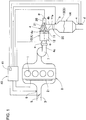
- FIG. 1 is a schematic diagram showing a conceptual configuration of an exhaust gas purification device of an engine according to the present embodiment.
- an intake passage 3 and an exhaust passage 4 are connected to a combustion chamber 1 of an engine 8.
- the combustion chamber 1 is supplied with air through the intake passage 3. Furthermore, fuel is injected into the combustion chamber 1 by a fuel injection device 2. Exhaust gas from the combustion chamber 1 is sent out through the exhaust passage 4 drawn out from the combustion chamber 1, passes through an exhaust gas purification part for removing harmful substances, and then is discharged to atmosphere.
- an air cleaner In the intake passage 3 connecting to the combustion chamber 1, an air cleaner, a throttle valve 5 for changing the passage cross-sectional area to control the flow-rate of intake air, an air flow sensor 6 for detecting the intake air amount, and the like, are disposed in series from upstream toward downstream.
- a turbine 7 of a mechanical supercharger In the exhaust passage 4 drawn out from the combustion chamber 1, a turbine 7 of a mechanical supercharger, a diesel oxidation catalyst device serving as an upstream exhaust gas purification part A, a reductant injector 20 for injecting a reductant into exhaust gas, a mixer 30 for spreading the reductant in the exhaust gas to homogenize the reductant, a reduction catalyst 13 for purifying nitrogen oxide in exhaust gas with the reductant or a substance produced from the reductant, a muffler serving as a noise canceling device , and the like, are disposed in series from upstream toward downstream.
- the reductant injector 20, the mixer 30, the reduction catalyst 13, and the like, constitute a urea selective catalytic reduction device 14 that serves as a downstream exhaust gas purification part B.
- the diesel oxidation catalyst device has a space inside, which has a greater cross section than the exhaust passage 4 in front and rear thereof. Inside the space, a honeycomb-structure member is housed as a carrier 12.
- the carrier 12 includes an assembly of a number of cells through which exhaust gas can pass through.
- the material of the carrier 12 is, for instance, crystalline ceramics (cordierite composition), which has a small thermal expansion coefficient and a high resistance against thermal shock.
- a surface of the carrier supports metal for exerting the function of a catalyst. Accordingly, it is possible to purify harmful substances such as carbon monoxide and carbon hydride contained in passing exhaust gas into harmless substances such as water and carbon dioxide.
- the diesel oxidation catalyst device includes a member to be heated by exhaust passage passing thereby (above carrier 12), on the inner side of the inner wall surface of the exhaust pipe wall of the exhaust passage 4, and the member to be heated may reach a relatively higher temperature than the exhaust pipe wall of the exhaust passage 4, whose outer wall surface is exposed to outside air.
- this member to be heated in the diesel oxidation catalyst device will be referred to as a temperature increasing member 10.
- the temperature increasing member 10 constituting the upstream exhaust gas purification part A, and the urea selective catalytic reduction device 14 serving as the downstream exhaust gas purification part B, are both disposed as a proximate catalyst which is disposed proximate to the combustion chamber 1 of the engine 8, in an environment often exposed to relatively high-temperature exhaust gas.
- the reductant injector 20 injects a reductant toward a downstream end portion 11 of the temperature increasing member 10, that is, toward the upstream side.
- urea CO (NH 2 ) 2
- a reductant is used as a reductant.
- Urea is injected in a state of solution from the reductant injector 20, to spread out over the exhaust gas, while a part of the urea solution adheres to the temperature increasing member 10. Then, the urea is decomposed by high heat of the temperature increasing member 10 and exhaust gas, thus producing ammonia.
- the urea adheres to the temperature increasing member 10 having a high temperature, and thereby decomposition of the urea into ammonia is promoted.
- the exhaust gas pipe wall has an outer surface exposed to outside air and thus has a lower temperature than the temperature increasing member 10. Thus, when urea adheres to the exhaust gas pipe wall, the temperature of the urea decreases, which impedes vaporization. Thus, it is desirable that urea is injected toward the downstream end portion 11 of the temperature increasing member 10.
- an ammonia production promoting catalyst 11a which promotes production of ammonia from urea is supported by the downstream end portion 11 of the temperature increasing member 10, and thus ammonia is produced smoothly.
- the ammonia production promoting catalyst 11a can be supported on the surface of a downstream end portion of the carrier 12.
- the reductant injector 20 is disposed inside an offset hole 21 having a recessed shape and having an opening into the exhaust passage 4.
- the injection nozzle of the reductant injector 20 is disposed slightly further back from the inner wall surface of the exhaust passage 4.
- it is possible to provide a spreading part between the injection nozzle and the pipe whereby it is possible to ensure a long injection distance from the injection nozzle to the temperature increasing member 10, as well as to protect the reductant injector 20 from heat of exhaust gas.
- the reductant injector 20 does not obstruct the flow of exhaust gas.
- the reductant injector 20 injects a reductant in a direction facing the flow direction of exhaust gas in the exhaust passage 4.
- the reductant injector 20 is disposed on the outer side of a bend section 4a connecting straight sections 4b, 4c of the exhaust passage 4, and the injection direction of a reductant is 180-degree opposite to the flow direction of exhaust gas.
- the injection center line 'p' in the injection direction of the reductant injector 20 and the flow center line 'q' of exhaust gas in the exhaust passage 4 are aligned with or parallel to each other.
- the mixer 30 is provided between the reductant injector 20 and the reduction catalyst 13, spreading and homogenization of urea, which is a reductant, are further promoted. Thus, smooth production of ammonia and reaction between ammonia and nitrogen oxide are achieved.
- the mixer 30 may be omitted, as shown in the modified example of FIG. 2 .
- the injection center line 'p" in the injection direction of the reductant injector 20 may be in such a direction that faces the flow center line 'q" of exhaust gas in the exhaust passage 4 at an angle ⁇ (0 ⁇ 90 degrees).
- the reductant agent is injected in a direction facing the flow direction of exhaust gas inside the exhaust passage 4, and is injected to the downstream end portion 11 of the temperature increasing member 10.
- an ammonia detection part 'b' is disposed upstream the reduction catalyst 13 (in the vicinity of the inlet), for obtaining information on the inflow amount of ammonia. Furthermore, a nitrogen oxide detection part 'c' for obtaining information on the discharge amount of nitrogen oxide and an O 2 sensor 'd' are disposed downstream the reduction catalyst 13 (in the vicinity of the outlet). Furthermore, an exhaust gas temperature detection unit 'a' for detecting the temperature of exhaust gas is disposed upstream the temperature increasing member 10 (in the vicinity of the inlet).
- a vehicle equipped with this engine 8 is further provided with an electronic control unit (ECU) 40.
- the electronic control unit 40 controls all devices required to operate the engine 8, including intake and exhaust valves and a fuel injection device, and various type of vehicle equipment, for instance. Furthermore, information from various sensors is transmitted to the electronic control unit 40 through a cable.
- the electronic control unit 40 includes an engine control device 41 which controls the fuel injection amount and the intake amount supplied to the combustion chamber 1, or the amount or time of reductant injection, on the basis of information on the inflow amount of ammonia obtained by the ammonia detection part 'b' and information on the discharge amount of the nitrogen oxide obtained by the nitrogen oxide detection part 'c'.
- the engine control device 31 controls the amount of ammonia produced on the upstream side of the reduction catalyst 13 depending on the operational state, whereby it is possible to reduce the discharge amount of nitrogen oxide.
- the member to be heated by exhaust gas in the temperature increasing member 10 is the carrier 12 of a honeycomb structure disposed on the inner side of the inner wall surface of the exhaust passage 4, but a member other than a honeycomb-structure member may be provided as the carrier 12, such as a perforated member, a plate-shaped member, a rod-shaped member, and a mesh-shaped member.
- a member in another form constituting an exhaust gas purification part may be provided instead of a member constituting the diesel oxidation catalyst device, such as a filter member constituting a diesel particulate matter filter.
- a member for a purpose other than exhaust gas purification may be provided, such as a member of various shape provided for flow rectification, pressure regulation, or the like.
- the shape of the member may include honeycomb shape, perforated shape, plate shape, rod shape, mesh shape, and the like.
- urea is used as a reductant in the above embodiment
- the present invention may be applied to a case in which a reductant other than urea is used.
- ammonia may be used as a reductant, and ammonia solution or the like may be injected.
- the present invention can be also applied to a case in which the upstream exhaust gas purification part A and the downstream exhaust gas purification part B are each provided as an underfloor catalyst disposed remote from the combustion chamber 1 of the engine 8 in an environment rarely exposed to relatively high-temperature exhaust gas.
- purification of exhaust gas in a diesel engine has been described.
- the present invention can be applied to not only to diesel engines but engines in general, as long as an engine includes a reduction catalyst body that purifies nitrogen oxide in exhaust gas with a reductant or a substance produced from the reductant, through injection of the reductant into exhaust gas.
Landscapes
- Chemical & Material Sciences (AREA)
- Engineering & Computer Science (AREA)
- Chemical Kinetics & Catalysis (AREA)
- Health & Medical Sciences (AREA)
- Toxicology (AREA)
- Combustion & Propulsion (AREA)
- Mechanical Engineering (AREA)
- General Engineering & Computer Science (AREA)
- Exhaust Gas After Treatment (AREA)
Abstract
Description
- The present disclosure relates to an exhaust gas purification device of an engine, which purifies exhaust gas discharged from the engine.
- Generally, as an exhaust gas purification device for a diesel engine or the like, a diesel oxidation catalyst and a diesel particulate matter filter are used, for instance, in order to purify diesel exhaust particulate matters (PM) and nitrogen oxide (NOx) contained in exhaust gas.
- Furthermore, there is a system using a NOx trap catalyst or a urea selective catalytic reduction device, for instance, in order to purify nitrogen oxide (NOx) contained in lean exhaust gas.
- A urea selective catalytic reduction device injects urea solution, which serves as a reductant, into exhaust gas through a reductant injector disposed upstream a reduction catalyst body, thereby utilizing thermal decomposition of the urea into ammonia (NH3) by heat of exhaust gas. The produced ammonia reacts with nitrogen oxide in exhaust gas in the vicinity of the reduction catalyst body, and turns into nitrogen gas (N2) and water (H2O). Accordingly, nitrogen oxide in the exhaust gas is purified.
- For instance, in Patent Document 1 (
JP2012-122469A - Generally, a urea selection catalytic reduction device has an excellent purification property of purifying nitrogen oxide in a high temperature region compared to a nitrogen oxide trap catalyst device, but its purification performance tends to deteriorate in a low temperature region. Thus, in recent years, a urea selective catalytic reduction device is often located at a position more proximate to the engine to ensure a high reaction temperature.
- When a urea selective catalytic reduction device is positioned proximate to the engine, the distance between the combustion chamber of the engine and the reduction catalyst body of the urea selective catalytic reduction device becomes shorter. Thus, it is difficult to distribute injected urea solution uniformly over the entire exhaust gas before the exhaust gas enters the reduction catalyst body.
- If, hypothetically, the urea solution is not uniform enough in exhaust gas, it may be difficult to exert a sufficient purification performance for the amount of urea solution supplied thereto. Therefore, a mixer is often provided downstream the reductant injector, for spreading urea solution throughout exhaust gas.
- A mixer is effective to some extent, in spreading urea solution over exhaust gas. However, to distribute urea solution over exhaust gas evenly on a constant basis even in various operational states and temperature conditions that change from hour to hour, further improvement is required.
- Thus, an object of at least one embodiment of the present invention is to improve homogeneity of a reductant injected into exhaust gas.
- To solve the above problem, an exhaust gas purification device of an engine according to at least one embodiment of the present invention includes: an exhaust passage extending from a combustion chamber of an engine; a temperature increasing member which is disposed on an inner side of an inner wall surface of the exhaust passage and which is to be heated by exhaust gas passing thereby; a reductant injector disposed downstream the temperature increasing member and configured to inject a reductant into the exhaust gas; and a reduction catalyst for purifying nitrogen oxide contained in the exhaust gas with the reductant or a substance produced from the reductant. The reductant injector is configured to inject the reductant toward a downstream end portion of the temperature increasing member.
- With the above configuration, a reductant is injected by the reductant injector toward the downstream end portion of the temperature increasing member disposed upstream of the reductant injector, and thus the reductant faces opposite to the flow direction of exhaust gas, whereby the penetration force in injection is weakened. Furthermore, the injected reductant adheres to the downstream end portion of the temperature increasing member having a temperature increased by exhaust gas. Accordingly, evaporation of the reductant is promoted by the temperature increasing member having a temperature relatively higher than the inner wall surface of the exhaust passage, and thereby it is possible to homogenize distribution of the reductant in exhaust gas.
-
-
FIG. 1 is a schematic diagram of an exhaust gas purification device of an engine according to an embodiment of the present invention. -
FIG. 2 is a schematic diagram showing a modified example ofFIG. 1 . -
FIG. 3 is a schematic diagram showing a part of another modified example ofFIG. 1 . - Hereinafter, an embodiment of the present invention will be described with reference to the drawings.
FIG. 1 is a schematic diagram showing a conceptual configuration of an exhaust gas purification device of an engine according to the present embodiment. - As shown in
FIG. 1 , an intake passage 3 and anexhaust passage 4 are connected to acombustion chamber 1 of anengine 8. Thecombustion chamber 1 is supplied with air through the intake passage 3. Furthermore, fuel is injected into thecombustion chamber 1 by afuel injection device 2. Exhaust gas from thecombustion chamber 1 is sent out through theexhaust passage 4 drawn out from thecombustion chamber 1, passes through an exhaust gas purification part for removing harmful substances, and then is discharged to atmosphere. - In the intake passage 3 connecting to the
combustion chamber 1, an air cleaner, athrottle valve 5 for changing the passage cross-sectional area to control the flow-rate of intake air, anair flow sensor 6 for detecting the intake air amount, and the like, are disposed in series from upstream toward downstream. - In the
exhaust passage 4 drawn out from thecombustion chamber 1, a turbine 7 of a mechanical supercharger, a diesel oxidation catalyst device serving as an upstream exhaust gas purification part A, areductant injector 20 for injecting a reductant into exhaust gas, amixer 30 for spreading the reductant in the exhaust gas to homogenize the reductant, areduction catalyst 13 for purifying nitrogen oxide in exhaust gas with the reductant or a substance produced from the reductant, a muffler serving as a noise canceling device , and the like, are disposed in series from upstream toward downstream. - The
reductant injector 20, themixer 30, thereduction catalyst 13, and the like, constitute a urea selectivecatalytic reduction device 14 that serves as a downstream exhaust gas purification part B. - The diesel oxidation catalyst device has a space inside, which has a greater cross section than the
exhaust passage 4 in front and rear thereof. Inside the space, a honeycomb-structure member is housed as acarrier 12. Thecarrier 12 includes an assembly of a number of cells through which exhaust gas can pass through. The material of thecarrier 12 is, for instance, crystalline ceramics (cordierite composition), which has a small thermal expansion coefficient and a high resistance against thermal shock. A surface of the carrier supports metal for exerting the function of a catalyst. Accordingly, it is possible to purify harmful substances such as carbon monoxide and carbon hydride contained in passing exhaust gas into harmless substances such as water and carbon dioxide. - As described above, the diesel oxidation catalyst device includes a member to be heated by exhaust passage passing thereby (above carrier 12), on the inner side of the inner wall surface of the exhaust pipe wall of the
exhaust passage 4, and the member to be heated may reach a relatively higher temperature than the exhaust pipe wall of theexhaust passage 4, whose outer wall surface is exposed to outside air. Thus, hereinafter, this member to be heated in the diesel oxidation catalyst device will be referred to as atemperature increasing member 10. - The
temperature increasing member 10 constituting the upstream exhaust gas purification part A, and the urea selectivecatalytic reduction device 14 serving as the downstream exhaust gas purification part B, are both disposed as a proximate catalyst which is disposed proximate to thecombustion chamber 1 of theengine 8, in an environment often exposed to relatively high-temperature exhaust gas. - The
reductant injector 20 injects a reductant toward adownstream end portion 11 of thetemperature increasing member 10, that is, toward the upstream side. Herein, urea (CO (NH2)2) is used as a reductant. - Urea is injected in a state of solution from the
reductant injector 20, to spread out over the exhaust gas, while a part of the urea solution adheres to thetemperature increasing member 10. Then, the urea is decomposed by high heat of thetemperature increasing member 10 and exhaust gas, thus producing ammonia. The urea adheres to thetemperature increasing member 10 having a high temperature, and thereby decomposition of the urea into ammonia is promoted. The exhaust gas pipe wall has an outer surface exposed to outside air and thus has a lower temperature than thetemperature increasing member 10. Thus, when urea adheres to the exhaust gas pipe wall, the temperature of the urea decreases, which impedes vaporization. Thus, it is desirable that urea is injected toward thedownstream end portion 11 of thetemperature increasing member 10. - Furthermore, in the present embodiment, an ammonia
production promoting catalyst 11a which promotes production of ammonia from urea is supported by thedownstream end portion 11 of thetemperature increasing member 10, and thus ammonia is produced smoothly. The ammoniaproduction promoting catalyst 11a can be supported on the surface of a downstream end portion of thecarrier 12. - The
reductant injector 20 is disposed inside anoffset hole 21 having a recessed shape and having an opening into theexhaust passage 4. Thus, the injection nozzle of thereductant injector 20 is disposed slightly further back from the inner wall surface of theexhaust passage 4. Thus, it is possible to provide a spreading part between the injection nozzle and the pipe, whereby it is possible to ensure a long injection distance from the injection nozzle to thetemperature increasing member 10, as well as to protect thereductant injector 20 from heat of exhaust gas. Furthermore, thereductant injector 20 does not obstruct the flow of exhaust gas. - The
reductant injector 20 injects a reductant in a direction facing the flow direction of exhaust gas in theexhaust passage 4. In this embodiment, thereductant injector 20 is disposed on the outer side of abend section 4a connectingstraight sections exhaust passage 4, and the injection direction of a reductant is 180-degree opposite to the flow direction of exhaust gas. In other words, in the present embodiment, as shown inFIG. 1 , the injection center line 'p' in the injection direction of thereductant injector 20 and the flow center line 'q' of exhaust gas in theexhaust passage 4 are aligned with or parallel to each other. Thus, with the flow of exhaust gas, it is possible to weaken the penetration force of the injected reductant, thus promoting spreading and homogenization of the reductant. - Inside the
reduction catalyst 13 and in the vicinity thereof, thanks to the catalytic function of thereduction catalyst 13, ammonia produced from urea and nitrogen oxide contained in exhaust gas react, and thereby nitrogen gas and water are produced. Accordingly, exhaust gas is purified before being released to the atmosphere. - Herein, since the
mixer 30 is provided between thereductant injector 20 and thereduction catalyst 13, spreading and homogenization of urea, which is a reductant, are further promoted. Thus, smooth production of ammonia and reaction between ammonia and nitrogen oxide are achieved. However, in a case where spreading and homogenization of a reductant in exhaust gas are performed sufficiently in the vicinity of thetemperature increasing member 10, themixer 30 may be omitted, as shown in the modified example ofFIG. 2 . - Furthermore, for instance, as shown in the modified example of
FIG. 3 , the injection center line 'p" in the injection direction of thereductant injector 20 may be in such a direction that faces the flow center line 'q" of exhaust gas in theexhaust passage 4 at an angle α (0<α<90 degrees). In this modification example, the reductant agent is injected in a direction facing the flow direction of exhaust gas inside theexhaust passage 4, and is injected to thedownstream end portion 11 of thetemperature increasing member 10. - In the
exhaust passage 4, as shown inFIG. 1 , an ammonia detection part 'b' is disposed upstream the reduction catalyst 13 (in the vicinity of the inlet), for obtaining information on the inflow amount of ammonia. Furthermore, a nitrogen oxide detection part 'c' for obtaining information on the discharge amount of nitrogen oxide and an O2 sensor 'd' are disposed downstream the reduction catalyst 13 (in the vicinity of the outlet). Furthermore, an exhaust gas temperature detection unit 'a' for detecting the temperature of exhaust gas is disposed upstream the temperature increasing member 10 (in the vicinity of the inlet). - A vehicle equipped with this
engine 8 is further provided with an electronic control unit (ECU) 40. Theelectronic control unit 40 controls all devices required to operate theengine 8, including intake and exhaust valves and a fuel injection device, and various type of vehicle equipment, for instance. Furthermore, information from various sensors is transmitted to theelectronic control unit 40 through a cable. - The
electronic control unit 40 includes anengine control device 41 which controls the fuel injection amount and the intake amount supplied to thecombustion chamber 1, or the amount or time of reductant injection, on the basis of information on the inflow amount of ammonia obtained by the ammonia detection part 'b' and information on the discharge amount of the nitrogen oxide obtained by the nitrogen oxide detection part 'c'. - Through these controls, the engine control device 31 controls the amount of ammonia produced on the upstream side of the
reduction catalyst 13 depending on the operational state, whereby it is possible to reduce the discharge amount of nitrogen oxide. - Furthermore, in the above embodiment, the member to be heated by exhaust gas in the
temperature increasing member 10 is thecarrier 12 of a honeycomb structure disposed on the inner side of the inner wall surface of theexhaust passage 4, but a member other than a honeycomb-structure member may be provided as thecarrier 12, such as a perforated member, a plate-shaped member, a rod-shaped member, and a mesh-shaped member. Furthermore, as thetemperature increasing member 10, a member in another form constituting an exhaust gas purification part may be provided instead of a member constituting the diesel oxidation catalyst device, such as a filter member constituting a diesel particulate matter filter. Alternatively, as thetemperature increasing member 10, a member for a purpose other than exhaust gas purification may be provided, such as a member of various shape provided for flow rectification, pressure regulation, or the like. At this time, the shape of the member may include honeycomb shape, perforated shape, plate shape, rod shape, mesh shape, and the like. - Furthermore, while urea is used as a reductant in the above embodiment, the present invention may be applied to a case in which a reductant other than urea is used. For instance, ammonia may be used as a reductant, and ammonia solution or the like may be injected.
- Furthermore, while both of the upstream exhaust gas purification part A and the downstream exhaust gas purification part B are proximate catalysts in the above embodiment, the present invention can be also applied to a case in which the upstream exhaust gas purification part A and the downstream exhaust gas purification part B are each provided as an underfloor catalyst disposed remote from the
combustion chamber 1 of theengine 8 in an environment rarely exposed to relatively high-temperature exhaust gas. - In the above embodiment, purification of exhaust gas in a diesel engine has been described. However, the present invention can be applied to not only to diesel engines but engines in general, as long as an engine includes a reduction catalyst body that purifies nitrogen oxide in exhaust gas with a reductant or a substance produced from the reductant, through injection of the reductant into exhaust gas.
Claims (7)
- An exhaust gas purification device of an engine, comprising:an exhaust passage (4) extending from a combustion chamber (1) of an engine (8);a temperature increasing member (10) which is disposed on an inner side of an inner wall surface of the exhaust passage and which is to be heated by exhaust gas passing thereby;a reductant injector (20) disposed downstream the temperature increasing member (10) and configured to inject a reductant into the exhaust gas; anda reduction catalyst (13) for purifying nitrogen oxide contained in the exhaust gas with the reductant or a substance produced from the reductant,wherein the reductant injector (20) is configured to inject the reductant toward a downstream end portion (11) of the temperature increasing member (10).
- The exhaust gas purification device of an engine, according to claim 1,
wherein an injection nozzle of the reductant injector (20) is disposed so as to face the downstream end portion of the temperature increasing member (10). - The exhaust gas purification device of an engine, according to claim 1 or 2,
wherein the reductant is urea, and
wherein the downstream end portion (11) of the temperature increasing member (10) supports an ammonia production promoting catalyst (11a) configured to promote production of ammonia from the urea. - The exhaust gas purification device of an engine, according to any one of claims 1 to 3,
wherein the temperature increasing member (10) comprises a part of an exhaust gas purification part (A). - The exhaust gas purification device of an engine, according to any one of claims 1 to 4,
wherein the temperature increasing member (10) comprises a perforated member, a plate-shaped member, a rod-shaped member, a mesh-shaped member, or a honeycomb-structure member disposed on the inner side of the inner wall surface of the exhaust passage (4). - The exhaust gas purification device of an engine, according to any one of claims 1 to 5,
wherein the reductant injector (20) is disposed inside a hole (21) having a spreading part disposed between the exhaust passage (4) and the reductant injector (20) and configured to spread a reductant. - The exhaust gas purification device of an engine, according to any one of claims 1 to 6, further comprising a mixer (30) disposed between the reductant injector (20) and the reduction catalyst (13).
Applications Claiming Priority (1)
| Application Number | Priority Date | Filing Date | Title |
|---|---|---|---|
| JP2017017582A JP2018123783A (en) | 2017-02-02 | 2017-02-02 | Exhaust gas purification device |
Publications (2)
| Publication Number | Publication Date |
|---|---|
| EP3358158A1 true EP3358158A1 (en) | 2018-08-08 |
| EP3358158B1 EP3358158B1 (en) | 2020-09-16 |
Family
ID=61005746
Family Applications (1)
| Application Number | Title | Priority Date | Filing Date |
|---|---|---|---|
| EP18152163.4A Not-in-force EP3358158B1 (en) | 2017-02-02 | 2018-01-17 | Exhaust gas purification device |
Country Status (2)
| Country | Link |
|---|---|
| EP (1) | EP3358158B1 (en) |
| JP (1) | JP2018123783A (en) |
Cited By (1)
| Publication number | Priority date | Publication date | Assignee | Title |
|---|---|---|---|---|
| CN115898598A (en) * | 2023-02-08 | 2023-04-04 | 中国船舶重工集团柴油机有限公司 | High-pressure SCR evaporation mixing device and application method thereof |
Citations (5)
| Publication number | Priority date | Publication date | Assignee | Title |
|---|---|---|---|---|
| DE102009021616A1 (en) * | 2009-05-15 | 2010-11-18 | Makon Engineering Gmbh | Exhaust gas post treating device for use in ship, has catalyst unit post treating exhaust gas of exhaust gas flow, and adding unit adding component during post treatment of exhaust gas, where adding unit includes fluid tank |
| US20110146254A1 (en) * | 2009-12-21 | 2011-06-23 | Caterpillar Inc. | Scr reductant mixer |
| JP2012122469A (en) | 2010-12-09 | 2012-06-28 | Hyundai Motor Co Ltd | Dosing module for exhaust gas aftertreatment system of vehicle |
| WO2013127936A1 (en) * | 2012-03-02 | 2013-09-06 | Emitec Gesellschaft Für Emissionstechnologie Mbh | Method for operating a heating catalyst |
| DE102015212485A1 (en) * | 2015-07-03 | 2017-01-05 | Ford Global Technologies, Llc | Exhaust tract with spraying against a flow direction metering device, method for operating an exhaust tract and vehicle with exhaust tract |
-
2017
- 2017-02-02 JP JP2017017582A patent/JP2018123783A/en active Pending
-
2018
- 2018-01-17 EP EP18152163.4A patent/EP3358158B1/en not_active Not-in-force
Patent Citations (5)
| Publication number | Priority date | Publication date | Assignee | Title |
|---|---|---|---|---|
| DE102009021616A1 (en) * | 2009-05-15 | 2010-11-18 | Makon Engineering Gmbh | Exhaust gas post treating device for use in ship, has catalyst unit post treating exhaust gas of exhaust gas flow, and adding unit adding component during post treatment of exhaust gas, where adding unit includes fluid tank |
| US20110146254A1 (en) * | 2009-12-21 | 2011-06-23 | Caterpillar Inc. | Scr reductant mixer |
| JP2012122469A (en) | 2010-12-09 | 2012-06-28 | Hyundai Motor Co Ltd | Dosing module for exhaust gas aftertreatment system of vehicle |
| WO2013127936A1 (en) * | 2012-03-02 | 2013-09-06 | Emitec Gesellschaft Für Emissionstechnologie Mbh | Method for operating a heating catalyst |
| DE102015212485A1 (en) * | 2015-07-03 | 2017-01-05 | Ford Global Technologies, Llc | Exhaust tract with spraying against a flow direction metering device, method for operating an exhaust tract and vehicle with exhaust tract |
Cited By (1)
| Publication number | Priority date | Publication date | Assignee | Title |
|---|---|---|---|---|
| CN115898598A (en) * | 2023-02-08 | 2023-04-04 | 中国船舶重工集团柴油机有限公司 | High-pressure SCR evaporation mixing device and application method thereof |
Also Published As
| Publication number | Publication date |
|---|---|
| JP2018123783A (en) | 2018-08-09 |
| EP3358158B1 (en) | 2020-09-16 |
Similar Documents
| Publication | Publication Date | Title |
|---|---|---|
| US8959900B2 (en) | Exhaust aftertreatment system for internal combustion engine | |
| US9689290B2 (en) | Reductant mixing system for an exhaust gas after-treatment device | |
| US8261538B2 (en) | Compact exhaust gas aftertreatment system | |
| CN101821486B (en) | Device for post-treatment of exhaust gases of a lean-burning internal combustion engine | |
| EP2423479A2 (en) | Exhaust gas purification apparatus | |
| US20110107743A1 (en) | Nozzle Diffuser Mixer | |
| JP4450257B2 (en) | Exhaust purification device | |
| JP2009156071A (en) | Exhaust gas purification device for internal combustion engine | |
| JP5020185B2 (en) | Exhaust purification device | |
| GB2512896A (en) | A mixer module and an emissions cleaning module | |
| JP2018123788A (en) | Exhaust gas purification device | |
| EP3364006A1 (en) | Exhaust gas purification device | |
| JP2010019221A (en) | Engine exhaust emission control device | |
| CN114320553A (en) | Circular sampling device for exhaust gas sensor | |
| EP2573349B1 (en) | Exhaust pipe | |
| EP3358158B1 (en) | Exhaust gas purification device | |
| US20140041370A1 (en) | Exhaust Treatment System for Internal Combustion Engine | |
| JP4577099B2 (en) | Exhaust gas purification device for internal combustion engine | |
| JP2010031717A (en) | Exhaust emission control device | |
| EP2508724A1 (en) | Engine exhaust-air purifying apparatus | |
| JP2010031719A (en) | Exhaust emission control device | |
| US11293327B2 (en) | Sampling device for an exhaust gas sensor | |
| KR100820685B1 (en) | SCC R Purifier | |
| CN204312173U (en) | Vehicle SCR systems and reducing agent feeding mechanism thereof | |
| US20170234182A1 (en) | High-end processing device for purification of exhaust of diesel engine |
Legal Events
| Date | Code | Title | Description |
|---|---|---|---|
| PUAI | Public reference made under article 153(3) epc to a published international application that has entered the european phase |
Free format text: ORIGINAL CODE: 0009012 |
|
| STAA | Information on the status of an ep patent application or granted ep patent |
Free format text: STATUS: REQUEST FOR EXAMINATION WAS MADE |
|
| 17P | Request for examination filed |
Effective date: 20180217 |
|
| AK | Designated contracting states |
Kind code of ref document: A1 Designated state(s): AL AT BE BG CH CY CZ DE DK EE ES FI FR GB GR HR HU IE IS IT LI LT LU LV MC MK MT NL NO PL PT RO RS SE SI SK SM TR |
|
| AX | Request for extension of the european patent |
Extension state: BA ME |
|
| RBV | Designated contracting states (corrected) |
Designated state(s): AL AT BE BG CH CY CZ DE DK EE ES FI FR GB GR HR HU IE IS IT LI LT LU LV MC MK MT NL NO PL PT RO RS SE SI SK SM TR |
|
| STAA | Information on the status of an ep patent application or granted ep patent |
Free format text: STATUS: EXAMINATION IS IN PROGRESS |
|
| 17Q | First examination report despatched |
Effective date: 20181211 |
|
| RAP1 | Party data changed (applicant data changed or rights of an application transferred) |
Owner name: MITSUBISHI JIDOSHA KOGYO KABUSHIKI KAISHA |
|
| GRAP | Despatch of communication of intention to grant a patent |
Free format text: ORIGINAL CODE: EPIDOSNIGR1 |
|
| STAA | Information on the status of an ep patent application or granted ep patent |
Free format text: STATUS: GRANT OF PATENT IS INTENDED |
|
| INTG | Intention to grant announced |
Effective date: 20200421 |
|
| GRAS | Grant fee paid |
Free format text: ORIGINAL CODE: EPIDOSNIGR3 |
|
| GRAA | (expected) grant |
Free format text: ORIGINAL CODE: 0009210 |
|
| STAA | Information on the status of an ep patent application or granted ep patent |
Free format text: STATUS: THE PATENT HAS BEEN GRANTED |
|
| AK | Designated contracting states |
Kind code of ref document: B1 Designated state(s): AL AT BE BG CH CY CZ DE DK EE ES FI FR GB GR HR HU IE IS IT LI LT LU LV MC MK MT NL NO PL PT RO RS SE SI SK SM TR |
|
| REG | Reference to a national code |
Ref country code: GB Ref legal event code: FG4D |
|
| REG | Reference to a national code |
Ref country code: CH Ref legal event code: EP |
|
| REG | Reference to a national code |
Ref country code: DE Ref legal event code: R096 Ref document number: 602018007772 Country of ref document: DE |
|
| REG | Reference to a national code |
Ref country code: IE Ref legal event code: FG4D |
|
| REG | Reference to a national code |
Ref country code: AT Ref legal event code: REF Ref document number: 1314345 Country of ref document: AT Kind code of ref document: T Effective date: 20201015 |
|
| PG25 | Lapsed in a contracting state [announced via postgrant information from national office to epo] |
Ref country code: SE Free format text: LAPSE BECAUSE OF FAILURE TO SUBMIT A TRANSLATION OF THE DESCRIPTION OR TO PAY THE FEE WITHIN THE PRESCRIBED TIME-LIMIT Effective date: 20200916 Ref country code: BG Free format text: LAPSE BECAUSE OF FAILURE TO SUBMIT A TRANSLATION OF THE DESCRIPTION OR TO PAY THE FEE WITHIN THE PRESCRIBED TIME-LIMIT Effective date: 20201216 Ref country code: GR Free format text: LAPSE BECAUSE OF FAILURE TO SUBMIT A TRANSLATION OF THE DESCRIPTION OR TO PAY THE FEE WITHIN THE PRESCRIBED TIME-LIMIT Effective date: 20201217 Ref country code: NO Free format text: LAPSE BECAUSE OF FAILURE TO SUBMIT A TRANSLATION OF THE DESCRIPTION OR TO PAY THE FEE WITHIN THE PRESCRIBED TIME-LIMIT Effective date: 20201216 Ref country code: FI Free format text: LAPSE BECAUSE OF FAILURE TO SUBMIT A TRANSLATION OF THE DESCRIPTION OR TO PAY THE FEE WITHIN THE PRESCRIBED TIME-LIMIT Effective date: 20200916 Ref country code: HR Free format text: LAPSE BECAUSE OF FAILURE TO SUBMIT A TRANSLATION OF THE DESCRIPTION OR TO PAY THE FEE WITHIN THE PRESCRIBED TIME-LIMIT Effective date: 20200916 |
|
| REG | Reference to a national code |
Ref country code: AT Ref legal event code: MK05 Ref document number: 1314345 Country of ref document: AT Kind code of ref document: T Effective date: 20200916 |
|
| REG | Reference to a national code |
Ref country code: NL Ref legal event code: MP Effective date: 20200916 |
|
| PG25 | Lapsed in a contracting state [announced via postgrant information from national office to epo] |
Ref country code: LV Free format text: LAPSE BECAUSE OF FAILURE TO SUBMIT A TRANSLATION OF THE DESCRIPTION OR TO PAY THE FEE WITHIN THE PRESCRIBED TIME-LIMIT Effective date: 20200916 Ref country code: RS Free format text: LAPSE BECAUSE OF FAILURE TO SUBMIT A TRANSLATION OF THE DESCRIPTION OR TO PAY THE FEE WITHIN THE PRESCRIBED TIME-LIMIT Effective date: 20200916 |
|
| REG | Reference to a national code |
Ref country code: LT Ref legal event code: MG4D |
|
| PG25 | Lapsed in a contracting state [announced via postgrant information from national office to epo] |
Ref country code: LT Free format text: LAPSE BECAUSE OF FAILURE TO SUBMIT A TRANSLATION OF THE DESCRIPTION OR TO PAY THE FEE WITHIN THE PRESCRIBED TIME-LIMIT Effective date: 20200916 Ref country code: SM Free format text: LAPSE BECAUSE OF FAILURE TO SUBMIT A TRANSLATION OF THE DESCRIPTION OR TO PAY THE FEE WITHIN THE PRESCRIBED TIME-LIMIT Effective date: 20200916 Ref country code: CZ Free format text: LAPSE BECAUSE OF FAILURE TO SUBMIT A TRANSLATION OF THE DESCRIPTION OR TO PAY THE FEE WITHIN THE PRESCRIBED TIME-LIMIT Effective date: 20200916 Ref country code: PT Free format text: LAPSE BECAUSE OF FAILURE TO SUBMIT A TRANSLATION OF THE DESCRIPTION OR TO PAY THE FEE WITHIN THE PRESCRIBED TIME-LIMIT Effective date: 20210118 Ref country code: RO Free format text: LAPSE BECAUSE OF FAILURE TO SUBMIT A TRANSLATION OF THE DESCRIPTION OR TO PAY THE FEE WITHIN THE PRESCRIBED TIME-LIMIT Effective date: 20200916 Ref country code: EE Free format text: LAPSE BECAUSE OF FAILURE TO SUBMIT A TRANSLATION OF THE DESCRIPTION OR TO PAY THE FEE WITHIN THE PRESCRIBED TIME-LIMIT Effective date: 20200916 |
|
| PG25 | Lapsed in a contracting state [announced via postgrant information from national office to epo] |
Ref country code: AL Free format text: LAPSE BECAUSE OF FAILURE TO SUBMIT A TRANSLATION OF THE DESCRIPTION OR TO PAY THE FEE WITHIN THE PRESCRIBED TIME-LIMIT Effective date: 20200916 Ref country code: AT Free format text: LAPSE BECAUSE OF FAILURE TO SUBMIT A TRANSLATION OF THE DESCRIPTION OR TO PAY THE FEE WITHIN THE PRESCRIBED TIME-LIMIT Effective date: 20200916 Ref country code: ES Free format text: LAPSE BECAUSE OF FAILURE TO SUBMIT A TRANSLATION OF THE DESCRIPTION OR TO PAY THE FEE WITHIN THE PRESCRIBED TIME-LIMIT Effective date: 20200916 Ref country code: PL Free format text: LAPSE BECAUSE OF FAILURE TO SUBMIT A TRANSLATION OF THE DESCRIPTION OR TO PAY THE FEE WITHIN THE PRESCRIBED TIME-LIMIT Effective date: 20200916 Ref country code: IS Free format text: LAPSE BECAUSE OF FAILURE TO SUBMIT A TRANSLATION OF THE DESCRIPTION OR TO PAY THE FEE WITHIN THE PRESCRIBED TIME-LIMIT Effective date: 20210116 |
|
| REG | Reference to a national code |
Ref country code: DE Ref legal event code: R097 Ref document number: 602018007772 Country of ref document: DE |
|
| PG25 | Lapsed in a contracting state [announced via postgrant information from national office to epo] |
Ref country code: SK Free format text: LAPSE BECAUSE OF FAILURE TO SUBMIT A TRANSLATION OF THE DESCRIPTION OR TO PAY THE FEE WITHIN THE PRESCRIBED TIME-LIMIT Effective date: 20200916 |
|
| PLBE | No opposition filed within time limit |
Free format text: ORIGINAL CODE: 0009261 |
|
| STAA | Information on the status of an ep patent application or granted ep patent |
Free format text: STATUS: NO OPPOSITION FILED WITHIN TIME LIMIT |
|
| 26N | No opposition filed |
Effective date: 20210617 |
|
| PG25 | Lapsed in a contracting state [announced via postgrant information from national office to epo] |
Ref country code: DK Free format text: LAPSE BECAUSE OF FAILURE TO SUBMIT A TRANSLATION OF THE DESCRIPTION OR TO PAY THE FEE WITHIN THE PRESCRIBED TIME-LIMIT Effective date: 20200916 Ref country code: SI Free format text: LAPSE BECAUSE OF FAILURE TO SUBMIT A TRANSLATION OF THE DESCRIPTION OR TO PAY THE FEE WITHIN THE PRESCRIBED TIME-LIMIT Effective date: 20200916 Ref country code: MC Free format text: LAPSE BECAUSE OF FAILURE TO SUBMIT A TRANSLATION OF THE DESCRIPTION OR TO PAY THE FEE WITHIN THE PRESCRIBED TIME-LIMIT Effective date: 20200916 |
|
| REG | Reference to a national code |
Ref country code: CH Ref legal event code: PL |
|
| PG25 | Lapsed in a contracting state [announced via postgrant information from national office to epo] |
Ref country code: LU Free format text: LAPSE BECAUSE OF NON-PAYMENT OF DUE FEES Effective date: 20210117 |
|
| REG | Reference to a national code |
Ref country code: BE Ref legal event code: MM Effective date: 20210131 |
|
| PG25 | Lapsed in a contracting state [announced via postgrant information from national office to epo] |
Ref country code: IT Free format text: LAPSE BECAUSE OF FAILURE TO SUBMIT A TRANSLATION OF THE DESCRIPTION OR TO PAY THE FEE WITHIN THE PRESCRIBED TIME-LIMIT Effective date: 20200916 |
|
| PG25 | Lapsed in a contracting state [announced via postgrant information from national office to epo] |
Ref country code: CH Free format text: LAPSE BECAUSE OF NON-PAYMENT OF DUE FEES Effective date: 20210131 Ref country code: LI Free format text: LAPSE BECAUSE OF NON-PAYMENT OF DUE FEES Effective date: 20210131 |
|
| PG25 | Lapsed in a contracting state [announced via postgrant information from national office to epo] |
Ref country code: IE Free format text: LAPSE BECAUSE OF NON-PAYMENT OF DUE FEES Effective date: 20210117 |
|
| PGFP | Annual fee paid to national office [announced via postgrant information from national office to epo] |
Ref country code: DE Payment date: 20220131 Year of fee payment: 5 |
|
| PGFP | Annual fee paid to national office [announced via postgrant information from national office to epo] |
Ref country code: FR Payment date: 20220110 Year of fee payment: 5 |
|
| PG25 | Lapsed in a contracting state [announced via postgrant information from national office to epo] |
Ref country code: BE Free format text: LAPSE BECAUSE OF NON-PAYMENT OF DUE FEES Effective date: 20210131 |
|
| GBPC | Gb: european patent ceased through non-payment of renewal fee |
Effective date: 20220117 |
|
| PG25 | Lapsed in a contracting state [announced via postgrant information from national office to epo] |
Ref country code: GB Free format text: LAPSE BECAUSE OF NON-PAYMENT OF DUE FEES Effective date: 20220117 |
|
| PG25 | Lapsed in a contracting state [announced via postgrant information from national office to epo] |
Ref country code: NL Free format text: LAPSE BECAUSE OF NON-PAYMENT OF DUE FEES Effective date: 20200923 Ref country code: CY Free format text: LAPSE BECAUSE OF FAILURE TO SUBMIT A TRANSLATION OF THE DESCRIPTION OR TO PAY THE FEE WITHIN THE PRESCRIBED TIME-LIMIT Effective date: 20200916 |
|
| PG25 | Lapsed in a contracting state [announced via postgrant information from national office to epo] |
Ref country code: HU Free format text: LAPSE BECAUSE OF FAILURE TO SUBMIT A TRANSLATION OF THE DESCRIPTION OR TO PAY THE FEE WITHIN THE PRESCRIBED TIME-LIMIT; INVALID AB INITIO Effective date: 20180117 |
|
| REG | Reference to a national code |
Ref country code: DE Ref legal event code: R119 Ref document number: 602018007772 Country of ref document: DE |
|
| PG25 | Lapsed in a contracting state [announced via postgrant information from national office to epo] |
Ref country code: DE Free format text: LAPSE BECAUSE OF NON-PAYMENT OF DUE FEES Effective date: 20230801 |
|
| PG25 | Lapsed in a contracting state [announced via postgrant information from national office to epo] |
Ref country code: FR Free format text: LAPSE BECAUSE OF NON-PAYMENT OF DUE FEES Effective date: 20230131 |
|
| PG25 | Lapsed in a contracting state [announced via postgrant information from national office to epo] |
Ref country code: MK Free format text: LAPSE BECAUSE OF FAILURE TO SUBMIT A TRANSLATION OF THE DESCRIPTION OR TO PAY THE FEE WITHIN THE PRESCRIBED TIME-LIMIT Effective date: 20200916 |
|
| PG25 | Lapsed in a contracting state [announced via postgrant information from national office to epo] |
Ref country code: TR Free format text: LAPSE BECAUSE OF FAILURE TO SUBMIT A TRANSLATION OF THE DESCRIPTION OR TO PAY THE FEE WITHIN THE PRESCRIBED TIME-LIMIT Effective date: 20200916 |
|
| PG25 | Lapsed in a contracting state [announced via postgrant information from national office to epo] |
Ref country code: MT Free format text: LAPSE BECAUSE OF FAILURE TO SUBMIT A TRANSLATION OF THE DESCRIPTION OR TO PAY THE FEE WITHIN THE PRESCRIBED TIME-LIMIT Effective date: 20200916 |