EP3271590B1 - Device for storing energy - Google Patents
Device for storing energy Download PDFInfo
- Publication number
- EP3271590B1 EP3271590B1 EP17727091.5A EP17727091A EP3271590B1 EP 3271590 B1 EP3271590 B1 EP 3271590B1 EP 17727091 A EP17727091 A EP 17727091A EP 3271590 B1 EP3271590 B1 EP 3271590B1
- Authority
- EP
- European Patent Office
- Prior art keywords
- piston
- cylinder
- segments
- energy
- mass
- Prior art date
- Legal status (The legal status is an assumption and is not a legal conclusion. Google has not performed a legal analysis and makes no representation as to the accuracy of the status listed.)
- Active
Links
Images




Classifications
-
- F—MECHANICAL ENGINEERING; LIGHTING; HEATING; WEAPONS; BLASTING
- F03—MACHINES OR ENGINES FOR LIQUIDS; WIND, SPRING, OR WEIGHT MOTORS; PRODUCING MECHANICAL POWER OR A REACTIVE PROPULSIVE THRUST, NOT OTHERWISE PROVIDED FOR
- F03B—MACHINES OR ENGINES FOR LIQUIDS
- F03B17/00—Other machines or engines
- F03B17/005—Installations wherein the liquid circulates in a closed loop ; Alleged perpetua mobilia of this or similar kind
-
- F—MECHANICAL ENGINEERING; LIGHTING; HEATING; WEAPONS; BLASTING
- F03—MACHINES OR ENGINES FOR LIQUIDS; WIND, SPRING, OR WEIGHT MOTORS; PRODUCING MECHANICAL POWER OR A REACTIVE PROPULSIVE THRUST, NOT OTHERWISE PROVIDED FOR
- F03B—MACHINES OR ENGINES FOR LIQUIDS
- F03B13/00—Adaptations of machines or engines for special use; Combinations of machines or engines with driving or driven apparatus; Power stations or aggregates
- F03B13/06—Stations or aggregates of water-storage type, e.g. comprising a turbine and a pump
-
- F—MECHANICAL ENGINEERING; LIGHTING; HEATING; WEAPONS; BLASTING
- F03—MACHINES OR ENGINES FOR LIQUIDS; WIND, SPRING, OR WEIGHT MOTORS; PRODUCING MECHANICAL POWER OR A REACTIVE PROPULSIVE THRUST, NOT OTHERWISE PROVIDED FOR
- F03G—SPRING, WEIGHT, INERTIA OR LIKE MOTORS; MECHANICAL-POWER PRODUCING DEVICES OR MECHANISMS, NOT OTHERWISE PROVIDED FOR OR USING ENERGY SOURCES NOT OTHERWISE PROVIDED FOR
- F03G3/00—Other motors, e.g. gravity or inertia motors
- F03G3/087—Gravity or weight motors
- F03G3/094—Gravity or weight motors specially adapted for potential energy power storage stations; combinations of gravity or weight motors with electric motors or generators
-
- F—MECHANICAL ENGINEERING; LIGHTING; HEATING; WEAPONS; BLASTING
- F15—FLUID-PRESSURE ACTUATORS; HYDRAULICS OR PNEUMATICS IN GENERAL
- F15B—SYSTEMS ACTING BY MEANS OF FLUIDS IN GENERAL; FLUID-PRESSURE ACTUATORS, e.g. SERVOMOTORS; DETAILS OF FLUID-PRESSURE SYSTEMS, NOT OTHERWISE PROVIDED FOR
- F15B1/00—Installations or systems with accumulators; Supply reservoir or sump assemblies
- F15B1/02—Installations or systems with accumulators
- F15B1/04—Accumulators
- F15B1/045—Dead weight accumulators
-
- H—ELECTRICITY
- H02—GENERATION; CONVERSION OR DISTRIBUTION OF ELECTRIC POWER
- H02J—ELECTRIC POWER NETWORKS; CIRCUIT ARRANGEMENTS OR SYSTEMS FOR SUPPLYING OR DISTRIBUTING ELECTRIC POWER; SYSTEMS FOR STORING ELECTRIC ENERGY
- H02J15/00—Systems for storing electric energy specially adapted for power networks
- H02J15/10—Systems for storing electric energy specially adapted for power networks using storage of hydraulic energy
-
- F—MECHANICAL ENGINEERING; LIGHTING; HEATING; WEAPONS; BLASTING
- F05—INDEXING SCHEMES RELATING TO ENGINES OR PUMPS IN VARIOUS SUBCLASSES OF CLASSES F01-F04
- F05B—INDEXING SCHEME RELATING TO WIND, SPRING, WEIGHT, INERTIA OR LIKE MOTORS, TO MACHINES OR ENGINES FOR LIQUIDS COVERED BY SUBCLASSES F03B, F03D AND F03G
- F05B2260/00—Function
- F05B2260/42—Storage of energy
-
- Y—GENERAL TAGGING OF NEW TECHNOLOGICAL DEVELOPMENTS; GENERAL TAGGING OF CROSS-SECTIONAL TECHNOLOGIES SPANNING OVER SEVERAL SECTIONS OF THE IPC; TECHNICAL SUBJECTS COVERED BY FORMER USPC CROSS-REFERENCE ART COLLECTIONS [XRACs] AND DIGESTS
- Y02—TECHNOLOGIES OR APPLICATIONS FOR MITIGATION OR ADAPTATION AGAINST CLIMATE CHANGE
- Y02E—REDUCTION OF GREENHOUSE GAS [GHG] EMISSIONS, RELATED TO ENERGY GENERATION, TRANSMISSION OR DISTRIBUTION
- Y02E10/00—Energy generation through renewable energy sources
- Y02E10/20—Hydro energy
-
- Y—GENERAL TAGGING OF NEW TECHNOLOGICAL DEVELOPMENTS; GENERAL TAGGING OF CROSS-SECTIONAL TECHNOLOGIES SPANNING OVER SEVERAL SECTIONS OF THE IPC; TECHNICAL SUBJECTS COVERED BY FORMER USPC CROSS-REFERENCE ART COLLECTIONS [XRACs] AND DIGESTS
- Y02—TECHNOLOGIES OR APPLICATIONS FOR MITIGATION OR ADAPTATION AGAINST CLIMATE CHANGE
- Y02E—REDUCTION OF GREENHOUSE GAS [GHG] EMISSIONS, RELATED TO ENERGY GENERATION, TRANSMISSION OR DISTRIBUTION
- Y02E60/00—Enabling technologies; Technologies with a potential or indirect contribution to GHG emissions mitigation
- Y02E60/16—Mechanical energy storage, e.g. flywheels or pressurised fluids
Definitions
- the present invention relates to a device for storing energy.
- pumped storage power plants have been known for years. These are used for intermediate storage of electrical energy, for example. If there is an oversupply of electrical power in the power grid due to low demand. The energy stored by the pumped storage power plant can be fed back into the power grid in times of increased demand, thus intercepting peak demand.
- the function of a pumped storage power plant relies on the conversion of electrical energy into potential energy of water by pumping the water from a deep pool into a higher reservoir, thus increasing the potential energy of the water.
- the water is drained from the storage tank into the lower deep basin and thereby drives a turbine, by means of which electrical power can be generated.
- the efficiency of a pumped storage power plant is about 75% to 80%.
- Another example of a device for storing energy shows WO2011114199 .
- the known devices for storing energy is problematic that these are associated with a significant environmental impact. This is due in particular to the fact that a large amount of water is necessary for the storage of sufficient potential energy, so that the storage tanks required for this purpose must be dimensioned correspondingly large. Furthermore, the reservoirs are usually concreted, so that the formation of a natural vegetation and thus a biotope is not possible. It is also problematic that pumped storage power plants can only be built in areas that have the required topology, namely a corresponding gradient between deep pool and reservoir.
- the present invention is therefore based on the object, a device for storing energy in such a way and further develop that with low design effort, independent of location and without noticeable interference with the environment Energy can be stored with the highest possible degree of efficiency.
- the inventive device for storing energy comprises a substantially vertically arranged cylinder-piston assembly, wherein the piston is a mass to be lifted, being pumped by a pumping liquid into the cylinder below the piston to the potential energy of the piston mass Raising the piston to increase, wherein a transducer device is arranged, wherein the transducer means in a lowering of the piston, the liquid in the cylinder is supplied to convert at least a portion of the potential energy of the piston mass into electrical energy.
- the underlying object can be achieved in a surprisingly simple manner by the skillful design of a preferably vertically arranged cylinder-piston arrangement.
- a liquid - for example. Water or an oil - can be introduced below the piston in the cylinder, wherein the piston represents the mass to be lifted.
- raising the piston increases the potential energy of the piston mass, which is used for energy storage. Consequently, the piston mass is used in a sophisticated way to store the electrical energy as potential energy.
- the entire device is extremely small, if the piston is made of a material with a high density, namely because the potential energy is proportional to the raised mass, so that even at a relatively small height difference there is sufficient potential energy of the piston mass. It is thus possible, in particular, to arrange at least the cylinder underground in order to minimize interference with the landscape. Furthermore, the amount of liquid required is small, so that the liquid reservoir can be dimensioned relatively small.
- the piston consists at least partially of a waste or recycled material.
- the waste material can be mixed with a binder.
- the waste may be slag, particularly steel slag. This can be mixed with a binder and then has a density of about 5000 kg / m 3 , which corresponds to about five times the density of water (about 1,000 kg / m 3 ).
- the slag has the further advantage that it is inexpensive as a waste and thus the entire device is inexpensive to manufacture.
- the piston can have a plurality of segments arranged one above the other.
- the segments may be disc-shaped, in particular round, quadrangular, pentagonal, hexagonal, etc., be formed.
- the segments may also have the shape of a circular cutout, in particular a semicircle.
- the segments are removable from each other. It is conceivable that the segments have mutually corresponding recesses and elevations, so that the segments are defined and safely stacked on each other.
- the segments may have a radius of 5 m to 25 m, preferably 10 m, and / or a weight of 40 t to 60 t, preferably 50 t. Due to the segmented design of the piston mass, the device can be erected and maintained with relatively little effort.
- coupling means for a lifting device - for example.
- the coupling means may in particular be realized as a cone-shaped spherical elements.
- a plurality of coupling means are provided on a segment, for example. Centrally and circumferentially equidistantly offset from each other in the edge region of the segments.
- the segments can be arranged in a receiving device.
- the receiving device may be made of metal or a metal alloy, in particular made of steel, and / or be realized as a hollow cylinder, wherein a base surface of the hollow cylinder may be formed closed.
- guide elements can be provided in and / or on the receiving device, wherein the guide elements in corresponding Intervene material recesses of the segments. As a result, slipping of the segments within the receiving device is effectively avoided.
- first line is realized between the cylinder and the pumping device and that a second line is arranged between the cylinder and the converter device.
- the separate lines can communicate with each other indirectly or directly, so that the device can be operated according to the principle of the hydraulic short circuit.
- the pumping device and the converter device are connected to the cylinder via the same line.
- lines may be, for example, to pressure piping.
- At least one plant for generating energy can be arranged in order to supply the pumping device with energy.
- This may in particular be a combined heat and power plant, a solar power plant and / or a wind turbine.
- the arrangement of a cogeneration plant has the further advantage that the liquid can be heated by the waste heat of the cogeneration plant, so that in addition to the potential energy of the piston mass and the thermal energy of the liquid is used as an "energy storage".
- the liquid may, for example, be heated via a heat exchanger.
- the cylinder consists of metal or a metal alloy. This may preferably be steel.
- the metal cylinder may be at least partially encased in concrete. Ideally, the metal cylinder can be covered over its entire length with concrete. Alternatively or additionally, the concrete casing at the lower end of the cylinder can pass into an at least almost horizontally extending concrete slab, in particular be designed in one piece with this.
- a system can be realized from a plurality of devices according to the invention.
- a redundant multiple system can be realized, so that compensate for a maintenance or a defect on one of the components of one of the devices, the other devices the failure.
- a receiving area for a liquid can be formed below a cylinder bottom, the cylinder bottom having a plurality of passages, so that liquid can be conveyed from the receiving area into the cylinder below the piston in order to increase the potential energy of the piston mass by raising the piston.
- the piston rests in its basic position on the cylinder bottom.
- the passageways of the fluid provide a large area to act on the piston so that a relatively low pressure is sufficient to lift the piston out of the home position.
- pressure spikes that occur when the piston is raised at such a home position are effectively reduced.
- 60% to 80%, in particular 65% to 75%, preferably 70%, of the surface of the cylinder bottom can be provided with passages. This defines an optimum flow path for the liquid.
- the receiving area can be cup-shaped, in particular as a section or cap of an ellipsoid or a hollow sphere.
- the receiving area and the cylinder bottom define a pressure housing, wherein the cylinder bottom acts as a housing cover.
- the bowl-shaped area is first filled with liquid, wherein the passages of the cylinder bottom ideally define a flow path between the receiving area and the cylinder.
- at least one support element extending from the receiving area to the cylinder bottom can be arranged.
- a plurality of support elements are provided.
- the support element or the support elements can be realized as a support wall and / or support strut.
- At least one passage can be formed on the support element or on the support elements.
- the passage can be realized circular, elliptical and / or arcuate.
- An arcuate configuration of the passages has the advantage that the support elements are realized extremely stable.
- a heating device can be formed on the receiving region and / or on the cylinder bottom.
- the heating device can be a heat exchanger, for example a line that can be acted upon by a heated liquid.
- the heating device is designed as a heating coil.
- a closable inspection opening can be formed on the receiving area and / or on the cylinder bottom.
- the inspection opening can be realized for example as a manhole.
- the receiving area and the cylinder bottom are made of metal or a metal alloy, for example of steel.
- the device is easy to manufacture and has a high stability.
- the receiving area and the cylinder bottom can be integrally formed.
- FIGS. 1 to 3 show in various schematic representations an embodiment of a device according to the invention for storing energy.
- the device comprises a piston 1, which is provided within a vertically arranged cylinder 2.
- the cylinder 2 is realized in this embodiment below the earth's surface 3 and has a cylinder bottom 4.
- a receiving area 5 is provided below the cylinder bottom 4, so that a liquid can be conveyed from the receiving region 5 via the passages 6 into the cylinder 2 below the piston 1.
- the piston 1 can be raised, namely to increase the potential energy of the piston mass.
- the receiving area 5 is cup-shaped and the cylinder bottom 4 acts as a lid for the receiving area. 5
- an inlet 7 is further provided, which is connected via a first line 8 to a pumping device 9.
- the first line 8 and the inlet 7 are closed by a valve, not shown.
- a liquid - eg. Water or an oil - are supplied.
- a converter device 11 is connected via a second line 12 to a drain 13 of the receiving region 5.
- the second line 12 can also be closed by a valve, not shown.
- the pumping device 9 In order to store electrical energy, the pumping device 9 is provided with the electrical energy to be stored, and thus liquid is introduced from the reservoir 10 via the first line 8 into the receiving region 5. From the receiving area 5, the liquid flows via the passages 6 below the piston 1 into the cylinder 2. The second line 12 is closed, so that the piston 1 is lifted by the inflowing liquid and the potential energy of the piston mass proportional to the height difference elevated. Once the piston 1 has reached the desired height, the first conduit 8 can be closed by means of a valve. In order to convert the potential energy of the piston mass back into electrical energy, the second line 12 is opened, so that the piston 1 is lowered and the liquid via the second line 12 to the transducer device 11 - for example, a turbine - presses. About the liquid, the transducer device 11 is driven and generates electrical energy that can be made available to the network or a consumer.
- FIG. 4 shows a schematic, perspective view of a cylinder 2 of a device according to the invention.
- the cylinder 2 is made in particular of steel and provided over its entire length with a concrete casing 14.
- the concrete casing 14 is in a (concrete) plate 15, so that the cylinder 2 is securely fixed.
- the concrete casing 14 runs conically below the cylinder 2, namely to receive the cup-shaped receiving area 5.
- FIGS. 5 to 7 show the piston 1 of a device according to the invention in different views. It can be clearly seen that the piston 1 of several, one above the other or juxtaposed segments 16 constructed is located within a receiving unit 17.
- the segments 16 are semicircular, so that in each case two segments 16 are arranged side by side within the receiving device 17 and form a circle.
- the receiving unit 17 and the cylinder 2 may be made of steel.
- the receiving unit 17 is formed as a hollow cylinder, wherein the lower end of the receiving unit 17 is closed.
- guide elements 18, which engage in corresponding material recesses 19 of the segments 16, are formed on the receiving unit 17.
- the segments 16 are made from a binder added waste material, preferably from steel slag.
- the segments 16 have a total of four coupling means 20 for a lifting device, for example a crane.
- the coupling means 20 are realized in this embodiment as a ball stud.
- FIG. 8 shows a schematic representation of a segment 16 of the piston 1 of a device according to the invention. It is shown again that the segment 16 is realized as a substantially semicircular disc. Furthermore, the coupling means 20 and the material recesses 19 are shown. The segment 16 is characterized in that it is made of a material of very high density, in particular of binder-added steel slag.
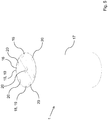
- FIGS. 9 to 11 show the cylinder bottom 4 of a device according to the invention. It can be clearly seen that in the cylinder bottom 4 a plurality of passages 6 are provided. In a particularly preferred manner, 70% of the surface of the cylinder bottom 4 are provided with passages 6.
- the receiving area 5 is cup-shaped and comprises the inlet 7 and the outlet 13.
Landscapes
- Engineering & Computer Science (AREA)
- Chemical & Material Sciences (AREA)
- Combustion & Propulsion (AREA)
- Mechanical Engineering (AREA)
- General Engineering & Computer Science (AREA)
- Power Engineering (AREA)
- Physics & Mathematics (AREA)
- Fluid Mechanics (AREA)
- Reciprocating Pumps (AREA)
Description
Die vorliegende Erfindung betrifft eine Vorrichtung zum Speichern von Energie.The present invention relates to a device for storing energy.
Aus der Praxis sind sogenannte Pumpspeicherkraftwerke seit Jahren bekannt. Diese dienen zur Zwischenspeicherung von elektrischer Energie, bspw. wenn aufgrund einer zu geringen Nachfrage ein Überangebot an elektrischer Leistung im Stromnetz besteht. Die durch das Pumpspeicherkraftwerk gespeicherte Energie kann in Zeiten erhöhter Nachfrage in das Stromnetz zurück gespeist werden, um somit Nachfragespitzen abzufangen.From practice so-called pumped storage power plants have been known for years. These are used for intermediate storage of electrical energy, for example. If there is an oversupply of electrical power in the power grid due to low demand. The energy stored by the pumped storage power plant can be fed back into the power grid in times of increased demand, thus intercepting peak demand.
Die Funktion eines Pumpspeicherkraftwerks beruht auf der Umwandlung von elektrischer Energie in potentielle Energie von Wasser, indem das Wasser von einem Tiefbecken in ein höher liegendes Speicherbecken herauf gepumpt und somit die potentielle Energie des Wassers erhöht wird. Zur Umwandlung der potentiellen Energie des Wassers in elektrische Energie wird das Wasser von dem Speicherbecken in das tiefer gelegene Tiefbecken abgelassen und treibt dabei eine Turbine an, mittels welcher elektrische Leistung erzeugbar ist. Der Wirkungsgrad eines Pumpspeicherkraftwerks liegt bei ca. 75% bis 80%.The function of a pumped storage power plant relies on the conversion of electrical energy into potential energy of water by pumping the water from a deep pool into a higher reservoir, thus increasing the potential energy of the water. To convert the potential energy of the water into electrical energy, the water is drained from the storage tank into the lower deep basin and thereby drives a turbine, by means of which electrical power can be generated. The efficiency of a pumped storage power plant is about 75% to 80%.
Eine weiteres Beispiel einer Vorrichtung zum Speichern von Energie zeigt
Bei den bekannten Vorrichtungen zur Speicherung von Energie ist problematisch, dass diese mit einem erheblichen Eingriff in die Umwelt einhergehen. Dies liegt insbesondere daran, dass eine große Menge Wasser zur Speicherung von ausreichend potentieller Energie notwendig ist, so dass die hierzu benötigten Speicherbecken entsprechend groß dimensioniert sein müssen. Des Weiteren sind die Speicherbecken in der Regel betoniert, so dass die Ausbildung eines natürlichen Bewuchses und somit eines Biotops nicht möglich ist. Auch ist problematisch, dass Pumpspeicherkraftwerke nur in Gebieten errichtet werden können, welche die benötigte Topologie, nämlich ein entsprechendes Gefälle zwischen Tiefbecken und Speicherbecken aufweisen.The known devices for storing energy is problematic that these are associated with a significant environmental impact. This is due in particular to the fact that a large amount of water is necessary for the storage of sufficient potential energy, so that the storage tanks required for this purpose must be dimensioned correspondingly large. Furthermore, the reservoirs are usually concreted, so that the formation of a natural vegetation and thus a biotope is not possible. It is also problematic that pumped storage power plants can only be built in areas that have the required topology, namely a corresponding gradient between deep pool and reservoir.
Der vorliegenden Erfindung liegt daher die Aufgabe zugrunde, eine Vorrichtung zum Speichern von Energie derart auszugestalten und weiterzubilden, dass mit geringem konstruktiven Aufwand, standortunabhängig und ohne spürbare Eingriffe in die Umwelt Energie mit einem möglichst hohen Wirkungsgrad speicherbar ist.The present invention is therefore based on the object, a device for storing energy in such a way and further develop that with low design effort, independent of location and without noticeable interference with the environment Energy can be stored with the highest possible degree of efficiency.
Erfindungsgemäß wird die voranstehende Aufgabe durch die Merkmale des Anspruches 1 gelöst. Danach umfasst die erfindungsgemäße Vorrichtung zum Speichern von Energie eine im Wesentlichen vertikal angeordnete Zylinder-Kolben-Anordnung, wobei der Kolben eine zu hebende Masse darstellt, wobei von einer Pumpeinrichtung Flüssigkeit in den Zylinder unterhalb des Kolbens förderbar ist, um die potentielle Energie der Kolbenmasse durch Anheben des Kolbens zu erhöhen, wobei eine Wandlereinrichtung angeordnet ist, wobei der Wandlereinrichtung bei einem Absenken des Kolbens die im Zylinder befindliche Flüssigkeit zuführbar ist, um zumindest einen Teil der potentiellen Energie der Kolbenmasse in elektrische Energie umzuwandeln.According to the invention the above object is achieved by the features of
In erfindungsgemäßer Weise ist zunächst erkannt worden, dass die zugrundeliegende Aufgabe durch die geschickte Ausgestaltung einer vorzugsweise vertikal angeordneten Zylinder-Kolben-Anordnung in verblüffend einfacher Weise gelöst werden kann. Dabei ist von einer Pumpeinrichtung eine Flüssigkeit - bspw. Wasser oder ein Öl - unterhalb des Kolbens in den Zylinder einbringbar, wobei der Kolben die zu hebende Masse darstellt. Durch das Anheben des Kolbens erhöht sich die potentielle Energie der Kolbenmasse, was zur Energiespeicherung genutzt wird. Folglich wird in raffinierter Weise die Kolbenmasse genutzt, um die elektrische Energie als potentielle Energie zu speichern. In weiter erfindungsgemäßer Weise ist dabei erkannt worden, dass die gesamte Vorrichtung extrem klein baut, wenn der Kolben aus einem Material mit einer hohen Dichte hergestellt ist, da nämlich die potentielle Energie proportional zu der angehobenen Masse ist, so dass bereits bei einem relativ geringer Höhenunterschied ausreichend potentielle Energie der Kolbenmasse vorliegt. Es ist somit insbesondere möglich, zumindest den Zylinder unterirdisch anzuordnen, um Eingriffe in die Landschaft auf ein Mindestmaß zu reduzieren. Des Weiteren ist die benötigte Flüssigkeitsmenge gering, so dass das Flüssigkeitsreservoir relativ klein dimensioniert sein kann.In accordance with the invention, it has first been recognized that the underlying object can be achieved in a surprisingly simple manner by the skillful design of a preferably vertically arranged cylinder-piston arrangement. In this case, by a pumping means, a liquid - for example. Water or an oil - can be introduced below the piston in the cylinder, wherein the piston represents the mass to be lifted. By raising the piston increases the potential energy of the piston mass, which is used for energy storage. Consequently, the piston mass is used in a sophisticated way to store the electrical energy as potential energy. In a further inventive manner it has been recognized that the entire device is extremely small, if the piston is made of a material with a high density, namely because the potential energy is proportional to the raised mass, so that even at a relatively small height difference there is sufficient potential energy of the piston mass. It is thus possible, in particular, to arrange at least the cylinder underground in order to minimize interference with the landscape. Furthermore, the amount of liquid required is small, so that the liquid reservoir can be dimensioned relatively small.
In vorteilhafter Weise besteht der Kolben zumindest teilweise aus einem Abfallstoff bzw. Recyclingstoff. Der Abfallstoff kann dabei mit einem Bindemittel versetzt sein. In idealer Weise kann es sich bei dem Abfallstoff um Schlacke, insbesondere um Stahlschlacke, handeln. Diese kann mit einem Bindemittel versetzt werden und weist sodann eine Dichte von ca. 5000 kg/m3 auf, was in etwa dem Fünffachen der Dichte von Wasser (ca. 1.000 kg/m3) entspricht. Neben der hohen Dichte hat die Schlacke den weiteren Vorteil, dass diese als Abfallstoff preiswert ist und somit die gesamte Vorrichtung günstig in der Herstellung ist.Advantageously, the piston consists at least partially of a waste or recycled material. The waste material can be mixed with a binder. Ideally, the waste may be slag, particularly steel slag. This can be mixed with a binder and then has a density of about 5000 kg / m 3 , which corresponds to about five times the density of water (about 1,000 kg / m 3 ). In addition to the high density, the slag has the further advantage that it is inexpensive as a waste and thus the entire device is inexpensive to manufacture.
Um die Konstruktion und somit den Aufbau der Vorrichtung möglichst einfach auszugestalten, kann der Kolben mehrere übereinander angeordnete Segmente aufweisen. Die Segmente können scheibenförmig, insbesondere rund, viereckig, fünfeckig, sechseckig etc., ausgebildet sein. Beispielsweise können die Segmente auch die Form eines Kreisausschnittes, insbesondere eines Halbkreises, aufweisen. In vorteilhafter Weise sind die Segmente voneinander abnehmbar. Dabei ist denkbar, dass die Segmente miteinander korrespondierende Ausnehmungen und Erhebungen aufweisen, so dass die Segmente definiert und sicher aufeinander stapelbar sind. Im Konkreten können die Segmente einen Radius von 5 m bis 25 m, vorzugsweise von 10 m, und/oder jeweils ein Gewicht von 40 t bis 60 t, vorzugsweise von 50 t, aufweisen. Durch die segmentierte Ausgestaltung der Kolbenmasse kann die Vorrichtung mit relativ geringem Aufwand errichtet und gewartet werden.In order to design the construction and thus the construction of the device as simple as possible, the piston can have a plurality of segments arranged one above the other. The segments may be disc-shaped, in particular round, quadrangular, pentagonal, hexagonal, etc., be formed. For example, the segments may also have the shape of a circular cutout, in particular a semicircle. Advantageously, the segments are removable from each other. It is conceivable that the segments have mutually corresponding recesses and elevations, so that the segments are defined and safely stacked on each other. Concretely, the segments may have a radius of 5 m to 25 m, preferably 10 m, and / or a weight of 40 t to 60 t, preferably 50 t. Due to the segmented design of the piston mass, the device can be erected and maintained with relatively little effort.
Um die Handhabung der Segmente zu vereinfachen, können Kopplungsmittel für eine Abhebeeinrichtung - bspw. für einen Kran - ausgebildet sein. Die Kopplungsmittel können insbesondere als mit einem Zapfen versehene kugelförmige Elemente realisiert sein. In vorteilhafter Weise sind an einem Segment mehrere Kopplungsmittel vorgesehen, bspw. mittig sowie in Umfangsrichtung in gleichen Abständen versetzt zueinander im Randbereich der Segmente.In order to simplify the handling of the segments, coupling means for a lifting device - for example. For a crane - may be formed. The coupling means may in particular be realized as a cone-shaped spherical elements. Advantageously, a plurality of coupling means are provided on a segment, for example. Centrally and circumferentially equidistantly offset from each other in the edge region of the segments.
In besonders vorteilhafter Weise können die Segmente in einer Aufnahmeeinrichtung angeordnet sein. Die Aufnahmeeinrichtung kann aus Metall oder einer Metalllegierung, insbesondere aus Stahl, hergestellt sein und/oder als Hohlzylinder realisiert sein, wobei eine Grundfläche des Hohlzylinders geschlossen ausgebildet sein kann. Weiterhin können in und/oder an der Aufnahmeeinrichtung Führungselemente vorgesehen sein, wobei die Führungselemente in korrespondierende Materialausnehmungen der Segmente eingreifen. Dadurch ist ein Verrutschen der Segmente innerhalt der Aufnahmeeinrichtung in effektiver Weise vermieden.In a particularly advantageous manner, the segments can be arranged in a receiving device. The receiving device may be made of metal or a metal alloy, in particular made of steel, and / or be realized as a hollow cylinder, wherein a base surface of the hollow cylinder may be formed closed. Furthermore, guide elements can be provided in and / or on the receiving device, wherein the guide elements in corresponding Intervene material recesses of the segments. As a result, slipping of the segments within the receiving device is effectively avoided.
Des Weiteren ist denkbar, dass zwischen dem Zylinder und der Pumpeinrichtung eine erste Leitung realisiert ist und dass zwischen Zylinder und Wandlereinrichtung eine zweite Leitung angeordnet ist. In bevorzugter Weise können die separaten Leitungen miteinander - mittelbar oder unmittelbar - kommunizieren, so dass die Vorrichtung nach dem Prinzip des hydraulischen Kurzschlusses betreibbar ist. Des Weiteren ist denkbar, dass die Pumpeinrichtung und die Wandlereinrichtung über die gleiche Leitung mit dem Zylinder verbunden sind. Bei den voranstehend genannten Leitungen kann es sich bspw. um Druckrohrleitungen handeln.Furthermore, it is conceivable that a first line is realized between the cylinder and the pumping device and that a second line is arranged between the cylinder and the converter device. In a preferred manner, the separate lines can communicate with each other indirectly or directly, so that the device can be operated according to the principle of the hydraulic short circuit. Furthermore, it is conceivable that the pumping device and the converter device are connected to the cylinder via the same line. In the above-mentioned lines may be, for example, to pressure piping.
Alternativ oder zusätzlich zur Einspeisung von elektrischer Energie über ein Stromnetz kann zumindest eine Anlage zur Energiegewinnung angeordnet sein, um die Pumpeinrichtung mit Energie zu versorgen. Dabei kann es sich insbesondere um ein Blockheizkraftwerk, eine Solarstromanlage und/oder eine Windkraftanlage handeln. Die Anordnung eines Blockheizkraftwerks hat den weiteren Vorteil, dass die Flüssigkeit über die Abwärme des Blockheizkraftwerks erwärmbar ist, so dass neben der potentiellen Energie der Kolbenmasse auch die thermische Energie der Flüssigkeit als "Energiespeicher" verwendbar ist. Insbesondere ist denkbar, dass die Flüssigkeit bspw. über einen Wärmetauscher erhitzbar sein kann.As an alternative or in addition to the supply of electrical energy via a power network, at least one plant for generating energy can be arranged in order to supply the pumping device with energy. This may in particular be a combined heat and power plant, a solar power plant and / or a wind turbine. The arrangement of a cogeneration plant has the further advantage that the liquid can be heated by the waste heat of the cogeneration plant, so that in addition to the potential energy of the piston mass and the thermal energy of the liquid is used as an "energy storage". In particular, it is conceivable that the liquid may, for example, be heated via a heat exchanger.
Eine besonders einfache Realisierung des Zylinders ist möglich, wenn dieser aus Metall oder einer Metalllegierung besteht. Dabei kann es sich in bevorzugter Weise um Stahl handeln. Zur Gewährleistung der benötigten Stabilität der Konstruktion kann der Metallzylinder zumindest teilweise mit Beton ummantelt sein. In idealer Weise kann der Metallzylinder über seine gesamte Länge hinweg mit Beton ummantelt sein. Alternativ oder zusätzlich kann die Betonummantelung am unteren Ende des Zylinders in eine zumindest nahezu horizontal verlaufende Betonplatte übergehen, insbesondere einteilig mit dieser ausgestaltet sein.A particularly simple realization of the cylinder is possible if it consists of metal or a metal alloy. This may preferably be steel. To ensure the required stability of the construction, the metal cylinder may be at least partially encased in concrete. Ideally, the metal cylinder can be covered over its entire length with concrete. Alternatively or additionally, the concrete casing at the lower end of the cylinder can pass into an at least almost horizontally extending concrete slab, in particular be designed in one piece with this.
In weiter vorteilhafter Weise kann ein System aus mehreren erfindungsgemäßen Vorrichtungen realisiert sein. Insbesondere kann ein redundantes Mehrfachsystem realisiert werden, so dass bei einer Wartung oder einem Defekt an einem der Bestandteile einer der Vorrichtungen die übrigen Vorrichtungen den Ausfall kompensieren.In a further advantageous manner, a system can be realized from a plurality of devices according to the invention. In particular, a redundant multiple system can be realized, so that compensate for a maintenance or a defect on one of the components of one of the devices, the other devices the failure.
Des Weiteren kann unterhalb eines Zylinderbodens ein Aufnahmebereich für eine Flüssigkeit ausgebildet sein, wobei der Zylinderboden mehrere Durchgänge aufweist, so dass Flüssigkeit von dem Aufnahmebereich in den Zylinder unterhalb des Kolbens förderbar ist, um die potentielle Energie der Kolbenmasse durch ein Anheben des Kolben zu erhöhen. Dies hat den Vorteil, dass aufgrund der Durchgänge in dem Zylinderboden mit konstruktiv einfachen Mitteln ein Strömungspfad definiert ist, der gewährleistet, dass eine ausreichende Menge von Flüssigkeit in einem definierten Zeitraum und unter einem definierten Druck in den Zylinder einbringbar ist.Furthermore, a receiving area for a liquid can be formed below a cylinder bottom, the cylinder bottom having a plurality of passages, so that liquid can be conveyed from the receiving area into the cylinder below the piston in order to increase the potential energy of the piston mass by raising the piston. This has the advantage that due to the passages in the cylinder bottom with structurally simple means, a flow path is defined, which ensures that a sufficient amount of liquid in a defined period and under a defined pressure in the cylinder can be introduced.
Insbesondere ist denkbar, dass der Kolben in seiner Grundposition auf dem Zylinderboden aufliegt. Dabei bieten die Durchgänge der Flüssigkeit eine große Fläche, um auf den Kolben einzuwirken, so dass ein relativ geringer Druck ausreicht, um den Kolben aus der Grundposition heraus anzuheben. Somit werden Druckspitzen, welche beim Anheben des Kolbens bei einer solchen Grundposition auftreten, effektiv vermindert.In particular, it is conceivable that the piston rests in its basic position on the cylinder bottom. The passageways of the fluid provide a large area to act on the piston so that a relatively low pressure is sufficient to lift the piston out of the home position. Thus, pressure spikes that occur when the piston is raised at such a home position are effectively reduced.
In vorteilhafter Weise kann 60% bis 80%, insbesondere 65% bis 75%, vorzugsweise 70%, der Fläche des Zylinderbodens mit Durchgängen versehen sein. Dadurch ist ein optimaler Strömungspfad für die Flüssigkeit definiert.Advantageously, 60% to 80%, in particular 65% to 75%, preferably 70%, of the surface of the cylinder bottom can be provided with passages. This defines an optimum flow path for the liquid.
In weiter vorteilhafte Weise kann der Aufnahmebereich schalenförmig, insbesondere als Abschnitt bzw. Kappe eines Ellipsoids oder einer Hohlkugel, ausgebildet sein. Bei einer solchen Ausgestaltung definieren der Aufnahmebereich und der Zylinderboden ein Druckgehäuse, wobei der Zylinderboden als Gehäusedeckel wirkt. Somit ist zunächst der schalenförmige Bereich mit Flüssigkeit befüllbar, wobei die Durchgänge des Zylinderbodens in idealer Weise einen Strömungspfad zwischen dem Aufnahmebereich und dem Zylinder definieren. Zur Realisierung einer ausreichend stabilen Konstruktion kann zumindest ein sich von dem Aufnahmebereich zu dem Zylinderboden erstreckendes Stützelement angeordnet sein. Weiterhin ist denkbar, dass mehrere Stützelemente vorgesehen sind. Im Konkreten kann das Stützelement bzw. können die Stützelemente als Stützwand und/oder Stützstrebe realisiert sein.In a further advantageous manner, the receiving area can be cup-shaped, in particular as a section or cap of an ellipsoid or a hollow sphere. In such an embodiment, the receiving area and the cylinder bottom define a pressure housing, wherein the cylinder bottom acts as a housing cover. Thus, the bowl-shaped area is first filled with liquid, wherein the passages of the cylinder bottom ideally define a flow path between the receiving area and the cylinder. To realize a sufficiently stable construction, at least one support element extending from the receiving area to the cylinder bottom can be arranged. Furthermore, it is conceivable that a plurality of support elements are provided. Specifically, the support element or the support elements can be realized as a support wall and / or support strut.
Um zu gewährleisten, dass der insbesondere schalenförmig ausgebildete Aufnahmebereich insgesamt mit Flüssigkeit befüllbar ist, kann an dem Stützelement bzw. an den Stützelementen zumindest jeweils ein Durchgang ausgebildet sein. Der Durchgang kann dabei kreisförmig, ellipsenförmig und/oder bogenförmig realisiert sein. Eine bogenförmige Ausgestaltung der Durchgänge hat den Vorteil, dass die Stützelemente äußerst Stabil realisiert sind.In order to ensure that the in particular cup-shaped receiving area can be filled with liquid as a whole, at least one passage can be formed on the support element or on the support elements. The passage can be realized circular, elliptical and / or arcuate. An arcuate configuration of the passages has the advantage that the support elements are realized extremely stable.
Damit nicht ausschließlich potentielle Energie, sondern auch thermischer Energie speicherbar ist, kann an dem Aufnahmebereich und/oder an dem Zylinderboden eine Heizeinrichtung ausgebildet sein. Bei der Heizeinrichtung kann es sich um einen Wärmetauscher handeln, beispielsweise um eine Leitung, die mit einer erwärmten Flüssigkeit beaufschlagbar ist. Des Weiteren ist denkbar, dass die Heizeinrichtung als Heizwendel ausgestaltet ist.So that not only potential energy but also thermal energy can be stored, a heating device can be formed on the receiving region and / or on the cylinder bottom. The heating device can be a heat exchanger, for example a line that can be acted upon by a heated liquid. Furthermore, it is conceivable that the heating device is designed as a heating coil.
Zur Vereinfachung der Wartungsarbeiten kann an dem Aufnahmebereich und/oder an dem Zylinderboden eine verschließbare Revisionsöffnung ausgebildet sein. Die Revisionsöffnung kann beispielsweise als Mannloch realisiert sein.To simplify the maintenance work, a closable inspection opening can be formed on the receiving area and / or on the cylinder bottom. The inspection opening can be realized for example as a manhole.
In vorteilhafter Weise sind der Aufnahmebereich und der Zylinderboden aus Metall oder einer Metalllegierung, beispielsweise aus Stahl, hergestellt. Dadurch ist die Vorrichtung einfach zu fertigen und weist eine hohe Stabilität auf. Auch können der Aufnahmebereich und der Zylinderboden einteilig ausgebildet sein.Advantageously, the receiving area and the cylinder bottom are made of metal or a metal alloy, for example of steel. As a result, the device is easy to manufacture and has a high stability. Also, the receiving area and the cylinder bottom can be integrally formed.
Des Weiteren ist denkbar, dass an dem Aufnahmebereich ein einzelner Zu-/Ablauf vorgesehen ist. Alternativ können ein separater Zulauf und ein separater Ablauf vorgesehen sein, so dass eine entsprechend realisierte Anordnung nach dem Prinzip des hydraulischen Kurzschlusses betreibbar ist.Furthermore, it is conceivable that a single inlet / outlet is provided on the receiving area. Alternatively, a separate inlet and a separate outlet can be provided, so that a correspondingly realized arrangement can be operated according to the principle of the hydraulic short circuit.
Es gibt nun verschiedene Möglichkeiten, die Lehre der vorliegenden Erfindung in vorteilhafter Weise auszugestalten und weiterzubilden. Dazu ist einerseits auf die dem Anspruch 1 nachgeordneten Ansprüche und andererseits auf die nachfolgende Erläuterung bevorzugter Ausführungsbeispiele der Erfindung anhand der Zeichnung zu verweisen. In Verbindung mit der Erläuterung der bevorzugten Ausführungsbeispiele der Erfindung anhand der Zeichnung werden auch im Allgemeinen bevorzugte Ausgestaltungen und Weiterbildungen der Lehre erläutert. In der Zeichnung zeigen
- Fig. 1
- in einer schematischen, perspektivischen Darstellung ein Ausführungsbeispiel einer erfindungsgemäßen Vorrichtung,
- Fig. 2
- in einer schematischen, geschnittenen Darstellung einen vergrößerten Ausschnitt des Ausführungsbeispiels gemäß
Fig. 1 , - Fig. 3
- in einer schematischen, geschnittenen Darstellung einen vergrößerten Ausschnitt des Ausführungsbeispiels gemäß
Fig. 1 , - Fig. 4
- in einer schematischen, perspektivischen Darstellung einen Zylinder einer erfindungsgemäßen Vorrichtung,
- Fig. 5
- in einer schematischen, perspektivischen Darstellung einen Kolben einer erfindungsgemäßen Vorrichtung,
- Fig. 6
- in einer schematischen, geschnittenen Darstellung den Kolben gemäß
Fig. 5 , - Fig. 7
- in einer schematischen, geschnittenen Darstellung die Aufnahmeeinrichtung des Kolbens gemäß
Fig. 5 , - Fig. 8
- in einer schematischen, perspektivischen Darstellung ein Segment des Kolbens einer erfindungsgemäßen Vorrichtung,
- Fig. 9
- in einer schematischen, perspektivischen Darstellung den Zylinderboden einer erfindungsgemäßen Vorrichtung,
- Fig. 10
- in einer schematischen, geschnittenen Darstellung den Zylinderboden gemäß
Fig. 10 und - Fig. 11
- in einer weiteren schematischen, geschnittenen Darstellung den Zylinderboden gemäß
Fig. 10 .
- Fig. 1
- in a schematic perspective view of an embodiment of a device according to the invention,
- Fig. 2
- in a schematic, sectional view of an enlarged section of the embodiment according to
Fig. 1 . - Fig. 3
- in a schematic, sectional view of an enlarged section of the embodiment according to
Fig. 1 . - Fig. 4
- in a schematic, perspective view of a cylinder of a device according to the invention,
- Fig. 5
- in a schematic, perspective view of a piston of a device according to the invention,
- Fig. 6
- in a schematic, sectional view of the piston according to
Fig. 5 . - Fig. 7
- in a schematic, sectional view of the receiving device of the piston according to
Fig. 5 . - Fig. 8
- in a schematic, perspective view of a segment of the piston of a device according to the invention,
- Fig. 9
- in a schematic, perspective view of the cylinder bottom of a device according to the invention,
- Fig. 10
- in a schematic, sectional view of the cylinder bottom according to
Fig. 10 and - Fig. 11
- in a further schematic, sectional view of the cylinder bottom according to
Fig. 10 ,
An dieser Stelle sei zunächst darauf hingewiesen, dass zur besseren Darstellung in einzelnen Figuren mehrfach vorhandene Elemente - bspw. Segmente, Durchgänge etc. - teilweise nicht mit einem Bezugszeichen versehen sind.At this point, it should first be pointed out that for better illustration in several figures multiply existing elements - for example, segments, passages, etc. - are sometimes not provided with a reference numeral.
Die
Im hier dargestellten Ausführungsbeispiel ist der Aufnahmebereich 5 schalenförmig ausgebildet und wirkt der Zylinderboden 4 als Deckel für den Aufnahmebereich 5.In the embodiment shown here, the receiving
An dem Aufnahmebereich 5 ist weiterhin ein Zulauf 7 vorgesehen, der über eine erste Leitung 8 mit einer Pumpeinrichtung 9 verbunden ist. Die erste Leitung 8 bzw. der Zulauf 7 sind über ein nicht dargestelltes Ventil verschließbar. Über die Pumpeinrichtung 9 kann dem Aufnahmebereich 5 und somit auch dem Zylinder 2 aus einem Reservoir 10 eine Flüssigkeit - bspw. Wasser oder ein Öl - zugeführt werden.At the receiving
Des Weiteren ist eine Wandlereinrichtung 11 über eine zweite Leitung 12 mit einem Ablauf 13 des Aufnahmebereichs 5 verbunden. Die zweite Leitung 12 kann ebenfalls über ein nicht dargestelltes Ventil verschlossen werden.Furthermore, a
Um elektrische Energie zu speichern wird der Pumpeinrichtung 9 die zu speichernden elektrische Energie zur Verfügung gestellt und somit Flüssigkeit aus dem Reservoir 10 über die erste Leitung 8 in den Aufnahmebereich 5 eingebracht. Von dem Aufnahmebereich 5 strömt die Flüssigkeit über die Durchgänge 6 unterhalb des Kolbens 1 in den Zylinder 2. Die zweite Leitung 12 ist dabei verschlossen, so dass der Kolben 1 durch die einströmende Flüssigkeit angehoben wird und sich die potentielle Energie der Kolbenmasse proportional zu der Höhendifferenz erhöht. Sobald der Kolben 1 die gewünschte Höhe erreicht hat, kann die erste Leitung 8 mittels eines Ventils verschlossen werden. Um die potentielle Energie der Kolbenmasse wieder in elektrische Energie zu überführen, wird die zweite Leitung 12 geöffnet, so dass sich der Kolben 1 absenkt und die Flüssigkeit über die zweite Leitung 12 zu der Wandlereinrichtung 11 - beispielsweise eine Turbine - presst. Über die Flüssigkeit wird die Wandlereinrichtung 11 angetrieben und erzeugt elektrische Energie, die dem Netz oder einem Verbraucher zur Verfügung gestellt werden kann.In order to store electrical energy, the
Die
Insbesondere aus den
Die
Zwischen dem Aufnahmebereich 5 und dem Zylinderboden 4 erstrecken sich Stützelemente 21, die als Stützwände 22 ausgebildet sind. In den Stützwänden 22 sind kreisförmige und bogenförmige Durchgänge 23 angeordnet, so dass die Flüssigkeit in die gesamte Begrenzungseinrichtung 3 eindringen kann. Hinsichtlich weiterer vorteilhafter Ausgestaltungen der erfindungsgemäßen Vorrichtung wird zur Vermeidung von Wiederholungen auf den allgemeinen Teil der Beschreibung sowie auf die beigefügten Ansprüche verwiesen.Between the receiving
Schließlich sei ausdrücklich darauf hingewiesen, dass die voranstehend beschriebenen Ausführungsbeispiele der erfindungsgemäßen Vorrichtung lediglich zur Erörterung der beanspruchten Lehre dienen, diese jedoch nicht auf die Ausführungsbeispiele einschränken.Finally, it should be expressly understood that the above-described embodiments of the device according to the invention are only for the purpose of discussion of the claimed teaching, but not limit these to the embodiments.
- 11
- Kolbenpiston
- 22
- Zylindercylinder
- 33
- Erdoberflächeearth's surface
- 44
- Zylinderbodencylinder base
- 55
- Aufnahmebereichreception area
- 66
- Durchgang (Zylinderboden)Passage (cylinder bottom)
- 77
- ZulaufIntake
- 88th
- erste Leitungfirst line
- 99
- Pumpeinrichtungpumping device
- 1010
- Reservoirreservoir
- 1111
- Wandlereinrichtungtransducer means
- 1212
- zweite Leitungsecond line
- 1313
- Ablaufprocedure
- 1414
- Betonummantelungconcrete casing
- 1515
- Platteplate
- 1616
- Segmentsegment
- 1717
- Aufnahmeeinheitrecording unit
- 1818
- Führungselementguide element
- 1919
- Materialausnehmungmaterial recess
- 2020
- Kopplungsmittelcoupling agent
- 2121
- Stützelementsupport element
- 2222
- Stützwandretaining wall
- 2323
- Durchgang (Stützelement)Passageway (supporting element)
Claims (12)
- Device for storing energy, having a substantially vertically arranged cylinder/piston arrangement, wherein the piston (1) constitutes a mass which is intended to be lifted, wherein fluid can be conveyed by a pumping device (9) into the cylinder (2) below the piston (1) in order to increase the potential energy of the piston mass by raising the piston (1), wherein a converter device (11) is arranged, wherein fluid which is located in the cylinder (2) can be supplied to the converter device (11) when the piston (1) is lowered in order to convert at least a portion of the potential energy of the piston mass into electrical energy, characterised in that the piston (1) has a plurality of segments which are arranged one above the other and/or beside each other.
- Device according to claim 1, characterised in that the piston (1) at least partially comprises a waste material.
- Device according to claim 2, characterised in that a binding agent is added to the waste material.
- Device according to claim 2 or claim 3, characterised in that the waste material is slag, in particular steel slag.
- Device according to any one of claims 1 to 4, characterised in that the segments (16) are constructed in a disc-like manner.
- Device according to claim 5, characterised in that the segments (16) are constructed so as to be able to be removed from each other.
- Device according to claim 5 or claim 6, characterised in that the segments (16) have coupling means (20) for a lifting device, for example, a crane.
- Device according to any one of claims 1 to 7, characterised in that the segments (16) are arranged in a receiving unit (17).
- Device according to any one of claims 1 to 8, characterised in that a first line (8) is arranged between the cylinder (2) and the pumping device (9) and a second line (12) is arranged between the cylinder (2) and the converter device (11).
- Device according to any one of claims 1 to 9, characterised in that an installation for energy recovery, in particular a cogeneration unit, a solar power installation and/or a wind turbine, is arranged in order to provide the pumping device (9) with energy.
- Device according to any one of claims 1 to 10, characterised in that a heat exchanger is arranged in order to heat the fluid.
- Device according to any one of claims 1 to 11, characterised in that the cylinder (2) is constructed from metal or a metal alloy, in particular from steel, and/or is at least partially encased in concrete.
Applications Claiming Priority (2)
| Application Number | Priority Date | Filing Date | Title |
|---|---|---|---|
| DE102016205856.8A DE102016205856A1 (en) | 2016-04-07 | 2016-04-07 | Device for storing energy |
| PCT/DE2017/200029 WO2017174081A1 (en) | 2016-04-07 | 2017-04-03 | Device for storing energy |
Publications (2)
| Publication Number | Publication Date |
|---|---|
| EP3271590A1 EP3271590A1 (en) | 2018-01-24 |
| EP3271590B1 true EP3271590B1 (en) | 2019-08-14 |
Family
ID=58992576
Family Applications (1)
| Application Number | Title | Priority Date | Filing Date |
|---|---|---|---|
| EP17727091.5A Active EP3271590B1 (en) | 2016-04-07 | 2017-04-03 | Device for storing energy |
Country Status (4)
| Country | Link |
|---|---|
| EP (1) | EP3271590B1 (en) |
| DE (1) | DE102016205856A1 (en) |
| DK (1) | DK3271590T3 (en) |
| WO (1) | WO2017174081A1 (en) |
Families Citing this family (8)
| Publication number | Priority date | Publication date | Assignee | Title |
|---|---|---|---|---|
| LU100968B1 (en) * | 2018-10-15 | 2020-04-15 | Frank Weppernig | Device and method for moving a liquid and hydropower plant |
| CN110436067A (en) * | 2019-08-02 | 2019-11-12 | 集美大学 | A buried energy storage tank structure |
| DE102019212059A1 (en) * | 2019-08-12 | 2021-02-18 | Delta Energy Gmbh & Co. Kg 1 | System and method for storing and delivering energy |
| RO133988B1 (en) | 2019-11-20 | 2024-11-29 | Rareş Alexandru Gărduş | System for storing electric energy in combined gravitational-hydraulic cycle |
| CN114718687B (en) * | 2022-06-08 | 2022-08-26 | 西安热工研究院有限公司 | Gravity compressed air energy storage device arranged underground layered gravity block |
| CN114718689B (en) * | 2022-06-08 | 2022-08-26 | 西安热工研究院有限公司 | Magnetic type compressed air energy storage system and energy storage method |
| CN114718684B (en) * | 2022-06-08 | 2022-09-20 | 西安热工研究院有限公司 | Gravity hydraulic compressed air energy storage system and method |
| CN114810260B (en) * | 2022-06-23 | 2022-09-20 | 西安热工研究院有限公司 | Gravity energy storage system with buffering effect |
Family Cites Families (3)
| Publication number | Priority date | Publication date | Assignee | Title |
|---|---|---|---|---|
| FR2386709A1 (en) * | 1977-04-07 | 1978-11-03 | Gratzmuller Claude | Gravity controlled hydraulic accumulator - has dead weight piston within cylinder contg. lubricating oil with inlet and outlet at opposite ends |
| DE102010034757B4 (en) * | 2010-08-19 | 2013-02-14 | Prof. Dr. Eduard Heindl | Energy storage based on positional energy by hydraulic lifting of a rock mass |
| DE102011002945B4 (en) * | 2011-01-20 | 2020-10-22 | Markus Aufleger | Compact hydraulic large energy storage |
-
2016
- 2016-04-07 DE DE102016205856.8A patent/DE102016205856A1/en not_active Ceased
-
2017
- 2017-04-03 WO PCT/DE2017/200029 patent/WO2017174081A1/en not_active Ceased
- 2017-04-03 DK DK17727091.5T patent/DK3271590T3/en active
- 2017-04-03 EP EP17727091.5A patent/EP3271590B1/en active Active
Non-Patent Citations (1)
| Title |
|---|
| None * |
Also Published As
| Publication number | Publication date |
|---|---|
| EP3271590A1 (en) | 2018-01-24 |
| DK3271590T3 (en) | 2019-10-14 |
| WO2017174081A1 (en) | 2017-10-12 |
| DE102016205856A1 (en) | 2017-10-12 |
Similar Documents
| Publication | Publication Date | Title |
|---|---|---|
| EP3271590B1 (en) | Device for storing energy | |
| DE3007442C2 (en) | Device for anchoring high cantilevered, dynamically stressed structures | |
| DE60034647T2 (en) | Wind turbine | |
| EP2036814A2 (en) | Metal skeleton for constructing foundations beneath the sea | |
| EP3271573B1 (en) | Cylinder-piston arrangement for a device for storing energy, and device for storing energy | |
| DE1634372B2 (en) | Shallow foundations for buoyant structures | |
| WO2021219854A1 (en) | Modular underwater pumped-storage power plant reservoir | |
| DE102015216444A1 (en) | Wind turbine | |
| EP2558650B1 (en) | Off shore foundation | |
| DE4224042A1 (en) | Method and device for pile foundation | |
| EP2702209B1 (en) | Foundation pile | |
| DE202016101933U1 (en) | Fish passage device | |
| DE102006003982A1 (en) | Wind turbine generated electrical energy is stored by using pumped fluid in underground chambers | |
| DE202017103566U1 (en) | Tree protection with rainwater management | |
| DE102017007685A1 (en) | Method and device for establishing preferably offshore installations | |
| DE202010017803U1 (en) | Water snails conditioning | |
| DE202014004670U1 (en) | Foundation structure for offshore installations, in particular wind turbines | |
| DE9417738U1 (en) | Wind power mast with transformer station | |
| DE112017006235B4 (en) | pumped storage power plant | |
| WO2004099606A1 (en) | Device for accessing structural installations over the sea | |
| EP2743404B1 (en) | Method for constructing an offshore structure | |
| DE102010018811A1 (en) | Anchor for wooden masts, particularly for wooden masts carrying electric cables, has elongated hollow body, in which wooden mast is used, where elongated hollow body is held with lower section in ground or in socket | |
| DE202009015458U1 (en) | Coiled heat exchanger | |
| DE202015100790U1 (en) | Bank protection structure for urban watercourses | |
| DE202016101800U1 (en) | Rigolenanordnung |
Legal Events
| Date | Code | Title | Description |
|---|---|---|---|
| STAA | Information on the status of an ep patent application or granted ep patent |
Free format text: STATUS: UNKNOWN |
|
| STAA | Information on the status of an ep patent application or granted ep patent |
Free format text: STATUS: THE INTERNATIONAL PUBLICATION HAS BEEN MADE |
|
| PUAI | Public reference made under article 153(3) epc to a published international application that has entered the european phase |
Free format text: ORIGINAL CODE: 0009012 |
|
| STAA | Information on the status of an ep patent application or granted ep patent |
Free format text: STATUS: REQUEST FOR EXAMINATION WAS MADE |
|
| 17P | Request for examination filed |
Effective date: 20171016 |
|
| AK | Designated contracting states |
Kind code of ref document: A1 Designated state(s): AL AT BE BG CH CY CZ DE DK EE ES FI FR GB GR HR HU IE IS IT LI LT LU LV MC MK MT NL NO PL PT RO RS SE SI SK SM TR |
|
| AX | Request for extension of the european patent |
Extension state: BA ME |
|
| GRAP | Despatch of communication of intention to grant a patent |
Free format text: ORIGINAL CODE: EPIDOSNIGR1 |
|
| STAA | Information on the status of an ep patent application or granted ep patent |
Free format text: STATUS: GRANT OF PATENT IS INTENDED |
|
| INTG | Intention to grant announced |
Effective date: 20190318 |
|
| GRAS | Grant fee paid |
Free format text: ORIGINAL CODE: EPIDOSNIGR3 |
|
| GRAA | (expected) grant |
Free format text: ORIGINAL CODE: 0009210 |
|
| STAA | Information on the status of an ep patent application or granted ep patent |
Free format text: STATUS: THE PATENT HAS BEEN GRANTED |
|
| DAV | Request for validation of the european patent (deleted) | ||
| DAX | Request for extension of the european patent (deleted) | ||
| AK | Designated contracting states |
Kind code of ref document: B1 Designated state(s): AL AT BE BG CH CY CZ DE DK EE ES FI FR GB GR HR HU IE IS IT LI LT LU LV MC MK MT NL NO PL PT RO RS SE SI SK SM TR |
|
| REG | Reference to a national code |
Ref country code: GB Ref legal event code: FG4D Free format text: NOT ENGLISH |
|
| REG | Reference to a national code |
Ref country code: CH Ref legal event code: EP Ref country code: AT Ref legal event code: REF Ref document number: 1167359 Country of ref document: AT Kind code of ref document: T Effective date: 20190815 |
|
| REG | Reference to a national code |
Ref country code: IE Ref legal event code: FG4D Free format text: LANGUAGE OF EP DOCUMENT: GERMAN |
|
| REG | Reference to a national code |
Ref country code: DE Ref legal event code: R096 Ref document number: 502017002039 Country of ref document: DE |
|
| REG | Reference to a national code |
Ref country code: DK Ref legal event code: T3 Effective date: 20191011 |
|
| REG | Reference to a national code |
Ref country code: NL Ref legal event code: FP |
|
| REG | Reference to a national code |
Ref country code: LT Ref legal event code: MG4D |
|
| PG25 | Lapsed in a contracting state [announced via postgrant information from national office to epo] |
Ref country code: PT Free format text: LAPSE BECAUSE OF FAILURE TO SUBMIT A TRANSLATION OF THE DESCRIPTION OR TO PAY THE FEE WITHIN THE PRESCRIBED TIME-LIMIT Effective date: 20191216 Ref country code: FI Free format text: LAPSE BECAUSE OF FAILURE TO SUBMIT A TRANSLATION OF THE DESCRIPTION OR TO PAY THE FEE WITHIN THE PRESCRIBED TIME-LIMIT Effective date: 20190814 Ref country code: SE Free format text: LAPSE BECAUSE OF FAILURE TO SUBMIT A TRANSLATION OF THE DESCRIPTION OR TO PAY THE FEE WITHIN THE PRESCRIBED TIME-LIMIT Effective date: 20190814 Ref country code: NO Free format text: LAPSE BECAUSE OF FAILURE TO SUBMIT A TRANSLATION OF THE DESCRIPTION OR TO PAY THE FEE WITHIN THE PRESCRIBED TIME-LIMIT Effective date: 20191114 Ref country code: HR Free format text: LAPSE BECAUSE OF FAILURE TO SUBMIT A TRANSLATION OF THE DESCRIPTION OR TO PAY THE FEE WITHIN THE PRESCRIBED TIME-LIMIT Effective date: 20190814 Ref country code: LT Free format text: LAPSE BECAUSE OF FAILURE TO SUBMIT A TRANSLATION OF THE DESCRIPTION OR TO PAY THE FEE WITHIN THE PRESCRIBED TIME-LIMIT Effective date: 20190814 Ref country code: BG Free format text: LAPSE BECAUSE OF FAILURE TO SUBMIT A TRANSLATION OF THE DESCRIPTION OR TO PAY THE FEE WITHIN THE PRESCRIBED TIME-LIMIT Effective date: 20191114 |
|
| PG25 | Lapsed in a contracting state [announced via postgrant information from national office to epo] |
Ref country code: AL Free format text: LAPSE BECAUSE OF FAILURE TO SUBMIT A TRANSLATION OF THE DESCRIPTION OR TO PAY THE FEE WITHIN THE PRESCRIBED TIME-LIMIT Effective date: 20190814 Ref country code: GR Free format text: LAPSE BECAUSE OF FAILURE TO SUBMIT A TRANSLATION OF THE DESCRIPTION OR TO PAY THE FEE WITHIN THE PRESCRIBED TIME-LIMIT Effective date: 20191115 Ref country code: LV Free format text: LAPSE BECAUSE OF FAILURE TO SUBMIT A TRANSLATION OF THE DESCRIPTION OR TO PAY THE FEE WITHIN THE PRESCRIBED TIME-LIMIT Effective date: 20190814 Ref country code: RS Free format text: LAPSE BECAUSE OF FAILURE TO SUBMIT A TRANSLATION OF THE DESCRIPTION OR TO PAY THE FEE WITHIN THE PRESCRIBED TIME-LIMIT Effective date: 20190814 Ref country code: ES Free format text: LAPSE BECAUSE OF FAILURE TO SUBMIT A TRANSLATION OF THE DESCRIPTION OR TO PAY THE FEE WITHIN THE PRESCRIBED TIME-LIMIT Effective date: 20190814 Ref country code: IS Free format text: LAPSE BECAUSE OF FAILURE TO SUBMIT A TRANSLATION OF THE DESCRIPTION OR TO PAY THE FEE WITHIN THE PRESCRIBED TIME-LIMIT Effective date: 20191214 |
|
| PG25 | Lapsed in a contracting state [announced via postgrant information from national office to epo] |
Ref country code: TR Free format text: LAPSE BECAUSE OF FAILURE TO SUBMIT A TRANSLATION OF THE DESCRIPTION OR TO PAY THE FEE WITHIN THE PRESCRIBED TIME-LIMIT Effective date: 20190814 |
|
| PG25 | Lapsed in a contracting state [announced via postgrant information from national office to epo] |
Ref country code: RO Free format text: LAPSE BECAUSE OF FAILURE TO SUBMIT A TRANSLATION OF THE DESCRIPTION OR TO PAY THE FEE WITHIN THE PRESCRIBED TIME-LIMIT Effective date: 20190814 Ref country code: PL Free format text: LAPSE BECAUSE OF FAILURE TO SUBMIT A TRANSLATION OF THE DESCRIPTION OR TO PAY THE FEE WITHIN THE PRESCRIBED TIME-LIMIT Effective date: 20190814 Ref country code: EE Free format text: LAPSE BECAUSE OF FAILURE TO SUBMIT A TRANSLATION OF THE DESCRIPTION OR TO PAY THE FEE WITHIN THE PRESCRIBED TIME-LIMIT Effective date: 20190814 Ref country code: IT Free format text: LAPSE BECAUSE OF FAILURE TO SUBMIT A TRANSLATION OF THE DESCRIPTION OR TO PAY THE FEE WITHIN THE PRESCRIBED TIME-LIMIT Effective date: 20190814 |
|
| PG25 | Lapsed in a contracting state [announced via postgrant information from national office to epo] |
Ref country code: SK Free format text: LAPSE BECAUSE OF FAILURE TO SUBMIT A TRANSLATION OF THE DESCRIPTION OR TO PAY THE FEE WITHIN THE PRESCRIBED TIME-LIMIT Effective date: 20190814 Ref country code: CZ Free format text: LAPSE BECAUSE OF FAILURE TO SUBMIT A TRANSLATION OF THE DESCRIPTION OR TO PAY THE FEE WITHIN THE PRESCRIBED TIME-LIMIT Effective date: 20190814 Ref country code: SM Free format text: LAPSE BECAUSE OF FAILURE TO SUBMIT A TRANSLATION OF THE DESCRIPTION OR TO PAY THE FEE WITHIN THE PRESCRIBED TIME-LIMIT Effective date: 20190814 Ref country code: IS Free format text: LAPSE BECAUSE OF FAILURE TO SUBMIT A TRANSLATION OF THE DESCRIPTION OR TO PAY THE FEE WITHIN THE PRESCRIBED TIME-LIMIT Effective date: 20200224 |
|
| REG | Reference to a national code |
Ref country code: DE Ref legal event code: R097 Ref document number: 502017002039 Country of ref document: DE |
|
| PLBE | No opposition filed within time limit |
Free format text: ORIGINAL CODE: 0009261 |
|
| STAA | Information on the status of an ep patent application or granted ep patent |
Free format text: STATUS: NO OPPOSITION FILED WITHIN TIME LIMIT |
|
| PG2D | Information on lapse in contracting state deleted |
Ref country code: IS |
|
| PGFP | Annual fee paid to national office [announced via postgrant information from national office to epo] |
Ref country code: NL Payment date: 20200420 Year of fee payment: 4 Ref country code: FR Payment date: 20200421 Year of fee payment: 4 Ref country code: DK Payment date: 20200423 Year of fee payment: 4 |
|
| 26N | No opposition filed |
Effective date: 20200603 |
|
| PG25 | Lapsed in a contracting state [announced via postgrant information from national office to epo] |
Ref country code: SI Free format text: LAPSE BECAUSE OF FAILURE TO SUBMIT A TRANSLATION OF THE DESCRIPTION OR TO PAY THE FEE WITHIN THE PRESCRIBED TIME-LIMIT Effective date: 20190814 |
|
| PGFP | Annual fee paid to national office [announced via postgrant information from national office to epo] |
Ref country code: BE Payment date: 20200420 Year of fee payment: 4 |
|
| PG25 | Lapsed in a contracting state [announced via postgrant information from national office to epo] |
Ref country code: MC Free format text: LAPSE BECAUSE OF FAILURE TO SUBMIT A TRANSLATION OF THE DESCRIPTION OR TO PAY THE FEE WITHIN THE PRESCRIBED TIME-LIMIT Effective date: 20190814 |
|
| PG25 | Lapsed in a contracting state [announced via postgrant information from national office to epo] |
Ref country code: LU Free format text: LAPSE BECAUSE OF NON-PAYMENT OF DUE FEES Effective date: 20200403 |
|
| PG25 | Lapsed in a contracting state [announced via postgrant information from national office to epo] |
Ref country code: IE Free format text: LAPSE BECAUSE OF NON-PAYMENT OF DUE FEES Effective date: 20200403 |
|
| PGFP | Annual fee paid to national office [announced via postgrant information from national office to epo] |
Ref country code: CH Payment date: 20210422 Year of fee payment: 5 |
|
| REG | Reference to a national code |
Ref country code: DK Ref legal event code: EBP Effective date: 20210430 |
|
| REG | Reference to a national code |
Ref country code: NL Ref legal event code: MM Effective date: 20210501 |
|
| GBPC | Gb: european patent ceased through non-payment of renewal fee |
Effective date: 20210403 |
|
| REG | Reference to a national code |
Ref country code: BE Ref legal event code: MM Effective date: 20210430 |
|
| PG25 | Lapsed in a contracting state [announced via postgrant information from national office to epo] |
Ref country code: FR Free format text: LAPSE BECAUSE OF NON-PAYMENT OF DUE FEES Effective date: 20210430 Ref country code: GB Free format text: LAPSE BECAUSE OF NON-PAYMENT OF DUE FEES Effective date: 20210403 |
|
| PG25 | Lapsed in a contracting state [announced via postgrant information from national office to epo] |
Ref country code: NL Free format text: LAPSE BECAUSE OF NON-PAYMENT OF DUE FEES Effective date: 20210501 |
|
| PG25 | Lapsed in a contracting state [announced via postgrant information from national office to epo] |
Ref country code: DK Free format text: LAPSE BECAUSE OF NON-PAYMENT OF DUE FEES Effective date: 20210430 |
|
| PG25 | Lapsed in a contracting state [announced via postgrant information from national office to epo] |
Ref country code: MT Free format text: LAPSE BECAUSE OF FAILURE TO SUBMIT A TRANSLATION OF THE DESCRIPTION OR TO PAY THE FEE WITHIN THE PRESCRIBED TIME-LIMIT Effective date: 20190814 Ref country code: CY Free format text: LAPSE BECAUSE OF FAILURE TO SUBMIT A TRANSLATION OF THE DESCRIPTION OR TO PAY THE FEE WITHIN THE PRESCRIBED TIME-LIMIT Effective date: 20190814 |
|
| PG25 | Lapsed in a contracting state [announced via postgrant information from national office to epo] |
Ref country code: MK Free format text: LAPSE BECAUSE OF FAILURE TO SUBMIT A TRANSLATION OF THE DESCRIPTION OR TO PAY THE FEE WITHIN THE PRESCRIBED TIME-LIMIT Effective date: 20190814 |
|
| PG25 | Lapsed in a contracting state [announced via postgrant information from national office to epo] |
Ref country code: BE Free format text: LAPSE BECAUSE OF NON-PAYMENT OF DUE FEES Effective date: 20210430 |
|
| REG | Reference to a national code |
Ref country code: CH Ref legal event code: PL |
|
| PG25 | Lapsed in a contracting state [announced via postgrant information from national office to epo] |
Ref country code: LI Free format text: LAPSE BECAUSE OF NON-PAYMENT OF DUE FEES Effective date: 20220430 Ref country code: CH Free format text: LAPSE BECAUSE OF NON-PAYMENT OF DUE FEES Effective date: 20220430 |
|
| REG | Reference to a national code |
Ref country code: DE Ref legal event code: R081 Ref document number: 502017002039 Country of ref document: DE Owner name: PONGRATZ, STEFAN, DE Free format text: FORMER OWNER: DELTA ENERGY GMBH & CO. KG 1, 69115 HEIDELBERG, DE |
|
| PGFP | Annual fee paid to national office [announced via postgrant information from national office to epo] |
Ref country code: AT Payment date: 20250416 Year of fee payment: 9 |
|
| PGFP | Annual fee paid to national office [announced via postgrant information from national office to epo] |
Ref country code: DE Payment date: 20250627 Year of fee payment: 9 |
|
| REG | Reference to a national code |
Ref country code: AT Ref legal event code: PC Ref document number: 1167359 Country of ref document: AT Kind code of ref document: T Owner name: PONGRATZ STEFAN, DE Effective date: 20260126 |