EP3026557A1 - Method and device for providing verifying application integrity - Google Patents
Method and device for providing verifying application integrity Download PDFInfo
- Publication number
- EP3026557A1 EP3026557A1 EP14306918.5A EP14306918A EP3026557A1 EP 3026557 A1 EP3026557 A1 EP 3026557A1 EP 14306918 A EP14306918 A EP 14306918A EP 3026557 A1 EP3026557 A1 EP 3026557A1
- Authority
- EP
- European Patent Office
- Prior art keywords
- checksum
- application
- signed
- modified
- trusted entity
- Prior art date
- Legal status (The legal status is an assumption and is not a legal conclusion. Google has not performed a legal analysis and makes no representation as to the accuracy of the status listed.)
- Withdrawn
Links
Images

Classifications
-
- G—PHYSICS
- G06—COMPUTING OR CALCULATING; COUNTING
- G06F—ELECTRIC DIGITAL DATA PROCESSING
- G06F21/00—Security arrangements for protecting computers, components thereof, programs or data against unauthorised activity
- G06F21/60—Protecting data
- G06F21/64—Protecting data integrity, e.g. using checksums, certificates or signatures
-
- G—PHYSICS
- G06—COMPUTING OR CALCULATING; COUNTING
- G06F—ELECTRIC DIGITAL DATA PROCESSING
- G06F11/00—Error detection; Error correction; Monitoring
- G06F11/07—Responding to the occurrence of a fault, e.g. fault tolerance
- G06F11/08—Error detection or correction by redundancy in data representation, e.g. by using checking codes
- G06F11/10—Adding special bits or symbols to the coded information, e.g. parity check, casting out 9's or 11's
- G06F11/1004—Adding special bits or symbols to the coded information, e.g. parity check, casting out 9's or 11's to protect a block of data words, e.g. CRC or checksum
-
- G—PHYSICS
- G06—COMPUTING OR CALCULATING; COUNTING
- G06F—ELECTRIC DIGITAL DATA PROCESSING
- G06F21/00—Security arrangements for protecting computers, components thereof, programs or data against unauthorised activity
- G06F21/50—Monitoring users, programs or devices to maintain the integrity of platforms, e.g. of processors, firmware or operating systems
- G06F21/51—Monitoring users, programs or devices to maintain the integrity of platforms, e.g. of processors, firmware or operating systems at application loading time, e.g. accepting, rejecting, starting or inhibiting executable software based on integrity or source reliability
-
- G—PHYSICS
- G06—COMPUTING OR CALCULATING; COUNTING
- G06F—ELECTRIC DIGITAL DATA PROCESSING
- G06F21/00—Security arrangements for protecting computers, components thereof, programs or data against unauthorised activity
- G06F21/60—Protecting data
- G06F21/62—Protecting access to data via a platform, e.g. using keys or access control rules
- G06F21/629—Protecting access to data via a platform, e.g. using keys or access control rules to features or functions of an application
-
- G—PHYSICS
- G06—COMPUTING OR CALCULATING; COUNTING
- G06F—ELECTRIC DIGITAL DATA PROCESSING
- G06F21/00—Security arrangements for protecting computers, components thereof, programs or data against unauthorised activity
- G06F21/60—Protecting data
- G06F21/64—Protecting data integrity, e.g. using checksums, certificates or signatures
- G06F21/645—Protecting data integrity, e.g. using checksums, certificates or signatures using a third party
-
- H—ELECTRICITY
- H04—ELECTRIC COMMUNICATION TECHNIQUE
- H04L—TRANSMISSION OF DIGITAL INFORMATION, e.g. TELEGRAPHIC COMMUNICATION
- H04L9/00—Cryptographic mechanisms or cryptographic arrangements for secret or secure communications; Network security protocols
- H04L9/32—Cryptographic mechanisms or cryptographic arrangements for secret or secure communications; Network security protocols including means for verifying the identity or authority of a user of the system or for message authentication, e.g. authorization, entity authentication, data integrity or data verification, non-repudiation, key authentication or verification of credentials
- H04L9/3247—Cryptographic mechanisms or cryptographic arrangements for secret or secure communications; Network security protocols including means for verifying the identity or authority of a user of the system or for message authentication, e.g. authorization, entity authentication, data integrity or data verification, non-repudiation, key authentication or verification of credentials involving digital signatures
-
- H—ELECTRICITY
- H04—ELECTRIC COMMUNICATION TECHNIQUE
- H04L—TRANSMISSION OF DIGITAL INFORMATION, e.g. TELEGRAPHIC COMMUNICATION
- H04L9/00—Cryptographic mechanisms or cryptographic arrangements for secret or secure communications; Network security protocols
- H04L9/32—Cryptographic mechanisms or cryptographic arrangements for secret or secure communications; Network security protocols including means for verifying the identity or authority of a user of the system or for message authentication, e.g. authorization, entity authentication, data integrity or data verification, non-repudiation, key authentication or verification of credentials
- H04L9/3263—Cryptographic mechanisms or cryptographic arrangements for secret or secure communications; Network security protocols including means for verifying the identity or authority of a user of the system or for message authentication, e.g. authorization, entity authentication, data integrity or data verification, non-repudiation, key authentication or verification of credentials involving certificates, e.g. public key certificate [PKC] or attribute certificate [AC]; Public key infrastructure [PKI] arrangements
- H04L9/3268—Cryptographic mechanisms or cryptographic arrangements for secret or secure communications; Network security protocols including means for verifying the identity or authority of a user of the system or for message authentication, e.g. authorization, entity authentication, data integrity or data verification, non-repudiation, key authentication or verification of credentials involving certificates, e.g. public key certificate [PKC] or attribute certificate [AC]; Public key infrastructure [PKI] arrangements using certificate validation, registration, distribution or revocation, e.g. certificate revocation list [CRL]
-
- G—PHYSICS
- G06—COMPUTING OR CALCULATING; COUNTING
- G06F—ELECTRIC DIGITAL DATA PROCESSING
- G06F2221/00—Indexing scheme relating to security arrangements for protecting computers, components thereof, programs or data against unauthorised activity
- G06F2221/03—Indexing scheme relating to G06F21/50, monitoring users, programs or devices to maintain the integrity of platforms
- G06F2221/033—Test or assess software
-
- H—ELECTRICITY
- H04—ELECTRIC COMMUNICATION TECHNIQUE
- H04L—TRANSMISSION OF DIGITAL INFORMATION, e.g. TELEGRAPHIC COMMUNICATION
- H04L2209/00—Additional information or applications relating to cryptographic mechanisms or cryptographic arrangements for secret or secure communication H04L9/00
- H04L2209/64—Self-signed certificates
-
- H—ELECTRICITY
- H04—ELECTRIC COMMUNICATION TECHNIQUE
- H04L—TRANSMISSION OF DIGITAL INFORMATION, e.g. TELEGRAPHIC COMMUNICATION
- H04L9/00—Cryptographic mechanisms or cryptographic arrangements for secret or secure communications; Network security protocols
- H04L9/50—Cryptographic mechanisms or cryptographic arrangements for secret or secure communications; Network security protocols using hash chains, e.g. blockchains or hash trees
Definitions
- the present disclosure relates generally to computer systems and in particular to integrity of software code in such systems.
- checksum-based protection is CRC32 for the Portable Executable (PE) format used in the Windows operating system.
- PE Portable Executable
- a PE header contains a CRC32 field that gives the checksum of the corresponding code section.
- cryptographic signatures are a preferred solution.
- the generation of the signature is performed before the code release and uses a private (and thus secret) key.
- the associated public key is appended to the code and later used to check the code integrity at installation of the code or at runtime. An attacker can still modify the code, but since a correct signature for the code cannot be generated without the private key, the attack fails.
- Native code is a set of assembler instructions directly executable by the processor. The set of instructions does not change after installation, which means that a program integrity value remains the same before and after installation (i.e. remains constant over time). In this case, the signature can be generated beforehand and delivered with the application package.
- applications with interpreted code - such as code written in Java, Android DEX code, etc. - comprise intermediate instructions that must be passed through an interpreter before it is executed.
- interpreted code can be modified after installation time for optimization purposes. The code modification is generally very dependent on the target platform and is thus not necessarily predictable. If the code is modified, a signature generated at compilation time cannot be used to check code integrity and authenticity dynamically at runtime.
- APK - Android Application PacKage - To distribute and install application software onto the previously mentioned Android operating system a file format called APK - Android Application PacKage - is used.
- APK file a program for Android is first compiled to an intermediate language, and then its parts are packaged into a compressed archive file (ZIP format).
- the archive file contains the entire program code in a single DEX (Dalvik Executable code) file, various resources (e.g. image files), and the manifest of the APK file.
- the archive file comprises two additional files: CERT.SF and CERT.RSA. CERT.SF contains cryptographic hashes of all other archive files; CERT.RSA contains the public key used for signature verification. Only CERT.SF is signed with the RSA private key.
- the RSA signature for the CERT.SF enables validation of the entire content of the APK file during installation. Indeed, all the files mentioned in the CERT.SF file are indirectly signed because CERT.SF contains their hashes. Altering any file before installation would cause an error because the software would detect that a file digest does not match the hash in the CERT.SF file. Alternatively, modifying a cryptographic hash value inside the CERT.SF file (as in the attack against checksum-based verification already described) would lead to an error during the signature verification.
- a DEX file header also contains a global checksum for the contents of the DEX file.
- the Android system uses an optimizer which modifies a DEX interpreted byte code into an optimized machine-instructions sequence called ODEX (Optimized DEX) just in time before execution.
- ODEX Optimized DEX
- the optimizer also updates the checksum.
- the ODEX file is then stored in a specific repository within the Android file system for future use.
- the ODEX file then becomes the reference for the application software and, when it is present, the original DEX file is not used anymore.
- the system may verify the integrity of the application using the ODEX checksum.
- ODEX checksum This option is not set by default in the Android operating system and the Dalvik machine, which is used to execute ODEX code, does not always check ODEX checksums, since checksum verification has a non-negligible impact on execution performance and boot time.
- the APK signature is verified only at installation time. Furthermore, the APK is not signed by a central authority; the developers use their own non-trusted self-signed certificates that can be easily generated.
- DEX interpreter portable format
- This binary format must execute on a large set of devices with different architectures and characteristics: ARM, x86, MIPS, Little/Big Endian etc.
- the DEX code is modified at the first use of the application to produce the ODEX that is optimized for the target device.
- instructions can be replaced by others, the alignment of instructions may be changed, the byte order can be swapped, and so on.
- the system is thus vulnerable to at least two classes of attacks: the remote attack and the root attack.
- the remote attack a downloaded malicious application elevates its privileges and gains system permissions.
- the malicious application may then tamper with ODEX files stored on the Dalvik cache repository of the internal storage.
- the root attack the attacker obtains an Android device, for example by purloining the device or by accessing the device when the owner is absent without locking the device session.
- the attacker can then download the application from the internal storage through a USB link, modify the application, and then push the modified application back onto the internal storage.
- the device must be "rooted" (i.e. allow "root access” control of the device's Android system).
- the trust in Android application integrity can thus be broken during the application's life cycle. It is possible to trust what is installed on an Android system, but not necessarily what is running.
- the disclosure is directed to a device for processing an application.
- the device comprises an interface configured to receive the application, memory configured to store the application and a signed checksum and a processing unit configured to modify the application to obtain a modified application, generate a checksum for the modified application, send the checksum for the modified application to a trusted entity, receive a signed checksum from the trusted entity, and store the signed checksum in the memory.
- the disclosure is directed to a method for processing an application.
- a device receives the application, modifies the application to obtain a modified application, generates a checksum for the modified application, sends the checksum for the modified application to a trusted entity, receives a signed checksum from the trusted entity, and stores the signed checksum in the memory.
- the disclosure is directed to a trusted entity for signing checksums for an application.
- the trusted entity comprises memory configured to store a plurality of checksums for the application; an interface configured to receive a checksum for the application from a device; and a processing unit configured to verify that the checksum received for the application matches a stored checksum for the application and, in case of a match, to sign the received checksum for the application to obtain a signed checksum.
- the interface is further configured to send the signed checksum to the device.
- the invention is directed to a method for signing checksums for an application.
- a processing unit of a trusted entity storing a plurality of checksums for the application receives a checksum for the application from a device, verifies that the checksum received for the application matches a stored checksum for the application, and, in case of a match, signs the received checksum for the application to obtain a signed checksum, and sends the signed checksum to the device.
- FIG. 1 illustrates an exemplary system in which the disclosure is implemented.
- the system comprises a device 110, an application provider (application store) 120 and a trusted entity 130.
- the device 110 can be any kind of suitable device running an Android OS, such as a smartphone or a tablet, and it comprises at least one hardware processing unit (“processor") 111, memory 112, a user interface 113 for interacting with a user, and a communications interface 114 for communication with the application provider 120 and the trusted entity 130 over a connection 140 such as the Internet.
- processor hardware processing unit
- memory 112 for a user
- a user interface 113 for interacting with a user
- a communications interface 114 for communication with the application provider 120 and the trusted entity 130 over a connection 140 such as the Internet.
- connection 140 such as the Internet
- the application provider 120 stores at least one application APK file 122 that can be downloaded by the device 110.
- the application provider 120 also comprises a hardware processor 124 configured to generate checksums for different ODEXs that correspond to the application DEX file. These checksums can be generated by installing the DEX file on different test or reference devices and calculate the checksum from the resulting ODEX or by performing different optimizations to the DEX file and then generate checksums from the resulting ODEXs.
- the application provider 120 is also configured to send the checksums for the different ODEXs that correspond to the application DEX file to the trusted entity 130.
- the trusted entity 130 can be implemented inside the Android OS or on an independent device.
- the trusted entity 130 comprises memory for storing ODEX checksums for an application, an interface for receiving an ODEX checksum from the Android OS on the device 110, a processing unit for verifying that the received ODEX checksum for an application matches a stored ODEX checksum for the application, a private signing key 132 to be used for signing ODEX checksums and an interface for sending a signed ODEX checksum to the device 110.
- the private signing key is preferably protected using software protection techniques, such as code obfuscation and white-box cryptography, or through the use of specific hardware such as a key-store or a crypto engine.
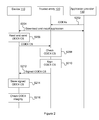
- FIG. 2 illustrates a flowchart of a method according to a preferred embodiment.
- the application provider 120 sends to the trusted entity 130 a number of ODEX checksums for an application it offers to Android devices.
- the device 110 downloads and installs the APK file for the application. As already mentioned, during installation, the device 110 optimizes the DEX in the APK file, obtains an ODEX and replaces the DEX checksum with a checksum for the ODEX in the DEX header. It should be noted that the hash in the CERT.SF file enables the device 110 to verify the integrity of the DEX (and thus also of the ODEX at installation if identical).
- a Source Acquisition module reads the content of the ODEX file into the memory 112, reads the ODEX checksum (CS) from the DEX header and transmits it, in step S206, to the trusted entity 130.
- the ODEX checksum is preferably sent over a protected connection such as a Secure Authenticated Channel.
- the Source Acquisition module is included in a native library of the application (part of Android application can be developed using code other than Java such as C/C++ language).
- the Java Native Interface (JNI) enables JAVA code running in a Dalvik Machine to call native libraries delivered with the application.
- the checksum could be sent to the remote trusted entity 130 together with the activation code.
- the trusted entity 130 preferably checks, in step S208, that the received ODEX checksum corresponds to one of the stored ODEX checksums for the application. If this is the case, in step S210 the trusted entity 130 signs the received ODEX checksum using the private signing key and returns, in step S212, the signed ODEX checksum to the device 110.
- the trusted entity 130 can also send a signing certificate comprising a corresponding public key together with the signed ODEX checksum.
- step S214 the Source Acquisition module receives and stores the signed ODEX checksum (and, if available and needed, the signing certificate).
- the application or the Android OS having access to a public key corresponding to the private signing key, can then check the integrity of the ODEX, in step S216, by calculating a checksum for the ODEX that is compared to the signed ODEX checksum.
- the integrity of the signing certificate can also be verified through the use of a trusted root certificate installed on the device or through the use of a chain of certificates eventually leading to the trusted root certificate.
- the integrity of the application may be verified the same way as in step S216, i.e. by calculating a checksum for the ODEX and compare it to the signed ODEX checksum.
- the option to check the integrity of the ODEX is set in the Android operating system and the Dalvik machine.
- checksum' is intended to cover a value that enables verification of whether or not the data for which it was generated has been modified after generation of the checksum.
- a checksum may thus for example also be a hash value, a Cyclic Redundancy Check (CRC) value or other kind of digest; it is preferred that it is computationally infeasible to obtain the code from the checksum.
- CRC Cyclic Redundancy Check
- a single checksum has been used for clarity, a plurality of checksums may be used, wherein a checksum may be generated for a distinct part of the code (wherein the different parts may overlap), and that a plurality of checksums for different parts of the code are used to generate a single, global checksum that is used for the comparison.
- the signature may be any suitable cryptographic signature such as a Hash-based Message Authentication Code (HMAC) or a signature based on for example RSA, Digital Signature Algorithm (DSA) or Elliptic Curve Digital Signature Algorithm (ECDSA).
- HMAC Hash-based Message Authentication Code
- DSA Digital Signature Algorithm
- EDSA Elliptic Curve Digital Signature Algorithm
- Root attacks can also be countered if the trusted entity checks that the received ODEX checksum corresponds to a 'legitimate' ODEX checksum. This is to verify that the received ODEX checksum is not the checksum of an APK comprising modified code (which may be the case if the attacker modifies the code after download from the application provider). For this reason is it preferable for the application provider 120 to send the possible ODEX checksums to the trusted entity 130; in a variant, it is the trusted entity 130 that generates the different ODEX checksums for the application.
- the number of potential checksums depends on a limited set of device hardware parameters (CPU endianness, CPU Symmetric Multiprocessing (SMP) mode, etc.) and thus the number of parameter combinations is limited. For instance, only the SMP mode differs for DEX optimization between a Nexus 7 and a Samsung galaxy tab P5100.
Landscapes
- Engineering & Computer Science (AREA)
- Computer Security & Cryptography (AREA)
- Theoretical Computer Science (AREA)
- General Engineering & Computer Science (AREA)
- General Physics & Mathematics (AREA)
- Physics & Mathematics (AREA)
- Software Systems (AREA)
- Computer Hardware Design (AREA)
- General Health & Medical Sciences (AREA)
- Bioethics (AREA)
- Health & Medical Sciences (AREA)
- Quality & Reliability (AREA)
- Signal Processing (AREA)
- Computer Networks & Wireless Communication (AREA)
- Stored Programmes (AREA)
Abstract
A device (110) downloads and installs (S204) an APK file for the application, during which the code is modified. A checksum for the modified code is sent (S206) to a trusted entity (130) that checks (S208) that the received checksum matches a stored checksum for the application. If so, the received checksum is signed (S210) and returned (S212) to the device (110) where it is stored (S214). The device can then check the integrity of the modified code (S216) by calculating a checksum for the modified code that is compared to the signed checksum. The solution is particularly suitable for devices using the Android OS since the DEX during installation is optimized to an ODEX for which there is no certified checksum.
Description
- The present disclosure relates generally to computer systems and in particular to integrity of software code in such systems.
- This section is intended to introduce the reader to various aspects of art, which may be related to various aspects of the present disclosure that are described and/or claimed below. This discussion is believed to be helpful in providing the reader with background information to facilitate a better understanding of the various aspects of the present disclosure. Accordingly, it should be understood that these statements are to be read in this light, and not as admissions of prior art.
- It is, for various reasons, often desirable to ensure that processing devices execute software that has not been tampered with. To this end, different techniques can be used to protect a software image against tampering attacks. The most common technique is to compute a signature or a checksum over code segments and then verify the signature or checksums at a later stage. Checksums are generally computed and verified without any secret while the generation of a cryptographic signature requires a private key and verification of the signature the corresponding public key.
- An example of checksum-based protection is CRC32 for the Portable Executable (PE) format used in the Windows operating system. A PE header contains a CRC32 field that gives the checksum of the corresponding code section. To bypass the protection successfully, an attacker first modifies the code section and then replaces the original checksum with a new value computed over the modified code section. This type of attack is possible since the attacker does not need any secret to update checksums of modified code sections.
- Given the weakness of checksums, cryptographic signatures are a preferred solution. The generation of the signature is performed before the code release and uses a private (and thus secret) key. The associated public key is appended to the code and later used to check the code integrity at installation of the code or at runtime. An attacker can still modify the code, but since a correct signature for the code cannot be generated without the private key, the attack fails.
- Many solutions exist for checking the integrity of applications written in native code, such as the solutions provided by Arxan (GuardIT™), Metaforic (Metafortress™), etc. Native code is a set of assembler instructions directly executable by the processor. The set of instructions does not change after installation, which means that a program integrity value remains the same before and after installation (i.e. remains constant over time). In this case, the signature can be generated beforehand and delivered with the application package.
- On the other hand, applications with interpreted code - such as code written in Java, Android DEX code, etc. - comprise intermediate instructions that must be passed through an interpreter before it is executed. Unlike native code, interpreted code can be modified after installation time for optimization purposes. The code modification is generally very dependent on the target platform and is thus not necessarily predictable. If the code is modified, a signature generated at compilation time cannot be used to check code integrity and authenticity dynamically at runtime.
- To distribute and install application software onto the previously mentioned Android operating system a file format called APK - Android Application PacKage - is used. To make an APK file, a program for Android is first compiled to an intermediate language, and then its parts are packaged into a compressed archive file (ZIP format). The archive file contains the entire program code in a single DEX (Dalvik Executable code) file, various resources (e.g. image files), and the manifest of the APK file. The archive file comprises two additional files: CERT.SF and CERT.RSA. CERT.SF contains cryptographic hashes of all other archive files; CERT.RSA contains the public key used for signature verification. Only CERT.SF is signed with the RSA private key. The RSA signature for the CERT.SF enables validation of the entire content of the APK file during installation. Indeed, all the files mentioned in the CERT.SF file are indirectly signed because CERT.SF contains their hashes. Altering any file before installation would cause an error because the software would detect that a file digest does not match the hash in the CERT.SF file. Alternatively, modifying a cryptographic hash value inside the CERT.SF file (as in the attack against checksum-based verification already described) would lead to an error during the signature verification.
- A DEX file header also contains a global checksum for the contents of the DEX file. At the first execution of the application, the Android system uses an optimizer which modifies a DEX interpreted byte code into an optimized machine-instructions sequence called ODEX (Optimized DEX) just in time before execution. The optimizer also updates the checksum. The ODEX file is then stored in a specific repository within the Android file system for future use. The ODEX file then becomes the reference for the application software and, when it is present, the original DEX file is not used anymore.
- At runtime, the system may verify the integrity of the application using the ODEX checksum. However this option is not set by default in the Android operating system and the Dalvik machine, which is used to execute ODEX code, does not always check ODEX checksums, since checksum verification has a non-negligible impact on execution performance and boot time.
- Thus it can be seen that in an Android system, the APK signature is verified only at installation time. Furthermore, the APK is not signed by a central authority; the developers use their own non-trusted self-signed certificates that can be easily generated.
- As already mentioned, Android applications use an interpreter portable format (DEX). This binary format must execute on a large set of devices with different architectures and characteristics: ARM, x86, MIPS, Little/Big Endian etc. In order to improve performance, the DEX code is modified at the first use of the application to produce the ODEX that is optimized for the target device. During optimization, various things can be modified in the code: instructions can be replaced by others, the alignment of instructions may be changed, the byte order can be swapped, and so on.
- The optimization then raises a security issue. While the signature of the DEX file can still be verified, this is not the case for the ODEX file since it has been modified and its integrity is no more linked to the original DEX signature. In other words, integrity and authenticity can only be verified at installation, but not at runtime since an attacker is able to modify the ODEX code and update the checksum in the header accordingly.
- The system is thus vulnerable to at least two classes of attacks: the remote attack and the root attack. In the remote attack, a downloaded malicious application elevates its privileges and gains system permissions. The malicious application may then tamper with ODEX files stored on the Dalvik cache repository of the internal storage. In the root attack, the attacker obtains an Android device, for example by purloining the device or by accessing the device when the owner is absent without locking the device session. The attacker can then download the application from the internal storage through a USB link, modify the application, and then push the modified application back onto the internal storage. For the latter attack to be successful, the device must be "rooted" (i.e. allow "root access" control of the device's Android system).
- The trust in Android application integrity can thus be broken during the application's life cycle. It is possible to trust what is installed on an Android system, but not necessarily what is running.
- It will be appreciated that it is desired to have a solution that overcomes at least part of the problems related to the integrity and authenticity of interpreted code applications. The present disclosure provides such a solution.
- In a first aspect, the disclosure is directed to a device for processing an application. The device comprises an interface configured to receive the application, memory configured to store the application and a signed checksum and a processing unit configured to modify the application to obtain a modified application, generate a checksum for the modified application, send the checksum for the modified application to a trusted entity, receive a signed checksum from the trusted entity, and store the signed checksum in the memory.
- Various embodiments of the first aspect include:
- That the application is received with a first checksum and that the processing unit is further configured to use the first checksum to verify the integrity of the application.
- That the processing unit is configured to use the signed checksum to verify the integrity of the modified application at runtime of the modified application.
- That the application is implemented as Dalvik Executable code and the modified application is implemented as Optimized Dalvik Executable code. It is advantageous that the processing unit is configured to replace a checksum for the Dalvik Executable code in a header for the Dalvik Executable code with the signed checksum.
- That the device is a smartphone or a tablet.
- That the trusted entity is implemented in the device. It is advantageous that the trusted entity is configured to store at least one checksum for the application, to verify that the checksum for the modified application matches a stored checksum for the application, and to use a signing key to sign the checksum for the modified application. It is preferred that the signing key is protected using software protection techniques.
- That the trusted entity is a separate device and that the interface is further configured to receive the checksum for the modified application from the processing unit and send the checksum for the modified application to the trusted entity, and to receive the signed checksum from the trusted entity and send the signed checksum to the processing unit.
- That the processing unit is configured to send an activation code for the application together with the checksum for the modified application.
- That the processing unit is configured to receive the signed checksum together with a signing certificate.
- In a second aspect, the disclosure is directed to a method for processing an application. A device receives the application, modifies the application to obtain a modified application, generates a checksum for the modified application, sends the checksum for the modified application to a trusted entity, receives a signed checksum from the trusted entity, and stores the signed checksum in the memory.
- In a third aspect, the disclosure is directed to a trusted entity for signing checksums for an application. The trusted entity comprises memory configured to store a plurality of checksums for the application; an interface configured to receive a checksum for the application from a device; and a processing unit configured to verify that the checksum received for the application matches a stored checksum for the application and, in case of a match, to sign the received checksum for the application to obtain a signed checksum. The interface is further configured to send the signed checksum to the device.
- In a fourth aspect, the invention is directed to a method for signing checksums for an application. A processing unit of a trusted entity storing a plurality of checksums for the application receives a checksum for the application from a device, verifies that the checksum received for the application matches a stored checksum for the application, and, in case of a match, signs the received checksum for the application to obtain a signed checksum, and sends the signed checksum to the device.
- Preferred features of the present disclosure will now be described, by way of non-limiting example, with reference to the accompanying drawings, in which
-
Figure 1 illustrates an exemplary system in which the disclosure is implemented; and -
Figure 2 illustrates a preferred embodiment of a method according to a preferred embodiment of the present disclosure. -
Figure 1 illustrates an exemplary system in which the disclosure is implemented. The system comprises adevice 110, an application provider (application store) 120 and a trustedentity 130. Thedevice 110 can be any kind of suitable device running an Android OS, such as a smartphone or a tablet, and it comprises at least one hardware processing unit ("processor") 111,memory 112, auser interface 113 for interacting with a user, and acommunications interface 114 for communication with theapplication provider 120 and the trustedentity 130 over aconnection 140 such as the Internet. The skilled person will appreciate that the illustrated device is very simplified for reasons of clarity and that real devices in addition would comprise features such as power supplies and persistent storage. - The
application provider 120 stores at least oneapplication APK file 122 that can be downloaded by thedevice 110. Theapplication provider 120 also comprises ahardware processor 124 configured to generate checksums for different ODEXs that correspond to the application DEX file. These checksums can be generated by installing the DEX file on different test or reference devices and calculate the checksum from the resulting ODEX or by performing different optimizations to the DEX file and then generate checksums from the resulting ODEXs. Theapplication provider 120 is also configured to send the checksums for the different ODEXs that correspond to the application DEX file to the trustedentity 130. - The trusted
entity 130 can be implemented inside the Android OS or on an independent device. The trustedentity 130 comprises memory for storing ODEX checksums for an application, an interface for receiving an ODEX checksum from the Android OS on thedevice 110, a processing unit for verifying that the received ODEX checksum for an application matches a stored ODEX checksum for the application, aprivate signing key 132 to be used for signing ODEX checksums and an interface for sending a signed ODEX checksum to thedevice 110. In case the trustedentity 130 is implemented inside the Android OS, the private signing key is preferably protected using software protection techniques, such as code obfuscation and white-box cryptography, or through the use of specific hardware such as a key-store or a crypto engine. -
Figure 2 illustrates a flowchart of a method according to a preferred embodiment. In step S202, theapplication provider 120 sends to the trusted entity 130 a number of ODEX checksums for an application it offers to Android devices. In step S204, thedevice 110 downloads and installs the APK file for the application. As already mentioned, during installation, thedevice 110 optimizes the DEX in the APK file, obtains an ODEX and replaces the DEX checksum with a checksum for the ODEX in the DEX header. It should be noted that the hash in the CERT.SF file enables thedevice 110 to verify the integrity of the DEX (and thus also of the ODEX at installation if identical). - When the application is to be executed for the first time, a Source Acquisition module reads the content of the ODEX file into the
memory 112, reads the ODEX checksum (CS) from the DEX header and transmits it, in step S206, to the trustedentity 130. The ODEX checksum is preferably sent over a protected connection such as a Secure Authenticated Channel. The Source Acquisition module is included in a native library of the application (part of Android application can be developed using code other than Java such as C/C++ language). The Java Native Interface (JNI) enables JAVA code running in a Dalvik Machine to call native libraries delivered with the application. - In case the application requires an activation code to be entered, the checksum could be sent to the remote trusted
entity 130 together with the activation code. - The trusted
entity 130 preferably checks, in step S208, that the received ODEX checksum corresponds to one of the stored ODEX checksums for the application. If this is the case, in step S210 the trustedentity 130 signs the received ODEX checksum using the private signing key and returns, in step S212, the signed ODEX checksum to thedevice 110. The trustedentity 130 can also send a signing certificate comprising a corresponding public key together with the signed ODEX checksum. - In step S214, the Source Acquisition module receives and stores the signed ODEX checksum (and, if available and needed, the signing certificate).
- The application or the Android OS, having access to a public key corresponding to the private signing key, can then check the integrity of the ODEX, in step S216, by calculating a checksum for the ODEX that is compared to the signed ODEX checksum. The integrity of the signing certificate can also be verified through the use of a trusted root certificate installed on the device or through the use of a chain of certificates eventually leading to the trusted root certificate.
- At subsequent executions of the application or at any time during the current execution of the application, the integrity of the application may be verified the same way as in step S216, i.e. by calculating a checksum for the ODEX and compare it to the signed ODEX checksum. To this end, it is advantageous that the option to check the integrity of the ODEX is set in the Android operating system and the Dalvik machine.
- It is noted that the solution is compatible with currently deployed Android systems since the code necessary for runtime integrity verification is either part of the existing Android OS or part of the delivered APK package for the application.
- In the present description, the term 'checksum' is intended to cover a value that enables verification of whether or not the data for which it was generated has been modified after generation of the checksum. A checksum may thus for example also be a hash value, a Cyclic Redundancy Check (CRC) value or other kind of digest; it is preferred that it is computationally infeasible to obtain the code from the checksum. In addition, while a single checksum has been used for clarity, a plurality of checksums may be used, wherein a checksum may be generated for a distinct part of the code (wherein the different parts may overlap), and that a plurality of checksums for different parts of the code are used to generate a single, global checksum that is used for the comparison. The signature may be any suitable cryptographic signature such as a Hash-based Message Authentication Code (HMAC) or a signature based on for example RSA, Digital Signature Algorithm (DSA) or Elliptic Curve Digital Signature Algorithm (ECDSA).
- It will be appreciated that the present solution can counter remote attacks successfully.
- Root attacks can also be countered if the trusted entity checks that the received ODEX checksum corresponds to a 'legitimate' ODEX checksum. This is to verify that the received ODEX checksum is not the checksum of an APK comprising modified code (which may be the case if the attacker modifies the code after download from the application provider). For this reason is it preferable for the
application provider 120 to send the possible ODEX checksums to the trustedentity 130; in a variant, it is the trustedentity 130 that generates the different ODEX checksums for the application. It is noted that the number of potential checksums depends on a limited set of device hardware parameters (CPU endianness, CPU Symmetric Multiprocessing (SMP) mode, etc.) and thus the number of parameter combinations is limited. For instance, only the SMP mode differs for DEX optimization between a Nexus 7 and a Samsung galaxy tab P5100. - While the present solution has been described in an Android environment, it can be adapted to other operating systems that modify the code during installation without enabling secure integrity verification of the installed application at runtime.
- It will thus be appreciated that the present disclosure provides a solution that can enable runtime integrity of applications on Android devices.
- Each feature disclosed in the description and (where appropriate) the claims and drawings may be provided independently or in any appropriate combination. Features described as being implemented in hardware may also be implemented in software, and vice versa. Reference numerals appearing in the claims are by way of illustration only and shall have no limiting effect on the scope of the claims.
Claims (15)
- A device (110) for processing an application, the device comprising:an interface (114) configured to receive the application;memory (112) configured to store the application and a signed checksum; anda processing unit (111) configured to:- modify the application to obtain a modified application;- generate a checksum for the modified application;- send the checksum for the modified application to a trusted entity;- receive a signed checksum from the trusted entity; and- store the signed checksum in the memory (112).
- The device of claim 1, wherein the application is received with a first checksum and wherein the processing unit is further configured to use the first checksum to verify the integrity of the application.
- The device of claim 1, wherein the processing unit is further configured to use the signed checksum to verify the integrity of the modified application at runtime of the modified application.
- The device of claim 1, wherein the application is implemented as Dalvik Executable code and the modified application is implemented as Optimized Dalvik Executable code.
- The device of claim 4, wherein the processing unit is configured to replace a checksum for the Dalvik Executable code in a header for the Dalvik EXecutable code with the signed checksum.
- The device of claim 1, wherein the device is a smartphone or a tablet.
- The device of claim 1, wherein the trusted entity is implemented in the device.
- The device of claim 7, wherein the trusted entity is configured to store at least one checksum for the application, to verify that the checksum for the modified application matches a stored checksum for the application, and to use a signing key (132) to sign the checksum for the modified application.
- The device of claim 8, wherein the signing key is protected using software protection techniques.
- The device of claim 1, wherein the trusted entity is a separate device and wherein the interface (114) is further configured to receive the checksum for the modified application from the processing unit and send the checksum for the modified application to the trusted entity, and to receive the signed checksum from the trusted entity and send the signed checksum to the processing unit.
- The device of claim 1, wherein the processing unit is further configured to send an activation code for the application together with the checksum for the modified application.
- The device of claim 1, wherein the processing unit is configured to receive the signed checksum together with a signing certificate.
- A method for processing an application comprising at a device (110):- receiving (S204) the application;- modifying (S206) the application to obtain a modified application;- generate (S206) a checksum for the modified application;- send (S206) the checksum for the modified application to a trusted entity;- receive (S212) a signed checksum from the trusted entity; and- store (S214) the signed checksum in the memory (112).
- A trusted entity (120) for signing checksums for an application comprising:- memory configured to store a plurality of checksums for the application;- an interface configured to receive a checksum for the application from a device; and- a processing unit configured to verify that the checksum received for the application matches a stored checksum for the application and, in case of a match, to sign the received checksum for the application to obtain a signed checksum;
wherein the interface is further configured to send the signed checksum to the device. - A method for signing checksums for an application comprising at a processing unit of a trusted entity storing a plurality of checksums for the application:- receiving a checksum for the application from a device;- verifying (S208) that the checksum received for the application matches a stored checksum for the application;and, in case of a match:- signing (S210) the received checksum for the application to obtain a signed checksum; and- sending (S212) the signed checksum to the device.
Priority Applications (7)
| Application Number | Priority Date | Filing Date | Title |
|---|---|---|---|
| EP14306918.5A EP3026557A1 (en) | 2014-11-28 | 2014-11-28 | Method and device for providing verifying application integrity |
| KR1020177014266A KR20170088858A (en) | 2014-11-28 | 2015-11-26 | Method and device for providing verifying application integrity |
| EP15801795.4A EP3224719A1 (en) | 2014-11-28 | 2015-11-26 | Method and device for providing verifying application integrity |
| PCT/EP2015/077832 WO2016083537A1 (en) | 2014-11-28 | 2015-11-26 | Method and device for providing verifying application integrity |
| CN201580063329.5A CN107003916A (en) | 2014-11-28 | 2015-11-26 | Method and apparatus for providing verification of application integrity |
| US15/531,434 US20170270319A1 (en) | 2014-11-28 | 2015-11-26 | Method and device for providing verifying application integrity |
| JP2017525341A JP2018503157A (en) | 2014-11-28 | 2015-11-26 | Method and device for providing application integrity verification |
Applications Claiming Priority (1)
| Application Number | Priority Date | Filing Date | Title |
|---|---|---|---|
| EP14306918.5A EP3026557A1 (en) | 2014-11-28 | 2014-11-28 | Method and device for providing verifying application integrity |
Publications (1)
| Publication Number | Publication Date |
|---|---|
| EP3026557A1 true EP3026557A1 (en) | 2016-06-01 |
Family
ID=52023429
Family Applications (2)
| Application Number | Title | Priority Date | Filing Date |
|---|---|---|---|
| EP14306918.5A Withdrawn EP3026557A1 (en) | 2014-11-28 | 2014-11-28 | Method and device for providing verifying application integrity |
| EP15801795.4A Withdrawn EP3224719A1 (en) | 2014-11-28 | 2015-11-26 | Method and device for providing verifying application integrity |
Family Applications After (1)
| Application Number | Title | Priority Date | Filing Date |
|---|---|---|---|
| EP15801795.4A Withdrawn EP3224719A1 (en) | 2014-11-28 | 2015-11-26 | Method and device for providing verifying application integrity |
Country Status (6)
| Country | Link |
|---|---|
| US (1) | US20170270319A1 (en) |
| EP (2) | EP3026557A1 (en) |
| JP (1) | JP2018503157A (en) |
| KR (1) | KR20170088858A (en) |
| CN (1) | CN107003916A (en) |
| WO (1) | WO2016083537A1 (en) |
Cited By (4)
| Publication number | Priority date | Publication date | Assignee | Title |
|---|---|---|---|---|
| CN106250180A (en) * | 2016-07-27 | 2016-12-21 | 宇龙计算机通信科技(深圳)有限公司 | A kind of ODEX optimal control method and mobile terminal |
| FR3103073A1 (en) * | 2019-11-12 | 2021-05-14 | Thales | MULTIMEDIA SERVER INTENDED TO BE ON BOARD AN AIRCRAFT, ELECTRONIC ENTERTAINMENT SYSTEM INCLUDING SUCH SERVER, SOFTWARE CONFIGURATION PROCESS FOR SUCH SERVER AND ASSOCIATED COMPUTER PROGRAM |
| EP3850512A4 (en) * | 2018-11-28 | 2021-11-10 | Samsung Electronics Co., Ltd. | APPLICATION INTEGRITY IDENTIFICATION SERVER AND PROCESS |
| US20240039899A1 (en) * | 2019-02-04 | 2024-02-01 | Meixler Technologies, Inc. | System and method for web-browser based end-to-end encrypted messaging and for securely implementing cryptography using client-side scripting in a web browser |
Families Citing this family (21)
| Publication number | Priority date | Publication date | Assignee | Title |
|---|---|---|---|---|
| KR101832594B1 (en) * | 2016-02-18 | 2018-02-26 | 라인 가부시키가이샤 | Method and system for enhancing loading velocity of intermediate language file |
| CN106066686B (en) * | 2016-05-31 | 2019-02-05 | Oppo广东移动通信有限公司 | An information processing method and terminal device |
| US10642971B2 (en) * | 2017-09-04 | 2020-05-05 | Cisco Technology, Inc. | Methods and systems for ensuring program code flow integrity |
| KR101875866B1 (en) * | 2017-11-06 | 2018-07-06 | 주식회사 엠시큐어 | Method and server for checking weak point of mobile application |
| KR101883997B1 (en) | 2017-11-29 | 2018-08-02 | 주식회사 스틸리언 | Apparatus, method for encryption using dependency integrity check of androids and other similar systems |
| CN113645229B (en) * | 2018-06-06 | 2023-04-07 | 北京八分量信息科技有限公司 | Authentication system and method based on credible confirmation |
| CN109495271A (en) * | 2018-10-19 | 2019-03-19 | 北京梆梆安全科技有限公司 | Compare APK file method, apparatus, server and its storage medium |
| DE102018129354A1 (en) * | 2018-11-21 | 2020-05-28 | Phoenix Contact Gmbh & Co. Kg | Process for processing application programs on a distributed automation system |
| AU2019204708B2 (en) | 2019-03-27 | 2020-08-20 | Advanced New Technologies Co., Ltd. | Retrieving public data for blockchain networks using highly available trusted execution environments |
| EP3673617B1 (en) | 2019-03-27 | 2021-11-17 | Advanced New Technologies Co., Ltd. | Retrieving public data for blockchain networks using trusted execution environments |
| SG11201908983WA (en) | 2019-03-29 | 2019-10-30 | Alibaba Group Holding Ltd | Retrieving access data for blockchain networks using highly available trusted execution environments |
| IT201900017534A1 (en) * | 2019-09-30 | 2021-03-30 | Magneti Marelli Spa | "Processing system including" trust anchor "type calculation apparatus and corresponding procedure" |
| KR102332588B1 (en) * | 2019-11-21 | 2021-11-30 | 성균관대학교산학협력단 | Cache Tamper-Proof Method and System on Android |
| CN111090889A (en) * | 2019-12-05 | 2020-05-01 | 深圳和而泰家居在线网络科技有限公司 | Method for detecting ELF file and electronic equipment |
| CN111090865B (en) * | 2019-12-17 | 2022-01-25 | 支付宝(杭州)信息技术有限公司 | Secret key authorization method and system |
| IL274165B2 (en) | 2020-04-23 | 2023-08-01 | Google Llc | Privacy preserving application and device error detection |
| CN112306512B (en) * | 2020-11-09 | 2023-12-26 | 武汉天喻信息产业股份有限公司 | Method and system for downloading and installing APK file based on CCID protocol |
| CN117063174A (en) * | 2021-02-10 | 2023-11-14 | V-Key公司 | Security module and method for mutual trust between apps through app-based identity |
| DE102021212994B3 (en) * | 2021-11-18 | 2023-04-20 | Continental Automotive Technologies GmbH | Method for detecting anomalies indicating tampering during a secure boot process of a software-controlled device |
| KR102925256B1 (en) * | 2022-12-13 | 2026-02-09 | 울산과학기술원 | Security check code validity check device, security check code validity check method and computer program |
| CN117992969B (en) * | 2024-04-03 | 2024-08-02 | 哈尔滨工业大学(深圳)(哈尔滨工业大学深圳科技创新研究院) | Trusted system integrity verification method and device and electronic equipment |
Citations (3)
| Publication number | Priority date | Publication date | Assignee | Title |
|---|---|---|---|---|
| EP1533695A1 (en) * | 2003-11-19 | 2005-05-25 | Telefonaktiebolaget LM Ericsson (publ) | Updating data in a mobile terminal |
| EP2362314A1 (en) * | 2010-02-18 | 2011-08-31 | Thomson Licensing | Method and apparatus for verifying the integrity of software code during execution and apparatus for generating such software code |
| WO2012109640A2 (en) * | 2011-02-11 | 2012-08-16 | Siemens Healthcare Diagnostics Inc. | System and method for secure software update |
Family Cites Families (13)
| Publication number | Priority date | Publication date | Assignee | Title |
|---|---|---|---|---|
| US7526811B1 (en) * | 2001-05-22 | 2009-04-28 | Novell, Inc. | Methods for detecting executable code which has been altered |
| FR2849230B1 (en) * | 2002-12-24 | 2005-04-22 | Francois Bangui | METHOD AND APPARATUS FOR VERIFYING THE INTEGRITY OF A SOFTWARE APPLICATION WITHOUT AN ENCRYPTION / DECRYMENT KEY |
| JP2006025211A (en) * | 2004-07-08 | 2006-01-26 | Nippon Telegraph & Telephone West Corp | Peer-to-peer terminal apparatus, peer-to-peer communication system, peer-to-peer communication method, and peer-to-peer terminal program |
| US9177153B1 (en) * | 2005-10-07 | 2015-11-03 | Carnegie Mellon University | Verifying integrity and guaranteeing execution of code on untrusted computer platform |
| US20070150966A1 (en) * | 2005-12-22 | 2007-06-28 | Kirschner Wesley A | Method and apparatus for maintaining a secure software boundary |
| JP2009211187A (en) * | 2008-02-29 | 2009-09-17 | Hitachi Ltd | Information processor |
| CN101610150B (en) * | 2009-07-22 | 2015-08-12 | 中兴通讯股份有限公司 | Third-party digital signature method and data transmission system |
| JP2012048445A (en) * | 2010-08-26 | 2012-03-08 | Fuji Electric Co Ltd | Program executing device, program generating device, program correctness determination method and program processing method |
| JP2012212292A (en) * | 2011-03-31 | 2012-11-01 | Dainippon Printing Co Ltd | Thin client system and method for verifying thin client os |
| CN102833296B (en) * | 2011-06-13 | 2018-10-23 | 伊姆西公司 | Method and apparatus for building safe computing environment |
| KR101299099B1 (en) * | 2011-09-07 | 2013-09-16 | 주식회사 팬택 | Apparatus and method for management of optimized virtualization module in embedded system |
| JP5126447B1 (en) * | 2012-08-31 | 2013-01-23 | 大日本印刷株式会社 | Application program execution method |
| JP6261933B2 (en) * | 2012-10-16 | 2018-01-17 | 日本放送協会 | Broadcast communication cooperative receiver and broadcast communication cooperative system |
-
2014
- 2014-11-28 EP EP14306918.5A patent/EP3026557A1/en not_active Withdrawn
-
2015
- 2015-11-26 US US15/531,434 patent/US20170270319A1/en not_active Abandoned
- 2015-11-26 JP JP2017525341A patent/JP2018503157A/en active Pending
- 2015-11-26 WO PCT/EP2015/077832 patent/WO2016083537A1/en not_active Ceased
- 2015-11-26 EP EP15801795.4A patent/EP3224719A1/en not_active Withdrawn
- 2015-11-26 KR KR1020177014266A patent/KR20170088858A/en not_active Withdrawn
- 2015-11-26 CN CN201580063329.5A patent/CN107003916A/en active Pending
Patent Citations (3)
| Publication number | Priority date | Publication date | Assignee | Title |
|---|---|---|---|---|
| EP1533695A1 (en) * | 2003-11-19 | 2005-05-25 | Telefonaktiebolaget LM Ericsson (publ) | Updating data in a mobile terminal |
| EP2362314A1 (en) * | 2010-02-18 | 2011-08-31 | Thomson Licensing | Method and apparatus for verifying the integrity of software code during execution and apparatus for generating such software code |
| WO2012109640A2 (en) * | 2011-02-11 | 2012-08-16 | Siemens Healthcare Diagnostics Inc. | System and method for secure software update |
Cited By (10)
| Publication number | Priority date | Publication date | Assignee | Title |
|---|---|---|---|---|
| CN106250180A (en) * | 2016-07-27 | 2016-12-21 | 宇龙计算机通信科技(深圳)有限公司 | A kind of ODEX optimal control method and mobile terminal |
| WO2018018702A1 (en) * | 2016-07-27 | 2018-02-01 | 宇龙计算机通信科技(深圳)有限公司 | Odex optimization control method and mobile terminal |
| CN106250180B (en) * | 2016-07-27 | 2019-10-11 | 宇龙计算机通信科技(深圳)有限公司 | A kind of ODEX optimization control method and mobile terminal |
| EP3850512A4 (en) * | 2018-11-28 | 2021-11-10 | Samsung Electronics Co., Ltd. | APPLICATION INTEGRITY IDENTIFICATION SERVER AND PROCESS |
| US11308238B2 (en) | 2018-11-28 | 2022-04-19 | Samsung Electronics Co., Ltd. | Server and method for identifying integrity of application |
| US20240039899A1 (en) * | 2019-02-04 | 2024-02-01 | Meixler Technologies, Inc. | System and method for web-browser based end-to-end encrypted messaging and for securely implementing cryptography using client-side scripting in a web browser |
| US12363080B2 (en) * | 2019-02-04 | 2025-07-15 | Meixler Technologies, Inc. | System and method for web-browser based end-to-end encrypted messaging and for securely implementing cryptography using client-side scripting in a web browser |
| FR3103073A1 (en) * | 2019-11-12 | 2021-05-14 | Thales | MULTIMEDIA SERVER INTENDED TO BE ON BOARD AN AIRCRAFT, ELECTRONIC ENTERTAINMENT SYSTEM INCLUDING SUCH SERVER, SOFTWARE CONFIGURATION PROCESS FOR SUCH SERVER AND ASSOCIATED COMPUTER PROGRAM |
| WO2021094180A1 (en) * | 2019-11-12 | 2021-05-20 | Thales | Multimedia server intended to be installed on board an aircraft, electronic entertainment system comprising such a server, method for configuring software of such a server and associated computer program |
| US12120361B2 (en) | 2019-11-12 | 2024-10-15 | Thales | Multimedia server intended to be installed on board an aircraft, electronic entertainment system comprising such a server, method for configuring software of such a server and associated computer program |
Also Published As
| Publication number | Publication date |
|---|---|
| CN107003916A (en) | 2017-08-01 |
| WO2016083537A1 (en) | 2016-06-02 |
| EP3224719A1 (en) | 2017-10-04 |
| JP2018503157A (en) | 2018-02-01 |
| US20170270319A1 (en) | 2017-09-21 |
| KR20170088858A (en) | 2017-08-02 |
Similar Documents
| Publication | Publication Date | Title |
|---|---|---|
| EP3026557A1 (en) | Method and device for providing verifying application integrity | |
| EP3026558A1 (en) | Method and device for providing verifying application integrity | |
| EP3026560A1 (en) | Method and device for providing verifying application integrity | |
| EP3026559A1 (en) | Method and device for providing verifying application integrity | |
| CN112507328B (en) | File signature method, computing device and storage medium | |
| CN103460195B (en) | For the system and method for security software update | |
| US7577848B2 (en) | Systems and methods for validating executable file integrity using partial image hashes | |
| CN103577206A (en) | Method and device for installing application software | |
| CN110378104A (en) | A method of upgrading is anti-to distort | |
| CN117556430B (en) | Safe starting method, device, equipment and storage medium | |
| CN112115430A (en) | Apk reinforcement method, electronic equipment and storage medium | |
| KR20170044850A (en) | Android application dynamic loading method | |
| KR20130053179A (en) | System and method for executing an application of terminal | |
| CN112257033A (en) | Application packaging method, device and equipment | |
| CN107689934B (en) | Method, server and client for guaranteeing information security | |
| Athalye et al. | Package manager security | |
| CN117519813A (en) | A file running method and device | |
| Titze et al. | Preventing library spoofing on android | |
| Ridley et al. | More Than You Signed Up For: Exposing Gaps in the Validation of Android’s App Signing |
Legal Events
| Date | Code | Title | Description |
|---|---|---|---|
| PUAI | Public reference made under article 153(3) epc to a published international application that has entered the european phase |
Free format text: ORIGINAL CODE: 0009012 |
|
| AK | Designated contracting states |
Kind code of ref document: A1 Designated state(s): AL AT BE BG CH CY CZ DE DK EE ES FI FR GB GR HR HU IE IS IT LI LT LU LV MC MK MT NL NO PL PT RO RS SE SI SK SM TR |
|
| AX | Request for extension of the european patent |
Extension state: BA ME |
|
| 18D | Application deemed to be withdrawn |
Effective date: 20161202 |
|
| STAA | Information on the status of an ep patent application or granted ep patent |
Free format text: STATUS: THE APPLICATION IS DEEMED TO BE WITHDRAWN |