EP2862943B1 - DNA-based detection and identification of eight mastitis pathogens - Google Patents
DNA-based detection and identification of eight mastitis pathogens Download PDFInfo
- Publication number
- EP2862943B1 EP2862943B1 EP14189060.8A EP14189060A EP2862943B1 EP 2862943 B1 EP2862943 B1 EP 2862943B1 EP 14189060 A EP14189060 A EP 14189060A EP 2862943 B1 EP2862943 B1 EP 2862943B1
- Authority
- EP
- European Patent Office
- Prior art keywords
- primer
- seq
- substantially identical
- sequence identical
- sequence
- Prior art date
- Legal status (The legal status is an assumption and is not a legal conclusion. Google has not performed a legal analysis and makes no representation as to the accuracy of the status listed.)
- Not-in-force
Links
- 244000052769 pathogen Species 0.000 title claims description 77
- 208000004396 mastitis Diseases 0.000 title claims description 64
- 238000001514 detection method Methods 0.000 title description 22
- 238000003199 nucleic acid amplification method Methods 0.000 claims description 54
- 230000003321 amplification Effects 0.000 claims description 53
- 238000006243 chemical reaction Methods 0.000 claims description 42
- 125000003729 nucleotide group Chemical group 0.000 claims description 39
- 241001138504 Mycoplasma bovis Species 0.000 claims description 37
- 238000000034 method Methods 0.000 claims description 37
- 239000002773 nucleotide Substances 0.000 claims description 37
- 241000194054 Streptococcus uberis Species 0.000 claims description 36
- 241000588724 Escherichia coli Species 0.000 claims description 34
- 241000194042 Streptococcus dysgalactiae Species 0.000 claims description 32
- 229940115920 streptococcus dysgalactiae Drugs 0.000 claims description 26
- 229940115922 streptococcus uberis Drugs 0.000 claims description 26
- 238000007397 LAMP assay Methods 0.000 claims description 23
- 241000193985 Streptococcus agalactiae Species 0.000 claims description 22
- 241000588747 Klebsiella pneumoniae Species 0.000 claims description 21
- 241000295644 Staphylococcaceae Species 0.000 claims description 19
- 241000191967 Staphylococcus aureus Species 0.000 claims description 19
- 230000001717 pathogenic effect Effects 0.000 claims description 19
- 241000191963 Staphylococcus epidermidis Species 0.000 claims description 17
- KWIUHFFTVRNATP-UHFFFAOYSA-N Betaine Natural products C[N+](C)(C)CC([O-])=O KWIUHFFTVRNATP-UHFFFAOYSA-N 0.000 claims description 14
- 201000008225 Klebsiella pneumonia Diseases 0.000 claims description 14
- KWIUHFFTVRNATP-UHFFFAOYSA-O N,N,N-trimethylglycinium Chemical compound C[N+](C)(C)CC(O)=O KWIUHFFTVRNATP-UHFFFAOYSA-O 0.000 claims description 14
- 206010035717 Pneumonia klebsiella Diseases 0.000 claims description 14
- 229960003237 betaine Drugs 0.000 claims description 14
- 102000016928 DNA-directed DNA polymerase Human genes 0.000 claims description 13
- 108010014303 DNA-directed DNA polymerase Proteins 0.000 claims description 13
- 241000201854 Staphylococcus chromogenes Species 0.000 claims description 13
- 241000191978 Staphylococcus simulans Species 0.000 claims description 13
- 235000020247 cow milk Nutrition 0.000 claims description 9
- 229940030998 streptococcus agalactiae Drugs 0.000 claims description 8
- 230000001580 bacterial effect Effects 0.000 claims description 7
- 239000000872 buffer Substances 0.000 claims description 7
- 101710163270 Nuclease Proteins 0.000 claims description 6
- 239000013615 primer Substances 0.000 description 355
- 108020004414 DNA Proteins 0.000 description 80
- 235000013336 milk Nutrition 0.000 description 44
- 239000008267 milk Substances 0.000 description 44
- 210000004080 milk Anatomy 0.000 description 44
- 239000000523 sample Substances 0.000 description 38
- 238000003556 assay Methods 0.000 description 34
- 239000000203 mixture Substances 0.000 description 20
- 108090000204 Dipeptidase 1 Proteins 0.000 description 13
- 239000000243 solution Substances 0.000 description 13
- XLYOFNOQVPJJNP-UHFFFAOYSA-N water Chemical compound O XLYOFNOQVPJJNP-UHFFFAOYSA-N 0.000 description 13
- CSNNHWWHGAXBCP-UHFFFAOYSA-L Magnesium sulfate Chemical compound [Mg+2].[O-][S+2]([O-])([O-])[O-] CSNNHWWHGAXBCP-UHFFFAOYSA-L 0.000 description 12
- 102000006635 beta-lactamase Human genes 0.000 description 12
- 238000007400 DNA extraction Methods 0.000 description 11
- 230000000295 complement effect Effects 0.000 description 10
- 150000007523 nucleic acids Chemical group 0.000 description 8
- 239000000047 product Substances 0.000 description 8
- 101150039607 blaR1 gene Proteins 0.000 description 7
- 239000003153 chemical reaction reagent Substances 0.000 description 7
- 108020004707 nucleic acids Proteins 0.000 description 7
- 102000039446 nucleic acids Human genes 0.000 description 7
- 241000894006 Bacteria Species 0.000 description 6
- 241000283690 Bos taurus Species 0.000 description 6
- LYCAIKOWRPUZTN-UHFFFAOYSA-N Ethylene glycol Chemical compound OCCO LYCAIKOWRPUZTN-UHFFFAOYSA-N 0.000 description 6
- 201000010099 disease Diseases 0.000 description 6
- 208000037265 diseases, disorders, signs and symptoms Diseases 0.000 description 6
- 229910052943 magnesium sulfate Inorganic materials 0.000 description 6
- 230000008569 process Effects 0.000 description 6
- 238000012360 testing method Methods 0.000 description 6
- 108091034117 Oligonucleotide Proteins 0.000 description 5
- 206010035664 Pneumonia Diseases 0.000 description 5
- 241000194017 Streptococcus Species 0.000 description 5
- 235000019341 magnesium sulphate Nutrition 0.000 description 5
- 210000001519 tissue Anatomy 0.000 description 5
- YBJHBAHKTGYVGT-ZKWXMUAHSA-N (+)-Biotin Chemical compound N1C(=O)N[C@@H]2[C@H](CCCCC(=O)O)SC[C@@H]21 YBJHBAHKTGYVGT-ZKWXMUAHSA-N 0.000 description 4
- QTBSBXVTEAMEQO-UHFFFAOYSA-N Acetic acid Natural products CC(O)=O QTBSBXVTEAMEQO-UHFFFAOYSA-N 0.000 description 4
- TWRXJAOTZQYOKJ-UHFFFAOYSA-L Magnesium chloride Chemical compound [Mg+2].[Cl-].[Cl-] TWRXJAOTZQYOKJ-UHFFFAOYSA-L 0.000 description 4
- 241001465754 Metazoa Species 0.000 description 4
- CGNLCCVKSWNSDG-UHFFFAOYSA-N SYBR Green I Chemical compound CN(C)CCCN(CCC)C1=CC(C=C2N(C3=CC=CC=C3S2)C)=C2C=CC=CC2=[N+]1C1=CC=CC=C1 CGNLCCVKSWNSDG-UHFFFAOYSA-N 0.000 description 4
- 238000004458 analytical method Methods 0.000 description 4
- 230000000721 bacterilogical effect Effects 0.000 description 4
- 230000015572 biosynthetic process Effects 0.000 description 4
- 210000004369 blood Anatomy 0.000 description 4
- 239000008280 blood Substances 0.000 description 4
- 238000006073 displacement reaction Methods 0.000 description 4
- 235000020185 raw untreated milk Nutrition 0.000 description 4
- 239000000725 suspension Substances 0.000 description 4
- 229920001817 Agar Polymers 0.000 description 3
- 208000031462 Bovine Mastitis Diseases 0.000 description 3
- 230000004544 DNA amplification Effects 0.000 description 3
- 239000003155 DNA primer Substances 0.000 description 3
- 241000193385 Geobacillus stearothermophilus Species 0.000 description 3
- 239000008272 agar Substances 0.000 description 3
- 210000004027 cell Anatomy 0.000 description 3
- 230000008859 change Effects 0.000 description 3
- 230000001419 dependent effect Effects 0.000 description 3
- 230000000694 effects Effects 0.000 description 3
- 230000001965 increasing effect Effects 0.000 description 3
- 239000011541 reaction mixture Substances 0.000 description 3
- 238000005070 sampling Methods 0.000 description 3
- 239000006228 supernatant Substances 0.000 description 3
- 238000012800 visualization Methods 0.000 description 3
- DNIAPMSPPWPWGF-GSVOUGTGSA-N (R)-(-)-Propylene glycol Chemical compound C[C@@H](O)CO DNIAPMSPPWPWGF-GSVOUGTGSA-N 0.000 description 2
- 238000009631 Broth culture Methods 0.000 description 2
- 230000006820 DNA synthesis Effects 0.000 description 2
- 102000004190 Enzymes Human genes 0.000 description 2
- 108090000790 Enzymes Proteins 0.000 description 2
- 241001494479 Pecora Species 0.000 description 2
- 239000000654 additive Substances 0.000 description 2
- 238000000137 annealing Methods 0.000 description 2
- 230000000845 anti-microbial effect Effects 0.000 description 2
- 230000008901 benefit Effects 0.000 description 2
- 239000012472 biological sample Substances 0.000 description 2
- 229960002685 biotin Drugs 0.000 description 2
- 235000020958 biotin Nutrition 0.000 description 2
- 239000011616 biotin Substances 0.000 description 2
- 238000009835 boiling Methods 0.000 description 2
- 230000006037 cell lysis Effects 0.000 description 2
- 239000002738 chelating agent Substances 0.000 description 2
- KRKNYBCHXYNGOX-UHFFFAOYSA-N citric acid Natural products OC(=O)CC(O)(C(O)=O)CC(O)=O KRKNYBCHXYNGOX-UHFFFAOYSA-N 0.000 description 2
- 238000012790 confirmation Methods 0.000 description 2
- 238000012258 culturing Methods 0.000 description 2
- -1 dNTP Chemical compound 0.000 description 2
- 235000013365 dairy product Nutrition 0.000 description 2
- 238000012217 deletion Methods 0.000 description 2
- 230000037430 deletion Effects 0.000 description 2
- XZTWHWHGBBCSMX-UHFFFAOYSA-J dimagnesium;phosphonato phosphate Chemical compound [Mg+2].[Mg+2].[O-]P([O-])(=O)OP([O-])([O-])=O XZTWHWHGBBCSMX-UHFFFAOYSA-J 0.000 description 2
- 230000002708 enhancing effect Effects 0.000 description 2
- 238000000605 extraction Methods 0.000 description 2
- 239000012530 fluid Substances 0.000 description 2
- 238000001917 fluorescence detection Methods 0.000 description 2
- 239000007850 fluorescent dye Substances 0.000 description 2
- 239000000499 gel Substances 0.000 description 2
- 238000009396 hybridization Methods 0.000 description 2
- 230000002779 inactivation Effects 0.000 description 2
- 239000004615 ingredient Substances 0.000 description 2
- 238000003780 insertion Methods 0.000 description 2
- 230000037431 insertion Effects 0.000 description 2
- 238000002955 isolation Methods 0.000 description 2
- JVTAAEKCZFNVCJ-UHFFFAOYSA-N lactic acid Chemical compound CC(O)C(O)=O JVTAAEKCZFNVCJ-UHFFFAOYSA-N 0.000 description 2
- 238000007834 ligase chain reaction Methods 0.000 description 2
- 229910001629 magnesium chloride Inorganic materials 0.000 description 2
- 238000004519 manufacturing process Methods 0.000 description 2
- 239000003550 marker Substances 0.000 description 2
- 230000001404 mediated effect Effects 0.000 description 2
- 229910052751 metal Inorganic materials 0.000 description 2
- 239000002184 metal Substances 0.000 description 2
- 238000005528 milk analysis Methods 0.000 description 2
- 238000012986 modification Methods 0.000 description 2
- 230000004048 modification Effects 0.000 description 2
- DNIAPMSPPWPWGF-UHFFFAOYSA-N monopropylene glycol Natural products CC(O)CO DNIAPMSPPWPWGF-UHFFFAOYSA-N 0.000 description 2
- 210000000056 organ Anatomy 0.000 description 2
- 239000002244 precipitate Substances 0.000 description 2
- 239000002987 primer (paints) Substances 0.000 description 2
- 229960004063 propylene glycol Drugs 0.000 description 2
- 235000013772 propylene glycol Nutrition 0.000 description 2
- 238000003753 real-time PCR Methods 0.000 description 2
- 210000003491 skin Anatomy 0.000 description 2
- 210000001082 somatic cell Anatomy 0.000 description 2
- 210000002700 urine Anatomy 0.000 description 2
- 238000010200 validation analysis Methods 0.000 description 2
- 230000000007 visual effect Effects 0.000 description 2
- PXRKCOCTEMYUEG-UHFFFAOYSA-N 5-aminoisoindole-1,3-dione Chemical compound NC1=CC=C2C(=O)NC(=O)C2=C1 PXRKCOCTEMYUEG-UHFFFAOYSA-N 0.000 description 1
- 108700017923 Bacteria FemA Proteins 0.000 description 1
- 208000035143 Bacterial infection Diseases 0.000 description 1
- 241000700199 Cavia porcellus Species 0.000 description 1
- 101710104159 Chaperonin GroEL Proteins 0.000 description 1
- 101710108115 Chaperonin GroEL, chloroplastic Proteins 0.000 description 1
- 108010065152 Coagulase Proteins 0.000 description 1
- 102000053602 DNA Human genes 0.000 description 1
- 238000007399 DNA isolation Methods 0.000 description 1
- 201000004624 Dermatitis Diseases 0.000 description 1
- 238000009007 Diagnostic Kit Methods 0.000 description 1
- 241000196324 Embryophyta Species 0.000 description 1
- 241000283074 Equus asinus Species 0.000 description 1
- 101100437498 Escherichia coli (strain K12) uidA gene Proteins 0.000 description 1
- 108010006464 Hemolysin Proteins Proteins 0.000 description 1
- 206010061218 Inflammation Diseases 0.000 description 1
- 241000124008 Mammalia Species 0.000 description 1
- 241000699666 Mus <mouse, genus> Species 0.000 description 1
- 101100326371 Neurospora crassa (strain ATCC 24698 / 74-OR23-1A / CBS 708.71 / DSM 1257 / FGSC 987) bst-1 gene Proteins 0.000 description 1
- 108091028043 Nucleic acid sequence Proteins 0.000 description 1
- 241000283973 Oryctolagus cuniculus Species 0.000 description 1
- 102000035195 Peptidases Human genes 0.000 description 1
- 108091005804 Peptidases Proteins 0.000 description 1
- 241000009328 Perro Species 0.000 description 1
- 239000004365 Protease Substances 0.000 description 1
- 108091036333 Rapid DNA Proteins 0.000 description 1
- 241000700159 Rattus Species 0.000 description 1
- 102000006382 Ribonucleases Human genes 0.000 description 1
- 108010083644 Ribonucleases Proteins 0.000 description 1
- CDBYLPFSWZWCQE-UHFFFAOYSA-L Sodium Carbonate Chemical compound [Na+].[Na+].[O-]C([O-])=O CDBYLPFSWZWCQE-UHFFFAOYSA-L 0.000 description 1
- 108700003821 Staphylococcus aureus BlaR1 Proteins 0.000 description 1
- 101100111654 Staphylococcus aureus blaR1 gene Proteins 0.000 description 1
- 101100390543 Staphylococcus aureus femA gene Proteins 0.000 description 1
- JLCPHMBAVCMARE-UHFFFAOYSA-N [3-[[3-[[3-[[3-[[3-[[3-[[3-[[3-[[3-[[3-[[3-[[5-(2-amino-6-oxo-1H-purin-9-yl)-3-[[3-[[3-[[3-[[3-[[3-[[5-(2-amino-6-oxo-1H-purin-9-yl)-3-[[5-(2-amino-6-oxo-1H-purin-9-yl)-3-hydroxyoxolan-2-yl]methoxy-hydroxyphosphoryl]oxyoxolan-2-yl]methoxy-hydroxyphosphoryl]oxy-5-(5-methyl-2,4-dioxopyrimidin-1-yl)oxolan-2-yl]methoxy-hydroxyphosphoryl]oxy-5-(6-aminopurin-9-yl)oxolan-2-yl]methoxy-hydroxyphosphoryl]oxy-5-(6-aminopurin-9-yl)oxolan-2-yl]methoxy-hydroxyphosphoryl]oxy-5-(6-aminopurin-9-yl)oxolan-2-yl]methoxy-hydroxyphosphoryl]oxy-5-(6-aminopurin-9-yl)oxolan-2-yl]methoxy-hydroxyphosphoryl]oxyoxolan-2-yl]methoxy-hydroxyphosphoryl]oxy-5-(5-methyl-2,4-dioxopyrimidin-1-yl)oxolan-2-yl]methoxy-hydroxyphosphoryl]oxy-5-(4-amino-2-oxopyrimidin-1-yl)oxolan-2-yl]methoxy-hydroxyphosphoryl]oxy-5-(5-methyl-2,4-dioxopyrimidin-1-yl)oxolan-2-yl]methoxy-hydroxyphosphoryl]oxy-5-(5-methyl-2,4-dioxopyrimidin-1-yl)oxolan-2-yl]methoxy-hydroxyphosphoryl]oxy-5-(6-aminopurin-9-yl)oxolan-2-yl]methoxy-hydroxyphosphoryl]oxy-5-(6-aminopurin-9-yl)oxolan-2-yl]methoxy-hydroxyphosphoryl]oxy-5-(4-amino-2-oxopyrimidin-1-yl)oxolan-2-yl]methoxy-hydroxyphosphoryl]oxy-5-(4-amino-2-oxopyrimidin-1-yl)oxolan-2-yl]methoxy-hydroxyphosphoryl]oxy-5-(4-amino-2-oxopyrimidin-1-yl)oxolan-2-yl]methoxy-hydroxyphosphoryl]oxy-5-(6-aminopurin-9-yl)oxolan-2-yl]methoxy-hydroxyphosphoryl]oxy-5-(4-amino-2-oxopyrimidin-1-yl)oxolan-2-yl]methyl [5-(6-aminopurin-9-yl)-2-(hydroxymethyl)oxolan-3-yl] hydrogen phosphate Polymers Cc1cn(C2CC(OP(O)(=O)OCC3OC(CC3OP(O)(=O)OCC3OC(CC3O)n3cnc4c3nc(N)[nH]c4=O)n3cnc4c3nc(N)[nH]c4=O)C(COP(O)(=O)OC3CC(OC3COP(O)(=O)OC3CC(OC3COP(O)(=O)OC3CC(OC3COP(O)(=O)OC3CC(OC3COP(O)(=O)OC3CC(OC3COP(O)(=O)OC3CC(OC3COP(O)(=O)OC3CC(OC3COP(O)(=O)OC3CC(OC3COP(O)(=O)OC3CC(OC3COP(O)(=O)OC3CC(OC3COP(O)(=O)OC3CC(OC3COP(O)(=O)OC3CC(OC3COP(O)(=O)OC3CC(OC3COP(O)(=O)OC3CC(OC3COP(O)(=O)OC3CC(OC3COP(O)(=O)OC3CC(OC3COP(O)(=O)OC3CC(OC3CO)n3cnc4c(N)ncnc34)n3ccc(N)nc3=O)n3cnc4c(N)ncnc34)n3ccc(N)nc3=O)n3ccc(N)nc3=O)n3ccc(N)nc3=O)n3cnc4c(N)ncnc34)n3cnc4c(N)ncnc34)n3cc(C)c(=O)[nH]c3=O)n3cc(C)c(=O)[nH]c3=O)n3ccc(N)nc3=O)n3cc(C)c(=O)[nH]c3=O)n3cnc4c3nc(N)[nH]c4=O)n3cnc4c(N)ncnc34)n3cnc4c(N)ncnc34)n3cnc4c(N)ncnc34)n3cnc4c(N)ncnc34)O2)c(=O)[nH]c1=O JLCPHMBAVCMARE-UHFFFAOYSA-N 0.000 description 1
- 239000002253 acid Substances 0.000 description 1
- 239000011543 agarose gel Substances 0.000 description 1
- 239000003242 anti bacterial agent Substances 0.000 description 1
- 229940088710 antibiotic agent Drugs 0.000 description 1
- 239000000427 antigen Substances 0.000 description 1
- 102000036639 antigens Human genes 0.000 description 1
- 108091007433 antigens Proteins 0.000 description 1
- 238000011203 antimicrobial therapy Methods 0.000 description 1
- 206010003246 arthritis Diseases 0.000 description 1
- 208000022362 bacterial infectious disease Diseases 0.000 description 1
- 244000052616 bacterial pathogen Species 0.000 description 1
- 230000004071 biological effect Effects 0.000 description 1
- 239000013060 biological fluid Substances 0.000 description 1
- 230000029918 bioluminescence Effects 0.000 description 1
- 238000005415 bioluminescence Methods 0.000 description 1
- 210000001124 body fluid Anatomy 0.000 description 1
- 239000010839 body fluid Substances 0.000 description 1
- 210000000481 breast Anatomy 0.000 description 1
- 235000020246 buffalo milk Nutrition 0.000 description 1
- 239000006227 byproduct Substances 0.000 description 1
- 235000020248 camel milk Nutrition 0.000 description 1
- 238000011109 contamination Methods 0.000 description 1
- 230000037029 cross reaction Effects 0.000 description 1
- 238000012136 culture method Methods 0.000 description 1
- 125000004122 cyclic group Chemical group 0.000 description 1
- SUYVUBYJARFZHO-RRKCRQDMSA-N dATP Chemical compound C1=NC=2C(N)=NC=NC=2N1[C@H]1C[C@H](O)[C@@H](COP(O)(=O)OP(O)(=O)OP(O)(O)=O)O1 SUYVUBYJARFZHO-RRKCRQDMSA-N 0.000 description 1
- SUYVUBYJARFZHO-UHFFFAOYSA-N dATP Natural products C1=NC=2C(N)=NC=NC=2N1C1CC(O)C(COP(O)(=O)OP(O)(=O)OP(O)(O)=O)O1 SUYVUBYJARFZHO-UHFFFAOYSA-N 0.000 description 1
- RGWHQCVHVJXOKC-SHYZEUOFSA-J dCTP(4-) Chemical compound O=C1N=C(N)C=CN1[C@@H]1O[C@H](COP([O-])(=O)OP([O-])(=O)OP([O-])([O-])=O)[C@@H](O)C1 RGWHQCVHVJXOKC-SHYZEUOFSA-J 0.000 description 1
- HAAZLUGHYHWQIW-KVQBGUIXSA-N dGTP Chemical compound C1=NC=2C(=O)NC(N)=NC=2N1[C@H]1C[C@H](O)[C@@H](COP(O)(=O)OP(O)(=O)OP(O)(O)=O)O1 HAAZLUGHYHWQIW-KVQBGUIXSA-N 0.000 description 1
- NHVNXKFIZYSCEB-XLPZGREQSA-N dTTP Chemical compound O=C1NC(=O)C(C)=CN1[C@@H]1O[C@H](COP(O)(=O)OP(O)(=O)OP(O)(O)=O)[C@@H](O)C1 NHVNXKFIZYSCEB-XLPZGREQSA-N 0.000 description 1
- 239000003599 detergent Substances 0.000 description 1
- 238000010586 diagram Methods 0.000 description 1
- 235000011180 diphosphates Nutrition 0.000 description 1
- 239000012153 distilled water Substances 0.000 description 1
- 229940079593 drug Drugs 0.000 description 1
- 239000003814 drug Substances 0.000 description 1
- 238000001962 electrophoresis Methods 0.000 description 1
- 210000002615 epidermis Anatomy 0.000 description 1
- ZMMJGEGLRURXTF-UHFFFAOYSA-N ethidium bromide Chemical compound [Br-].C12=CC(N)=CC=C2C2=CC=C(N)C=C2[N+](CC)=C1C1=CC=CC=C1 ZMMJGEGLRURXTF-UHFFFAOYSA-N 0.000 description 1
- 229960005542 ethidium bromide Drugs 0.000 description 1
- 230000005284 excitation Effects 0.000 description 1
- 230000007717 exclusion Effects 0.000 description 1
- 238000002474 experimental method Methods 0.000 description 1
- 239000000284 extract Substances 0.000 description 1
- 238000001914 filtration Methods 0.000 description 1
- 235000013305 food Nutrition 0.000 description 1
- 239000012634 fragment Substances 0.000 description 1
- 238000001502 gel electrophoresis Methods 0.000 description 1
- 235000020251 goat milk Nutrition 0.000 description 1
- 238000010438 heat treatment Methods 0.000 description 1
- 235000012907 honey Nutrition 0.000 description 1
- 238000003384 imaging method Methods 0.000 description 1
- 238000000338 in vitro Methods 0.000 description 1
- 238000001727 in vivo Methods 0.000 description 1
- 230000004054 inflammatory process Effects 0.000 description 1
- 238000011081 inoculation Methods 0.000 description 1
- 238000002372 labelling Methods 0.000 description 1
- 239000004310 lactic acid Substances 0.000 description 1
- 235000014655 lactic acid Nutrition 0.000 description 1
- 150000002632 lipids Chemical class 0.000 description 1
- 239000000463 material Substances 0.000 description 1
- 238000002844 melting Methods 0.000 description 1
- 230000008018 melting Effects 0.000 description 1
- 239000012528 membrane Substances 0.000 description 1
- 238000006241 metabolic reaction Methods 0.000 description 1
- 238000002493 microarray Methods 0.000 description 1
- 239000011259 mixed solution Substances 0.000 description 1
- 239000013642 negative control Substances 0.000 description 1
- 239000008188 pellet Substances 0.000 description 1
- 230000002085 persistent effect Effects 0.000 description 1
- 210000002381 plasma Anatomy 0.000 description 1
- 239000013641 positive control Substances 0.000 description 1
- 235000008476 powdered milk Nutrition 0.000 description 1
- 238000012545 processing Methods 0.000 description 1
- 108090000623 proteins and genes Proteins 0.000 description 1
- 102000004169 proteins and genes Human genes 0.000 description 1
- 238000000746 purification Methods 0.000 description 1
- 230000005855 radiation Effects 0.000 description 1
- 230000002285 radioactive effect Effects 0.000 description 1
- 239000011535 reaction buffer Substances 0.000 description 1
- 238000011160 research Methods 0.000 description 1
- 208000023504 respiratory system disease Diseases 0.000 description 1
- 239000011369 resultant mixture Substances 0.000 description 1
- 238000007790 scraping Methods 0.000 description 1
- 210000002966 serum Anatomy 0.000 description 1
- 235000020254 sheep milk Nutrition 0.000 description 1
- 230000001954 sterilising effect Effects 0.000 description 1
- 239000000126 substance Substances 0.000 description 1
- 238000006467 substitution reaction Methods 0.000 description 1
- 239000004094 surface-active agent Substances 0.000 description 1
- 238000013518 transcription Methods 0.000 description 1
- 230000035897 transcription Effects 0.000 description 1
- 238000012546 transfer Methods 0.000 description 1
- 239000001226 triphosphate Substances 0.000 description 1
- 235000011178 triphosphate Nutrition 0.000 description 1
- 125000002264 triphosphate group Chemical class [H]OP(=O)(O[H])OP(=O)(O[H])OP(=O)(O[H])O* 0.000 description 1
- 238000009281 ultraviolet germicidal irradiation Methods 0.000 description 1
Images

Classifications
-
- C—CHEMISTRY; METALLURGY
- C12—BIOCHEMISTRY; BEER; SPIRITS; WINE; VINEGAR; MICROBIOLOGY; ENZYMOLOGY; MUTATION OR GENETIC ENGINEERING
- C12Q—MEASURING OR TESTING PROCESSES INVOLVING ENZYMES, NUCLEIC ACIDS OR MICROORGANISMS; COMPOSITIONS OR TEST PAPERS THEREFOR; PROCESSES OF PREPARING SUCH COMPOSITIONS; CONDITION-RESPONSIVE CONTROL IN MICROBIOLOGICAL OR ENZYMOLOGICAL PROCESSES
- C12Q1/00—Measuring or testing processes involving enzymes, nucleic acids or microorganisms; Compositions therefor; Processes of preparing such compositions
- C12Q1/68—Measuring or testing processes involving enzymes, nucleic acids or microorganisms; Compositions therefor; Processes of preparing such compositions involving nucleic acids
- C12Q1/6876—Nucleic acid products used in the analysis of nucleic acids, e.g. primers or probes
- C12Q1/6888—Nucleic acid products used in the analysis of nucleic acids, e.g. primers or probes for detection or identification of organisms
- C12Q1/689—Nucleic acid products used in the analysis of nucleic acids, e.g. primers or probes for detection or identification of organisms for bacteria
-
- C—CHEMISTRY; METALLURGY
- C12—BIOCHEMISTRY; BEER; SPIRITS; WINE; VINEGAR; MICROBIOLOGY; ENZYMOLOGY; MUTATION OR GENETIC ENGINEERING
- C12Q—MEASURING OR TESTING PROCESSES INVOLVING ENZYMES, NUCLEIC ACIDS OR MICROORGANISMS; COMPOSITIONS OR TEST PAPERS THEREFOR; PROCESSES OF PREPARING SUCH COMPOSITIONS; CONDITION-RESPONSIVE CONTROL IN MICROBIOLOGICAL OR ENZYMOLOGICAL PROCESSES
- C12Q1/00—Measuring or testing processes involving enzymes, nucleic acids or microorganisms; Compositions therefor; Processes of preparing such compositions
- C12Q1/68—Measuring or testing processes involving enzymes, nucleic acids or microorganisms; Compositions therefor; Processes of preparing such compositions involving nucleic acids
- C12Q1/6844—Nucleic acid amplification reactions
-
- C—CHEMISTRY; METALLURGY
- C12—BIOCHEMISTRY; BEER; SPIRITS; WINE; VINEGAR; MICROBIOLOGY; ENZYMOLOGY; MUTATION OR GENETIC ENGINEERING
- C12Q—MEASURING OR TESTING PROCESSES INVOLVING ENZYMES, NUCLEIC ACIDS OR MICROORGANISMS; COMPOSITIONS OR TEST PAPERS THEREFOR; PROCESSES OF PREPARING SUCH COMPOSITIONS; CONDITION-RESPONSIVE CONTROL IN MICROBIOLOGICAL OR ENZYMOLOGICAL PROCESSES
- C12Q2600/00—Oligonucleotides characterized by their use
- C12Q2600/16—Primer sets for multiplex assays
Definitions
- Bovine mastitis is a persistent inflammation of the udder usually caused by bacterial infections. It is generally spread through contact with contaminated milking equipment or other materials. Presently, the only treatment for the disease is through long-acting antibiotics. Milk from cows undergoing mastitis treatment cannot be marketed until the drugs have cleared their systems.
- Mastitis has been estimated to cost the US Dairy industry $1.7B-$2B/yr.
- the milk from cows showing subclinical mastitis is cultured to detect whether pathogenic bacteria are present. This testing requires that the lab plate the milk and wait a 1-2 days to see whether bacterial strains grow on the plates. Those strains can then be identified by their metabolic reactions or by using PCR-based assays to determine the type of bacteria present.
- Clinical mastitis causes the greatest financial loss through lowered milk production, so ways of catching the disease early are needed to mitigate the overall loss, and to prevent spread of the disease.
- the present invention is a LAMP primer panel for simultaneously detecting two or more mastitis pathogens in a sample
- a LAMP primer panel for simultaneously detecting two or more mastitis pathogens in a sample
- comprising (a) two or more primer sets designed to detect at least two pathogens selected from the group consisting of E. coli, Staphylococcus aureus, Klebsiella pneumonia, Streptococcus uberis, Streptococcus dysgalactiae, Streptococcus agalactiae, Mycoplasma bovis, and coagulase- negative Staphylococci (CNS) tuf including subtypes S. epidermidis, S. chromogenes, and S.
- CNS coagulase- negative Staphylococci
- the present invention provides a nucleotide primer panel for LAMP amplification used for detecting mastitis pathogens, comprising two or more primer sets designed to detect at least two pathogens selected from the group consisting of E. coli, Staphylococcus aureus, Klebsiella pneumonia, Streptococcus uberis, Streptococcus dysgalactiae, Streptococcus agalactiae, Mycoplasma bovis, and coagulase- negative Staphylococci (CNS) tuf including subtypes S. epidermidis, S. chromogenes, and S. simulans, wherein each or every primer set is capable of amplifying a specific region of the respective mastitis pathogen, with the two or more primer sets being selected from the group consisting of:
- nucleotide primer set for LAMP amplification used for detecting E . coli comprising (a) a F3 primer having a sequence identical or substantially identical to SEQ ID NO:1, (b) a B3 primer having a sequence identical or substantially identical to SEQ ID NO:2, (c) a FIP primer having a sequence identical or substantially identical to SEQ ID NO:3, (d) a BIP primer having a sequence identical or substantially identical to SEQ ID NO:4, (e) a LF primer having a sequence identical or substantially identical to SEQ ID NO:5, and (f) a LB primer having a sequence identical or substantially identical to SEQ ID NO:6.
- nucleotide primer set for LAMP amplification used for detecting Staphylococcus aureus comprising (a) a F3 primer having a sequence identical or substantially identical to SEQ ID NO:7, (b) a B3 primer having a sequence identical or substantially identical to SEQ ID NO:8, (c) a FIP primer having a sequence identical or substantially identical to SEQ ID NO:9, and (d) a BIP primer having a sequence identical or substantially identical to SEQ ID NO:10.
- nucleotide primer set for LAMP amplification used for detecting Klebsiella pneumonia comprising (a) a F3 primer having a sequence identical or substantially identical to SEQ ID NO:11, (b) a B3 primer having a sequence identical or substantially identical to SEQ ID NO:12, (c) a FIP primer having a sequence identical or substantially identical to SEQ ID NO:13, (d) a BIP primer having a sequence identical or substantially identical to SEQ ID NO:14, (e) a LF primer having a sequence identical or substantially identical to SEQ ID NO:15, and (f) a LB primer having a sequence identical or substantially identical to SEQ ID NO:16.
- nucleotide primer set for LAMP amplification used for detecting Streptococcus uberis comprising (a) a F3 primer having a sequence identical or substantially identical to SEQ ID NO:17, (b) a B3 primer having a sequence identical or substantially identical to SEQ ID NO:18, (c) a FIP primer having a sequence identical or substantially identical to SEQ ID NO:19, (d) a BIP primer having a sequence identical or substantially identical to SEQ ID NO:20, (e) a LF primer having a sequence identical or substantially identical to SEQ ID NO:21, and (f) a LB primer having a sequence identical or substantially identical to SEQ ID NO:22.
- nucleotide primer set for LAMP amplification used for detecting Streptococcus dysgalactiae comprising (a) a F3 primer having a sequence identical or substantially identical to SEQ ID NO:23, (b) a B3 primer having a sequence identical or substantially identical to SEQ ID NO:24, (c) a FIP primer having a sequence identical or substantially identical to SEQ ID NO:25, (d) a BIP primer having a sequence identical or substantially identical to SEQ ID NO:26, (e) a LF primer having a sequence identical or substantially identical to SEQ ID NO:27, and (f) a LB primer having a sequence identical or substantially identical to SEQ ID NO:28.
- nucleotide primer set for LAMP amplification used for detecting Streptococcus agalactiae comprising (a) a F3 primer having a sequence identical or substantially identical to SEQ ID NO:29, (b) a B3 primer having a sequence identical or substantially identical to SEQ ID NO:30, (c) a FIP primer having a sequence identical or substantially identical to SEQ ID NO:31, and (d) a BIP primer having a sequence identical or substantially identical to SEQ ID NO:32.
- nucleotide primer set for LAMP amplification used for detecting Mycoplasma bovis comprising (a) a F3 primer having a sequence identical or substantially identical to SEQ ID NO:33, (b) a B3 primer having a sequence identical or substantially identical to SEQ ID NO:34, (c) a FIP primer having a sequence identical or substantially identical to SEQ ID NO:35, (d) a BIP primer having a sequence identical or substantially identical to SEQ ID NO:36, (e) a LF primer having a sequence identical or substantially identical to SEQ ID NO:37, and (f) a LB primer having a sequence identical or substantially identical to SEQ ID NO:38.
- nucleotide primer set for LAMP amplification used for detecting coagulase- negative Staphylococci (CNS) tuf or any one of the subtypes including S. epidermidis, S. chromogenes, and S. simulans, comprising (a) a F3 primer having a sequence identical or substantially identical to SEQ ID NO:39, (b) a B3 primer having a sequence identical or substantially identical to SEQ ID NO:40, (c) a FIP primer having a sequence identical or substantially identical to SEQ ID NO:41, and (d) a BIP primer having a sequence identical or substantially identical to SEQ ID NO:42.
- CNS coagulase- negative Staphylococci
- reaction solution suitable for the primer system of the invention, comprising:
- the present invention is a LAMP method of simultaneously detecting two or more mastitis pathogens in a sample comprising the steps of (a) extracting DNA from the sample; (b) amplifying a specific region of the mastitis pathogen by reacting the extracted DNA of step (a) with the primer panel described above; and (c) detecting or identifying the presence or absence of the amplified products of at least two mastitis pathogens.
- the present invention is a kit for simultaneously detecting or identifying at least two mastitis pathogens in a sample comprising (a) at least two primer sets designed to detect at least two pathogens selected from the group consisting of E. coli, Staphylococcus aureus, Klebsiella pneumonia, Streptococcus uberis, Streptococcus dysgalactiae, Streptococcus agalactiae, Mycoplasma bovis, and coagulase- negative Staphylococci (CNS) tuf including subtypes S. epidermidis, S. chromogenes, and S. simulans.
- the present invention provides a kit for simultaneously detecting or identifying at least two mastitis pathogens in a sample comprising a primer panel of the invention.
- the kit comprises the reaction solution described above.
- the present invention relates to assays for simultaneously detecting and identifying the presence of eight relevant mastitis pathogens, or any subset of the eight pathogens, by using loop-mediated isothermal DNA amplification (LAMP).
- LAMP loop-mediated isothermal DNA amplification
- ⁇ -lactamase blaR1 (GenBank M62650.1) is also detected.
- the assays of the present invention save at least one to two days before informed antimicrobial therapy can be started while applying extremely low-cost instruments (a mini centrifuge and a mini heat block).
- the assays of the present invention save at least four hours running times and time for gel electrophoresis during conventional PCR and do not require the analysis of amplification curves to determine Ct values for real-time PCR.
- the assays can work on DNA extractions from milk or from bacteriological cultures (colonies on agar plates or broth cultures). Extensive validation and exclusion of cross reactions have contributed to the ongoing validation of the assays in practice and laboratory settings.
- the assays of the present invention can be taught to the audiences in need of such assays, including developing countries, within a day.
- the assays involve a DNA extraction (preferably about 35 min) combined with a LAMP running time of, preferably, about 47 min for the eight separate assays simultaneously.
- the inventors also developed a "one-for-all" master mix that can be used as a LAMP reaction solution for all eight pathogen specific primer sets at low volumes, preferably 20-50 micro liters, so the LAMP for amplifying the DNA of all eight pathogen can run under the same conditions.
- the assays can be implemented under field and laboratory conditions as a diagnostic kit.
- milking robots or large-scale sample strings in routine diagnostic laboratories could use these assays for in-line testing.
- kits can be made available to farmers, laboratories and veterinary practices that perform base level mastitis diagnostics.
- the assays of the present invention have at least one of four advantages: (1) combination of up to eight pathogens run under the same conditions, (2) time-saving and cost-saving conditions, (3) low cost instruments suitable for field/lab diagnostics, and (4) potential for the automization of the assays.
- LAMP primer sets are disclosed for detecting up to eight relevant mastitis pathogens including E. coli, Staphylococcus aureus, Klebsiella pneumonia, Streptococcus uberis, Streptococcus dysgalactiae, Streptococcus agalactiae, Mycoplasma bovis, and coagulase-negative Staphylococci (CNS) tuf.
- the primer set of CNS tuf can also be used to detect any one of three subtypes of CNS including S . epidermidis, S. chromogenes and S. simulans, or all three subtypes at once.
- LAMP Loop-mediated Isothermal Amplification
- the LAMP reaction is initiated by annealing and extension of a pair of "loop-forming" primers, followed by annealing and extension of a pair of flanking primers. Extension of these primers results in strand-displacement of the loop-forming elements, which fold up to form terminal hairpin-loop structures.
- the amplification process becomes self-sustaining, and proceeds in a continuous and exponential manner (rather than a cyclic manner, like PCR) until all of the nucleotides (e.g., dATP, dTTP, dCTP & dGTP) in the reaction mixture have been incorporated into the amplified DNA.
- the target sequence which is amplified is typically 200-300 base-pairs (bp) in length, and the reaction relies upon recognition of between 120 bp and 160 bp of this sequence by several primers simultaneously during the amplification process.
- each primer set comprises four oligonucleotide primers recognizing six distinct regions (F1, F2, F3, B1, B2 and B3) on the target DNA, including (1) the forward inner primer (FIP) consist of F1 complementary sequence and F2 direct sequence, (2) the back inner primer (BIP) consist of B1 direct sequence and B2 complementary sequence, (3) the first outer primer (F3 primer) and (4) the second outer primer (B3 primer). All these primers are designed to work at a constant temperature between 60°C and 65°C and the amplification results can typically be read within 45 minutes.
- FIP forward inner primer
- BIP back inner primer
- All these primers are designed to work at a constant temperature between 60°C and 65°C and the amplification results can typically be read within 45 minutes.
- the primer set may comprise one or two additional loop primers such as LF primer and LB primer.
- the reaction can be accelerated due to the increasing number of reactions sites.
- primer sets examples include
- a LAMP primer set for detecting E. coli comprising the following primers: F3 primer: CGAACTGAACTGGCAGAC (SEQ ID NO:1) B3 primer: TTCAACGCTGACATCACCAT (SEQ ID NO:2) FIP primer: BIP primer: TACACCACGCCGAACAC-CGTGGTTACAGTCTTGCG (SEQ ID NO:4) and optionally LF primer: GACTGCTTTTTCTTGCCGTTT (SEQ ID NO:5) LB primer: CGTGGTGACGCATGTC (SEQ ID NO:6).
- a LAMP primer set for detecting Staphylococcus aureus comprising the following primers: F3 primer: AACAAGCGAGATAACTTACAACAAC (SEQ ID NO:7) B3 primer: GGTCAATGCCATGATTTAATGC (SEQ ID NO:8) FIP primer: BIP primer: GAAGTTGTTTATTATGCTGGTGG-TAATCATTTCCCATTGCACT GC (SEQ ID NO:10).
- a LAMP primer set for detecting Klebsiella pneumonia comprising the following primers: F3 primer: GGAAGTGTGGATAAACGGC (SEQ ID NO:11) B3 primer: GGATGGTCAACCCAACGAT (SEQ ID NO:12) FIP primer: CCTGCTCGGTGTTATTGAG- GACAGCGTGGGTTTTCC (SEQ ID NO:13) BIP primer: TTCGTCTGCTGGTGGTG- CTGGATTGAGCGGATAATAGAT (SEQ ID NO: 14) and optionally LF primer: AAAGTGTGGCAGATACCG (SEQ ID NO:15) LB primer: CCAACAAGAAATACAACCGC (SEQ ID NO:16).
- a LAMP primer set for detecting Streptococcus uberis comprising the following primers: F3 primer: GGTATTGAAAAAGCAACATCAGC (SEQ ID NO:17) B3 primer: GGTCAAATTGCATCCCTTCAAC (SEQ ID NO:18) FIP primer: CAACTTTTTCTGAACGTGATGACA-CTATTGCCCAACCAGTTTCC (SEQ ID NO:19) BIP primer: GGAGTATATCTCAGAAGCC-CAAGTTCTGTTTCCATACCACG (SEQ ID NO:20) and optionally LF primer: ACTTGGGCAATAGCCTCTT (SEQ ID NO:21) LB primer: GTGTAGGCAATGATGGTGTTA (SEQ ID NO:22) (5) A LAMP primer set for detecting Streptococcus dysgalactiae (GenBank JF789446.1) comprising the following primers: F3 primer: GCGACTTATGTTGCCAATGC (SEQ ID NO:17) B3 primer: GG
- a LAMP primer set for detecting Mycoplasma bovis comprising the following primers: F3 primer: GCTTATCTCGGCTATACCTG (SEQ ID NO: 33) B3 primer: CTATGTTCTAATTCTTTTGGTCTTTG (SEQ ID NO: 34) FIP primer: AGGCAAAGTCATTTCTAGGTG-TCAAGGAACCCCACCAGA (SEQ ID NO: 35) BIP primer: TGACTATGAAAAAGAACCACCATTA-TGGTGCATCAGGGTGAAG (SEQ ID NO: 36) and optionally LF primer: TCACCGATAGGTAAGTTTGC (SEQ ID NO: 37) LB primer: AATAGTCATCATAAAGCAGCAACG (SEQ ID NO: 38).
- a LAMP primer set for detecting coagulase-negative Staphylococci (CNS) tuf GenBank AF298800.1, EU652790.1, HM352952.1, EU652822.1, AF298805.1 and S . epidermidis, S. chromogenes, and S.
- simulans comprising the following primers: F3 primer: CCGTGTTGAACGTGGTCA (SEQ ID NO: 39) B3 primer: GGWGTRATWGARCCAGGAG (SEQ ID NO: 40) FIP primer: TTACGGAACATTTCTACACCWGT-GTGAAGAAGTTGAAATCAT CGG (SEQ ID NO: 41) BIP primer: TGGTGACAACATYGGTGCTT-GCTAATACTTGWCCACGTTG (SEQ ID NO: 42)
- ⁇ -lactamase blaR1 (GenBank M62650.1) is also detected via the following primers: F3 primer CAGGTATAGTAAACGGGAAGT (SEQ ID NO:43) B3 primer ATAACATCCCATTCAGCCATAG (SEQ ID NO: 44) FIP primer CTTTCCATCTGATAAATGTGTAGC-AATGGGTGGTTTGTAGGTTAC (SEQ ID NO: 45) BIP primer CCATCTGGGAAAAATGCTGAA-GGCCATTTAAAACACCCATTTC (SEQ ID NO:46)
- the primers include the primers that have the sequences substantially identical to SEQ ID NOs:1-42 as described above.
- a primer is "substantially identical" if the primer comprises a sequence having modifications as compared to the sequence of SEQ ID NOs: 1-42 but the functions and activities of amplifying the target DNA are maintained.
- the modifications include, but are not limited to, substitution, deletion, insertion, and/or addition of one or more nucleic bases.
- an average of 4bp per 20 bp bases, or more preferably, an average of 2bp per 20 bp bases are modified, removed or added.
- primers with substantial identical sequence to SEQ ID NOs: 1-42 are the oligonucleotides that have or maintain at least 80%, at least 85%, or preferably at least 90%, or more preferably 95% of the functions of the primers having the sequences of SEQ ID NOs: 1-42.
- a primer with a sequence substantial identical to any one of SEQ ID NOs: 1-42 also includes the oligonucleotide with the aforementioned functions and activities and comprising a sequence similar to the sequence of any one of SEQ ID NOs: 1-42.
- the level of similarity or identity is not limited as long as the oligonucleotide has an aforementioned functions and activities; however, normally, the primers have at least 80%, at least 85%, preferably at least 90%, more preferably at least 95%, and most preferably at least 98% sequence identity with the sequences of SEQ ID NOs: 1-42.
- % sequence identity is determined by properly aligning respective oligonucleotide segments, or their complementary strands, with appropriate considerations for nucleotide insertions and deletions. When the sequences which are compared do not have the same length, “% sequence identity” refers to the percentage of the number of identical nucleotide residues between the sequences being compared in the total number of nucleotide residues in the longer sequence.
- the primers of SEQ ID NOs: 1-42 can be modified by up to 20% or average 4bp per 20bp, or preferably up to 10% or average 2bp per 20bp of oligonucleotide sequence, and at the same time meet at least one of, or preferably all, of the following criteria:
- each primer in a primer set as described above can be used separately or in combinations with other suitable primers.
- the primer can be made by any means known in the art.
- the primer can be chemically synthesized or ordered from commercial vendors.
- the primers may be labeled for detection. Suitable labels, and methods for labeling primers are known in the art.
- the labels include, without limitation, radioactive labels, biotin labels, fluorescent labels, chemiluminescent labels, bioluminescent labels, metal chelator labels and enzyme labels.
- Primer sets can be used separately in an assay to detect the respective pathogen, or preferably, two or more primer sets are used in a panel to detect two or more mastitis pathogens.
- the present invention provides a LAMP primer panel for simultaneously detecting two or more mastitis pathogens of E. coli, Staphylococcus aureus, Klebsiella pneumonia, Streptococcus uberis, Streptococcus dysgalactiae, Streptococcus agalactiae, Mycoplasma bovis, and coagulase-negative Staphylococci (CNS).
- the panel comprises two or more primer sets as described above, wherein each or every primer set is capable of amplifying a specific region of the respective mastitis pathogen.
- the present invention provides a nucleotide primer panel for LAMP amplification used for detecting mastitis pathogens, comprising two or more primer sets designed to detect at least two pathogens selected from the group consisting of E. coli, Staphylococcus aureus, Klebsiella pneumonia, Streptococcus uberis, Streptococcus dysgalactiae, Streptococcus agalactiae, Mycoplasma bovis, and coagulase- negative Staphylococci (CNS) tuf including subtypes S. epidermidis, S. chromogenes, and S. simulans, wherein each or every primer set is capable of amplifying a specific region of the respective mastitis pathogen, with the two or more primer sets being selected from the group consisting of:
- any two or more of the described primer sets can be arranged into any combination provided that the primer set of (vii) for detecting Mycoplasma bovis is present.
- the combination can be made randomly or purposely to meet the need of detecting the mastitis pathogens of interest in a sample.
- a primer panel may also contain the primer sets for E . coli and Staphylococcus aureus to detect the presence of either or both pathogens. If needed, the panel may contain an additional primer set for Streptococcus uberis, either to detect or to eliminate the possibility of a suspicious affections or contamination caused by Streptococcus uberis.
- master mix a reaction solution, termed "master mix” that is compatible with eight LAMP primer sets as described above.
- the assays can be used to detect all eight pathogens or any subset of the eight pathogens under the same conditions at the same time.
- the master mix comprises Betaine, dNTP, Mg 2+ and Bacillus stearothermophilus (Bst) DNA Polymerase. It may also additionally comprise nuclease free H 2 O or 1x polymerase buffer, or both.
- the concentration of each components of the master mix can be determined to meet specific primers.
- the master mix comprises:
- the master mix comprises:
- the ingredients of the Master Mix can be presented in different forms or substituted by equivalents.
- Mg 2+ can be presented in magnesium sulfate or magnesium chloride.
- Betaine is used to reduce the formation of secondary structures in G-C rich region and improve amplification by enhancing the specificity of the PCR. This could be achieved by using other PCR additives such as ethylene glycol or 1,2-propanediol instead of Betaine.
- the present invention provides methods of simultaneously detecting two or more mastitis pathogens in a sample comprising the steps of (a) extracting DNA from the sample; (b) amplifying a specific region of the mastitis pathogen by reacting the extracted DNA of step (a) with the primer panel of the invention, which comprises at least two primer sets for the respective mastitis pathogens; and (c) detecting or identifying the presence or absence of the amplified products of at least two mastitis pathogens.
- the term "simultaneous detection” as used herein means that the detection of at least two mastitis pathogens within a sample can be carried out in a same assay at the same or at different times.
- the term "at different times” as used herein means that one of the detection is carried out before or after the second detection in the same assay.
- the simultaneous detection also means that the detection of one mastitis pathogen is carried out shortly after the detection of another pathogen. For instance, when detecting two mastitis pathogens, the two pathogens can be detected in a LAMP assay at the same time, or the first pathogen is detected before or after the second pathogens is detected in the same LAMP assay.
- the "simultaneous detection” also implies that the detections for different pathogens are carried out in the same platform or by the same device.
- a simultaneous detection can be carried out by using various sample containers, each comprising a different primer set for the respective pathogen and LAMP reactions in each containers is performed at the same time on the same device.
- the DNA sample to be tested may be comprised within in the same sample container so that a single sample is subjected to multiple detection steps or assays comprising the different primer sets for the respective pathogens.
- the simultaneous detection as described in the present application thus offers a convenient assaying method for measuring a plurality of mastitis pathogens in the same sample within a short period of time through LAMP reactions using the described primer sets or panel.
- sample refers to any kind of sample to be tested for the presence of the pathogens.
- a sample may be obtained from a biological subject, including sample of biological tissue or fluid origin obtained in vivo or in vitro.
- Such samples can be, but are not limited to, body fluid (e.g., milk, blood, blood plasma, serum, or urine), organs, tissues, fractions, cells isolated from mammals.
- Samples may include sections of the biological sample including tissues (e.g., sectional portions of an organ or tissue).
- Samples may also include extracts from a biological sample, for example, an antigen or a nucleic acid from a biological fluid (e.g., milk, blood, urine or the environment).
- Samples also include a sample not derived from a biological subject, for example, a solution that contains bacteria.
- the sample is derived from a mammalian (e.g., rat, mouse, cow, dog, donkey, guinea pig, or rabbit). In some embodiments, the sample is derived from humans.
- a mammalian e.g., rat, mouse, cow, dog, donkey, guinea pig, or rabbit. In some embodiments, the sample is derived from humans.
- the sample is derived from mammalian milk.
- milk examples include, but are not limited to, cow's milk (bovine milk), camel milk, buffalo milk, goat's milk, sheep's milk, and sow milk.
- the milk is acidified, e.g. by addition of an acid (such as citric, acetic or lactic acid), or mixed, e.g. with water.
- the milk may be raw or processed, e.g. by filtering, sterilizing, pasteurizing, homogenizing etc, or it may be reconstituted dried milk.
- a preferred example of "bovine milk” according to the present invention is pasteurized cow's milk. It is understood that the milk may be acidified, mixed or processed before, during and/or after the inoculation with bacteria.
- the samples also include bacterial culture derived from mammalian milk, such as, the bacterial colonies grown on a culturing plate.
- DNA extraction or “DNA isolation” used herein refers to a process of purification of DNA from sample using a combination of physical and chemical methods.
- the DNA extraction can be performed by any methods known in the art. For example, a typical DNA extraction procedure involves cell disruption or cell lysis to expose the DNA, removing membrane lipids by adding a detergent or surfactants which may also serve in cell lysis, removing proteins by adding a protease (optional), and removing RNA by adding an RNase (optional).
- the DNA can be purified and extracted using commercially available DNA extraction kits, such as MagMAXTM Total Nucleic Acid Isolation Kit and QIAamp® DNA Mini-prep Kit.
- amplification refers to a template-dependent process that results in an increase in the concentration of a nucleic acid molecule relative to its initial concentration.
- template-dependent process refers to a process that involves the template-dependent extension of a primer molecule where the sequence of the newly synthesized strand of nucleic acid is dictated by the well-known rules of complementary base pairing. For example, a sequence of one nucleic acid molecule is said to be the "complement" of another if it contains a T (or U), A, C, or G at a position in which the other molecule contains an A, T (or U), G or C, respectively.
- the amplification can be performed by any methods known in the art.
- Exemplary amplification methods include PCR, LAMP, Strand Displacement Amplification (SDA), Ligase Chain Reaction (LCR), Transcription-Mediated-Amplification (TMA), Transcription-Reverse Transcription-Concerted method (TRC), Hybrid Capture (HC), microarray method, and so forth.
- the DNA amplification of present invention is LAMP using the LAMP primer sets described above.
- the LAMP amplification can be performed as follows: First, the reagents (for example, Bst DNA polymerase, a reaction buffer (Master Mix), the primer set, and distilled water) are mixed to prepare an amplification reaction solution. A detection reagent, for example, a fluorescent label, may also be mixed in this amplification reaction solution. Second, the DNA extraction is added to this amplification reaction solution, and the resultant mixture is incubated at 60-65°C, or preferably 65°C for 30-60 minutes, or preferably 45 minutes. Third, the reaction is then inactivated at 80-95°C, or preferably 80°C for 2-10 minutes, or preferably 2 minutes.
- the reagents for example, Bst DNA polymerase, a reaction buffer (Master Mix), the primer set, and distilled water
- a detection reagent for example, a fluorescent label
- Detection or identification of a mastitis pathogen in a sample is conducted by examining the presence of the amplified respective DNA in the reaction solution. Any methods known in the art can be used for detection including, but not limited to, radiation, biotin, antibodies, fluorescence, chemiluminescence, bioluminescence, metal chelator labels and enzymes.
- the detection or identification can be confirmed by fluorescence.
- a fluorescence detection a fluorescence detection reagent is added to carry out the reaction, and the color of the reaction solution is visually confirmed under a excitation light or confirmed by using fluorometer. More specifically, if the reaction solution emits fluorescence, a positive determination can be made, namely, that a mastitis pathogen DNA is amplified, while if the reaction solution does not emit fluorescence, a negative determination can be made, namely, that the mastitis pathogen DNA is not amplified. The difference between positive and negative for reaction solution fluorescence can be more clearly determined by using a UV irradiation apparatus.
- the inventors have demonstrated the assays for detecting all eight mastitis pathogens in DNA extractions from cow's milk or from bacteriological cultures (colonies on agar plates or broth cultures) derived from cow's milk.
- the assay involves a rapid DNA extraction method (35 to 50 min) combined with the 47 min running time for the eight separate assays simultaneously. Detection limits for the assay are the same as for PCR (1 CFU/ml after 3 hr enrichment of milk or 10 3 - 10 4 CFU/ml in raw milk without enrichment).
- the primer sets and the LAMP methods described above can be used to detect one mastitis pathogen at a time.
- the methods of the present invention are not limited to cases in which the DNA is derived from bacterial culture from a milk sample.
- the method can also be applied where the DNA is directly extracted from milk.
- Mycoplasma bovis is especially difficult to culture on agar plates, so having a detection method for detecting the presence of the bacteria in fluids could be useful for identifying the presence of this pathogen which causes respiratory disease, arthritis, and other diseases in cattle.
- the primer set and method can also be used to detect Streptococcus directly in milk.
- the present invention can be used to detect Staphylococci from any samples obtained from a subject or a companion animal, including, but not limited to milk, skin, tissues, etc.
- the method of the invention may be one that detects a LAMP method of simultaneously detecting two or more mastitis pathogens in a sample comprising the steps of
- the method of the invention may be one that detects or identifies Streptococcus uberis, Streptococcus dysgalactiae, Streptococcus dysgalactiae or Staphylococci in a sample comprising the steps of
- One advantage of the methods described above for detecting Mycoplasma bovis or Streptococcus is that the assays can be carried out directly from milk without cell culturing on a plate.
- the primer sets of the present invention can be provided in the form of a kit, singly or in combination.
- the present invention also provides a kit for simultaneously detecting or identifying at least two mastitis pathogens in a sample comprising a primer panel of the invention.
- Primer sets be housed or mixed together in a kit when used. However, in a preferred embodiment, each primer set is separated from the other primer sets in a kit. For example, primer sets can be added to or housed in a separate tube, a separate well of a plastic microtiter plate, or a separate chamber of a microfluidic chip.
- the kit may additional comprise reagents (for example, Bst DNA polymerase, a reagent mixed solution for reaction such as Master Mix as disclosed herein) or other apparatus (for example, a reaction tube or a LAMP device), which are necessary for the implementation of the nucleic acid amplification reaction by the LAMP method.
- reagents for example, Bst DNA polymerase, a reagent mixed solution for reaction such as Master Mix as disclosed herein
- other apparatus for example, a reaction tube or a LAMP device
- the assays of the present invention can also be automated.
- the assay can be automated in the sense that the DNA extraction and multiple LAMP assay steps can be performed by an automatic pipetting and reaction device.
- the automated assays may also contain sampling parts that sort a milk sample upon a "flag event" such as increased somatic cell count, culture positive results or other events of interest to ensure heath and food safety.
- the automated sampling and assay could also be implemented in a milking robot or in the large-scale sampling routines in laboratories specialized in raw milk analysis or in dairy processing plants.
- LAMP loop-mediated isothermal DNA amplification
- E. coli uidA GenBank HM221282.1
- Klebsiella pneumonia hemolysin gene (GenBank AF293352.1)
- Streptococcus uberis Cpn60 (GenBank AF485804.1)
- Streptococcus agalactiae cly (GenBank AF093787.2)
- Mycoplasma bovis opp (GenBank AF130119.1)
- the LAMP assay relies on auto-cycling strand displacement DNA synthesis performed with the Bst DNA polymerase large fragment.
- the LAMP reaction requires a set of four oligonucleotide primers recognizing six distinct regions (F1, F2, F3, B1, B2 and B3) on the target DNA: the forward inner primer (FIP) consist of F1 complementary sequence and F2 direct sequence, the back inner primer (BIP) consists of B1 direct sequence and B2 complementary sequence, and also the two outer primers (F3 primer and B3 primer).
- FIP forward inner primer
- BIP back inner primer
- the reaction is performed at a constant temperature between 60 C and 65 C and results can be read within 45 min.
- LAMP products can be detected indirectly by the turbidity that arises due to the formation of insoluble magnesium pyrophosphate.
- a large amount of pyrophosphate ions is produced as a by product, yielding a white precipitate of magnesium pyrophosphate in the reaction mixture.
- the increase in the turbidity of the reaction mixture caused by the production of precipitate correlates with the amount of DNA synthesized.
- Visual discrimination can be enhanced by adding 1 ⁇ l SYBR Green 1 to the reaction and visually detecting a color change by the naked eye or fluorescence under UV light.
- the reaction is capable of working without the LF and/or LB primers.
- Betaine reduces the formation of secondary structures in G-C rich regions and improves amplification by enhancing the specificity of the PCR. This could possibly be achieved by using other PCR additives such as ethylene glycol or 1, 2 - propanediol instead of betaine.
- Magnesium sulfate could be substituted with magnesium chloride.
- Lamp assays were carried out in a total of 25 ⁇ l mixture containing 1.6 ⁇ M (each) of the primers FIP and BIP, 0.2 ⁇ M (each) of the primers F3 and B3, 0.8 ⁇ M (each) of the primers LF and LB, 1.2 mM deoxynucleotide triphosphates, 6mM MgSO4, 1 M betaine, 1x thermopol buffer, 8 U Bst DNA polymerase and 2 ⁇ l of DNA template. The reaction was incubated for 45 min at 65°C and then was terminated by heating at 80°C for 2 min. Negative and positive controls were included for each LAMP assay.
- SYBR Green I After the amplification, 1 ⁇ l SYBR Green I was added to each LAMP reaction tube to observe the color change. Since fluorescent dye SYBR Green I binds to double-stranded DNA and produces a yellow fluorescence which can be observed by the naked eye under natural light or under UV lamp. The observation of the yellow/fluorescence color change indicates a positive reaction.
- the developed LAMP assays (as described above) were applied to detect mastitis pathogens in milk using simple low-cost equipment and observed directly by naked eye and under UV light.
- Application of the LAMP assays was performed on bacterial strains isolated from milk submitted to the Wisconsin Diagnostic Veterinary Laboratory for mastitis testing. DNA was also extracted directly from the milk samples using a commericial kit and applied to the LAMP assays.
- the results obtained indicate that the LAMP assays are suitable and effective for the detection of E. coli, S. aureus, K. pneumonia, S. uberis, S. dysgalactiae, S. agalactiae, M. bovis, and coagulase-negative Staphylococci ( S. epidermidis, S. chromogenes, and S. simulans), the primary pathogens known to cause bovine mastitis. These pathogens could be detected both in pure cultures and directly from milk.
- Fig 1 and 2 illustrate the results of this experiment.
- dysgalactiae Sdys SA, Sub 30257-1 S. dysgalactiae S. dysgalactiae S. dysgalactiae Sdys, SA, CNS 4313LF S. uberis S. uberis S. uberis Sub, Ecoli, Kleb 14987LF S. uberis S. uberis S. uberis Sub, SA, Sdys, Sub 2007-1 S. uberis S. uberis S. uberis Sub, SA, Sdys, Sub 14737-3 S. uberis S. uberis S. uberis Sub, SA, Sdys, Sub 14987LF S. uberis S. uberis S.
- Neg Neg Neg Neg Neg Neg Neg Confirmed 100 Neg Pos Neg Neg Neg Neg Neg Neg Neg Confirmed AA Neg Pos Neg Neg Neg Neg Neg Confirmed AB Pos Pos Neg Pos Neg Neg Neg Pos Confirmed AC Neg Pos Neg Neg Neg Neg Neg Pos Discrepency also E.coli + BB Neg Pos Neg Pos Neg Neg Neg Neg Neg Confirmed
- a LAMP primer set for detecting ⁇ -lactamase blaR1 (GenBank M62650.1), a marker for antimicrobial resistance, comprising the following primers was developed and used to test milk samples where ⁇ -lactamase genes were suspected to be present or absent (see Table 7):
Landscapes
- Chemical & Material Sciences (AREA)
- Life Sciences & Earth Sciences (AREA)
- Organic Chemistry (AREA)
- Proteomics, Peptides & Aminoacids (AREA)
- Analytical Chemistry (AREA)
- Zoology (AREA)
- Wood Science & Technology (AREA)
- Health & Medical Sciences (AREA)
- Engineering & Computer Science (AREA)
- Microbiology (AREA)
- Bioinformatics & Cheminformatics (AREA)
- Molecular Biology (AREA)
- Biotechnology (AREA)
- Biophysics (AREA)
- Physics & Mathematics (AREA)
- Biochemistry (AREA)
- Immunology (AREA)
- General Engineering & Computer Science (AREA)
- General Health & Medical Sciences (AREA)
- Genetics & Genomics (AREA)
- Chemical Kinetics & Catalysis (AREA)
- Measuring Or Testing Involving Enzymes Or Micro-Organisms (AREA)
- Investigating Or Analysing Biological Materials (AREA)
Description
- Bovine mastitis is a persistent inflammation of the udder usually caused by bacterial infections. It is generally spread through contact with contaminated milking equipment or other materials. Presently, the only treatment for the disease is through long-acting antibiotics. Milk from cows undergoing mastitis treatment cannot be marketed until the drugs have cleared their systems.
- Mastitis has been estimated to cost the US Dairy industry $1.7B-$2B/yr. There are two levels of diagnosed disease: (1) clinical mastitis characterized by visual signs of the disease and poor milk quality and (2) subclinical mastitis which is characterized by a high somatic cell count in the milk. The milk from cows showing subclinical mastitis is cultured to detect whether pathogenic bacteria are present. This testing requires that the lab plate the milk and wait a 1-2 days to see whether bacterial strains grow on the plates. Those strains can then be identified by their metabolic reactions or by using PCR-based assays to determine the type of bacteria present. Clinical mastitis causes the greatest financial loss through lowered milk production, so ways of catching the disease early are needed to mitigate the overall loss, and to prevent spread of the disease.
- Therefore, there is a need to develop fast and economical mastitis assays.
- In one embodiment, the present invention is a LAMP primer panel for simultaneously detecting two or more mastitis pathogens in a sample comprising (a) two or more primer sets designed to detect at least two pathogens selected from the group consisting of E. coli, Staphylococcus aureus, Klebsiella pneumonia, Streptococcus uberis, Streptococcus dysgalactiae, Streptococcus agalactiae, Mycoplasma bovis, and coagulase- negative Staphylococci (CNS) tufincluding subtypes S. epidermidis, S. chromogenes, and S. simulans, wherein each or every primer set is capable of amplifying a specific region of the respective mastitis pathogen. In particular, the present invention provides a nucleotide primer panel for LAMP amplification used for detecting mastitis pathogens, comprising two or more primer sets designed to detect at least two pathogens selected from the group consisting of E. coli, Staphylococcus aureus, Klebsiella pneumonia, Streptococcus uberis, Streptococcus dysgalactiae, Streptococcus agalactiae, Mycoplasma bovis, and coagulase- negative Staphylococci (CNS) tufincluding subtypes S. epidermidis, S. chromogenes, and S. simulans, wherein each or every primer set is capable of amplifying a specific region of the respective mastitis pathogen, with the two or more primer sets being selected from the group consisting of:
- (i) a nucleotide primer set for detecting E. coli comprising
- (a) a F3 primer having a sequence identical or substantially identical to SEQ ID NO:1,
- (b) a B3 primer having a sequence identical or substantially identical to SEQ ID NO:2,
- (c) a FIP primer having a sequence identical or substantially identical to SEQ ID NO:3, and
- (d) a BIP primer having a sequence identical or substantially identical to SEQ ID NO:4, and optionally
- (e) a LF primer having a sequence identical or substantially identical to SEQ ID NO:5, and
- (f) a LB primer having a sequence identical or substantially identical to SEQ ID NO:6;
- (ii) a nucleotide primer set for LAMP amplification, used for detecting Staphylococcus aureus comprising
- (a) a F3 primer having a sequence identical or substantially identical to SEQ ID NO:7,
- (b) a B3 primer having a sequence identical or substantially identical to SEQ ID NO:8,
- (c) a FIP primer having a sequence identical or substantially identical to SEQ ID NO:9, and
- (d) a BIP primer having a sequence identical or substantially identical to SEQ ID NO:10;
- (iii) a nucleotide primer set for LAMP amplification, used for detecting Klebsiella pneumonia comprising
- (a) a F3 primer having a sequence identical or substantially identical to SEQ ID NO:11,
- (b) a B3 primer having a sequence identical or substantially identical to SEQ ID NO:12,
- (c) a FIP primer having a sequence identical or substantially identical to SEQ ID NO:13, and
- (d) a BIP primer having a sequence identical or substantially identical to SEQ ID NO:14, and optionally
- (e) a LF primer having a sequence identical or substantially identical to SEQ ID NO:15, and
- (f) a LB primer having a sequence identical or substantially identical to SEQ ID NO:16;
- (iv) a nucleotide primer set for LAMP amplification, used for detecting Streptococcus uberis comprising
- (a) a F3 primer having a sequence identical or substantially identical to SEQ ID NO:17,
- (b) a B3 primer having a sequence identical or substantially identical to SEQ ID NO:18,
- (c) a FIP primer having a sequence identical or substantially identical to SEQ ID NO:19, and
- (d) a BIP primer having a sequence identical or substantially identical to SEQ ID NO:20, and optionally
- (e) a LF primer having a sequence identical or substantially identical to SEQ ID NO:21, and
- (f) a LB primer having a sequence identical or substantially identical to SEQ ID NO:22;
- (v) a nucleotide primer set for LAMP amplification, used for detecting Streptococcus dysgalactiae comprising
- (a) a F3 primer having a sequence identical or substantially identical to SEQ ID NO:23,
- (b) a B3 primer having a sequence identical or substantially identical to SEQ ID NO:24,
- (c) a FIP primer having a sequence identical or substantially identical to SEQ ID NO:25, and
- (d) a BIP primer having a sequence identical or substantially identical to SEQ ID NO:26, and optionally
- (e) a LF primer having a sequence identical or substantially identical to SEQ ID NO:27, and
- (f) a LB primer having a sequence identical or substantially identical to SEQ ID NO:28;
- (vi) a nucleotide primer set for LAMP amplification, used for detecting Streptococcus agalactiae comprising
- (a) a F3 primer having a sequence identical or substantially identical to SEQ ID NO:29,
- (b) a B3 primer having a sequence identical or substantially identical to SEQ ID NO:30,
- (c) a FIP primer having a sequence identical or substantially identical to SEQ ID NO:31, and
- (d) a BIP primer having a sequence identical or substantially identical to SEQ ID NO:32;
- (vii) a nucleotide primer set for LAMP amplification, used for detecting Mycoplasma bovis comprising
- (a) a F3 primer having a sequence identical or substantially identical to SEQ ID NO:33,
- (b) a B3 primer having a sequence identical or substantially identical to SEQ ID NO:34,
- (c) a FIP primer having a sequence identical or substantially identical to SEQ ID NO:35, and
- (d) a BIP primer having a sequence identical or substantially identical to SEQ ID NO:36, and optionally
- (e) a LF primer having a sequence identical or substantially identical to SEQ ID NO:37, and
- (f) a LB primer having a sequence identical or substantially identical to SEQ ID NO:38; and
- (viii) a nucleotide primer set for LAMP amplification, used for detecting coagulase- negative Staphylococci (CNS) tuf or any one of the subtypes including S. epidermidis, S. chromogenes, and S. simulans, comprising
- (a) a F3 primer having a sequence identical or substantially identical to SEQ ID NO:39,
- (b) a B3 primer having a sequence identical or substantially identical to SEQ ID NO:40,
- (c) a FIP primer having a sequence identical or substantially identical to SEQ ID NO:41, and
- (d) a BIP primer having a sequence identical or substantially identical to SEQ ID NO:42,
- Also disclosed is a nucleotide primer set for LAMP amplification, used for detecting E. coli comprising (a) a F3 primer having a sequence identical or substantially identical to SEQ ID NO:1, (b) a B3 primer having a sequence identical or substantially identical to SEQ ID NO:2, (c) a FIP primer having a sequence identical or substantially identical to SEQ ID NO:3, (d) a BIP primer having a sequence identical or substantially identical to SEQ ID NO:4, (e) a LF primer having a sequence identical or substantially identical to SEQ ID NO:5, and (f) a LB primer having a sequence identical or substantially identical to SEQ ID NO:6.
- Also disclosed is a nucleotide primer set for LAMP amplification, used for detecting Staphylococcus aureus comprising (a) a F3 primer having a sequence identical or substantially identical to SEQ ID NO:7, (b) a B3 primer having a sequence identical or substantially identical to SEQ ID NO:8, (c) a FIP primer having a sequence identical or substantially identical to SEQ ID NO:9, and (d) a BIP primer having a sequence identical or substantially identical to SEQ ID NO:10.
- Also disclosed is a nucleotide primer set for LAMP amplification, used for detecting Klebsiella pneumonia comprising (a) a F3 primer having a sequence identical or substantially identical to SEQ ID NO:11, (b) a B3 primer having a sequence identical or substantially identical to SEQ ID NO:12, (c) a FIP primer having a sequence identical or substantially identical to SEQ ID NO:13, (d) a BIP primer having a sequence identical or substantially identical to SEQ ID NO:14, (e) a LF primer having a sequence identical or substantially identical to SEQ ID NO:15, and (f) a LB primer having a sequence identical or substantially identical to SEQ ID NO:16.
- Also disclosed is a nucleotide primer set for LAMP amplification, used for detecting Streptococcus uberis comprising (a) a F3 primer having a sequence identical or substantially identical to SEQ ID NO:17, (b) a B3 primer having a sequence identical or substantially identical to SEQ ID NO:18, (c) a FIP primer having a sequence identical or substantially identical to SEQ ID NO:19, (d) a BIP primer having a sequence identical or substantially identical to SEQ ID NO:20, (e) a LF primer having a sequence identical or substantially identical to SEQ ID NO:21, and (f) a LB primer having a sequence identical or substantially identical to SEQ ID NO:22.
- Also disclosed is a nucleotide primer set for LAMP amplification, used for detecting Streptococcus dysgalactiae comprising (a) a F3 primer having a sequence identical or substantially identical to SEQ ID NO:23, (b) a B3 primer having a sequence identical or substantially identical to SEQ ID NO:24, (c) a FIP primer having a sequence identical or substantially identical to SEQ ID NO:25, (d) a BIP primer having a sequence identical or substantially identical to SEQ ID NO:26, (e) a LF primer having a sequence identical or substantially identical to SEQ ID NO:27, and (f) a LB primer having a sequence identical or substantially identical to SEQ ID NO:28.
- Also disclosed is a nucleotide primer set for LAMP amplification, used for detecting Streptococcus agalactiae comprising (a) a F3 primer having a sequence identical or substantially identical to SEQ ID NO:29, (b) a B3 primer having a sequence identical or substantially identical to SEQ ID NO:30, (c) a FIP primer having a sequence identical or substantially identical to SEQ ID NO:31, and (d) a BIP primer having a sequence identical or substantially identical to SEQ ID NO:32.
- Also disclosed is a nucleotide primer set for LAMP amplification, used for detecting Mycoplasma bovis comprising (a) a F3 primer having a sequence identical or substantially identical to SEQ ID NO:33, (b) a B3 primer having a sequence identical or substantially identical to SEQ ID NO:34, (c) a FIP primer having a sequence identical or substantially identical to SEQ ID NO:35, (d) a BIP primer having a sequence identical or substantially identical to SEQ ID NO:36, (e) a LF primer having a sequence identical or substantially identical to SEQ ID NO:37, and (f) a LB primer having a sequence identical or substantially identical to SEQ ID NO:38.
- Also disclosed is a nucleotide primer set for LAMP amplification, used for detecting coagulase- negative Staphylococci (CNS) tuf or any one of the subtypes including S. epidermidis, S. chromogenes, and S. simulans, comprising (a) a F3 primer having a sequence identical or substantially identical to SEQ ID NO:39, (b) a B3 primer having a sequence identical or substantially identical to SEQ ID NO:40, (c) a FIP primer having a sequence identical or substantially identical to SEQ ID NO:41, and (d) a BIP primer having a sequence identical or substantially identical to SEQ ID NO:42.
- Also disclosed is a reaction solution suitable for the primer system of the invention, comprising:
- (a) betaine in the concentration range of 0.5-1.5 M;
- (b) dNTP in the concentration range of 1-1.6mM;
- (c) Mg2+ in the concentration range of 5.5-7 mM; and
- (d) Bst DNA polymerase in the concentration range of 8-10 units.
- In one embodiment, the present invention is a LAMP method of simultaneously detecting two or more mastitis pathogens in a sample comprising the steps of (a) extracting DNA from the sample; (b) amplifying a specific region of the mastitis pathogen by reacting the extracted DNA of step (a) with the primer panel described above; and (c) detecting or identifying the presence or absence of the amplified products of at least two mastitis pathogens.
- In one embodiment, the present invention is a kit for simultaneously detecting or identifying at least two mastitis pathogens in a sample comprising (a) at least two primer sets designed to detect at least two pathogens selected from the group consisting of E. coli, Staphylococcus aureus, Klebsiella pneumonia, Streptococcus uberis, Streptococcus dysgalactiae, Streptococcus agalactiae, Mycoplasma bovis, and coagulase- negative Staphylococci (CNS) tuf including subtypes S. epidermidis, S. chromogenes, and S. simulans. In particular, the present invention provides a kit for simultaneously detecting or identifying at least two mastitis pathogens in a sample comprising a primer panel of the invention. Preferably, the kit comprises the reaction solution described above.
- The patent or application file contains at least one drawing in color. Copies of this patent or patent application publication with color drawings will be provided by the Office upon request and payment of the necessary fee.
-
Figure 1 is a visualization of LAMP amplification products with SYBR Green I (observed by naked eye). Green indicates a positive result and orange indicates a negative result. -
Figure 2 is a visualization of LAMP amplification products with SYBR Green I (observed by UV light). Fluorescence indicates a positive result and non-fluorescence indicates a negative result. - The present invention relates to assays for simultaneously detecting and identifying the presence of eight relevant mastitis pathogens, or any subset of the eight pathogens, by using loop-mediated isothermal DNA amplification (LAMP). In one embodiment of the invention, β-lactamase blaR1 (GenBank M62650.1) is also detected.
- Compared to current bacteriological culture methods used for bovine mastitis diagnostics, the assays of the present invention save at least one to two days before informed antimicrobial therapy can be started while applying extremely low-cost instruments (a mini centrifuge and a mini heat block). Compared to conventional and real-time PCR, the assays of the present invention save at least four hours running times and time for gel electrophoresis during conventional PCR and do not require the analysis of amplification curves to determine Ct values for real-time PCR.
- The assays can work on DNA extractions from milk or from bacteriological cultures (colonies on agar plates or broth cultures). Extensive validation and exclusion of cross reactions have contributed to the ongoing validation of the assays in practice and laboratory settings. The assays of the present invention can be taught to the audiences in need of such assays, including developing countries, within a day.
- Specifically, the assays involve a DNA extraction (preferably about 35 min) combined with a LAMP running time of, preferably, about 47 min for the eight separate assays simultaneously. The inventors also developed a "one-for-all" master mix that can be used as a LAMP reaction solution for all eight pathogen specific primer sets at low volumes, preferably 20-50 micro liters, so the LAMP for amplifying the DNA of all eight pathogen can run under the same conditions.
- The assays can be implemented under field and laboratory conditions as a diagnostic kit. In addition, milking robots or large-scale sample strings in routine diagnostic laboratories could use these assays for in-line testing. Such kits can be made available to farmers, laboratories and veterinary practices that perform base level mastitis diagnostics.
- In sum, the assays of the present invention have at least one of four advantages: (1) combination of up to eight pathogens run under the same conditions, (2) time-saving and cost-saving conditions, (3) low cost instruments suitable for field/lab diagnostics, and (4) potential for the automization of the assays.
- Exemplary embodiments of the present invention are described below.
- LAMP primer sets are disclosed for detecting up to eight relevant mastitis pathogens including E. coli, Staphylococcus aureus, Klebsiella pneumonia, Streptococcus uberis, Streptococcus dysgalactiae, Streptococcus agalactiae, Mycoplasma bovis, and coagulase-negative Staphylococci (CNS) tuf. The primer set of CNS tuf can also be used to detect any one of three subtypes of CNS including S. epidermidis, S. chromogenes and S. simulans, or all three subtypes at once.
- "Loop-mediated Isothermal Amplification" (LAMP) is a type of "strand displacement" amplification, which utilizes a specially designed set of oligonucleotide primers, and a specific thermophilic DNA polymerase derived from Bacillus stearothermophilus (Y. Mori, et al., BMC Biotechnol, 2006, 6:3). The primers are designed to promote the formation of 'hairpin-loop' structures during the initial stages of the reaction, allowing high levels of self-primed DNA synthesis to occur from these structures as the reaction continues. In brief, the LAMP reaction is initiated by annealing and extension of a pair of "loop-forming" primers, followed by annealing and extension of a pair of flanking primers. Extension of these primers results in strand-displacement of the loop-forming elements, which fold up to form terminal hairpin-loop structures. Once these key structures have appeared, the amplification process becomes self-sustaining, and proceeds in a continuous and exponential manner (rather than a cyclic manner, like PCR) until all of the nucleotides (e.g., dATP, dTTP, dCTP & dGTP) in the reaction mixture have been incorporated into the amplified DNA. Normally, the target sequence which is amplified is typically 200-300 base-pairs (bp) in length, and the reaction relies upon recognition of between 120 bp and 160 bp of this sequence by several primers simultaneously during the amplification process.
- Eight primer sets have been developed to detect specific mastitis pathogens including E. coli, Staphylococcus aureus, Klebsiella pneumonia, Streptococcus uberis, Streptococcus dysgalactiae, Streptococcus agalactiae, Mycoplasma bovis, and coagulase- negative Staphylococci (CNS) tufincluding subtypes S. epidermidis, S. chromogenes, and S. simulans.
- Specifically, each primer set comprises four oligonucleotide primers recognizing six distinct regions (F1, F2, F3, B1, B2 and B3) on the target DNA, including (1) the forward inner primer (FIP) consist of F1 complementary sequence and F2 direct sequence, (2) the back inner primer (BIP) consist of B1 direct sequence and B2 complementary sequence, (3) the first outer primer (F3 primer) and (4) the second outer primer (B3 primer). All these primers are designed to work at a constant temperature between 60°C and 65°C and the amplification results can typically be read within 45 minutes.
- To accelerate implication reactions, the primer set may comprise one or two additional loop primers such as LF primer and LB primer. In the presence of either one of or both of LF and LB primers, the reaction can be accelerated due to the increasing number of reactions sites.
-
(1) A LAMP primer set for detecting E. coli (GenBank HM221282.1) comprising the following primers:F3 primer: CGAACTGAACTGGCAGAC (SEQ ID NO:1) B3 primer: TTCAACGCTGACATCACCAT (SEQ ID NO:2) FIP primer: 
BIP primer: TACACCACGCCGAACAC-CGTGGTTACAGTCTTGCG (SEQ ID NO:4) and optionally LF primer: GACTGCTTTTTCTTGCCGTTT (SEQ ID NO:5) LB primer: CGTGGTGACGCATGTC (SEQ ID NO:6).
(2) A LAMP primer set for detecting Staphylococcus aureus (GenBank GQ284641.1) comprising the following primers:F3 primer: AACAAGCGAGATAACTTACAACAAC (SEQ ID NO:7) B3 primer: GGTCAATGCCATGATTTAATGC (SEQ ID NO:8) FIP primer: 
BIP primer: GAAGTTGTTTATTATGCTGGTGG-TAATCATTTCCCATTGCACT GC (SEQ ID NO:10).
(3) A LAMP primer set for detecting Klebsiella pneumonia (GenBank AF293352.1) comprising the following primers:F3 primer: GGAAGTGTGGATAAACGGC (SEQ ID NO:11) B3 primer: GGATGGTCAACCCAACGAT (SEQ ID NO:12) FIP primer: CCTGCTCGGTGTTATTGAG- GACAGCGTGGGTTTTCC (SEQ ID NO:13) BIP primer: TTCGTCTGCTGGTGGTG- CTGGATTGAGCGGATAATAGAT (SEQ ID NO: 14) and optionally LF primer: AAAGTGTGGCAGATACCG (SEQ ID NO:15) LB primer: CCAACAAGAAATACAACCGC (SEQ ID NO:16).
(4) A LAMP primer set for detecting Streptococcus uberis (GenBank AF485804.1) comprising the following primers:F3 primer: GGTATTGAAAAAGCAACATCAGC (SEQ ID NO:17) B3 primer: GGTCAAATTGCATCCCTTCAAC (SEQ ID NO:18) FIP primer: CAACTTTTTCTGAACGTGATGACA-CTATTGCCCAACCAGTTTCC (SEQ ID NO:19) BIP primer: GGAGTATATCTCAGAAGCC-CAAGTTCTGTTTCCATACCACG (SEQ ID NO:20) and optionally LF primer: ACTTGGGCAATAGCCTCTT (SEQ ID NO:21) LB primer: GTGTAGGCAATGATGGTGTTA (SEQ ID NO:22)
(5) A LAMP primer set for detecting Streptococcus dysgalactiae (GenBank JF789446.1) comprising the following primers:F3 primer: GCGACTTATGTTGCCAATGC (SEQ ID NO: 23) B3 primer: AGCGTCAAATGAACCGAAGG (SEQ ID NO:24) FIP primer: 
BIP primer: CGGAGGACATTTAAACCATTC-CTTGAGCAACATCAGGAGTG (SEQ ID NO:26) and optionally LF primer: GGTTACATCTGCCAATAATTCC (SEQ ID NO:27) LB primer: GTCCCCAGAAAAACAAGACG (SEQ ID NO:28)
(6) A LAMP primer set for detecting Streptococcus agalactiae (GenBank AF093787.2) comprising the following primers:F3 primer: AGTTCAGCTTTTACGACTCTTAG (SEQ ID NO:29) B3 primer: CAACATAAAGTGATTACTCAGCC (SEQ ID NO:30) FIP primer: 
BIP primer: CAACGAAGCCACTGTCTCT-TTCTCCATCAGCATTACGCA (SEQ ID NO 32).
(7) A LAMP primer set for detecting Mycoplasma bovis (GenBank AF130119.1) comprising the following primers:F3 primer: GCTTATCTCGGCTATACCTG (SEQ ID NO: 33) B3 primer: CTATGTTCTAATTCTTTTGGTCTTTG (SEQ ID NO: 34) FIP primer: AGGCAAAGTCATTTCTAGGTG-TCAAGGAACCCCACCAGA (SEQ ID NO: 35) BIP primer: TGACTATGAAAAAGAACCACCATTA-TGGTGCATCAGGGTGAAG (SEQ ID NO: 36) and optionally LF primer: TCACCGATAGGTAAGTTTGC (SEQ ID NO: 37) LB primer: AATAGTCATCATAAAGCAGCAACG (SEQ ID NO: 38).
(8) A LAMP primer set for detecting coagulase-negative Staphylococci (CNS) tuf (GenBank AF298800.1, EU652790.1, HM352952.1, EU652822.1, AF298805.1) and S. epidermidis, S. chromogenes, and S. simulans comprising the following primers:F3 primer: CCGTGTTGAACGTGGTCA (SEQ ID NO: 39) B3 primer: GGWGTRATWGARCCAGGAG (SEQ ID NO: 40) FIP primer: TTACGGAACATTTCTACACCWGT-GTGAAGAAGTTGAAATCAT CGG (SEQ ID NO: 41) BIP primer: TGGTGACAACATYGGTGCTT-GCTAATACTTGWCCACGTTG (SEQ ID NO: 42) - In one embodiment of the invention, β-lactamase blaR1 (GenBank M62650.1) is also detected via the following primers:
F3 primer CAGGTATAGTAAACGGGAAGT (SEQ ID NO:43) B3 primer ATAACATCCCATTCAGCCATAG (SEQ ID NO: 44) FIP primer CTTTCCATCTGATAAATGTGTAGC-AATGGGTGGTTTGTAGGTTAC (SEQ ID NO: 45) BIP primer CCATCTGGGAAAAATGCTGAA-GGCCATTTAAAACACCCATTTC (SEQ ID NO:46) - Of course, one skilled in the art would understand that the primers include the primers that have the sequences substantially identical to SEQ ID NOs:1-42 as described above. A primer is "substantially identical" if the primer comprises a sequence having modifications as compared to the sequence of SEQ ID NOs: 1-42 but the functions and activities of amplifying the target DNA are maintained. The modifications include, but are not limited to, substitution, deletion, insertion, and/or addition of one or more nucleic bases. There is also no limitation on the number or sites of nucleic bases that can be modified in the sequences of SEQ ID NOs: 1-42. Preferably, an average of 4bp per 20 bp bases, or more preferably, an average of 2bp per 20 bp bases are modified, removed or added.
- In some embodiments, primers with substantial identical sequence to SEQ ID NOs: 1-42 are the oligonucleotides that have or maintain at least 80%, at least 85%, or preferably at least 90%, or more preferably 95% of the functions of the primers having the sequences of SEQ ID NOs: 1-42.
- A primer with a sequence substantial identical to any one of SEQ ID NOs: 1-42 also includes the oligonucleotide with the aforementioned functions and activities and comprising a sequence similar to the sequence of any one of SEQ ID NOs: 1-42. The level of similarity or identity is not limited as long as the oligonucleotide has an aforementioned functions and activities; however, normally, the primers have at least 80%, at least 85%, preferably at least 90%, more preferably at least 95%, and most preferably at least 98% sequence identity with the sequences of SEQ ID NOs: 1-42.
- As used herein, "% sequence identity" is determined by properly aligning respective oligonucleotide segments, or their complementary strands, with appropriate considerations for nucleotide insertions and deletions. When the sequences which are compared do not have the same length, "% sequence identity" refers to the percentage of the number of identical nucleotide residues between the sequences being compared in the total number of nucleotide residues in the longer sequence.
- In some specific embodiments, the primers of SEQ ID NOs: 1-42 can be modified by up to 20% or average 4bp per 20bp, or preferably up to 10% or average 2bp per 20bp of oligonucleotide sequence, and at the same time meet at least one of, or preferably all, of the following criteria:
- (1) The Tm (melting temperature) for each primer domain is 57-62°C;
- (2) Limited self-hybridization potential of the primer - e.g. the primers were checked for their potential to generate false positive results by self-hybridization and were found to not do that;
- (3) Both ends of the FIP and BIP primers should not be AT-rich and they have less than 50% AT base pairs;
- (4) The length between primers sites '5 of F2 to '5 of F1 and '5 of B2 to '5 of B1 should be 40-60 bp; and/or
- (5) The length of the amplified DNA region (F2 to B2) should not be longer than 200 bp.
- Also, each primer in a primer set as described above can be used separately or in combinations with other suitable primers. For example, one may use one or more primers in a primer set and replace or substitute other primers in the set with suitable or equivalent primers.
- Once the nucleic acid sequence of a primer is determined, the primer can be made by any means known in the art. For example, the primer can be chemically synthesized or ordered from commercial vendors.
- Moreover, the primers may be labeled for detection. Suitable labels, and methods for labeling primers are known in the art. For example, the labels include, without limitation, radioactive labels, biotin labels, fluorescent labels, chemiluminescent labels, bioluminescent labels, metal chelator labels and enzyme labels.
- Primer sets can be used separately in an assay to detect the respective pathogen, or preferably, two or more primer sets are used in a panel to detect two or more mastitis pathogens.
- Thus, in its second aspect, the present invention provides a LAMP primer panel for simultaneously detecting two or more mastitis pathogens of E. coli, Staphylococcus aureus, Klebsiella pneumonia, Streptococcus uberis, Streptococcus dysgalactiae, Streptococcus agalactiae, Mycoplasma bovis, and coagulase-negative Staphylococci (CNS). The panel comprises two or more primer sets as described above, wherein each or every primer set is capable of amplifying a specific region of the respective mastitis pathogen. In particular, the present invention provides a nucleotide primer panel for LAMP amplification used for detecting mastitis pathogens, comprising two or more primer sets designed to detect at least two pathogens selected from the group consisting of E. coli, Staphylococcus aureus, Klebsiella pneumonia, Streptococcus uberis, Streptococcus dysgalactiae, Streptococcus agalactiae, Mycoplasma bovis, and coagulase- negative Staphylococci (CNS) tuf including subtypes S. epidermidis, S. chromogenes, and S. simulans, wherein each or every primer set is capable of amplifying a specific region of the respective mastitis pathogen, with the two or more primer sets being selected from the group consisting of:
- (i) a nucleotide primer set for detecting E. coli comprising
- (a) a F3 primer having a sequence identical or substantially identical to SEQ ID NO:1,
- (b) a B3 primer having a sequence identical or substantially identical to SEQ ID NO:2,
- (c) a FIP primer having a sequence identical or substantially identical to SEQ ID NO:3, and
- (d) a BIP primer having a sequence identical or substantially identical to SEQ ID NO:4, and optionally
- (e) a LF primer having a sequence identical or substantially identical to SEQ ID NO:5, and
- (f) a LB primer having a sequence identical or substantially identical to SEQ ID NO:6;
- (ii) a nucleotide primer set for LAMP amplification, used for detecting Staphylococcus aureus comprising
- (a) a F3 primer having a sequence identical or substantially identical to SEQ ID NO:7,
- (b) a B3 primer having a sequence identical or substantially identical to SEQ ID NO:8,
- (c) a FIP primer having a sequence identical or substantially identical to SEQ ID NO:9, and
- (d) a BIP primer having a sequence identical or substantially identical to SEQ ID NO:10;
- (iii) a nucleotide primer set for LAMP amplification, used for detecting Klebsiella pneumonia comprising
- (a) a F3 primer having a sequence identical or substantially identical to SEQ ID NO:11,
- (b) a B3 primer having a sequence identical or substantially identical to SEQ ID NO:12,
- (c) a FIP primer having a sequence identical or substantially identical to SEQ ID NO:13, and
- (d) a BIP primer having a sequence identical or substantially identical to SEQ ID NO:14, and optionally
- (e) a LF primer having a sequence identical or substantially identical to SEQ ID NO:15, and
- (f) a LB primer having a sequence identical or substantially identical to SEQ ID NO:16;
- (iv) a nucleotide primer set for LAMP amplification, used for detecting Streptococcus uberis comprising
- (a) a F3 primer having a sequence identical or substantially identical to SEQ ID NO:17,
- (b) a B3 primer having a sequence identical or substantially identical to SEQ ID NO:18,
- (c) a FIP primer having a sequence identical or substantially identical to SEQ ID NO:19, and
- (d) a BIP primer having a sequence identical or substantially identical to SEQ ID NO:20, and optionally
- (e) a LF primer having a sequence identical or substantially identical to SEQ ID NO:21, and
- (f) a LB primer having a sequence identical or substantially identical to SEQ ID NO:22;
- (v) a nucleotide primer set for LAMP amplification, used for detecting Streptococcus dysgalactiae comprising
- (a) a F3 primer having a sequence identical or substantially identical to SEQ ID NO:23,
- (b) a B3 primer having a sequence identical or substantially identical to SEQ ID NO:24,
- (c) a FIP primer having a sequence identical or substantially identical to SEQ ID NO:25, and
- (d) a BIP primer having a sequence identical or substantially identical to SEQ ID NO:26, and optionally
- (e) a LF primer having a sequence identical or substantially identical to SEQ ID NO:27, and
- (f) a LB primer having a sequence identical or substantially identical to SEQ ID NO:28;
- (vi) a nucleotide primer set for LAMP amplification, used for detecting Streptococcus agalactiae comprising
- (a) a F3 primer having a sequence identical or substantially identical to SEQ ID NO:29,
- (b) a B3 primer having a sequence identical or substantially identical to SEQ ID NO:30,
- (c) a FIP primer having a sequence identical or substantially identical to SEQ ID NO:31, and
- (d) a BIP primer having a sequence identical or substantially identical to SEQ ID NO:32;
- (vii) a nucleotide primer set for LAMP amplification, used for detecting Mycoplasma bovis comprising
- (a) a F3 primer having a sequence identical or substantially identical to SEQ ID NO:33,
- (b) a B3 primer having a sequence identical or substantially identical to SEQ ID NO:34,
- (c) a FIP primer having a sequence identical or substantially identical to SEQ ID NO:35, and
- (d) a BIP primer having a sequence identical or substantially identical to SEQ ID NO:36, and optionally
- (e) a LF primer having a sequence identical or substantially identical to SEQ ID NO:37, and
- (f) a LB primer having a sequence identical or substantially identical to SEQ ID NO:38; and
- (viii) a nucleotide primer set for LAMP amplification, used for detecting coagulase- negative Staphylococci (CNS) tuf or any one of the subtypes including S. epidermidis, S. chromogenes, and S. simulans, comprising
- (a) a F3 primer having a sequence identical or substantially identical to SEQ ID NO:39,
- (b) a B3 primer having a sequence identical or substantially identical to SEQ ID NO:40,
- (c) a FIP primer having a sequence identical or substantially identical to SEQ ID NO:41, and
- (d) a BIP primer having a sequence identical or substantially identical to SEQ ID NO:42,
- When making a primer panel, any two or more of the described primer sets can be arranged into any combination provided that the primer set of (vii) for detecting Mycoplasma bovis is present. The combination can be made randomly or purposely to meet the need of detecting the mastitis pathogens of interest in a sample. For example, a primer panel may also contain the primer sets for E. coli and Staphylococcus aureus to detect the presence of either or both pathogens. If needed, the panel may contain an additional primer set for Streptococcus uberis, either to detect or to eliminate the possibility of a suspicious affections or contamination caused by Streptococcus uberis.
- Also disclosed is a reaction solution, termed "master mix" that is compatible with eight LAMP primer sets as described above. With this master mix, the assays can be used to detect all eight pathogens or any subset of the eight pathogens under the same conditions at the same time.
- Specifically, the master mix comprises Betaine, dNTP, Mg2+ and Bacillus stearothermophilus (Bst) DNA Polymerase. It may also additionally comprise nuclease free H2O or 1x polymerase buffer, or both.
- The concentration of each components of the master mix can be determined to meet specific primers. For example, the master mix comprises:
- (1) Betaine in the range of about 0.5 M - 1.5 M, and preferably 1.0 M;
- (2) dNTP in the range of about 1 mM - 1.6 mM, and preferably 1.2 mM;
- (3) Mg2+ in the range ofabout 5.5 mM- 7 mM, and preferably 6 mM; and
- (4) Bacillus stearothermophilus (Bst) DNA Polymerase in the range of about 8-10 units, and preferably 8 units.
- In a preferred instance, the master mix comprises:
- (1) about 1M Betaine;
- (2) about 1.2 mM dNTP;
- (3) about 6 mM Mg2+, such as 6mM MgSO4;
- (4) about 8 units Bst DNA Polymerase;
- (5) Nuclease Free H2O; and
- (6) 1x Polymerase buffer.
- All these ingredients can be obtained through means known in the art. For example, they all are commercially available.
- Of course, the ingredients of the Master Mix can be presented in different forms or substituted by equivalents. For example, Mg2+ can be presented in magnesium sulfate or magnesium chloride. Betaine is used to reduce the formation of secondary structures in G-C rich region and improve amplification by enhancing the specificity of the PCR. This could be achieved by using other PCR additives such as ethylene glycol or 1,2-propanediol instead of Betaine.
- In a further aspect, the present invention provides methods of simultaneously detecting two or more mastitis pathogens in a sample comprising the steps of (a) extracting DNA from the sample; (b) amplifying a specific region of the mastitis pathogen by reacting the extracted DNA of step (a) with the primer panel of the invention, which comprises at least two primer sets for the respective mastitis pathogens; and (c) detecting or identifying the presence or absence of the amplified products of at least two mastitis pathogens.
- The term "simultaneous detection" as used herein means that the detection of at least two mastitis pathogens within a sample can be carried out in a same assay at the same or at different times. The term "at different times" as used herein means that one of the detection is carried out before or after the second detection in the same assay. The simultaneous detection also means that the detection of one mastitis pathogen is carried out shortly after the detection of another pathogen. For instance, when detecting two mastitis pathogens, the two pathogens can be detected in a LAMP assay at the same time, or the first pathogen is detected before or after the second pathogens is detected in the same LAMP assay.
- The "simultaneous detection" also implies that the detections for different pathogens are carried out in the same platform or by the same device. For instance, a simultaneous detection can be carried out by using various sample containers, each comprising a different primer set for the respective pathogen and LAMP reactions in each containers is performed at the same time on the same device. Alternatively, the DNA sample to be tested may be comprised within in the same sample container so that a single sample is subjected to multiple detection steps or assays comprising the different primer sets for the respective pathogens. The simultaneous detection as described in the present application thus offers a convenient assaying method for measuring a plurality of mastitis pathogens in the same sample within a short period of time through LAMP reactions using the described primer sets or panel.
- The term "sample" as used herein refers to any kind of sample to be tested for the presence of the pathogens. For example, a sample may be obtained from a biological subject, including sample of biological tissue or fluid origin obtained in vivo or in vitro. Such samples can be, but are not limited to, body fluid (e.g., milk, blood, blood plasma, serum, or urine), organs, tissues, fractions, cells isolated from mammals. Samples may include sections of the biological sample including tissues (e.g., sectional portions of an organ or tissue). Samples may also include extracts from a biological sample, for example, an antigen or a nucleic acid from a biological fluid (e.g., milk, blood, urine or the environment). Samples also include a sample not derived from a biological subject, for example, a solution that contains bacteria.
- In some embodiments, the sample is derived from a mammalian (e.g., rat, mouse, cow, dog, donkey, guinea pig, or rabbit). In some embodiments, the sample is derived from humans.
- In some preferred embodiments, the sample is derived from mammalian milk. Examples of milk include, but are not limited to, cow's milk (bovine milk), camel milk, buffalo milk, goat's milk, sheep's milk, and sow milk. Optionally the milk is acidified, e.g. by addition of an acid (such as citric, acetic or lactic acid), or mixed, e.g. with water. The milk may be raw or processed, e.g. by filtering, sterilizing, pasteurizing, homogenizing etc, or it may be reconstituted dried milk. A preferred example of "bovine milk" according to the present invention is pasteurized cow's milk. It is understood that the milk may be acidified, mixed or processed before, during and/or after the inoculation with bacteria.
- In other preferred embodiments, the samples also include bacterial culture derived from mammalian milk, such as, the bacterial colonies grown on a culturing plate.
- The term "DNA extraction" or "DNA isolation" used herein refers to a process of purification of DNA from sample using a combination of physical and chemical methods. The DNA extraction can be performed by any methods known in the art. For example, a typical DNA extraction procedure involves cell disruption or cell lysis to expose the DNA, removing membrane lipids by adding a detergent or surfactants which may also serve in cell lysis, removing proteins by adding a protease (optional), and removing RNA by adding an RNase (optional).
- In some embodiments, the DNA can be purified and extracted using commercially available DNA extraction kits, such as MagMAX™ Total Nucleic Acid Isolation Kit and QIAamp® DNA Mini-prep Kit.
- The term "amplification" used herein refers to a template-dependent process that results in an increase in the concentration of a nucleic acid molecule relative to its initial concentration. As used herein, the term "template-dependent process" refers to a process that involves the template-dependent extension of a primer molecule where the sequence of the newly synthesized strand of nucleic acid is dictated by the well-known rules of complementary base pairing. For example, a sequence of one nucleic acid molecule is said to be the "complement" of another if it contains a T (or U), A, C, or G at a position in which the other molecule contains an A, T (or U), G or C, respectively.
- The amplification can be performed by any methods known in the art. Exemplary amplification methods include PCR, LAMP, Strand Displacement Amplification (SDA), Ligase Chain Reaction (LCR), Transcription-Mediated-Amplification (TMA), Transcription-Reverse Transcription-Concerted method (TRC), Hybrid Capture (HC), microarray method, and so forth.
- In a preferred embodiment, the DNA amplification of present invention is LAMP using the LAMP primer sets described above. For example, the LAMP amplification can be performed as follows: First, the reagents (for example, Bst DNA polymerase, a reaction buffer (Master Mix), the primer set, and distilled water) are mixed to prepare an amplification reaction solution. A detection reagent, for example, a fluorescent label, may also be mixed in this amplification reaction solution. Second, the DNA extraction is added to this amplification reaction solution, and the resultant mixture is incubated at 60-65°C, or preferably 65°C for 30-60 minutes, or preferably 45 minutes. Third, the reaction is then inactivated at 80-95°C, or preferably 80°C for 2-10 minutes, or preferably 2 minutes.
- Detection or identification of a mastitis pathogen in a sample is conducted by examining the presence of the amplified respective DNA in the reaction solution. Any methods known in the art can be used for detection including, but not limited to, radiation, biotin, antibodies, fluorescence, chemiluminescence, bioluminescence, metal chelator labels and enzymes.
- In a preferred embodiment, the detection or identification can be confirmed by fluorescence. In a fluorescence detection, a fluorescence detection reagent is added to carry out the reaction, and the color of the reaction solution is visually confirmed under a excitation light or confirmed by using fluorometer. More specifically, if the reaction solution emits fluorescence, a positive determination can be made, namely, that a mastitis pathogen DNA is amplified, while if the reaction solution does not emit fluorescence, a negative determination can be made, namely, that the mastitis pathogen DNA is not amplified. The difference between positive and negative for reaction solution fluorescence can be more clearly determined by using a UV irradiation apparatus.
- In the flowing Examples, the inventors have demonstrated the assays for detecting all eight mastitis pathogens in DNA extractions from cow's milk or from bacteriological cultures (colonies on agar plates or broth cultures) derived from cow's milk. The assay involves a rapid DNA extraction method (35 to 50 min) combined with the 47 min running time for the eight separate assays simultaneously. Detection limits for the assay are the same as for PCR (1 CFU/ml after 3 hr enrichment of milk or 103 - 104 CFU/ml in raw milk without enrichment).
- Of course, the primer sets and the LAMP methods described above can be used to detect one mastitis pathogen at a time. Also, the methods of the present invention are not limited to cases in which the DNA is derived from bacterial culture from a milk sample. The method can also be applied where the DNA is directly extracted from milk. For example, Mycoplasma bovis is especially difficult to culture on agar plates, so having a detection method for detecting the presence of the bacteria in fluids could be useful for identifying the presence of this pathogen which causes respiratory disease, arthritis, and other diseases in cattle. The primer set and method can also be used to detect Streptococcus directly in milk. Also, the present invention can be used to detect Staphylococci from any samples obtained from a subject or a companion animal, including, but not limited to milk, skin, tissues, etc.
- The method of the invention may be one that detects a LAMP method of simultaneously detecting two or more mastitis pathogens in a sample comprising the steps of
- (a) extracting DNA from the sample;
- (b) amplifying a specific region of the mastitis pathogens by reacting the extracted DNA of step (a) with the primer panel of the invention; and
- (c) detecting or identifying the presence or absence of the amplified products of at least two mastitis pathogens.
- The method of the invention may be one that detects or identifies Streptococcus uberis, Streptococcus dysgalactiae, Streptococcus dysgalactiae or Staphylococci in a sample comprising the steps of
- (a) extracting DNA from the sample;
- (b) amplifying a specific region of the mastitis pathogens by reacting the extracted DNA of step (a) with primers selected from SEQ ID NOs:17 - 28 and 39 - 42 ; and
- (c) detecting or identifying the presence or absence of the amplified products of Streptococcus uberis, Streptococcus dysgalactiae, or Staphylococci.
- One advantage of the methods described above for detecting Mycoplasma bovis or Streptococcus is that the assays can be carried out directly from milk without cell culturing on a plate.
- The primer sets of the present invention can be provided in the form of a kit, singly or in combination. Thus, the present invention also provides a kit for simultaneously detecting or identifying at least two mastitis pathogens in a sample comprising a primer panel of the invention.
- Primer sets be housed or mixed together in a kit when used. However, in a preferred embodiment, each primer set is separated from the other primer sets in a kit. For example, primer sets can be added to or housed in a separate tube, a separate well of a plastic microtiter plate, or a separate chamber of a microfluidic chip.
- The kit may additional comprise reagents (for example, Bst DNA polymerase, a reagent mixed solution for reaction such as Master Mix as disclosed herein) or other apparatus (for example, a reaction tube or a LAMP device), which are necessary for the implementation of the nucleic acid amplification reaction by the LAMP method. These reagents may need to be stored separate from the primers to maintain biological activities.
- The assays of the present invention can also be automated. For example, the assay can be automated in the sense that the DNA extraction and multiple LAMP assay steps can be performed by an automatic pipetting and reaction device. The automated assays may also contain sampling parts that sort a milk sample upon a "flag event" such as increased somatic cell count, culture positive results or other events of interest to ensure heath and food safety. The automated sampling and assay could also be implemented in a milking robot or in the large-scale sampling routines in laboratories specialized in raw milk analysis or in dairy processing plants.
- An exemplary protocol of a loop-mediated isothermal DNA amplification (LAMP) assay for mastitis and the sequences of the LAMP primer sets for eight mastitis pathogens is presented.
- One would plate 100µl of milk on TSA with 5% sheep blood and incubate overnight at 37°C. A single colony is selected and placed in 50 µl of nuclease-free H2O in a 1.5ml microcentrifuge tube and vortex for 15 seconds. The mixture is then boiled for 20 minutes at 100°C on a dry heat block. One would then vortex for 5 seconds and centrifuge for 20 minutes at 21,000 x g. Then transfer 30 µl of the supernatant/DNA template to a new 1.5ml tube for analysis by the LAMP assays stored at 4°C. Prepare Master Mix/Primer Mix for 1 more sample per 10 samples than actually running to ensure enough volume for all samples, keeping all components and samples on ice.
Table 1 - Master Mix - Primers Nuclease Free H2O 4.5µl 3M Betaine 8.3 µl 10mM dNTP 3.0µl 10x Polymerase Buffer 2.5 µl 10mM MgSO4 1.5 µl Bst 1 Polymerase 1.0 µl 20.8 µl Table 2 - Primer Mix 10µM F3 Primer 0.5µl 10µM B3 Primer 0.5µl 100µM FIP Primer 0.4µl 100µM BIP Primer 0.4µl 100µM LF Primer or NF H2O 0.2µl 100µM LB Primer or NF H2O 0.2µl 2.2µl - Of the combination used, pipet 20.8µl of Master mix - primers and 2.2µl of Primer mix for each sample. Then pipet 23µl of the above mix to 0.2ml tubes and pipet 2.0µl of nuclease free water for the NTC. Pipet 2.0µl of each sample to appropriate tube and spin strip tubes for 5 seconds to remove any bubbles. Place tubes in dry heat block for 45 minutes at 65°C followed by 2 minutes at 80°C to stop the reaction. Remove tubes from heat block and add 1µl of SYBR green 1 to each tube. Check for fluorescence with a hand held UV lamp. Confirmation may be performed by electrophoresis by analyzing 1µl of the LAMP product on a 1.5% agarose gel at 80V for 1hr. Stain gel for 20 min with Ethidium bromide and observe by using a gel imaging system.
-
- F3 CGAACTGAACTGGCAGAC (SEQ ID NO:1)
- B3 TTCAACGCTGACATCACCAT (SEQ ID NO:2)
- FIPGGCATAGTTAAAGAAATCATGGAAG-GGAATGGTGATTACCGACGA (SEQ ID NO:3)
- BIP TACACCACGCCGAACAC-CGTGGTTACAGTCTTGCG (SEQ ID NO:4)
- LF GACTGCTTTTTCTTGCCGTTT (SEQ ID NO:5)
- LB CGTGGTGACGCATGTC (SEQ ID NO:6)
-
- F3 AACAAGCGAGATAACTTACAACAAC (SEQ ID NO:7)
- B3 GGTCAATGCCATGATTTAATGC (SEQ ID NO:8)
- FIP AGAAACCAGCAGAGATAGGTAA-GATGCAAATGAGCAAAAGATTGAAG (SEQ ID NO:9)
- BIP GAAGTTGTTTATTATGCTGGTGG-TAATCATTTCCCATTGCACTGC (SEQ ID NO:10)
-
- F3 GGAAGTGTGGATAAACGGC (SEQ ID NO:11)
- B3 GGATGGTCAACCCAACGAT (SEQ ID NO:12)
- FIP CCTGCTCGGTGTTATTGAG- GACAGCGTGGGTTTTCC (SEQ ID NO:13)
- BIP TTCGTCTGCTGGTGGTG- CTGGATTGAGCGGATAATAGAT (SEQ ID NO:14)
- LF AAAGTGTGGCAGATACCG (SEQ ID NO:15)
- LB CCAACAAGAAATACAACCGC (SEQ ID NO:16)
-
- F3 GGTATTGAAAAAGCAACATCAGC (SEQ ID NO:17)
- B3 GGTCAAATTGCATCCCTTCAAC (SEQ ID NO:18)
- FIP CAACTTTTTCTGAACGTGATGACA-CTATTGCCCAACCAGTTTCC (SEQ ID NO:19)
- BIP GGAGTATATCTCAGAAGCC-CAAGTTCTGTTTCCATACCACG (SEQ ID NO:20)
- LF ACTTGGGCAATAGCCTCTT (SEQ ID NO:21)
- LB GTGTAGGCAATGATGGTGTTA (SEQ ID NO:22)
-
- F3 GCGACTTATGTTGCCAATGC (SEQ ID NO:23)
- B3 AGCGTCAAATGAACCGAAGG (SEQ ID NO:24)
- FIP GCTTGACGAATATCTTCTGGAAT-ACCCTGAAATAGGTGAAAACC (SEQ ID NO:25)
- BIP CGGAGGACATTTAAACCATTC-CTTGAGCAACATCAGGAGTG (SEQ ID NO:26)
- LF GGTTACATCTGCCAATAATTCC (SEQ ID NO:27)
- LB GTCCCCAGAAAAACAAGACG (SEQ ID NO:28)
-
- F3 AGTTCAGCTTTTACGACTCTTAG (SEQ ID NO:29)
- B3 CAACATAAAGTGATTACTCAGCC (SEQ ID NO:30)
- FIPGCAATAGAACCCTTCATTAAGAC-AAGCATTACAACAGGTTATGACAT (SEQ ID NO:31)
- BIP CAACGAAGCCACTGTCTCT-TTCTCCATCAGCATTACGCA (SEQ ID NO:32)
-
- F3 GCTTATCTCGGCTATACCTG (SEQ ID NO:33)
- B3 CTATGTTCTAATTCTTTTGGTCTTTG (SEQ ID NO:34)
- FIP AGGCAAAGTCATTTCTAGGTG-TCAAGGAACCCCACCAGA (SEQ ID NO:35)
- BIP TGACTATGAAAAAGAACCACCATTA-TGGTGCATCAGGGTGAAG (SEQ ID NO:36)
- LF TCACCGATAGGTAAGTTTGC (SEQ ID NO:37)
- LB AATAGTCATCATAAAGCAGCAACG (SEQ ID NO:38)
-
- F3 CCGTGTTGAACGTGGTCA (SEQ ID NO:39)
- B3 GGWGTRATWGARCCAGGAG (SEQ ID NO:40)
- FIPTTACGGAACATTTCTACACCWGT-GTGAAGAAGTTGAAATCATCGG (SEQ ID NO:41)
- BIP TGGTGACAACATYGGTGCTT-GCTAATACTTGWCCACGTTG (SEQ ID NO:42)
- Below is an example of LAMP amplification of the present invention:(SEQ ID NO:47).
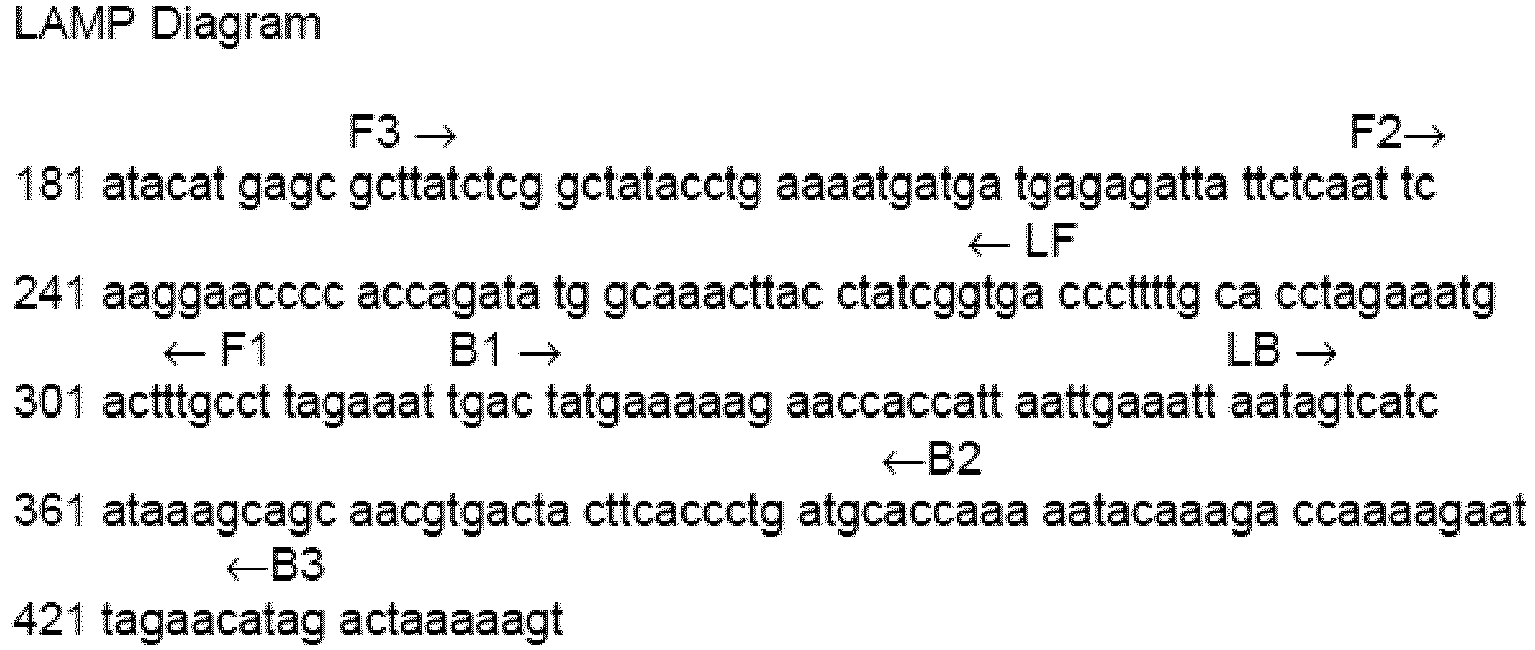
- F3 GCTTATCTCGGCTATACCTG (SEQ ID NO: 33)
- B3 CTATGTTCTAATTCTTTTGGTCTTTG (SEQ ID NO: 34)
- FIP Reverse Complement F1 AGGCAAAGTCATTTCTAGGTG (F2) TCAAGGAACCCCACCAGA (SEQ ID NO: 35)
- BIP B1 TGACTATGAAAAAGAACCACCATTA (B2) TGGTGCATCAGGGTGAAG Reverse Complement (SEQ ID NO: 36)
- LF TCACCGATAGGTAAGTTTGC Reverse Complement (SEQ ID NO: 37)
- LB AATAGTCATCATAAAGCAGCAACG (SEQ ID NO: 38)
- The LAMP assay relies on auto-cycling strand displacement DNA synthesis performed with the Bst DNA polymerase large fragment. The LAMP reaction requires a set of four oligonucleotide primers recognizing six distinct regions (F1, F2, F3, B1, B2 and B3) on the target DNA: the forward inner primer (FIP) consist of F1 complementary sequence and F2 direct sequence, the back inner primer (BIP) consists of B1 direct sequence and B2 complementary sequence, and also the two outer primers (F3 primer and B3 primer). The reaction is performed at a constant temperature between 60 C and 65 C and results can be read within 45 min. With an additional one or two primers (LF primer and LB primer), termed 'loop primers', the reaction can be accelerated due to the increasing number of reaction sites. LAMP products can be detected indirectly by the turbidity that arises due to the formation of insoluble magnesium pyrophosphate. A large amount of pyrophosphate ions is produced as a by product, yielding a white precipitate of magnesium pyrophosphate in the reaction mixture. The increase in the turbidity of the reaction mixture caused by the production of precipitate correlates with the amount of DNA synthesized. Visual discrimination can be enhanced by adding 1µl
SYBR Green 1 to the reaction and visually detecting a color change by the naked eye or fluorescence under UV light. - Below is an exemplary Mastitis LAMP protocol.
Table 3 Optimized Reagent Conc. Working Range Nuclease Free H2O - 1x Polymerase Buffer - 1M Betaine 0.5M -1.5M 1.2mM dNTP 1mM - 1.6mM 6mM MgSO4 5.5mM - 7mM 8units Bst DNA Polymerase 8 - 10 units 0.2µM F3 Primer 0.1µM - 0.3µM 0.2µM B3 Primer 0.1µM - 0.3µM 1.6µM FIP Primer 1.4µM - 1.8µM 1.6µM BIP Primer 1.4µM - 1.8µM 0.8µM LF Primer 0.8µM - 1.2µM 0.8µM LB Primer 0.8µM - 1.2µM Temperature 65°C 60-65°C Time at 65°C 45 mins 30-60 mins Reaction inactivation temperature 80°C 80-95°C Reaction inactivation time 2 min2-10 min - Primers are the same as those listed above.
- The reaction is capable of working without the LF and/or LB primers. Betaine reduces the formation of secondary structures in G-C rich regions and improves amplification by enhancing the specificity of the PCR. This could possibly be achieved by using other PCR additives such as ethylene glycol or 1, 2 - propanediol instead of betaine. Magnesium sulfate could be substituted with magnesium chloride.
- One hundred microliters of milk was plated on TSA with 5% sheep blood and incubated overnight at 37°C. Bacterial colonies were added to 50 µl of nuclease-free water, and the suspension was boiled for 20 min at 100°C. After boiling the suspension was centrifuged at 21,00xg for 20 min. The supernatant was transferred to a clean microcentrifuge tube and used as DNA template for LAMP analyses.
- One milliliter of milk was centrifuged at 21,00xg for 10 min and the pellet was resuspended in 100 µl of nuclease-free water. The suspension was boiled for 20 min at 100°C. After boiling the suspension was centrifuged at 21,00xg for 20 min. The supernatant was transferred to a clean microcentrifuge tube and used as DNA template for LAMP analyses. Two commercial extraction kits (MagMax total nucleic acid isolation kit-Ambion and QIAamp DNA mini kit-Qiagen) have been used according to manufacturer's instructions to isolate DNA directly from the milk. See attached protocols. All three of the above direct extraction methods could be applied to skin scrapings to detect dermatitis pathogens.
- Lamp assays were carried out in a total of 25 µl mixture containing 1.6 µM (each) of the primers FIP and BIP, 0.2 µM (each) of the primers F3 and B3, 0.8 µM (each) of the primers LF and LB, 1.2 mM deoxynucleotide triphosphates, 6mM MgSO4, 1 M betaine, 1x thermopol buffer, 8 U Bst DNA polymerase and 2 µl of DNA template. The reaction was incubated for 45 min at 65°C and then was terminated by heating at 80°C for 2 min. Negative and positive controls were included for each LAMP assay.
- After the amplification, 1 µl SYBR Green I was added to each LAMP reaction tube to observe the color change. Since fluorescent dye SYBR Green I binds to double-stranded DNA and produces a yellow fluorescence which can be observed by the naked eye under natural light or under UV lamp. The observation of the yellow/fluorescence color change indicates a positive reaction.
- The developed LAMP assays (as described above) were applied to detect mastitis pathogens in milk using simple low-cost equipment and observed directly by naked eye and under UV light. Application of the LAMP assays was performed on bacterial strains isolated from milk submitted to the Wisconsin Diagnostic Veterinary Laboratory for mastitis testing. DNA was also extracted directly from the milk samples using a commericial kit and applied to the LAMP assays. The results obtained indicate that the LAMP assays are suitable and effective for the detection of E. coli, S. aureus, K. pneumonia, S. uberis, S. dysgalactiae, S. agalactiae, M. bovis, and coagulase-negative Staphylococci (S. epidermidis, S. chromogenes, and S. simulans), the primary pathogens known to cause bovine mastitis. These pathogens could be detected both in pure cultures and directly from milk.
Fig 1 and 2 illustrate the results of this experiment. - We used cow milk submitted to the Wisconsin Veterinary Diagnostic Laboratory for routine bacteriological culture and confirmed our results presented in Examples 1 to 5 using the LAMP assays on DNA extracted from the raw milk and from colonies of bacteria on culture plates. Conclusion: Good agreement as shown in Table 4.
Table 4: LAMP Assay Results from Milk and Colonies for five assays of each of the 10 pathogens (recall that 'CNS' represents 3 Coagulase negative Staphylococcus aureus) in Example 1 to 5. Animal ID LAMP Result Directly from Milk LAMP Result from Colonies WVDL Culture Result Assays Performed Concurrently Galaxy LR CNS CNS CNS CNS, Ecoli, Sdys 2233-6 CNS CNS CNS CNS, Ecoli, Sdys 2297 CNS CNS CNS CNS, SA, Sdys 2575-4 CNS CNS CNS CNS, Mbovis, Ecoli 2839 CNS CNS CNS CNSSA, Sdys 2769 E. coli E. coli E. coli Ecoli, SA, CNS, S.dys, Sub 3746 E. coli E. coli E. coli Ecoli, SA, CNS, S.dys, Sub 3308 E. coli E. coli E. coli Ecoli, SA, CNS, S.dys, Kleb 11727 E. coli E. coli E. coli Ecoli, SA, CNS, S.dys, Kleb 12213 E. coli E. coli E. coli Ecoli, SA, CNS, S.dys, Kleb 4103LR Kleb. pneumonia Kleb. pneumonia Kleb. sp. Kleb, SA, CNS, Ecoli 14659RF Kleb. pneumonia Kleb. pneumonia Kleb. sp. Kleb, SA, CNS, Ecoli 8627-2 Kleb. pneumonia Kleb. pneumonia Kleb. sp. Kleb, SA, Sdys 1227LR Kleb. pneumonia Kleb. pneumonia Kleb. sp. Kleb, SA, Sdys 1159RF Kleb. pneumonia Kleb. pneumonia Kleb. sp. Kleb, Ecoli, Sdys, Sub 8003 M. bovis No growth M. bovis Mbovis, SA 1176 M. bovis M. bovis M. bovis Mbovis, SA, Ecoli 16169 M. bovis M. bovis M. bovis Mbovis, SA, Ecoli 47 S. agalactiae S. agalactiae S. agalactiae Sag, CNS, Sdys, Sub 52 S. agalactiae S. agalactiae S. agalactiae Sag, CNS, Sdys, Sub 3323-4 S. agalactiae S. agalactiae S. agalactiae Sag, CNS, Sdys, Sub 9498RR S. dysgalactiae S. dysgalactiae S. dysgalactiae Sdys, CNS, Sub 11721 S. dysgalactiae S. dysgalactiae S. dysgalactiae Sdys, SA, CNS, Ecoli, Kleb 30228-1 S. dysgalactiae S. dysgalactiae S. dysgalactiae Sdys, SA, Sub 30228-2 S. dysgalactiae S. dysgalactiae S. dysgalactiae Sdys, SA, Sub 30257-1 S. dysgalactiae S. dysgalactiae S. dysgalactiae Sdys, SA, CNS 4313LF S. uberis S. uberis S. uberis Sub, Ecoli, Kleb 14987LF S. uberis S. uberis S. uberis Sub, SA, Sdys, Sub 2007-1 S. uberis S. uberis S. uberis Sub, SA, Sdys, Sub 14737-3 S. uberis S. uberis S. uberis Sub, SA, Sdys, Sub 14987LF S. uberis S. uberis S. uberis Sub, SA, Sdys, Sub 1096 Staph. aureus Staph. aureus Staph. aureus SA, CNS, Ecoli, Kleb 266 Staph. aureus Staph. aureus Staph. aureus SA, CNS, Ecoli, Kleb 1512 Staph. aureus Staph. aureus Staph. aureus SA, CNS, Ecoli, Kleb 1342 Staph. aureus Staph. aureus Staph. aureus SA, CNS, Ecoli, Kleb 3439RR Staph. aureus Staph. aureus Staph. aureus SA, CNS, Ecoli, Kleb 5998LR Staph. aureus Staph. aureus Staph. aureus SA, CNS, Ecoli, Kleb 6569LR Staph. aureus Staph. aureus Staph. aureus SA, CNS, Ecoli, Kleb - We next examined preserved milk samples for routine raw milk analysis and confirmation of mastitis pathogens by a commercially available PCR results reference test. Conclusion: the LAMP assays of the present invention matched the PCR results in 8/12 cases, showing good agreement in preserved milk samples as can be found in Table 5.
Table 5: Preserved Milk Sample from AgSource Animal ID E. coli Kleb. pneumonia M. bovis Staph. aureus CNS SAG S. dys S. uberis AgSource Pathoproof Result Agreement Staph. aureus High Honey Neg Neg Neg Pos Neg Neg Neg Neg Pos Yes 910 Neg Neg Neg Neg Neg Neg Neg Pos S. uberis Med. Pos Yes 7341 Neg Neg Pos Neg Neg Neg Neg Neg M. bovis High Pos Yes 2243 Neg Neg Pos Neg Neg Neg Neg Neg M. bovisMed. Pos Yes 87 Pos Neg NT Neg Neg NT Neg NT E. coli Suspect Yes 167 Pos Neg NT Neg Neg NT Neg NT E. coli Suspect Yes 199 NT Neg NT NT Neg NT Pos NT S. dys Med. Pos Yes 1 Neg Neg NT Neg Neg NT Pos NT S. dys Med. Pos Yes 197 Neg Neg NT Neg Neg NT Neg NT S. dys Med. Pos No Pool 6 Neg Neg Neg Neg Neg Neg Neg Neg S. dys Med. Pos No 411 Neg Neg Neg Neg Neg Neg Neg Neg S. uberis Med. Pos No 3715 Neg Neg Neg Neg Neg Neg Neg Neg M. bovisMed. Pos No - Milk culture results confirmed the LAMP assay results in 11/12 cases, with the exception of sample AC that should have been LAMP positive for E. coli as well. Assays (LAMP and cultures) were performed by Mrs. Marianne Middelveen, Calgary, Canada who runs a routine milk diagnostic lab (see Table 6). Conclusion: good agreement.
Table 6: LAMP Assays Performed by a Canadian Milk Diagnostic Lab Animal ID E. coli Kleb. pneumonia M. bovis Staph. aureus CNS SAG S. dys S. uberis Alberta Culture Result 31 Neg Pos Neg Pos Neg Neg Neg Neg Confirmed 38B Neg Neg Neg Neg Neg Neg Neg Neg Confirmed 39 Pos Pos Neg Neg Neg Neg Neg Neg Confirmed 66 Neg Pos Neg Neg Neg Neg Neg Neg Confirmed 68 Neg Pos Neg Neg Neg Neg Neg Neg Confirmed 73 Neg Pos Neg Neg Neg Neg Neg Neg Confirmed 75 Neg Pos Neg Neg Neg Neg Neg Neg Confirmed 100 Neg Pos Neg Neg Neg Neg Neg Neg Confirmed AA Neg Pos Neg Neg Neg Neg Neg Neg Confirmed AB Pos Pos Neg Pos Neg Neg Neg Pos Confirmed AC Neg Pos Neg Neg Neg Neg Neg Pos Discrepency also E.coli + BB Neg Pos Neg Pos Neg Neg Neg Neg Confirmed - A LAMP primer set for detecting β-lactamase blaR1 (GenBank M62650.1), a marker for antimicrobial resistance, comprising the following primers was developed and used to test milk samples where β-lactamase genes were suspected to be present or absent (see Table 7):
- F3 primer CAGGTATAGTAAACGGGAAGT (SEQ ID NO: 43)
- B3 primer ATAACATCCCATTCAGCCATAG (SEQ ID NO: 44)
- FIP primer CTTTCCATCTGATAAATGTGTAGC-AATGGGTGGTTTGTAGGTTAC (SEQ ID NO: 45)
- BIP primer CCATCTGGGAAAAATGCTGAA-GGCCATTTAAAACACCCATTTC (SEQ ID NO: 46)
- The β-lactamase LAMP correctly identified all bacteria tested.
-
- <110> Wisconsin Alumni Research Foundation
- <120> DNA-Based Detection and Identification of Eight Mastitis Pathogens
- <130> N404119EP
- <150>
US 61/891,628
<151> 2013-10-16 - <160> 46
- <170> PatentIn version 3.5
- <210> 1
<211> 18
<212> DNA
<213> Escherichia coli - <400> 1
cgaactgaac tggcagac 18 - <210> 2
<211> 20
<212> DNA
<213> Escherichia coli - <400> 2
ttcaacgctg acatcaccat 20 - <210> 3
<211> 45
<212> DNA
<213> Escherichia coli - <400> 3
ggcatagtta aagaaatcat ggaagggaat ggtgattacc gacga 45 - <210> 4
<211> 35
<212> DNA
<213> Escherichia coli - <400> 4
tacaccacgc cgaacaccgt ggttacagtc ttgcg 35 - <210> 5
<211> 21
<212> DNA
<213> Escherichia coli - <400> 5
gactgctttt tcttgccgtt t 21 - <210> 6
<211> 16
<212> DNA
<213> Escherichia coli - <400> 6
cgtggtgacg catgtc 16 - <210> 7
<211> 25
<212> DNA
<213> Staphylococcus aureus - <400> 7
aacaagcgag ataacttaca acaa 25 - <210> 8
<211> 22
<212> DNA
<213> Staphylococcus aureus - <400> 8
ggtcaatgcc atgatttaat gc 22 - <210> 9
<211> 47
<212> DNA
<213> Staphylococcus aureus - <400> 9
agaaaccagc agagataggt aagatgcaaa tgagcaaaag attgaag 47 - <210> 10
<211> 43
<212> DNA
<213> Staphylococcus aureus - <400> 10
gaagttgttt attatgctgg tggtaatcat ttcccattgc act 43 - <210> 11
<211> 19
<212> DNA
<213> Klebsiella pneumoniae - <400> 11
ggaagtgtgg ataaacggc 19 - <210> 12
<211> 19
<212> DNA
<213> Klebsiella pneumoniae - <400> 12
ggatggtcaa cccaacgat 19 - <210> 13
<211> 36
<212> DNA
<213> Klebsiella pneumoniae - <400> 13
cctgctcggt gttattgagg acagcgtggg ttttcc 36 - <210> 14
<211> 39
<212> DNA
<213> Klebsiella pneumoniae - <400> 14
ttcgtctgct ggtggtgctg gattgagcgg ataatagat 39 - <210> 15
<211> 18
<212> DNA
<213> Klebsiella pneumoniae - <400> 15
aaagtgtggc agataccg 18 - <210> 16
<211> 20
<212> DNA
<213> Klebsiella pneumoniae - <400> 16
ccaacaagaa atacaaccgc 20 - <210> 17
<211> 23
<212> DNA
<213> Streptococcus uberis - <400> 17
ggtattgaaa aagcaacatc agc 23 - <210> 18
<211> 22
<212> DNA
<213> Streptococcus uberis - <400> 18
ggtcaaattg catcccttca ac 22 - <210> 19
<211> 44
<212> DNA
<213> Streptococcus uberis - <400> 19
caactttttc tgaacgtgat gacactattg cccaaccagt ttcc 44 - <210> 20
<211> 41
<212> DNA
<213> Streptococcus uberis - <400> 20
ggagtatatc tcagaagccc aagttctgtt tccataccac g 41 - <210> 21
<211> 19
<212> DNA
<213> Streptococcus uberis - <400> 21
acttgggcaa tagcctctt 19 - <210> 22
<211> 21
<212> DNA
<213> Streptococcus uberis - <400> 22
gtgtaggcaa tgatggtgtt a 21 - <210> 23
<211> 20
<212> DNA
<213> Streptococcus dysgalactiae - <400> 23
gcgacttatg ttgccaatgc 20 - <210> 24
<211> 20
<212> DNA
<213> Streptococcus dysgalactiae - <400> 24
agcgtcaaat gaaccgaagg 20 - <210> 25
<211> 44
<212> DNA
<213> Streptococcus dysgalactiae - <400> 25
gcttgacgaa tatcttctgg aataccctga aataggtgaa aacc 44 - <210> 26
<211> 41
<212> DNA
<213> Streptococcus dysgalactiae - <400> 26
cggaggacat ttaaaccatt ccttgagcaa catcaggagt g 41 - <210> 27
<211> 22
<212> DNA
<213> Streptococcus dysgalactiae - <400> 27
ggttacatct gccaataatt cc 22 - <210> 28
<211> 20
<212> DNA
<213> Streptococcus dysgalactiae - <400> 28
gtccccagaa aaacaagacg 20 - <210> 29
<211> 23
<212> DNA
<213> Streptococcus agalactiae - <400> 29
agttcagctt ttacgactct tag 23 - <210> 30
<211> 23
<212> DNA
<213> Streptococcus agalactiae - <400> 30
caacataaag tgattactca gcc 23 - <210> 31
<211> 47
<212> DNA
<213> Streptococcus agalactiae - <400> 31
gcaatagaac ccttcattaa gacaagcatt acaacaggtt atgacat 47 - <210> 32
<211> 39
<212> DNA
<213> Streptococcus agalactiae - <400> 32
caacgaagcc actgtctctt tctccatcag cattacgca 39 - <210> 33
<211> 20
<212> DNA
<213> Mycoplasma bovis - <400> 33
gcttatctcg gctatacctg 20 - <210> 34
<211> 26
<212> DNA
<213> Mycoplasma bovis - <400> 34
ctatgttcta attcttttgg tctttg 26 - <210> 35
<211> 39
<212> DNA
<213> Mycoplasma bovis - <400> 35
aggcaaagtc atttctaggt gtcaaggaac cccaccaga 39 - <210> 36
<211> 43
<212> DNA
<213> Mycoplasma bovis - <400> 36
tgactatgaa aaagaaccac cattatggtg catcagggtg aag 43 - <210> 37
<211> 20
<212> DNA
<213> Mycoplasma bovis - <400> 37
tcaccgatag gtaagtttgc 20 - <210> 38
<211> 24
<212> DNA
<213> Mycoplasma bovis - <400> 38
aatagtcatc ataaagcagc aacg 24 - <210> 39
<211> 18
<212> DNA
<213> Staphylococcus epidermidis - <400> 39
ccgtgttgaa cgtggtca 18 - <210> 40
<211> 19
<212> DNA
<213> Staphylococcus epidermidis - <400> 40
ggwgtratwg arccaggag 19 - <210> 41
<211> 45
<212> DNA
<213> Staphylococcus epidermidis - <400> 41
ttacggaaca tttctacacc wgtgtgaaga agttgaaatc atcgg 45 - <210> 42
<211> 40
<212> DNA
<213> Staphylococcus epidermidis - <400> 42
tggtgacaac atyggtgctt gctaatactt gwccacgttg 40 - <210> 43
<211> 21
<212> DNA
<213> Artificial Sequence - <220>
<223> BETA-lactamase blaR1 - <400> 43
caggtatagt aaacgggaag t 21 - <210> 44
<211> 22
<212> DNA
<213> Artificial Sequence - <220>
<223> BETA-lactamase blaR1 - <400> 44
ataacatccc attcagccat ag 22 - <210> 45
<211> 45
<212> DNA
<213> Artificial Sequence - <220>
<223> BETA-lactamase blaR1 - <400> 45
ctttccatct gataaatgtg tagcaatggg tggtttgtag gttac 45 - <210> 46
<211> 43
<212> DNA
<213> Artificial Sequence - <220>
<223> BETA-lactamase blaR1 - <400> 46
ccatctggga aaaatgctga aggccattta aaacacccat ttc 43
| Sample ID | β-lactamase | Lamp β-lactamase | Agreement |
| Staph. aureus FH | Pos | Pos | Yes |
| Staph. aureus 29213 | Pos | Pos | Yes |
| Staph. aureus 25923 | Neg | Neg | Yes |
| Staph. aureus NB305 | Neg | Neg | Yes |
| Staph. epidermis | Pos | Pos | Yes |
| Kleb. pneumonia | Pos | Pos | Yes |
| Strep. dysgalactiae | Neg | Neg | Yes |
| Strep. agalactiae | Neg | Neg | Yes |
| Strep. uberis | Neg | Neg | Yes |
| E.coli K-12 | Neg | Neg | Yes |
| M. bovis | Neg | Neg | Yes |
| Staph. chromogenes 15 | Neg | Neg | Yes |
Claims (14)
- A nucleotide primer panel for LAMP amplification used for detecting mastitis pathogens, comprising two or more primer sets designed to detect at least two pathogens selected from the group consisting of E. coli, Staphylococcus aureus, Klebsiella pneumonia, Streptococcus uberis, Streptococcus dysgalactiae, Streptococcus agalactiae, Mycoplasma bovis, and coagulase- negative Staphylococci (CNS) tufincluding subtypes S. epidermidis, S. chromogenes, and S. simulans, wherein each or every primer set is capable of amplifying a specific region of the respective mastitis pathogen, with the two or more primer sets being selected from the group consisting of:(i) a nucleotide primer set for detecting E. coli comprising(a) a F3 primer having a sequence identical or substantially identical to SEQ ID NO:1,(b) a B3 primer having a sequence identical or substantially identical to SEQ ID NO:2,(c) a FIP primer having a sequence identical or substantially identical to SEQ ID NO:3, and(d) a BIP primer having a sequence identical or substantially identical to SEQ ID NO:4, and optionally(e) a LF primer having a sequence identical or substantially identical to SEQ ID NO:5, and(f) a LB primer having a sequence identical or substantially identical to SEQ ID NO:6;(ii) a nucleotide primer set for LAMP amplification, used for detecting Staphylococcus aureus comprising(a) a F3 primer having a sequence identical or substantially identical to SEQ ID NO:7,(b) a B3 primer having a sequence identical or substantially identical to SEQ ID NO:8,(c) a FIP primer having a sequence identical or substantially identical to SEQ ID NO:9, and(d) a BIP primer having a sequence identical or substantially identical to SEQ ID NO:10;(iii) a nucleotide primer set for LAMP amplification, used for detecting Klebsiella pneumonia comprising(a) a F3 primer having a sequence identical or substantially identical to SEQ ID NO:11,(b) a B3 primer having a sequence identical or substantially identical to SEQ ID NO:12,(c) a FIP primer having a sequence identical or substantially identical to SEQ ID NO:13, and(d) a BIP primer having a sequence identical or substantially identical to SEQ ID NO:14, and optionally(e) a LF primer having a sequence identical or substantially identical to SEQ ID NO:15, and(f) a LB primer having a sequence identical or substantially identical to SEQ ID NO:16;(iv) a nucleotide primer set for LAMP amplification, used for detecting Streptococcus uberis comprising(a) a F3 primer having a sequence identical or substantially identical to SEQ ID NO:17,(b) a B3 primer having a sequence identical or substantially identical to SEQ ID NO:18,(c) a FIP primer having a sequence identical or substantially identical to SEQ ID NO:19, and(d) a BIP primer having a sequence identical or substantially identical to SEQ ID NO:20, and optionally(e) a LF primer having a sequence identical or substantially identical to SEQ ID NO:21, and(f) a LB primer having a sequence identical or substantially identical to SEQ ID NO:22;(v) a nucleotide primer set for LAMP amplification, used for detecting Streptococcus dysgalactiae comprising(a) a F3 primer having a sequence identical or substantially identical to SEQ ID NO:23,(b) a B3 primer having a sequence identical or substantially identical to SEQ ID NO:24,(c) a FIP primer having a sequence identical or substantially identical to SEQ ID NO:25, and(d) a BIP primer having a sequence identical or substantially identical to SEQ ID NO:26, and optionally(e) a LF primer having a sequence identical or substantially identical to SEQ ID NO:27, and(f) a LB primer having a sequence identical or substantially identical to SEQ ID NO:28;(vi) a nucleotide primer set for LAMP amplification, used for detecting Streptococcus agalactiae comprising(a) a F3 primer having a sequence identical or substantially identical to SEQ ID NO:29,(b) a B3 primer having a sequence identical or substantially identical to SEQ ID NO:30,(c) a FIP primer having a sequence identical or substantially identical to SEQ ID NO:31, and(d) a BIP primer having a sequence identical or substantially identical to SEQ ID NO:32;(vii) a nucleotide primer set for LAMP amplification, used for detecting Mycoplasma bovis comprising(a) a F3 primer having a sequence identical or substantially identical to SEQ ID NO:33,(b) a B3 primer having a sequence identical or substantially identical to SEQ ID NO:34,(c) a FIP primer having a sequence identical or substantially identical to SEQ ID NO:35, and(d) a BIP primer having a sequence identical or substantially identical to SEQ ID NO:36, and optionally(e) a LF primer having a sequence identical or substantially identical to SEQ ID NO:37, and(f) a LB primer having a sequence identical or substantially identical to SEQ ID NO:38; and(viii) a nucleotide primer set for LAMP amplification, used for detecting coagulase- negative Staphylococci (CNS) tuf or any one of the subtypes including S. epidermidis, S. chromogenes, and S. simulans, comprising(a) a F3 primer having a sequence identical or substantially identical to SEQ ID NO:39,(b) a B3 primer having a sequence identical or substantially identical to SEQ ID NO:40,(c) a FIP primer having a sequence identical or substantially identical to SEQ ID NO:41, and(d) a BIP primer having a sequence identical or substantially identical to SEQ ID NO:42,wherein the two or more primer sets include the primer set of (vii) for detecting Mycoplasma bovis.
- The primer panel of claim 1, the panel comprises all of the primer sets of (i) to (viii).
- A LAMP method of simultaneously detecting two or more mastitis pathogens in a sample comprising the steps of(a) extracting DNA from the sample;(b) amplifying a specific region of the mastitis pathogens by reacting the extracted DNA of step (a) with the primer panel of claim 1 or 2; and(c) detecting or identifying the presence or absence of the amplified products of at least two mastitis pathogens.
- The method of claim 3, wherein in step (b) the amplification is performed in a reaction solution suitable for the primer system of claim 1 or 2, comprising:(a) betaine in the concentration range of about 0.5-1.5 M;(b) dNTP in the concentration range of about 1-1.6mM;(c) Mg2+ in the concentration range of about 5.5-7 mM;(d) Bst DNA polymerase in the concentration range of about 8-10 units.
- The method of claim 4, wherein the betaine is about 1 M, the dNTP is about 1.2 mM, the Mg2+ is about 6 mM, and the Bst DNA polymerase is about 8 units.
- The method of claim 4 or 5, wherein the buffer further comprises an addition selected from the group of nuclease free H2O and polymerase buffer.
- The method of any one of claims 3 to 6, wherein the sample is derived from cow's milk.
- The method of any one of claims 3 to 7, wherein the DNA is extracted from a bacterial colony derived from cow's milk.
- The method of claim 3 wherein the method detects or identifies Mycoplasma bovis in a sample comprising the steps of(a) extracting DNA from the sample;(b) amplifying a specific region of the mastitis pathogens by reacting the extracted DNA of step (a) with the primer panel of claim 1 or 2; and(c) detecting or identifying the presence or absence of the amplified products of Mycoplasma bovis.
- The method of claim 9, wherein the sample is derived from cow's milk.
- The method of claim 3, wherein the method detects or identifies Streptococcus uberis, Streptococcus dysgalactiae, Streptococcus dysgalactiae or Staphylococci in a sample comprising the steps of(a) extracting DNA from the sample;(b) amplifying a specific region of the mastitis pathogens by reacting the extracted DNA of step (a) with primers selected from SEQ ID NOs:17 - 28 and 39 - 42 ; and(c) detecting or identifying the presence or absence of the amplified products of Streptococcus uberis, Streptococcus dysgalactiae, or Staphylococci.
- The method of claim 11, wherein the sample is derived from cow's milk.
- A kit for simultaneously detecting or identifying at least two mastitis pathogens in a sample comprising a primer panel of claim 1 or 2.
- The kit of claim 13 further comprising a reaction solution suitable for the primer system of claim 1 or 2, comprising:(a) betaine in the concentration range of about 0.5-1.5 M;(b) dNTP in the concentration range of about 1-1.6mM;(c) Mg2+ in the concentration range of about 5.5-7 mM;(d) Bst DNA polymerase in the concentration range of about 8-10 units.
Applications Claiming Priority (1)
| Application Number | Priority Date | Filing Date | Title |
|---|---|---|---|
| US201361891628P | 2013-10-16 | 2013-10-16 |
Publications (3)
| Publication Number | Publication Date |
|---|---|
| EP2862943A2 EP2862943A2 (en) | 2015-04-22 |
| EP2862943A3 EP2862943A3 (en) | 2015-09-02 |
| EP2862943B1 true EP2862943B1 (en) | 2018-08-22 |
Family
ID=51743316
Family Applications (1)
| Application Number | Title | Priority Date | Filing Date |
|---|---|---|---|
| EP14189060.8A Not-in-force EP2862943B1 (en) | 2013-10-16 | 2014-10-15 | DNA-based detection and identification of eight mastitis pathogens |
Country Status (2)
| Country | Link |
|---|---|
| US (1) | US10253376B2 (en) |
| EP (1) | EP2862943B1 (en) |
Families Citing this family (13)
| Publication number | Priority date | Publication date | Assignee | Title |
|---|---|---|---|---|
| EP3371320A4 (en) * | 2015-11-04 | 2018-12-05 | The Translational Genomics Research Institute | Systems and methods of diagnosing and characterizing infections |
| CN108866223A (en) * | 2017-05-15 | 2018-11-23 | 吉林出入境检验检疫局检验检疫技术中心 | It is a kind of for identifying the LAMP primer group and its application of staphylococcus aureus |
| CN107338325A (en) * | 2017-09-08 | 2017-11-10 | 吉林省凯博生物技术有限公司 | A kind of loop-mediated isothermal amplification detection method of mycoplasma bovis and its application |
| CN108531631A (en) * | 2018-06-19 | 2018-09-14 | 郑州轻工业学院 | One kind is for detecting enteropathogenic E. Coli O157:The RPA-LFD primer pairs and probe of H7 and its application |
| CN110734990A (en) * | 2019-11-08 | 2020-01-31 | 南京农业大学 | Detection reagents, kits and their applications |
| CN111378772A (en) * | 2020-03-27 | 2020-07-07 | 宁夏大学 | Specific LAMP primer, kit and method for detecting streptococcus uberis |
| CN111763767A (en) * | 2020-06-04 | 2020-10-13 | 上海捷诺生物科技有限公司 | Central nervous system infection pathogen detection kit and its application |
| CN112280833A (en) * | 2020-11-11 | 2021-01-29 | 上海市嘉定区中心医院(上海健康医学院附属嘉定区中心医院、上海交通大学医学院附属仁济医院嘉定分院) | Primer group for quantitative detection of Escherichia coli DNA on surface of urinary catheter |
| AU2021378956A1 (en) * | 2020-11-11 | 2023-06-15 | Purdue Research Foundation | Assays, kits and methods for detection of bovine respiratory disease complex-associated pathogens |
| CN113621727A (en) * | 2021-06-24 | 2021-11-09 | 领航基因科技(杭州)有限公司 | Primer, probe and kit for multiple PCR detection of 5 pathogenic bacteria |
| CN114277169B (en) * | 2022-01-13 | 2023-07-07 | 上海市动物疫病预防控制中心(上海市兽药饲料检测所、上海市畜牧技术推广中心) | Kit for detecting cow mastitis pathogenic bacteria and method thereof |
| CN116004865B (en) * | 2022-08-16 | 2025-05-23 | 四川大学 | Primer combination of streptococcus bovis and bovine coccidiosis double targets and LAMP detection method thereof |
| CN117778598A (en) * | 2023-11-29 | 2024-03-29 | 宁夏农林科学院动物科学研究所(宁夏草畜工程技术研究中心) | LAMP primer group for detecting mycoplasma bovis and detection method thereof |
Family Cites Families (8)
| Publication number | Priority date | Publication date | Assignee | Title |
|---|---|---|---|---|
| US435982A (en) * | 1890-09-09 | Regulator for dynamo-electric machines | ||
| JP2006271370A (en) | 2005-03-02 | 2006-10-12 | Kitasato Inst:The | Method and kit for detecting Staphylococcus aureus and methicillin resistant bacteria |
| JP2007189980A (en) | 2006-01-20 | 2007-08-02 | Kirin Brewery Co Ltd | Primer for detection of Staphylococcus aureus and detection method using the same |
| JP2008125376A (en) | 2006-11-17 | 2008-06-05 | Hokkaido | Primer for lamp (loop-mediated isothermal amplificatuion) for detecting staphylococcus aureus enterotoxin a, and method for detecting gene of enterotoxin a-producing staphylococcus aureus using the samestaphylococcus aureus |
| US20110151453A1 (en) | 2007-07-11 | 2011-06-23 | Bergeron Michel G | Nucleic acid sequences and combination thereof for sensitive amplification and detection of bacterial and fungal sepsis pathogens |
| US20090191561A1 (en) * | 2007-12-31 | 2009-07-30 | Finnzymes Oy | Methods and oligonucleotides for detection of mastitis causing bacteria |
| JP5153726B2 (en) | 2009-06-10 | 2013-02-27 | 国立感染症研究所長 | Primer set for detecting group B streptococci and use thereof |
| JP5787503B2 (en) | 2010-09-15 | 2015-09-30 | 株式会社東芝 | Primer set for mycoplasma, assay kit and method using the same |
-
2014
- 2014-10-13 US US14/512,937 patent/US10253376B2/en active Active
- 2014-10-15 EP EP14189060.8A patent/EP2862943B1/en not_active Not-in-force
Non-Patent Citations (1)
| Title |
|---|
| None * |
Also Published As
| Publication number | Publication date |
|---|---|
| EP2862943A2 (en) | 2015-04-22 |
| US10253376B2 (en) | 2019-04-09 |
| US20150104799A1 (en) | 2015-04-16 |
| EP2862943A3 (en) | 2015-09-02 |
Similar Documents
| Publication | Publication Date | Title |
|---|---|---|
| EP2862943B1 (en) | DNA-based detection and identification of eight mastitis pathogens | |
| Phuektes et al. | Multiplex polymerase chain reaction assay for simultaneous detection of Staphylococcus aureus and streptococcal causes of bovine mastitis | |
| CN105473740B (en) | Approaches to targeted antibiotic susceptibility testing | |
| CN106811541A (en) | Primer, probe and kit for field quick detection pasteurella multocida | |
| CN105793436A (en) | Detection of methicillin-resistant staphylococcus aureus in biological samples | |
| US20250115968A1 (en) | Constant temperature nucleic acid amplification raa primer probe combination for detecting candida auris and use thereof | |
| Silva Zatti et al. | Isothermal nucleic acid amplification techniques for detection and identification of pathogenic fungi: A review | |
| CN111440886A (en) | Primer group, kit and detection method for rapidly detecting carbapenemase gene | |
| CN107541509B (en) | LAMP primer combination for detection of 6 infectious pathogens in dairy cow mastitis and its application | |
| CN103476945A (en) | Improved methods for determining cell viability using molecular nucleic acid-based techniques | |
| Galetto et al. | Real-time PCR diagnosis and quantification of phytoplasmas. | |
| US20110200984A1 (en) | Using nucleic acids for clinical microbiology testing | |
| Chen et al. | Development of a closed-tube isothermal multiple self-matching-initiated amplification assay for visual detection of Staphylococcus aureus in milk samples | |
| Cantekin et al. | Comparison of PCR and culture methods for diagnosis of subclinical mastitis in dairy cattle | |
| US10041130B2 (en) | Method of determining types I, II, III, IV or V or methicillin-resistant Staphylococcus aureus (MRSA) in a biological sample | |
| CN107312849B (en) | A CPA detection method for detecting Mycoplasma bovis and its kit and application | |
| CN109457020A (en) | Resistance detection composition, Resistance detection kit and Resistance detection method | |
| Moustafa et al. | Development of loop-mediated isothermal amplification–based diagnostic assays for detection of Pasteurella multocida and hemorrhagic septicemia–associated P multocida serotype B: 2 | |
| KR102860454B1 (en) | Primer set for detecting Mycoplasma gallicepticum and detection method using the same | |
| EP3438280B1 (en) | Haemoplasma detection method | |
| KR101752274B1 (en) | Primer set for high sensitive real-time multiplex loop-mediated isothermal amplification reaction for determining type of shiga toxin genes stx1 and stx2 of Enterohemorrhagic Escherichia coli, and method for determining type of shiga toxin genes of Enterohemorrhagic Escherichia coli using the same | |
| Beker et al. | Optimizing detection methods for MRSA isolated from mastitis cases and assessing virulence genes | |
| JP7390736B2 (en) | Simultaneous detection method and primer kit for rot fungi | |
| US12270076B2 (en) | Method for identifying mastitis-causing microbes | |
| Zhang et al. | Detection of Haemophilus parasuis isolates from South China by loop-mediated isothermal amplification and isolate characterisation |
Legal Events
| Date | Code | Title | Description |
|---|---|---|---|
| PUAI | Public reference made under article 153(3) epc to a published international application that has entered the european phase |
Free format text: ORIGINAL CODE: 0009012 |
|
| 17P | Request for examination filed |
Effective date: 20141015 |
|
| AK | Designated contracting states |
Kind code of ref document: A2 Designated state(s): AL AT BE BG CH CY CZ DE DK EE ES FI FR GB GR HR HU IE IS IT LI LT LU LV MC MK MT NL NO PL PT RO RS SE SI SK SM TR |
|
| AX | Request for extension of the european patent |
Extension state: BA ME |
|
| PUAL | Search report despatched |
Free format text: ORIGINAL CODE: 0009013 |
|
| AK | Designated contracting states |
Kind code of ref document: A3 Designated state(s): AL AT BE BG CH CY CZ DE DK EE ES FI FR GB GR HR HU IE IS IT LI LT LU LV MC MK MT NL NO PL PT RO RS SE SI SK SM TR |
|
| AX | Request for extension of the european patent |
Extension state: BA ME |
|
| RIC1 | Information provided on ipc code assigned before grant |
Ipc: C12Q 1/68 20060101AFI20150724BHEP |
|
| R17P | Request for examination filed (corrected) |
Effective date: 20160301 |
|
| RBV | Designated contracting states (corrected) |
Designated state(s): AL AT BE BG CH CY CZ DE DK EE ES FI FR GB GR HR HU IE IS IT LI LT LU LV MC MK MT NL NO PL PT RO RS SE SI SK SM TR |
|
| 17Q | First examination report despatched |
Effective date: 20160415 |
|
| STAA | Information on the status of an ep patent application or granted ep patent |
Free format text: STATUS: EXAMINATION IS IN PROGRESS |
|
| REG | Reference to a national code |
Ref country code: DE Ref legal event code: R079 Ref document number: 602014030763 Country of ref document: DE Free format text: PREVIOUS MAIN CLASS: C12Q0001680000 Ipc: C12Q0001684400 |
|
| GRAP | Despatch of communication of intention to grant a patent |
Free format text: ORIGINAL CODE: EPIDOSNIGR1 |
|
| STAA | Information on the status of an ep patent application or granted ep patent |
Free format text: STATUS: GRANT OF PATENT IS INTENDED |
|
| RIC1 | Information provided on ipc code assigned before grant |
Ipc: C12Q 1/6844 20180101AFI20180216BHEP |
|
| INTG | Intention to grant announced |
Effective date: 20180314 |
|
| GRAS | Grant fee paid |
Free format text: ORIGINAL CODE: EPIDOSNIGR3 |
|
| GRAA | (expected) grant |
Free format text: ORIGINAL CODE: 0009210 |
|
| STAA | Information on the status of an ep patent application or granted ep patent |
Free format text: STATUS: THE PATENT HAS BEEN GRANTED |
|
| AK | Designated contracting states |
Kind code of ref document: B1 Designated state(s): AL AT BE BG CH CY CZ DE DK EE ES FI FR GB GR HR HU IE IS IT LI LT LU LV MC MK MT NL NO PL PT RO RS SE SI SK SM TR |
|
| REG | Reference to a national code |
Ref country code: GB Ref legal event code: FG4D |
|
| REG | Reference to a national code |
Ref country code: CH Ref legal event code: EP |
|
| REG | Reference to a national code |
Ref country code: AT Ref legal event code: REF Ref document number: 1032568 Country of ref document: AT Kind code of ref document: T Effective date: 20180915 |
|
| REG | Reference to a national code |
Ref country code: IE Ref legal event code: FG4D |
|
| REG | Reference to a national code |
Ref country code: DE Ref legal event code: R096 Ref document number: 602014030763 Country of ref document: DE |
|
| REG | Reference to a national code |
Ref country code: NL Ref legal event code: MP Effective date: 20180822 |
|
| REG | Reference to a national code |
Ref country code: LT Ref legal event code: MG4D |
|
| PG25 | Lapsed in a contracting state [announced via postgrant information from national office to epo] |
Ref country code: SE Free format text: LAPSE BECAUSE OF FAILURE TO SUBMIT A TRANSLATION OF THE DESCRIPTION OR TO PAY THE FEE WITHIN THE PRESCRIBED TIME-LIMIT Effective date: 20180822 Ref country code: FI Free format text: LAPSE BECAUSE OF FAILURE TO SUBMIT A TRANSLATION OF THE DESCRIPTION OR TO PAY THE FEE WITHIN THE PRESCRIBED TIME-LIMIT Effective date: 20180822 Ref country code: LT Free format text: LAPSE BECAUSE OF FAILURE TO SUBMIT A TRANSLATION OF THE DESCRIPTION OR TO PAY THE FEE WITHIN THE PRESCRIBED TIME-LIMIT Effective date: 20180822 Ref country code: RS Free format text: LAPSE BECAUSE OF FAILURE TO SUBMIT A TRANSLATION OF THE DESCRIPTION OR TO PAY THE FEE WITHIN THE PRESCRIBED TIME-LIMIT Effective date: 20180822 Ref country code: NL Free format text: LAPSE BECAUSE OF FAILURE TO SUBMIT A TRANSLATION OF THE DESCRIPTION OR TO PAY THE FEE WITHIN THE PRESCRIBED TIME-LIMIT Effective date: 20180822 Ref country code: IS Free format text: LAPSE BECAUSE OF FAILURE TO SUBMIT A TRANSLATION OF THE DESCRIPTION OR TO PAY THE FEE WITHIN THE PRESCRIBED TIME-LIMIT Effective date: 20181222 Ref country code: BG Free format text: LAPSE BECAUSE OF FAILURE TO SUBMIT A TRANSLATION OF THE DESCRIPTION OR TO PAY THE FEE WITHIN THE PRESCRIBED TIME-LIMIT Effective date: 20181122 Ref country code: NO Free format text: LAPSE BECAUSE OF FAILURE TO SUBMIT A TRANSLATION OF THE DESCRIPTION OR TO PAY THE FEE WITHIN THE PRESCRIBED TIME-LIMIT Effective date: 20181122 Ref country code: GR Free format text: LAPSE BECAUSE OF FAILURE TO SUBMIT A TRANSLATION OF THE DESCRIPTION OR TO PAY THE FEE WITHIN THE PRESCRIBED TIME-LIMIT Effective date: 20181123 |
|
| REG | Reference to a national code |
Ref country code: AT Ref legal event code: MK05 Ref document number: 1032568 Country of ref document: AT Kind code of ref document: T Effective date: 20180822 |
|
| PG25 | Lapsed in a contracting state [announced via postgrant information from national office to epo] |
Ref country code: LV Free format text: LAPSE BECAUSE OF FAILURE TO SUBMIT A TRANSLATION OF THE DESCRIPTION OR TO PAY THE FEE WITHIN THE PRESCRIBED TIME-LIMIT Effective date: 20180822 Ref country code: HR Free format text: LAPSE BECAUSE OF FAILURE TO SUBMIT A TRANSLATION OF THE DESCRIPTION OR TO PAY THE FEE WITHIN THE PRESCRIBED TIME-LIMIT Effective date: 20180822 Ref country code: AL Free format text: LAPSE BECAUSE OF FAILURE TO SUBMIT A TRANSLATION OF THE DESCRIPTION OR TO PAY THE FEE WITHIN THE PRESCRIBED TIME-LIMIT Effective date: 20180822 |
|
| PG25 | Lapsed in a contracting state [announced via postgrant information from national office to epo] |
Ref country code: EE Free format text: LAPSE BECAUSE OF FAILURE TO SUBMIT A TRANSLATION OF THE DESCRIPTION OR TO PAY THE FEE WITHIN THE PRESCRIBED TIME-LIMIT Effective date: 20180822 Ref country code: CZ Free format text: LAPSE BECAUSE OF FAILURE TO SUBMIT A TRANSLATION OF THE DESCRIPTION OR TO PAY THE FEE WITHIN THE PRESCRIBED TIME-LIMIT Effective date: 20180822 Ref country code: RO Free format text: LAPSE BECAUSE OF FAILURE TO SUBMIT A TRANSLATION OF THE DESCRIPTION OR TO PAY THE FEE WITHIN THE PRESCRIBED TIME-LIMIT Effective date: 20180822 Ref country code: IT Free format text: LAPSE BECAUSE OF FAILURE TO SUBMIT A TRANSLATION OF THE DESCRIPTION OR TO PAY THE FEE WITHIN THE PRESCRIBED TIME-LIMIT Effective date: 20180822 Ref country code: ES Free format text: LAPSE BECAUSE OF FAILURE TO SUBMIT A TRANSLATION OF THE DESCRIPTION OR TO PAY THE FEE WITHIN THE PRESCRIBED TIME-LIMIT Effective date: 20180822 Ref country code: PL Free format text: LAPSE BECAUSE OF FAILURE TO SUBMIT A TRANSLATION OF THE DESCRIPTION OR TO PAY THE FEE WITHIN THE PRESCRIBED TIME-LIMIT Effective date: 20180822 Ref country code: AT Free format text: LAPSE BECAUSE OF FAILURE TO SUBMIT A TRANSLATION OF THE DESCRIPTION OR TO PAY THE FEE WITHIN THE PRESCRIBED TIME-LIMIT Effective date: 20180822 |
|
| REG | Reference to a national code |
Ref country code: DE Ref legal event code: R119 Ref document number: 602014030763 Country of ref document: DE |
|
| PG25 | Lapsed in a contracting state [announced via postgrant information from national office to epo] |
Ref country code: SK Free format text: LAPSE BECAUSE OF FAILURE TO SUBMIT A TRANSLATION OF THE DESCRIPTION OR TO PAY THE FEE WITHIN THE PRESCRIBED TIME-LIMIT Effective date: 20180822 Ref country code: DK Free format text: LAPSE BECAUSE OF FAILURE TO SUBMIT A TRANSLATION OF THE DESCRIPTION OR TO PAY THE FEE WITHIN THE PRESCRIBED TIME-LIMIT Effective date: 20180822 Ref country code: SM Free format text: LAPSE BECAUSE OF FAILURE TO SUBMIT A TRANSLATION OF THE DESCRIPTION OR TO PAY THE FEE WITHIN THE PRESCRIBED TIME-LIMIT Effective date: 20180822 |
|
| REG | Reference to a national code |
Ref country code: CH Ref legal event code: PL |
|
| REG | Reference to a national code |
Ref country code: BE Ref legal event code: MM Effective date: 20181031 |
|
| PG25 | Lapsed in a contracting state [announced via postgrant information from national office to epo] |
Ref country code: LU Free format text: LAPSE BECAUSE OF NON-PAYMENT OF DUE FEES Effective date: 20181015 Ref country code: MC Free format text: LAPSE BECAUSE OF FAILURE TO SUBMIT A TRANSLATION OF THE DESCRIPTION OR TO PAY THE FEE WITHIN THE PRESCRIBED TIME-LIMIT Effective date: 20180822 |
|
| PLBE | No opposition filed within time limit |
Free format text: ORIGINAL CODE: 0009261 |
|
| STAA | Information on the status of an ep patent application or granted ep patent |
Free format text: STATUS: NO OPPOSITION FILED WITHIN TIME LIMIT |
|
| GBPC | Gb: european patent ceased through non-payment of renewal fee |
Effective date: 20181122 |
|
| REG | Reference to a national code |
Ref country code: IE Ref legal event code: MM4A |
|
| 26N | No opposition filed |
Effective date: 20190523 |
|
| PG25 | Lapsed in a contracting state [announced via postgrant information from national office to epo] |
Ref country code: DE Free format text: LAPSE BECAUSE OF NON-PAYMENT OF DUE FEES Effective date: 20190501 |
|
| PG25 | Lapsed in a contracting state [announced via postgrant information from national office to epo] |
Ref country code: CH Free format text: LAPSE BECAUSE OF NON-PAYMENT OF DUE FEES Effective date: 20181031 Ref country code: FR Free format text: LAPSE BECAUSE OF NON-PAYMENT OF DUE FEES Effective date: 20181022 Ref country code: BE Free format text: LAPSE BECAUSE OF NON-PAYMENT OF DUE FEES Effective date: 20181031 Ref country code: SI Free format text: LAPSE BECAUSE OF FAILURE TO SUBMIT A TRANSLATION OF THE DESCRIPTION OR TO PAY THE FEE WITHIN THE PRESCRIBED TIME-LIMIT Effective date: 20180822 Ref country code: LI Free format text: LAPSE BECAUSE OF NON-PAYMENT OF DUE FEES Effective date: 20181031 |
|
| PG25 | Lapsed in a contracting state [announced via postgrant information from national office to epo] |
Ref country code: IE Free format text: LAPSE BECAUSE OF NON-PAYMENT OF DUE FEES Effective date: 20181015 |
|
| PG25 | Lapsed in a contracting state [announced via postgrant information from national office to epo] |
Ref country code: GB Free format text: LAPSE BECAUSE OF NON-PAYMENT OF DUE FEES Effective date: 20181122 |
|
| PG25 | Lapsed in a contracting state [announced via postgrant information from national office to epo] |
Ref country code: MT Free format text: LAPSE BECAUSE OF NON-PAYMENT OF DUE FEES Effective date: 20181015 |
|
| PG25 | Lapsed in a contracting state [announced via postgrant information from national office to epo] |
Ref country code: TR Free format text: LAPSE BECAUSE OF FAILURE TO SUBMIT A TRANSLATION OF THE DESCRIPTION OR TO PAY THE FEE WITHIN THE PRESCRIBED TIME-LIMIT Effective date: 20180822 |
|
| PG25 | Lapsed in a contracting state [announced via postgrant information from national office to epo] |
Ref country code: PT Free format text: LAPSE BECAUSE OF FAILURE TO SUBMIT A TRANSLATION OF THE DESCRIPTION OR TO PAY THE FEE WITHIN THE PRESCRIBED TIME-LIMIT Effective date: 20180822 |
|
| PG25 | Lapsed in a contracting state [announced via postgrant information from national office to epo] |
Ref country code: MK Free format text: LAPSE BECAUSE OF NON-PAYMENT OF DUE FEES Effective date: 20180822 Ref country code: CY Free format text: LAPSE BECAUSE OF FAILURE TO SUBMIT A TRANSLATION OF THE DESCRIPTION OR TO PAY THE FEE WITHIN THE PRESCRIBED TIME-LIMIT Effective date: 20180822 Ref country code: HU Free format text: LAPSE BECAUSE OF FAILURE TO SUBMIT A TRANSLATION OF THE DESCRIPTION OR TO PAY THE FEE WITHIN THE PRESCRIBED TIME-LIMIT; INVALID AB INITIO Effective date: 20141015 |